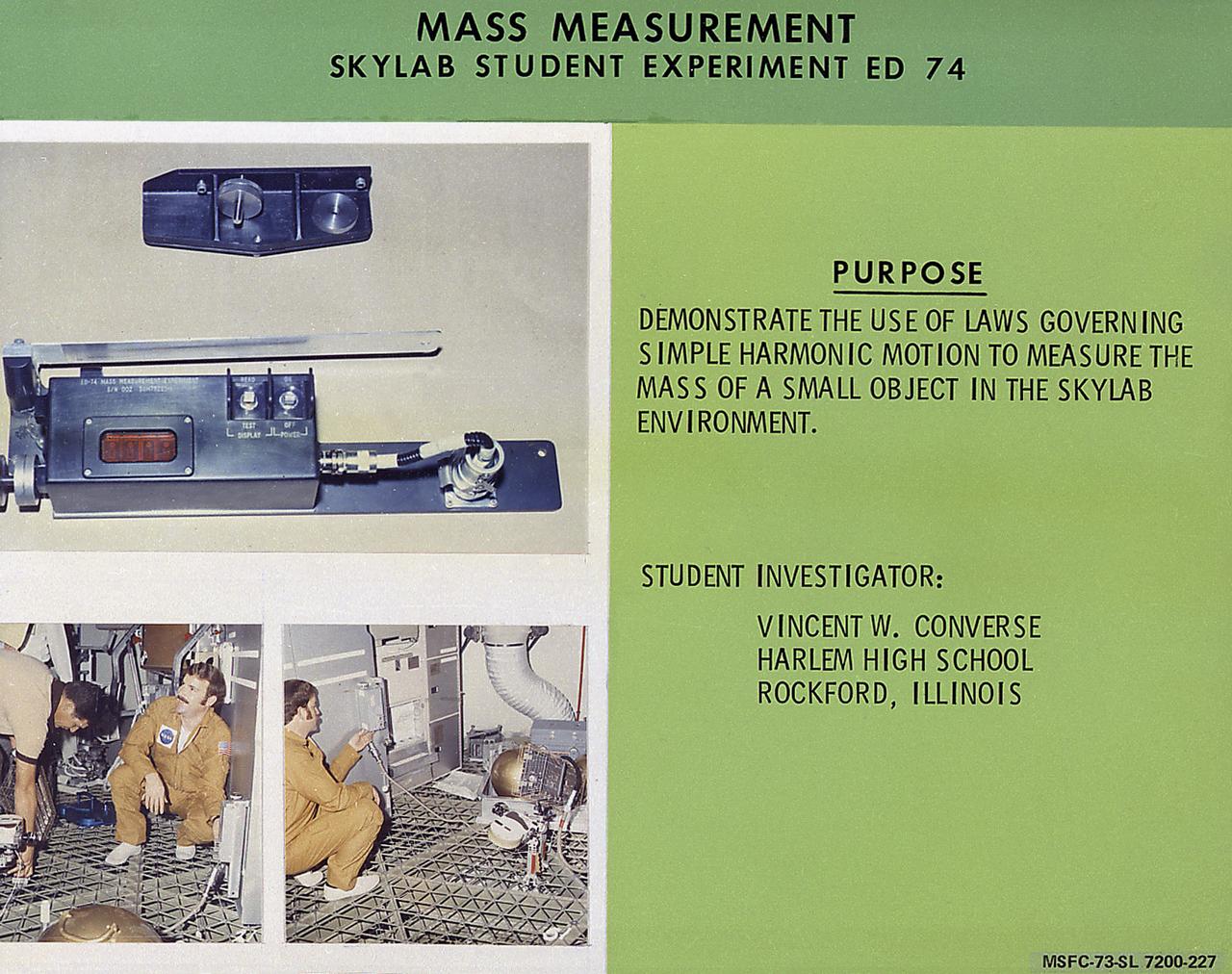
Vincent W. Converse of Rockford, Illinois proposed Skylab's student experiment ED-74, Mass Measurement, to measure mass in a weightless environment. This chart describes Converse's experiment. Mass is the quantity of matter in any object. The gravitational force between an object and the Earth is called weight, which is a result of the Earth's gravity acting upon the object's mass. Even though objects in Skylab were apparently weightless, their mass properties were unchanged. Measurement of mass is therefore an acceptable alternative to measurement of weight. The devices used in this experiment provided accurate mass measurements of the astronauts' weights, intakes, and body wastes throughout the missions. In March 1972, NASA and the National Science Teachers Association selected 25 experiment proposals for flight on Skylab. Science advisors from the Marshall Space Flight Center aided and assisted the students in developing the proposals for flight on Skylab.

Photos of LaRC team weighting and performing Center of Gravity (CG) measurements of the Structural Test Article (STA) at NASA Langley Research Center.
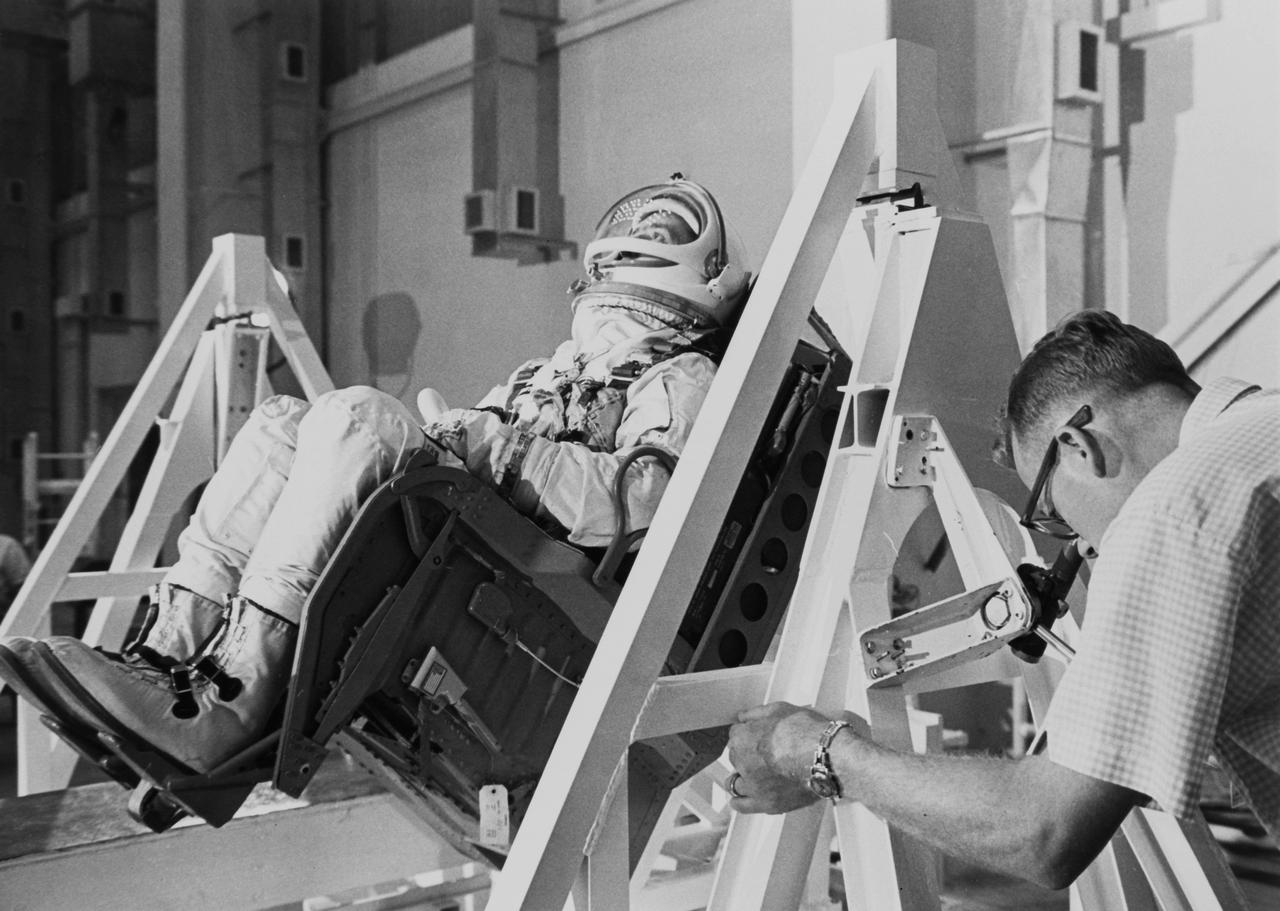
S65-19585 (21 May 1965) --- Astronaut James A. McDivitt, command pilot for the Gemini-Titan 4 prime crew, participates in a weight and balance test during a wet mock simulation exercise at Cape Kennedy, Florida. The two-man Gemini-4 mission, scheduled no earlier than June 3, 1965, will orbit Earth 62 times in four days. Astronaut Edward H. White II (out of frame) is the GT-4 prime crew pilot.
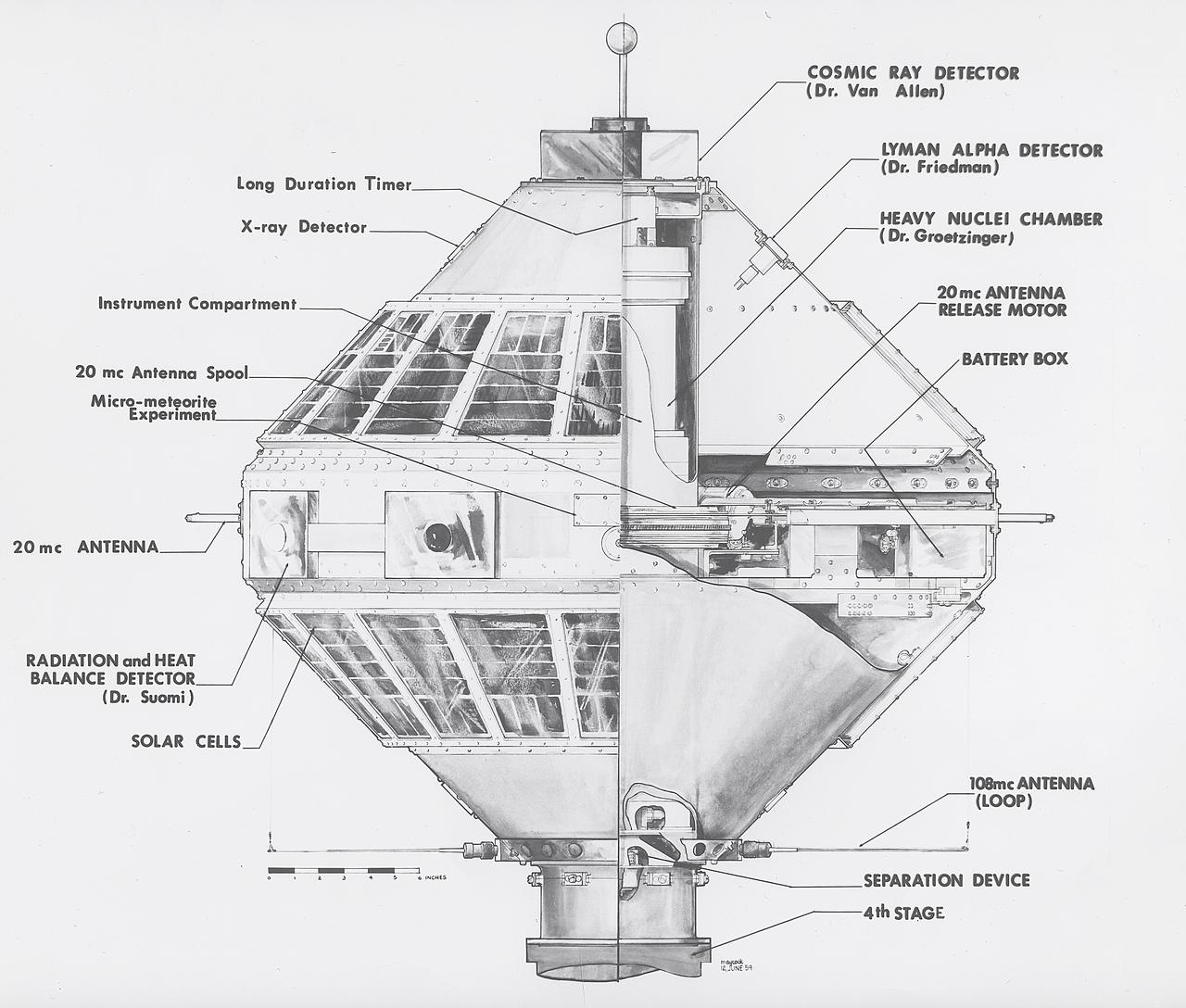
A Juno II launched an Explorer VII satellite on October 13, 1959. Explorer VII, with a total weight of 91.5 pounds, carried a scientific package for detecting micrometeors, measuring the Earth's radiation balance, and conducting other experiments.
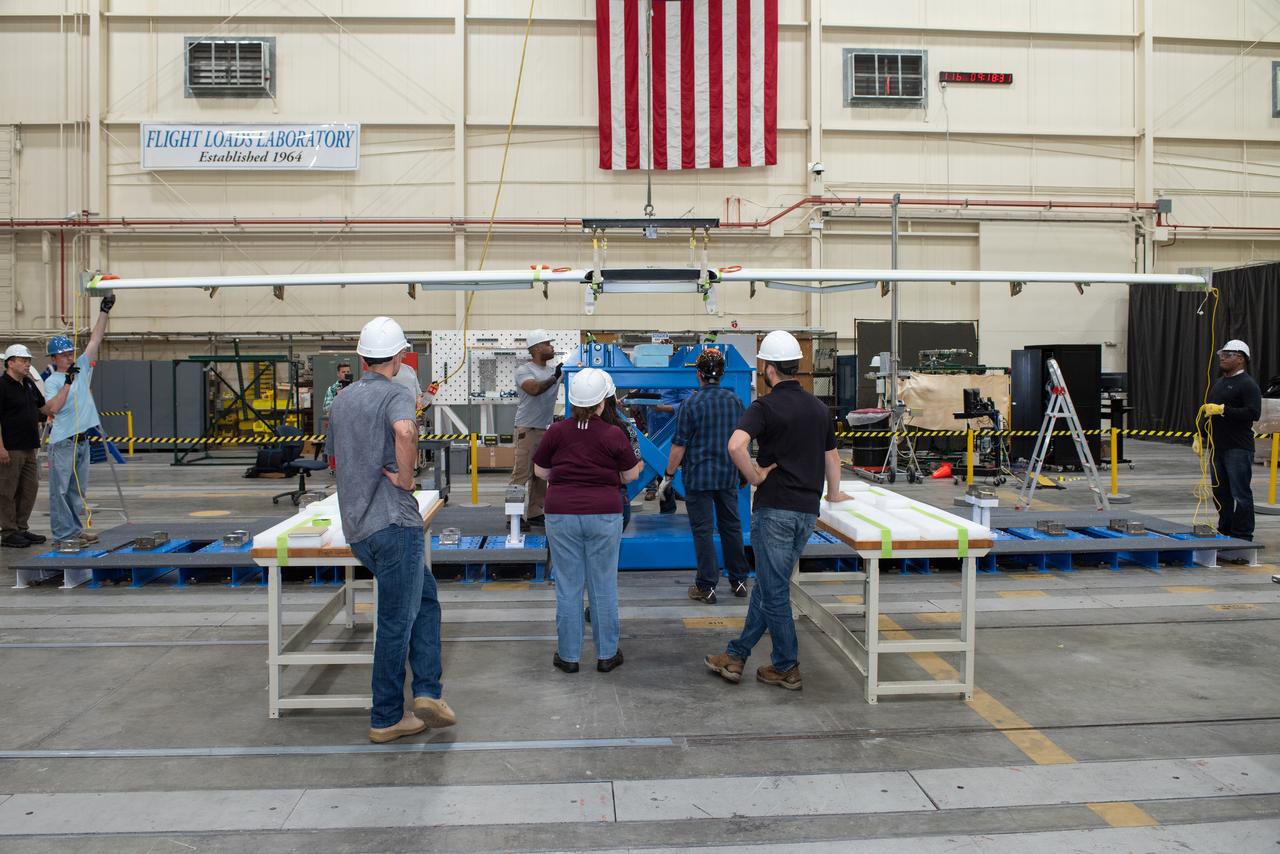
Engineers and specialists prepare X-57s Mod III wing for testing in the Flight Loads Laboratory at NASA’s Armstrong Flight Research Center in Edwards, California. Here, the wing began preparation for several tests, including weight and balance measurement, ground vibration testing, and wing loading tests.
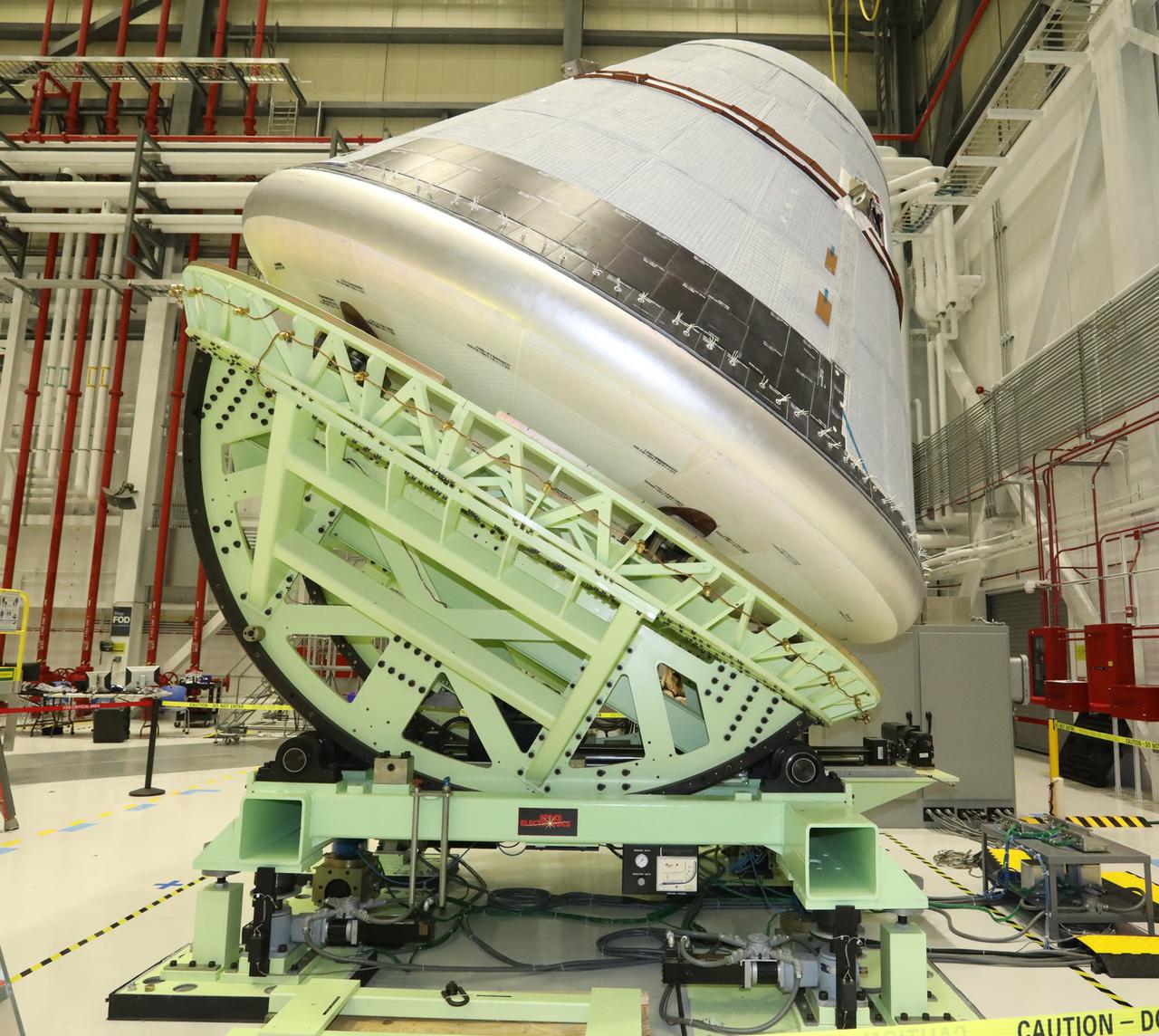
Boeing’s Starliner crew module is weighed in the Commercial Crew and Cargo Processing Facility at Kennedy Space Center in Florida on Jan. 14, 2021, in preparation for the company’s second Orbital Flight Test (OFT-2), as part of NASA’s Commercial Crew Program.. The Weight and Center of Gravity test measures the weight and balance of the spacecraft to ensure optimal performance during launch and re-entry. The test helps to validate parameters required for launching on United Launch Alliance’s Atlas V rocket, docking to the International Space Station and for navigation of the vehicle, among others.
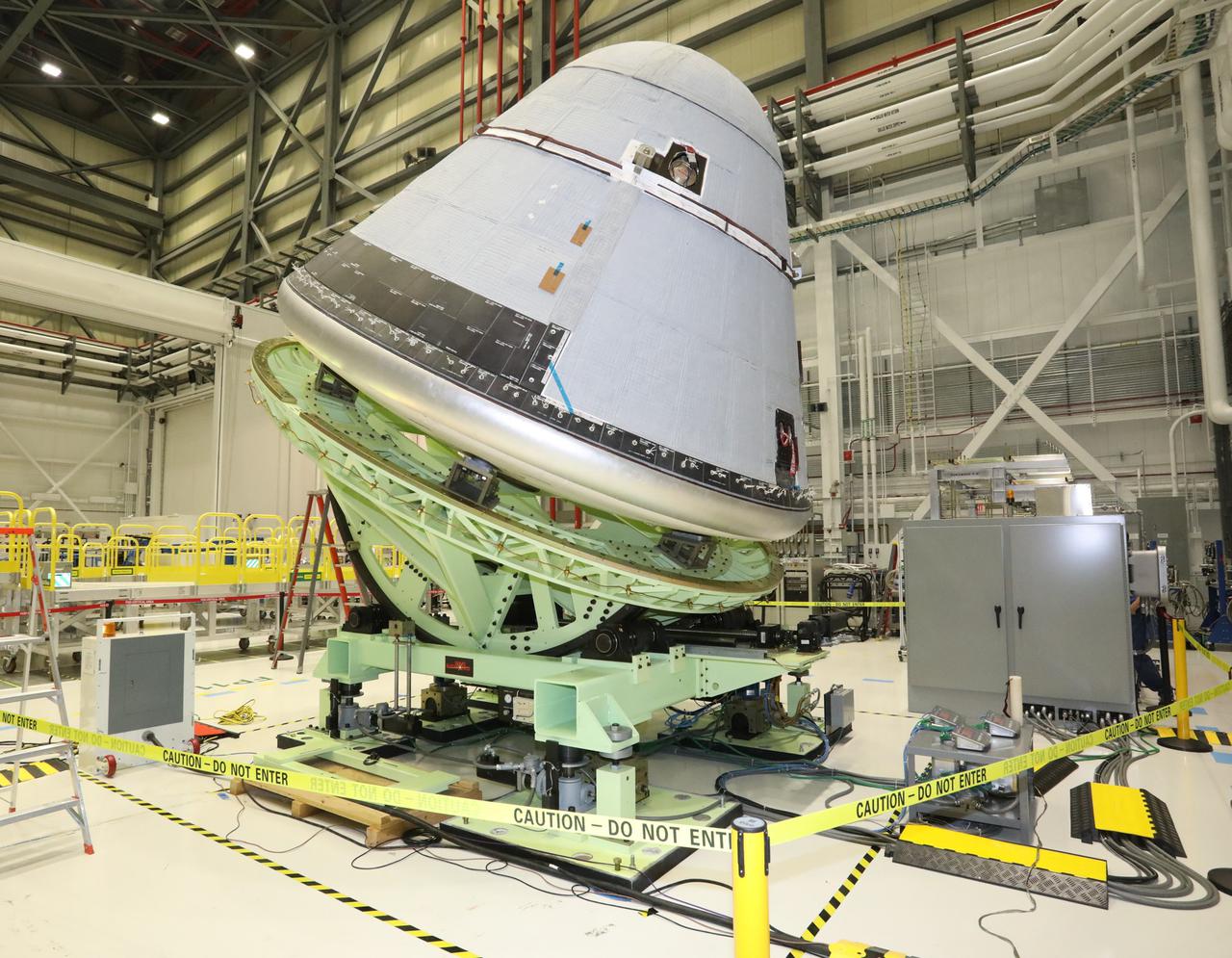
Boeing’s Starliner crew module is weighed in the Commercial Crew and Cargo Processing Facility at Kennedy Space Center in Florida on Jan. 14, 2021, in preparation for the company’s second Orbital Flight Test (OFT-2), as part of NASA’s Commercial Crew Program.. The Weight and Center of Gravity test measures the weight and balance of the spacecraft to ensure optimal performance during launch and re-entry. The test helps to validate parameters required for launching on United Launch Alliance’s Atlas V rocket, docking to the International Space Station and for navigation of the vehicle, among others.
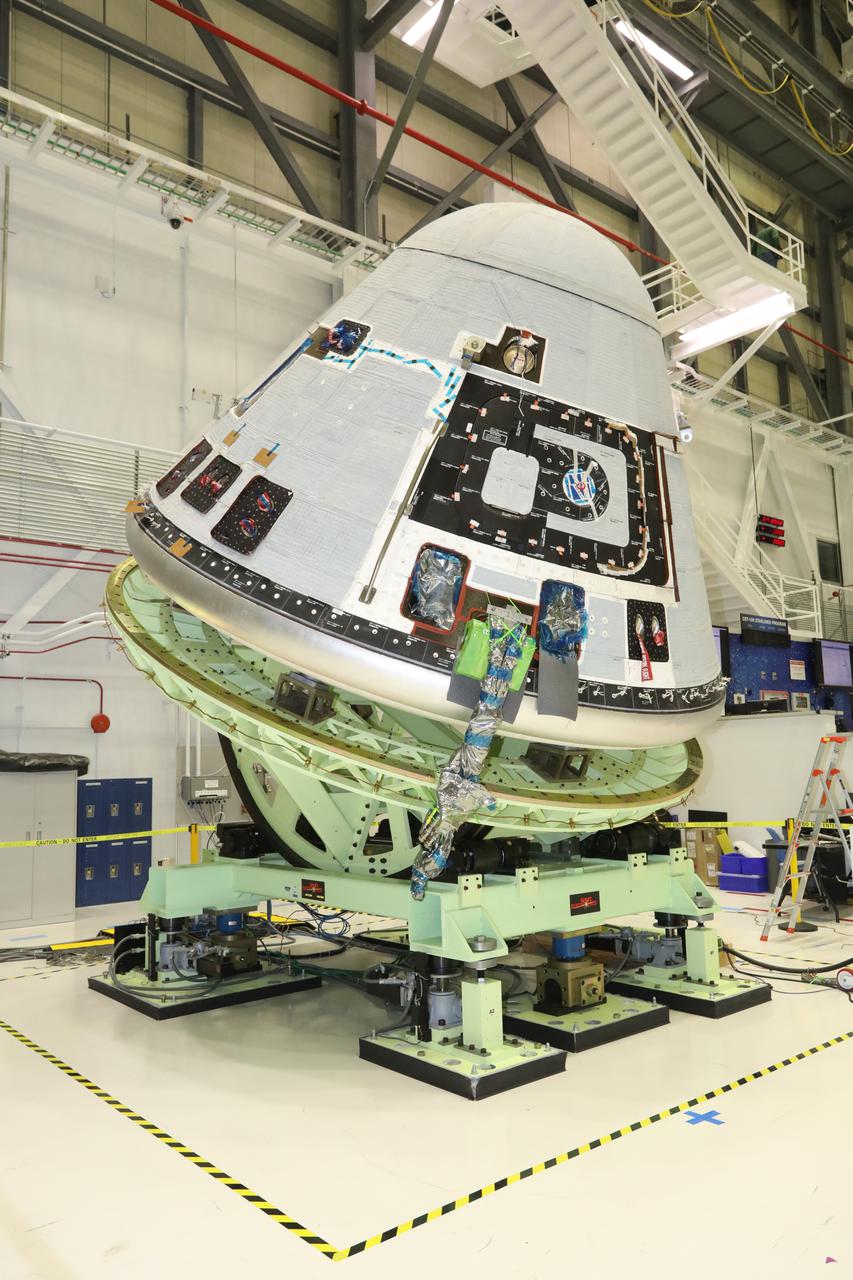
Boeing’s Starliner crew module is weighed in the Commercial Crew and Cargo Processing Facility at Kennedy Space Center in Florida on Jan. 14, 2021, in preparation for the company’s second Orbital Flight Test (OFT-2), as part of NASA’s Commercial Crew Program.. The Weight and Center of Gravity test measures the weight and balance of the spacecraft to ensure optimal performance during launch and re-entry. The test helps to validate parameters required for launching on United Launch Alliance’s Atlas V rocket, docking to the International Space Station and for navigation of the vehicle, among others.
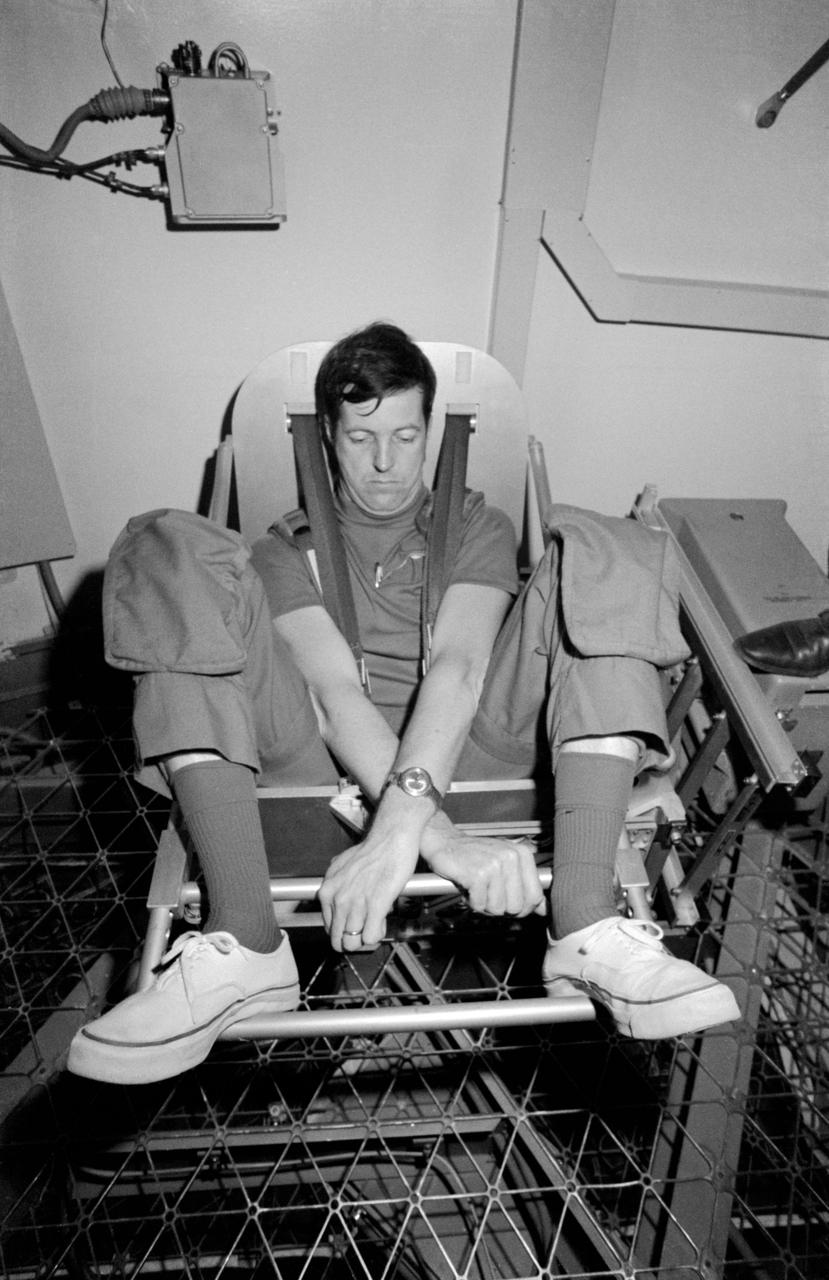
S73-20622 (March 1973) --- Scientist-astronaut Joseph P. Kerwin, science pilot of the first manned Skylab mission, demonstrates the Body Mass Measurement Experiment (M172) during Skylab training at the Johnson Space Center. Dr. Kerwin is in the work and experiments area of the crew quarters of the Skylab Orbital Workshop (OWS) trainer at JSC. The M172 experiment will demonstrate body mass measurement in a null gravity environment, validate theoretical behavior of this method, and support those medical experiments for which body mass measurements are required. The data to be collected in support of M172 are: preflight calibration of the body mass measurement device and measurements of known masses up to 100 kilograms (220 pounds) three times during each Skylab mission. The device, a spring/flexure pivot-mounted chair, will also be used for daily determination of the crewmen?s weight, which will be manually logged and voice recorded for subsequent telemetered transmission. Photo credit: NASA
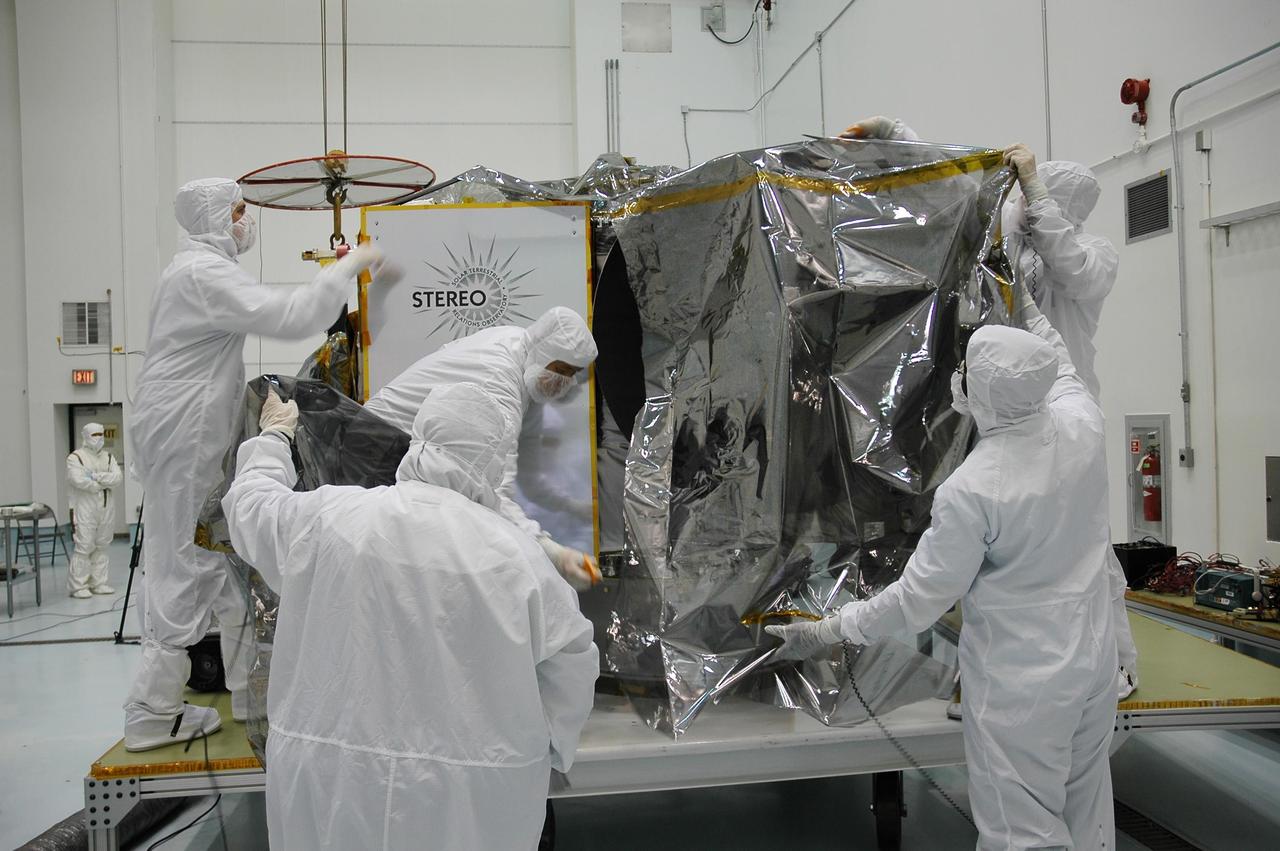
KENNEDY SPACE CENTER, FLA. - In the hazardous processing facility at Astrotech Space Operations in Titusville, Fla., technicians begin removing the protective cover from Observatory A of the STEREO spacecraft. The observatory will be lifted onto a scale for weight measurements and later will be fueled. STEREO stands for Solar Terrestrial Relations Observatory. The STEREO mission is the first to take measurements of the sun and solar wind in 3-dimension. This new view will improve our understanding of space weather and its impact on the Earth. STEREO is expected to lift off aboard a Boeing Delta II rocket no earlier than Aug. 1. Photo credit: NASA/Jack Pfaller
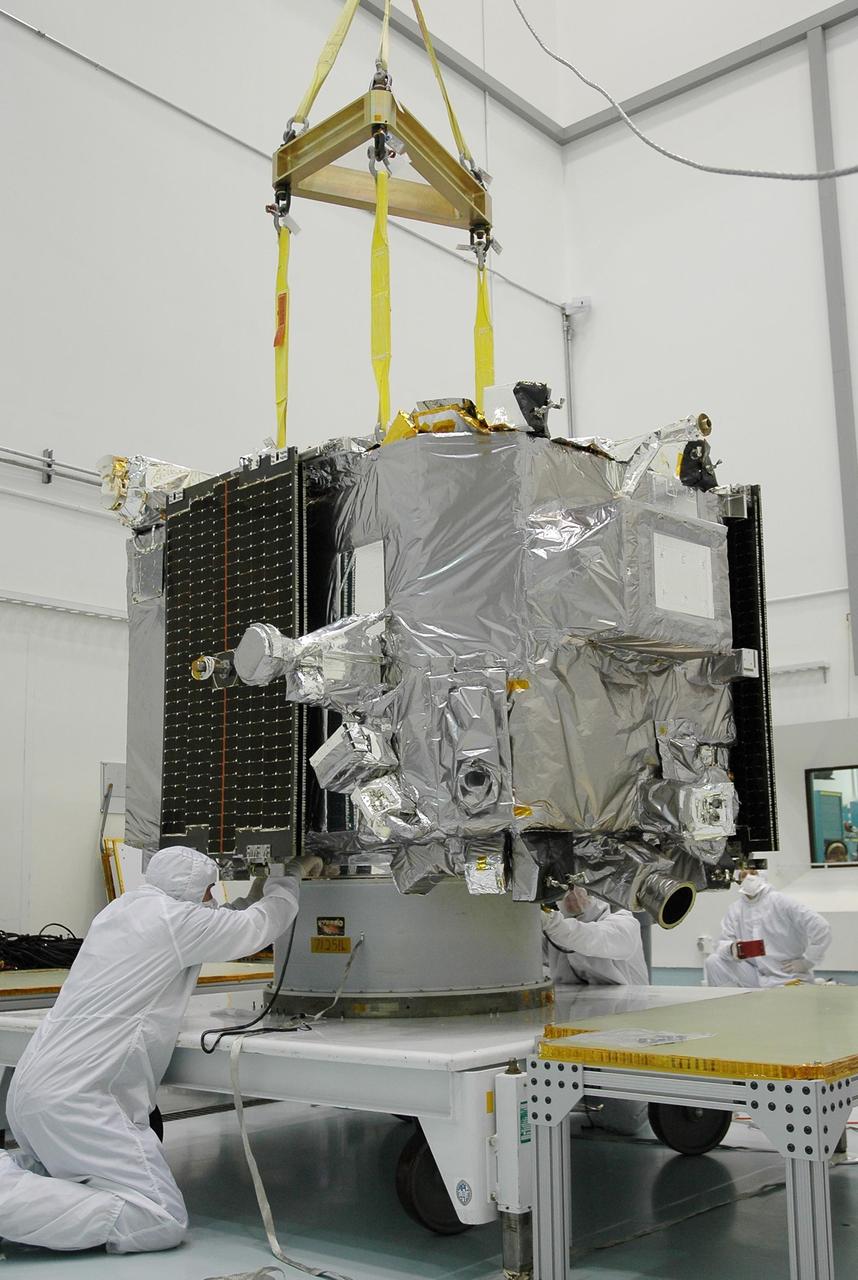
KENNEDY SPACE CENTER, FLA. - In the hazardous processing facility at Astrotech Space Operations in Titusville, Fla., technicians check Observatory A before lifting onto a scale for weight measurements. The observatory is one of two in the STEREO spacecraft and later will be fueled. STEREO stands for Solar Terrestrial Relations Observatory. The STEREO mission is the first to take measurements of the sun and solar wind in 3-dimension. This new view will improve our understanding of space weather and its impact on the Earth. STEREO is expected to lift off aboard a Boeing Delta II rocket no earlier than Aug. 1. Photo credit: NASA/Jack Pfaller
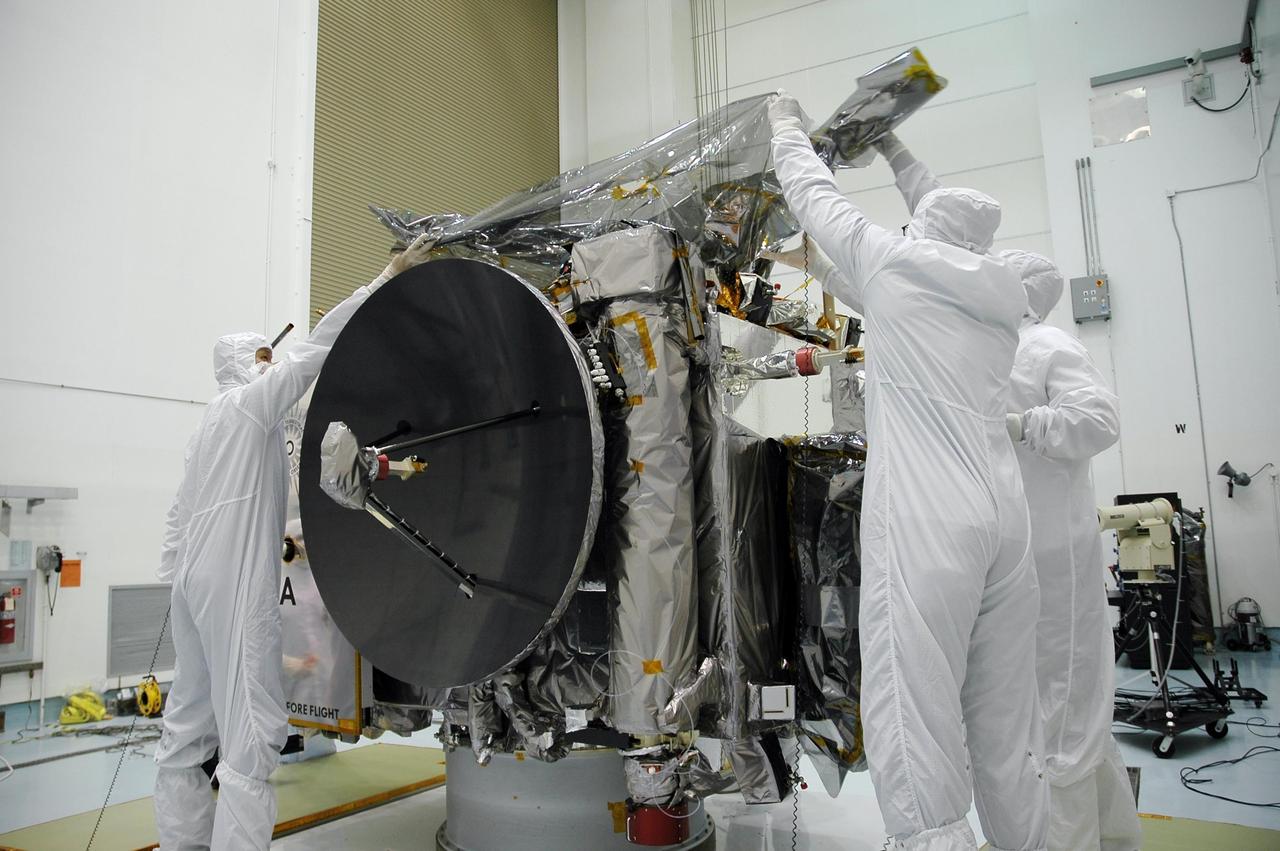
KENNEDY SPACE CENTER, FLA. - In the hazardous processing facility at Astrotech Space Operations in Titusville, Fla., technicians remove the protective cover from the top of Observatory A, one of two STEREO spacecraft. The observatory will be lifted onto a scale for weight measurements and later will be fueled. STEREO stands for Solar Terrestrial Relations Observatory. The STEREO mission is the first to take measurements of the sun and solar wind in 3-dimension. This new view will improve our understanding of space weather and its impact on the Earth. STEREO is expected to lift off aboard a Boeing Delta II rocket no earlier than Aug. 1. Photo credit: NASA/Jack Pfaller

KENNEDY SPACE CENTER, FLA. - In the hazardous processing facility at Astrotech Space Operations in Titusville, Fla., technicians begin removing the protective cover from Observatory A of the STEREO spacecraft. The observatory will be lifted onto a scale for weight measurements and later will be fueled. STEREO stands for Solar Terrestrial Relations Observatory. The STEREO mission is the first to take measurements of the sun and solar wind in 3-dimension. This new view will improve our understanding of space weather and its impact on the Earth. STEREO is expected to lift off aboard a Boeing Delta II rocket no earlier than Aug. 1. Photo credit: NASA/Jack Pfaller
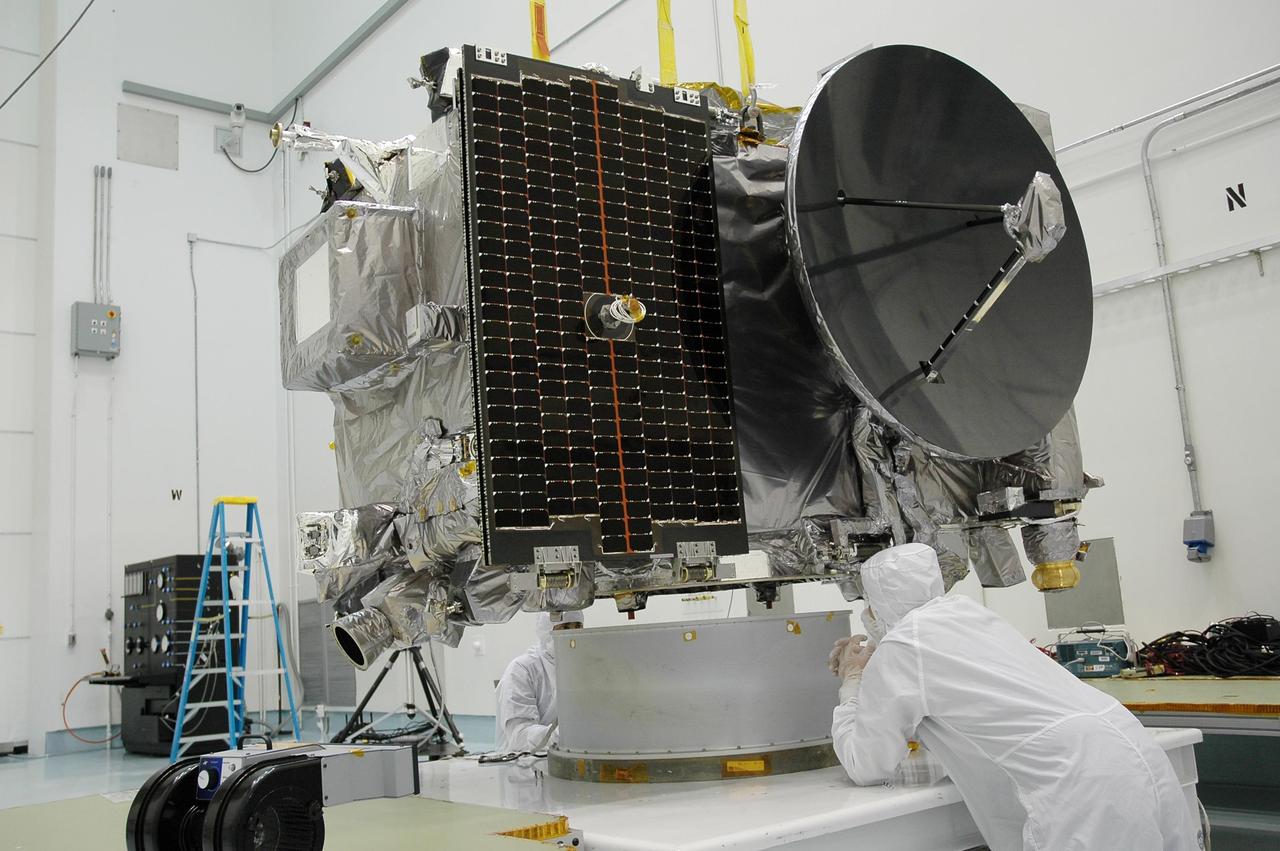
KENNEDY SPACE CENTER, FLA. - In the hazardous processing facility at Astrotech Space Operations in Titusville, Fla., technicians begin attaching an overhead crane to Observatory A of the STEREO spacecraft. The observatory will be lifted onto a scale for weight measurements and later will be fueled. STEREO stands for Solar Terrestrial Relations Observatory. The STEREO mission is the first to take measurements of the sun and solar wind in 3-dimension. This new view will improve our understanding of space weather and its impact on the Earth. STEREO is expected to lift off aboard a Boeing Delta II rocket no earlier than Aug. 1. Photo credit: NASA/Jack Pfaller
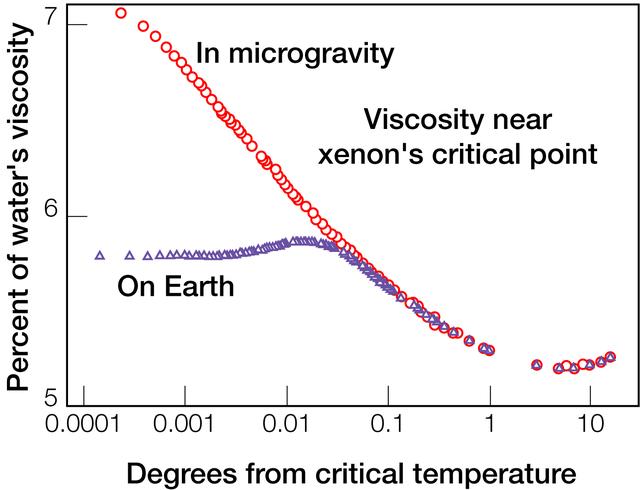
The Critical Viscosity of Xenon Experiment (CVX-2) on the STS-107 Research 1 mission in 2002 will measure the viscous behavior of xenon, a heavy inert gas used in flash lamps and ion rocket engines, at its critical point. Because xenon near the critical point will collapse under its own weight, experiments on Earth (green line) are limited as they get closer (toward the left) to the critical point. CVX in the microgravity of space (red line) moved into unmeasured territory that scientists had not been able to reach.
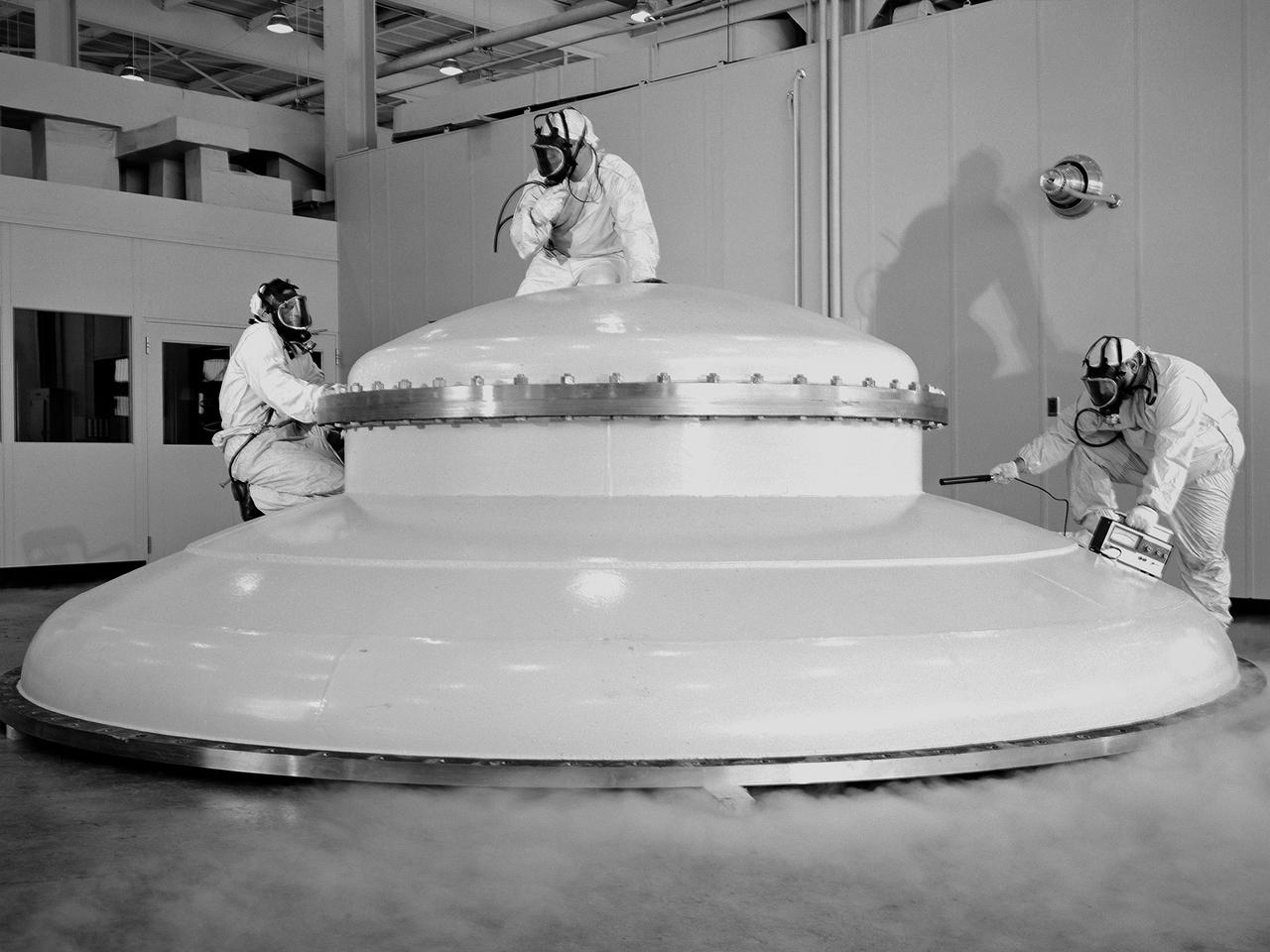
Engineer Paul Reader and his colleagues take environmental measurements during testing of a 20-inch diameter ion engine in a vacuum tank at the Electric Propulsion Laboratory (EPL). Researchers at the Lewis Research Center were investigating the use of a permanent-magnet circuit to create the magnetic field required power electron bombardment ion engines. Typical ion engines use a solenoid coil to create this magnetic field. It was thought that the substitution of a permanent magnet would create a comparable magnetic field with a lower weight. Testing of the magnet system in the EPL vacuum tanks revealed no significant operational problems. Reader found the weight of the two systems was similar, but that the thruster’s efficiency increased with the magnet. The EPL contained a series of large vacuum tanks that could be used to simulate conditions in space. Large vacuum pumps reduced the internal air pressure, and a refrigeration system created the cryogenic temperatures found in space.
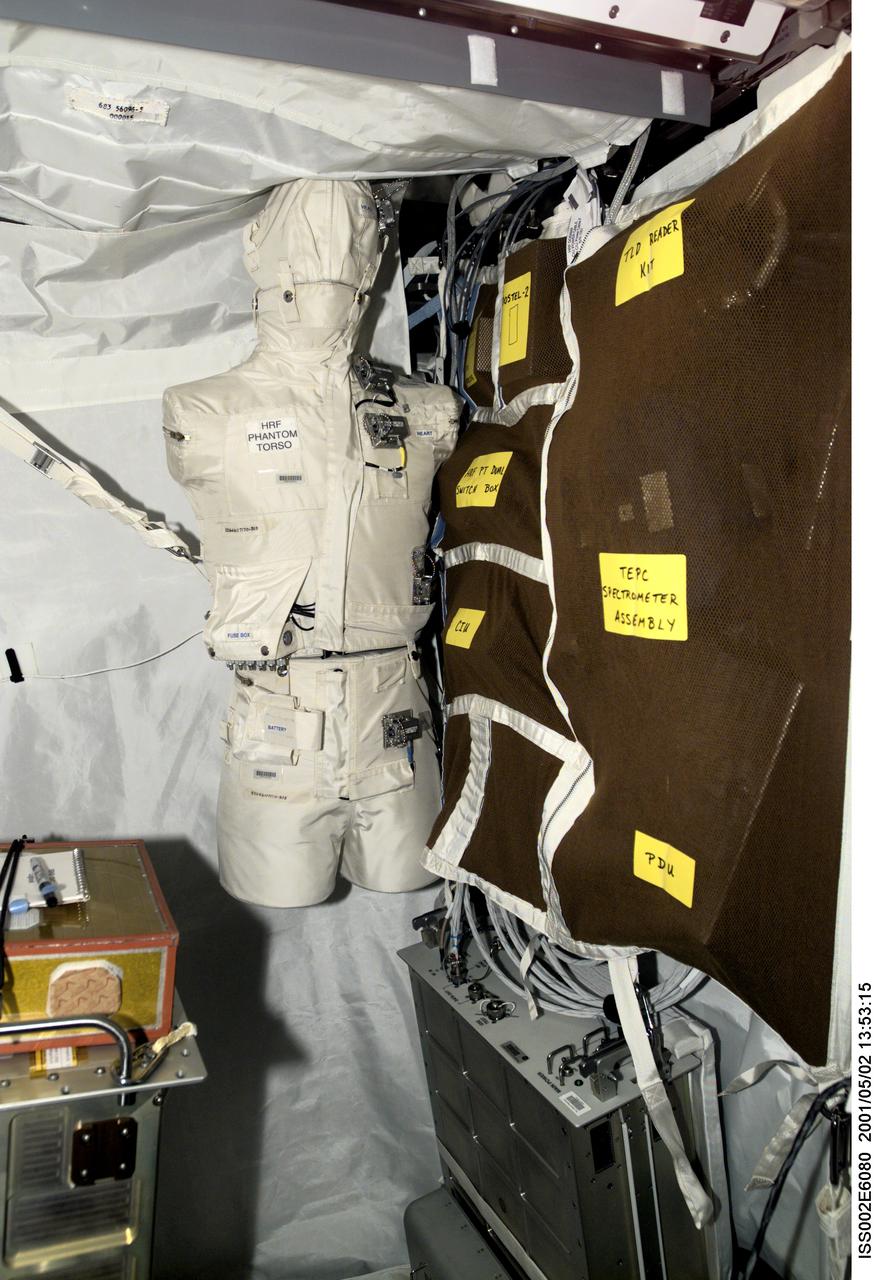
ISS002-E-6080 (2 May 2001) --- The Phantom Torso, seen here in the Human Research Facility (HRF) section of the Destiny/U.S. laboratory on the International Space Station (ISS), is designed to measure the effects of radiation on organs inside the body by using a torso that is similar to those used to train radiologists on Earth. The torso is equivalent in height and weight to an average adult male. It contains radiation detectors that will measure, in real-time, how much radiation the brain, thyroid, stomach, colon, and heart and lung area receive on a daily basis. The data will be used to determine how the body reacts to and shields its internal organs from radiation, which will be important for longer duration space flights. The experiment was delivered to the orbiting outpost during by the STS-100/6A crew in April 2001. Dr. Gautam Badhwar, NASA JSC, Houston, TX, is the principal investigator for this experiment. A digital still camera was used to record this image.
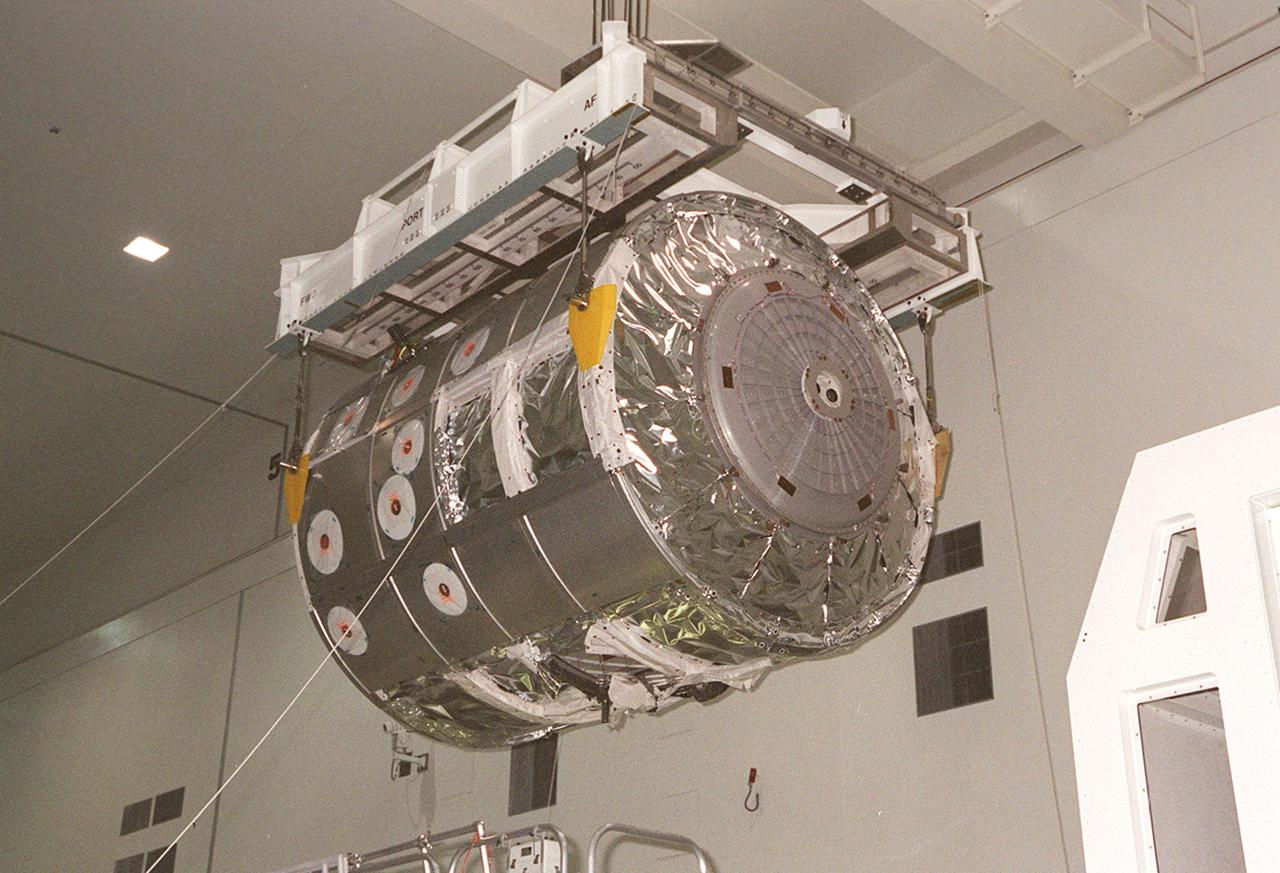
KENNEDY SPACE CENTER, FLA. -- In the Space Station Processing Facility, an overhead crane lifts the Multi-Purpose Logistics Module Raffaello off its workstand to move it to to a scale for weight and balance. Raffaello is the second MPLM built by the Italian Space Agency, and serves as a reusable logistics carrier and primary delivery system used to resupply and return station cargo requiring a pressurized environment. Weighing nearly 4.5 tons, the Raffaello measures 21 feet long and 15 feet in diameter. The MPLM will fly on mission STS-100, scheduled to launch aboard Space Shuttle Endeavour on April 19

KENNEDY SPACE CENTER, FLA. -- Technicians gather around the STS-90 Neurolab payload during weight and center-of-gravity measurements in KSC's Operations and Checkout Building. Investigations during the Neurolab mission will focus on the effects of microgravity on the nervous system. Specifically, experiments will study the adaptation of the vestibular system, the central nervous system, and the pathways that control the ability to sense location in the absence of gravity, as well as the effect of microgravity on a developing nervous system. The crew of STS-90, slated for launch in April, will include Commander Richard Searfoss, Pilot Scott Altman, Mission Specialists Richard Linnehan, Dafydd (Dave) Williams, M.D., and Kathryn (Kay) Hire, and Payload Specialists Jay Buckey, M.D., and James Pawelczyk, Ph.D
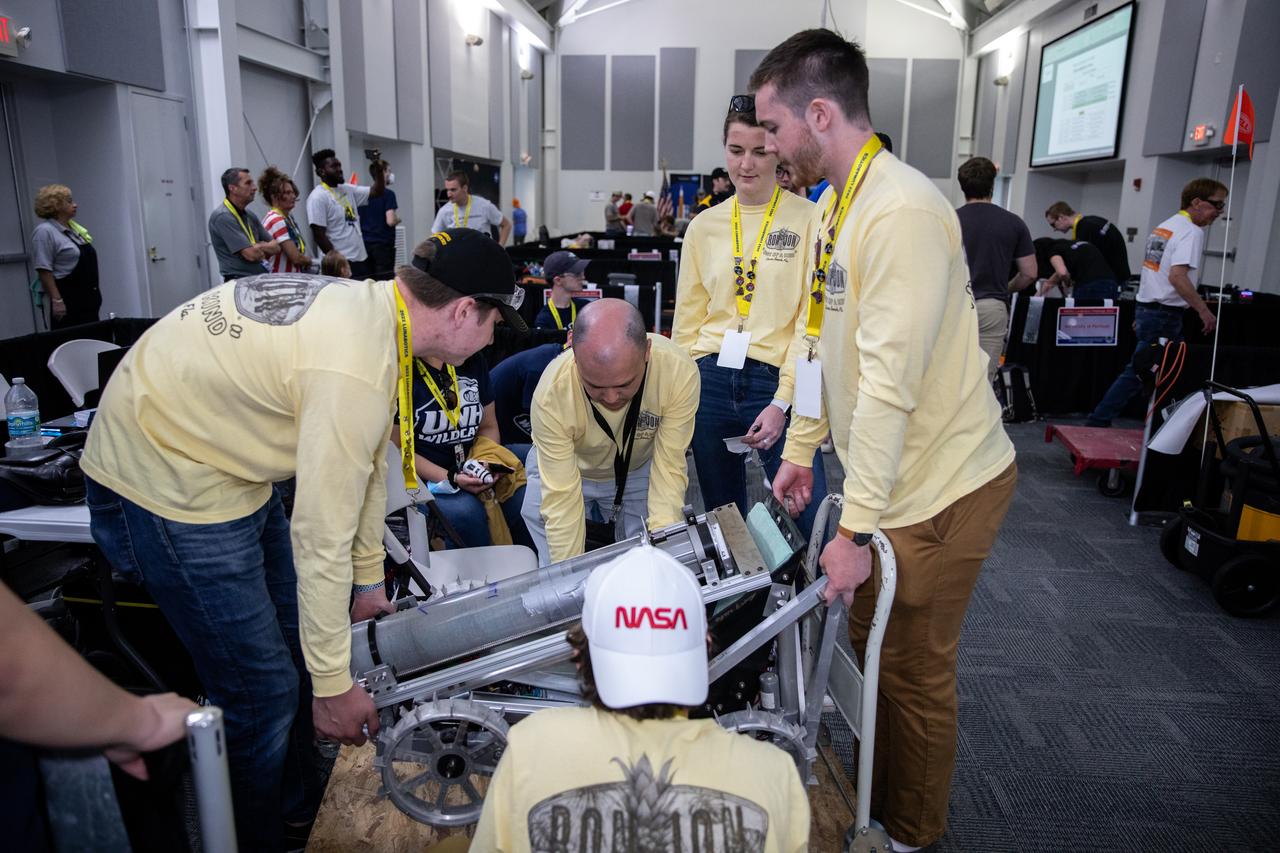
The University of New Hampshire’s robotic miner is placed on a cart to record its measurements and weight before the school’s team prepares it for its turn to dig in the mining arena during NASA’s LUNABOTICS competition on May 27, 2022, at the Center for Space Education near the Kennedy Space Center Visitor Complex in Florida. More than 35 teams from around the U.S. have designed and built remote-controlled robots for the mining competition. Teams use their autonomous or remote-controlled robots to maneuver and dig in a supersized sandbox filled with lunar simulant and rocks. The objective of the challenge is to see which team’s robot can collect and deposit the most rocky regolith within a specified amount of time.
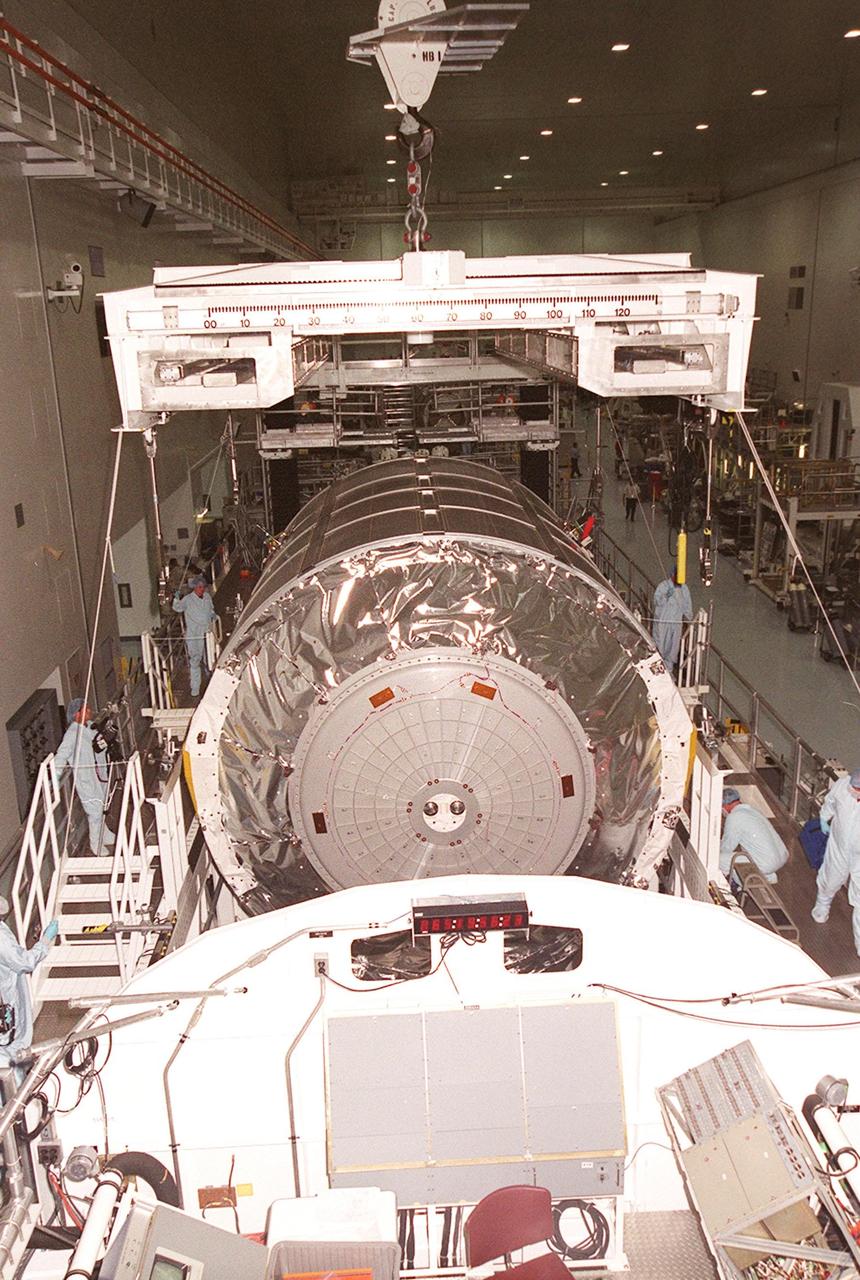
KENNEDY SPACE CENTER, FLA. -- In the Space Station Processing Facility, workers watch while an overhead crane lowers the Multi-Purpose Logistics Module Raffaello onto a weight and balance stand (foreground). Raffaello is the second MPLM built by the Italian Space Agency, and serves as a reusable logistics carrier and primary delivery system used to resupply and return station cargo requiring a pressurized environment. Weighing nearly 4.5 tons, the Raffaello measures 21 feet long and 15 feet in diameter. The MPLM will fly on mission STS-100, scheduled to launch aboard Space Shuttle Endeavour on April 19
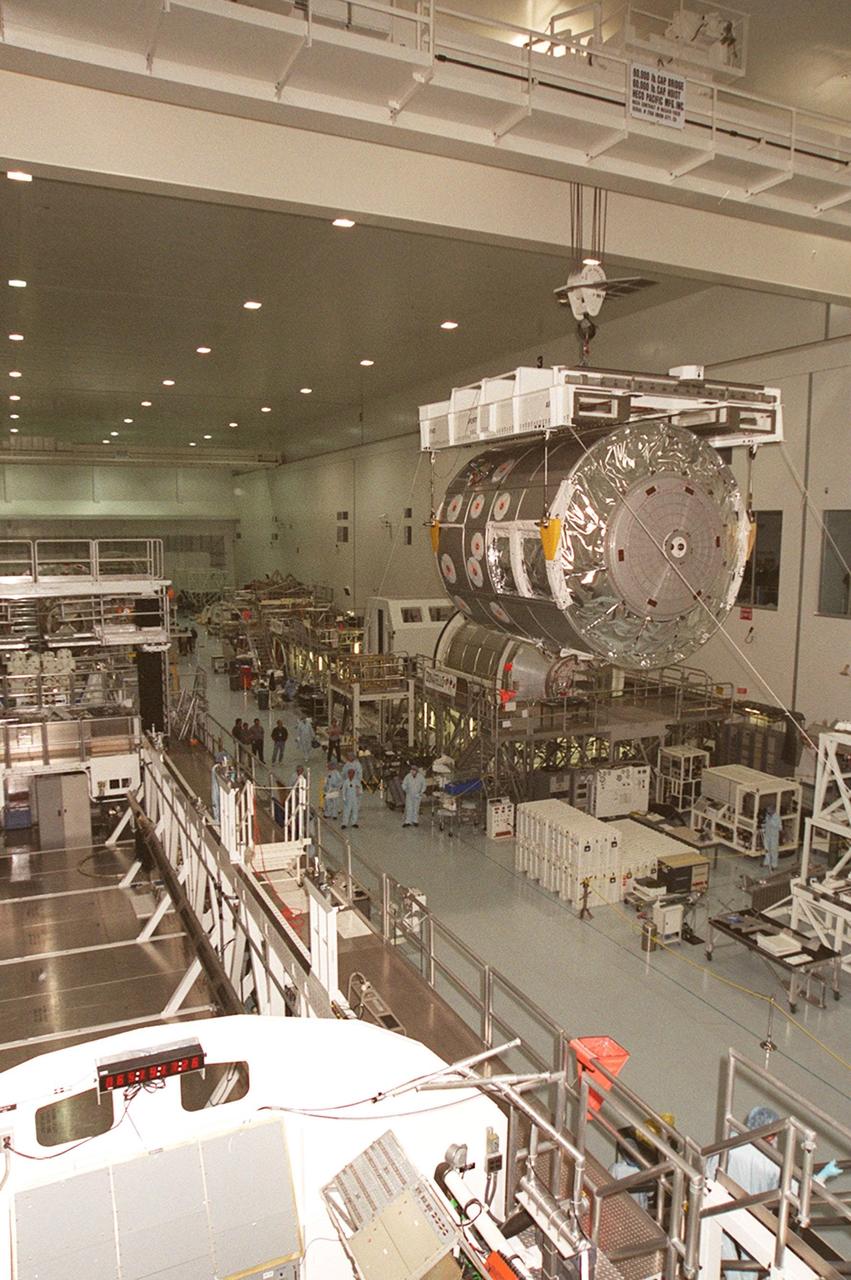
KENNEDY SPACE CENTER, FLA. -- In the Space Station Processing Facility, an overhead crane moves the Multi-Purpose Logistics Module Raffaello across the room toward the weight and balance stand at left. Raffaello is the second MPLM built by the Italian Space Agency, and serves as a reusable logistics carrier and primary delivery system used to resupply and return station cargo requiring a pressurized environment. Weighing nearly 4.5 tons, the Raffaello measures 21 feet long and 15 feet in diameter. The MPLM will fly on mission STS-100, scheduled to launch aboard Space Shuttle Endeavour on April 19
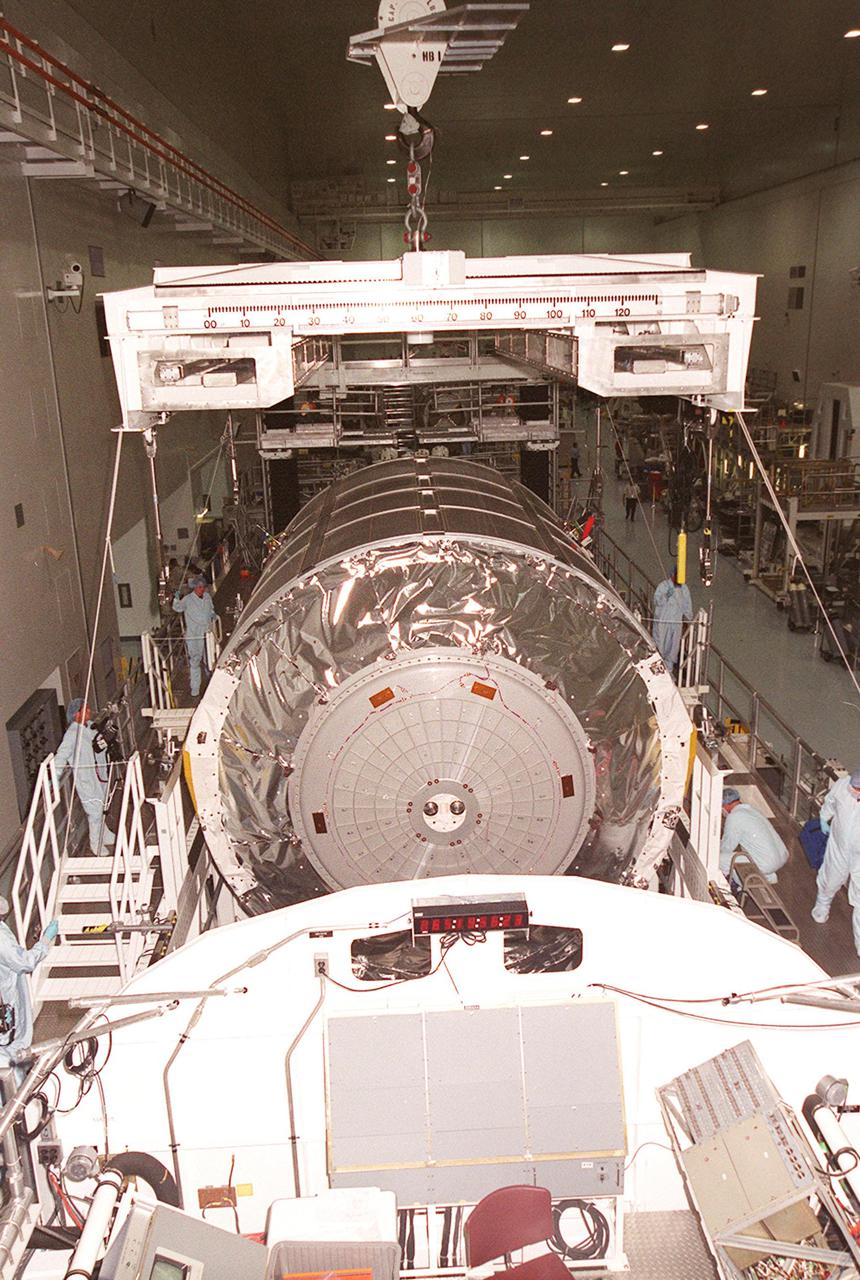
KENNEDY SPACE CENTER, FLA. -- In the Space Station Processing Facility, workers watch while an overhead crane lowers the Multi-Purpose Logistics Module Raffaello onto a weight and balance stand (foreground). Raffaello is the second MPLM built by the Italian Space Agency, and serves as a reusable logistics carrier and primary delivery system used to resupply and return station cargo requiring a pressurized environment. Weighing nearly 4.5 tons, the Raffaello measures 21 feet long and 15 feet in diameter. The MPLM will fly on mission STS-100, scheduled to launch aboard Space Shuttle Endeavour on April 19
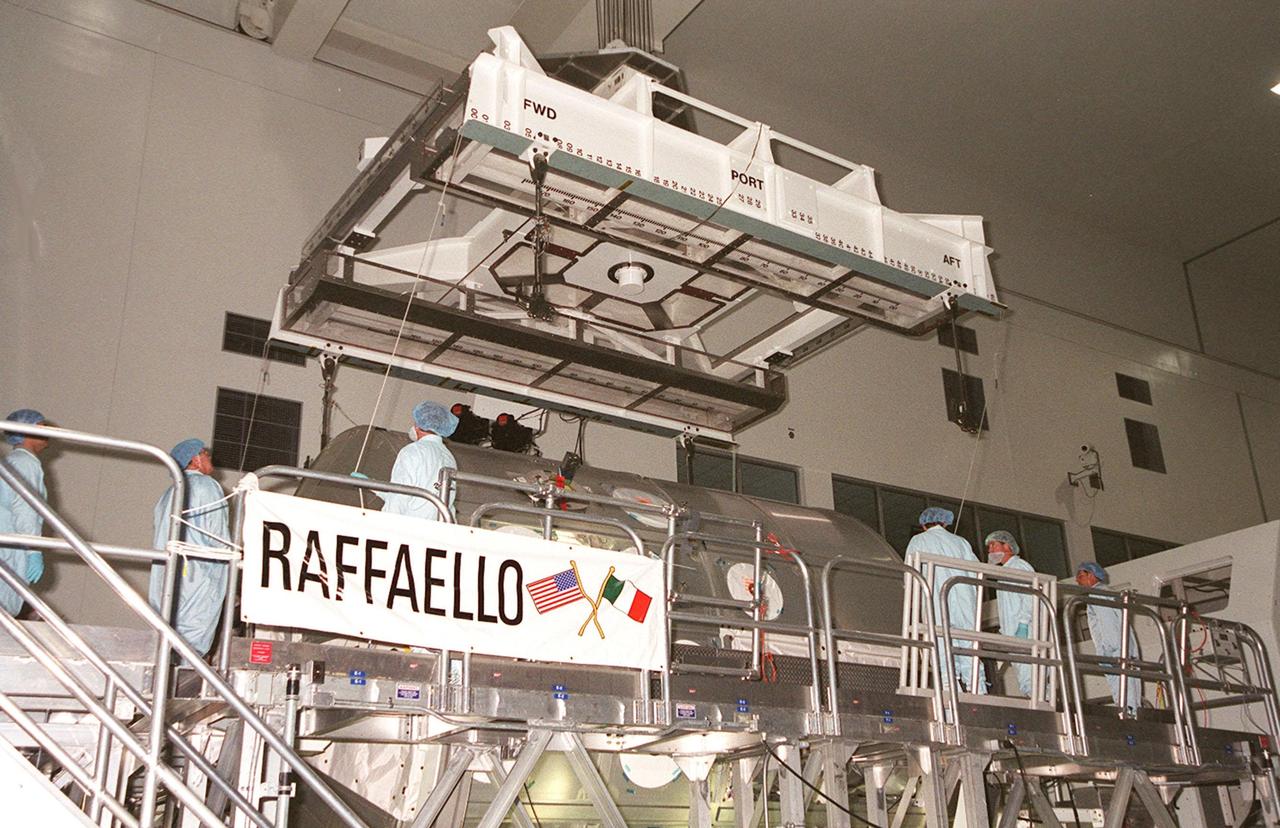
In the Space Station Processing Facility, an overhead crane is lowered toward the Multi-Purpose Logistics Module Raffaello so workers can attach it. The MPLM will be lifted and moved to a scale for weight and balance. Raffaello is the second MPLM built by the Italian Space Agency, and serves as a reusable logistics carrier and primary delivery system used to resupply and return station cargo requiring a pressurized environment. Weighing nearly 4.5 tons, the Raffaello measures 21 feet long and 15 feet in diameter. The MPLM will fly on mission STS-100, scheduled to launch aboard Space Shuttle Endeavour on April 19
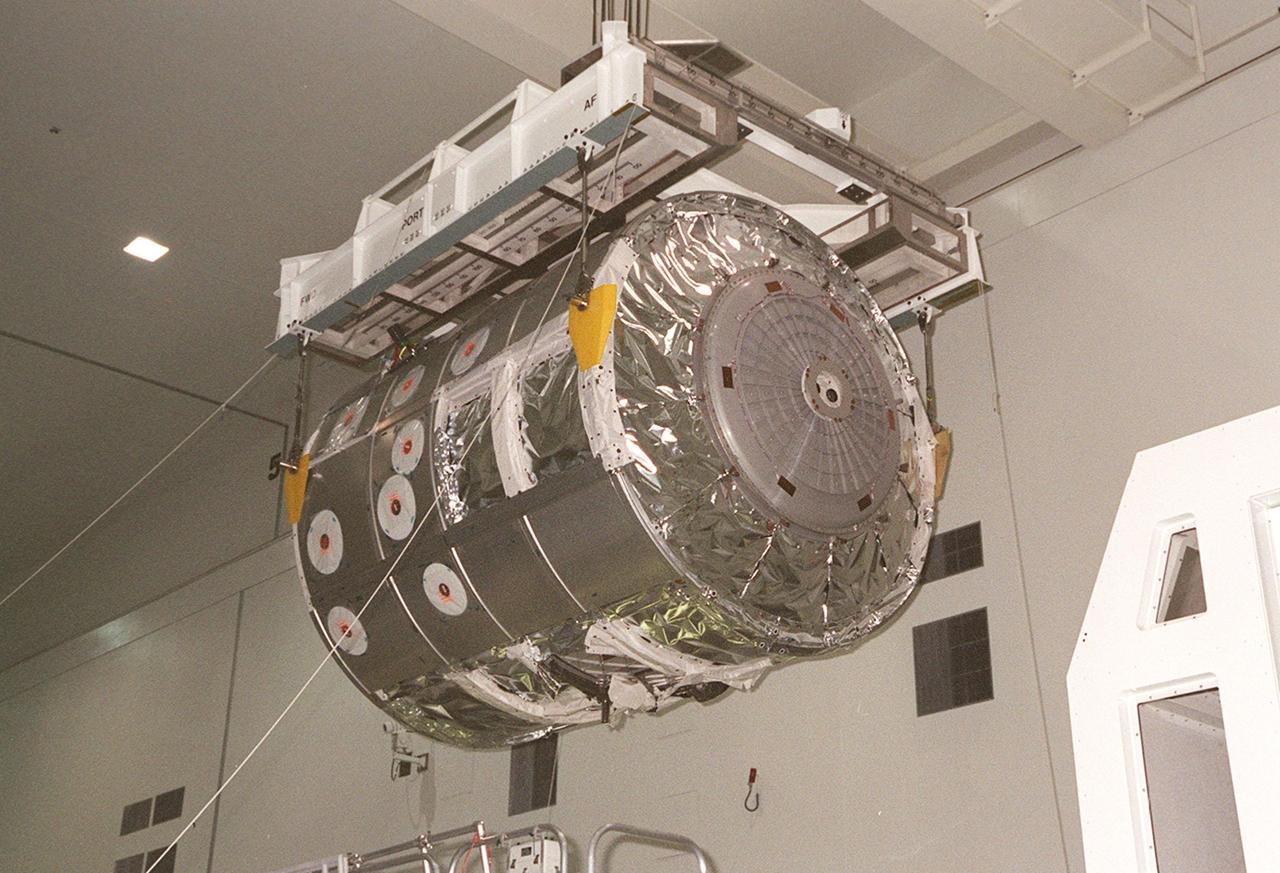
KENNEDY SPACE CENTER, FLA. -- In the Space Station Processing Facility, an overhead crane lifts the Multi-Purpose Logistics Module Raffaello off its workstand to move it to to a scale for weight and balance. Raffaello is the second MPLM built by the Italian Space Agency, and serves as a reusable logistics carrier and primary delivery system used to resupply and return station cargo requiring a pressurized environment. Weighing nearly 4.5 tons, the Raffaello measures 21 feet long and 15 feet in diameter. The MPLM will fly on mission STS-100, scheduled to launch aboard Space Shuttle Endeavour on April 19
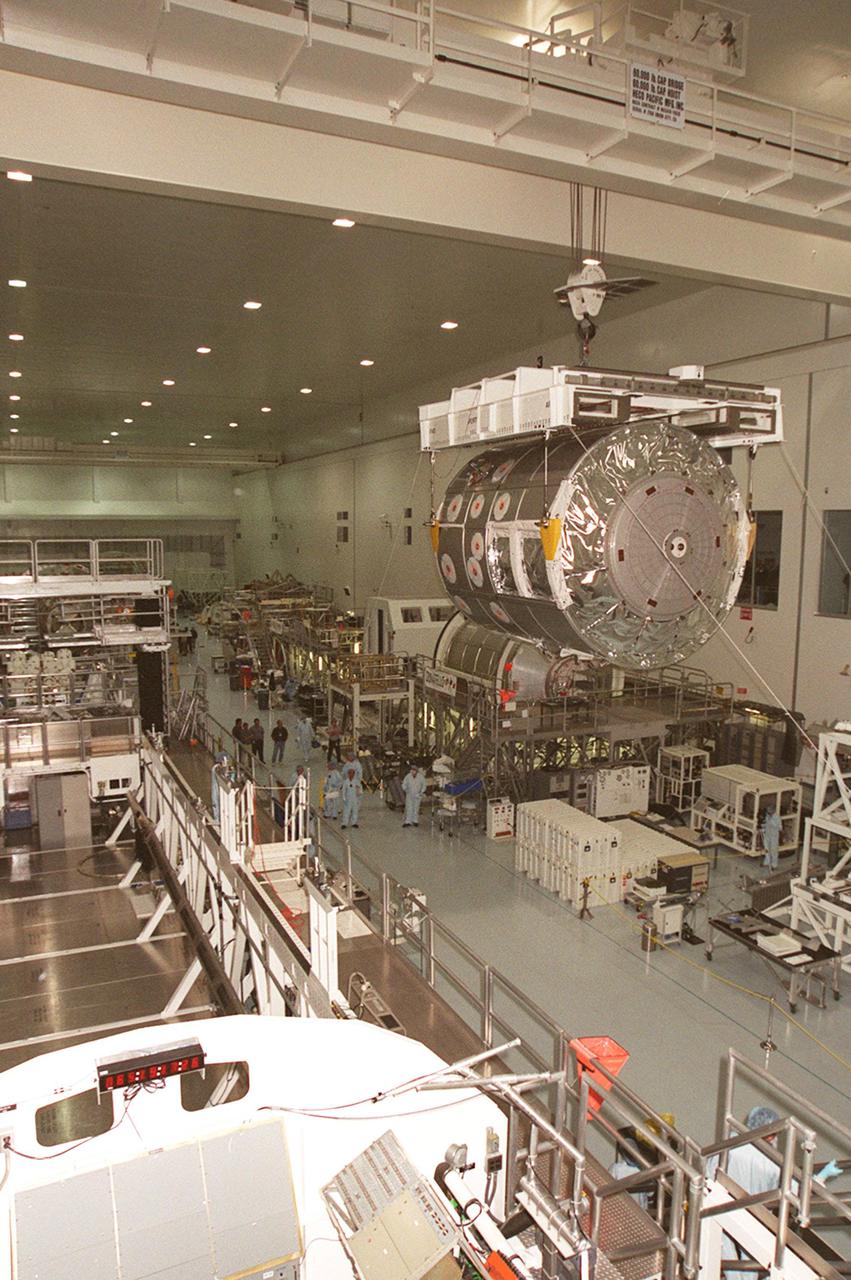
KENNEDY SPACE CENTER, FLA. -- In the Space Station Processing Facility, an overhead crane moves the Multi-Purpose Logistics Module Raffaello across the room toward the weight and balance stand at left. Raffaello is the second MPLM built by the Italian Space Agency, and serves as a reusable logistics carrier and primary delivery system used to resupply and return station cargo requiring a pressurized environment. Weighing nearly 4.5 tons, the Raffaello measures 21 feet long and 15 feet in diameter. The MPLM will fly on mission STS-100, scheduled to launch aboard Space Shuttle Endeavour on April 19
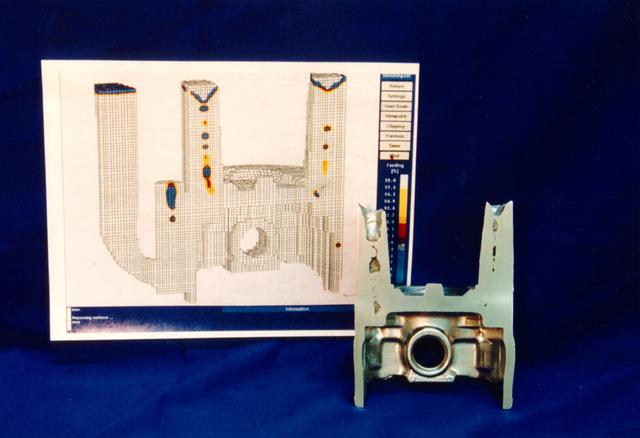
This is a computer generated model of a ground based casting. The objective of the therophysical properties program is to measure thermal physical properties of commercial casting alloys for use in computer programs that predict soldification behavior. This could reduce trial and error in casting design and promote less scrap, sounder castings, and less weight. In order for the computer models to reliably simulate the details of industrial alloy solidification, the input thermophysical property data must be absolutely reliable. Recently Auburn University and TPRL Inc. formed a teaming relationship to establish reliable measurement techniques for the most critical properties of commercially important alloys: transformation temperatures, thermal conductivity, electrical conductivity, specific heat, latent heat, density, solid fraction evolution, surface tension, and viscosity. A new initiative with the American Foundrymens Society has been started to measure the thermophysical properties of commercial ferrous and non-ferrous casting alloys and make the thermophysical property data widely available. Development of casting processes for the new gamma titanium aluminide alloys as well as existing titanium alloys will remain a trial-and-error procedure until accurate thermophysical properties can be obtained. These molten alloys react with their containers on earth and change their composition - invalidating the measurements even while the data are being acquired in terrestrial laboratories. However, measurements on the molten alloys can be accomplished in space using freely floating droplets which are completely untouched by any container. These data are expected to be exceptionally precise because of the absence of impurity contamination and buoyancy convection effects. Although long duration orbital experiments will be required for the large scale industrial alloy measurement program that results from this research, short duration experiments on NASA's KC-135 low-g aircraft are already providing preliminary data and experience.
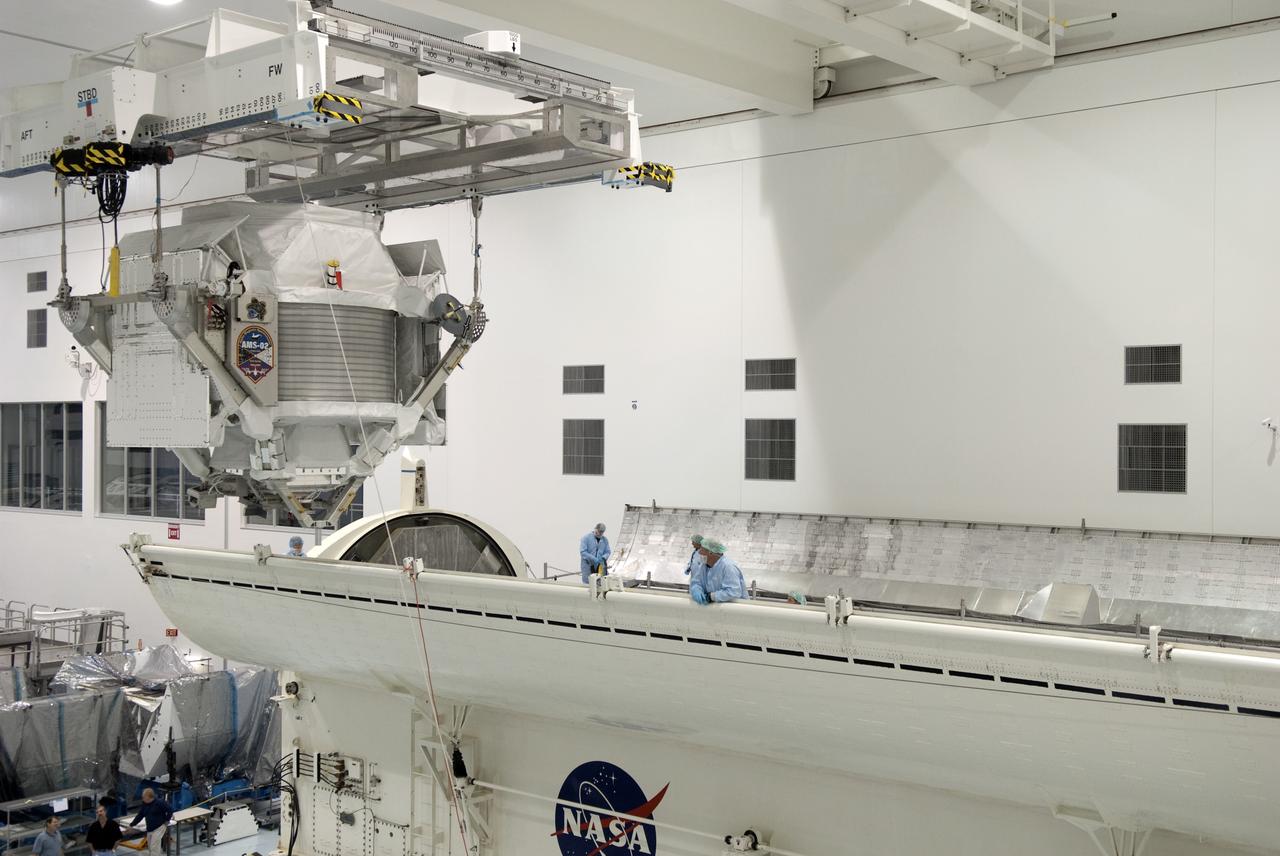
CAPE CANAVERAL, Fla. -- In the Space Station Processing Facility at NASA's Kennedy Space Center in Florida, the Alpha Magnetic Spectrometer-2 (AMS) is moved from the weight and center of gravity stand, where final measurements were taken before launch, to a payload canister. The canister will protect the space-bound payload on its journey to Launch Pad 39A, where it will later be installed into space shuttle Endeavour’s payload bay. AMS is a particle physics detector, designed to operate as an external experiment on the International Space Station. It will use the unique environment of space to study the universe and its origin by searching for dark matter. AMS-2 will fly to the station aboard Endeavour's STS-134 mission targeted to launch April 19 at 7:48 p.m. EDT. For more information visit, www.nasa.gov/mission_pages/shuttle/shuttlemissions/sts134/index.html. Photo credit: NASA/Jim Grossmann
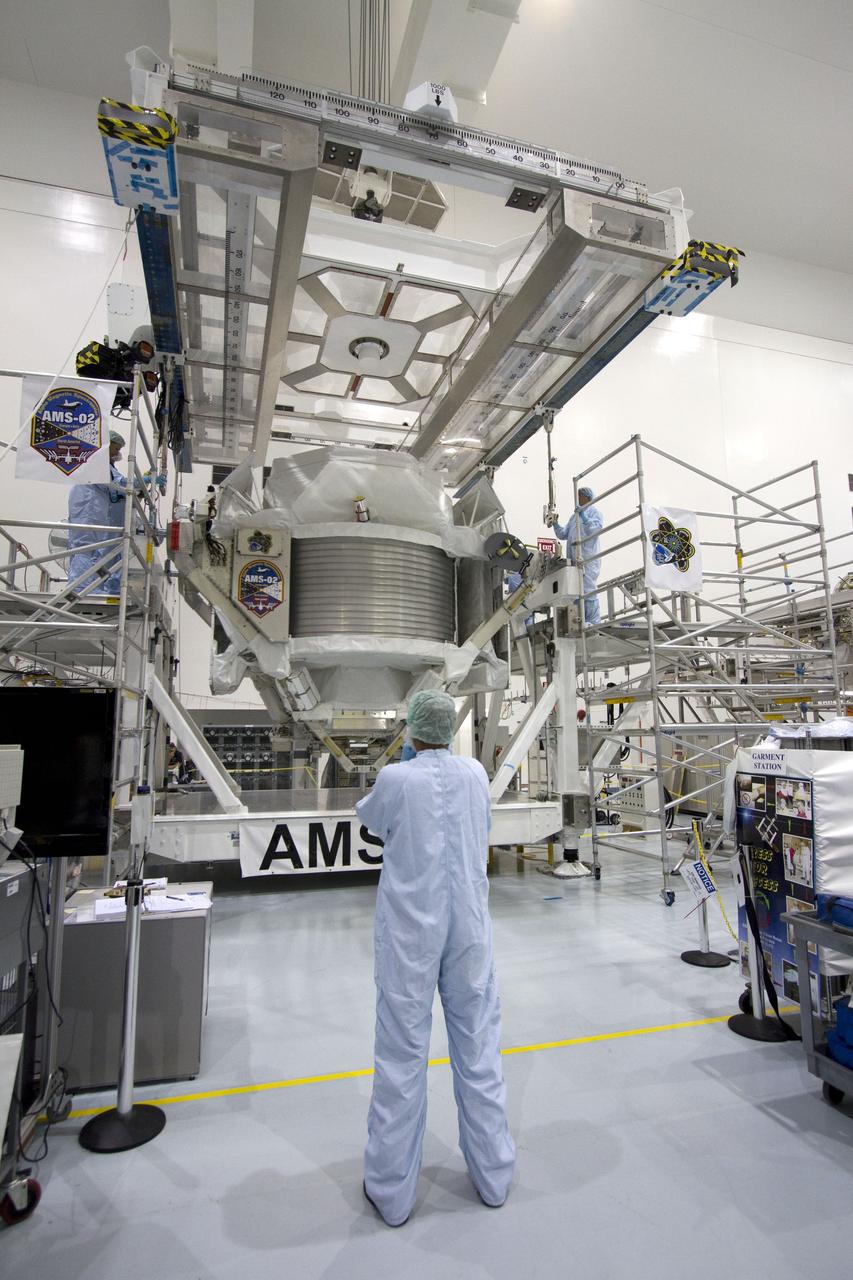
CAPE CANAVERAL, Fla. -- In the Space Station Processing Facility at NASA's Kennedy Space Center in Florida, the Alpha Magnetic Spectrometer-2 (AMS) begins to move from its primary work stand to the weight and center of gravity stand where final measurements will be taken before launch. Next, AMS will be moved into a payload canister. The canister will protect the space-bound payload on its journey to Launch Pad 39A, where it will later be installed into space shuttle Endeavour’s payload bay. AMS is a particle physics detector, designed to operate as an external experiment on the International Space Station. It will use the unique environment of space to study the universe and its origin by searching for dark matter. AMS-2 will fly to the station aboard Endeavour's STS-134 mission targeted to launch April 19 at 7:48 p.m. EDT. For more information visit, www.nasa.gov/mission_pages/shuttle/shuttlemissions/sts134/index.html. Photo credit: NASA/Jack Pfaller
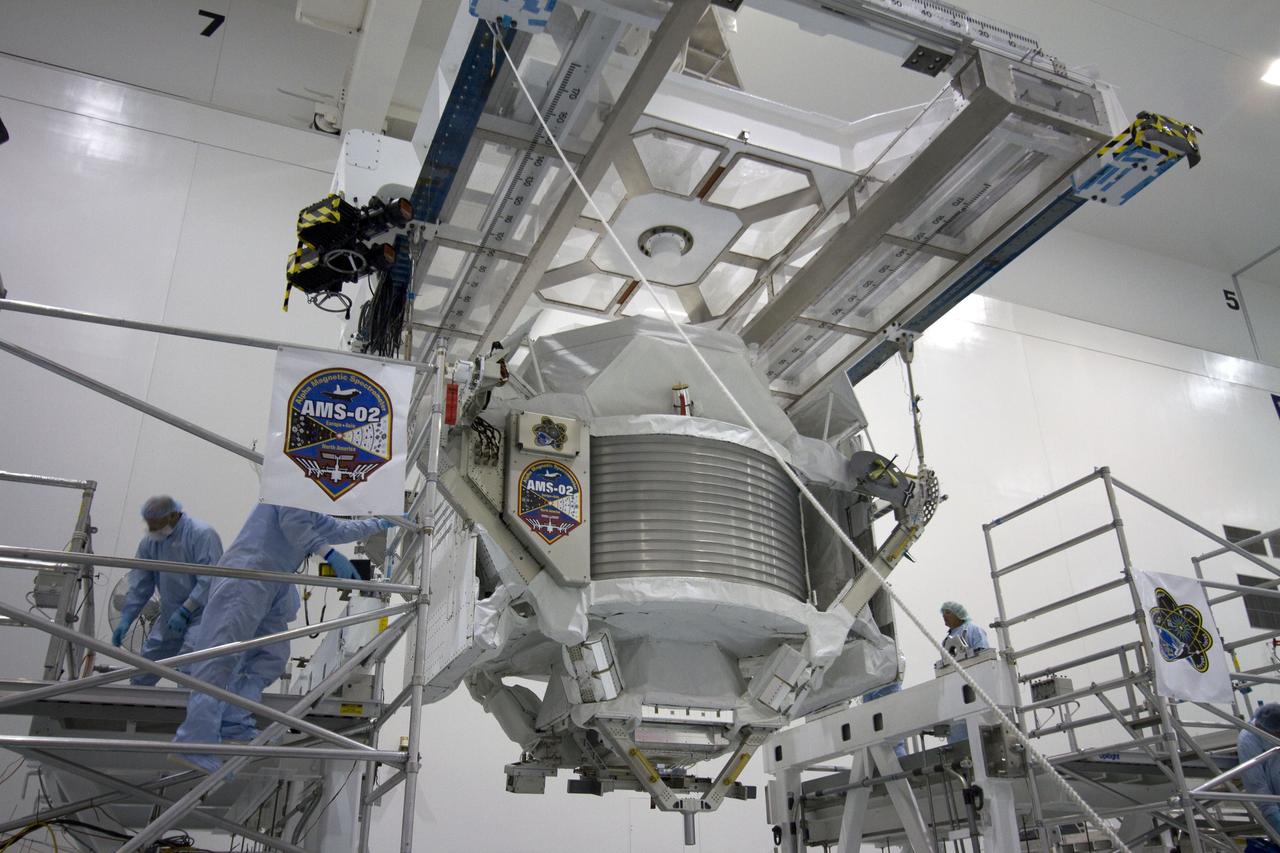
CAPE CANAVERAL, Fla. -- In the Space Station Processing Facility at NASA's Kennedy Space Center in Florida, the Alpha Magnetic Spectrometer-2 (AMS) moves from its primary work stand to the weight and center of gravity stand where final measurements will be taken before launch. Next, AMS will be moved into a payload canister. The canister will protect the space-bound payload on its journey to Launch Pad 39A, where it will later be installed into space shuttle Endeavour’s payload bay. AMS is a particle physics detector, designed to operate as an external experiment on the International Space Station. It will use the unique environment of space to study the universe and its origin by searching for dark matter. AMS-2 will fly to the station aboard Endeavour's STS-134 mission targeted to launch April 19 at 7:48 p.m. EDT. For more information visit, www.nasa.gov/mission_pages/shuttle/shuttlemissions/sts134/index.html. Photo credit: NASA/Jack Pfaller
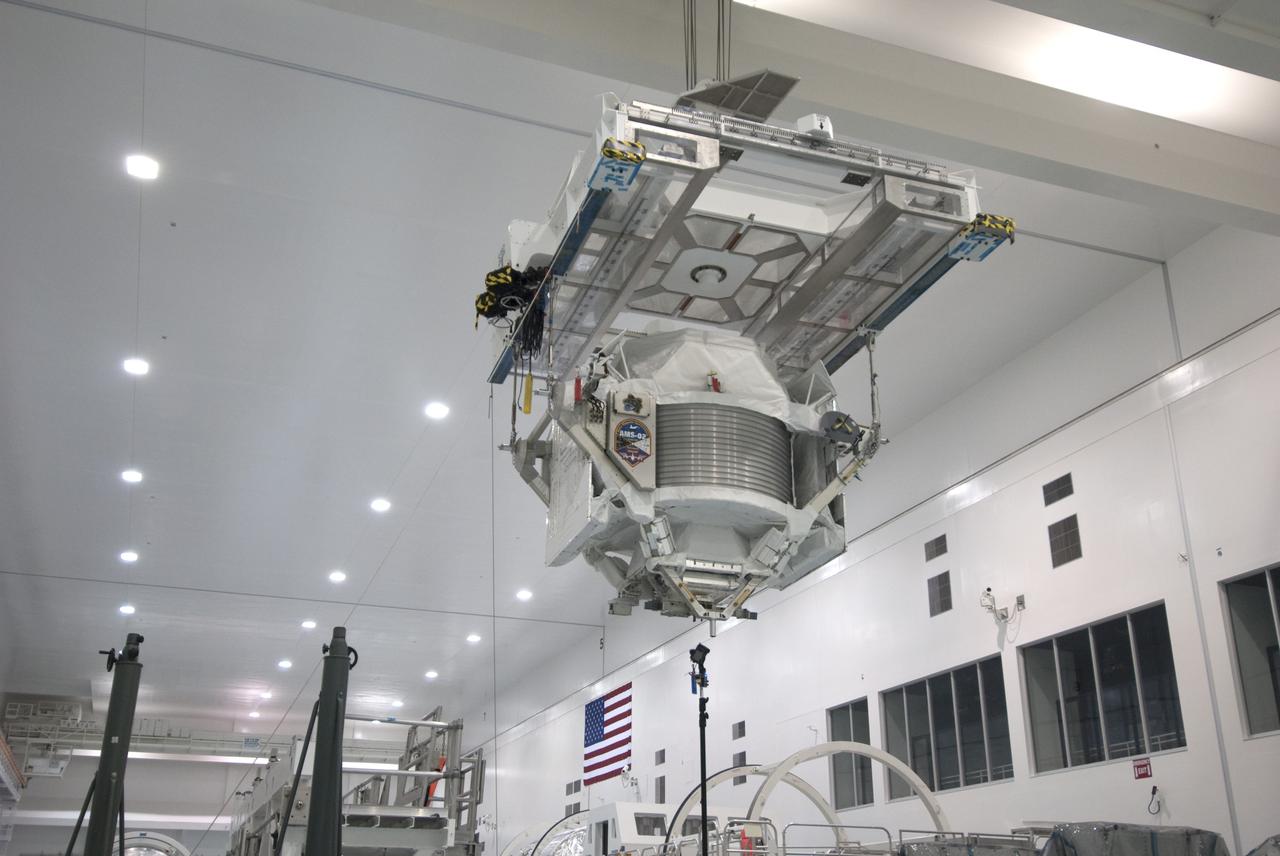
CAPE CANAVERAL, Fla. -- In the Space Station Processing Facility at NASA's Kennedy Space Center in Florida, the Alpha Magnetic Spectrometer-2 (AMS) is moved from the weight and center of gravity stand, where final measurements were taken before launch, to a payload canister. The canister will protect the space-bound payload on its journey to Launch Pad 39A, where it will later be installed into space shuttle Endeavour’s payload bay. AMS is a particle physics detector, designed to operate as an external experiment on the International Space Station. It will use the unique environment of space to study the universe and its origin by searching for dark matter. AMS-2 will fly to the station aboard Endeavour's STS-134 mission targeted to launch April 19 at 7:48 p.m. EDT. For more information visit, www.nasa.gov/mission_pages/shuttle/shuttlemissions/sts134/index.html. Photo credit: NASA/Jim Grossmann
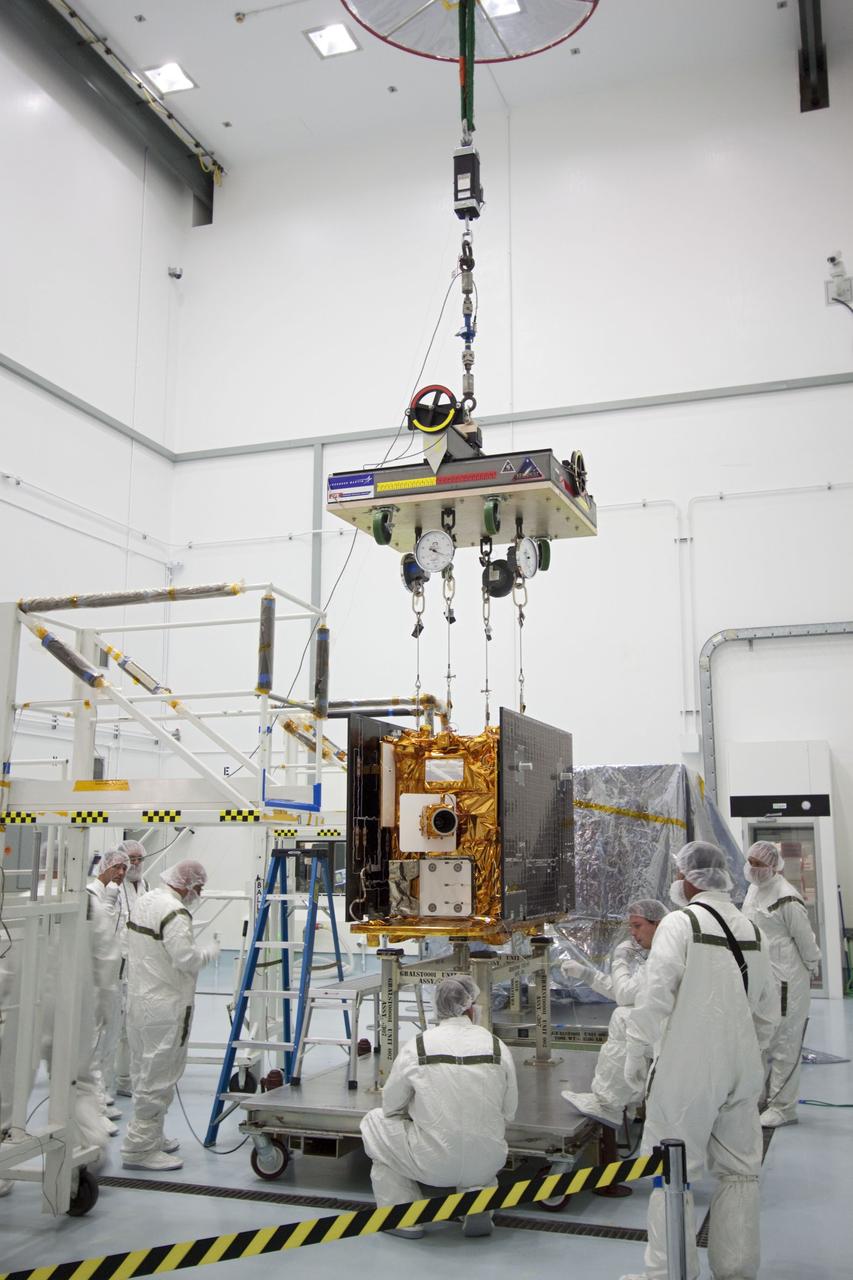
CAPE CANAVERAL, Fla. -- At Astrotech Space Operation's payload processing facility in Titusville, Fla., a portable scale lifts one of NASA's twin Gravity Recovery and Interior Laboratory lunar spacecraft from its workstand. The scale will record the exact weight of the spacecraft before they are stacked in their launch configuration in preparation for transport to the launch pad. GRAIL will fly in tandem orbits around the moon for several months to measure its gravity field. GRAIL's primary science objectives are to determine the structure of the lunar interior, from crust to core, and to advance understanding of the thermal evolution of the moon. Launch aboard a United Launch Alliance Delta II rocket from Space Launch Complex 17B on Cape Canaveral Air Force Station is scheduled for Sept. 8. For more information, visit http://www.nasa.gov/grail. Photo credit: NASA/Jim Grossmann
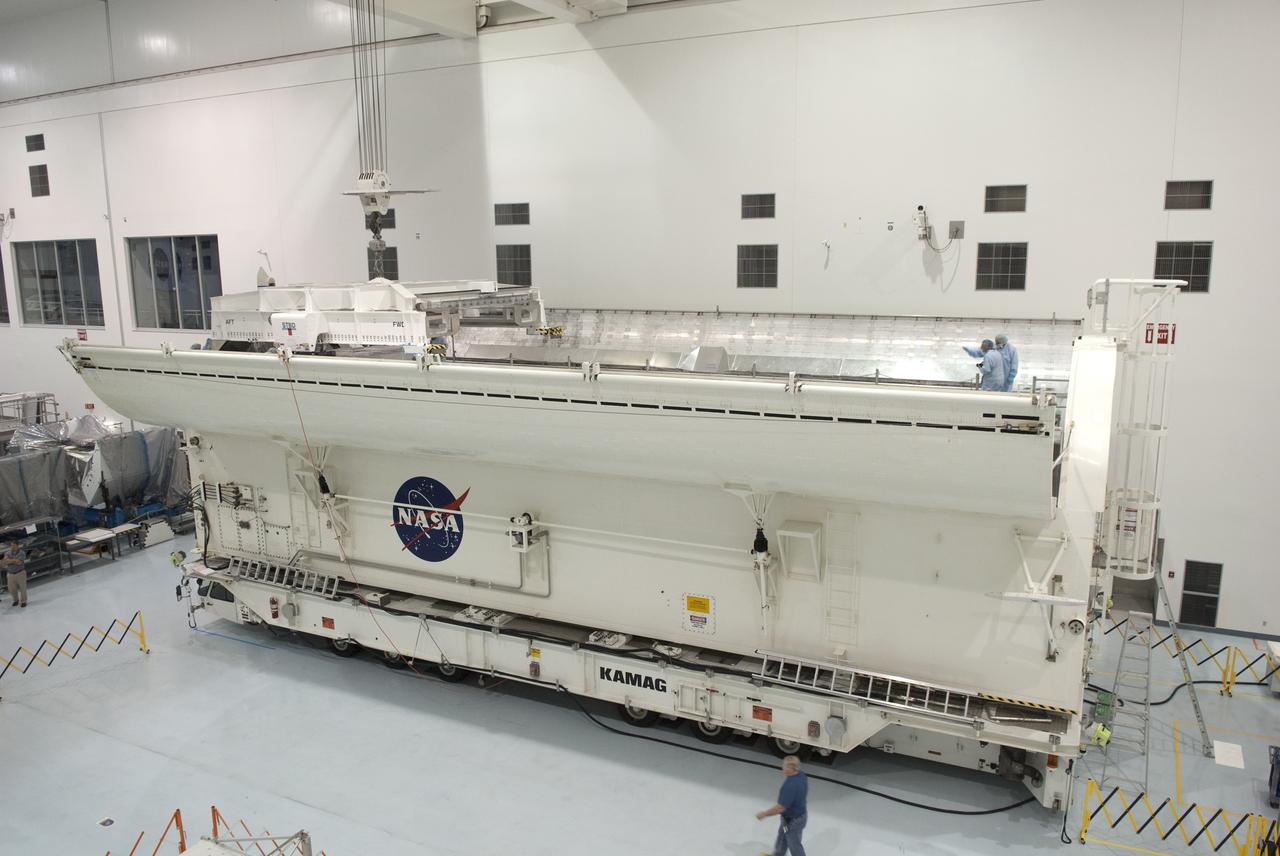
CAPE CANAVERAL, Fla. -- In the Space Station Processing Facility at NASA's Kennedy Space Center in Florida, the Alpha Magnetic Spectrometer-2 AMS is in a payload canister after technicians measured its weight and center of gravity. The canister will protect the space-bound payload on its journey to Launch Pad 39A, where it will later be installed into space shuttle Endeavour’s payload bay. AMS is a particle physics detector, designed to operate as an external experiment on the International Space Station. It will use the unique environment of space to study the universe and its origin by searching for dark matter. AMS-2 will fly to the station aboard Endeavour's STS-134 mission targeted to launch April 19 at 7:48 p.m. EDT. For more information visit, www.nasa.gov/mission_pages/shuttle/shuttlemissions/sts134/index.html. Photo credit: NASA/Jim Grossmann
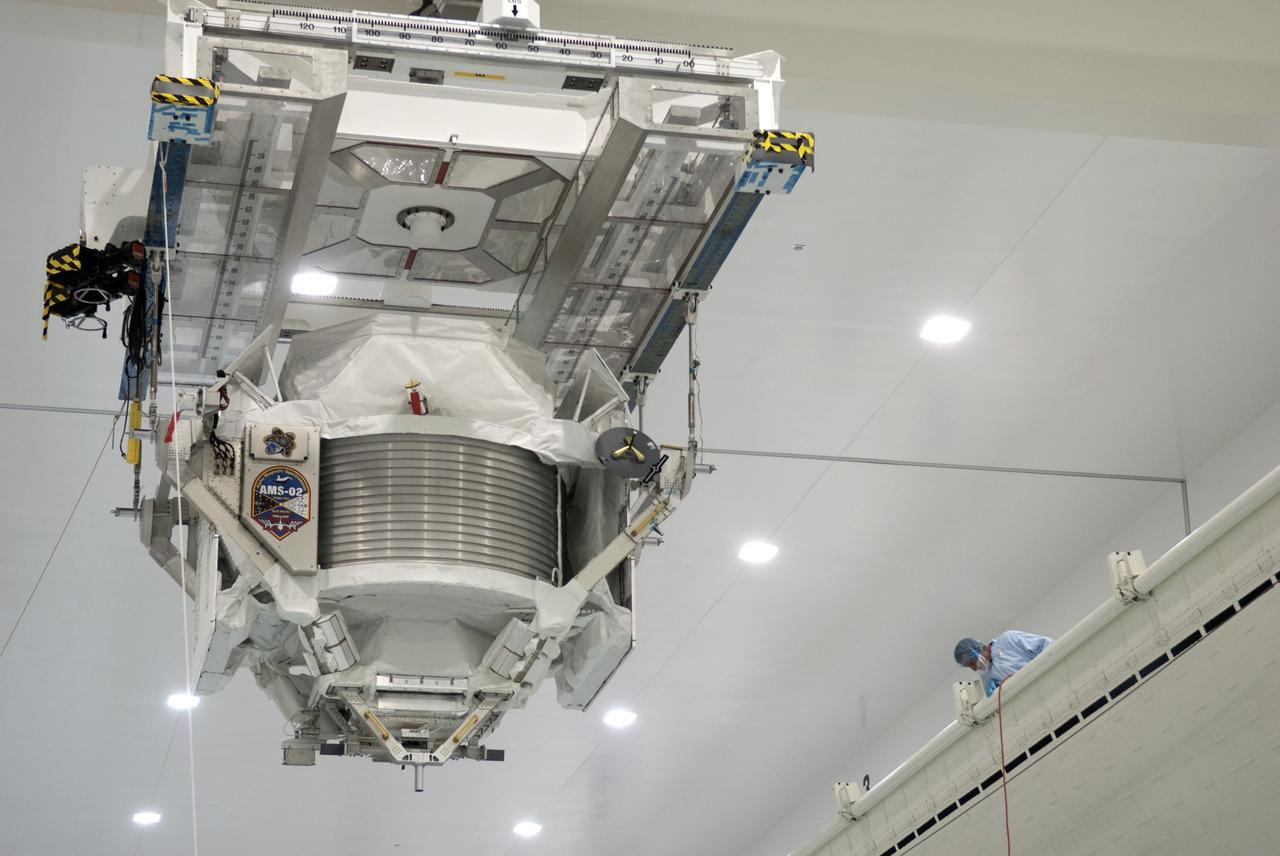
CAPE CANAVERAL, Fla. -- In the Space Station Processing Facility at NASA's Kennedy Space Center in Florida, the Alpha Magnetic Spectrometer-2 (AMS) is moved from the weight and center of gravity stand, where final measurements were taken before launch, to a payload canister. The canister will protect the space-bound payload on its journey to Launch Pad 39A, where it will later be installed into space shuttle Endeavour’s payload bay. AMS is a particle physics detector, designed to operate as an external experiment on the International Space Station. It will use the unique environment of space to study the universe and its origin by searching for dark matter. AMS-2 will fly to the station aboard Endeavour's STS-134 mission targeted to launch April 19 at 7:48 p.m. EDT. For more information visit, www.nasa.gov/mission_pages/shuttle/shuttlemissions/sts134/index.html. Photo credit: NASA/Jim Grossmann
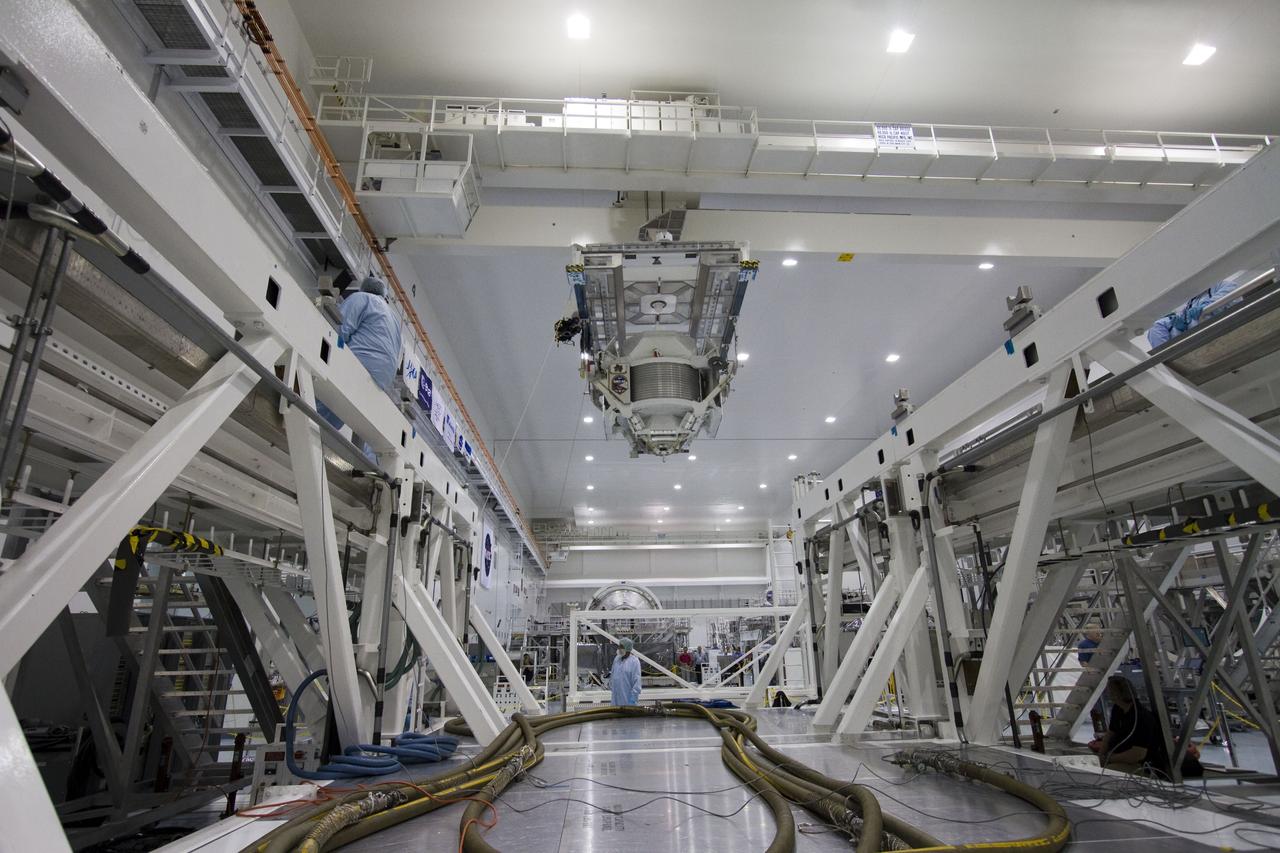
CAPE CANAVERAL, Fla. -- In the Space Station Processing Facility at NASA's Kennedy Space Center in Florida, the Alpha Magnetic Spectrometer-2 (AMS) moves from its primary work stand to the weight and center of gravity stand where final measurements will be taken before launch. Next, AMS will be moved into a payload canister. The canister will protect the space-bound payload on its journey to Launch Pad 39A, where it will later be installed into space shuttle Endeavour’s payload bay. AMS is a particle physics detector, designed to operate as an external experiment on the International Space Station. It will use the unique environment of space to study the universe and its origin by searching for dark matter. AMS-2 will fly to the station aboard Endeavour's STS-134 mission targeted to launch April 19 at 7:48 p.m. EDT. For more information visit, www.nasa.gov/mission_pages/shuttle/shuttlemissions/sts134/index.html. Photo credit: NASA/Jack Pfaller
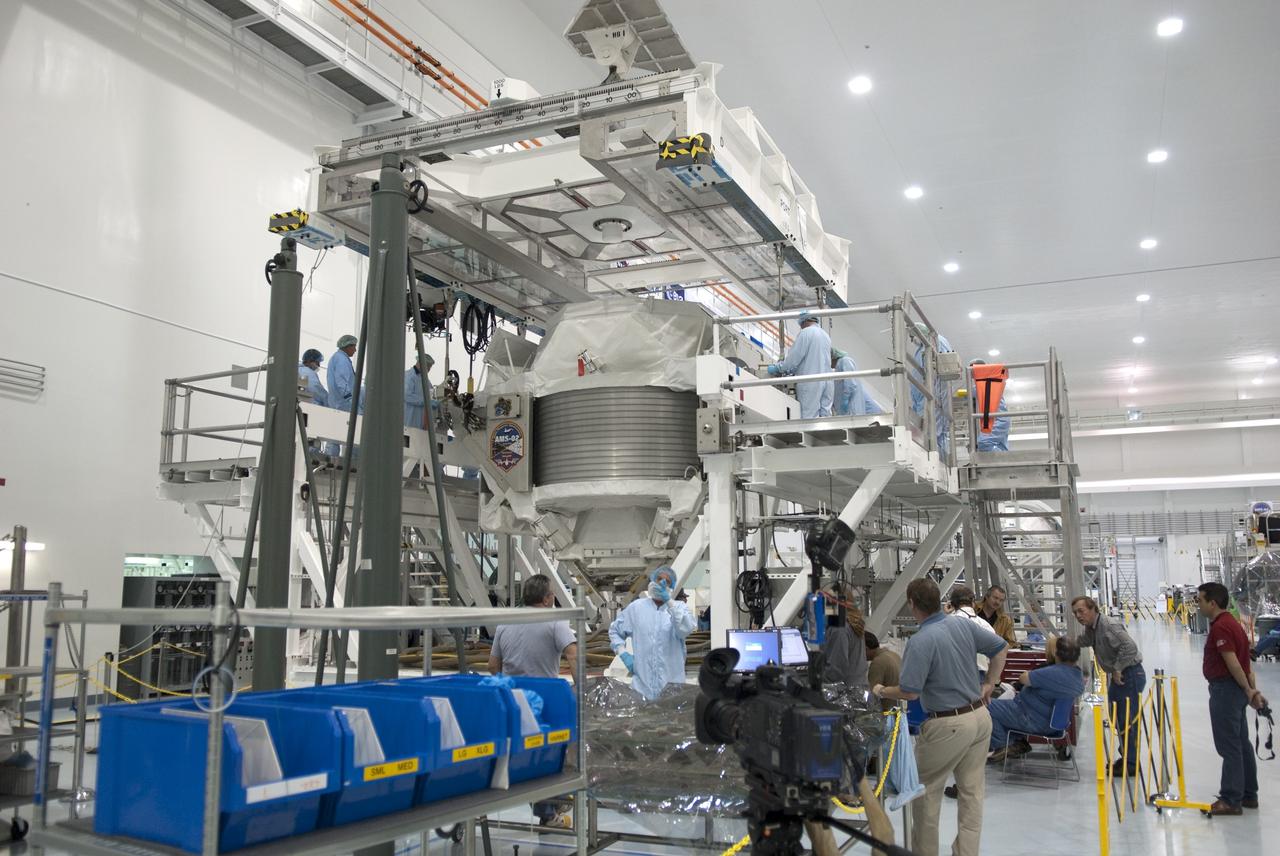
CAPE CANAVERAL, Fla. -- In the Space Station Processing Facility at NASA's Kennedy Space Center in Florida, the Alpha Magnetic Spectrometer-2 (AMS) is prepared for its move from the weight and center of gravity stand, where final measurements were taken before launch, to a payload canister. The canister will protect the space-bound payload on its journey to Launch Pad 39A, where it will later be installed into space shuttle Endeavour’s payload bay. AMS is a particle physics detector, designed to operate as an external experiment on the International Space Station. It will use the unique environment of space to study the universe and its origin by searching for dark matter. AMS-2 will fly to the station aboard Endeavour's STS-134 mission targeted to launch April 19 at 7:48 p.m. EDT. For more information visit, www.nasa.gov/mission_pages/shuttle/shuttlemissions/sts134/index.html. Photo credit: NASA/Jim Grossmann

Seen from behind, the orbiter Atlantis moves into the Orbiter Processing Facility 2 (OPF-2) where it will undergo preparations for its planned flight in June 1999. Atlantis spent 10 months in Palmdale, CA, undergoing extensive inspections and modifications in the orbiter processing facility there. The modifications included several upgrades enabling it to support International Space Station missions, such as adding an external airlock for ISS docking missions and installing thinner, lighter thermal protection blankets for weight reduction which will allow it to haul heavier cargo. OPF-2 consists of two 2,700-square-meter (29,000 square feet) high bays. It measures 29 meters (95 ft). high, 121 meters (397 ft) long and 71 meters (233 ft) wide
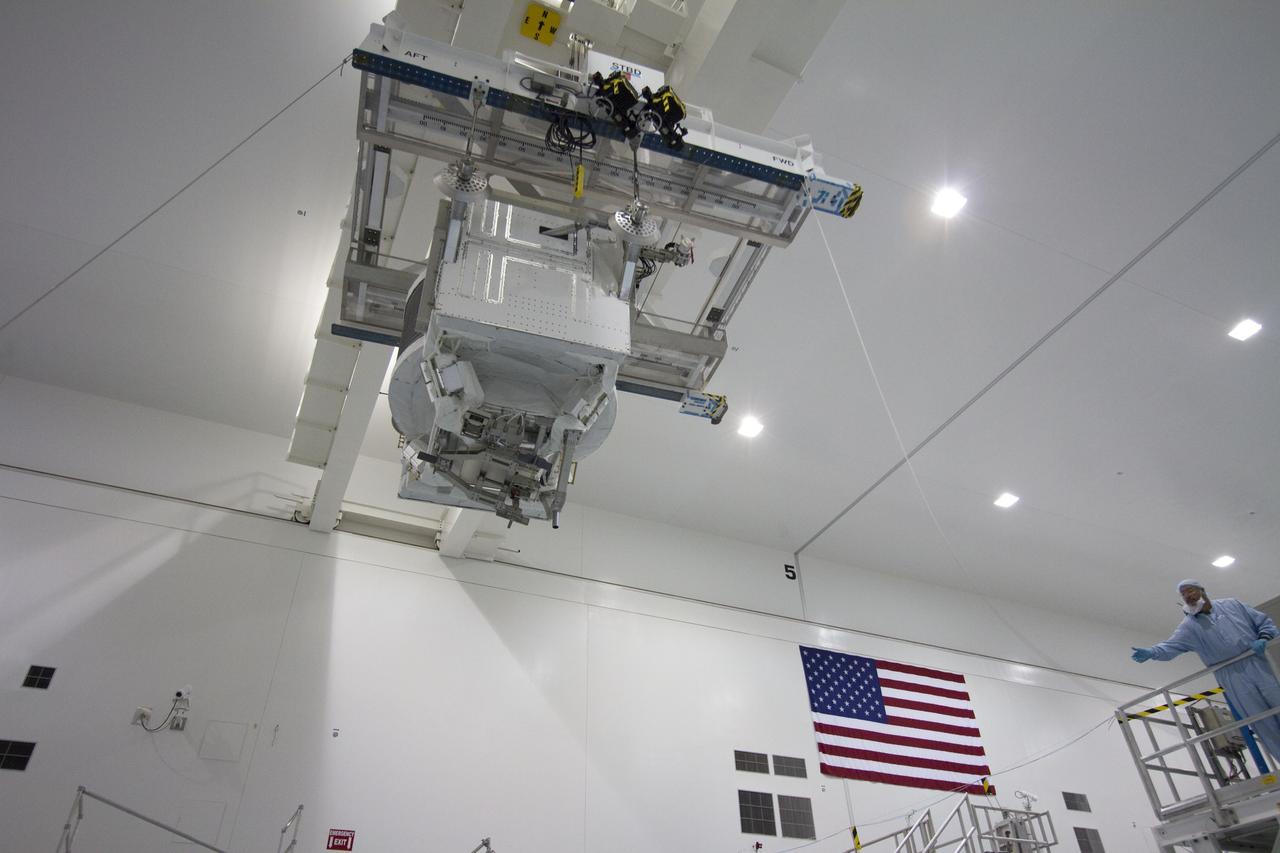
CAPE CANAVERAL, Fla. -- In the Space Station Processing Facility at NASA's Kennedy Space Center in Florida, the Alpha Magnetic Spectrometer-2 (AMS) moves from its primary work stand to the weight and center of gravity stand where final measurements will be taken before launch. Next, AMS will be moved into a payload canister. The canister will protect the space-bound payload on its journey to Launch Pad 39A, where it will later be installed into space shuttle Endeavour’s payload bay. AMS is a particle physics detector, designed to operate as an external experiment on the International Space Station. It will use the unique environment of space to study the universe and its origin by searching for dark matter. AMS-2 will fly to the station aboard Endeavour's STS-134 mission targeted to launch April 19 at 7:48 p.m. EDT. For more information visit, www.nasa.gov/mission_pages/shuttle/shuttlemissions/sts134/index.html. Photo credit: NASA/Jack Pfaller
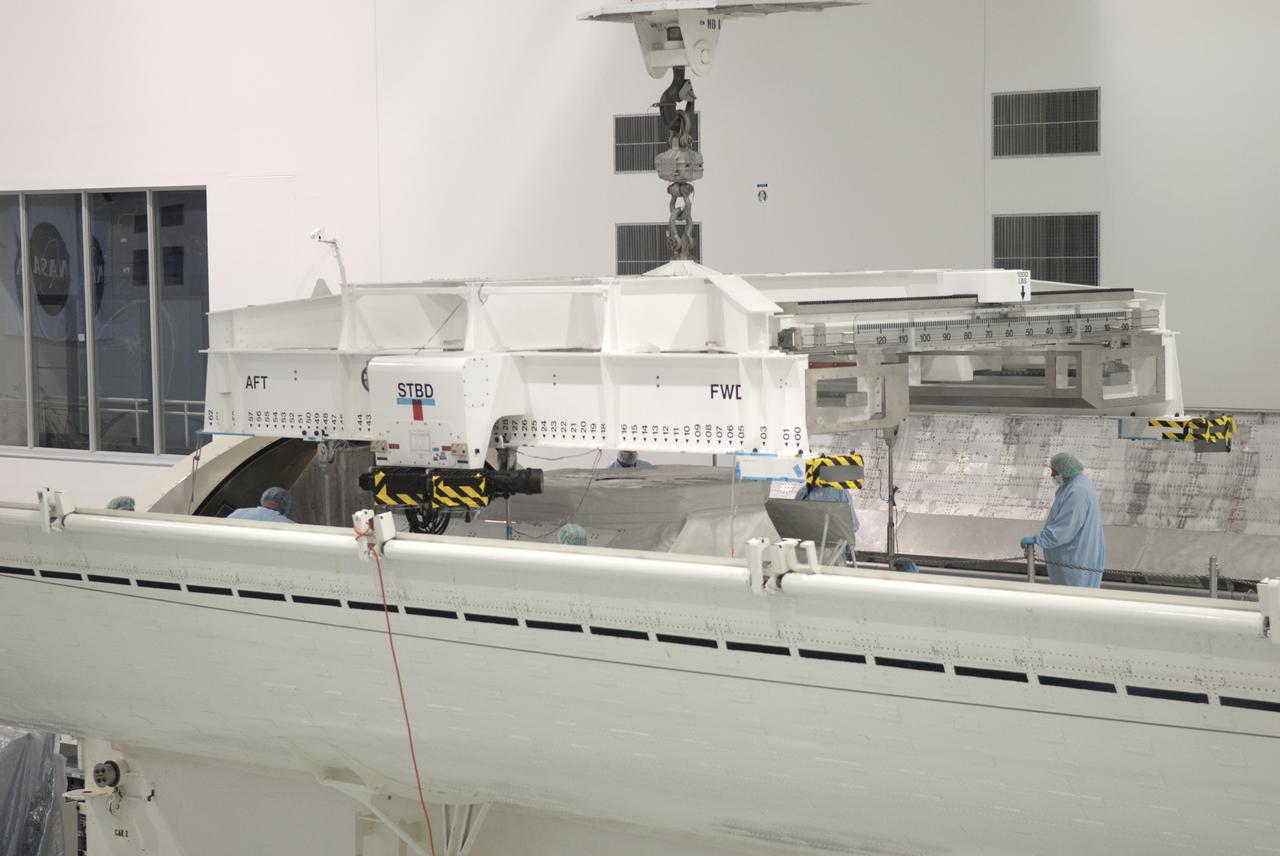
CAPE CANAVERAL, Fla. -- In the Space Station Processing Facility at NASA's Kennedy Space Center in Florida, the Alpha Magnetic Spectrometer-2 AMS is moved into a payload canister after technicians measured its weight and center of gravity. The canister will protect the space-bound payload on its journey to Launch Pad 39A, where it will later be installed into space shuttle Endeavour’s payload bay. AMS is a particle physics detector, designed to operate as an external experiment on the International Space Station. It will use the unique environment of space to study the universe and its origin by searching for dark matter. AMS-2 will fly to the station aboard Endeavour's STS-134 mission targeted to launch April 19 at 7:48 p.m. EDT. For more information visit, www.nasa.gov/mission_pages/shuttle/shuttlemissions/sts134/index.html. Photo credit: NASA/Jim Grossmann
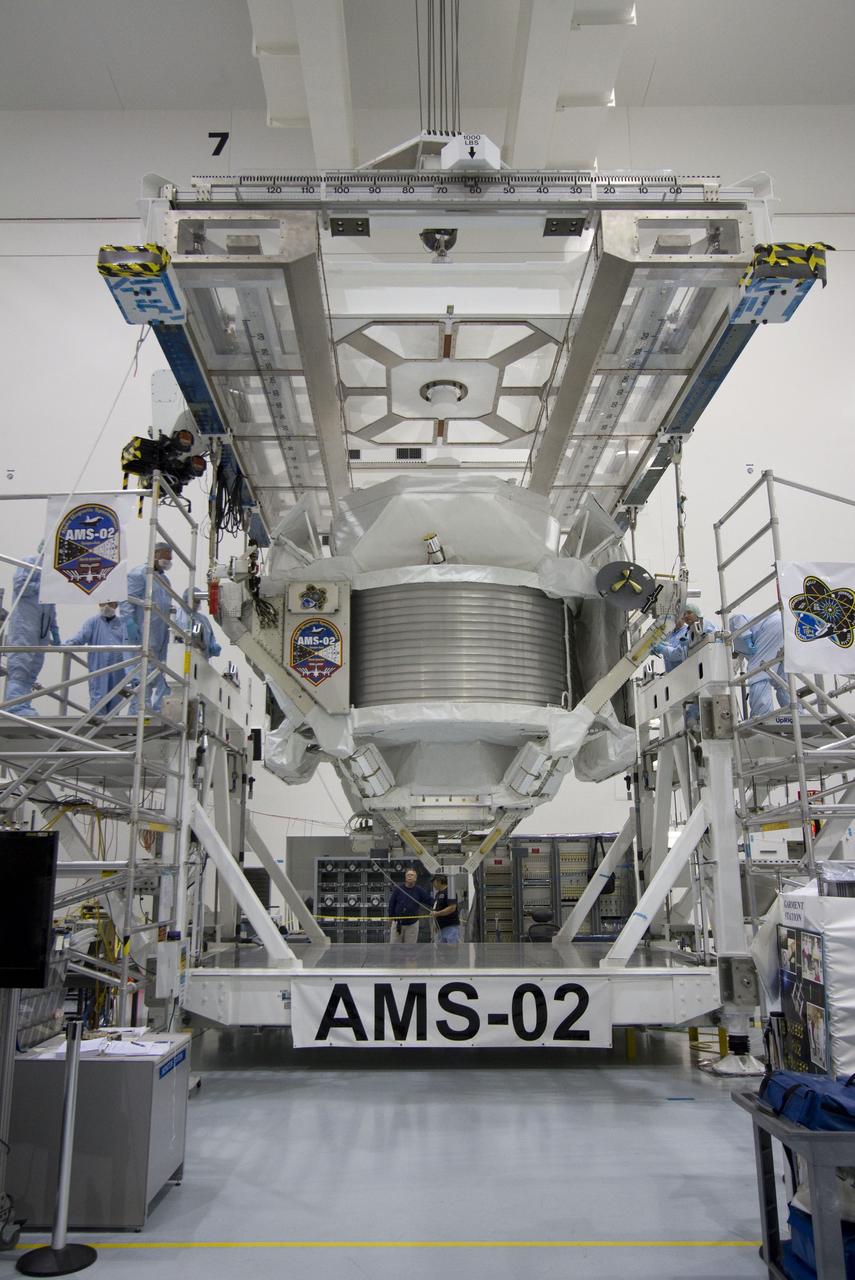
CAPE CANAVERAL, Fla. -- In the Space Station Processing Facility at NASA's Kennedy Space Center in Florida, the Alpha Magnetic Spectrometer-2 (AMS) begins to move from its primary work stand to the weight and center of gravity stand where final measurements will be taken before launch. Next, AMS will be moved into a payload canister. The canister will protect the space-bound payload on its journey to Launch Pad 39A, where it will later be installed into space shuttle Endeavour’s payload bay. AMS is a particle physics detector, designed to operate as an external experiment on the International Space Station. It will use the unique environment of space to study the universe and its origin by searching for dark matter. AMS-2 will fly to the station aboard Endeavour's STS-134 mission targeted to launch April 19 at 7:48 p.m. EDT. For more information visit, www.nasa.gov/mission_pages/shuttle/shuttlemissions/sts134/index.html. Photo credit: NASA/Jack Pfaller
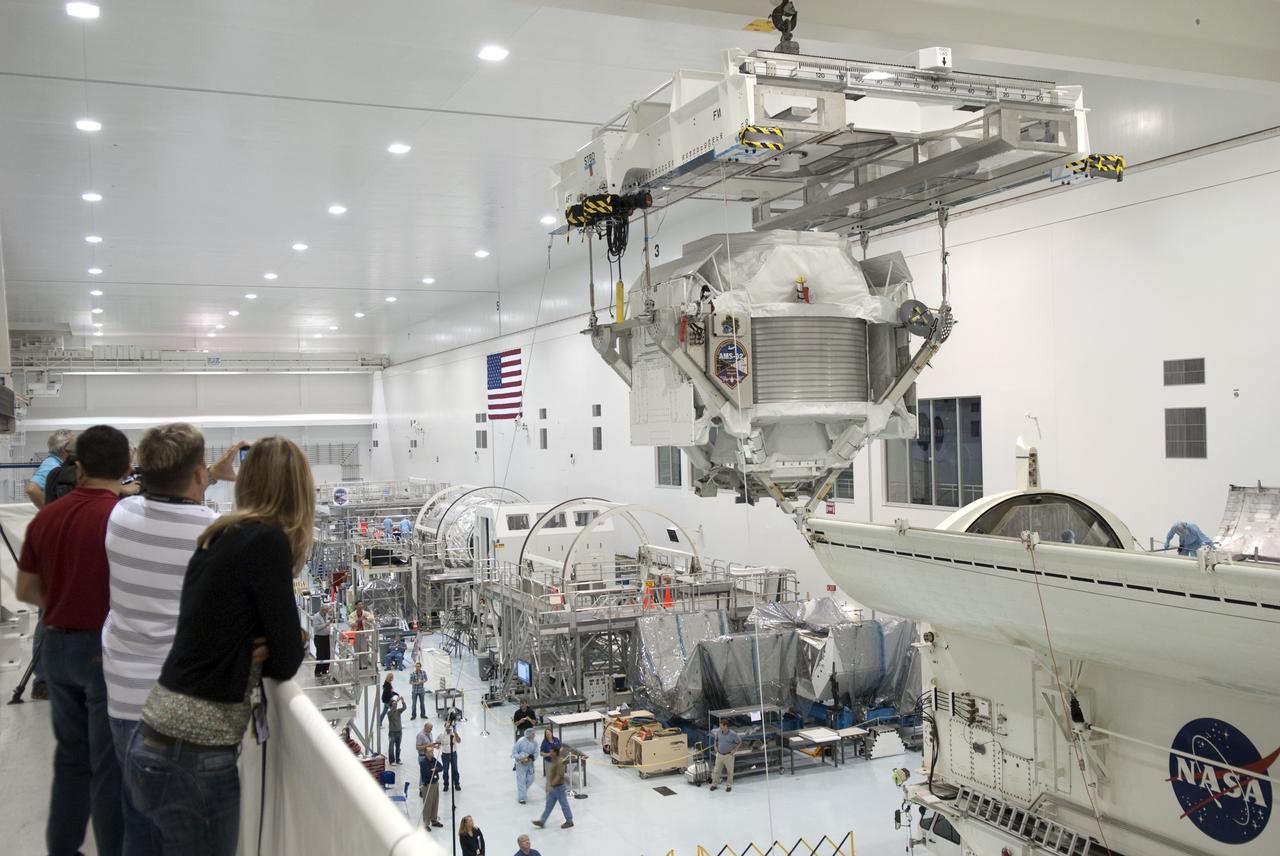
CAPE CANAVERAL, Fla. -- In the Space Station Processing Facility at NASA's Kennedy Space Center in Florida, the Alpha Magnetic Spectrometer-2 (AMS) is moved from the weight and center of gravity stand, where final measurements were taken before launch, to a payload canister. The canister will protect the space-bound payload on its journey to Launch Pad 39A, where it will later be installed into space shuttle Endeavour’s payload bay. AMS is a particle physics detector, designed to operate as an external experiment on the International Space Station. It will use the unique environment of space to study the universe and its origin by searching for dark matter. AMS-2 will fly to the station aboard Endeavour's STS-134 mission targeted to launch April 19 at 7:48 p.m. EDT. For more information visit, www.nasa.gov/mission_pages/shuttle/shuttlemissions/sts134/index.html. Photo credit: NASA/Jim Grossmann
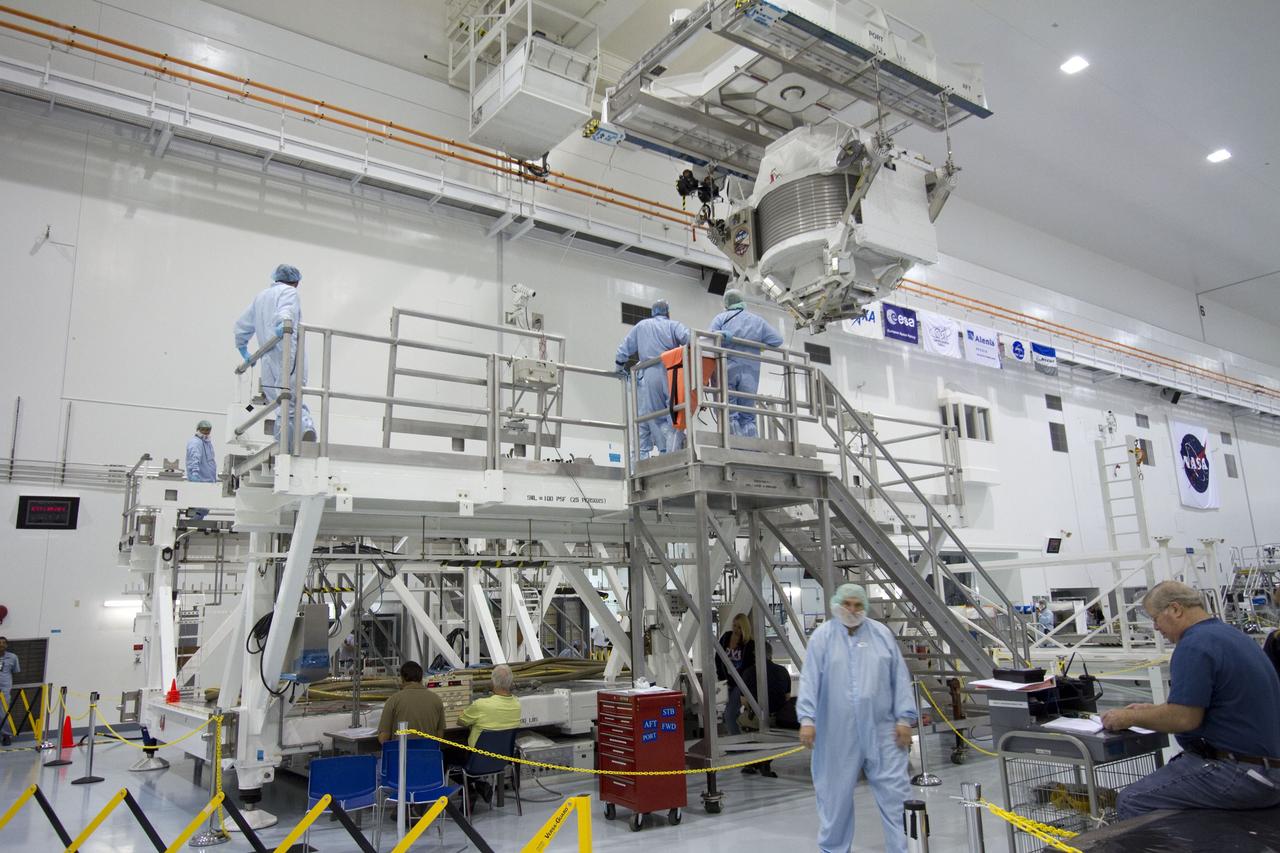
CAPE CANAVERAL, Fla. -- In the Space Station Processing Facility at NASA's Kennedy Space Center in Florida, the Alpha Magnetic Spectrometer-2 (AMS) moves from its primary work stand to the weight and center of gravity stand where final measurements will be taken before launch. Next, AMS will be moved into a payload canister. The canister will protect the space-bound payload on its journey to Launch Pad 39A, where it will later be installed into space shuttle Endeavour’s payload bay. AMS is a particle physics detector, designed to operate as an external experiment on the International Space Station. It will use the unique environment of space to study the universe and its origin by searching for dark matter. AMS-2 will fly to the station aboard Endeavour's STS-134 mission targeted to launch April 19 at 7:48 p.m. EDT. For more information visit, www.nasa.gov/mission_pages/shuttle/shuttlemissions/sts134/index.html. Photo credit: NASA/Jack Pfaller
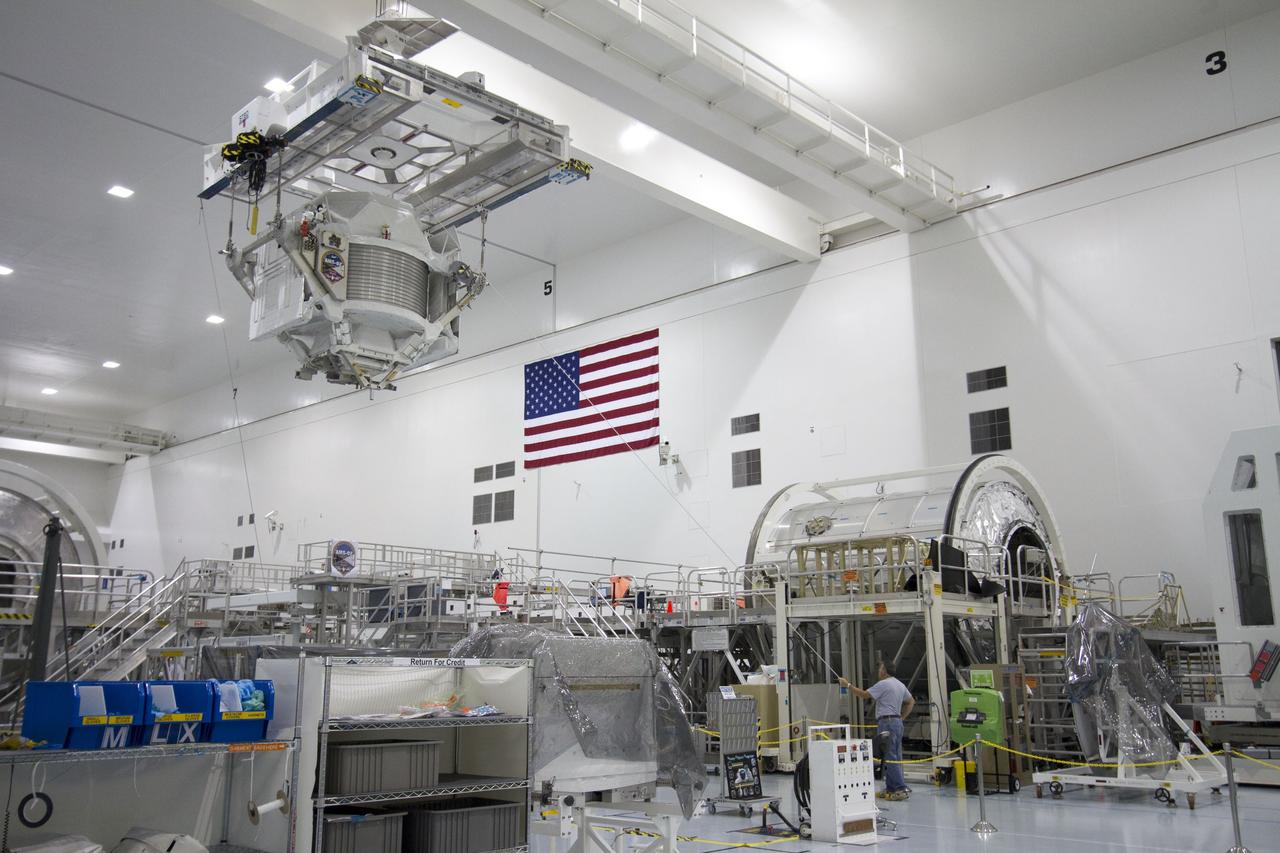
CAPE CANAVERAL, Fla. -- In the Space Station Processing Facility at NASA's Kennedy Space Center in Florida, the Alpha Magnetic Spectrometer-2 (AMS) moves from its primary work stand to the weight and center of gravity stand where final measurements will be taken before launch. Next, AMS will be moved into a payload canister. The canister will protect the space-bound payload on its journey to Launch Pad 39A, where it will later be installed into space shuttle Endeavour’s payload bay. AMS is a particle physics detector, designed to operate as an external experiment on the International Space Station. It will use the unique environment of space to study the universe and its origin by searching for dark matter. AMS-2 will fly to the station aboard Endeavour's STS-134 mission targeted to launch April 19 at 7:48 p.m. EDT. For more information visit, www.nasa.gov/mission_pages/shuttle/shuttlemissions/sts134/index.html. Photo credit: NASA/Jack Pfaller
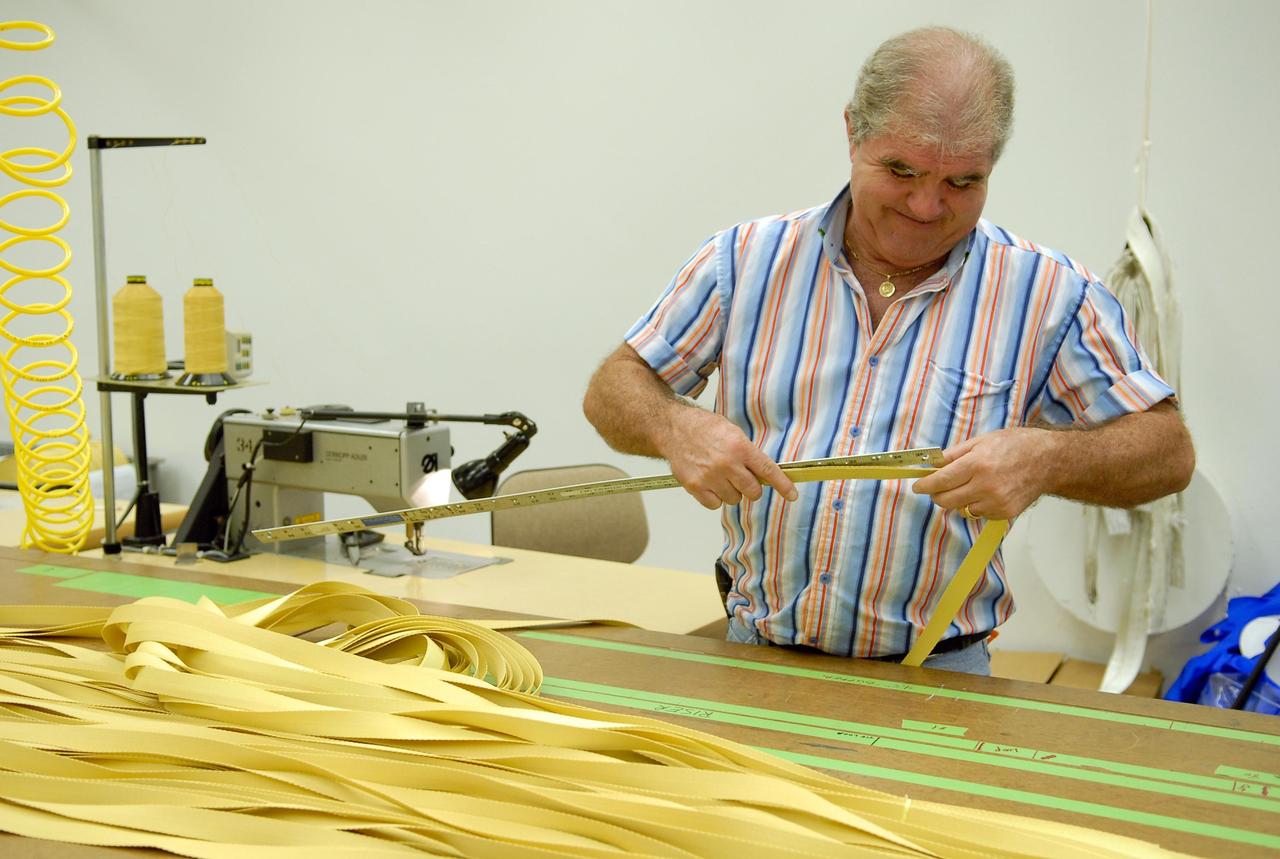
KENNEDY SPACE CENTER, FLA. -- A worker measures straps for parachutes being prepared for an upcoming test at the Parachute Refurbishment Facility. The first stage of the new Ares I rocket and Orion spacecraft will use parachutes to return to Earth. Current tests are being performed in Arizona to make sure the designs can safely handle their intended weight. Ares I is an in-line, two-stage rocket that will transport the Orion crew exploration vehicle to low-Earth orbit. The Ares I first stage will be a five-segment solid rocket booster based on the four-segment design used for the shuttle. As with the shuttle, this booster will fall away when spent, lowered by parachute into the Atlantic Ocean where it can be retrieved for re-use. Unlike the shuttle, the booster will be flying faster, at Mach 6, when its separation from the rest of Ares I occurs. Photo credit: NASA/Kim Shiflett
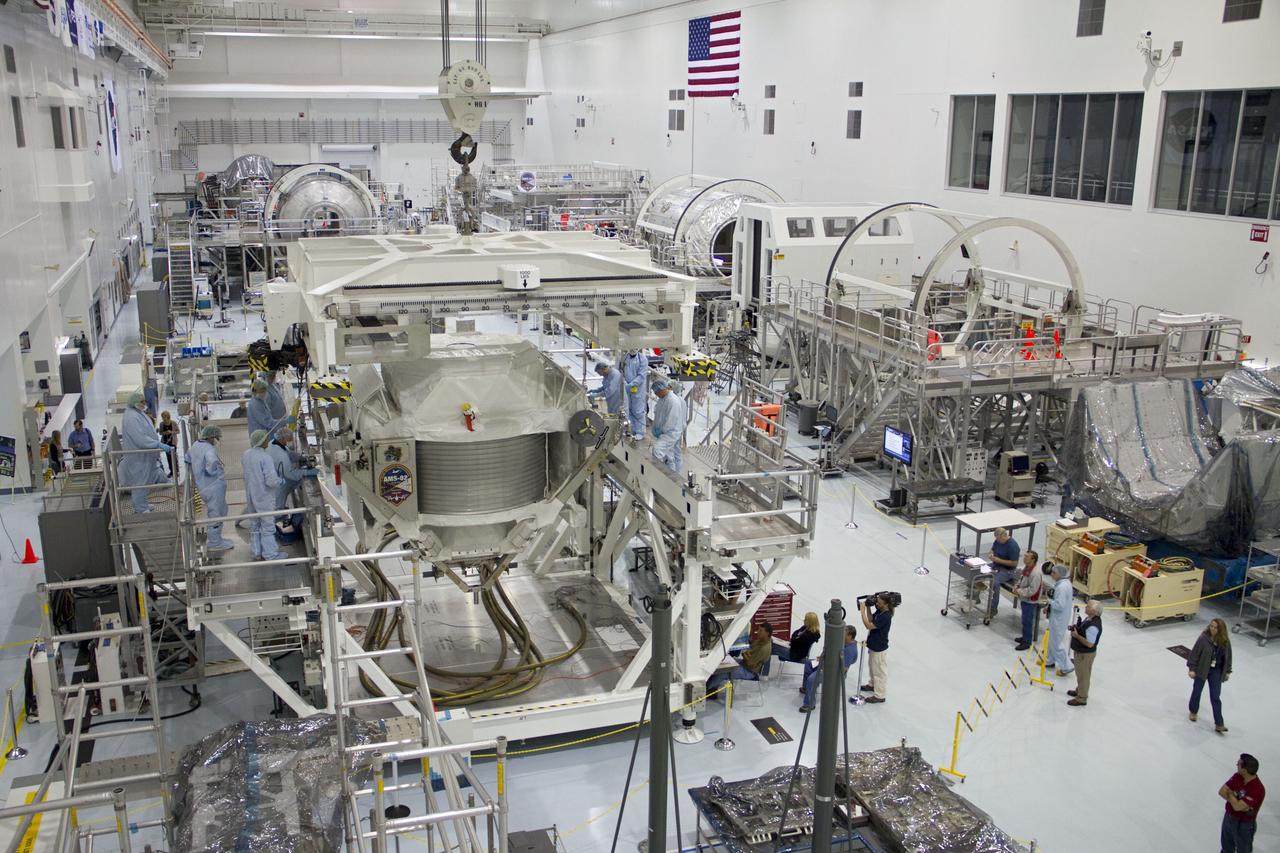
CAPE CANAVERAL, Fla. -- In the Space Station Processing Facility at NASA's Kennedy Space Center in Florida, the Alpha Magnetic Spectrometer-2 (AMS) was moved from its primary work stand to the weight and center of gravity stand where final measurements will be taken before launch. Next, AMS will be moved into a payload canister. The canister will protect the space-bound payload on its journey to Launch Pad 39A, where it will later be installed into space shuttle Endeavour’s payload bay. AMS is a particle physics detector, designed to operate as an external experiment on the International Space Station. It will use the unique environment of space to study the universe and its origin by searching for dark matter. AMS-2 will fly to the station aboard Endeavour's STS-134 mission targeted to launch April 19 at 7:48 p.m. EDT. For more information visit, www.nasa.gov/mission_pages/shuttle/shuttlemissions/sts134/index.html. Photo credit: NASA/Jack Pfaller
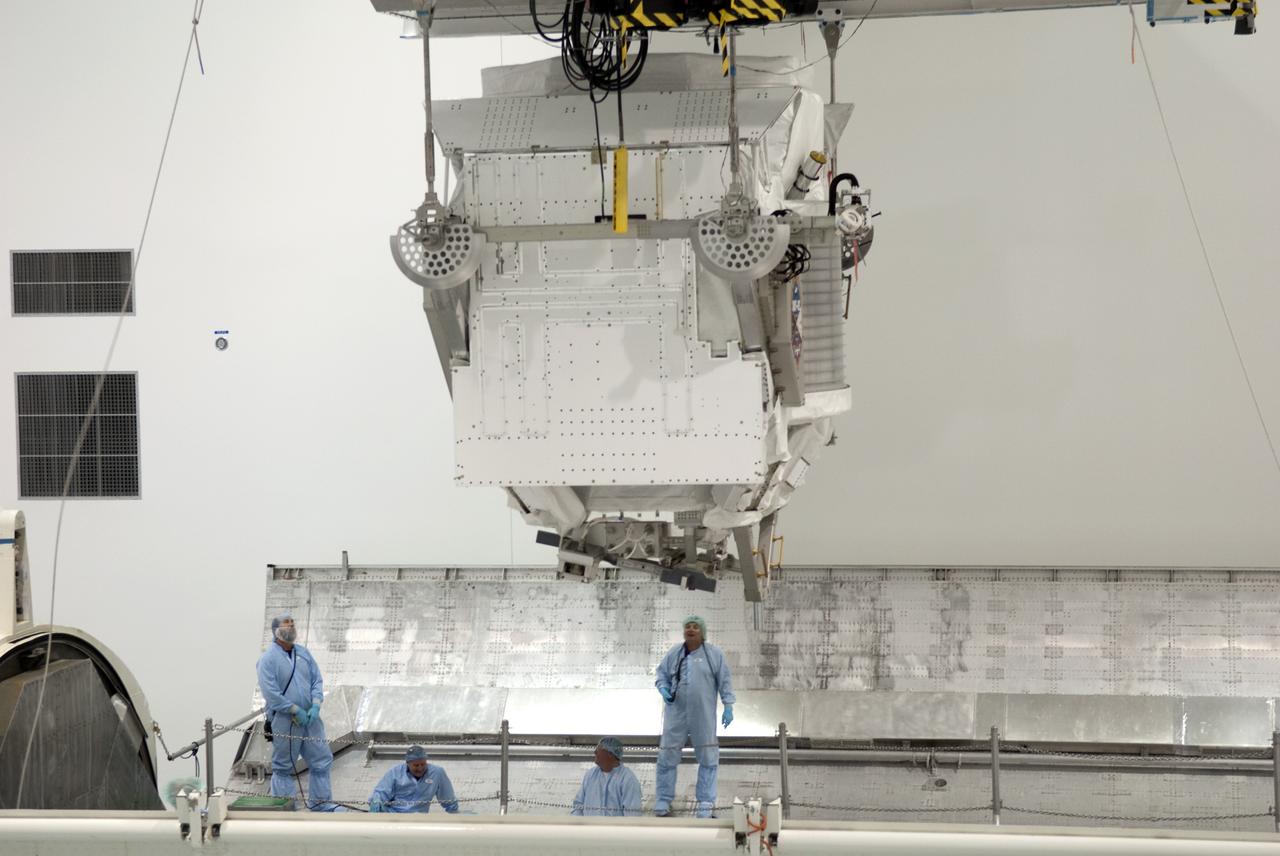
CAPE CANAVERAL, Fla. -- In the Space Station Processing Facility at NASA's Kennedy Space Center in Florida, the Alpha Magnetic Spectrometer-2 AMS is above a payload canister after technicians measured its weight and center of gravity. The canister will protect the space-bound payload on its journey to Launch Pad 39A, where it will later be installed into space shuttle Endeavour’s payload bay. AMS is a particle physics detector, designed to operate as an external experiment on the International Space Station. It will use the unique environment of space to study the universe and its origin by searching for dark matter. AMS-2 will fly to the station aboard Endeavour's STS-134 mission targeted to launch April 19 at 7:48 p.m. EDT. For more information visit, www.nasa.gov/mission_pages/shuttle/shuttlemissions/sts134/index.html. Photo credit: NASA/Jim Grossmann
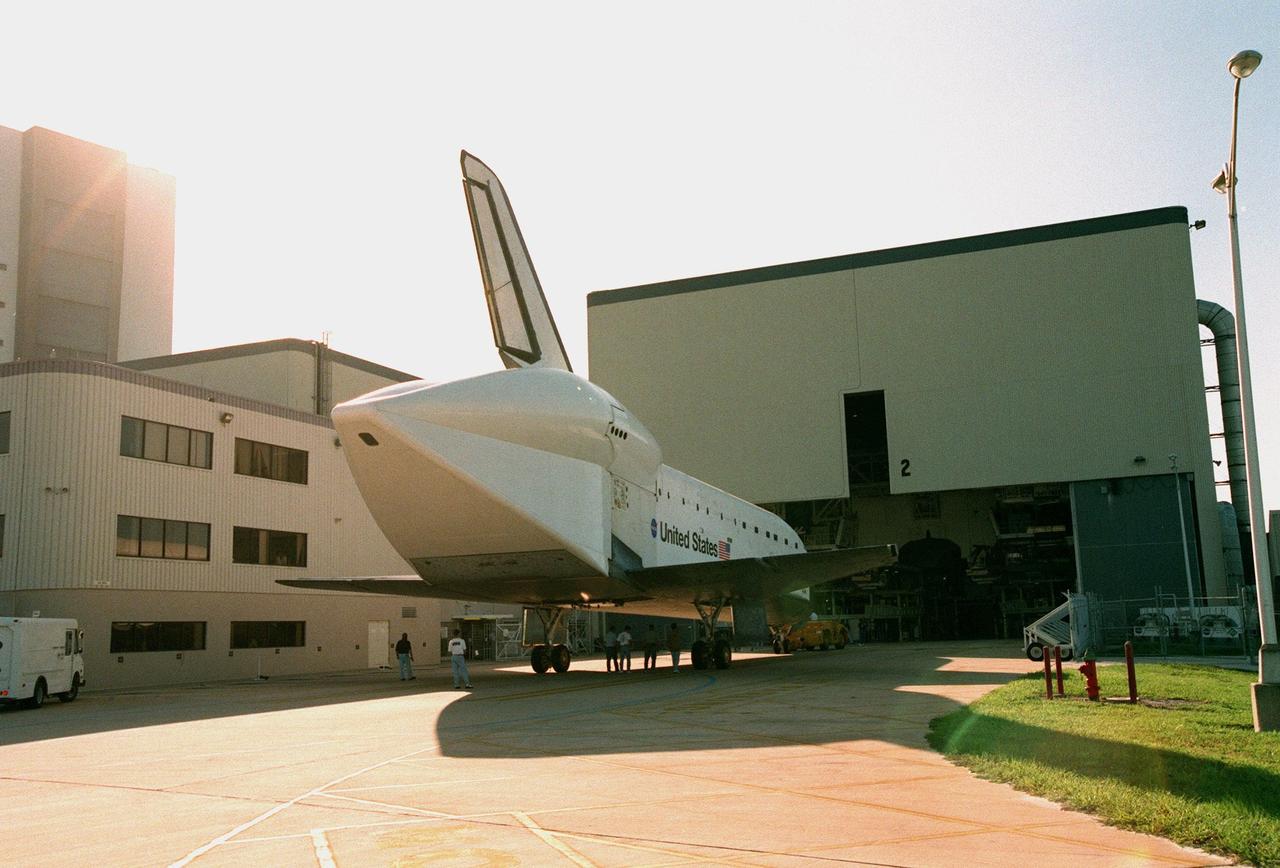
Seen from behind, the orbiter Atlantis approaches the entrance of Orbiter Processing Facility 2 (OPF-2) where it will undergo preparations for its planned flight in June 1999. Atlantis spent 10 months in Palmdale, CA, undergoing extensive inspections and modifications in the orbiter processing facility there. The modifications included several upgrades enabling it to support International Space Station missions, such as adding an external airlock for ISS docking missions and installing thinner, lighter thermal protection blankets for weight reduction which will allow it to haul heavier cargo. OPF-2 consists of a 2,700-square-meter (29,000 square ft.) high bay. The building measures 29 meters (95 ft). high, 121 meters (397 ft.) long and 71 meters (233 ft.) wide
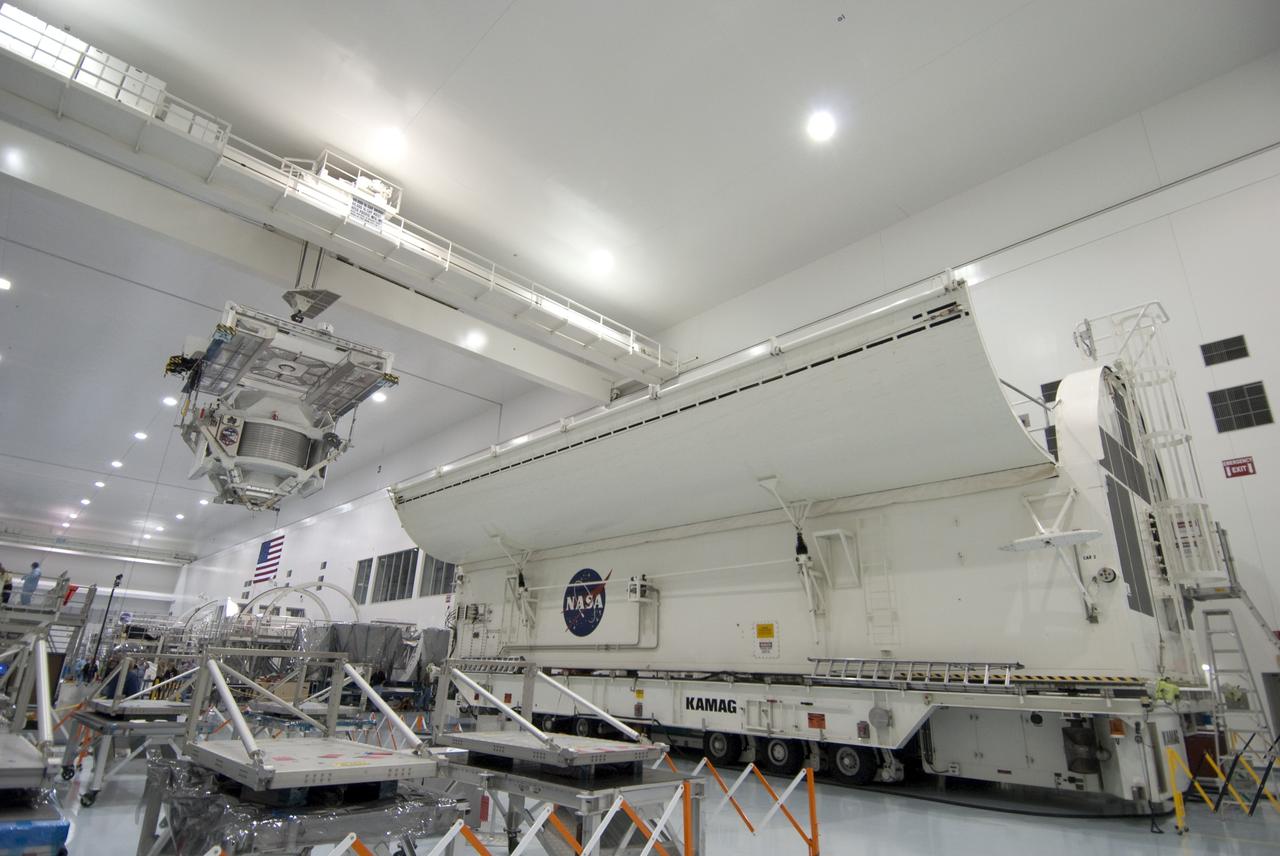
CAPE CANAVERAL, Fla. -- In the Space Station Processing Facility at NASA's Kennedy Space Center in Florida, the Alpha Magnetic Spectrometer-2 (AMS) is moved from the weight and center of gravity stand, where final measurements were taken before launch, to a payload canister. The canister will protect the space-bound payload on its journey to Launch Pad 39A, where it will later be installed into space shuttle Endeavour’s payload bay. AMS is a particle physics detector, designed to operate as an external experiment on the International Space Station. It will use the unique environment of space to study the universe and its origin by searching for dark matter. AMS-2 will fly to the station aboard Endeavour's STS-134 mission targeted to launch April 19 at 7:48 p.m. EDT. For more information visit, www.nasa.gov/mission_pages/shuttle/shuttlemissions/sts134/index.html. Photo credit: NASA/Jim Grossmann
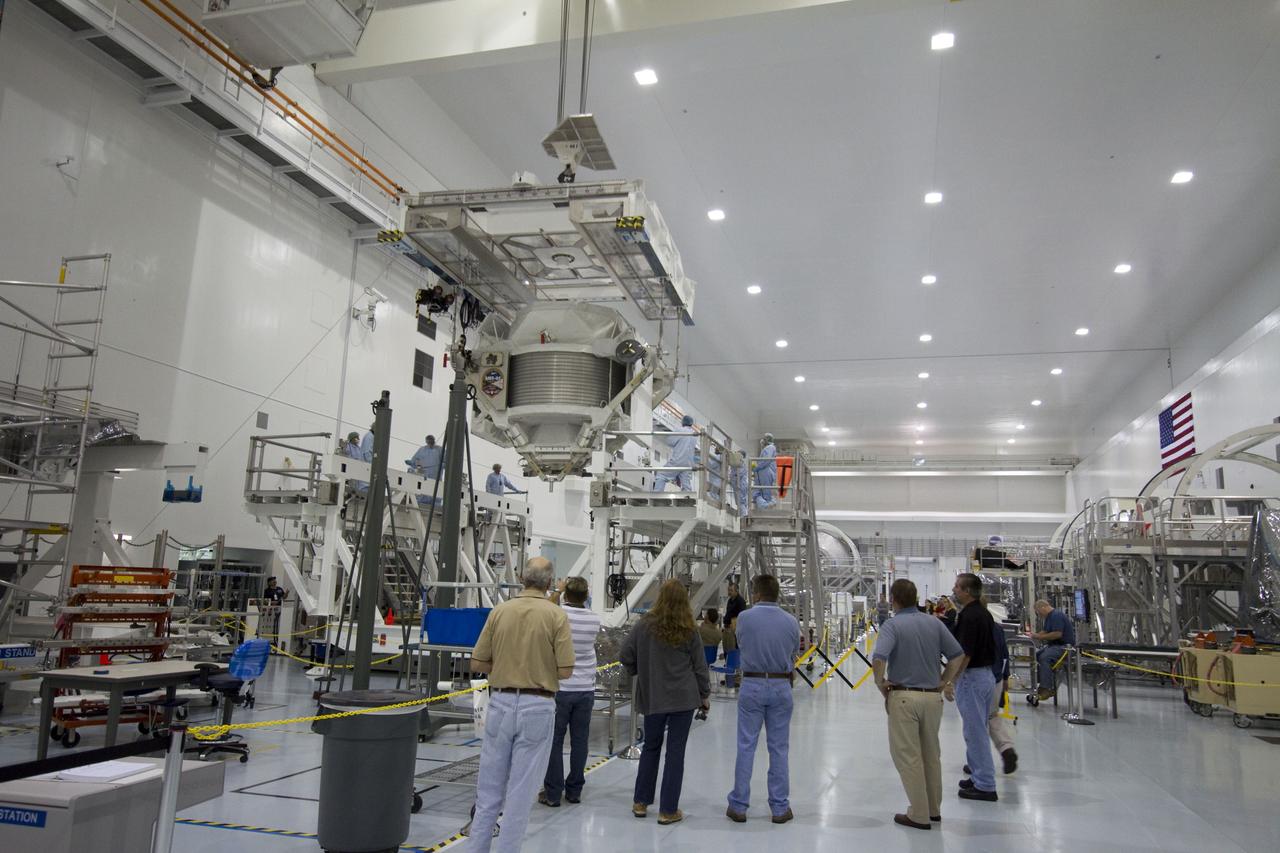
CAPE CANAVERAL, Fla. -- In the Space Station Processing Facility at NASA's Kennedy Space Center in Florida, the Alpha Magnetic Spectrometer-2 (AMS) moves from its primary work stand to the weight and center of gravity stand where final measurements will be taken before launch. Next, AMS will be moved into a payload canister. The canister will protect the space-bound payload on its journey to Launch Pad 39A, where it will later be installed into space shuttle Endeavour’s payload bay. AMS is a particle physics detector, designed to operate as an external experiment on the International Space Station. It will use the unique environment of space to study the universe and its origin by searching for dark matter. AMS-2 will fly to the station aboard Endeavour's STS-134 mission targeted to launch April 19 at 7:48 p.m. EDT. For more information visit, www.nasa.gov/mission_pages/shuttle/shuttlemissions/sts134/index.html. Photo credit: NASA/Jack Pfaller
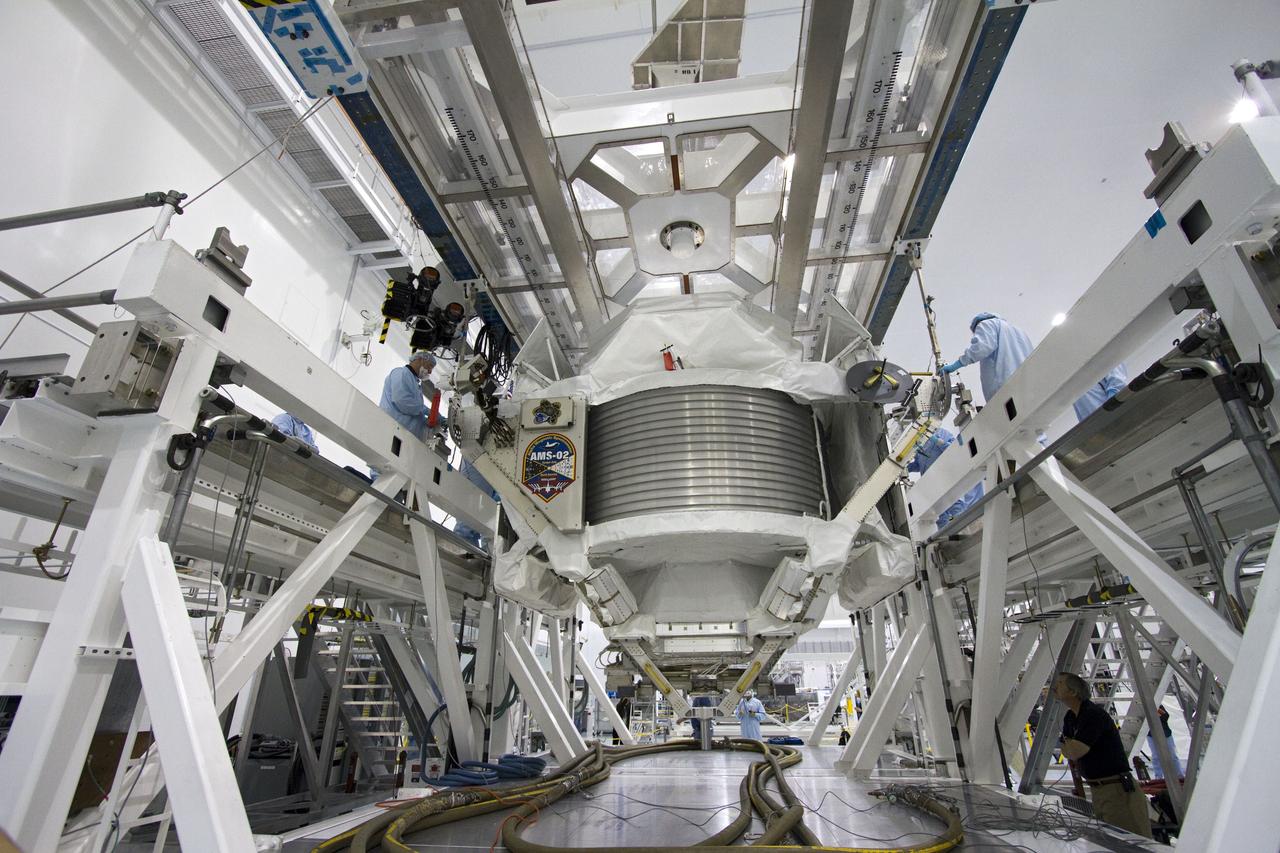
CAPE CANAVERAL, Fla. -- In the Space Station Processing Facility at NASA's Kennedy Space Center in Florida, the Alpha Magnetic Spectrometer-2 (AMS) was moved from its primary work stand to the weight and center of gravity stand where final measurements will be taken before launch. Next, AMS will be moved into a payload canister. The canister will protect the space-bound payload on its journey to Launch Pad 39A, where it will later be installed into space shuttle Endeavour’s payload bay. AMS is a particle physics detector, designed to operate as an external experiment on the International Space Station. It will use the unique environment of space to study the universe and its origin by searching for dark matter. AMS-2 will fly to the station aboard Endeavour's STS-134 mission targeted to launch April 19 at 7:48 p.m. EDT. For more information visit, www.nasa.gov/mission_pages/shuttle/shuttlemissions/sts134/index.html. Photo credit: NASA/Jack Pfaller
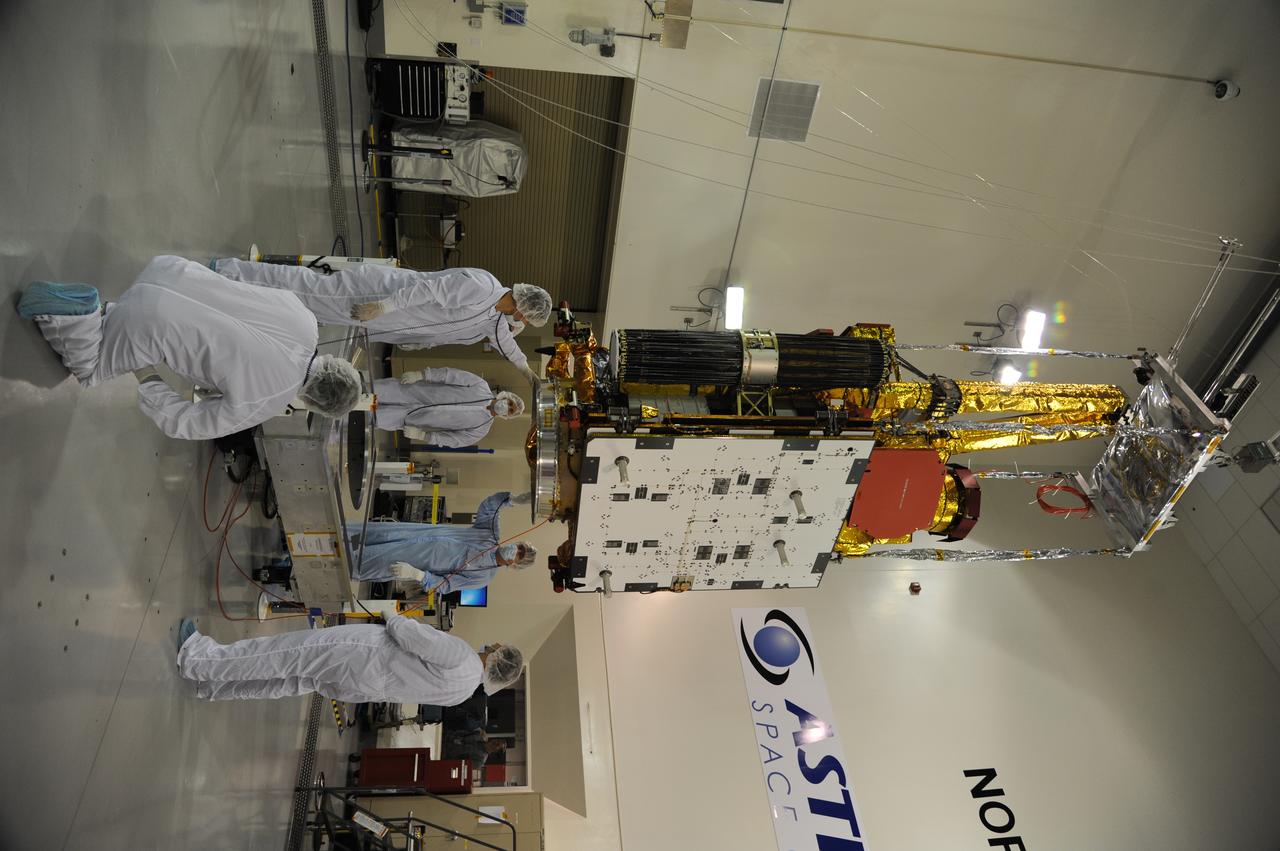
NASA's Soil Moisture Active Passive, or SMAP, spacecraft is lifted from its workstand in the clean room of the Astrotech payload processing facility on Vandenberg Air Force Base in California during operations to determine its weight. The weighing of a spacecraft is standard procedure during prelaunch processing. SMAP will launch on a Delta II 7320 configuration vehicle featuring a United Launch Alliance first stage booster powered by an Aerojet Rocketdyne RS-27A main engine and three Alliant Techsystems, or ATK, strap-on solid rocket motors. Once on station in Earth orbit, SMAP will provide global measurements of soil moisture and its freeze/thaw state. NASA's Jet Propulsion Laboratory that built the observatory and its radar instrument also is responsible for SMAP project management and mission operations. Launch from Space Launch Complex 2 is targeted for Jan. 29, 2015.
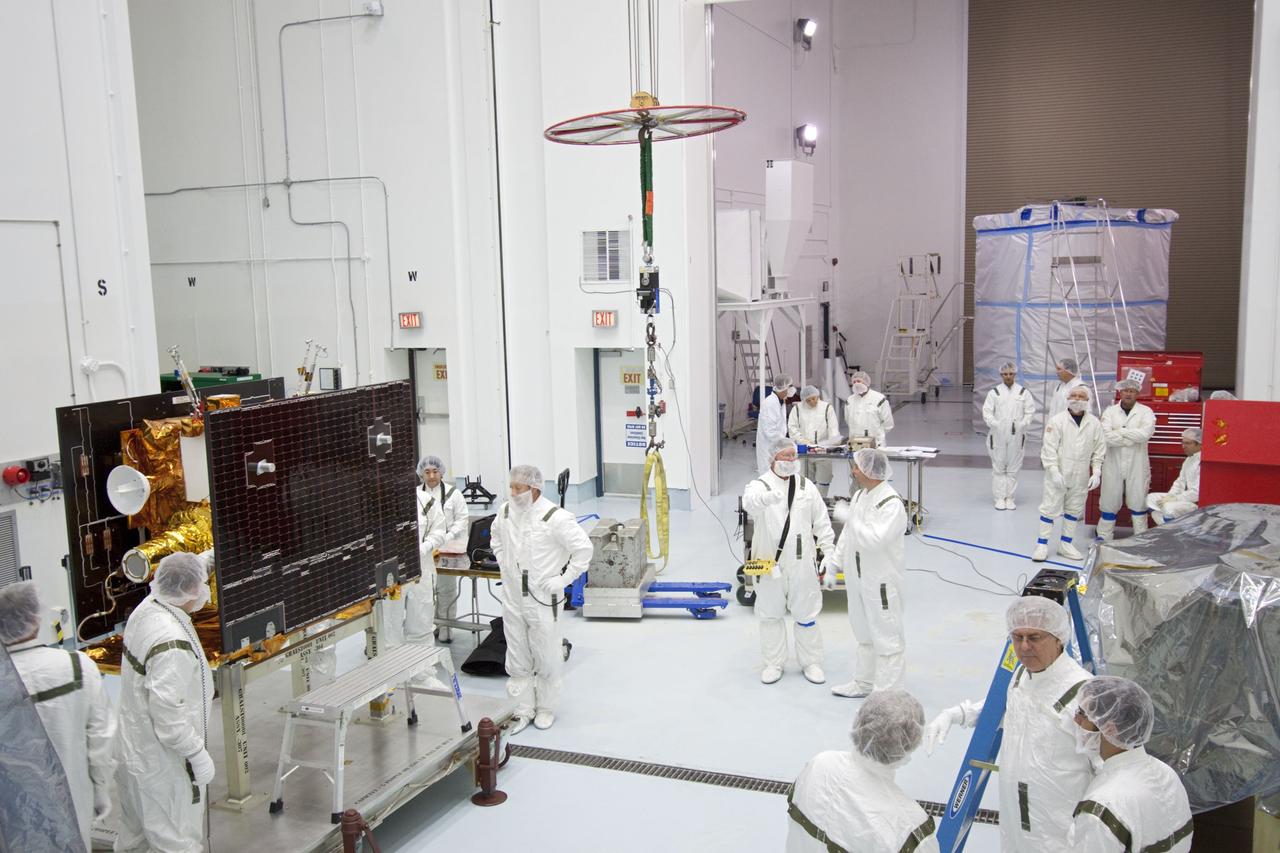
CAPE CANAVERAL, Fla. -- At Astrotech Space Operation's payload processing facility in Titusville, Fla., preparations are under way to determine the weight of one of NASA's twin Gravity Recovery and Interior Laboratory lunar spacecraft before the spacecraft are stacked in their launch configuration in readiness for transport to the launch pad. GRAIL will fly in tandem orbits around the moon for several months to measure its gravity field. GRAIL's primary science objectives are to determine the structure of the lunar interior, from crust to core, and to advance understanding of the thermal evolution of the moon. Launch aboard a United Launch Alliance Delta II rocket from Space Launch Complex 17B on Cape Canaveral Air Force Station is scheduled for Sept. 8. For more information, visit http://www.nasa.gov/grail. Photo credit: NASA/Jim Grossmann
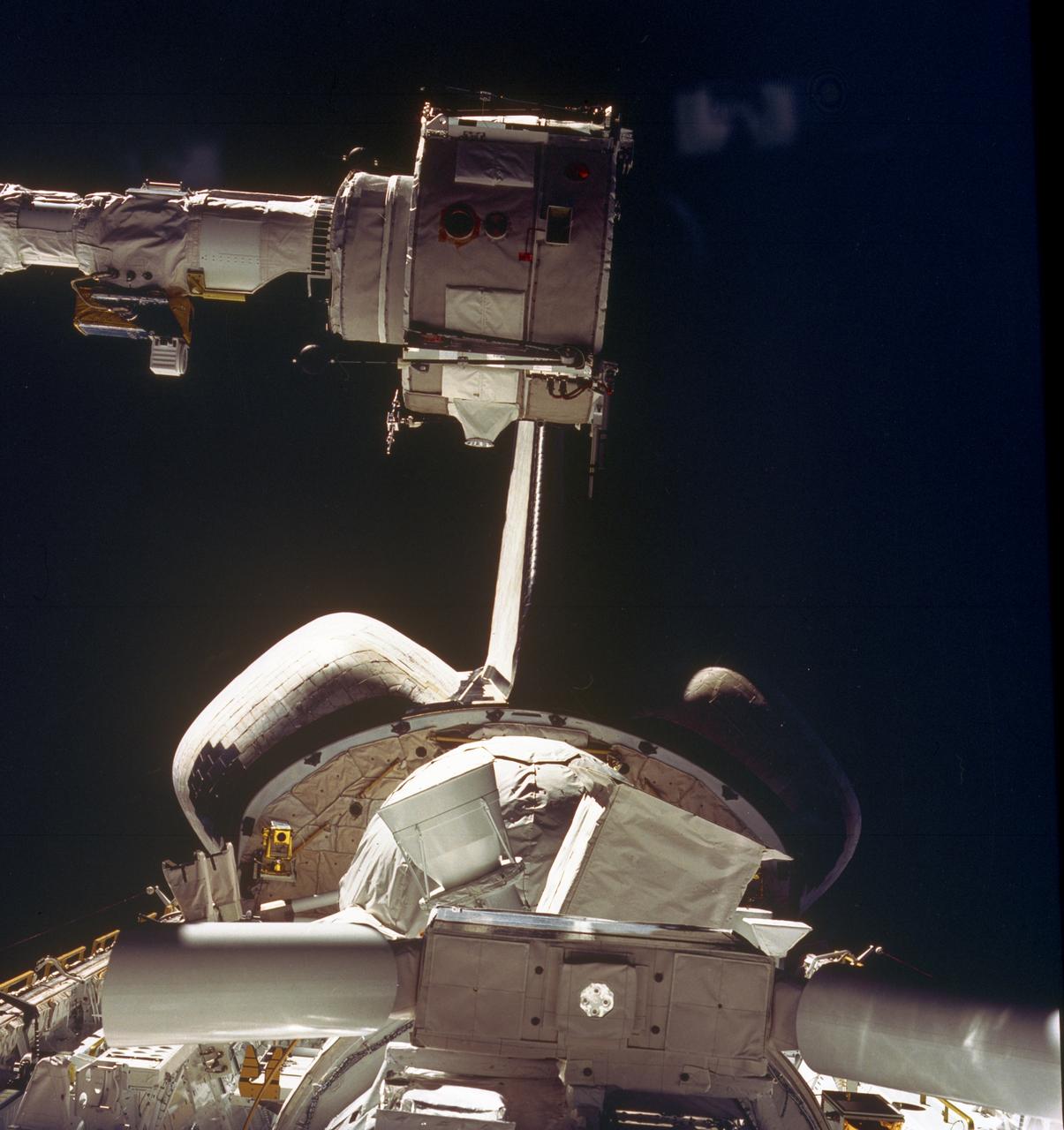
This STS-51F mission onboard Photograph shows some of the Spacelab-2 instruments in the cargo bay of the Orbiter Challenger. The Plasma Diagnostics Package (PDP). shown at the end of the Remote Manipulator System (RMS), used instruments on a subsatellite to study natural plasma processes, orbiter-induced plasma processes, and beam plasma physics. Fourteen instruments were mounted on the PDP for measurements of various plasma characteristics. The X-ray Telescope (XRT), is at the front. The goal of this investigation was to image and examine the X-ray emissions from clusters of galaxies in order to study the mechanisms that cause high-temperature emissions and to determine the weight of galactic clusters. The Small Helium-Cooled Infrared Telescope (IRT) is at the right behind the XRT. The objective of this investigation was to measure and map diffused and discrete infrared astronomical sources while evaluating the Space Shuttle as a platform for infrared astronomy. At the same time, a new large superfluid helium dewar system for cooling the telescope was evaluated. The egg-shaped Cosmic Ray Nuclei experiment (CRNE) is shown at the rear. This investigation was to study the composition of high-energy cosmic rays by using a large instrument exposed to space for a considerable period of time. Spacelab-2 (STS-51F, 19th Shuttle mission) was launched aboard the Space Shuttle Orbiter Challenger on July 29, 1985.
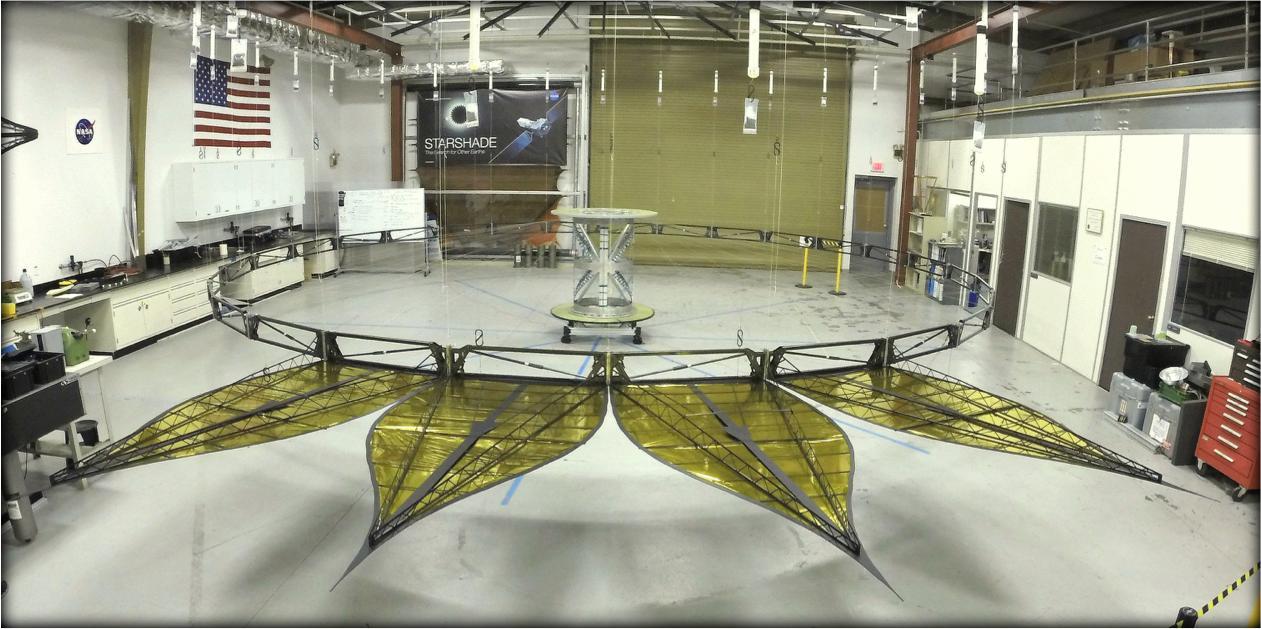
is image shows a deployed half-scale starshade with four petals at NASA's Jet Propulsion Laboratory, Pasadena, California in 2014. The full-scale of this starshade (not shown) will measure at 111 feet (34 meters). The flower-like petals of the starshade are designed to diffract bright starlight away from telescopes seeking the dim light of exoplanets. The starshade was re-designed from earlier models to allow these petals to furl, or wrap around the spacecraft, for launch into space. Each petal is covered in a high-performance plastic film that resembles gold foil. On a starshade ready for launch, the thermal gold foil will only cover the side of the petals facing away from the telescope, with black on the other, so as not to reflect other light sources such as the Earth into its lens. The starshade is light enough for space and cannot support its own weight on Earth. Is it shown offloaded with counterweights, much like an elevator. Starlight-blocking technologies such as the starshade are being developed to help image exoplanets, with a focus on Earth-sized, habitable worlds. http://photojournal.jpl.nasa.gov/catalog/PIA20909
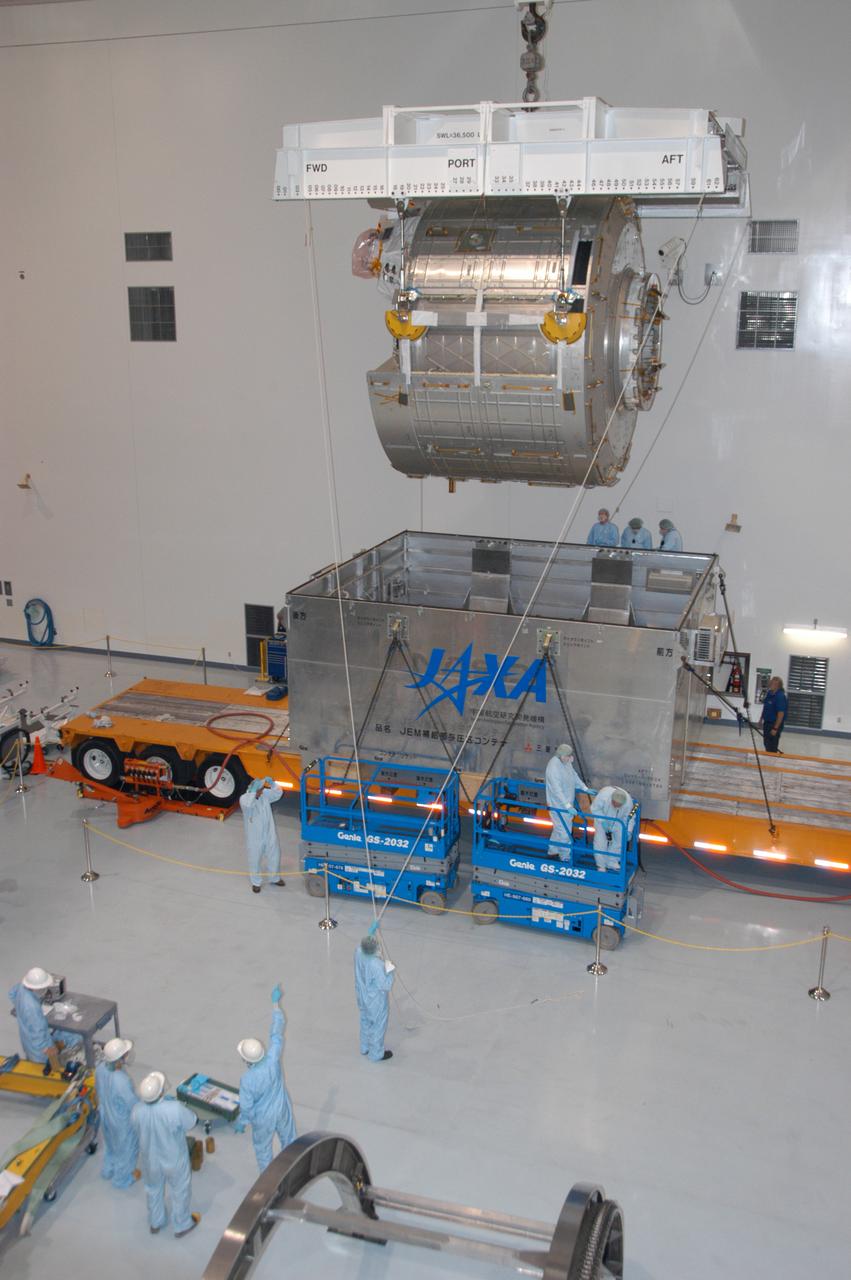
The JEM Experiment Logistics Module Pressurized Section is lifted from its shipping crate in the Space Station Processing Facility. The module will be moved to a scale for weight and center-of-gravity measurements and then to a work stand. The logistics module is one of the components of the Japanese Experiment Module or JEM, also known as Kibo, which means "hope" in Japanese. Kibo comprises six components: two research facilities -- the Pressurized Module and Exposed Facility; a Logistics Module attached to each of them; a Remote Manipulator System; and an Inter-Orbit Communication System unit. Kibo also has a scientific airlock through which experiments are transferred and exposed to the external environment of space. Kibo is Japan's first human space facility and its primary contribution to the station. Kibo will enhance the unique research capabilities of the orbiting complex by providing an additional environment in which astronauts can conduct science experiments. The various components of JEM will be assembled in space over the course of three Space Shuttle missions. The first of those three missions, STS-123, will carry the Experiment Logistics Module Pressurized Section aboard the Space Shuttle Endeavour, targeted for launch in 2007.
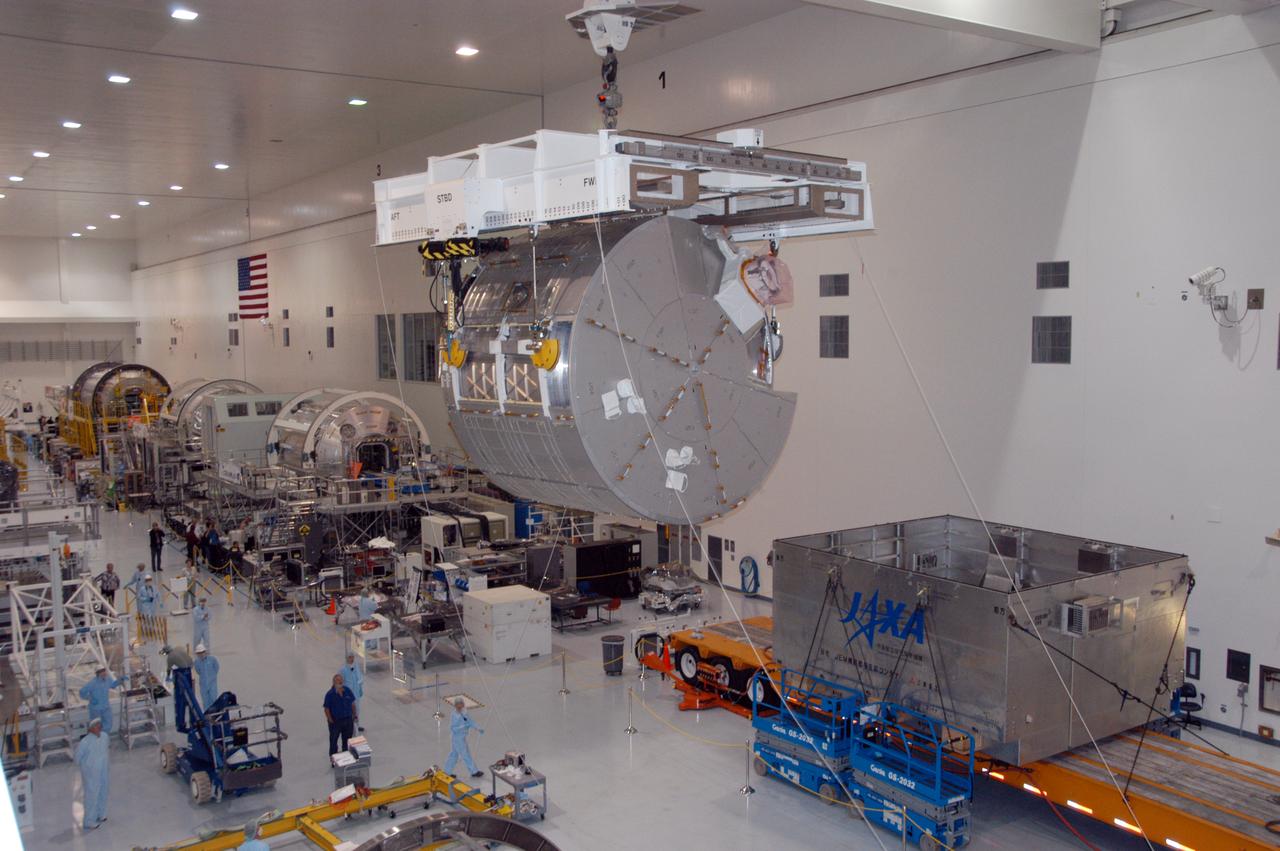
An overhead crane moves the JEM Experiment Logistics Module Pressurized Section above the floor of the Space Station Processing Facility to a scale for weight and center-of-gravity measurements. The module will then be moved to a work stand. The logistics module is one of the components of the Japanese Experiment Module or JEM, also known as Kibo, which means "hope" in Japanese. Kibo comprises six components: two research facilities -- the Pressurized Module and Exposed Facility; a Logistics Module attached to each of them; a Remote Manipulator System; and an Inter-Orbit Communication System unit. Kibo also has a scientific airlock through which experiments are transferred and exposed to the external environment of space. Kibo is Japan's first human space facility and its primary contribution to the station. Kibo will enhance the unique research capabilities of the orbiting complex by providing an additional environment in which astronauts can conduct science experiments. The various components of JEM will be assembled in space over the course of three Space Shuttle missions. The first of those three missions, STS-123, will carry the Experiment Logistics Module Pressurized Section aboard the Space Shuttle Endeavour, targeted for launch in 2007.
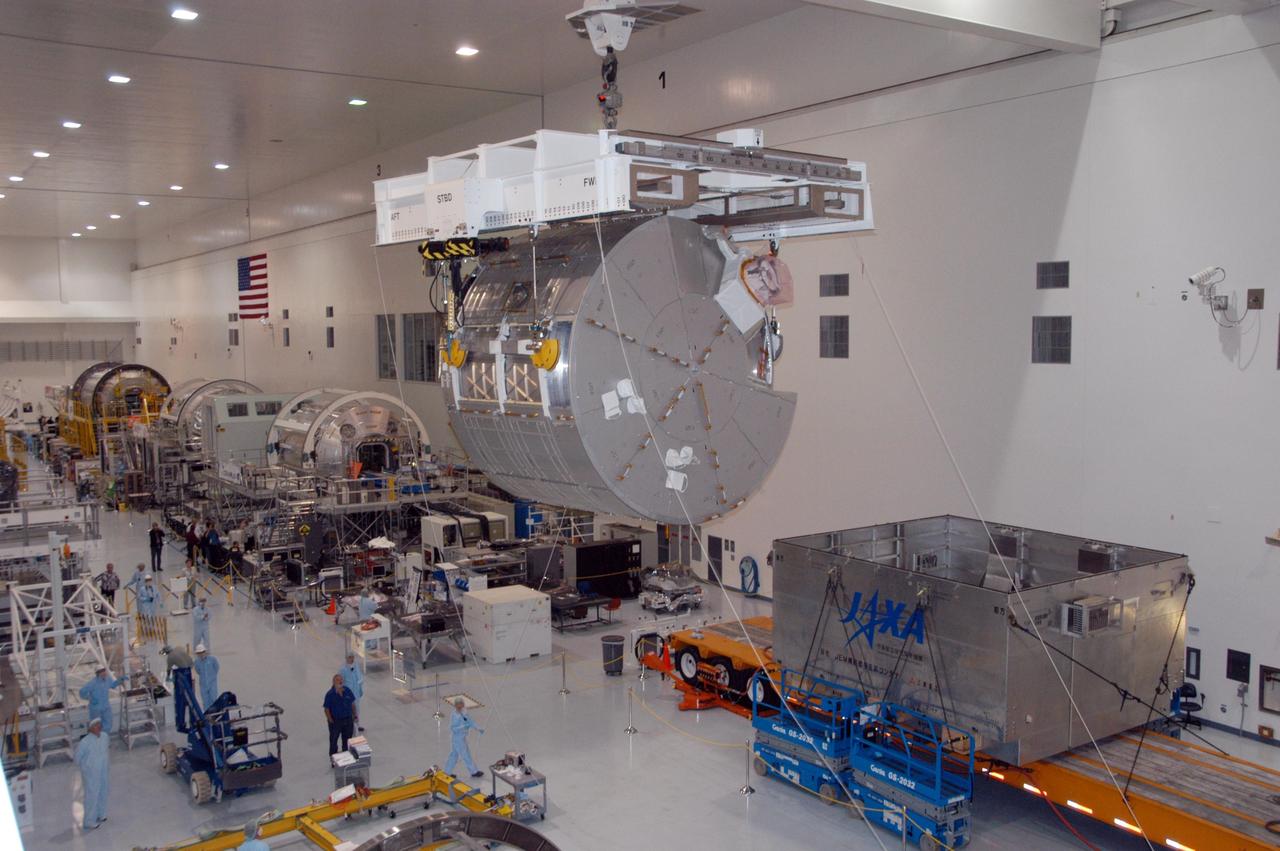
KENNEDY SPACE CENTER, FLA. -- An overhead crane moves the JEM Experiment Logistics Module Pressurized Section above the floor of the Space Station Processing Facility to a scale for weight and center-of-gravity measurements. The module will then be moved to a work stand. The logistics module is one of the components of the Japanese Experiment Module or JEM, also known as Kibo, which means "hope" in Japanese. Kibo comprises six components: two research facilities -- the Pressurized Module and Exposed Facility; a Logistics Module attached to each of them; a Remote Manipulator System; and an Inter-Orbit Communication System unit. Kibo also has a scientific airlock through which experiments are transferred and exposed to the external environment of space. Kibo is Japan's first human space facility and its primary contribution to the station. Kibo will enhance the unique research capabilities of the orbiting complex by providing an additional environment in which astronauts can conduct science experiments. The various components of JEM will be assembled in space over the course of three Space Shuttle missions. The first of those three missions, STS-123, will carry the Experiment Logistics Module Pressurized Section aboard the Space Shuttle Endeavour, targeted for launch in 2007. Photo credit: NASA/George Shelton
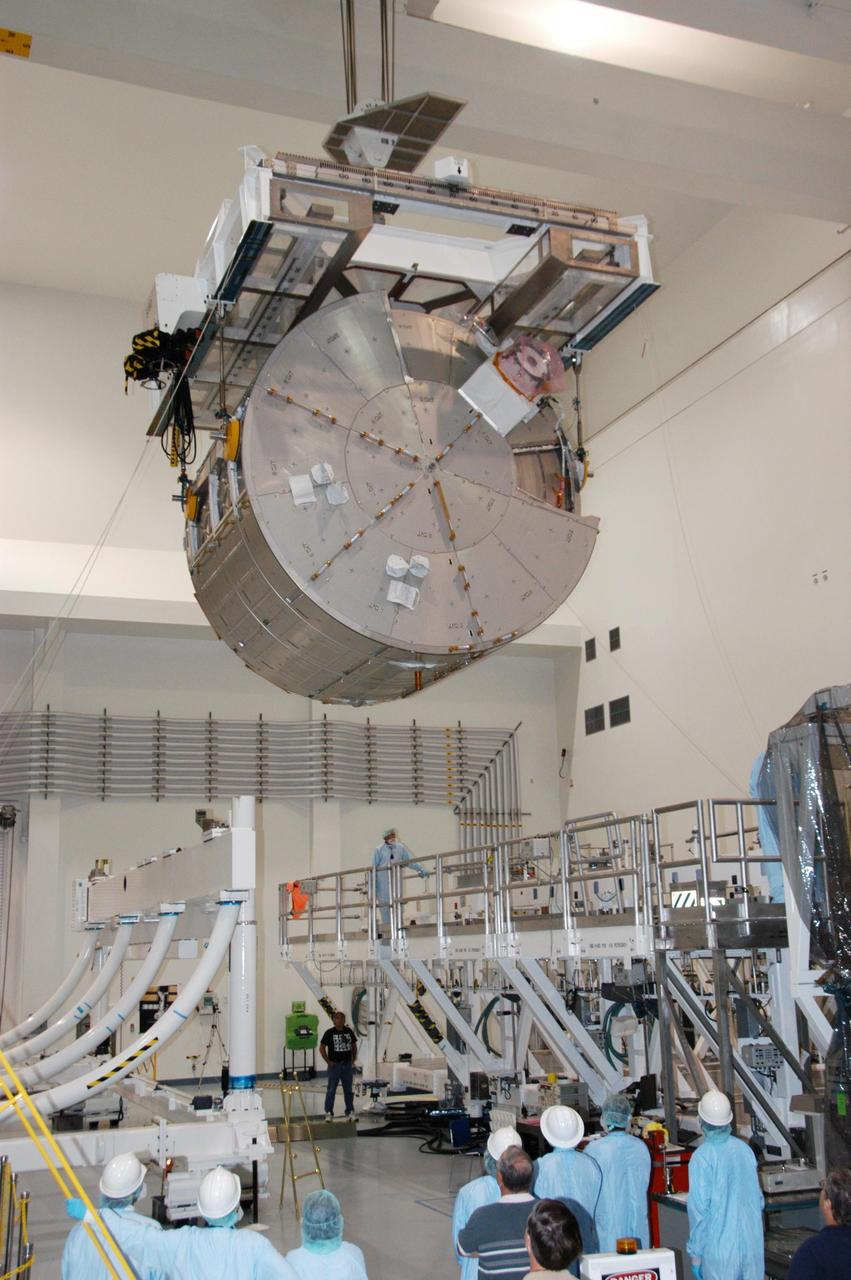
KENNEDY SPACE CENTER, FLA. -- In the Space Station Processing Facility, an overhead crane moves the JEM Experiment Logistics Module Pressurized Section toward a scale (at left) for weight and center-of-gravity measurements. The module will then be moved to a work stand. The logistics module is one of the components of the Japanese Experiment Module or JEM, also known as Kibo, which means "hope" in Japanese. Kibo comprises six components: two research facilities -- the Pressurized Module and Exposed Facility; a Logistics Module attached to each of them; a Remote Manipulator System; and an Inter-Orbit Communication System unit. Kibo also has a scientific airlock through which experiments are transferred and exposed to the external environment of space. Kibo is Japan's first human space facility and its primary contribution to the station. Kibo will enhance the unique research capabilities of the orbiting complex by providing an additional environment in which astronauts can conduct science experiments. The various components of JEM will be assembled in space over the course of three Space Shuttle missions. The first of those three missions, STS-123, will carry the Experiment Logistics Module Pressurized Section aboard the Space Shuttle Endeavour, targeted for launch in 2007. Photo credit: NASA/George Shelton
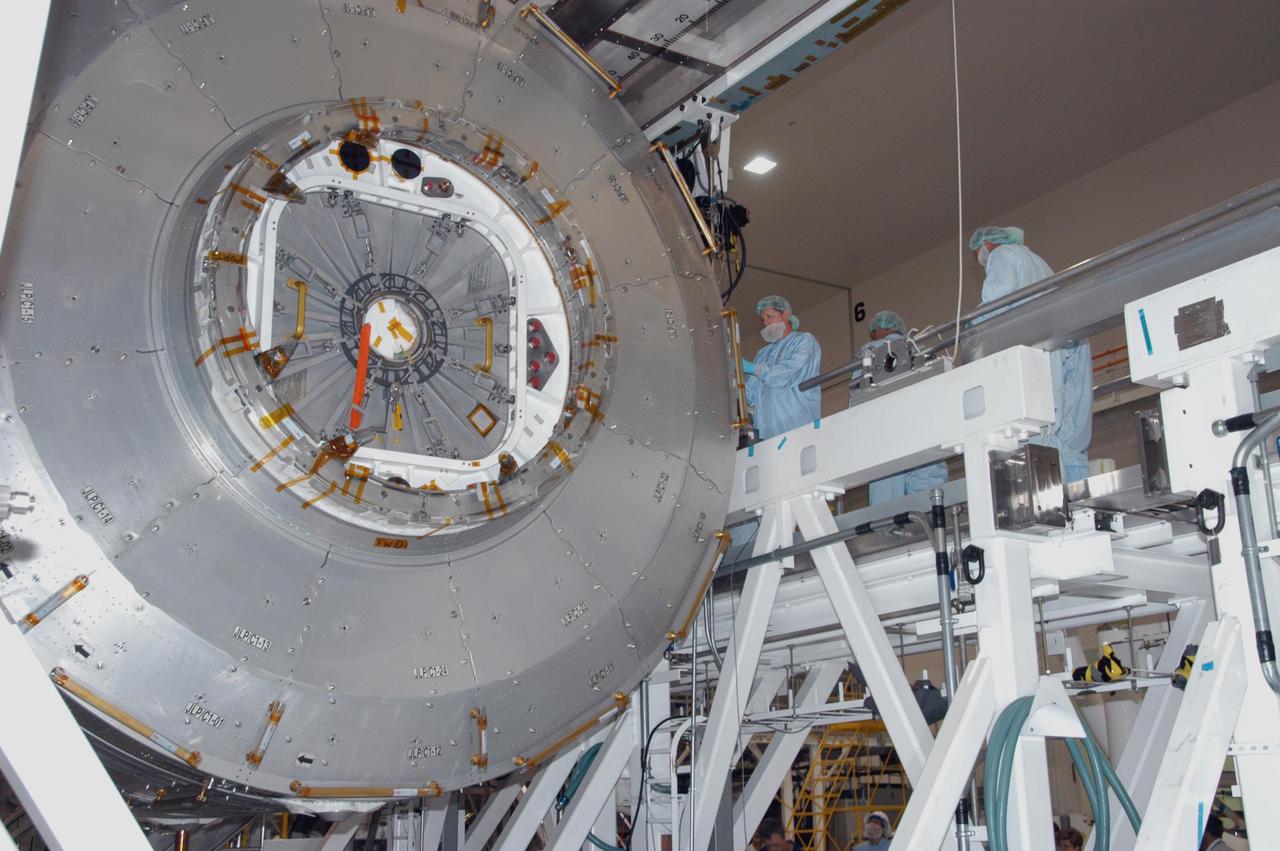
KENNEDY SPACE CENTER, FLA. -- In the Space Station Processing Facility, the JEM Experiment Logistics Module Pressurized Section is lowered onto a scale for weight and center-of-gravity measurements. The module will then be moved to a work stand. The logistics module is one of the components of the Japanese Experiment Module or JEM, also known as Kibo, which means "hope" in Japanese. Kibo comprises six components: two research facilities -- the Pressurized Module and Exposed Facility; a Logistics Module attached to each of them; a Remote Manipulator System; and an Inter-Orbit Communication System unit. Kibo also has a scientific airlock through which experiments are transferred and exposed to the external environment of space. Kibo is Japan's first human space facility and its primary contribution to the station. Kibo will enhance the unique research capabilities of the orbiting complex by providing an additional environment in which astronauts can conduct science experiments. The various components of JEM will be assembled in space over the course of three Space Shuttle missions. The first of those three missions, STS-123, will carry the Experiment Logistics Module Pressurized Section aboard the Space Shuttle Endeavour, targeted for launch in 2007. Photo credit: NASA/George Shelton
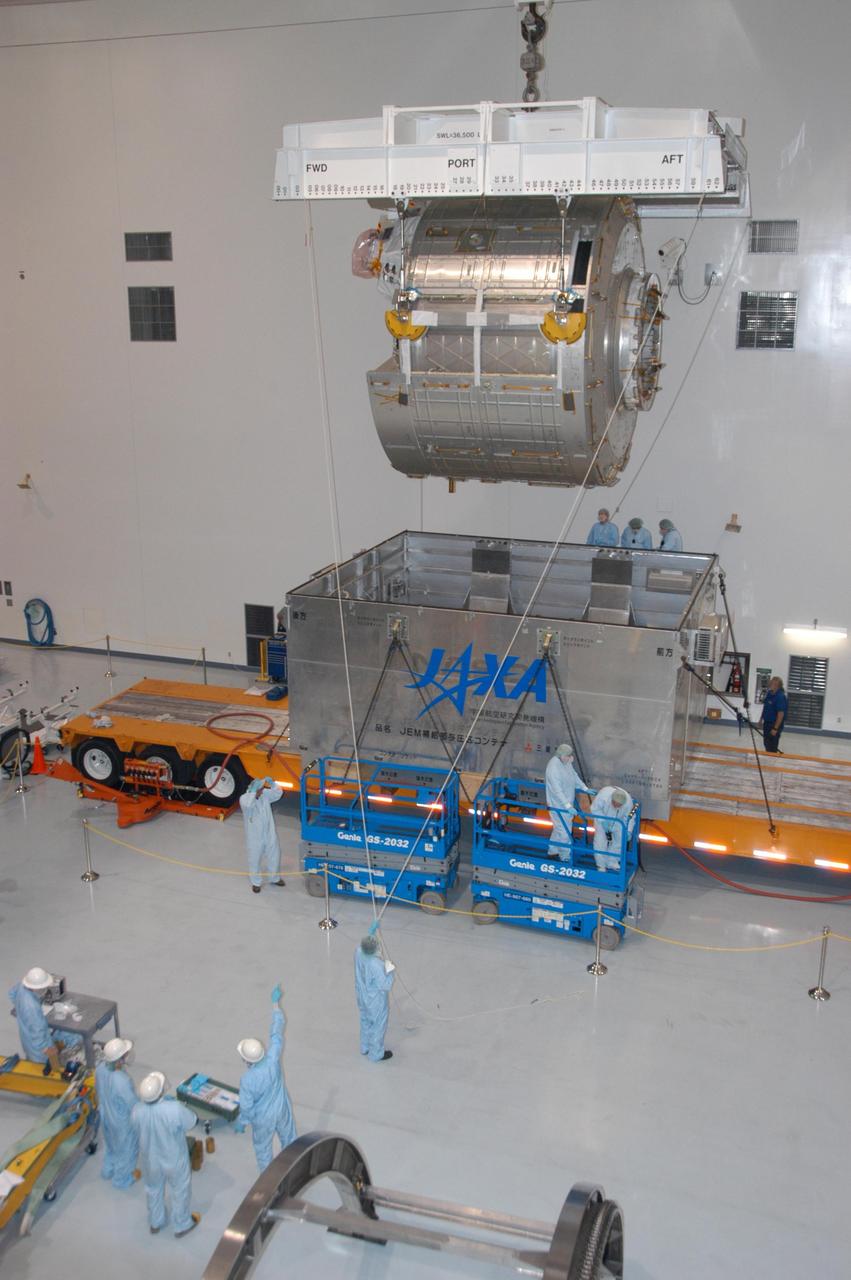
KENNEDY SPACE CENTER, FLA. -- The JEM Experiment Logistics Module Pressurized Section is lifted from its shipping crate in the Space Station Processing Facility. The module will be moved to a scale for weight and center-of-gravity measurements and then to a work stand. The logistics module is one of the components of the Japanese Experiment Module or JEM, also known as Kibo, which means "hope" in Japanese. Kibo comprises six components: two research facilities -- the Pressurized Module and Exposed Facility; a Logistics Module attached to each of them; a Remote Manipulator System; and an Inter-Orbit Communication System unit. Kibo also has a scientific airlock through which experiments are transferred and exposed to the external environment of space. Kibo is Japan's first human space facility and its primary contribution to the station. Kibo will enhance the unique research capabilities of the orbiting complex by providing an additional environment in which astronauts can conduct science experiments. The various components of JEM will be assembled in space over the course of three Space Shuttle missions. The first of those three missions, STS-123, will carry the Experiment Logistics Module Pressurized Section aboard the Space Shuttle Endeavour, targeted for launch in 2007. Photo credit: NASA/George Shelton
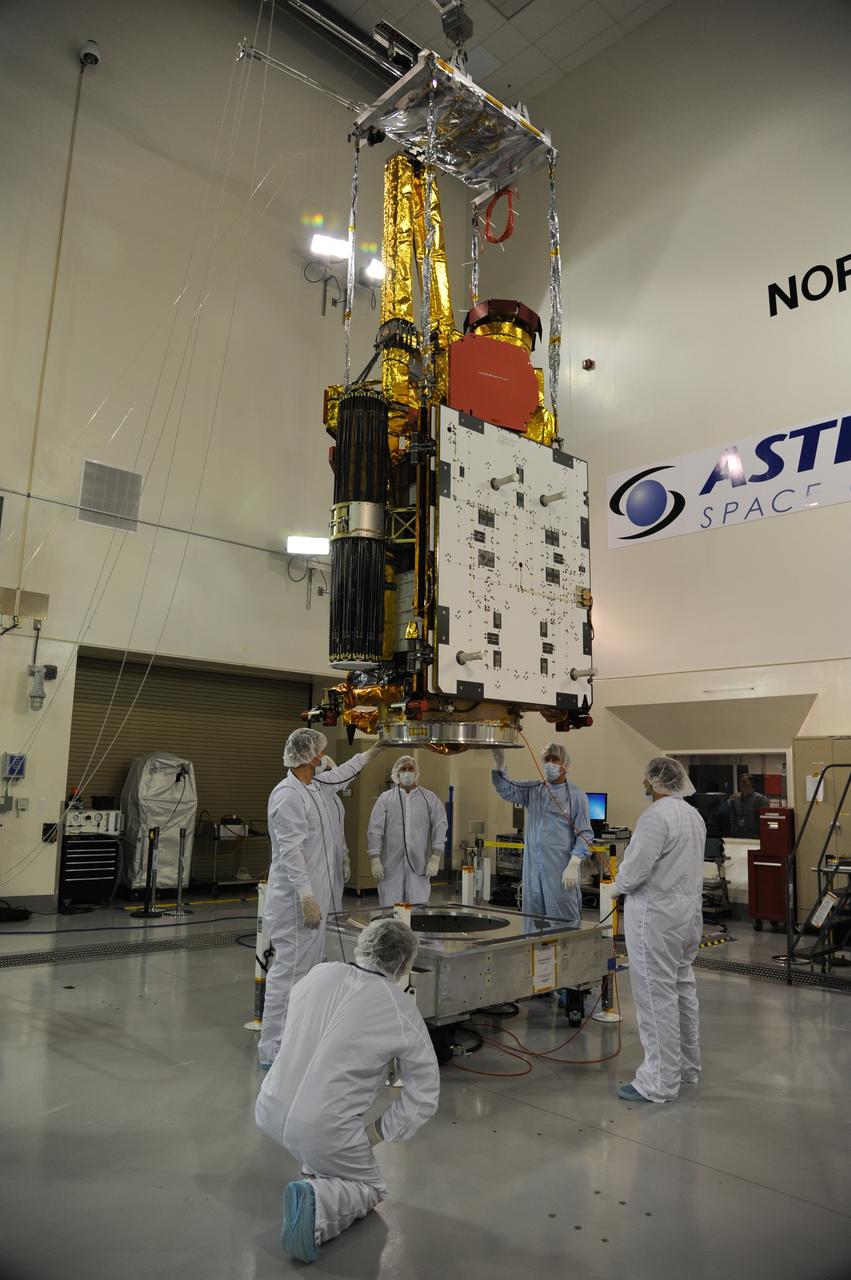
VANDENBERG AIR FORCE BASE, Calif. – NASA's Soil Moisture Active Passive, or SMAP, spacecraft is lifted from its workstand in the clean room of the Astrotech payload processing facility on Vandenberg Air Force Base in California during operations to determine its weight. The weighing of a spacecraft is standard procedure during prelaunch processing. SMAP will launch on a Delta II 7320 configuration vehicle featuring a United Launch Alliance first stage booster powered by an Aerojet Rocketdyne RS-27A main engine and three Alliant Techsystems, or ATK, strap-on solid rocket motors. Once on station in Earth orbit, SMAP will provide global measurements of soil moisture and its freeze/thaw state. NASA's Jet Propulsion Laboratory that built the observatory and its radar instrument also is responsible for SMAP project management and mission operations. Launch from Space Launch Complex 2 is targeted for Jan. 29, 2015. To learn more about SMAP, visit http://smap.jpl.nasa.gov. Photo credit: NASA/Randy Beaudoin
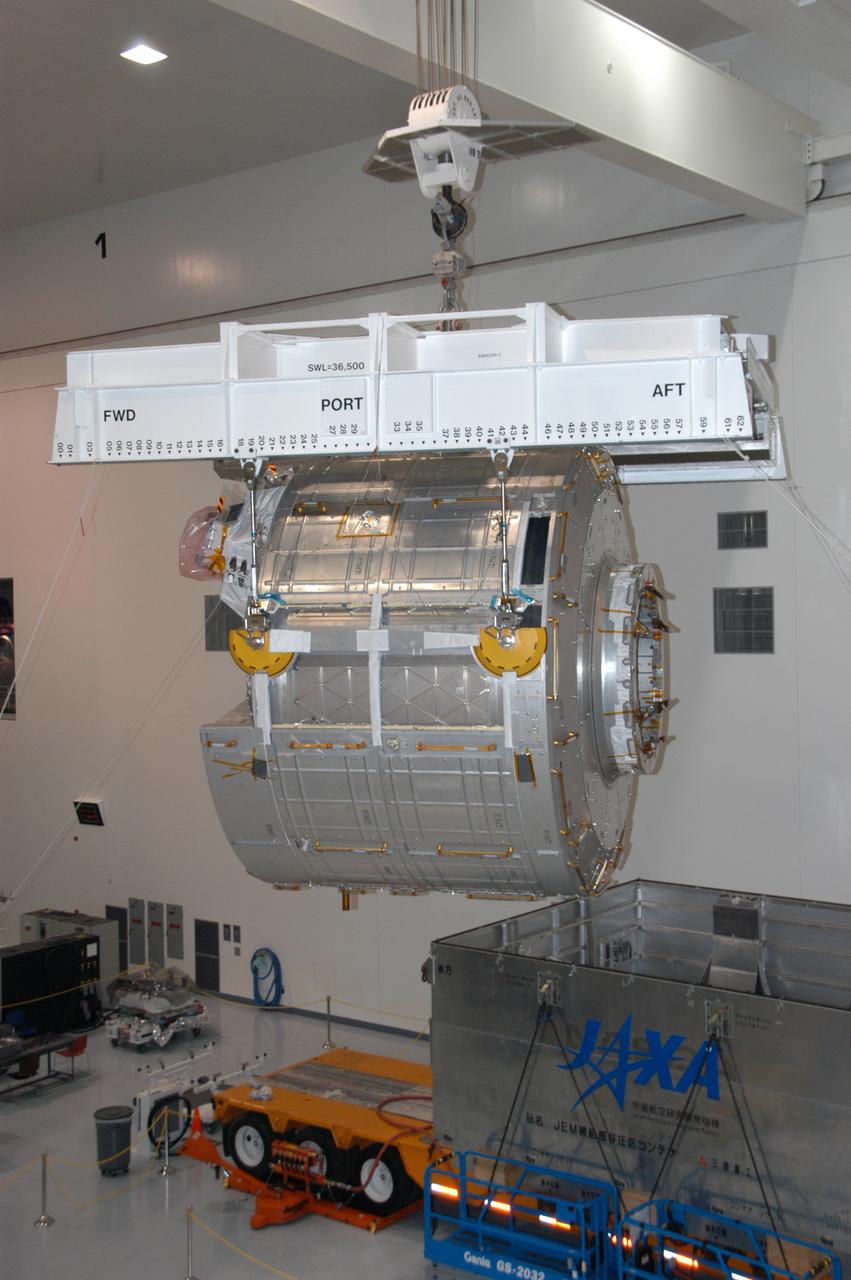
In the Space Station Processing Facility, an overhead crane lifts the JEM Experiment Logistics Module Pressurized Section from its shipping container and moves it toward a scale for weight and center-of-gravity measurements. The module will then be moved to a work stand. The logistics module is one of the components of the Japanese Experiment Module or JEM, also known as Kibo, which means "hope" in Japanese. Kibo comprises six components: two research facilities -- the Pressurized Module and Exposed Facility; a Logistics Module attached to each of them; a Remote Manipulator System; and an Inter-Orbit Communication System unit. Kibo also has a scientific airlock through which experiments are transferred and exposed to the external environment of space. Kibo is Japan's first human space facility and its primary contribution to the station. Kibo will enhance the unique research capabilities of the orbiting complex by providing an additional environment in which astronauts can conduct science experiments. The various components of JEM will be assembled in space over the course of three Space Shuttle missions. The first of those three missions, STS-123, will carry the Experiment Logistics Module Pressurized Section aboard the Space Shuttle Endeavour, targeted for launch in 2007.
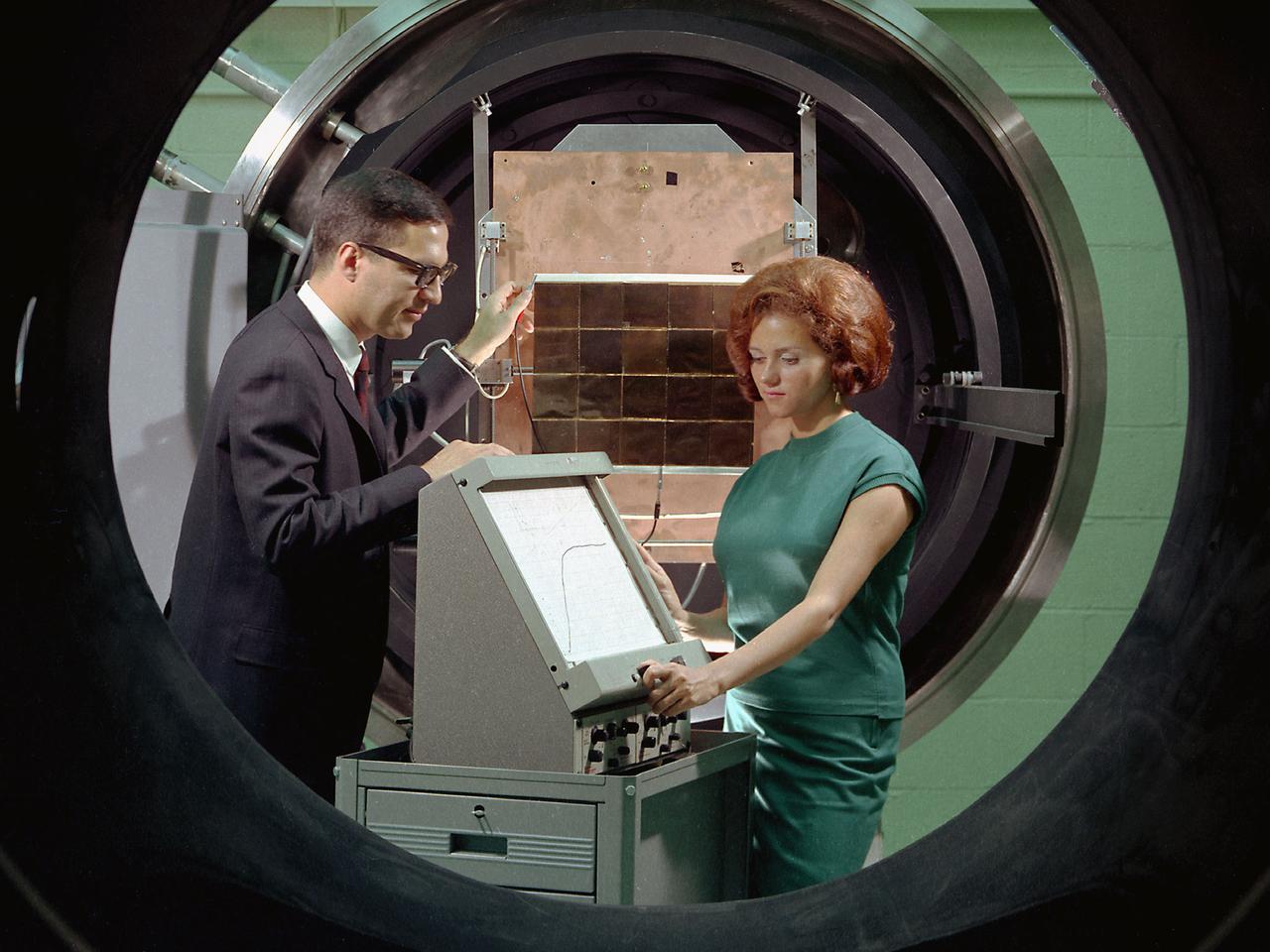
George Mazaris, works with an assistant to obtain the preliminary measurements of cadmium sulfide thin-film solar cells being tested in the Space Environmental Chamber at the National Aeronautics and Space Administration (NASA) Lewis Research Center. Lewis’ Photovoltaic Fundamentals Section was investigating thin-film alternatives to the standard rigid and fragile solar cells. The cadmium sulfide semiconductors were placed in a light, metallized substrate that could be rolled or furled during launch. The main advantage of the thin-film solar cells was their reduced weight. Lewis researchers, however, were still working on improving the performance of the semiconductor. The new thin-film solar cells were tested in a space simulation chamber in the CW-6 test cell in the Engine Research Building. The chamber created a simulated altitude of 200 miles. Sunlight was simulated by a 5000-watt xenon light. Some two dozen cells were exposed to 15 minutes of light followed by 15 minutes of darkness to test their durability in the constantly changing illumination of Earth orbit. This photograph was taken for use in a NASA recruiting publication.
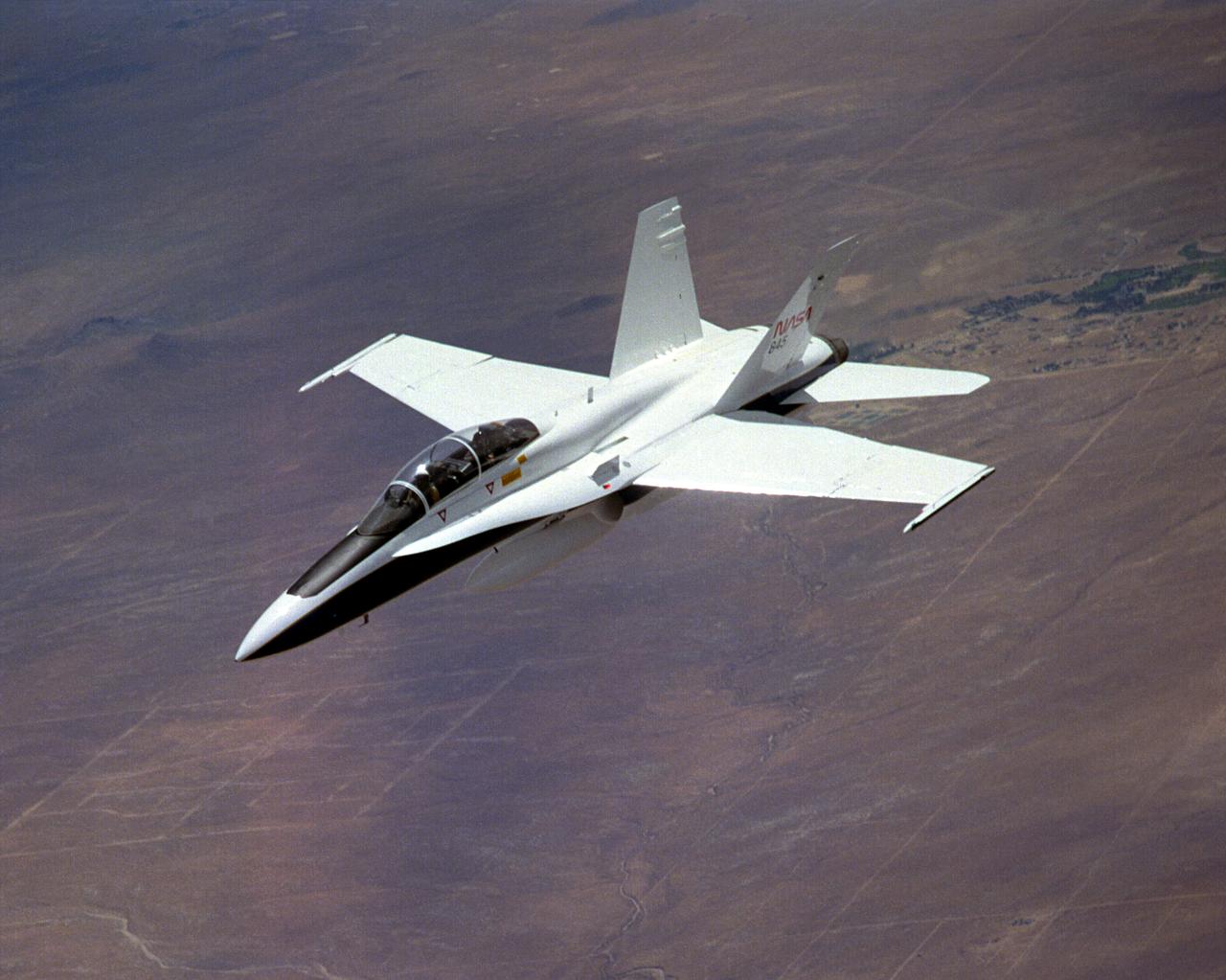
The National Aeronautics and Space Administration's Systems Research Aircraft (SRA), a highly modified F-18 jet fighter, during a research flight. The former Navy aircraft was flown by NASA's Dryden Flight Research Center at Edwards Air Force Base, California, to evaluate a number of experimental aerospace technologies in a multi-year, joint NASA/DOD/industry program. Among the more than 20 experiments flight-tested were several involving fiber optic sensor systems. Experiments developed by McDonnell-Douglas and Lockheed-Martin centered on installation and maintenace techniques for various types of fiber-optic hardware proposed for use in military and commercial aircraft, while a Parker-Hannifin experiment focused in alternative fiber-optic designs for position measurement sensors as well as operational experience in handling optical sensor systems. Other experiments flown on this testbed aircraft included electronically-controlled control surface actuators, flush air data collection systems, "smart" skin antennae and laser-based systems. Incorporation of one or more of these technologies in future aircraft and spacecraft could result in signifigant savings in weight, maintenance and overall cost.
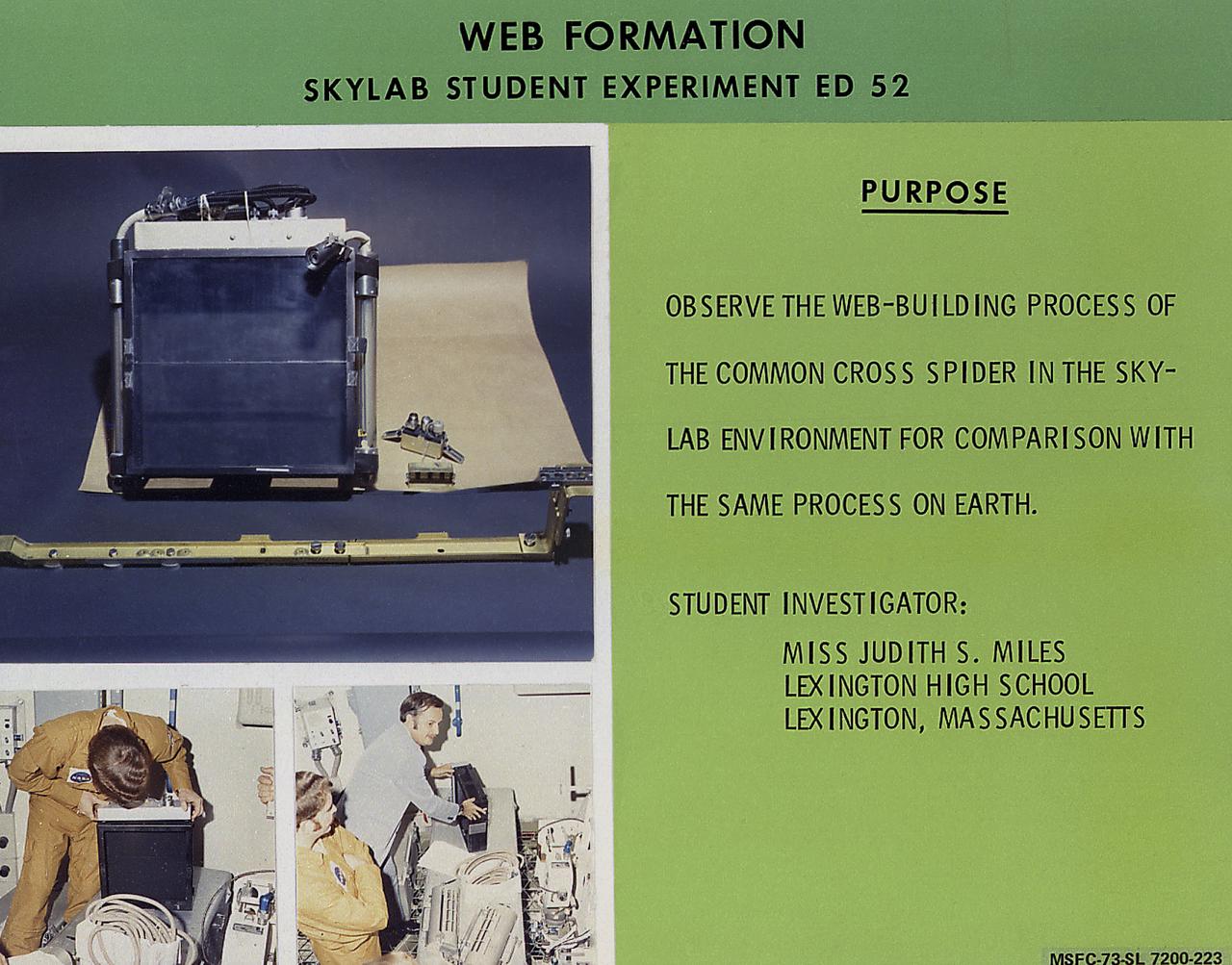
This chart describes the Skylab student experiment Web Formation. Judith S. Miles of Lexington High School, Lexington, Massachusetts, proposed a study of the spider's behavior in a weightless environment. The geometrical structure of the web of the orb-weaving spider provides a good measure of the condition of its central nervous system. Since the spider senses its own weight to determine the required thickness of web material and uses both the wind and gravity to initiate construction of its web, the lack of gravitational force in Skylab provided a new and different stimulus to the spider's behavioral response. Two common cross spiders, Arabella and Anita, were used for the experiment aboard the Skylab-3 mission. After initial disoriented attempts, both spiders produced almost Earth-like webs once they had adapted to weightlessness. In March 1972, NASA and the National Science Teachers Association selected 25 experiment proposals for flight on Skylab. Science advisors from the Marshall Space Flight Center aided and assisted the students in developing the proposals for flight on Skylab.
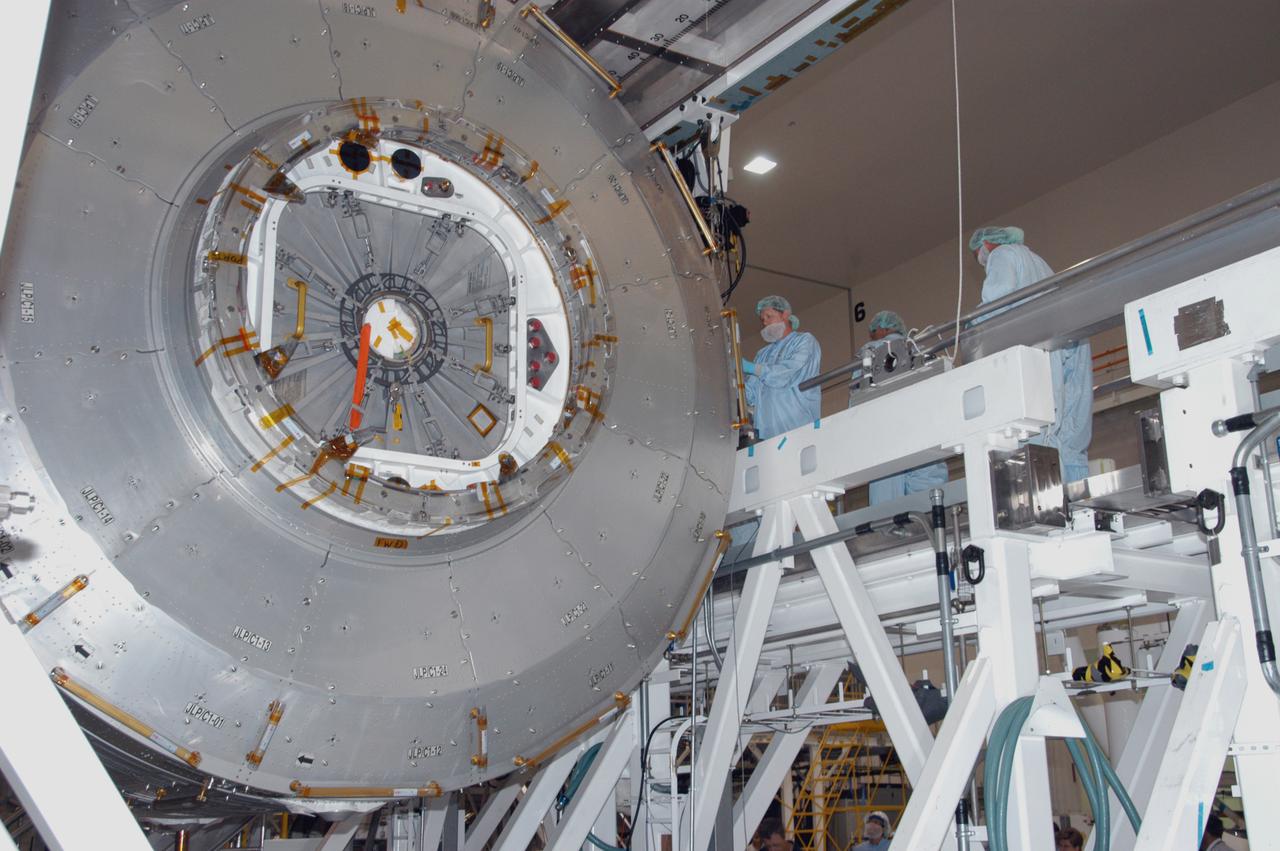
In the Space Station Processing Facility, the JEM Experiment Logistics Module Pressurized Section is lowered onto a scale for weight and center-of-gravity measurements. The module will then be moved to a work stand. The logistics module is one of the components of the Japanese Experiment Module or JEM, also known as Kibo, which means "hope" in Japanese. Kibo comprises six components: two research facilities -- the Pressurized Module and Exposed Facility; a Logistics Module attached to each of them; a Remote Manipulator System; and an Inter-Orbit Communication System unit. Kibo also has a scientific airlock through which experiments are transferred and exposed to the external environment of space. Kibo is Japan's first human space facility and its primary contribution to the station. Kibo will enhance the unique research capabilities of the orbiting complex by providing an additional environment in which astronauts can conduct science experiments. The various components of JEM will be assembled in space over the course of three Space Shuttle missions. The first of those three missions, STS-123, will carry the Experiment Logistics Module Pressurized Section aboard the Space Shuttle Endeavour, targeted for launch in 2007.
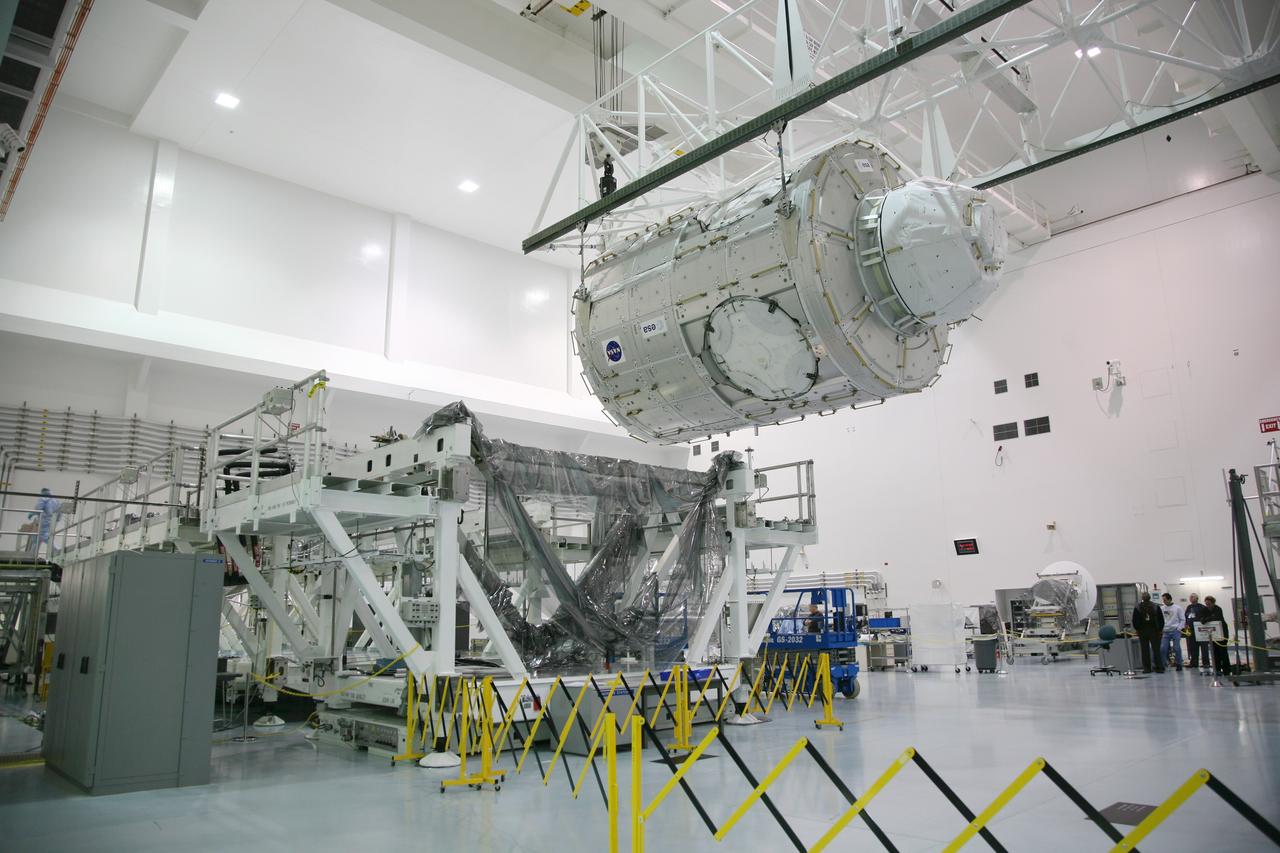
CAPE CANAVERAL, Fla. – In the Space Station Processing Facility at NASA's Kennedy Space Center in Florida, operations are under way to place the International Space Station's Node 3, named Tranquility, into a payload transportation canister for its move to Launch Pad 39A. Here, Tranquility is lifted from a workstand following measurement of its weight and center of gravity. The primary payload for the space shuttle Endeavour's STS-130 mission, Tranquility is a pressurized module that will provide room for many of the space station's life support systems. Attached to one end of Tranquility is a cupola, a unique work area with six windows on its sides and one on top. The cupola resembles a circular bay window and will provide a vastly improved view of the station's exterior. The multi-directional view will allow the crew to monitor spacewalks and docking operations, as well as provide a spectacular view of Earth and other celestial objects. The module was built in Turin, Italy, by Thales Alenia Space for the European Space Agency. Launch of STS-130 is targeted for Feb. 7. For information on the STS-130 mission and crew, visit http://www.nasa.gov/mission_pages/shuttle/shuttlemissions/sts130/index.html. Photo credit: NASA/Amanda Diller

NASA's F/A-18 Hornet is seen here in a banked turn over Rogers Dry Lake in the Mojave desert on an early research flight. It was flown by NASA's Dryden Flight Research Center, Edwards, California, in a multi-year, joint NASA/DOD/industry program, the former Navy fighter was modified into a unique Systems Research Aircraft (SRA) to investigate a host of new technologies in the areas of flight controls, airdata sensing and advanced computing. One of the more than 20 experiments tested aboard the SRA F-18 was an advanced air data sensing system which used a group of pressure taps flush-mounted on the forward fuselage to measure both altitude and wind speed and direction--critical data for flight control and research investigations. The Real-Time Flush Air Data Sensing system concept was evaluated for possible use on the X-33 and X-34 resuable space-launch vehicles. The primary goal of the SRA program was to validate through flight research cutting-edge technologies which could benefit future aircraft and spacecraft by improving efficiency and performance, reducing weight and complexity, with a resultant reduction on development and operational costs.
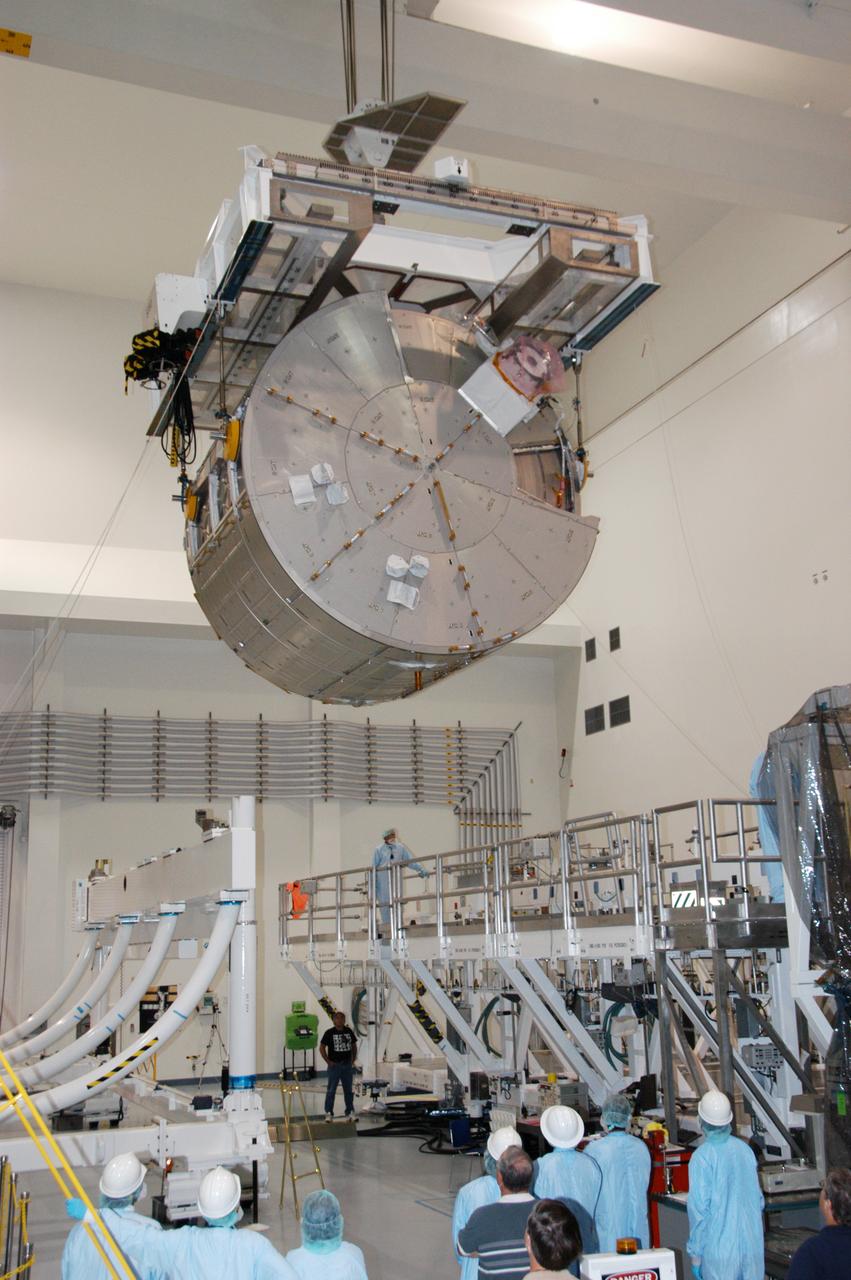
In the Space Station Processing Facility, an overhead crane moves the JEM Experiment Logistics Module Pressurized Section toward a scale (at left) for weight and center-of-gravity measurements. The module will then be moved to a work stand. The logistics module is one of the components of the Japanese Experiment Module or JEM, also known as Kibo, which means "hope" in Japanese. Kibo comprises six components: two research facilities -- the Pressurized Module and Exposed Facility; a Logistics Module attached to each of them; a Remote Manipulator System; and an Inter-Orbit Communication System unit. Kibo also has a scientific airlock through which experiments are transferred and exposed to the external environment of space. Kibo is Japan's first human space facility and its primary contribution to the station. Kibo will enhance the unique research capabilities of the orbiting complex by providing an additional environment in which astronauts can conduct science experiments. The various components of JEM will be assembled in space over the course of three Space Shuttle missions. The first of those three missions, STS-123, will carry the Experiment Logistics Module Pressurized Section aboard the Space Shuttle Endeavour, targeted for launch in 2007.
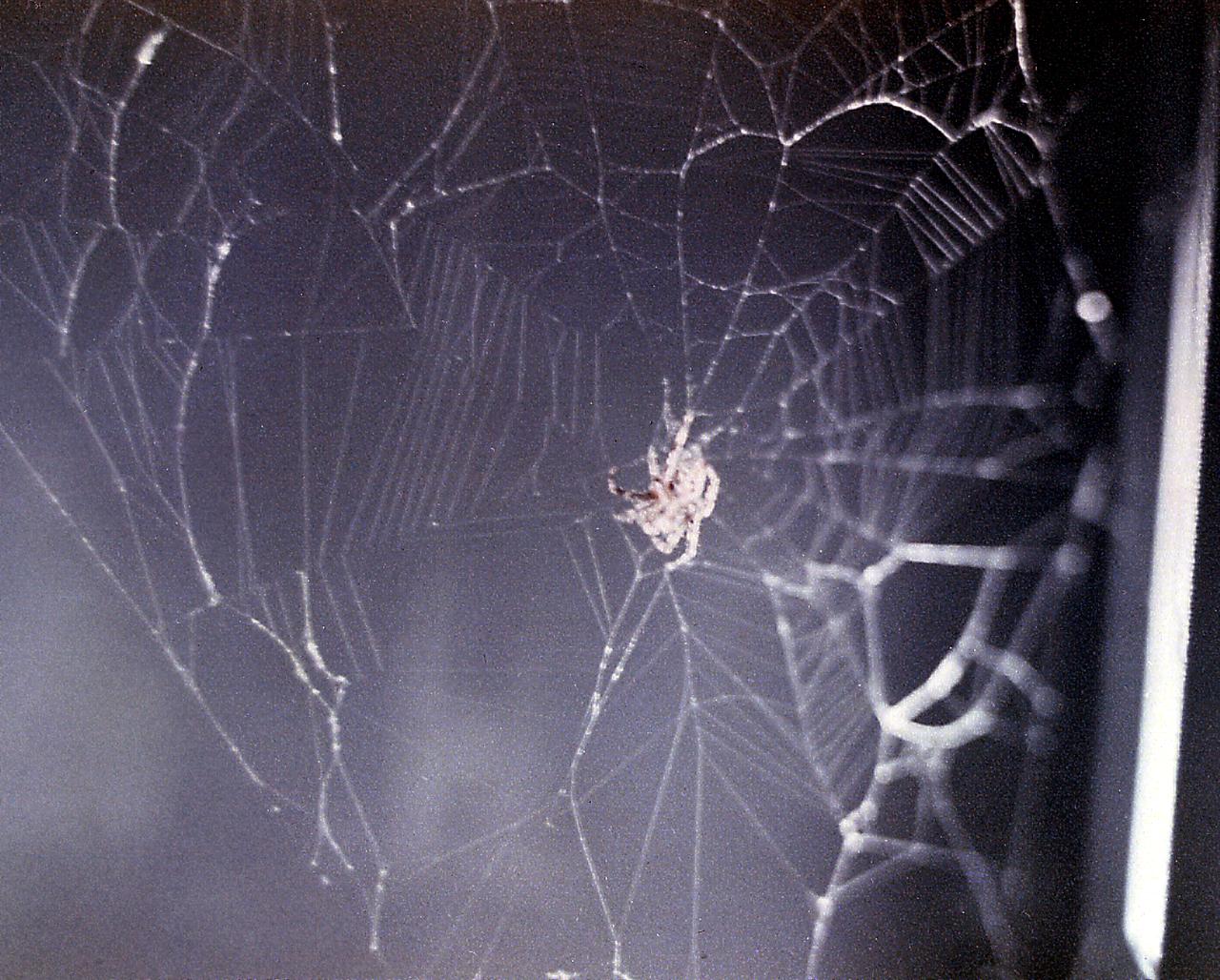
Judith S. Miles of Lexington High School, Lexington, Massachusetts, proposed skylab student experiment ED-52, Web Formation. This experiment was a study of a spider's behavior in a weightless environment. The geometrical structure of the web of the orb-weaving spider provides a good measure of the condition of its central nervous system. Since the spider senses its own weight to determine the required thickness of web material and uses both the wind and gravity to initiate construction of its web, the lack of gravitational force in Skylab provided a new and different stimulus to the spider's behavioral response. Two common cross spiders, Arabella and Anita, were used for the experiment aboard the Skylab-3 mission. After initial disoriented attempts, both spiders produced almost Earth-like webs once they had adapted to weightlessness. This photograph is of Arabella, a cross spider, in her initial attempt at spirning a web. This picture was taken by the crew of the Skylab 3 mission before Arabella adapted to her new environment.
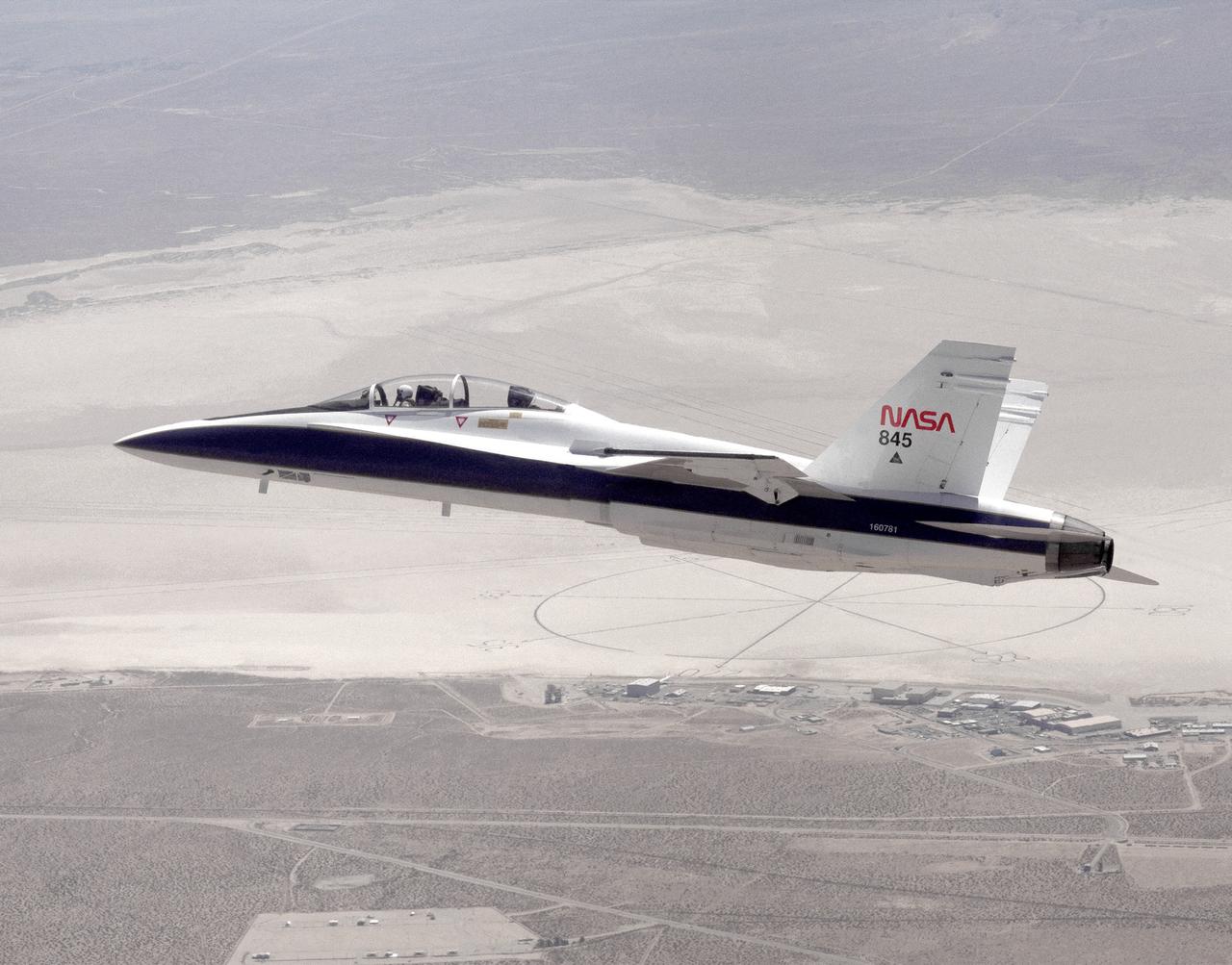
The National Aeronautics and Space Administration's Systems Research Aircraft (SRA), a highly modified F-18 jet fighter, on an early research flight over Rogers Dry Lake. The former Navy aircraft was flown by NASA's Dryden Flight Research Center at Edwards Air Force Base, California, to evaluate a number of experimental aerospace technologies in a multi-year, joint NASA/DOD/industry program. Among the more than 20 experiments flight-tested were several involving fiber optic sensor systems. Experiments developed by McDonnell-Douglas and Lockheed-Martin centered on installation and maintenace techniques for various types of fiber-optic hardware proposed for use in military and commercial aircraft, while a Parker-Hannifin experiment focused on alternative fiber-optic designs for postion measurement sensors as well as operational experience in handling optical sensor systems. Other experiments flown on this testbed aircraft included electronically-controlled control surface actuators, flush air data collection systems, "smart" skin antennae and laser-based systems. Incorporation of one or more of these technologies in future aircraft and spacecraft could result in signifigant savings in weight, maintenance and overall cost.
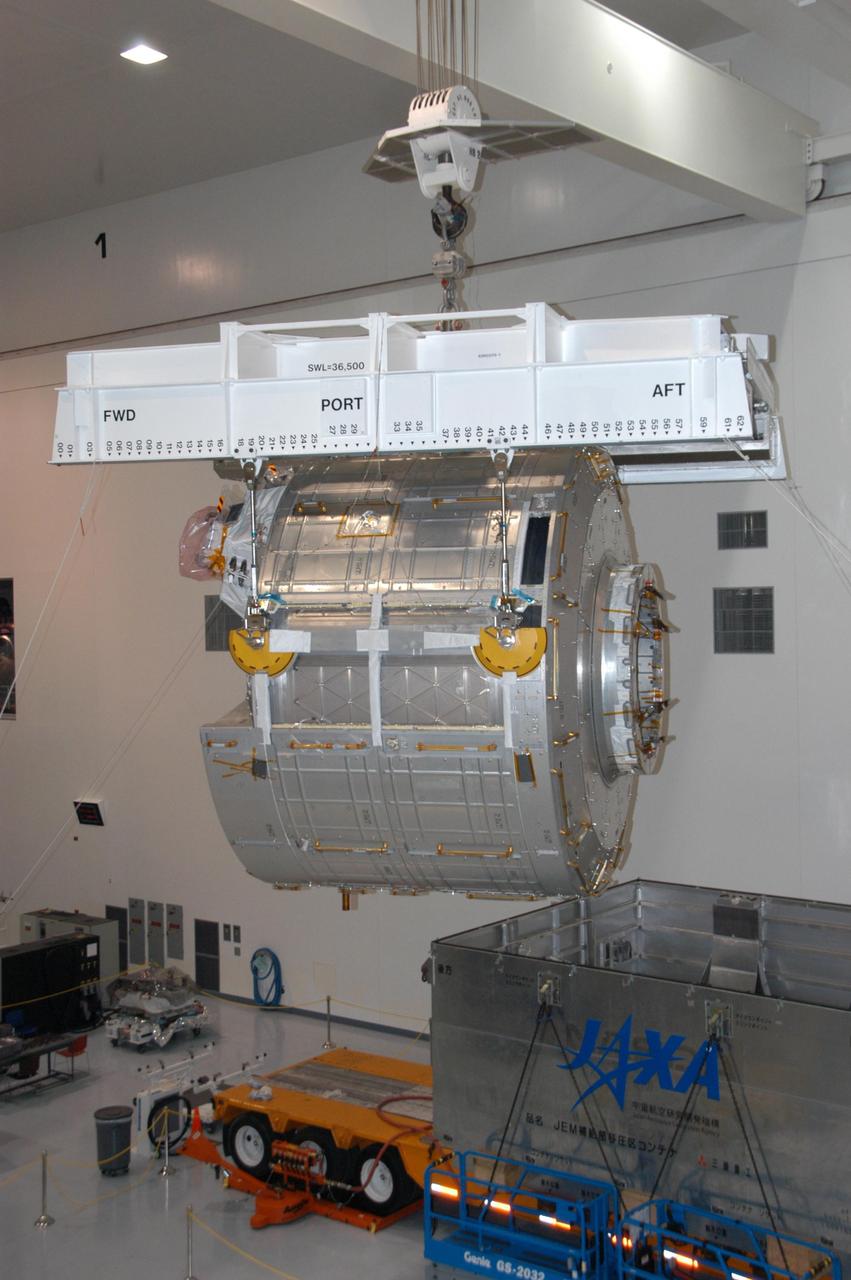
KENNEDY SPACE CENTER, FLA. -- In the Space Station Processing Facility, an overhead crane lifts the JEM Experiment Logistics Module Pressurized Section from its shipping container and moves it toward a scale for weight and center-of-gravity measurements. The module will then be moved to a work stand. The logistics module is one of the components of the Japanese Experiment Module or JEM, also known as Kibo, which means "hope" in Japanese. Kibo comprises six components: two research facilities -- the Pressurized Module and Exposed Facility; a Logistics Module attached to each of them; a Remote Manipulator System; and an Inter-Orbit Communication System unit. Kibo also has a scientific airlock through which experiments are transferred and exposed to the external environment of space. Kibo is Japan's first human space facility and its primary contribution to the station. Kibo will enhance the unique research capabilities of the orbiting complex by providing an additional environment in which astronauts can conduct science experiments. The various components of JEM will be assembled in space over the course of three Space Shuttle missions. The first of those three missions, STS-123, will carry the Experiment Logistics Module Pressurized Section aboard the Space Shuttle Endeavour, targeted for launch in 2007. Photo credit: NASA/George Shelton
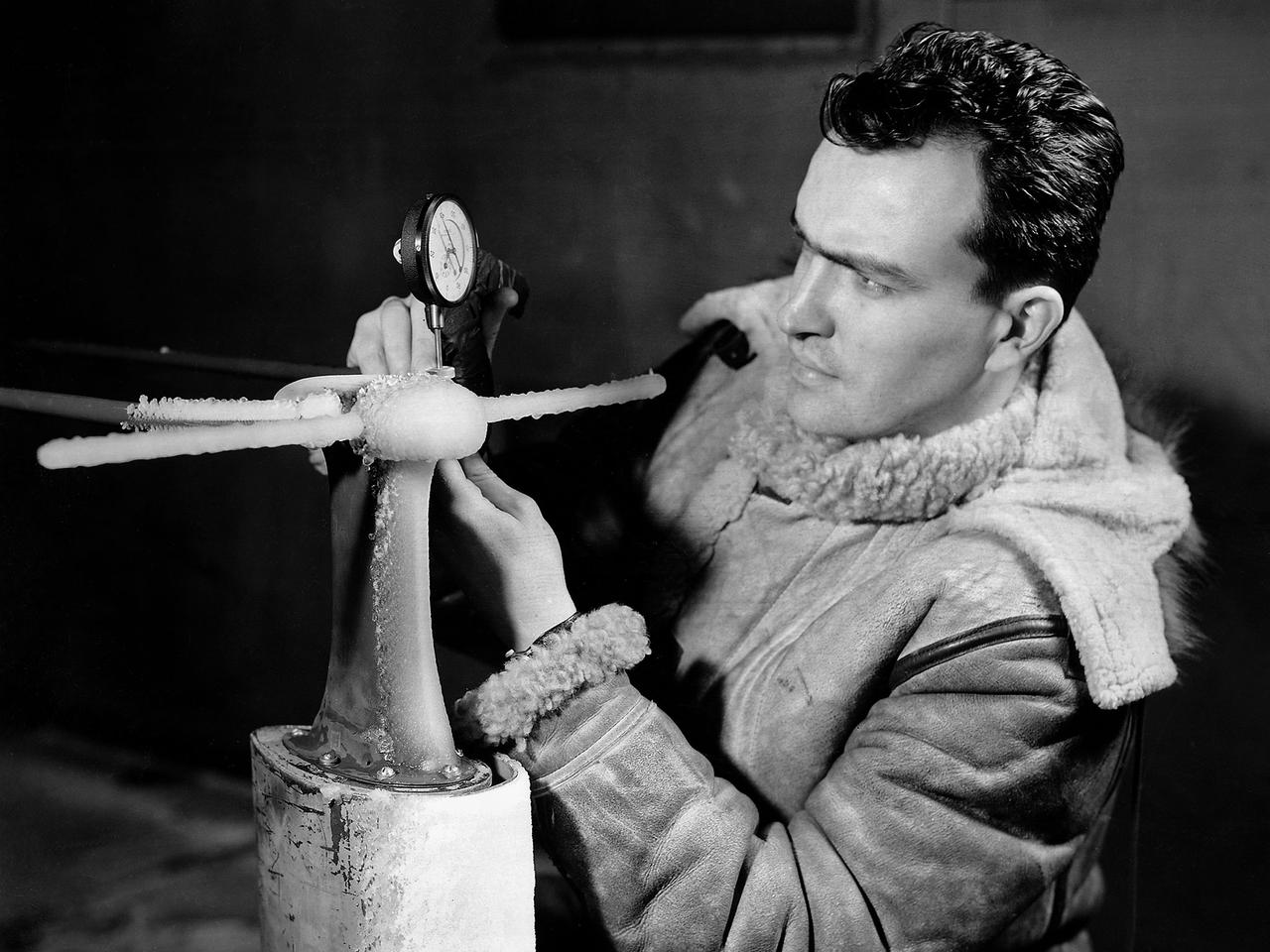
A National Advisory Committee for Aeronautics (NACA) researcher measures the ice thickness on a landing antenna model in the Icing Research Tunnel at the Aircraft Engine Research Laboratory. NACA design engineers added the Icing Research Tunnel to the original layout of the new Aircraft Engine Research Laboratory to take advantage of the massive refrigeration system being built for the Altitude Wind Tunnel. The Icing Research Tunnel was built to study the formation of ice on aircraft surfaces and methods of preventing or eradicating that ice. Ice buildup adds extra weight, effects aerodynamics, and sometimes blocks air flow through engines. The Icing Research Tunnel is a closed-loop atmospheric wind tunnel with a 6- by 9-foot test section. Carrier Corporation refrigeration equipment reduced the internal air temperature to -45 degrees F and a spray bar system injected water droplets into the air stream. The 24-foot diameter drive fan, seen in this photograph, created air flows velocities up to 400 miles per hour. The Icing Research Tunnel began testing in June of 1944. Early testing, seen in this photograph, studied ice accumulation on propellers and antenna of a military aircraft. The Icing Research Tunnel’s designers, however, struggled to develop a realistic spray system since they did not have access to data on the size of naturally occurring water droplets. The system would have to generate small droplets, distribute them uniformly throughout the airstream, and resist freezing and blockage. For five years a variety of different designs were painstakingly developed and tested before the system was perfected.
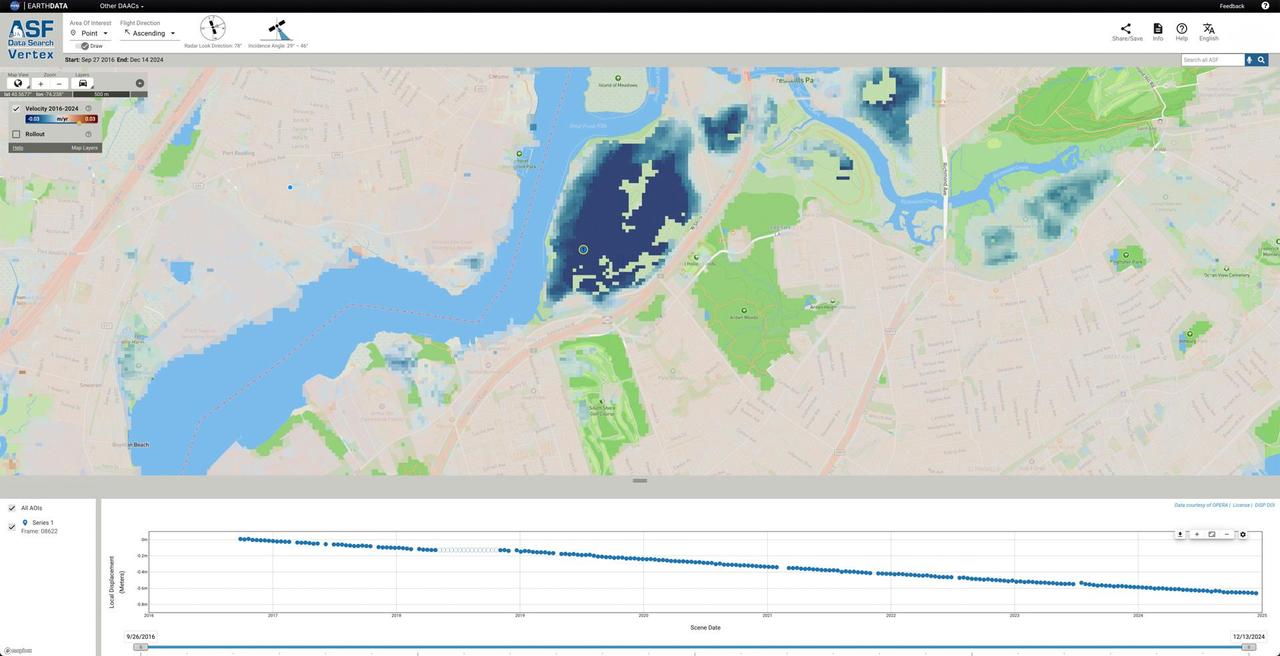
NASA, along with the agency's Jet Propulsion Laboratory in Southern California, is collaborating with the Alaska Satellite Facility in Fairbanks to create a powerful web-based tool that will show the movement of land across North America down to less than an inch. The online portal and its underlying dataset unlock a trove of satellite radar measurements that can help anyone identify where and by how much the land beneath their feet may be moving – whether from earthquakes, volcanoes, landslides, or the extraction of underground natural resources such as groundwater. Spearheaded by NASA's Observational Products for End-Users from Remote Sensing Analysis, or OPERA, project at JPL, the effort equips users with information that would otherwise take years of training to harness. The project builds on data from spaceborne synthetic aperture radars, or SARs, to generate high-resolution data on how Earth's surface is moving. Formally called the North America Surface Displacement Product Suite, the new dataset dates to 2016. By the end of 2025, the data will cover the entire United States, Central America, and Canada within 120 miles (200 kilometers) of the U.S. border. The image shows how the portal visualizes land sinking over time in Freshkills Park, which is being built on a former landfill on Staten Island, New York. Landfills tend to sink over time as waste decomposes, compacts, and settles under its own weight. The blue dot marks the point on the land where the portal is displaying movement in the accompanying scatterplot. https://photojournal.jpl.nasa.gov/catalog/PIA26494
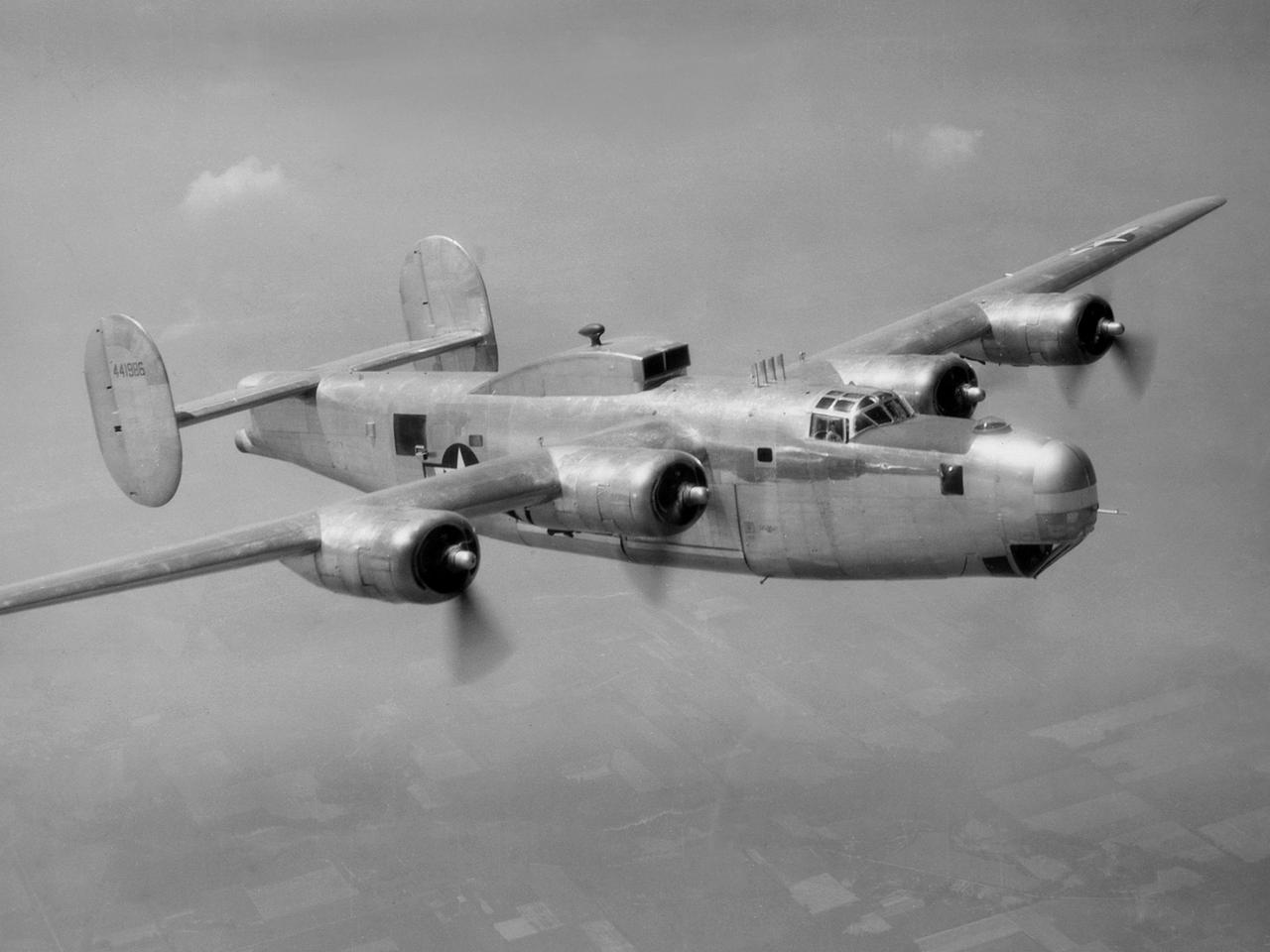
A Consolidated B-25M Liberator modified for icing research by the National Advisory Committee for Aeronautics (NACA) Lewis Flight Propulsion Laboratory. NACA Lewis performed a limited amount of icing research during World War II, but the program expanded significantly in 1946. The accumulation of ice on aircraft was a continual problem. The ice formations could result in extra weight, aerodynamic penalties, and blockage engine inlets. Although the Lewis icing researchers utilized numerous aircraft, the program’s two workhorses were the B-24M Liberator, seen here, and a North American XB-25E Mitchell. The Consolidated Aircraft Company created the four-engine bomber in the early 1940s. During World War II the bomber was employed on long-duration bombing missions in both Europe and the Pacific. Production of the B-24M version did not begin until October 1944 with the end of the war in Europe approaching. This resulted in scores of unneeded bombers when hostilities ended. This B-24M arrived at the NACA Lewis laboratory in November 1945. At Lewis the B-24M was repeatedly modified to study ice accretion on aircraft components. Researchers analyzed different anti-icing and deicing strategies and gathered statistical ice measurement data. The B-24M was also used to study ice buildup on jet engines. A General Electric I-16 engine was installed in the aircraft’s waist compartment with an air scoop on the top of the aircraft to duct air to the engine. Water spray nozzles inside the aircraft were employed to simulate icing conditions at the turbojet’s inlet.

This VIS image shows part of the eastern margin of the summit caldera of Arsia Mons. The arcuate features are the faults created by collapse of summit materials. A massive eruption can empty the large magma chamber which existed within the volcano, creating a void which can not support the weight of the top of the volcano. Arsia Mons is the southernmost of the Tharsis volcanoes. It is 270 miles (450km) in diameter, almost 12 miles (20km) high, and the summit caldera is 72 miles (120km) wide. For comparison, the largest volcano on Earth is Mauna Loa. From its base on the sea floor, Mauna Loa measures only 6.3 miles high and 75 miles in diameter. A large volcanic crater known as a caldera is located at the summit of all of the Tharsis volcanoes. These calderas are produced by massive volcanic explosions and collapse. The Arsia Mons summit caldera is larger than many volcanoes on Earth. The Odyssey spacecraft has spent over 15 years in orbit around Mars, circling the planet more than 69000 times. It holds the record for longest working spacecraft at Mars. THEMIS, the IR/VIS camera system, has collected data for the entire mission and provides images covering all seasons and lighting conditions. Over the years many features of interest have received repeated imaging, building up a suite of images covering the entire feature. From the deepest chasma to the tallest volcano, individual dunes inside craters and dune fields that encircle the north pole, channels carved by water and lava, and a variety of other feature, THEMIS has imaged them all. For the next several months the image of the day will focus on the Tharsis volcanoes, the various chasmata of Valles Marineris, and the major dunes fields. We hope you enjoy these images! Orbit Number: 12487 Latitude: -9.44031 Longitude: 240.527 Instrument: VIS Captured: 2004-10-07 11:58 https://photojournal.jpl.nasa.gov/catalog/PIA22152
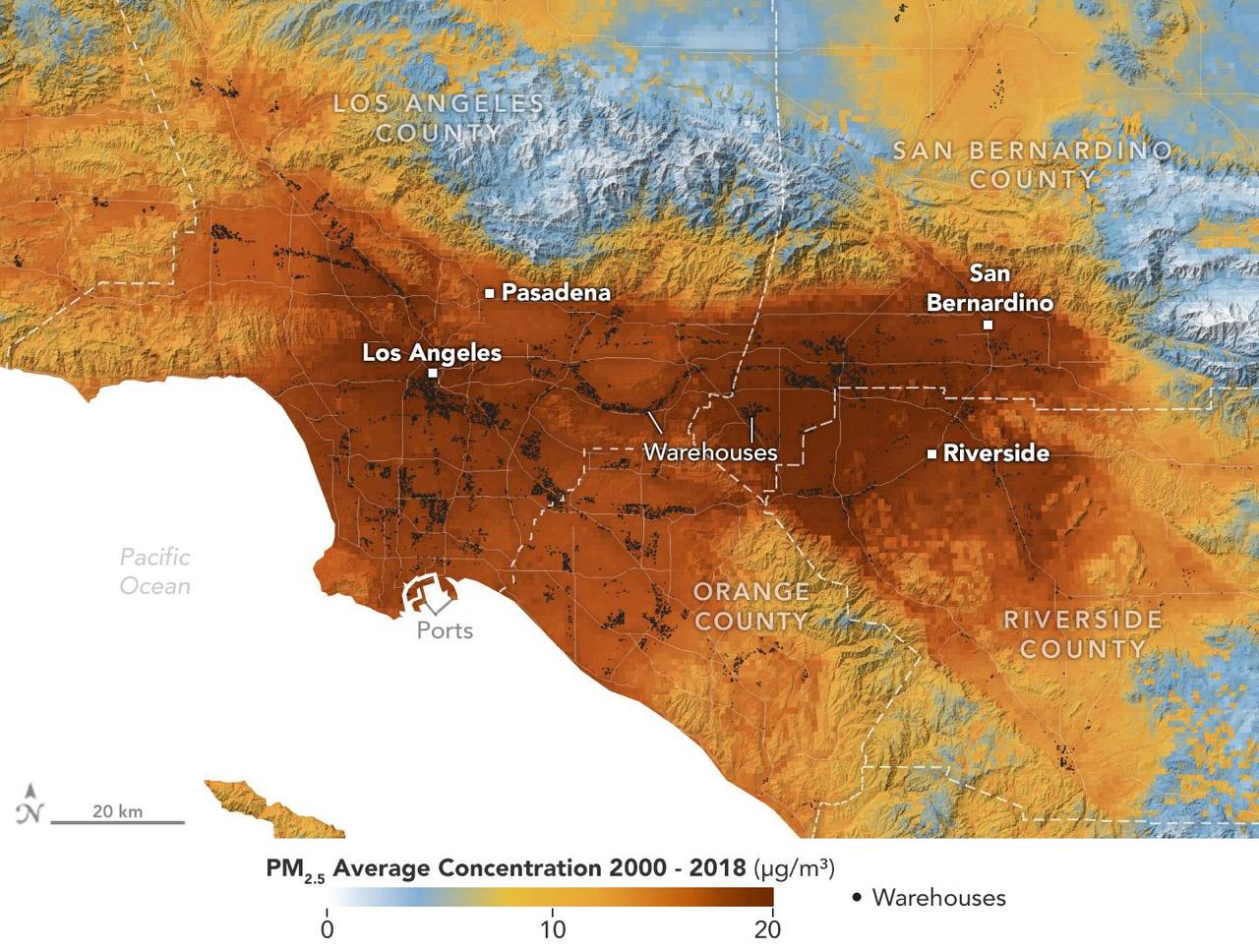
A data visualization shows the average concentration of PM2.5 particulate pollution in the Los Angeles region from 2000 to 2018, along with the locations of nearly 11,000 warehouses over the same time period. Particles measuring 2.5 micrometers or less, PM2.5 are pollutants that can be inhaled into the lungs and absorbed into the bloodstream. A NASA-funded study published in September 2024 in GeoHealth analyzed patterns and trends of atmospheric PM2.5 concentration and found that ZIP codes with more or larger warehouses had higher levels of PM2.5 and elemental carbon over time than those with fewer warehouses. Elemental carbon is a type of PM2.5 that is produced by heavy-duty diesel engines. In the visualization, areas with higher concentrations of PM2.5 are shown in darker red, and locations of warehouses are indicated by small black circles (many of them clustered closely together). The PM2.5 data came from models based on satellite observations, including from NASA's Moderate Resolution Imaging Spectroradiometer (MODIS) and Advanced Spaceborne Thermal Emission and Reflection Radiometer (ASTER) instruments. The PM2.5 warehouse locations were derived from a commercial real estate database. Particulate pollution has been linked to respiratory and cardiovascular diseases, some cancers, and adverse birth outcomes, including premature birth and low infant birth weight. As the e-commerce boom of recent decades has spurred warehouse construction, pollution in nearby neighborhoods has become a growing area for research. https://photojournal.jpl.nasa.gov/catalog/PIA26415
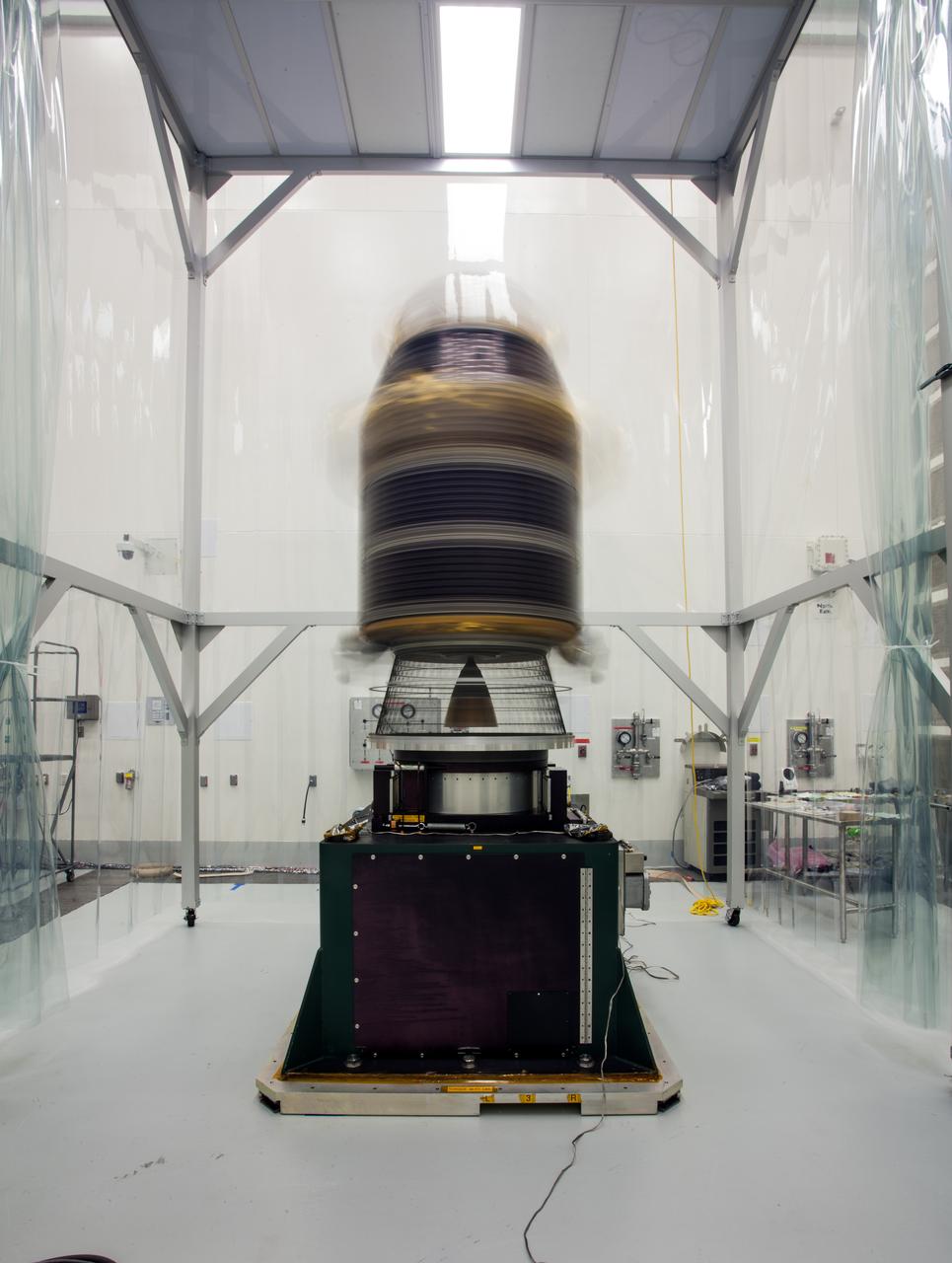
During preparations for NASA's Lunar Atmosphere and Dust Environment Explorer (LADEE) observatory launch on Sept. 6, 2013, the spacecraft went through final preparations and close-outs, which included checking alignment after its cross-country shipment, checking the propulsion system for leaks, inspecting and repairing solar panels, and final electrical tests. After these activities were completed, more challenging portions of the launch preparations began: spin testing and fueling. To make sure that the spacecraft is perfectly balanced for flight, engineers mounted it onto a spin table and rotate it at high speeds, approximately one revolution per second. The team measured any offsets during the spinning, and then added small weights to the spacecraft to balance it. Once the spacecraft was balanced dry, the team loaded the propulsion tanks with fuel, oxidizer, and pressurant. The spin testing was performed again "wet," or with fuel, in order to see if the balance changed with the full fuel tanks. Engineers from NASA's Ames Research Center in Moffett Field, Calif., have now successfully completed launch preparation activities for LADEE, which has been encapsulated into the nose-cone of the Minotaur V rocket at NASA's Wallops Flight Facility in Virginia. LADEE is ready to launch when the window opens on Friday. Image Credit: NASA ----- What is LADEE? The Lunar Atmosphere and Dust Environment Explorer (LADEE) is designed to study the Moon's thin exosphere and the lunar dust environment. An "exosphere" is an atmosphere that is so thin and tenuous that molecules don't collide with each other. Studying the Moon's exosphere will help scientists understand other planetary bodies with exospheres too, like Mercury and some of Jupiter's bigger moons. The orbiter will determine the density, composition and temporal and spatial variability of the Moon's exosphere to help us understand where the species in the exosphere come from and the role of the solar wind, lunar surface and interior, and meteoric infall as sources. The mission will also examine the density and temporal and spatial variability of dust particles that may get lofted into the atmosphere. The mission also will test several new technologies, including a modular spacecraft bus that may reduce the cost of future deep space missions and demonstrate two-way high rate laser communication for the first time from the Moon. LADEE now is ready to launch when the window opens on Sept. 6, 2013. Read more: <a href="http://www.nasa.gov/ladee" rel="nofollow">www.nasa.gov/ladee</a> <b><a href="http://www.nasa.gov/audience/formedia/features/MP_Photo_Guidelines.html" rel="nofollow">NASA image use policy.</a></b> <b><a href="http://www.nasa.gov/centers/goddard/home/index.html" rel="nofollow">NASA Goddard Space Flight Center</a></b> enables NASA’s mission through four scientific endeavors: Earth Science, Heliophysics, Solar System Exploration, and Astrophysics. Goddard plays a leading role in NASA’s accomplishments by contributing compelling scientific knowledge to advance the Agency’s mission. <b>Follow us on <a href="http://twitter.com/NASA_GoddardPix" rel="nofollow">Twitter</a></b> <b>Like us on <a href="http://www.facebook.com/pages/Greenbelt-MD/NASA-Goddard/395013845897?ref=tsd" rel="nofollow">Facebook</a></b> <b>Find us on <a href="http://instagram.com/nasagoddard?vm=grid" rel="nofollow">Instagram</a></b>