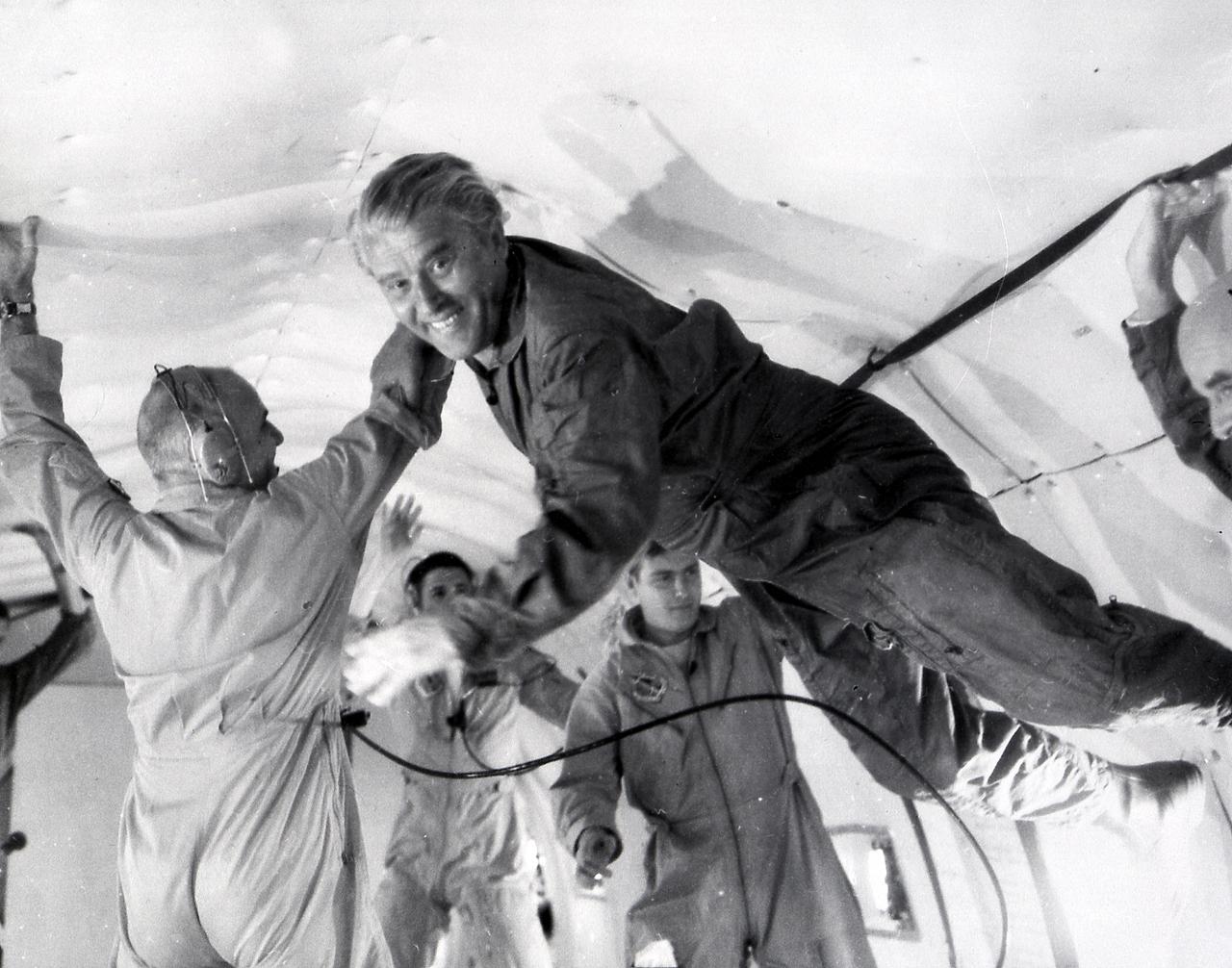
Dr. von Braun inside the KC-135 in flight. The KC-135 provide NASA's Reduced-Gravity Program the unique weightlessness or zero-g environment of space flight for testing and training of human and hardware reactions. The recent version, KC-135A, is a specially modified turbojet transport which flies parabolic arcs to produce weightlessness periods of 20 to 25 seconds and its cargo bay test area is approximately 60 feet long, 10 feet wide, and 7 feet high.
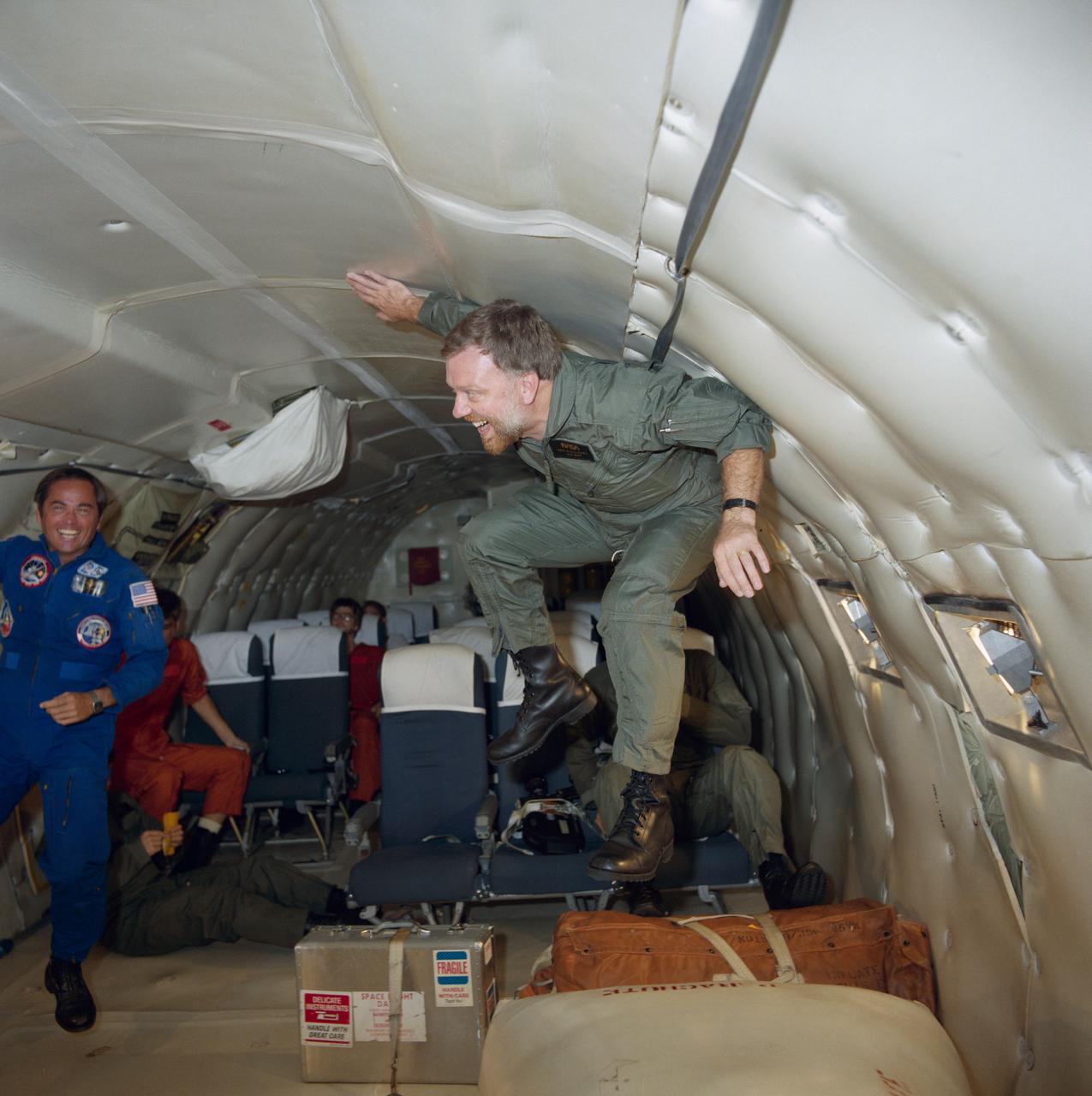
S84-37536 (18 July 1984) --- Astronaut Robert L. Crippen, left, 41-G crew commander watches as one of his fellow crewmembers gets an introduction to weightlessness aboard a KC-135, "zero-gravity" aircraft. Paul D. Scully-Power is the crew member literally floating here in the brief period of micro-gravity. Scully-Power, an oceanographer with the U.S. Navy, and Marc Garneau (partially visible in chair behind the floating Scully-Power)are payload specialists for 41-G. Garneau represents the National Research Council (Canada).
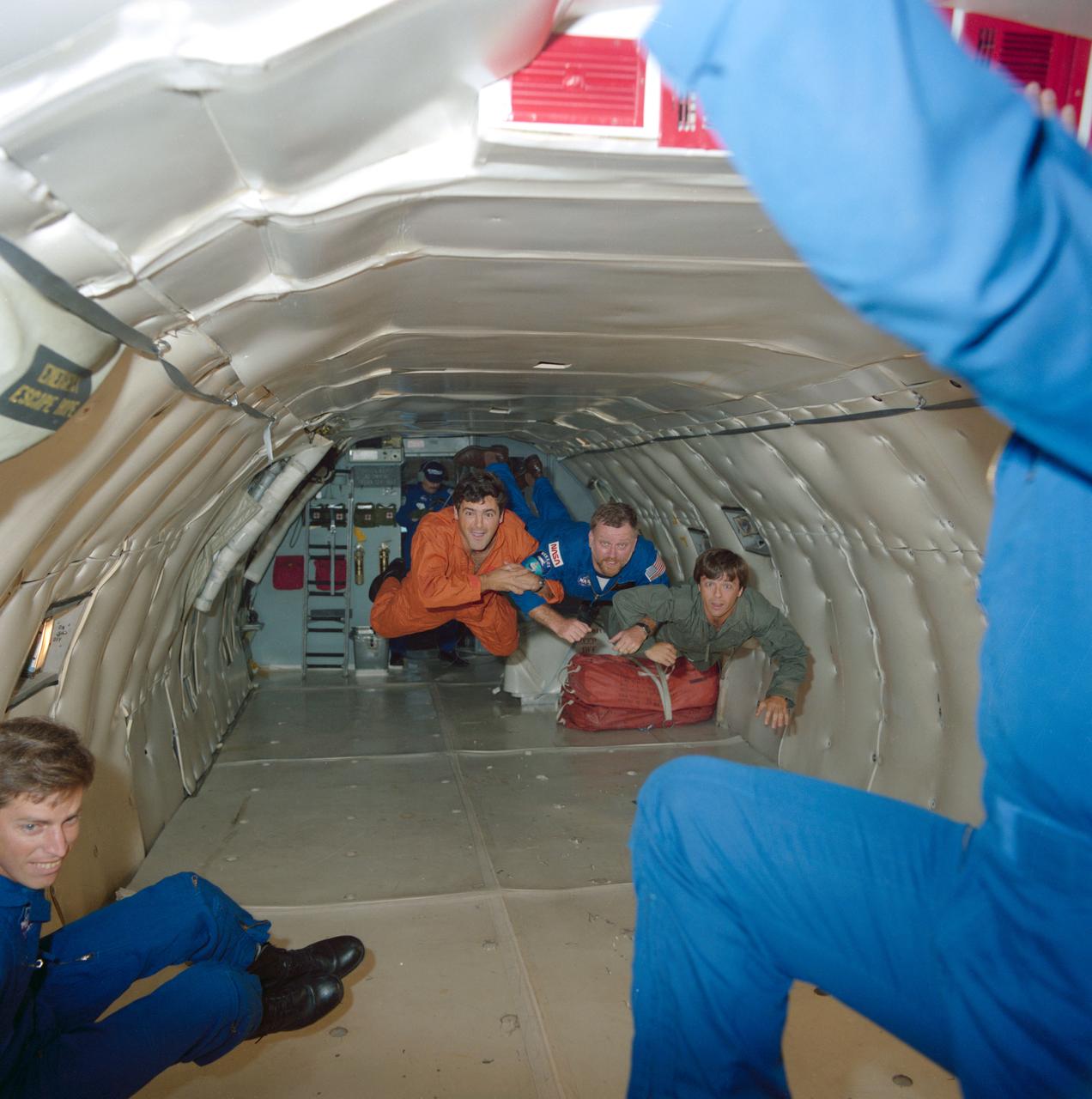
S84-40538 (24 Aug 1984) --- Two 41-G payload specialists and a backup for one of them appear to be at home in zero gravity in this scene photographed aboard a KC-135 "Zero gravity" aircraft flying one of its weightlessness opportunity parabolas. Paul D. Scully-Power, a civilian oceanographer with the U.S. Navey, is flanked by Marc Garneau (left) and Robert Thirsk, both representing the National Research Council of Canada. Thirsk is back up payload specialist for Garneau.
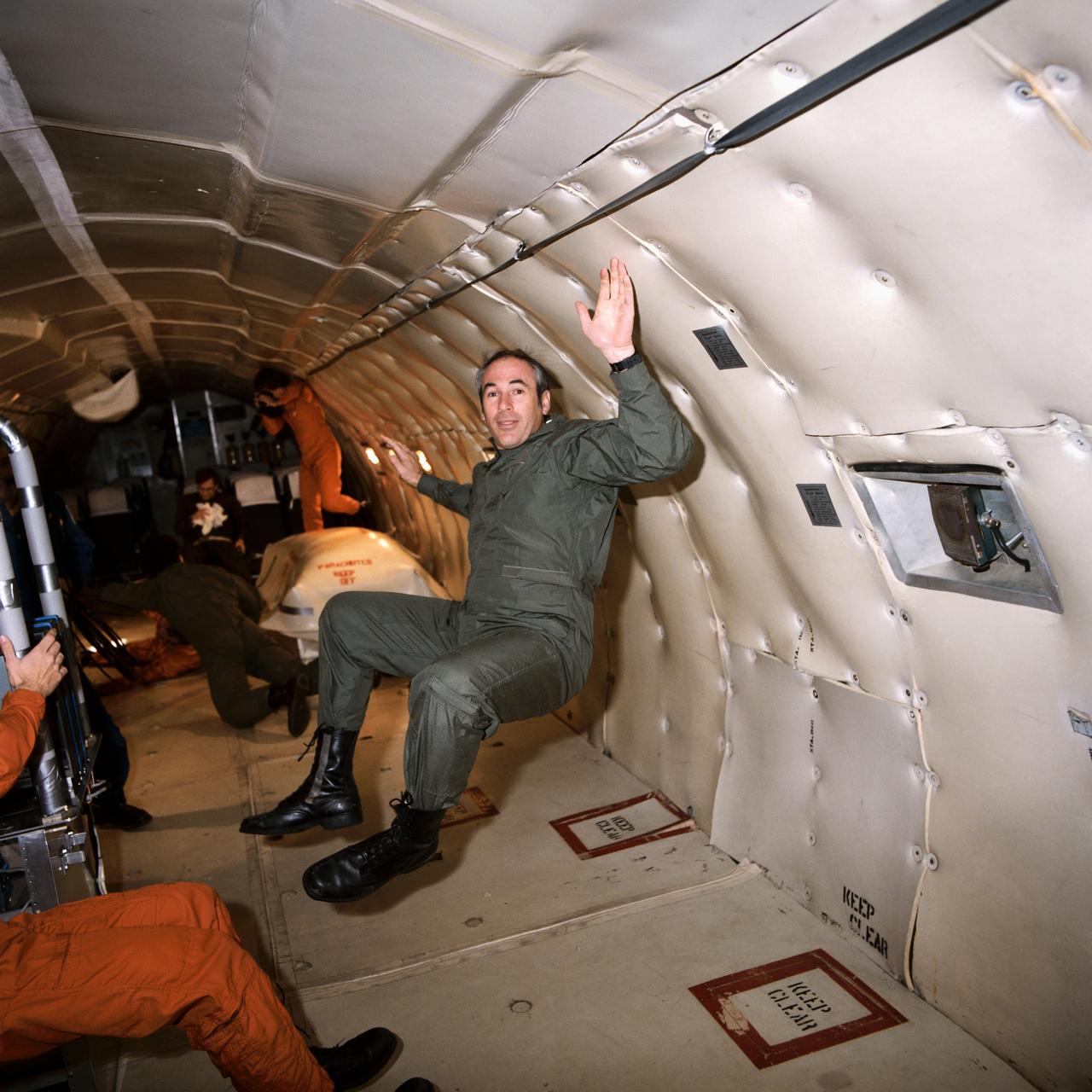
S85-26106 (25 Jan. 1985) --- Astronaut Gregory Jarvis gets a familiarization session in weightlessness aboard a KC-135 "zero gravity" aircraft. Jarvis was originally assigned as payload specialist to STS-51D but was reassigned to STS-51L. Photo credit: NASA
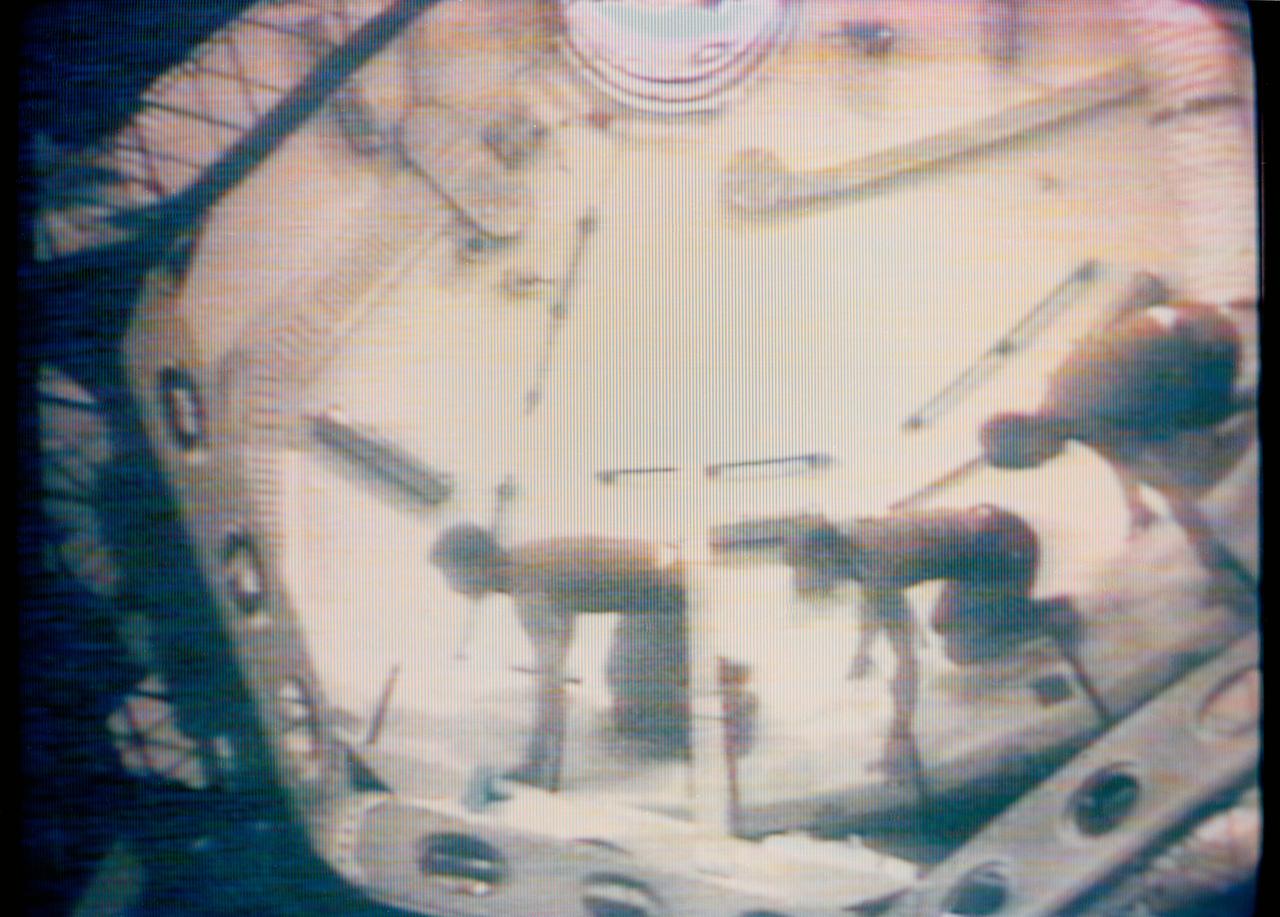
S73-27262 (1 June 1973) --- The three Skylab 2 crewmen give a demonstration on the effects of weightlessness in the Orbital Workshop of the Skylab 1 and 2 space station cluster in Earth orbit, as seen in this reproduction taken from a color television transmission made by a TV camera aboard the space station. Astronauts Charles Conrad Jr., Joseph P. Kerwin and Paul J. Weitz are crouched in a fast-start stance to race around the dome area of the OWS forward compartment. The astronauts had ease of motion and good maneuverability in the zero-gravity of space. Photo credit: NASA
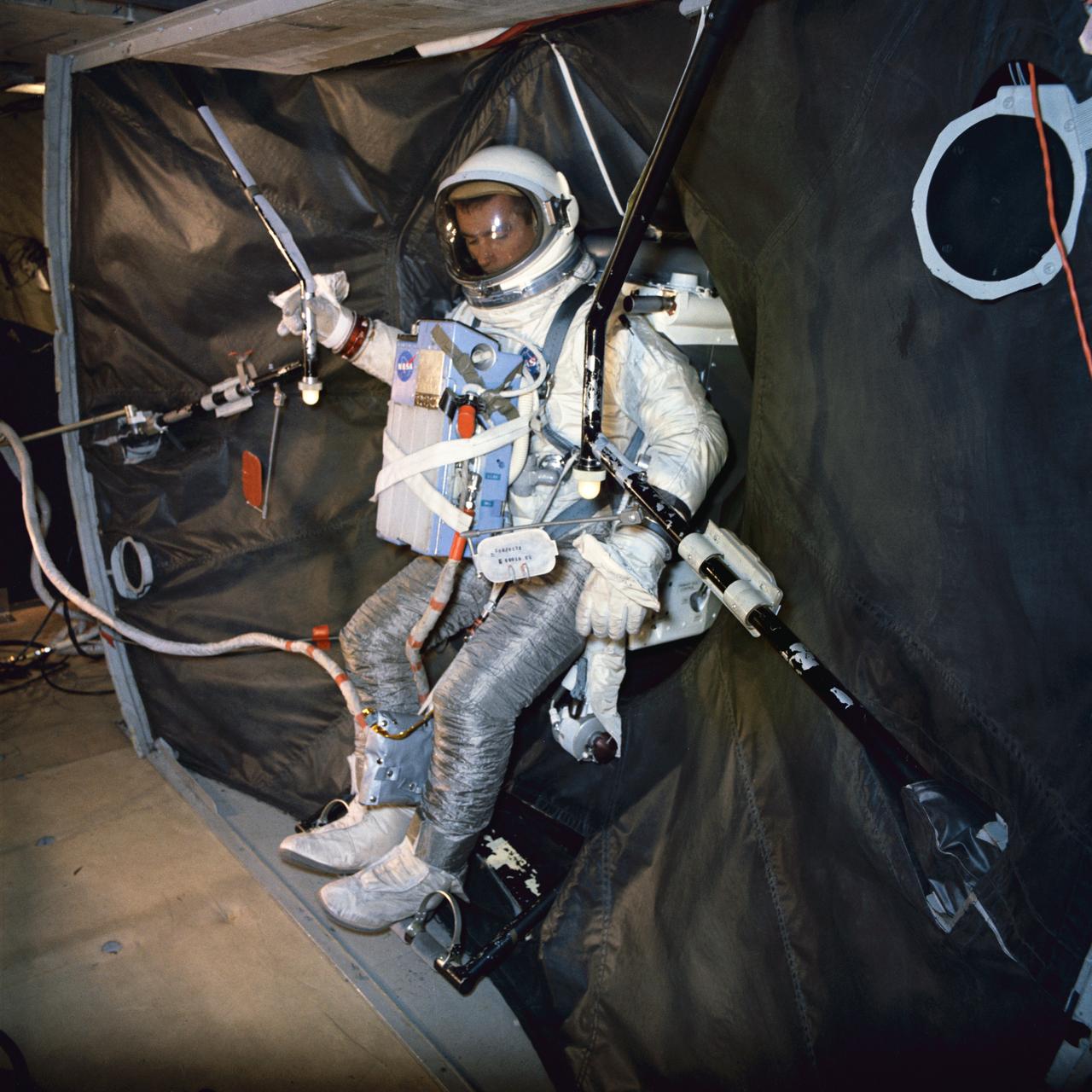
S66-31665 (3 May 1966) --- Astronaut Eugene A. Cernan, pilot of the Gemini-9 spaceflight, participates in extravehicular training under zero-gravity conditions aboard a KC-135 aircraft. Here, he is donning the Astronaut Maneuvering Unit (AMU) backpack after egressing a Gemini mock-up. The AMU backpack is mounted in the adapter equipment section of the mock-up. Cernan wears an extravehicular activity (EVA) life support system chest pack. Cernan will use the AMU during his scheduled EVA on the Gemini-9 mission. The KC-135 flew a parabolic curve to create the weightlessness condition for training purposes. Photo credit: NASA

Astronaut Joe H. Engle, STS-2 commander, practices donning and doffing his extravehicular mobility unit (EMU) in the weightless environment afforded aboard a KC-135 "zero-gravity" aircraft.
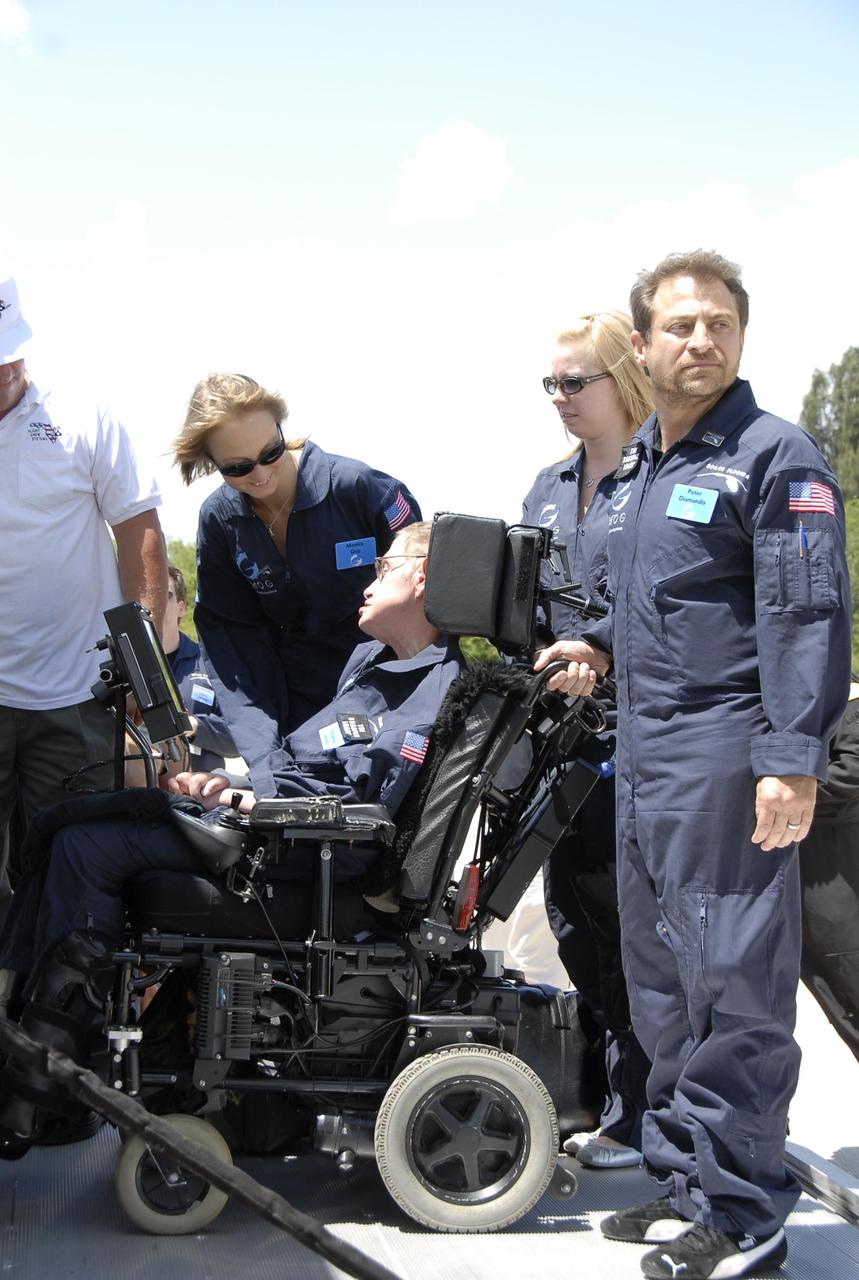
KENNEDY SPACE CENTER, FLA. -- At the Kennedy Space Center Shuttle Landing Facility, noted physicist Stephen Hawking, in the wheelchair, is ready to get onboard a modified Boeing 727 aircraft owned by Zero Gravity Corp. for his first zero-gravity flight. Zero Gravity Corp. is a commercial company licensed to provide the public with weightless flight experiences. At right is Peter Diamandis, founder of the Zero Gravity Corp. Behind Hawking is Nicola O'Brien, a nurse practitioner who is Hawking's aide. Hawking developed amyotrophic lateral sclerosis disease in the 1960s, a type of motor neuron disease which would cost him the loss of almost all neuromuscular control. At the celebration of his 65th birthday on January 8 this year, Hawking announced his plans for a zero-gravity flight to prepare for a sub-orbital space flight in 2009 on Virgin Galactic's space service. Photo credit: NASA/Kim Shiflett

The Reduced-Gravity Program provides the unique weightless or zero-g environment of space flight for testing and training of human and hardware reactions. The reduced-gravity environment is obtained with a specially modified KC-135A turbojet transport which flies parabolic arcs to produce weightless periods of 20 to 25 seconds. KC-135A cargo bay test area is approximately 60 feet long, 10 feet wide, and 7 feet high. The image shows KC-135A in flight.
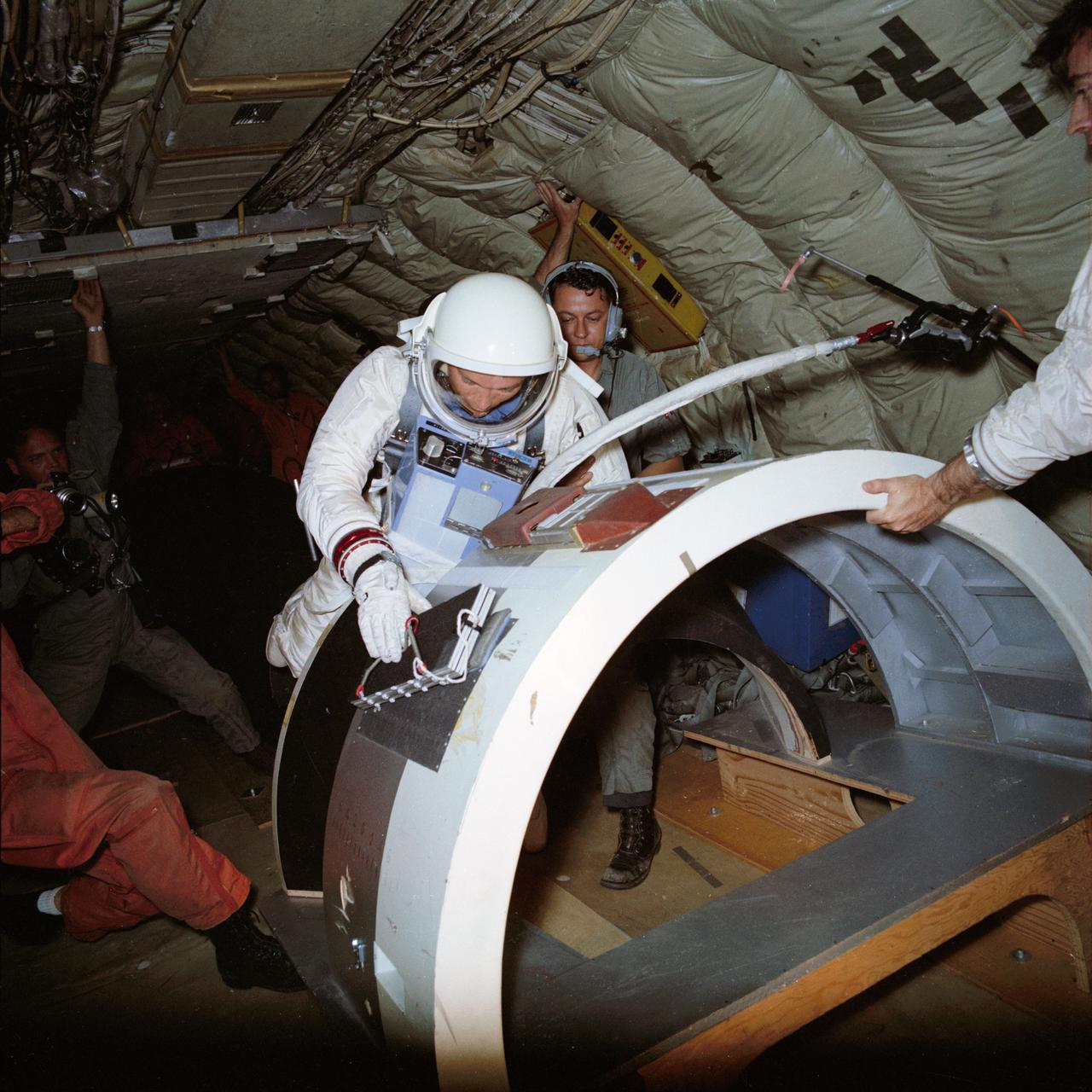
S66-40098 (17 June 1966) --- Astronaut Michael Collins, prime crew pilot of the Gemini-10 spaceflight, undergoes zero-gravity (weightlessness) training aboard an Air Force KC-135 aircraft. He practices with micrometeorite experiment-type equipment. The KC-135 flew a parabolic curve to create the zero-gravity condition. This training is in preparation for Collins' Gemini-10 extravehicular activity. Photo credit: NASA
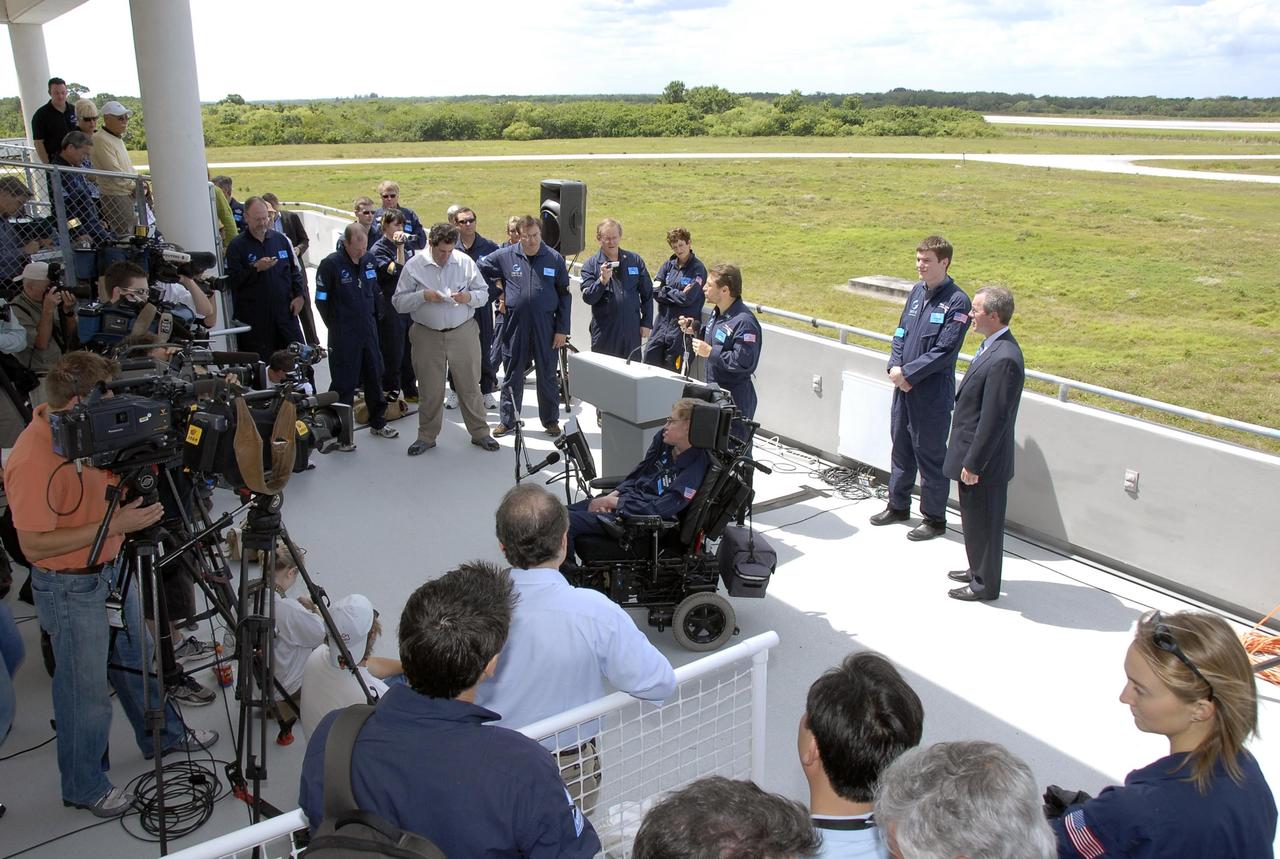
KENNEDY SPACE CENTER, FLA. -- At the Kennedy Space Center Shuttle Landing Facility, Peter Diamandis, founder of the Zero Gravity Corp., talks to the media about physicist Stephen Hawking's (in the wheelchair) first zero-gravity flight. The flight will be aboard a modified Boeing 727 aircraft owned by Zero Gravity Corp., a commercial company licensed to provide the public with weightless flight experiences. Hawking developed amyotrophic lateral sclerosis disease in the 1960s, a type of motor neuron disease which would cost him the loss of almost all neuromuscular control. At the celebration of his 65th birthday on January 8 this year, Hawking announced his plans for a zero-gravity flight to prepare for a sub-orbital space flight in 2009 on Virgin Galactic's space service. Photo credit: NASA/Kim Shiflett
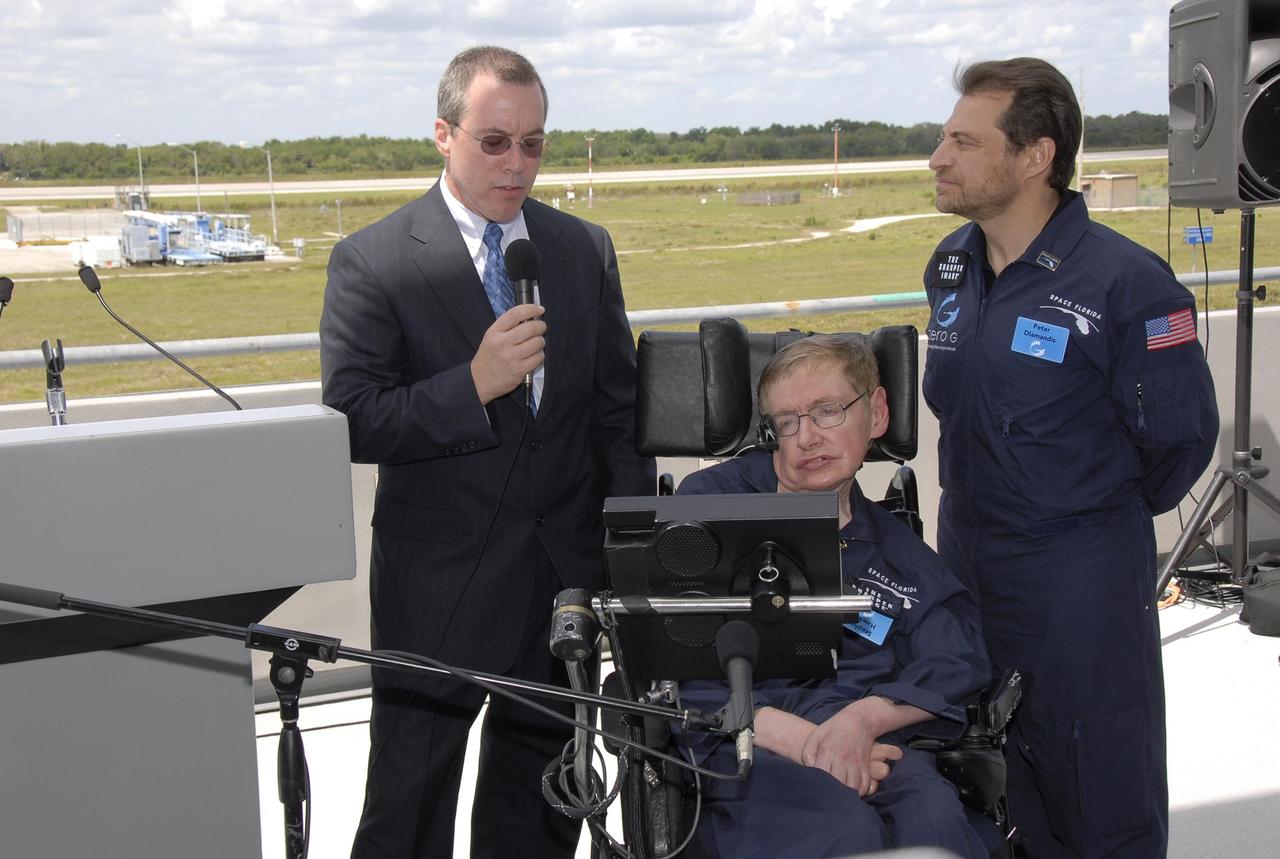
KENNEDY SPACE CENTER, FLA. -- At the Kennedy Space Center Shuttle Landing Facility, Space Florida president Steve Kohler (left) talks to the media about physicist Stephen Hawking's (in the wheelchair) first zero-gravity flight. The flight will be aboard a modified Boeing 727 aircraft owned by Zero Gravity Corp., a commercial company licensed to provide the public with weightless flight experiences. At right is Peter Diamandis, founder of the Zero Gravity Corp. Hawking developed amyotrophic lateral sclerosis disease in the 1960s, a type of motor neuron disease which would cost him the loss of almost all neuromuscular control. At the celebration of his 65th birthday on January 8 this year, Hawking announced his plans for a zero-gravity flight to prepare for a sub-orbital space flight in 2009 on Virgin Galactic's space service. Photo credit: NASA/Kim Shiflett
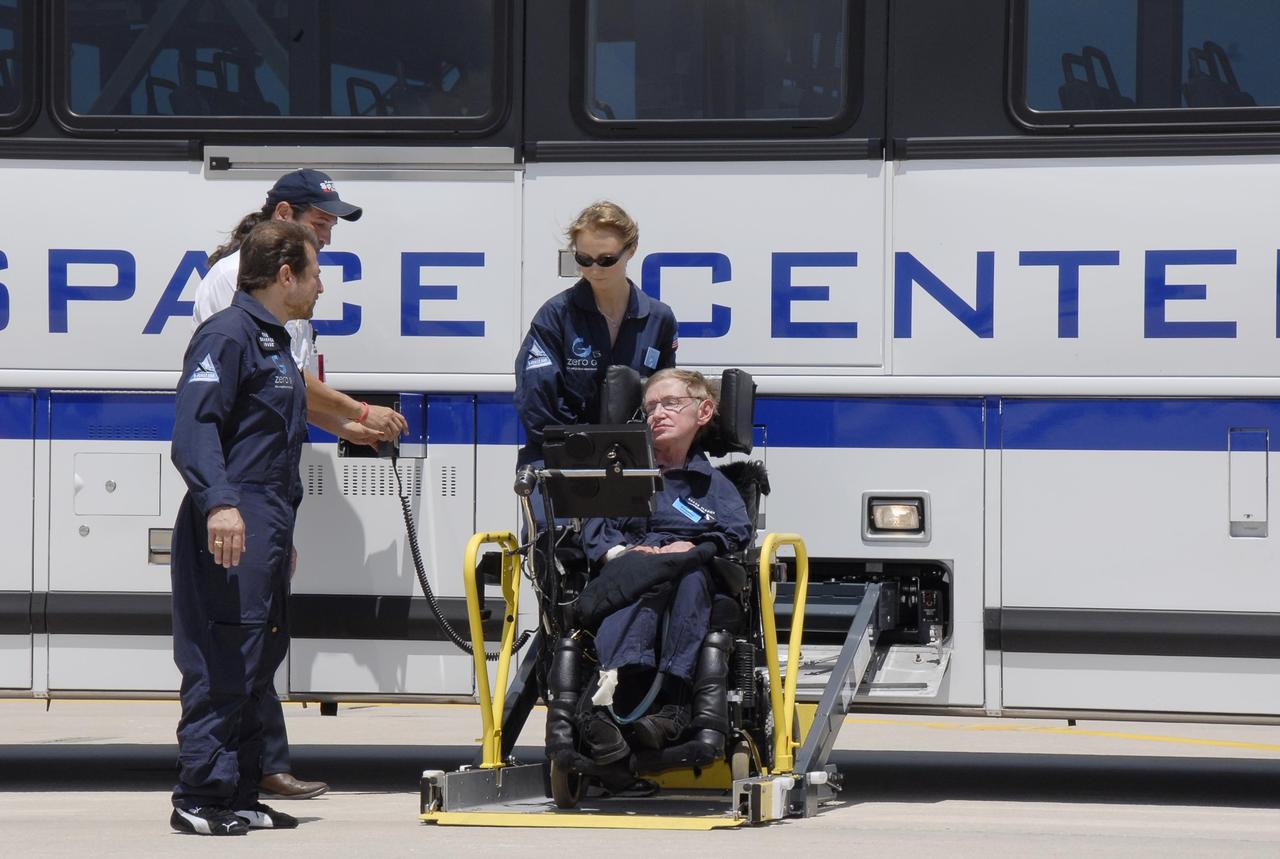
KENNEDY SPACE CENTER, FLA. -- At the Kennedy Space Center Shuttle Landing Facility, noted physicist Stephen Hawking, in the wheelchair, arrives at the runway for his first zero-gravity flight. The flight will be aboard a modified Boeing 727 aircraft owned by Zero Gravity Corp., a commercial company licensed to provide the public with weightless flight experiences. At left is Peter Diamandis, founder of the Zero Gravity Corp. Behind Hawking is Nicola O'Brien, a nurse practitioner who is Hawking's aide. Hawking developed amyotrophic lateral sclerosis disease in the 1960s, a type of motor neuron disease which would cost him the loss of almost all neuromuscular control. At the celebration of his 65th birthday on January 8 this year, Hawking announced his plans for a zero-gravity flight to prepare for a sub-orbital space flight in 2009 on Virgin Galactic's space service. Photo credit: NASA/Kim Shiflett
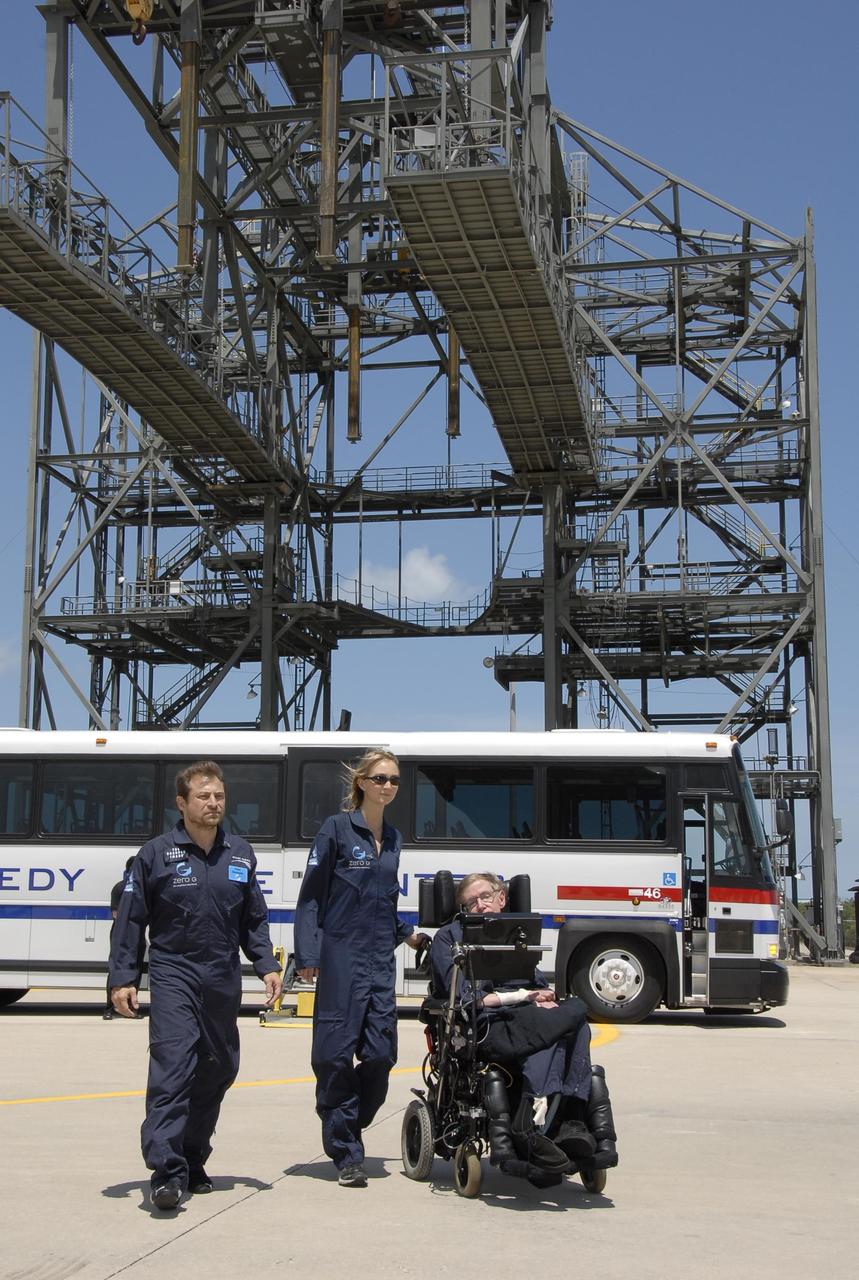
KENNEDY SPACE CENTER, FLA. -- At the Kennedy Space Center Shuttle Landing Facility, noted physicist Stephen Hawking, in the wheelchair, arrives at the runway for his first zero-gravity flight. The flight will be aboard a modified Boeing 727 aircraft owned by Zero Gravity Corp., a commercial company licensed to provide the public with weightless flight experiences. At left is Peter Diamandis, founder of the Zero Gravity Corp. At center is Nicola O'Brien, a nurse practitioner who is Hawking's aide. Hawking developed amyotrophic lateral sclerosis disease in the 1960s, a type of motor neuron disease which would cost him the loss of almost all neuromuscular control. At the celebration of his 65th birthday on January 8 this year, Hawking announced his plans for a zero-gravity flight to prepare for a sub-orbital space flight in 2009 on Virgin Galactic's space service. Photo credit: NASA/Kim Shiflett
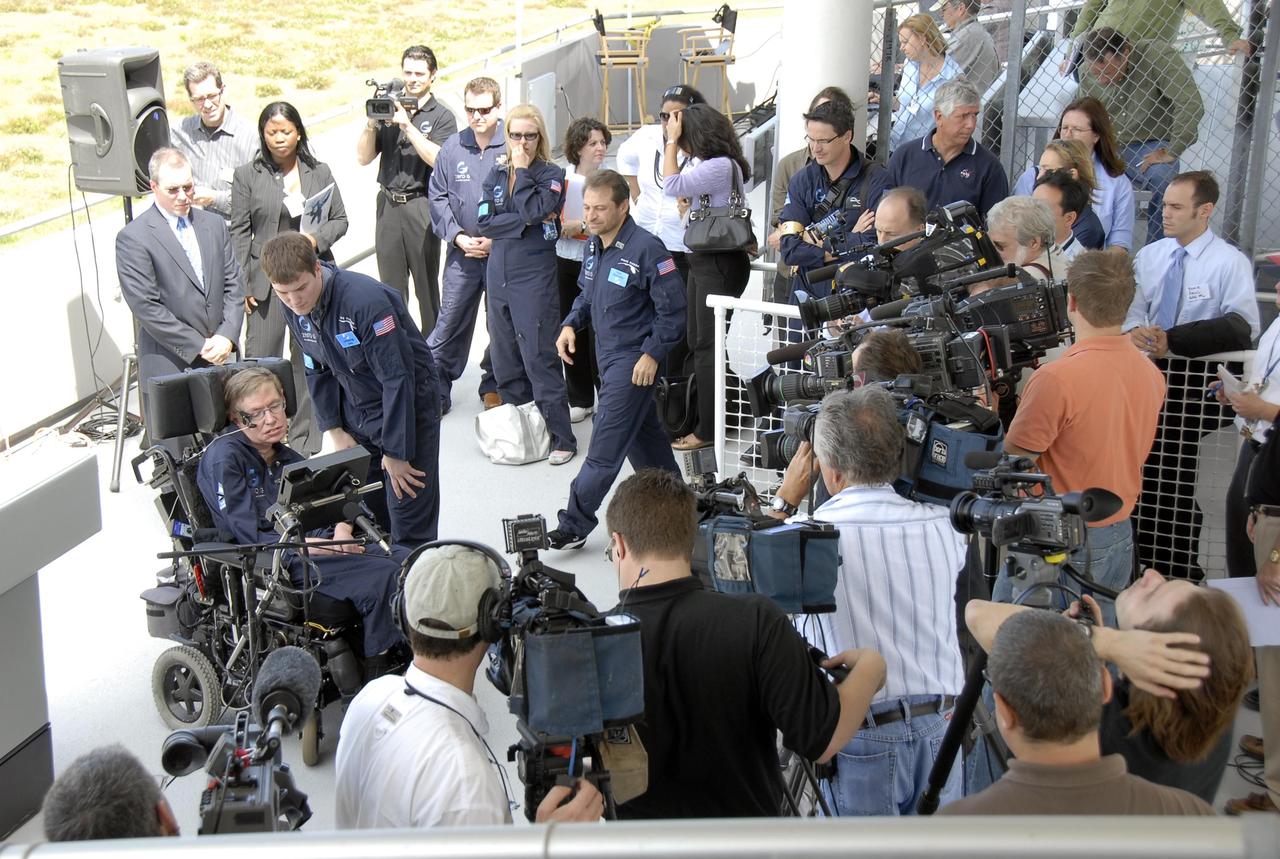
KENNEDY SPACE CENTER, FLA. -- The media surround noted wheelchair-bound physicist Stephen Hawking after his arrival at the Kennedy Space Center Shuttle Landing Facility for his first zero-gravity flight. Behind Hawking, at left, is Space Florida president Steve Kohler. In the center, striding toward Hawking, is Zero Gravity Corp. founder Peter Diamandis. The flight will be aboard a modified Boeing 727 aircraft owned by Zero Gravity, a commercial company licensed to provide the public with weightless flight experiences. Hawking developed amyotrophic lateral sclerosis disease in the 1960s, a type of motor neuron disease which would cost him the loss of almost all neuromuscular control. At the celebration of his 65th birthday on January 8 this year, Hawking announced his plans for a zero-gravity flight to prepare for a sub-orbital space flight in 2009 on Virgin Galactic's space service. Photo credit: NASA/Kim Shiflett
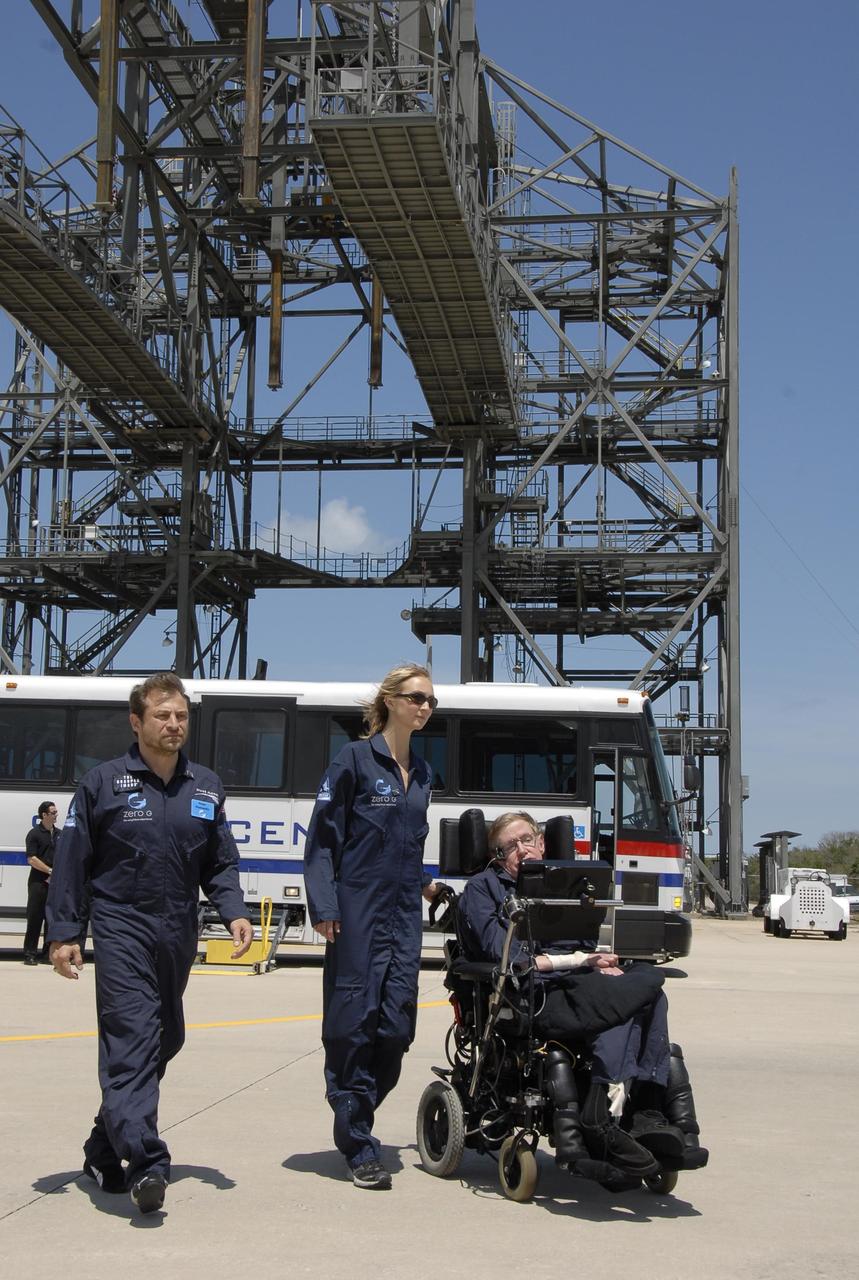
KENNEDY SPACE CENTER, FLA. -- At the Kennedy Space Center Shuttle Landing Facility, noted physicist Stephen Hawking, in the wheelchair, arrives at the runway for his first zero-gravity flight. The flight will be aboard a modified Boeing 727 aircraft owned by Zero Gravity Corp., a commercial company licensed to provide the public with weightless flight experiences. At left is Peter Diamandis, founder of the Zero Gravity Corp. At center is Nicola O'Brien, a nurse practitioner who is Hawking's aide. Hawking developed amyotrophic lateral sclerosis disease in the 1960s, a type of motor neuron disease which would cost him the loss of almost all neuromuscular control. At the celebration of his 65th birthday on January 8 this year, Hawking announced his plans for a zero-gravity flight to prepare for a sub-orbital space flight in 2009 on Virgin Galactic's space service. Photo credit: NASA/Kim Shiflett
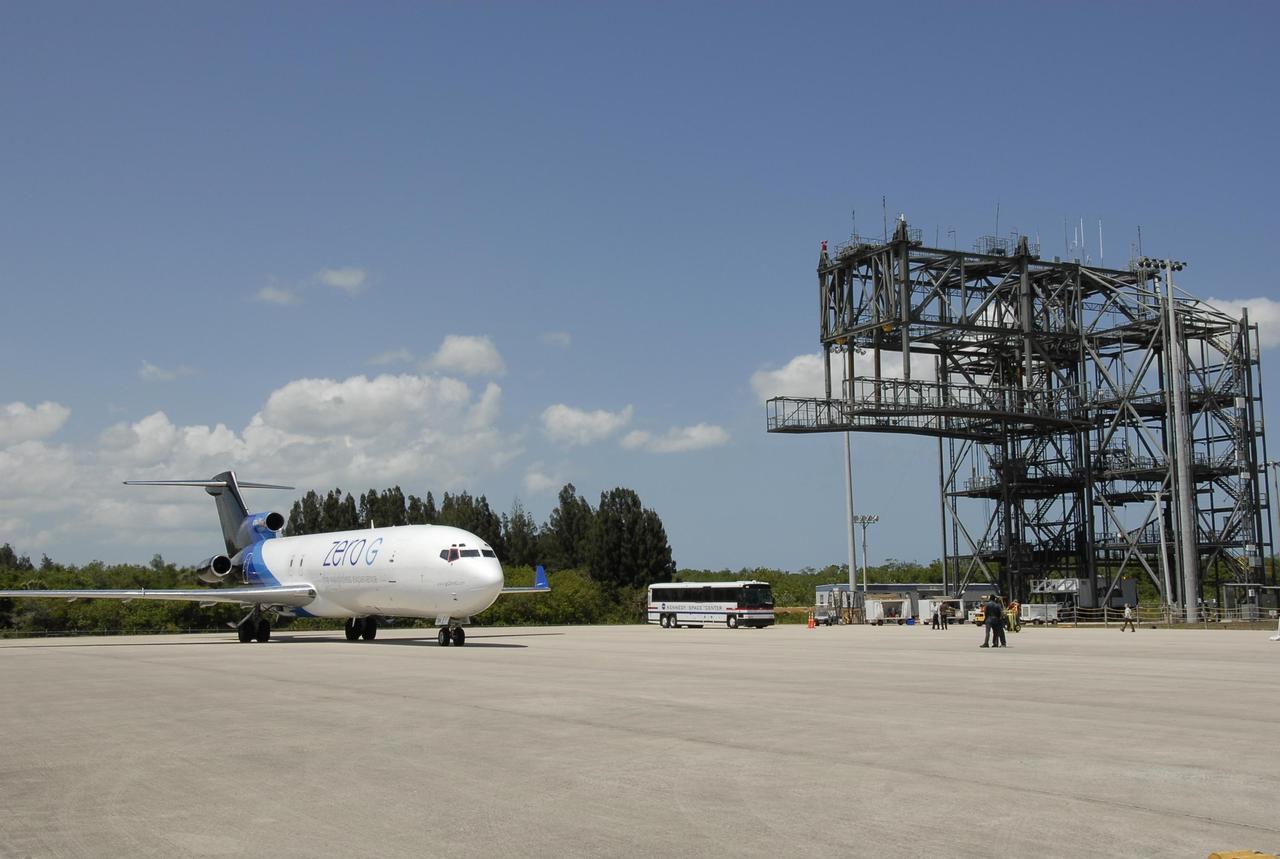
KENNEDY SPACE CENTER, FLA. -- At the Kennedy Space Center Shuttle Landing Facility, a modified Boeing 727 aircraft owned by Zero Gravity Corp. is ready to take off with its well-known passenger, physicist Stephen Hawking. Zero Gravity Corp. is a commercial company licensed to provide the public with weightless flight experiences. Hawking will be making his first zero-gravity flight. Hawking developed amyotrophic lateral sclerosis disease in the 1960s, a type of motor neuron disease which would cost him the loss of almost all neuromuscular control. At the celebration of his 65th birthday on January 8 this year, Hawking announced his plans for a zero-gravity flight to prepare for a sub-orbital space flight in 2009 on Virgin Galactic's space service. Photo credit: NASA/Kim Shiflett
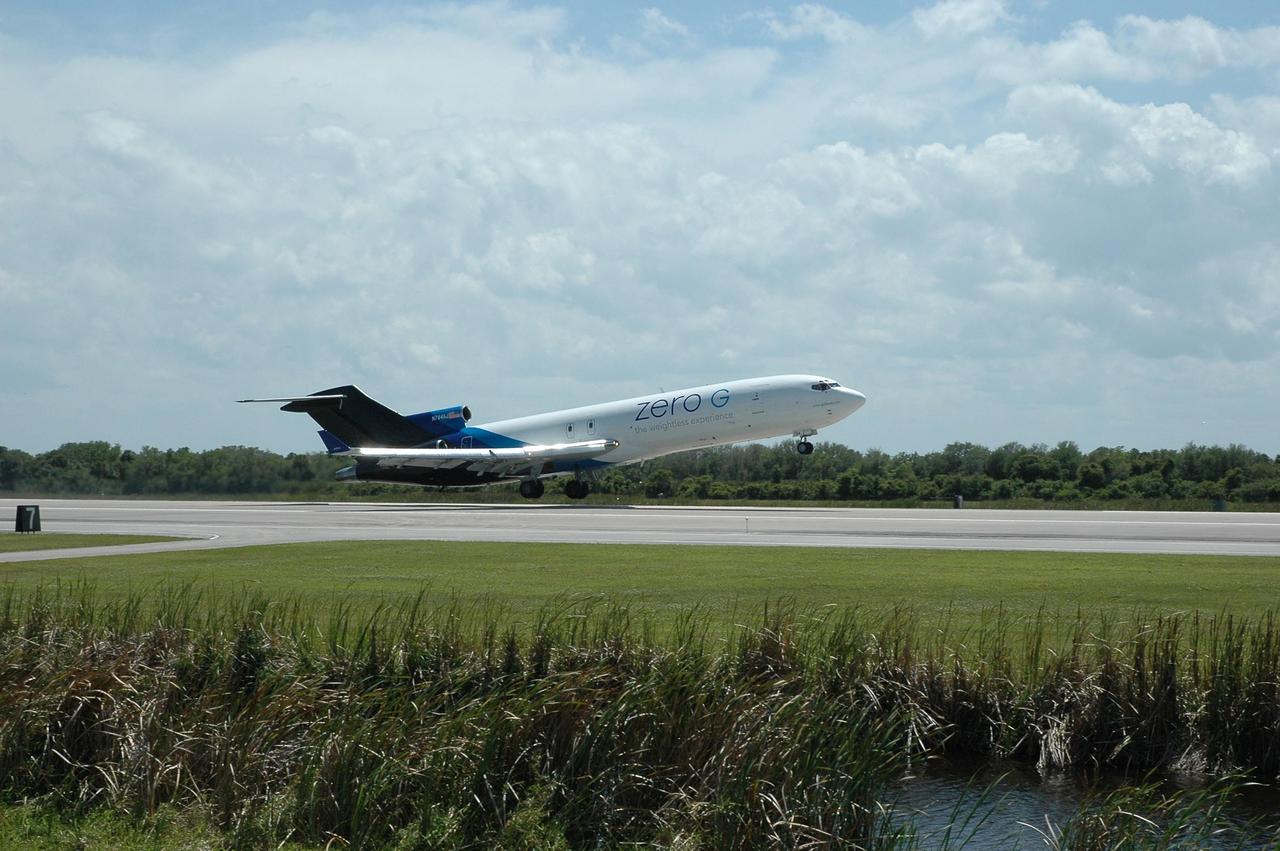
KENNEDY SPACE CENTER, FLA. -- At the Kennedy Space Center Shuttle Landing Facility, a modified Boeing 727 aircraft owned by Zero Gravity Corp. takes off with its well-known passenger, physicist Stephen Hawking. Zero Gravity Corp. is a commercial company licensed to provide the public with weightless flight experiences. Hawking will be making his first zero-gravity flight. Hawking developed amyotrophic lateral sclerosis disease in the 1960s, a type of motor neuron disease which would cost him the loss of almost all neuromuscular control. At the celebration of his 65th birthday on January 8 this year, Hawking announced his plans for a zero-gravity flight to prepare for a sub-orbital space flight in 2009 on Virgin Galactic's space service. Photo credit: NASA/Jack Pfaller
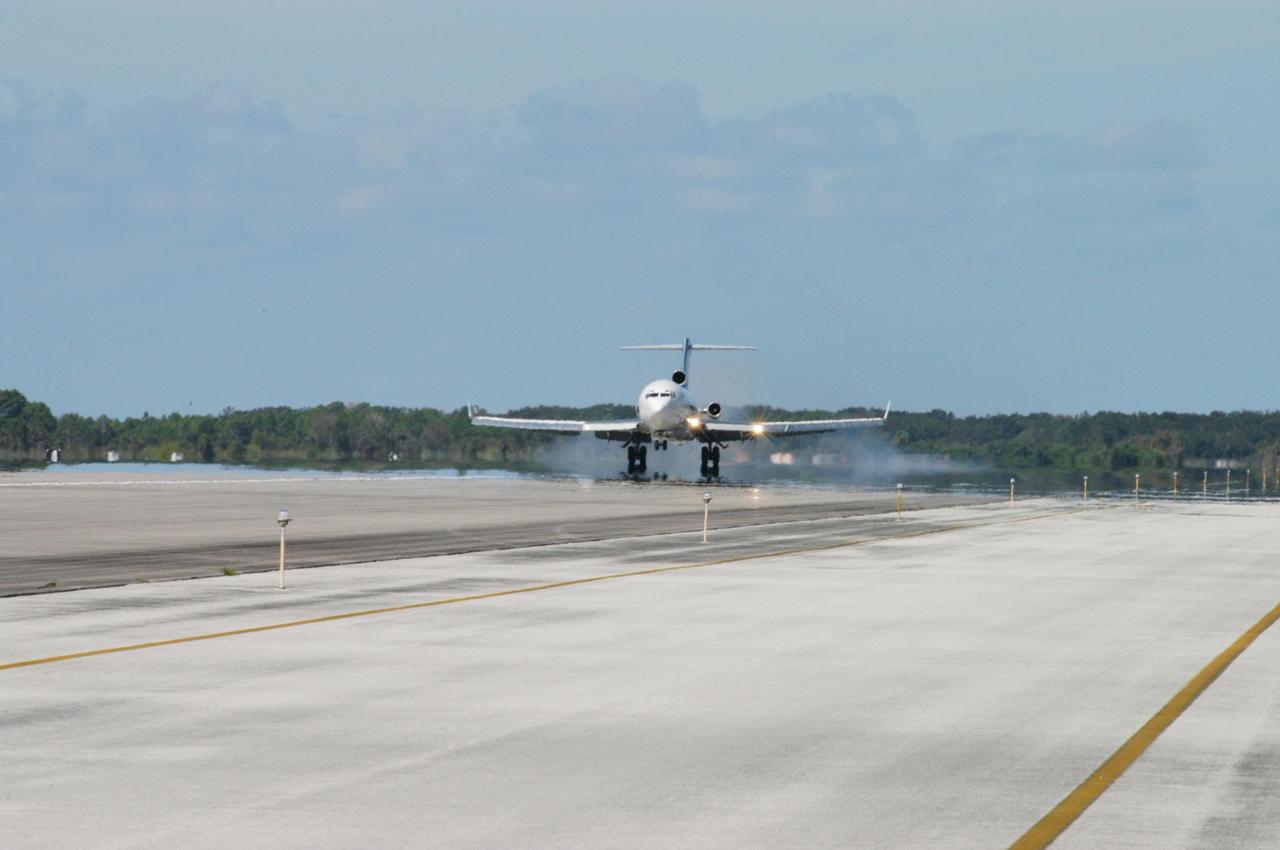
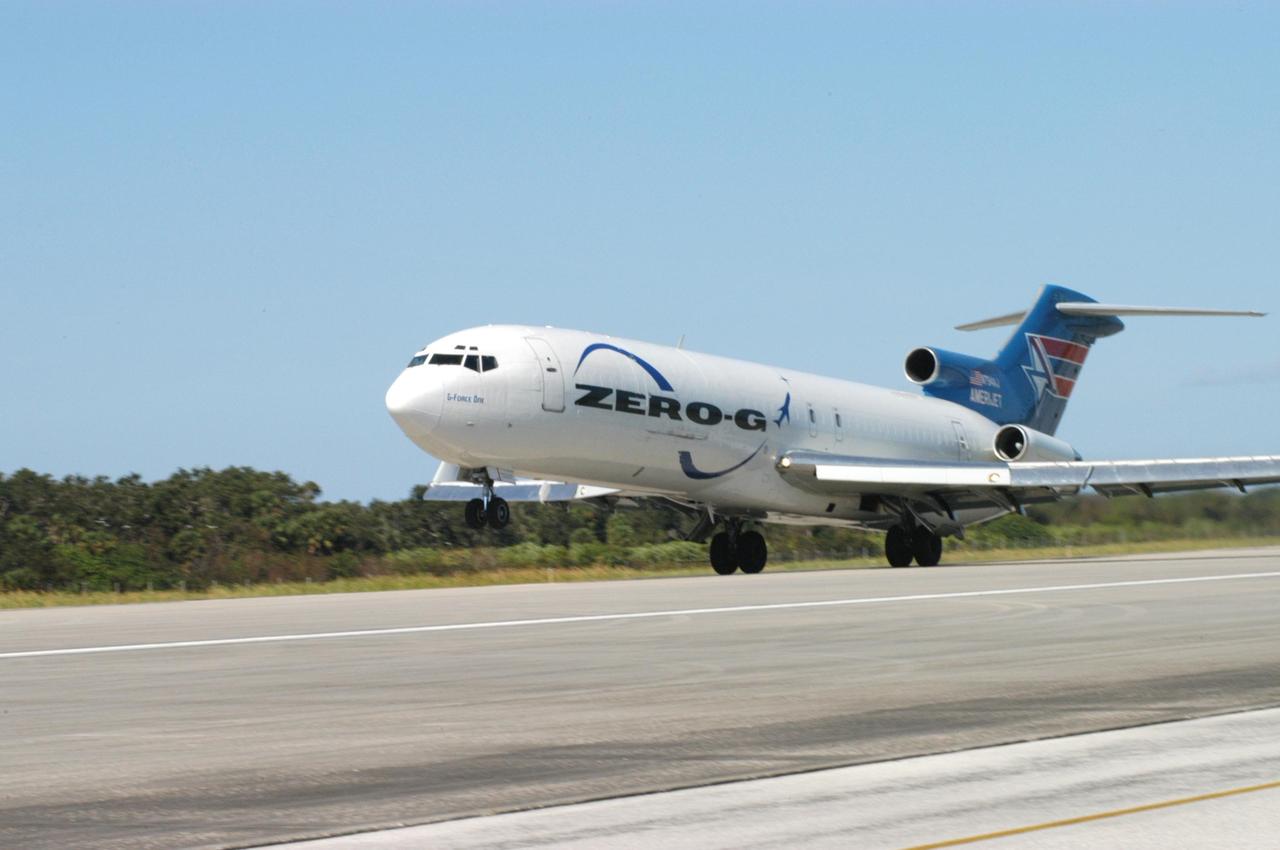
KENNEDY SPACE CENTER, FLA. - The Boeing 727-200 aircraft used for weightless flights by Zero Gravity Corporation, known as ZERO-G, of Fort Lauderdale, Fla., lands after taking a group of passengers for demonstration. NASA and ZERO-G demonstrated Nov. 5 the expanded access to and use of the space shuttle's runway and landing facility at Kennedy Space Center for non-NASA activities. This group of passengers, called "Flyers," were predominantly teachers who performed simple microgravity experiments they can share with their students back in the classroom.
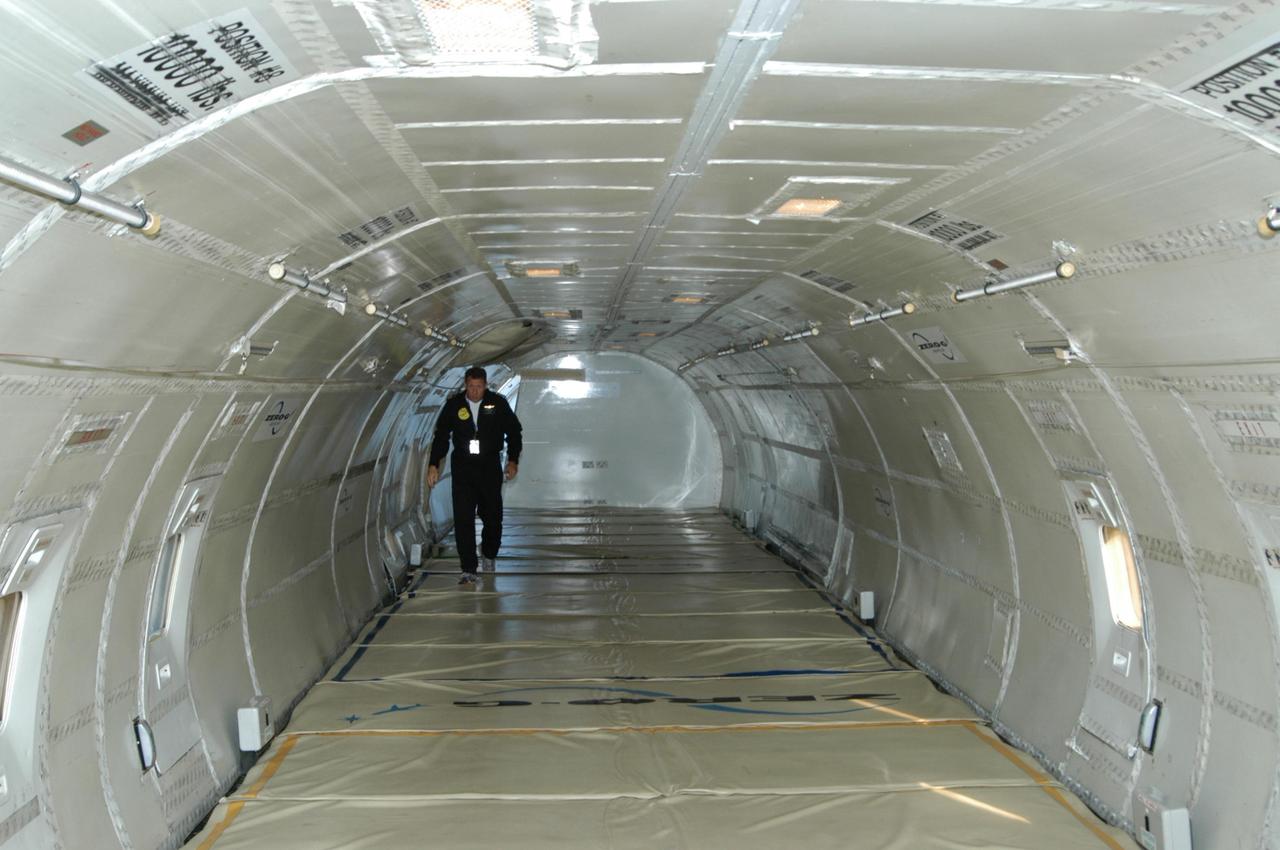
KENNEDY SPACE CENTER, FLA. - A view inside the Boeing 727-200 aircraft used for weightless flights by Zero Gravity Corporation, known as ZERO-G, of Fort Lauderdale, Fla. NASA and ZERO-G demonstrated Nov. 5 the expanded access to and use of the space shuttle's runway and landing facility at Kennedy Space Center for non-NASA activities. A group of passengers, called "Flyers," were predominantly teachers who performed simple microgravity experiments they can share with their students back in the classroom.
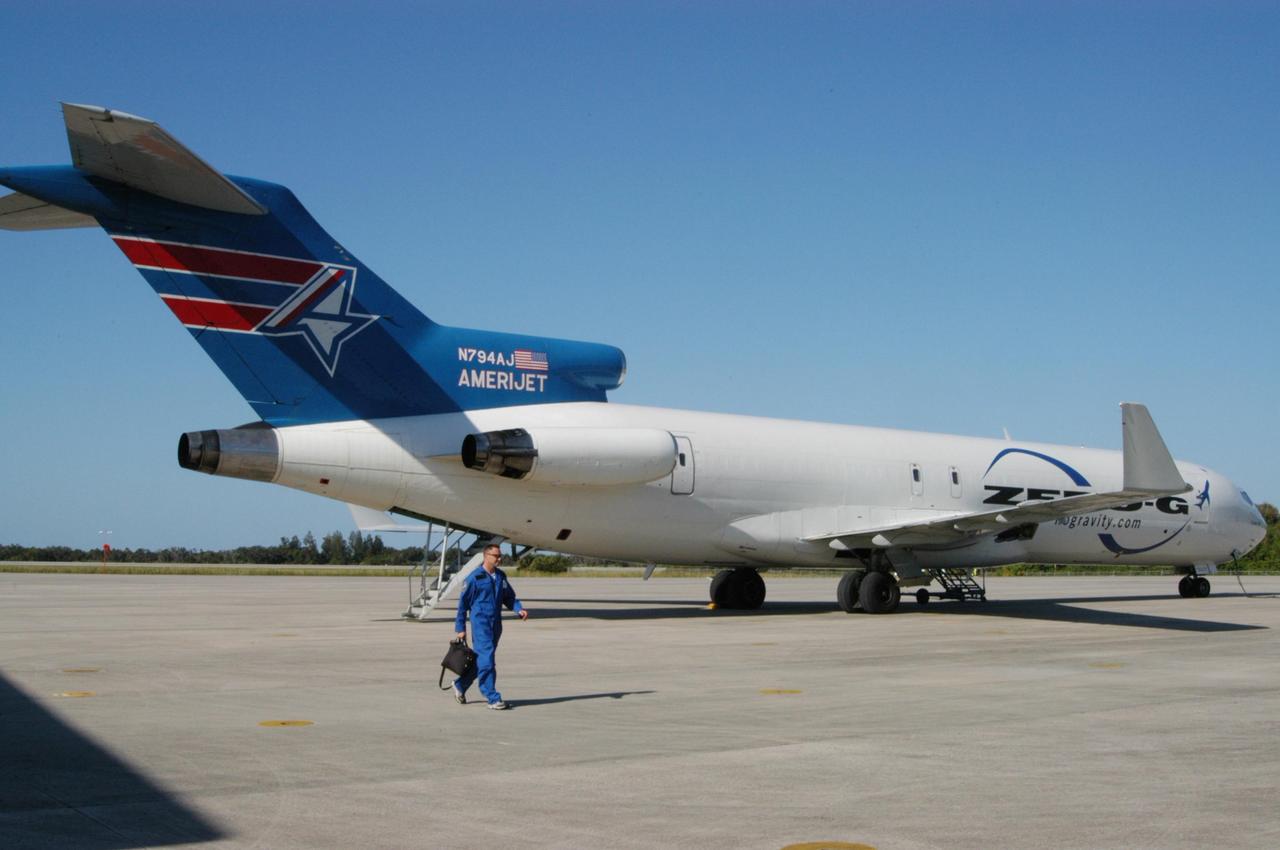
KENNEDY SPACE CENTER, FLA. - The Boeing 727-200 aircraft used for weightless flights by Zero Gravity Corporation, known as ZERO-G, of Fort Lauderdale, Fla., waits for its passengers. NASA and ZERO-G demonstrated Nov. 5 the expanded access to and use of the space shuttle's runway and landing facility at Kennedy Space Center for non-NASA activities. A group of passengers, called "Flyers," were predominantly teachers who performed simple microgravity experiments they can share with their students back in the classroom.
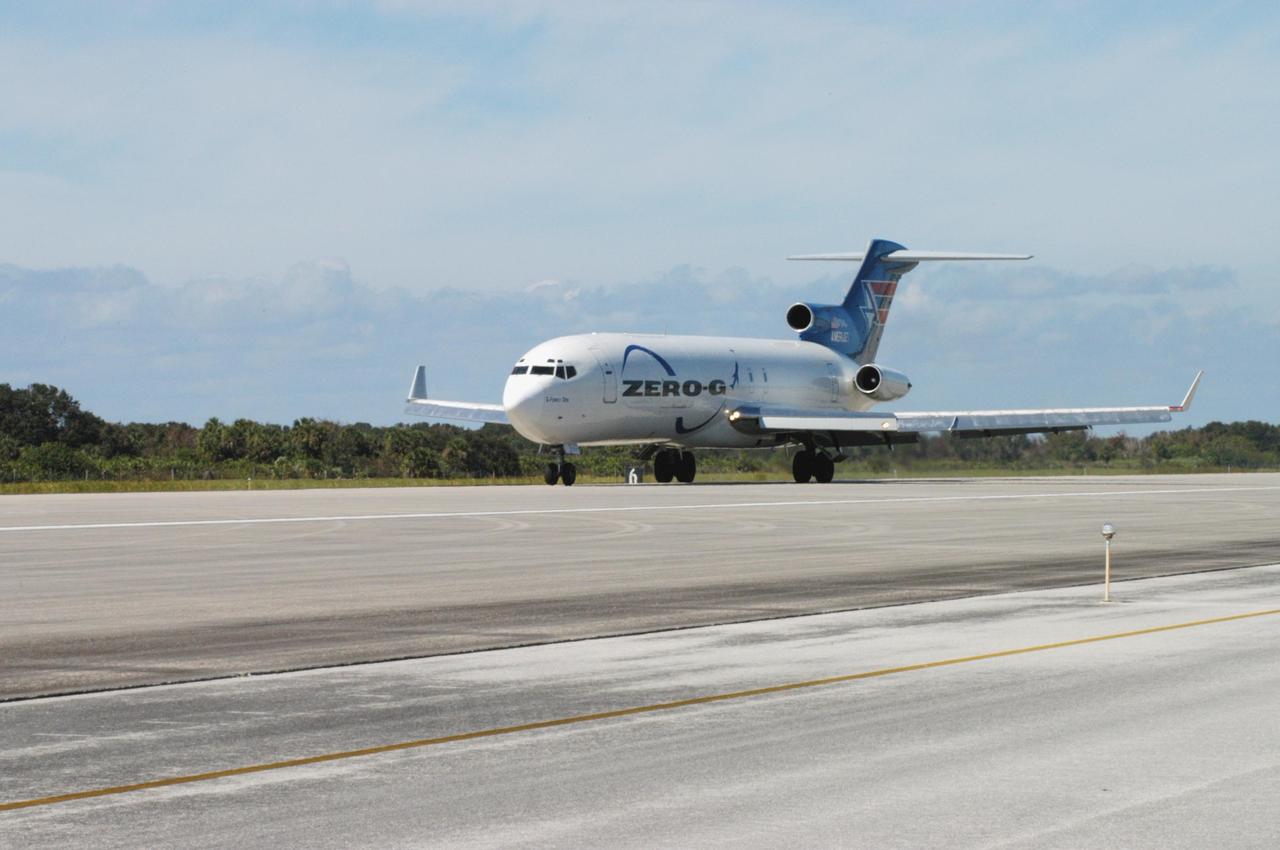
KENNEDY SPACE CENTER, FLA. - The Boeing 727-200 aircraft used for weightless flights by Zero Gravity Corporation, known as ZERO-G, of Fort Lauderdale, Fla., lands after taking a group of passengers for demonstration. NASA and ZERO-G demonstrated Nov. 5 the expanded access to and use of the space shuttle's runway and landing facility at Kennedy Space Center for non-NASA activities. This group of passengers, called "Flyers," were predominantly teachers who performed simple microgravity experiments they can share with their students back in the classroom.
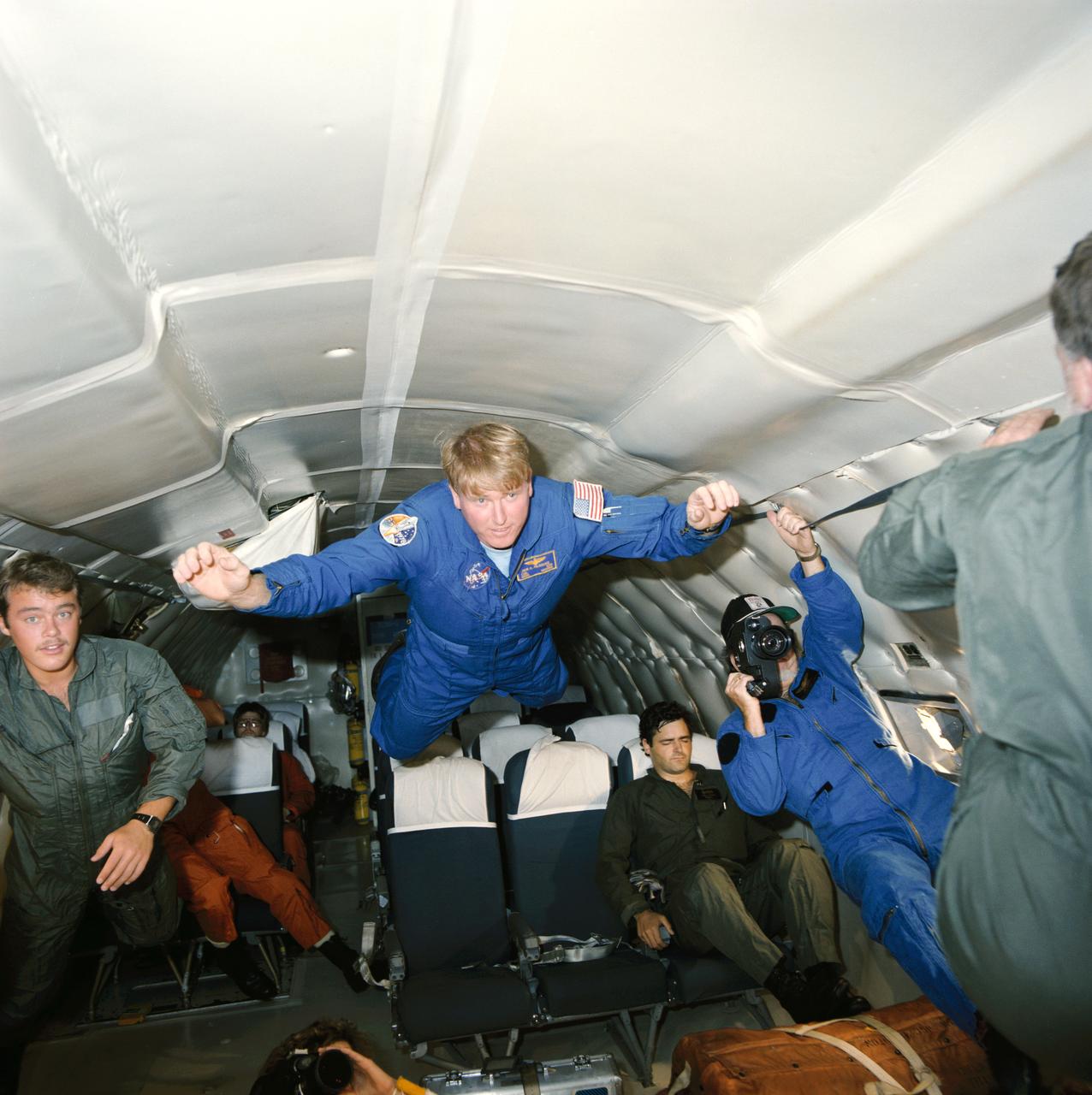
S84-37522 (18 July 1984) --- Astronaut Jon A. McBride, center, floats briefly aboard a NASA KC-135 aircraft during a flight designed as part of the training program for 41-G's seven crewmembers. McBride is pilot for that October 1984 flight. Marc Garneau, one of two payload specialists for the mission, is seated at right. Garneau represents the National Research Council of Canada.
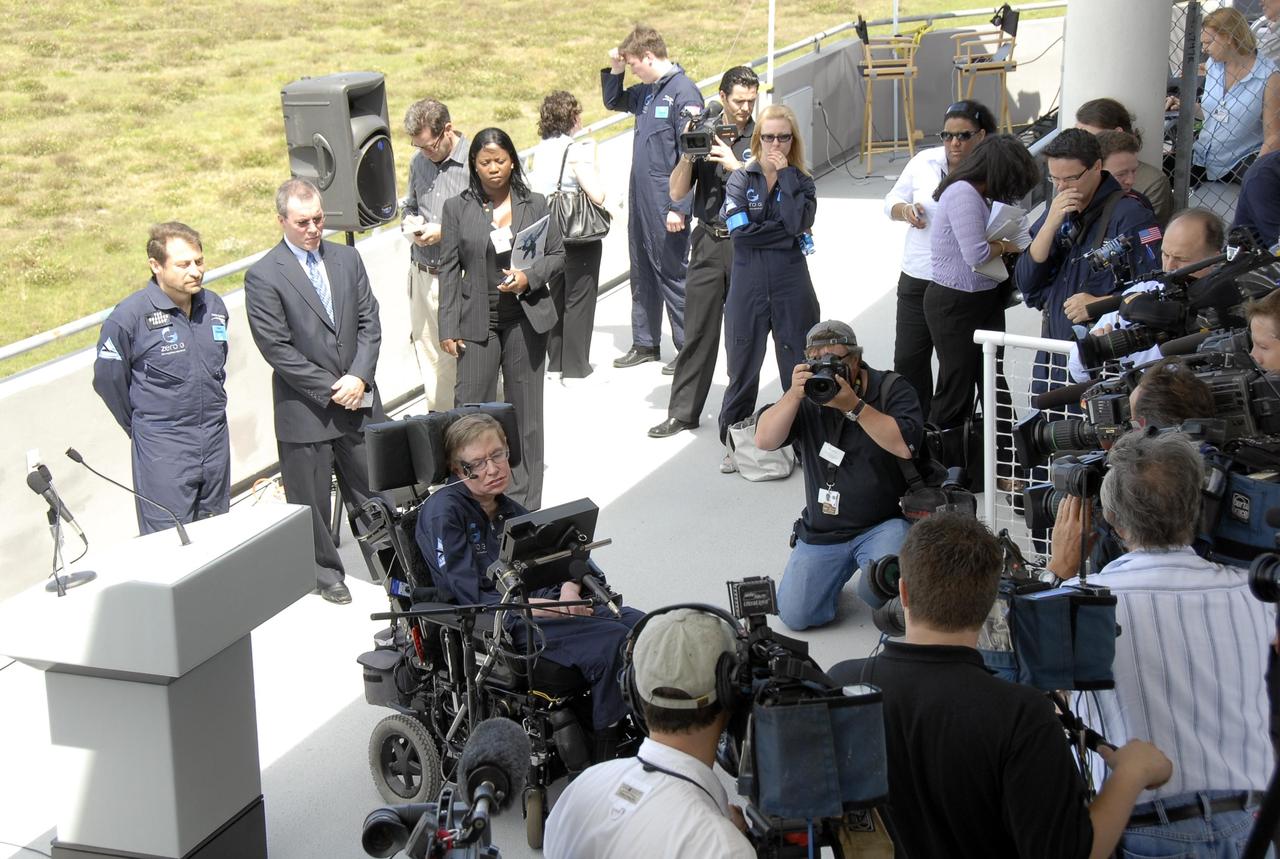
KENNEDY SPACE CENTER, FLA. -- The media surround noted wheelchair-bound physicist Stephen Hawking after his arrival at the Kennedy Space Center Shuttle Landing Facility for his first zero-gravity flight. Behind Hawking, at left, are Zero Gravity Corporation founder Peter Diamandis and Space Florida president Steve Kohler. The flight will be aboard a modified Boeing 727 aircraft owned by Zero G, a commercial company licensed to provide the public with weightless flight experiences. Hawking developed amyotrophic lateral sclerosis disease in the 1960s, a type of motor neuron disease which would cost him the loss of almost all neuromuscular control. At the celebration of his 65th birthday on January 8 this year, Hawking announced his plans for a zero-gravity flight to prepare for a sub-orbital space flight in 2009 on Virgin Galactic's space service. Photo credit: NASA/Kim Shiflett
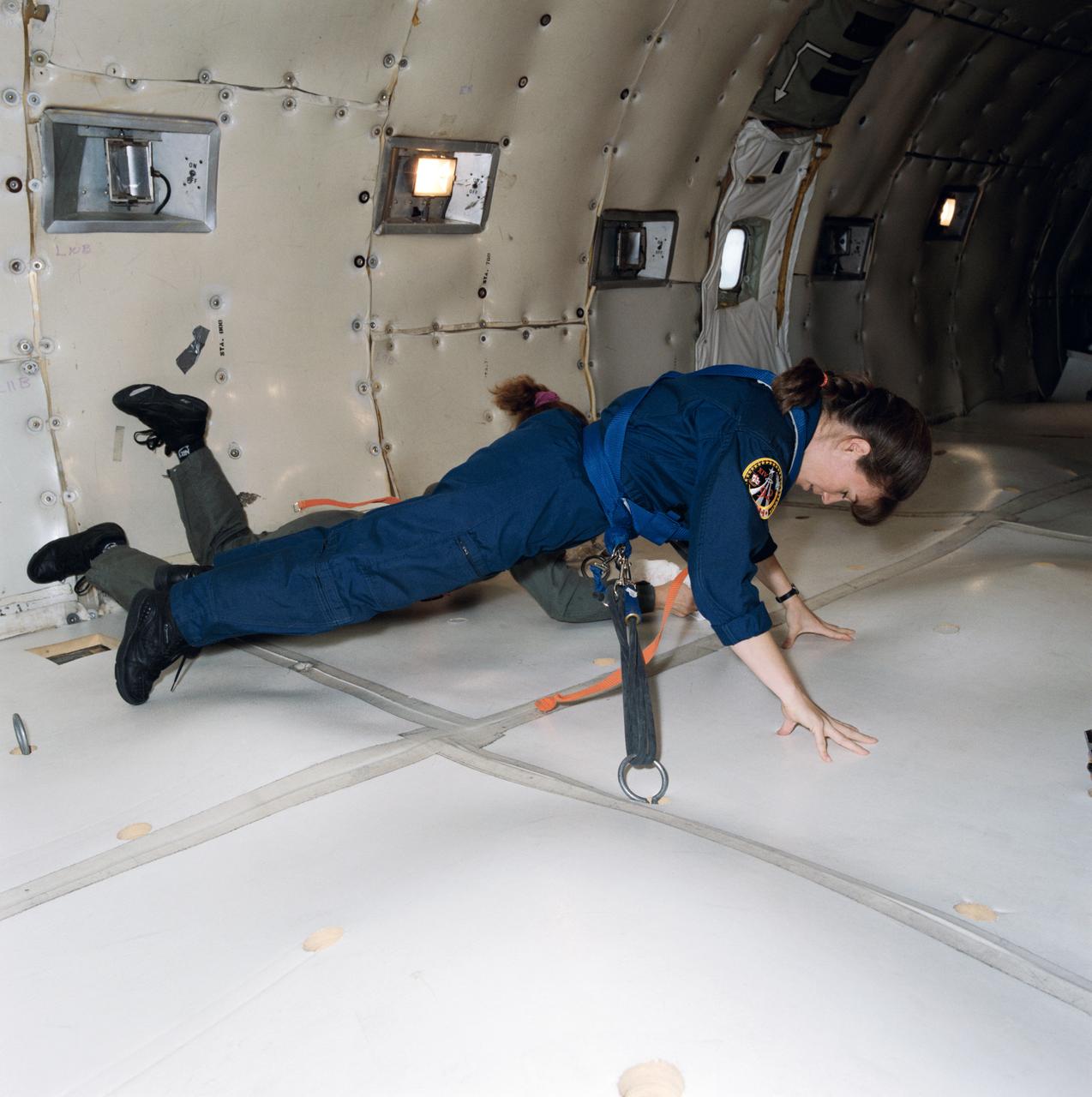
S94-35542 (June 1994) --- Astronaut Catherine G. Coleman, mission specialist, gets a preview of next year?s United States Microgravity Laboratory (USML-2) mission aboard the Space Shuttle Columbia. The weightless experience was afforded by a special parabolic pattern flown by NASA?s KC-135 ?zero gravity? aircraft.
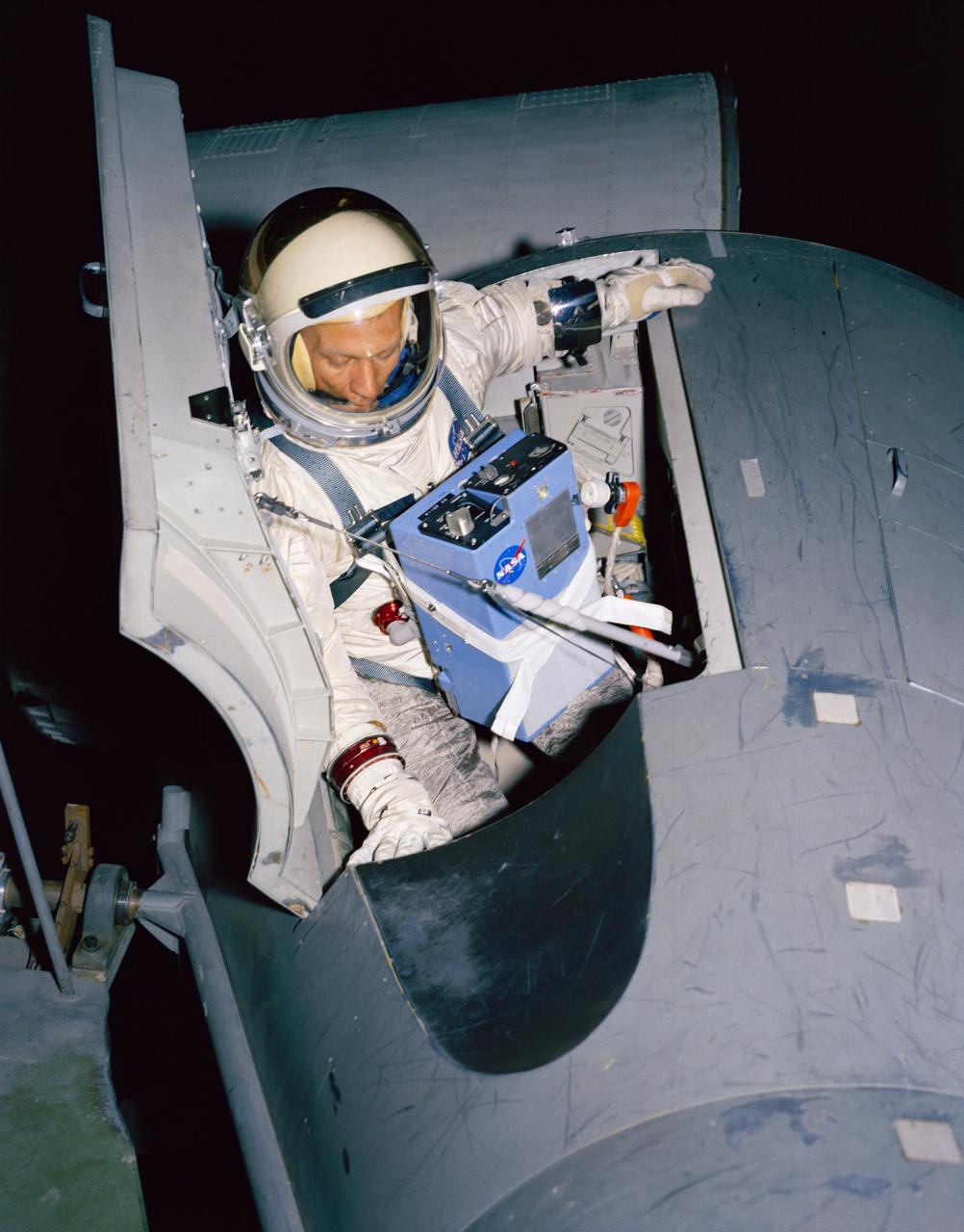
S66-28114 (1 April 1966) --- Astronaut Edwin E. Aldrin Jr., pilot of the Gemini-12 spaceflight, undergoes zero-gravity egress training. A KC-135 Air Force plane, flying a parabolic curve, creates a weightless environment as a training exercise in preparation for spaceflight. Photo credit: NASA

S66-28770 (1 April 1966) --- Astronaut Michael Collins, prime crew pilot of the Gemini-10 spaceflight, undergoes zero-gravity egress training aboard a KC-135 Air Force plane. The plane, flying a parabolic curve, creates a weightless environment as a training exercise in preparation for spaceflight. Photo credit: NASA
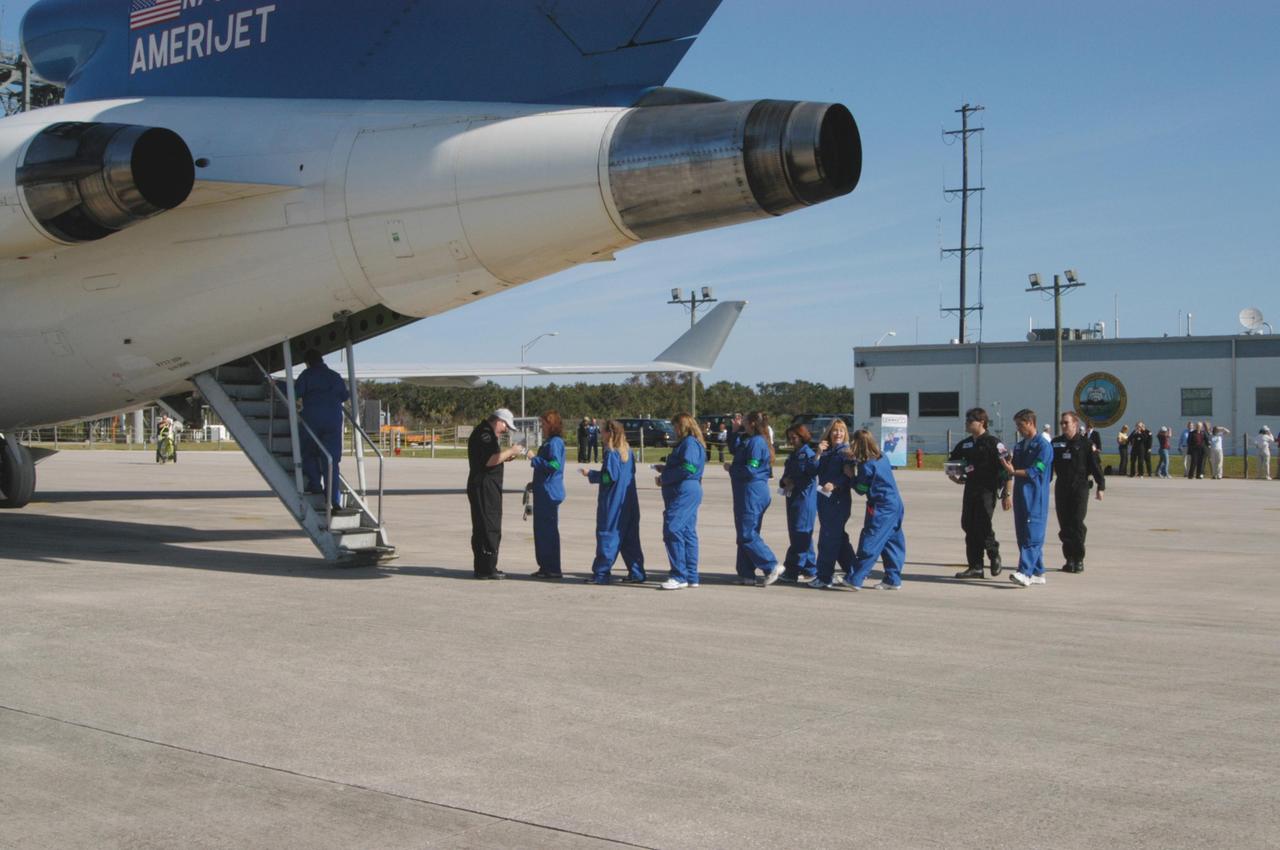
KENNEDY SPACE CENTER, FLA. - The first group of passengers to fly on the ZERO-G aircraft line up. The Boeing 727-200 aircraft is used for weightless flights by Zero Gravity Corporation, known as ZERO-G, of Fort Lauderdale, Fla. NASA and ZERO-G demonstrated Nov. 5 the expanded access to and use of the space shuttle's runway and landing facility at Kennedy Space Center for non-NASA activities. The passengers, called "Flyers," were predominantly teachers who performed simple microgravity experiments they can share with their students back in the classroom.
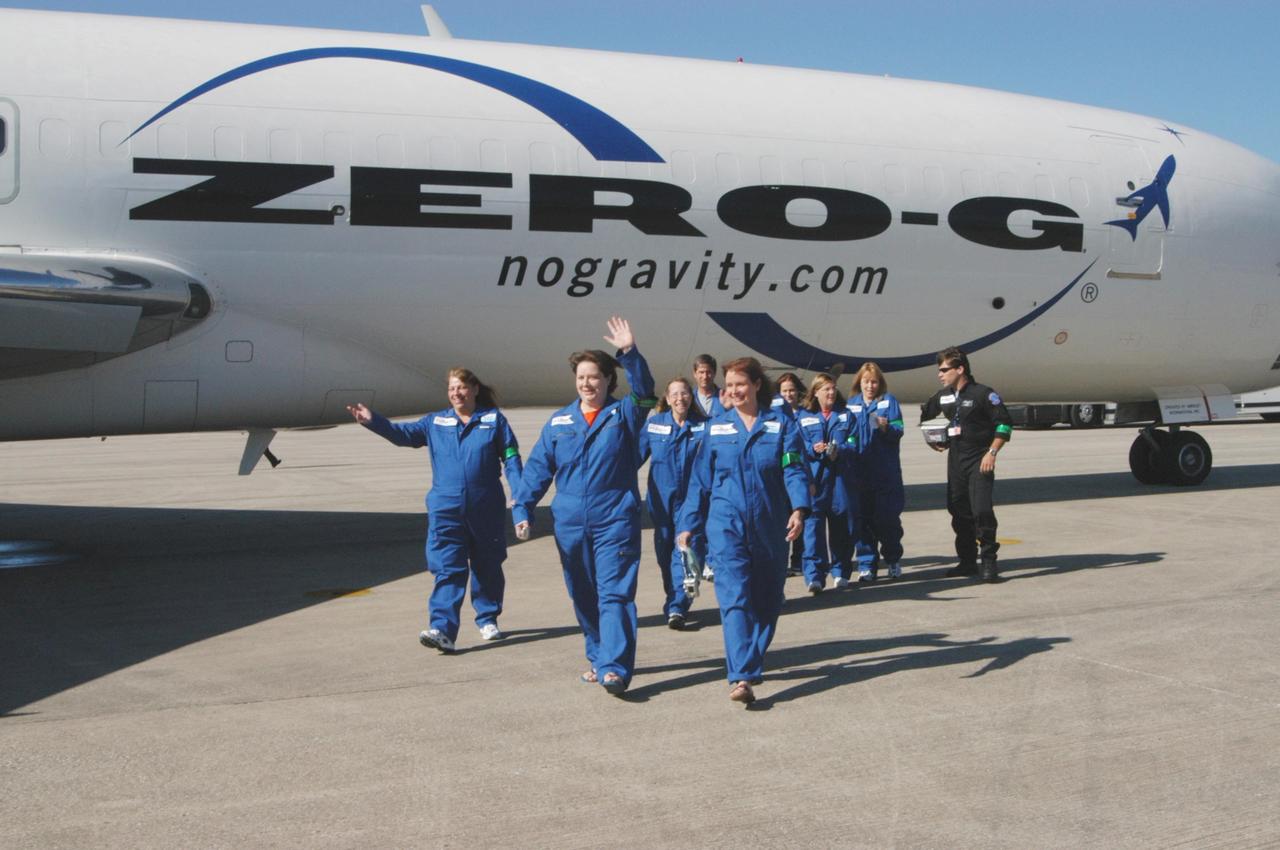
KENNEDY SPACE CENTER, FLA. - The first group of passengers to fly on the ZERO-G aircraft are eager to get started. The Boeing 727-200 aircraft is used for weightless flights by Zero Gravity Corporation, known as ZERO-G, of Fort Lauderdale, Fla. NASA and ZERO-G demonstrated Nov. 5 the expanded access to and use of the space shuttle's runway and landing facility at Kennedy Space Center for non-NASA activities. The passengers, called "Flyers," were predominantly teachers who performed simple microgravity experiments they can share with their students back in the classroom.
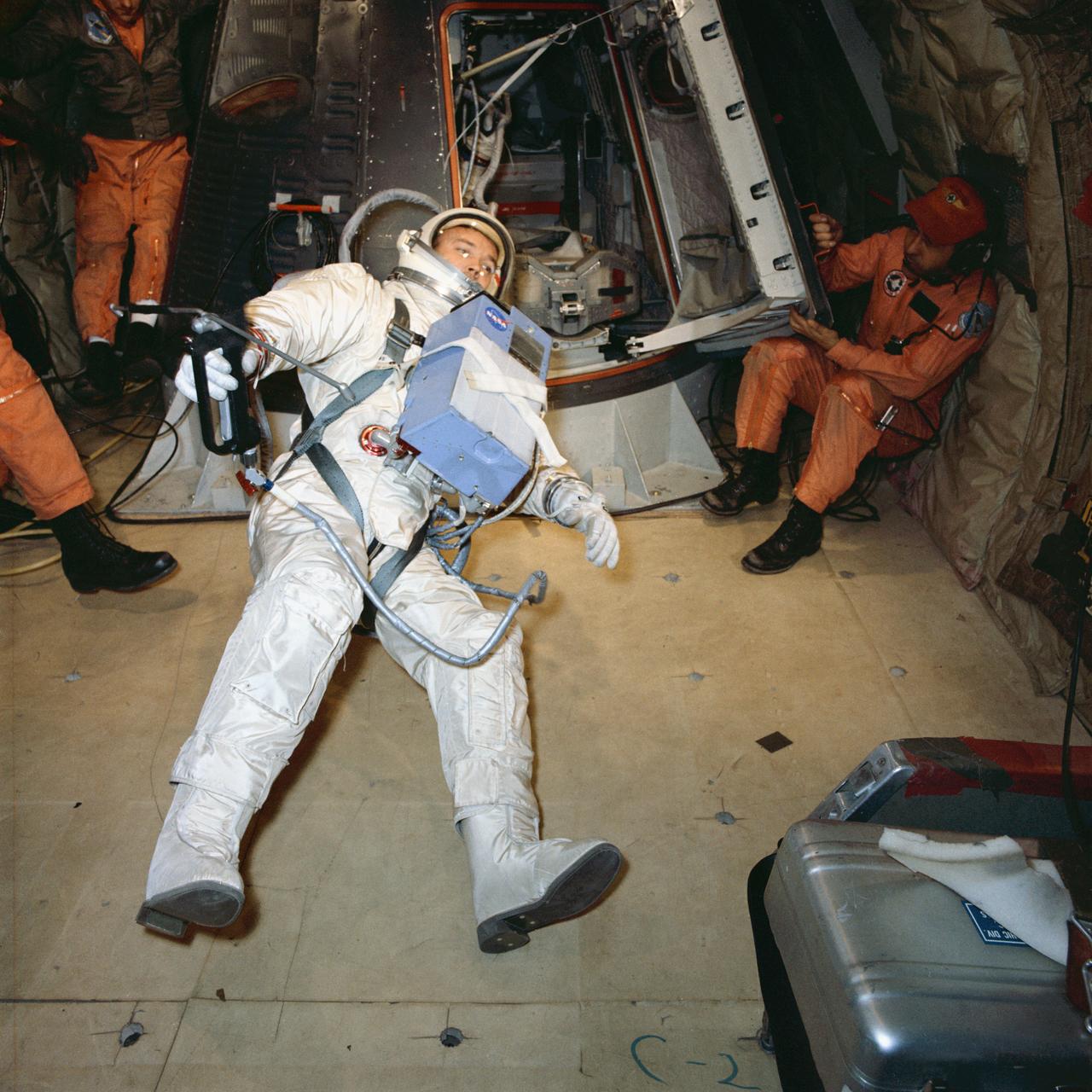
S66-28782 (1 April 1966) --- Astronaut Michael Collins, prime crew pilot of the Gemini-10 spaceflight, experiences a condition of weightlessness during zero-gravity egress training. A KC-135 Air Force plane, flying a parabolic curve, creates a weightless environment as a training exercise in preparation for spaceflight. The Hand-Held Maneuvering Unit in his right hand produces controlled thrust for moving about. Photo credit: NASA
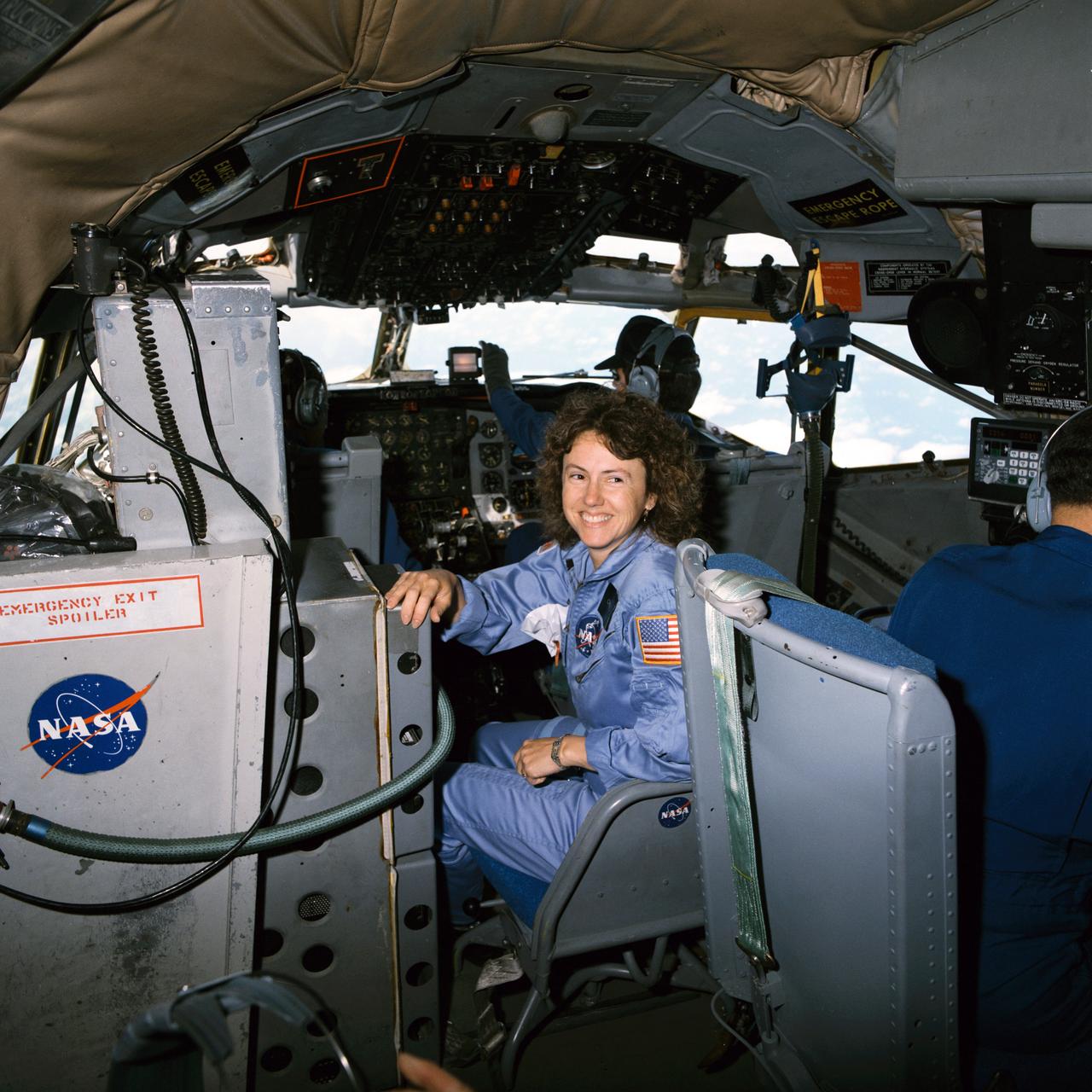
S85-42473 (16 Oct. 1985) --- Sharon Christa McAuliffe, a teacher-citizen observer on STS-51L, smiles before participating in some zero-G rehearsals for her upcoming flight. She is seated near the controls of the KC-135 aircraft, flying for the Johnson Space Center from Ellington Air Field. Referred to as the ?zero-gravity? aircraft, the KC-135 provides brief moments of weightlessness for shuttle crew members in training. Photo credit: NASA

KENNEDY SPACE CENTER, FLA. — Noted physicist Stephen Hawking greets the media after his arrival at the Kennedy Space Center Shuttle Landing Facility for his first zero-gravity flight. The flight will be aboard a modified Boeing 727 aircraft owned by Zero Gravity Corp., a commercial company licensed to provide the public with weightless flight experiences. Hawking developed amyotrophic lateral sclerosis disease in the 1960s, a type of motor neuron disease which would cost him the loss of almost all neuromuscular control. At the celebration of his 65th birthday on January 8 this year, Hawking announced his plans for a zero-gravity flight to prepare for a sub-orbital space flight in 2009 on Virgin Galactic's space service. Photo credit: NASA/Kim Shiflett
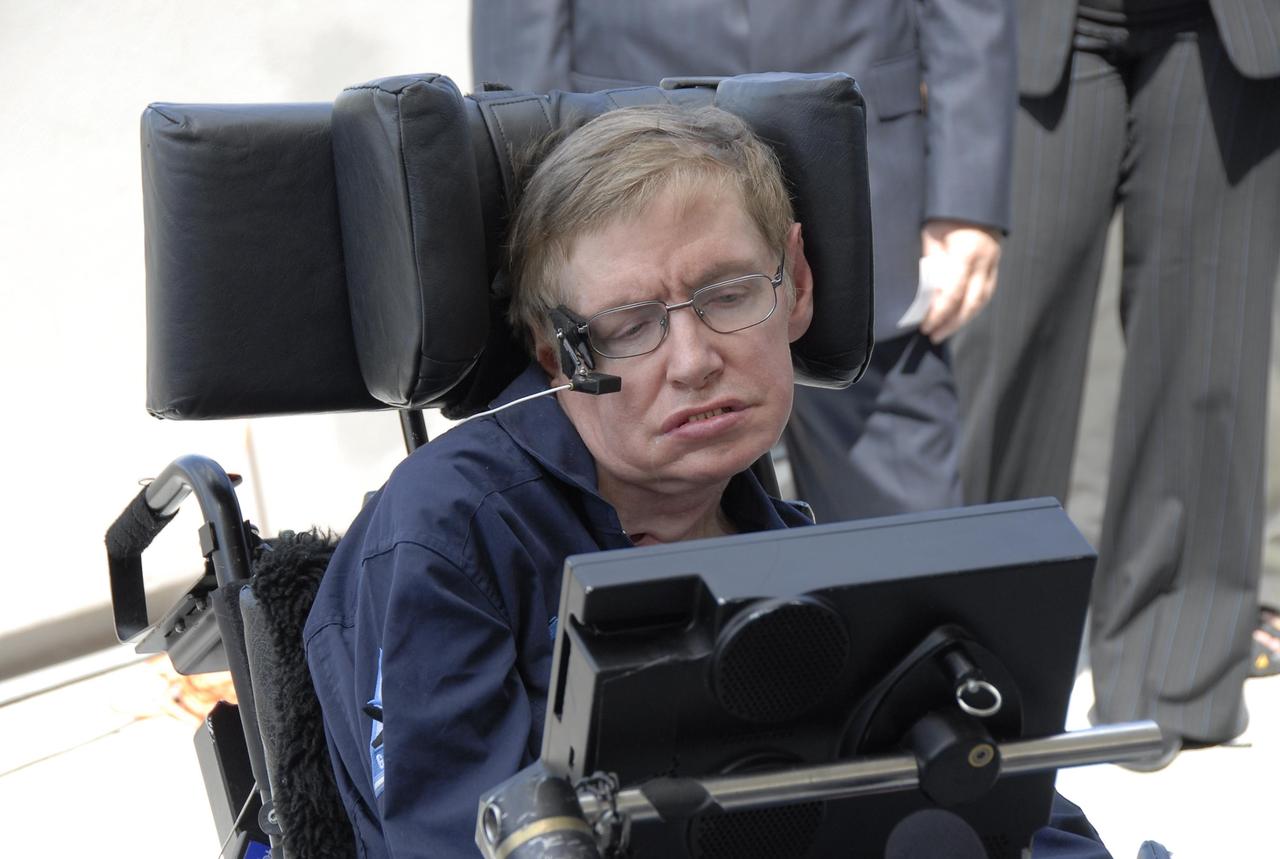
KENNEDY SPACE CENTER, FLA. -- Noted physicist Stephen Hawking arrives at the Kennedy Space Center Shuttle Landing Facility for his first zero-gravity flight. The flight will be aboard a modified Boeing 727 aircraft owned by Zero Gravity Corp., a commercial company licensed to provide the public with weightless flight experiences. Hawking developed amyotrophic lateral sclerosis disease in the 1960s, a type of motor neuron disease which would cost him the loss of almost all neuromuscular control. At the celebration of his 65th birthday on January 8 this year, Hawking announced his plans for a zero-gravity flight to prepare for a sub-orbital space flight in 2009 on Virgin Galactic's space service. Photo credit: NASA/Kim Shiflett
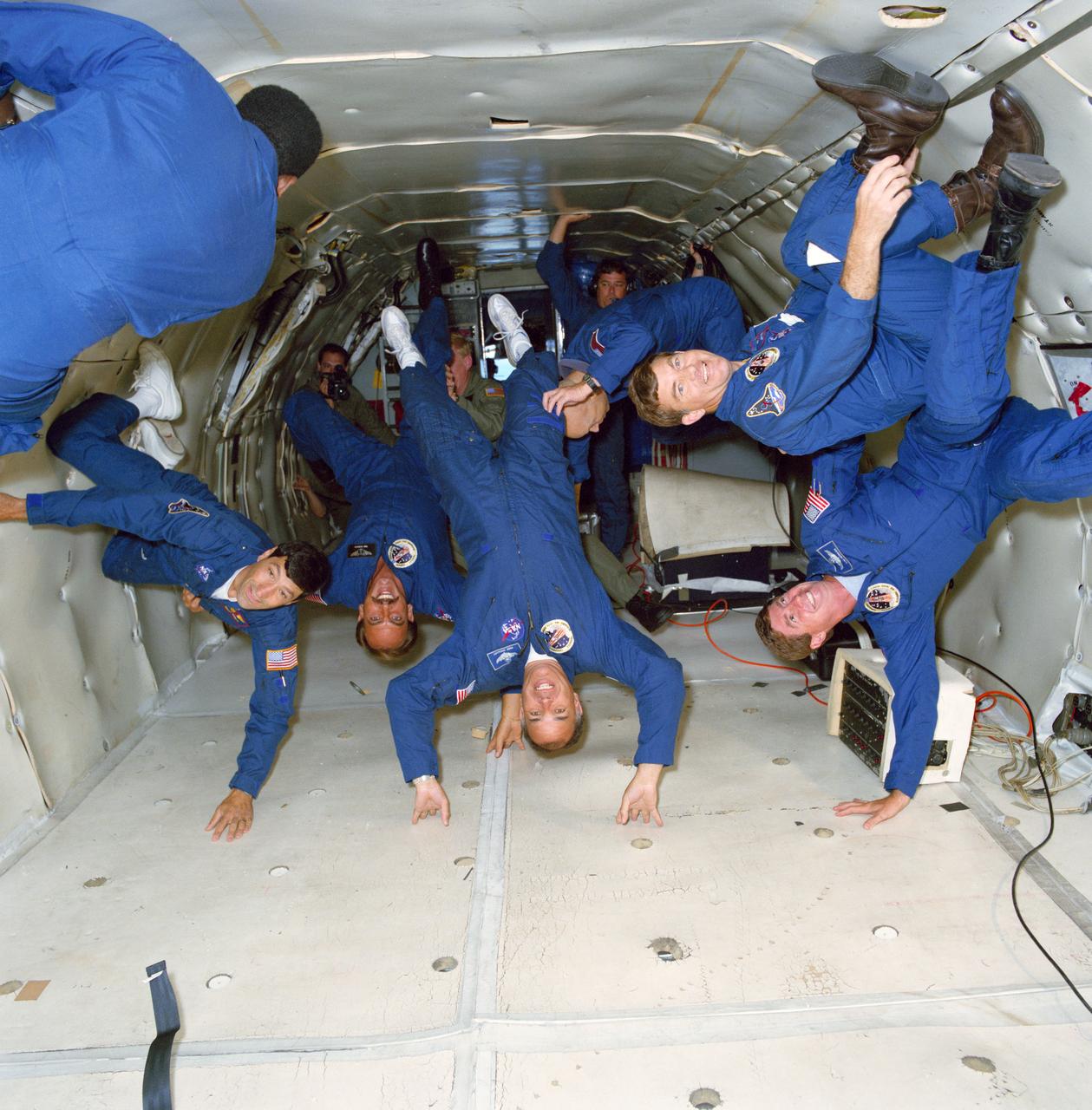
S91-38355 (28 May 1991) --- Seen floating about the vacant spaces of the Johnson Space Center's KC-135 "zero-gravity" aircraft are the six crewmembers for the STS 44 mission. Left to right are Terence T. Henricks, James S. Voss, F. Story Musgrave (partially obscured), Frederick D. Gregory, Thomas J. Hennen and Mario Runco Jr. Gregory is mission commander. Hennen is payload specialist for this flight, dedicated to the Department of Defense. The flight served as a refresher and a preview of the experience of weightlessness, as the special aircraft flew a series of parabolas which provided short sessions of zero-gravity.
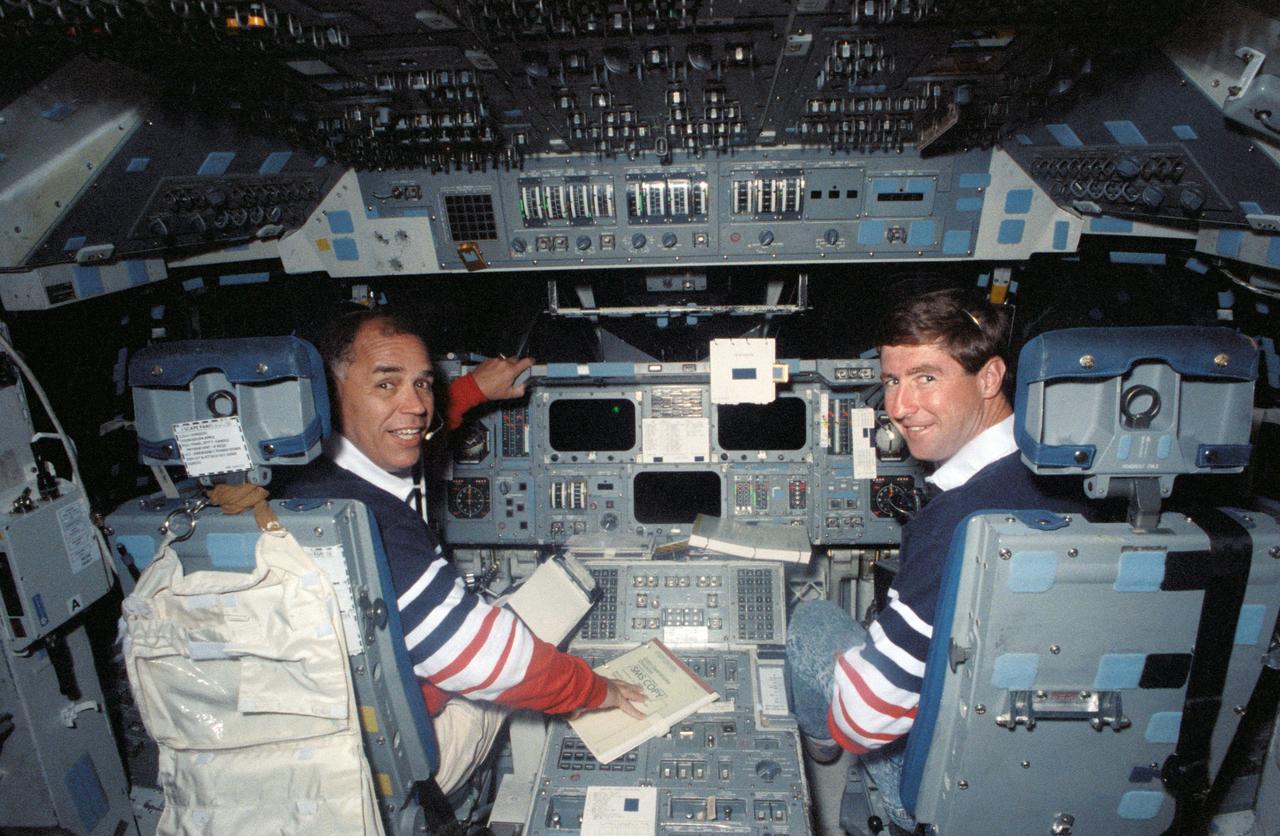
S91-38355 (28 May 1991) --- Seen floating about the vacant spaces of the Johnson Space Center's KC-135 "zero-gravity" aircraft are the six crewmembers for the STS 44 mission. Left to right are Terence T. Henricks, James S. Voss, F. Story Musgrave (partially obscured), Frederick D. Gregory, Thomas J. Hennen and Mario Runco Jr. Gregory is mission commander. Hennen is payload specialist for this flight, dedicated to the Department of Defense. The flight served as a refresher and a preview of the experience of weightlessness, as the special aircraft flew a series of parabolas which provided short sessions of zero-gravity.
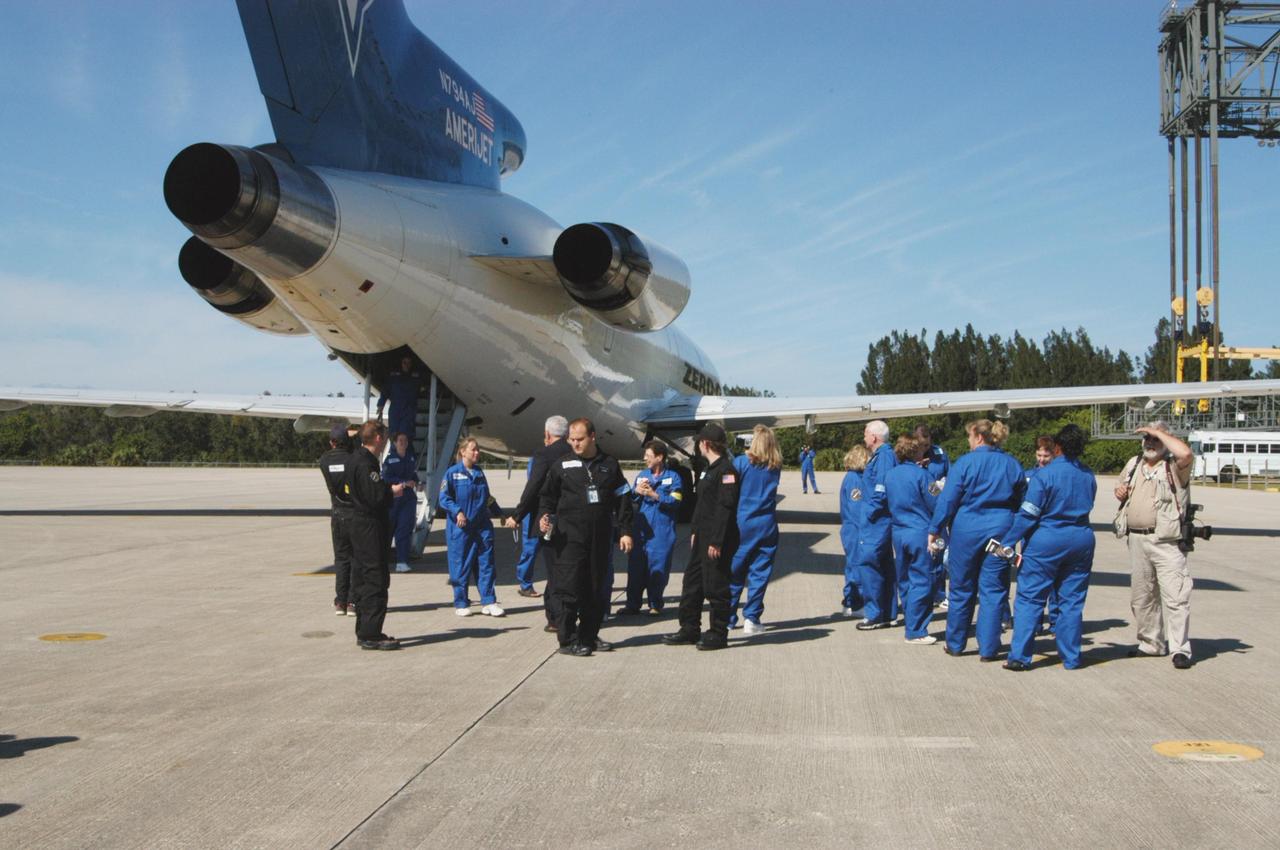
KENNEDY SPACE CENTER, FLA. - Passengers known as “Flyers” disembark at Kennedy Space Center’s shuttle landing facility from a Boeing 727-200 aircraft used for weightless flights by Zero Gravity Corporation, known as ZERO-G, of Fort Lauderdale, Fla. NASA and ZERO-G demonstrated Nov. 5 the expanded access to and use of the space shuttle's runway and landing facility at Kennedy Space Center for non-NASA activities. The “Flyers” were predominantly teachers who performed simple microgravity experiments they can share with their students back in the classroom.
KENNEDY SPACE CENTER, FLA. - The Boeing 727-200 aircraft used for weightless flights by Zero Gravity Corporation, known as ZERO-G, of Fort Lauderdale, Fla., takes off from Kennedy Space Center’s shuttle landing facility. NASA and ZERO-G demonstrated Nov. 5 the expanded access to and use of the space shuttle's runway and landing facility at Kennedy Space Center for non-NASA activities. The group of passengers, called "Flyers," were predominantly teachers who performed simple microgravity experiments they can share with their students back in the classroom.
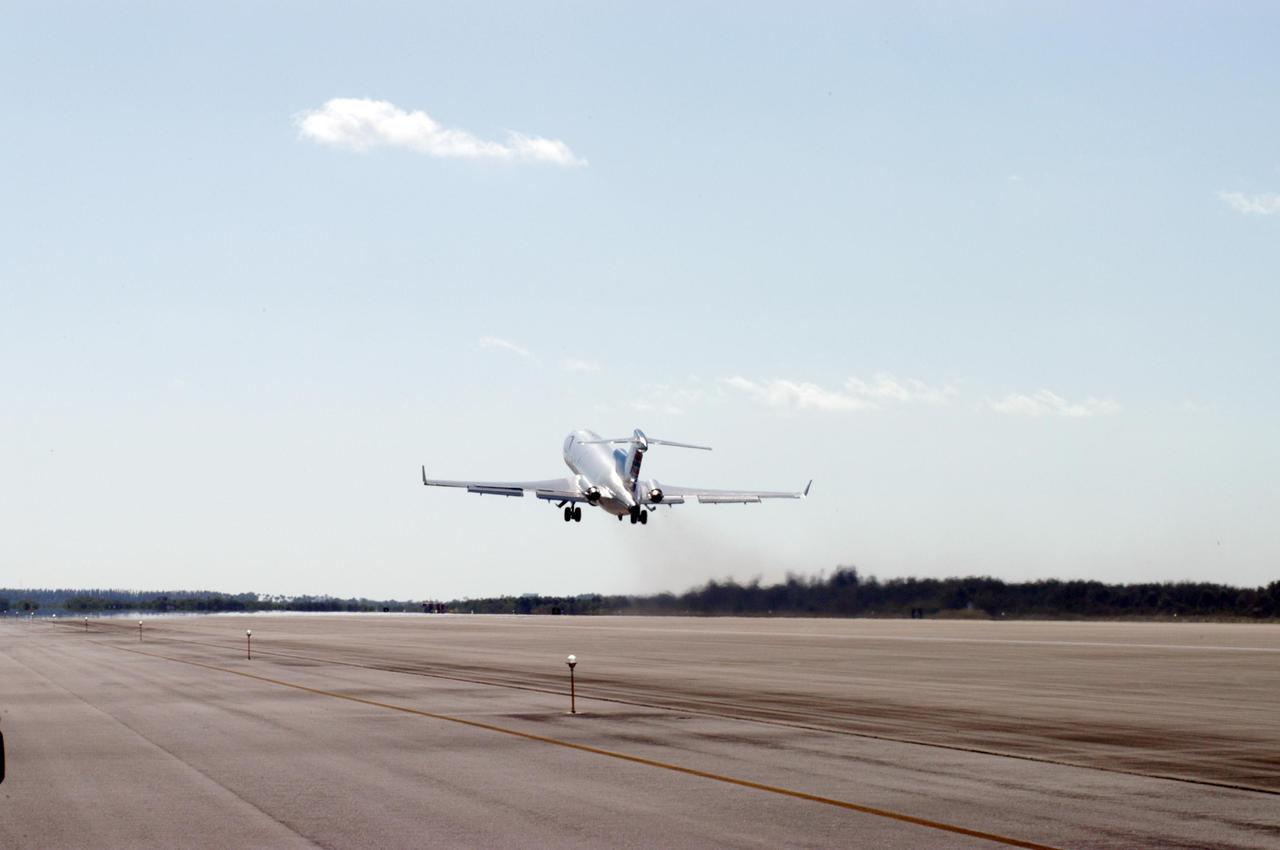
KENNEDY SPACE CENTER, FLA. - The Boeing 727-200 aircraft used for weightless flights by Zero Gravity Corporation, known as ZERO-G, of Fort Lauderdale, Fla., is airborne from Kennedy Space Center’s shuttle landing facility. NASA and ZERO-G demonstrated Nov. 5 the expanded access to and use of the space shuttle's runway and landing facility at Kennedy Space Center for non-NASA activities. The group of passengers, called "Flyers," were predominantly teachers who performed simple microgravity experiments they can share with their students back in the classroom.
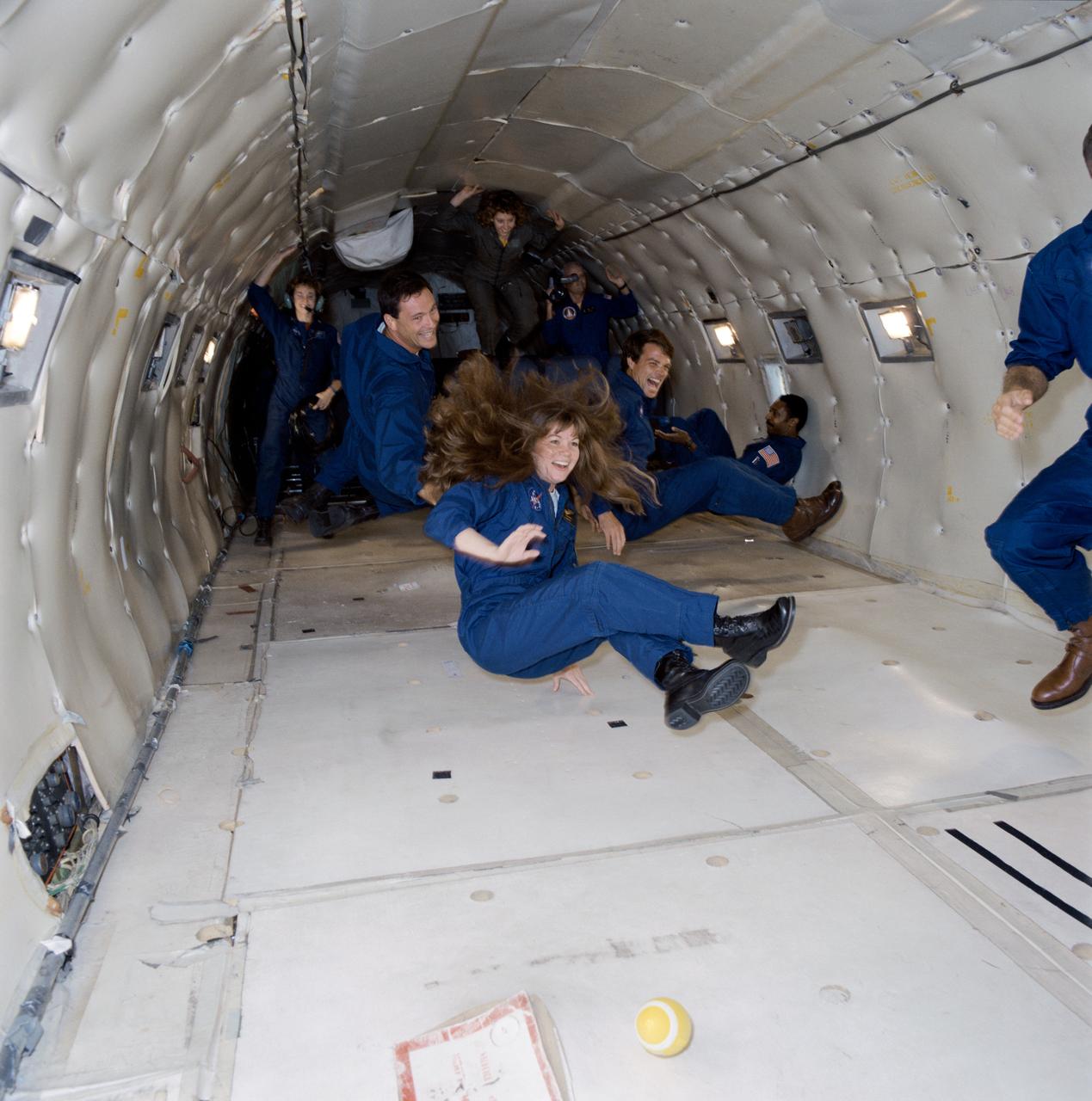
S94-26350 (10 Jan. 1994) --- Astronaut Catherine G. Coleman seems to enjoy the brief period of weightlessness she is sharing with fellow members of the 1992 class of astronauts. The weightless experience was afforded by a special parabolic pattern flown by NASA?s KC-135 ?zero gravity? aircraft. Left to right behind her are astronauts Michael E. Lopez-Alegria, Kevin R. Kregel and Winston E. Scott. EDITOR?S NOTE: Since this photograph was taken the four have been named to flights as follows: Kregel, STS-70; Scott, STS-72.
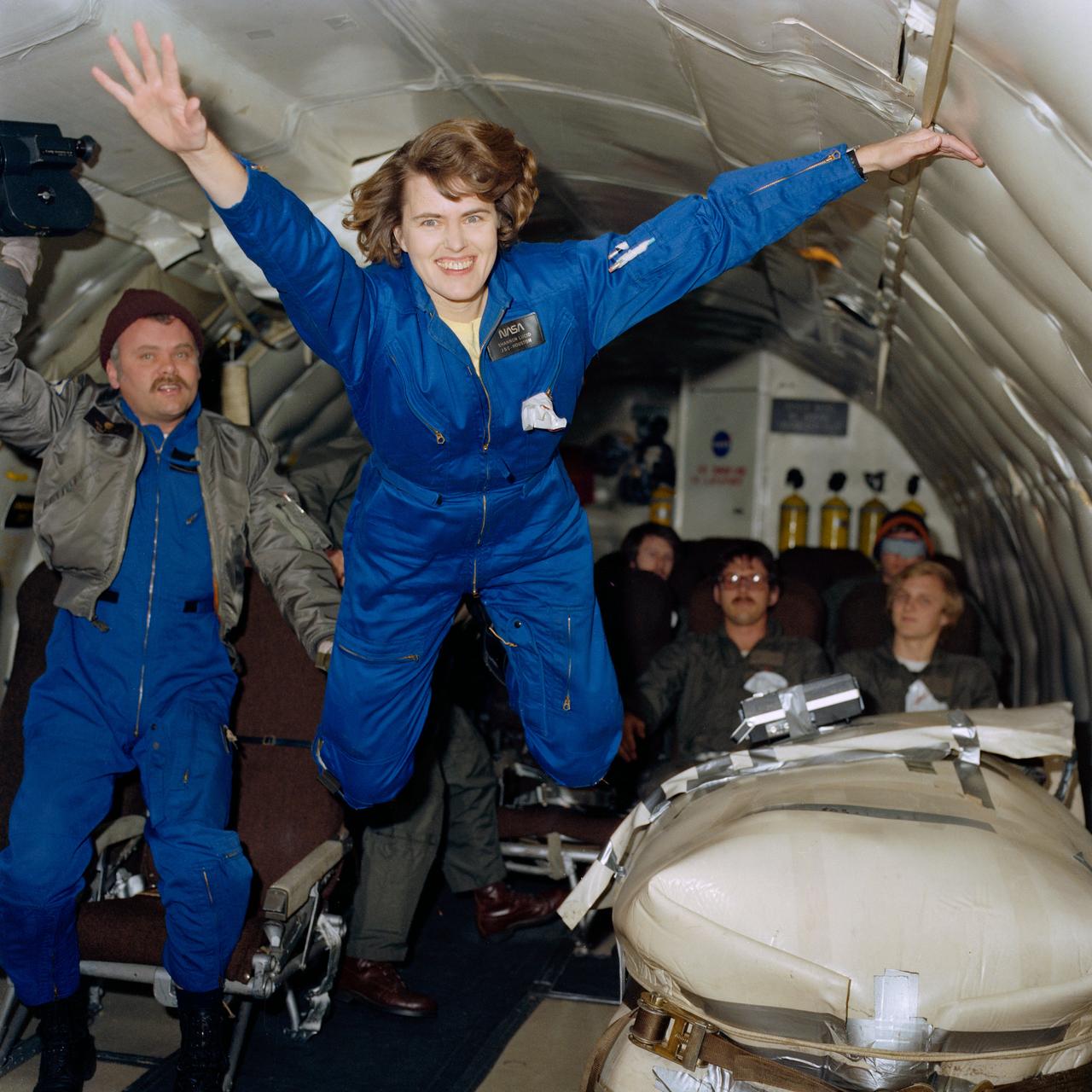
Astronaut -Candidate (ASCAN) Guion S. Bluford and Aviation Safety Officer Charles F. Hayes got a unique perspective of their environment during a zero- gravity flight. They are aboard a KC-135 Aircraft, which flies a special pattern repeatedly to afford a series of 30-seconds-of-weightlessness sessions. Astronauts Bluford and Hayes are being assisted by C. P. Stanley of the Photography Branch of the Photographic Technology Division (PTD) at Johnson Space Center (JSC). Some medical studies and a Motion Sickness Experiment were conducted on this particular flight. Astronaut Bluford is one of 20 Scientist/ASCAN's who began training at JSC, 07/1978. 1. Dr. Jeffrey A. Hoffman - Zero-G 2. ASCAN Shannon Lucid - Zero-G 3. ASCAN Guion Bluford - Zero-G
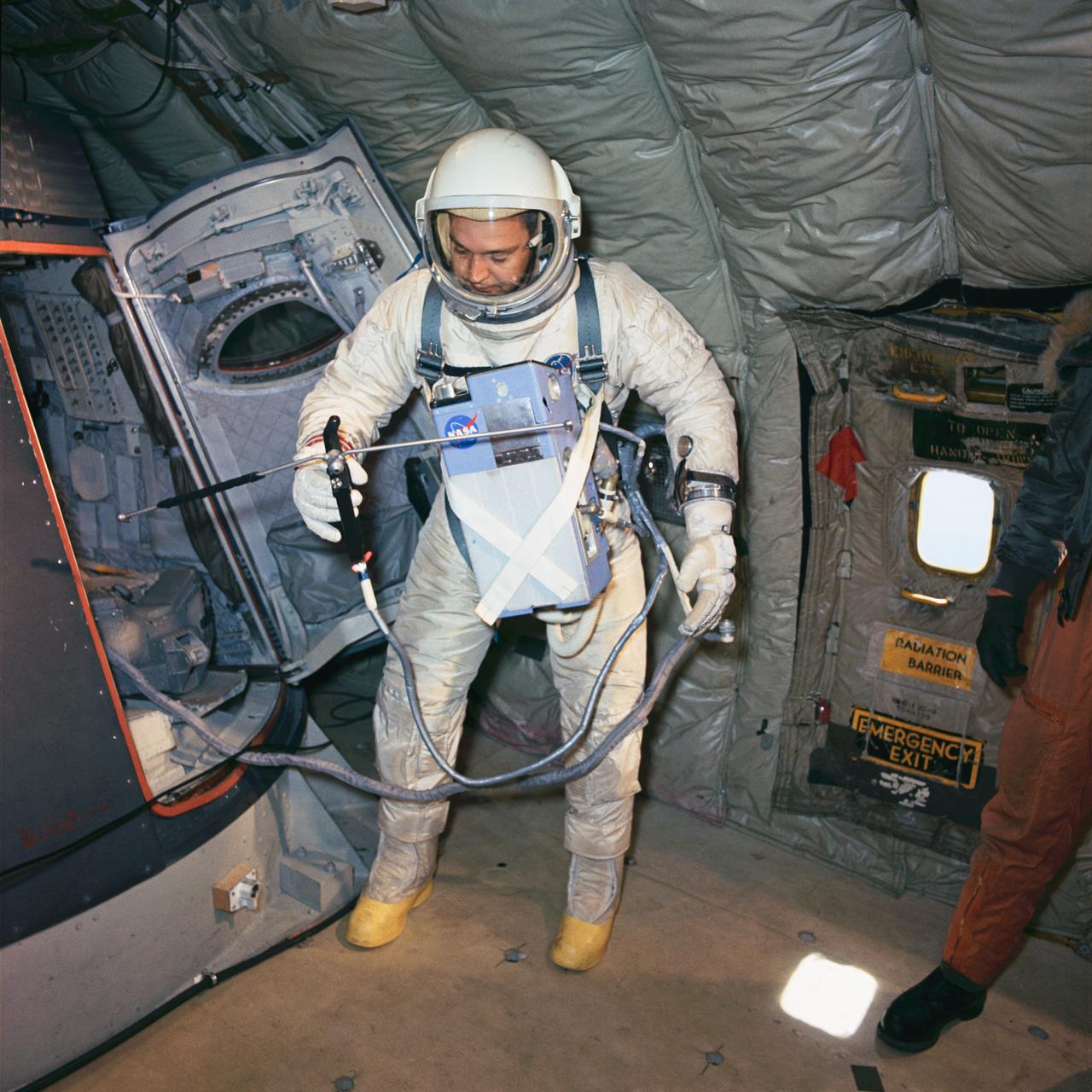
S66-28636 (1 April 1966) --- Astronaut Clifton C. Williams Jr., backup crew pilot of the Gemini-10 spaceflight, undergoes zero-gravity egress training. A KC-135 Air Force plane, flying a parabolic curve, creates a weightless environment as a training exercise in preparation for spaceflight. The Hand-Held Maneuvering Unit in his right hand produces controlled thrust for moving about. Photo credit: NASA

AS07-04-1586 (20 Oct. 1968) --- Astronaut Walter Cunningham, Apollo 7 lunar module pilot, writes with space pen as he is photographed performing flight tasks on the ninth day of the Apollo 7 mission. Note the 70mm Hasselblad camera film magazine just above Cunningham's right hand floating in the weightless (zero gravity) environment of the spacecraft.
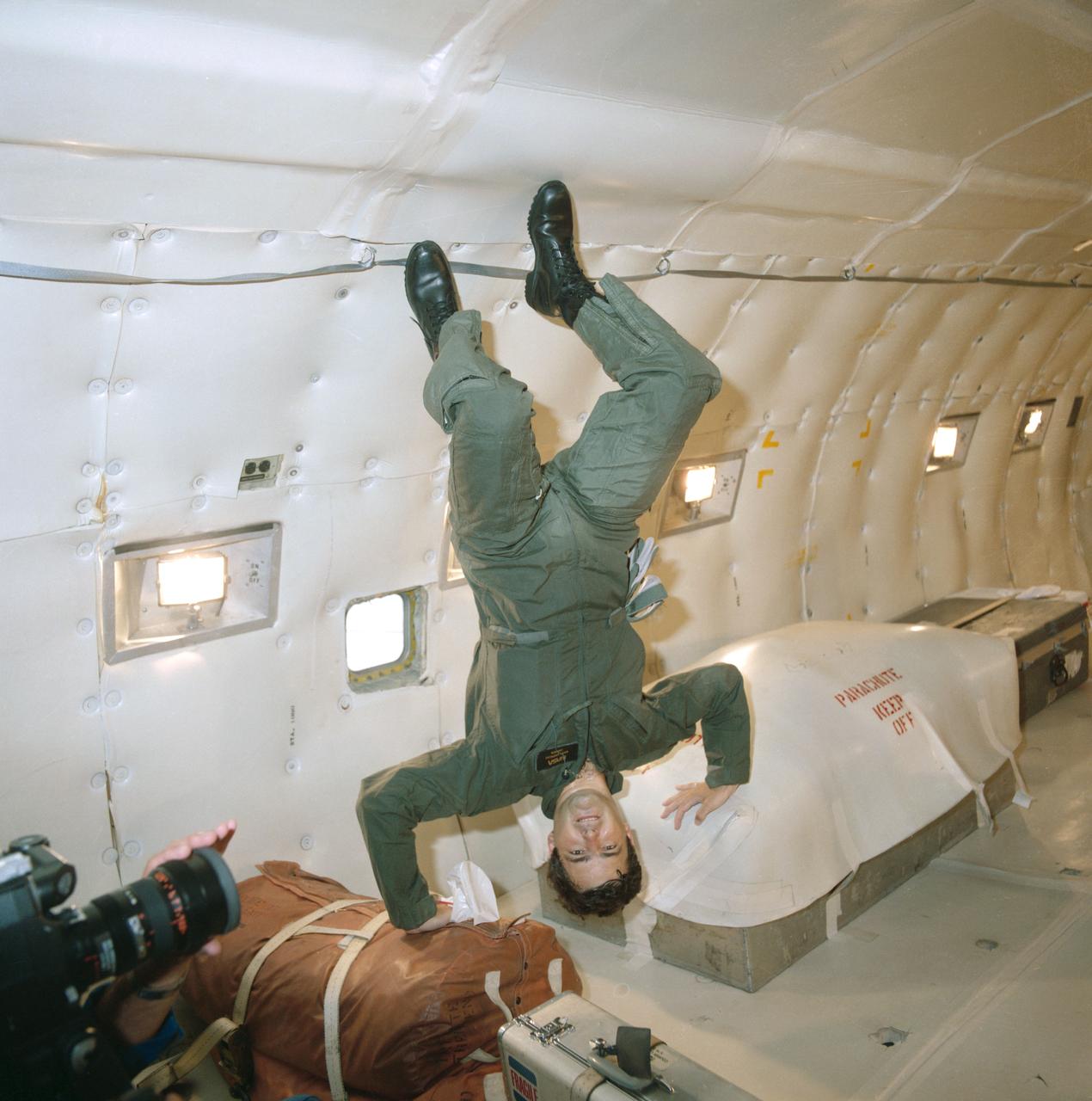
S84-37514 (18 July 1984) --- Marc Garneau, representing Canada's National Research Council as one of two 41-G payload specialists, gets the "feel" of zero gravity aboard a special NASA aircraft designed to create brief periods of weightlessness. Five astronauts and an oceanographer from the U.S. Dept. of the Navy will join Canada's first representative in space for the trip aboard Challenger later this year. This KC-135 aircraft is used extensively for evaluation of equipment and experiments scheduled for future missions.
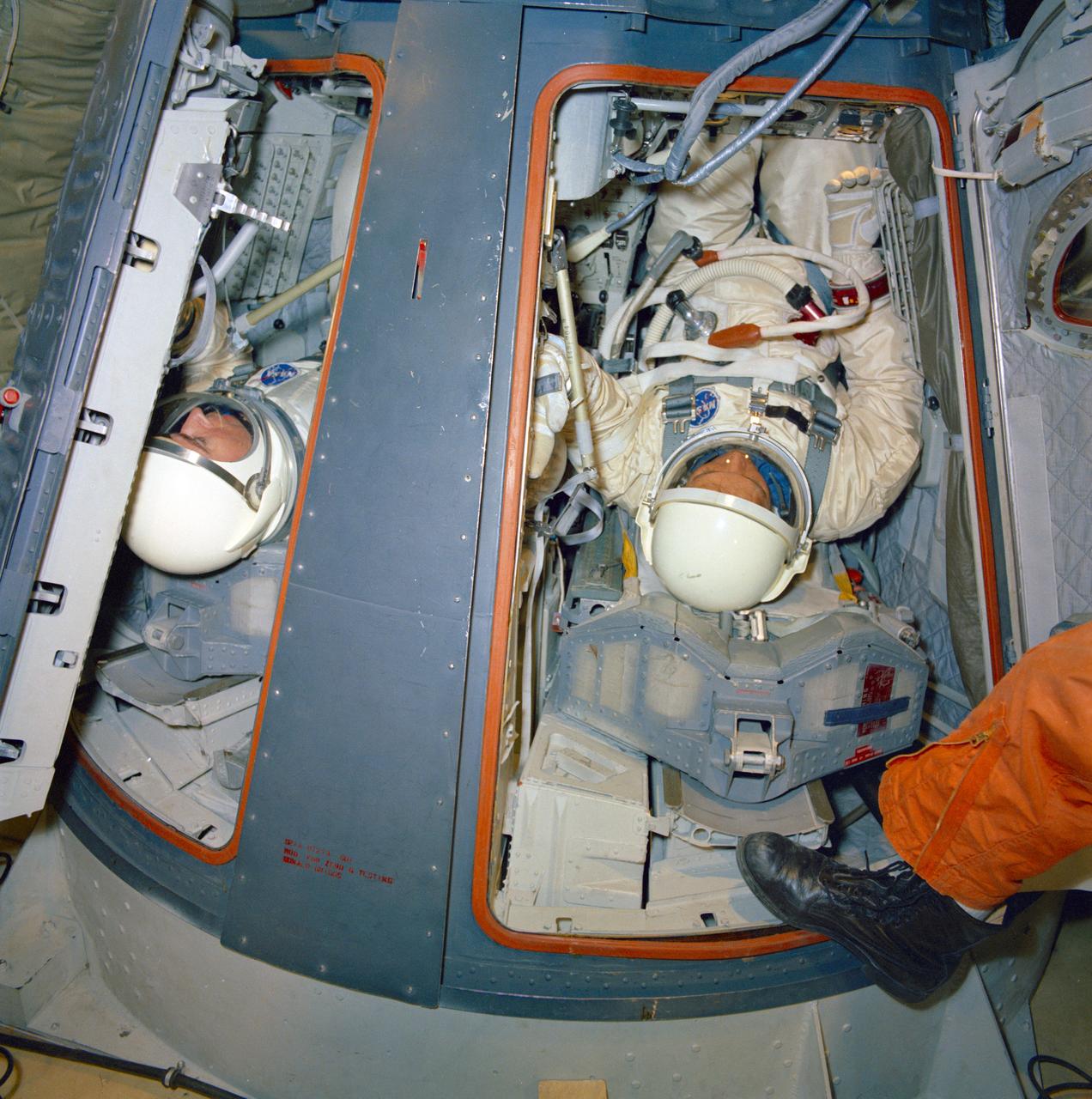
S66-28583 (1 April 1966) --- The Gemini-10 prime crew undergoes zero-gravity egress training aboard a KC-135 Air Force plane. Astronaut John W. Young, command pilot, is on left. On the right is astronaut Michael Collins, pilot. The airplane, flying a parabolic curve, creates a weightless environment as a training exercise in preparation for spaceflight Photo credit: NASA
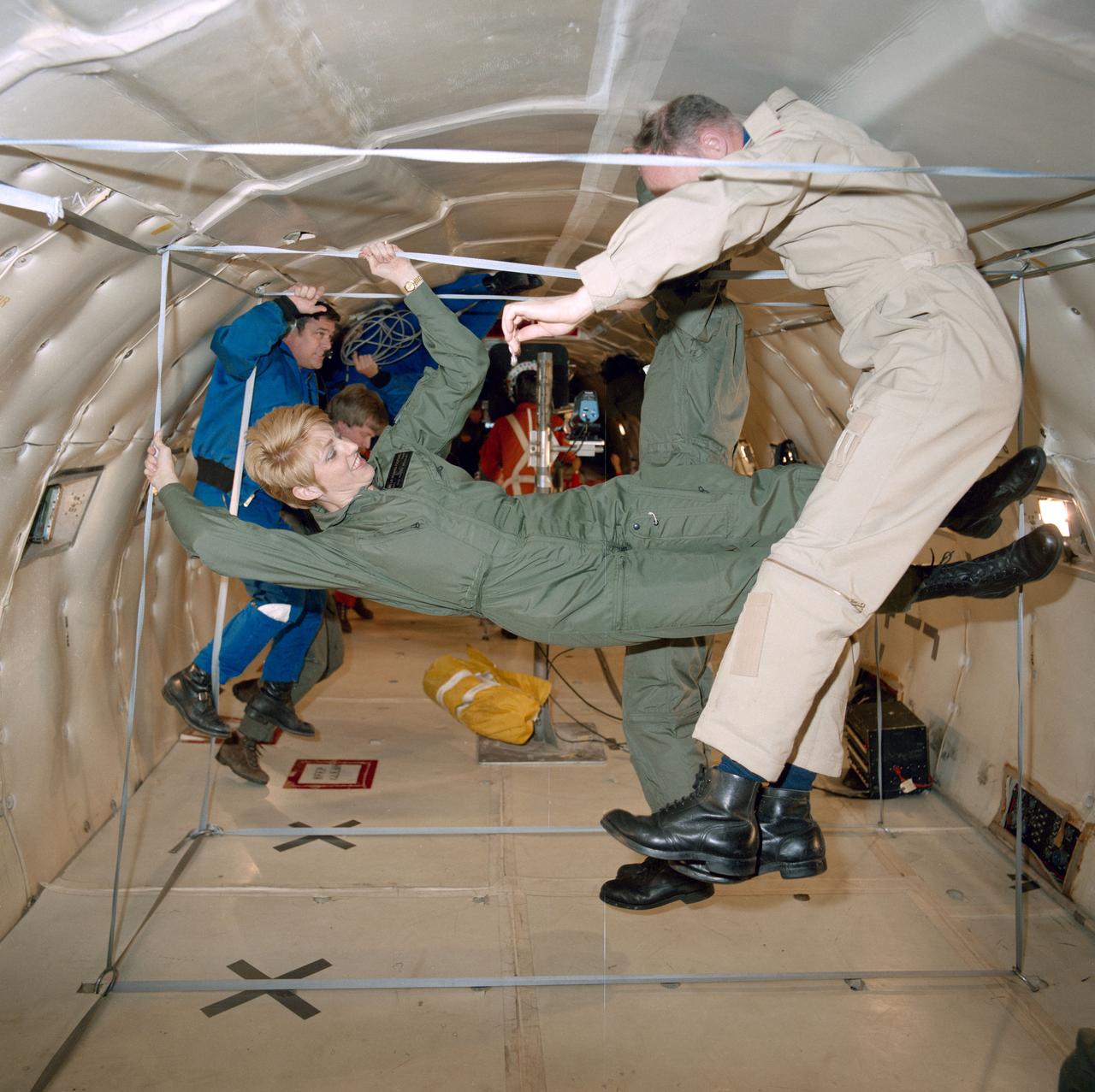
Vestibular Study testing in Zero-G flights on the KC-135. Seen in this view are Roberta Bonder and others experiencing weightlessness.
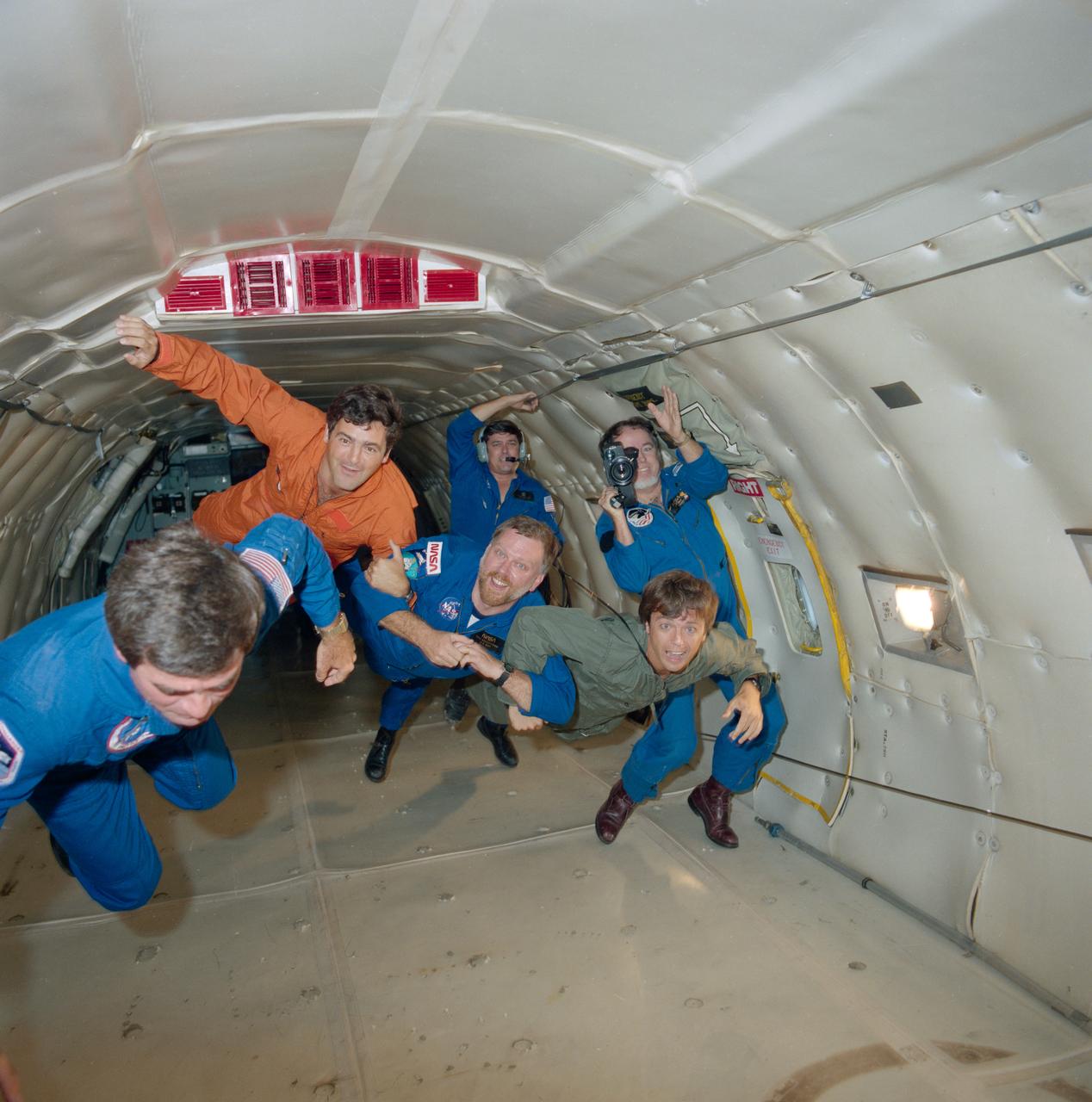
Paul Scully-Power, 41-G payload specialist, links arms with two others as they experience weightlessness in the KC-135 training aircraft. The trio appears to be flying toward the front of the aircraft while others take photos.
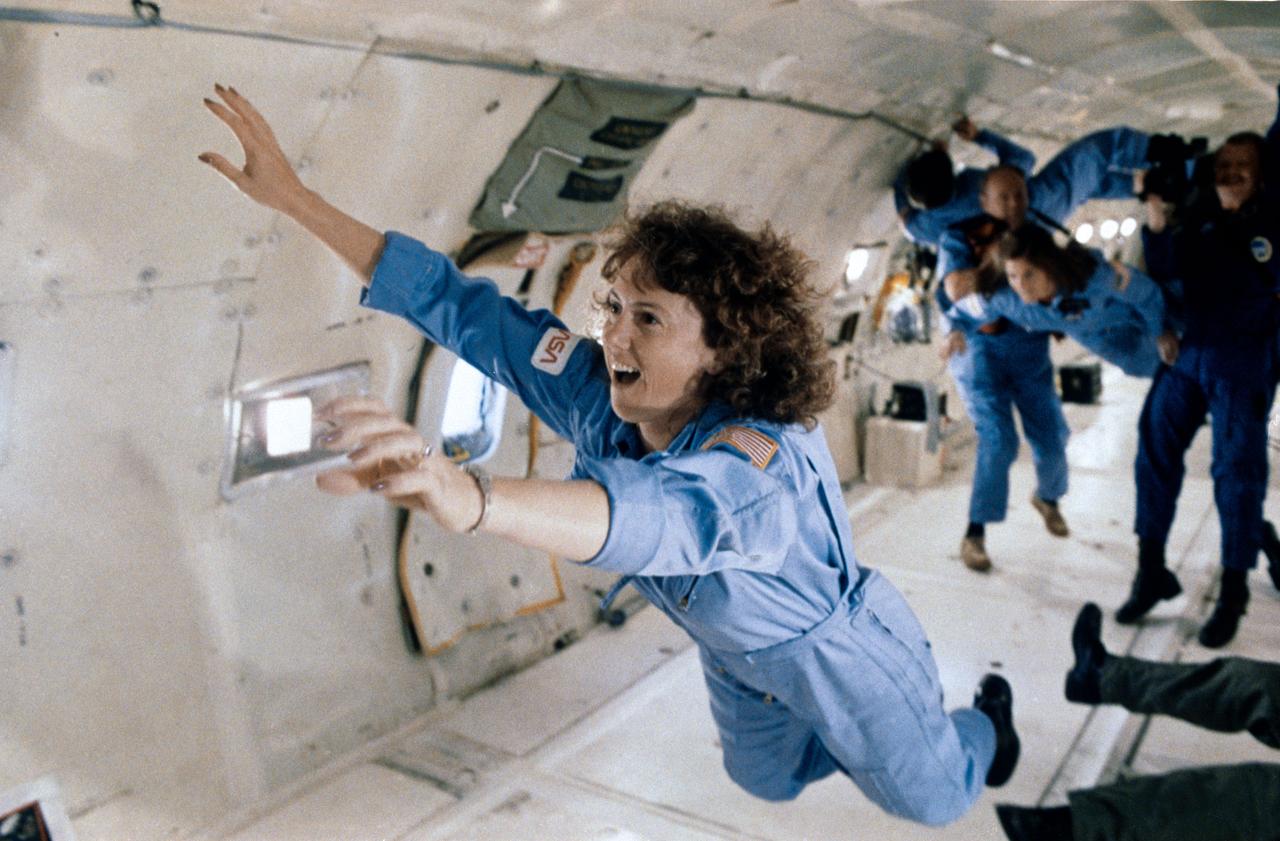
S86-25180 (October 1985) --- Sharon Christa McAuliffe, STS-51L citizen observer/payload specialist, representing the Teacher-in-Space Project, floats forward and upward during a few moments of weightlessness aboard a KC-135 aircraft. The flight is part of her training for the scheduled five-day flight aboard the Challenger in January of next year. Barbara R. Morgan, backup payload specialist for STS-51L, is partially visible in the background. The photo was taken by Keith Meyers of the New York Times. Photo credit: NASA
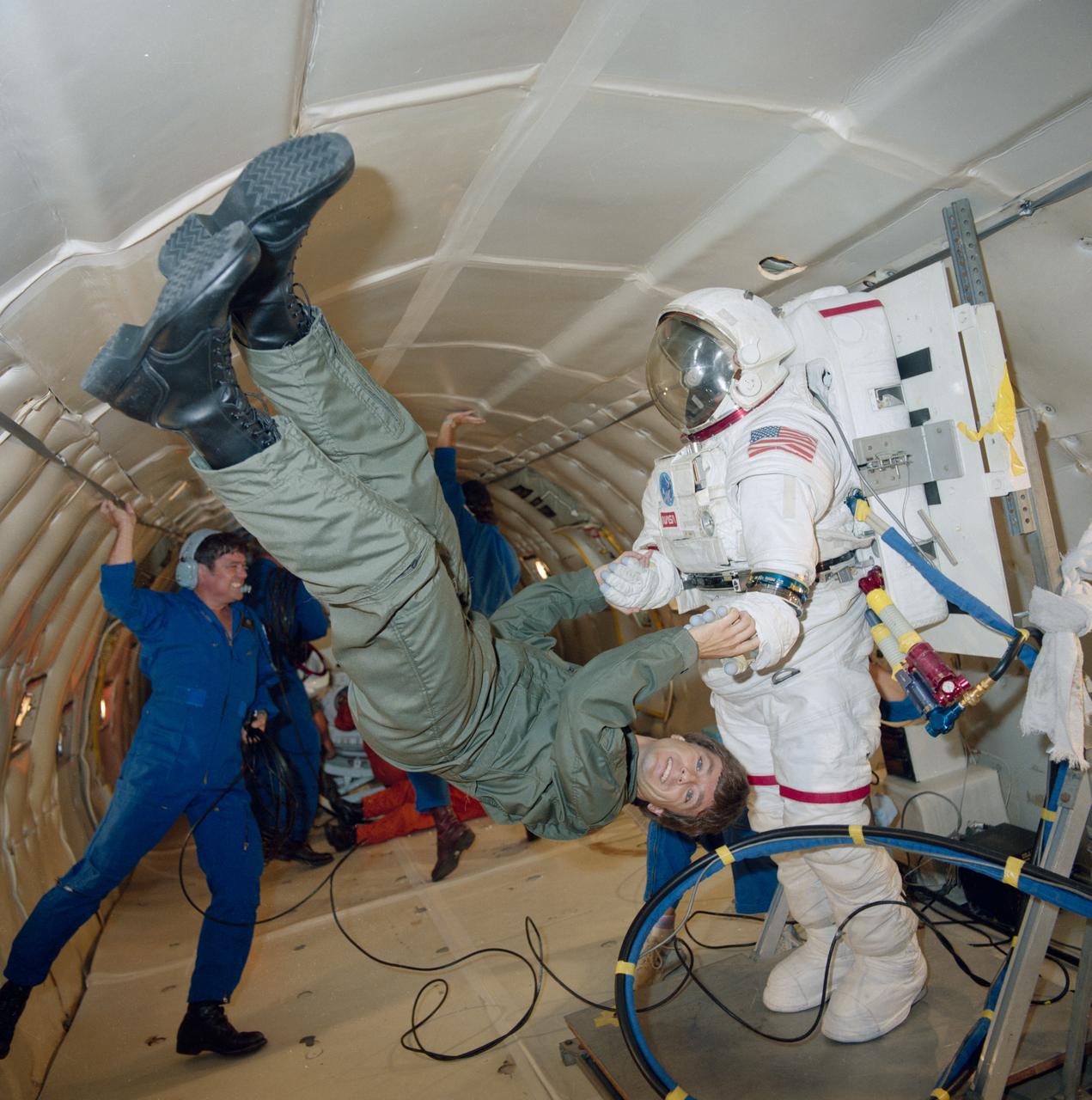
S84-37532 (18 July 1984) --? Robert B. Thirsk, backup payload specialist for 41-G appears to be shaking hands with an unoccupied extravehicular mobility unit (EMU) during a familiarization flight aboard NASA?s KC-135 aircraft. Thirsk, representing Canada?s National Research Council (NRC), serves as backup to Marc Garneau on the seven-member crew for Challenger?s October 1984 flight. This aircraft is used extensively for training and exposing Shuttle crewmembers to weightlessness as well as for evaluation of equipment and experiments scheduled for future flights.
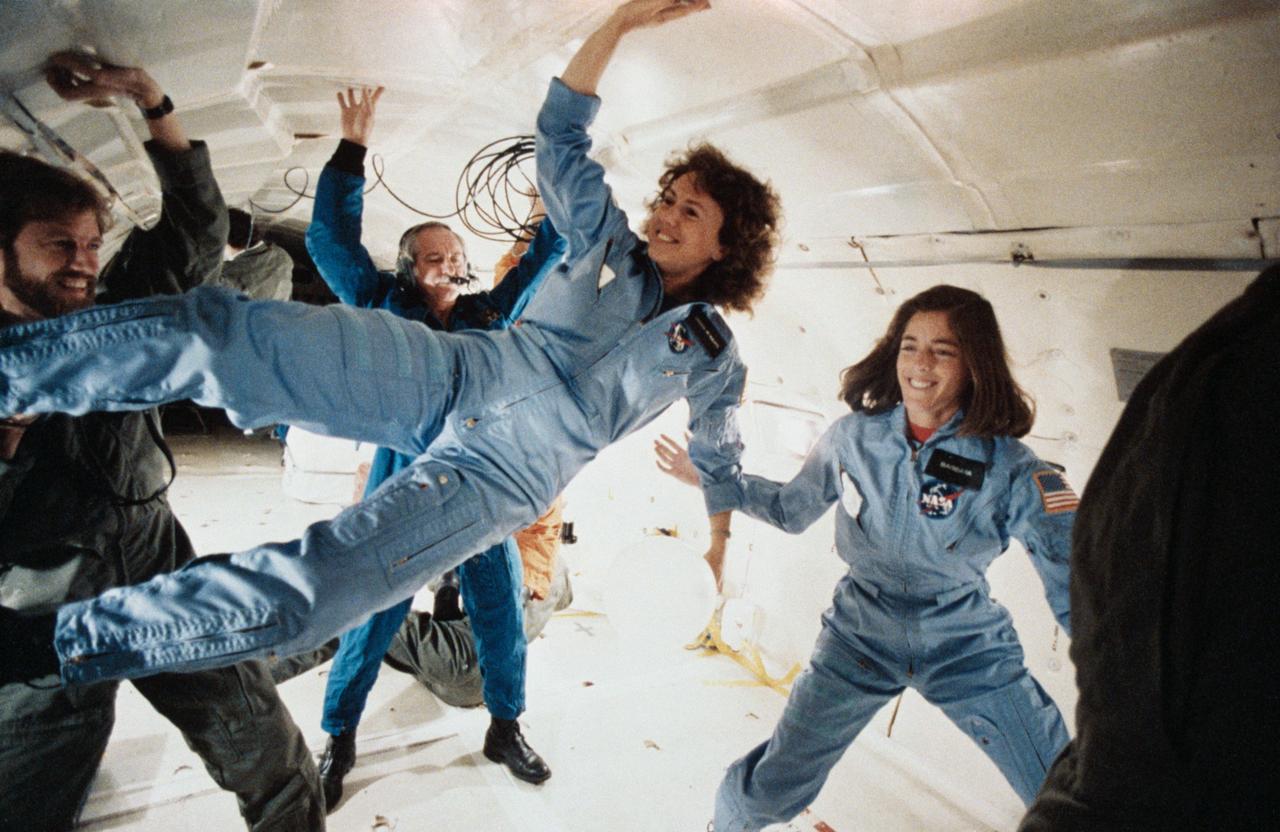
S86-25191 (for release January 1986) --- The two representatives of the Teacher-in-Space Project continue their training program at the Johnson Space Center with an additional flight aboard NASA?s KC-135 ?zero gravity? aircraft. Sharon Christa McAuliffe, left, is prime crew payload specialist, and Barbara R. Morgan is in training as backup payload specialist. The photo was taken by Keith Meyers of New York Times. Photo credit: NASA
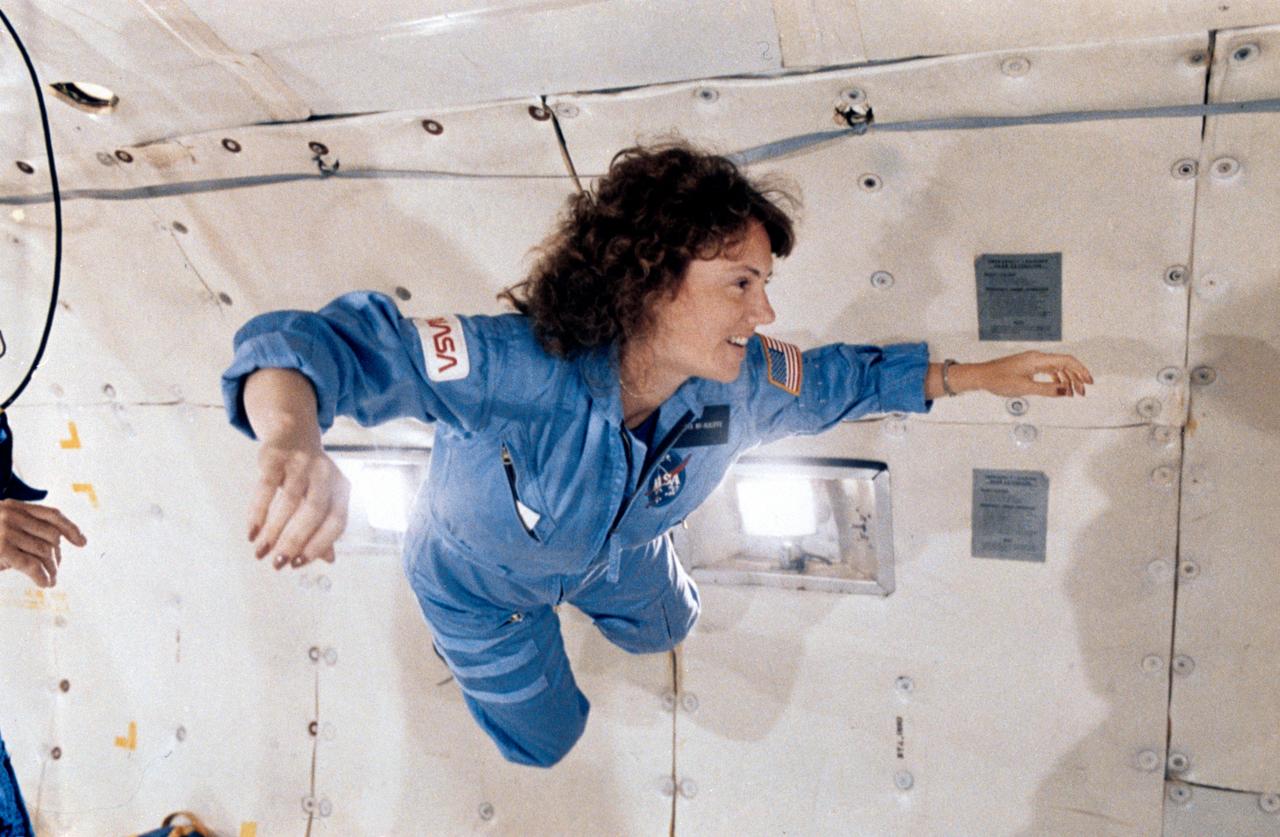
S86-25196 (January 1986) --- Sharon Christa McAuliffe, STS-51L citizen observer/payload specialist, gets a preview of microgravity during a special flight aboard NASA?s KC-135 ?zero gravity? aircraft. McAuliffe will represent the Teacher-in-Space Project aboard the space shuttle Challenger when it launches later this month. This photograph was taken by Keith Meyers of the New York Times. EDITOR?S NOTE: The STS-51L crew members lost their lives in the space shuttle Challenger accident moments after launch on Jan. 28, 1986 from the Kennedy Space Center (KSC). Photo credit: NASA
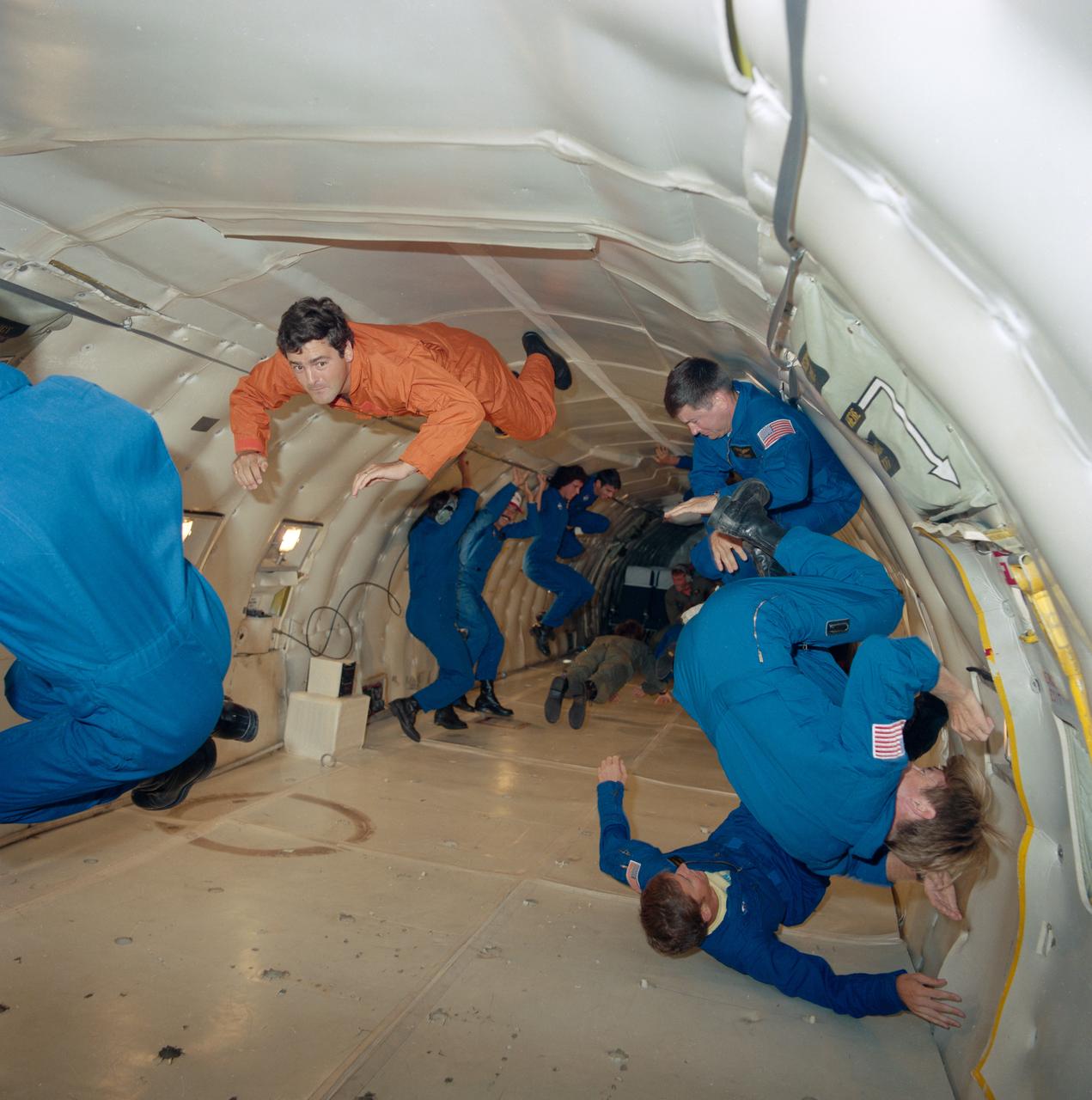
View of astronaut candidates and payload specialists during a training flight on the KC-135. The trainees are experiencing weightlessness in the hold of the aircraft.
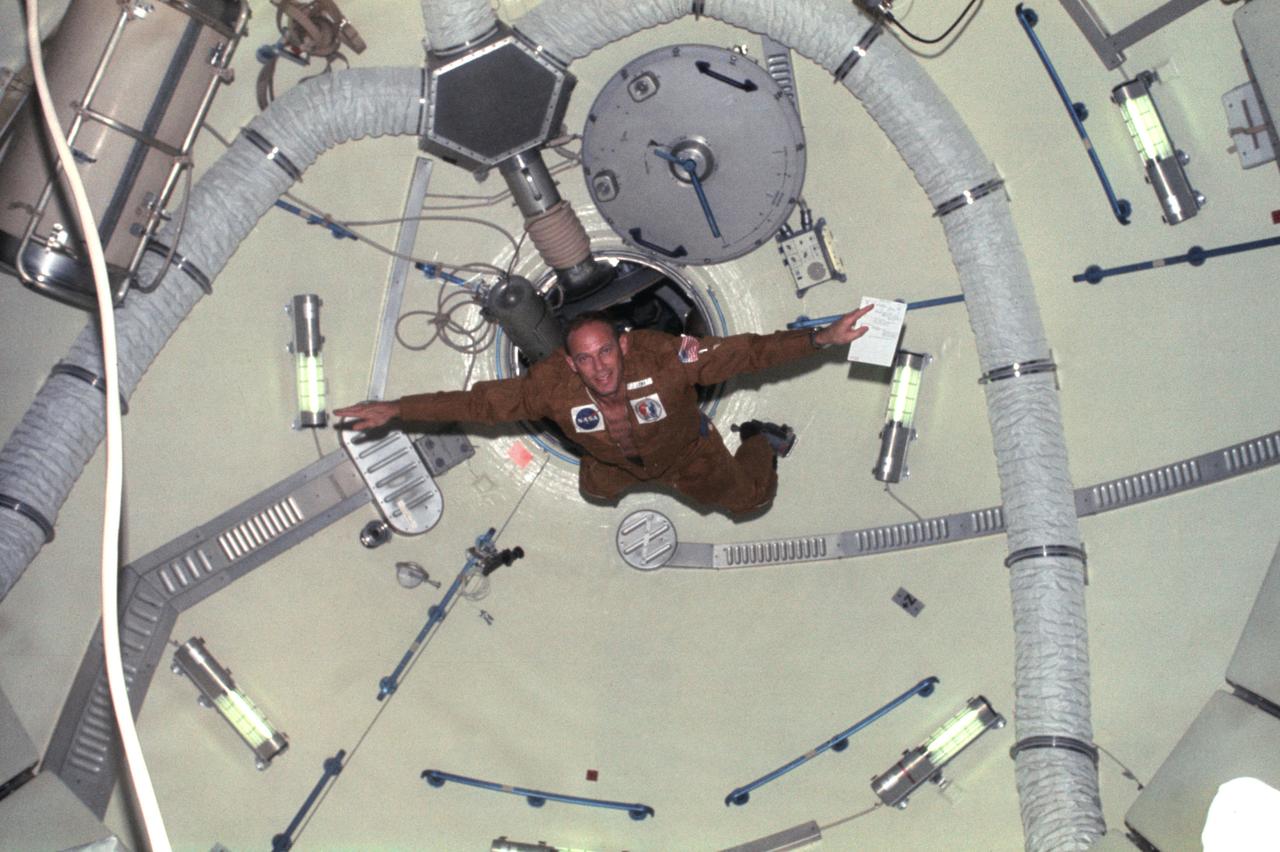
Astronaut Jack R. Lousma, Skylab 3 pilot, doing acrobatics in the dome area of the Orbital Workshop (OWS) on the space station cluster in Earth orbit. The dome area is about 22 feet in diameter and 19 feet from top to bottom.
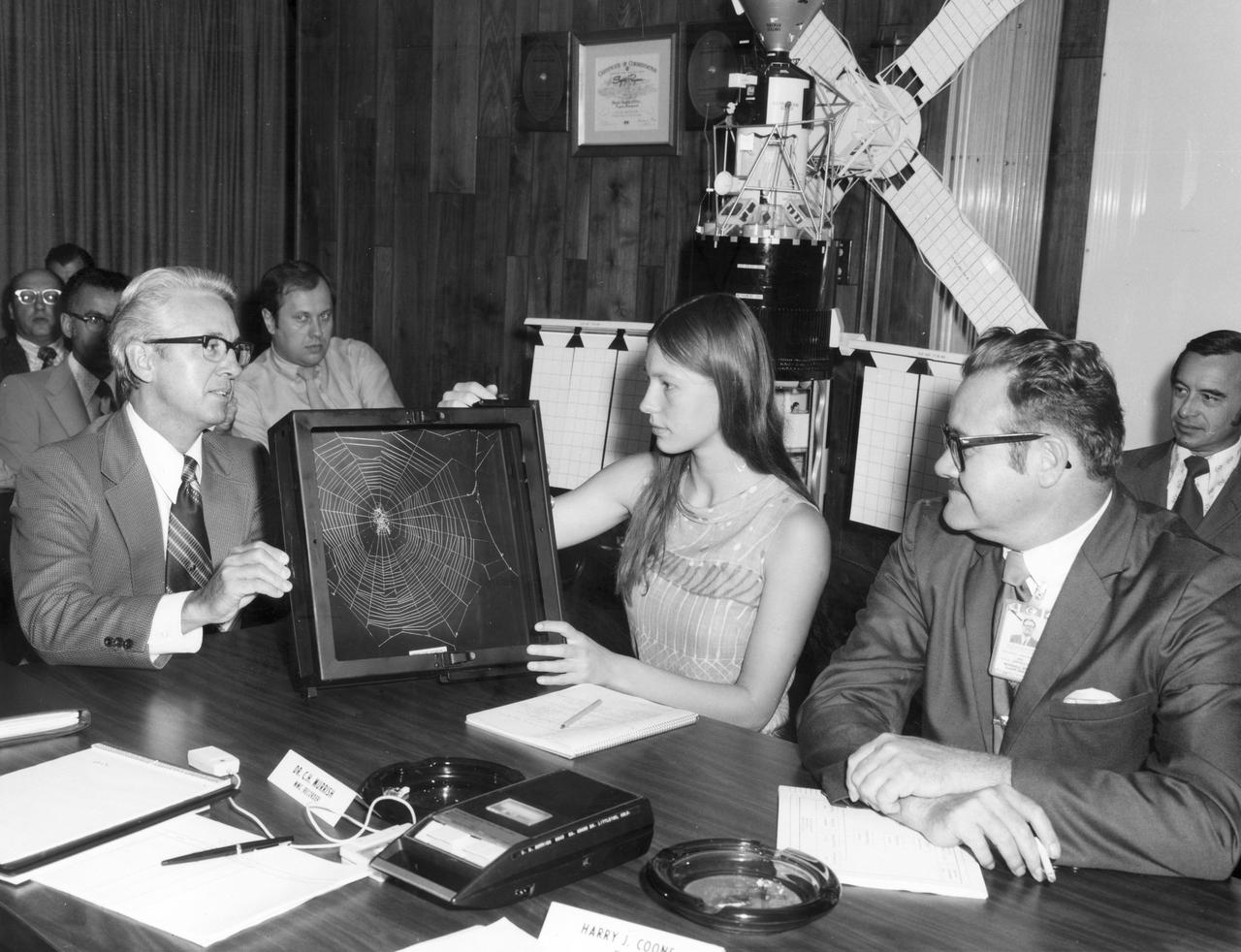
Lexington, Massachusetts high school student, Judith Miles, discusses her proposed Skylab experiment with Keith Demorest (right) and Henry Floyd, both of Marshall Space Flight Center (MSFC). In her experiment, called the “Web Formation in Zero Gravity”, called for spiders to be released into a box and their actions recorded to determine how well they adapt to the absence of gravity. Spiders are known to adapt quickly to other changes in the environment but nothing was known of their ability to adapt to weightlessness. At the same time spiders were weaving webs in Earth orbit, similar spiders were spinning webs in identical boxes on Earth under full gravity conditions. Miles was among the 25 winners of a contest in which some 3,500 high school students proposed experiments for the following year’s Skylab Mission. Of the 25 students, 6 did not see their experiments conducted on Skylab because the experiments were not compatible with Skylab hardware and timelines. Of the 19 remaining, 11 experiments required the manufacture of equipment.
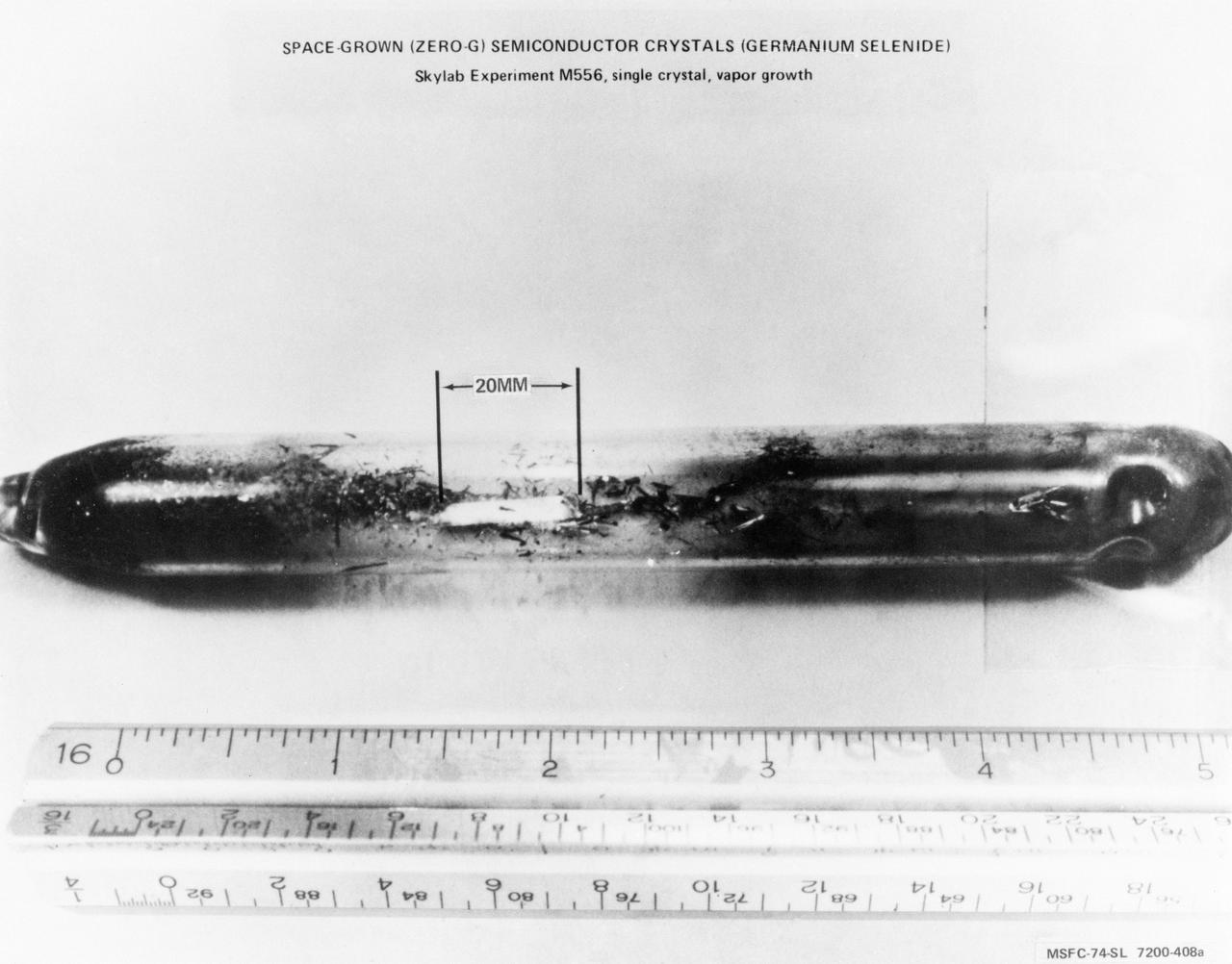
S74-19677 (April 1974) --- This crystal of Germanium Selenide (GeSe) was grown under weightless conditions in an electric furnace aboard the Skylab space station. Experiment M556, Vapor Growth of IV-VI Compounds, was conducted as a comparative test of GeSe crystals grown on Earth and those grown in a weightless environment. Skylab postflight results indicate that crystals grown in a zero-gravity situation demonstrate greater growth and better composite structure than those grown in ground-bases laboratories. The GeSe crystal shown here is 20 millimeters long, the largest crystal ever grown on Earth or in space. Principal Investigator for Experiment M556 is Dr. Harry Wiedemaier, Rensselaer Polytechnic Institute, Troy, New York. (See NASA photograph S74-19676 for an example of an Earth-grown Germanium Selenide crystal.) Photo credit: NASA
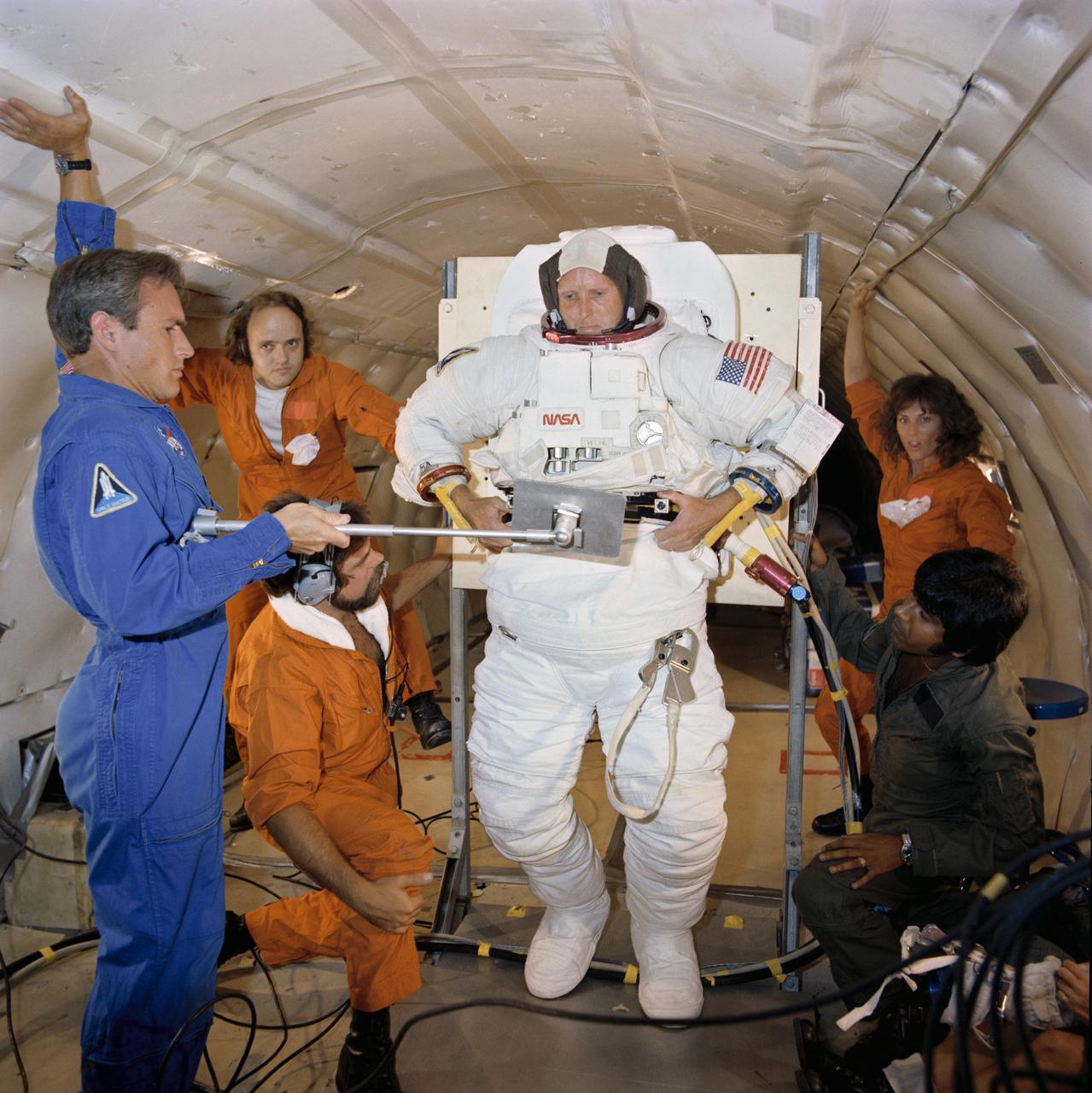
S81-34432 (July 1981) --- Astronaut C. Gordon Fullerton, STS-3 pilot, takes part in a suit donning and doffing exercise aboard a KC-135 "zero-gravity" aircraft. Mission specialist/astronaut William F. Fisher holds a mirror to assist Fullerton with hose and cable linkups to his suit. A special parabolic pattern flown by the KC-135 provides short durations of weightlessness. Fullerton's suit is an Extravehicular Mobility Unit (EMU), used by astronauts when leaving the shirt-sleeve environment of their shuttle orbiter to go outside and perform tasks in the vacuum of space. There are no such EVA plans on STS-3, but the crewmen are trained in this area in the event of a contingency. Photo credit: NASA
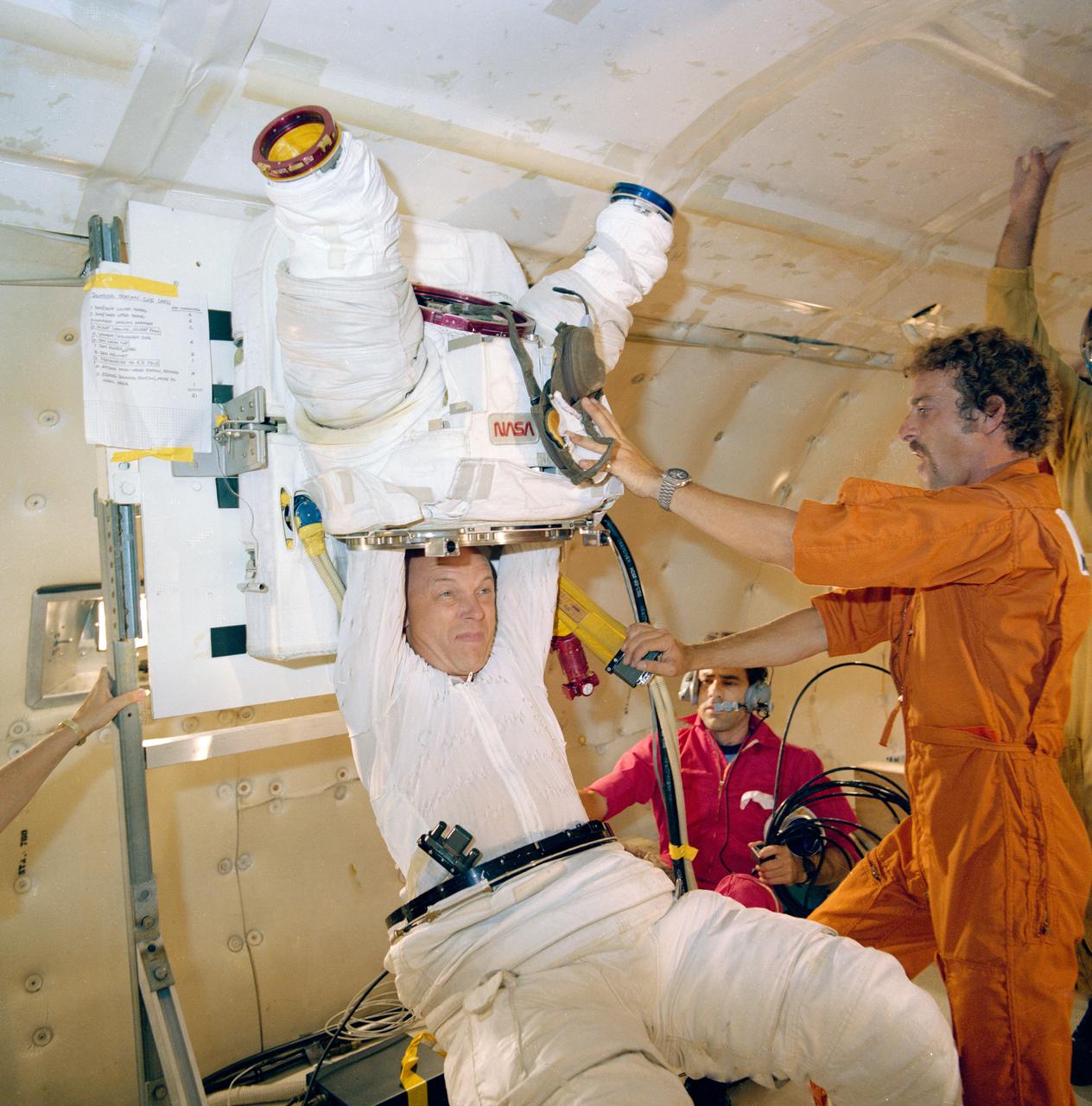
S82-33603 (November 1982) --- Astronaut F. Story Musgrave, STS-6 mission specialist, is assisted in a suit donning and doffing exercise in the weightlessness provided by a KC-135 ?zero-gravity? aircraft. Dr. Musgrave and the next mission?s other mission specialist, astronaut Donald H. Peterson, participated in the donning and doffing as a simulation for their preparations aboard the Challenger when they are called upon to perform an extravehicular activity (EVA) which was postponed from NASA?s first operational STS flight earlier this month. The suit is called an Extravehicular Mobility Unit (EMU). Photo credit: NASA
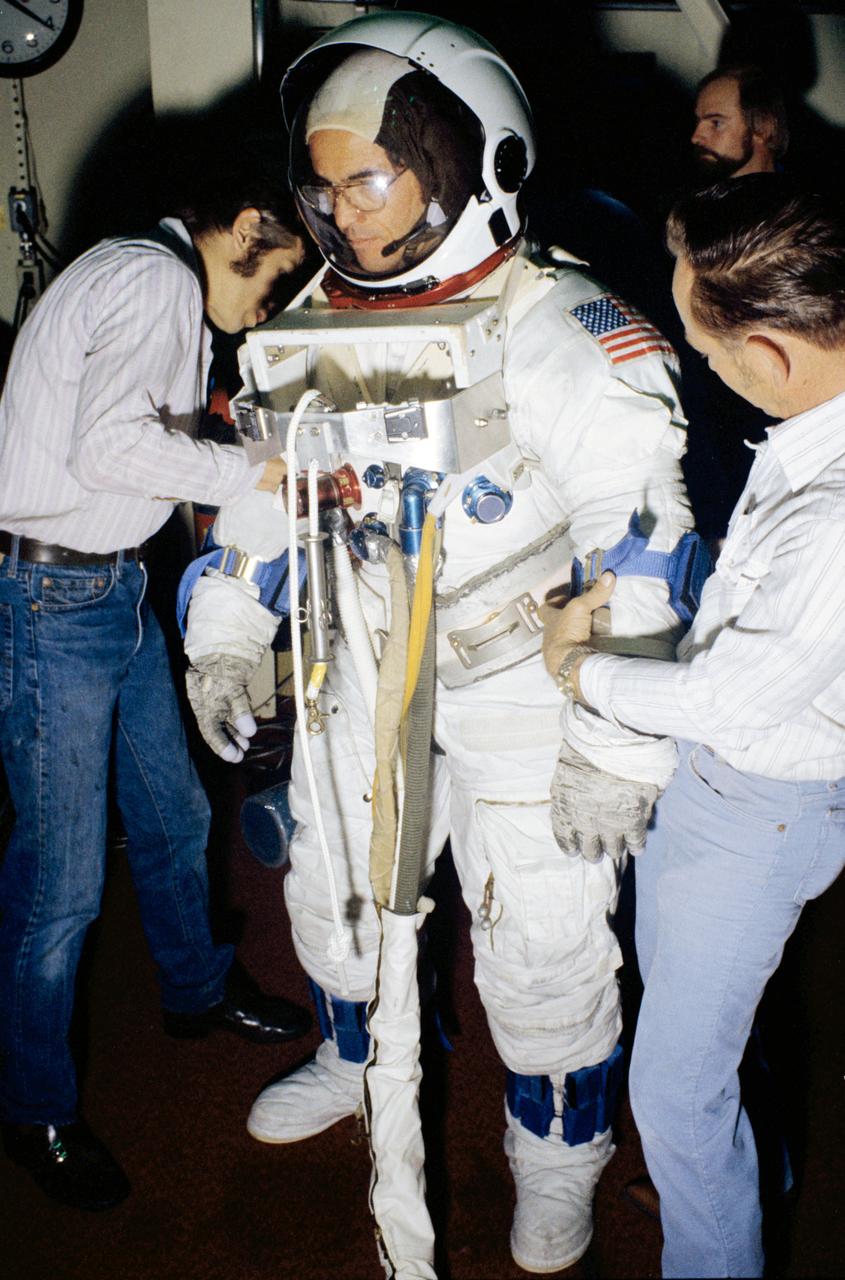
S79-25007 (13 Dec. 1978) --- Astronaut Robert L. Crippen, pilot for the first space shuttle orbital flight test (STS-1), is assisted by technicians prior to entering a water immersion facility (WIF) during a training session. The zero-gravity familiarization took place in the Johnson Space Center?s training and test center (Building 260). The WIF afford one of two ways to simulate the feeling of weightlessness experienced during space extravehicular activity (EVA), the other being inside aircraft flying a parabolic curve. Crippen will be joined by astronaut John W. Young for the STS-1 flight. Photo credit: NASA
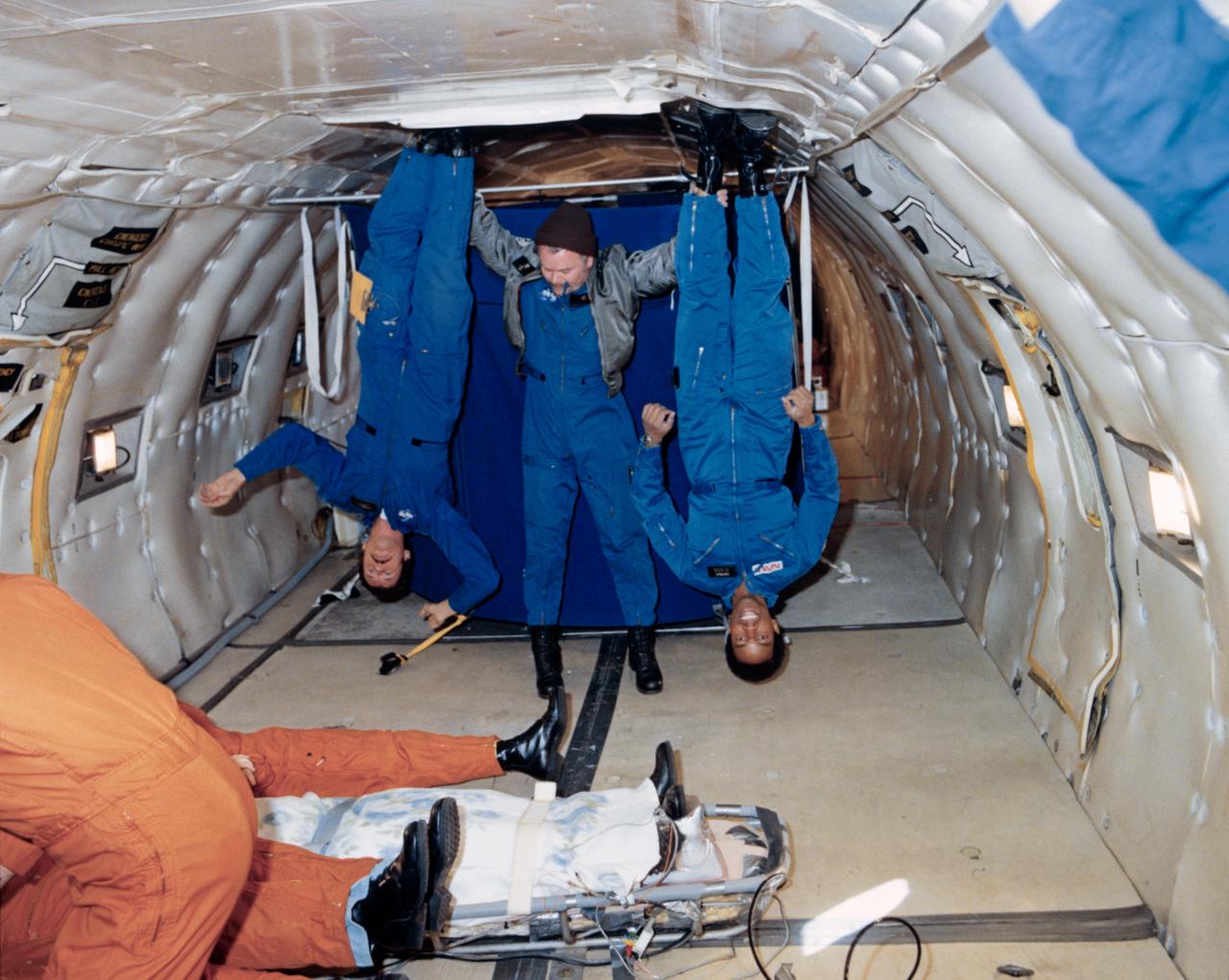
S79-28602 (2 March 1979) --- Astronaut candidate Guion S. Bluford and Aviation Safety Officer Charles F. Hayes got a unique perspective of their environment during a zero gravity flight. They are aboard a KC-135 aircraft, which flies a special pattern repeatedly to afford a series of 30-seconds-of-weightlessness sessions. Bluford and Hayes are being assisted by C. P. Stanley of the photography branch of the photographic technology division at Johnson Space Center (JSC). Some medical studies and a motion sickness experiment were conducted on this particular flight. Bluford is one of 20 scientist-astronaut candidates who began training at JSC in July of 1978. Photo credit: NASA
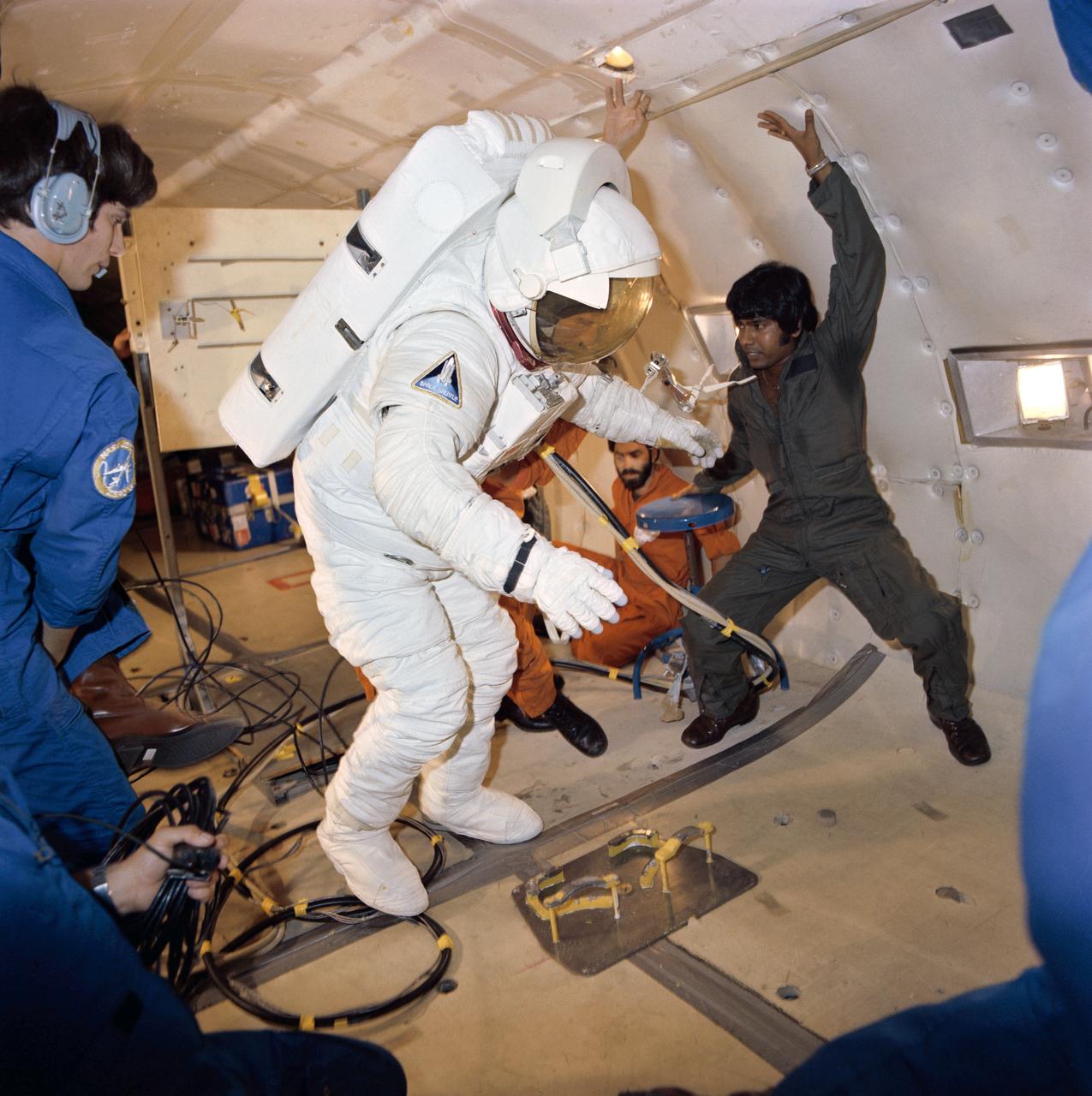
S81-34448 (July 1981) --- Astronaut C. Gordon Fullerton, STS-3 pilot, fully suited, gets a preview of what it might be like in space during a flight aboard NASA's KC-135 "zero-gravity" aircraft. A special parabolic pattern flown the aircraft provides short periods of weightlessness. Fullerton's suit is an Extravehicular Mobility Unit (EMU), used by astronauts when leaving the shirt-sleeve environment of their shuttle orbiter to go outside perform tasks in space. There are no such EVA plans on STS-3, but crew members are trained in this area in the event of the necessity to perform chores in space that for some reason or other can't be done remotely. The astronaut has just donned his suit during a parabola and now takes the opportunity to float around in the absence of gravity. Photo credit: NASA
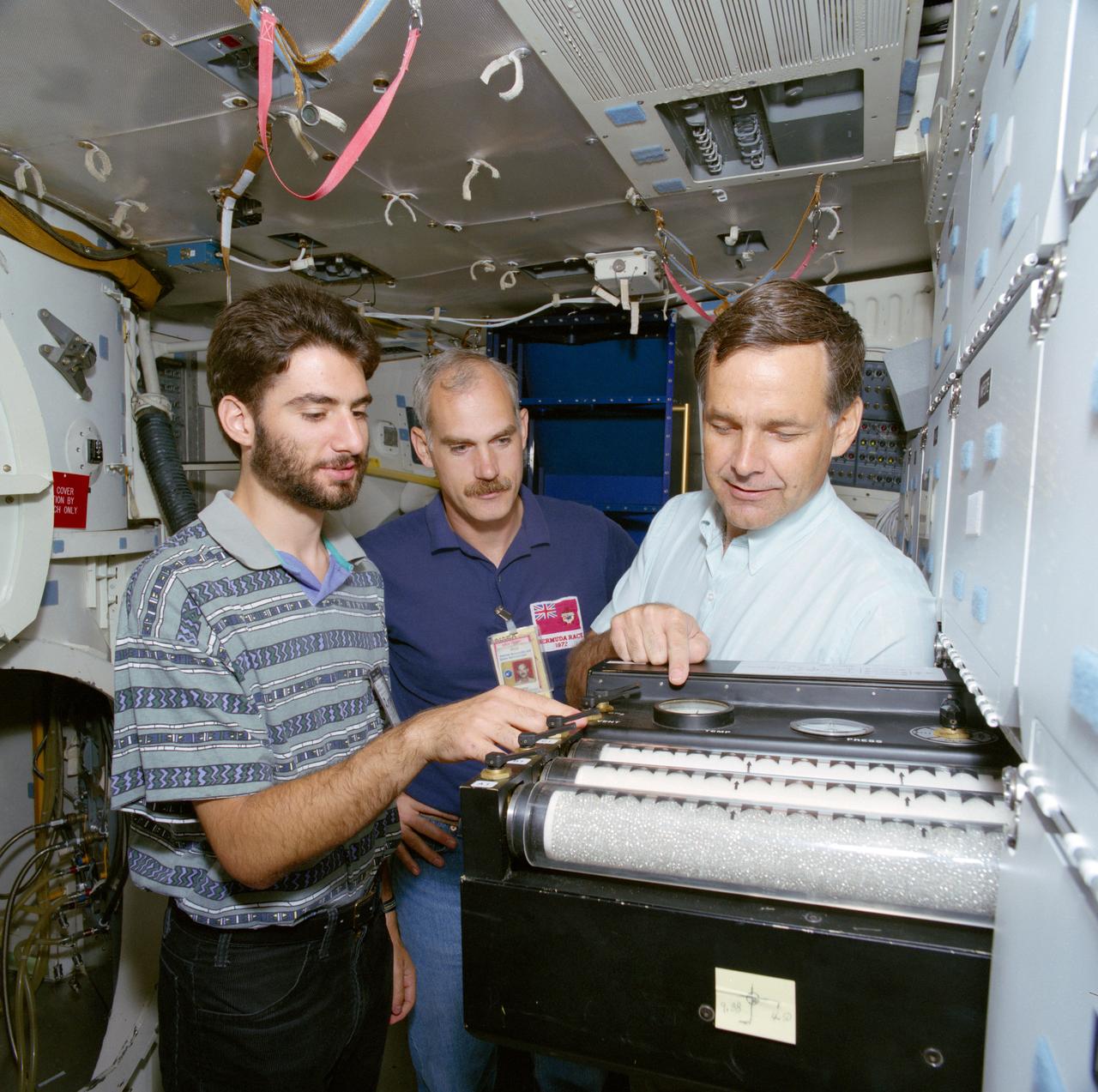
S91-47323 (18 Sept 1991) --- Constantine Costes, left, a student experimenter sponsored by United Space Boosters Inc, in Huntsville, Alabama, discusses his student experiment, "Zero-G Rise of Liquid Through Porous Media" with astronauts Ronald J. Grabe (right), STS 42 mission commander; and William Readdy, mission specialist. The student experimenter and crew members are in the Full Fuselage Trainer (FFT) in the Shuttle Mockup and Integration Laboratory. While attending Randolph School, a high school in Huntsville, Alabama, Costes was chosen in the national competition to participate in the Shuttle Student Involvement Program (SSIP). The experiment, contained in a middeck locker, involves the investigation of the effects of gravity on the flow characteristics of a fluid. Both pure capillary and forced flow behavior will be investigated. A ground based experiment was conducted so that gravity influenced data can be compared to that gathered in weightlessness. Costes is now a candidate for a Ph.D in mathematics at Harvard University.
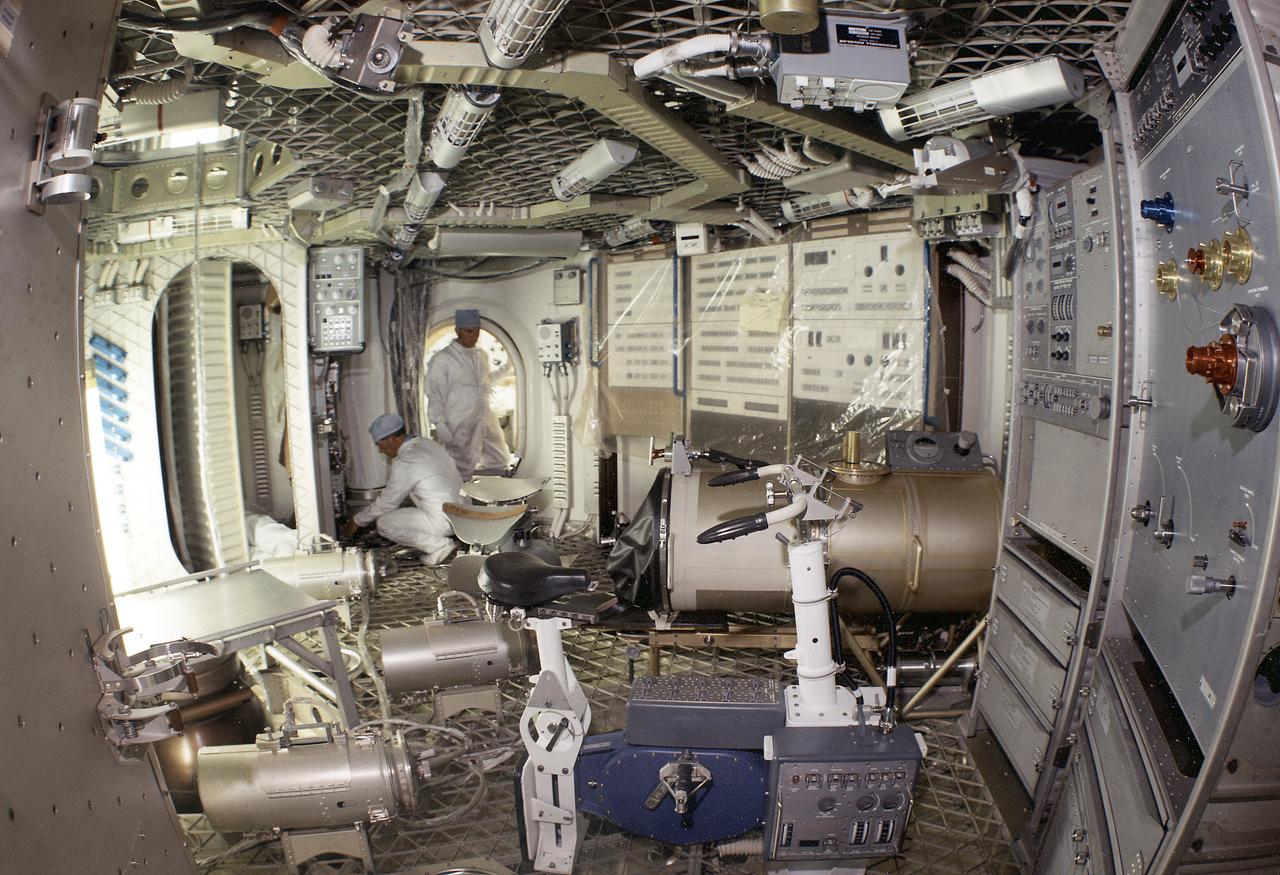
This is a wide-angle view of the Orbital Workshop lower level experiment area. In center foreground is the ergometer bicycle. In center background is a litter chair for the Human Vestibular Function experiment (Skylab Experiment M131) and in right background is the Lower Body Negative Pressure System experiment (Skylab Experiment M092). The ergometer bicycle was used for metabolic activity experiments and exercise. The purpose of the Human Vestibular (irner ear) Function experiment was to examine the effect of weightlessness on man's sensitivity and susceptibility to motion rotation, and his perception of orientation. The Lower Body Negative Pressure experiment investigated the relationship between the zero gravity environment and cardiovascular deconditioning. A characteristic of cardiovascular deconditoning is the partial failure of the blood vessels resulting in the excessive pooling of the blood in the legs when a person assumes an erect posture in a gravity field. The Marshall Space Flight Center had the program management responsibility for the development of Skylab hardware and experiments.
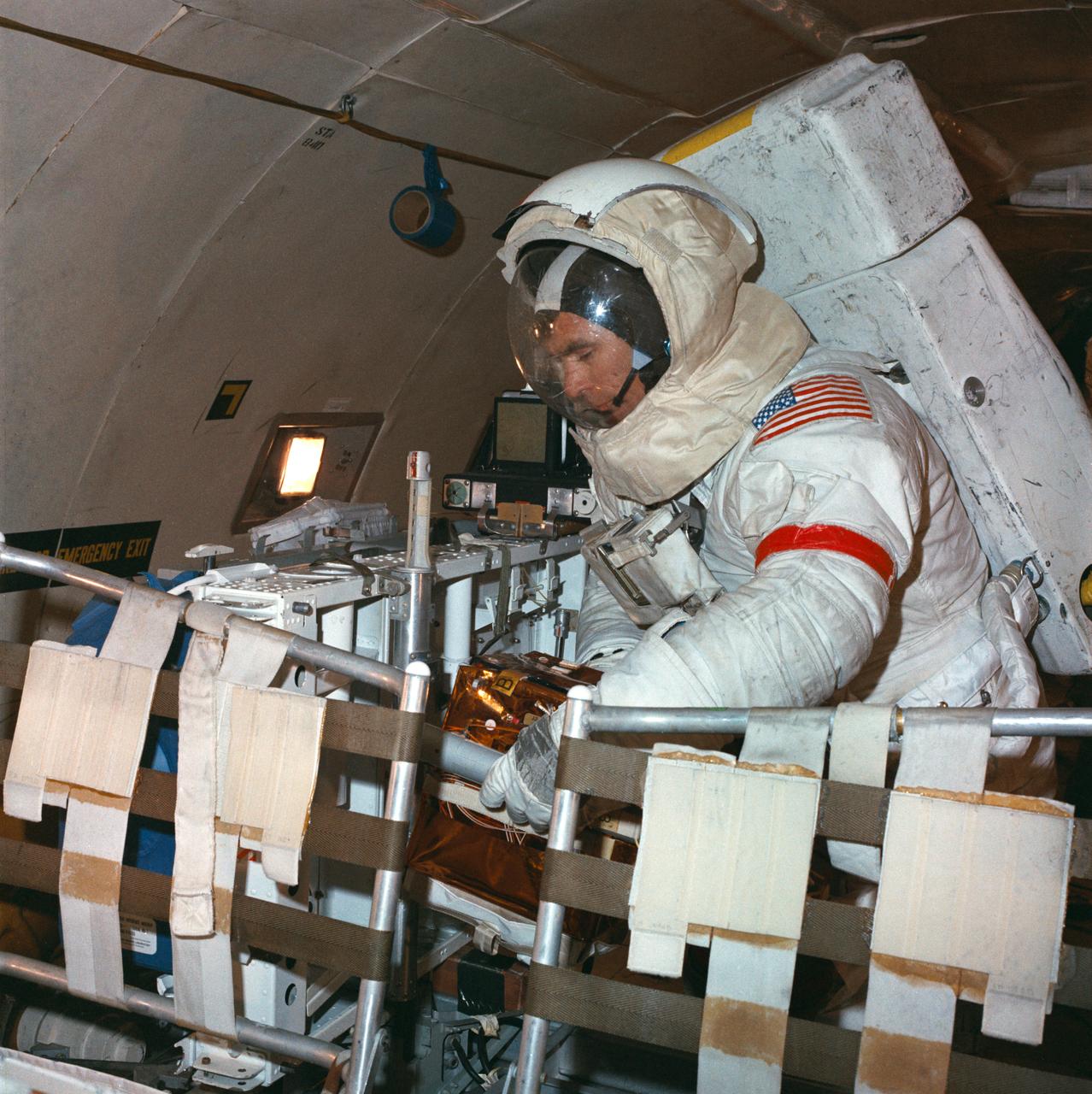
S72-50270 (September 1972) --- Astronaut Eugene A. Cernan, commander of the Apollo 17 lunar landing mission, participates in lunar surface extravehicular activity simulation training under one-sixth gravity conditions aboard a U. S. Air Force KC-135 aircraft. Here, Cernan simulates removing an experiment package from the aft end of a Lunar Roving Vehicle.
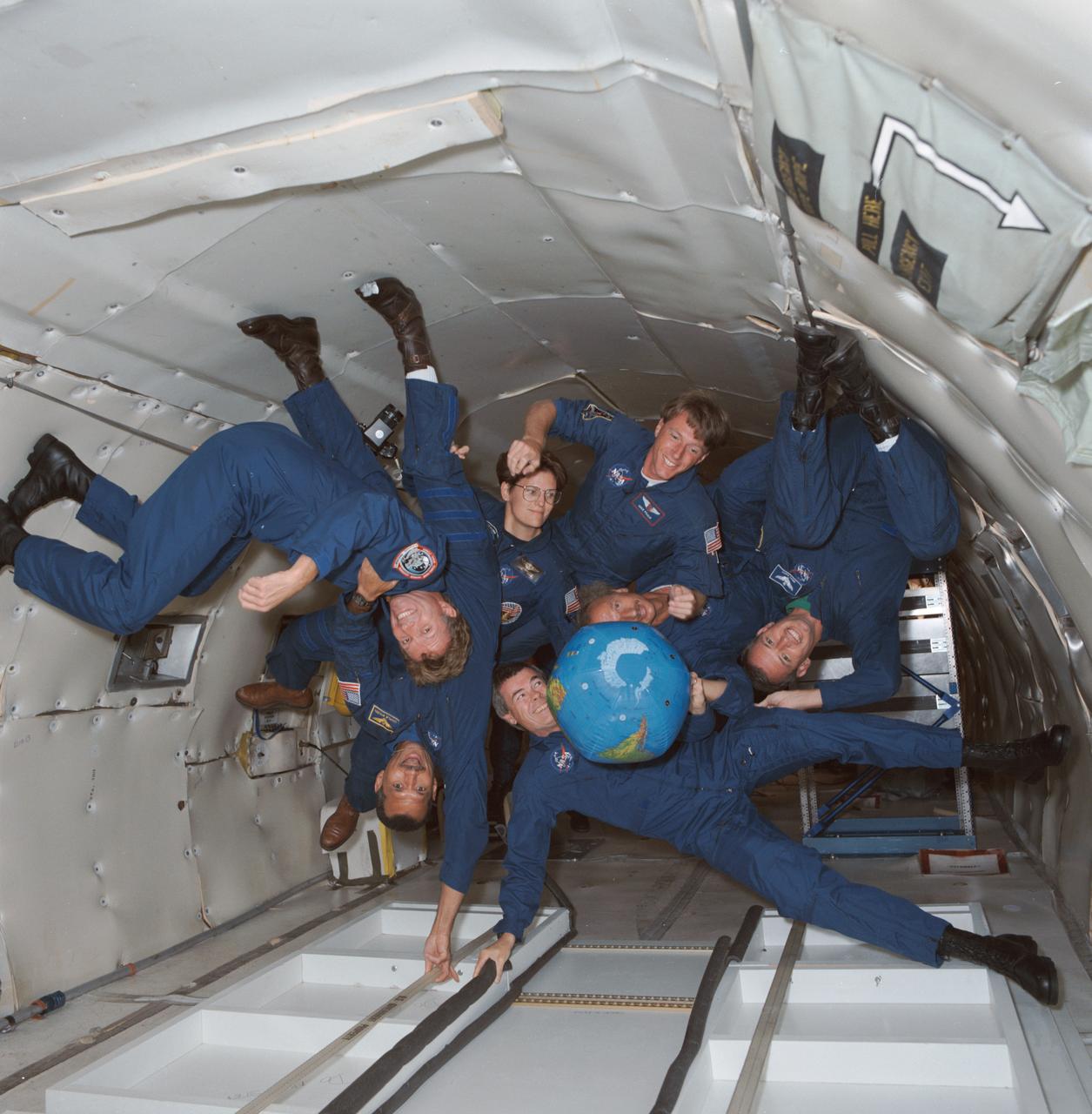
S91-44453 (21 Aug 1991) --- The crew of STS-45 is already training for its March 1992 mission, including stints on the KC-135 zero-gravity-simulating aircraft. Shown with an inflatable globe are, clockwise from the top, C. Michael Foale, mission specialist; Dirk Frimout, payload specialist; Brian Duffy, pilot; Charles R. (Rick) Chappell, backup payload specialist; Charles F. Bolden, mission commander; Byron K. Lichtenberg, payload specialist; and Kathryn D. Sullivan, payload commander.
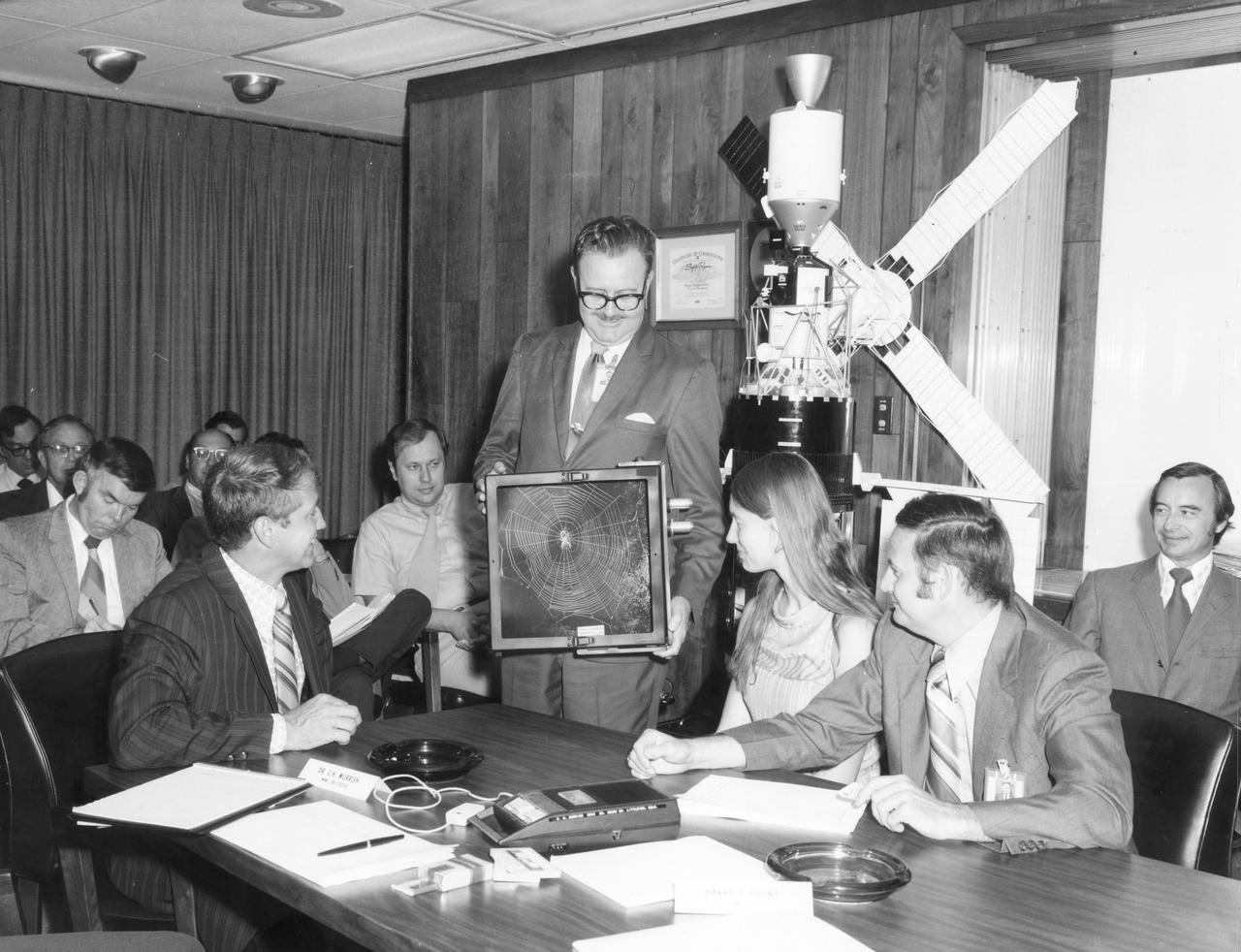
Lexington, Massachusetts high school student, Judith Miles, discusses her proposed Skylab experiment with engineers and scientists during a design review of the experiment equipment. At left is Ron Pavlue of Kennedy Space Flight Center (KSC), holding a box is Keith Demorest of Marshall Space Flight Center (MSFC). Right of Miles is Dr. Raymond Gause, also of MSFC, who is Miles’ scientific advisor. In her experiment, called the “Web Formation in Zero Gravity”, spiders were released into a box and their actions recorded to determine how well they adapt to the absence of gravity. Spiders are known to adapt quickly to other changes in the environment but nothing was known of their ability to adapt to weightlessness. At the same time spiders were weaving webs in Earth orbit, similar spiders were spinning webs in identical boxes on Earth under full gravity conditions. Miles was among the 25 winners of a contest in which some 3,500 high school students proposed experiments for the following year’s Skylab mission. Of the 25 students, 6 did not see their experiments conducted on Skylab because the experiments were not compatible with Skylab hardware and timelines. Of the 19 remaining, 11 experiments required the manufacture of equipment.
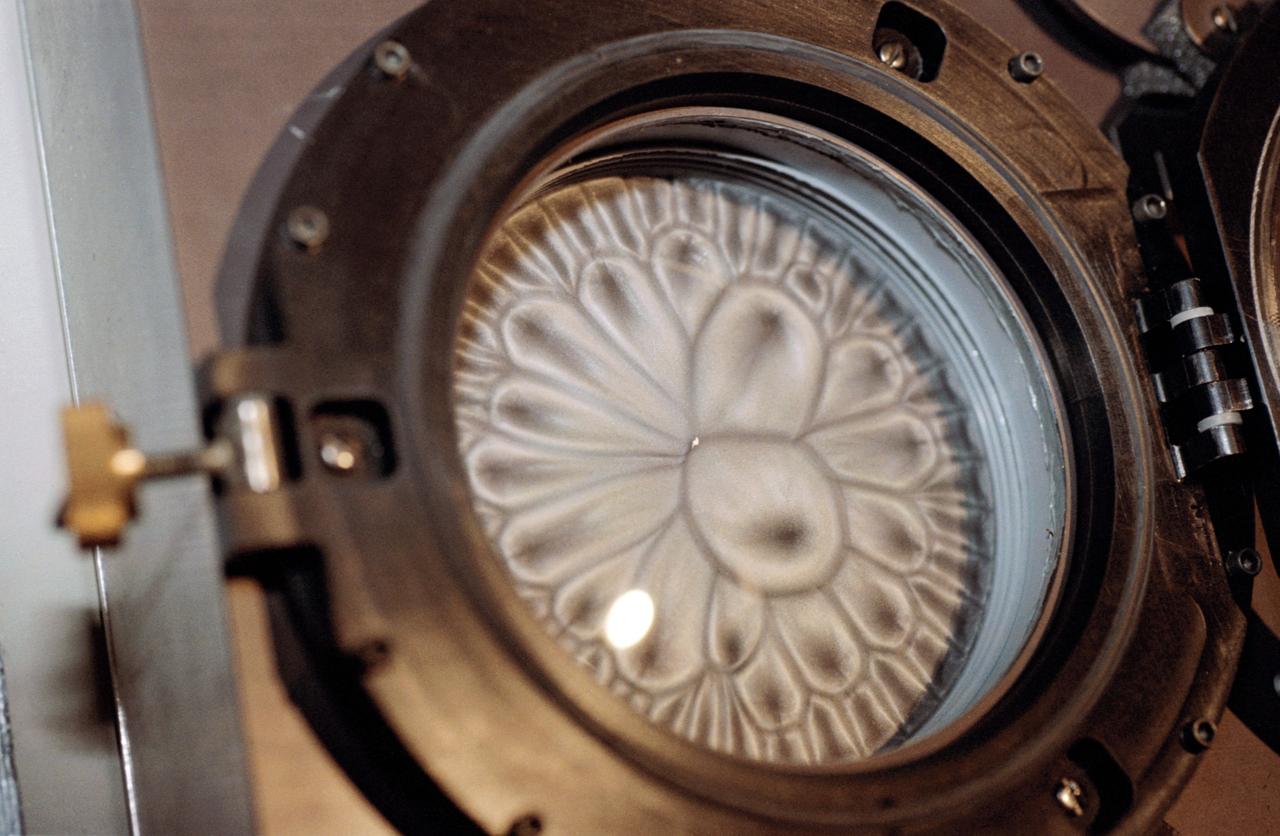
STS-42 closeup view shows Student Experiment 81-09 (SE 81-09), Convection in Zero Gravity experiment, with radial pattern caused by convection induced by heating an oil and aluminum powder mixture in the weightlessness of space. While the STS-42 crewmembers activated the Shuttle Student Involvement Program (SSIP) experiment on Discovery's, Orbiter Vehicle (OV) 103's, middeck, Scott Thomas, the student who designed the experiment, was able to observe the procedures via downlinked television (TV) in JSC's Mission Control Center (MCC). Thomas, now a physics doctoral student at the University of Texas, came up with the experiment while he participated in the SSIP as a student at Richland High School in Johnstown, Pennsylvia.
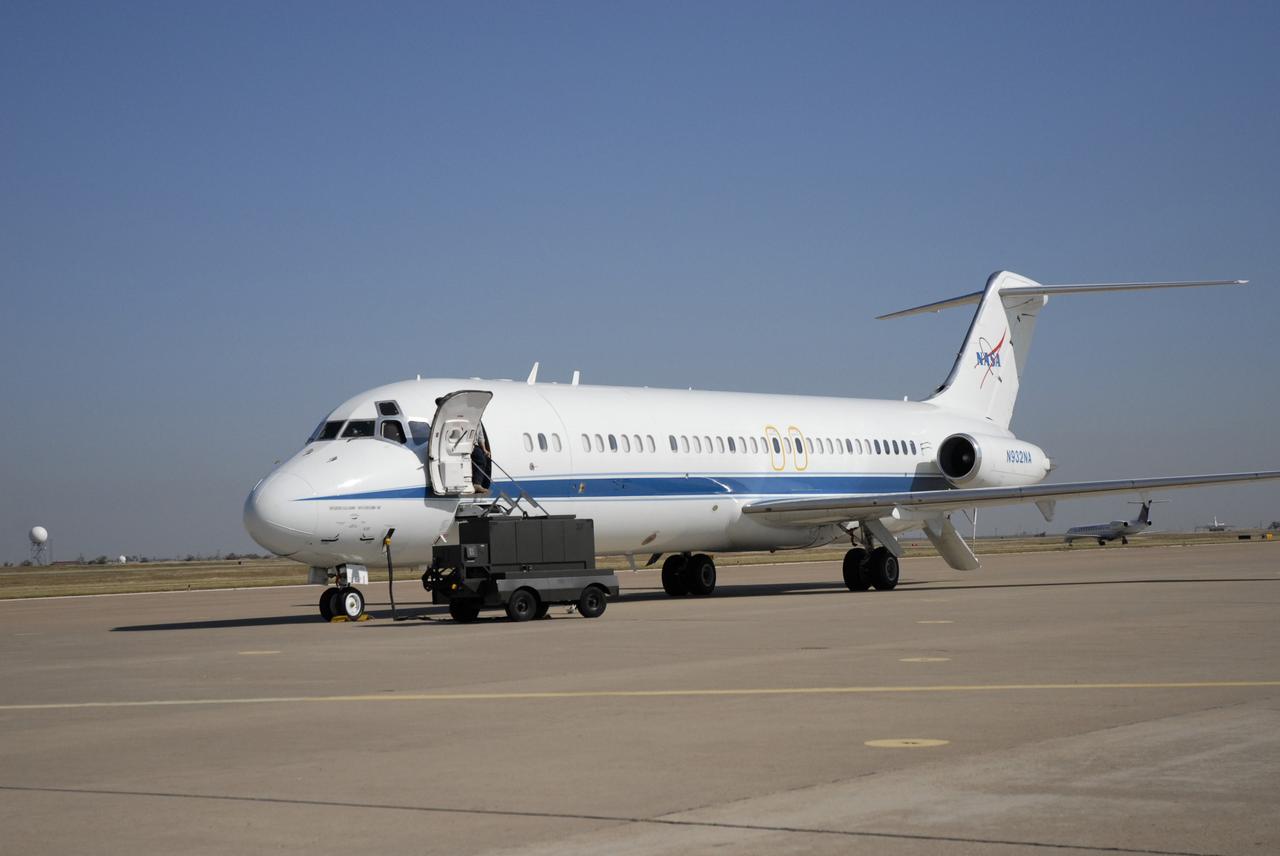
CAPE CANAVERAL, Fla. - NASA's C-9 aircraft, also known as the Weightless Wonder VI, lands for refueling at the Rick Husband Amarillo International Airport in Texas on its way to NASA's Kennedy Space Center in Florida. The C-9, normally used to train astronauts by simulating zero gravity, was used as the support aircraft on space shuttle Discovery's ferry flight from Edwards Air Force Base in California. Discovery landed at Edwards Sept. 11 concluding its STS-128 mission to the International Space Station. The shuttle delivered more than 7 tons of supplies, science racks and equipment, as well as additional environmental hardware to sustain six crew members on the International Space Station. Photo credit: NASA/Mary Ann Chevalier
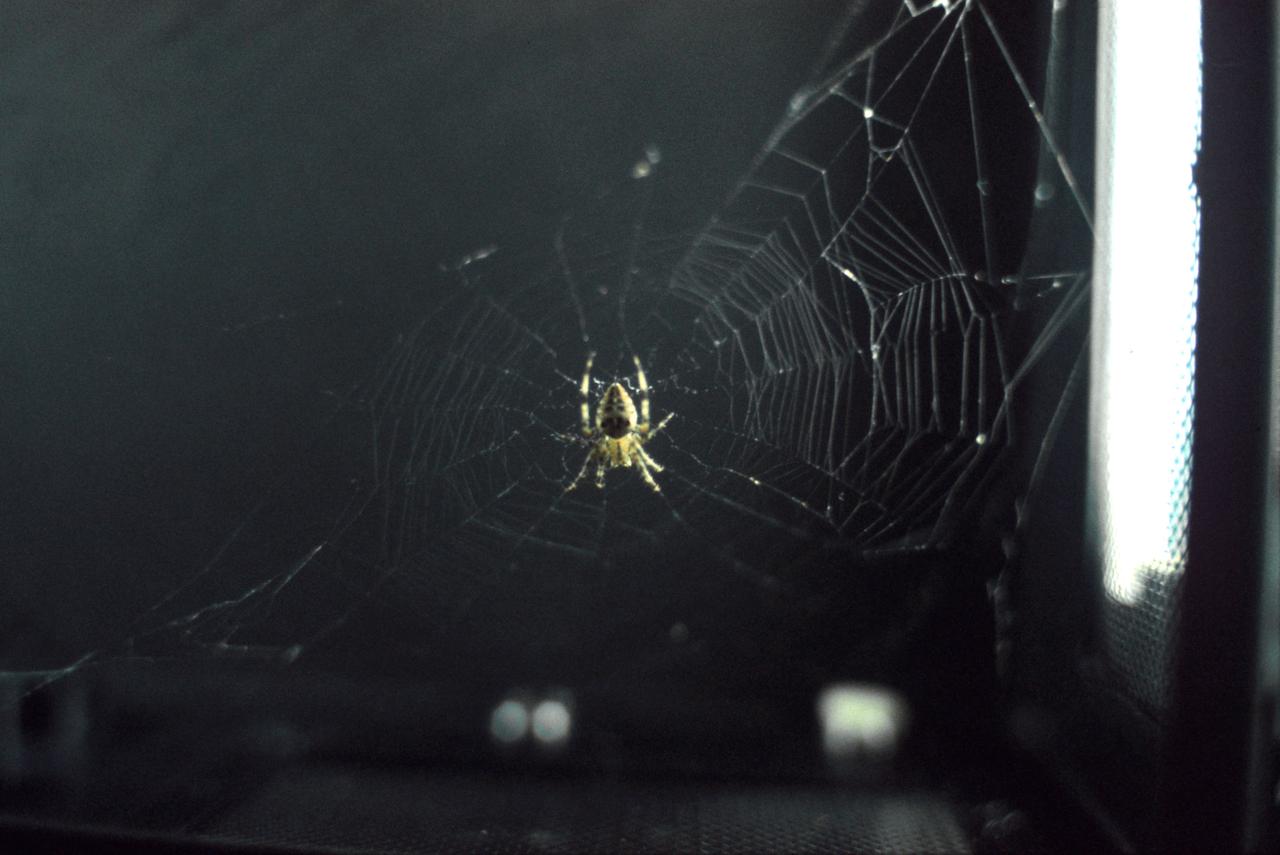
SL3-108-1307 (July-September 1973) --- A close-up view of Arabella, one of the two Skylab 3 common cross spiders "Araneus diadematus," and the web it had spun in the zero-gravity of space aboard the Skylab space station cluster in Earth orbit. This picture was taken with a hand-held 35mm Nikon camera. During the 59-day Skylab 3 mission the two spiders, Arabella and Anita, were housed in an enclosure onto which a motion picture and a still camera were attempts to build a web in the weightless environment. The spider experiment (ED52) was one of 25 experiments selected for Skylab by NASA from more than 3,400 experiment proposals submitted by high school students throughout the nation. ED52 was submitted by 17-year-old Judith S. Miles of Lexington, Massachusetts. Anita died during the last week of the mission. Photo credit: NASA
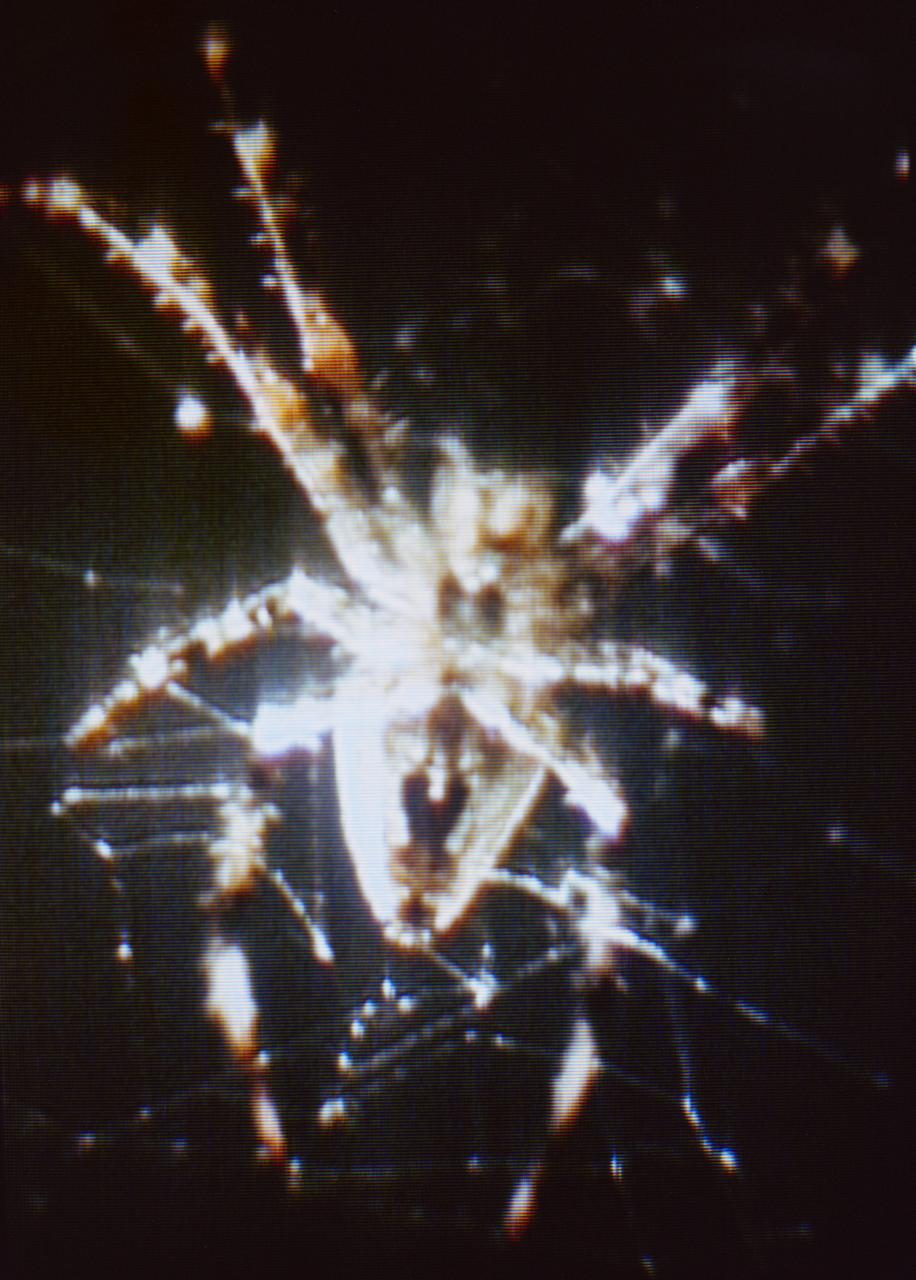
S73-34206 (8 Aug. 1973) --- A closeup view of Arabella, one of two Skylab 3 common cross spiders ?Araneus diadematus,? and the web it had spun in the zero-gravity of space aboard the Skylab space station cluster in Earth orbit. This is a photographic reproduction made a color television transmission aboard Skylab. During the 59-day Skylab 3 mission the two spiders, Arabella and Anita, were housed in an enclosure onto which a motion picture camera and a still camera were attached to record the spiders? attempts to build a web in the weightless environment. The spider experiment (ED52) was one of 25 experiments selected for Skylab by NASA from more than 3,400 experiment proposals submitted by 17-year-old Judith S. Miles of Lexington, Massachusetts. Anita died during the last week of the mission. THIS PHOTOGRAPH IS A GOVERNMENT PUBLICATION ?NOT SUBJECT TO COPYRIGHT. It may not be used to state or imply the endorsement by NASA or by any NASA employee of a commercial product, process or service, or used in any way that might mislead. Accordingly, it is requested that if this photograph is used in advertising and other commercial promotions, layout and copy be submitted to NASA prior to release. Photo credit: NASA