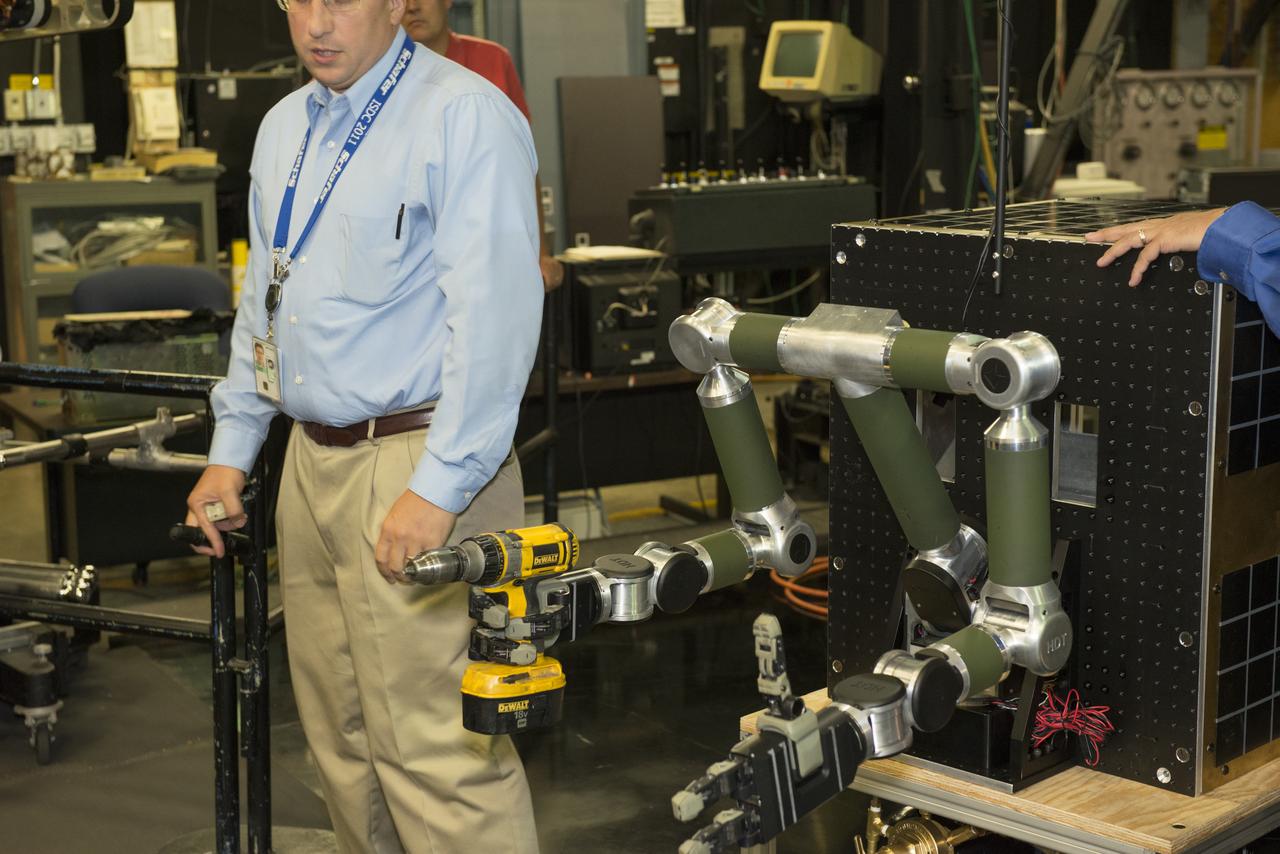
FINAL DEMONSTRATION OF A WIRELESS DATA TASK SUPPORTED BY SLS ADVANCED DEVELOPMENT USED TO DEMONSTRATE REAL-TIME VIDEO OVER WIRELESS CONNECTIONS ALONG WITH DATA AND COMMANDS AS DEMONSTRATED VIA THE ROBOTIC ARMS. THE ARMS AND VIDEO CAMERAS WERE MOUNTED ON FREE FLOATING AIR-BEARING VEHICLES TO SIMULATE CONDITIONS IN SPACE. THEY WERE USED TO SHOW HOW A CHASE VEHICLE COULD MOVE UP TO AND CAPTURE A SATELLITE, SUCH AS THE FASTSAT MOCKUP DEMONSTRITING HOW ROBOTIC TECHNOLOGY AND SMALL SPACECRAFT COULD ASSIST WITH ORBITAL DEBRIS MITIGATION
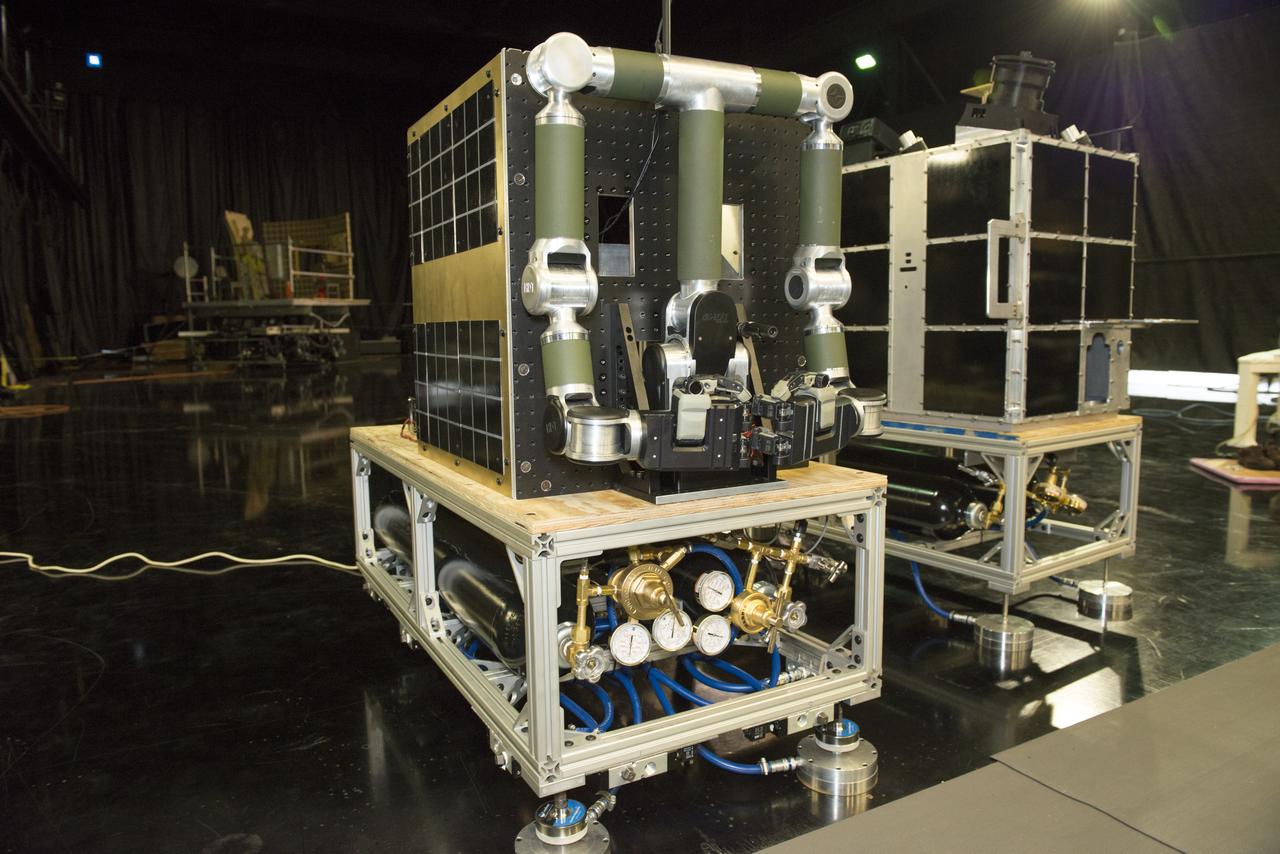
FINAL DEMONSTRATION OF A WIRELESS DATA TASK SUPPORTED BY SLS ADVANCED DEVELOPMENT USED TO DEMONSTRATE REAL-TIME VIDEO OVER WIRELESS CONNECTIONS ALONG WITH DATA AND COMMANDS AS DEMONSTRATED VIA THE ROBOTIC ARMS. THE ARMS AND VIDEO CAMERAS WERE MOUNTED ON FREE FLOATING AIR-BEARING VEHICLES TO SIMULATE CONDITIONS IN SPACE. THEY WERE USED TO SHOW HOW A CHASE VEHICLE COULD MOVE UP TO AND CAPTURE A SATELLITE, SUCH AS THE FASTSAT MOCKUP DEMONSTRITING HOW ROBOTIC TECHNOLOGY AND SMALL SPACECRAFT COULD ASSIST WITH ORBITAL DEBRIS MITIGATION
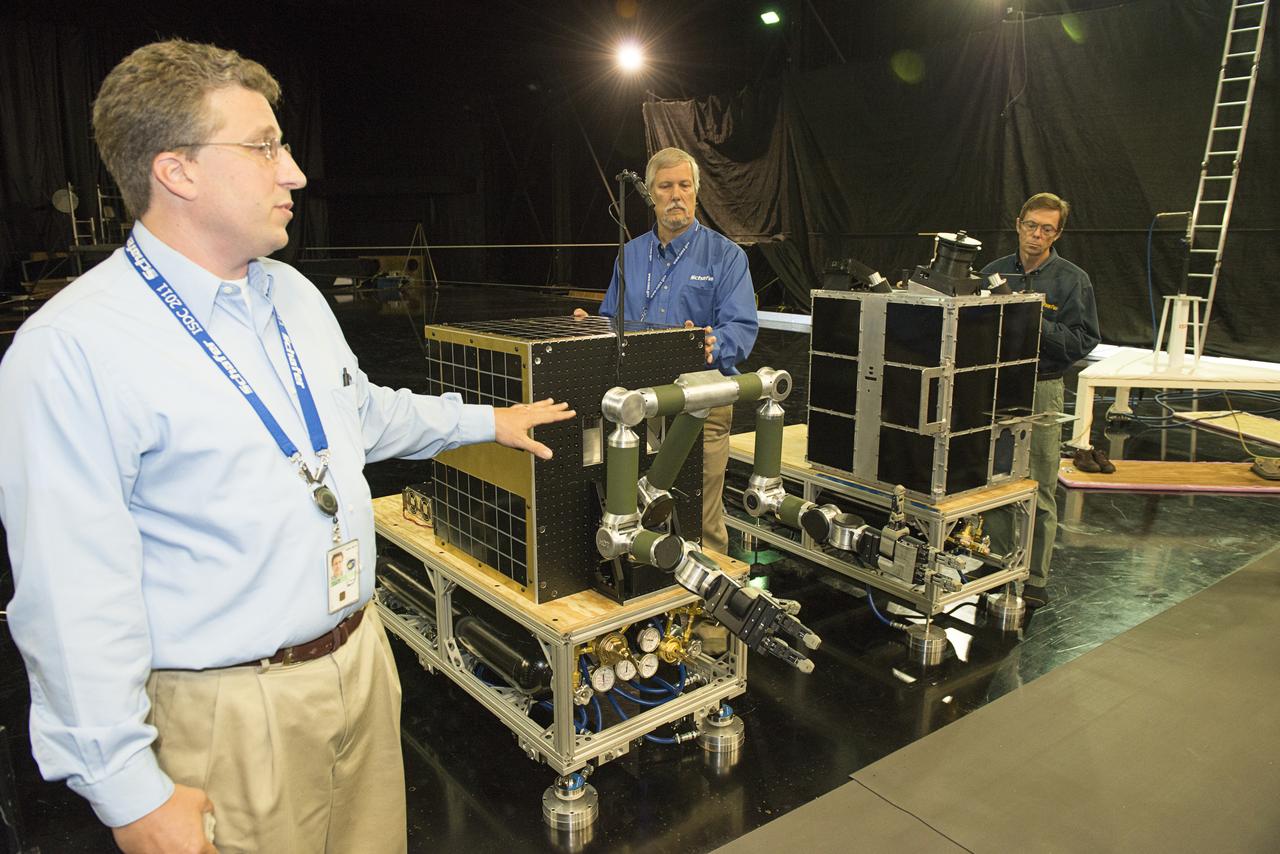
FINAL DEMONSTRATION OF A WIRELESS DATA TASK SUPPORTED BY SLS ADVANCED DEVELOPMENT USED TO DEMONSTRATE REAL-TIME VIDEO OVER WIRELESS CONNECTIONS ALONG WITH DATA AND COMMANDS AS DEMONSTRATED VIA THE ROBOTIC ARMS. THE ARMS AND VIDEO CAMERAS WERE MOUNTED ON FREE FLOATING AIR-BEARING VEHICLES TO SIMULATE CONDITIONS IN SPACE. THEY WERE USED TO SHOW HOW A CHASE VEHICLE COULD MOVE UP TO AND CAPTURE A SATELLITE, SUCH AS THE FASTSAT MOCKUP DEMONSTRITING HOW ROBOTIC TECHNOLOGY AND SMALL SPACECRAFT COULD ASSIST WITH ORBITAL DEBRIS MITIGATION
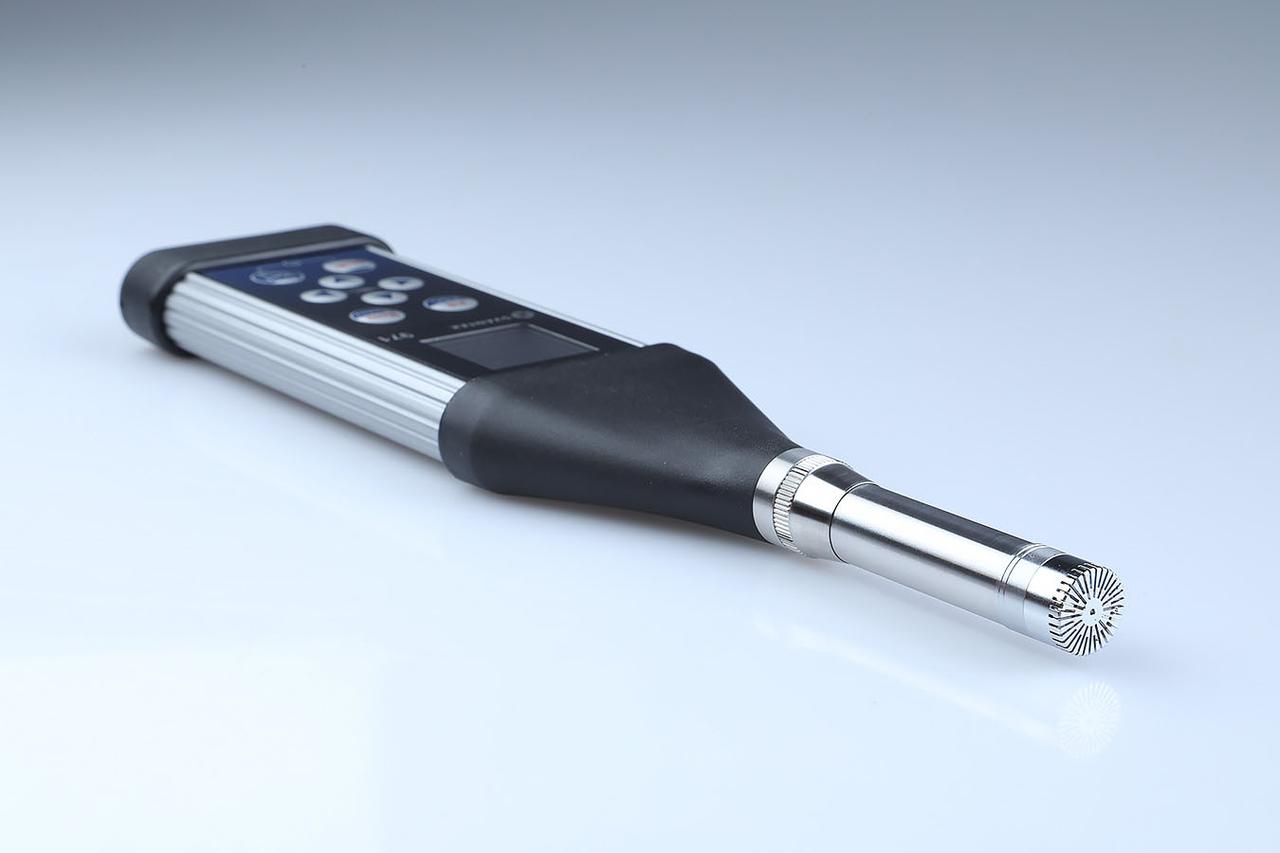
jsc2025e044838 93/25/2021) --- One of the smallest Class 1 sound level meters is shown for A Next Generation Crew Health & Performance Acoustic Monitoring Capability for Exploration: An International Space Station Technology Demonstration (Wireless Acoustics) investigation. Wireless Acoustics aims to showcase a new acoustic monitoring system for crew health and performance to replace an older product using off-the-shelf commercial products Image courtesy of SVANTEK.
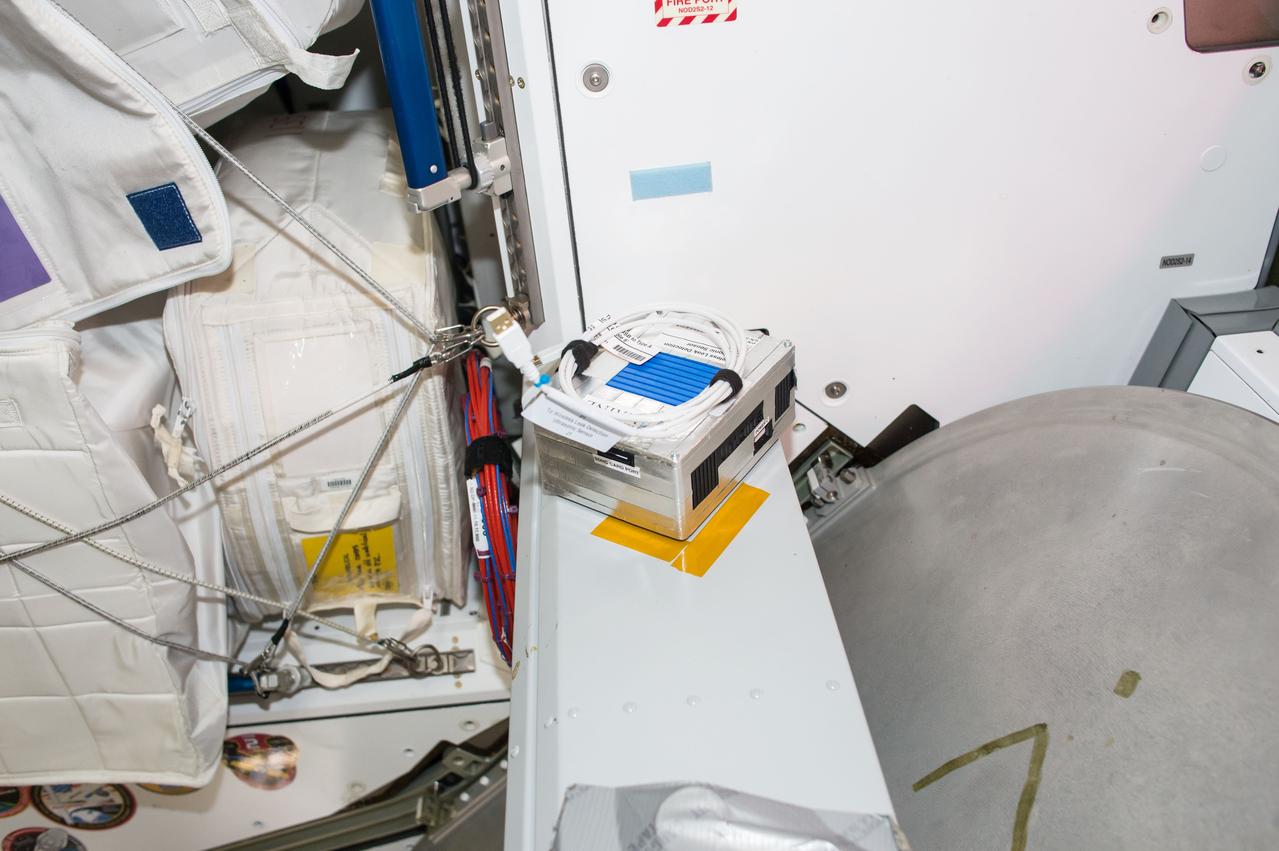
iss050e035313 (1/26/2017) --- A view of the Wireless Leak Detector Ultrasonic Sensor aboard the International Space Station (ISS). The Joint Leak Detection and Localization Based on Fast Bayesian Inference from Network of Ultrasonic Sensor Arrays in Microgravity Environment (Wireless Leak Detection) investigation compares signals received at various ultrasonic sensors to reveal the location of air leaks, which can then be repaired.
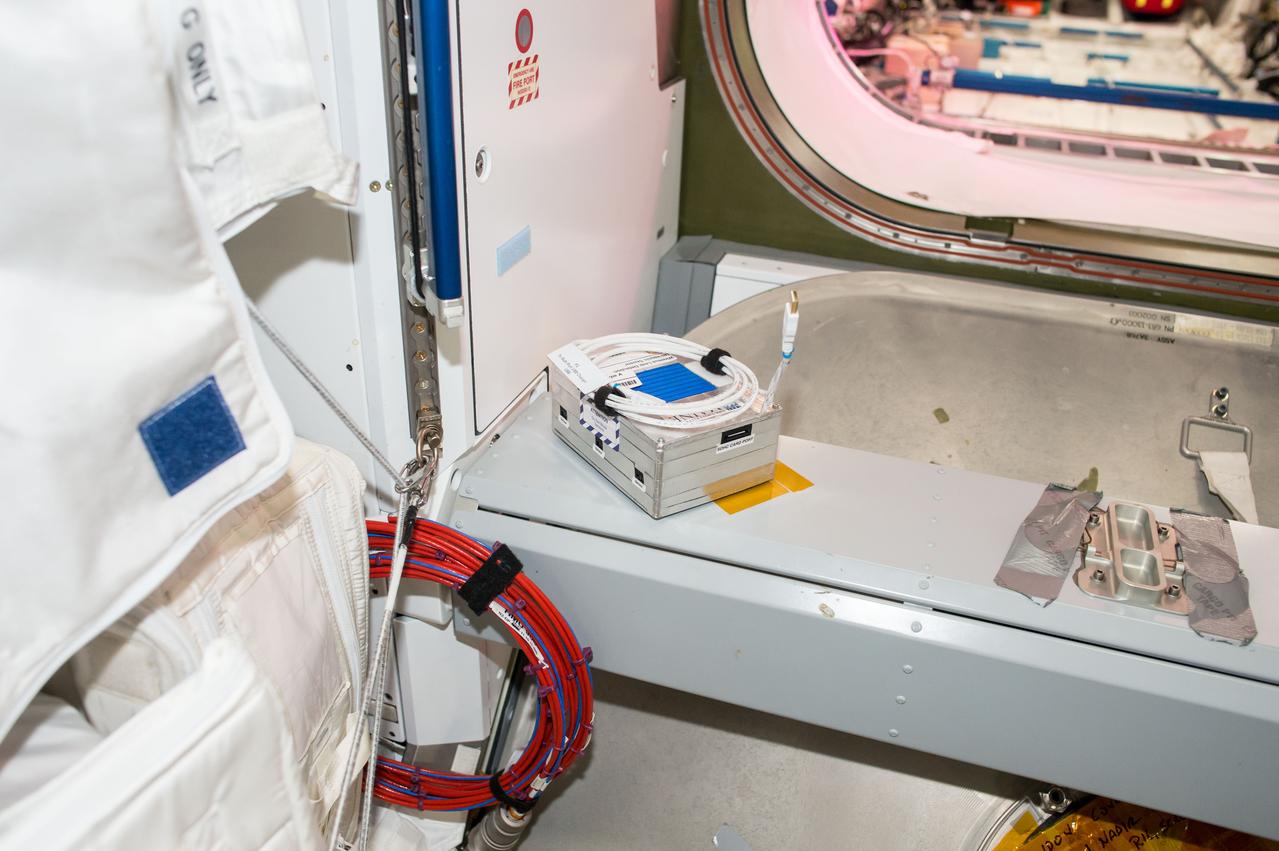
iss050e035314 (1/26/2017) --- A view of the Wireless Leak Detector Ultrasonic Sensor aboard the International Space Station (ISS). The Joint Leak Detection and Localization Based on Fast Bayesian Inference from Network of Ultrasonic Sensor Arrays in Microgravity Environment (Wireless Leak Detection) investigation compares signals received at various ultrasonic sensors to reveal the location of air leaks, which can then be repaired.
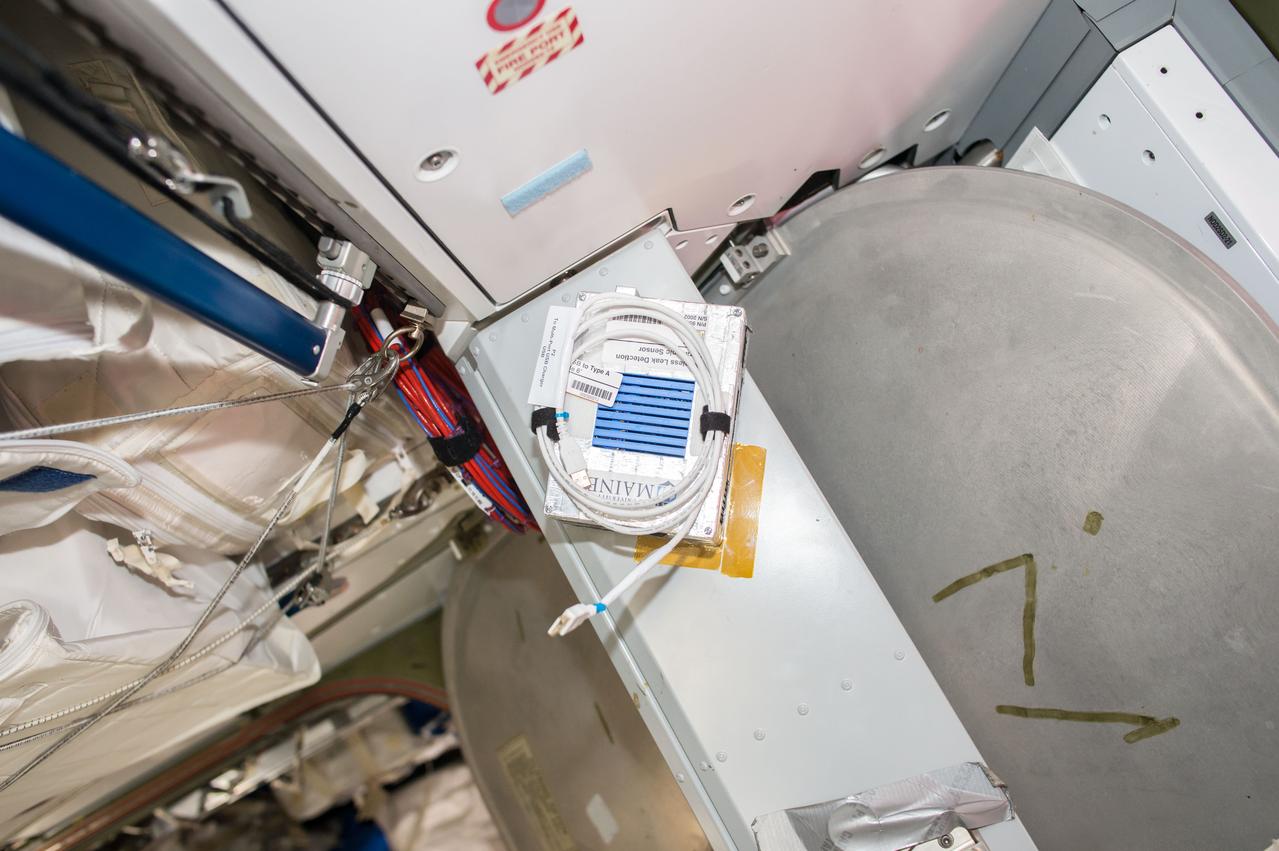
iss050e035316 (1/26/2017) --- A view of the Wireless Leak Detector Ultrasonic Sensor aboard the International Space Station (ISS). The Joint Leak Detection and Localization Based on Fast Bayesian Inference from Network of Ultrasonic Sensor Arrays in Microgravity Environment (Wireless Leak Detection) investigation compares signals received at various ultrasonic sensors to reveal the location of air leaks, which can then be repaired.
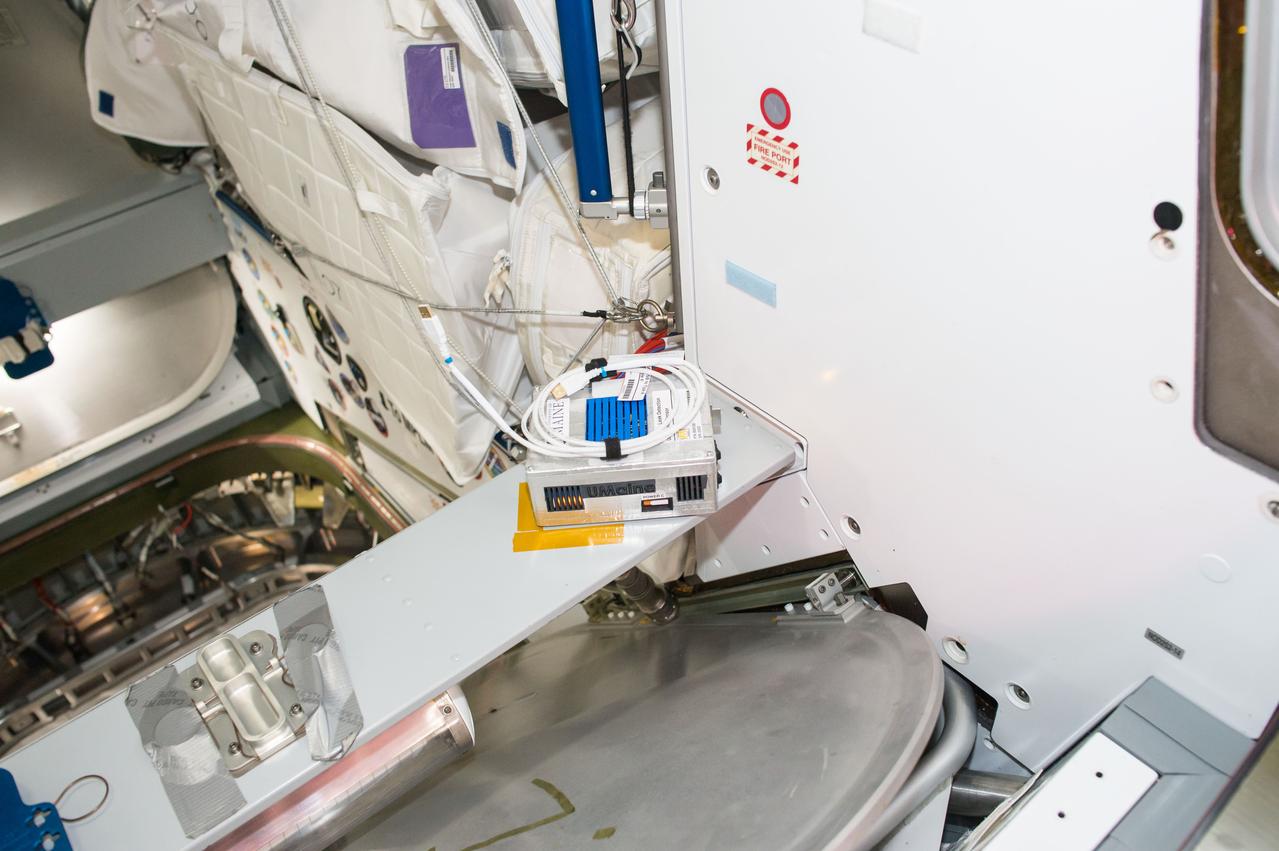
iss050e035315 (1/26/2017) --- A view of the Wireless Leak Detector Ultrasonic Sensor aboard the International Space Station (ISS). The Joint Leak Detection and Localization Based on Fast Bayesian Inference from Network of Ultrasonic Sensor Arrays in Microgravity Environment (Wireless Leak Detection) investigation compares signals received at various ultrasonic sensors to reveal the location of air leaks, which can then be repaired.
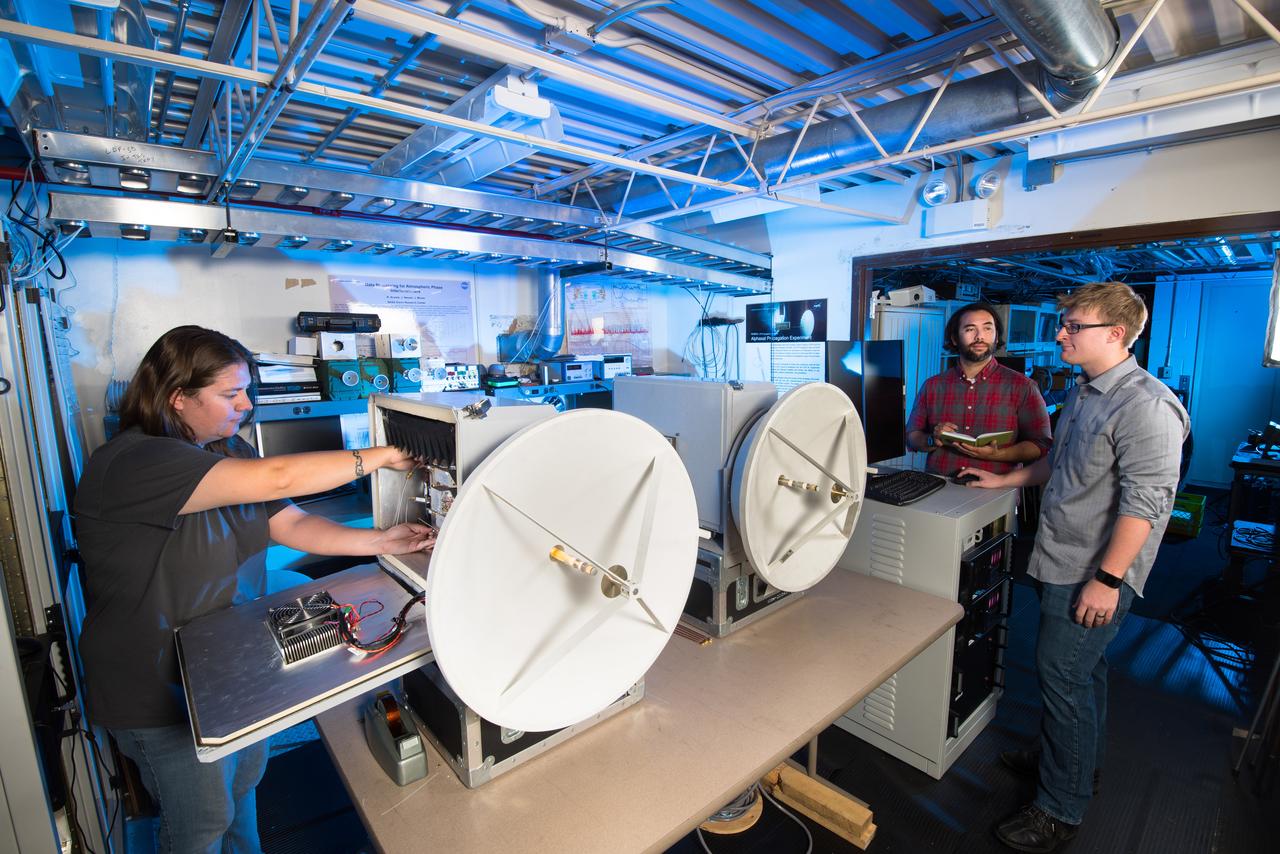
NASA Glenn researchers Jacki Houts, James Nessel and Michael Zemba perform a final inspection of the W/V-Band Terrestrial Link Experiment (WTLE) before it was transported to Albuquerque, New Mexico for testing. The experiment hardware includes a transmitter, which has been placed on the crest of the Sandia Mountains and a receiver (shown) placed at a research facility of the University of New Mexico. The wireless link spans 23km and will be used to study the effects of the atmosphere on high data-rate wireless communication links at 72 and 84 GHz. The goal of the experiment is to study these frequency bands for satellite communications.
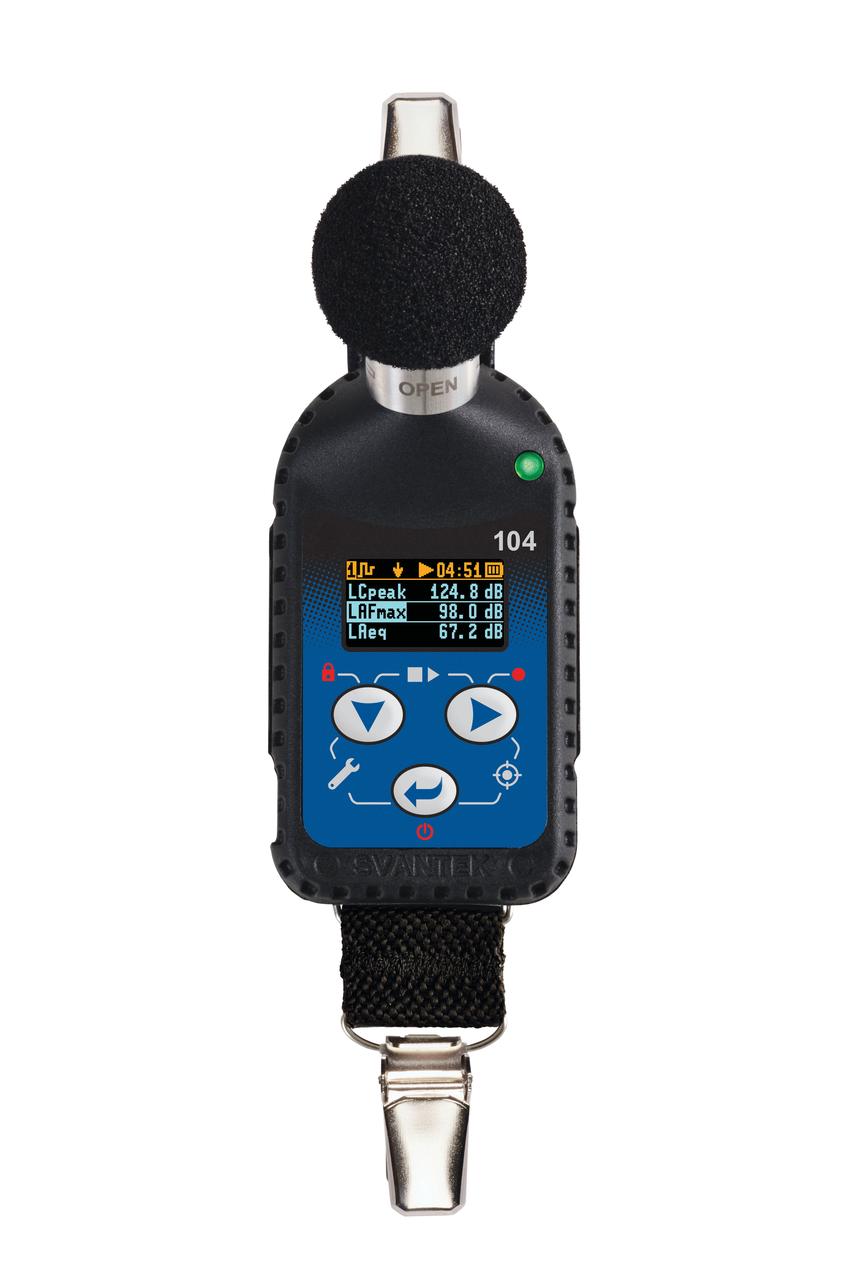
jsc2025e044837 2/19/2019) --- Shown is the SV104A noise dosimeter that measures noise dose and noise levels in the large measurement range of 55 dB to 140 dB aboard the International Space Station. This dosimeter is part of A Next Generation Crew Health & Performance Acoustic Monitoring Capability for Exploration: An International Space Station Technology Demonstration (Wireless Acoustics) investigation. Image courtesy of SVANTEK.
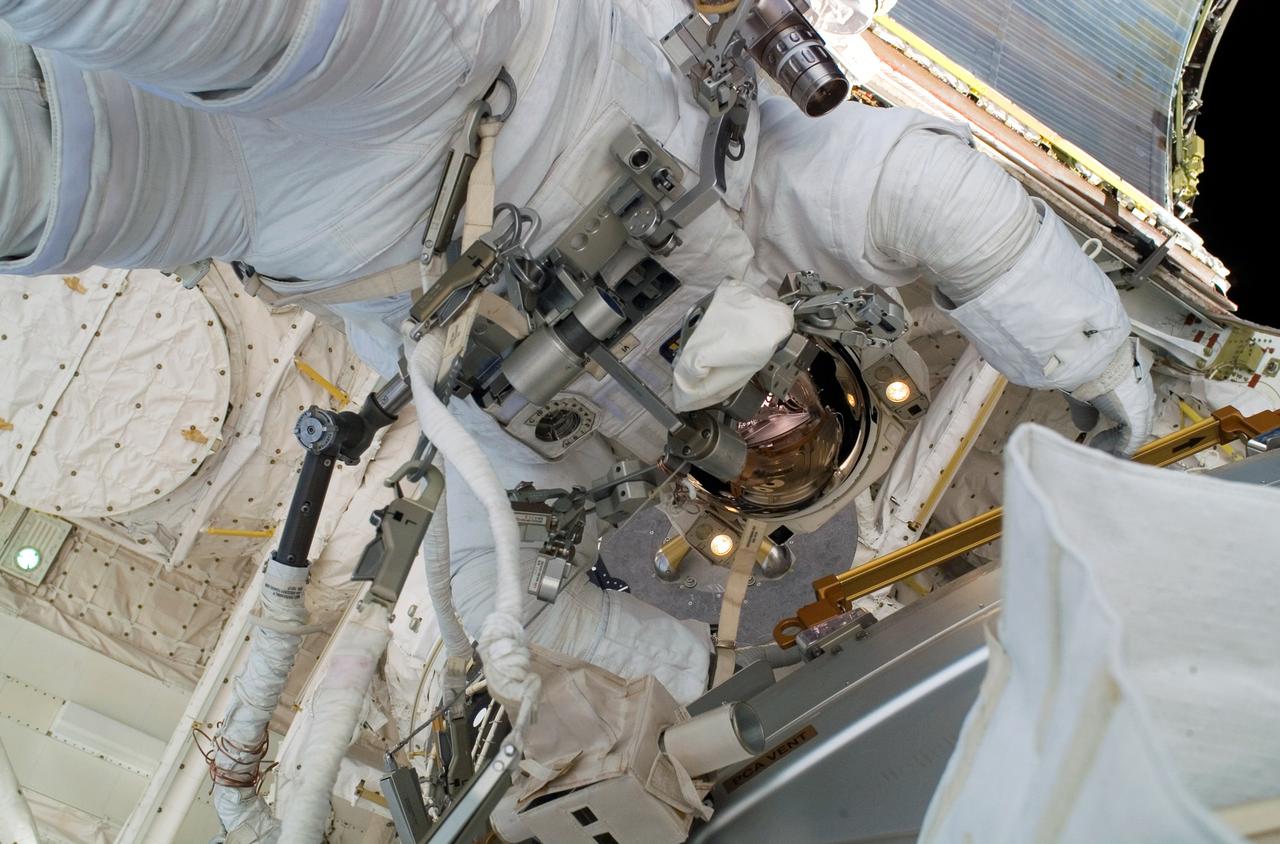
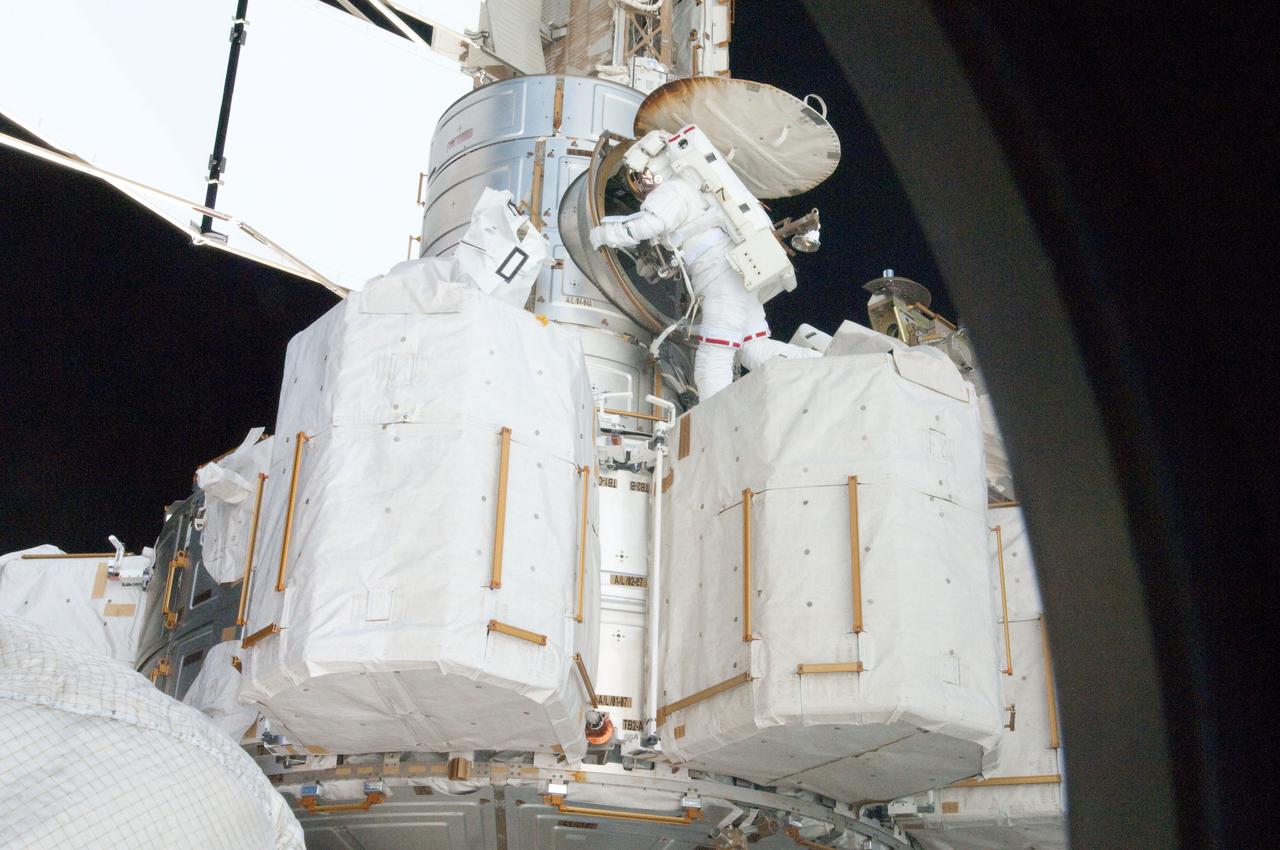
As the construction continued on the International Space Station (ISS), STS-118 Astronaut Dave Williams, representing the Canadian Space Agency, participated in the fourth and final session of Extra Vehicular Activity (EVA). During the 5 hour space walk, Williams and Expedition 15 engineer Clay Anderson (out of frame) installed the External Wireless Instrumentation System Antenna, attached a stand for the shuttle robotic arm extension boom, and retrieved the two Materials International Space Station Experiments (MISSE) for return to Earth. MISSE collects information on how different materials weather in the environment of space.
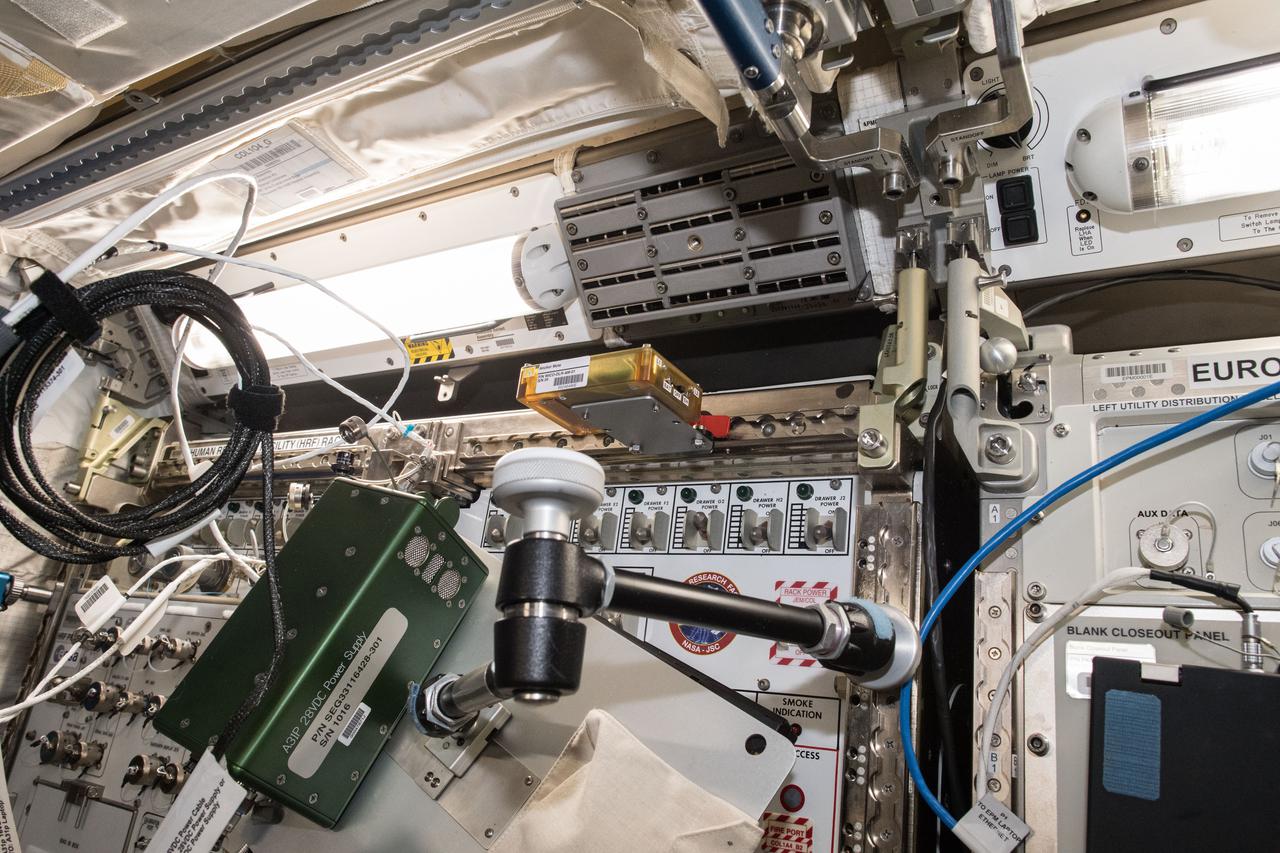
iss056e005285 (June 6, 2018) --- The small, yellow box in the middle of the picture is a module for the Wireless Compose-2 investigation from ESA (European Space Agency). Wireless Compose-2 is a technology demonstration that aims to provide a flexible and adaptable wireless network infrastructure to conduct and execute low-power, low-weight, and wireless experiments on the International Space Station. Building on technology used for the German Space Agency's (DLR) first Wireless Compose technology demonstrator in 2018, it shows the capabilities of Wireless Networks for scientific, localization, and medical experiments in the Columbus module.
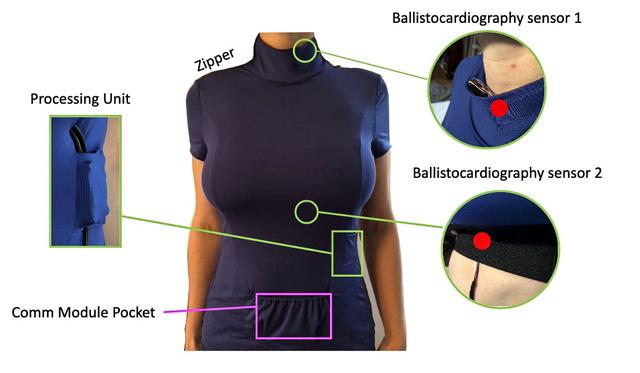
jsc2022e023740 (4/19/2022) --- The components of the Smart-Shirt garment includes integrated sensors, wiring, and a communication module to transmit scientific data via a wireless link for the Ballistocardiography for Extraterrestrial Applications and long-Term missions (BEAT) experiment, part of the Wireless Compose-2 investigation. The technology demonstration builds on work by the German Space Agency (DLR) to develop wireless network infrastructure to support scientific experiments on the space station. Image courtesy of DLR.
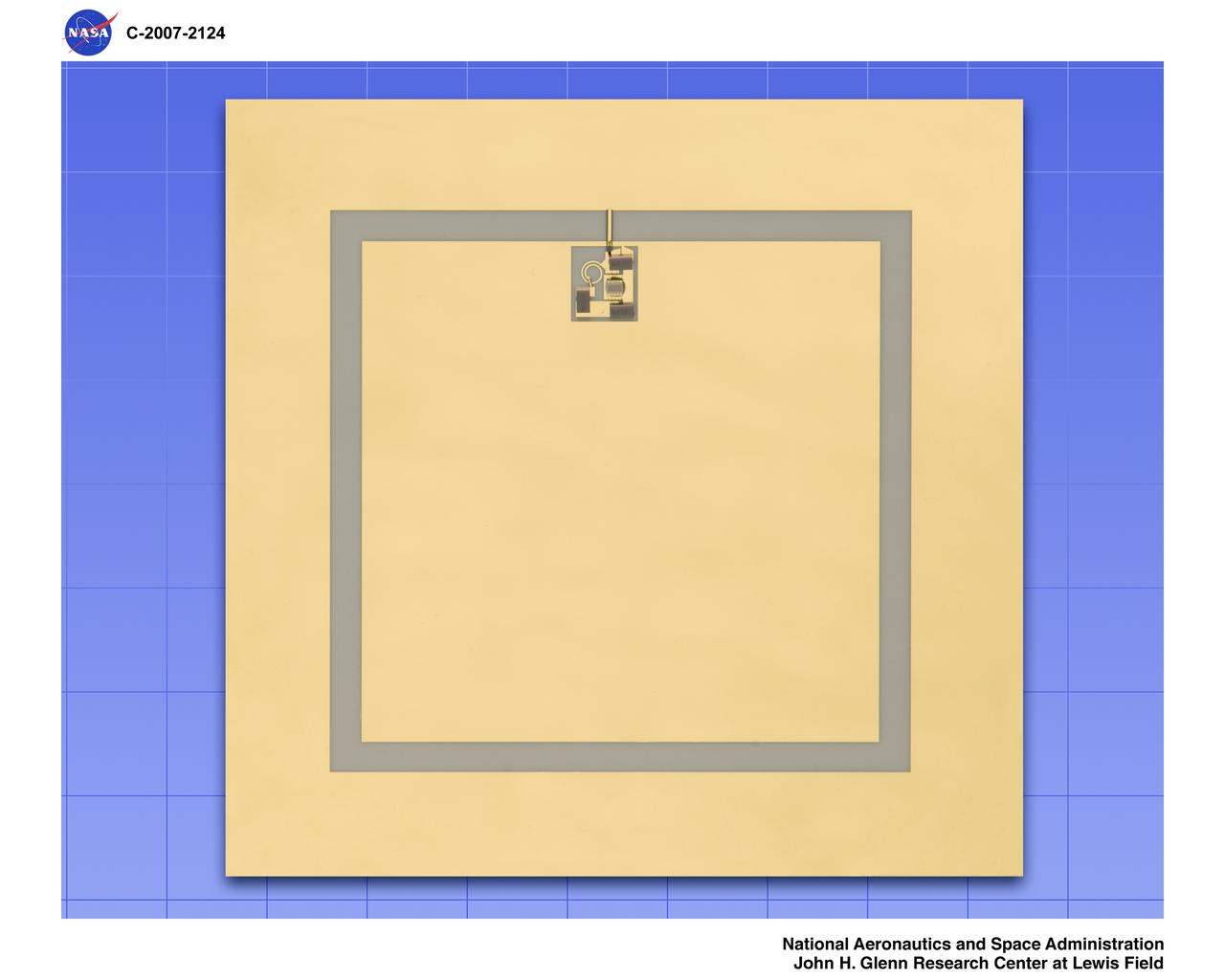
Oscillator / Antenna for High Temperature Wireless Sensor
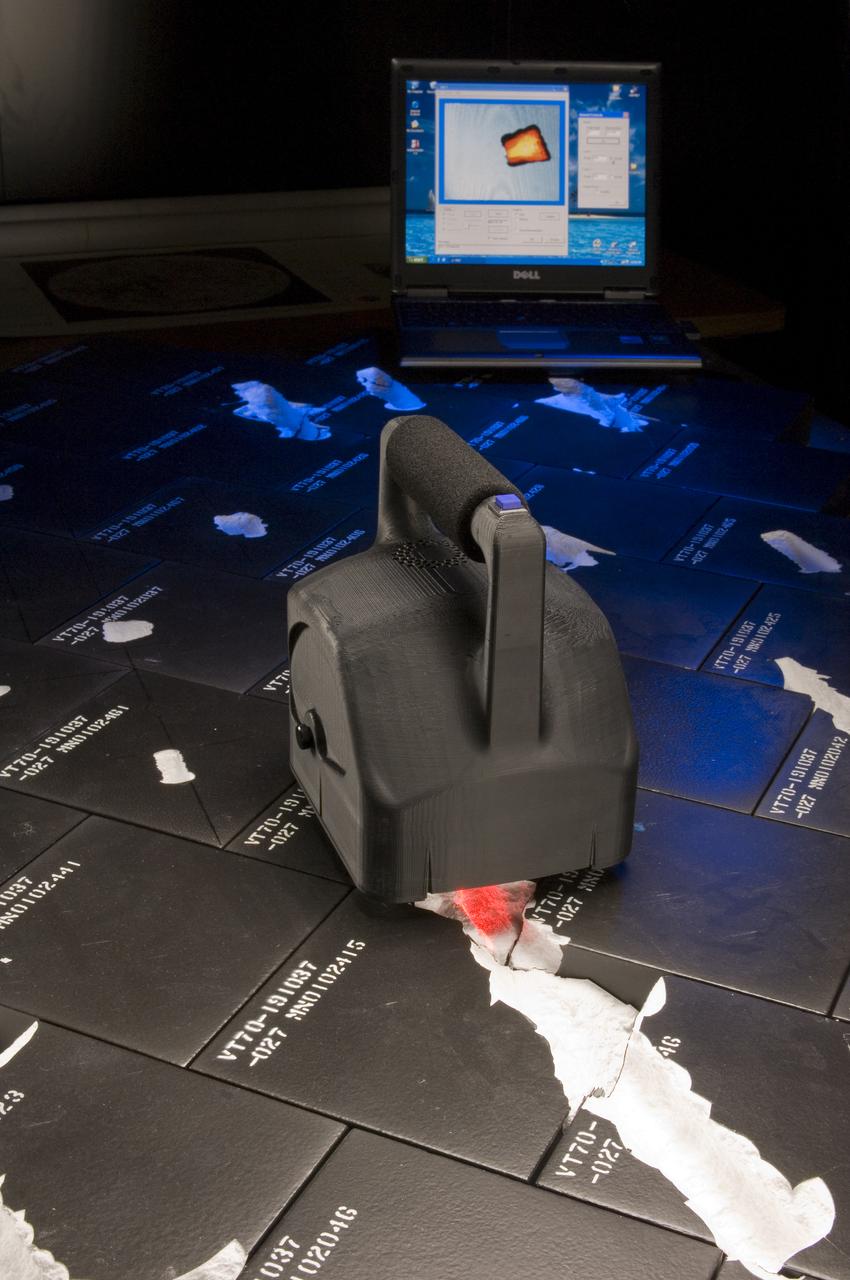
wireless space shuttle tile scanner (P.I. Joe Lavelle)
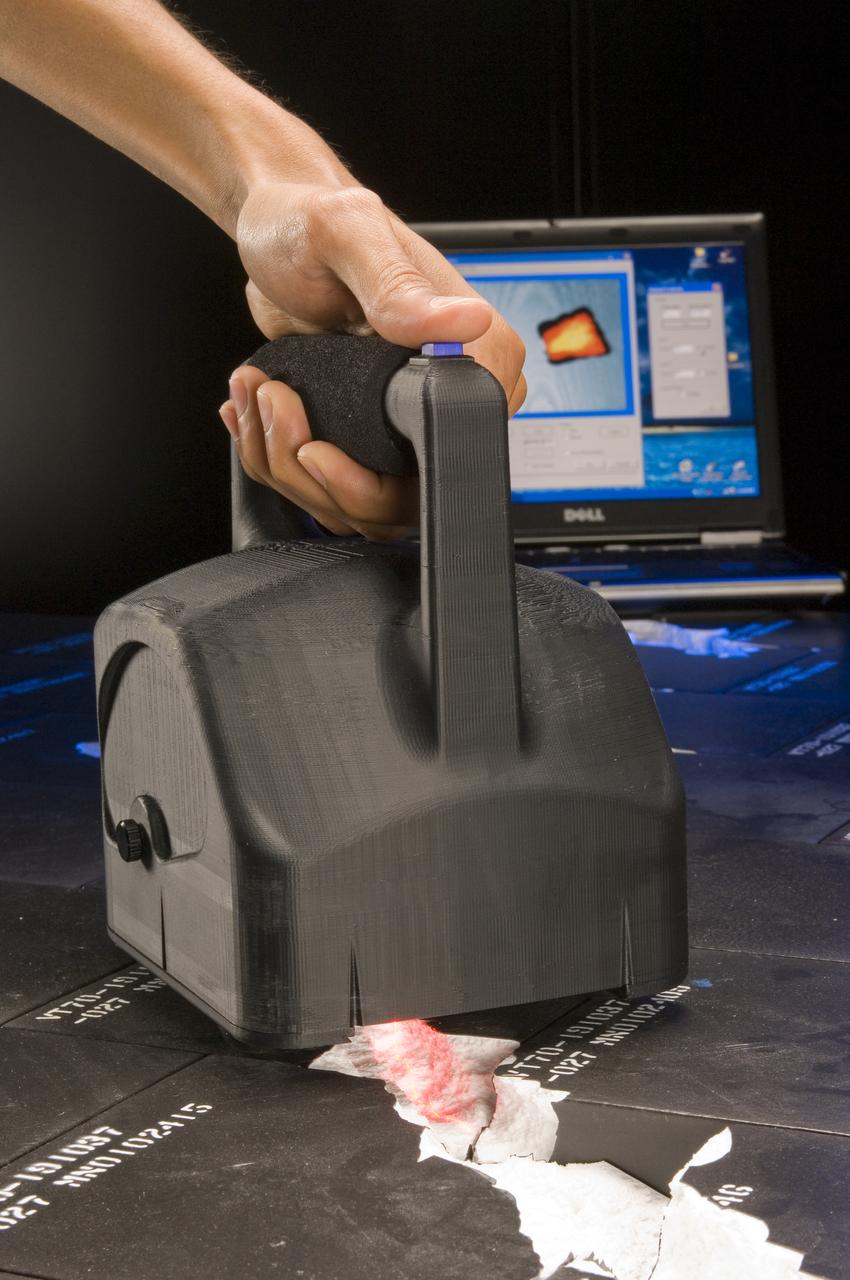
wireless space shuttle tile scanner (P.I. Joe Lavelle)
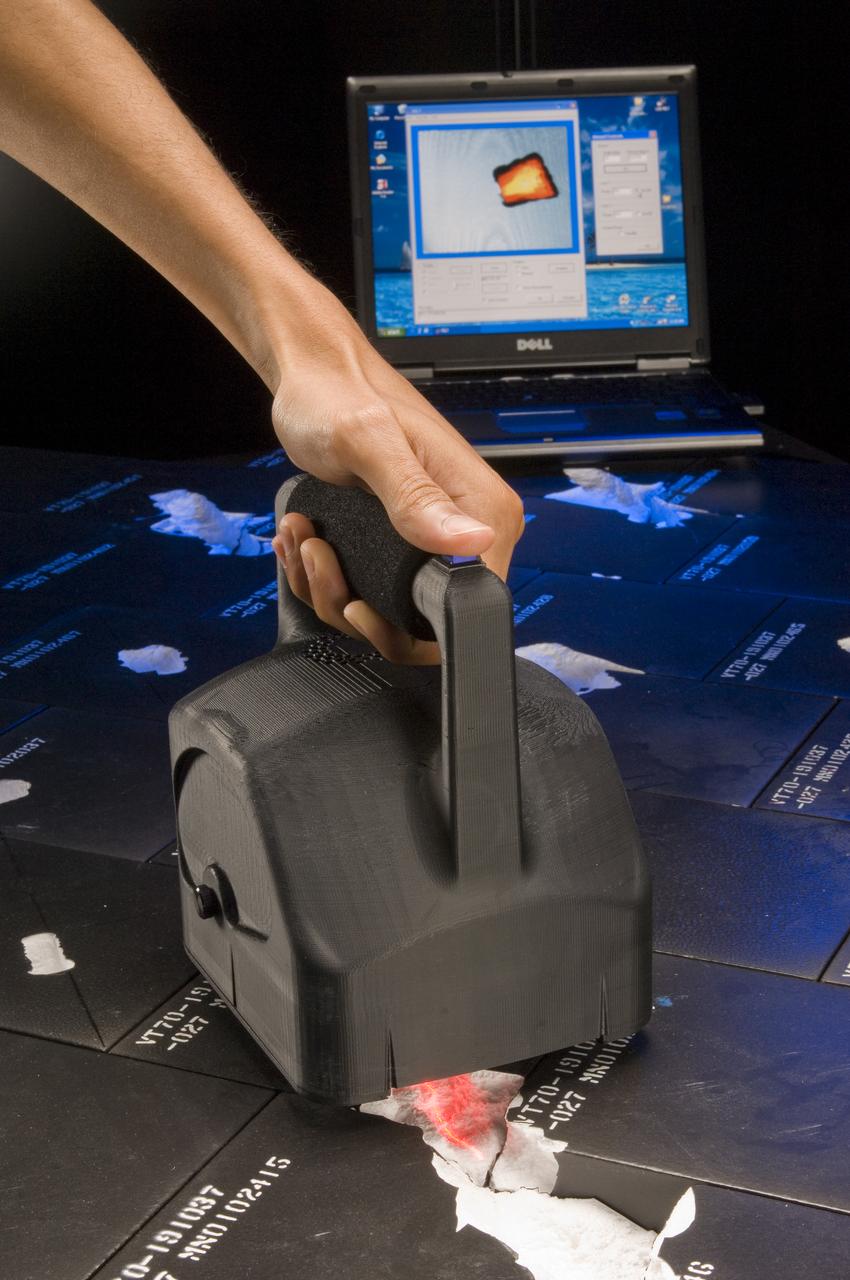
Wireless space shuttle tile scanner (P.I. Joe Lavelle)
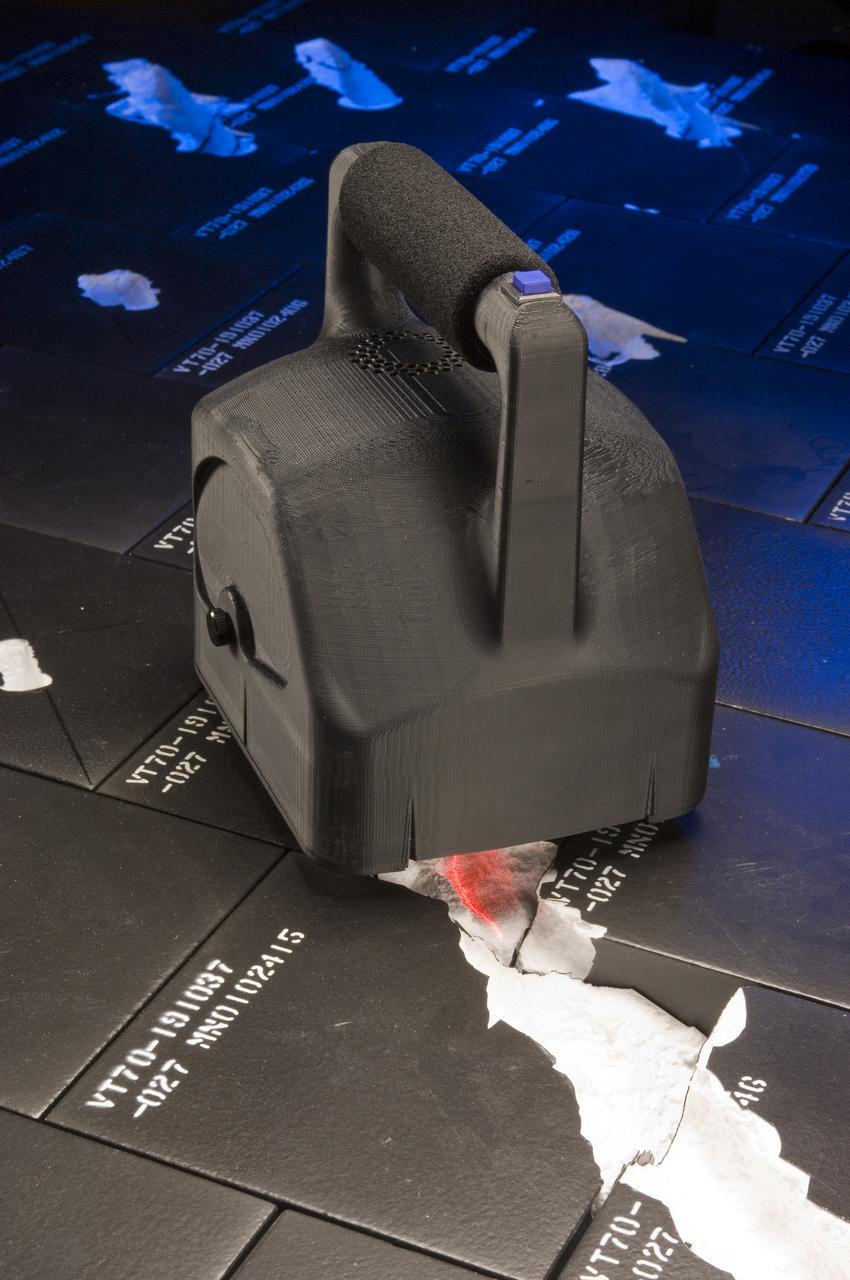
Wireless space shuttle tile scanner (P.I. Joe Lavelle)
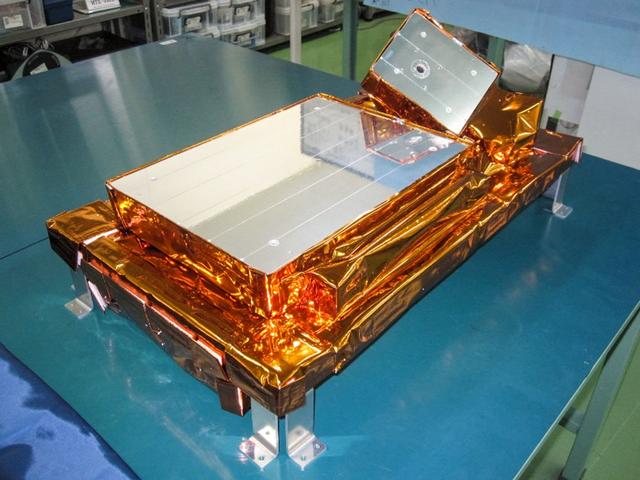
jsc2020e017720 1/10/2020) --- Preflight imagery of the HTV Wireless LAN Demonstration equipment consisting of the Unpressurized Logistics Carrier (ULC) Hole Mission Assembly and Propulsion Module (PM) Surface Mission Assembly. The ULC Hole Mission Assembly consists of a Data Handling Unit (DHU), including a wireless communication device. Image courtesy of: JAXA
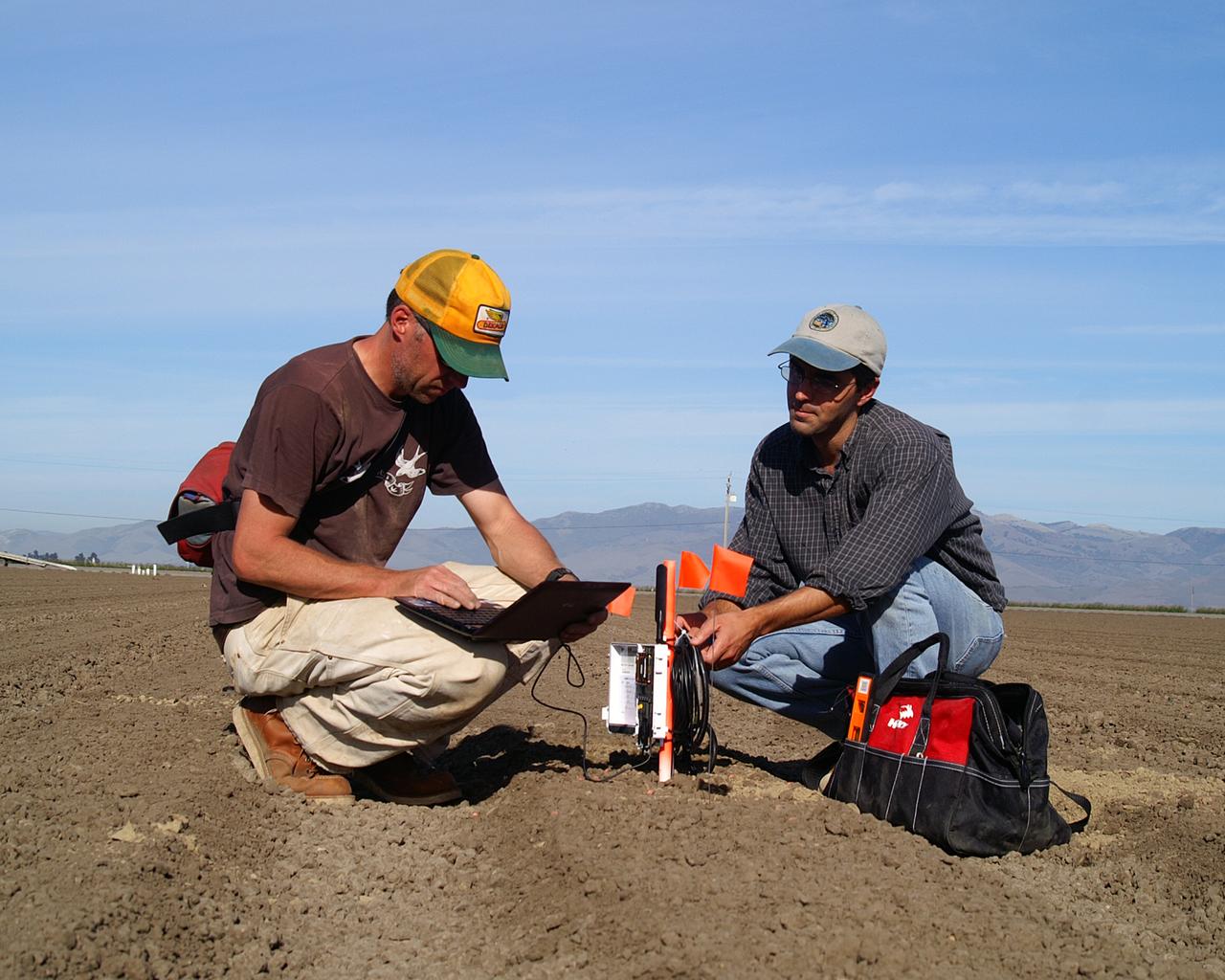
Wireless crop water monitoring project: Dr. Chris Lund and Forrest Melton, California State University Monterey Bay research scientists who work at NASA Ames Research Center, check data being returned from a wireless soil moisture monitoring network, installed in an agricultural field. Data from the soil moisture sensor network will be used to assist in interpretation of the satellite estimates of crop water demand. Image of courtesy of Forrest S. Melton
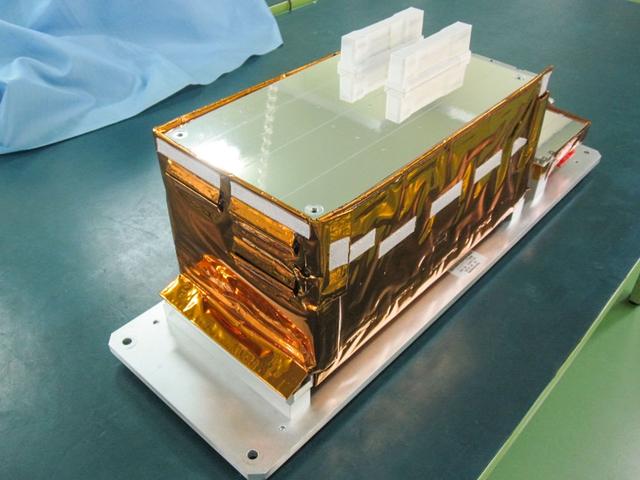
jsc2020e017719 (1/10/2020) --- Preflight imagery of the HTV Wireless LAN Demonstration equipment consisting of the Unpressurized Logistics Carrier (ULC) Hole Mission Assembly and Propulsion Module (PM) Surface Mission Assembly. The ULC Hole Mission Assembly consists of a Data Handling Unit (DHU), including a wireless communication device. Image courtesy of: JAXA
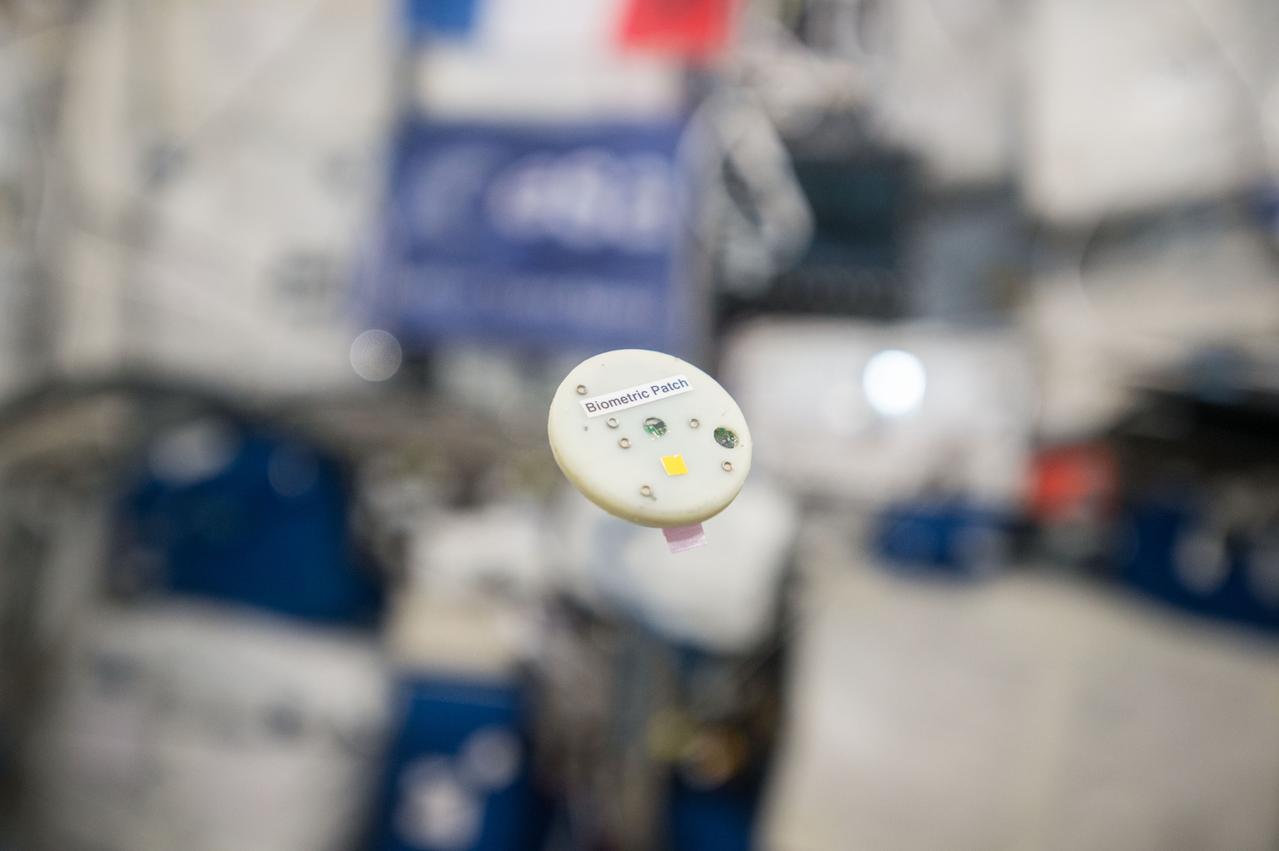
iss050e015097 (8/8/2016) --- View of floating Biometric patch (wearable sensor) connected to an International Space Station (ISS) iPad via bluetooth or via Lightbolt connector. The EVERYWEAR application allows a unified interface for physiology-related data collection and wireless communication.
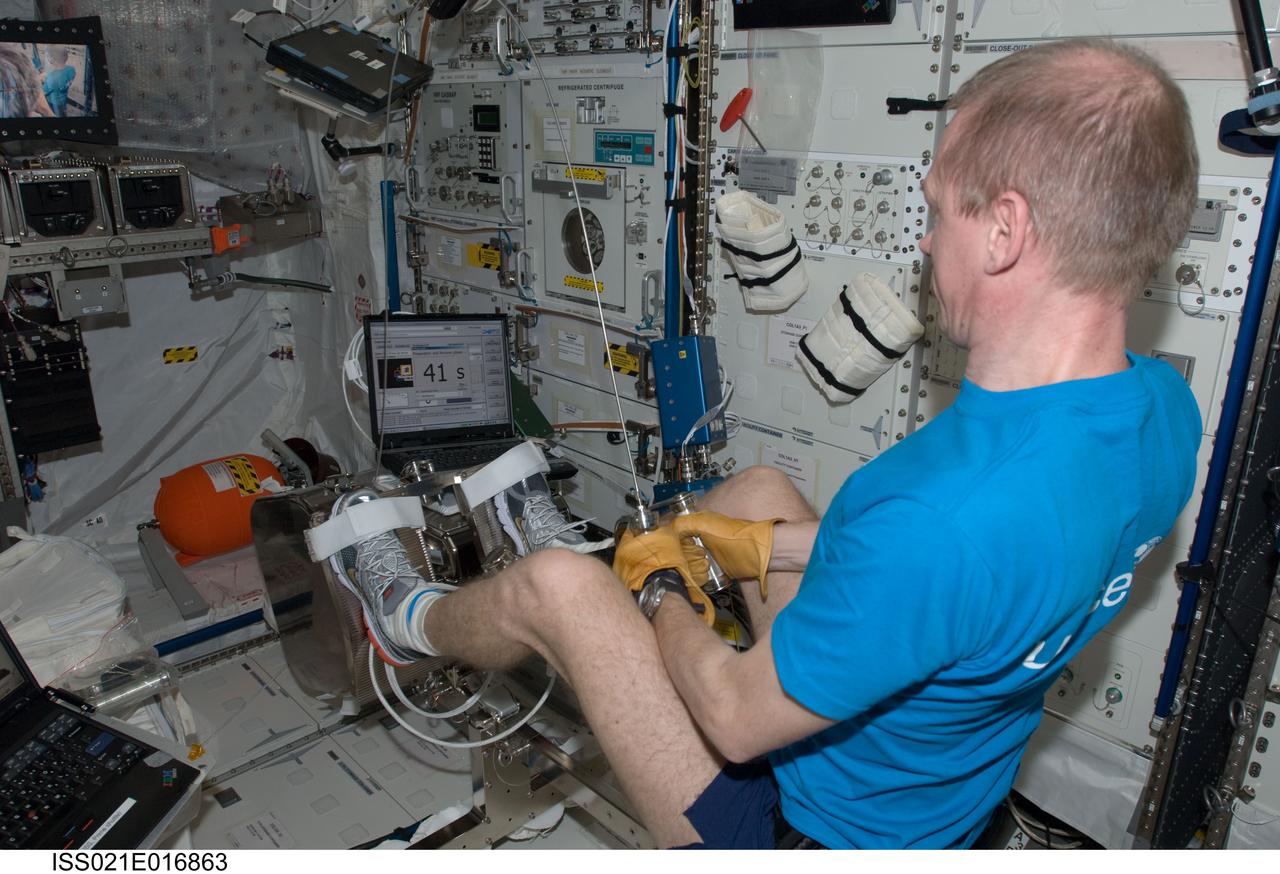
ISS021-E-016863 (28 Oct. 2009) --- European Space Agency (ESA) astronaut Frank De Winne, Expedition 21 commander, performs activation and checkout steps on the new ESA Flywheel Exercise Device (FWED), with the Internal Wireless Instrumentation System (IWIS) accelerometer, in the Columbus laboratory of the International Space Station.
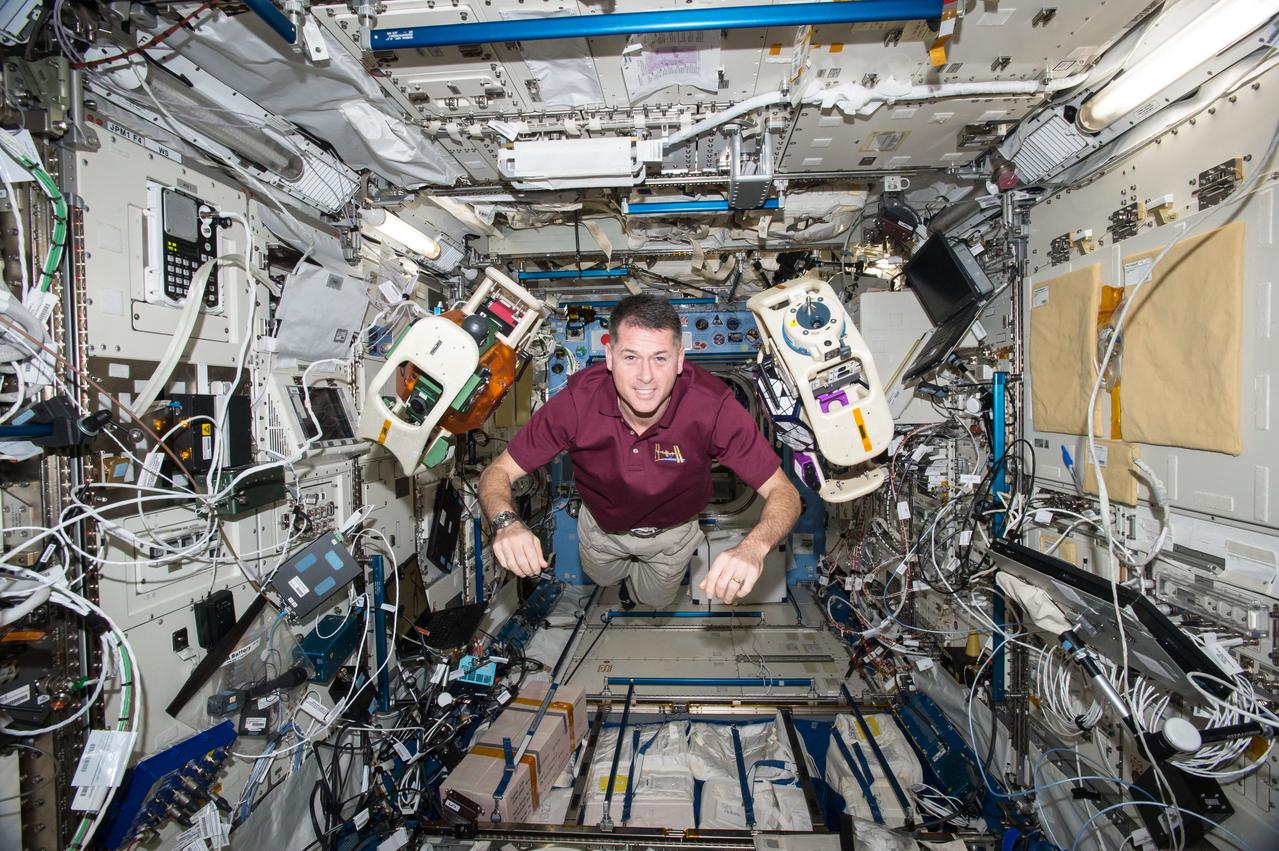
iss050e038043 (02/03/2017) --- NASA astronaut Shane Kimbrough is seen executing the SPHERES-HALO experiment aboard the International Space Station. The investigation uses two small, self-contained satellites (SPHERES) fitted with donut-like rings to test wireless power transfer and formation flight using electromagnetic fields.
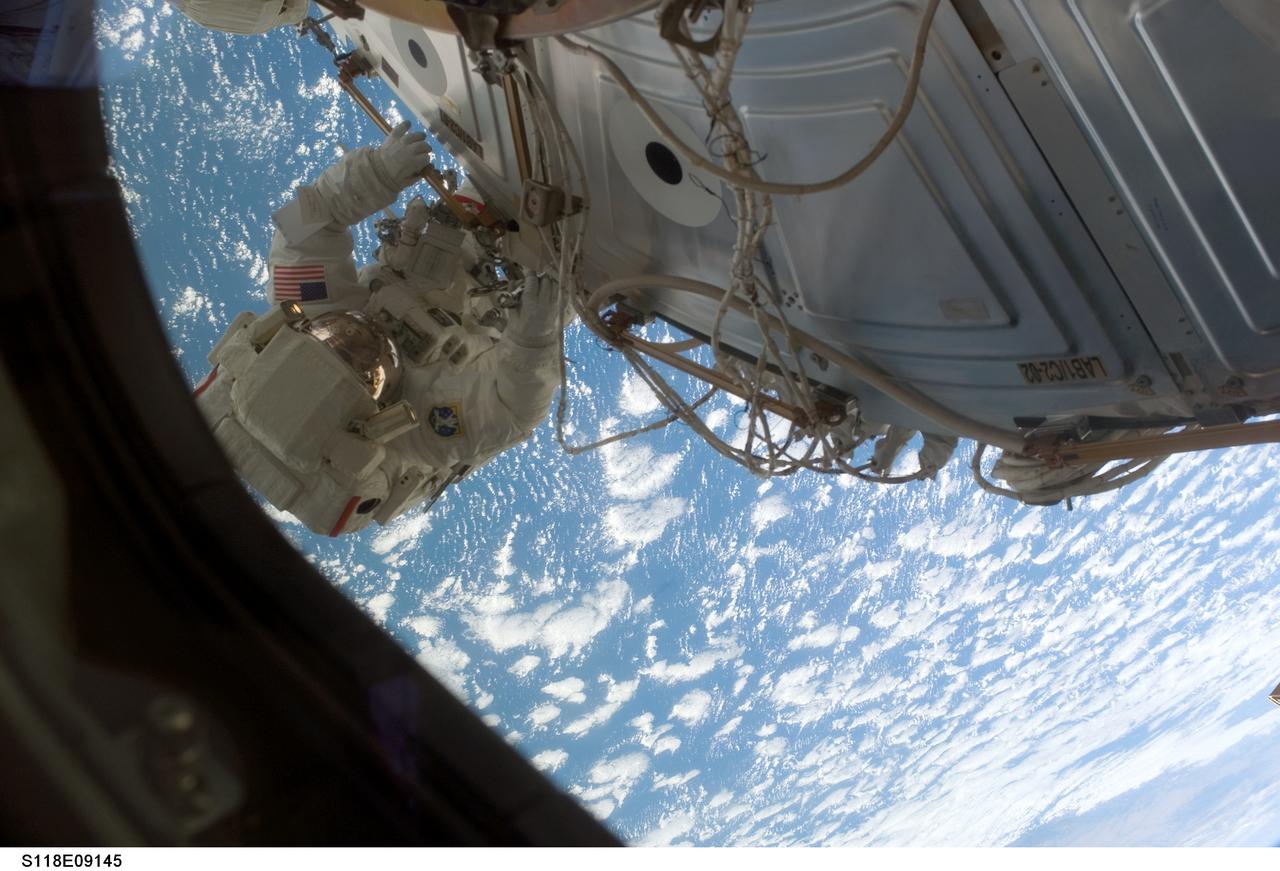
View of Expedition 15 Flight Engineer (FE-2), Clayton Anderson, working to install External Wireless Instrumentation System (EWIS) antennas on the exterior of the U.S. Laboratory/Destiny. Photo taken during the fourth session of Extravehicular Activity (EVA 4) for STS-118 / Expedition 15 joint operations.

Semiconductor crystals are an essential component in all computer chips, sensors, and wireless communication devices. Noguchi conducts the SUBSA investigation inside the microgravity glovebox to test a new method for producing semiconductor crystals. Findings from this work may improve the quality of the chips used inside consumer devices on Earth.
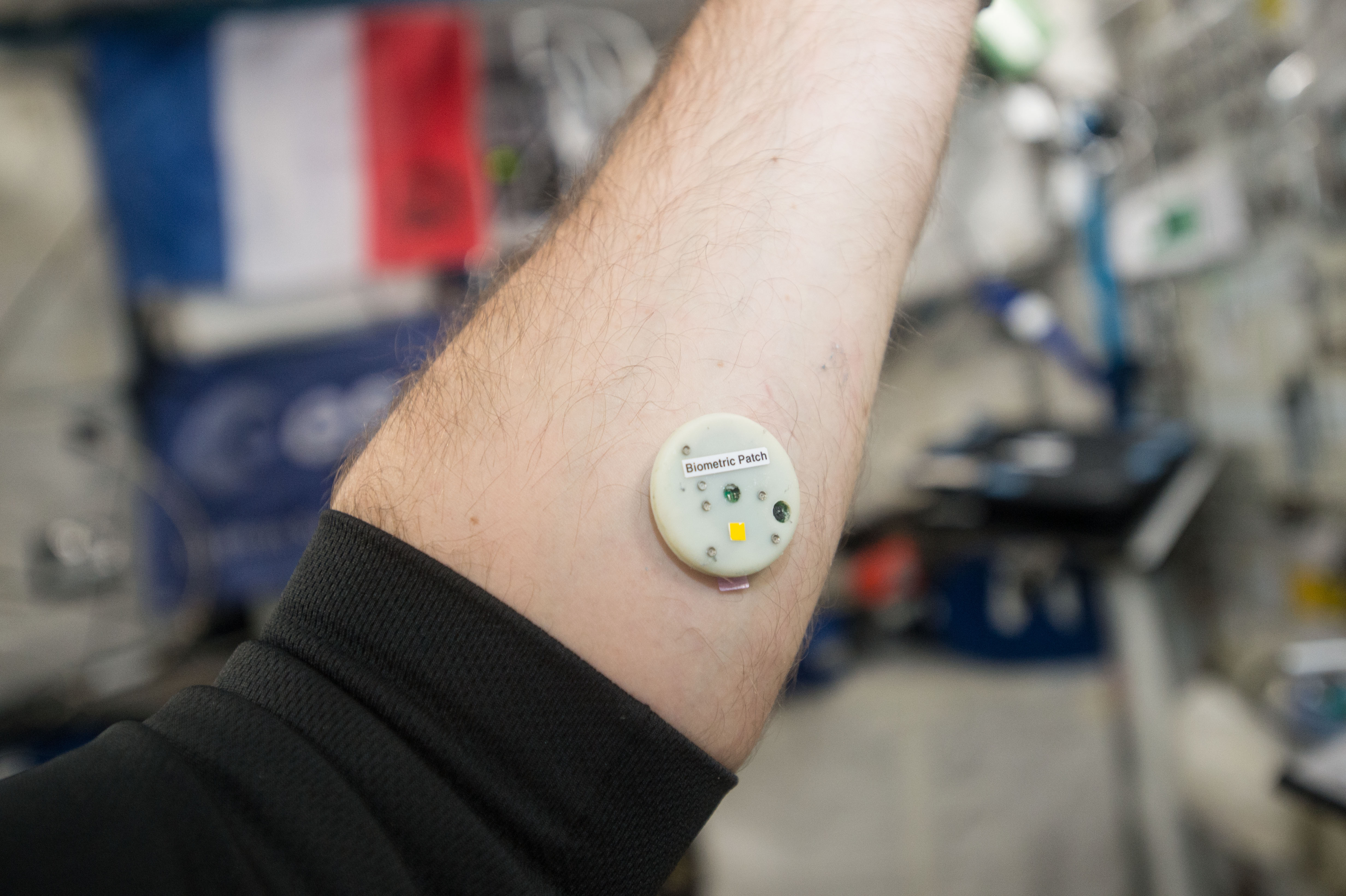
iss050e015078 (8/8/2016) --- View of Biometric patch (wearable sensor) connected to an International Space Station (ISS) iPad via bluetooth or via Lightbolt connector. The EVERYWEAR application allows a unified interface for physiology-related data collection and wireless communication.
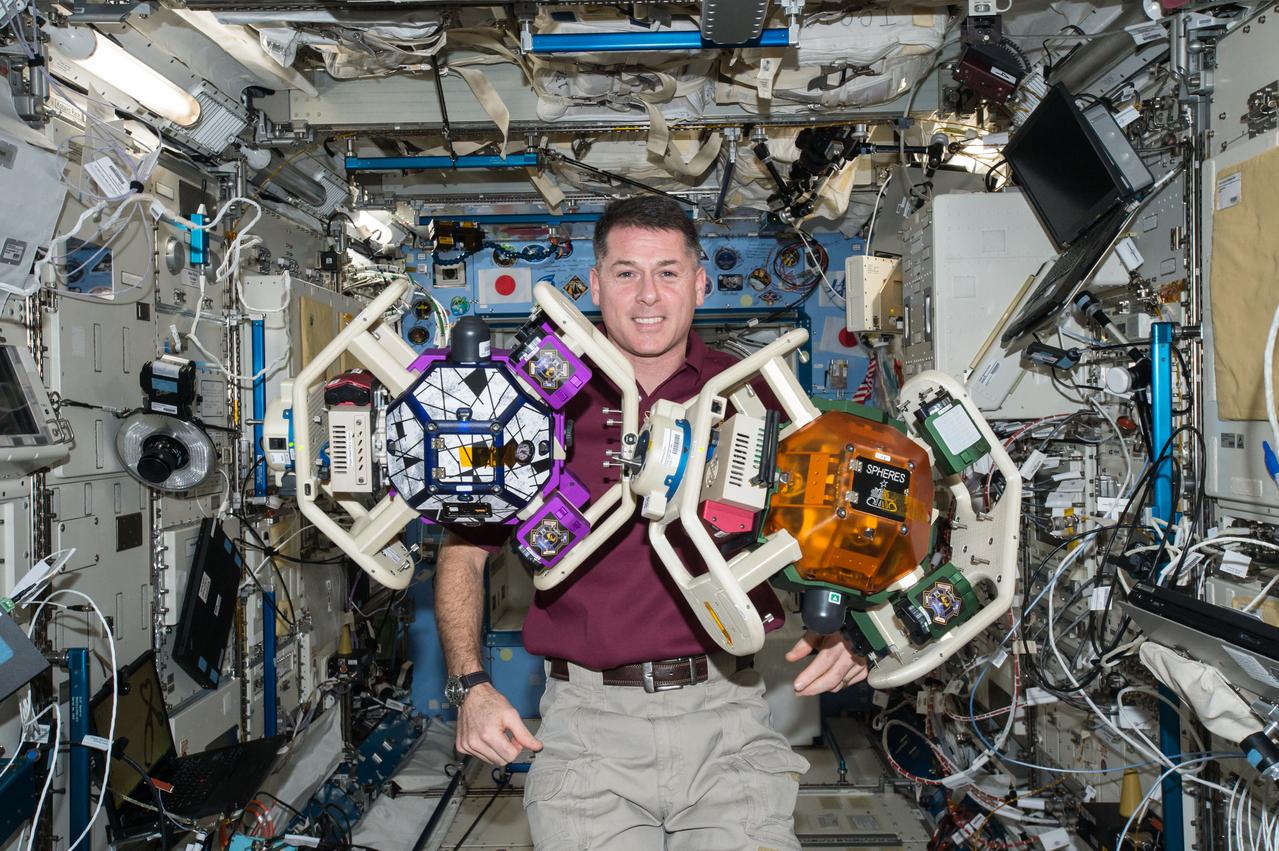
iss050e038054 (02/03/2017) --- NASA astronaut Shane Kimbrough is seen executing the SPHERES-HALO experiment aboard the International Space Station. The investigation uses two small, self-contained satellites (SPHERES) fitted with donut-like rings to test wireless power transfer and formation flight using electromagnetic fields.
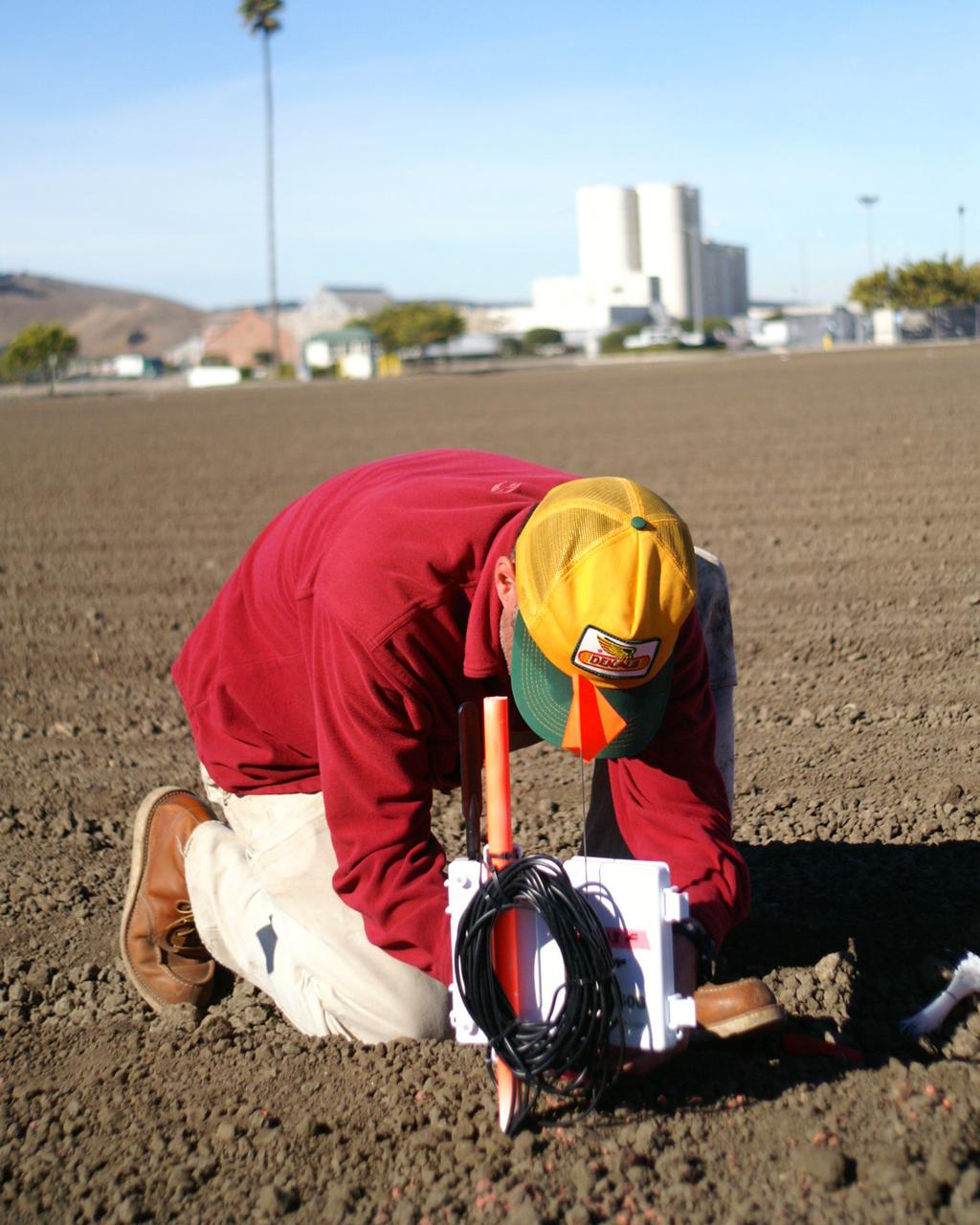
Wireless crop water monitoring project: Dr. Chris Lund, a scientist at the California State University Monterey Bay who is working on the NASA project at NASA Ames installs soil mositure probes in an agricultural field. The soil mositure measurements will be used to assist in interpretation of the satelite estimates of crop water deamand. Image of courtesy of Forrest S. Melton
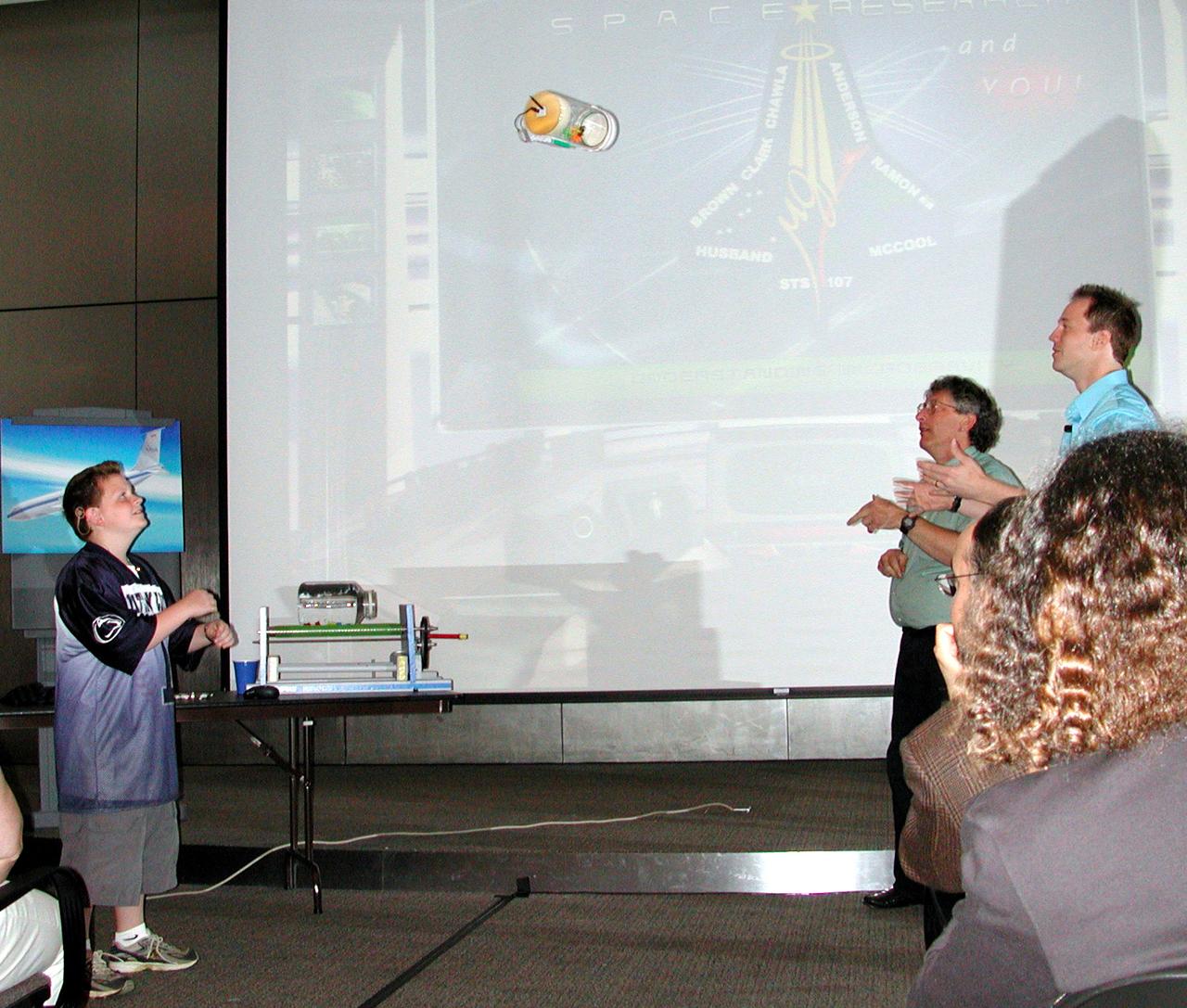
A student gets ready to catch a plastic tube carrying a small fluid bottle and a wireless video camera. As it arced through the air, the container was in free-fall -- just like astronauts in space -- and the TV camera broadcast images of how the fluid behaved. The activity was part of the Space Research and You education event held by NASA's Office of Biological and Physical Research on June 25, 2002, in Arlington, VA, to highlight the research that will be conducted on STS-107. (Digital camera image; no film original.
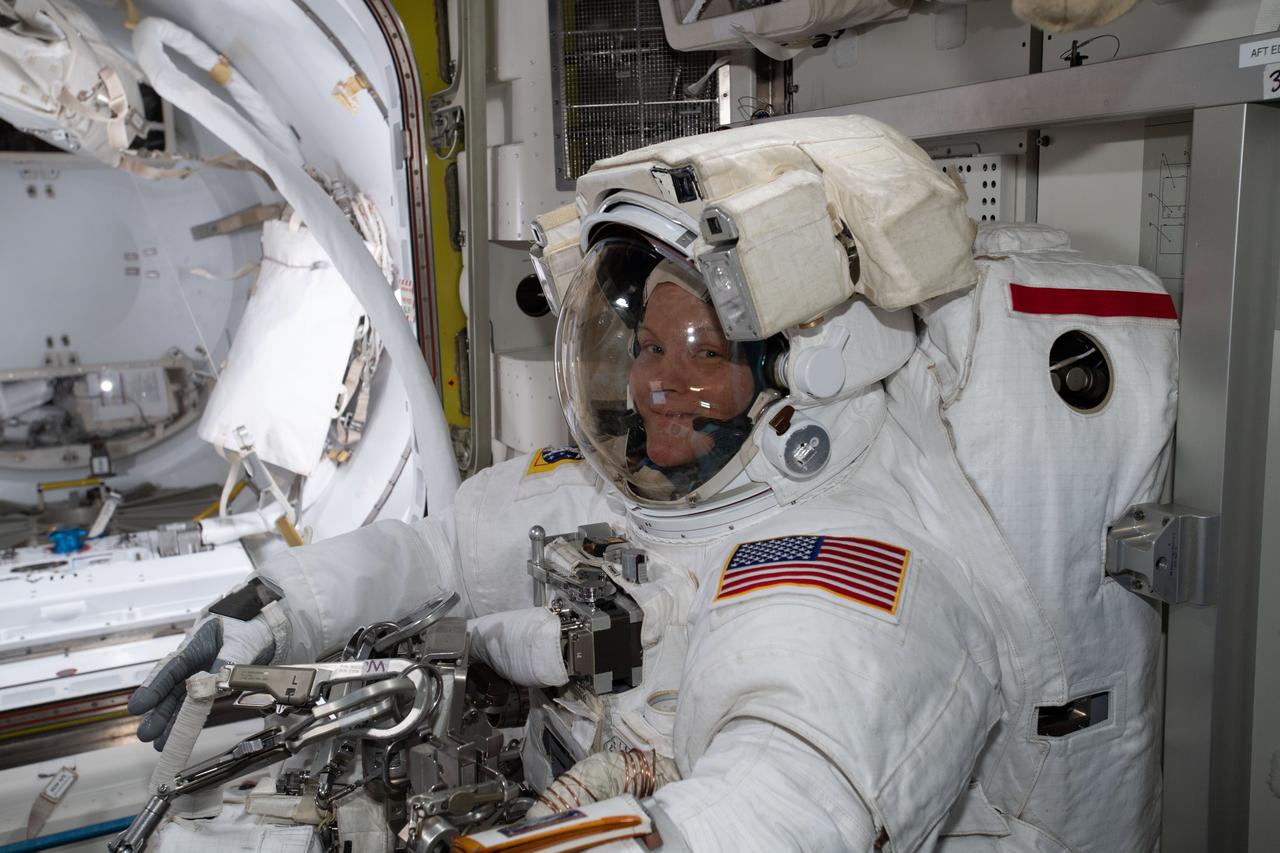
iss059e013383 (April 8, 2019) --- NASA astronaut Anne McClain is suited up in the U.S. Quest airlock preparing to begin what would be a six-and-a-half hour spacewalk with astronaut David Saint-Jacques (out of frame) of the Canadian Space Agency. The two spacewalkers established a redundant path of power to the Canadian-built robotic arm, known as Canadarm2, and installed cables to provide for more expansive wireless communications.
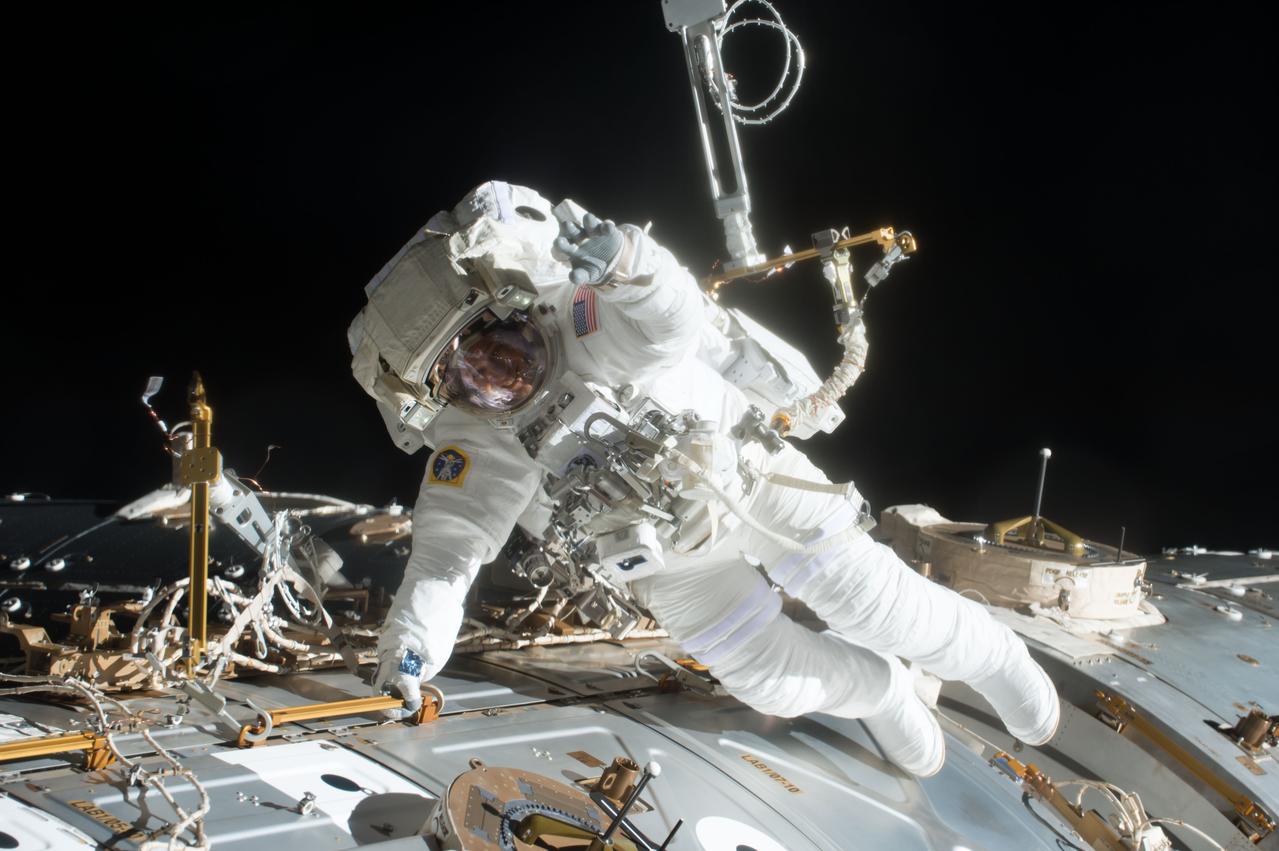
iss051e049012 (May 23, 2017) --- Air Force colonel and NASA astronaut Jack Fischer (left) works outside the U.S. Destiny laboratory module to attach wireless antennas during the 201st spacewalk in support of International Space Station maintenance and assembly. This was a short and unplanned, contingency spacewalk whose primary task was the removal and replacement of a failed computer data relay box that controls the functionality of important station components such as solar arrays and radiators.
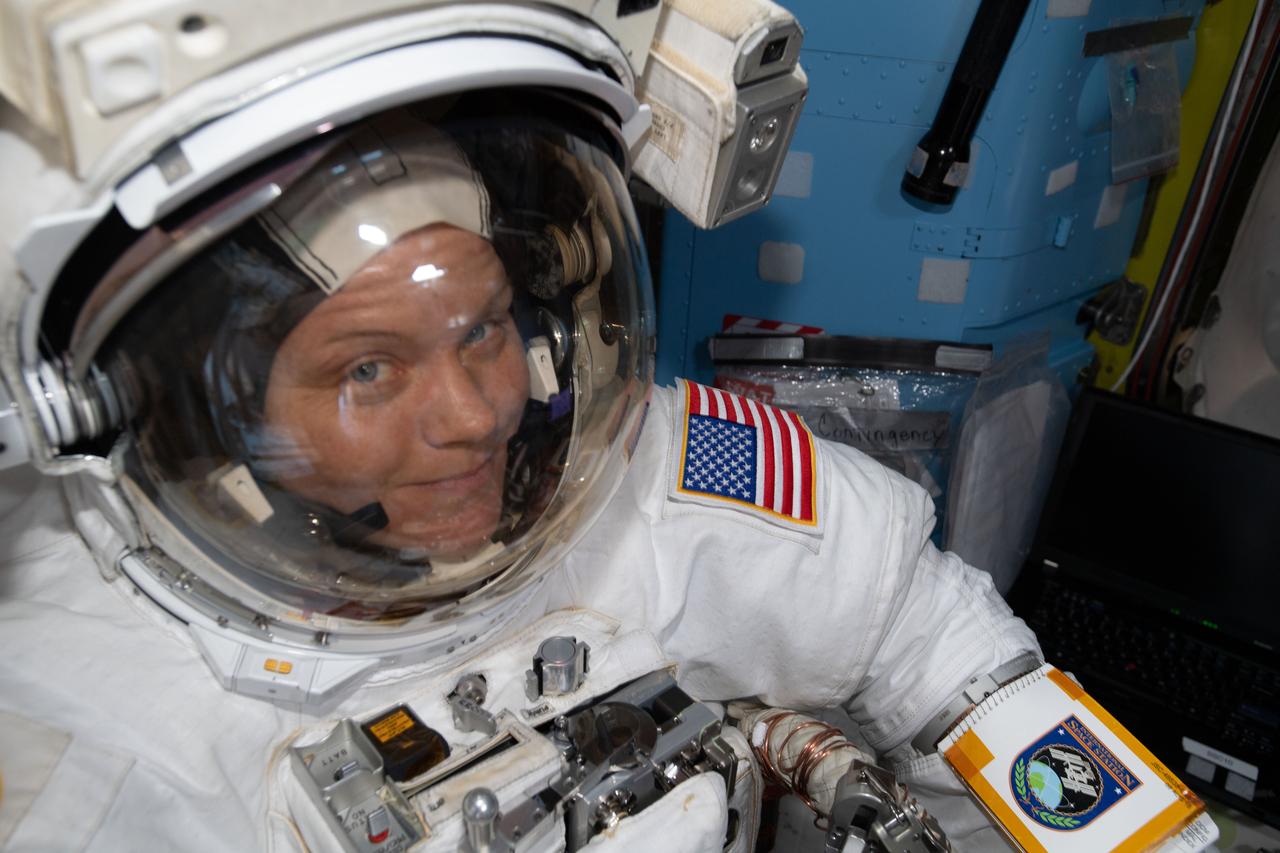
iss059e013388 (April 8, 2019) --- NASA astronaut Anne McClain is suited up in the U.S. Quest airlock preparing to begin what would be a six-and-a-half hour spacewalk with astronaut David Saint-Jacques (out of frame) of the Canadian Space Agency. The two spacewalkers established a redundant path of power to the Canadian-built robotic arm, known as Canadarm2, and installed cables to provide for more expansive wireless communications.
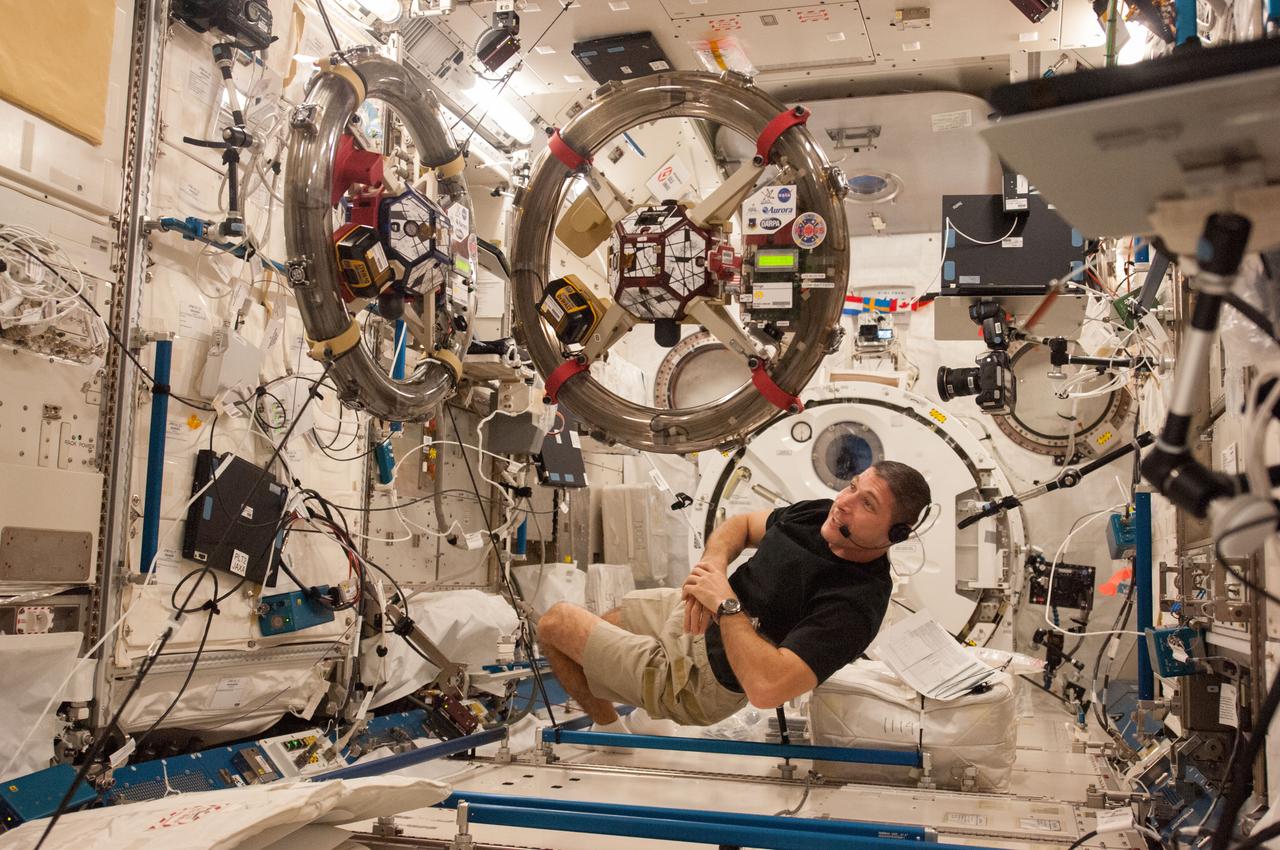
ISS037-E-025868 (4 Nov. 2013) --- In the International Space Station?s Kibo laboratory, NASA astronaut Michael Hopkins, Expedition 37 flight engineer, conducts a session with a pair of bowling-ball-sized free-flying satellites known as Synchronized Position Hold, Engage, Reorient, Experimental Satellites, or SPHERES. Surrounding the two SPHERES mini-satellites is ring-shaped hardware known as the Resonant Inductive Near-field Generation System, or RINGS. SPHERES-RINGS seeks to demonstrate wireless power transfer between satellites at a distance for enhanced operations.
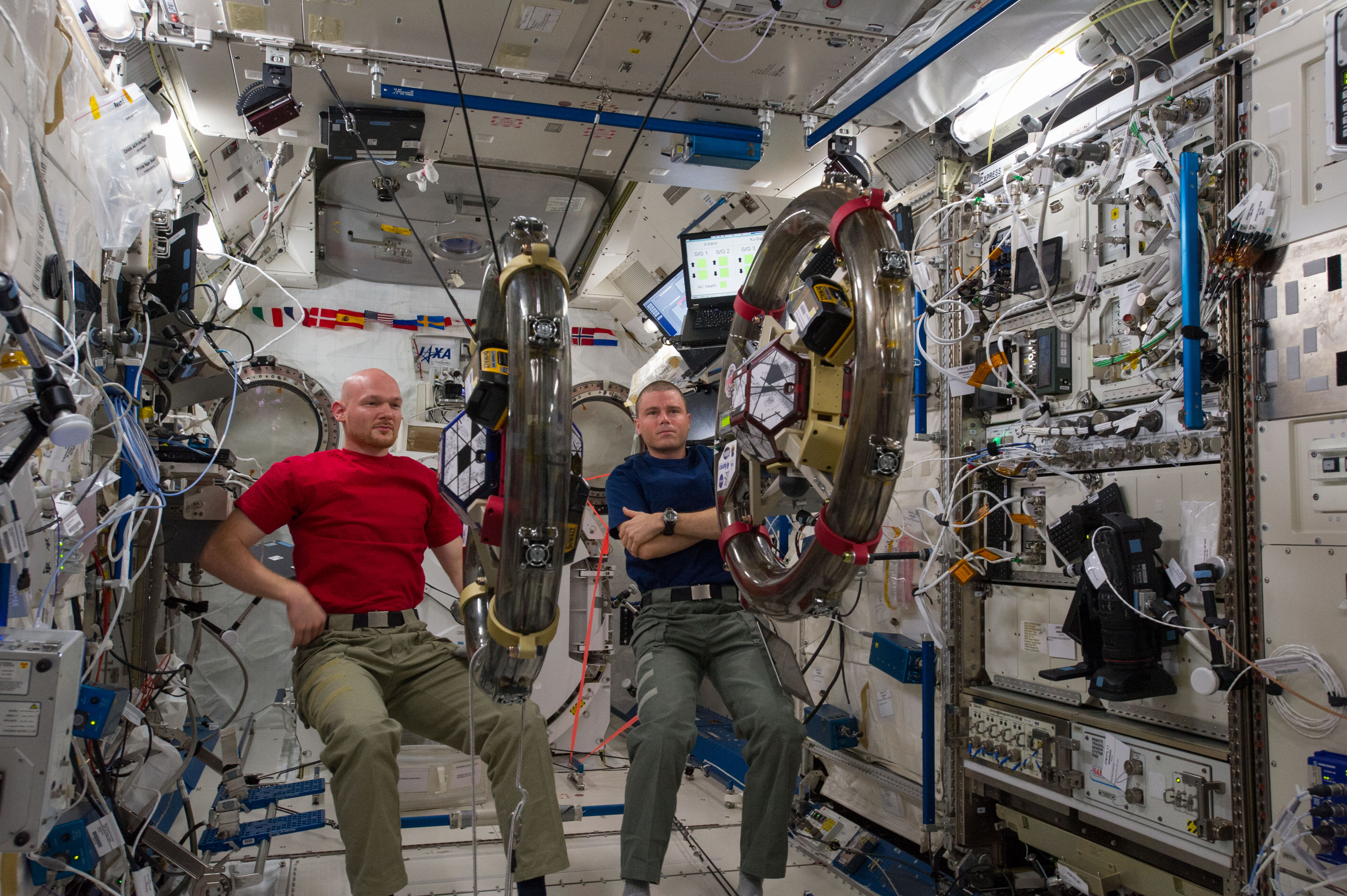
ISS040-E-059478 (10 July 2014) --- In the International Space Station's Kibo laboratory, European Space Agency astronaut Alexander Gerst (left) and NASA astronaut Reid Wiseman, both Expedition 40 flight engineers, conduct a session with a pair of bowling-ball-sized free-flying satellites known as Synchronized Position Hold, Engage, Reorient, Experimental Satellites, or SPHERES. Surrounding the two SPHERES mini-satellites is ring-shaped hardware known as the Resonant Inductive Near-field Generation System, or RINGS. SPHERES-RINGS seeks to demonstrate wireless power transfer between satellites at a distance for enhanced operations.
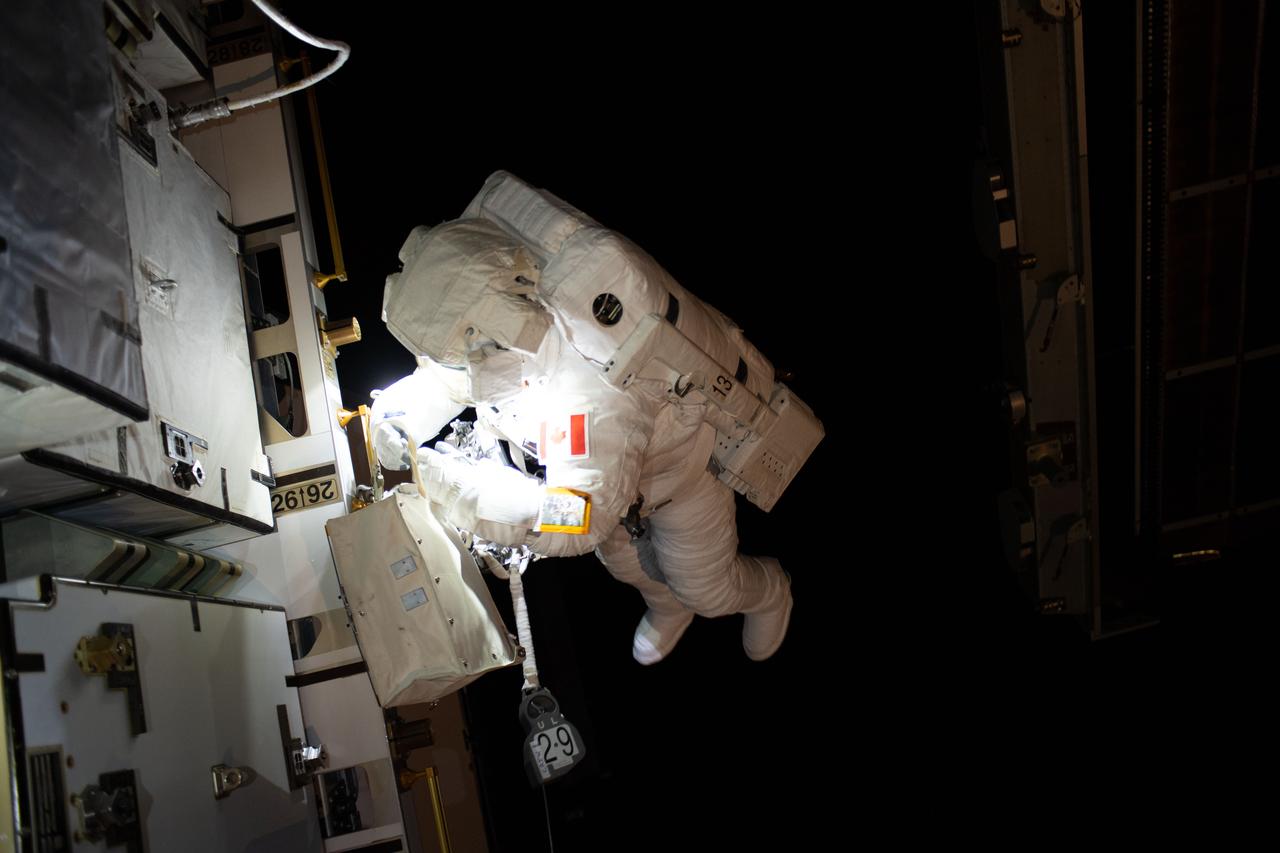
iss059e016830 (April 8, 2019) --- Expedition 59 Flight Engineer David Saint-Jacques of the Canadian Space Agency is seen working to relocate a battery adapter plate outside the International Space Station. In a six and a half hour spacewalk, Saint-Jacques and NASA astronaut Anne McClain successfully established a redundant path of power to the Canadian-built robotic arm, known as Canadarm2, and installed cables to provide for more expansive wireless communications coverage outside the orbital complex, as well as for enhanced hardwired computer network capability. The duo also relocated an adapter plate from the first spacewalk in preparation for future battery upgrade operations.
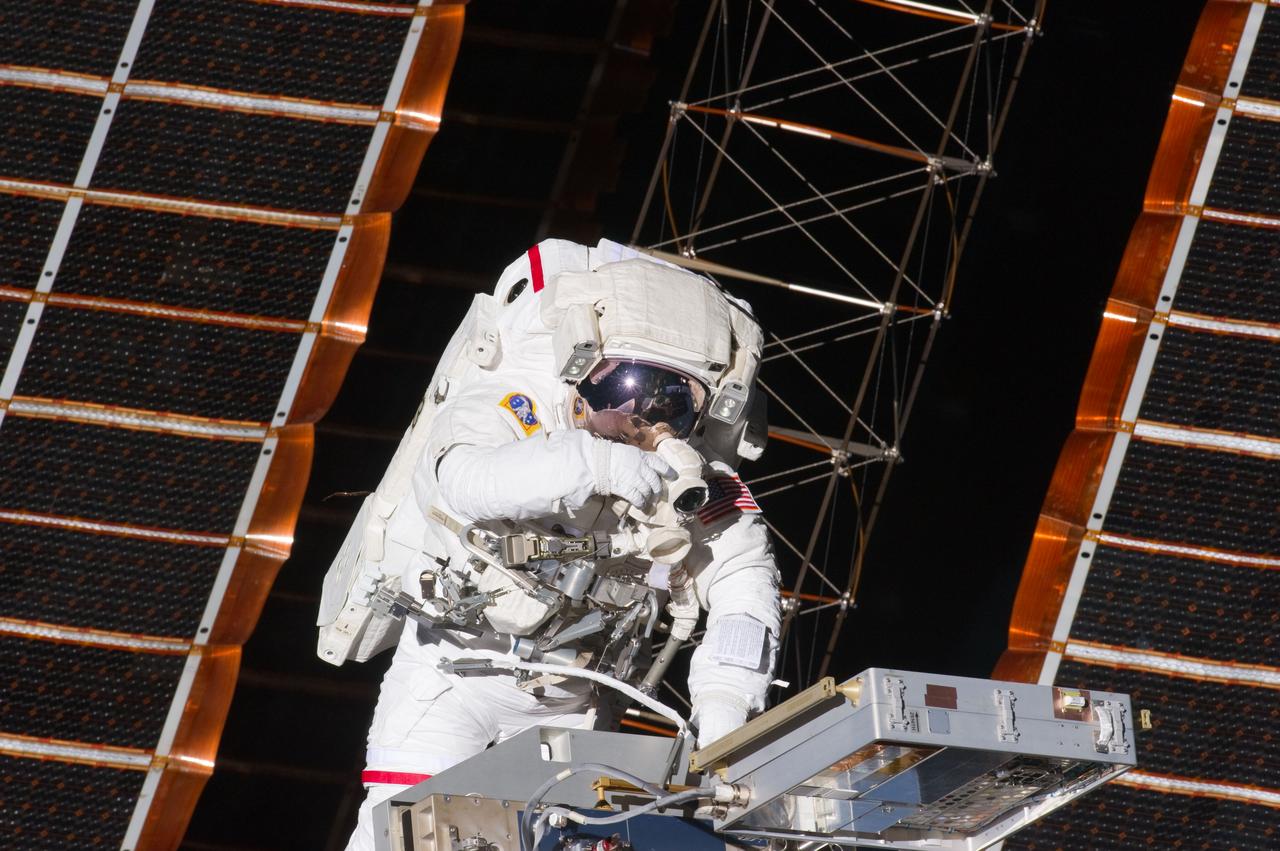
S134-E-007597 (20 May 2011) --- NASA astronaut Andrew Feustel, STS-134 mission specialist, participates in the mission's first session of extravehicular activity (EVA) as construction and maintenance continue on the International Space Station. During the six-hour, 19-minute spacewalk, Feustel and astronaut Greg Chamitoff (out of fame) retrieved long-duration materials exposure experiments and installed another, installed a light on one of the station?s rail line handcarts, made preparations for adding ammonia to a cooling loop and installed an antenna for the External Wireless Communication system. Photo credit: NASA
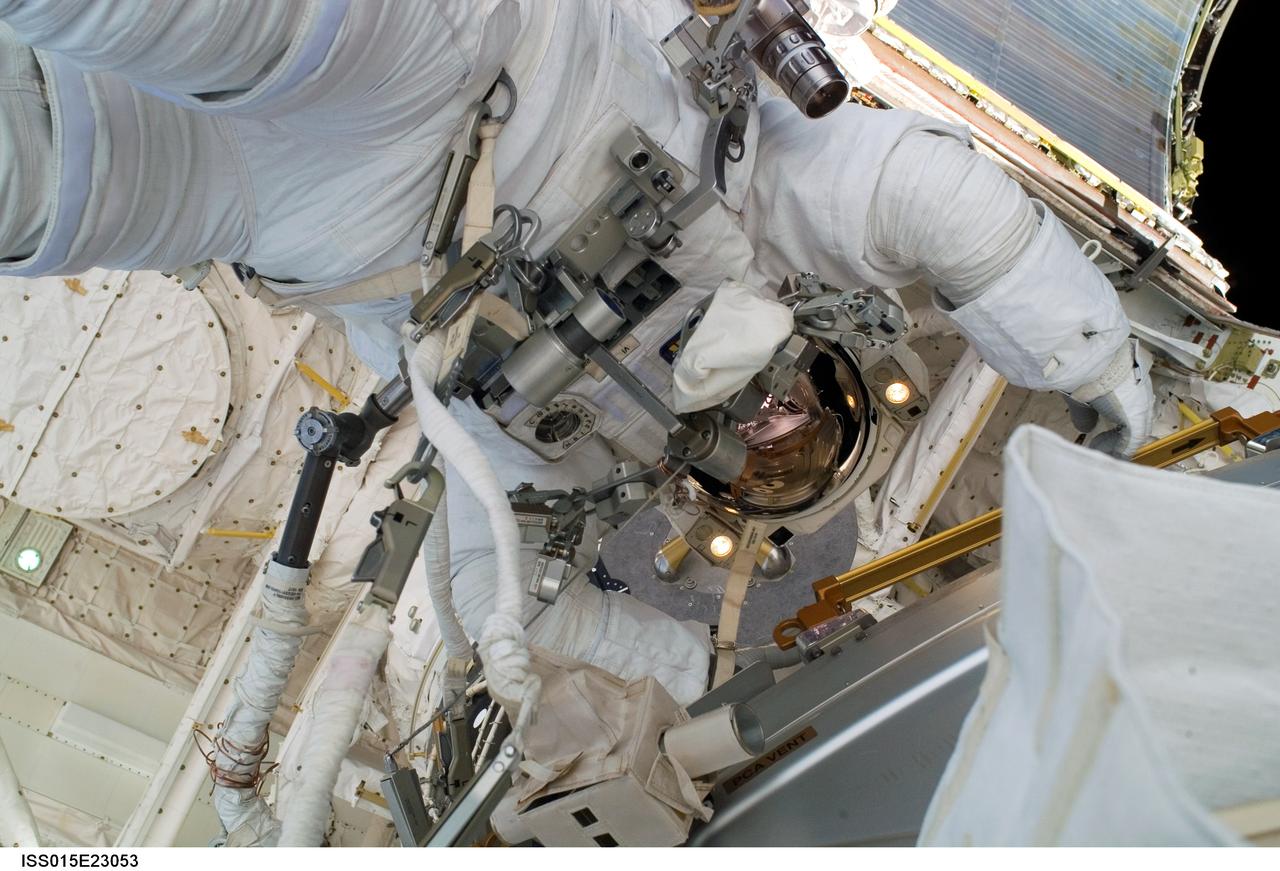
ISS015-E-23053 (18 Aug. 2007) --- Astronaut Dave Williams, STS-118 mission specialist representing the Canadian Space Agency, participates in the mission's fourth and final session of extravehicular activity (EVA) as construction and maintenance continue on the International Space Station. During the 5-hour spacewalk, Williams and astronaut Clay Anderson (out of frame), Expedition 15 flight engineer, installed the External Wireless Instrumentation System antenna, attached a stand for the shuttle's robotic arm extension boom and retrieved the two Materials International Space Station Experiments (MISSE) to be brought back on the shuttle.
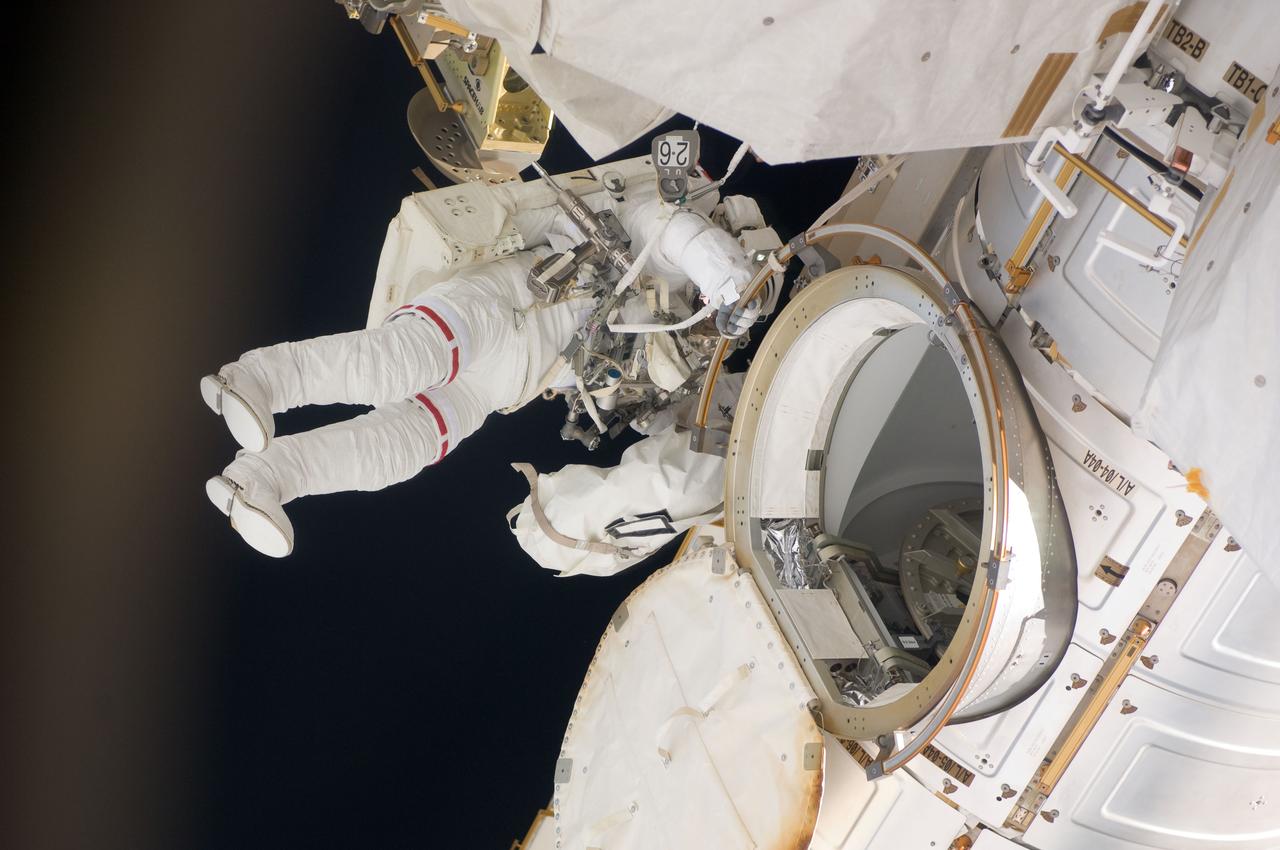
ISS027-E-035206 (20 May 2011) --- NASA astronaut Greg Chamitoff, STS-134 mission specialist, nears the completion of his role in the mission's first session of extravehicular activity (EVA) as construction and maintenance continue on the International Space Station. During the six-hour, 19-minute spacewalk, Chamitoff and NASA astronaut Andrew Feustel (out of fame) retrieved long-duration materials exposure experiments and installed another, installed a light on one of the station's rail line handcarts, made preparations for adding ammonia to a cooling loop and installed an antenna for the External Wireless Communication system.
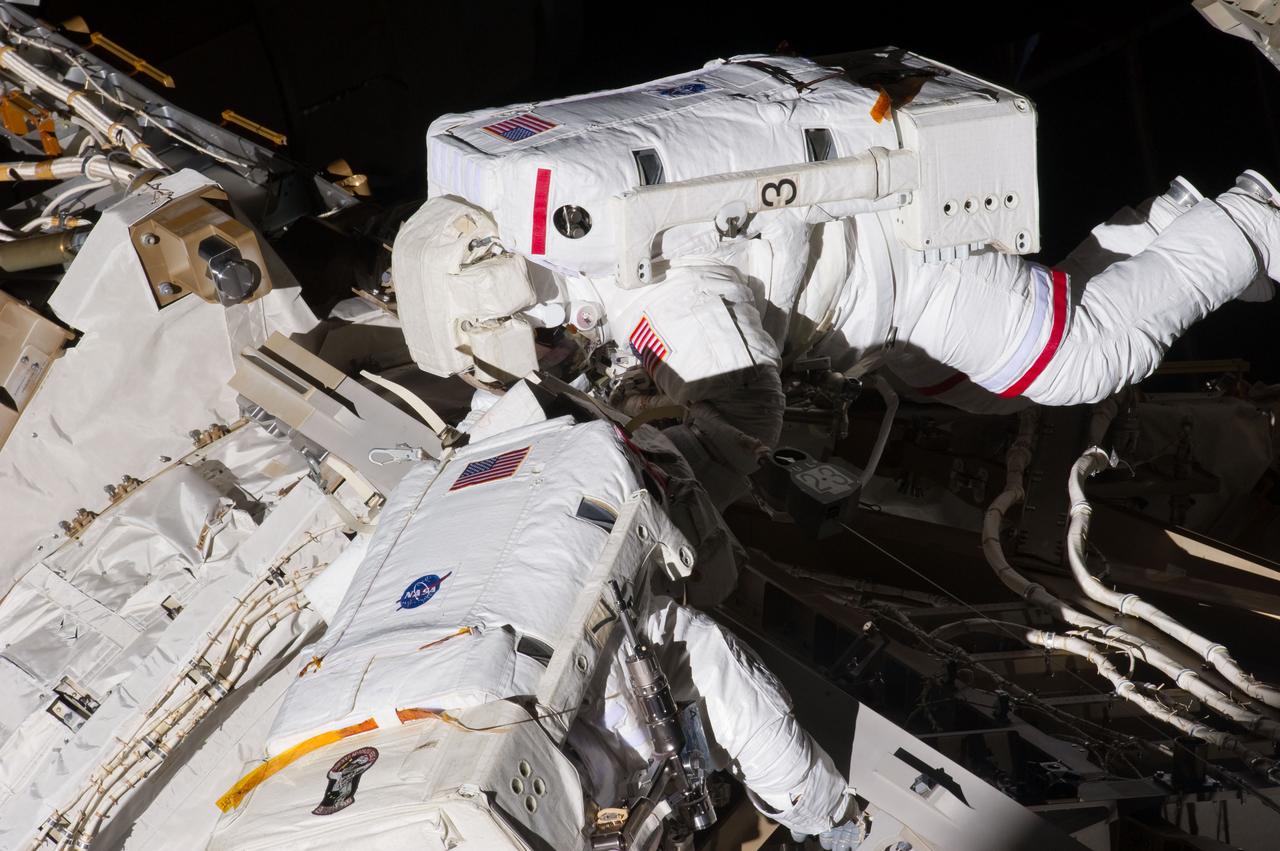
S134-E-007670 (20 May 2011) --- NASA astronauts Andrew Feustel (top) and Greg Chamitoff, both STS-134 mission specialists, participate in the mission's first session of extravehicular activity (EVA) as construction and maintenance continue on the International Space Station. During the six-hour, 19-minute spacewalk, Feustel and Chamitoff retrieved long-duration materials exposure experiments and installed another, installed a light on one of the station?s rail line handcarts, made preparations for adding ammonia to a cooling loop and installed an antenna for the External Wireless Communication system. Photo credit: NASA
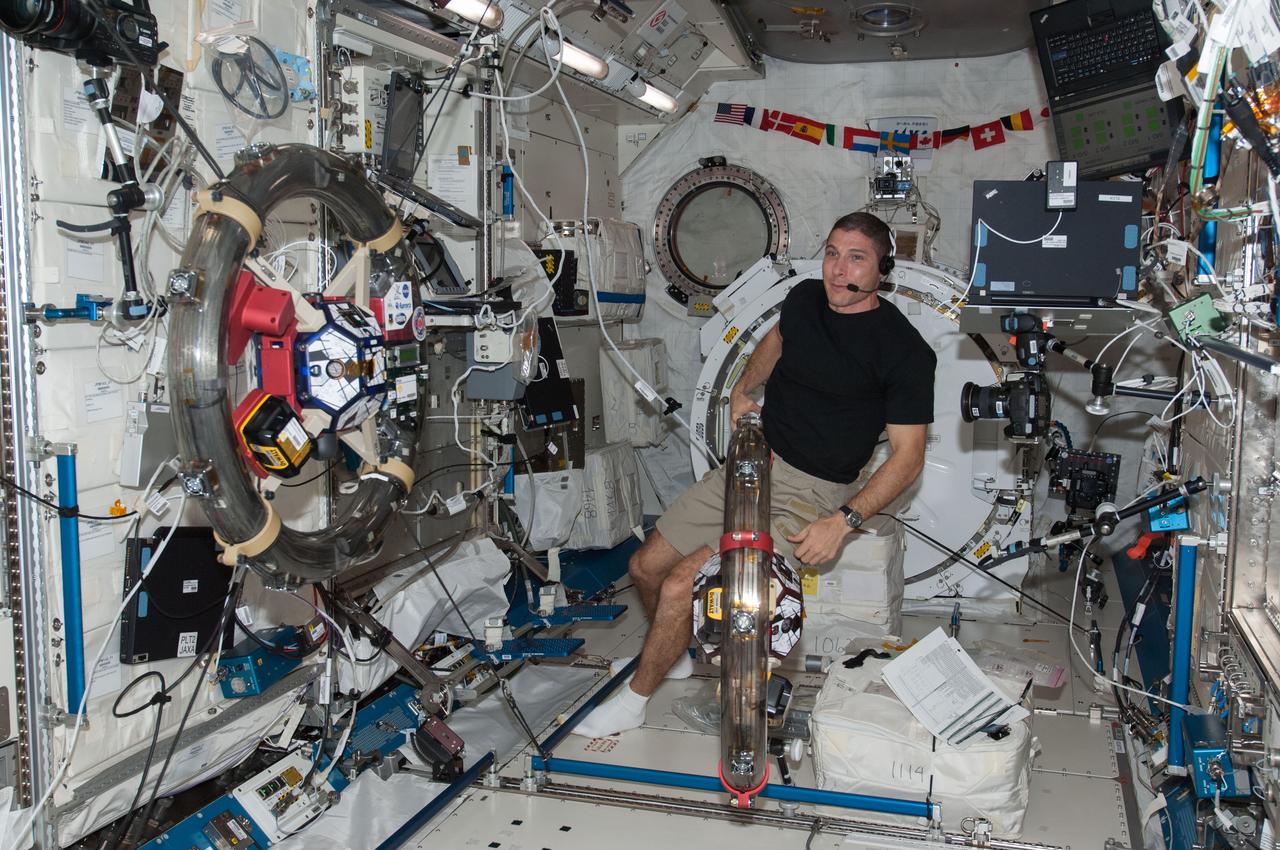
ISS037-E-025872 (4 Nov. 2013) --- In the International Space Station?s Kibo laboratory, NASA astronaut Michael Hopkins, Expedition 37 flight engineer, conducts a session with a pair of bowling-ball-sized free-flying satellites known as Synchronized Position Hold, Engage, Reorient, Experimental Satellites, or SPHERES. Surrounding the two SPHERES mini-satellites is ring-shaped hardware known as the Resonant Inductive Near-field Generation System, or RINGS. SPHERES-RINGS seeks to demonstrate wireless power transfer between satellites at a distance for enhanced operations.
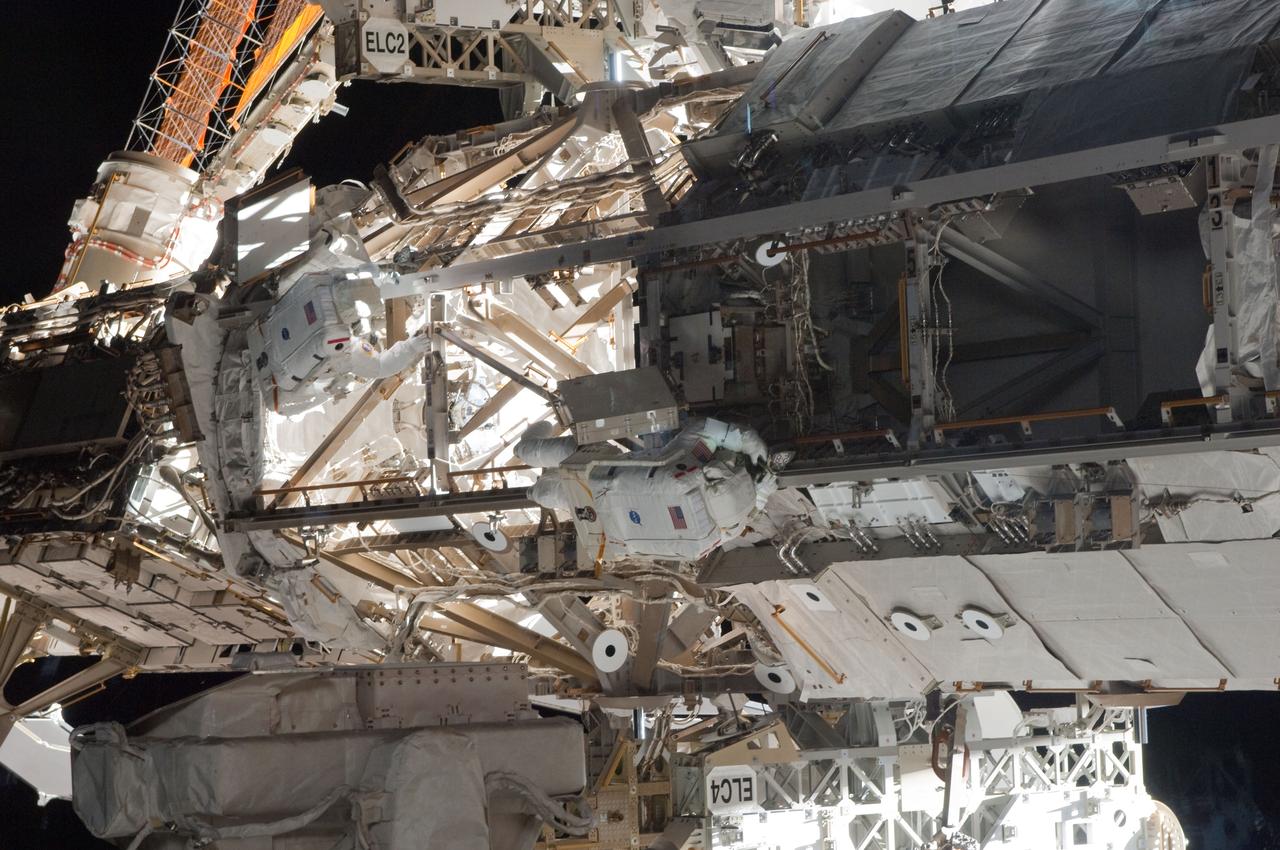
ISS027-E-034398 (20 May 2011) --- NASA astronauts Andrew Feustel (left) and Greg Chamitoff, both STS-134 mission specialists, participate in the mission's first session of extravehicular activity (EVA) as construction and maintenance continue on the International Space Station. During the six-hour, 19-minute spacewalk, Feustel and Chamitoff retrieved long-duration materials exposure experiments and installed another, installed a light on one of the station?s rail line handcarts, made preparations for adding ammonia to a cooling loop and installed an antenna for the External Wireless Communication system.
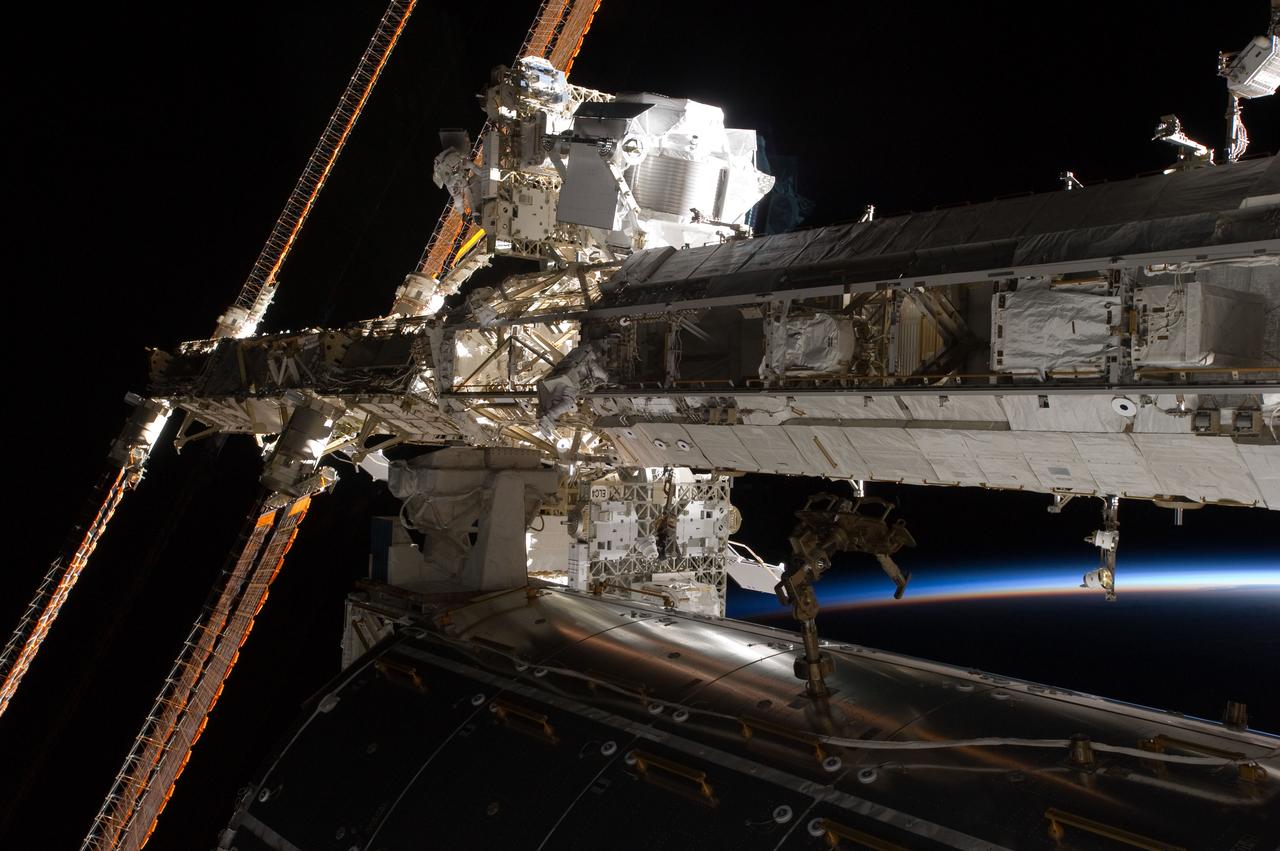
S134-E-007542 (20 May 2011) --- NASA astronauts Andrew Feustel (top left) and Greg Chamitoff (center left), both STS-134 mission specialists, participate in the mission's first session of extravehicular activity (EVA) as construction and maintenance continue on the International Space Station. During the six-hour, 19-minute spacewalk, Feustel and Chamitoff retrieved long-duration materials exposure experiments and installed another, installed a light on one of the station?s rail line handcarts, made preparations for adding ammonia to a cooling loop and installed an antenna for the External Wireless Communication system. Photo credit: NASA
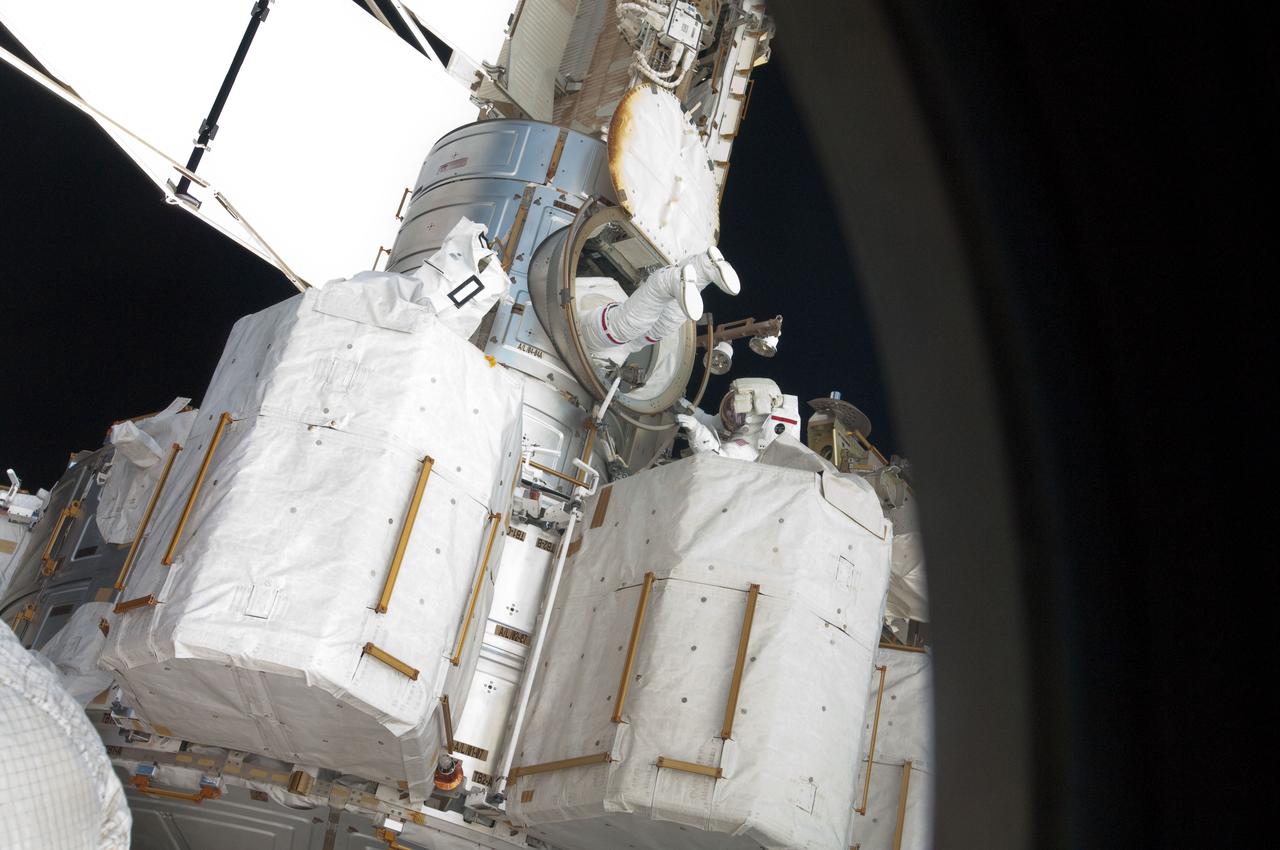
S134-E-009310 (20 May 2011) --- NASA astronaut Greg Chamitoff, STS-134 mission specialist, enters the Quest airlock of the International Space Station as the mission's first session of extravehicular activity (EVA) draws to a close. During the six-hour, 19-minute spacewalk, Chamitoff and astronaut Andrew Feustel (out of frame) retrieved long-duration materials exposure experiments and installed another, installed a light on one of the station?s rail line handcarts, made preparations for adding ammonia to a cooling loop and installed an antenna for the External Wireless Communication system. Photo credit: NASA
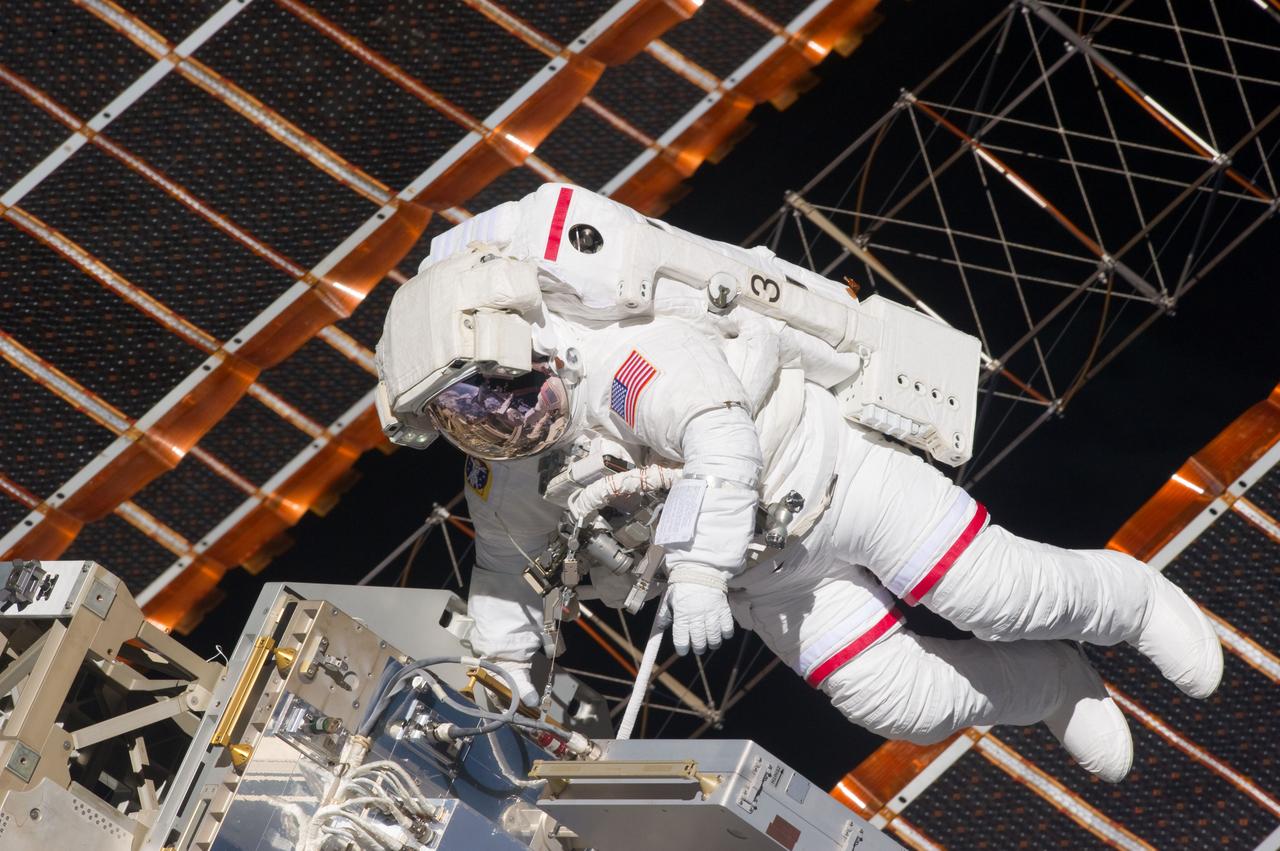
S134-E-007560 (20 May 2011) --- NASA astronaut Andrew Feustel, STS-134 mission specialist, participates in the mission's first session of extravehicular activity (EVA) as construction and maintenance continue on the International Space Station. During the six-hour, 19-minute spacewalk, Feustel and astronaut Greg Chamitoff (out of fame) retrieved long-duration materials exposure experiments and installed another, installed a light on one of the station?s rail line handcarts, made preparations for adding ammonia to a cooling loop and installed an antenna for the External Wireless Communication system. Photo credit: NASA
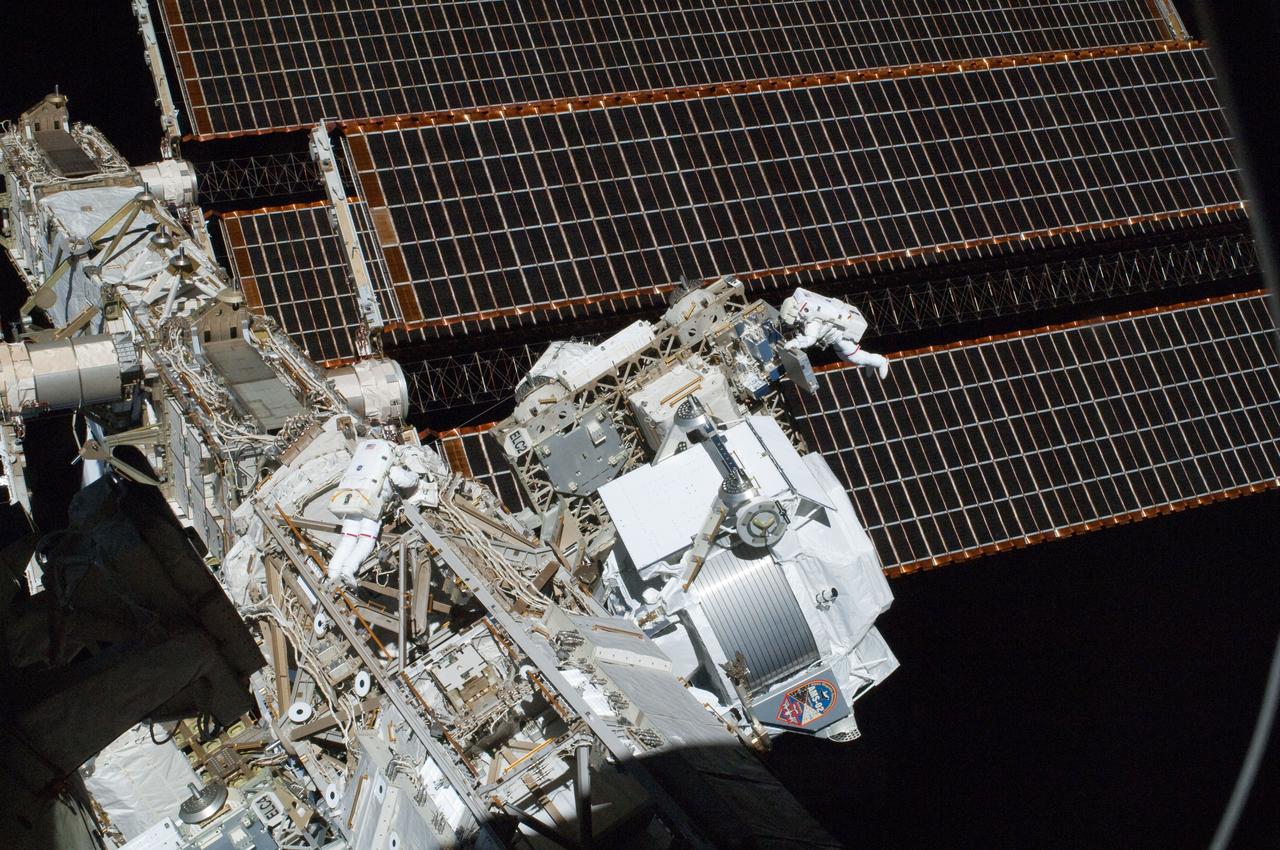
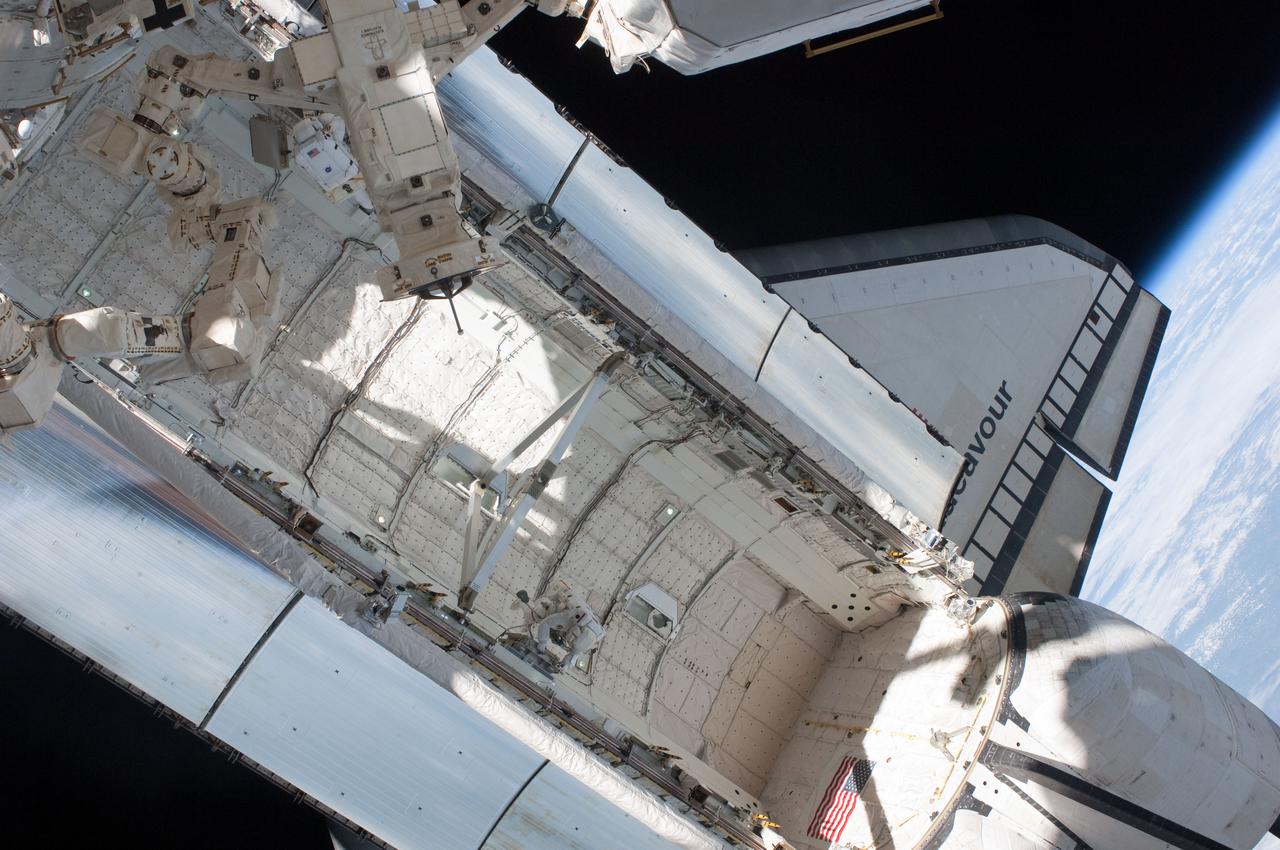
S134-E-009265 (20 May 2011) --- NASA astronauts Andrew Feustel (right) and Greg Chamitoff, both STS-134 mission specialists, participate in the mission's first session of extravehicular activity (EVA) as construction and maintenance continue on the International Space Station. During the six-hour, 19-minute spacewalk, Feustel and Chamitoff retrieved long-duration materials exposure experiments and installed another, installed a light on one of the station?s rail line handcarts, made preparations for adding ammonia to a cooling loop and installed an antenna for the External Wireless Communication system. The newly-installed Alpha Magnetic Spectrometer-2 (AMS) is at center frame. Photo credit: NASA
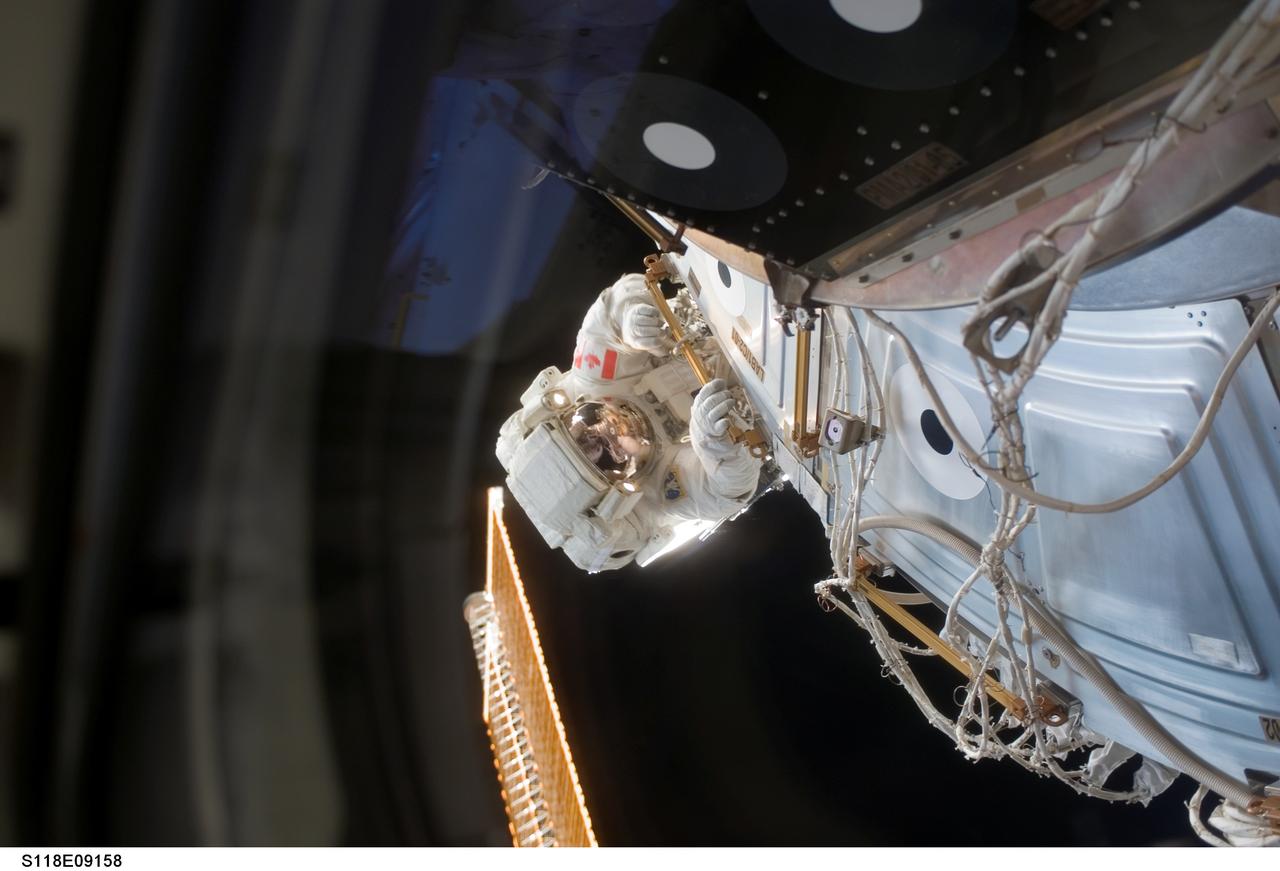
S118-E-09158 (18 Aug. 2007) --- Astronaut Dave Williams, STS-118 mission specialist representing the Canadian Space Agency, participates in the mission's fourth and final session of extravehicular activity (EVA) as construction and maintenance continue on the International Space Station. During the 5-hour spacewalk, Williams and astronaut Clay Anderson (out of frame), Expedition 15 flight engineer, installed the External Wireless Instrumentation System antenna, attached a stand for the shuttle's robotic arm extension boom and retrieved the two Materials International Space Station Experiments (MISSE) to be brought back on the shuttle.
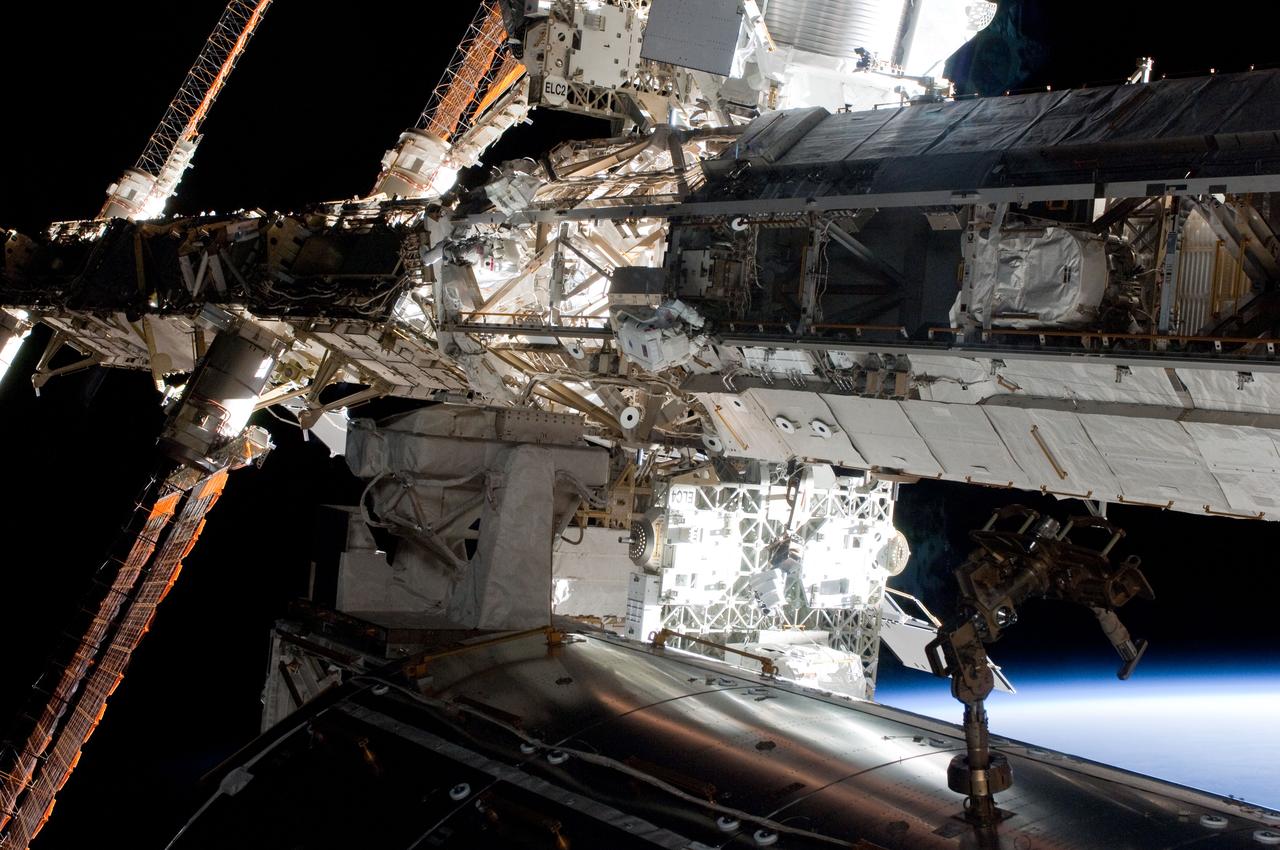
ISS027-E-034396 (20 May 2011) --- NASA astronauts Andrew Feustel (left) and Greg Chamitoff, both STS-134 mission specialists, participate in the mission's first session of extravehicular activity (EVA) as construction and maintenance continue on the International Space Station. During the six-hour, 19-minute spacewalk, Feustel and Chamitoff retrieved long-duration materials exposure experiments and installed another, installed a light on one of the station?s rail line handcarts, made preparations for adding ammonia to a cooling loop and installed an antenna for the External Wireless Communication system.
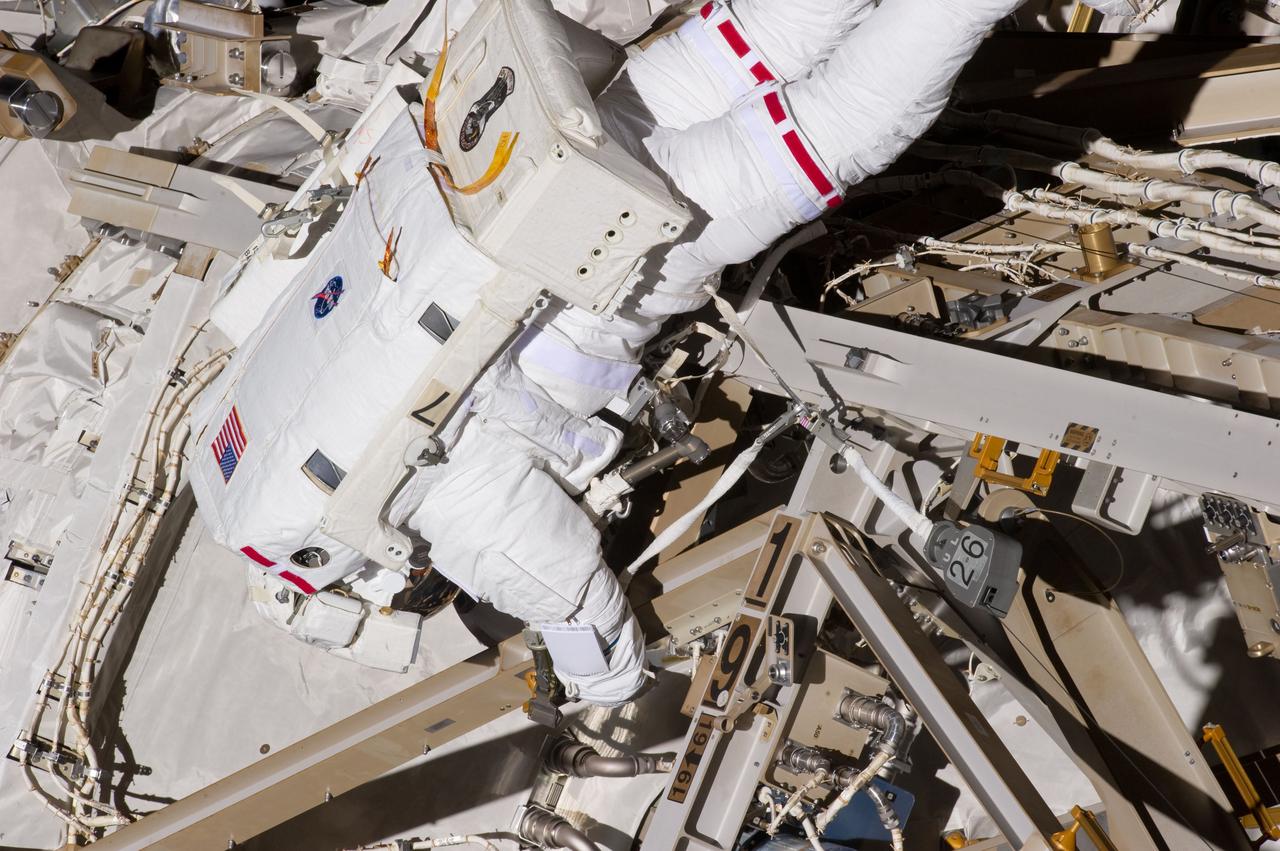
S134-E-007631 (20 May 2011) --- NASA astronaut Greg Chamitoff, STS-134 mission specialist, participates in the mission's first session of extravehicular activity (EVA) as construction and maintenance continue on the International Space Station. During the six-hour, 19-minute spacewalk, Chamitoff and astronaut Andrew Feustel (out of fame) retrieved long-duration materials exposure experiments and installed another, installed a light on one of the station?s rail line handcarts, made preparations for adding ammonia to a cooling loop and installed an antenna for the External Wireless Communication system. Photo credit: NASA
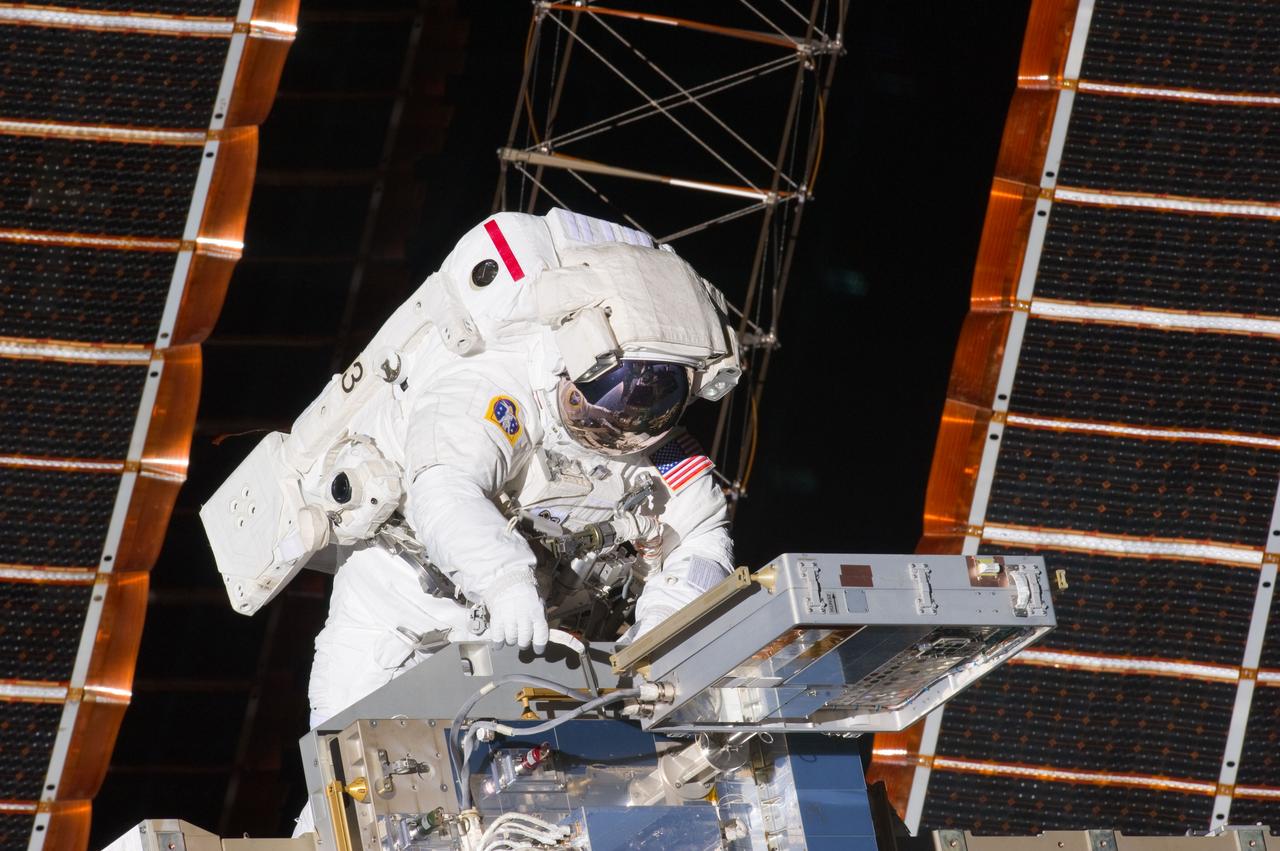
S134-E-007611 (20 May 2011) --- NASA astronaut Andrew Feustel, STS-134 mission specialist, participates in the mission's first session of extravehicular activity (EVA) as construction and maintenance continue on the International Space Station. During the six-hour, 19-minute spacewalk, Feustel and astronaut Greg Chamitoff (out of fame) retrieved long-duration materials exposure experiments and installed another, installed a light on one of the station?s rail line handcarts, made preparations for adding ammonia to a cooling loop and installed an antenna for the External Wireless Communication system. Photo credit: NASA

iss059e016574 (April 8, 2019) --- Expedition 59 Flight Engineer David Saint-Jacques of the Canadian Space Agency takes a quick self portrait while working outside the International Space Station. In a six and a half hour spacewalk, Saint-Jacques and NASA astronaut Anne McClain successfully established a redundant path of power to the Canadian-built robotic arm, known as Canadarm2, and installed cables to provide for more expansive wireless communications coverage outside the orbital complex, as well as for enhanced hardwired computer network capability. The duo also relocated an adapter plate from the first spacewalk in preparation for future battery upgrade operations.
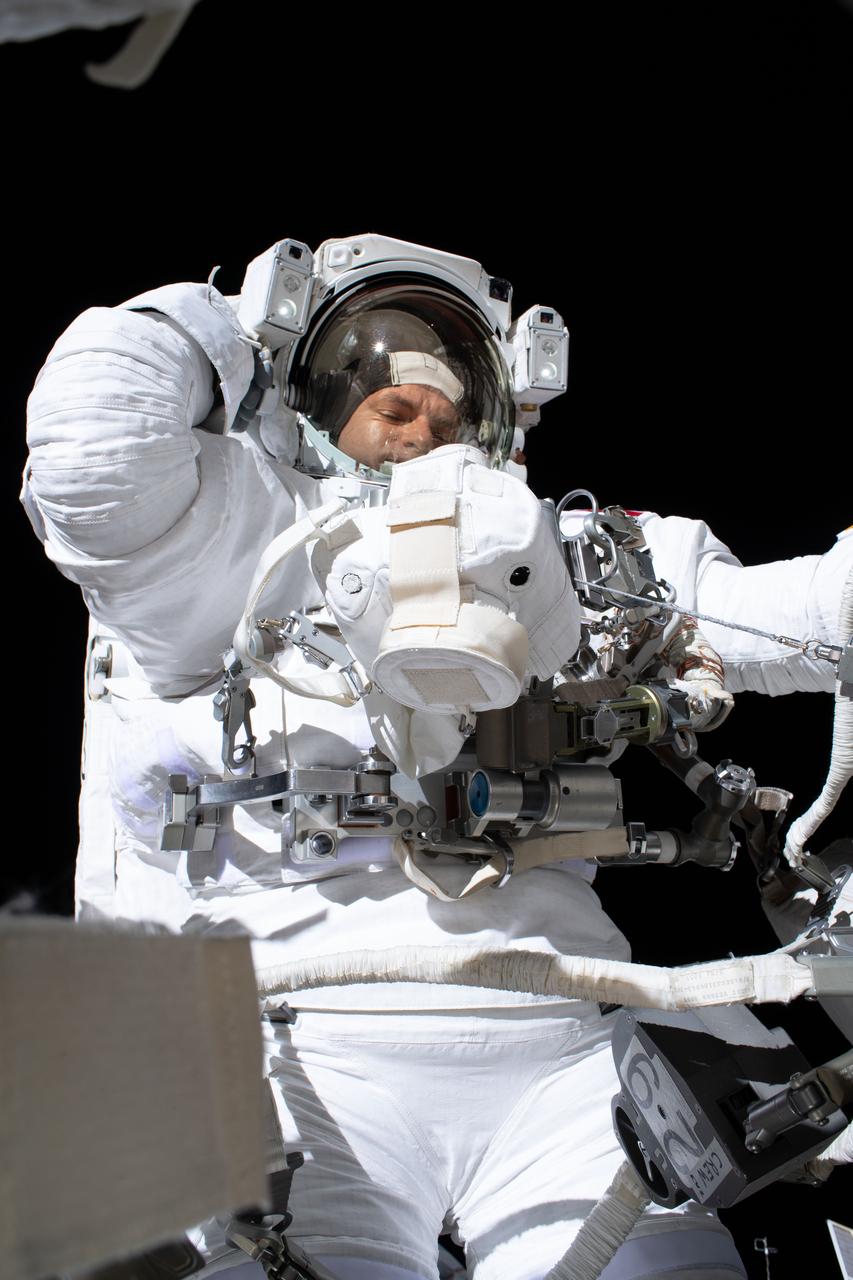
iss059e016770 (April 8, 2019) --- Expedition 59 Flight Engineer David Saint-Jacques of the Canadian Space Agency participates in a six-and-a-half hour spacewalk with NASA astronaut Anne McClain (out of frame). The spacewalkers successfully established a redundant path of power to the Canadian-built robotic arm, known as Canadarm2, and installed cables to provide for more expansive wireless communications coverage outside the orbital complex, as well as for enhanced hardwired computer network capability. The duo also relocated an adapter plate from the first spacewalk in preparation for future battery upgrade operations.
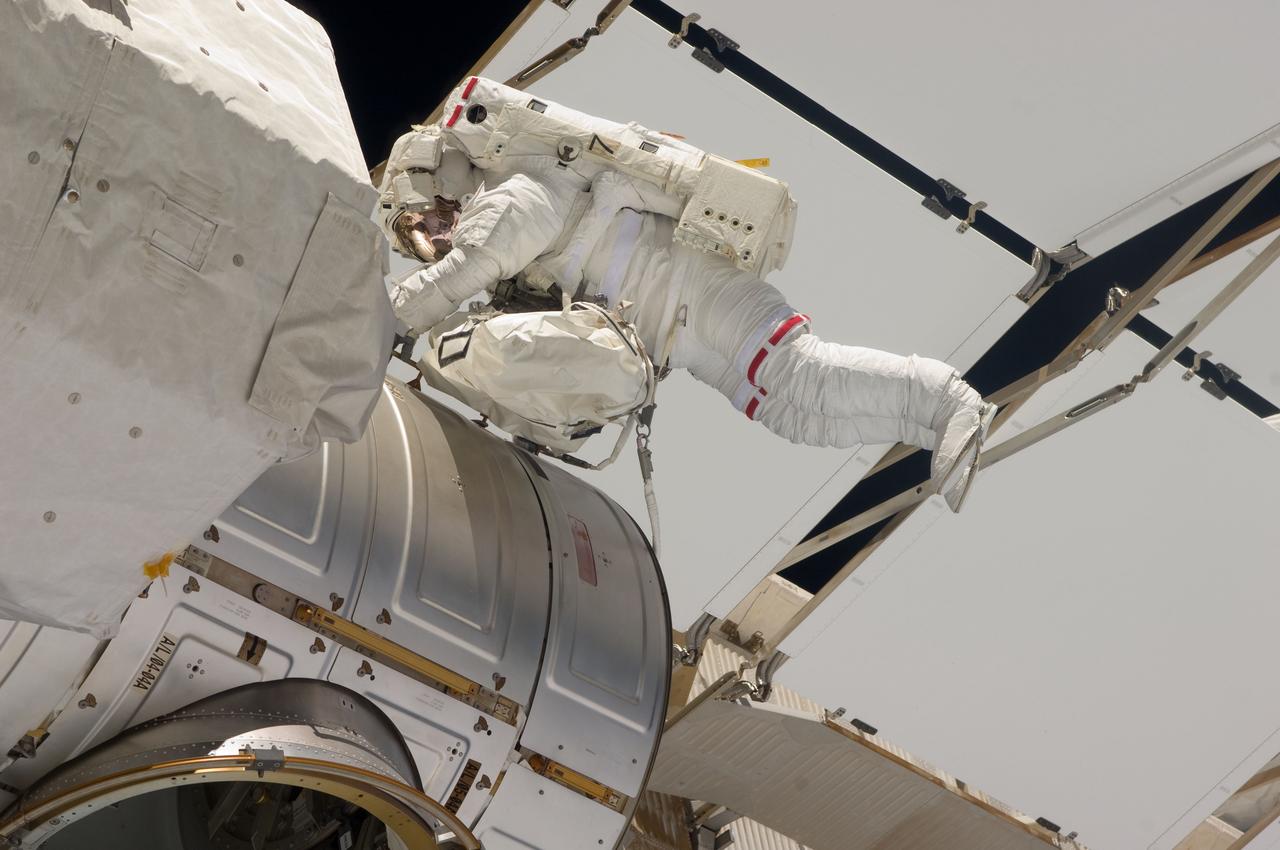
ISS027-E-035215 (20 May 2011) --- NASA astronaut Greg Chamitoff, STS-134 mission specialist, participates in the mission's first session of extravehicular activity (EVA) as construction and maintenance continue on the International Space Station. During the six-hour, 19-minute spacewalk, Chamitoff and NASA astronaut Andrew Feustel (out of fame) retrieved long-duration materials exposure experiments and installed another, installed a light on one of the station's rail line handcarts, made preparations for adding ammonia to a cooling loop and installed an antenna for the External Wireless Communication system.
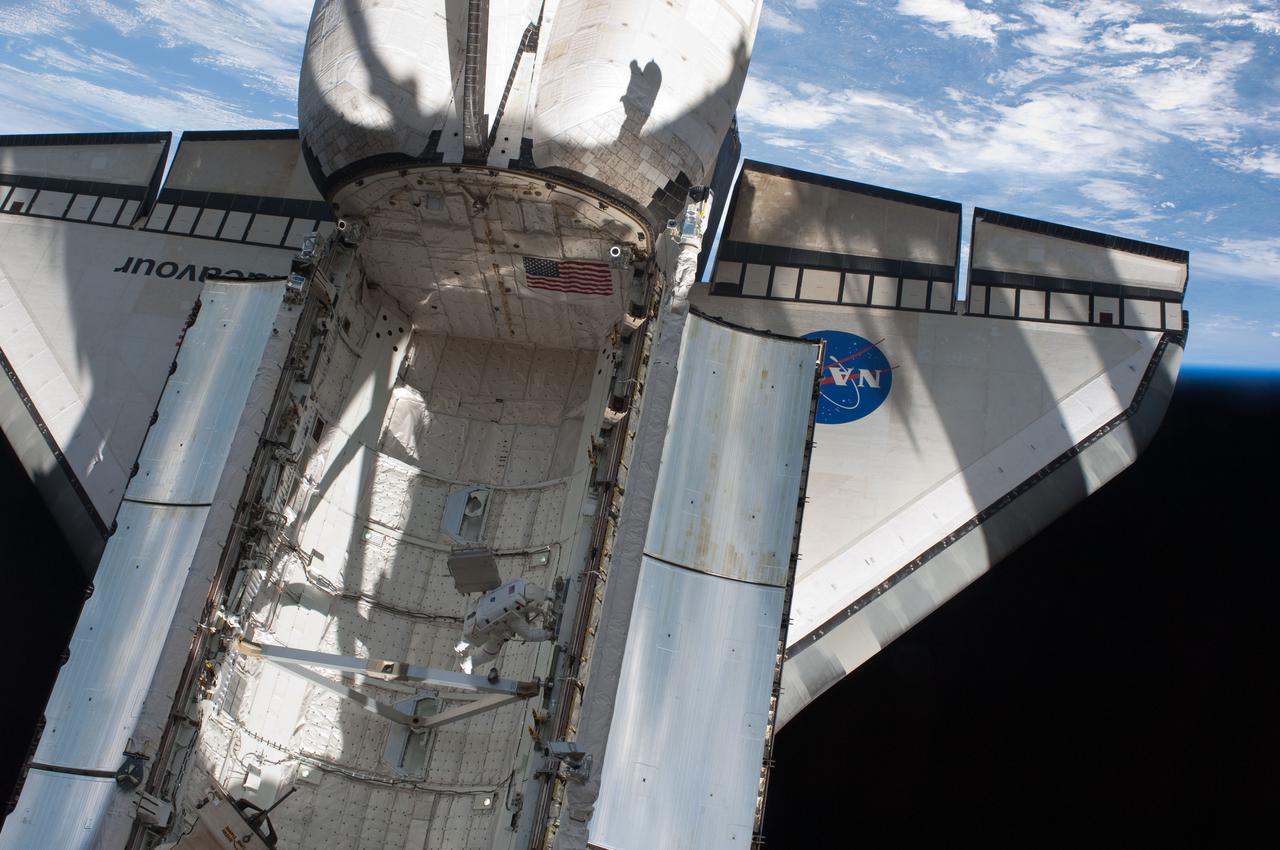
ISS027-E-034430 (20 May 2011) --- NASA astronauts Andrew Feustel and Greg Chamitoff (out of frame), both STS-134 mission specialists, participate in the mission's first session of extravehicular activity (EVA) as construction and maintenance continue on the International Space Station. During the six-hour, 19-minute spacewalk, Feustel and Chamitoff retrieved long-duration materials exposure experiments and installed another, installed a light on one of the station?s rail line handcarts, made preparations for adding ammonia to a cooling loop and installed an antenna for the External Wireless Communication system.
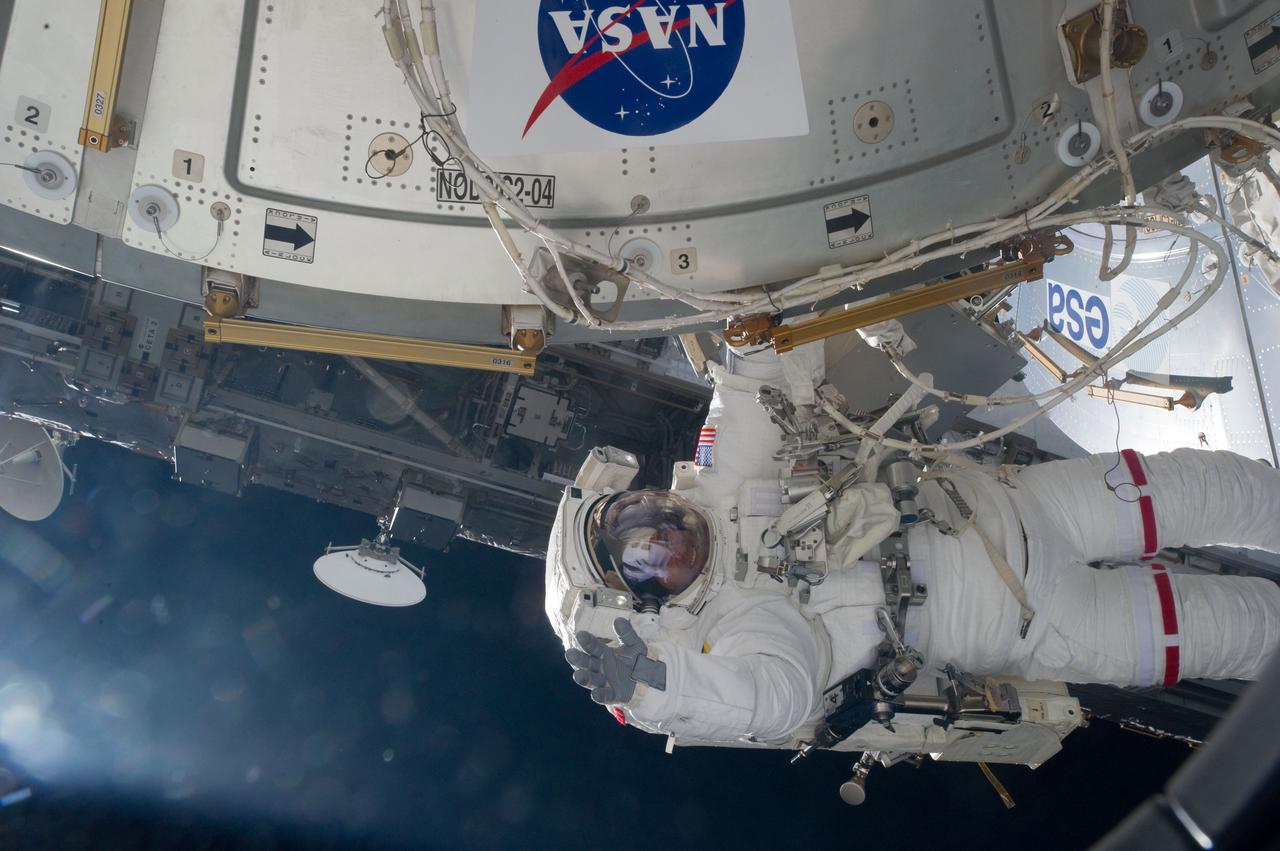
S134-E-007551 (20 May 2011) --- NASA astronaut Greg Chamitoff, STS-134 mission specialist, participates in the mission's first session of extravehicular activity (EVA) as construction and maintenance continue on the International Space Station. During the six-hour, 19-minute spacewalk, Chamitoff and astronaut Andrew Feustel (out of fame) retrieved long-duration materials exposure experiments and installed another, installed a light on one of the station?s rail line handcarts, made preparations for adding ammonia to a cooling loop and installed an antenna for the External Wireless Communication system. Photo credit: NASA
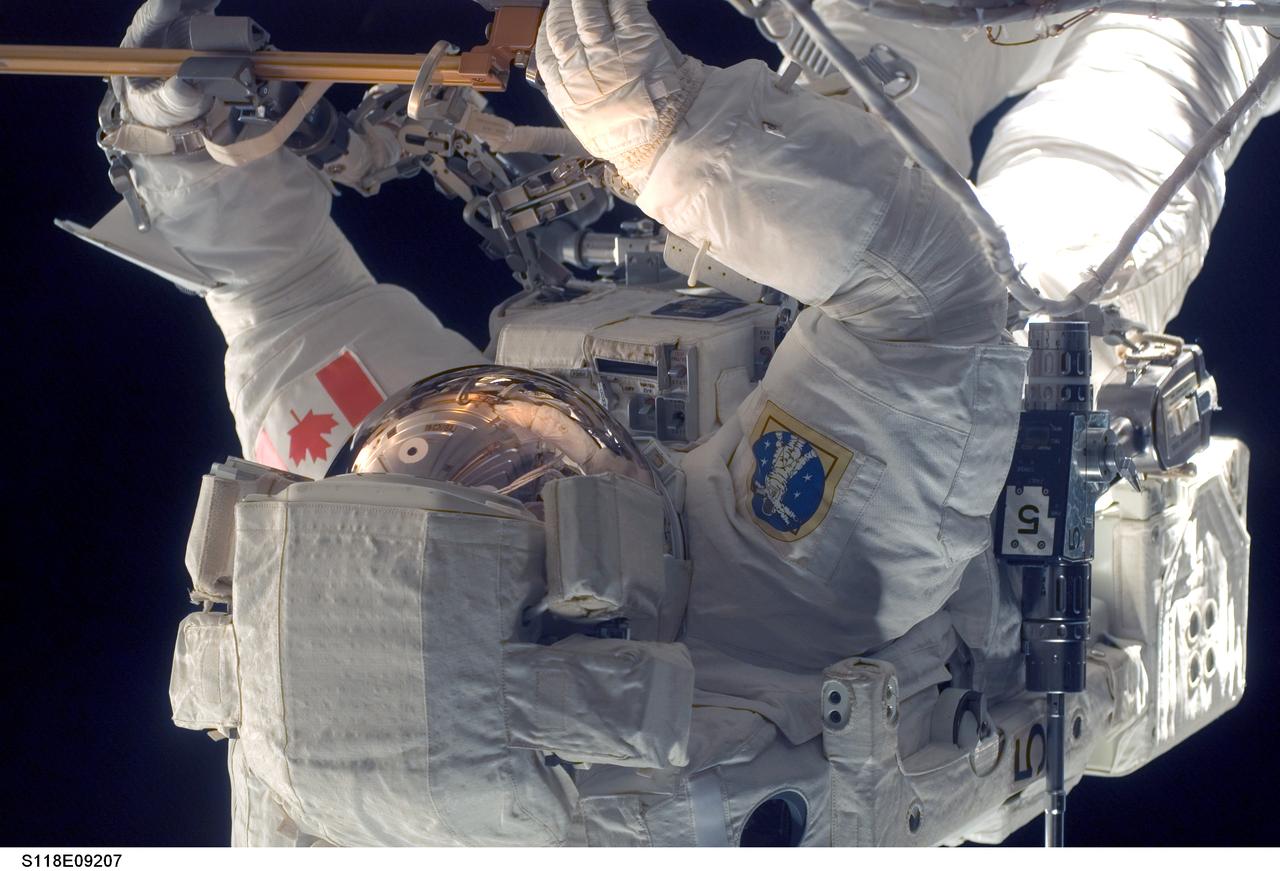
S118-E-09207 (18 Aug. 2007) --- Astronaut Dave Williams, STS-118 mission specialist representing the Canadian Space Agency, participates in the mission's fourth and final session of extravehicular activity (EVA) as construction and maintenance continue on the International Space Station. During the 5-hour spacewalk, Williams and astronaut Clay Anderson (out of frame), Expedition 15 flight engineer, installed the External Wireless Instrumentation System antenna, attached a stand for the shuttle's robotic arm extension boom and retrieved the two Materials International Space Station Experiments (MISSE) to be brought back on the shuttle.
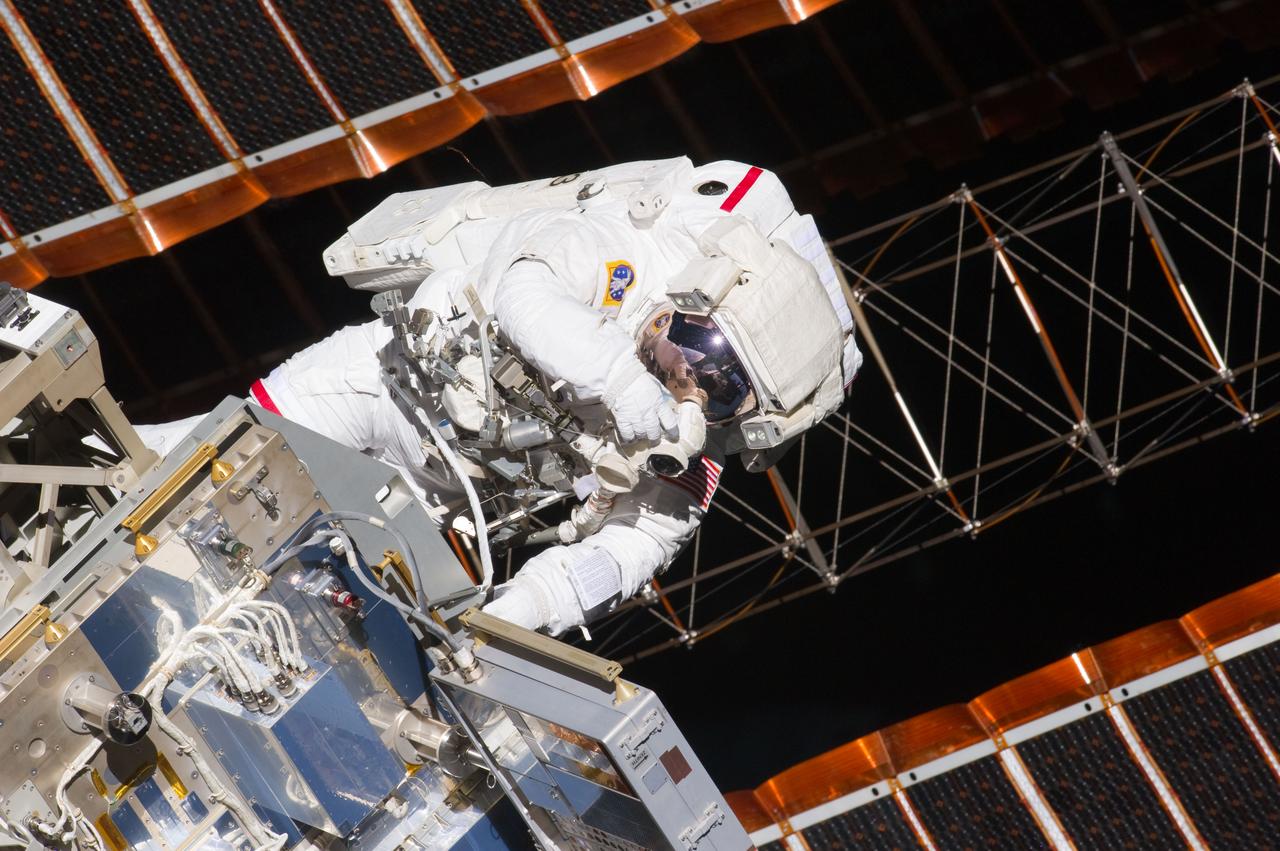
S134-E-007595 (20 May 2011) --- NASA astronaut Andrew Feustel, STS-134 mission specialist, participates in the mission's first session of extravehicular activity (EVA) as construction and maintenance continue on the International Space Station. During the six-hour, 19-minute spacewalk, Feustel and astronaut Greg Chamitoff (out of fame) retrieved long-duration materials exposure experiments and installed another, installed a light on one of the station?s rail line handcarts, made preparations for adding ammonia to a cooling loop and installed an antenna for the External Wireless Communication system. Photo credit: NASA
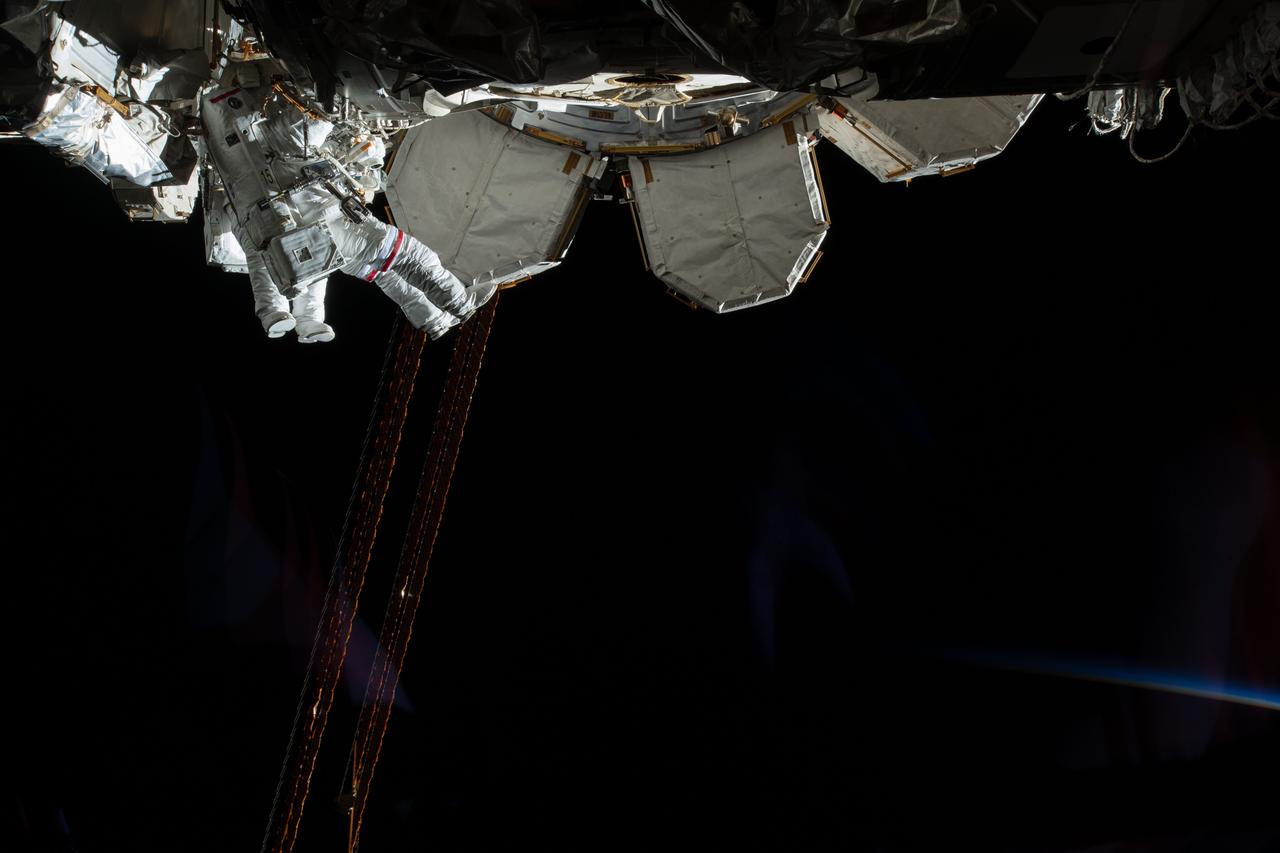
iss059e016966 (April 8, 2019) --- Expedition 59 Flight Engineers Anne McClain of NASA (red stripes) and David Saint-Jacques of the Canadian Space Agency are seen while working outside the International Space Station. In a six and a half hour spacewalk, McClain and Saint-Jacques successfully established a redundant path of power to the Canadian-built robotic arm, known as Canadarm2, and installed cables to provide for more expansive wireless communications coverage outside the orbital complex, as well as for enhanced hardwired computer network capability. The duo also relocated an adapter plate from the first spacewalk in preparation for future battery upgrade operations.
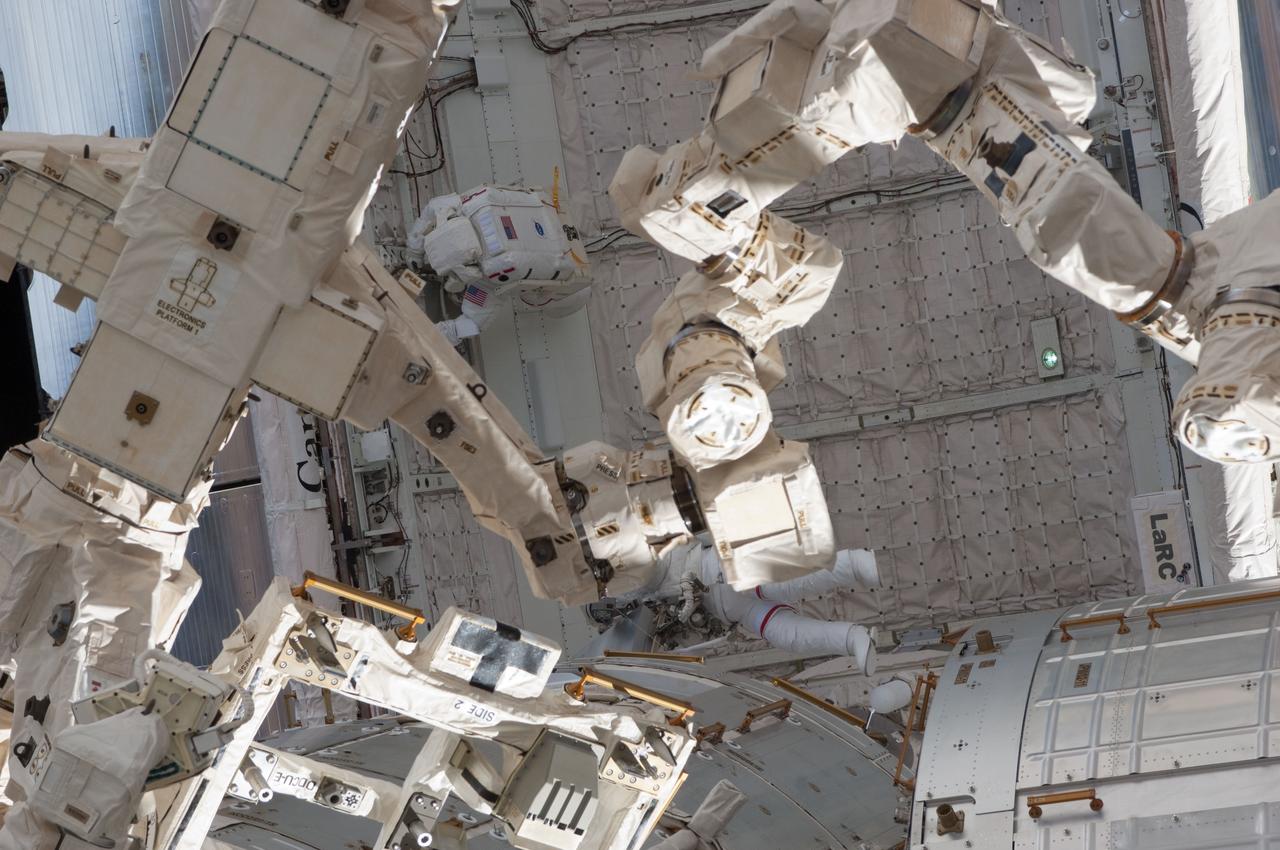
ISS027-E-034464 (20 May 2011) --- NASA astronauts Andrew Feustel (bottom) and Greg Chamitoff, both STS-134 mission specialists, participate in the mission's first session of extravehicular activity (EVA) as construction and maintenance continue on the International Space Station. During the six-hour, 19-minute spacewalk, Feustel and Chamitoff retrieved long-duration materials exposure experiments and installed another, installed a light on one of the station?s rail line handcarts, made preparations for adding ammonia to a cooling loop and installed an antenna for the External Wireless Communication system.
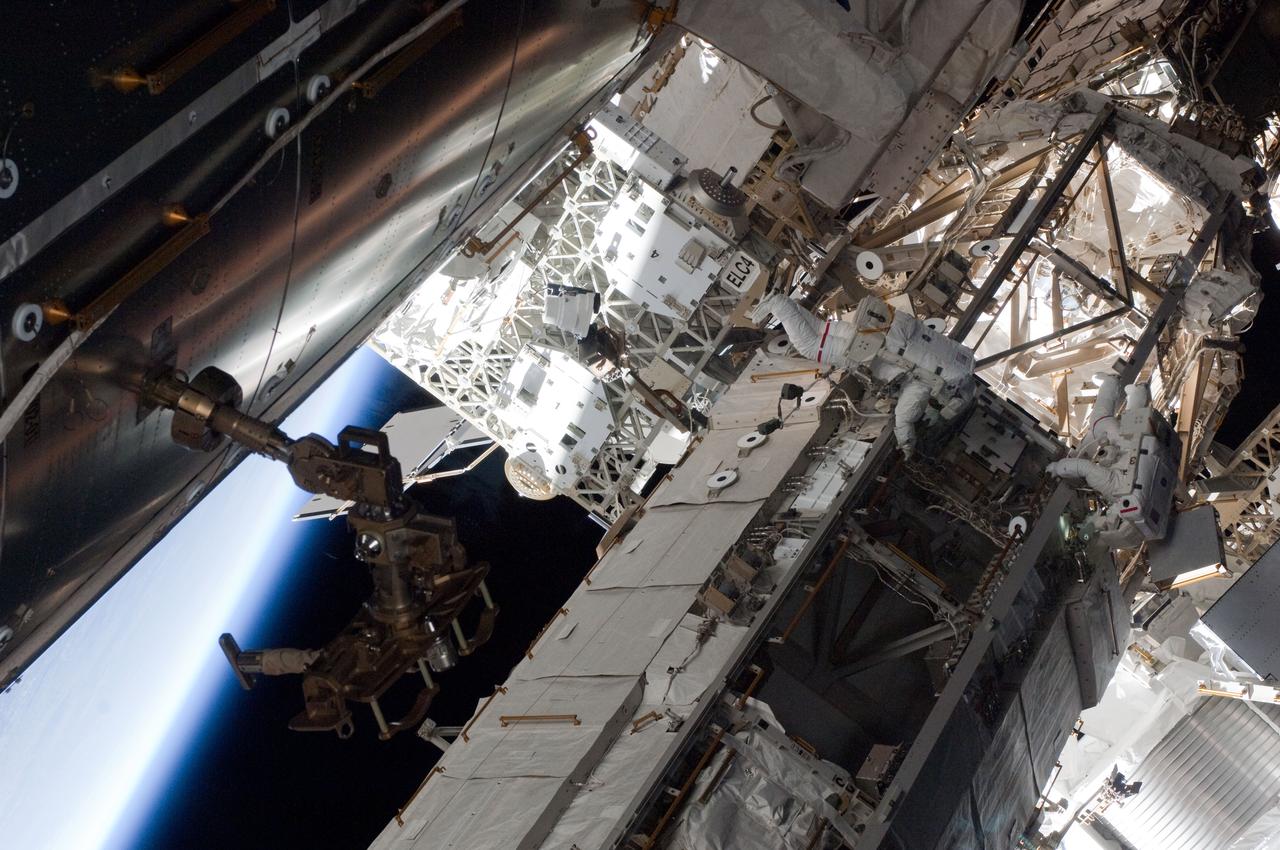
ISS027-E-034400 (20 May 2011) --- NASA astronauts Andrew Feustel (right) and Greg Chamitoff, both STS-134 mission specialists, participate in the mission's first session of extravehicular activity (EVA) as construction and maintenance continue on the International Space Station. During the six-hour, 19-minute spacewalk, Feustel and Chamitoff retrieved long-duration materials exposure experiments and installed another, installed a light on one of the station?s rail line handcarts, made preparations for adding ammonia to a cooling loop and installed an antenna for the External Wireless Communication system.
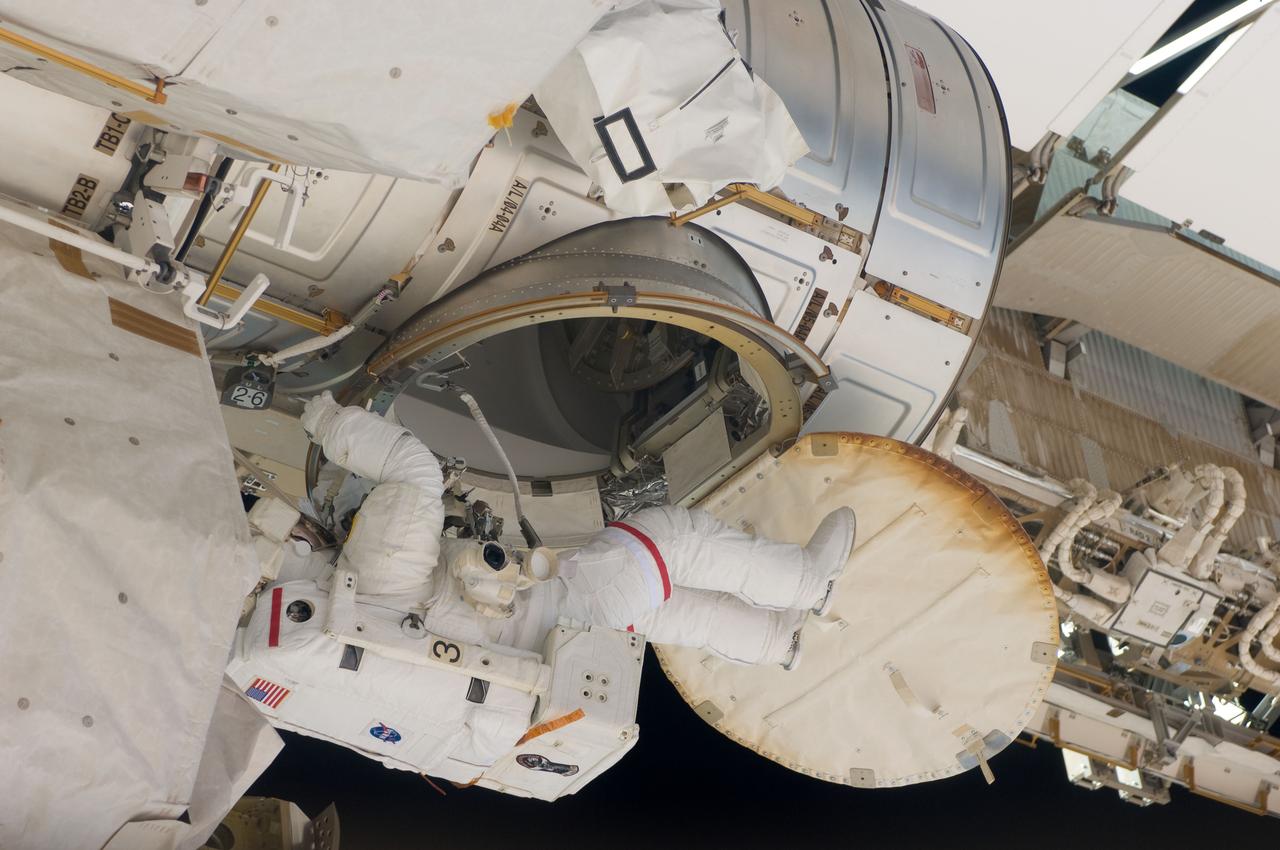
ISS027-E-035266 (20 May 2011) --- NASA astronaut Andrew Feustel, STS-134 mission specialist, is pictured during the mission's first session of extravehicular activity (EVA) as construction and maintenance continue on the International Space Station. During the six-hour, 19-minute spacewalk, Feustel and astronaut Greg Chamitoff (out of fame) retrieved long-duration materials exposure experiments and installed another, installed a light on one of the station's rail line handcarts, made preparations for adding ammonia to a cooling loop and installed an antenna for the External Wireless Communication system.
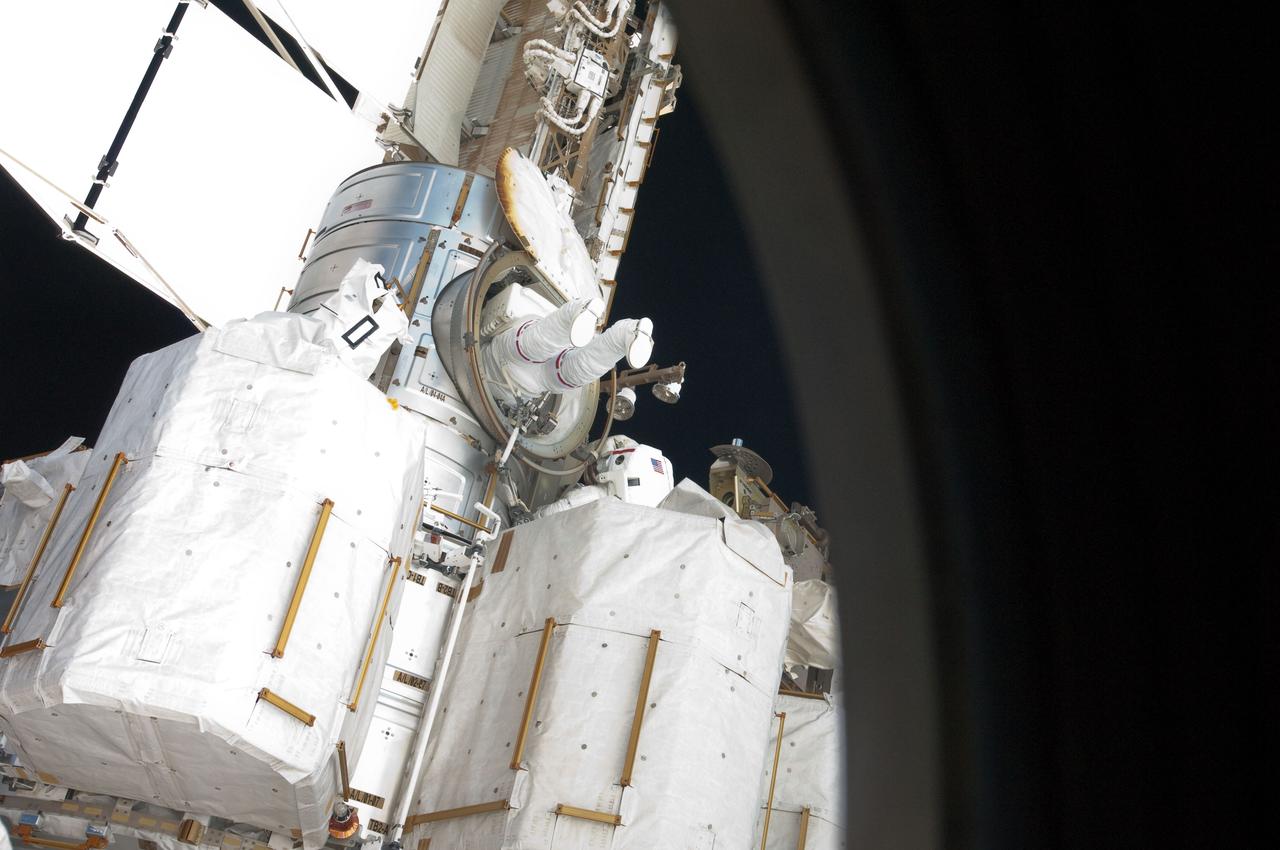
S134-E-009309 (20 May 2011) --- NASA astronaut Greg Chamitoff, STS-134 mission specialist, enters the Quest airlock of the International Space Station as the mission's first session of extravehicular activity (EVA) draws to a close. During the six-hour, 19-minute spacewalk, Chamitoff and astronaut Andrew Feustel (out of frame) retrieved long-duration materials exposure experiments and installed another, installed a light on one of the station?s rail line handcarts, made preparations for adding ammonia to a cooling loop and installed an antenna for the External Wireless Communication system. Photo credit: NASA
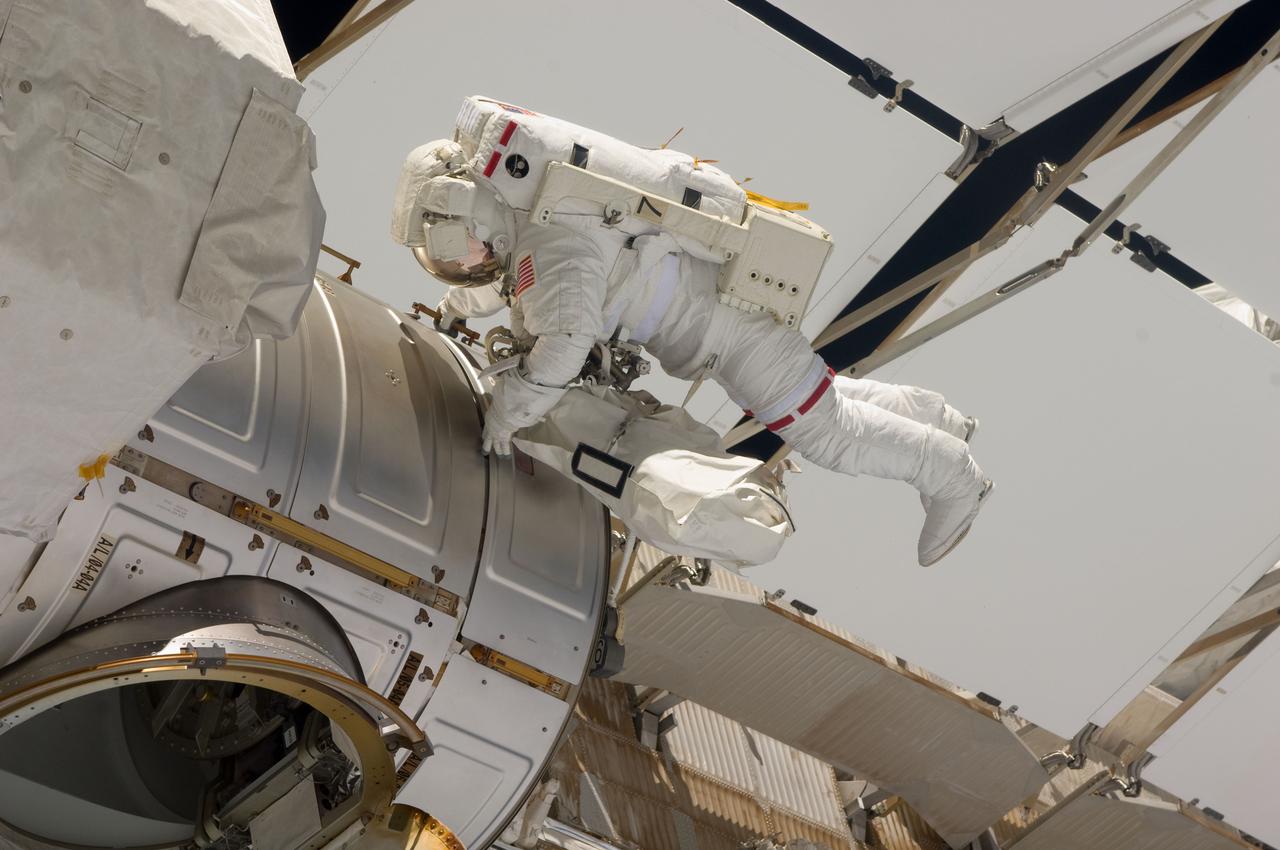
ISS027-E-035219 (20 May 2011) --- NASA astronaut Greg Chamitoff, STS-134 mission specialist, participates in the mission's first session of extravehicular activity (EVA) as construction and maintenance continue on the International Space Station. During the six-hour, 19-minute spacewalk, Chamitoff and NASA astronaut Andrew Feustel (out of fame) retrieved long-duration materials exposure experiments and installed another, installed a light on one of the station's rail line handcarts, made preparations for adding ammonia to a cooling loop and installed an antenna for the External Wireless Communication system.
ISS027-E-034419 (20 May 2011) --- NASA astronauts Andrew Feustel (bottom right) and Greg Chamitoff (top left), both STS-134 mission specialists, participate in the mission's first session of extravehicular activity (EVA) as construction and maintenance continue on the International Space Station. During the six-hour, 19-minute spacewalk, Feustel and Chamitoff retrieved long-duration materials exposure experiments and installed another, installed a light on one of the station?s rail line handcarts, made preparations for adding ammonia to a cooling loop and installed an antenna for the External Wireless Communication system.
S134-E-009307 (20 May 2011) --- NASA astronaut Greg Chamitoff, STS-134 mission specialist, prepares to enter the Quest airlock of the International Space Station as the mission's first session of extravehicular activity (EVA) draws to a close. During the six-hour, 19-minute spacewalk, Chamitoff and astronaut Andrew Feustel (out of frame) retrieved long-duration materials exposure experiments and installed another, installed a light on one of the station?s rail line handcarts, made preparations for adding ammonia to a cooling loop and installed an antenna for the External Wireless Communication system. Photo credit: NASA
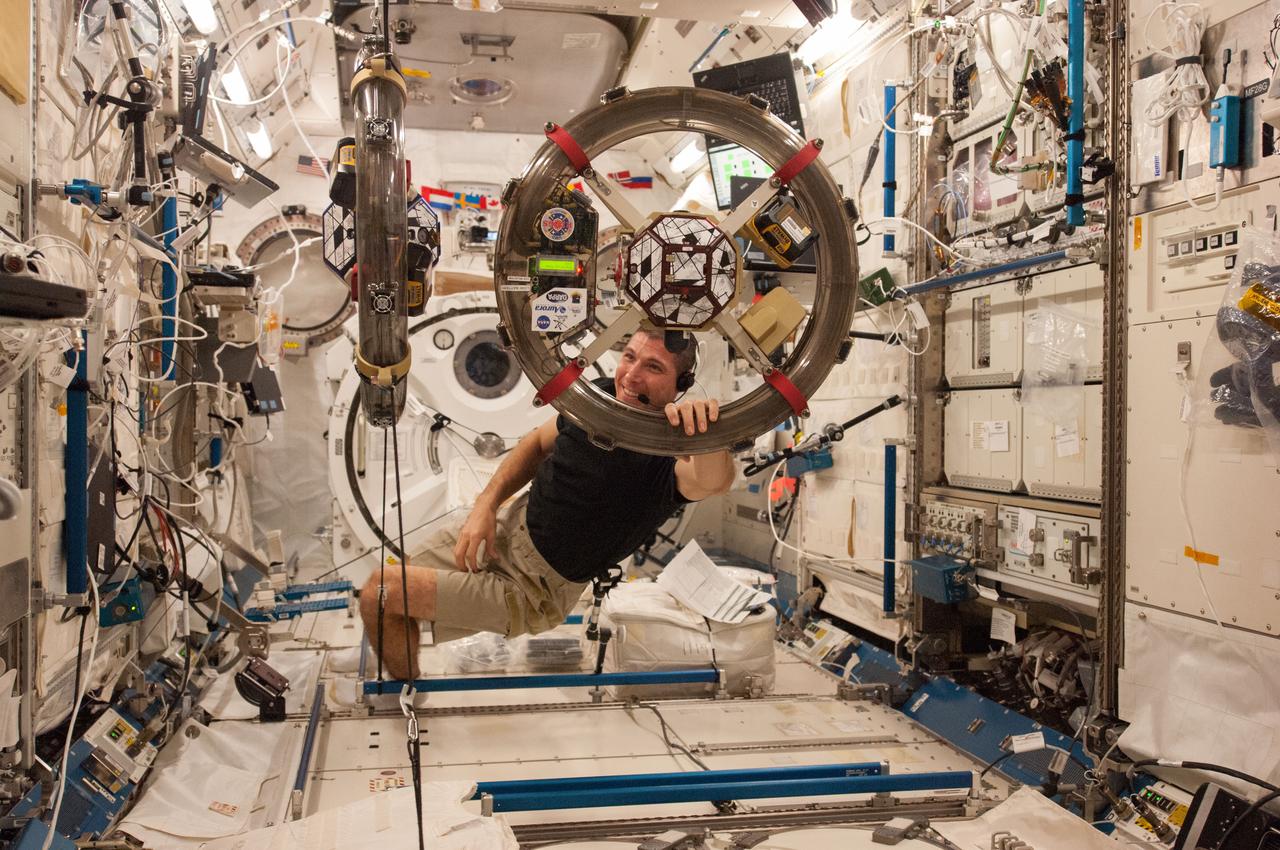
ISS037-E-025866 (4 Nov. 2013) --- In the International Space Station?s Kibo laboratory, NASA astronaut Michael Hopkins, Expedition 37 flight engineer, conducts a session with a pair of bowling-ball-sized free-flying satellites known as Synchronized Position Hold, Engage, Reorient, Experimental Satellites, or SPHERES. Surrounding the two SPHERES mini-satellites is ring-shaped hardware known as the Resonant Inductive Near-field Generation System, or RINGS. SPHERES-RINGS seeks to demonstrate wireless power transfer between satellites at a distance for enhanced operations.
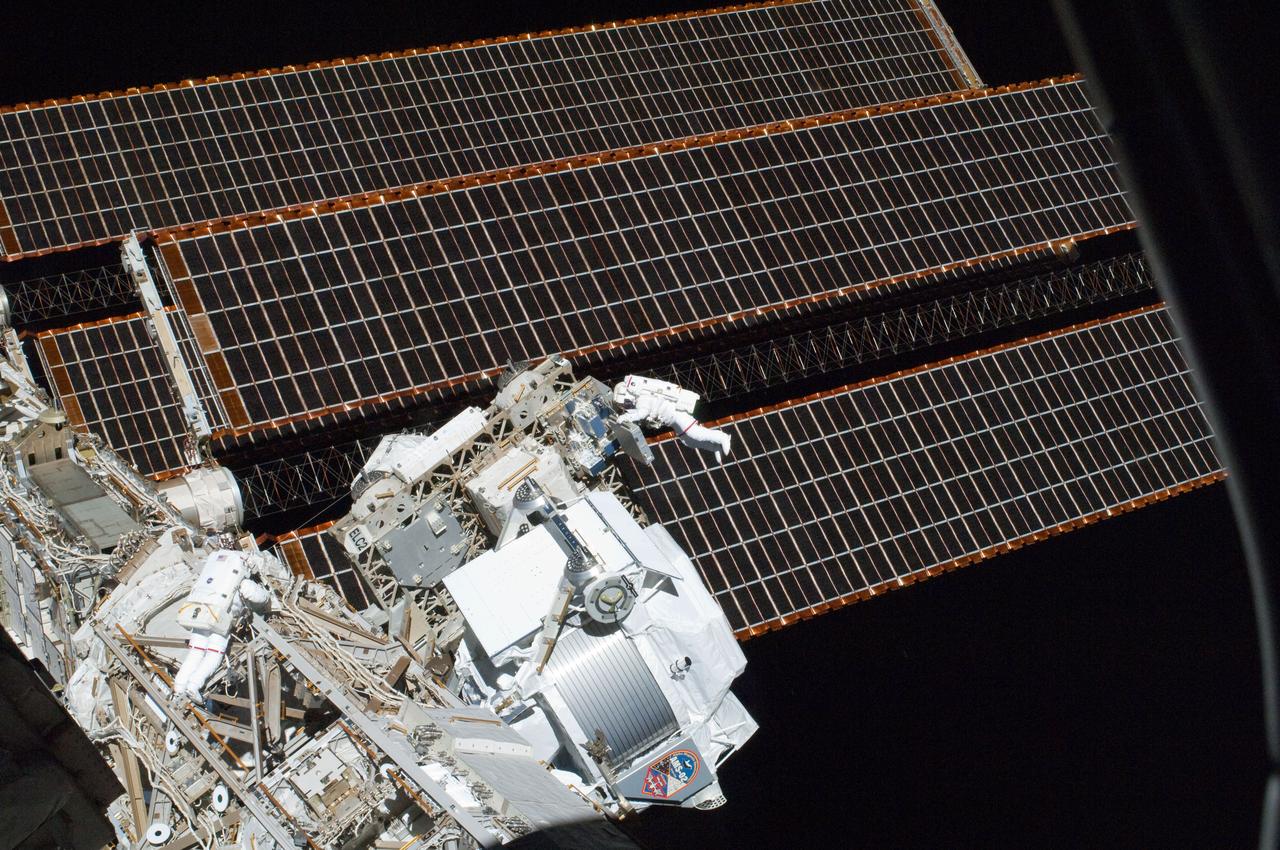
S134-E-009267 (20 May 2011) --- NASA astronauts Andrew Feustel (right) and Greg Chamitoff, both STS-134 mission specialists, participate in the mission's first session of extravehicular activity (EVA) as construction and maintenance continue on the International Space Station. During the six-hour, 19-minute spacewalk, Feustel and Chamitoff retrieved long-duration materials exposure experiments and installed another, installed a light on one of the station?s rail line handcarts, made preparations for adding ammonia to a cooling loop and installed an antenna for the External Wireless Communication system. The newly-installed Alpha Magnetic Spectrometer-2 (AMS) is at lower center frame. Photo credit: NASA
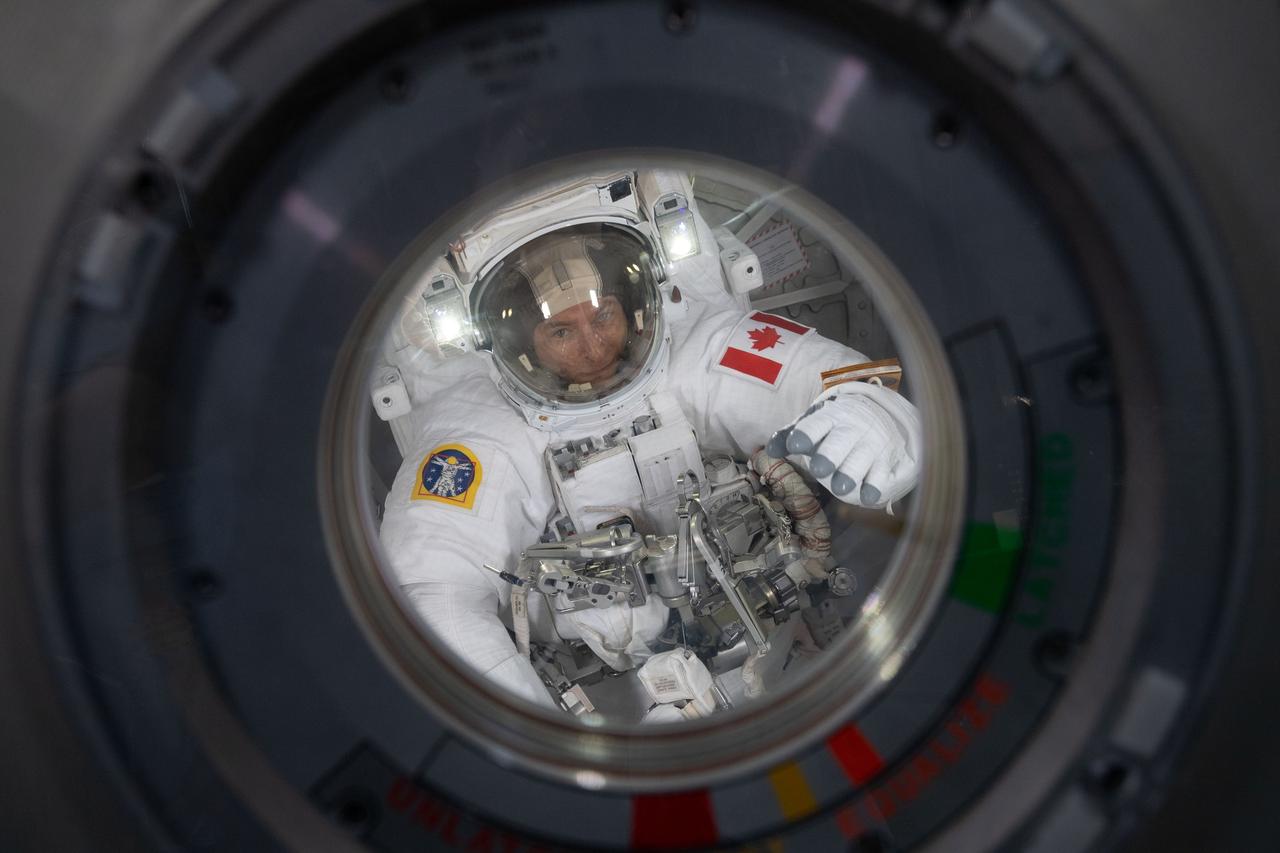
iss059e013306 (April 8, 2019) --- Expedition 59 Flight Engineer David Saint-Jacques of the Canadian Space Agency is seen inside the Quest airlock at the beginning of his first spacewalk. In a six and a half hour spacewalk, Saint-Jacques and NASA astronaut Anne McClain successfully established a redundant path of power to the Canadian-built robotic arm, known as Canadarm2, and installed cables to provide for more expansive wireless communications coverage outside the orbital complex, as well as for enhanced hardwired computer network capability. The duo also relocated an adapter plate from the first spacewalk in preparation for future battery upgrade operations.
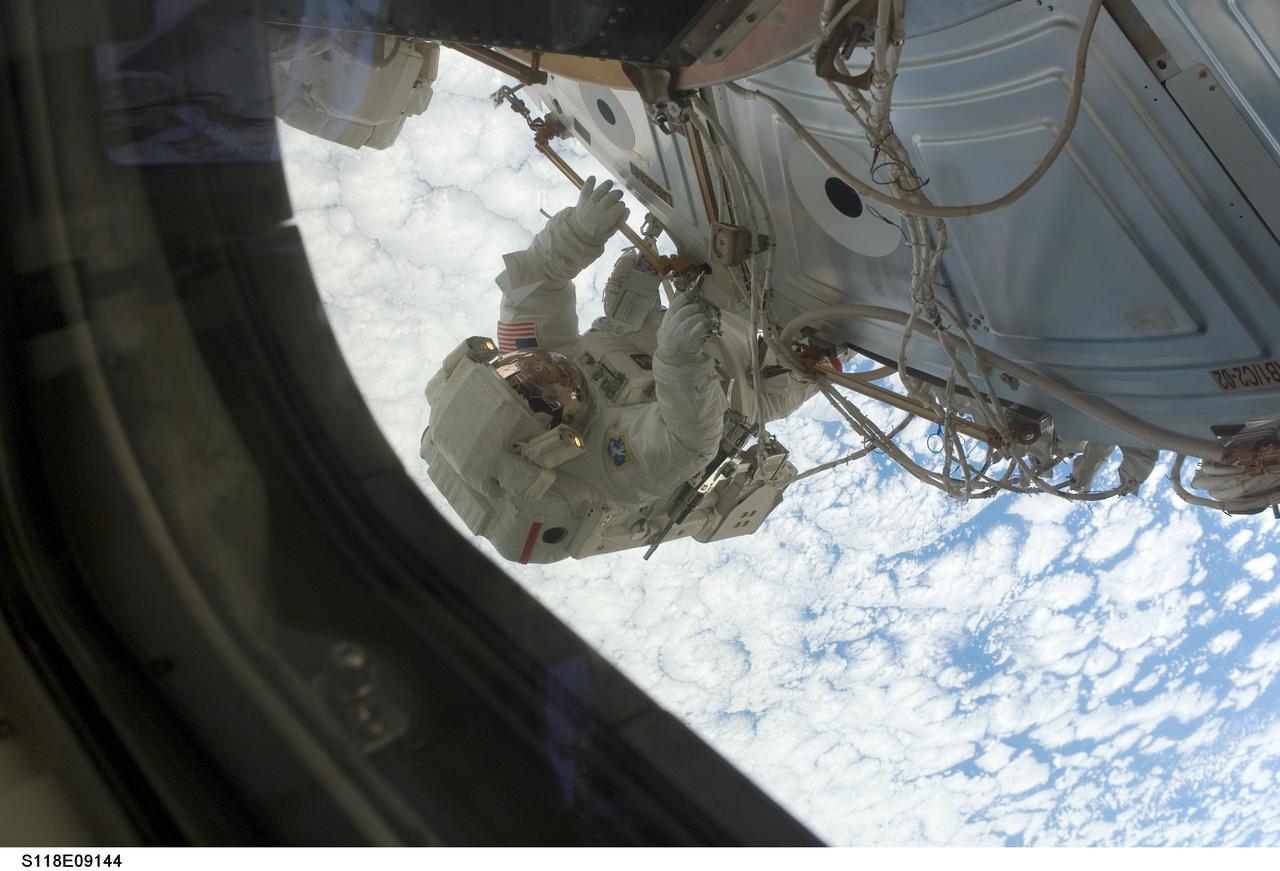
S118-E-09144 (18 Aug. 2007) --- Astronauts Clay Anderson, Expedition 15 flight engineer, and Dave Williams (out of frame), STS-118 mission specialist representing the Canadian Space Agency, participate in the mission's fourth and final session of extravehicular activity (EVA) as construction and maintenance continue on the International Space Station. During the 5-hour spacewalk, Anderson and Williams installed the External Wireless Instrumentation System antenna, attached a stand for the shuttle's robotic arm extension boom and retrieved the two Materials International Space Station Experiments (MISSE) to be brought back on the shuttle.
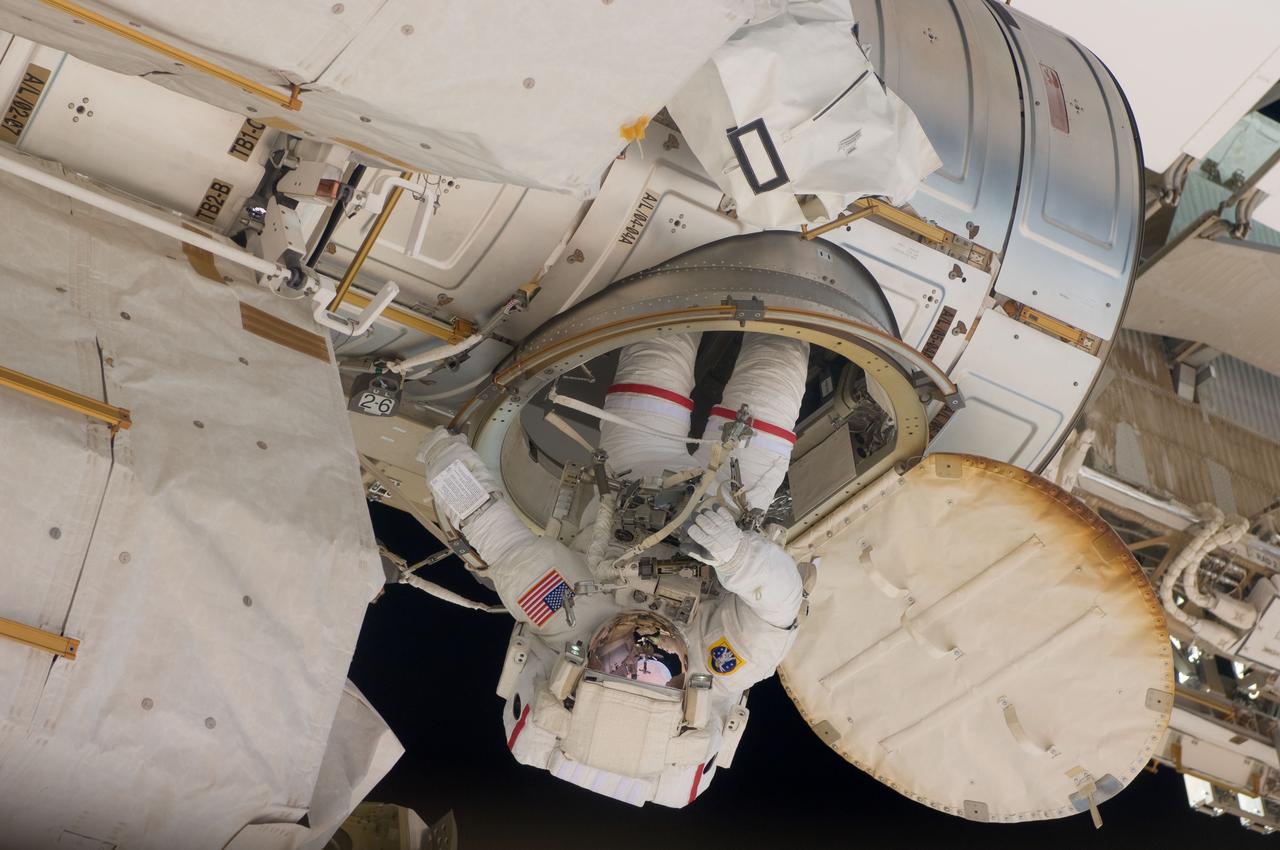
ISS027-E-035287 (20 May 2011) --- NASA astronaut Andrew Feustel, STS-134 mission specialist, is pictured during the mission's first session of extravehicular activity (EVA) as construction and maintenance continue on the International Space Station. During the six-hour, 19-minute spacewalk, Feustel and astronaut Greg Chamitoff (out of fame) retrieved long-duration materials exposure experiments and installed another, installed a light on one of the station's rail line handcarts, made preparations for adding ammonia to a cooling loop and installed an antenna for the External Wireless Communication system.
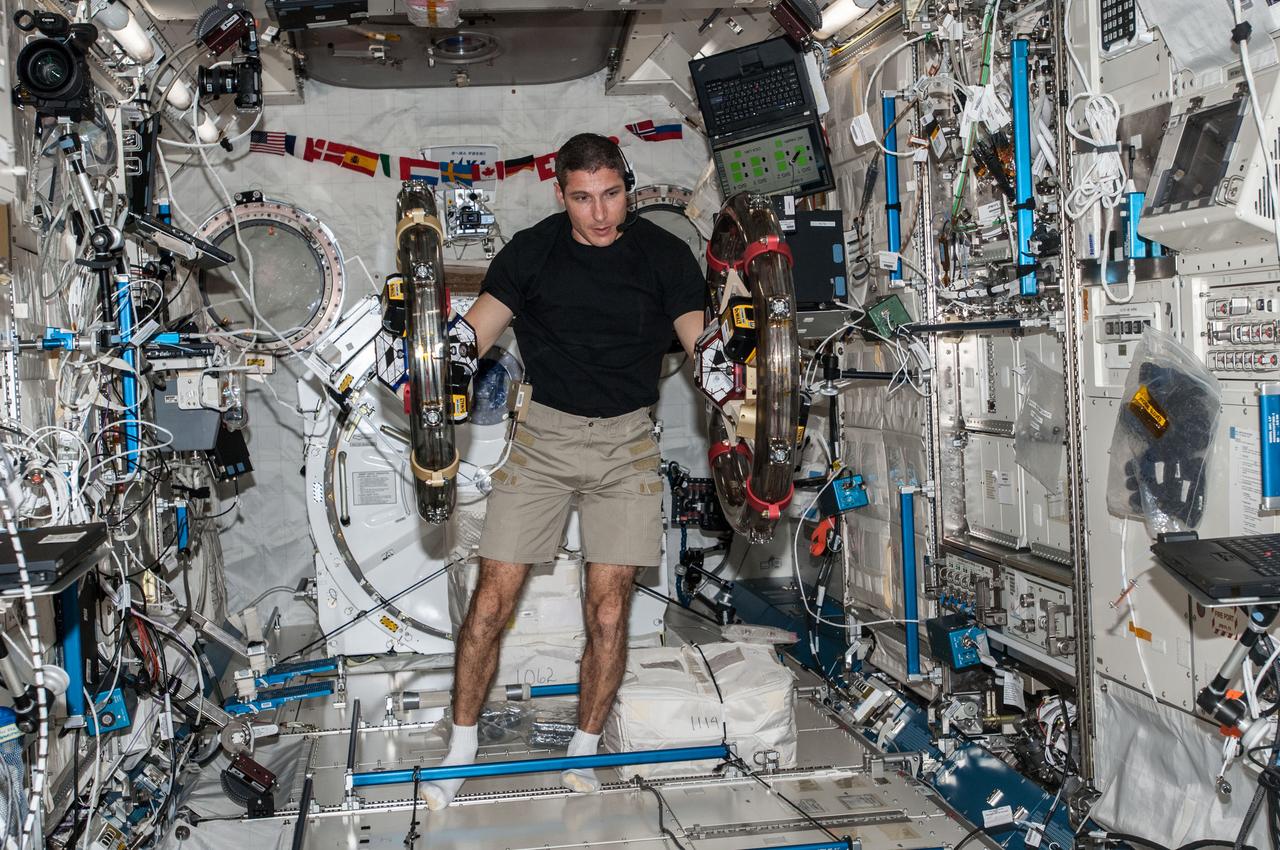
ISS037-E-025915 (4 Nov. 2013) --- In the International Space Station?s Kibo laboratory, NASA astronaut Michael Hopkins, Expedition 37 flight engineer, conducts a session with a pair of bowling-ball-sized free-flying satellites known as Synchronized Position Hold, Engage, Reorient, Experimental Satellites, or SPHERES. Surrounding the two SPHERES mini-satellites is ring-shaped hardware known as the Resonant Inductive Near-field Generation System, or RINGS. SPHERES-RINGS seeks to demonstrate wireless power transfer between satellites at a distance for enhanced operations.
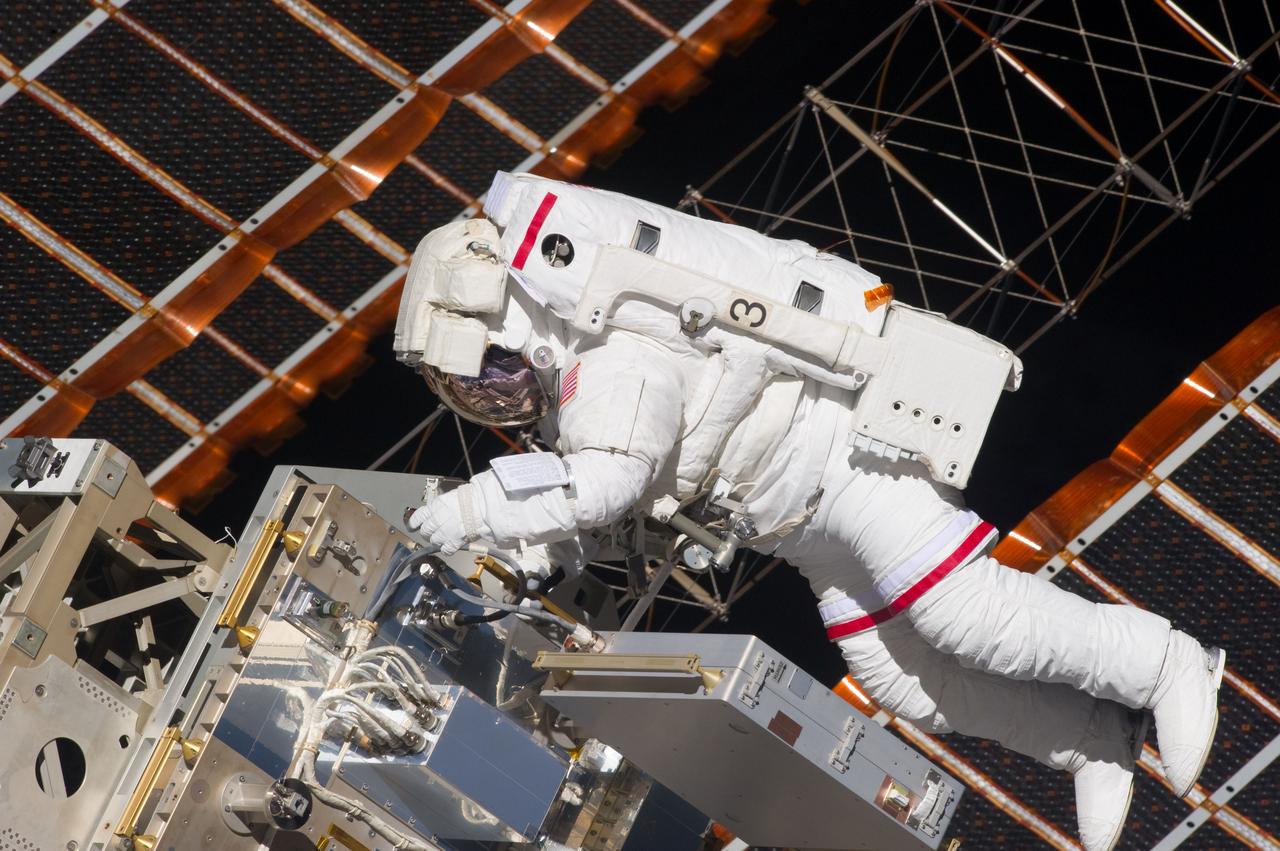
S134-E-007571 (20 May 2011) --- NASA astronaut Andrew Feustel, STS-134 mission specialist, participates in the mission's first session of extravehicular activity (EVA) as construction and maintenance continue on the International Space Station. During the six-hour, 19-minute spacewalk, Feustel and astronaut Greg Chamitoff (out of fame) retrieved long-duration materials exposure experiments and installed another, installed a light on one of the station?s rail line handcarts, made preparations for adding ammonia to a cooling loop and installed an antenna for the External Wireless Communication system. Photo credit: NASA
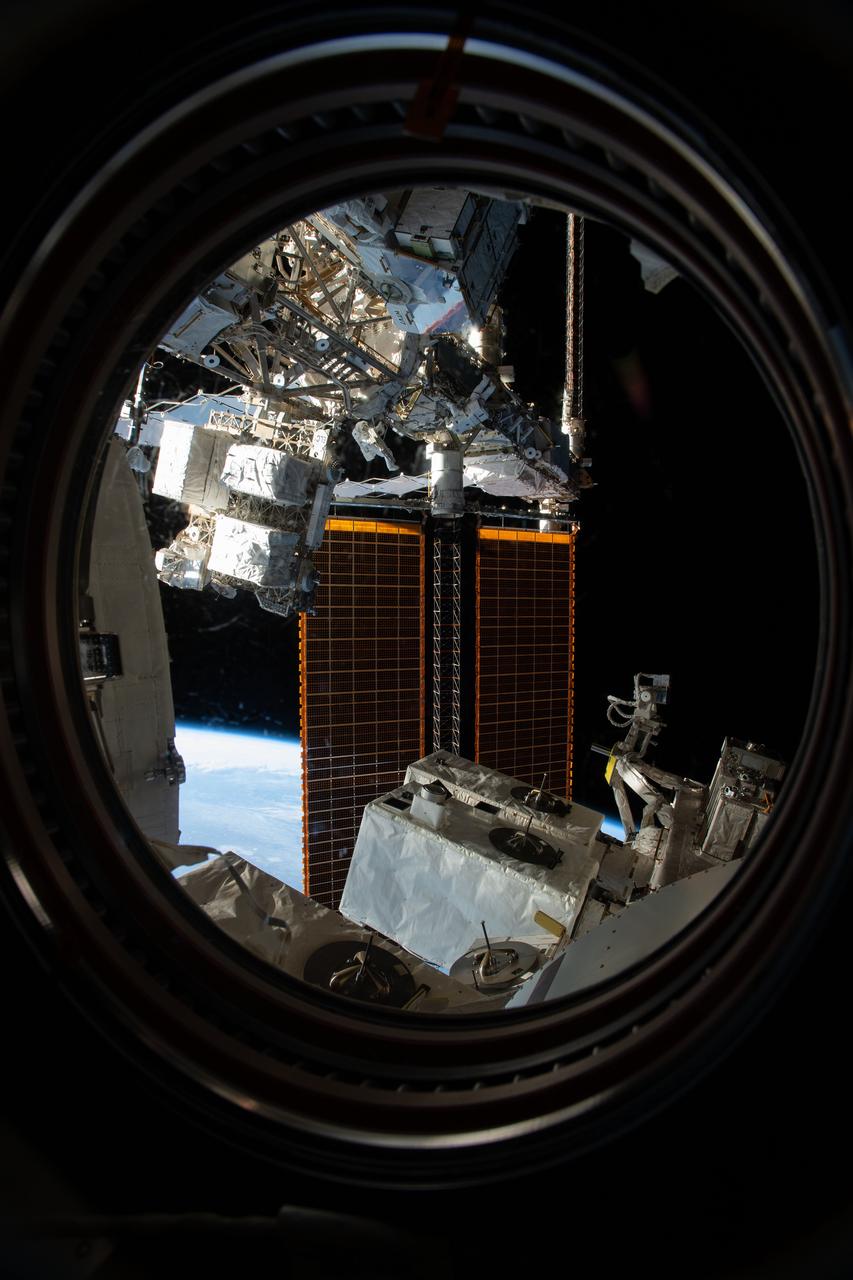
iss059e016956 (April 8, 2019) --- Expedition 59 Flight Engineers Anne McClain of NASA and David Saint-Jacques of the Canadian Space Agency are seen while working outside the International Space Station. In a six and a half hour spacewalk, McClain and Saint-Jacques successfully established a redundant path of power to the Canadian-built robotic arm, known as Canadarm2, and installed cables to provide for more expansive wireless communications coverage outside the orbital complex, as well as for enhanced hardwired computer network capability. The duo also relocated an adapter plate from the first spacewalk in preparation for future battery upgrade operations.
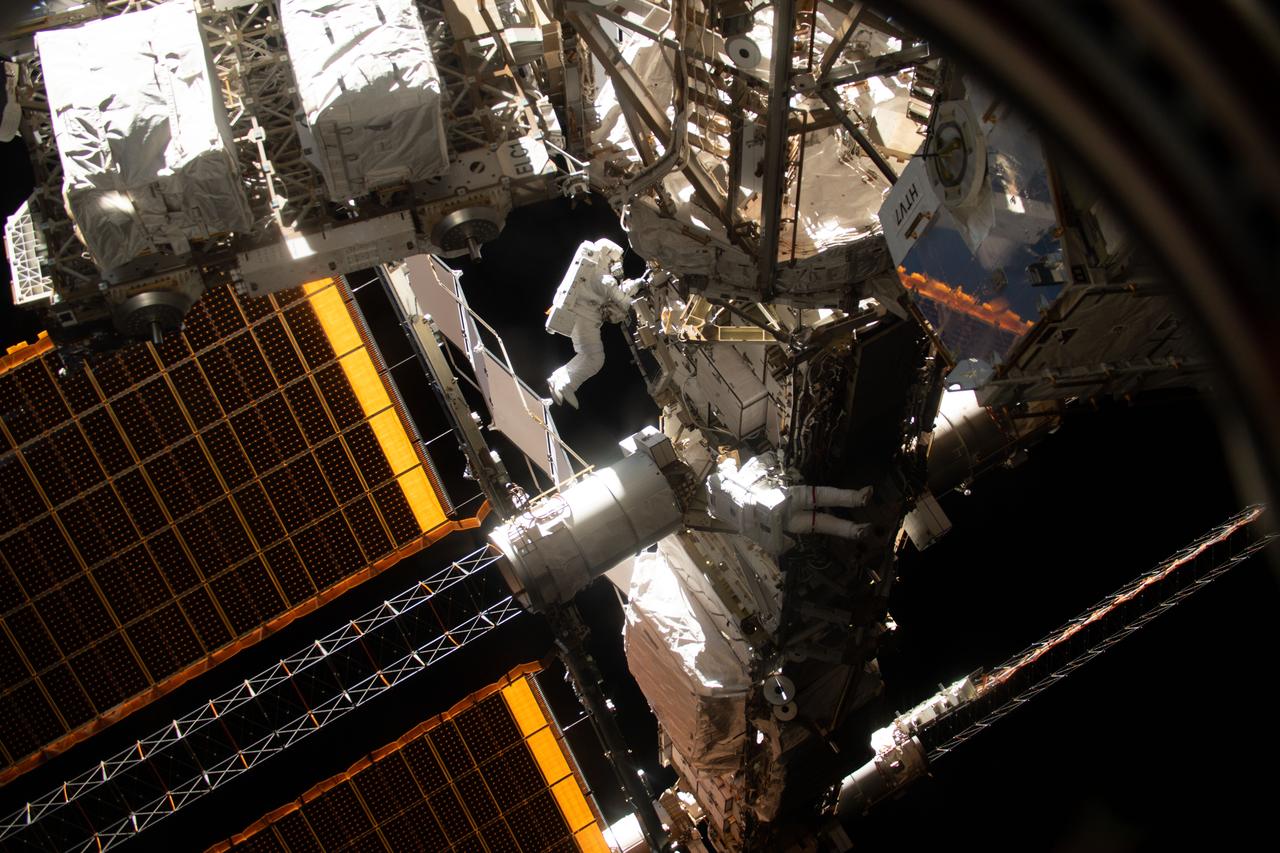
iss059e017006 (April 8, 2019) --- Expedition 59 Flight Engineers Anne McClain of NASA (red stripes, right) and David Saint-Jacques (no stripes, left) of the Canadian Space Agency are seen while working outside the International Space Station. In a six and a half hour spacewalk, McClain and Saint-Jacques successfully established a redundant path of power to the Canadian-built robotic arm, known as Canadarm2, and installed cables to provide for more expansive wireless communications coverage outside the orbital complex, as well as for enhanced hardwired computer network capability. The duo also relocated an adapter plate from the first spacewalk in preparation for future battery upgrade operations.
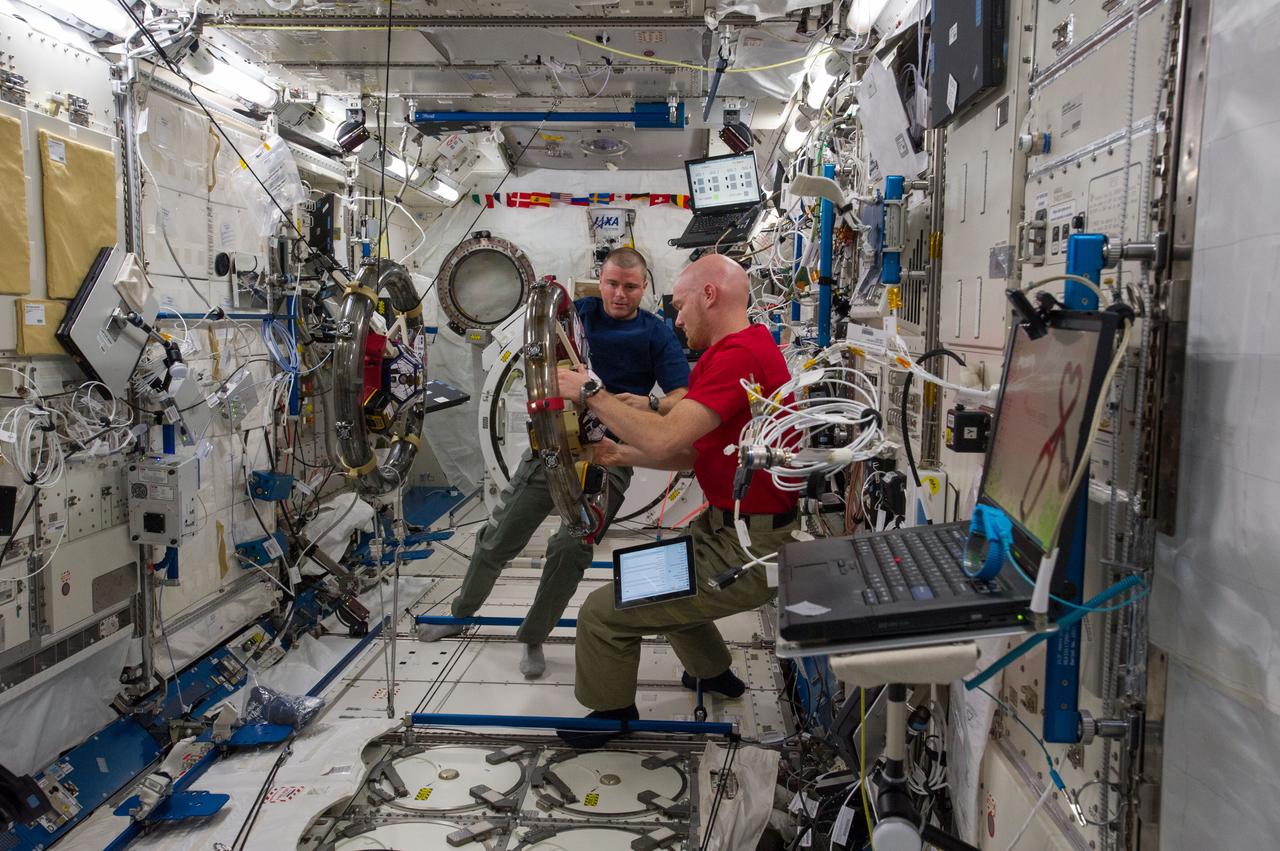
ISS040-E-059344 (10 July 2014) --- In the International Space Station’s Kibo laboratory, NASA astronaut Reid Wiseman (left) and European Space Agency astronaut Alexander Gerst, both Expedition 40 flight engineers, conduct a session with a pair of bowling-ball-sized free-flying satellites known as Synchronized Position Hold, Engage, Reorient, Experimental Satellites, or SPHERES. Surrounding the two SPHERES mini-satellites is ring-shaped hardware known as the Resonant Inductive Near-field Generation System, or RINGS. SPHERES-RINGS seeks to demonstrate wireless power transfer between satellites at a distance for enhanced operations.
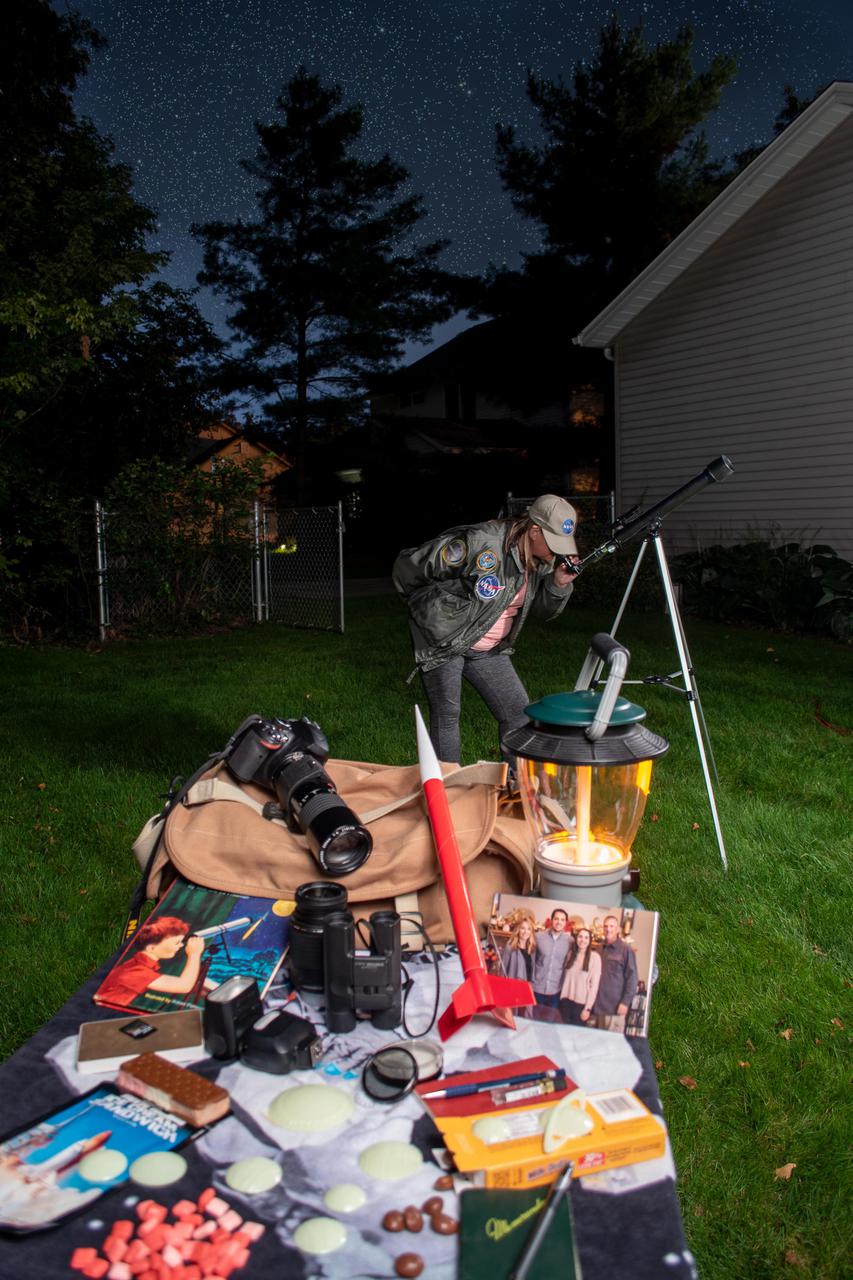
NASA Moon Kit of things I would take to the moon, I couldn’t go to the moon without my two mirrorless digital SLR cameras, Lens, my 120 6x4.5 film camera, several rolls of 120 film, my singing bowl (for meditation), my wireless printer, My son’s astronaut toy, Several pictures of both my sons and wife, My oldest sons first shoes (they are good luck), cell phone (for music and extra photos), Tablet and Pen (for editing and books), my Laptop and my water bottle (I take it everywhere).
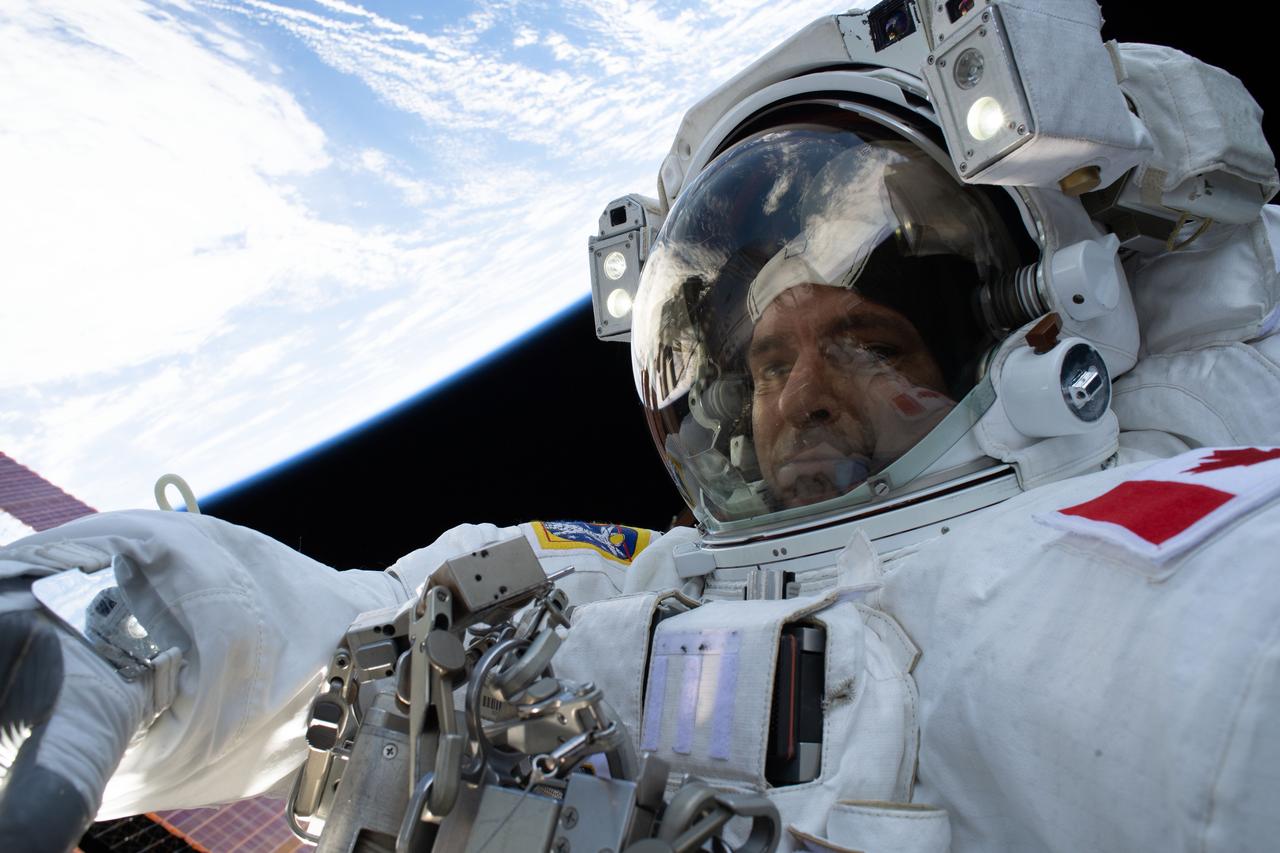
iss059e016628 (April 8, 2019) --- Expedition 59 Flight Engineer David Saint-Jacques of the Canadian Space Agency participates in a six-and-a-half hour spacewalk with NASA astronaut Anne McClain (out of frame). The spacewalkers successfully established a redundant path of power to the Canadian-built robotic arm, known as Canadarm2, and installed cables to provide for more expansive wireless communications coverage outside the orbital complex, as well as for enhanced hardwired computer network capability. The duo also relocated an adapter plate from the first spacewalk in preparation for future battery upgrade operations.
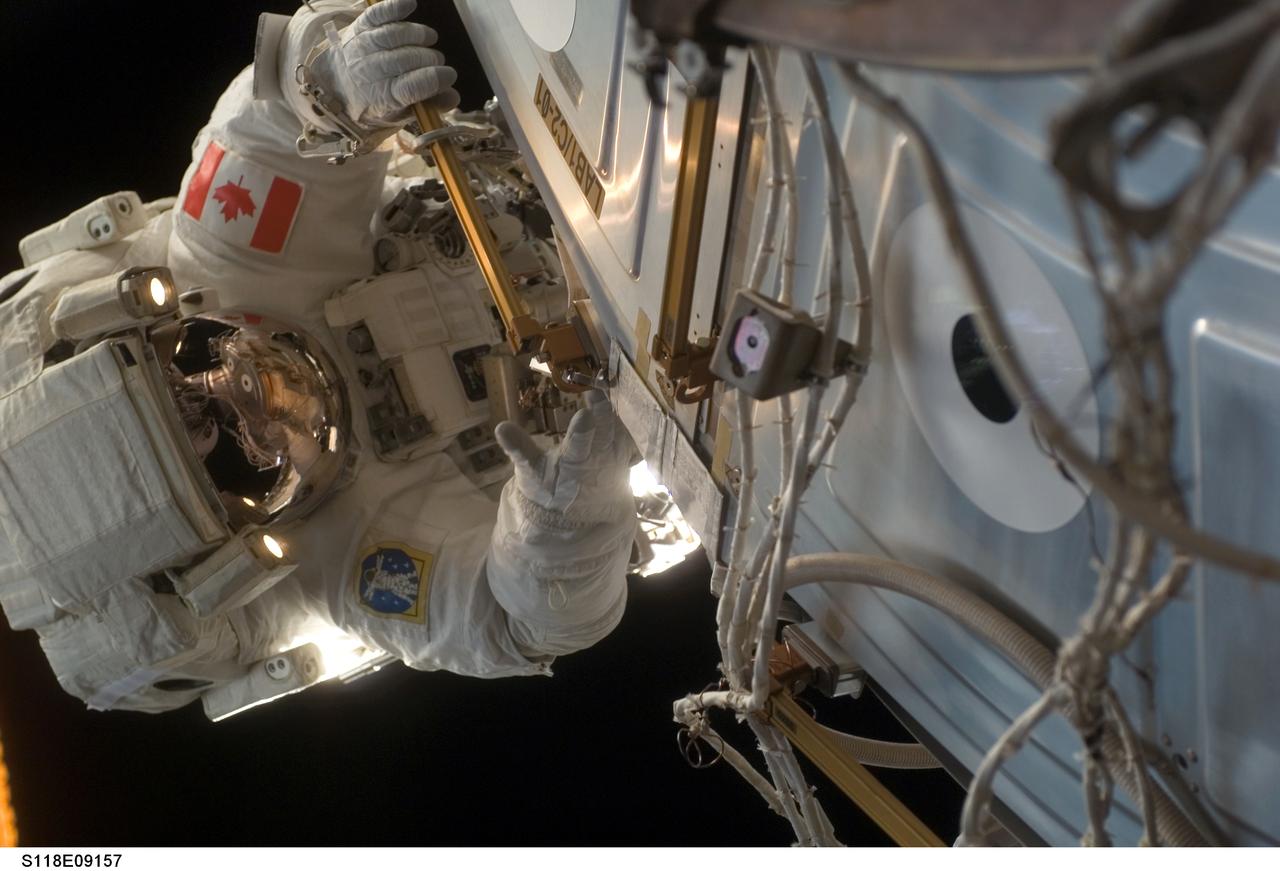
S118-E-09157 (18 Aug. 2007) --- Astronaut Dave Williams, STS-118 mission specialist representing the Canadian Space Agency, participates in the mission's fourth and final session of extravehicular activity (EVA) as construction and maintenance continue on the International Space Station. During the 5-hour spacewalk, Williams and astronaut Clay Anderson (out of frame), Expedition 15 flight engineer, installed the External Wireless Instrumentation System antenna, attached a stand for the shuttle's robotic arm extension boom and retrieved the two Materials International Space Station Experiments (MISSE) to be brought back on the shuttle.

ISS037-E-025879 (4 Nov. 2013) --- In the International Space Station?s Kibo laboratory, NASA astronaut Michael Hopkins, Expedition 37 flight engineer, conducts a session with a pair of bowling-ball-sized free-flying satellites known as Synchronized Position Hold, Engage, Reorient, Experimental Satellites, or SPHERES. Surrounding the two SPHERES mini-satellites is ring-shaped hardware known as the Resonant Inductive Near-field Generation System, or RINGS. SPHERES-RINGS seeks to demonstrate wireless power transfer between satellites at a distance for enhanced operations.
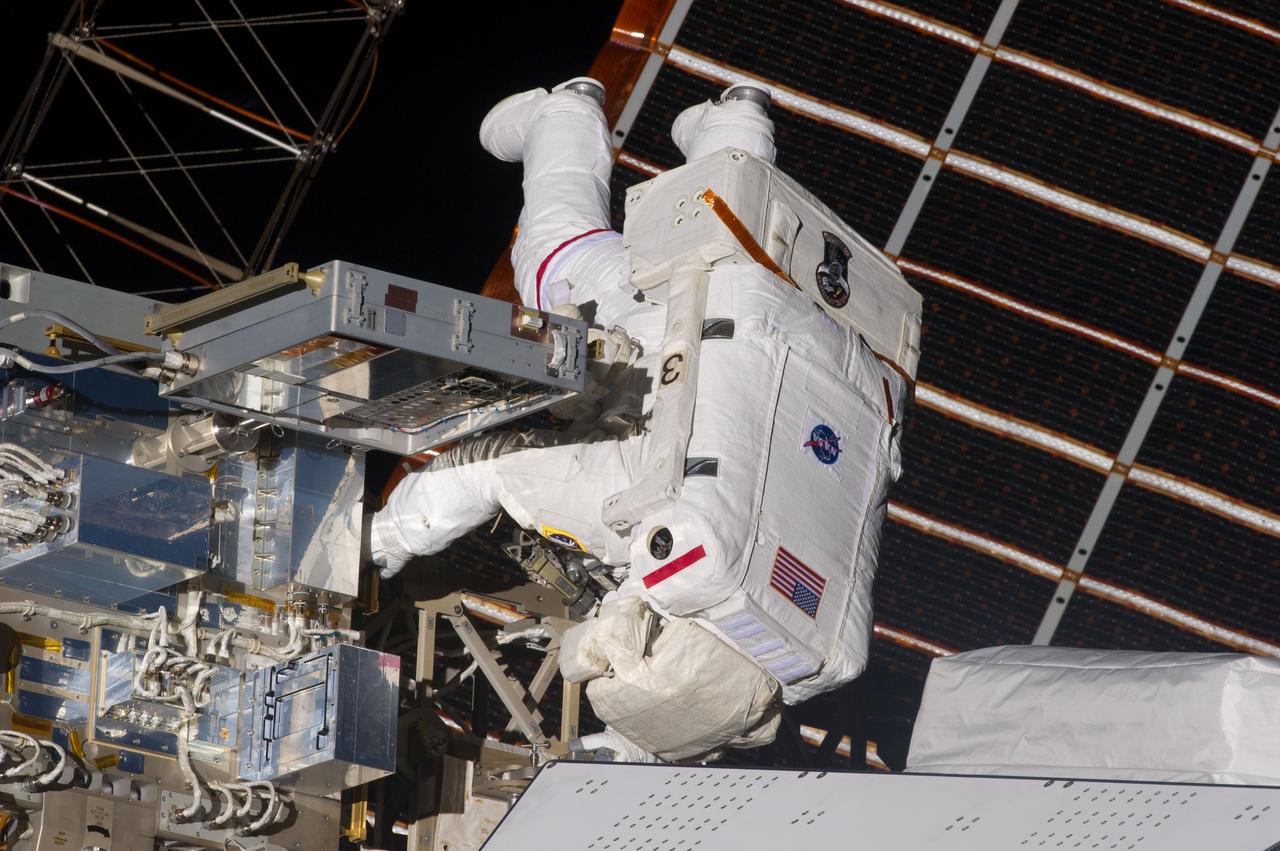
S134-E-007616 (20 May 2011) --- NASA astronaut Andrew Feustel, STS-134 mission specialist, participates in the mission's first session of extravehicular activity (EVA) as construction and maintenance continue on the International Space Station. During the six-hour, 19-minute spacewalk, Feustel and astronaut Greg Chamitoff (out of fame) retrieved long-duration materials exposure experiments and installed another, installed a light on one of the station?s rail line handcarts, made preparations for adding ammonia to a cooling loop and installed an antenna for the External Wireless Communication system. Photo credit: NASA
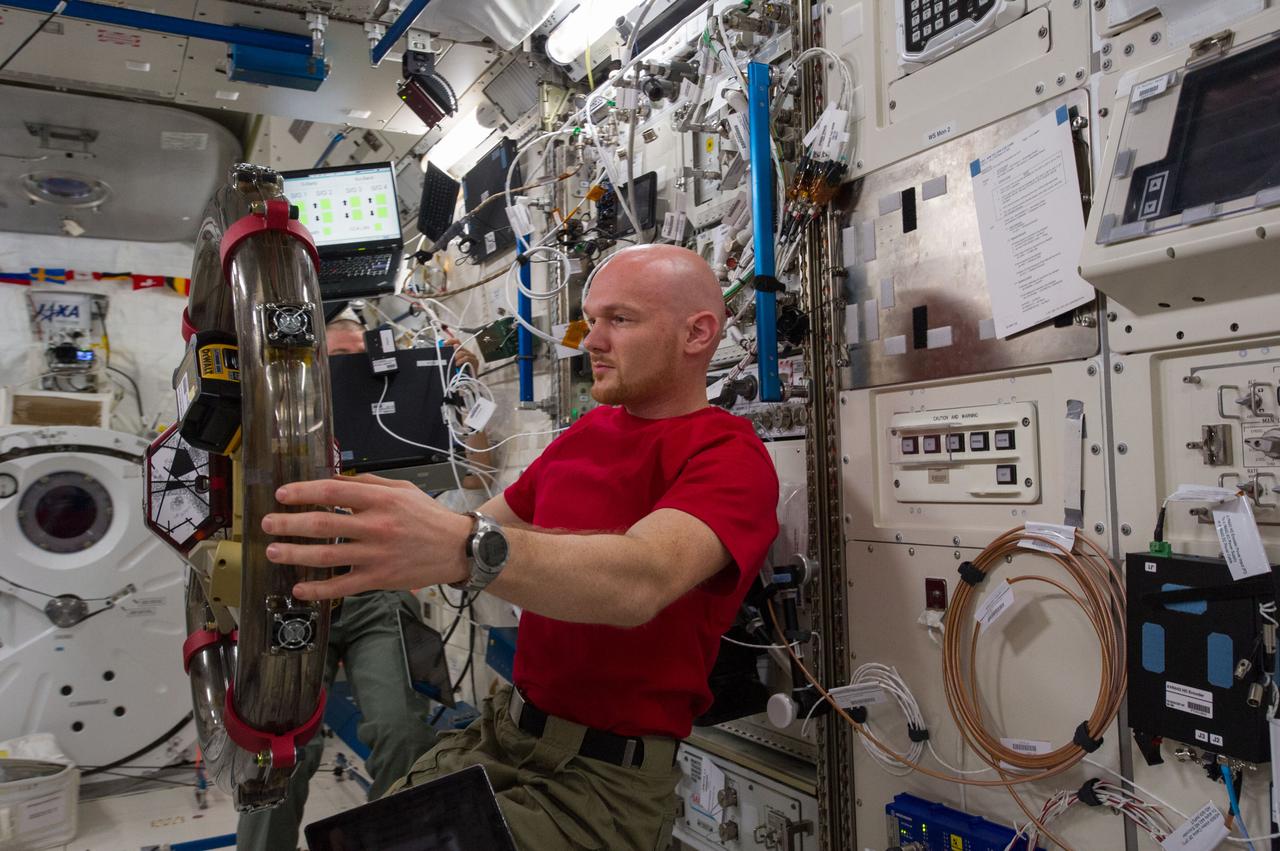
ISS040-E-059467 (10 July 2014) --- In the International Space Station's Kibo laboratory, European Space Agency astronaut Alexander Gerst and NASA astronaut Reid Wiseman (mostly obscured), both Expedition 40 flight engineers, conduct a session with a pair of bowling-ball-sized free-flying satellites known as Synchronized Position Hold, Engage, Reorient, Experimental Satellites, or SPHERES. Surrounding the two SPHERES mini-satellites is ring-shaped hardware known as the Resonant Inductive Near-field Generation System, or RINGS. SPHERES-RINGS seeks to demonstrate wireless power transfer between satellites at a distance for enhanced operations.
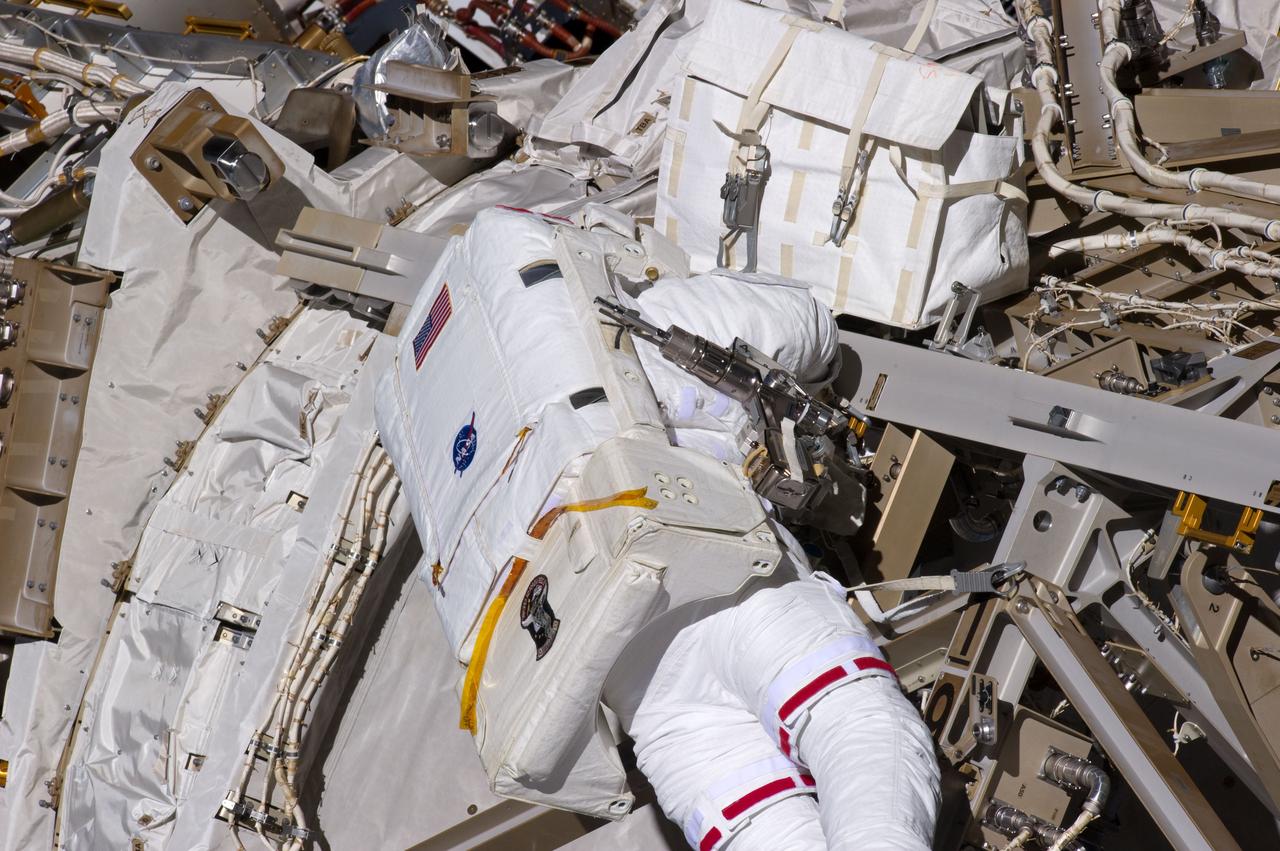
S134-E-007575 (20 May 2011) --- NASA astronaut Greg Chamitoff, STS-134 mission specialist, participates in the mission's first session of extravehicular activity (EVA) as construction and maintenance continue on the International Space Station. During the six-hour, 19-minute spacewalk, Chamitoff and astronaut Andrew Feustel (out of fame) retrieved long-duration materials exposure experiments and installed another, installed a light on one of the station?s rail line handcarts, made preparations for adding ammonia to a cooling loop and installed an antenna for the External Wireless Communication system. Photo credit: NASA
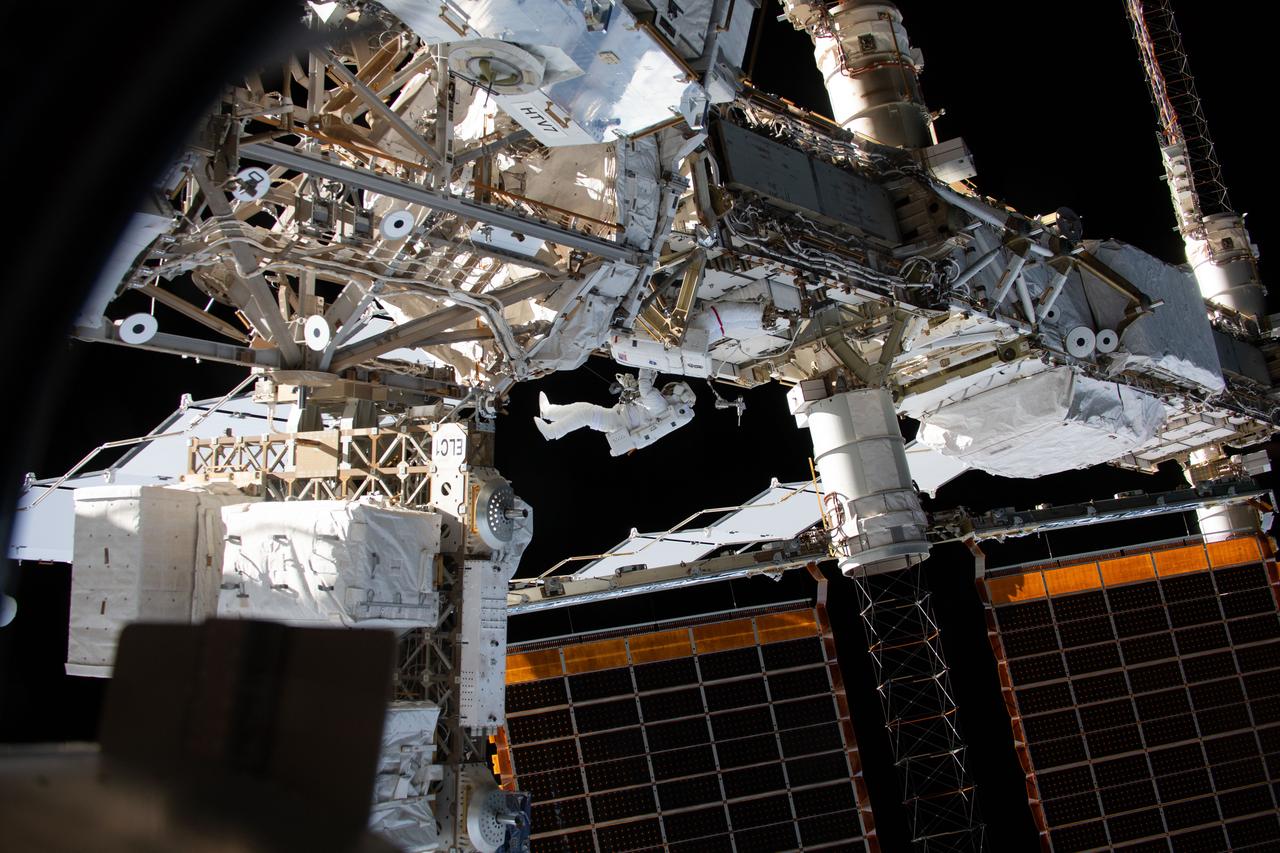
iss059e016991 (April 8, 2019) --- Expedition 59 Flight Engineers Anne McClain of NASA (red stripes) and David Saint-Jacques of the Canadian Space Agency are seen while working outside the International Space Station. In a six and a half hour spacewalk, McClain and Saint-Jacques successfully established a redundant path of power to the Canadian-built robotic arm, known as Canadarm2, and installed cables to provide for more expansive wireless communications coverage outside the orbital complex, as well as for enhanced hardwired computer network capability. The duo also relocated an adapter plate from the first spacewalk in preparation for future battery upgrade operations.
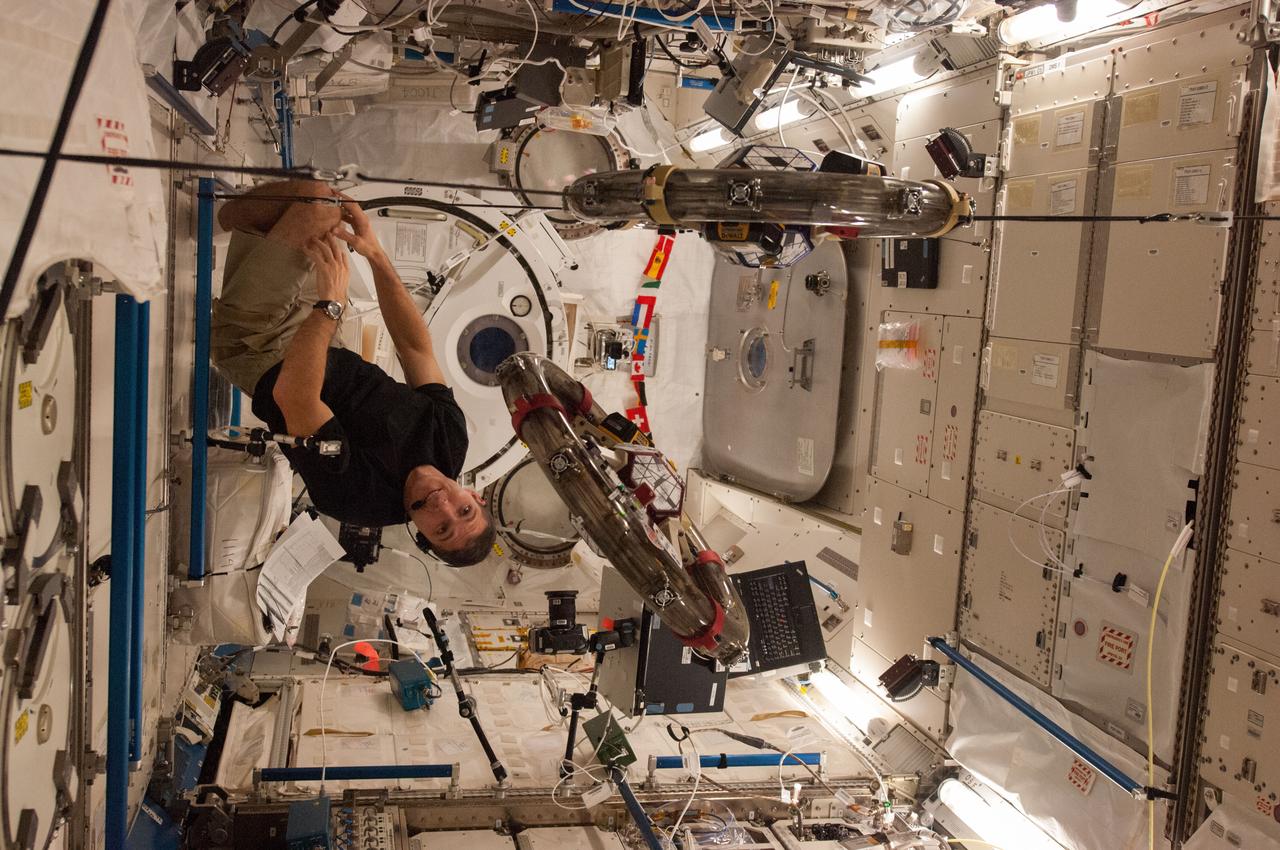
ISS037-E-025870 (4 Nov. 2013) --- In the International Space Station?s Kibo laboratory, NASA astronaut Michael Hopkins, Expedition 37 flight engineer, conducts a session with a pair of bowling-ball-sized free-flying satellites known as Synchronized Position Hold, Engage, Reorient, Experimental Satellites, or SPHERES. Surrounding the two SPHERES mini-satellites is ring-shaped hardware known as the Resonant Inductive Near-field Generation System, or RINGS. SPHERES-RINGS seeks to demonstrate wireless power transfer between satellites at a distance for enhanced operations.

S129-E-007227 (21 Nov. 2009) --- Astronaut Randy Bresnik (near the Columbus laboratory), STS-129 mission specialist, participates in the mission's second session of extravehicular activity (EVA) as construction and maintenance continue on the International Space Station. During the six-hour, eight-minute spacewalk, Bresnik and astronaut Mike Foreman (out of frame), mission specialist, installed a Grappling Adaptor to On-Orbit Railing Assembly, or GATOR, on the Columbus laboratory. GATOR contains a ship-tracking antenna system and a HAM radio antenna. They relocated a floating potential measurement unit that gauges electric charges that build up on the station, deployed a Payload Attach System on the space-facing side of the Starboard 3 truss segment and installed a wireless video system that allows spacewalkers to transmit video to the station and relay it to Earth.
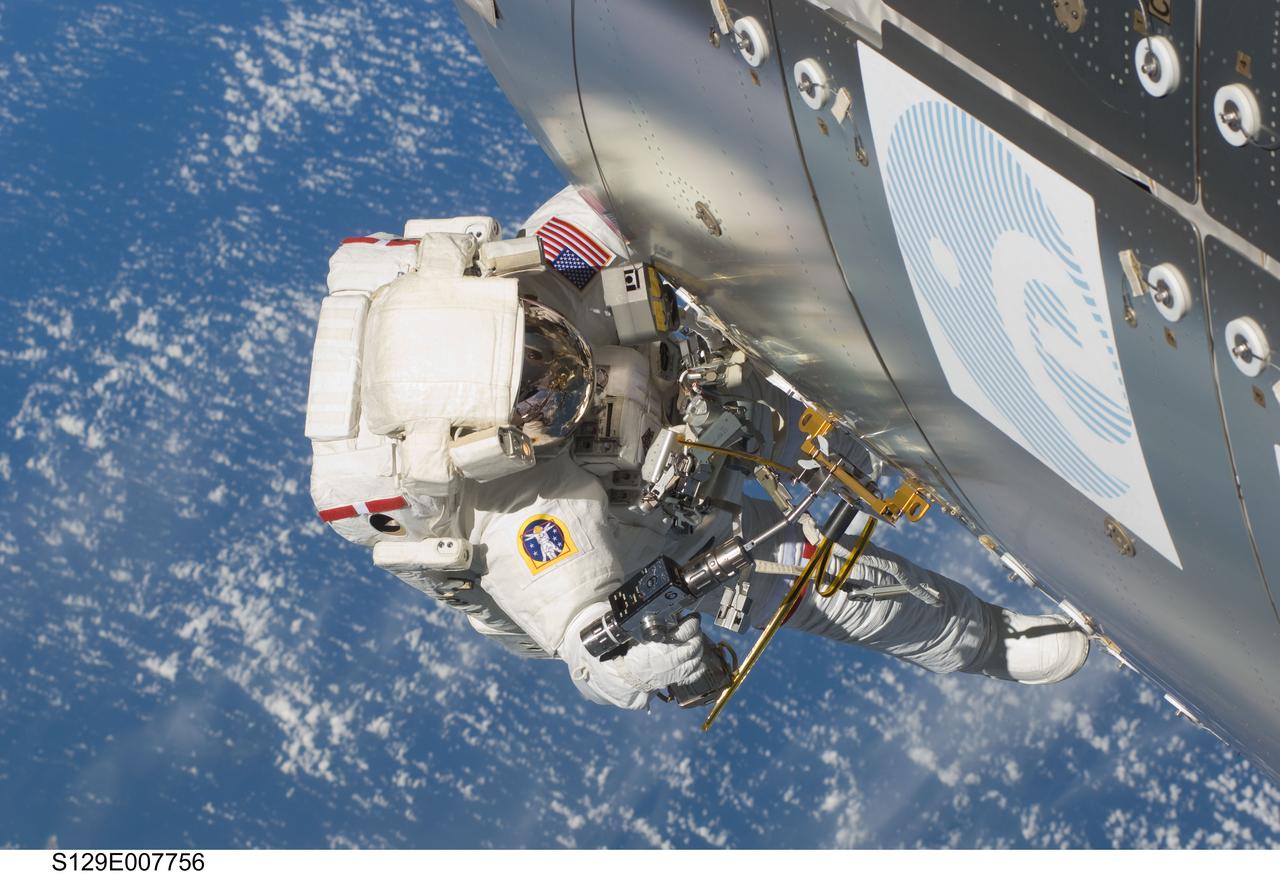
S129-E-007756 (21 Nov. 2009) --- Astronaut Randy Bresnik (near the Columbus laboratory), STS-129 mission specialist, participates in the mission's second session of extravehicular activity (EVA) as construction and maintenance continue on the International Space Station. During the six-hour, eight-minute spacewalk, Bresnik and astronaut Mike Foreman (out of frame), mission specialist, installed a Grappling Adaptor to On-Orbit Railing Assembly, or GATOR, on the Columbus laboratory. GATOR contains a ship-tracking antenna system and a HAM radio antenna. They relocated a floating potential measurement unit that gauges electric charges that build up on the station, deployed a Payload Attach System on the space-facing side of the Starboard 3 truss segment and installed a wireless video system that allows spacewalkers to transmit video to the station and relay it to Earth.
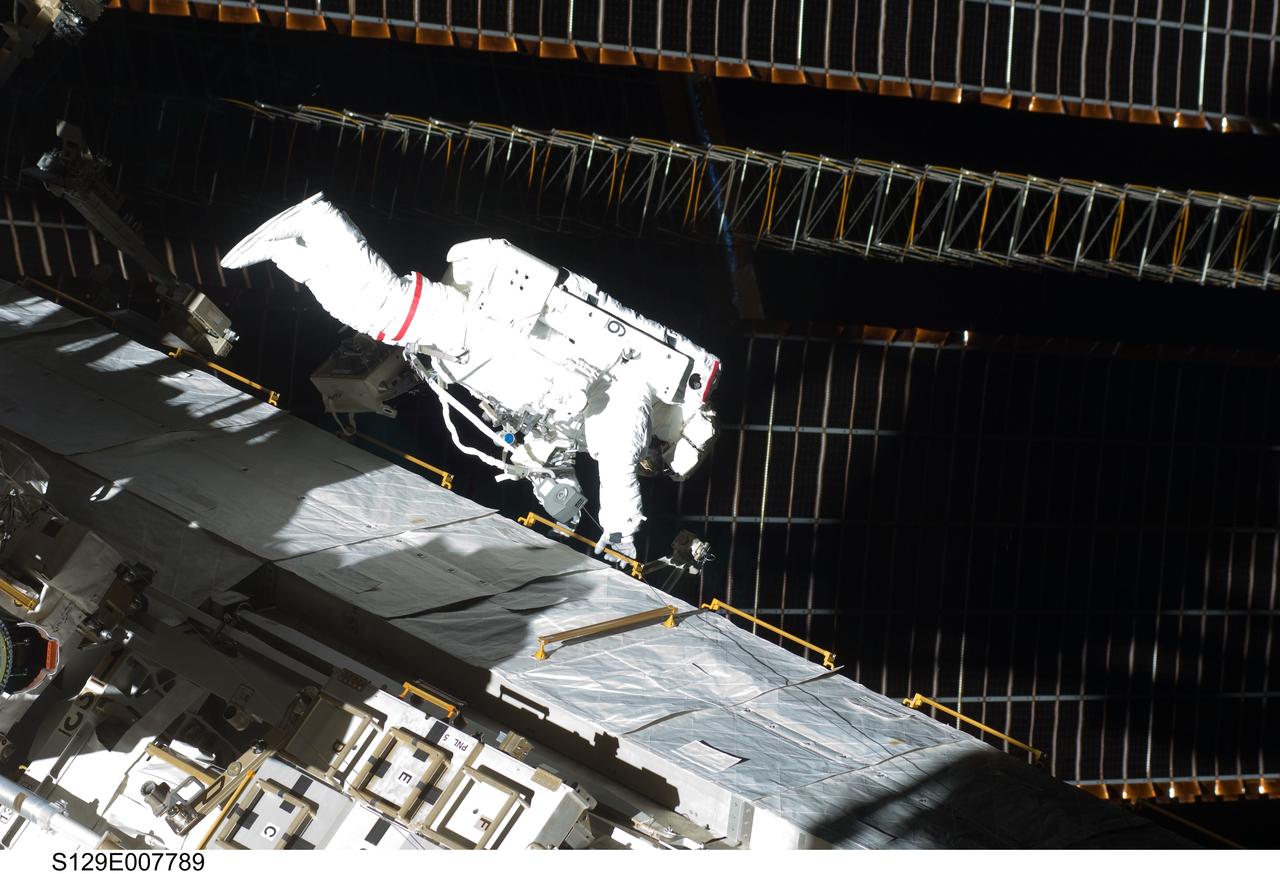
S129-E-007789 (21 Nov. 2009) --- Astronaut Mike Foreman, STS-129 mission specialist, participates in the mission's second session of extravehicular activity (EVA) as construction and maintenance continue on the International Space Station. During the six-hour, eight-minute spacewalk, Foreman and astronaut Randy Bresnik (out of frame), mission specialist, installed a Grappling Adaptor to On-Orbit Railing Assembly, or GATOR, on the Columbus laboratory. GATOR contains a ship-tracking antenna system and a HAM radio antenna. They relocated a floating potential measurement unit that gauges electric charges that build up on the station, deployed a Payload Attach System on the space-facing side of the Starboard 3 truss segment and installed a wireless video system that allows spacewalkers to transmit video to the station and relay it to Earth.

Mark Pestana is a research pilot and project manager at the NASA Dryden Flight Research Center, Edwards, Calif. He is a pilot for the Beech B200 King Air, the T-34C and the Predator B. He flies the F-18 Hornet as a co-pilot and flight test engineer. Pestana has accumulated more than 4,000 hours of military and civilian flight experience. He was also a flight engineer on the NASA DC-8 flying laboratory. Pestana was the project manager and pilot for the Hi–rate Wireless Airborne Network Demonstration flown on the NASA B200 research aircraft. He flew B200 research missions for the X-38 Space Integrated Inertial Navigation Global Positioning System experiment. Pestana also participated in several deployments of the DC-8, including Earth science expeditions ranging from hurricane research over the Caribbean Sea to ozone studies over the North Pole, atmospheric chemistry over the South Pacific, rain forest health in Central America, Rocky Mountain ice pack assessment, and volcanic and tectonic activity around the Pacific Rim. He came to Dryden as a DC-8 mission manager in June 1998 from NASA Johnson Space Center, Houston, where he served as the Earth and Space Science discipline manager for the International Space Station Program at Johnson. Pestana also served as a flight crew operations engineer in the Astronaut Office, developing the controls, displays, tools, crew accommodations and procedures for on-orbit assembly, test, and checkout of the International Space Station. He led the analysis and technical negotiations for modification of the Russian Soyuz spacecraft as an emergency crew return vehicle for space station crews. He joined the U.S. Air Force Reserve in 1991 and held various positions as a research and development engineer, intelligence analyst, and Delta II launch vehicle systems engineer. He retired from the U.S. Air Force Reserve with the rank of colonel in 2005. Prior to 1990, Pestana was on active duty with the U.S. Air Force as the director of mi
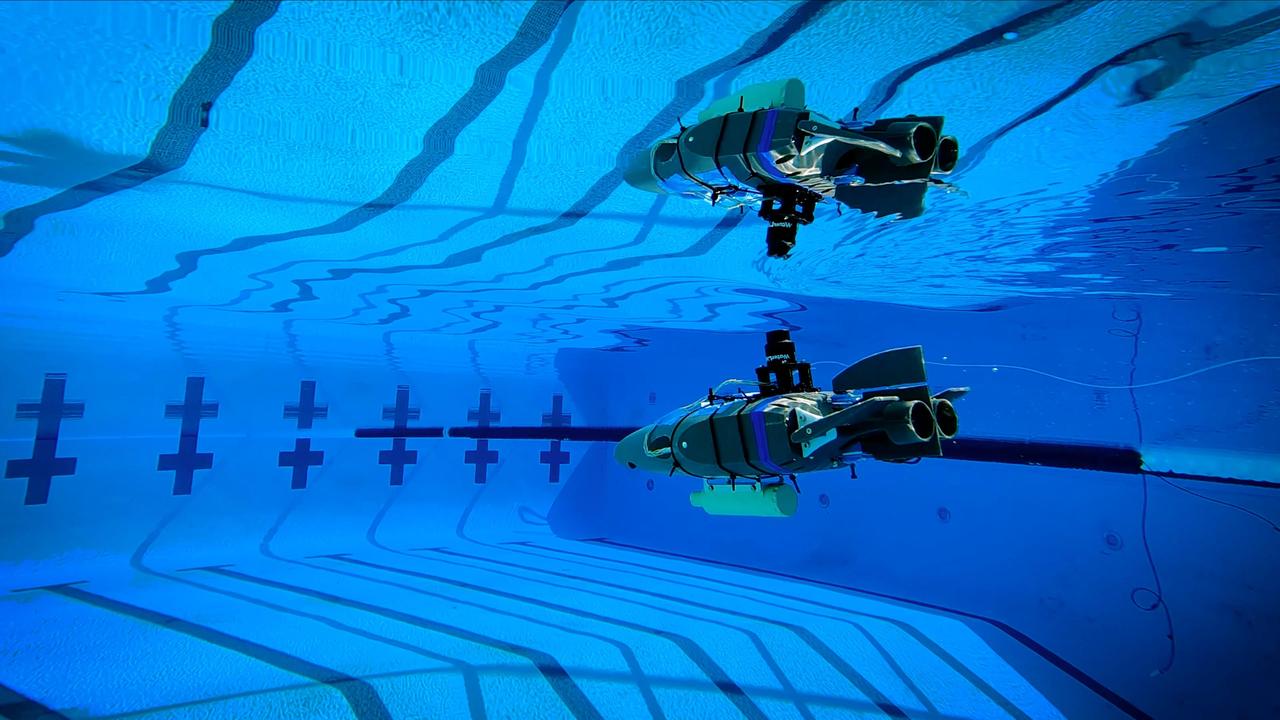
A prototype of a robot designed to explore the subsurface oceans of icy moons glides through a pool at Caltech in September 2024, its reflection visible below the water's surface. The prototype was built at NASA's Jet Propulsion Laboratory in Southern California to demonstrate the feasibility of a mission concept called SWIM, short for Sensing With Independent Micro-swimmers. SWIM envisions a swarm of dozens of self-propelled, cellphone-size robots exploring the waters of icy moons like Jupiter's Europa and Saturn's Enceladus. Delivered to the subsurface ocean by an ice-melting cryobot, the tiny robots would zoom away to look for chemical and temperature signals that could point to life. The prototype used in most of the pool tests was about 16.5 inches (42 centimeters) long, weighing 5 pounds (2.3 kilograms). As conceived for spaceflight, the robots would have dimensions about three times smaller – tiny compared to existing remotely operated and autonomous underwater scientific vehicles. In this image, commercial acoustic modules are mounted to the robot for testing: on top, one for communication, and on the bottom, one for underwater GPS. These devices were used during pool testing as stand-ins for what would be a novel wireless underwater acoustic communication system used both to transmit data between the cryobot and the swarm and to help each robot determine its position without the benefit of GPS. Led by JPL, work on SWIM took place from spring 2021 to fall 2024. The project was supported by Phase I and II funding from NASA's Innovative Advanced Concepts program under the agency's Space Technology Mission Directorate. JPL is managed for NASA by Caltech in Pasadena, California. https://photojournal.jpl.nasa.gov/catalog/PIA26423
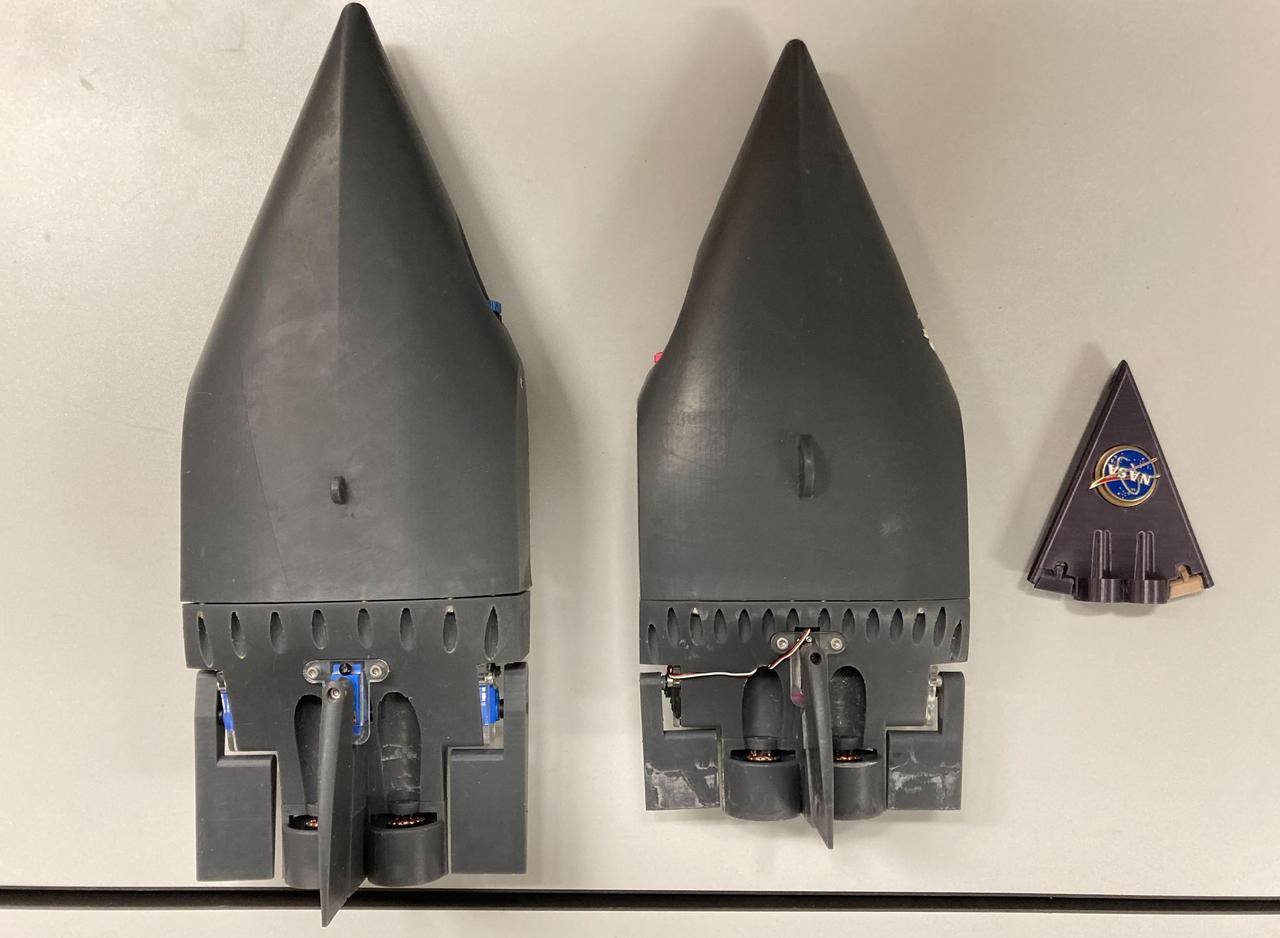
Two prototypes for a NASA mission concept called SWIM (short for Sensing With Independent Micro-swimmers) are arranged beside a much smaller nonfunctioning model representing the final envisioned size of the robot: about 5 inches (12 centimeters) long. The plastic prototypes were built at NASA's Jet Propulsion Laboratory in Southern California to demonstrate the feasibility of the concept, a swarm of dozens of self-propelled, cellphone-size robots exploring the waters of icy moons like Jupiter's Europa and Saturn's Enceladus. Delivered to the subsurface ocean by an ice-melting cryobot, the tiny robots would zoom away to look for chemical and temperature signals that could point to life. The prototypes were used in more that 20 rounds of underwater testing in a pair of tanks at JPL and in a competition swimming pool at Caltech in Pasadena. Relying on low-cost, commercially made motors and electronics, the robots are pushed along by two propellers and use two to four flaps for steering. The prototype in the center of the image weighs 3.7 pounds (1.7 kilograms) and is 14.5 inches (37 centimeters) long, 6 inches (15 centimeters) wide, and 2.5 inches (6.5 centimeters) tall, with a volume of 104 cubic inches (1.7 liters). The upgraded prototype at left is slightly bigger: 16.5 inches (42 centimeters) long, 3 inches (7.5 centimeters) tall, with a weight of 5 pounds (2.3 kilograms) and a volume of 140 cubic inches (2.3 liters). In pool tests, the prototype at left demonstrated controlled maneuvering, the ability to stay on and correct its course, and a back-and-forth "lawnmower" exploration pattern. It managed all of this autonomously, without the team's direct intervention. The robot even spelled out "J-P-L." As conceived for spaceflight and represented by the model at right, the robots would have dimensions about three times smaller than these prototypes – tiny compared to existing remotely operated and autonomous underwater scientific vehicles. The swimmers would feature miniaturized, purpose-built parts and employ a novel wireless underwater acoustic communication system for transmitting data and triangulating their positions. Several years more of work would be needed to make such an advanced concept ready for spaceflight. Led by JPL, SWIM development took place from spring 2021 to fall 2024. The project was supported by Phase I and II funding from NASA's Innovative Advanced Concepts program under the agency's Space Technology Mission Directorate. JPL is managed for NASA by Caltech in Pasadena, California. https://photojournal.jpl.nasa.gov/catalog/PIA26425
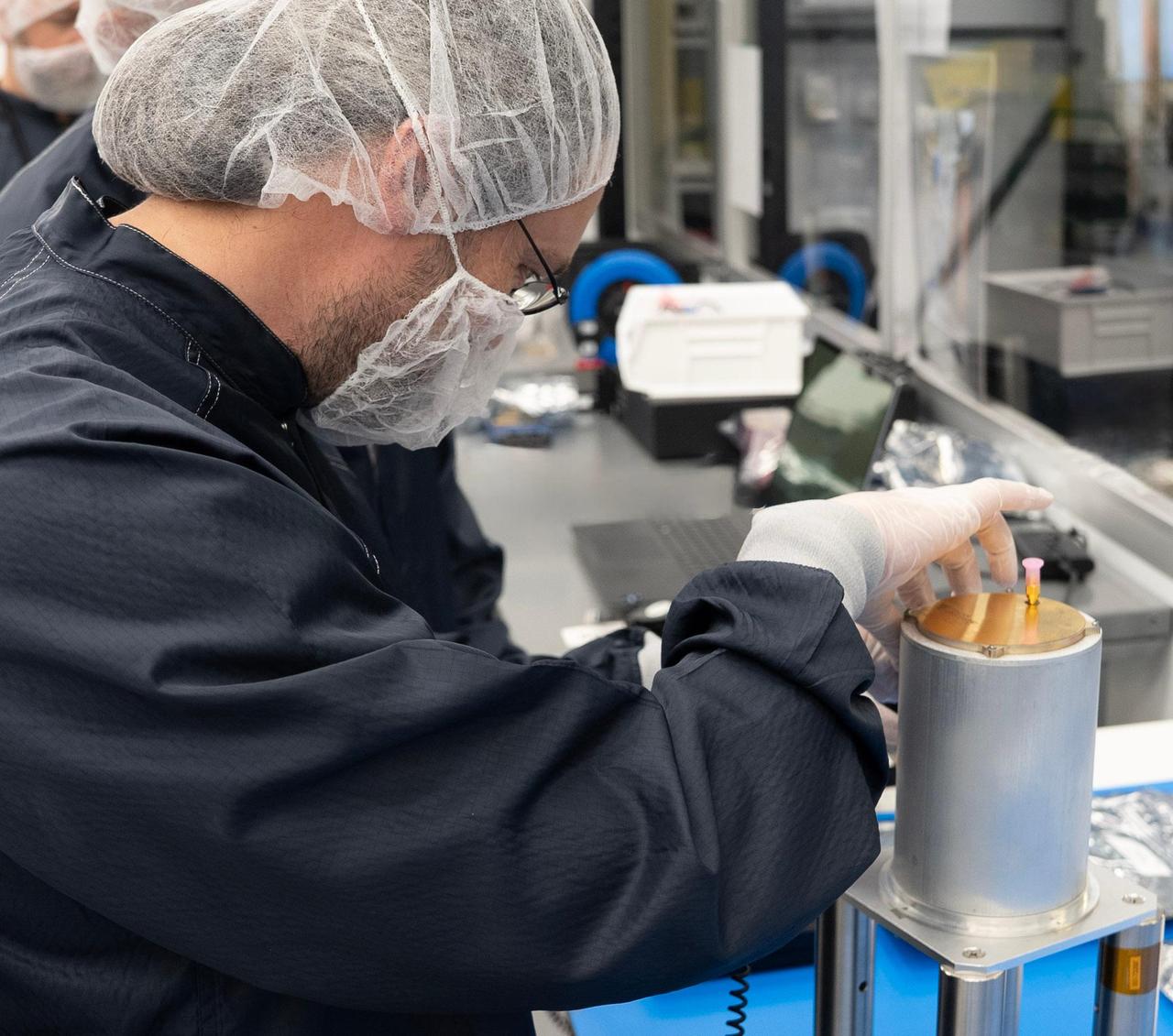
Engineer Emmanuel Decrossas of NASA's Jet Propulsion Laboratory in Southern California makes an adjustment to an antenna's connector, part of a NASA telecommunications payload called User Terminal, at Firefly Aerospace's facility in Cedar Park, Texas, in August 2025. Figure A (https://photojournal.jpl.nasa.gov/figures/PIA26596_figA.jpg) shows members of the team from JPL and NASA (dark blue) and Firefly (white) with the User Terminal antenna, radio, and other components on the bench behind them. Managed by JPL, the User Terminal will test a new, low-cost lunar communications system that future missions to the Moon's far side could use to transfer data to and from Earth via lunar relay satellite. The User Terminal payload will be installed atop Firefly's Blue Ghost Mission 2 lunar lander, which is slated to launch to the Moon's far side in 2026 under NASA's CLPS (Commercial Lunar Payload Services) initiative. NASA's Apollo missions brought large and powerful telecommunications systems to the lunar near-side surface to communicate directly with Earth. But spacecraft on the far side will not have that option because only the near side of the Moon is visible to Earth. Sending messages between the Moon and Earth via a relay orbiter enables communication with the lunar far side and improves it at the Moon's poles. The User Terminal will for the first time test such a setup for NASA by using a compact, lightweight software defined radio, antenna, and related hardware to communicate with a satellite that Blue Ghost Mission 2 is delivering to lunar orbit: ESA's (the European Space Agency's) Lunar Pathfinder. The User Terminal radio and antenna installed on the Blue Ghost lander will be used to commission Lunar Pathfinder, sending test data back and forth. After the lander ceases operations as planned at the end of a single lunar day (about 14 Earth days), a separate User Terminal radio and antenna installed on LuSEE-Night – another payload on the lander – will send LuSEE-Night's data to Lunar Pathfinder, which will relay the information to a commercial network of ground stations on Earth. LuSEE-Night is a radio telescope that expected to operate for at least 1½ years; it is a joint effort by NASA, the U.S. Department of Energy, and University of California, Berkeley's Space Sciences Laboratory. Additionally, User Terminal will be able to communicate with another satellite that's being delivered to lunar orbit by Blue Ghost Mission 2: Firefly's own Elytra Dark orbital vehicle. The hardware on the lander is only part of the User Terminal project, which was also designed to implement a new S-band two-way protocol, or standard, for short-range space communications between entities on the lunar surface (such as rovers and landers) and lunar orbiters, enabling reliable data transfer between them. The standard is a new version of a space communications protocol called Proximity-1 that was initially developed more than two decades ago for use at Mars by an international standard body called the Consultative Committee for Space Data Systems (CCSDS), of which NASA is a member agency. The User Terminal team made recommendations to CCSDS on the development of the new lunar S-band standard, which was specified in 2024. The new standard will enable lunar orbiters and surface spacecraft from various entities – NASA and other civil space agencies as well as industry and academia – to communicate with each other, a concept known as interoperability. At Mars, NASA rovers communicate with various Red Planet orbiters using the Ultra-High Frequency (UHF) radio band version of the Proximity-1 standard. On the Moon's far side, use of UHF is reserved for radio astronomy science; so a new lunar standard was needed using a different frequency range, S-band, as were more efficient modulation and coding schemes to better fit the available frequency spectrum specified by the new standard. User Terminal is funded by NASA's Exploration Science Strategy and Integration Office, part of the agency's Science Mission Directorate, which manages the CLPS initiative. JPL manages the project and supported development of the new S-band radio standard and the payload in coordination with Vulcan Wireless in Carlsbad, California, which built the radio. Caltech in Pasadena manages JPL for NASA. https://photojournal.jpl.nasa.gov/catalog/PIA26596