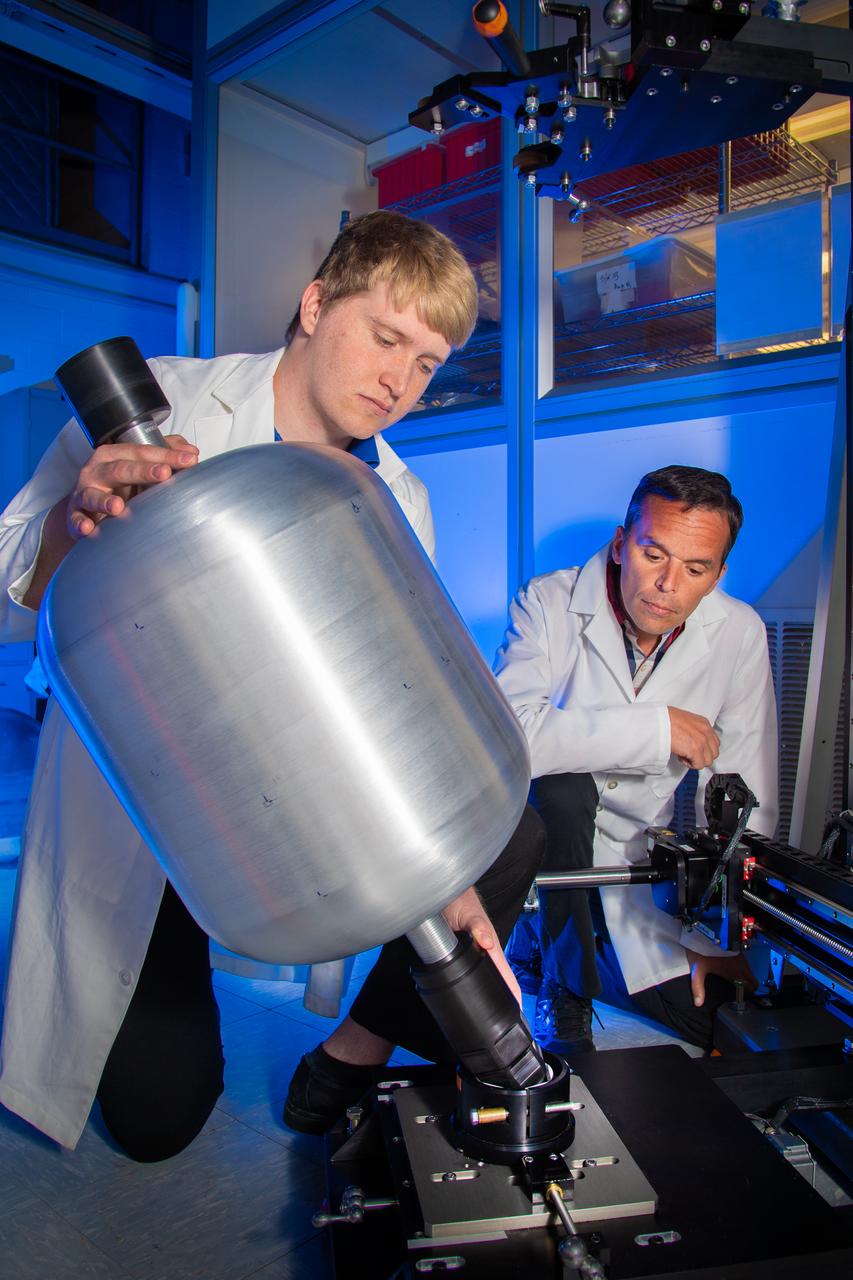
Engineers Ayrton Jordan (left) and Anthony Milana (right) at the NASA White Sands Test Facility (WSTF) in Las Cruces, N.M. install a metallic liner into the multipurpose pressure vessel scanner that could one day become part of a composite overwrapped pressure vessel. A slotted ball joint at the base of the rotary stage allows the tank to pivot resulting in helical scans that are more reliable when measuring interior and exterior 3D surface profiles. Photo Credit: (NASA/Reed P. Elliott)
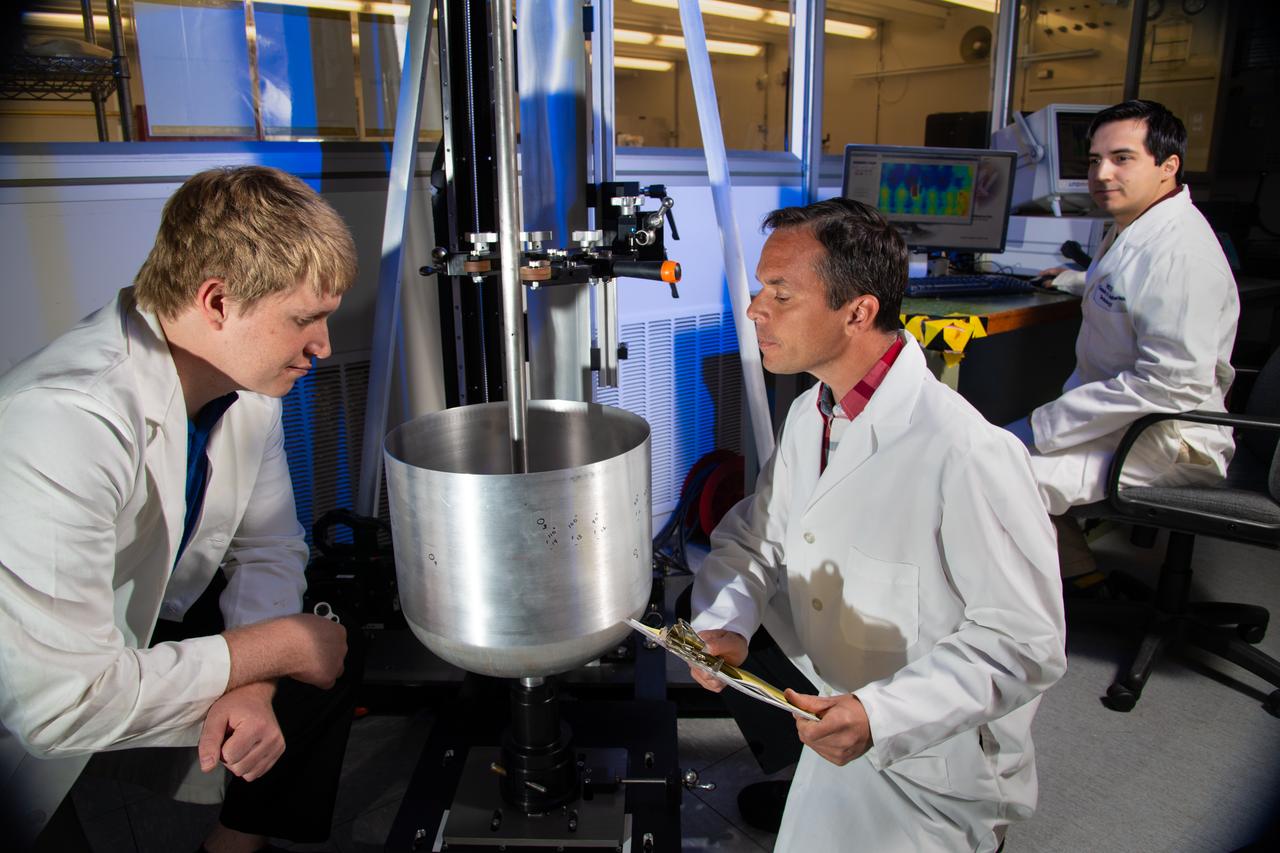
Engineers (from left) Ayrton Jordan, Anthony Milana and Edgar Reyes from the NASA White Sands Test Facility (WSTF) in Las Cruces, N.M. qualify an interior surface pressure vessel crack inspection using the eddy current nondestructive testing technique to find flaws smaller than more common and less capable penetrant testing methods. Detecting cracks smaller than the eye can detect is an important feature as manufacturers push performance limits to achieve lighter, more efficient spacecraft. Photo Credit: (NASA/Reed P. Elliott)
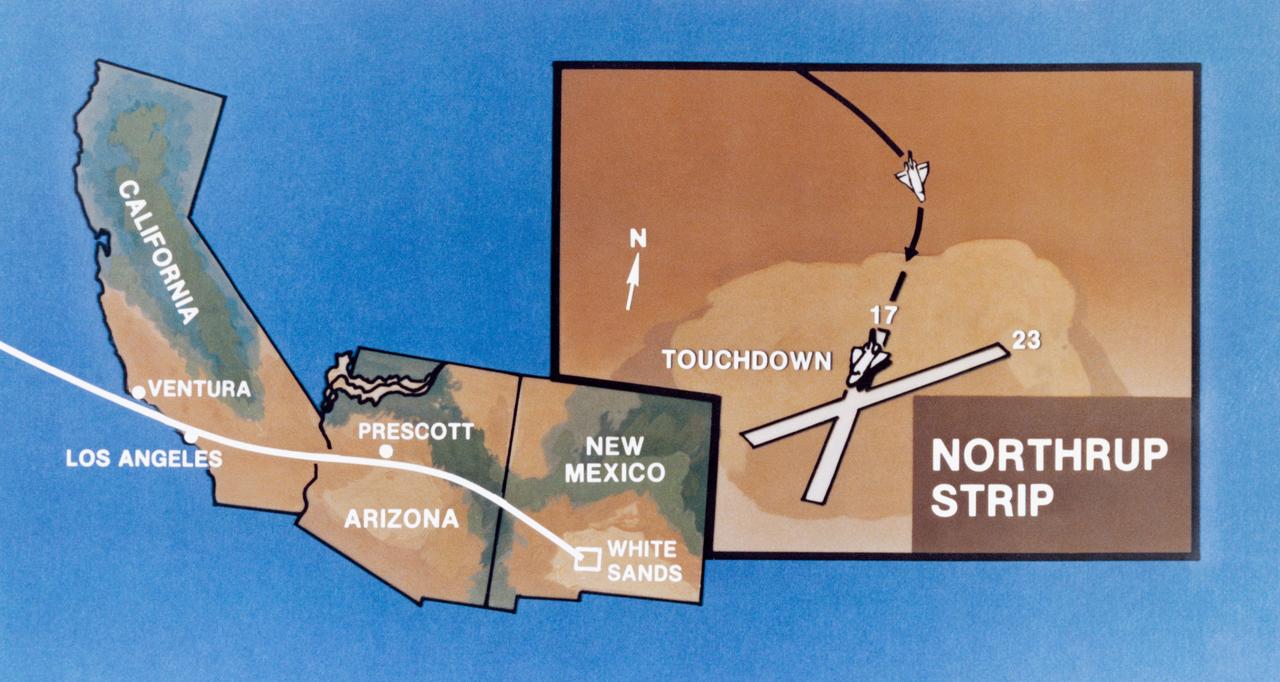
Art Concept of the End-of-Mission Approach and Landing at WSTF, NM, from Rockwell. 1. ART CONCEPT - STS-3 LANDING 2. STS-3 - LANDING WSTF, NM Also available in 4x5 B&W
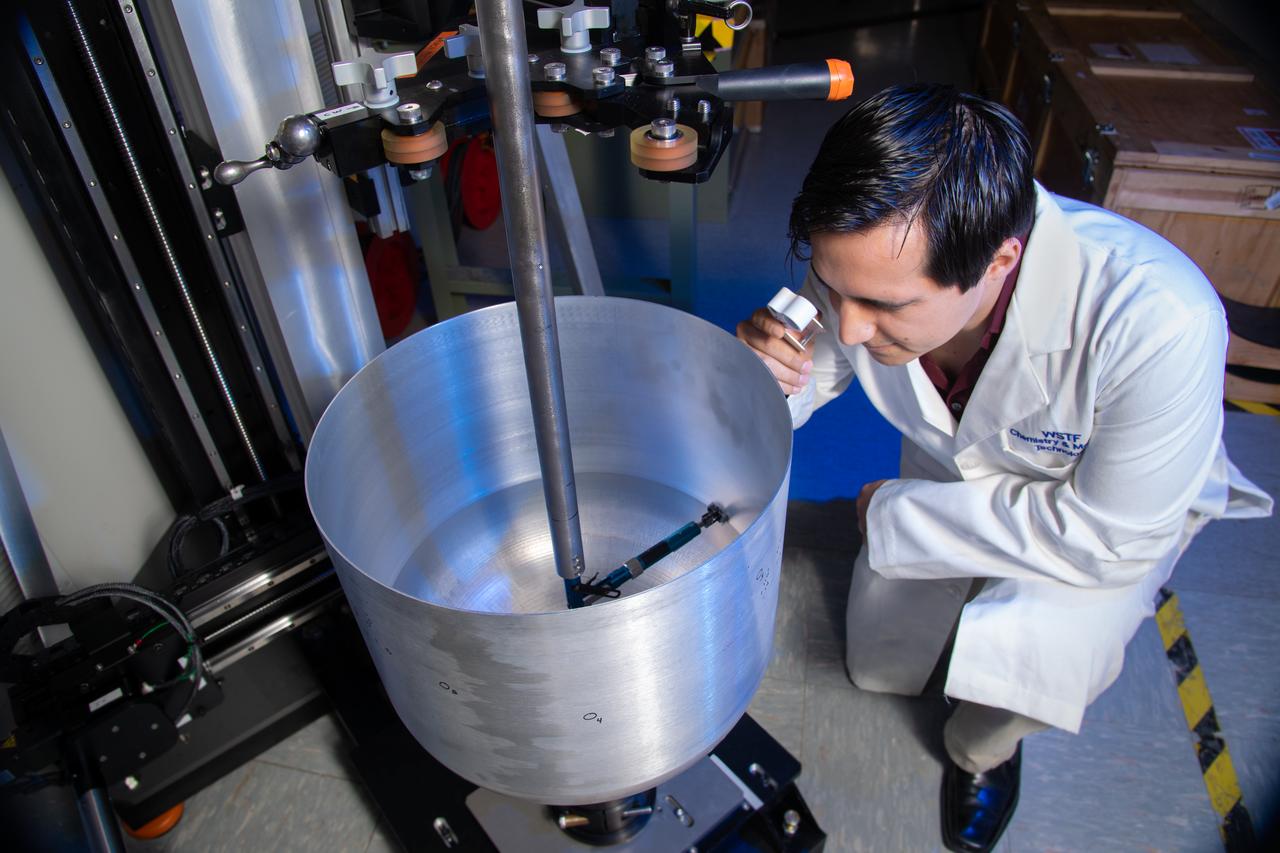
Edgar Reyes, a materials engineer and recent graduate of The University of Texas at El Paso, visually inspects a crack identified on the outer surface of a composite overwrapped pressure vessel (COPV) following an internal eddy-current through-wall nondestructive inspection conducted at the NASA White Sands Test Facility in Las Cruces, N.M. Eddy-current testing is one of many electromagnetic testing methods used in nondestructive testing to identify cracks in COPVS that can potentially threaten spacecraft crew and mission success. Photo Credit: (NASA/Reed P. Elliott)
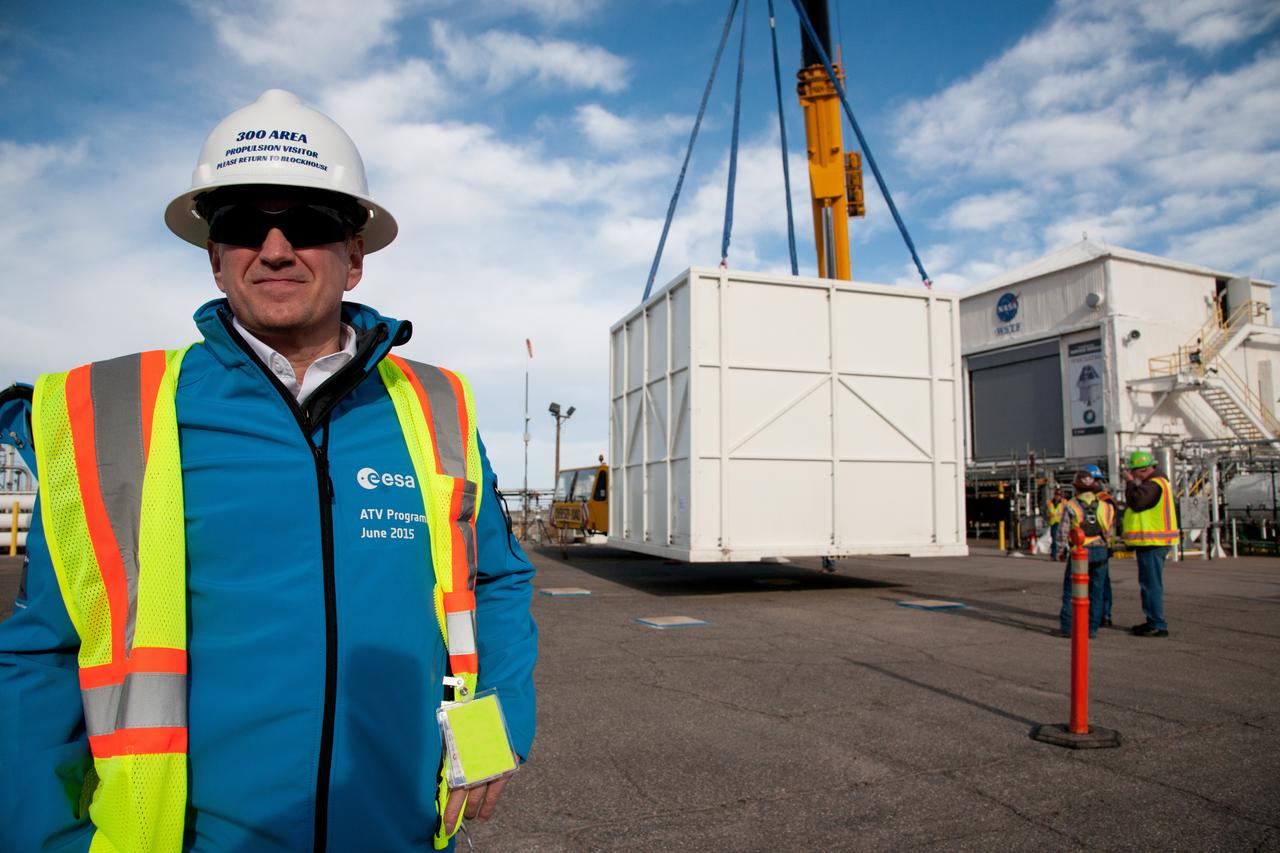
The European Service Module Propulsion Qualification Module (PQM) arrives at White Sands Test Facility in New Mexico on Feb. 18, 2017.
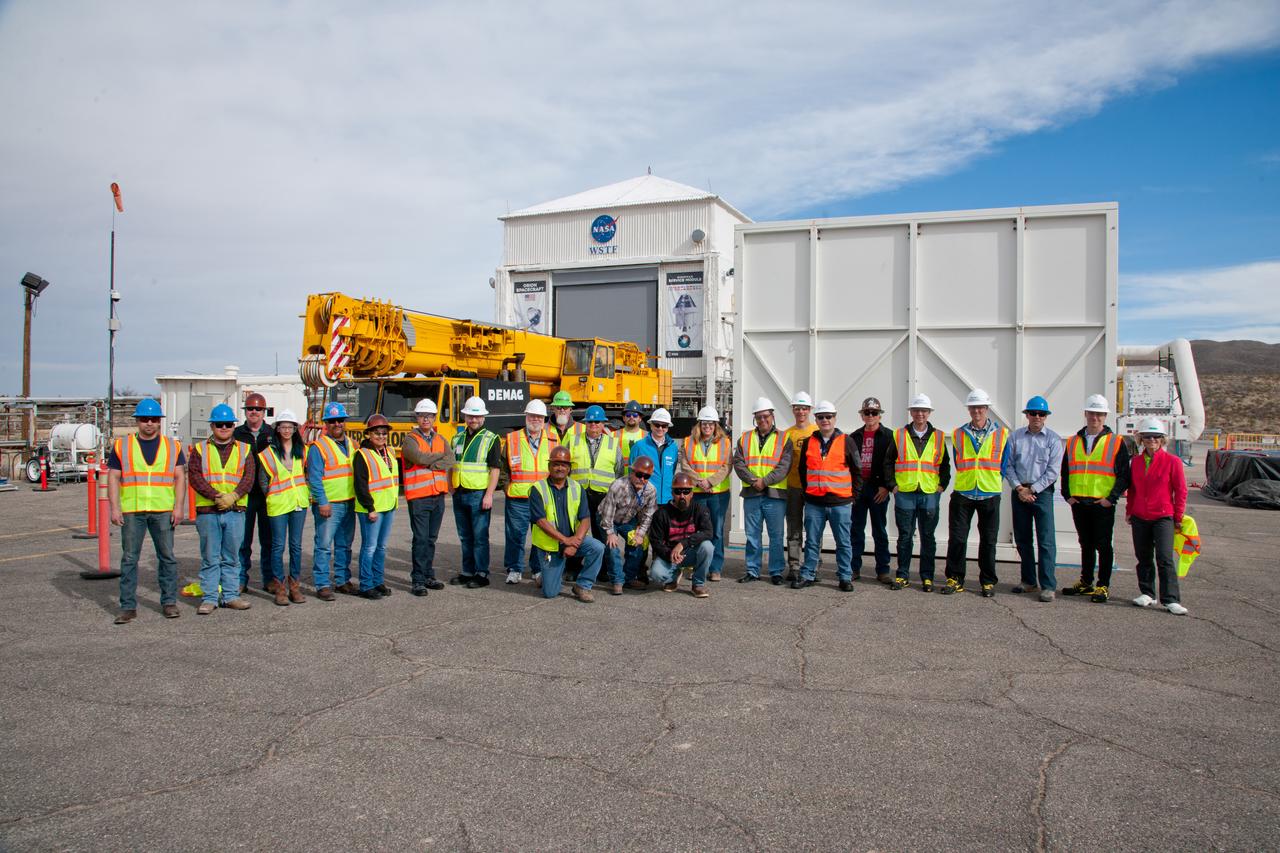
The European Service Module Propulsion Qualification Module (PQM) arrives at White Sands Test Facility in New Mexico on Feb. 18, 2017.

The European Service Module Propulsion Qualification Module (PQM) arrives at White Sands Test Facility in New Mexico on Feb. 18, 2017.
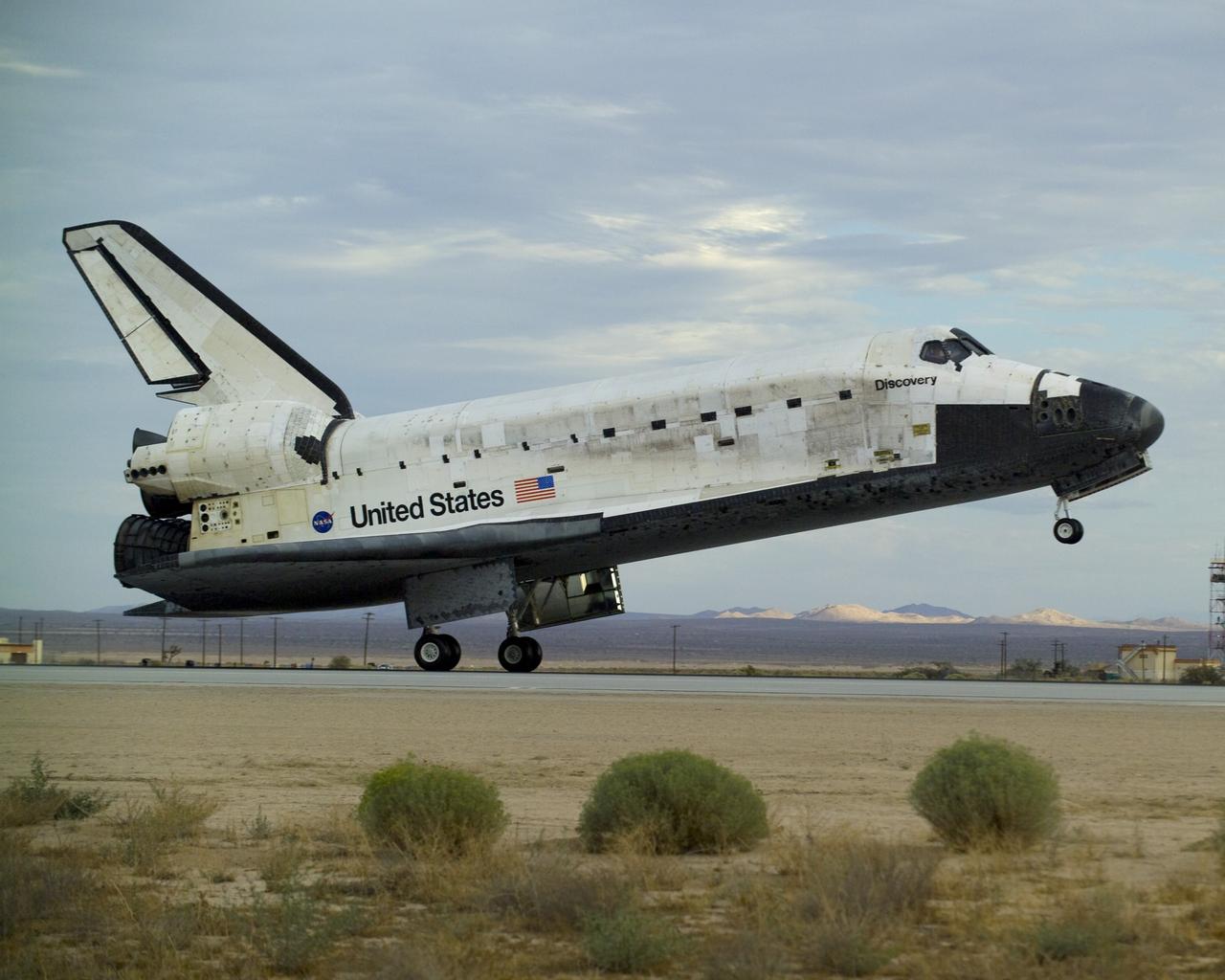
EDWARDS AIR FORCE BASE, Calif. -- (ED09-0253-03) Its nose still high in the air, Space Shuttle Discovery rolls down Runway 22L at Edwards Air Force Base shortly before sunset on Sept. 11, 2009 and the end of mission STS-128. (NASA photo / David Huskey/WSTF)
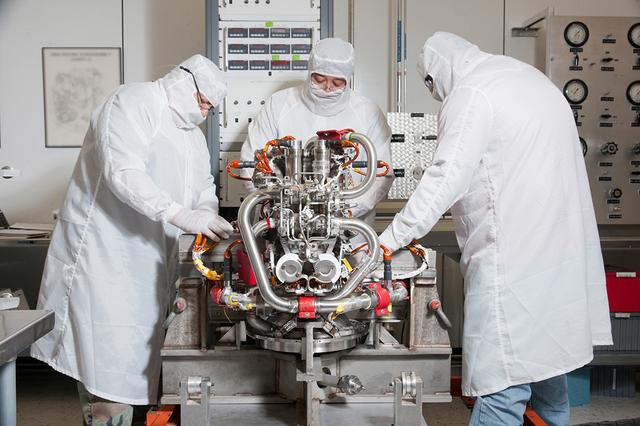
Engineers and technicians in NASA White Sands Test Facility’s Technical Services Section conduct functional tests on Orbital Maneuvering System Engine 108 for Orion on May 1, 2018.

.50 Cal Gun Range: Hypervelocity Impact Test; 6.8 km/s

Annual Metrology and Calibration Working Group Face to Face meeting held at Langley Research Center; Front Row (L to R): Stacy Sigmon – LaRC, Brent Watling – JSC, Ralph Hickman – WFF, Kirk Foster – MSFC, Don Wilson – SSC, Greg Boyd – JSC, Perry King – KSC, Bobby Price – GSFC, Felicia Donnell – GSFC, Perry LaRosa – GRC. Second Row (L to R): Ken Mathews – KSC, Darrell Shoup – WSTF, Gary Kennedy – MSFC, Terry Fleet – GRC, Damon Flansburg – ARC, Salvatore Tomaselli - WFF, Bruce Farner - SSC, David Scott – JPL, Jim Wachter – KSC, Shawn Britton – LaRC.
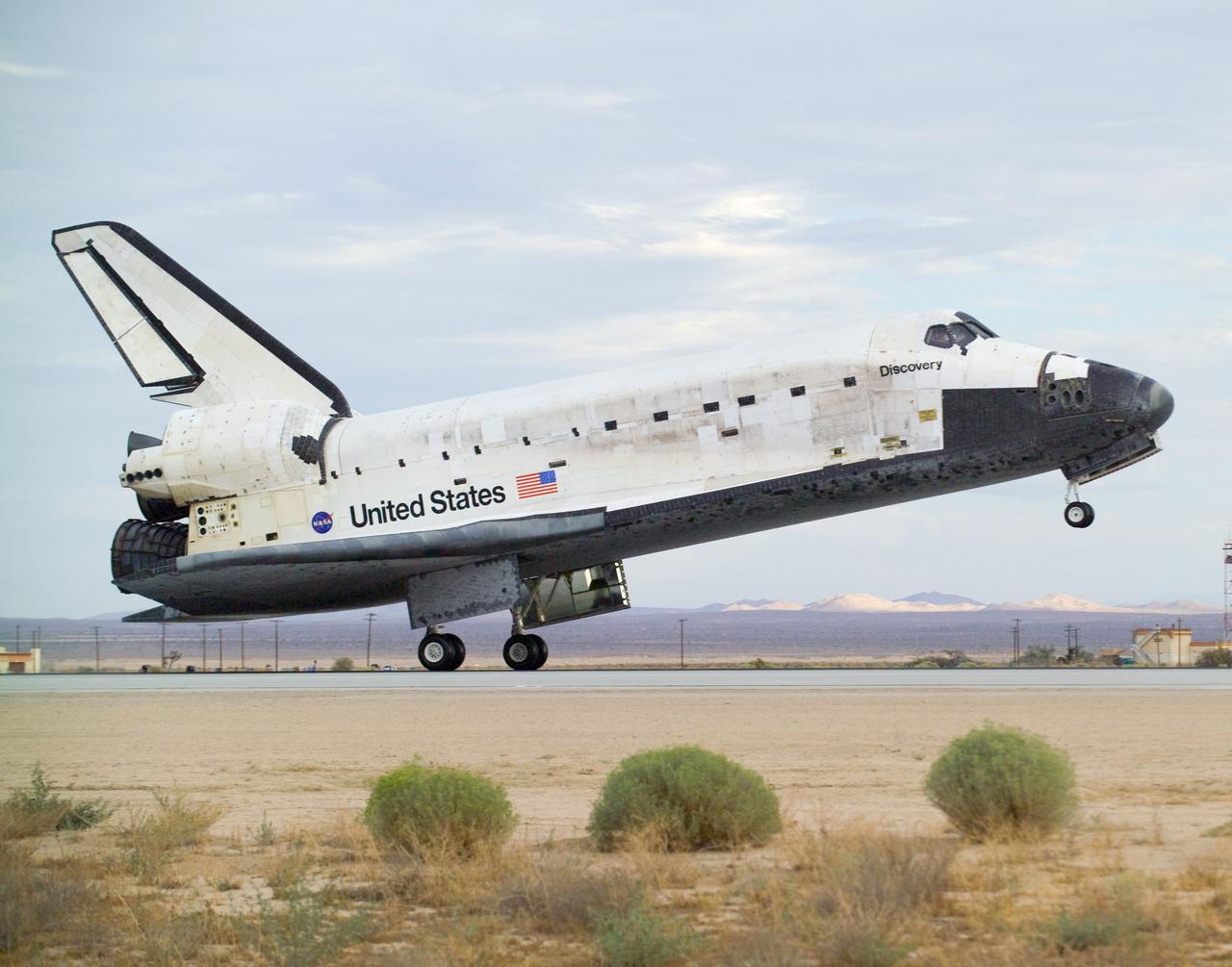
STS128-S-047 (11 Sept. 2009) --- Space Shuttle Discovery?s main landing gear touches down at NASA's Dryden Flight Research Center at Edwards Air Force Base in California, concluding a successful mission to the International Space Station. Onboard are NASA astronauts Rick Sturckow, commander; Kevin Ford, pilot; John ?Danny? Olivas, Patrick Forrester, Jose Hernandez and Tim Kopra, all mission specialists; along with European Space Agency astronaut Christer Fuglesang, mission specialist. Discovery landed at 5:53 p.m. (PDT) on Sept. 11, 2009 to end the STS-128 mission, completing its almost 14-day journey of more than 5.7 million miles in space. The landing was diverted to California due to marginal weather at the Kennedy Space Center. Discovery?s mission featured three spacewalks and the delivery of two refrigerator-sized science racks to the space station. One rack will be used to conduct experiments on materials such as metals, glasses and ceramics. The results from these experiments could lead to the development of better materials on Earth. The other rack will be used for fluid physics research. Understanding how fluids react in microgravity could lead to improved designs for fuel tanks, water systems and other fluid-based systems.