A memorial wreath is placed in the Heroes and Legends exhibit at the Kennedy Space Center Visitor Complex in Florida following a ceremony honoring the memory of former Apollo astronaut Walter Cunningham. The ceremony was held Jan. 9, 2023. Cunningham was the lunar module pilot for Apollo 7 – the first crewed flight test of the Apollo spacecraft – where he tested maneuvers necessary for docking and lunar orbit rendezvous. He passed away Jan. 3 at the age of 90.
Memorial Ceremony for Walter Cunningham
Therrin Protze, chief operating officer of the Kennedy Space Center Visitor Complex, speaks during a memorial ceremony honoring former Apollo astronaut Walter Cunningham. The ceremony was held Jan. 9, 2023, at the Heroes and Legends exhibit within the Astronaut Hall of Fame at the Florida spaceport’s visitor complex. Cunningham was the lunar module pilot for Apollo 7 – the first crewed flight test of the Apollo spacecraft – where he tested maneuvers necessary for docking and lunar orbit rendezvous. He passed away Jan. 3 at the age of 90.
Memorial Ceremony for Walter Cunningham
A photo of former Apollo astronaut Walter Cunningham is displayed during a memorial ceremony at NASA’s Kennedy Space Center in Florida. The ceremony was held Jan. 9, 2023, at the Heroes and Legends exhibit within the Astronaut Hall of Fame at the center’s visitor complex. Cunningham was the lunar module pilot for Apollo 7 – the first crewed flight test of the Apollo spacecraft – where he tested maneuvers necessary for docking and lunar orbit rendezvous. He passed away Jan. 3 at the age of 90.
Memorial Ceremony for Walter Cunningham
Lisa Schott, vice chairman of the Astronaut Scholarship Foundation, speaks during a memorial ceremony honoring former Apollo astronaut Walter Cunningham at NASA’s Kennedy Space Center in Florida. The ceremony was held Jan. 9, 2023, at the Heroes and Legends exhibit within the Astronaut Hall of Fame at the spaceport’s visitor complex. Cunningham was the lunar module pilot for Apollo 7 – the first crewed flight test of the Apollo spacecraft – where he tested maneuvers necessary for docking and lunar orbit rendezvous. He passed away Jan. 3 at the age of 90.
Memorial Ceremony for Walter Cunningham
S64-31816 (10 Sept. 1964) --- Astronaut R. Walter Cunningham.
Astronaut R. Walter Cunningham
AS07-04-1586 (20 Oct. 1968) --- Astronaut Walter Cunningham, Apollo 7 lunar module pilot, writes with space pen as he is photographed performing flight tasks on the ninth day of the Apollo 7 mission. Note the 70mm Hasselblad camera film magazine just above Cunningham's right hand floating in the weightless (zero gravity) environment of the spacecraft.
Astronaut Walter Cunningham photographed performing flight tasks
AS07-04-1584 (11-22 Oct. 1968) --- Astronaut Walter Cunningham, Apollo 7 lunar module pilot, is photographed during the Apollo 7 mission.
Apollo 7 Mission,Lunar Module Pilot, R. Walter Cunningham
From left to right are seen Apollo 7 astronaut Walter Cunningham (second from right), NASA astronaut Kay Hire, Hildreth Walker, Founder of A-MAN Inc. STEM International Science Center; NASA astronauts Michael Fincke and Gregory Johnson at the Endeavour Kick-Off Ceremony, Saturday, Oct. 13, 2012 in Inglewood.  Endeavour, built as a replacement for space shuttle Challenger, completed 25 missions, spent 299 days in orbit, and orbited Earth 4,671 times while traveling 122,883,151 miles. Beginning Oct. 30, the shuttle will be on display in the CSC’s Samuel Oschin Space Shuttle Endeavour Display Pavilion, embarking on its new mission to commemorate past achievements in space and educate and inspire future generations of explorers. Photo Credit: (NASA/Carla Cioffi)
Space Shuttle Endeavour Move
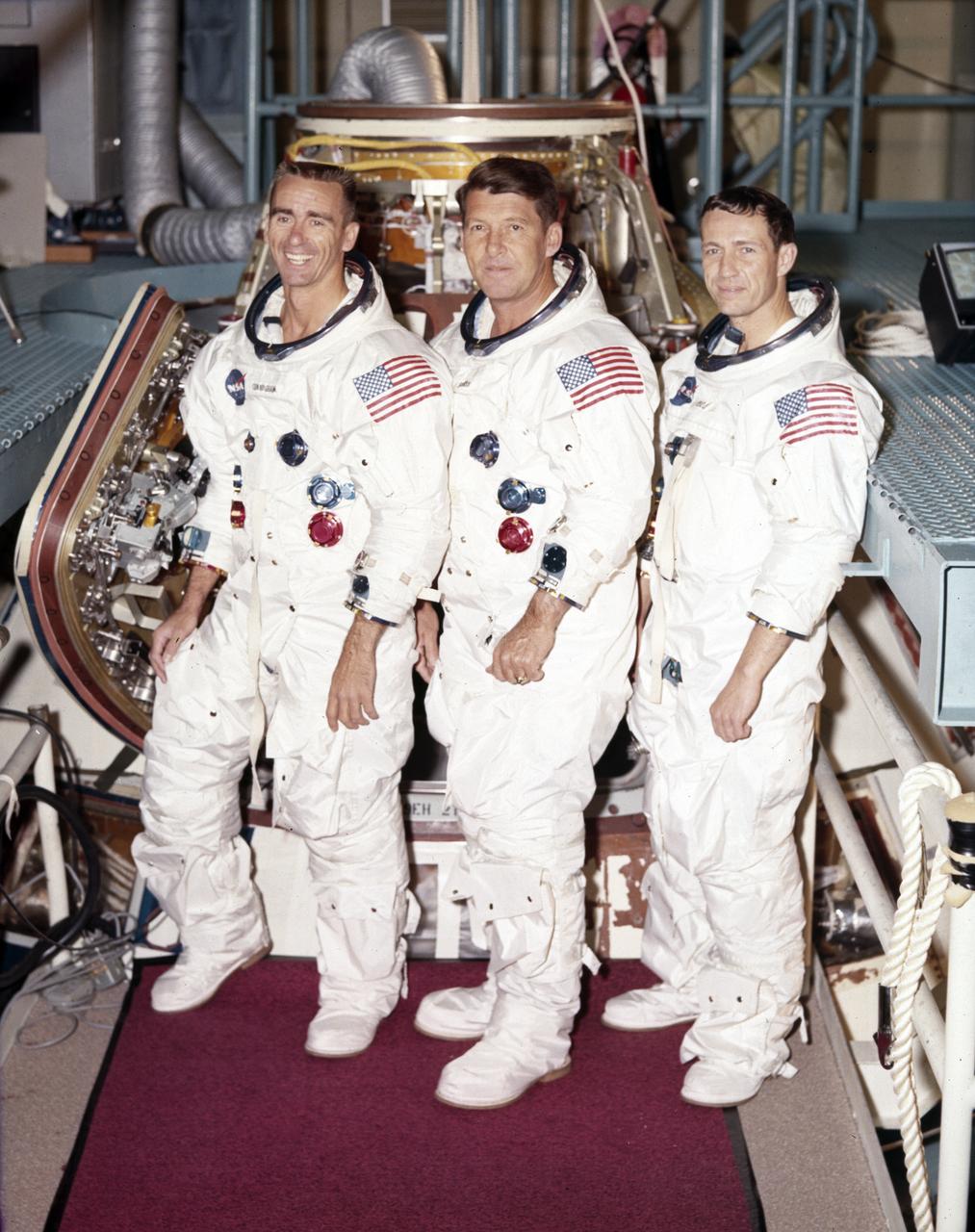
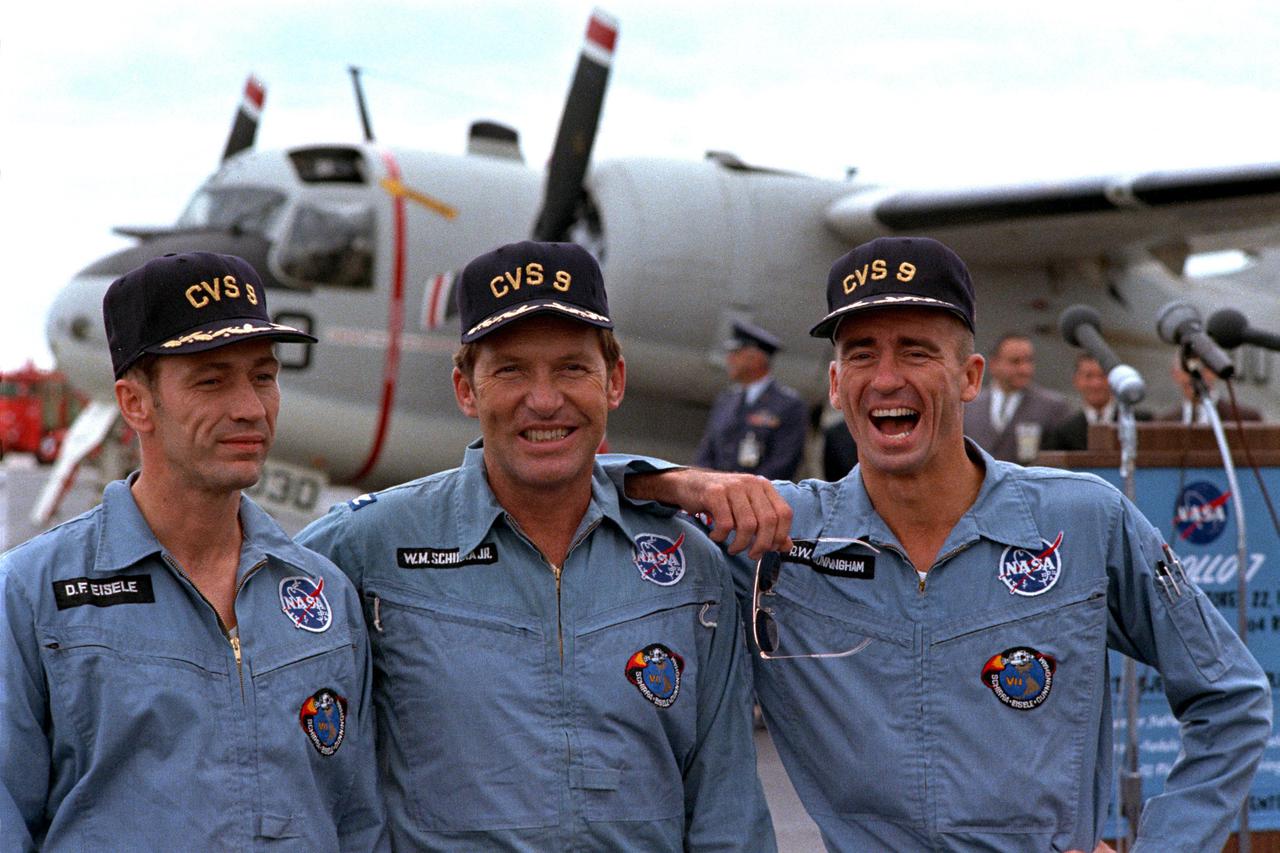
S68-33744 (22 May 1968) --- The prime crew of the first manned Apollo space mission, Apollo 7 (Spacecraft 101/Saturn 205), left to right, are astronauts Donn F. Eisele, command module pilot, Walter M. Schirra Jr., commander; and Walter Cunningham, lunar module pilot.
PORTRAIT - APOLLO 7 - PRIME CREW - KSC
S68-42343 (5 Aug. 1968) --- The prime crew of the first manned Apollo space mission, Apollo 7, stands on the deck of the NASA Motor Vessel Retriever after suiting up for water egress training in the Gulf of Mexico. Left to right, are astronauts Walter Cunningham, Donn F. Eisele, and Walter M. Schirra Jr.
Helicopter - Aircraft
KENNEDY SPACE CENTER, FLA. -- More than 600 accredited newsmen at Press Site #2 covered this morning's launch of Apollo 7, carying astronauts Walter M. Schirra Jr., Donn F. Eisele and Walter Cunningham from Launch Complex 34.
KSC-68pc-179
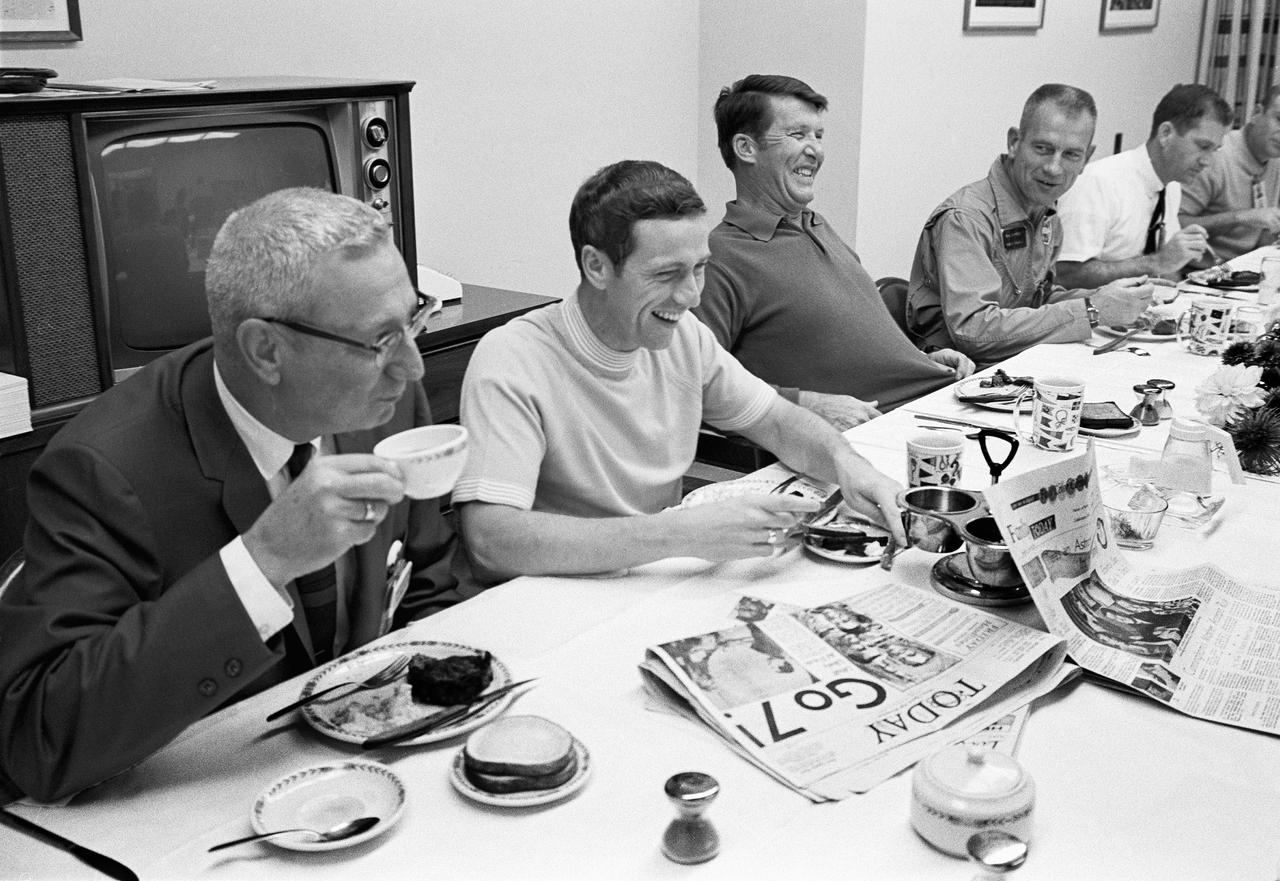
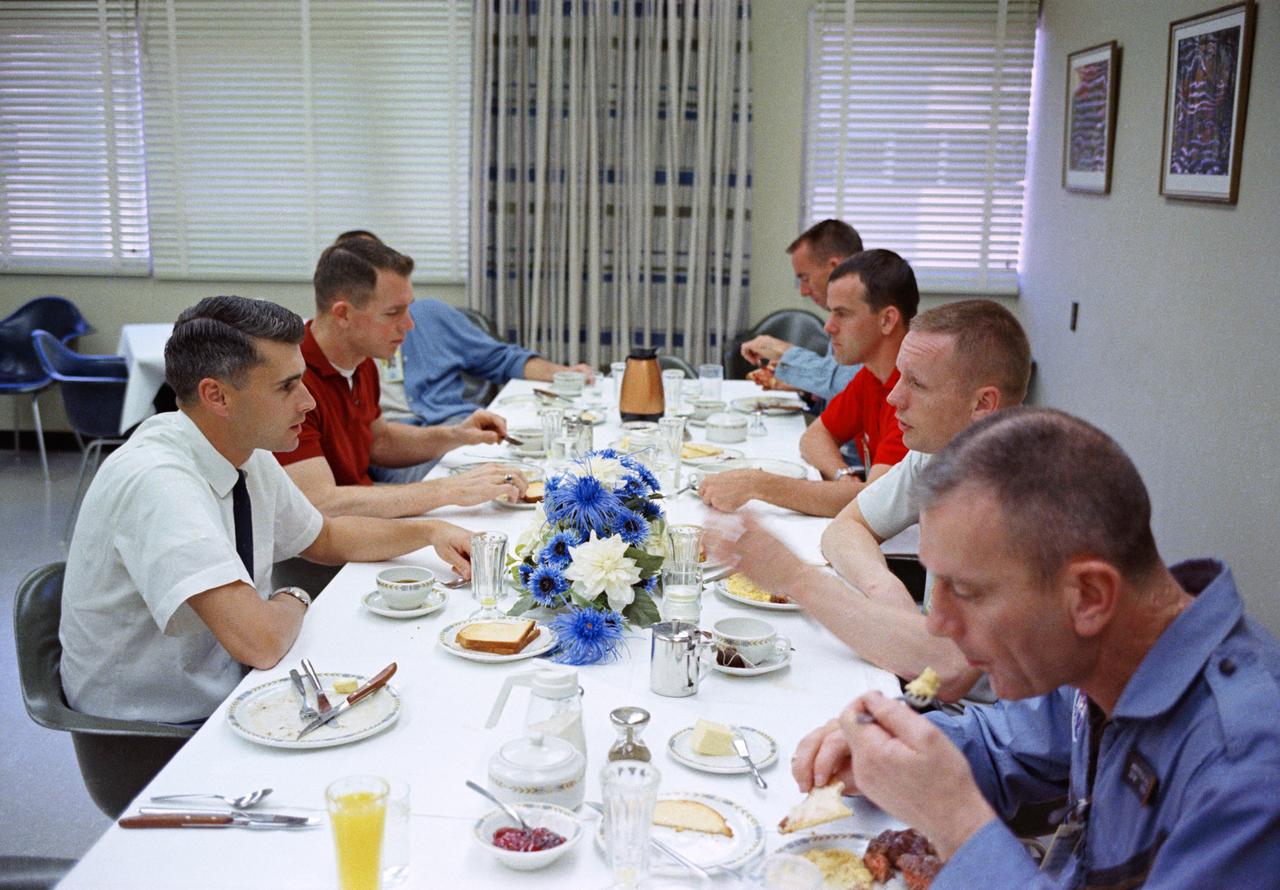
CAPE CANAVERAL, Fla. -- Two of the three Apollo 7 astronauts breakfast with National Aeronautics and Space Administration officials at KSC prior to their Earth orbital mission with astronaut Walter Cunningham, not shown.  Photo credit: NASA
108-KSC-68P-0407
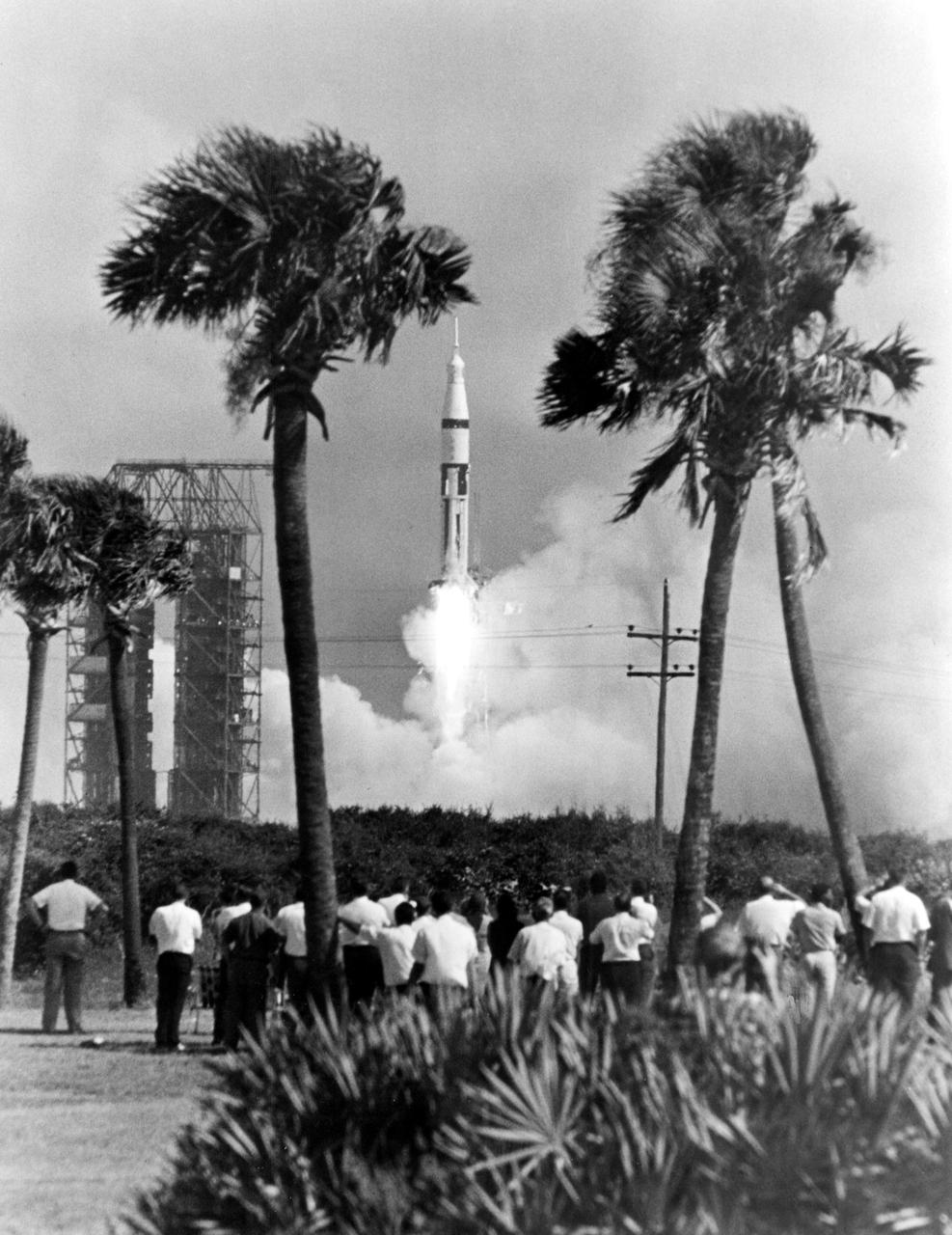
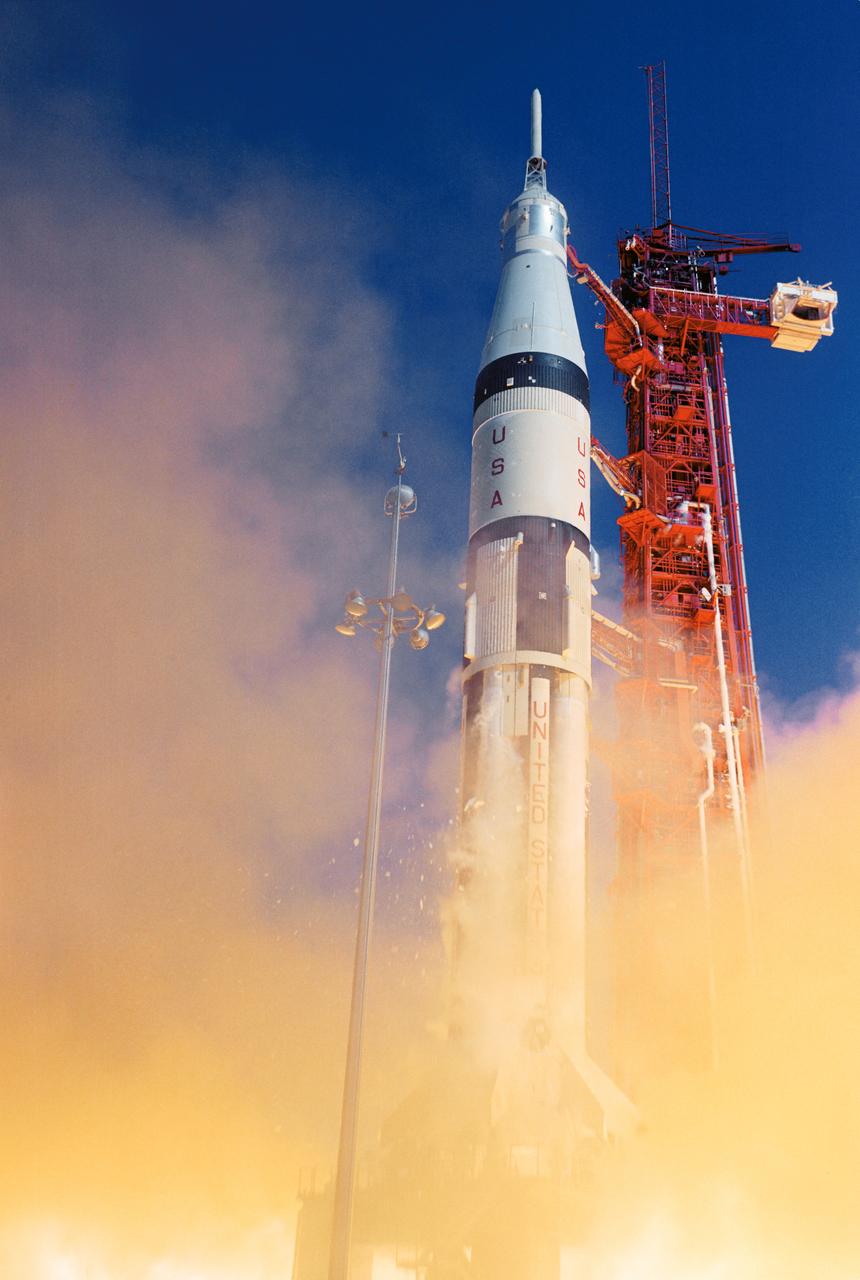
KENNEDY SPACE CENTER, FLA. --  Workers at Cape Kennedy watched a 224-foot-high Saturn 1B space vehicle lift off today from Complex 34 carrying Apollo 7 astronauts Walter M. Schirra Jr., Donn F. Eisele and Walter Cunningham at the start of their scheduled 11-day Earth orbital flight.
KSC-68p-416
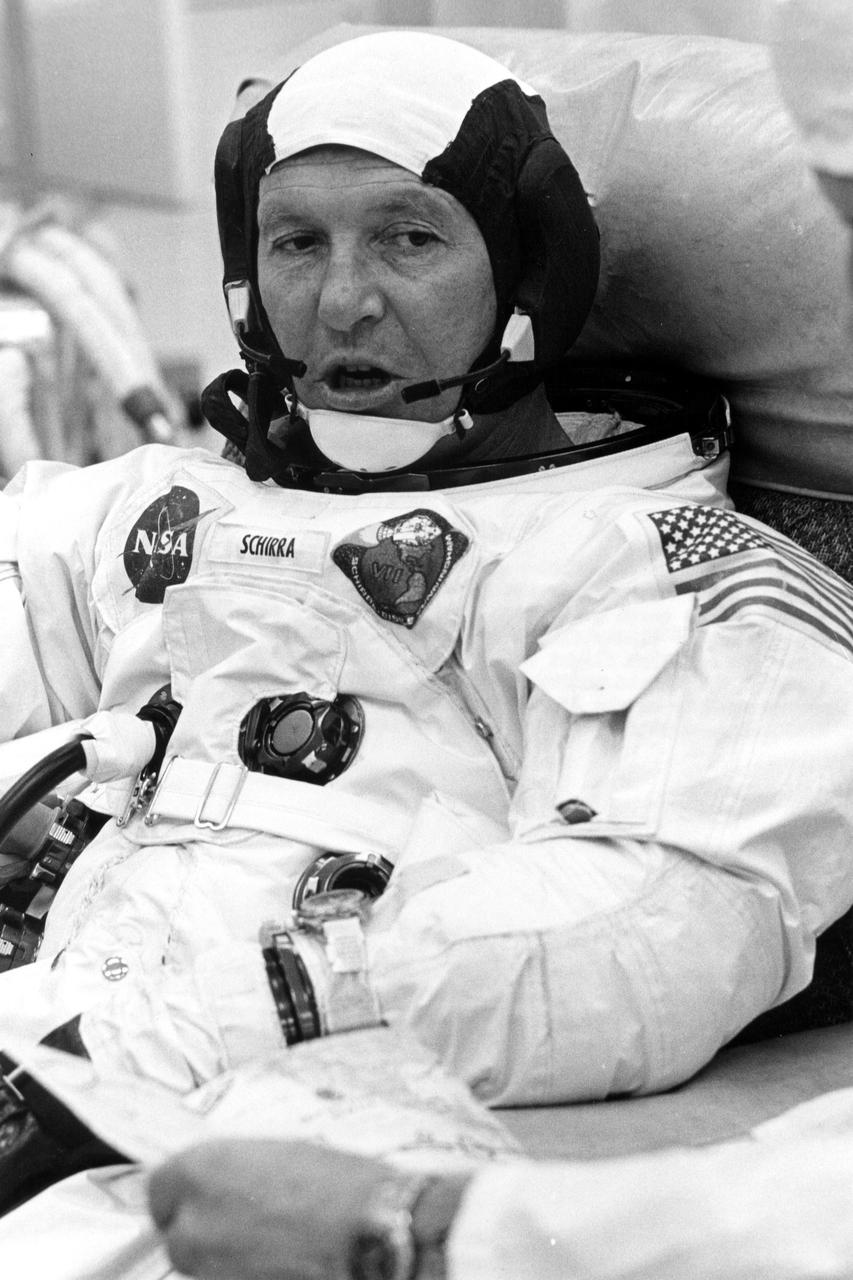
KENNEDY SPACE CENTER, FLA. -- Astsronaut Walter M. Schirra Jr. relaxes prior to boarding the Apollo 7 spacecraft, which rocketed into Earth orbit from Cape Kennedy this morning.  Purpose of the 11-day flight is to qualify the Apollo spacecraft for a future flight to the moon.  Other Apollo 7 pilots are Donn Eisele and Walter Cunningham.  This is the first manned mission of the Apollo series.  It is conducted by the National Aeronautics and Space Administration.
KSC-68P-423
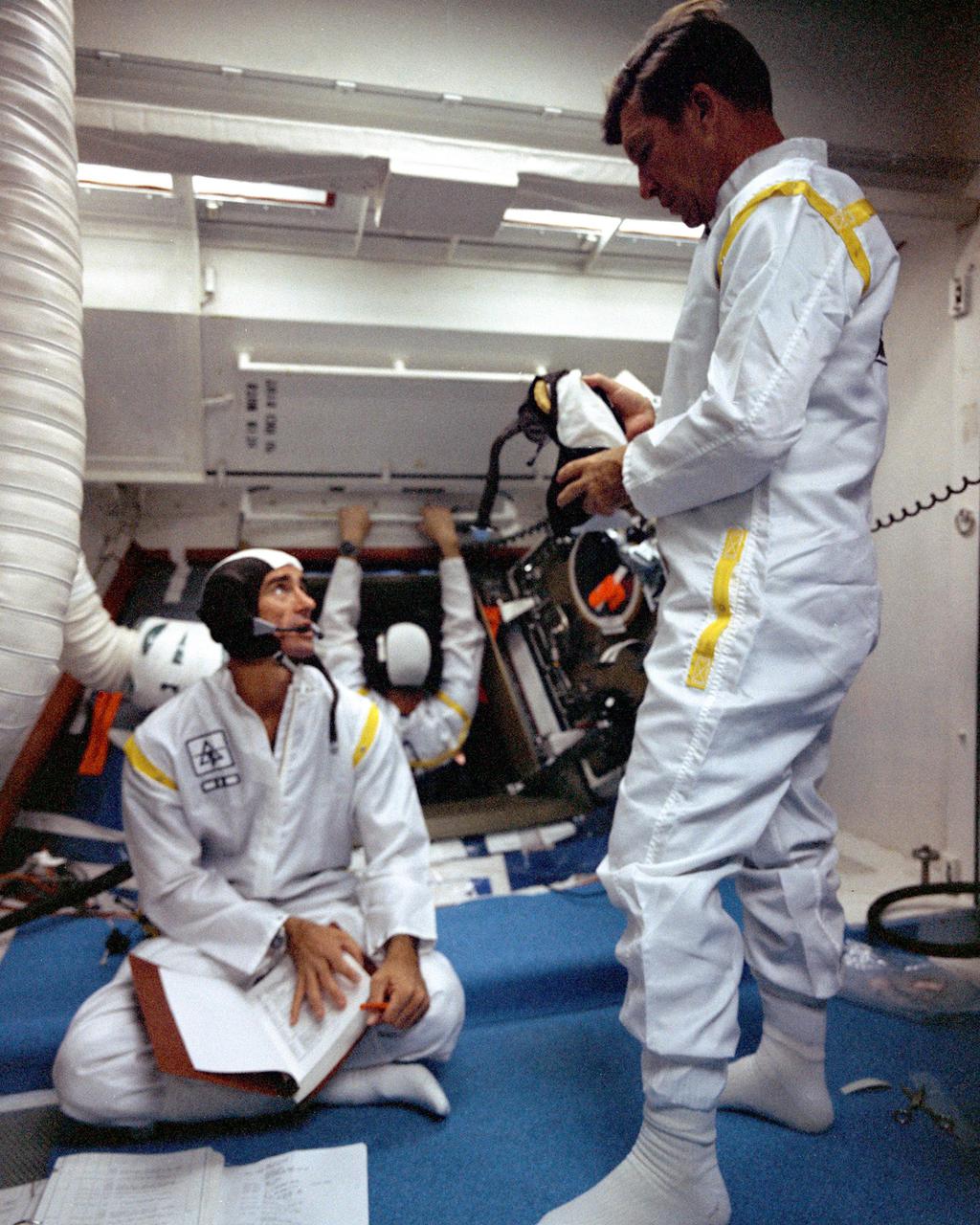
KENNEDY SPACE CENTER, FLA. - Apollo 7 Command Module Pilot Donn F. Eisele enters the spacecraft at Pad 34 while fellow crew members, Commander Walter M. Schirra Jr., left, and Lunar Module Pilot Walter Cunningham hold a brief discussion before they repeat that portion of the Plugs-Out test at the pad.  The tests are being conducted in preparation for the scheduled launch of Apollo 7, the first manned lunar orbital mission.
KSC-68pc-0116
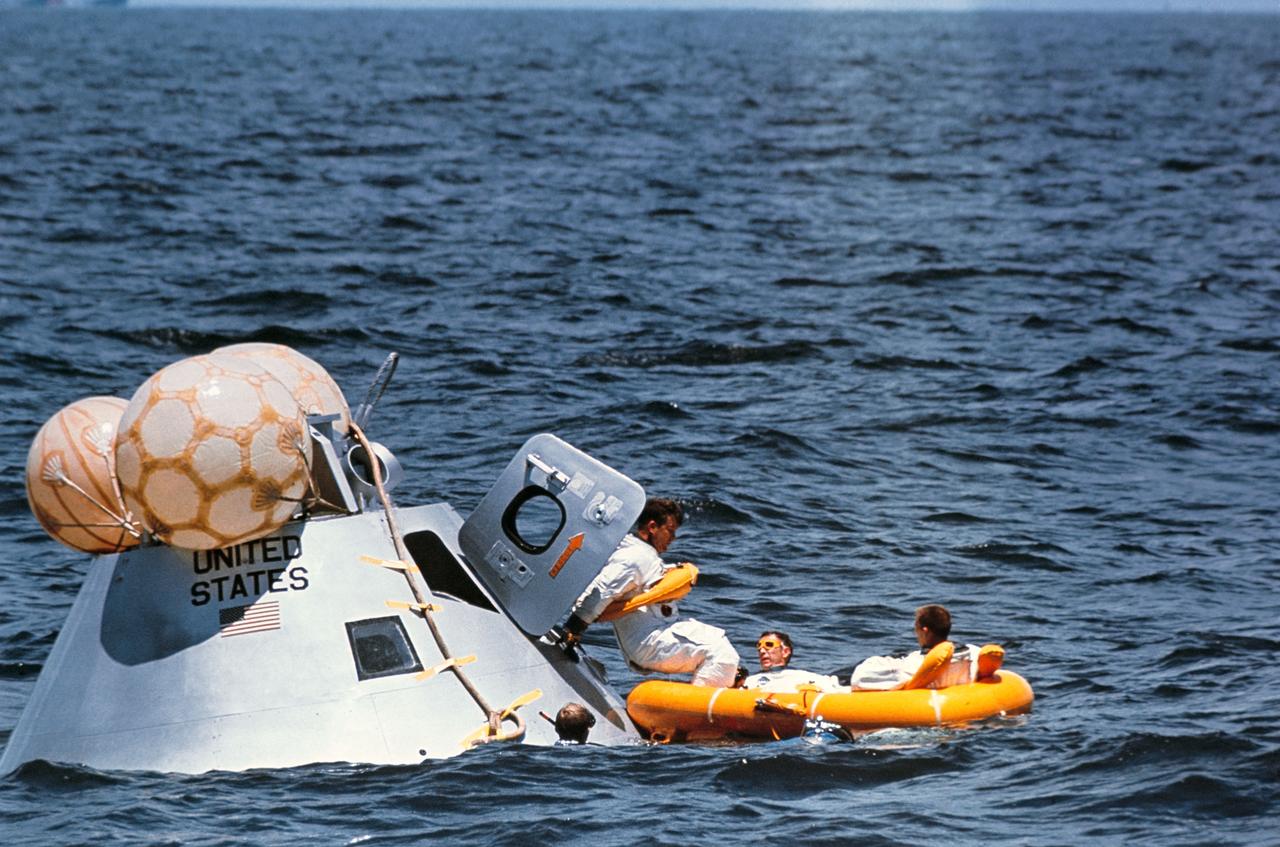
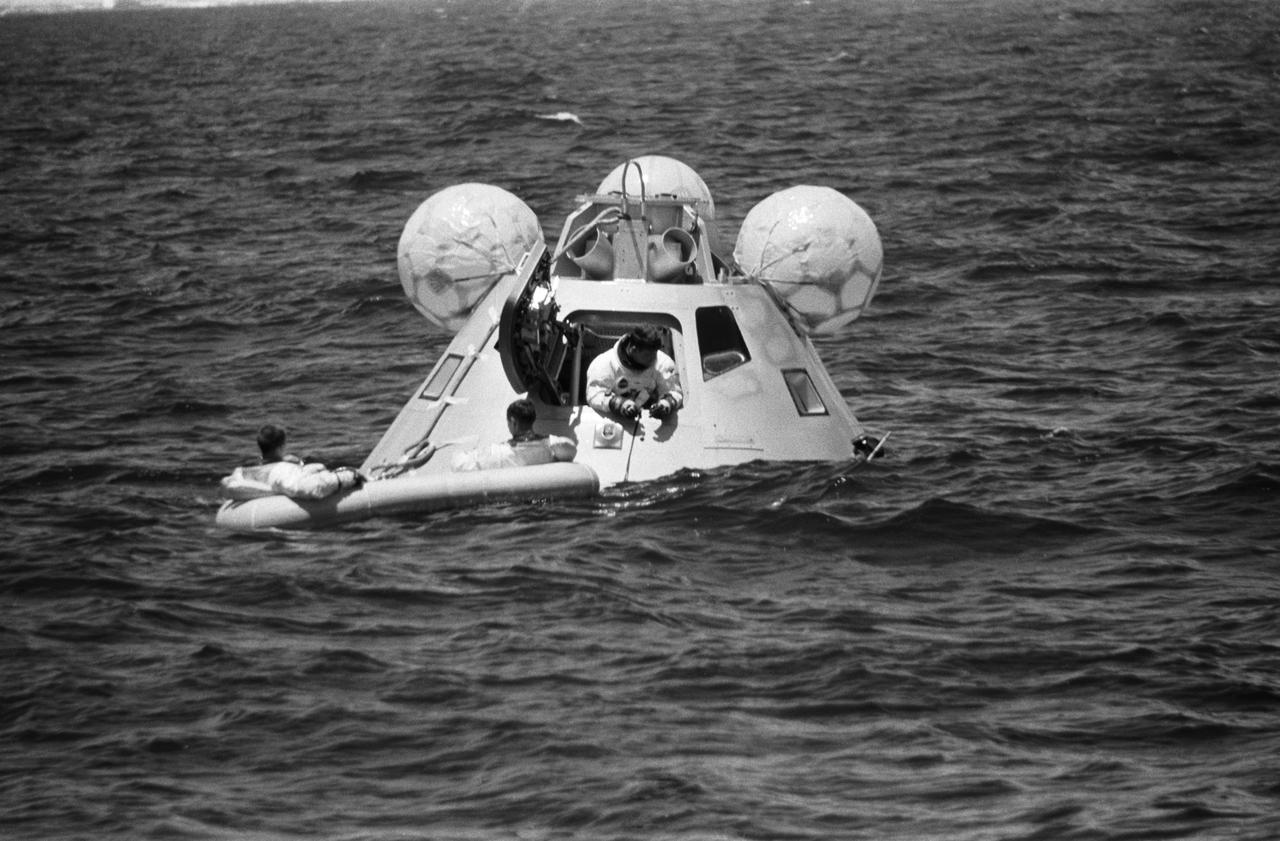
S68-46605 (5 Aug. 1968) --- The prime crew of the first manned Apollo mission (Spacecraft 101/Saturn 205) participates in water egress training in the Gulf of Mexico. Left to right, are astronauts Walter M. Schirra Jr. (stepping into life raft), Donn F. Eisele, and Walter Cunningham. They have just egressed Apollo Command Module Boilerplate 1102, and are awaiting helicopter pickup. Inflated bags were used to upright the boilerplate. MSC swimmers assisted in the training exercise.
Apollo 7 prime crew during water egress training in Gulf of Mexico
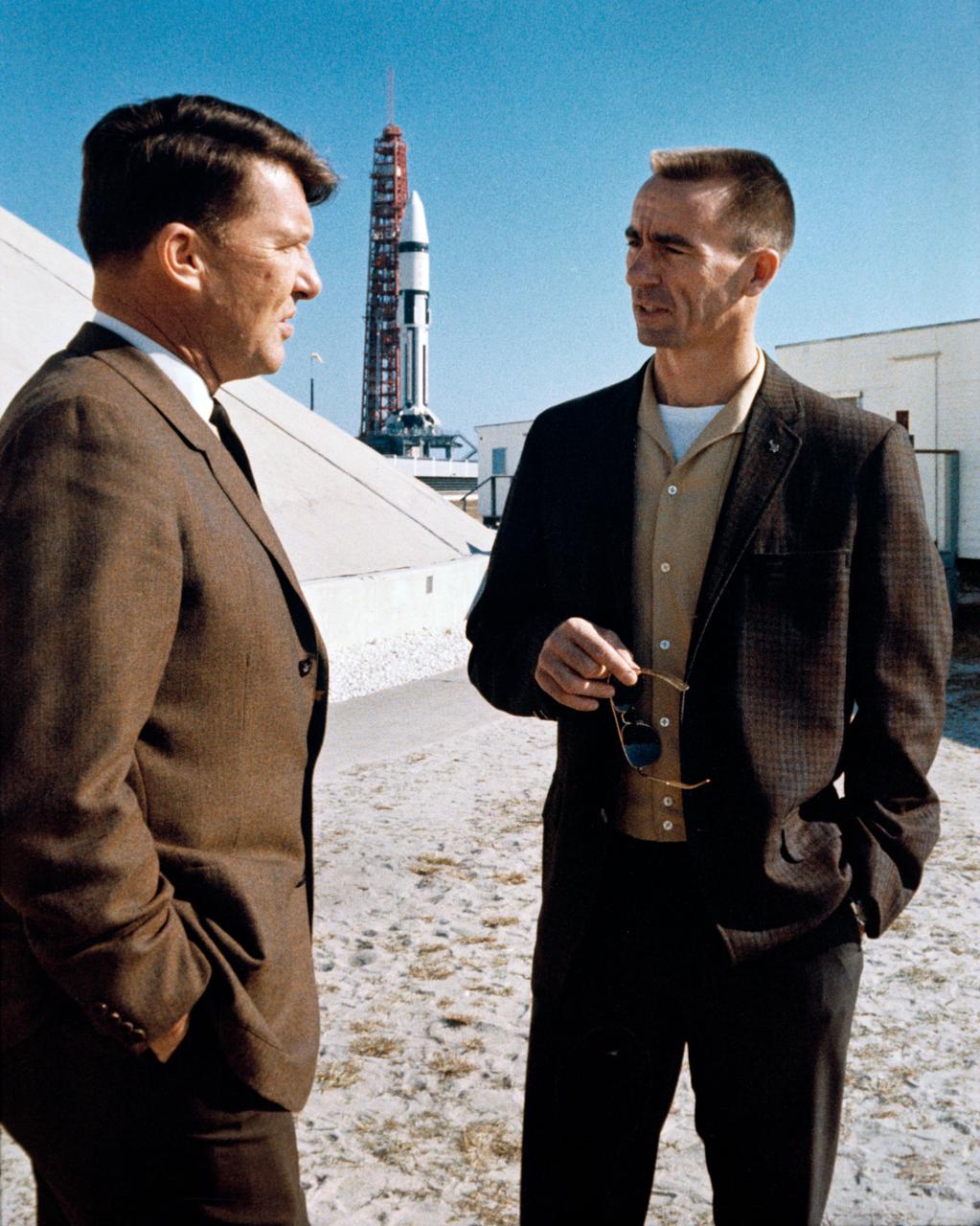
S68-18700 (22 Jan. 1968) --- Two prime crew members of the first manned Apollo space flight were present at Cape Kennedy for the launch of the Apollo V (LM-1/Saturn 204) unmanned space mission. On left is astronaut Walter M. Schirra Jr.; and on right is astronaut R. Walter Cunningham. In background is the Apollo V stack at Launch Complex 37 ready for launch.
Crew Members - First Manned Apollo Flight - Unmanned Mission Launch - Cape
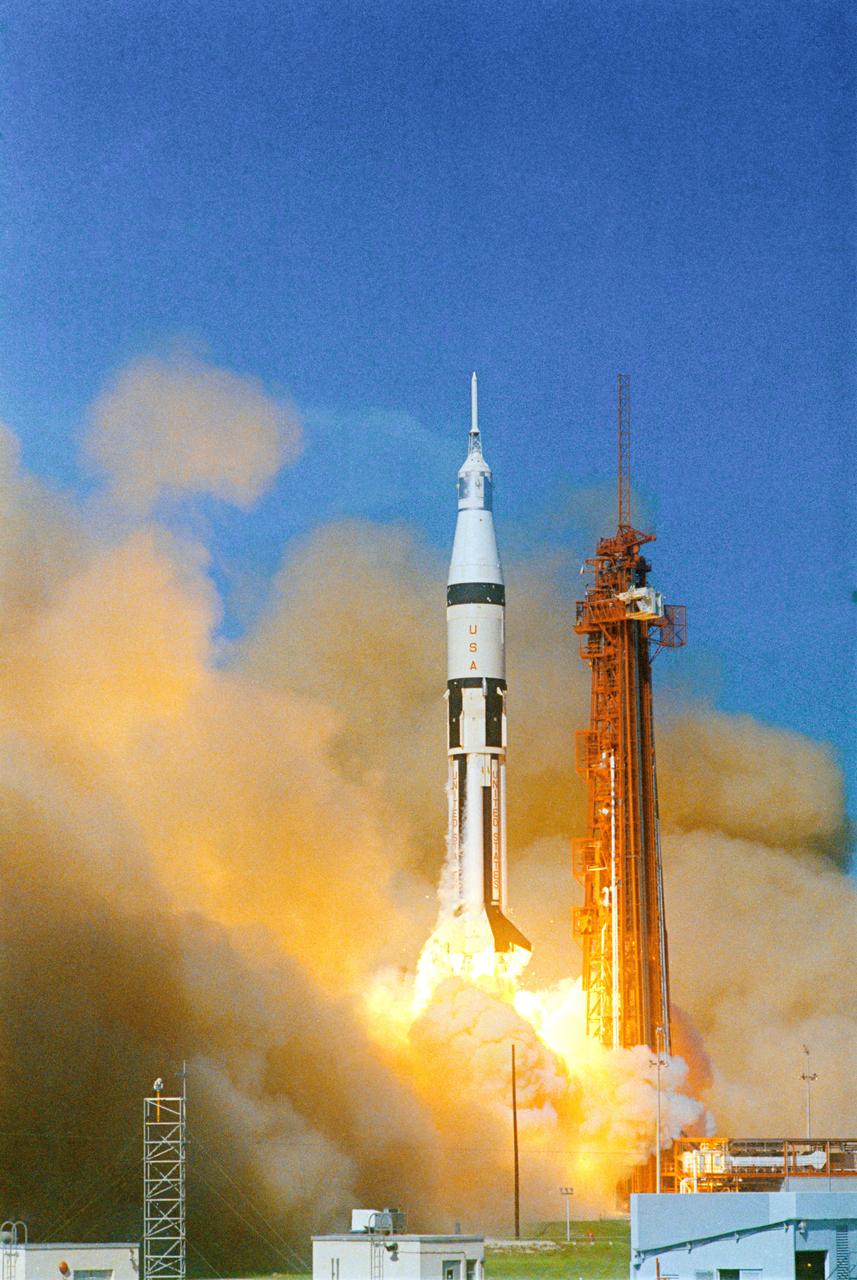
AS-205, the fifth Saturn IB launch vehicle developed by the Marshall Space Flight Center (MSFC), lifts off from Cape Canaveral, Florida on the first marned Apollo-Saturn mission, Apollo 7. Primary mission objectives included demonstration of the Apollo crew (Walter Schirra, Don Eisele, and Walter Cunningham) capabilities and the Command/Service Module rendezvous capability. In all, nine Saturn IB flights were made, ending with the Apollo-Soyuz Test Project in July 1975.
Saturn Apollo Program
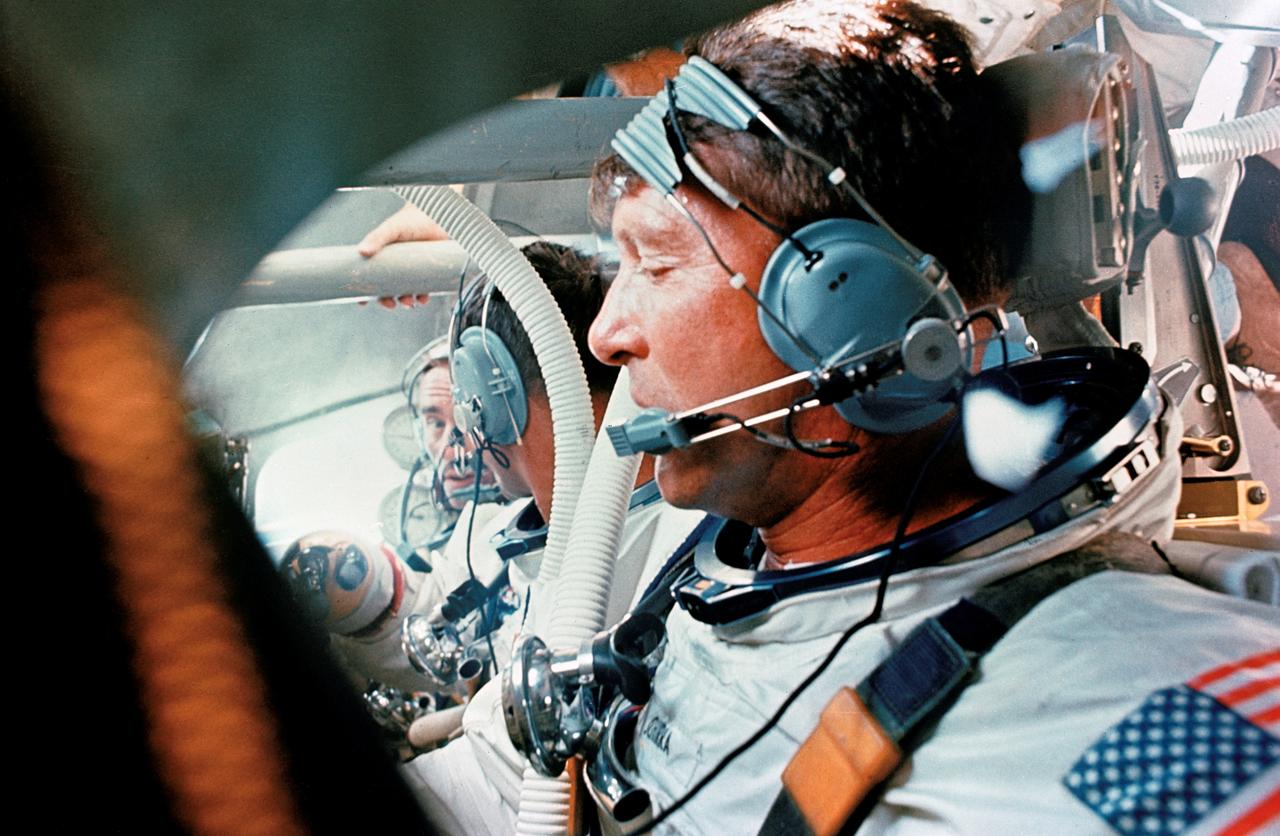
S68-46604 (5 Aug. 1968) --- The prime crew of the first manned Apollo mission (Spacecraft 101/Saturn 205) is seen in Apollo Command Module Boilerplate 1102 during water egress training in the Gulf of Mexico. In foreground is astronaut Walter M. Schirra Jr., in center is astronaut Donn F. Eisele, and in background is astronaut Walter Cunningham.
Apollo 7 prime crew during water egress training in Gulf of Mexico
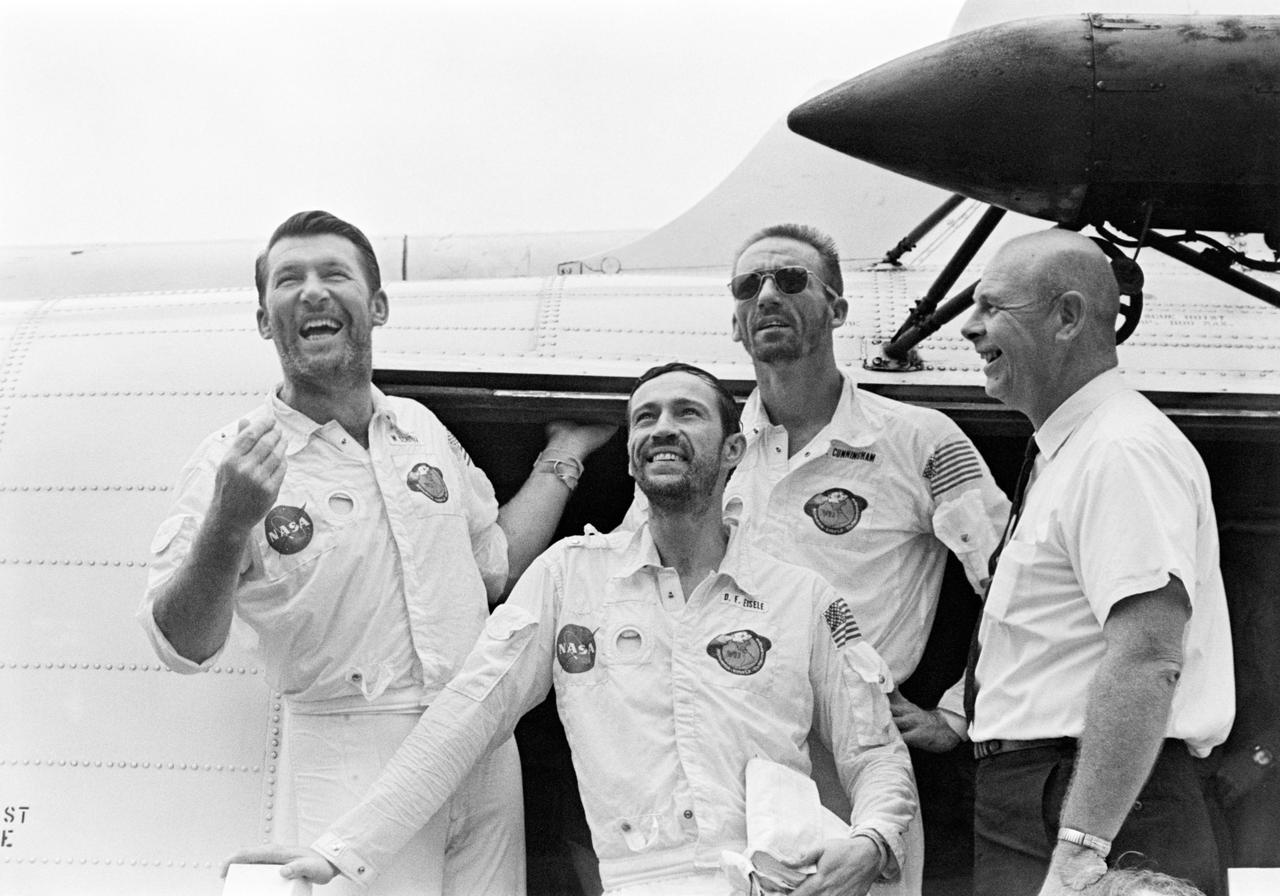
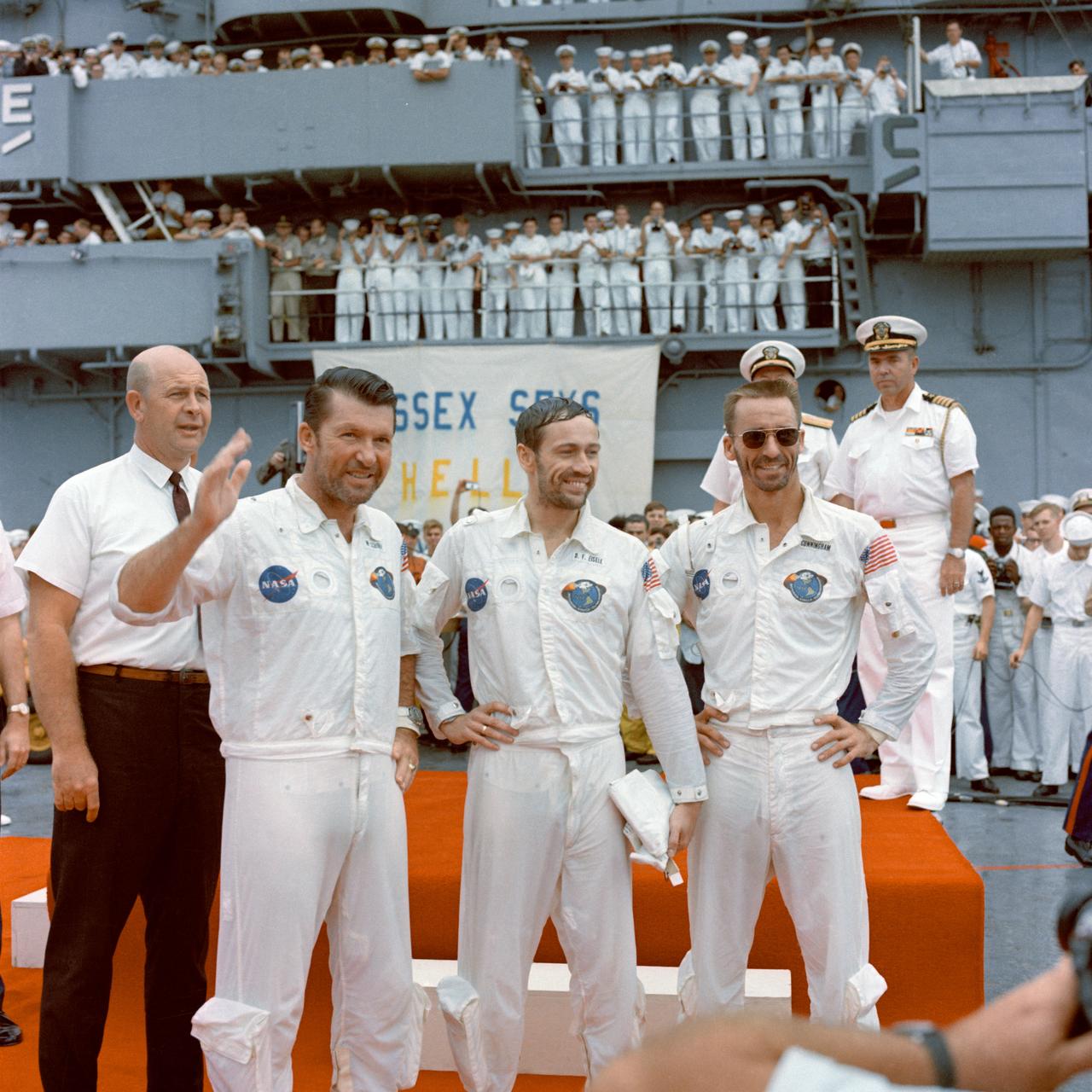
S68-52542 (22 Oct. 1968) --- The Apollo 7 crew arrives aboard the USS Essex, the prime recovery ship for the mission. Left to right, are astronauts Walter M. Schirra Jr., commander; Donn F. Eisele, command module pilot; Walter Cunningham, lunar module pilot; and Dr. Donald E. Stullken, NASA Recovery Team Leader from the Manned Spacecraft Center's (MSC) Landing and Recovery Division. The crew is pausing in the doorway of the recovery helicopter.
Apollo 7 crew post-flight
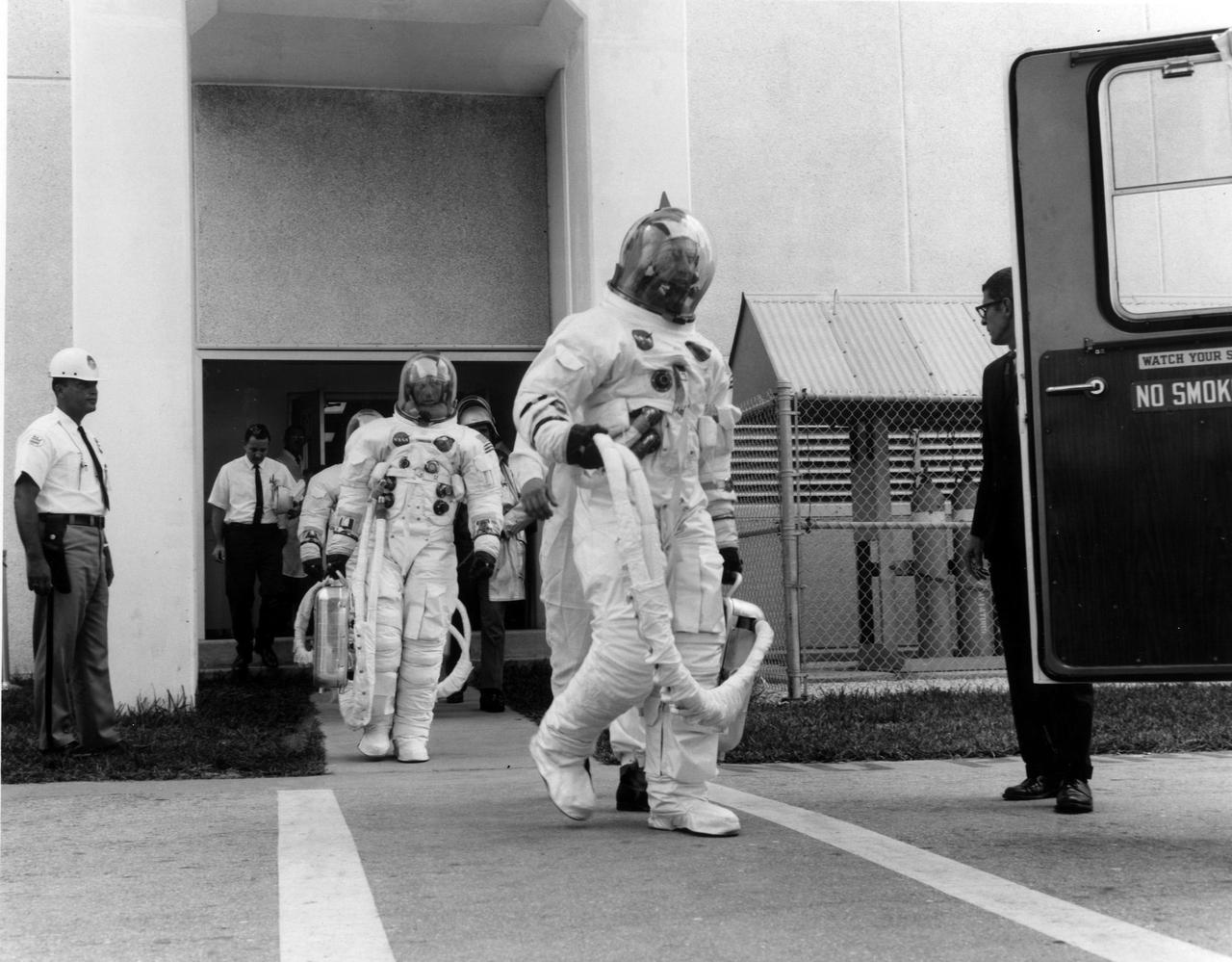
KENNEDY SPACE CENTER, FLA. -- Apollo 7 prime crew members, front to back, Donn F. Eisele, Walter M. Schirra Jr. and Walter Cunningham, leave the Kennedy Space Center's Manned Spacecraft Operations Building for a 20-minute ride in a transfer van to Cape Kennedy's Launch Complex 34, where they participated in a Space Vehicle Emergency Egress Test.  The trio will pilot the National Aeronautics and Space Administration's first manned Apollo mission.
KSC-68P-332
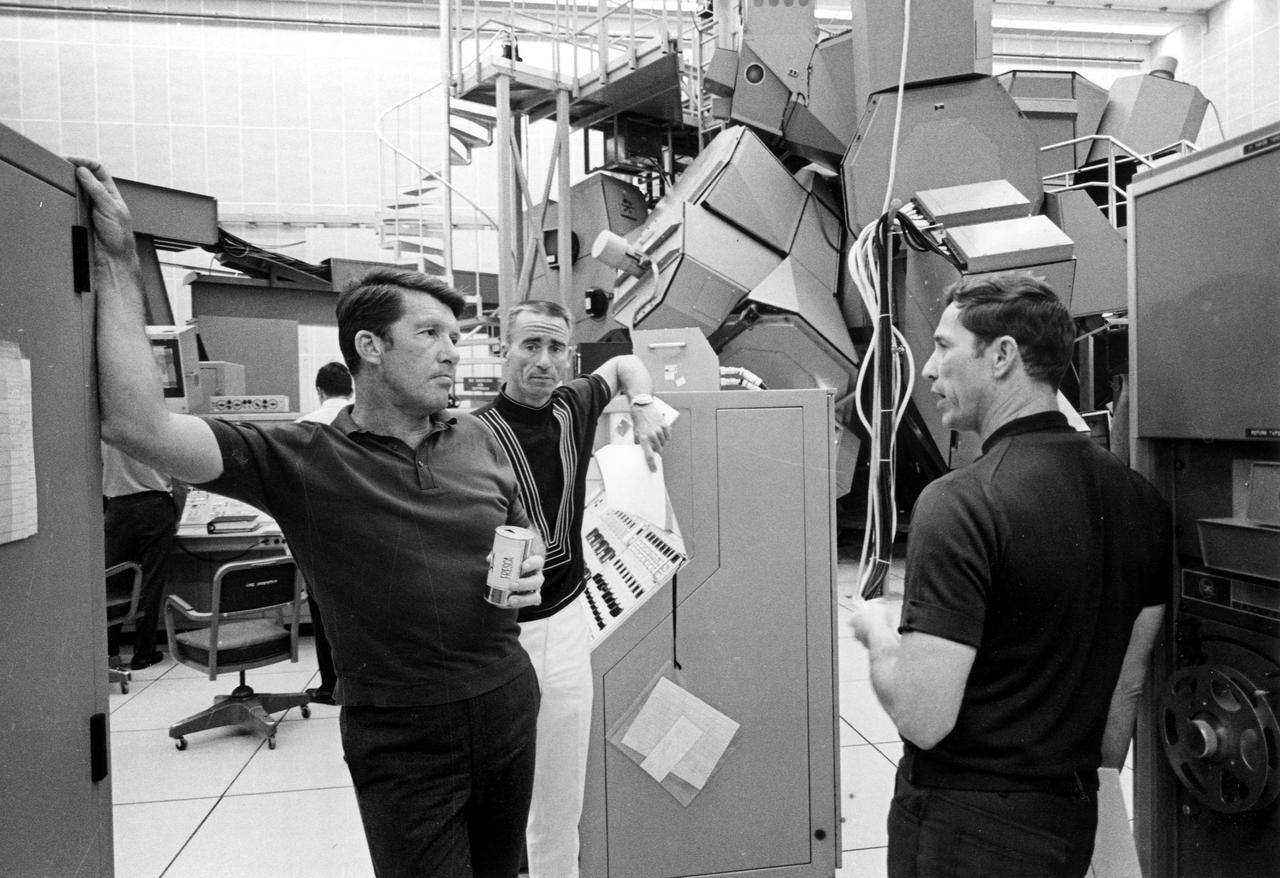
KENNEDY SPACE CENTER, FLA. --  Apollo 7 astronauts, left to right, Walter Schirra, Walter Cunningham and Donn Eisele pause during a practice mission yesterday within Kennedy Space Center's Flight Crew Training Building.  The trio spent several hours in the Apollo mission simulator, rear, in preparation for their upcoming mission.  The National Aeronautics and Space Administration's first manned Apollo flight is scheduled to begin no earlier than Oct. 11, 1968.
KSC-68P-390
Apollo 7 lifts off from Cape Kennedy Launch Complex 34 at 11:03 A.M., EDT.  The astronauts aboard, for the first manned lunar orbital mission, are Astronauts Walter M. Schirra,Jr. Commander; Donn F. Eisele, Command Module Pilot; and Walter Cunningham, Lunar Module Pilot.  Original photo number was KSC-68PC-185.
Apollo 7 Launch
S68-49744 (22 Oct. 1968) --- The Apollo 7 crew is welcomed aboard the USS Essex, the prime recovery ship for the mission. Left to right, are astronauts Walter M. Schirra Jr., commander; Donn F. Eisele, command module pilot; and Walter Cunningham, lunar module pilot. In left background is Dr. Donald E. Stullken, NASA Recovery Team Leader from the Manned Spacecraft Center's (MSC) Landing and Recovery Division.
Apollo 7 crew arrives aboard recovery ship, U.S.S. Essex
KENNEDY SPACE CENTER, FLA. -- Astronaut Donn F. Eisele adjusts communications carrier prior to the start of an 11-day Earth orbital mission in the Apollo 7 spacecraft.  The communications carrier contains microphones and earphones.  Flying with Eisele aboard Apollo 7 are astronauts  Walter M. Schirra Jr. and Walter Cunningham.  Purpose of the flight, conducted by the National Aeronautics and Space Administration, is to qualify the Apollo spacecraft for a future flight to the moon.
KSC-68P-419
S68-50713 (14 Oct. 1968) --- Astronauts Walter M. Schirra Jr. (on right), mission commander; and Donn F. Eisele, command module pilot; are seen in the first live television transmission from space. Schirra is holding a sign which reads, "Keep those cards and letters coming in, folks!" Out of view at left is astronaut Walter Cunningham, lunar module pilot.
INFLIGHT - APOLLO 7 (CREW ACTIVITIES)
S68-42197 (5 Aug. 1968) --- The prime crew of the first manned Apollo space mission, Apollo 7, participates in water egress training in the Gulf of Mexico. In hatch of the Apollo egress trainer (command module) is astronaut Walter M. Schirra Jr. Sitting in life raft are astronauts Walter Cunningham (on left) and Donn F. Eisele. A team of MSC swimmers assisted with the training exercise. The inflated bags were used to upright the trainer prior to egress.
Apollo 7 prime crew during water egress training in Gulf of Mexico
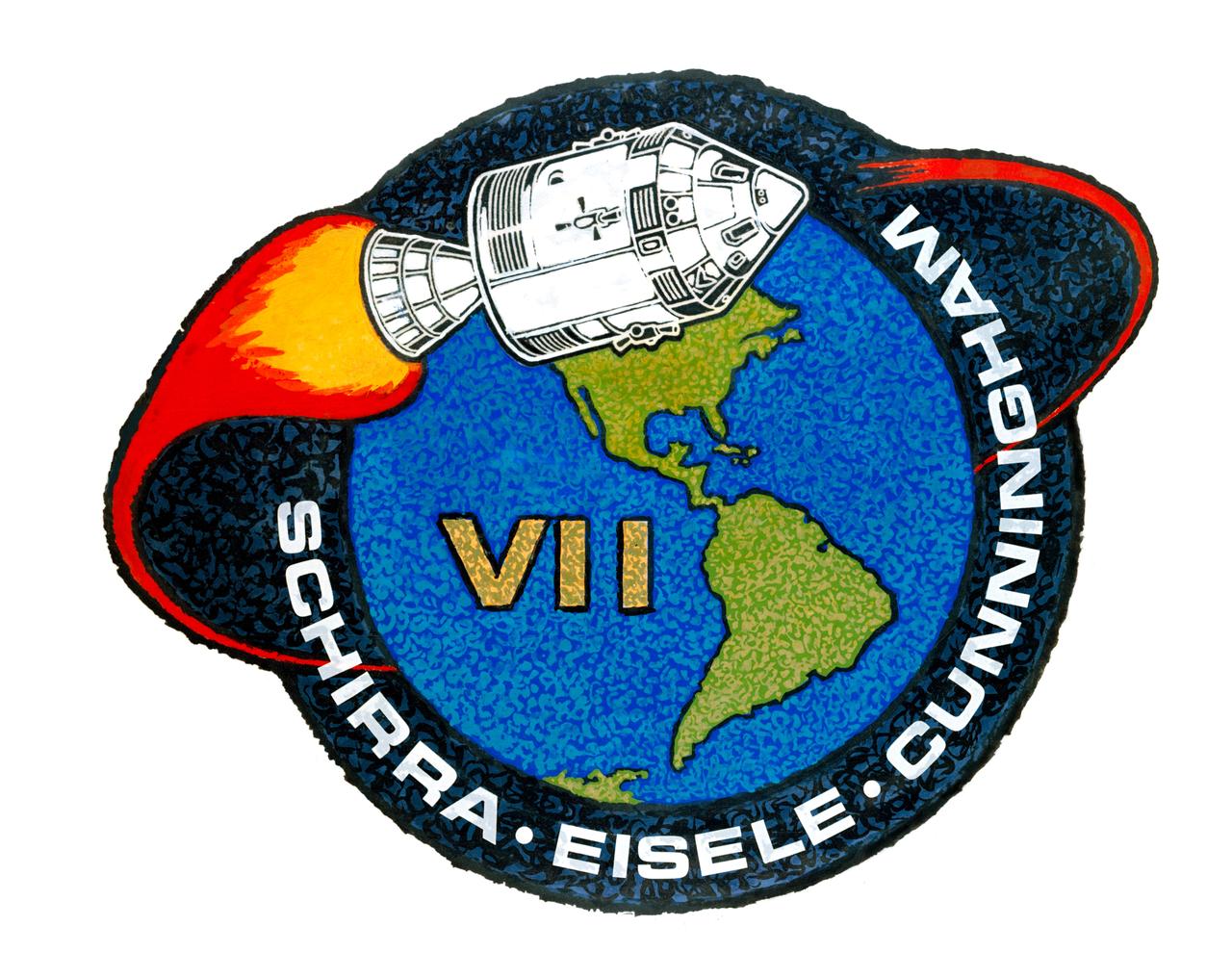
S68-26668 (June 1968) --- The official emblem of Apollo 7, the first manned Apollo space mission. The crew will consist of astronauts Walter M. Schirra Jr., Donn F. Eisele, and Walter Cunningham.     The NASA insignia design for Apollo flights is reserved for use by the astronauts and for the official use as the NASA Administrator may authorize. Public availability has been approved only in the form of illustrations by the various news media. When and if there is any change in this policy, which we do not anticipate, it will be publicly announced.
Official Emblem - Apollo 7 - First (1st) Manned Apollo Space Mission
Pictured left to right, in the Apollo 7 Crew Portrait, are astronauts R. Walter Cunningham, Lunar Module pilot; Walter M. Schirra, Jr., commander; and Donn F. Eisele, Command Module Pilot. The Apollo 7 mission, boosted by a Saturn IB launch vehicle on October 11, 1968, was the first manned flight of the Apollo spacecraft.
Saturn Apollo Program
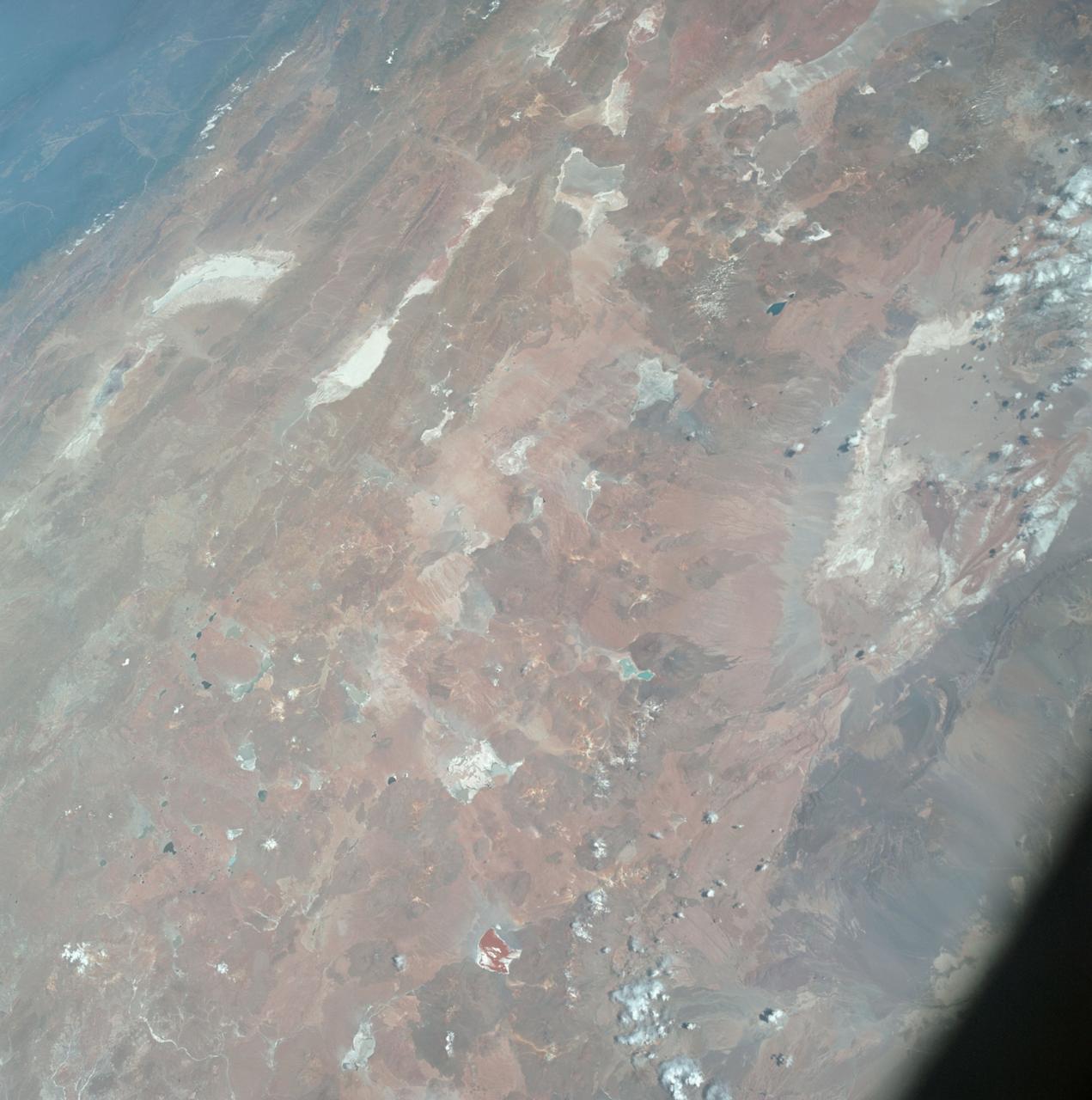
AS07-04-1593 (21 Oct. 1968) --- This Earth observation photograph shows Argentina, Chile, Bolivia, Salar de Atacama, the Andes Mountains, and Gran Chaco. The coordinates for the center of this photograph are 23.00 degrees south and 67.30 degrees west, taken at an altitude of 175 miles during the 154th revolution around Earth. The crew consisted of astronauts Walter M. Schirra, Donn F. Eisele and Walter Cunningham.
Northwestern Argentina as seen from the Apollo 7 spacecraft
KENNEDY SPACE CENTER, FLA. - The Apollo 7 astronauts, left to right, Donn F. Eisele, Walter M. Schirra Jr., and Walter Cunningham, after 12days and 4.5 million miles later, return to meet with the employees and management at Cape Kennedy.  On October 11, the three astronauts were launched aboard a Saturn 1B space vehicle from Launch Pad 34 for the first manned lunar orbital mission.
KSC-68pc-0211
Apollo 7 lifts off from Cape Kennedy Launch Complex 34 at 11:03 A.M., EDT.  The astronauts aboard, for the first manned lunar orbital mission, are Astronauts Walter M. Schirra,Jr. Commander; Donn F. Eisele, Command Module Pilot; and Walter Cunningham, Lunar Module Pilot.  Original photo number was KSC-68PC-182.
Apollo 7 Launch
S68-21590 (September 1968) --- This is a portrait of the Apollo-Saturn 7 crew members. They are, left to right, astronauts Walter M. Schirra Jr., commander; Walter Cunningham, lunar module pilot; and Donn F. Eisele, command module pilot.     EDITOR'S NOTE: Since this photograph was made astronaut Eisele died Dec. 2, 1987 in Tokyo, Japan, of a heart attack.
PORTRAIT - APOLLO 7
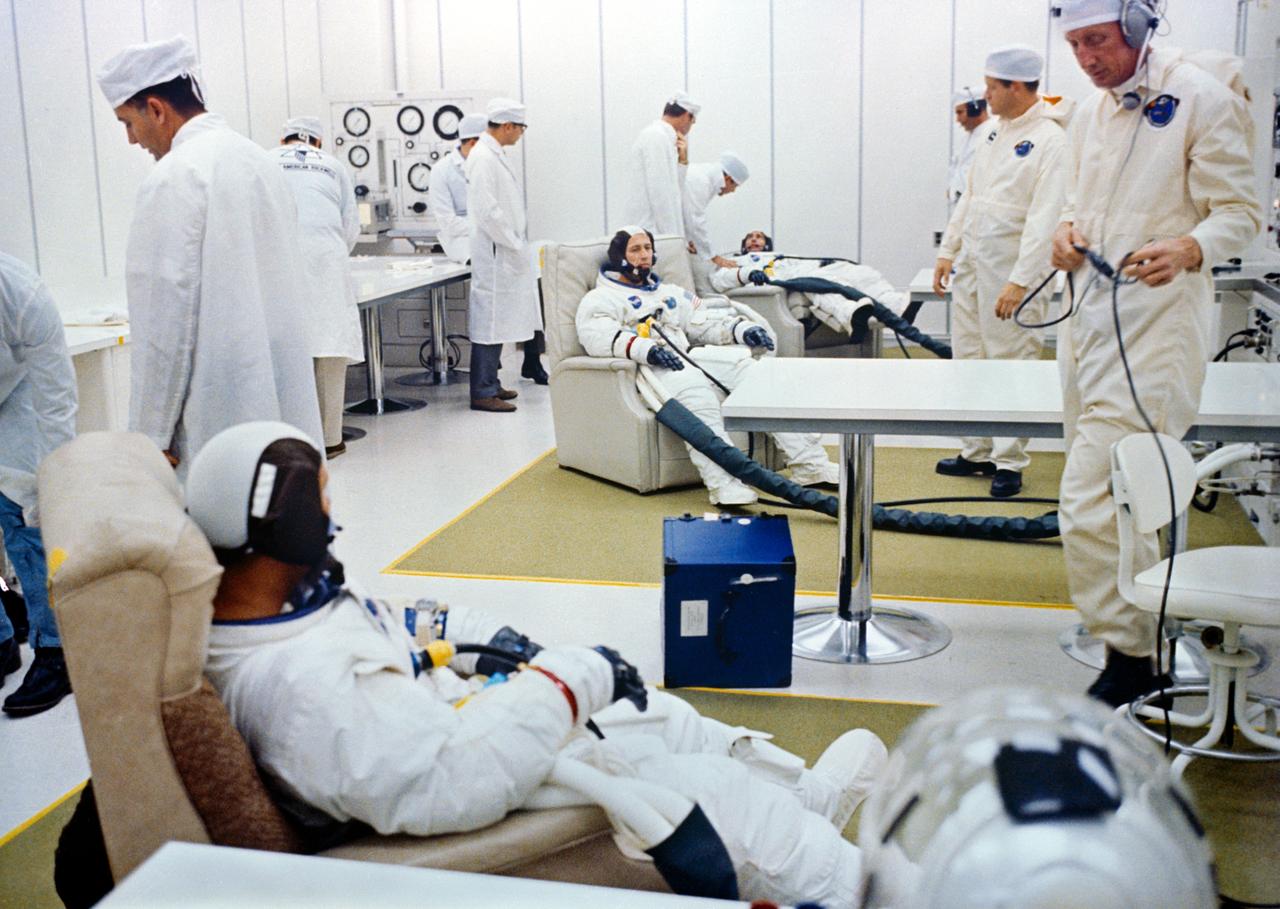
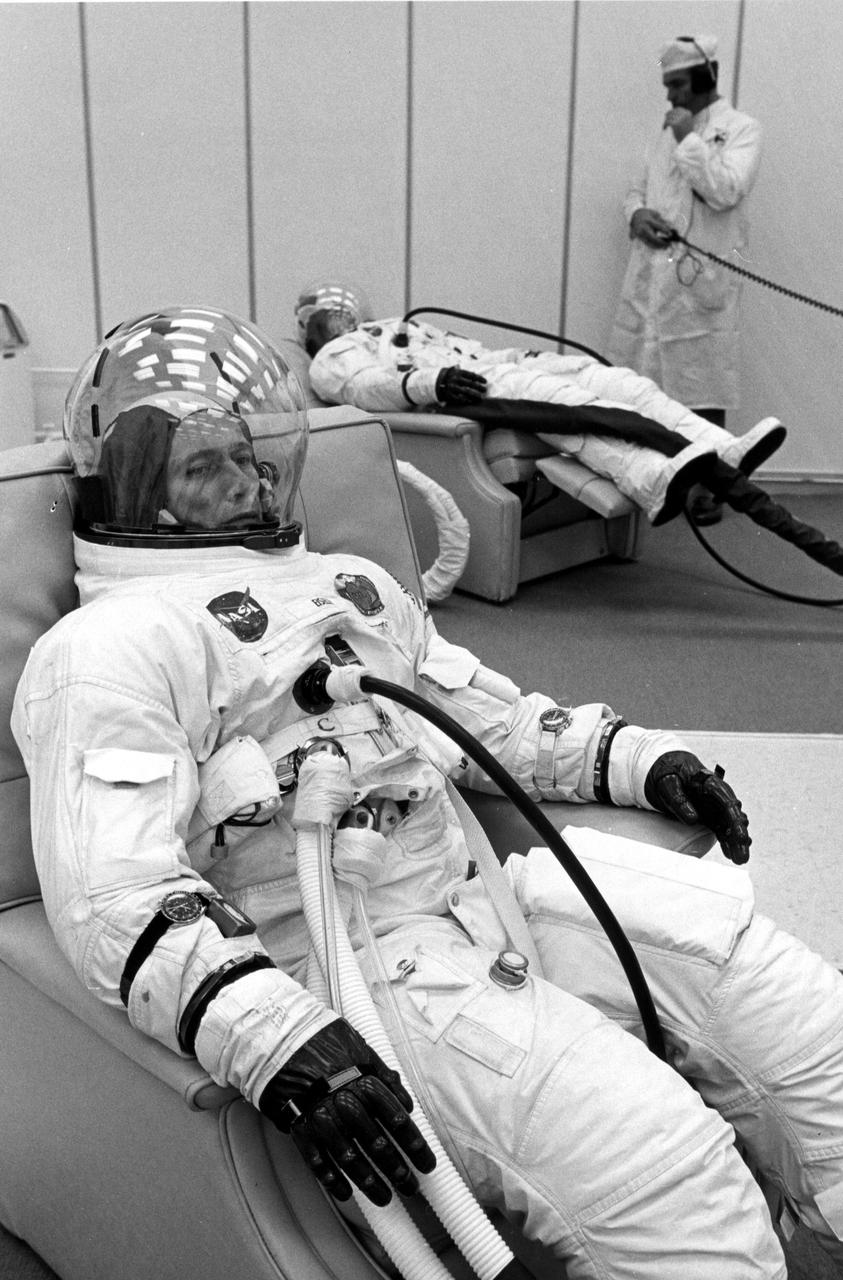
The Apollo 7 prime crew goes through suiting up operations in the Kennedy Space Center's Manned Spacecraft Operations Building during the Apollo 7 prelaunch countdown. From front to rear, are Astronauts Walter M. Schirra Jr., commander; Donn F. Eisele, command module pilot; and Walter Cunningham, lunar module pilot.
Apollo 7 prime crew goes through suiting up operations prior to launch
KENNEDY SPACE CENTER, FLA. - Spacesuit technician Clyde Teague adjusts the gloves on Apollo 7 Commander Walter M. Schirra Jr., during suiting operations.  Astronaut Schirra, along with Command Module Pilot Donn F. Eisele, and Lunar Module Pilot Walter Cunningham, after being suited up, will depart for Launch Pad 34 and board their Saturn 1B rocket for the first manned lunar orbital mission.  .
KSC-68pc-0169
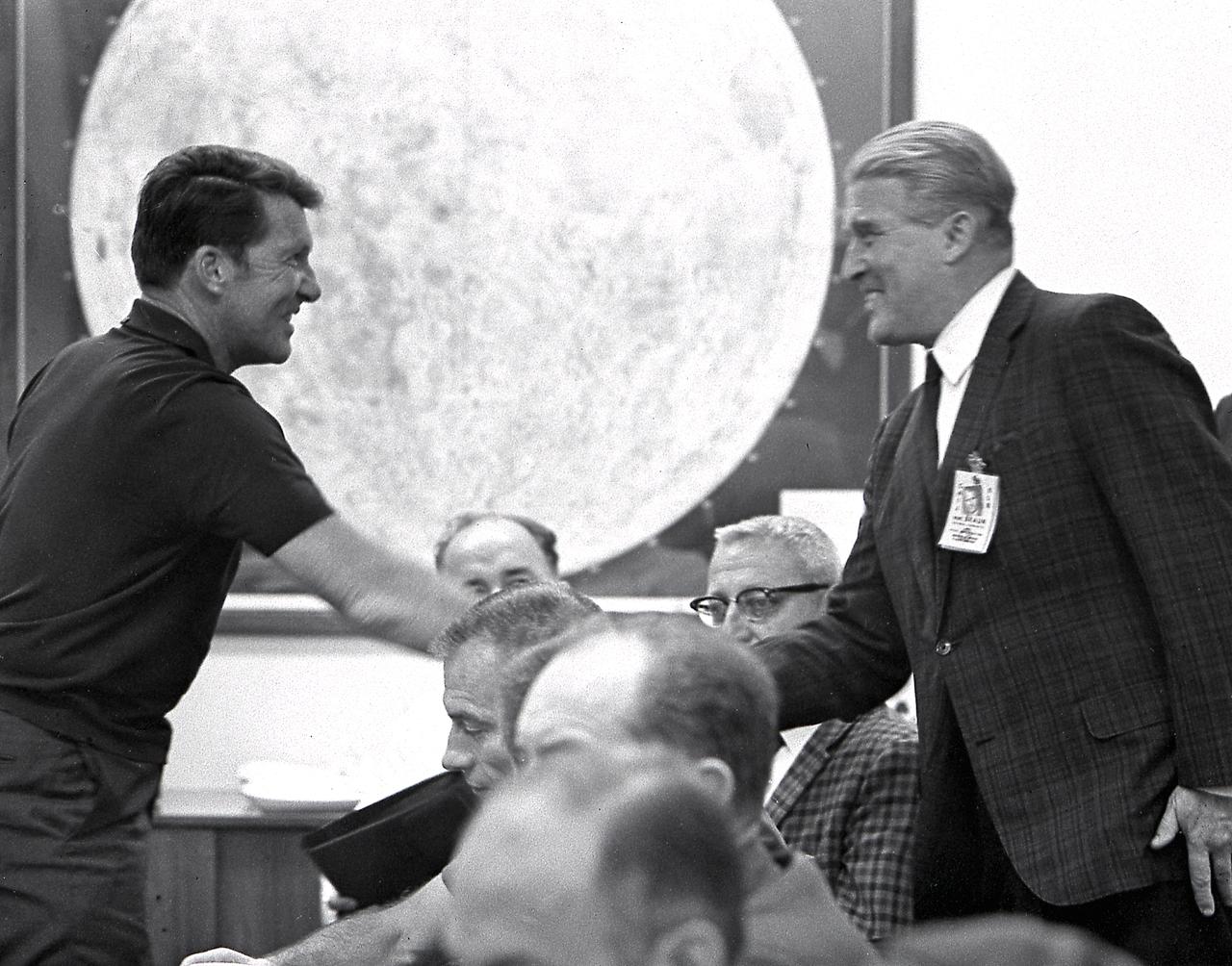
Dr. von Braun, Director of the Marshall Space Flight Center (MSFC), greets Commander of Apollo 7 mission, Walter M. Schirra, Jr., during the mission briefing at Kennedy Space Center (KSC). The Apollo 7 mission, boosted by a Saturn IB launch vehicle on October 11, 1968, was the first flight of the Apollo spacecraft with crew. Other crew members were Astronaut Donn Eisele and Astronaut Walter Cunningham.
Wernher von Braun
KENNEDY SPACE CENTER, FLA. --  Apollo 7 astronauts Donn F. Eisele, foreground, and Walter Cunningham, rear, undergo spacesuit checks today prior to their Earth orbital mission with Walter M. Schirra Jr., not shown.  The three space pilots lifted off atop a Saturn 1B space vehicle from Cape Kennedy's Launch Complex 34 at 11:03 a.m. EDT, Oct. 11, 1968.  The National Aeronautics and Space Administration's first manned Apollo flight is designed to verify spacecraft systems for future lunar voyages.
KSC-68p-417
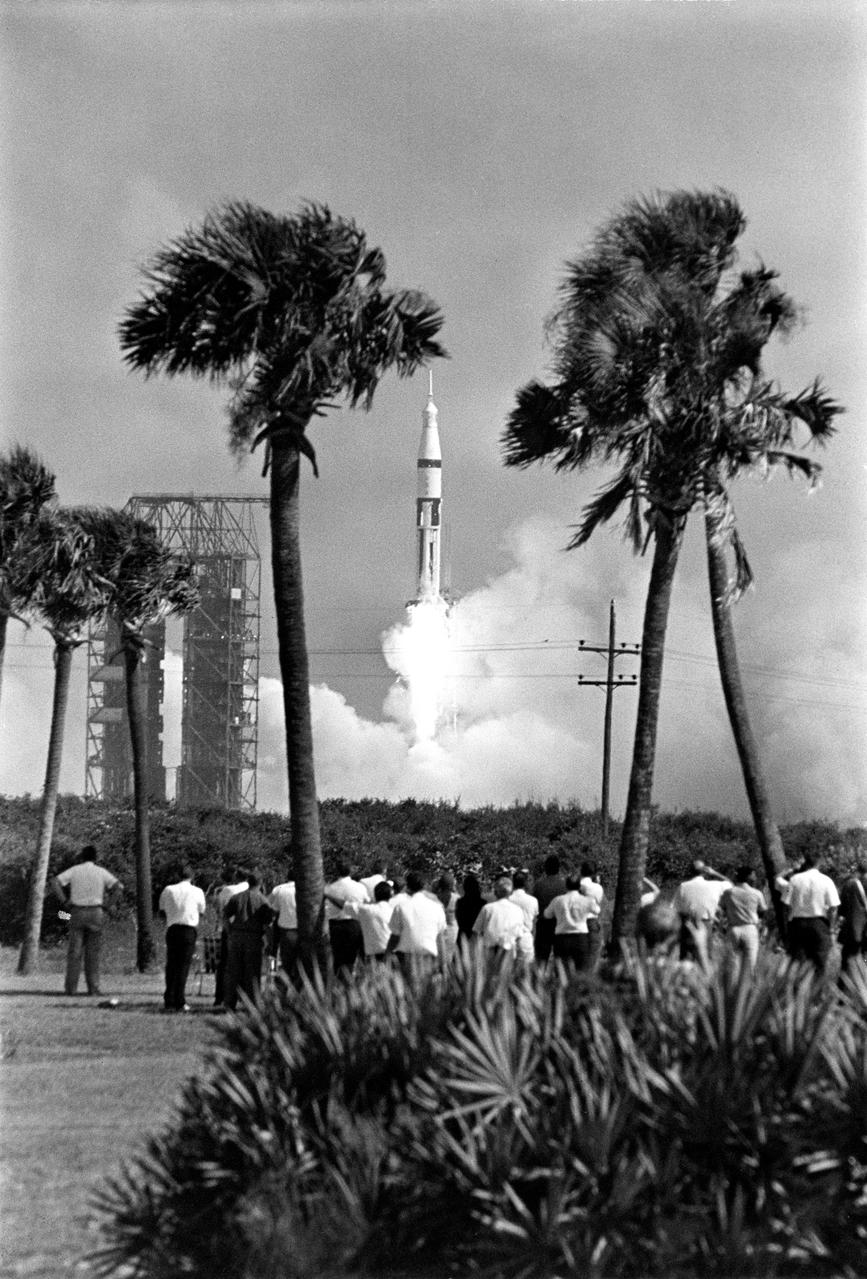
S68-48662 (11 Oct. 1968) --- The Apollo 7/Saturn IB space vehicle is launched from the Kennedy Space Center's Launch Complex 34 at 11:03 a.m. (EDT), Oct. 11, 1968. Apollo 7 (Spacecraft 101/Saturn 205) is the first of several manned flights aimed at qualifying the spacecraft for the half-million mile round trip to the moon. Aboard the Apollo spacecraft are astronauts Walter M. Schirra Jr., commander; Donn F. Eisele, command module pilot; and Walter Cunningham, lunar module pilot. (This view is framed by palm trees on either side).
APOLLO VII - LAUNCH - KSC
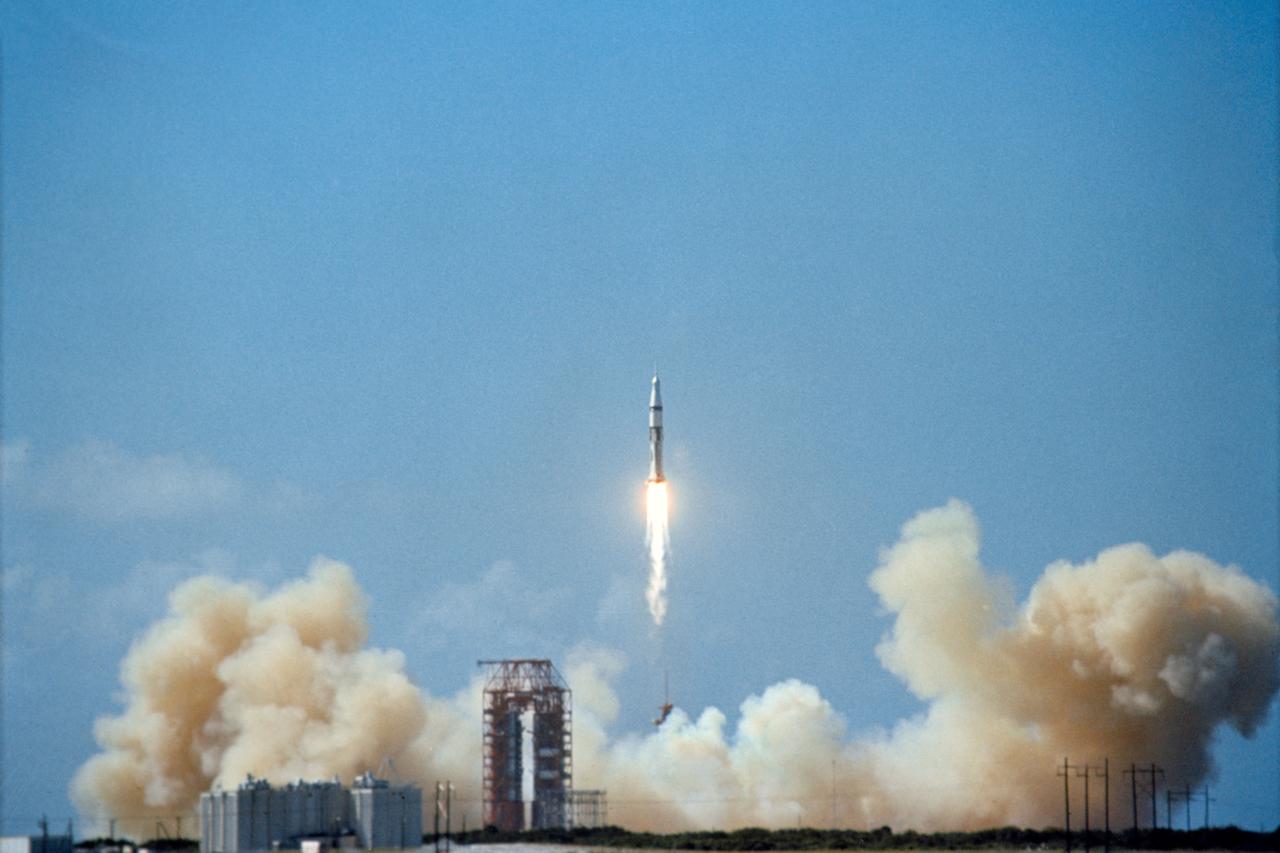
S68-48666 (11 Oct. 1968) --- The Apollo 7/Saturn IB space vehicle is launched from the Kennedy Space Center's Launch Complex 34 at 11:03 a.m. (EDT), Oct. 11, 1968. Apollo 7 (Spacecraft 101/Saturn 205) is the first of several manned flights aimed at qualifying the spacecraft for the half-million-mile round trip to the moon. Aboard the Apollo spacecraft are astronauts Walter M. Schirra Jr., commander; Donn F. Eisele, command module pilot; and Walter Cunningham, lunar module pilot.
LAUNCH - APOLLO VII - KSC
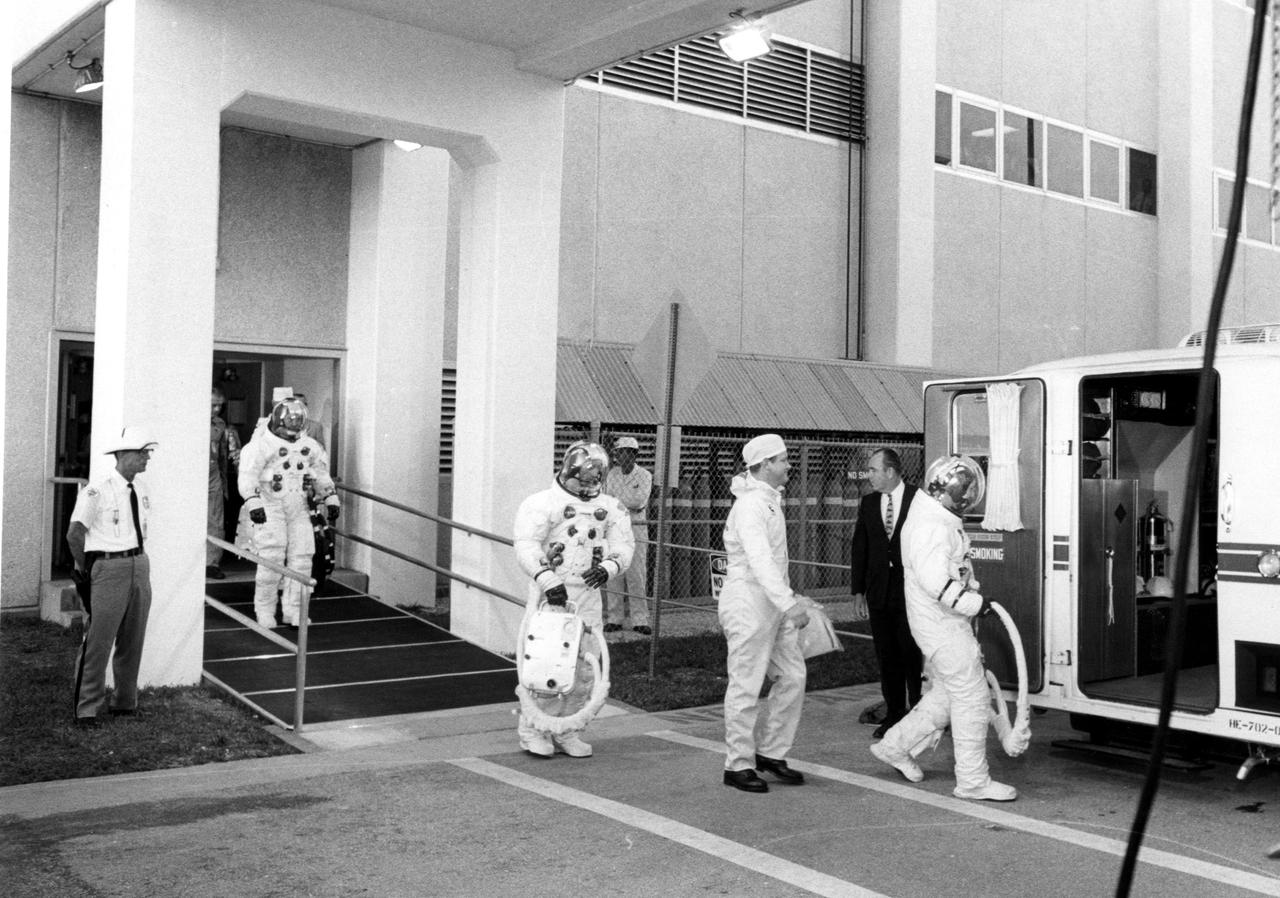
KENNEDY SPACE CENTER, FLA. -- Apollo 7 astronauts enter transfer van, which transported them to Cape Kennedy's Launch Complex 34 and their Saturn IB space vehicle that lifted off at 11:03 a.m. EDT, Oct. 11, 1968.  First to enter the transfer van was Donn F. Eisele, command module pilot, followed by Walter Cunningham, lunar module pilot, and Walter M. Schirra Jr., Apollo 7 commander.  The space pilots are scheduled to orbit the Earth 11 days, gathering information for future lunar voyages directed by the National Aeronautics and Space Administration.
KSC-68P-411
S68-48788 (11 Oct. 1968) --- The Apollo 7/Saturn IB space vehicle is launched from the Kennedy Space Center's Launch Complex 34 at 11:03 a.m. (EDT), Oct. 11, 1968. Apollo 7 (Spacecraft 101/Saturn 205) is the first of several manned flights aimed at qualifying the spacecraft for the half-million-mile round trip to the moon. Aboard the Apollo spacecraft are astronauts Walter M. Schirra Jr., commander; Donn F. Eisele, command module pilot; and Walter Cunningham, lunar module pilot. (Tracking antenna on left and pad service structure on right)
APOLLO VII - CREW - LAUNCH - KSC
KENNEDY SPACE CENTER, FLA. -  At the KSC Visitor Complex, former astronaut Robert L. Crippen (standing right) congratulates former astronaut Sally K. Ride at her induction ceremony into the U.S. Astronaut Hall of Fame. Also standing is former astronaut James A. Lovell.  Seated on the dais, from left, are former astronauts Gordon Cooper, Scott Carpenter, Buzz Aldrin, Walter Cunningham, Edgar B. Mitchell, and Fred W. Haise, all previously inducted into the Hall of Fame. Being inducted with Ride are Space Shuttle astronauts Daniel Brandenstein, Robert "Hoot" Gibson, and Story Musgrave. Conceived by six of the Mercury Program astronauts, the U.S. Astronaut Hall of Fame opened in 1990 to provide a place where space travelers could be remembered for their participation and accomplishments in the U.S. space program. The four new inductees join 48 previously honored astronauts from the ranks of the Gemini, Apollo, Skylab, Apollo-Soyuz, and Space Shuttle programs.
KENNEDY SPACE CENTER, FLA. - At the KSC Visitor Complex, former astronaut Robert L. Crippen (standing right) congratulates former astronaut Sally K. Ride at her induction ceremony into the U.S. Astronaut Hall of Fame. Also standing is former astronaut James A. Lovell. Seated on the dais, from left, are former astronauts Gordon Cooper, Scott Carpenter, Buzz Aldrin, Walter Cunningham, Edgar B. Mitchell, and Fred W. Haise, all previously inducted into the Hall of Fame. Being inducted with Ride are Space Shuttle astronauts Daniel Brandenstein, Robert "Hoot" Gibson, and Story Musgrave. Conceived by six of the Mercury Program astronauts, the U.S. Astronaut Hall of Fame opened in 1990 to provide a place where space travelers could be remembered for their participation and accomplishments in the U.S. space program. The four new inductees join 48 previously honored astronauts from the ranks of the Gemini, Apollo, Skylab, Apollo-Soyuz, and Space Shuttle programs.
KENNEDY SPACE CENTER, FLA. -  At the KSC Visitor Complex, former astronaut Robert L. Crippen (right) presents former astronaut Sally K. Ride (standing center) at her induction ceremony into the U.S. Astronaut Hall of Fame. Also standing is former astronaut James A. Lovell.  Seated on the dais are, from left, former astronauts John H. Glenn, Gordon Cooper, Buzz Aldrin, and Walter Cunningham, all previously inducted into the Hall of Fame. Being inducted with Ride are Space Shuttle astronauts Daniel Brandenstein, Robert "Hoot" Gibson, and Story Musgrave. Conceived by six of the Mercury Program astronauts, the U.S. Astronaut Hall of Fame opened in 1990 to provide a place where space travelers could be remembered for their participation and accomplishments in the U.S. space program. The four new inductees join 48 previously honored astronauts from the ranks of the Gemini, Apollo, Skylab, Apollo-Soyuz, and Space Shuttle programs.
KENNEDY SPACE CENTER, FLA. - At the KSC Visitor Complex, former astronaut Robert L. Crippen (right) presents former astronaut Sally K. Ride (standing center) at her induction ceremony into the U.S. Astronaut Hall of Fame. Also standing is former astronaut James A. Lovell. Seated on the dais are, from left, former astronauts John H. Glenn, Gordon Cooper, Buzz Aldrin, and Walter Cunningham, all previously inducted into the Hall of Fame. Being inducted with Ride are Space Shuttle astronauts Daniel Brandenstein, Robert "Hoot" Gibson, and Story Musgrave. Conceived by six of the Mercury Program astronauts, the U.S. Astronaut Hall of Fame opened in 1990 to provide a place where space travelers could be remembered for their participation and accomplishments in the U.S. space program. The four new inductees join 48 previously honored astronauts from the ranks of the Gemini, Apollo, Skylab, Apollo-Soyuz, and Space Shuttle programs.
S66-24439 (16 March 1966) --- The Gemini-8 prime crew, along with several fellow astronauts, have a hearty breakfast of steak and eggs on the morning of the Gemini-8 launch. Seated clockwise around the table, starting at lower left, are Donald K. Slayton, Manned Spaceflight Center (MSC) Assistant Director for Flight Crew Operations; astronaut Neil A. Armstrong, Gemini-8 command pilot; scientist-astronaut F. Curtis Michel; astronaut R. Walter Cunningham; astronaut Alan B. Shepard Jr. (face obscured), Chief, MSC Astronaut Office; astronaut David R. Scott, Gemini-8 pilot; and astronaut Roger B. Chaffee. Photo credit: NASA
GEMINI-TITAN-8 - PRELAUNCH ACTIVITY
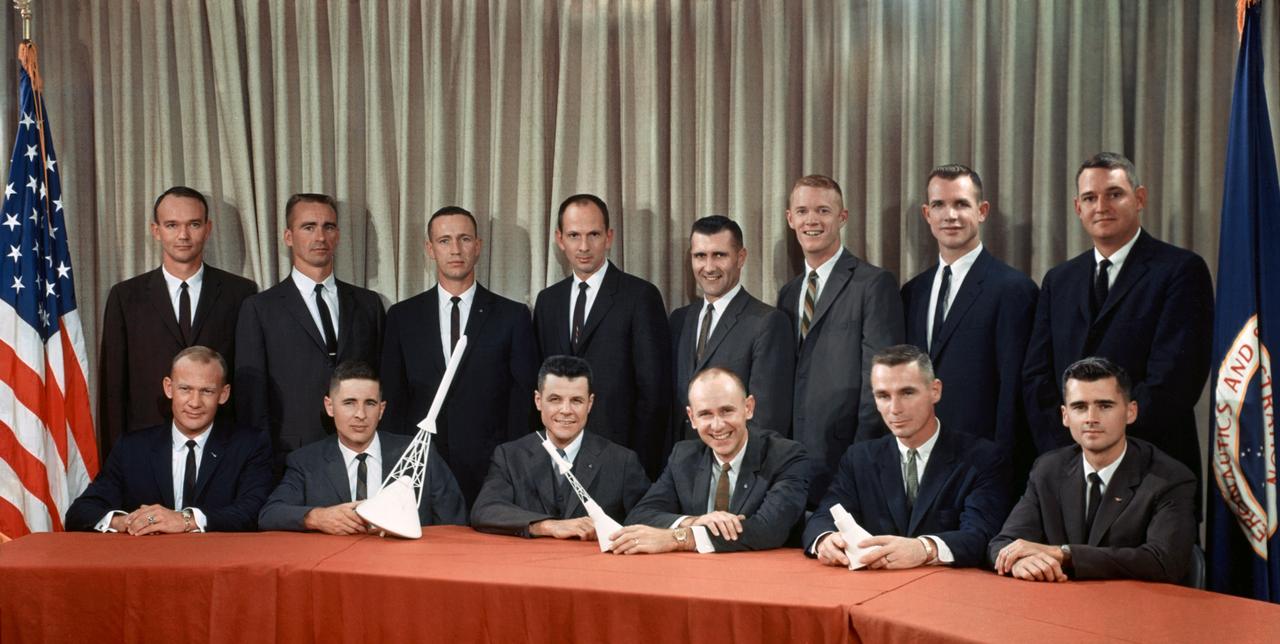
S63-18765 (October 1963) --- These fourteen pilots have been assigned to begin training for astronaut positions with the National Aeronautics and Space Administration (NASA).  Front row, from the left, Edwin E. Aldrin Jr., William A. Anders, Charles A. Bassett II, Alan L. Bean, Eugene A. Cernan and Roger B. Chaffee. Back row, from the left, Michael Collins, Walter Cunningham, Donn F. Eisele, Theodore C. Freeman, Richard F. Gordon Jr., Russell L. Scweickart, David R. Scott and Clifton C. Williams Jr. Photo credit: NASA or National Aeronautics and Space Administration
PORTRAIT - ASTRONAUT GROUP - NEWLY-SELECTED - MSC
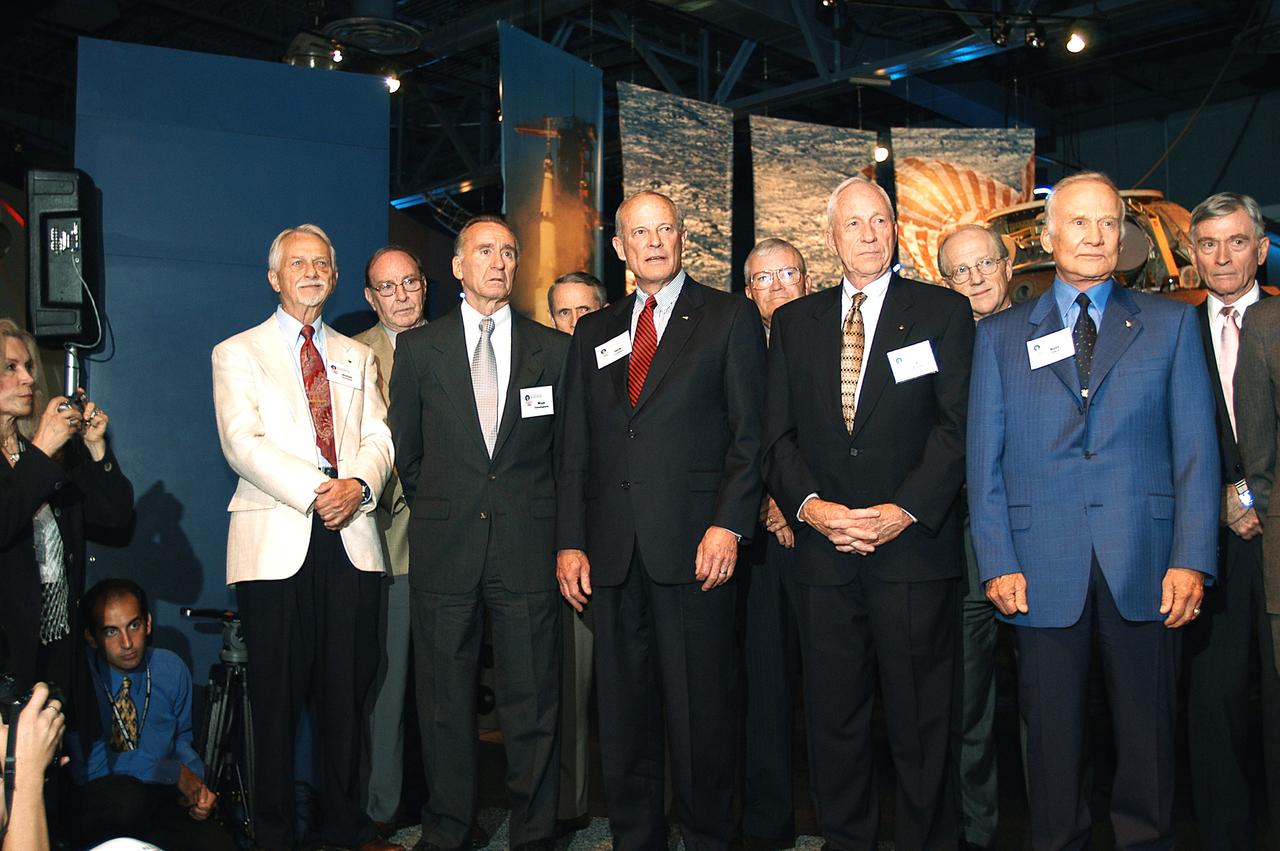
KENNEDY SPACE CENTER, FLA. -  A group of current and former U.S. astronauts are introduced to the audience at a ribbon cutting ceremony officially opening the U.S. Astronaut Hall of Fame as part of the Kennedy Space Center Visitor Complex.  In the front row, from left, are Owen K. Garriott, Walter Cunningham, Jack R. Lousma, Alfred M. Worden, and Buzz Aldrin.  In the back row, from left, are Edgar D. Mitchell, Edward G. Gibson, Fred W. Haise, Frederick H. (Rick) Hauck, and John W. Young.  The ceremony was held in conjunction with the induction of four Space Shuttle astronauts into the Hall of Fame including Daniel Brandenstein, Robert "Hoot" Gibson, Story Musgrave, and Sally Ride.  Conceived by six of the Mercury Program astronauts, the U.S. Astronaut Hall of Fame opened in 1990 to provide a place where space travelers could be remembered for their participation and accomplishments in the U.S. space program.  The four new inductees join 48 previously honored astronauts from the ranks of the Gemini, Apollo, Skylab, Apollo-Soyuz, and Space Shuttle programs.
KENNEDY SPACE CENTER, FLA. - A group of current and former U.S. astronauts are introduced to the audience at a ribbon cutting ceremony officially opening the U.S. Astronaut Hall of Fame as part of the Kennedy Space Center Visitor Complex. In the front row, from left, are Owen K. Garriott, Walter Cunningham, Jack R. Lousma, Alfred M. Worden, and Buzz Aldrin. In the back row, from left, are Edgar D. Mitchell, Edward G. Gibson, Fred W. Haise, Frederick H. (Rick) Hauck, and John W. Young. The ceremony was held in conjunction with the induction of four Space Shuttle astronauts into the Hall of Fame including Daniel Brandenstein, Robert "Hoot" Gibson, Story Musgrave, and Sally Ride. Conceived by six of the Mercury Program astronauts, the U.S. Astronaut Hall of Fame opened in 1990 to provide a place where space travelers could be remembered for their participation and accomplishments in the U.S. space program. The four new inductees join 48 previously honored astronauts from the ranks of the Gemini, Apollo, Skylab, Apollo-Soyuz, and Space Shuttle programs.
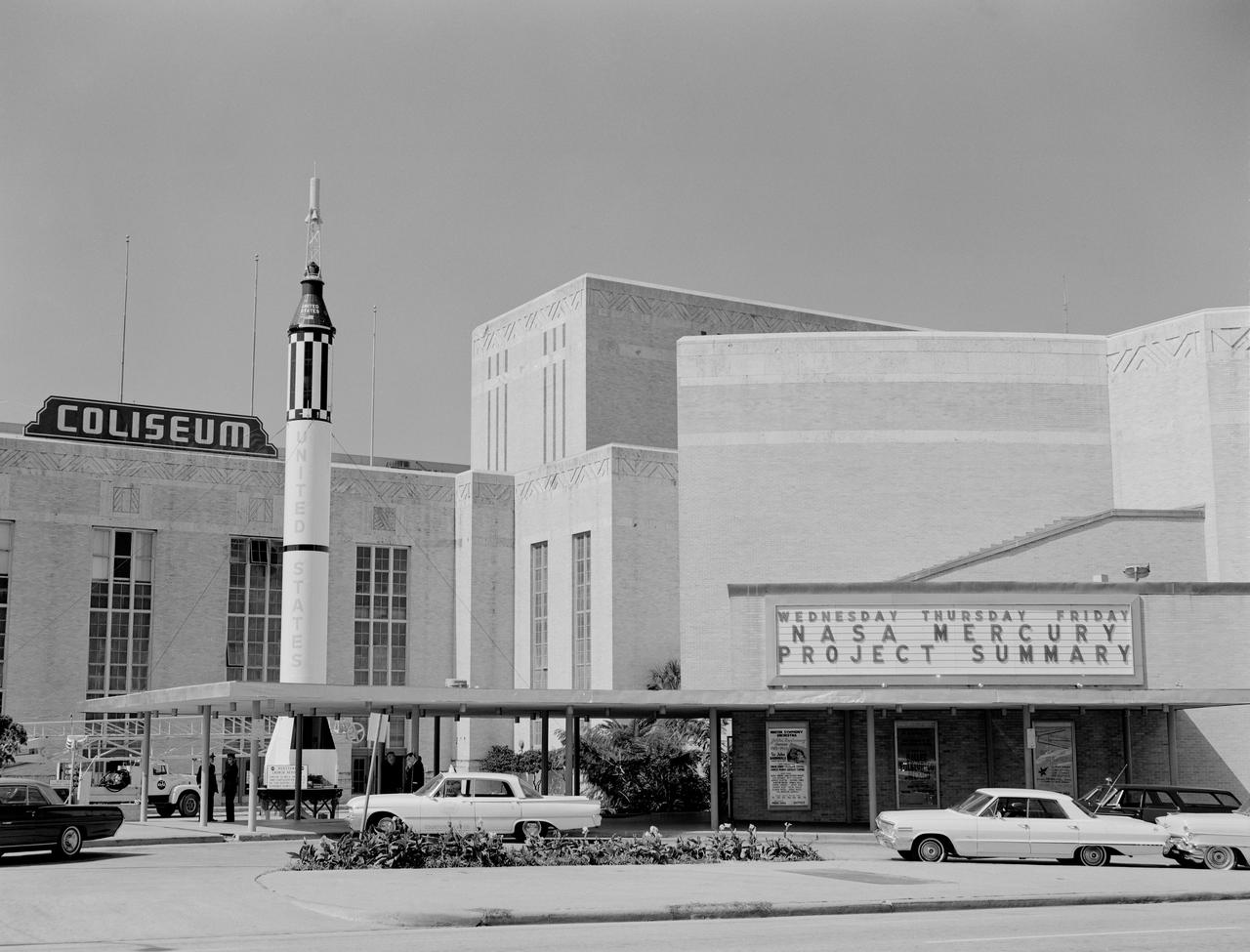
In October 1963, the Project Mercury Summary Conference was held in the Houston, TX, Coliseum.  This series of 44 photos is documentation of that conference.            A view of the Houston, TX, Coliseum, and parking area in front with a Mercury Redstone Rocket setup in the parking lot for display (S63-16451).            A view of an Air Force Atlas Rocket, a Mercury Redstone Rocket, and a Mercury Spacecraft on a test booster on display in the front area of the Coliseum (S63-16452).        A view an Air Force Atlas Rocket and a Mercury Redstone Rocket set up for display with the Houston City Hall in the background (S63- 16453).          This view shows the Atlas Rocket, Mercury Redstone, and Mercury Test Rocket with the Houston, TX, Coliseum in the background (S63- 16454).            A balcony view, from the audience right side, of the attendees looking at the stage (S63-16455).         A view of the NASA Space Science Demonstration with equipment setup on a table, center stage and Space Science Specialist briefing the group as he pours Liquid Oxygen into a beaker (S63-16456).        View of the audience from the balcony on the audience right showing the speakers lecturn on stage to the audience left (S63-16457).            A view of attendees in the lobby.  Bennet James, MSC Public Affairs Office is seen to the left of center (S63-16458).    Another view of the attendees in the lobby (S63- 16459).            In this view, Astronaut Neil Armstrong is seen writing as others look on (S63-16460).            In this view of the attendees, Astronauts Buzz Aldrin and Walt Cunningham are seen in the center of the shot.  The October Calendar of Events is visable in the background (S63-16461).        Dr. Charles Berry is seen in this view to the right of center, seated in the audience (S63-16462).           View of " Special Registration " and the five ladies working there (S63-16463).           A view from behind the special registration table, of the attendees being registered (S63-16464).        A view of a conference table with a panel seated. (R-L):  Dr. Robert R. Gilruth, Hugh L. Dryden, Walter C. Williams, and an unidentified man (S63- 16465).           A closeup of the panel at the table with Dr. Gilruth on the left (S63-16466).           About the same shot as number S63-16462,  Dr. Berry is seen in this shot as well (S63-16467).            In this view the audio setup is seen.  In the audience, (L-R):  C. C. Kraft, Vernon E. (Buddy) Powell, Public Affairs Office (PAO); and, in the foreground mixing the audio is Art Tantillo; and, at the recorder is Doyle Hodges both of the audio people are contractors that work for PAO at MSC (S63-16468).             In this view Maxime Faget is seen speaking at the lecturn (S63-16469).          Unidentified person at the lecturn (S63-16470).         In this view the motion picture cameras and personel are shown documenting the conference (S63-16471).         A motion picture cameraman in the balcony is shown filming the audience during a break (S63- 16472).         Family members enjoy an exhibit (S63-16473).         A young person gets a boost to look in a Gemini Capsule on display (S63-16474).        A young person looks at the Gemini Capsule on display (S63-16475).         Dr. Robert R. Gilruth is seen at the conference table (S63-16476).        Walt Williams is seen in this view at the conference table (S63-16477).        Unidentified man sitting next to Walt Williams (S63-16478).        (L-R):  Seated at the conference table, Dr. Robert Gilruth, Hugh L. Dryden, and Walt Williams (S63- 16479).         Group in lobby faces visable, (L-R):  Walt Williams, unidentified person,  Dr. Robert Gilruth, Congressman (S63-16480).          Man in uniform at the lecturn (S63-16481).         Astronaut Leroy Gordon Cooper at the lecturn (S63-16482).         Astronaut Cooper at the lecturn with a picture on the screen with the title, " Astronaut Names for Spacecraft " (S63-16483).         Dr. Gilruth at the lecturn (S63-16484).         Walt Williams at the lecturn (S63-16485).         Unidentified man at the lecturn (S63-16486).         John H. Boynton addresses the Summary Conference (S63-16487).        (L-R):  Astronaut Leroy Gordon Cooper, Mrs. Cooper, Senator Cris Cole, and Mrs. Cole (S63- 16488).        In this view in the lobby, Senator and Mrs. Cris Cole, with Astronaut Gordon Cooper standing near the heatshield, and Mrs. Cooper; next, on the right is a press photographer (S63-16489).           (L-R):  Astronaut L. Gordon Cooper and Mrs. Cooper, unidentified man, and Senator Walter Richter (S63-16490).         (L-R):  Eugene Horton, partially obscured, briefs a group on the Mercury Spacecraft, an unidentified person, Harold Ogden, a female senator, Senator Chris Cole, Mrs. Cole, an unidentified female, Senator Walter Richter, Jim Bower, and an unidentified female (S63-16491).         In this view, Mrs. Jim Bates is seen in the center, and Senator Walter Richter to the right (S63- 16492).         The next three (3) shots are 4X5 CN (S63-16493 - S63-16495).         In this view a NASA Space Science Demonstration is seen (S63-16493).        In this view a shot of the conference table is seen, and, (L-R):  Dr. Robert R. Gilruth, Hugh L. Dryden, Mr. Walter Williams, and an unidentfied man (S63-16494 - S63-16495).        HOUSTON, TX
PROJECT MERCURY SUMMARY CONFERENCE - NASA - HOUSTON, TX