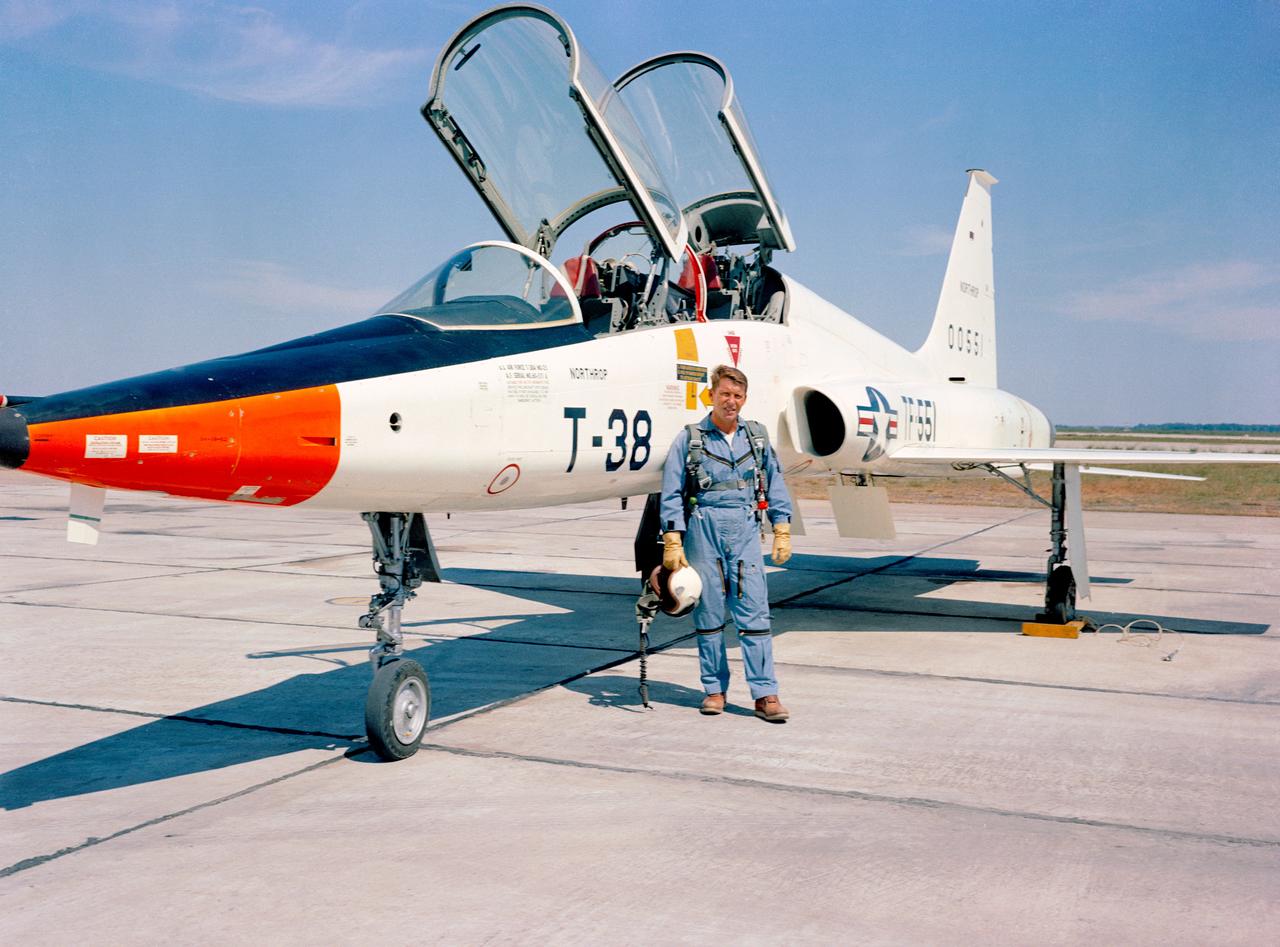
S63-18249 (1963) --- Astronaut Walter M. Schirra Jr. standing beside T-38. Photo credit: NASA
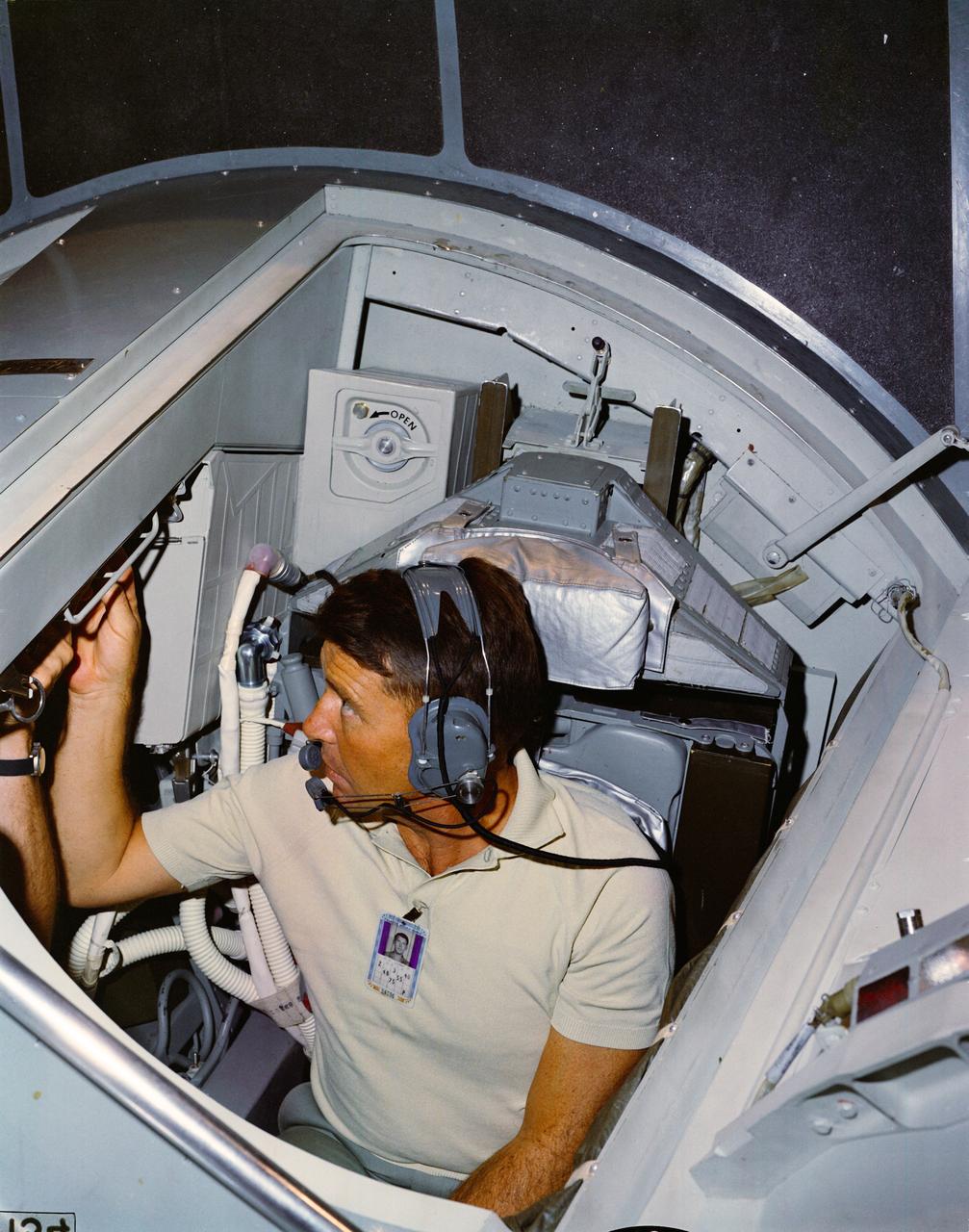
S65-13919 (15 Jan. 1965) --- Astronaut Walter M. Schirra Jr., command pilot of the Gemini-6 prime crew, is pictured in the cockpit of the Gemini simulator at the Mission Control Center at Cape Kennedy, Florida. Photo credit: NASA or National Aeronautics and Space Administration
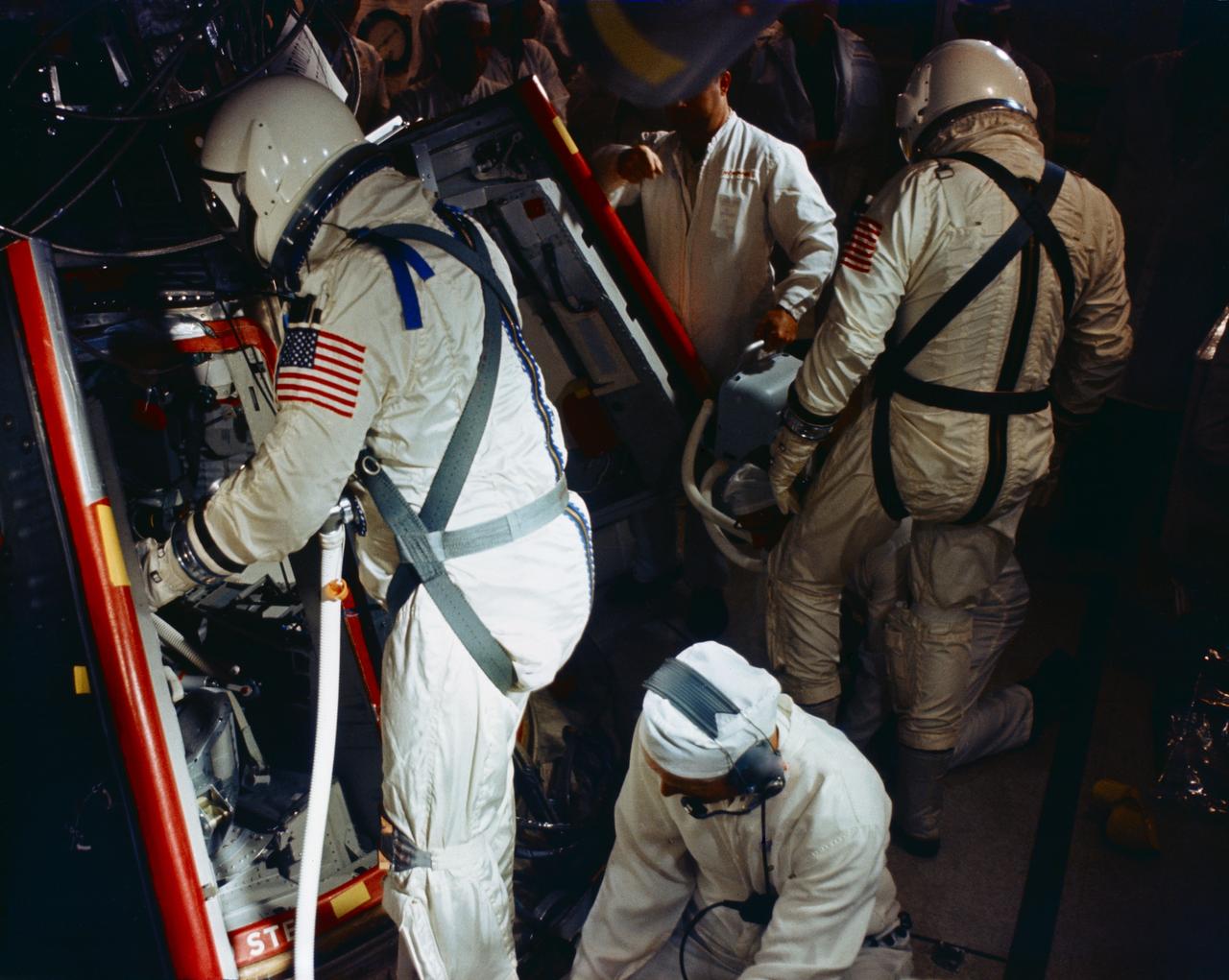
S65-56196 (25 Oct. 1965) --- Astronauts Walter M. Schirra Jr., command pilot; and Thomas P. Stafford, pilot, stand in the white room atop Pad 19 awaiting insertion into their Gemini-6 spacecraft during the prelaunch countdown of the Gemini-Titan-Agena 6 space mission. However, the Gemini-6 liftoff scheduled for Oct. 25 never occurred. The Agena, intended as a rendezvous target vehicle in the mission, failed to achieve orbit. Photo credit: NASA or National Aeronautics and Space Administration
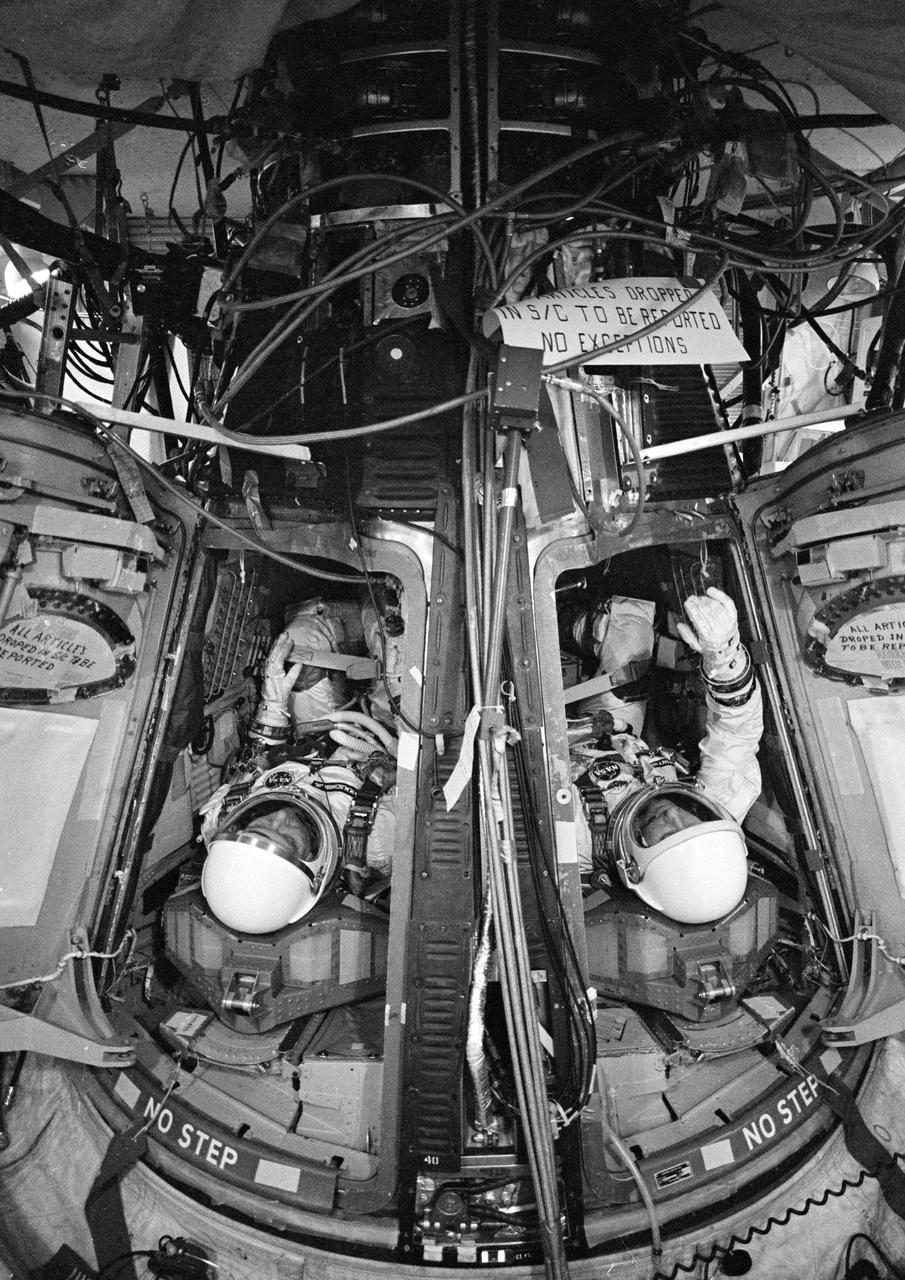
S65-56177 (1965) --- Gemini-6 astronauts Walter M. Schirra Jr., command pilot, and Thomas P. Stafford, pilot, check out the spacecraft during a simulated test at Launch Complex 19 at Cape Canaveral, Florida. Photo credit: NASA or National Aeronautics and Space Administration
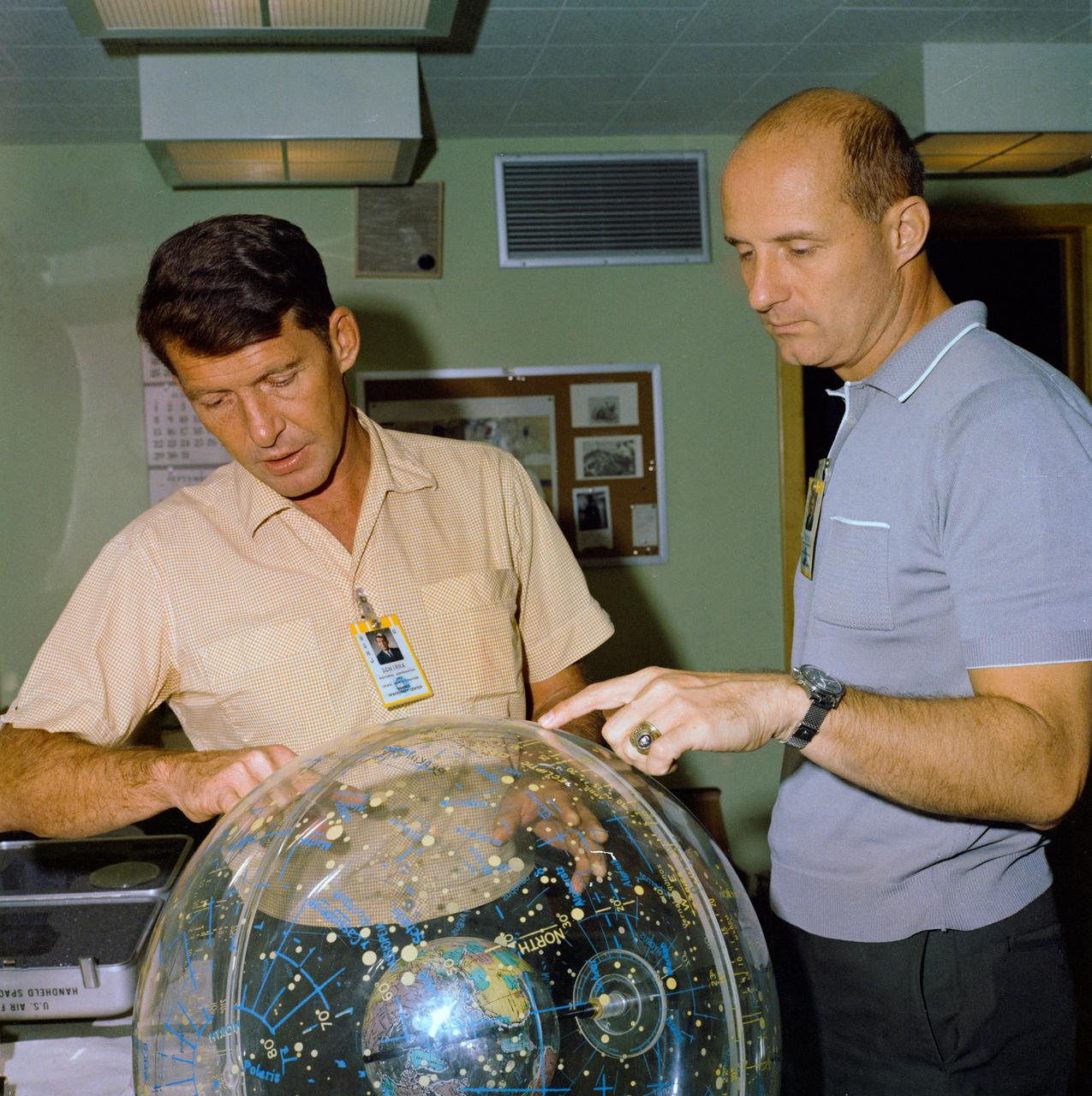
S65-56185 (21 Oct. 1965) --- Gemini-6 astronauts Walter M. Schirra Jr. (left), command pilot; and Thomas P. Stafford, pilot, look at a star globe for celestial pattern recognition for their upcoming flight. The National Aeronautics and Space Administration (NASA) plans a two-day mission for Gemini-6 for the astronauts to develop the ability to rendezvous and dock with an orbiting Agena Target Docking Vehicle. Photo credit: NASA or National Aeronautics and Space Administration
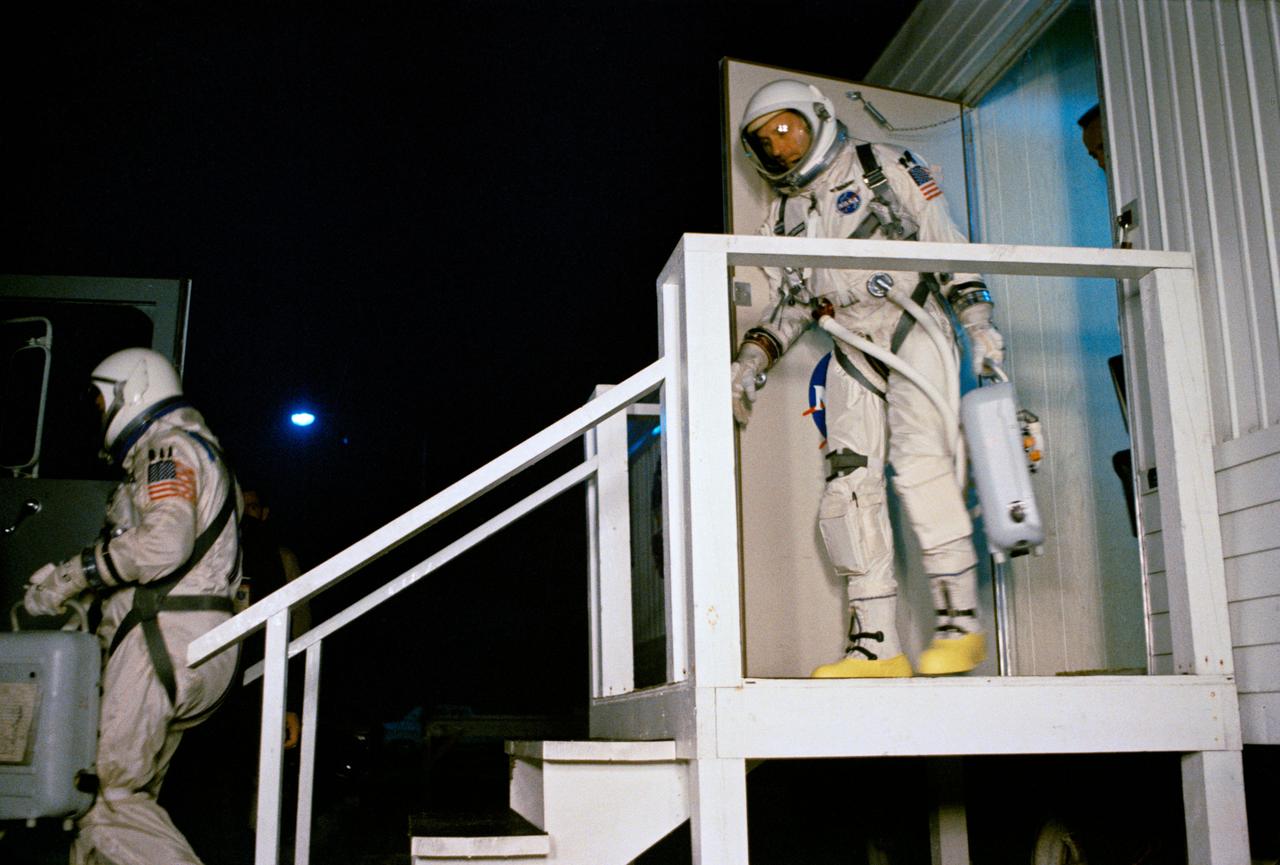
S65-59974 (15 Dec. 1965) --- Astronauts Walter M. Schirra Jr. (leading), command pilot; and Thomas P. Stafford, pilot, leave the suiting trailer at Launch Complex 16 during the Gemini-6 prelaunch countdown at Cape Kennedy, Florida. They entered a special transport van which carried them to Pad 19 and their spacecraft. Gemini-6 lifted off at 8:37 a.m. (EST) on Dec. 15, 1965. Photo credit: NASA or National Aeronautics and Space Administration
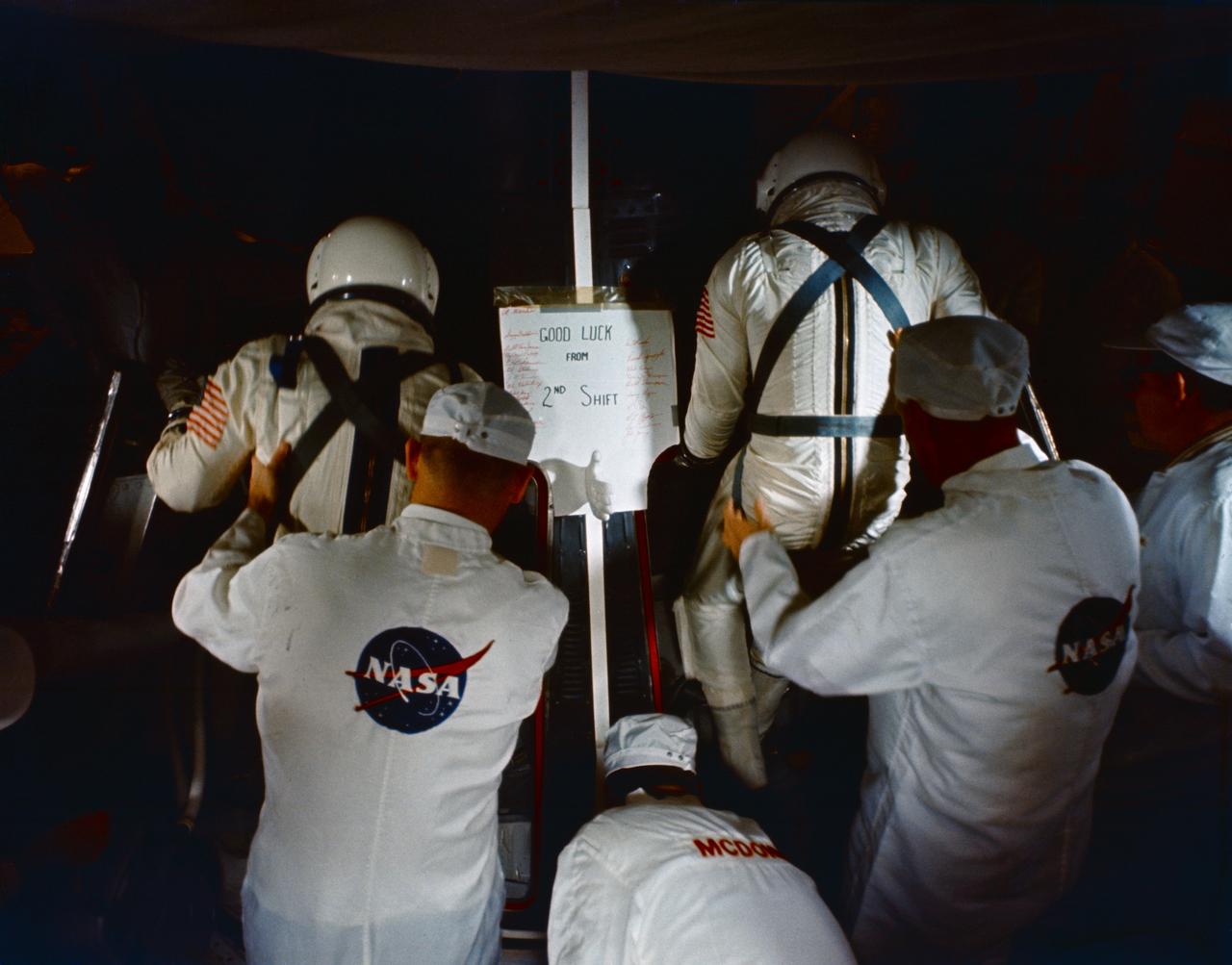
S65-59984 (15 Dec. 1965) --- NASA and McDonnell technicians assist the Gemini-6 prime crew into the spacecraft in the white room atop Pad 19 during the Gemini-6 prelaunch countdown at Cape Kennedy, Florida. Astronaut Walter M. Schirra Jr., command pilot, is on the left; and astronaut Thomas P. Stafford, pilot, is on the right. Liftoff was at 8:37 a.m. (EST) on Dec. 15, 1965. Photo credit: NASA or National Aeronautics and Space Administration
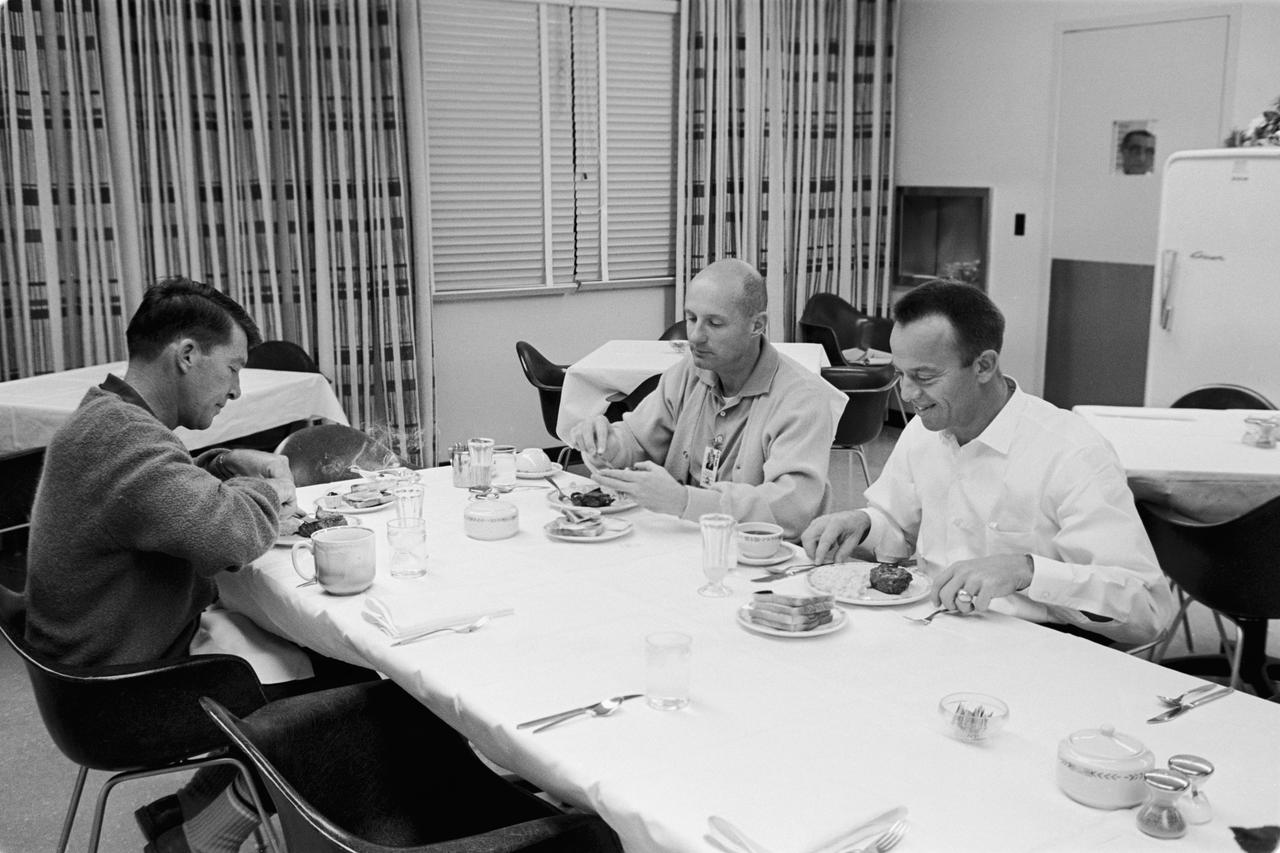
S65-61880 (15 Dec. 1965) --- Astronauts Walter M. Schirra Jr. (left), command pilot; and Thomas P. Stafford (center), pilot, enjoy a breakfast of steak and eggs in the Manned Spacecraft Operations Building, Merritt Island, during the Gemini-6 prelaunch countdown. Seated at right is astronaut Alan B. Shepard Jr., chief, Astronaut Office, Manned Spacecraft Center, Houston, Texas. Gemini-6 was successfully launched from Pad 19 at 8:37 a.m. (EST), Dec. 15, 1965. Photo credit: NASA or National Aeronautics and Space Administration
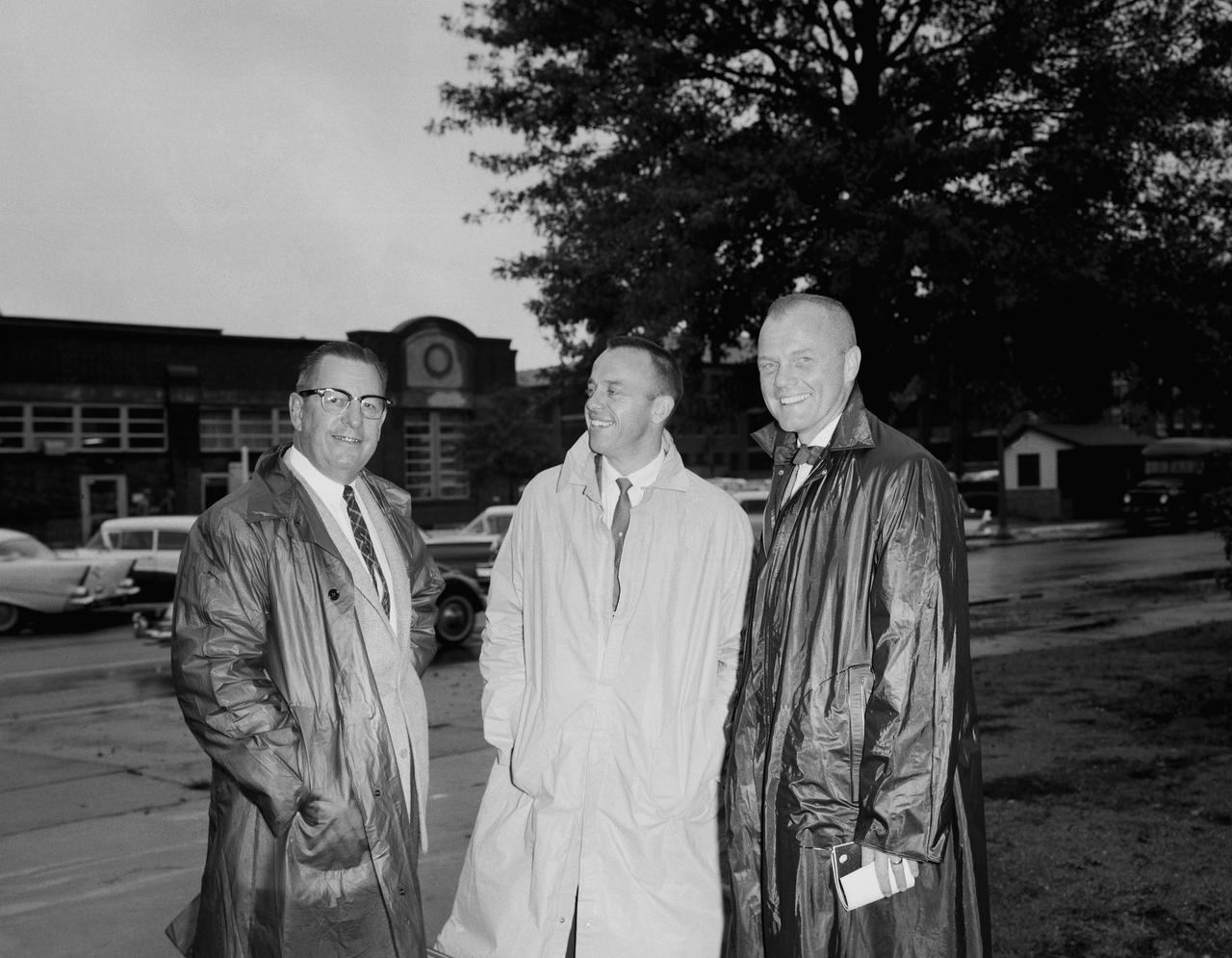
Astronauts at 1959 Langley Inspection. Astronauts at 1959 Langley Inspection: The seven are shown in the Unitary Plan Wind Tunnel NASA Langley. The astronauts left to right: John H. Glenn Jr., M.Scot Carpenter, Virgil I.Grissom, Walter M. Schirra Jr., L. Gordon Cooper, Alan B. Shepard Jr.and Donald K. Slayton.
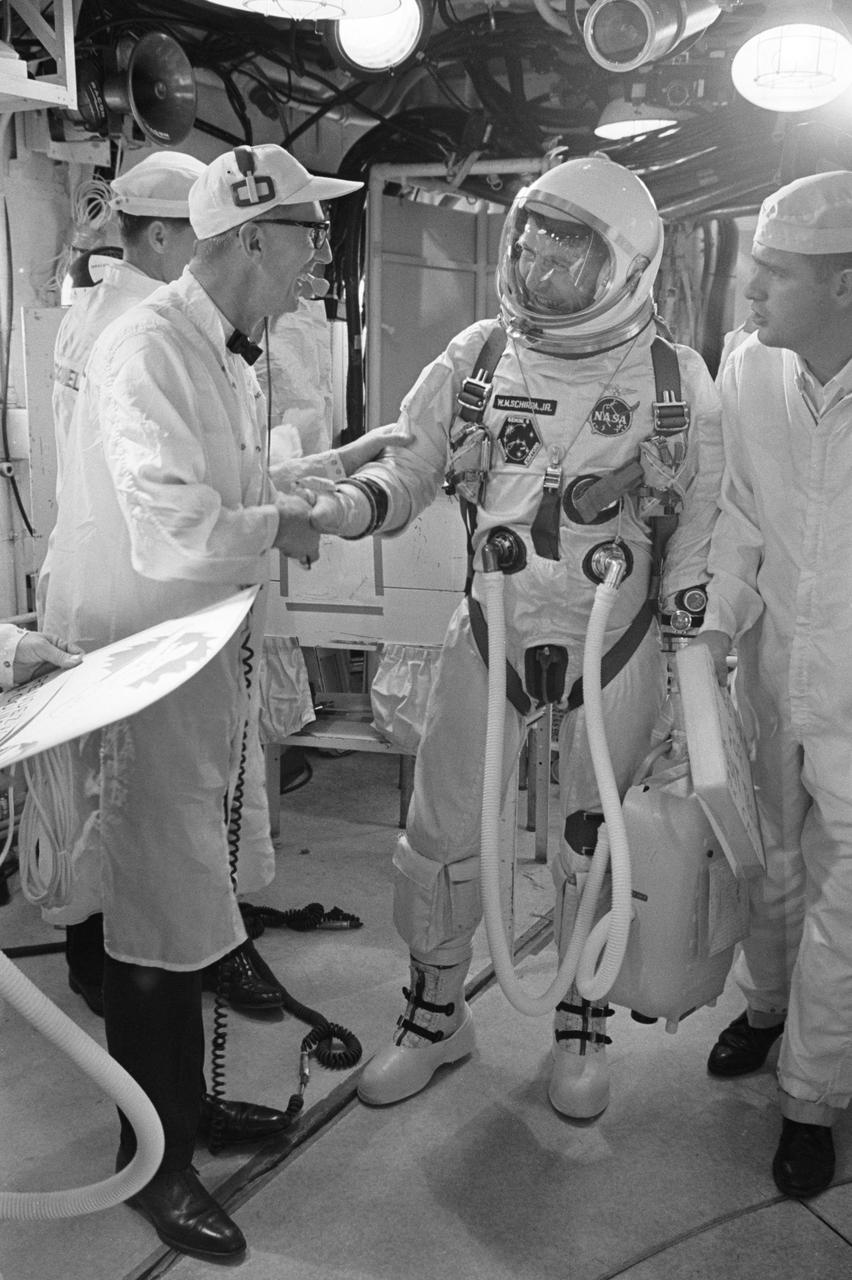
S65-61912 (12 Dec. 1965) --- Astronaut Walter M. Schirra Jr., command pilot, accepts the best wishes of G.F. Wendt, McDonnell Aircraft Corporation pad leader, as he arrives in the white room atop Pad 19. Moments later, Schirra and astronaut Thomas P. Stafford, pilot, entered the spacecraft for their planned two-day mission. At right is NASA suit technician Al Rochford. NASA attempted to launch Gemini-6 at 9:54 a.m. (EST) on Dec. 12, 1965. However, seconds after ignition the first stage engine of the Gemini-6 launch vehicle shut down due to a faulty release of a liftoff umbilical plug. Photo credit: NASA or National Aeronautics and Space Administration
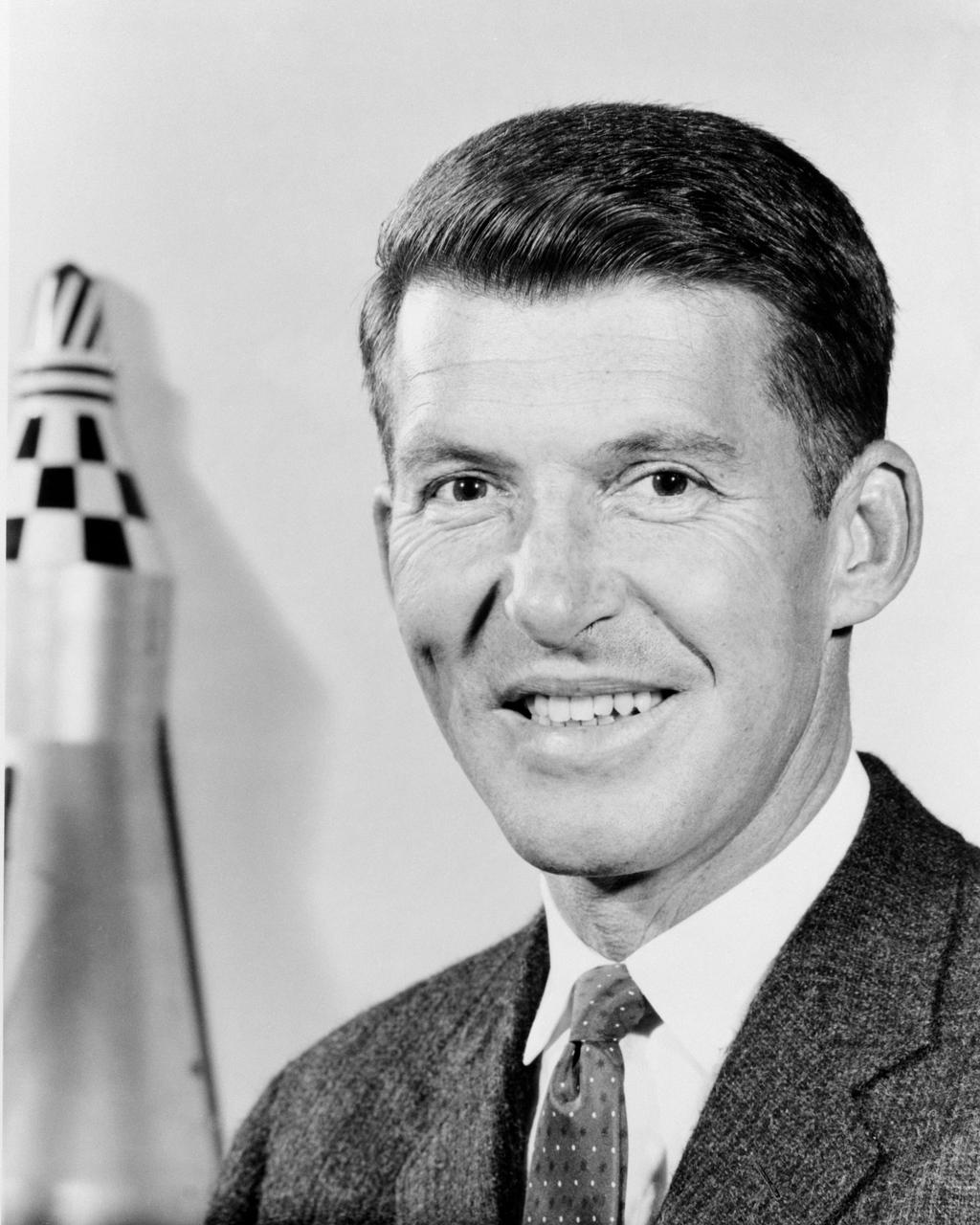
G60-02741 (May 1960) --- Astronaut Walter M. Schirra Jr. Photo credit: NASA
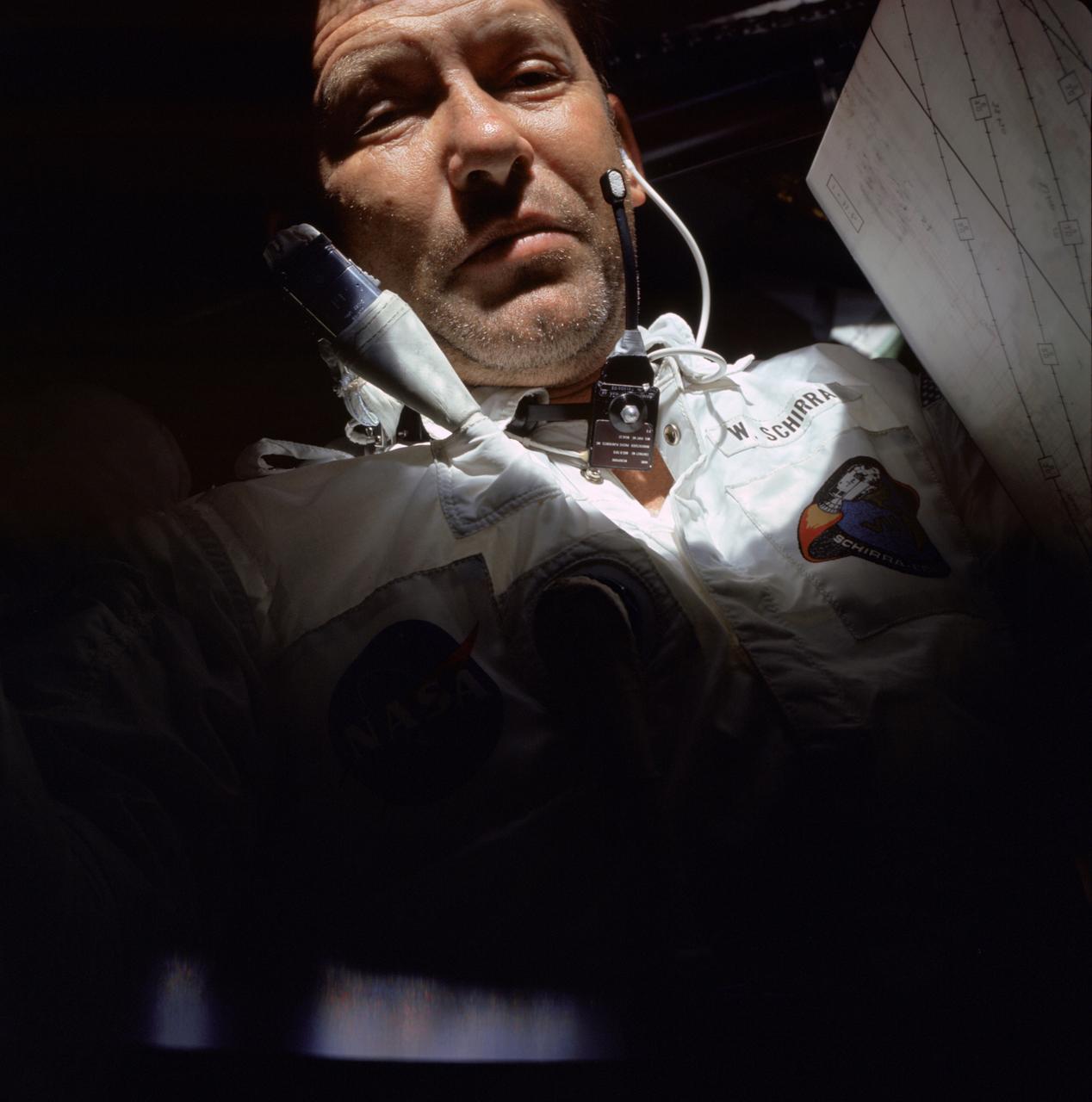
AS07-04-1582 (11-22 Oct. 1968) --- Astronaut Walter M. Schirra Jr., Apollo 7 commander, is photographed during the Apollo 7 mission.
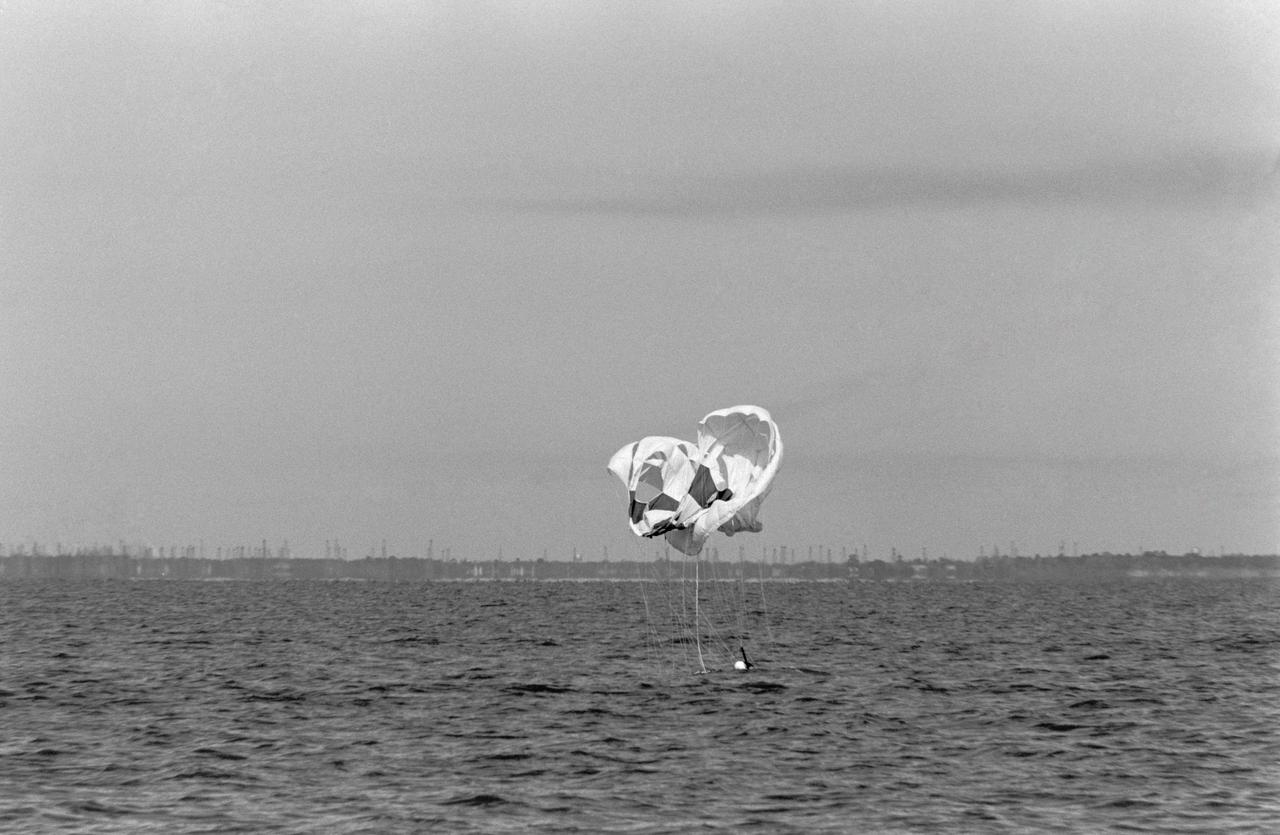
S65-10172 (2 Feb. 1965) --- Astronaut Walter M. Schirra Jr., the Gemini-Titan 3 backup crew command pilot, is shown during water egress para-drop training activity in nearby Galveston Bay.
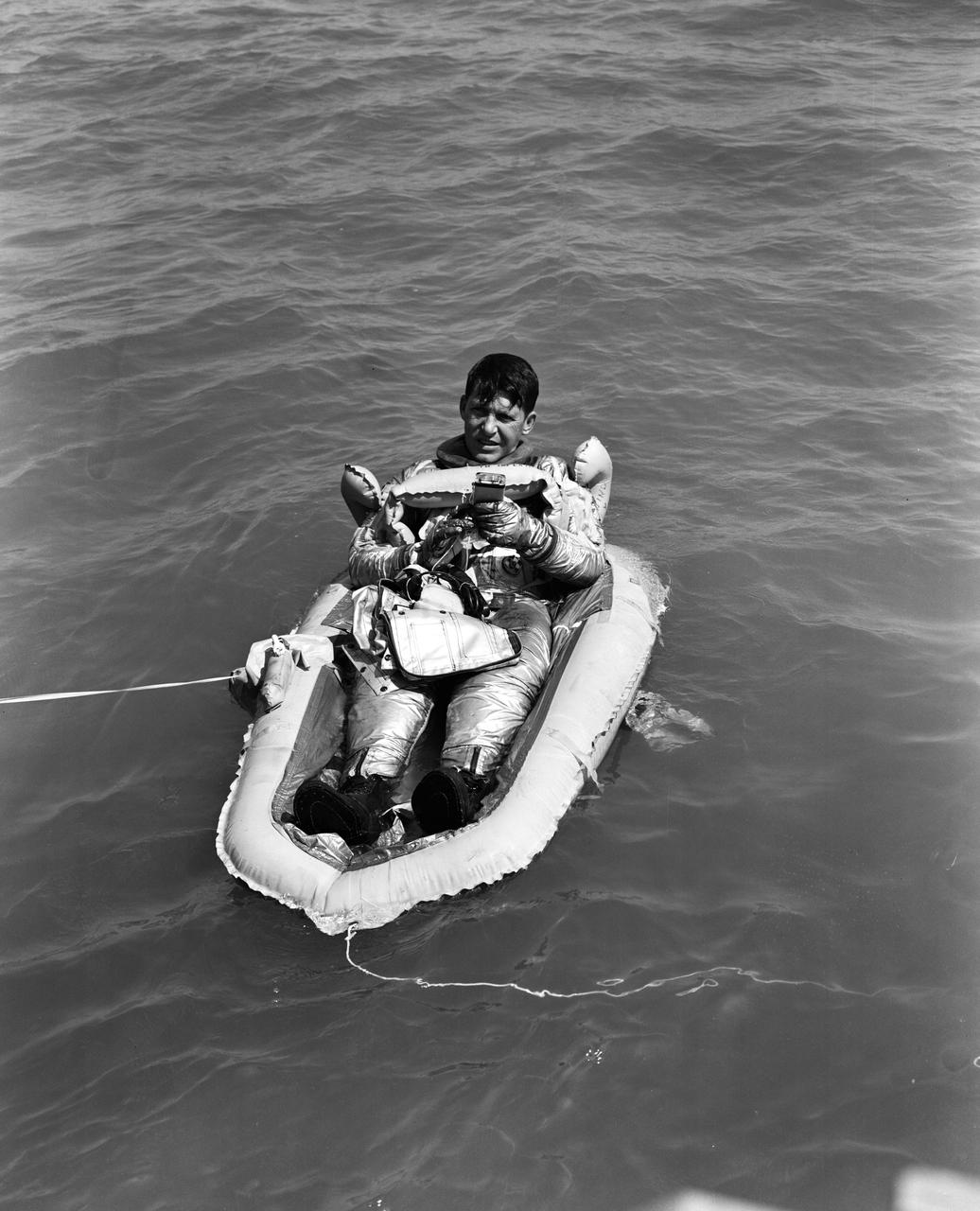
S62-01379 (1962) --- Astronaut Walter M. Schirra Jr., wearing his pressure suit, is seated in a life raft during a portion of his water egress training. Photo credit: NASA
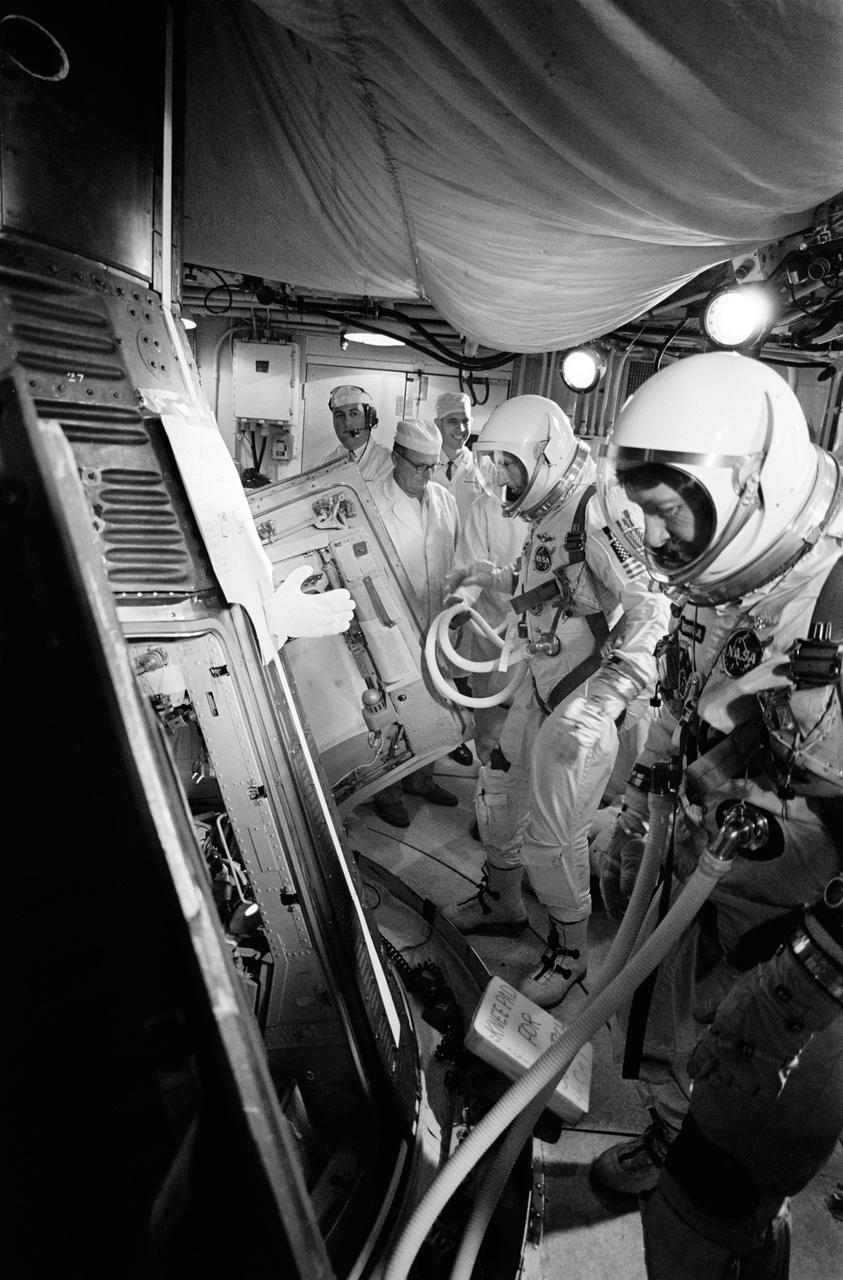
S65-66744 (15 Dec. 1965) --- Insertion of astronauts Walter M. Schirra Jr. (foreground) and Thomas P. Stafford into Gemini-6 spacecraft prior to launch. Photo credit: NASA or National Aeronautics and Space Administration
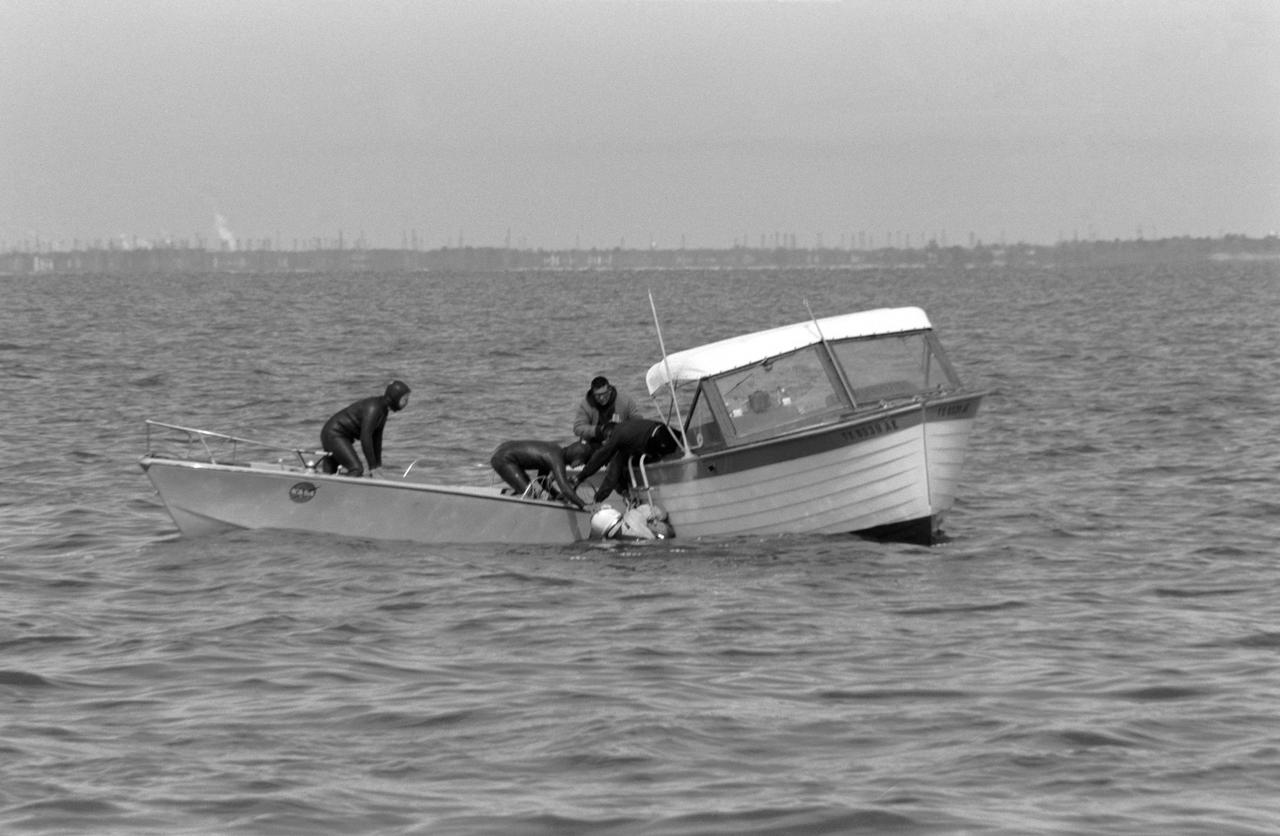
S65-10173 (2 Feb. 1965) --- Astronaut Walter M. Schirra Jr., the Gemini-Titan 3 backup crew command pilot, is shown during water egress para-drop training activity in nearby Galveston Bay.
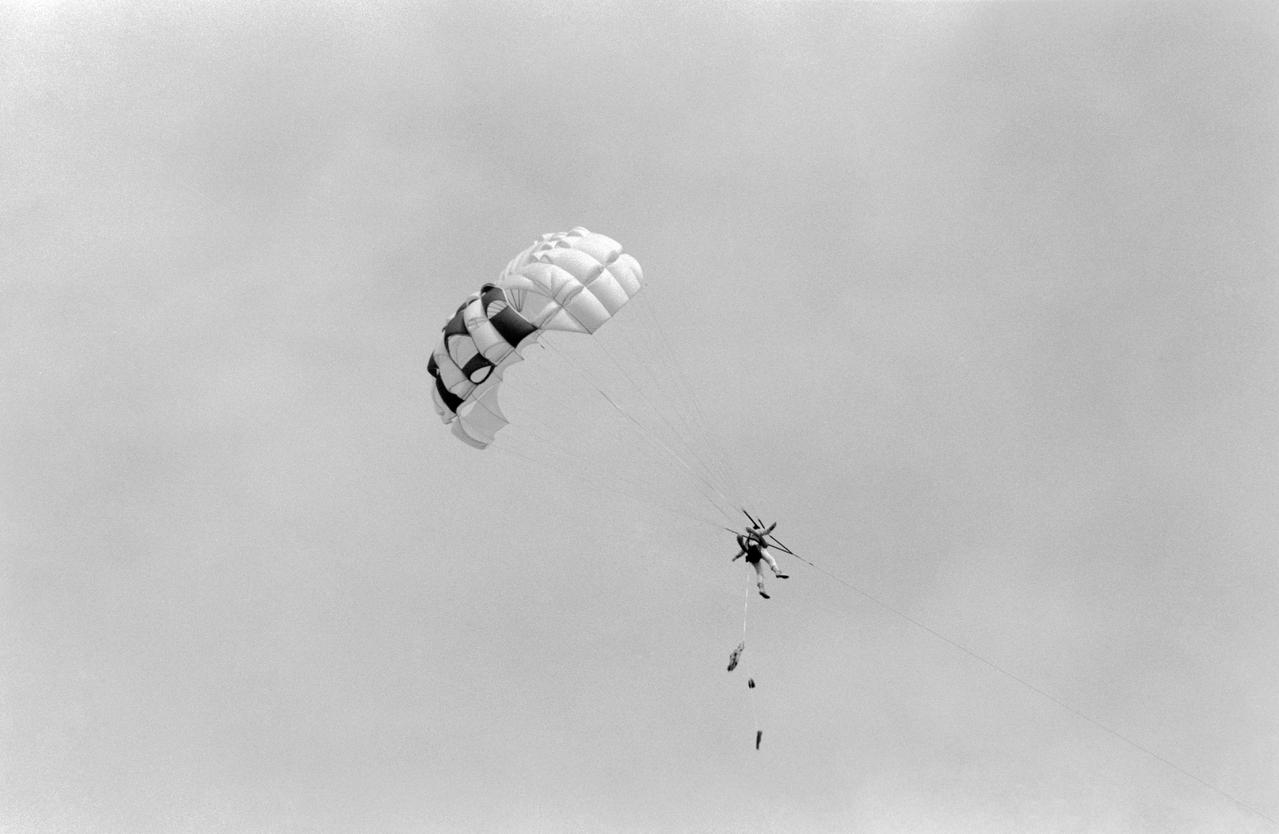
S65-10171 (2 Feb. 1965) --- Astronaut Walter M. Schirra Jr., the Gemini-Titan 3 backup crew command pilot, is shown during water egress para-drop training activity in nearby Galveston Bay.
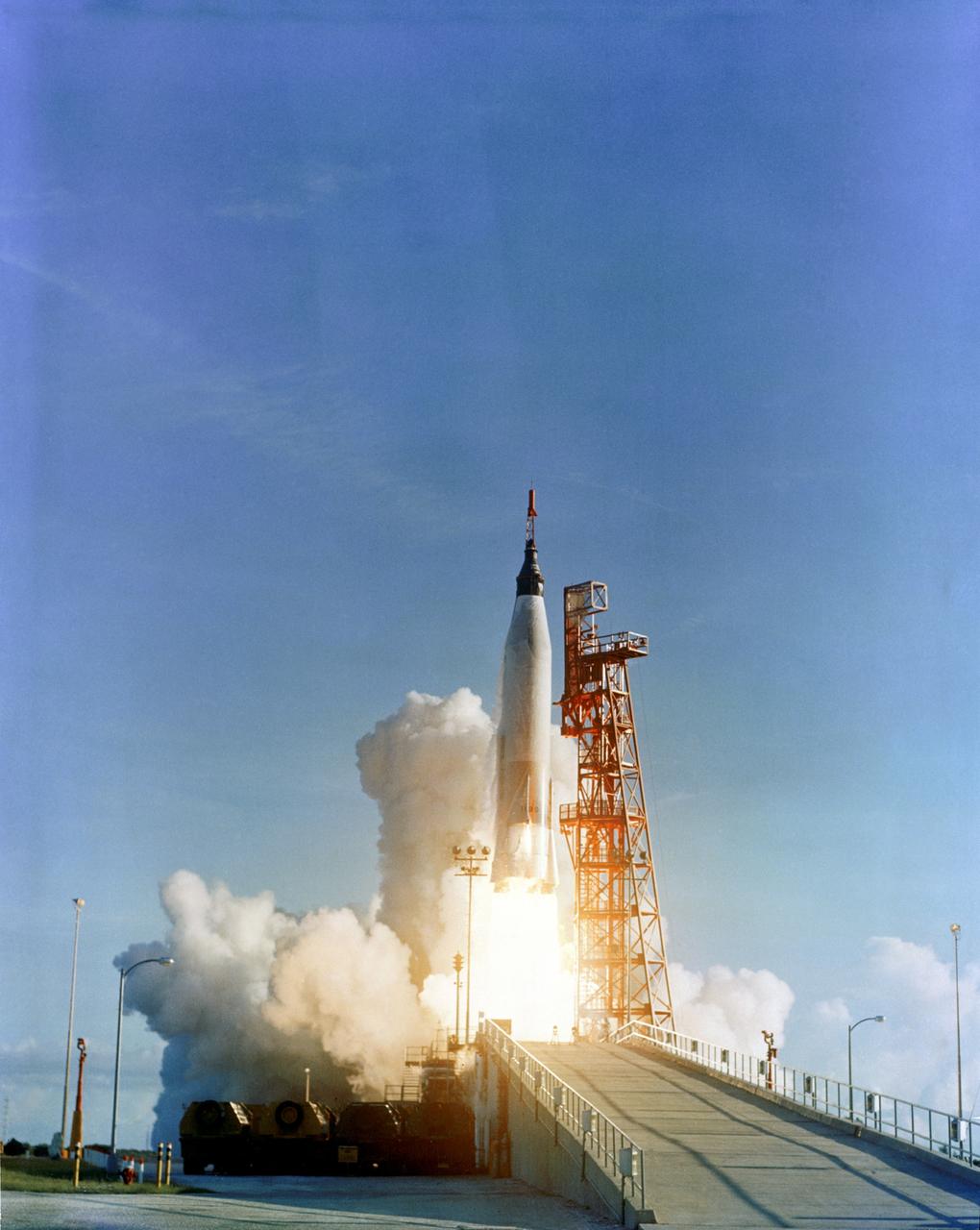
S62-07872 (3 Oct. 1962) --- Launch of the Mercury-Atlas 8 (MA-8) "Sigma 7" mission, carrying astronaut Walter M. Schirra Jr., pilot of the Earth-orbital spaceflight. Photo credit: NASA
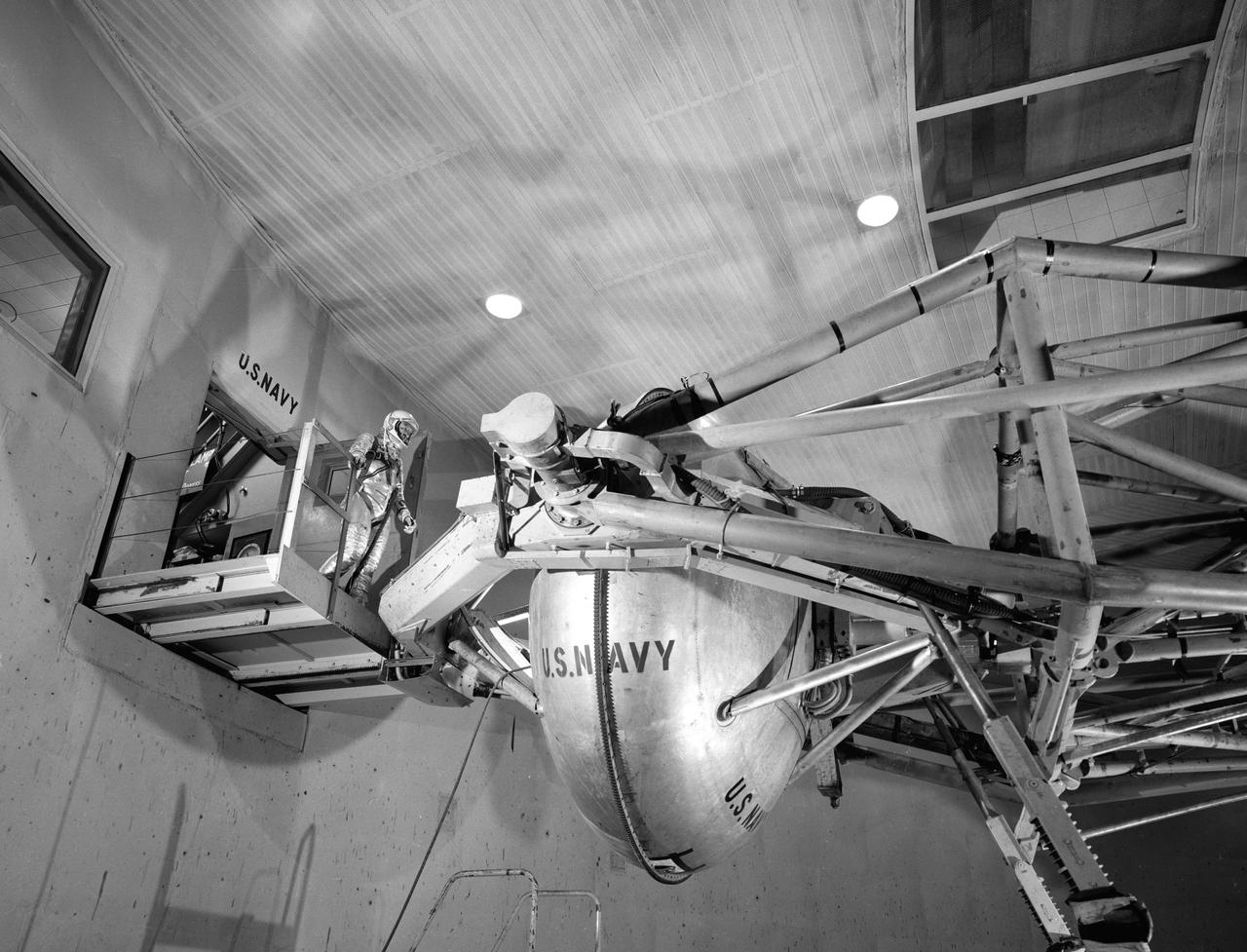
G60-02461 (1960) --- Astronaut Walter M. Schirra Jr. prepares to enter gondola of centrifuge which is used to test gravitational stress on astronauts training for spaceflight. Schirra became the pilot of the Mercury-Atlas 8 (MA-8) six-orbit space mission. Photo credit: NASA
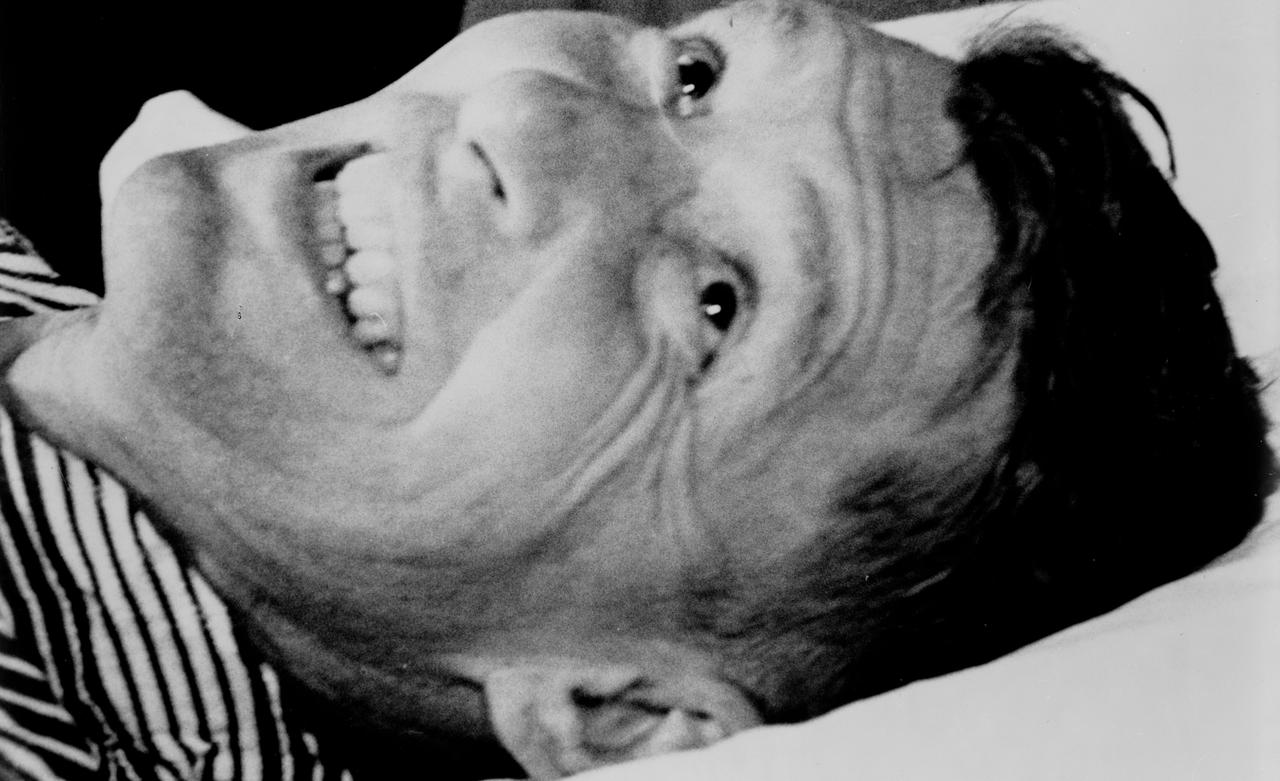
S62-06163 (3 Oct. 1962) --- Astronaut Walter M. Schirra Jr. smiles at medical personnel (out of frame) during a postflight physcial aboard the USS Kearsage, prime recovery vessel for Mercury-Atlas 8 (MA-8) upon which Schirra served as pilot earlier today. Photo credit: NASA

S68-33744 (22 May 1968) --- The prime crew of the first manned Apollo space mission, Apollo 7 (Spacecraft 101/Saturn 205), left to right, are astronauts Donn F. Eisele, command module pilot, Walter M. Schirra Jr., commander; and Walter Cunningham, lunar module pilot.

S68-42343 (5 Aug. 1968) --- The prime crew of the first manned Apollo space mission, Apollo 7, stands on the deck of the NASA Motor Vessel Retriever after suiting up for water egress training in the Gulf of Mexico. Left to right, are astronauts Walter Cunningham, Donn F. Eisele, and Walter M. Schirra Jr.

KENNEDY SPACE CENTER, FLA. -- More than 600 accredited newsmen at Press Site #2 covered this morning's launch of Apollo 7, carying astronauts Walter M. Schirra Jr., Donn F. Eisele and Walter Cunningham from Launch Complex 34.
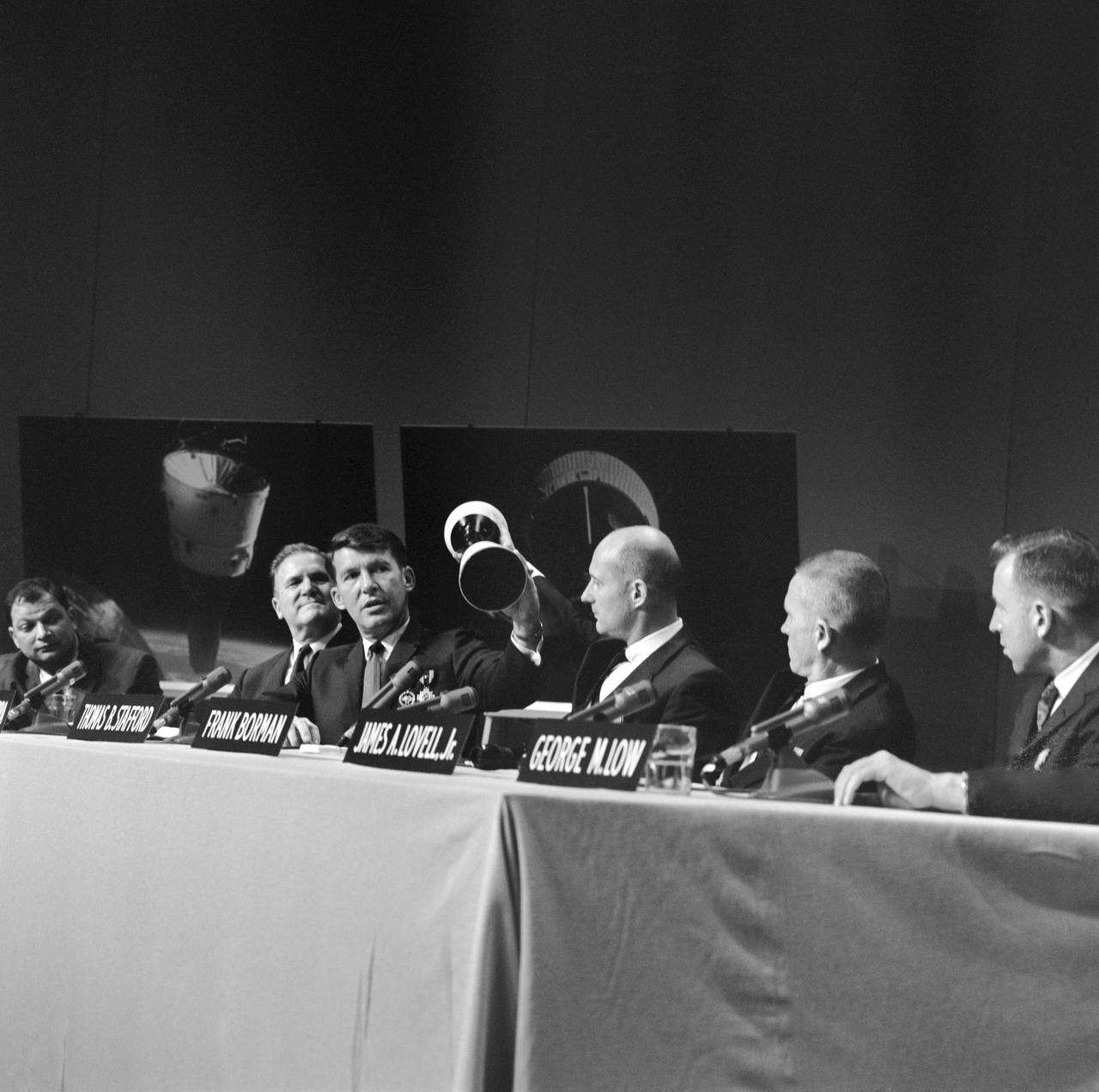
S66-15044 (3 Jan. 1966) --- View of the Gemini 6 and 7 press conference. From right to left are NASA Administrator James E. Webb; MSC Deputy Director George M. Low; and astronauts James A. Lovell Jr., Frank Borman, Thomas B. Stafford and Walter M. Schirra. Photo credit: NASA
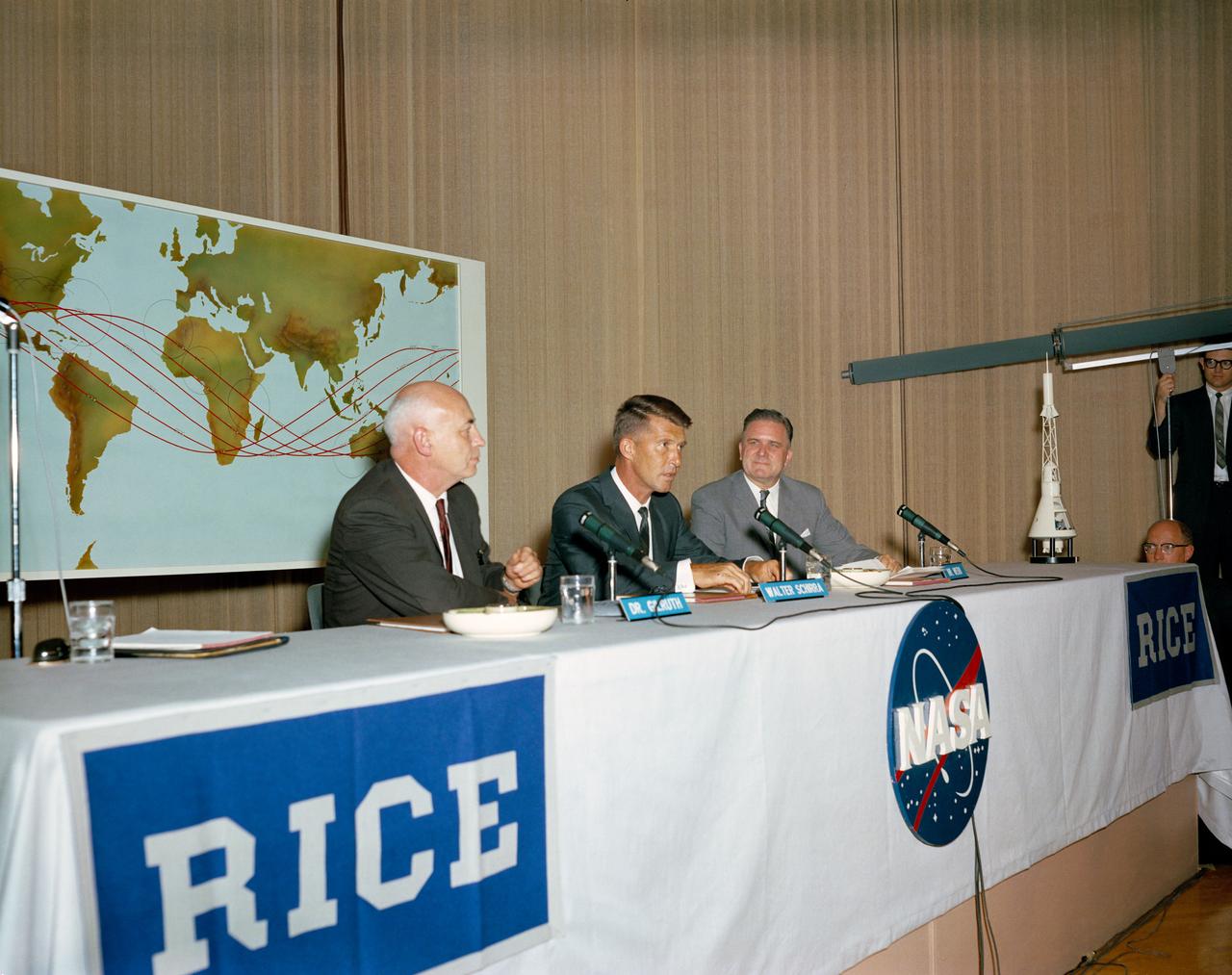
Held following Schirra's MA-8 6-orbital flight 10/03/1962. (FROM COLOR)

S68-50713 (14 Oct. 1968) --- Astronauts Walter M. Schirra Jr. (on right), mission commander; and Donn F. Eisele, command module pilot; are seen in the first live television transmission from space. Schirra is holding a sign which reads, "Keep those cards and letters coming in, folks!" Out of view at left is astronaut Walter Cunningham, lunar module pilot.

KENNEDY SPACE CENTER, FLA. - Spacesuit technician Clyde Teague adjusts the gloves on Apollo 7 Commander Walter M. Schirra Jr., during suiting operations. Astronaut Schirra, along with Command Module Pilot Donn F. Eisele, and Lunar Module Pilot Walter Cunningham, after being suited up, will depart for Launch Pad 34 and board their Saturn 1B rocket for the first manned lunar orbital mission. .
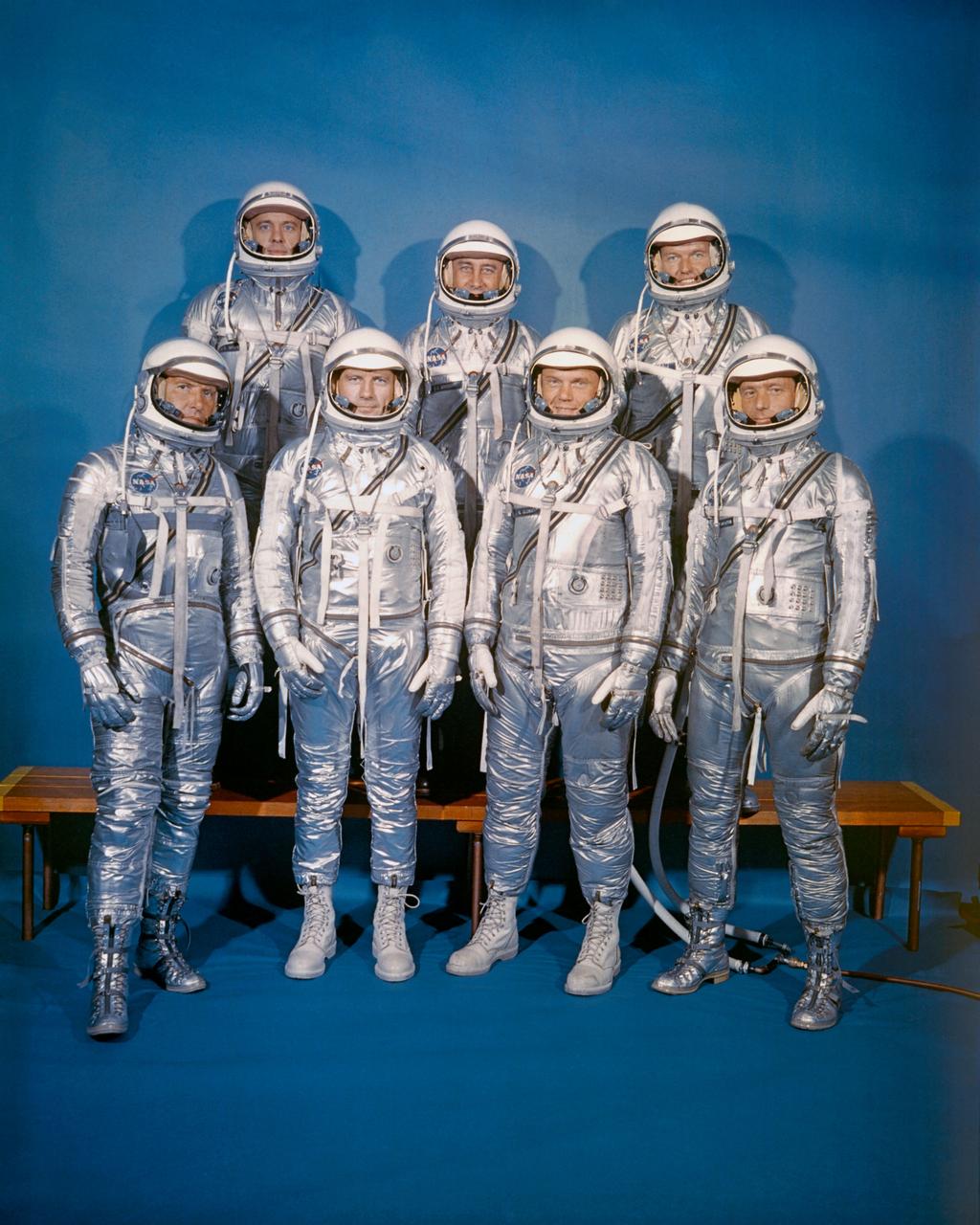
S62-08774 (July 1960) --- These seven men, wearing spacesuits in this portrait, composed the first group of astronauts announced by the National Aeronautics and Space Administration (NASA). They were selected in April of 1959 for the Mercury Program. Front row, left to right, are Walter M. Schirra Jr., Donald K. Slayton, John H. Glenn Jr., and M. Scott Carpenter. Back row, left to right, are Alan B. Shepard Jr., Virgil I. Grissom and L. Gordon Cooper Jr. Photo credit: NASA
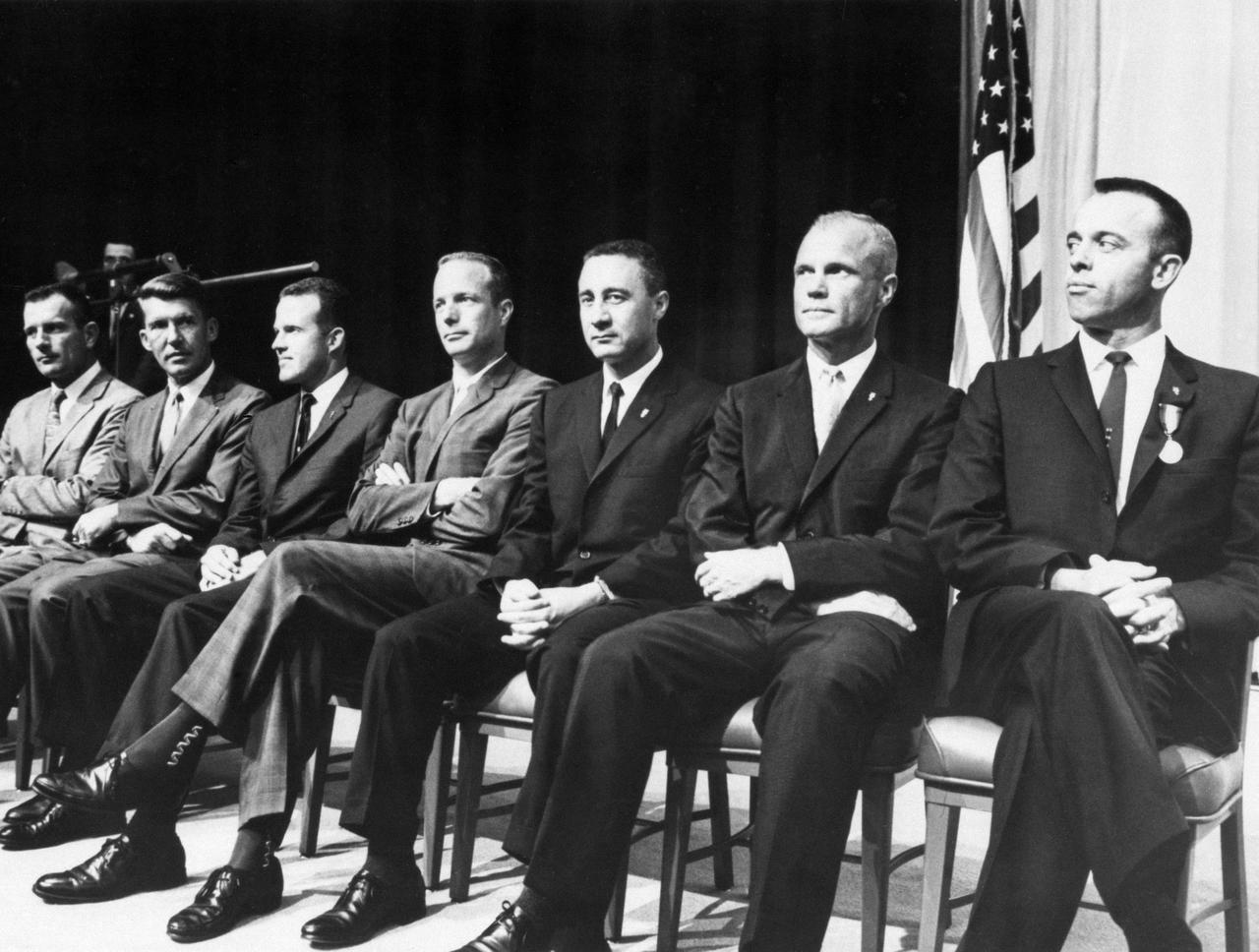
S61-02357 (8 May 1961) --- The original seven Mercury astronauts at the State Department Auditorium on May 8, 1961. The astronauts are (left to right) Donald K. Slayton, Walter M. Schirra, Jr., L. Gordon Cooper, Jr., M. Scott Carpenter, Virgil I. Grissom, John H. Glenn, Jr. and Alan B. Shepard, Jr. Earlier President John F. Kennedy had presented astronaut Shepard with the NASA Distinguished Service Medal (note it on his lapel) in the White House Rose Garden.
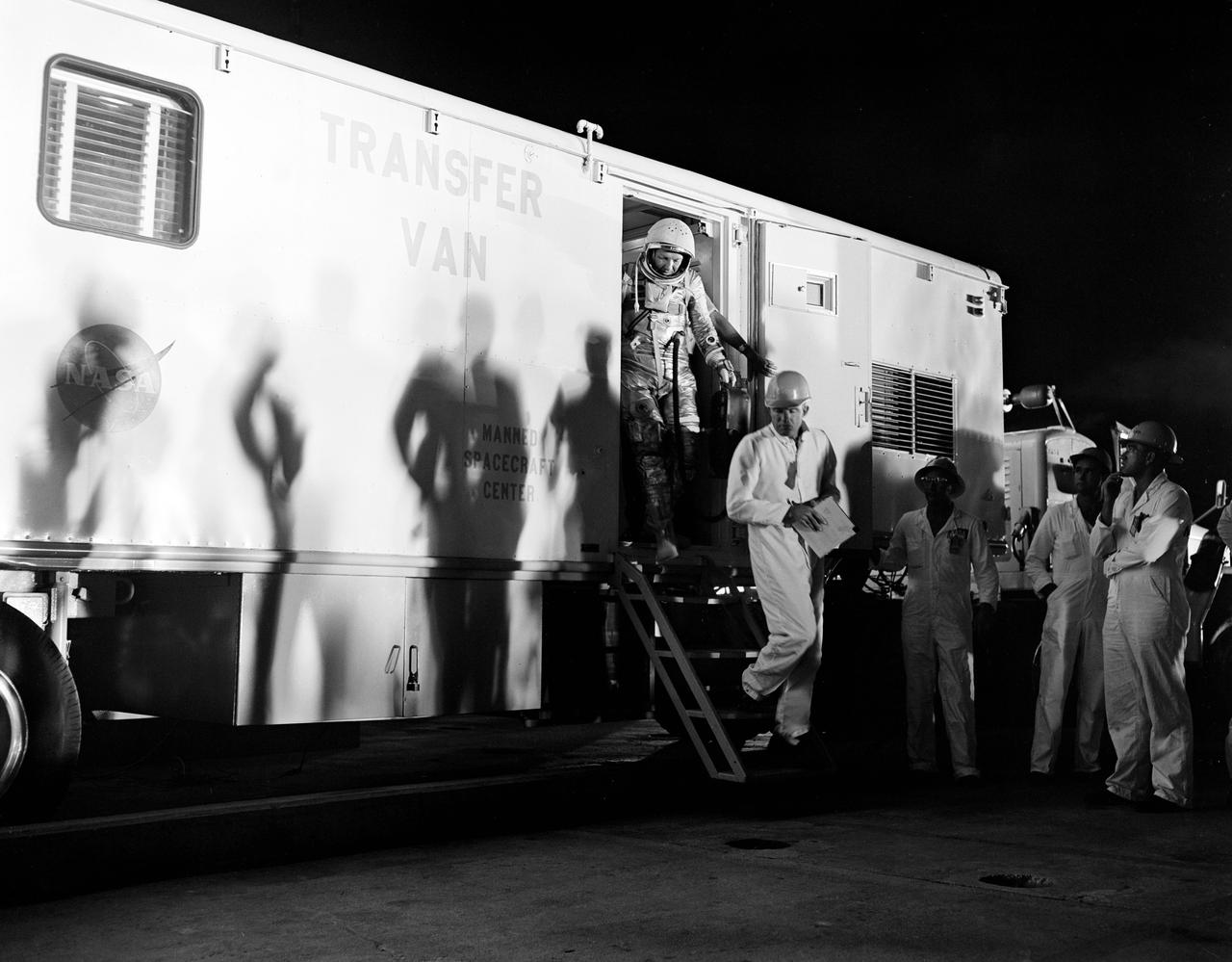
S62-06008 (3 Oct. 1962) --- Astronaut Walter M. Schirra Jr., pilot of the Mercury-Atlas 8 (MA-8) Earth-orbital spaceflight, steps from a transport van as he arrives at Cape Canaveral's Pad 14 during the MA-8 prelaunch countdown. Schirra is accompanied by astronaut L. Gordon Cooper Jr. (in white coveralls), MA-8 backup pilot. Photo credit: NASA
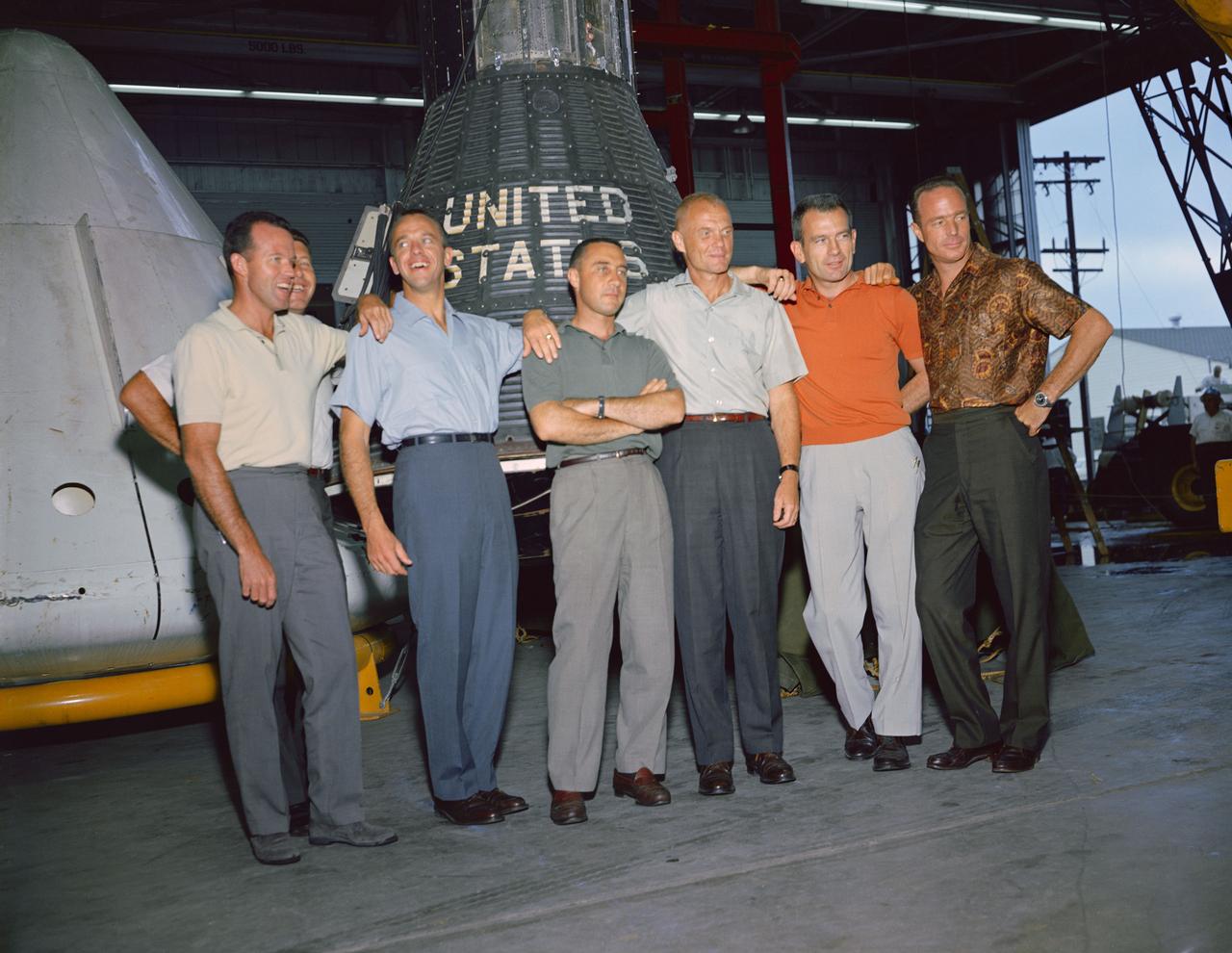
S63-18853 (1963) --- Group shot of the original Mercury astronauts taken at the Manned Spacecraft Center (MSC), Houston, Texas. The astronauts are left-to-right: L. Gordon Cooper Jr., Walter M. Schirra, Alan B. Shepard Jr., Virgil I. Grissom, John H. Glenn Jr., Donald K. Slayton and M. Scott Carpenter. Photo credit: NASA
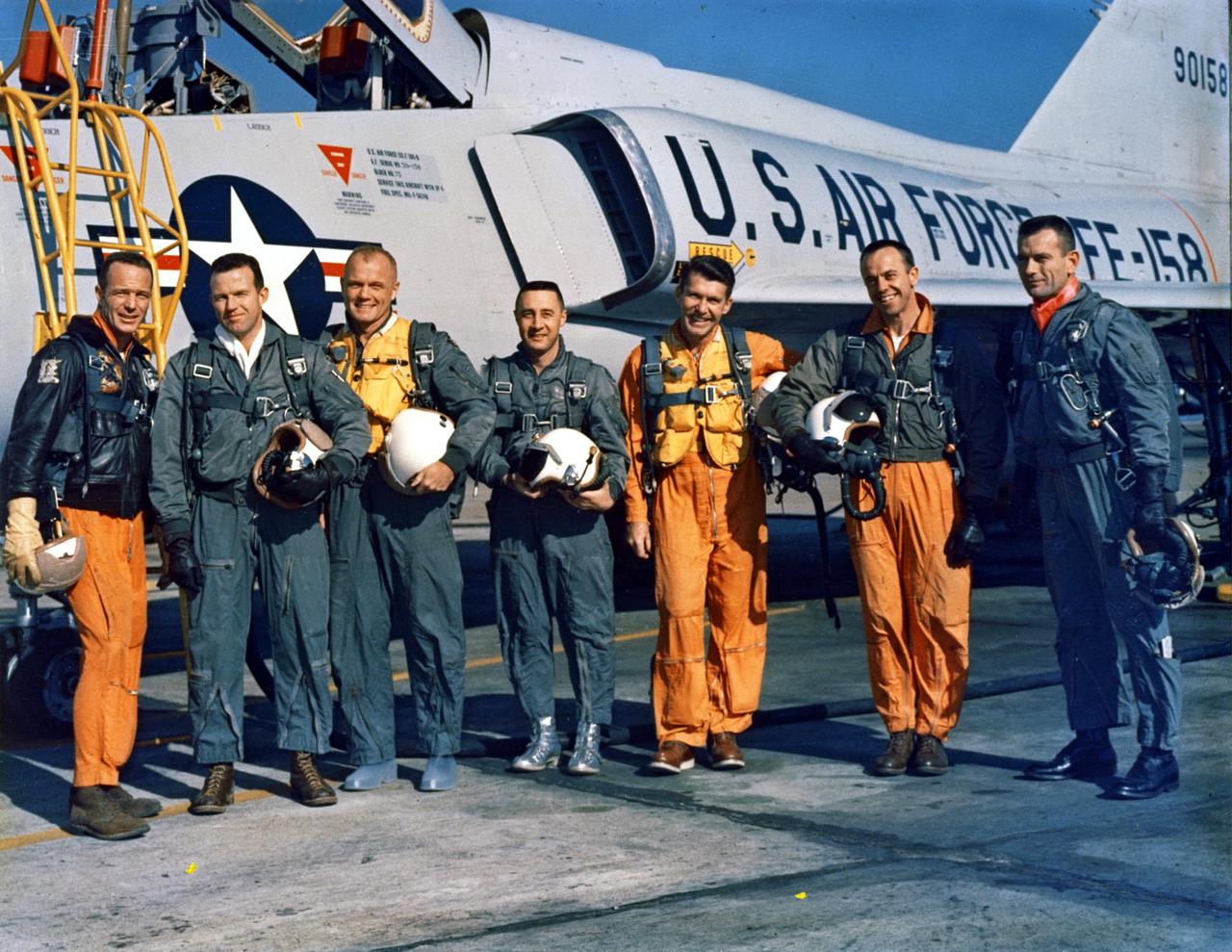
CAPE CANAVERAL, FLA. -- The Original Seven Mercury Astronauts pose beside an Air Force F-102 jet. Standing, left to right, are M. Scott Carpenter, L. Gordon Cooper, John H. Glenn Jr., Virgil I. 'Gus' Grissom, Walter M. Schirra Jr., Alan B. Shepherd Jr., and Donald K. 'Deke' Slayton.
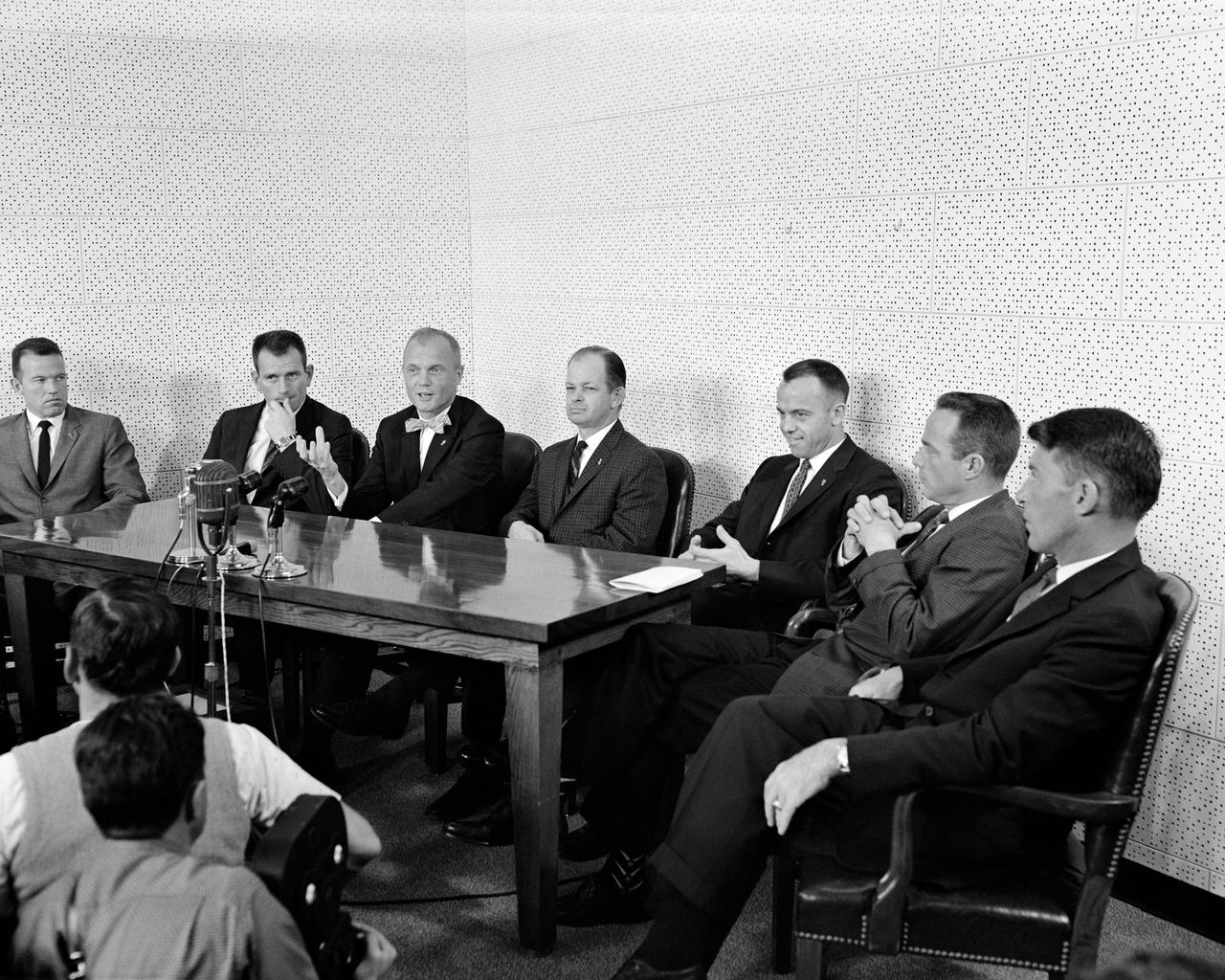
S61-00246 (25 July 1961) --- Photo of the original Mercury astronauts with Col. John A. (Shorty) Powers seated around a table talking to the news media. From left to right are: L. Gordon Cooper, Donald K. Slayton, John H. Glenn Jr., Col. Powers, Alan B. Shepard Jr., M. Scott Carpenter and Walter M. Schirra Jr. Virgil I. Grissom is out of the frame. Photo credit: NASA
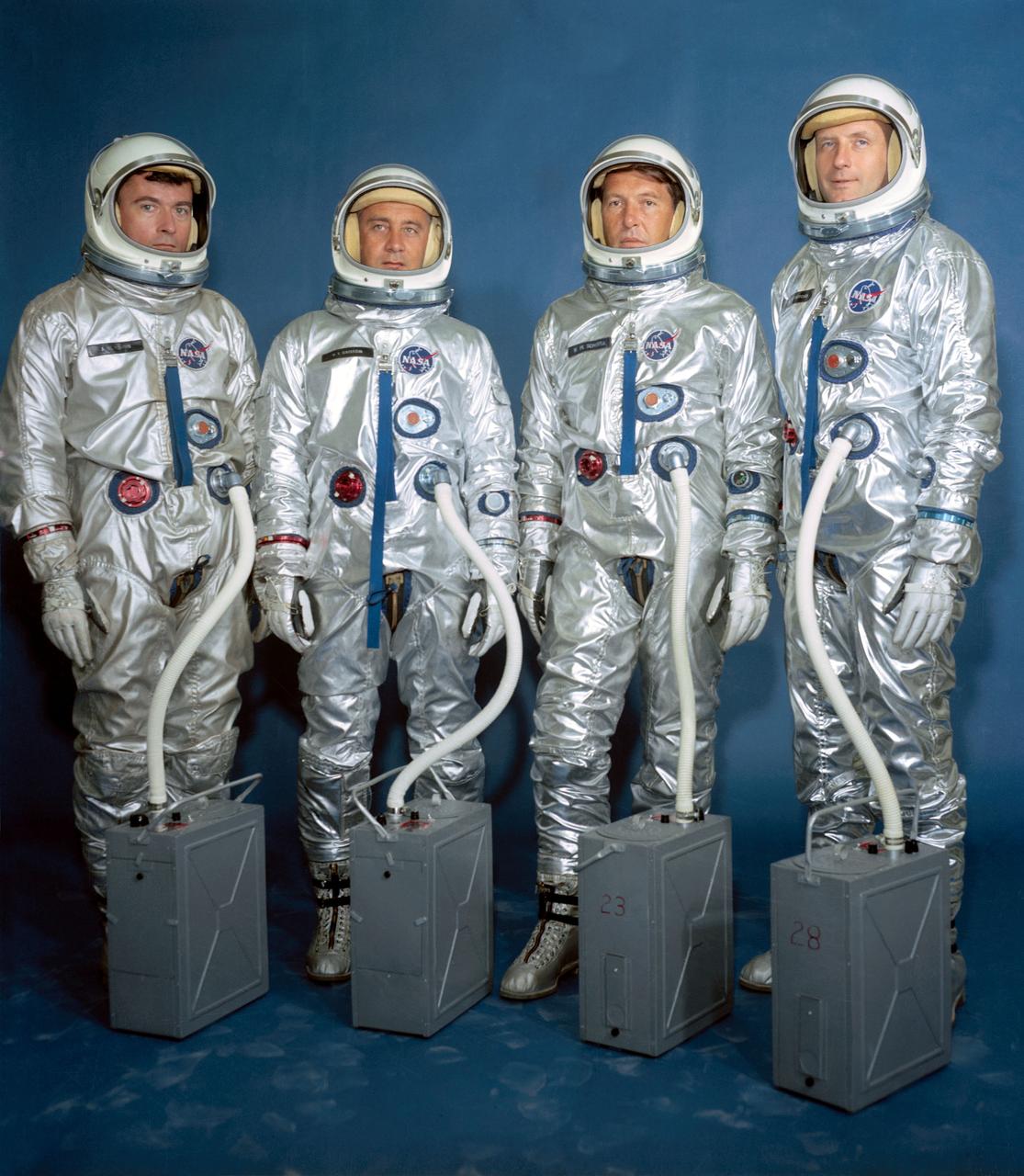
S64-19432 (13 April 1964) --- Left to right are astronauts John W. Young, Virgil I. Grissom, Walter M. Schirra Jr. and Thomas P. Stafford. Gemini III crew assignments are as follows: Grissom, command pilot; Young, pilot, on the prime crew, with Schirra (command pilot) and Stafford (pilot) serving as alternates. EDITOR'S NOTE: For the Gemini-Titan VI mission, Grissom and Young served as backups for Schirra and Stafford.

S62-06606 (3 Oct. 1962) --- Cloud formation over Western Atlantic Ocean north of South America taken during the fourth orbit pass of the Mercury-Atlas 8 (MA-8) mission by astronaut Walter M. Schirra Jr. with a hand-held camera. Photo credit: NASA
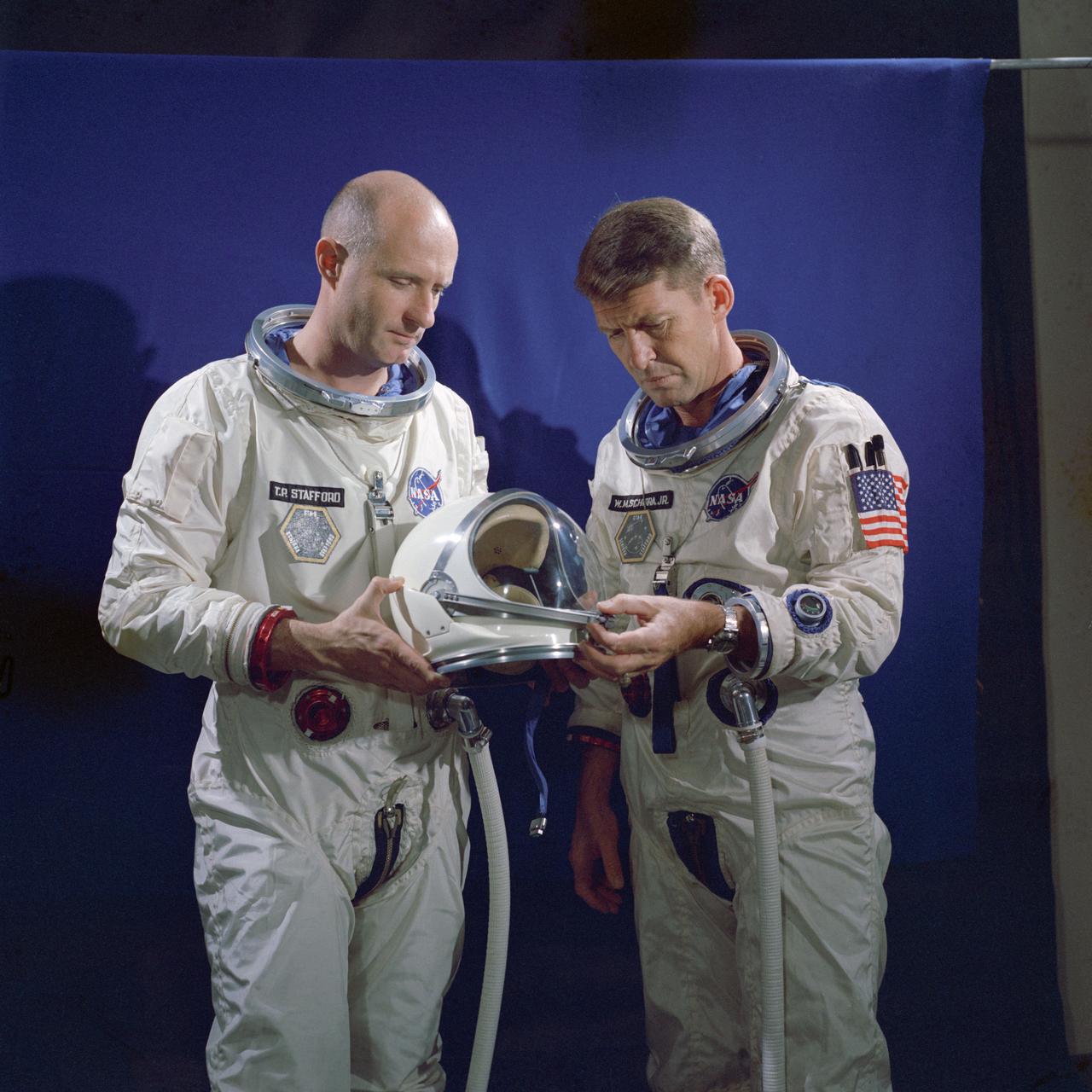
S65-56123 (1 Oct. 1965) --- Astronauts Thomas P. Stafford (left), pilot; and Walter M. Schirra Jr., command pilot, the prime crew of the Gemini-6 spaceflight, are pictured during a suiting up training exercise at Cape Kennedy, Florida. Photo credit: NASA or National Aeronautics and Space Administration
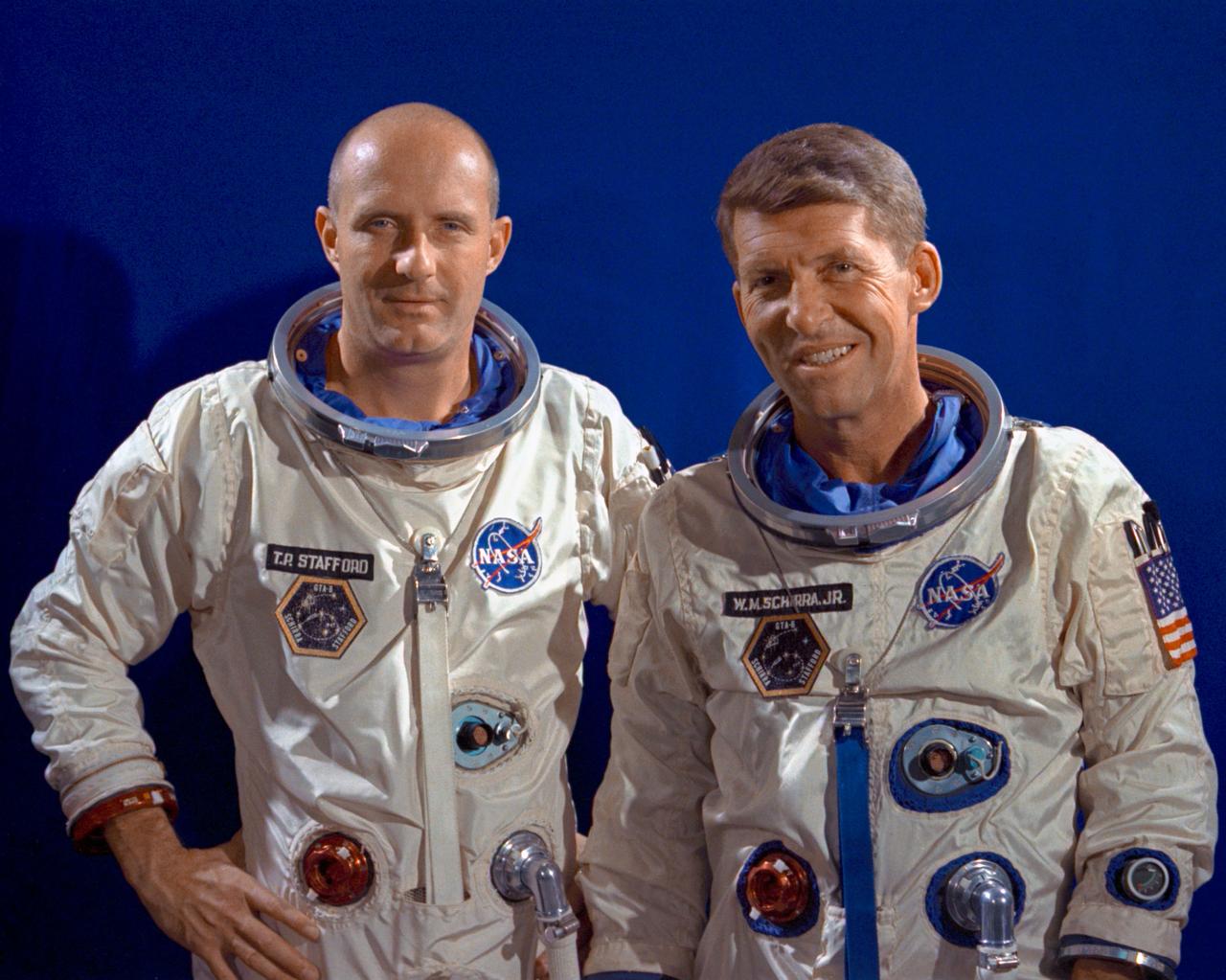
S65-56188 (20 Oct. 1965) --- Astronauts Thomas P. Stafford (left), pilot, and Walter M. Schirra Jr., command pilot, pose during a suiting up exercise in preparation for the National Aeronautics and Space Administration's Gemini-6 two-day mission. Photo credit: NASA
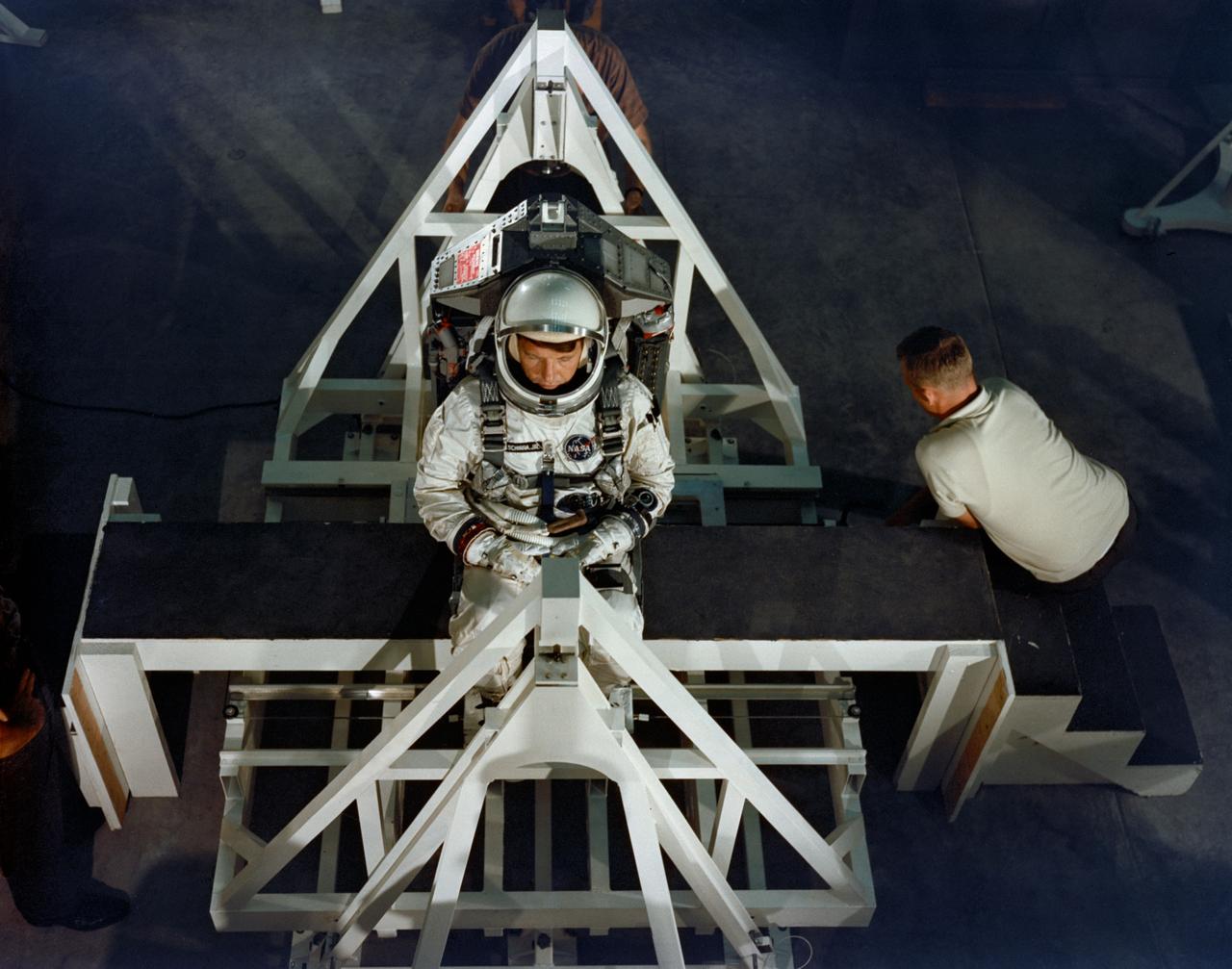
S65-54319 (22 Sept. 1965) --- Astronaut Walter M. Schirra Jr., command pilot of the Gemini-6 prime crew, undergoes weight and balance tests in the Pyrotechnic Installation Building, Merritt Island, Kennedy Space Center, Florida. Photo credit: NASA or National Aeronautics and Space Administration
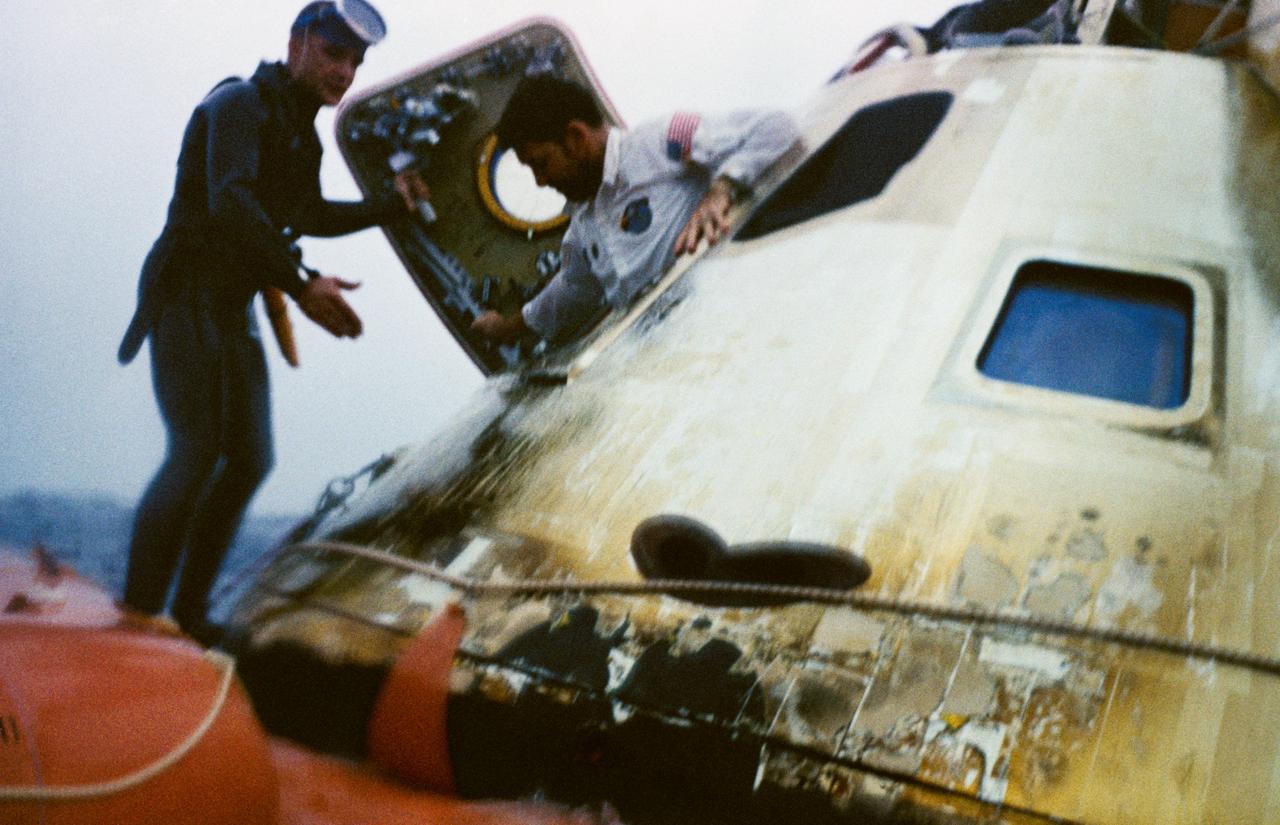
Astronaut Walter M. Schirra, Jr., Apollo 7 commander, egresses the spacecraft during recovery operations in the Atlantic. He is assisted by a member of the U.S. Navy frogman team. The Apollo 7 spacecraft splashed down at 7:11 a.m., October 22, 1968, approximately 200 nautical miles south-southwest of Bermuda.
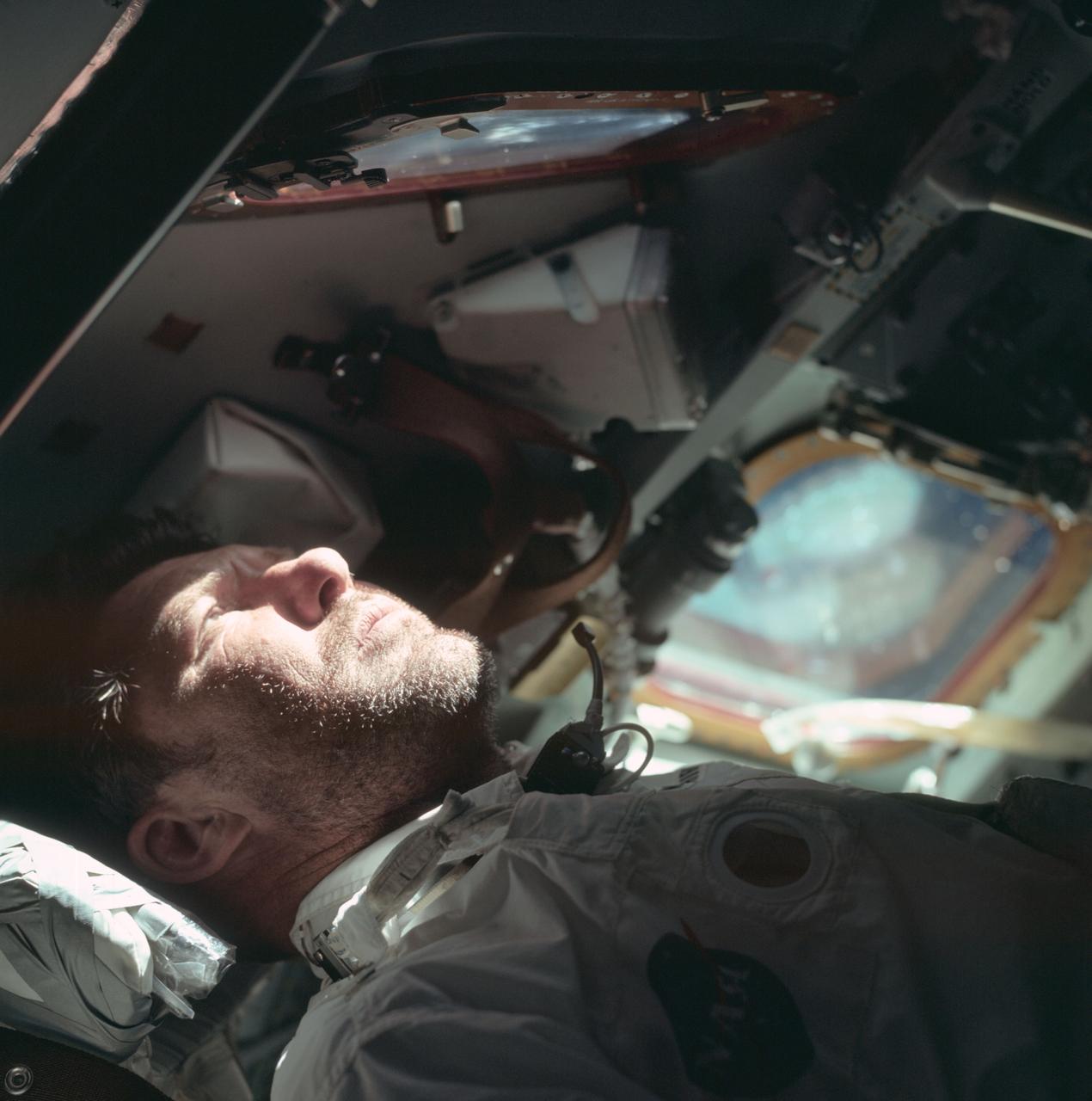
AS07-04-1596 (20 Oct. 1968) --- A heavy beard covers the face of astronaut Walter M. Schirra Jr., Apollo 7 commander, as he looks out the rendezvous window in front of the commander's station on the ninth day of the Apollo 7 mission.
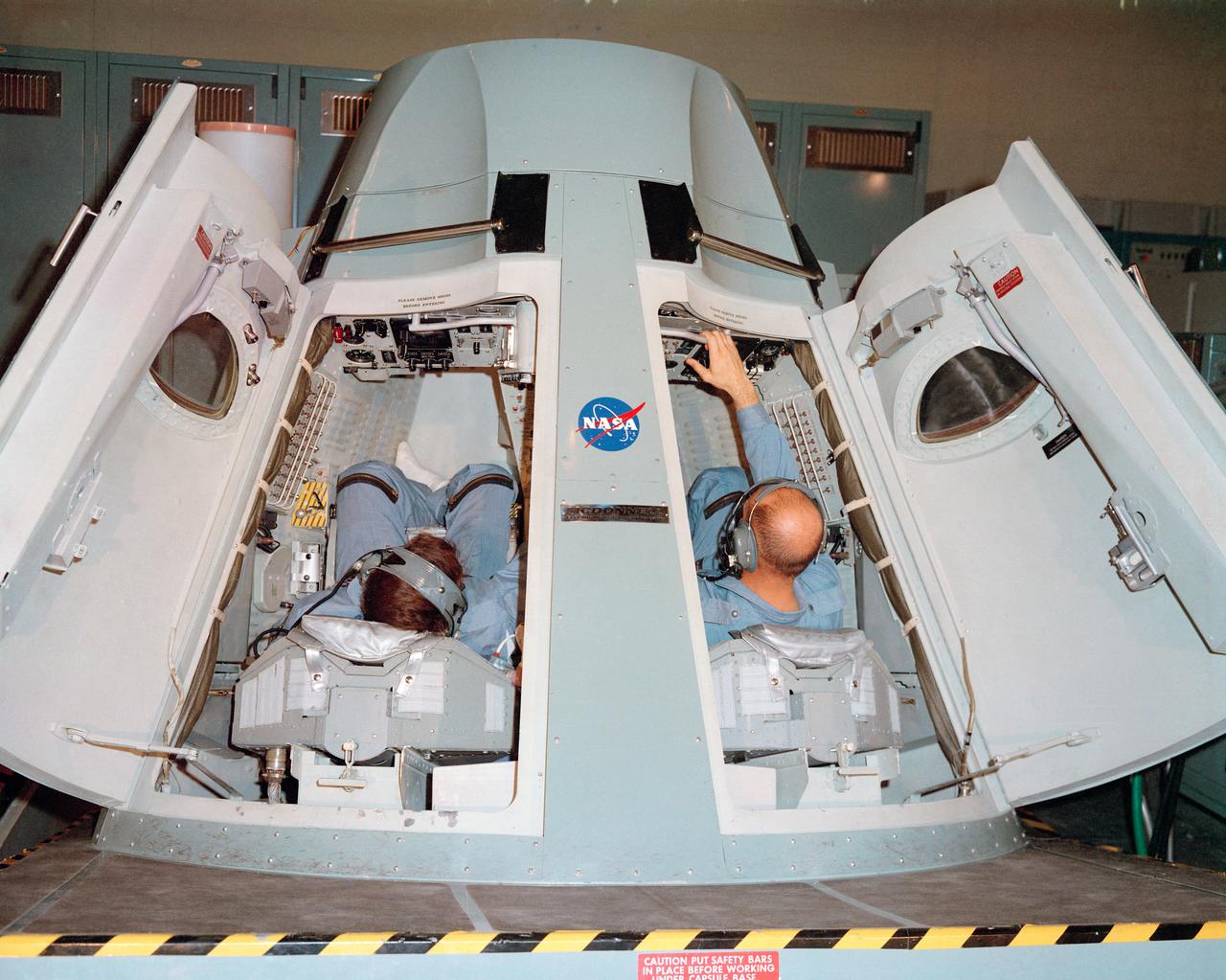
S65-13920 (15 Jan. 1965) --- The Gemini-6 prime crew, astronauts Walter M. Schirra Jr. (left), command pilot, and Thomas P. Stafford, pilot, are pictured in the Gemini simulator during training exercises at the Mission Control Center at Cape Kennedy, Florida. Photo credit: NASA or National Aeronautics and Space Administration
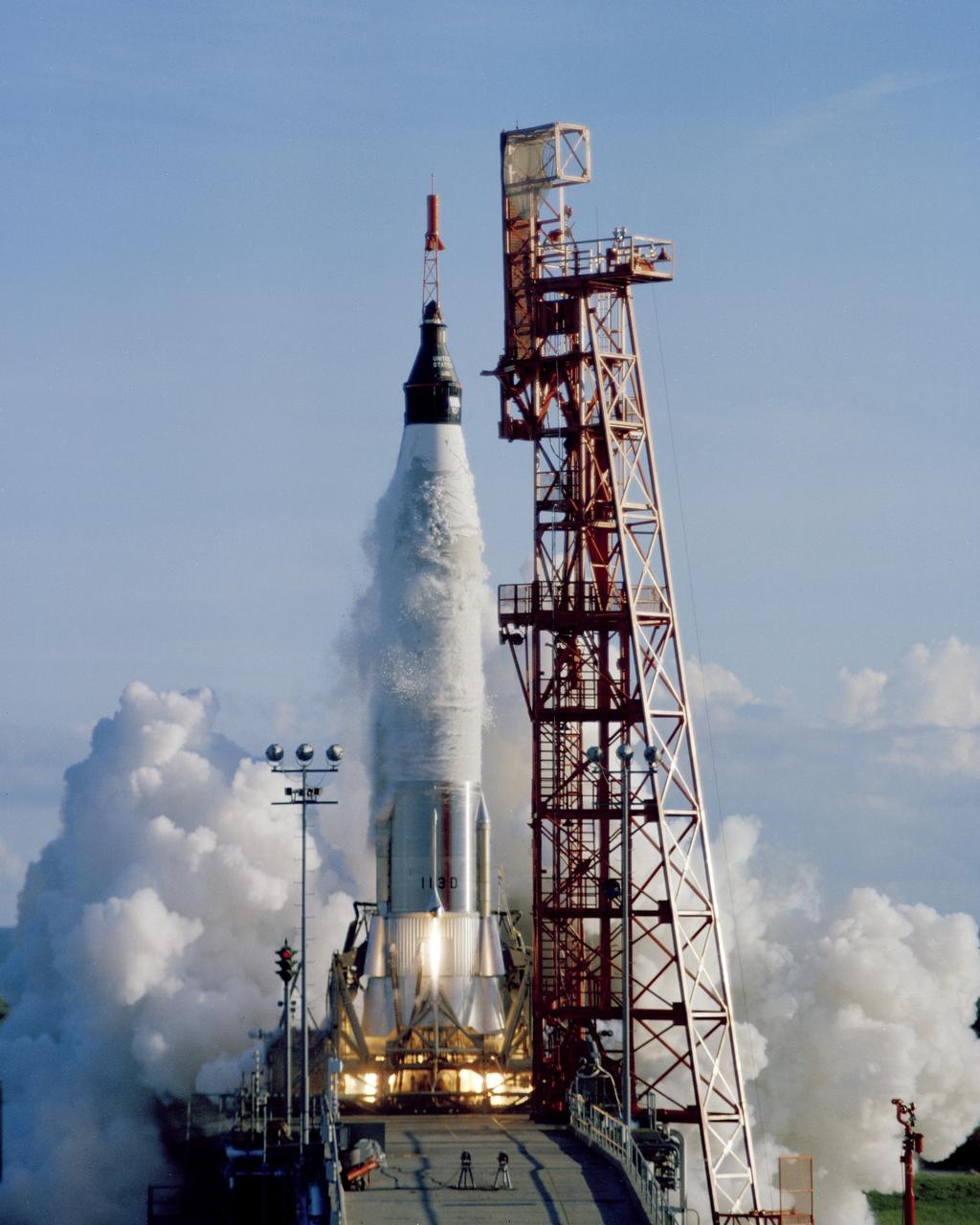
CAPE CANAVERAL, Fla. -- An Atlas launch vehicle lifts off with the Mercury spacecraft Sigma 7 atop with astronaut Walter M. Schirra Jr. aboard. The fifth American into space and the third to orbit the Earth plans to circle the globe six time prior to a planned splashdown in the Pacific Ocean. Photo Credit: NASA
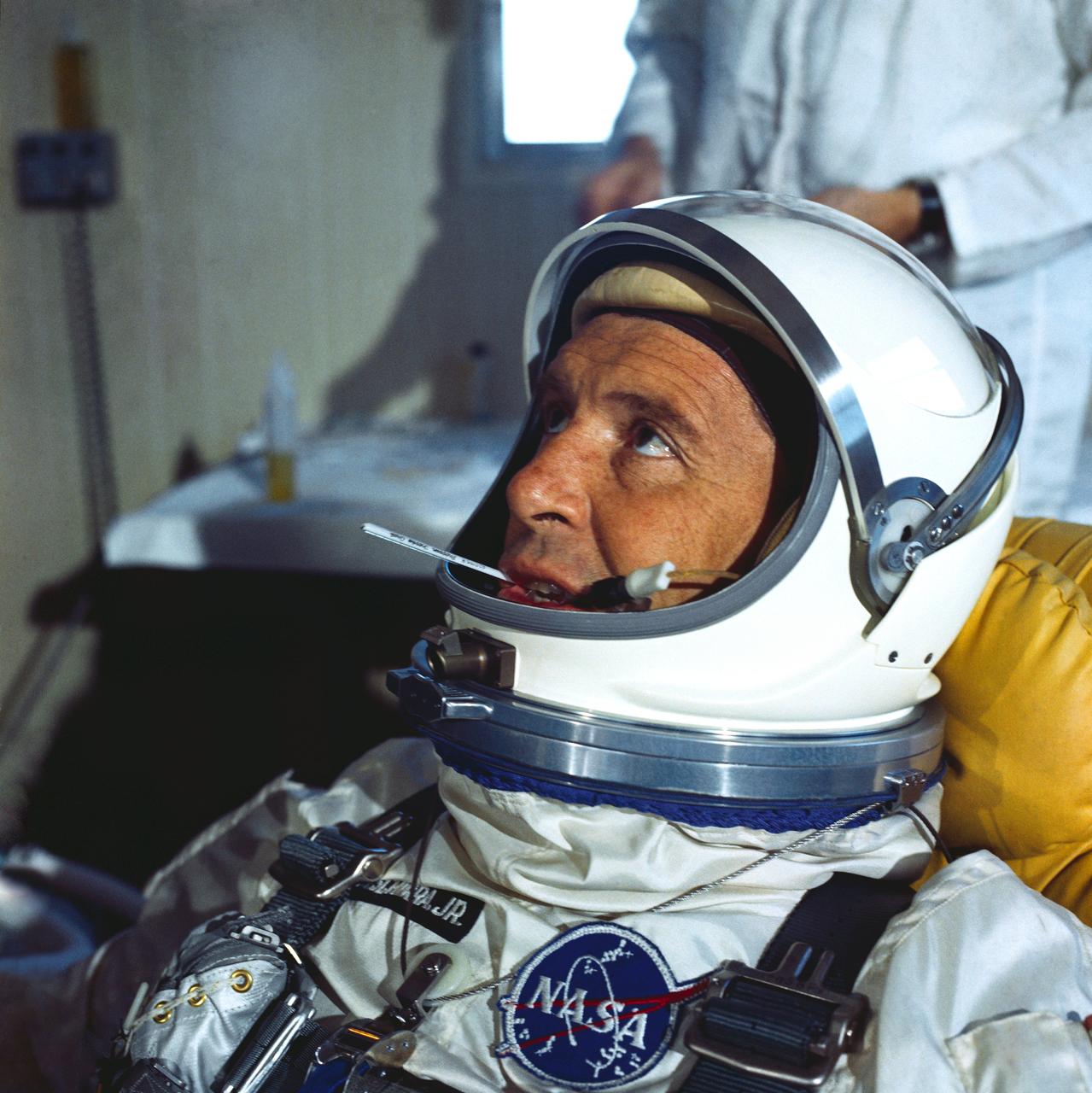
S65-22666 (8 March 1965) --- Astronaut Walter M. Schirra Jr., the command pilot of the GT-3 backup crew, is shown suited up for prelaunch tests. He is shown with his helmet visor up and a thermometer in his mouth.
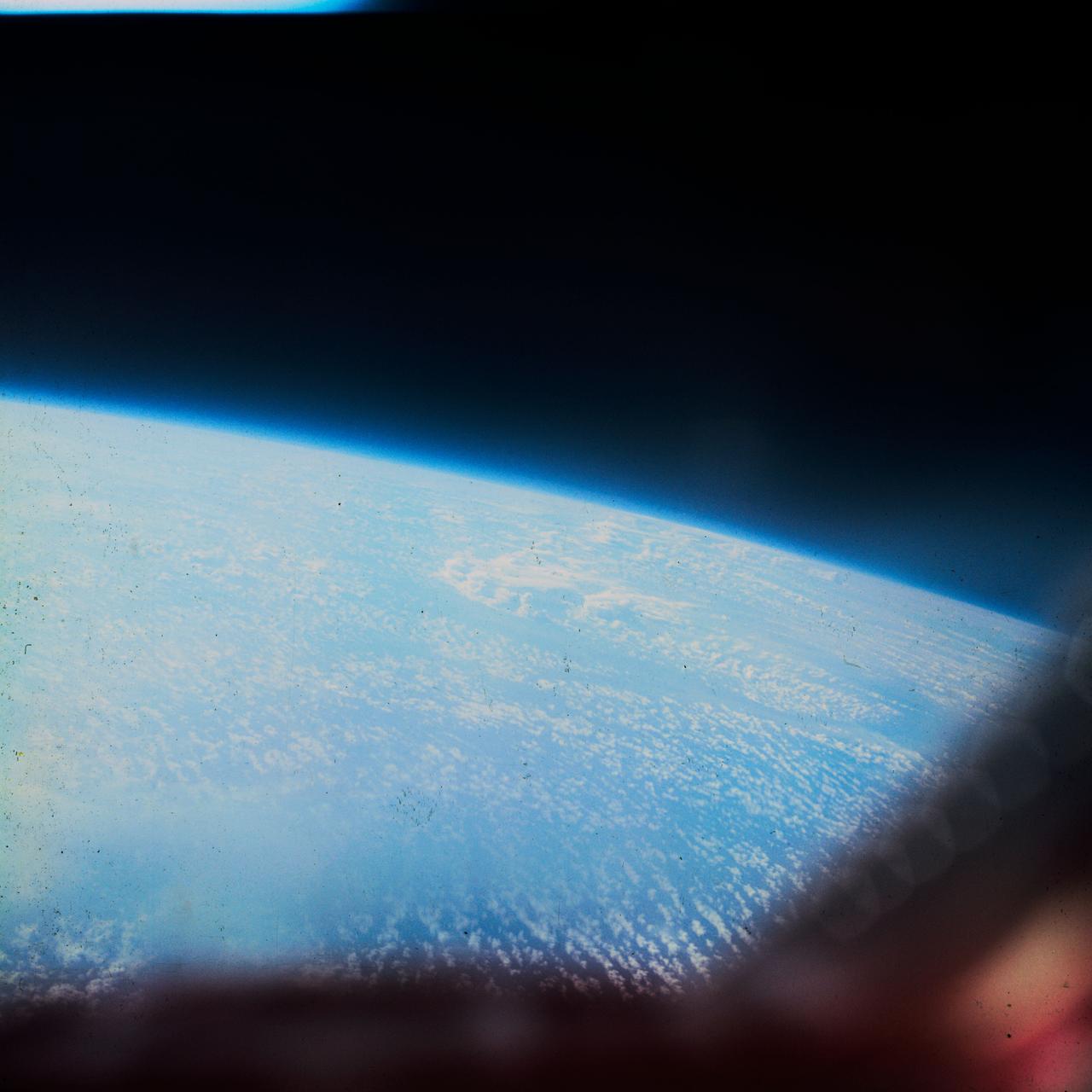
S62-06612 (3 Oct. 1962) --- Cloud formation over South America taken during the fifth orbit pass of the Mercury-Atlas 8 (MA-8) mission by astronaut Walter M. Schirra Jr. with a hand-held camera. Photo credit: NASA
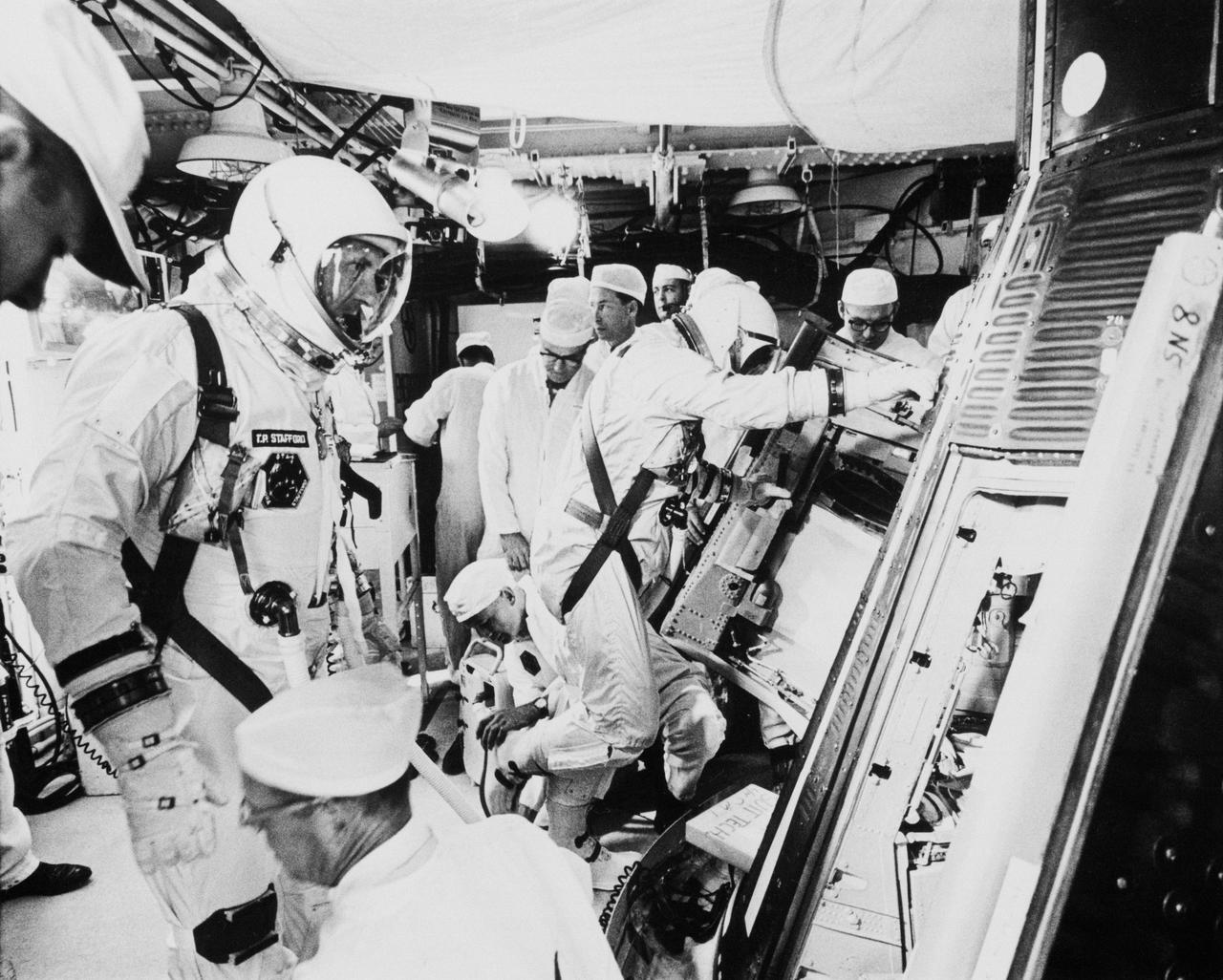
S65-56155 (15 Dec. 1965) --- Astronauts Thomas P. Stafford, pilot; and Walter M. Schirra Jr., command pilot, are readied for insertion into the Gemini-6 spacecraft in the White Room at Pad 19, Cape Canaveral, Florida. Photo credit: NASA or National Aeronautics and Space Administration
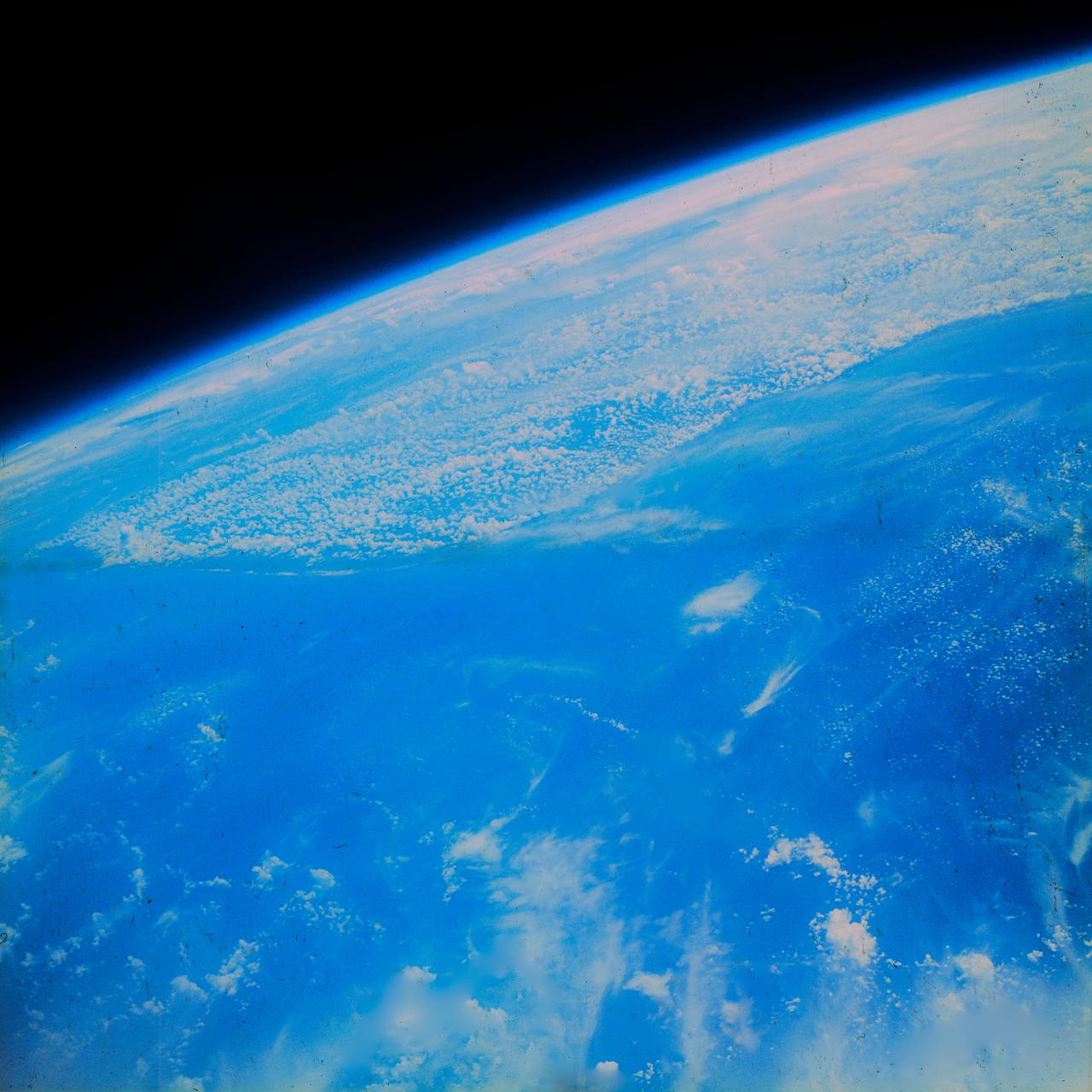
S62-06607 (3 Oct. 1962) --- Western horizon over South America taken during the sixth orbit pass of the Mercury-Atlas 8 (MA-8) mission by astronaut Walter M. Schirra Jr. with a hand-held camera. Photo credit: NASA
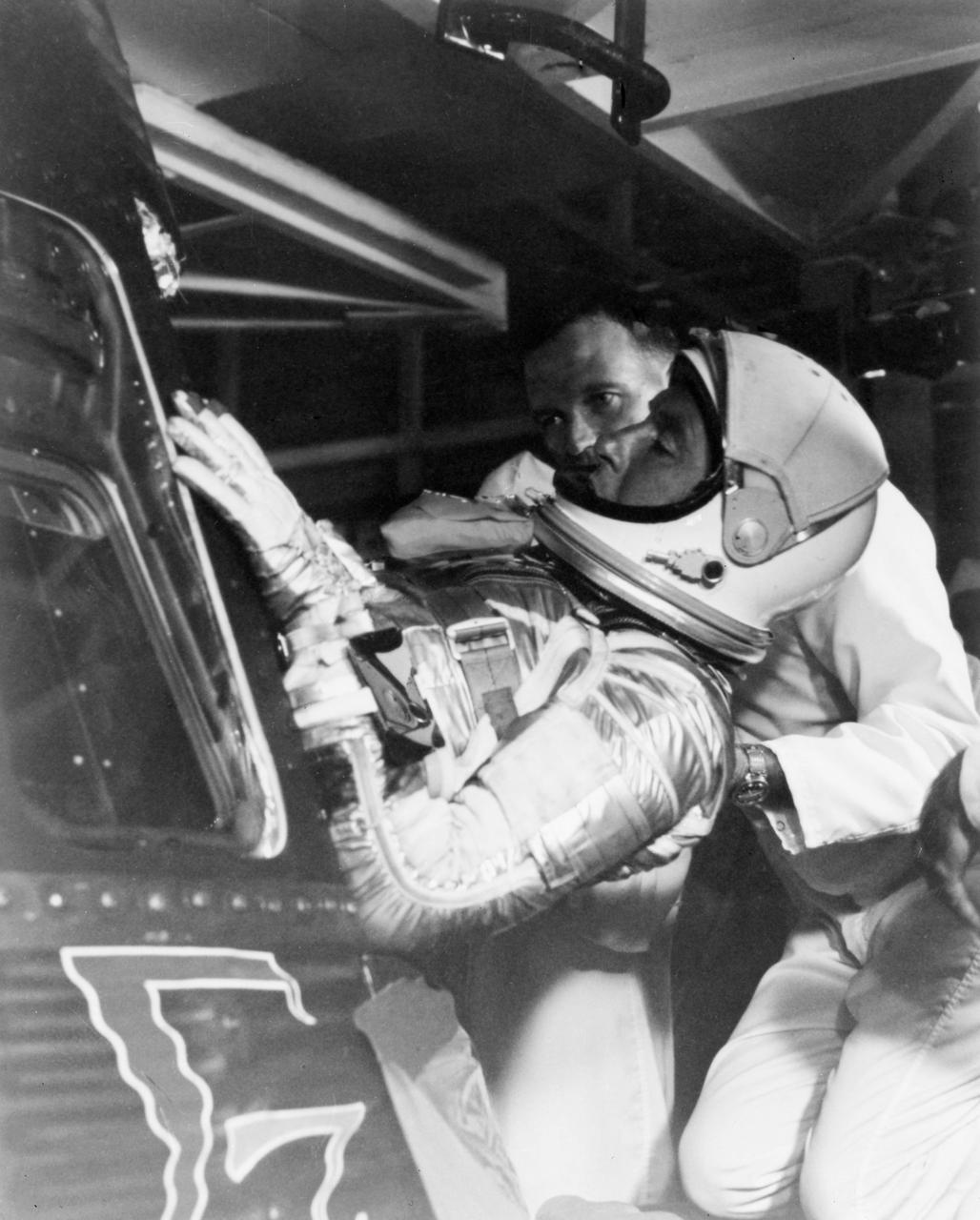
S62-06002 (3 Oct. 1962) --- Astronaut Walter M. Schirra Jr., pilot of the Mercury-Atlas 8 (MA-8) Earth-orbital spaceflight, is assisted by backup pilot L. Gordon Cooper into his Sigma 7 spacecraft for the begining of the MA-8 mission. Photo credit: NASA
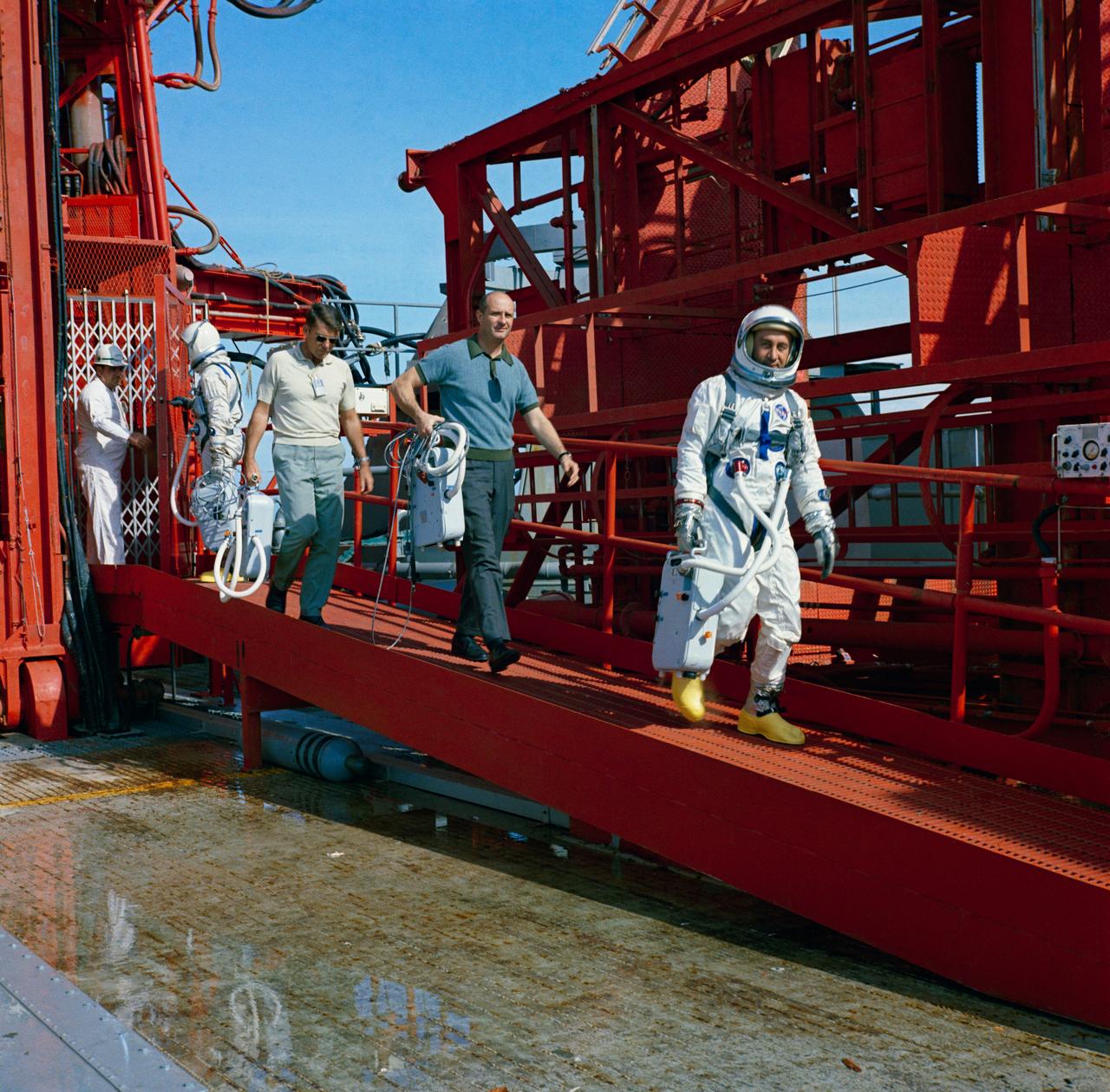
S64-40298 (24 Nov. 1964) --- Astronauts John W. Young, Walter M. Schirra Jr., Thomas P. Stafford and Virgil I. Grissom (left to right) are shown during egress training during Gemini-Titan 3 simulation launch at Pad 19.
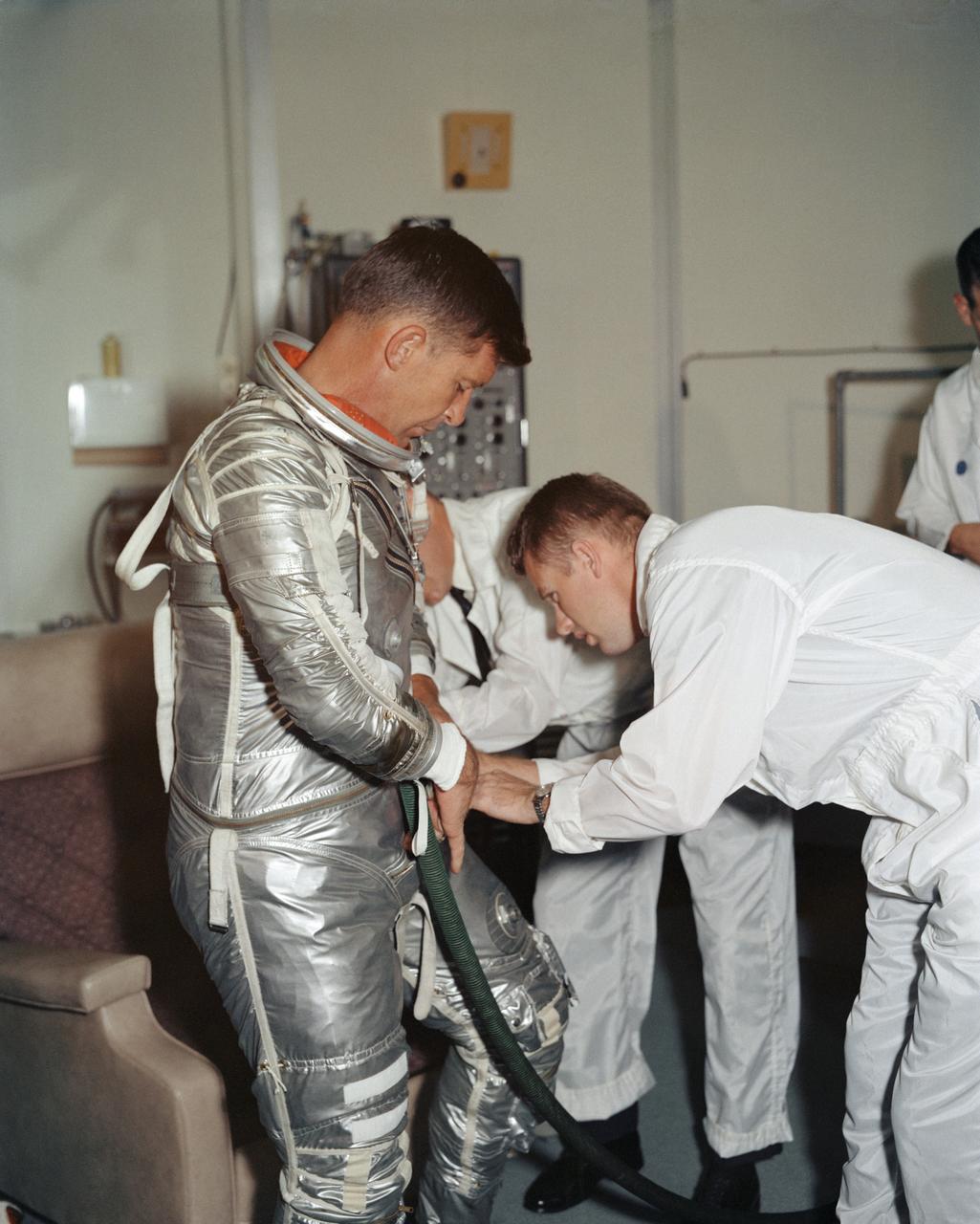
S62-08895 (1962) --- Astronaut Walter M. Schirra Jr., pilot of the Mercury-Atlas 8 (MA-8) Earth-orbital spaceflight, goes through a suiting-up exercise in Hangar "S" at Cape Canaveral several weeks prior to his scheduled Oct. 3, 1962 flight. Photo credit: NASA
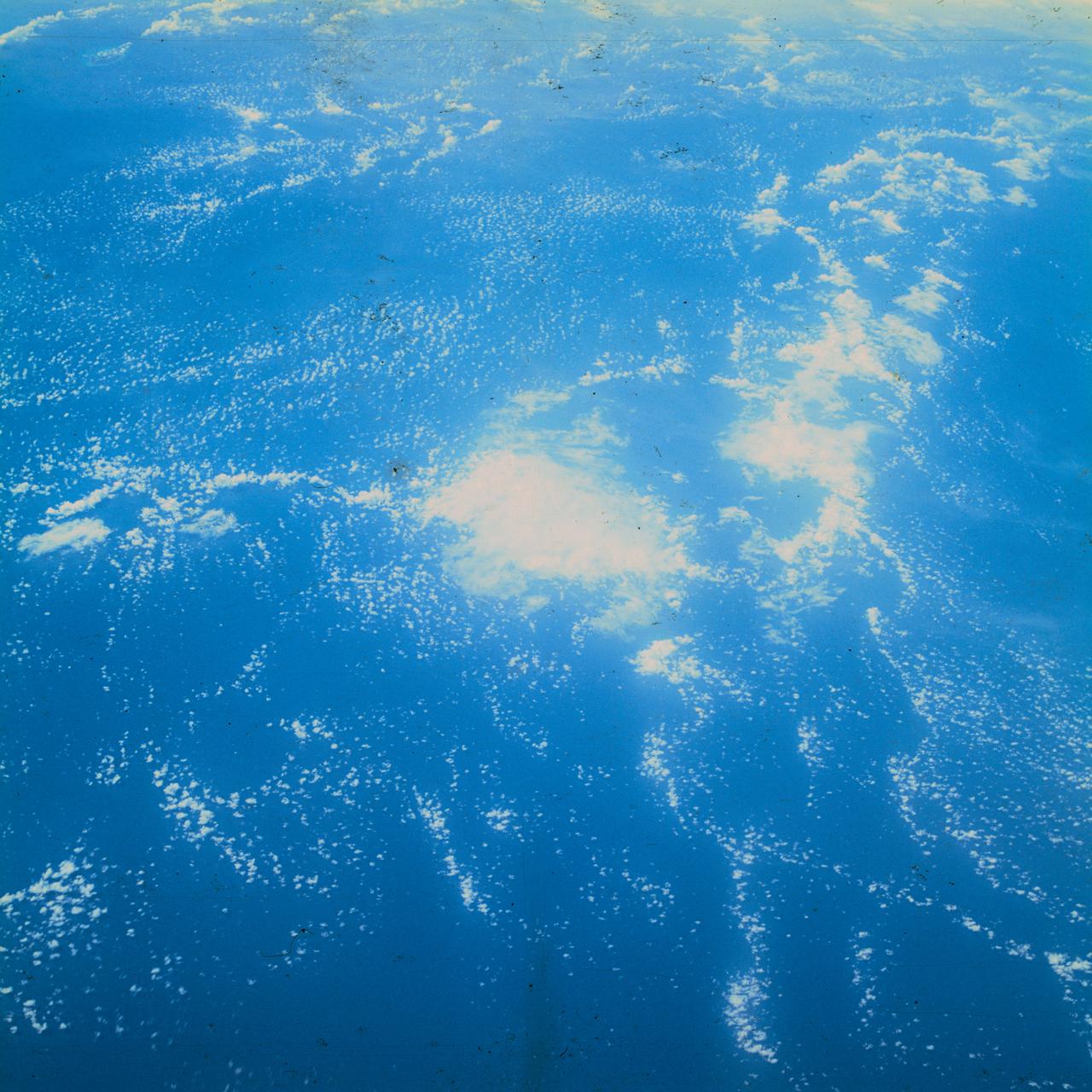
S62-06613 (3 Oct. 1962) --- Cumulus cloud formation over West Atlantic Ocean north of South American during the fourth orbit pass of the Mercury-Atlas 8 (MA-8) mission by astronaut Walter M. Schirra Jr. with a hand-held camera. Photo credit: NASA
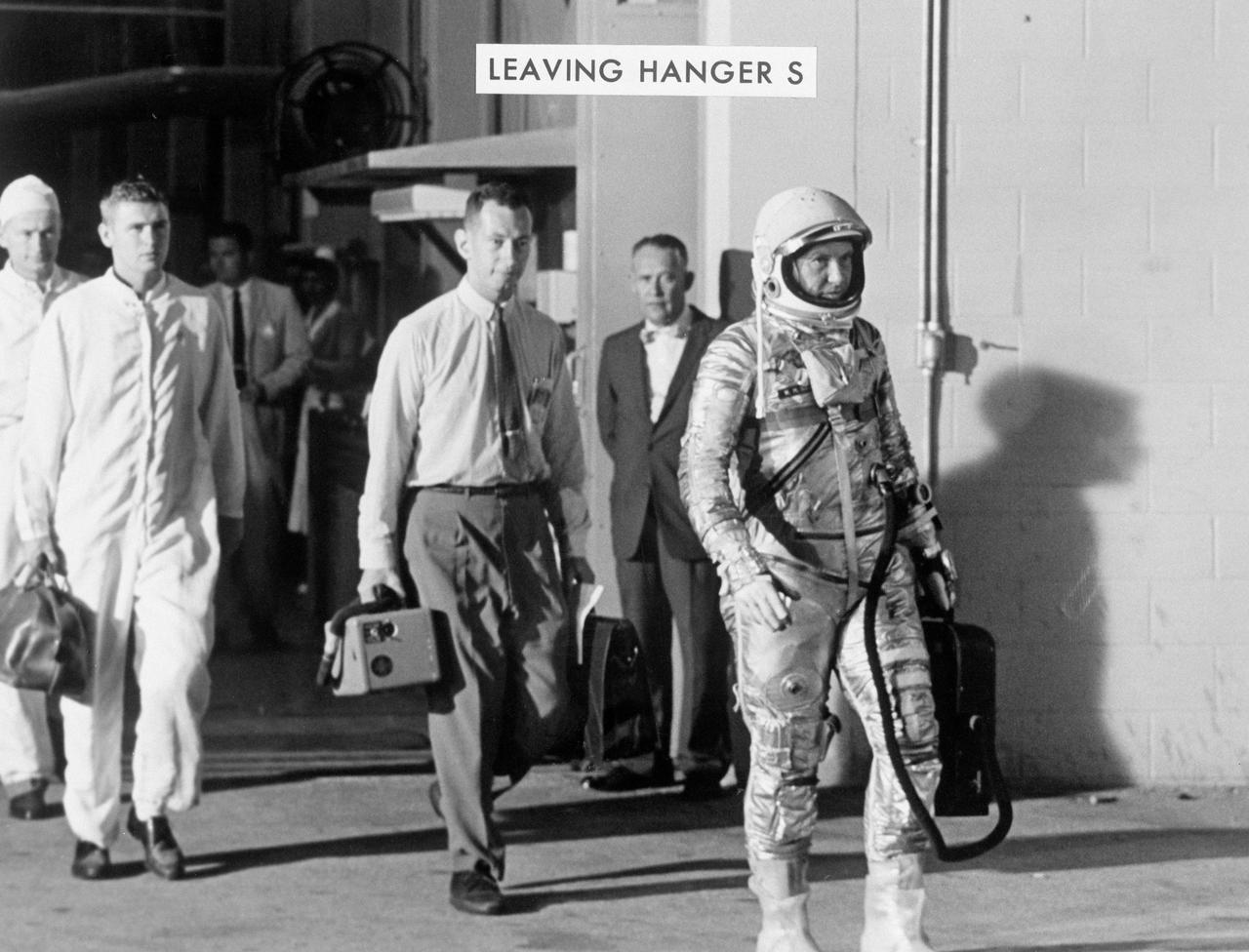
S63-00695 (3 Oct. 1962) --- Astronaut Walter M. Schirra Jr., pilot of the Mercury-Atlas 8 (MA-8) Earth-orbital spaceflight, leaves Hangar "S" at Cape Canaveral on his way to his scheduled Oct. 3, 1962 flight. Photo credit: NASA
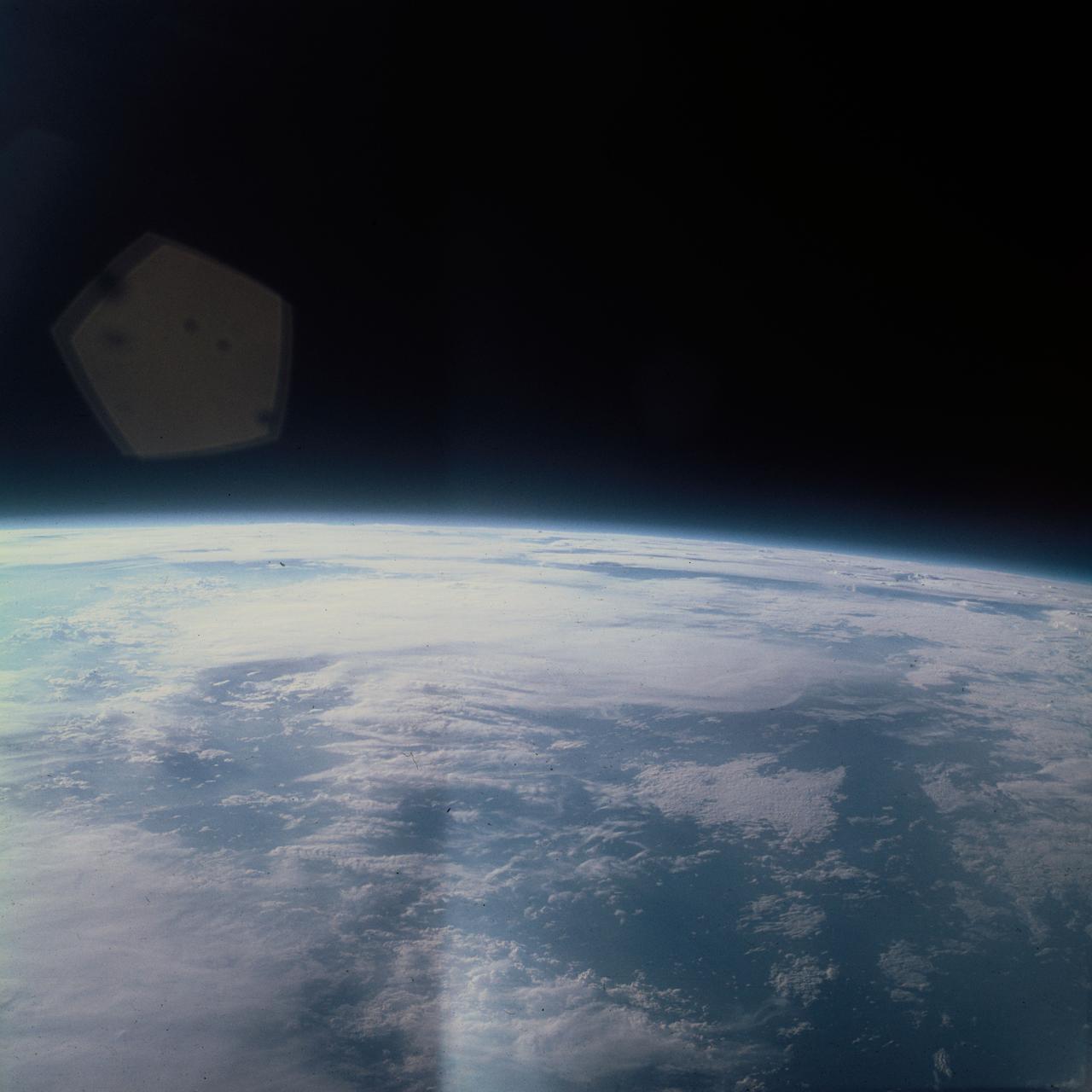
S62-06604 (3 Oct. 1962) --- Western horizon over South America taken during the sixth orbit pass of the Mercury-Atlas 8 (MA-8) mission by astronaut Walter M. Schirra Jr. with a hand-held camera. Photo credit: NASA
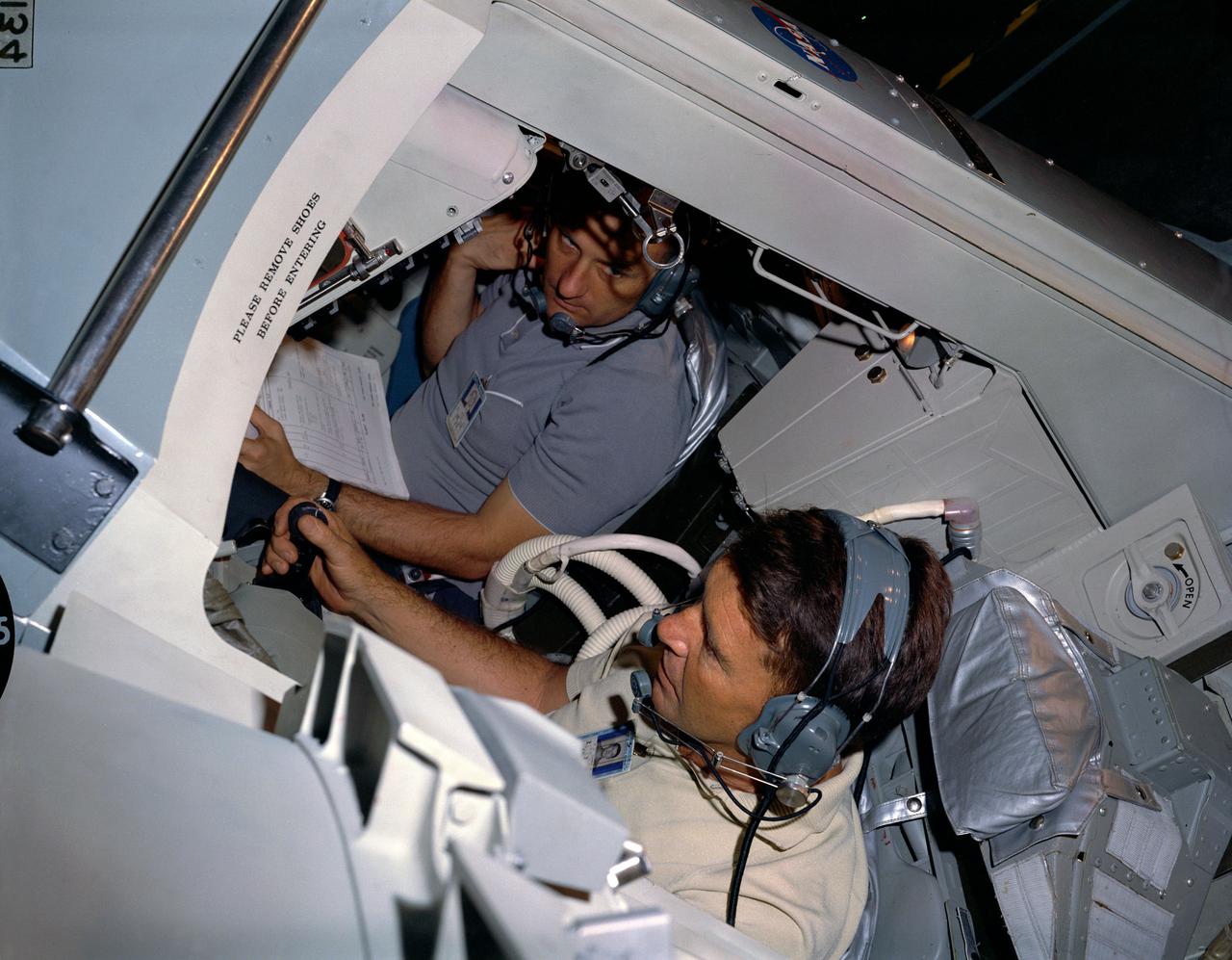
S65-13921 (1965) --- Overhead view of astronauts Walter M. Schirra Jr. (foreground), backup command pilot, and Thomas P. Stafford, backup pilot, as they prepare to run Gemini-Titan 3 simulations in the Gemini mission simulator in the Mission Control Center at Merritt Island, Florida.
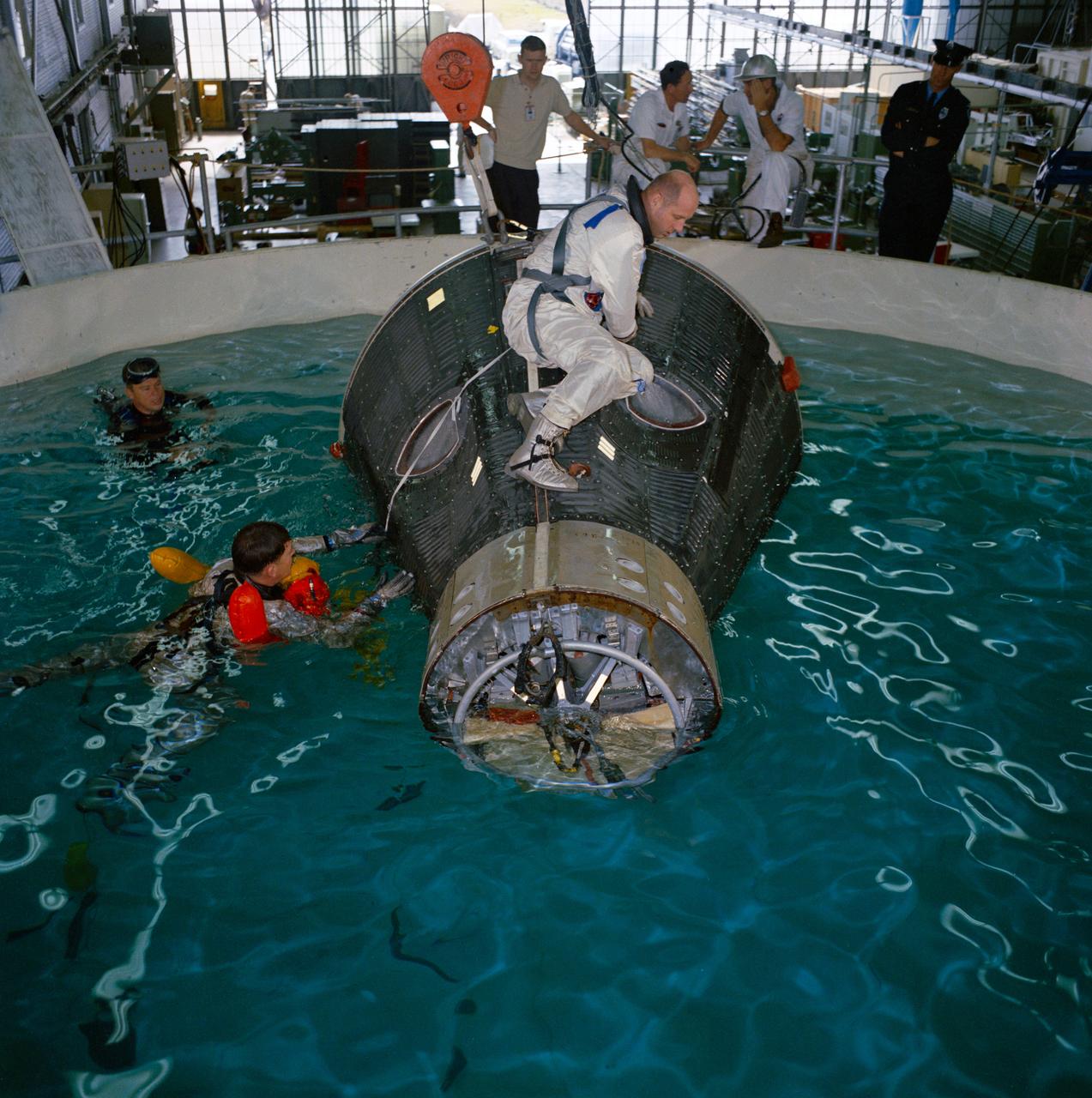
S65-10118 (1 Feb. 1965) --- The Gemini-6 prime crew, astronauts Walter M. Schirra Jr. (in water), command pilot; and Thomas P. Stafford (on spacecraft), pilot, are pictured during water egress training at Ellington Air Force Base, Texas. Photo credit: NASA or National Aeronautics and Space Administration

S66-18607 (18 March 1966) --- Astronauts Neil A. Armstrong (center), Gemini-8 command pilot, and David R. Scott, pilot, arrive at Hickam Field, Hawaii on their way from Naha, Okinawa, to Cape Kennedy, Florida. Astronaut Walter M. Schirra Jr. is at extreme left. Photo credit: NASA
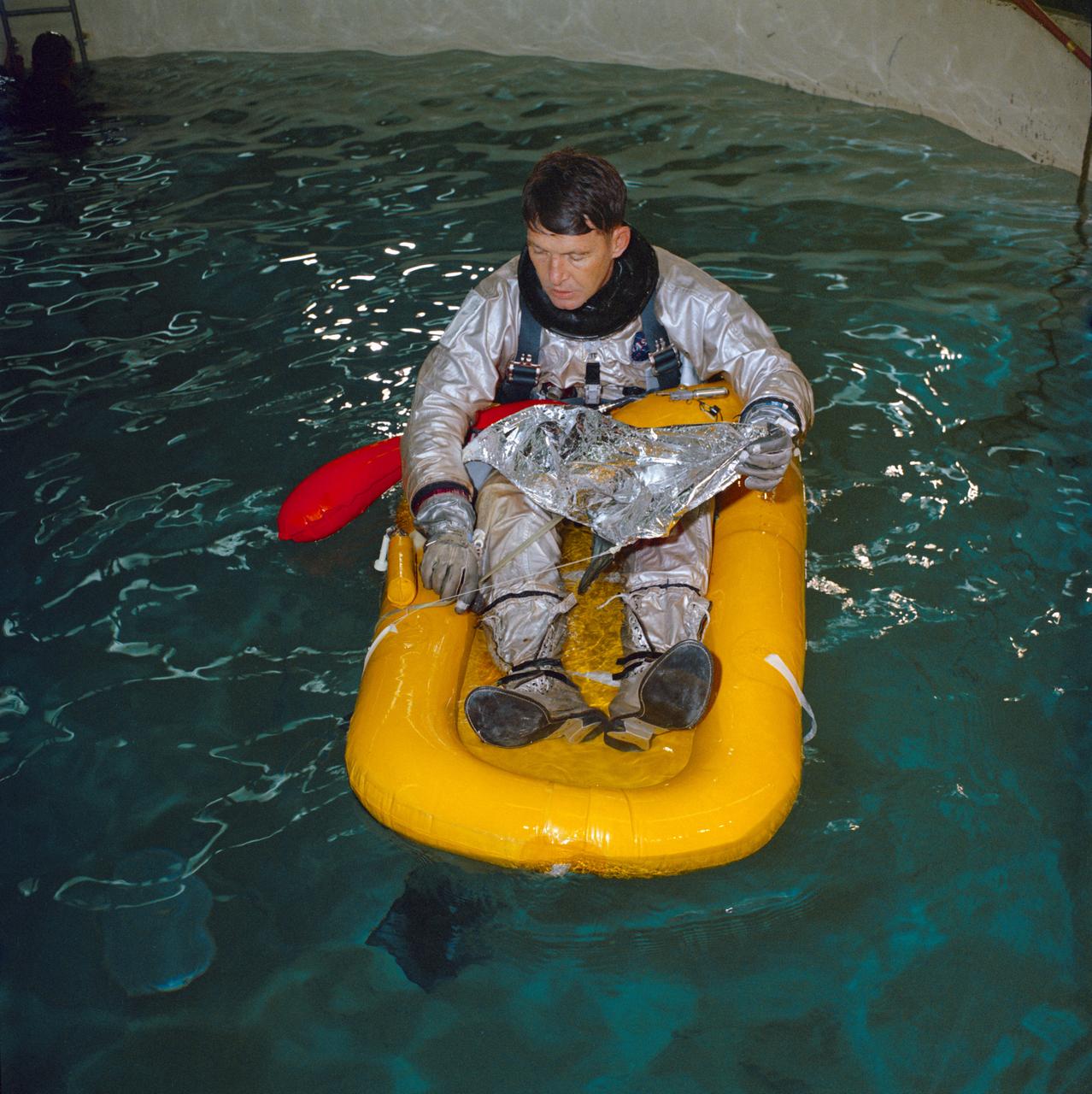
S65-10121 (1 Feb. 1965) --- Astronaut Walter M. Schirra Jr., the Gemini-6 command pilot for the prime crew, floats on a one-man life raft in a pool during water egress training at Ellington Air Force Base, Texas. Photo credit: NASA or National Aeronautics and Space Administration
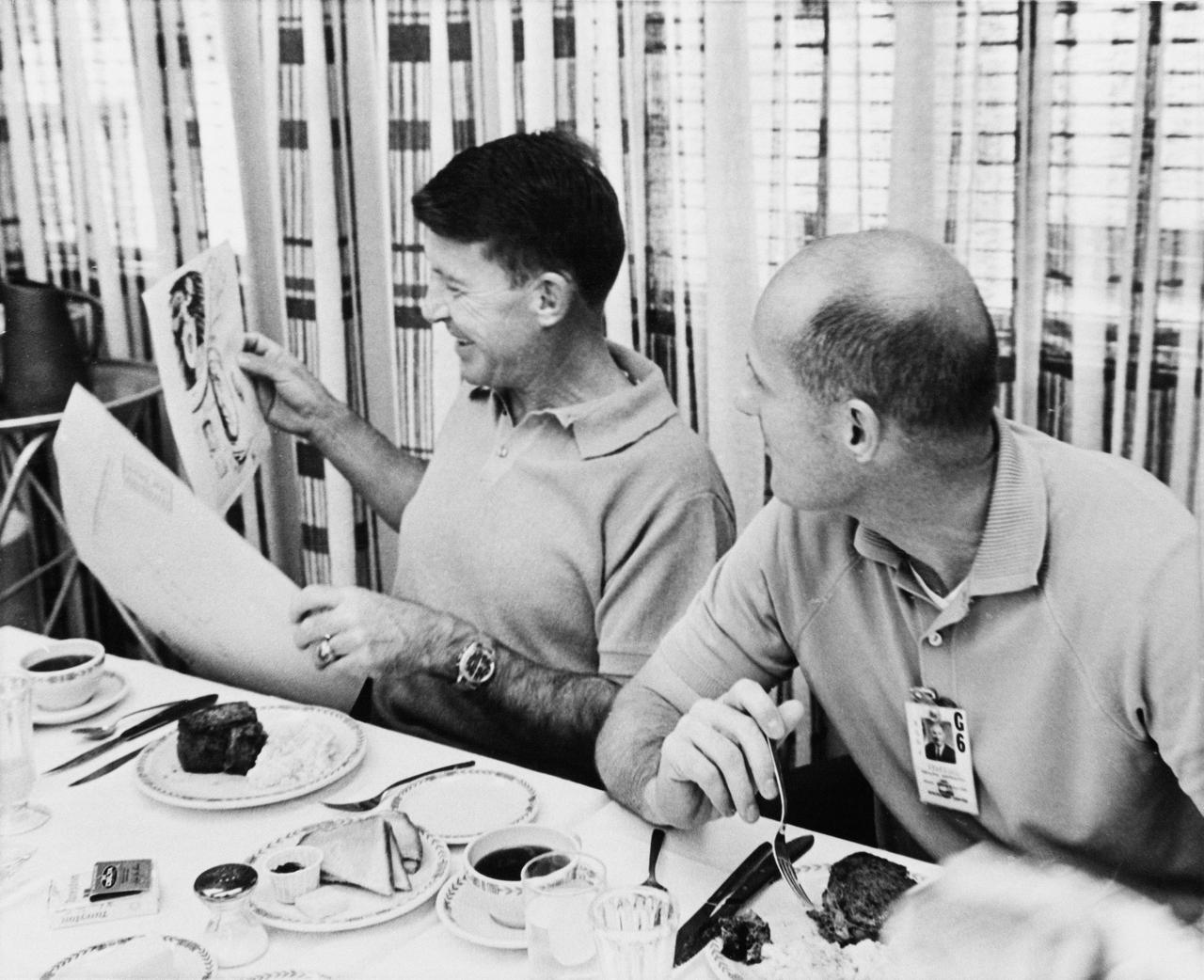
S65-56159 (15 Dec. 1965) --- Astronauts Walter M. Schirra Jr. (left), command pilot, and Thomas P. Stafford, pilot, look at a cartoon presented to them by the other astronauts on the morning of the scheduled Gemini-6 launch. Photo credit: NASA or National Aeronautics and Space Administration
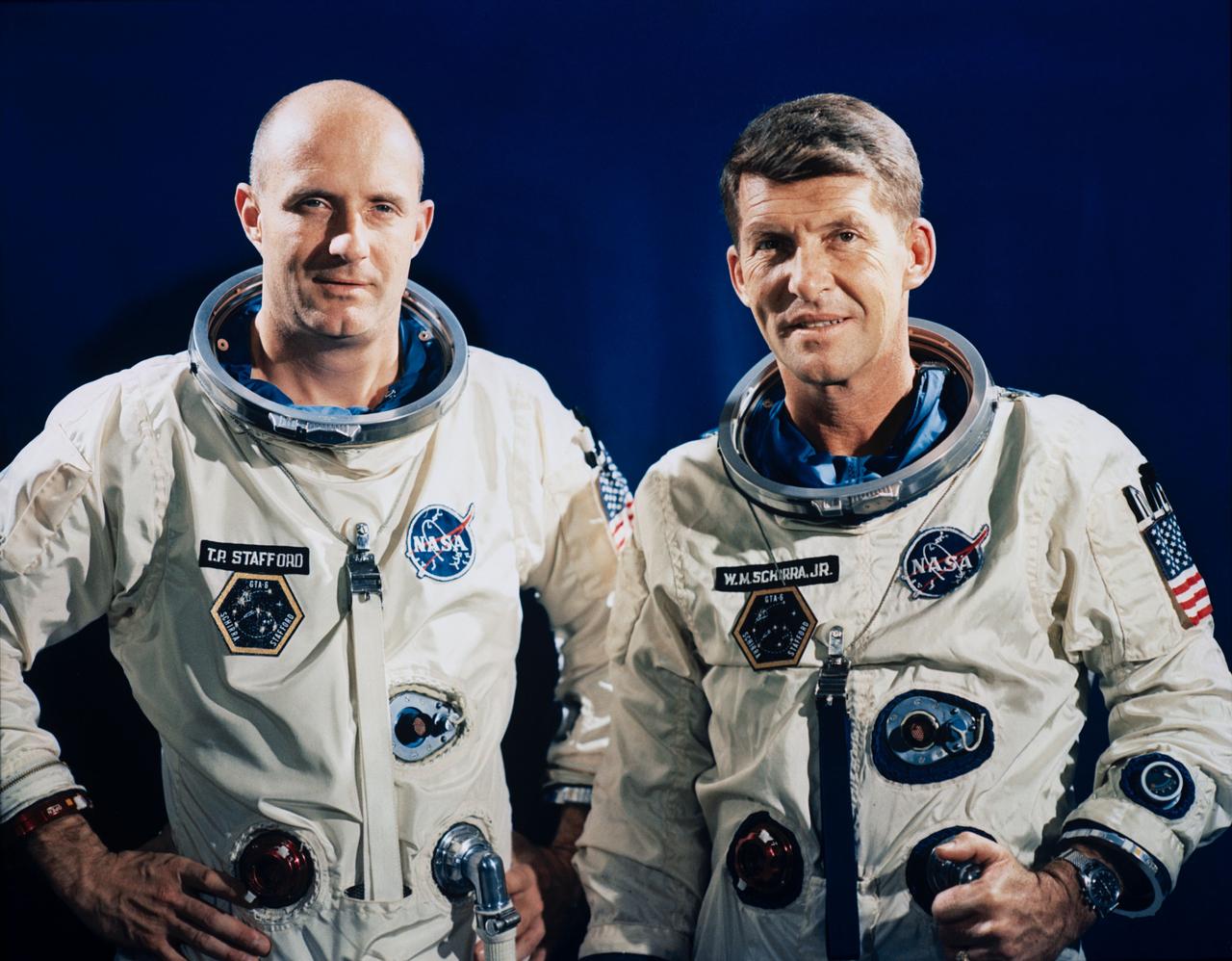
S65-56151 (October 1965) --- Gemini-6 astronauts Thomas P. Stafford (left), pilot, and Walter M. Schirra Jr., command pilot, are shown during suiting up exercises at Cape Kennedy, Florida. Photo credit: NASA or National Aeronautics and Space Administration

S65-20431 (23 March 1965) --- Astronaut Virgil I. Grissom (right), the command pilot of the Gemini-Titan 3 three-orbit mission, is shown with astronaut Walter M. Schirra Jr. in the ready room at Pad 16. The GT-3 was launched from Pad 19 the same day. Schirra was the command pilot of the backup crew.
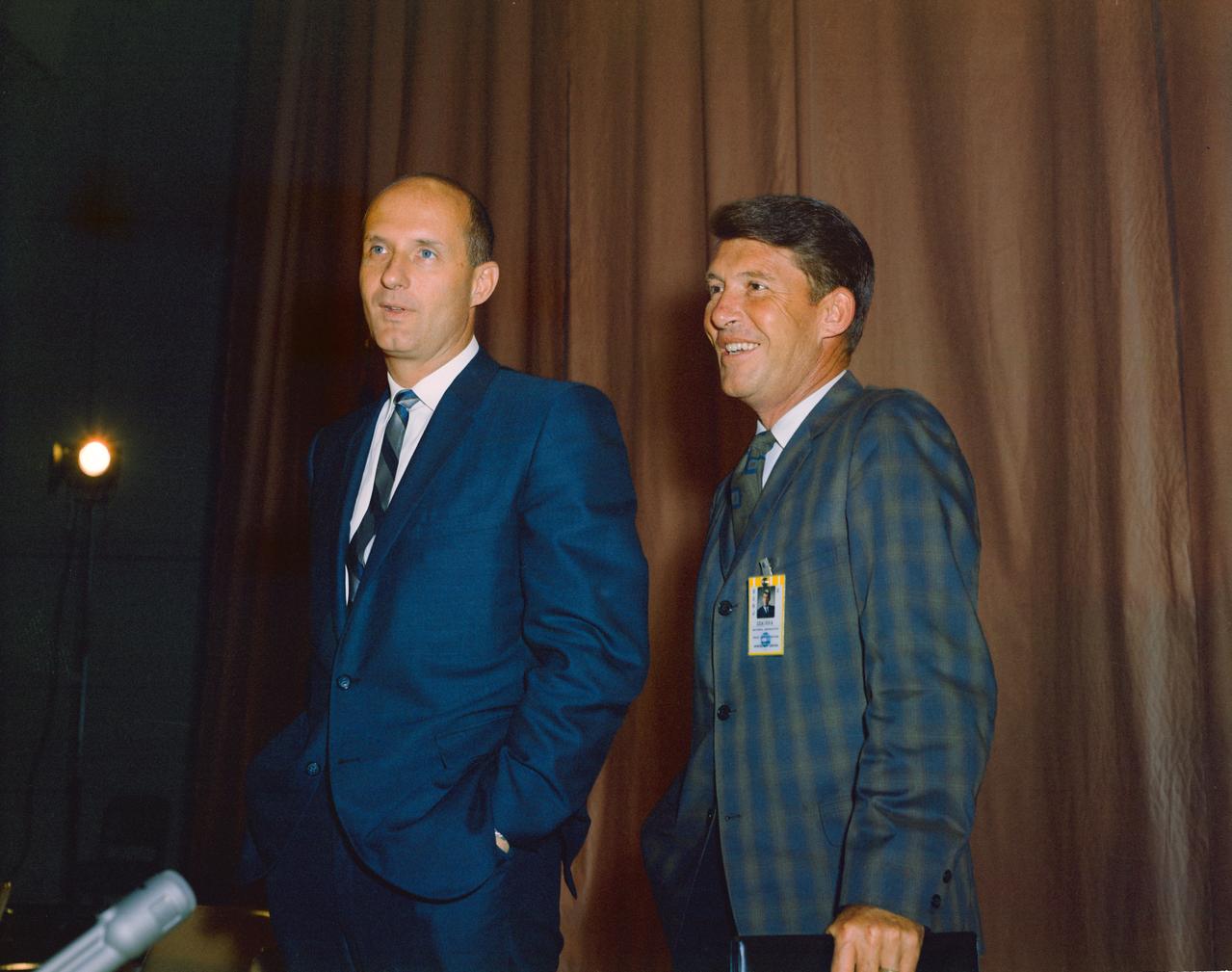
S65-19406 (6 April 1965) --- Astronauts Thomas P. Stafford (left), pilot; and Walter M. Schirra Jr., command pilot, have been named as the prime crew for the Gemini-Titan 6 spaceflight. Schirra and Stafford served as the GT-3 backup crew. Their selection for the GT-6 flight was announced at an MSC news conference on April 6, 1965.
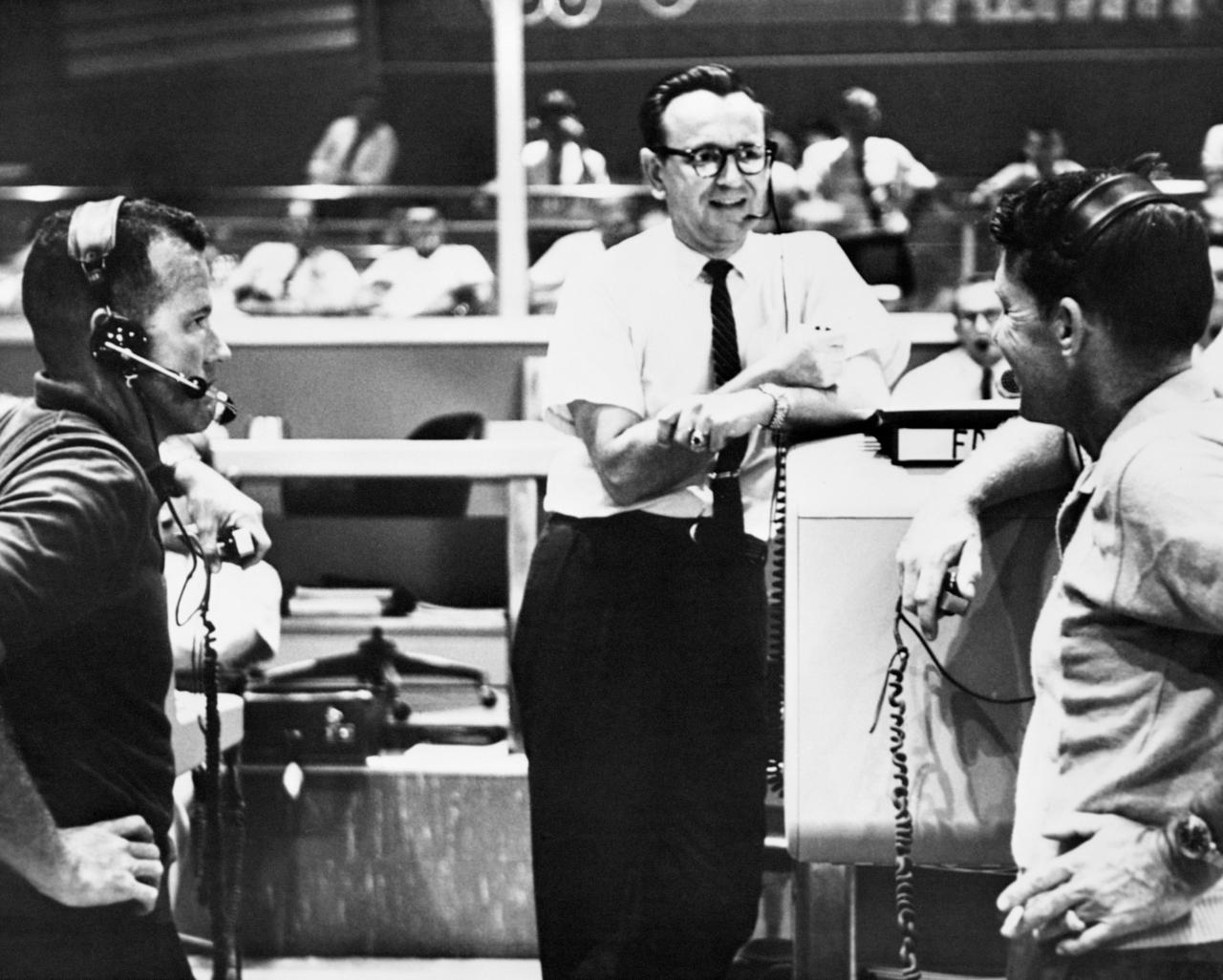
S74-33006 (19 Sept. 1962) --- Flight director Christopher C. Kraft Jr. (center), Chief of the Flight Operations Division at the Manned Spacecraft Center, Houston, discusses the Mercury-Atlas 8 (MA-8) flight plan with astronauts L. Gordon Cooper Jr. (left) and Walter M. Schirra Jr., on Sept. 19, 1962. They are standing in the Mercury Control Center at Cape Canaveral, Florida. Photo credit: NASA
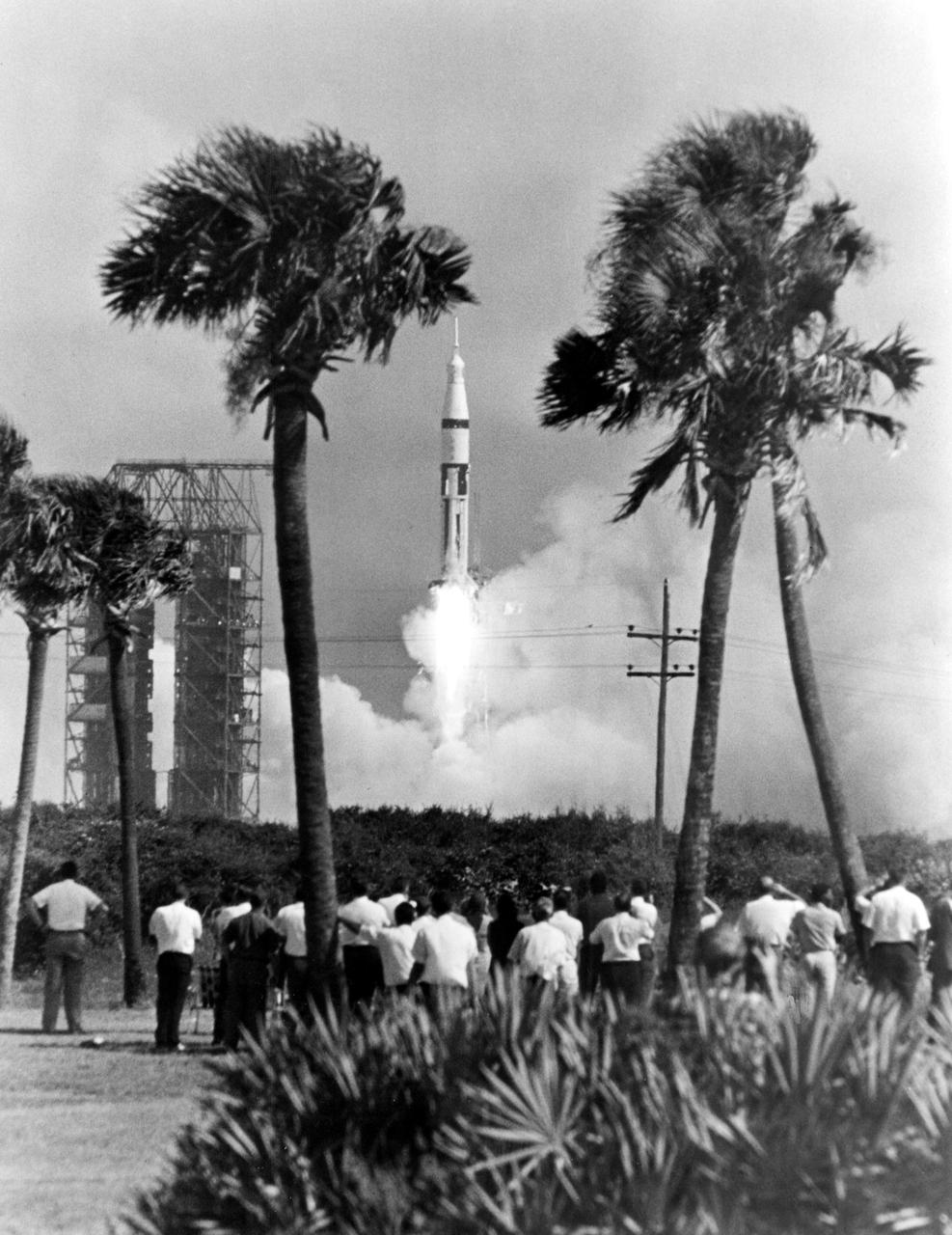
KENNEDY SPACE CENTER, FLA. -- Workers at Cape Kennedy watched a 224-foot-high Saturn 1B space vehicle lift off today from Complex 34 carrying Apollo 7 astronauts Walter M. Schirra Jr., Donn F. Eisele and Walter Cunningham at the start of their scheduled 11-day Earth orbital flight.
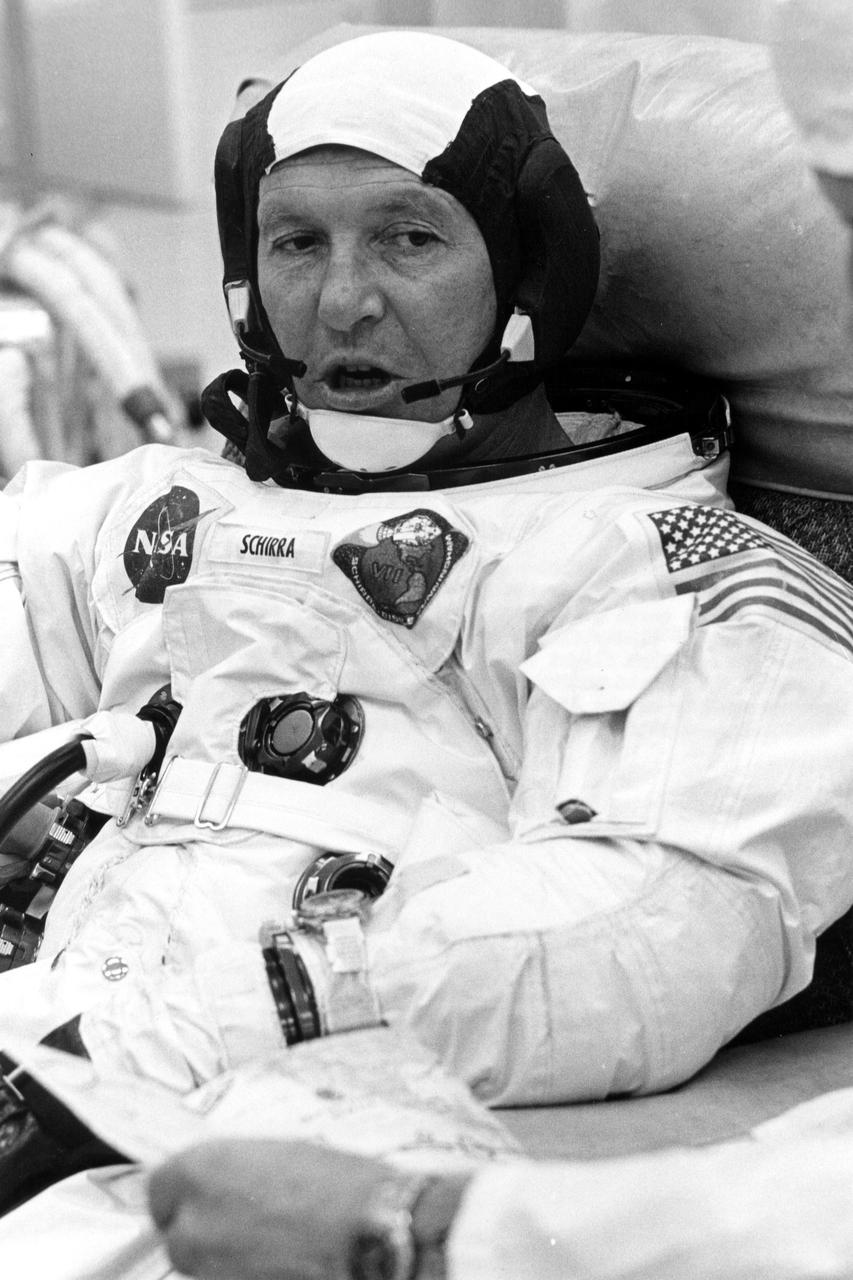
KENNEDY SPACE CENTER, FLA. -- Astsronaut Walter M. Schirra Jr. relaxes prior to boarding the Apollo 7 spacecraft, which rocketed into Earth orbit from Cape Kennedy this morning. Purpose of the 11-day flight is to qualify the Apollo spacecraft for a future flight to the moon. Other Apollo 7 pilots are Donn Eisele and Walter Cunningham. This is the first manned mission of the Apollo series. It is conducted by the National Aeronautics and Space Administration.
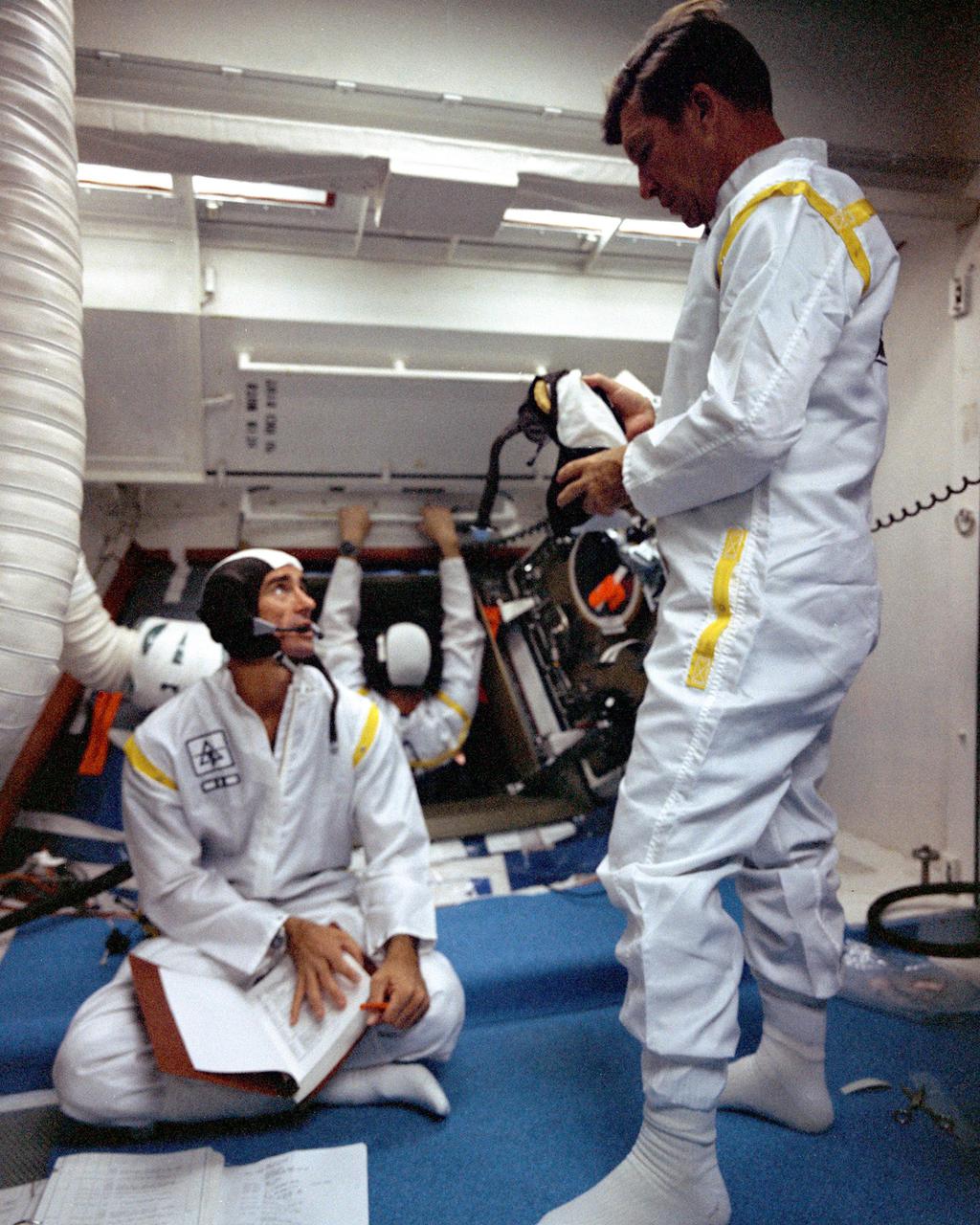
KENNEDY SPACE CENTER, FLA. - Apollo 7 Command Module Pilot Donn F. Eisele enters the spacecraft at Pad 34 while fellow crew members, Commander Walter M. Schirra Jr., left, and Lunar Module Pilot Walter Cunningham hold a brief discussion before they repeat that portion of the Plugs-Out test at the pad. The tests are being conducted in preparation for the scheduled launch of Apollo 7, the first manned lunar orbital mission.
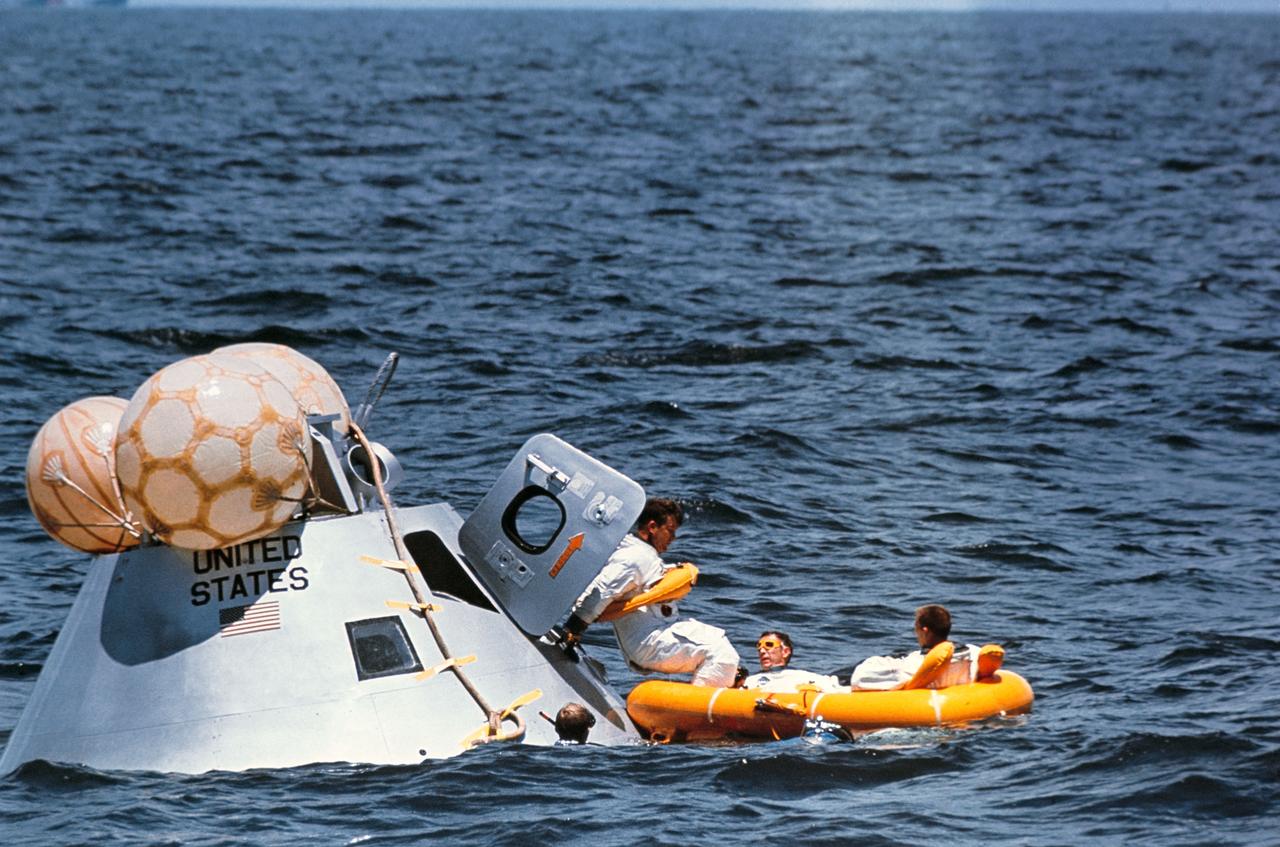
S68-46605 (5 Aug. 1968) --- The prime crew of the first manned Apollo mission (Spacecraft 101/Saturn 205) participates in water egress training in the Gulf of Mexico. Left to right, are astronauts Walter M. Schirra Jr. (stepping into life raft), Donn F. Eisele, and Walter Cunningham. They have just egressed Apollo Command Module Boilerplate 1102, and are awaiting helicopter pickup. Inflated bags were used to upright the boilerplate. MSC swimmers assisted in the training exercise.
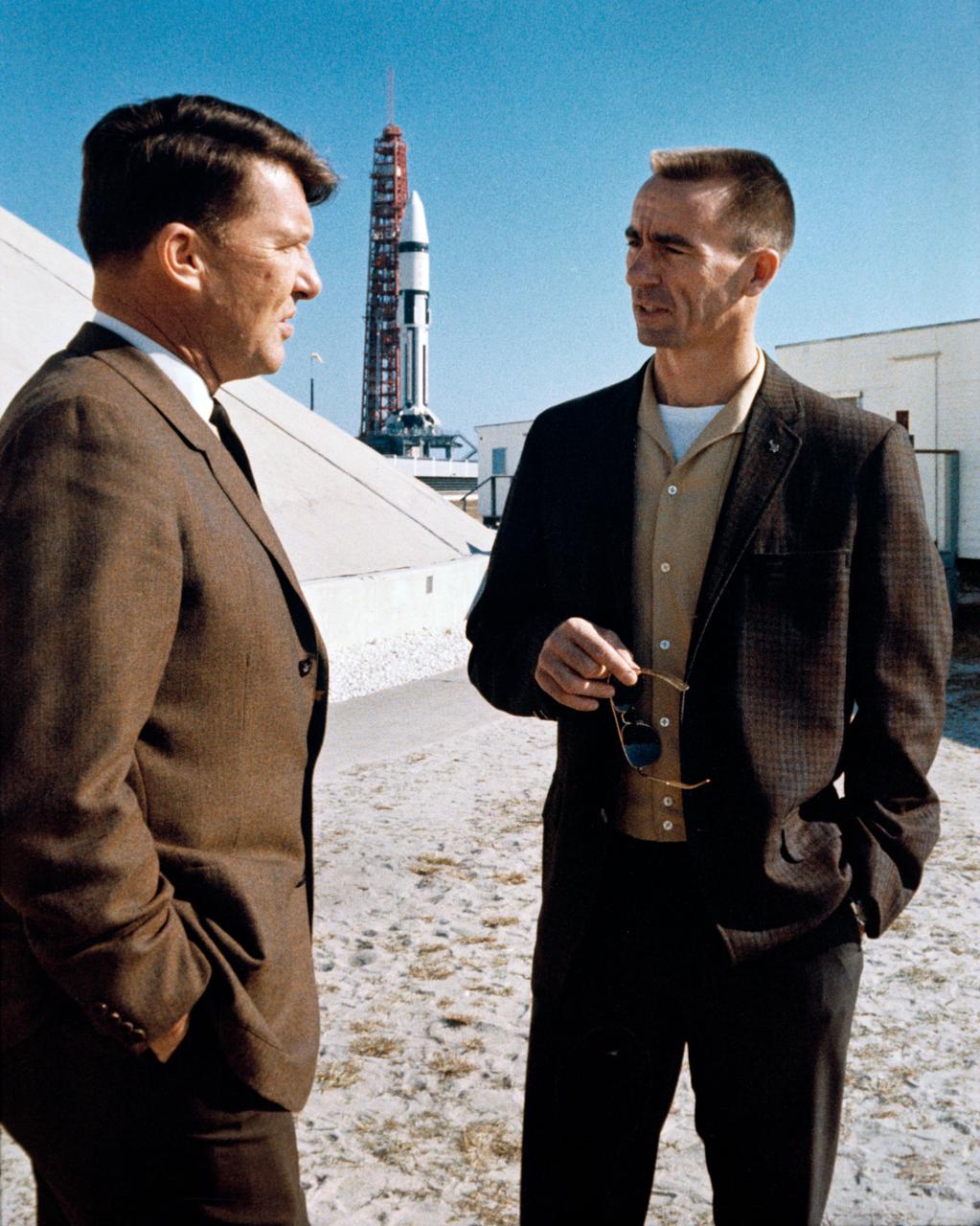
S68-18700 (22 Jan. 1968) --- Two prime crew members of the first manned Apollo space flight were present at Cape Kennedy for the launch of the Apollo V (LM-1/Saturn 204) unmanned space mission. On left is astronaut Walter M. Schirra Jr.; and on right is astronaut R. Walter Cunningham. In background is the Apollo V stack at Launch Complex 37 ready for launch.
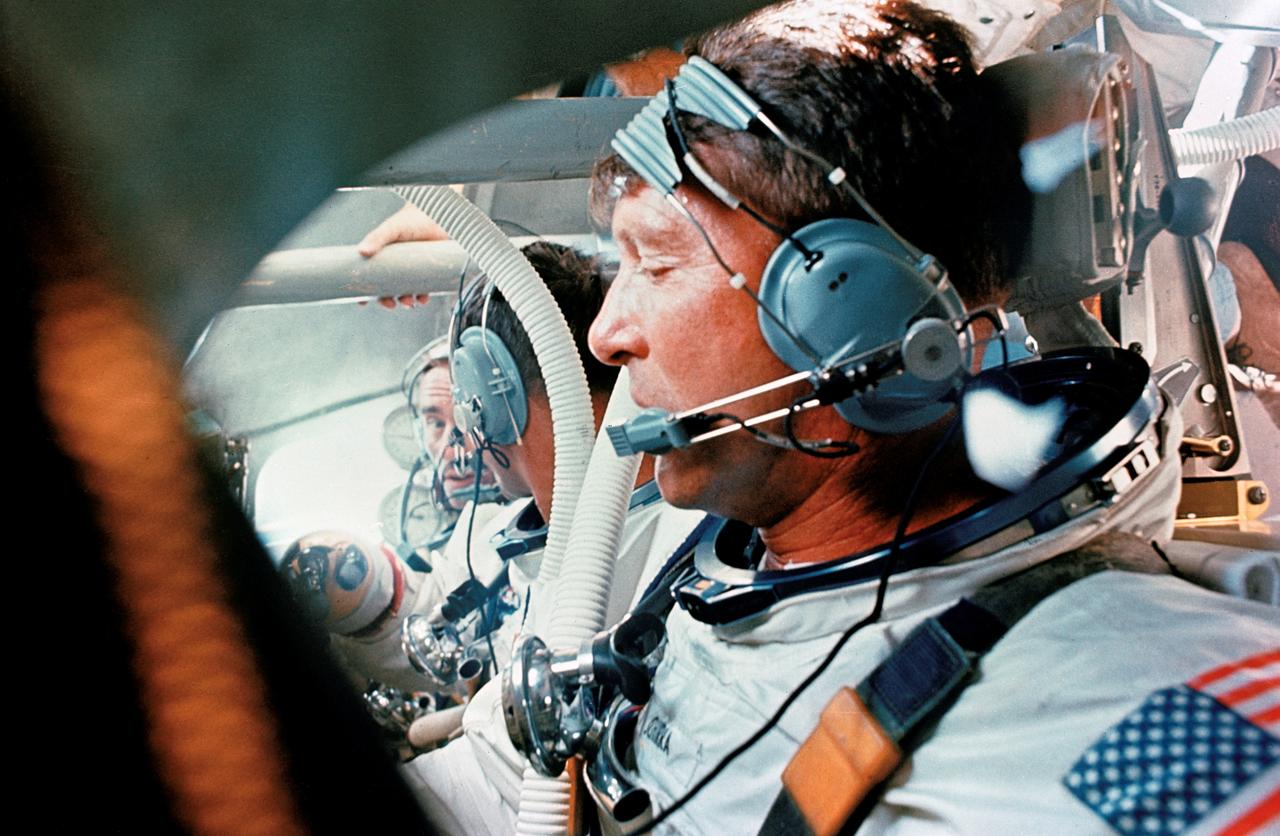
S68-46604 (5 Aug. 1968) --- The prime crew of the first manned Apollo mission (Spacecraft 101/Saturn 205) is seen in Apollo Command Module Boilerplate 1102 during water egress training in the Gulf of Mexico. In foreground is astronaut Walter M. Schirra Jr., in center is astronaut Donn F. Eisele, and in background is astronaut Walter Cunningham.
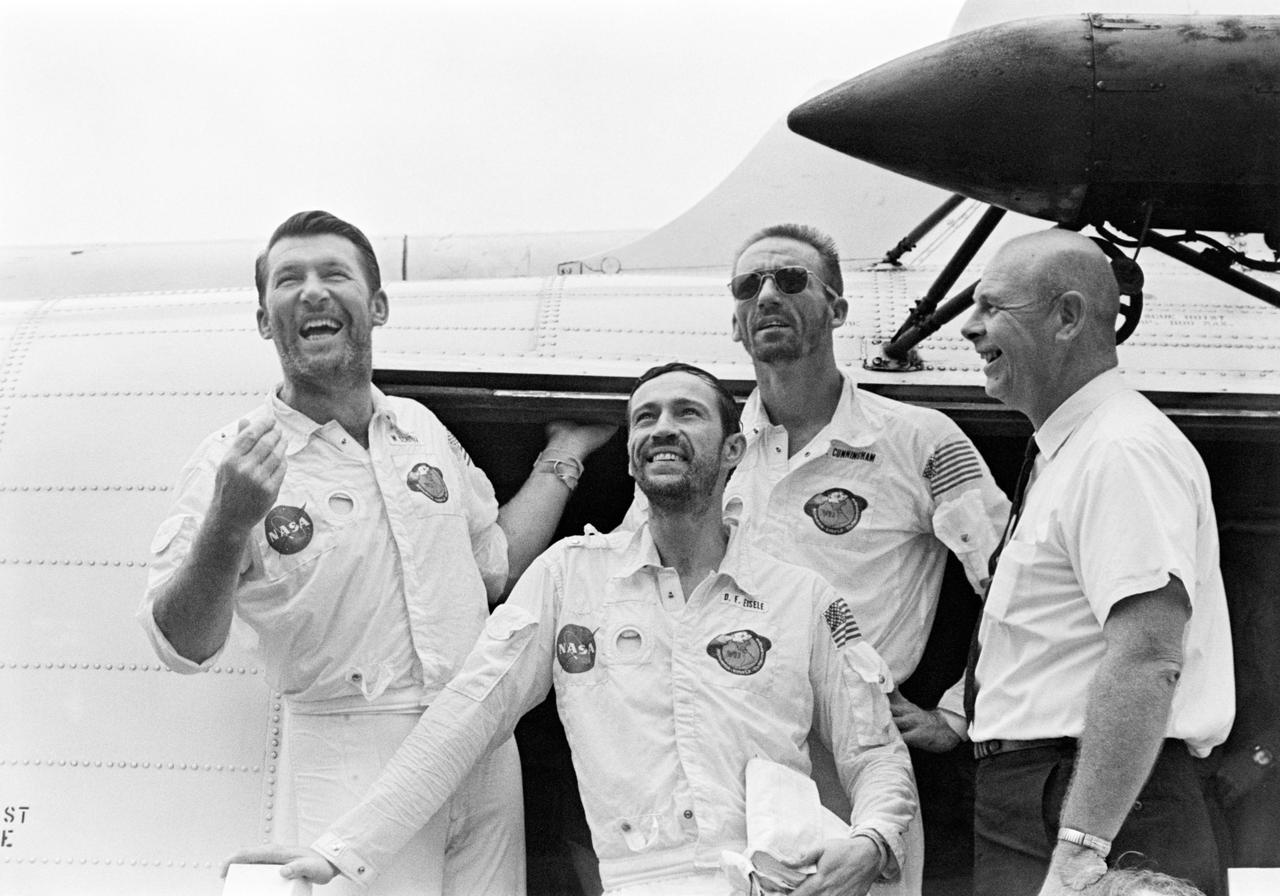
S68-52542 (22 Oct. 1968) --- The Apollo 7 crew arrives aboard the USS Essex, the prime recovery ship for the mission. Left to right, are astronauts Walter M. Schirra Jr., commander; Donn F. Eisele, command module pilot; Walter Cunningham, lunar module pilot; and Dr. Donald E. Stullken, NASA Recovery Team Leader from the Manned Spacecraft Center's (MSC) Landing and Recovery Division. The crew is pausing in the doorway of the recovery helicopter.
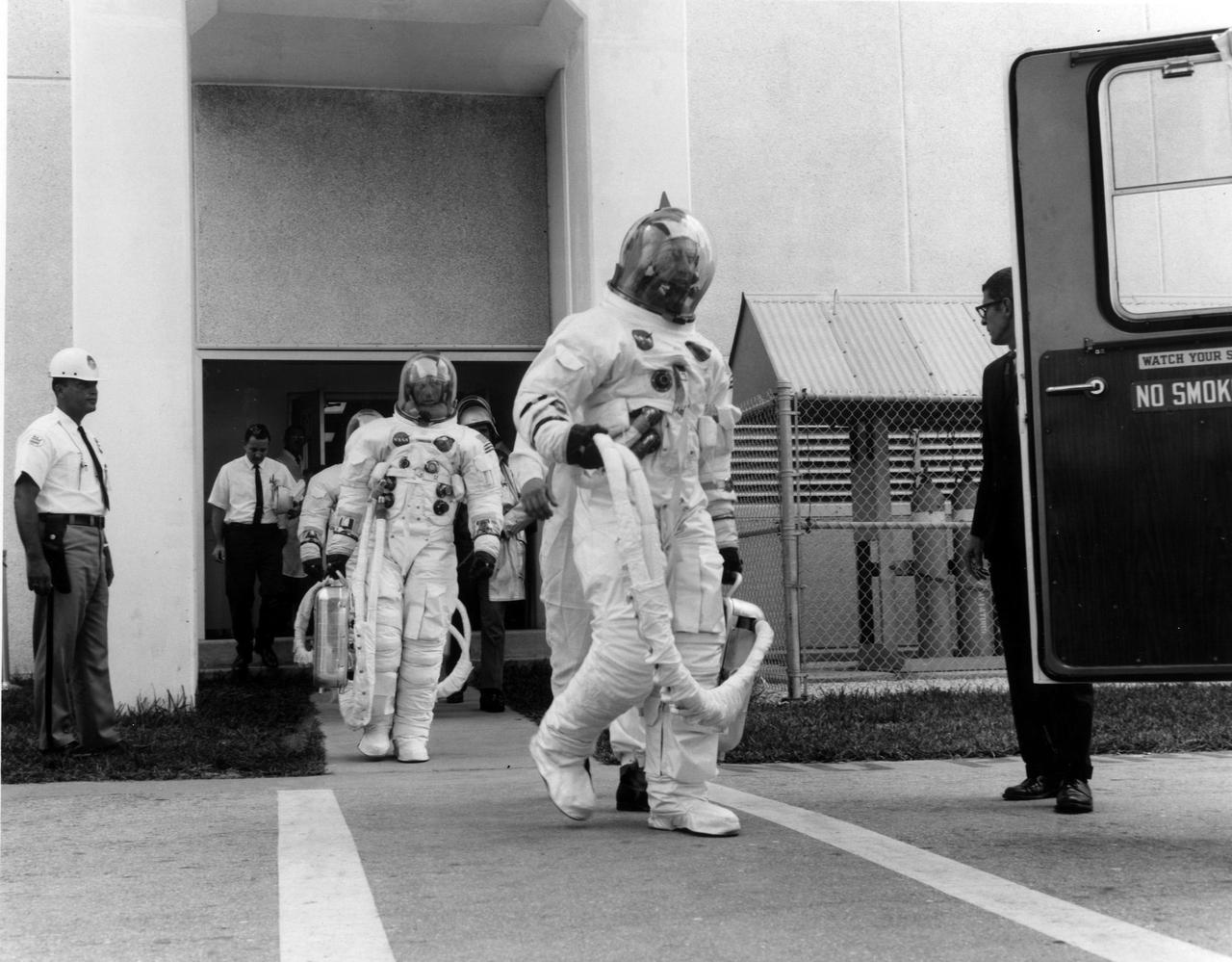
KENNEDY SPACE CENTER, FLA. -- Apollo 7 prime crew members, front to back, Donn F. Eisele, Walter M. Schirra Jr. and Walter Cunningham, leave the Kennedy Space Center's Manned Spacecraft Operations Building for a 20-minute ride in a transfer van to Cape Kennedy's Launch Complex 34, where they participated in a Space Vehicle Emergency Egress Test. The trio will pilot the National Aeronautics and Space Administration's first manned Apollo mission.
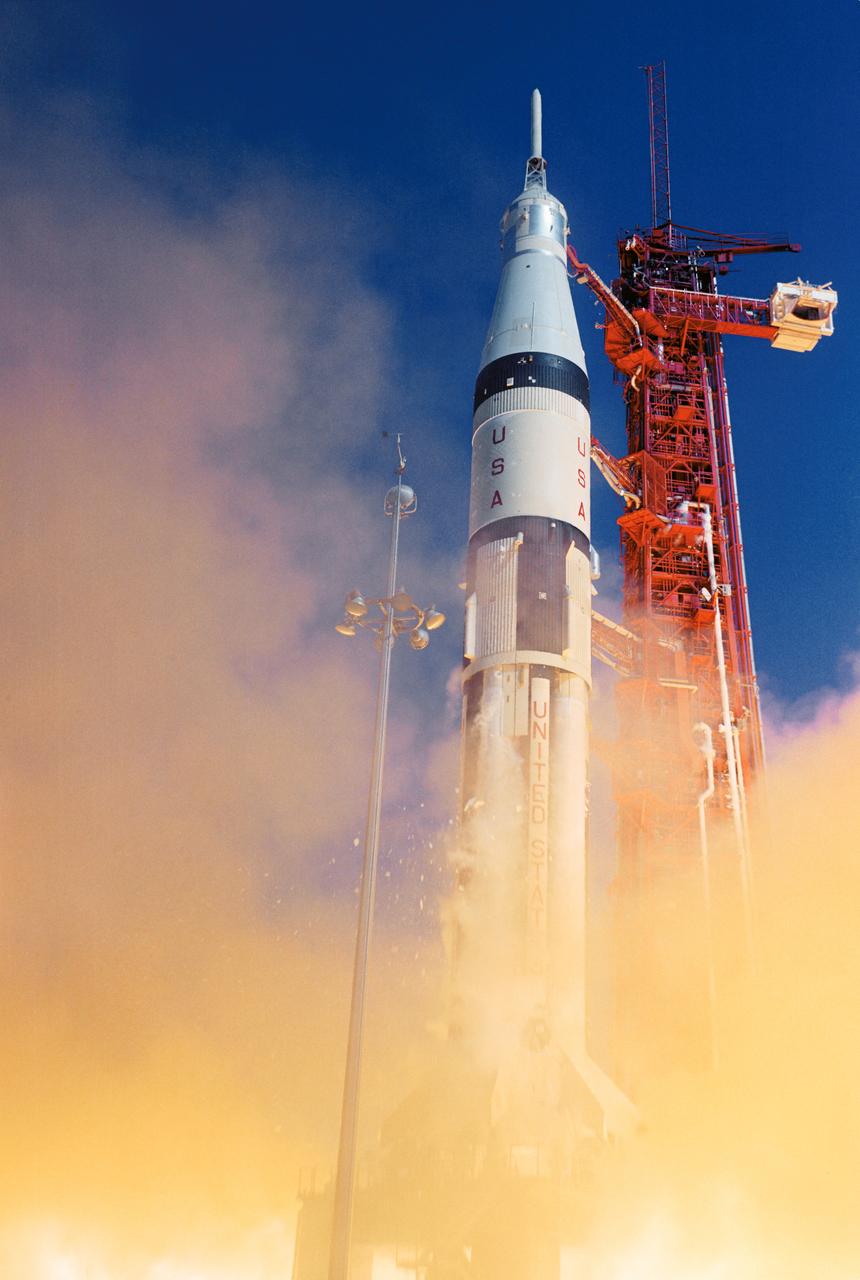
Apollo 7 lifts off from Cape Kennedy Launch Complex 34 at 11:03 A.M., EDT. The astronauts aboard, for the first manned lunar orbital mission, are Astronauts Walter M. Schirra,Jr. Commander; Donn F. Eisele, Command Module Pilot; and Walter Cunningham, Lunar Module Pilot. Original photo number was KSC-68PC-185.
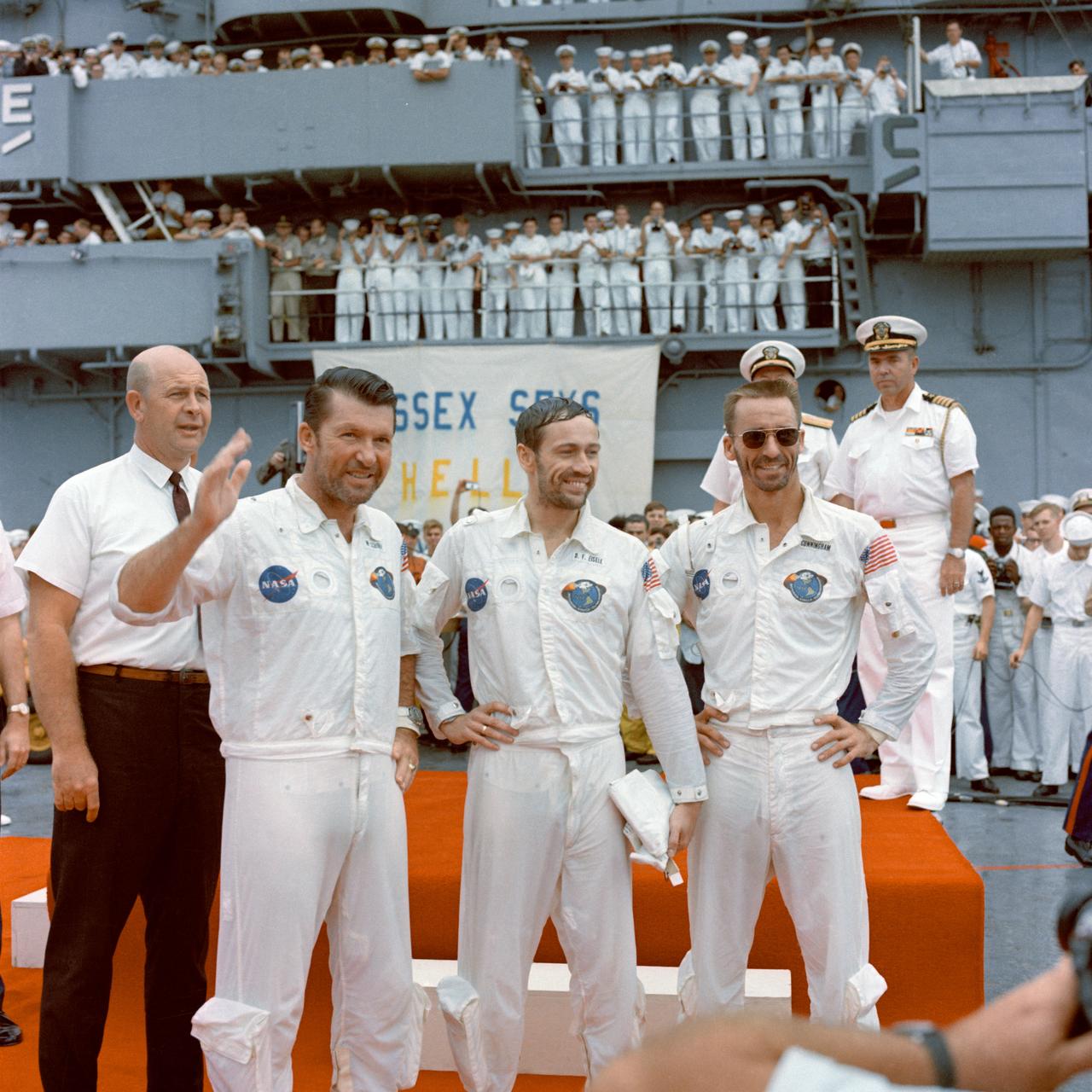
S68-49744 (22 Oct. 1968) --- The Apollo 7 crew is welcomed aboard the USS Essex, the prime recovery ship for the mission. Left to right, are astronauts Walter M. Schirra Jr., commander; Donn F. Eisele, command module pilot; and Walter Cunningham, lunar module pilot. In left background is Dr. Donald E. Stullken, NASA Recovery Team Leader from the Manned Spacecraft Center's (MSC) Landing and Recovery Division.

KENNEDY SPACE CENTER, FLA. -- Astronaut Donn F. Eisele adjusts communications carrier prior to the start of an 11-day Earth orbital mission in the Apollo 7 spacecraft. The communications carrier contains microphones and earphones. Flying with Eisele aboard Apollo 7 are astronauts Walter M. Schirra Jr. and Walter Cunningham. Purpose of the flight, conducted by the National Aeronautics and Space Administration, is to qualify the Apollo spacecraft for a future flight to the moon.
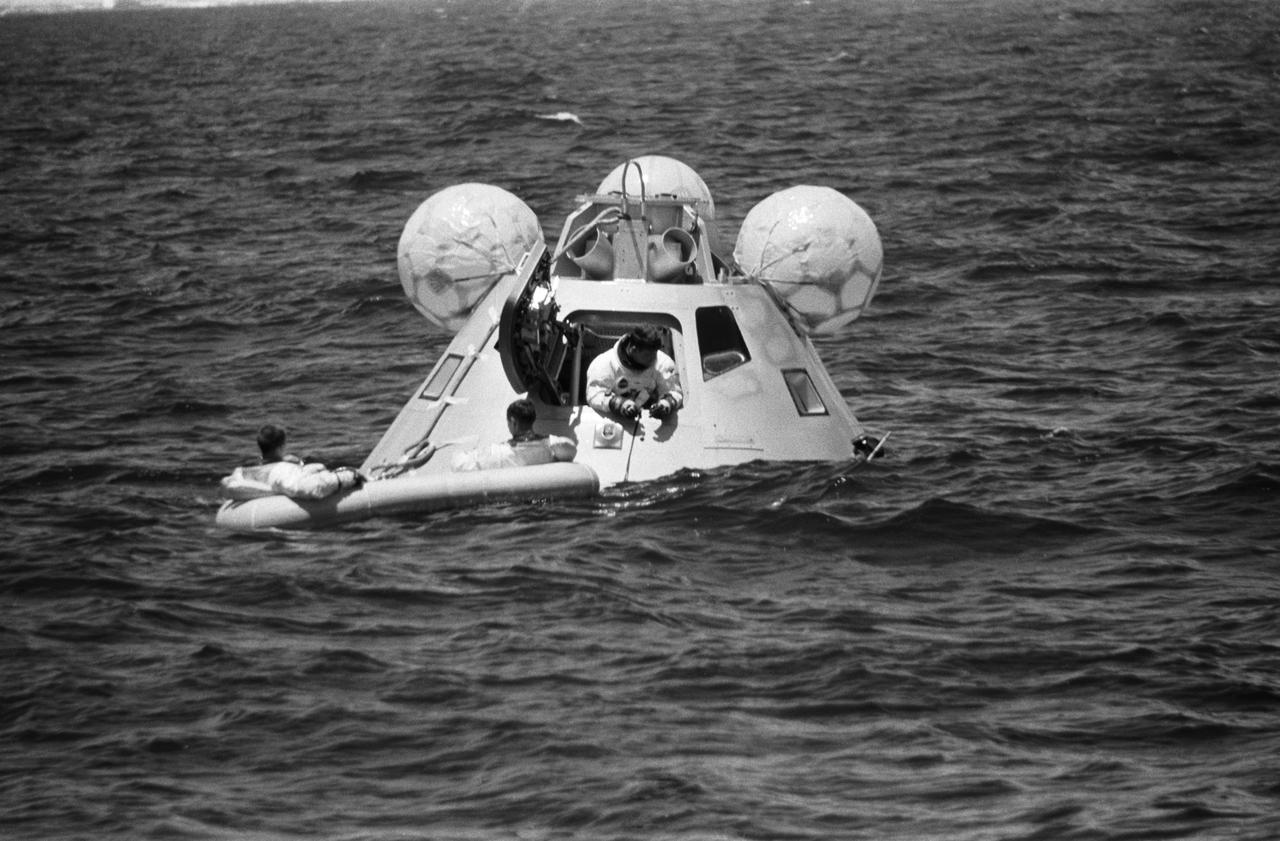
S68-42197 (5 Aug. 1968) --- The prime crew of the first manned Apollo space mission, Apollo 7, participates in water egress training in the Gulf of Mexico. In hatch of the Apollo egress trainer (command module) is astronaut Walter M. Schirra Jr. Sitting in life raft are astronauts Walter Cunningham (on left) and Donn F. Eisele. A team of MSC swimmers assisted with the training exercise. The inflated bags were used to upright the trainer prior to egress.
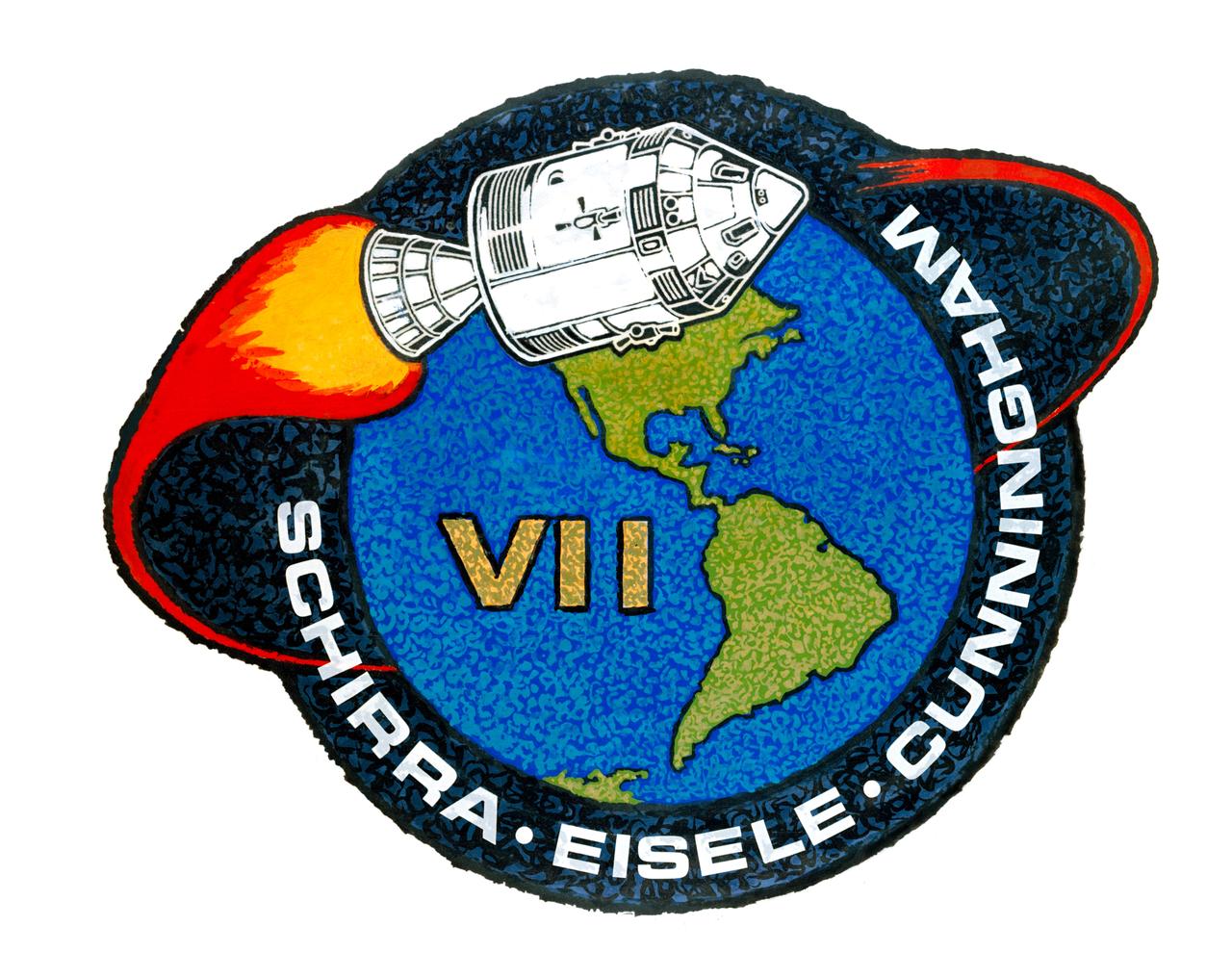
S68-26668 (June 1968) --- The official emblem of Apollo 7, the first manned Apollo space mission. The crew will consist of astronauts Walter M. Schirra Jr., Donn F. Eisele, and Walter Cunningham. The NASA insignia design for Apollo flights is reserved for use by the astronauts and for the official use as the NASA Administrator may authorize. Public availability has been approved only in the form of illustrations by the various news media. When and if there is any change in this policy, which we do not anticipate, it will be publicly announced.
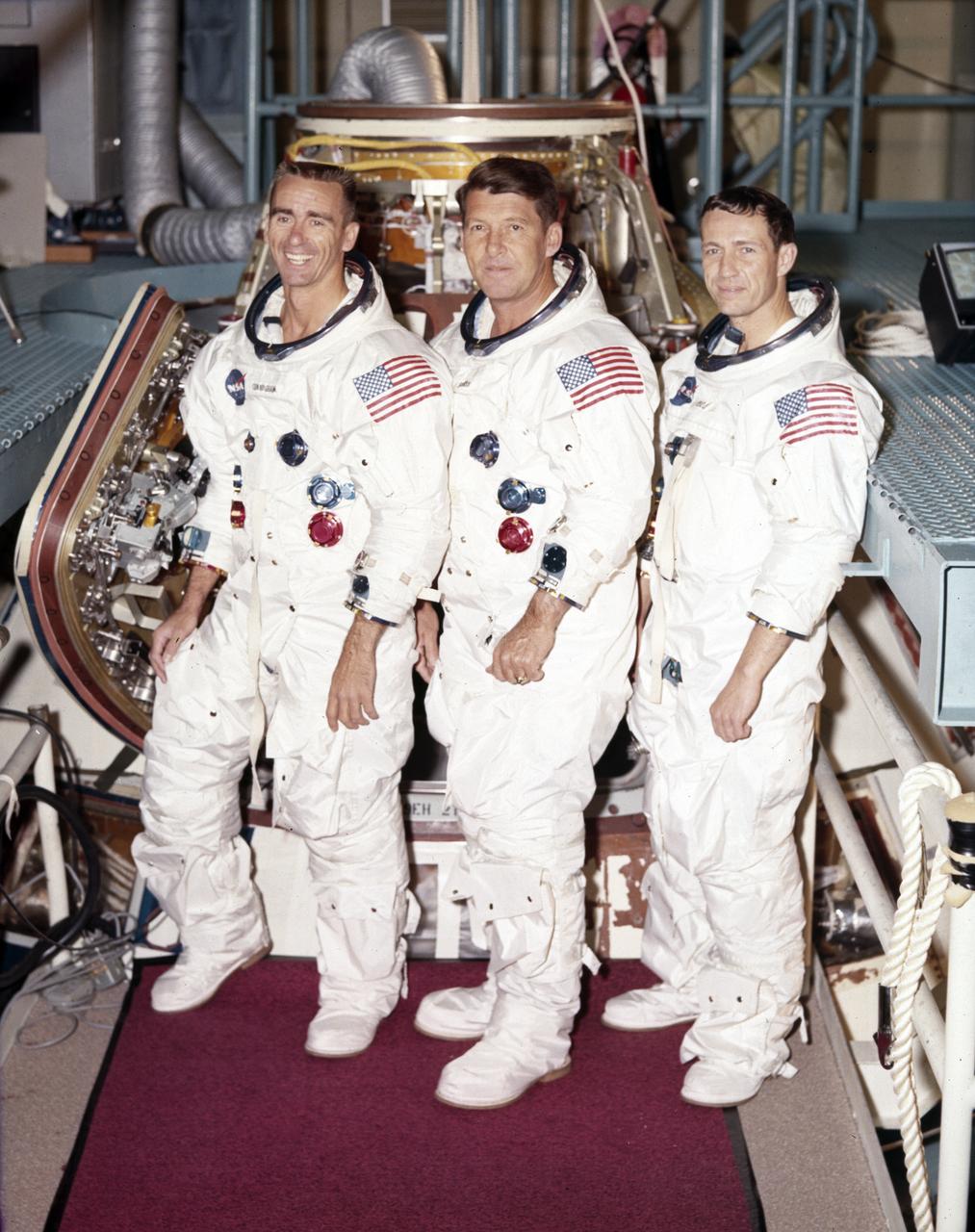
Pictured left to right, in the Apollo 7 Crew Portrait, are astronauts R. Walter Cunningham, Lunar Module pilot; Walter M. Schirra, Jr., commander; and Donn F. Eisele, Command Module Pilot. The Apollo 7 mission, boosted by a Saturn IB launch vehicle on October 11, 1968, was the first manned flight of the Apollo spacecraft.
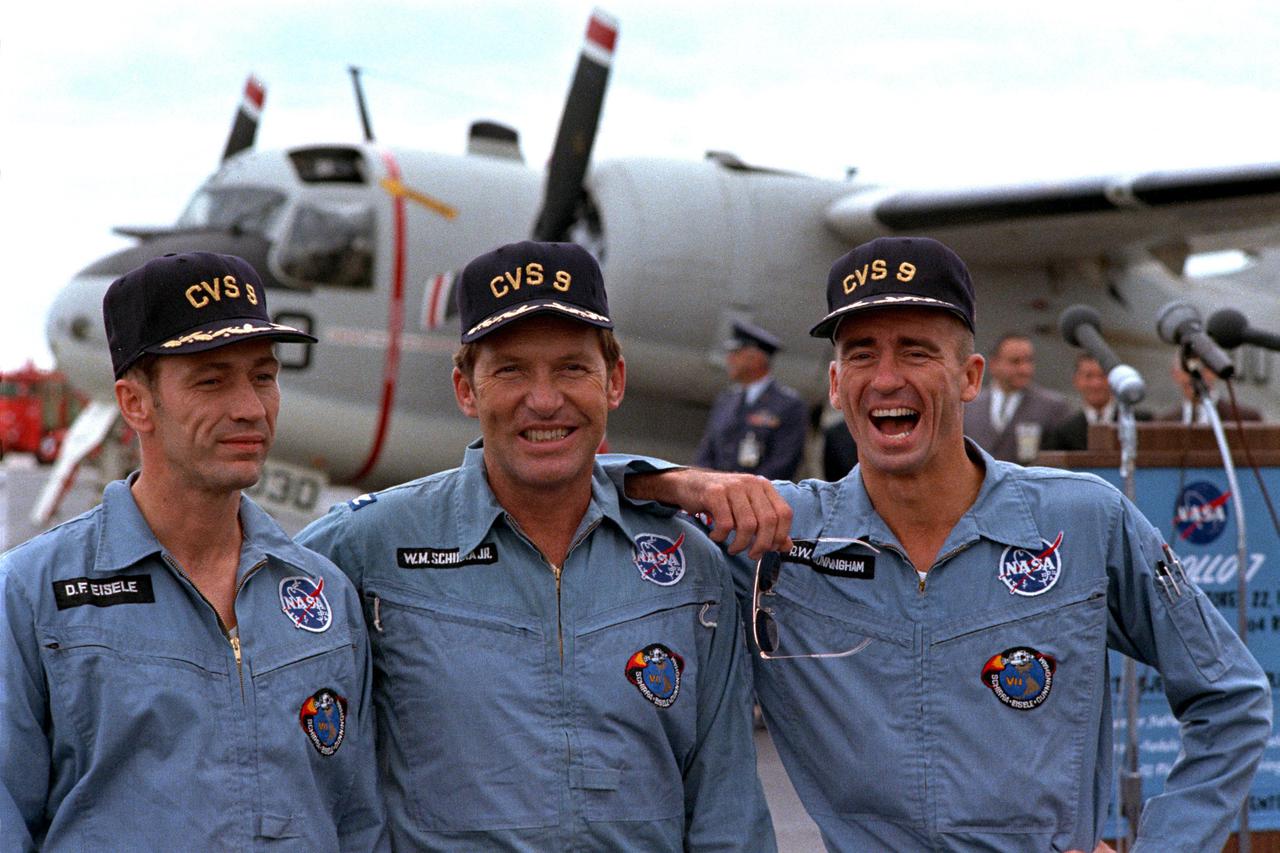
KENNEDY SPACE CENTER, FLA. - The Apollo 7 astronauts, left to right, Donn F. Eisele, Walter M. Schirra Jr., and Walter Cunningham, after 12days and 4.5 million miles later, return to meet with the employees and management at Cape Kennedy. On October 11, the three astronauts were launched aboard a Saturn 1B space vehicle from Launch Pad 34 for the first manned lunar orbital mission.
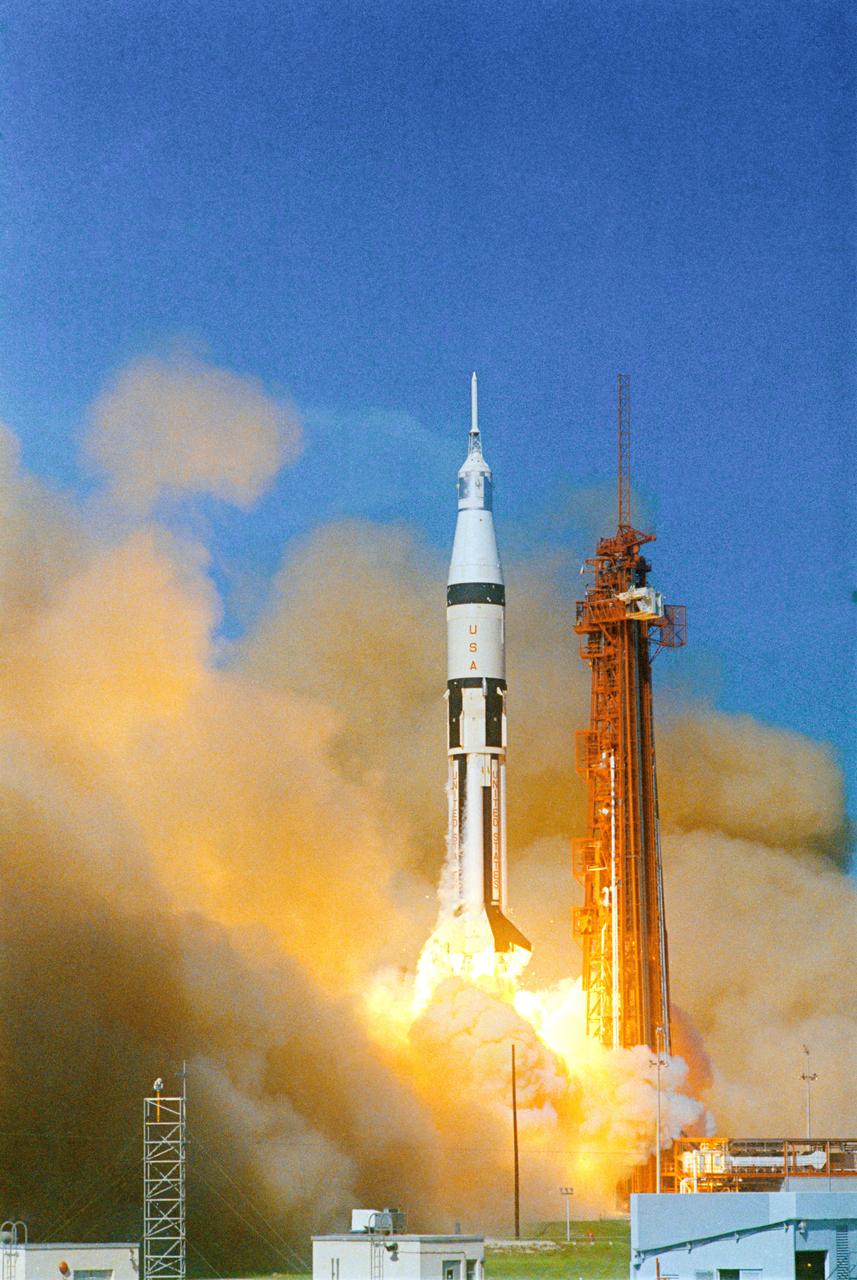
Apollo 7 lifts off from Cape Kennedy Launch Complex 34 at 11:03 A.M., EDT. The astronauts aboard, for the first manned lunar orbital mission, are Astronauts Walter M. Schirra,Jr. Commander; Donn F. Eisele, Command Module Pilot; and Walter Cunningham, Lunar Module Pilot. Original photo number was KSC-68PC-182.

S68-21590 (September 1968) --- This is a portrait of the Apollo-Saturn 7 crew members. They are, left to right, astronauts Walter M. Schirra Jr., commander; Walter Cunningham, lunar module pilot; and Donn F. Eisele, command module pilot. EDITOR'S NOTE: Since this photograph was made astronaut Eisele died Dec. 2, 1987 in Tokyo, Japan, of a heart attack.
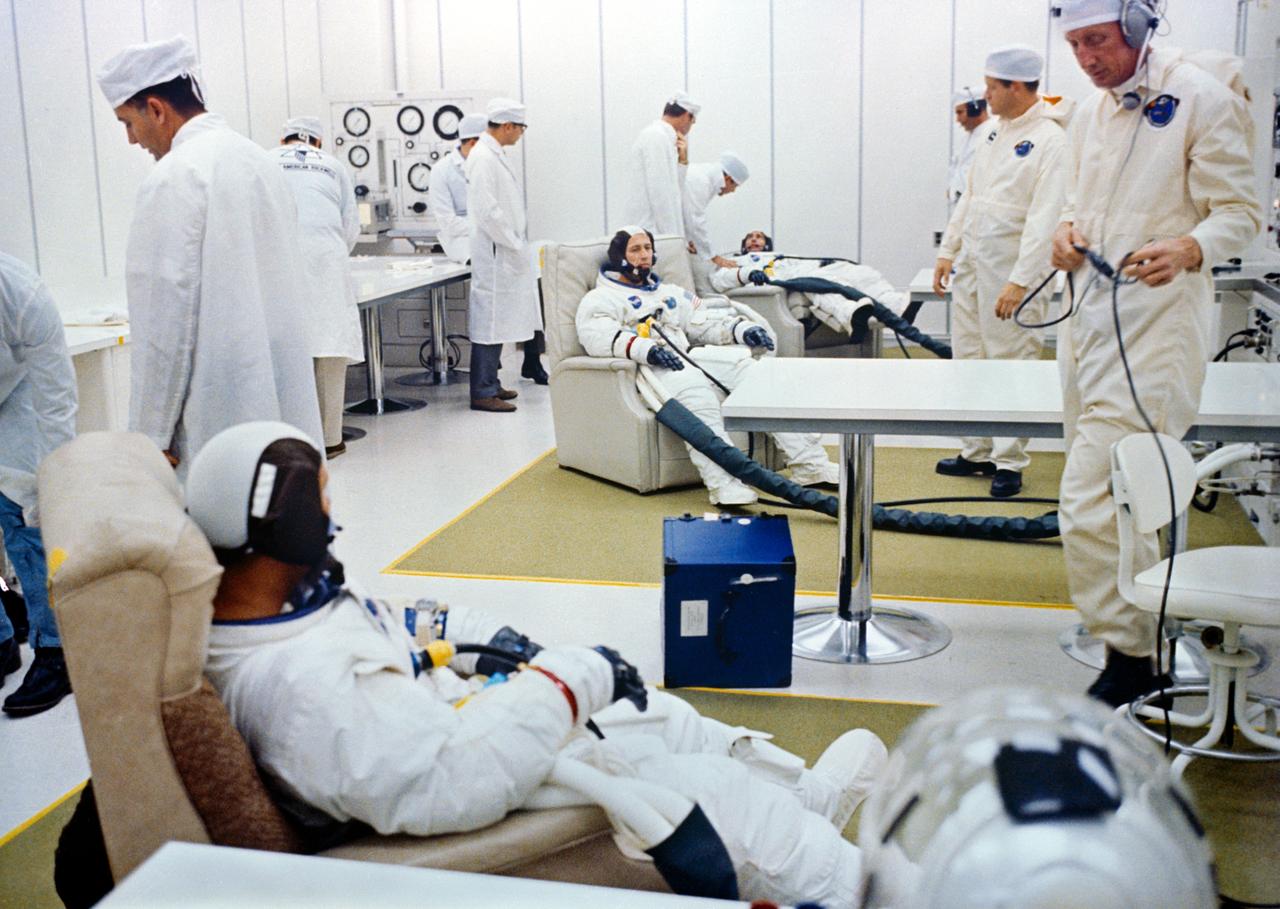
The Apollo 7 prime crew goes through suiting up operations in the Kennedy Space Center's Manned Spacecraft Operations Building during the Apollo 7 prelaunch countdown. From front to rear, are Astronauts Walter M. Schirra Jr., commander; Donn F. Eisele, command module pilot; and Walter Cunningham, lunar module pilot.
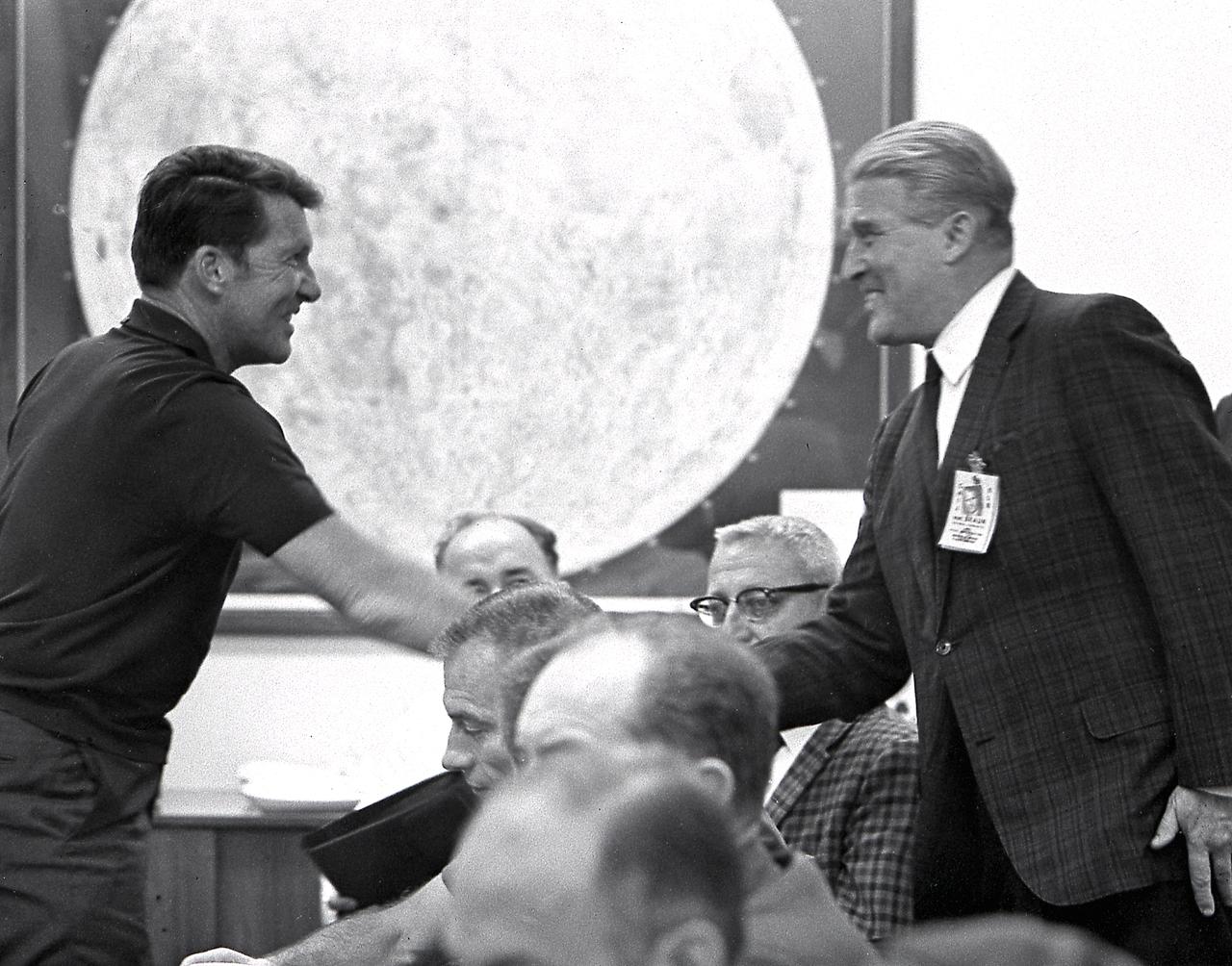
Dr. von Braun, Director of the Marshall Space Flight Center (MSFC), greets Commander of Apollo 7 mission, Walter M. Schirra, Jr., during the mission briefing at Kennedy Space Center (KSC). The Apollo 7 mission, boosted by a Saturn IB launch vehicle on October 11, 1968, was the first flight of the Apollo spacecraft with crew. Other crew members were Astronaut Donn Eisele and Astronaut Walter Cunningham.
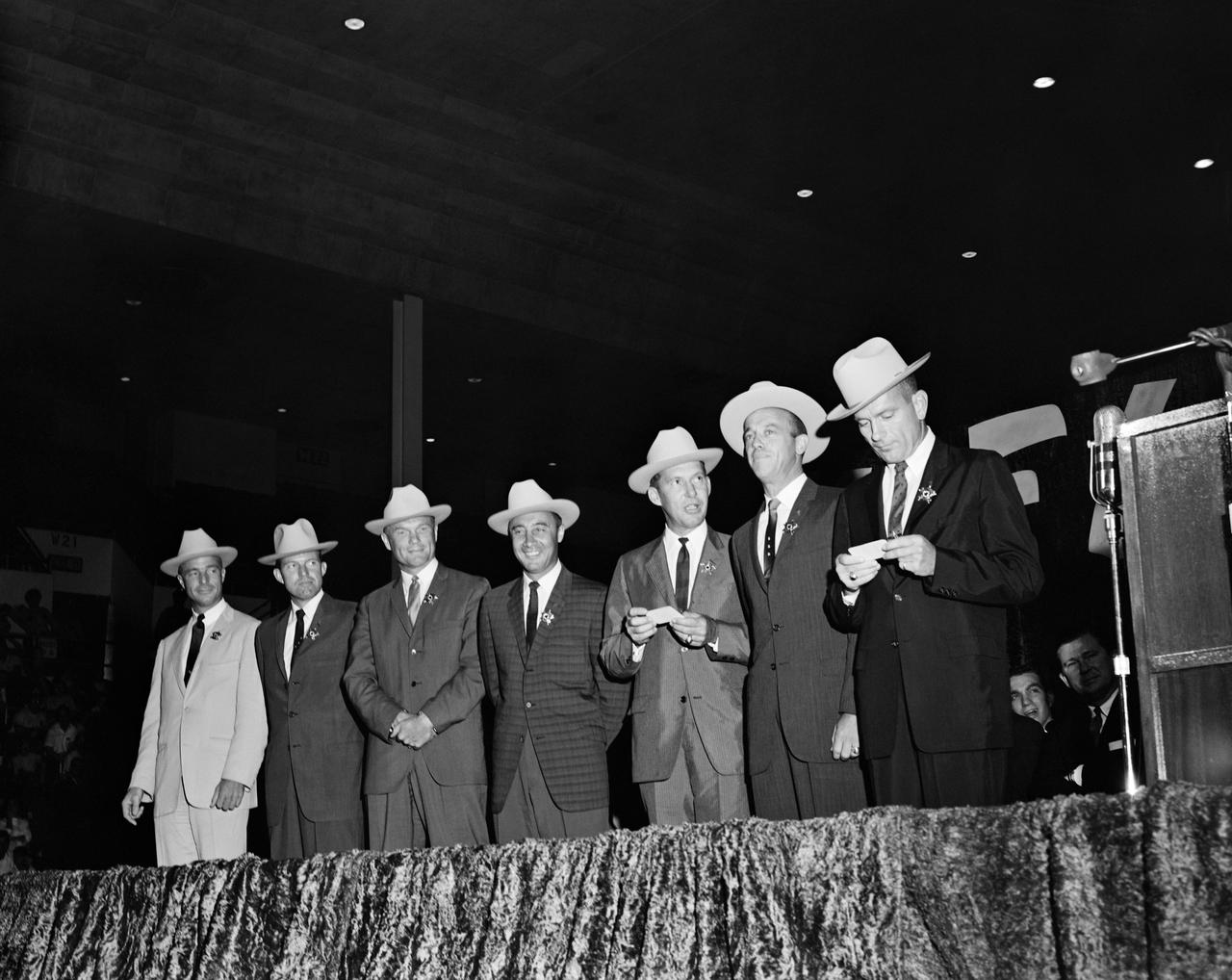
S62-03709 (4 July 1962) --- The original seven Mercury astronauts, each wearing new cowboy hats and a badge in the shape of a star, are pictured on stage at the Sam Houston Coliseum. A large crowd was on hand to welcome them to Houston, Texas. Left to right are astronauts M. Scott Carpenter, L. Gordon Cooper Jr., John H. Glenn Jr., Virgil I. Grissom, Walter M. Schirra Jr., Alan B. Shepard Jr., and Donald K. Slayton. Sen. John Tower (R.-Texas) is seen in far right background. Photo credit: NASA
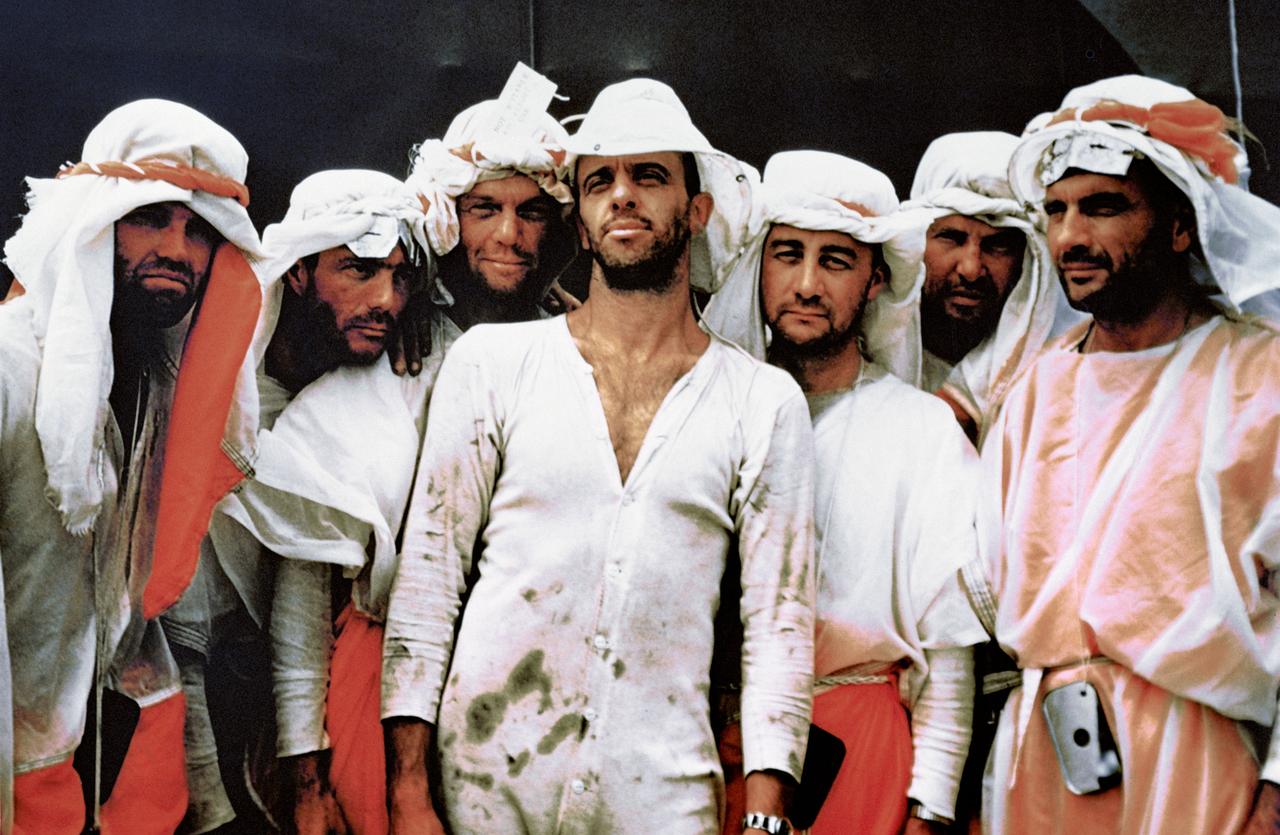
S88-31375 (1960) --- Although more easily recognized in their spacesuits, these seven men are actually NASA astronauts participating in a U.S. Air Force survival school at Stead Air Force Base in Nevada. The original seven Mercury astronauts are, left to right, L. Gordon Cooper Jr.; M. Scott Carpenter; John H. Glenn Jr.; Alan B. Shepard Jr.; Virgil I. Grissom; Walter M. Schirra Jr. and Donald K. Slayton. Portions of their clothing have been fashioned from parachute material. Photo credit: NASA
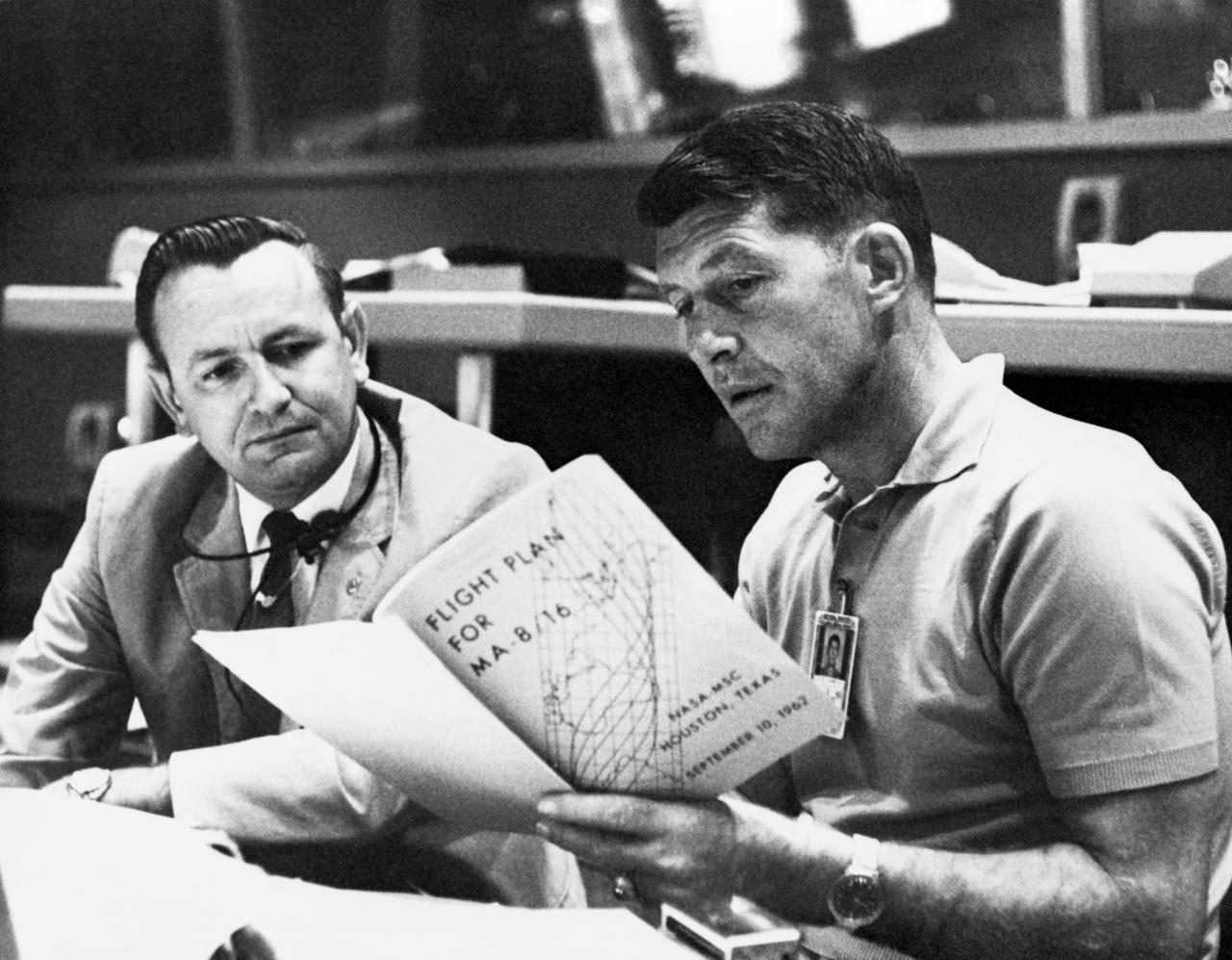
S74-33004 (19 Sept. 1962) --- Astronaut Walter M. Schirra Jr, (right), Mercury-Atlas 8 (MA-8) pilot, discusses the MA-8 flight plan with flight director Christopher C. Kraft Jr., Chief of the Flight Operations Division at the Manned Spacecraft Center, Houston, during MA-8 preflight preparations at Cape Canaveral, Florida. They are seated at a console in the Mercury Control Center. Photo credit: NASA
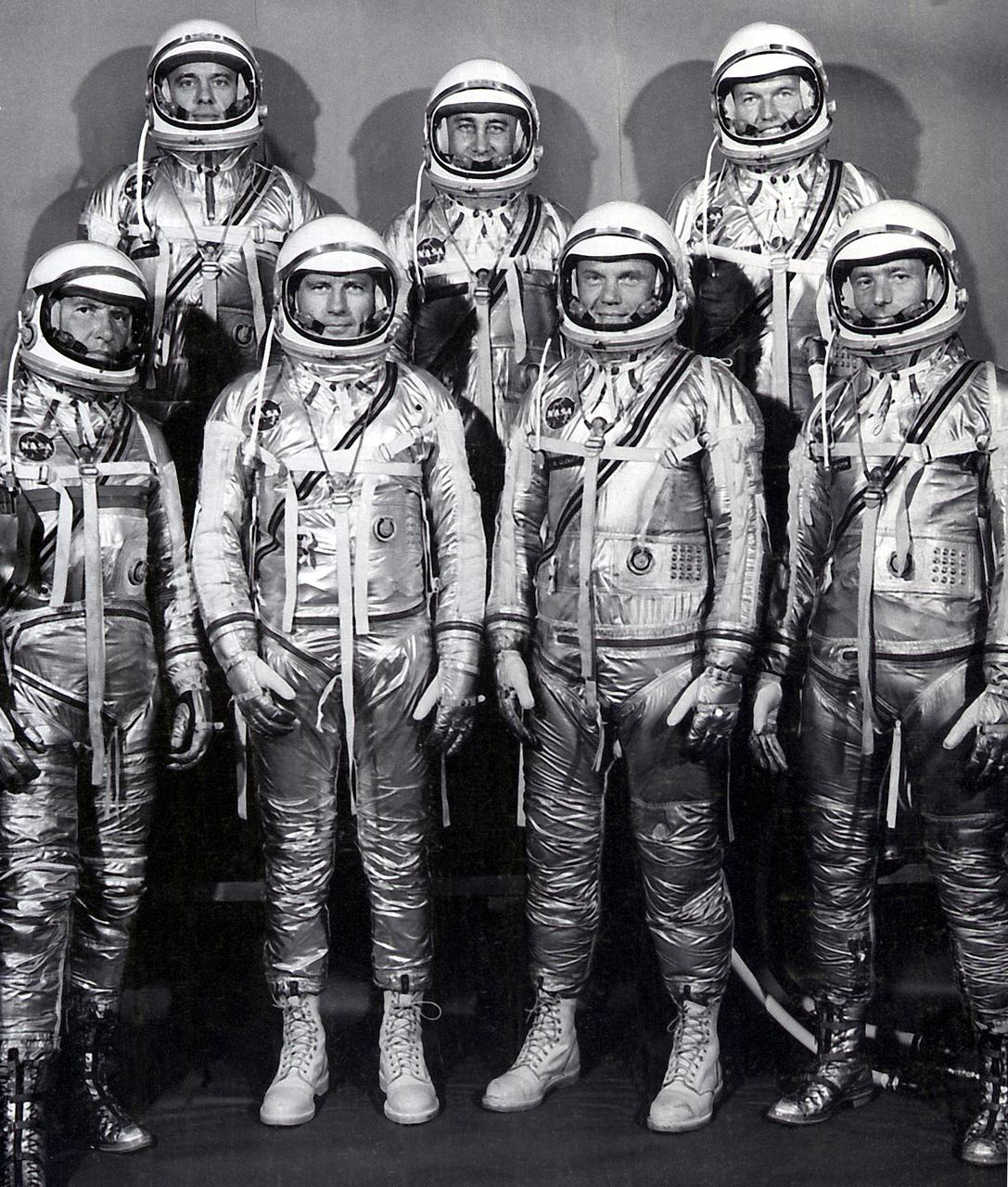
The group portrait of the original seven astronauts for the Mercury Project. NASA selected its first seven astronauts on April 27, 1959. Left to right at front: Walter M. Wally Schirra, Donald K. Deke Slayton, John H. Glenn, Jr., and Scott Carpenter. Left to right at rear: Alan B. Shepard, Virgil I. Gus Grissom, and L. Gordon Cooper, Jr.
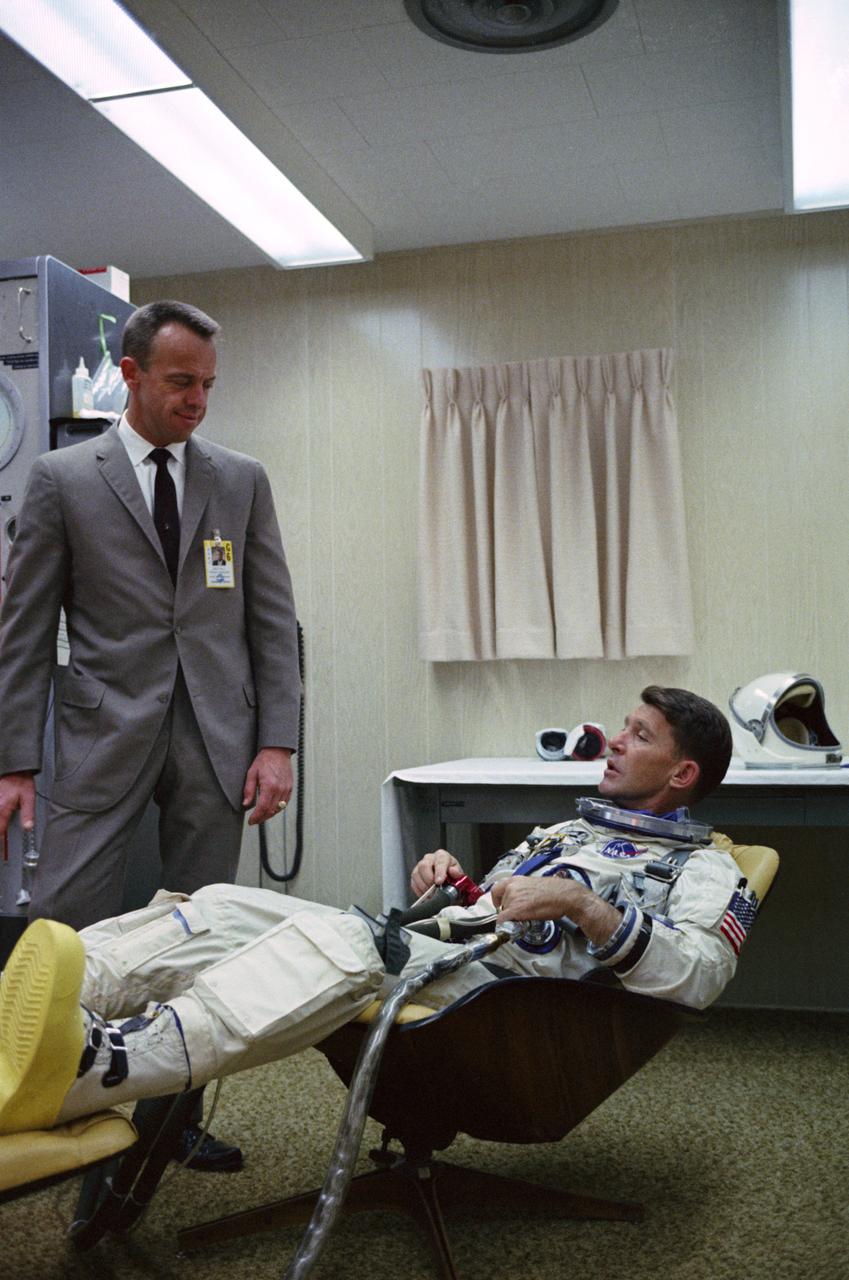
S65-59975 (15 Dec. 1965) --- Astronaut Walter M. Schirra Jr. (seated), command pilot of NASA's Gemini-6 spaceflight, relaxes in the suiting trailer at Launch Complex 16 during the Gemini-6 prelaunch countdown at Cape Kennedy, Florida. He is talking with astronaut Alan B. Shepard Jr., chief, Astronaut Office, Manned Spacecraft Center. Photo credit: NASA or National Aeronautics and Space Administration
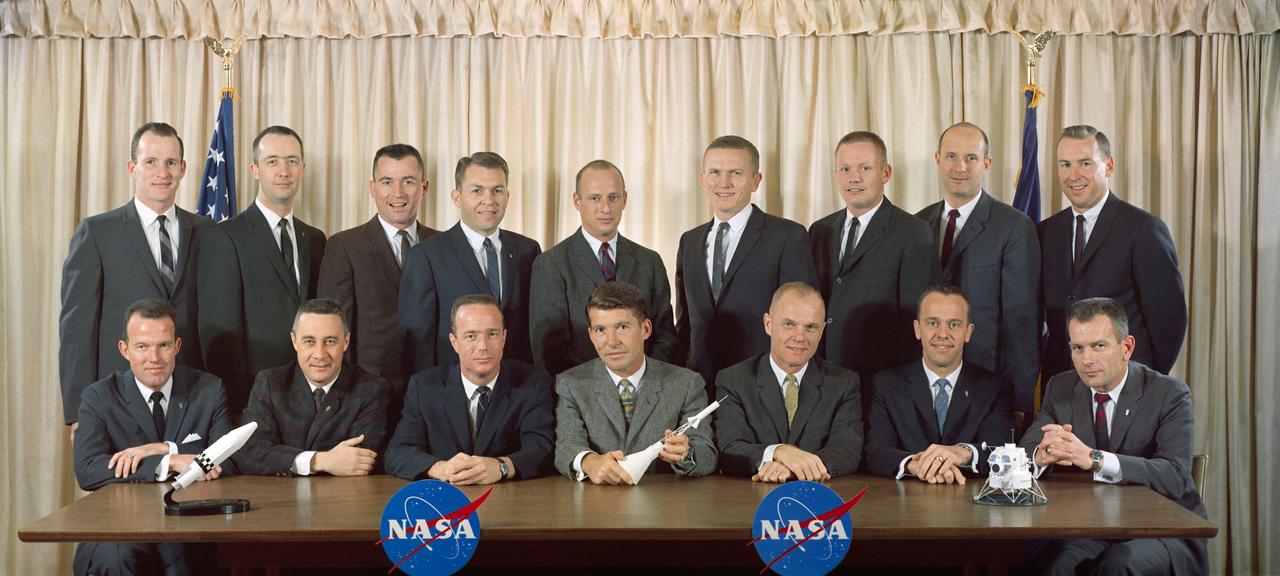
S63-01419 (1963) --- The first two groups of astronauts selected by the National Aeronautics and Space Administration (NASA). The original seven Mercury astronauts, selected in April 1959, are seated left to right, L. Gordon Cooper Jr., Virgil I. Grissom, M. Scott Carpenter, Walter M. Schirra Jr., John H. Glenn Jr., Alan B. Shepard Jr. and Donald K. Slayton. The second group of NASA astronauts, named in September 1962 are, standing left to right, Edward H. White II, James A. McDivitt, John W. Young, Elliot M. See Jr., Charles Conrad Jr., Frank Borman, Neil A. Armstrong, Thomas P. Stafford and James A. Lovell Jr. Photo credit: NASA
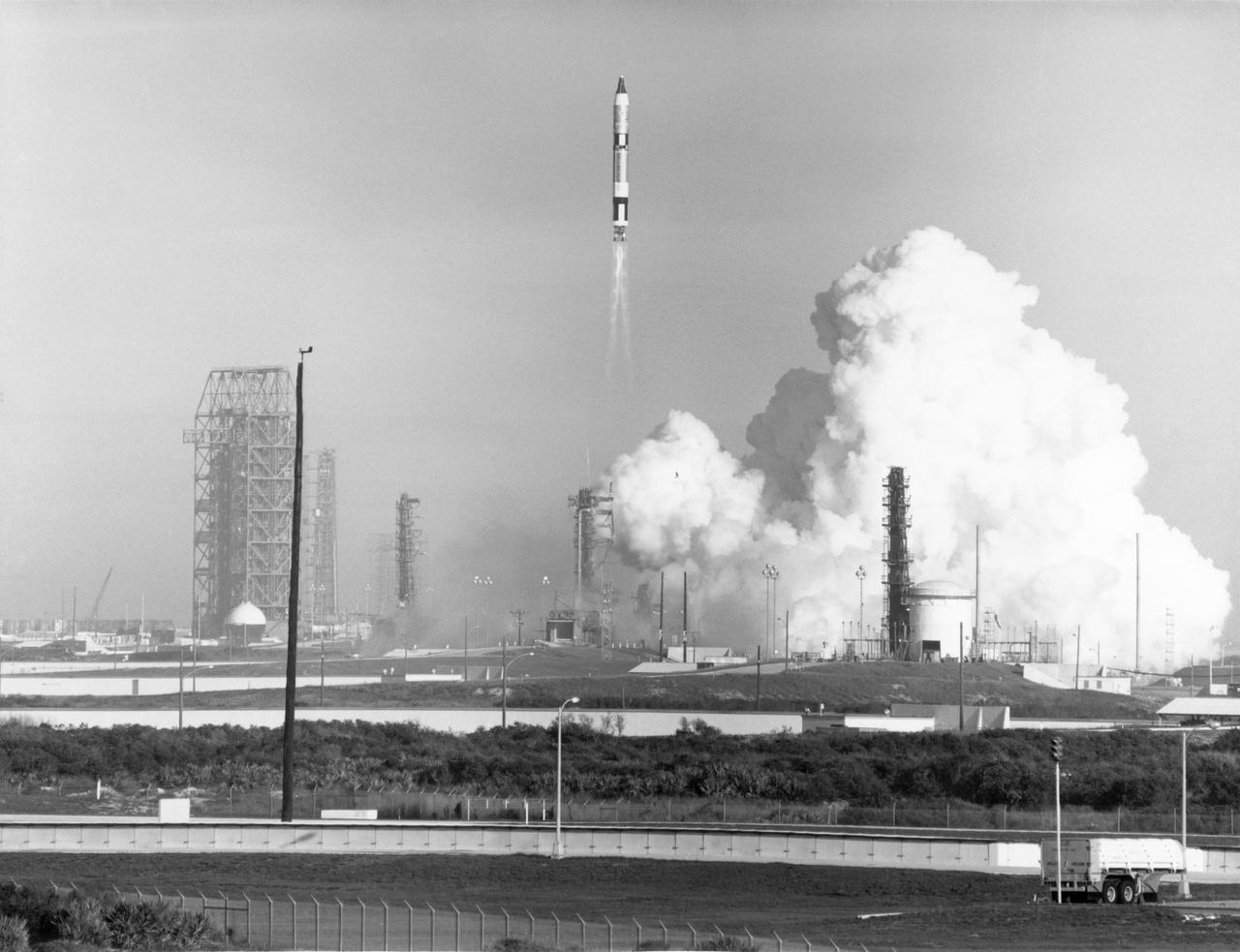
S65-44293 (15 Dec. 1965) --- Gemini-6, carrying astronauts Walter M. Schirra Jr., command pilot, and Thomas P. Stafford, pilot, was launched by the National Aeronautics and Space Administration?s John F. Kennedy Space Center at 8:37 a.m. (EST), Dec. 15, 1965. Gemini-6 completed a highly successful rendezvous mission with Gemini-7.
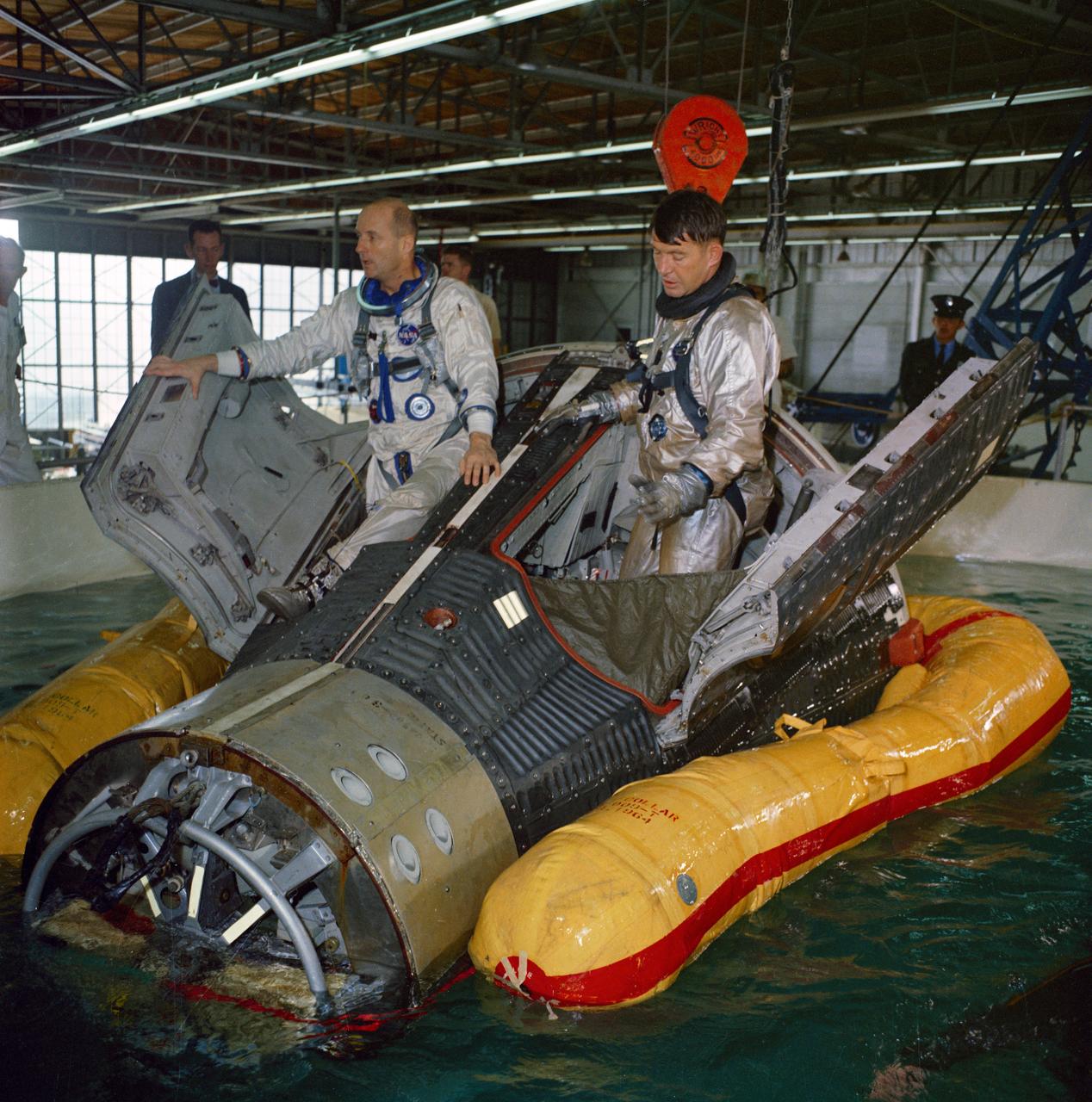
S65-10119 (1 Feb. 1965) --- The Gemini-6 prime crew, astronauts Thomas P. Stafford (left), pilot; and Walter M. Schirra Jr., command pilot, are pictured in a Gemini spacecraft, with flotation collar attached, during water egress training at Ellington Air Force Base, Texas. Photo credit: NASA or National Aeronautics and Space Administration
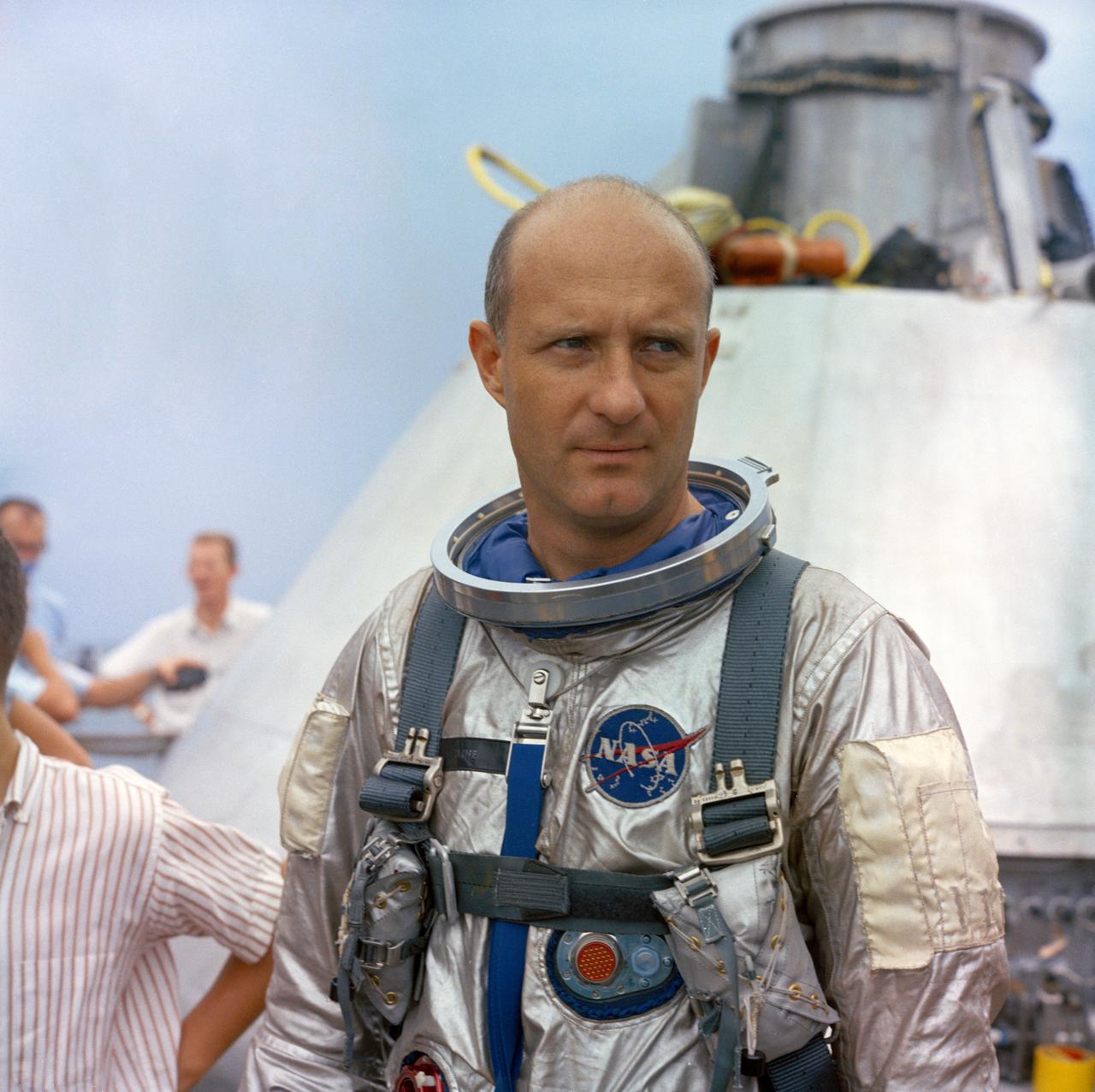
S65-43971 (23 Aug. 1965) --- Astronaut Thomas P. Stafford, Gemini-6 prime crew pilot, is pictured onboard the NASA Motor Vessel Retriever in the Gulf of Mexico during water egress training. Astronaut Walter M. Schirra Jr. (out of frame), prime crew command pilot, also took part in the training.
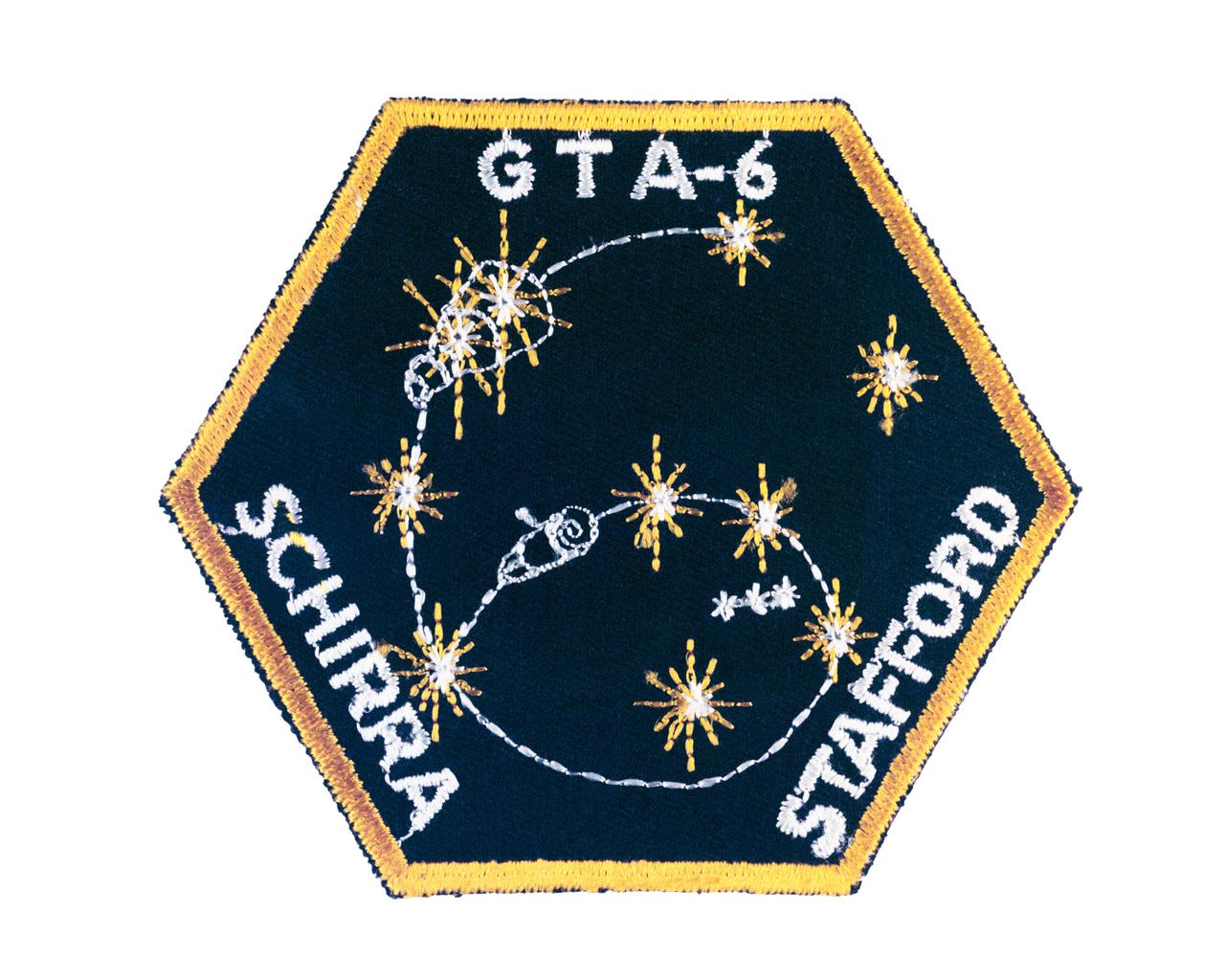
S65-55983 (8 Dec. 1965) --- This hexagonal-shaped insignia is the emblem of the Gemini-6 spaceflight. Astronauts Walter M. Schirra Jr., command pilot; and Thomas P. Stafford, pilot, are the prime crew. The National Aeronautics and Space Administration (NASA) has scheduled Gemini-6 as a two-day mission. Photo credit: NASA or National Aeronautics and Space Administration
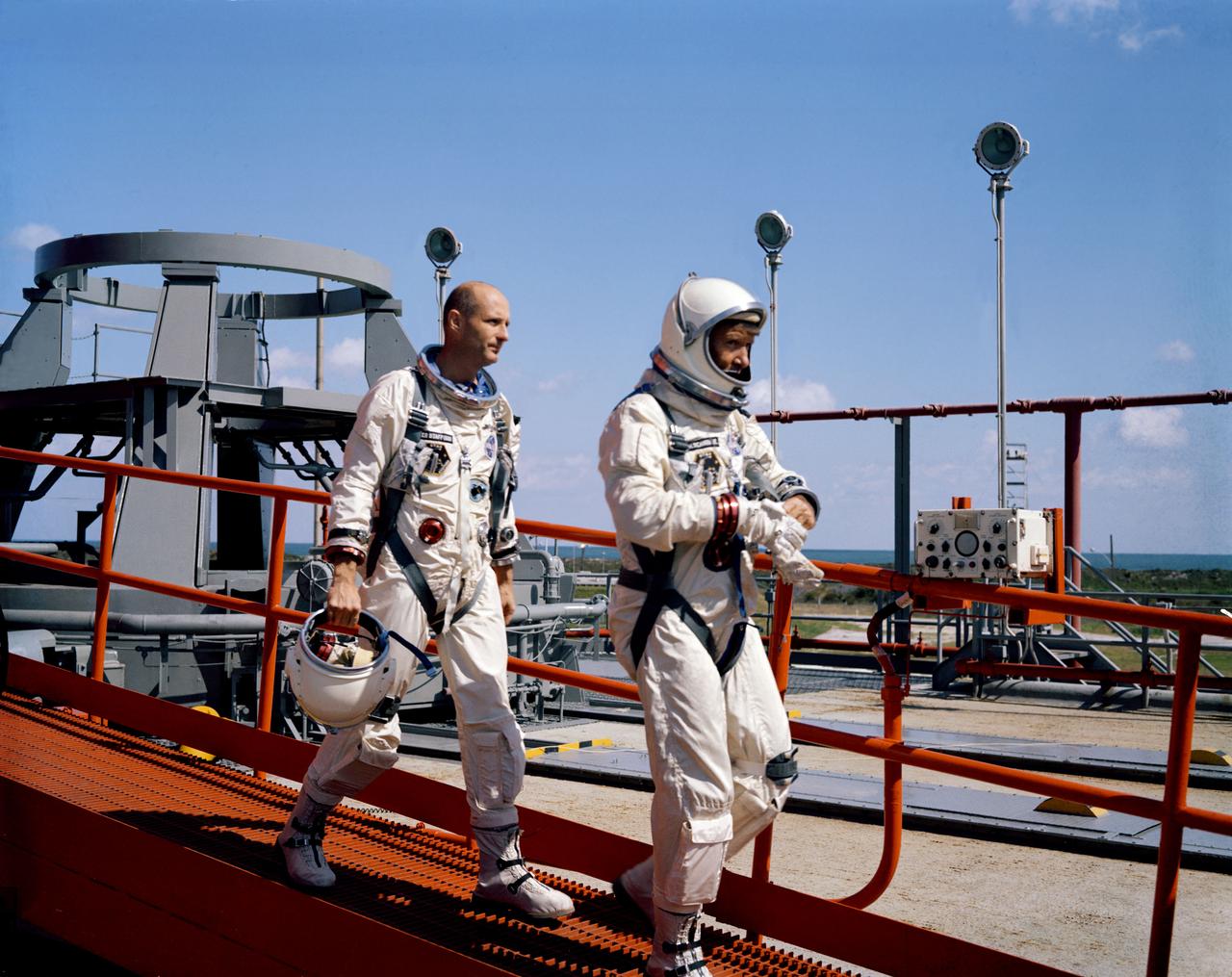
S65-57964 (25 Oct. 1965) --- The prime crew of the Gemini-6 spaceflight walk down the ramp at Pad 19 after leaving the Gemini-6 spacecraft. Astronaut Walter M. Schirra Jr. (leading) is command pilot; and astronaut Thomas P. Stafford is pilot. The Oct. 25 Gemini-6 launch was scrubbed because the Agena, intended as a rendezvous target vehicle in the mission, failed to achieve orbit. Photo credit: NASA or National Aeronautics and Space Administratio
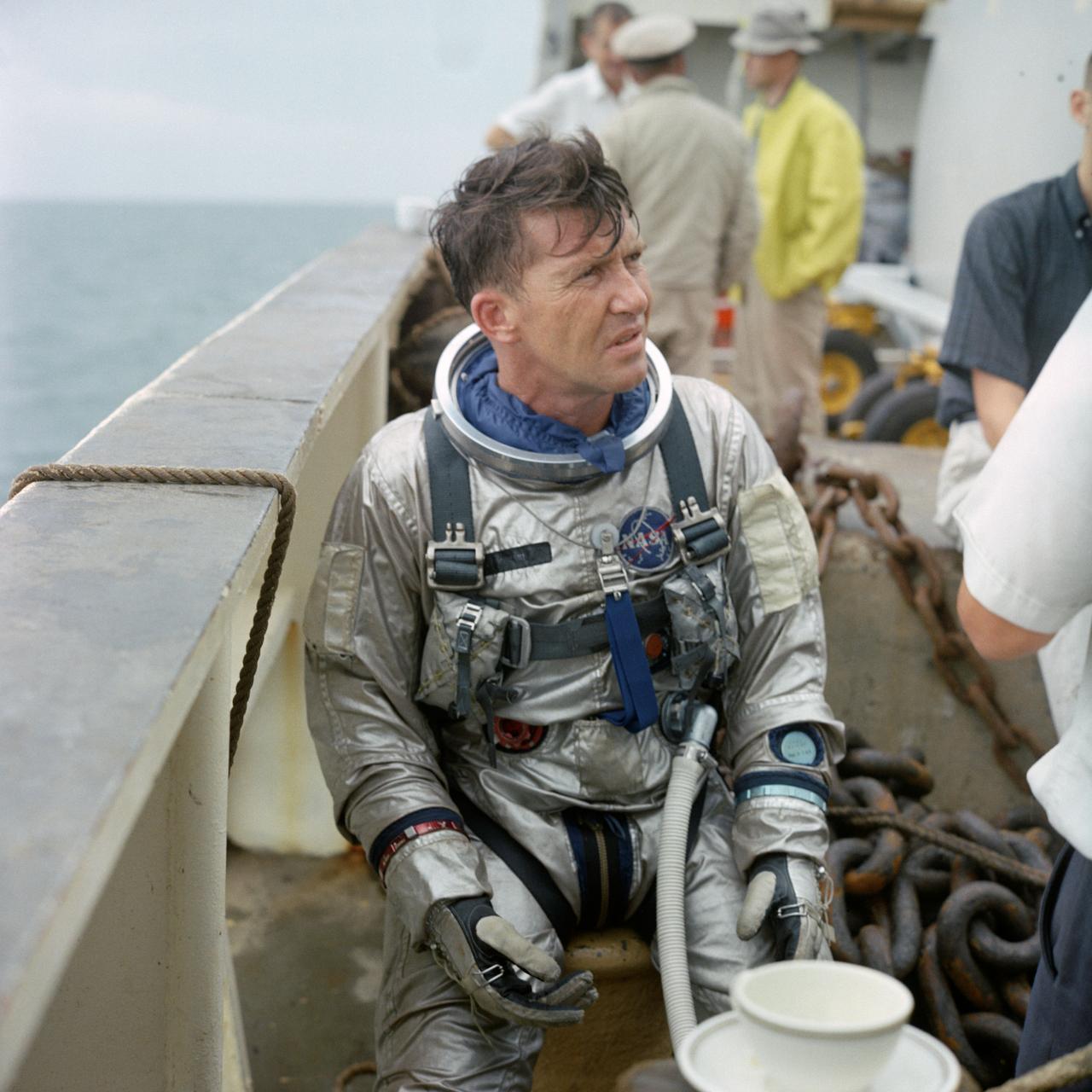
S65-43967 (23 Aug. 1965) --- Astronaut Walter M. Schirra Jr., Gemini-6 prime crew command pilot, is pictured onboard the NASA Motor Vessel Retriever during water egress training in the Gulf of Mexico. Astronaut Thomas P. Stafford (out of frame), Gemini-6 prime crew pilot, also took part in the training.
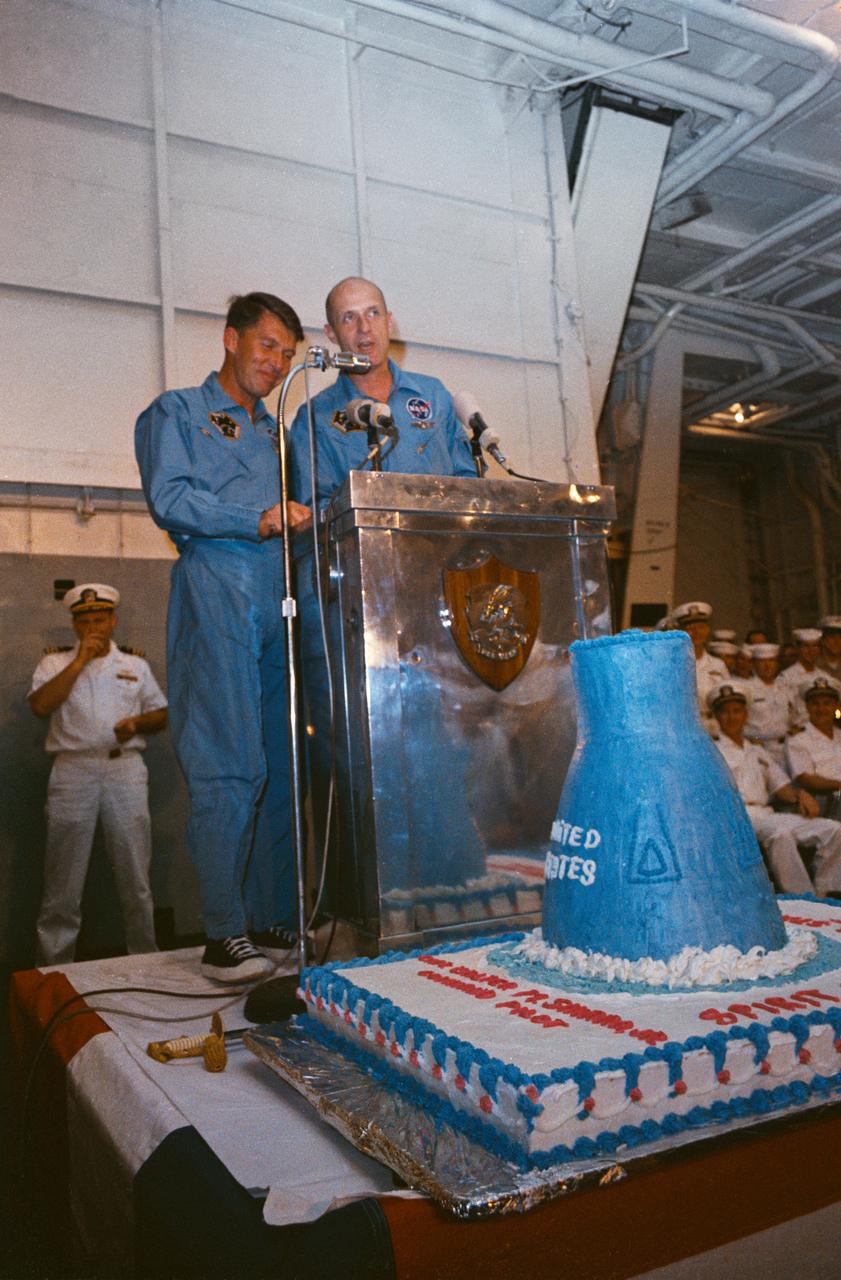
S65-61825 (16 Dec. 1965) --- Astronauts Walter M. Schirra Jr. (left), command pilot, and Thomas P. Stafford, pilot, speak to crewmen onboard the aircraft carrier USS Wasp after successful recovery of the Gemini-6 spacecraft. Note the cake with a model of the Gemini spacecraft in its center, which is positioned in front of the astronauts. Photo credit: NASA or National Aeronautics and Space Administration
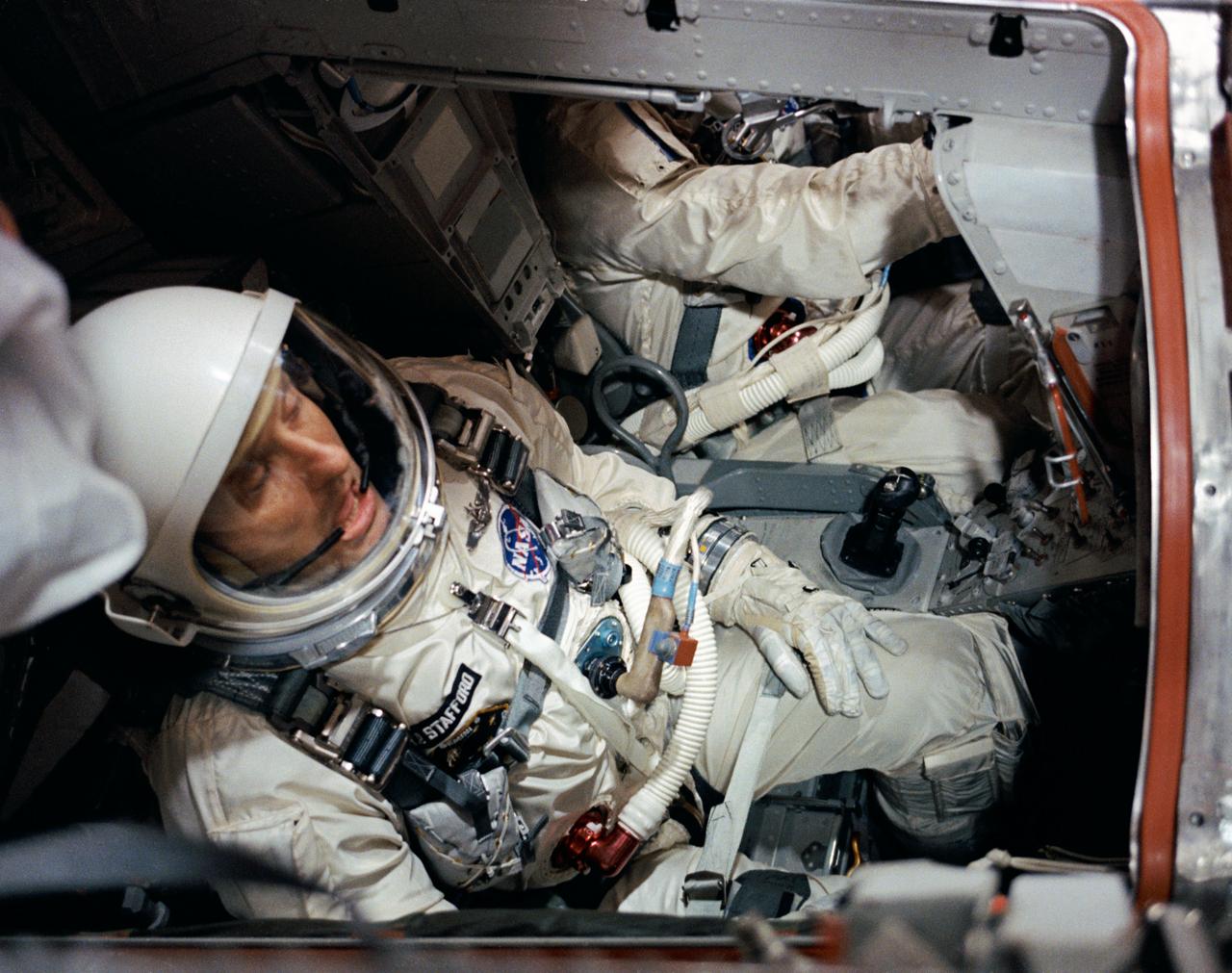
S65-59961 (15 Dec. 1965) --- Astronaut Thomas P. Stafford, pilot, is pictured in the Gemini-6 spacecraft in the White Room atop Pad 19 prior to the closing of the hatches during the Gemini-6 prelaunch countdown. In the background (partially out of view) is astronaut Walter M. Schirra Jr., command pilot. Photo credit: NASA or National Aeronautics and Space Administration
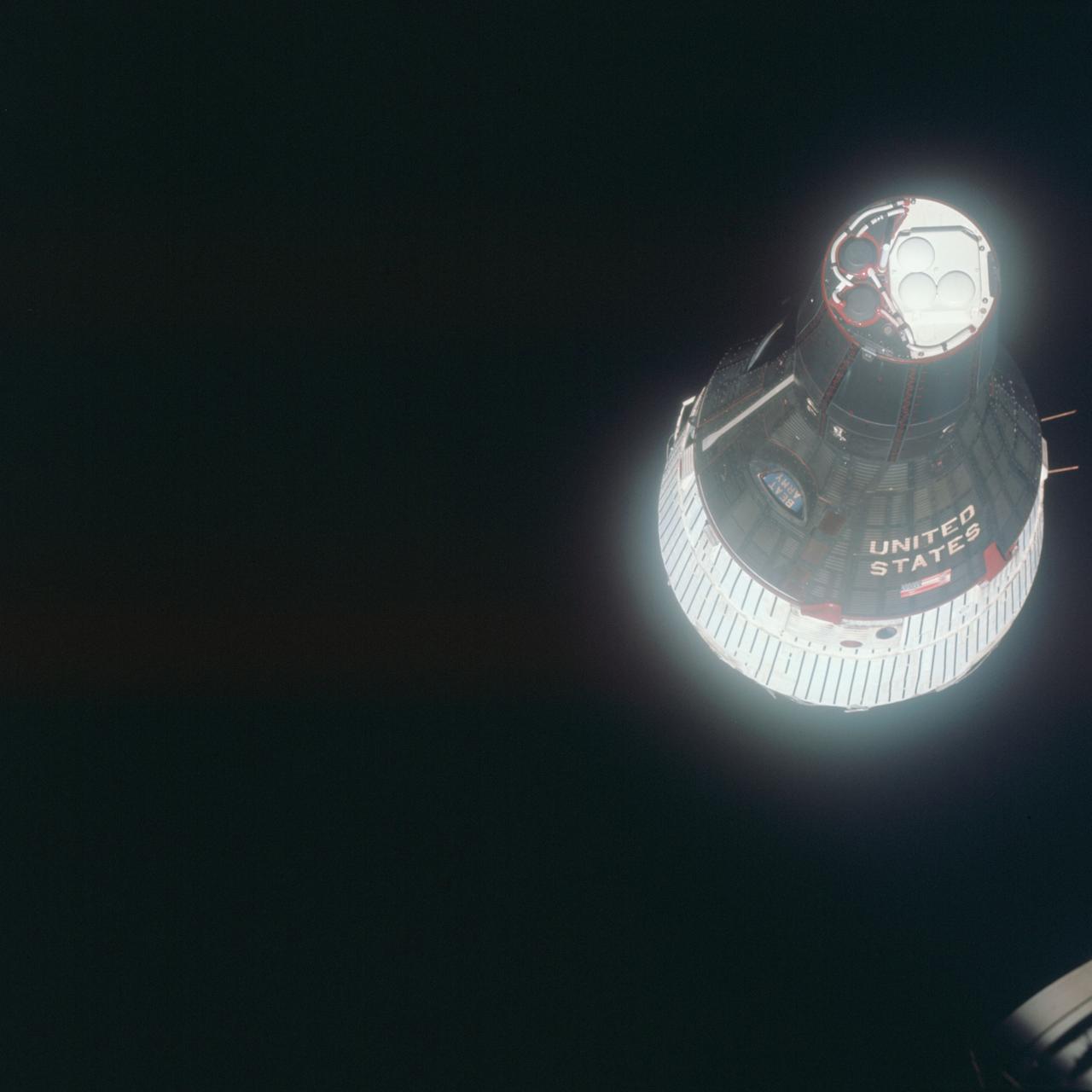
S65-64040 (15 Dec. 1965) --- Nose-on view of the Gemini-6 spacecraft against the blackness of space as seen from Gemini-7 spacecraft. The two spacecraft were approximately 38 feet apart. Astronauts Walter M. Schirra and Thomas P. Stafford were onboard the Gemini-6 spacecraft. Astronauts Frank Borman and James A. Lovell Jr. were aboard the Gemini-7 spacecraft. A "Beat Army" sign can be seen in the Gemini-6 window. Photo credit: NASA
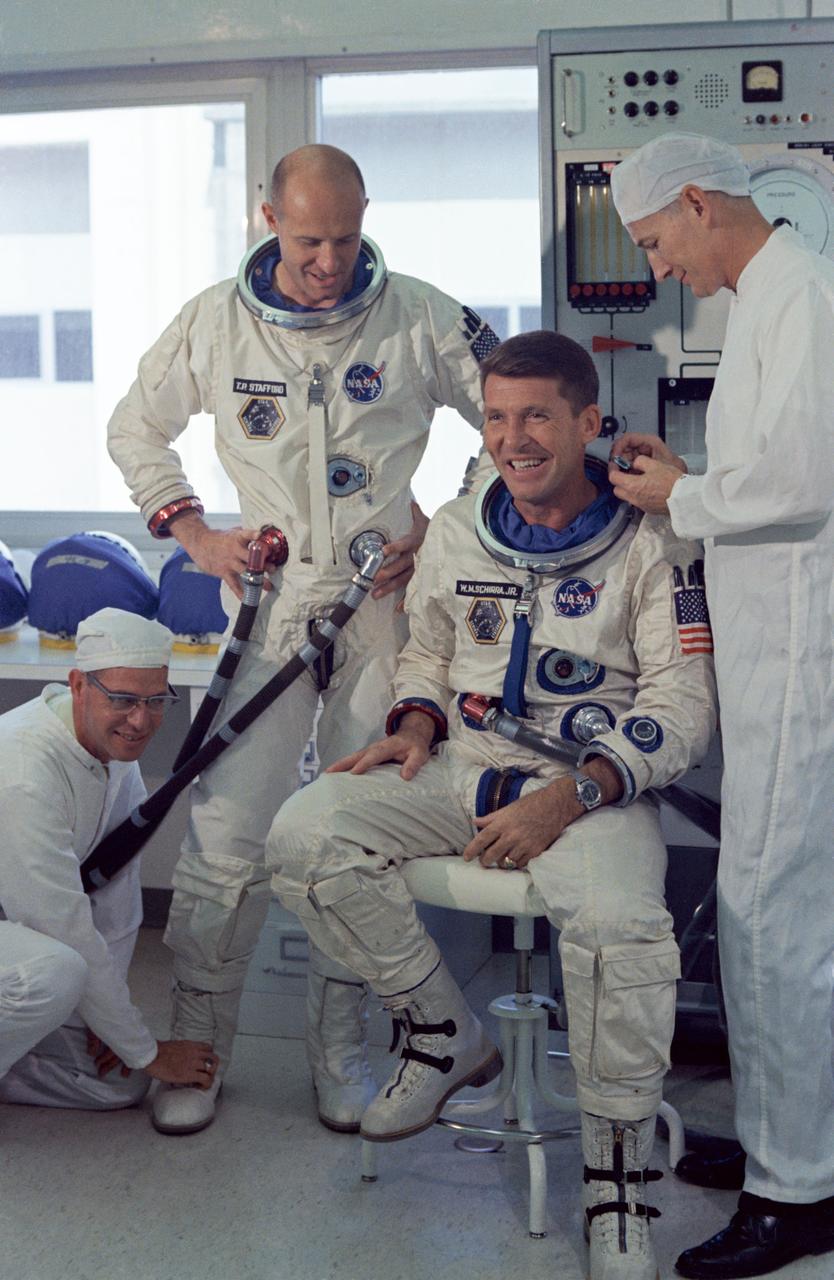
S65-56190 (20 Oct. 1965) --- Astronauts Walter M. Schirra Jr. (seated), command pilot; and Thomas P. Stafford, pilot, the prime crew of NASA's Gemini-Titan-Agena 6 space mission, go through suiting up exercises in preparation for their forthcoming flight. The suit technicians are James Garrepy (left) and Joe Schmitt. Photo credit: NASA or National Aeronautics and Space Administration
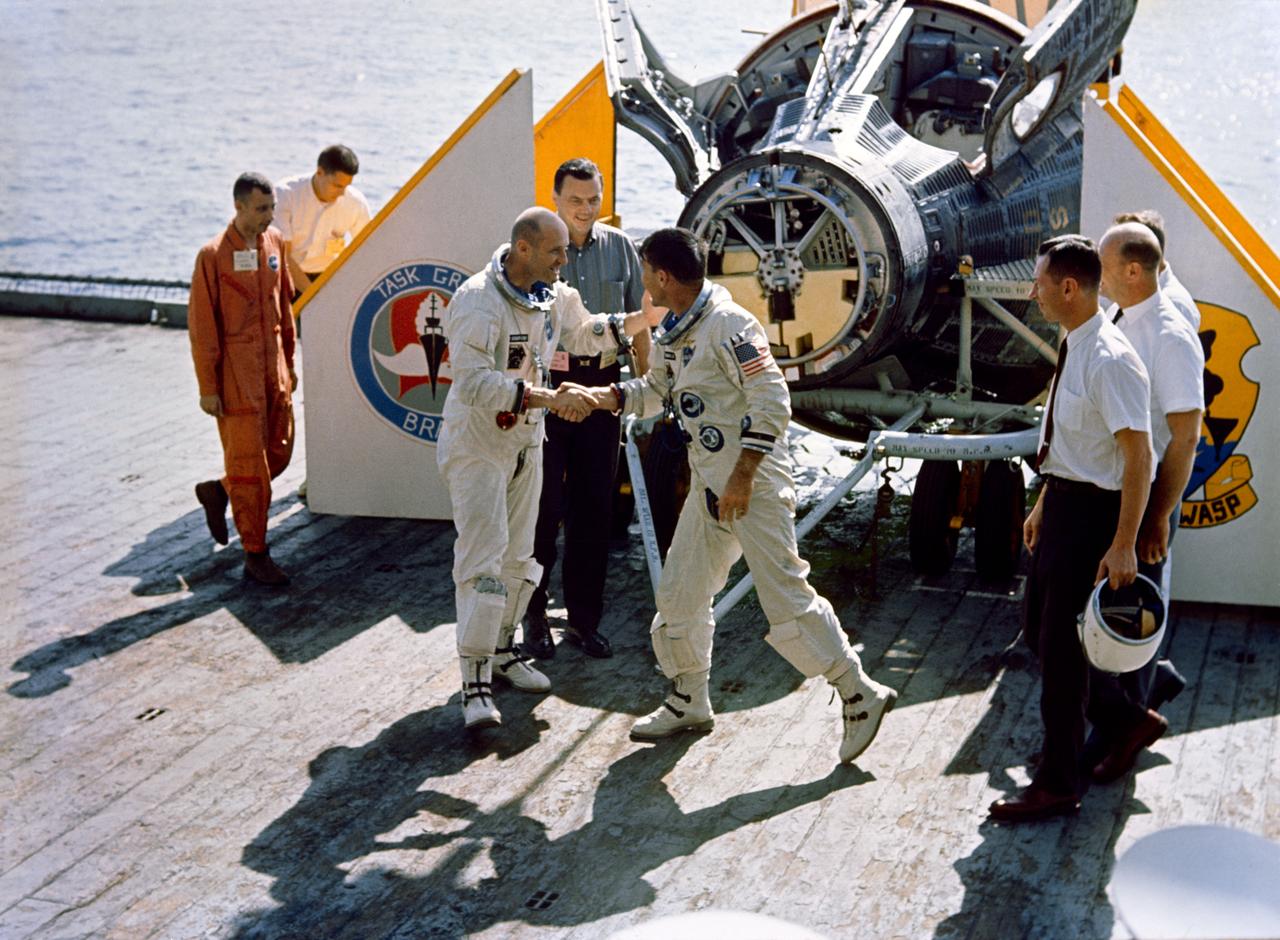
S65-61859 (16 Dec. 1965) --- Astronauts Walter M. Schirra Jr. (right), command pilot, and Thomas P. Stafford, pilot, shake each other's hand as they arrive aboard the aircraft carrier USS Wasp to conclude their 25-hour, 52-minute Gemini-6 spaceflight. Photo credit: NASA or National Aeronautics and Space Administration
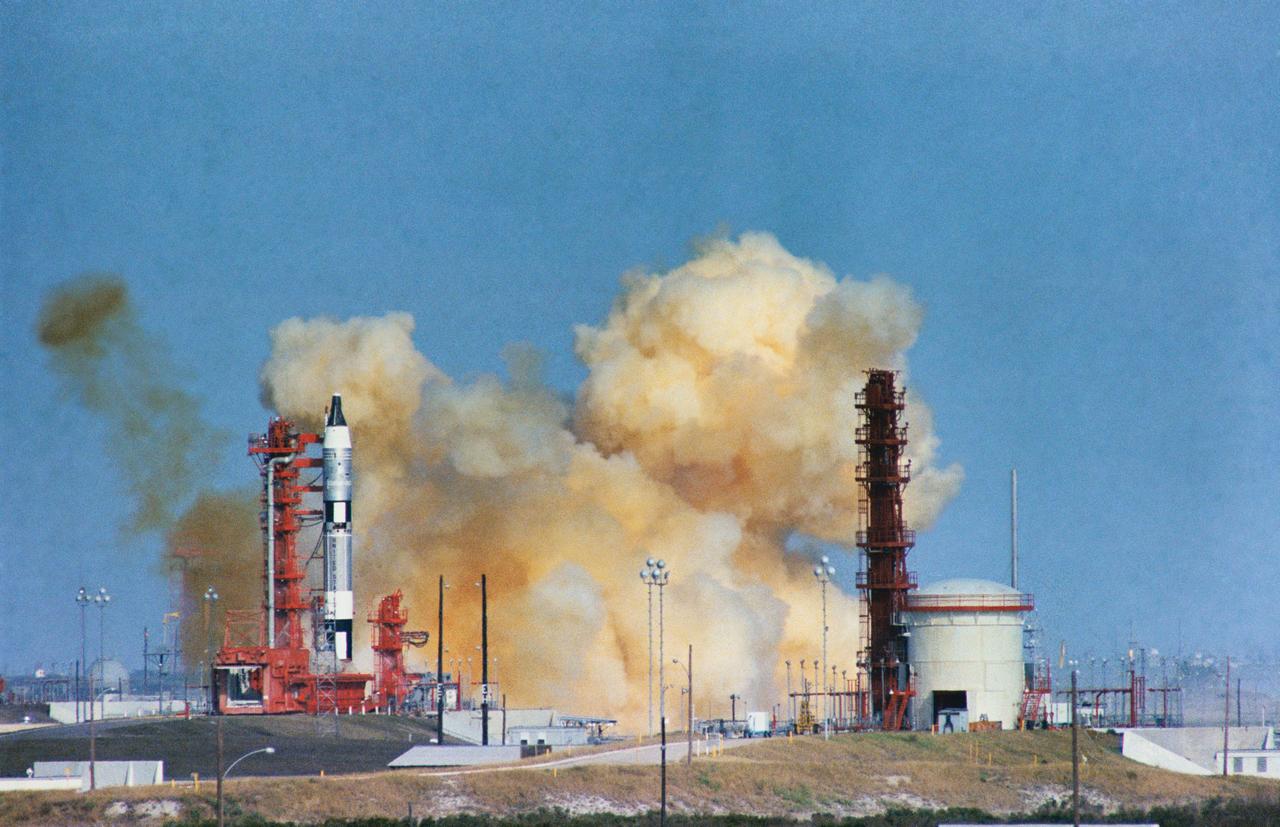
S65-59967 (12 Dec. 1965) --- The National Aeronautics and Space Administration (NASA) attempted to launch Gemini-6 at 9:54 a.m. (EST), Dec. 12, 1965. However, seconds after ignition the first stage engine of the Gemini Launch Vehicle 6 shut down due to a faulty release of a liftoff umbilical plug. Inside the spacecraft were astronauts Walter M. Schirra Jr., command pilot, and Thomas P. Stafford, pilot. Photo credit: NASA or National Aeronautics and Space Administration
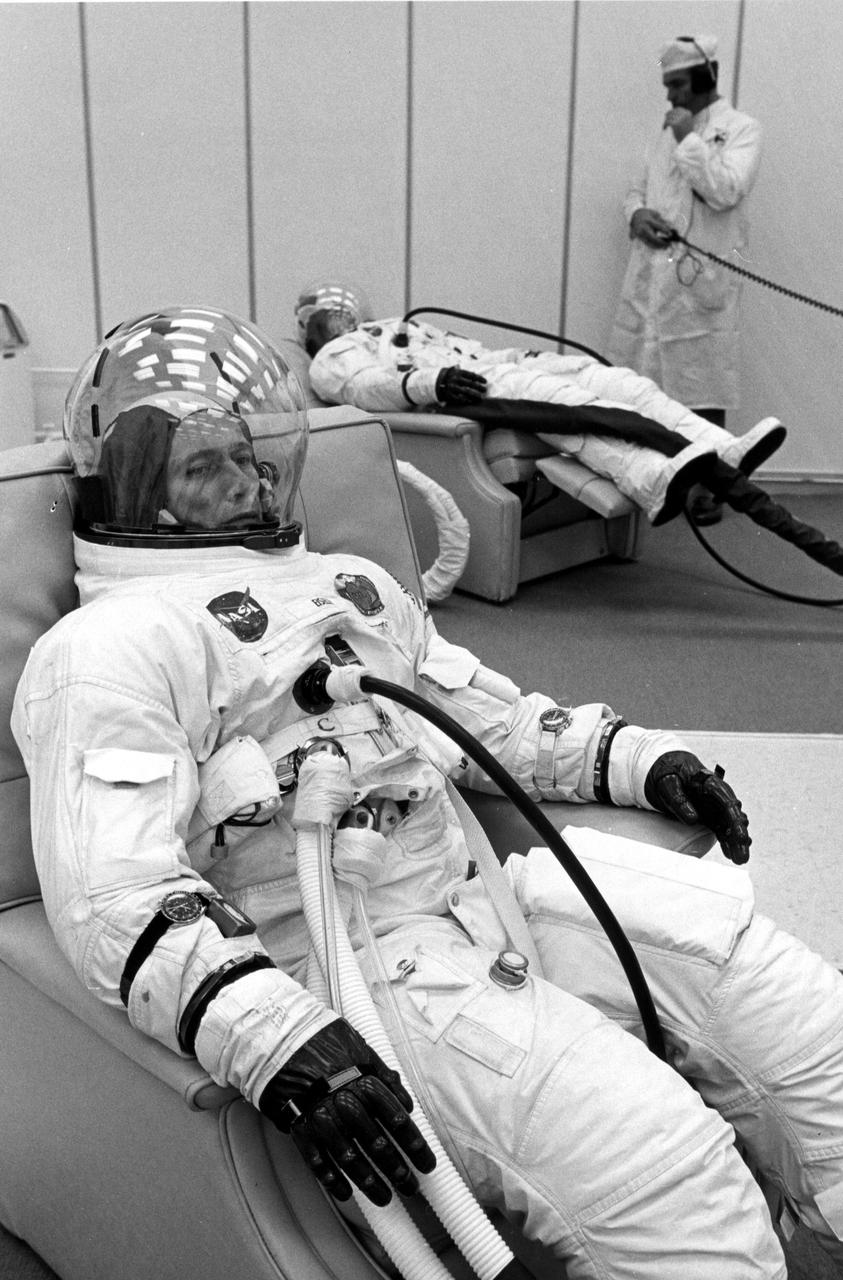
KENNEDY SPACE CENTER, FLA. -- Apollo 7 astronauts Donn F. Eisele, foreground, and Walter Cunningham, rear, undergo spacesuit checks today prior to their Earth orbital mission with Walter M. Schirra Jr., not shown. The three space pilots lifted off atop a Saturn 1B space vehicle from Cape Kennedy's Launch Complex 34 at 11:03 a.m. EDT, Oct. 11, 1968. The National Aeronautics and Space Administration's first manned Apollo flight is designed to verify spacecraft systems for future lunar voyages.
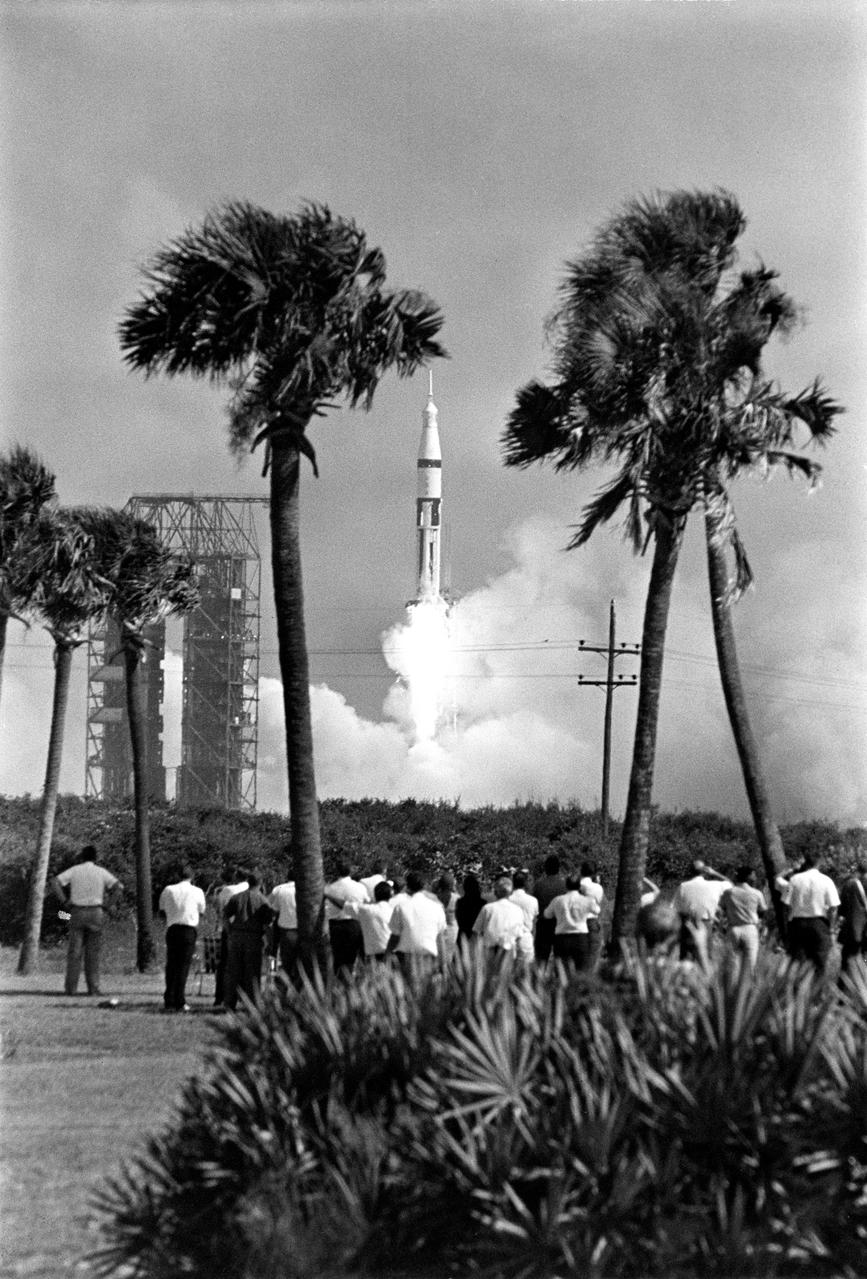
S68-48662 (11 Oct. 1968) --- The Apollo 7/Saturn IB space vehicle is launched from the Kennedy Space Center's Launch Complex 34 at 11:03 a.m. (EDT), Oct. 11, 1968. Apollo 7 (Spacecraft 101/Saturn 205) is the first of several manned flights aimed at qualifying the spacecraft for the half-million mile round trip to the moon. Aboard the Apollo spacecraft are astronauts Walter M. Schirra Jr., commander; Donn F. Eisele, command module pilot; and Walter Cunningham, lunar module pilot. (This view is framed by palm trees on either side).