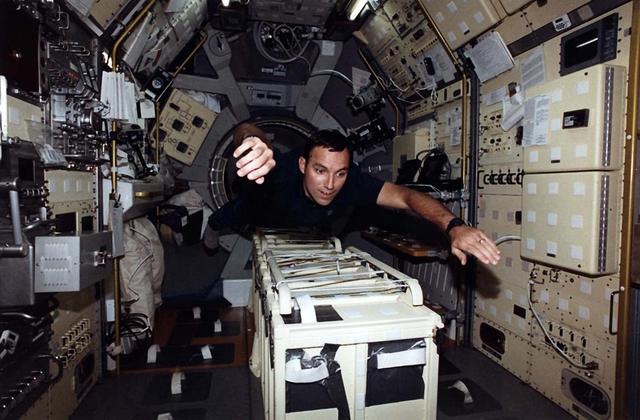
Astronaut Carl E. Walz, mission specialist, enters the International Microgravity Laboratory (IML-2) science module in the cargo bay via the turnel connecting it to Columbia's cabin. Walz joined five other NASA astronauts and a Japanese payload specialist for more than two weeks of experimenting in Earth orbit.
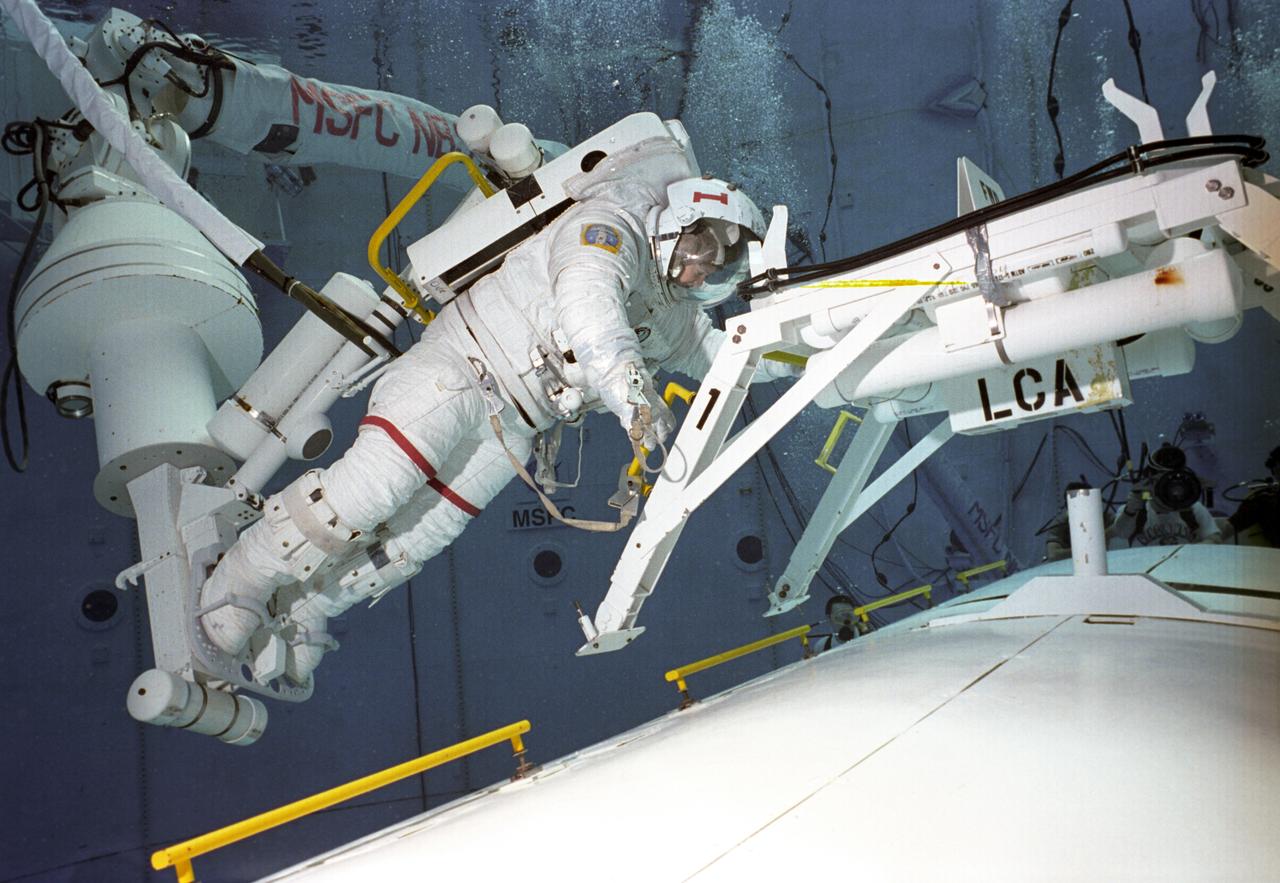
Astronauts Susan Helms (#1) and Carl Walz (#2) are training in the Neutral Buoyancy Simulator (NBS) at Marshall Space Flight center with an exercise for International Space Station Alpha. The NBS provided the weightless environment encountered in space needed for testing and the practices of Extravehicular Activities (EVA).

ISS004-E-6336 (January 2002) --- Astronaut Carl E. Walz, Expedition Four flight engineer, is photographed in the Zvezda Service Module on the International Space Station (ISS). An orange floats freely in front of Walz. The image was taken with a digital still camera.
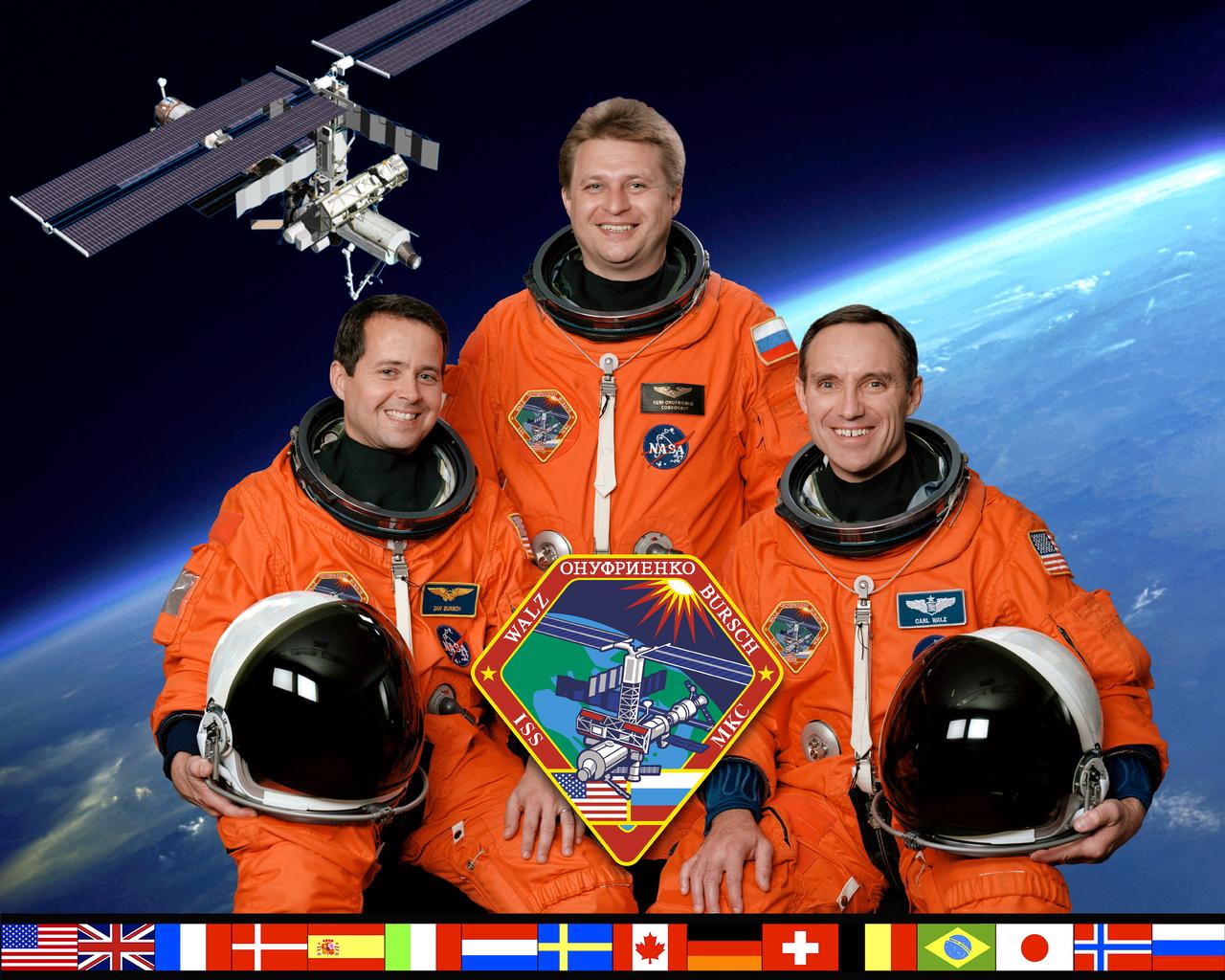
This is a crew portrait of the International Space Station (ISS) Expedition Four. Left to right are Astronaut Daniel W. Bursch, flight engineer; Cosmonaut Yuri I. Onufrienko, mission commander; and Astronaut Carl E. Walz, flight engineer. The crew was launched on December 5, 2001 aboard the STS-108 mission Space Shuttle Orbiter Endeavour, the 12th Shuttle mission to visit the ISS. The crew returned to Earth on June 19th, 2002 aboard the STS-111 mission Space Shuttle Orbiter Endeavour, replaced by Expedition Five. The Expedition Four crew spent 196 days in space, which gives flight engineers Walz and Bursh the U.S. space flight endurance record.

S91-32691 (3 Mar 1991) --- Astronaut Carl E. Walz.
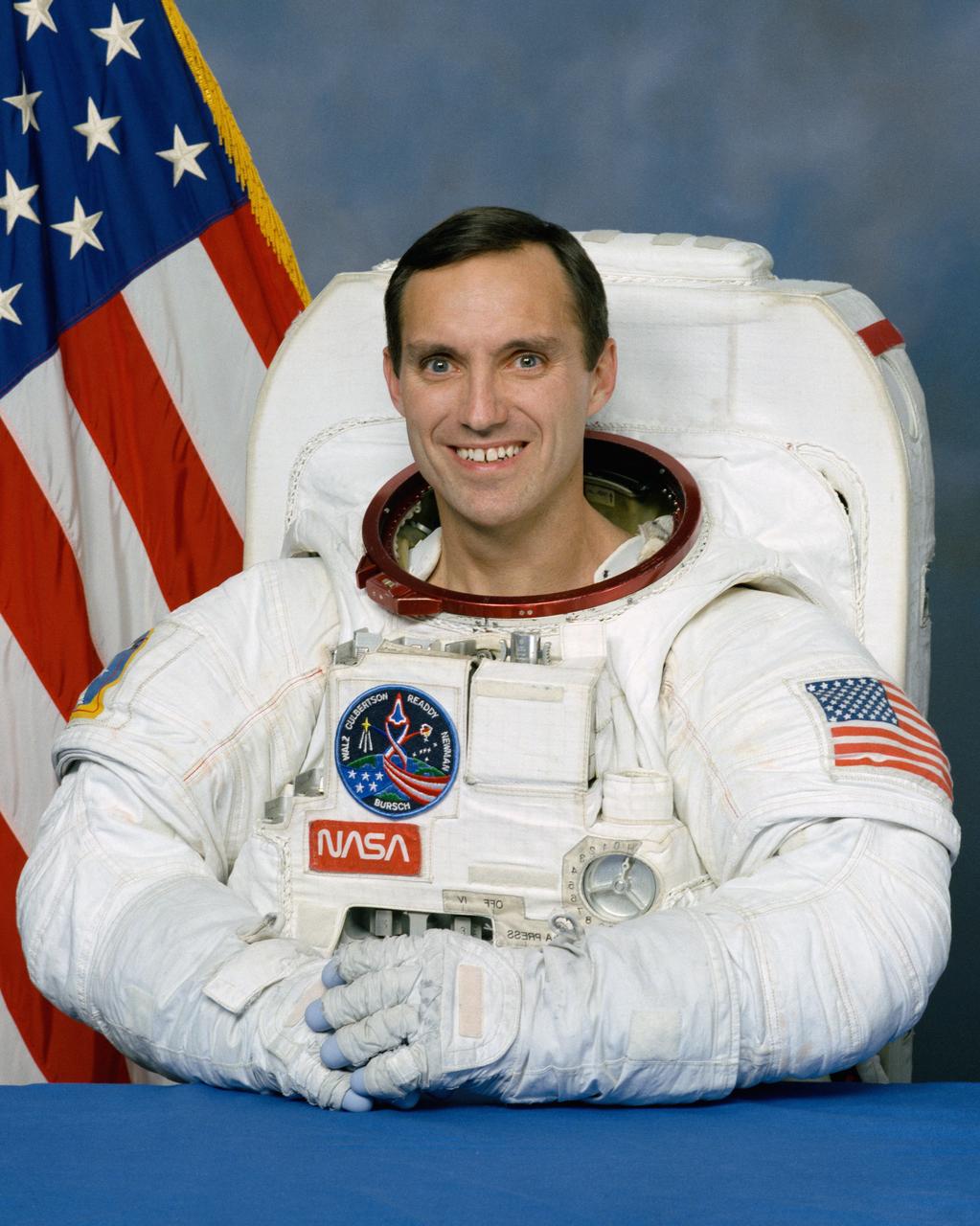
S95-15563 (18 July 1995) --- Astronaut Carl E. Walz, mission specialist.
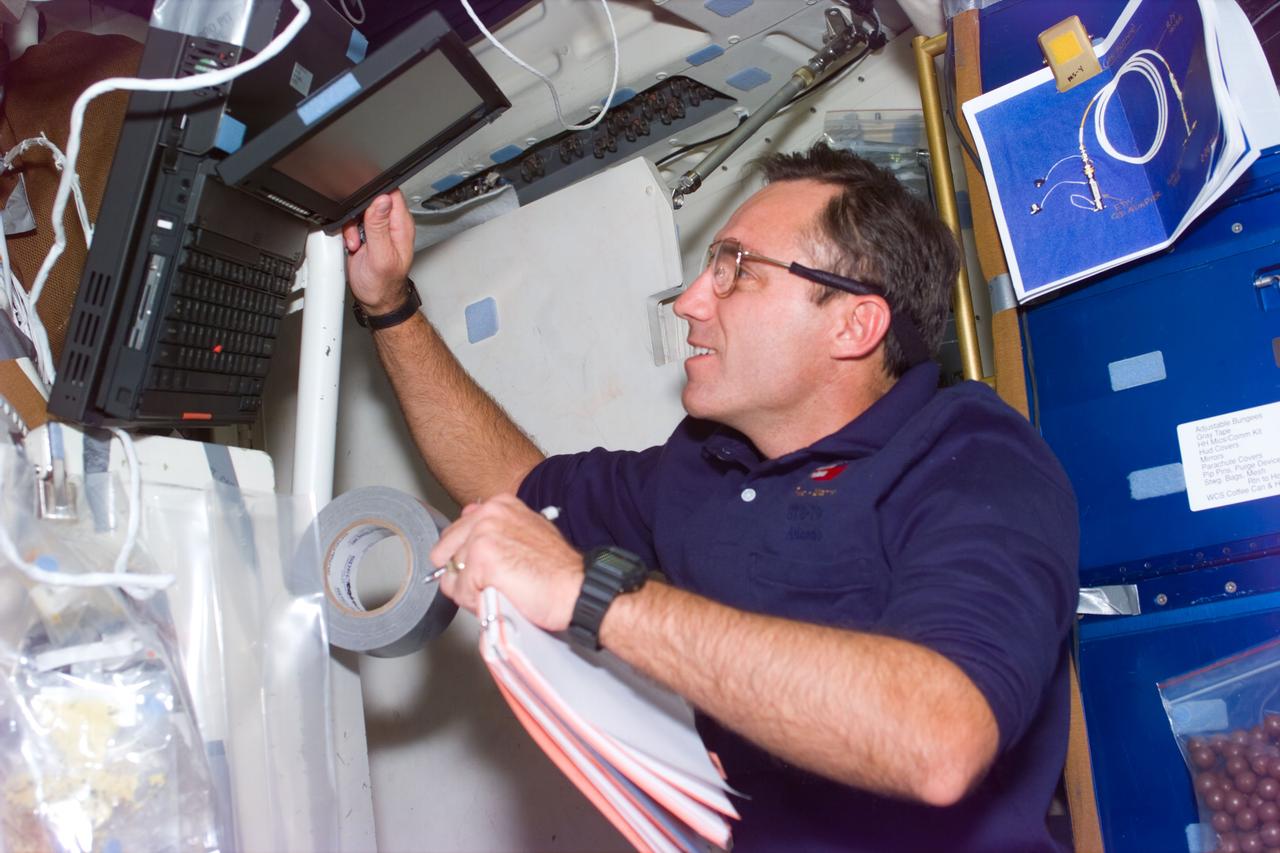
STS79-E-5024 (18 September 1996) --- Carl E. Walz, mission specialist, aligns computer to assist in an experiment in Spacehab Module, on Flight Day 3.

STS79-E-5366 (16-26 September 1996) --- Astronaut Carl E. Walz handles the IMAX in-cabin motion picture camera, which was used to capture some of the same imagery seen in this series of Electronic Still Camera (ESC) views.
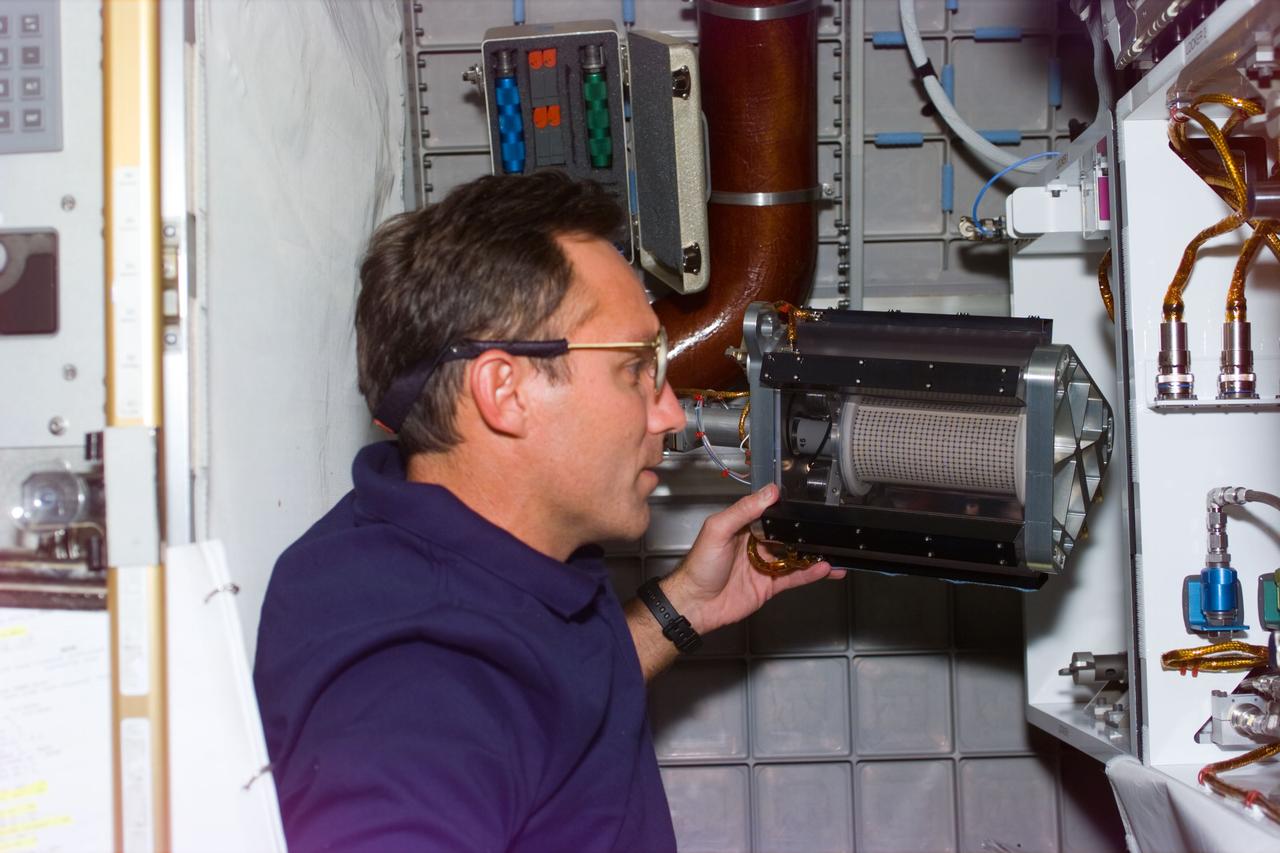
STS79-E-5041 (18 September 1996) --- Astronaut Carl E. Walz, mission specialist, checks on Mechanics of Granular Materials (MGM) experiment in Spacehab, onboard the Space Shuttle Atlantis, Flight Day 3.
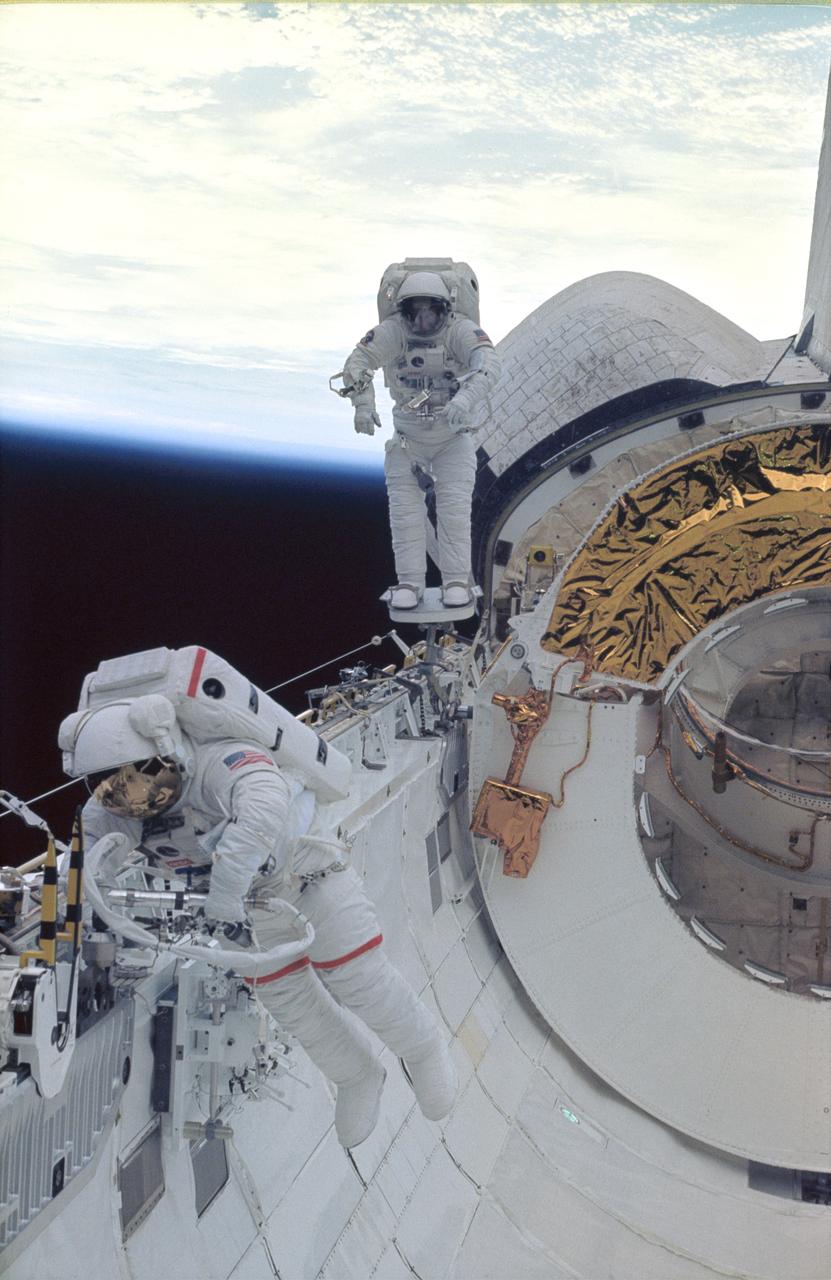
STS051-06-037 (16 Sept 1993) --- Astronauts Carl E. Walz (foreground) and James H. Newman evaluate some important gear. Walz reaches for the Power Ratchet Tool (PRT) while Newman checks out mobility on the Portable Foot Restraint (PFR) near the Space Shuttle Discovery's starboard Orbital Maneuvering System (OMS) pod. The tools and equipment will be instrumental on some of the five periods of extravehicular activity (EVA) scheduled for the Hubble Space Telescope (HST) STS-61 servicing mission later this year.
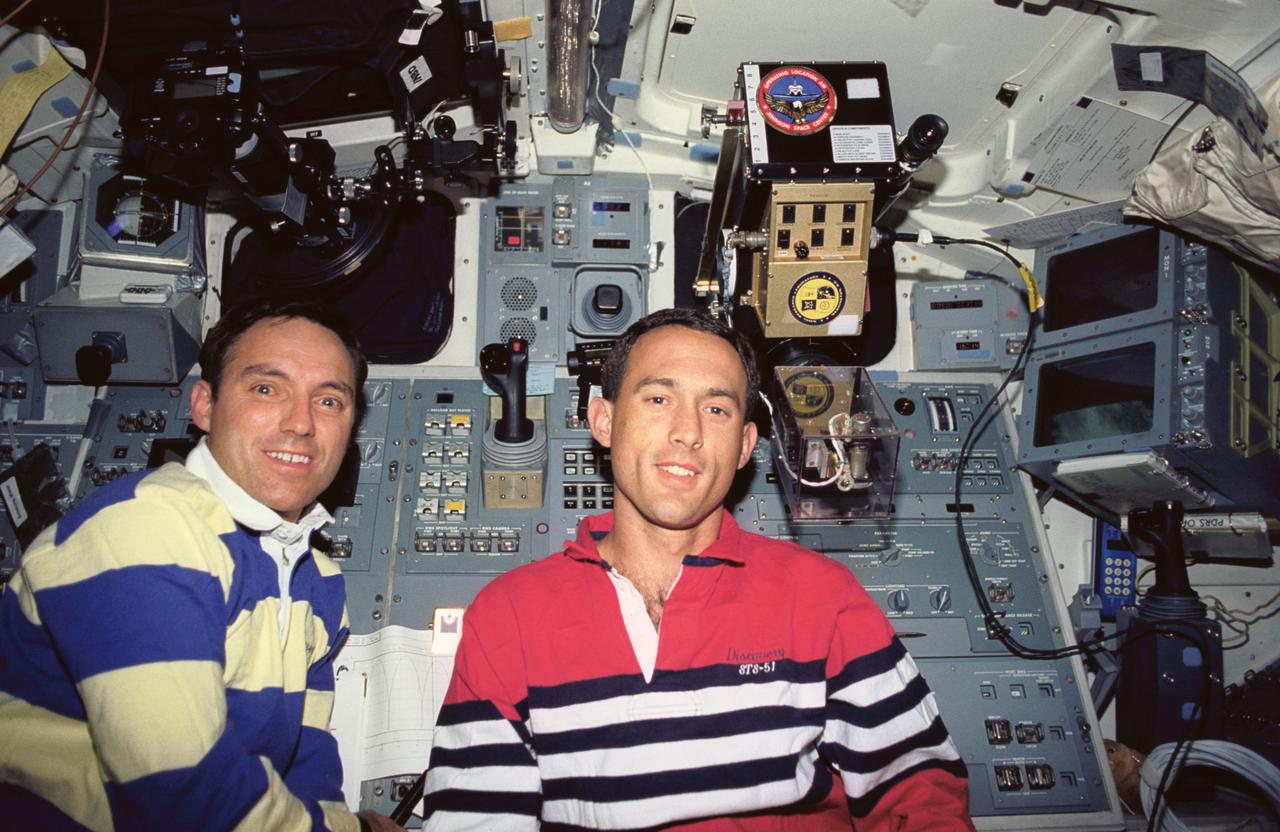
STS051-07-031 (12-22 Sept 1993) --- Astronauts Carl E. Walz, left, and James H. Newman are pictured on Discovery's aft flight deck near two experiments. Positioned in the window above Walz's head is the Auroral Photography Experiment (APE-B), while the High Resolution Shuttle Glow Spectroscopy (HRSGS-A) experiment is deployed in the other window.
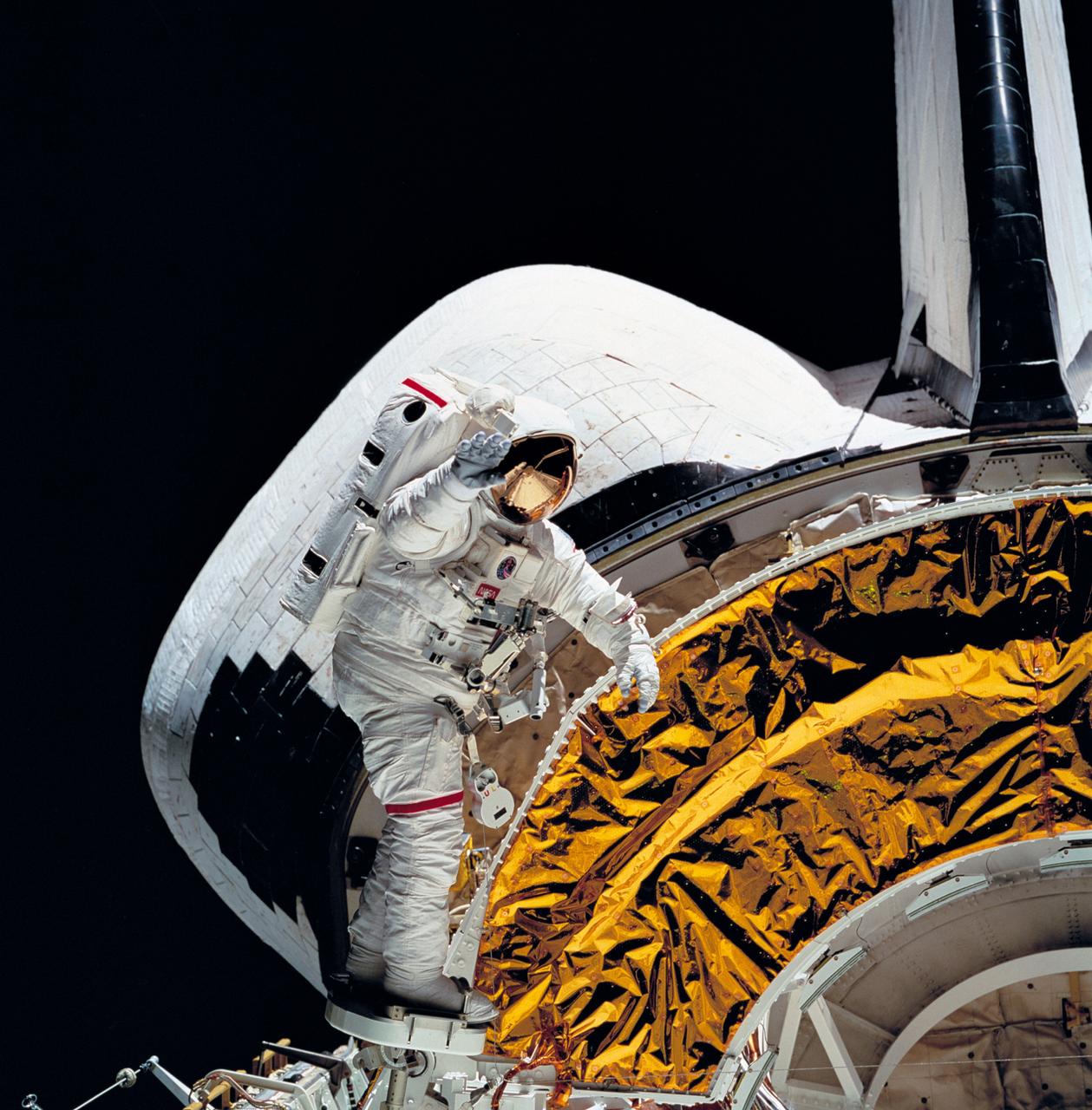
STS051-98-021 (16 Sept. 1993) --- In the Space Shuttle Discovery's aft cargo bay, astronaut Carl E. Walz gets his turn on the Portable Foot Restraint (PFR). Astronauts Walz, waving to his crew mates inside Discovery's cabin, and James H. Newman each put in some time evaluating the PFR, one of the pieces of gear to be used on the Hubble Space Telescope (HST) STS-61 servicing mission (scheduled later this year) and other Shuttle missions.
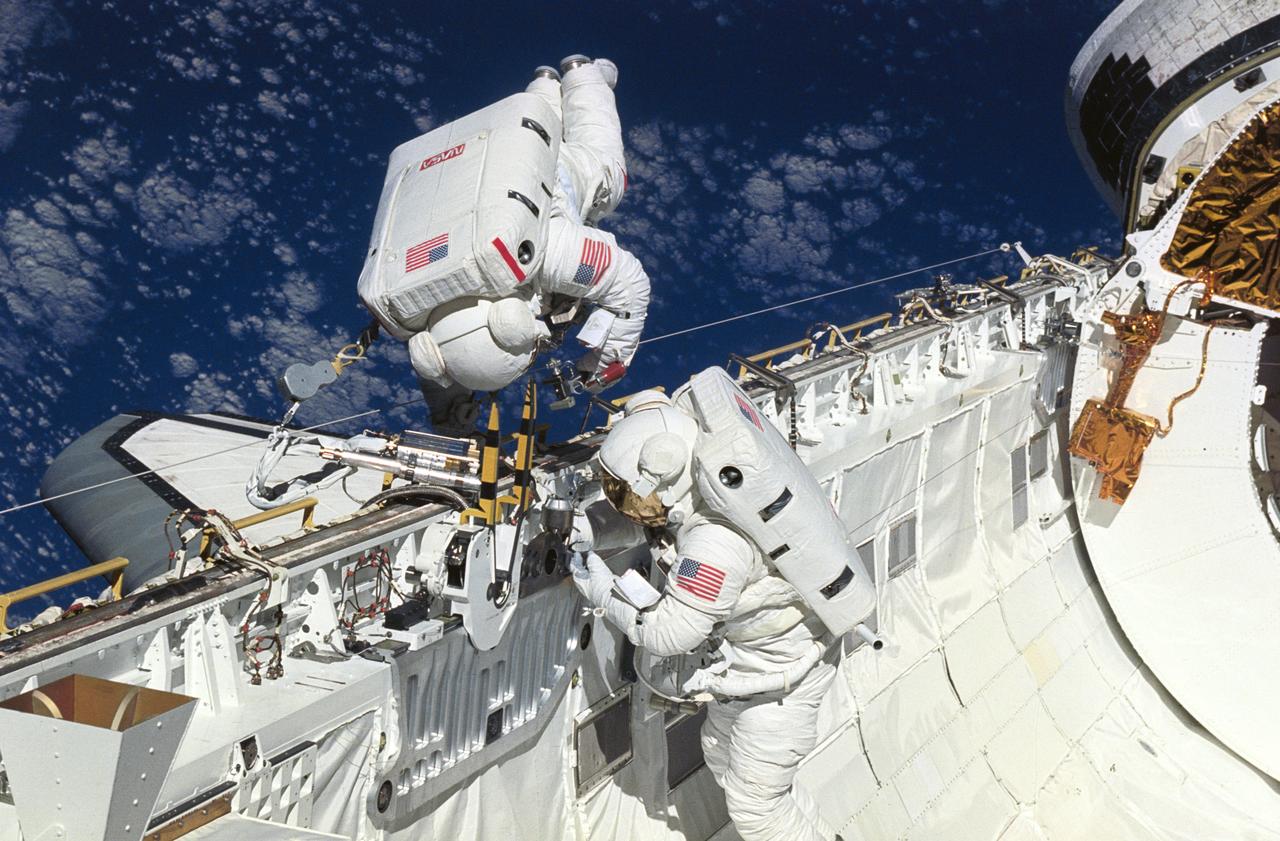
STS051-06-023 (16 Sept 1993) --- Astronauts James H. Newman (in bay) and Carl E. Walz, mission specialists, practice space walking techniques and evaluate tools to be used on the first Hubble Space Telescope (HST) servicing mission scheduled for later this year. Walz rehearses using the Power Ratchet Tool (PRT), one of several special pieces of gear to be put to duty during the scheduled five periods of extravehicular activity (EVA) on the STS-61 mission.
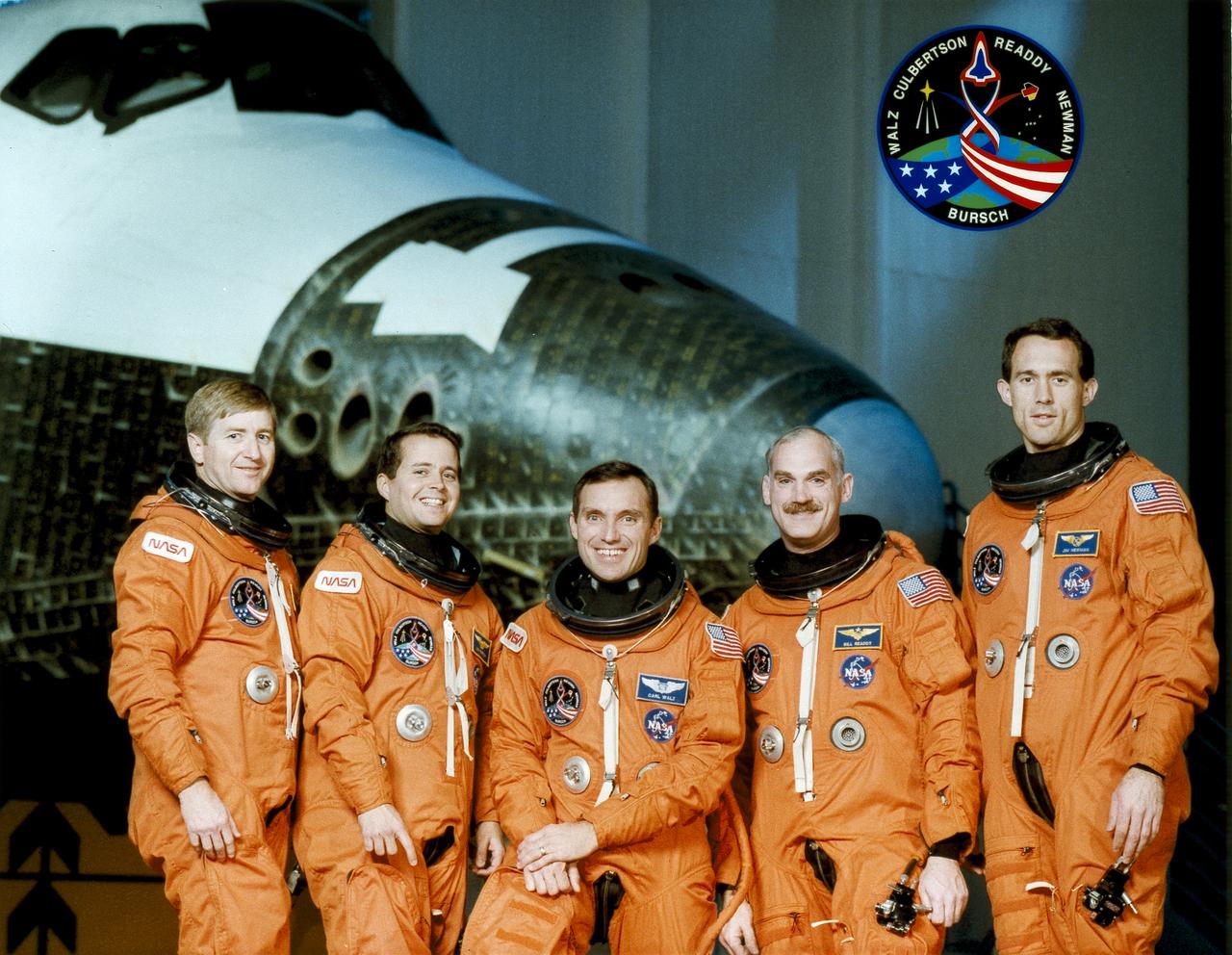
The STS-51 crew portrait features (left to right): Frank L. Culbertson, commander; Daniel W. Bursch, mission specialist; Carl E. Walz, mission specialist; William F. Readdy, pilot; and James H. Newman, mission specialist. The crew of five launched aboard the Space Shuttle Discovery on September 12, 1993 at 7:45:00 am (EDT). Two primary payloads included the Advanced Communications Technology Satellite (ACTS), and the Orbiting and Retrievable Far and Extreme Ultraviolet Spectrograph Shuttle Pallet Satellite (OERFEUS-SPAS).
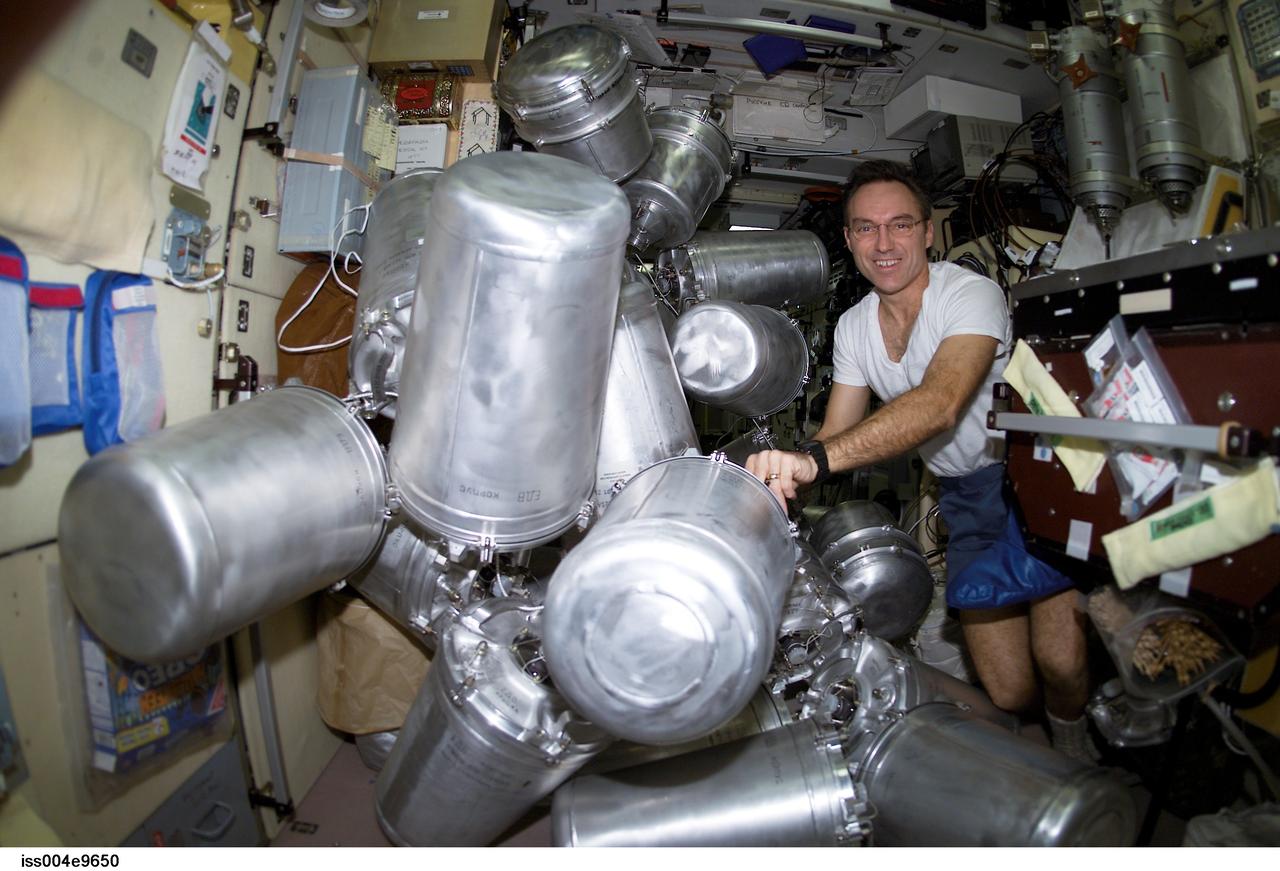
ISS004-E-9650 (11 March 2002) --- Astronaut Carl E. Walz, Expedition Four flight engineer, catalogs canisters of water in the Zvezda Service Module on the International Space Station (ISS).
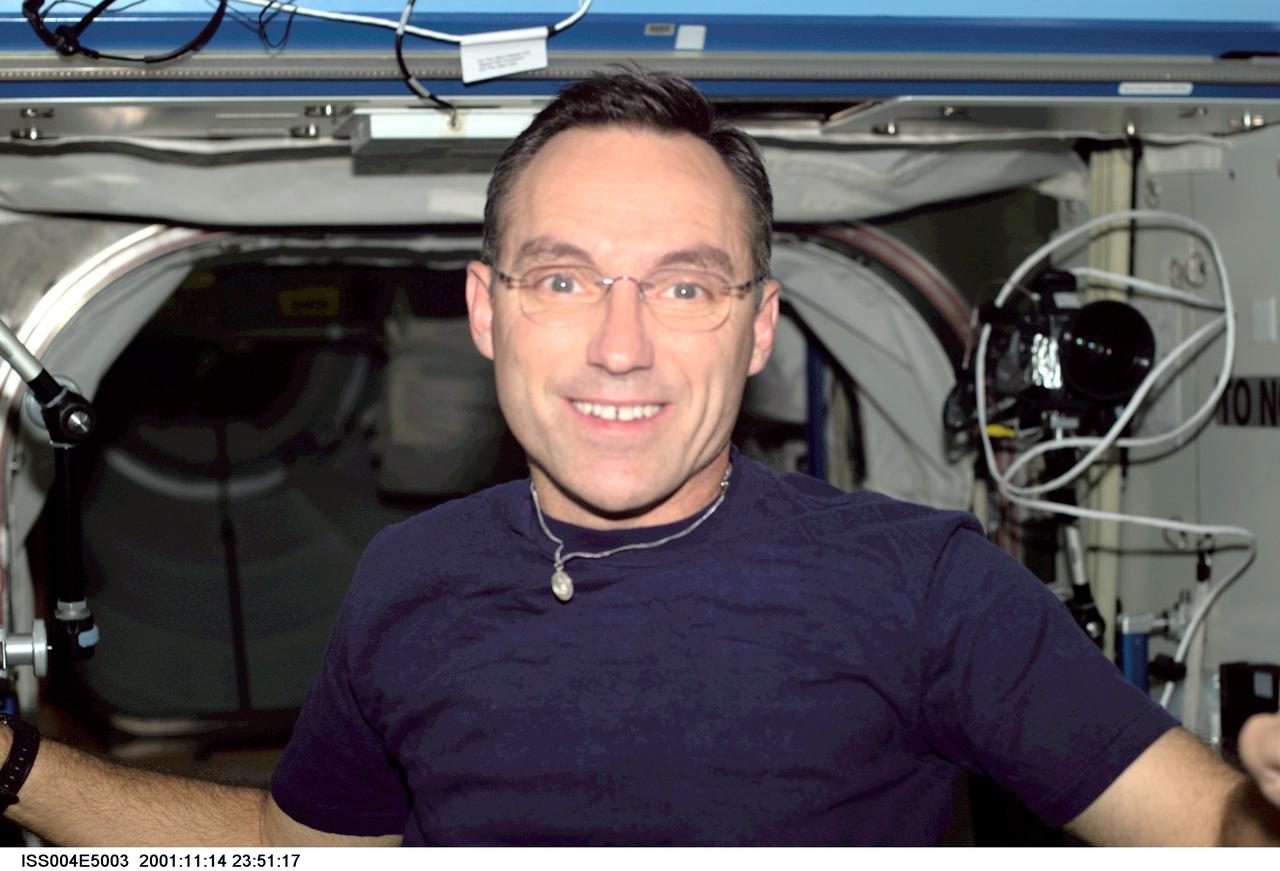
ISS004-E-5003 (December 2001) --- Astronaut Carl E. Walz, Expedition Four flight engineer, is photographed in the Destiny laboratory on the International Space Station (ISS). The image was taken with a digital still camera.
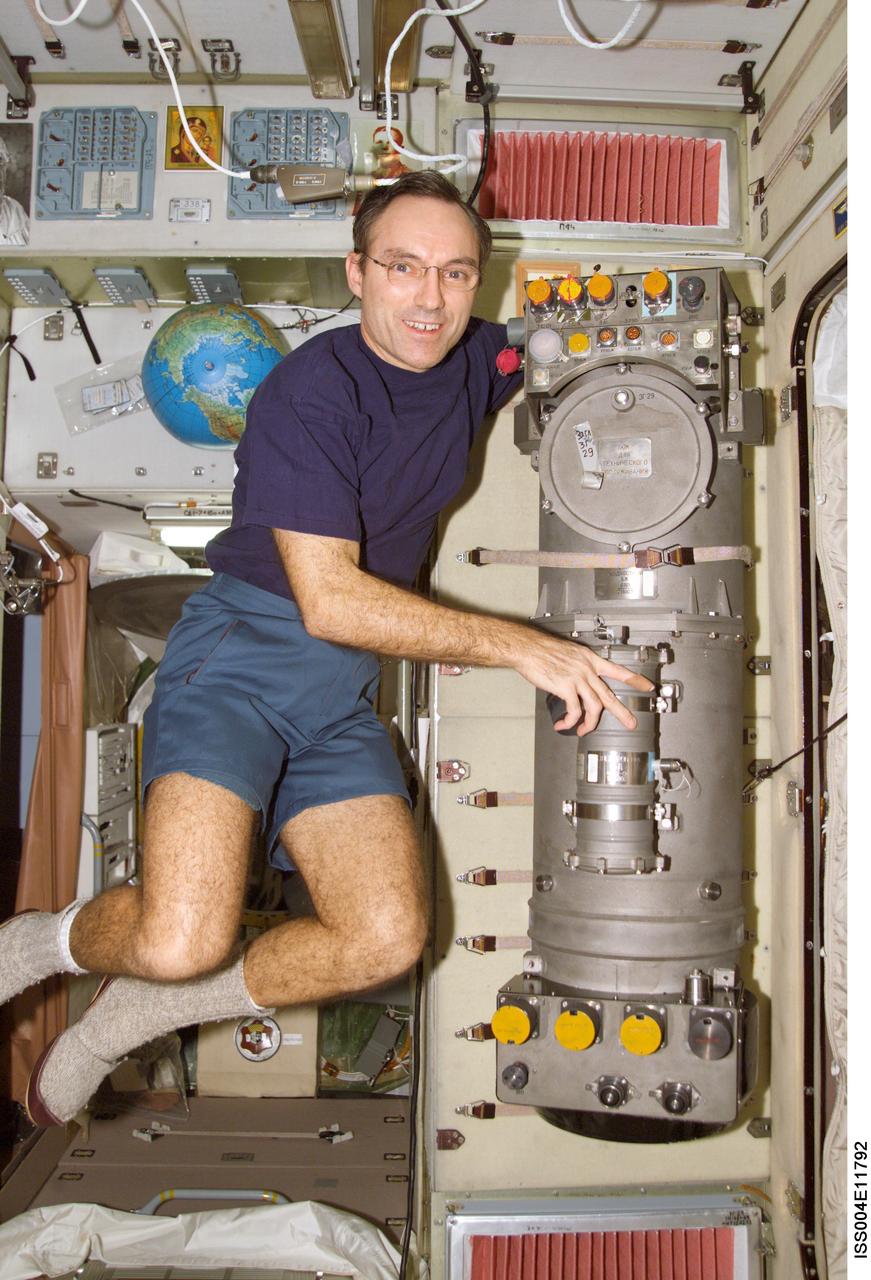
ISS004-E-11792 (26 April 2002) --- Astronaut Carl E. Walz, Expedition Four flight engineer, works on the Elektron Oxygen Generator in the Zvezda Service Module on the International Space Station (ISS).

ISS004-E-11786 (24 April 2002) --- Astronaut Carl E. Walz, Expedition Four flight engineer, holds a plant in the Zvezda Service Module on the International Space Station (ISS).
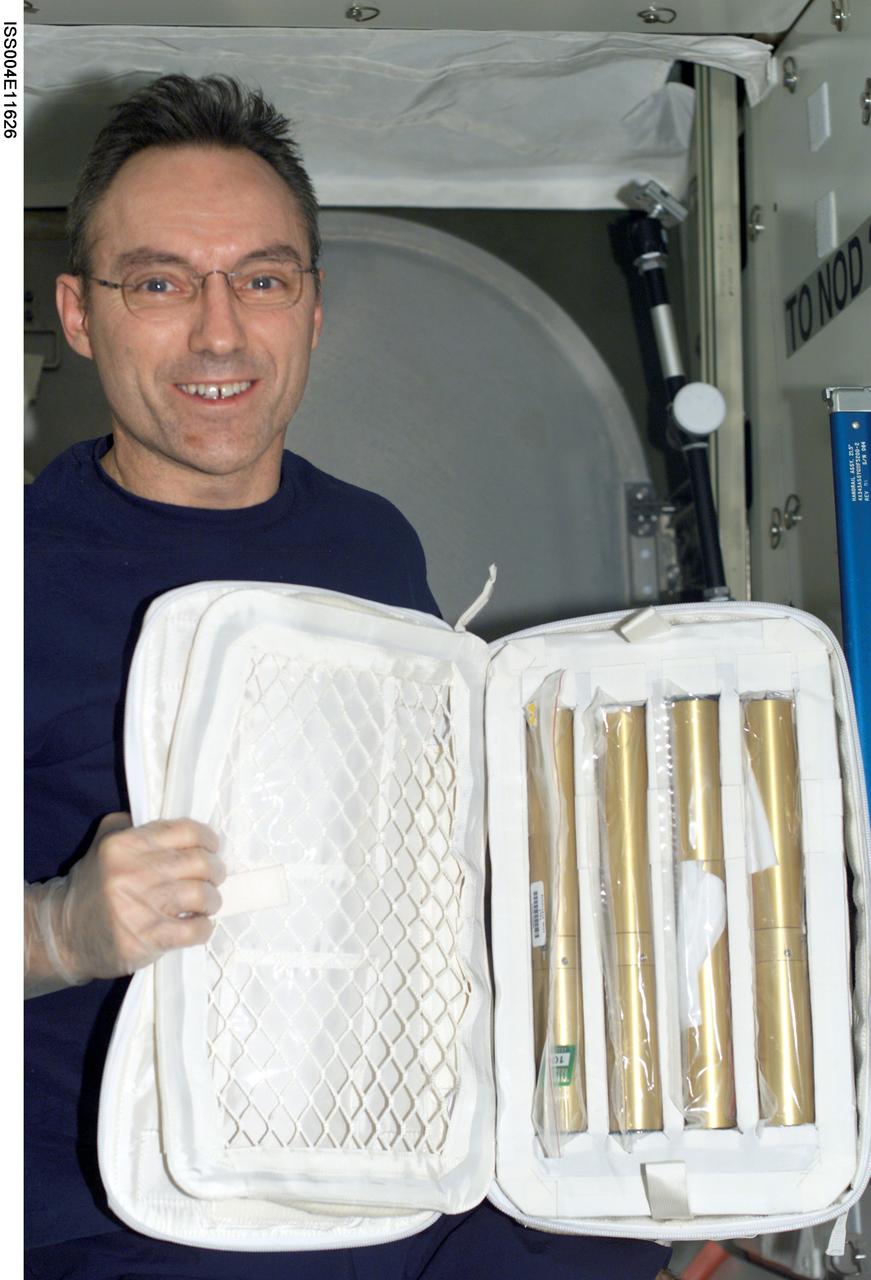
ISS004-E-11626 (10 May 2002) --- Astronaut Carl E. Walz, Expedition Four flight engineer, holds a stowage bag containing autoclave units in the Destiny laboratory on the International Space Station (ISS).
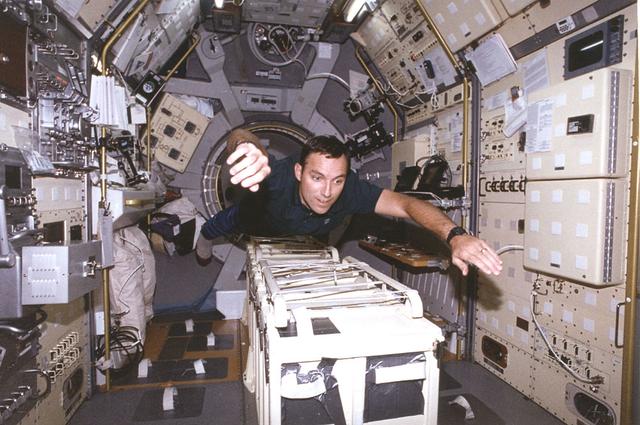
Astronaut Carl E. Walz, mission specialist, flies through the second International Microgravity Laboratory (IML-2) science module, STS-65 mission. IML was dedicated to study fundamental materials and life sciences in a microgravity environment inside Spacelab, a laboratory carried aloft by the Shuttle. The mission explored how life forms adapt to weightlessness and investigated how materials behave when processed in space. The IML program gave a team of scientists from around the world access to a unique environment, one that is free from most of Earth's gravity. Managed by the NASA Marshall Space Flight Center, the 14-nation European Space Agency (ESA), the Canadian Space Agency (SCA), the French National Center for Space Studies (CNES), the German Space Agency and the German Aerospace Research Establishment (DARA/DLR), and the National Space Development Agency of Japan (NASDA) participated in developing hardware and experiments for the IML missions. The missions were managed by NASA's Marshall Space Flight Center. The Orbiter Columbia was launched on July 8, 1994 for the IML-2 mission.
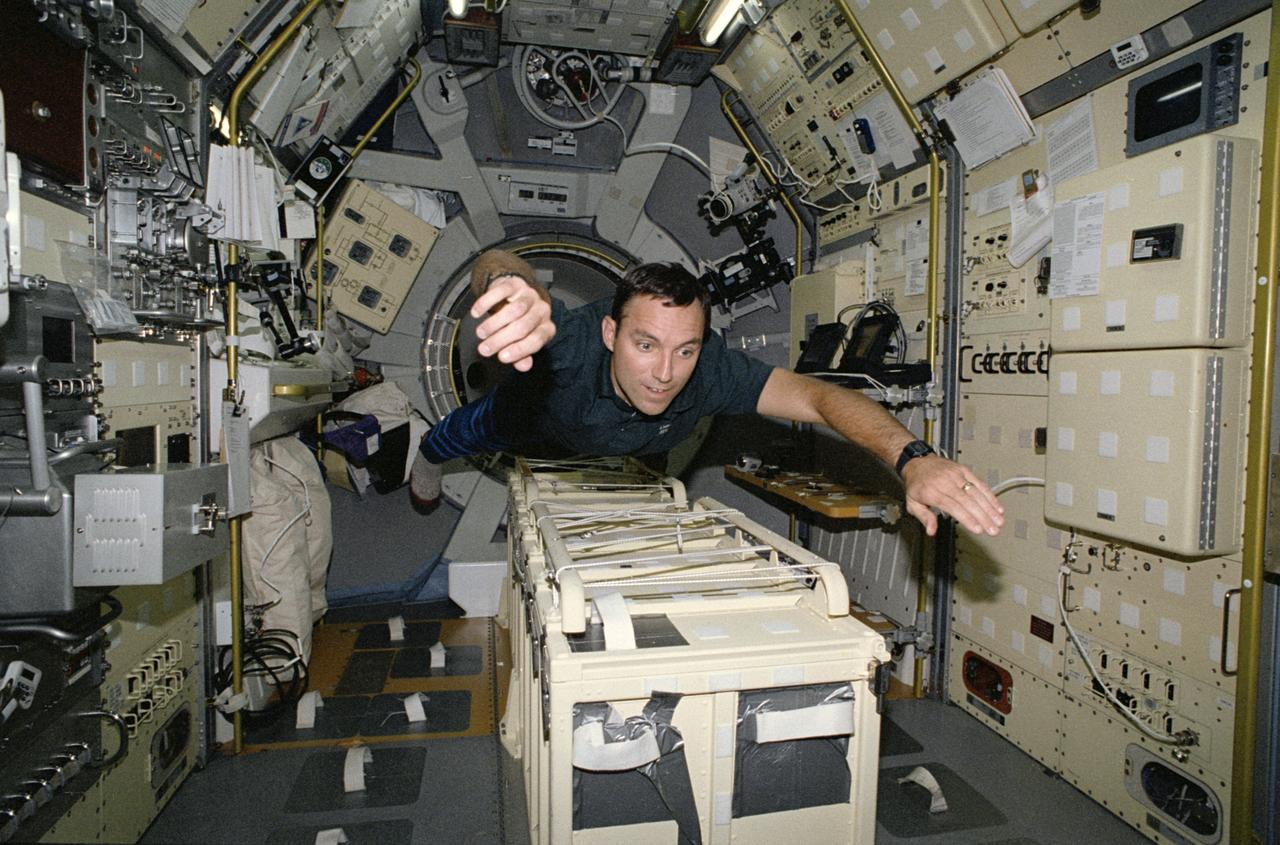
STS-65 Mission Specialist Carl E. Walz floats above center aisle equipment in the International Microgravity Laboratory 2 (IML-2) spacelab science module. Walz has just entered the IML-2 module via the spacelab tunnel (note hatch opening behind him). The tunnel connects the IML-2 module with Columbia's, Orbiter Vehicle (OV) 102's, crew compartment. Walz along with five other NASA astronauts and a Japanese payload specialist spent more than two weeks in Earth orbit conducting IML-2 experiments. This photo was among the first released by NASA following IML-2.
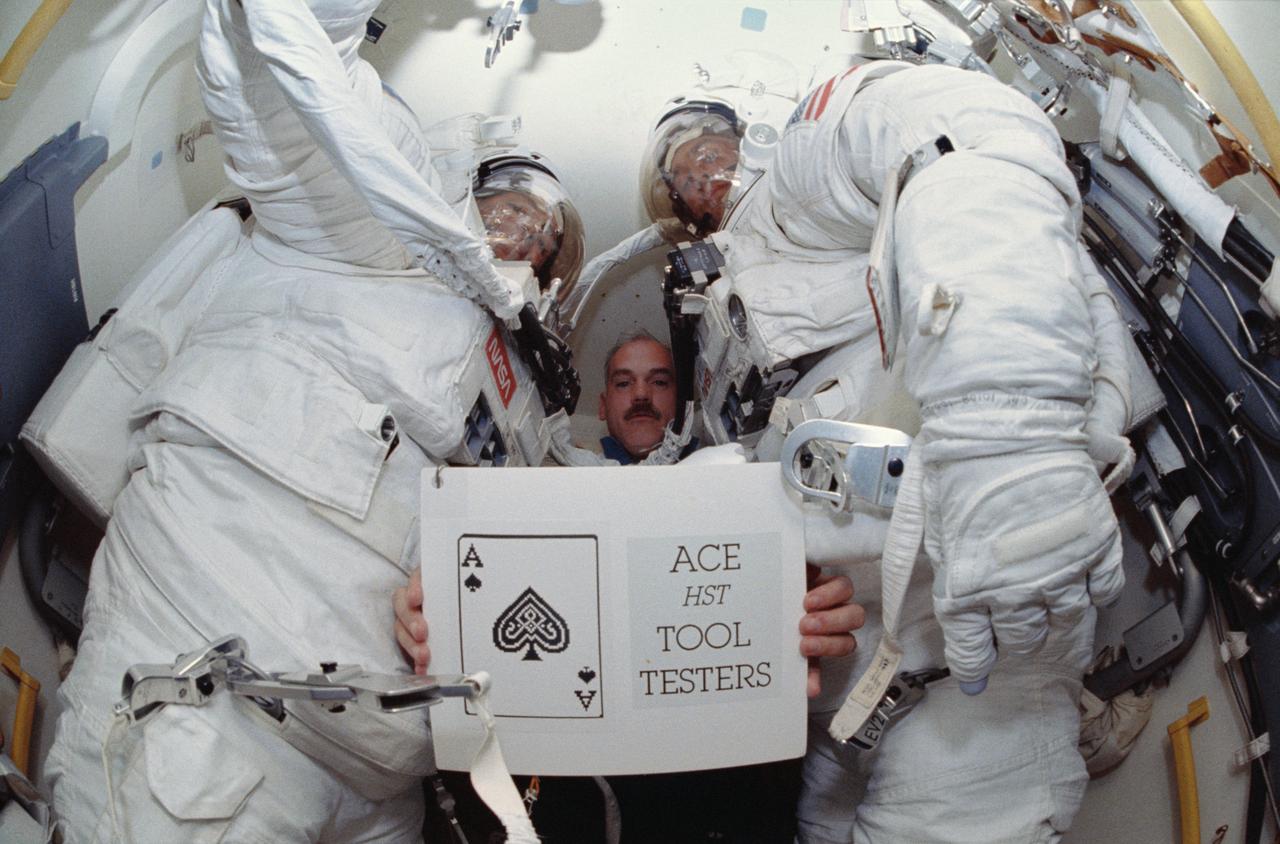
STS051-66-009 (16 Sept 1993) --- In Discovery's airlock, astronaut William F. Readdy, pilot, holds up a STS-51 slogan -- "Ace HST Tool Testers" -- for still and video cameras to record. Readdy is flanked by astronauts Carl E. Walz (left) and James H. Newman, who had just shared a lengthy period of extravehicular activity (EVA) in and around Discovery's cargo bay. Not pictured are astronauts Frank L. Culbertson Jr., mission commander, and Daniel W. Bursch, mission specialist.
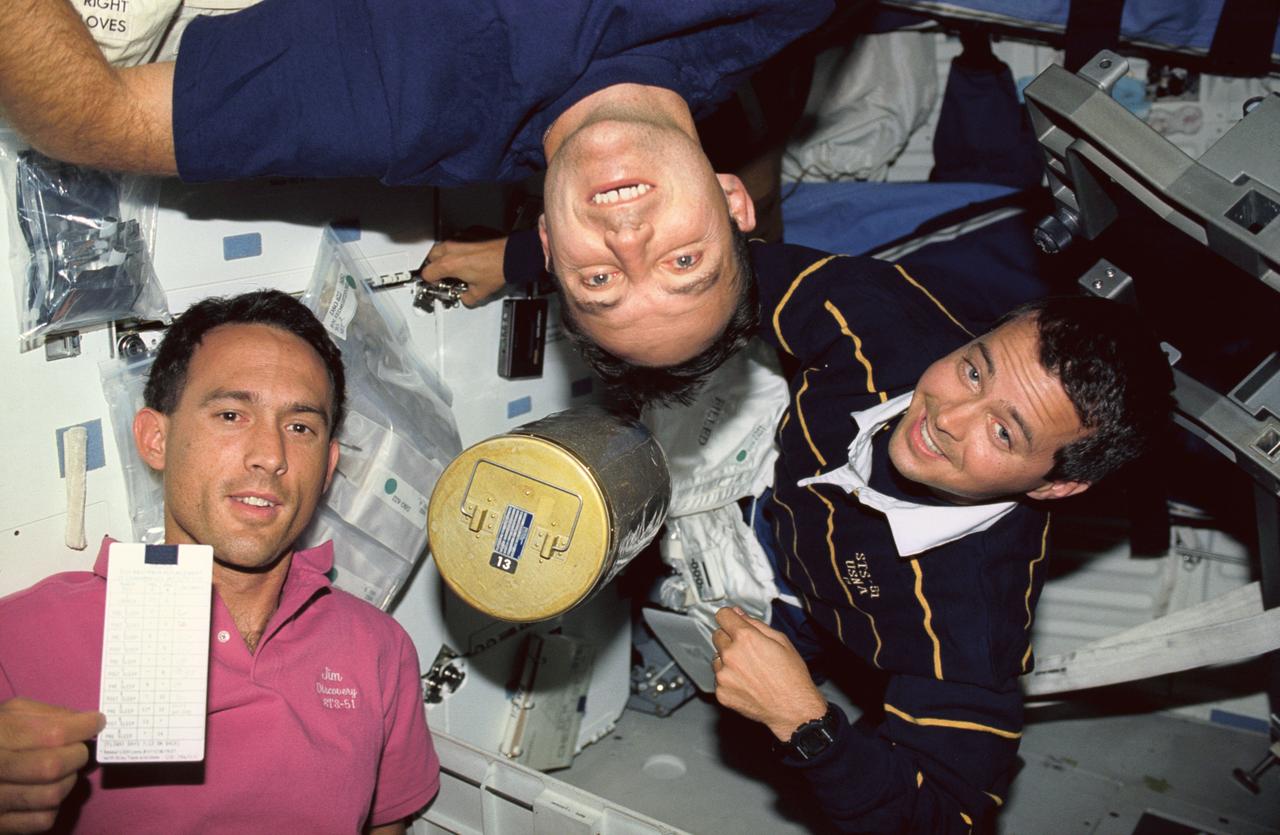
STS051-08-037 (12-22 Sept 1993) --- Three members of the astronaut class of 1990 change out a lithium hydroxide canister beneath Discovery's middeck. Left to right are astronauts James H. Newman, Carl E. Walz and Daniel W. Bursch, all mission specialists.
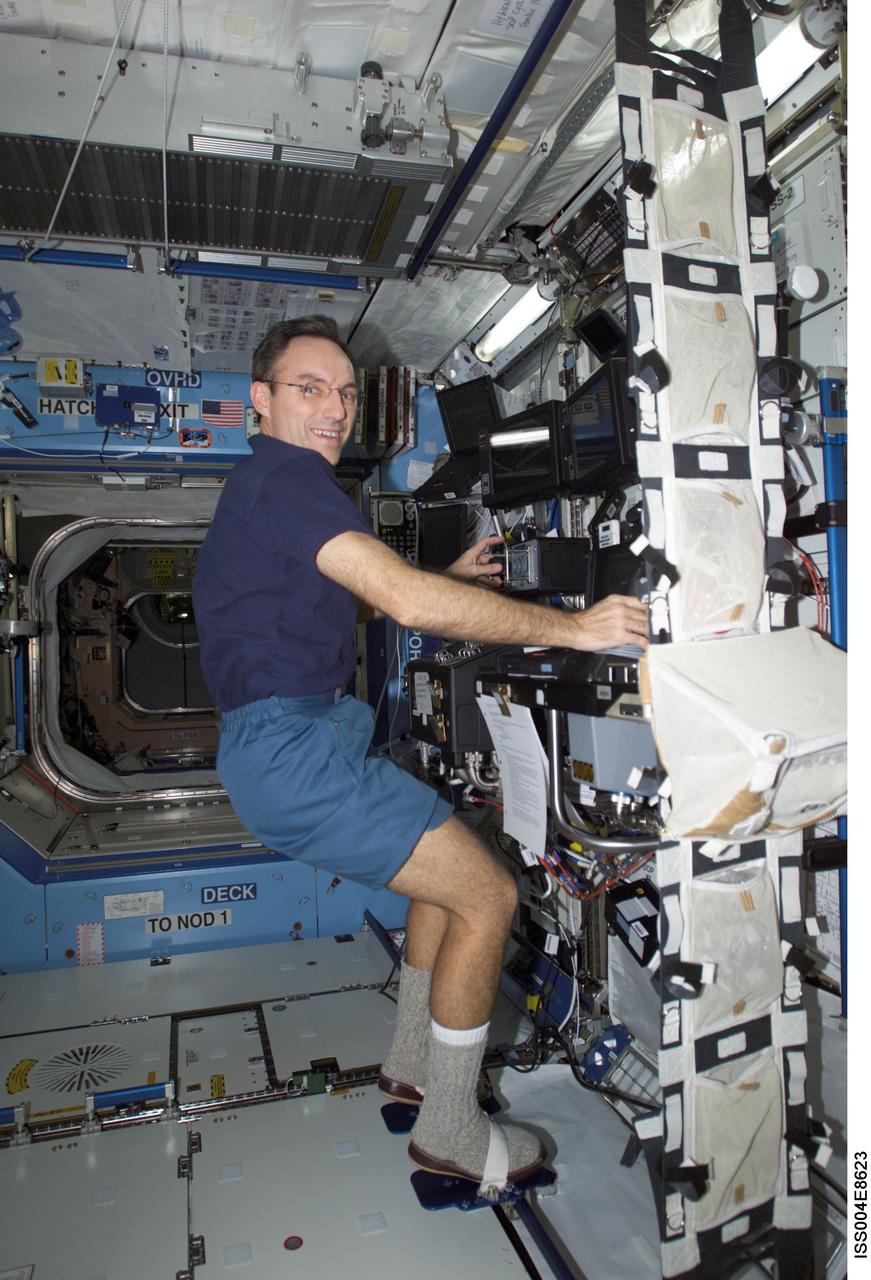
ISS004-E-8623 (14 March 2002) --- Astronaut Carl E. Walz, Expedition Four flight engineer, works the controls of the Canadarm2, or Space Station Remote Manipulator System (SSRMS) in the Destiny laboratory on the International Space Station (ISS). This image was taken with a digital still camera.
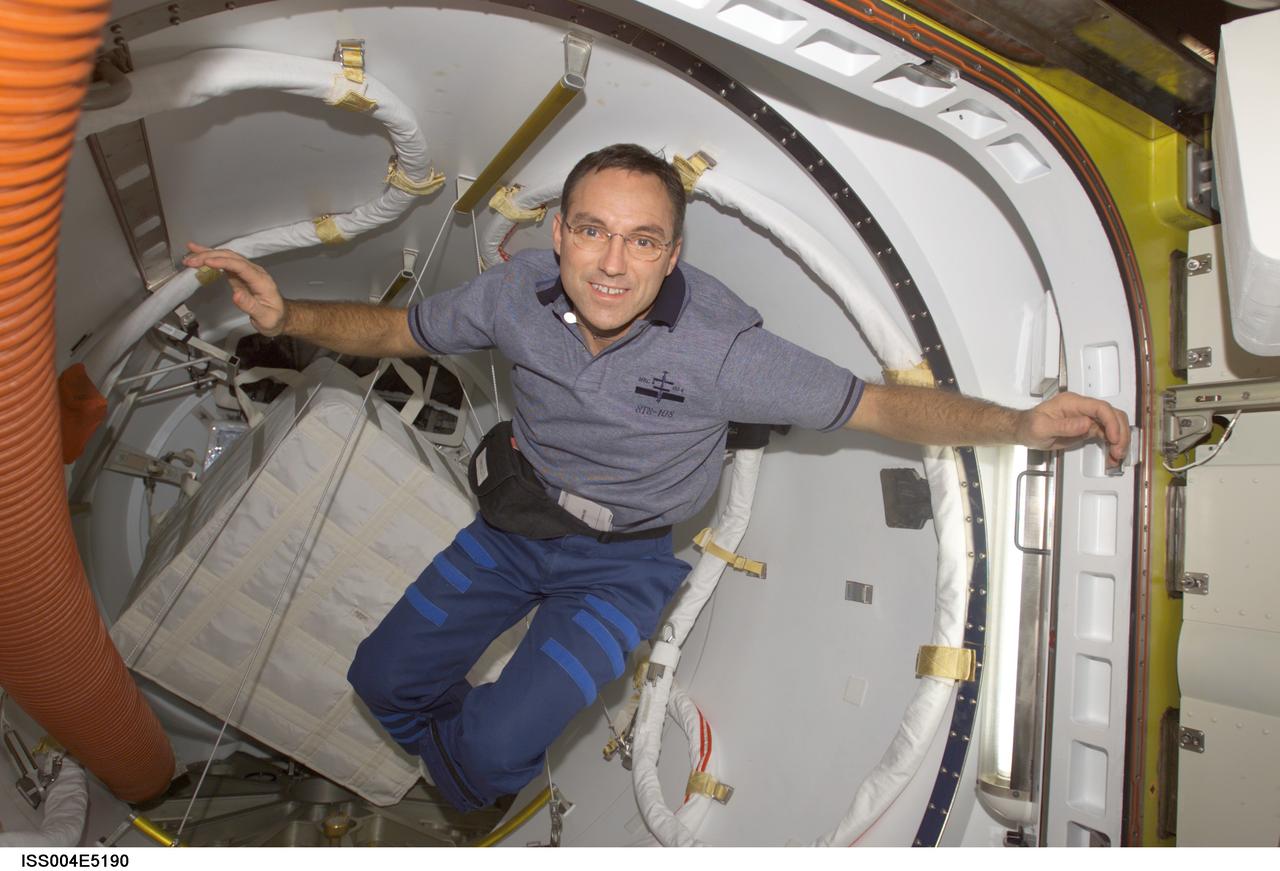
ISS004-E-5190 (December 2001) --- Astronaut Carl E. Walz, Expedition Four flight engineer, floats in the Quest Airlock on the International Space Station (ISS). The image was taken with a digital still camera during early phase of the three-person crew’s scheduled stay on the orbital outpost.
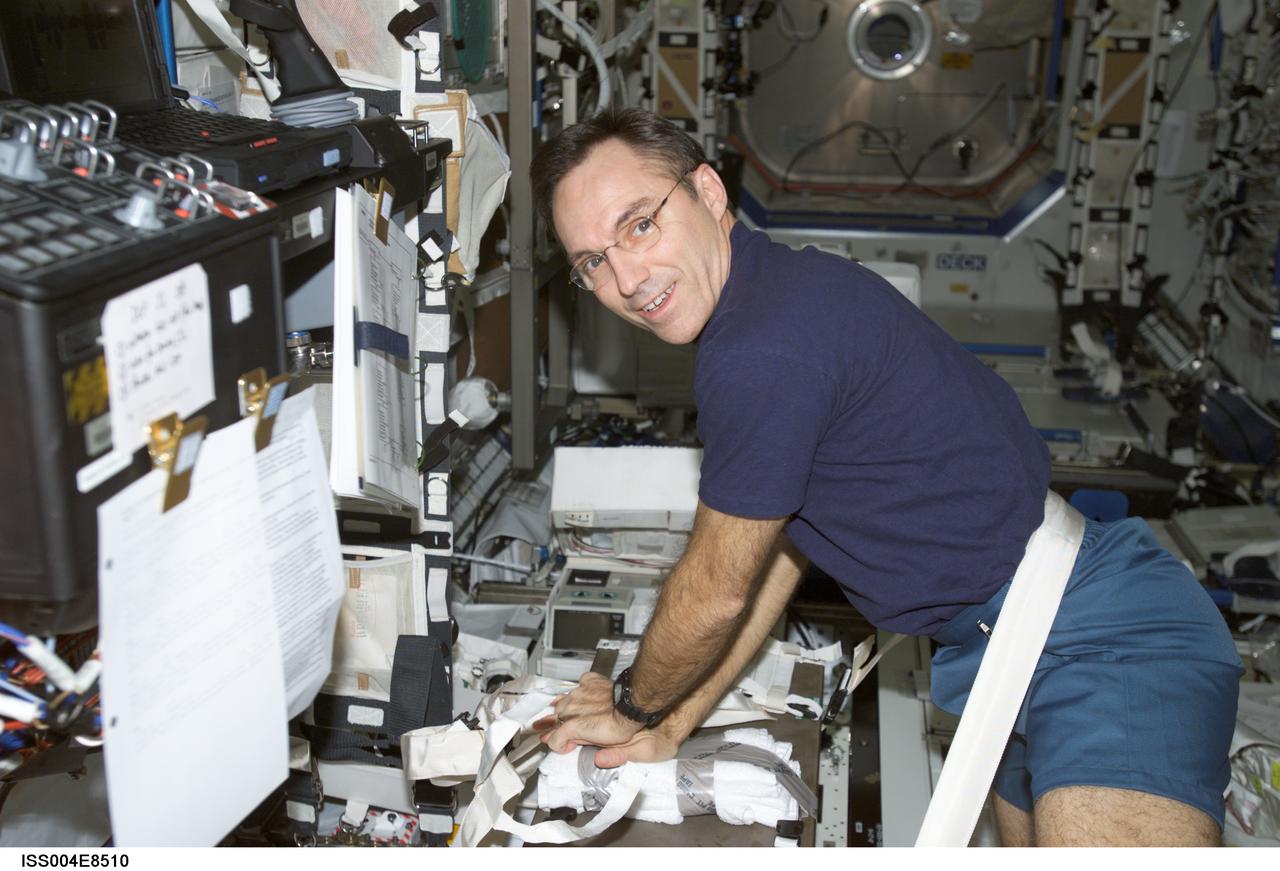
ISS004-E-8510 (11 March 2002) --- Astronaut Carl E. Walz, Expedition Four flight engineer, performs cardio-pulmonary resuscitation (CPR) on a jerry-rigged “human chest” dummy in the Destiny laboratory on the International Space Station (ISS). The image was taken with a digital still camera.

ISS003-E-8391 (8 December 2001) --- Astronaut Carl E. Walz, Expedition Four flight engineer, wearing a Russian Sokol suit, is photographed in the functional cargo block (FGB), or Zarya on the International Space Station (ISS). The image was taken with a digital still camera.
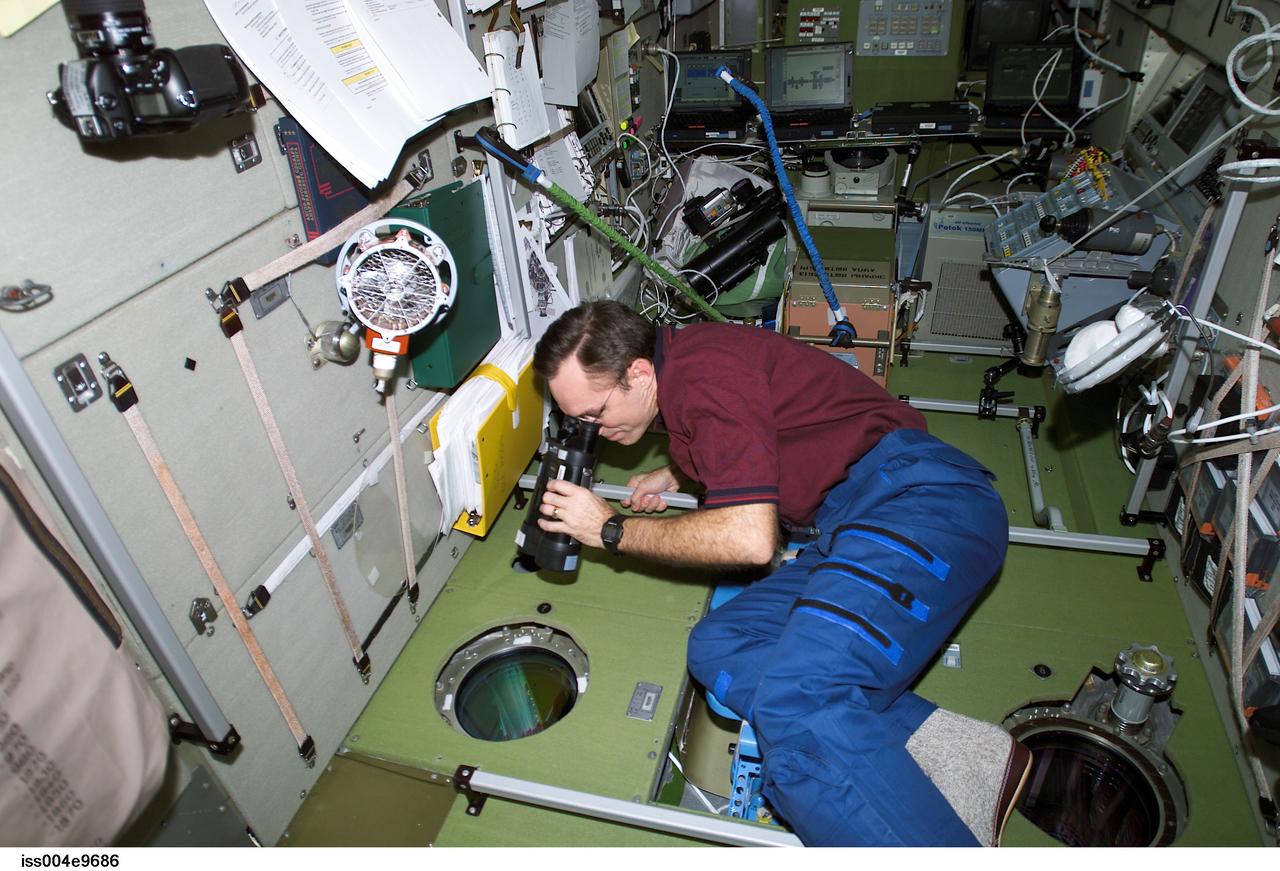
ISS004-E-9686 (24 March 2002) --- Astronaut Carl E. Walz, Expedition Four flight engineer, uses binoculars to look out a window in the Zvezda Service Module on the International Space Station (ISS). The crew anticipated the approach of a Progress supply vehicle about the time this image was taken.
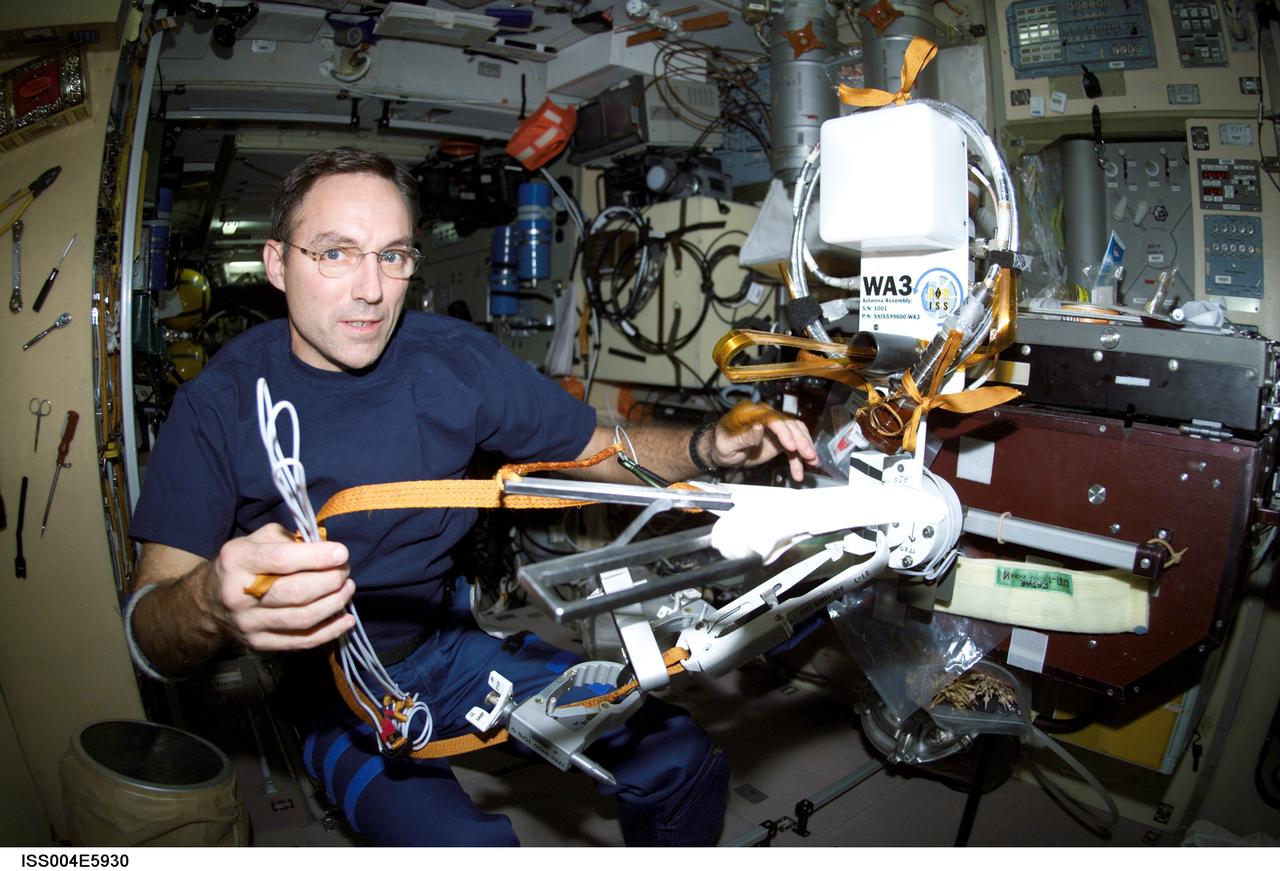
ISS004-E-5930 (January 2002) --- Astronaut Carl E. Walz, Expedition Four flight engineer, works with the Amateur Radio (HAM) WA3 Antenna Assembly in the Zvezda Service Module on the International Space Station (ISS). The image was taken with a digital still camera.
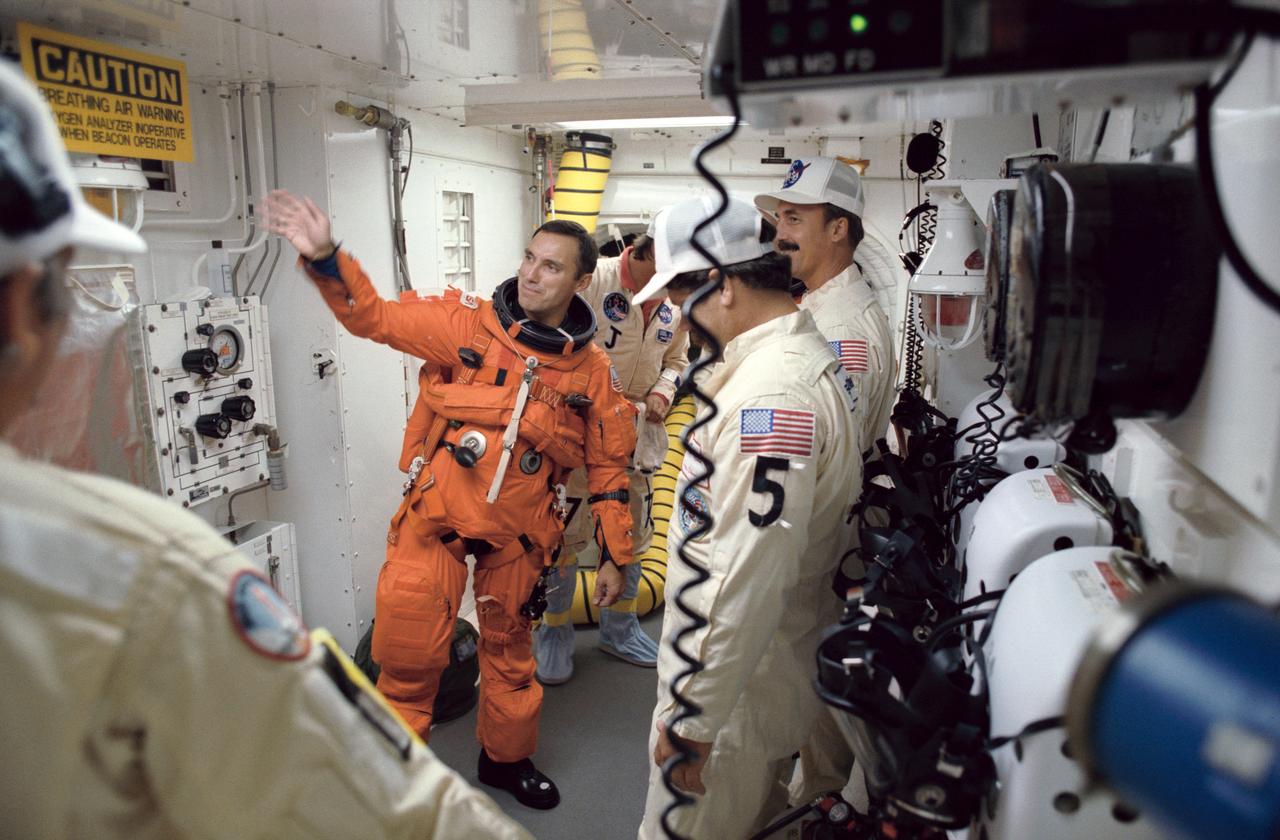
STS051-S-112 (12 Sept 1993) --- Inside the White Room, astronaut Carl E. Walz talks to suit technicians prior to ingressing the Space Shuttle Discovery. Walz, mission specialist, was joined by astronauts Frank L. Culbertson Jr., mission commander; William F. Readdy, pilot; and James H. Newman and Daniel W. Bursch, mission specialists for the almost ten-day flight. Launch occurred at 7:45 a.m. (EDT), September 12, 1993.
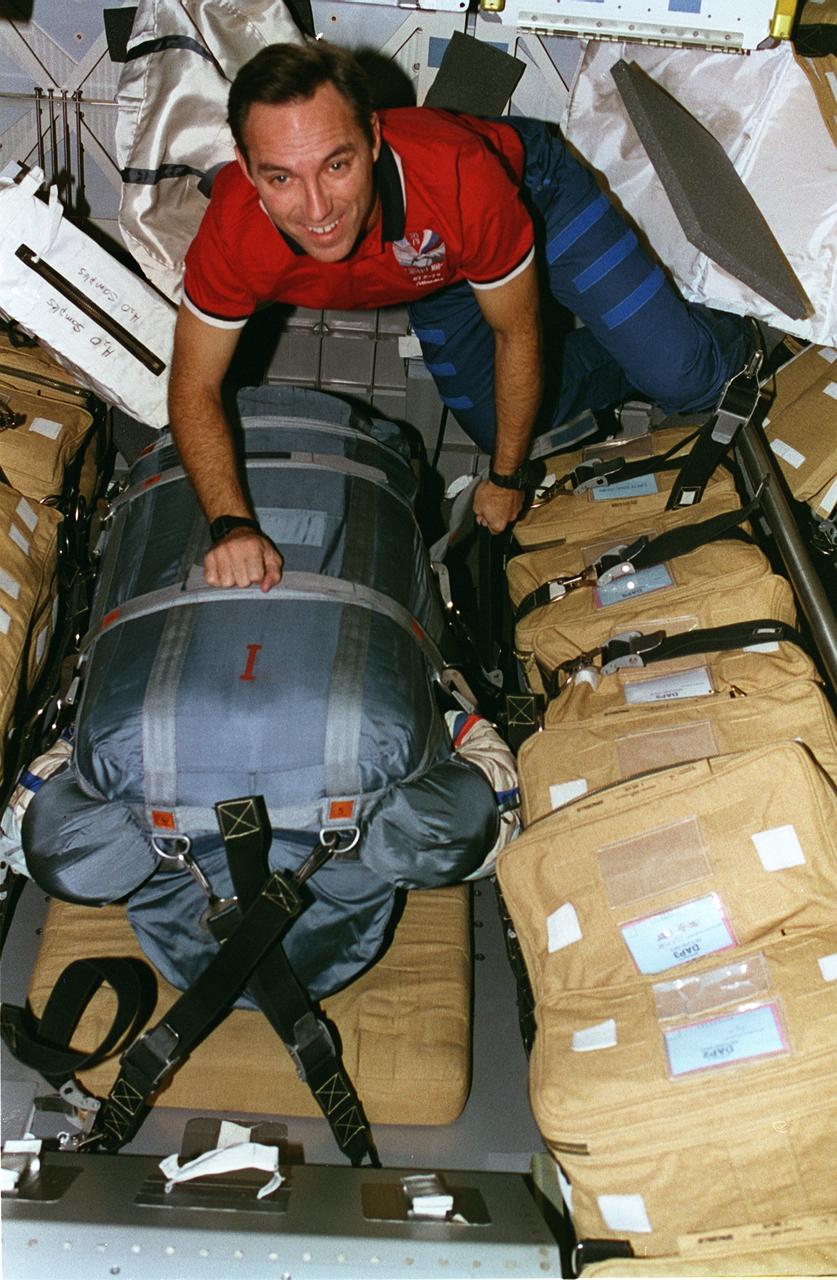
STS079-304-001 (16 Sept. 1996)--- Astronaut Carl E. Walz totes a bag carrying a space suit used by the cosmonauts. At the completion of the STS-79 mission, the suit was brought back to Earth for analysis. This photograph is one of fifteen 35mm frames (along with four 70mm frames) of still photography documenting the activities of NASA's STS-79 mission, which began with a September 16, 1996, liftoff from Launch Pad 39A the Kennedy Space Center (KSC) and ended with a landing at KSC on September 26, 1996. Onboard for the launch were astronauts William F. Readdy, commander; Terrence W. Wilcutt, pilot; John E. Blaha, Jerome (Jay) Apt, Thomas D. Akers and Walz, all mission specialists. On flight day 4, the crew docked with Russia's Mir Space Station. Shannon W. Lucid, who had spent six months aboard Mir, switched cosmonaut guest researcher roles with Blaha. The latter joined fellow Mir-22 crew members Valeri G. Korzun, commander, and Aleksandr Y. Kaleri, flight engineer.
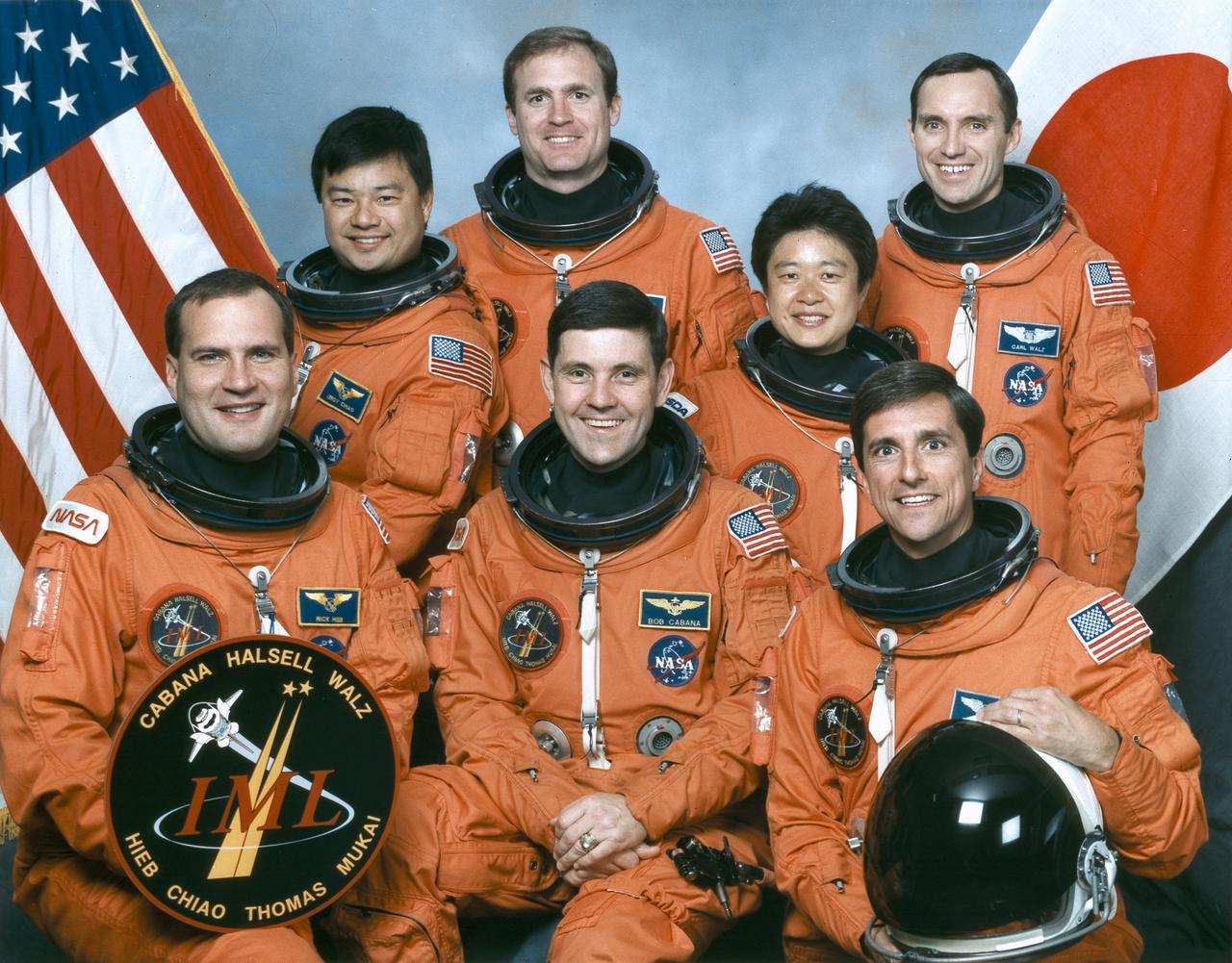
The crew assigned to the STS-65 mission included (seated left to right) Richard J. (Rick) Hieb, payload commander; Robert D. (Bob) Cabana, commander; and Donald A. Thomas, mission specialist. Standing, from left to right, are Leroy Chiao, mission specialist; James D. Halsell, pilot; Chiaki Naito-Mukai, payload specialist; and Carl E. Walz, mission specialist. Launched aboard the Space Shuttle Columbia on July 8, 1994 at 12:43:00 pm (EDT), the STS-64 mission marked the second flight of the International Microgravity Laboratory (IML-2) and the first flight of a female Japanese crew member.
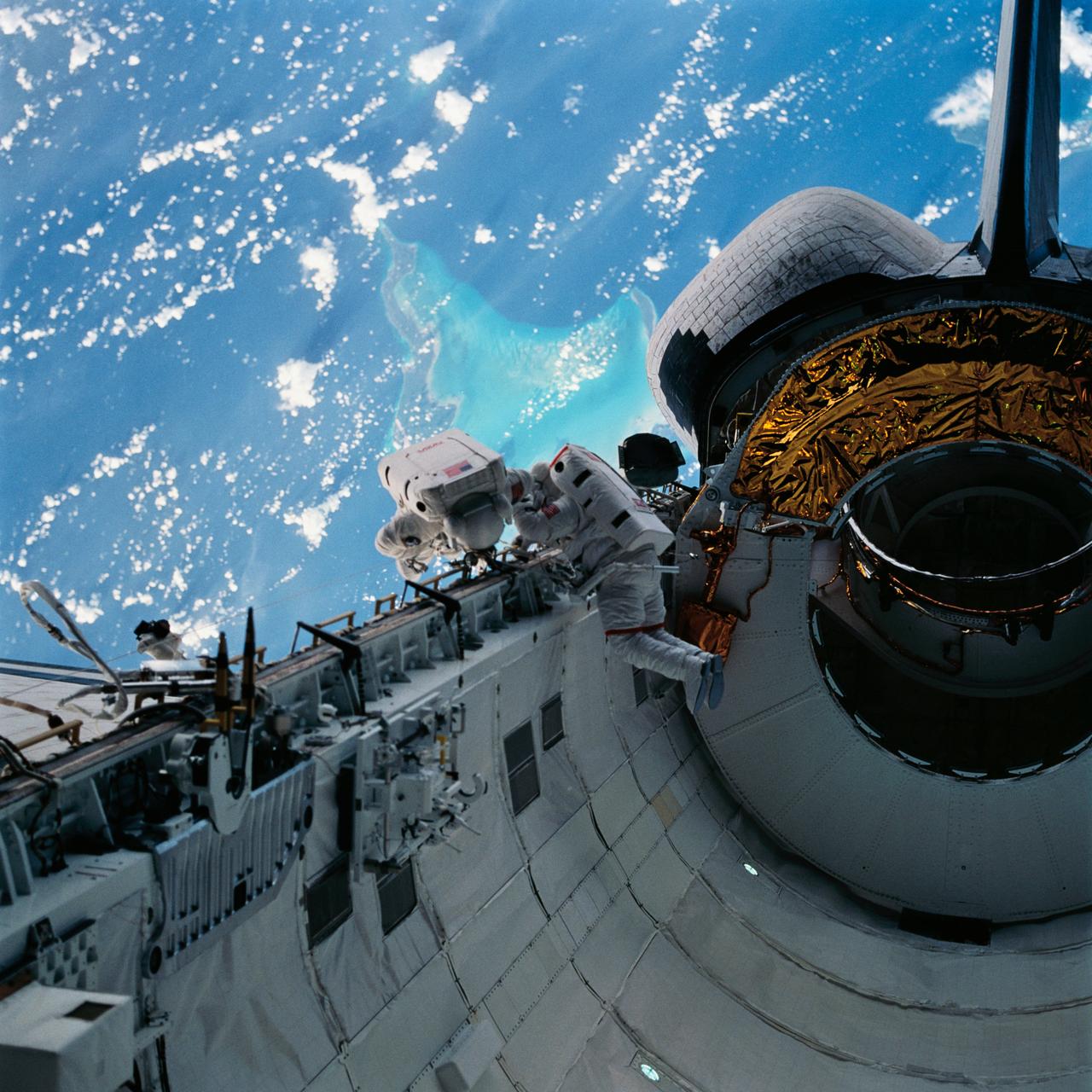
With the Caribbean Sea and part of the Bahama Islands chain as a backdrop, two STS-51 crewmembers evaluate procedures and gear to be used on the upcoming Hubble Space Telescope (HST)-servicing mission. Sharing the lengthy extravehicular activity in and around Discovery's cargo bay were astronauts James H. Newman (left), and Carl E. Walz, mission specialists.
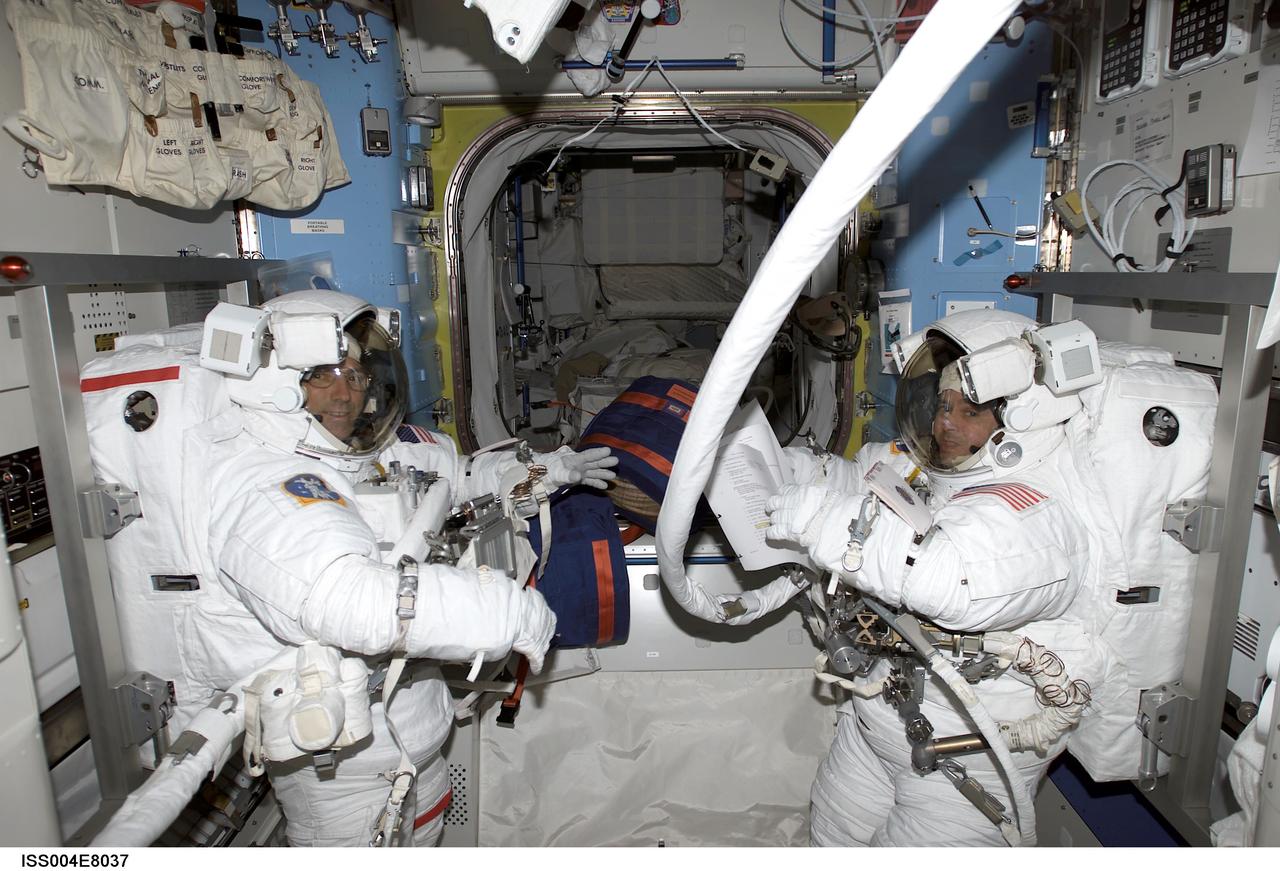
ISS004-E-8037 (20 February 2002) --- Astronauts Carl E. Walz (left) and Daniel W. Bursch, Expedition Four flight engineers, undergo a pressure check in Quest's Equipment Lock, prior to the beginning of what turned out to be a five-hour, 47-minute session of extravehicular activity (EVA). The image was recorded with a digital still camera.
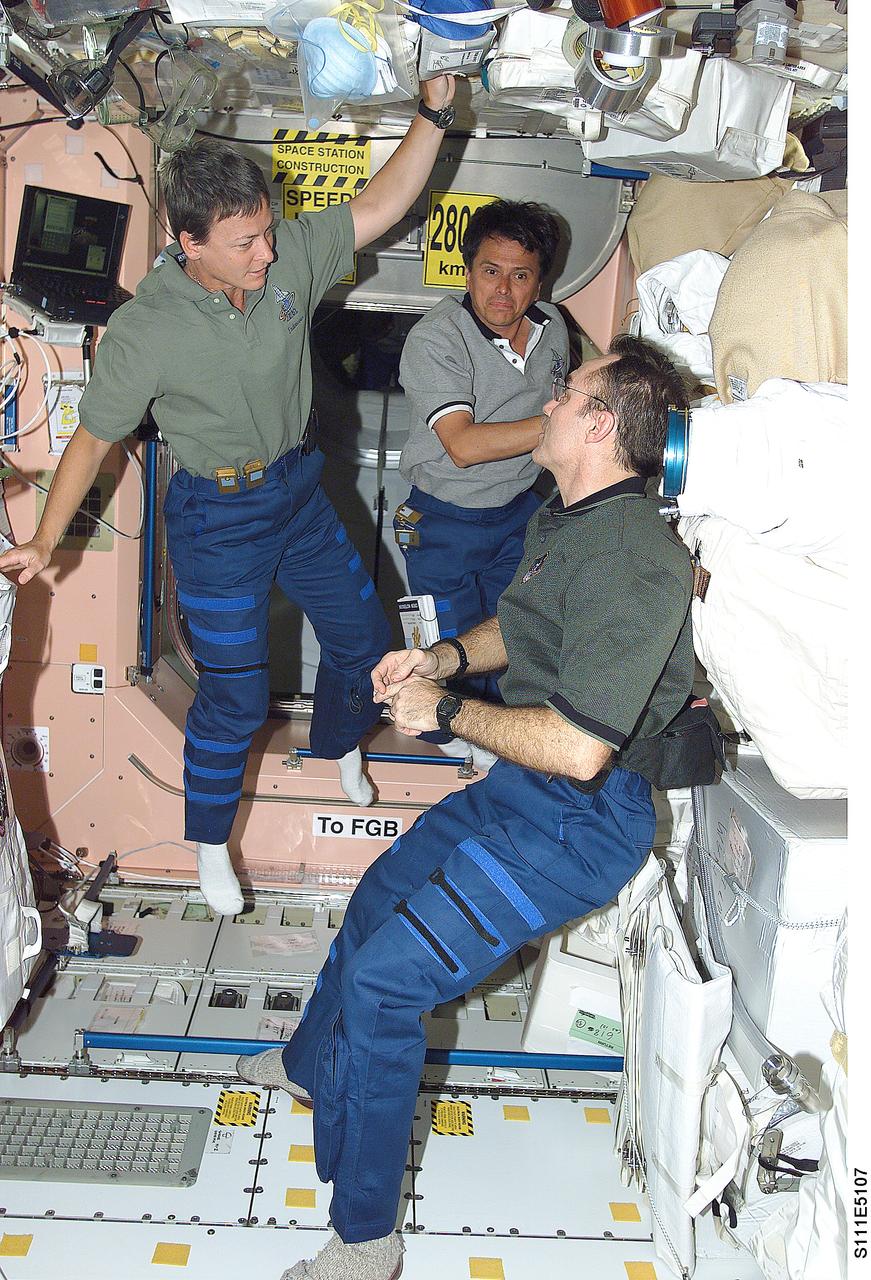
STS111-E-5107 (7 June 2002) --- Astronauts Peggy A. Whitson (left), Expedition Five flight engineer, Franklin R. Chang-Diaz, STS-111 mission specialist, and Carl E. Walz, Expedition Four flight engineer, are photographed in the Unity node on the International Space Station (ISS).
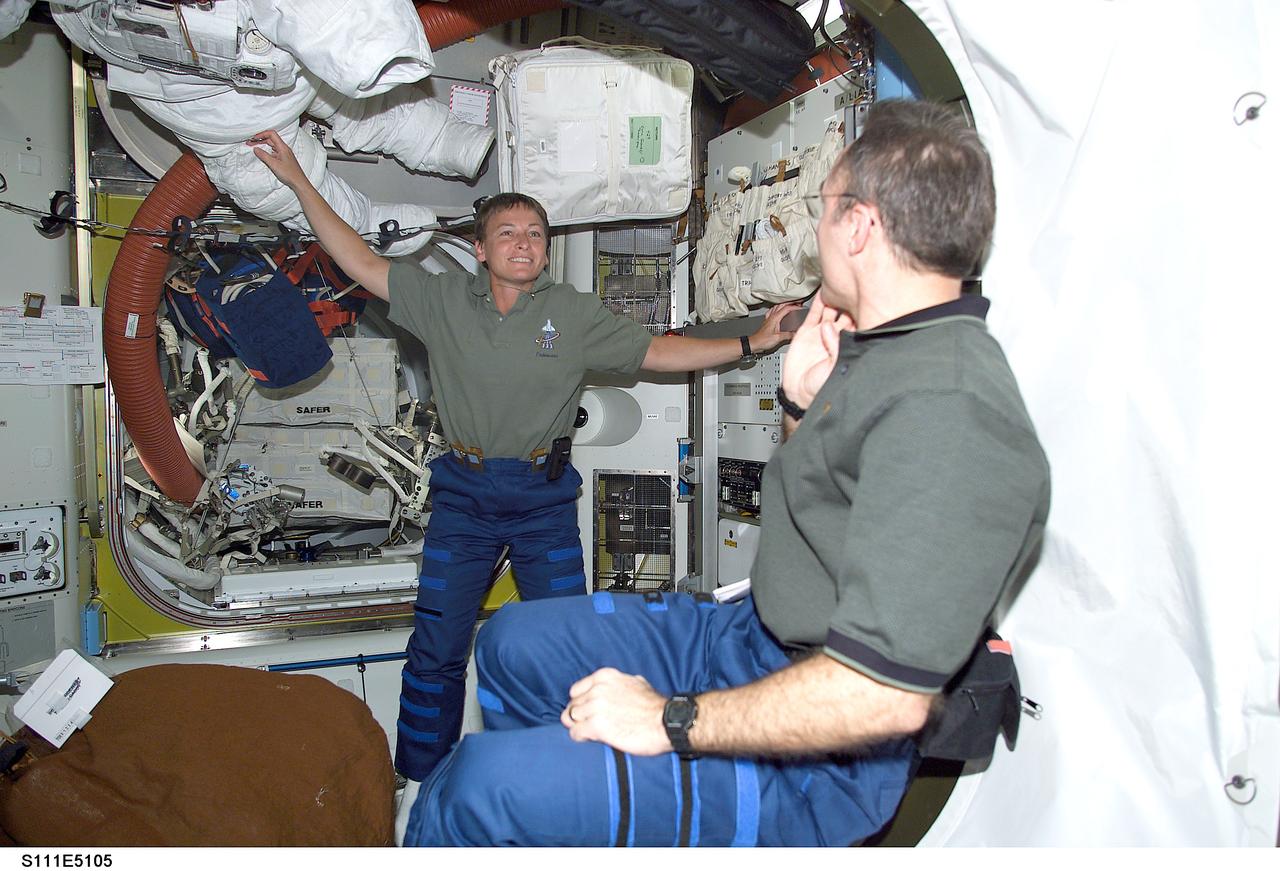
STS111-E-5105 (7 June 2002) --- Astronauts Peggy A. Whitson (background), Expedition Five flight engineer, and Carl E. Walz, Expedition Four flight engineer, are photographed on the International Space Station (ISS). The two are in the process of changing roles.
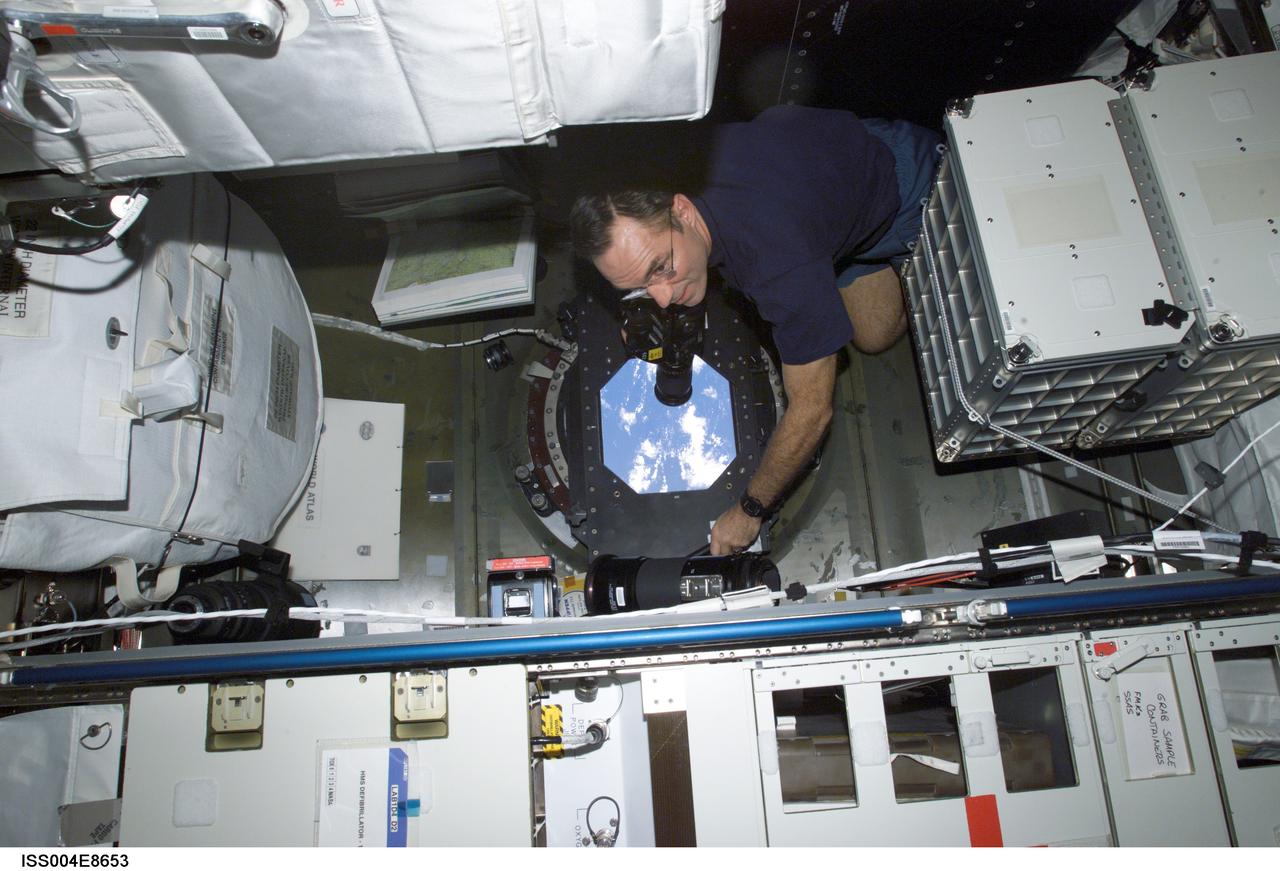
ISS004-E-8653 (14 March 2002) --- Astronaut Carl E. Walz, Expedition Four flight engineer, takes Earth observation photos from the Destiny laboratory on the International Space Station (ISS). The image was taken with a digital still camera.
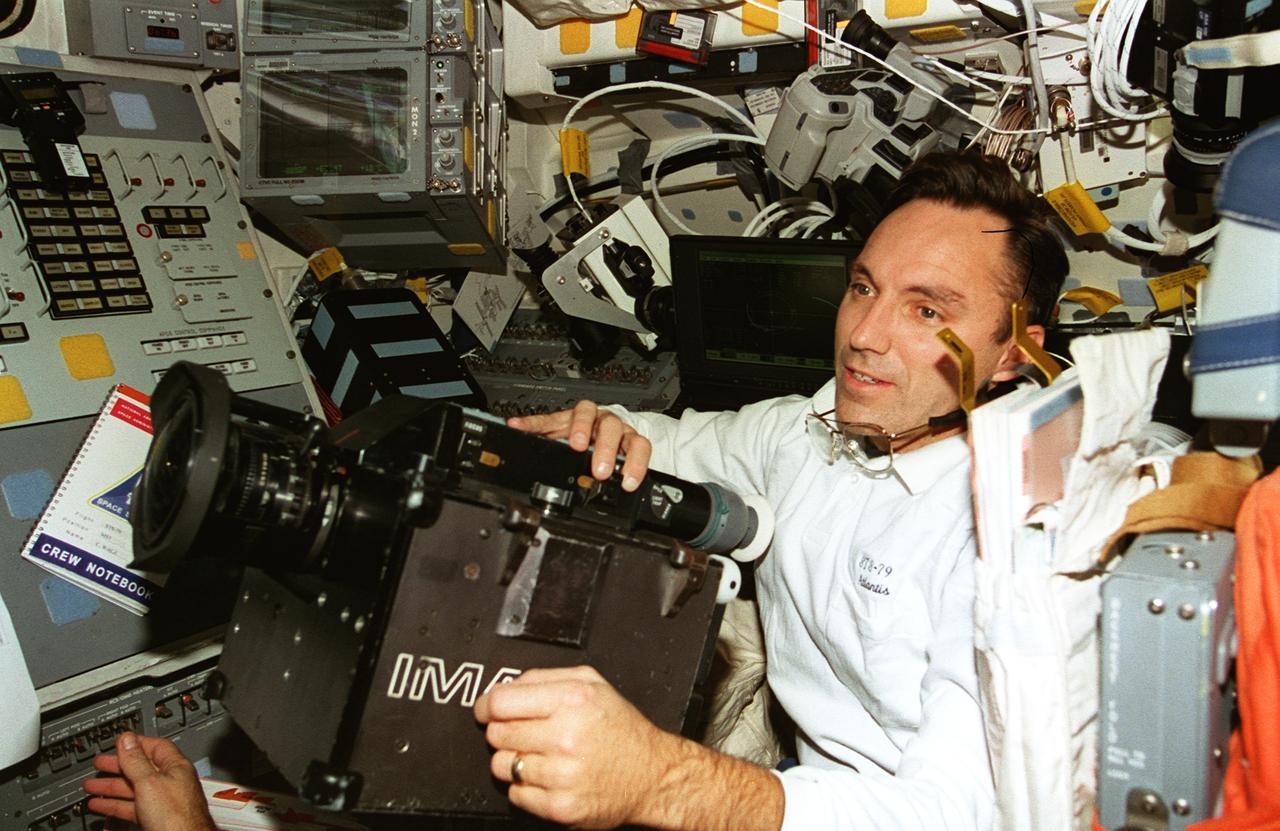
STS079-362-023 (16-26 Sept. 1996) --- Astronaut Carl E. Walz, mission specialist, positions the IMAX camera for a shoot on the flight deck of the Space Shuttle Atlantis. The IMAX project is a collaboration among NASA, the Smithsonian Institution's National Air and Space Museum, IMAX Systems Corporation and the Lockheed Corporation to document in motion picture format significant space activities and promote NASA's educational goals using the IMAX film medium. This system, developed by IMAX of Toronto, uses specially designed 65mm cameras and projectors to record and display very high definition color motion pictures which, accompanied by six-channel high fidelity sound, are displayed on screens in IMAX and OMNIMAX theaters that are up to ten times larger than a conventional screen, producing a feeling of "being there." The 65mm photography is transferred to 70mm motion picture films for showing in IMAX theaters. IMAX cameras have been flown on 14 previous missions.
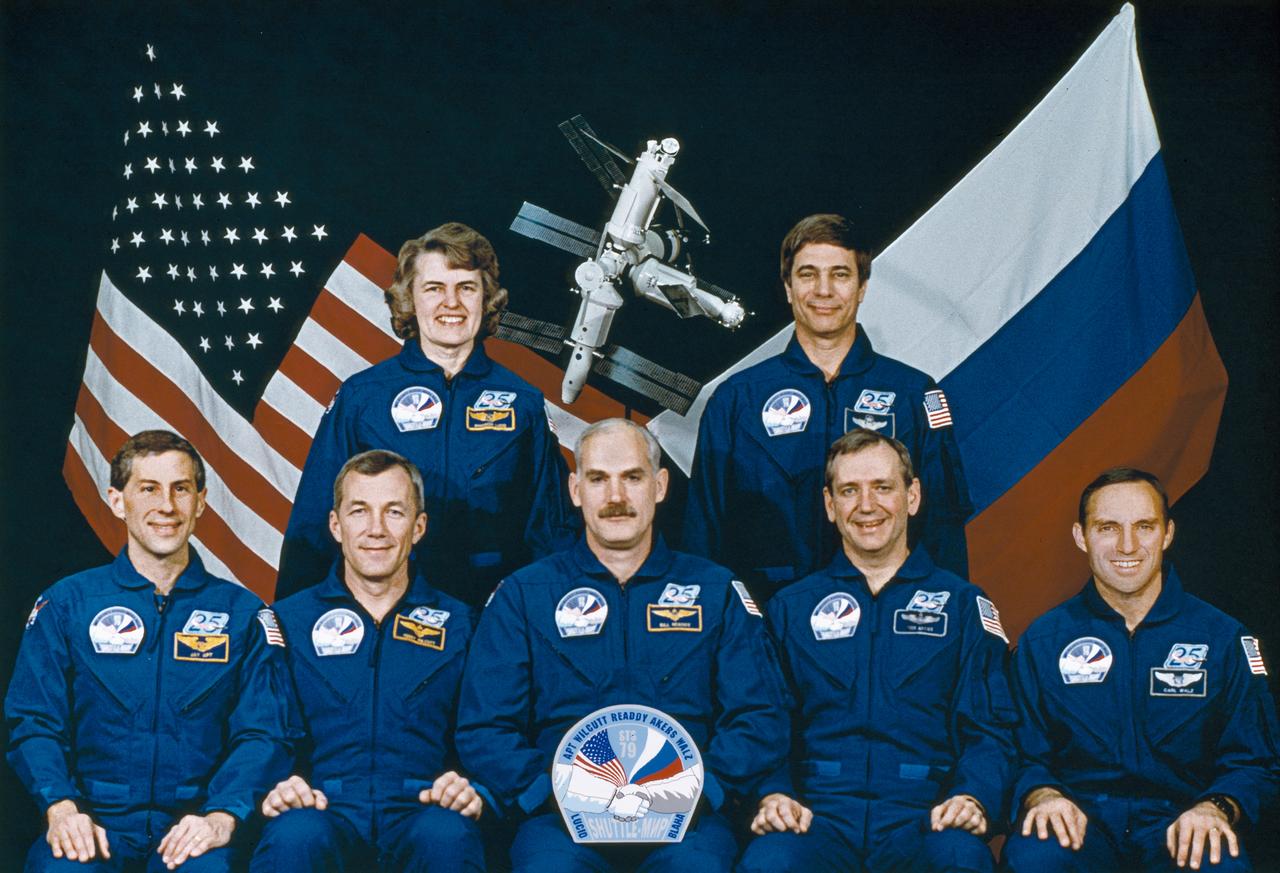
The crew assigned to the STS-79 mission included (seated front left to right) Jerome (Jay) Apt, mission specialist; Terrence W. Wilcutt, pilot; William F. Readdy, commander; Thomas D. Akers, and Carl E. Walz, both mission specialists. On the back row (left to right) are mission specialists Shannon W. Lucid, and John E. Blaha. Launched aboard the Space Shuttle Atlantis on September 16, 1996 at 4:54:49 am (EDT), the STS-79 mission marked the fourth U.S. Space Shuttle-Russian Space Station Mir docking, the second flight of the SPACEHAB module in support of Shuttle-Mir activities and the first flight of the SPACEHAB Double Module Configuration.
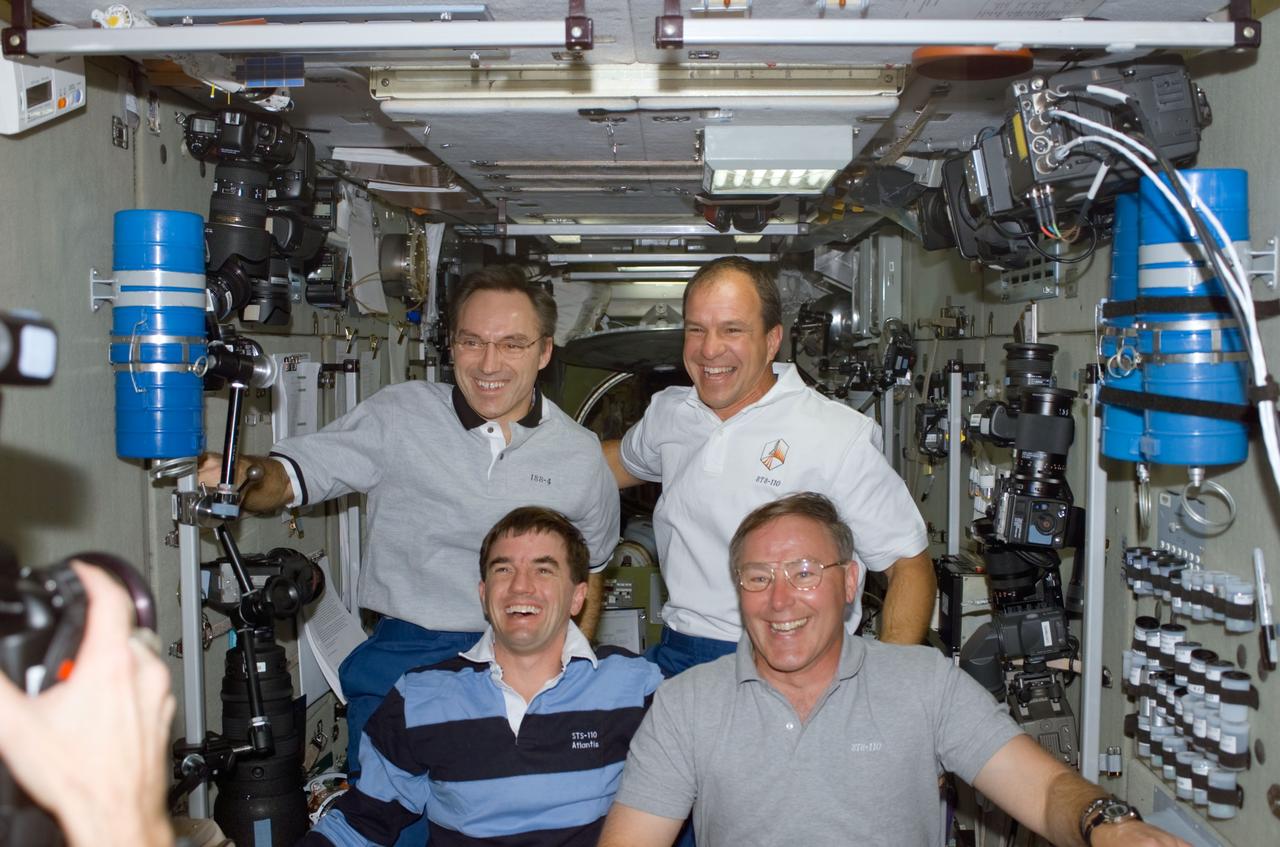
STS110-E-5127 (10 April 2002) --- Astronauts Carl E. Walz (top left), Expedition Four flight engineer, Michael J. Bloomfield, STS-110 mission commander, and Rex J. Walheim (bottom left) and Jerry L. Ross, both STS-110 mission specialists, gather for an informal photo in the Zvezda Service Module on the International Space Station (ISS). The image was taken with a digital still camera.
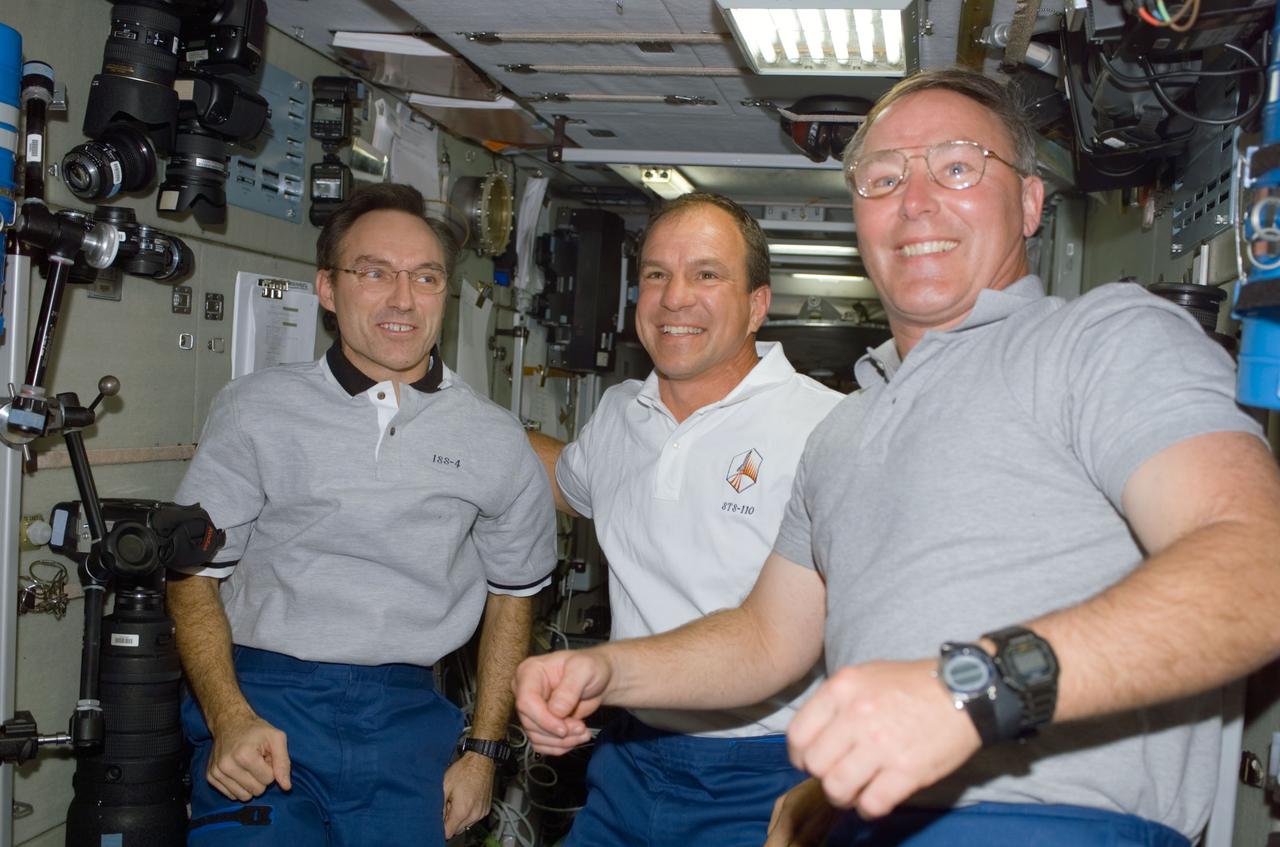
STS110-E-5126 (10 April 2002) --- Astronauts Carl E. Walz (left), Expedition Four flight engineer, Michael J. Bloomfield and Jerry L. Ross, STS-110 mission commander and mission specialist, respectively, are photographed in the Zvezda Service Module on the International Space Station (ISS). The image was taken with a digital still camera.
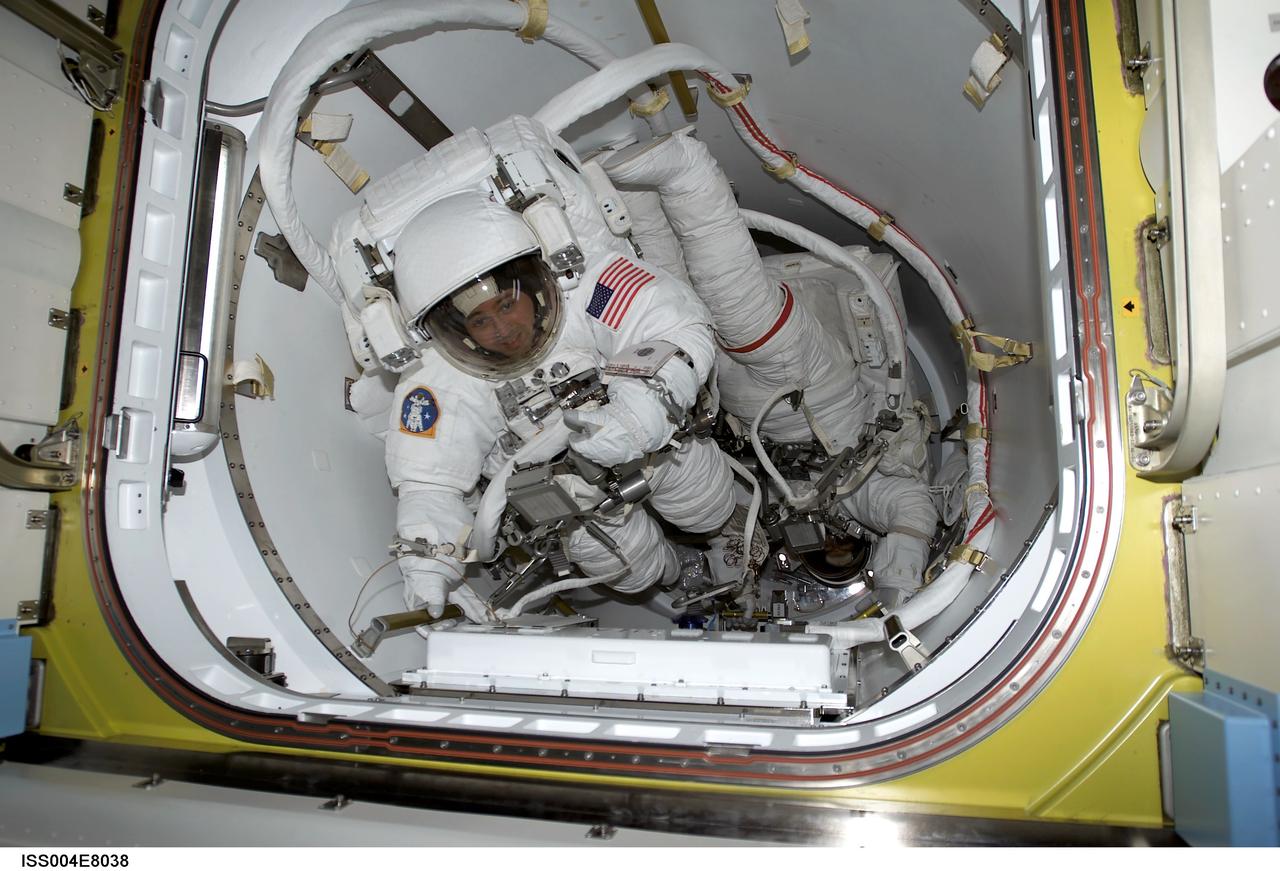
ISS004-E-8038 (20 February 2002) --- Astronauts Daniel W. Bursch (left) and Carl E. Walz are photographed in the crew lock of Quest prior to the February 20 space walk. The photograph was taken with a digital still camera by cosmonaut Yury I. Onufrienko, Expedition Four commander. Onufrienko remained onboard the International Space Station (ISS) while the two flight engineers, attired in NASA extravehicular mobility units (EMU), worked on the orbital outpost, logging a total of 5-hours, 47-minutes outside the station. The two tested equipment and procedures for the Airlock Quest and performed other tasks to prepare for Space Shuttle Atlantis’ STS-110 mission in April. The space walk began at 5:38 a.m. (CST) and ended at 11:25 a.m.

ISS004-E-8039 (20 February 2002) --- Astronauts Daniel W. Bursch and Carl E. Walz (obscured) go through preparations in the crew lock of Quest prior to the February 20 space walk. The photograph was taken with a digital still camera by cosmonaut Yury I. Onufrienko, Expedition Four commander. Onufrienko remained onboard the International Space Station (ISS) while the two flight engineers, attired in NASA extravehicular mobility units (EMU), worked on the orbital outpost, logging a total of 5-hours, 47-minutes outside the station. The two tested equipment and procedures for the Airlock Quest and performed other tasks to prepare for Space Shuttle Atlantis’ STS-110 mission in April. The space walk began at 5:38 a.m. (CST) and ended at 11:25 a.m.
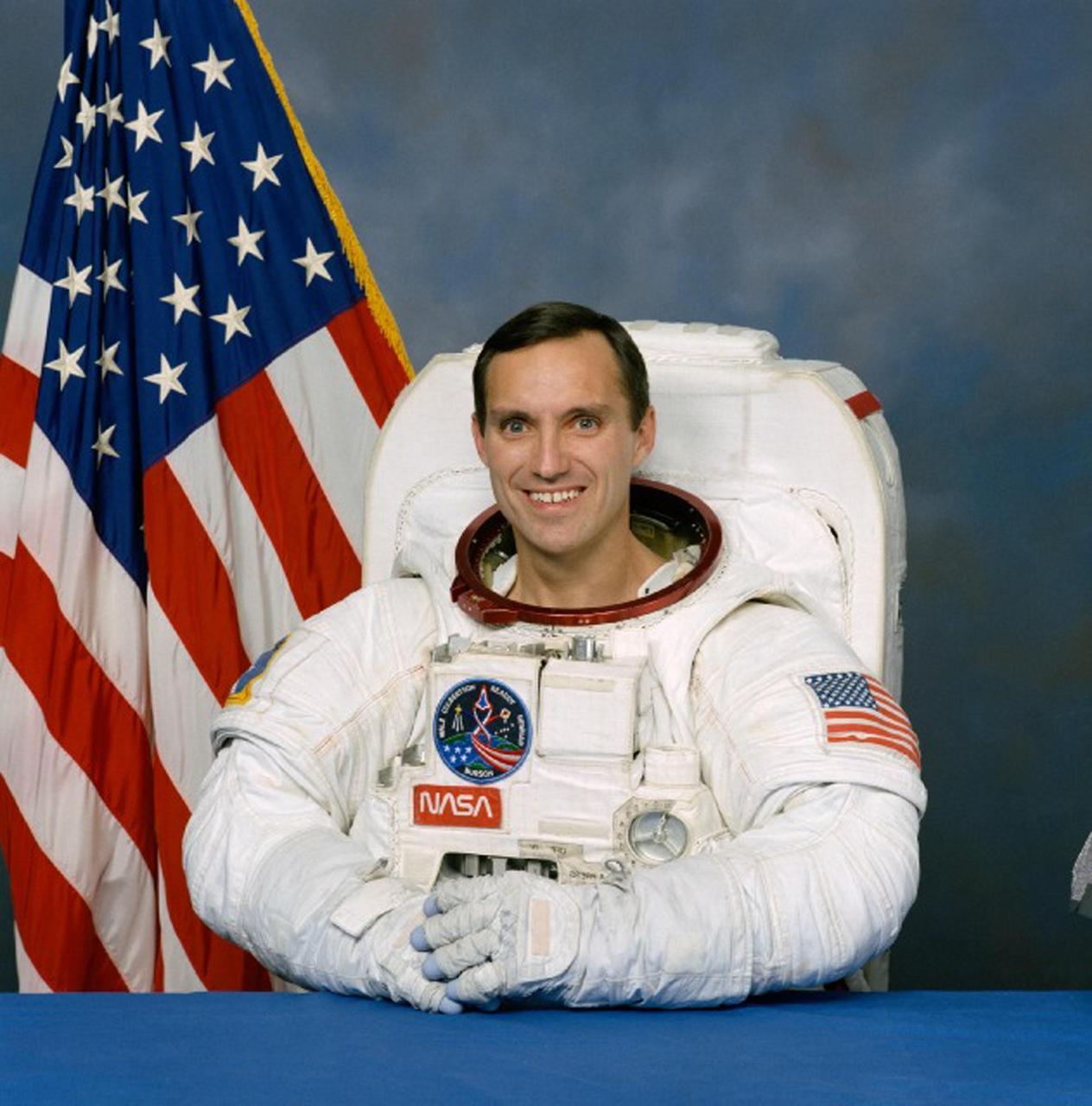
JOHNSON SPACE CENTER, HOUSTON, TEXAS -- (595-15563) -- Official portrait of astronaut Carl E. Walz, Mission Specialist
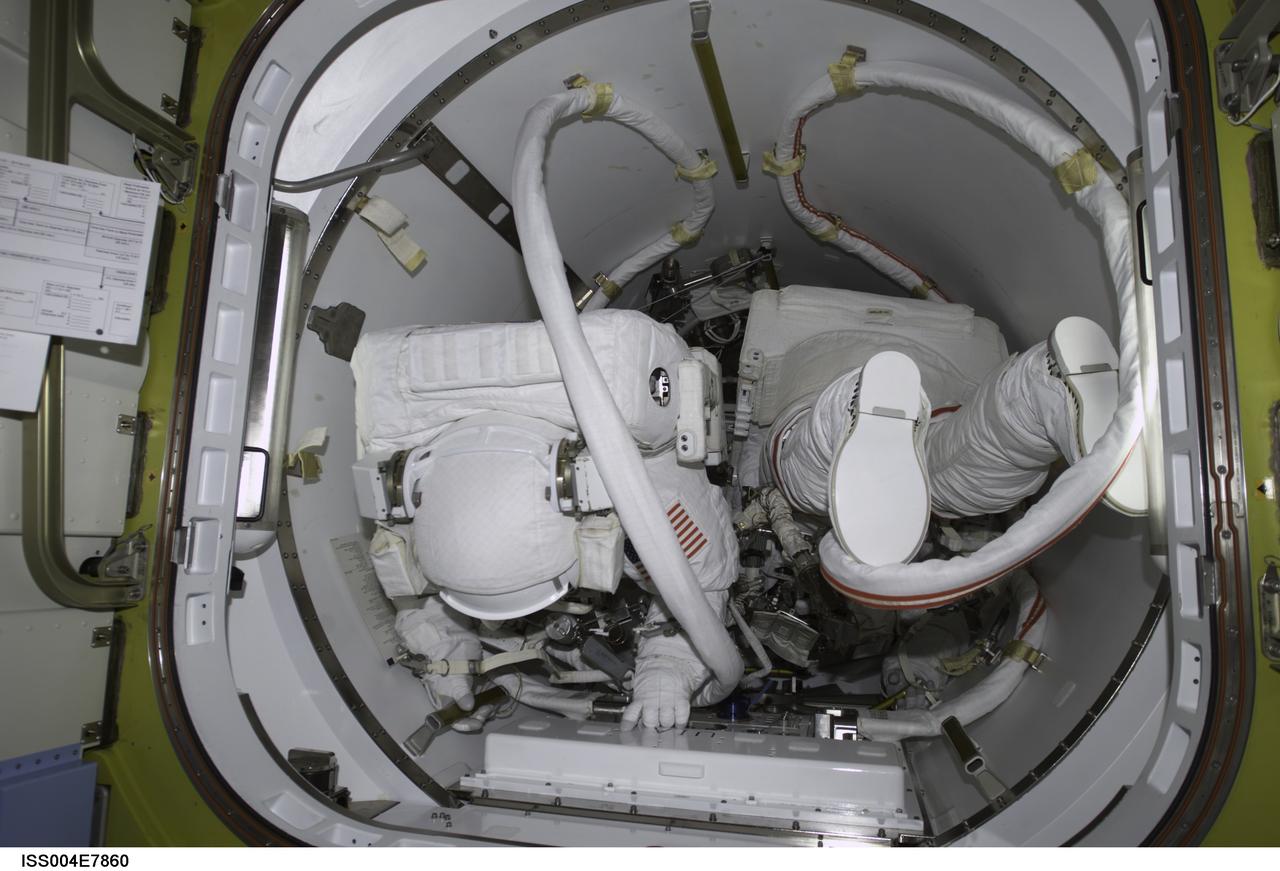
ISS004-E-7860 (20 February 2002) --- Astronauts Daniel W. Bursch (left) and Carl E. Walz are photographed in the crew lock of Quest prior to the February 20 space walk. The photograph was taken with a digital still camera by cosmonaut Yury I. Onufrienko, Expedition Four commander. Onufrienko remained onboard the International Space Station (ISS) while the two flight engineers, attired in NASA extravehicular mobility units (EMU), worked on the orbital outpost, logging a total of 5-hours, 47-minutes outside the station. The two tested equipment and procedures for the Airlock Quest and performed other tasks to prepare for Space Shuttle Atlantis’ STS-110 mission in April. The space walk began at 5:38 a.m. (CST) and ended at 11:25 a.m.
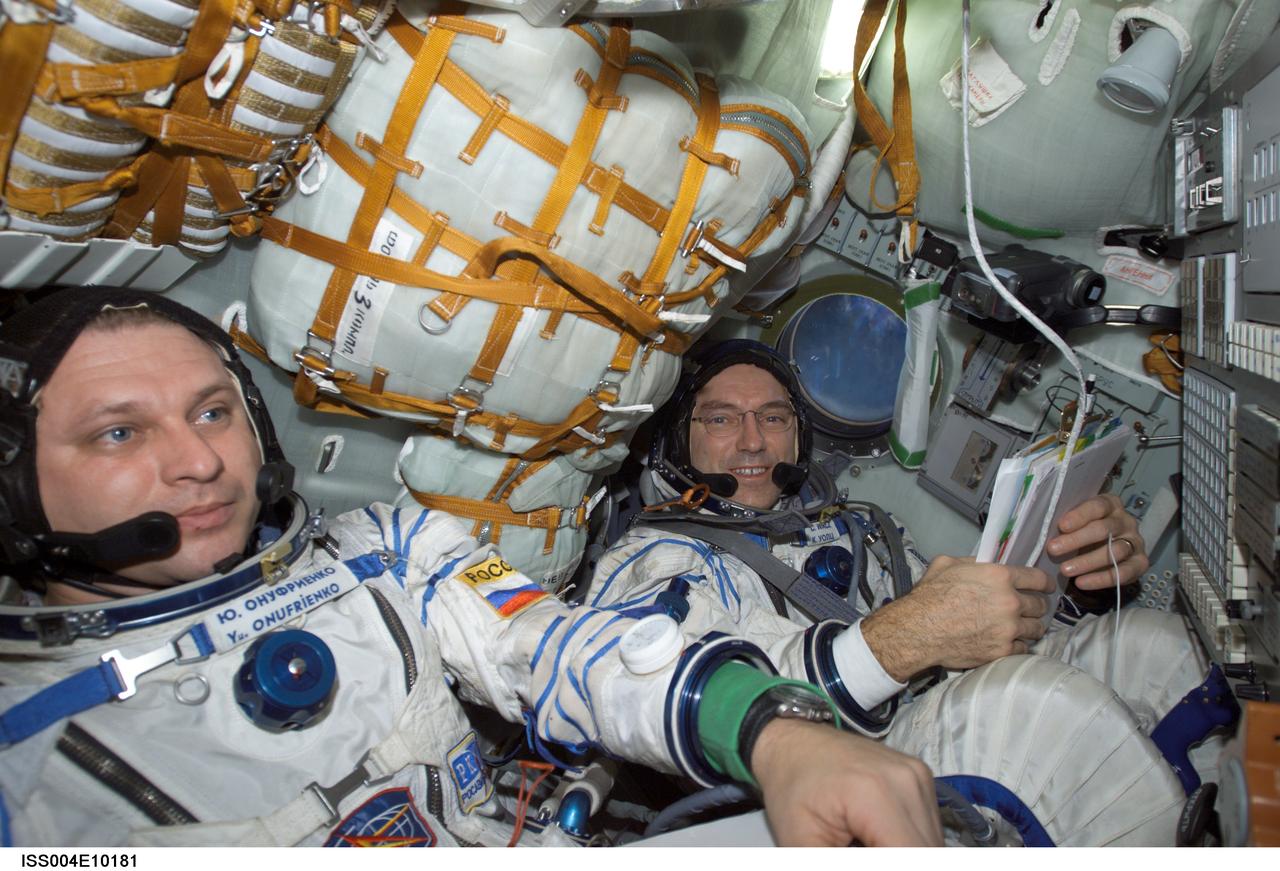
ISS004-E-10181 (20 April 2002) --- Cosmonaut Yury I. Onufrienko (left) and astronaut Carl E. Walz, Expedition Four mission commander and flight engineer, respectively, wearing Russian Sokol suits, are seated in the Soyuz 3 spacecraft that is docked to the International Space Station (ISS). The Expedition Four crew undocked the Soyuz 3 capsule from the nadir docking port of the Zarya module of the ISS at 4:16 a.m. (CDT) and flew a short distance down the station for a redocking to the Pirs docking compartment at 4:37 a.m. (CDT) over Central Asia. The move was in preparation for the arrival of the new Soyuz 4 capsule on April 27, 2002, and a three-man “taxi” crew, Commander Yuri Gidzenko, who was a member of the first resident crew of the ISS; Flight Engineer Roberto Vittori of the European Space Agency (ESA); and South African space flight participant Mark Shuttleworth.
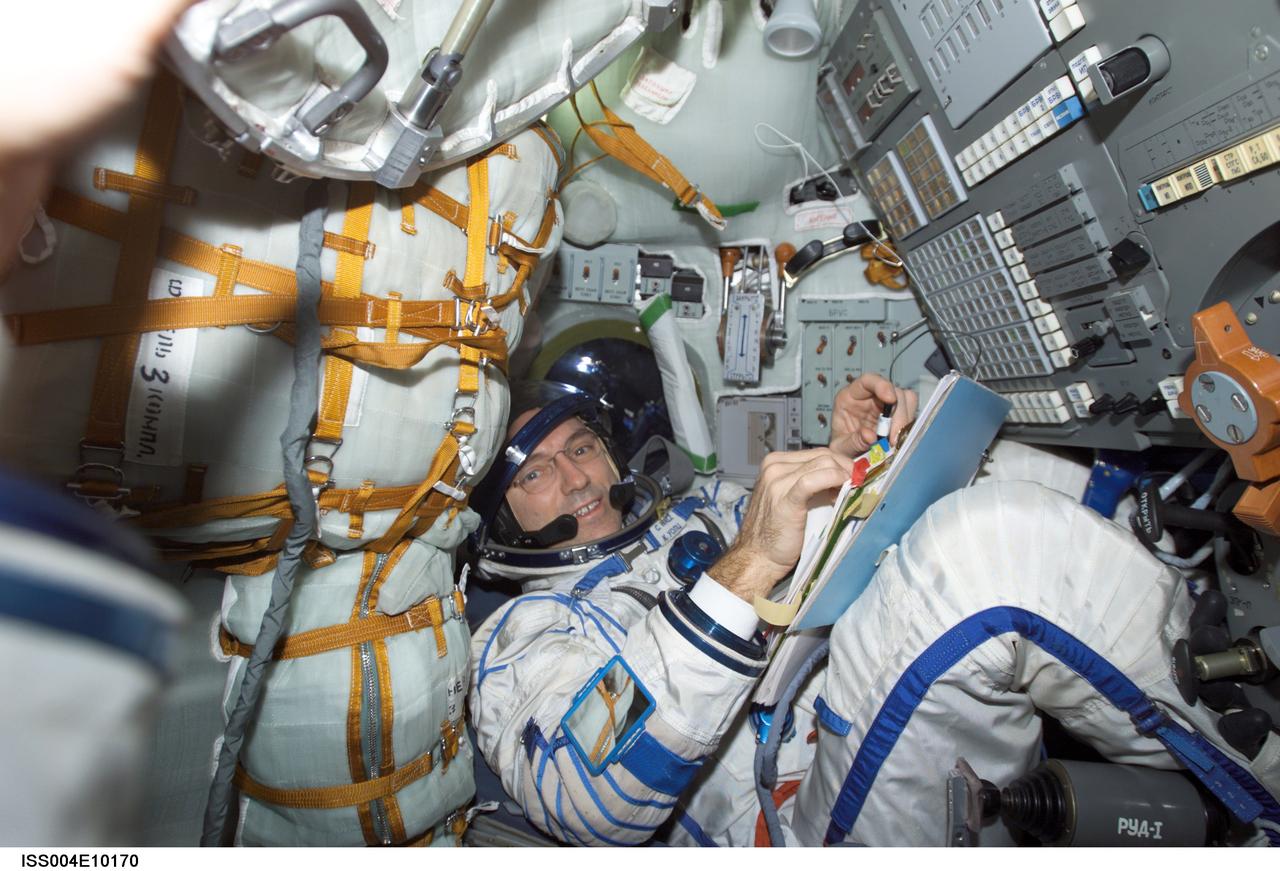
ISS004-E-10170 (20 April 2002) --- Astronaut Carl E. Walz, Expedition Four flight engineer, wearing a Russian Sokol suit, is seated in the Soyuz 3 spacecraft that is docked to the International Space Station (ISS). The Expedition Four crew undocked the Soyuz 3 capsule from the nadir docking port of the Zarya module of the ISS at 4:16 a.m. (CDT) and flew a short distance down the station for a redocking to the Pirs docking compartment at 4:37 a.m. (CDT) over Central Asia. The move was in preparation for the arrival of the new Soyuz 4 capsule on April 27, 2002, and a three-man “taxi” crew, Commander Yuri Gidzenko, who was a member of the first resident crew of the ISS; Flight Engineer Roberto Vittori of the European Space Agency (ESA); and South African space flight participant Mark Shuttleworth.
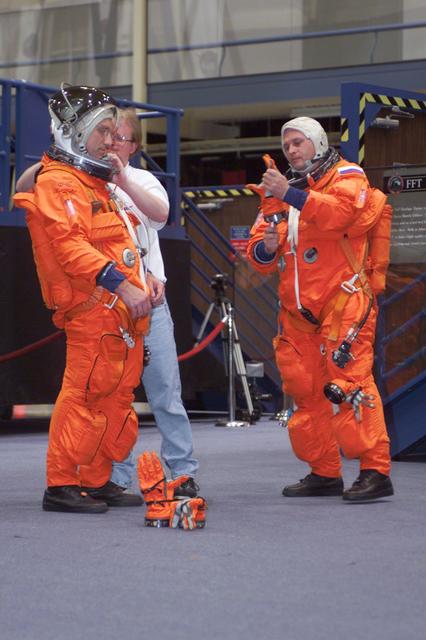
JSC2001-E-18119 (18 May 2001) --- Astronaut Carl E. Walz (left), Expedition Four flight engineer, and cosmonaut Yuri I. Onufrienko, mission commander representing Rosaviakosmos, don their training versions of the full-pressure launch and entry suit prior to a mission training session in the Space Vehicle Mockup Facility at the Johnson Space Center (JSC). Walz and Onufrienko are assisted by United Space Alliance (USA) suit tech Daniel Palmer.
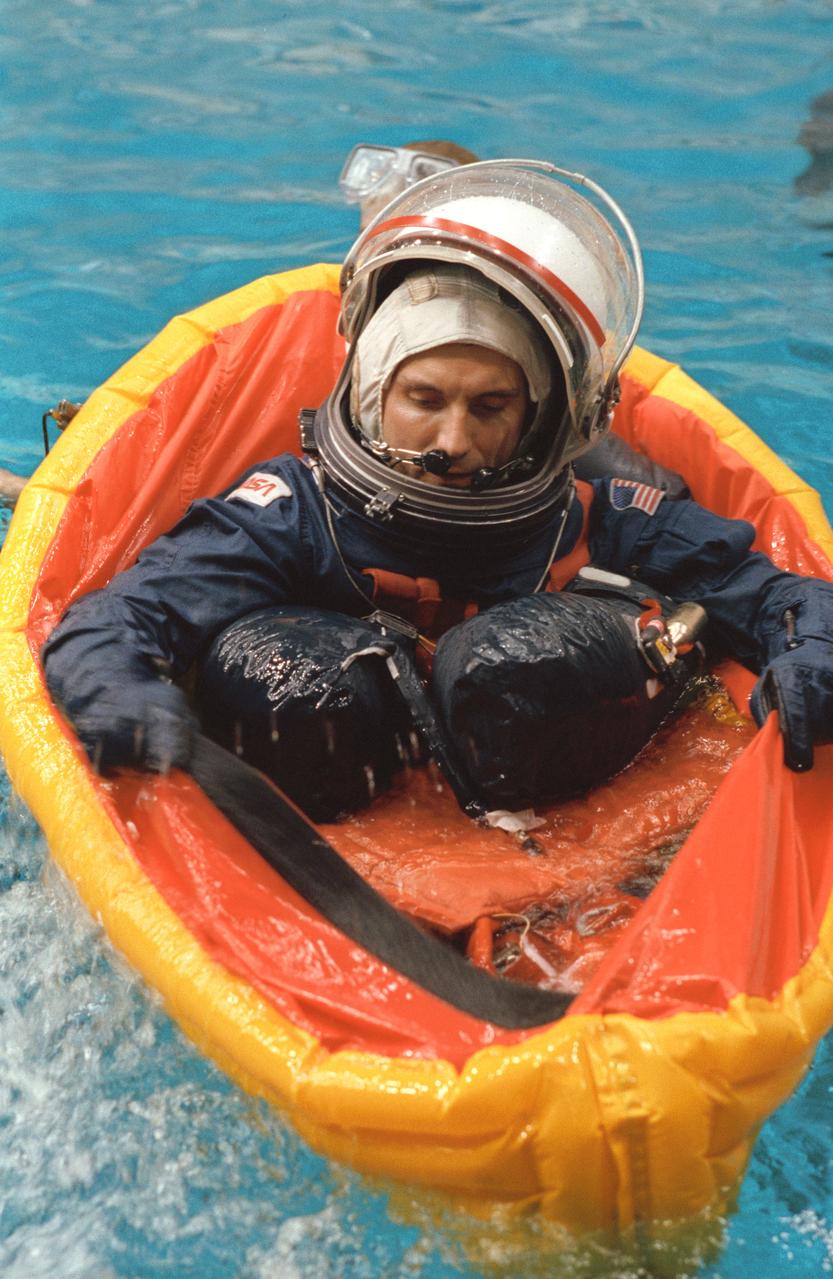
S93-31928 (24 March 1993) --- Astronaut Carl E. Walz, mission specialist, navigates a one-person life raft during emergency bailout training exercises at the Johnson Space Center's Weightless Environment Training Facility (WET-F). Walz was joined in the training session by the four other NASA astronauts assigned to the STS-51 flight.
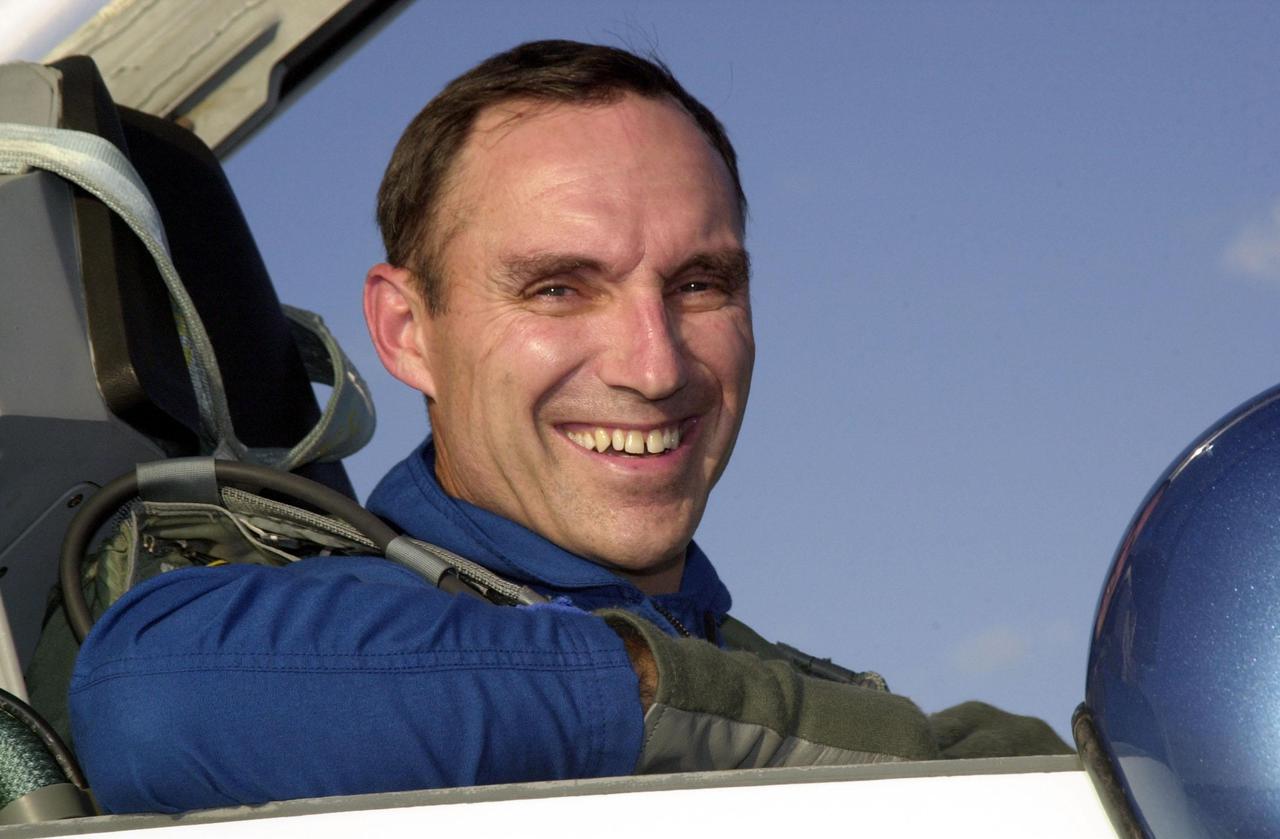
KENNEDY SPACE CENTER, Fla. - Expedition Four crew member Carl E. Walz arrives at the Shuttle Landing Facility aboard a T-38 jet. Walz will be participating in the Terminal Countdown Demonstration Test, a dress rehearsal for his upcoming launch. He will be transported to the International Space Station on mission STS-108, targeted for launch on Nov. 29 on Space Shuttle Endeavour. The Expedition Four crew will spend more than five months living and working on the permanently manned Station and return on mission STS-111 in May 2002
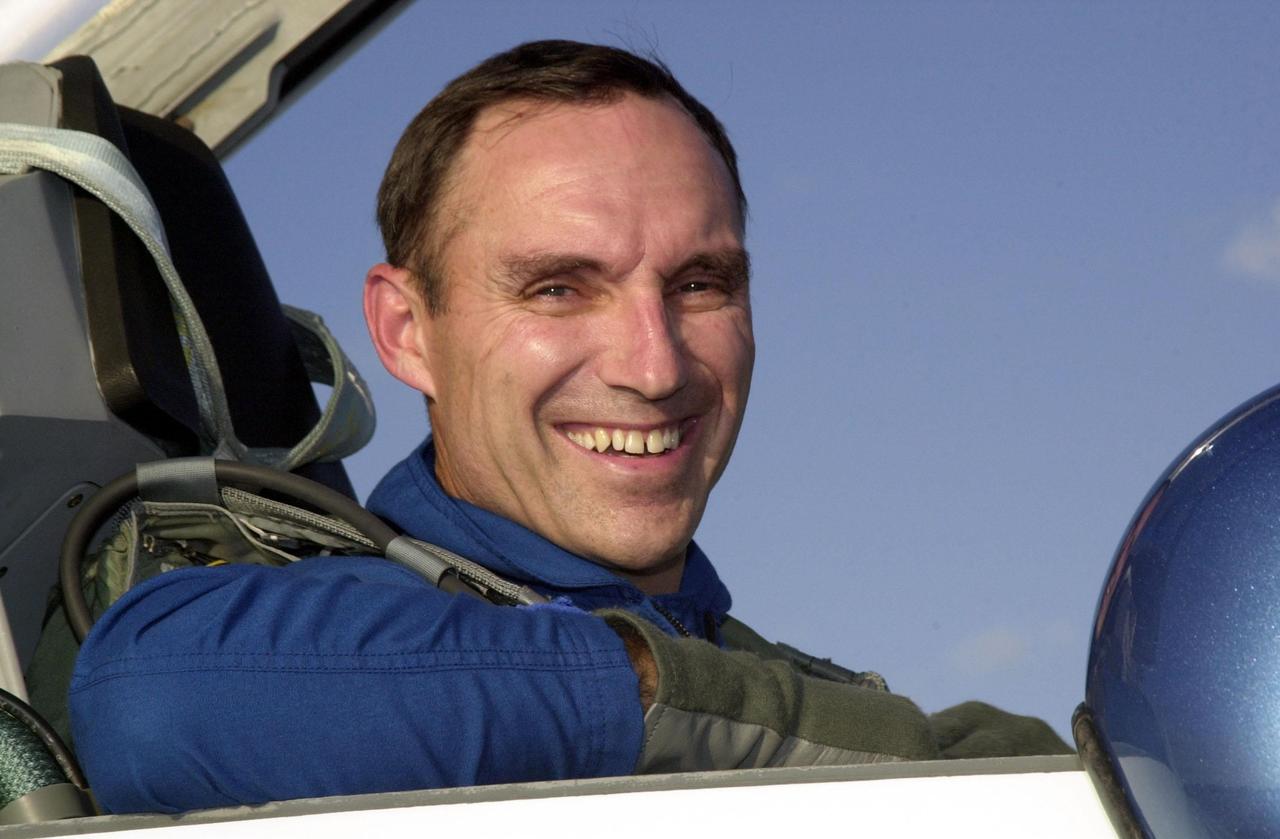
KENNEDY SPACE CENTER, Fla. - Expedition Four crew member Carl E. Walz arrives at the Shuttle Landing Facility aboard a T-38 jet. Walz will be participating in the Terminal Countdown Demonstration Test, a dress rehearsal for his upcoming launch. He will be transported to the International Space Station on mission STS-108, targeted for launch on Nov. 29 on Space Shuttle Endeavour. The Expedition Four crew will spend more than five months living and working on the permanently manned Station and return on mission STS-111 in May 2002
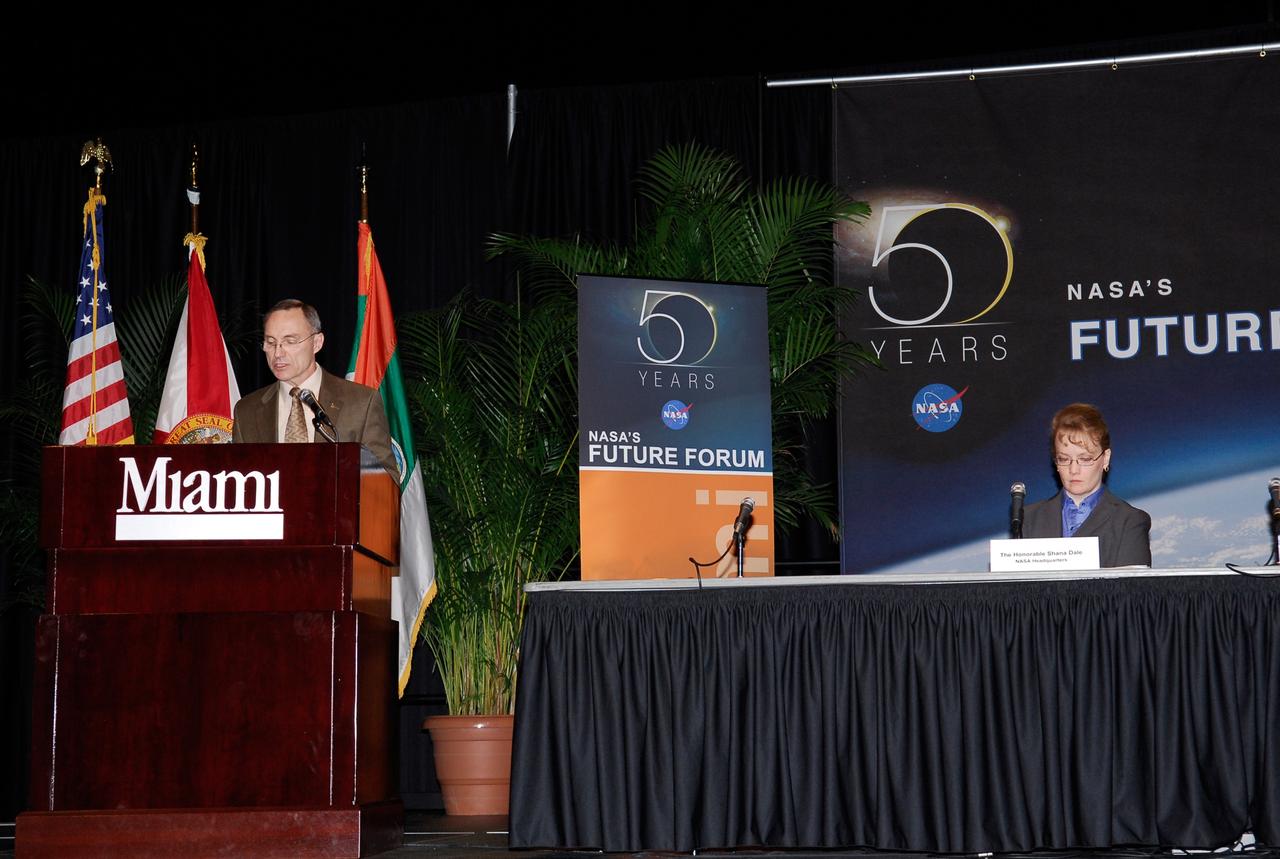
CAPE CANAVERAL, Fla. -- During NASA’s Future Forum in Miami, Carl Walz provides an overview of NASA’s Exploration Program. Walz is director of the Advanced Capabilities Division. At the table on the right is NASA Deputy Administrator Shana Dale. The forum focused on how space exploration benefits Florida's economy. The forum was held at the University of Miami's BankUnited Center and included presentations and panels. Also participating was Russell Romanella, director of the International Space Station and Spacecraft Processing. Photo credit: NASA/Kim Shiflett
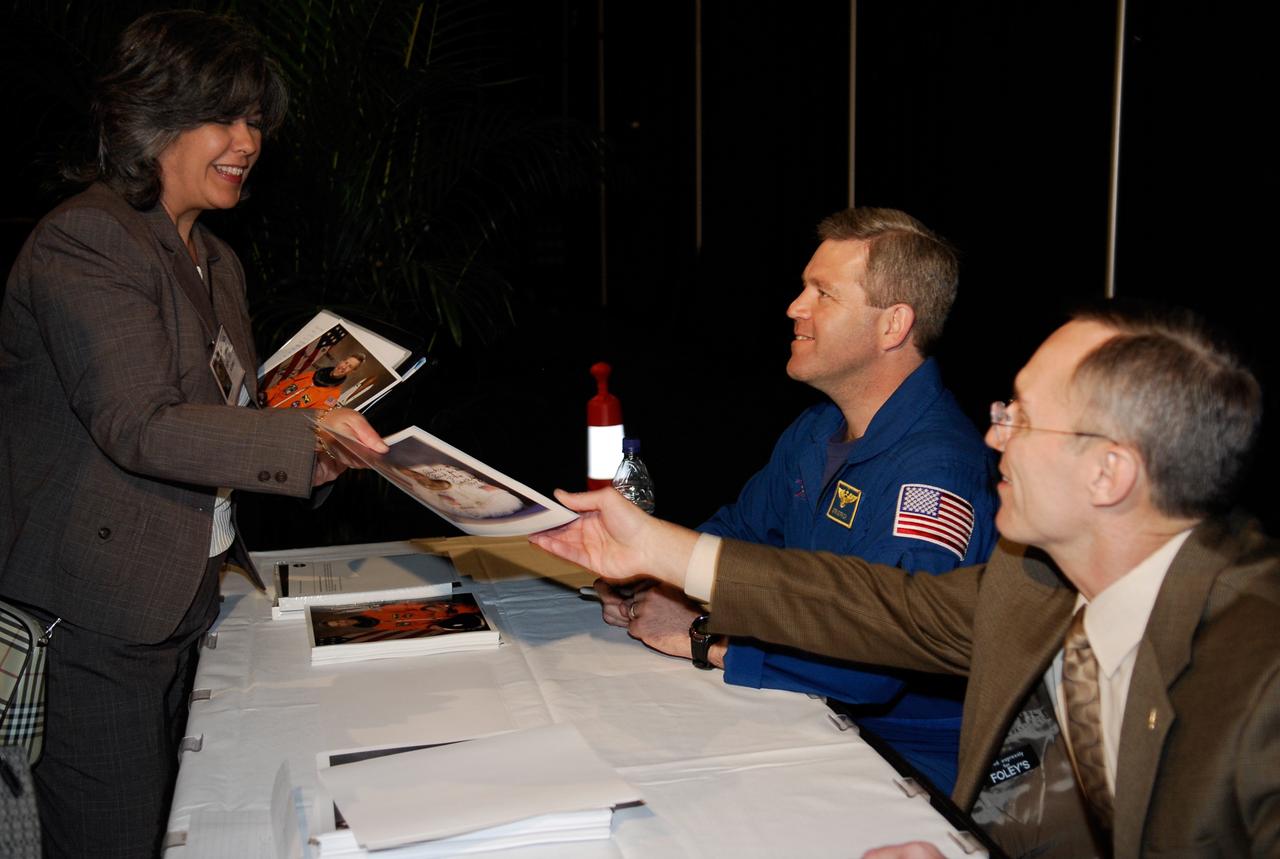
CAPE CANAVERAL, Fla. -- During a break in presentations at NASA’s Future Forum in Miami, astronaut Steve Frick and former astronaut Carl Walz sign autographs. Frick served as commander of the STS-122 shuttle mission. Walz is now director of NASA’s Advanced Capabilities Division. The forum focused on how space exploration benefits Florida's economy. The event, which included presentations and panels, was held at the University of Miami's BankUnited Center. Among those participating were NASA Deputy Administrator Shana Dale, astronaut Carl Walz, director of the Advanced Capabilities Division in NASA's Exploration Systems Mission Directorate, and Russell Romanella, director, International Space Station and Spacecraft Processing. Photo credit: NASA/Kim Shiflett
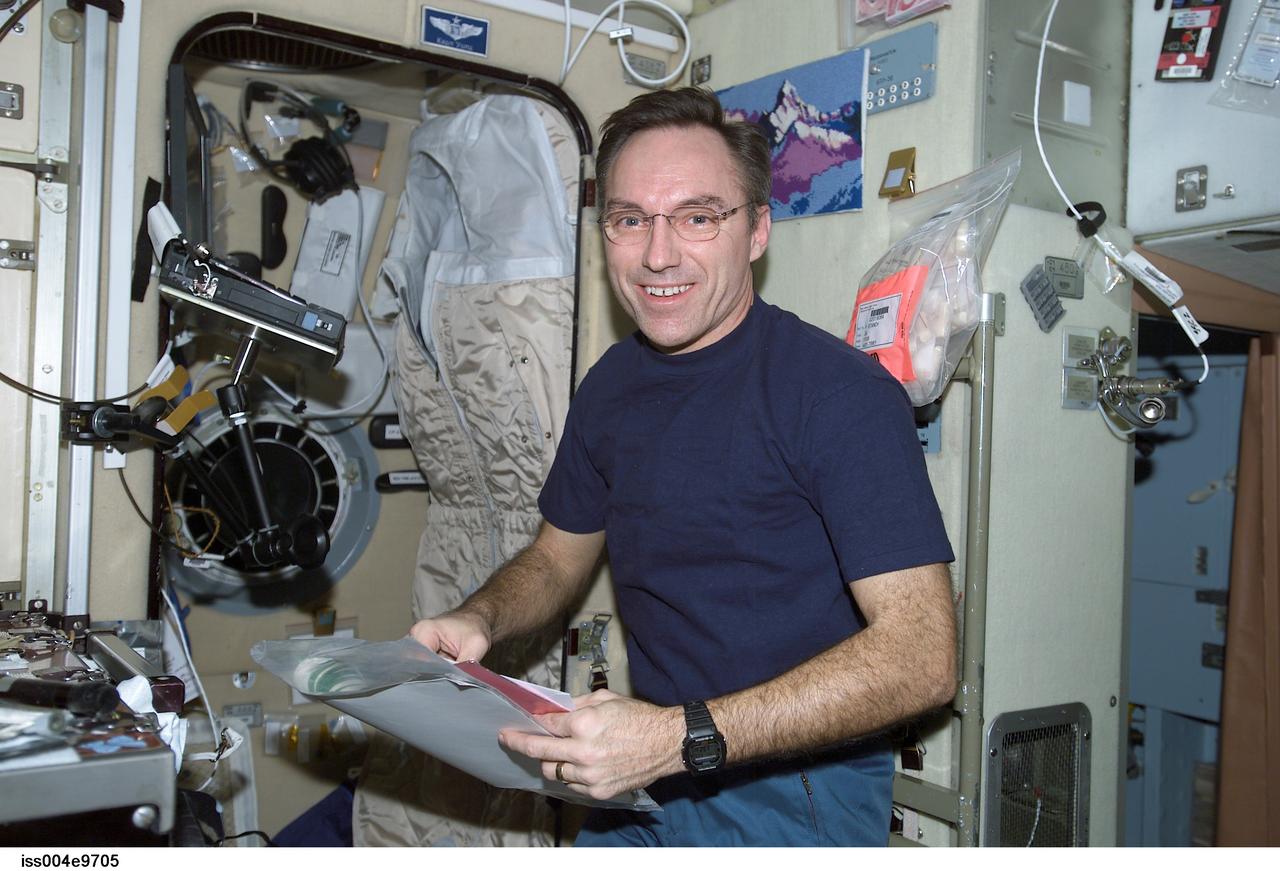
ISS004-E-9705 (25 March 2002) --- Astronaut Carl E. Walz, Expedition Four flight engineer, works in the Zvezda Service Module on the International Space Station (ISS).
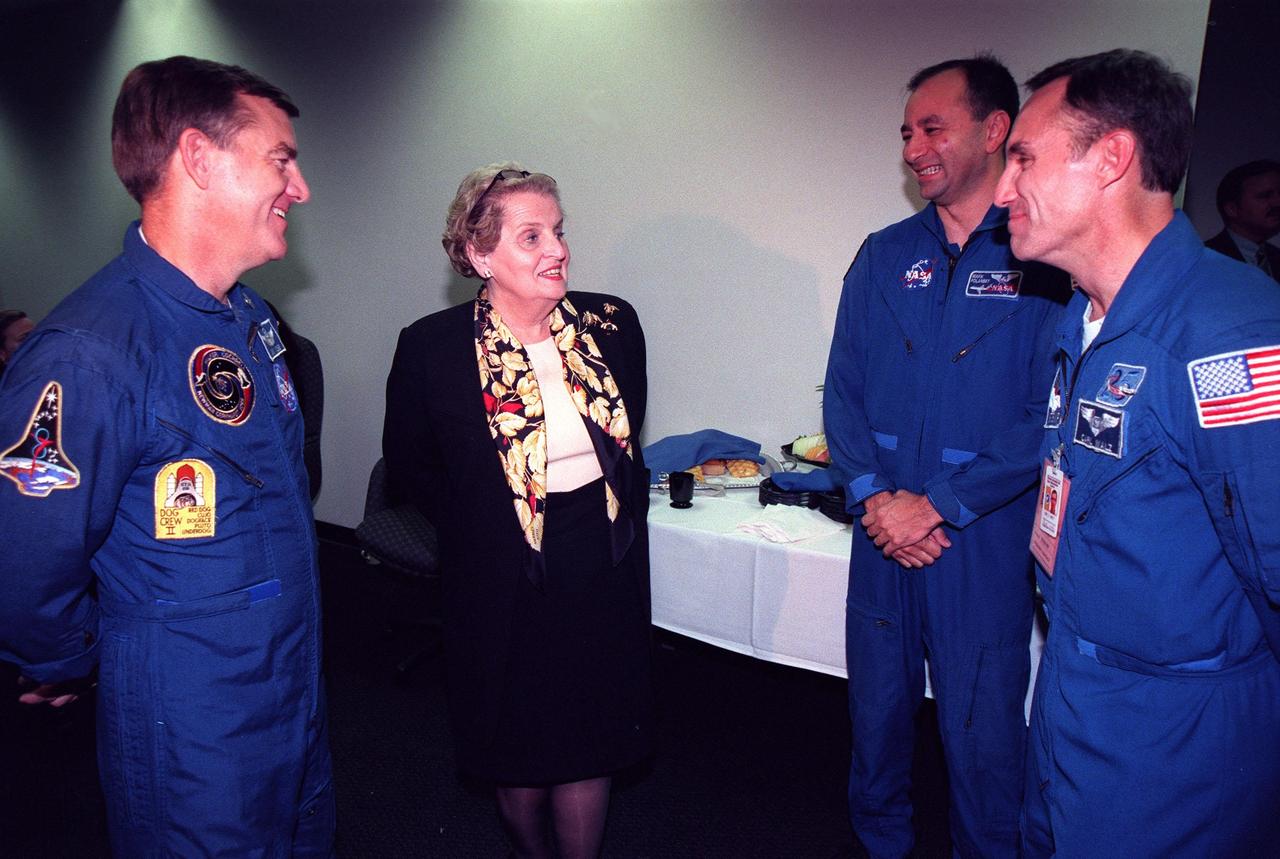
Following the successful launch of the STS-88 crew aboard Endeavour from Launch Pad 39A at 3:35:34 a.m. EST, U.S. Secretary of State Madeleine Albright (second from left) talks with astronauts (left to right) Jim Voss, Mark Polansky and Carl Walz. STS-88 is the first U.S. mission dedicated to the assembly of the International Space Station (ISS). Voss is a member of the STS-100 crew which will be the eighth ISS assembly mission. Polansky is slated to fly on STS-98 which will be the sixth ISS assembly mission. Walz is currently assigned to fly on the ISS on the fourth long duration crew
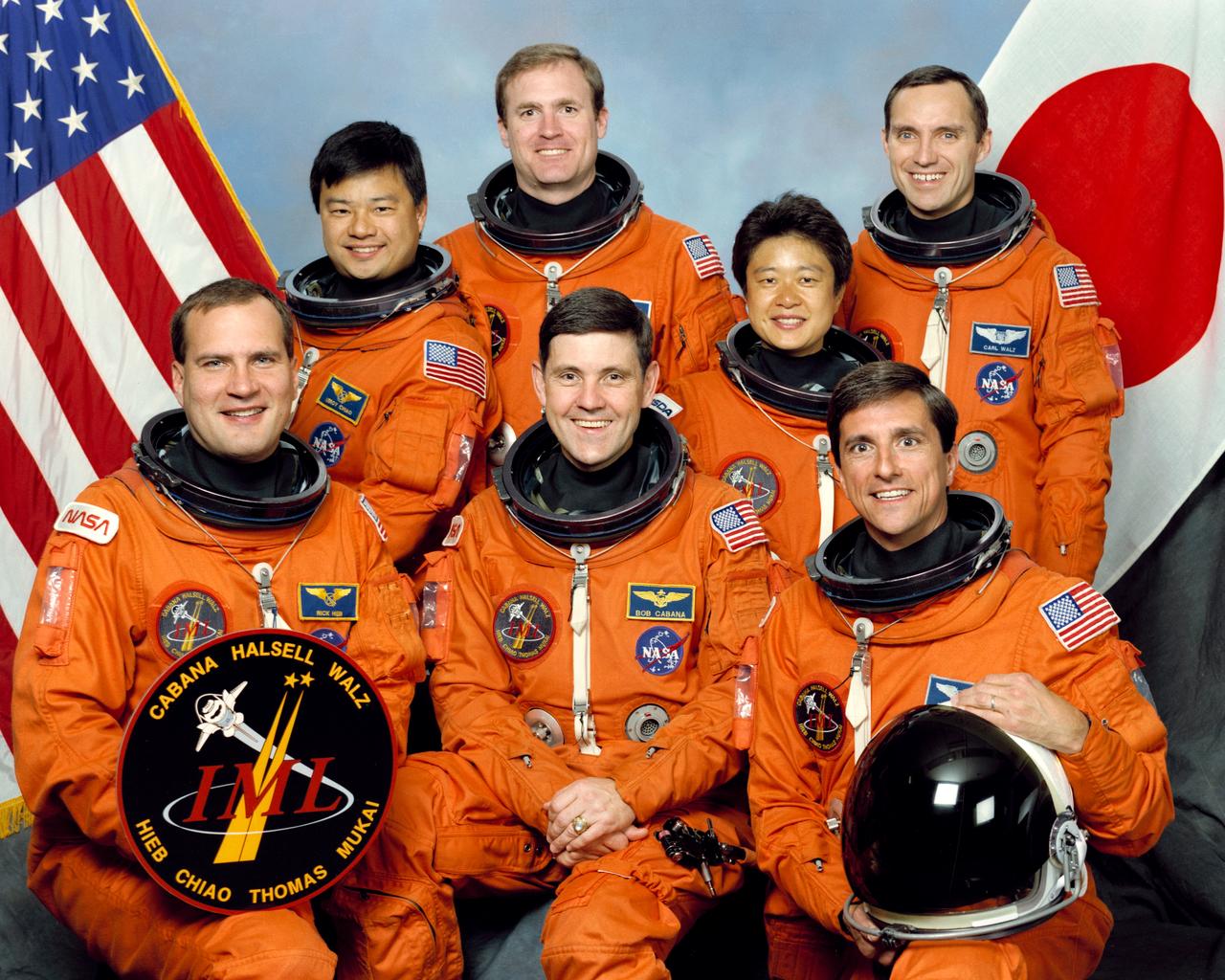
STS065-S-002 (April 1994) --- Six NASA astronauts and a Japanese payload specialist take a break from training to pose for their crew portrait. Left to right are Richard J. Hieb, Leroy Chiao, James D. Halsell Jr., Robert D. Cabana, Dr. Chiaki Mukai, Donald A. Thomas and Carl E. Walz. Cabana is mission commander, and Halsell has been assigned as pilot. Hieb is payload commander, with Walz, Thomas and Chiao serving as mission specialist. Dr. Mukai represents the National Space Development Agency (NASDA) of Japan as payload specialist on the International Microgravity Laboratory (IML) mission.
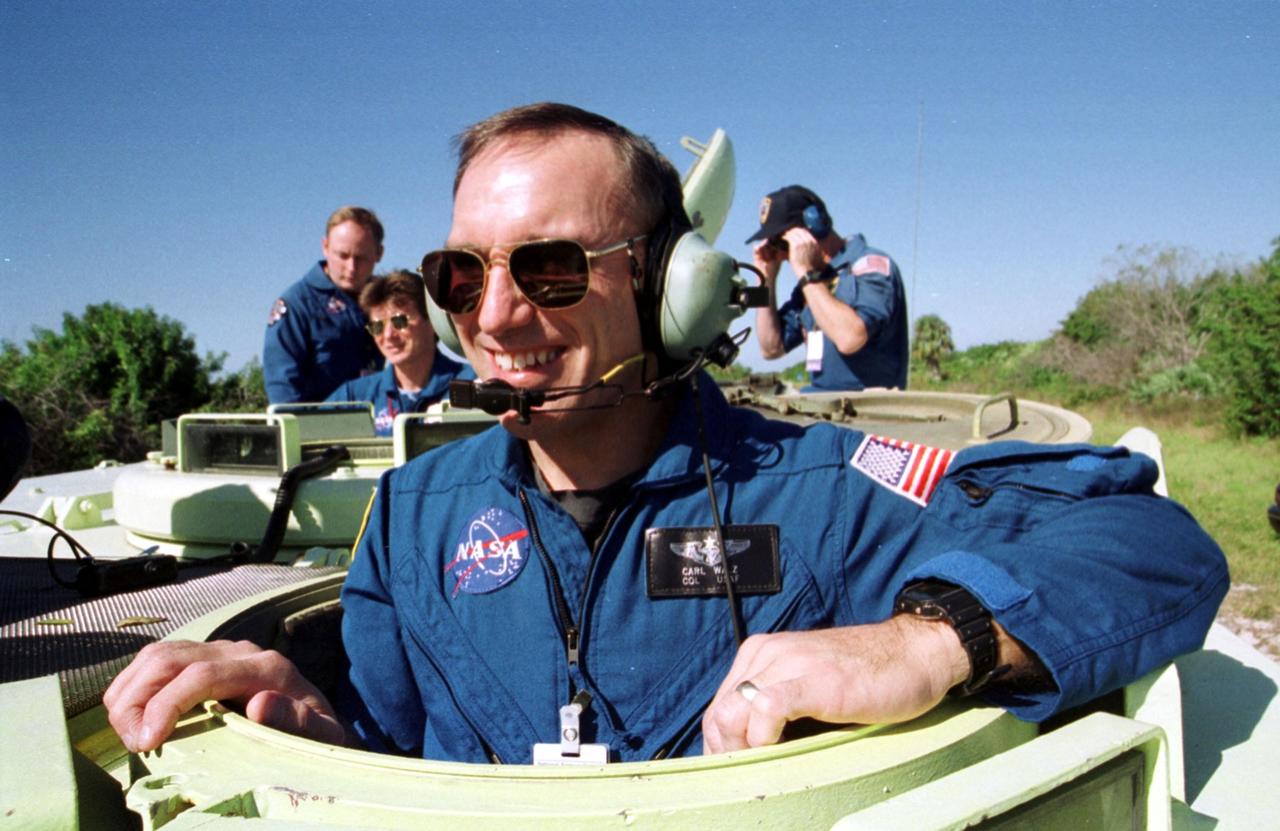
KENNEDY SPACE CENTER, Fla. -- Expedition 4 crew member Carl E. Walz is ready to take his turn driving an M-113 armored personnel carrier. He and other crew members are taking part in Terminal Countdown Demonstration Test activities, which include emergency exit from the launch pad and a simulated launch countdown. Walz will be transported to the International Space Station on mission STS-108, targeted for launch Nov. 29 on Space Shuttle Endeavour. The Expedition 4 crew will spend more than five months living and working on the permanently manned Station and return on mission STS-111 in May 2002
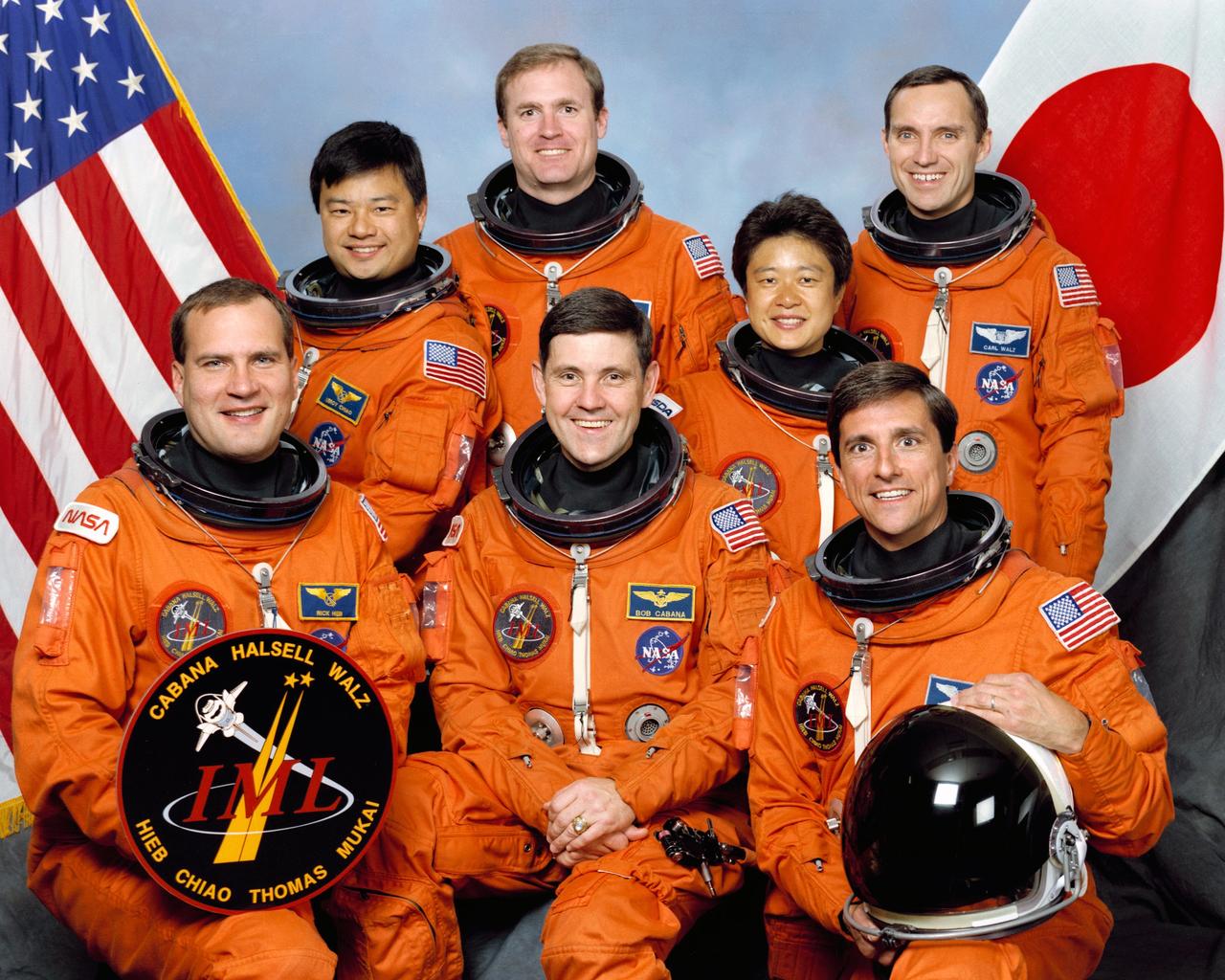
JOHNSON SPACE CENTER, Houston, Texas -- -- STS065(S)002 -- STS-65 Official Crew Portrait --- Six NASA astronauts and a Japanese payload specialist take a break from STS-65 training to pose for their crew portrait. Left to right are Richard J. Hieb, Leroy Chiao, James D. Halsell Jr., Robert D. Cabana, Dr. Chiaki Mukai, Donald A. Thomas and Carl E. Walz. Cabana is mission commander, and Halsell has been assigned as pilot. Hieb is payload commander, with Walz, Thomas and Chiao serving as mission specialists. Dr. Mukai represents the National Space Development Agency (NASDA) of Japan as payload specialist on the International Microgravity Laboratory (IML) mission.
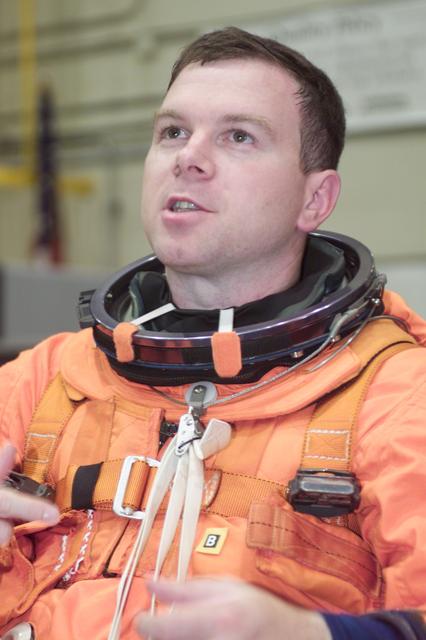
Views of STS-102 and Expedition Four bailout training in the Building 9NW's crew compartment trainer II (CCT II). Images include: Expedition Four's Carl Walz gets help from a trainer during the donning of his Launch and Entry Suit (LES)(23705); STS-102 Pilot James Kelly gets help with his LES from a trainer (23706); Expedition Four commander / cosmonaut Yuri Onufrienko (left) and Expedition Four's Daniel Bursch, both wearing LES and helmets, get strapped into their seats by a trainer on the middeck of the CCT (23707); Onufrienko and Bursch seated on the middeck (23708); Onufrienko (left), Bursch and Walz seated on the middeck preparing to begin emergency egress (23709); Walz, with LES and helmet, egresses from the port hatch of the CCT and goes into a roll on the mat (23710 and 23711); from left to right, all wearing LES's, STS-106 Commander James Wetherbee, Kelly, STS-102 Mission Specialist (MS) Paul Richards, STS-102 MS Andrew Thomas, Walz, Bursch and Onufrienko seated outside the CCT while being attended to by trainers (23712); Wetherbee seated in his LES (23713); Walz talks with Bursch and Onufrienko - Thomas is visible to the left (23714); Bursch seated (23715); Richards seated (23716); Thomas in his LES (23717); Kelly in his LES (23718); and Wetherbee (left) and Kelly converse while seated (23719).
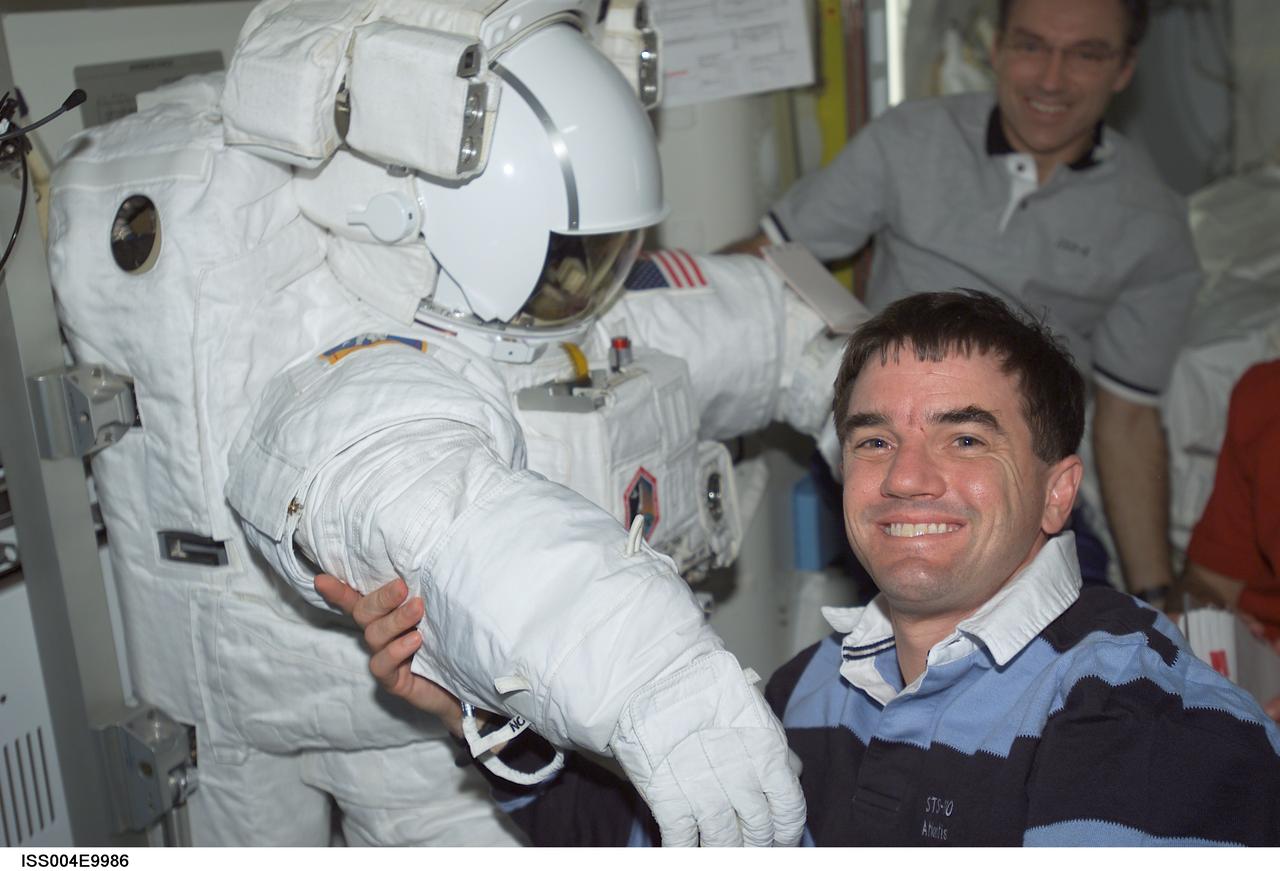
ISS004-E-9986 (10 April 2002) --- Astronaut Rex J. Walheim, STS-110 mission specialist, stands near an Extravehicular Mobility Unit (EMU) space suit in the Quest Airlock on the International Space Station (ISS). Astronaut Carl E. Walz, Expedition Four flight engineer, is visible in the background.
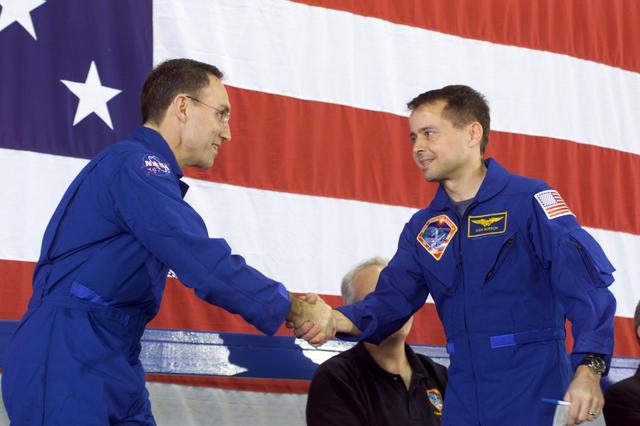
JSC2002-E-26037 (21 June 2002) --- Astronauts Carl E. Walz (left) and Daniel W. Bursch, both Expedition Four flight engineers, shake hands in Hangar 990 at Ellington Field during the STS-111 and Expedition Four crew return ceremonies.
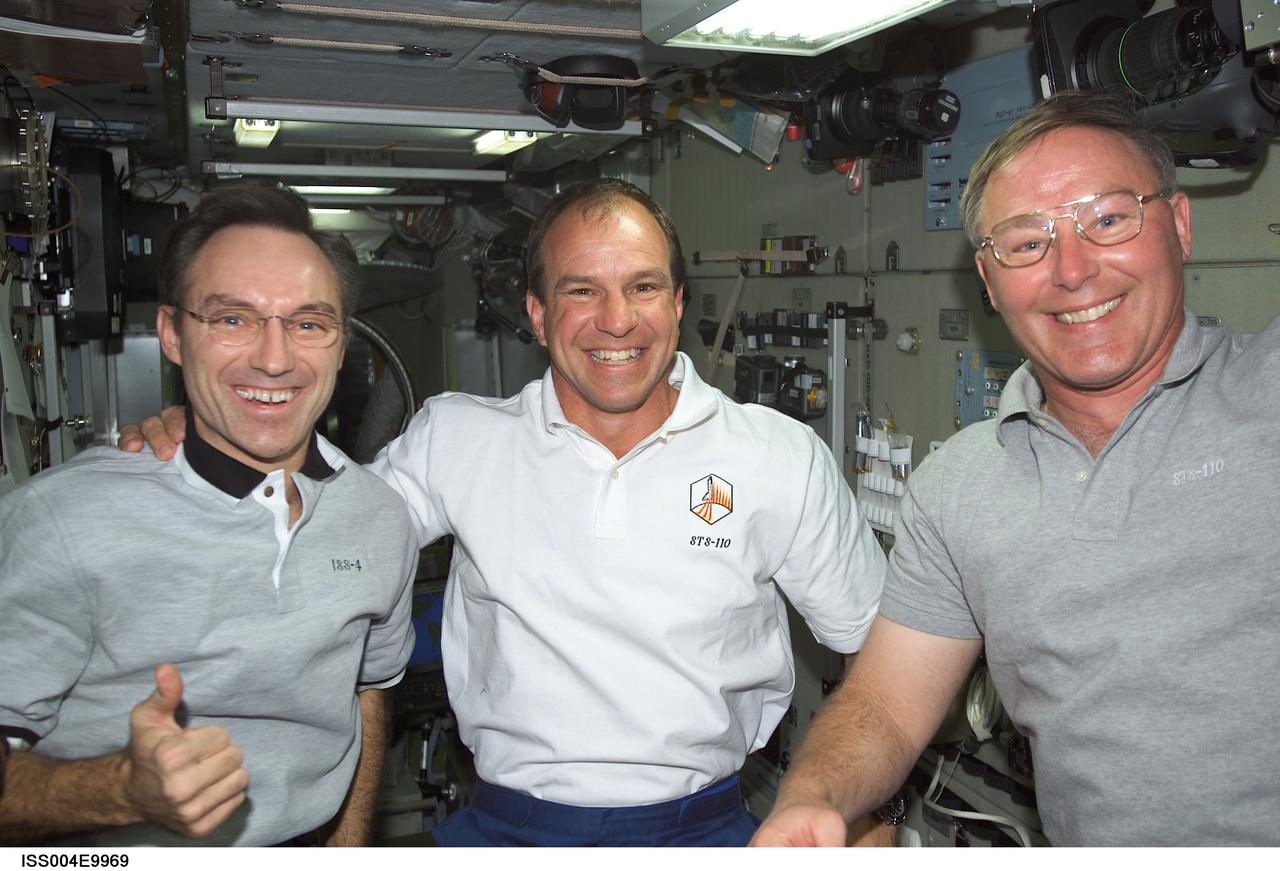
ISS004-E-9969 (10 April 2002) --- Astronauts Carl E. Walz (left), Expedition Four flight engineer, Michael J. Bloomfield and Jerry L. Ross, STS-110 mission commander and mission specialist, respectively, are photographed in the Zvezda Service Module on the International Space Station (ISS).
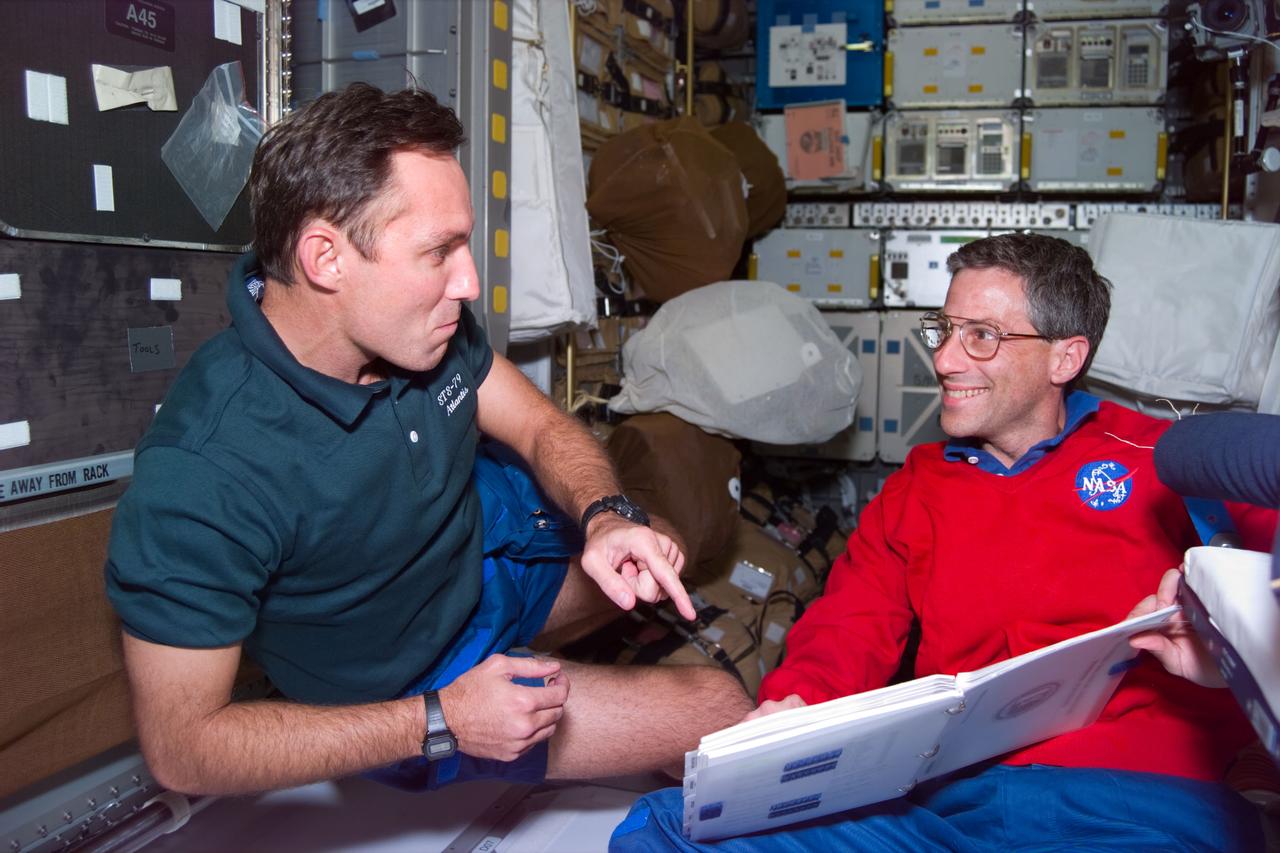
STS79-E-5007 (17 September 1996) --- Astronauts Carl E. Walz and Jerome (Jay) Apt, mission specialists, report to Spacehab Module for early mission experimentation on the first full day of STS-79 operations, on Flight Day 2.
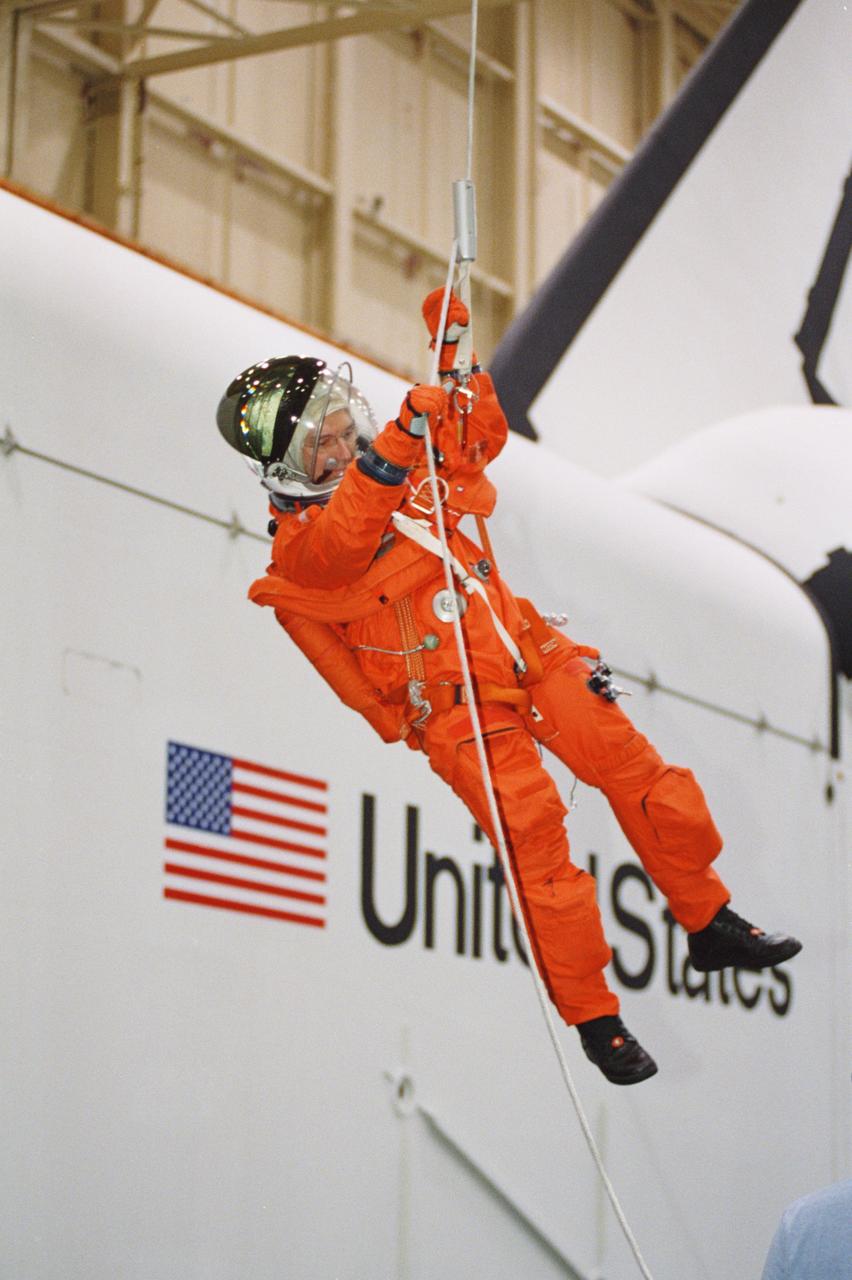
JSC2001-01466 (18 May 2001) --- Astronaut Carl E. Walz, Expedition Four flight engineer, lowers himself from a simulated shuttle in trouble during an emergency egress training session in the Space Vehicle Mockup Facility at the Johnson Space Center (JSC).

JSC2002-E-26038 (21 June 2002) --- Astronaut Carl E. Walz, Expedition Four flight engineer, speaks from the lectern in Hangar 990 at Ellington Field during the STS-111 and Expedition Four crew return ceremonies.
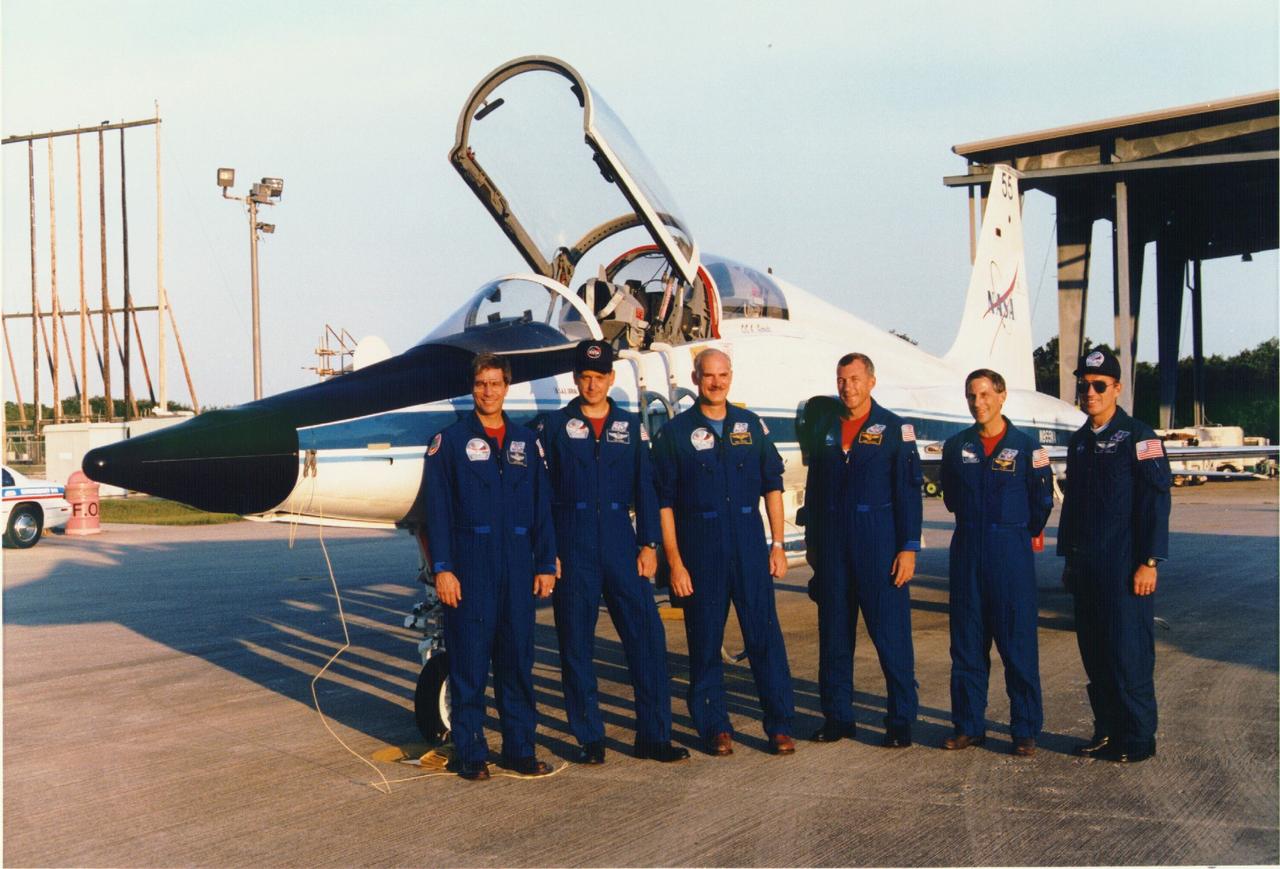
KENNEDY SPACE CENTER, FLA. - The STS-79 astronauts arrive at KSC's Shuttle Landing Facility in their T-38 aircraft from Johnson Space Center in Houston. From left are Mission Specialists John E. Blaha and Tom Akers; Commander William F. Readdy; PIlot Terrence W. Wilcutt; and Mission Specialists Jay Apt and Carl E. Walz. The astronauts are at KSC for the Terminal Countdown Demonstration Test, a dress rehearsal for launch. They are scheduled to lift off around Sept. 12 on Mission STS-79, the fourth docking between the U.S. Shuttle and Russian Space Station Mir.
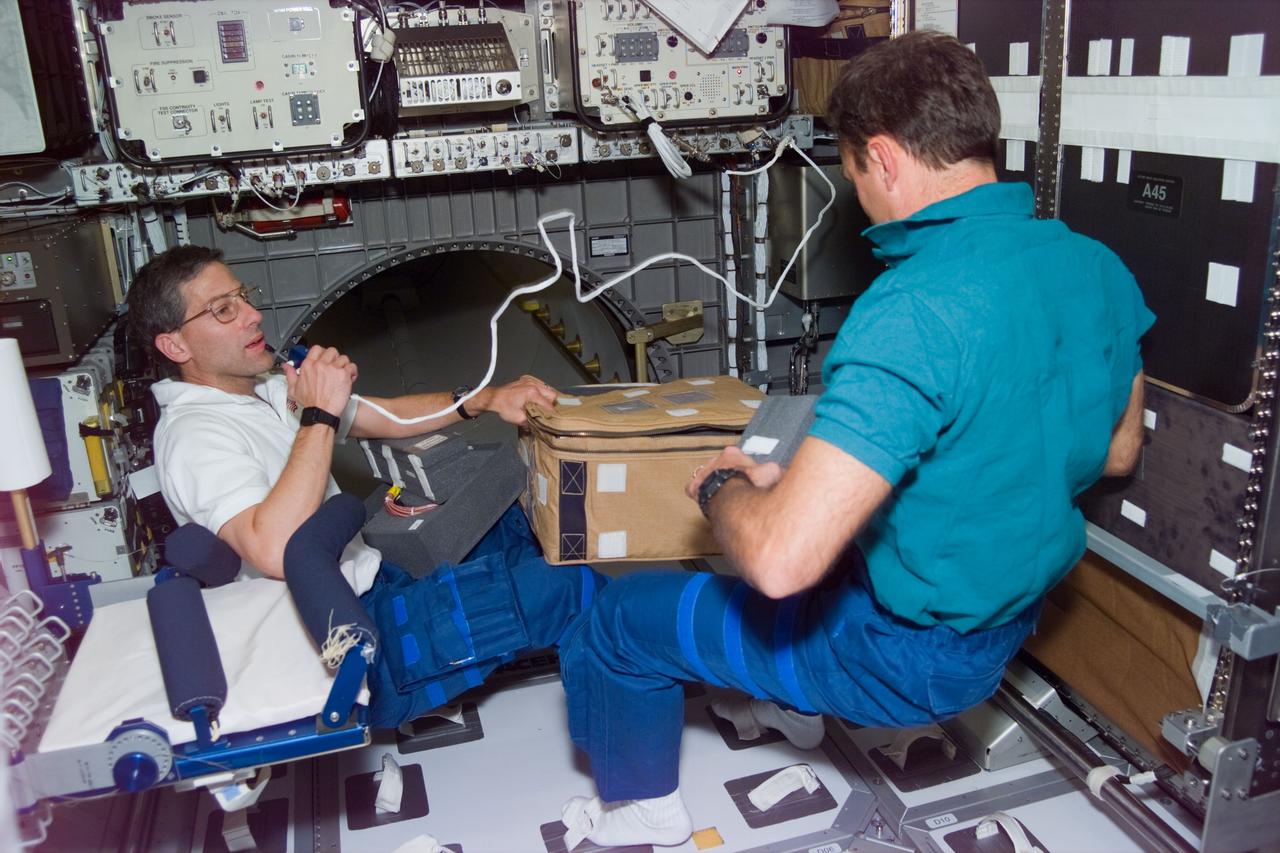
STS79-E-5268 (22 September 1996) --- Astronauts Jerome (Jay) Apt and Thomas D. Akers seal up a transfer stowage bag on the floor at the front end of the Spacehab Module, during Flight Day 7, onboard the Space Shuttle Atlantis.
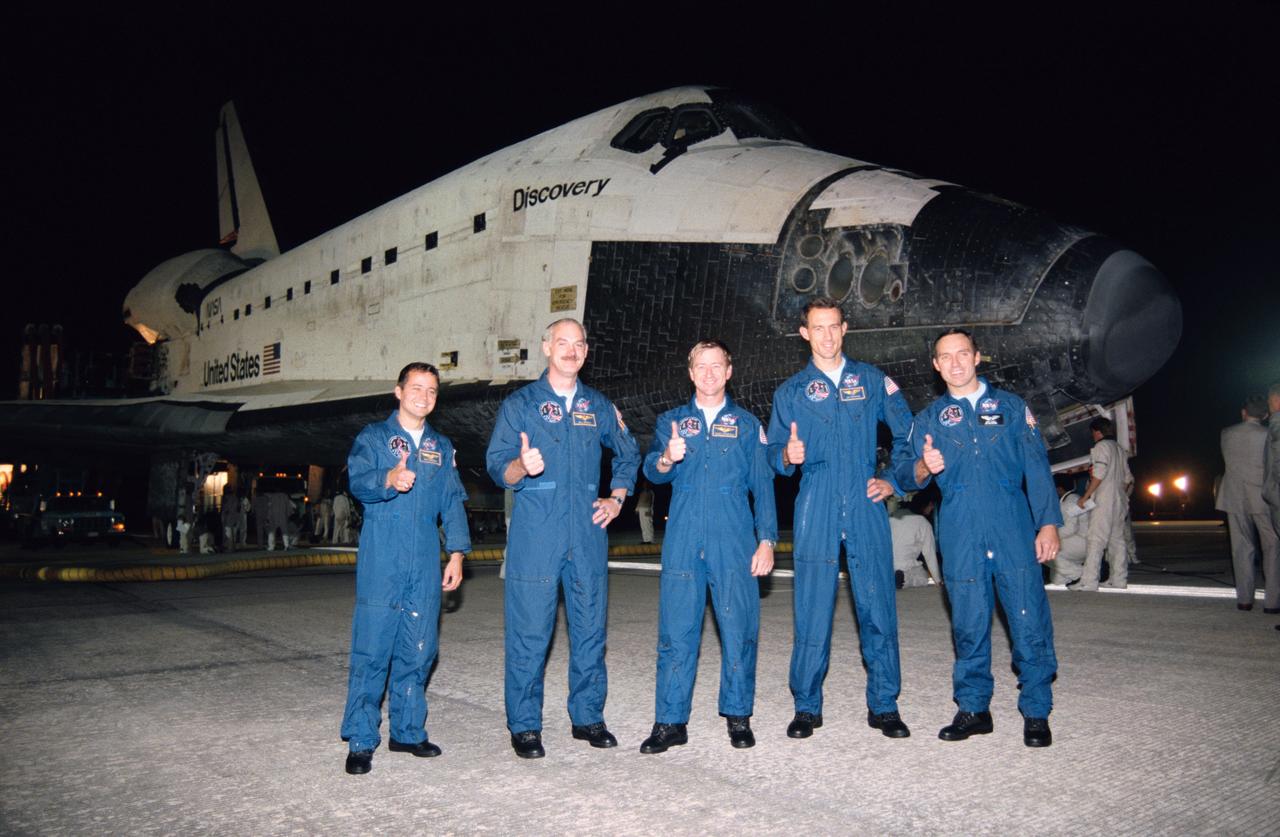
STS051-S-161 (22 Sept 1993) --- Thumbs up from all five crew members signal the successful completion of almost ten full days in space. Backdropped against Discovery -- their in-space "home" for the flight -- are, left to right, astronauts Daniel W. Bursch, William F. Readdy, Frank L. Culbertson Jr., James H. Newman and Carl E. Walz.
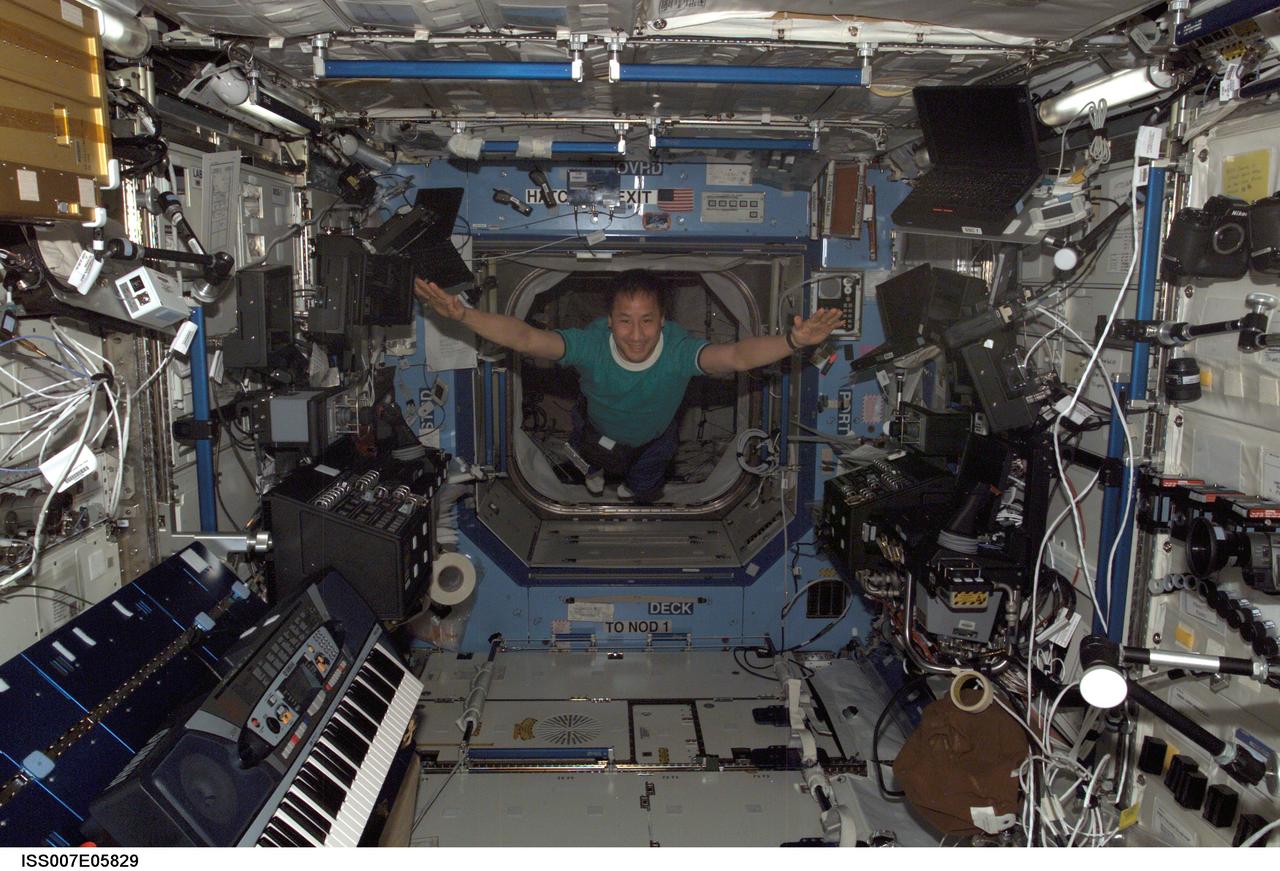
ISS007-E-05829 (22 May 2003) --- Astronaut Edward T. Lu, Expedition Seven NASA ISS science officer and flight engineer, floats in the Destiny laboratory on the International Space Station (ISS). Carl E. Walz, a musician and member of a band made up of NASA astronauts, brought the keyboard (lower left) to the station for his Expedition Four stay aboard the orbital outpost.
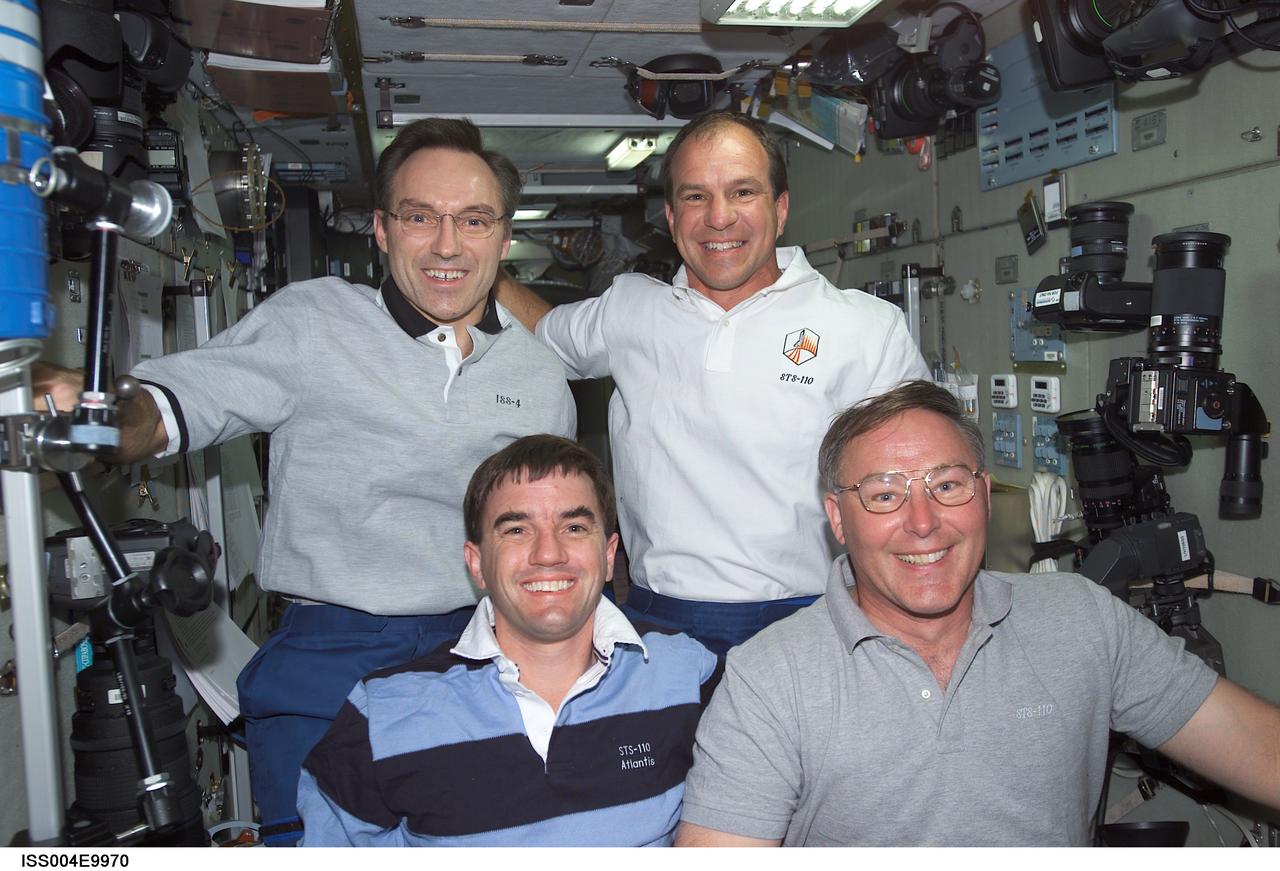
ISS004-E-9970 (10 April 2002) --- Astronauts Rex J. Walheim (bottom left), Jerry L. Ross, both STS-110 mission specialists, Carl E. Walz (top left) and Michael J. Bloomfield, Expedition Four flight engineer and STS-110 mission commander, respectively, gather for a group photo in the Zvezda Service Module on the International Space Station (ISS).
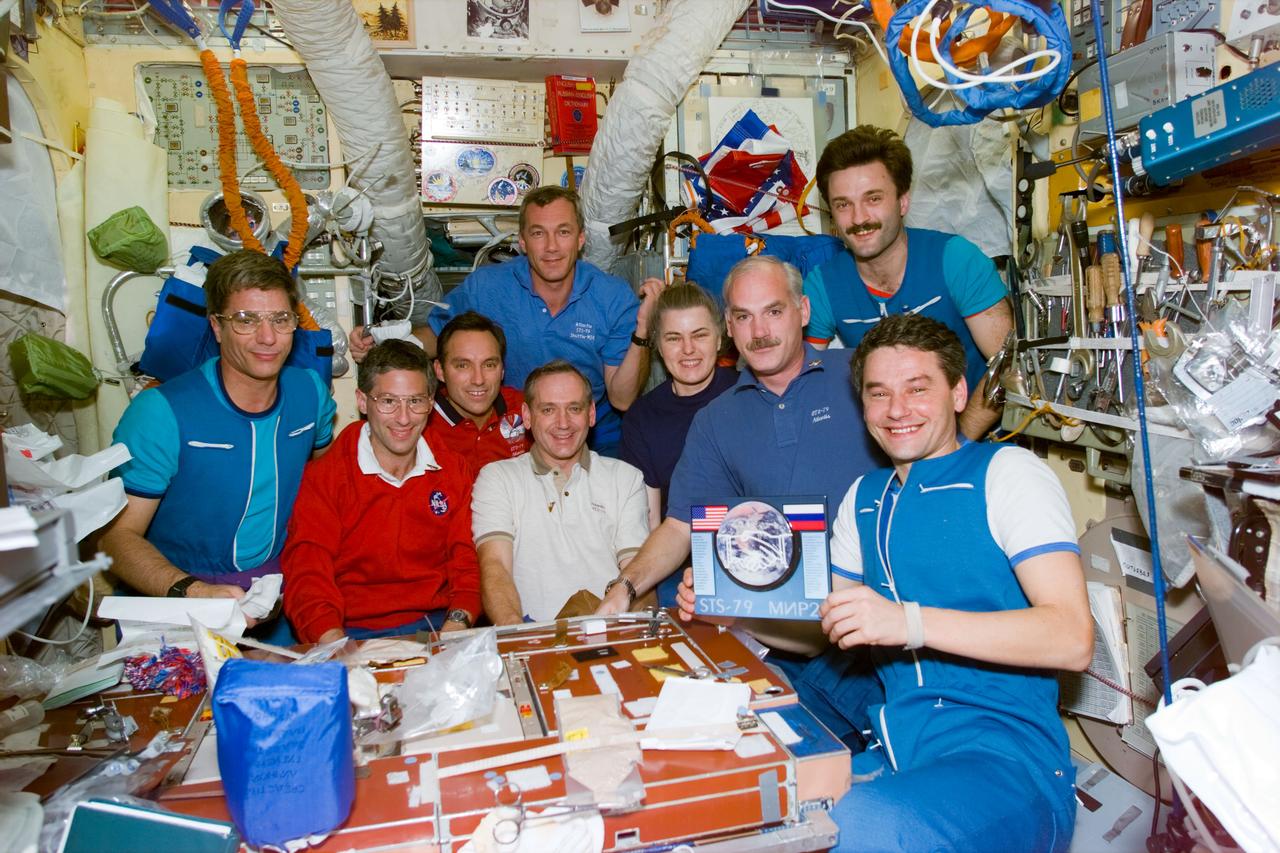
STS79-E-5180 (20 September 1996) --- The entire crews of STS-79 and Mir-22 are shown during a gift exchange ceremony aboard Russia's Mir Space Station's Base Block, during Flight Day 5. Front row, from the left, John E. Blaha, Jerome (Jay) Apt, Carl E. Walz, Thomas D. Akers, Shannon W. Lucid, William F. Readdy and Valeri G. Korzun. Back row: Terrence W. Wilcutt and Aleksandr Y. Kaleri.
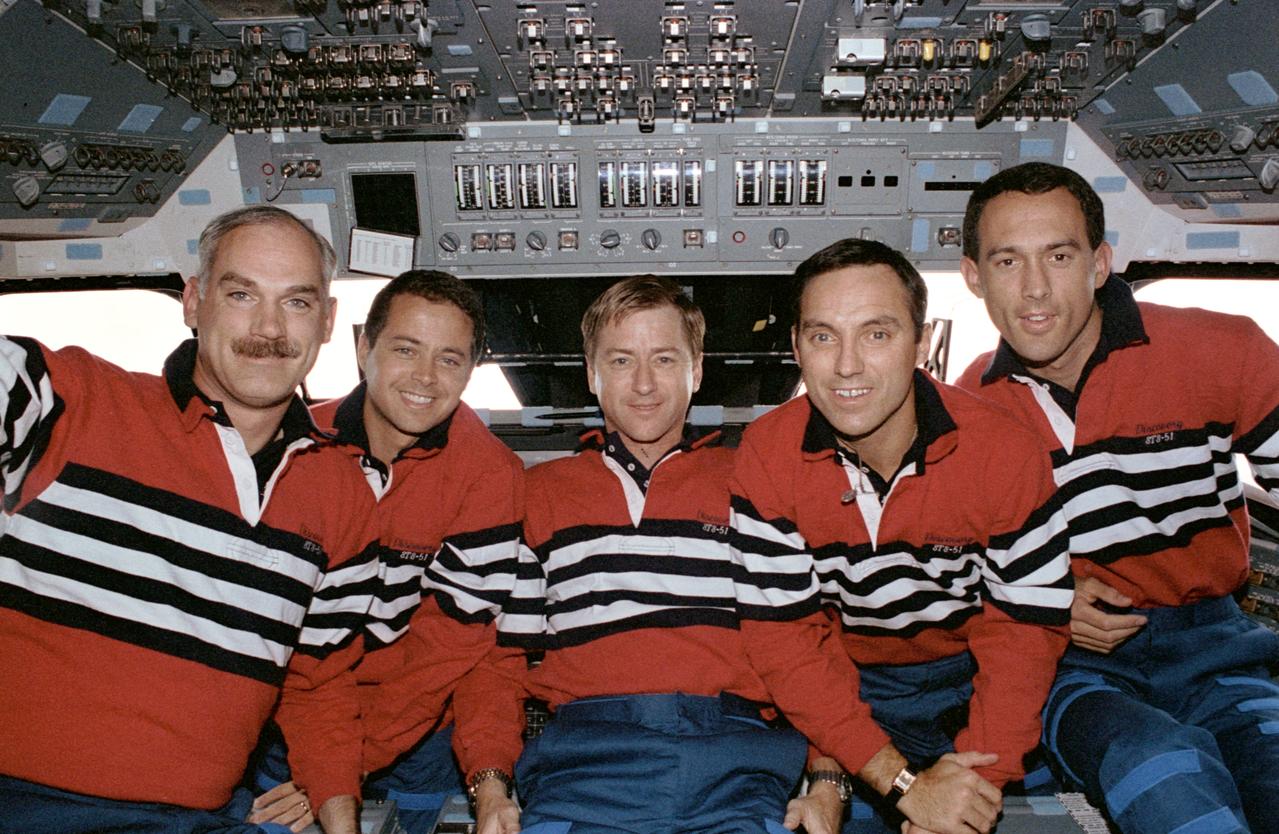
STS051-44-005 (12-22 sept 1993) --- The five crew members pose for the traditional inflight crew portrait on the Space Shuttle Discovery's flight deck. Left to right are astronauts William F. Readdy, Daniel W. Bursch, Frank L. Culbertson, Jr., Carl E. Walz and James H. Newman. Culbertson is mission commander, with Readdy serving as pilot and the others are mission specialists.

JSC2001-E-39085 (18 October 2001) --- Cosmonaut Valeri G. Korzun (left), Expedition Five mission commander, astronaut Peggy A. Whitson, Expedition Five flight engineer, and astronaut Carl E. Walz, Expedition Four flight engineer, use the virtual reality lab at the Johnson Space Center (JSC) to train for their duties on the International Space Station (ISS). This type of computer interface paired with virtual reality training hardware and software helps the entire team for dealing with ISS elements. Korzun represents Rosaviakosmos.
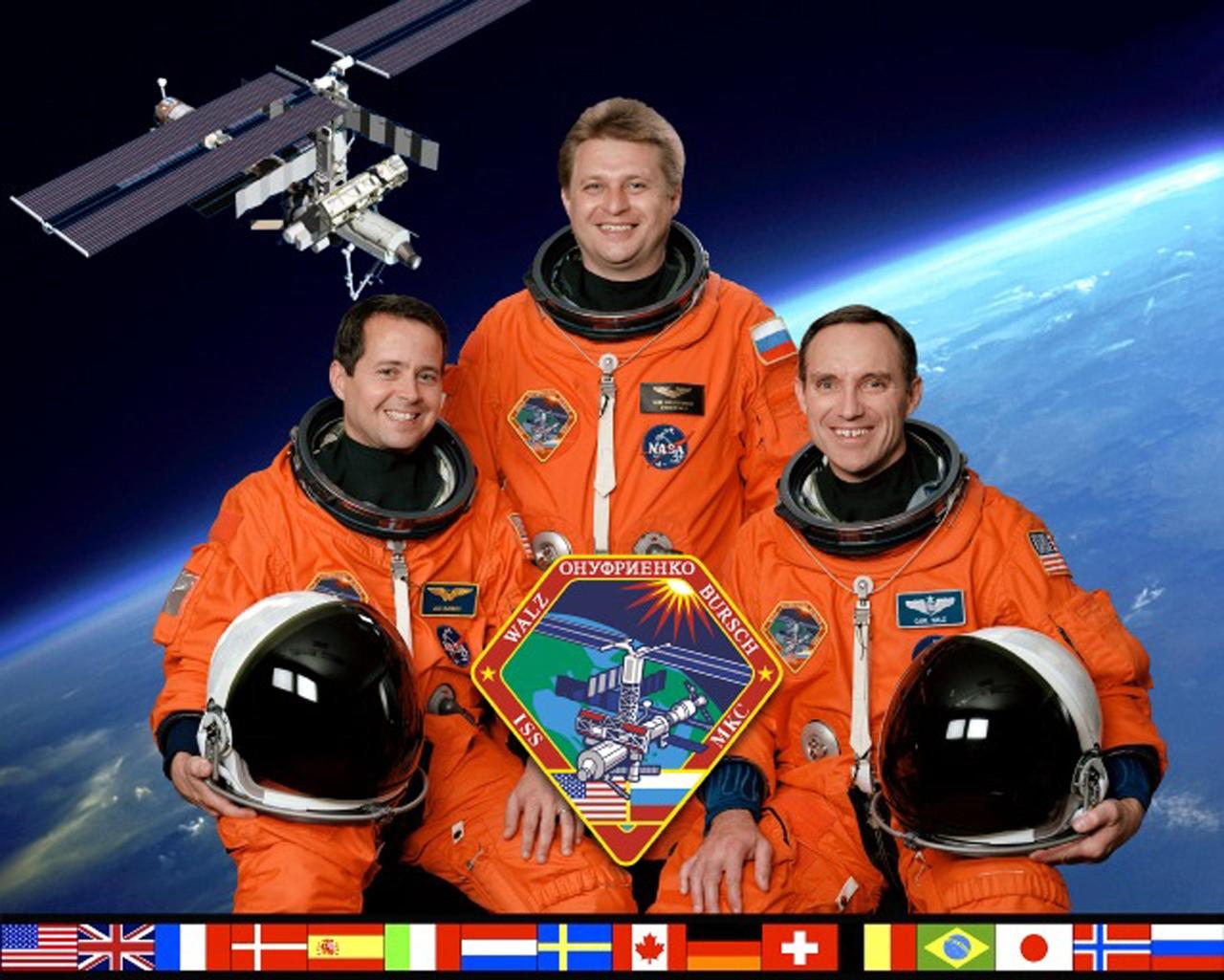
JOHNSON SPACE CENTER, HOUSTON, TEXAS -- EXPEDITION FOUR CREW PORTRAIT -- (ISS04-5-002) -- Expedition Four crew members take a break from training for their scheduled upcoming stay aboard the International Space Station (ISS) to pose for the traditional pre-flight crew portrait. Cosmonaut Yuri I. Onufrienko (standing at center), mission commander, is flanked by astronauts Daniel W. Bursch (left) and Carl E. Walz, both flight engineers. The national flags of the International Partners are at the bottom of the portrait
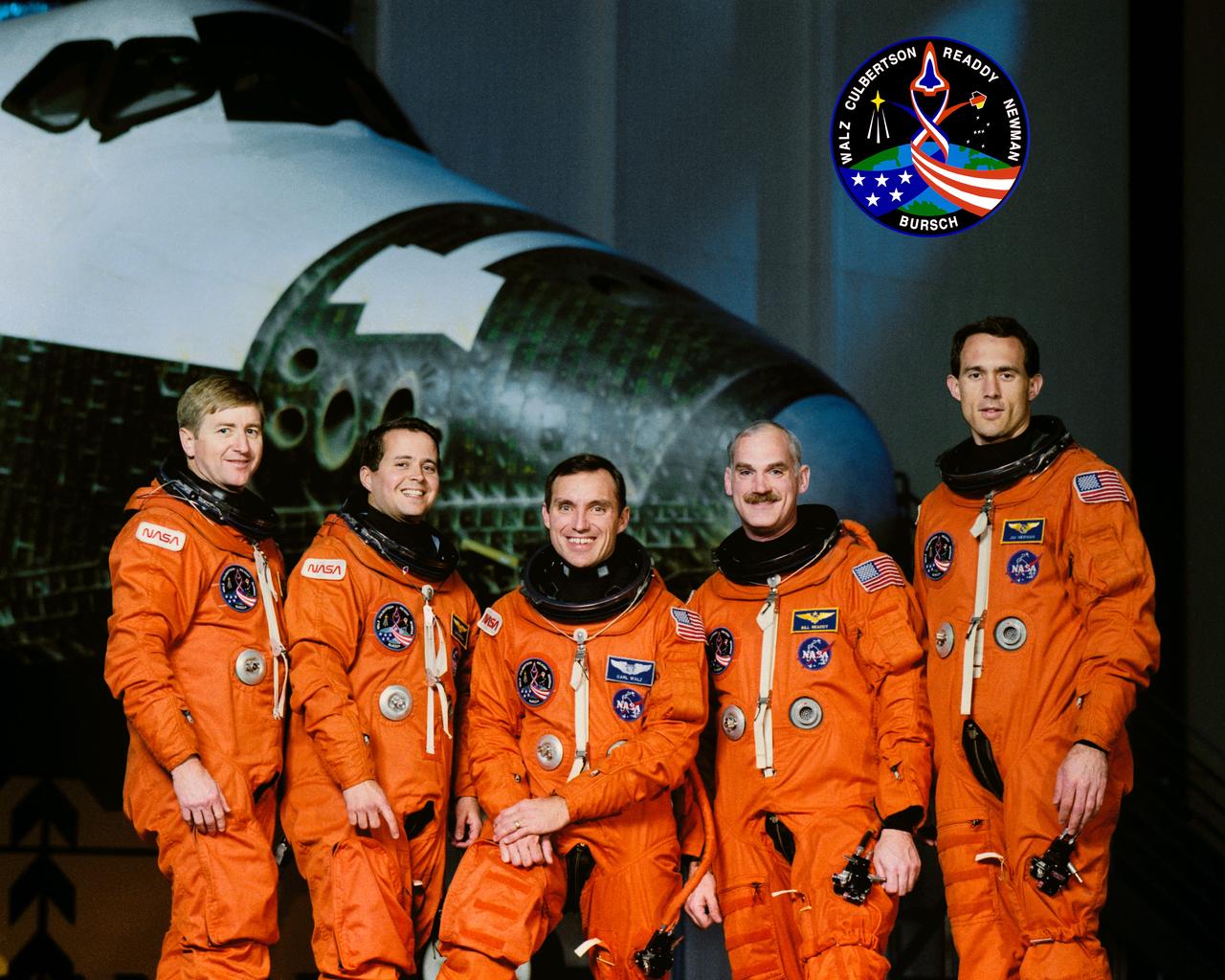
STS051-S-002 (June 1993) --- These five NASA astronauts have been assigned to fly aboard the Space Shuttle Discovery for the STS-51 mission, scheduled for July, 1993. Left to right are astronauts Frank L. Culbertson, Jr., mission commander; Daniel W. Bursch and Carl E. Walz, mission specialists; William F. Readdy, pilot; and James H. Newman, mission specialist.
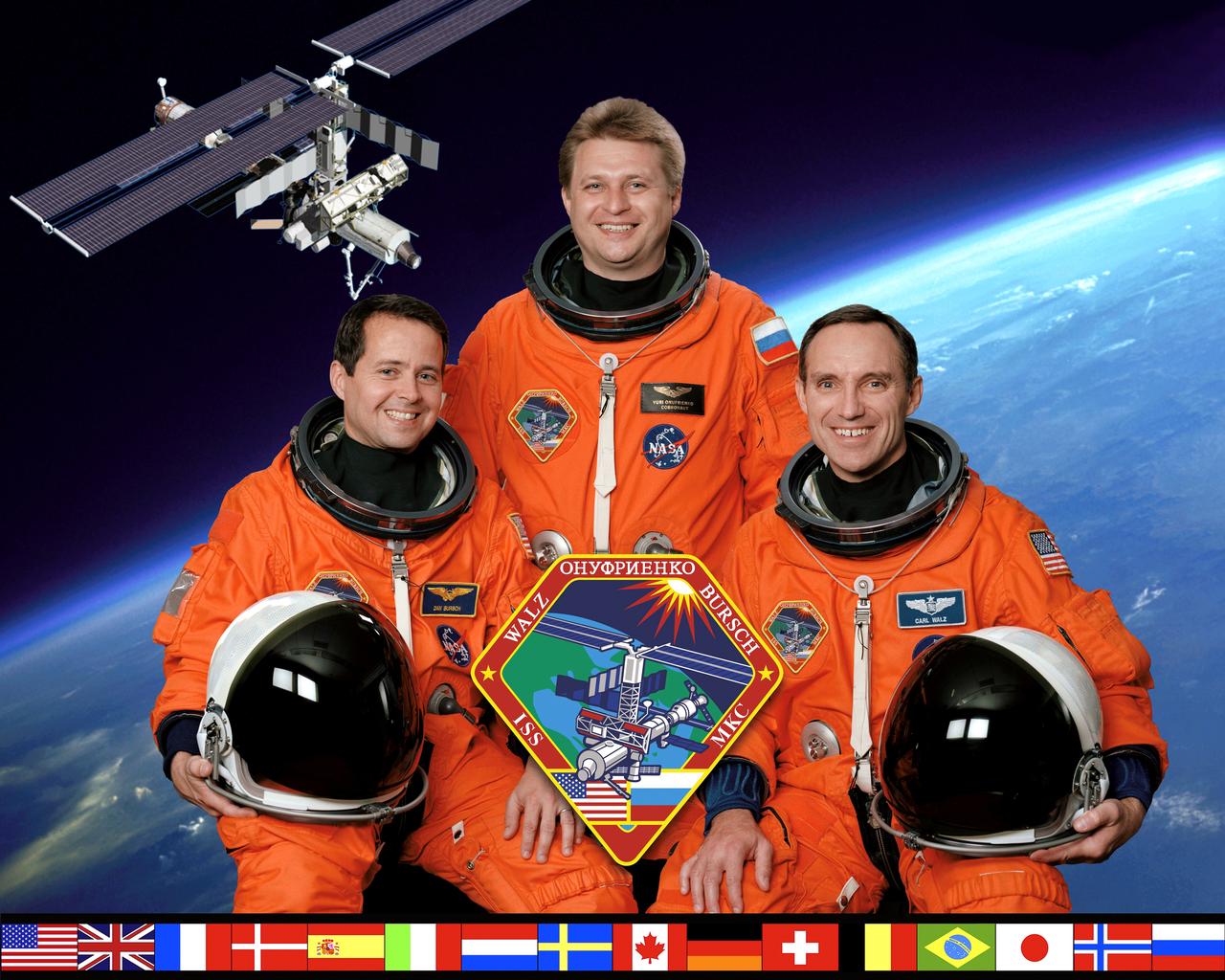
ISS004-S-002 (October 2001) --- Expedition Four crew members take a break from training for their scheduled upcoming stay aboard the International Space Station (ISS) to pose for the traditional pre-flight crew portrait. Cosmonaut Yuri I. Onufrienko (standing at center), mission commander, is flanked by astronauts Daniel W. Bursch (left) and Carl E. Walz, both flight engineers. The national flags of the International Partners are at the bottom of the portrait.
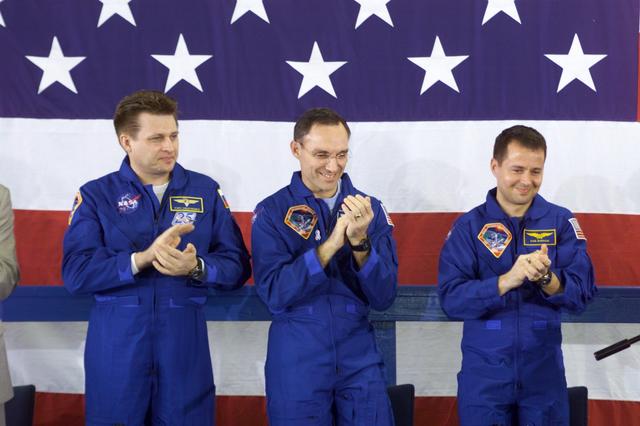
JSC2002-E-26028 (21 June 2002) --- The Expedition Four crewmembers are photographed during the STS-111 and Expedition Four crew return ceremonies in Hangar 990 at Ellington Field. From the left are cosmonaut Yury I. Onufrienko, mission commander representing Rosaviakosmos, astronauts Carl E. Walz and Daniel W. Bursch, both flight engineers.
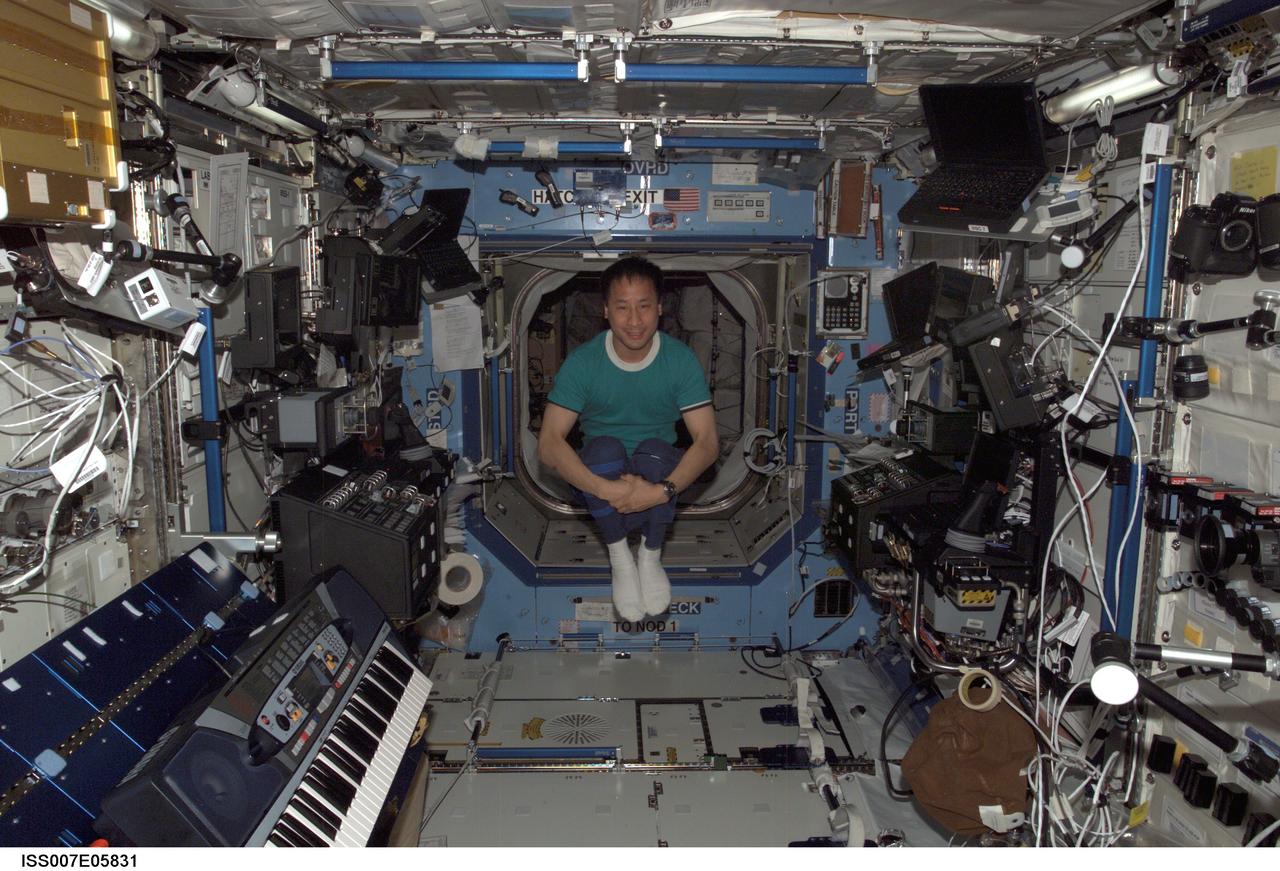
ISS007-E-05831 (22 May 2003) --- Astronaut Edward T. Lu, Expedition Seven NASA ISS science officer and flight engineer, floats in the Destiny laboratory on the International Space Station (ISS). Carl E. Walz, a musician and member of a band made up of NASA astronauts, brought the keyboard (lower left) to the station for his Expedition Four stay aboard the orbital outpost.
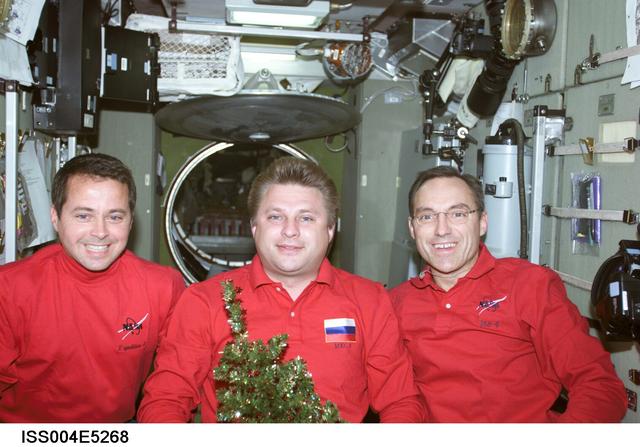
ISS004-E-5268 (December 2001) --- Cosmonaut Yuri I. Onufrienko, Expedition Four mission commander, flanked by astronauts Daniel W. Bursch (left) and Carl E. Walz, both flight engineers, pose for an informal holiday crew photo in the Zvezda Service Module on the International Space Station (ISS). Onufrienko represents Rosaviakosmos. The image was taken with a digital still camera.
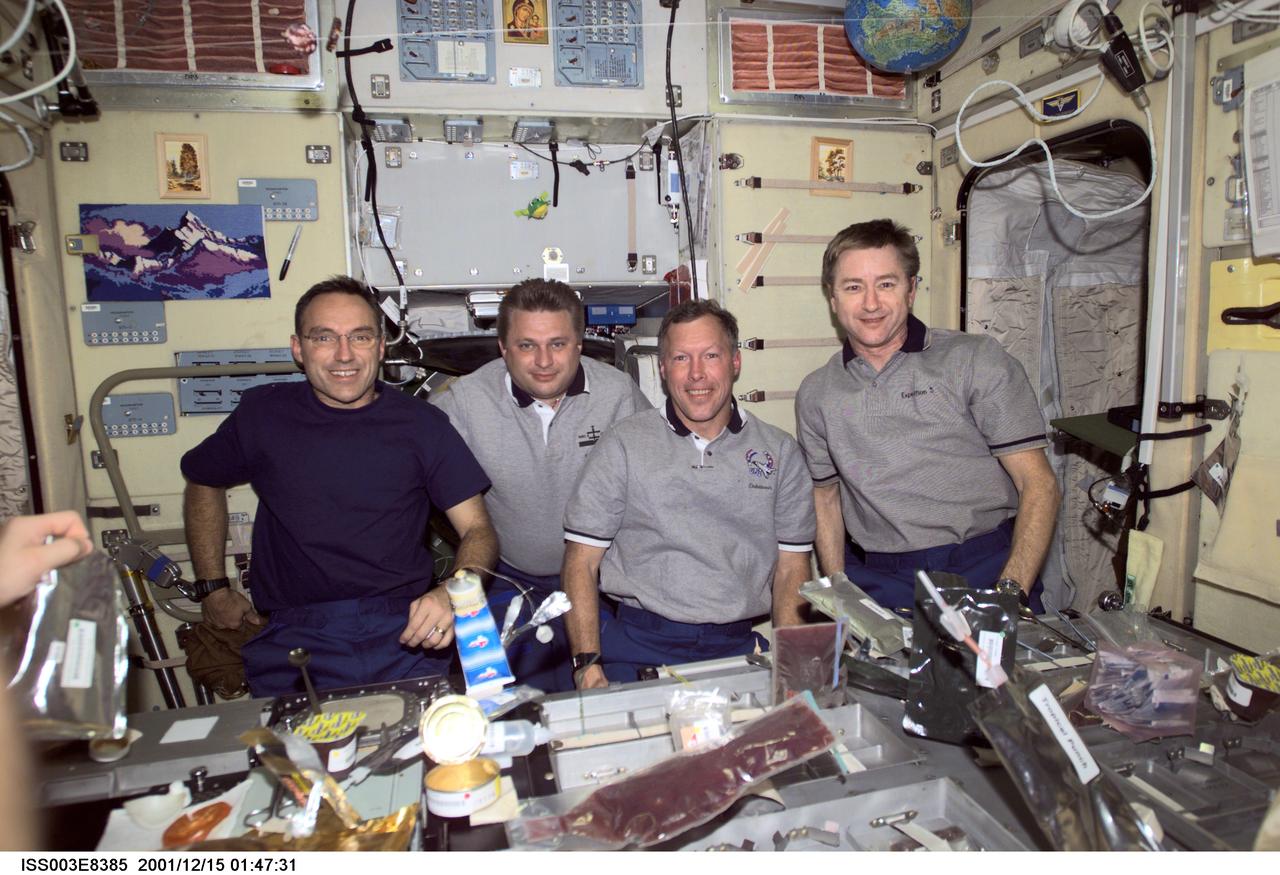
ISS003-E-8385 (15 December 2001) --- Astronaut Carl E. Walz (left), Expedition Four flight engineer; cosmonaut Yuri I. Onufrienko, Expedition Four mission commander; along with astronauts Dominic L. Gorie, STS-108 mission commander, and Frank L. Culbertson, Jr., Expedition Three mission commander, pose for a group photo in the Zvezda Service Module on the International Space Station (ISS). Various food items are visible in the foreground. The image was taken with a digital still camera.
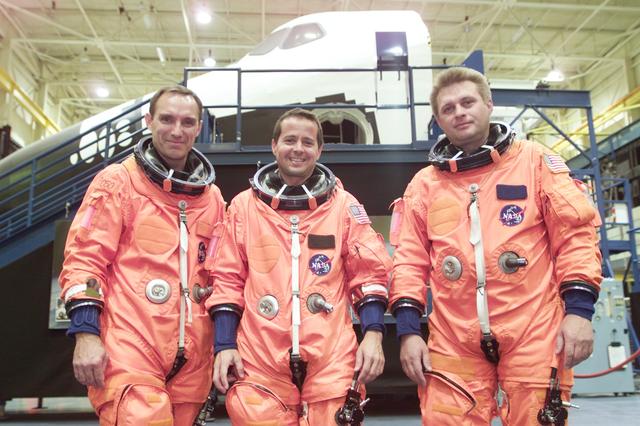
JSC2000-E-23342 (26 September 2000) --- Astronauts Carl E. Walz (left) and Daniel W. Bursch, both Expedition Four flight engineers, and cosmonaut Yuri I. Onufrienko, mission commander, pause for an informal crew portrait prior to a mission training session in the Space Vehicle Mockup Facility at the Johnson Space Center (JSC). The crew members are attired in training versions of the shuttle launch and entry garment. Onufrienko represents Rosaviakosmos.
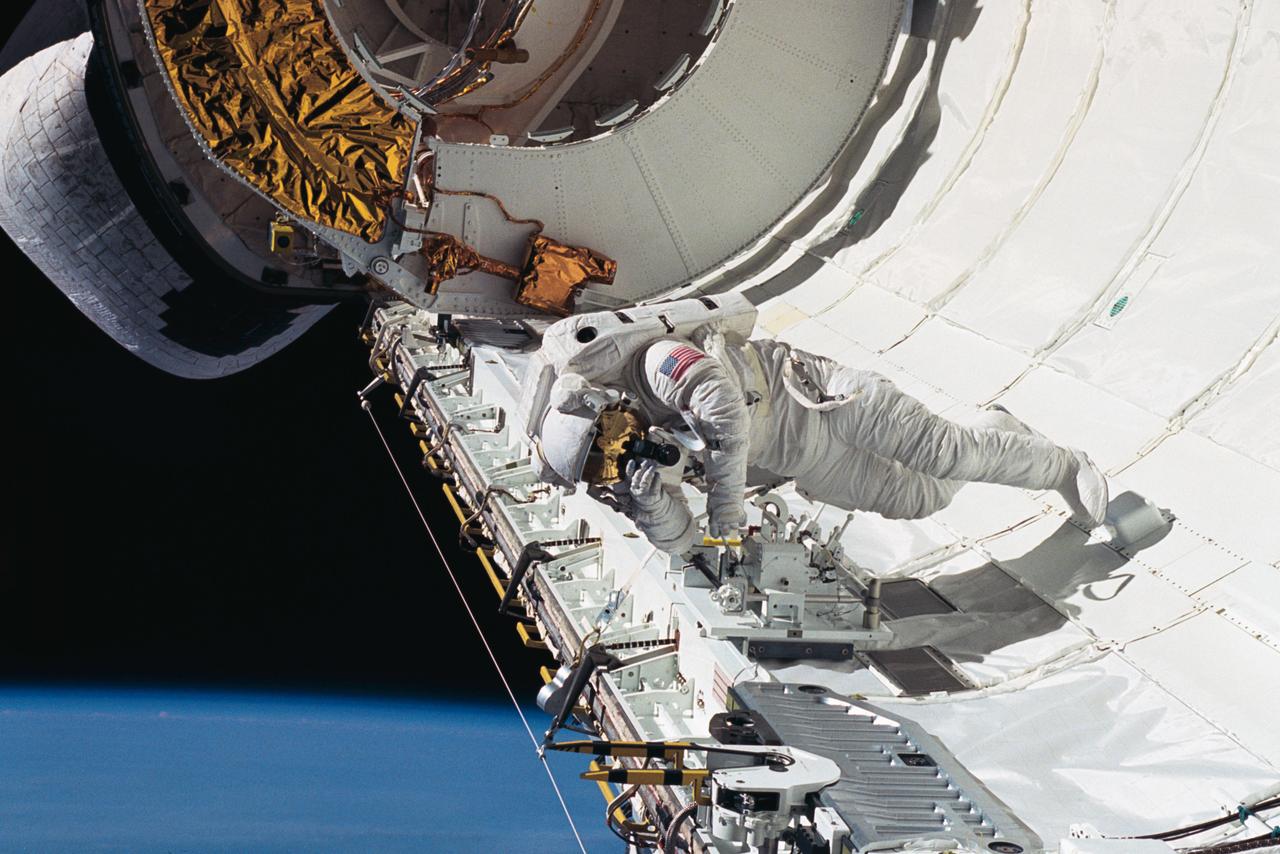
Astronaut James H. Newman, mission specialist, uses a 35mm camera to take a picture of fellow astronaut Carl E. Walz (out of frame) in Discovery's cargo bay. The two were engaged in an extravehicular activity (EVA) to test equipment to be used on future EVA's. Newman is tethered to the starboard side, with the orbital maneuvering system (OMS) pod just behind him.
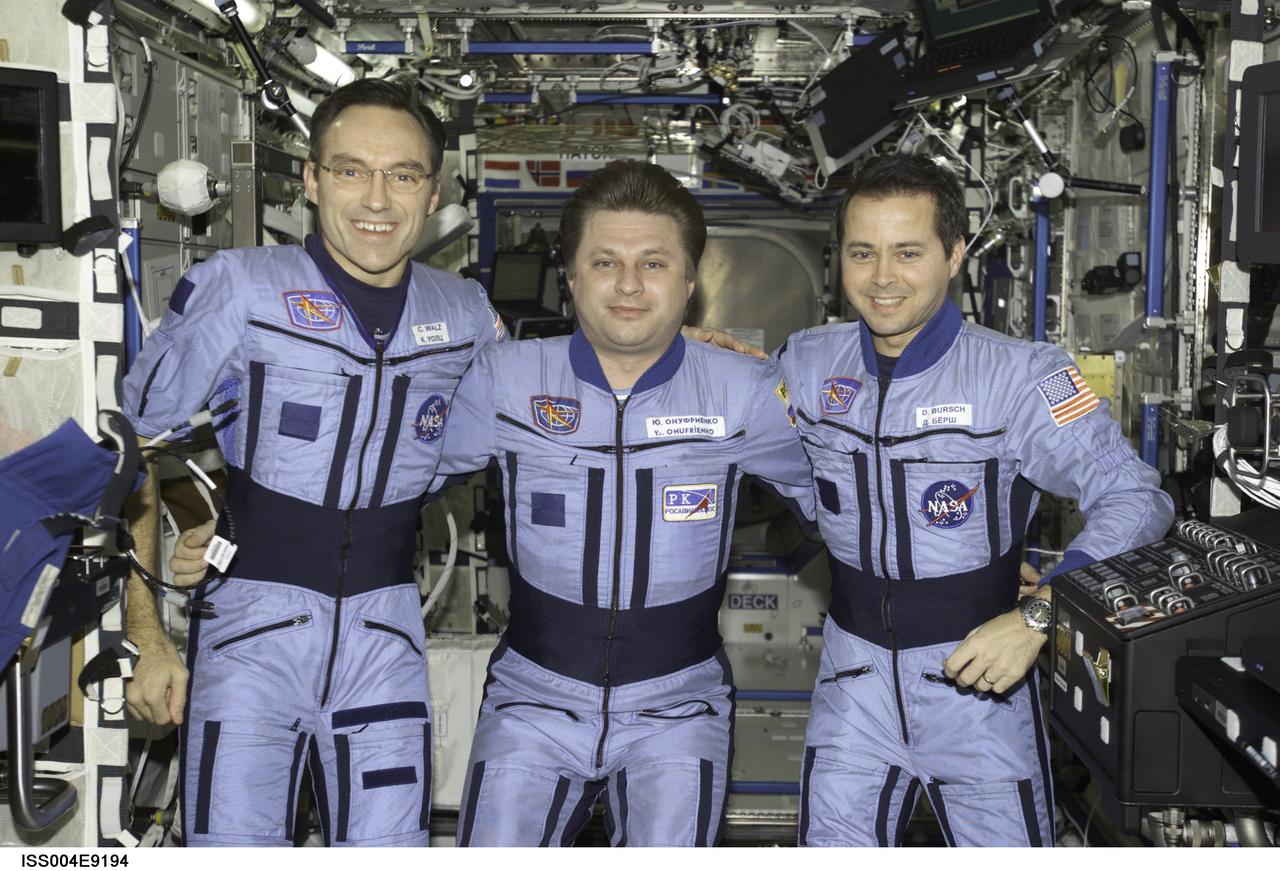
ISS004-E-9194 (23 March 2002) --- The Expedition Four crewmembers pose for an informal crew photo in the Destiny laboratory on the International Space Station (ISS). From the left are astronaut Carl E. Walz, flight engineer, cosmonaut Yury I. Onufrienko, mission commander, and astronaut Daniel W. Bursch, flight engineer. Onufrienko represents Rosaviakosmos. The image was taken with a digital still camera.
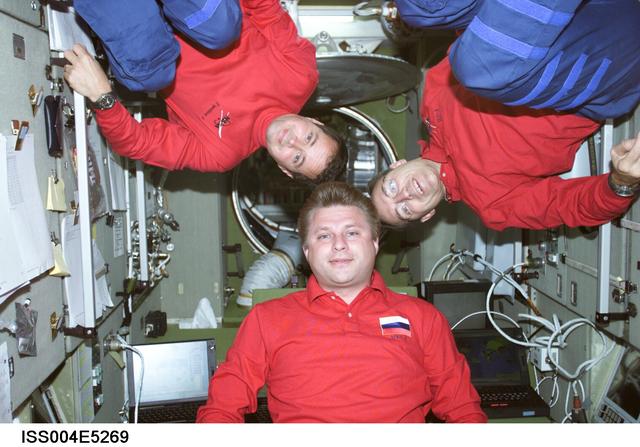
ISS004-E-5269 (December 2001) --- Cosmonaut Yuri I. Onufrienko, Expedition Four mission commander, flanked by astronauts Daniel W. Bursch (left) and Carl E. Walz, both flight engineers, pose for an informal crew photo in the Zvezda Service Module on the International Space Station (ISS). Onufrienko represents Rosaviakosmos. The image was taken with a digital still camera.
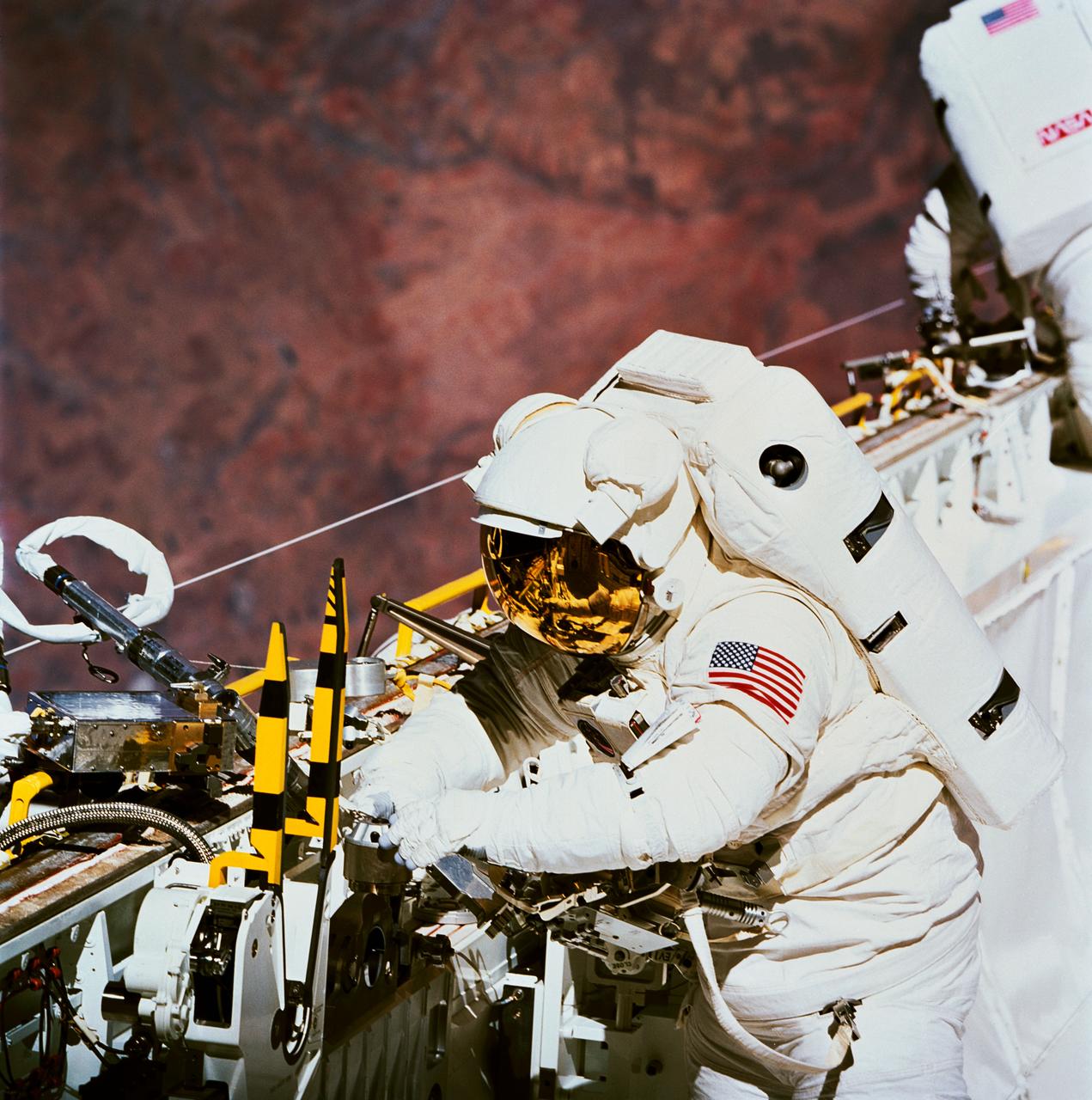
In Discovery's cargo bay, astronaut James H. Newman works with the power ratchet tool (PRT). Astronaut Carl E. Walz, who joined Newman for the lengthy period of extravehicular activity (EVA), is partially visible in the background. The two mission specialists devoted part of their EVA to evaluating tools and equipment expected to be used in the Hubble Space Telescope servicing. A desert area in Africa forms the backdrop for the 70mm scene.
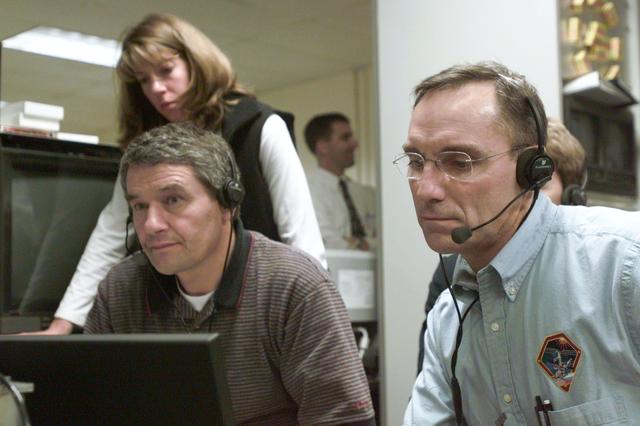
JSC2001-E-39082 (18 October 2001) --- Cosmonaut Valeri G. Korzun (left), Expedition Five mission commander, and astronaut Carl E. Walz, Expedition Four flight engineer, use the virtual reality lab at the Johnson Space Center (JSC) to train for their duties on the International Space Station (ISS). This type of computer interface paired with virtual reality training hardware and software helps the entire team for dealing with ISS elements. Korzun represents Rosaviakosmos.
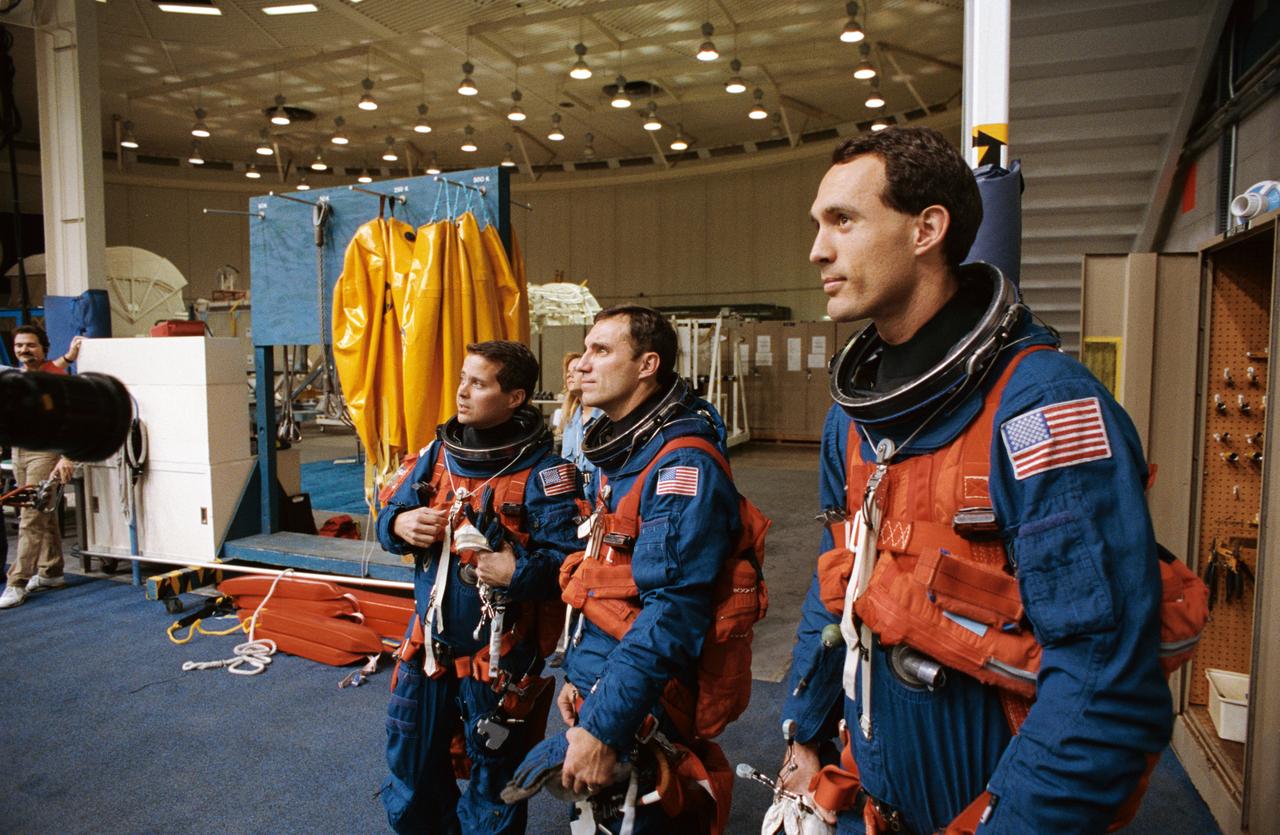
S93-31929 (24 March 1993) --- The three mission specialists for NASA's STS-51 mission watch as a crewmate (out of frame) simulates a parachute jump into water during emergency bailout training exercises at the Johnson Space Center's Weightless Environment Training Facility (WET-F). Left to right are astronauts Daniel W. Bursch, Carl E. Walz and James H. Newman. Out of frame are astronauts Frank L. Culbertson and William F. Readdy, commander and pilot, respectively.
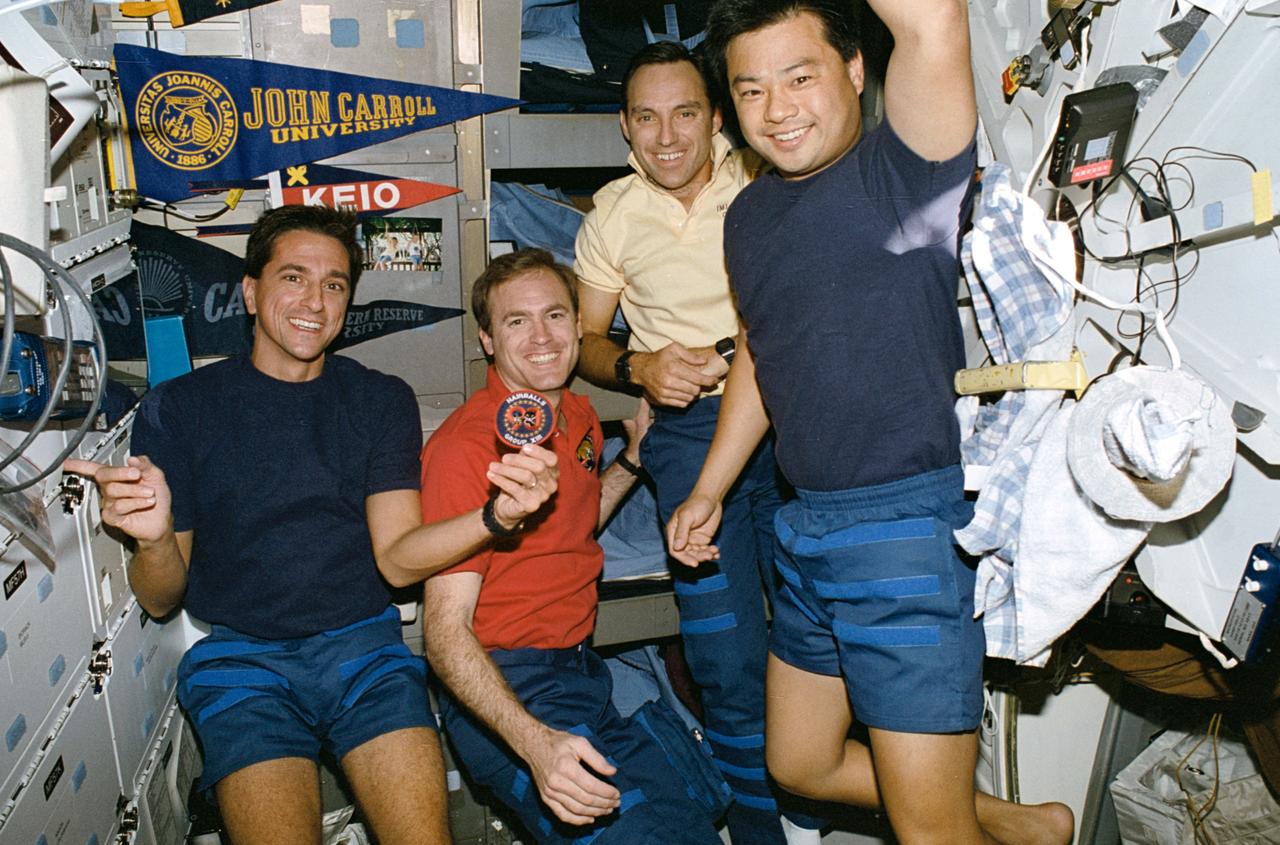
STS065-18-022 (8-23 July 1994) --- During off-duty time on the Space Shuttle Columbia's mid-deck, four members of the crew, from the 1990 (thirteenth) astronaut class, display their group's insignia. The "hairballs" pictured, (left to right) are astronauts Donald A. Thomas, James D. Halsell, Jr., Carl E. Walz and Leroy Chiao.
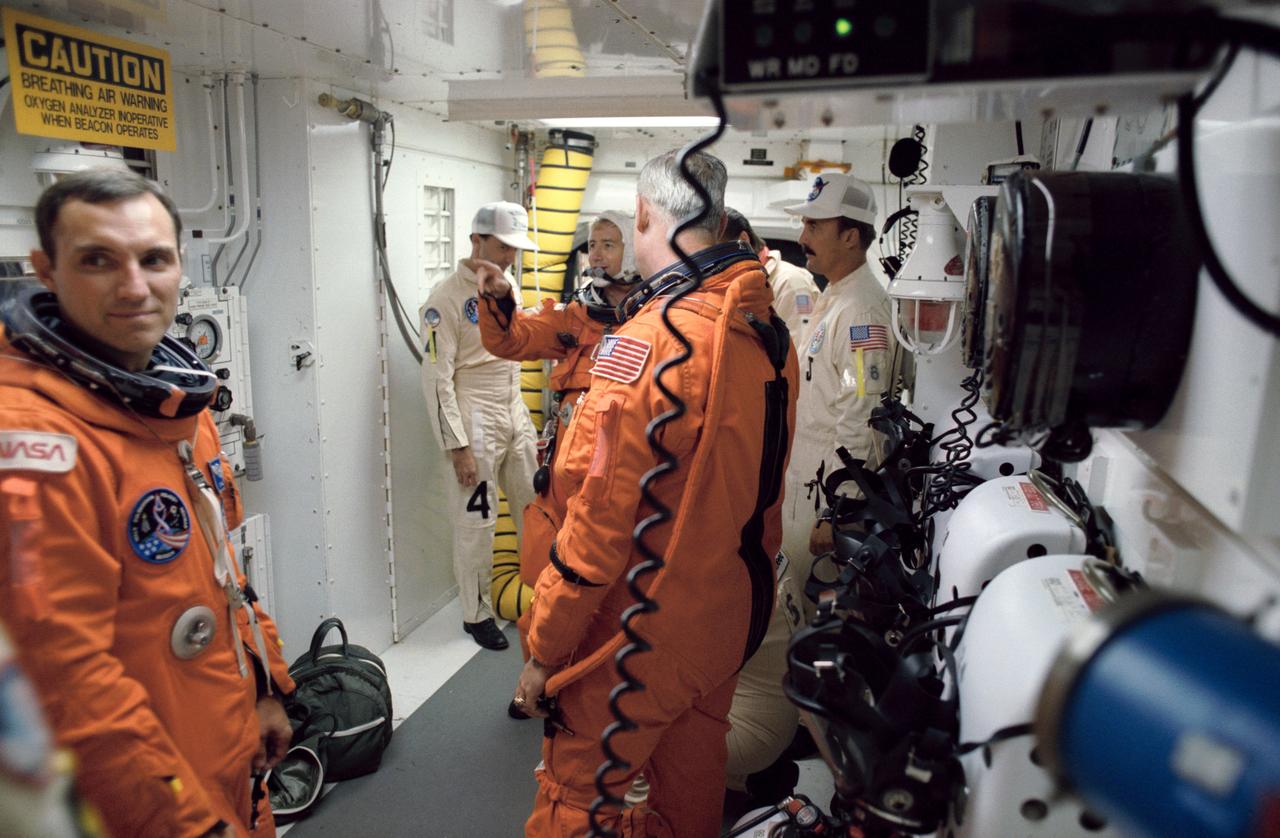
STS051-S-109 (12 Sept 1993) --- Inside the White Room, three astronaut crew members for the STS-51 flight await their queues to ingress the Space Shuttle Discovery. Wearing the partial pressure launch and entry suits are, left to right, Carl E. Walz, mission specialist; Frank L. Culbertson Jr., mission commander; and William F. Readdy, pilot. Not pictured are astronauts James H. Newman and Daniel W. Bursch. Launch occurred at 7:45 a.m. (EDT), September 12, 1993.
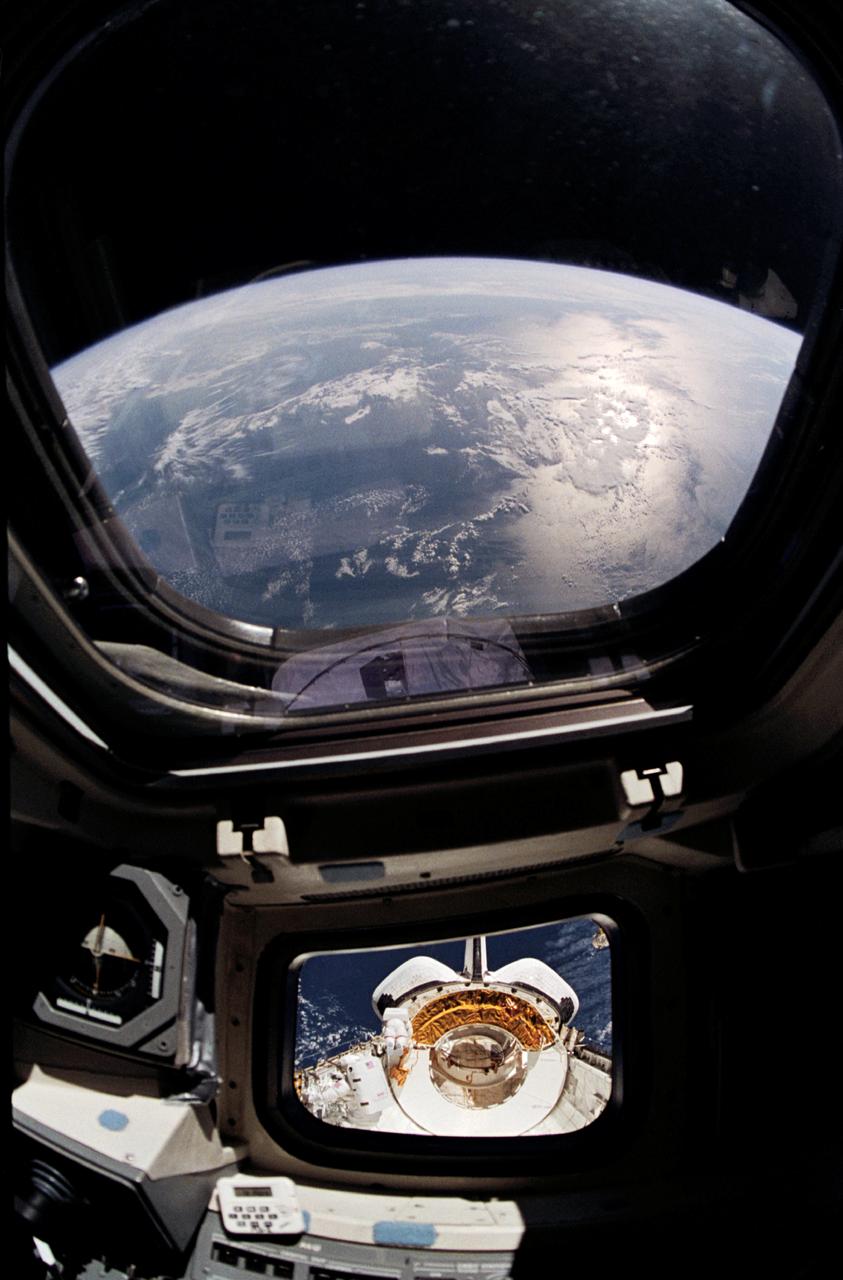
STS051-34-028 (16 Sept. 1993) --- This unusual scene of Extravehicular Activity (EVA) was captured on 35mm film by one of the supportive in-cabin crew members. Astronaut James H. Newman, working on the Space Shuttle Discovery's starboard side, is nearer the camera, with astronaut Carl E. Walz traversing near the aft firewall and the Airborne Support Equipment (ASE).
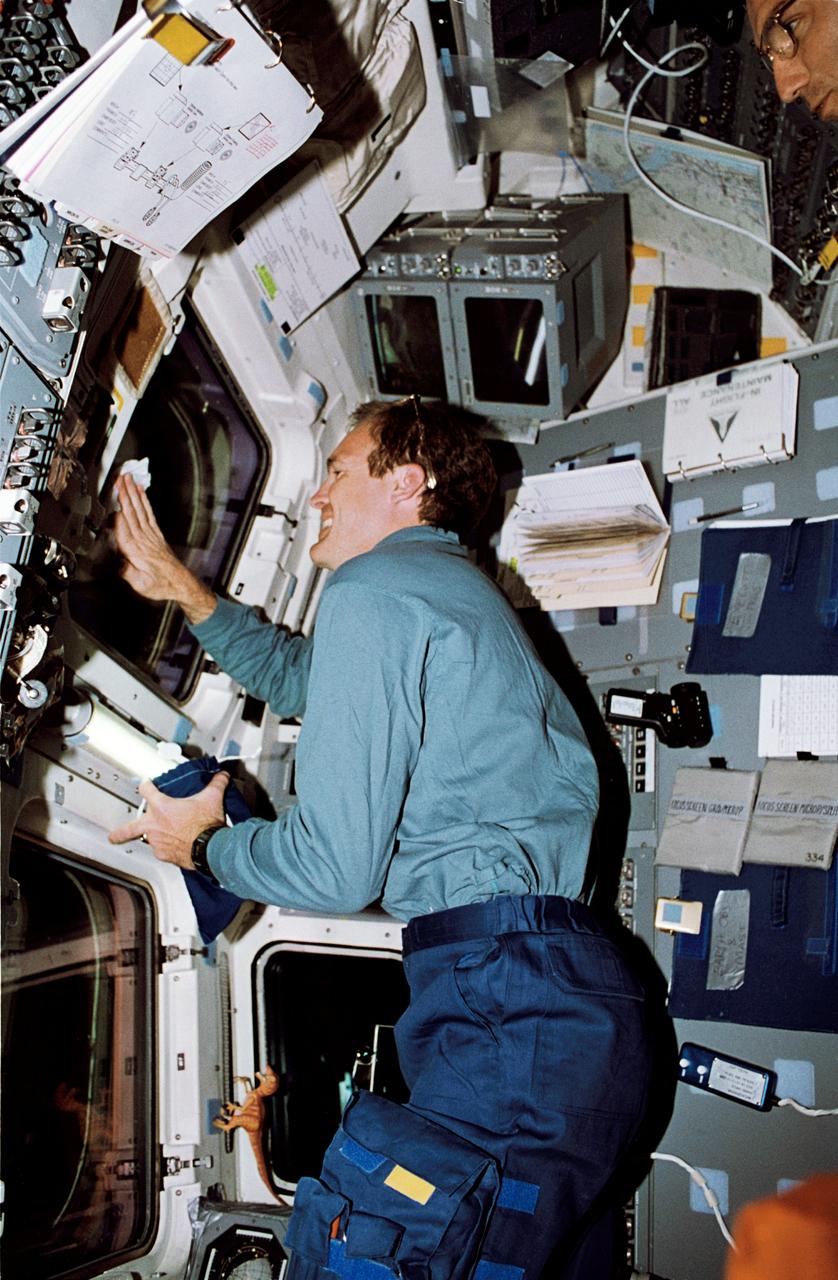
STS065-52-034 (8-23 July 1994) --- On the Space Shuttle Columbia's aft flight deck, astronaut James D. Halsel,l Jr., pilot, cleans off one of the overhead windows. Astronaut Carl E. Walz, mission specialist, looks on (photo's edge). The two shared over fourteen days in Earth-orbit with four other NASA astronauts and a Japanese payload specialist in support of the second International Microgravity Laboratory (IML-2) mission.

JOHNSON SPACE CENTER, HOUSTON, TEXAS -- (STS108-5-002)STS-108 CREW PORTRAIT -- These seven astronauts and three cosmonauts share the common denominators of the Space Shuttle Endeavour and the International Space Station (ISS). Standing at rear (from the left) are STS-108 crew members Daniel M. Tani and Linda M. Godwin, both mission specialists; Dominic L. Gorie and Mark E. Kelly, commander and pilot, respectively. Those four will spend approximately ten days in space in late November and early December aboard the Endeavour. In front, from the left, are Daniel W. Bursch, Yuri Onufrienko, Carl E. Walz, Mikhail Tyurin, Frank L. Culbertson and Vladimir N. Dezhurov. Culbertson, Expedition Three commander, as well as flight engineers Tyurin and Dezhurov, will use the Space Shuttle Discovery on STS-105 to reach the station for a lengthy stay and then return to Earth aboard Endeavour. They will be replaced aboard the orbital outpost by Onufrienko, Expedition Four commander, along with Bursch and Walz, both flight engineers. The Expedition Four crew will accompany the STS-108 crew into Earth orbit. Dezhurov, Tyurin and Onufrienko represent Rosaviakosmos
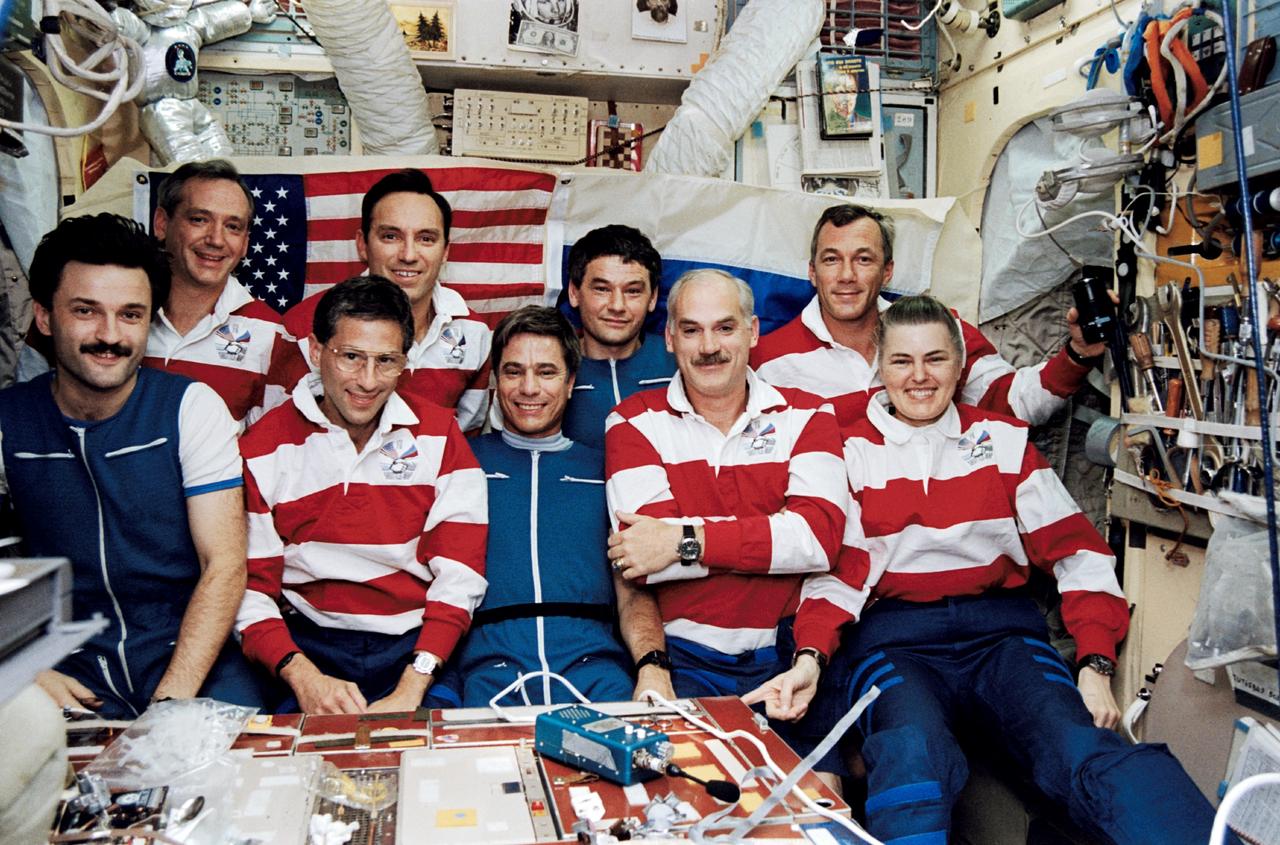
STS079-349-022 (16-26 Sept. 1996) --- The traditional inflight crew portrait, taken in Russia's Mir Space Station base block. Front row, left to right, Aleksandr Y. Kaleri, Jerome (Jay) Apt, John E. Blaha, William F. Readdy and Shannon W. Lucid. Back row, left to right, Thomas D. Akers, Carl E. Walz, Valeri G. Korzun and Terrence W. Wilcutt. This photograph is one of fifteen 35mm frames (along with four 70mm frames) of still photography documenting the activities of NASA's STS-79 mission, which began with a September 16, 1996, liftoff from Launch Pad 39A the Kennedy Space Center (KSC) and ended with a landing at KSC on September 26, 1996. Onboard for the launch were astronauts Readdy, commander; Wilcutt, pilot; Blaha, Apt, Akers and Walz, all mission specialists. On flight day 4, the crew docked with the Mir Space Station. Lucid, who had spent six months aboard Mir, switched cosmonaut guest researcher roles with Blaha. The latter joined fellow Mir-22 crewmembers Korzun, commander, and Kaleri, flight engineer.
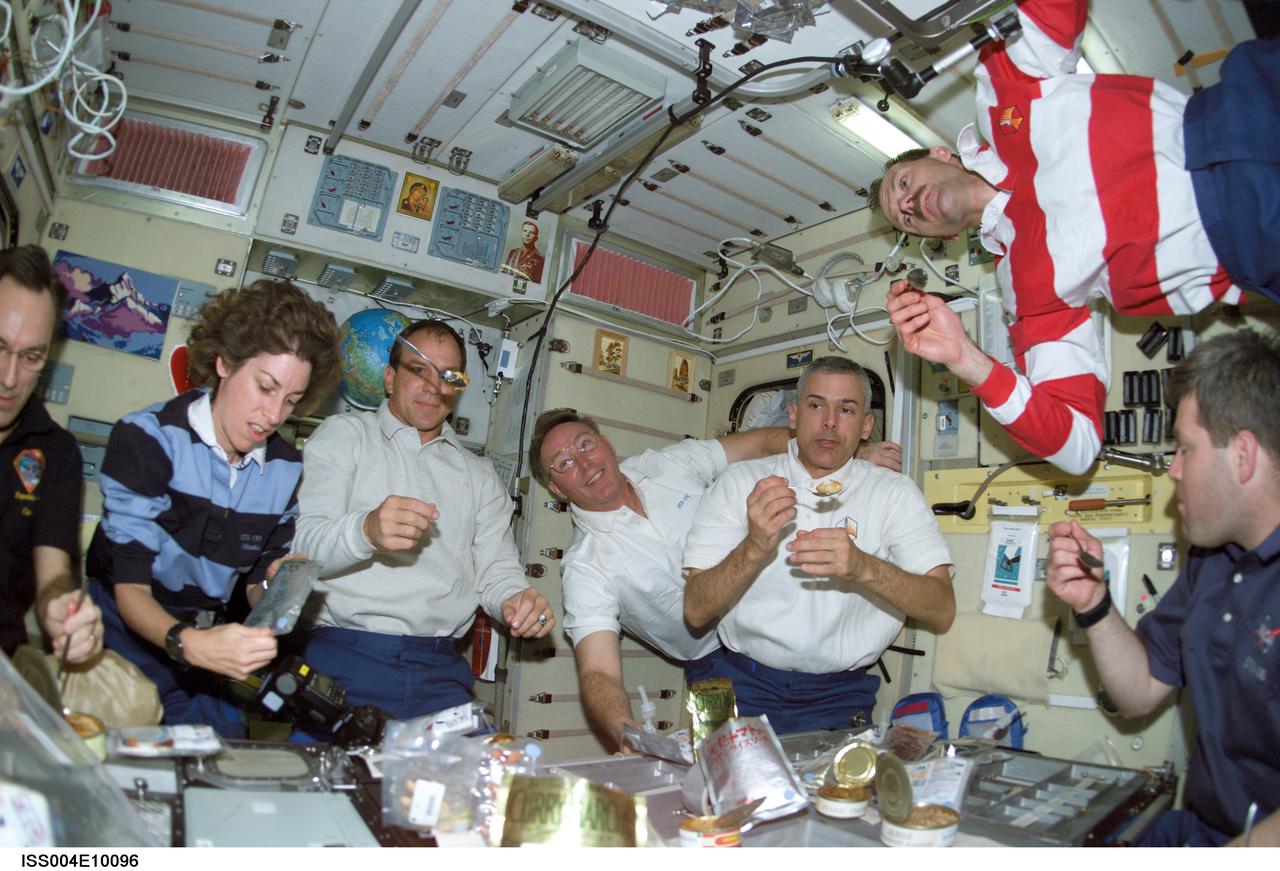
ISS004-E-10096 (16 April 2002) --- The Expedition Four and STS-110 crewmembers share a meal in the Zvezda Service Module on the International Space Station (ISS). From the left are astronauts Carl E. Walz (partially out of frame), Expedition Four flight engineer; Ellen Ochoa, STS-110 mission specialist; Michael J. Bloomfield, STS-110 mission commander; Jerry L. Ross, Lee M. E. Morin, Steven L. Smith, all STS-110 mission specialists; and Stephen N. Frick, STS-110 pilot. The remainders of the crews were out of frame.
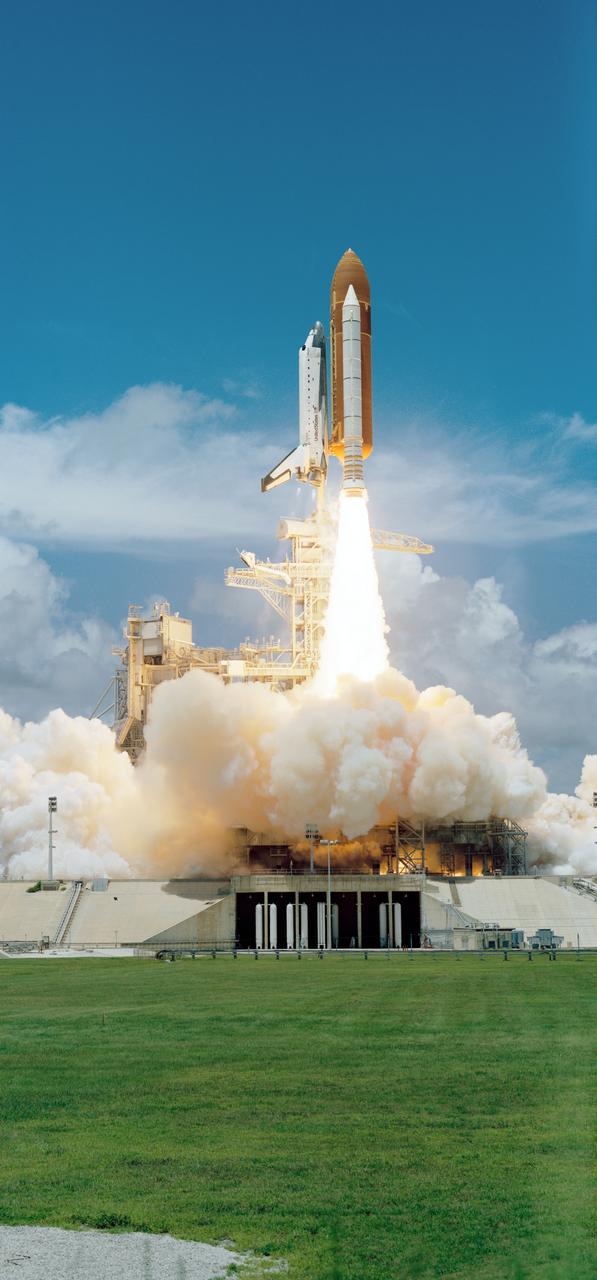
STS065-S-048 (8 July 1994) --- The Space Shuttle Columbia, with six NASA astronauts and a Japanese payload specialist aboard, heads toward Earth-orbit. A short time later, the crew began setting up the science module for two weeks of experimentation in support of the second International Microgravity Laboratory (IML-2). Launch occurred at 12:43 p.m. (EDT), July 8, 1994. Onboard were astronauts Robert D. Cabana, James D. Halsell, Jr., Richard J. Hieb, Carl E. Walz, Leroy Chiao, and Donald A. Thomas along with NASDA payload specialist Dr. Chiaki Mukai.
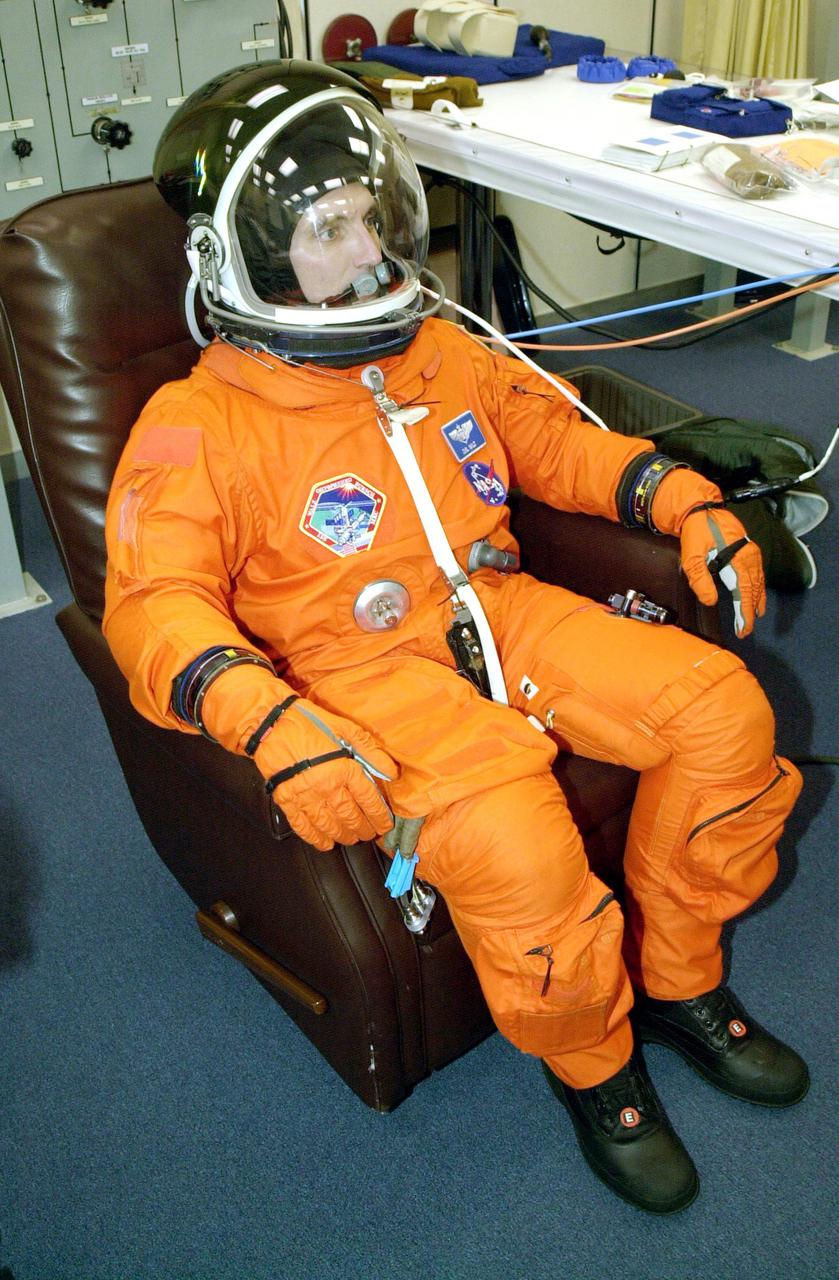
KENNEDY SPACE CENTER, Fla. -- Expedition 4 crew member Carl E. Walz undergoes final suit check before launch on mission STS-108 Nov. 29. Top priorities for the STS-108 (UF-1) mission of Endeavour are rotation of the International Space Station Expedition Three and Expedition Four crews; bringing water, equipment and supplies to the station in the Multi-Purpose Logistics Module Raffaello; and completion of robotics tasks and a spacewalk to install thermal blankets over two pieces of equipment at the bases of the Space Station's solar wings. Liftoff is scheduled for 7:41 p.m. EST
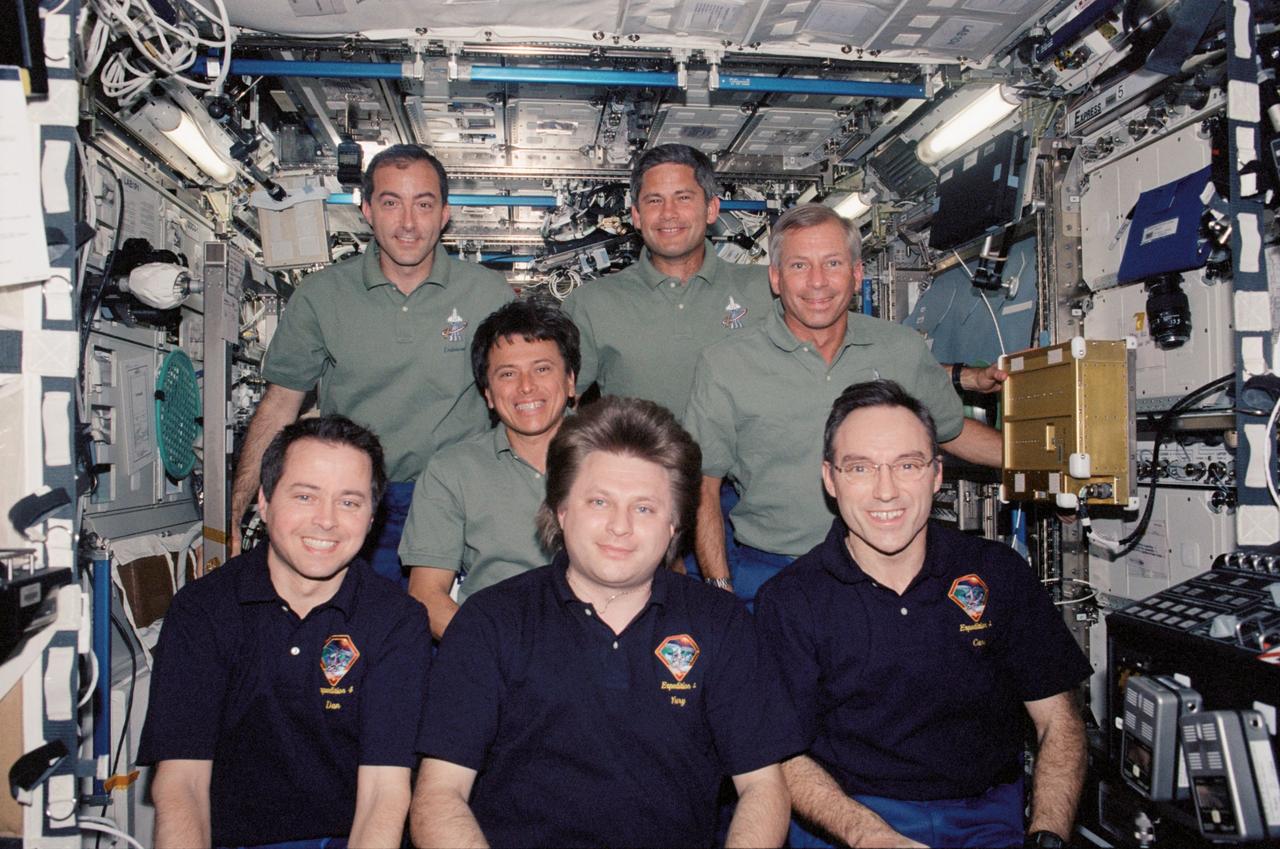
STS111-320-015 (5-19 June 2002) --- The STS-111 (back row) and Expedition Four crewmembers gather for a group photo in the Destiny laboratory on the International Space Station (ISS). The STS-111 crewmembers, from the left, are astronauts Philippe Perrin and Franklin R. Chang-Diaz, both mission specialists; Paul S. Lockhart and Kenneth D. Cockrell, pilot and mission commander, respectively. The Expedition Four crewmembers, from the left, are astronaut Daniel W. Bursch, flight engineer; cosmonaut Yury I. Onufrienko, mission commander; and astronaut Carl E. Walz, flight engineer. Onufrienko represents Rosaviakosmos and Perrin represents CNES, the French Space Agency.
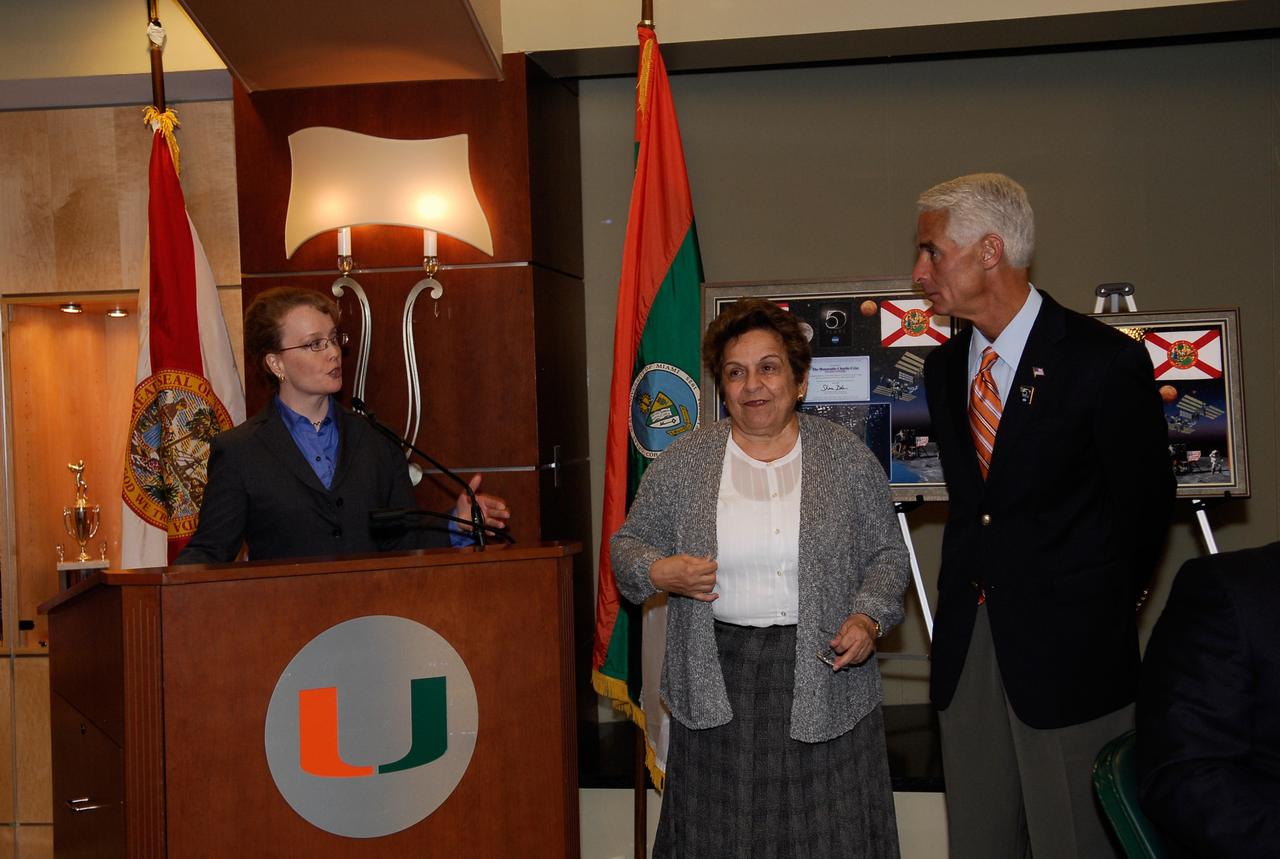
CAPE CANAVERAL, Fla. -- At the luncheon held during NASA’s Future Forum in Miami, NASA’s Deputy Administrator Shana Dale presents Florida Gov. Charlie Crist (on the right). At center is Donna E. Shalala, president of the University of Miami. The forum focused on how space exploration benefits Florida's economy. The event, which included presentations and panels, was held at the University of Miami's BankUnited Center. Among those participating were NASA Deputy Administrator Shana Dale, astronaut Carl Walz, director of the Advanced Capabilities Division in NASA's Exploration Systems Mission Directorate, and Russell Romanella, director, International Space Station and Spacecraft Processing. Photo credit: NASA/Kim Shiflett
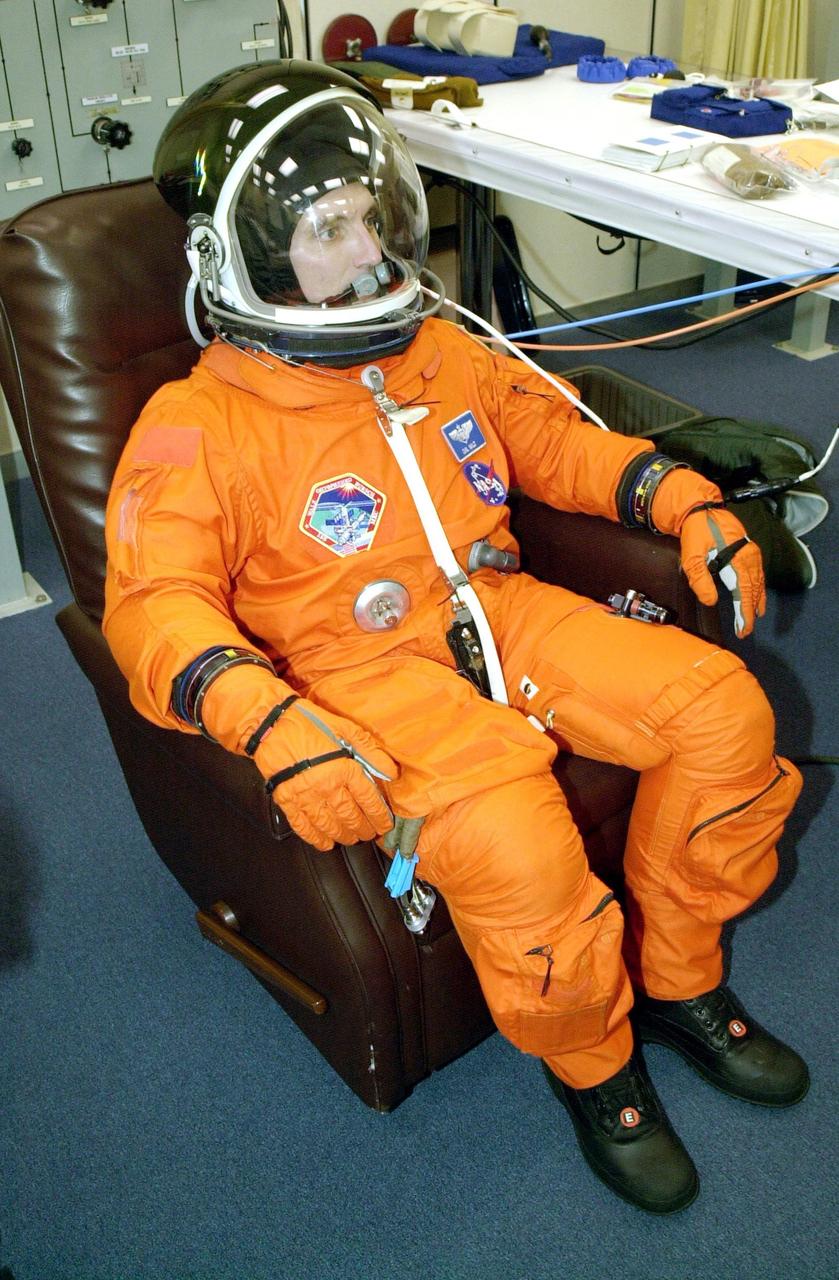
KENNEDY SPACE CENTER, Fla. -- Expedition 4 crew member Carl E. Walz undergoes final suit check before launch on mission STS-108 Nov. 29. Top priorities for the STS-108 (UF-1) mission of Endeavour are rotation of the International Space Station Expedition Three and Expedition Four crews; bringing water, equipment and supplies to the station in the Multi-Purpose Logistics Module Raffaello; and completion of robotics tasks and a spacewalk to install thermal blankets over two pieces of equipment at the bases of the Space Station's solar wings. Liftoff is scheduled for 7:41 p.m. EST
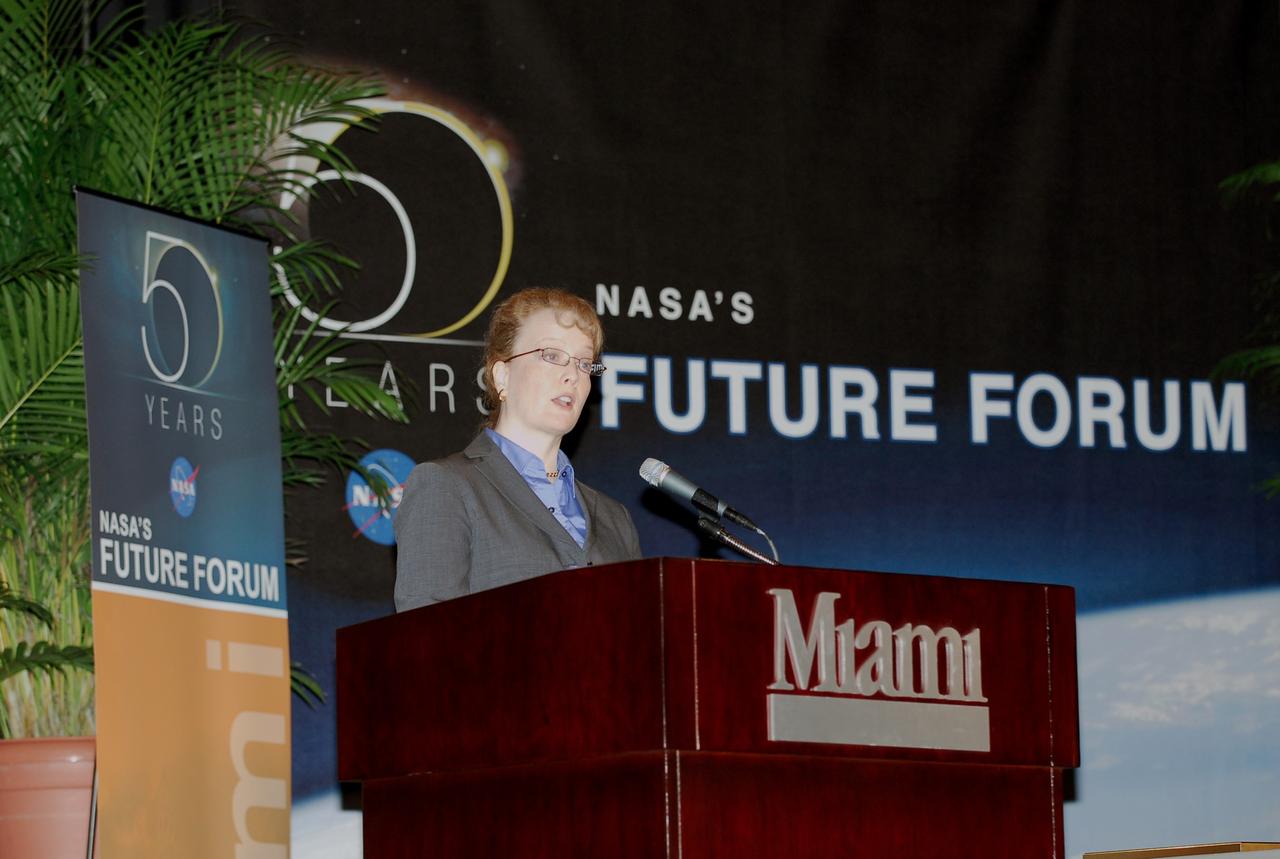
CAPE CANAVERAL, Fla. -- NASA Deputy Administrator Shana Dale (at the podium) gives the keynote address during a Future Forum in Miami. The forum, which focused on how space exploration benefits Florida's economy, was held at the University of Miami's BankUnited Center and included presentations and panels. Among those participating were NASA Deputy Administrator Shana Dale, astronaut Carl Walz, director of the Advanced Capabilities Division in NASA's Exploration Systems Mission Directorate, and Russell Romanella, director, International Space Station and Spacecraft Processing. Photo credit: NASA/Kim Shiflett