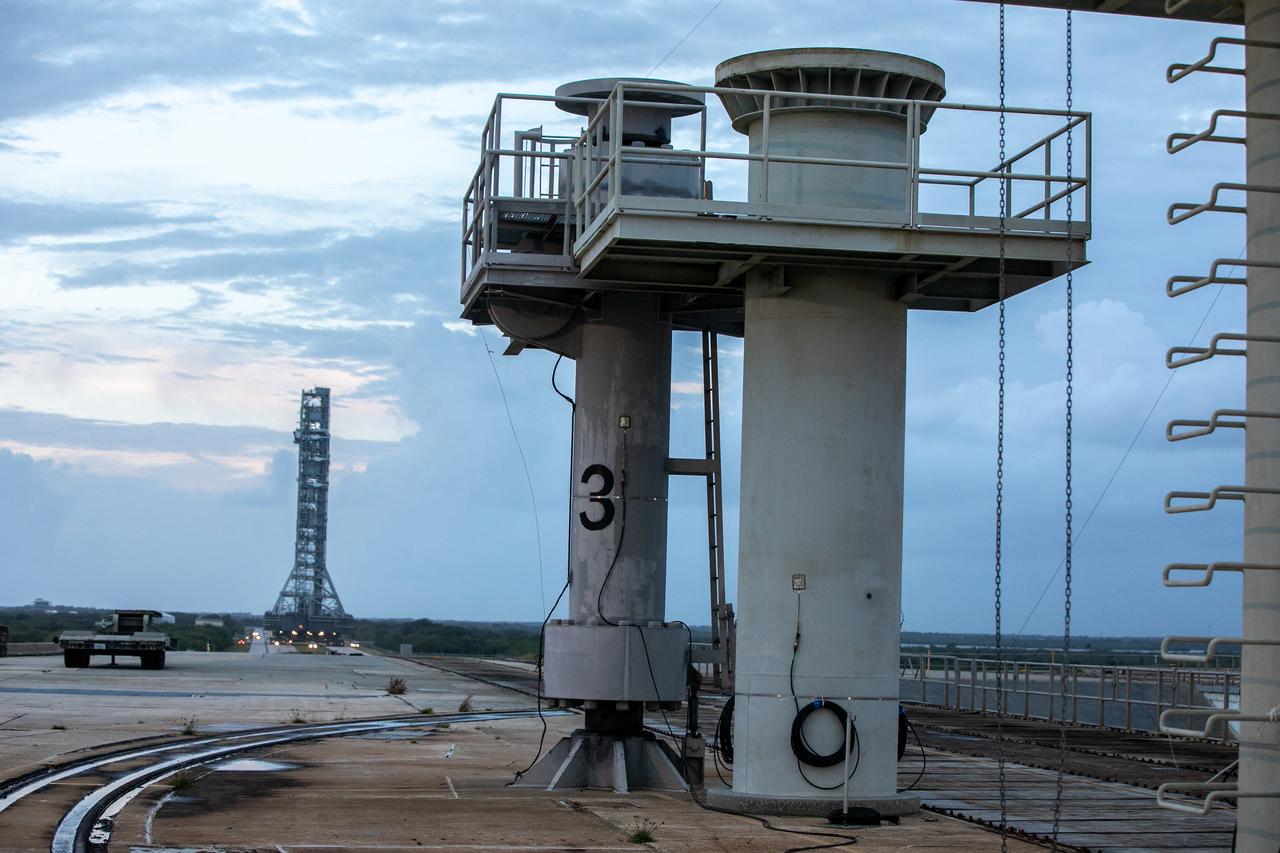
During sunrise on Oct. 20, 2020, the mobile launcher for the Artemis I mission, atop crawler-transporter 2, nears the top of Launch Pad 39B at NASA’s Kennedy Space Center in Florida. The nearly 400-foot-tall mobile launcher will remain at the pad, while engineers with Exploration Ground Systems and Jacobs will perform several tasks, including a timing test to validate the launch team’s countdown timeline, and a thorough, top-to-bottom wash down of the mobile launcher to remove any debris remaining from construction and installation of the umbilical arms. Artemis I will test the Orion spacecraft and Space Launch System as an integrated system ahead of crewed flights to the Moon. Under the Artemis program, NASA will land the first woman and the next man on the Moon in 2024.
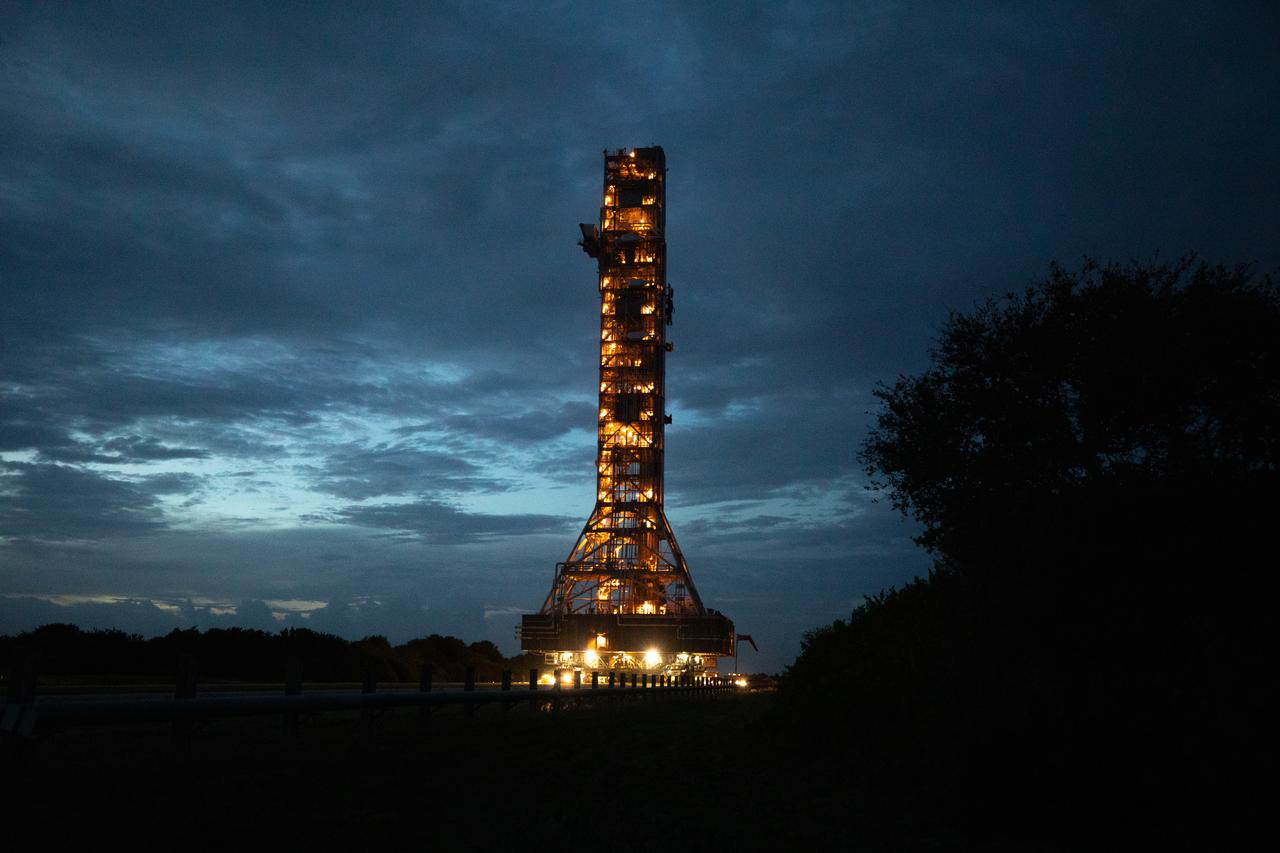
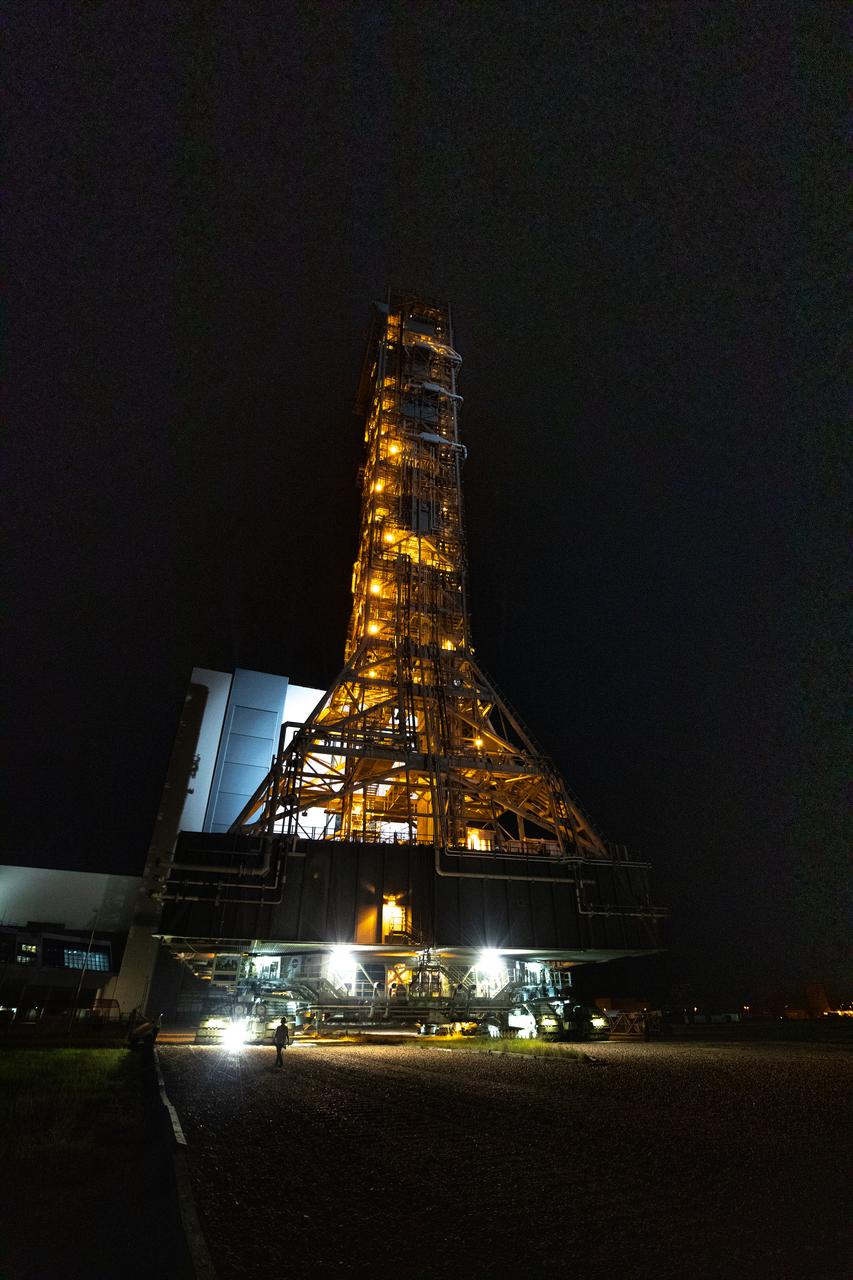
Xenon lights illuminate the mobile launcher for the Artemis I mission, as it is carried slowly along the crawlerway atop crawler-transporter 2 at NASA’s Kennedy Space Center in Florida on Oct. 20, 2020. The nearly 400-foot-tall mobile launcher is being rolled to Launch Pad 39B. During its two-week stay at the pad, engineers with Exploration Ground Systems and Jacobs will perform several tasks, including a timing test to validate the launch team’s countdown timeline, and a thorough, top-to-bottom wash down of the mobile launcher to remove any debris remaining from construction and installation of the umbilical arms. Artemis I will test the Orion spacecraft and Space Launch System as an integrated system ahead of crewed flights to the Moon. Under the Artemis program, NASA will land the first woman and the next man on the Moon in 2024.
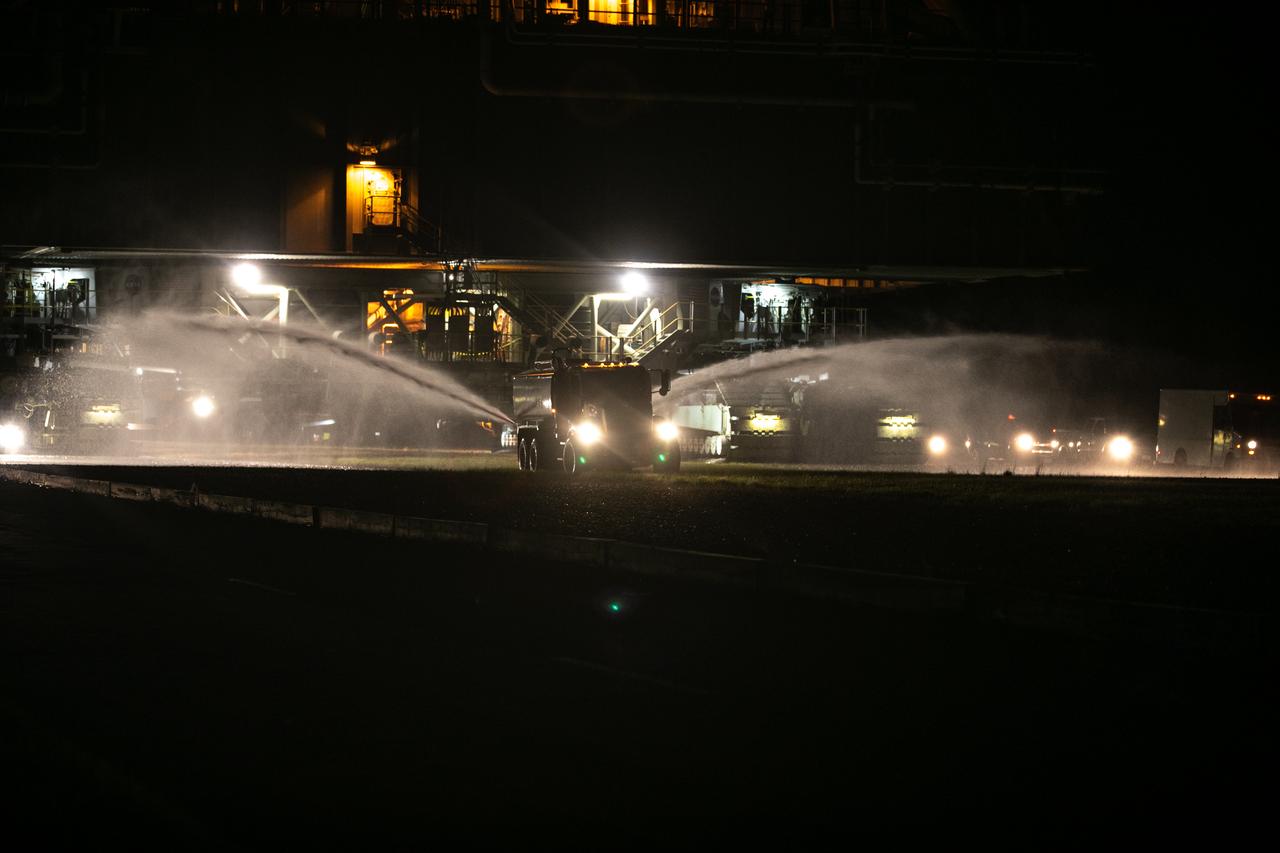
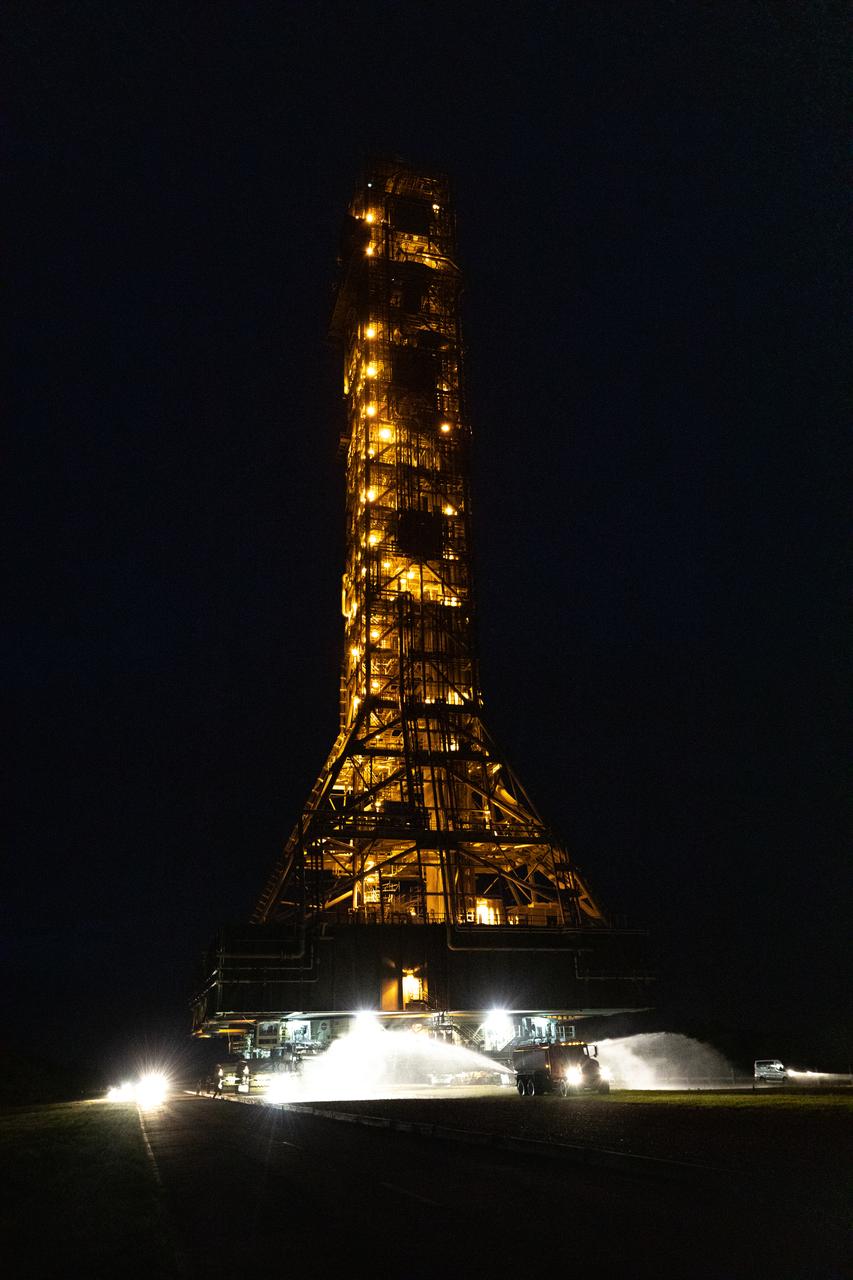
In the early morning on Oct. 20, 2020, a truck sprays water in front of crawler-transporter 2 to reduce dust and bugs, as the mobile launcher for the Artemis I mission rolls slowly along the crawlerway from the Vehicle Assembly Building at NASA’s Kennedy Space Center in Florida. The nearly 400-foot-tall mobile launcher is being rolled to Launch Pad 39B. During its two-week stay at the pad, engineers with Exploration Ground Systems and Jacobs will perform several tasks, including a timing test to validate the launch team’s countdown timeline, and a thorough, top-to-bottom wash down of the mobile launcher to remove any debris remaining from construction and installation of the umbilical arms. Artemis I will test the Orion spacecraft and Space Launch System as an integrated system ahead of crewed flights to the Moon. Under the Artemis program, NASA will land the first woman and the next man on the Moon in 2024.
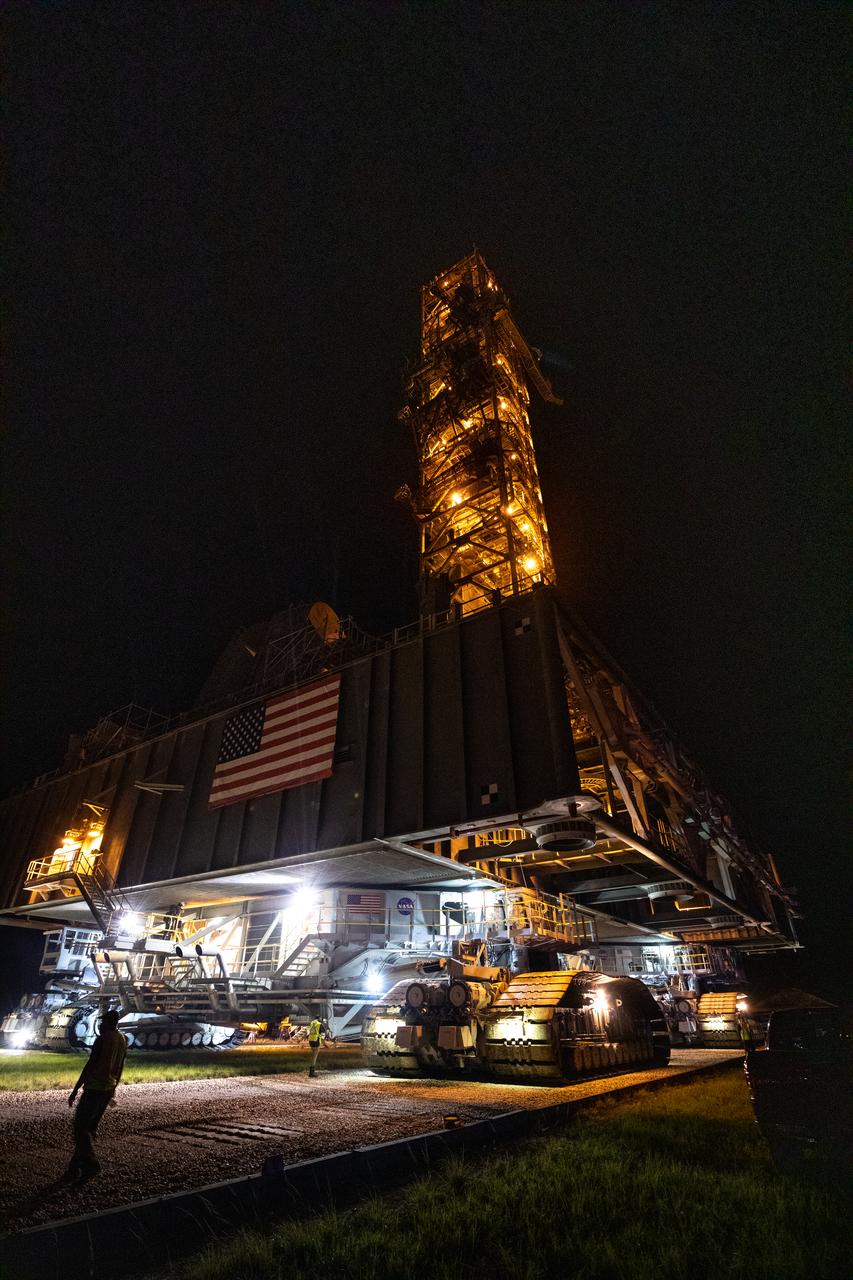
In the early morning on Oct. 20, 2020, the mobile launcher for the Artemis I mission rolls along the crawlerway atop crawler-transporter 2 after departing the Vehicle Assembly Building at NASA’s Kennedy Space Center in Florida. The nearly 400-foot-tall mobile launcher is being rolled to Launch Pad 39B. During its two-week stay at the pad, engineers with Exploration Ground Systems and Jacobs will perform several tasks, including a timing test to validate the launch team’s countdown timeline, and a thorough, top-to-bottom wash down of the mobile launcher to remove any debris remaining from construction and installation of the umbilical arms. Artemis I will test the Orion spacecraft and Space Launch System as an integrated system ahead of crewed flights to the Moon. Under the Artemis program, NASA will land the first woman and the next man on the Moon in 2024.
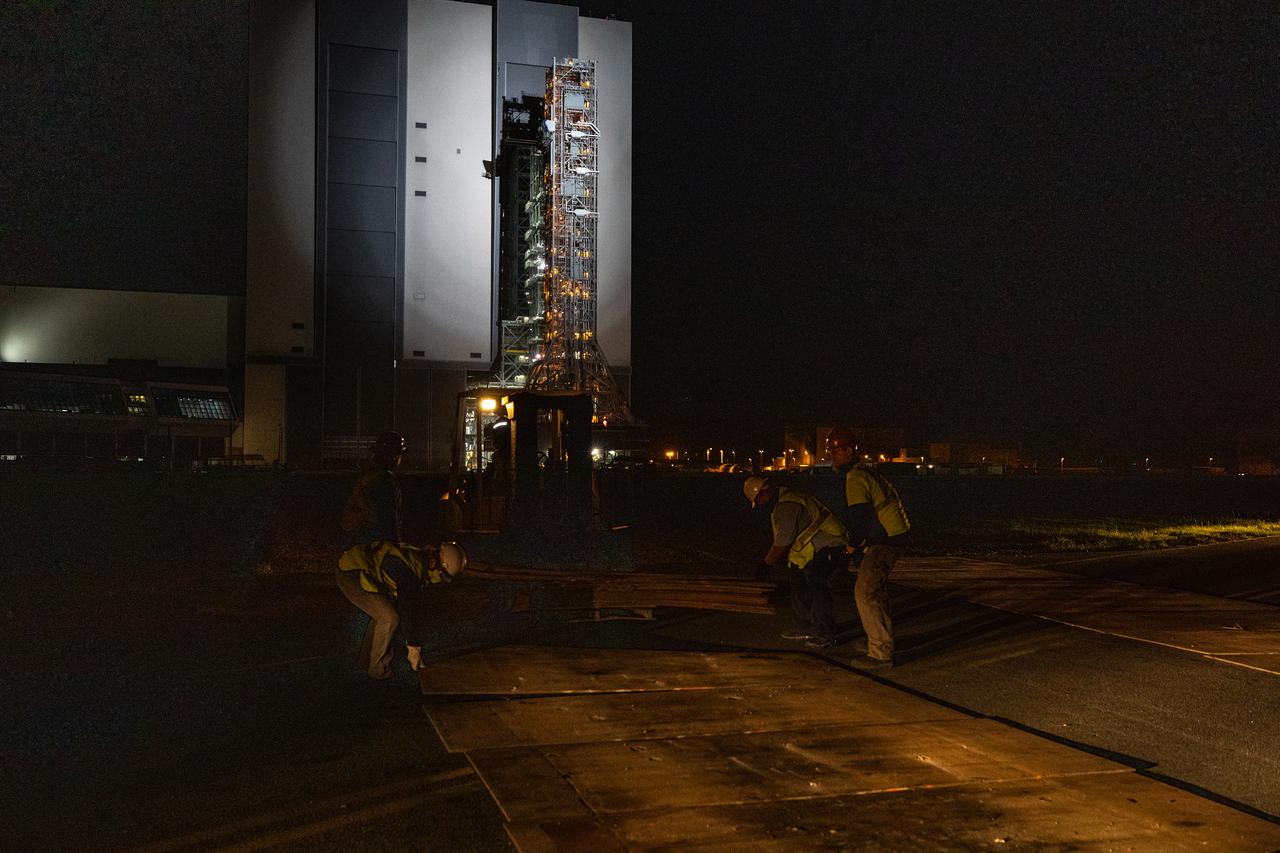
In the early morning on Oct. 20, 2020, the mobile launcher for the Artemis I mission begins its rollout atop crawler-transporter 2 from the Vehicle Assembly Building at NASA’s Kennedy Space Center in Florida. The nearly 400-foot-tall mobile launcher is being rolled to Launch Pad 39B. During its two-week stay at the pad, engineers with Exploration Ground Systems and Jacobs will perform several tasks, including a timing test to validate the launch team’s countdown timeline, and a thorough, top-to-bottom wash down of the mobile launcher to remove any debris remaining from construction and installation of the umbilical arms. Artemis I will test the Orion spacecraft and Space Launch System as an integrated system ahead of crewed flights to the Moon. Under the Artemis program, NASA will land the first woman and the next man on the Moon in 2024.

During sunrise on Oct. 20, 2020, the mobile launcher for the Artemis I mission, atop crawler-transporter 2, travels up the ramp leading to the top of Launch Pad 39B at NASA’s Kennedy Space Center in Florida. The nearly 400-foot-tall mobile launcher will remain at the pad for two weeks, while engineers with Exploration Ground Systems and Jacobs will perform several tasks, including a timing test to validate the launch team’s countdown timeline, and a thorough, top-to-bottom wash down of the mobile launcher to remove any debris remaining from construction and installation of the umbilical arms. Artemis I will test the Orion spacecraft and Space Launch System as an integrated system ahead of crewed flights to the Moon. Under the Artemis program, NASA will land the first woman and the next man on the Moon in 2024.
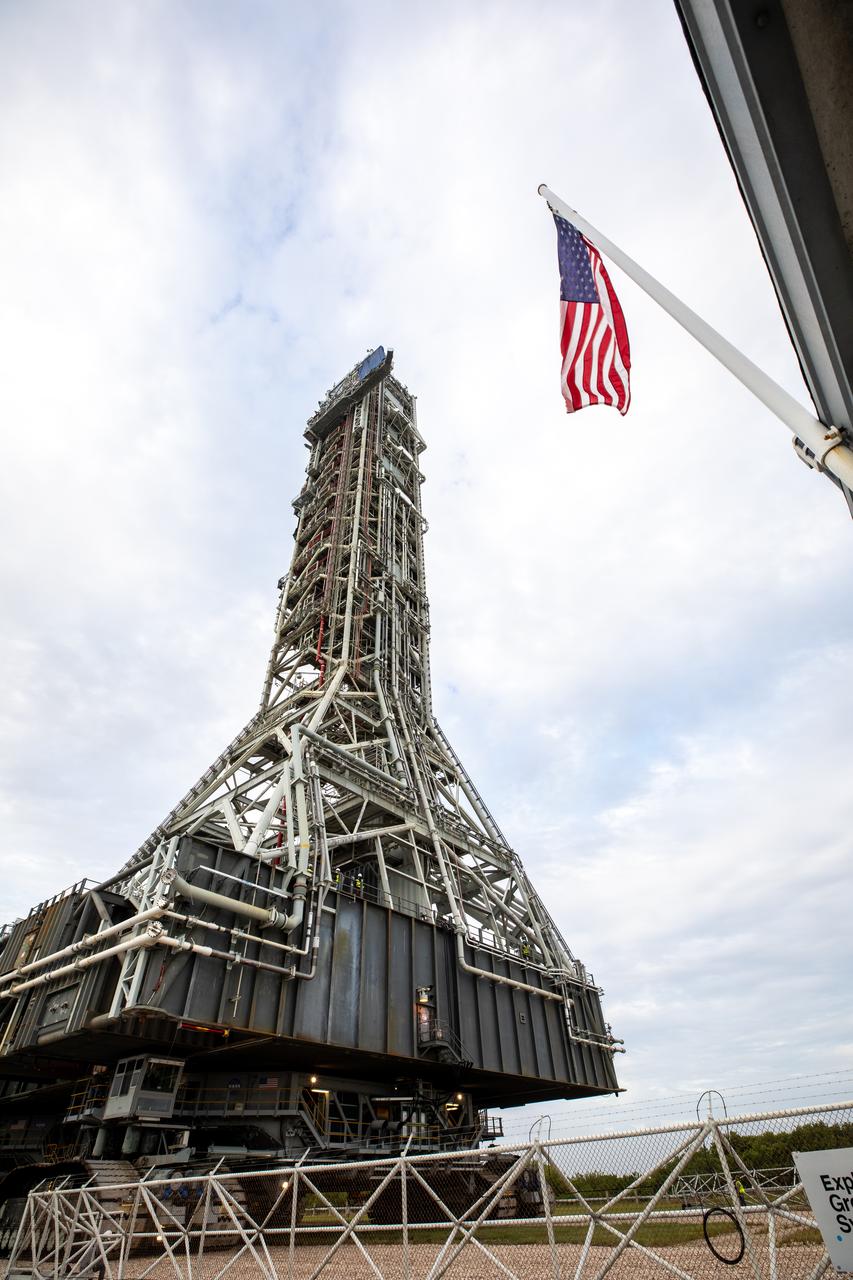
During sunrise on Oct. 20, 2020, the mobile launcher for the Artemis I mission, atop crawler-transporter 2, arrives at the perimeter of Launch Pad 39B at NASA’s Kennedy Space Center in Florida. The nearly 400-foot-tall mobile launcher will remain at the pad for two weeks, while engineers with Exploration Ground Systems and Jacobs will perform several tasks, including a timing test to validate the launch team’s countdown timeline, and a thorough, top-to-bottom wash down of the mobile launcher to remove any debris remaining from construction and installation of the umbilical arms. Artemis I will test the Orion spacecraft and Space Launch System as an integrated system ahead of crewed flights to the Moon. Under the Artemis program, NASA will land the first woman and the next man on the Moon in 2024.
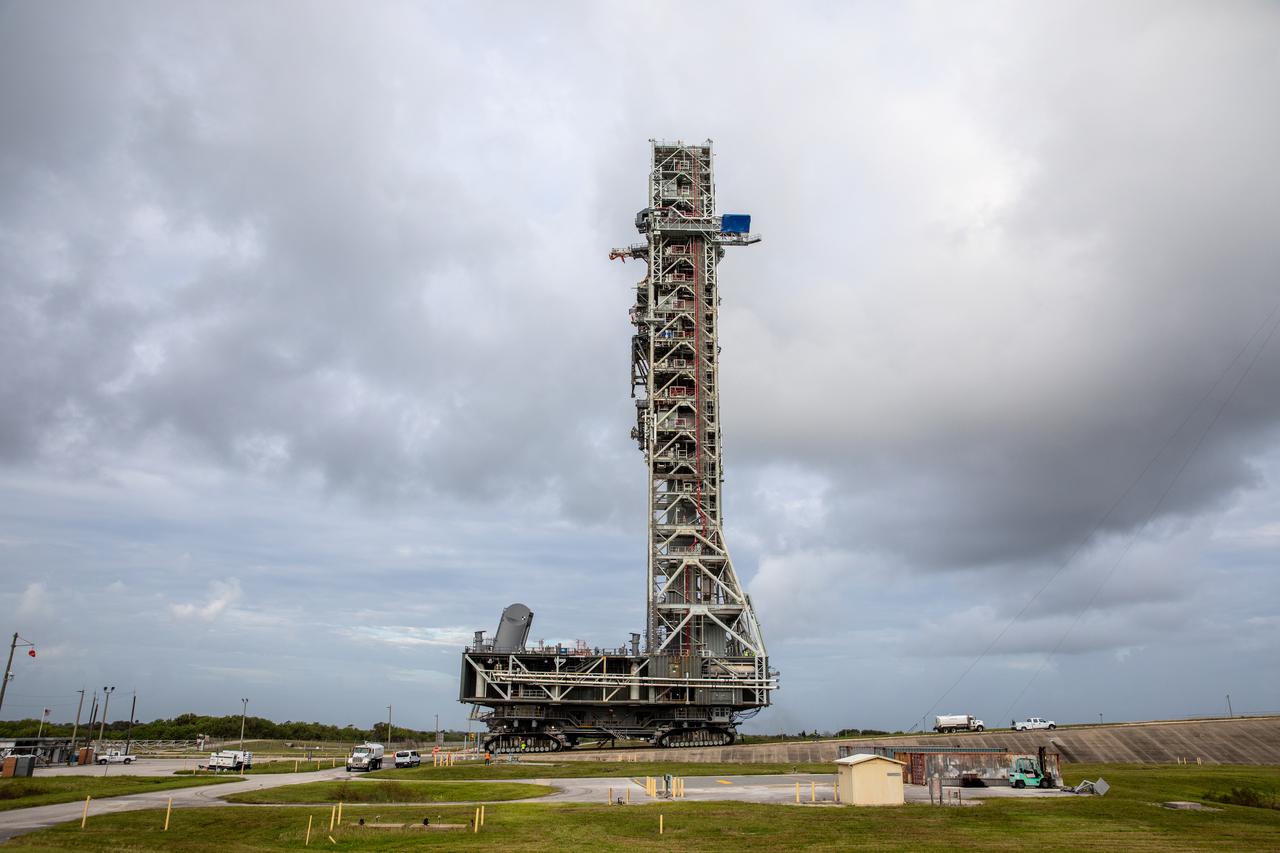
During the morning on Oct. 20, 2020, the mobile launcher for the Artemis I mission, atop crawler-transporter 2, moves up the ramp leading to Launch Pad 39B at NASA’s Kennedy Space Center in Florida. The nearly 400-foot-tall mobile launcher will remain at the pad for two weeks, while engineers with Exploration Ground Systems and Jacobs will perform several tasks, including a timing test to validate the launch team’s countdown timeline, and a thorough, top-to-bottom wash down of the mobile launcher to remove any debris remaining from construction and installation of the umbilical arms. Artemis I will test the Orion spacecraft and Space Launch System as an integrated system ahead of crewed flights to the Moon. Under the Artemis program, NASA will land the first woman and the next man on the Moon in 2024.
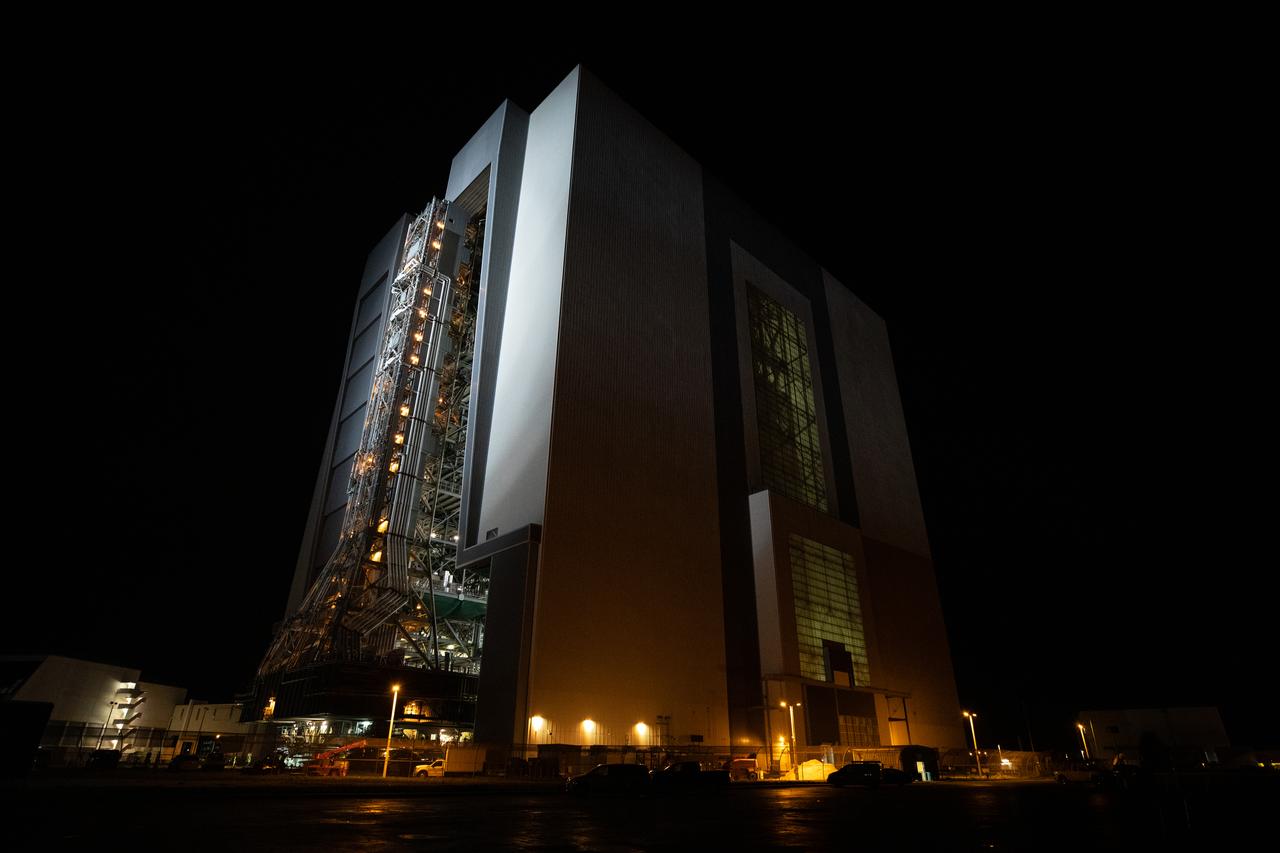
In the early morning on Oct. 20, 2020, the mobile launcher for the Artemis I mission begins its rollout atop crawler-transporter 2 from the Vehicle Assembly Building at NASA’s Kennedy Space Center in Florida. The nearly 400-foot-tall mobile launcher is being rolled to Launch Pad 39B. During its two-week stay at the pad, engineers with Exploration Ground Systems and Jacobs will perform several tasks, including a timing test to validate the launch team’s countdown timeline, and a thorough, top-to-bottom wash down of the mobile launcher to remove any debris remaining from construction and installation of the umbilical arms. Artemis I will test the Orion spacecraft and Space Launch System as an integrated system ahead of crewed flights to the Moon. Under the Artemis program, NASA will land the first woman and the next man on the Moon in 2024.
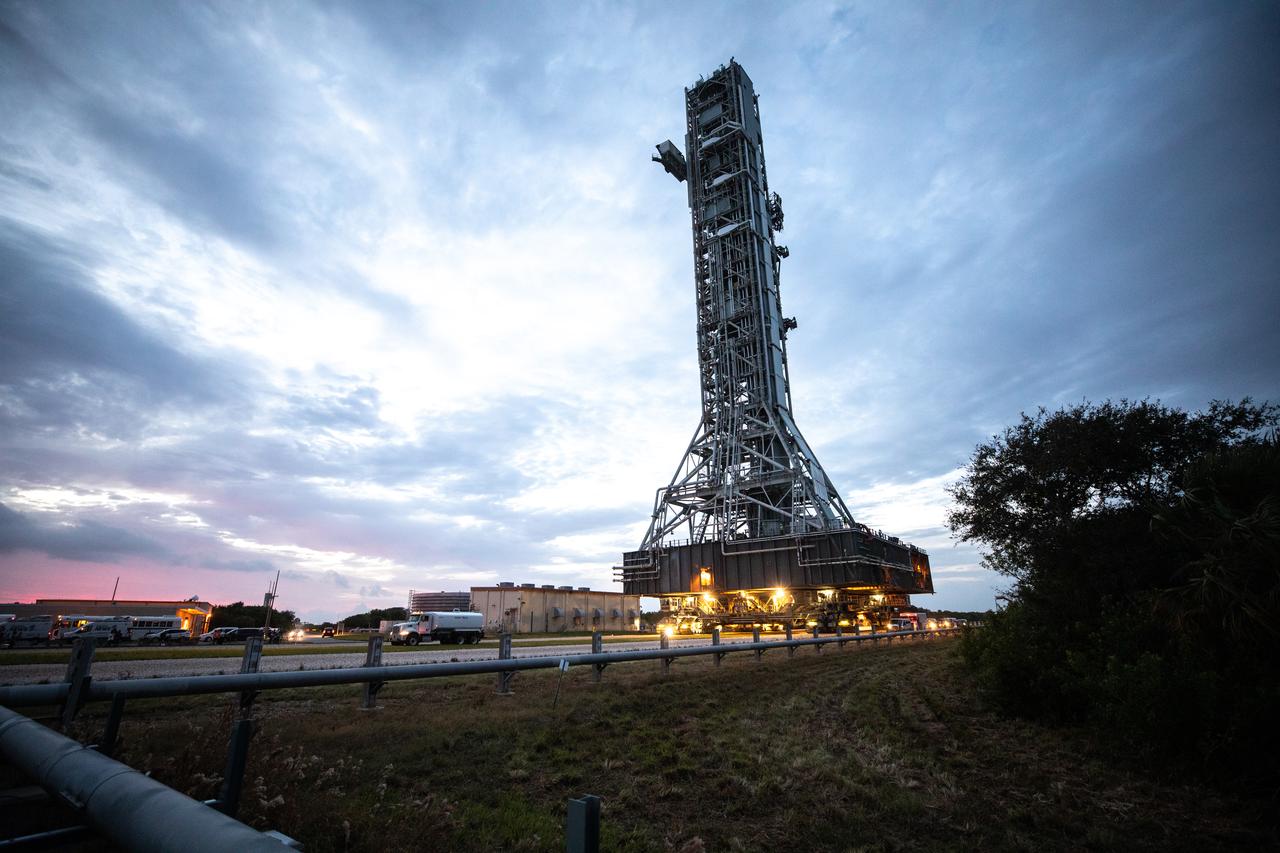
During sunrise on Oct. 20, 2020, the mobile launcher for the Artemis I mission, atop crawler-transporter 2, arrives at the ramp leading up to Launch Pad 39B at NASA’s Kennedy Space Center in Florida. The nearly 400-foot-tall mobile launcher will remain at the pad for two weeks, while engineers with Exploration Ground Systems and Jacobs will perform several tasks, including a timing test to validate the launch team’s countdown timeline, and a thorough, top-to-bottom wash down of the mobile launcher to remove any debris remaining from construction and installation of the umbilical arms. Artemis I will test the Orion spacecraft and Space Launch System as an integrated system ahead of crewed flights to the Moon. Under the Artemis program, NASA will land the first woman and the next man on the Moon in 2024.

Xenon lights illuminate the mobile launcher for the Artemis I mission, as it is carried slowly along the crawlerway atop crawler-transporter 2 at NASA’s Kennedy Space Center in Florida on Oct. 20, 2020. The nearly 400-foot-tall mobile launcher is being rolled to Launch Pad 39B. During its two-week stay at the pad, engineers with Exploration Ground Systems and Jacobs will perform several tasks, including a timing test to validate the launch team’s countdown timeline, and a thorough, top-to-bottom wash down of the mobile launcher to remove any debris remaining from construction and installation of the umbilical arms. Artemis I will test the Orion spacecraft and Space Launch System as an integrated system ahead of crewed flights to the Moon. Under the Artemis program, NASA will land the first woman and the next man on the Moon in 2024.
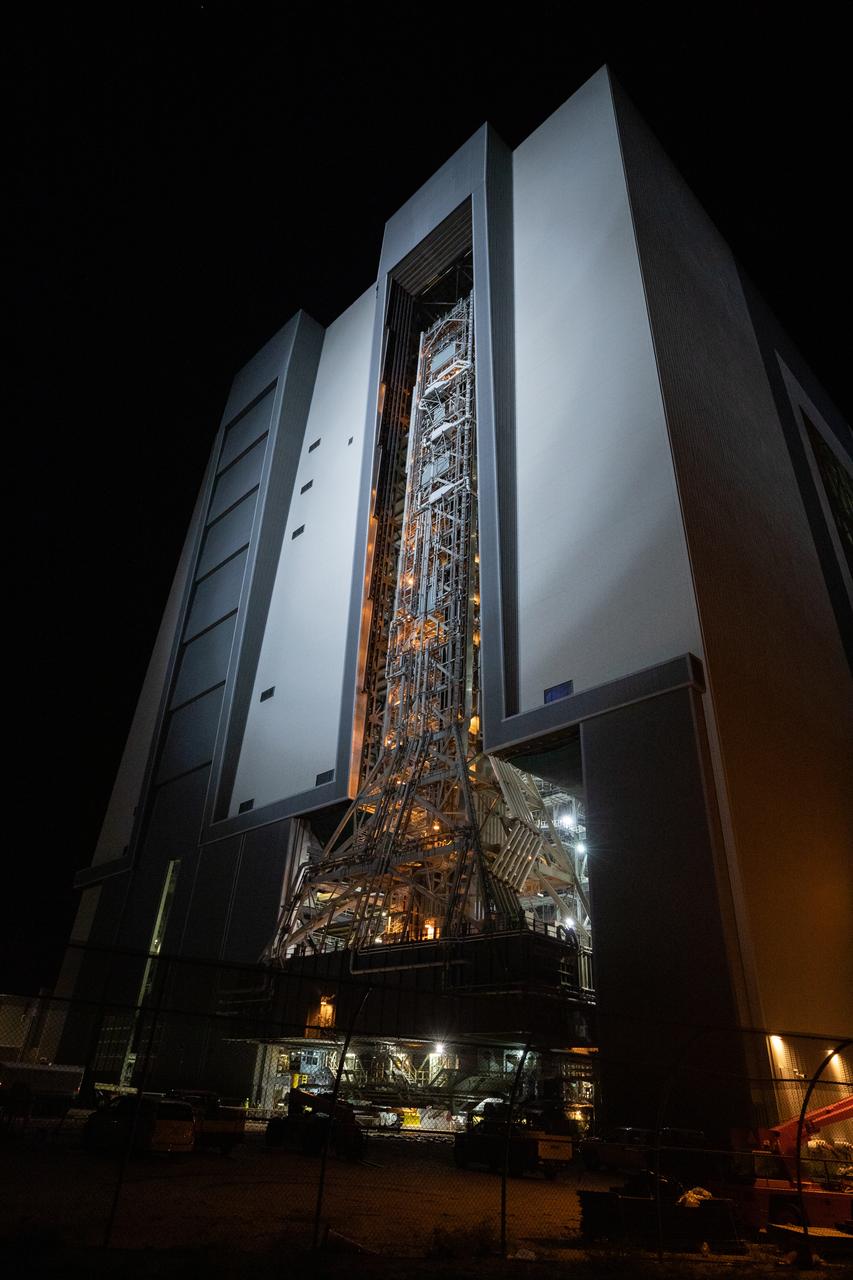
In the early morning on Oct. 20, 2020, the mobile launcher for the Artemis I mission begins its rollout atop crawler-transporter 2 from the Vehicle Assembly Building at NASA’s Kennedy Space Center in Florida. The nearly 400-foot-tall mobile launcher is being rolled to Launch Pad 39B. During its two-week stay at the pad, engineers with Exploration Ground Systems and Jacobs will perform several tasks, including a timing test to validate the launch team’s countdown timeline, and a thorough, top-to-bottom wash down of the mobile launcher to remove any debris remaining from construction and installation of the umbilical arms. Artemis I will test the Orion spacecraft and Space Launch System as an integrated system ahead of crewed flights to the Moon. Under the Artemis program, NASA will land the first woman and the next man on the Moon in 2024.
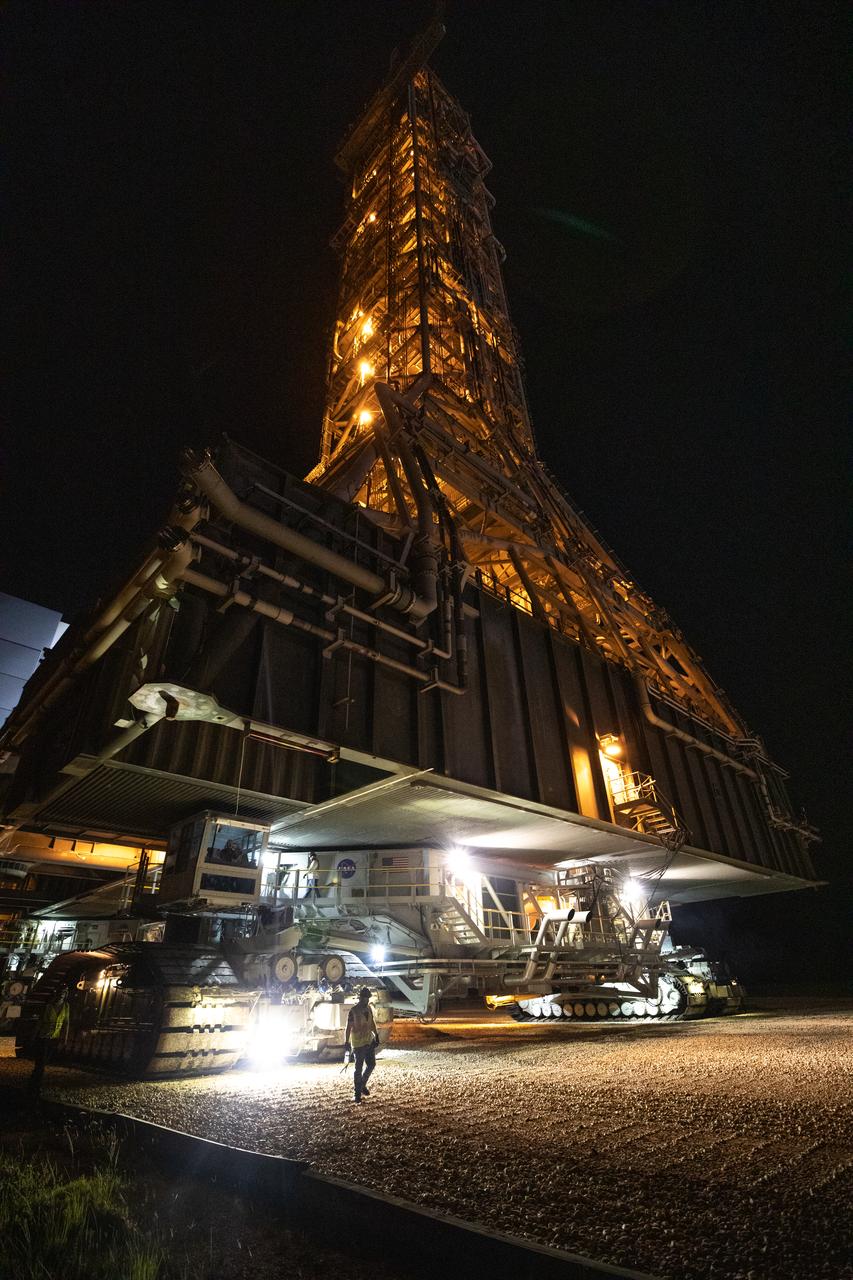
In the early morning on Oct. 20, 2020, the mobile launcher for the Artemis I mission rolls along the crawlerway atop crawler-transporter 2 after departing the Vehicle Assembly Building at NASA’s Kennedy Space Center in Florida. The nearly 400-foot-tall mobile launcher is being rolled to Launch Pad 39B. During its two-week stay at the pad, engineers with Exploration Ground Systems and Jacobs will perform several tasks, including a timing test to validate the launch team’s countdown timeline, and a thorough, top-to-bottom wash down of the mobile launcher to remove any debris remaining from construction and installation of the umbilical arms. Artemis I will test the Orion spacecraft and Space Launch System as an integrated system ahead of crewed flights to the Moon. Under the Artemis program, NASA will land the first woman and the next man on the Moon in 2024.
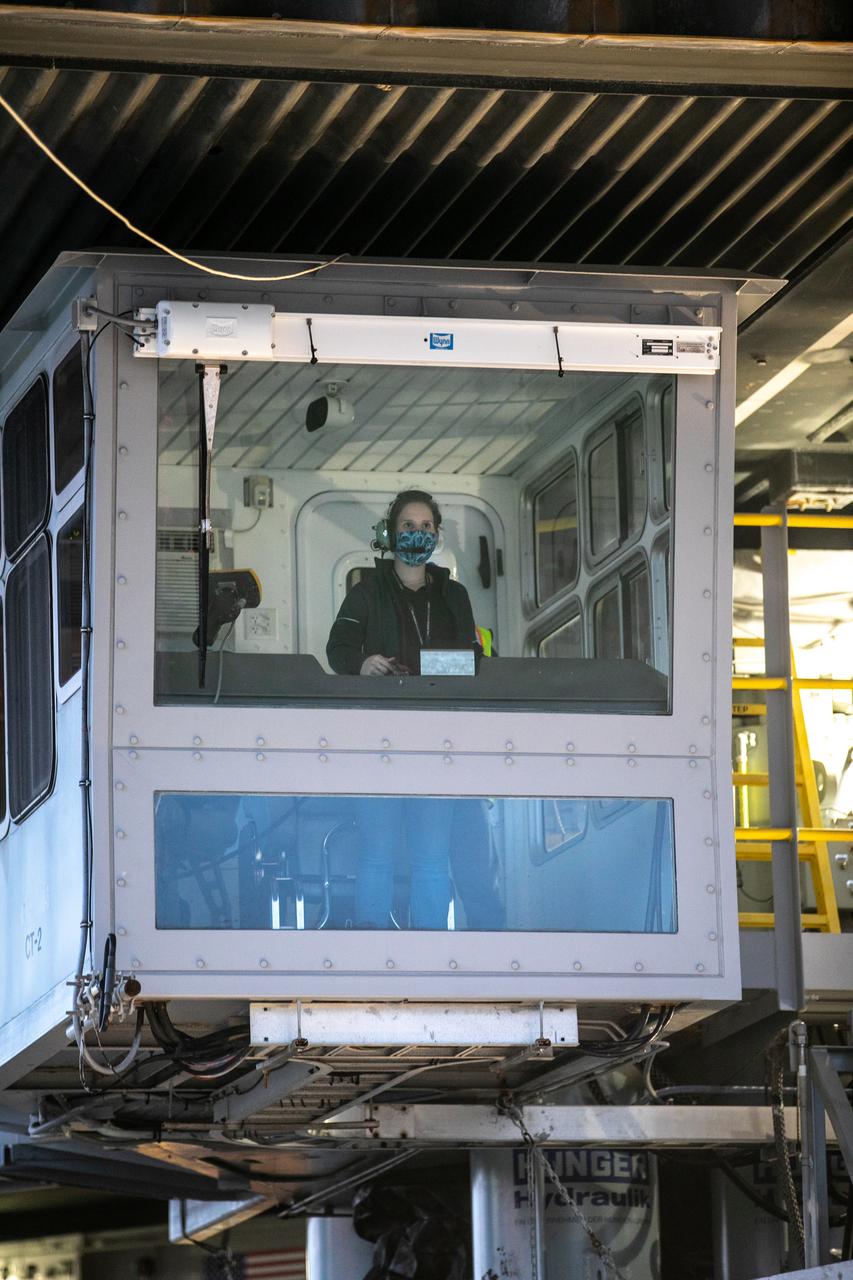
During sunrise on Oct. 20, 2020, the mobile launcher for the Artemis I mission, atop crawler-transporter 2 (CT-2), arrives at Launch Pad 39B at NASA’s Kennedy Space Center in Florida. In view inside the CT cab is Breanne Rohloff, crawler-transporter driver and mechanical engineer with Jacobs. The nearly 400-foot-tall mobile launcher will remain at the pad for two weeks, while engineers with Exploration Ground Systems and Jacobs will perform several tasks, including a timing test to validate the launch team’s countdown timeline, and a thorough, top-to-bottom wash down of the mobile launcher to remove any debris remaining from construction and installation of the umbilical arms. Artemis I will test the Orion spacecraft and Space Launch System as an integrated system ahead of crewed flights to the Moon. Under the Artemis program, NASA will land the first woman and the next man on the Moon in 2024.
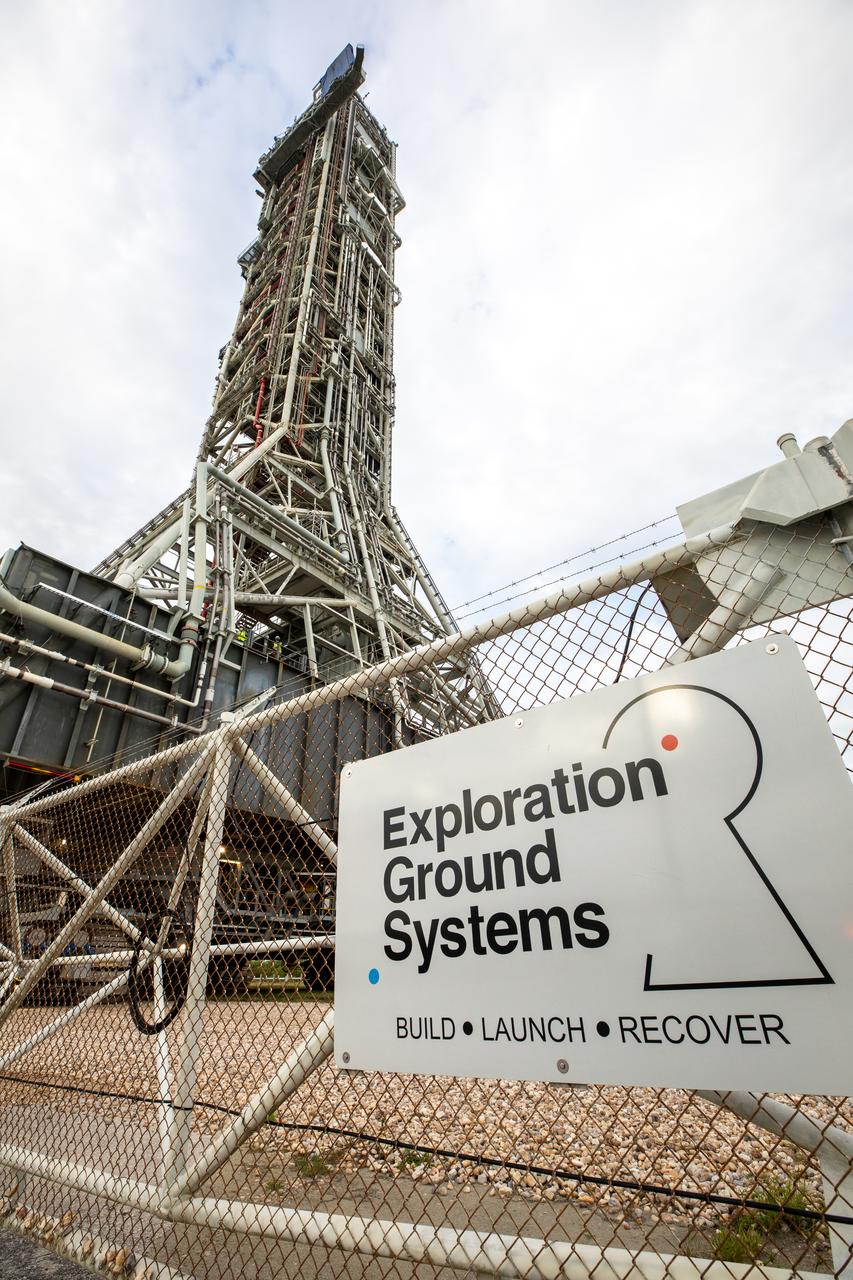
During sunrise on Oct. 20, 2020, the mobile launcher for the Artemis I mission, atop crawler-transporter 2, arrives at the perimeter of Launch Pad 39B at NASA’s Kennedy Space Center in Florida. The nearly 400-foot-tall mobile launcher will remain at the pad for two weeks, while engineers with Exploration Ground Systems and Jacobs will perform several tasks, including a timing test to validate the launch team’s countdown timeline, and a thorough, top-to-bottom wash down of the mobile launcher to remove any debris remaining from construction and installation of the umbilical arms. Artemis I will test the Orion spacecraft and Space Launch System as an integrated system ahead of crewed flights to the Moon. Under the Artemis program, NASA will land the first woman and the next man on the Moon in 2024.
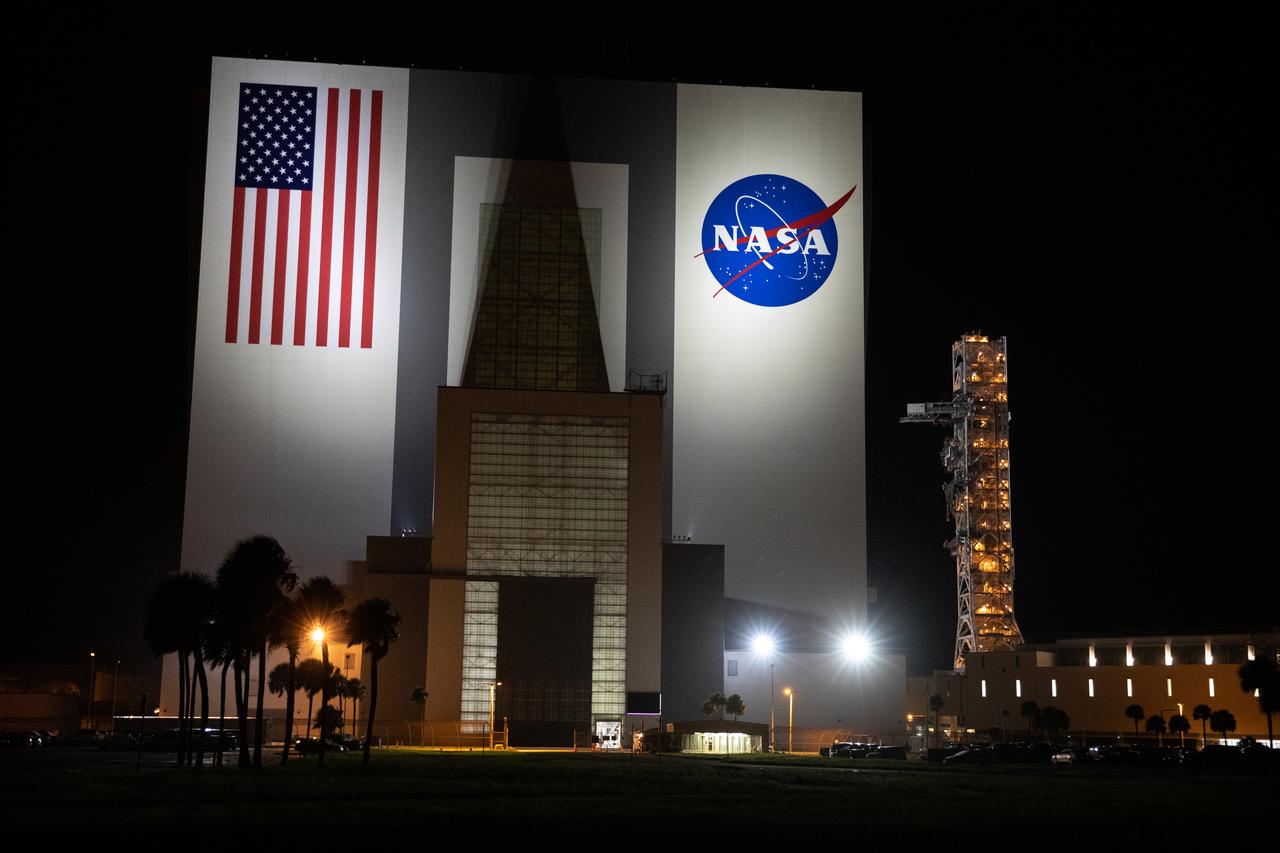
Bright lights illuminate the Vehicle Assembly Building in the early morning on Oct. 20, 2020, as the mobile launcher for the Artemis I mission begins its rollout atop crawler-transporter 2 at NASA’s Kennedy Space Center in Florida. The nearly 400-foot-tall mobile launcher is being rolled to Launch Pad 39B. During its two-week stay at the pad, engineers with Exploration Ground Systems and Jacobs will perform several tasks, including a timing test to validate the launch team’s countdown timeline, and a thorough, top-to-bottom wash down of the mobile launcher to remove any debris remaining from construction and installation of the umbilical arms. Artemis I will test the Orion spacecraft and Space Launch System as an integrated system ahead of crewed flights to the Moon. Under the Artemis program, NASA will land the first woman and the next man on the Moon in 2024.
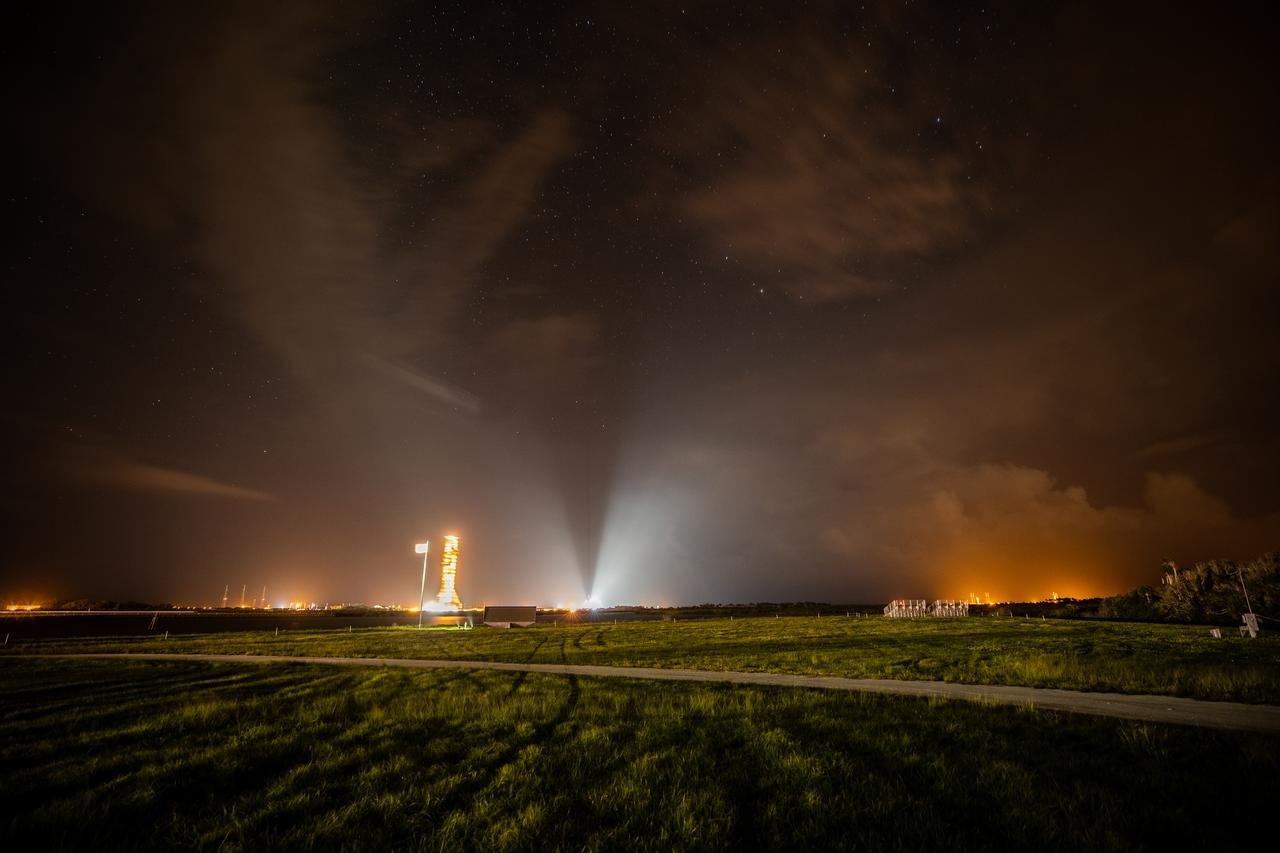
Xenon lights illuminate Launch Pad 39B as the mobile launcher for the Artemis I mission, atop crawler-transporter 2, nears the pad in the early morning on Oct. 20, 2020, at NASA’s Kennedy Space Center in Florida. The nearly 400-foot-tall mobile launcher will stay at the pad for two weeks while engineers with Exploration Ground Systems and Jacobs will perform several tasks, including a timing test to validate the launch team’s countdown timeline, and a thorough, top-to-bottom wash down of the mobile launcher to remove any debris remaining from construction and installation of the umbilical arms. Artemis I will test the Orion spacecraft and Space Launch System as an integrated system ahead of crewed flights to the Moon. Under the Artemis program, NASA will land the first woman and the next man on the Moon in 2024.
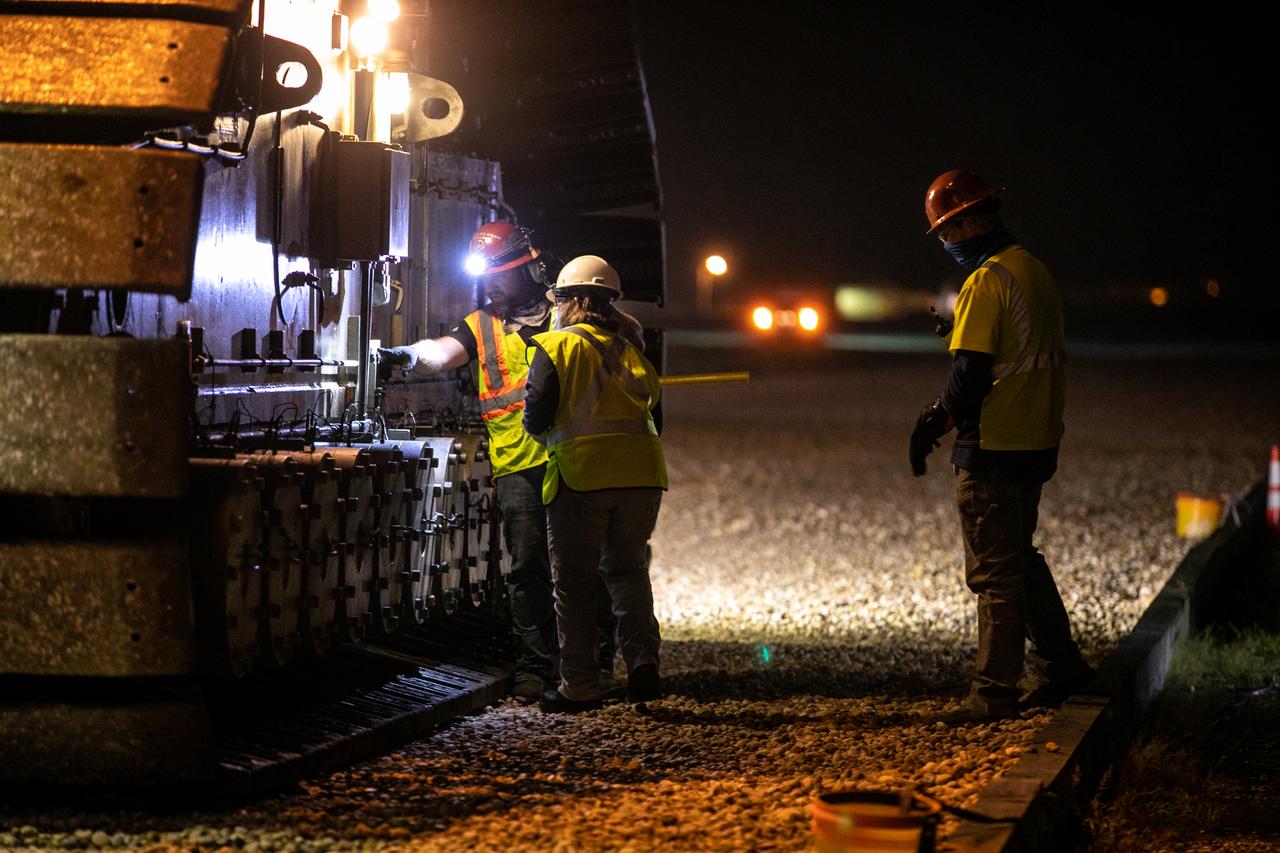
In the early morning on Oct. 20, 2020, technicians monitor the treads on crawler-transporter 2 as it carries the mobile launcher for the Artemis I mission along the crawlerway after departing the Vehicle Assembly Building at NASA’s Kennedy Space Center in Florida. The nearly 400-foot-tall mobile launcher is being rolled to Launch Pad 39B. During its two-week stay at the pad, engineers with Exploration Ground Systems and Jacobs will perform several tasks, including a timing test to validate the launch team’s countdown timeline, and a thorough, top-to-bottom wash down of the mobile launcher to remove any debris remaining from construction and installation of the umbilical arms. Artemis I will test the Orion spacecraft and Space Launch System as an integrated system ahead of crewed flights to the Moon. Under the Artemis program, NASA will land the first woman and the next man on the Moon in 2024.
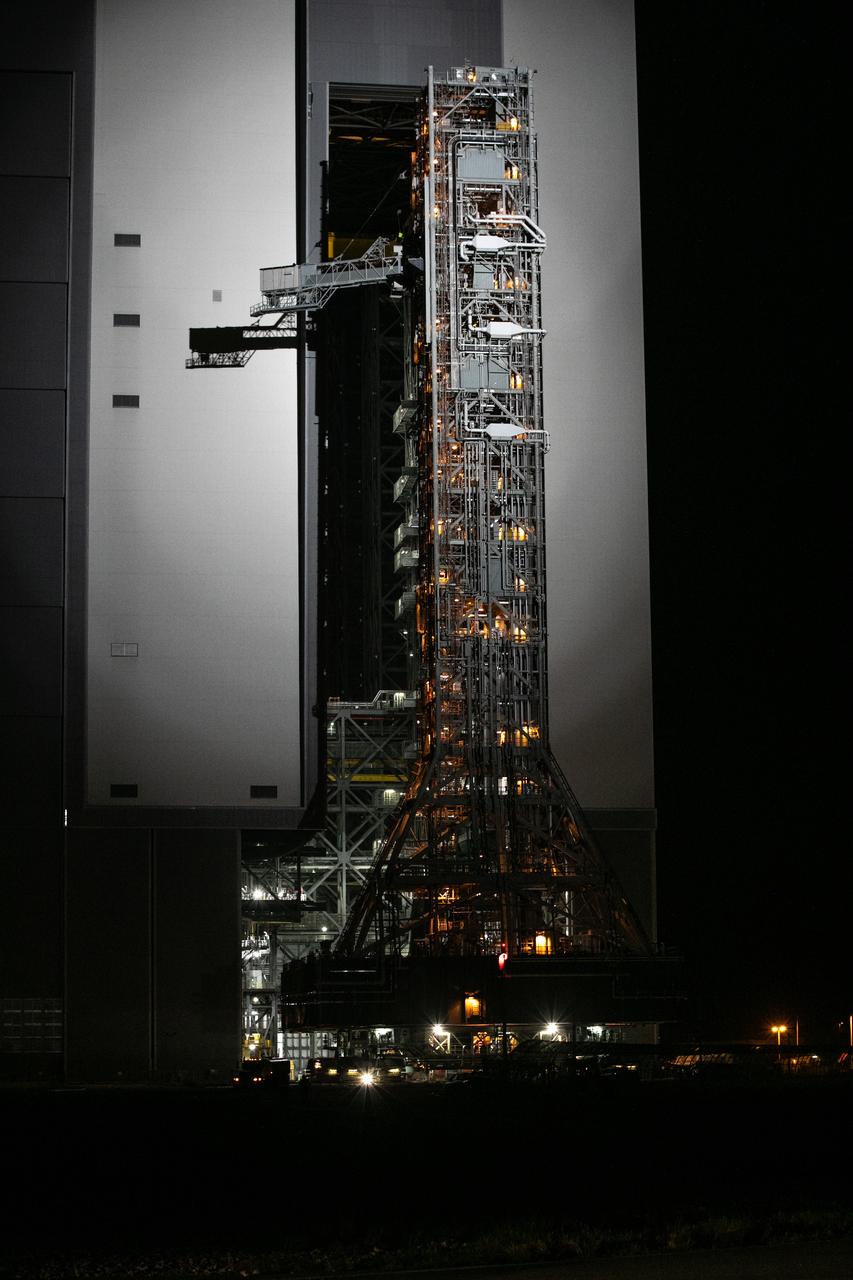
In the early morning on Oct. 20, 2020, the mobile launcher for the Artemis I mission begins its rollout atop crawler-transporter 2 from the Vehicle Assembly Building at NASA’s Kennedy Space Center in Florida. The nearly 400-foot-tall mobile launcher is being rolled to Launch Pad 39B. During its two-week stay at the pad, engineers with Exploration Ground Systems and Jacobs will perform several tasks, including a timing test to validate the launch team’s countdown timeline, and a thorough, top-to-bottom wash down of the mobile launcher to remove any debris remaining from construction and installation of the umbilical arms. Artemis I will test the Orion spacecraft and Space Launch System as an integrated system ahead of crewed flights to the Moon. Under the Artemis program, NASA will land the first woman and the next man on the Moon in 2024.
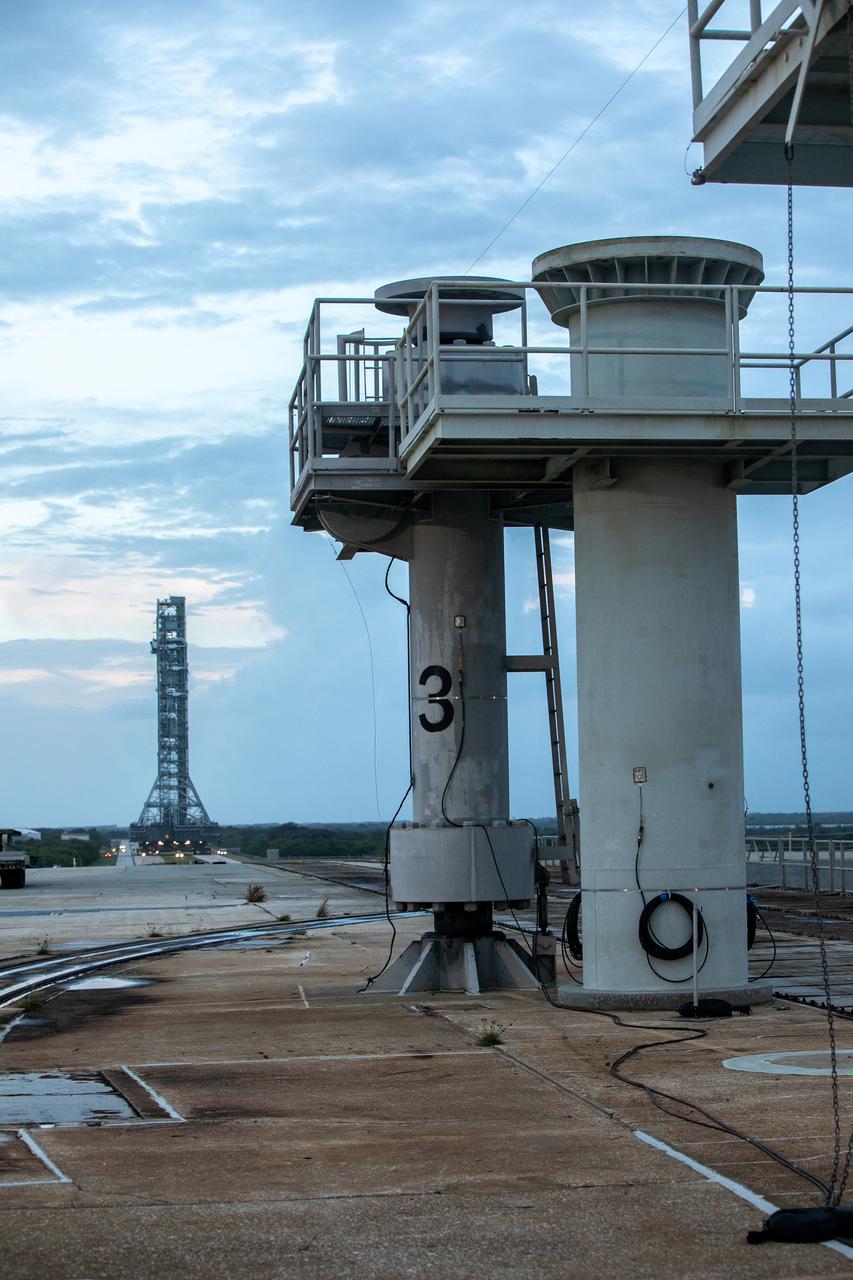
During sunrise on Oct. 20, 2020, the mobile launcher for the Artemis I mission, atop crawler-transporter 2, nears the top of Launch Pad 39B at NASA’s Kennedy Space Center in Florida. The nearly 400-foot-tall mobile launcher will remain at the pad, while engineers with Exploration Ground Systems and Jacobs will perform several tasks, including a timing test to validate the launch team’s countdown timeline, and a thorough, top-to-bottom wash down of the mobile launcher to remove any debris remaining from construction and installation of the umbilical arms. Artemis I will test the Orion spacecraft and Space Launch System as an integrated system ahead of crewed flights to the Moon. Under the Artemis program, NASA will land the first woman and the next man on the Moon in 2024.
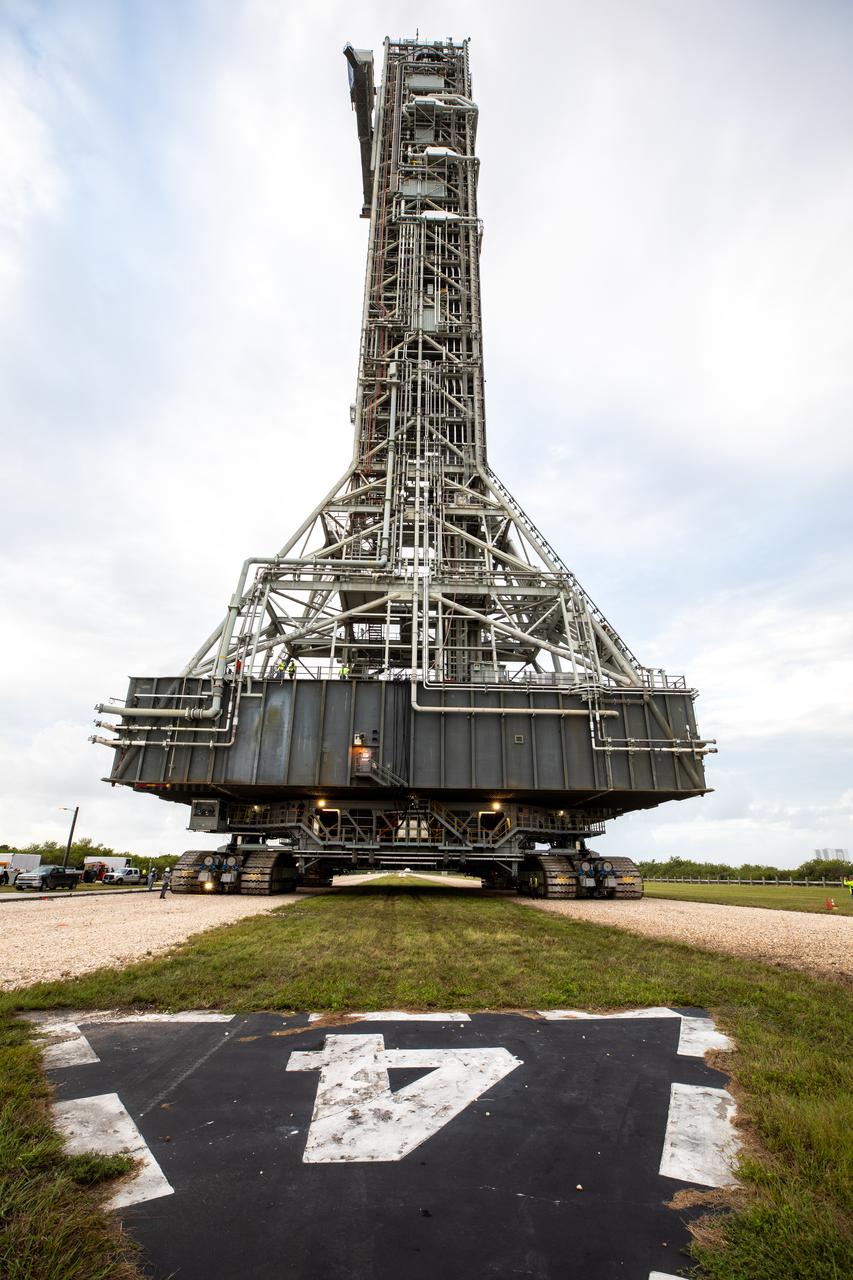
During sunrise on Oct. 20, 2020, the mobile launcher for the Artemis I mission, atop crawler-transporter 2, nears the top of Launch Pad 39B at NASA’s Kennedy Space Center in Florida. The nearly 400-foot-tall mobile launcher will remain at the pad for two weeks, while engineers with Exploration Ground Systems and Jacobs will perform several tasks, including a timing test to validate the launch team’s countdown timeline, and a thorough, top-to-bottom wash down of the mobile launcher to remove any debris remaining from construction and installation of the umbilical arms. Artemis I will test the Orion spacecraft and Space Launch System as an integrated system ahead of crewed flights to the Moon. Under the Artemis program, NASA will land the first woman and the next man on the Moon in 2024.
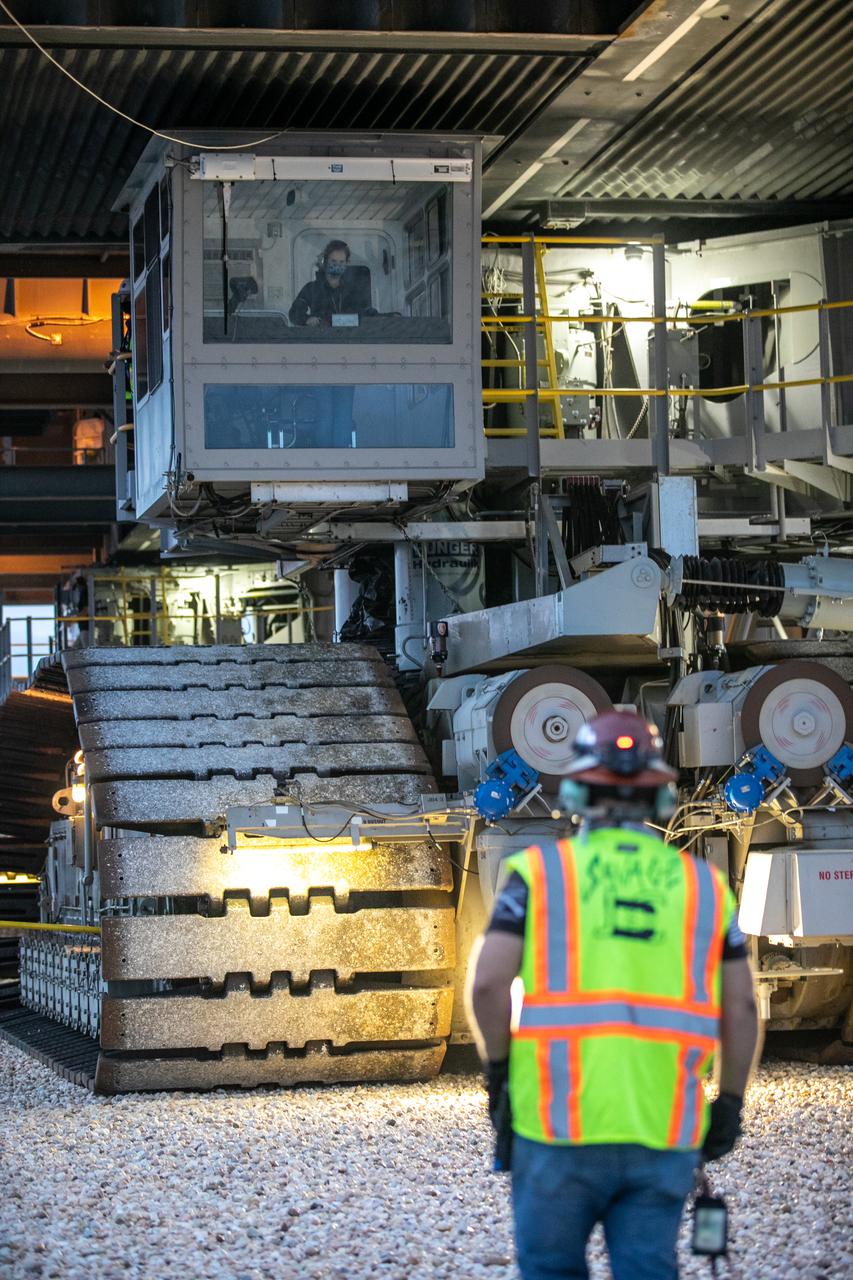
During sunrise on Oct. 20, 2020, the mobile launcher for the Artemis I mission, atop crawler-transporter 2 (CT-2), arrives at Launch Pad 39B at NASA’s Kennedy Space Center in Florida. In view inside the CT cab is Breanne Rohloff, crawler-transporter driver and mechanical engineer with Jacobs. The nearly 400-foot-tall mobile launcher will remain at the pad for two weeks, while engineers with Exploration Ground Systems and Jacobs will perform several tasks, including a timing test to validate the launch team’s countdown timeline, and a thorough, top-to-bottom wash down of the mobile launcher to remove any debris remaining from construction and installation of the umbilical arms. Artemis I will test the Orion spacecraft and Space Launch System as an integrated system ahead of crewed flights to the Moon. Under the Artemis program, NASA will land the first woman and the next man on the Moon in 2024.
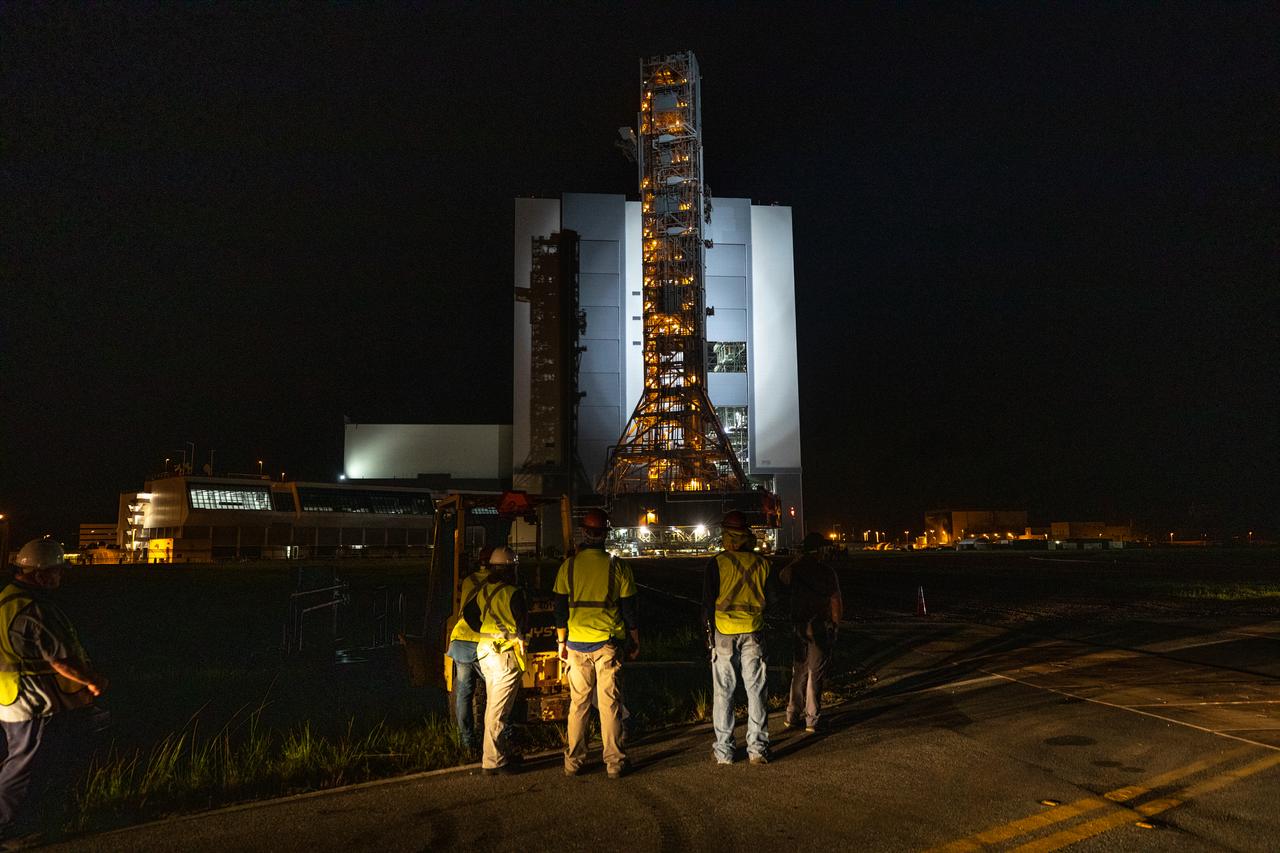
In the early morning on Oct. 20, 2020, the mobile launcher for the Artemis I mission rolls along the crawlerway atop crawler-transporter 2 after departing the Vehicle Assembly Building at NASA’s Kennedy Space Center in Florida. The nearly 400-foot-tall mobile launcher is being rolled to Launch Pad 39B. During its two-week stay at the pad, engineers with Exploration Ground Systems and Jacobs will perform several tasks, including a timing test to validate the launch team’s countdown timeline, and a thorough, top-to-bottom wash down of the mobile launcher to remove any debris remaining from construction and installation of the umbilical arms. Artemis I will test the Orion spacecraft and Space Launch System as an integrated system ahead of crewed flights to the Moon. Under the Artemis program, NASA will land the first woman and the next man on the Moon in 2024.
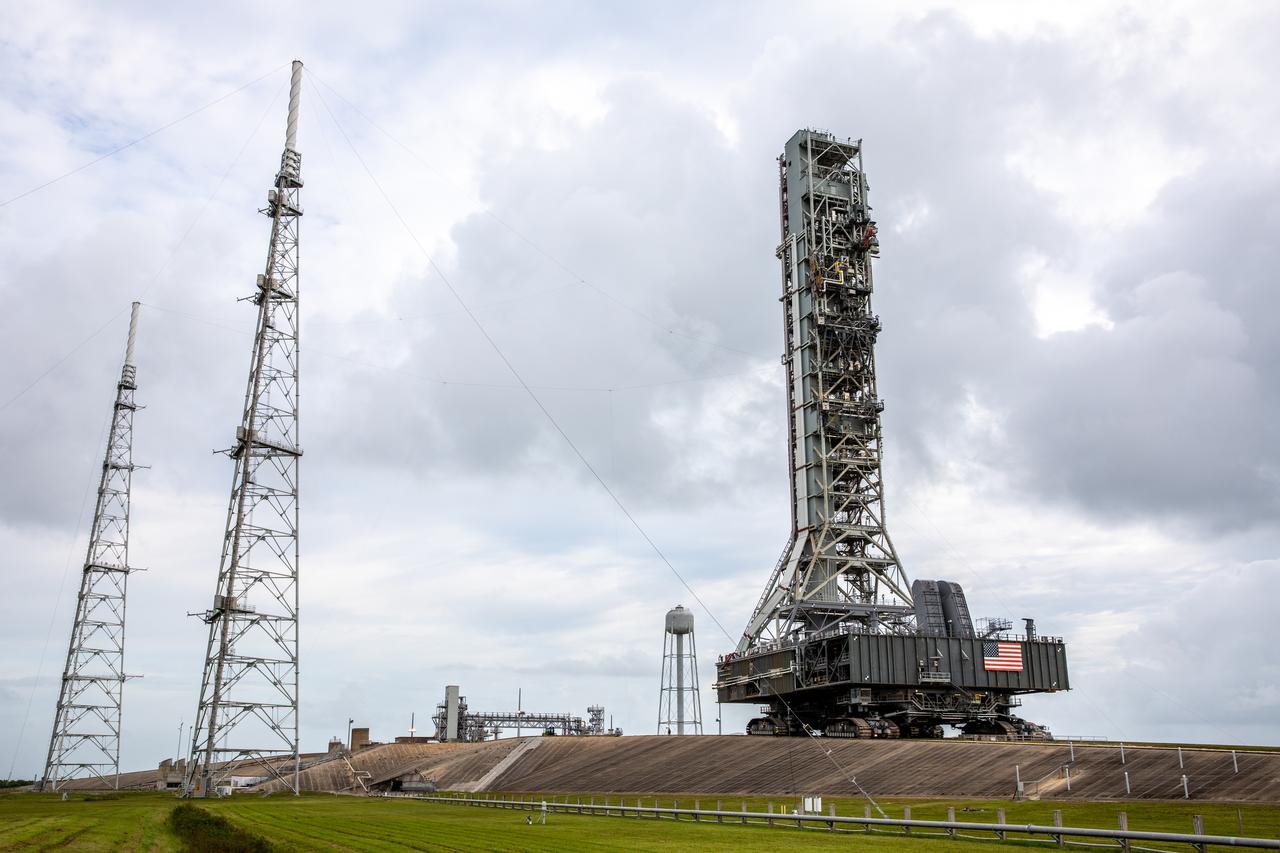
During the morning on Oct. 20, 2020, the mobile launcher for the Artemis I mission, atop crawler-transporter 2, moves up the ramp leading to Launch Pad 39B at NASA’s Kennedy Space Center in Florida. The nearly 400-foot-tall mobile launcher will remain at the pad for two weeks, while engineers with Exploration Ground Systems and Jacobs will perform several tasks, including a timing test to validate the launch team’s countdown timeline, and a thorough, top-to-bottom wash down of the mobile launcher to remove any debris remaining from construction and installation of the umbilical arms. Artemis I will test the Orion spacecraft and Space Launch System as an integrated system ahead of crewed flights to the Moon. Under the Artemis program, NASA will land the first woman and the next man on the Moon in 2024.
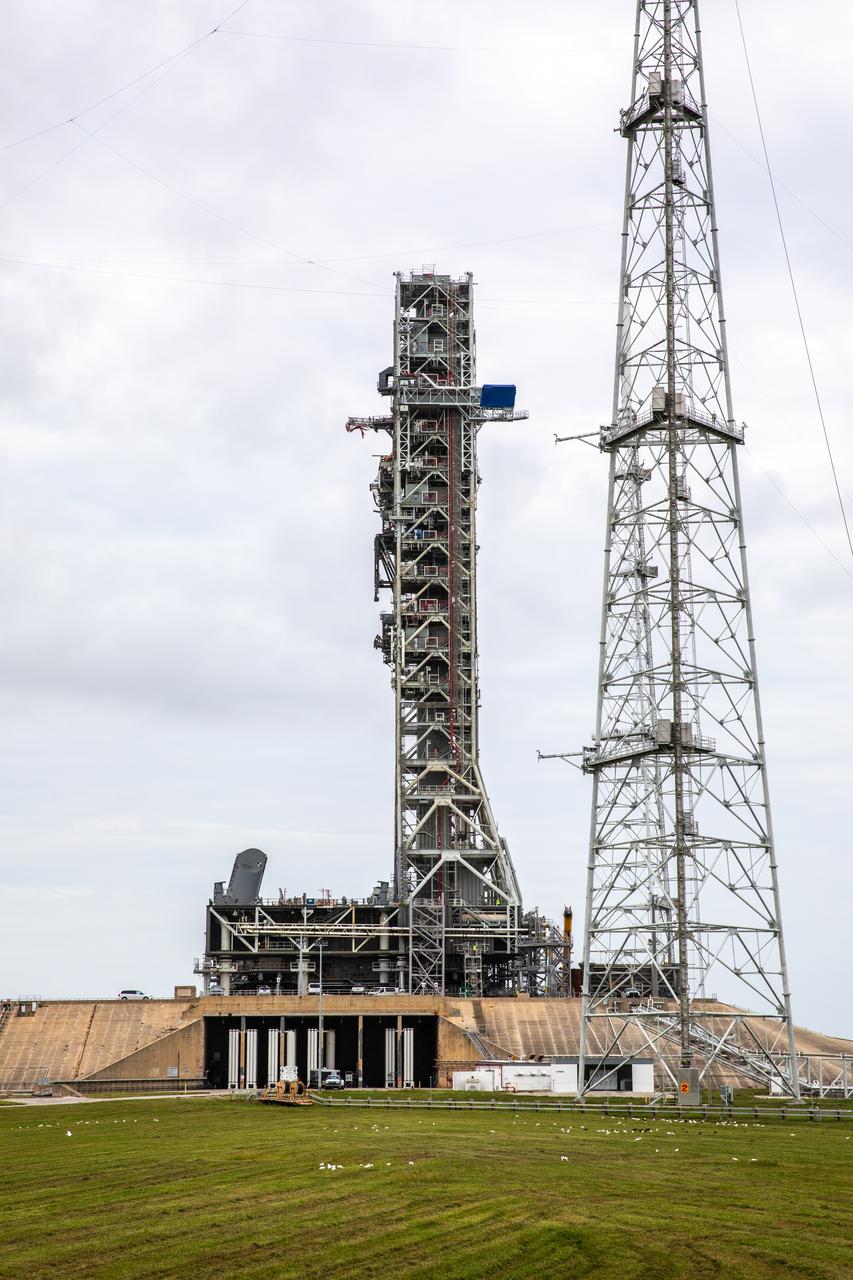
During the morning on Oct. 20, 2020, the mobile launcher for the Artemis I mission, atop crawler-transporter 2, arrives at the top of Launch Pad 39B at NASA’s Kennedy Space Center in Florida. The nearly 400-foot-tall mobile launcher will remain at the pad for two weeks, while engineers with Exploration Ground Systems and Jacobs will perform several tasks, including a timing test to validate the launch team’s countdown timeline, and a thorough, top-to-bottom wash down of the mobile launcher to remove any debris remaining from construction and installation of the umbilical arms. Artemis I will test the Orion spacecraft and Space Launch System as an integrated system ahead of crewed flights to the Moon. Under the Artemis program, NASA will land the first woman and the next man on the Moon in 2024.
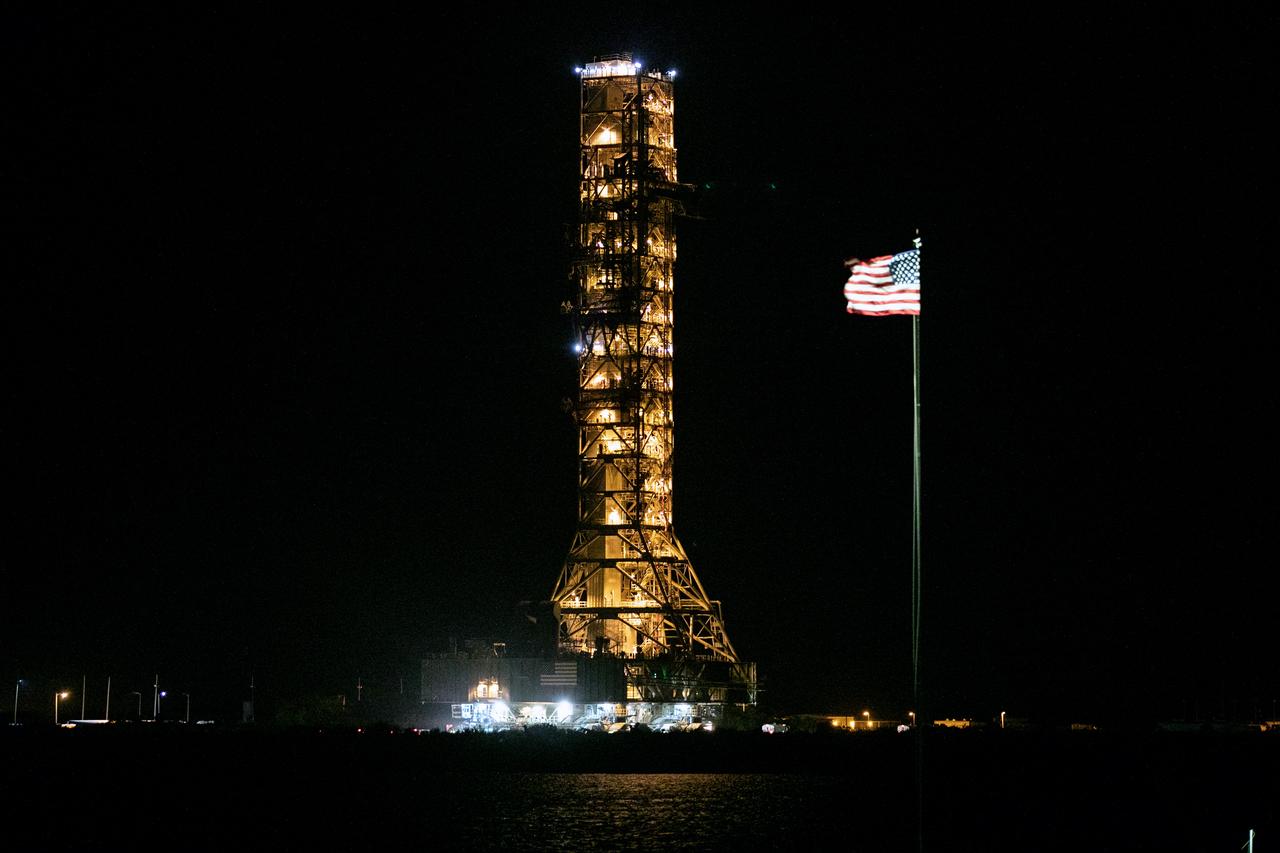
In the early morning on Oct. 20, 2020, the mobile launcher for the Artemis I mission rolls along the crawlerway atop crawler-transporter 2 after departing the Vehicle Assembly Building at NASA’s Kennedy Space Center in Florida. The nearly 400-foot-tall mobile launcher is being rolled to Launch Pad 39B. During its two-week stay at the pad, engineers with Exploration Ground Systems and Jacobs will perform several tasks, including a timing test to validate the launch team’s countdown timeline, and a thorough, top-to-bottom wash down of the mobile launcher to remove any debris remaining from construction and installation of the umbilical arms. Artemis I will test the Orion spacecraft and Space Launch System as an integrated system ahead of crewed flights to the Moon. Under the Artemis program, NASA will land the first woman and the next man on the Moon in 2024.
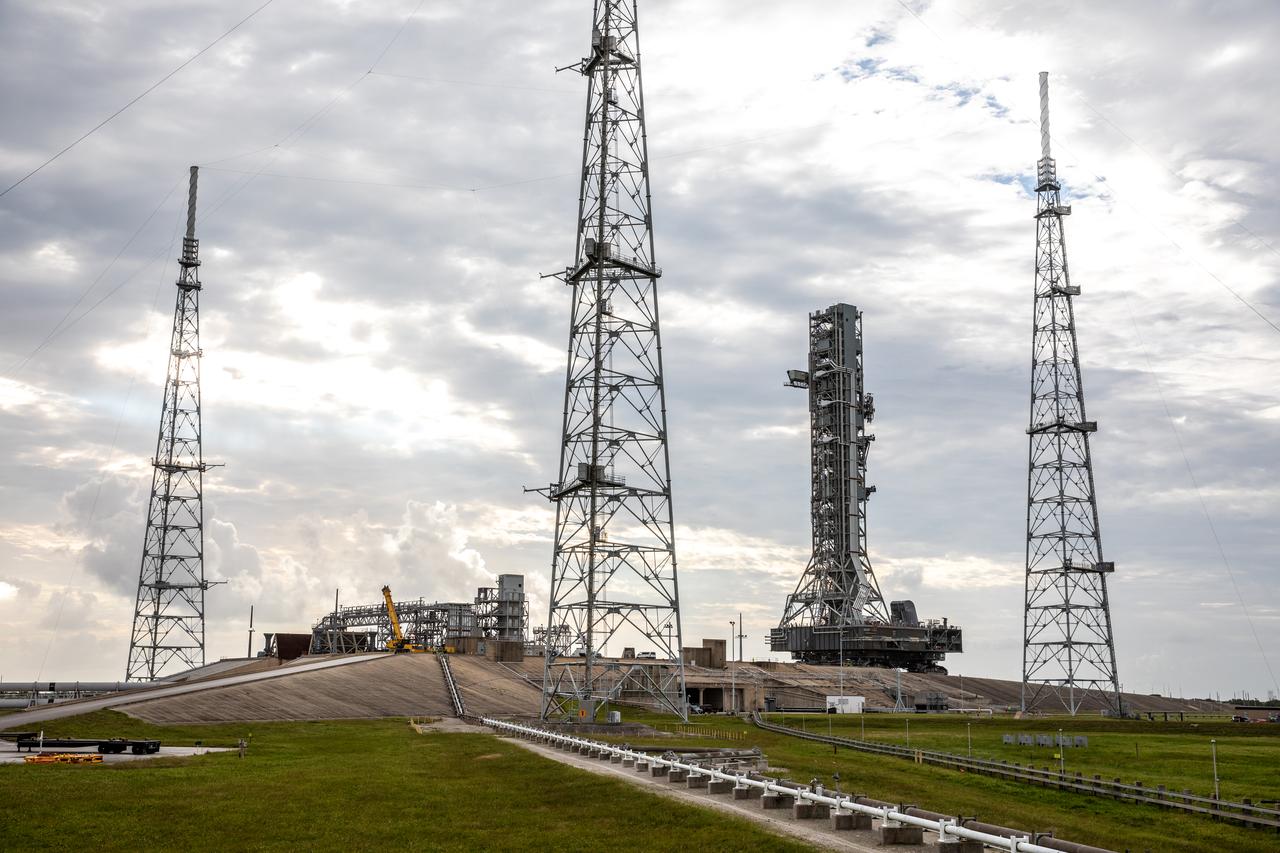
During the morning on Oct. 20, 2020, the mobile launcher for the Artemis I mission, atop crawler-transporter 2, moves up the ramp leading to Launch Pad 39B at NASA’s Kennedy Space Center in Florida. The nearly 400-foot-tall mobile launcher will remain at the pad for two weeks, while engineers with Exploration Ground Systems and Jacobs will perform several tasks, including a timing test to validate the launch team’s countdown timeline, and a thorough, top-to-bottom wash down of the mobile launcher to remove any debris remaining from construction and installation of the umbilical arms. Artemis I will test the Orion spacecraft and Space Launch System as an integrated system ahead of crewed flights to the Moon. Under the Artemis program, NASA will land the first woman and the next man on the Moon in 2024.

During sunrise on Oct. 20, 2020, the mobile launcher for the Artemis I mission, atop crawler-transporter 2 (CT-2), arrives at Launch Pad 39B at NASA’s Kennedy Space Center in Florida. In view inside the CT cab is Breanne Rohloff, crawler-transporter driver and mechanical engineer with Jacobs. The nearly 400-foot-tall mobile launcher will remain at the pad for two weeks, while engineers with Exploration Ground Systems and Jacobs will perform several tasks, including a timing test to validate the launch team’s countdown timeline, and a thorough, top-to-bottom wash down of the mobile launcher to remove any debris remaining from construction and installation of the umbilical arms. Artemis I will test the Orion spacecraft and Space Launch System as an integrated system ahead of crewed flights to the Moon.
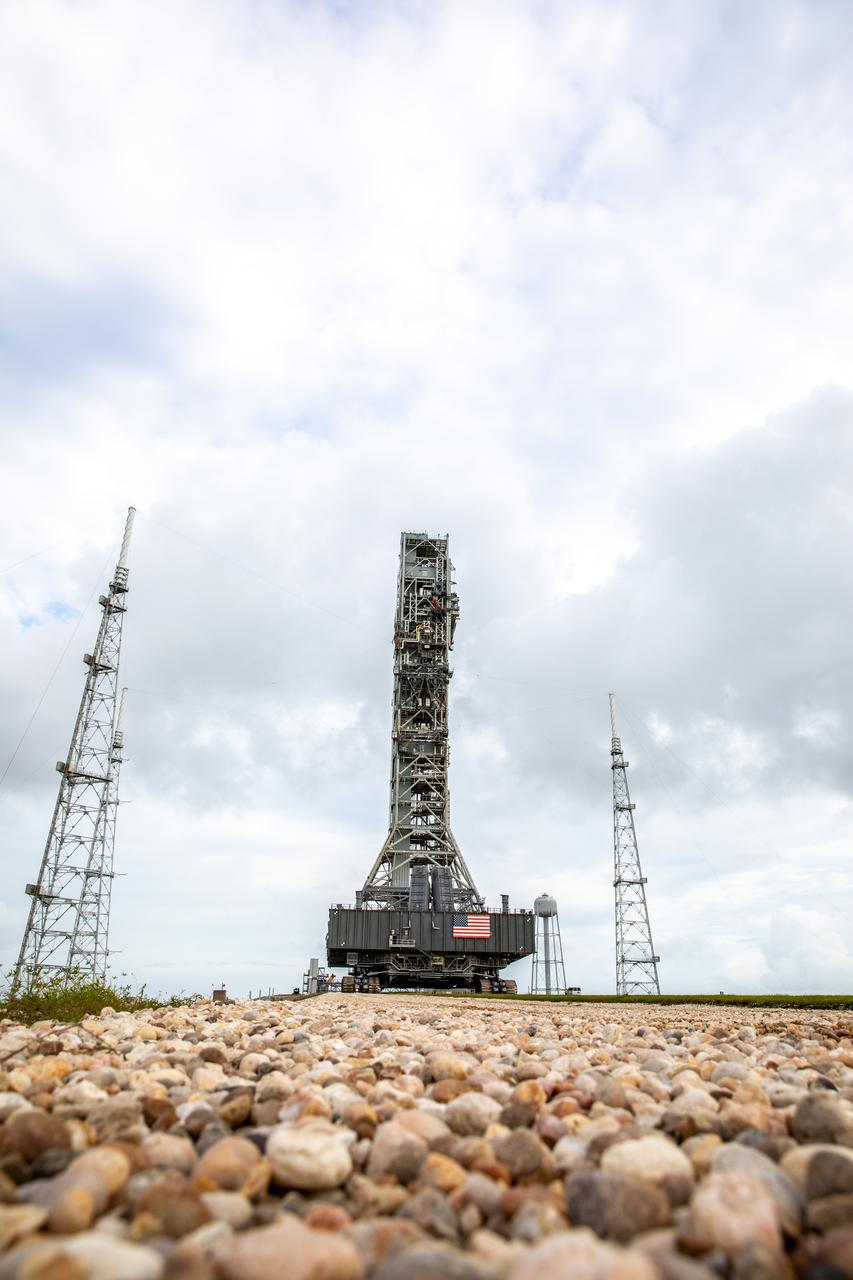
During the morning on Oct. 20, 2020, the mobile launcher for the Artemis I mission, atop crawler-transporter 2, moves up the ramp leading to Launch Pad 39B at NASA’s Kennedy Space Center in Florida. In the foreground is a view of the crawlerway rock bed. The nearly 400-foot-tall mobile launcher will remain at the pad for two weeks, while engineers with Exploration Ground Systems and Jacobs will perform several tasks, including a timing test to validate the launch team’s countdown timeline, and a thorough, top-to-bottom wash down of the mobile launcher to remove any debris remaining from construction and installation of the umbilical arms. Artemis I will test the Orion spacecraft and Space Launch System as an integrated system ahead of crewed flights to the Moon. Under the Artemis program, NASA will land the first woman and the next man on the Moon in 2024.
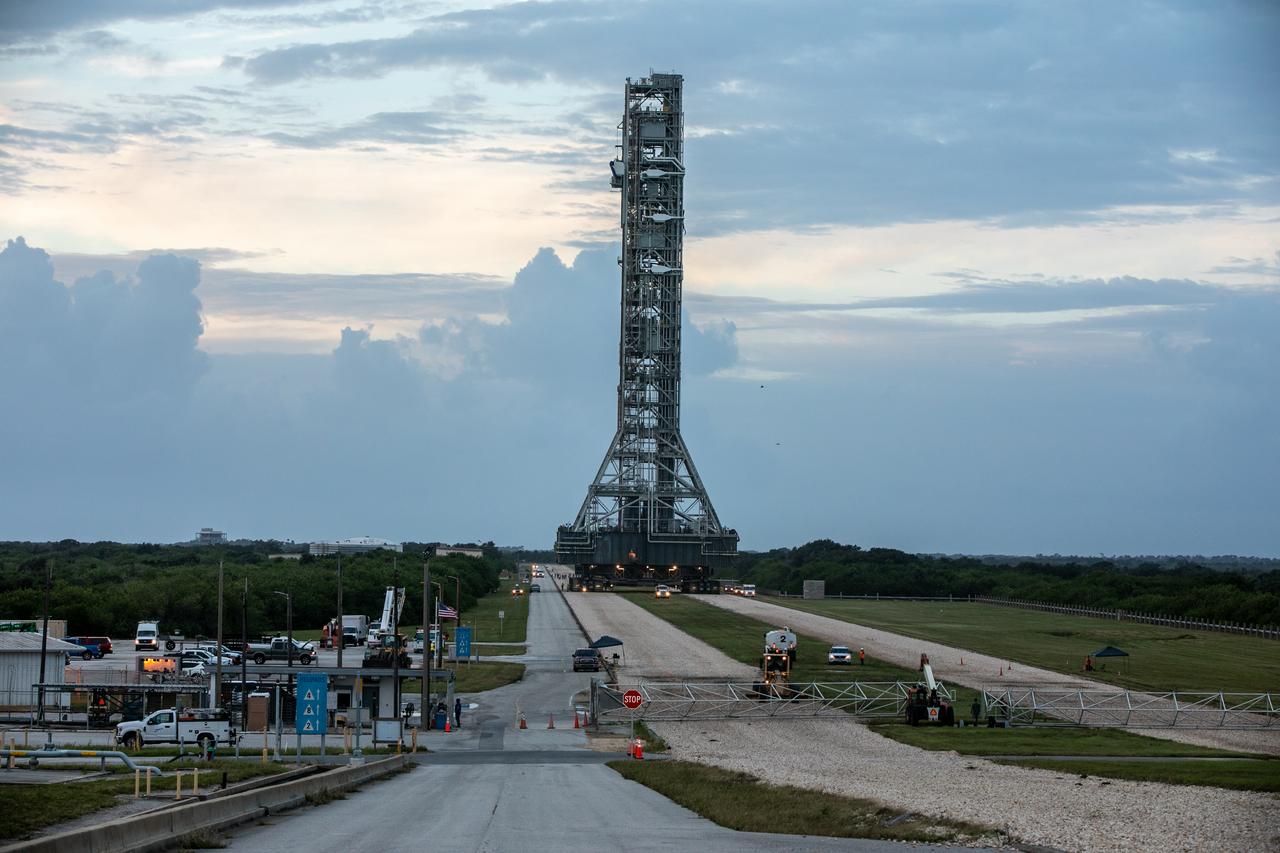
During sunrise on Oct. 20, 2020, the mobile launcher for the Artemis I mission, atop crawler-transporter 2, nears the top of Launch Pad 39B at NASA’s Kennedy Space Center in Florida. The nearly 400-foot-tall mobile launcher will remain at the pad for two weeks, while engineers with Exploration Ground Systems and Jacobs will perform several tasks, including a timing test to validate the launch team’s countdown timeline, and a thorough, top-to-bottom wash down of the mobile launcher to remove any debris remaining from construction and installation of the umbilical arms. Artemis I will test the Orion spacecraft and Space Launch System as an integrated system ahead of crewed flights to the Moon. Under the Artemis program, NASA will land the first woman and the next man on the Moon in 2024.
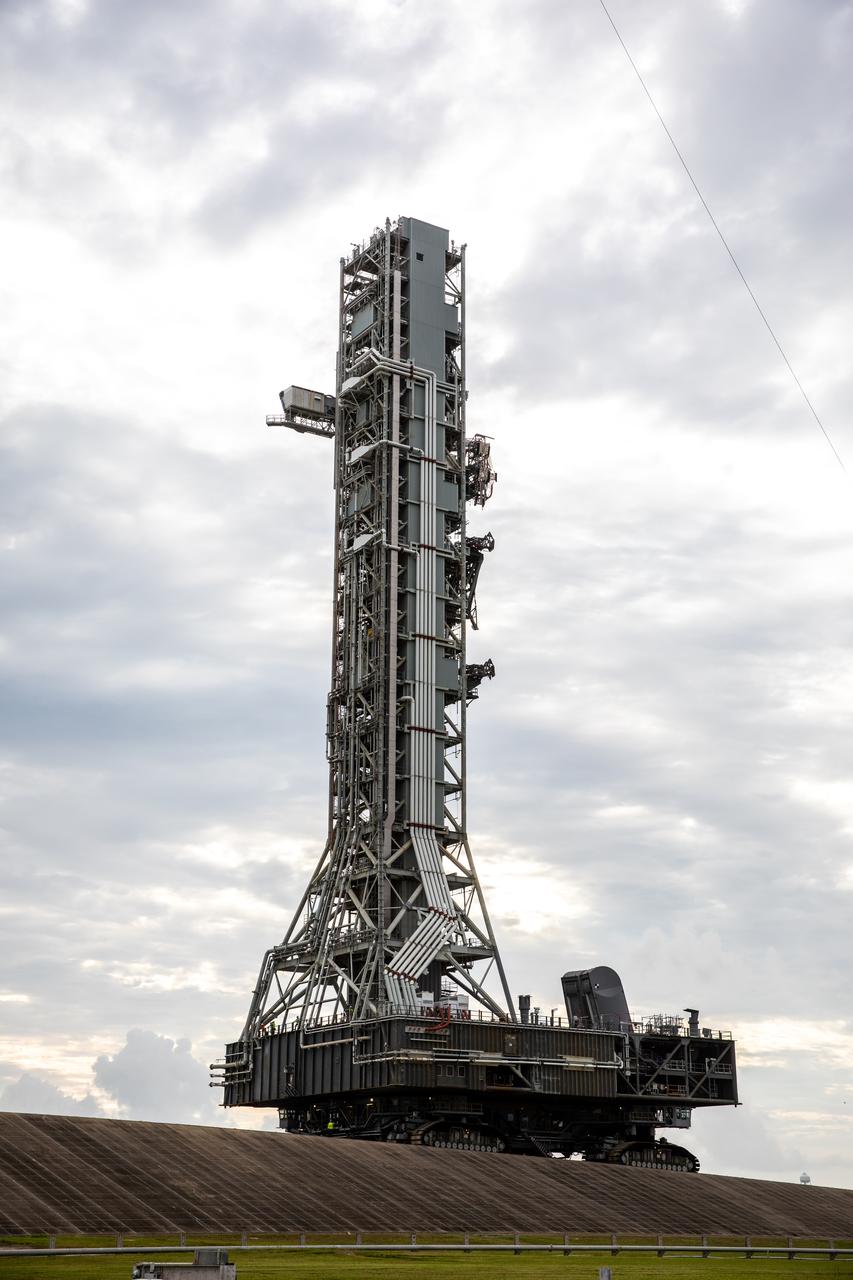
During the morning on Oct. 20, 2020, the mobile launcher for the Artemis I mission, atop crawler-transporter 2, moves up the ramp leading to Launch Pad 39B at NASA’s Kennedy Space Center in Florida. The nearly 400-foot-tall mobile launcher will remain at the pad for two weeks, while engineers with Exploration Ground Systems and Jacobs will perform several tasks, including a timing test to validate the launch team’s countdown timeline, and a thorough, top-to-bottom wash down of the mobile launcher to remove any debris remaining from construction and installation of the umbilical arms. Artemis I will test the Orion spacecraft and Space Launch System as an integrated system ahead of crewed flights to the Moon. Under the Artemis program, NASA will land the first woman and the next man on the Moon in 2024.
In the early morning on Oct. 20, 2020, the mobile launcher for the Artemis I mission rolls along the crawlerway atop crawler-transporter 2 after departing the Vehicle Assembly Building at NASA’s Kennedy Space Center in Florida. The nearly 400-foot-tall mobile launcher is being rolled to Launch Pad 39B. During its two-week stay at the pad, engineers with Exploration Ground Systems and Jacobs will perform several tasks, including a timing test to validate the launch team’s countdown timeline, and a thorough, top-to-bottom wash down of the mobile launcher to remove any debris remaining from construction and installation of the umbilical arms. Artemis I will test the Orion spacecraft and Space Launch System as an integrated system ahead of crewed flights to the Moon. Under the Artemis program, NASA will land the first woman and the next man on the Moon in 2024.
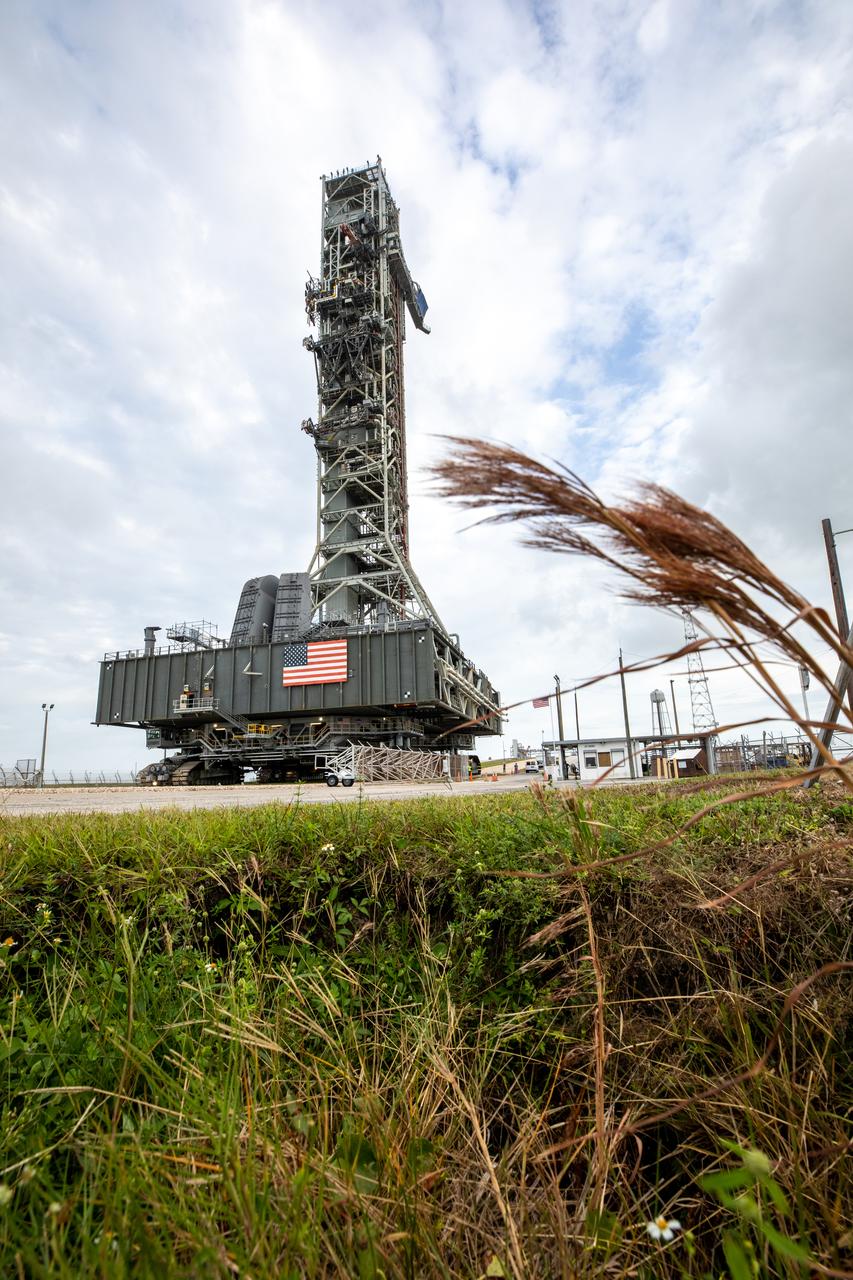
During sunrise on Oct. 20, 2020, the mobile launcher for the Artemis I mission, atop crawler-transporter 2, travels up the ramp leading to the top of Launch Pad 39B at NASA’s Kennedy Space Center in Florida. The nearly 400-foot-tall mobile launcher will remain at the pad for two weeks, while engineers with Exploration Ground Systems and Jacobs will perform several tasks, including a timing test to validate the launch team’s countdown timeline, and a thorough, top-to-bottom wash down of the mobile launcher to remove any debris remaining from construction and installation of the umbilical arms. Artemis I will test the Orion spacecraft and Space Launch System as an integrated system ahead of crewed flights to the Moon. Under the Artemis program, NASA will land the first woman and the next man on the Moon in 2024.
In the early morning on Oct. 20, 2020, the mobile launcher for the Artemis I mission, atop crawler-transporter 2, moves slowly along the crawlerway to Launch Pad 39B at NASA’s Kennedy Space Center in Florida. The nearly 400-foot-tall mobile launcher will remain at the pad for two weeks, while engineers with Exploration Ground Systems and Jacobs will perform several tasks, including a timing test to validate the launch team’s countdown timeline, and a thorough, top-to-bottom wash down of the mobile launcher to remove any debris remaining from construction and installation of the umbilical arms. Artemis I will test the Orion spacecraft and Space Launch System as an integrated system ahead of crewed flights to the Moon. Under the Artemis program, NASA will land the first woman and the next man on the Moon in 2024.
During the morning on Oct. 20, 2020, the mobile launcher for the Artemis I mission, atop crawler-transporter 2, arrives at the top of Launch Pad 39B at NASA’s Kennedy Space Center in Florida. The nearly 400-foot-tall mobile launcher will remain at the pad for two weeks, while engineers with Exploration Ground Systems and Jacobs will perform several tasks, including a timing test to validate the launch team’s countdown timeline, and a thorough, top-to-bottom wash down of the mobile launcher to remove any debris remaining from construction and installation of the umbilical arms. Artemis I will test the Orion spacecraft and Space Launch System as an integrated system ahead of crewed flights to the Moon. Under the Artemis program, NASA will land the first woman and the next man on the Moon in 2024.
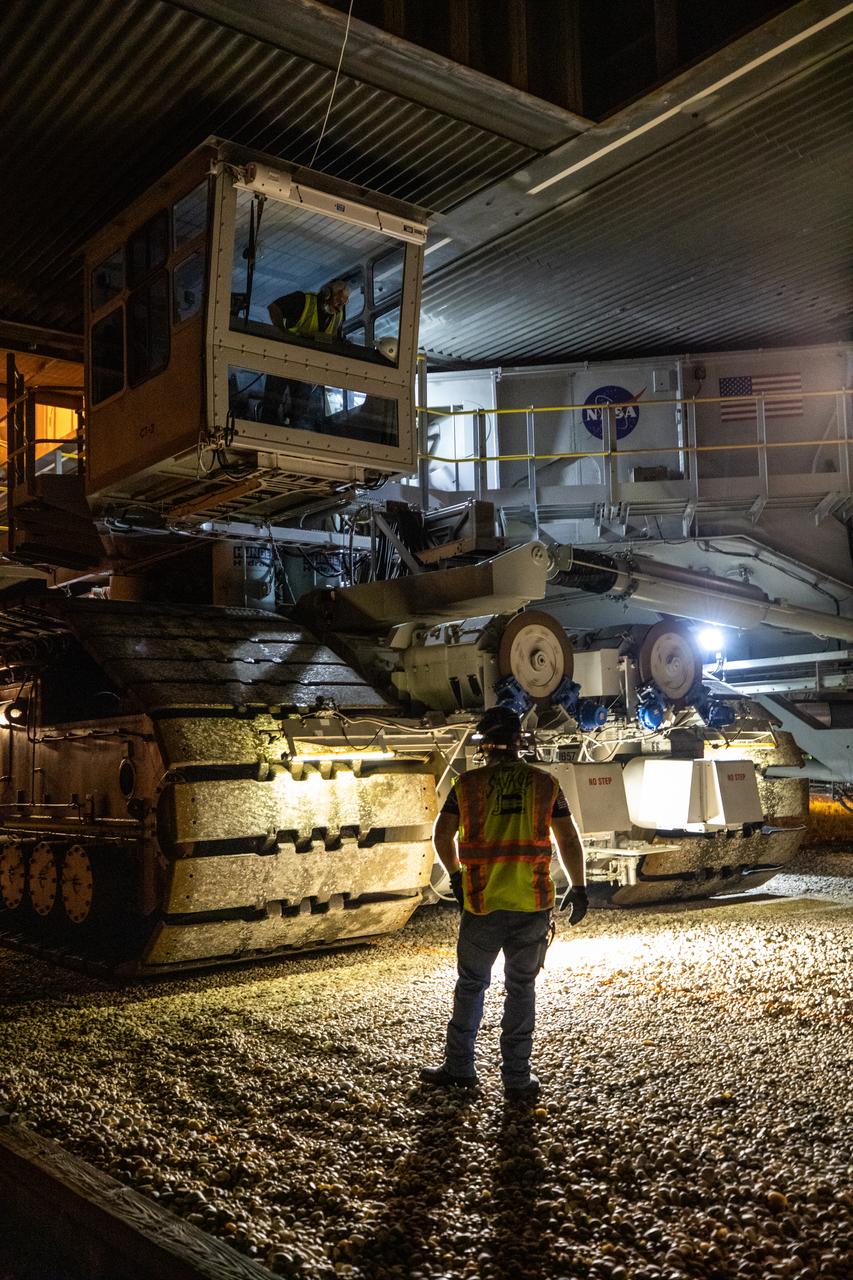
A close-up view of crawler-transporter 2 as it moves slowly along the crawlerway carrying the mobile launcher for the Artemis I mission after departing the Vehicle Assembly Building at NASA’s Kennedy Space Center in Florida in the early morning on Oct. 20, 2020. The nearly 400-foot-tall mobile launcher is being rolled to Launch Pad 39B. During its two-week stay at the pad, engineers with Exploration Ground Systems and Jacobs will perform several tasks, including a timing test to validate the launch team’s countdown timeline, and a thorough, top-to-bottom wash down of the mobile launcher to remove any debris remaining from construction and installation of the umbilical arms. Artemis I will test the Orion spacecraft and Space Launch System as an integrated system ahead of crewed flights to the Moon. Under the Artemis program, NASA will land the first woman and the next man on the Moon in 2024.
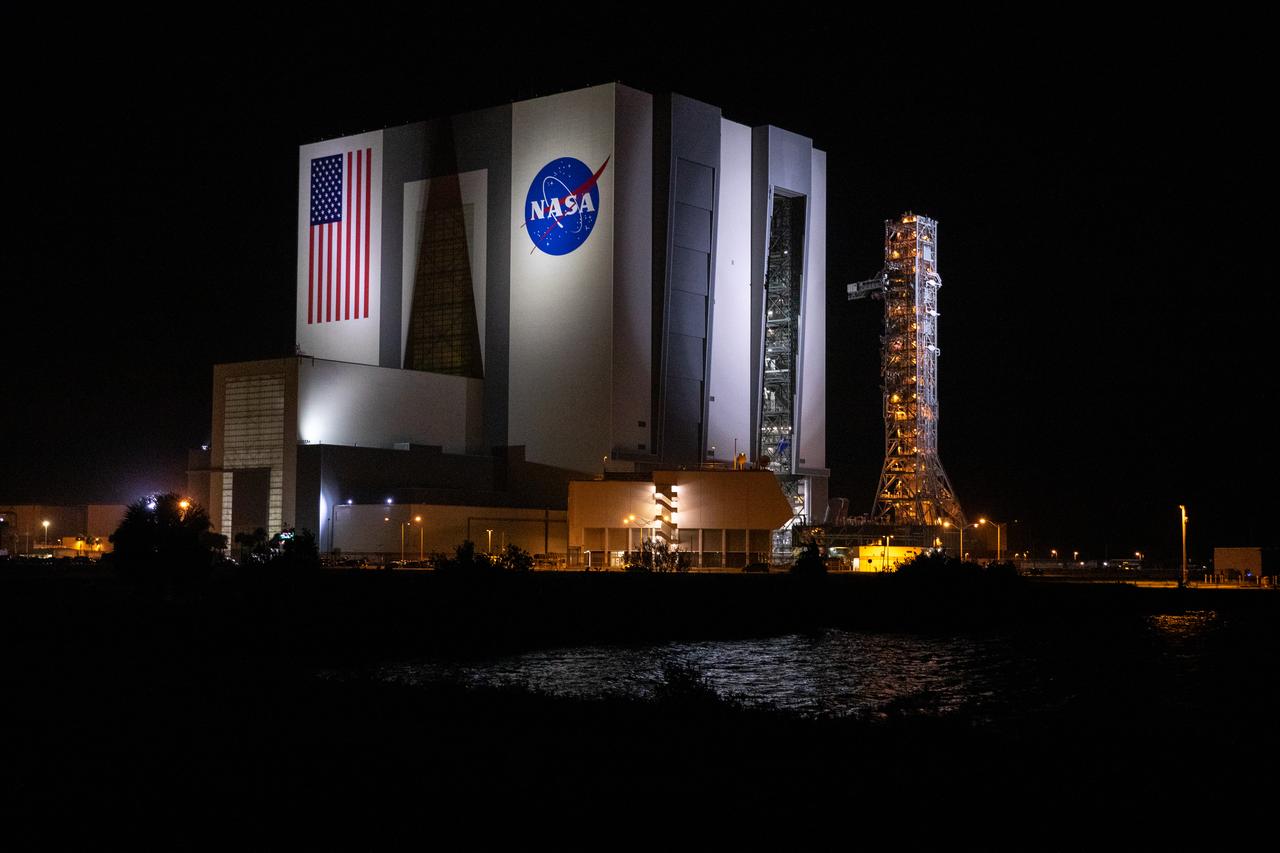
In the early morning on Oct. 20, 2020, the mobile launcher for the Artemis I mission begins its rollout atop crawler-transporter 2 from the Vehicle Assembly Building at NASA’s Kennedy Space Center in Florida. The nearly 400-foot-tall mobile launcher is being rolled to Launch Pad 39B. During its two-week stay at the pad, engineers with Exploration Ground Systems and Jacobs will perform several tasks, including a timing test to validate the launch team’s countdown timeline, and a thorough, top-to-bottom wash down of the mobile launcher to remove any debris remaining from construction and installation of the umbilical arms. Artemis I will test the Orion spacecraft and Space Launch System as an integrated system ahead of crewed flights to the Moon. Under the Artemis program, NASA will land the first woman and the next man on the Moon in 2024.
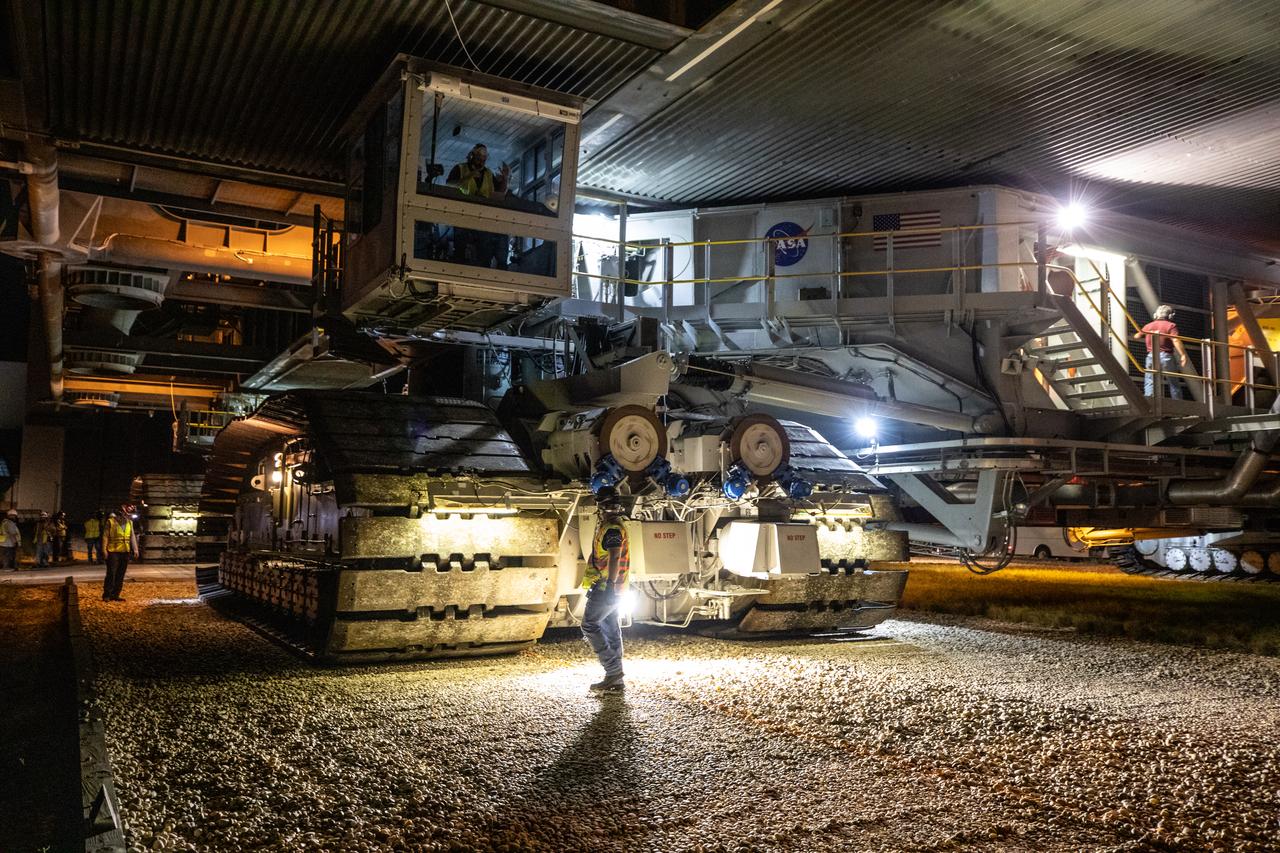
A close-up view of crawler-transporter 2 as it moves slowly along the crawlerway carrying the mobile launcher for the Artemis I mission after departing the Vehicle Assembly Building at NASA’s Kennedy Space Center in Florida in the early morning on Oct. 20, 2020. The nearly 400-foot-tall mobile launcher is being rolled to Launch Pad 39B. During its two-week stay at the pad, engineers with Exploration Ground Systems and Jacobs will perform several tasks, including a timing test to validate the launch team’s countdown timeline, and a thorough, top-to-bottom wash down of the mobile launcher to remove any debris remaining from construction and installation of the umbilical arms. Artemis I will test the Orion spacecraft and Space Launch System as an integrated system ahead of crewed flights to the Moon. Under the Artemis program, NASA will land the first woman and the next man on the Moon in 2024.
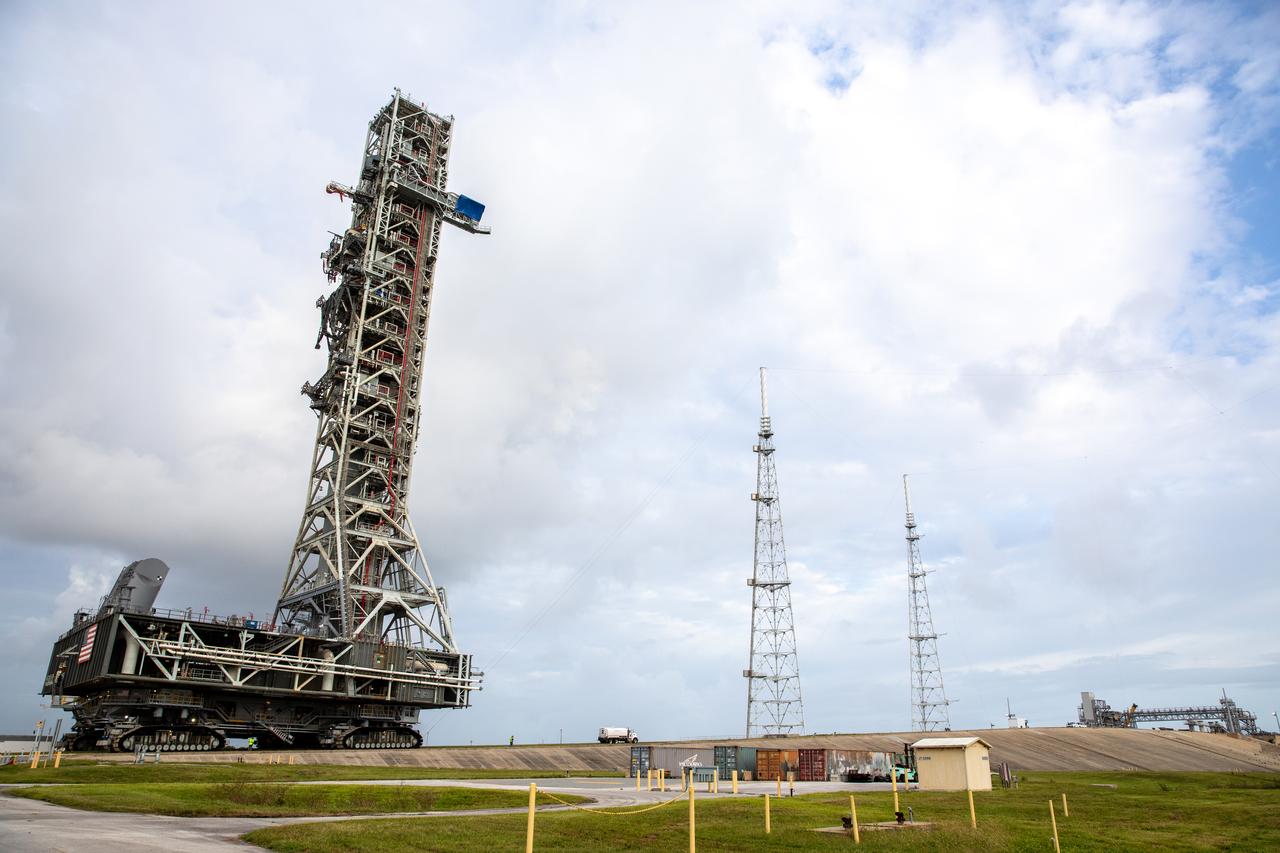
During the morning on Oct. 20, 2020, the mobile launcher for the Artemis I mission, atop crawler-transporter 2, moves up the ramp leading to Launch Pad 39B at NASA’s Kennedy Space Center in Florida. The nearly 400-foot-tall mobile launcher will remain at the pad for two weeks, while engineers with Exploration Ground Systems and Jacobs will perform several tasks, including a timing test to validate the launch team’s countdown timeline, and a thorough, top-to-bottom wash down of the mobile launcher to remove any debris remaining from construction and installation of the umbilical arms. Artemis I will test the Orion spacecraft and Space Launch System as an integrated system ahead of crewed flights to the Moon. Under the Artemis program, NASA will land the first woman and the next man on the Moon in 2024.

NASA's Curiosity Mars rover used its ChemCam instrument to view boulders on Gediz Vallis Ridge Nov. 15 to 17, 2022, the 3,653rd to 3,655th Martian days, or sols, of the mission. These boulders are thought to have been washed down in a debris flows in the ancient past and are probably some of the youngest evidence of liquid water Curiosity will see on Mount Sharp. Curiosity has been ascending the foothills of the 3-mile-tall (5-kilometer-tall) mountain since 2014. Water ebbed and flowed on Mount Sharp billions of years ago, at times forming lakes and rivers that would dry up and flood repeatedly. Gediz Vallis is a part of the mountain where water once flowed down; Curiosity's scientists are interested in the ridge in part because it includes boulders like these that were washed down from much higher up the mountain, where Curiosity won't be able to reach. From left to right, the boulders depicted in the circles are approximately 984 feet (300 meters), 1,312 feet (400 meters), and 656 feet (200 meters) away. Based on these distances, the width of the boulders are estimated to be (again, from left to right) 4 feet (120 centimeters), 3.3 feet (100 centimeters), and 2 feet (60 centimeters). This scene is made up of 52 individual images captured by ChemCam's Remote Micro-Imager; the images were stitched together after being sent back to Earth. Early in the mission, the team discovered that the imager, originally designed to view targets shot by ChemCam's laser, can also be used like a telescope, looking at distant horizons rather than nearby rock textures. https://photojournal.jpl.nasa.gov/catalog/PIA25731
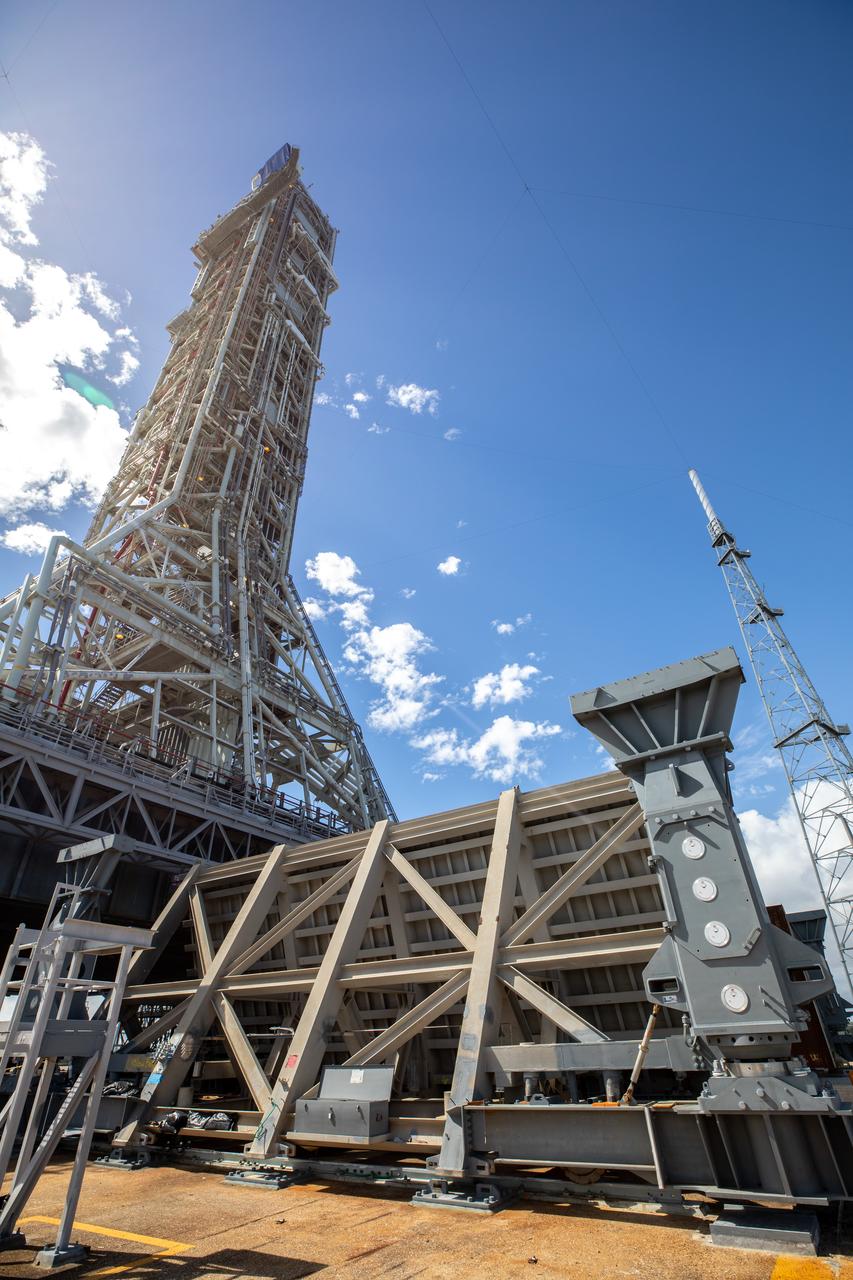
A view of the mobile launcher for the Artemis I mission at Launch Pad 39B at NASA’s Kennedy Space Center in Florida on Oct. 23, 2020. The nearly 400-foot-tall mobile launcher is at the pad while engineers with Exploration Ground Systems and Jacobs complete several tasks, including a timing test to validate the launch team’s countdown timeline, and a thorough, top-to-bottom wash down of the mobile launcher to remove any debris remaining from construction and installation of the umbilical arms. Artemis I will test the Orion spacecraft and Space Launch System as an integrated system ahead of crewed flights to the Moon. Under the Artemis program, NASA will land the first woman and the next man on the Moon in 2024.
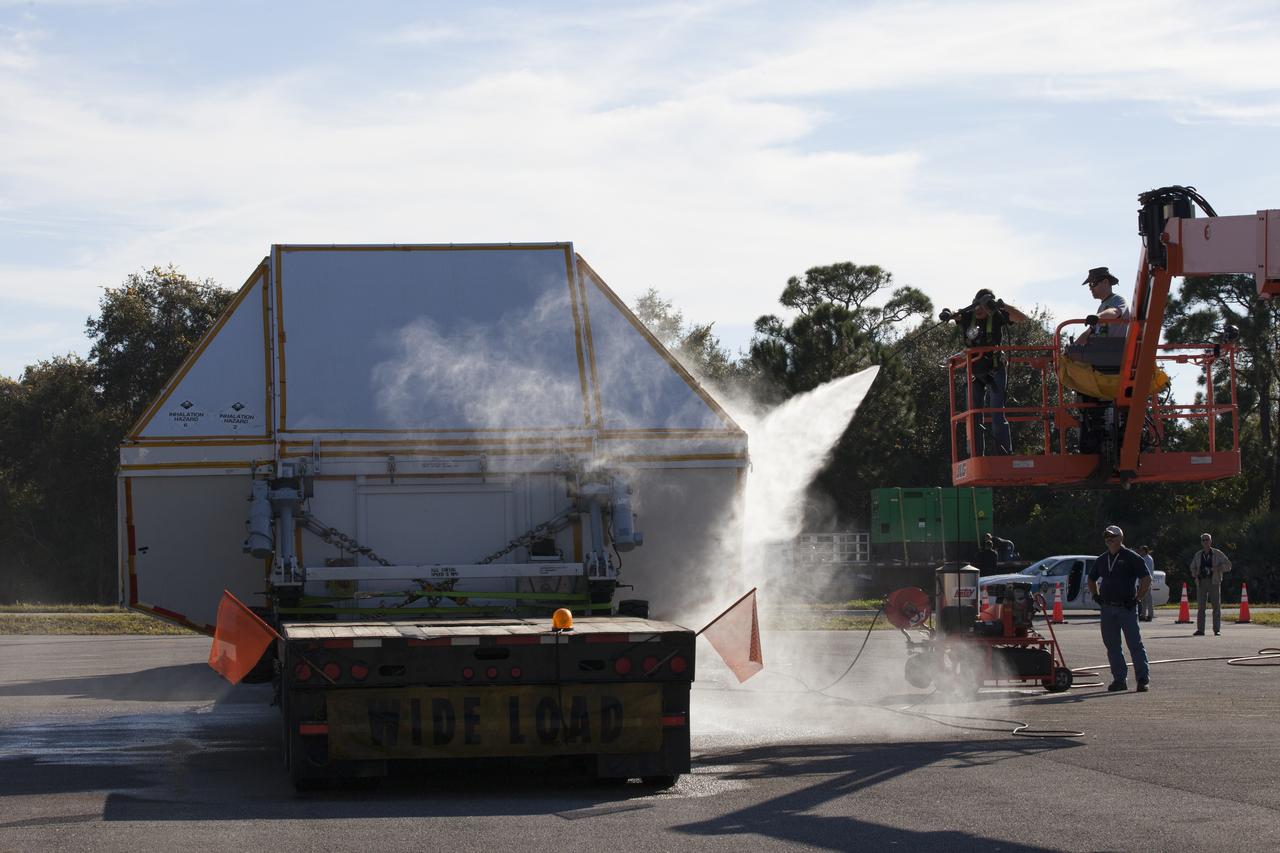
Technicians wash down the crew module transportation fixture containing the Orion crew module on the back of a flatbed truck at the Multi-Operation Support Building at NASA's Kennedy Space Center in Florida. Orion was transported 2,700 miles overland from Naval Base San Diego in California. Orion was recovered from the Pacific Ocean after completing a two-orbit, four-and-a-half hour mission Dec. 5 to test systems critical to crew safety, including the launch abort system, the heat shield and the parachute system. The Ground Systems Development and Operations Program led the recovery, offload and transportation efforts.
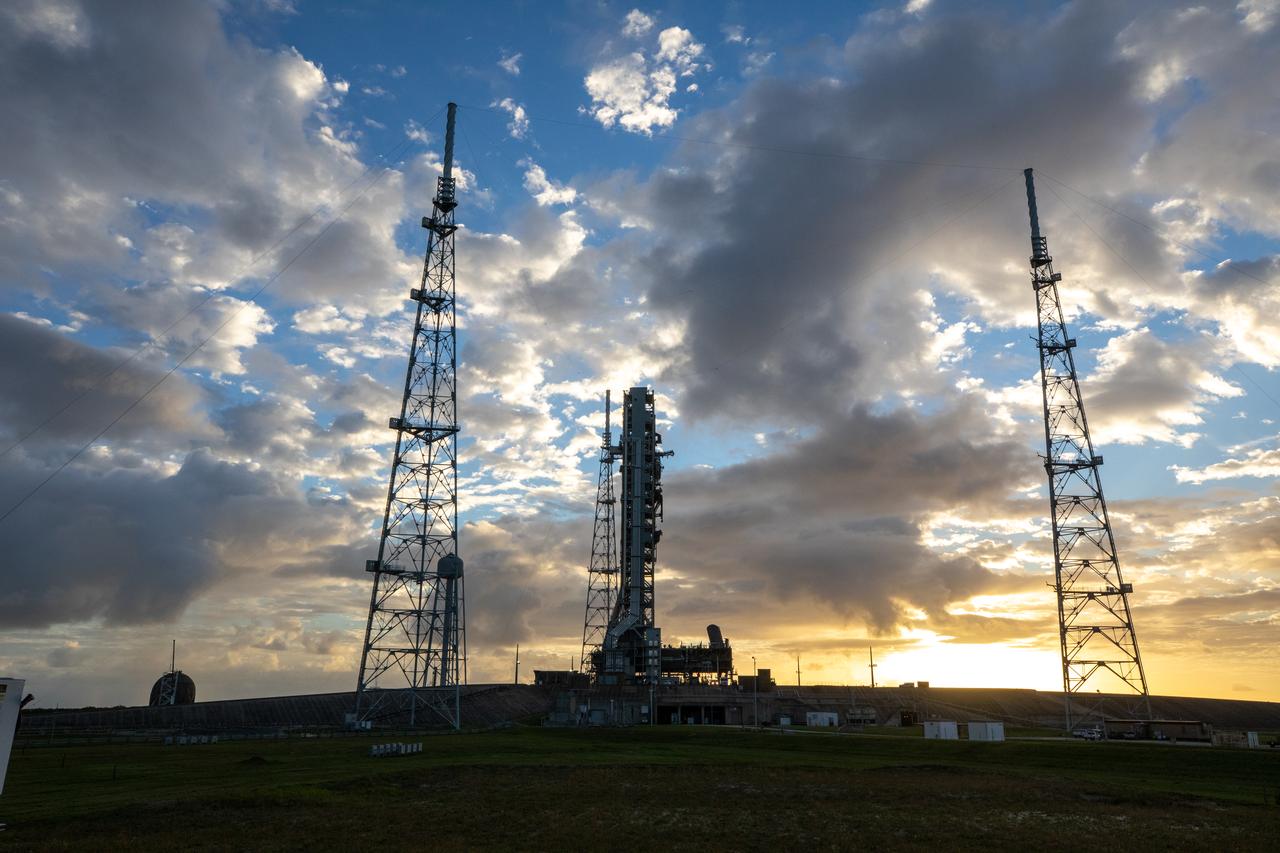
The mobile launcher for the Artemis I mission is in view on the top of Launch Pad 39B at NASA’s Kennedy Space Center in Florida on Oct. 23, 2020. The nearly 400-foot-tall mobile launcher is at the pad to allow engineers with Exploration Ground Systems and Jacobs to complete several tasks, including a timing test to validate the launch team’s countdown timeline, and a thorough, top-to-bottom wash down of the mobile launcher to remove any debris remaining from construction and installation of the umbilical arms. Artemis I will test the Orion spacecraft and Space Launch System as an integrated system ahead of crewed flights to the Moon. Under the Artemis program, NASA will land the first woman and the next man on the Moon in 2024.
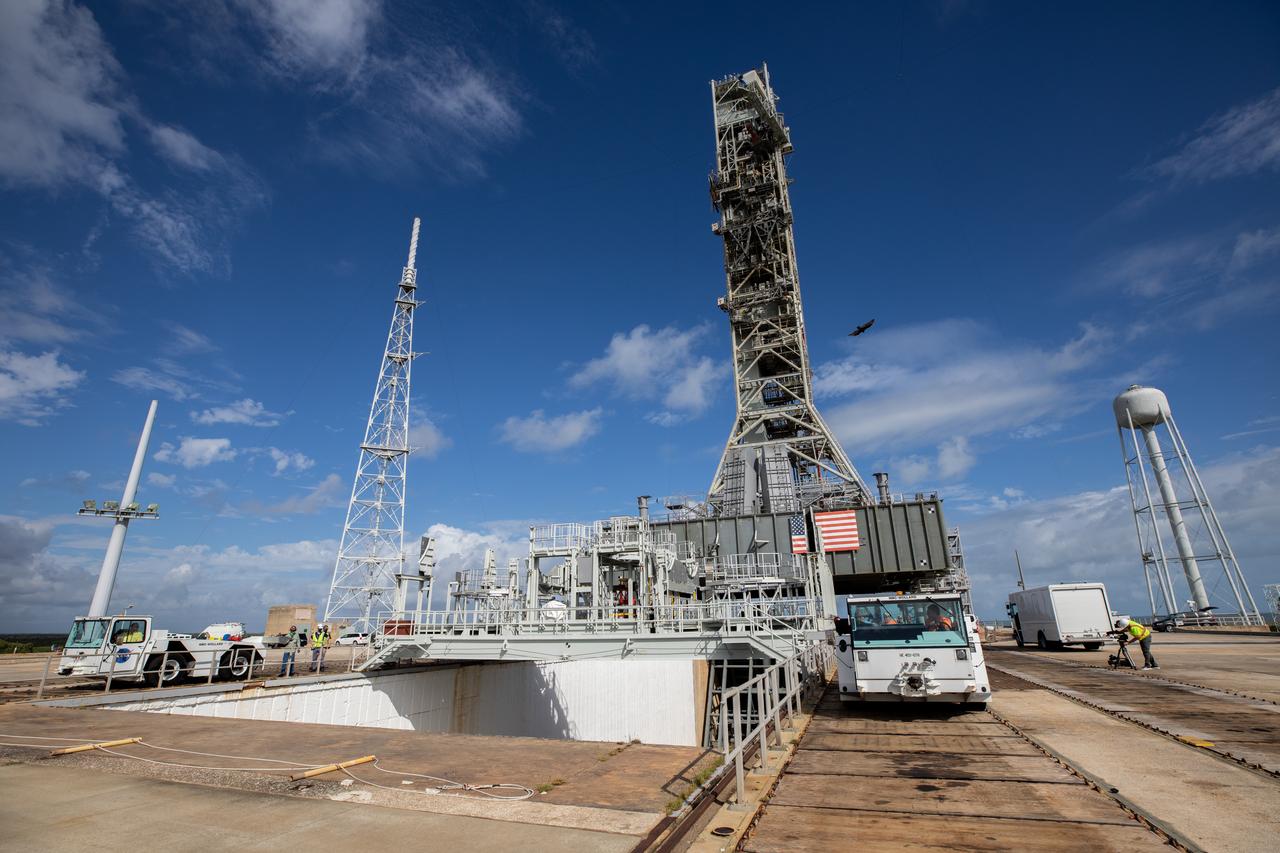
A view of the mobile launcher for the Artemis I mission at Launch Pad 39B at NASA’s Kennedy Space Center in Florida on Oct. 23, 2020. The nearly 400-foot-tall mobile launcher is at the pad while engineers with Exploration Ground Systems and Jacobs complete several tasks, including a timing test to validate the launch team’s countdown timeline, and a thorough, top-to-bottom wash down of the mobile launcher to remove any debris remaining from construction and installation of the umbilical arms. Artemis I will test the Orion spacecraft and Space Launch System as an integrated system ahead of crewed flights to the Moon. Under the Artemis program, NASA will land the first woman and the next man on the Moon in 2024.
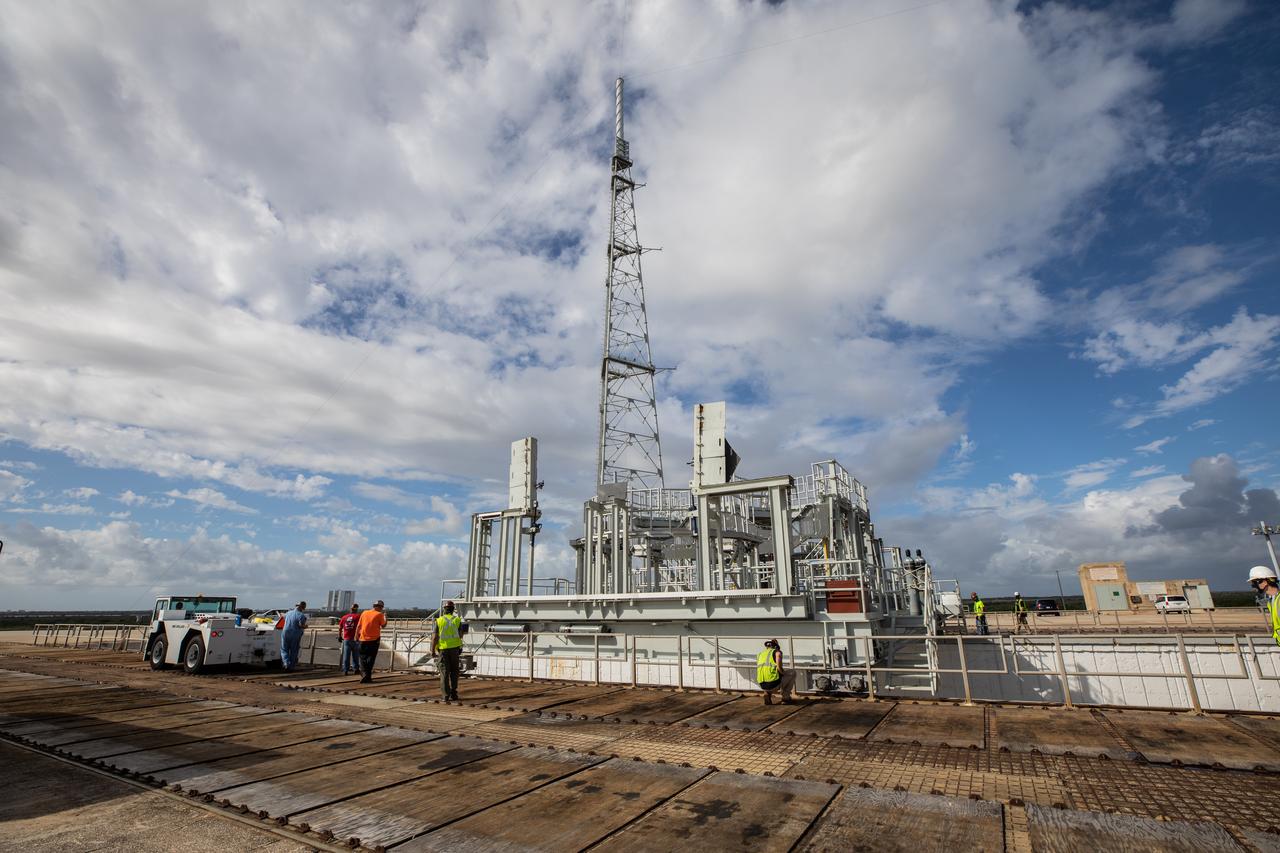
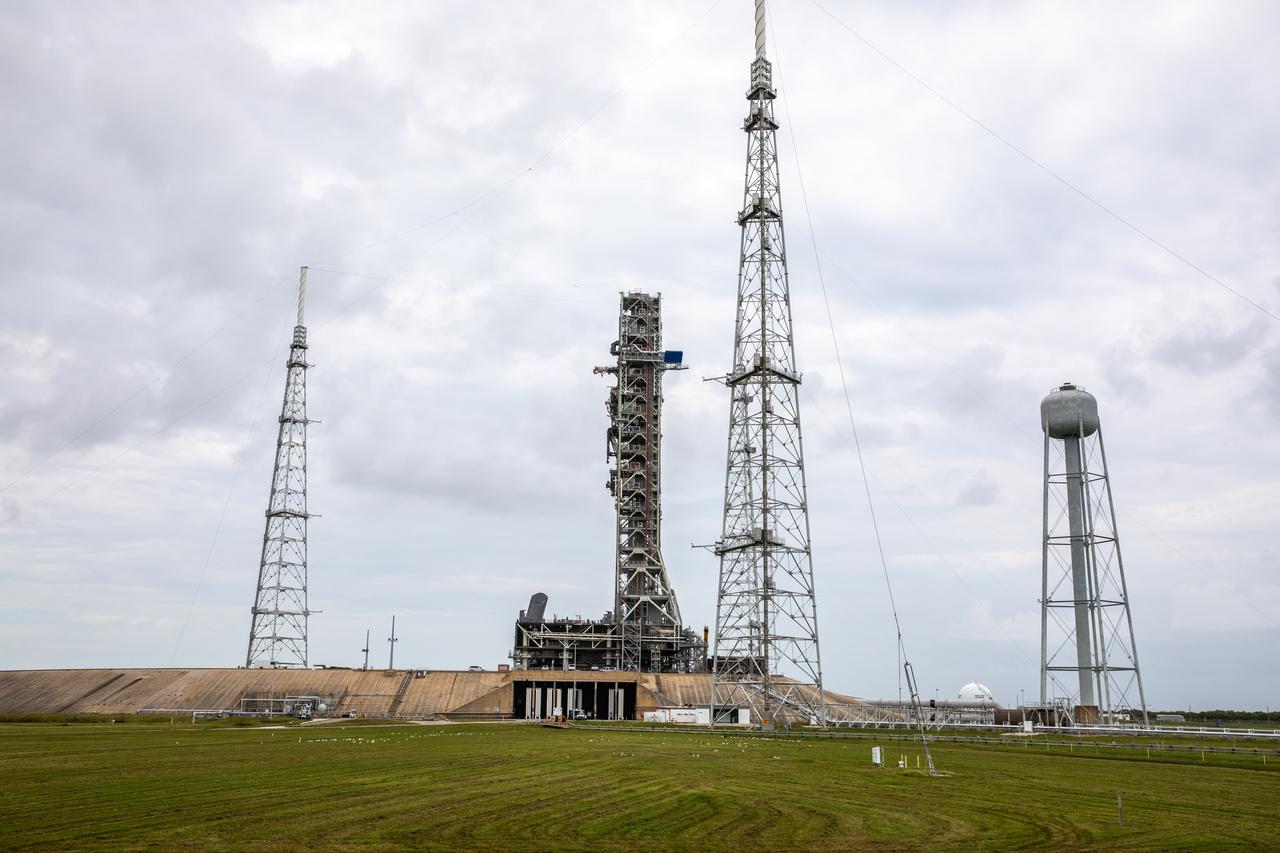
A view of Launch Complex 39B at NASA’s Kennedy Space Center in Florida on Oct. 23, 2020. The mobile launcher for Artemis I is at the pad. The nearly 400-foot-tall mobile launcher is at the pad while engineers with Exploration Ground Systems and Jacobs complete several tasks, including a timing test to validate the launch team’s countdown timeline, and a thorough, top-to-bottom wash down of the mobile launcher to remove any debris remaining from construction and installation of the umbilical arms. Artemis I will test the Orion spacecraft and Space Launch System as an integrated system ahead of crewed flights to the Moon. Under the Artemis program, NASA will land the first woman and the next man on the Moon in 2024.
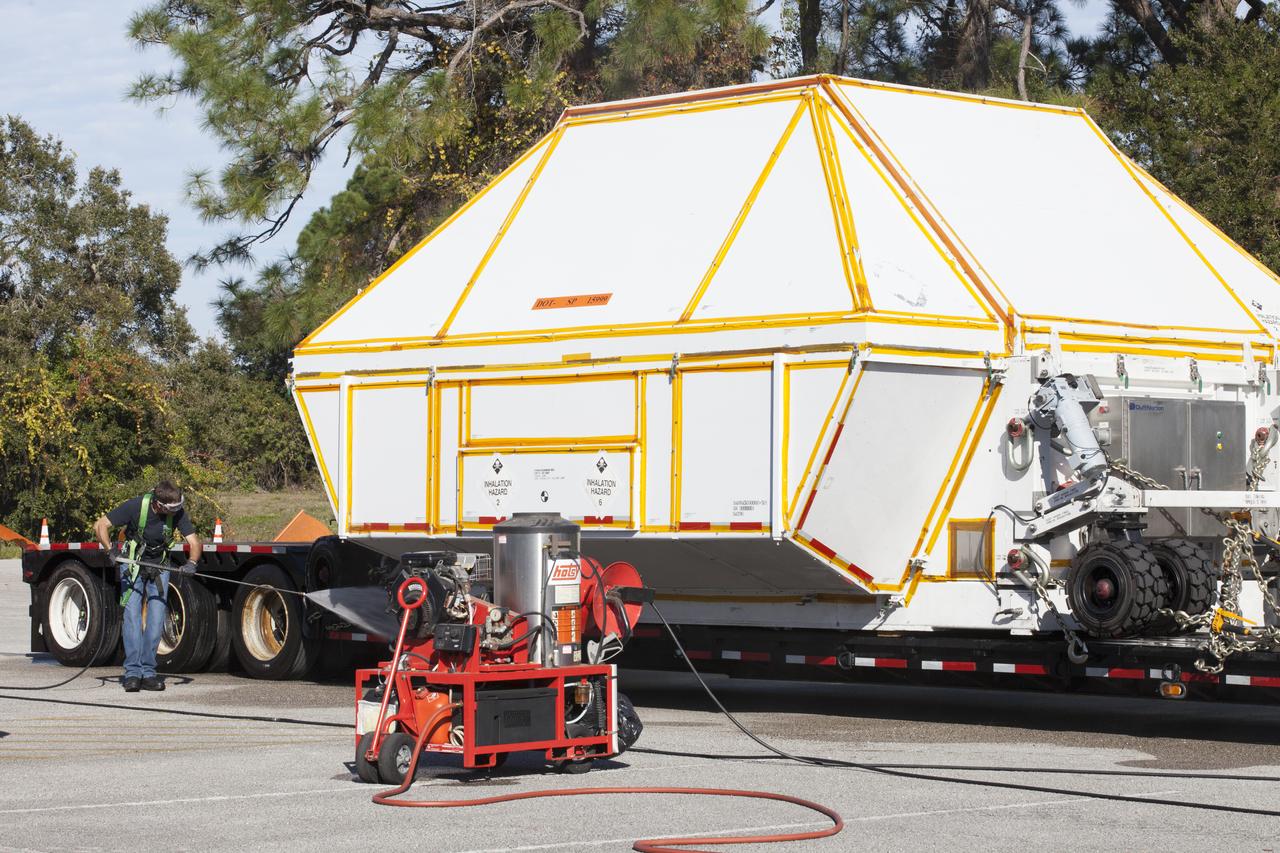
A technician washes down the crew module transportation fixture containing the Orion crew module on the back of a flatbed truck at the Multi-Operation Support Building at NASA's Kennedy Space Center in Florida. Orion was transported 2,700 miles overland from Naval Base San Diego in California. Orion was recovered from the Pacific Ocean after completing a two-orbit, four-and-a-half hour mission Dec. 5 to test systems critical to crew safety, including the launch abort system, the heat shield and the parachute system. The Ground Systems Development and Operations Program led the recovery, offload and transportation efforts.
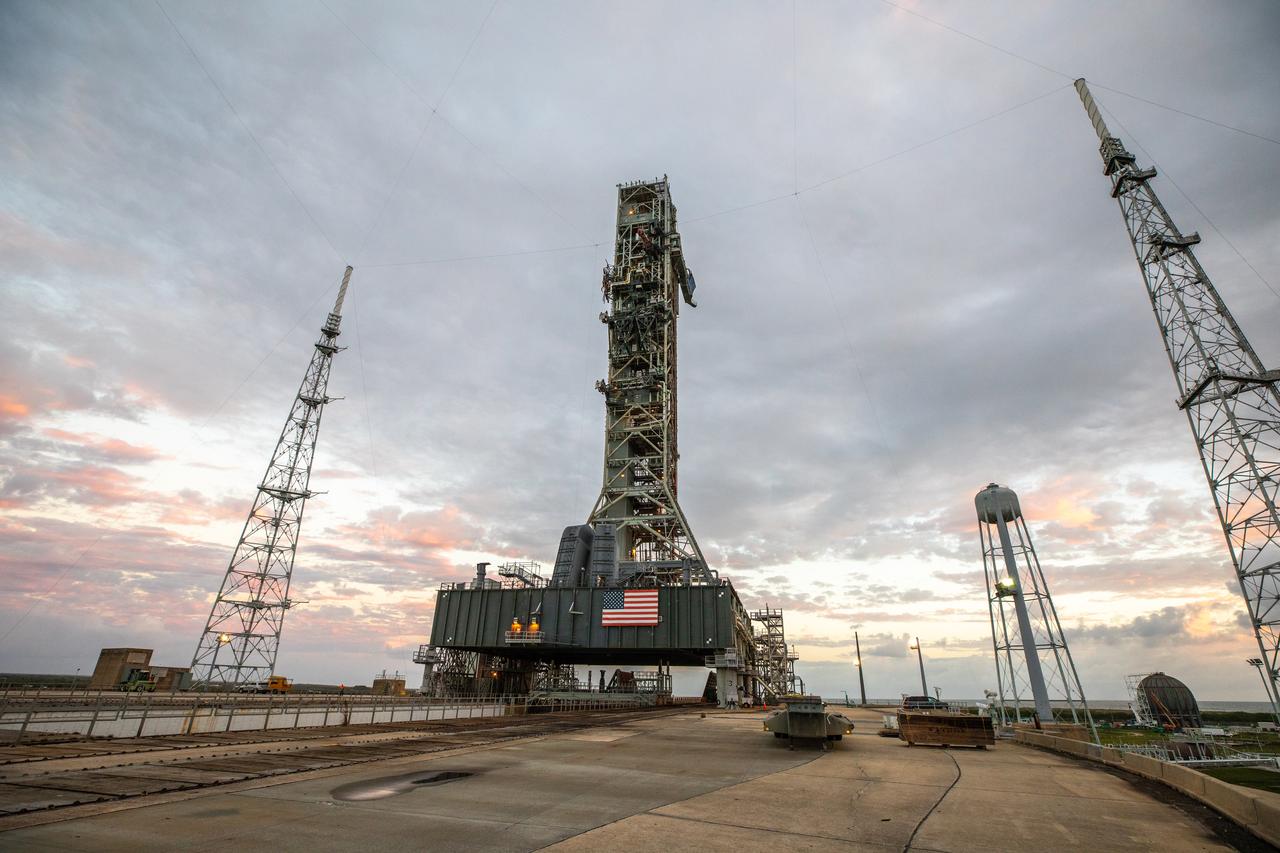
The mobile launcher for the Artemis I mission is in view on the top of Launch Pad 39B at NASA’s Kennedy Space Center in Florida on Oct. 23, 2020. The nearly 400-foot-tall mobile launcher is at the pad to allow engineers with Exploration Ground Systems and Jacobs to complete several tasks, including a timing test to validate the launch team’s countdown timeline, and a thorough, top-to-bottom wash down of the mobile launcher to remove any debris remaining from construction and installation of the umbilical arms. Artemis I will test the Orion spacecraft and Space Launch System as an integrated system ahead of crewed flights to the Moon. Under the Artemis program, NASA will land the first woman and the next man on the Moon in 2024.

On Oct. 23, 2020, an engineer with Exploration Ground Systems (EGS) is at Launch Pad 39B at NASA’s Kennedy Space Center in Florida as a brilliant sunrise illuminates the sky. The mobile launcher for the Artemis I mission is at the pad to allow engineers with EGS and Jacobs to complete several tasks, including a timing test to validate the launch team’s countdown timeline, and a thorough, top-to-bottom wash down of the mobile launcher to remove any debris remaining from construction and installation of the umbilical arms. Artemis I will test the Orion spacecraft and Space Launch System as an integrated system ahead of crewed flights to the Moon. Under the Artemis program, NASA will land the first woman and the next man on the Moon in 2024.
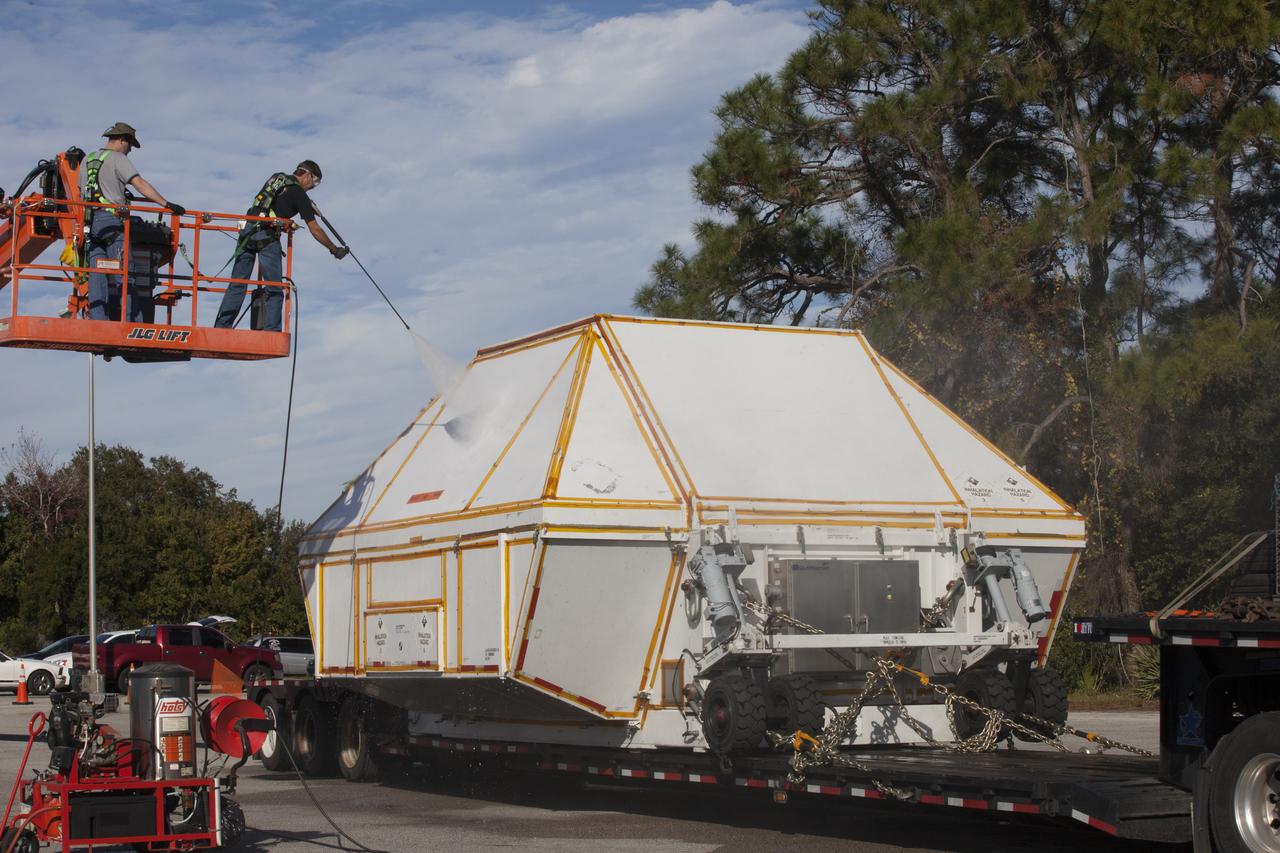
Technicians wash down the crew module transportation fixture containing the Orion crew module on the back of a flatbed truck at the Multi-Operation Support Building at NASA's Kennedy Space Center in Florida. Orion was transported 2,700 miles overland from Naval Base San Diego in California. Orion was recovered from the Pacific Ocean after completing a two-orbit, four-and-a-half hour mission Dec. 5 to test systems critical to crew safety, including the launch abort system, the heat shield and the parachute system. The Ground Systems Development and Operations Program led the recovery, offload and transportation efforts.
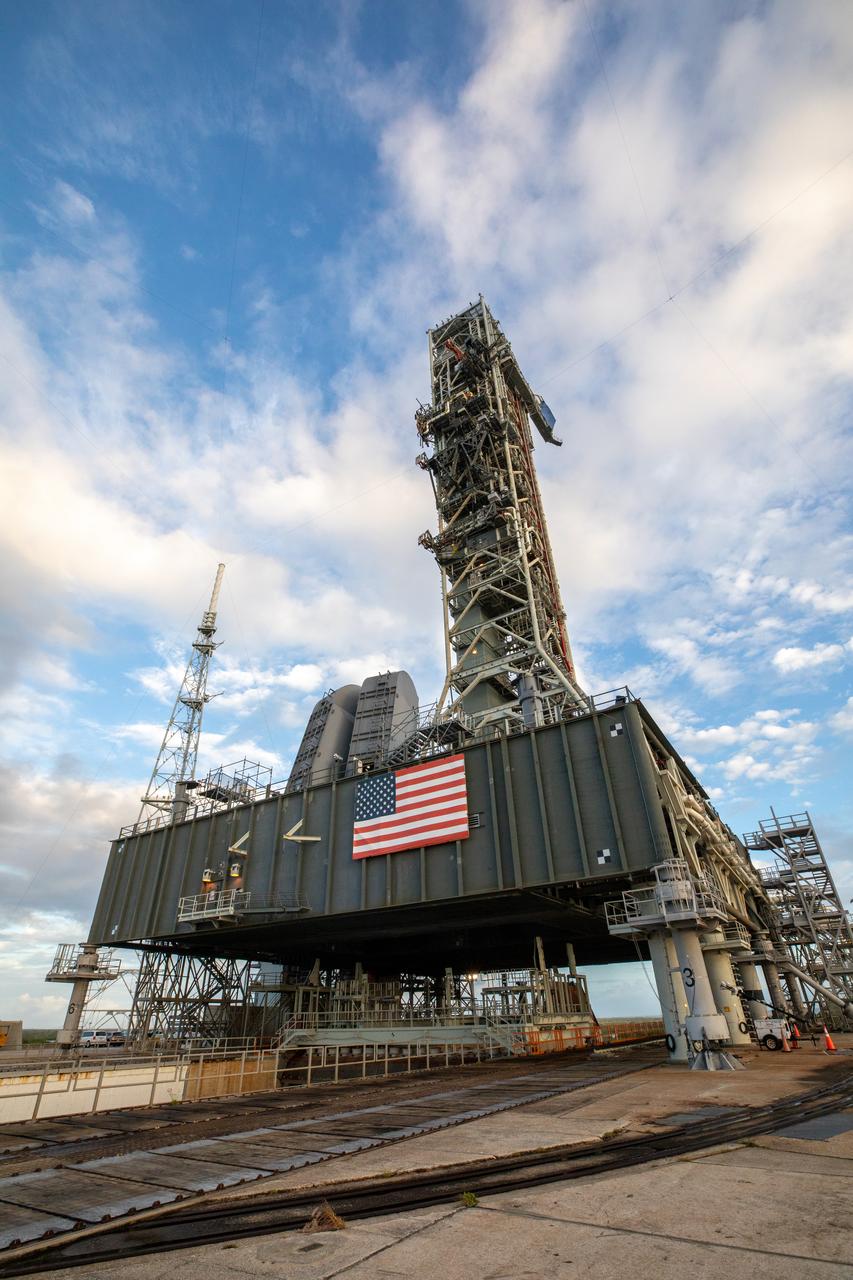
The mobile launcher for the Artemis I mission is in view on the top of Launch Pad 39B at NASA’s Kennedy Space Center in Florida on Oct. 23, 2020. The nearly 400-foot-tall mobile launcher is at the pad to allow engineers with Exploration Ground Systems and Jacobs to complete several tasks, including a timing test to validate the launch team’s countdown timeline, and a thorough, top-to-bottom wash down of the mobile launcher to remove any debris remaining from construction and installation of the umbilical arms. Artemis I will test the Orion spacecraft and Space Launch System as an integrated system ahead of crewed flights to the Moon. Under the Artemis program, NASA will land the first woman and the next man on the Moon in 2024.
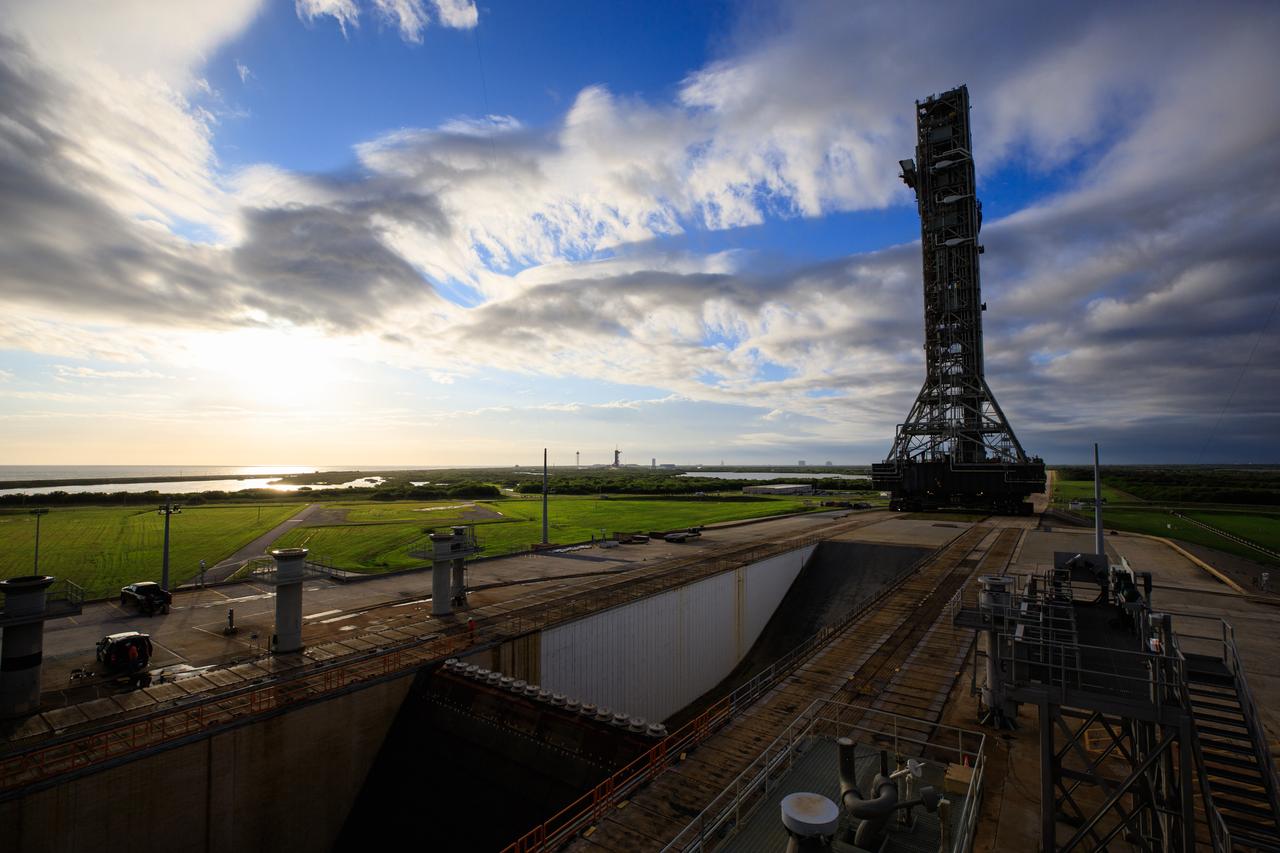
During sunrise on Oct. 30, 2020, the mobile launcher for the Artemis I mission, atop crawler-transporter 2, departs Launch Pad 39B and moves slowly down the ramp on the crawlerway to return to the Vehicle Assembly Building at NASA’s Kennedy Space Center in Florida. In view is the flame trench at the top of the pad. The nearly 400-foot-tall mobile launcher was at the pad for 10 days, while engineers with Exploration Ground Systems and Jacobs performed several tasks, including a timing test to validate the launch team’s countdown timeline, and a thorough, top-to-bottom wash down of the mobile launcher to remove any debris remaining from construction and installation of the umbilical arms. Artemis I will test the Orion spacecraft and Space Launch System as an integrated system ahead of crewed flights to the Moon. Under the Artemis program, NASA will land the first woman and the next man on the Moon in 2024.
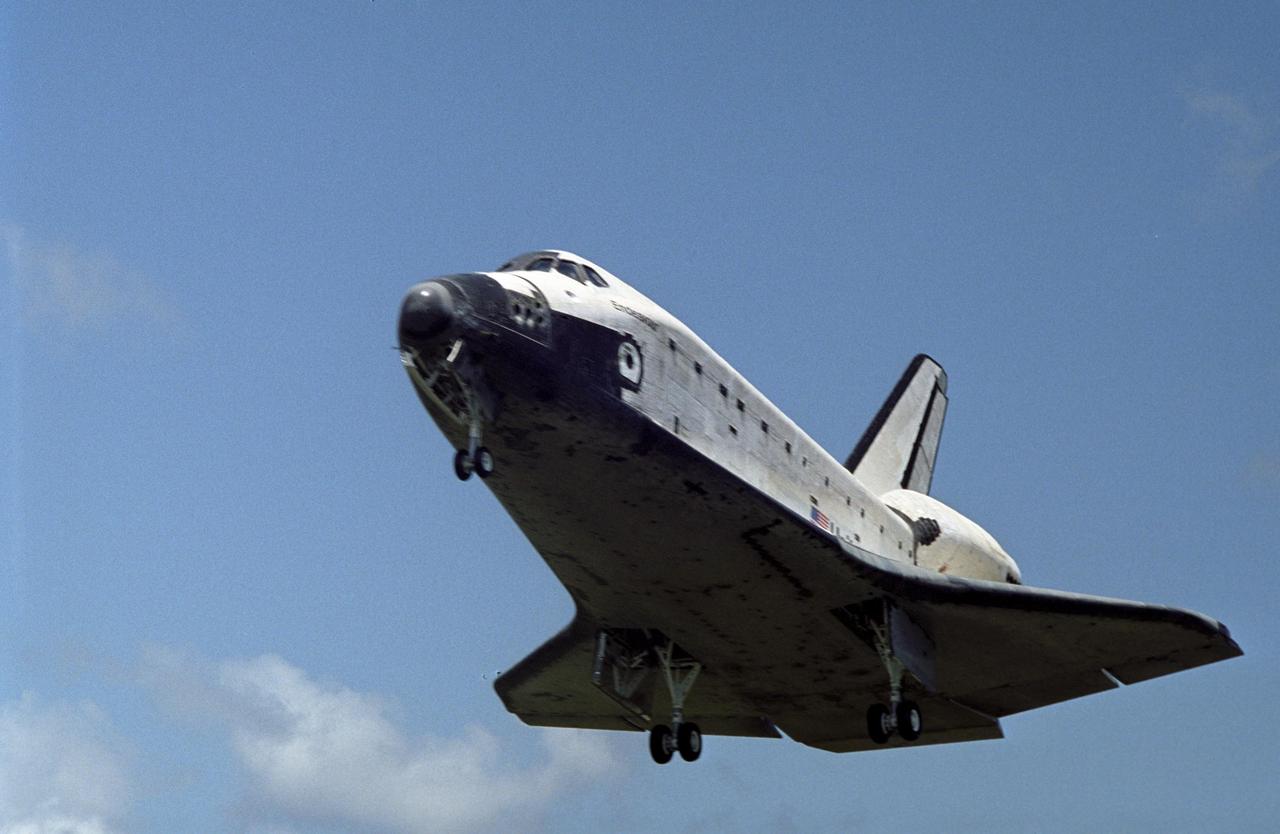
KENNEDY SPACE CENTER, FLA. -- Under a blue sky washed with clouds, Endeavour has wheels down for a landing on runway 15 at NASA's Kennedy Space Center, completing a 13-day mission to the International Space Station. The STS-118 mission began Aug. 8 and installed a new gyroscope, an external spare parts platform and another truss segment to the expanding station. Endeavour's main gear touched down at 12:32:16 p.m. EDT. Nose gear touchdown was at 12:32:29 p.m. and wheel stop was at 12:33:20 p.m. Endeavour traveled nearly 5.3 million miles, landing on orbit 201. STS-118 was the 119th space shuttle flight, the 22nd flight to the station, the 20th flight for Endeavour and the second of four missions planned for 2007. This was the 65th landing of an orbiter at Kennedy. Photo credit: NASA/John Kechele, Scott Haun
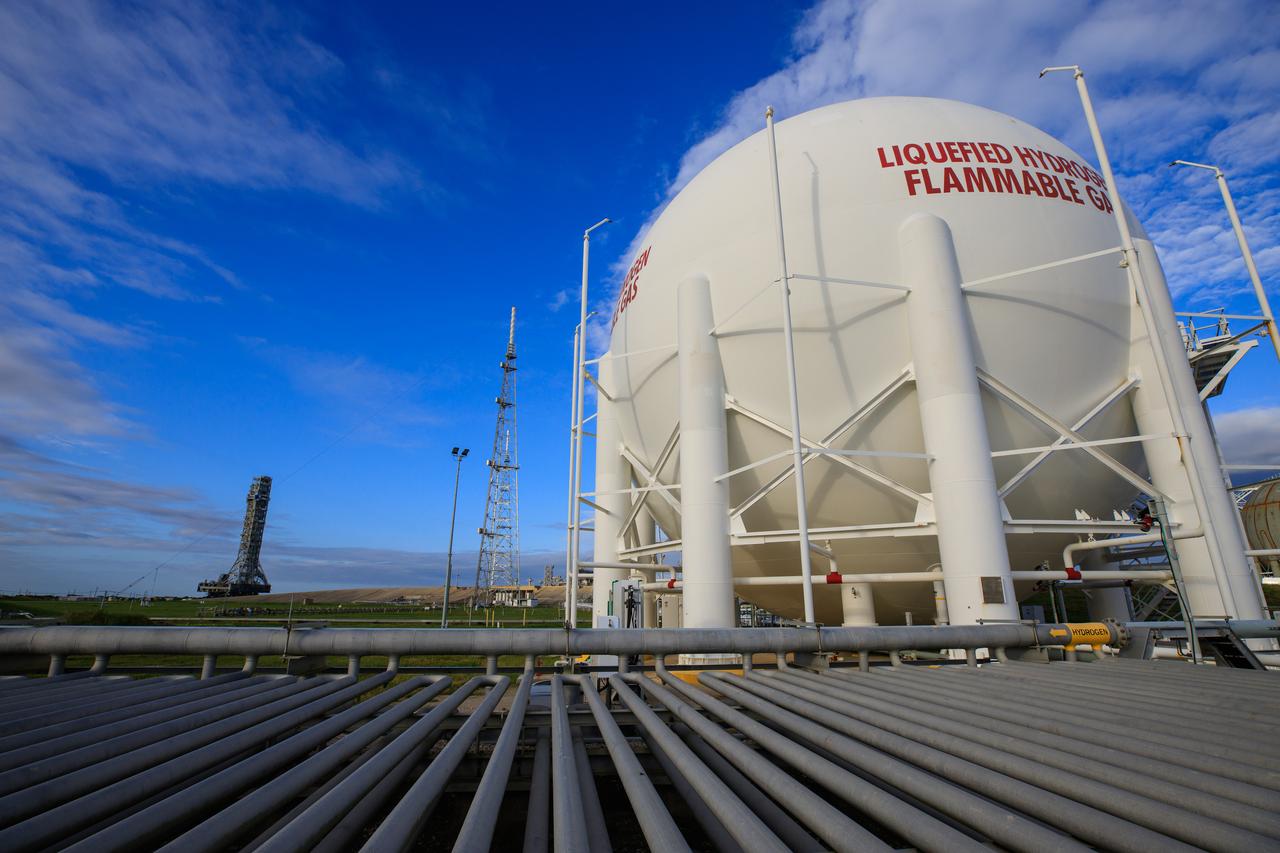
At sunrise on Oct. 30, 2020, the mobile launcher for the Artemis I mission, atop crawler-transporter 2, moves slowly down the ramp at Launch Pad 39B to return to the Vehicle Assembly Building at NASA’s Kennedy Space Center in Florida. In view in the foreground is the liquid hydrogen storage tank. The nearly 400-foot-tall mobile launcher was at the pad for 10 days, while engineers with Exploration Ground Systems and Jacobs performed several tasks, including a timing test to validate the launch team’s countdown timeline, and a thorough, top-to-bottom wash down of the mobile launcher to remove any debris remaining from construction and installation of the umbilical arms. Artemis I will test the Orion spacecraft and Space Launch System as an integrated system ahead of crewed flights to the Moon. Under the Artemis program, NASA will land the first woman and the next man on the Moon in 2024.
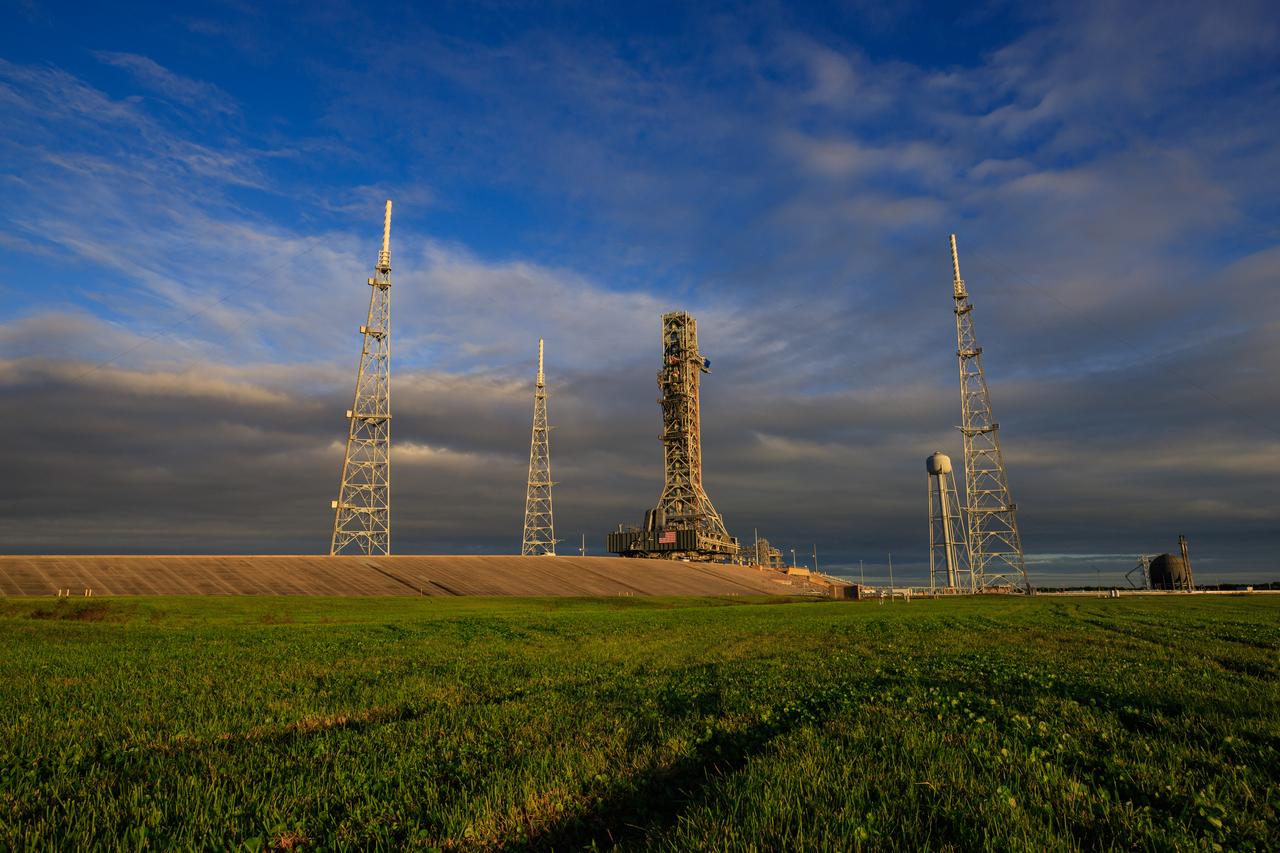
During sunrise on Oct. 30, 2020, the mobile launcher for the Artemis I mission, atop crawler-transporter 2, begins to depart Launch Pad 39B and return to the Vehicle Assembly Building at NASA’s Kennedy Space Center in Florida. The nearly 400-foot-tall mobile launcher was at the pad for 10 days, while engineers with Exploration Ground Systems and Jacobs performed several tasks, including a timing test to validate the launch team’s countdown timeline, and a thorough, top-to-bottom wash down of the mobile launcher to remove any debris remaining from construction and installation of the umbilical arms. Artemis I will test the Orion spacecraft and Space Launch System as an integrated system ahead of crewed flights to the Moon. Under the Artemis program, NASA will land the first woman and the next man on the Moon in 2024.
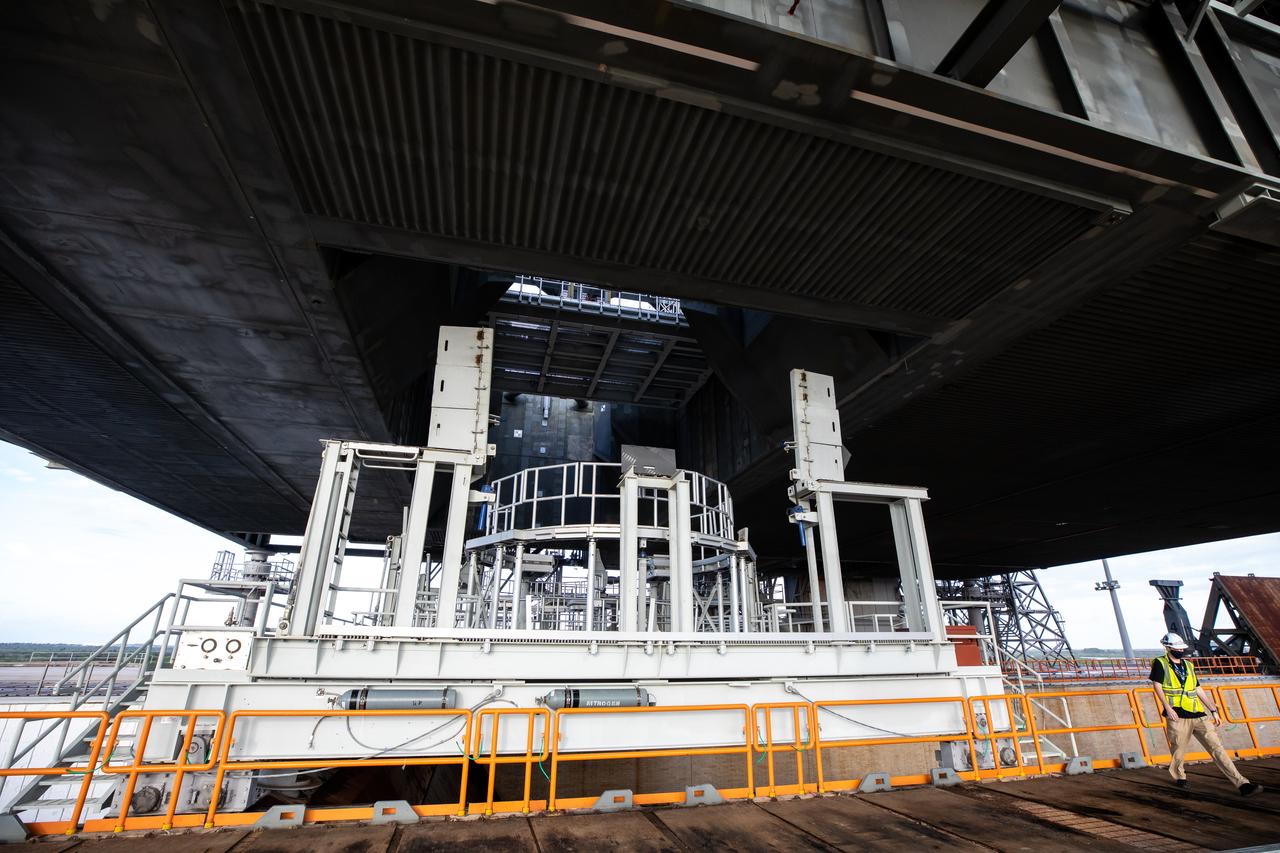
The engine service platform is moved into position beneath the mobile launcher for Artemis I at Launch Pad 39B on Oct. 23, 2020, at NASA’s Kennedy Space Center in Florida. The service platform allows access to the RS-25 engines on the Space Launch System core stage for routine work or inspections. The nearly 400-foot-tall mobile launcher will remain at the pad while engineers with Exploration Ground Systems and Jacobs complete several tasks, including a timing test to validate the launch team’s countdown timeline, and a thorough, top-to-bottom wash down of the mobile launcher to remove any debris remaining from construction and installation of the umbilical arms. Artemis I will test the Orion spacecraft and Space Launch System as an integrated system ahead of crewed flights to the Moon. Under the Artemis program, NASA will land the first woman and the next man on the Moon in 2024.
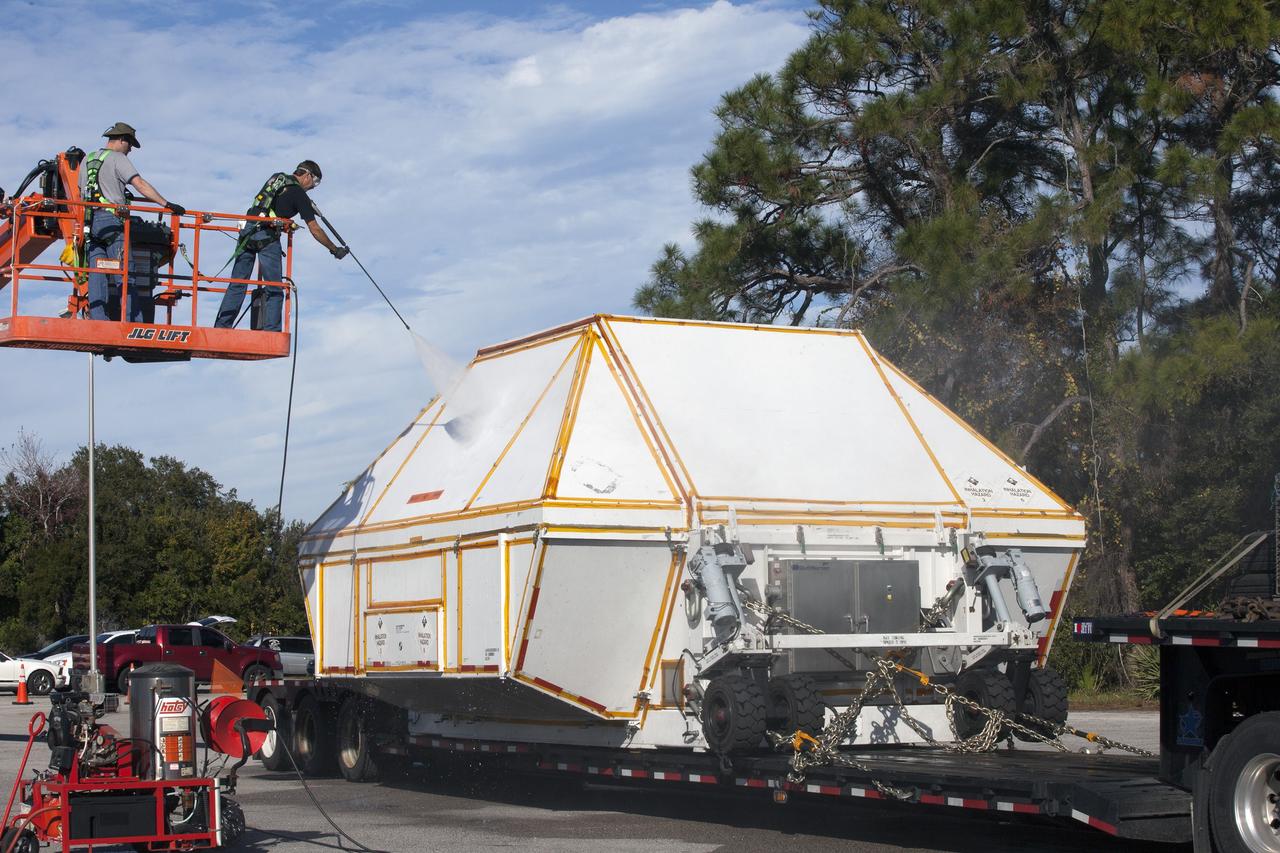
CAPE CANAVERAL, Fla. -- Technicians wash down the crew module transportation fixture containing the Orion crew module on the back of a flatbed truck at the Multi-Operation Support Building at NASA's Kennedy Space Center in Florida. Orion was transported 2,700 miles overland from Naval Base San Diego in California. Orion was recovered from the Pacific Ocean after completing a two-orbit, four-and-a-half hour mission Dec. 5 to test systems critical to crew safety, including the launch abort system, the heat shield and the parachute system. The Ground Systems Development and Operations Program led the recovery, offload and transportation efforts. For more information, visit www.nasa.gov/orion. Photo credit: NASA/Kim Shiflett

The engine service platform has been lowered and removed from the mobile launcher for Artemis I at Launch Pad 39B at NASA’s Kennedy Space Center in Florida on Oct. 23, 2020. The platform is in view on a flatbed truck. The nearly 400-foot-tall mobile launcher is at the pad while engineers with Exploration Ground Systems and Jacobs complete several tasks, including a timing test to validate the launch team’s countdown timeline, and a thorough, top-to-bottom wash down of the mobile launcher to remove any debris remaining from construction and installation of the umbilical arms. Artemis I will test the Orion spacecraft and Space Launch System as an integrated system ahead of crewed flights to the Moon. Under the Artemis program, NASA will land the first woman and the next man on the Moon in 2024.
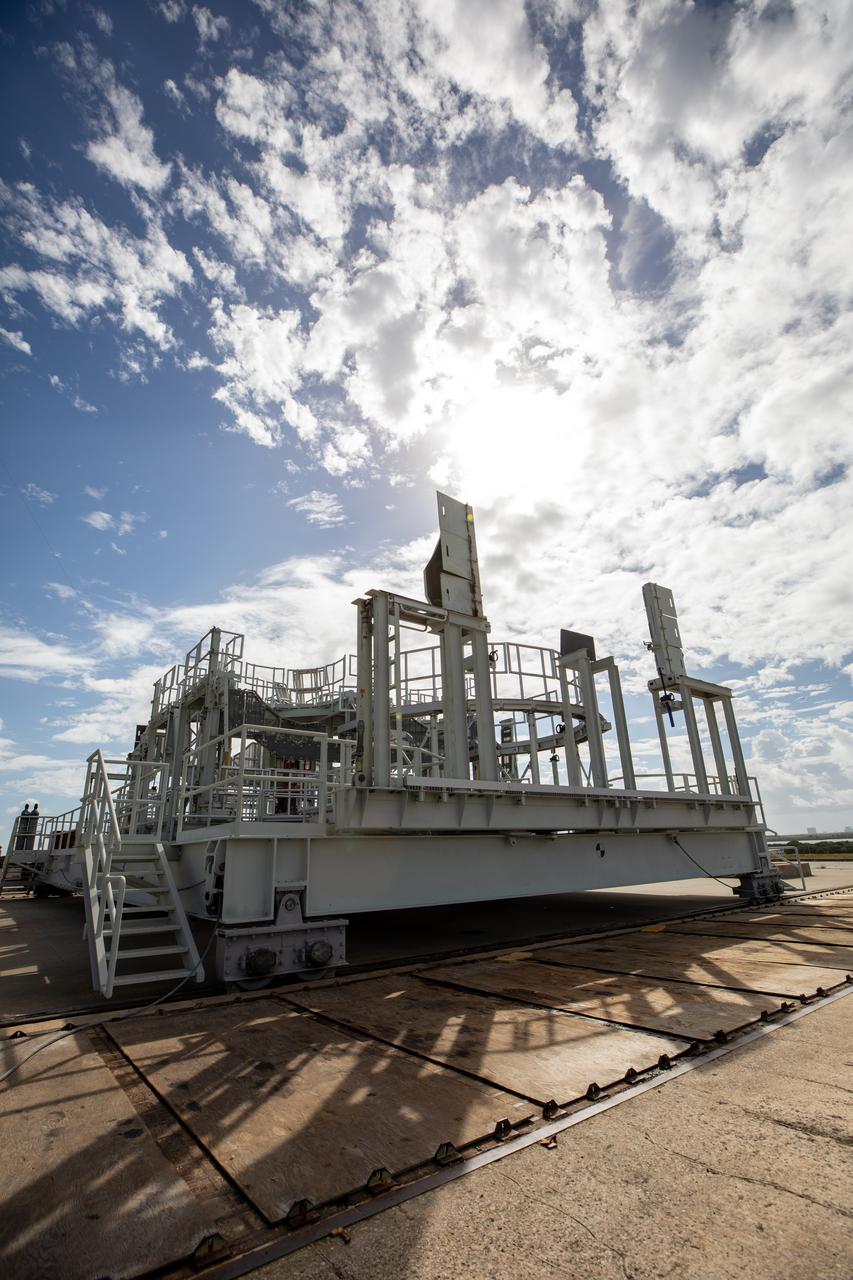
The engine service platform has been lowered and removed from the mobile launcher for Artemis I at Launch Pad 39B at NASA’s Kennedy Space Center in Florida on Oct. 23, 2020. It is staged on the top of the pad. The nearly 400-foot-tall mobile launcher is at the pad while engineers with Exploration Ground Systems and Jacobs complete several tasks, including a timing test to validate the launch team’s countdown timeline, and a thorough, top-to-bottom wash down of the mobile launcher to remove any debris remaining from construction and installation of the umbilical arms. Artemis I will test the Orion spacecraft and Space Launch System as an integrated system ahead of crewed flights to the Moon. Under the Artemis program, NASA will land the first woman and the next man on the Moon in 2024.
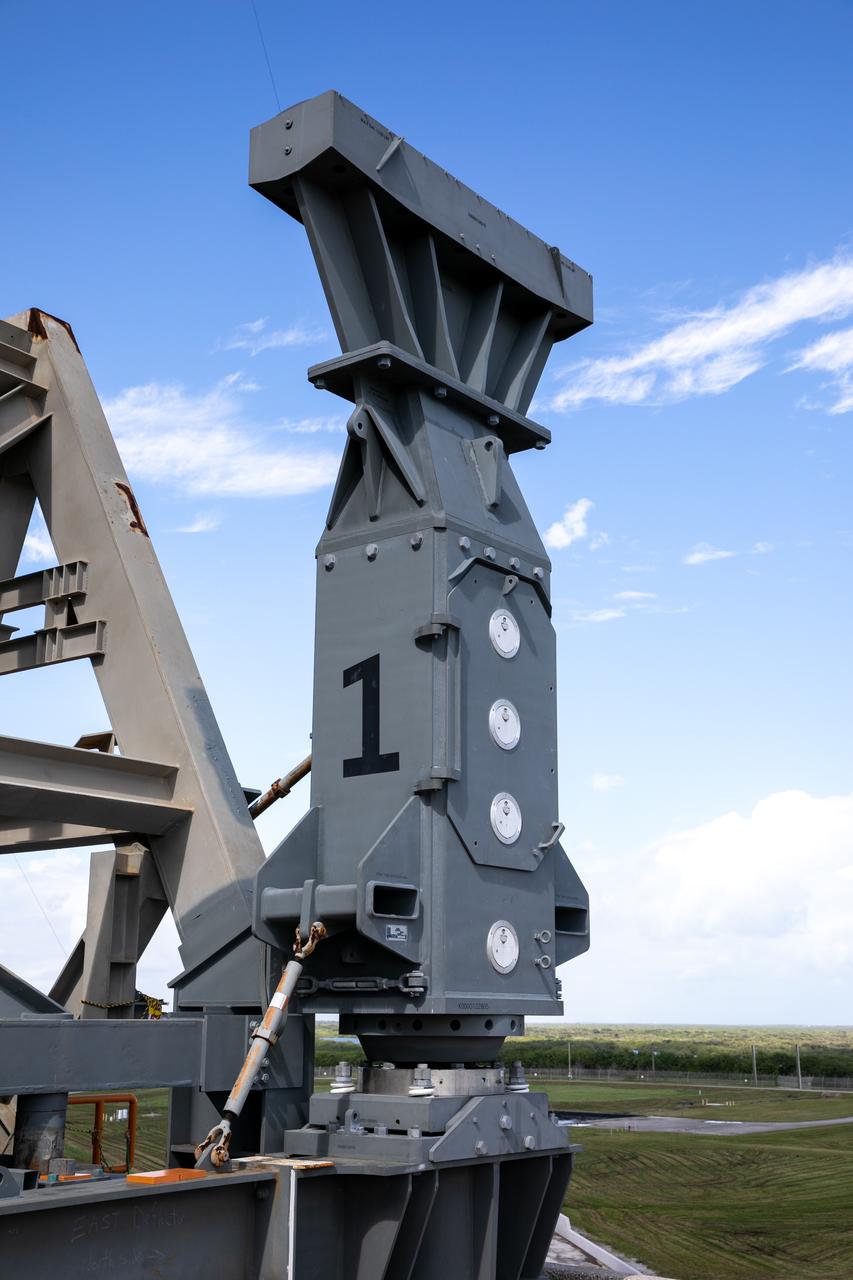
Special ground support equipment is used to move the side flame deflectors into place during a countdown demonstration test using the mobile launcher for the Artemis I mission at Launch Pad 39B at NASA’s Kennedy Space Center in Florida on Oct. 23, 2020. The nearly 400-foot-tall mobile launcher is at the pad while engineers with Exploration Ground Systems and Jacobs complete several tasks, including a timing test to validate the launch team’s countdown timeline, and a thorough, top-to-bottom wash down of the mobile launcher to remove any debris remaining from construction and installation of the umbilical arms. Artemis I will test the Orion spacecraft and Space Launch System as an integrated system ahead of crewed flights to the Moon. Under the Artemis program, NASA will land the first woman and the next man on the Moon in 2024.
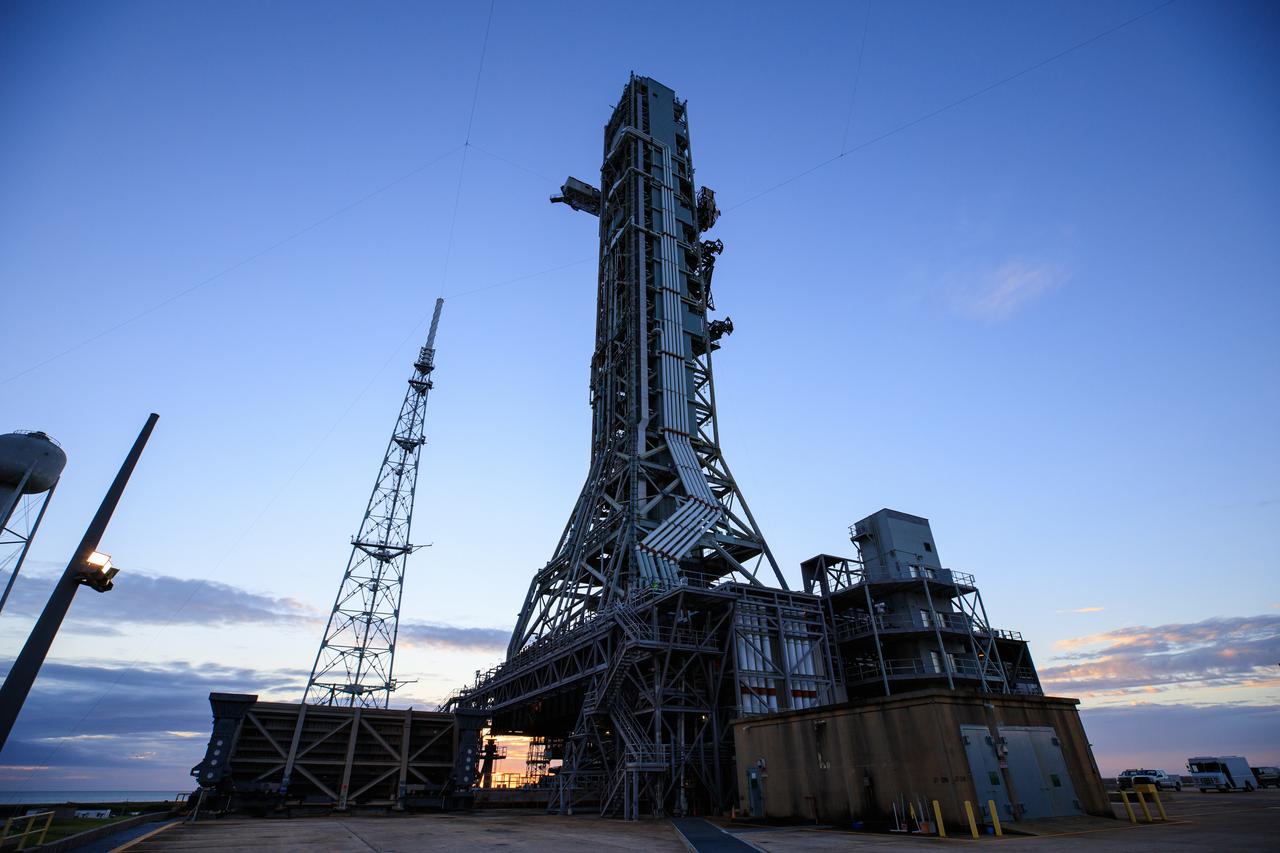
On Oct. 30, 2020, preparations are underway for the mobile launcher for the Artemis I mission, atop crawler-transporter 2, to depart Launch Pad 39B and return to the Vehicle Assembly Building at NASA’s Kennedy Space Center in Florida. The nearly 400-foot-tall mobile launcher was at the pad for 10 days, while engineers with Exploration Ground Systems and Jacobs performed several tasks, including a timing test to validate the launch team’s countdown timeline, and a thorough, top-to-bottom wash down of the mobile launcher to remove any debris remaining from construction and installation of the umbilical arms. Artemis I will test the Orion spacecraft and Space Launch System as an integrated system ahead of crewed flights to the Moon. Under the Artemis program, NASA will land the first woman and the next man on the Moon in 2024.
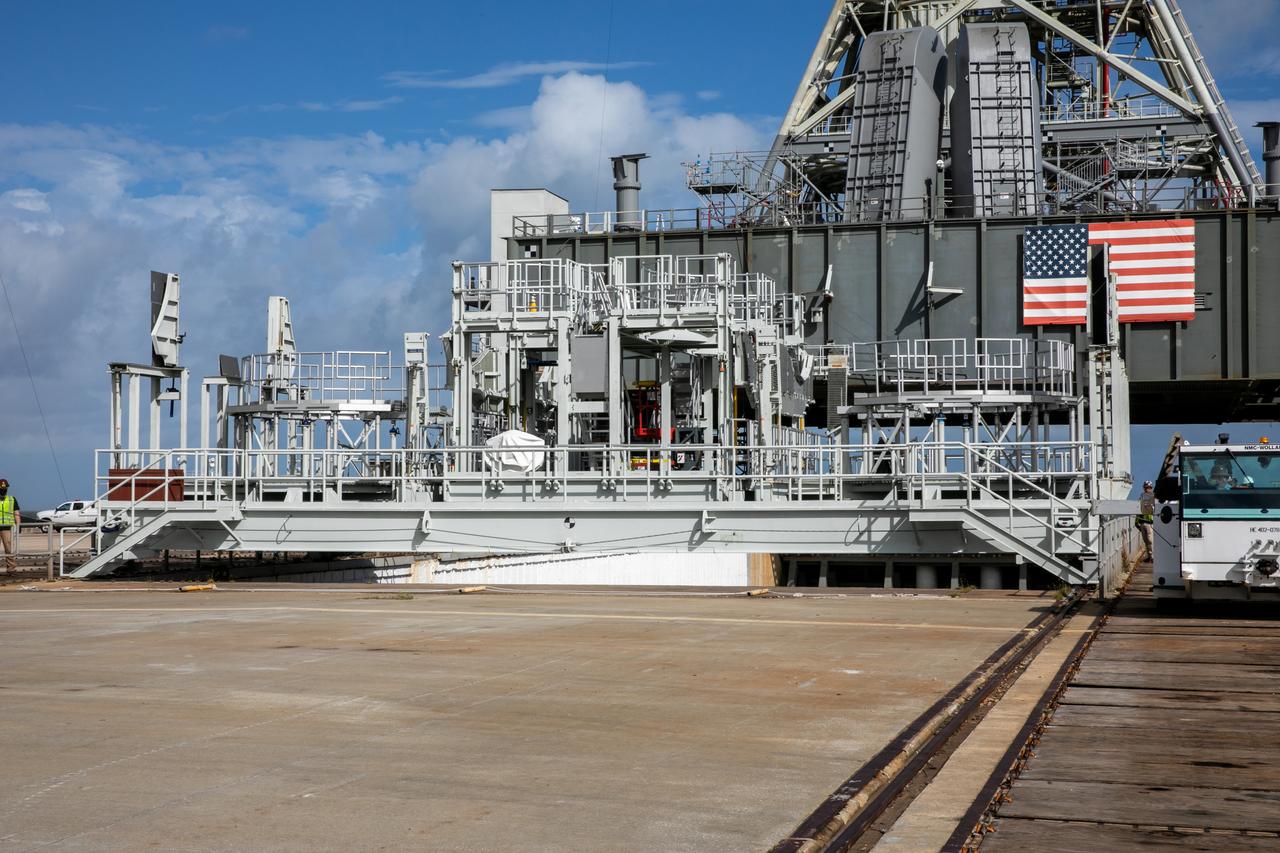
The engine service platform has been lowered and removed from underneath the mobile launcher for Artemis I at Launch Pad 39B at NASA’s Kennedy Space Center in Florida on Oct. 23, 2020. The nearly 400-foot-tall mobile launcher is at the pad while engineers with Exploration Ground Systems and Jacobs complete several tasks, including a timing test to validate the launch team’s countdown timeline, and a thorough, top-to-bottom wash down of the mobile launcher to remove any debris remaining from construction and installation of the umbilical arms. Artemis I will test the Orion spacecraft and Space Launch System as an integrated system ahead of crewed flights to the Moon. Under the Artemis program, NASA will land the first woman and the next man on the Moon in 2024.
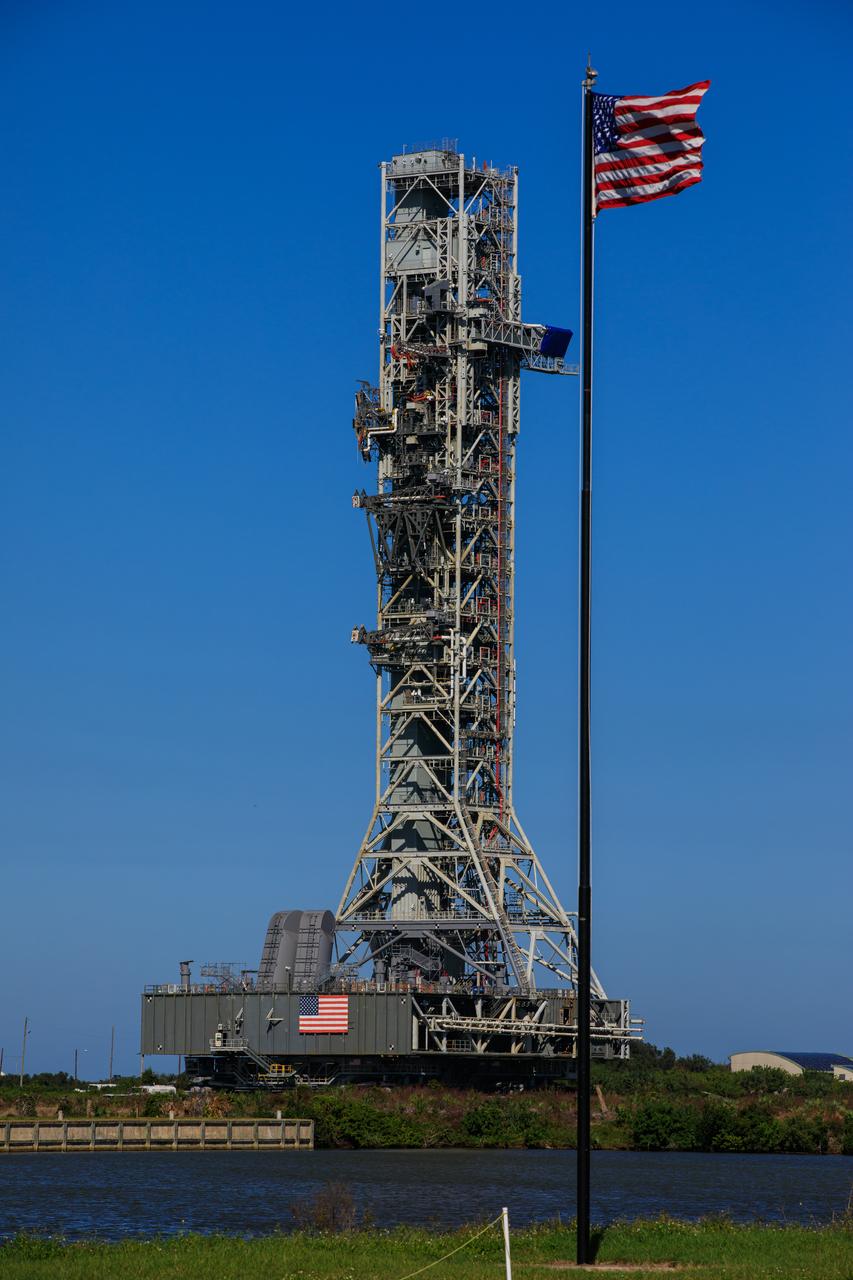
During the morning on Oct. 30, 2020, the mobile launcher for the Artemis I mission, atop crawler-transporter 2, moves slowly along the crawlerway after departing Launch Pad 39B at NASA’s Kennedy Space Center in Florida. In view is the American Flag. The nearly 400-foot-tall mobile launcher is returning to the Vehicle Assembly Building after being at the pad for 10 days, while engineers with Exploration Ground Systems and Jacobs performed several tasks, including a timing test to validate the launch team’s countdown timeline, and a thorough, top-to-bottom wash down of the mobile launcher to remove any debris remaining from construction and installation of the umbilical arms. Artemis I will test the Orion spacecraft and Space Launch System as an integrated system ahead of crewed flights to the Moon. Under the Artemis program, NASA will land the first woman and the next man on the Moon in 2024.
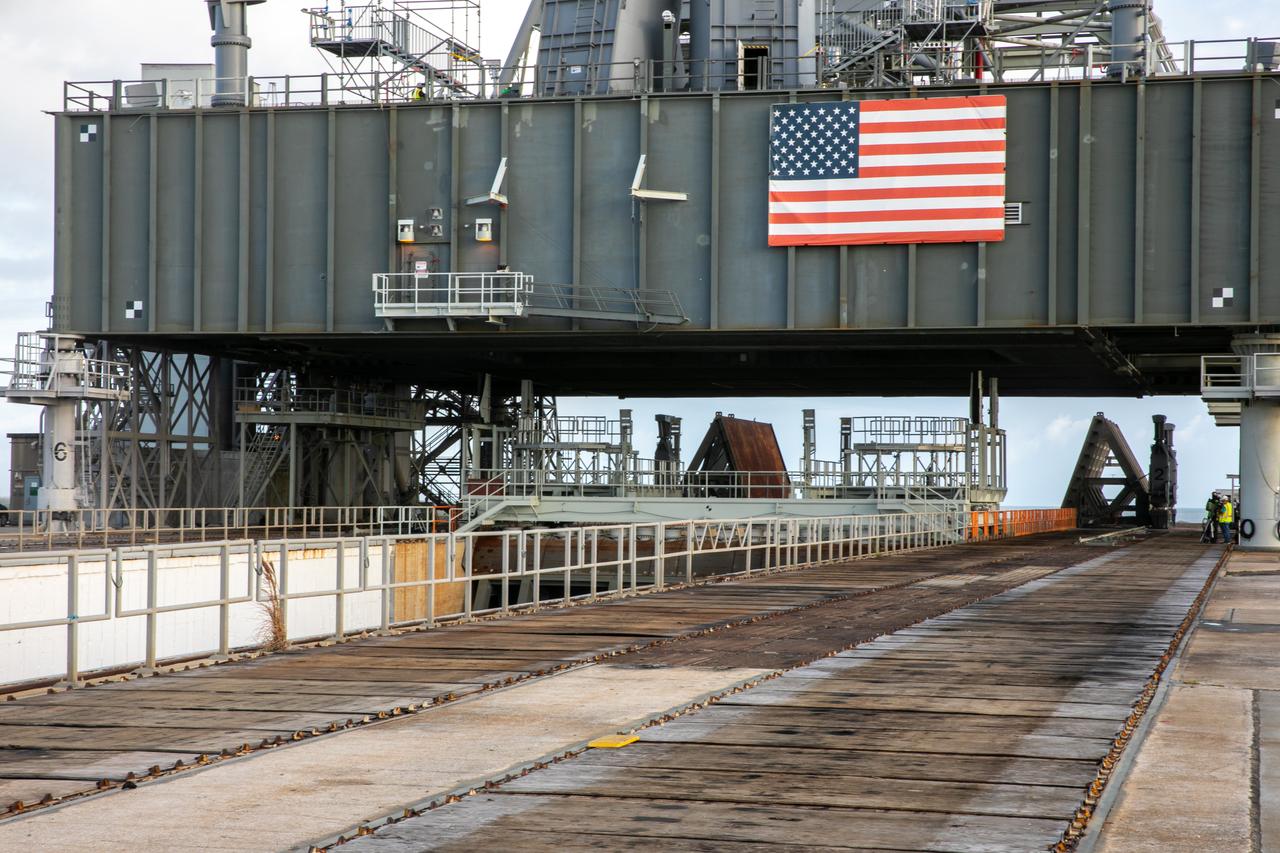
The base of the mobile launcher for Artemis I is in view on Launch Pad 3B at NASA’s Kennedy Space Center in Florida on Oct. 23, 2020. Workers on scaffolding are preparing for a launch countdown demonstration. The nearly 400-foot-tall mobile launcher will remain at the pad while engineers with Exploration Ground Systems and Jacobs complete several tasks, including a timing test to validate the launch team’s countdown timeline, and a thorough, top-to-bottom wash down of the mobile launcher to remove any debris remaining from construction and installation of the umbilical arms. Artemis I will test the Orion spacecraft and Space Launch System as an integrated system ahead of crewed flights to the Moon. Under the Artemis program, NASA will land the first woman and the next man on the Moon in 2024.
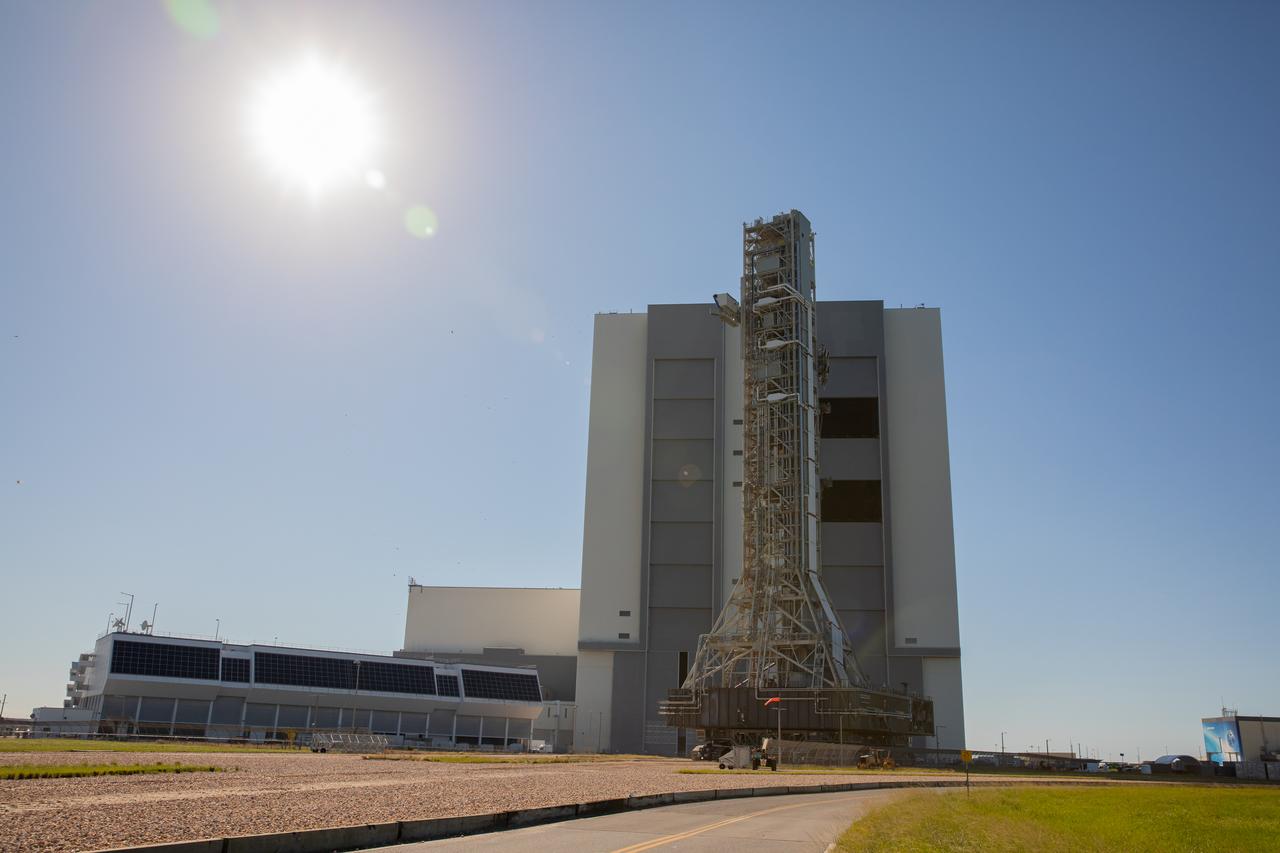
The mobile launcher for the Artemis I mission, atop crawler-transporter 2, arrives at the Vehicle Assembly Building at NASA’s Kennedy Space Center in Florida on Oct. 30, 2020. The nearly 400-foot-tall mobile launcher was at Launch Pad 39B for 10 days, while engineers with Exploration Ground Systems and Jacobs performed several tasks, including a timing test to validate the launch team’s countdown timeline, and a thorough, top-to-bottom wash down of the mobile launcher to remove any debris remaining from construction and installation of the umbilical arms. Artemis I will test the Orion spacecraft and Space Launch System as an integrated system ahead of crewed flights to the Moon. Under the Artemis program, NASA will land the first woman and the next man on the Moon in 2024.
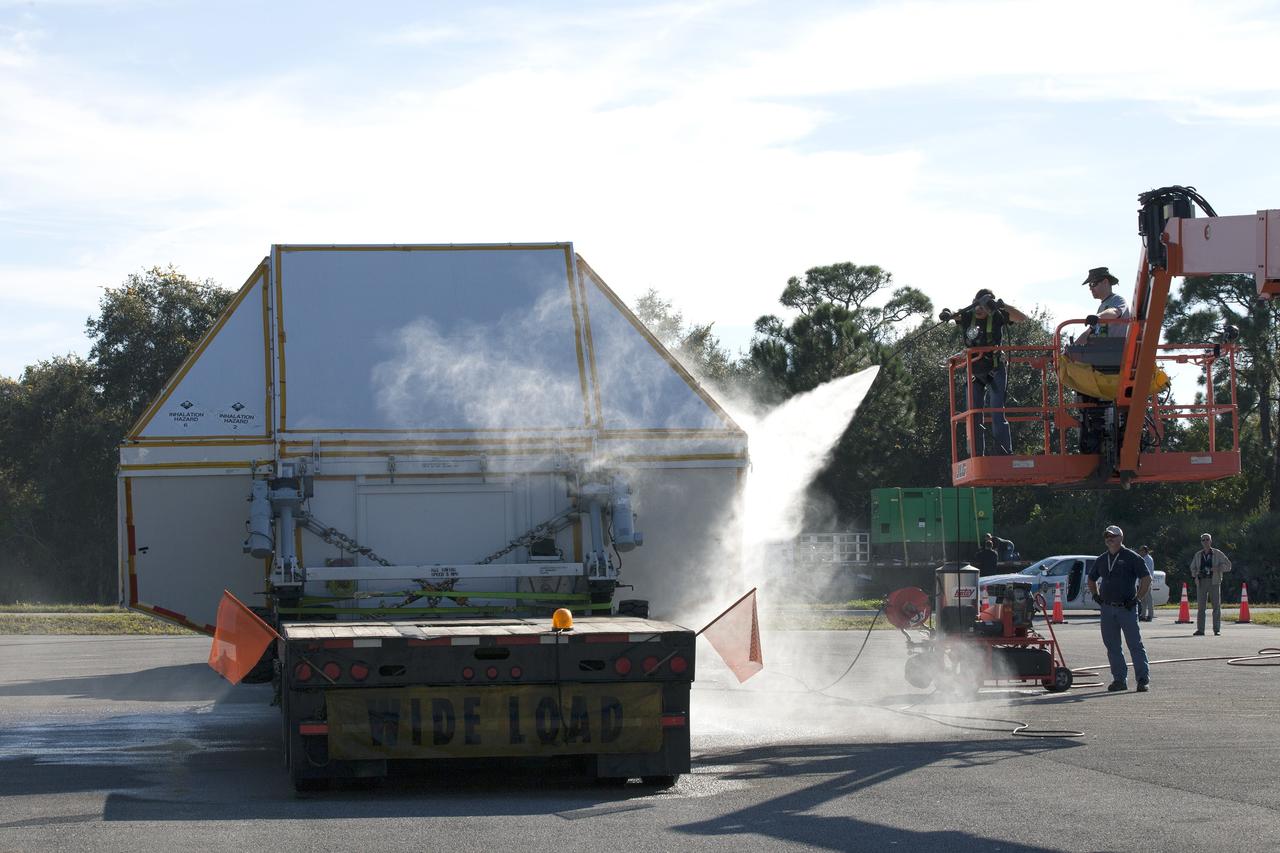
CAPE CANAVERAL, Fla. -- Technicians wash down the crew module transportation fixture containing the Orion crew module on the back of a flatbed truck at the Multi-Operation Support Building at NASA's Kennedy Space Center in Florida. Orion was transported 2,700 miles overland from Naval Base San Diego in California. Orion was recovered from the Pacific Ocean after completing a two-orbit, four-and-a-half hour mission Dec. 5 to test systems critical to crew safety, including the launch abort system, the heat shield and the parachute system. The Ground Systems Development and Operations Program led the recovery, offload and transportation efforts. For more information, visit www.nasa.gov/orion. Photo credit: NASA/Kim Shiflett
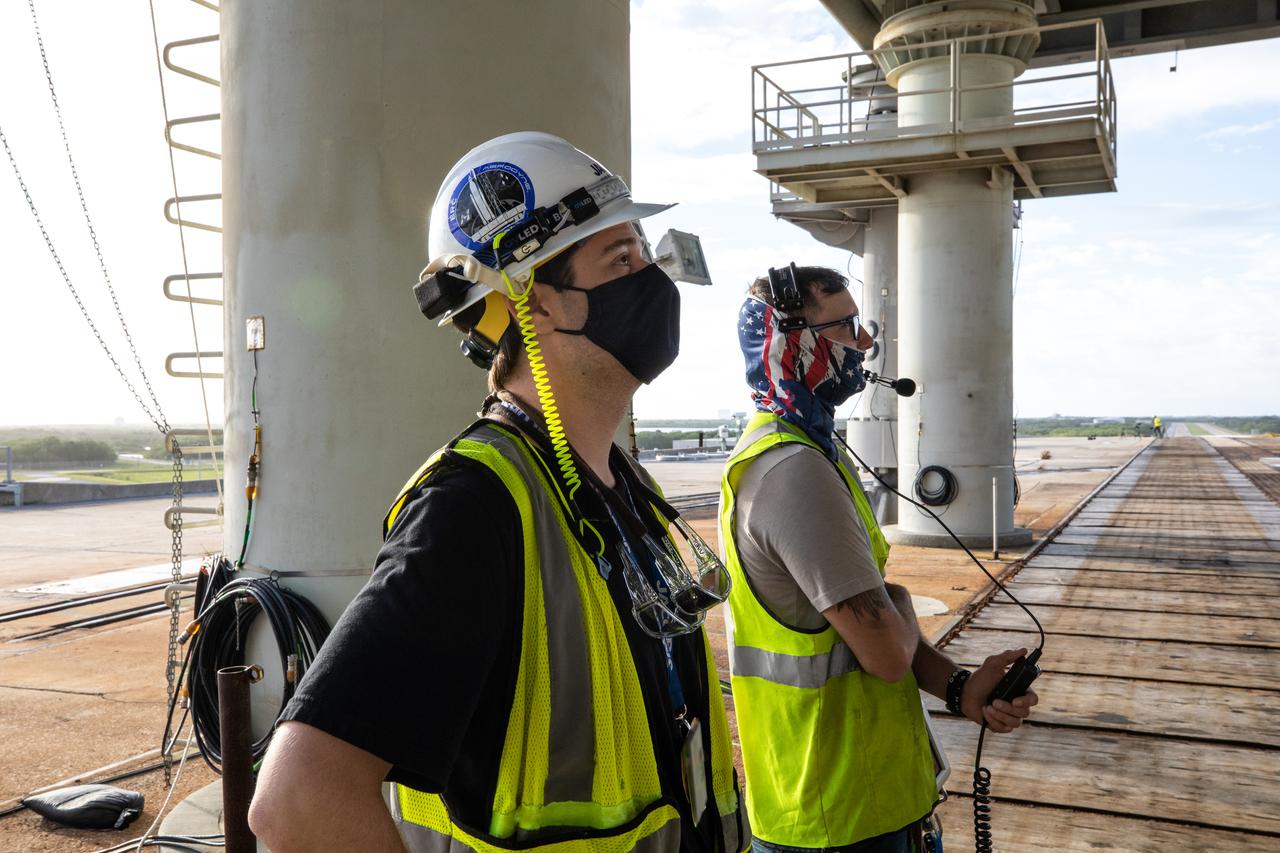
Workers stand on the surface of Launch Pad 39B at NASA’s Kennedy Space Center in Florida on Oct. 23, 2020. They are monitoring launch countdown timeline demonstration activities occurring on the mobile launcher for Artemis I. The nearly 400-foot-tall mobile launcher is at the pad while engineers with Exploration Ground Systems and Jacobs complete several tasks, including a timing test to validate the launch team’s countdown timeline, and a thorough, top-to-bottom wash down of the mobile launcher to remove any debris remaining from construction and installation of the umbilical arms. Artemis I will test the Orion spacecraft and Space Launch System as an integrated system ahead of crewed flights to the Moon. Under the Artemis program, NASA will land the first woman and the next man on the Moon in 2024.
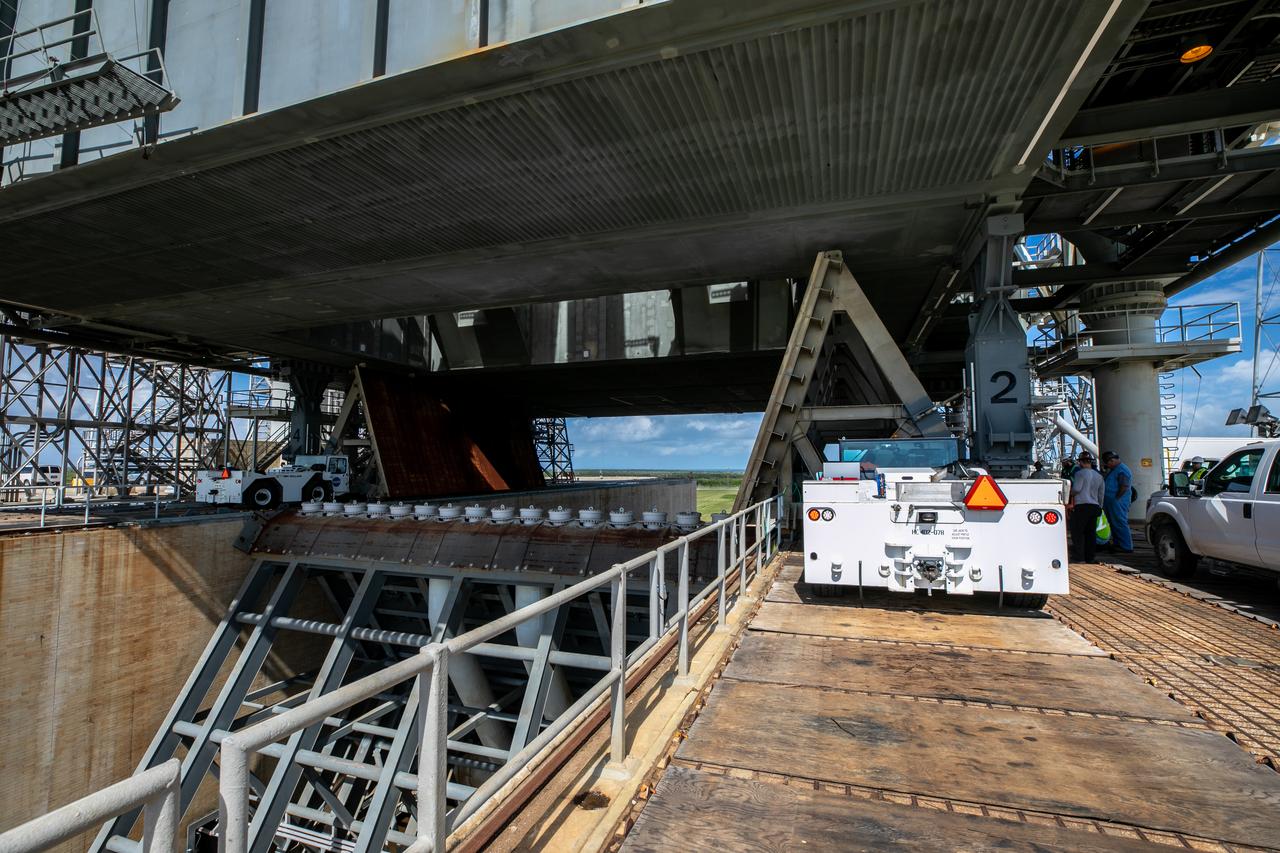
Special ground support equipment is used to move one of two side flame deflectors underneath the mobile launcher for Artemis I during a countdown demonstration test at Launch Pad 39B at NASA’s Kennedy Space Center in Florida on Oct. 23, 2020. The nearly 400-foot-tall mobile launcher is at the pad while engineers with Exploration Ground Systems and Jacobs complete several tasks, including a timing test to validate the launch team’s countdown timeline, and a thorough, top-to-bottom wash down of the mobile launcher to remove any debris remaining from construction and installation of the umbilical arms. Artemis I will test the Orion spacecraft and Space Launch System as an integrated system ahead of crewed flights to the Moon. Under the Artemis program, NASA will land the first woman and the next man on the Moon in 2024.
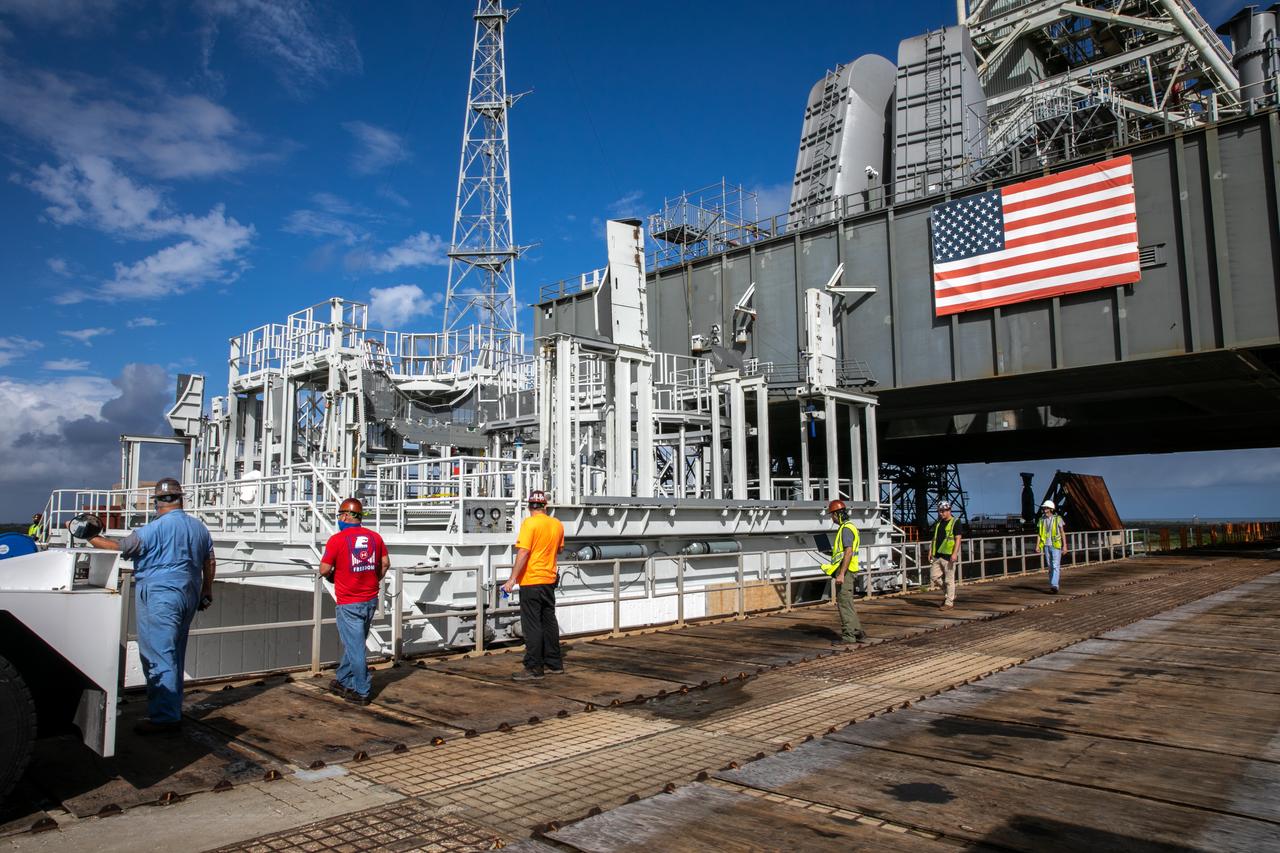
The engine service platform has been lowered and removed from the mobile launcher for Artemis I at Launch Pad 39B at NASA’s Kennedy Space Center in Florida on Oct. 23, 2020. The platform is in view on a flatbed truck. The nearly 400-foot-tall mobile launcher is at the pad while engineers with Exploration Ground Systems and Jacobs complete several tasks, including a timing test to validate the launch team’s countdown timeline, and a thorough, top-to-bottom wash down of the mobile launcher to remove any debris remaining from construction and installation of the umbilical arms. Artemis I will test the Orion spacecraft and Space Launch System as an integrated system ahead of crewed flights to the Moon. Under the Artemis program, NASA will land the first woman and the next man on the Moon in 2024.

An engineer with Exploration Ground Systems monitors countdown demonstration activities occurring on the mobile launcher for Artemis I on Oct. 23, 2020, at Launch Pad 39B at NASA’s Kennedy Space Center in Florida. The nearly 400-foot-tall mobile launcher is at the pad while engineers with Exploration Ground Systems and Jacobs complete several tasks, including a timing test to validate the launch team’s countdown timeline, and a thorough, top-to-bottom wash down of the mobile launcher to remove any debris remaining from construction and installation of the umbilical arms. Artemis I will test the Orion spacecraft and Space Launch System as an integrated system ahead of crewed flights to the Moon. Under the Artemis program, NASA will land the first woman and the next man on the Moon in 2024.
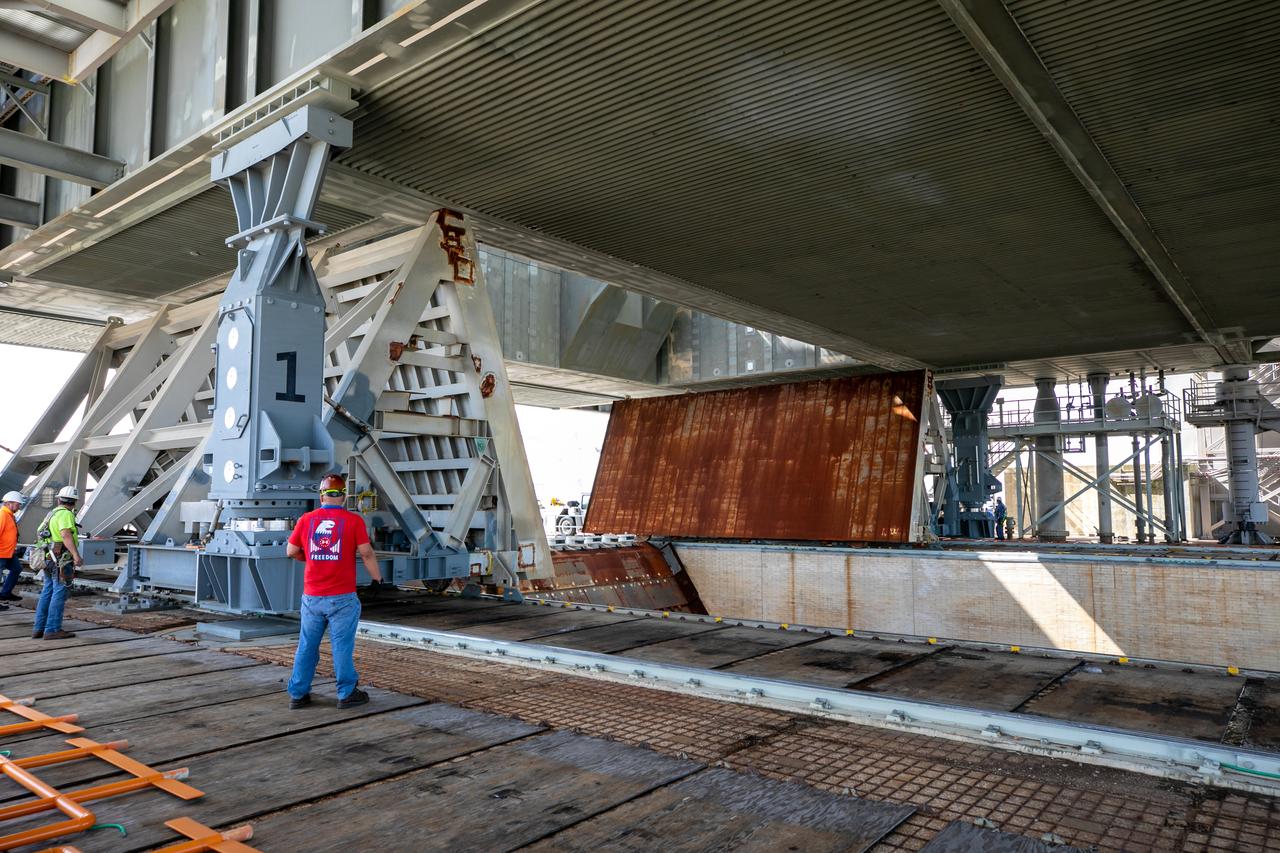
Special ground support equipment is used to position the two side flame deflectors underneath the mobile launcher for Artemis I during a countdown demonstration test at Launch Pad 39B at NASA’s Kennedy Space Center in Florida on Oct. 23, 2020. The nearly 400-foot-tall mobile launcher is at the pad while engineers with Exploration Ground Systems and Jacobs complete several tasks, including a timing test to validate the launch team’s countdown timeline, and a thorough, top-to-bottom wash down of the mobile launcher to remove any debris remaining from construction and installation of the umbilical arms. Artemis I will test the Orion spacecraft and Space Launch System as an integrated system ahead of crewed flights to the Moon. Under the Artemis program, NASA will land the first woman and the next man on the Moon in 2024.
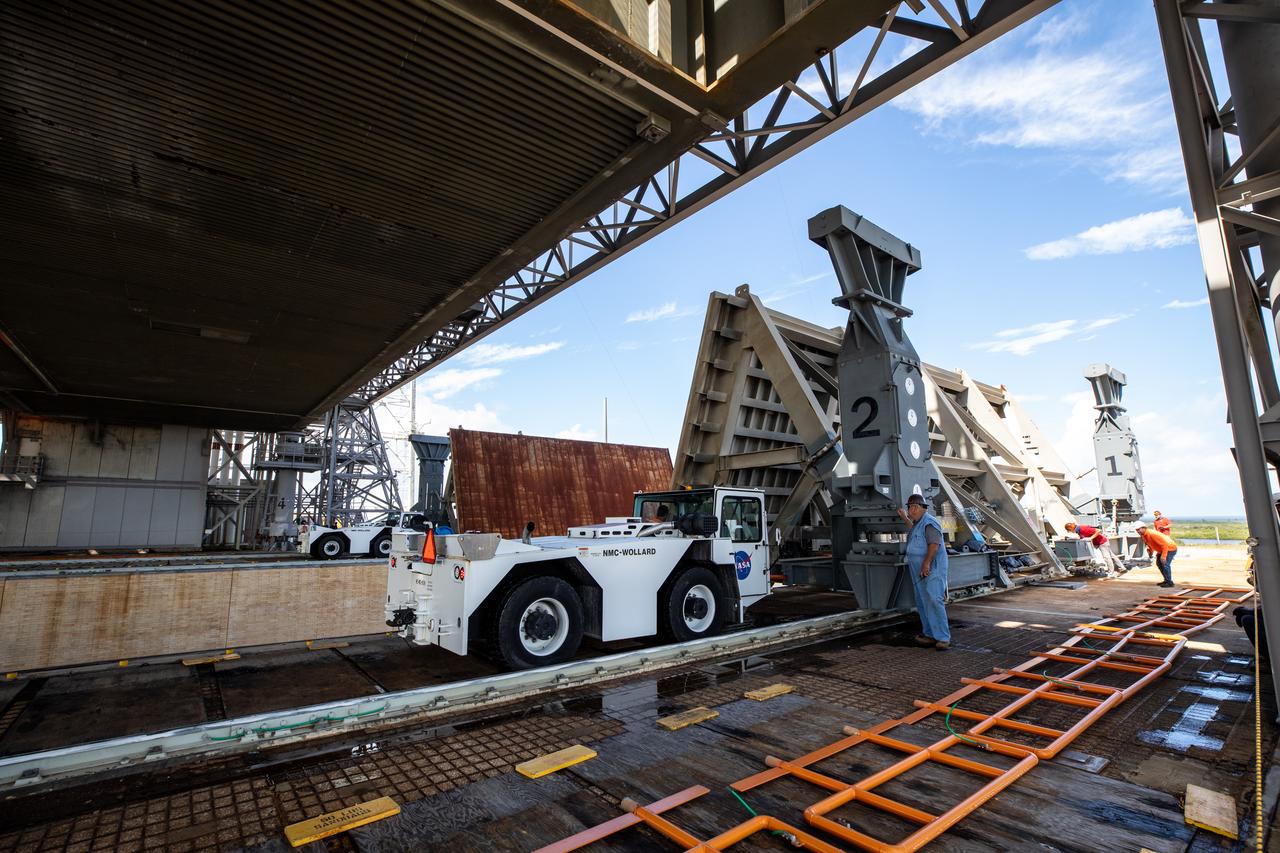
Special ground support equipment is used to move one of two side flame deflectors underneath the mobile launcher for Artemis I during a countdown demonstration test at Launch Pad 39B at NASA’s Kennedy Space Center in Florida on Oct. 23, 2020. The nearly 400-foot-tall mobile launcher is at the pad while engineers with Exploration Ground Systems and Jacobs complete several tasks, including a timing test to validate the launch team’s countdown timeline, and a thorough, top-to-bottom wash down of the mobile launcher to remove any debris remaining from construction and installation of the umbilical arms. Artemis I will test the Orion spacecraft and Space Launch System as an integrated system ahead of crewed flights to the Moon. Under the Artemis program, NASA will land the first woman and the next man on the Moon in 2024.
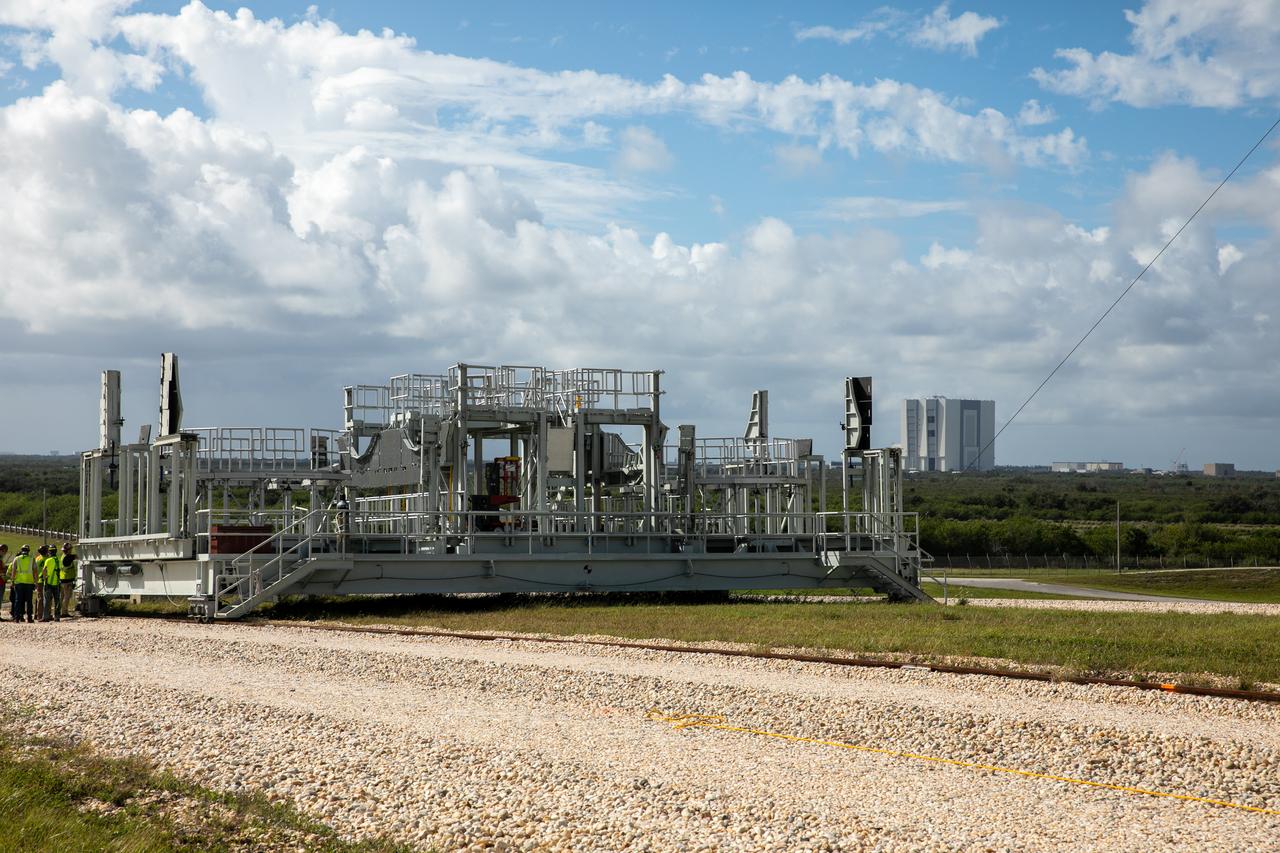
The engine service platform has been lowered and removed from the mobile launcher for Artemis I at Launch Pad 39B at NASA’s Kennedy Space Center in Florida on Oct. 23, 2020. It is being moved from the pad. The nearly 400-foot-tall mobile launcher is at the pad while engineers with Exploration Ground Systems and Jacobs complete several tasks, including a timing test to validate the launch team’s countdown timeline, and a thorough, top-to-bottom wash down of the mobile launcher to remove any debris remaining from construction and installation of the umbilical arms. Artemis I will test the Orion spacecraft and Space Launch System as an integrated system ahead of crewed flights to the Moon. Under the Artemis program, NASA will land the first woman and the next man on the Moon in 2024.
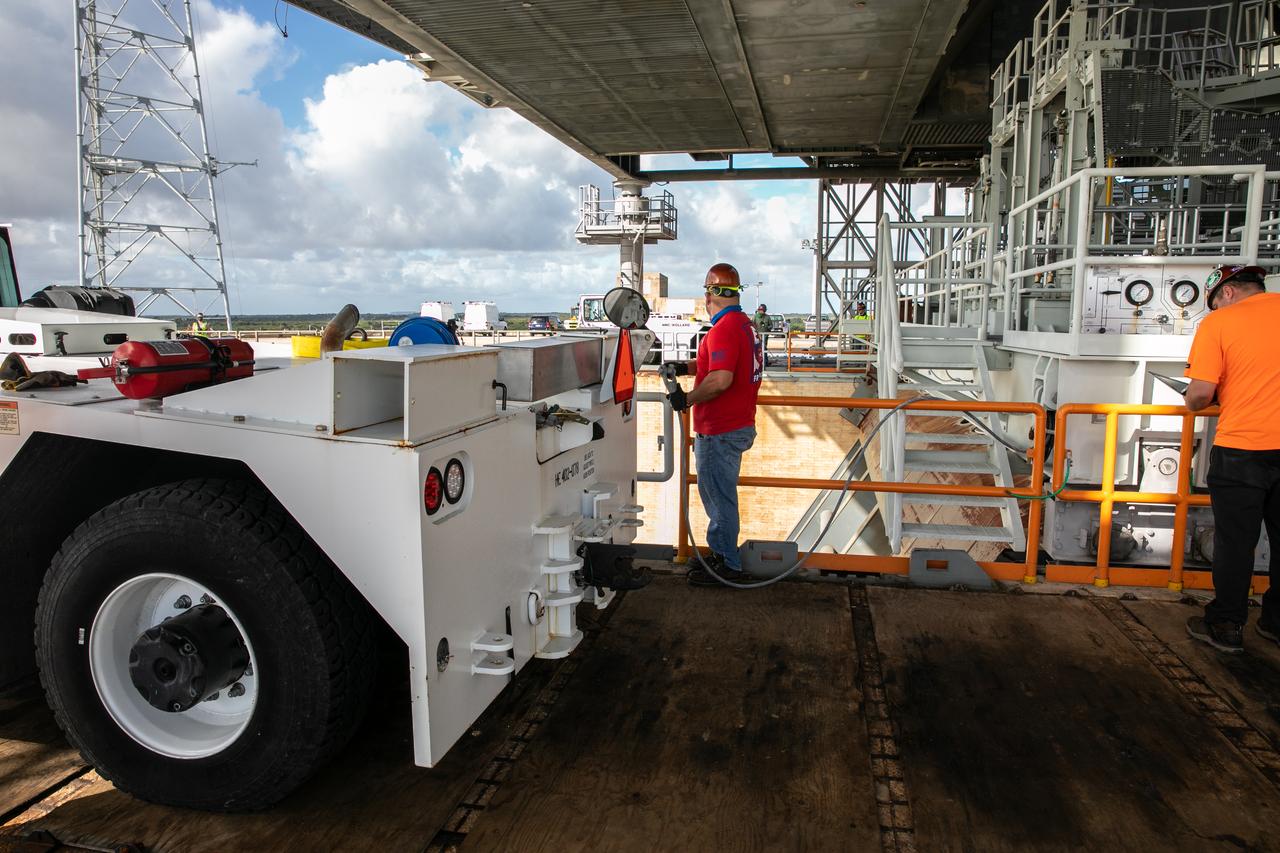
Engineers with Exploration Ground Systems and Jacobs assist with raising the engine service platform beneath the mobile launcher for Artemis I at Launch Pad 39B at NASA’s Kennedy Space Center in Florida on Oct. 23, 2020. The nearly 400-foot-tall mobile launcher is at the pad while engineers with Exploration Ground Systems and Jacobs complete several tasks, including a timing test to validate the launch team’s countdown timeline, and a thorough, top-to-bottom wash down of the mobile launcher to remove any debris remaining from construction and installation of the umbilical arms. Artemis I will test the Orion spacecraft and Space Launch System as an integrated system ahead of crewed flights to the Moon. Under the Artemis program, NASA will land the first woman and the next man on the Moon in 2024.
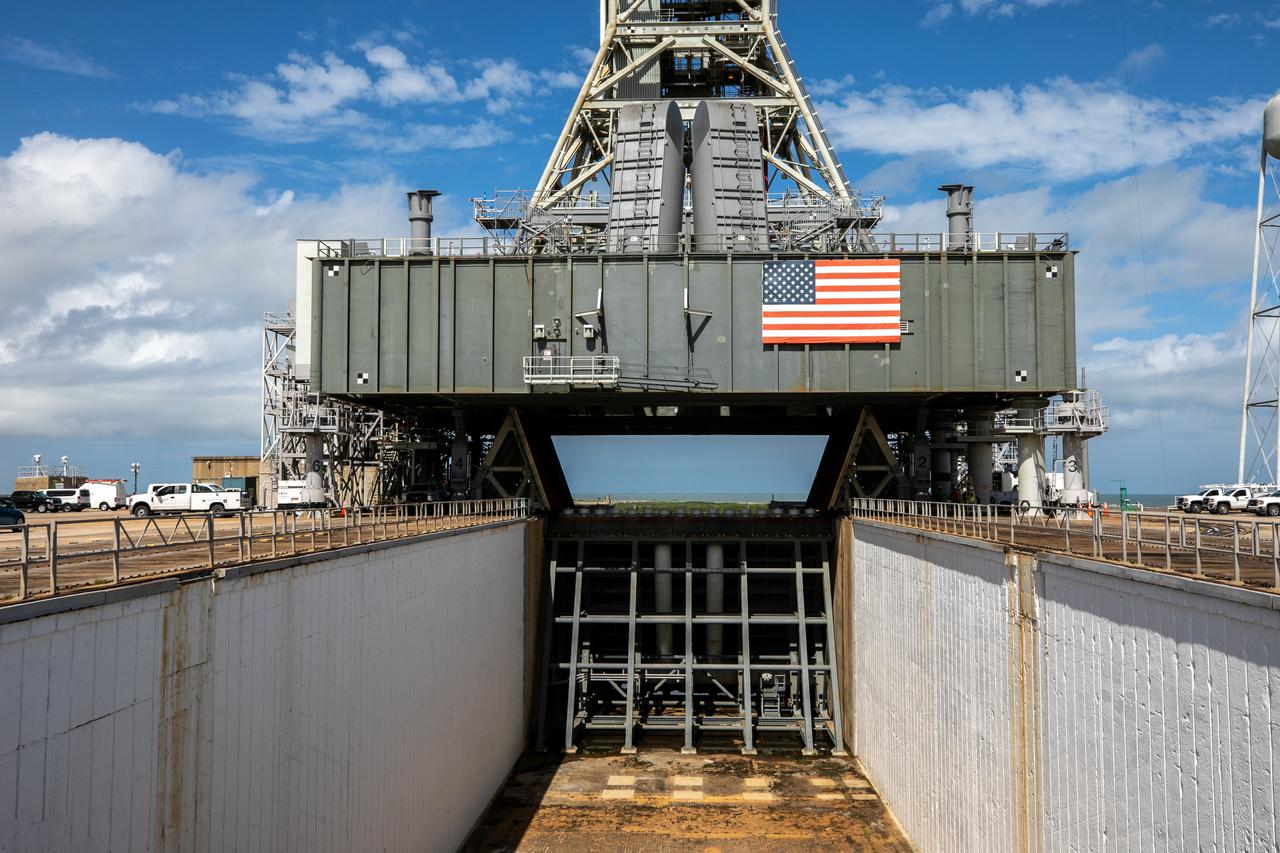
A close-up view of the mobile launcher for Artemis I with the two side flame deflectors positioned underneath during a countdown demonstration test at Launch Pad 39B at NASA’s Kennedy Space Center in Florida on Oct. 23, 2020. Also in view is the main flame deflector in the flame trench. The nearly 400-foot-tall mobile launcher is at the pad while engineers with Exploration Ground Systems and Jacobs complete several tasks, including a timing test to validate the launch team’s countdown timeline, and a thorough, top-to-bottom wash down of the mobile launcher to remove any debris remaining from construction and installation of the umbilical arms. Artemis I will test the Orion spacecraft and Space Launch System as an integrated system ahead of crewed flights to the Moon. Under the Artemis program, NASA will land the first woman and the next man on the Moon in 2024.
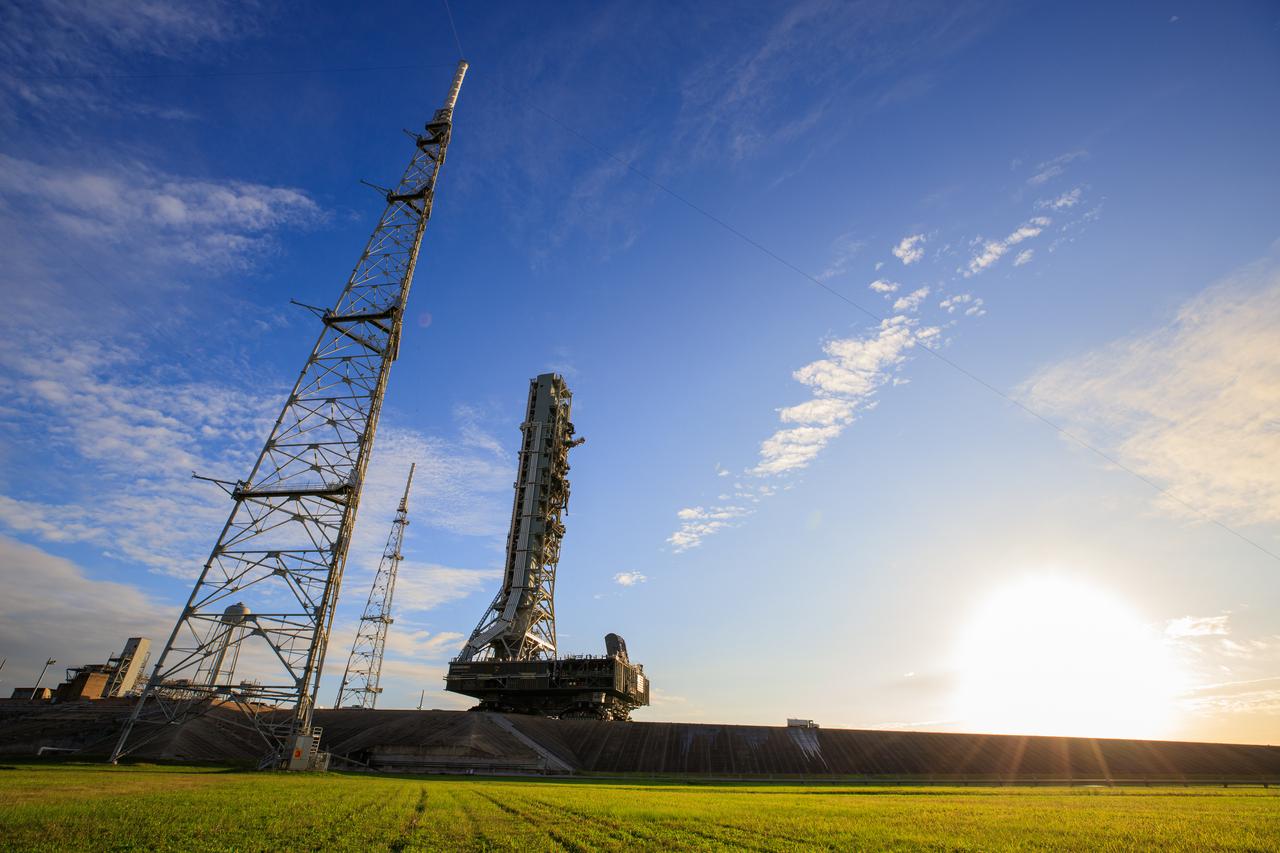
During sunrise on Oct. 30, 2020, the mobile launcher for the Artemis I mission, atop crawler-transporter 2, departs Launch Pad 39B and moves slowly along the crawlerway to return to the Vehicle Assembly Building at NASA’s Kennedy Space Center in Florida. The nearly 400-foot-tall mobile launcher was at the pad for 10 days, while engineers with Exploration Ground Systems and Jacobs performed several tasks, including a timing test to validate the launch team’s countdown timeline, and a thorough, top-to-bottom wash down of the mobile launcher to remove any debris remaining from construction and installation of the umbilical arms. Artemis I will test the Orion spacecraft and Space Launch System as an integrated system ahead of crewed flights to the Moon. Under the Artemis program, NASA will land the first woman and the next man on the Moon in 2024.
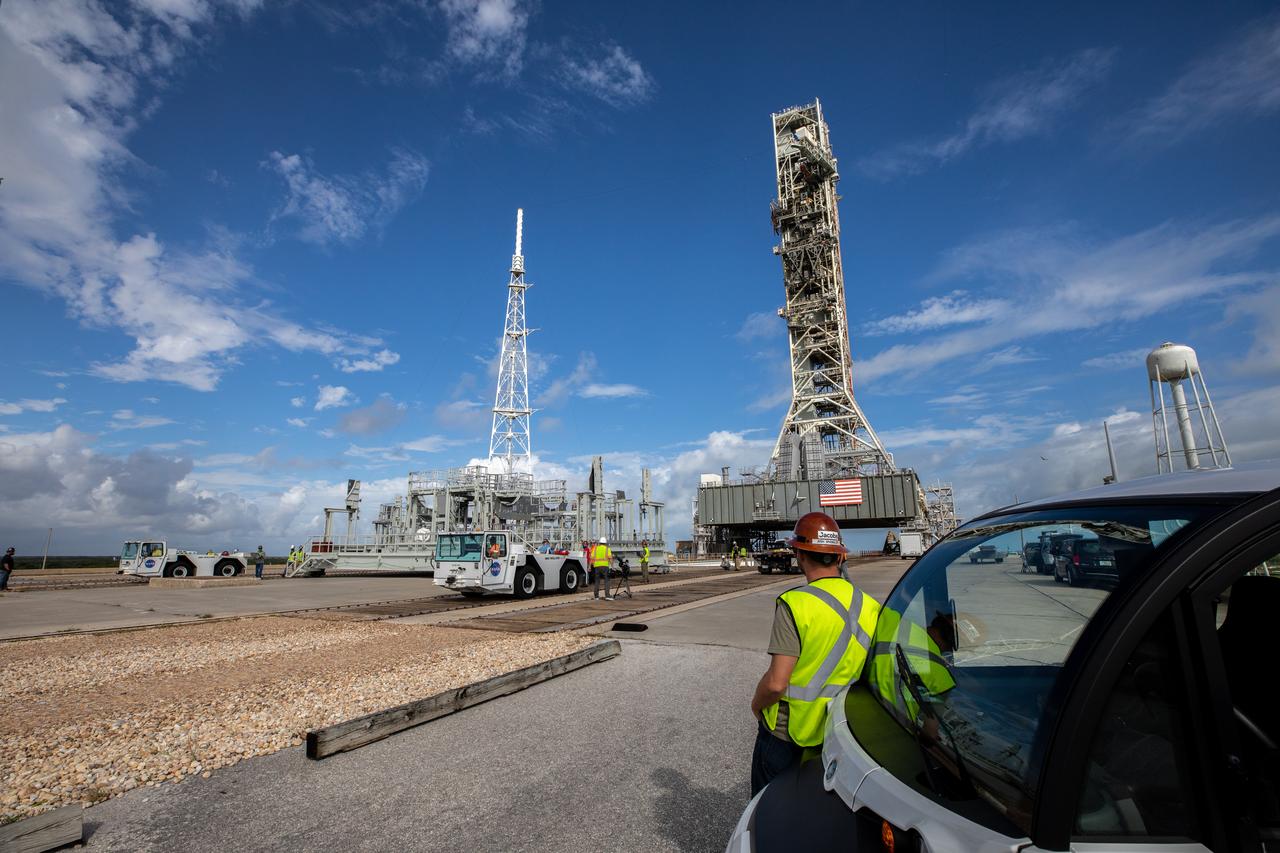
A view of the mobile launcher for Artemis I on Launch Pad 39B at NASA’s Kennedy Space Center in Florida on Oct. 23, 2020. The engine service platform has been lowered and removed from the mobile launcher and is in view on a flatbed carrier. The nearly 400-foot-tall mobile launcher is at the pad while engineers with Exploration Ground Systems and Jacobs complete several tasks, including a timing test to validate the launch team’s countdown timeline, and a thorough, top-to-bottom wash down of the mobile launcher to remove any debris remaining from construction and installation of the umbilical arms. Artemis I will test the Orion spacecraft and Space Launch System as an integrated system ahead of crewed flights to the Moon. Under the Artemis program, NASA will land the first woman and the next man on the Moon in 2024.
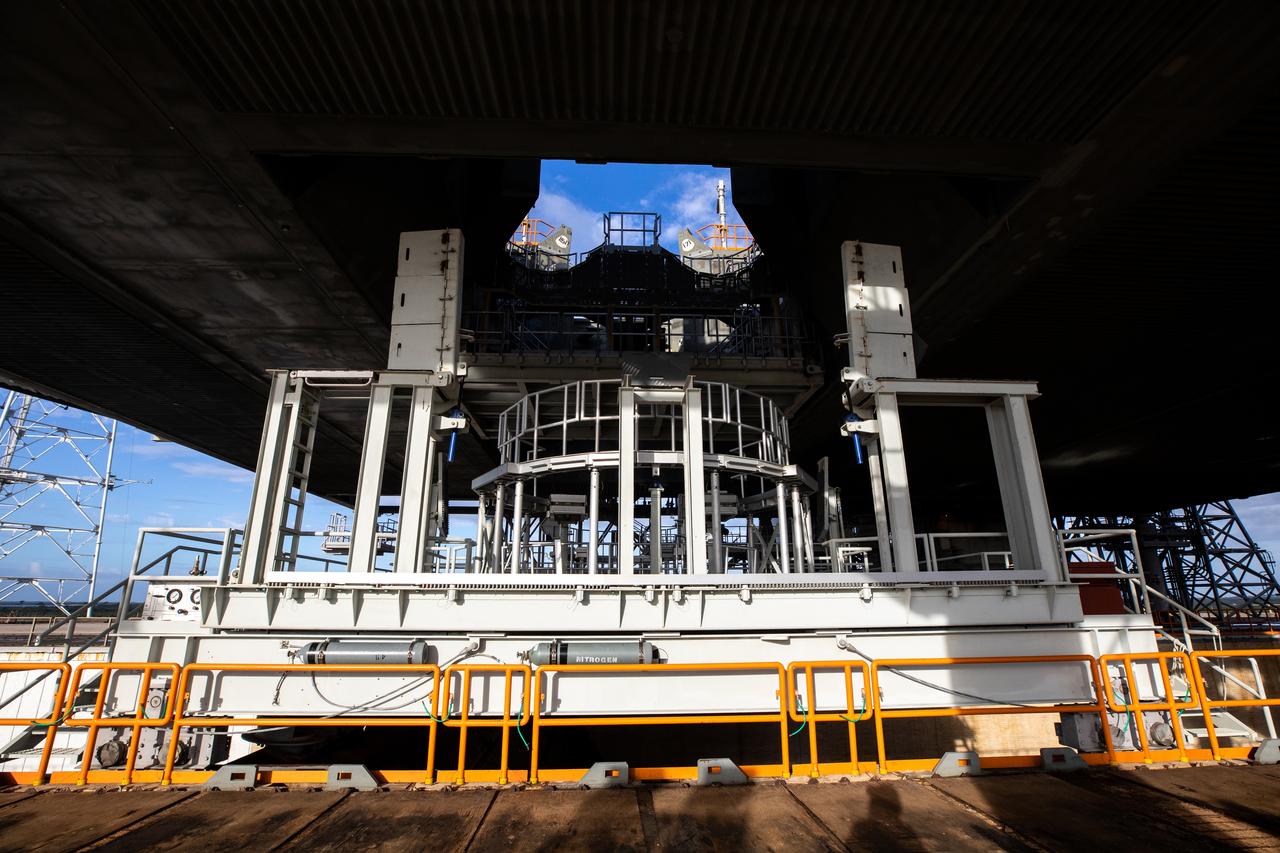
The engine service platform is moved into position beneath the mobile launcher for Artemis I at Launch Pad 39B on Oct. 23, 2020, at NASA’s Kennedy Space Center in Florida. The service platform allows access to the RS-25 engines on the Space Launch System core stage for routine work or inspections. The nearly 400-foot-tall mobile launcher will remain at the pad while engineers with Exploration Ground Systems and Jacobs will complete several tasks, including a timing test to validate the launch team’s countdown timeline, and a thorough, top-to-bottom wash down of the mobile launcher to remove any debris remaining from construction and installation of the umbilical arms. Artemis I will test the Orion spacecraft and Space Launch System as an integrated system ahead of crewed flights to the Moon. Under the Artemis program, NASA will land the first woman and the next man on the Moon in 2024.
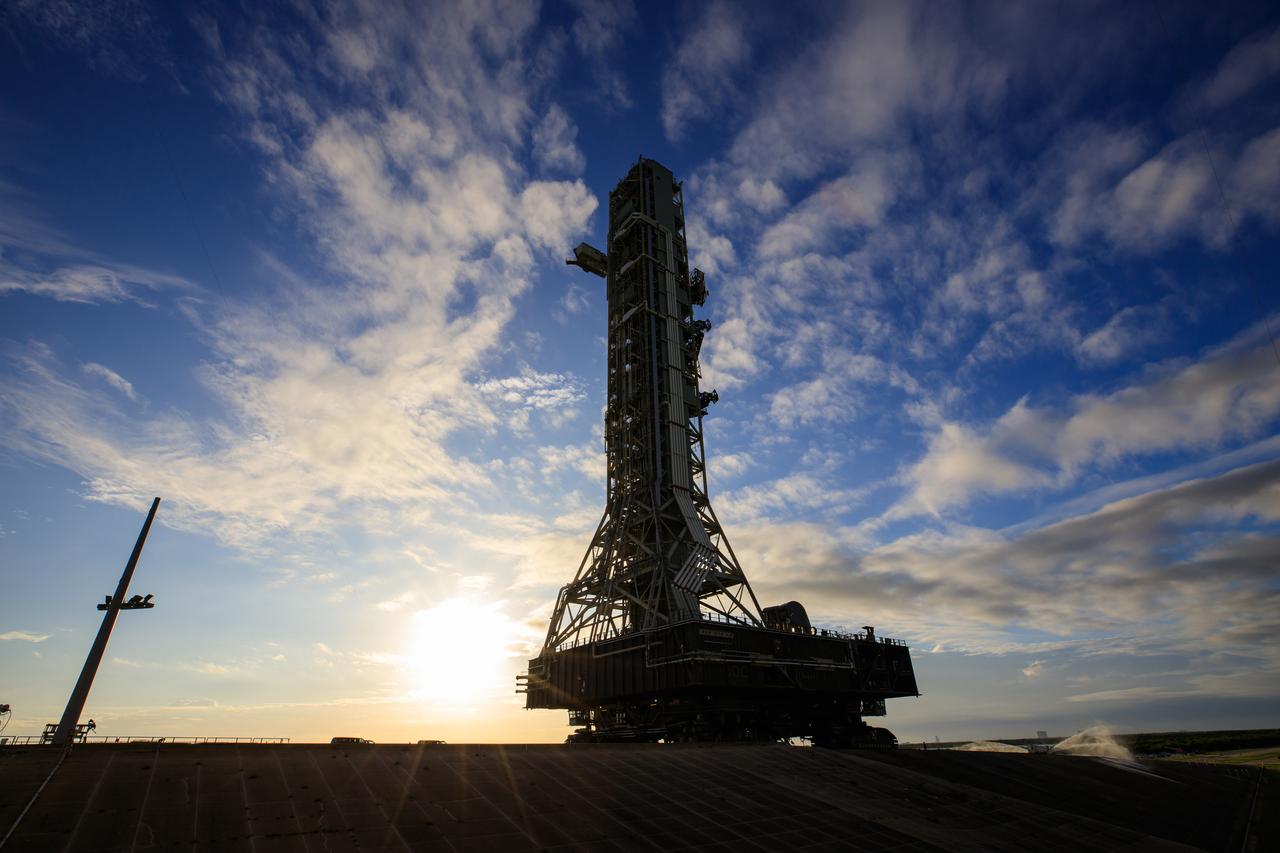
During sunrise on Oct. 30, 2020, the mobile launcher for the Artemis I mission, atop crawler-transporter 2, departs Launch Pad 39B and moves slowly along the crawlerway to return to the Vehicle Assembly Building at NASA’s Kennedy Space Center in Florida. The nearly 400-foot-tall mobile launcher was at the pad for 10 days, while engineers with Exploration Ground Systems and Jacobs performed several tasks, including a timing test to validate the launch team’s countdown timeline, and a thorough, top-to-bottom wash down of the mobile launcher to remove any debris remaining from construction and installation of the umbilical arms. Artemis I will test the Orion spacecraft and Space Launch System as an integrated system ahead of crewed flights to the Moon. Under the Artemis program, NASA will land the first woman and the next man on the Moon in 2024.
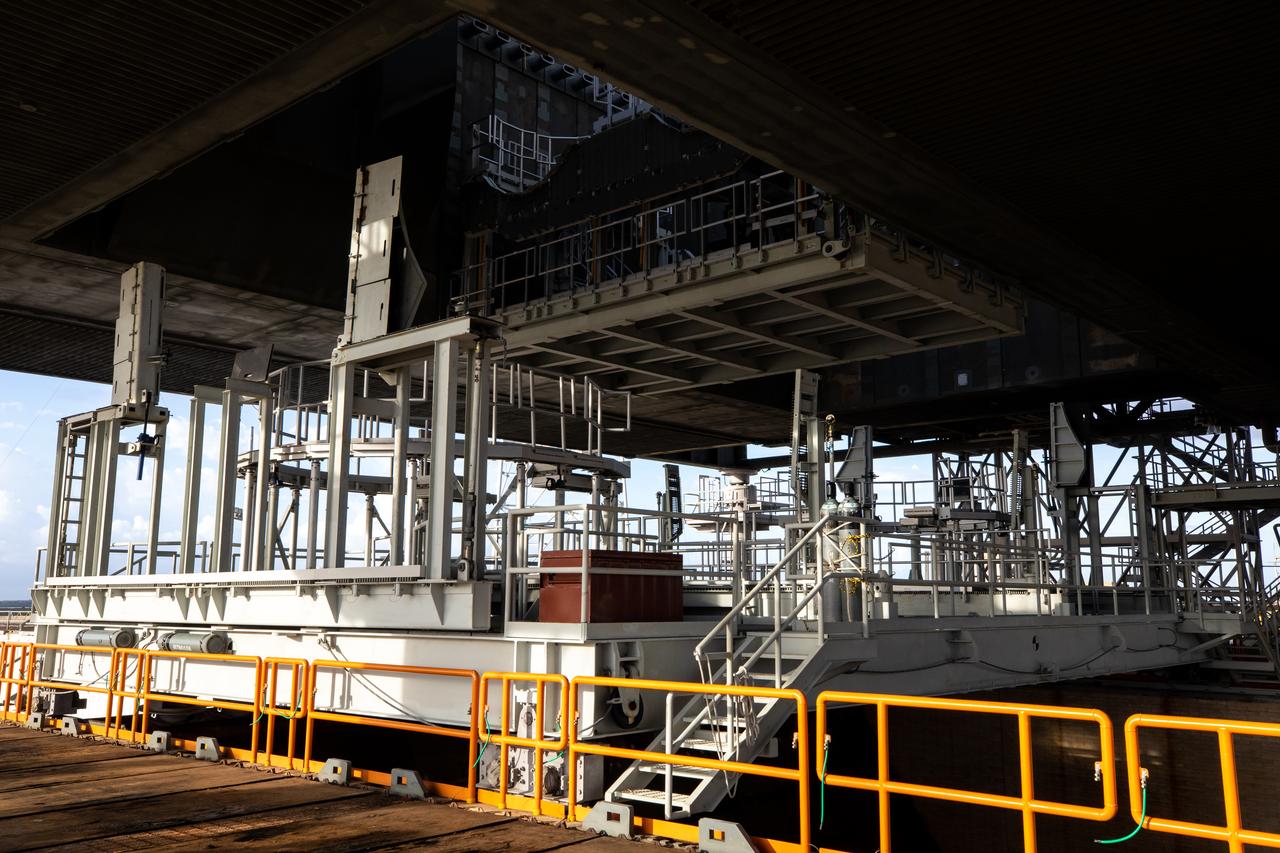
The engine service platform is moved into position beneath the mobile launcher for Artemis I at Launch Pad 39B on Oct. 23, 2020, at NASA’s Kennedy Space Center in Florida. The service platform allows access to the RS-25 engines on the Space Launch System core stage for routine work or inspections. The nearly 400-foot-tall mobile launcher will remain at the pad while engineers with Exploration Ground Systems and Jacobs complete several tasks, including a timing test to validate the launch team’s countdown timeline, and a thorough, top-to-bottom wash down of the mobile launcher to remove any debris remaining from construction and installation of the umbilical arms. Artemis I will test the Orion spacecraft and Space Launch System as an integrated system ahead of crewed flights to the Moon. Under the Artemis program, NASA will land the first woman and the next man on the Moon in 2024.
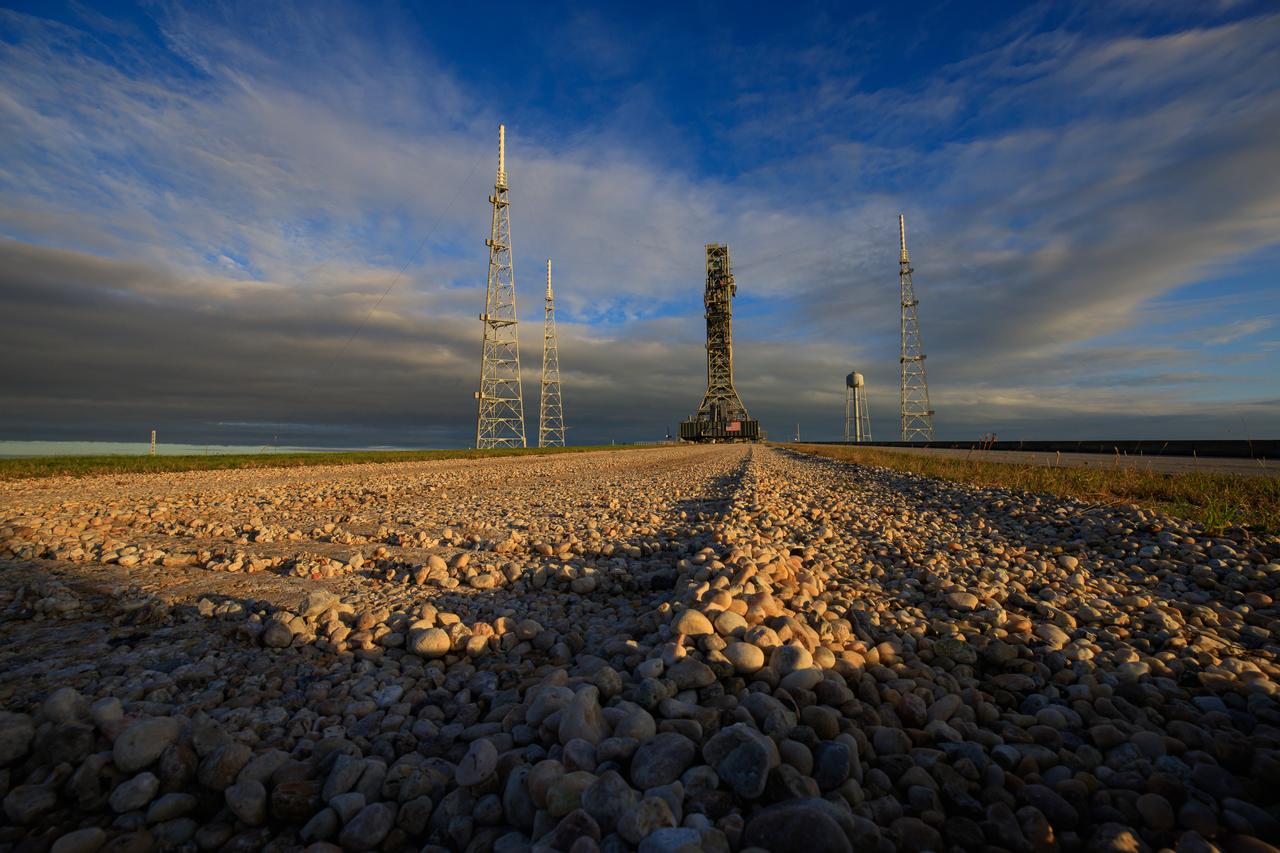
During sunrise on Oct. 30, 2020, the mobile launcher for the Artemis I mission, atop crawler-transporter 2, departs Launch Pad 39B and moves slowly along the crawlerway to return to the Vehicle Assembly Building at NASA’s Kennedy Space Center in Florida. The nearly 400-foot-tall mobile launcher was at the pad for 10 days, while engineers with Exploration Ground Systems and Jacobs performed several tasks, including a timing test to validate the launch team’s countdown timeline, and a thorough, top-to-bottom wash down of the mobile launcher to remove any debris remaining from construction and installation of the umbilical arms. Artemis I will test the Orion spacecraft and Space Launch System as an integrated system ahead of crewed flights to the Moon. Under the Artemis program, NASA will land the first woman and the next man on the Moon in 2024.
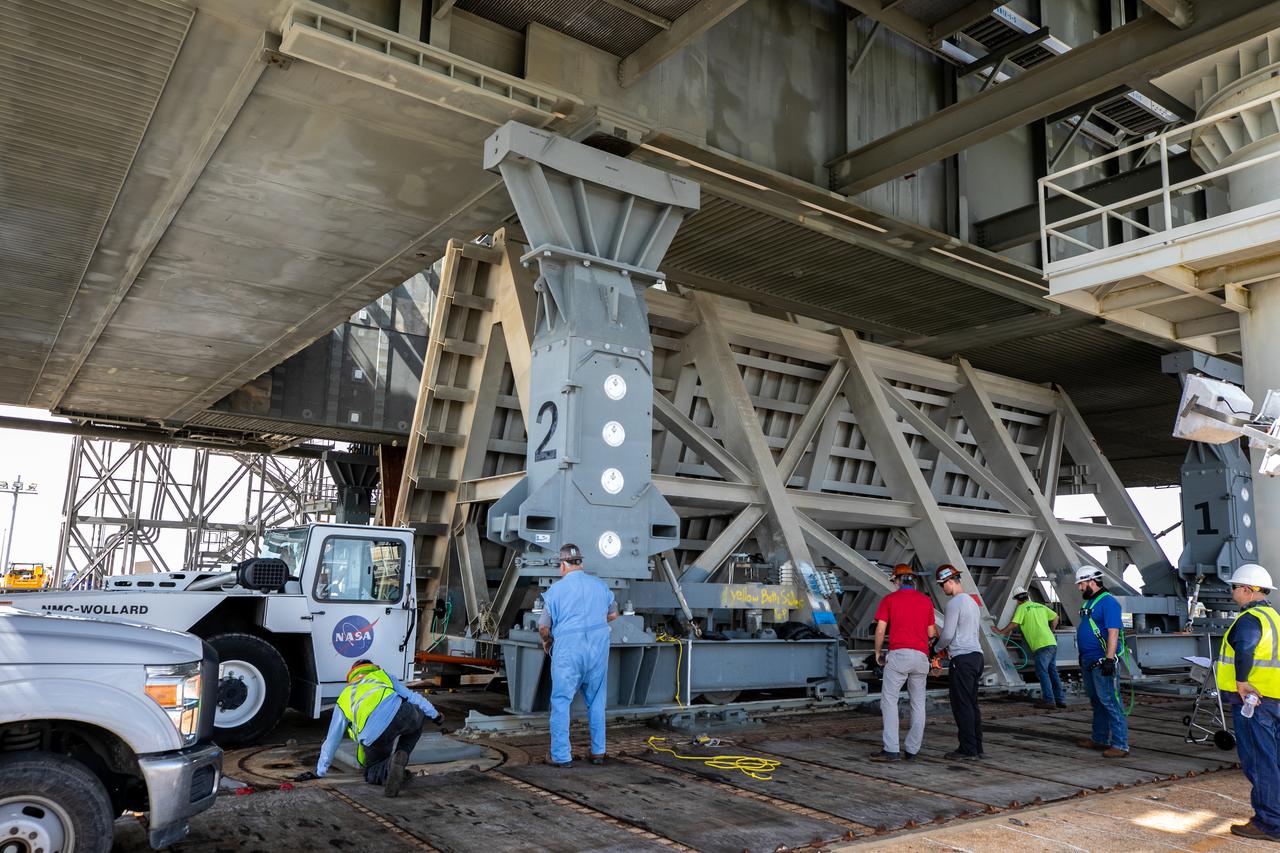
Special ground support equipment is used to move one of two side flame deflectors underneath the mobile launcher for Artemis I during a countdown demonstration test at Launch Pad 39B at NASA’s Kennedy Space Center in Florida on Oct. 23, 2020. The nearly 400-foot-tall mobile launcher is at the pad while engineers with Exploration Ground Systems and Jacobs complete several tasks, including a timing test to validate the launch team’s countdown timeline, and a thorough, top-to-bottom wash down of the mobile launcher to remove any debris remaining from construction and installation of the umbilical arms. Artemis I will test the Orion spacecraft and Space Launch System as an integrated system ahead of crewed flights to the Moon. Under the Artemis program, NASA will land the first woman and the next man on the Moon in 2024.
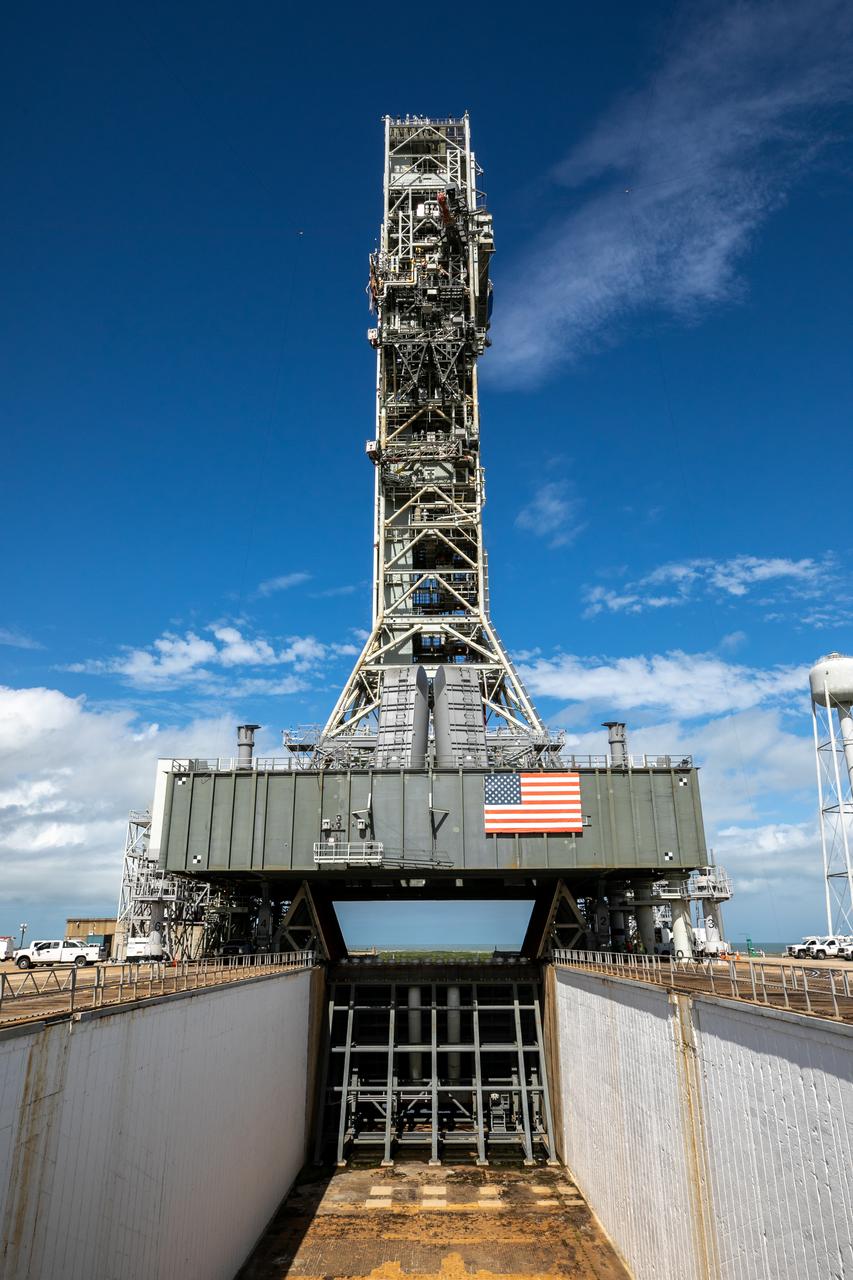
A view of the mobile launcher for Artemis I with the two side flame deflectors positioned underneath during a countdown demonstration test at Launch Pad 39B at NASA’s Kennedy Space Center in Florida on Oct. 23, 2020. Also in view is the main flame deflector in the flame trench. The nearly 400-foot-tall mobile launcher is at the pad while engineers with Exploration Ground Systems and Jacobs complete several tasks, including a timing test to validate the launch team’s countdown timeline, and a thorough, top-to-bottom wash down of the mobile launcher to remove any debris remaining from construction and installation of the umbilical arms. Artemis I will test the Orion spacecraft and Space Launch System as an integrated system ahead of crewed flights to the Moon. Under the Artemis program, NASA will land the first woman and the next man on the Moon in 2024.
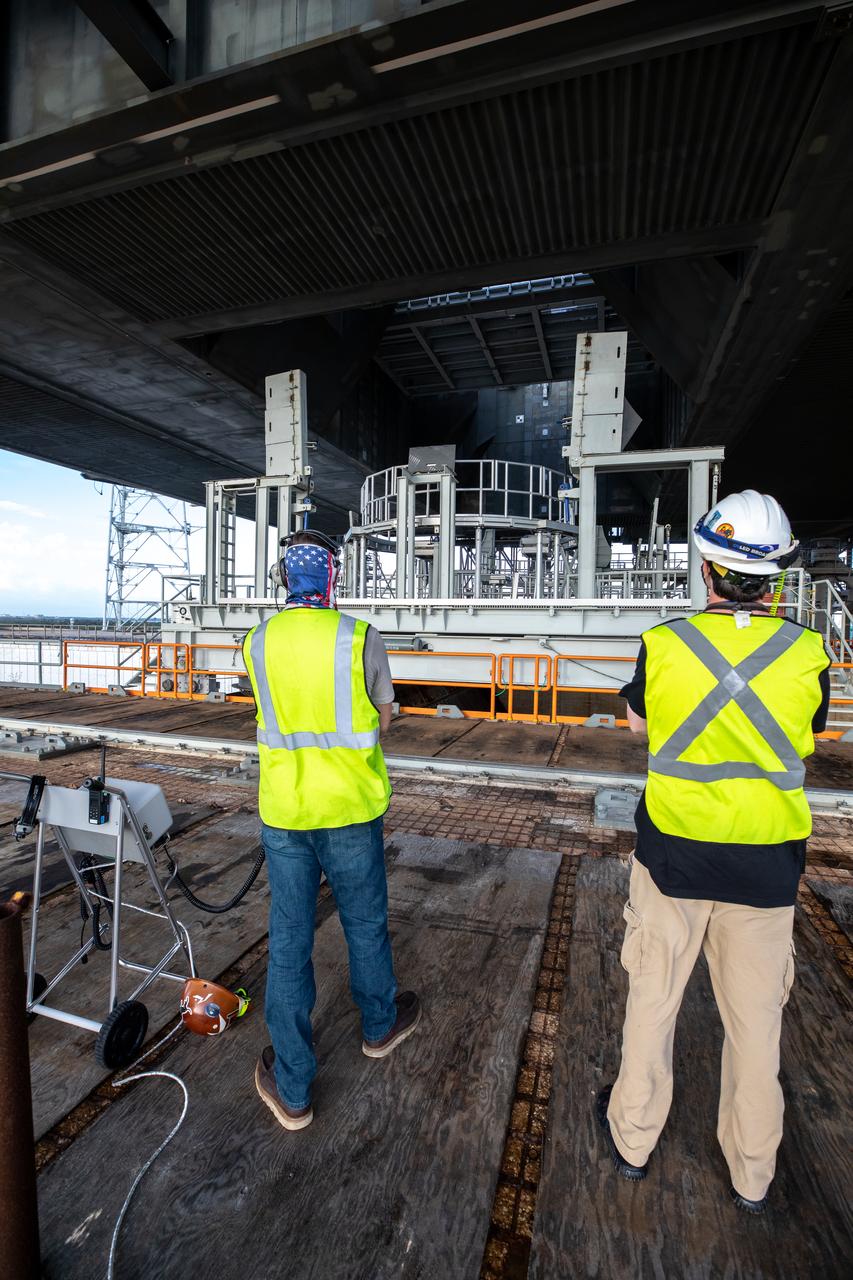
The engine service platform is moved into position beneath the mobile launcher for Artemis I at Launch Pad 39B on Oct. 23, 2020, at NASA’s Kennedy Space Center in Florida. The service platform allows access to the RS-25 engines on the Space Launch System core stage for routine work or inspections. The nearly 400-foot-tall mobile launcher will remain at the pad while engineers with Exploration Ground Systems and Jacobs will complete several tasks, including a timing test to validate the launch team’s countdown timeline, and a thorough, top-to-bottom wash down of the mobile launcher to remove any debris remaining from construction and installation of the umbilical arms. Artemis I will test the Orion spacecraft and Space Launch System as an integrated system ahead of crewed flights to the Moon. Under the Artemis program, NASA will land the first woman and the next man on the Moon in 2024.
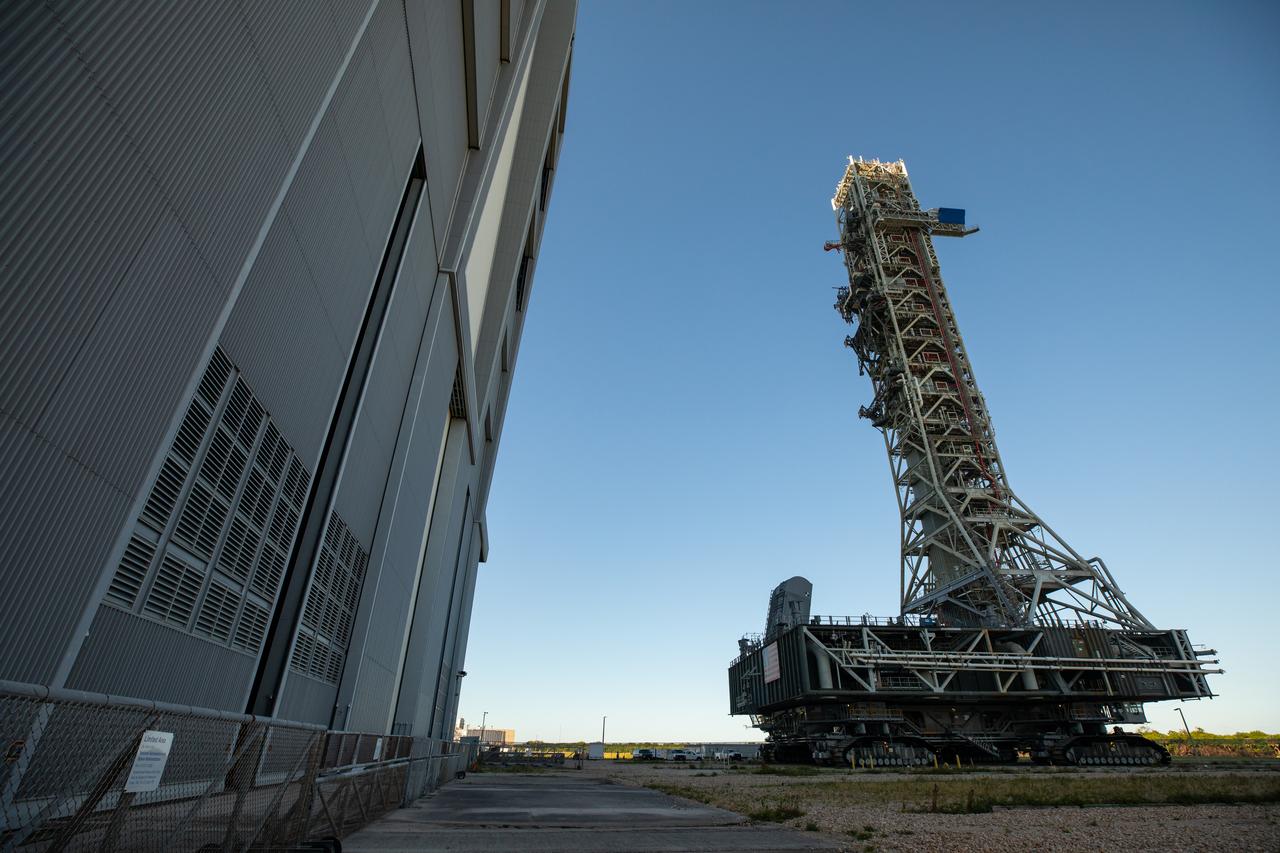
The mobile launcher for the Artemis I mission, atop crawler-transporter 2, arrives at the Vehicle Assembly Building at NASA’s Kennedy Space Center in Florida on Oct. 30, 2020. The nearly 400-foot-tall mobile launcher was at Launch Pad 39B for 10 days, while engineers with Exploration Ground Systems and Jacobs performed several tasks, including a timing test to validate the launch team’s countdown timeline, and a thorough, top-to-bottom wash down of the mobile launcher to remove any debris remaining from construction and installation of the umbilical arms. Artemis I will test the Orion spacecraft and Space Launch System as an integrated system ahead of crewed flights to the Moon. Under the Artemis program, NASA will land the first woman and the next man on the Moon in 2024.

On Oct. 30, 2020, preparations are underway for the mobile launcher for the Artemis I mission, atop crawler-transporter 2, to depart Launch Pad 39B and return to the Vehicle Assembly Building at NASA’s Kennedy Space Center in Florida. The nearly 400-foot-tall mobile launcher was at the pad for 10 days, while engineers with Exploration Ground Systems and Jacobs performed several tasks, including a timing test to validate the launch team’s countdown timeline, and a thorough, top-to-bottom wash down of the mobile launcher to remove any debris remaining from construction and installation of the umbilical arms. Artemis I will test the Orion spacecraft and Space Launch System as an integrated system ahead of crewed flights to the Moon. Under the Artemis program, NASA will land the first woman and the next man on the Moon in 2024.
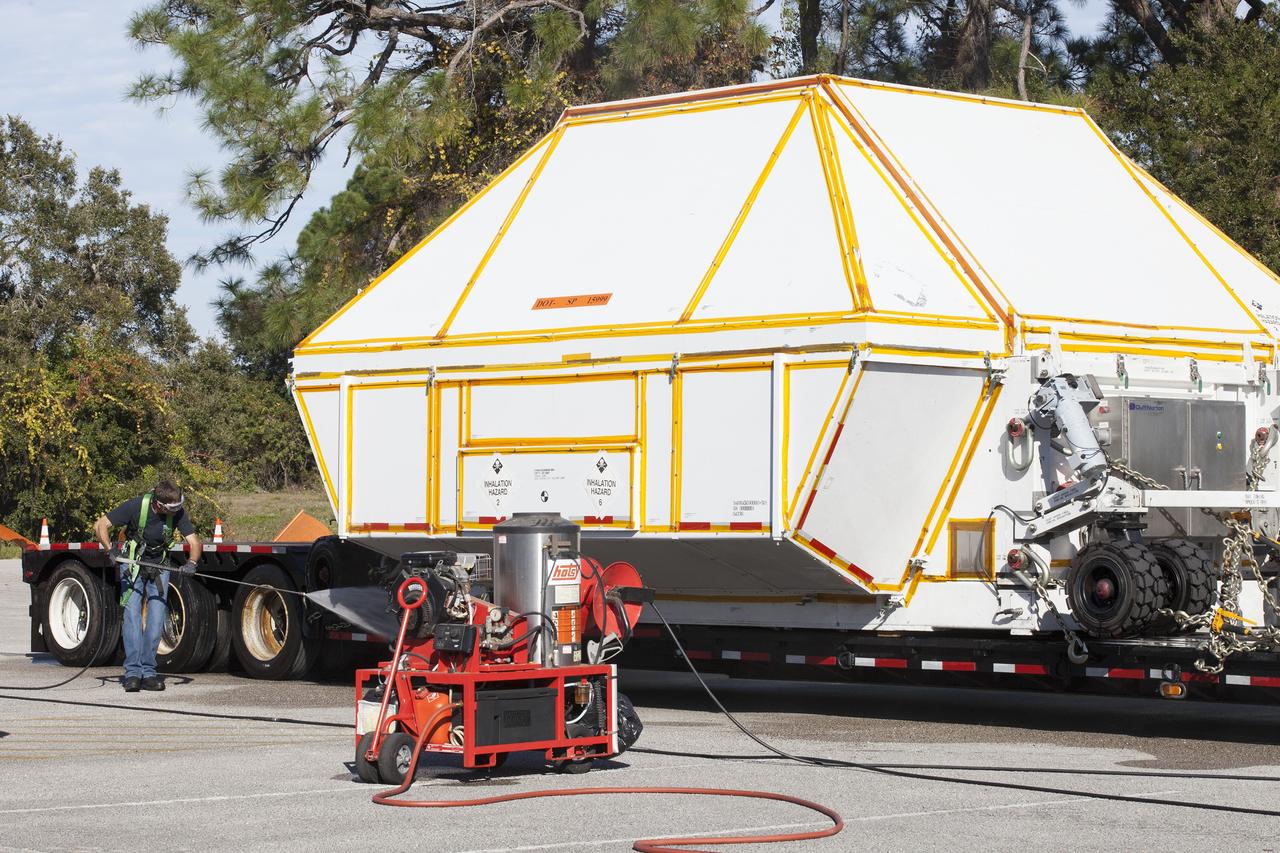
CAPE CANAVERAL, Fla. -- A technician washes down the crew module transportation fixture containing the Orion crew module on the back of a flatbed truck at the Multi-Operation Support Building at NASA's Kennedy Space Center in Florida. Orion was transported 2,700 miles overland from Naval Base San Diego in California. Orion was recovered from the Pacific Ocean after completing a two-orbit, four-and-a-half hour mission Dec. 5 to test systems critical to crew safety, including the launch abort system, the heat shield and the parachute system. The Ground Systems Development and Operations Program led the recovery, offload and transportation efforts. For more information, visit www.nasa.gov/orion. Photo credit: NASA/Kim Shiflett
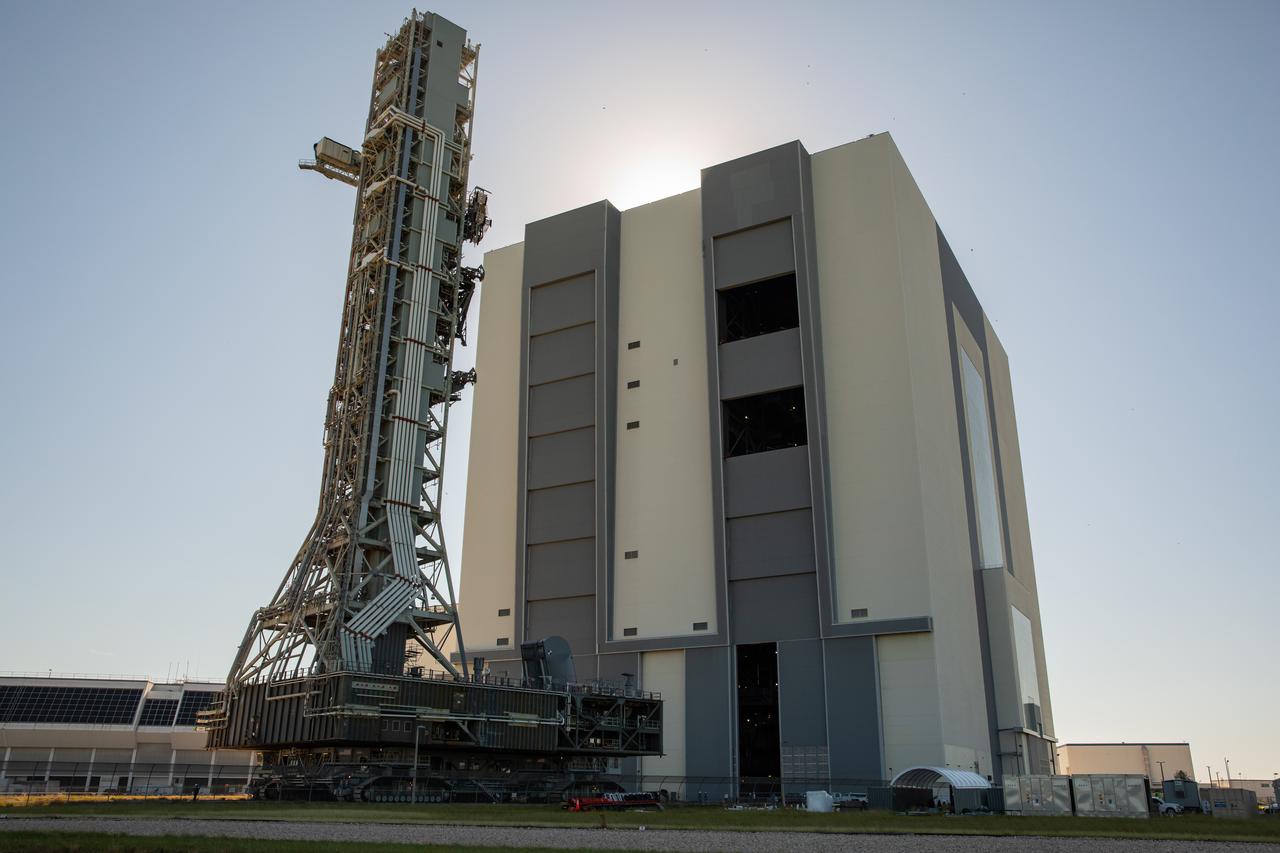
The mobile launcher for the Artemis I mission, atop crawler-transporter 2, arrives at the Vehicle Assembly Building at NASA’s Kennedy Space Center in Florida on Oct. 30, 2020. The nearly 400-foot-tall mobile launcher was at Launch Pad 39B for 10 days, while engineers with Exploration Ground Systems and Jacobs performed several tasks, including a timing test to validate the launch team’s countdown timeline, and a thorough, top-to-bottom wash down of the mobile launcher to remove any debris remaining from construction and installation of the umbilical arms. Artemis I will test the Orion spacecraft and Space Launch System as an integrated system ahead of crewed flights to the Moon. Under the Artemis program, NASA will land the first woman and the next man on the Moon in 2024.
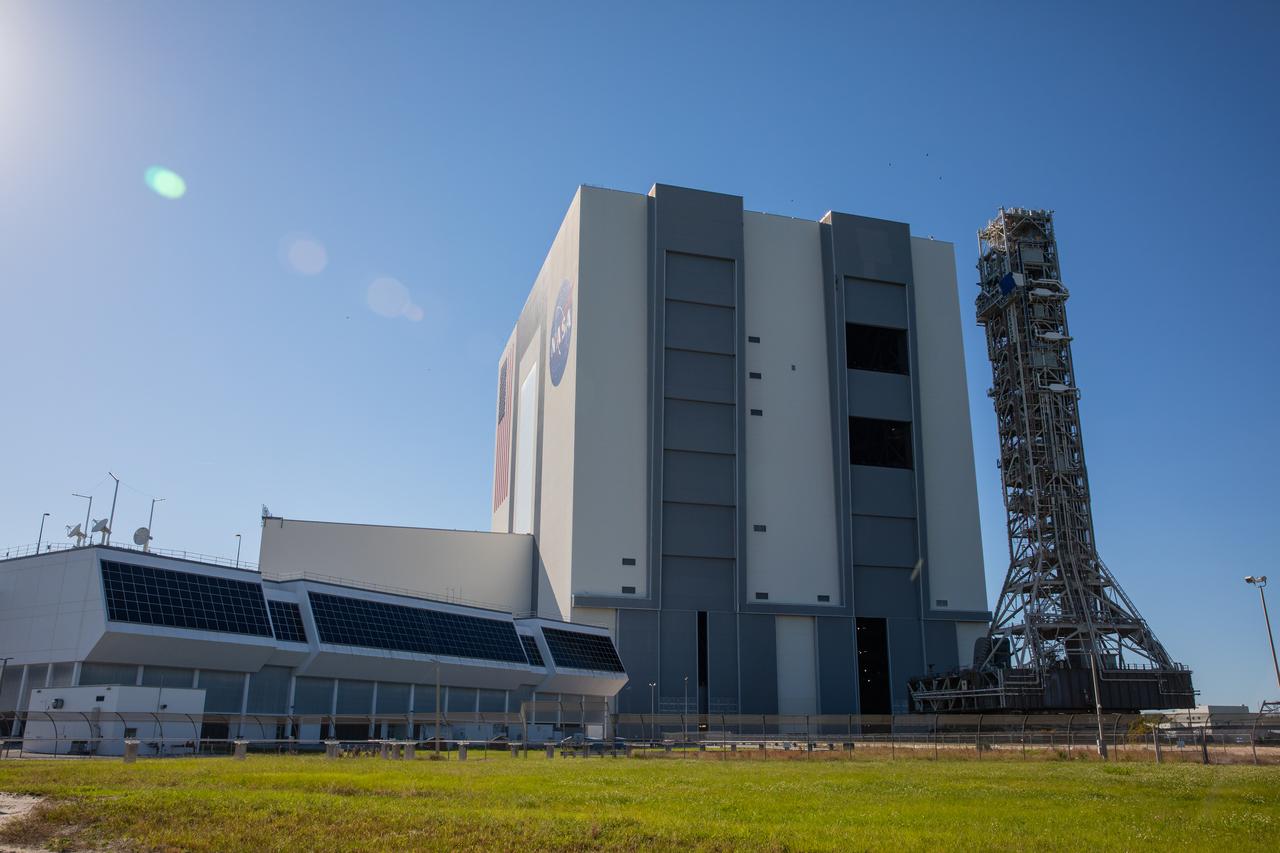
The mobile launcher for the Artemis I mission, atop crawler-transporter 2, arrives at the Vehicle Assembly Building at NASA’s Kennedy Space Center in Florida on Oct. 30, 2020. In view at left is the Launch Control Center. The nearly 400-foot-tall mobile launcher was at Launch Pad 39B for 10 days, while engineers with Exploration Ground Systems and Jacobs performed several tasks, including a timing test to validate the launch team’s countdown timeline, and a thorough, top-to-bottom wash down of the mobile launcher to remove any debris remaining from construction and installation of the umbilical arms. Artemis I will test the Orion spacecraft and Space Launch System as an integrated system ahead of crewed flights to the Moon. Under the Artemis program, NASA will land the first woman and the next man on the Moon in 2024.

During sunrise on Oct. 30, 2020, preparations are underway for the mobile launcher for the Artemis I mission, atop crawler-transporter 2, to depart Launch Pad 39B and return to the Vehicle Assembly Building at NASA’s Kennedy Space Center in Florida. The nearly 400-foot-tall mobile launcher was at the pad for 10 days, while engineers with Exploration Ground Systems and Jacobs performed several tasks, including a timing test to validate the launch team’s countdown timeline, and a thorough, top-to-bottom wash down of the mobile launcher to remove any debris remaining from construction and installation of the umbilical arms. Artemis I will test the Orion spacecraft and Space Launch System as an integrated system ahead of crewed flights to the Moon. Under the Artemis program, NASA will land the first woman and the next man on the Moon in 2024.

Special ground support equipment is used to move the side flame deflectors into place during a countdown demonstration test using the mobile launcher for the Artemis I mission at Launch Pad 39B at NASA’s Kennedy Space Center in Florida on Oct. 23, 2020. The nearly 400-foot-tall mobile launcher is at the pad while engineers with Exploration Ground Systems and Jacobs complete several tasks, including a timing test to validate the launch team’s countdown timeline, and a thorough, top-to-bottom wash down of the mobile launcher to remove any debris remaining from construction and installation of the umbilical arms. Artemis I will test the Orion spacecraft and Space Launch System as an integrated system ahead of crewed flights to the Moon. Under the Artemis program, NASA will land the first woman and the next man on the Moon in 2024.
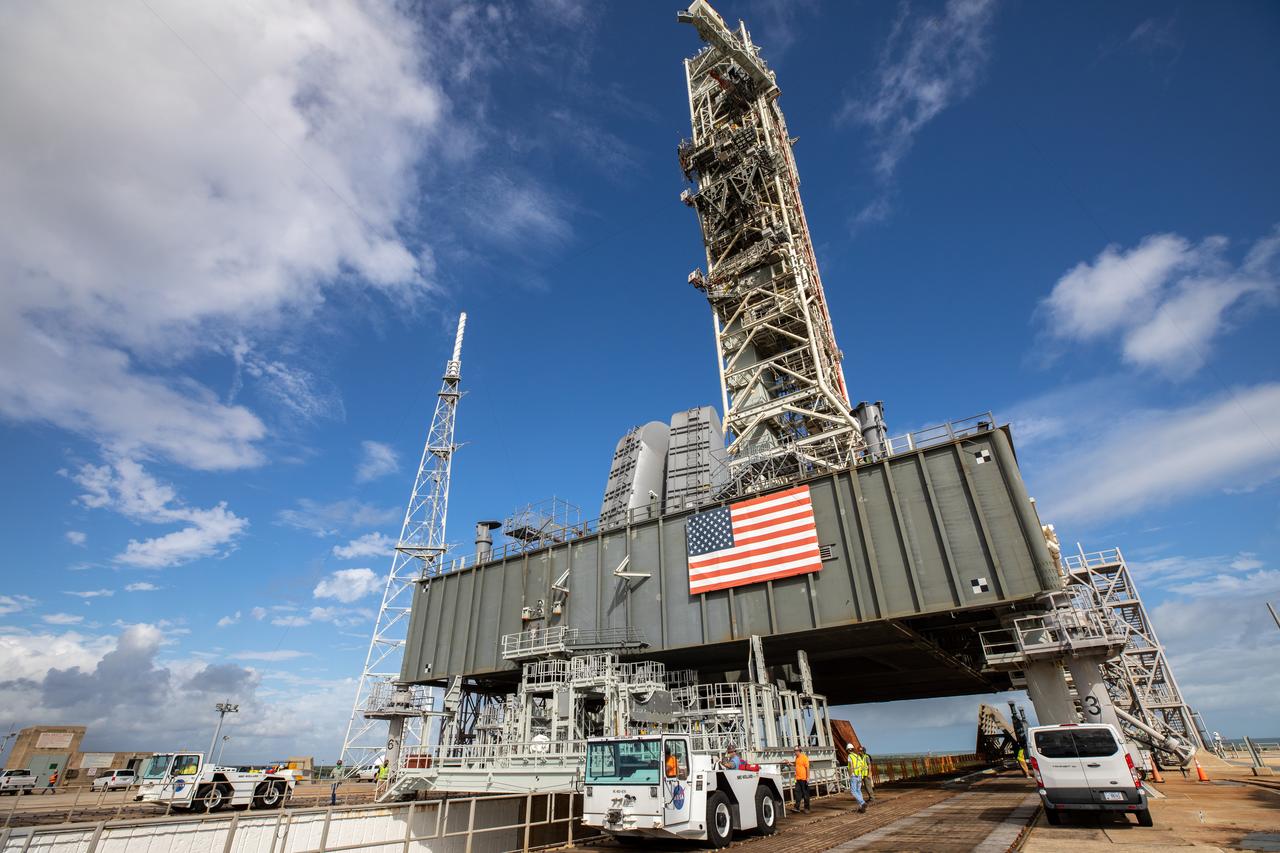
Engineers with Exploration Ground Systems and Jacobs assist with lowering the engine service platform beneath the mobile launcher for Artemis I at Launch Pad 39B at NASA’s Kennedy Space Center in Florida on Oct. 23, 2020. The nearly 400-foot-tall mobile launcher is at the pad while engineers with Exploration Ground Systems and Jacobs complete several tasks, including a timing test to validate the launch team’s countdown timeline, and a thorough, top-to-bottom wash down of the mobile launcher to remove any debris remaining from construction and installation of the umbilical arms. Artemis I will test the Orion spacecraft and Space Launch System as an integrated system ahead of crewed flights to the Moon. Under the Artemis program, NASA will land the first woman and the next man on the Moon in 2024.
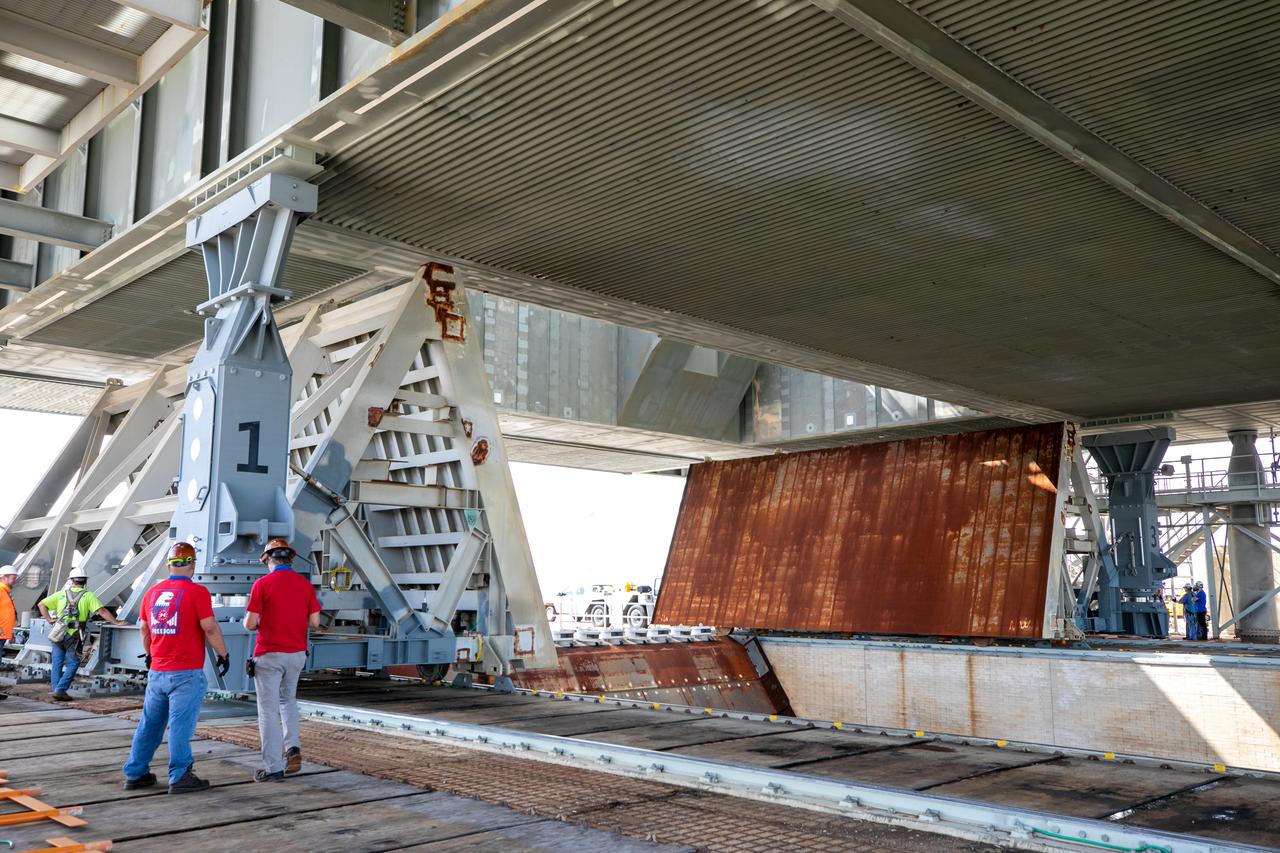
Special ground support equipment is used to position the two side flame deflectors underneath the mobile launcher for Artemis I during a countdown demonstration test at Launch Pad 39B at NASA’s Kennedy Space Center in Florida on Oct. 23, 2020. The nearly 400-foot-tall mobile launcher is at the pad while engineers with Exploration Ground Systems and Jacobs complete several tasks, including a timing test to validate the launch team’s countdown timeline, and a thorough, top-to-bottom wash down of the mobile launcher to remove any debris remaining from construction and installation of the umbilical arms. Artemis I will test the Orion spacecraft and Space Launch System as an integrated system ahead of crewed flights to the Moon. Under the Artemis program, NASA will land the first woman and the next man on the Moon in 2024.
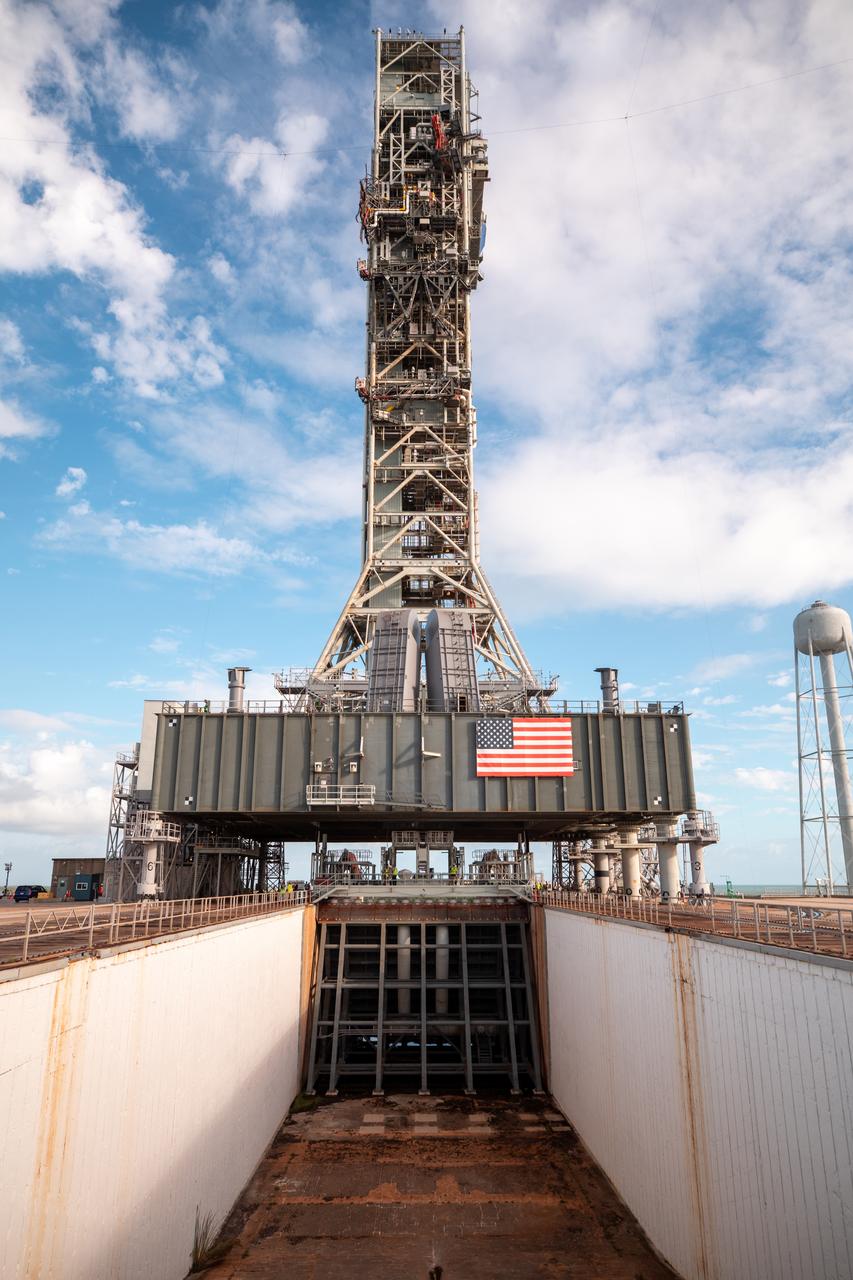
A view of the mobile launcher for the Artemis I mission on Launch Pad 39B at NASA’s Kennedy Space Center in Florida on Oct. 23, 2020. The flame trench and flame deflector are in view below the mobile launcher. The nearly 400-foot-tall mobile launcher will remain at the pad while engineers with Exploration Ground Systems and Jacobs complete several tasks, including a timing test to validate the launch team’s countdown timeline, and a thorough, top-to-bottom wash down of the mobile launcher to remove any debris remaining from construction and installation of the umbilical arms. Artemis I will test the Orion spacecraft and Space Launch System as an integrated system ahead of crewed flights to the Moon. Under the Artemis program, NASA will land the first woman and the next man on the Moon in 2024.
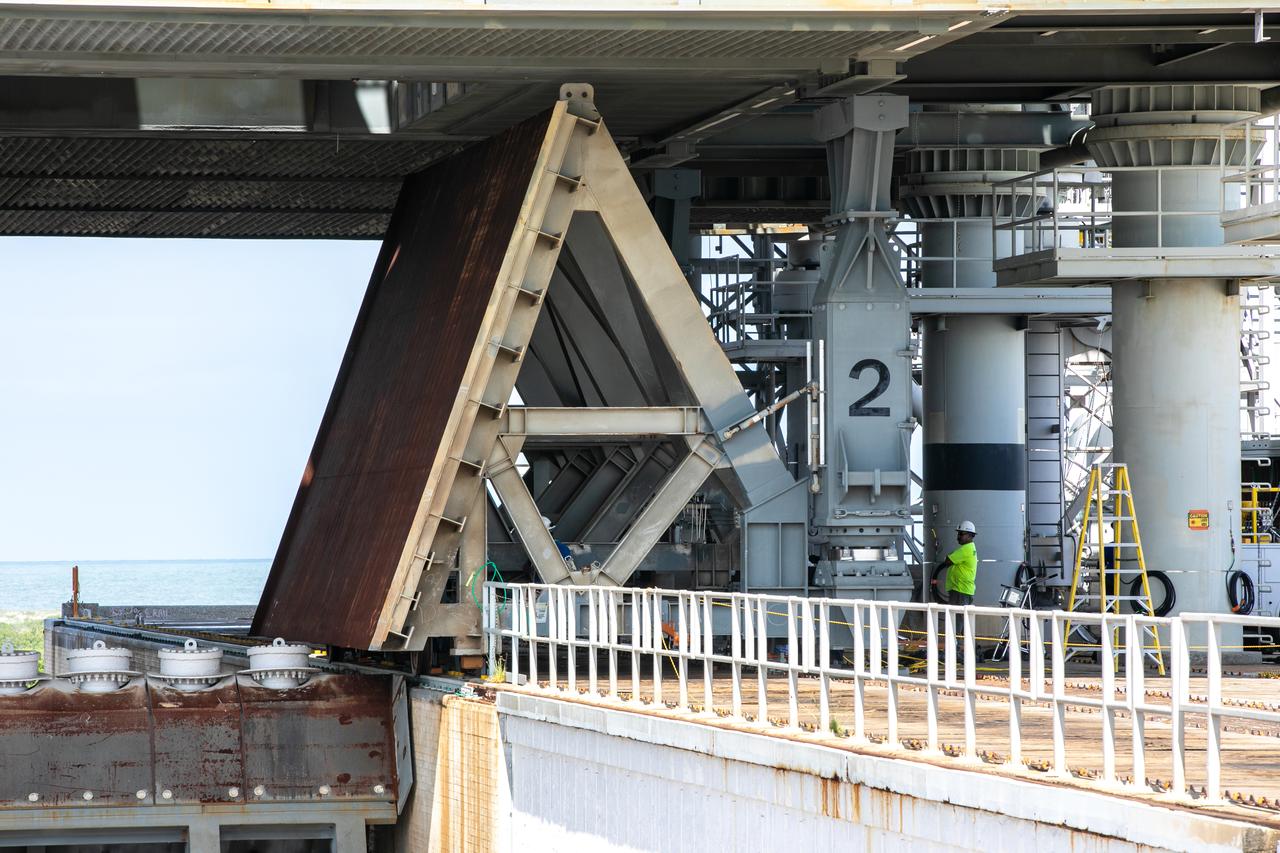
A close-up view of the base of one of the side flame deflectors positioned underneath the mobile launcher for Artemis I during a countdown demonstration test at Launch Pad 39B at NASA’s Kennedy Space Center in Florida on Oct. 23, 2020. The nearly 400-foot-tall mobile launcher is at the pad while engineers with Exploration Ground Systems and Jacobs complete several tasks, including a timing test to validate the launch team’s countdown timeline, and a thorough, top-to-bottom wash down of the mobile launcher to remove any debris remaining from construction and installation of the umbilical arms. Artemis I will test the Orion spacecraft and Space Launch System as an integrated system ahead of crewed flights to the Moon. Under the Artemis program, NASA will land the first woman and the next man on the Moon in 2024.
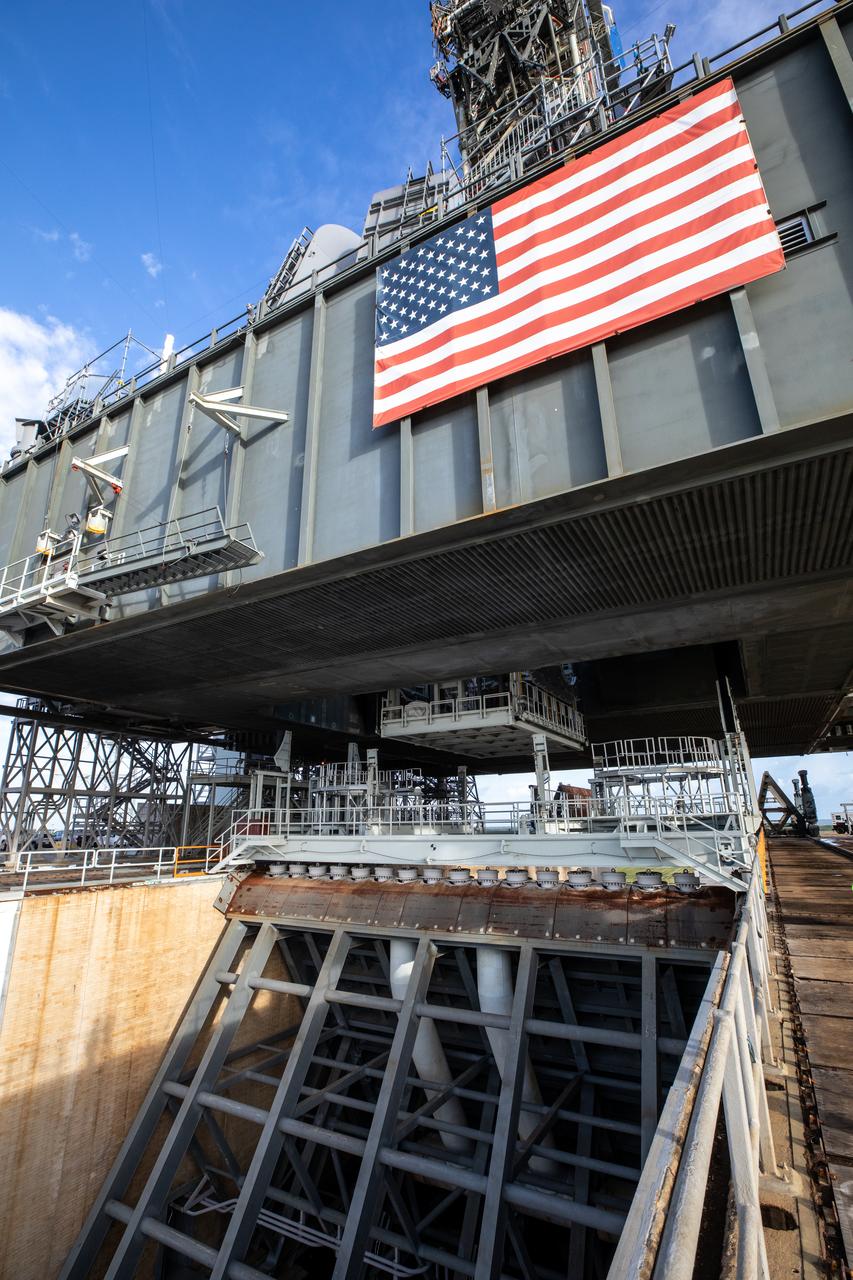
A view of the base of the mobile launcher for Artemis I and the flame trench below as the engine service platform is being raised into position below the mobile launcher at Launch Pad 39B at NASA’s Kennedy Space Center in Florida on Oct. 23, 2020. The nearly 400-foot-tall mobile launcher is at the pad while engineers with Exploration Ground Systems and Jacobs complete several tasks, including a timing test to validate the launch team’s countdown timeline, and a thorough, top-to-bottom wash down of the mobile launcher to remove any debris remaining from construction and installation of the umbilical arms. Artemis I will test the Orion spacecraft and Space Launch System as an integrated system ahead of crewed flights to the Moon. Under the Artemis program, NASA will land the first woman and the next man on the Moon in 2024.
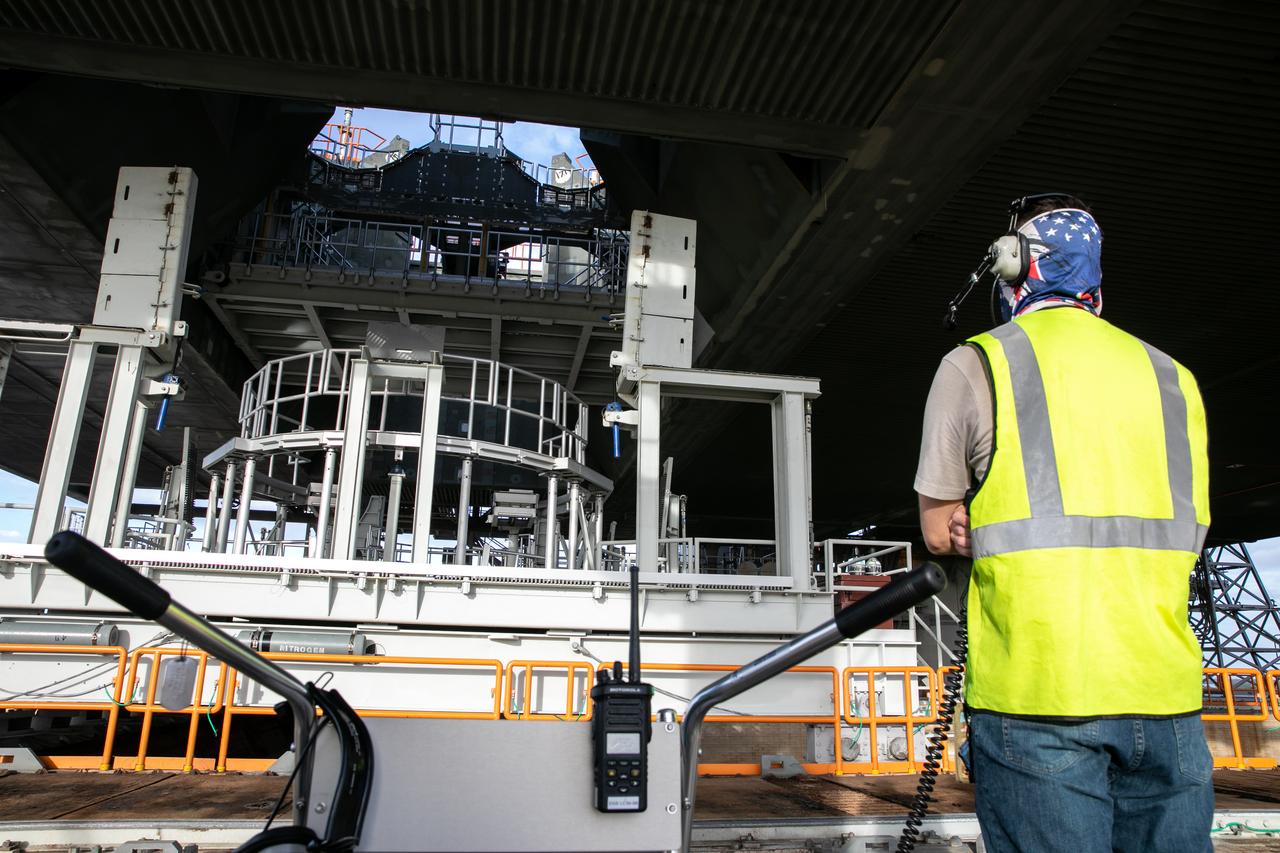
Workers assists with raising the engine service platform beneath the mobile launcher for Artemis I at Launch Pad 39B at NASA’s Kennedy Space Center in Florida on Oct. 23, 2020. The nearly 400-foot-tall mobile launcher is at the pad while engineers with Exploration Ground Systems and Jacobs complete several tasks, including a timing test to validate the launch team’s countdown timeline, and a thorough, top-to-bottom wash down of the mobile launcher to remove any debris remaining from construction and installation of the umbilical arms. Artemis I will test the Orion spacecraft and Space Launch System as an integrated system ahead of crewed flights to the Moon. Under the Artemis program, NASA will land the first woman and the next man on the Moon in 2024.
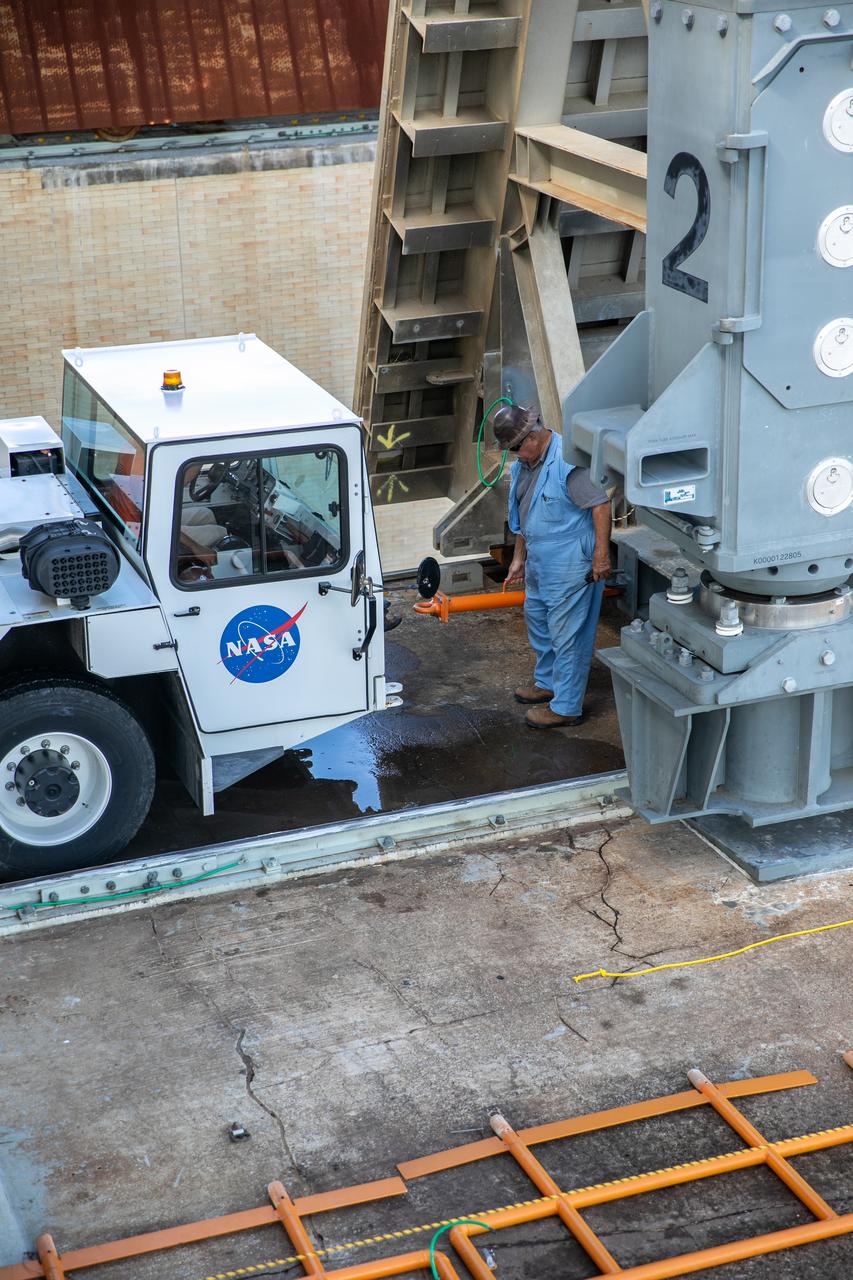
Special ground support equipment is used to move the side flame deflectors into place during a countdown demonstration test using the mobile launcher for the Artemis I mission at Launch Pad 39B at NASA’s Kennedy Space Center in Florida on Oct. 23, 2020. The nearly 400-foot-tall mobile launcher is at the pad while engineers with Exploration Ground Systems and Jacobs complete several tasks, including a timing test to validate the launch team’s countdown timeline, and a thorough, top-to-bottom wash down of the mobile launcher to remove any debris remaining from construction and installation of the umbilical arms. Artemis I will test the Orion spacecraft and Space Launch System as an integrated system ahead of crewed flights to the Moon. Under the Artemis program, NASA will land the first woman and the next man on the Moon in 2024.
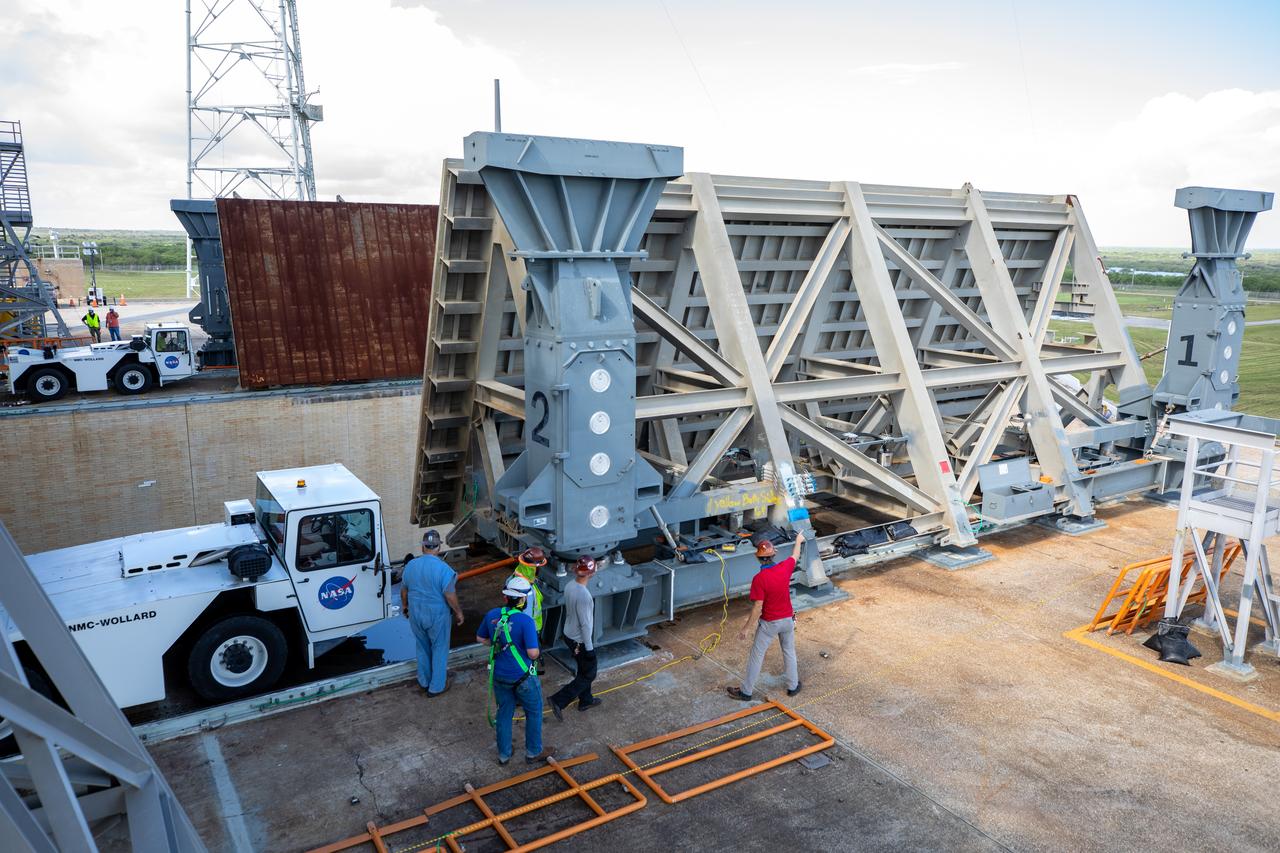
Technicians help move the side flame deflectors into place during a countdown demonstration test using the mobile launcher for the Artemis I mission at Launch Pad 39B at NASA’s Kennedy Space Center in Florida on Oct. 23, 2020. The nearly 400-foot-tall mobile launcher is at the pad while engineers with Exploration Ground Systems and Jacobs complete several tasks, including a timing test to validate the launch team’s countdown timeline, and a thorough, top-to-bottom wash down of the mobile launcher to remove any debris remaining from construction and installation of the umbilical arms. Artemis I will test the Orion spacecraft and Space Launch System as an integrated system ahead of crewed flights to the Moon. Under the Artemis program, NASA will land the first woman and the next man on the Moon in 2024.
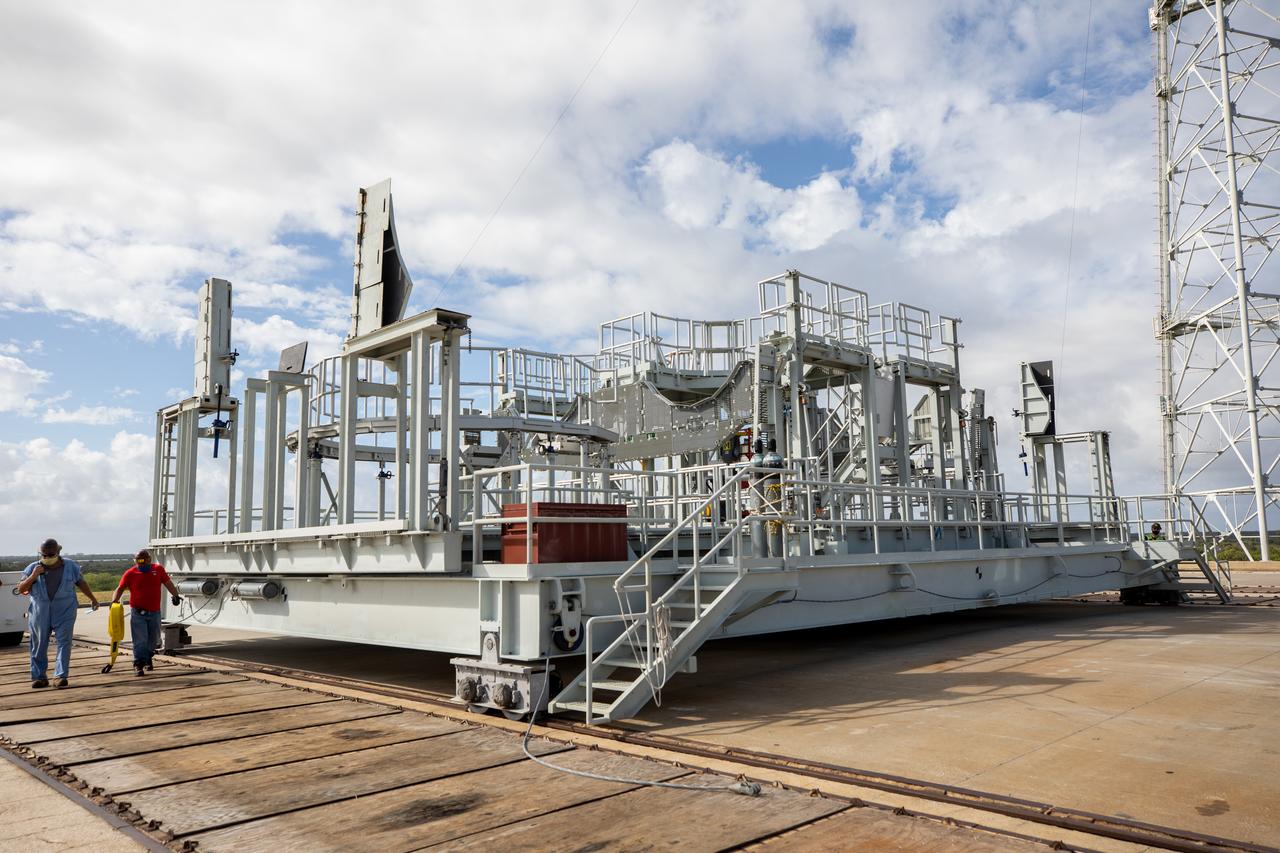
The engine service platform has been lowered and removed from the mobile launcher for Artemis I at Launch Pad 39B at NASA’s Kennedy Space Center in Florida on Oct. 23, 2020. It is staged on the top of the pad. The nearly 400-foot-tall mobile launcher is at the pad while engineers with Exploration Ground Systems and Jacobs complete several tasks, including a timing test to validate the launch team’s countdown timeline, and a thorough, top-to-bottom wash down of the mobile launcher to remove any debris remaining from construction and installation of the umbilical arms. Artemis I will test the Orion spacecraft and Space Launch System as an integrated system ahead of crewed flights to the Moon. Under the Artemis program, NASA will land the first woman and the next man on the Moon in 2024.
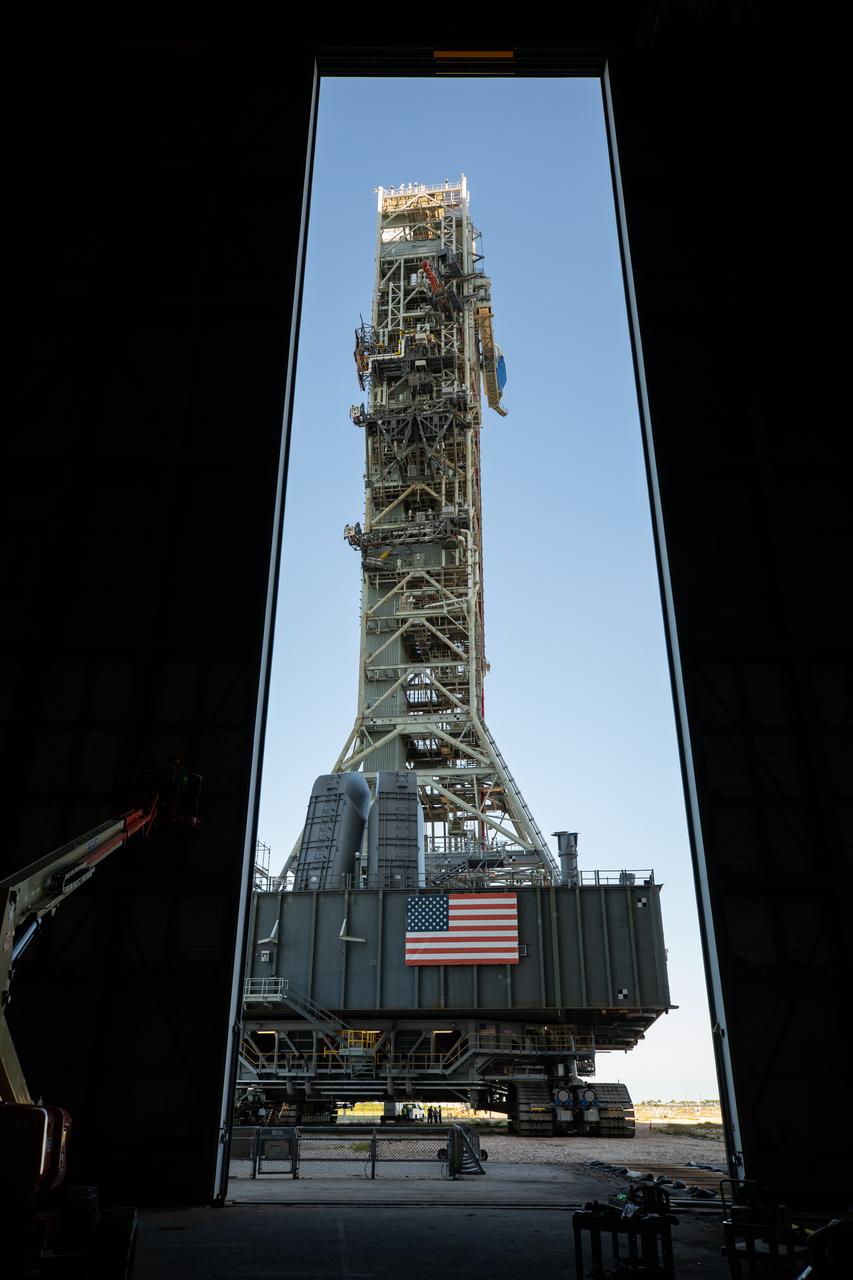
The mobile launcher for the Artemis I mission, atop crawler-transporter 2, arrives at the Vehicle Assembly Building at NASA’s Kennedy Space Center in Florida on Oct. 30, 2020. The nearly 400-foot-tall mobile launcher was at Launch Pad 39B for 10 days, while engineers with Exploration Ground Systems and Jacobs performed several tasks, including a timing test to validate the launch team’s countdown timeline, and a thorough, top-to-bottom wash down of the mobile launcher to remove any debris remaining from construction and installation of the umbilical arms. Artemis I will test the Orion spacecraft and Space Launch System as an integrated system ahead of crewed flights to the Moon. Under the Artemis program, NASA will land the first woman and the next man on the Moon in 2024.