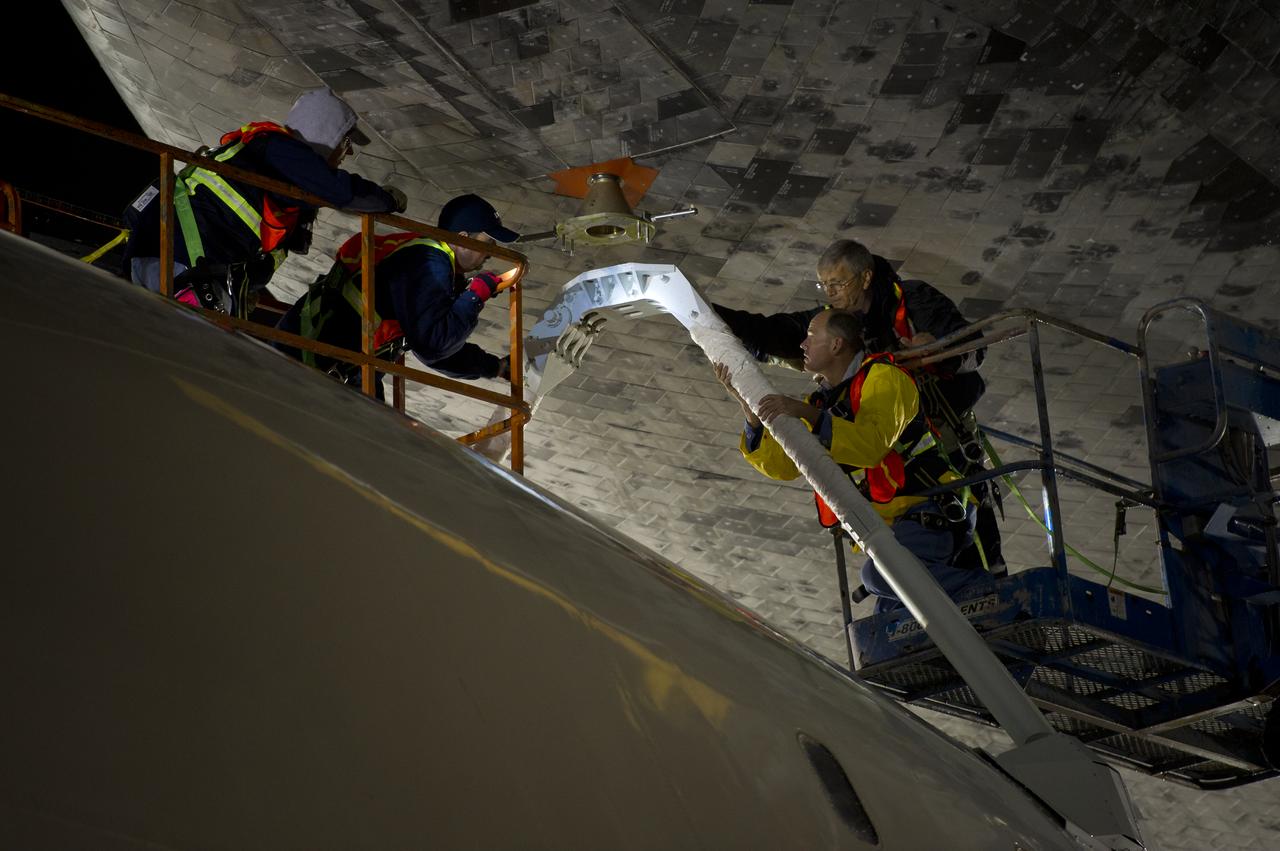
Workers monitor the lift of the space shuttle Discovery from the top of the NASA 747 Shuttle Carrier Aircraft (SCA) at Washington Dulles International Airport, Thursday, April 19, 2012, in Sterling, VA. Discovery, the first orbiter retired from NASA’s shuttle fleet, completed 39 missions, spent 365 days in space, orbited the Earth 5,830 times, and traveled 148,221,675 miles. NASA will transfer Discovery to the National Air and Space Museum to begin its new mission to commemorate past achievements in space and to educate and inspire future generations of explorers. Photo Credit: (NASA/Bill Ingalls)
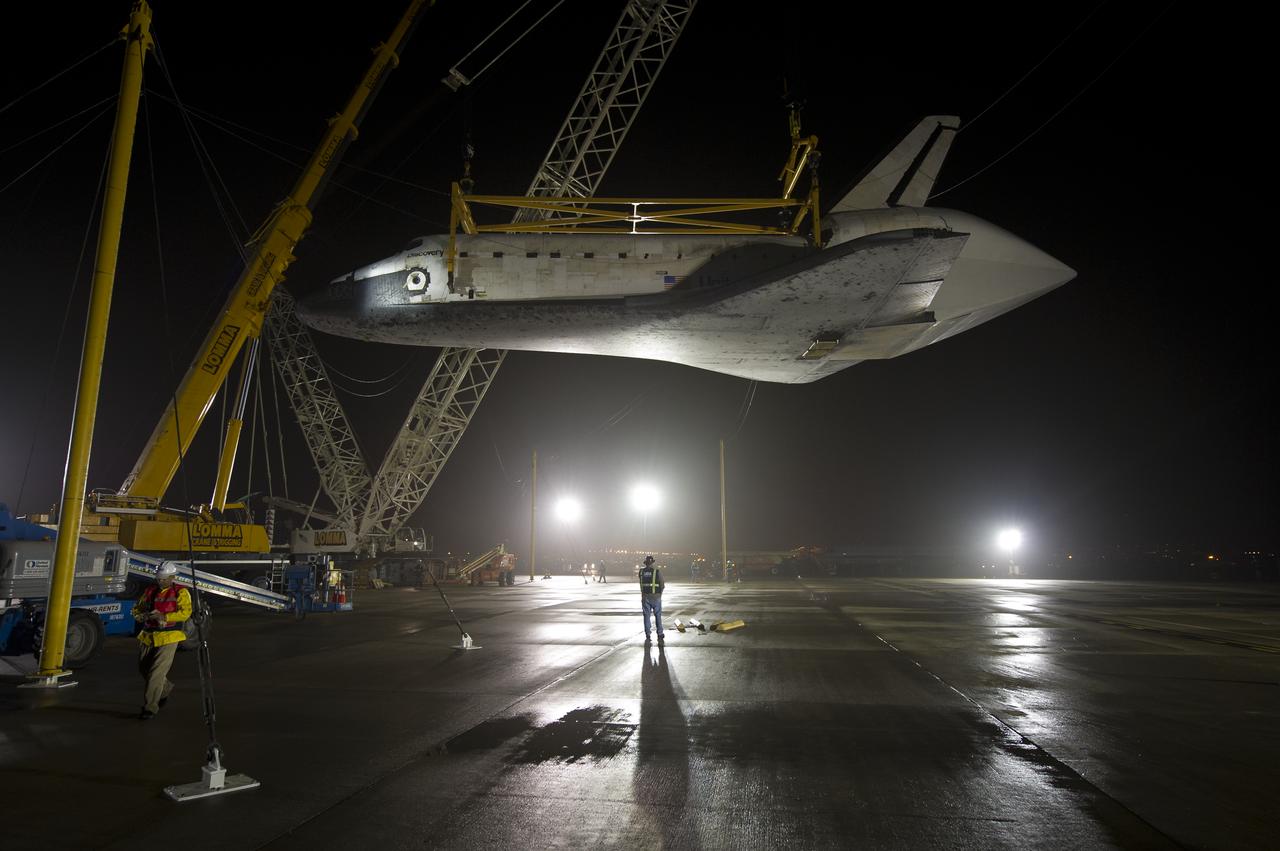
The space shuttle Discovery is suspended from a sling held by two cranes shortly after the NASA 747 Shuttle Carrier Aircraft (SCA) was pushed back from underneath at Washington Dulles International Airport, Thursday, April 19, 2012, in Sterling, VA. Discovery, the first orbiter retired from NASA’s shuttle fleet, completed 39 missions, spent 365 days in space, orbited the Earth 5,830 times, and traveled 148,221,675 miles. NASA will transfer Discovery to the National Air and Space Museum to begin its new mission to commemorate past achievements in space and to educate and inspire future generations of explorers. Photo Credit: (NASA/Bill Ingalls)
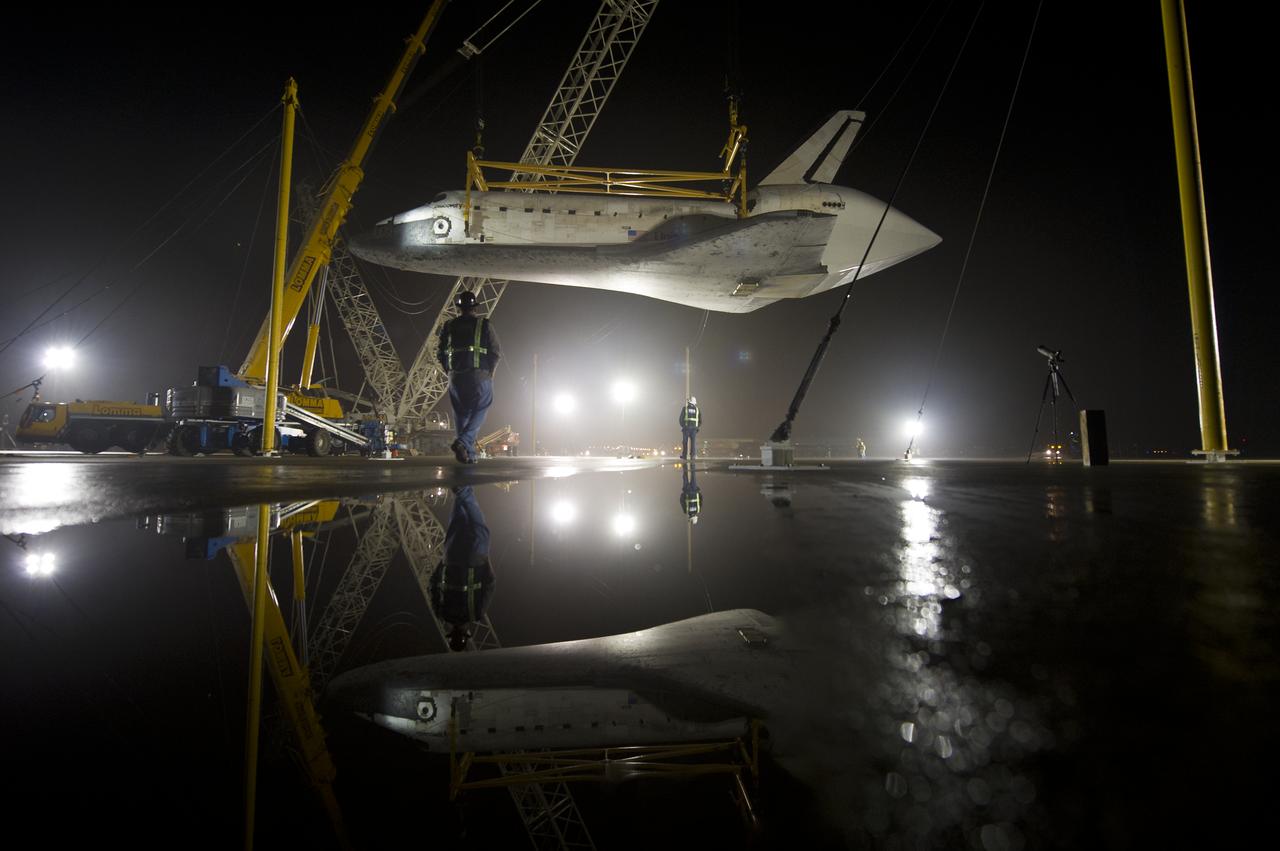
The space shuttle Discovery is suspended from a sling held by two cranes shortly after the NASA 747 Shuttle Carrier Aircraft (SCA) was pushed back from underneath at Washington Dulles International Airport, Thursday, April 19, 2012, in Sterling, VA. Discovery, the first orbiter retired from NASA’s shuttle fleet, completed 39 missions, spent 365 days in space, orbited the Earth 5,830 times, and traveled 148,221,675 miles. NASA will transfer Discovery to the National Air and Space Museum to begin its new mission to commemorate past achievements in space and to educate and inspire future generations of explorers. Photo Credit: (NASA/Bill Ingalls)
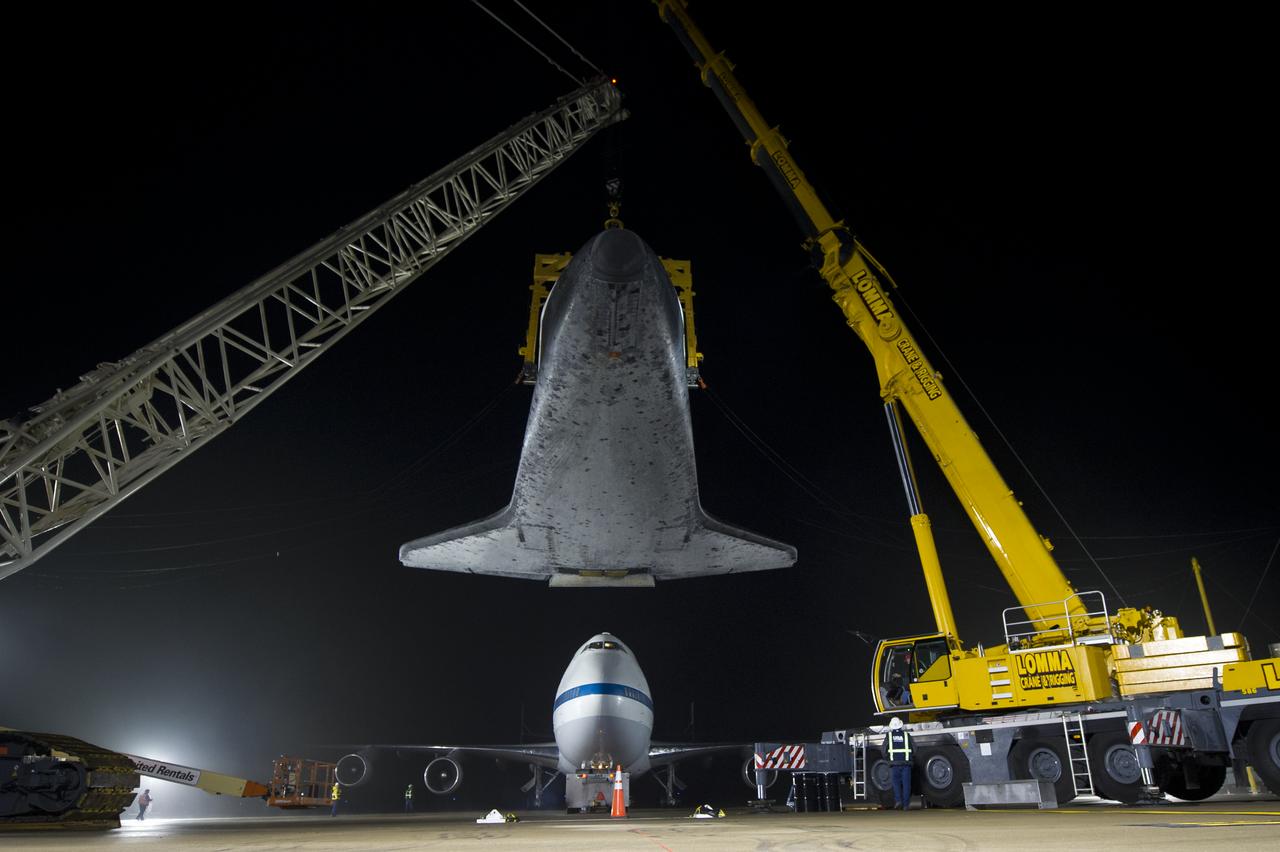
The space shuttle Discovery is suspended from a sling held by two cranes as the NASA 747 Shuttle Carrier Aircraft (SCA) is pushed back from underneath at Washington Dulles International Airport, Thursday, April 19, 2012, in Sterling, VA. Discovery, the first orbiter retired from NASA’s shuttle fleet, completed 39 missions, spent 365 days in space, orbited the Earth 5,830 times, and traveled 148,221,675 miles. NASA will transfer Discovery to the National Air and Space Museum to begin its new mission to commemorate past achievements in space and to educate and inspire future generations of explorers. Photo Credit: (NASA/Bill Ingalls)
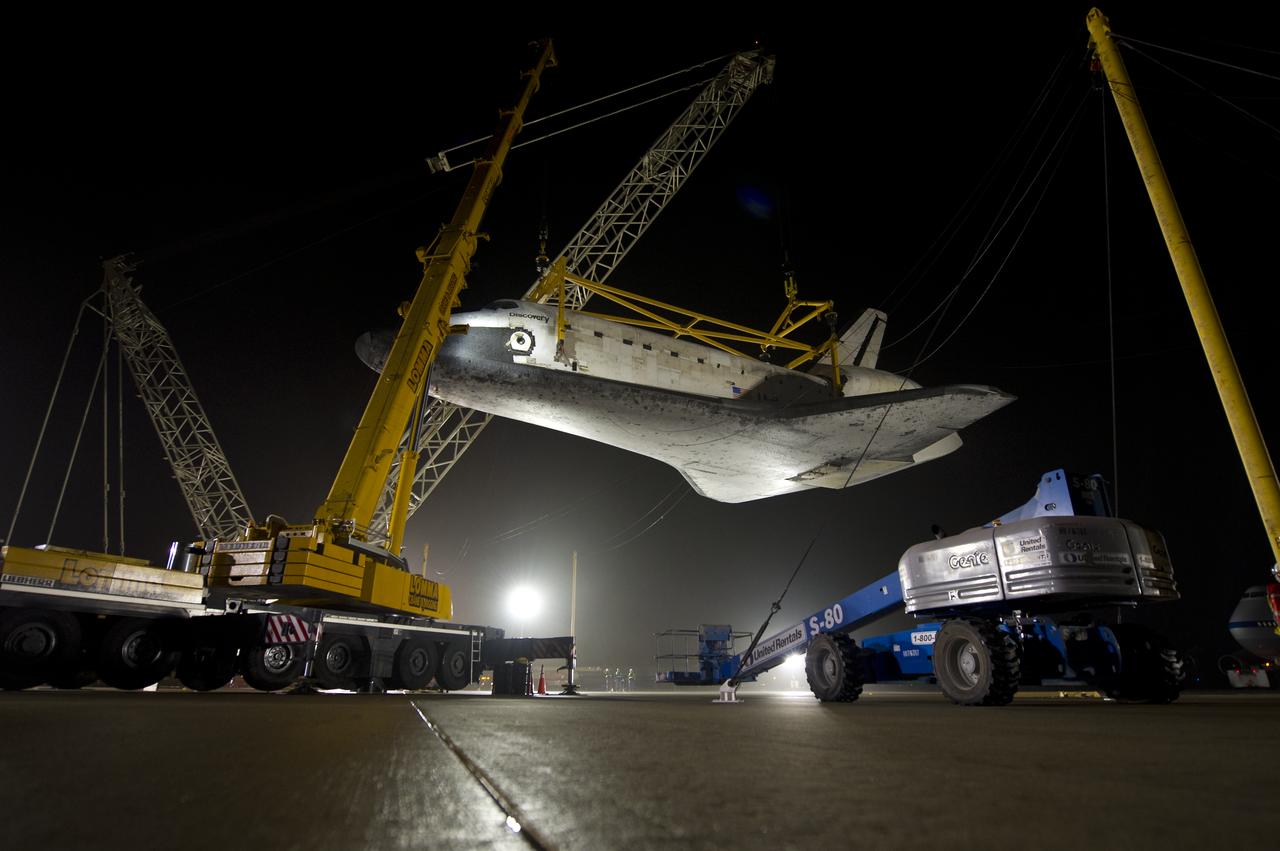
The space shuttle Discovery is suspended from a sling held by two cranes shortly after the NASA 747 Shuttle Carrier Aircraft (SCA) was pushed back from underneath at Washington Dulles International Airport, Thursday, April 19, 2012, in Sterling, VA. Discovery, the first orbiter retired from NASA’s shuttle fleet, completed 39 missions, spent 365 days in space, orbited the Earth 5,830 times, and traveled 148,221,675 miles. NASA will transfer Discovery to the National Air and Space Museum to begin its new mission to commemorate past achievements in space and to educate and inspire future generations of explorers. Photo Credit: (NASA/Bill Ingalls)
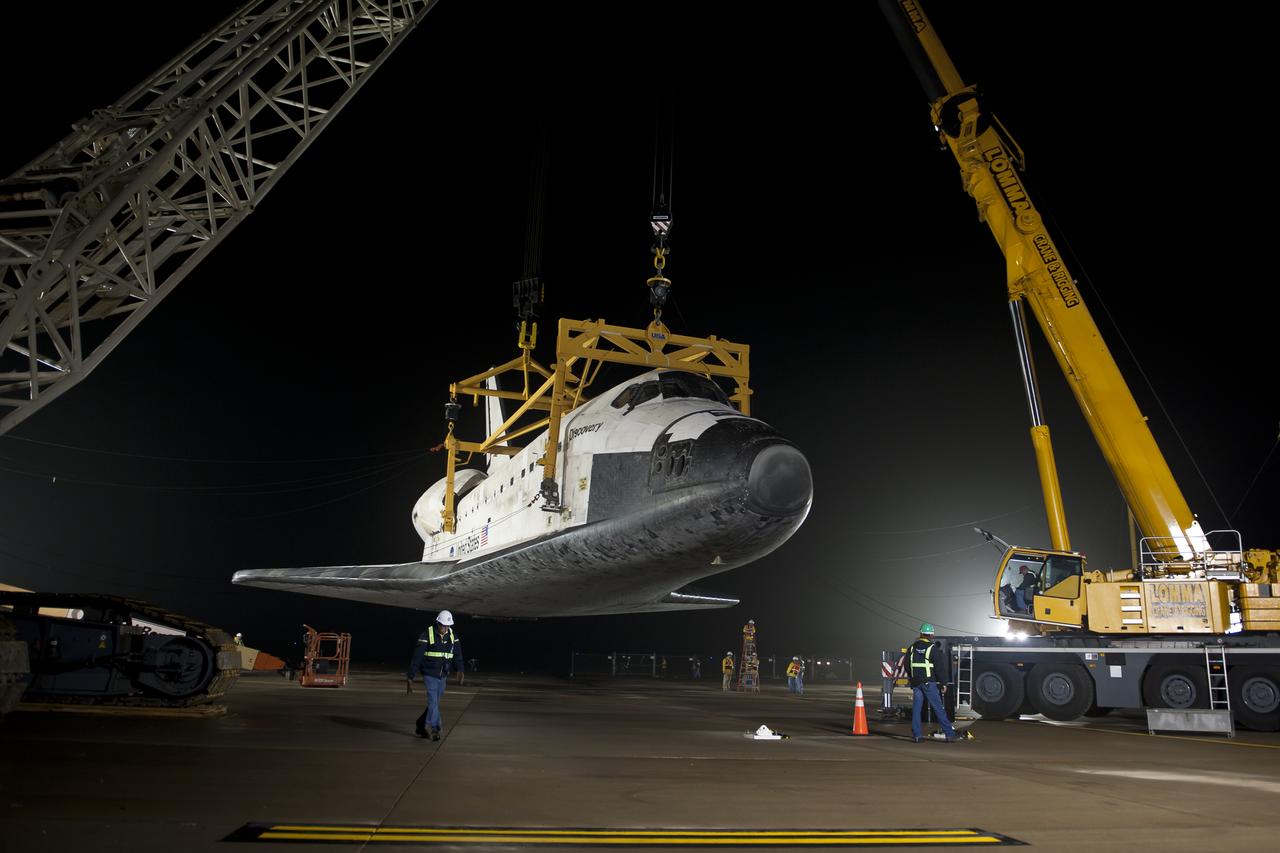
The space shuttle Discovery is suspended from a sling held by two cranes after the NASA 747 Shuttle Carrier Aircraft (SCA) was pushed back from underneath at Washington Dulles International Airport, Thursday, April 19, 2012, in Sterling, VA. Discovery, the first orbiter retired from NASA’s shuttle fleet, completed 39 missions, spent 365 days in space, orbited the Earth 5,830 times, and traveled 148,221,675 miles. NASA will transfer Discovery to the National Air and Space Museum to begin its new mission to commemorate past achievements in space and to educate and inspire future generations of explorers. Photo Credit: (NASA/Bill Ingalls)
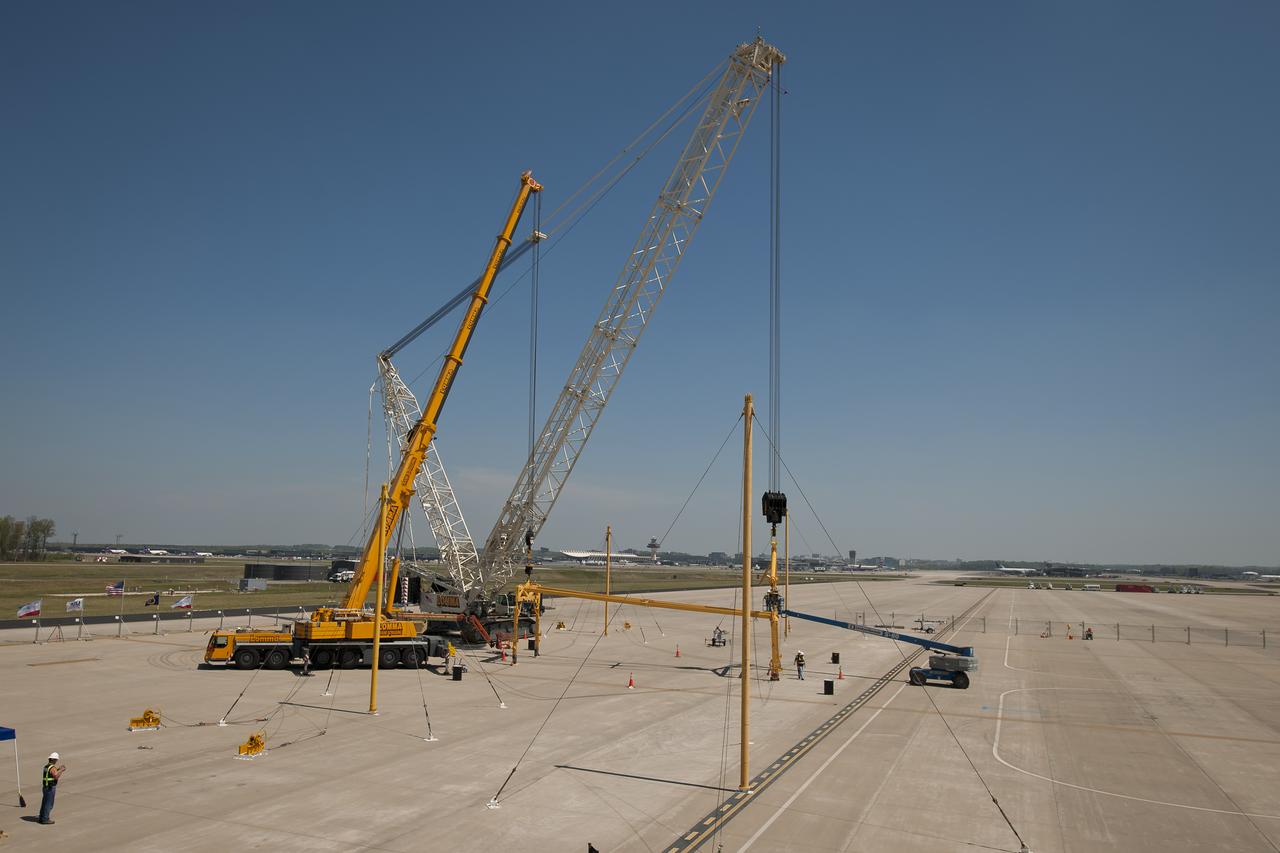
Workers use two cranes to position the sling that will be used to demate the space shuttle Discovery, Monday, April 16, 2012, at the Apron W area of Washington Dulles international Airport in Sterling, Va. The sling will be used to demate the space shuttle Discovery from the 747 Shuttle Carrier Aircraft (SCA) once it arrives. Discovery, the first orbiter retired from NASA’s shuttle fleet, completed 39 missions, spent 365 days in space, orbited the Earth 5,830 times, and traveled 148,221,675 miles. NASA will transfer Discovery to the National Air and Space Museum to begin its new mission to commemorate past achievements in space and to educate and inspire future generations of explorers. Photo Credit: (NASA/Bill Ingalls)

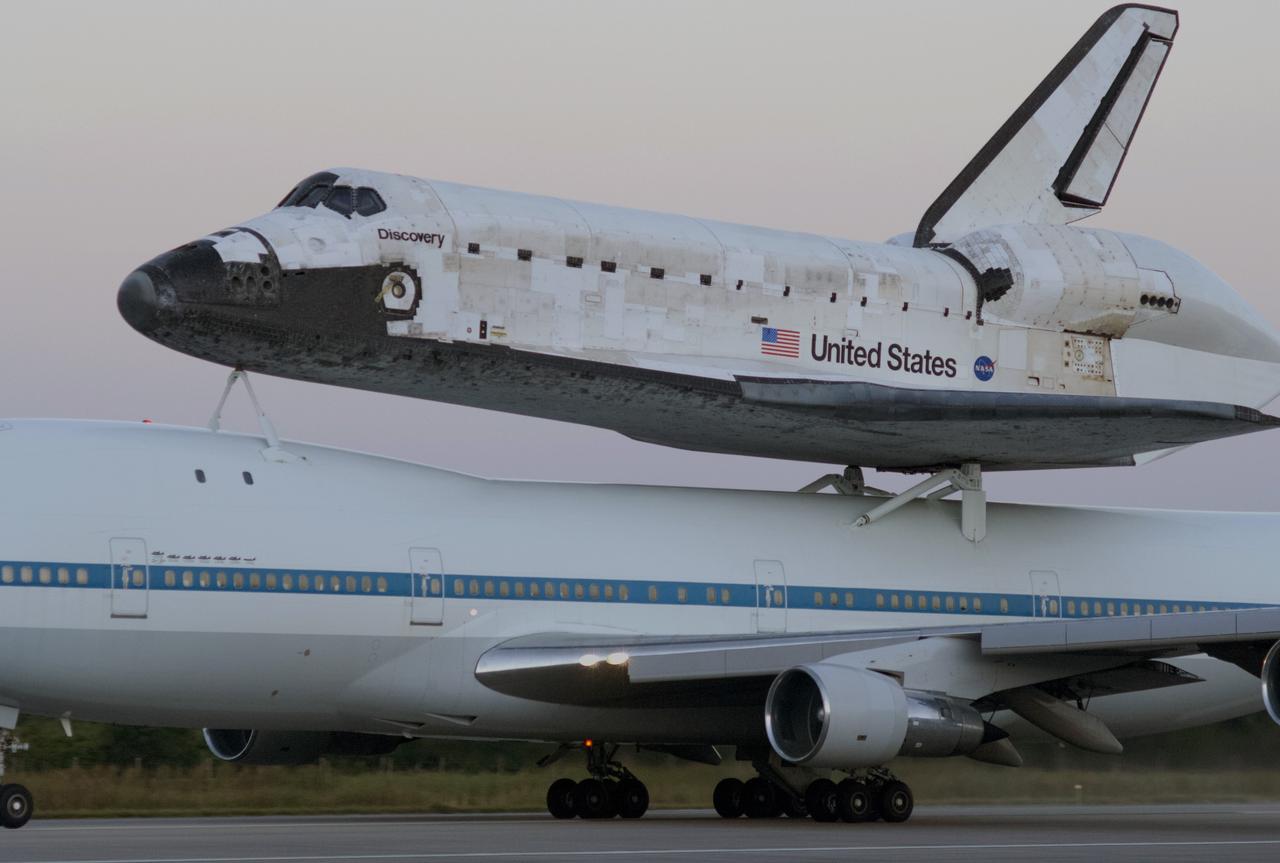
Space Shuttle Discovery mounted atop a 747 Shuttle Carrier Aircraft (SCA) approaches the runway for landing at Washington Dulles International Airport, Tuesday April 17, 2012, in Sterling, Va. Discovery, the first orbiter retired from NASA’s shuttle fleet, completed 39 missions, spent 365 days in space, orbited the Earth 5,830 times, and traveled 148,221,675 miles. NASA will transfer Discovery to the National Air and Space Museum to begin its new mission to commemorate past achievements in space and to educate and inspire future generations of explorers. Photo Credit: (NASA/Paul E. Alers)
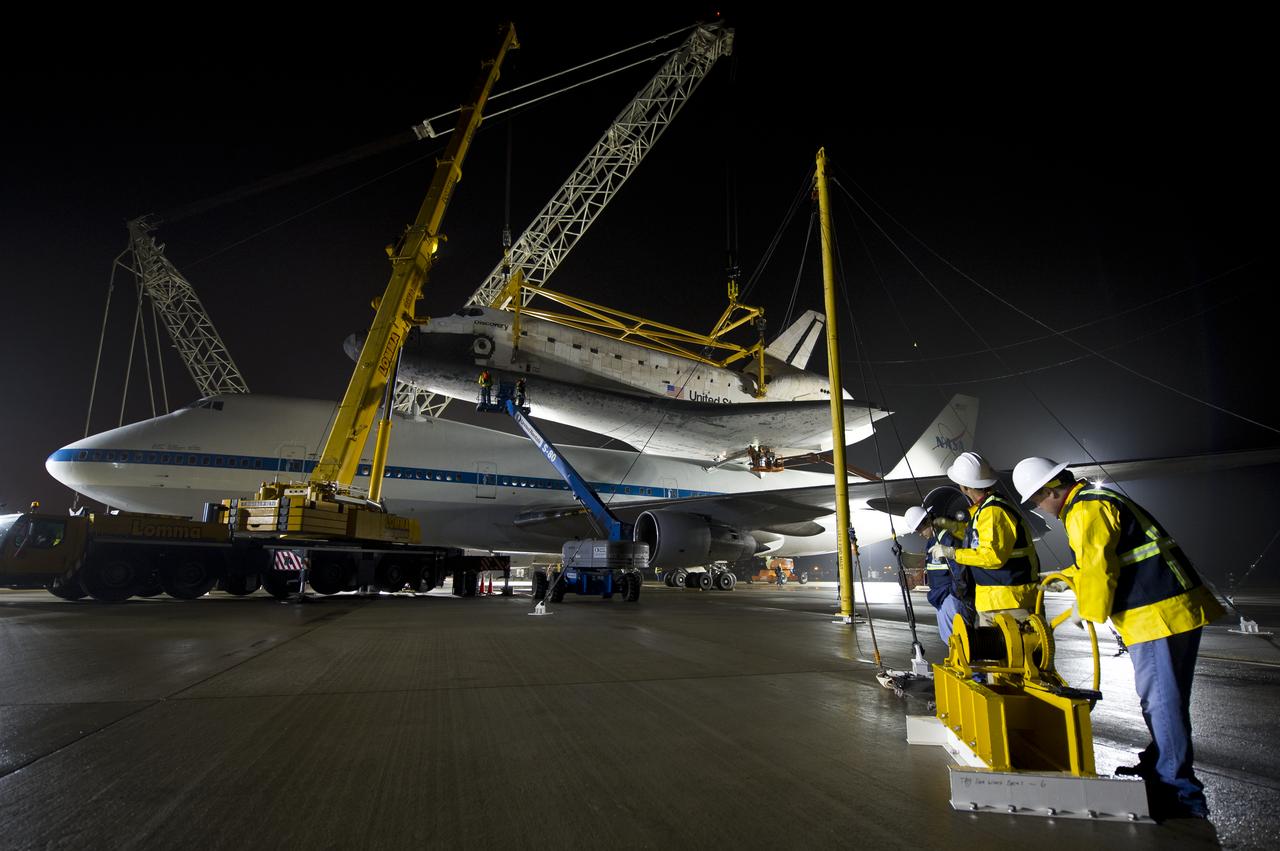
Workers monitor the lift of the space shuttle Discovery from the the NASA 747 Shuttle Carrier Aircraft (SCA) at Washington Dulles International Airport, Thursday, April 19, 2012, in Sterling, VA. Discovery, the first orbiter retired from NASA’s shuttle fleet, completed 39 missions, spent 365 days in space, orbited the Earth 5,830 times, and traveled 148,221,675 miles. NASA will transfer Discovery to the National Air and Space Museum to begin its new mission to commemorate past achievements in space and to educate and inspire future generations of explorers. Photo Credit: (NASA/Bill Ingalls)

Space shuttle Enterprise, mounted atop a NASA 747 Shuttle Carrier Aircraft (SCA), is seen as it takes off for New York from Washington Dulles International Airport, Friday, April 27, 2012, in Sterling, VA. Enterprise was the first shuttle orbiter built for NASA performing test flights in the atmosphere and was incapable of spaceflight. Originally housed at the Smithsonian's Steven F. Udvar-Hazy Center, Enterprise will be demated from the SCA and placed on a barge that will eventually be moved by tugboat up the Hudson River to the Intrepid Sea, Air & Space Museum in June. Photo Credit: (NASA/Smithsonian Institution/Mark Avino)

Space shuttle Discovery, mounted atop a NASA 747 Shuttle Carrier Aircraft (SCA) lands at Washington Dulles International Airport, Tuesday, April 17, 2012, in Sterling, Va. Discovery, the first orbiter retired from NASA’s shuttle fleet, completed 39 missions, spent 365 days in space, orbited the Earth 5,830 times, and traveled 148,221,675 miles. NASA will transfer Discovery to the National Air and Space Museum to begin its new mission to commemorate past achievements in space and to educate and inspire future generations of explorers. Photo Credit: (NASA/Smithsonian Institution/Eric Long)

Space shuttle Discovery, mounted atop a NASA 747 Shuttle Carrier Aircraft (SCA) taxis in front of the main terminal at Washington Dulles International Airport, Tuesday, April 17, 2012, in Sterling, Va. Discovery, the first orbiter retired from NASA’s shuttle fleet, completed 39 missions, spent 365 days in space, orbited the Earth 5,830 times, and traveled 148,221,675 miles. NASA will transfer Discovery to the National Air and Space Museum to begin its new mission to commemorate past achievements in space and to educate and inspire future generations of explorers. Photo Credit: (NASA/Smithsonian Institution/Eric Long)
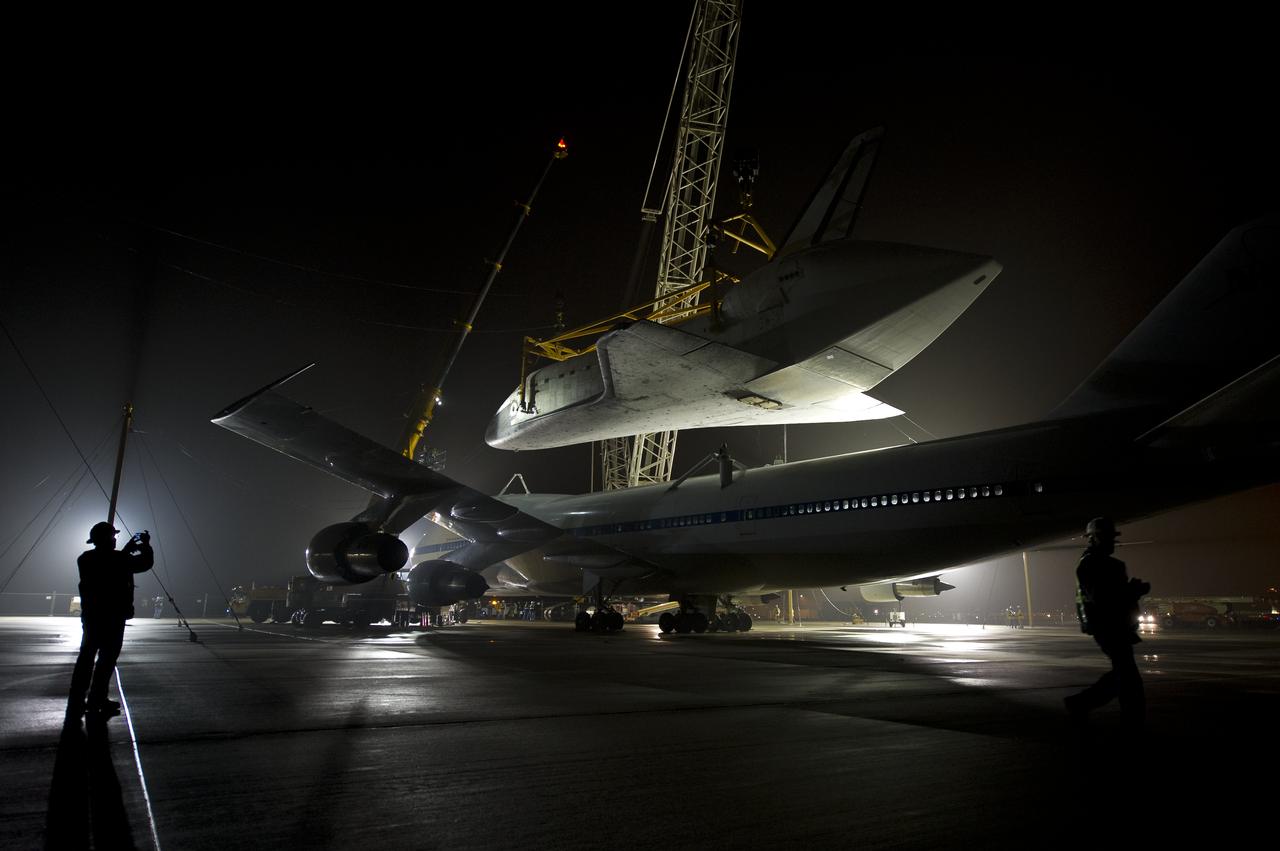
Workers monitor the lift of the space shuttle Discovery from the top of the NASA 747 Shuttle Carrier Aircraft (SCA) at Washington Dulles International Airport, Thursday, April 19, 2012, in Sterling, VA. Discovery, the first orbiter retired from NASA’s shuttle fleet, completed 39 missions, spent 365 days in space, orbited the Earth 5,830 times, and traveled 148,221,675 miles. NASA will transfer Discovery to the National Air and Space Museum to begin its new mission to commemorate past achievements in space and to educate and inspire future generations of explorers. Photo Credit: (NASA/Bill Ingalls)

Space shuttle Discovery, mounted atop a NASA 747 Shuttle Carrier Aircraft (SCA) lands at Washington Dulles International Airport, Tuesday, April 17, 2012, in Sterling, Va. Discovery, the first orbiter retired from NASA’s shuttle fleet, completed 39 missions, spent 365 days in space, orbited the Earth 5,830 times, and traveled 148,221,675 miles. NASA will transfer Discovery to the National Air and Space Museum to begin its new mission to commemorate past achievements in space and to educate and inspire future generations of explorers. Photo Credit: (NASA/Smithsonian Institution/Eric Long)

Space shuttle Discovery, mounted atop a NASA 747 Shuttle Carrier Aircraft (SCA) lands at Washington Dulles International Airport, Tuesday, April 17, 2012, in Sterling, Va. The Steven F. Udvar-Hazy Center is seen in the background. Discovery, the first orbiter retired from NASA’s shuttle fleet, completed 39 missions, spent 365 days in space, orbited the Earth 5,830 times, and traveled 148,221,675 miles. NASA will transfer Discovery to the National Air and Space Museum to begin its new mission to commemorate past achievements in space and to educate and inspire future generations of explorers. Photo Credit: (NASA/Smithsonian Institution/Eric Long)
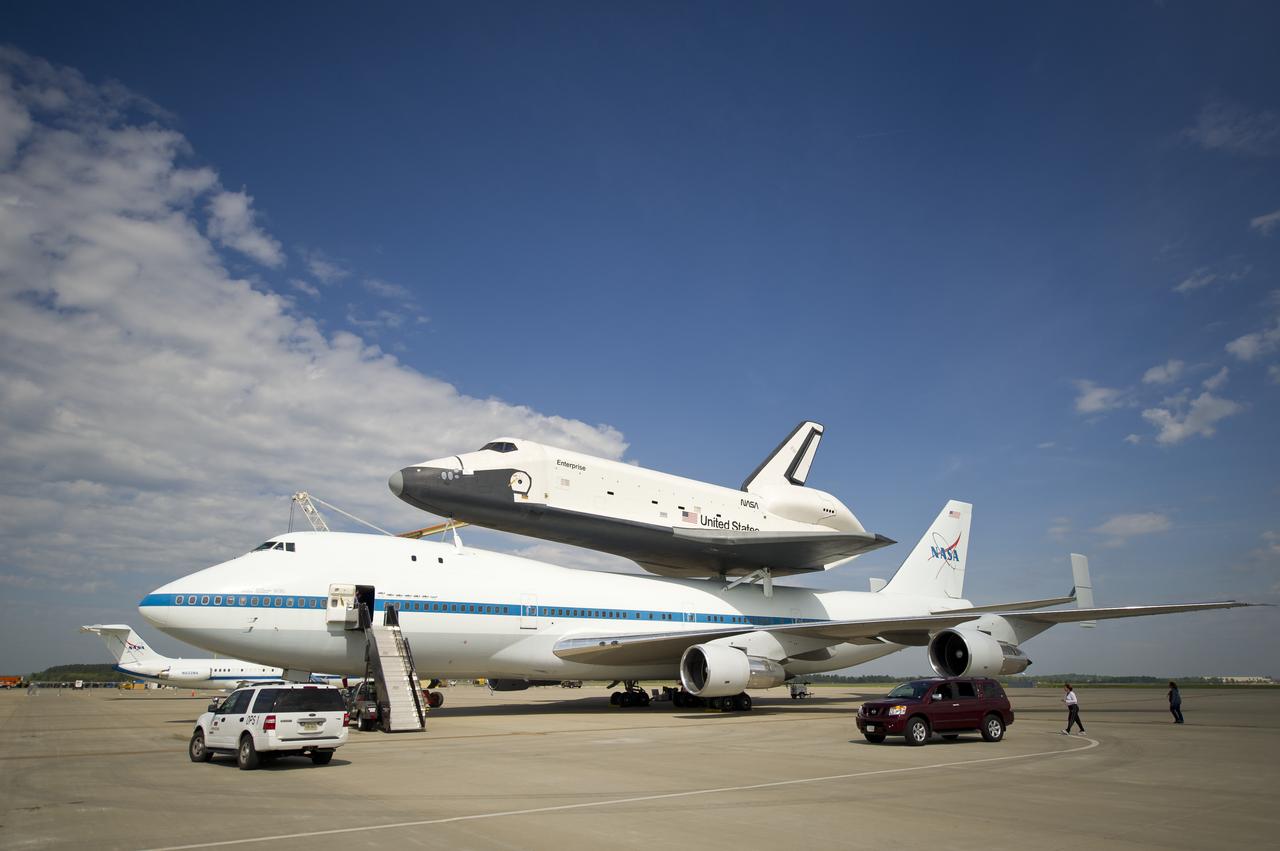
The space shuttle Enterprise is seen mated on top of the NASA 747 Shuttle Carrier Aircraft (SCA) at Washington Dulles International Airport, Saturday, April 21, 2012, in Sterling, Va. Space Shuttle Transition and Retirement engineers Saturday completed the final steps to ready Space Shuttle Enterprise for its flight to New York’s John F. Kennedy International Airport while managers continue to evaluate the expected weather that has postponed delivery past Monday. Enterprise, the first orbiter built for the Space Shuttle Program, was used primarily for ground and flight tests within the atmosphere. The initial testing period named Approach and Landing Test (ALT) included a flight on February 18, 1977 atop a Shuttle Carrier Aircraft (SCA) to measure structural loads and ground handling and braking characteristics of the mated system. Enterprise will go on permanent display at the Intrepid Sea Air and Space Museum in New York in June. Photo Credit: (NASA/Bill Ingalls)

NASA Deputy Administrator Lori Garver, at podium, speaks to those in attendance at Apron W after the 747 Shuttle Carrier Aircraft (SCA) with space shuttle Discovery mounted on top rolled to a halt at Washington Dulles International Airport, Tuesday, April 17, 2012 in Sterling, Va. Discovery, the first orbiter retired from NASA’s shuttle fleet, completed 39 missions, spent 365 days in space, orbited the Earth 5,830 times, and traveled 148,221,675 miles. NASA will transfer Discovery to the National Air and Space Museum to begin its new mission to commemorate past achievements in space and to educate and inspire future generations of explorers. Photo Credit: (NASA/Smithsonian Institution/Dane Penland)
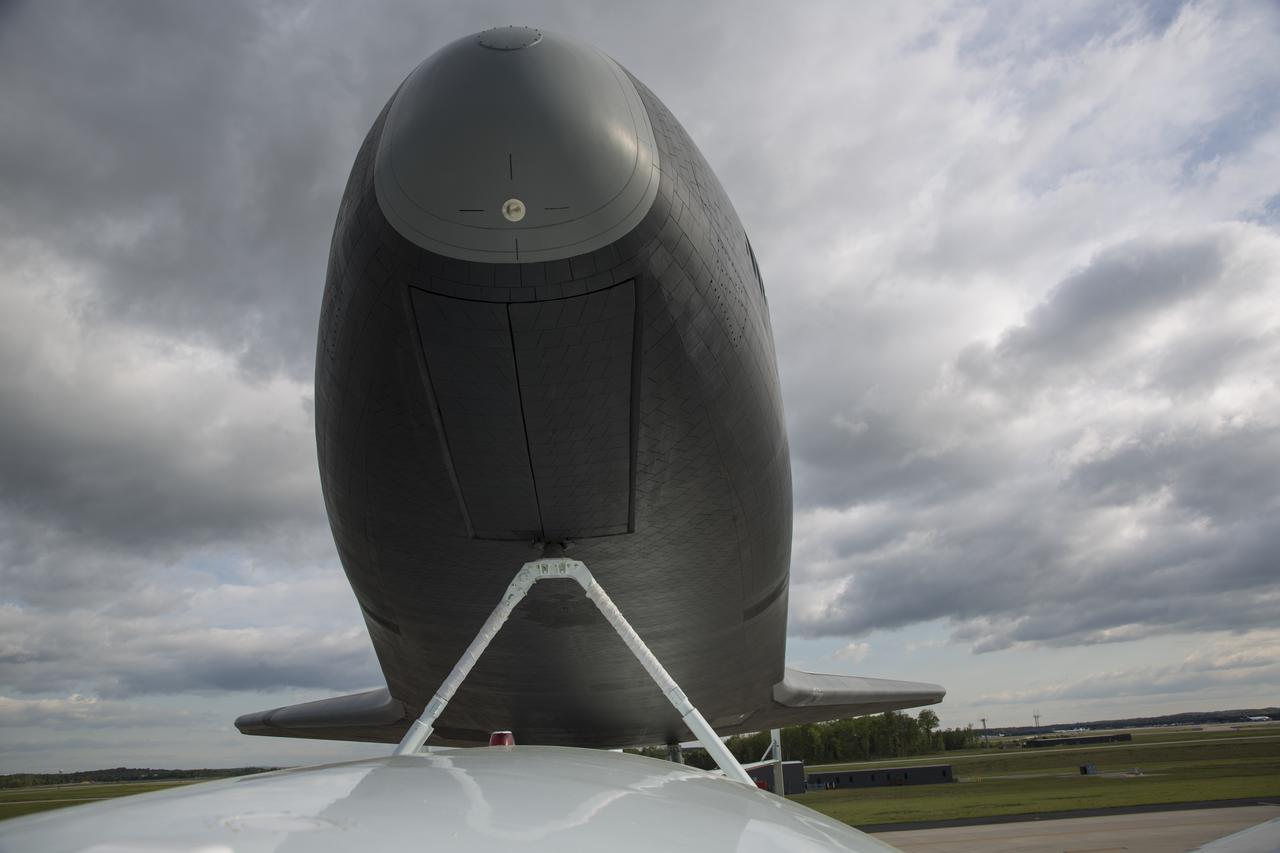
Space shuttle Enterprise, mounted atop a NASA 747 Shuttle Carrier Aircraft (SCA), is seen prior to taking off for New York from Washington Dulles International Airport, Friday, April 27, 2012, in Sterling, VA. Enterprise was the first shuttle orbiter built for NASA performing test flights in the atmosphere and was incapable of spaceflight. Originally housed at the Smithsonian's Steven F. Udvar-Hazy Center, Enterprise will be demated from the SCA and placed on a barge that will eventually be moved by tugboat up the Hudson River to the Intrepid Sea, Air & Space Museum in June. Photo Credit: (NASA/Scott Andrews)
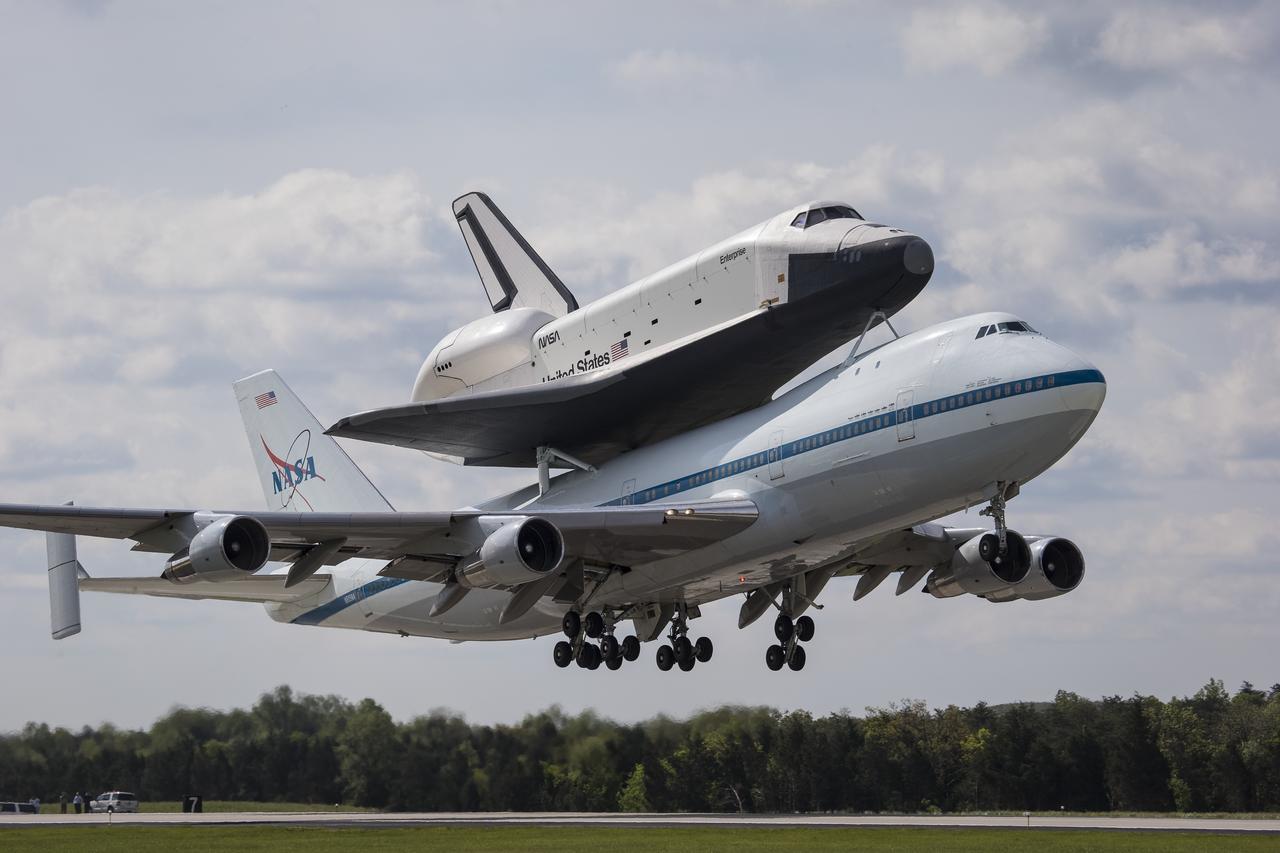
Space shuttle Enterprise, mounted atop a NASA 747 Shuttle Carrier Aircraft (SCA), is seen as it takes off for New York from Washington Dulles International Airport, Friday, April 27, 2012, in Sterling, VA. Enterprise was the first shuttle orbiter built for NASA performing test flights in the atmosphere and was incapable of spaceflight. Originally housed at the Smithsonian's Steven F. Udvar-Hazy Center, Enterprise will be demated from the SCA and placed on a barge that will eventually be moved by tugboat up the Hudson River to the Intrepid Sea, Air & Space Museum in June. Photo Credit: (NASA/Scott Andrews)
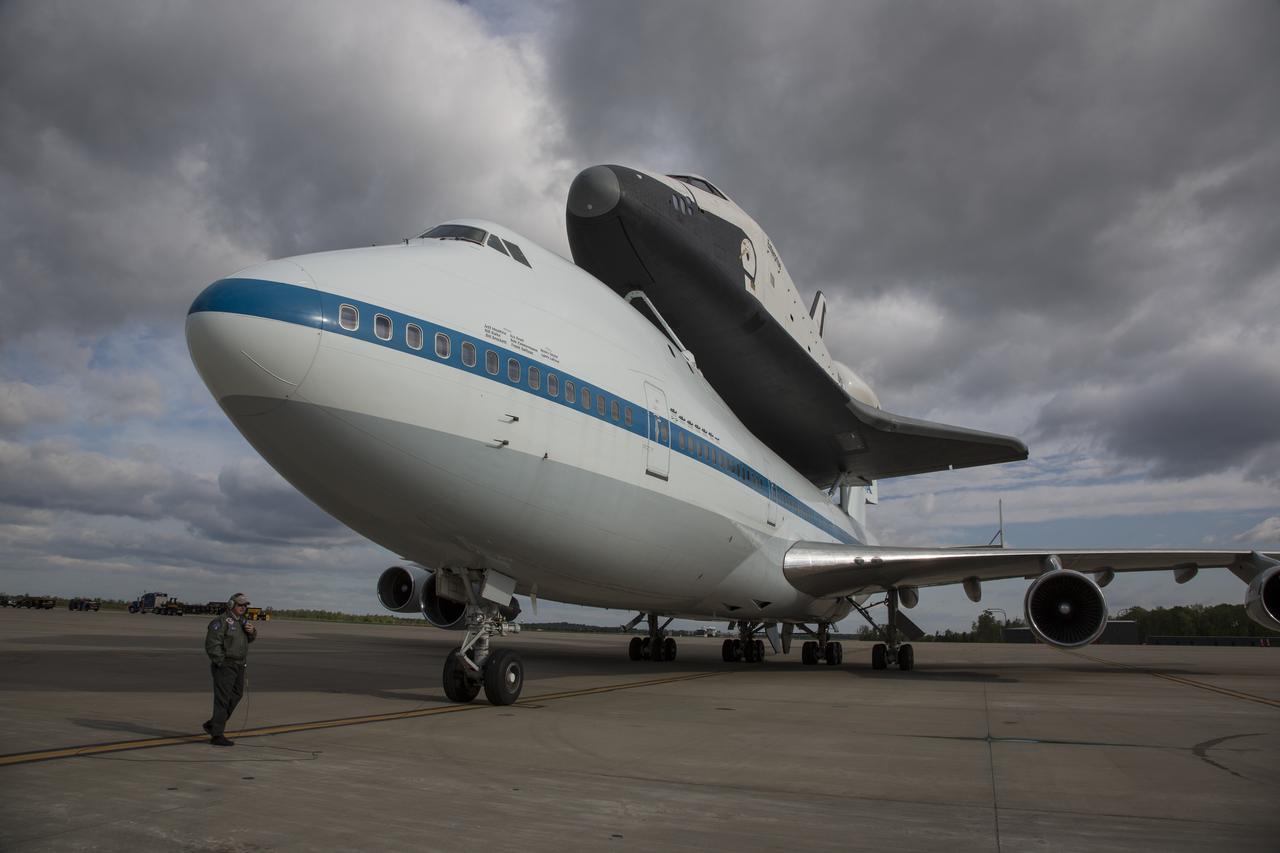
Space shuttle Enterprise, mounted atop a NASA 747 Shuttle Carrier Aircraft (SCA), is seen prior to taking off for New York from Washington Dulles International Airport, Friday, April 27, 2012, in Sterling, VA. Enterprise was the first shuttle orbiter built for NASA performing test flights in the atmosphere and was incapable of spaceflight. Originally housed at the Smithsonian's Steven F. Udvar-Hazy Center, Enterprise will be demated from the SCA and placed on a barge that will eventually be moved by tugboat up the Hudson River to the Intrepid Sea, Air & Space Museum in June. Photo Credit: (NASA/Scott Andrews)

NASA Orbiter Transition & Retirement team member Tom Goebel monitors the installation of "rain covers" over space shuttle Enterprise’s vent door openings ahead of the expected rain at Washington Dulles International Airport, Saturday, April 21, 2012, in Sterling, Va. Enterprise, the first orbiter built for the Space Shuttle Program, was used primarily for ground and flight tests within the atmosphere. The initial testing period named Approach and Landing Test (ALT) included a flight on February 18, 1977 atop a Shuttle Carrier Aircraft (SCA) to measure structural loads and ground handling and braking characteristics of the mated system. Enterprise will go on permanent display at the Intrepid Sea Air and Space Museum in New York in June. Photo Credit: (NASA/Bill Ingalls)
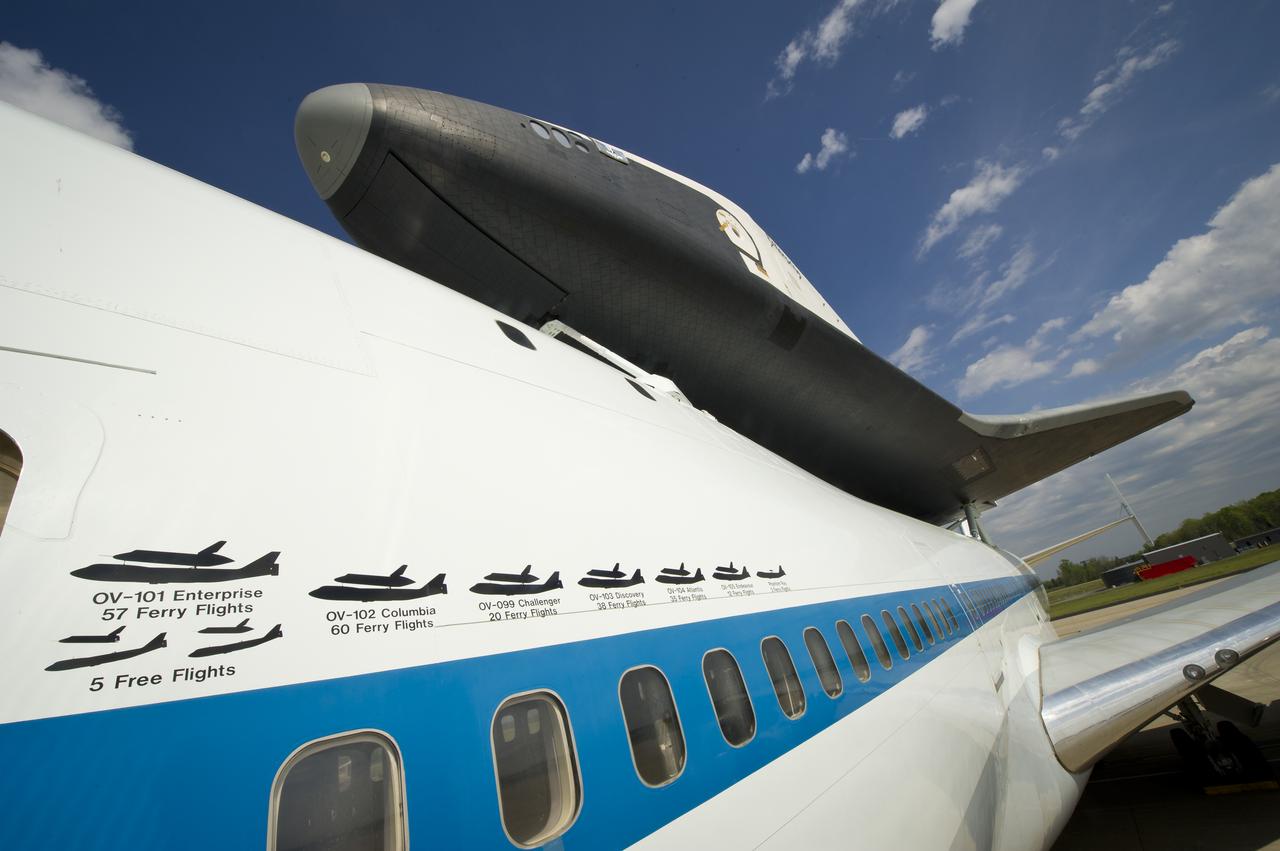
The space shuttle Enterprise is seen mated on top of the NASA 747 Shuttle Carrier Aircraft (SCA) at Washington Dulles International Airport, Saturday, April 21, 2012, in Sterling, Va. Painted graphics line the side of NASA 905 depicting the various ferry flights the Shuttle Carrier Aircraft has supported during the Space Shuttle Program, including the tests using the space shuttle prototype Enterprise. Space Shuttle Transition and Retirement engineers Saturday completed the final steps to ready Space Shuttle Enterprise for its flight to New York’s John F. Kennedy International Airport while managers continue to evaluate the expected weather that has postponed delivery past Monday. Enterprise, the first orbiter built for the Space Shuttle Program, was used primarily for ground and flight tests within the atmosphere. The initial testing period named Approach and Landing Test (ALT) included a flight on February 18, 1977 atop a Shuttle Carrier Aircraft (SCA) to measure structural loads and ground handling and braking characteristics of the mated system. Enterprise will go on permanent display at the Intrepid Sea Air and Space Museum in New York in June. Photo Credit: (NASA/Bill Ingalls)
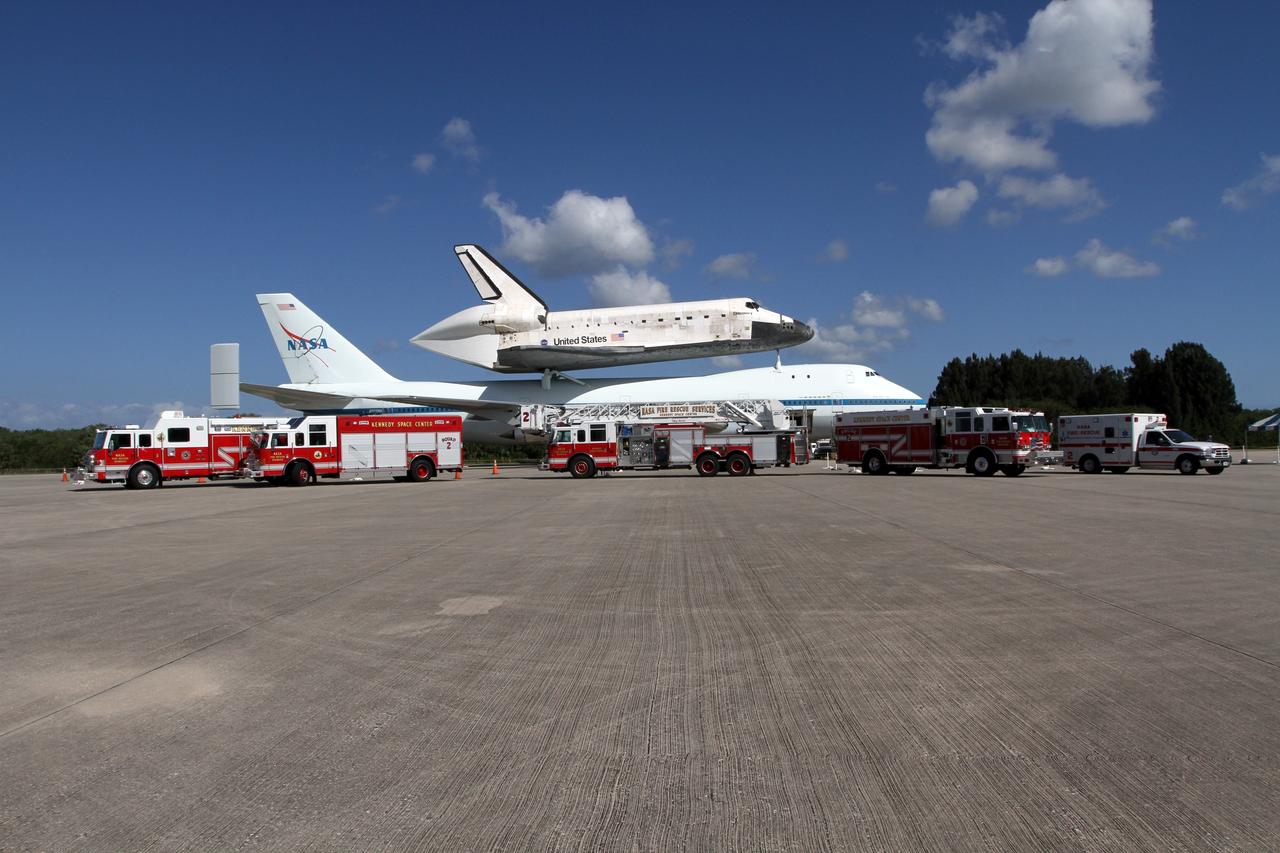
CAPE CANAVERAL, Fla. – NASA Kennedy Space Center’s Fire and Rescue vehicles are lined up for a group portrait in front of space shuttle Discovery atop the Shuttle Carrier Aircraft at Kennedy’s Shuttle Landing Facility. This carrier aircraft, designated NASA 905, is scheduled to ferry Discovery to the Washington Dulles International Airport in Virginia on April 17, and is assigned to all remaining ferry missions, delivering the shuttles to their permanent public display sites. After its arrival at Dulles, Discovery will be placed on display in the Smithsonian's National Air and Space Museum Steven F. Udvar-Hazy Center on April 19. For more information on the SCA, visit http://www.nasa.gov/centers/dryden/news/FactSheets/FS-013-DFRC.html. For more information on shuttle transition and retirement activities, visit http://www.nasa.gov/transition. Photo credit: NASA/Kim Shiflett
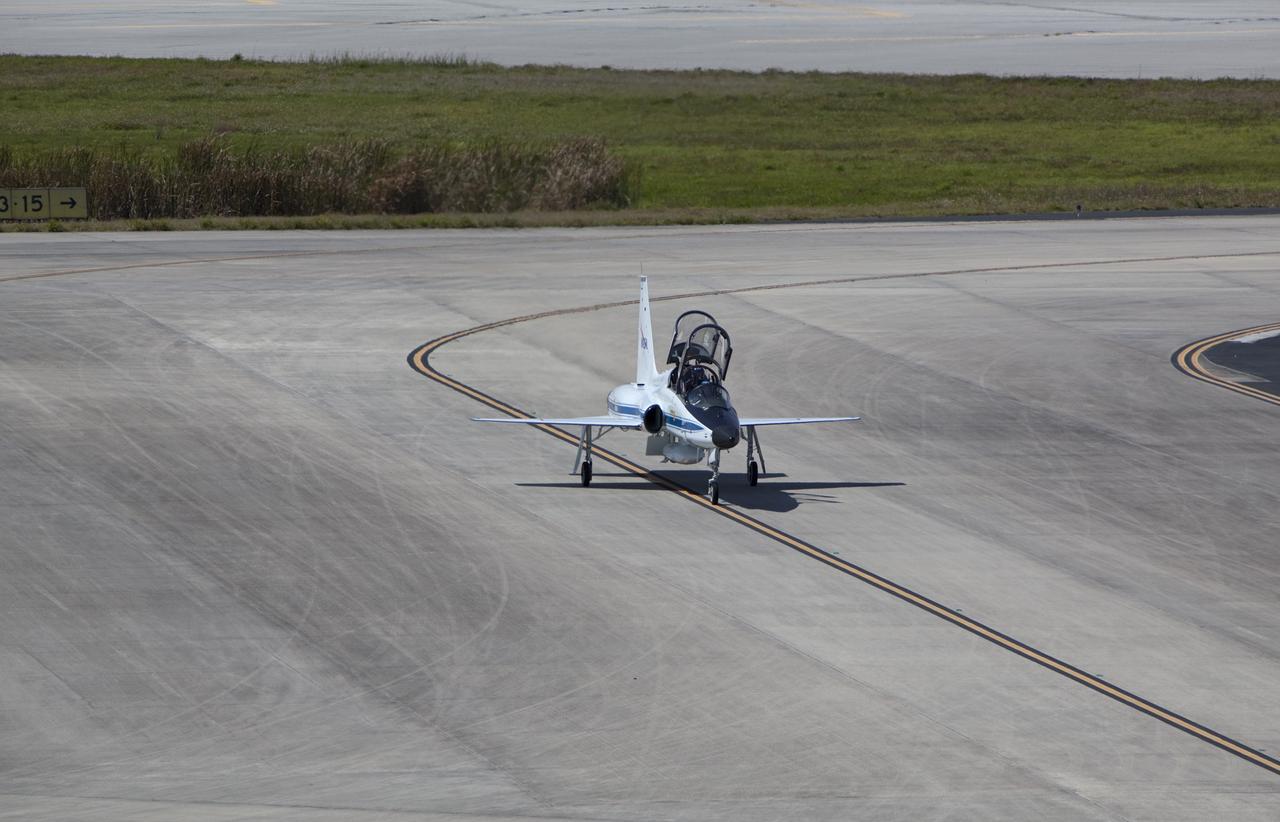
CAPE CANAVERAL, Fla. – A T-38 jet taxis onto the apron of the Shuttle Landing Facility at NASA’s Kennedy Space Center in Florida. The jet is at Kennedy to support space shuttle Discovery’s ferry flight. The Shuttle Carrier Aircraft designated NASA 905 is scheduled to ferry Discovery to the Washington Dulles International Airport in Virginia on April 17, and is assigned to all remaining ferry missions, delivering the shuttles to their permanent public display sites. After its arrival at Dulles, Discovery will be placed on display in the Smithsonian's National Air and Space Museum Steven F. Udvar-Hazy Center on April 19. For more information on the SCA, visit http://www.nasa.gov/centers/dryden/news/FactSheets/FS-013-DFRC.html. For more information on shuttle transition and retirement activities, visit http://www.nasa.gov/transition. Photo credit: NASA/Dimitri Gerondidaki
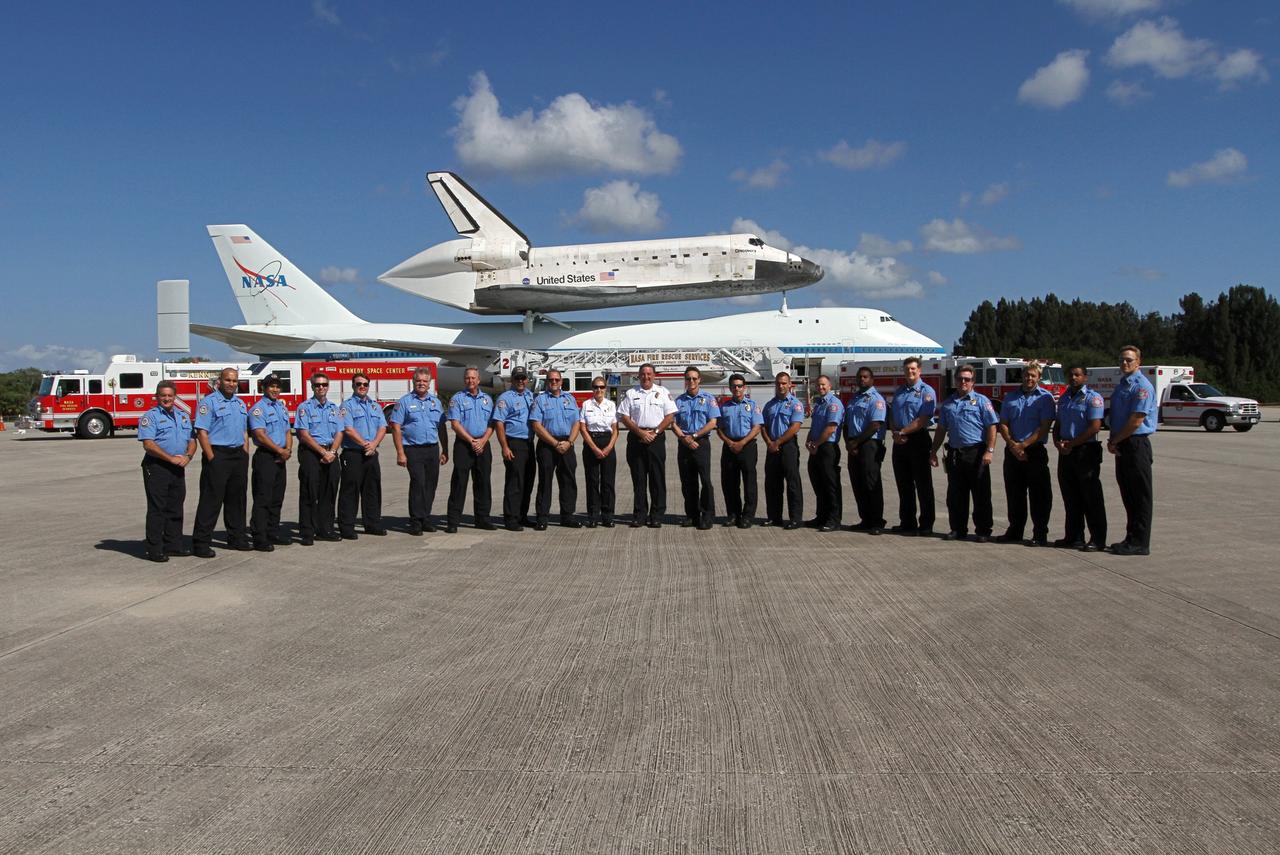
CAPE CANAVERAL, Fla. – NASA Kennedy Space Center’s Fire and Rescue Team poses for a group portrait with space shuttle Discovery atop the Shuttle Carrier Aircraft at Kennedy’s Shuttle Landing Facility. This carrier aircraft, designated NASA 905, is scheduled to ferry Discovery to the Washington Dulles International Airport in Virginia on April 17, and is assigned to all remaining ferry missions, delivering the shuttles to their permanent public display sites. After its arrival at Dulles, Discovery will be placed on display in the Smithsonian's National Air and Space Museum Steven F. Udvar-Hazy Center on April 19. For more information on the SCA, visit http://www.nasa.gov/centers/dryden/news/FactSheets/FS-013-DFRC.html. For more information on shuttle transition and retirement activities, visit http://www.nasa.gov/transition. Photo credit: NASA/Kim Shiflett
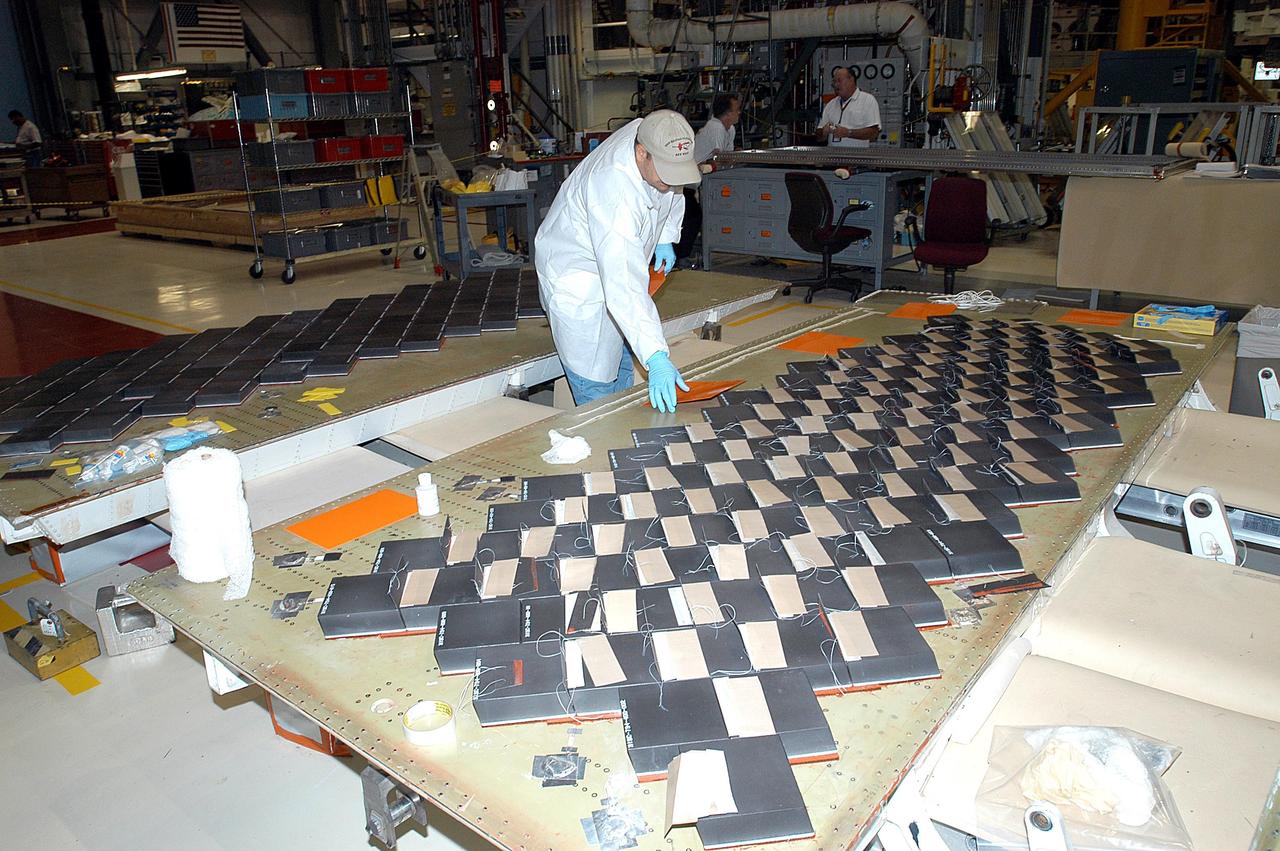
KENNEDY SPACE CENTER, FLA. -- In the Orbiter Processing Facility, United Space Alliance employee Mike Cote works on installing Thermal Protection System tiles on a main landing gear door of Space Shuttle orbiter Enterprise (OV-101). Sections of Enterprise were borrowed from the Smithsonian Institution's Air and Space Museum where the orbiter is being stored at the Washington Dulles International Airport. Enterprise was the first orbiter built in the Shuttle fleet and was used to conduct the Approach and Landing Test Program before the first powered Shuttle flight. After the tile installation is complete, the sections will be transferred to the Southwest Research Institute for testing requested by the Columbia Accident Investigation Board.
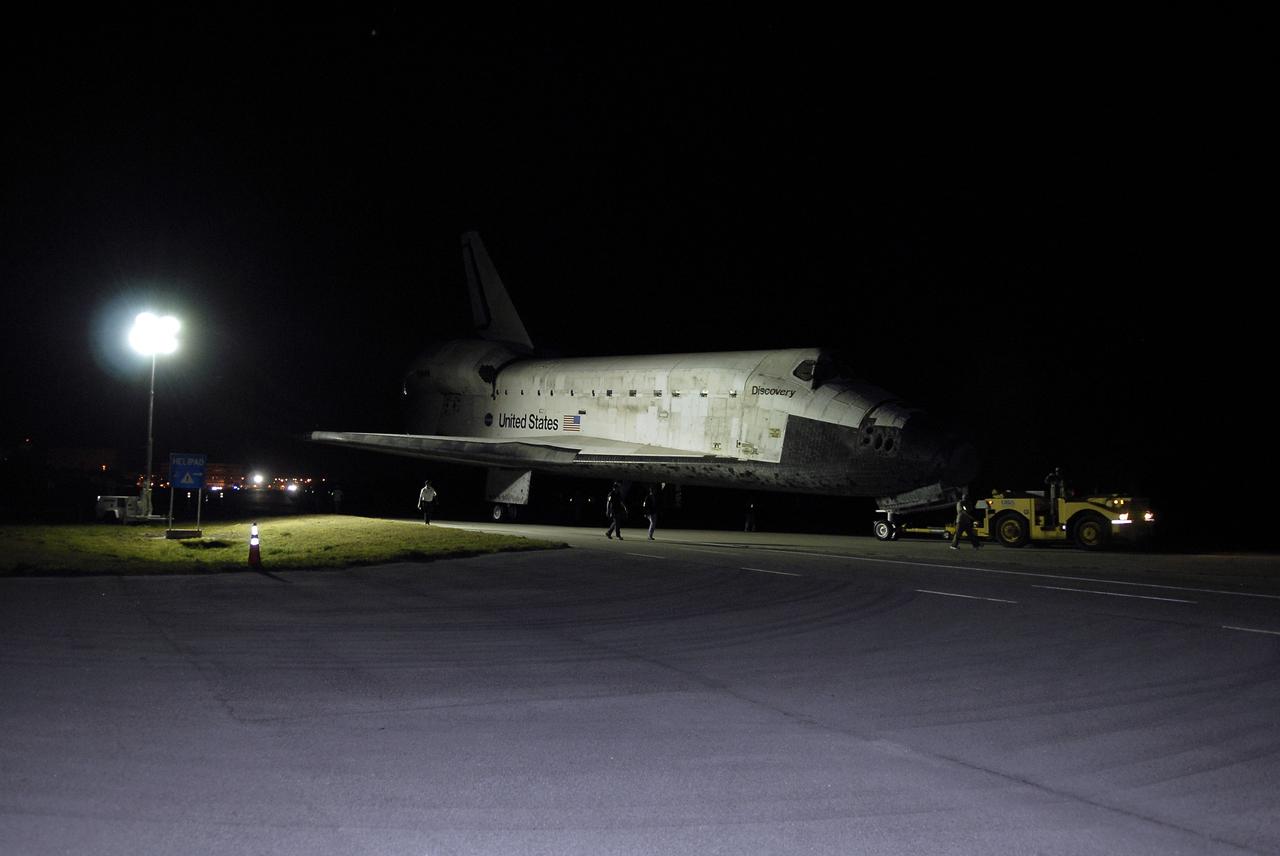
CAPE CANAVERAL, Fla. – Space shuttle Discovery is towed along the access road to the Shuttle Landing Facility, or SLF, at NASA’s Kennedy Space Center in Florida. At the SLF, Discovery will be hoisted onto a Shuttle Carrier Aircraft, or SCA, with the aid of a mate-demate device. The SCA, a modified Boeing 747 jet airliner, is scheduled to ferry Discovery to the Washington Dulles International Airport in Virginia on April 17, after which the shuttle will be placed on permanent public display in the Smithsonian's National Air and Space Museum Steven F. Udvar-Hazy Center. For more information on shuttle transition and retirement activities, visit http://www.nasa.gov/transition. Photo credit: NASA/Tim Jacobs
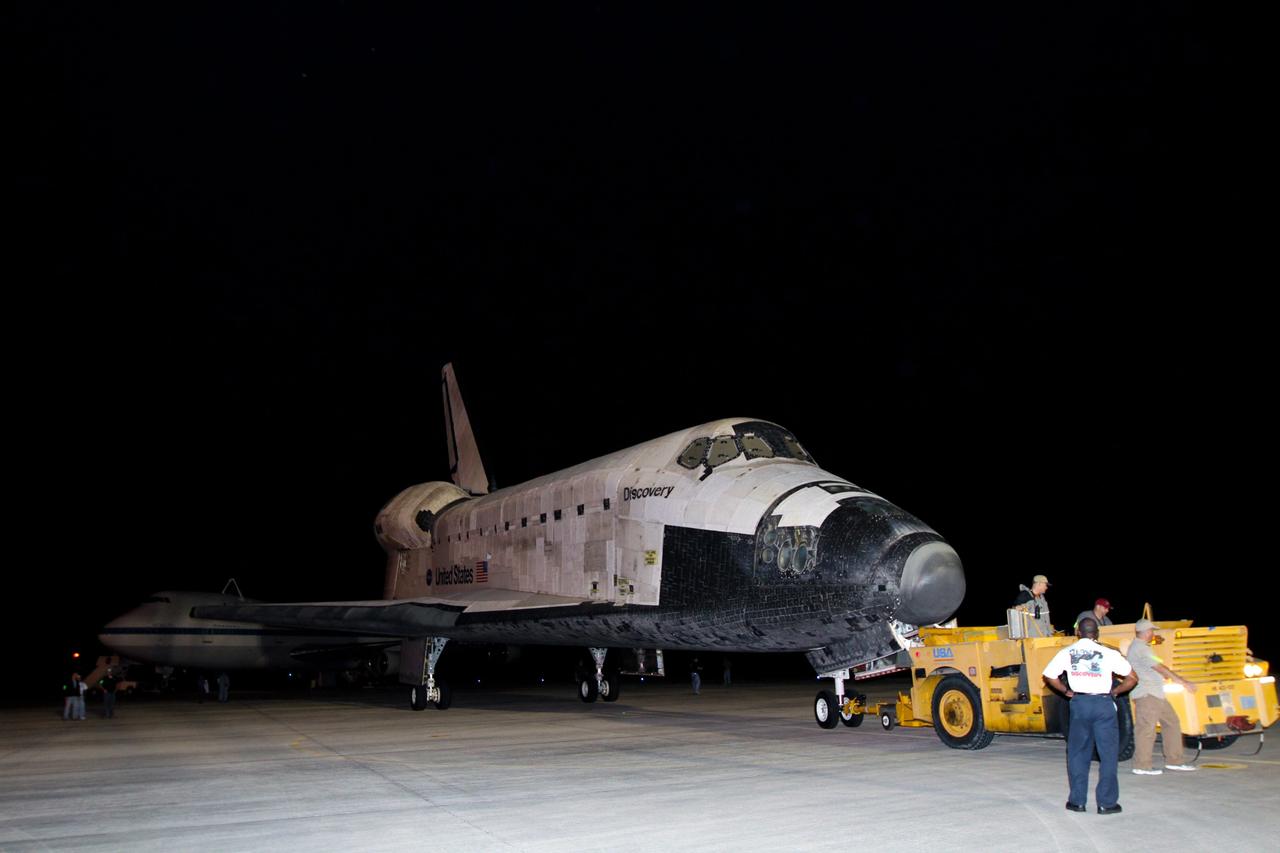
CAPE CANAVERAL, Fla. – Space shuttle Discovery is towed to the Shuttle Landing Facility, or SLF, at NASA’s Kennedy Space Center in Florida. At the SLF, Discovery will be hoisted onto the back of the Shuttle Carrier Aircraft, or SCA, in the background, with the aid of a mate-demate device. The SCA, a modified Boeing 747 jet airliner, is scheduled to ferry Discovery to the Washington Dulles International Airport in Virginia on April 17, after which the shuttle will be placed on permanent public display in the Smithsonian's National Air and Space Museum Steven F. Udvar-Hazy Center. For more information on shuttle transition and retirement activities, visit http://www.nasa.gov/transition. Photo credit: NASA/Kim Shiflett
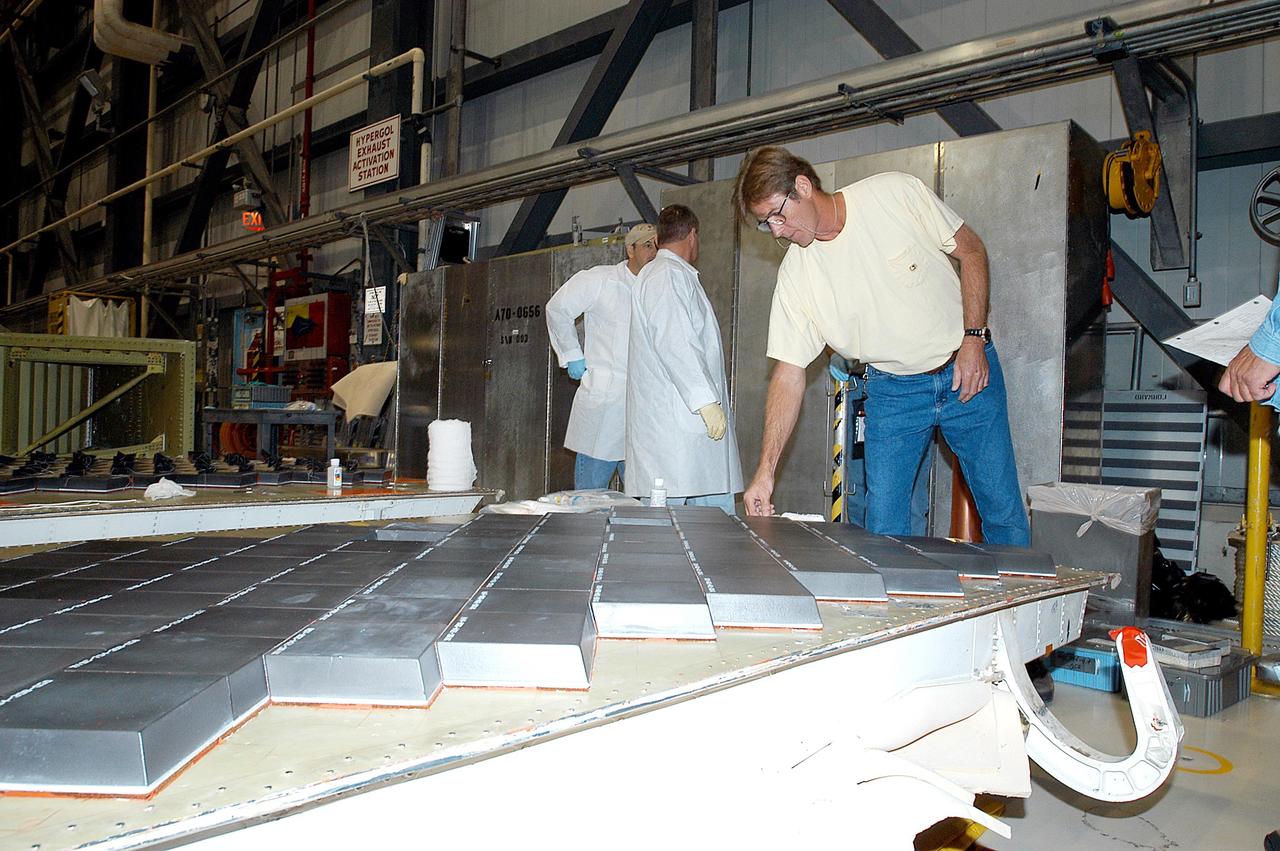
KENNEDY SPACE CENTER, FLA. -- In the Orbiter Processing Facility, United Space Alliance employee Dave Sanborn (left) conducts a bond verification test on Thermal Protection System tiles installed on a main landing gear door of Space Shuttle orbiter Enterprise (OV-101). Sections of Enterprise were borrowed from the Smithsonian Institution's Air and Space Museum where the orbiter is being stored at the Washington Dulles International Airport. Enterprise was the first orbiter built in the Shuttle fleet and was used to conduct the Approach and Landing Test Program before the first powered Shuttle flight. After the tile installation is complete, the sections will be transferred to the Southwest Research Institute for testing requested by the Columbia Accident Investigation Board.
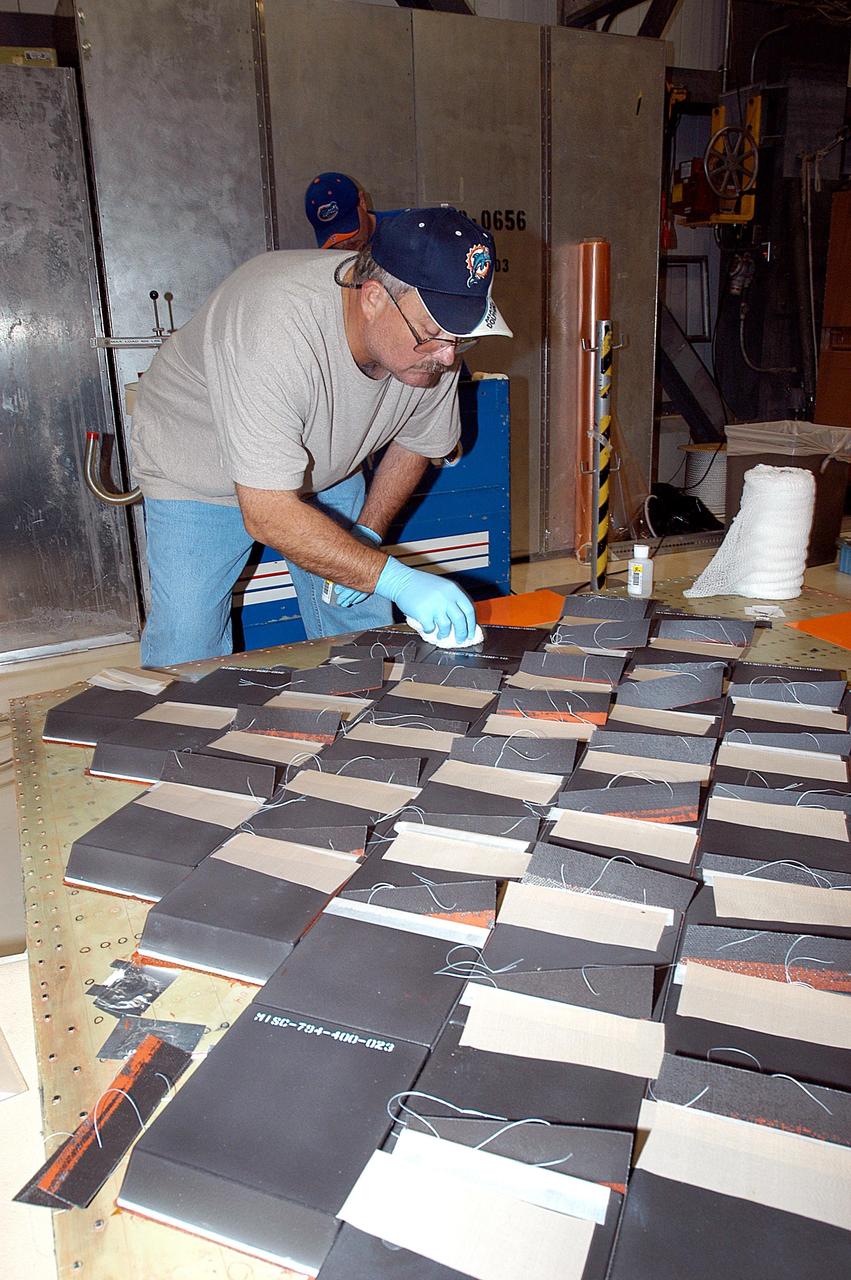
KENNEDY SPACE CENTER, FLA. -- In the Orbiter Processing Facility, United Space Alliance employee Dave Sanborn installs Thermal Protection System tiles on a main landing gear door of Space Shuttle orbiter Enterprise (OV-101). Sections of Enterprise were borrowed from the Smithsonian Institution's Air and Space Museum where the orbiter is being stored at the Washington Dulles International Airport. Enterprise was the first orbiter built in the Shuttle fleet and was used to conduct the Approach and Landing Test Program before the first powered Shuttle flight. After the tile installation is complete, the sections will be transferred to the Southwest Research Institute for testing requested by the Columbia Accident Investigation Board.

KENNEDY SPACE CENTER, FLA. -- In the Orbiter Processing Facility, United Space Alliance employee Harrell Watts installs Thermal Protection System tiles on a main landing gear door of Space Shuttle orbiter Enterprise (OV-101). Sections of Enterprise were borrowed from the Smithsonian Institution's Air and Space Museum where the orbiter is being stored at the Washington Dulles International Airport. Enterprise was the first orbiter built in the Shuttle fleet and was used to conduct the Approach and Landing Test Program before the first powered Shuttle flight. After the tile installation is complete, the sections will be transferred to the Southwest Research Institute for testing requested by the Columbia Accident Investigation Board.
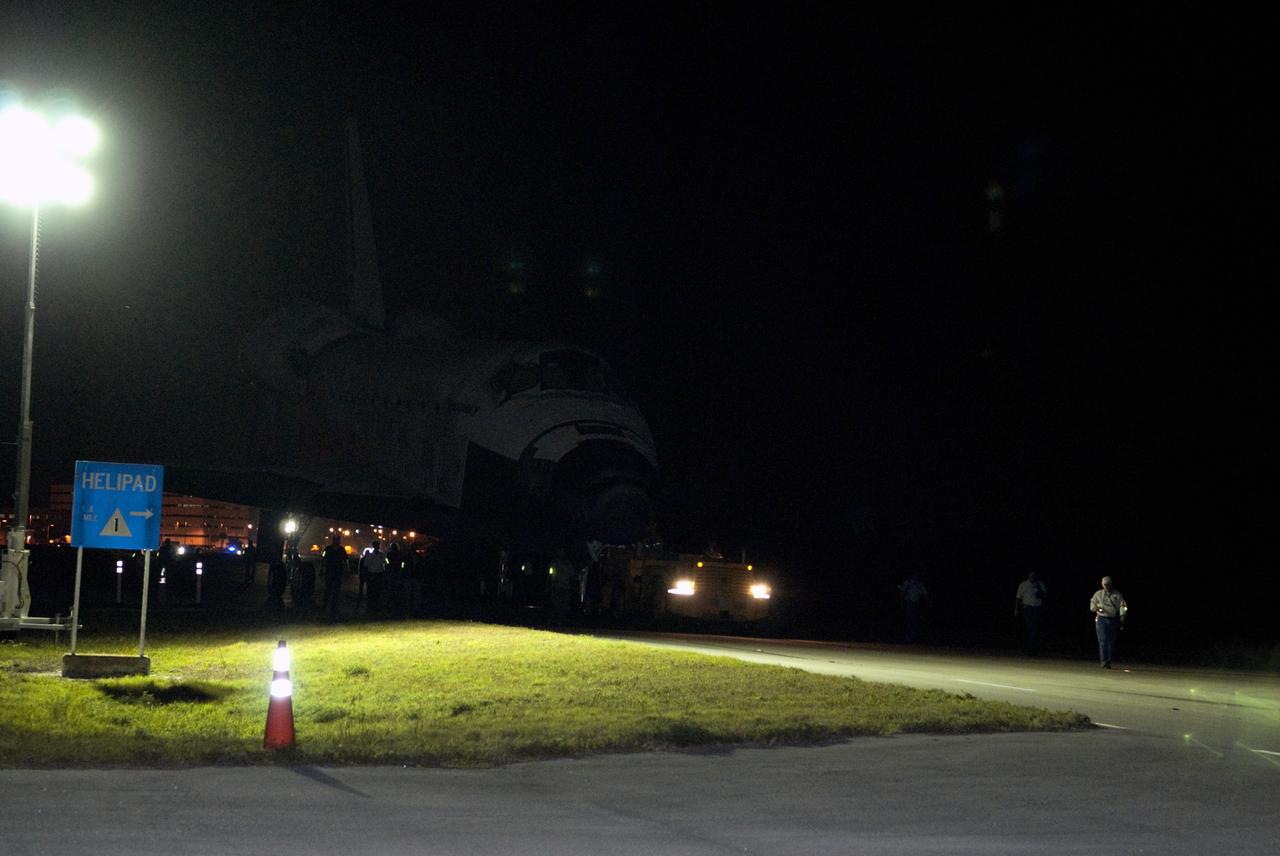
CAPE CANAVERAL, Fla. – A team of aerospace workers accompanies space shuttle Discovery along the towway to the Shuttle Landing Facility, or SLF, at NASA’s Kennedy Space Center in Florida. At the SLF, Discovery will be hoisted onto a Shuttle Carrier Aircraft, or SCA, with the aid of a mate-demate device. The SCA, a modified Boeing 747 jet airliner, is scheduled to ferry Discovery to the Washington Dulles International Airport in Virginia on April 17, after which the shuttle will be placed on permanent public display in the Smithsonian's National Air and Space Museum Steven F. Udvar-Hazy Center. For more information on shuttle transition and retirement activities, visit http://www.nasa.gov/transition. Photo credit: NASA/Tim Jacobs
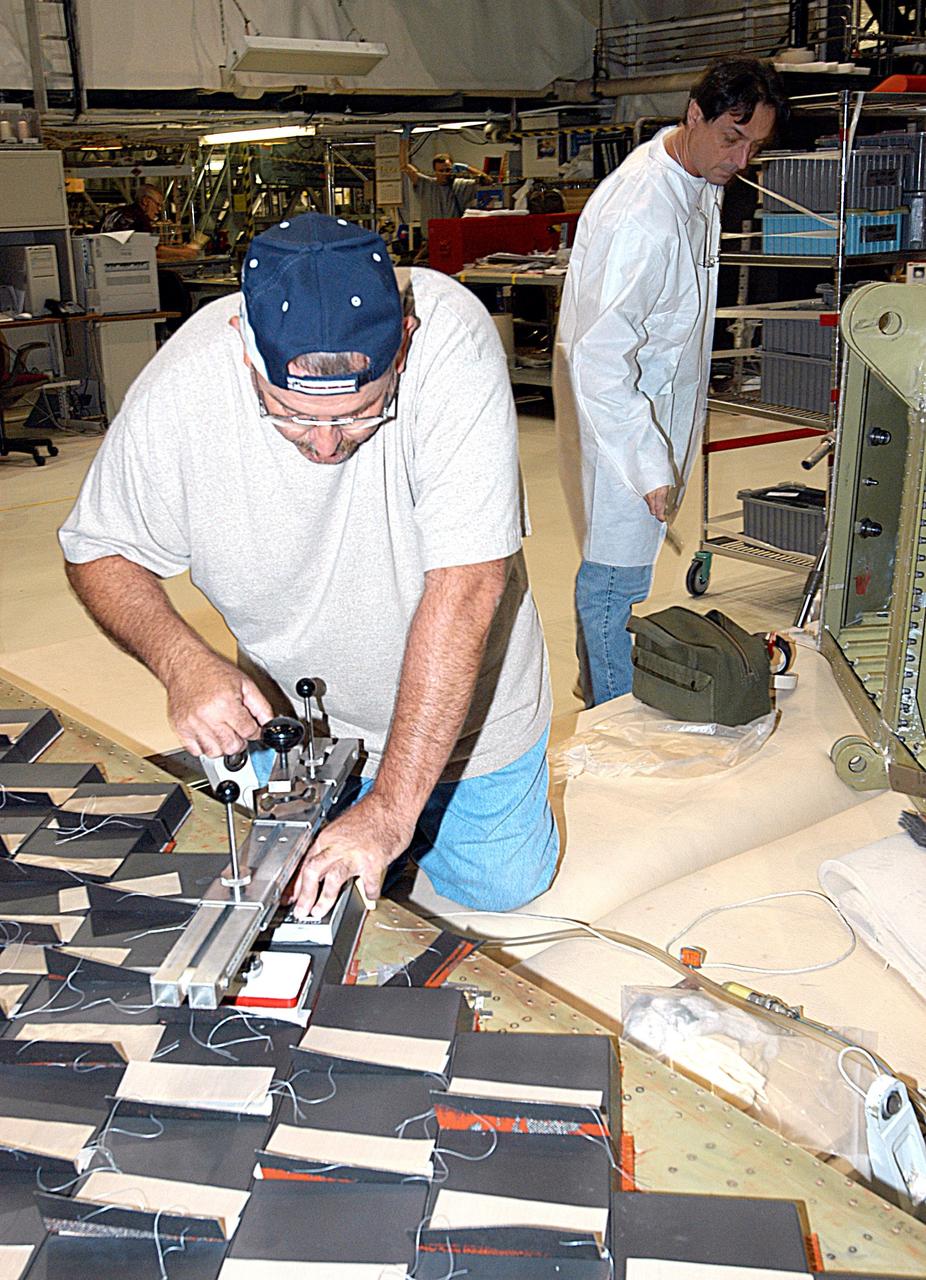
KENNEDY SPACE CENTER, FLA. -- In the Orbiter Processing Facility, United Space Alliance employee Harrell Watts (right) installs Thermal Protection System tiles on a main landing gear door of Space Shuttle orbiter Enterprise (OV-101). Sections of Enterprise were borrowed from the Smithsonian Institution's Air and Space Museum where the orbiter is being stored at the Washington Dulles International Airport. Enterprise was the first orbiter built in the Shuttle fleet and was used to conduct the Approach and Landing Test Program before the first powered Shuttle flight. After the tile installation is complete, the sections will be transferred to the Southwest Research Institute for testing requested by the Columbia Accident Investigation Board.
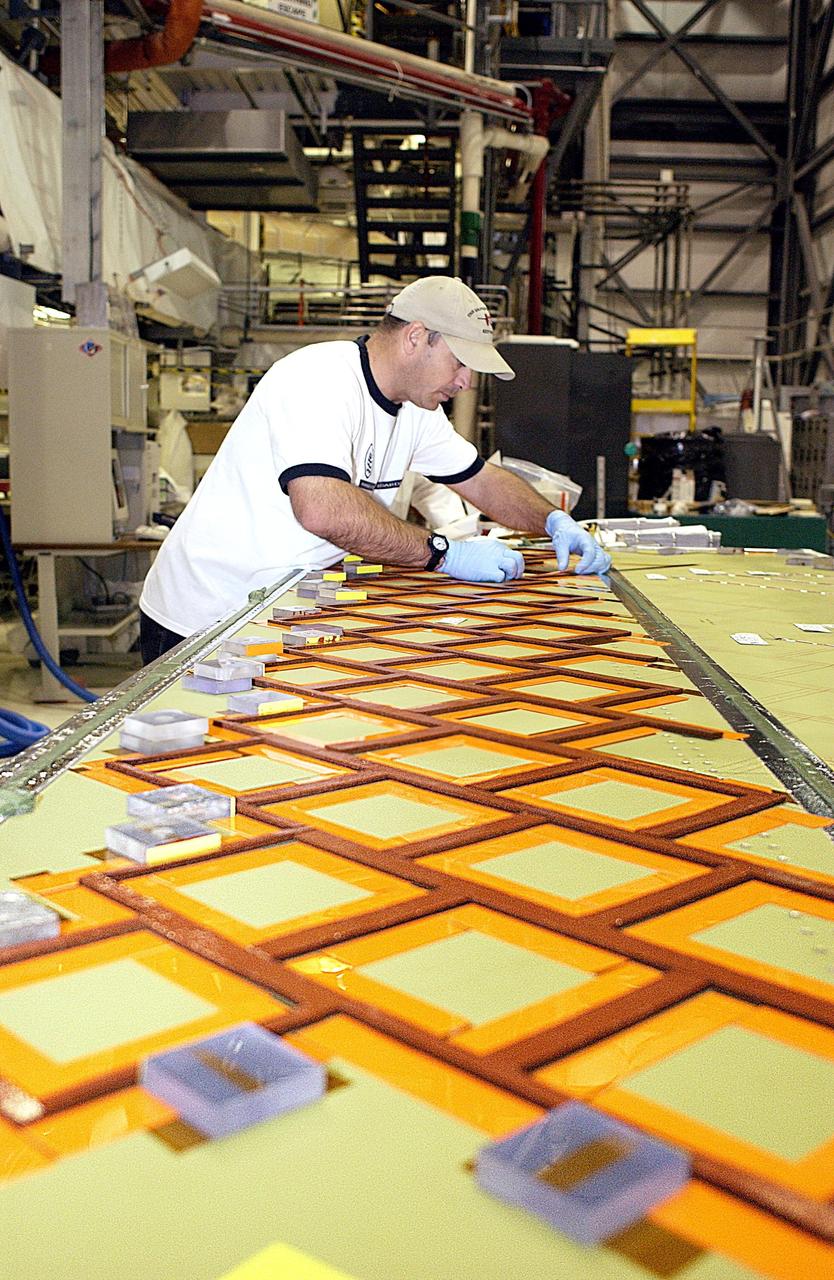
KENNEDY SPACE CENTER, FLA. -- In the Orbiter Processing Facility, United Space Alliance employee Mike Cote installs Thermal Protection System tiles on a test panel. The test panel and sections of Space Shuttle orbiter Enterprise (OV-101) will be transferred to the Southwest Research Institute for testing after the tile installation is complete. The testing has been requested by the Columbia Accident Investigation Board. Sections of Enterprise were borrowed from the Smithsonian Institution's Air and Space Museum where the orbiter is being stored at the Washington Dulles International Airport. Enterprise was the first orbiter built in the Shuttle fleet and was used to conduct the Approach and Landing Test Program before the first powered Shuttle flight.
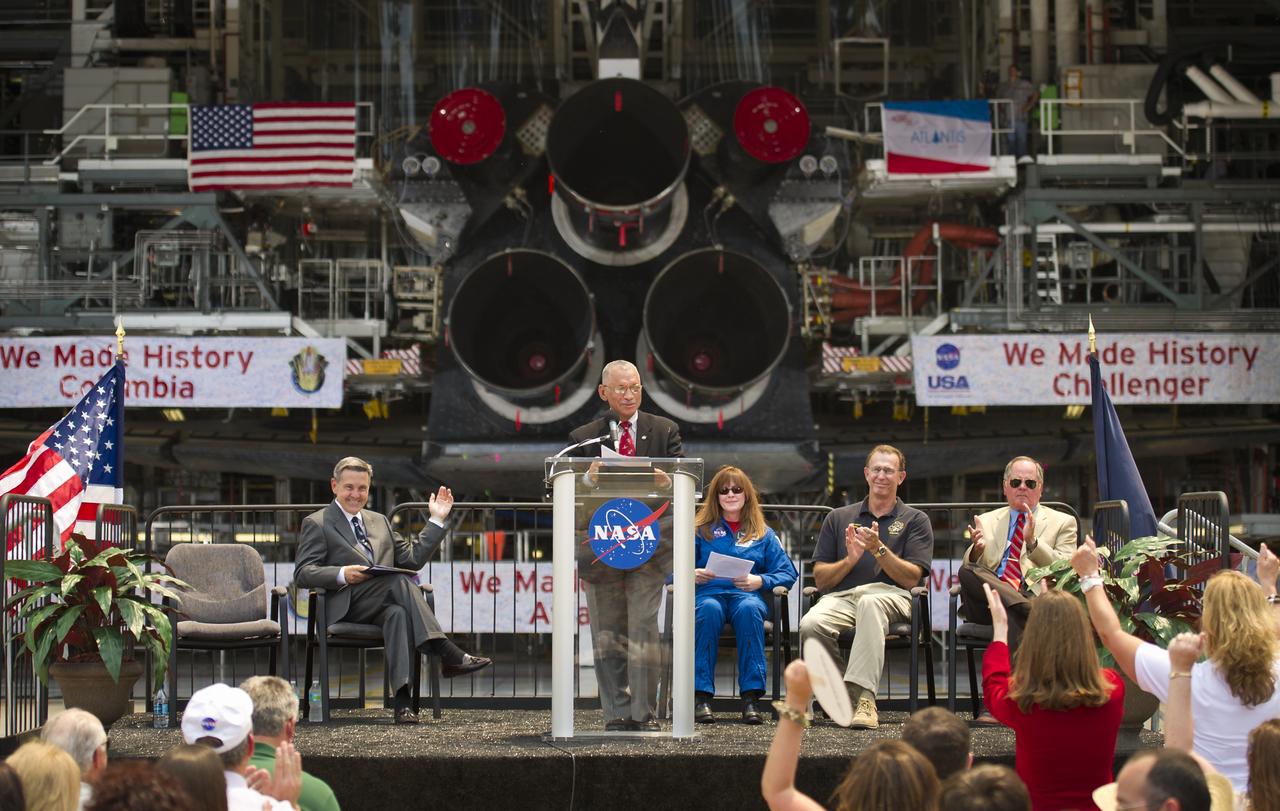
NASA Administrator Charles Bolden announces where four space shuttle orbiters will be permanently displayed at the conclusion of the Space Shuttle Program during an event held at one of the Orbiter Processing Facilities, Tuesday, April 12, 2011, at Kennedy Space Center in Cape Canaveral, Fla. The four orbiters, Enterprise, which currently is on display at the Smithsonian's Steven F. Udvar-Hazy Center near Washington Dulles International Airport, will move to the Intrepid Sea, Air & Space Museum in New York, Discovery will move to Udvar-Hazy, Endeavour will be displayed at the California Science Center in Los Angeles and Atlantis, in background, will be displayed at the Kennedy Space Center Visitor’s Complex. Photo Credit: (NASA/Bill Ingalls)

NASA Administrator Charles Bolden announces where four space shuttle orbiters will be permanently displayed at the conclusion of the Space Shuttle Program during an event held at one of the Orbiter Processing Facilities, Tuesday, April 12, 2011, at Kennedy Space Center in Cape Canaveral, Fla. The four orbiters, Enterprise, which currently is on display at the Smithsonian's Steven F. Udvar-Hazy Center near Washington Dulles International Airport, will move to the Intrepid Sea, Air & Space Museum in New York, Discovery will move to Udvar-Hazy, Endeavour will be displayed at the California Science Center in Los Angeles and Atlantis, in background, will be displayed at the Kennedy Space Center Visitor’s Complex. Photo Credit: (NASA/Bill Ingalls)

STS078-760-010 (20 June - 7 July 1996) --- As photographed with color infrared film by the crew of the Space Shuttle Columbia, the capital of the United States of America (the right of center) is located at the head of the navigable portion of the Potomac River. The Potomac separates the capital from Virginia to the southwest. It covers an area of 68-square-mile (177-square-kilometers). Andrews Air Force Base is seen east southwest of Washington D.C. at the right edge of the photo. Dulles International Airport is located west of the city on the left edge of the photo. Green vegetation shows up as red in the color infrared image.
CAPE CANAVERAL, Fla. – At the Shuttle Landing Facility, or SLF, at NASA’s Kennedy Space Center in Florida, space shuttle Discovery rolls past the Shuttle Carrier Aircraft with which it will be mated. Discovery will be hoisted onto the SCA with the aid of a mate-demate device. The SCA, a modified Boeing 747 jet airliner, is scheduled to ferry Discovery to the Washington Dulles International Airport in Virginia on April 17, after which the shuttle will be placed on permanent public display in the Smithsonian's National Air and Space Museum Steven F. Udvar-Hazy Center. For more information on shuttle transition and retirement activities, visit http://www.nasa.gov/transition. Photo credit: NASA/Jim Grossmann
CAPE CANAVERAL, Fla. – Space shuttle Discovery makes its way from the Launch Complex 39 area to the Shuttle Landing Facility or SLF, at NASA’s Kennedy Space Center in Florida. At the SLF, Discovery will be hoisted onto a Shuttle Carrier Aircraft, or SCA, with the aid of a mate-demate device. The SCA, a modified Boeing 747 jet airliner, is scheduled to ferry Discovery to the Washington Dulles International Airport in Virginia on April 17, after which the shuttle will be placed on permanent public display in the Smithsonian's National Air and Space Museum Steven F. Udvar-Hazy Center. For more information on shuttle transition and retirement activities, visit http://www.nasa.gov/transition. Photo credit: NASA/Kim Shiflett
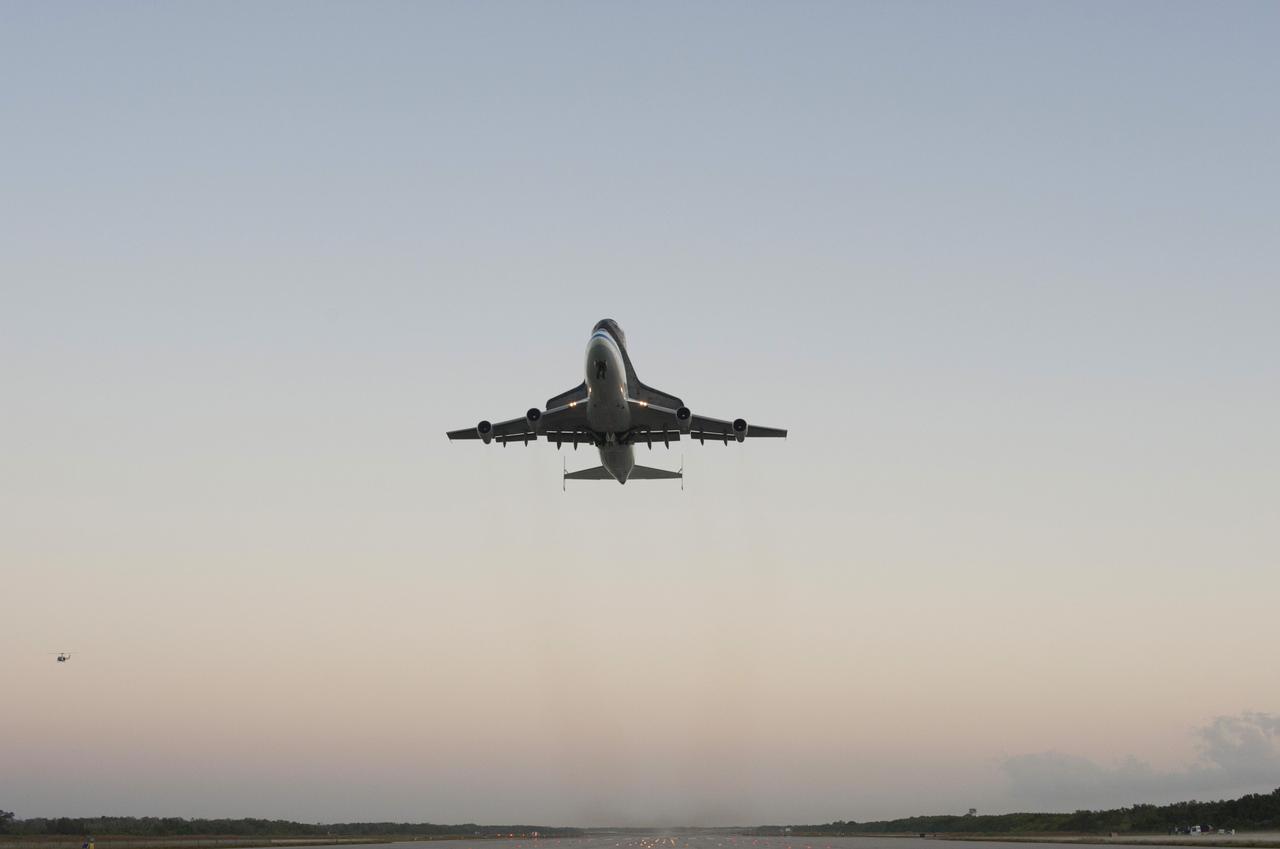
CAPE CANAVERAL, Fla. - The Shuttle Carrier Aircraft transporting space shuttle Discovery soars overhead shortly after takeoff from NASA Kennedy Space Center's runway 15 at 7 a.m. EDT. The duo is beginning its ferry flight to the Washington Dulles International Airport in Virginia that also includes a flyby of the Space Coast and Washington, D.C. Discovery is leaving Kennedy after more than 28 years of service beginning with its arrival on the space coast Nov. 9, 1983. Discovery is set to move to the Smithsonian's National Air and Space Museum, Steven F. Udvar-Hazy Center in Chantilly, Va., on April 19 where it will be placed on public display. For more information on the Shuttle Carrier Aircraft, visit http://www.nasa .gov/centers/dryden/news/FactSheets/FS-013- DFRC.html. For more information on shuttle transition and retirement activities, visit http://www.nasa.gov/transition. Photo credit: NASA/Tim Powers and Tim Terry
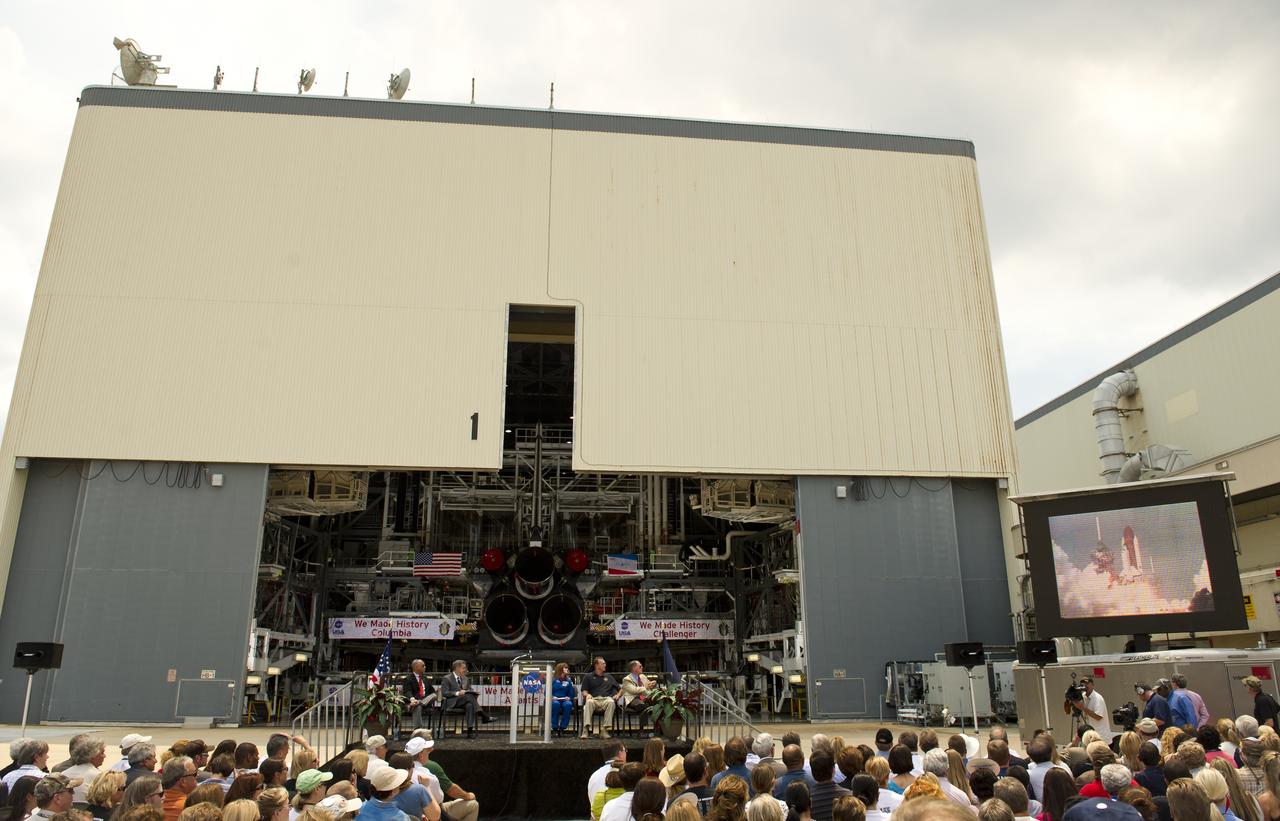
A video highlighting the 30 years of space flight and more than 130 missions of the space shuttle transportation system is shown at an event where NASA Administrator Charles Bolden announced where the four space shuttle orbiters will be permanently displayed, Tuesday, April 12, 2011, at Kennedy Space Center in Cape Canaveral, Fla. The four orbiters, Enterprise, which currently is on display at the Smithsonian's Steven F. Udvar-Hazy Center near Washington Dulles International Airport, will move to the Intrepid Sea, Air & Space Museum in New York, Discovery will move to Udvar-Hazy, Endeavour will be displayed at the California Science Center in Los Angeles and Atlantis, in background, will be displayed at the Kennedy Space Center Visitor’s Complex. Photo Credit: (NASA/Bill Ingalls)
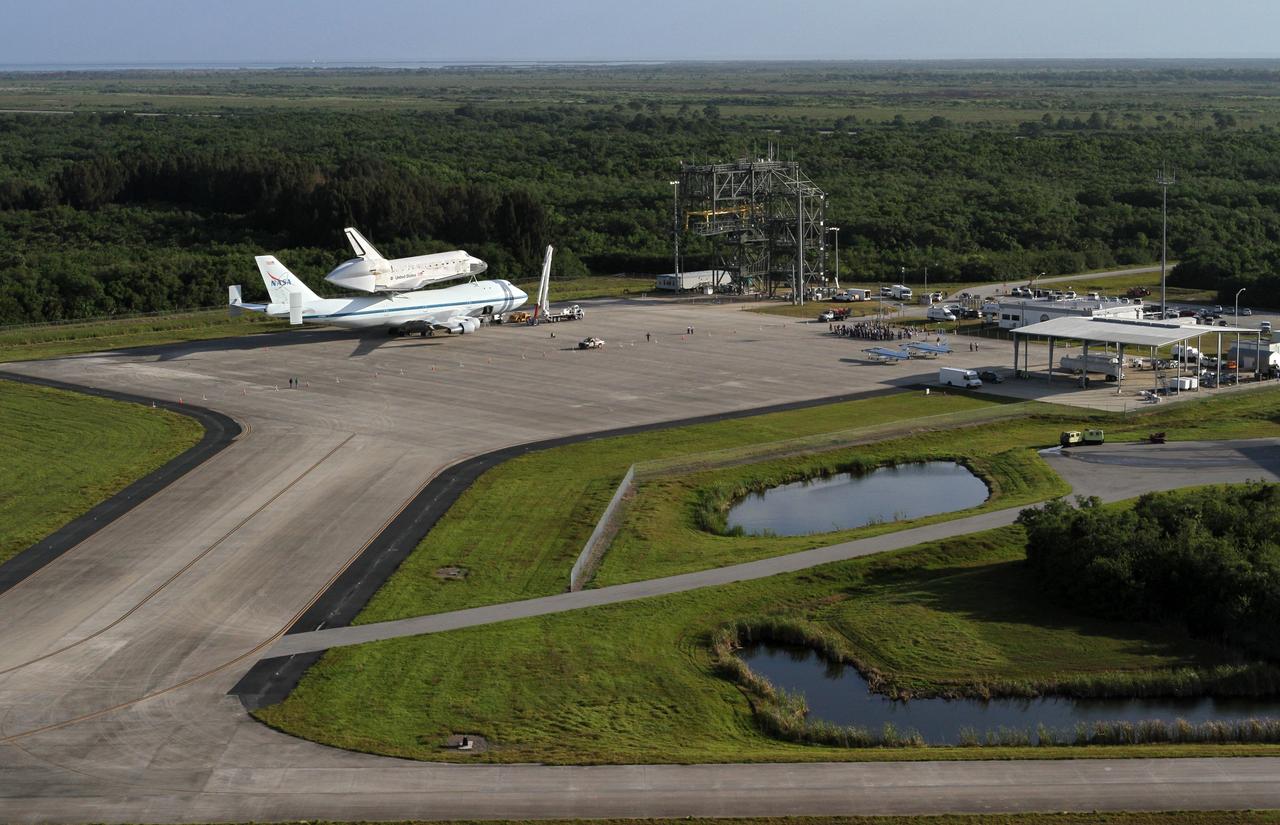
CAPE CANAVERAL, Fla. – This is an aerial view of space shuttle Discovery bolted to the top of a Shuttle Carrier Aircraft SCA on the ramp of the Shuttle Landing Facility SLF at NASA’s Kennedy Space Center in Florida. Discovery's last crew members are expected to be at the SLF, along with Kennedy employees and guests, as the center says goodbye to the agency's most-flown shuttle on April 17. The SCA, designated NASA 905, will ferry Discovery to the Washington Dulles International Airport in Virginia, after which the shuttle will be moved for public display in the Smithsonian's National Air and Space Museum Steven F. Udvar-Hazy Center on April 19. For more information on the SCA, visit http://www.nasa.gov/centers/dryden/news/FactSheets/FS-013-DFRC.html. For more information on shuttle transition and retirement activities, visit http://www.nasa.gov/transition. Photo credit: NASA/Kim Shiflett
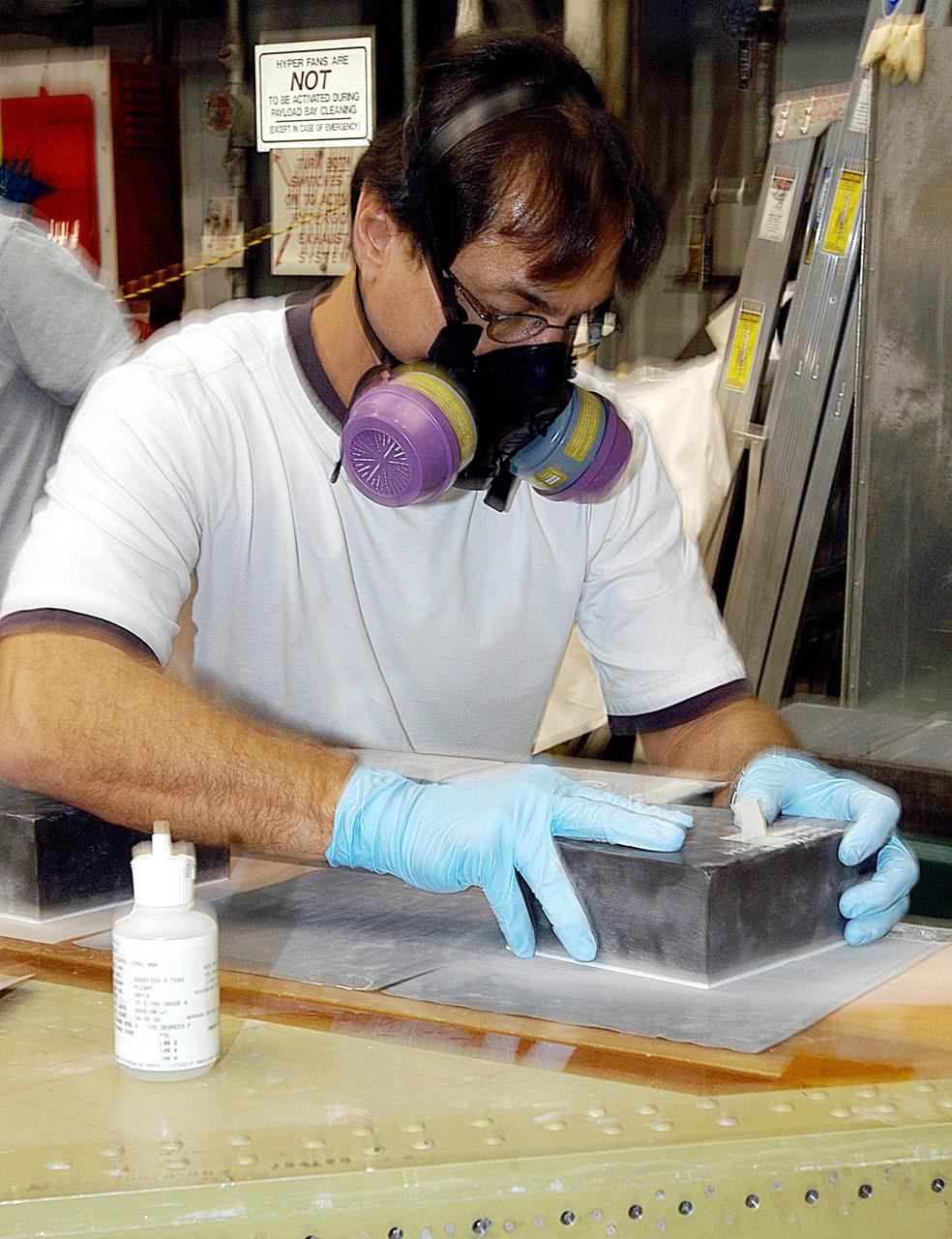
KENNEDY SPACE CENTER, FLA. -- In the Orbiter Processing Facility (OPF), United Space Alliance (USA) technician Mark Jetton installs Thermal Protection System (TPS) tile on a simulated orbiter wing. The wing, along with sections of Space Shuttle orbiter Enterprise (OV-101), will be transferred to the Southwest Research Institute for testing after the tile installation is complete. The testing has been requested by the Columbia Accident Investigation Board. For this initiative, sections of Enterprise were borrowed from the Smithsonian Institution's Air and Space Museum where the orbiter is being stored at the Washington Dulles International Airport. Enterprise was the first orbiter built in the Shuttle fleet and was used to conduct the Approach and Landing Test Program before the first powered Shuttle flight.
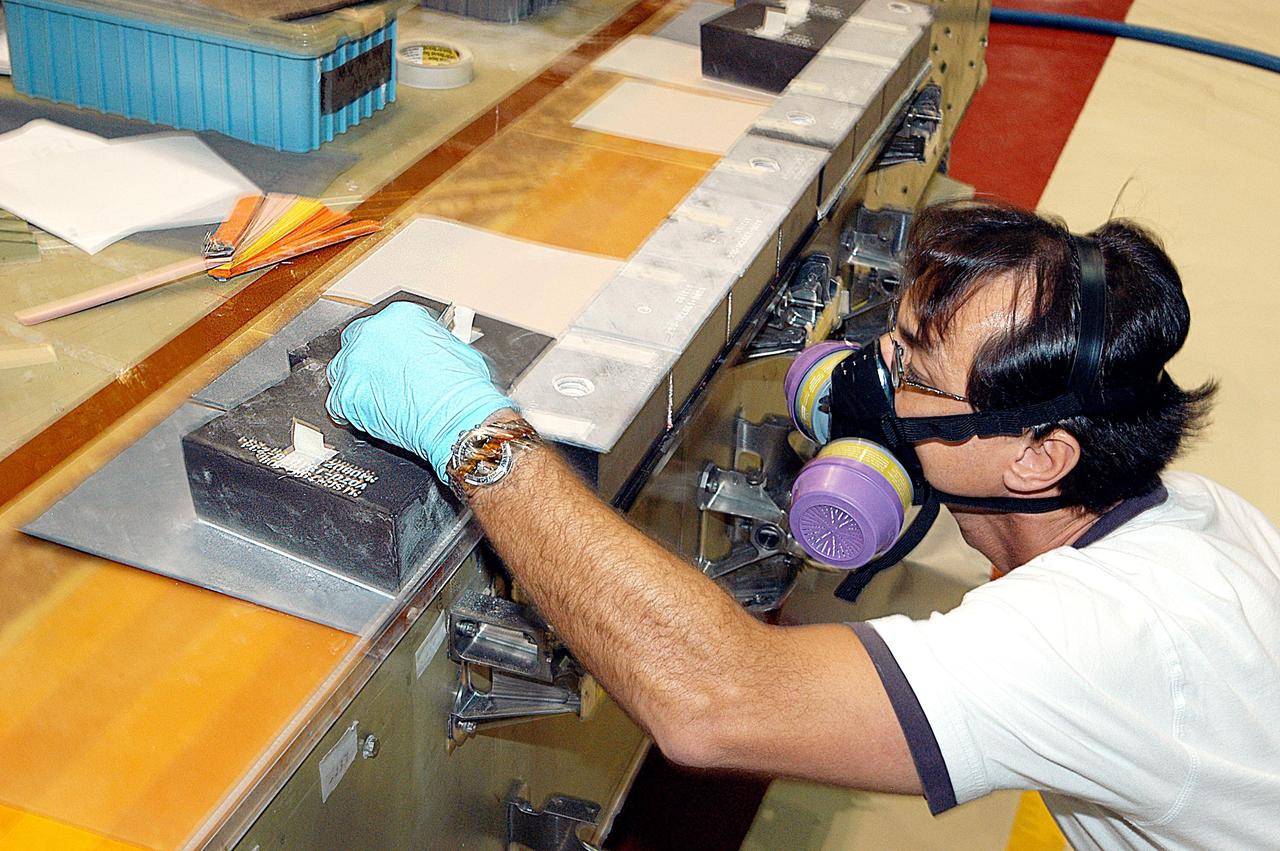
KENNEDY SPACE CENTER, FLA. -- In the Orbiter Processing Facility (OPF), United Space Alliance (USA) technician Mark Jetton installs Thermal Protection System (TPS) tile on a simulated orbiter wing. The wing, along with sections of Space Shuttle orbiter Enterprise (OV-101), will be transferred to the Southwest Research Institute for testing after the tile installation is complete. The testing has been requested by the Columbia Accident Investigation Board. For this initiative, sections of Enterprise were borrowed from the Smithsonian Institution's Air and Space Museum where the orbiter is being stored at the Washington Dulles International Airport. Enterprise was the first orbiter built in the Shuttle fleet and was used to conduct the Approach and Landing Test Program before the first powered Shuttle flight.
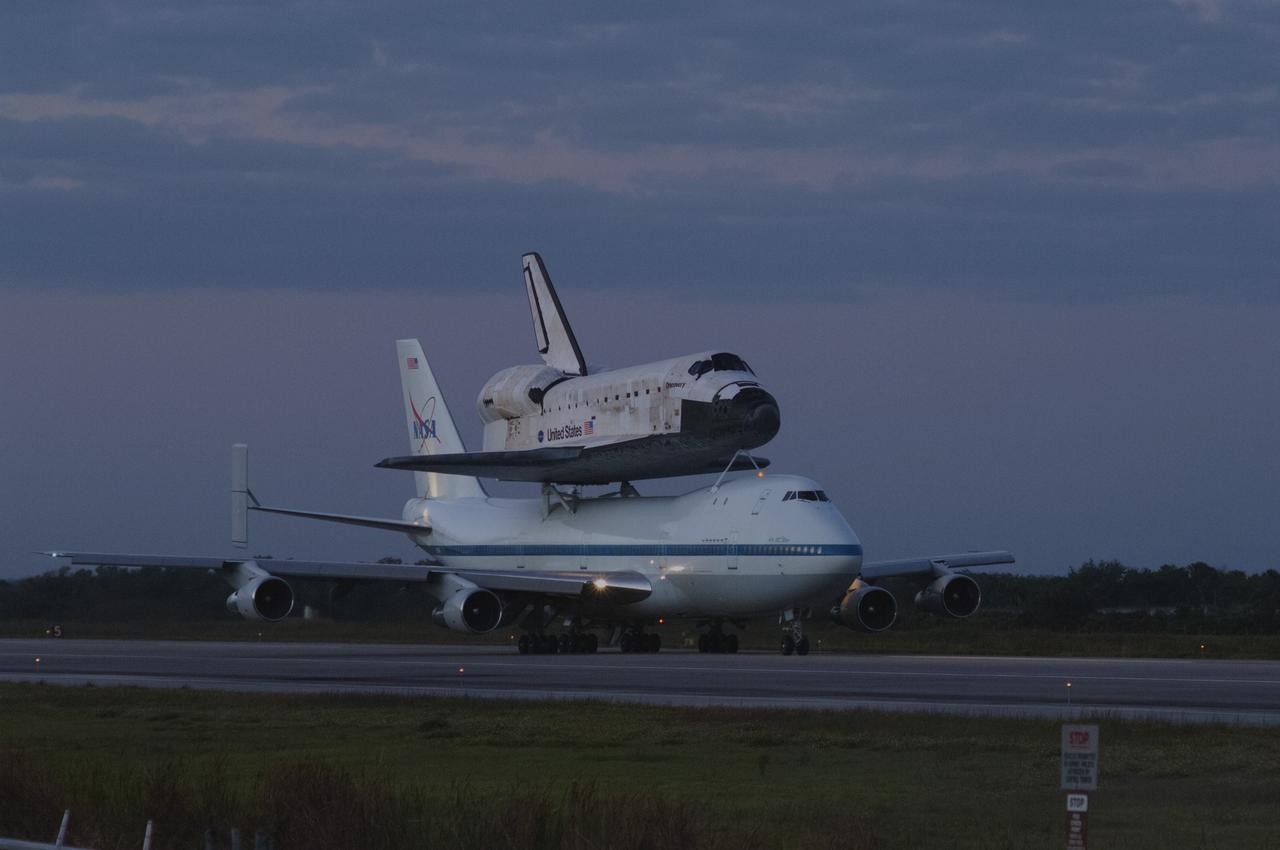
CAPE CANAVERAL, Fla. – Sunrise over the Shuttle Landing Facility at NASA’s Kennedy Space Center in Florida reveals the Shuttle Carrier Aircraft that is transporting space shuttle Discovery to its new home preparing for takeoff. The aircraft, known as an SCA, is a Boeing 747 jet, originally manufactured for commercial use, which was modified by NASA to transport the shuttles between destinations on Earth. This SCA, designated NASA 905, is assigned to the remaining ferry missions, delivering the shuttles to their permanent public display sites. NASA 905 is scheduled to ferry Discovery to the Washington Dulles International Airport in Virginia on April 17, after which the shuttle will be placed on display in the Smithsonian's National Air and Space Museum Steven F. Udvar-Hazy Center. For more information on the SCA, visit http://www.nasa.gov/centers/dryden/news/FactSheets/FS-013-DFRC.html. For more information on shuttle transition and retirement activities, visit http://www.nasa.gov/transition. Photo credit: NASA/Rusty Backer
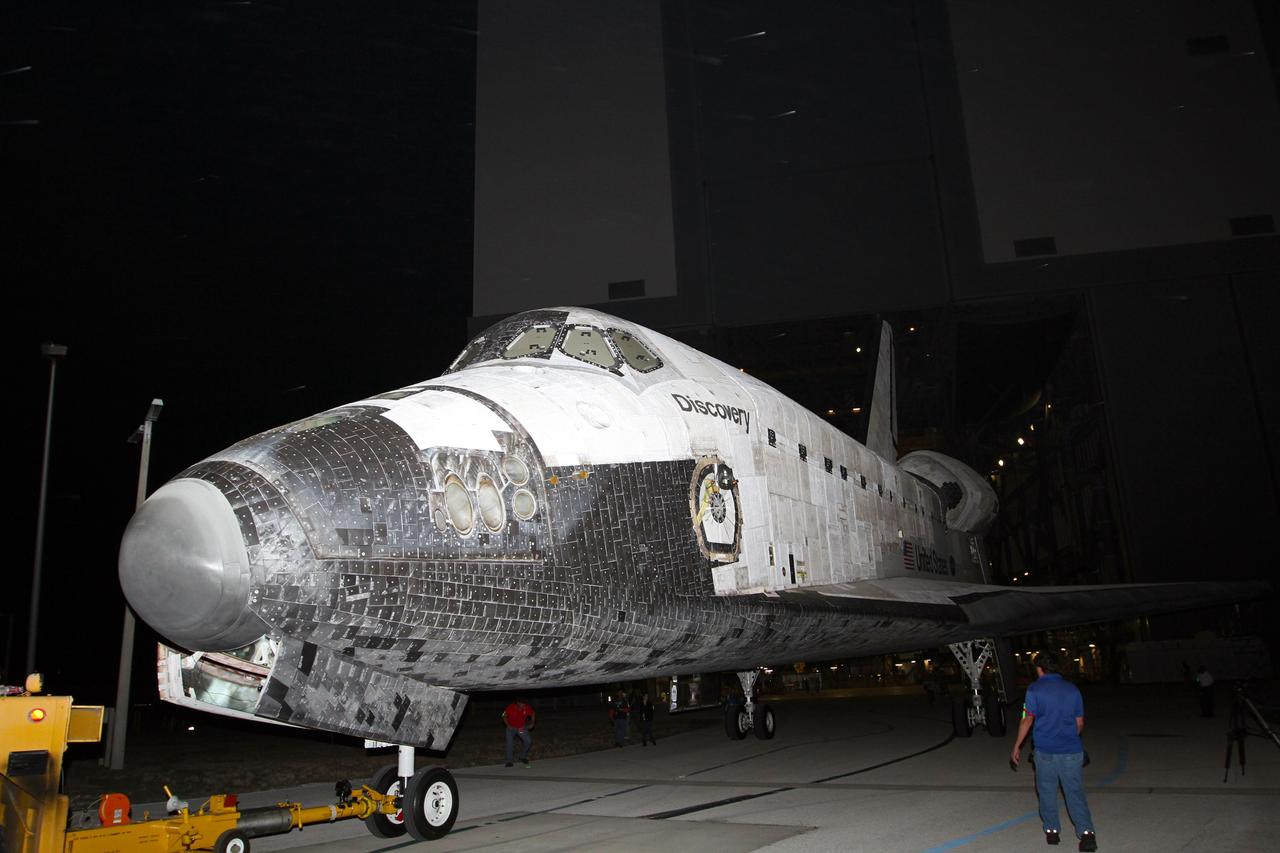
CAPE CANAVERAL, Fla. – Space shuttle Discovery begins its trip to the Shuttle Landing Facility, or SLF, at NASA’s Kennedy Space Center in Florida. In the background is the 525-foot-tall Vehicle Assembly Building, or VAB. Discovery was in storage in the VAB’s high bay 4 awaiting departure from Kennedy’s Launch Complex 39 area for the final time. At the SLF, Discovery will be hoisted onto a Shuttle Carrier Aircraft, or SCA, with the aid of a mate-demate device. The SCA, a modified Boeing 747 jet airliner, is scheduled to ferry Discovery to the Washington Dulles International Airport in Virginia on April 17, after which the shuttle will be placed on permanent public display in the Smithsonian's National Air and Space Museum Steven F. Udvar-Hazy Center. For more information on shuttle transition and retirement activities, visit http://www.nasa.gov/transition. Photo credit: NASA/Kim Shiflett
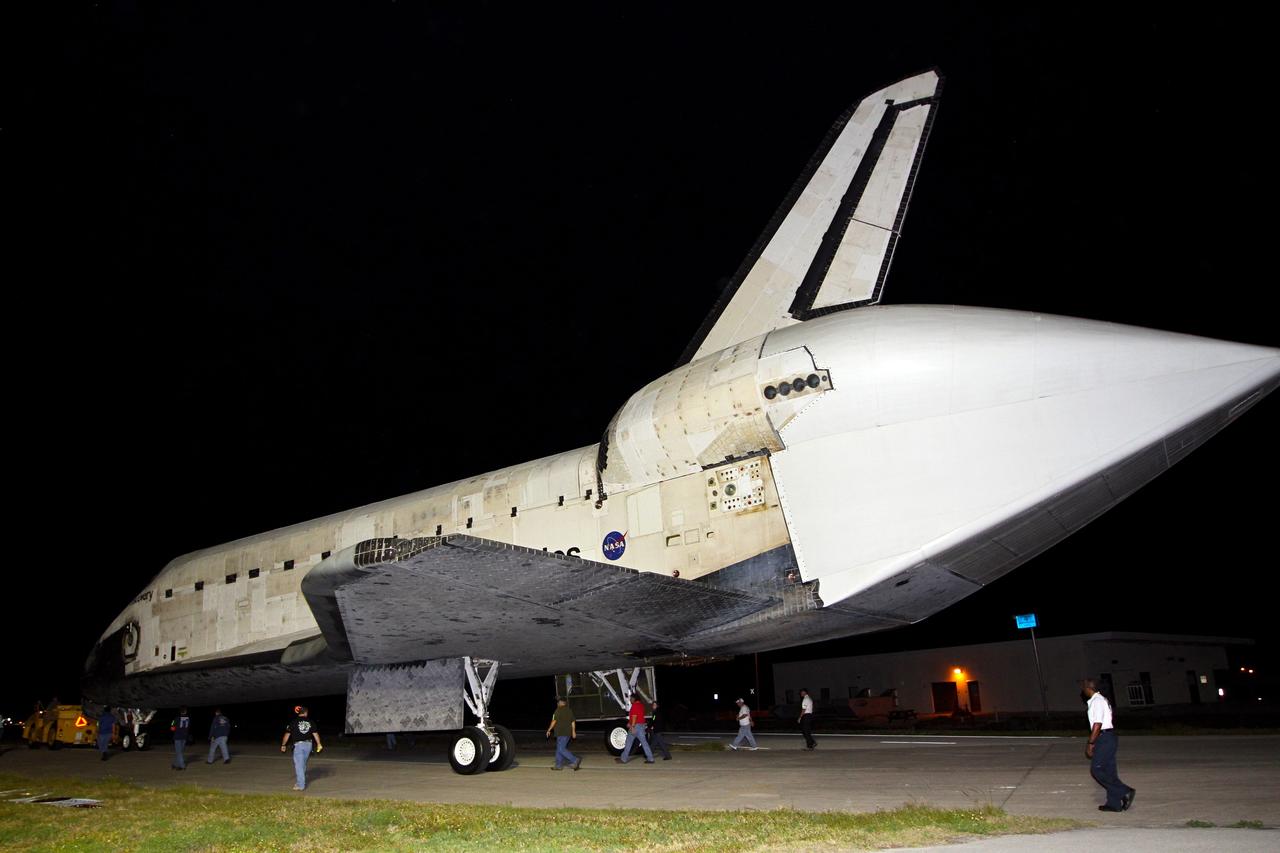
CAPE CANAVERAL, Fla. – A team of aerospace technicians accompanies space shuttle Discovery as it is towed for the final time from the Launch Complex 39 area to the Shuttle Landing Facility or SLF, at NASA’s Kennedy Space Center in Florida. A tail cone has been installed over Discovery’s three replica shuttle main engines to reduce aerodynamic drag and turbulence during its upcoming ferry flight. At the SLF, Discovery will be hoisted onto a Shuttle Carrier Aircraft, or SCA, with the aid of a mate-demate device. The SCA, a modified Boeing 747 jet airliner, is scheduled to ferry Discovery to the Washington Dulles International Airport in Virginia on April 17, after which the shuttle will be placed on permanent public display in the Smithsonian's National Air and Space Museum Steven F. Udvar-Hazy Center. For more information on shuttle transition and retirement activities, visit http://www.nasa.gov/transition. Photo credit: NASA/Kim Shiflett
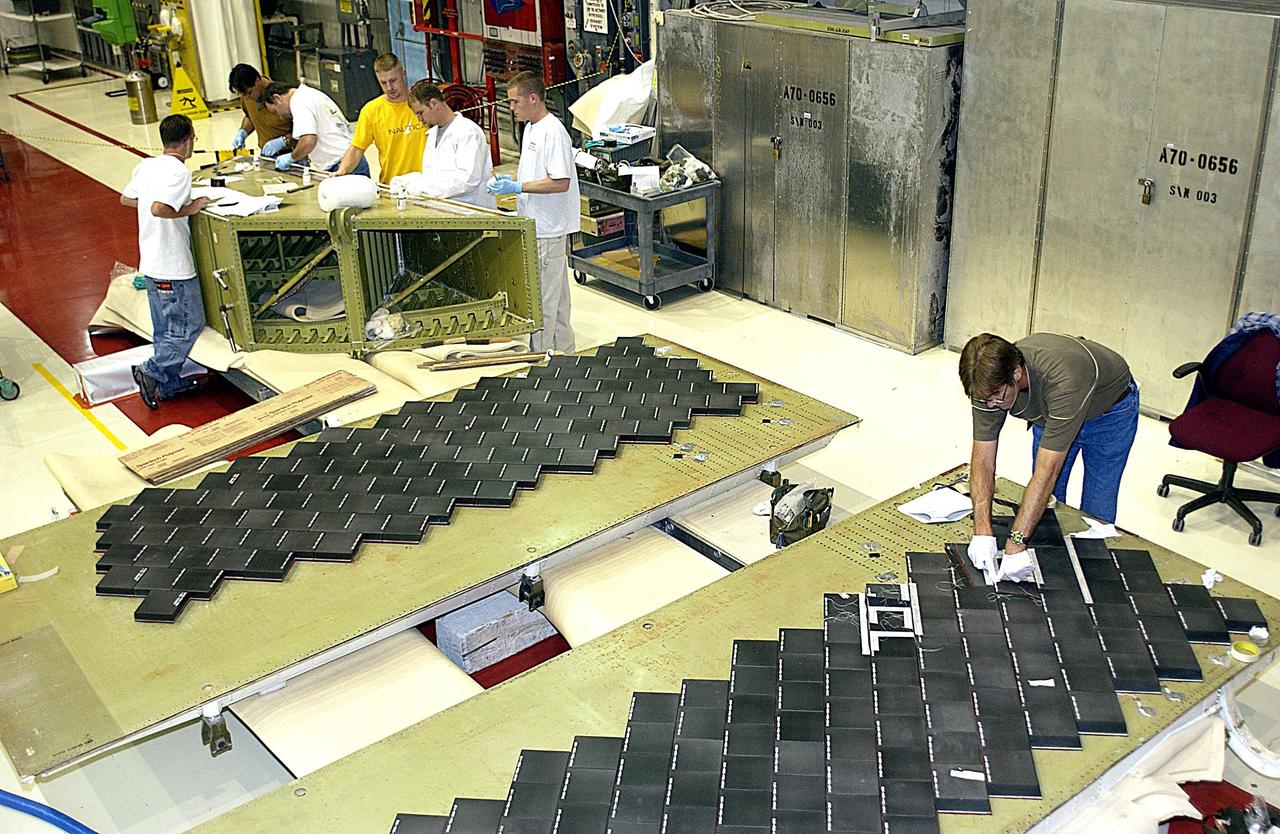
KENNEDY SPACE CENTER, FLA. -- In the Orbiter Processing Facility (OPF), United Space Alliance (USA) employee Harrell Watts (right) installs Thermal Protection System (TPS) tiles on a main landing gear door of Space Shuttle orbiter Enterprise (OV-101). In the background, other USA employees, members of the OPF midbody TPS crew, prepare to install TPS tile on a simulated orbiter wing. The wing and the sections of Enterprise will be transferred to the Southwest Research Institute for testing after the tile installation is complete. The testing has been requested by the Columbia Accident Investigation Board. Sections of Enterprise were borrowed from the Smithsonian Institution's Air and Space Museum where the orbiter is being stored at the Washington Dulles International Airport. Enterprise was the first orbiter built in the Shuttle fleet and was used to conduct the Approach and Landing Test Program before the first powered Shuttle flight.
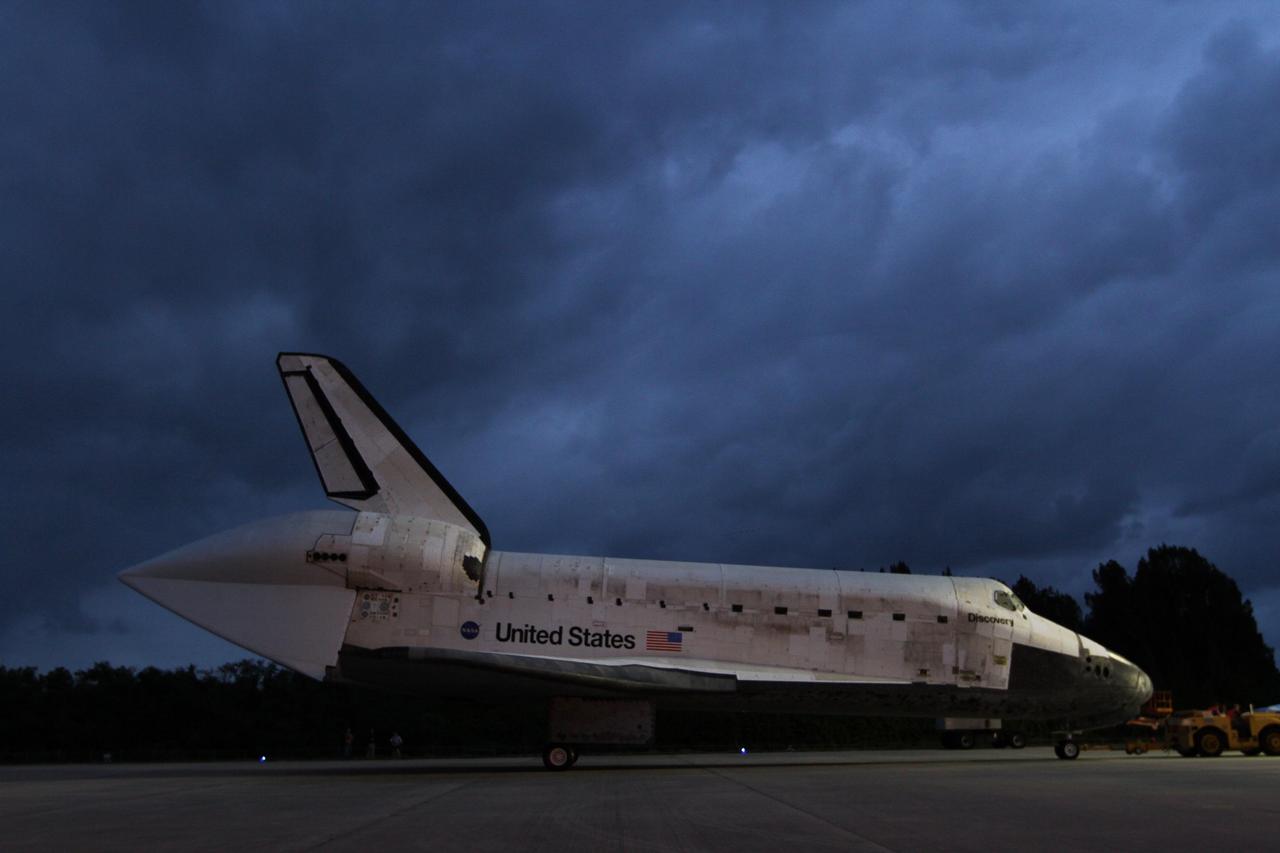
CAPE CANAVERAL, Fla. – Space Shuttle Discovery’s tow from the Vehicle Assembly Building to the Shuttle Landing Facility, or SLF, is complete as the day breaks over NASA’s Kennedy Space Center in Florida. At the SLF, Discovery will be hoisted onto a Shuttle Carrier Aircraft, or SCA, with the aid of a mate-demate device. The SCA, a modified Boeing 747 jet airliner, is scheduled to ferry Discovery to the Washington Dulles International Airport in Virginia on April 17, after which the shuttle will be placed on permanent public display in the Smithsonian's National Air and Space Museum Steven F. Udvar-Hazy Center. For more information on shuttle transition and retirement activities, visit http://www.nasa.gov/transition. Photo credit: NASA/Kim Shiflett
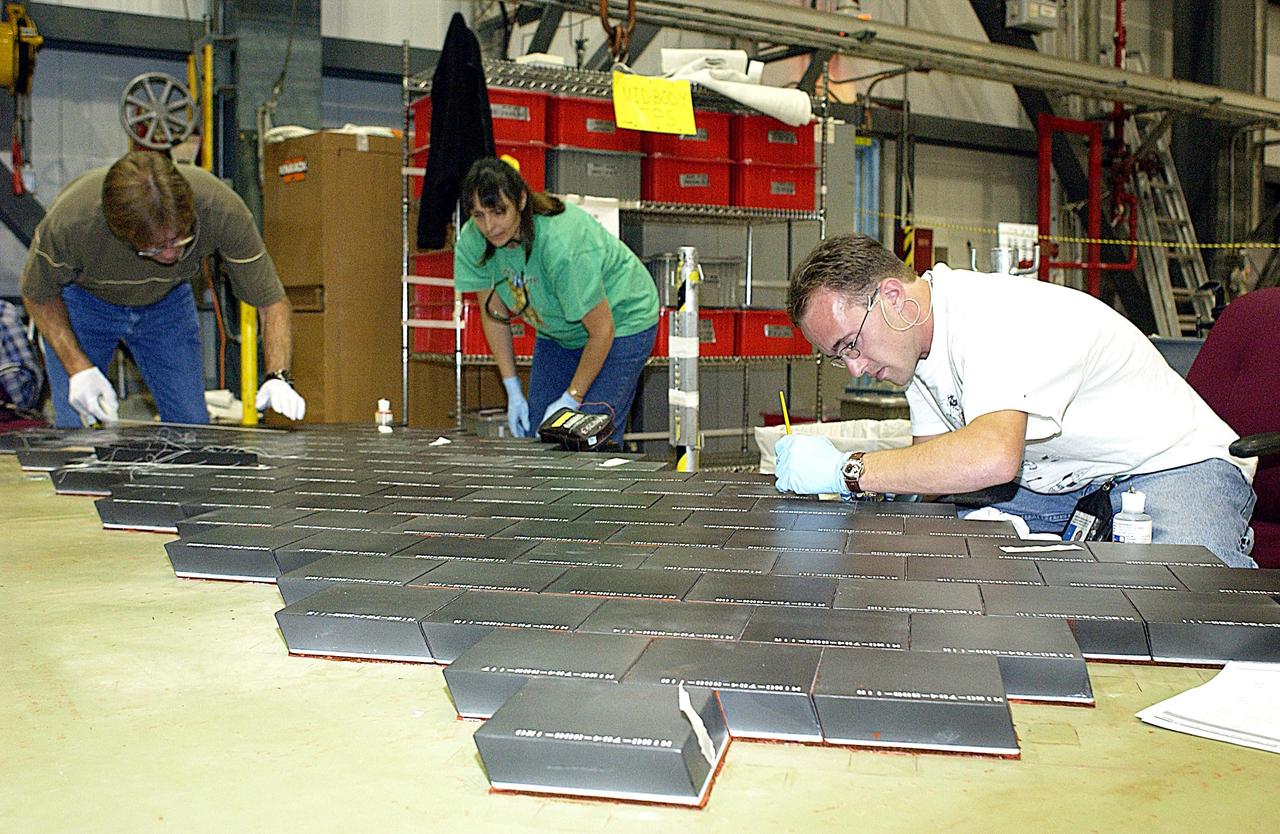
KENNEDY SPACE CENTER, FLA. -- In the Orbiter Processing Facility, United Space Alliance employees (from left) Harrell Watts, Lynn Wozniak, and Jason Levandusky install Thermal Protection System tiles on a main landing gear door of Space Shuttle orbiter Enterprise (OV-101). Sections of Enterprise were borrowed from the Smithsonian Institution's Air and Space Museum where the orbiter is being stored at the Washington Dulles International Airport. Enterprise was the first orbiter built in the Shuttle fleet and was used to conduct the Approach and Landing Test Program before the first powered Shuttle flight. After the tile installation is complete, the sections will be transferred to the Southwest Research Institute for testing requested by the Columbia Accident Investigation Board.
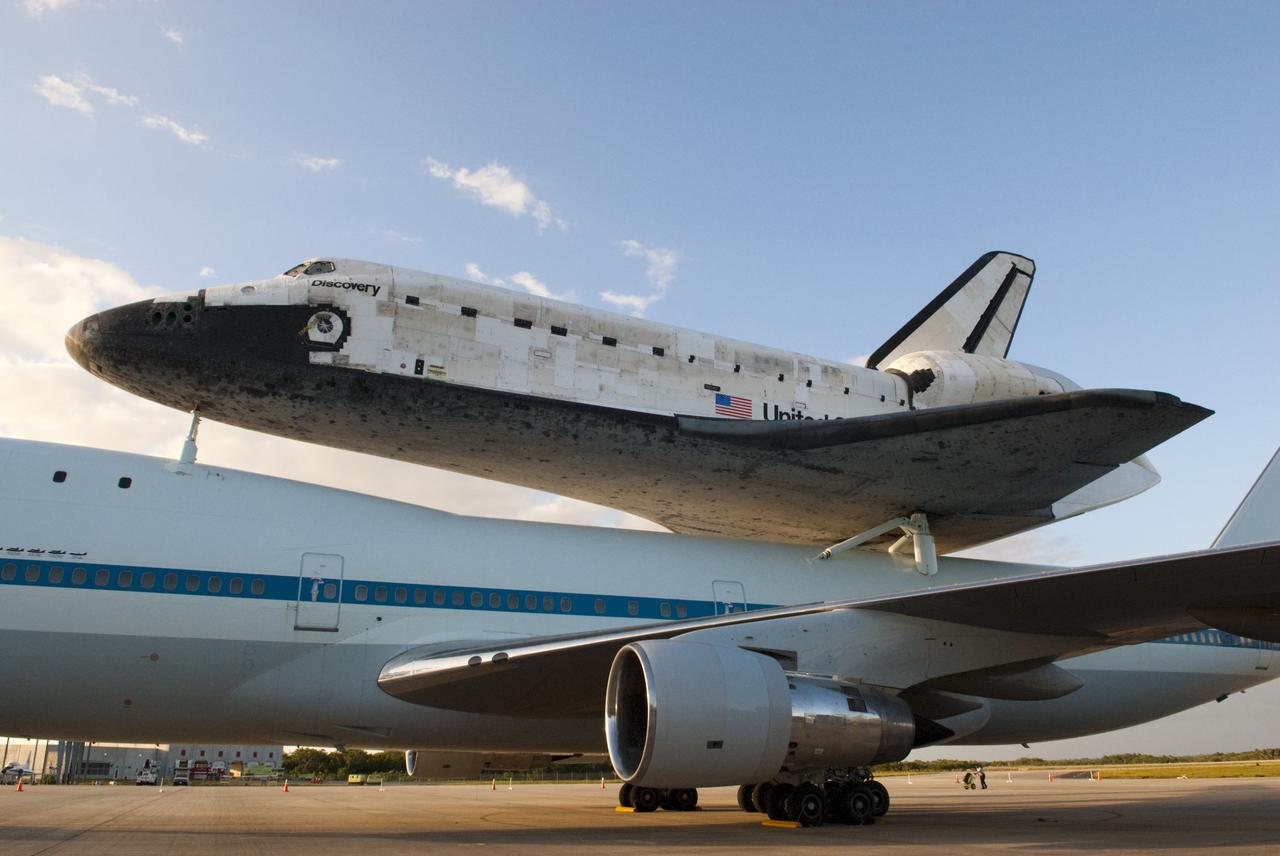
CAPE CANAVERAL, Fla. – At the Shuttle Landing Facility at NASA’s Kennedy Space Center in Florida, space shuttle Discovery is firmly attached to the back of a Shuttle Carrier Aircraft, awaiting departure from Kennedy in the morning. The aircraft, also known as an SCA, is a Boeing 747 jet, originally manufactured for commercial use, which was modified by NASA to transport the shuttles between destinations on Earth. The SCA designated NASA 905 is assigned to the remaining ferry missions, delivering the shuttles to their permanent public display sites. NASA 905 is scheduled to ferry Discovery to the Washington Dulles International Airport in Virginia on April 17, after which the shuttle will be placed on display in the Smithsonian's National Air and Space Museum Steven F. Udvar-Hazy Center. For more information on the SCA, visit http://www.nasa.gov/centers/dryden/news/FactSheets/FS-013-DFRC.html. For more information on shuttle transition and retirement activities, visit http://www.nasa.gov/transition. Photo credit: NASA/Tim Jacobs
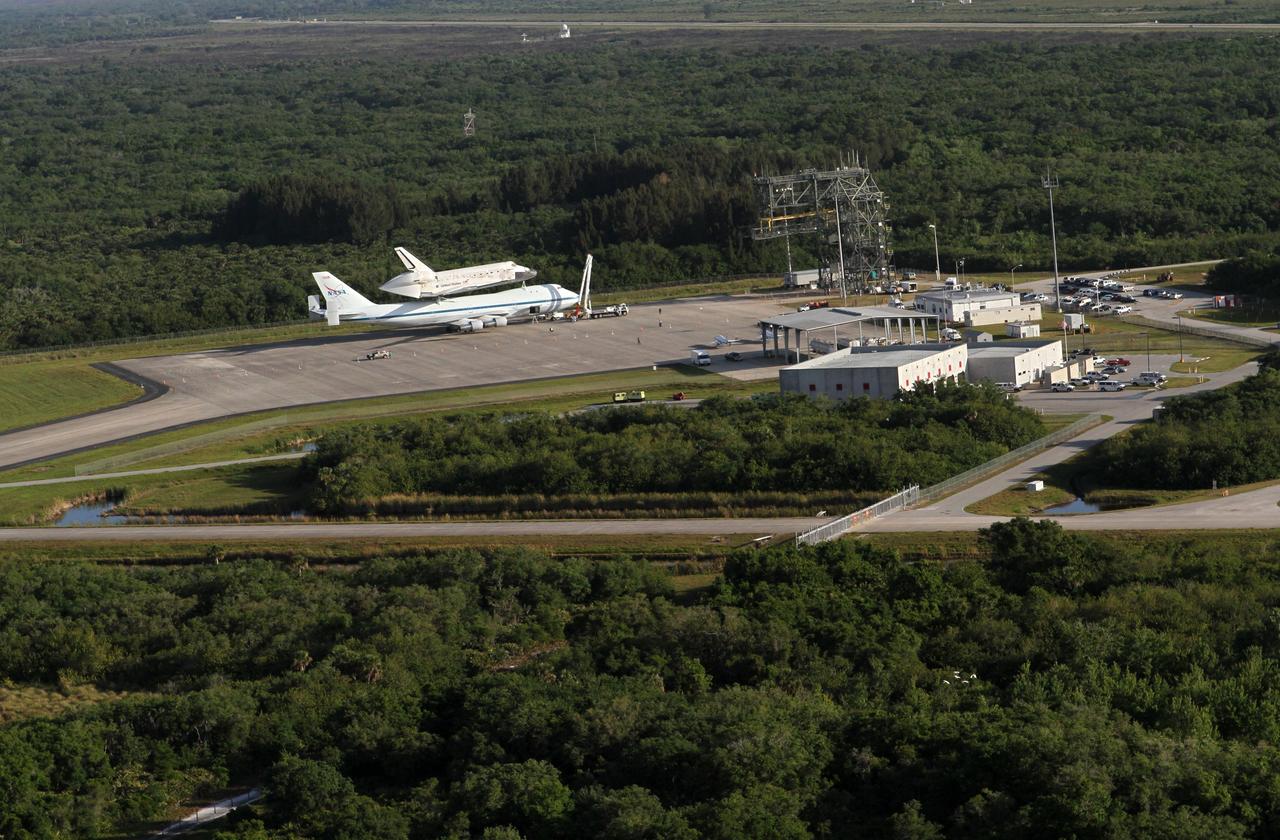
CAPE CANAVERAL, Fla. – This is an aerial view of space shuttle Discovery bolted to the top of a Shuttle Carrier Aircraft SCA on the ramp of the Shuttle Landing Facility SLF at NASA’s Kennedy Space Center in Florida. Discovery's last crew members are expected to be at the SLF, along with Kennedy employees and guests, as the center says goodbye to the agency's most-flown shuttle on April 17. The SCA, designated NASA 905, will ferry Discovery to the Washington Dulles International Airport in Virginia, after which the shuttle will be moved for public display in the Smithsonian's National Air and Space Museum Steven F. Udvar-Hazy Center on April 19. For more information on the SCA, visit http://www.nasa.gov/centers/dryden/news/FactSheets/FS-013-DFRC.html. For more information on shuttle transition and retirement activities, visit http://www.nasa.gov/transition. Photo credit: NASA/Kim Shiflett
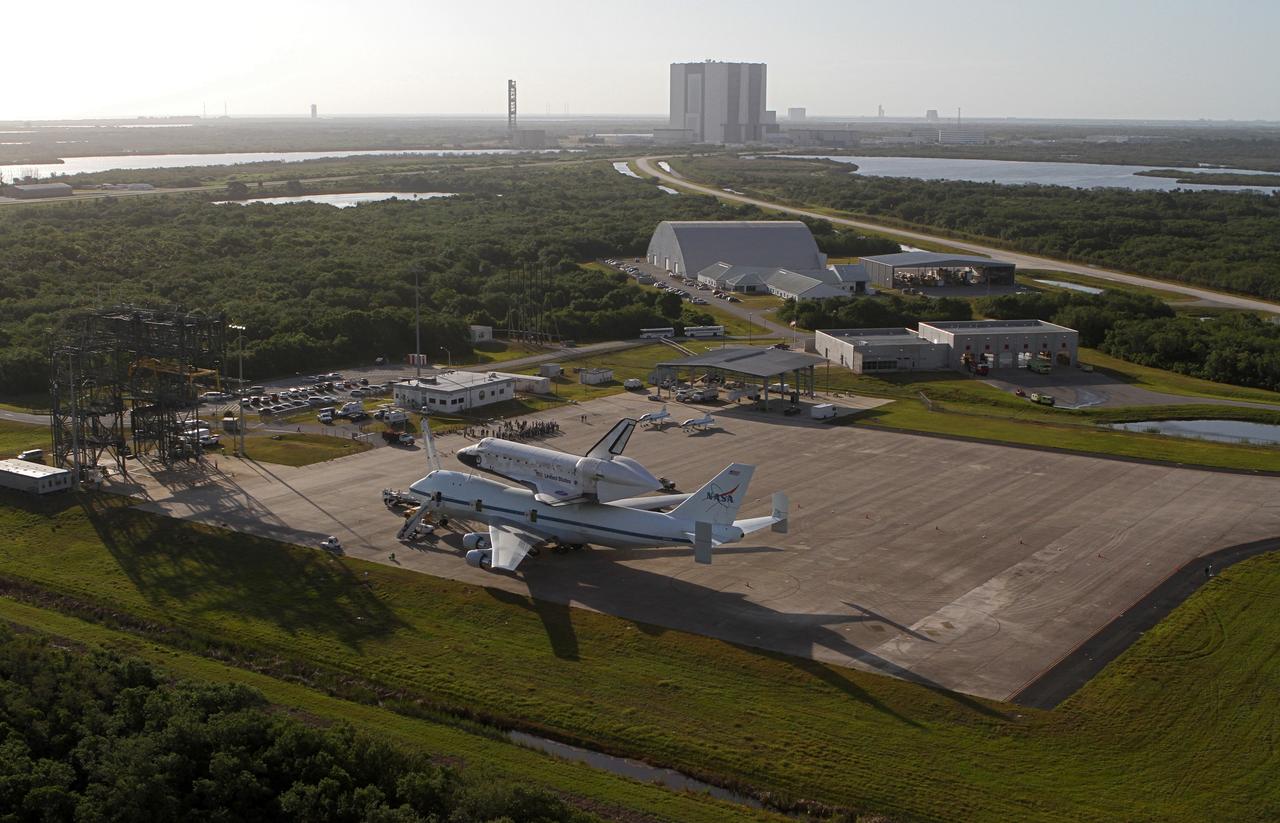
CAPE CANAVERAL, Fla. – This is an aerial view of space shuttle Discovery bolted to the top of a Shuttle Carrier Aircraft SCA on the ramp of the Shuttle Landing Facility SLF at NASA’s Kennedy Space Center in Florida. Discovery's last crew members are expected to be at the SLF, along with Kennedy employees and guests, as the center says goodbye to the agency's most-flown shuttle on April 17. The SCA, designated NASA 905, will ferry Discovery to the Washington Dulles International Airport in Virginia, after which the shuttle will be moved for public display in the Smithsonian's National Air and Space Museum Steven F. Udvar-Hazy Center on April 19. For more information on the SCA, visit http://www.nasa.gov/centers/dryden/news/FactSheets/FS-013-DFRC.html. For more information on shuttle transition and retirement activities, visit http://www.nasa.gov/transition. Photo credit: NASA/Kim Shiflett
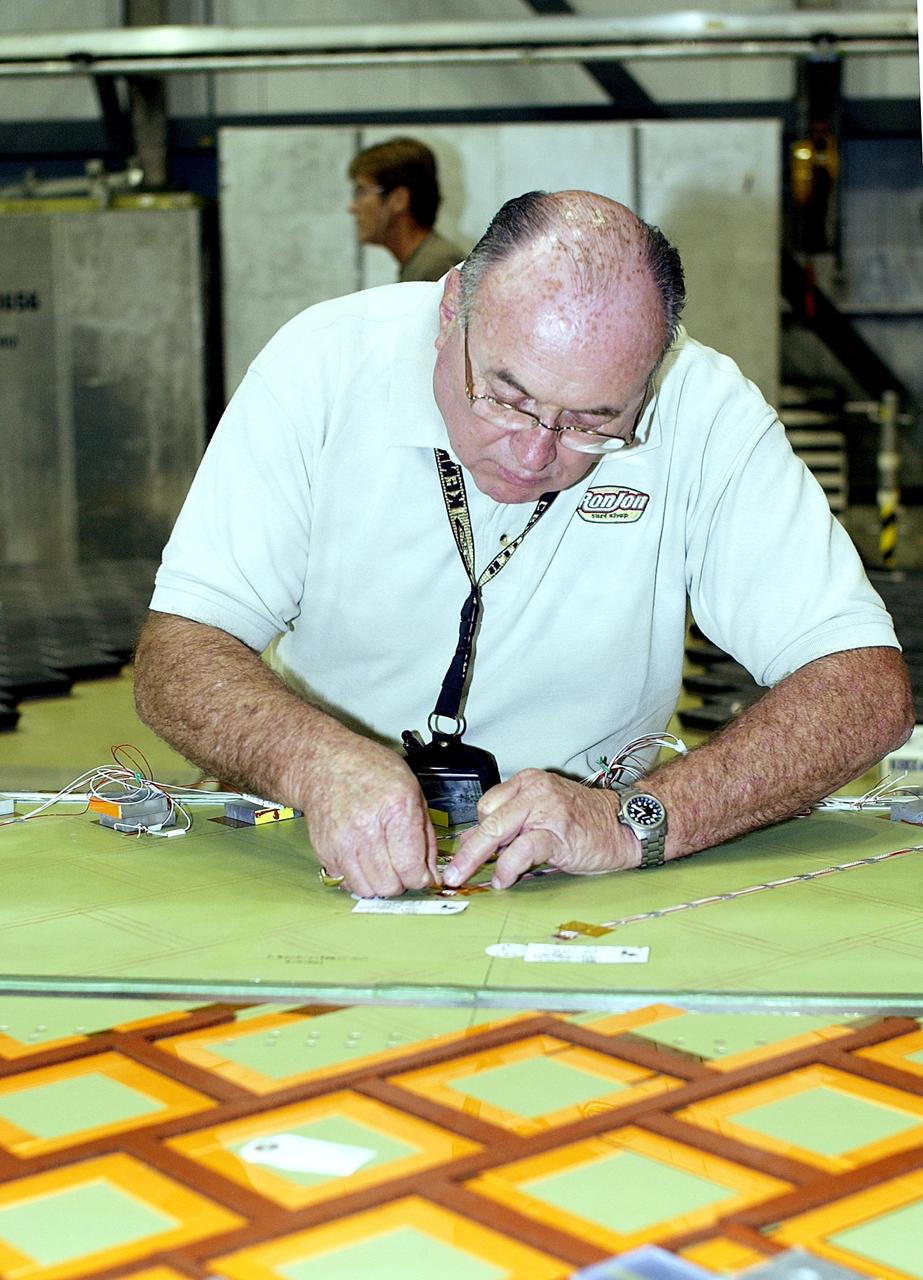
KENNEDY SPACE CENTER, FLA. -- In the Orbiter Processing Facility, an employee from The Boeing Co., Huntington Beach, Calif., installs a strain gauge on a test panel prior to installation of Thermal Protection System tile on the panel. The test panel and sections of Space Shuttle orbiter Enterprise (OV-101) will be transferred to the Southwest Research Institute for testing after the tile installation is complete. The testing has been requested by the Columbia Accident Investigation Board. Sections of Enterprise were borrowed from the Smithsonian Institution's Air and Space Museum where the orbiter is being stored at the Washington Dulles International Airport. Enterprise was the first orbiter built in the Shuttle fleet and was used to conduct the Approach and Landing Test Program before the first powered Shuttle flight.
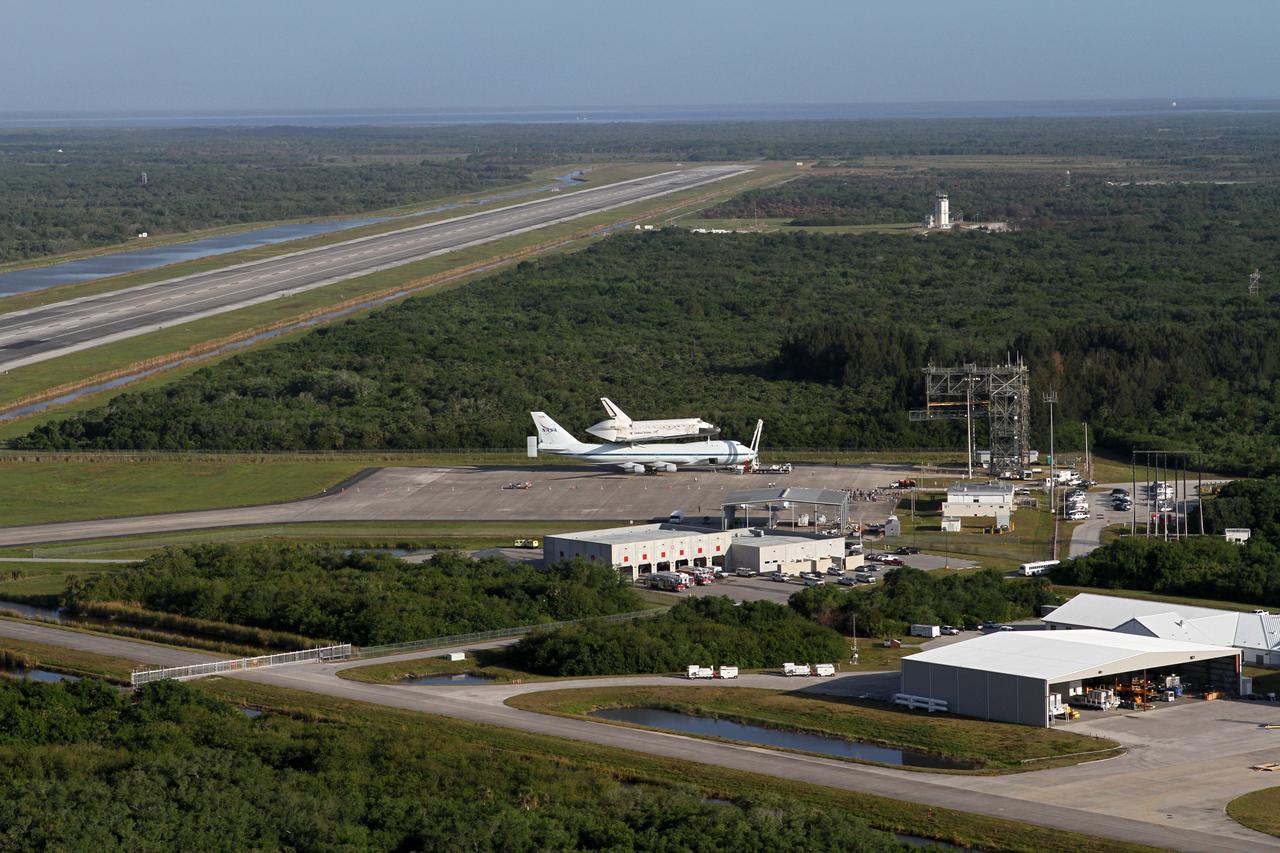
CAPE CANAVERAL, Fla. – This is an aerial view of the long Shuttle Landing Facility SLF runway at NASA's Kennedy Space Center in Florida that space shuttle Discovery, bolted to the top of a Shuttle Carrier Aircraft SCA, will take off from on April 17. Discovery's last crew members are expected to be at the runway, along with Kennedy employees and guests, as the center says goodbye to the agency's most-flown shuttle. The SCA, designated NASA 905, will ferry Discovery to the Washington Dulles International Airport in Virginia, after which the shuttle will be moved for public display in the Smithsonian's National Air and Space Museum Steven F. Udvar-Hazy Center on April 19. For more information on the SCA, visit http://www.nasa.gov/centers/dryden/news/FactSheets/FS-013-DFRC.html. For more information on shuttle transition and retirement activities, visit http://www.nasa.gov/transition. Photo credit: NASA/Kim Shiflett
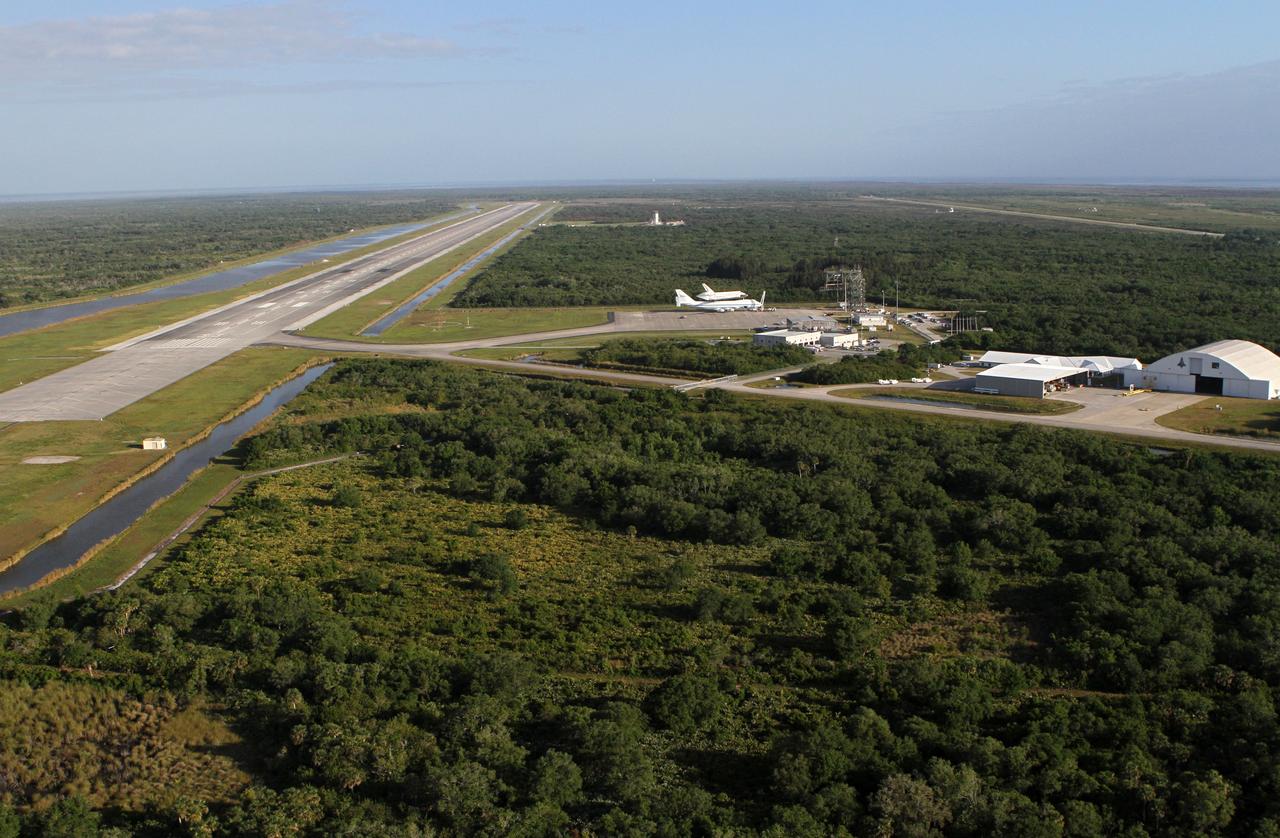
CAPE CANAVERAL, Fla. – This is an aerial view of the long Shuttle Landing Facility SLF runway at NASA's Kennedy Space Center in Florida that space shuttle Discovery, bolted to the top of a Shuttle Carrier Aircraft SCA, will take off from on April 17. Discovery's last crew members are expected to be at the runway, along with Kennedy employees and guests, as the center says goodbye to the agency's most-flown shuttle. The SCA, designated NASA 905, will ferry Discovery to the Washington Dulles International Airport in Virginia, after which the shuttle will be moved for public display in the Smithsonian's National Air and Space Museum Steven F. Udvar-Hazy Center on April 19. For more information on the SCA, visit http://www.nasa.gov/centers/dryden/news/FactSheets/FS-013-DFRC.html. For more information on shuttle transition and retirement activities, visit http://www.nasa.gov/transition. Photo credit: NASA/Kim Shiflett
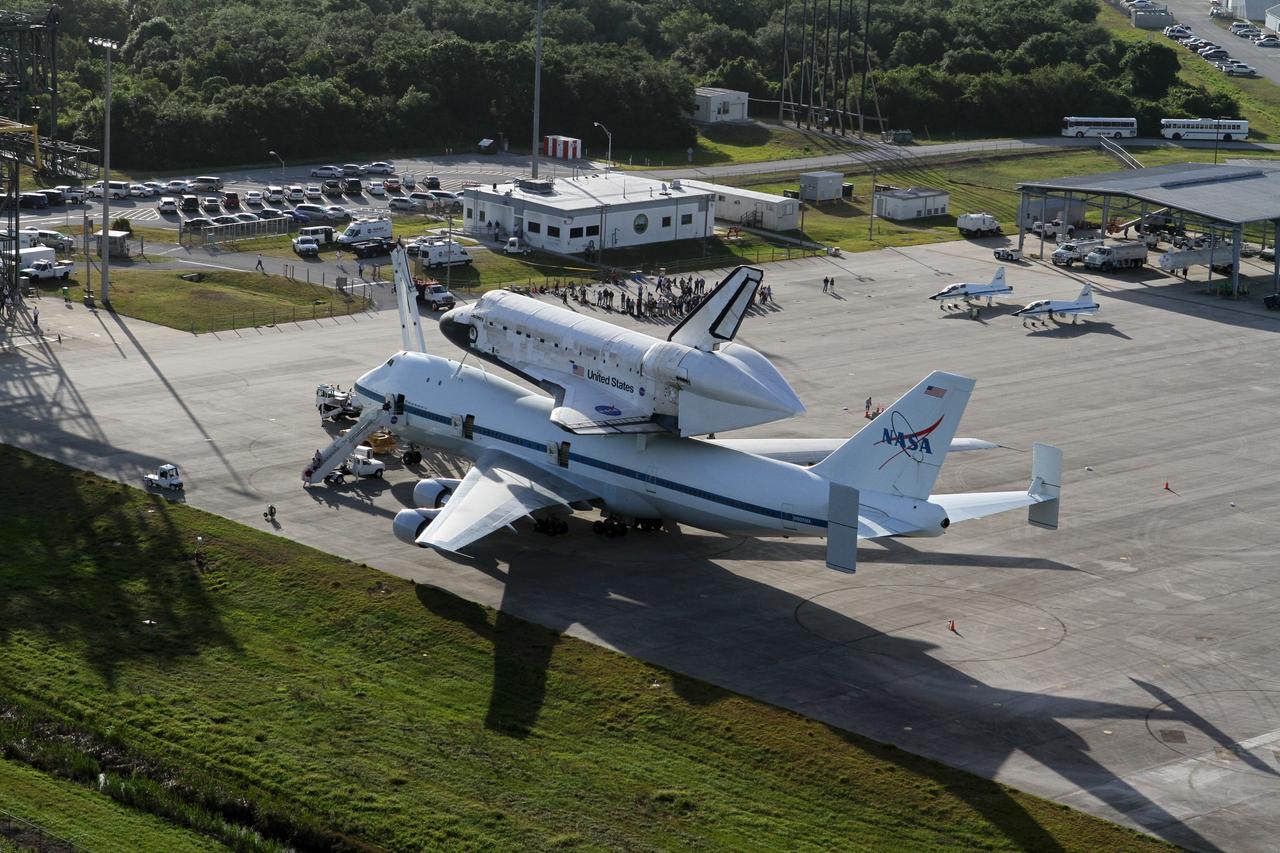
CAPE CANAVERAL, Fla. – This is an aerial view of space shuttle Discovery bolted to the top of a Shuttle Carrier Aircraft SCA on the ramp of the Shuttle Landing Facility SLF at NASA’s Kennedy Space Center in Florida. Also on the ramp is a pair of T-38 training jets. Discovery's last crew members are expected to be at the SLF, along with Kennedy employees and guests, as the center says goodbye to the agency's most-flown shuttle on April 17. The SCA, designated NASA 905, will ferry Discovery to the Washington Dulles International Airport in Virginia, after which the shuttle will be moved for public display in the Smithsonian's National Air and Space Museum Steven F. Udvar-Hazy Center on April 19. For more information on the SCA, visit http://www.nasa.gov/centers/dryden/news/FactSheets/FS-013-DFRC.html. For more information on shuttle transition and retirement activities, visit http://www.nasa.gov/transition. Photo credit: NASA/Kim Shiflett
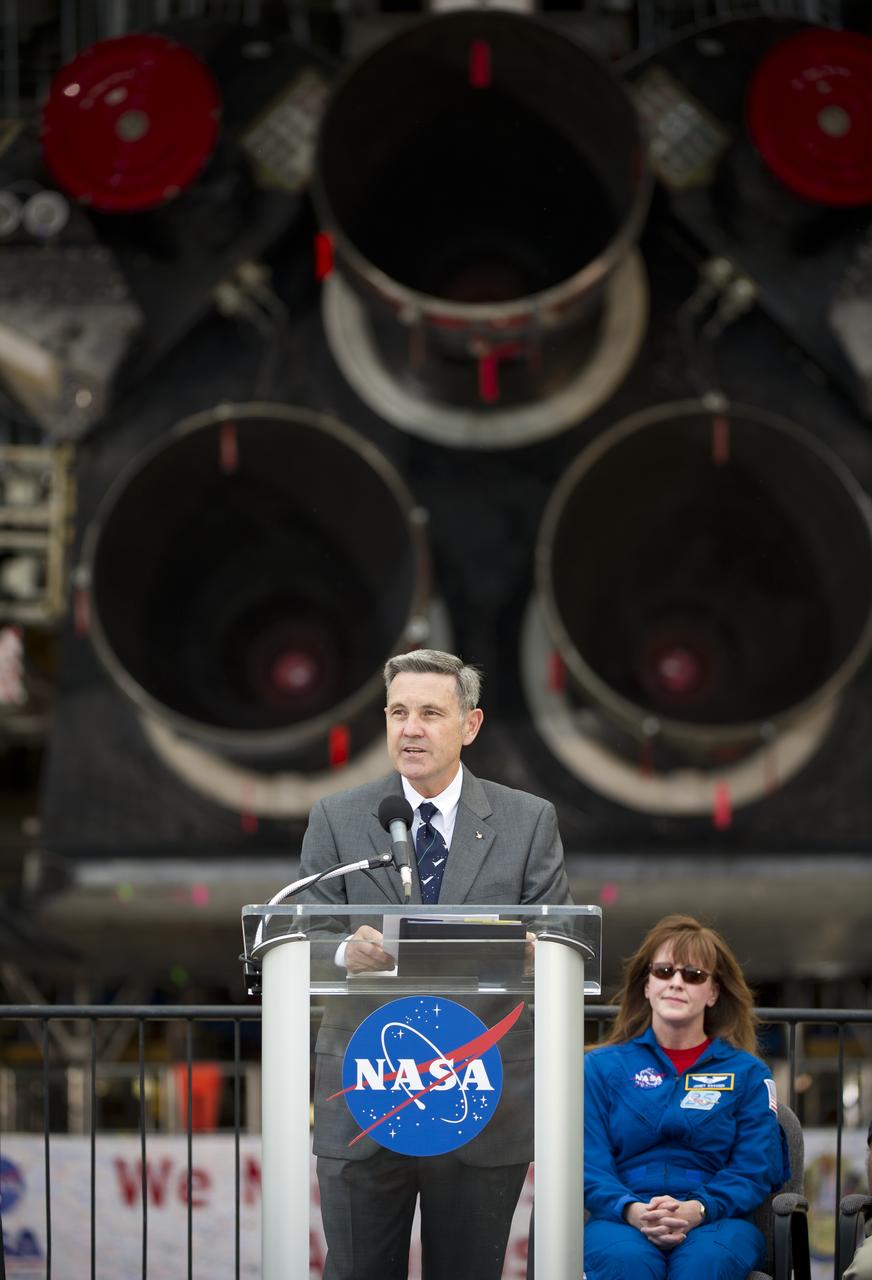
NASA Kennedy Space Center Director and former astronaut Bob Cabana introduces NASA Administrator Charles Bolden where Bolden announced where four space shuttle orbiters will be permanently displayed at the conclusion of the Space Shuttle Program during an event held at one of the Orbiter Processing Facilities, Tuesday, April 12, 2011, at Kennedy Space Center in Cape Canaveral, Fla. The four orbiters, Enterprise, which currently is on display at the Smithsonian's Steven F. Udvar-Hazy Center near Washington Dulles International Airport, will move to the Intrepid Sea, Air & Space Museum in New York, Discovery will move to Udvar-Hazy, Endeavour will be displayed at the California Science Center in Los Angeles and Atlantis, in background, will be displayed at the Kennedy Space Center Visitor’s Complex. Photo Credit: (NASA/Bill Ingalls)
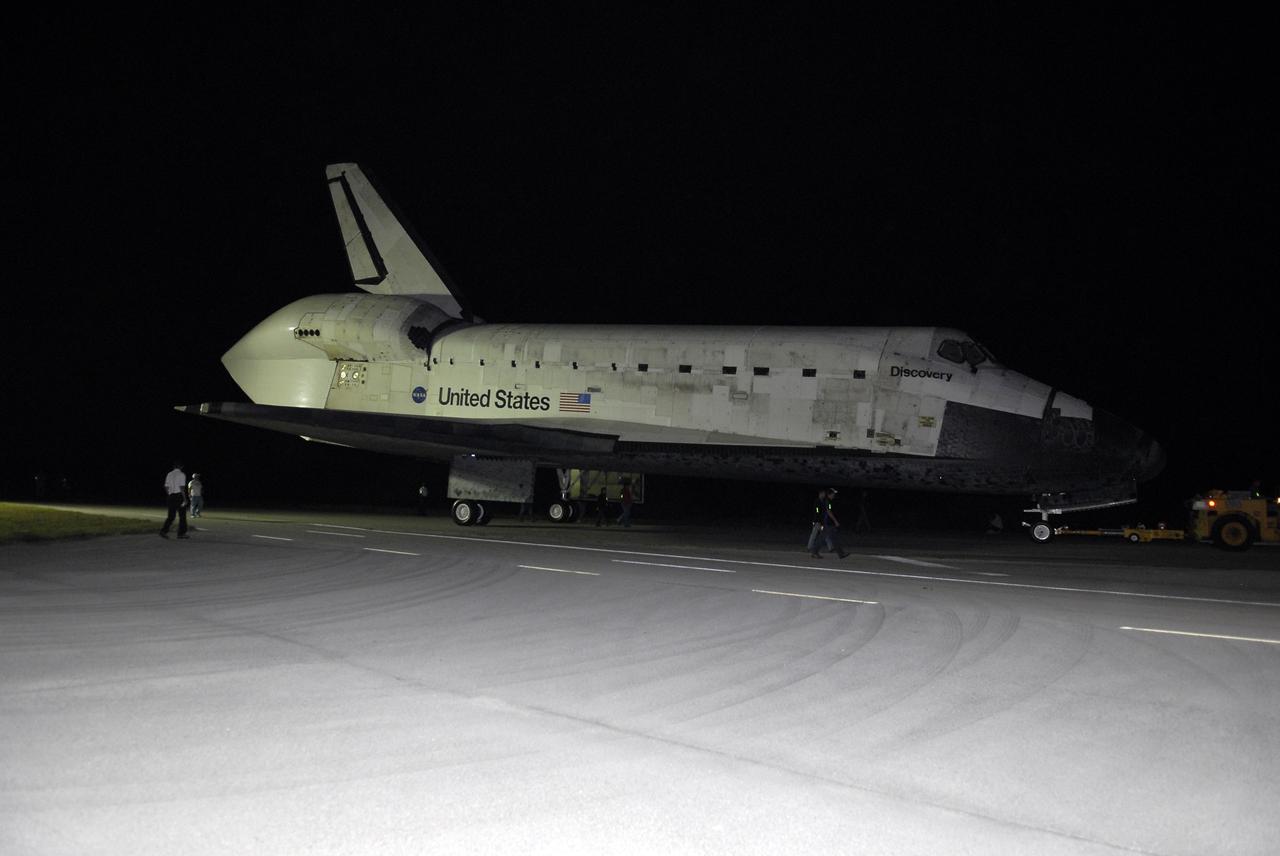
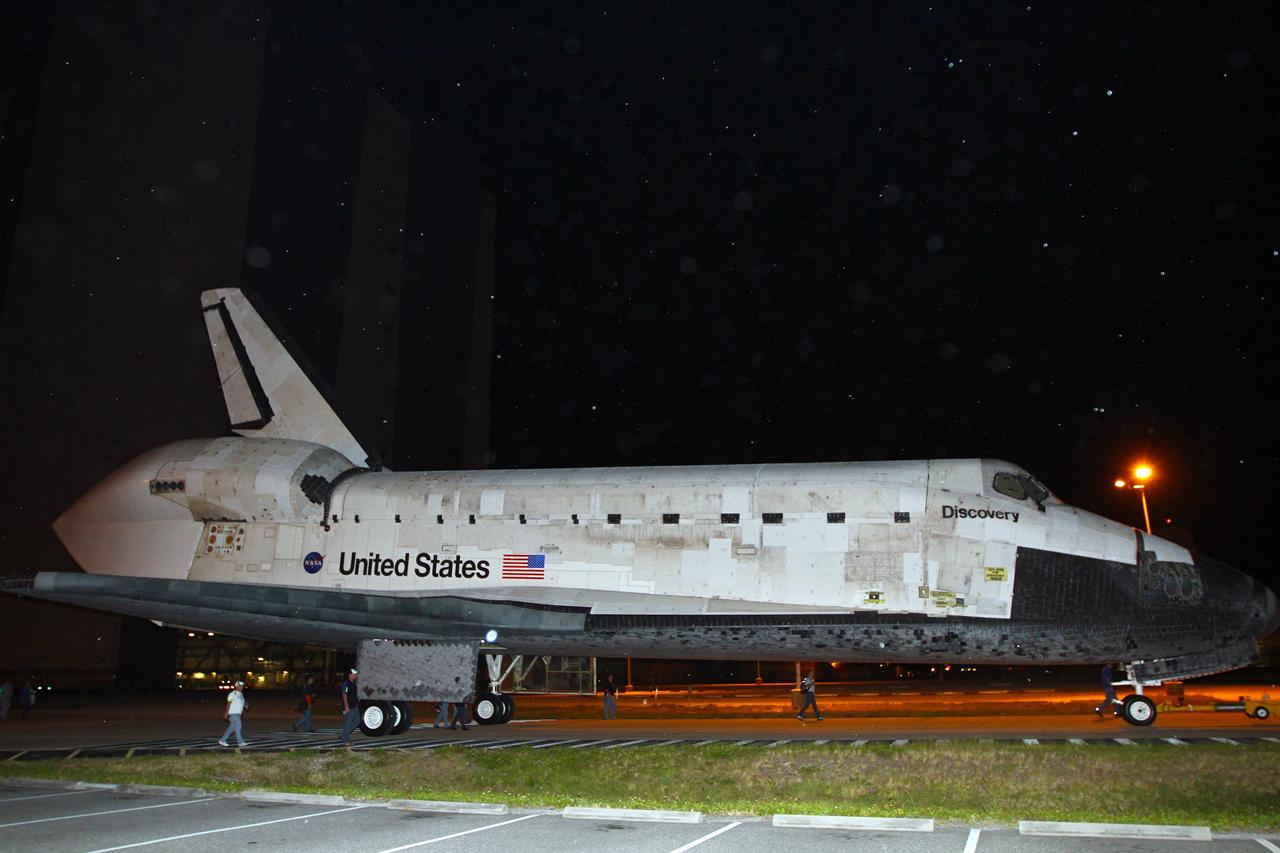
CAPE CANAVERAL, Fla. – Space shuttle Discovery is towed along the access road to the Shuttle Landing Facility, or SLF, at NASA’s Kennedy Space Center in Florida. A tail cone has been installed over its three replica shuttle main engines to reduce aerodynamic drag and turbulence during its upcoming ferry flight. At the SLF, Discovery will be hoisted onto a Shuttle Carrier Aircraft, or SCA, with the aid of a mate-demate device. The SCA, a modified Boeing 747 jet airliner, is scheduled to ferry Discovery to the Washington Dulles International Airport in Virginia on April 17, after which the shuttle will be placed on permanent public display in the Smithsonian's National Air and Space Museum Steven F. Udvar-Hazy Center. For more information on shuttle transition and retirement activities, visit http://www.nasa.gov/transition. Photo credit: NASA/Tim Jacobs
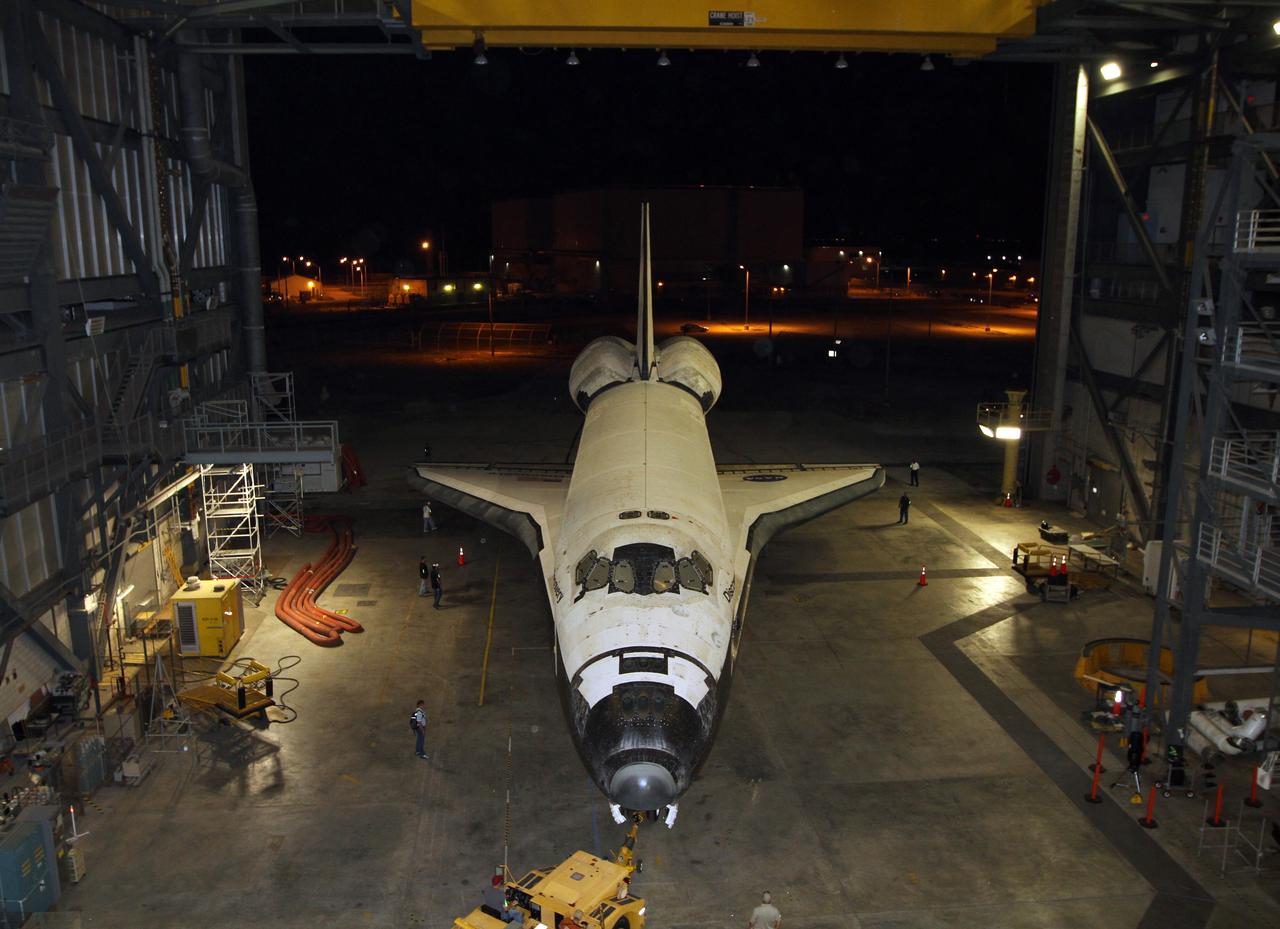
CAPE CANAVERAL, Fla. – Space shuttle Discovery rolls out of the Vehicle Assembly Building, or VAB, at NASA’s Kennedy Space Center in Florida, into darkness for its trip to the Shuttle Landing Facility, or SLF. Its move got under way at 5 a.m. EDT. Discovery was in storage in the VAB’s high bay 4 awaiting departure from Kennedy’s Launch Complex 39 area for the final time. At the SLF, Discovery will be hoisted onto a Shuttle Carrier Aircraft, or SCA, with the aid of a mate-demate device. The SCA, a modified Boeing 747 jet airliner, is scheduled to transport Discovery to the Washington Dulles International Airport in Virginia on April 17, after which the shuttle will be placed on permanent public display in the Smithsonian's National Air and Space Museum Steven F. Udvar-Hazy Center. For more information on shuttle transition and retirement activities, visit http://www.nasa.gov/transition. Photo credit: NASA/Kim Shiflett
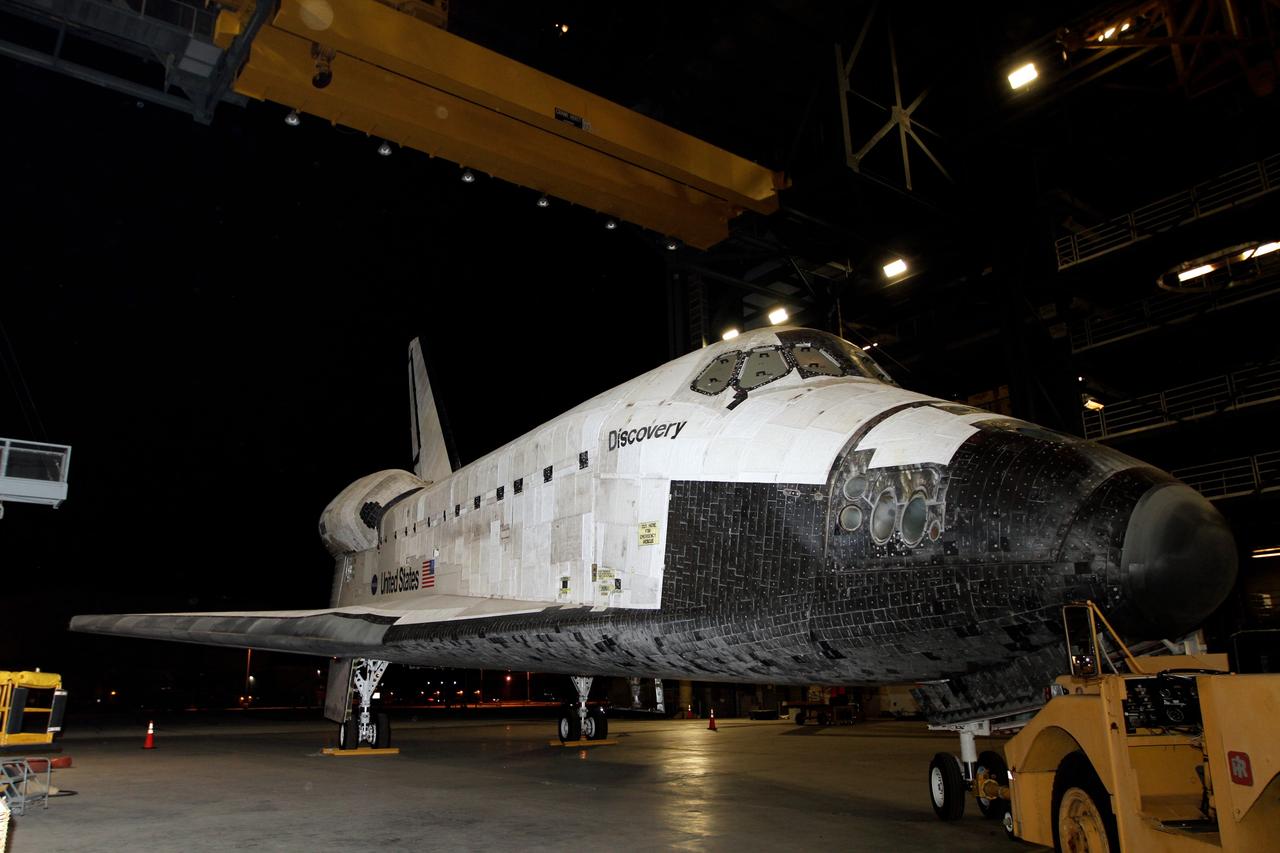
CAPE CANAVERAL, Fla. – Preparations to tow space shuttle Discovery from the Vehicle Assembly Building, or VAB, to the Shuttle Landing Facility, or SLF, are under way at NASA’s Kennedy Space Center in Florida. Discovery was in storage in the VAB’s high bay 4 awaiting departure from Kennedy’s Launch Complex 39 area for the final time. At the SLF, Discovery will be hoisted onto a Shuttle Carrier Aircraft, or SCA, with the aid of a mate-demate device. The SCA, a modified Boeing 747 jet airliner, is scheduled to transport Discovery to the Washington Dulles International Airport in Virginia on April 17, after which the shuttle will be placed on permanent public display in the Smithsonian's National Air and Space Museum Steven F. Udvar-Hazy Center. For more information on shuttle transition and retirement activities, visit http://www.nasa.gov/transition. Photo credit: NASA/Kim Shiflett
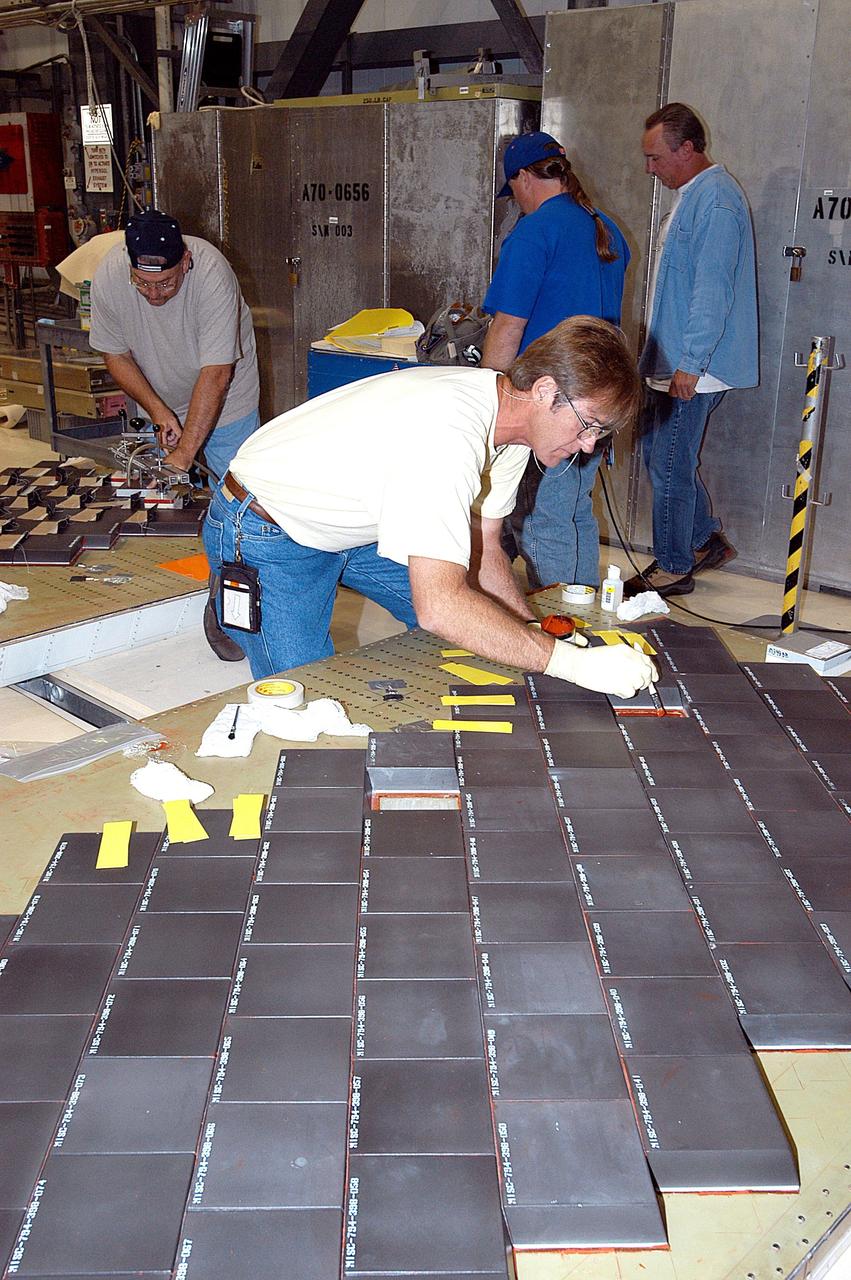
KENNEDY SPACE CENTER, FLA. -- In the Orbiter Processing Facility, United Space Alliance employee Harrell Watts applies RTV, a room-temperature vulcanizing silicone adhesive, to a main landing gear door of Space Shuttle orbiter Enterprise (OV-101) on which Thermal Protection System tiles are being installed. Sections of Enterprise were borrowed from the Smithsonian Institution's Air and Space Museum where the orbiter is being stored at the Washington Dulles International Airport. Enterprise was the first orbiter built in the Shuttle fleet and was used to conduct the Approach and Landing Test Program before the first powered Shuttle flight. After the tile installation is complete, the sections will be transferred to the Southwest Research Institute for testing requested by the Columbia Accident Investigation Board.
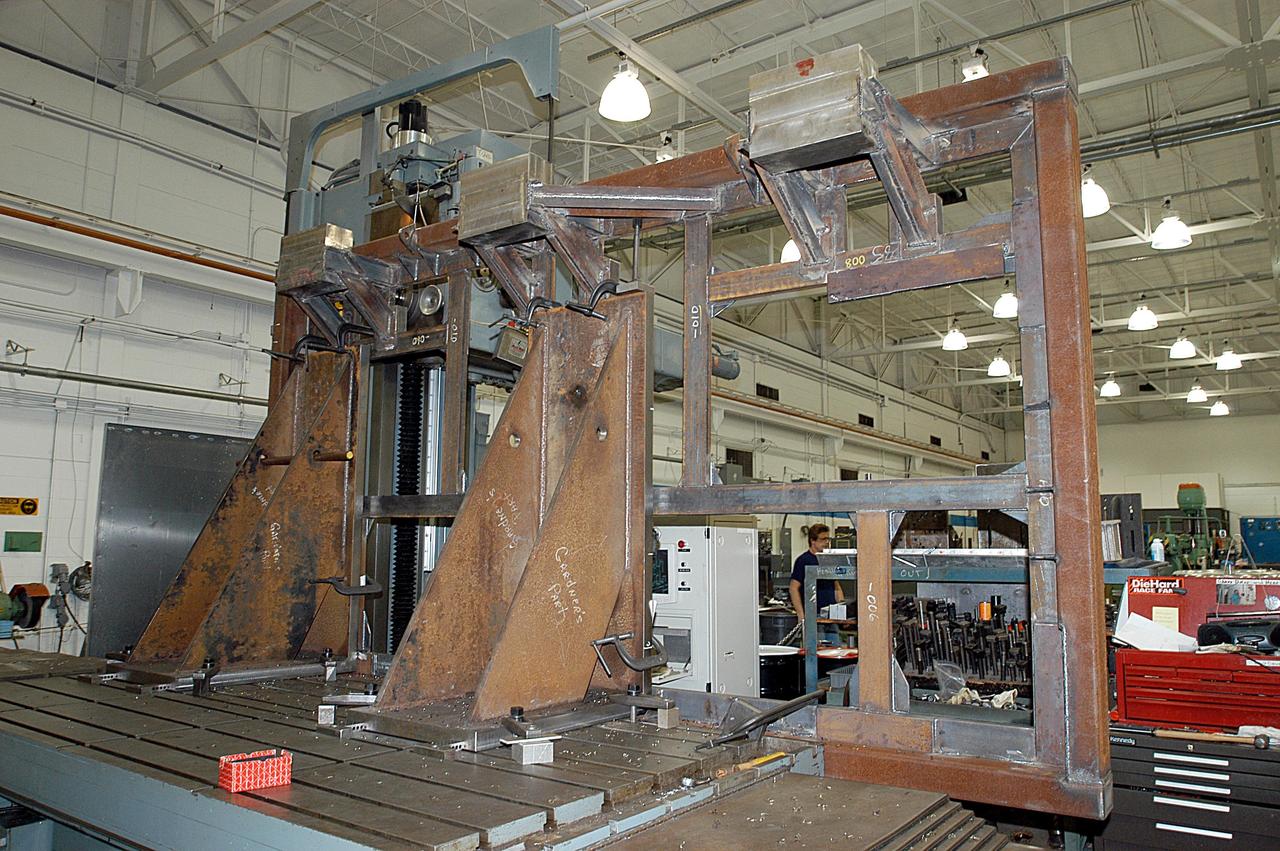
KENNEDY SPACE CENTER, FLA. -- A main landing gear door mounting fixture in the Launch Equipment Shop is being used to support the Columbia mishap investigation. A simulated orbiter wing and several test panels, along with sections of Space Shuttle orbiter Enterprise (OV-101), will be transferred to the Southwest Research Institute for testing after Thermal Protection System (TPS) tile installation is complete. The testing has been requested by the Columbia Accident Investigation Board. For this initiative, sections of Enterprise were borrowed from the Smithsonian Institution's Air and Space Museum where the orbiter is being stored at the Washington Dulles International Airport. Enterprise was the first orbiter built in the Shuttle fleet and was used to conduct the Approach and Landing Test Program before the first powered Shuttle flight.
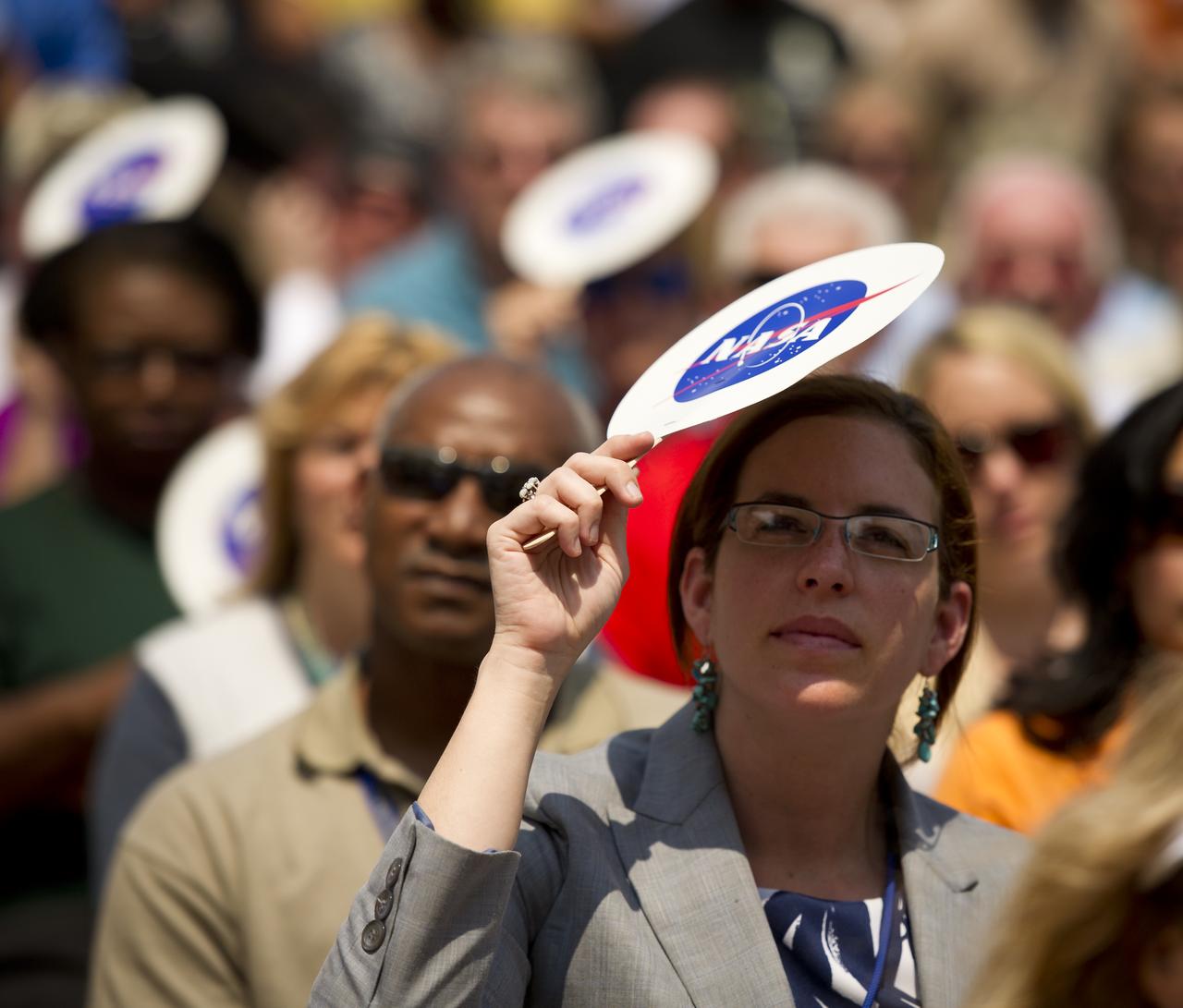
Workers at the NASA Kennedy Space Center listen as NASA Administrator Charles Bolden announces where four space shuttle orbiters will be permanently displayed at the conclusion of the Space Shuttle Program during an event held at one of the Orbiter Processing Facilities, Tuesday, April 12, 2011, at Kennedy Space Center in Cape Canaveral, Fla. The four orbiters, Enterprise, which currently is on display at the Smithsonian's Steven F. Udvar-Hazy Center near Washington Dulles International Airport, will move to the Intrepid Sea, Air & Space Museum in New York, Discovery will move to Udvar-Hazy, Endeavour will be displayed at the California Science Center in Los Angeles and Atlantis, in background, will be displayed at the Kennedy Space Center Visitor’s Complex. Photo Credit: (NASA/Bill Ingalls)
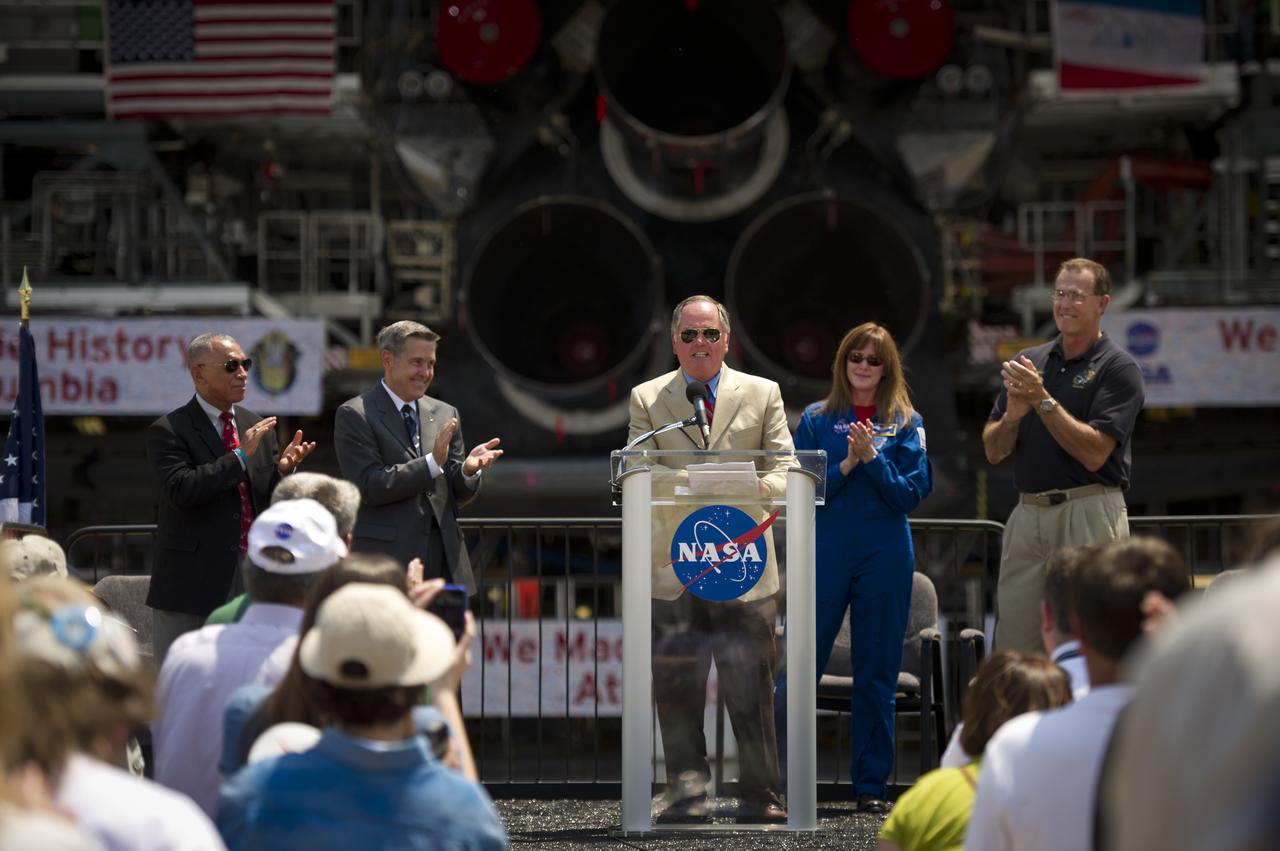
Pilot of the first space shuttle mission, STS-1, Bob Crippen speaks at an event where NASA Administrator Charles Bolden announced where four space shuttle orbiters will be permanently displayed at the conclusion of the Space Shuttle Program, Tuesday, April 12, 2011, at Kennedy Space Center in Cape Canaveral, Fla. The four orbiters, Enterprise, which currently is on display at the Smithsonian's Steven F. Udvar-Hazy Center near Washington Dulles International Airport, will move to the Intrepid Sea, Air & Space Museum in New York, Discovery will move to Udvar-Hazy, Endeavour will be displayed at the California Science Center in Los Angeles and Atlantis, in background, will be displayed at the Kennedy Space Center Visitor’s Complex. Photo Credit: (NASA/Bill Ingalls)

CAPE CANAVERAL, Fla. – Space shuttle Discovery makes its way to the Shuttle Landing Facility, or SLF, before dawn at NASA’s Kennedy Space Center in Florida. Its move from the Vehicle Assembly Building got under way at 5 a.m. EDT. At the SLF, Discovery will be hoisted onto a Shuttle Carrier Aircraft, or SCA, with the aid of a mate-demate device. The SCA, a modified Boeing 747 jet airliner, is scheduled to ferry Discovery to the Washington Dulles International Airport in Virginia on April 17, after which the shuttle will be placed on permanent public display in the Smithsonian's National Air and Space Museum Steven F. Udvar-Hazy Center. For more information on shuttle transition and retirement activities, visit http://www.nasa.gov/transition. Photo credit: NASA/Dimitri Gerondidakis
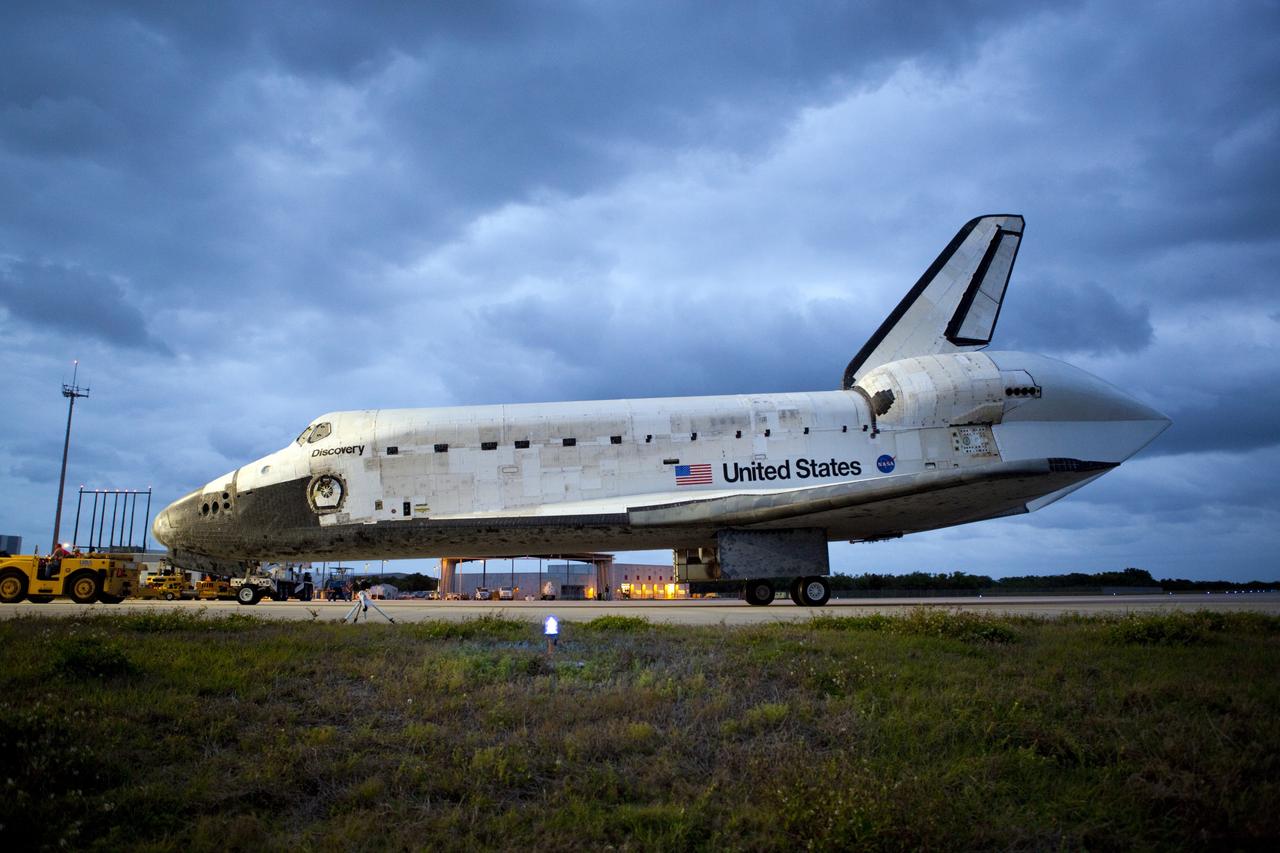
CAPE CANAVERAL, Fla. – Space Shuttle Discovery’s move from the Vehicle Assembly Building to the Shuttle Landing Facility, or SLF, is complete as the sun comes up over NASA’s Kennedy Space Center in Florida. A tail cone has been installed over its three replica shuttle main engines to reduce aerodynamic drag and turbulence during its upcoming ferry flight. At the SLF, Discovery will be hoisted onto a Shuttle Carrier Aircraft, or SCA, with the aid of a mate-demate device. The SCA, a modified Boeing 747 jet airliner, is scheduled to ferry Discovery to the Washington Dulles International Airport in Virginia on April 17, after which the shuttle will be placed on permanent public display in the Smithsonian's National Air and Space Museum Steven F. Udvar-Hazy Center. For more information on shuttle transition and retirement activities, visit http://www.nasa.gov/transition. Photo credit: NASA/Dimitri Gerondidakis
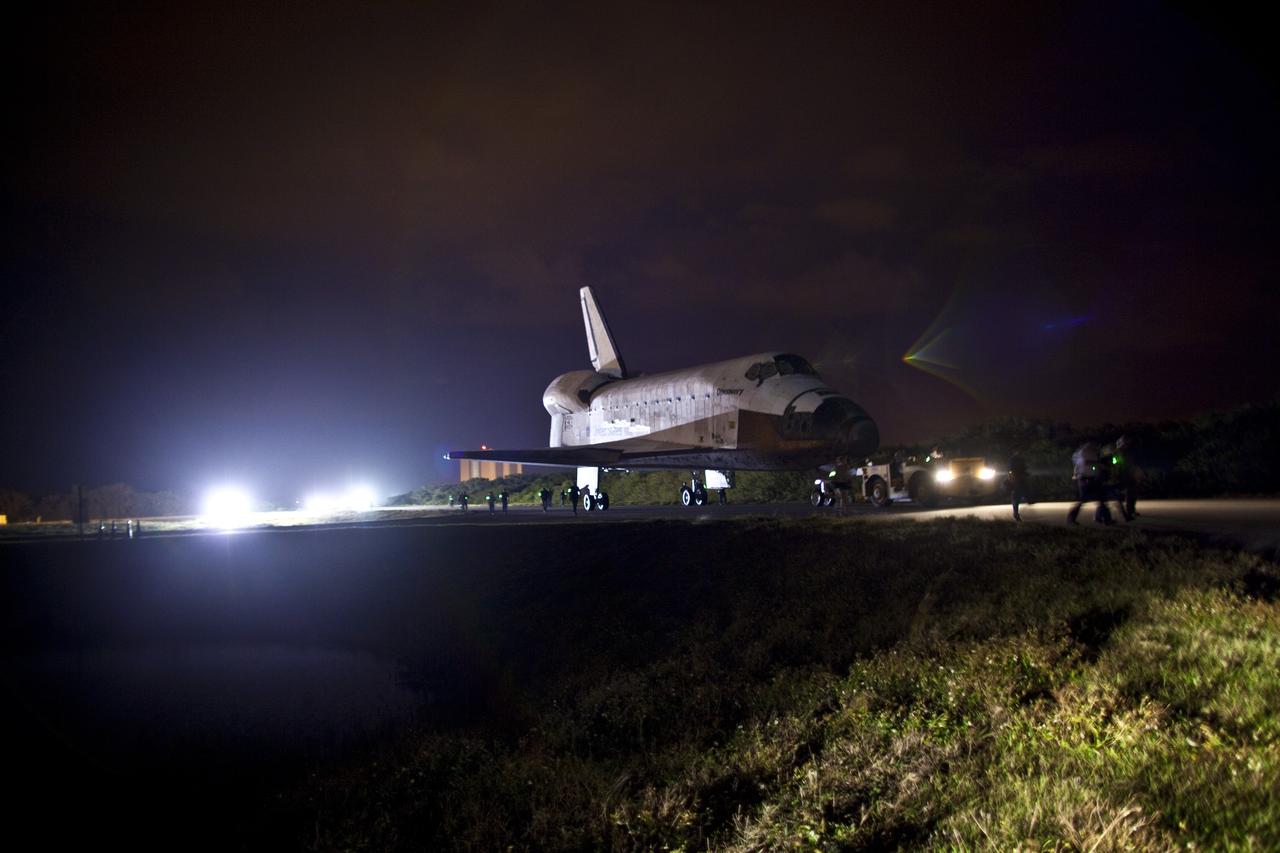
CAPE CANAVERAL, Fla. – Space shuttle Discovery is towed along the access road to the Shuttle Landing Facility, or SLF, before dawn at NASA’s Kennedy Space Center in Florida. Its move from the Vehicle Assembly Building got under way at 5 a.m. EDT. At the SLF, Discovery will be hoisted onto a Shuttle Carrier Aircraft, or SCA, with the aid of a mate-demate device. The SCA, a modified Boeing 747 jet airliner, is scheduled to ferry Discovery to the Washington Dulles International Airport in Virginia on April 17, after which the shuttle will be placed on permanent public display in the Smithsonian's National Air and Space Museum Steven F. Udvar-Hazy Center. For more information on shuttle transition and retirement activities, visit http://www.nasa.gov/transition. Photo credit: NASA/Dimitri Gerondidakis
CAPE CANAVERAL, Fla. – Rain begins to fall on space shuttle Discovery as it says good-bye to NASA Kennedy Space Center’s Launch Complex 39 area for the final time. Discovery is on its way from the Vehicle Assembly Building’s high bay 4 to the Shuttle Landing Facility, or SLF. At the SLF, Discovery will be hoisted onto a Shuttle Carrier Aircraft, or SCA, with the aid of a mate-demate device. The SCA, a modified Boeing 747 jet airliner, is scheduled to ferry Discovery to the Washington Dulles International Airport in Virginia on April 17, after which the shuttle will be placed on permanent public display in the Smithsonian's National Air and Space Museum Steven F. Udvar-Hazy Center. For more information on shuttle transition and retirement activities, visit http://www.nasa.gov/transition. Photo credit: NASA/Kim Shiflett
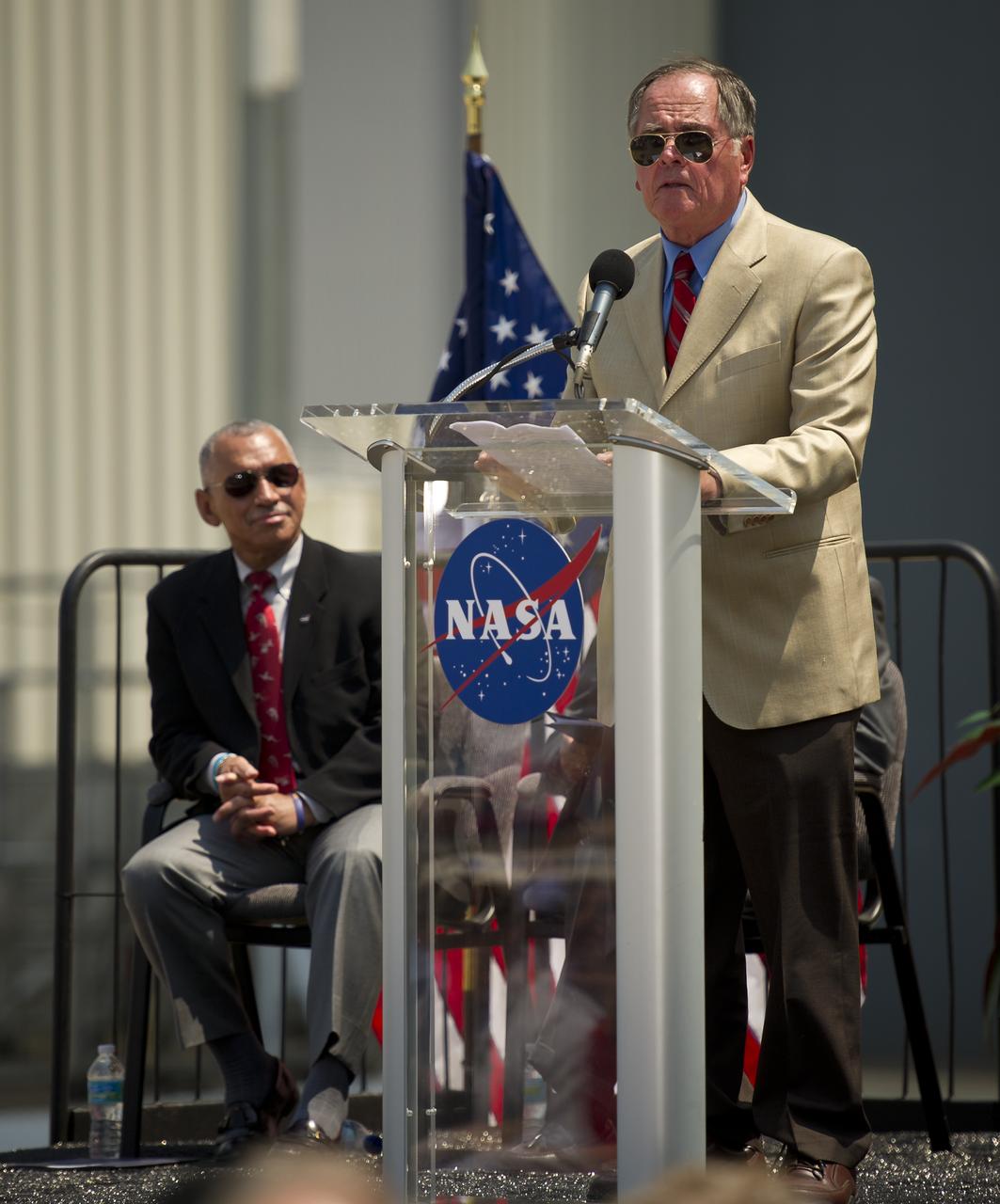
Pilot of the first space shuttle mission, STS-1, Bob Crippen speaks at an event where NASA Administrator Charles Bolden announced where four space shuttle orbiters will be permanently displayed at the conclusion of the Space Shuttle Program, Tuesday, April 12, 2011, at Kennedy Space Center in Cape Canaveral, Fla. The four orbiters, Enterprise, which currently is on display at the Smithsonian's Steven F. Udvar-Hazy Center near Washington Dulles International Airport, will move to the Intrepid Sea, Air & Space Museum in New York, Discovery will move to Udvar-Hazy, Endeavour will be displayed at the California Science Center in Los Angeles and Atlantis, in background, will be displayed at the Kennedy Space Center Visitor’s Complex. Photo Credit: (NASA/Bill Ingalls)

CAPE CANAVERAL, Fla. – This is an aerial view of the long Shuttle Landing Facility SLF runway at NASA's Kennedy Space Center in Florida that space shuttle Discovery, bolted to the top of a Shuttle Carrier Aircraft SCA, will take off from on April 17. Discovery's last crew members are expected to be at the runway, along with Kennedy employees and guests, as the center says goodbye to the agency's most-flown shuttle. The SCA, designated NASA 905, will ferry Discovery to the Washington Dulles International Airport in Virginia, after which the shuttle will be moved for public display in the Smithsonian's National Air and Space Museum Steven F. Udvar-Hazy Center on April 19. For more information on the SCA, visit http://www.nasa.gov/centers/dryden/news/FactSheets/FS-013-DFRC.html. For more information on shuttle transition and retirement activities, visit http://www.nasa.gov/transition. Photo credit: NASA/Kim Shiflett
CAPE CANAVERAL, Fla. – Sunrise over the Shuttle Landing Facility at NASA’s Kennedy Space Center in Florida reveals the Shuttle Carrier Aircraft that is transporting space shuttle Discovery to its new home preparing for takeoff. The aircraft, known as an SCA, is a Boeing 747 jet, originally manufactured for commercial use, which was modified by NASA to transport the shuttles between destinations on Earth. This SCA, designated NASA 905, is assigned to the remaining ferry missions, delivering the shuttles to their permanent public display sites. NASA 905 is scheduled to ferry Discovery to the Washington Dulles International Airport in Virginia on April 17, after which the shuttle will be placed on display in the Smithsonian's National Air and Space Museum Steven F. Udvar-Hazy Center. For more information on the SCA, visit http://www.nasa.gov/centers/dryden/news/FactSheets/FS-013-DFRC.html. For more information on shuttle transition and retirement activities, visit http://www.nasa.gov/transition. Photo credit: NASA/Rusty Backer
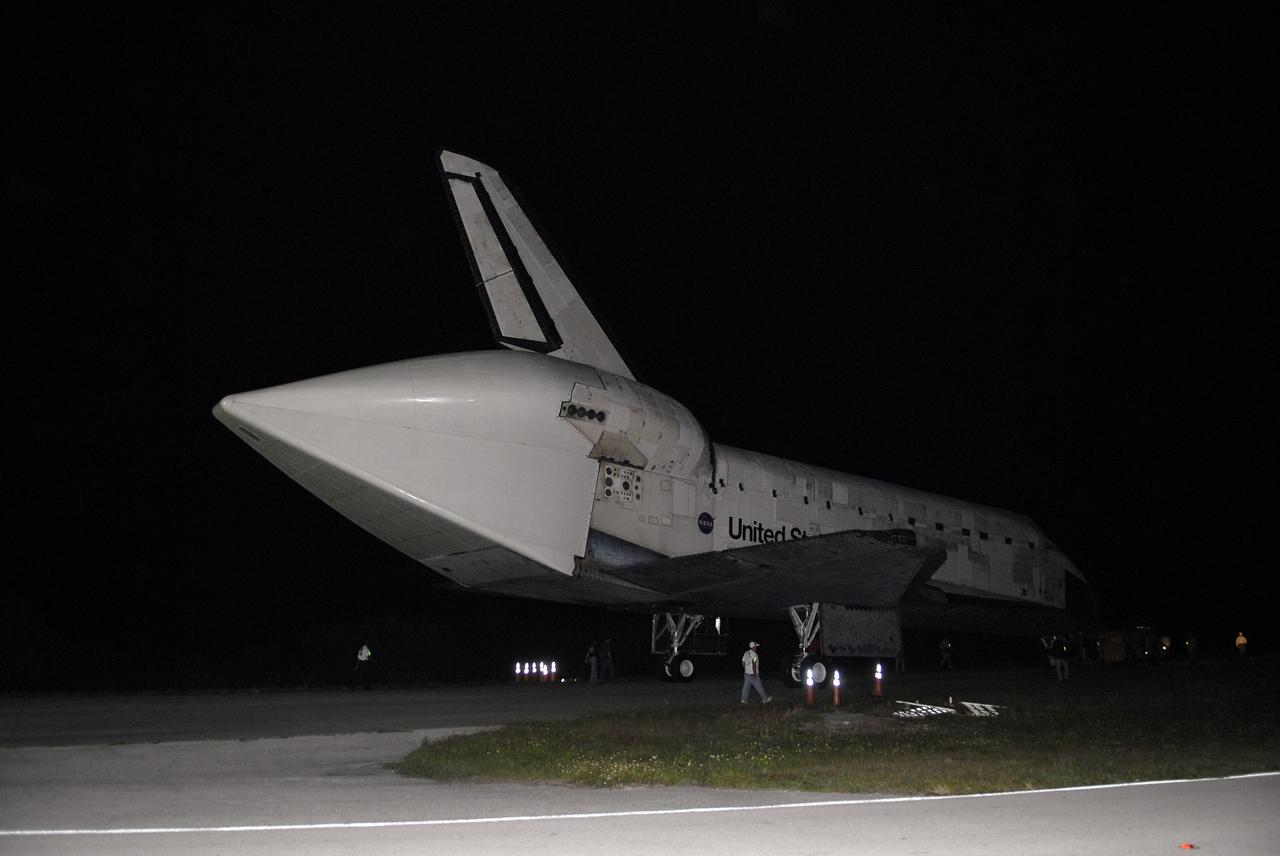
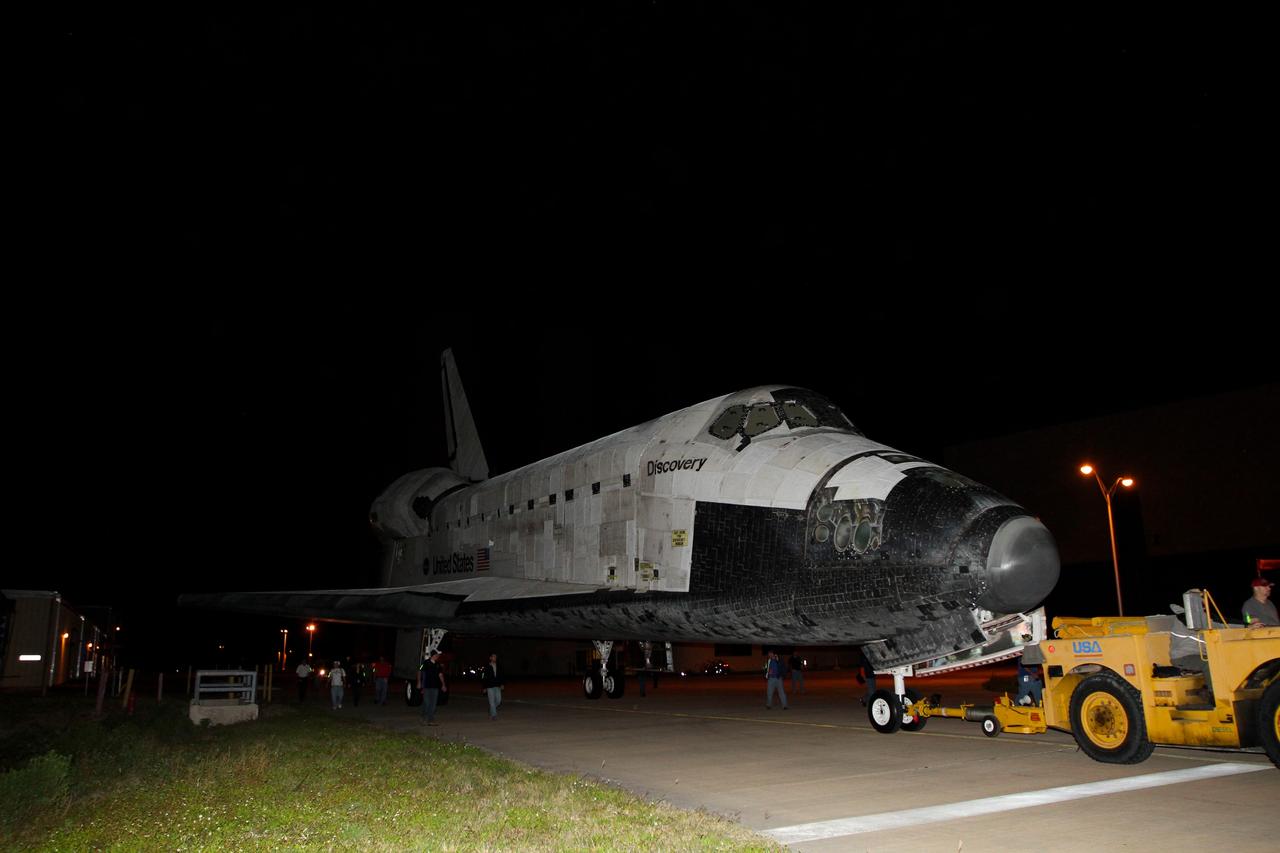
CAPE CANAVERAL, Fla. – Space shuttle Discovery makes its way in darkness along the access road to the Shuttle Landing Facility, or SLF, at NASA’s Kennedy Space Center in Florida. A tail cone has been installed over its three replica shuttle main engines to reduce aerodynamic drag and turbulence during its upcoming ferry flight. At the SLF, Discovery will be hoisted onto a Shuttle Carrier Aircraft, or SCA, with the aid of a mate-demate device. The SCA, a modified Boeing 747 jet airliner, is scheduled to ferry Discovery to the Washington Dulles International Airport in Virginia on April 17, after which the shuttle will be placed on permanent public display in the Smithsonian's National Air and Space Museum Steven F. Udvar-Hazy Center. For more information on shuttle transition and retirement activities, visit http://www.nasa.gov/transition. Photo credit: NASA/Tim Jacobs
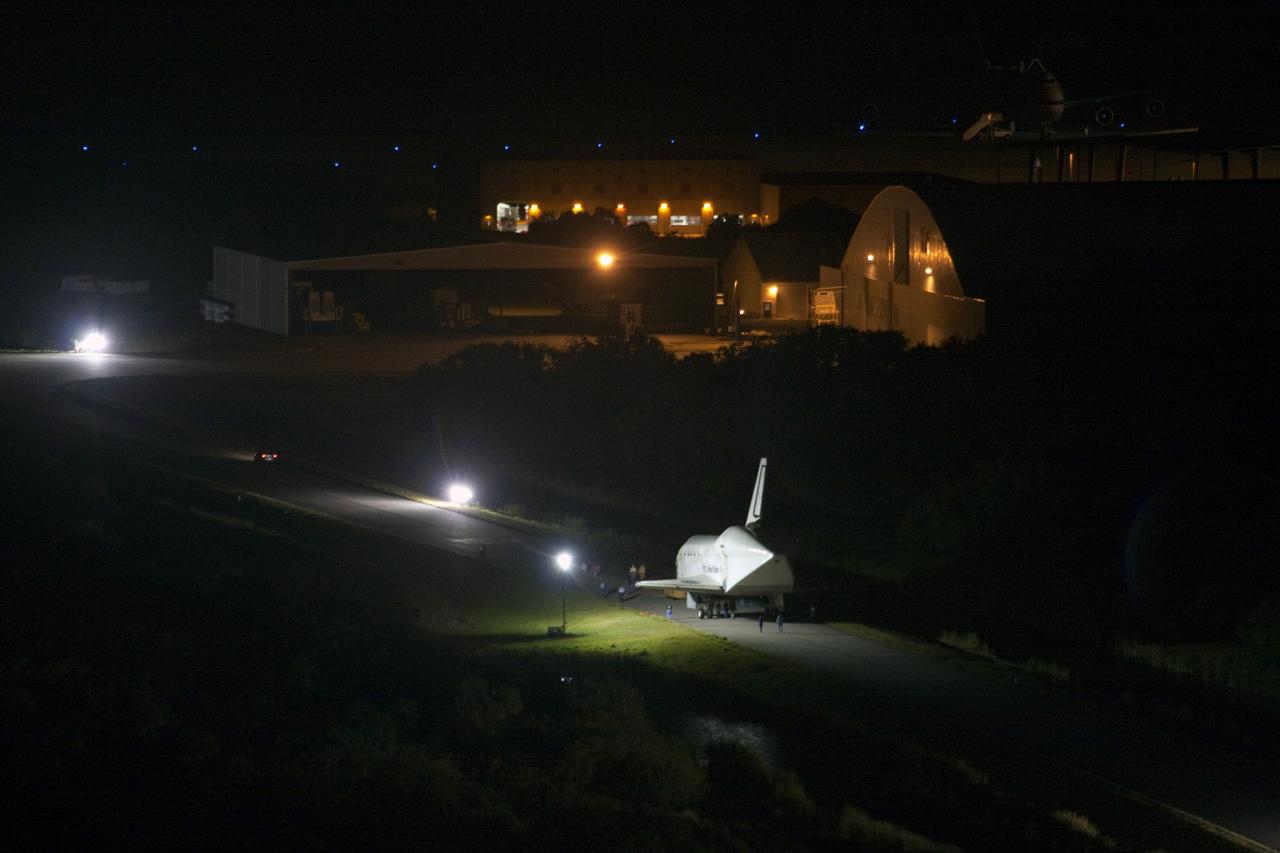
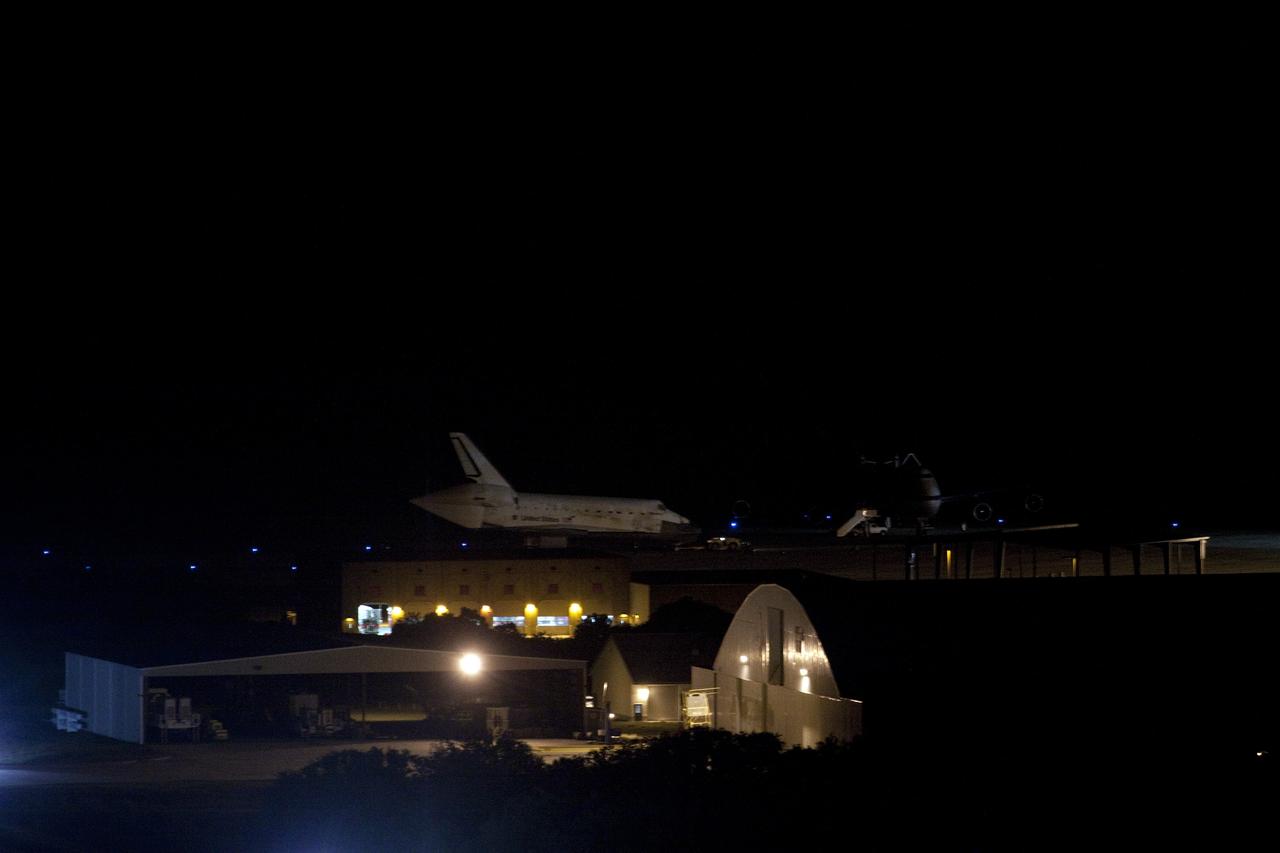
CAPE CANAVERAL, Fla. – At NASA’s Kennedy Space Center in Florida, space shuttle Discovery makes its way along the access road past the hangar at the Shuttle Landing Facility, or SLF, in darkness. Its move got under way at 5 a.m. EDT. At the SLF, Discovery will be hoisted onto a Shuttle Carrier Aircraft, or SCA, with the aid of a mate-demate device. The SCA, a modified Boeing 747 jet airliner, is scheduled to ferry Discovery to the Washington Dulles International Airport in Virginia on April 17, after which the shuttle will be placed on permanent public display in the Smithsonian's National Air and Space Museum Steven F. Udvar-Hazy Center. For more information on shuttle transition and retirement activities, visit http://www.nasa.gov/transition. Photo credit: NASA/Jim Grossmann
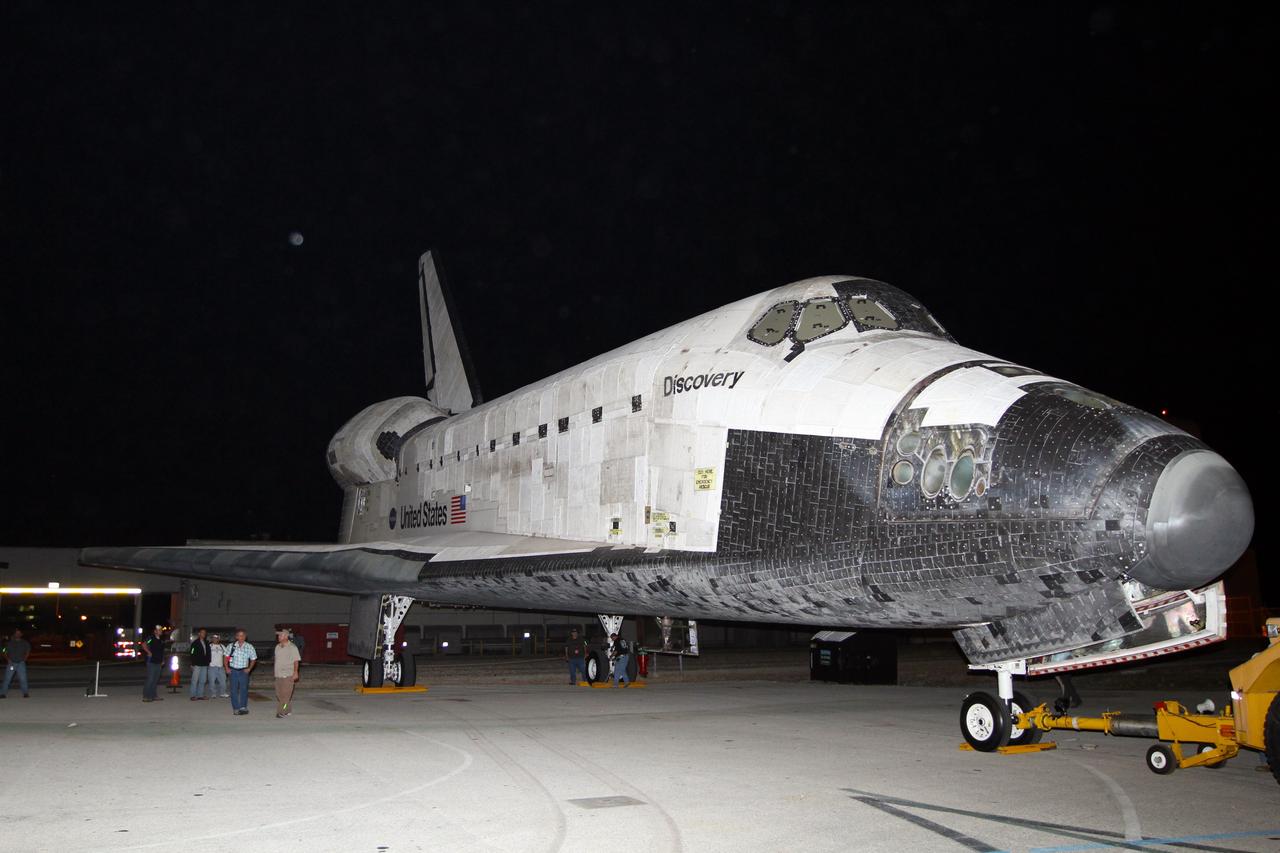
CAPE CANAVERAL, Fla. – Preparations are under way to tow space shuttle Discovery to the Shuttle Landing Facility, or SLF, at NASA’s Kennedy Space Center in Florida. Discovery was in storage in the Vehicle Assembly Building’s high bay 4 awaiting departure from Kennedy’s Launch Complex 39 area for the final time. At the SLF, Discovery will be hoisted onto a Shuttle Carrier Aircraft, or SCA, with the aid of a mate-demate device. The SCA, a modified Boeing 747 jet airliner, is scheduled to transport Discovery to the Washington Dulles International Airport in Virginia on April 17, after which the shuttle will be placed on permanent public display in the Smithsonian's National Air and Space Museum Steven F. Udvar-Hazy Center. For more information on shuttle transition and retirement activities, visit http://www.nasa.gov/transition. Photo credit: NASA/Kim Shiflett
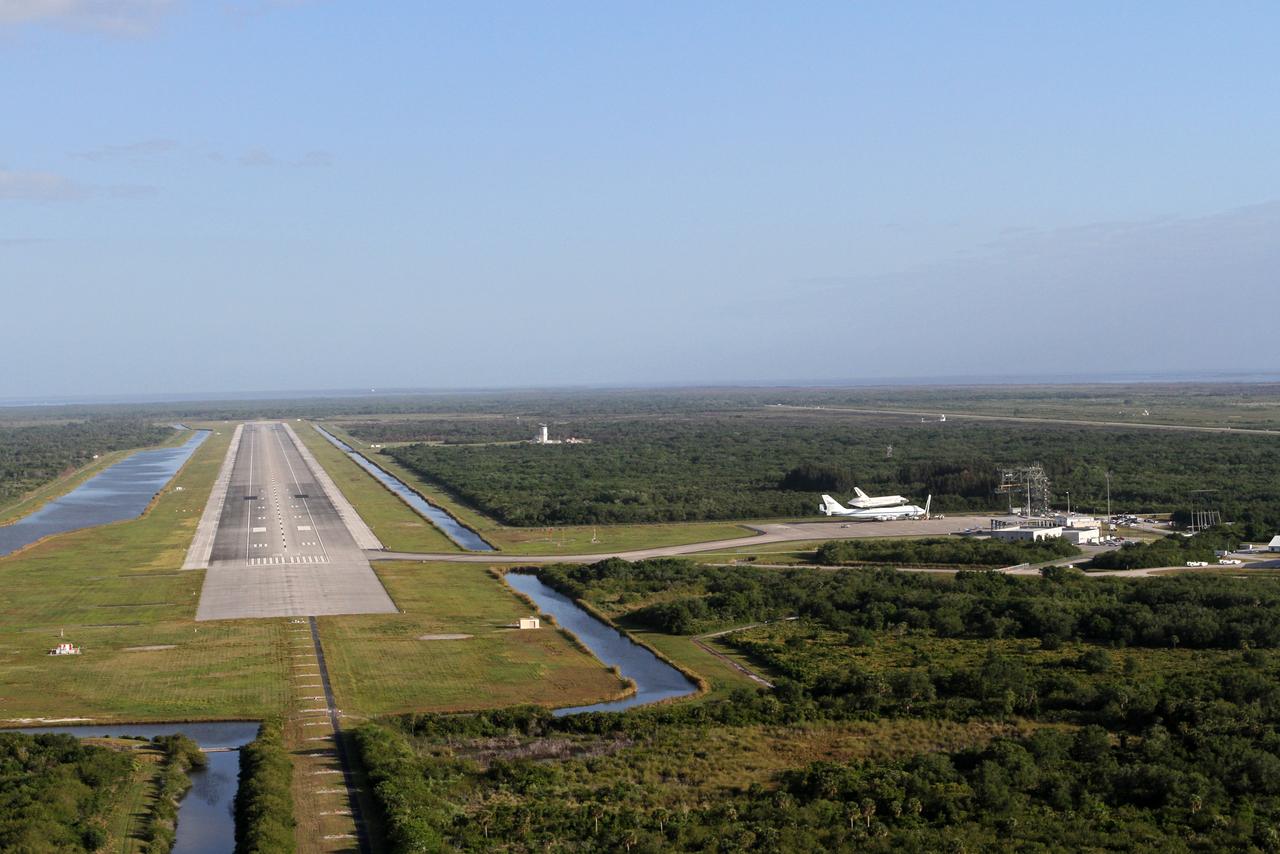
CAPE CANAVERAL, Fla. – This is an aerial view of the long Shuttle Landing Facility SLF runway at NASA's Kennedy Space Center in Florida that space shuttle Discovery, bolted to the top of a Shuttle Carrier Aircraft SCA, will take off from on April 17. Discovery's last crew members are expected to be at the runway, along with Kennedy employees and guests, as the center says goodbye to the agency's most-flown shuttle. The SCA, designated NASA 905, will ferry Discovery to the Washington Dulles International Airport in Virginia, after which the shuttle will be moved for public display in the Smithsonian's National Air and Space Museum Steven F. Udvar-Hazy Center on April 19. For more information on the SCA, visit http://www.nasa.gov/centers/dryden/news/FactSheets/FS-013-DFRC.html. For more information on shuttle transition and retirement activities, visit http://www.nasa.gov/transition. Photo credit: NASA/Kim Shiflett
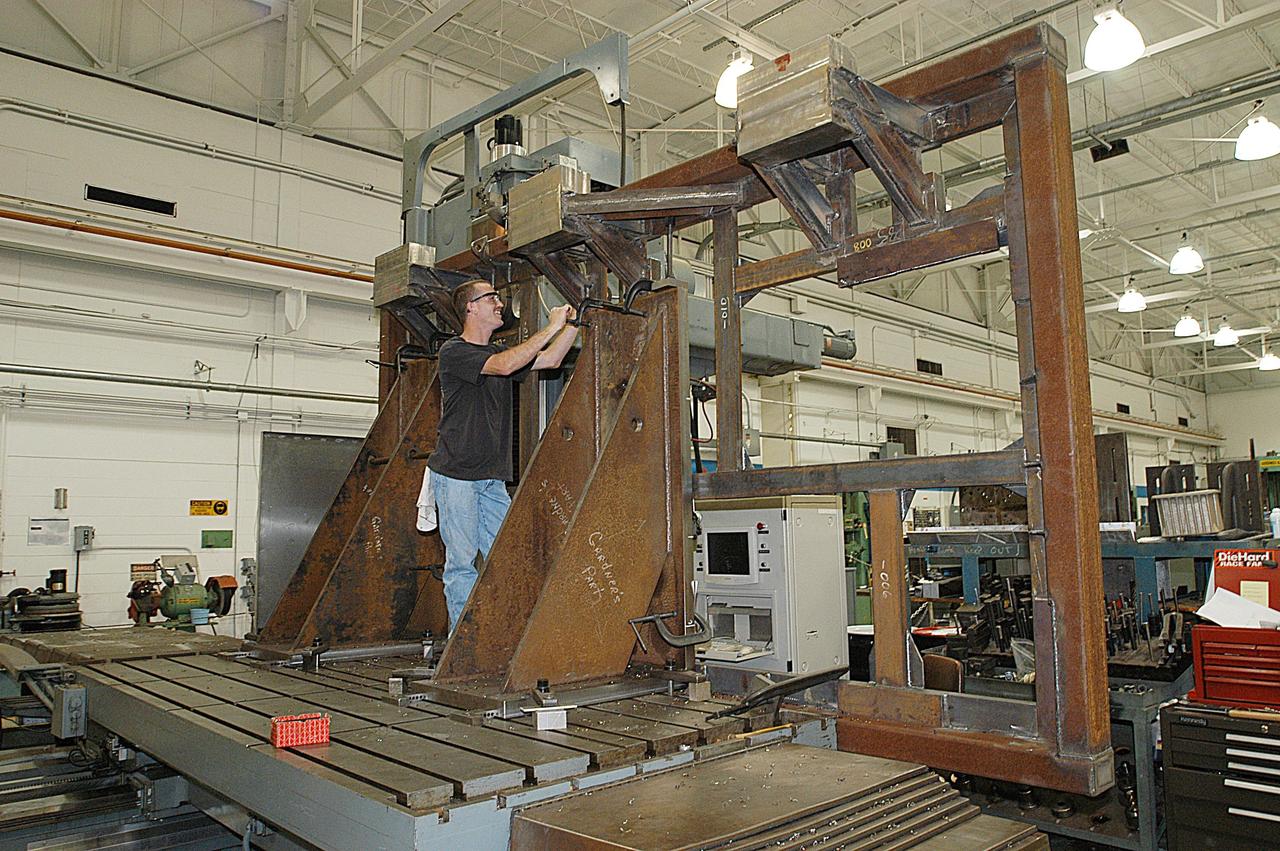
KENNEDY SPACE CENTER, FLA. -- United Space Alliance technician Matt Boonstra works on a main landing gear door mounting fixture in the Launch Equipment Shop. The fixture is being used to support the Columbia mishap investigation. A simulated orbiter wing and several test panels, along with sections of Space Shuttle orbiter Enterprise (OV-101), will be transferred to the Southwest Research Institute for testing after Thermal Protection System (TPS) tile installation on them is complete. The testing has been requested by the Columbia Accident Investigation Board. For this initiative, sections of Enterprise were borrowed from the Smithsonian Institution's Air and Space Museum where the orbiter is being stored at the Washington Dulles International Airport. Enterprise was the first orbiter built in the Shuttle fleet and was used to conduct the Approach and Landing Test Program before the first powered Shuttle flight.
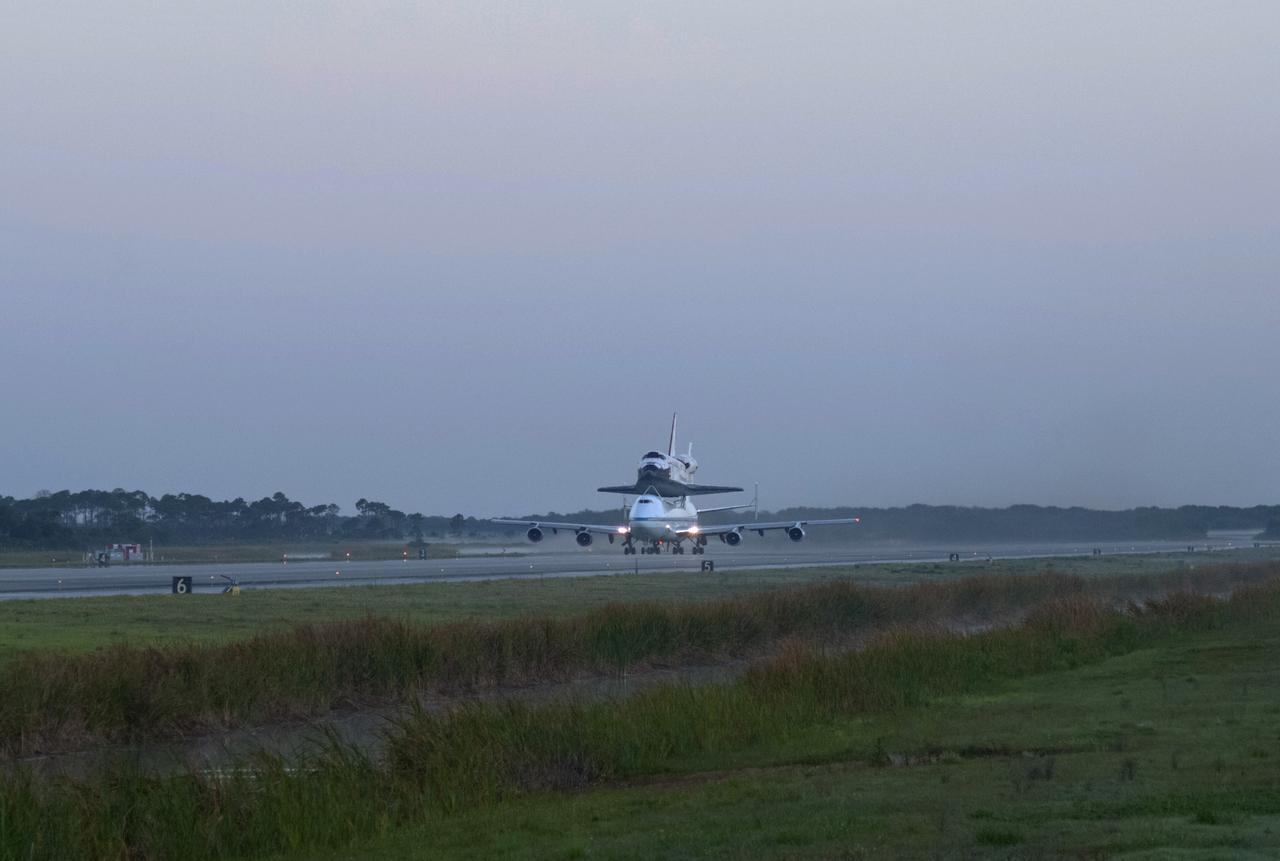
CAPE CANAVERAL, Fla. – Sunrise over the Shuttle Landing Facility at NASA’s Kennedy Space Center in Florida reveals the Shuttle Carrier Aircraft that is transporting space shuttle Discovery to its new home preparing for takeoff. The aircraft, known as an SCA, is a Boeing 747 jet, originally manufactured for commercial use, which was modified by NASA to transport the shuttles between destinations on Earth. This SCA, designated NASA 905, is assigned to the remaining ferry missions, delivering the shuttles to their permanent public display sites. NASA 905 is scheduled to ferry Discovery to the Washington Dulles International Airport in Virginia on April 17, after which the shuttle will be placed on display in the Smithsonian's National Air and Space Museum Steven F. Udvar-Hazy Center. For more information on the SCA, visit http://www.nasa.gov/centers/dryden/news/FactSheets/FS-013-DFRC.html. For more information on shuttle transition and retirement activities, visit http://www.nasa.gov/transition. Photo credit: NASA/Rusty Backer
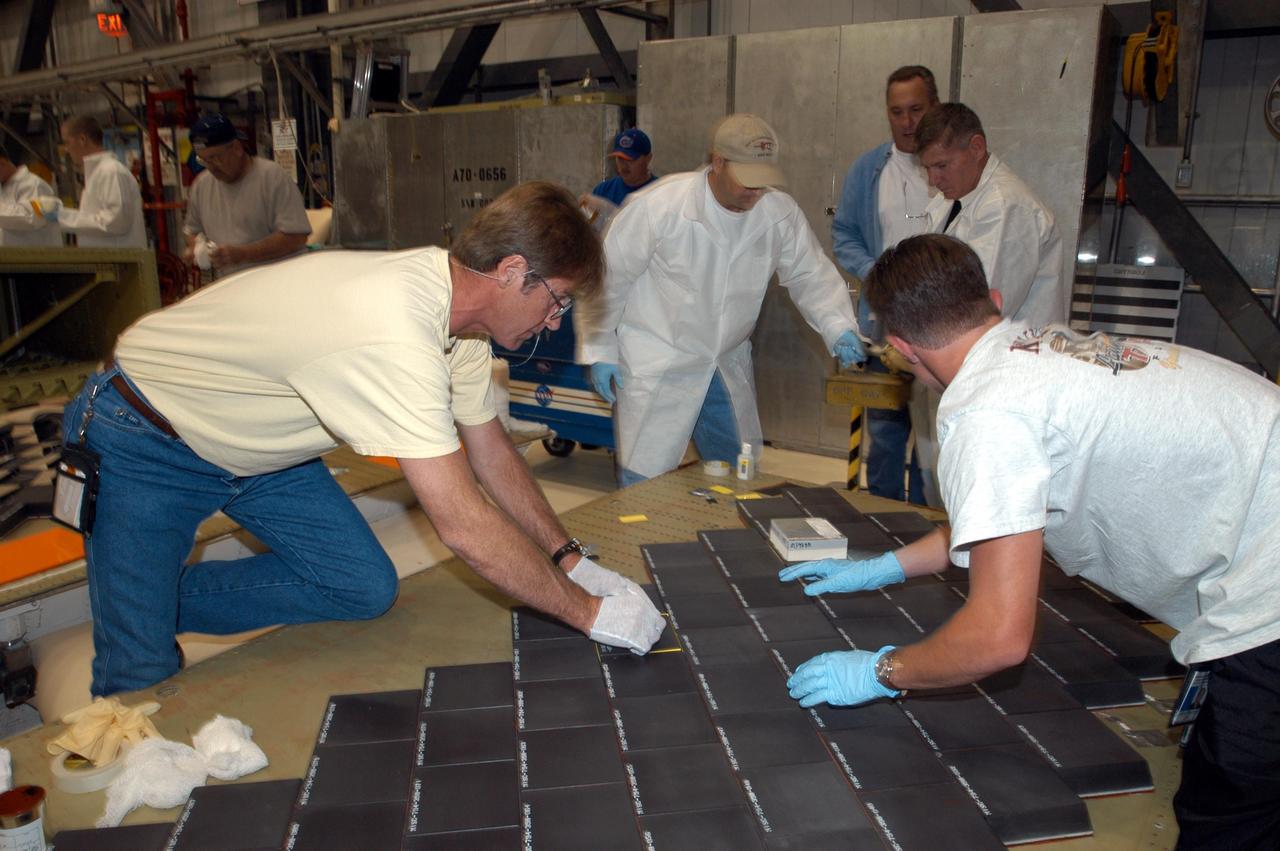
KENNEDY SPACE CENTER, FLA. -- In the Orbiter Processing Facility, United Space Alliance employees (from left) Harrell Watts, Mike Cote, and Jason Levandusky install Thermal Protection System tiles on a main landing gear door of Space Shuttle orbiter Enterprise (OV-101). Sections of Enterprise were borrowed from the Smithsonian Institution's Air and Space Museum where the orbiter is being stored at the Washington Dulles International Airport. Enterprise was the first orbiter built in the Shuttle fleet and was used to conduct the Approach and Landing Test Program before the first powered Shuttle flight. After the tile installation is complete, the sections will be transferred to the Southwest Research Institute for testing requested by the Columbia Accident Investigation Board.
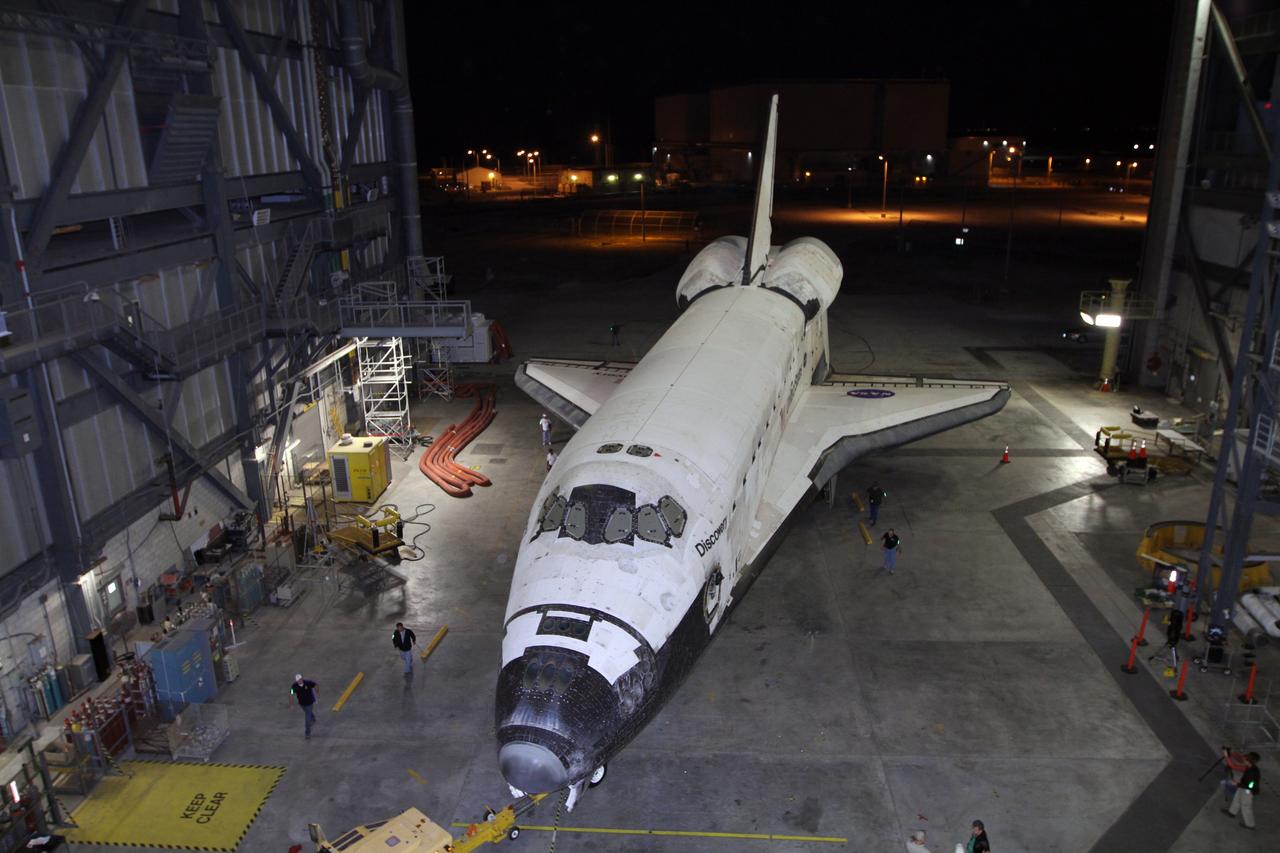
CAPE CANAVERAL, Fla. – Space shuttle Discovery backs out of the Vehicle Assembly Building, or VAB, at NASA’s Kennedy Space Center in Florida, for its trip to the Shuttle Landing Facility, or SLF. Discovery was in storage in the VAB’s high bay 4 awaiting departure from Kennedy’s Launch Complex 39 area for the final time. At the SLF, Discovery will be hoisted onto a Shuttle Carrier Aircraft, or SCA, with the aid of a mate-demate device. The SCA, a modified Boeing 747 jet airliner, is scheduled to transport Discovery to the Washington Dulles International Airport in Virginia on April 17, after which the shuttle will be placed on permanent public display in the Smithsonian's National Air and Space Museum Steven F. Udvar-Hazy Center. For more information on shuttle transition and retirement activities, visit http://www.nasa.gov/transition. Photo credit: NASA/Kim Shiflett
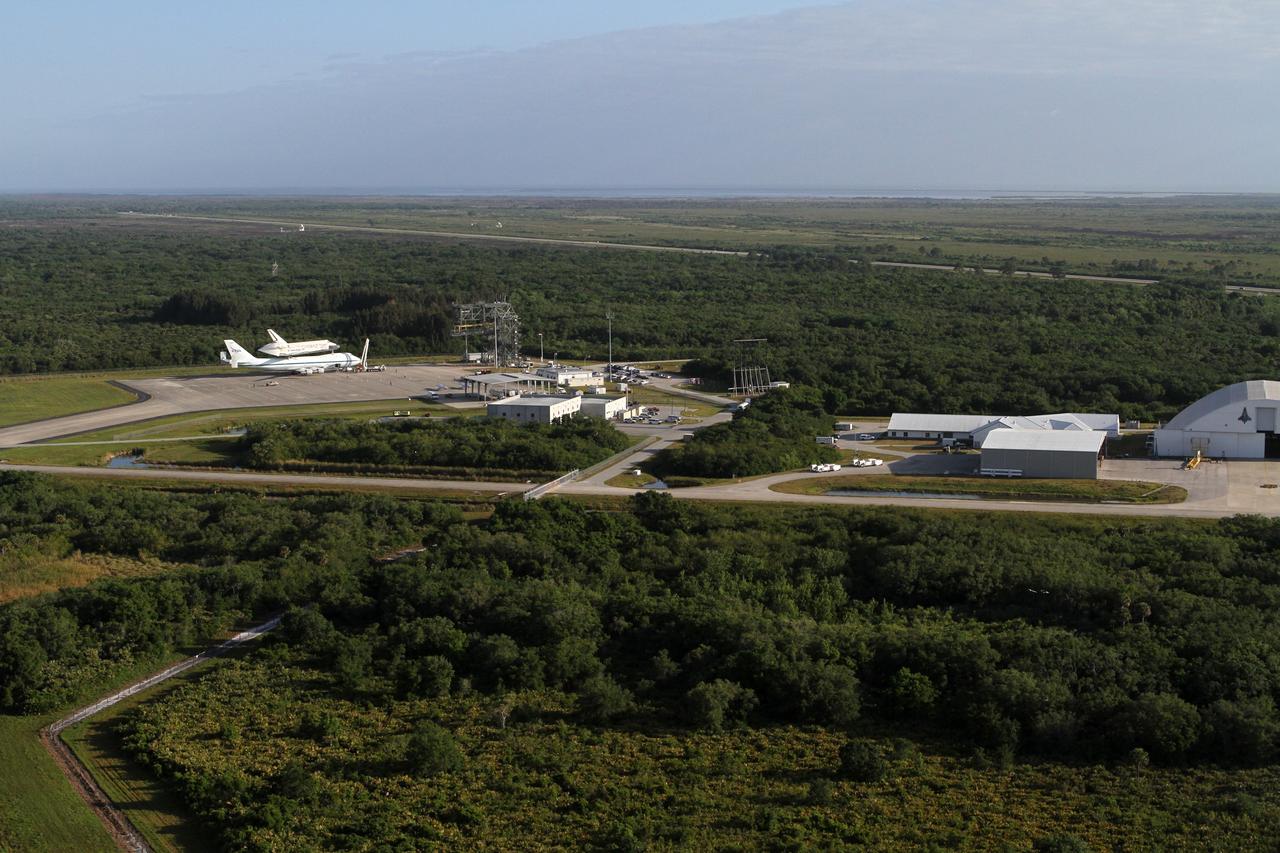
CAPE CANAVERAL, Fla. – This is an aerial view of space shuttle Discovery bolted to the top of a Shuttle Carrier Aircraft SCA on the ramp of the Shuttle Landing Facility SLF at NASA’s Kennedy Space Center in Florida. Discovery's last crew members are expected to be at the SLF, along with Kennedy employees and guests, as the center says goodbye to the agency's most-flown shuttle on April 17. The SCA, designated NASA 905, will ferry Discovery to the Washington Dulles International Airport in Virginia, after which the shuttle will be moved for public display in the Smithsonian's National Air and Space Museum Steven F. Udvar-Hazy Center on April 19. For more information on the SCA, visit http://www.nasa.gov/centers/dryden/news/FactSheets/FS-013-DFRC.html. For more information on shuttle transition and retirement activities, visit http://www.nasa.gov/transition. Photo credit: NASA/Kim Shiflett
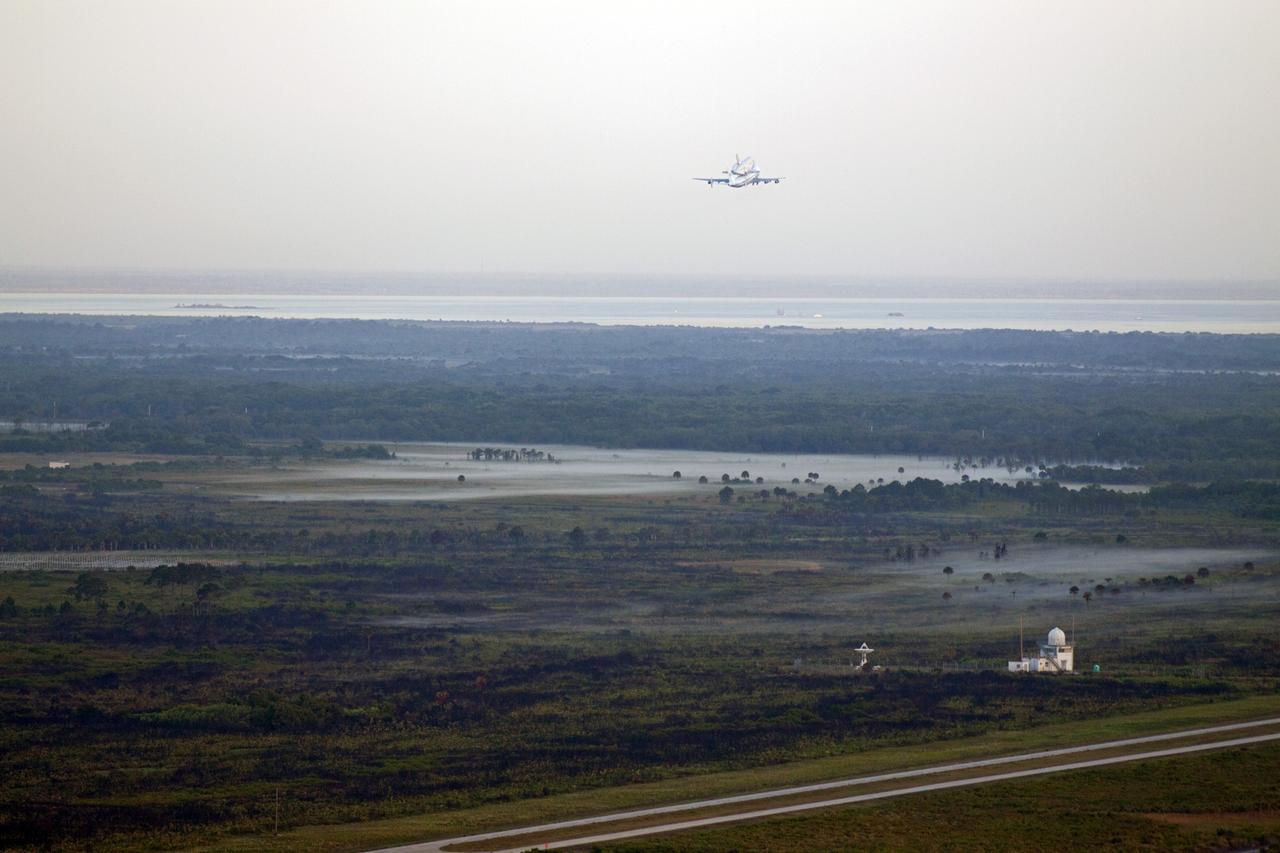
CAPE CANAVERAL, Fla. – The Shuttle Carrier Aircraft transporting space shuttle Discovery to its new home takes off from the Shuttle Landing Facility at NASA’s Kennedy Space Center in Florida at 7 a.m. EDT. The aircraft, known as an SCA, is a Boeing 747 jet, originally manufactured for commercial use, which was modified by NASA to transport the shuttles between destinations on Earth. This SCA, designated NASA 905, is assigned to the remaining ferry missions, delivering the shuttles to their permanent public display sites. NASA 905 is scheduled to ferry Discovery to the Washington Dulles International Airport in Virginia today, after which the shuttle will be placed on display in the Smithsonian's National Air and Space Museum Steven F. Udvar-Hazy Center. For more information on the SCA, visit http://www.nasa.gov/centers/dryden/news/FactSheets/FS-013-DFRC.html. For more information on shuttle transition and retirement activities, visit http://www.nasa.gov/transition. Photo credit: NASA/Glenn Benson

The space shuttle Atlantis is seen in the Orbiter Processing Facility at an event where NASA Administrator Charles Bolden announced where four space shuttle orbiters will be permanently displayed at the conclusion of the Space Shuttle Program, Tuesday, April 12, 2011, at Kennedy Space Center in Cape Canaveral, Fla. The four orbiters, Enterprise, which currently is on display at the Smithsonian's Steven F. Udvar-Hazy Center near Washington Dulles International Airport, will move to the Intrepid Sea, Air & Space Museum in New York, Discovery will move to Udvar-Hazy, Endeavour will be displayed at the California Science Center in Los Angeles and Atlantis, will be displayed at the Kennedy Space Center Visitor’s Complex. Photo Credit: (NASA/Bill Ingalls)
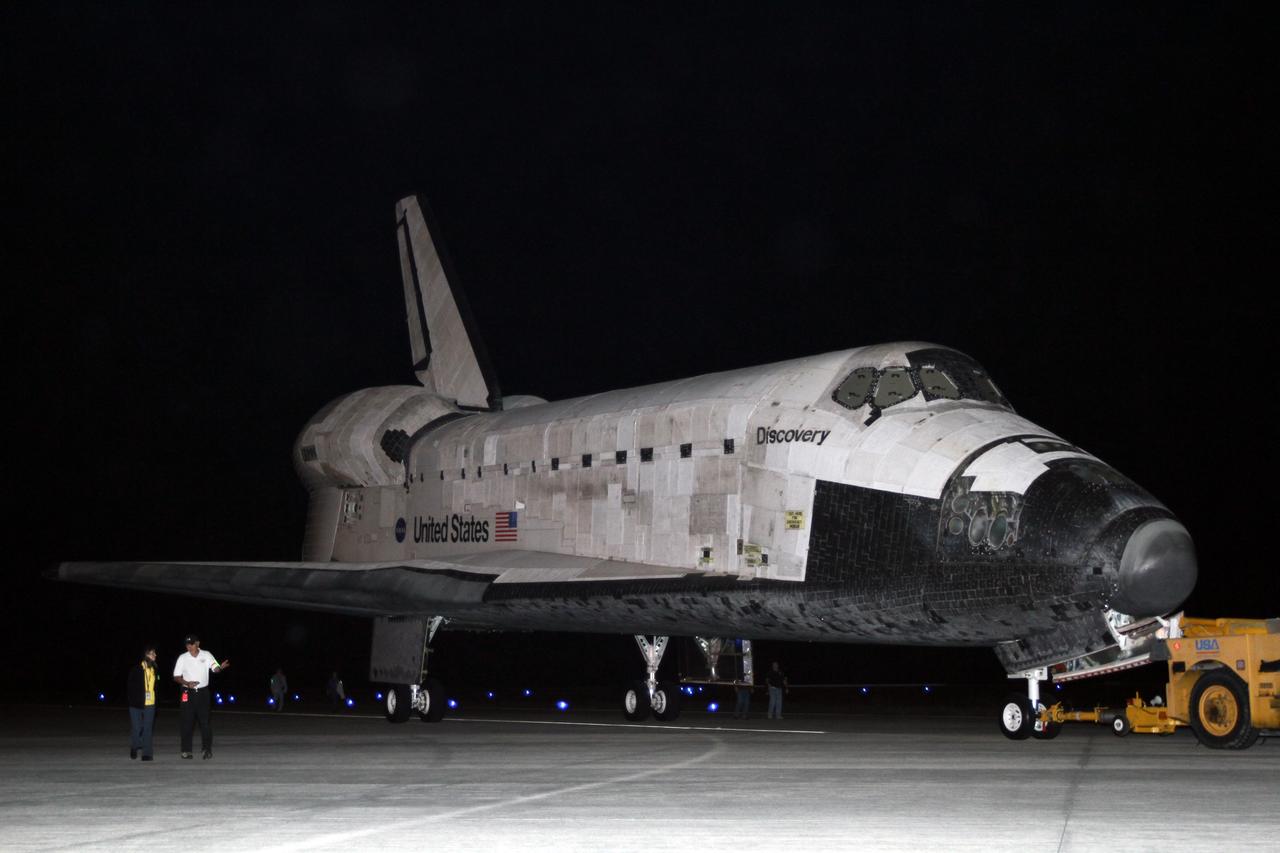
CAPE CANAVERAL, Fla. – Space shuttle Discovery makes its way in darkness to the Shuttle Landing Facility, or SLF, at NASA’s Kennedy Space Center in Florida. Its move got under way at 5 a.m. EDT. At the SLF, Discovery will be hoisted onto a Shuttle Carrier Aircraft, or SCA, with the aid of a mate-demate device. The SCA, a modified Boeing 747 jet airliner, is scheduled to ferry Discovery to the Washington Dulles International Airport in Virginia on April 17, after which the shuttle will be placed on permanent public display in the Smithsonian's National Air and Space Museum Steven F. Udvar-Hazy Center. For more information on shuttle transition and retirement activities, visit http://www.nasa.gov/transition. Photo credit: NASA/Kim Shiflett
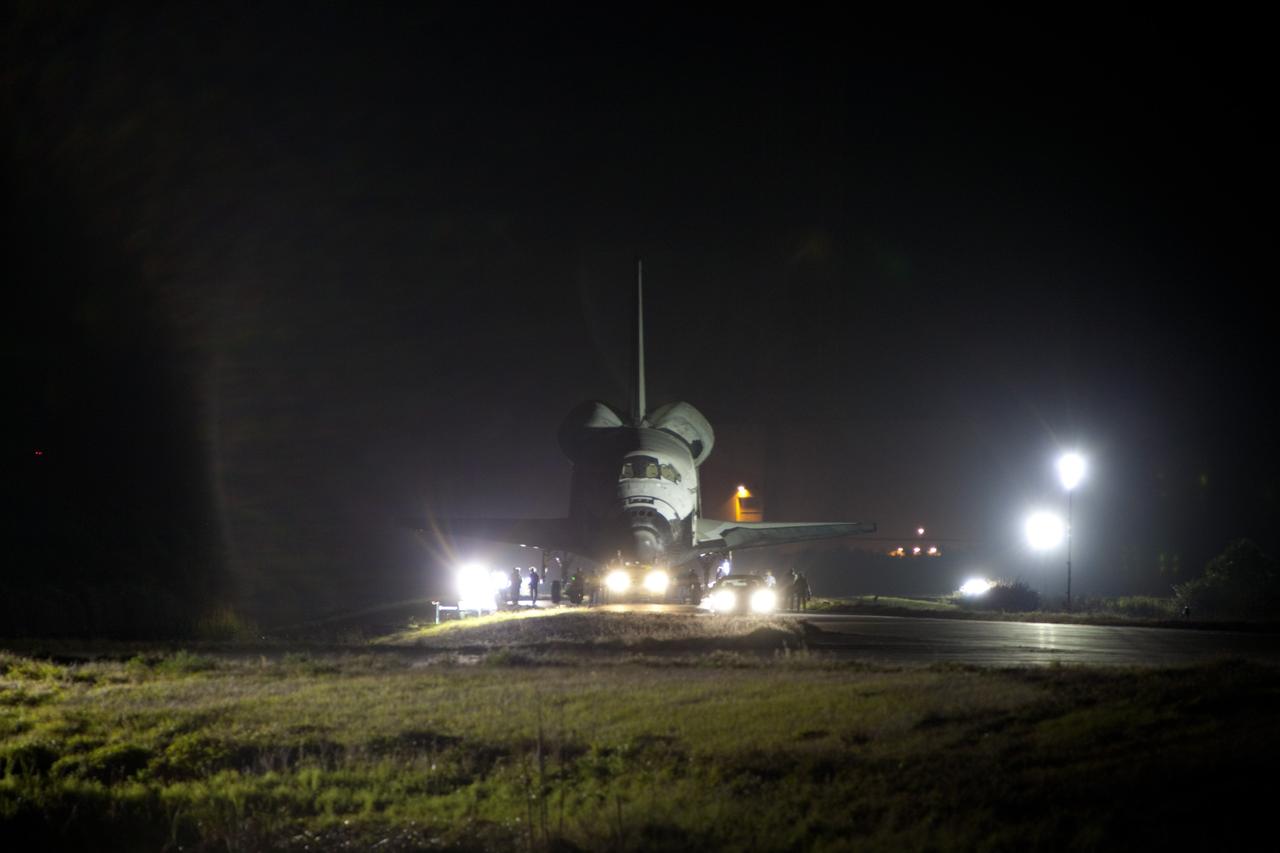
CAPE CANAVERAL, Fla. – Space shuttle Discovery makes its way to the Shuttle Landing Facility, or SLF, in darkness at NASA’s Kennedy Space Center in Florida. Its move from the Vehicle Assembly Building got under way at 5 a.m. EDT. At the SLF, Discovery will be hoisted onto a Shuttle Carrier Aircraft, or SCA, with the aid of a mate-demate device. The SCA, a modified Boeing 747 jet airliner, is scheduled to ferry Discovery to the Washington Dulles International Airport in Virginia on April 17, after which the shuttle will be placed on permanent public display in the Smithsonian's National Air and Space Museum Steven F. Udvar-Hazy Center. For more information on shuttle transition and retirement activities, visit http://www.nasa.gov/transition. Photo credit: NASA/Dimitri Gerondidakis
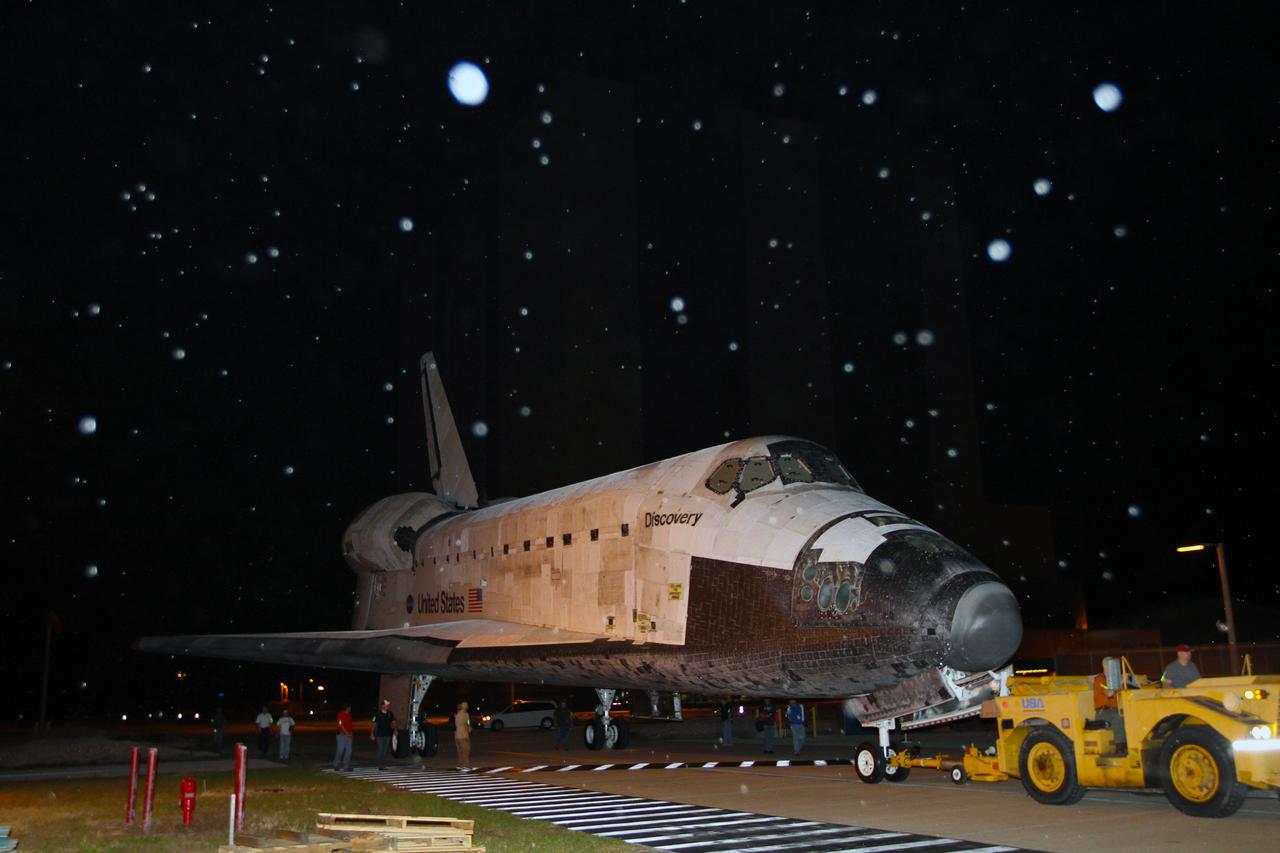
CAPE CANAVERAL, Fla. – Rain falls on space shuttle Discovery as it departs from NASA Kennedy Space Center’s Launch Complex 39 area for the final time. Discovery is on its way from the Vehicle Assembly Building’s high bay 4 to the Shuttle Landing Facility, or SLF. At the SLF, Discovery will be hoisted onto a Shuttle Carrier Aircraft, or SCA, with the aid of a mate-demate device. The SCA, a modified Boeing 747 jet airliner, is scheduled to ferry Discovery to the Washington Dulles International Airport in Virginia on April 17, after which the shuttle will be placed on permanent public display in the Smithsonian's National Air and Space Museum Steven F. Udvar-Hazy Center. For more information on shuttle transition and retirement activities, visit http://www.nasa.gov/transition. Photo credit: NASA/Kim Shiflett

KENNEDY SPACE CENTER, FLA. -- In the Orbiter Processing Facility, employees from The Boeing Co., Huntington Beach, Calif., install a strain gauge on a test panel prior to installation of Thermal Protection System tile on the panel. The test panel and sections of Space Shuttle orbiter Enterprise (OV-101) will be transferred to the Southwest Research Institute for testing after the tile installation is complete. The testing has been requested by the Columbia Accident Investigation Board. Sections of Enterprise were borrowed from the Smithsonian Institution's Air and Space Museum where the orbiter is being stored at the Washington Dulles International Airport. Enterprise was the first orbiter built in the Shuttle fleet and was used to conduct the Approach and Landing Test Program before the first powered Shuttle flight.
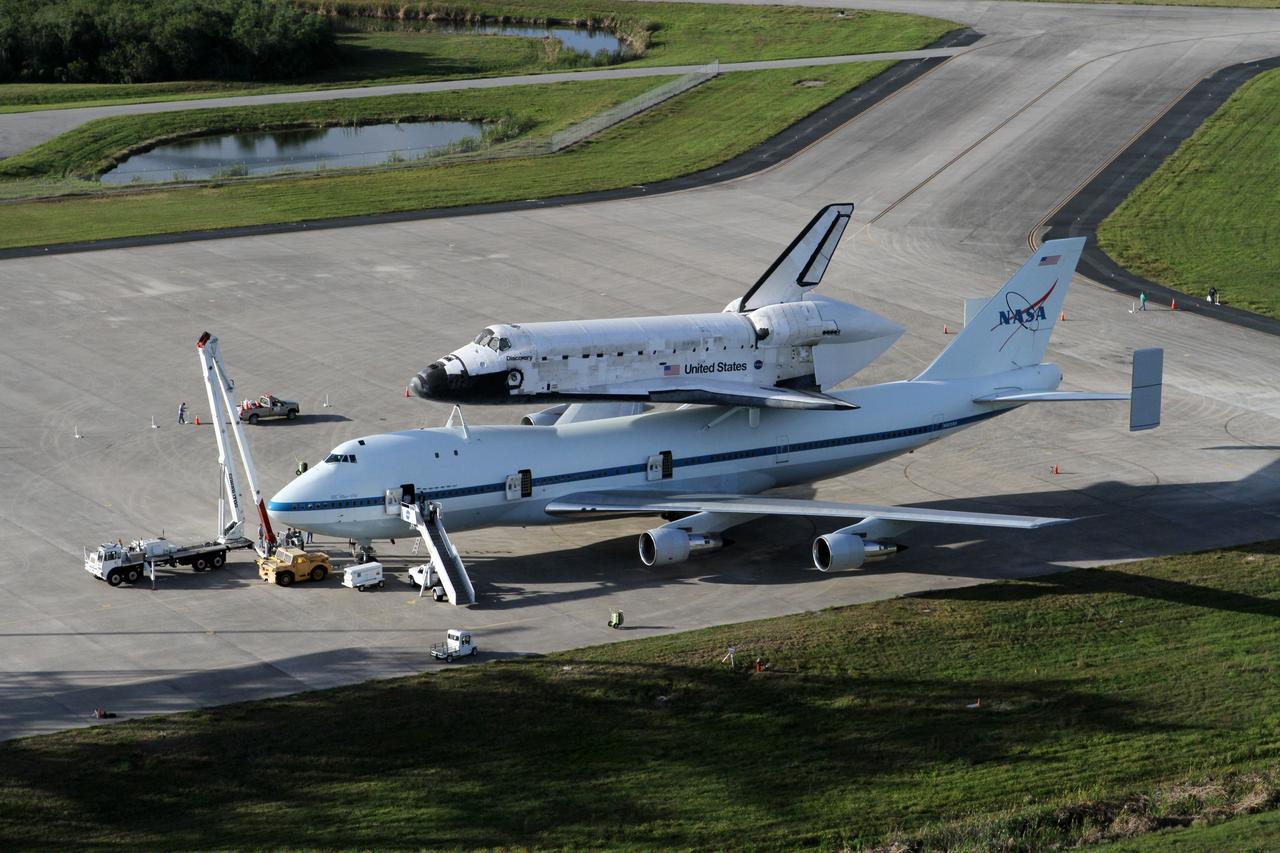
CAPE CANAVERAL, Fla. – This is an aerial view of space shuttle Discovery bolted to the top of a Shuttle Carrier Aircraft SCA on the ramp of the Shuttle Landing Facility SLF at NASA’s Kennedy Space Center in Florida. Discovery's last crew members are expected to be at the SLF, along with Kennedy employees and guests, as the center says goodbye to the agency's most-flown shuttle on April 17. The SCA, designated NASA 905, will ferry Discovery to the Washington Dulles International Airport in Virginia, after which the shuttle will be moved for public display in the Smithsonian's National Air and Space Museum Steven F. Udvar-Hazy Center on April 19. For more information on the SCA, visit http://www.nasa.gov/centers/dryden/news/FactSheets/FS-013-DFRC.html. For more information on shuttle transition and retirement activities, visit http://www.nasa.gov/transition. Photo credit: NASA/Kim Shiflett
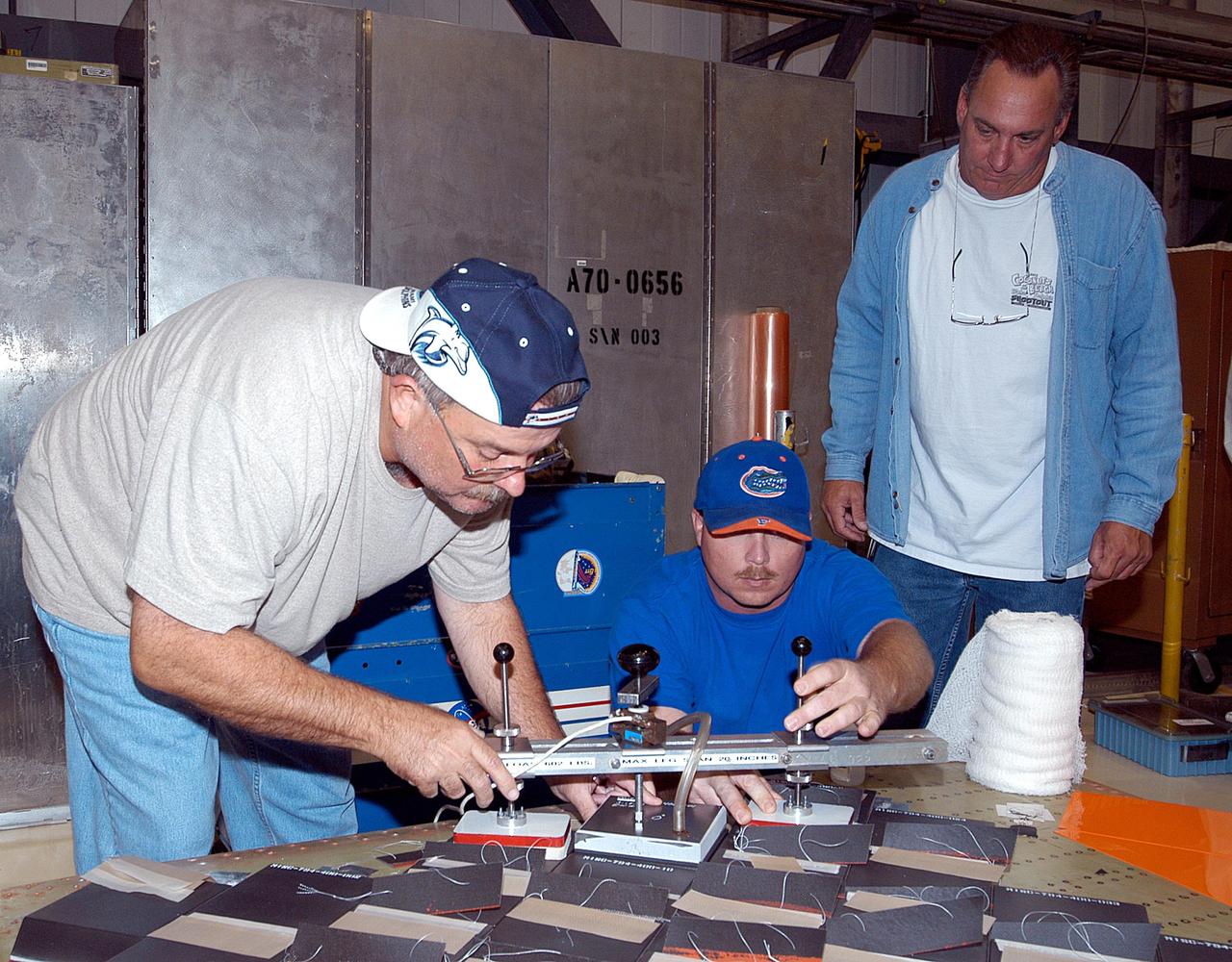
KENNEDY SPACE CENTER, FLA. -- In the Orbiter Processing Facility, United Space Alliance employees (from left) Dave Sanborn, Butch Lato, and Bill Brooks conduct a bond verification test on Thermal Protection System tiles newly installed on a main landing gear door of Space Shuttle orbiter Enterprise (OV-101). Sections of Enterprise were borrowed from the Smithsonian Institution's Air and Space Museum where the orbiter is being stored at the Washington Dulles International Airport. Enterprise was the first orbiter built in the Shuttle fleet and was used to conduct the Approach and Landing Test Program before the first powered Shuttle flight. After the tile installation is complete, the sections will be transferred to the Southwest Research Institute for testing requested by the Columbia Accident Investigation Board.
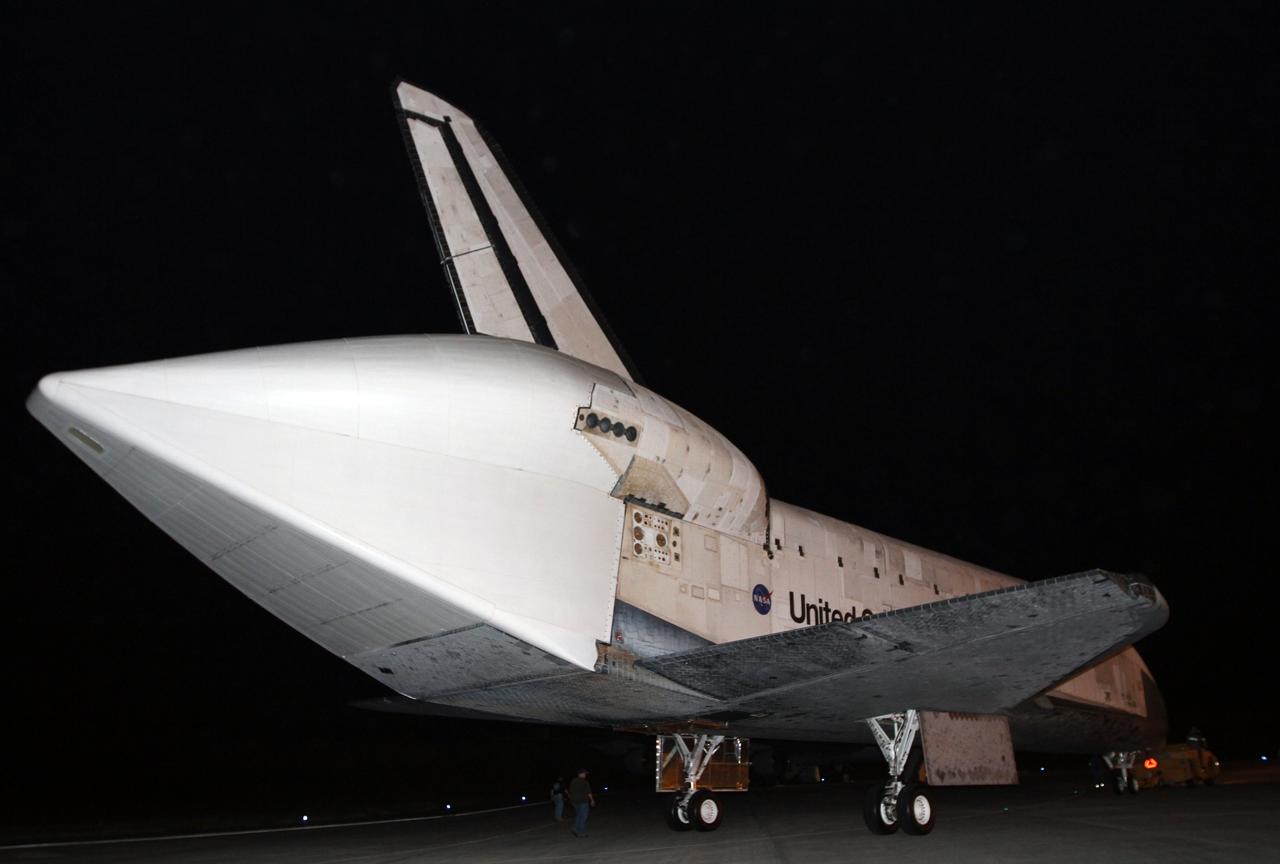
CAPE CANAVERAL, Fla. – Space shuttle Discovery makes its way in darkness to the Shuttle Landing Facility, or SLF, at NASA’s Kennedy Space Center in Florida. A tail cone has been installed over its three replica shuttle main engines to reduce aerodynamic drag and turbulence during its upcoming ferry flight. At the SLF, Discovery will be hoisted onto a Shuttle Carrier Aircraft, or SCA, with the aid of a mate-demate device. The SCA, a modified Boeing 747 jet airliner, is scheduled to ferry Discovery to the Washington Dulles International Airport in Virginia on April 17, after which the shuttle will be placed on permanent public display in the Smithsonian's National Air and Space Museum Steven F. Udvar-Hazy Center. For more information on shuttle transition and retirement activities, visit http://www.nasa.gov/transition. Photo credit: NASA/Kim Shiflett
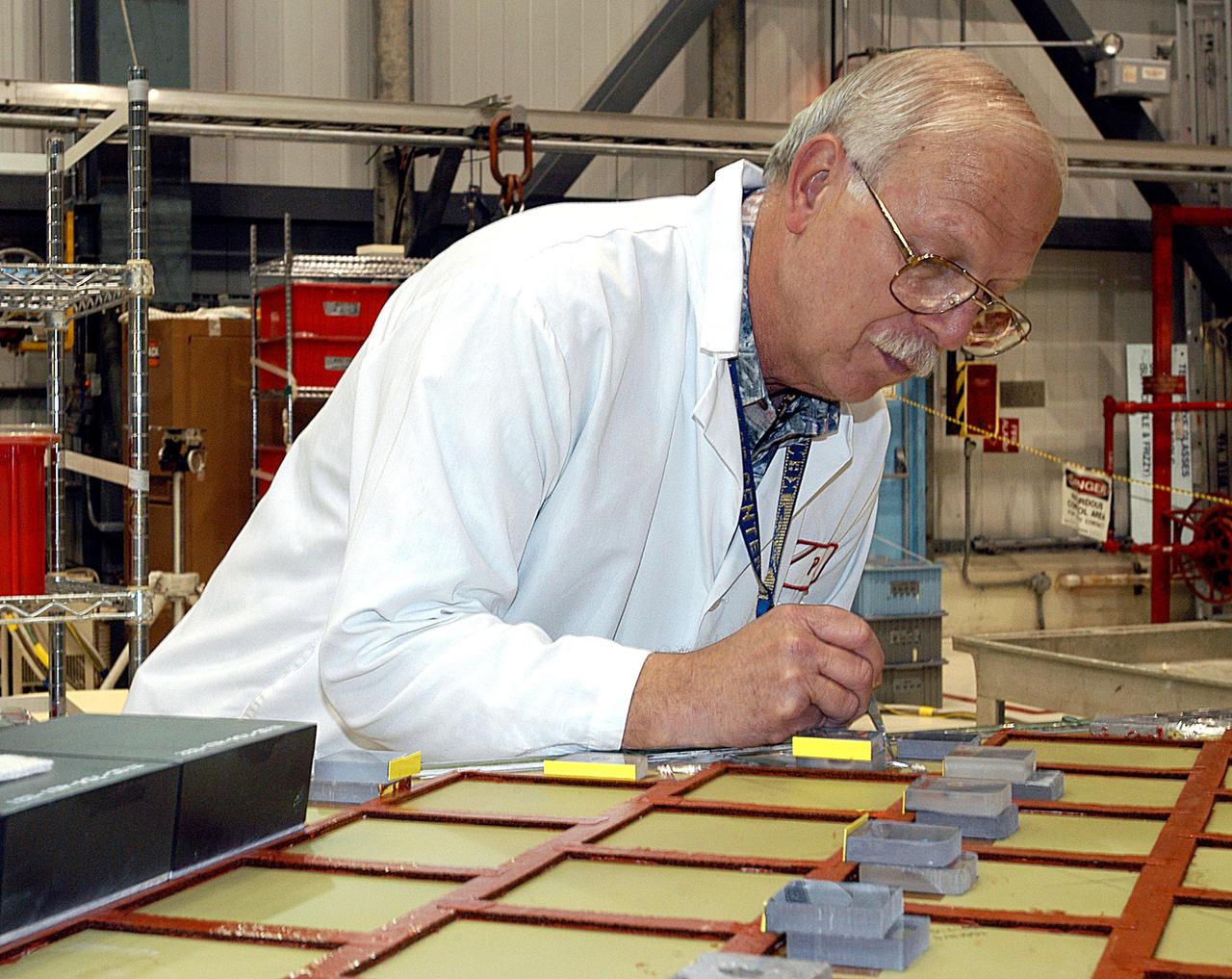
KENNEDY SPACE CENTER, FLA. -- In the Orbiter Processing Facility (OPF), Paul King, an employee of The Boeing Co., Huntington Beach, Calif., installs a strain gauge on a simulated orbiter wing in preparation for Thermal Protection System (TPS) tile installation. The wing, along with sections of Space Shuttle orbiter Enterprise (OV-101), will be transferred to the Southwest Research Institute for testing after the tile installation is complete. The testing has been requested by the Columbia Accident Investigation Board. For this initiative, sections of Enterprise were borrowed from the Smithsonian Institution's Air and Space Museum where the orbiter is being stored at the Washington Dulles International Airport. Enterprise was the first orbiter built in the Shuttle fleet and was used to conduct the Approach and Landing Test Program before the first powered Shuttle flight.
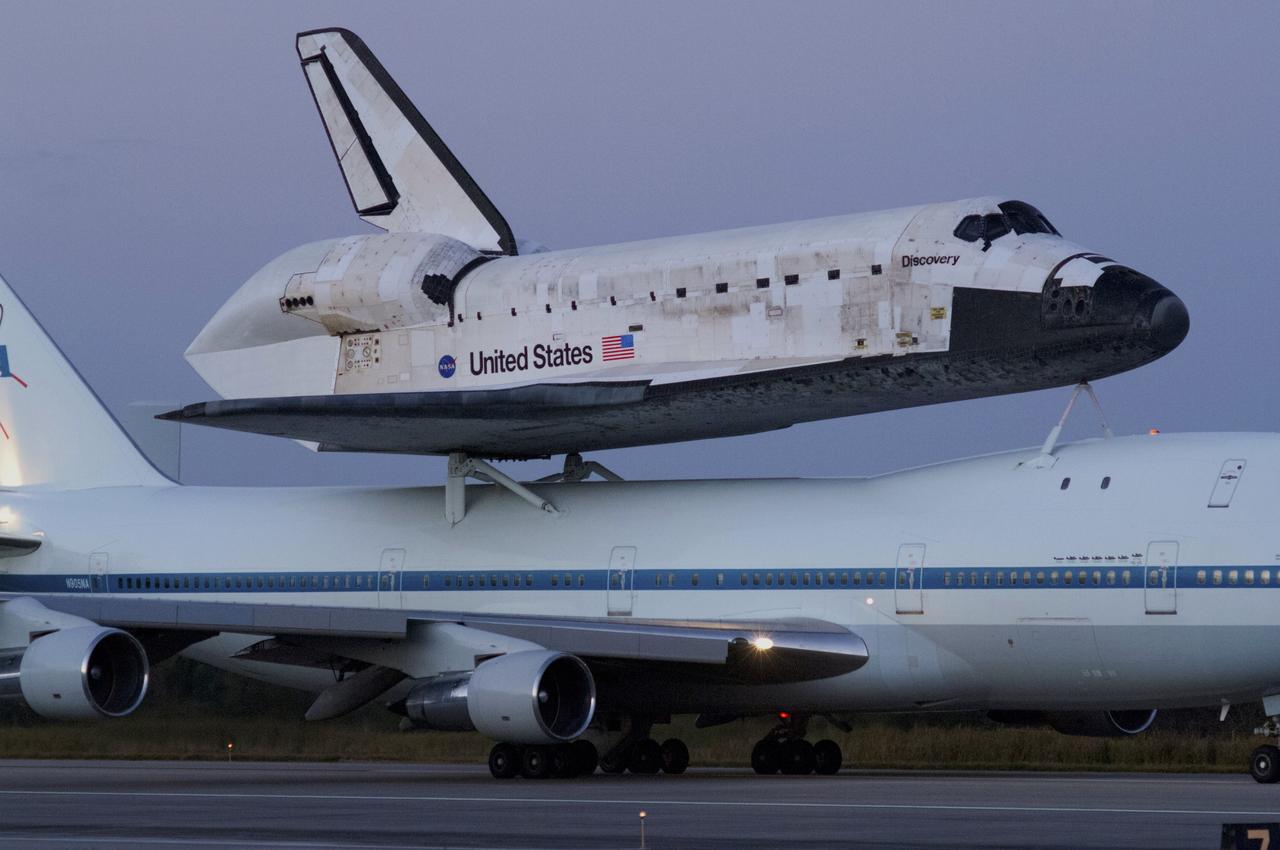
CAPE CANAVERAL, Fla. – Sunrise over the Shuttle Landing Facility at NASA’s Kennedy Space Center in Florida reveals the Shuttle Carrier Aircraft that is transporting space shuttle Discovery to its new home preparing for takeoff. The aircraft, known as an SCA, is a Boeing 747 jet, originally manufactured for commercial use, which was modified by NASA to transport the shuttles between destinations on Earth. This SCA, designated NASA 905, is assigned to the remaining ferry missions, delivering the shuttles to their permanent public display sites. NASA 905 is scheduled to ferry Discovery to the Washington Dulles International Airport in Virginia on April 17, after which the shuttle will be placed on display in the Smithsonian's National Air and Space Museum Steven F. Udvar-Hazy Center. For more information on the SCA, visit http://www.nasa.gov/centers/dryden/news/FactSheets/FS-013-DFRC.html. For more information on shuttle transition and retirement activities, visit http://www.nasa.gov/transition. Photo credit: NASA/Rusty Backer
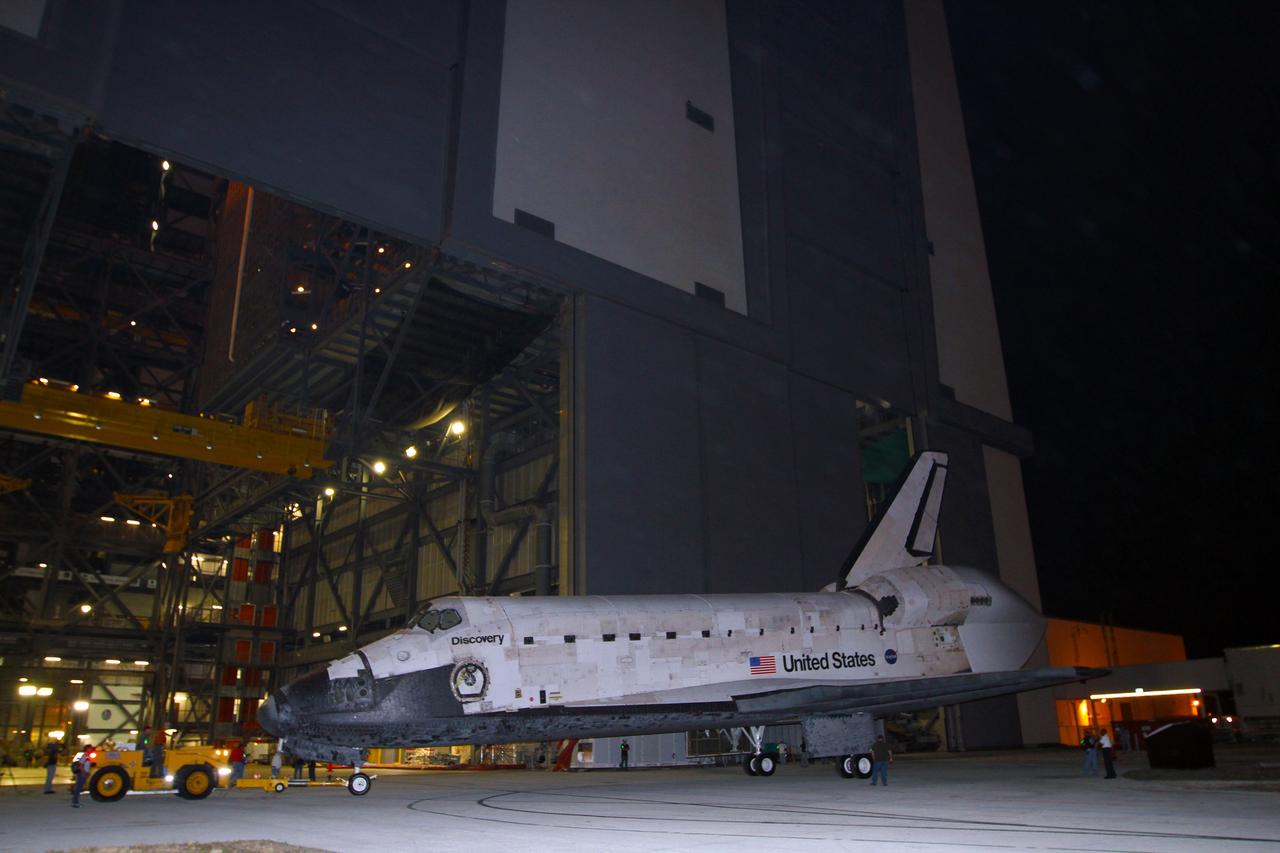
CAPE CANAVERAL, Fla. – Space shuttle Discovery completes a three-point turnaround outside the Vehicle Assembly Building, or VAB, at NASA’s Kennedy Space Center in Florida, for its trip to the Shuttle Landing Facility, or SLF. Its move got under way at 5 a.m. EDT. Discovery was in storage in the VAB’s high bay 4 awaiting departure from Kennedy’s Launch Complex 39 area for the final time. At the SLF, Discovery will be hoisted onto a Shuttle Carrier Aircraft, or SCA, with the aid of a mate-demate device. The SCA, a modified Boeing 747 jet airliner, is scheduled to transport Discovery to the Washington Dulles International Airport in Virginia on April 17, after which the shuttle will be placed on permanent public display in the Smithsonian's National Air and Space Museum Steven F. Udvar-Hazy Center. For more information on shuttle transition and retirement activities, visit http://www.nasa.gov/transition. Photo credit: NASA/Kim Shiflett
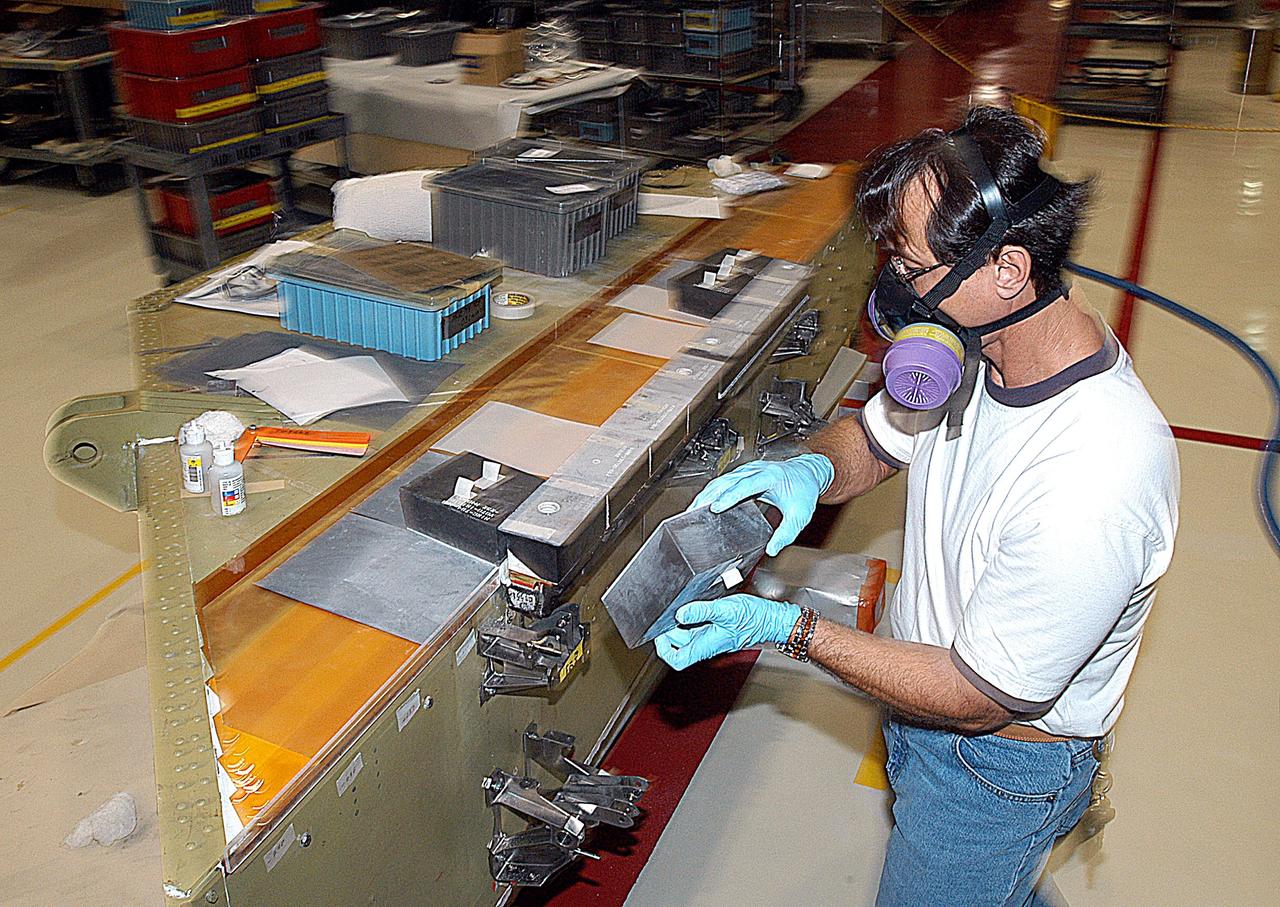
KENNEDY SPACE CENTER, FLA. -- In the Orbiter Processing Facility (OPF), United Space Alliance (USA) technician Mark Jetton installs Thermal Protection System (TPS) tile on a simulated orbiter wing. The wing, along with sections of Space Shuttle orbiter Enterprise (OV-101), will be transferred to the Southwest Research Institute for testing after the tile installation is complete. The testing has been requested by the Columbia Accident Investigation Board. For this initiative, sections of Enterprise were borrowed from the Smithsonian Institution's Air and Space Museum where the orbiter is being stored at the Washington Dulles International Airport. Enterprise was the first orbiter built in the Shuttle fleet and was used to conduct the Approach and Landing Test Program before the first powered Shuttle flight.
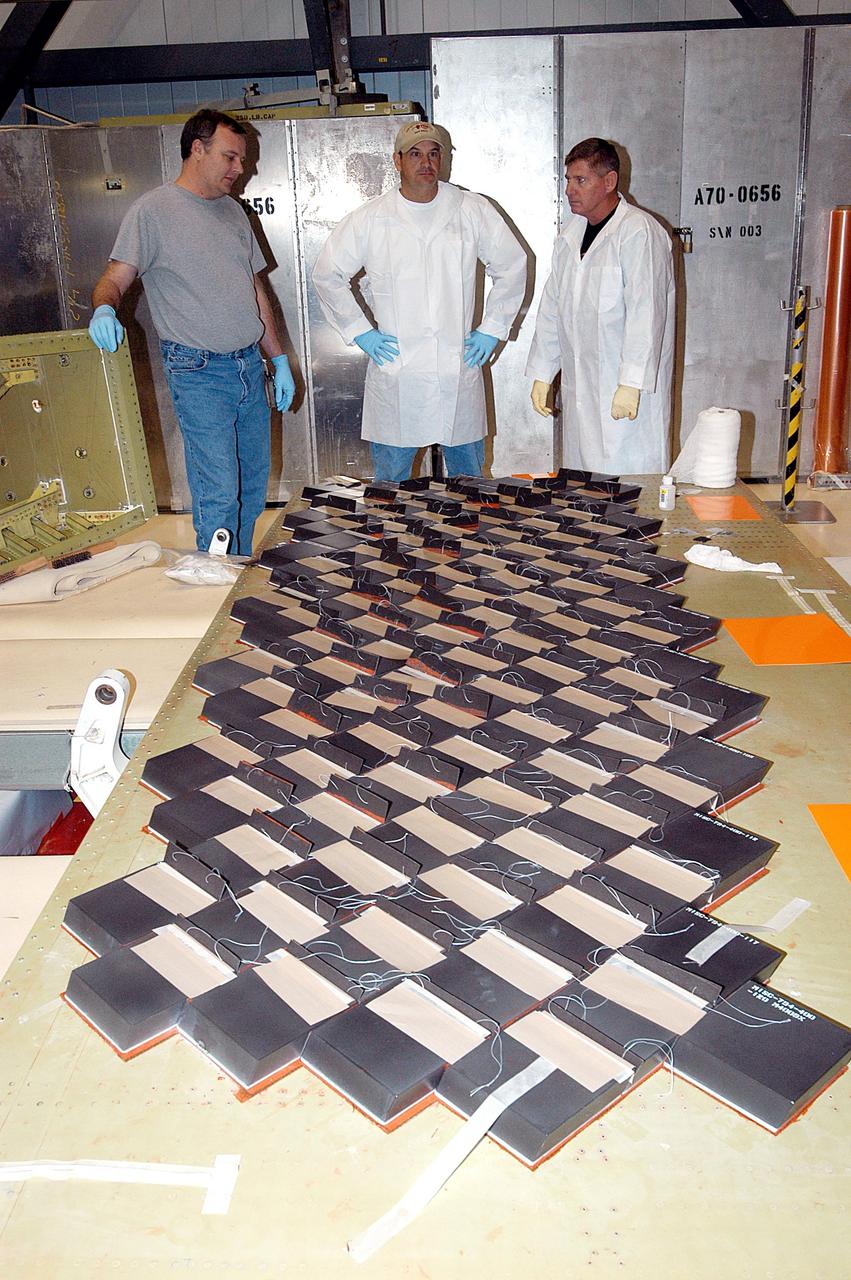
KENNEDY SPACE CENTER, FLA. -- In the Orbiter Processing Facility, United Space Alliance employees (from left) John Kuhn, Mike Cote, and Tom Baggitt discuss the installation of Thermal Protection System tiles on a main landing gear door of Space Shuttle orbiter Enterprise (OV-101). Sections of Enterprise were borrowed from the Smithsonian Institution's Air and Space Museum where the orbiter is being stored at the Washington Dulles International Airport. Enterprise was the first orbiter built in the Shuttle fleet and was used to conduct the Approach and Landing Test Program before the first powered Shuttle flight. After the tile installation is complete, the sections will be transferred to the Southwest Research Institute for testing requested by the Columbia Accident Investigation Board.
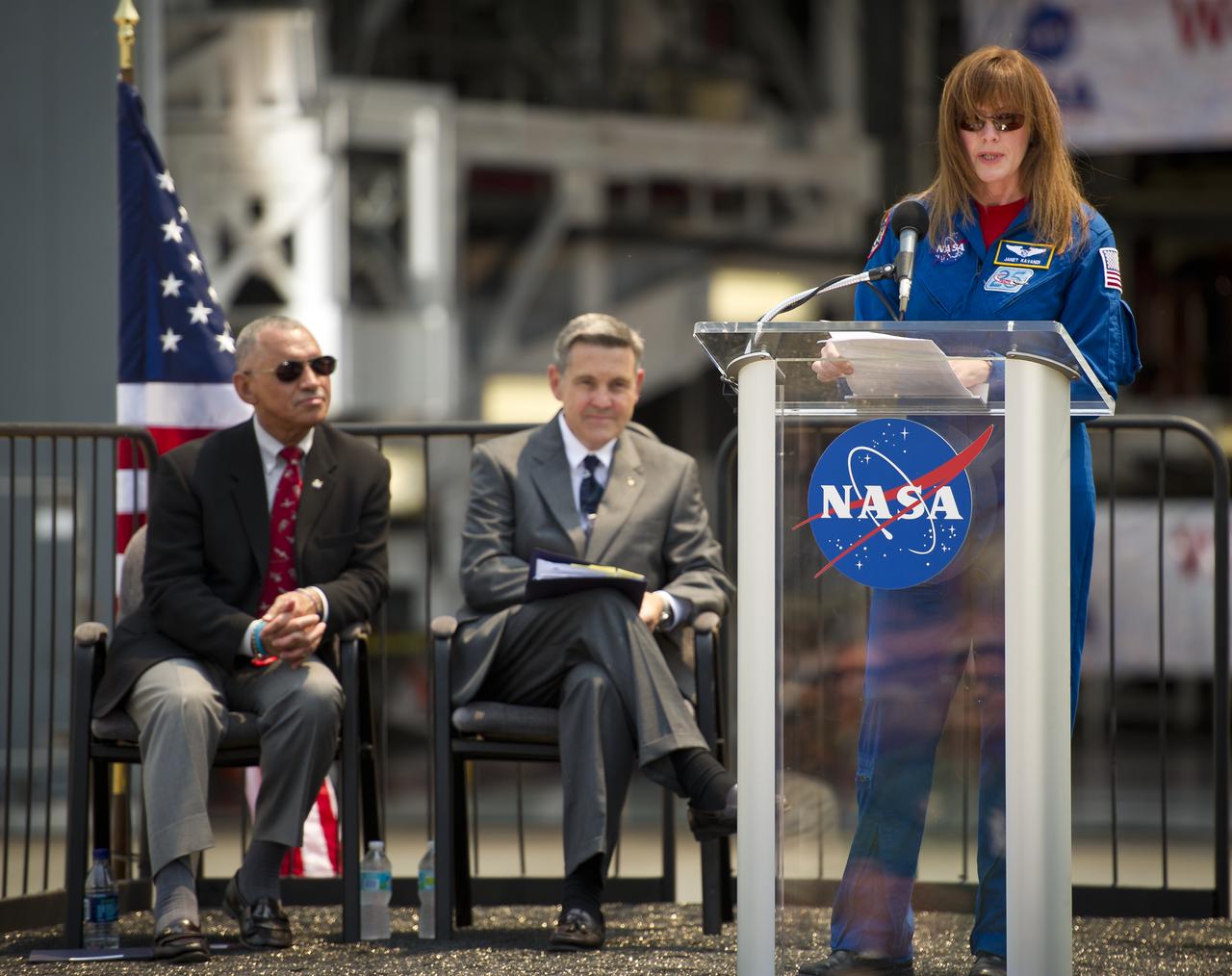
NASA Johnson Space Center Director of Flight Crew Operations, and Astronaut, Janet Kavandi speaks at an event where NASA Administrator Charles Bolden announced where four space shuttle orbiters will be permanently displayed at the conclusion of the Space Shuttle Program, Tuesday, April 12, 2011, at Kennedy Space Center in Cape Canaveral, Fla. The four orbiters, Enterprise, which currently is on display at the Smithsonian's Steven F. Udvar-Hazy Center near Washington Dulles International Airport, will move to the Intrepid Sea, Air & Space Museum in New York, Discovery will move to Udvar-Hazy, Endeavour will be displayed at the California Science Center in Los Angeles and Atlantis, in background, will be displayed at the Kennedy Space Center Visitor’s Complex. Photo Credit: (NASA/Bill Ingalls)
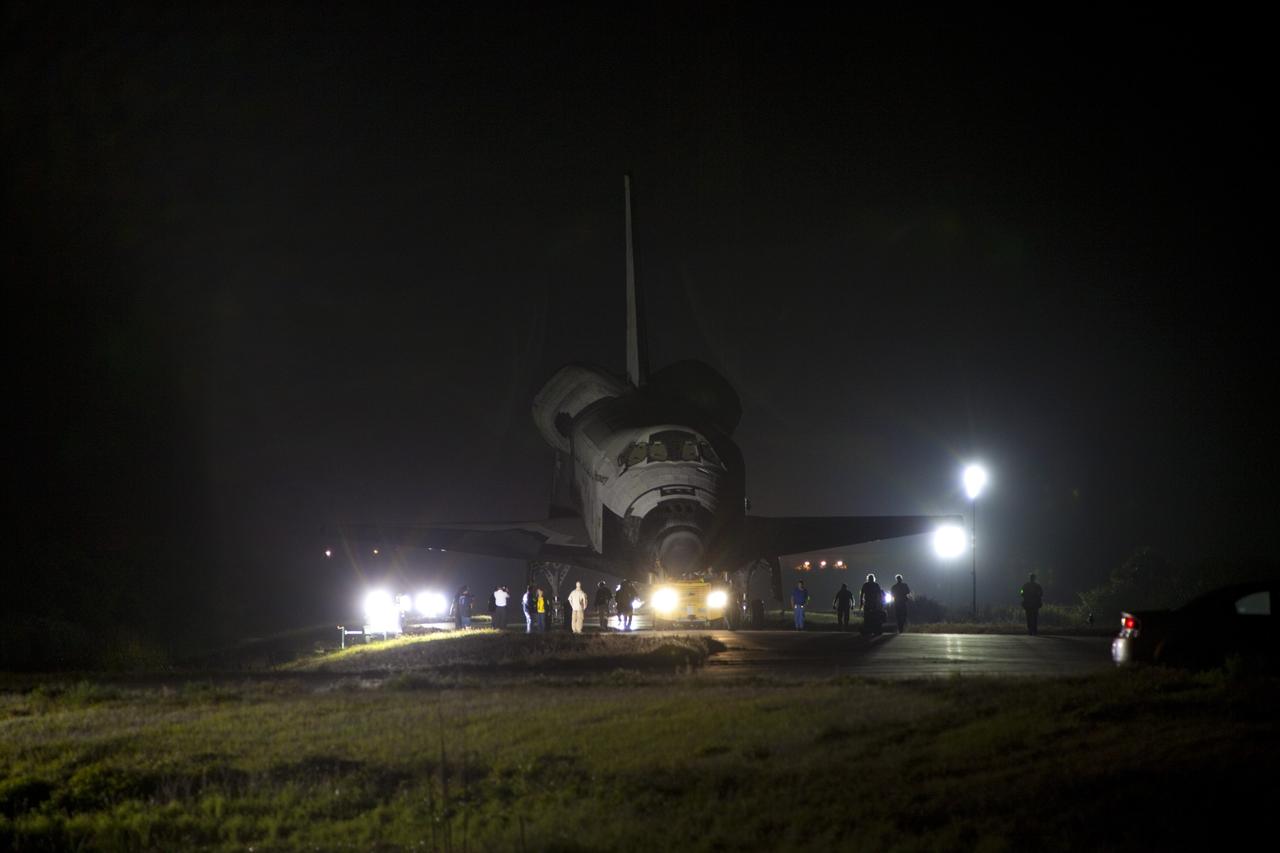
CAPE CANAVERAL, Fla. – Space shuttle Discovery makes its way to the Shuttle Landing Facility, or SLF, before dawn at NASA’s Kennedy Space Center in Florida. Its move from the Vehicle Assembly Building got under way at 5 a.m. EDT. At the SLF, Discovery will be hoisted onto a Shuttle Carrier Aircraft, or SCA, with the aid of a mate-demate device. The SCA, a modified Boeing 747 jet airliner, is scheduled to ferry Discovery to the Washington Dulles International Airport in Virginia on April 17, after which the shuttle will be placed on permanent public display in the Smithsonian's National Air and Space Museum Steven F. Udvar-Hazy Center. For more information on shuttle transition and retirement activities, visit http://www.nasa.gov/transition. Photo credit: NASA/Dimitri Gerondidakis
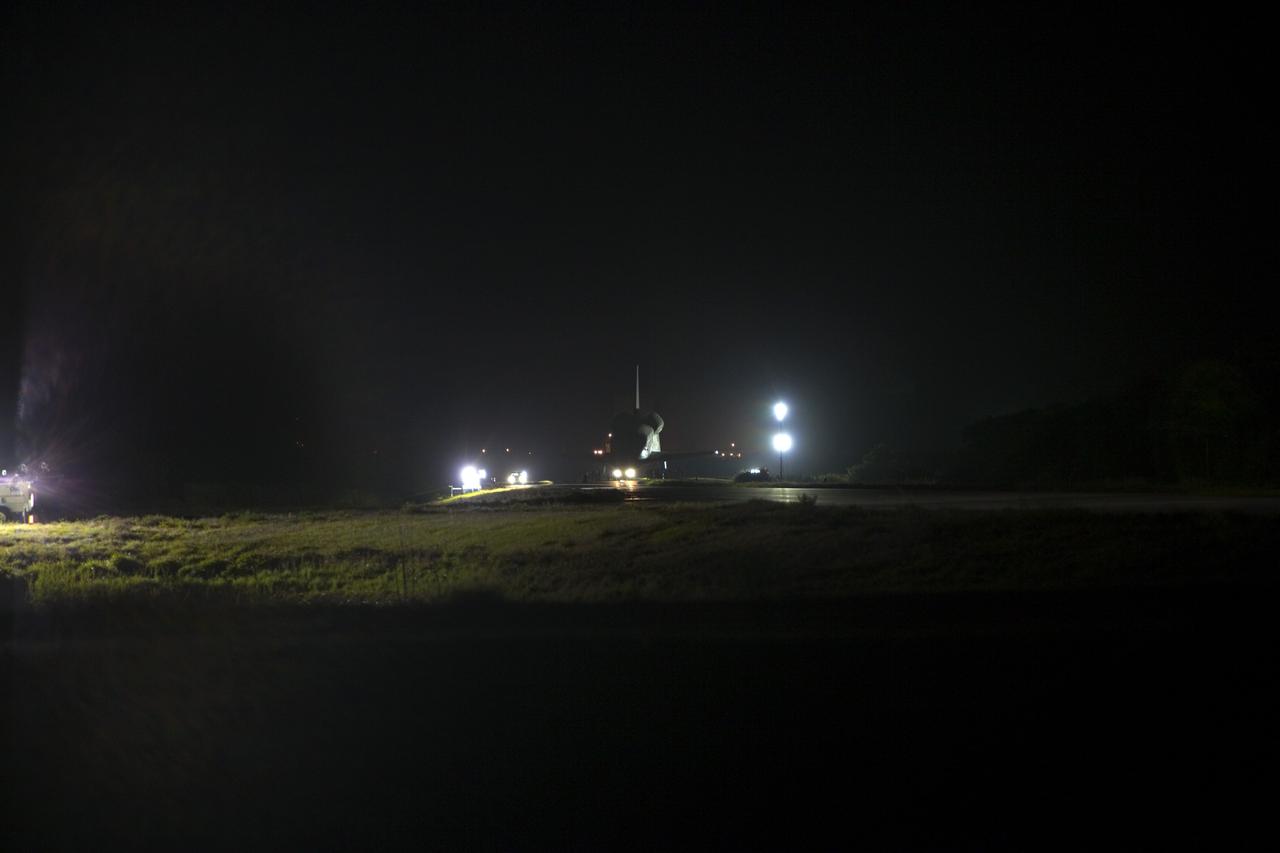
CAPE CANAVERAL, Fla. – Space shuttle Discovery makes its way to the Shuttle Landing Facility, or SLF, in darkness at NASA’s Kennedy Space Center in Florida. Its move from the Vehicle Assembly Building got under way at 5 a.m. EDT. At the SLF, Discovery will be hoisted onto a Shuttle Carrier Aircraft, or SCA, with the aid of a mate-demate device. The SCA, a modified Boeing 747 jet airliner, is scheduled to ferry Discovery to the Washington Dulles International Airport in Virginia on April 17, after which the shuttle will be placed on permanent public display in the Smithsonian's National Air and Space Museum Steven F. Udvar-Hazy Center. For more information on shuttle transition and retirement activities, visit http://www.nasa.gov/transition. Photo credit: NASA/Dimitri Gerondidakis
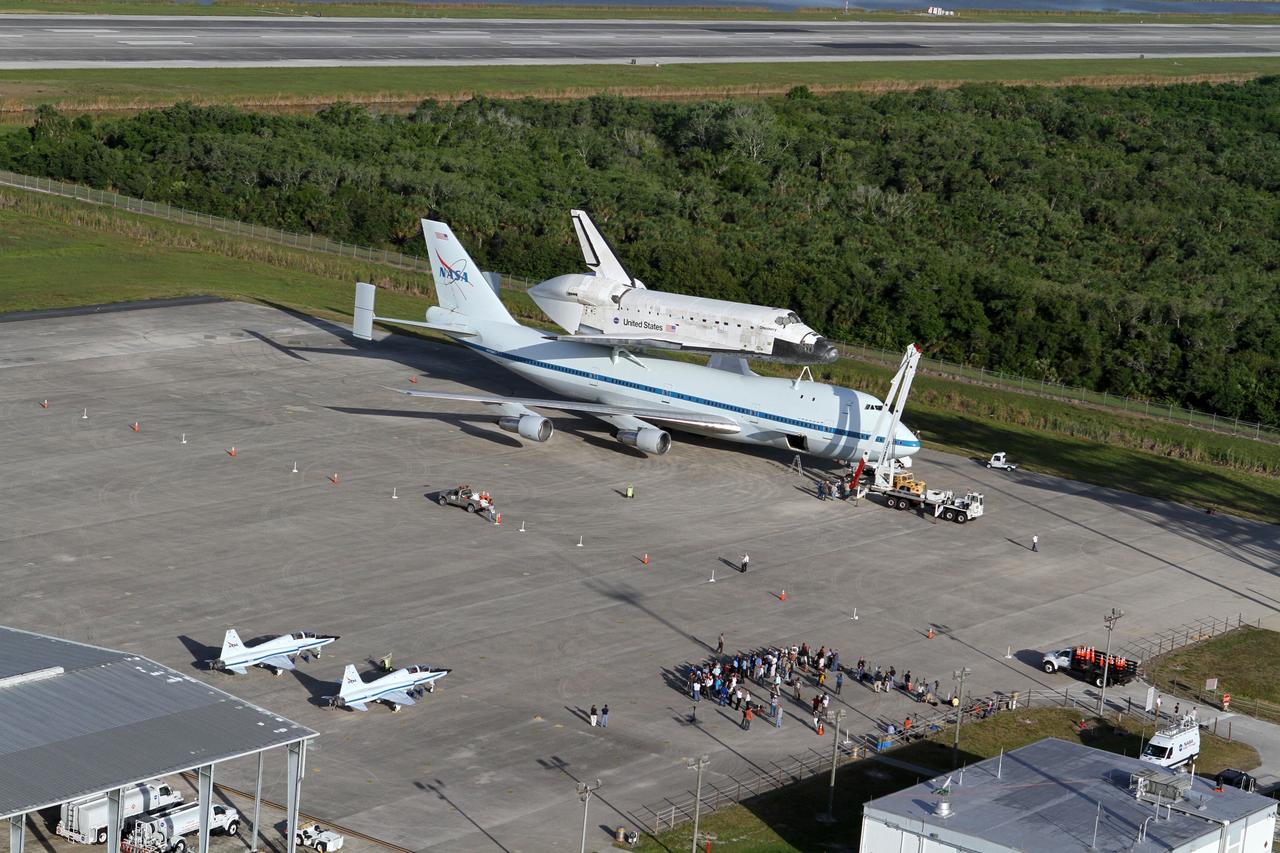
CAPE CANAVERAL, Fla. – This is an aerial view of space shuttle Discovery bolted to the top of a Shuttle Carrier Aircraft SCA on the ramp of the Shuttle Landing Facility SLF at NASA’s Kennedy Space Center in Florida. Also on the ramp is a pair of T-38 training jets. Discovery's last crew members are expected to be at the SLF, along with Kennedy employees and guests, as the center says goodbye to the agency's most-flown shuttle on April 17. The SCA, designated NASA 905, will ferry Discovery to the Washington Dulles International Airport in Virginia, after which the shuttle will be moved for public display in the Smithsonian's National Air and Space Museum Steven F. Udvar-Hazy Center on April 19. For more information on the SCA, visit http://www.nasa.gov/centers/dryden/news/FactSheets/FS-013-DFRC.html. For more information on shuttle transition and retirement activities, visit http://www.nasa.gov/transition. Photo credit: NASA/Kim Shiflett
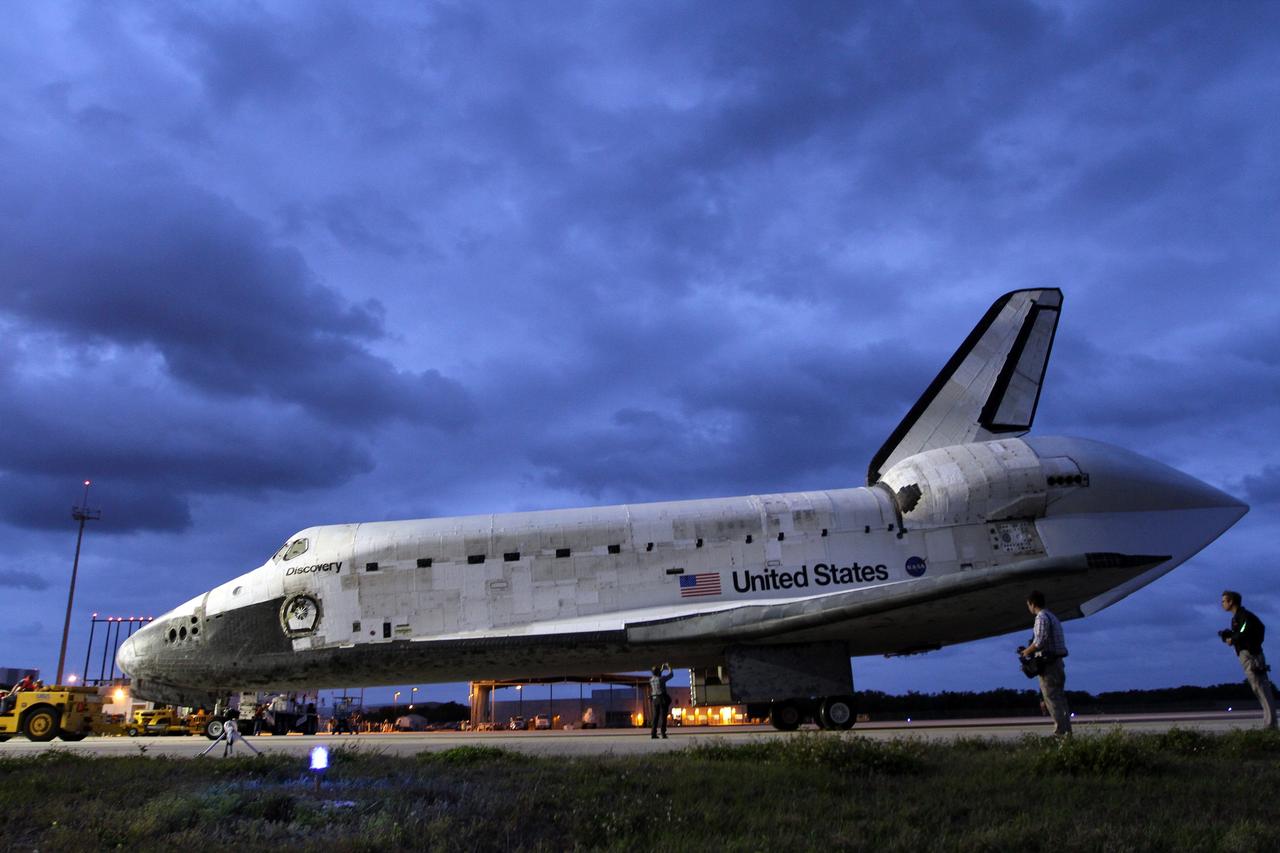
CAPE CANAVERAL, Fla. – Space Shuttle Discovery’s move from the Vehicle Assembly Building to the Shuttle Landing Facility, or SLF, is complete as the day breaks over NASA’s Kennedy Space Center in Florida. At the SLF, Discovery will be hoisted onto a Shuttle Carrier Aircraft, or SCA, with the aid of a mate-demate device. The SCA, a modified Boeing 747 jet airliner, is scheduled to ferry Discovery to the Washington Dulles International Airport in Virginia on April 17, after which the shuttle will be placed on permanent public display in the Smithsonian's National Air and Space Museum Steven F. Udvar-Hazy Center. For more information on shuttle transition and retirement activities, visit http://www.nasa.gov/transition. Photo credit: NASA/Kim Shiflett