
Photos of the Emergency Evacuation Water Test at the CCP Crew Access Arm in Oak Hill, for Boeing/ULA.
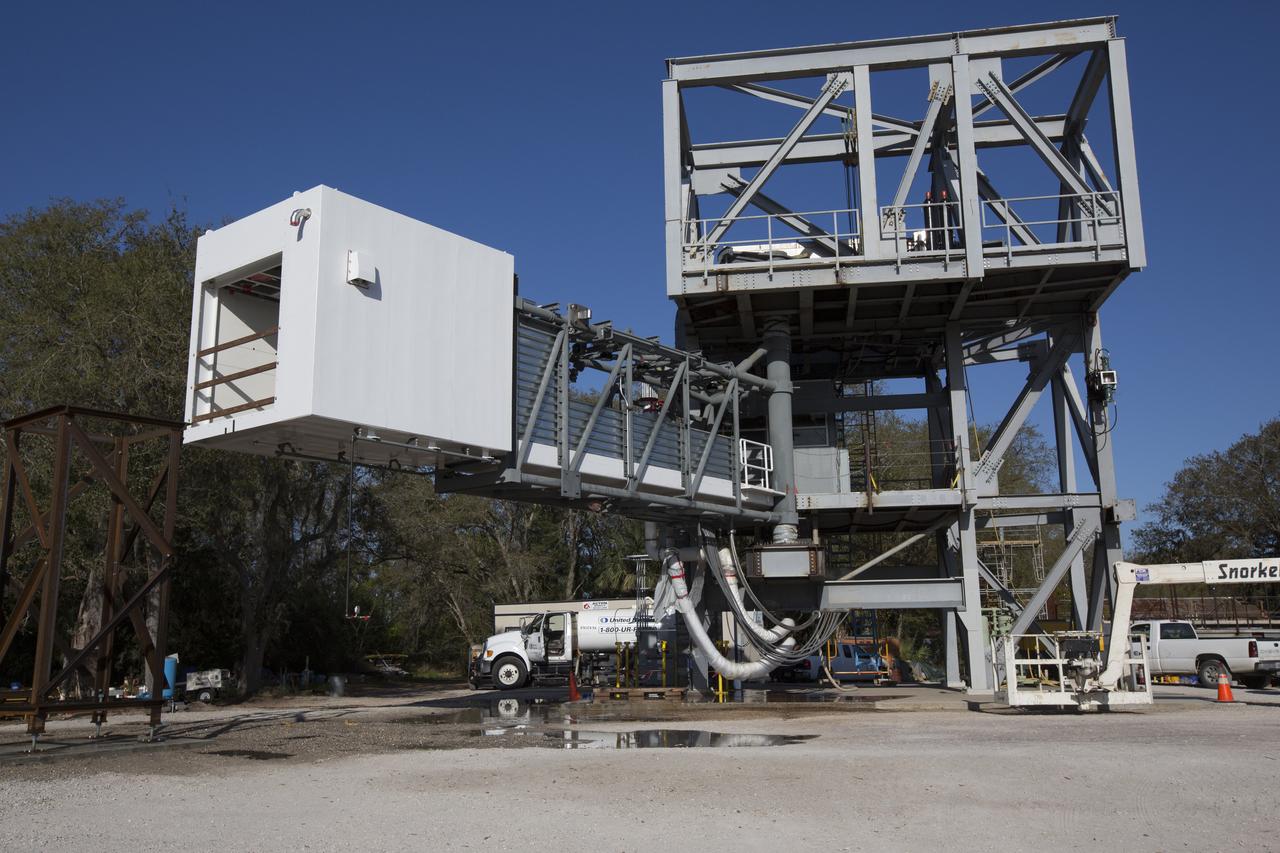
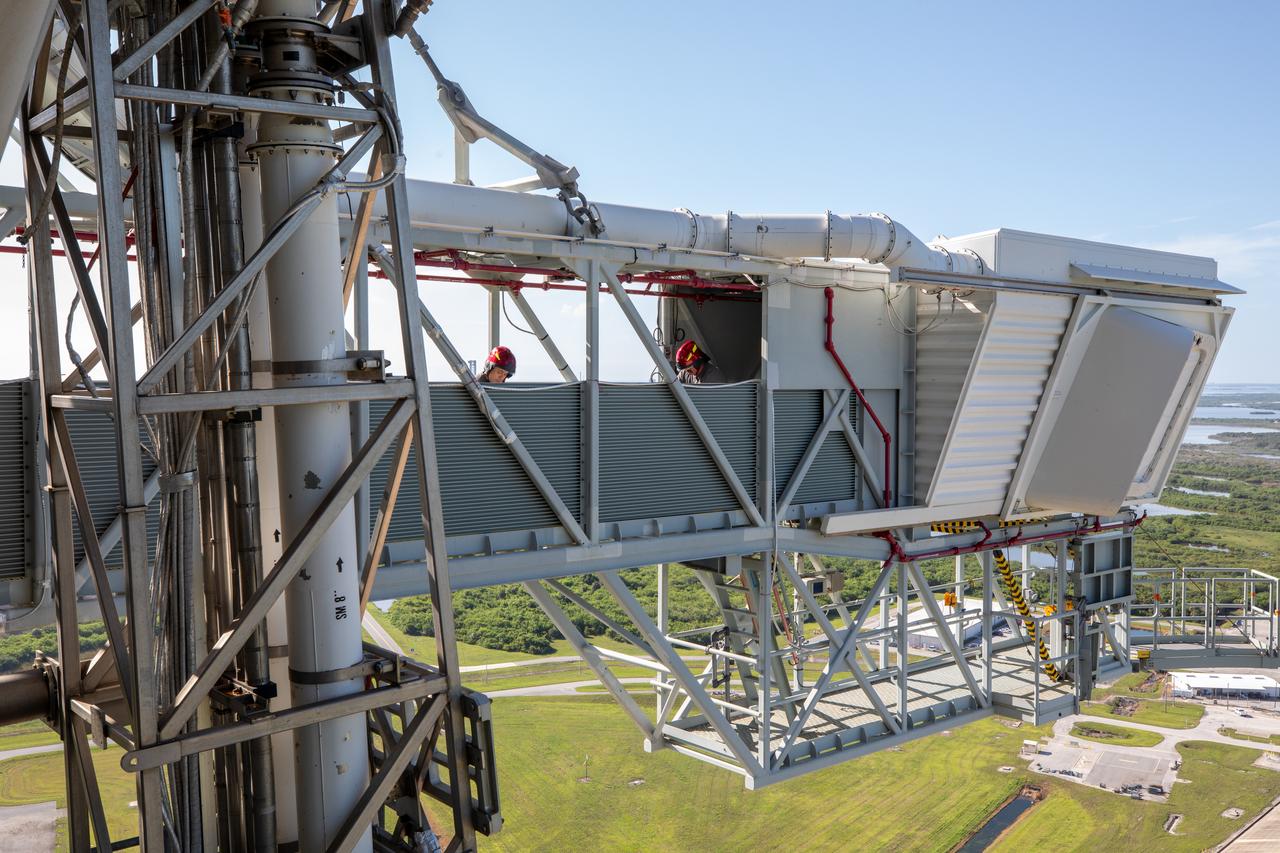
The Crew Access Arm is seen following a water deluge systems test March 23 at a construction yard near NASA's Kennedy Space Center in Florida. The arm is being tested before being installed on Space Launch Complex 41 Crew Access Tower later this year. It will be used as a bridge by astronauts to board Boeing's CST-100 Starliner spacecraft as it stands on the launch pad atop a United Launch Alliance Atlas V rocket.
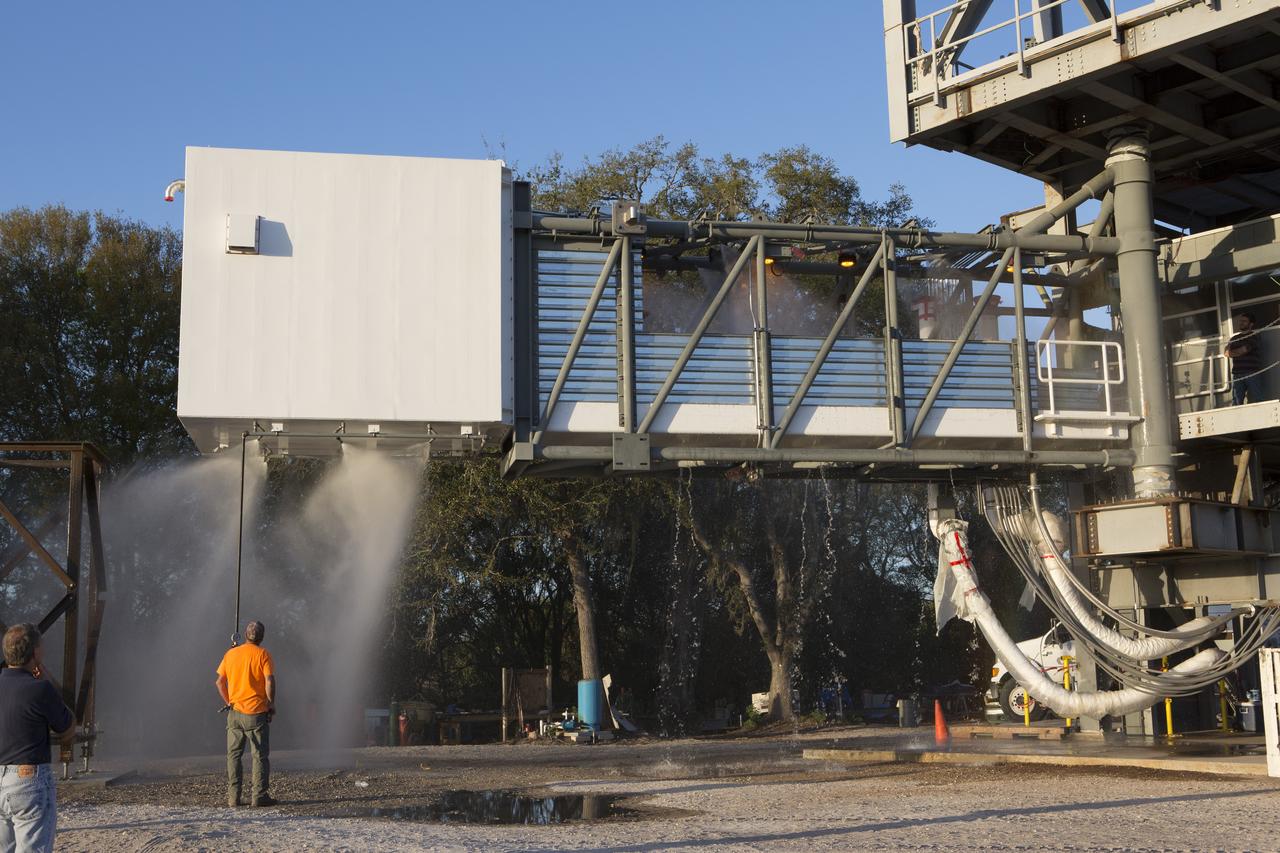
Water sprays on the Crew Access Arm during a deluge systems test March 23 at a construction yard near NASA's Kennedy Space Center in Florida. The arm is being tested before being installed on Space Launch Complex 41 Crew Access Tower later this year. It will be used as a bridge by astronauts to board Boeing's CST-100 Starliner spacecraft as it stands on the launch pad atop a United Launch Alliance Atlas V rocket.
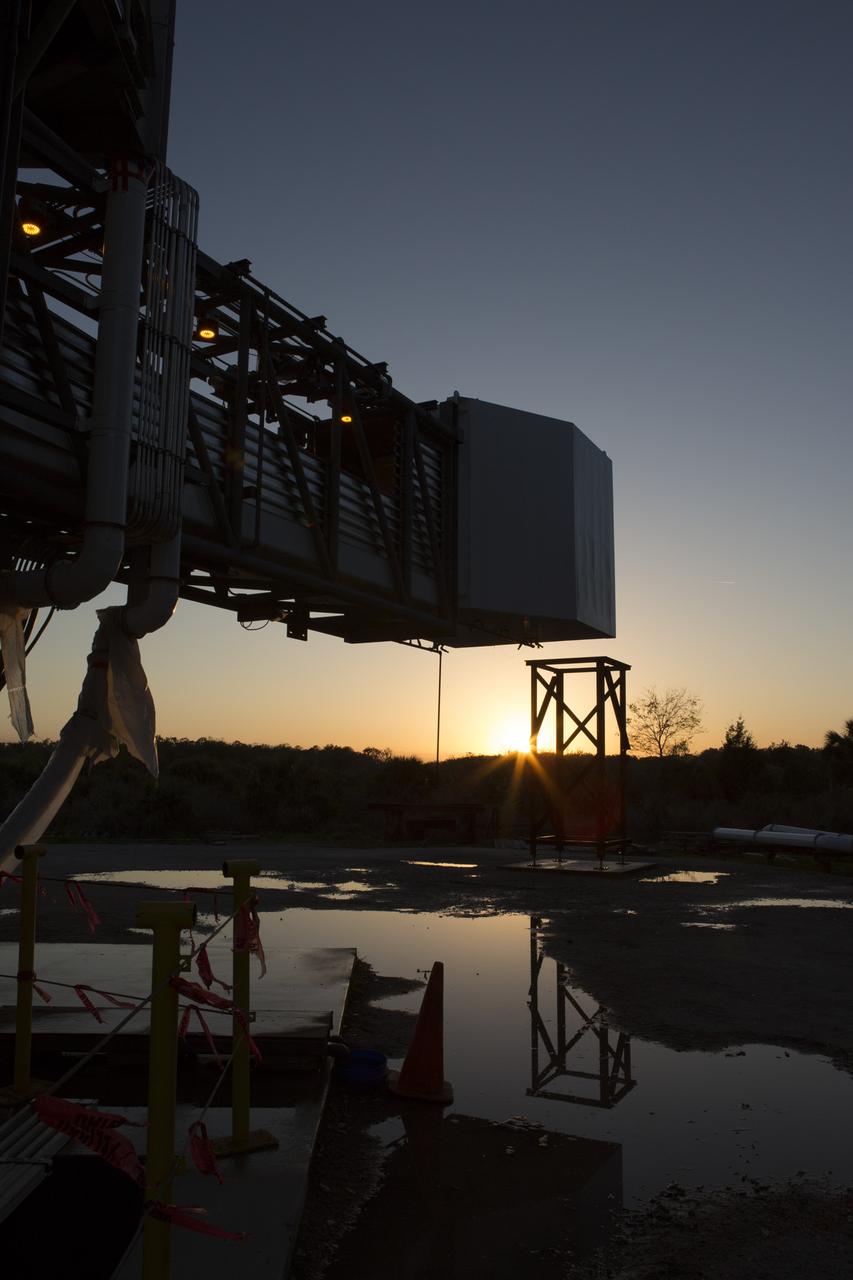
The Crew Access Arm is seen following a water deluge systems test March 23 at a construction yard near NASA's Kennedy Space Center in Florida. The arm is being tested before being installed on Space Launch Complex 41 Crew Access Tower later this year. It will be used as a bridge by astronauts to board Boeing's CST-100 Starliner spacecraft as it stands on the launch pad atop a United Launch Alliance Atlas V rocket.
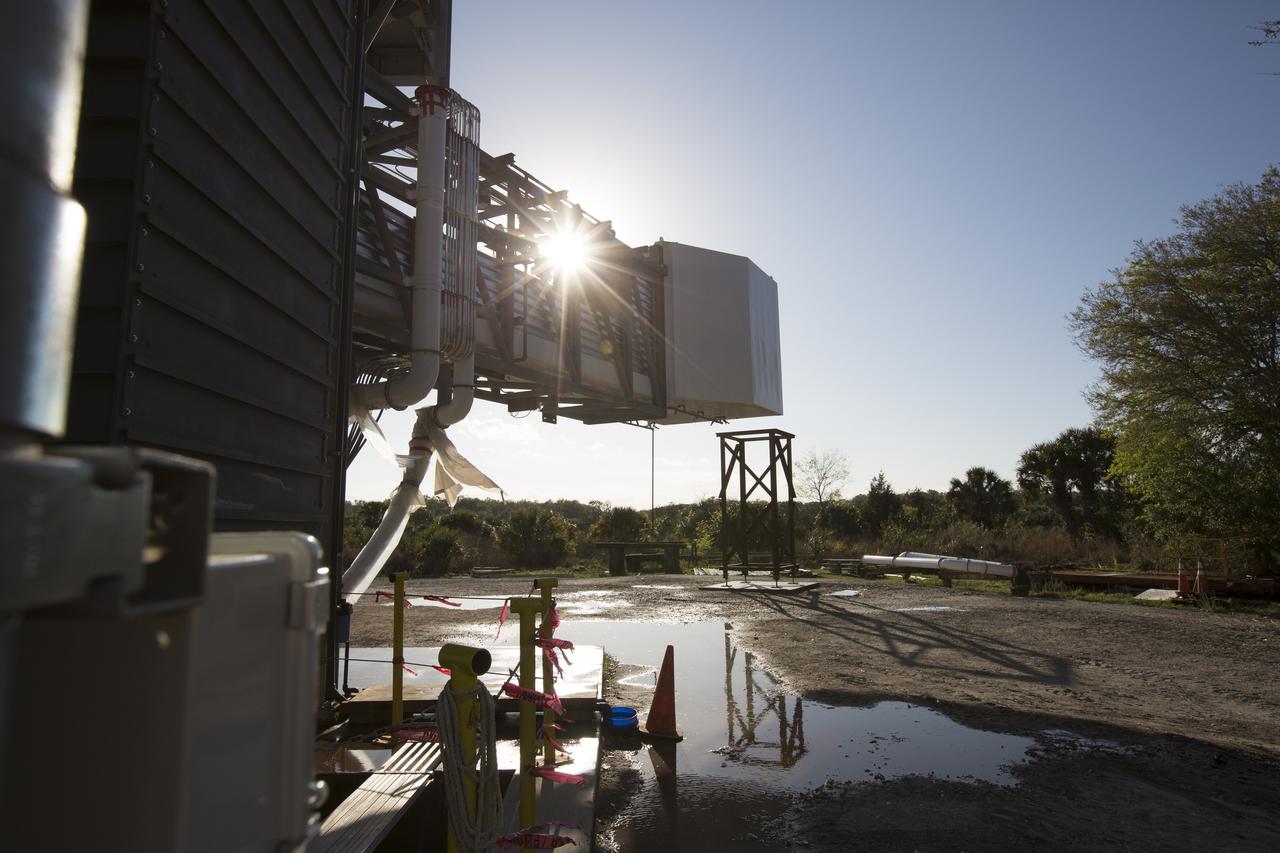
The Crew Access Arm is seen following a water deluge systems test March 23 at a construction yard near NASA's Kennedy Space Center in Florida. The arm is being tested before being installed on Space Launch Complex 41 Crew Access Tower later this year. It will be used as a bridge by astronauts to board Boeing's CST-100 Starliner spacecraft as it stands on the launch pad atop a United Launch Alliance Atlas V rocket.

Water sprays on the Crew Access Arm during a deluge systems test March 23 at a construction yard near NASA's Kennedy Space Center in Florida. The arm is being tested before being installed on Space Launch Complex 41 Crew Access Tower later this year. It will be used as a bridge by astronauts to board Boeing's CST-100 Starliner spacecraft as it stands on the launch pad atop a United Launch Alliance Atlas V rocket.

The walkway portion of the Crew Access Arm is seen prior to a deluge systems test March 23 at a construction yard near NASA's Kennedy Space Center in Florida. The arm is being tested before being installed on Space Launch Complex 41 Crew Access Tower later this year. It will be used as a bridge by astronauts to board Boeing's CST-100 Starliner spacecraft as it stands on the launch pad atop a United Launch Alliance Atlas V rocket.
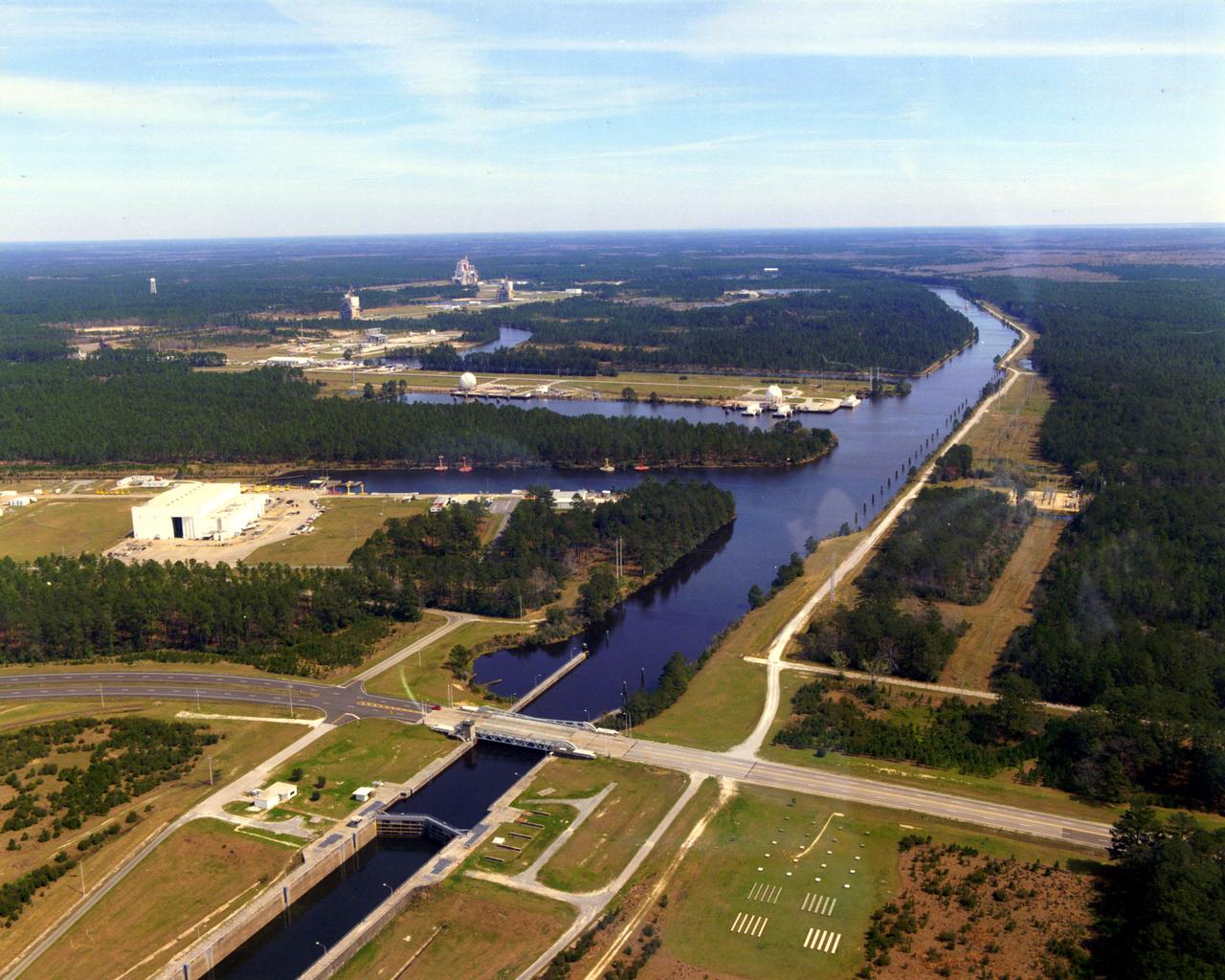
This aerial view of Stennis Space Center's unique lock and canal system

The annotated area of Mars in this illustration holds near-surface water ice that would be easily accessible for astronauts to dig up. The water ice was identified as part of a map using data from NASA orbiters. Animation available at https://photojournal.jpl.nasa.gov/catalog/PIA23515
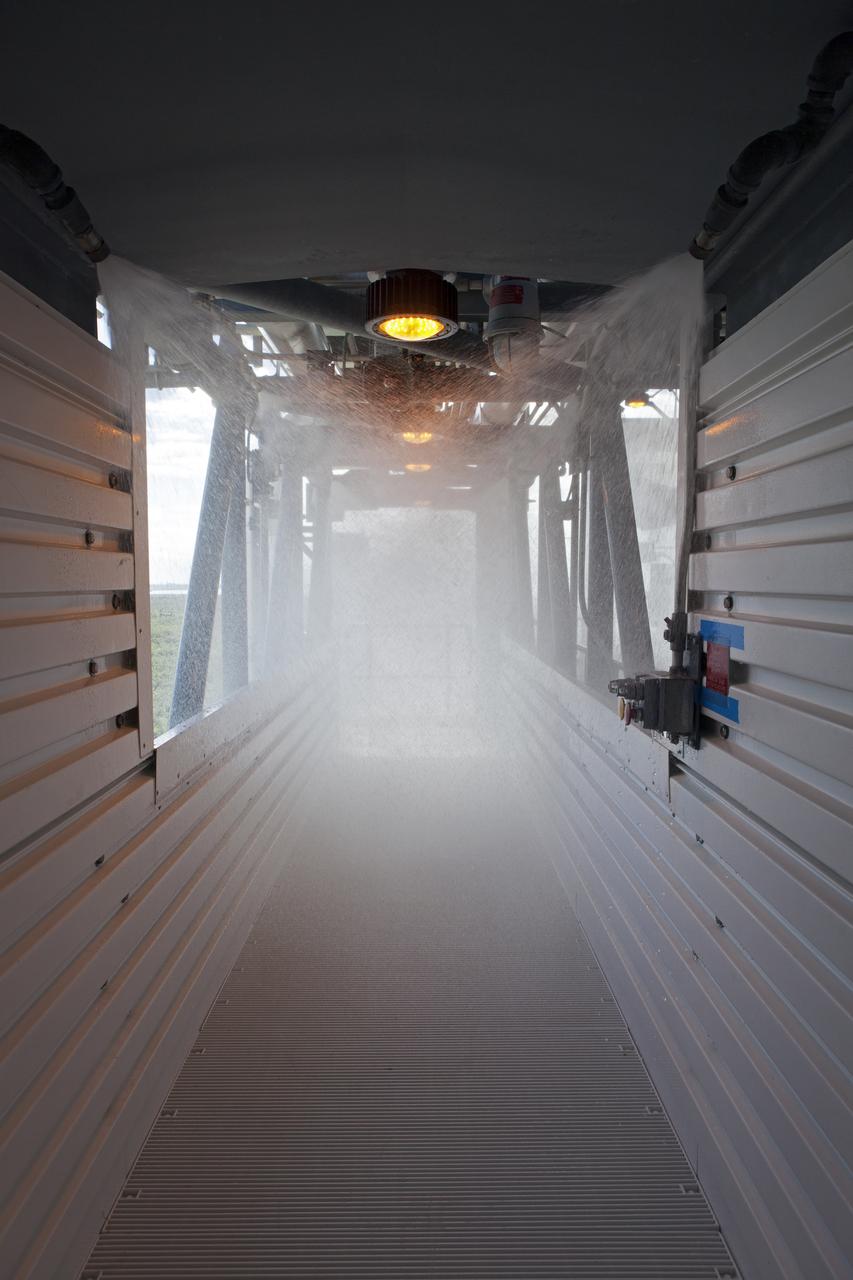
NASA, Boeing and United Launch Alliance personnel run a water deluge test on the Crew Access Tower at Space Launch Complex 41 on Cape Canaveral Air Force Station in Florida. The test gathered data on how launch site and astronaut crews would exit in the event of an emergency from the white room at the end of the crew access arm to the emergency escape system on the pad. Boeing’s Starliner will launch on a United Launch Alliance Atlas V rocket to the International Space Station as part of NASA’s Commercial Crew Program.

NASA and Boeing personnel experience conditions during a water deluge test on the Crew Access Tower at Space Launch Complex 41 on Cape Canaveral Air Force Station in Florida. The test gathered data on how launch site and astronaut crews would exit in the event of an emergency from the white room at the end of the crew access arm to the emergency escape system on the pad. Boeing’s Starliner will launch on a United Launch Alliance Atlas V rocket to the International Space Station as part of NASA’s Commercial Crew Program.
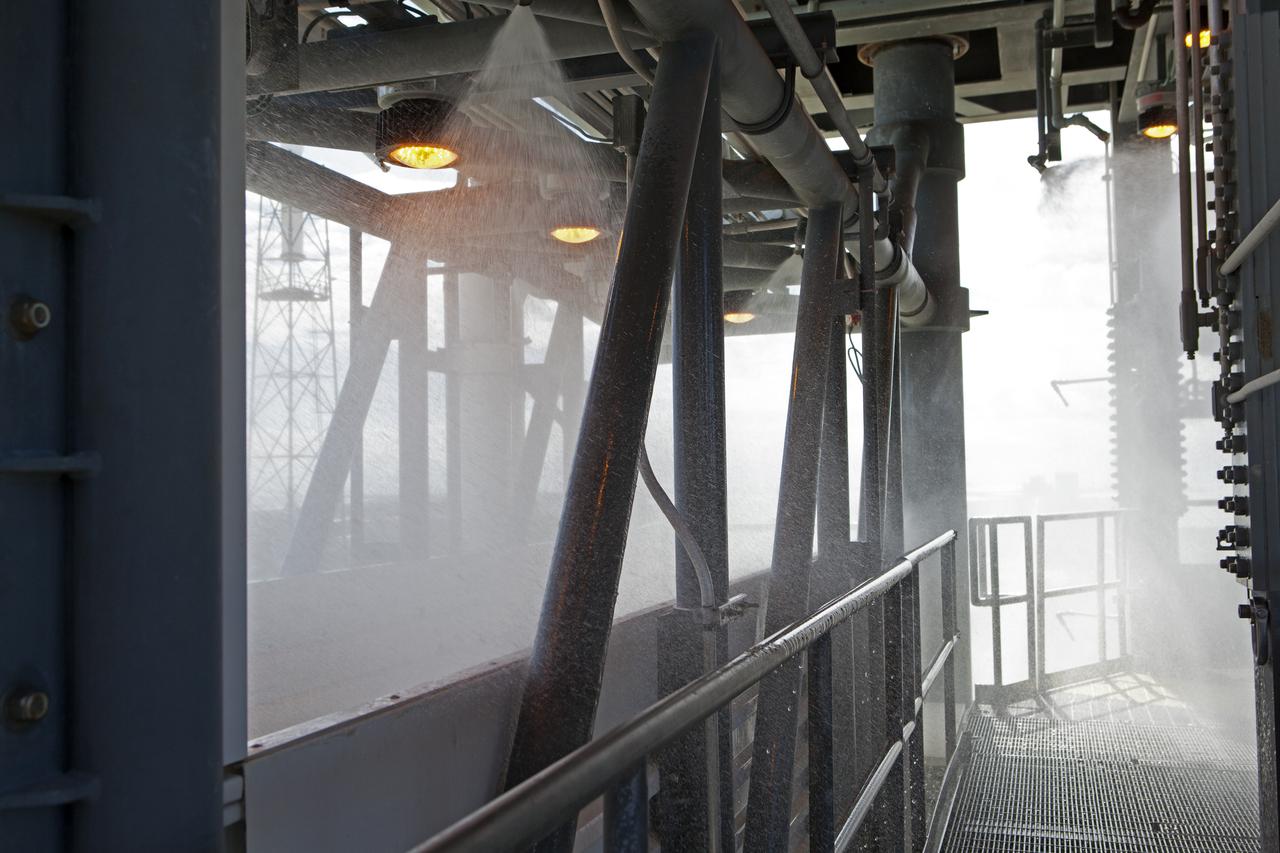
NASA, Boeing and United Launch Alliance personnel begin a water deluge test on the Crew Access Tower at Space Launch Complex 41 on Cape Canaveral Air Force Station in Florida. The test gathered data on how launch site and astronaut crews would exit in the event of an emergency from the white room at the end of the crew access arm to the emergency escape system on the pad. Boeing’s Starliner will launch on a United Launch Alliance Atlas V rocket to the International Space Station as part of NASA’s Commercial Crew Program.
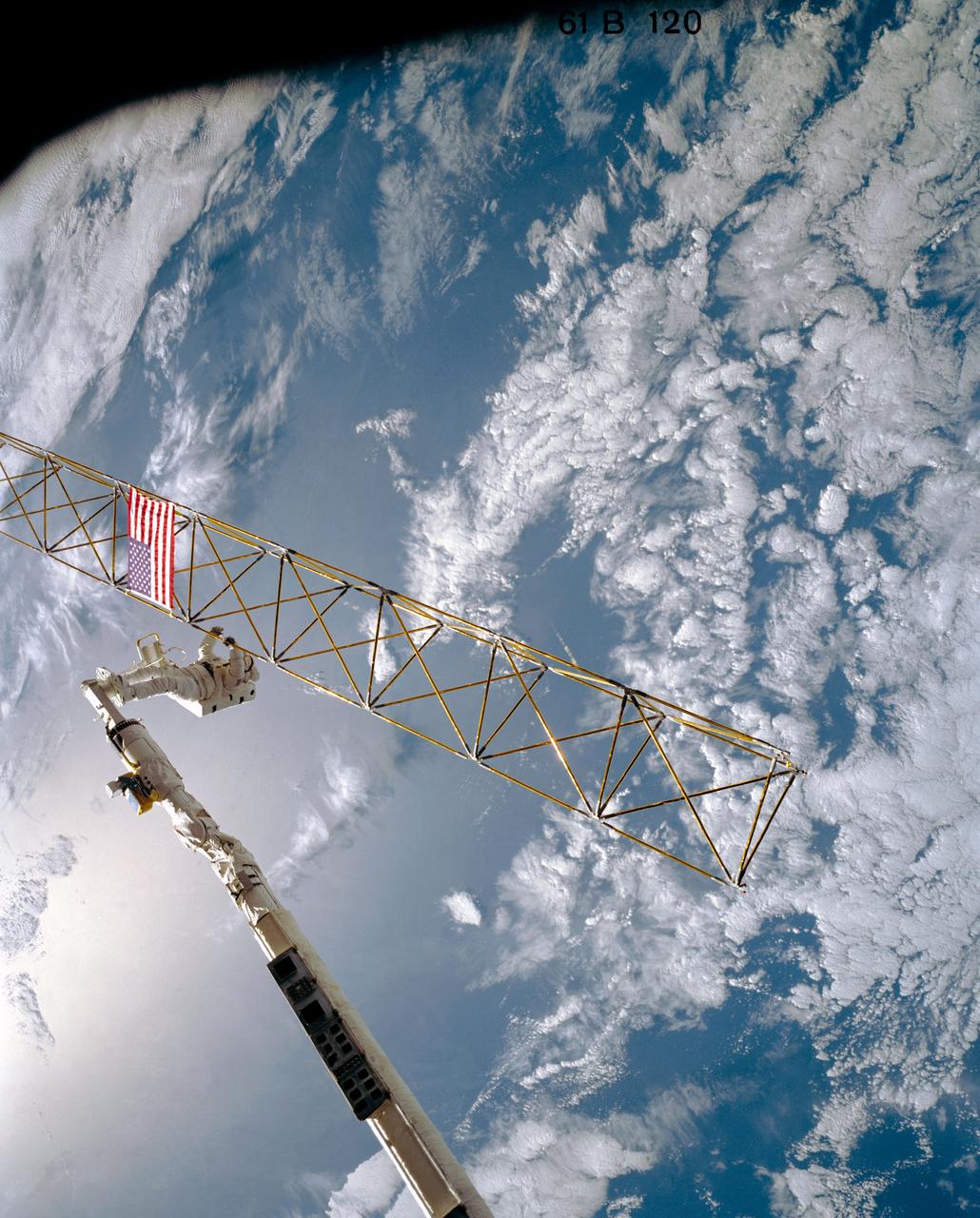
Astronaut Sherwood C. Spring, anchored to the foot restraint on the remote manipulator system (RMS) arm, checks joints on the tower-like Assembly Concept for Construction of Erectable Space Structures (ACCESS) device extending from the payload bay as the Atlantis flies over white clouds and blue ocean waters. The Gulf of Mexico waters form the backdrop for the scene.
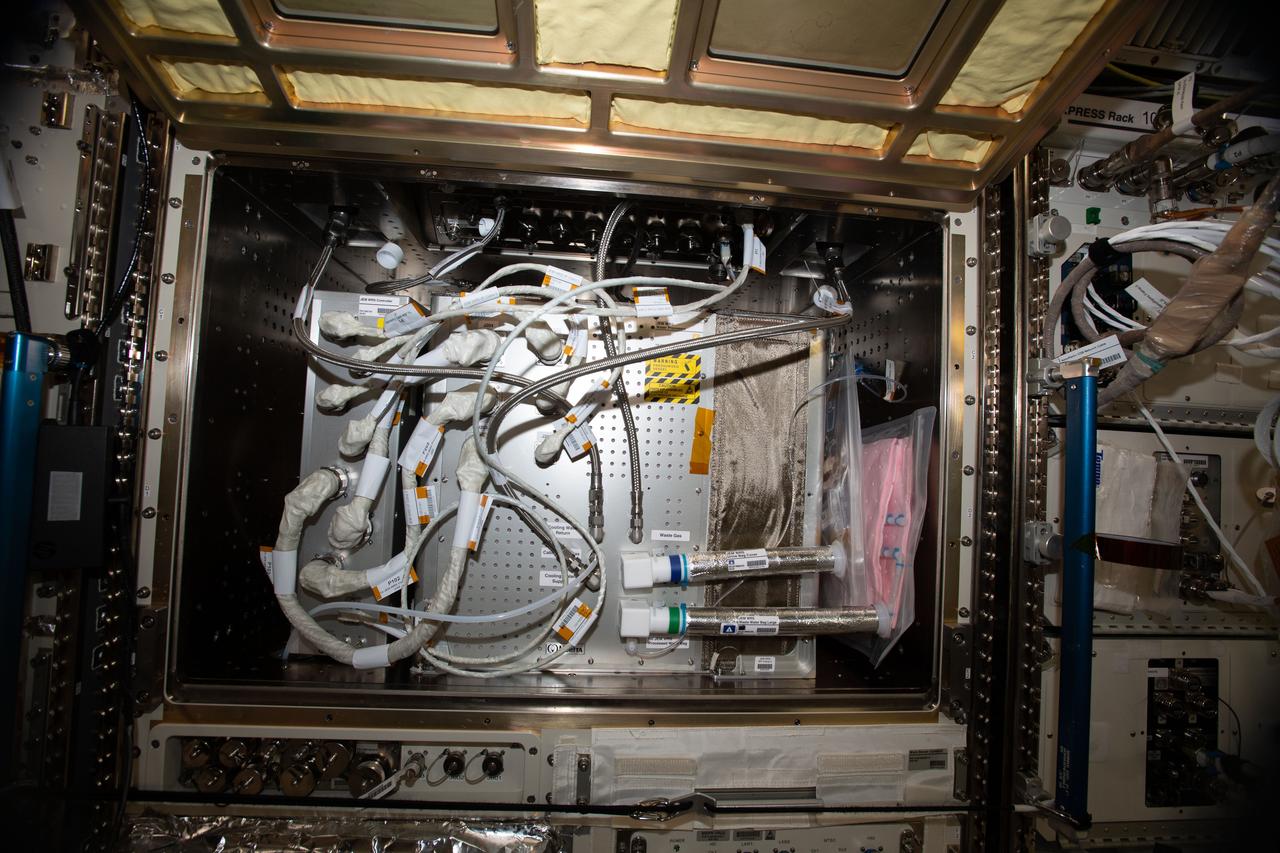
iss061e050296 (11/19/2019) --- A view of the JEM Water Recovery system (JWRS) installed the the Multi-Purpose Small Payload Rack located the the Kibo module aboard the International Space Station (ISS). The JWRS contributes to the development of future Life Support Systems to provide basic needs for astronauts on the space station and exploration missions beyond Earth. The technology in the JWRS has potential applications to improve access to potable water in remote and undeveloped locations on Earth.
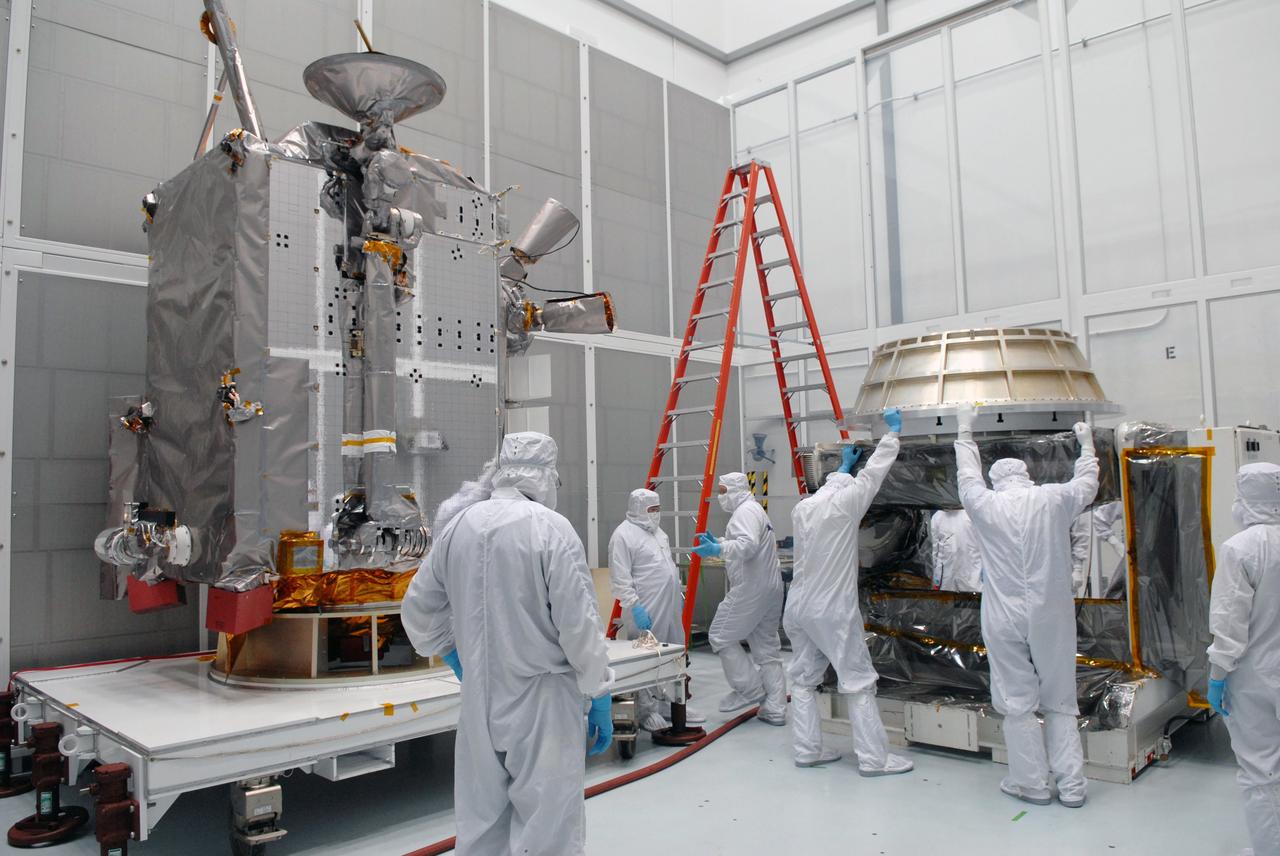
CAPE CANAVERAL, Fla. – At Astrotech in Titusville, Fla., technicians prepare an Aronson table to receive NASA's Lunar Reconnaissance Orbiter, or LRO, at left. The orbiter will be rotated on the table to provide proper access for processing. The orbiter will carry seven instruments to provide scientists with detailed maps of the lunar surface and enhance our understanding of the moon's topography, lighting conditions, mineralogical composition and natural resources. Information gleaned from LRO will be used to select safe landing sites, determine locations for future lunar outposts and help mitigate radiation dangers to astronauts. The polar regions of the moon are the main focus of the mission because continuous access to sunlight may be possible and water ice may exist in permanently shadowed areas of the poles. Accompanying LRO on its journey to the moon will be the Lunar CRater Observation and Sensing Satellite, or LCROSS, a mission that will impact the lunar surface in its search for water ice. Launch of LRO is targeted for May 20. Photo credit: NASA/Jack Pfaller
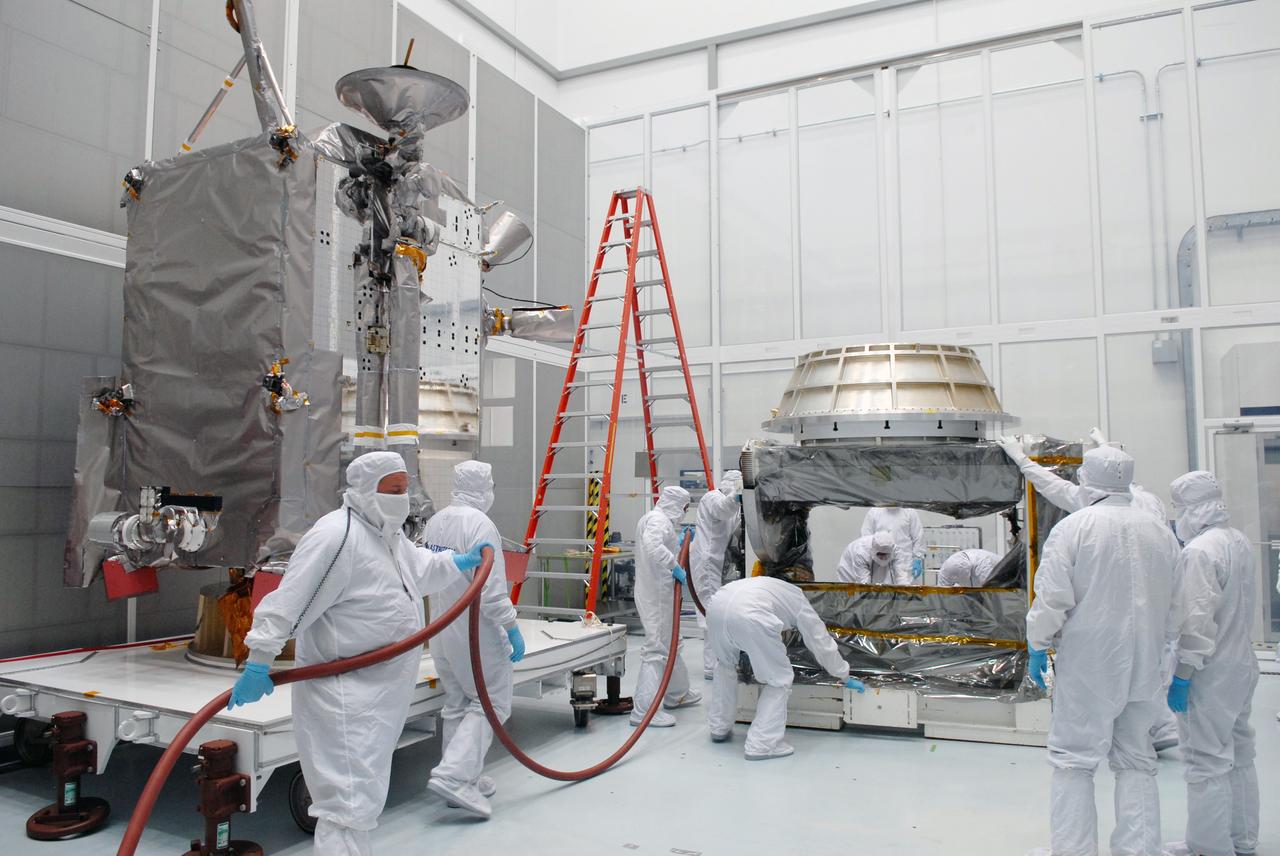
CAPE CANAVERAL, Fla. – At Astrotech in Titusville, Fla., technicians prepare an Aronson table to receive NASA's Lunar Reconnaissance Orbiter, or LRO, at left. The orbiter will be rotated on the table to provide proper access for processing. The orbiter will carry seven instruments to provide scientists with detailed maps of the lunar surface and enhance our understanding of the moon's topography, lighting conditions, mineralogical composition and natural resources. Information gleaned from LRO will be used to select safe landing sites, determine locations for future lunar outposts and help mitigate radiation dangers to astronauts. The polar regions of the moon are the main focus of the mission because continuous access to sunlight may be possible and water ice may exist in permanently shadowed areas of the poles. Accompanying LRO on its journey to the moon will be the Lunar CRater Observation and Sensing Satellite, or LCROSS, a mission that will impact the lunar surface in its search for water ice. Launch of LRO is targeted for May 20. Photo credit: NASA/Jack Pfaller
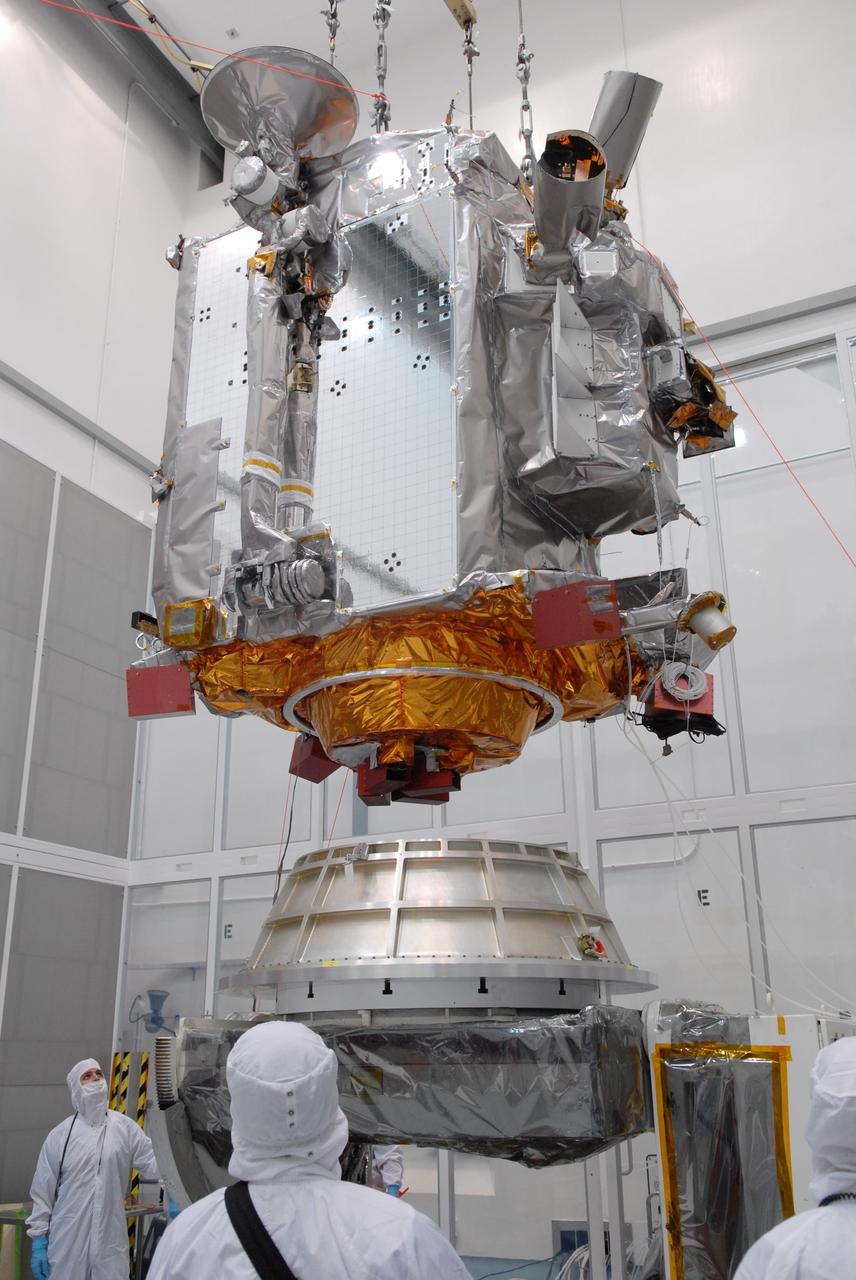
CAPE CANAVERAL, Fla. – At Astrotech in Titusville, Fla., an overhead crane lowers NASA's Lunar Reconnaissance Orbiter, or LRO, toward the Aronson table. The orbiter will be rotated on the table to provide proper access for processing. The orbiter will carry seven instruments to provide scientists with detailed maps of the lunar surface and enhance our understanding of the moon's topography, lighting conditions, mineralogical composition and natural resources. Information gleaned from LRO will be used to select safe landing sites, determine locations for future lunar outposts and help mitigate radiation dangers to astronauts. The polar regions of the moon are the main focus of the mission because continuous access to sunlight may be possible and water ice may exist in permanently shadowed areas of the poles. Accompanying LRO on its journey to the moon will be the Lunar CRater Observation and Sensing Satellite, or LCROSS, a mission that will impact the lunar surface in its search for water ice. Launch of LRO is targeted for May 20. Photo credit: NASA/Jack Pfaller
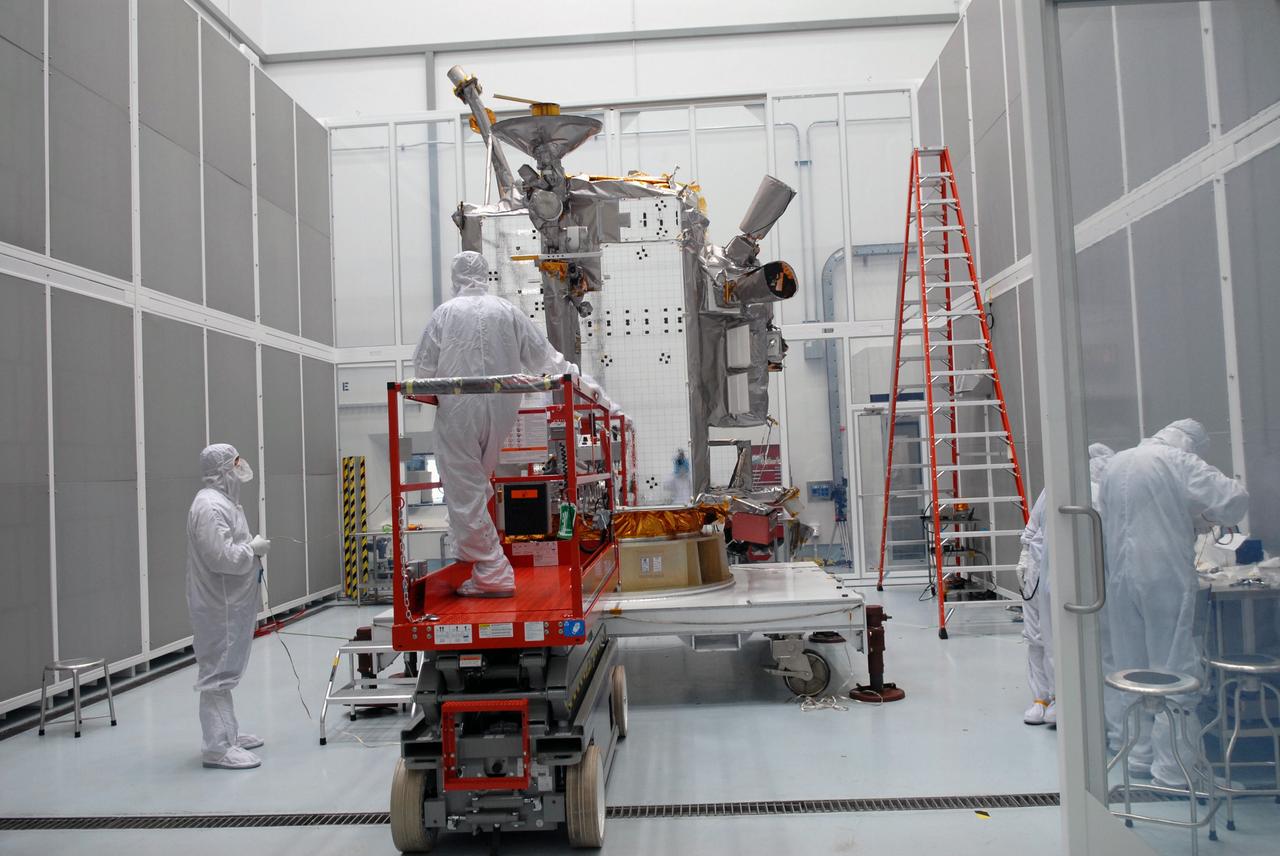
CAPE CANAVERAL, Fla. – At Astrotech in Titusville, Fla., NASA's Lunar Reconnaissance Orbiter, or LRO, spacecraft is being prepared for lifting to an Aronson table. The LRO will be rotated on the table to provide proper access for processing. The orbiter will carry seven instruments to provide scientists with detailed maps of the lunar surface and enhance our understanding of the moon's topography, lighting conditions, mineralogical composition and natural resources. Information gleaned from LRO will be used to select safe landing sites, determine locations for future lunar outposts and help mitigate radiation dangers to astronauts. The polar regions of the moon are the main focus of the mission because continuous access to sunlight may be possible and water ice may exist in permanently shadowed areas of the poles. Accompanying LRO on its journey to the moon will be the Lunar CRater Observation and Sensing Satellite, or LCROSS, a mission that will impact the lunar surface in its search for water ice. Launch of LRO is targeted for May 20. Photo credit: NASA/Jack Pfaller
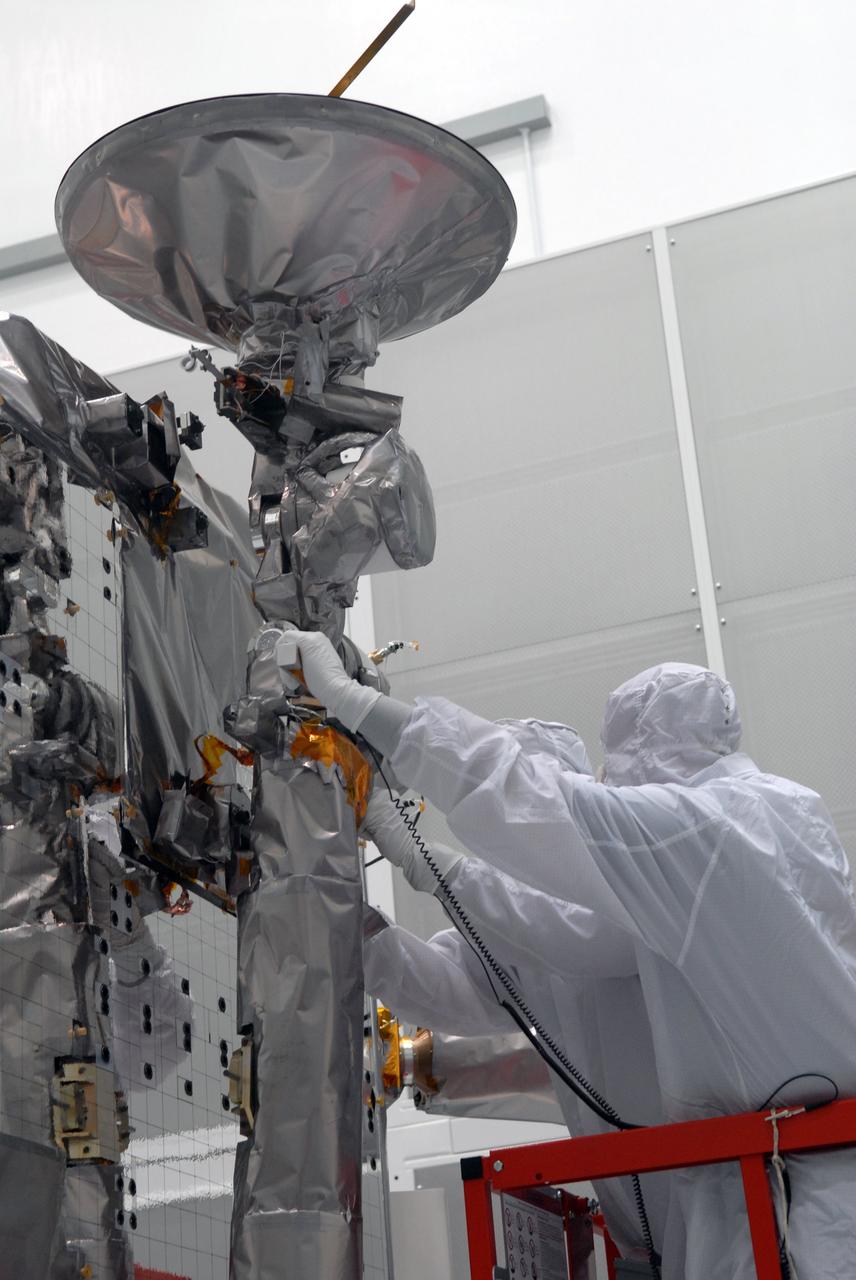
CAPE CANAVERAL, Fla. – At Astrotech in Titusville, Fla., a technician attaches cables to NASA's Lunar Reconnaissance Orbiter, or LRO. The orbiter will be rotated on the table to provide proper access for processing. The orbiter will carry seven instruments to provide scientists with detailed maps of the lunar surface and enhance our understanding of the moon's topography, lighting conditions, mineralogical composition and natural resources. Information gleaned from LRO will be used to select safe landing sites, determine locations for future lunar outposts and help mitigate radiation dangers to astronauts. The polar regions of the moon are the main focus of the mission because continuous access to sunlight may be possible and water ice may exist in permanently shadowed areas of the poles. Accompanying LRO on its journey to the moon will be the Lunar CRater Observation and Sensing Satellite, or LCROSS, a mission that will impact the lunar surface in its search for water ice. Launch of LRO is targeted for May 20. Photo credit: NASA/Jack Pfaller
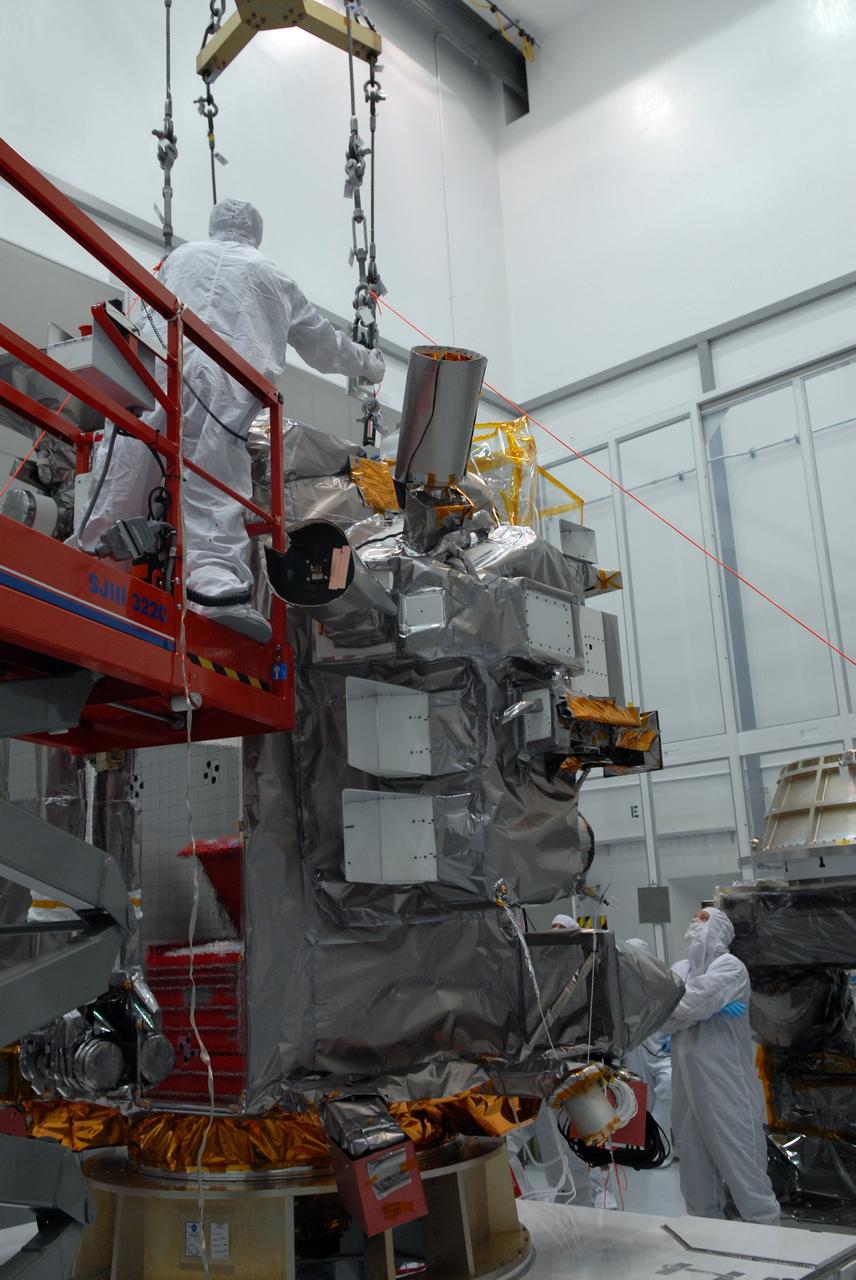
CAPE CANAVERAL, Fla. – At Astrotech in Titusville, Fla., technicians get ready to lift NASA's Lunar Reconnaissance Orbiter, or LRO. It will be moved to an Aronson table for rotation to provide proper access for processing. The orbiter will carry seven instruments to provide scientists with detailed maps of the lunar surface and enhance our understanding of the moon's topography, lighting conditions, mineralogical composition and natural resources. Information gleaned from LRO will be used to select safe landing sites, determine locations for future lunar outposts and help mitigate radiation dangers to astronauts. The polar regions of the moon are the main focus of the mission because continuous access to sunlight may be possible and water ice may exist in permanently shadowed areas of the poles. Accompanying LRO on its journey to the moon will be the Lunar CRater Observation and Sensing Satellite, or LCROSS, a mission that will impact the lunar surface in its search for water ice. Launch of LRO is targeted for May 20. Photo credit: NASA/Jack Pfaller
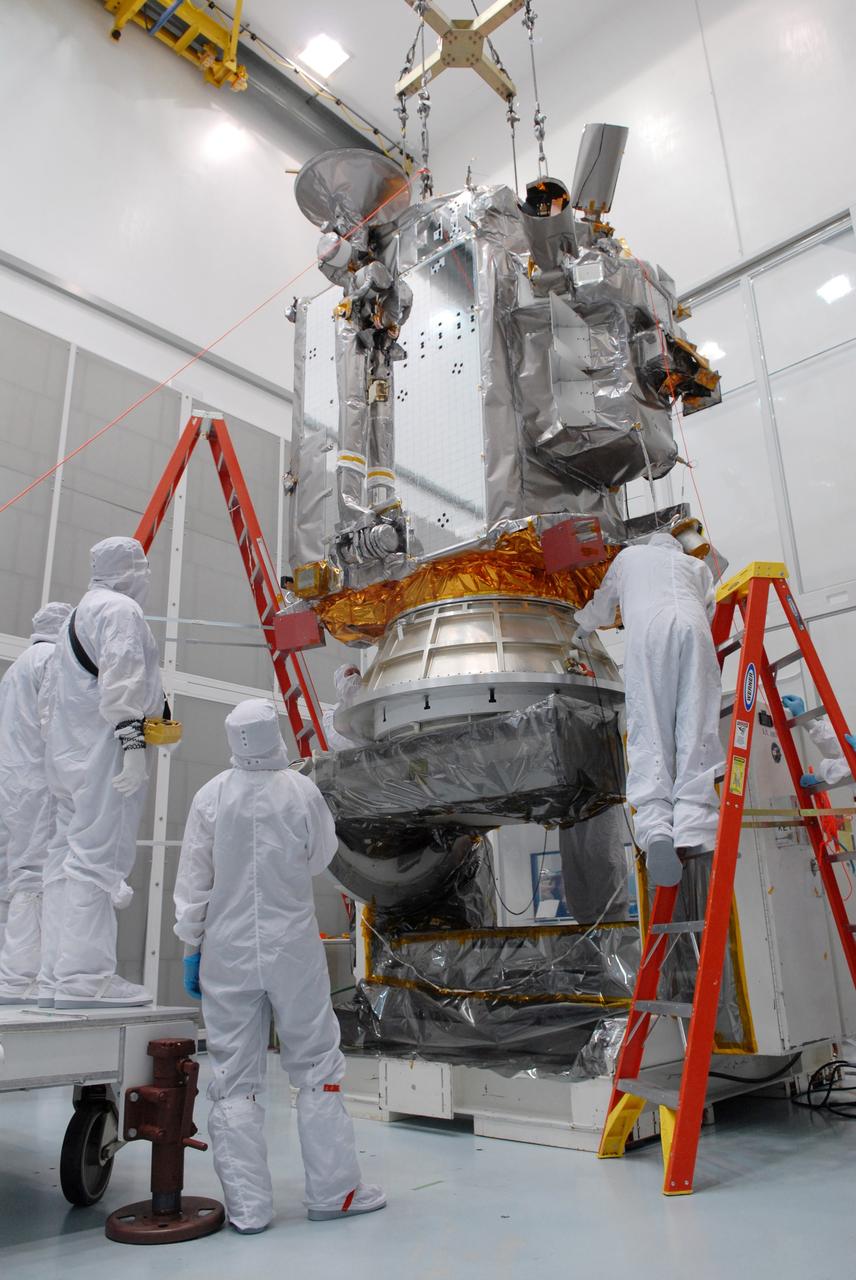
CAPE CANAVERAL, Fla. – At Astrotech in Titusville, Fla., an overhead crane lowers NASA's Lunar Reconnaissance Orbiter, or LRO, onto the Aronson table. The orbiter will be rotated on the table to provide proper access for processing. The orbiter will carry seven instruments to provide scientists with detailed maps of the lunar surface and enhance our understanding of the moon's topography, lighting conditions, mineralogical composition and natural resources. Information gleaned from LRO will be used to select safe landing sites, determine locations for future lunar outposts and help mitigate radiation dangers to astronauts. The polar regions of the moon are the main focus of the mission because continuous access to sunlight may be possible and water ice may exist in permanently shadowed areas of the poles. Accompanying LRO on its journey to the moon will be the Lunar CRater Observation and Sensing Satellite, or LCROSS, a mission that will impact the lunar surface in its search for water ice. Launch of LRO is targeted for May 20. Photo credit: NASA/Jack Pfaller
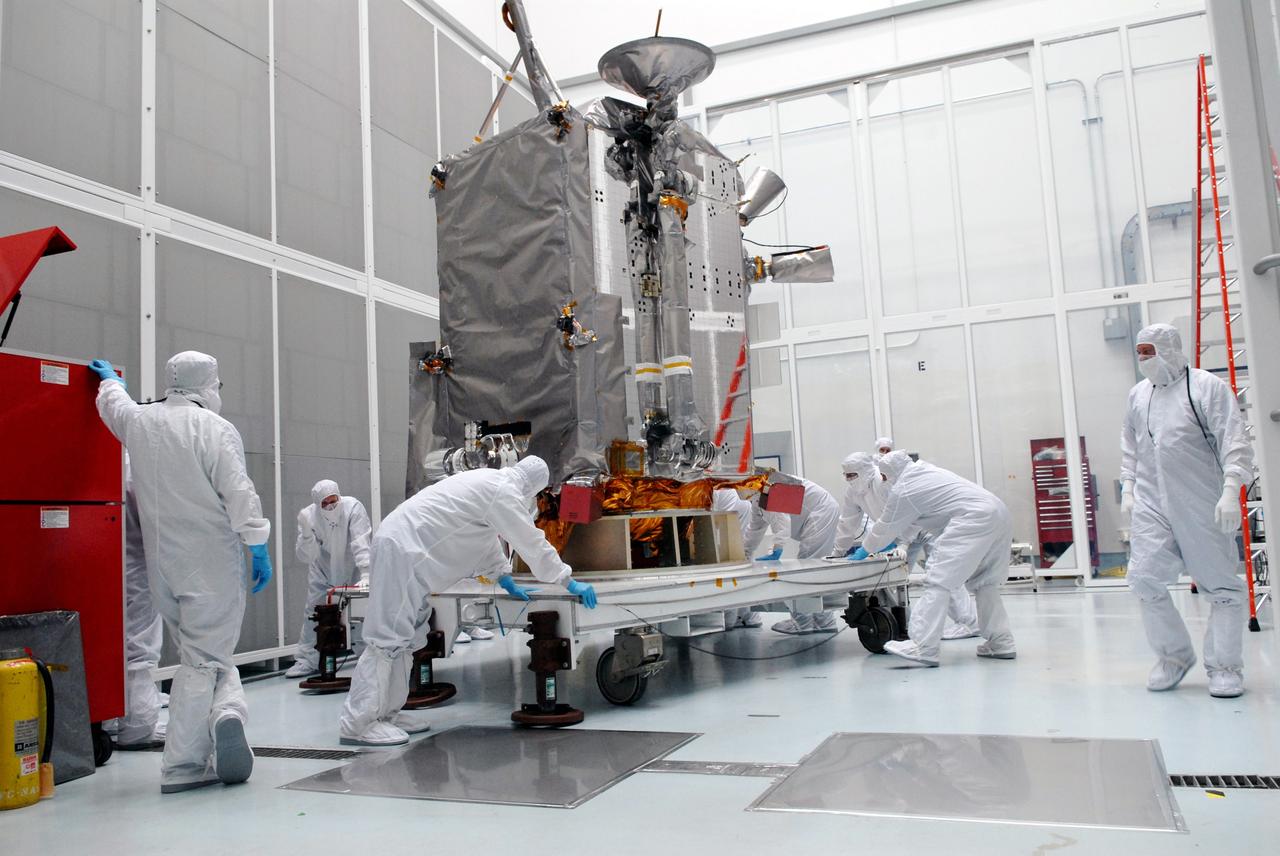
CAPE CANAVERAL, Fla. – At Astrotech in Titusville, Fla., technicians moved the stand with NASA's Lunar Reconnaissance Orbiter, or LRO. The orbiter will be rotated on the table to provide proper access for processing. The orbiter will carry seven instruments to provide scientists with detailed maps of the lunar surface and enhance our understanding of the moon's topography, lighting conditions, mineralogical composition and natural resources. Information gleaned from LRO will be used to select safe landing sites, determine locations for future lunar outposts and help mitigate radiation dangers to astronauts. The polar regions of the moon are the main focus of the mission because continuous access to sunlight may be possible and water ice may exist in permanently shadowed areas of the poles. Accompanying LRO on its journey to the moon will be the Lunar CRater Observation and Sensing Satellite, or LCROSS, a mission that will impact the lunar surface in its search for water ice. Launch of LRO is targeted for May 20. Photo credit: NASA/Jack Pfaller
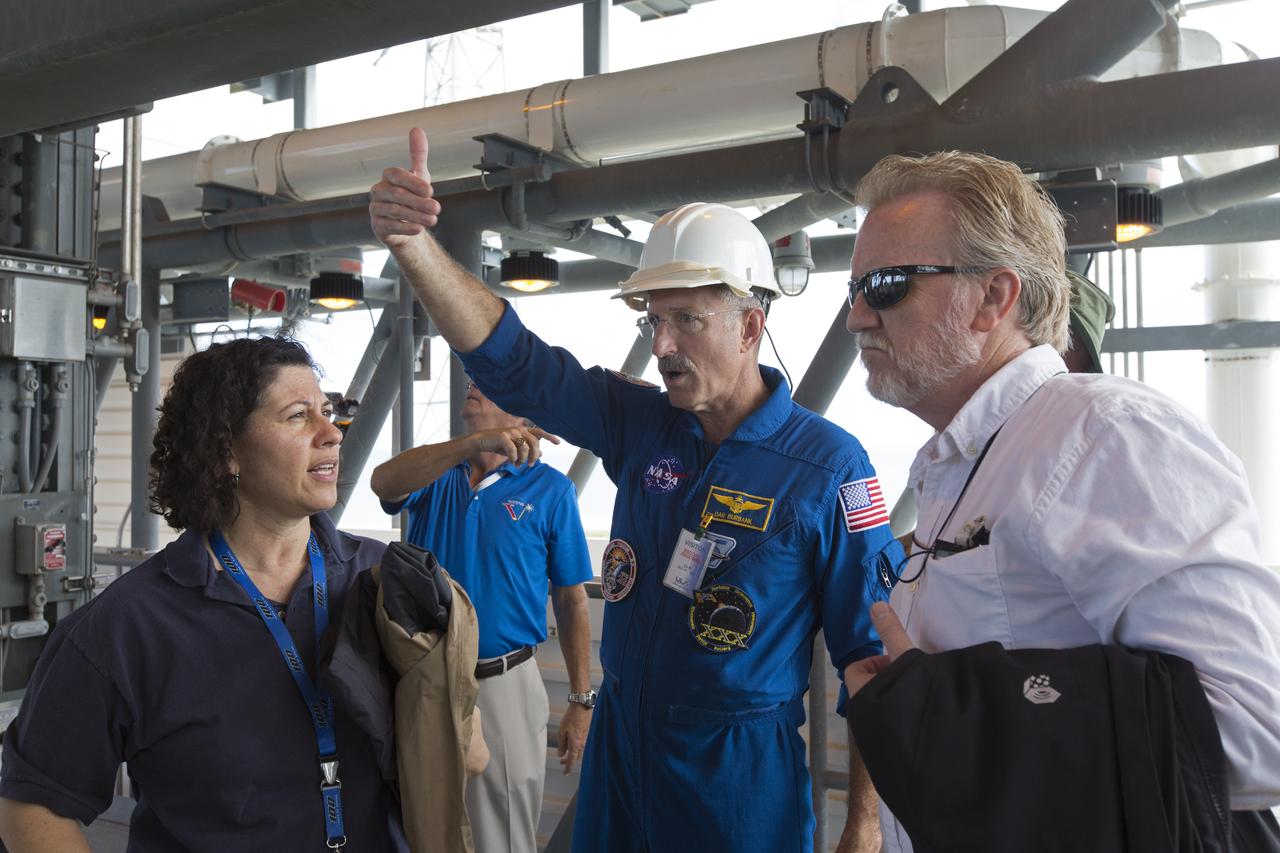
NASA, Boeing and United Launch Alliance personnel discuss procedures for an upcoming water deluge test on the Crew Access Tower at Space Launch Complex 41 on Cape Canaveral Air Force Station in Florida. The test gathered data on how launch site and astronaut crews would exit in the event of an emergency from the white room at the end of the crew access arm to the emergency escape system on the pad. Boeing’s Starliner will launch on a United Launch Alliance Atlas V rocket to the International Space Station as part of NASA’s Commercial Crew Program.
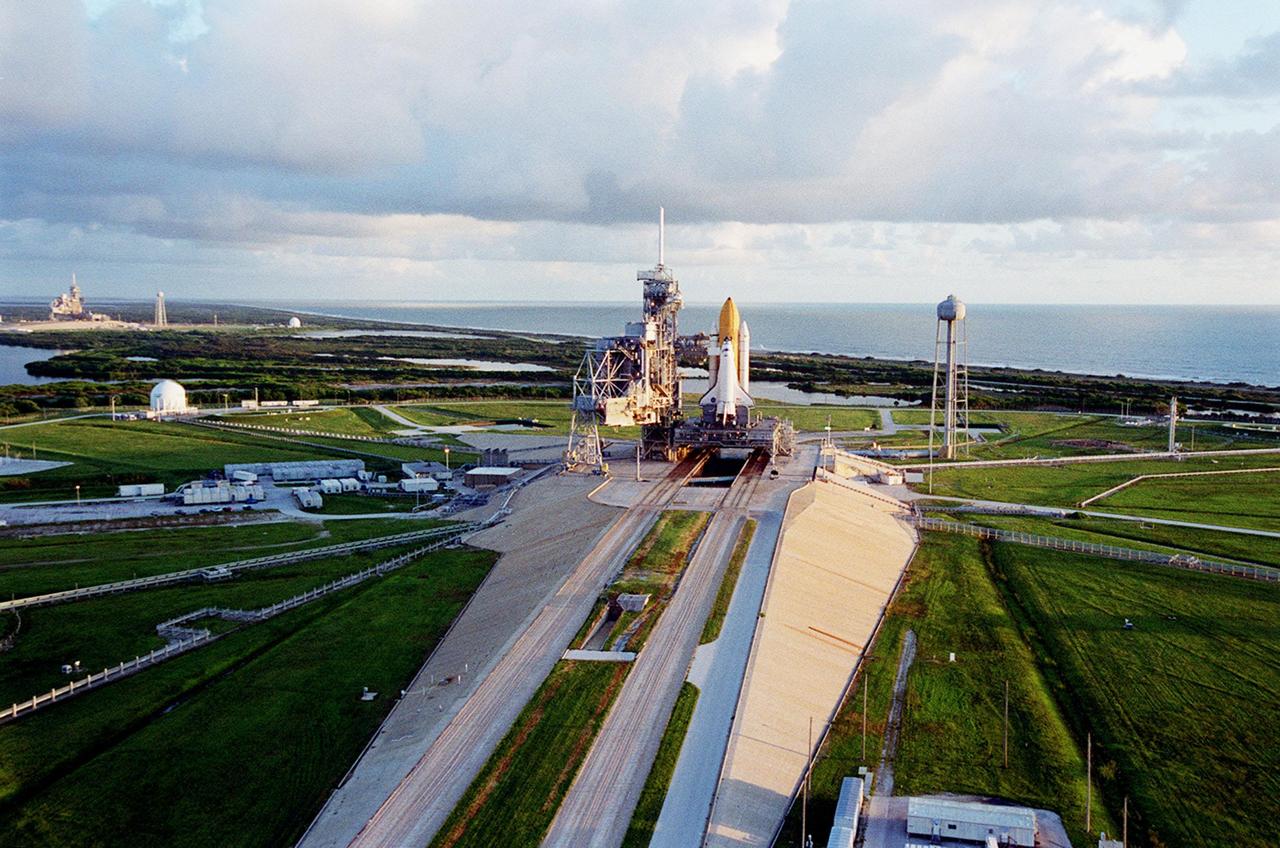
KENNEDY SPACE CENTER, Fla. -- The early morning sun falls on Launch Pad 39A and Space Shuttle Discovery, which is waiting for launch on mission STS-92 Oct. 5, 2000. Leading to the pad (from the foreground) is the ramp leading from the crawlerway, the specially built road that provides the Shuttles access to the pads from the Vehicle Assembly Building. At the right of the pad is the 300,000-gallon water tank that is part of the sound suppression system during launches. Beyond is the Atlantic Ocean. At the far left can be seen Launch Pad 39B with its water tank
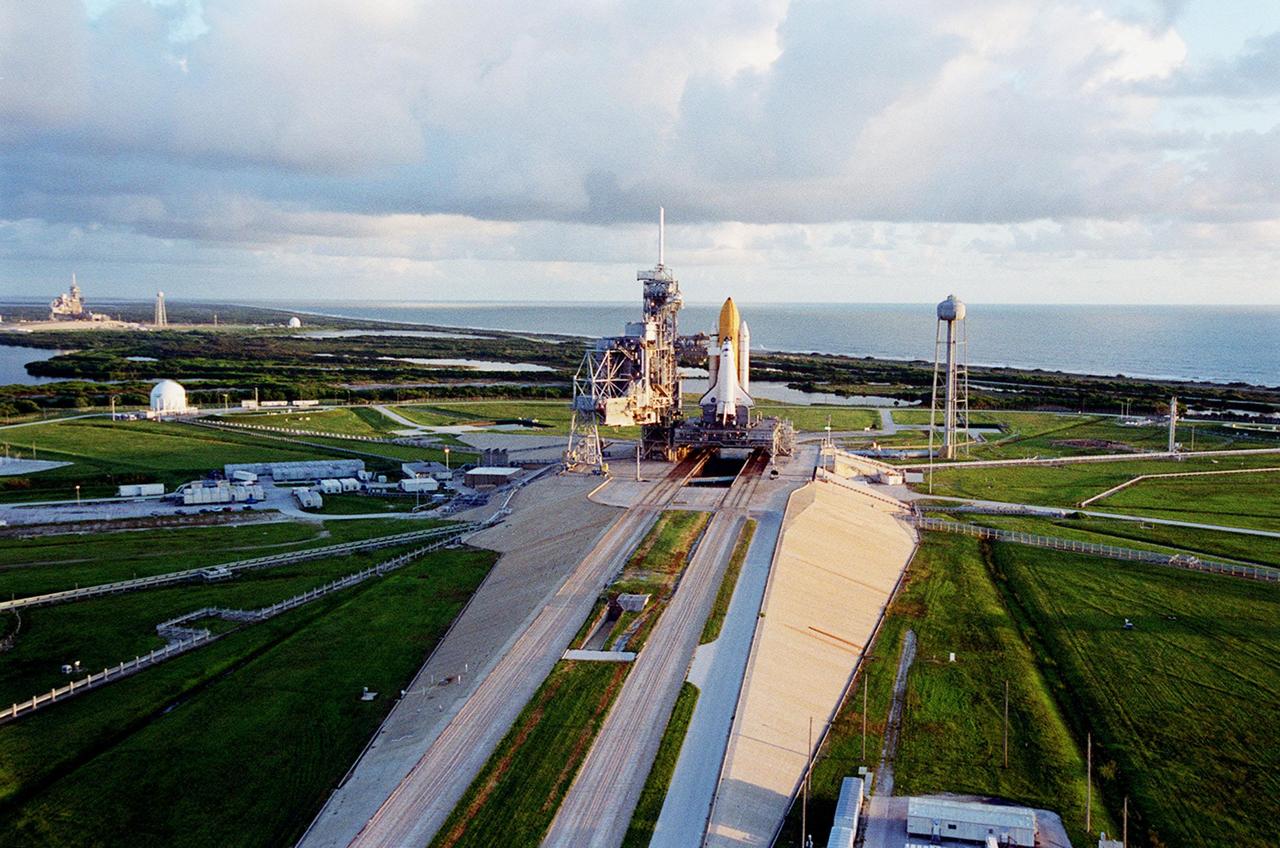
KENNEDY SPACE CENTER, Fla. -- The early morning sun falls on Launch Pad 39A and Space Shuttle Discovery, which is waiting for launch on mission STS-92 Oct. 5, 2000. Leading to the pad (from the foreground) is the ramp leading from the crawlerway, the specially built road that provides the Shuttles access to the pads from the Vehicle Assembly Building. At the right of the pad is the 300,000-gallon water tank that is part of the sound suppression system during launches. Beyond is the Atlantic Ocean. At the far left can be seen Launch Pad 39B with its water tank
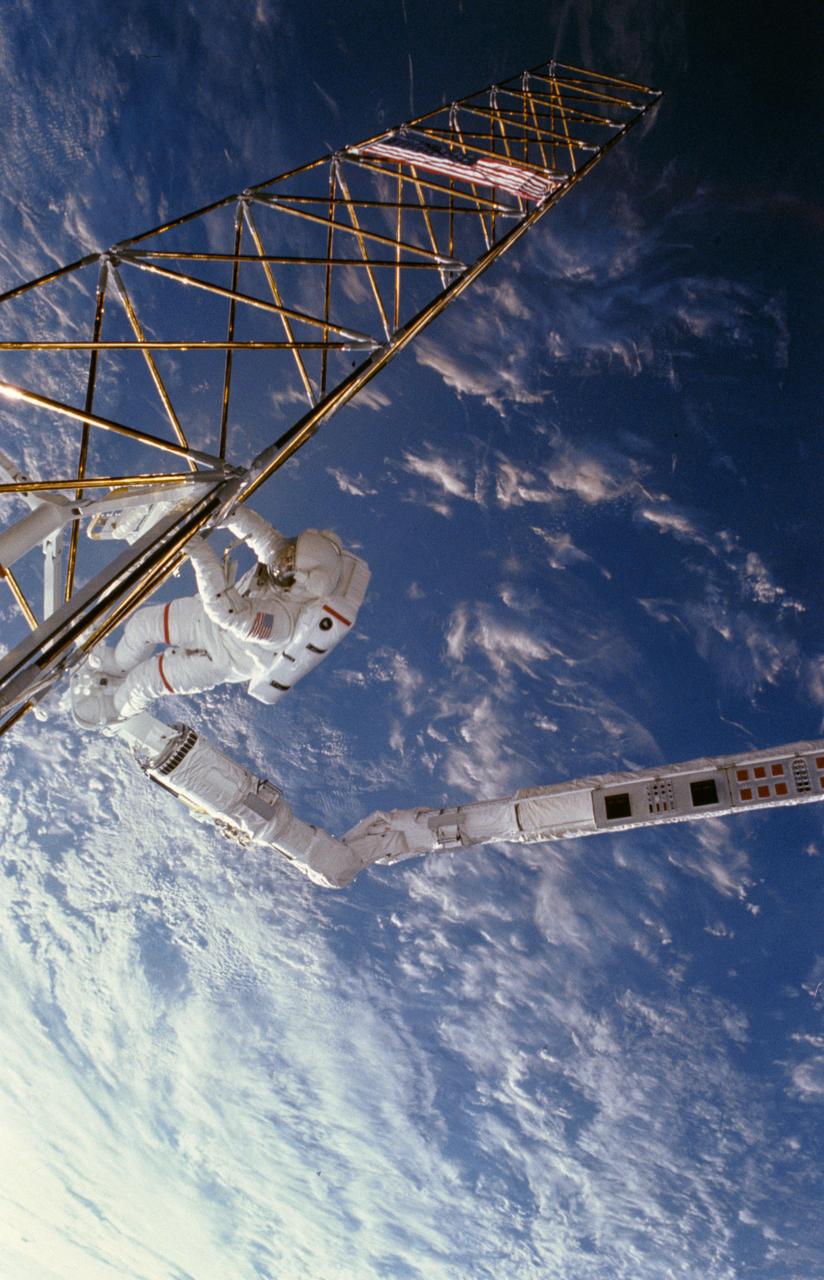
61B-102-022 (1 Dec 1985) --- Astronaut Jerry L. Ross, anchored to the foot restraint on the remote manipulator system (RMS), holds onto the tower-like Assembly Concept for Construction of Erectable Space Structures (ACCESS) device, as the Atlantis flies over white clouds and blue ocean waters. The frame was exposed with a negative-equipped camera held by Astronaut Sherwood C. Spring, who was also on the EVA-task.
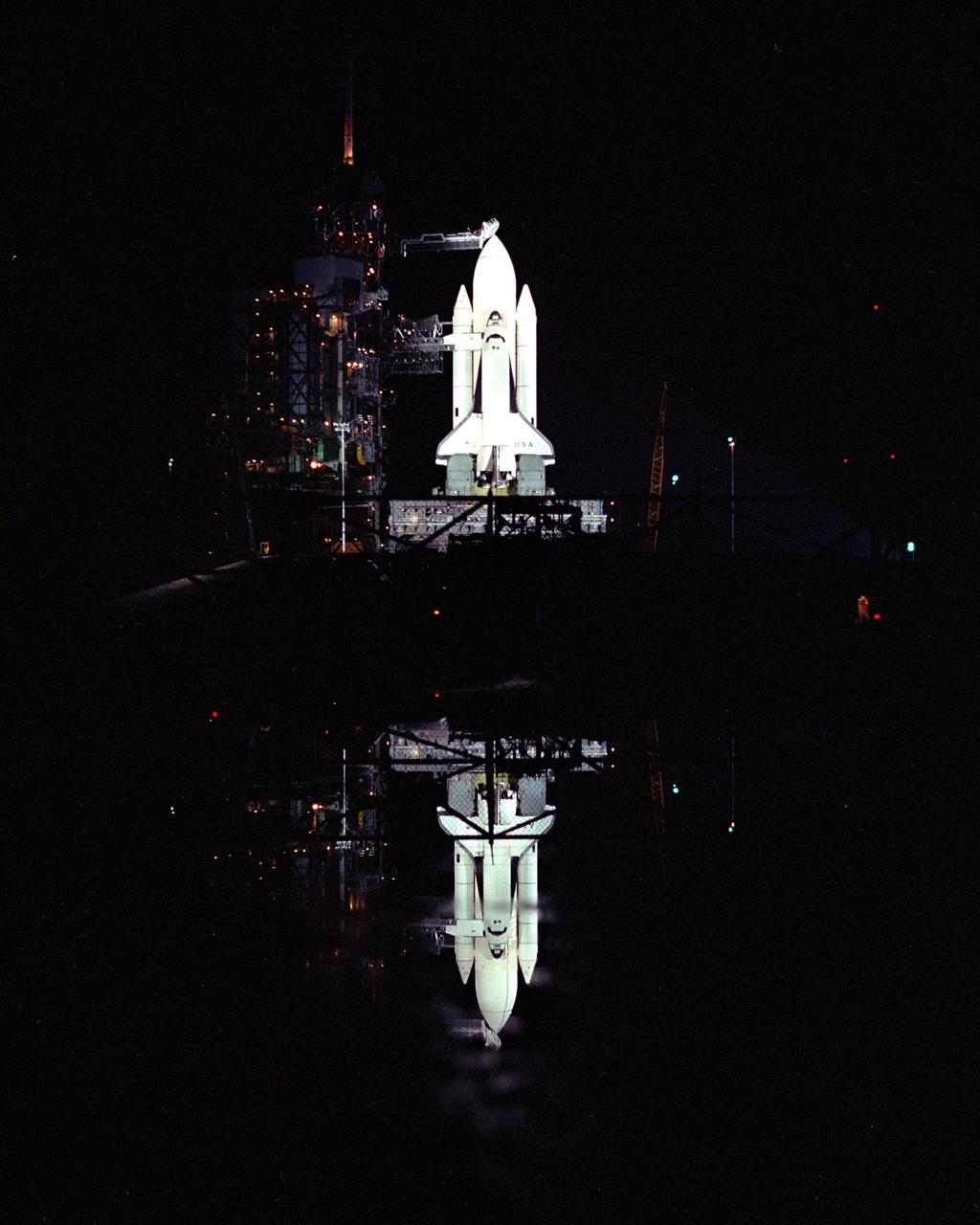
KENNEDY SPACE CENTER, FLA. - Spotlighted Space Shuttle Columbia stands out dramatically against the night sky at Kennedy Space Center. The lights to the left of the Shuttle, also reflected in the nearby waters of the Center's environmentally rich lagoon system, outline the fixed and rotating service structures. The rotating structure, which obscures the view of the Orbiter when in place, has been retracted to allow modifications that will provide access to debonded insulation panels on the Shuttle's external tank.
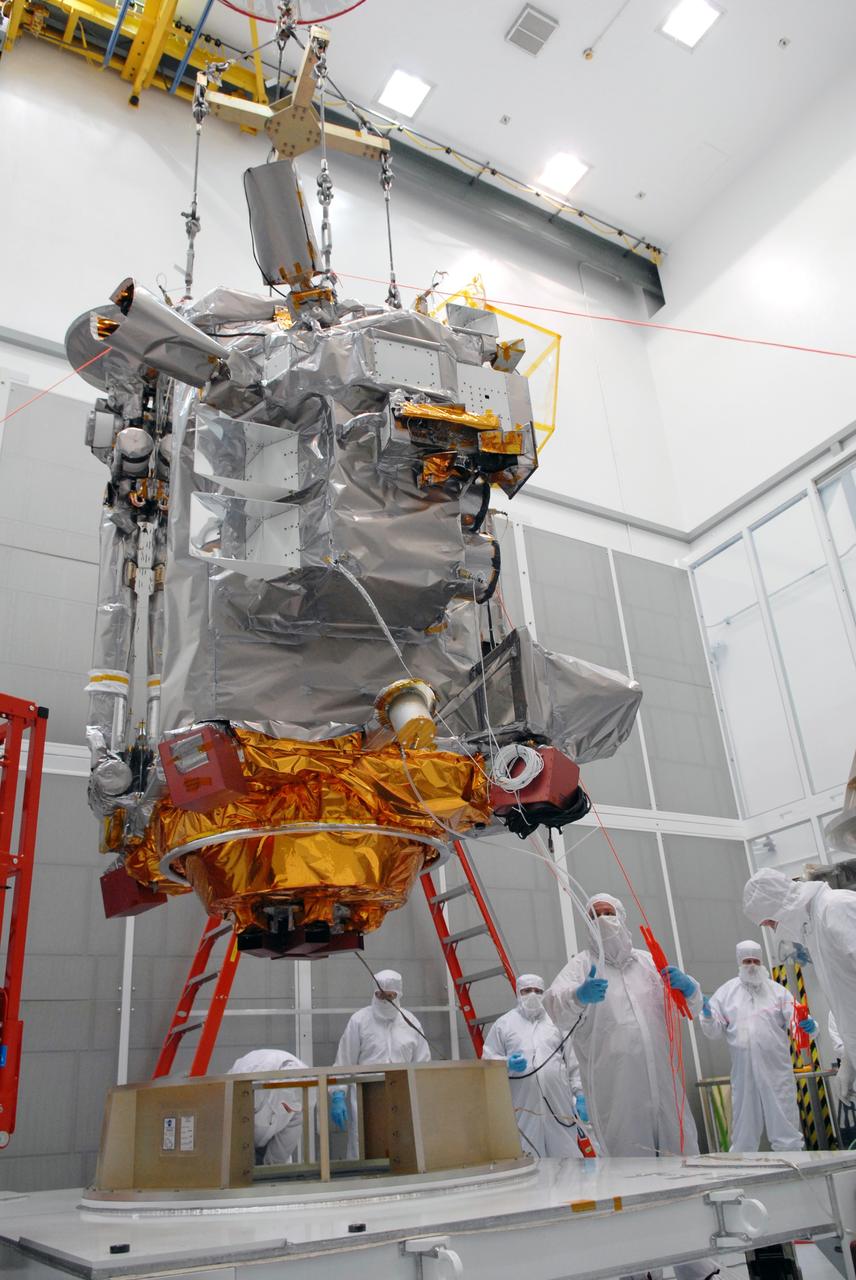
CAPE CANAVERAL, Fla. – At Astrotech in Titusville, Fla., an overhead crane lifts NASA's Lunar Reconnaissance Orbiter, or LRO, from its stand. The orbiter will be moved to an Aronson table nearby for rotation to provide proper access for processing. The orbiter will carry seven instruments to provide scientists with detailed maps of the lunar surface and enhance our understanding of the moon's topography, lighting conditions, mineralogical composition and natural resources. Information gleaned from LRO will be used to select safe landing sites, determine locations for future lunar outposts and help mitigate radiation dangers to astronauts. The polar regions of the moon are the main focus of the mission because continuous access to sunlight may be possible and water ice may exist in permanently shadowed areas of the poles. Accompanying LRO on its journey to the moon will be the Lunar CRater Observation and Sensing Satellite, or LCROSS, a mission that will impact the lunar surface in its search for water ice. Launch of LRO is targeted for May 20. Photo credit: NASA/Jack Pfaller
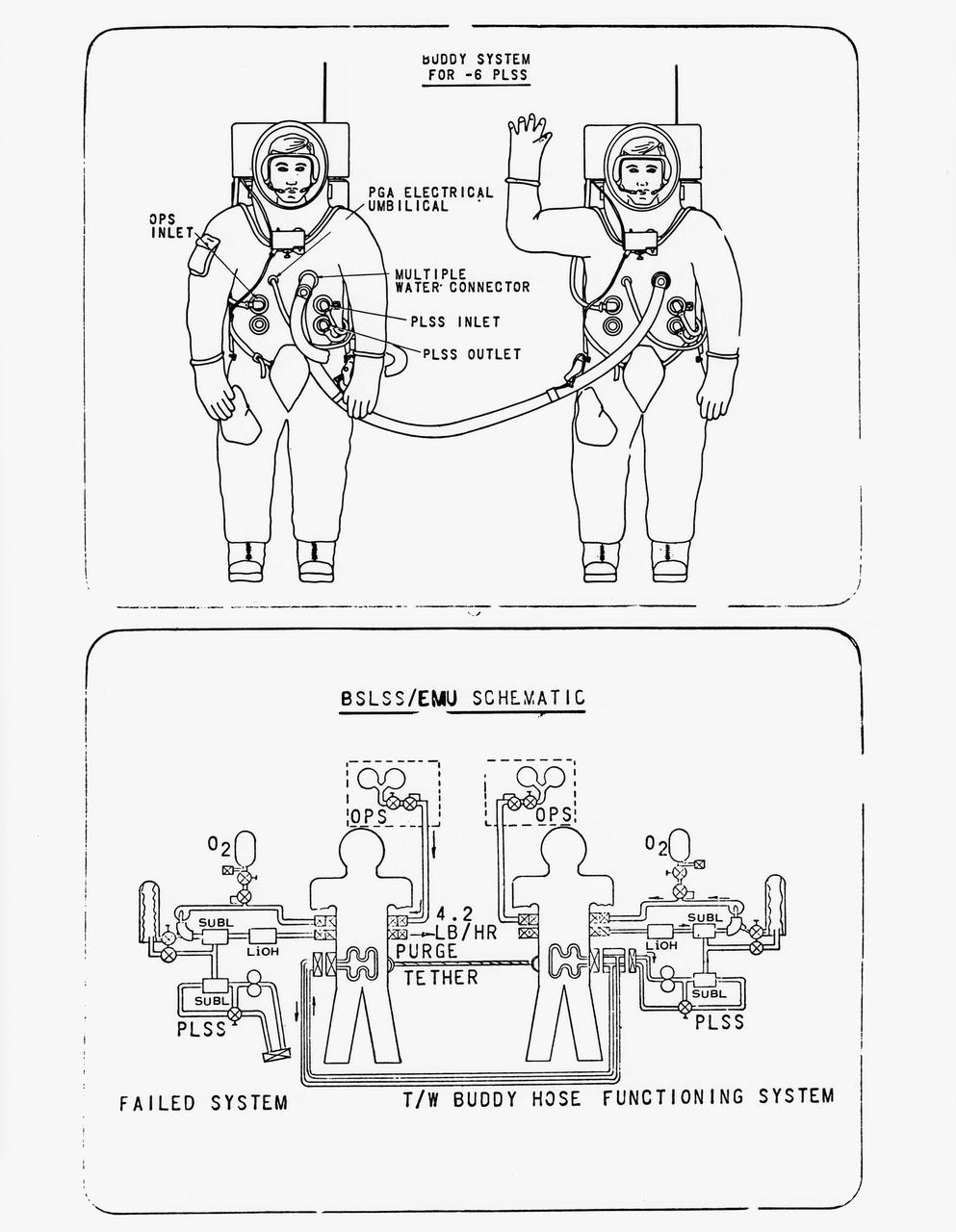
S70-56965 (December 1970) --- Drawing of the newly developed Buddy Secondary Life Support System (BSLSS). The life-sustaining system will be provided for the first time on the Apollo 14 lunar landing mission. The two flexible hoses, to be used on the second Apollo 14 extravehicular activity (EVA), will be among the paraphernalia on the Modular Equipment Transporter (MET) or two-wheeled workshop, and readily accessible in an emergency. During EVAs the Portable Life Support System (PLSS) supplies the astronaut with breathing and suit-pressurizing oxygen and water flow for the liquid-cooling garment -- a suit of knitted long underwear with thin tubing woven in the torso and limbs. The tubes carry water from a reservoir in the PLSS, and the circulating water serves to carry the astronaut's metabolic heat to a heat exchanger in the PLSS. Before the BSLSS was devised, the emergency tank was required to furnish not only suit pressure and breathing oxygen, but also cooling through a high oxygen flow rate. The BSLSS, by sharing the water supply between the two crewmen, stretches the time of the emergency oxygen from about 40 minutes to 60 to 75 minutes.
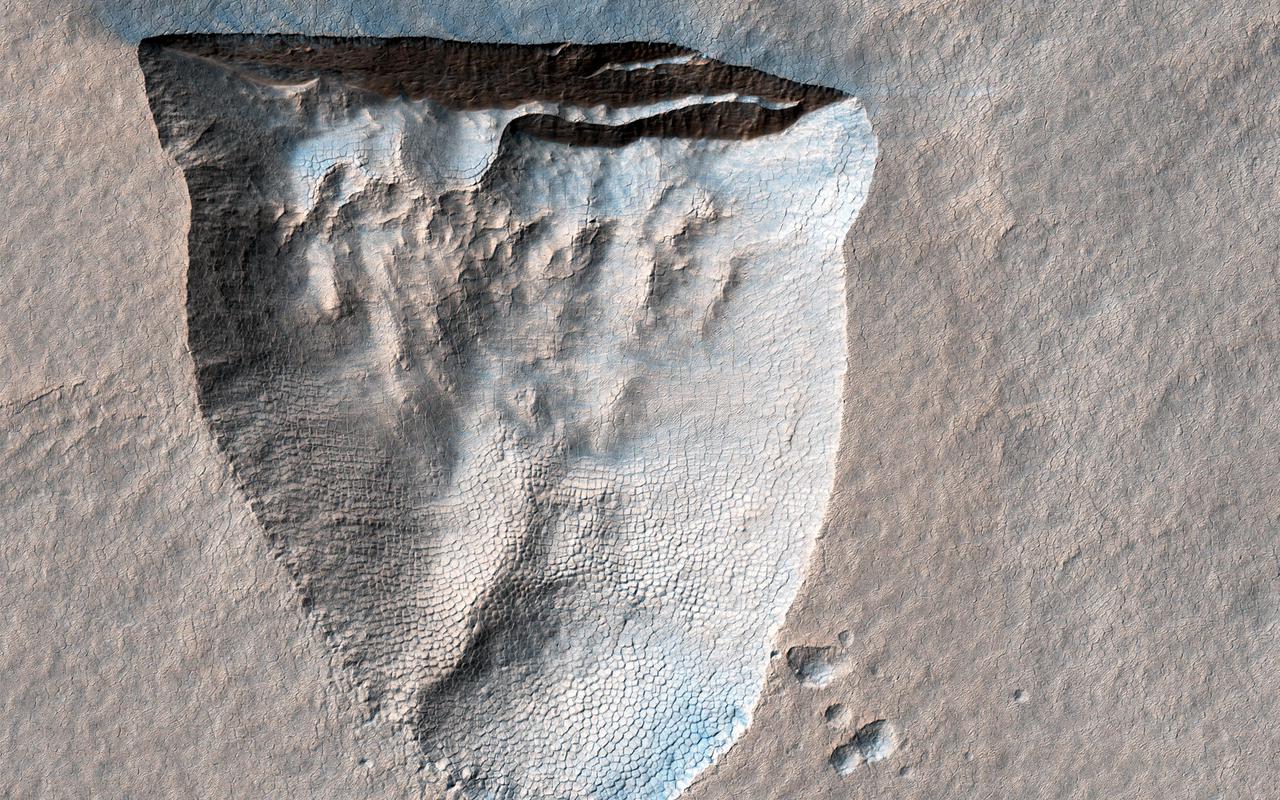
This enhanced color cutout shows a pit about 600 meters across that is bounded by a steep scarp on its northern side. Similar scarps in the southern mid-latitudes are known to expose water ice that extends to within a couple meters of the surface. The ice appears to be slowly sublimating into the atmosphere, causing the scarps to retreat towards the equator (up in the cutout) and enlarge the pits. This is the first HiRISE image of this particular scarp, acquired as part of an ongoing campaign to monitor the evolution of these formations that may provide an easily accessible source of water for future human explorers. The darker, bluer streaks extending away from the top of the scarp may have been caused by winds blowing sand out of the pit and/or removing brighter dust from the surface. https://photojournal.jpl.nasa.gov/catalog/PIA24611
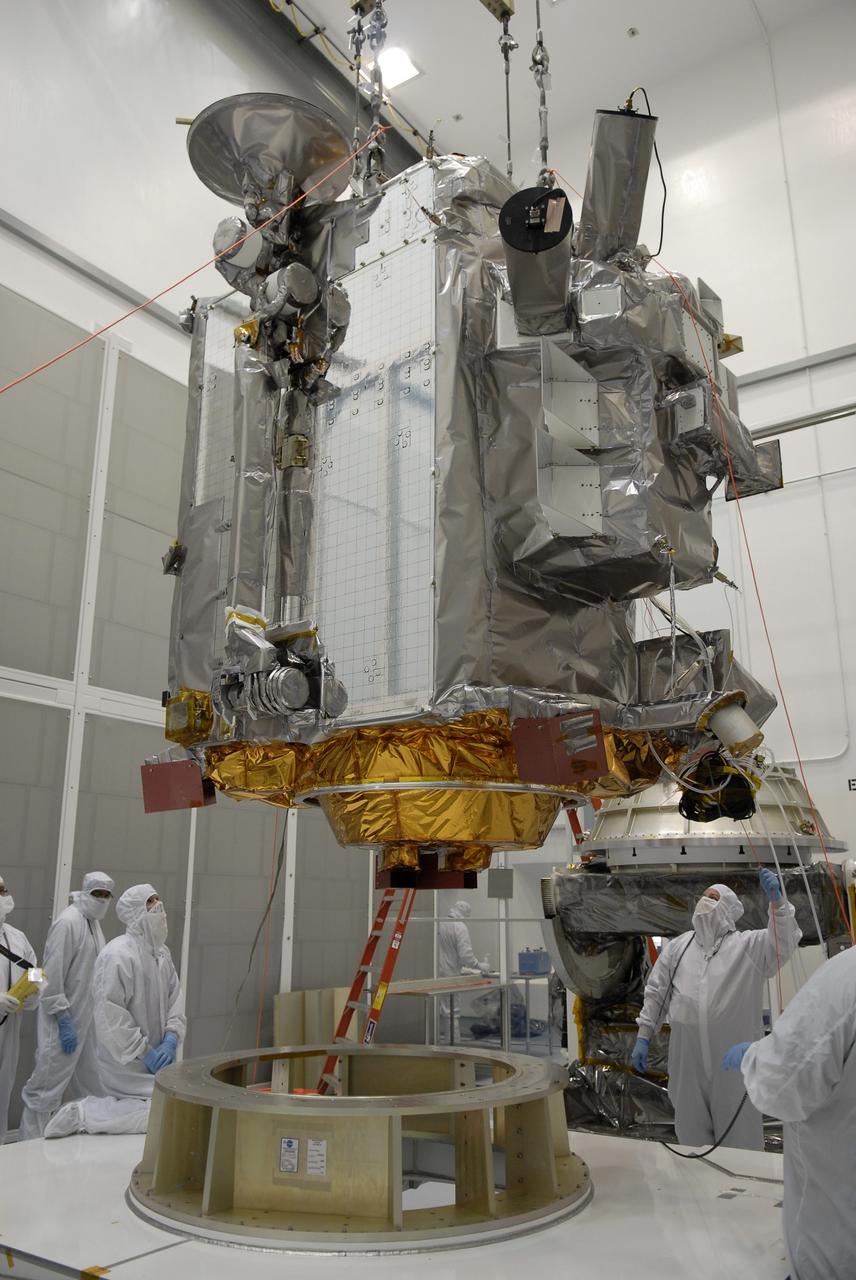
CAPE CANAVERAL, Fla. – At the Astrotech facility in Titusville, Fla., a crane moves NASA's Lunar Reconnaissance Orbiter, or LRO, toward a stand in the foreground. The orbiter will carry seven instruments to provide scientists with detailed maps of the lunar surface and enhance our understanding of the moon's topography, lighting conditions, mineralogical composition and natural resources. Information gleaned from LRO will be used to select safe landing sites, determine locations for future lunar outposts and help mitigate radiation dangers to astronauts. The polar regions of the moon are the main focus of the mission because continuous access to sunlight may be possible and water ice may exist in permanently shadowed areas of the poles. Accompanying LRO on its journey to the moon will be the Lunar CRater Observation and Sensing Satellite, or LCROSS, a mission that will impact the lunar surface in its search for water ice. Launch of LRO is targeted for May 20. Photo credit: NASA/Kim Shiflett
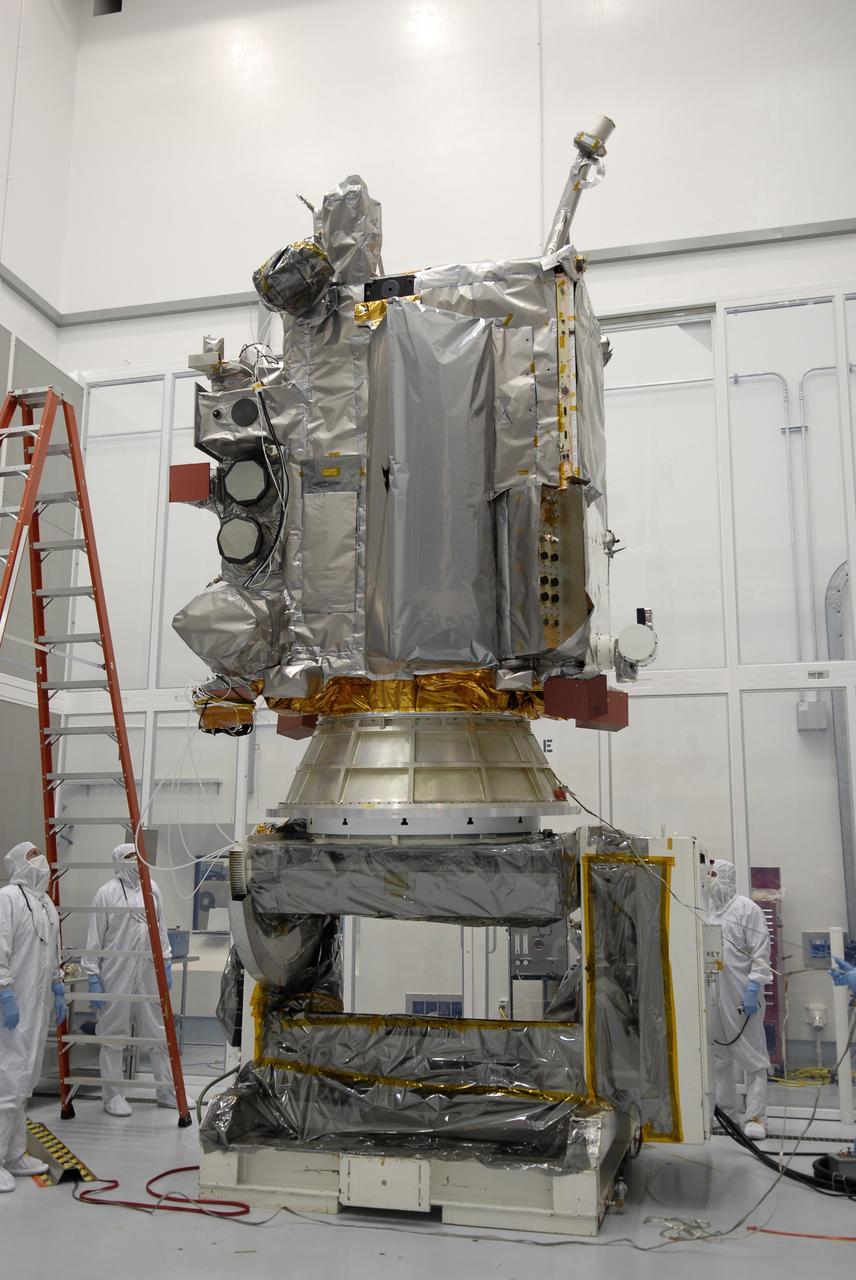
CAPE CANAVERAL, Fla. – At the Astrotech facility in Titusville, Fla., NASA's Lunar Reconnaissance Orbiter, or LRO, has been rotated to vertical on the Aronson stand. A crane will be attached to move it to another stand. The orbiter will carry seven instruments to provide scientists with detailed maps of the lunar surface and enhance our understanding of the moon's topography, lighting conditions, mineralogical composition and natural resources. Information gleaned from LRO will be used to select safe landing sites, determine locations for future lunar outposts and help mitigate radiation dangers to astronauts. The polar regions of the moon are the main focus of the mission because continuous access to sunlight may be possible and water ice may exist in permanently shadowed areas of the poles. Accompanying LRO on its journey to the moon will be the Lunar CRater Observation and Sensing Satellite, or LCROSS, a mission that will impact the lunar surface in its search for water ice. Launch of LRO is targeted for May 20. Photo credit: NASA/Kim Shiflett
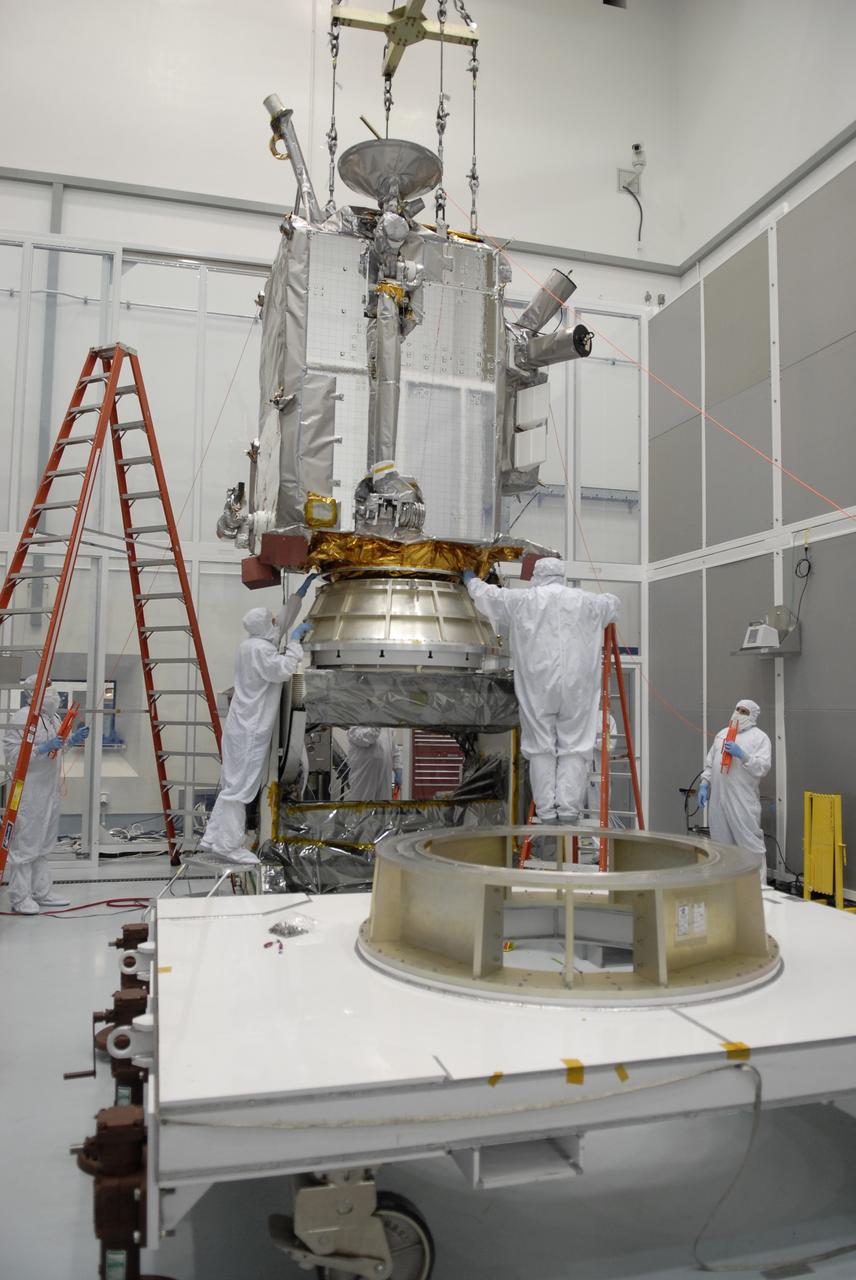
CAPE CANAVERAL, Fla. – At the Astrotech facility in Titusville, Fla., a crane is attached to NASA's Lunar Reconnaissance Orbiter, or LRO. The crane will move LRO to another stand. The orbiter will carry seven instruments to provide scientists with detailed maps of the lunar surface and enhance our understanding of the moon's topography, lighting conditions, mineralogical composition and natural resources. Information gleaned from LRO will be used to select safe landing sites, determine locations for future lunar outposts and help mitigate radiation dangers to astronauts. The polar regions of the moon are the main focus of the mission because continuous access to sunlight may be possible and water ice may exist in permanently shadowed areas of the poles. Accompanying LRO on its journey to the moon will be the Lunar CRater Observation and Sensing Satellite, or LCROSS, a mission that will impact the lunar surface in its search for water ice. Launch of LRO is targeted for May 20. Photo credit: NASA/Kim Shiflett
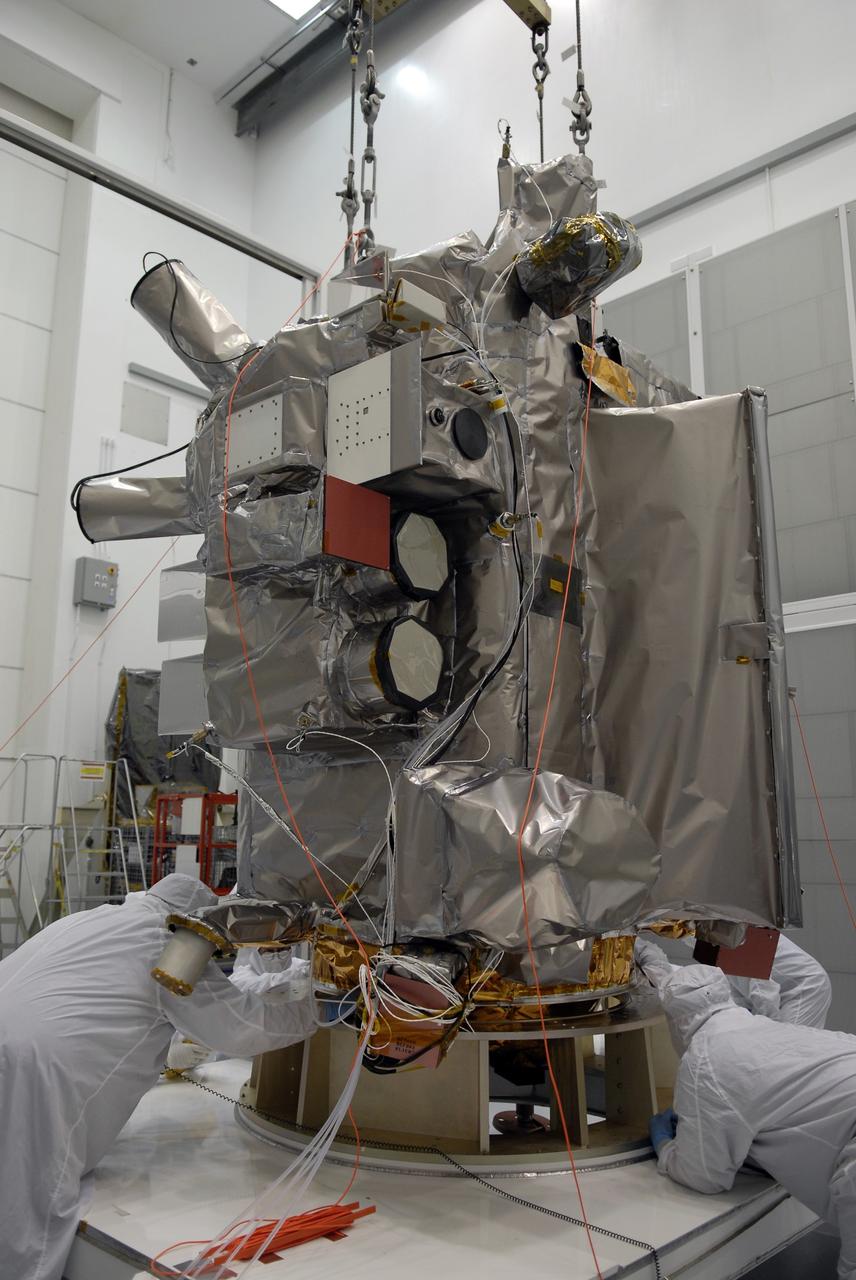
CAPE CANAVERAL, Fla. – At the Astrotech facility in Titusville, Fla., technicians secure NASA's Lunar Reconnaissance Orbiter, or LRO, onto a stand. The orbiter will carry seven instruments to provide scientists with detailed maps of the lunar surface and enhance our understanding of the moon's topography, lighting conditions, mineralogical composition and natural resources. Information gleaned from LRO will be used to select safe landing sites, determine locations for future lunar outposts and help mitigate radiation dangers to astronauts. The polar regions of the moon are the main focus of the mission because continuous access to sunlight may be possible and water ice may exist in permanently shadowed areas of the poles. Accompanying LRO on its journey to the moon will be the Lunar CRater Observation and Sensing Satellite, or LCROSS, a mission that will impact the lunar surface in its search for water ice. Launch of LRO is targeted for May 20. Photo credit: NASA/Kim Shiflett

A rising sun illuminates the coastal waters beyond Space Shuttle Endeavour, poised for launch on Nov. 30 at about 10:06 p.m. EST on mission STS-97. On the left, extending toward the orbiter, is the orbiter access arm. The mission to the International Space Station carries the P6 Integrated Truss Segment containing solar arrays and batteries that will be temporarily installed to the Unity connecting module by the Z1 truss, recently delivered to and installed on the Station on mission STS-92. The two solar arrays are each more than 100 feet long. They will capture energy from the sun and convert it to power for the Station. Two spacewalks will be required to install the solar array connections
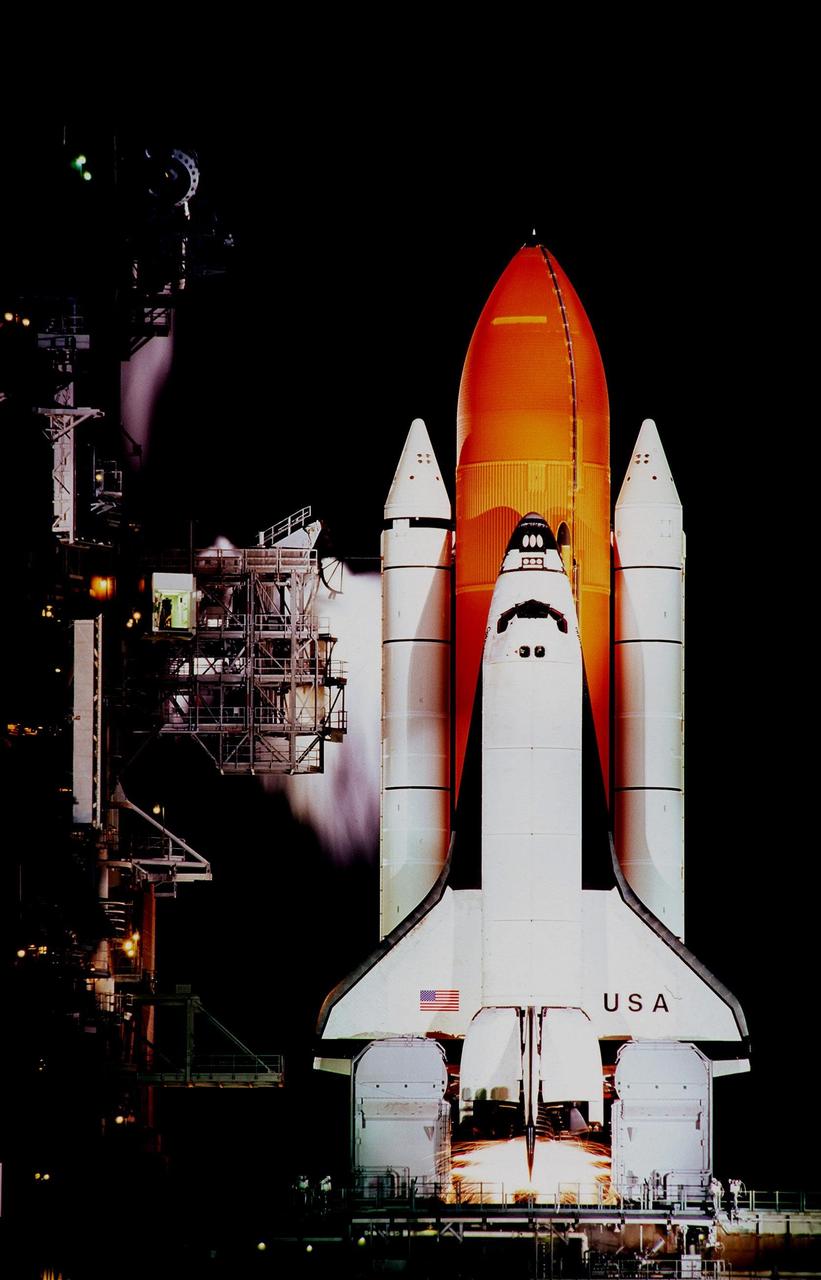
Moments before launch, sparks from the external ignitors are visible below the engines of Space Shuttle Columbia. The ignitors burn off a hydrogen concentration outside the orbiter near the main engines. A cloud effect behind the Shuttle's solid rocket booster and access arm to the left is created by spray from the water deluge system. The launch of STS-93 was scrubbed at the T-7 second mark in the countdown due to an indication of a high concentration of hydrogen in an aft engine compartment. The reading was proven to be a false alarm. The launch is rescheduled for July 22 at 12:28 a.m
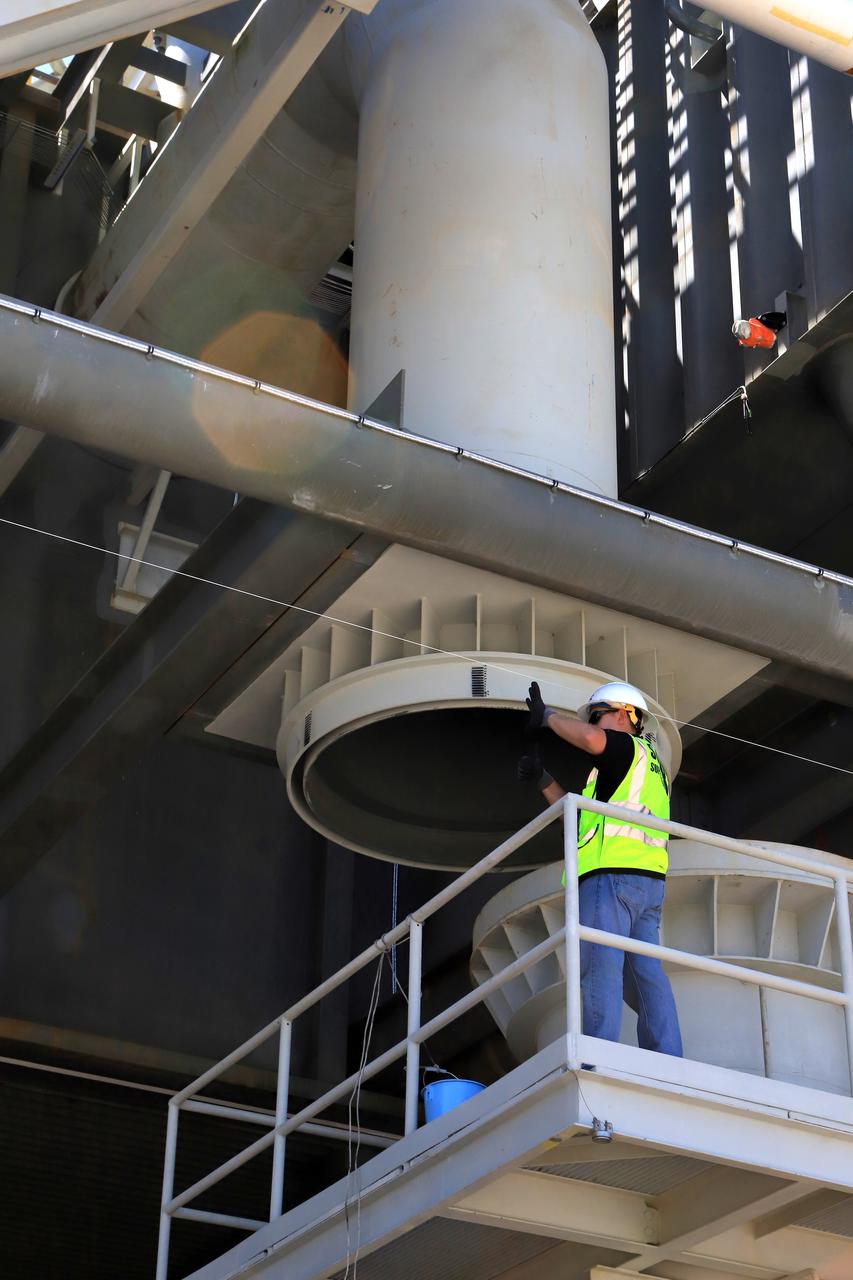
A technician watches as the ignition overpressure water system pipe on the mobile launcher slowly aligns with the pipe on the ground system at Launch Pad 39B at NASA's Kennedy Space Center in Florida, on Aug. 31, 2018. The ML, atop crawler-transporter 2, made the trek along the crawlerway to the pad for a fit check and several days of systems testing. The 380-foot-tall mobile launcher is equipped with the crew access arm and several umbilicals that will provide power, environmental control, pneumatics, communication and electrical connections to NASA's Space Launch System (SLS) and Orion spacecraft. Exploration Ground Systems is preparing the ground systems necessary to launch SLS and Orion on Exploration Mission-1, missions to the Moon and on to Mars.

January 1st, 2001: Description: Akpatok Island lies in Ungava Bay in northern Quebec, Canada. Accessible only by air, Akpatok Island rises out of the water as sheer cliffs that soar 500 to 800 feet (150 to 243m) above the sea surface. The island is an important sanctuary for cliff-nesting seabirds. Numerous ice floes around the island attract walrus and whales, making Akpatok a traditional hunting ground for native Inuit people. Source: Landsat 7 To learn more about the Landsat satellite go to: <a href="http://landsat.gsfc.nasa.gov/" rel="nofollow">landsat.gsfc.nasa.gov/</a>
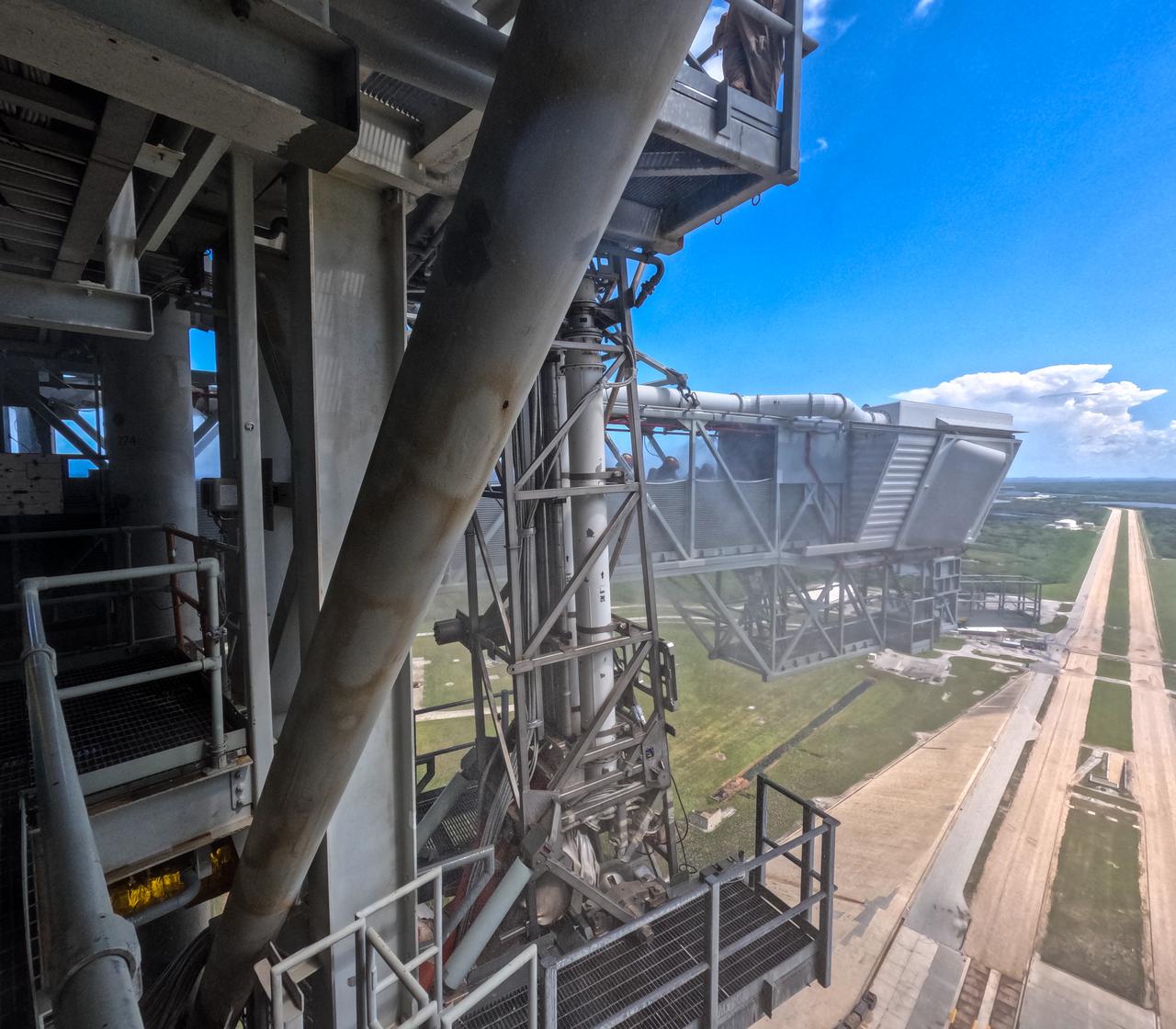
Teams at NASA’s Kennedy Space Center in Florida practice the Artemis mission emergency escape or egress procedures during a series of integrated system verification and validation tests at Launch Pad 39B on Sunday, Aug. 11, 2024. Members of the closeout crew, pad rescue team and the Exploration Ground Systems Program practiced walking to the crew access arm and getting inside and out of the emergency egress baskets. While the crew and other personnel will ride the emergency egress baskets to the terminus area in a real emergency, no one rode the baskets for this test. Instead, teams tested the baskets during separate occasions by using water tanks filled to different levels to replicate simulate the weight of passengers.
Teams at NASA’s Kennedy Space Center in Florida practice the Artemis mission emergency escape or egress procedures during a series of integrated system verification and validation tests at Launch Pad 39B on Sunday, Aug. 11, 2024. Members of the closeout crew, pad rescue team and the Exploration Ground Systems Program practiced walking to the crew access arm and getting inside and out of the emergency egress baskets. While the crew and other personnel will ride the emergency egress baskets to the terminus area in a real emergency, no one rode the baskets for this test. Instead, teams tested the baskets during separate occasions by using water tanks filled to different levels to replicate simulate the weight of passengers.
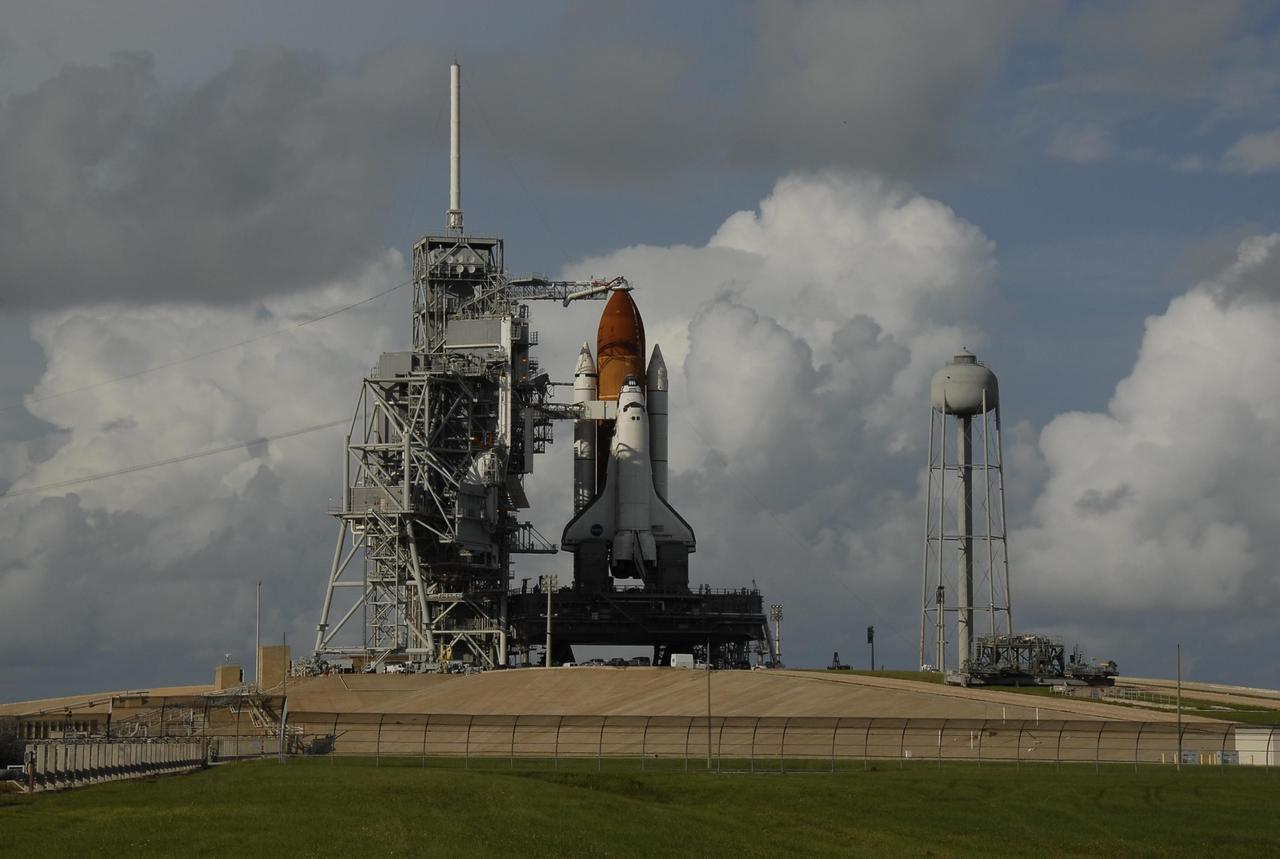
KENNEDY SPACE CENTER, FLA. -- Afternoon clouds have rolled in, serving as a background for space shuttle Discovery after rollback of the rotating service structure, at far left. Seen above the golden external tank is the vent hood (known as the "beanie cap") at the end of the gaseous oxygen vent arm, extending from the fixed service structure. Vapors are created as the liquid oxygen in the external tank boil off. The hood vents the gaseous oxygen vapors away from the space shuttle vehicle. Below it, also extending toward Discovery from the structure, is the orbiter access arm with the White Room at the end. The crew gains access into the orbiter through the White Room. At right is the 300,000-gallon water tank that provides water for sound suppression during liftoff. Rollback of the RSS started at 3:34 p.m. EDT and was complete at 4:20 p.m. The RSS provides protected access to the orbiter for changeout and servicing of payloads at the pad. Rollback of the pad's RSS is one of the milestones in preparation for the launch of mission STS-120. Discovery is scheduled for liftoff at 11:38 a.m. EDT on Oct. 23. The mission will be the 23rd assembly flight to the International Space Station and the 34th flight for Discovery. Payload on the mission is the Italian-built U.S. Node 2, called Harmony. The 14-day mission will install Harmony and move the P6 solar arrays to their permanent position and deploy them. Discovery is expected to complete its mission and return home at 4:47 a.m. EST on Nov. 6. Photo credit: NASA/Kim Shiflett

KENNEDY SPACE CENTER, FLA. -- On Launch Pad 39A on NASA's Kennedy Space Center, space shuttle Discovery is fully revealed after rollback of the rotating service structure, at far left. Seen above the golden external tank is the vent hood (known as the "beanie cap") at the end of the gaseous oxygen vent arm, extending from the fixed service structure. Vapors are created as the liquid oxygen in the external tank boil off. The hood vents the gaseous oxygen vapors away from the space shuttle vehicle. Below it, also extending toward Discovery from the structure, is the orbiter access arm with the White Room at the end. The crew gains access into the orbiter through the White Room. At right is the 300,000-gallon water tank that provides water for sound suppression during liftoff. Rollback of the RSS started at 3:34 p.m. EDT and was complete at 4:20 p.m. The RSS provides protected access to the orbiter for changeout and servicing of payloads at the pad. Rollback of the pad's RSS is one of the milestones in preparation for the launch of mission STS-120. Discovery is scheduled for liftoff at 11:38 a.m. EDT on Oct. 23. The mission will be the 23rd assembly flight to the International Space Station and the 34th flight for Discovery. Payload on the mission is the Italian-built U.S. Node 2, called Harmony. The 14-day mission will install Harmony and move the P6 solar arrays to their permanent position and deploy them. Discovery is expected to complete its mission and return home at 4:47 a.m. EST on Nov. 6. Photo credit: NASA/Kim Shiflett
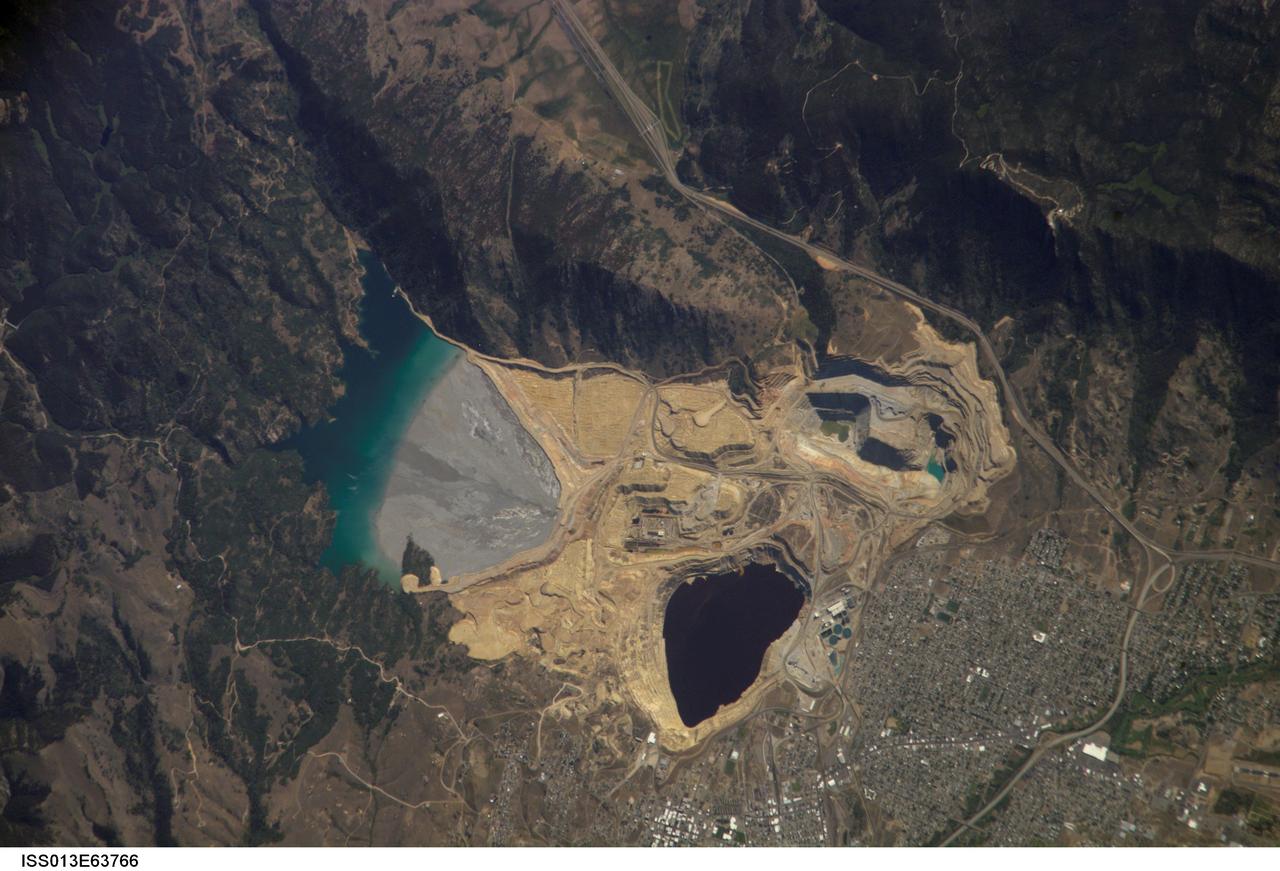
ISS013-E-63766 (2 Aug. 2006) --- Berkeley Pit and Butte, Montana are featured in this image photographed by an Expedition 13 crewmember on the International Space Station. The city of Butte, Montana has long been a center of mining activity. Underground mining of copper began in Butte in the 1870s, and by 1901 underground workings had extended to the groundwater table. Thus began the creation of an intricate complex of underground drains and pumps to lower the groundwater level and continue the extraction of copper. Water extracted from the mines was so rich in dissolved copper sulfate that it was also "mined" (by chemical precipitation) for the copper it contained. In 1955, the Anaconda Copper Mining Company began open-pit mining for copper in what is now know as the Berkeley Pit (dark oblong area in center). The mine took advantage of the existing subterranean drainage and pump network to lower groundwater until 1982, when the new owner ARCO suspended operations at the mine. The groundwater level swiftly rose, and today water in the Pit is more than 900 feet deep. Many features of the mine workings are visible in this image such as the many terraced levels and access roadways of the open mine pits (gray and tan sculptured surfaces). A large gray tailings pile of waste rock and an adjacent tailings pond are visible to the north of the Berkeley Pit. Color changes in the tailings pond are due primarily to changing water depth. The Berkeley Pit is listed as a federal Superfund site due to its highly acidic water, which contains high concentrations of metals such as copper and zinc. The Berkeley Pit receives groundwater flowing through the surrounding bedrock and acts as a "terminal pit" or sink for these heavy metal-laden waters. Ongoing efforts include regulation of water flow into the pit to reduce filling of the Pit and potential release of contaminated water into local aquifers or surface streams.
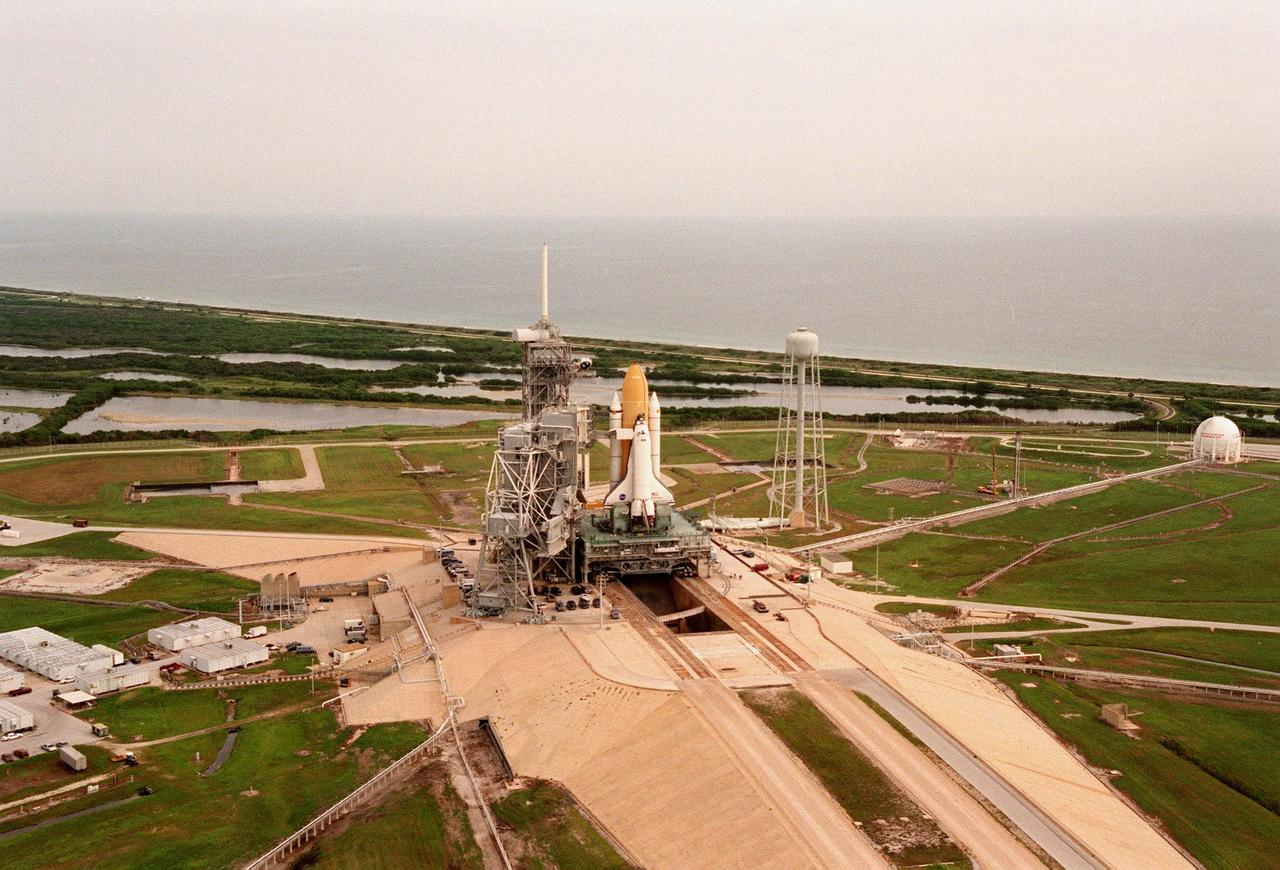
The STS-95 Space Shuttle Discovery sits on the Mobile Launch Platform, still atop the crawler transporter, at Launch Pad 39B. To its left is the Fixed Service Structure that provides access to the orbiter and the Rotating Service Structure. To its right is the elevated water tank, with a capacity of 300,000 gallons. Part of the sound suppression water system, the tank stands 290 feet high on the northeast side of the pad. Water from the tank is released just before ignition of the orbiter's three main engines and twin solid rocket boosters. The entire system reduces the acoustical levels within the orbiter's payload bay to an acceptable 142 decibels. Beyond the orbiter is seen the Atlantic Ocean. While at the launch pad, the orbiter, external tank and solid rocket boosters will undergo final preparations for the launch, scheduled to lift off Oct. 29. The mission includes research payloads such as the Spartan solar-observing deployable spacecraft, the Hubble Space Telescope Orbital Systems Test Platform, the International Extreme Ultraviolet Hitchhiker, as well as the SPACEHAB single module with experiments on space flight and the aging process
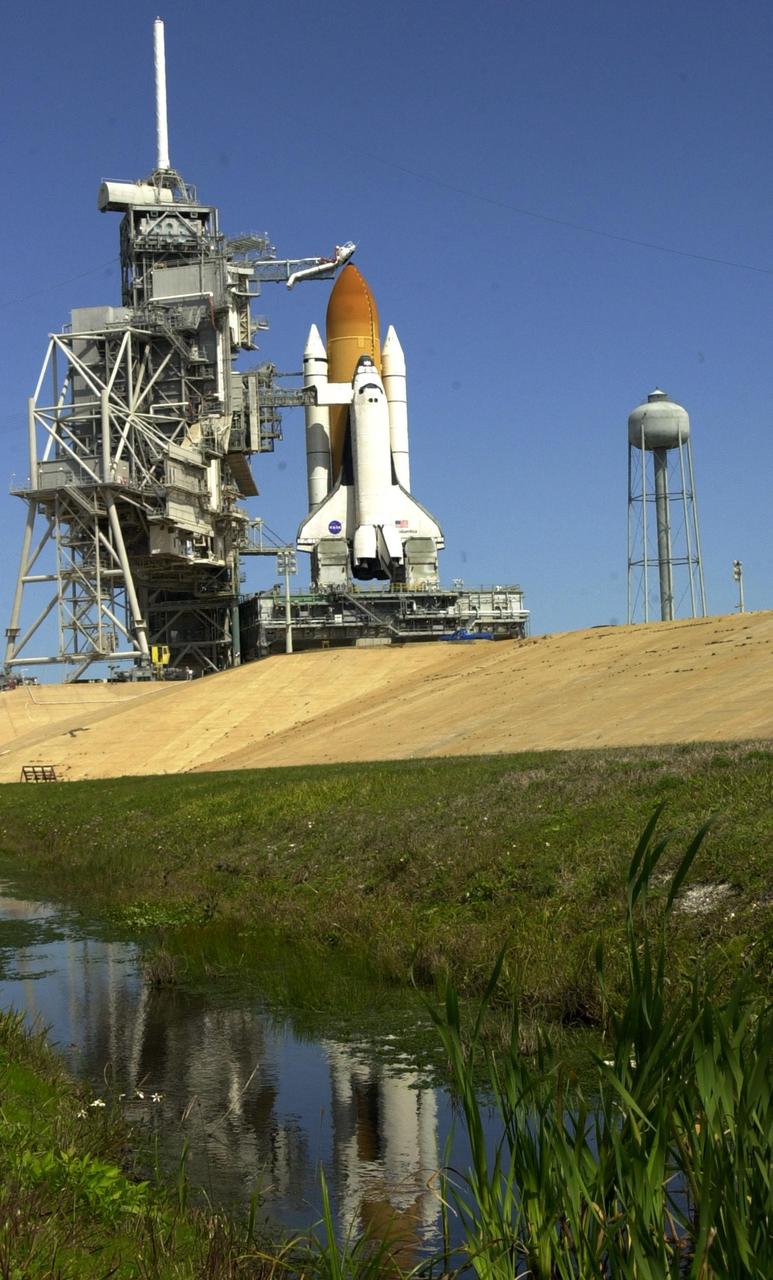
KENNEDY SPACE CENTER, Fla. - Rollback of the Rotating Service Structure for the second time, after a scrub of mission STS-109 the day before, provides an unfettered look at Space Shuttle Columbia on Launch Pad 39A. The nearby water gives an impressionistic view. Above the orange-colored external tank is poised the "beanie cap," the gaseous oxygen vent hood. Extending to the side of Columbia is the Orbiter Access Arm with the environmentally controlled White Room at the end. The White Room provides entry for the crew into the orbiter. Columbia sits atop the Mobile Launcher Platform. At right is the 290-foot-tall water tower that holds 300,000 gallons of water, part of the sound suppression system during a launch. Columbia is rescheduled for launch on mission STS-109 March 1 at 6:22 a.m. EST (11:22 GMT). The 11-day mission will provide maintenance and upgrade to the Hubble Space Telescope, replacing Solar Array 2 with Solar Array 3, replacing the Power Control Unit, installing the ACS (after removing the Faint Object Camera ), the Near Infrared Camera, the Multi-Object Spectrometer (NICMOS) Cooling System, and the New Outer Blanket Layer insulation.
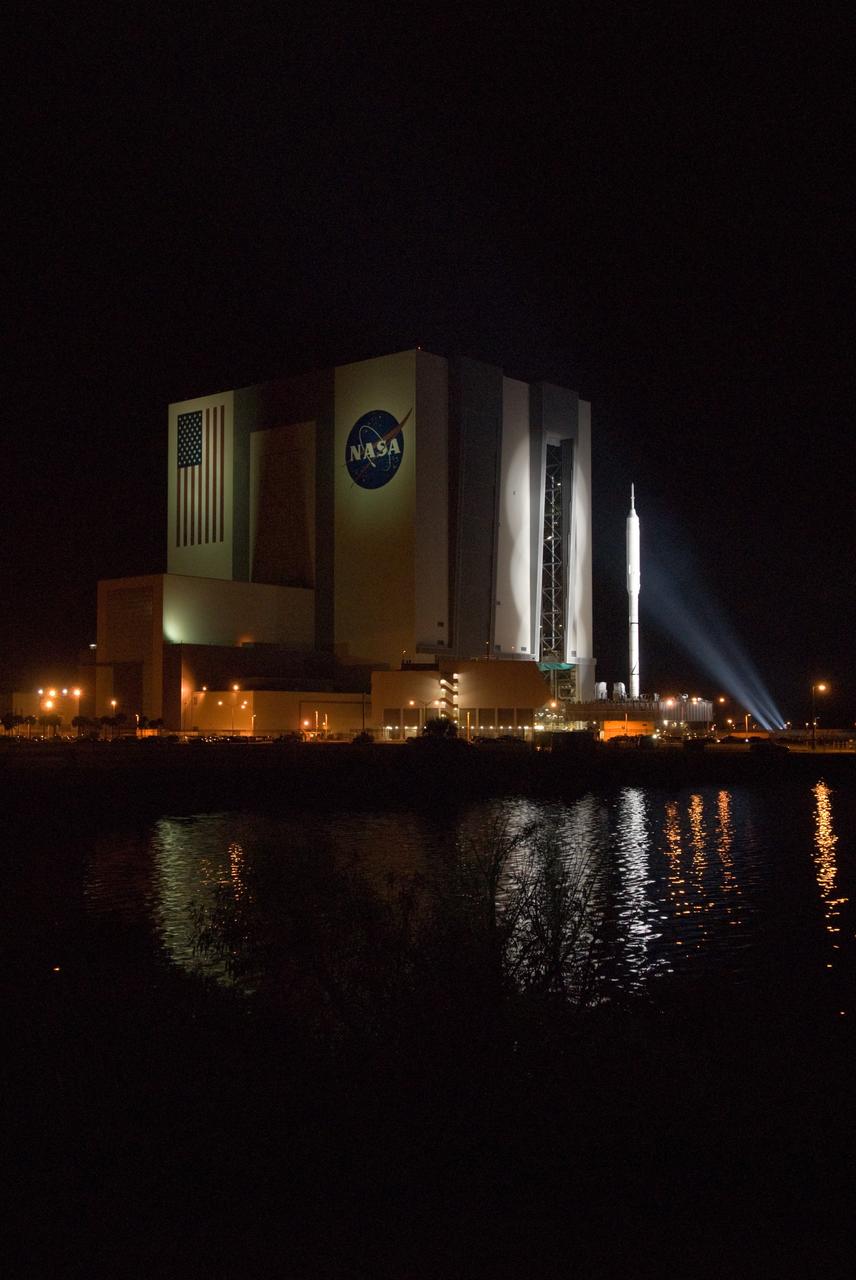
CAPE CANAVERAL, Fla. – Reflected in the water of the turn basin near the Vehicle Assembly Building at NASA's Kennedy Space Center in Florida, the 327-foot-tall Ares I-X rocket begins its slow trek to Launch Pad 39B. The move, known as "rollout," began at 1:39 a.m. EDT. The transfer of the pad from the Space Shuttle Program to the Constellation Program took place May 31. Modifications made to the pad include the removal of shuttle unique subsystems, such as the orbiter access arm and a section of the gaseous oxygen vent arm, along with the installation of three 600-foot lightning towers, access platforms, environmental control systems and a vehicle stabilization system. Part of the Constellation Program, the Ares I-X is the test vehicle for the Ares I. The Ares I-X flight test is targeted for Oct. 27. For information on the Ares I-X vehicle and flight test, visit http://www.nasa.gov/aresIX. Photo credit: NASA/Jim Grossmann
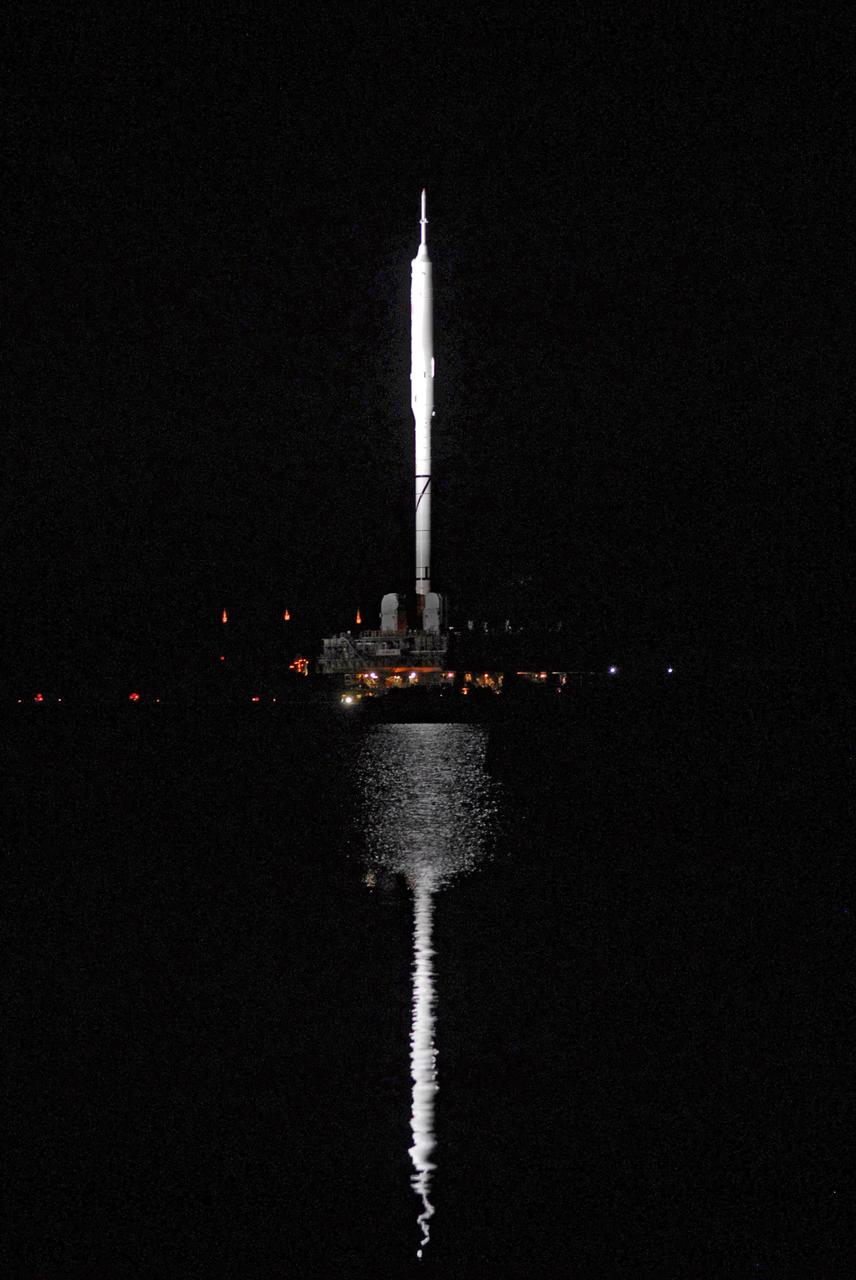
CAPE CANAVERAL, Fla. - The towering 327-foot-tall Ares I-X rocket is strikingly reflected in the waters of the turn basin at NASA's Kennedy Space Center in Florida. The rocket, riding atop a crawler-transporter, is headed for Launch Pad 39B. The move to the launch pad, known as "rollout," began at 1:39 a.m. EDT. The transfer of the pad from the Space Shuttle Program to the Constellation Program took place May 31. Modifications made to the pad include the removal of shuttle unique subsystems, such as the orbiter access arm and a section of the gaseous oxygen vent arm, along with the installation of three 600-foot lightning towers, access platforms, environmental control systems and a vehicle stabilization system. Part of the Constellation Program, the Ares I-X is the test vehicle for the Ares I. The Ares I-X flight test is targeted for Oct. 27. For information on the Ares I-X vehicle and flight test, visit http://www.nasa.gov/aresIX. Photo credit: NASA/Jim Grossman

ISS019-E-005501 (9 April 2009) --- Split Region in Croatia is featured in this image photographed by an Expedition 19 crewmember on the International Space Station. One the world?s most rugged coastlines are located in Croatia along the Adriatic Sea. This view features the Dalmatian coastline of Croatia around the city of Split. Much of the region can be characterized by northwest-southeast oriented linear islands and embayments of the Adriatic Sea. This distinctive coastal geomorphology is the result of faulting caused by tectonic activity in the region and sea level rise. Split has a long history - the Roman Emperor Diocletian retired to Spalatum (the present-day Split) in 305, and his palace constitutes the core of the city today. The city is a popular resort destination for its historic sites, Mediterranean climate, and ready access to the Adriatic islands (such as Brac to the south). Other large cities in the region include Kastela and Trogir; together with Split, these form an almost continuous urban area bordering the coast (visible as pink regions). A thin zone marking a water boundary is visible in this image between Split and the island of Brac. It may represent a local plankton bloom, or a line of convergence between water masses creating rougher water. A unique combination of geography -- including dramatic topography that channels local winds, the complicated coastline, input of fresh water from rivers, and ample nutrients and surface oils -- makes for interesting mesoscale surface dynamics throughout the Adriatic Sea. Over the years, astronauts have taken images of the Split region using sunglint and changes in water color to highlight features like eddies, water boundaries and mixing zones between fresh waters flowing into the saltier (denser) waters of the Adriatic, and wind-driven surface currents. Split is an important transit center connecting islands in the Adriatic Sea to the Italian peninsula, and an important regional manufacturing center of goods such as solar cells, plastics, and paper products. The city was heavily industrialized during the post World War II period as a member state of Yugoslavia. By the 1980s, the marine environment bordered by Split, Kastela, and Trogir (known as Kastela Bay) had been identified as one of the most polluted areas of the Adriatic from both sewage and industrial wastes. Concerted efforts by the Croatian government and international partners to improve waste handling and treatment infrastructure over the past 10 years seem to have been successful ? both marine species and water polo players have returned to the area.
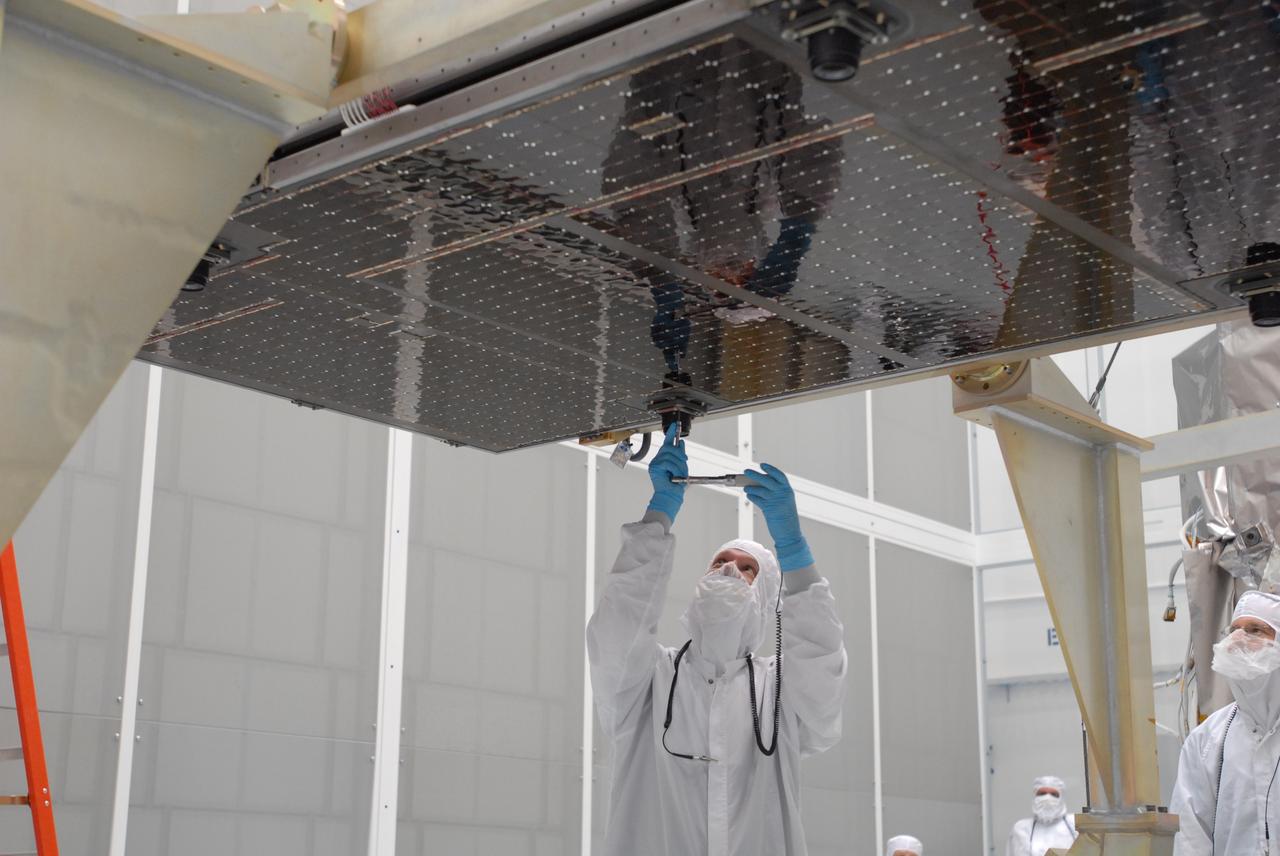
CAPE CANAVERAL, Fla. –– At Astrotech Space Operations in Titusville, Fla., technicians prepare the solar array panel for installation on the Lunar Reconnaissance Orbiter, or LRO. The orbiter will carry seven instruments to provide scientists with detailed maps of the lunar surface and enhance our understanding of the moon's topography, lighting conditions, mineralogical composition and natural resources. Information gleaned from LRO will be used to select safe landing sites, determine locations for future lunar outposts and help mitigate radiation dangers to astronauts. The polar regions of the moon are the main focus of the mission because continuous access to sunlight may be possible and water ice may exist in permanently shadowed areas of the poles. Launch of LRO is targeted for June 2. Photo credit: NASA/Jim Grossmann
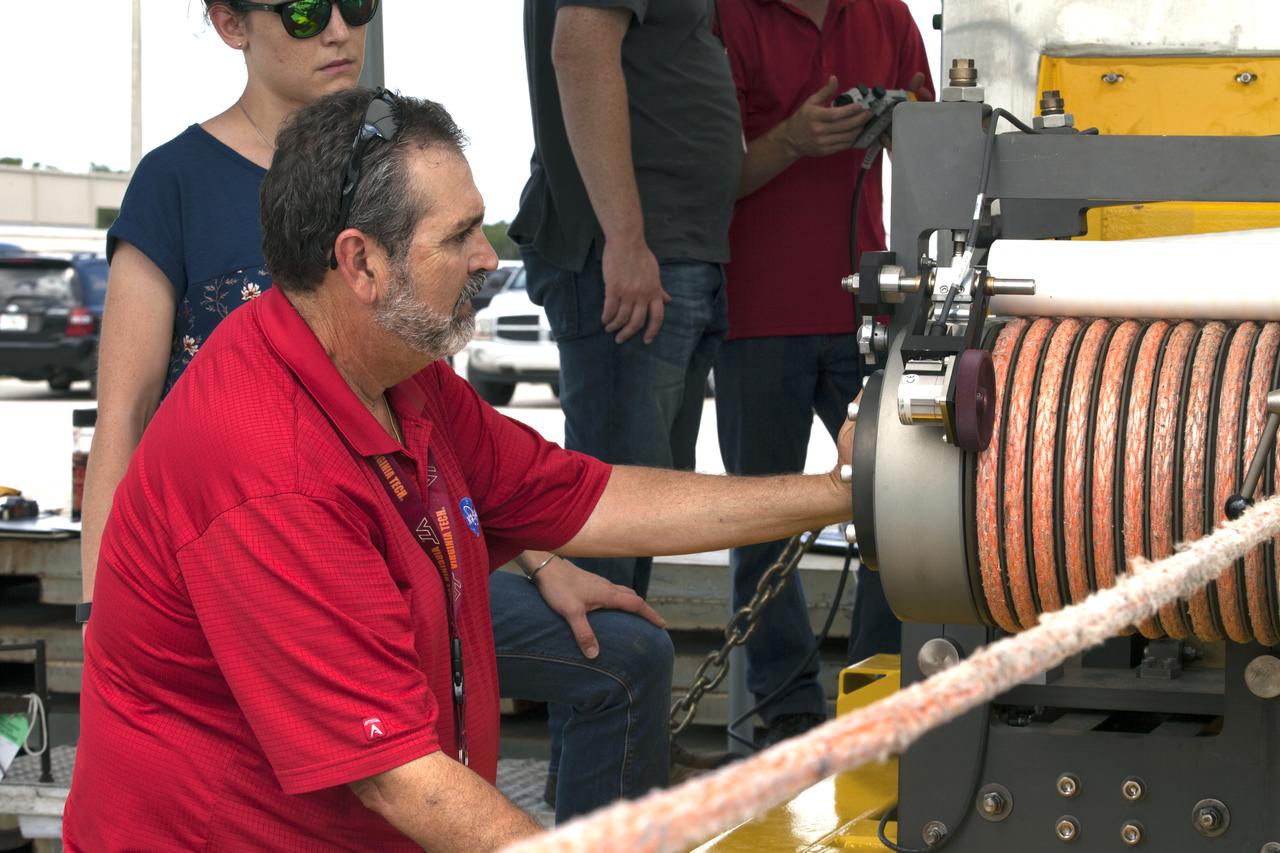
Orion Landing and Recovery team members with Jacobs practice using a winch to prepare for Underway Recovery Test 7 (URT-7) on Sept. 5, 2018, in the heavy equipment yard at NASA's Kennedy Space Center in Florida. In front is Pete Ruett. Behind him is Amy Hein. Both are handling and access engineers. During URT-7, the recovery team, including Exploration Ground Systems and the U.S. Navy, will practice recovering a test version of the Orion crew module in the Pacific Ocean, off the coast of California, and guiding it into the well deck of a ship. Over several days, the team will demonstrate and evaluate new recovery processes, procedures, hardware and personnel in open waters. Orion is the exploration spacecraft designed to carry astronauts to deep space destinations, including the Moon and on to Mars. Orion will have emergency abort capability, sustain the crew during space travel and provide safe re-entry from deep space return velocities.
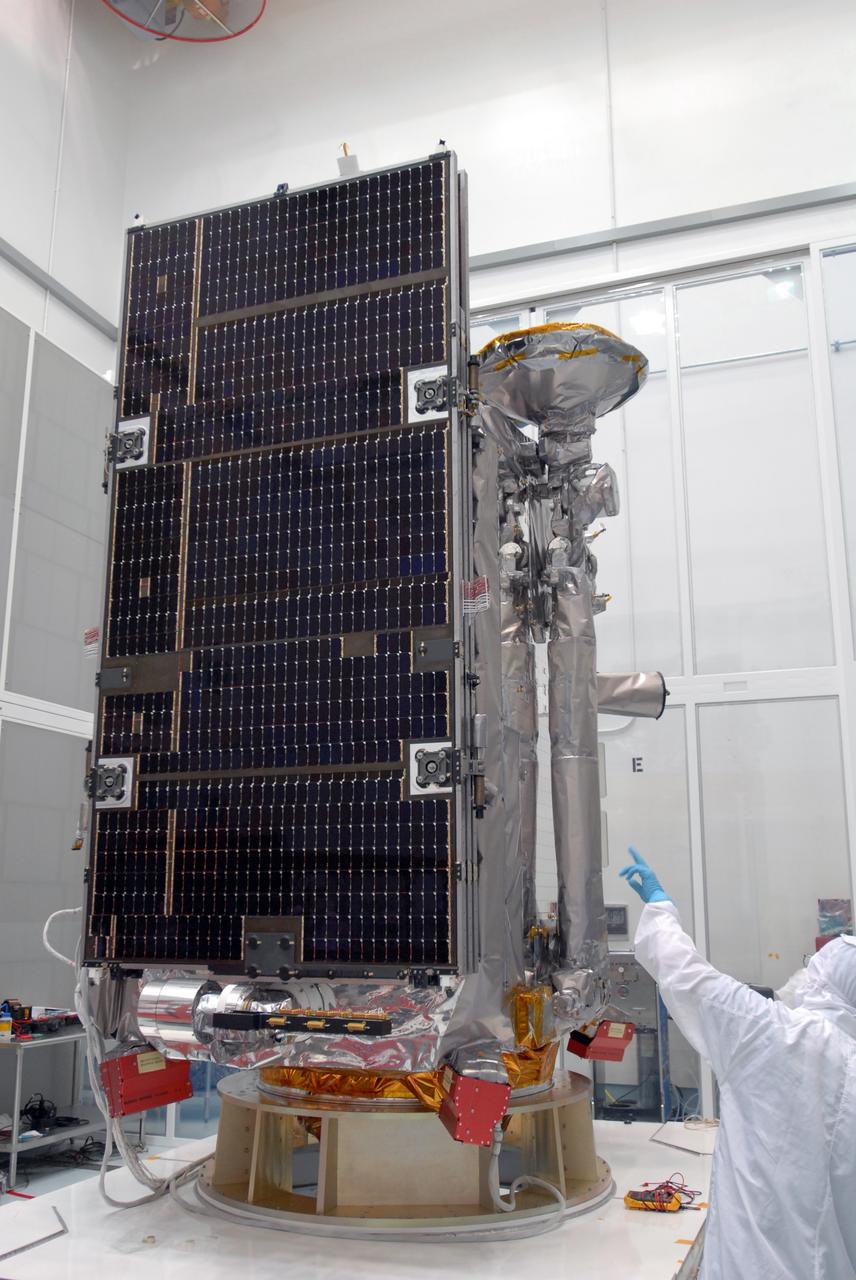
CAPE CANAVERAL, Fla. –– At Astrotech Space Operations in Titusville, Fla., a technician checks the installation of a solar array panel on the Lunar Reconnaissance Orbiter, or LRO. The orbiter will carry seven instruments to provide scientists with detailed maps of the lunar surface and enhance our understanding of the moon's topography, lighting conditions, mineralogical composition and natural resources. Information gleaned from LRO will be used to select safe landing sites, determine locations for future lunar outposts and help mitigate radiation dangers to astronauts. The polar regions of the moon are the main focus of the mission because continuous access to sunlight may be possible and water ice may exist in permanently shadowed areas of the poles. Launch of LRO is targeted for June 2. Photo credit: NASA/Jim Grossmann
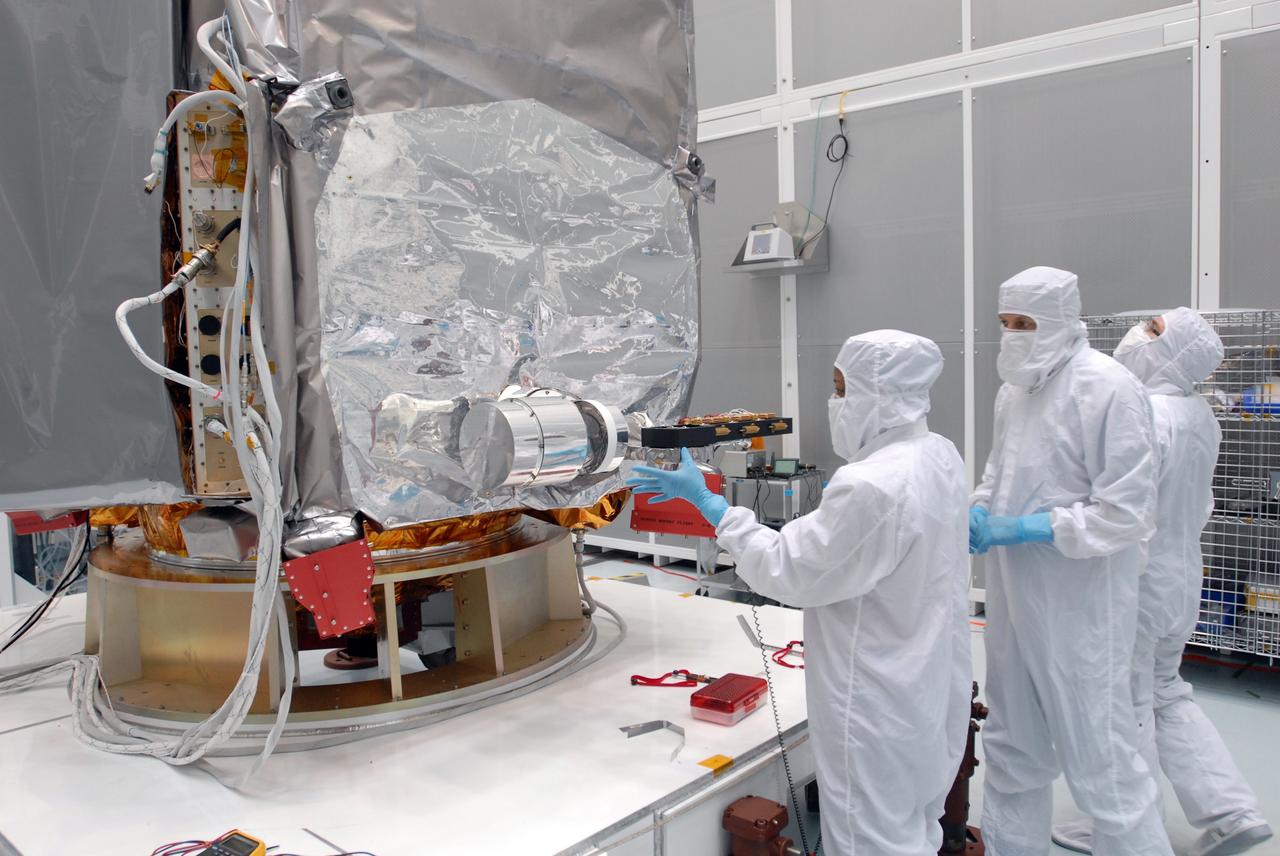
CAPE CANAVERAL, Fla. –– At Astrotech Space Operations in Titusville, Fla., technicians prepare the Lunar Reconnaissance Orbiter, or LRO, for installation of the solar array panels. The orbiter will carry seven instruments to provide scientists with detailed maps of the lunar surface and enhance our understanding of the moon's topography, lighting conditions, mineralogical composition and natural resources. Information gleaned from LRO will be used to select safe landing sites, determine locations for future lunar outposts and help mitigate radiation dangers to astronauts. The polar regions of the moon are the main focus of the mission because continuous access to sunlight may be possible and water ice may exist in permanently shadowed areas of the poles. Launch of LRO is targeted for June 2. Photo credit: NASA/Jim Grossmann
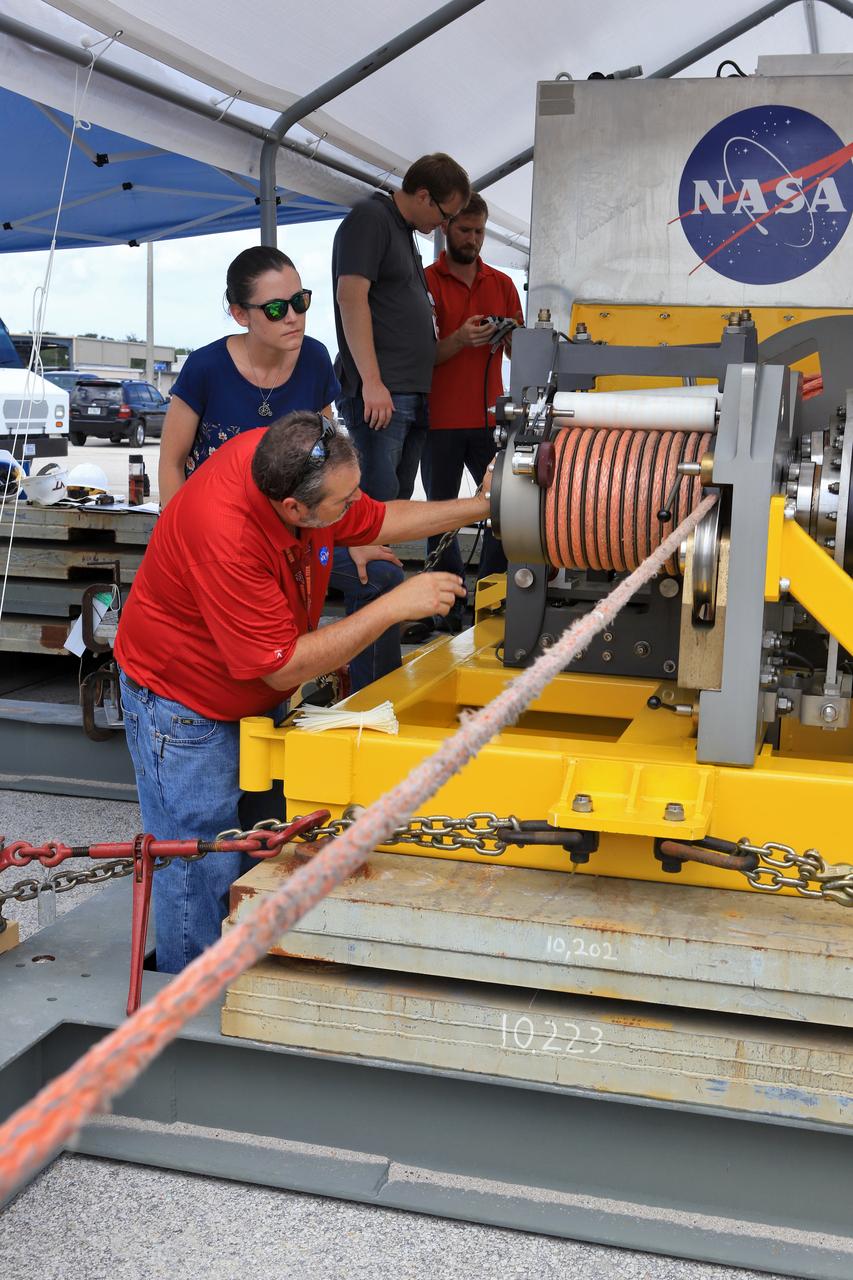
Orion Landing and Recovery team members with Jacobs, practice using a winch to prepare for Underway Recovery Test 7 (URT-7) on Sept. 5, 2018, in the heavy equipment yard at NASA's Kennedy Space Center in Florida. From left, are handling and access engineers Pete Ruett, Amy Hein, Peter Thorn and Eric Hernandez. During URT-7, the recovery team, including Exploration Ground Systems and the U.S. Navy, will practice recovering a test version of the Orion crew module in the Pacific Ocean, off the coast of California, and guiding it into the well deck of a ship. Over several days, the team will demonstrate and evaluate new recovery processes, procedures, hardware and personnel in open waters. Orion is the exploration spacecraft designed to carry astronauts to deep space destinations, including the Moon and on to Mars. Orion will have emergency abort capability, sustain the crew during space travel and provide safe re-entry from deep space return velocities.

CAPE CANAVERAL, Fla. –– At Astrotech Space Operations in Titusville, Fla., technicians prepare for installation of the solar array panels on the Lunar Reconnaissance Orbiter, or LRO. The orbiter will carry seven instruments to provide scientists with detailed maps of the lunar surface and enhance our understanding of the moon's topography, lighting conditions, mineralogical composition and natural resources. Information gleaned from LRO will be used to select safe landing sites, determine locations for future lunar outposts and help mitigate radiation dangers to astronauts. The polar regions of the moon are the main focus of the mission because continuous access to sunlight may be possible and water ice may exist in permanently shadowed areas of the poles. Launch of LRO is targeted for June 2. Photo credit: NASA/Jim Grossmann
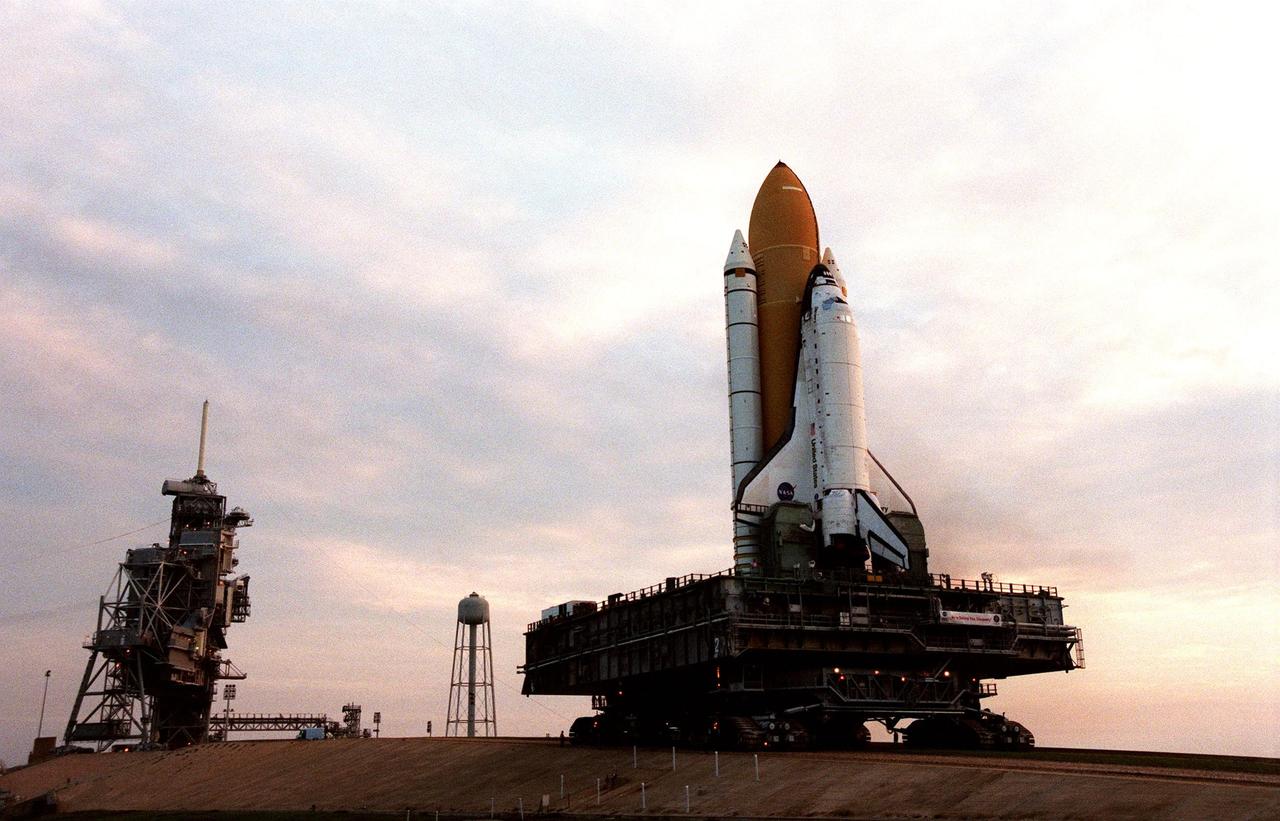
The early morning light reveals STS-95 Space Shuttle Discovery, on the Mobile Launch Platform, on its 6-hour, 4.2-mile trek to Launch Complex Pad 39B from the Vehicle Assembly Building. To the left is the Fixed Service Structure that provides access to the orbiter and the Rotating Service Structure. In the background is th eelevated water tank that helps reduce sound levels during launch. At the launch pad, the orbiter, external tank and solid rocket boosters will undergo final preparations for the launch, scheduled to lift off Oct. 29. The mission includes research payloads such as the Spartan solar-observing deployable spacecraft, the Hubble Space Telescope Orbital Systems Test Platform, the International Extreme Ultraviolet Hitchhiker, as well as the SPACEHAB single module with experiments on space flight and the aging process
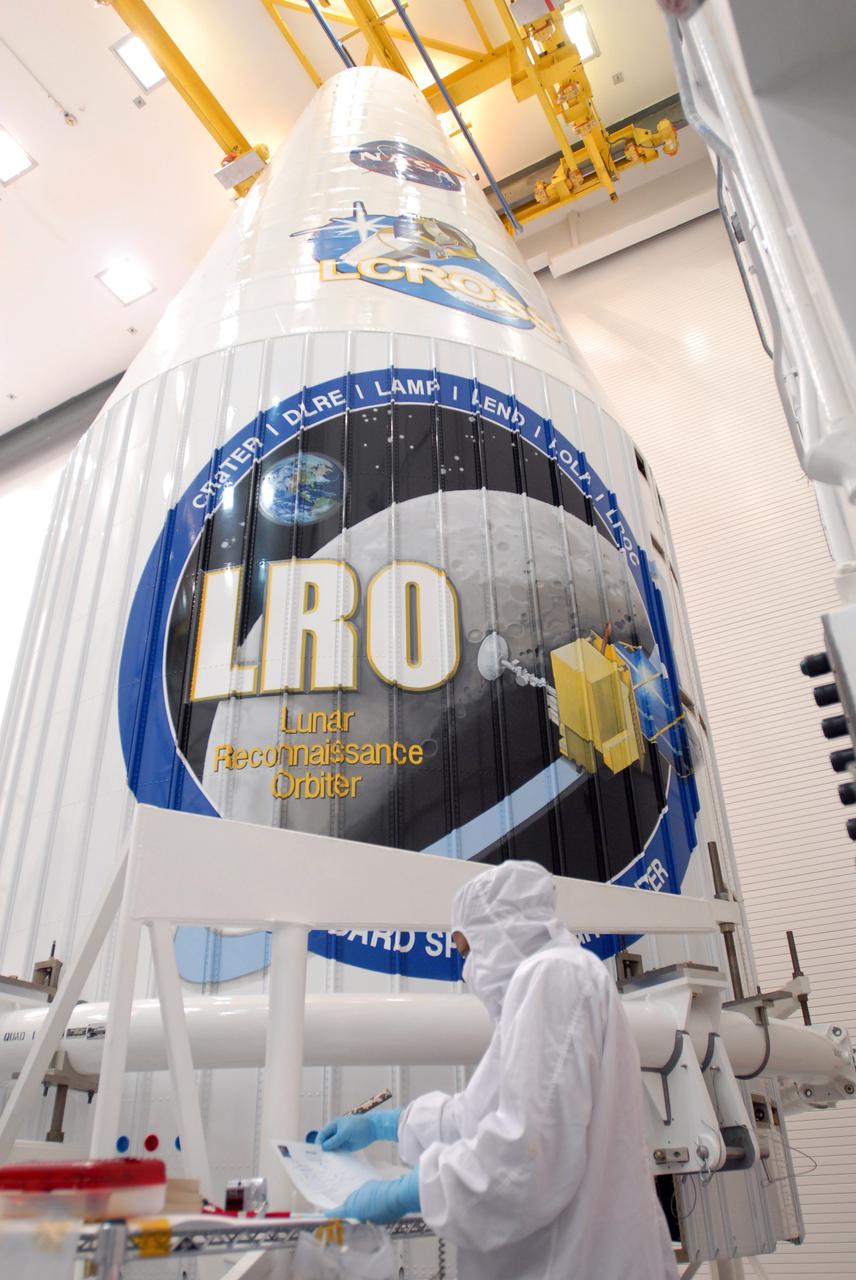
CAPE CANAVERAL, Fla. –– At Astrotech Space Operations in Titusville, Fla., a technician prepares for the installation of the solar array panel on the Lunar Reconnaissance Orbiter, or LRO. He stands in front of the fairing that will encapsulate the spacecraft at a later date. The orbiter will carry seven instruments to provide scientists with detailed maps of the lunar surface and enhance our understanding of the moon's topography, lighting conditions, mineralogical composition and natural resources. Information gleaned from LRO will be used to select safe landing sites, determine locations for future lunar outposts and help mitigate radiation dangers to astronauts. The polar regions of the moon are the main focus of the mission because continuous access to sunlight may be possible and water ice may exist in permanently shadowed areas of the poles. Launch of LRO is targeted for June 2. Photo credit: NASA/Jim Grossmann
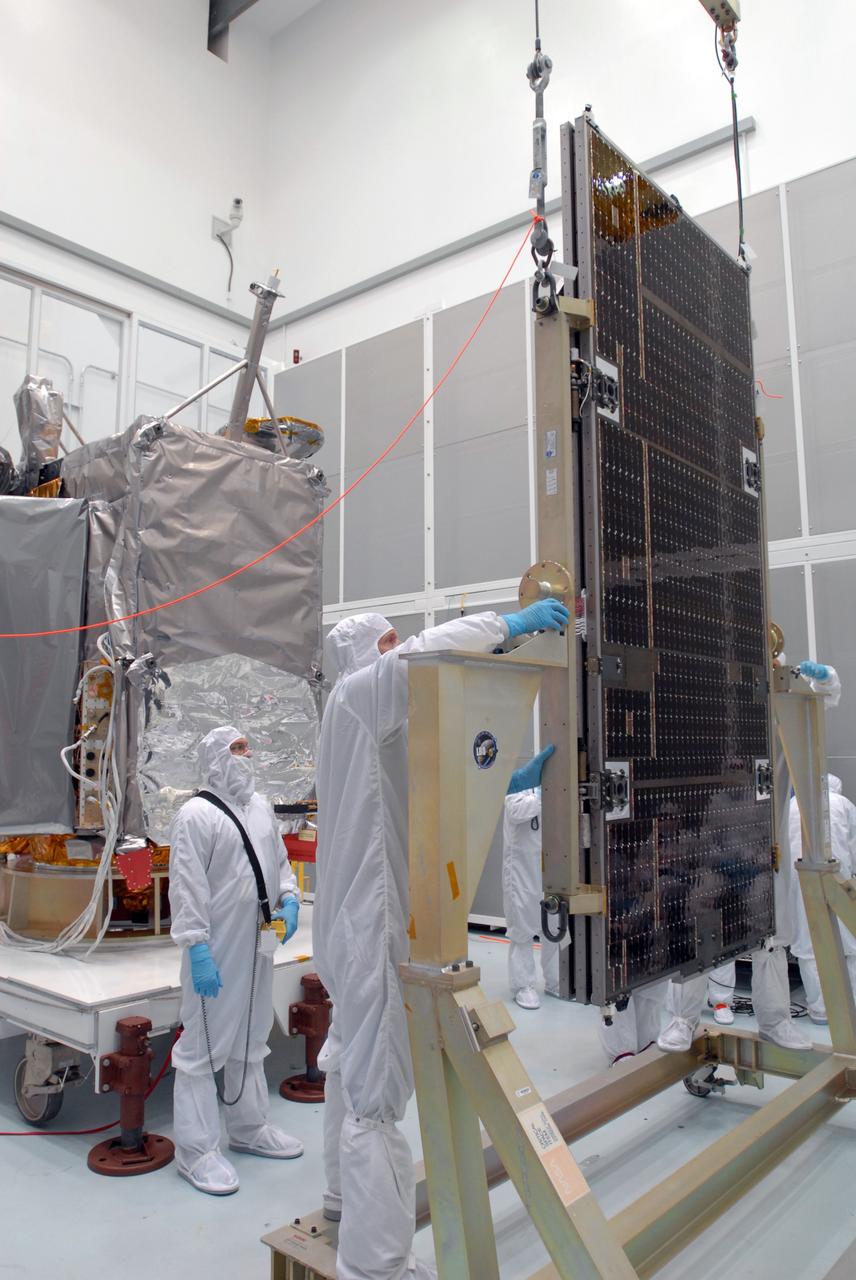
CAPE CANAVERAL, Fla. –– At Astrotech Space Operations in Titusville, Fla., technicians prepare the solar array panel for installation on the Lunar Reconnaissance Orbiter, or LRO, at left. The orbiter will carry seven instruments to provide scientists with detailed maps of the lunar surface and enhance our understanding of the moon's topography, lighting conditions, mineralogical composition and natural resources. Information gleaned from LRO will be used to select safe landing sites, determine locations for future lunar outposts and help mitigate radiation dangers to astronauts. The polar regions of the moon are the main focus of the mission because continuous access to sunlight may be possible and water ice may exist in permanently shadowed areas of the poles. Launch of LRO is targeted for June 2. Photo credit: NASA/Jim Grossmann
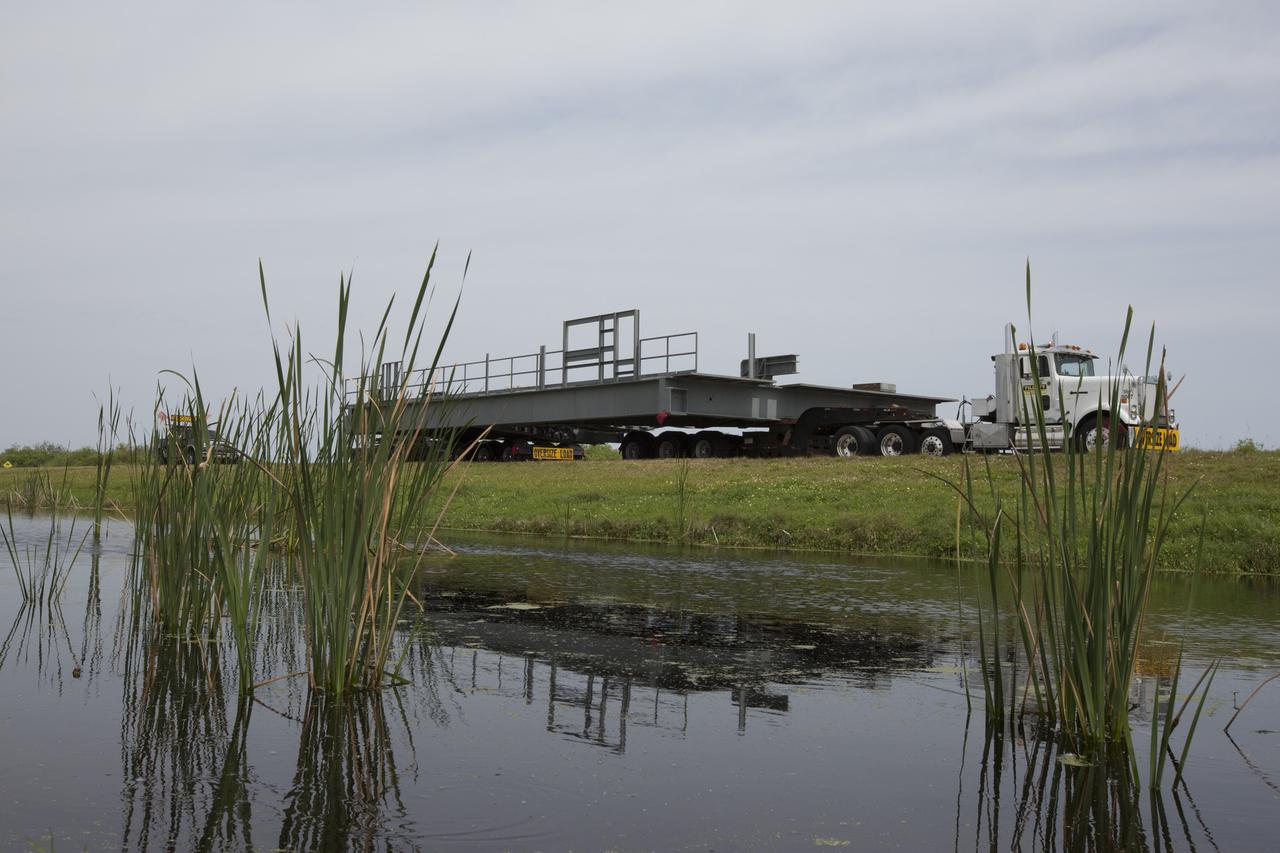
With its image reflected in the water, a heavy load transport truck proceeds along the road to the Vehicle Assembly Building (VAB) at NASA’s Kennedy Space Center in Florida, carrying the second half of the F-level work platforms for the agency’s Space Launch System (SLS) rocket. The platform will be delivered to the VAB staging area in the west parking lot. The Ground Systems Development and Operations Program is overseeing upgrades and modifications to VAB High Bay 3 to support processing of the SLS and Orion spacecraft. A total of 10 levels of new platforms, 20 platform halves altogether, will surround the SLS rocket and Orion spacecraft and provide access for testing and processing. Delivery of this platform brings the total to 10 platforms, or half of the work platforms delivered to Kennedy,
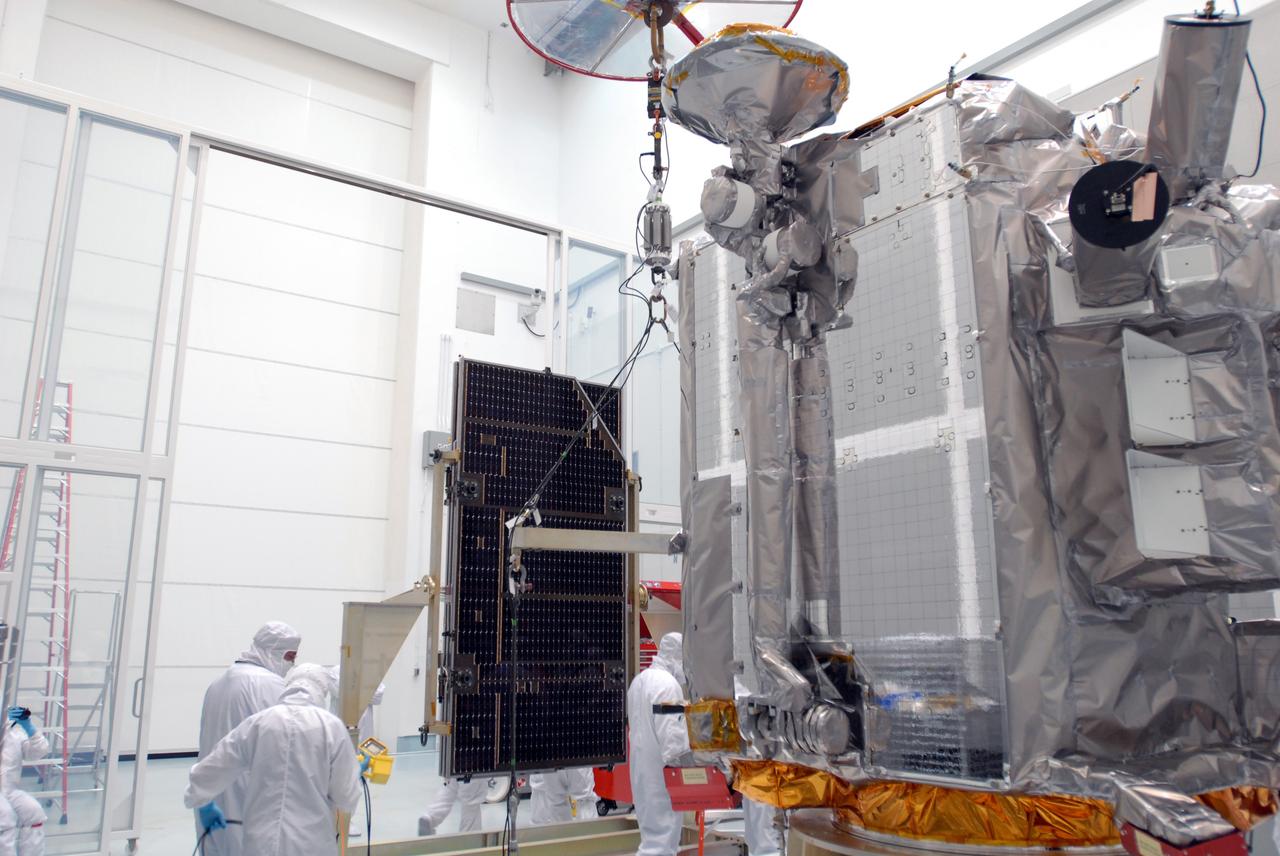
CAPE CANAVERAL, Fla. –– At Astrotech Space Operations in Titusville, Fla., technicians prepare the solar array panel for installation on the Lunar Reconnaissance Orbiter, or LRO. The orbiter will carry seven instruments to provide scientists with detailed maps of the lunar surface and enhance our understanding of the moon's topography, lighting conditions, mineralogical composition and natural resources. Information gleaned from LRO will be used to select safe landing sites, determine locations for future lunar outposts and help mitigate radiation dangers to astronauts. The polar regions of the moon are the main focus of the mission because continuous access to sunlight may be possible and water ice may exist in permanently shadowed areas of the poles. Launch of LRO is targeted for June 2. Photo credit: NASA/Jim Grossmann

ISS013-E-34753 (8 June 2006) --- Carthage, Tunisia is featured in this image photographed by an Expedition 13 crewmember on the International Space Station. The favorable location of the ancient city of Carthage is clear in this image. Embayments along the coastline provided ready access to the Gulf of Tunis/Mediterranean Sea to the east and southeast. Docks along the coastline (lower right) support the shipping industry. Modern Carthage is a wealthy suburb of the Tunis metropolitan area (the center of which is located to the southwest of the image), as evidenced by dense concentrations of white building rooftops in residential subdivisions to the north and south of the ancient city location. Large tracts of new developments appear to be in progress along the curving, light colored roadways to the southwest of the historical city (lower center). The green shallow waters of an evaporating saline lake are visible at image left ? several such lakes are present in Tunisia and are centers for bird watching-related tourism.
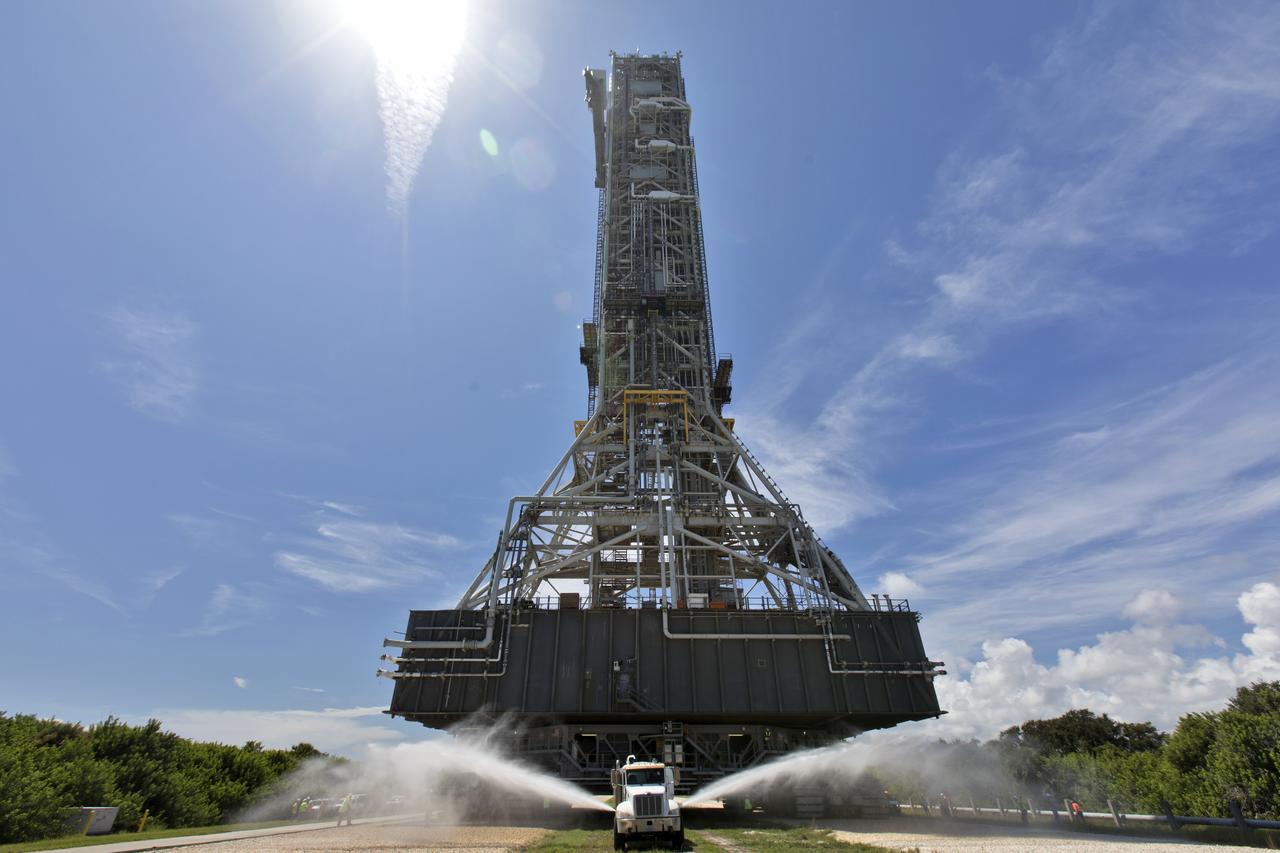
A truck sprays water to reduce the dust as NASA's crawler-transporter 2 (CT-2) with the mobile launcher (ML) atop slowly moves along the crawlerway on its trek to Launch Pad 39B on Aug. 31, 2018, at the agency's Kennedy Space Center in Florida. CT-2 will move the ML up to the surface of the pad where it will undergo a fit check, followed by several days of systems testing. The 380-foot-tall mobile launcher is equipped with the crew access arm and several umbilicals that will provide power, environmental control, pneumatics, communication and electrical connections to NASA's Space Launch System (SLS) and Orion spacecraft. Exploration Ground Systems is preparing the ground systems necessary to launch SLS and Orion on Exploration Mission-1, missions to the Moon and on to Mars.
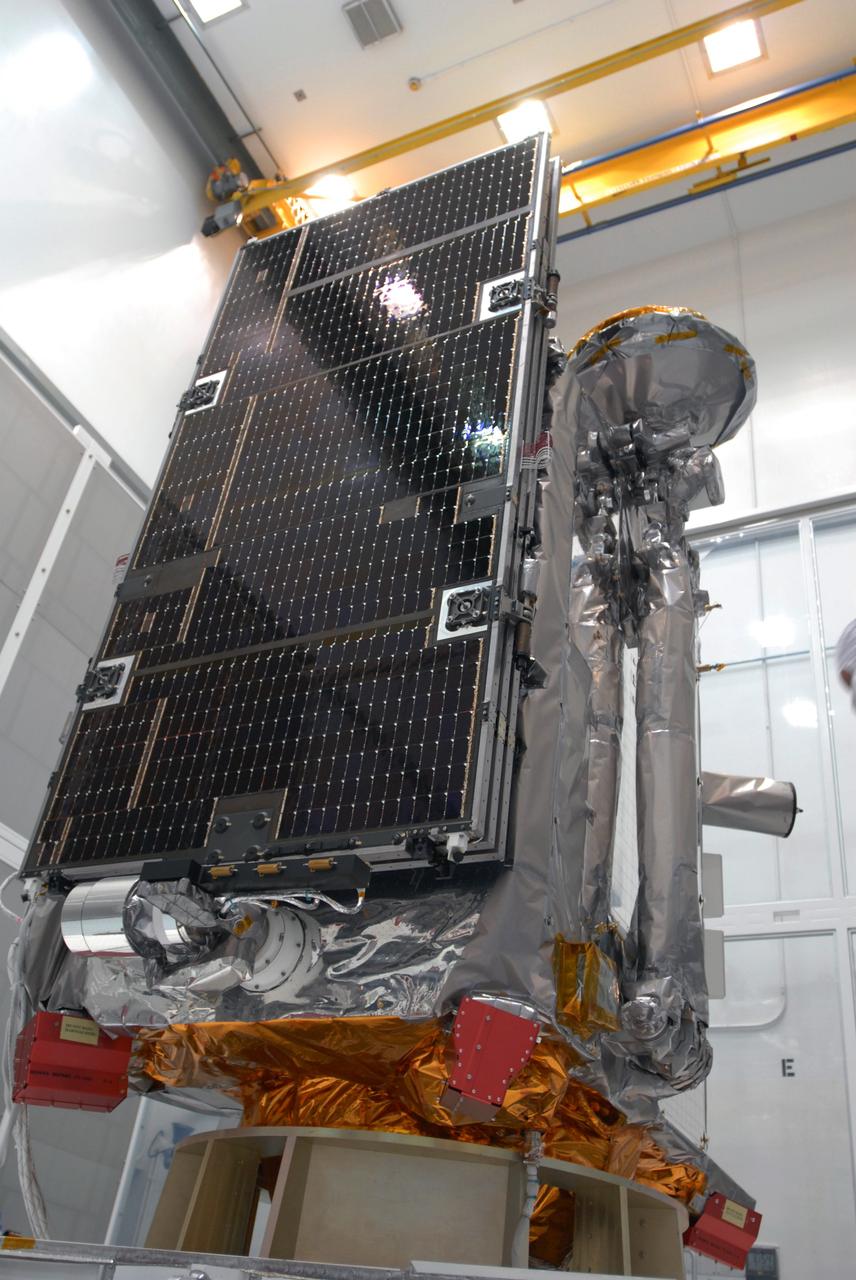
CAPE CANAVERAL, Fla. –– At Astrotech Space Operations in Titusville, Fla., the Lunar Reconnaissance Orbiter, or LRO, with a solar array panel installed. The orbiter will carry seven instruments to provide scientists with detailed maps of the lunar surface and enhance our understanding of the moon's topography, lighting conditions, mineralogical composition and natural resources. Information gleaned from LRO will be used to select safe landing sites, determine locations for future lunar outposts and help mitigate radiation dangers to astronauts. The polar regions of the moon are the main focus of the mission because continuous access to sunlight may be possible and water ice may exist in permanently shadowed areas of the poles. Launch of LRO is targeted for June 2. Photo credit: NASA/Jim Grossmann
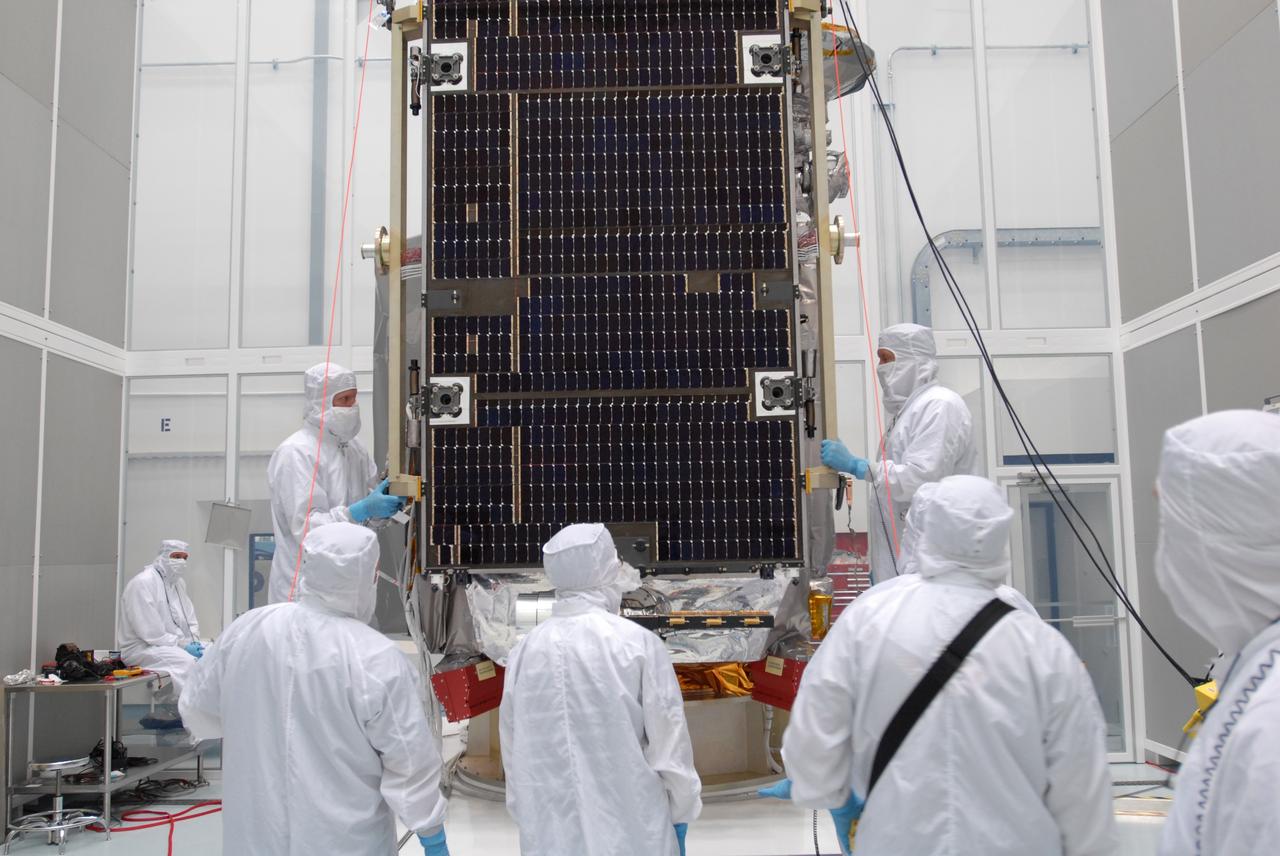
CAPE CANAVERAL, Fla. –– At Astrotech Space Operations in Titusville, Fla., technicians move the solar array panel closer to the Lunar Reconnaissance Orbiter, or LRO, for installation. The orbiter will carry seven instruments to provide scientists with detailed maps of the lunar surface and enhance our understanding of the moon's topography, lighting conditions, mineralogical composition and natural resources. Information gleaned from LRO will be used to select safe landing sites, determine locations for future lunar outposts and help mitigate radiation dangers to astronauts. The polar regions of the moon are the main focus of the mission because continuous access to sunlight may be possible and water ice may exist in permanently shadowed areas of the poles. Launch of LRO is targeted for June 2. Photo credit: NASA/Jim Grossmann

ISS005-E-11203 (25 Aug. 2002) --- The Volga Delta, Russia is featured in this image photographed by an Expedition Five crewmember on the International Space Station. The Volga River drains much of western Russia's industrial region and travels southward to empty into the Caspian Sea. According to scientists, over thousands of years, the river has built out a tremendous delta that forms the northwestern shoreline of the Caspian Sea. The Volga Delta is many things: the delta channels provide transportation access between the heartland of Russia and the oil-rich Caspian Sea. The Volga's extensive distributaries harbor habitat and rich fishing grounds for Russia's famous beluga sturgeon -- better known as the source of beluga caviar. The delta's wetlands, parts of which are designated as the Astrakhanskiy Biosphere Reserve, are important stopping points and breeding grounds for migrating water birds.
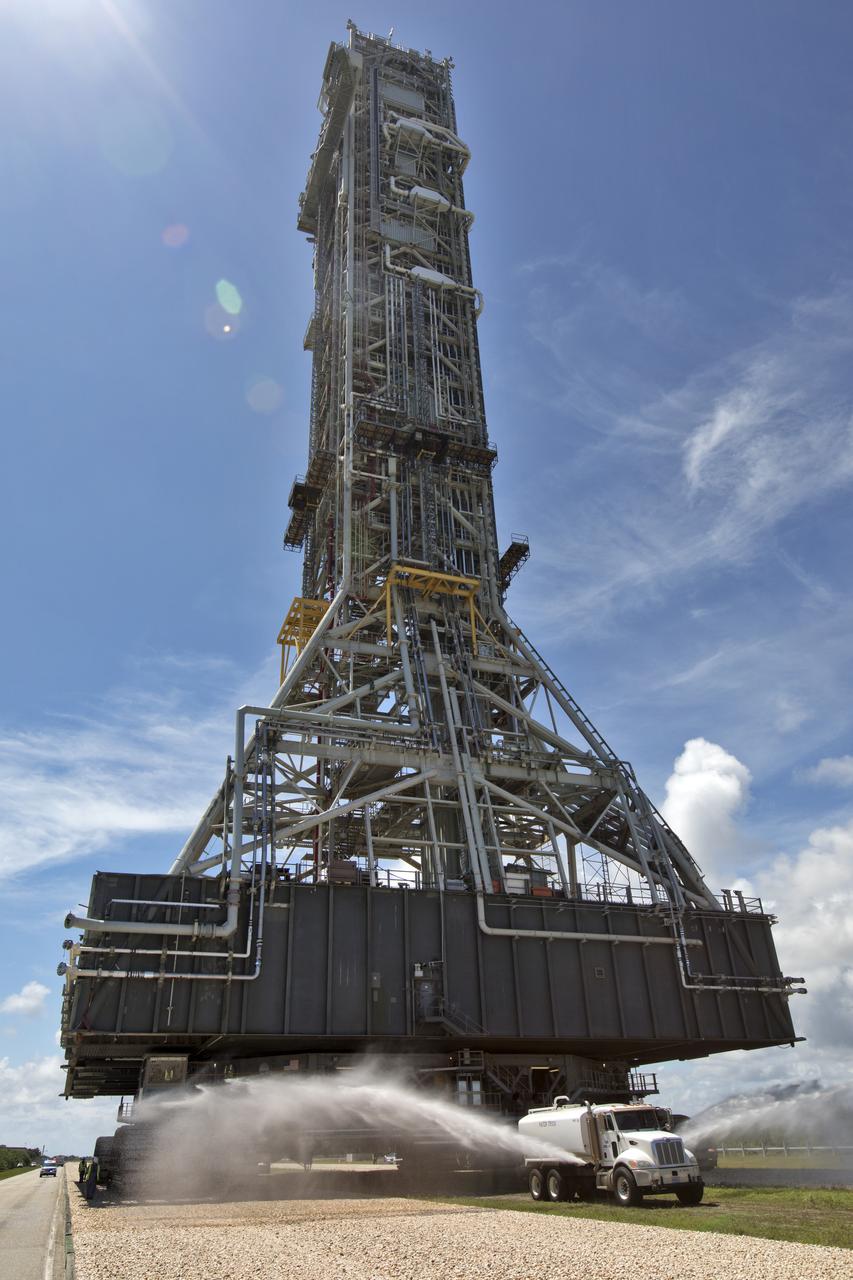
A truck sprays water to reduce the dust as NASA's crawler-transporter 2 (CT-2) with the mobile launcher (ML) atop slowly moves along the crawlerway on its trek to Launch Pad 39B on Aug. 31, 2018, at the agency's Kennedy Space Center in Florida. CT-2 will move the ML up to the surface of the pad where it will undergo a fit check, followed by several days of systems testing. The 380-foot-tall mobile launcher is equipped with the crew access arm and several umbilicals that will provide power, environmental control, pneumatics, communication and electrical connections to NASA's Space Launch System (SLS) and Orion spacecraft. Exploration Ground Systems is preparing the ground systems necessary to launch SLS and Orion on Exploration Mission-1, missions to the Moon and on to Mars.

NASA and SpaceX conducted a formal verification of the company’s emergency escape system on Sept. 18, 2019, at Kennedy Space Center’s Launch Complex 39A in Florida. NASA astronauts Shannon Walker, in front, and Bob Behnken participated in the exercise to verify the crew can safely and quickly evacuate from the launch pad in the unlikely event of an emergency before liftoff of SpaceX’s first crewed flight test, called Demo-2. During the escape verification, Walker and Behnken pass through the water deluge system on the 265-foot level of the crew access tower. As Boeing and SpaceX begin to make regular flights to the International Space Station for NASA’s Commercial Crew Program, the agency will continue to advance its mission to go beyond low-Earth orbit and establish a human presence on the Moon with the ultimate goal of sending astronauts to Mars.
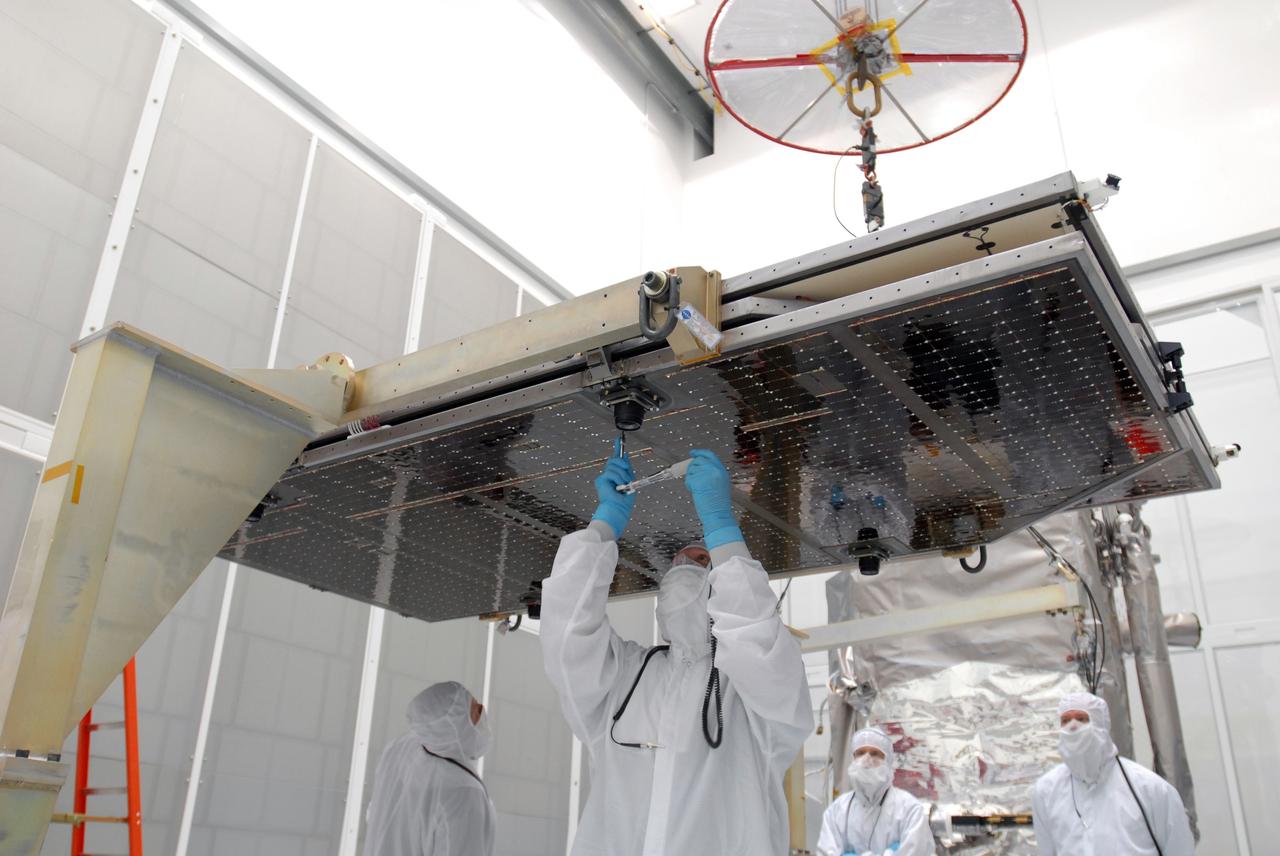
CAPE CANAVERAL, Fla. –– At Astrotech Space Operations in Titusville, Fla., technicians prepare the solar array panel for installation on the Lunar Reconnaissance Orbiter, or LRO. The orbiter will carry seven instruments to provide scientists with detailed maps of the lunar surface and enhance our understanding of the moon's topography, lighting conditions, mineralogical composition and natural resources. Information gleaned from LRO will be used to select safe landing sites, determine locations for future lunar outposts and help mitigate radiation dangers to astronauts. The polar regions of the moon are the main focus of the mission because continuous access to sunlight may be possible and water ice may exist in permanently shadowed areas of the poles. Launch of LRO is targeted for June 2. Photo credit: NASA/Jim Grossmann
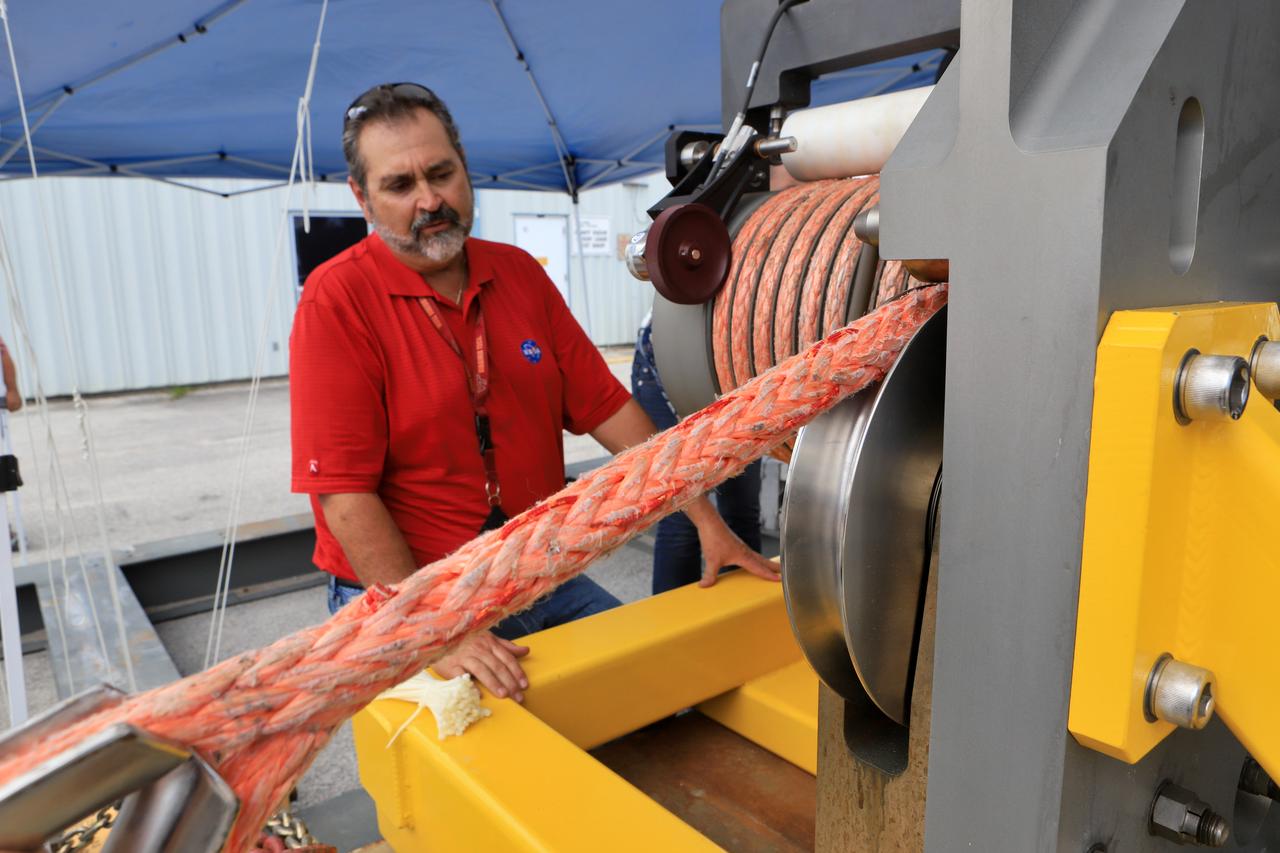
Orion Landing and Recovery team member Pete Ruett, with Jacobs, practices using a winch to prepare for Underway Recovery Test 7 (URT-7) on Sept. 5, 2018, in the heavy equipment yard at NASA's Kennedy Space Center in Florida. Ruett is a handling and access engineer. During URT-7, the recovery team, including Exploration Ground Systems and the U.S. Navy, will practice recovering a test version of the Orion crew module in the Pacific Ocean, off the coast of California, and guiding it into the well deck of a ship. Over several days, the team will demonstrate and evaluate new recovery processes, procedures, hardware and personnel in open waters. Orion is the exploration spacecraft designed to carry astronauts to deep space destinations, including the Moon and on to Mars. Orion will have emergency abort capability, sustain the crew during space travel and provide safe re-entry from deep space return velocities.
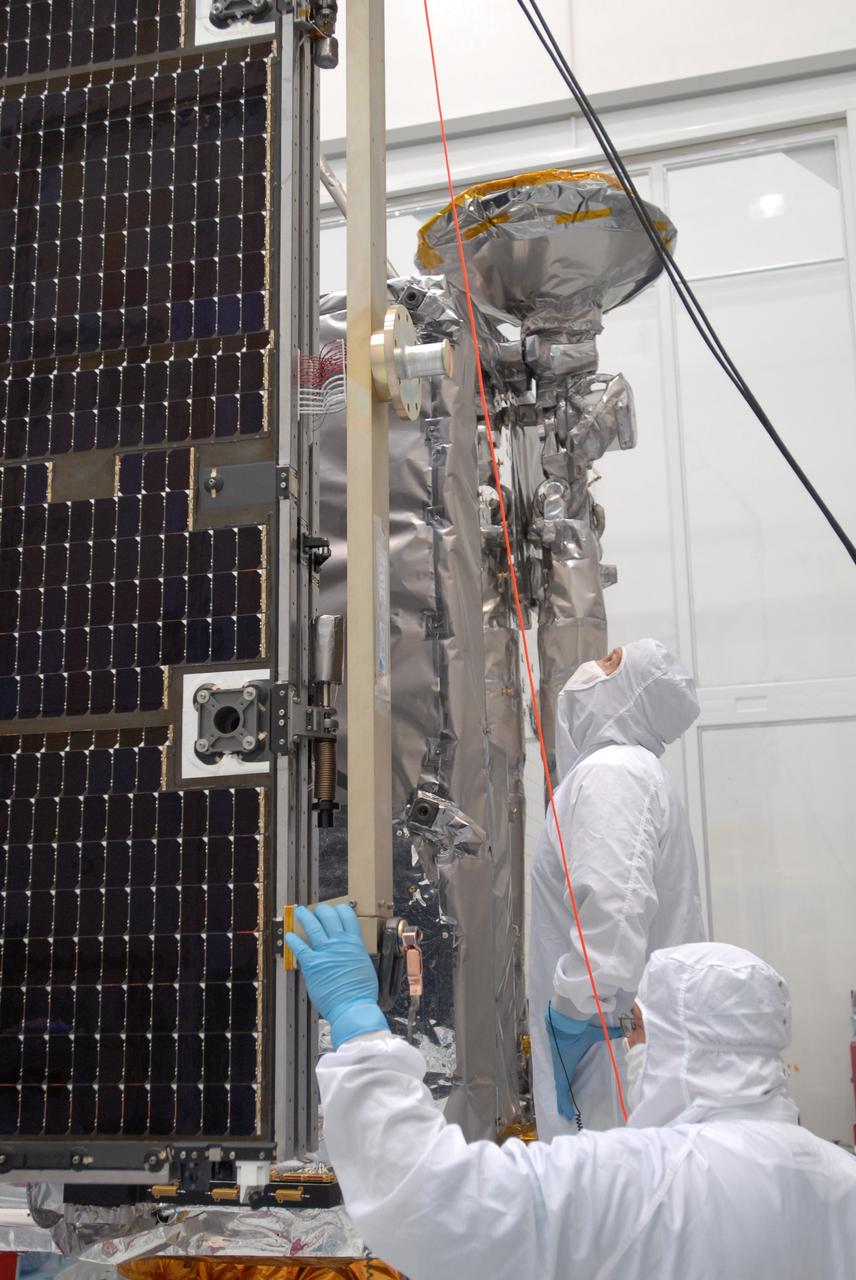
CAPE CANAVERAL, Fla. –– At Astrotech Space Operations in Titusville, Fla., technicians prepare to install the solar array panel to the Lunar Reconnaissance Orbiter, or LRO. The orbiter will carry seven instruments to provide scientists with detailed maps of the lunar surface and enhance our understanding of the moon's topography, lighting conditions, mineralogical composition and natural resources. Information gleaned from LRO will be used to select safe landing sites, determine locations for future lunar outposts and help mitigate radiation dangers to astronauts. The polar regions of the moon are the main focus of the mission because continuous access to sunlight may be possible and water ice may exist in permanently shadowed areas of the poles. Launch of LRO is targeted for June 2. Photo credit: NASA/Jim Grossmann
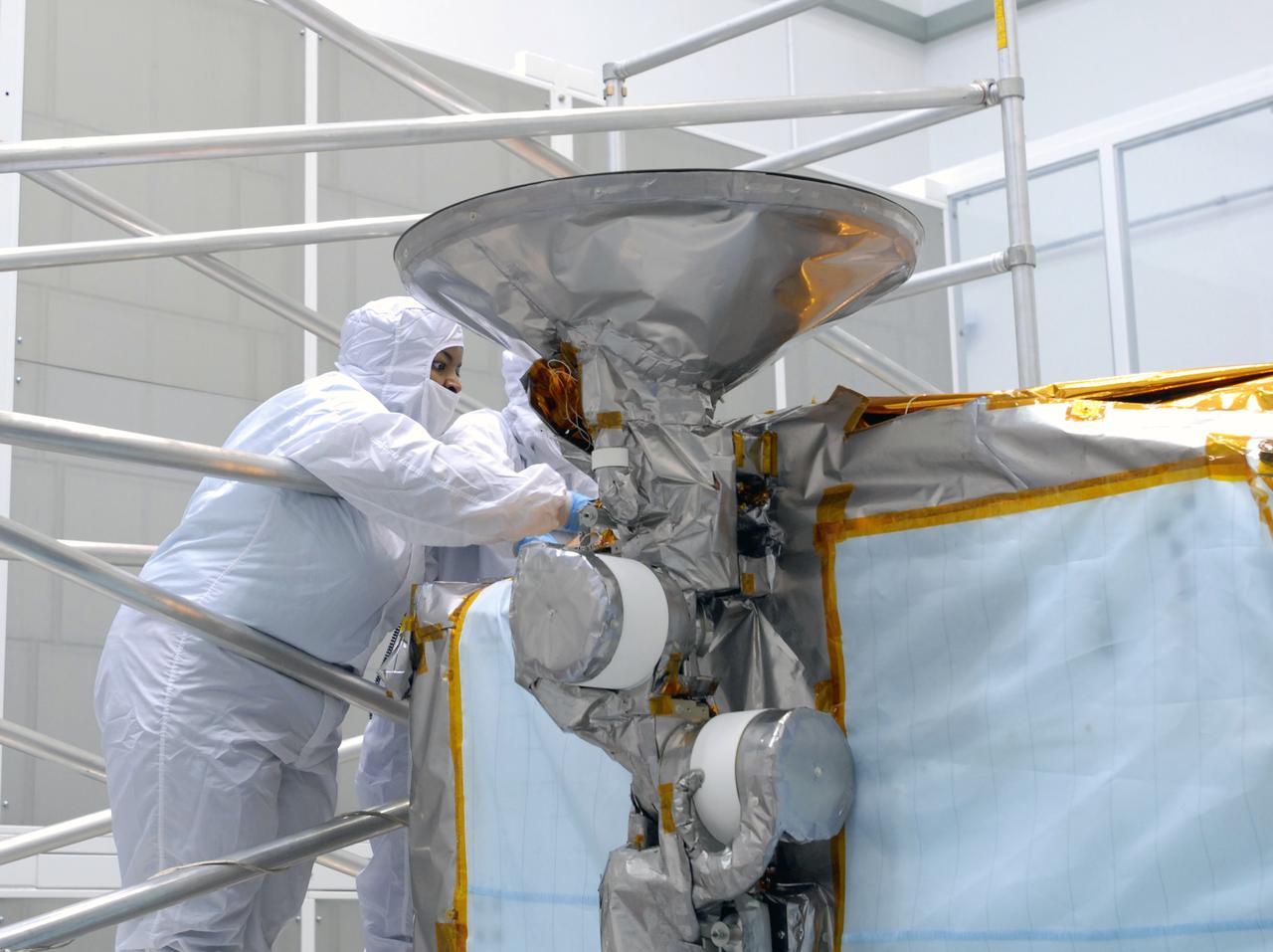
CAPE CANAVERAL, Fla. – Technicians begin checkout and processing of NASA's Lunar Reconnaissance Orbiter, or LRO, in the high bay at the Astrotech processing facility in Titusville, Fla. The spacecraft was built by engineers at Goddard Space Flight Center, where it recently completed two months of tests in a thermal vacuum chamber. The orbiter will carry seven instruments to provide scientists with detailed maps of the lunar surface and enhance our understanding of the moon's topography, lighting conditions, mineralogical composition and natural resources. Information gleaned from LRO will be used to select safe landing sites, determine locations for future lunar outposts and help mitigate radiation dangers to astronauts. The polar regions of the moon are the main focus of the mission because continuous access to sunlight may be possible and water ice may exist in permanently shadowed areas of the poles. Accompanying LRO on its journey to the moon will be the Lunar Crater Observation and Sensing Satellite, or LCROSS, a mission that will impact the lunar surface in its search for water ice. Launch of LRO/LCROSS is targeted for April 24. Photo credit: NASA/Jim Grossmann
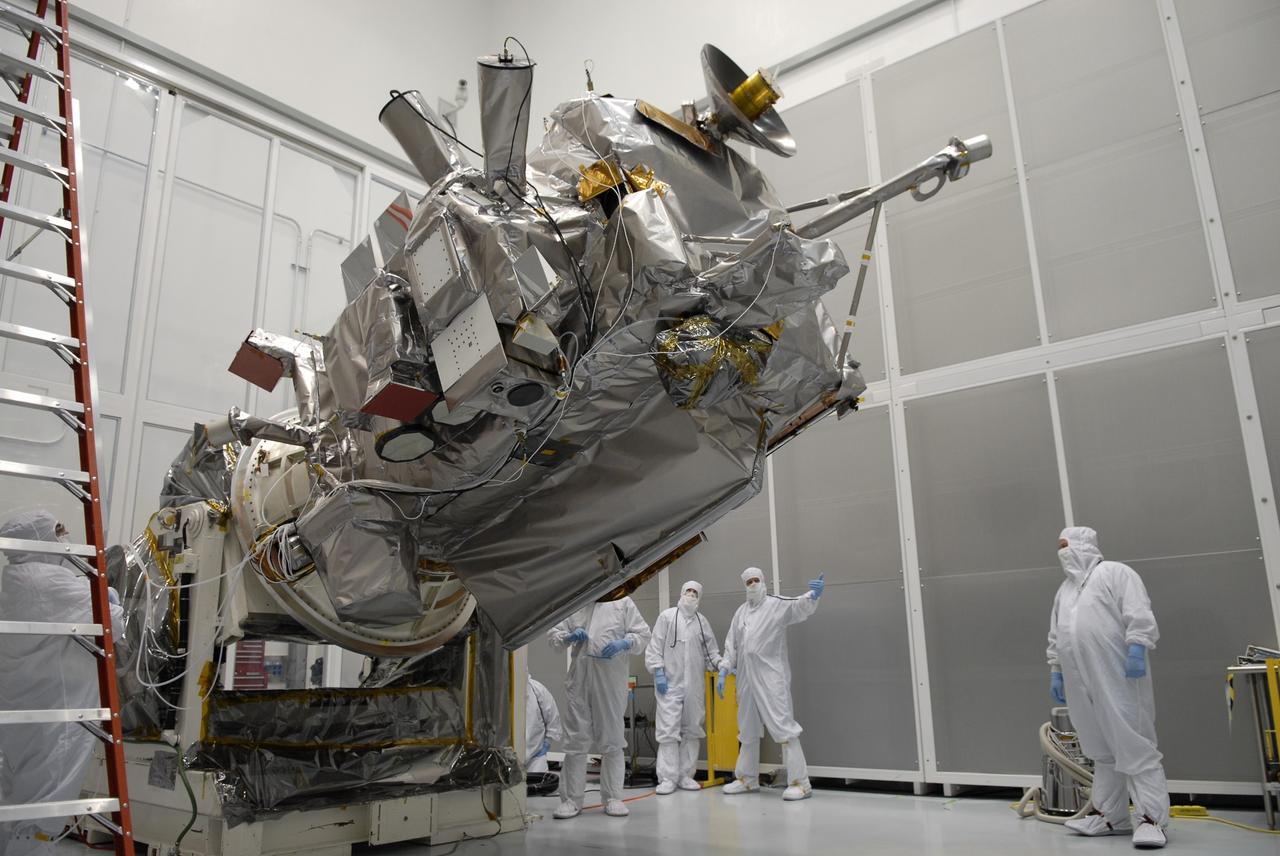
CAPE CANAVERAL, Fla. – At the Astrotech facility in Titusville, Fla., NASA's Lunar Reconnaissance Orbiter, or LRO, begins moving to a vertical position on the Aronson rotation stand. When vertical, a crane will be attached to move the LRO to another stand. The orbiter will carry seven instruments to provide scientists with detailed maps of the lunar surface and enhance our understanding of the moon's topography, lighting conditions, mineralogical composition and natural resources. Information gleaned from LRO will be used to select safe landing sites, determine locations for future lunar outposts and help mitigate radiation dangers to astronauts. The polar regions of the moon are the main focus of the mission because continuous access to sunlight may be possible and water ice may exist in permanently shadowed areas of the poles. Accompanying LRO on its journey to the moon will be the Lunar CRater Observation and Sensing Satellite, or LCROSS, a mission that will impact the lunar surface in its search for water ice. Launch of LRO is targeted for May 20. Photo credit: NASA/Kim Shiflett
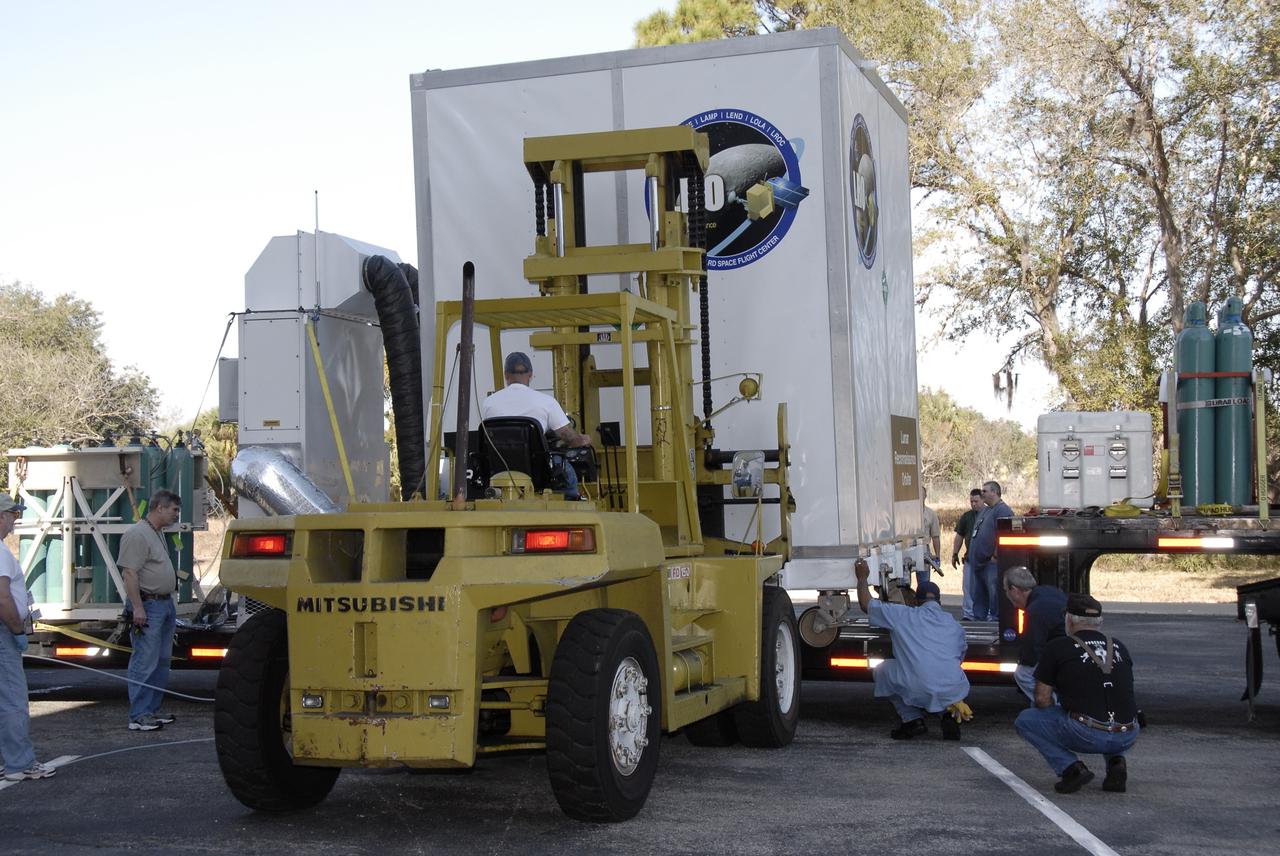
CAPE CANAVERAL, Fla. – NASA's Lunar Reconnaissance Orbiter, or LRO, spacecraft is offloaded from the truck at Astrotech Space Operations in Titusville, Fla. The spacecraft was built by engineers at Goddard Space Flight Center, where it recently completed two months of tests in a thermal vacuum chamber. The orbiter will carry seven instruments to provide scientists with detailed maps of the lunar surface and enhance our understanding of the moon's topography, lighting conditions, mineralogical composition and natural resources. Information gleaned from LRO will be used to select safe landing sites, determine locations for future lunar outposts and help mitigate radiation dangers to astronauts. The polar regions of the moon are the main focus of the mission because continuous access to sunlight may be possible and water ice may exist in permanently shadowed areas of the poles. Accompanying LRO on its journey to the moon will be the Lunar Crater Observation and Sensing Satellite, or LCROSS, a mission that will impact the lunar surface in its search for water ice. Launch of LRO is targeted for April 24. Photo credit: NASA/Kim Shiflett
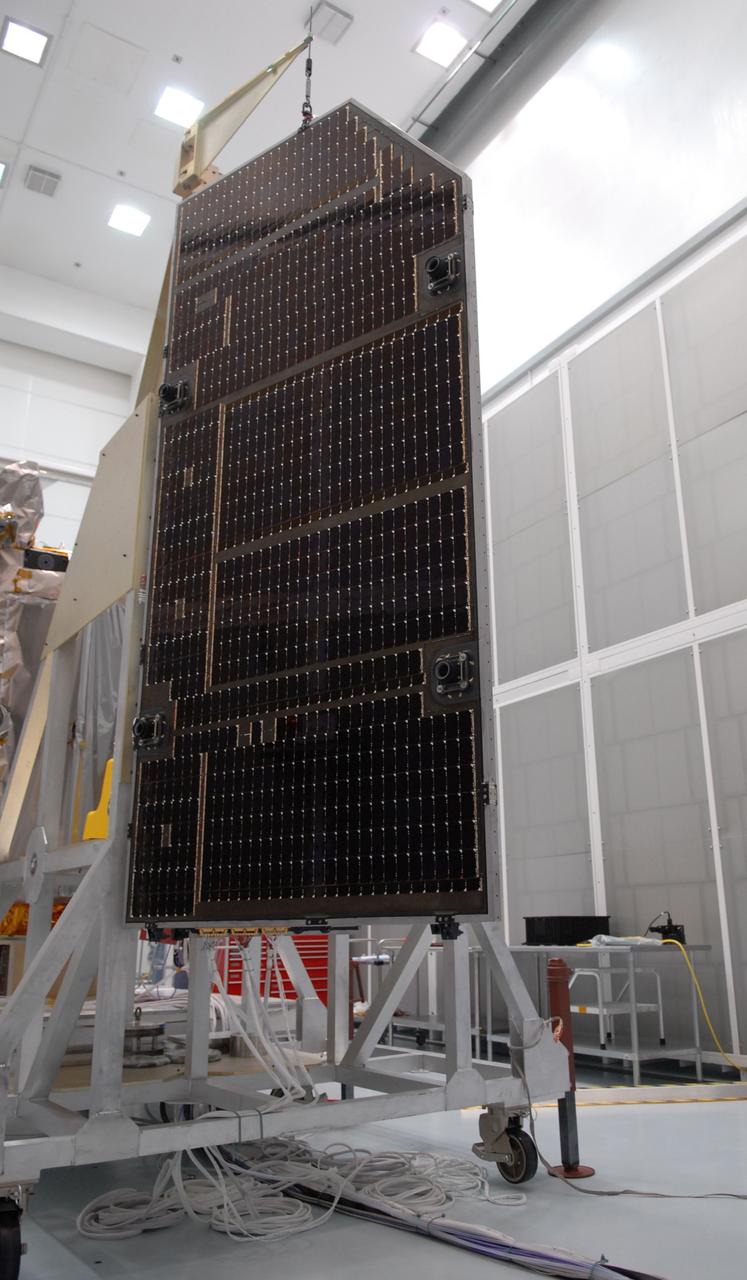
CAPE CANAVERAL, Fla. – Inspection is under way of the solar arrays for NASA's Lunar Reconnaissance Orbiter, or LRO, at the Astrotech processing facility in Titusville, Fla. The spacecraft was built by engineers at Goddard Space Flight Center, where it recently completed two months of tests in a thermal vacuum chamber. The orbiter will carry seven instruments to provide scientists with detailed maps of the lunar surface and enhance our understanding of the moon's topography, lighting conditions, mineralogical composition and natural resources. Information gleaned from LRO will be used to select safe landing sites, determine locations for future lunar outposts and help mitigate radiation dangers to astronauts. The polar regions of the moon are the main focus of the mission because continuous access to sunlight may be possible and water ice may exist in permanently shadowed areas of the poles. Accompanying LRO on its journey to the moon will be the Lunar Crater Observation and Sensing Satellite, or LCROSS, a mission that will impact the lunar surface in its search for water ice. Launch of LRO/LCROSS is targeted for April 24. Photo credit: NASA/Jack Pfaller
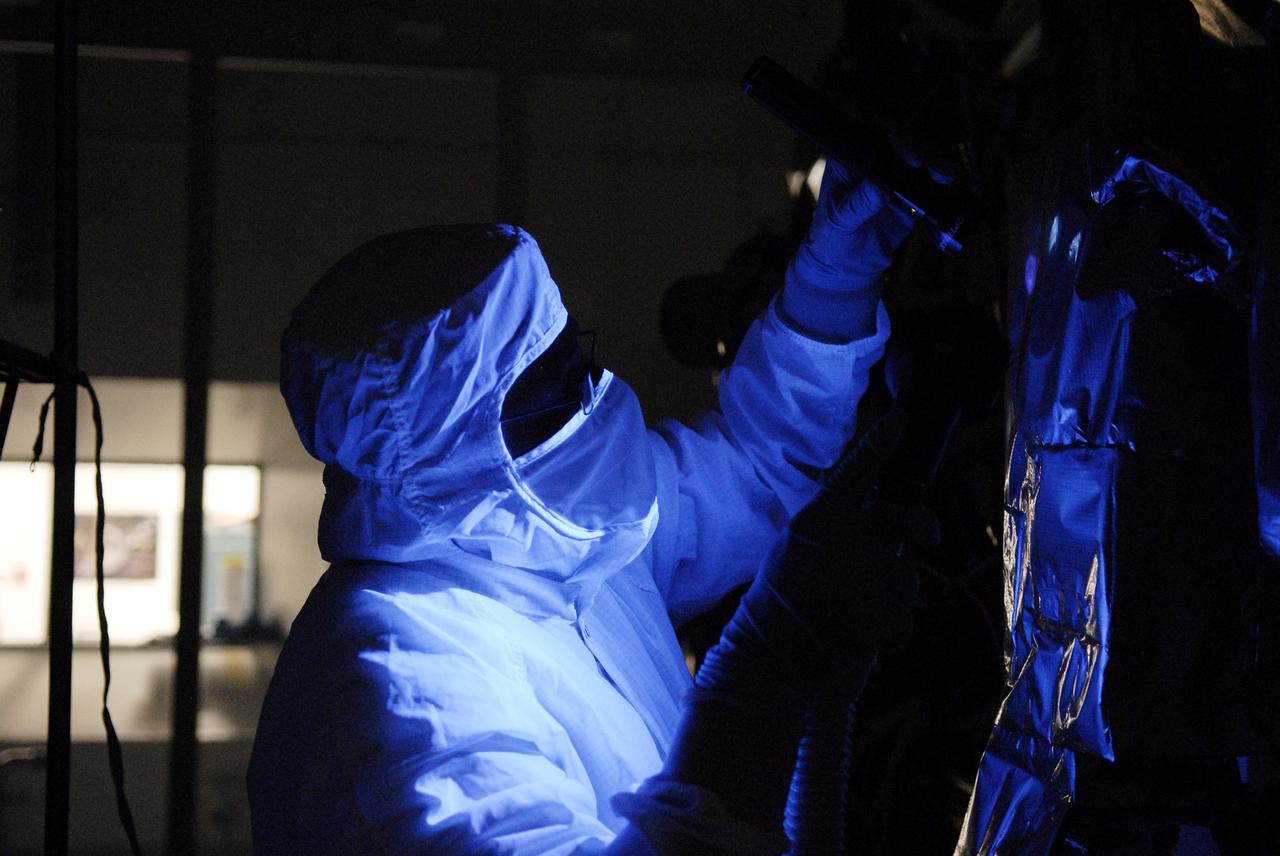
CAPE CANAVERAL, Fla. – At the Astrotech facility in Titusville, Fla., technicians perform backlight inspection and cleaning on NASA's Lunar Reconnaissance Orbiter, or LRO. Black light inspection uses UVA fluorescence to detect possible particulate microcontamination, minute cracks or fluid leaks. The orbiter will carry seven instruments to provide scientists with detailed maps of the lunar surface and enhance our understanding of the moon's topography, lighting conditions, mineralogical composition and natural resources. Information gleaned from LRO will be used to select safe landing sites, determine locations for future lunar outposts and help mitigate radiation dangers to astronauts. The polar regions of the moon are the main focus of the mission because continuous access to sunlight may be possible and water ice may exist in permanently shadowed areas of the poles. Accompanying LRO on its journey to the moon will be the Lunar CRater Observation and Sensing Satellite, or LCROSS, a mission that will impact the lunar surface in its search for water ice. Launch of LRO is targeted for May 20. Photo credit: NASA/Kim Shiflett
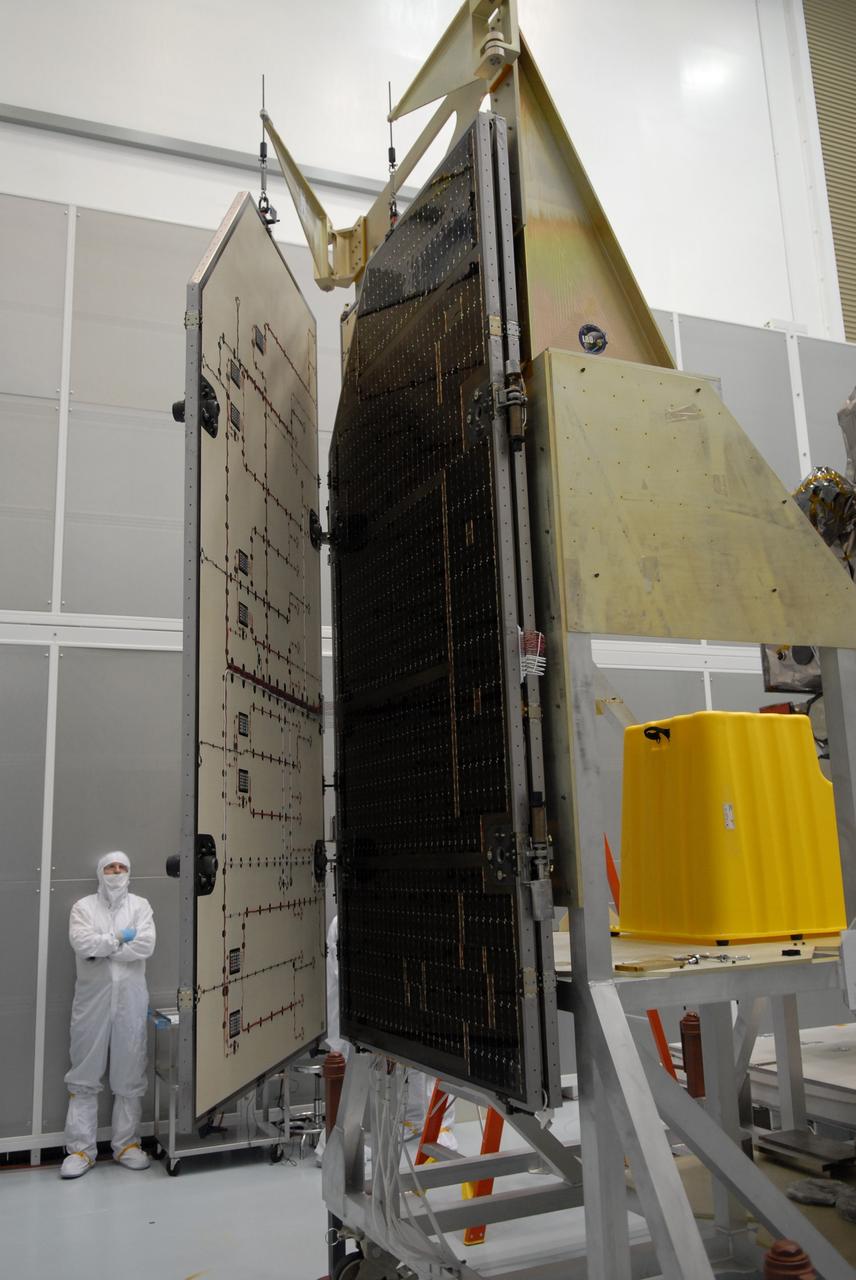
CAPE CANAVERAL, Fla. – A technician inspects the solar arrays for NASA's Lunar Reconnaissance Orbiter, or LRO, at the Astrotech processing facility in Titusville, Fla. The spacecraft was built by engineers at Goddard Space Flight Center, where it recently completed two months of tests in a thermal vacuum chamber. The orbiter will carry seven instruments to provide scientists with detailed maps of the lunar surface and enhance our understanding of the moon's topography, lighting conditions, mineralogical composition and natural resources. Information gleaned from LRO will be used to select safe landing sites, determine locations for future lunar outposts and help mitigate radiation dangers to astronauts. The polar regions of the moon are the main focus of the mission because continuous access to sunlight may be possible and water ice may exist in permanently shadowed areas of the poles. Accompanying LRO on its journey to the moon will be the Lunar Crater Observation and Sensing Satellite, or LCROSS, a mission that will impact the lunar surface in its search for water ice. Launch of LRO/LCROSS is targeted for April 24. Photo credit: NASA/Jack Pfaller
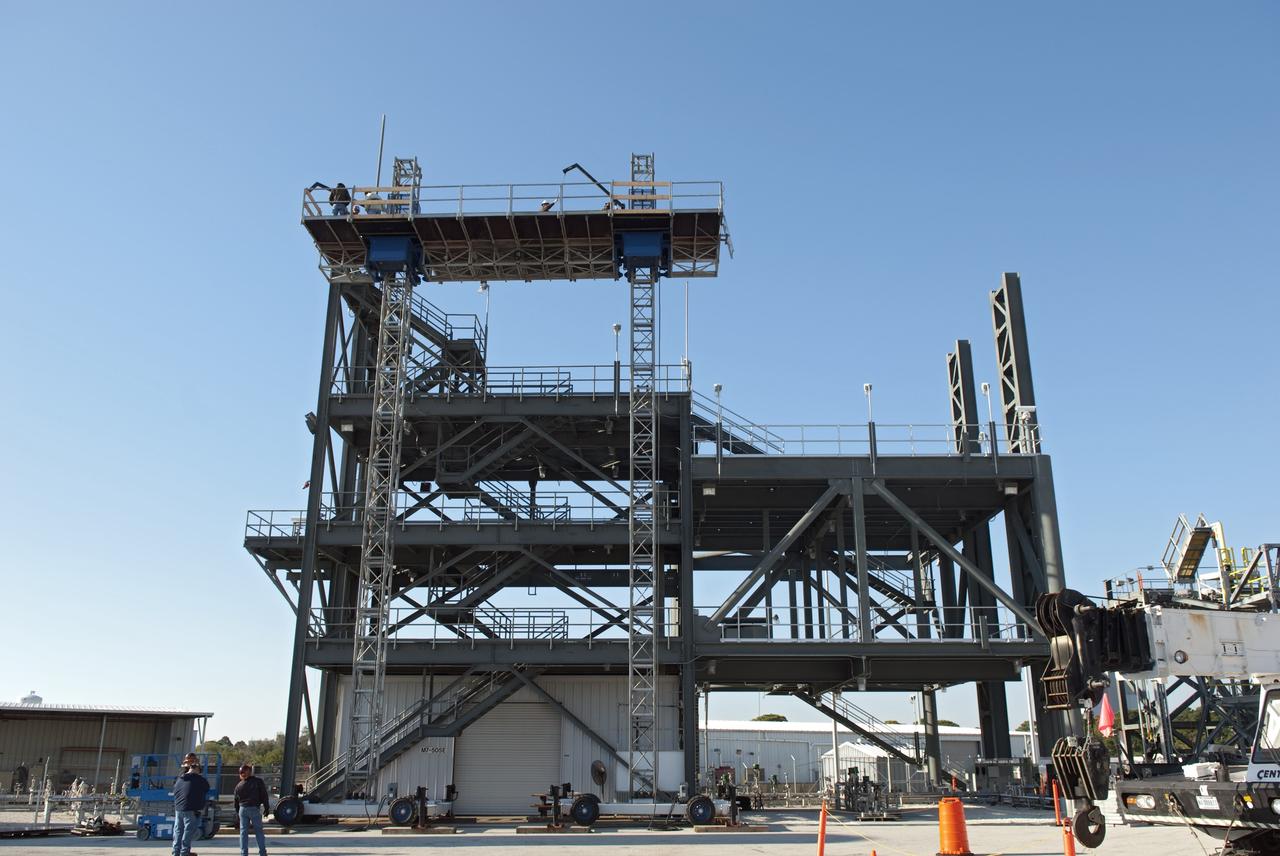
CAPE CANAVERAL, Fla. -- At NASA's Kennedy Space Center in Florida, workers receive training atop a mast climber that is attached to launch simulation towers outside the Launch Equipment Test Facility. The training includes attaching carrier plates, water and air systems, and electricity to the climber to simulate working in Kennedy's Vehicle Assembly Building (VAB). Mast climbers can be substituted for fixed service structures currently inside the VAB to provide access to any type of launch vehicle. Since 1977, the facility has supported NASA’s Launch Services, shuttle, International Space Station, and Constellation programs, as well as commercial providers. Last year, the facility underwent a major upgrade to support even more programs, projects and customers. It houses a 6,000-square-foot high bay, cable fabrication and molding shop, pneumatics shop, machine and weld shop and full-scale control room. Outside, the facility features a water flow test loop, vehicle motion simulator and a cryogenic system. Photo credit: NASA/Jim Grossmann
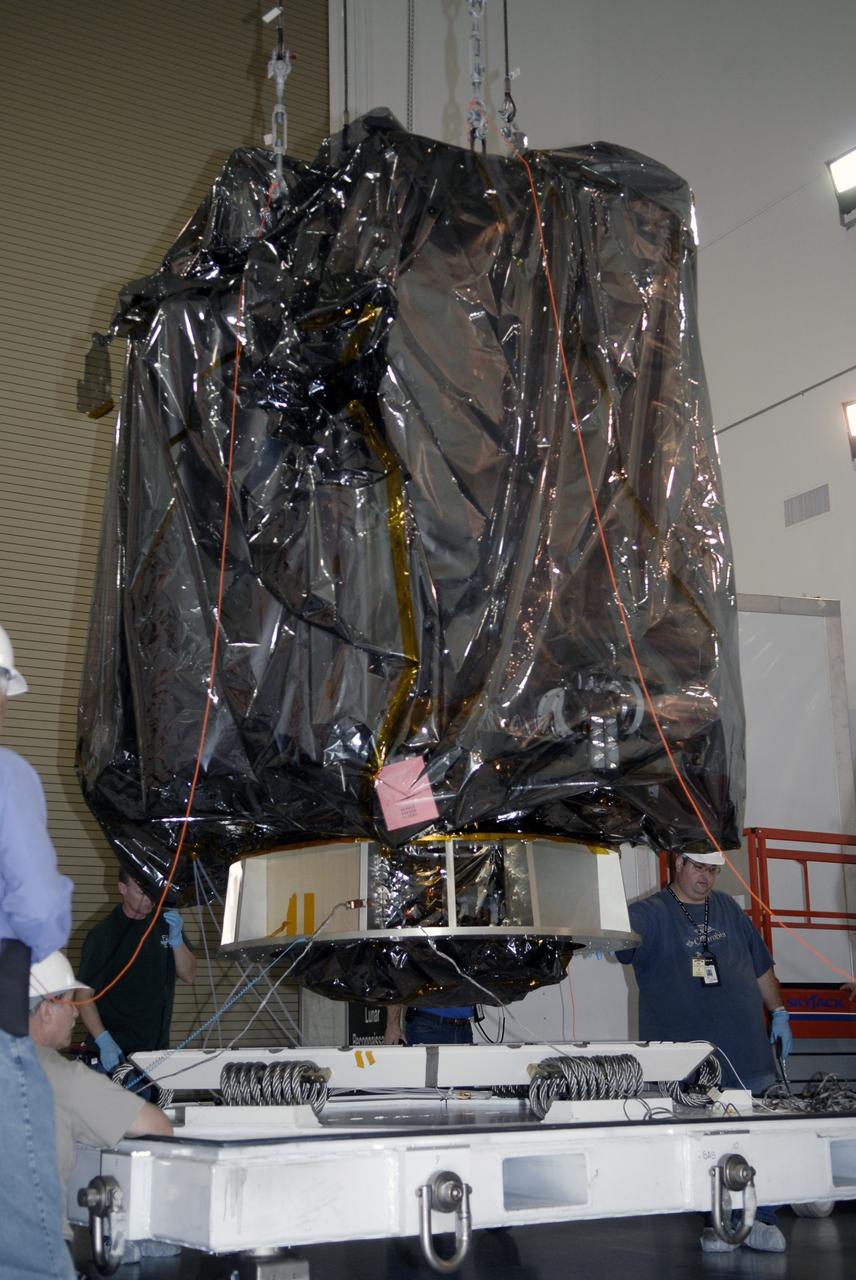
CAPE CANAVERAL, Fla. – Technicians guide NASA's Lunar Reconnaissance Orbiter, or LRO, as it is lifted from a transportation pallet at the Astrotech processing facility in Titusville, Fla. The spacecraft was built by engineers at Goddard Space Flight Center, where it recently completed two months of tests in a thermal vacuum chamber. The orbiter will carry seven instruments to provide scientists with detailed maps of the lunar surface and enhance our understanding of the moon's topography, lighting conditions, mineralogical composition and natural resources. Information gleaned from LRO will be used to select safe landing sites, determine locations for future lunar outposts and help mitigate radiation dangers to astronauts. The polar regions of the moon are the main focus of the mission because continuous access to sunlight may be possible and water ice may exist in permanently shadowed areas of the poles. Accompanying LRO on its journey to the moon will be the Lunar Crater Observation and Sensing Satellite, or LCROSS, a mission that will impact the lunar surface in its search for water ice. Launch of LRO/LCROSS is targeted for April 24. Photo credit: NASA/Kim Shiflett
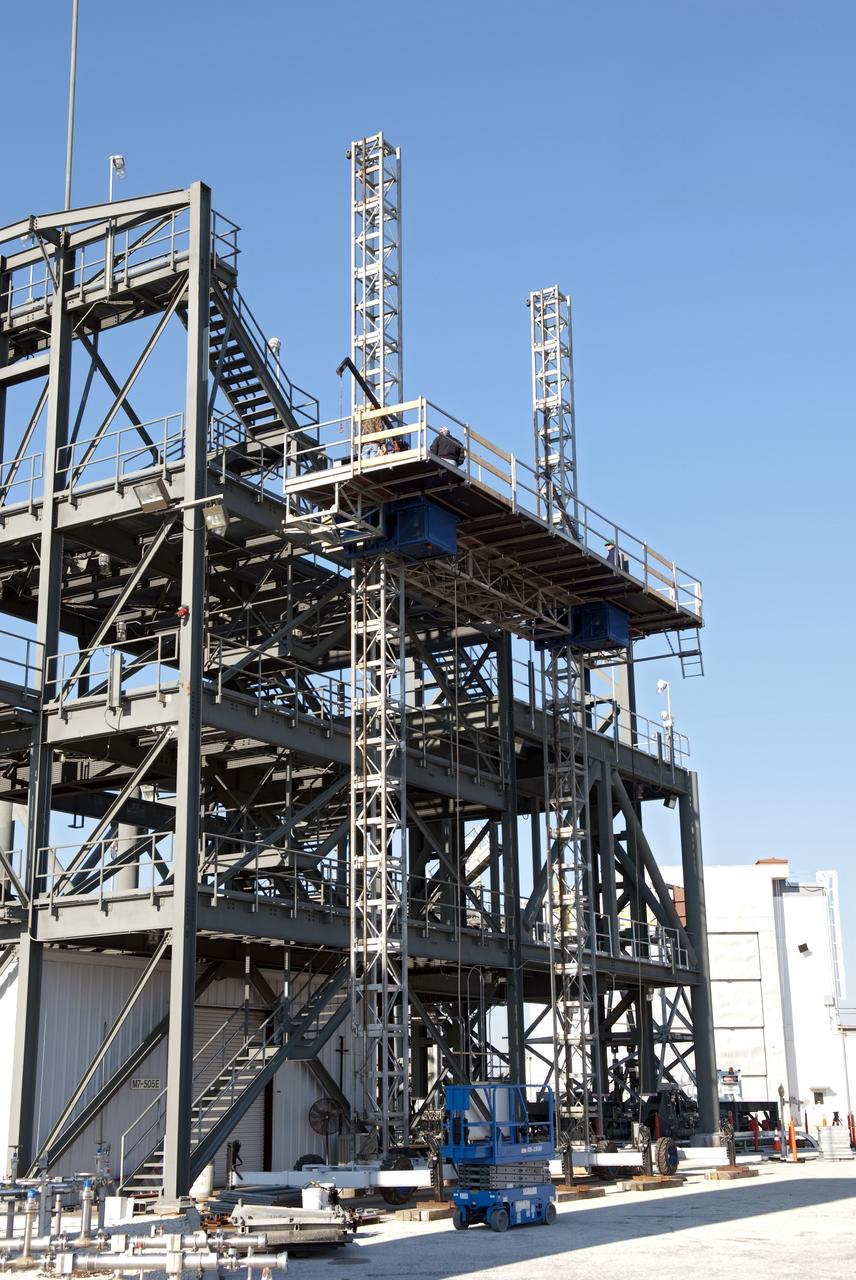
CAPE CANAVERAL, Fla. -- At NASA's Kennedy Space Center in Florida, workers receive training atop a mast climber that is attached to launch simulation towers outside the Launch Equipment Test Facility. The training includes attaching carrier plates, water and air systems, and electricity to the climber to simulate working in Kennedy's Vehicle Assembly Building (VAB). Mast climbers can be substituted for fixed service structures currently inside the VAB to provide access to any type of launch vehicle. Since 1977, the facility has supported NASA’s Launch Services, shuttle, International Space Station, and Constellation programs, as well as commercial providers. Last year, the facility underwent a major upgrade to support even more programs, projects and customers. It houses a 6,000-square-foot high bay, cable fabrication and molding shop, pneumatics shop, machine and weld shop and full-scale control room. Outside, the facility features a water flow test loop, vehicle motion simulator and a cryogenic system. Photo credit: NASA/Jim Grossmann

CAPE CANAVERAL, Fla. – Technicians begin checkout and processing of NASA's Lunar Reconnaissance Orbiter, or LRO, in the high bay at the Astrotech processing facility in Titusville, Fla. The spacecraft was built by engineers at Goddard Space Flight Center, where it recently completed two months of tests in a thermal vacuum chamber. The orbiter will carry seven instruments to provide scientists with detailed maps of the lunar surface and enhance our understanding of the moon's topography, lighting conditions, mineralogical composition and natural resources. Information gleaned from LRO will be used to select safe landing sites, determine locations for future lunar outposts and help mitigate radiation dangers to astronauts. The polar regions of the moon are the main focus of the mission because continuous access to sunlight may be possible and water ice may exist in permanently shadowed areas of the poles. Accompanying LRO on its journey to the moon will be the Lunar Crater Observation and Sensing Satellite, or LCROSS, a mission that will impact the lunar surface in its search for water ice. Launch of LRO/LCROSS is targeted for April 24. Photo credit: NASA/Jim Grossmann
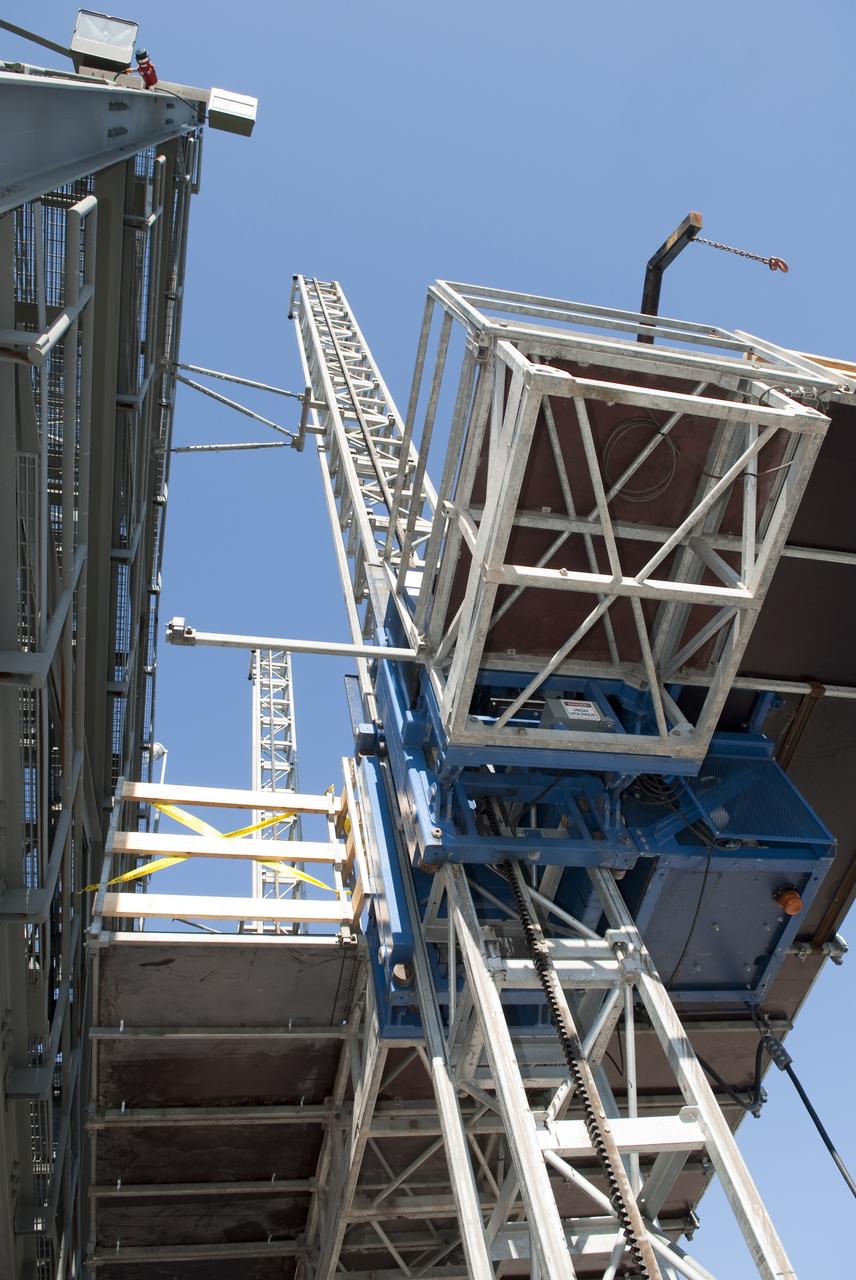
CAPE CANAVERAL, Fla. -- At NASA's Kennedy Space Center in Florida, training takes place atop a mast climber that is attached to launch simulation towers outside the Launch Equipment Test Facility. The training includes attaching carrier plates, water and air systems, and electricity to the climber to simulate working in Kennedy's Vehicle Assembly Building (VAB). Mast climbers can be substituted for fixed service structures currently inside the VAB to provide access to any type of launch vehicle. Since 1977, the facility has supported NASA’s Launch Services, shuttle, International Space Station, and Constellation programs, as well as commercial providers. Last year, the facility underwent a major upgrade to support even more programs, projects and customers. It houses a 6,000-square-foot high bay, cable fabrication and molding shop, pneumatics shop, machine and weld shop and full-scale control room. Outside, the facility features a water flow test loop, vehicle motion simulator and a cryogenic system. Photo credit: NASA/Jim Grossmann
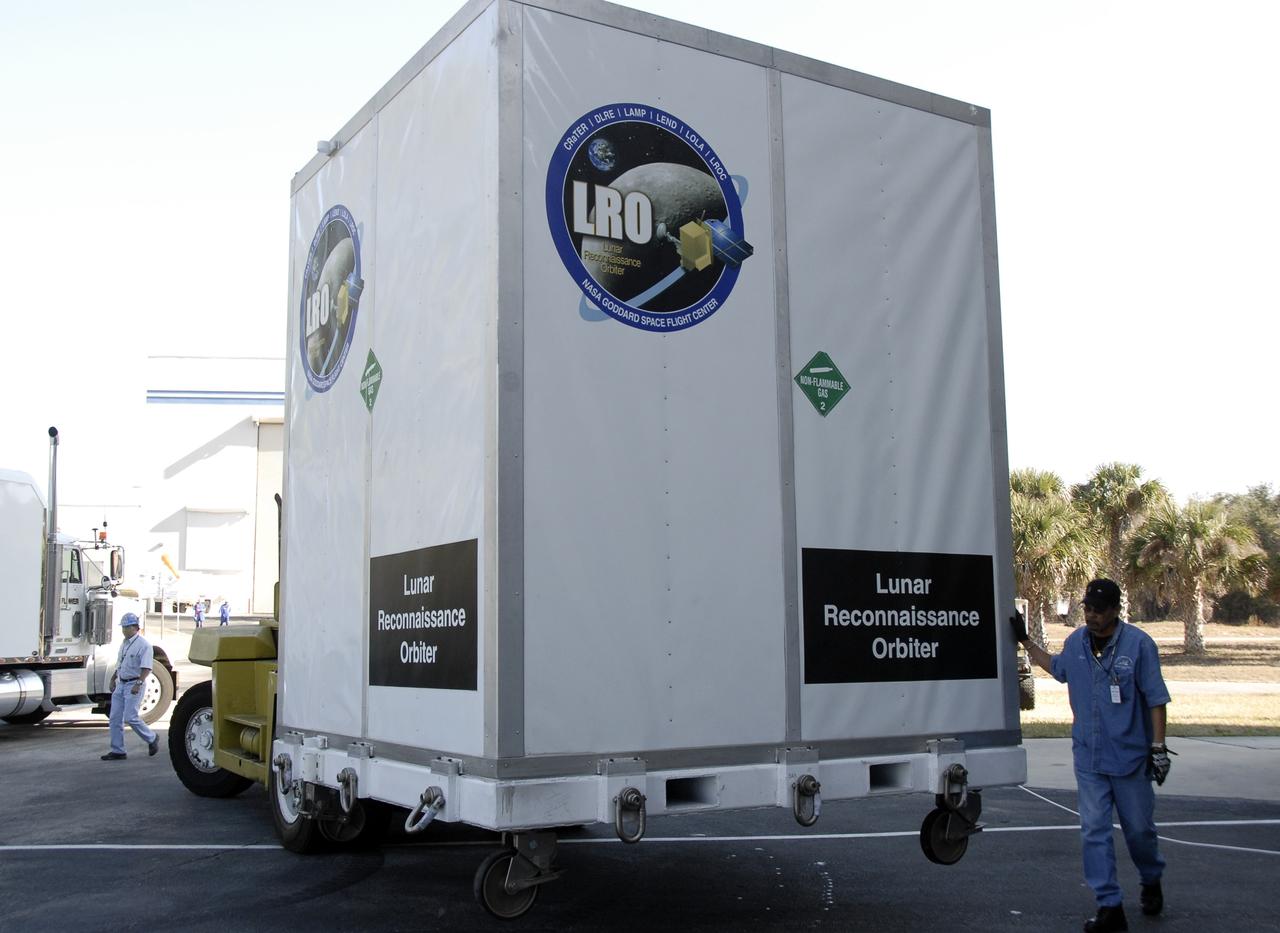
CAPE CANAVERAL, Fla. – NASA's Lunar Reconnaissance Orbiter, or LRO, spacecraft is moved away from the truck after offloading at Astrotech Space Operations in Titusville, Fla. The spacecraft was built by engineers at Goddard Space Flight Center, where it recently completed two months of tests in a thermal vacuum chamber. The orbiter will carry seven instruments to provide scientists with detailed maps of the lunar surface and enhance our understanding of the moon's topography, lighting conditions, mineralogical composition and natural resources. Information gleaned from LRO will be used to select safe landing sites, determine locations for future lunar outposts and help mitigate radiation dangers to astronauts. The polar regions of the moon are the main focus of the mission because continuous access to sunlight may be possible and water ice may exist in permanently shadowed areas of the poles. Accompanying LRO on its journey to the moon will be the Lunar Crater Observation and Sensing Satellite, or LCROSS, a mission that will impact the lunar surface in its search for water ice. Launch of LRO is targeted for April 24. Photo credit: NASA/Kim Shiflett
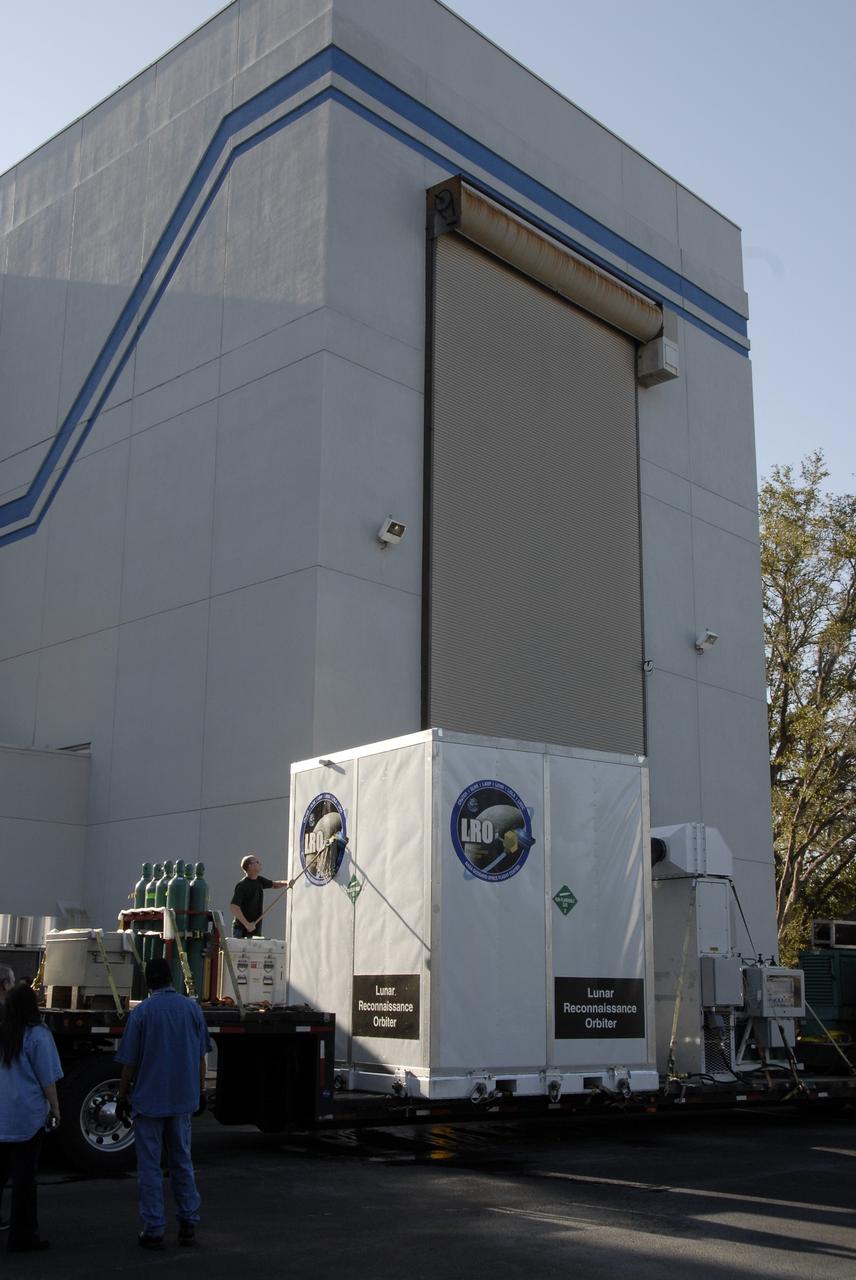
CAPE CANAVERAL, Fla. – NASA's Lunar Reconnaissance Orbiter, or LRO, spacecraft completes its journey to NASA's Kennedy Space Center in Florida. The spacecraft was built by engineers at Goddard Space Flight Center, where it recently completed two months of tests in a thermal vacuum chamber. The orbiter will carry seven instruments to provide scientists with detailed maps of the lunar surface and enhance our understanding of the moon's topography, lighting conditions, mineralogical composition and natural resources. Information gleaned from LRO will be used to select safe landing sites, determine locations for future lunar outposts and help mitigate radiation dangers to astronauts. The polar regions of the moon are the main focus of the mission because continuous access to sunlight may be possible and water ice may exist in permanently shadowed areas of the poles. Accompanying LRO on its journey to the moon will be the Lunar Crater Observation and Sensing Satellite, or LCROSS, a mission that will impact the lunar surface in its search for water ice. Launch of LRO is targeted for April 24. Photo credit: NASA/Kim Shiflett
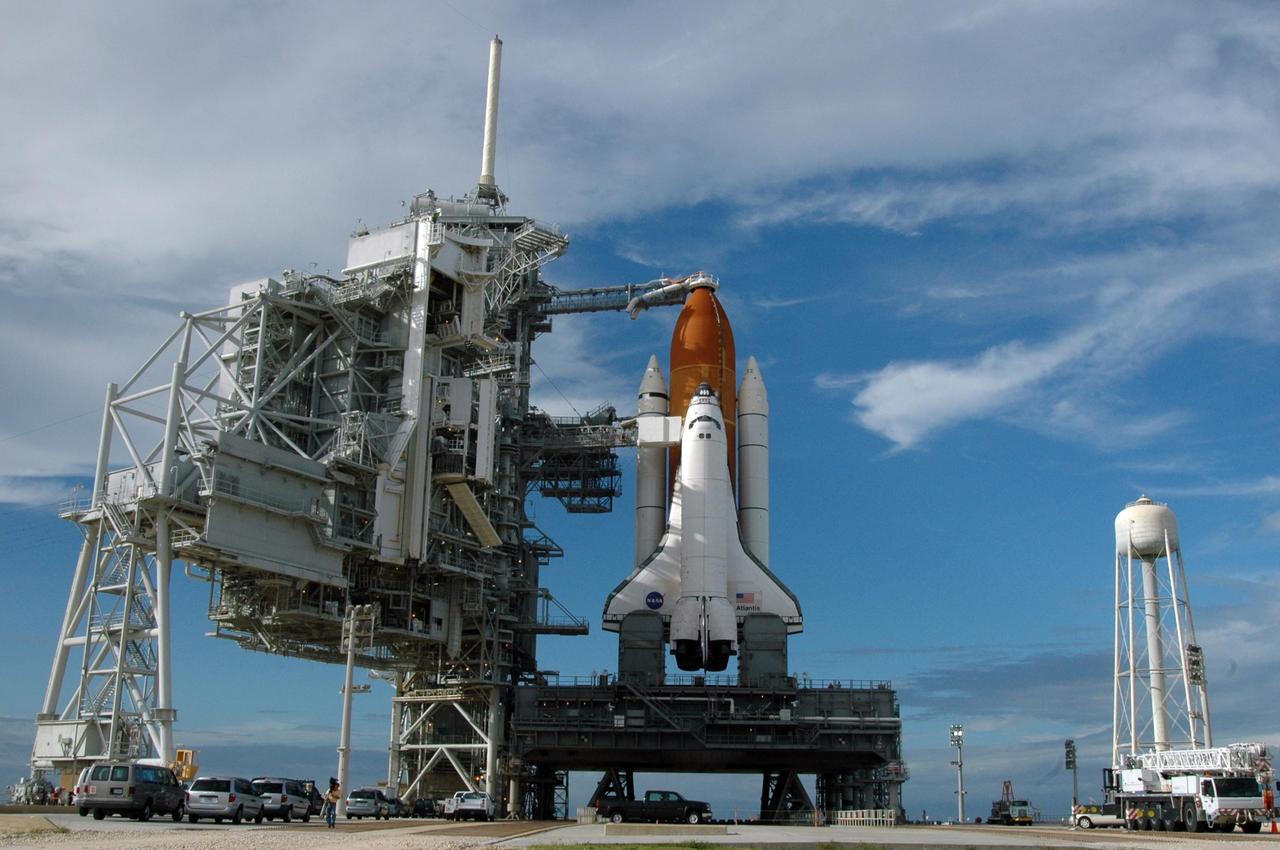
KENNEDY SPACE CENTER, FLA. - After rollback of the rotating service structure on Launch Pad 39B, Space Shuttle Atlantis shines in the late afternoon sun. The RSS provides protected access to the orbiter for changeout and servicing of payloads at the pad and then is rolled away before liftoff. At right is the 300,000-gallon water tank that releases a deluge of water across the mobile launcher platform during liftoff to aid sound suppression. Atlantis is scheduled to launch Sept. 6 at 12:29 p.m. EDT on mission STS-115. During the mission, Atlantis' astronauts will deliver and install the 17.5-ton, bus-sized P3/P4 integrated truss segment on the station. The girder-like truss includes a set of giant solar arrays, batteries and associated electronics and will provide one-fourth of the total power-generation capability for the completed station. This mission is the 116th space shuttle flight, the 27th flight for orbiter Atlantis, and the 19th U.S. flight to the International Space Station. STS-115 is scheduled to last 11 days with a planned KSC landing at about 8:03 a.m. EDT on Sept. 17. Photo credit: NASA/Ken Thornsley
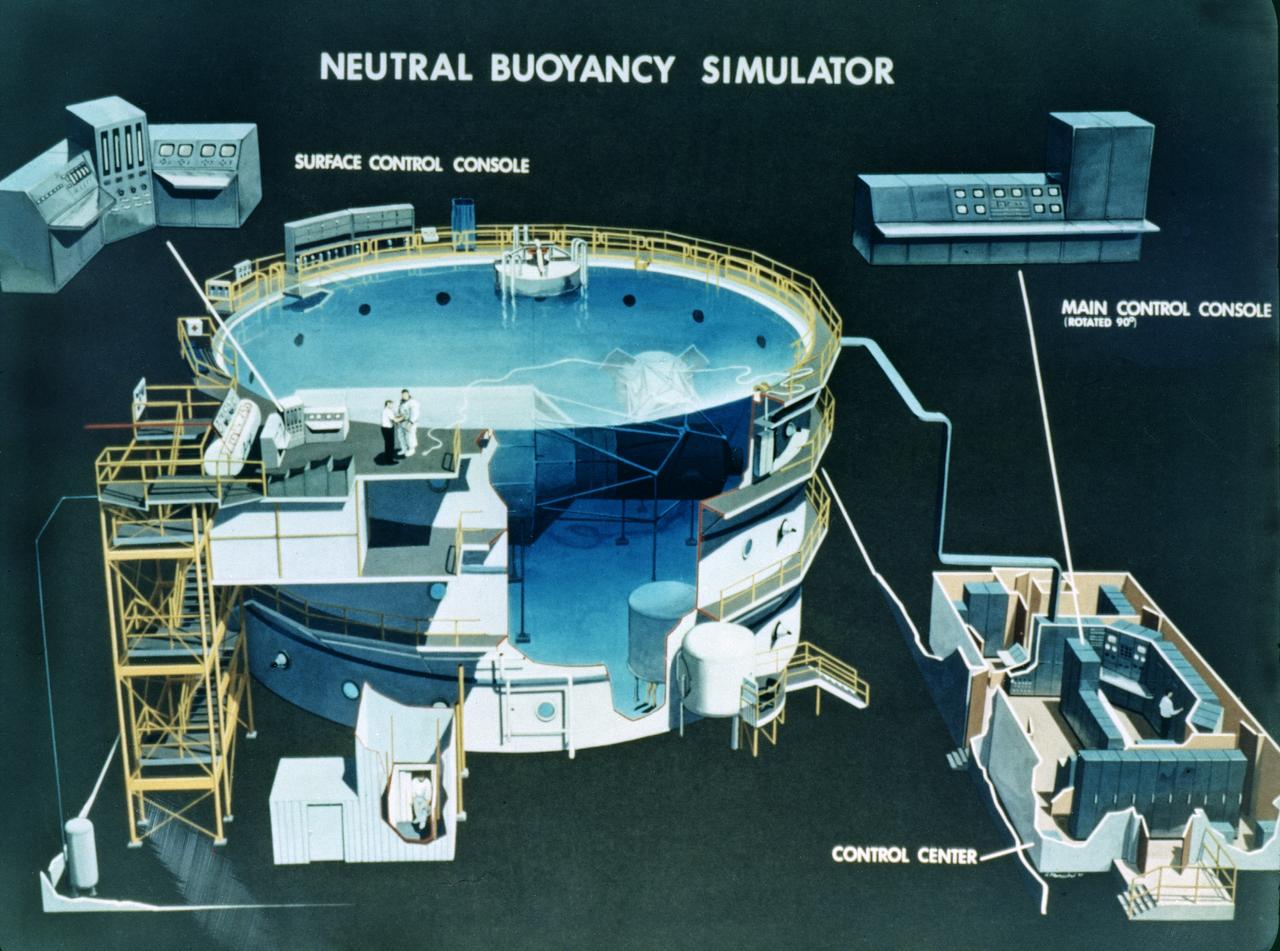
This is a cutaway illustration of the Neutral Buoyancy Simulator (NBS) at the Marshall Space Flight Center (MSFC ). The MSFC NBS provided an excellent environment for testing hardware to examine how it would operate in space and for evaluating techniques for space construction and spacecraft servicing. Here, engineers, designers, and astronauts performed various tests to develop basic concepts, preliminary designs, final designs, and crew procedures. The NBS was constructed of welded steel with polyester-resin coating. The water tank was 75-feet (22.9- meters) in diameter, 40-feet (12.2-meters) deep, and held 1.32 million gallons of water. Since it opened for operation in 1968, the NBS had supported a number of successful space missions, such as the Skylab, Solar Maximum Mission Satellite, Marned Maneuvering Unit, Experimental Assembly of Structures in Extravehicular Activity/Assembly Concept for Construction of Erectable Space Structures (EASE/ACCESS), the Hubble Space Telescope, and the Space Station. The function of the MSFC NBS was moved to the larger simulator at the Johnson Space Center and is no longer operational.
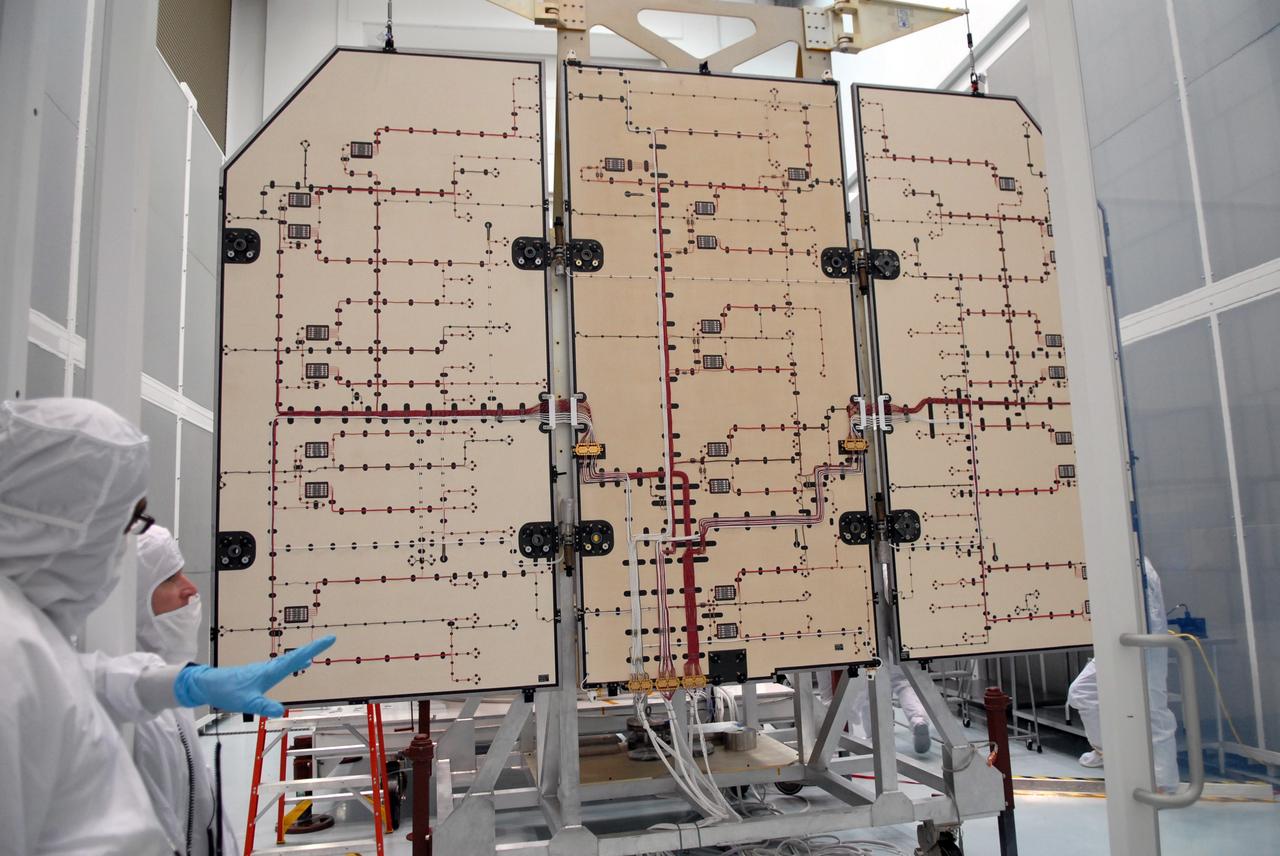
CAPE CANAVERAL, Fla. – Technicians inspect the solar arrays for NASA's Lunar Reconnaissance Orbiter, or LRO, at the Astrotech processing facility in Titusville, Fla. The spacecraft was built by engineers at Goddard Space Flight Center, where it recently completed two months of tests in a thermal vacuum chamber. The orbiter will carry seven instruments to provide scientists with detailed maps of the lunar surface and enhance our understanding of the moon's topography, lighting conditions, mineralogical composition and natural resources. Information gleaned from LRO will be used to select safe landing sites, determine locations for future lunar outposts and help mitigate radiation dangers to astronauts. The polar regions of the moon are the main focus of the mission because continuous access to sunlight may be possible and water ice may exist in permanently shadowed areas of the poles. Accompanying LRO on its journey to the moon will be the Lunar Crater Observation and Sensing Satellite, or LCROSS, a mission that will impact the lunar surface in its search for water ice. Launch of LRO/LCROSS is targeted for April 24. Photo credit: NASA/Jack Pfaller
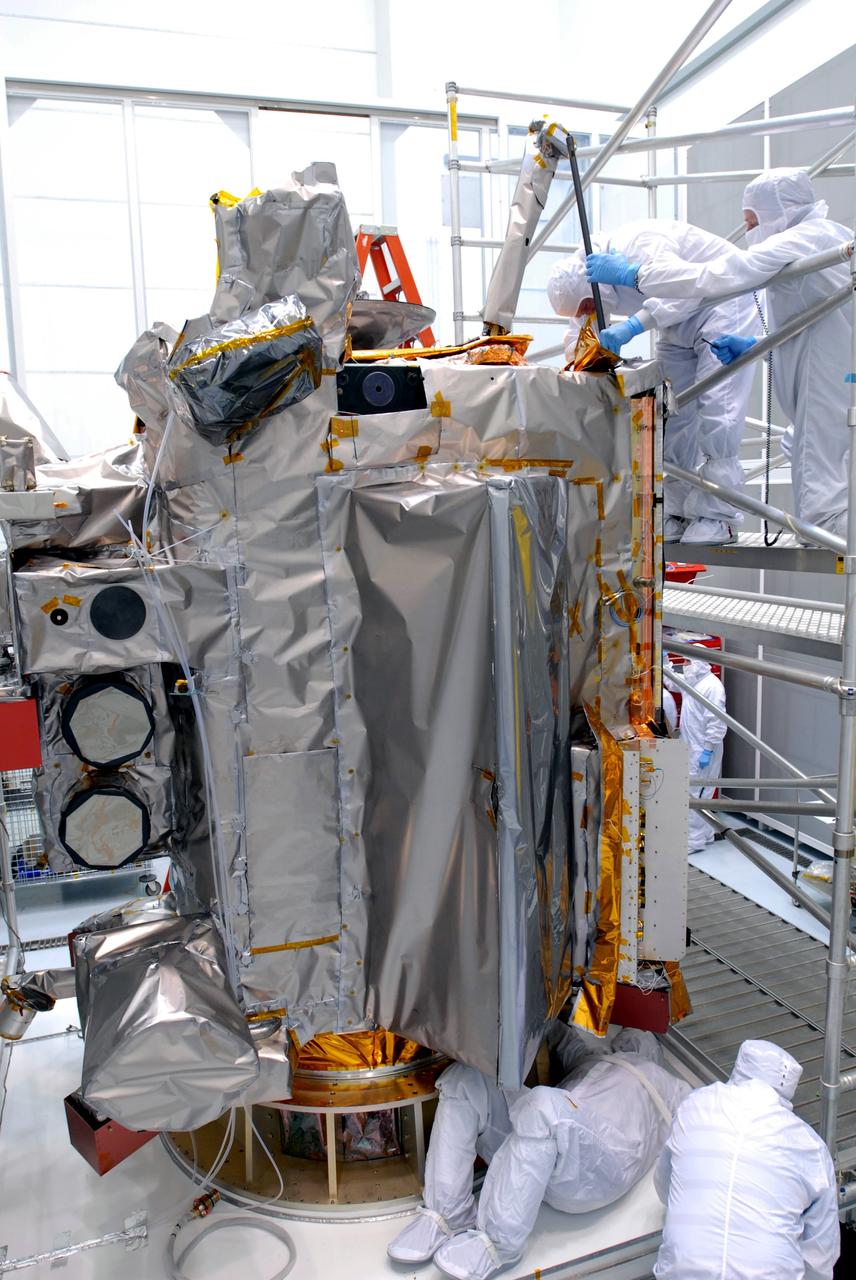
CAPE CANAVERAL, Fla. – Technicians begin checkout and processing of NASA's Lunar Reconnaissance Orbiter, or LRO, in the high bay at the Astrotech processing facility in Titusville, Fla. The spacecraft was built by engineers at Goddard Space Flight Center, where it recently completed two months of tests in a thermal vacuum chamber. The orbiter will carry seven instruments to provide scientists with detailed maps of the lunar surface and enhance our understanding of the moon's topography, lighting conditions, mineralogical composition and natural resources. Information gleaned from LRO will be used to select safe landing sites, determine locations for future lunar outposts and help mitigate radiation dangers to astronauts. The polar regions of the moon are the main focus of the mission because continuous access to sunlight may be possible and water ice may exist in permanently shadowed areas of the poles. Accompanying LRO on its journey to the moon will be the Lunar Crater Observation and Sensing Satellite, or LCROSS, a mission that will impact the lunar surface in its search for water ice. Launch of LRO/LCROSS is targeted for April 24. Photo credit: NASA/Jim Grossmann
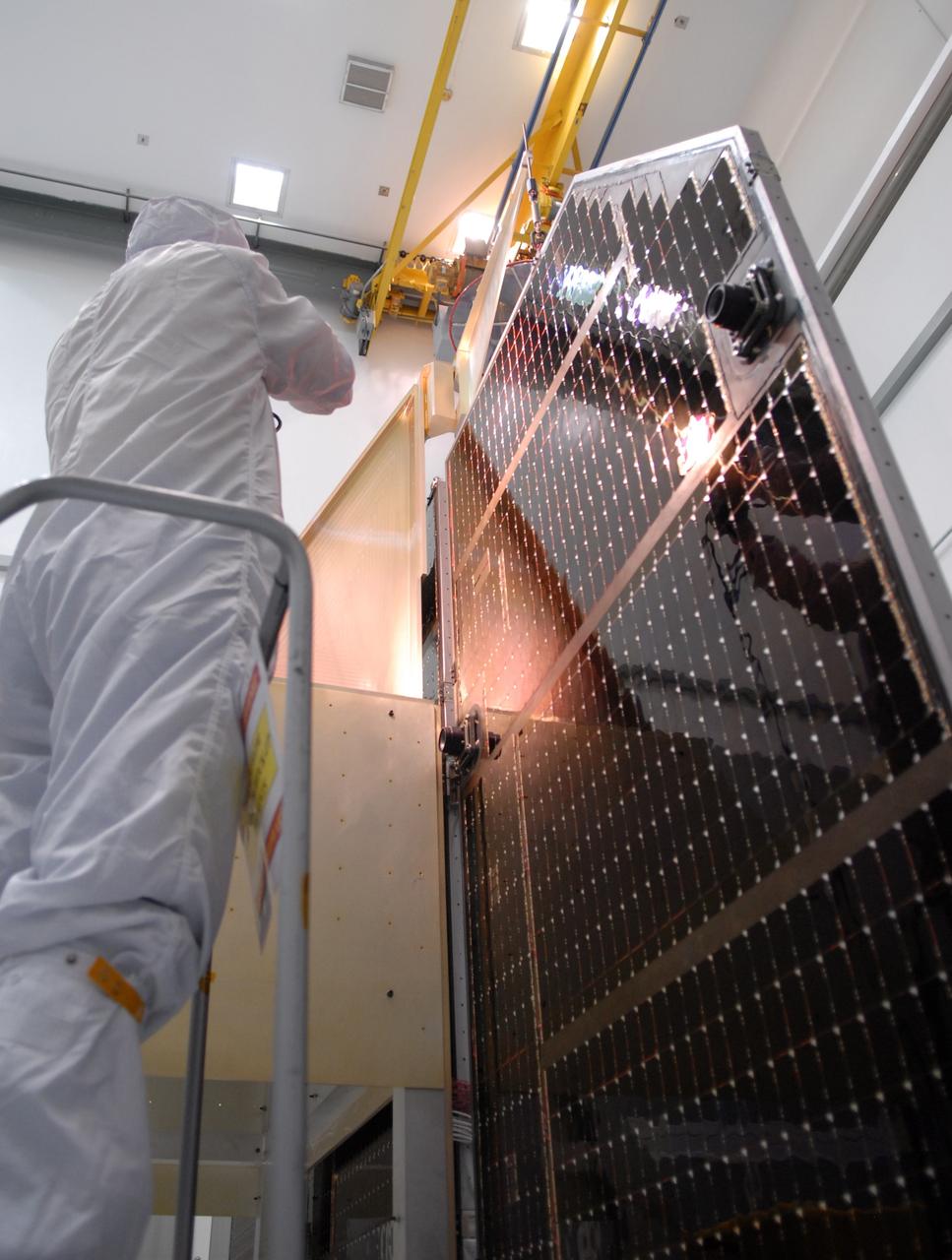
CAPE CANAVERAL, Fla. – A technician inspects the solar arrays for NASA's Lunar Reconnaissance Orbiter, or LRO, at the Astrotech processing facility in Titusville, Fla. The spacecraft was built by engineers at Goddard Space Flight Center, where it recently completed two months of tests in a thermal vacuum chamber. The orbiter will carry seven instruments to provide scientists with detailed maps of the lunar surface and enhance our understanding of the moon's topography, lighting conditions, mineralogical composition and natural resources. Information gleaned from LRO will be used to select safe landing sites, determine locations for future lunar outposts and help mitigate radiation dangers to astronauts. The polar regions of the moon are the main focus of the mission because continuous access to sunlight may be possible and water ice may exist in permanently shadowed areas of the poles. Accompanying LRO on its journey to the moon will be the Lunar Crater Observation and Sensing Satellite, or LCROSS, a mission that will impact the lunar surface in its search for water ice. Launch of LRO/LCROSS is targeted for April 24. Photo credit: NASA/Jack Pfaller
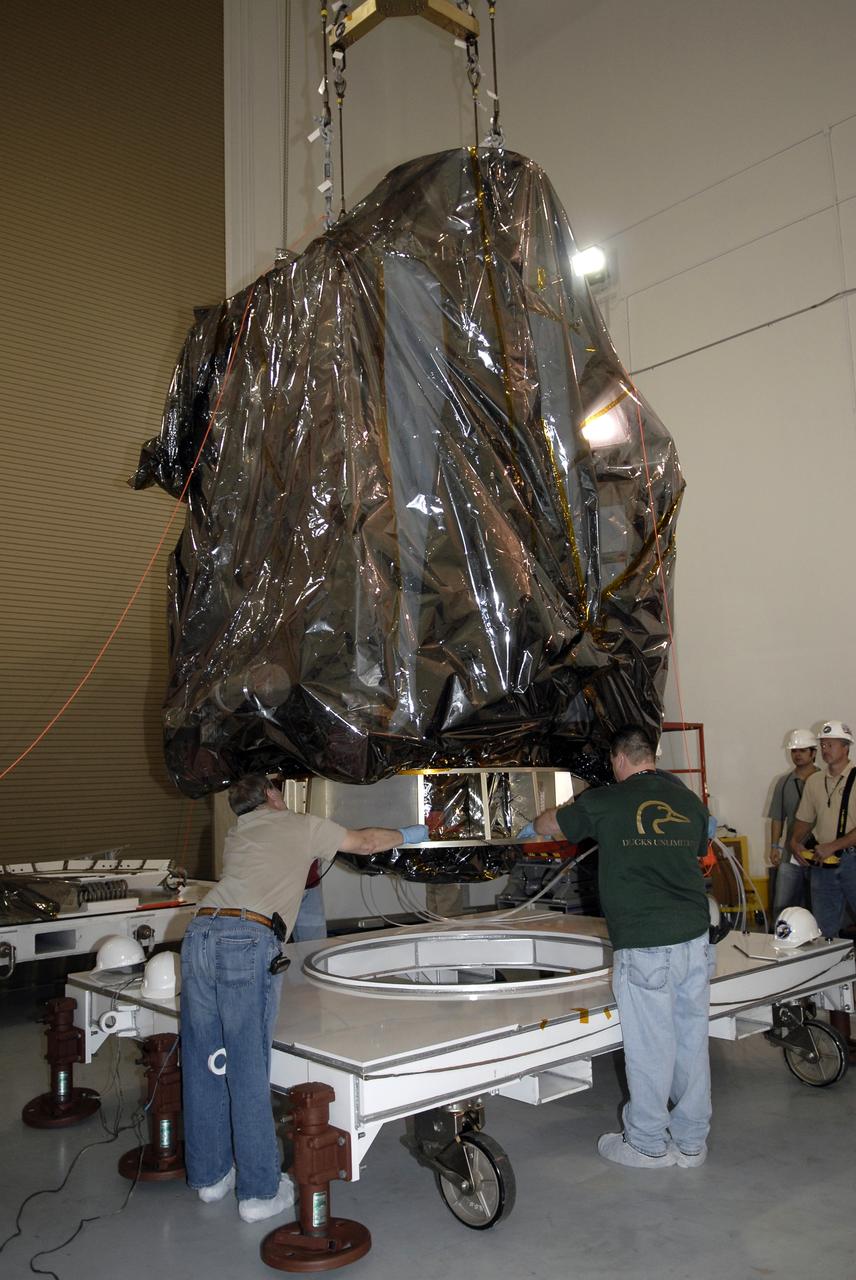
CAPE CANAVERAL, Fla. – Technicians guide NASA's Lunar Reconnaissance Orbiter, or LRO, onto a work stand in the high bay at the Astrotech processing facility in Titusville, Fla. The spacecraft was built by engineers at Goddard Space Flight Center, where it recently completed two months of tests in a thermal vacuum chamber. The orbiter will carry seven instruments to provide scientists with detailed maps of the lunar surface and enhance our understanding of the moon's topography, lighting conditions, mineralogical composition and natural resources. Information gleaned from LRO will be used to select safe landing sites, determine locations for future lunar outposts and help mitigate radiation dangers to astronauts. The polar regions of the moon are the main focus of the mission because continuous access to sunlight may be possible and water ice may exist in permanently shadowed areas of the poles. Accompanying LRO on its journey to the moon will be the Lunar Crater Observation and Sensing Satellite, or LCROSS, a mission that will impact the lunar surface in its search for water ice. Launch of LRO/LCROSS is targeted for April 24. Photo credit: NASA/Kim Shiflett
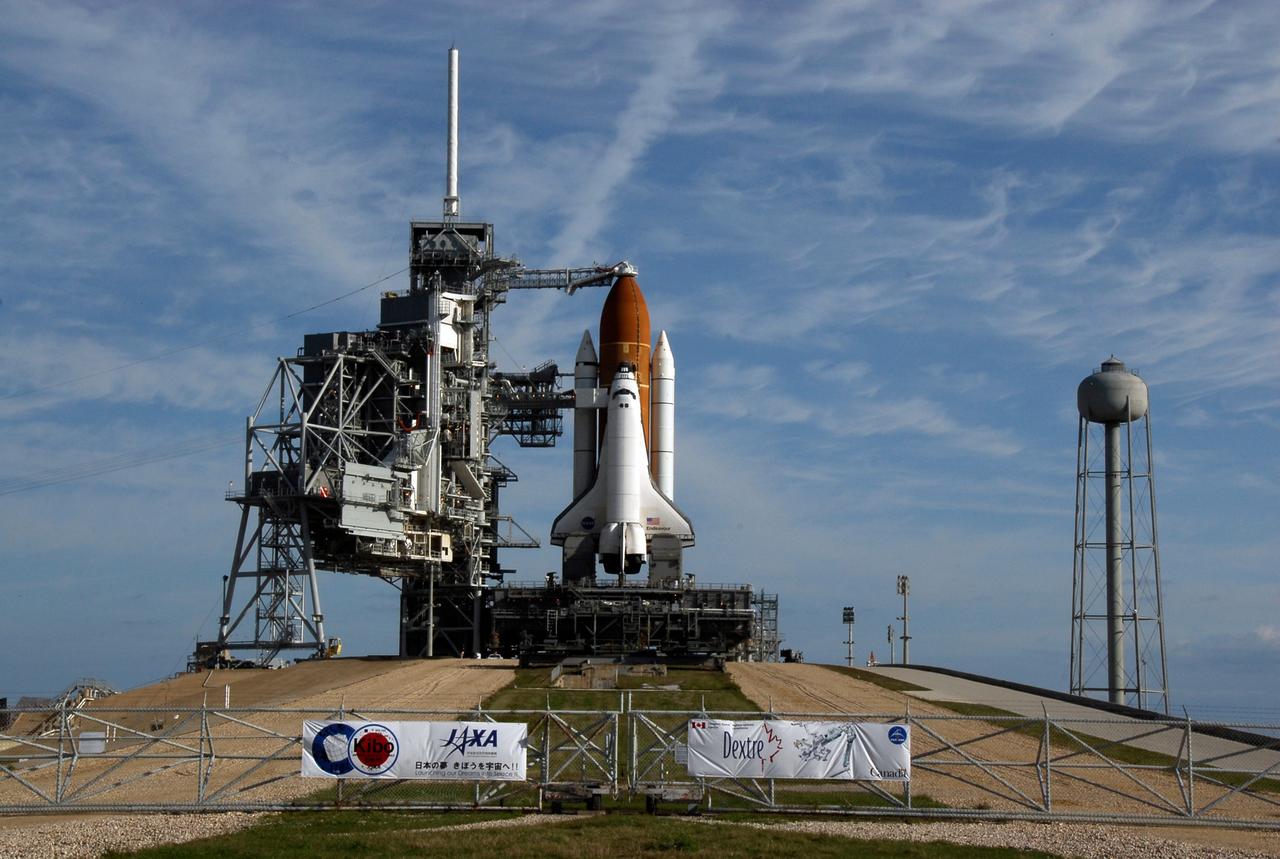
KENNEDY SPACE CENTER, FLA. -- On top of Launch Pad 39A at NASA's Kennedy Space Center, space shuttle Endeavour waits for liftoff on the STS-123 mission. The rotating service structure was rolled back starting at 8:23 a.m. and complete at 8:55 a.m. At far right is the 300,000-gallon water tank that provides the water for sound suppression during liftoff. Signs on the gate across the pad illustrate the primary payloads on the mission: the Japan Aerospace Exploration Agency's Kibo laboratory and the Canadian Space Agency's two-armed robotic system, Dextre. The rotating structure provides protected access to the orbiter for changeout and servicing of payloads at the pad. The structure is supported by a rotating bridge that pivots about a vertical axis on the west side of the pad's flame trench. After the RSS is rolled back, the orbiter is ready for fuel cell activation and external tank cryogenic propellant loading operations. The pad is cleared to the perimeter gate for operations to fill the external tank with about 500,000 gallons of cryogenic propellants used by the shuttle’s main engines. This is done at the pad approximately eight hours before the scheduled launch. Liftoff is scheduled for 2:28 a.m. EDT March 11. Photo credit: NASA/Kim Shiflett
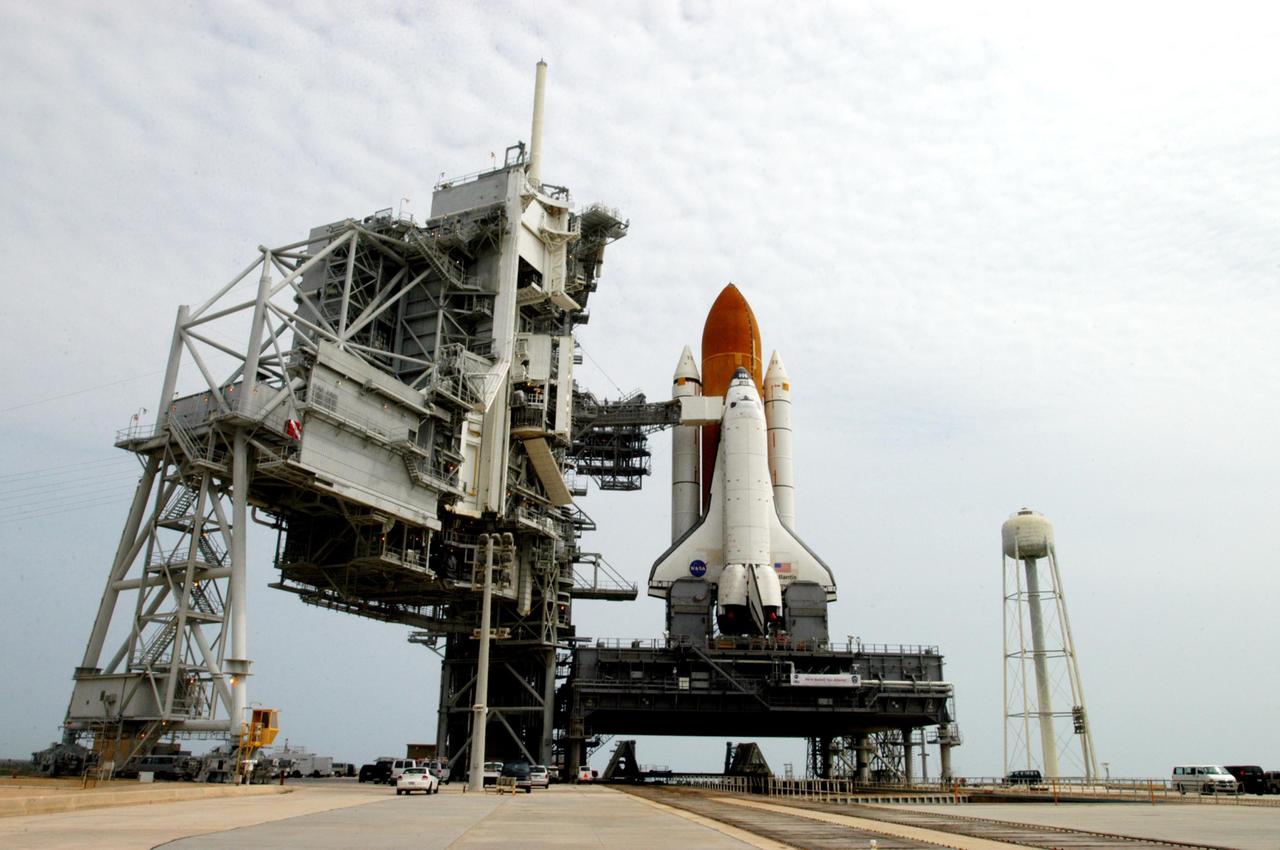
KENNEDY SPACE CENTER, FLA. - Space Shuttle Atlantis, atop the mobile launcher platform, sits on Launch Pad 39B after a nearly 8-hour crawl from the Vehicle Assembly Building. At left is the open rotating service structure and fixed service structure with the 80-foot lightning mast on top. Extended from the fixed structure is the orbiter access arm, with the White Room adjacent to Atlantis. At right is the 290-foot high, 300,000- gallon water tank that aids in sound suppression during launch. The water releases just prior to the ignition of the shuttle engines and flows through 7-foot-diameter pipes for about 20 seconds, pouring into 16 nozzles atop the flame deflectors and from outlets in the main engines exhaust hole in the mobile launcher platform. Atlantis' launch window begins Aug. 27 for an 11-day mission to the International Space Station. The STS-115 crew of six astronauts will continue construction of the station and install their cargo, the Port 3/4 truss segment with its two large solar arrays. Photo credit: NASA/Troy Cryder & George Shelton
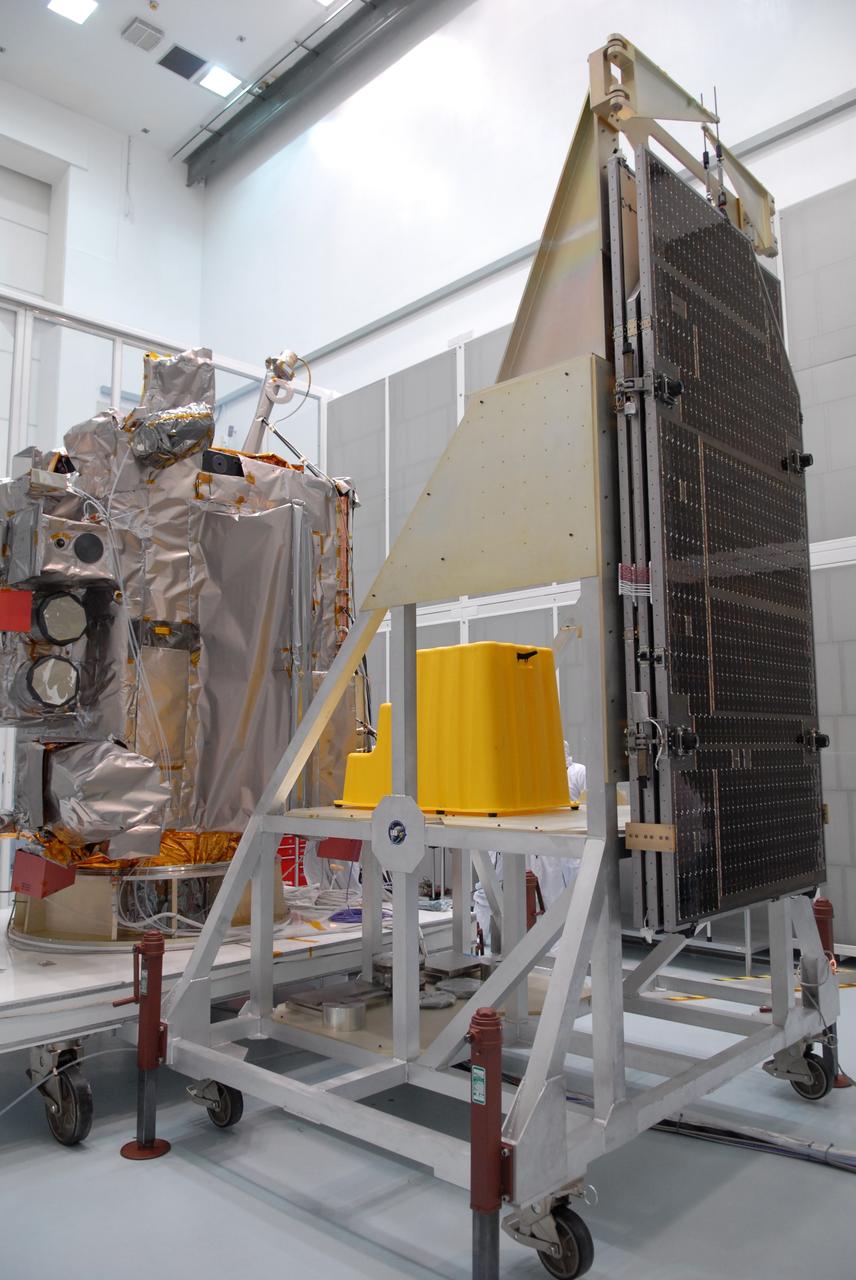
CAPE CANAVERAL, Fla. – Inspection begins of the solar arrays for NASA's Lunar Reconnaissance Orbiter, or LRO, at the Astrotech processing facility in Titusville, Fla. The spacecraft was built by engineers at Goddard Space Flight Center, where it recently completed two months of tests in a thermal vacuum chamber. The orbiter will carry seven instruments to provide scientists with detailed maps of the lunar surface and enhance our understanding of the moon's topography, lighting conditions, mineralogical composition and natural resources. Information gleaned from LRO will be used to select safe landing sites, determine locations for future lunar outposts and help mitigate radiation dangers to astronauts. The polar regions of the moon are the main focus of the mission because continuous access to sunlight may be possible and water ice may exist in permanently shadowed areas of the poles. Accompanying LRO on its journey to the moon will be the Lunar Crater Observation and Sensing Satellite, or LCROSS, a mission that will impact the lunar surface in its search for water ice. Launch of LRO/LCROSS is targeted for April 24. Photo credit: NASA/Jack Pfaller
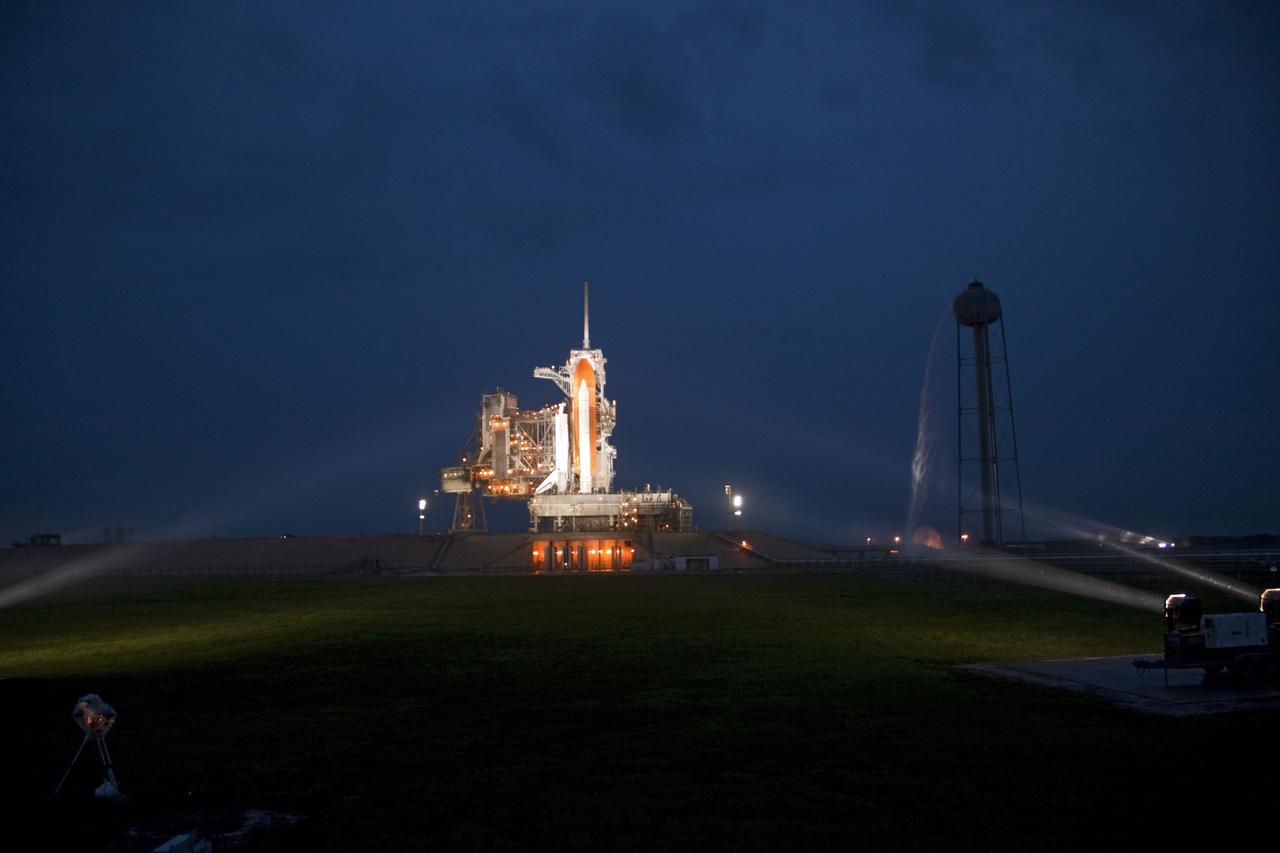
CAPE CANAVERAL, Fla. -- Space shuttle Atlantis is revealed on Launch Pad 39A at NASA's Kennedy Space Center in Florida bathed in xenon lights following the move of the rotating service structure (RSS). The structure provides weather protection and access to the shuttle while it awaits liftoff on the pad. To the right of the pad is the 300,000-gallon water tower that provides the water used for sound suppression on the pad during liftoff. RSS retract marks a major milestone in Atlantis' STS-135 mission countdown. Atlantis and its crew of four; Commander Chris Ferguson, Pilot Doug Hurley, Mission Specialists Sandy Magnus and Rex Walheim will lift off at 11:26 a.m. EDT on July 8 to deliver the Raffaello multi-purpose logistics module packed with supplies and spare parts for the International Space Station. Atlantis also will fly the Robotic Refueling Mission experiment that will investigate the potential for robotically refueling existing satellites in orbit. In addition, Atlantis will return with a failed ammonia pump module to help NASA better understand the failure mechanism and improve pump designs for future systems. STS-135 is the 33rd flight of Atlantis, the 37th shuttle mission to the space station, and the 135th and final mission of NASA's Space Shuttle Program. For more information, visit www.nasa.gov/mission_pages/shuttle/shuttlemissions/sts135/index.html. Photo credit: Jim Grossmann
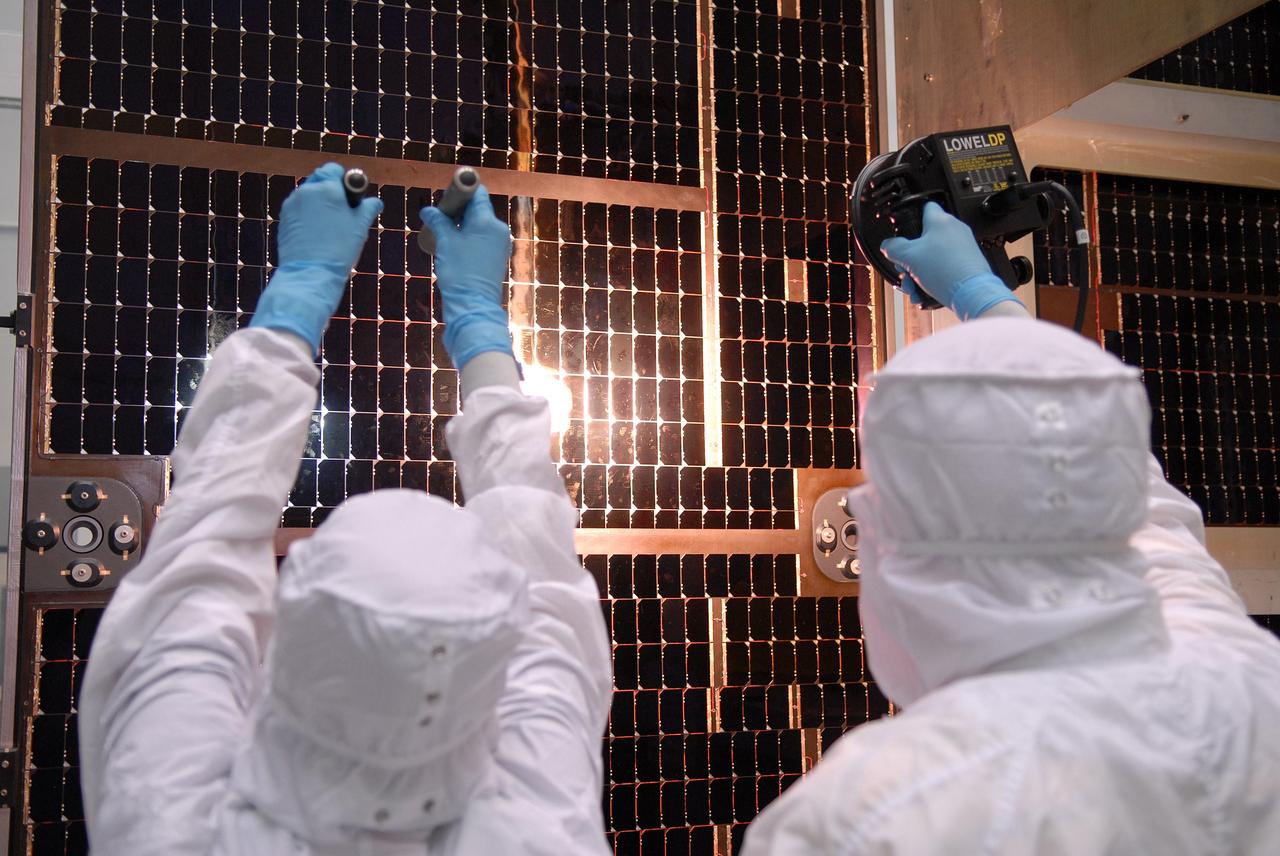
CAPE CANAVERAL, Fla. – Technicians check out the solar arrays for NASA's Lunar Reconnaissance Orbiter, or LRO, at the Astrotech processing facility in Titusville, Fla. The spacecraft was built by engineers at Goddard Space Flight Center, where it recently completed two months of tests in a thermal vacuum chamber. The orbiter will carry seven instruments to provide scientists with detailed maps of the lunar surface and enhance our understanding of the moon's topography, lighting conditions, mineralogical composition and natural resources. Information gleaned from LRO will be used to select safe landing sites, determine locations for future lunar outposts and help mitigate radiation dangers to astronauts. The polar regions of the moon are the main focus of the mission because continuous access to sunlight may be possible and water ice may exist in permanently shadowed areas of the poles. Accompanying LRO on its journey to the moon will be the Lunar Crater Observation and Sensing Satellite, or LCROSS, a mission that will impact the lunar surface in its search for water ice. Launch of LRO/LCROSS is targeted for April 24. Photo credit: NASA/Jack Pfaller
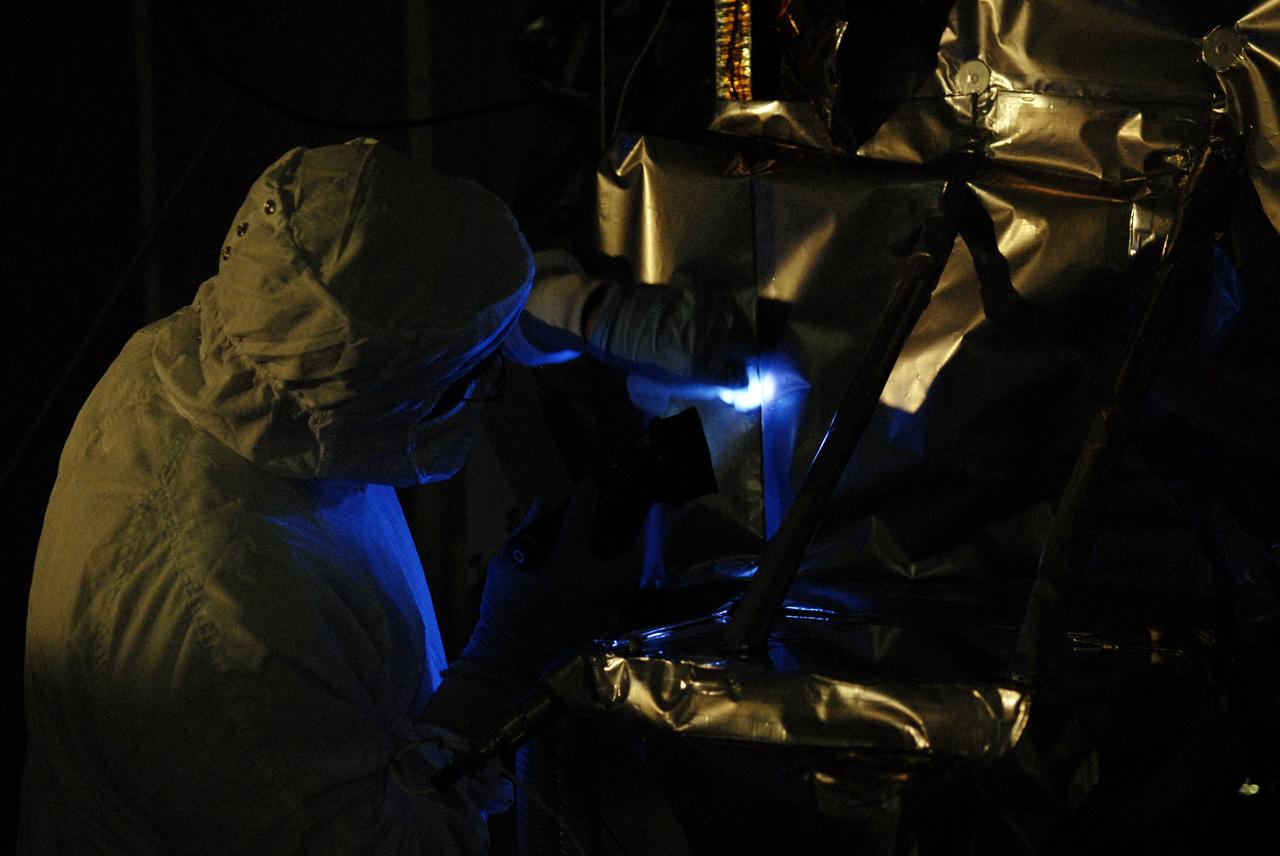
CAPE CANAVERAL, Fla. – At the Astrotech facility in Titusville, Fla., technicians perform backlight inspection and cleaning on NASA's Lunar Reconnaissance Orbiter, or LRO. Black light inspection uses UVA fluorescence to detect possible particulate microcontamination, minute cracks or fluid leaks. The orbiter will carry seven instruments to provide scientists with detailed maps of the lunar surface and enhance our understanding of the moon's topography, lighting conditions, mineralogical composition and natural resources. Information gleaned from LRO will be used to select safe landing sites, determine locations for future lunar outposts and help mitigate radiation dangers to astronauts. The polar regions of the moon are the main focus of the mission because continuous access to sunlight may be possible and water ice may exist in permanently shadowed areas of the poles. Accompanying LRO on its journey to the moon will be the Lunar CRater Observation and Sensing Satellite, or LCROSS, a mission that will impact the lunar surface in its search for water ice. Launch of LRO is targeted for May 20. Photo credit: NASA/Kim Shiflett
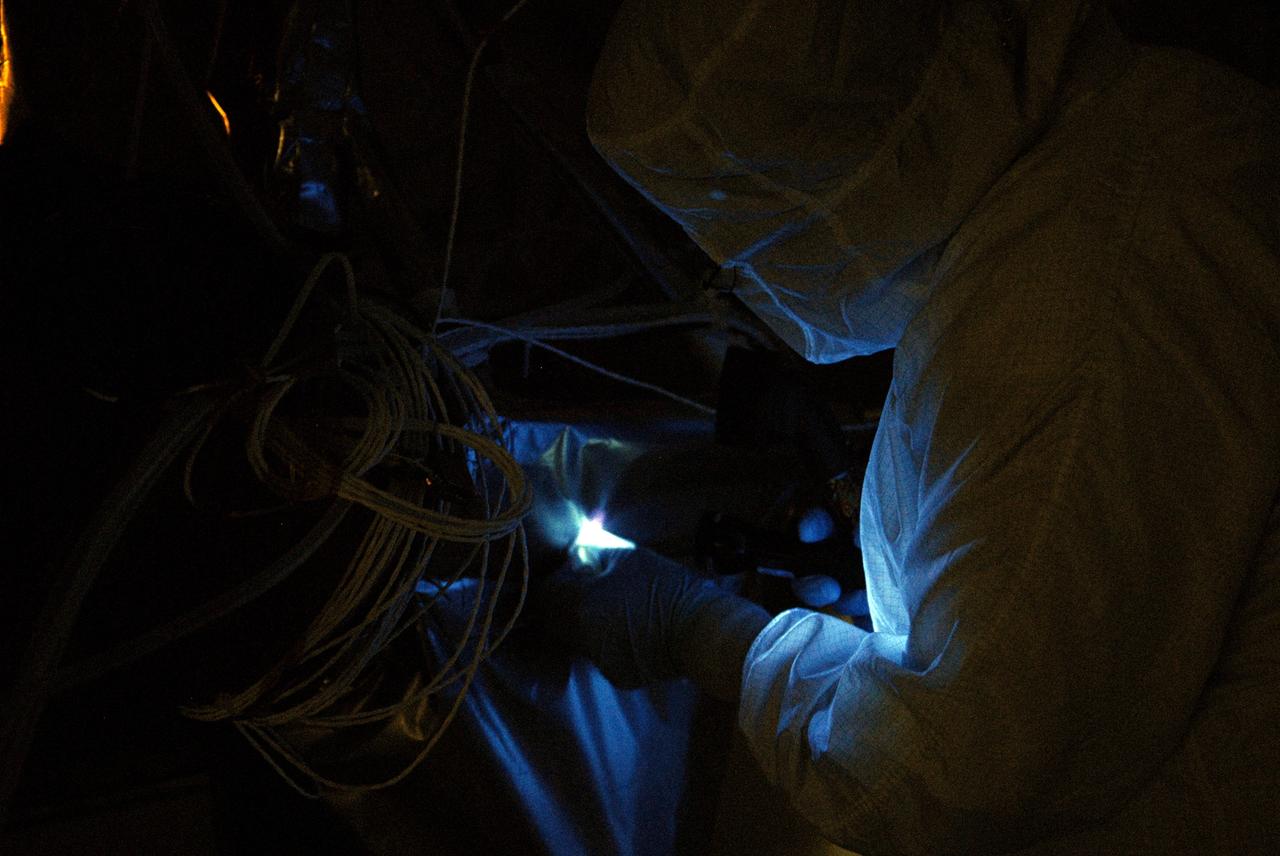
CAPE CANAVERAL, Fla. – At the Astrotech facility in Titusville, Fla., technicians perform backlight inspection and cleaning on NASA's Lunar Reconnaissance Orbiter, or LRO. Black light inspection uses UVA fluorescence to detect possible particulate microcontamination, minute cracks or fluid leaks. The orbiter will carry seven instruments to provide scientists with detailed maps of the lunar surface and enhance our understanding of the moon's topography, lighting conditions, mineralogical composition and natural resources. Information gleaned from LRO will be used to select safe landing sites, determine locations for future lunar outposts and help mitigate radiation dangers to astronauts. The polar regions of the moon are the main focus of the mission because continuous access to sunlight may be possible and water ice may exist in permanently shadowed areas of the poles. Accompanying LRO on its journey to the moon will be the Lunar CRater Observation and Sensing Satellite, or LCROSS, a mission that will impact the lunar surface in its search for water ice. Launch of LRO is targeted for May 20. Photo credit: NASA/Kim Shiflett
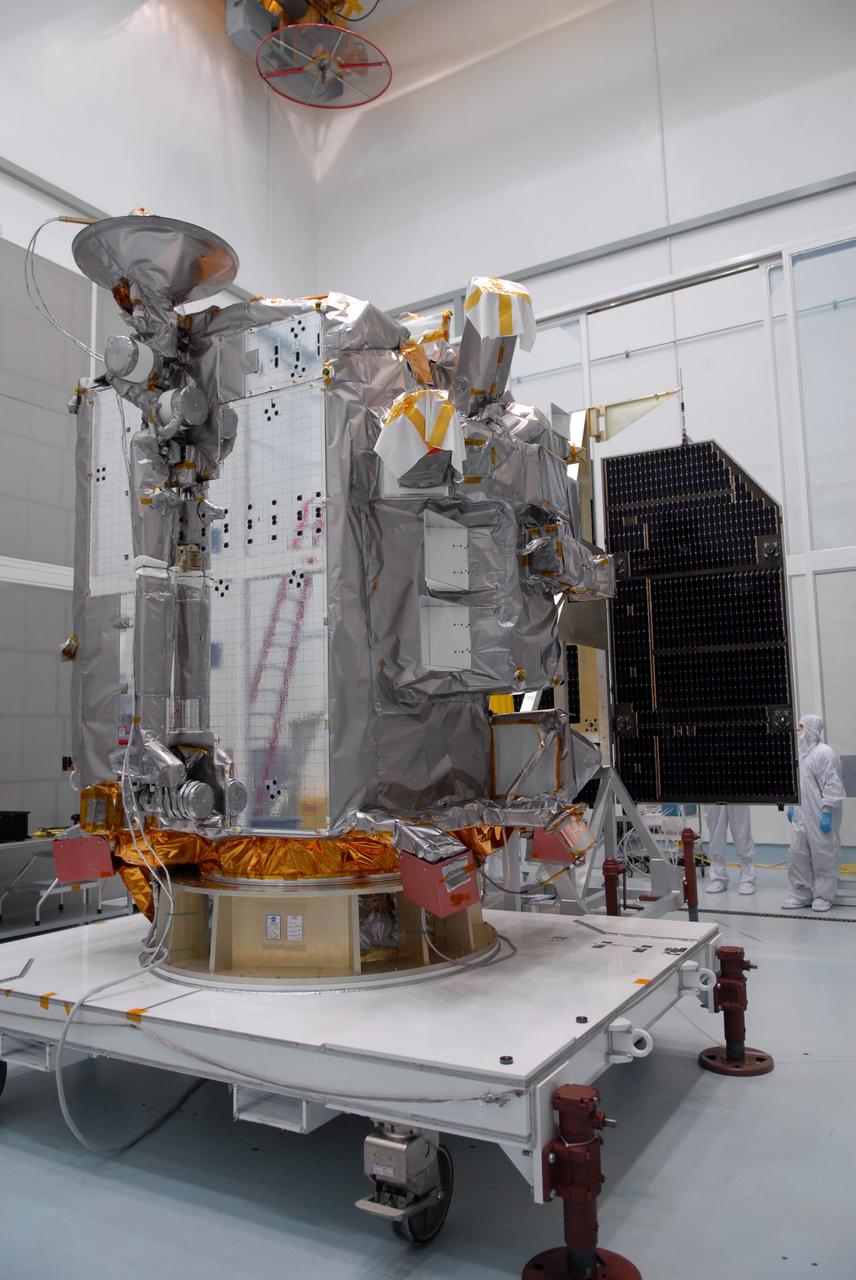
CAPE CANAVERAL, Fla. – The solar arrays for NASA's Lunar Reconnaissance Orbiter, or LRO, are inspected at the Astrotech processing facility in Titusville, Fla. The spacecraft was built by engineers at Goddard Space Flight Center, where it recently completed two months of tests in a thermal vacuum chamber. The orbiter will carry seven instruments to provide scientists with detailed maps of the lunar surface and enhance our understanding of the moon's topography, lighting conditions, mineralogical composition and natural resources. Information gleaned from LRO will be used to select safe landing sites, determine locations for future lunar outposts and help mitigate radiation dangers to astronauts. The polar regions of the moon are the main focus of the mission because continuous access to sunlight may be possible and water ice may exist in permanently shadowed areas of the poles. Accompanying LRO on its journey to the moon will be the Lunar Crater Observation and Sensing Satellite, or LCROSS, a mission that will impact the lunar surface in its search for water ice. Launch of LRO/LCROSS is targeted for April 24. Photo credit: NASA/Jack Pfaller
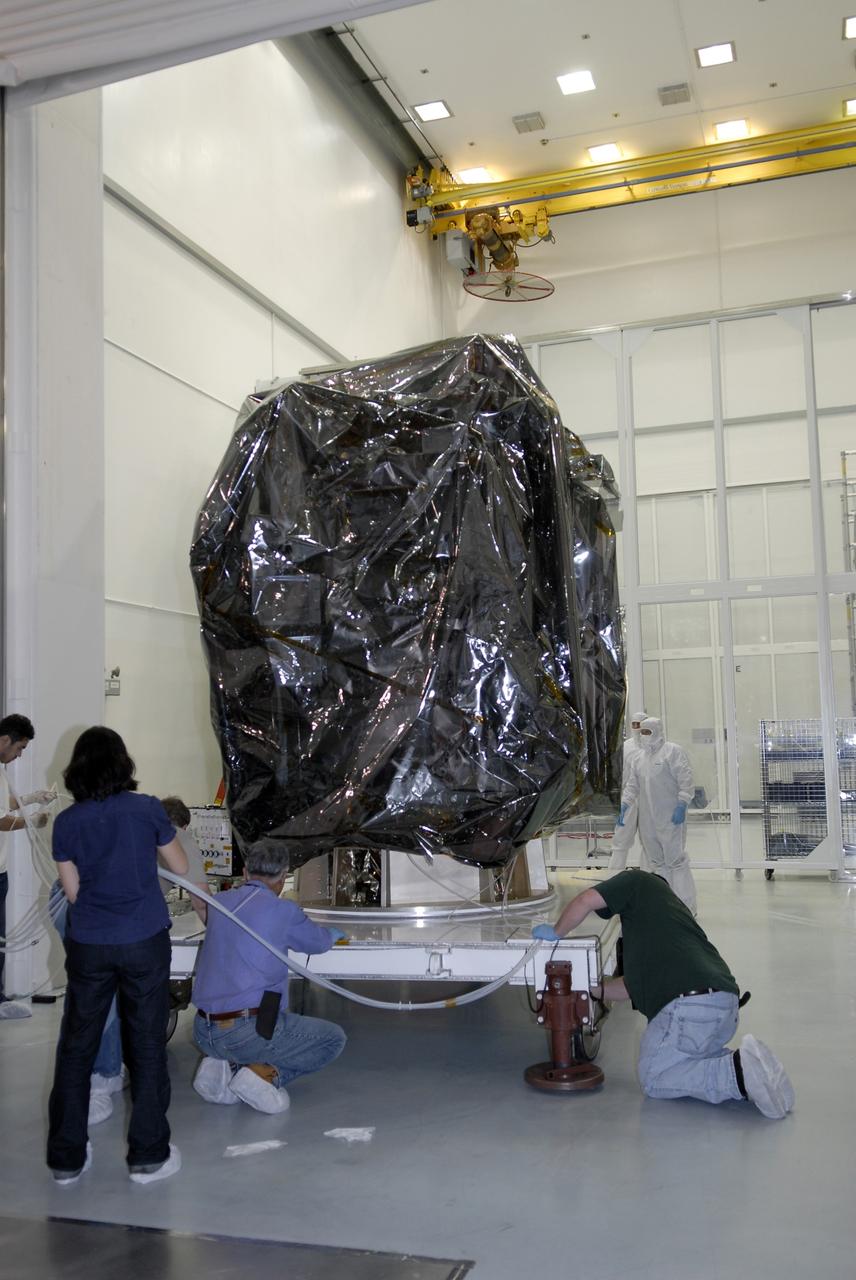
CAPE CANAVERAL, Fla. – Technicians secure a work stand supporting NASA's Lunar Reconnaissance Orbiter, or LRO, in the high bay at the Astrotech processing facility in Titusville, Fla. The spacecraft was built by engineers at Goddard Space Flight Center, where it recently completed two months of tests in a thermal vacuum chamber. The orbiter will carry seven instruments to provide scientists with detailed maps of the lunar surface and enhance our understanding of the moon's topography, lighting conditions, mineralogical composition and natural resources. Information gleaned from LRO will be used to select safe landing sites, determine locations for future lunar outposts and help mitigate radiation dangers to astronauts. The polar regions of the moon are the main focus of the mission because continuous access to sunlight may be possible and water ice may exist in permanently shadowed areas of the poles. Accompanying LRO on its journey to the moon will be the Lunar Crater Observation and Sensing Satellite, or LCROSS, a mission that will impact the lunar surface in its search for water ice. Launch of LRO/LCROSS is targeted for April 24. Photo credit: NASA/Kim Shiflett
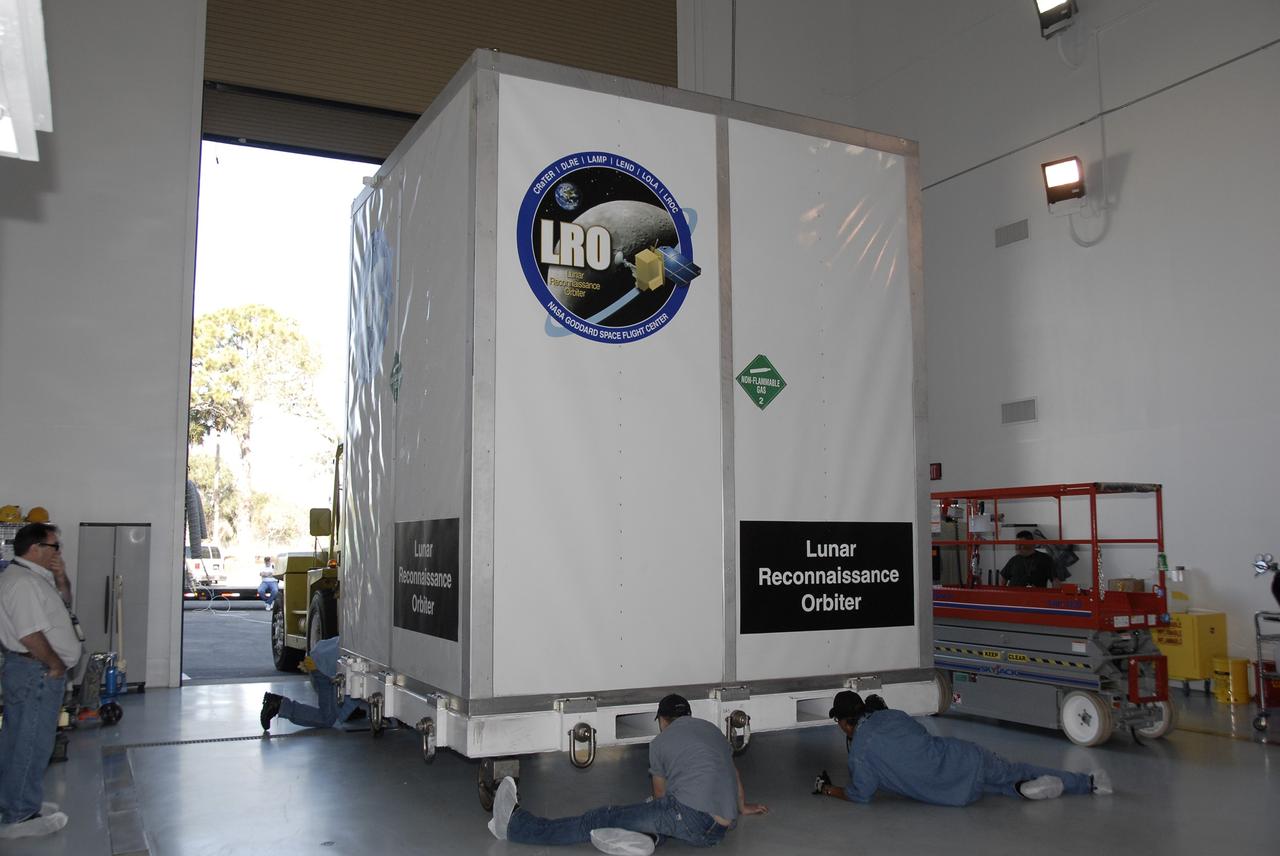
CAPE CANAVERAL, Fla. – NASA's Lunar Reconnaissance Orbiter, or LRO, spacecraft is moved into Astrotech in Titusville, Fla. The spacecraft was built by engineers at Goddard Space Flight Center, where it recently completed two months of tests in a thermal vacuum chamber. The orbiter will carry seven instruments to provide scientists with detailed maps of the lunar surface and enhance our understanding of the moon's topography, lighting conditions, mineralogical composition and natural resources. Information gleaned from LRO will be used to select safe landing sites, determine locations for future lunar outposts and help mitigate radiation dangers to astronauts. The polar regions of the moon are the main focus of the mission because continuous access to sunlight may be possible and water ice may exist in permanently shadowed areas of the poles. Accompanying LRO on its journey to the moon will be the Lunar Crater Observation and Sensing Satellite, or LCROSS, a mission that will impact the lunar surface in its search for water ice. Launch of LRO is targeted for April 24. Photo credit: NASA/Kim Shiflett

CAPE CANAVERAL, Fla. – The shipping container is removed from around NASA's Lunar Reconnaissance Orbiter, or LRO, at the Astrotech processing facility in Titusville, Fla. The spacecraft was built by engineers at Goddard Space Flight Center, where it recently completed two months of tests in a thermal vacuum chamber. The orbiter will carry seven instruments to provide scientists with detailed maps of the lunar surface and enhance our understanding of the moon's topography, lighting conditions, mineralogical composition and natural resources. Information gleaned from LRO will be used to select safe landing sites, determine locations for future lunar outposts and help mitigate radiation dangers to astronauts. The polar regions of the moon are the main focus of the mission because continuous access to sunlight may be possible and water ice may exist in permanently shadowed areas of the poles. Accompanying LRO on its journey to the moon will be the Lunar Crater Observation and Sensing Satellite, or LCROSS, a mission that will impact the lunar surface in its search for water ice. Launch of LRO/LCROSS is targeted for April 24. Photo credit: NASA/Kim Shiflett
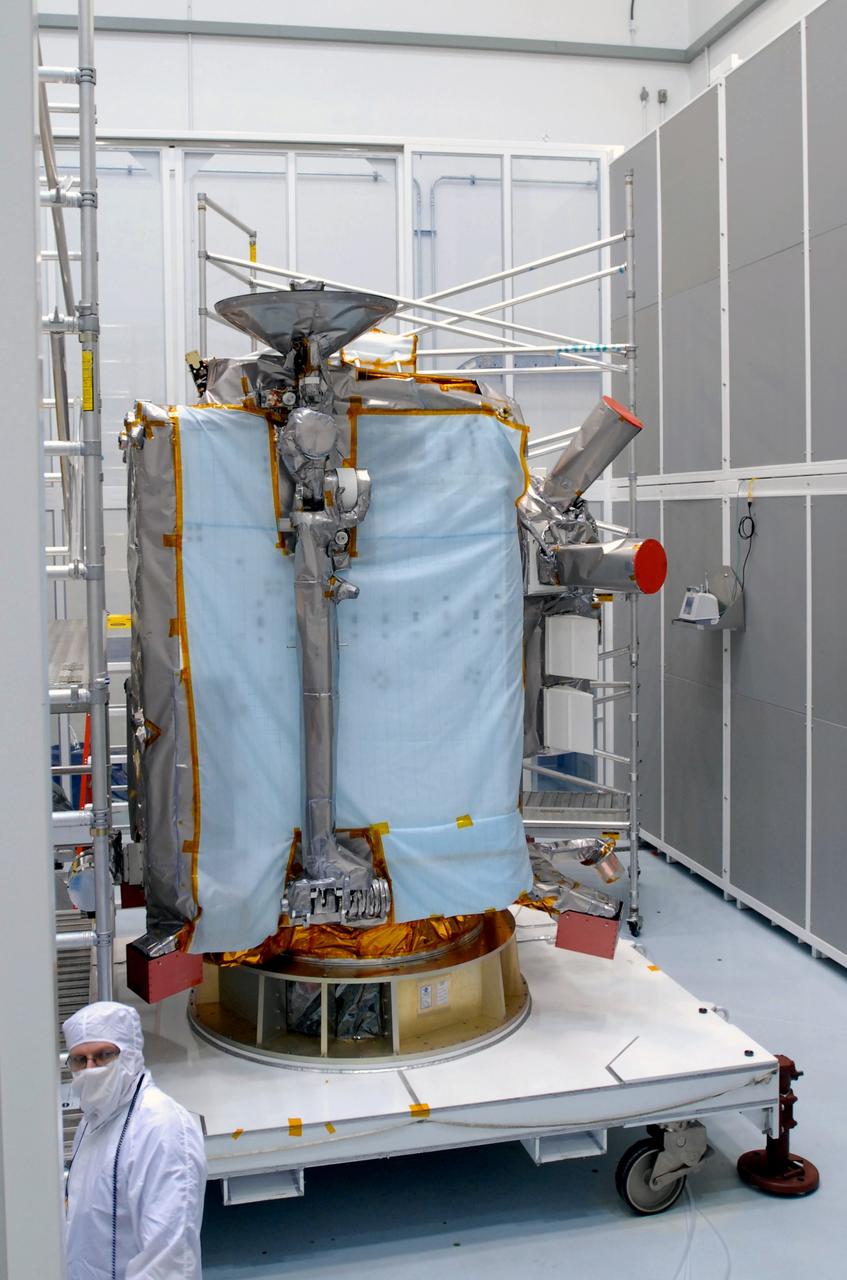
CAPE CANAVERAL, Fla. – NASA's Lunar Reconnaissance Orbiter, or LRO, is ready for final checkout and processing in the high bay at the Astrotech processing facility in Titusville, Fla. The spacecraft was built by engineers at Goddard Space Flight Center, where it recently completed two months of tests in a thermal vacuum chamber. The orbiter will carry seven instruments to provide scientists with detailed maps of the lunar surface and enhance our understanding of the moon's topography, lighting conditions, mineralogical composition and natural resources. Information gleaned from LRO will be used to select safe landing sites, determine locations for future lunar outposts and help mitigate radiation dangers to astronauts. The polar regions of the moon are the main focus of the mission because continuous access to sunlight may be possible and water ice may exist in permanently shadowed areas of the poles. Accompanying LRO on its journey to the moon will be the Lunar Crater Observation and Sensing Satellite, or LCROSS, a mission that will impact the lunar surface in its search for water ice. Launch of LRO/LCROSS is targeted for April 24. Photo credit: NASA/Jim Grossmann