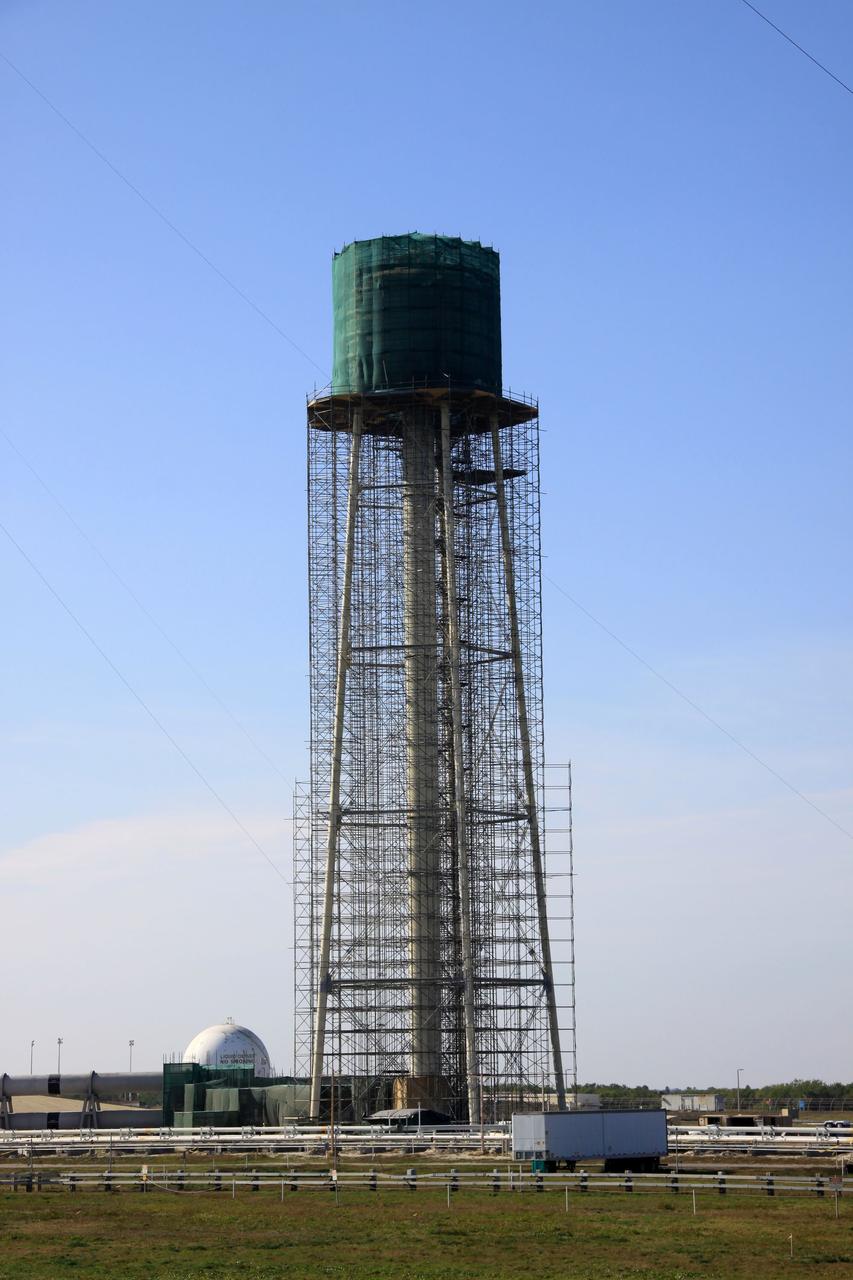
CAPE CANAVERAL, Fla. - At NASA’s Kennedy Space Center in Florida, preparations are underway to sandblast and paint the 290-foot-high water tower at Launch Pad 39B. Scaffolding surrounds the tower and a special covering has been placed around the tank. The water towers at Launch Complex 39, which includes pad A and B, were part of the sound suppression system used during space shuttle launches. Water stored in the 300,000-gallon tank would be released just prior to main engine ignition and flow by gravity to special mobile launcher platform (MLP) outlets. Nine seconds after shuttle liftoff, the peak flow rate was 900,000 gallons per minute and helped to protect the orbiter and payloads from being damaged by acoustical energy reflected from the MLP during liftoff. Photo Credit: NASA/Jim Grossmann
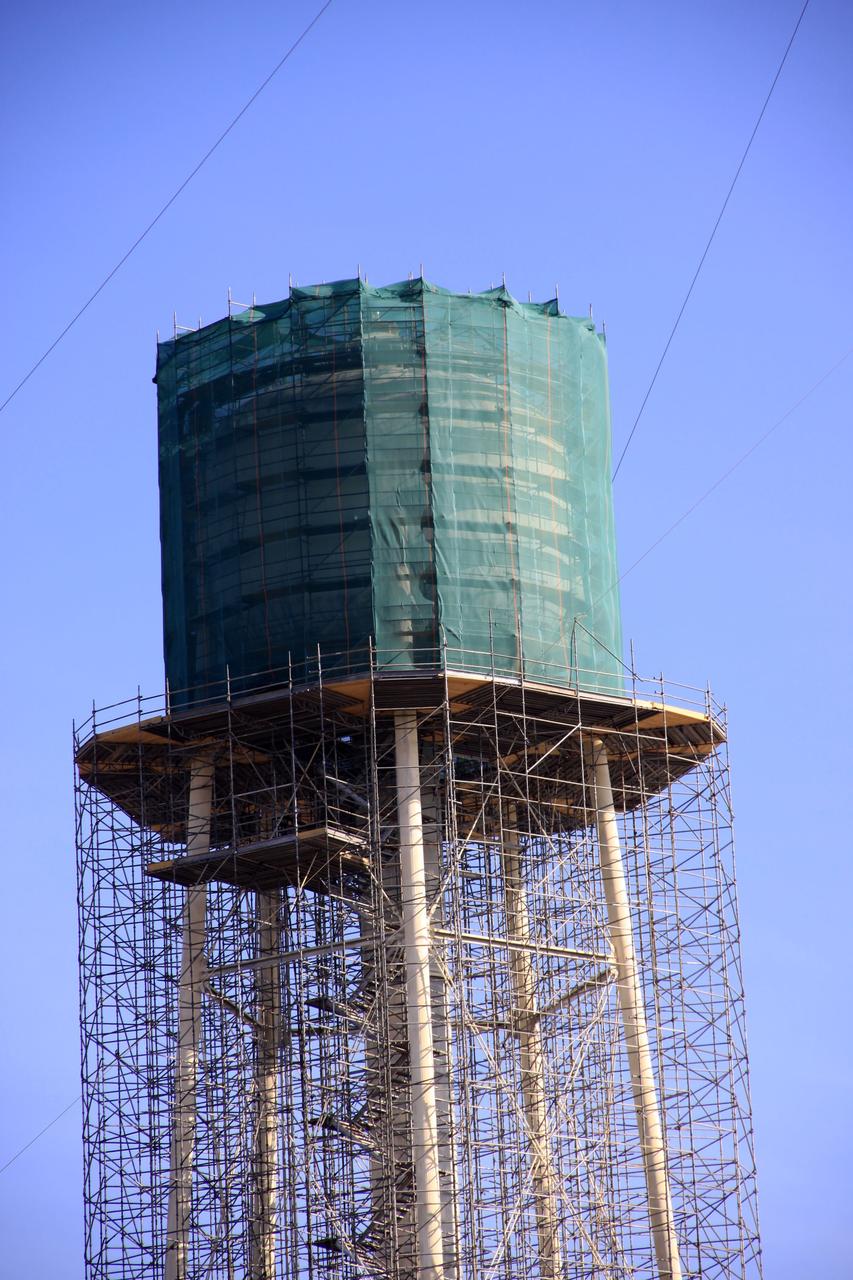
CAPE CANAVERAL, Fla. - At NASA’s Kennedy Space Center in Florida, preparations are underway to sandblast and paint the 290-foot-high water tower at Launch Pad 39B. Scaffolding surrounds the tower and a special covering has been placed around the tank. The water towers at Launch Complex 39, which includes pad A and B, were part of the sound suppression system used during space shuttle launches. Water stored in the 300,000-gallon tank would be released just prior to main engine ignition and flow by gravity to special mobile launcher platform (MLP) outlets. Nine seconds after shuttle liftoff, the peak flow rate was 900,000 gallons per minute and helped to protect the orbiter and payloads from being damaged by acoustical energy reflected from the MLP during liftoff. Photo Credit: NASA/Jim Grossmann
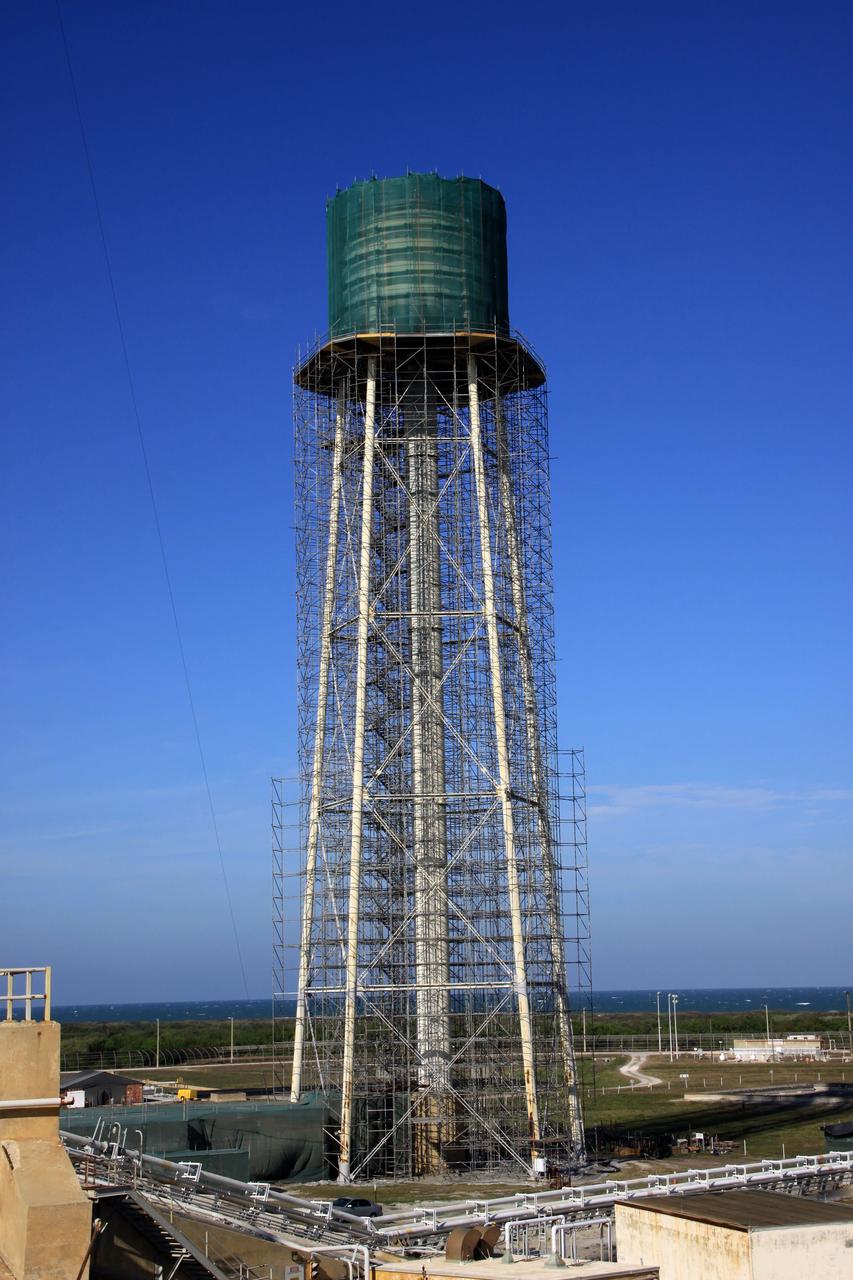
CAPE CANAVERAL, Fla. - At NASA’s Kennedy Space Center in Florida, preparations are underway to sandblast and paint the 290-foot-high water tower at Launch Pad 39B. Scaffolding surrounds the tower and a special covering has been placed around the tank. The water towers at Launch Complex 39, which includes pad A and B, were part of the sound suppression system used during space shuttle launches. Water stored in the 300,000-gallon tank would be released just prior to main engine ignition and flow by gravity to special mobile launcher platform (MLP) outlets. Nine seconds after shuttle liftoff, the peak flow rate was 900,000 gallons per minute and helped to protect the orbiter and payloads from being damaged by acoustical energy reflected from the MLP during liftoff. Photo Credit: NASA/Jim Grossmann
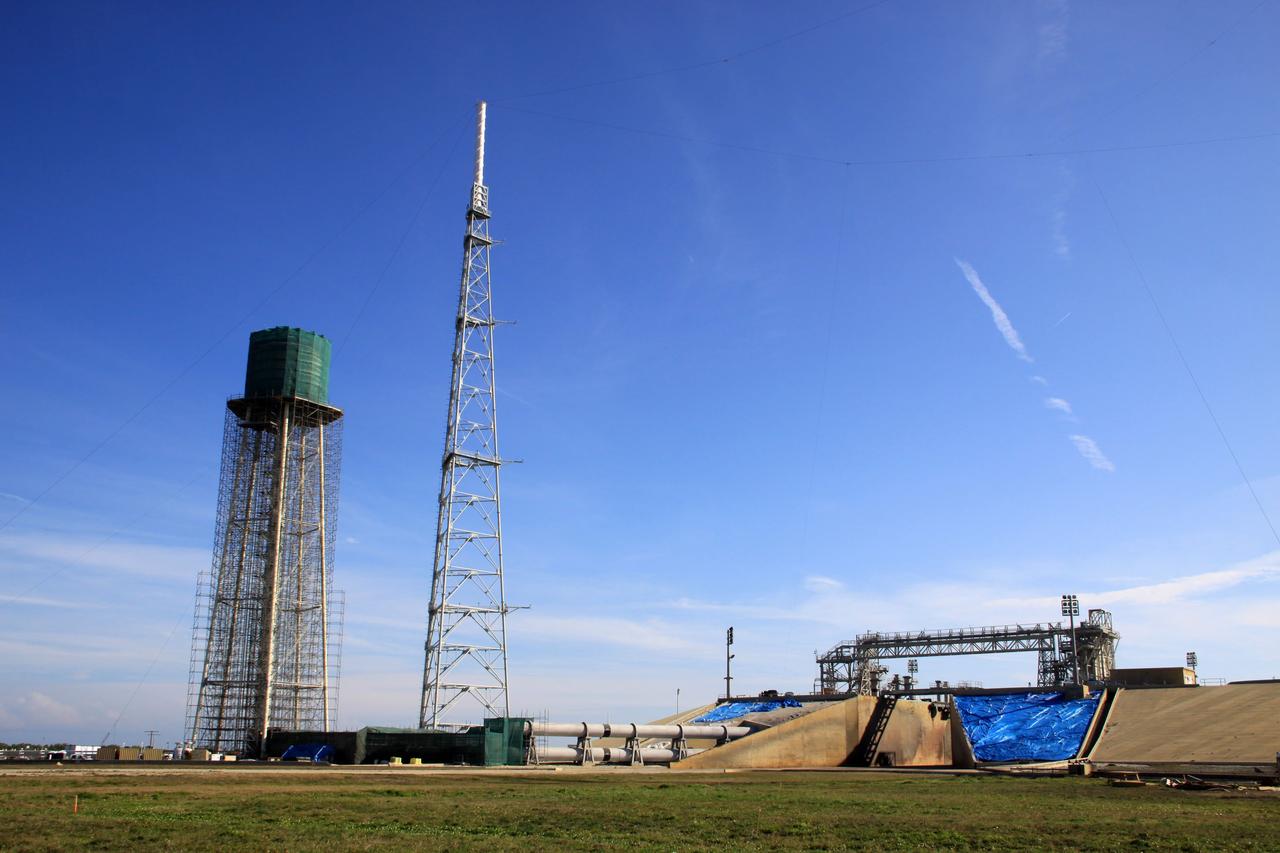
CAPE CANAVERAL, Fla. - At NASA’s Kennedy Space Center in Florida, preparations are underway to sandblast and paint the 290-foot-high water tower at Launch Pad 39B. Scaffolding surrounds the tower and a special covering has been placed around the tank. The water towers at Launch Complex 39, which includes pad A and B, were part of the sound suppression system used during space shuttle launches. Water stored in the 300,000-gallon tank would be released just prior to main engine ignition and flow by gravity to special mobile launcher platform (MLP) outlets. Nine seconds after shuttle liftoff, the peak flow rate was 900,000 gallons per minute and helped to protect the orbiter and payloads from being damaged by acoustical energy reflected from the MLP during liftoff. Photo Credit: NASA/Jim Grossmann
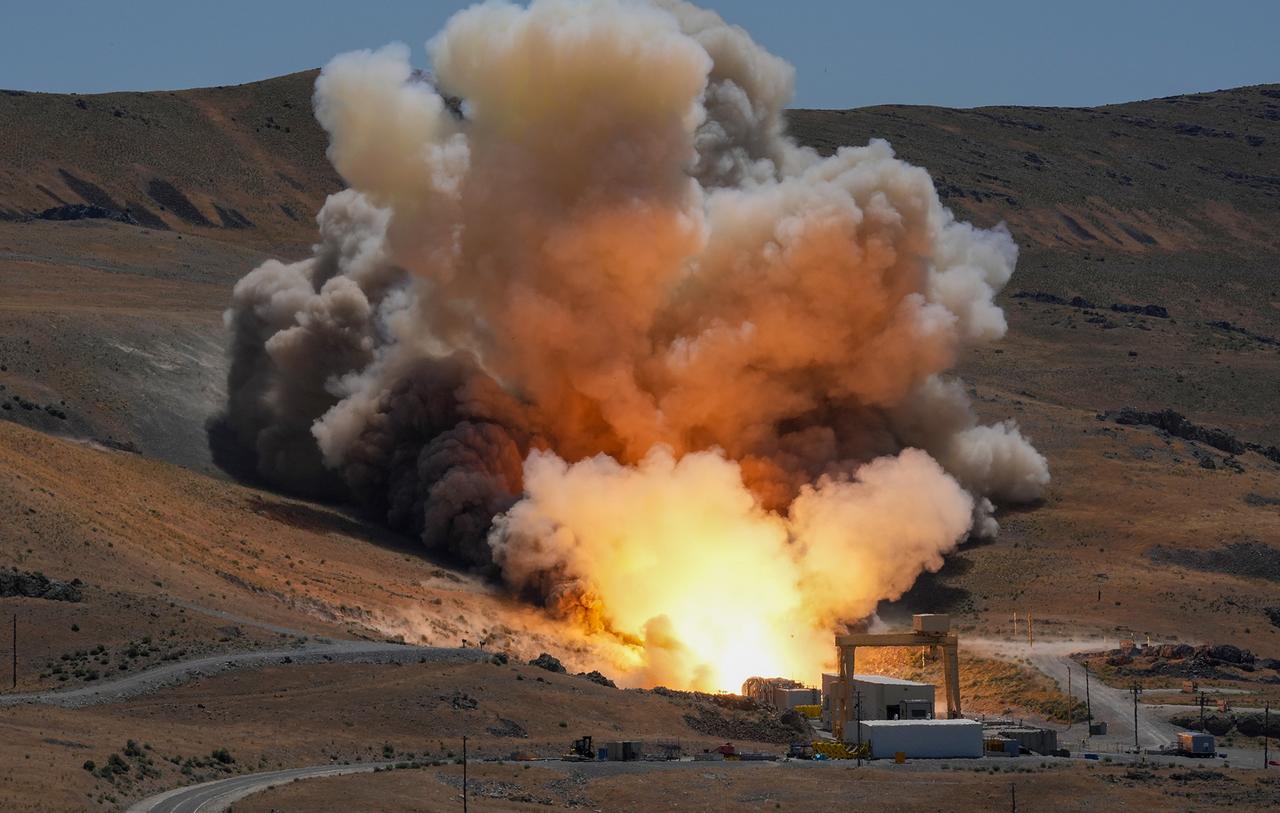
Teams from NASA and Northrop Grumman fire a ground-based version of a booster for the agency’s SLS (Space Launch System) rocket June 26. Secured horizontally in a test stand at Northrop Grumman’s test facility in Promontory, Utah, the single five-segment booster motor fired for more than two minutes and produced 3.9 million pounds of thrust. The booster for this test, known as Demonstration Motor-1 (DM-1), is the result of the Booster Obsolescence Life Extension (BOLE) project. This test was the first full-scale ground test of a new five-segment solid rocket motor. During the test, there was an abnormal event approximately 15 seconds before the end of the motor firing. Despite this event, NASA achieved several of the test’s primary objectives and received valuable data on technical risks identified ahead of the test. Testing this evolved booster for the SLS will help evaluate improvements and new materials in the boosters. The BOLE effort was launched to transition to a more efficient, lower cost commercial solution for the boosters for the SLS rocket. Through the Artemis campaign, NASA will send astronauts to explore the Moon for scientific discovery, economic benefits, and to build the foundation for the first crewed missions to Mars – for the benefit of all. For more information, contact NASA Marshall’s Office of Communications at 256-544-0034.
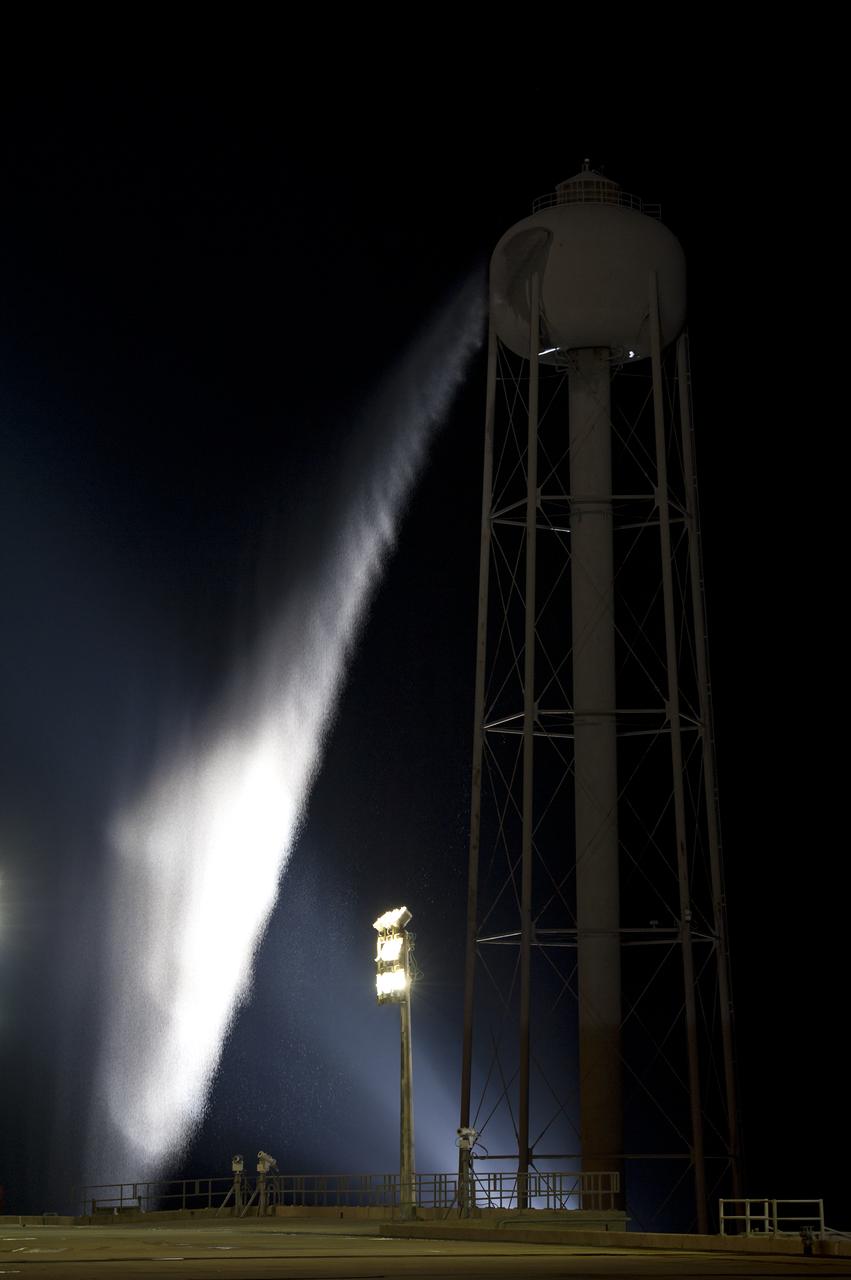
Water pours out of the 290-foot-high tower that holds 300,000 gallons of water used for sound suppression during shuttle launches on launch pad 39a shortly after the rollback of the Rotating Service Structure (RSS) from the space shuttle Endeavour, Thursday, April 28, 2011, at Kennedy Space Center in Cape Canaveral, Fla. During the 14-day mission, Endeavour and the STS-134 crew will deliver the Alpha Magnetic Spectrometer (AMS) and spare parts including two S-band communications antennas, a high-pressure gas tank and additional spare parts for Dextre. Launch is targeted for Friday, April 29 at 3:47 p.m. EDT. Photo credit: (NASA/Bill Ingalls)

Demolition of the water tower at Plum Brook Reactor
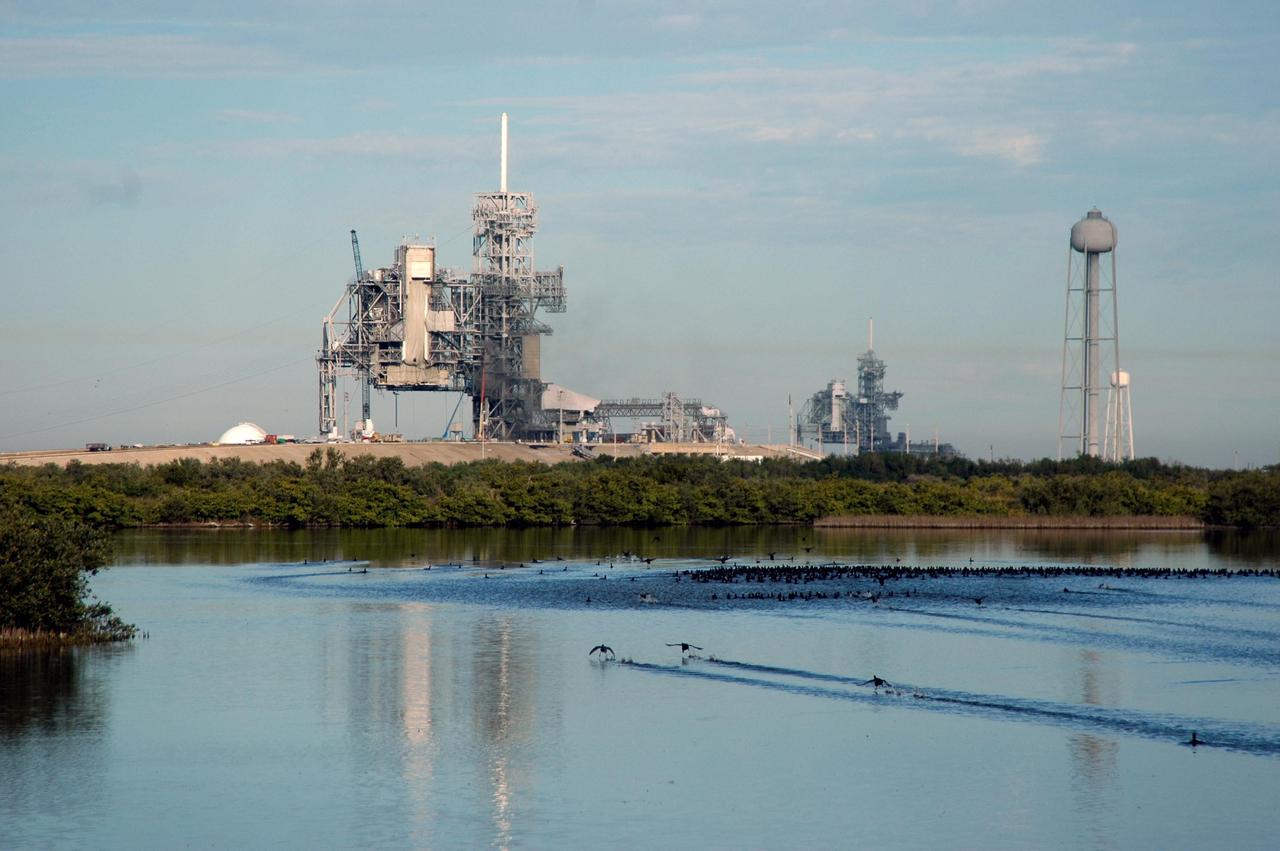
KENNEDY SPACE CENTER, FLA. - Viewed from the east side, Launch Pads 39A and 39B tower over the bird-filled waters of the Banana River at NASA Kennedy Space Center. On the far right is seen the 300-gallon water tower. Rising above the fixed service structures are the 80-foot lightning masts that help protect the structures from lightning strikes.
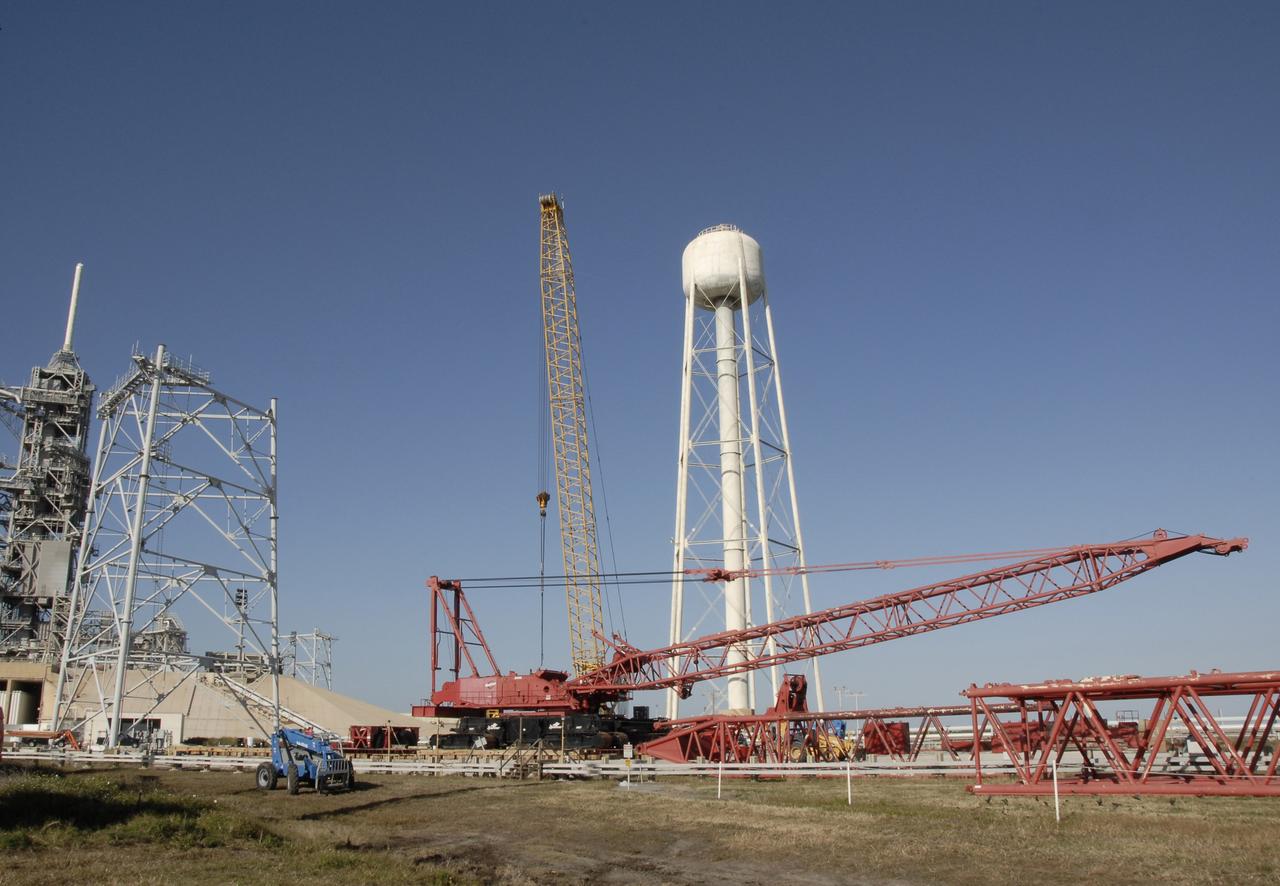
CAPE CANAVERAL, Fla. -- On Launch Pad 39B at NASA's Kennedy Space Center in Florida, segments are being added to the crane (foreground) that will be used to finish erecting the lightning towers (one is at left) on the pad. In the background is the 290-foot-high tower that holds 300,000 gallons of water used for sound suppression during shuttle launches. Lightning towers are being constructed to hold centenary wires as part of the new lightning protection system for the Constellation Program and Ares/Orion launches. Photo credit: NASA/Kim Shiflett
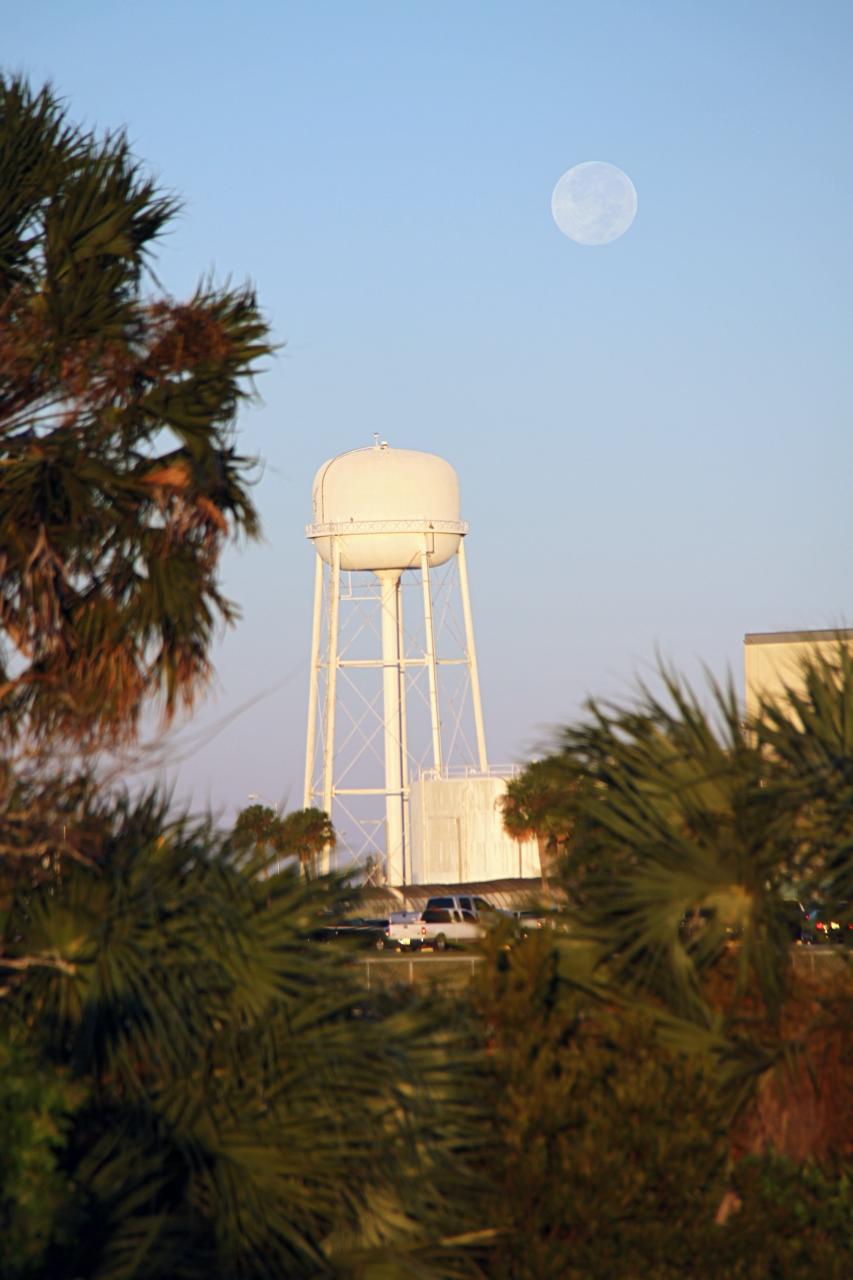
CAPE CANAVERAL, Fla. – A full moon is seen over a water tower near the Vehicle Assembly Building at NASA's Kennedy Space Center in Florida. Photo credit: NASA/Ben Smegelsky
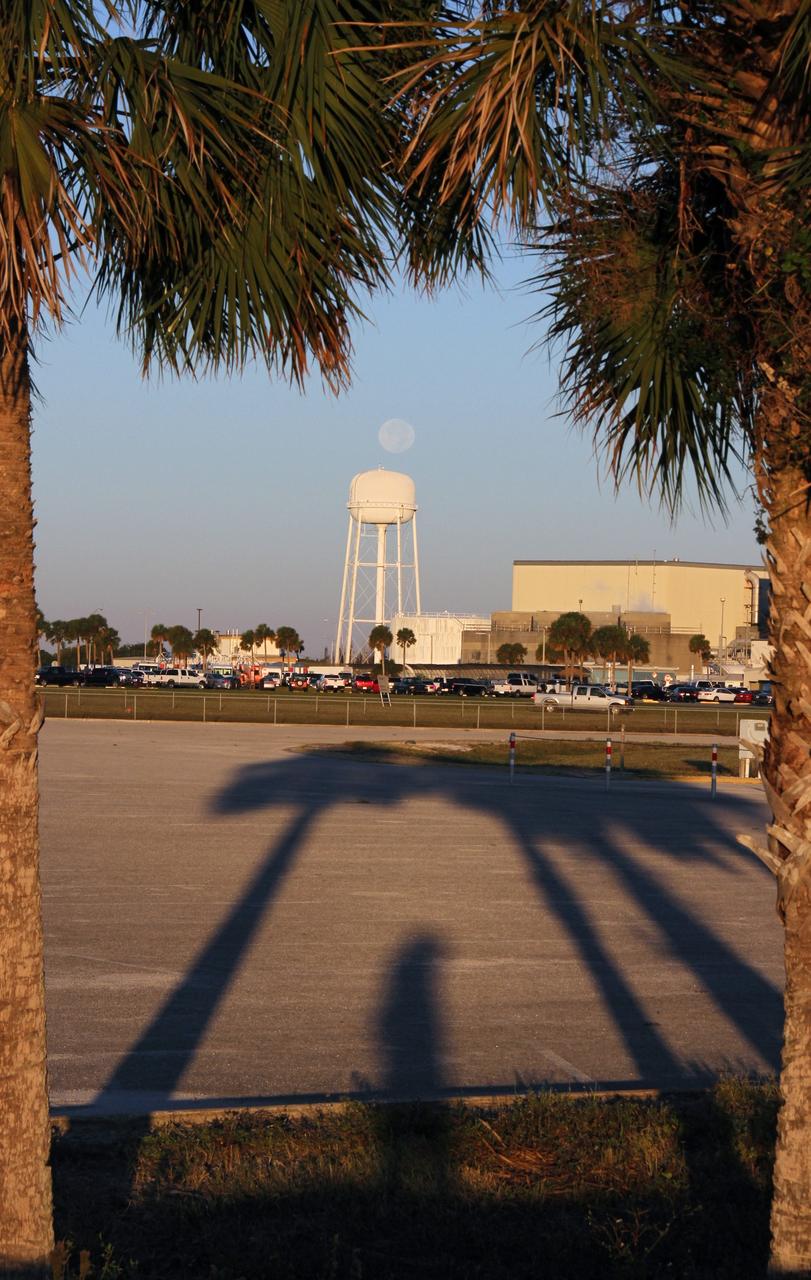
CAPE CANAVERAL, Fla. – A full moon is seen over a water tower near the Vehicle Assembly Building at NASA's Kennedy Space Center in Florida. Photo credit: NASA/Ben Smegelsky
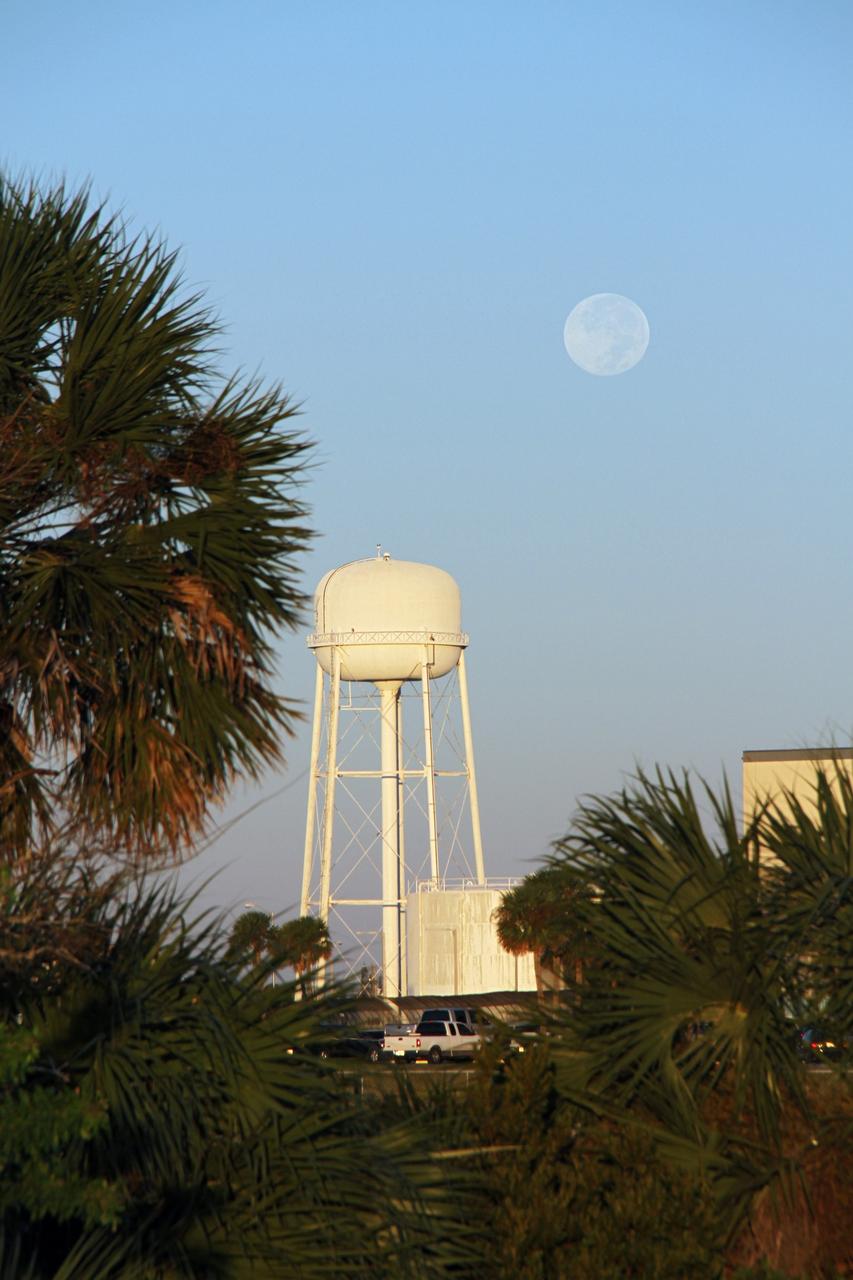
CAPE CANAVERAL, Fla. – A full moon is seen over a water tower near the Vehicle Assembly Building at NASA's Kennedy Space Center in Florida. Photo credit: NASA/Ben Smegelsky
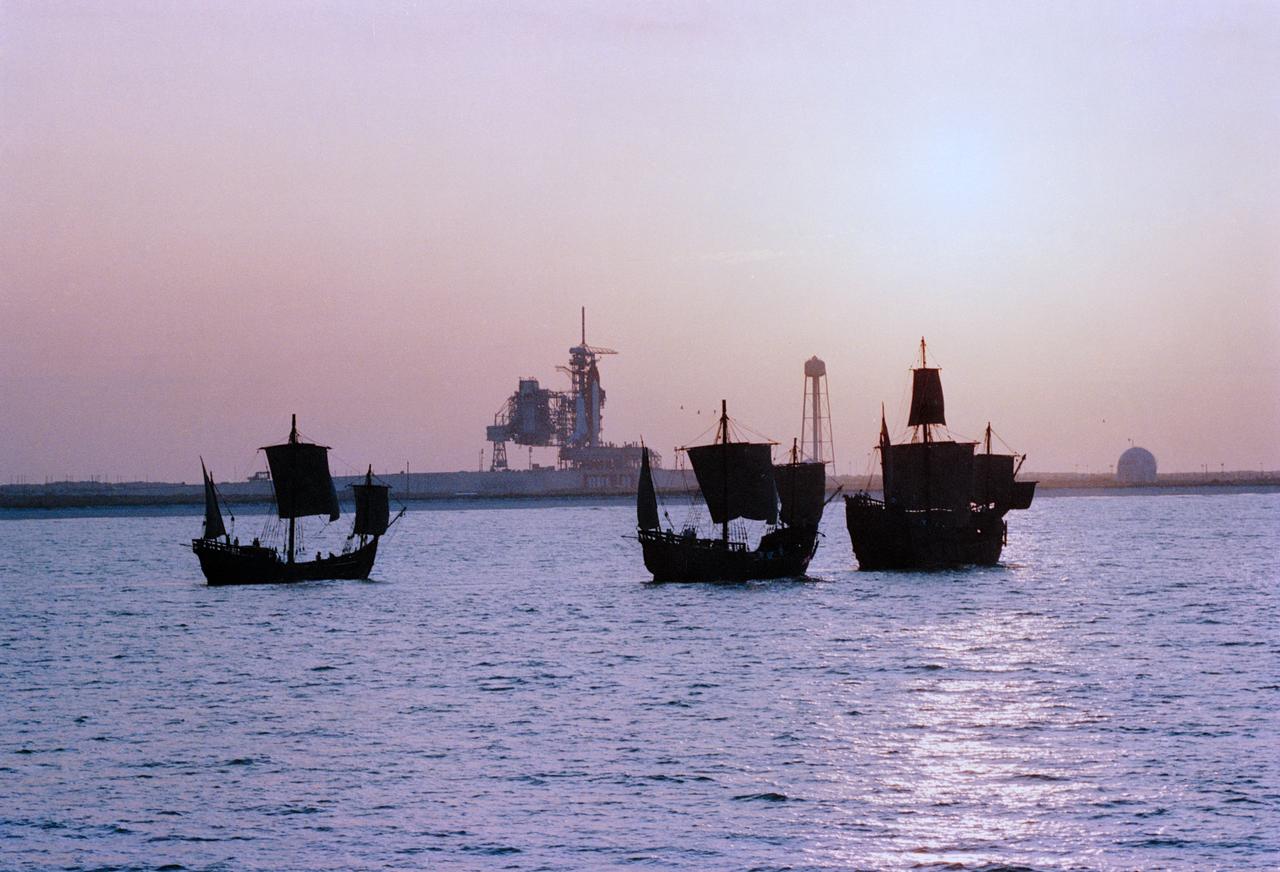
Replicas of Christopher Columbus' sailing ships Santa Maria, Nina, and Pinta sail by Endeavour, Orbiter Vehicle (OV) 105, on Kennedy Space Center (KSC) Launch Complex (LC) Pad 39B awaiting liftoff on its maiden voyage, STS-49. This view was taken from the water showing the three ships silhouetted in the foreground with OV-105 on mobile launcher platform profiled against fixed service structure (FSS) tower and rectracted rotating service structure (RSS) in the background. Next to the launch pad (at right) are the sound suppression water system tower and the liquid hydrogen (LH2) storage tank. View provided by KSC with alternate number KSC-92PC-970.
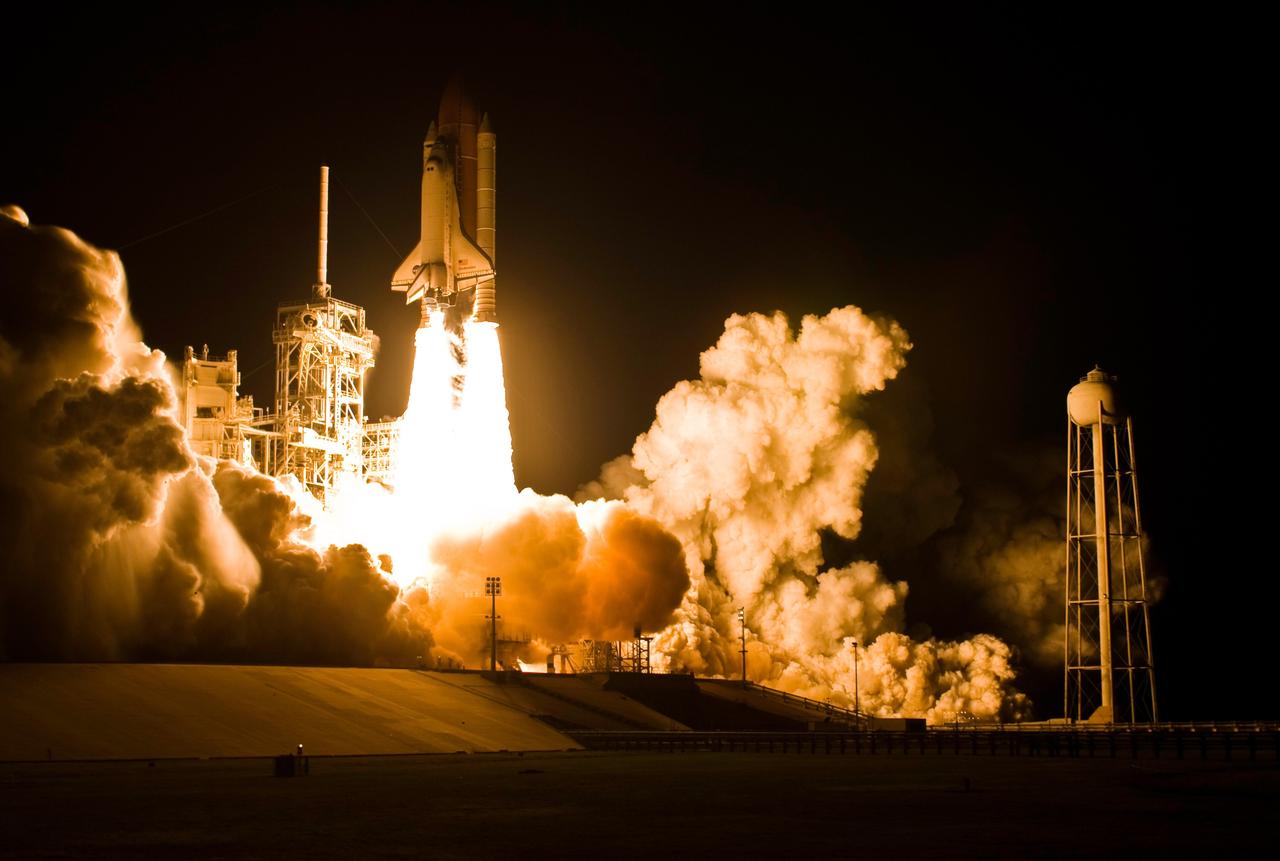
KENNEDY SPACE CENTER, FLA. -- Light-filled clouds of smoke and steam roll across Launch Pad 39A at NASA's Kennedy Space Center as space shuttle Endeavour roars into the night sky atop twin towers of flame on the STS-123 mission. At right is the 300,000-gallon water tower that provides the water used for sound suppression on the pad at liftoff. The liftoff was on time at 2:28 a.m. EDT. Endeavour's crew will make a record-breaking 16-day mission to the International Space Station and deliver the first section of the Japan Aerospace Exploration Agency's Kibo laboratory and the Canadian Space Agency's two-armed robotic system, Dextre. Photo courtesy of Scott Andrews
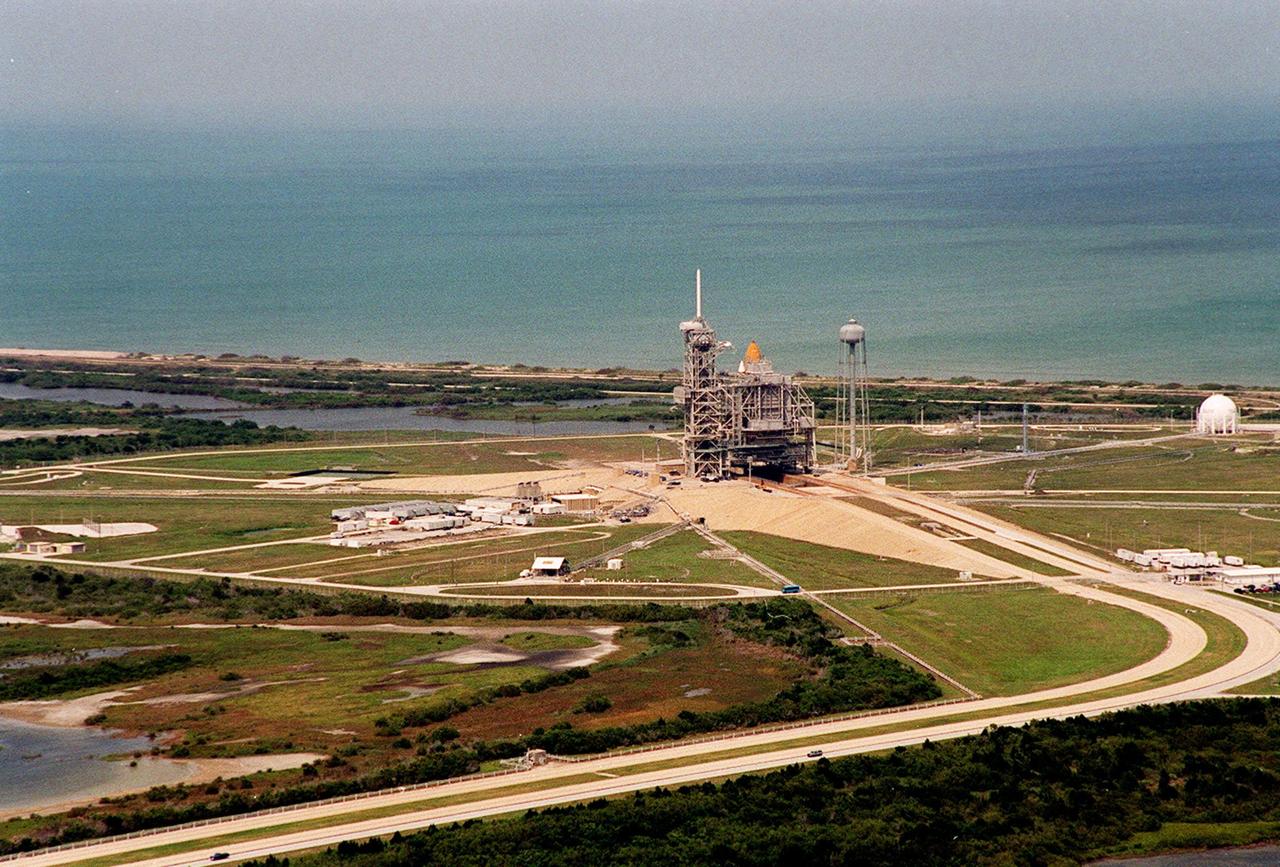
This aerial view captures KSC's Launch Pad 39A, with the rotating service structure closed around Shuttle Atlantis. Just visible in the center is the top of the orange-colored external tank. On the left side towers the white 80-foot fiberglass lightning mast; on the right is the 300,000-gallon water tower used for sound suppression during launch. The launch pad abuts the Atlantic Ocean on the east, seen here in the background
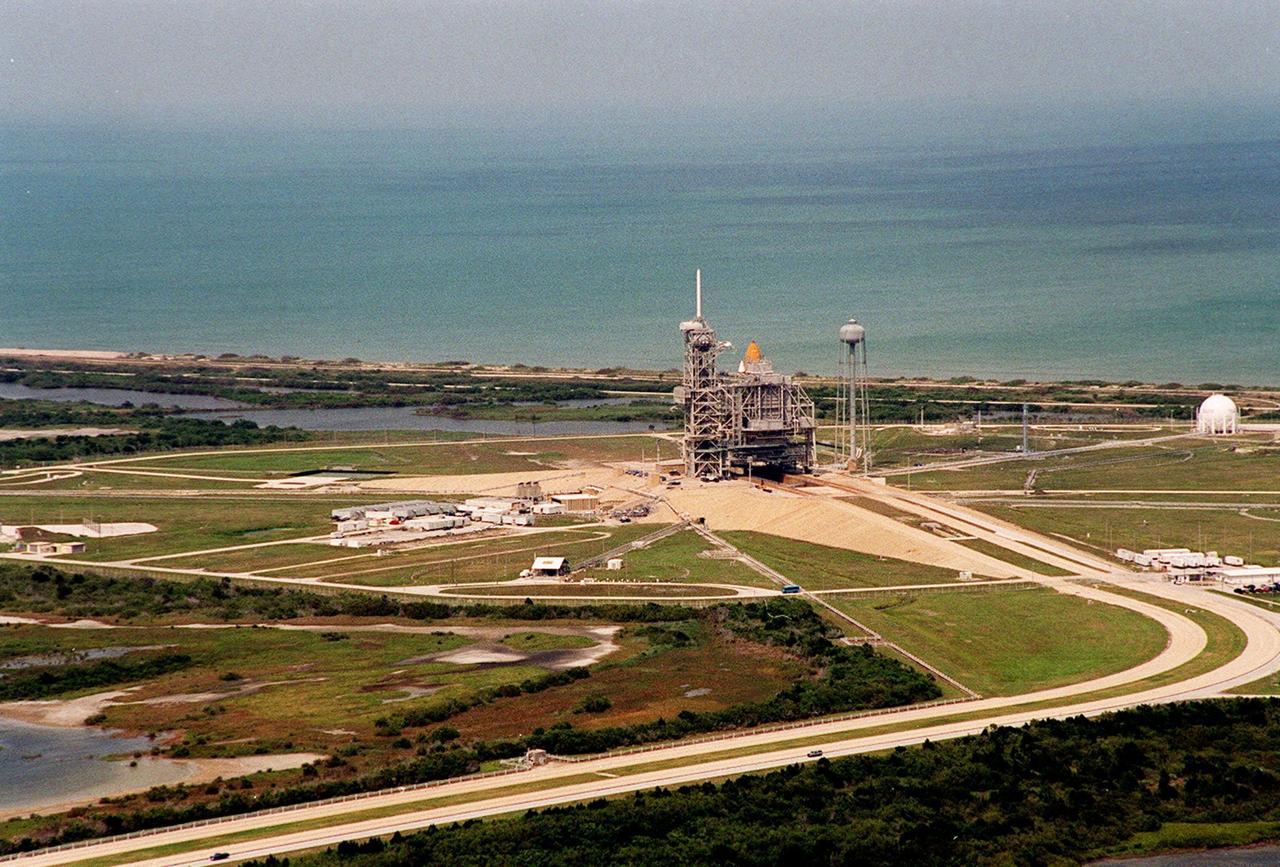
This aerial view captures KSC's Launch Pad 39A, with the rotating service structure closed around Shuttle Atlantis. Just visible in the center is the top of the orange-colored external tank. On the left side towers the white 80-foot fiberglass lightning mast; on the right is the 300,000-gallon water tower used for sound suppression during launch. The launch pad abuts the Atlantic Ocean on the east, seen here in the background
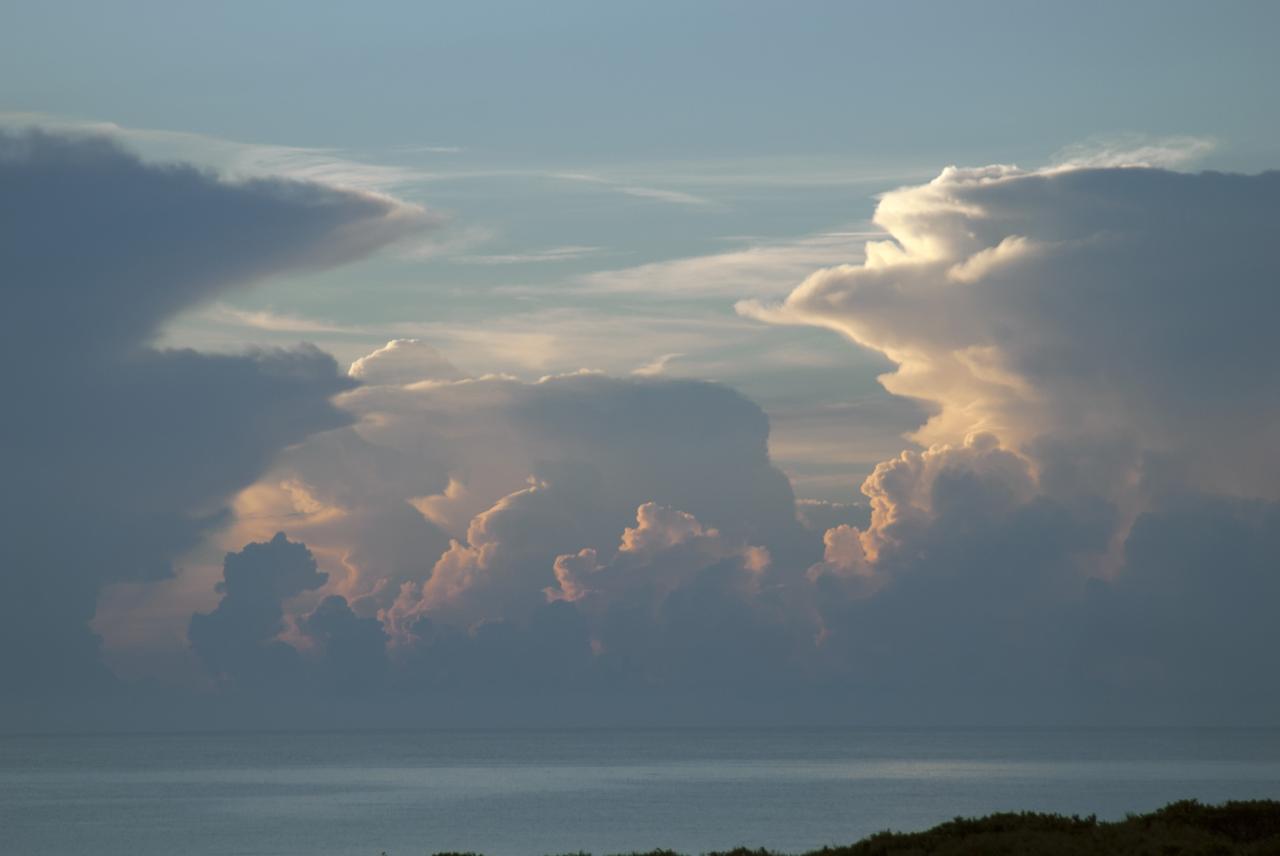
CAPE CANAVERAL, Fla. – Towering cumulonimbus clouds cast shadows on the water during the early morning in this view looking east toward the Atlantic Ocean from the Space Launch Complex 37 area at Cape Canaveral Air Force Station in Florida. Photo credit: NASA/Jim Grossmann
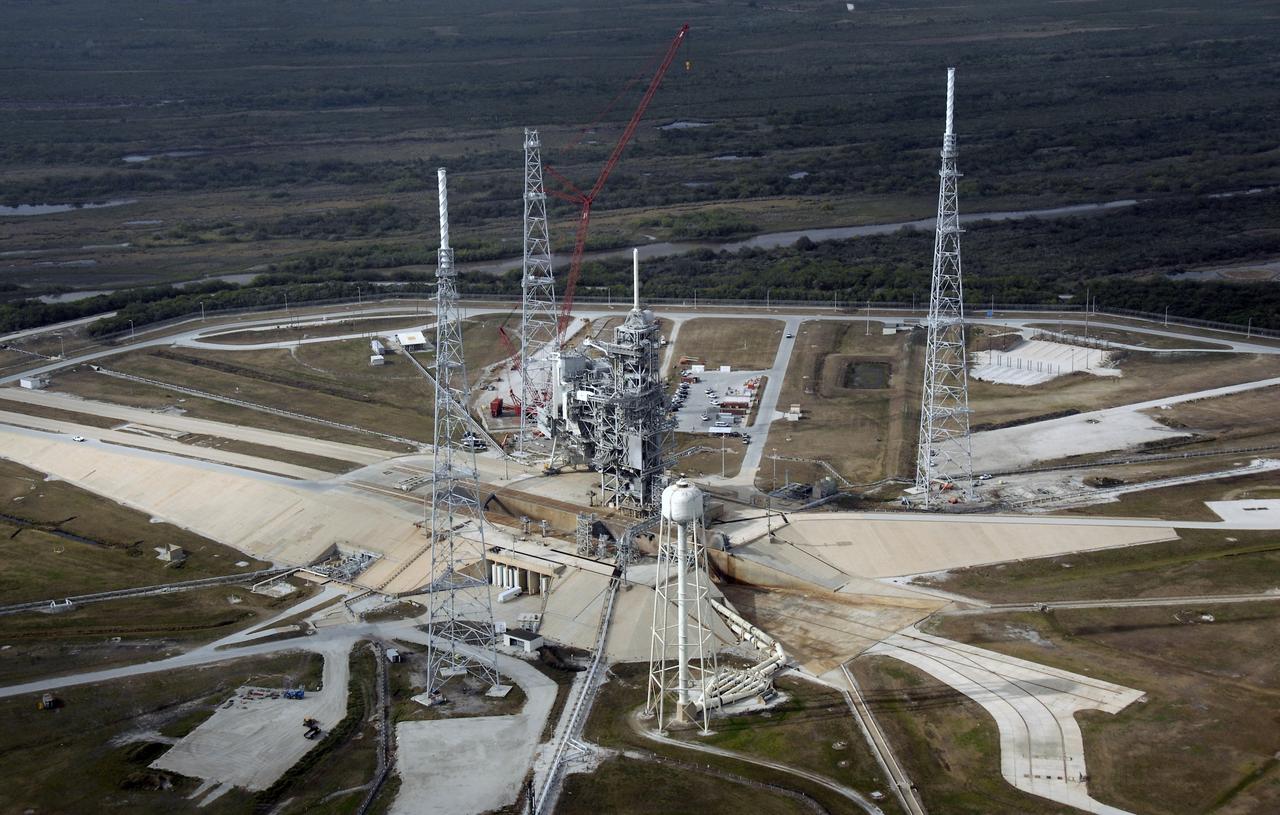
CAPE CANAVERAL, Fla. – An aerial view of the newly erected lightning towers on Launch Pad 39B at NASA's Kennedy Space Center in Florida. The two towers at left and right contain the lightning mast on top; the one at center does not. At center are the fixed and rotating service structures that have served the Space Shuttle Program. In the foreground is the tower that holds 300,000 gallons of water used for sound suppression during a shuttle liftoff. The new lightning protection system is being built for the Constellation Program and Ares/Orion launches. Each of the towers is 500 feet tall with an additional 100-foot fiberglass mast atop supporting a wire catenary system. This improved lightning protection system allows for the taller height of the Ares I rocket compared to the space shuttle. Pad 39B will be the site of the first Ares rocket launch, including the Ares I-X test flight that is targeted for July 2009. Photo credit: NASA/Kim Shiflett
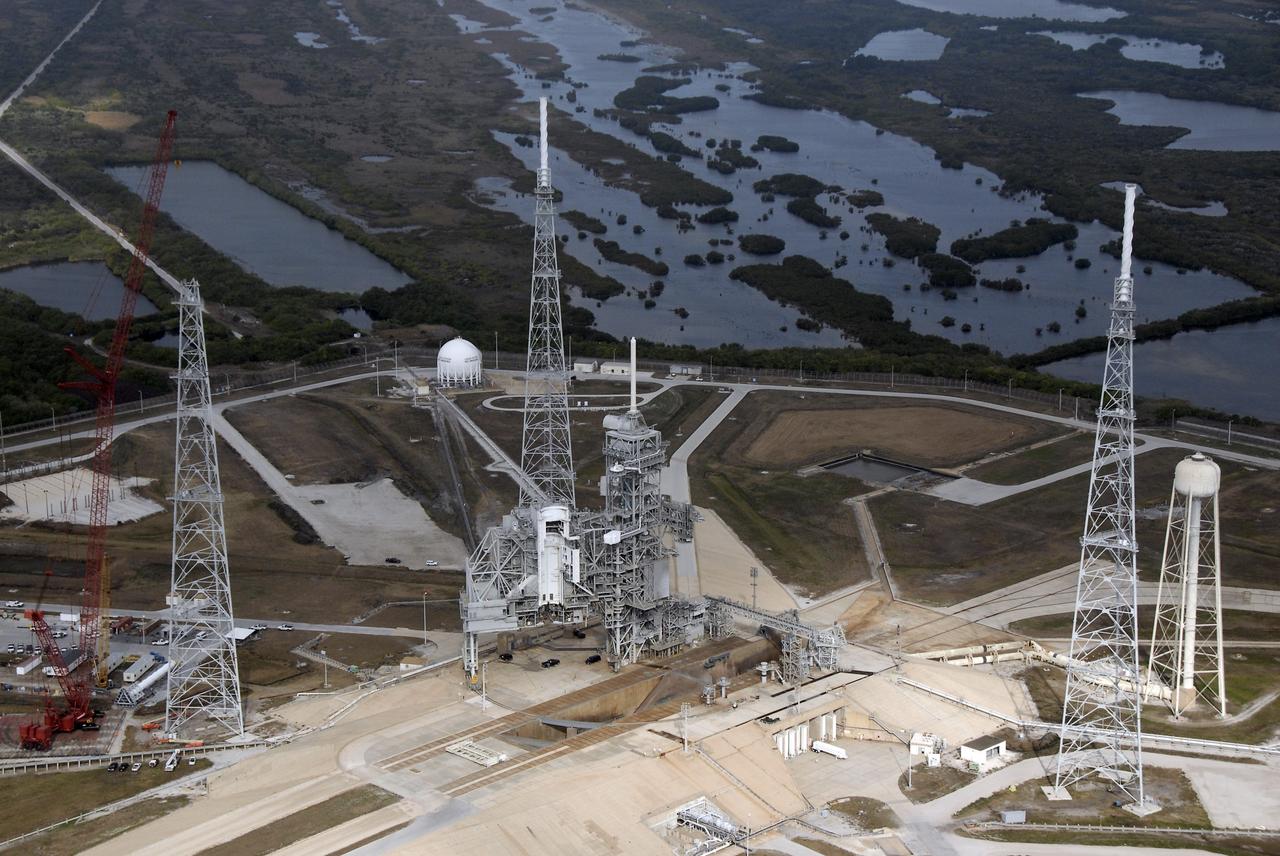
CAPE CANAVERAL, Fla. – An aerial view of the newly erected lightning towers on Launch Pad 39B at NASA's Kennedy Space Center. The two towers at center and right contain the lightning mast on top; the one at left does not. At center are the fixed and rotating service structures that have served the Space Shuttle Program. In the foreground is the tower that holds 300,000 gallons of water used for sound suppression during a shuttle liftoff. The new lightning protection system is being built for the Constellation Program and Ares/Orion launches. Each of the towers is 500 feet tall with an additional 100-foot fiberglass mast atop supporting a wire catenary system. This improved lightning protection system allows for the taller height of the Ares I rocket compared to the space shuttle. Pad 39B will be the site of the first Ares rocket launch, including the Ares I-X test flight that is targeted for July 2009. Photo credit: NASA/Kim Shiflett
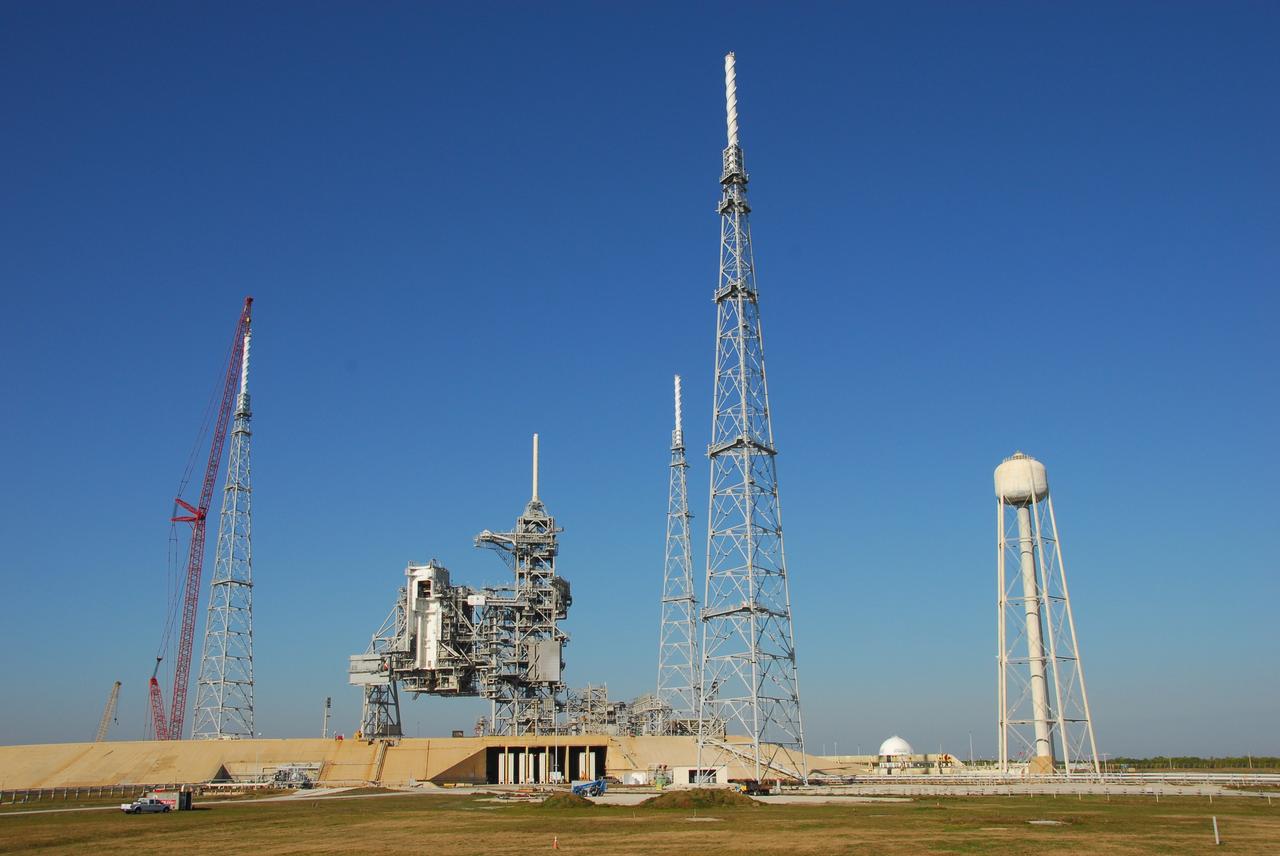
CAPE CANAVERAL, Fla. – On Launch Pad 39B at NASA's Kennedy Space Center in Florida, a giant crane (far left) places the 100-foot lightning mast on top of the newly erected lightning tower. Three new towers surround the pad. In the middle are the fixed and rotating service structures that serve the Space Shuttle Program. At far right is the tower that holds 300,000 gallons of water used for sound suppression during a shuttle launch. The new lightning protection system is being built for the Constellation Program and Ares/Orion launches. Each of the towers is 500 feet tall with an additional 100-foot fiberglass mast atop supporting a wire catenary system. This improved lightning protection system allows for the taller height of the Ares I rocket compared to the space shuttle. Pad 39B will be the site of the first Ares vehicle launch, including the Ares I-X test flight that is targeted for July 2009. Photo credit: NASA/Tim Jacobs
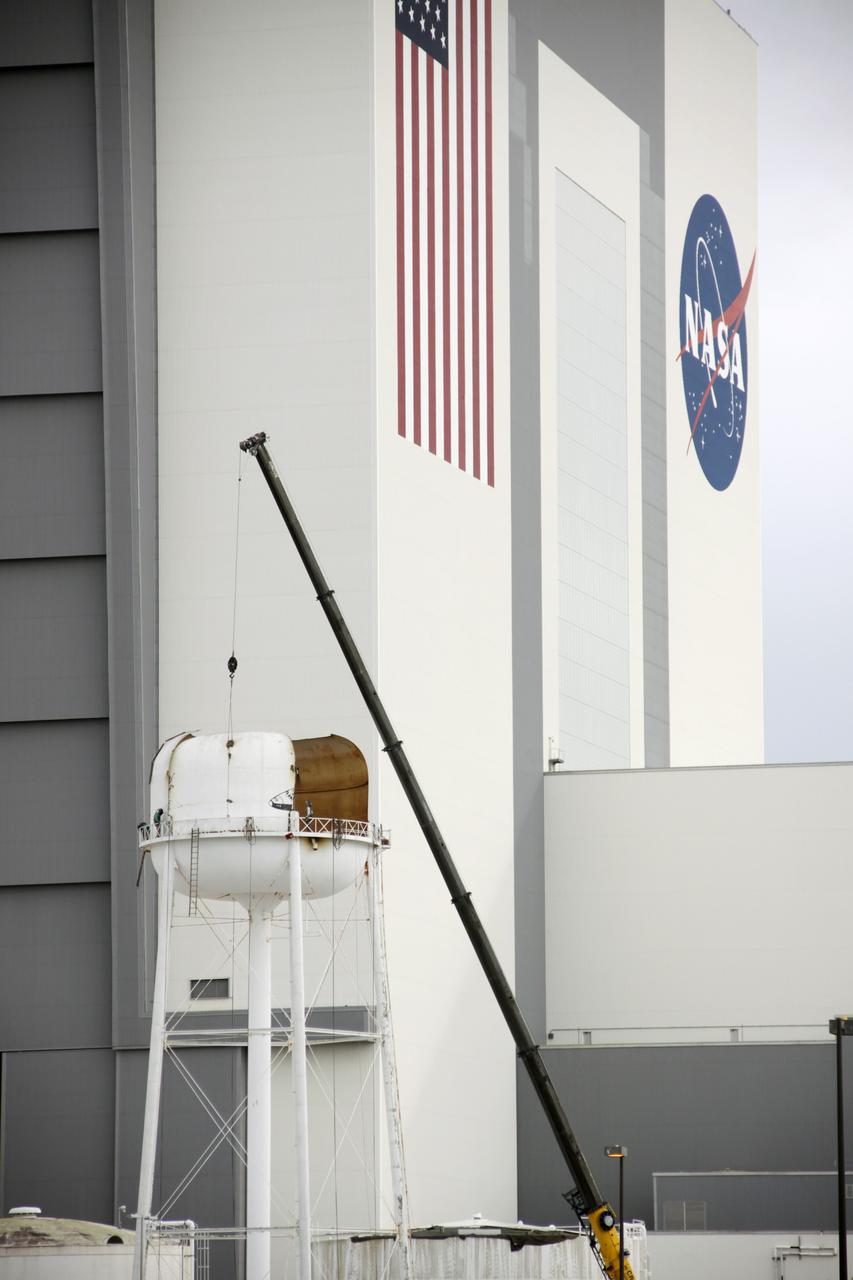
CAPE CANAVERAL, Fla. – At NASA’s Kennedy Space Center in Florida, work is underway to dismantle a water tower in the Launch Complex 39 area near the Vehicle Assembly Building. The effort is part of on-going efforts to upgrade and revitalize Kennedy's water and sewer systems to increase their reliability, sustainability and capabilities into the 21st century for current and future users. For more information, visit: http://kscpartnerships.ksc.nasa.gov/masterPlan/spaceportConcept.htm Photo credit: NASA/Tim Jacobs
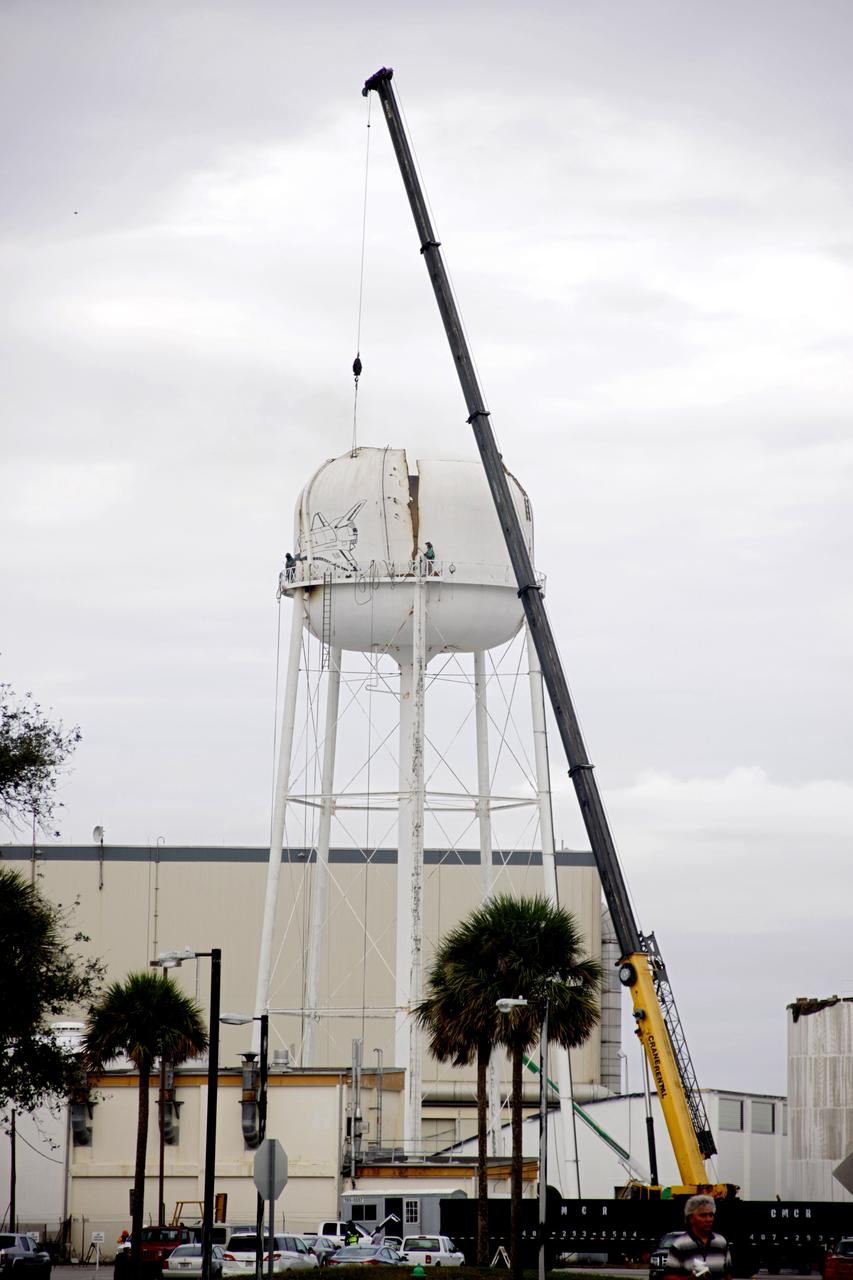
CAPE CANAVERAL, Fla. – At NASA’s Kennedy Space Center in Florida, work is underway to dismantle a water tower in the Launch Complex 39 area near the Vehicle Assembly Building. The effort is part of on-going efforts to upgrade and revitalize Kennedy's water and sewer systems to increase their reliability, sustainability and capabilities into the 21st century for current and future users. For more information, visit: http://kscpartnerships.ksc.nasa.gov/masterPlan/spaceportConcept.htm Photo credit: NASA/Tim Jacobs
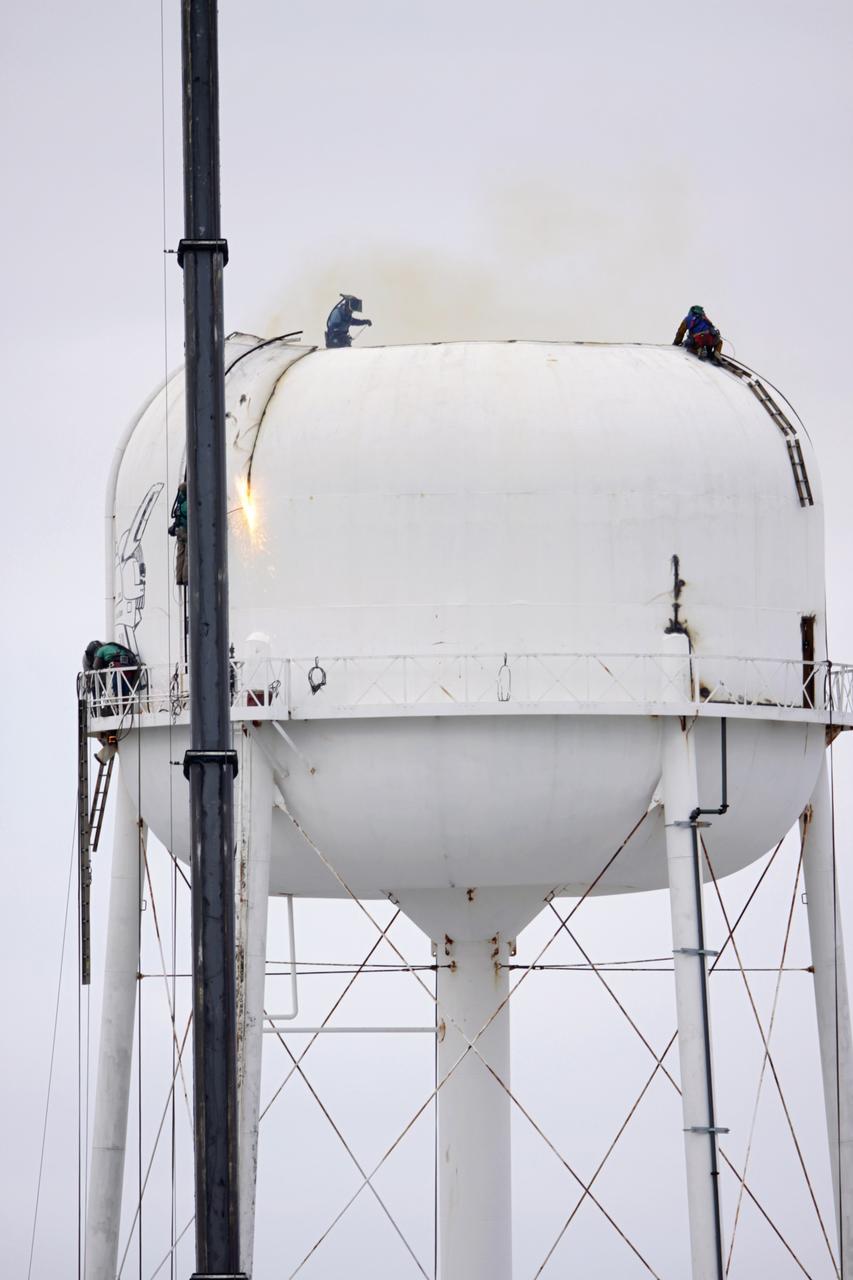
CAPE CANAVERAL, Fla. – Workers use a cutting torch to dismantle a water tower in the Launch Complex 39 area at NASA’s Kennedy Space Center in Florida. The effort is part of on-going efforts to upgrade and revitalize Kennedy's water and sewer systems to increase their reliability, sustainability and capabilities into the 21st century for current and future users. For more information, visit: http://kscpartnerships.ksc.nasa.gov/masterPlan/spaceportConcept.htm Photo credit: NASA/Tim Jacobs
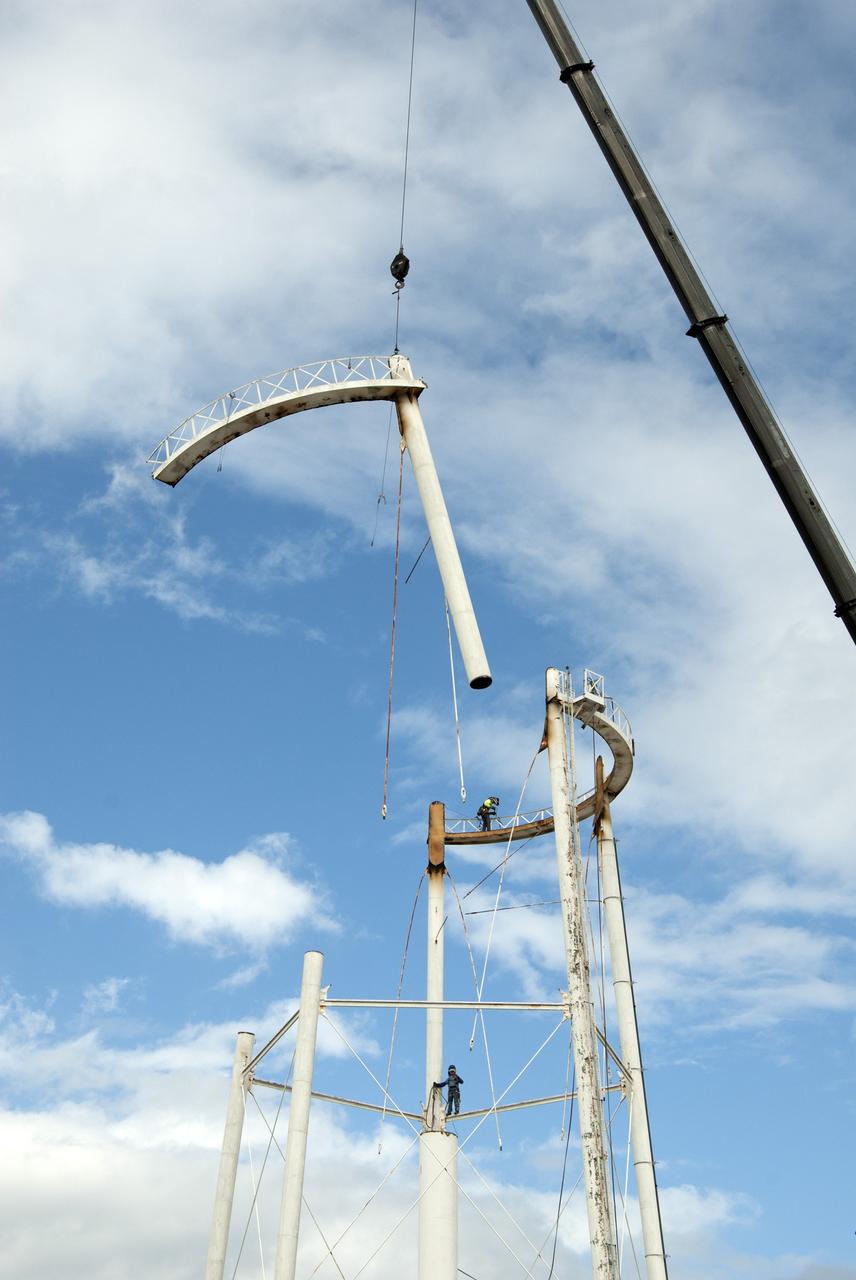
CAPE CANAVERAL, Fla. – At NASA’s Kennedy Space Center in Florida, work is underway to dismantle a water tower in the Launch Complex 39 area near the Vehicle Assembly Building. The effort is part of on-going efforts to upgrade and revitalize Kennedy's water and sewer systems to increase their reliability, sustainability and capabilities into the 21st century for current and future users. For more information, visit: http://kscpartnerships.ksc.nasa.gov/masterPlan/spaceportConcept.htm Photo credit: NASA/Jim Grossmann
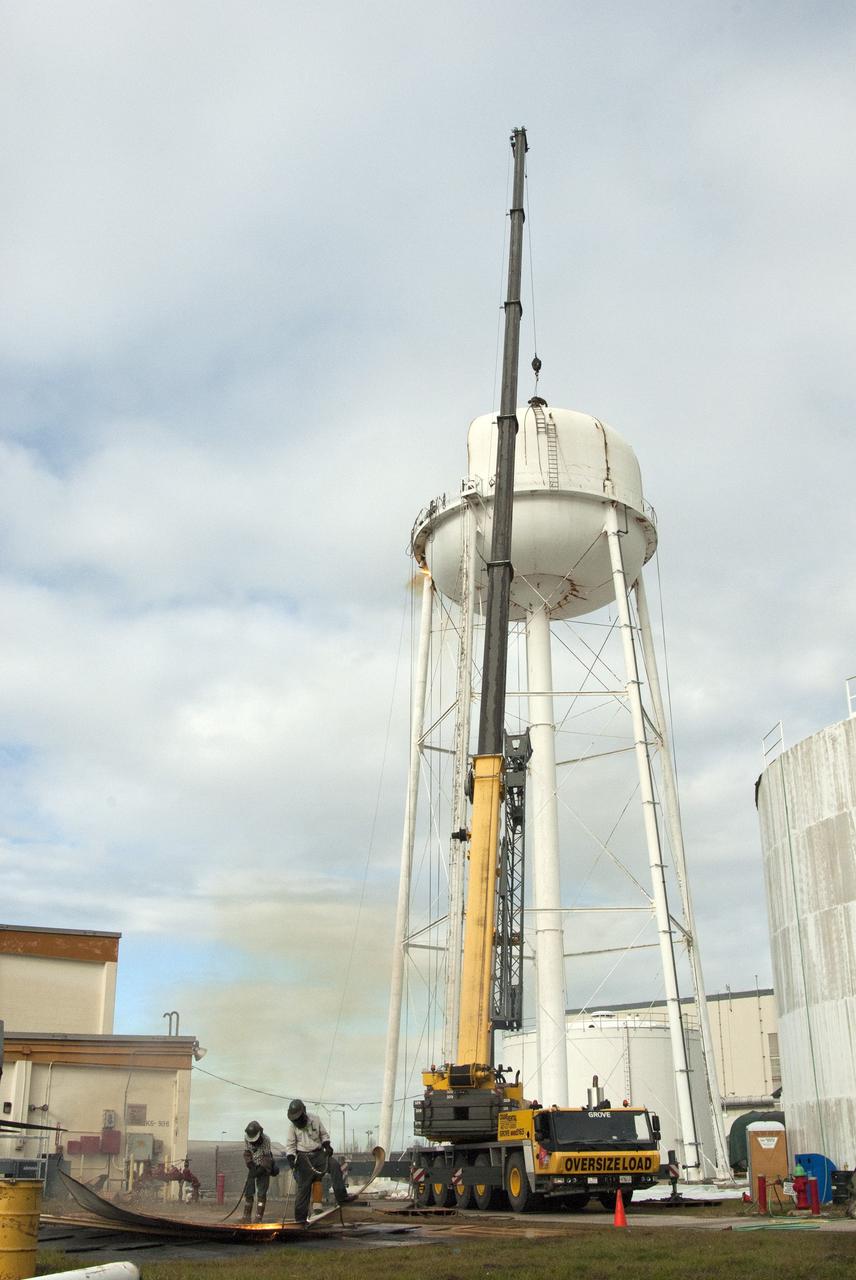
CAPE CANAVERAL, Fla. – Workers use a cutting torch to dismantle parts of a water tower in the Launch Complex 39 area at NASA’s Kennedy Space Center in Florida. The effort is part of on-going efforts to upgrade and revitalize Kennedy's water and sewer systems to increase their reliability, sustainability and capabilities into the 21st century for current and future users. For more information, visit: http://kscpartnerships.ksc.nasa.gov/masterPlan/spaceportConcept.htm Photo credit: NASA/Jim Grossmann
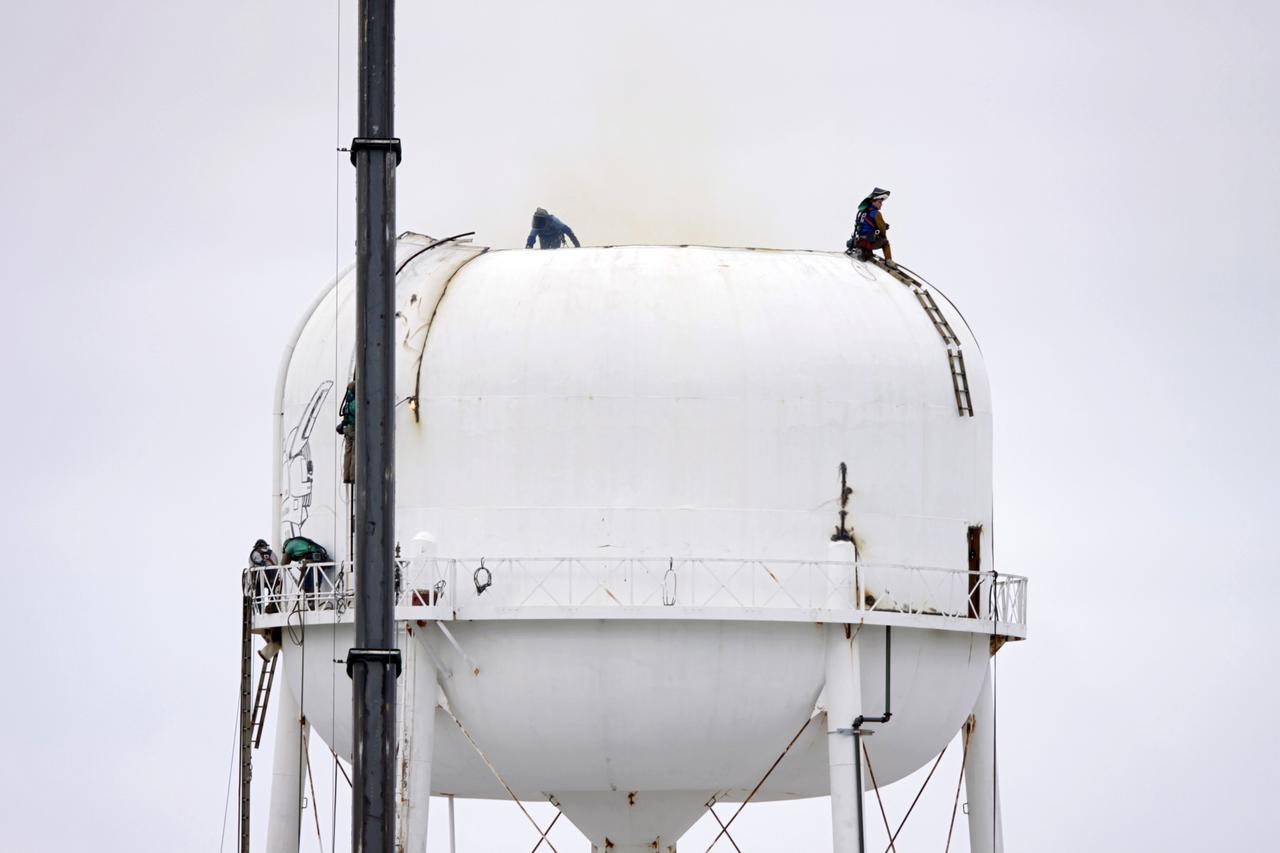
CAPE CANAVERAL, Fla. – Workers use a cutting torch to dismantle a water tower in the Launch Complex 39 area at NASA’s Kennedy Space Center in Florida. The effort is part of on-going efforts to upgrade and revitalize Kennedy's water and sewer systems to increase their reliability, sustainability and capabilities into the 21st century for current and future users. For more information, visit: http://kscpartnerships.ksc.nasa.gov/masterPlan/spaceportConcept.htm Photo credit: NASA/Tim Jacobs
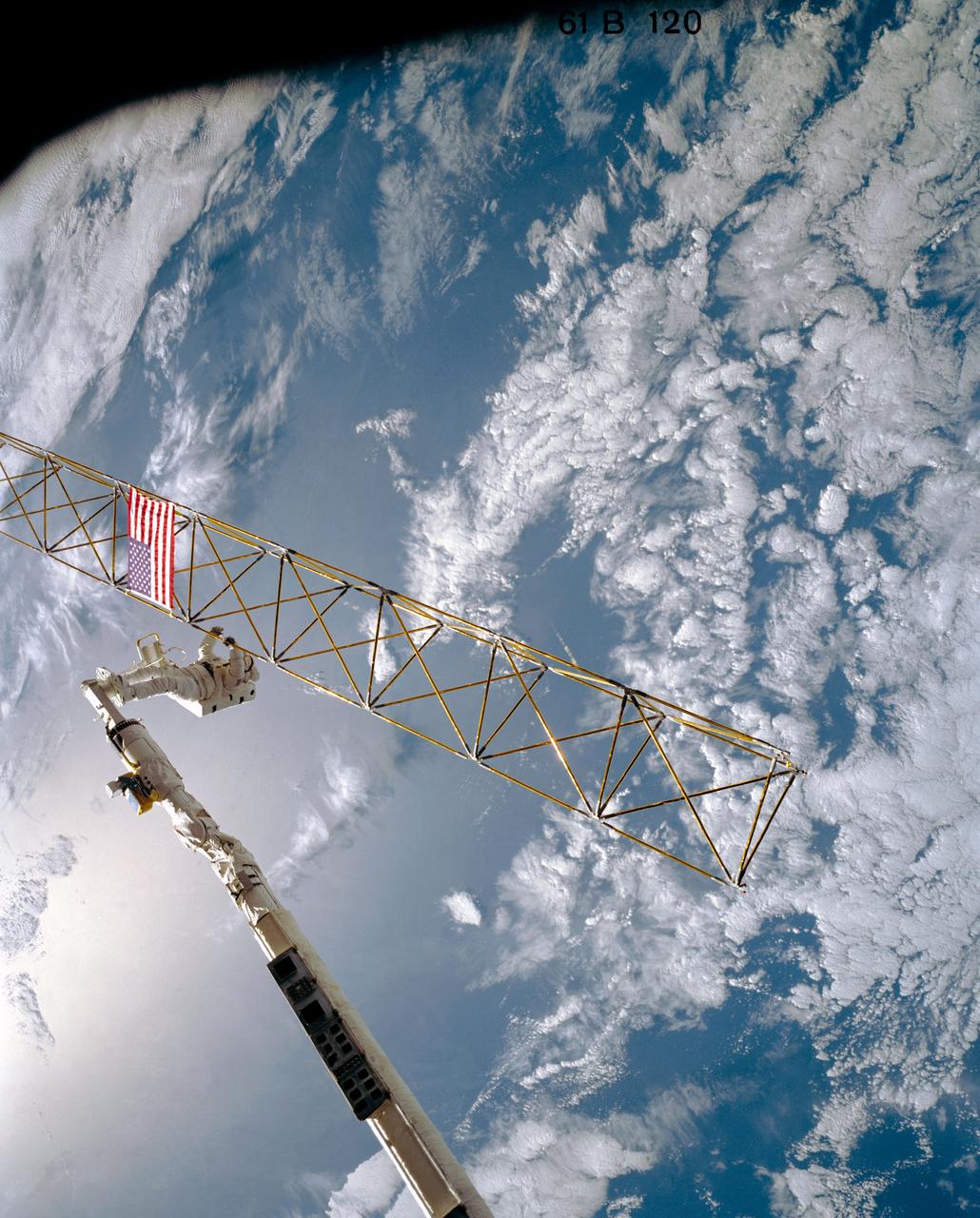
Astronaut Sherwood C. Spring, anchored to the foot restraint on the remote manipulator system (RMS) arm, checks joints on the tower-like Assembly Concept for Construction of Erectable Space Structures (ACCESS) device extending from the payload bay as the Atlantis flies over white clouds and blue ocean waters. The Gulf of Mexico waters form the backdrop for the scene.
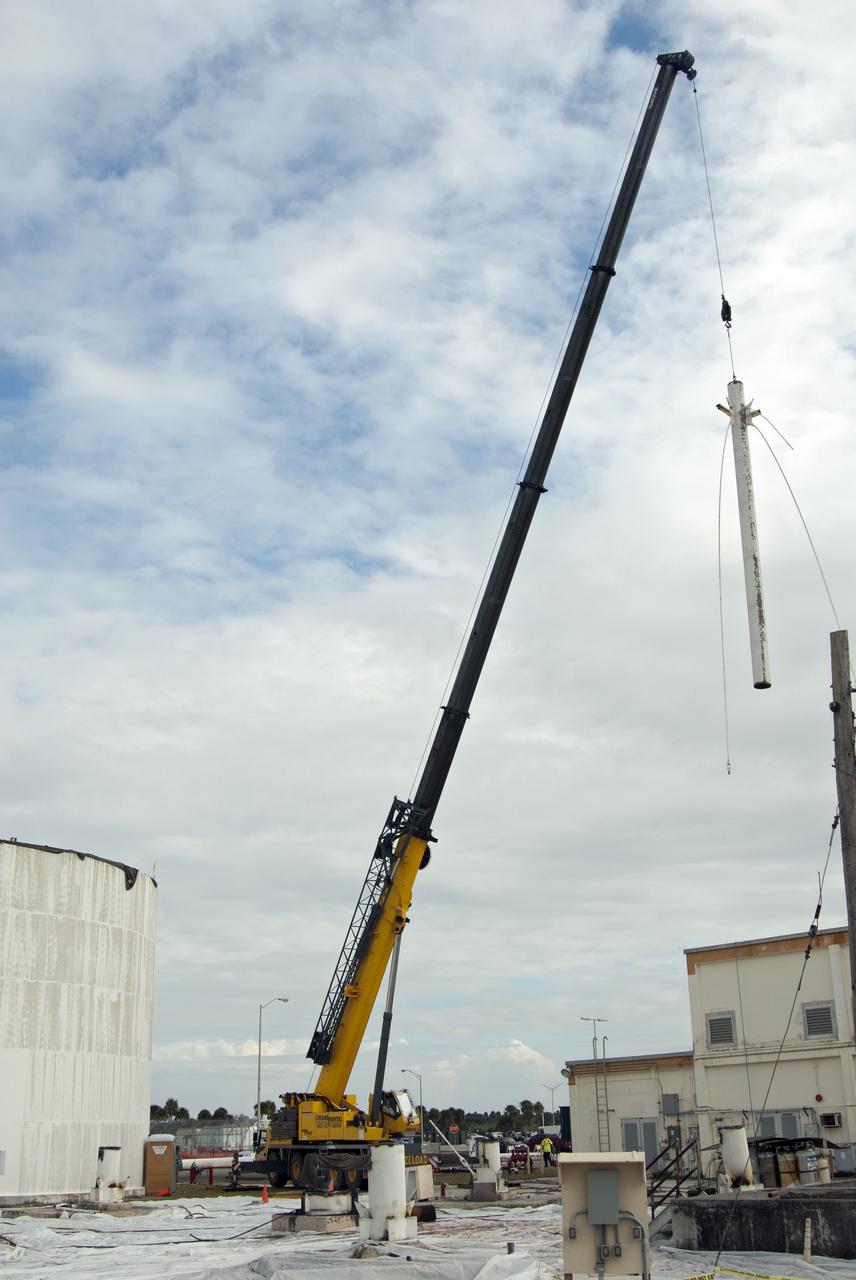
CAPE CANAVERAL, Fla. – At NASA’s Kennedy Space Center in Florida, work is underway to dismantle a water tower in the Launch Complex 39 area near the Vehicle Assembly Building. The effort is part of on-going efforts to upgrade and revitalize Kennedy's water and sewer systems to increase their reliability, sustainability and capabilities into the 21st century for current and future users. For more information, visit: http://kscpartnerships.ksc.nasa.gov/masterPlan/spaceportConcept.htm Photo credit: NASA/Jim Grossmann
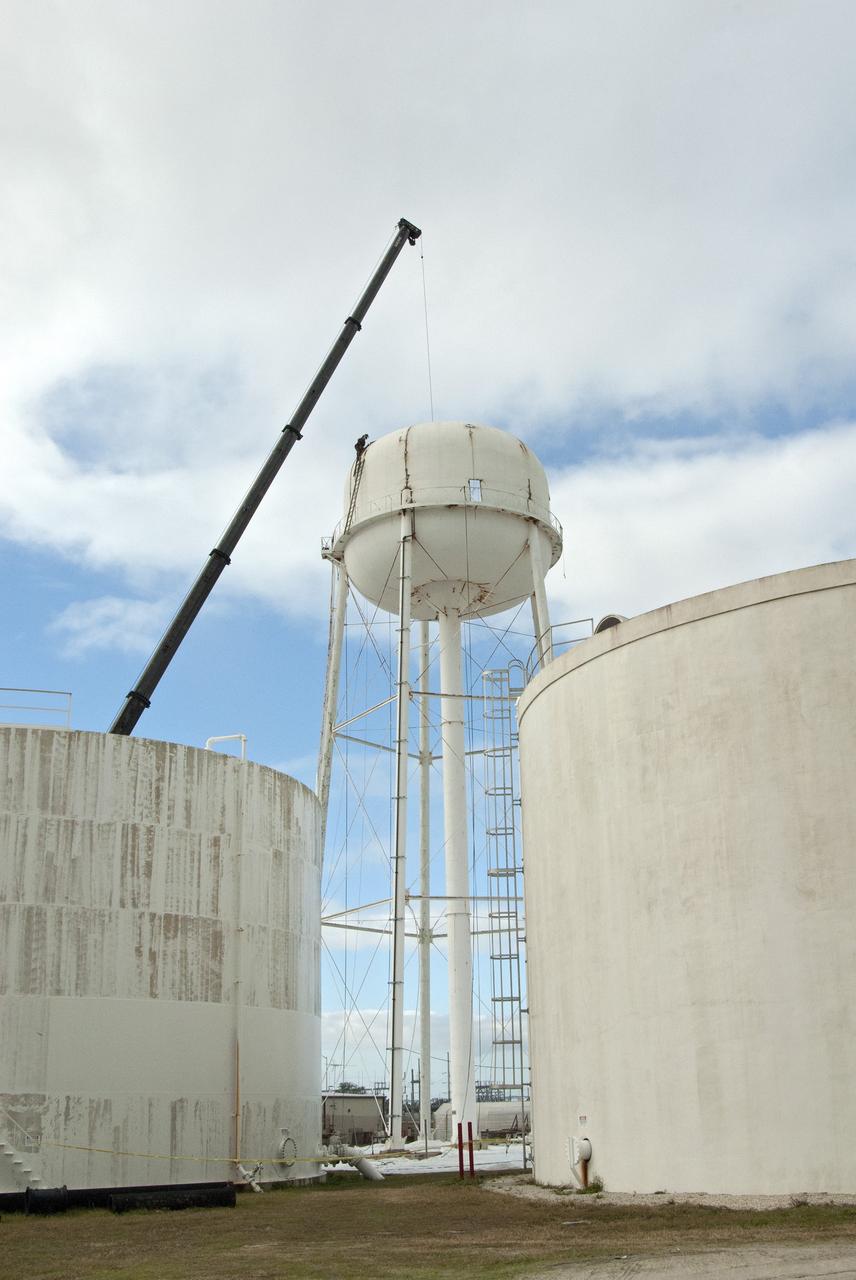
CAPE CANAVERAL, Fla. – At NASA’s Kennedy Space Center in Florida, work is underway to dismantle a water tower in the Launch Complex 39 area near the Vehicle Assembly Building. The effort is part of on-going efforts to upgrade and revitalize Kennedy's water and sewer systems to increase their reliability, sustainability and capabilities into the 21st century for current and future users. For more information, visit: http://kscpartnerships.ksc.nasa.gov/masterPlan/spaceportConcept.htm Photo credit: NASA/Jim Grossmann
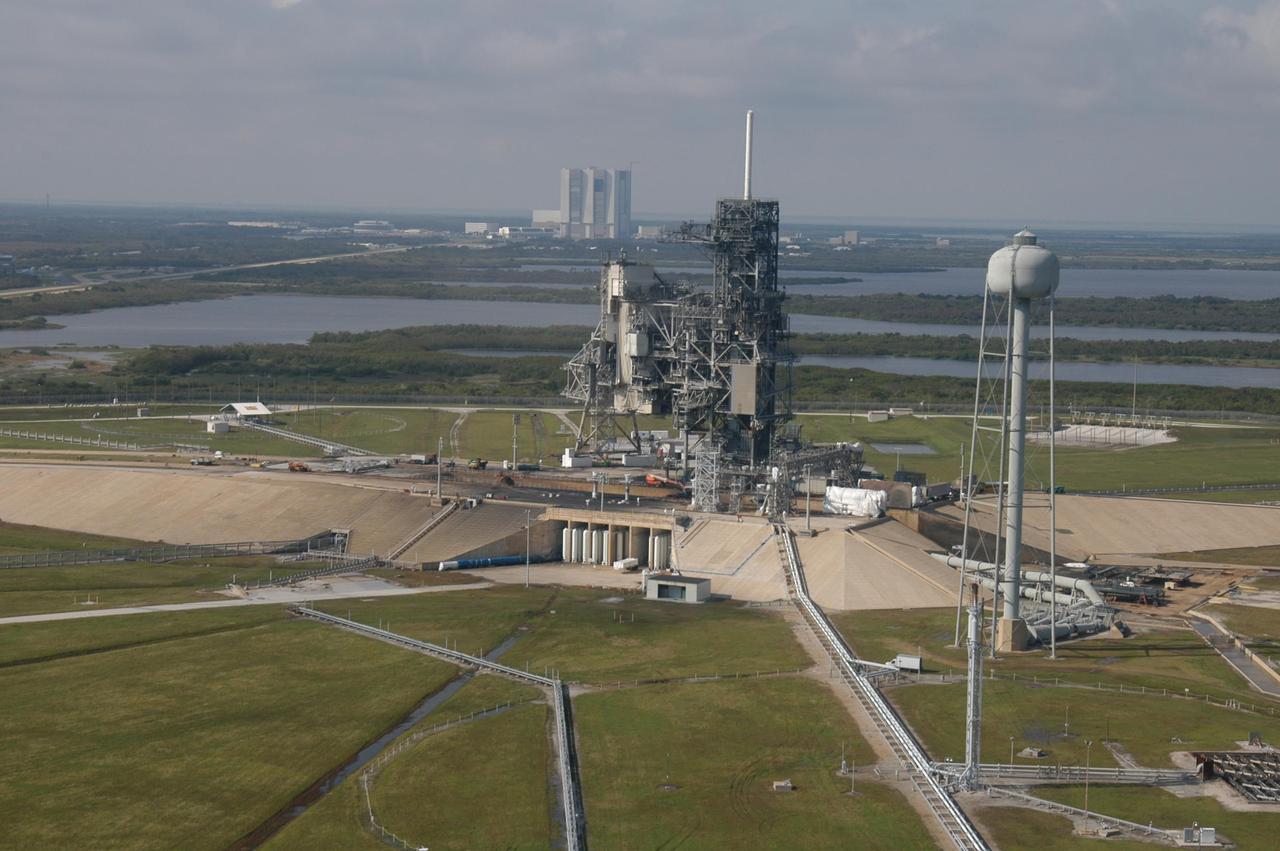
KENNEDY SPACE CENTER, FLA. - An aerial view of Launch Pad 39A at NASA Kennedy Space Center in Florida. In the background is the Vehicle Assembly Building. Atop the fixed service structure is the 80-foot-tall lightning mast. At right is the 290-foot-tall water tower that holds 300,000 gallons of water used at launch for sound suppression to protect the orbiter and its payloads from damage by acoustical energy and rocket exhaust reflected from the flame trench and Mobile Launcher Platform during launch.
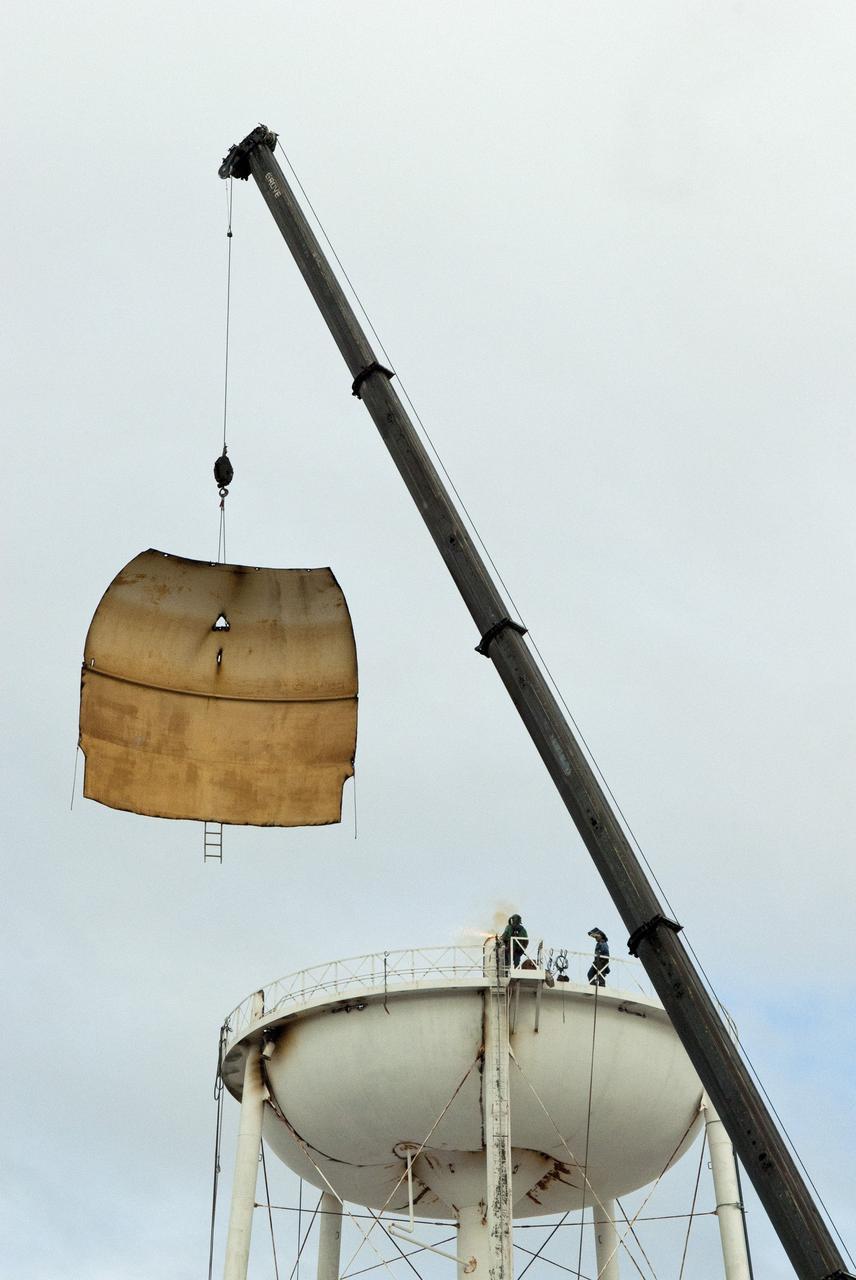
CAPE CANAVERAL, Fla. – At NASA’s Kennedy Space Center in Florida, work is underway to dismantle a water tower in the Launch Complex 39 area near the Vehicle Assembly Building. The effort is part of on-going efforts to upgrade and revitalize Kennedy's water and sewer systems to increase their reliability, sustainability and capabilities into the 21st century for current and future users. For more information, visit: http://kscpartnerships.ksc.nasa.gov/masterPlan/spaceportConcept.htm Photo credit: NASA/Jim Grossmann
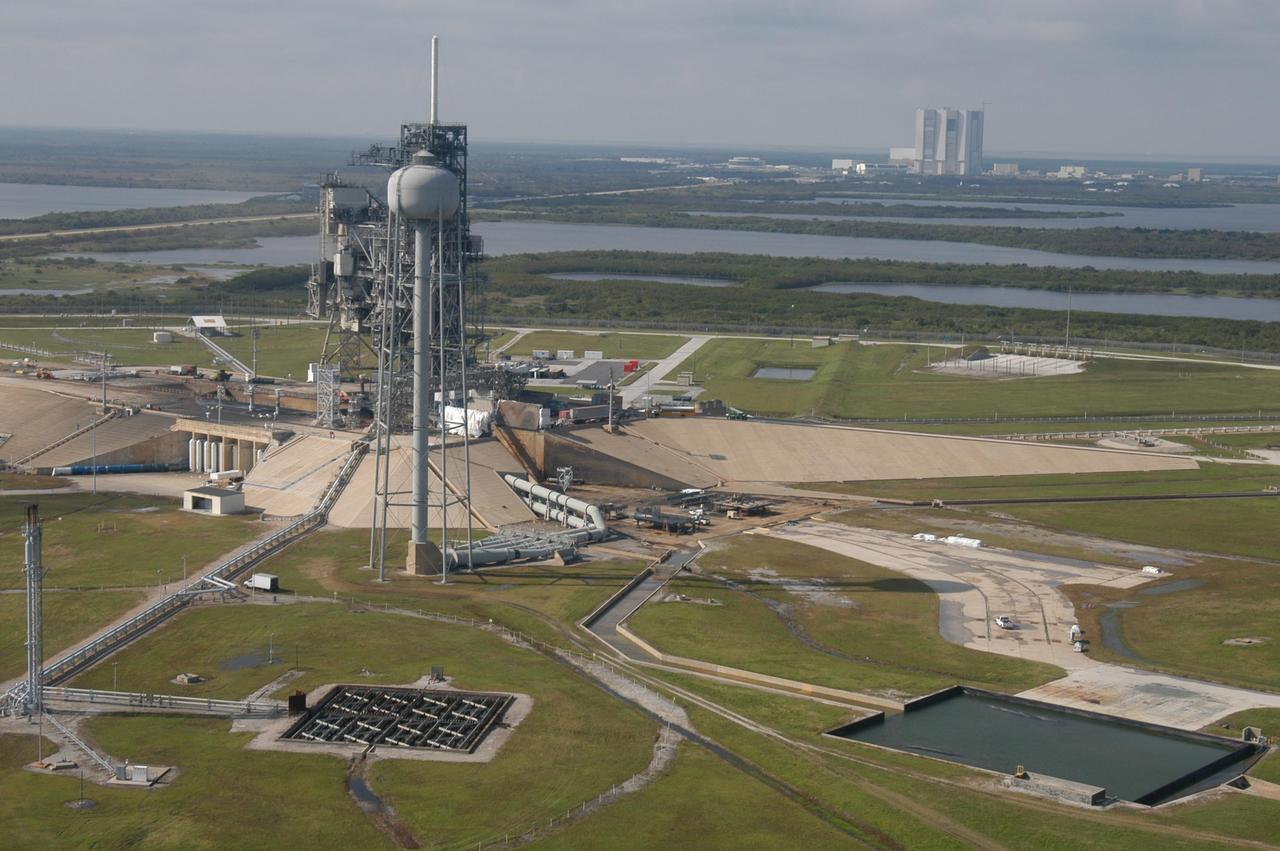
KENNEDY SPACE CENTER, FLA. - Another aerial view of Launch Pad 39A at NASA Kennedy Space Center in Florida. In the background at right is the Vehicle Assembly Building. Atop the fixed service structure is the 80-foot-tall lightning mast. In front is the 290-foot-tall water tower that holds 300,000 gallons of water used at launch for sound suppression to protect the orbiter and its payloads from damage by acoustical energy and rocket exhaust reflected from the flame trench and Mobile Launcher Platform during launch.
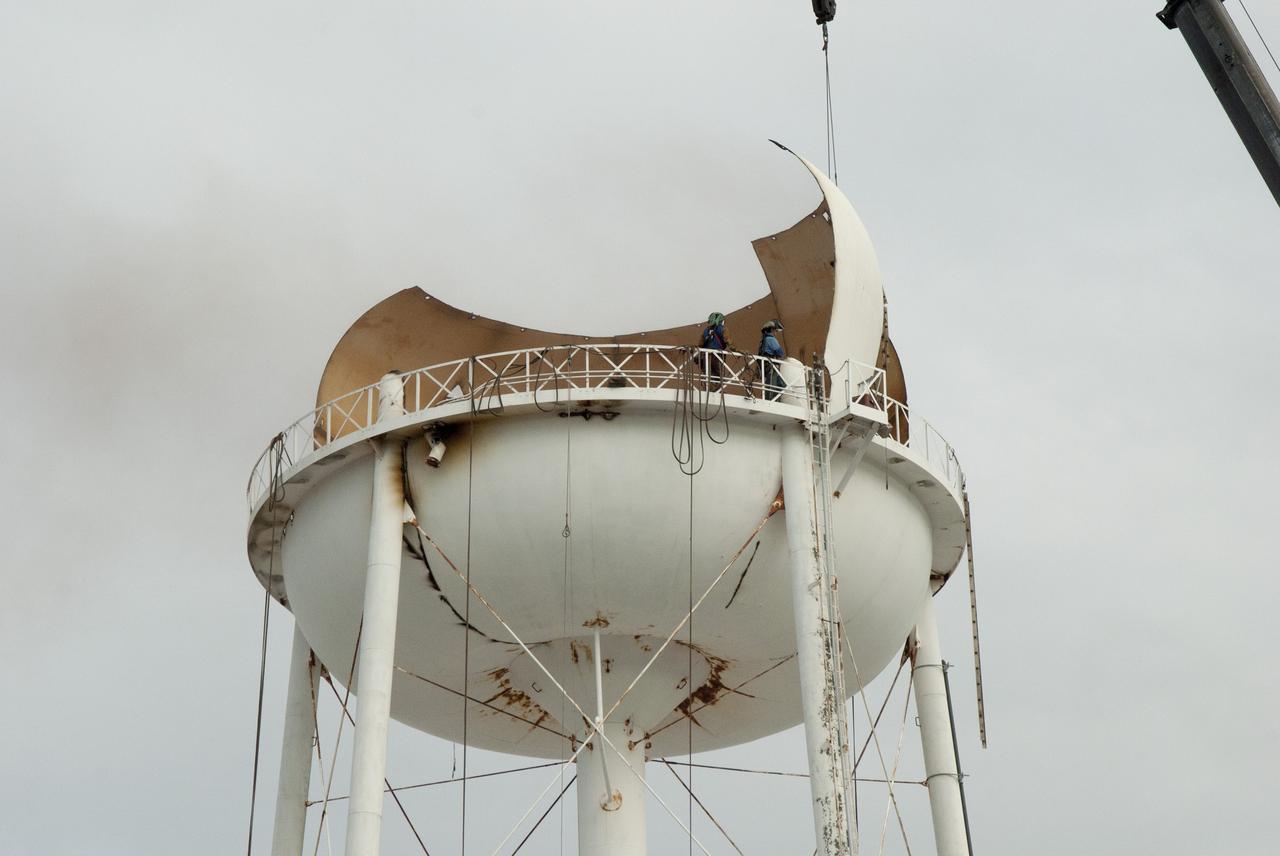
CAPE CANAVERAL, Fla. – At NASA’s Kennedy Space Center in Florida, work is underway to dismantle a water tower in the Launch Complex 39 area near the Vehicle Assembly Building. The effort is part of on-going efforts to upgrade and revitalize Kennedy's water and sewer systems to increase their reliability, sustainability and capabilities into the 21st century for current and future users. For more information, visit: http://kscpartnerships.ksc.nasa.gov/masterPlan/spaceportConcept.htm Photo credit: NASA/Jim Grossmann
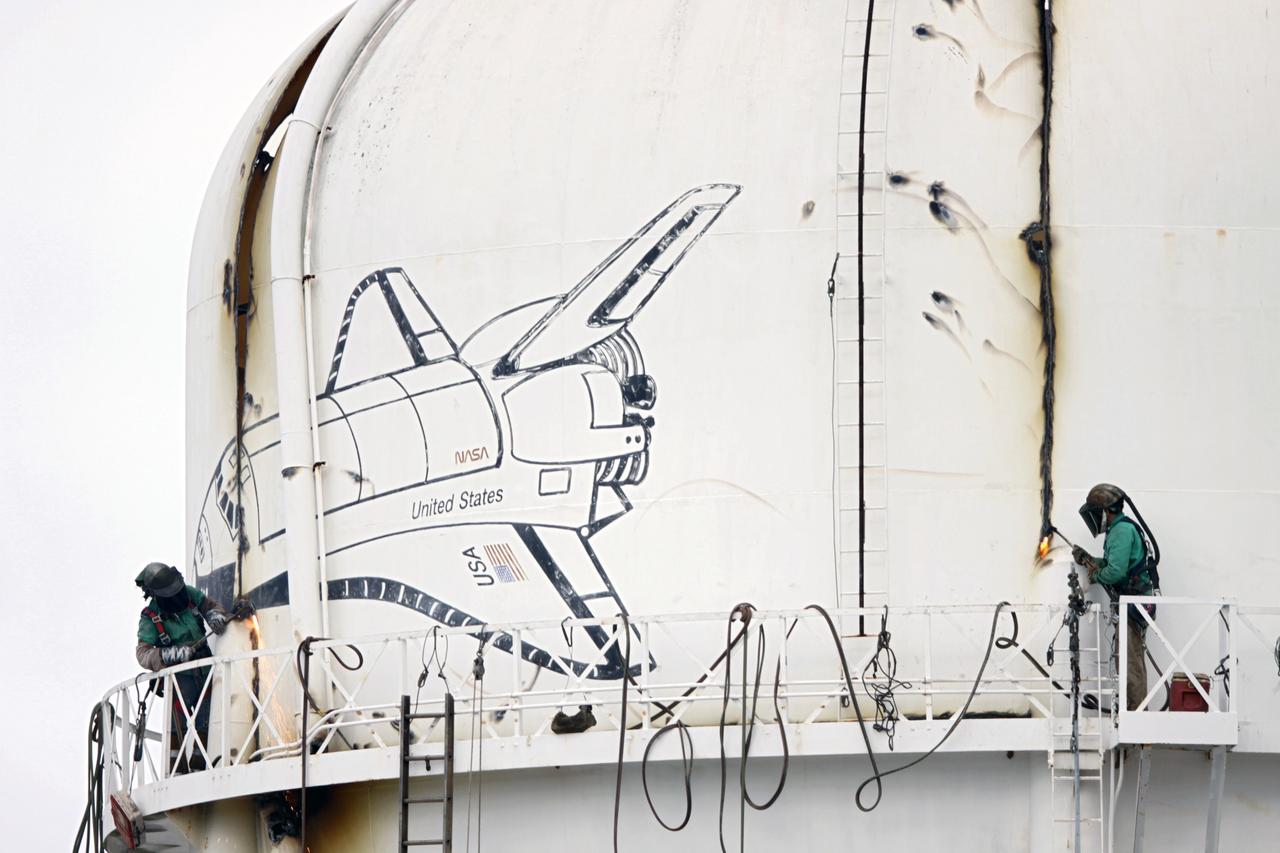
CAPE CANAVERAL, Fla. – Workers use a cutting torch to dismantle a water tower in the Launch Complex 39 area at NASA’s Kennedy Space Center in Florida. The effort is part of on-going efforts to upgrade and revitalize Kennedy's water and sewer systems to increase their reliability, sustainability and capabilities into the 21st century for current and future users. For more information, visit: http://kscpartnerships.ksc.nasa.gov/masterPlan/spaceportConcept.htm Photo credit: NASA/Tim Jacobs
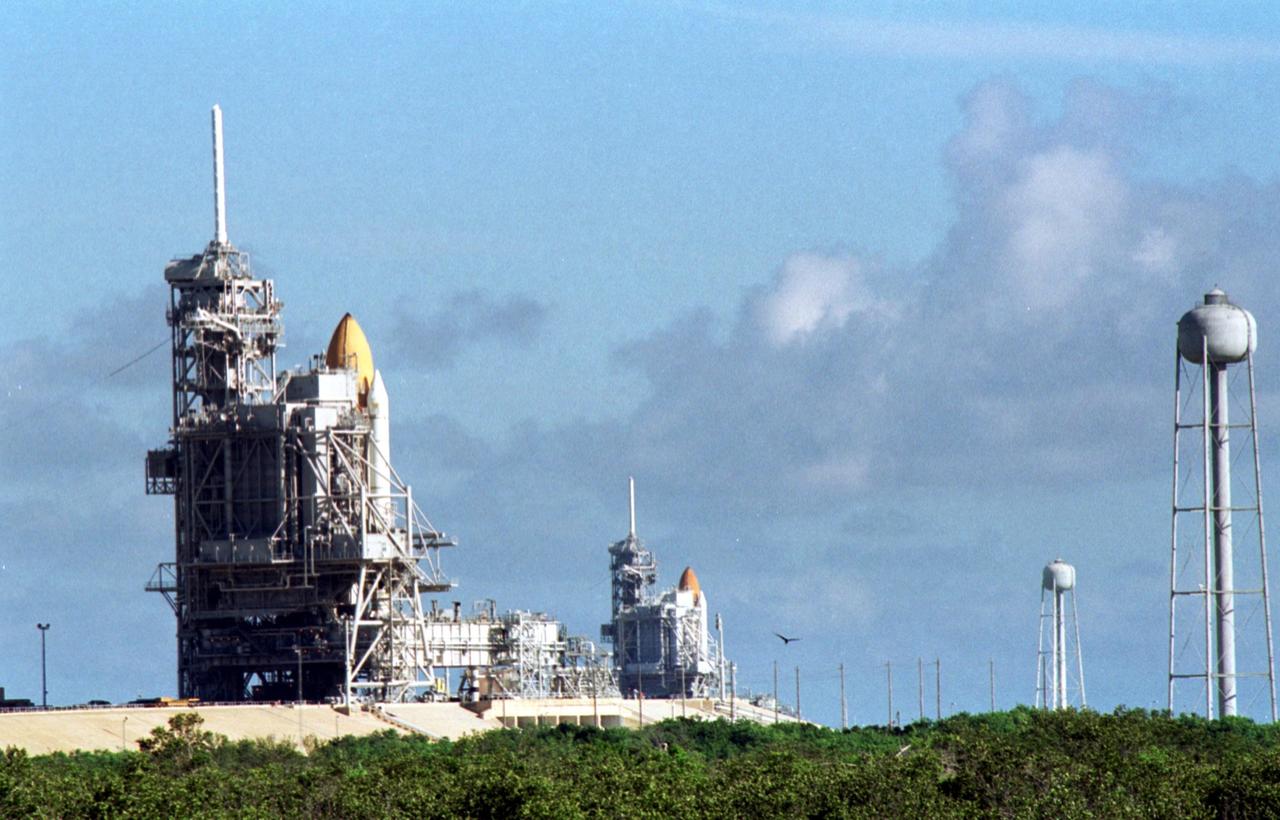
KENNEDY SPACE CENTER, Fla. -- Space Shuttle Discovery (foreground) and Space Shuttle Atlantis (background) both stand ready on their Launch Pads ( 39A and 39B respectively). Space Shuttle Discovery rolled out July 2 to be prepared for launch on mission STS-105 in August. Space Shuttle Atlantis is scheduled to launch Thursday, July 12, on mission STS-104. Towering above each Shuttle on the left is the 80-foot lightning rod that helps protect each Shuttle from lightning strikes. At right are the 290-foot water tanks that provide 300,000 gallons of water during liftoff. They are part of the sound suppression water system at each pad
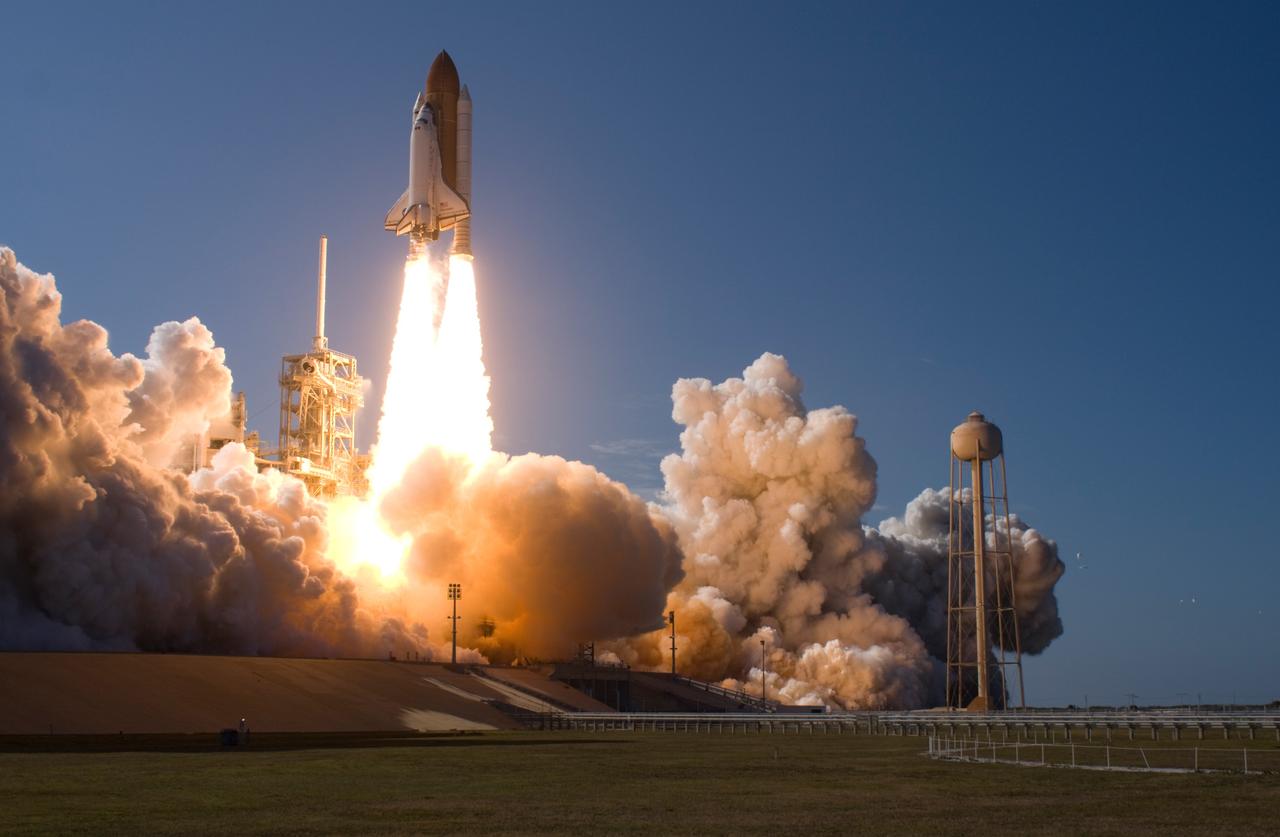
CAPE CANAVERAL, Fla. -- At NASA's Kennedy Space Center, smoke and steam billow across Launch Pad 39A as space shuttle Discovery races toward space atop twin towers of flame. Launch was on time at 5:02 p.m. EDT. At right is the 300,000-gallon water tower that provides the water used for sound suppression on the pad during liftoff. Discovery is making its 35th flight. The STS-124 mission is the 26th in the assembly of the space station. It is the second of three flights launching components to complete the Japan Aerospace Exploration Agency's Kibo laboratory. The shuttle crew will install Kibo's large Japanese Pressurized Module and its remote manipulator system, or RMS. The 14-day flight includes three spacewalks. Photo courtesy of Scott Andrews
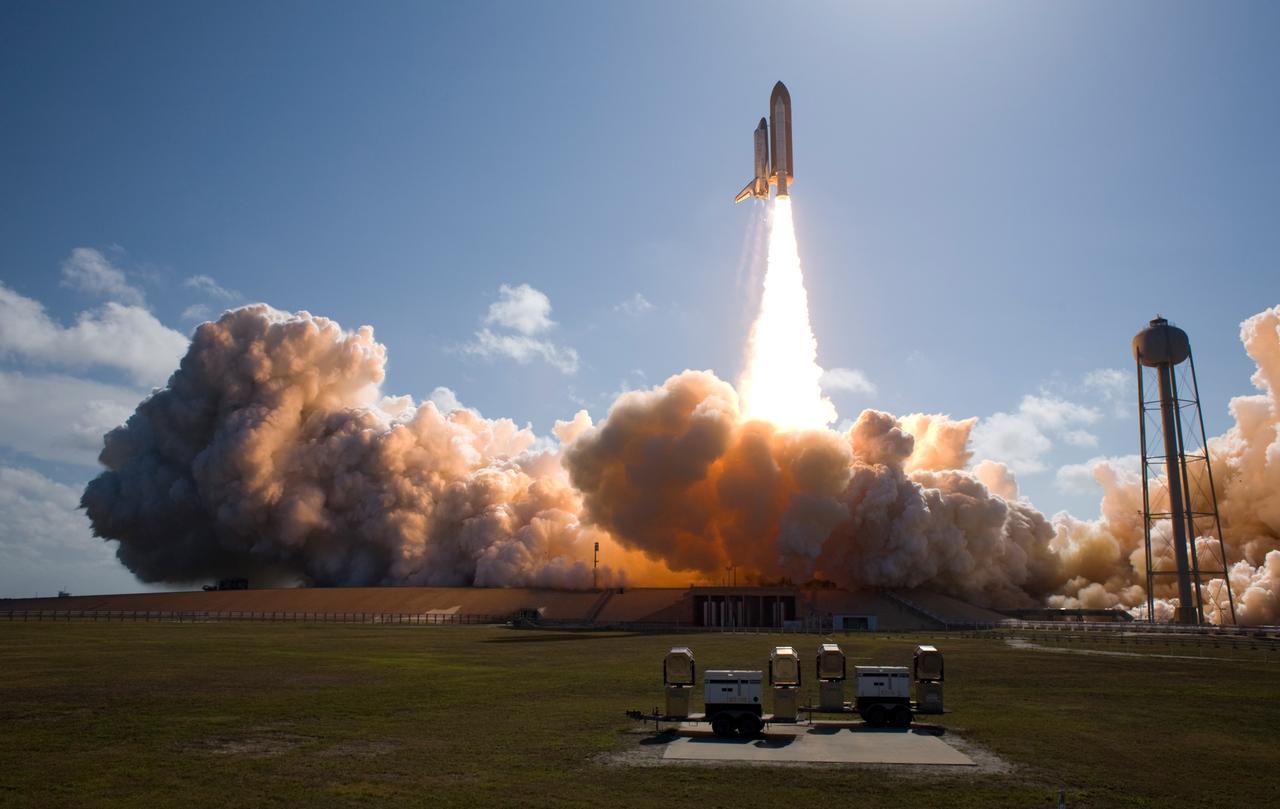
CAPE CANAVERAL, Fla. -- At NASA's Kennedy Space Center, smoke and steam billow across Launch Pad 39A as space shuttle Discovery races toward space atop twin towers of flame. Launch was on time at 5:02 p.m. EDT. At right is the 300,000-gallon water tower that provides the water used for sound suppression on the pad during liftoff. Discovery is making its 35th flight. The STS-124 mission is the 26th in the assembly of the space station. It is the second of three flights launching components to complete the Japan Aerospace Exploration Agency's Kibo laboratory. The shuttle crew will install Kibo's large Japanese Pressurized Module and its remote manipulator system, or RMS. The 14-day flight includes three spacewalks. Photo courtesy of Scott Andrews
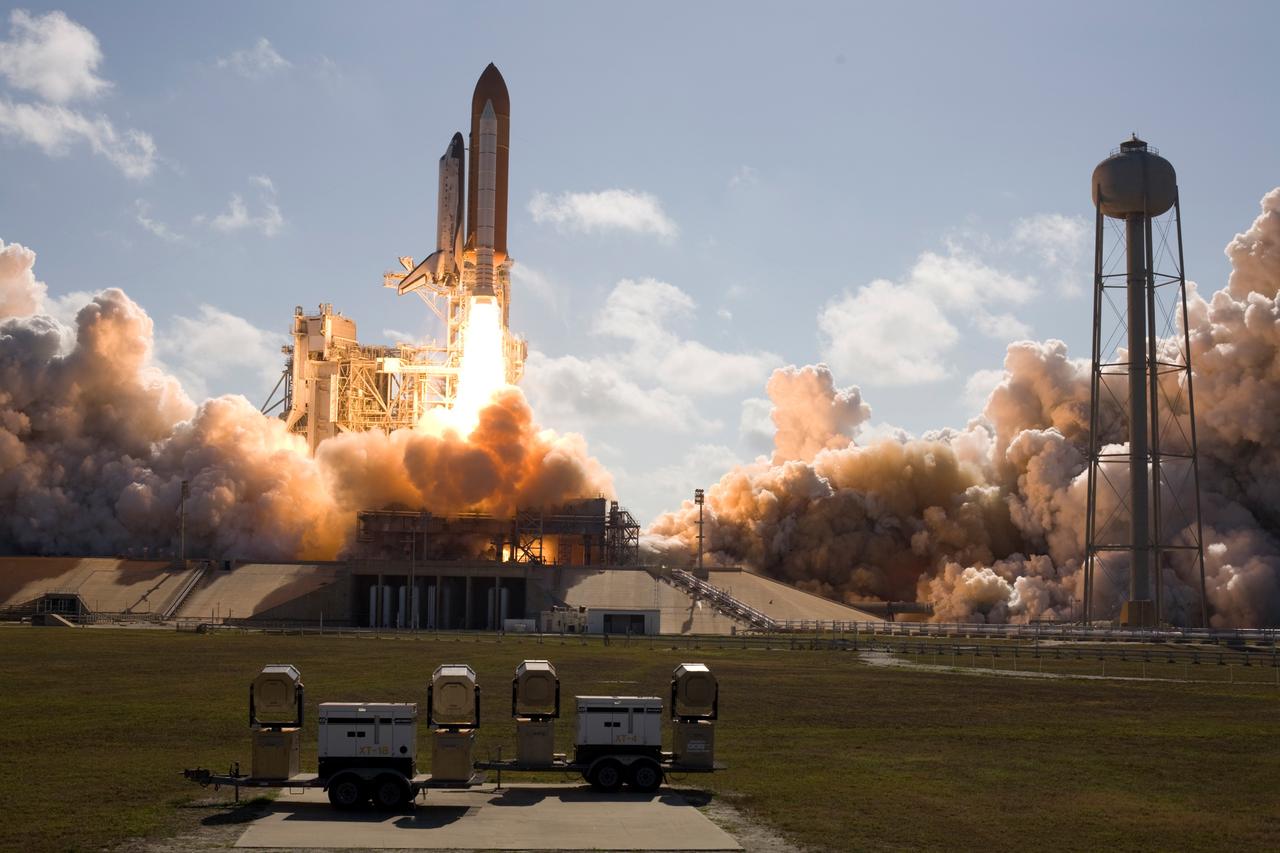
CAPE CANAVERAL, Fla. -- At NASA's Kennedy Space Center, smoke and steam billow across Launch Pad 39A as space shuttle Discovery races toward space atop twin towers of flame. Launch was on time at 5:02 p.m. EDT. Fire in the flame trench can be seen under the mobile launcher platform that straddles it. At right is the 300,000-gallon water tower that provides the water used for sound suppression on the pad during liftoff. Discovery is making its 35th flight. The STS-124 mission is the 26th in the assembly of the space station. It is the second of three flights launching components to complete the Japan Aerospace Exploration Agency's Kibo laboratory. The shuttle crew will install Kibo's large Japanese Pressurized Module and its remote manipulator system, or RMS. The 14-day flight includes three spacewalks. Photo courtesy of Scott Andrews
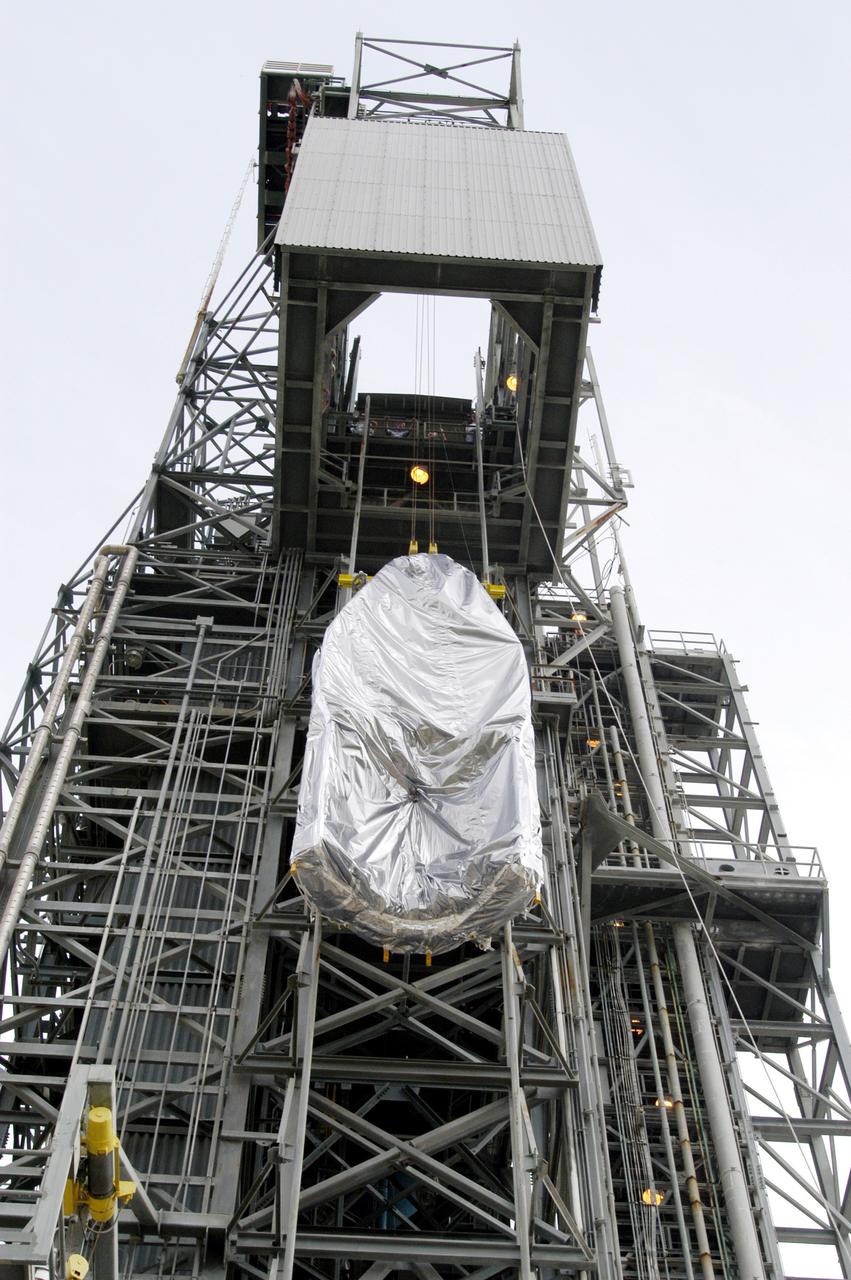
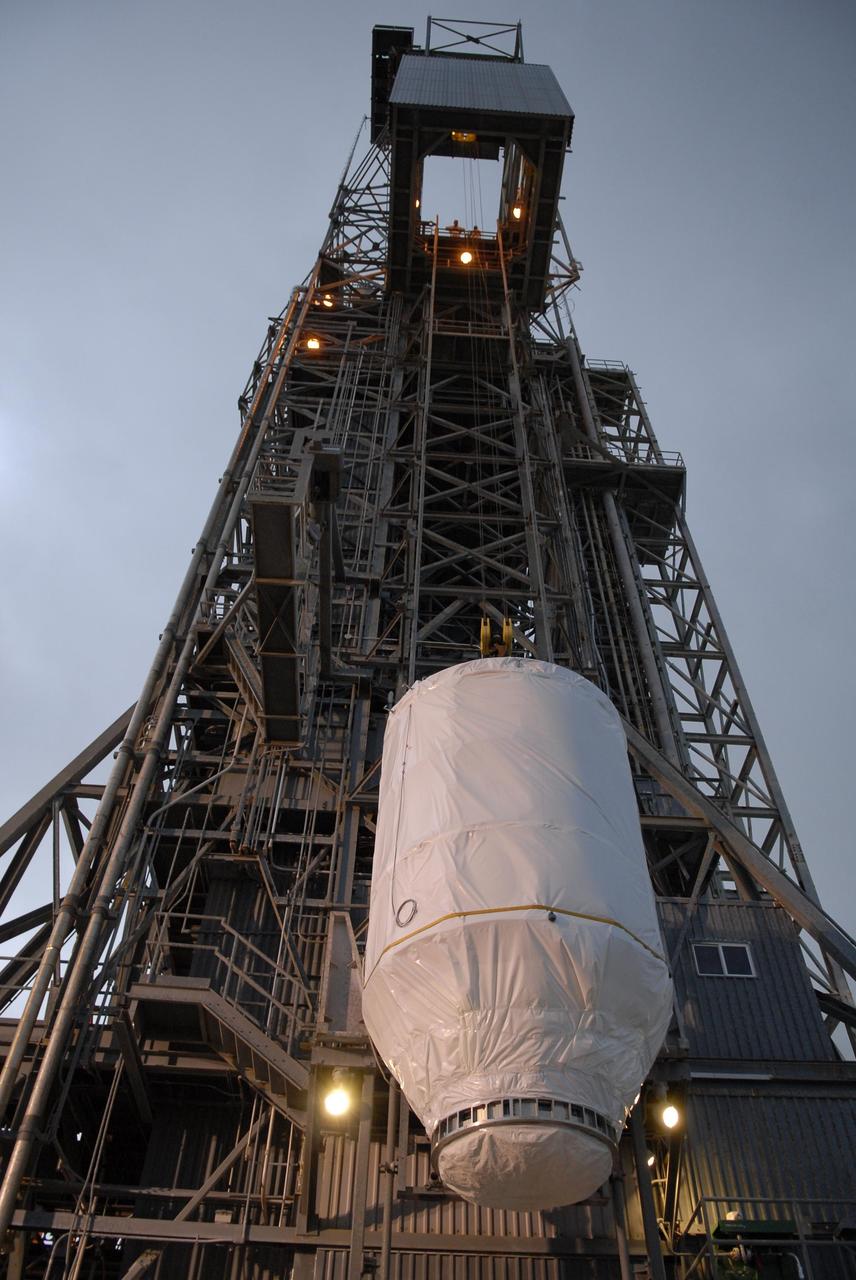
KENNEDY SPACE CENTER, FLA. - At Launch Complex 17-A, Cape Canaveral Air Force Station, the first half of the fairing for the Mars Exploration Rover 2 (MER-2/MER-A) is lifted up the launch tower. The fairing will be installed around the payload for protection during launch. The MER Mission consists of two identical rovers designed to cover roughly 110 yards each Martian day over various terrain. Each rover will carry five scientific instruments that will allow it to search for evidence of liquid water that may have been present in the planet's past. Identical to each other, the rovers will land at different regions of Mars. Launch date for MER-A is scheduled for June 5.

KENNEDY SPACE CENTER, FLA. - At Launch Complex 17-A, Cape Canaveral Air Force Station, the first half of the fairing for the Mars Exploration Rover 2 (MER-2/MER-A) is moved inside the launch tower. The fairing will be installed around the payload for protection during launch. The MER Mission consists of two identical rovers designed to cover roughly 110 yards each Martian day over various terrain. Each rover will carry five scientific instruments that will allow it to search for evidence of liquid water that may have been present in the planet's past. Identical to each other, the rovers will land at different regions of Mars. Launch date for MER-A is scheduled for June 5..
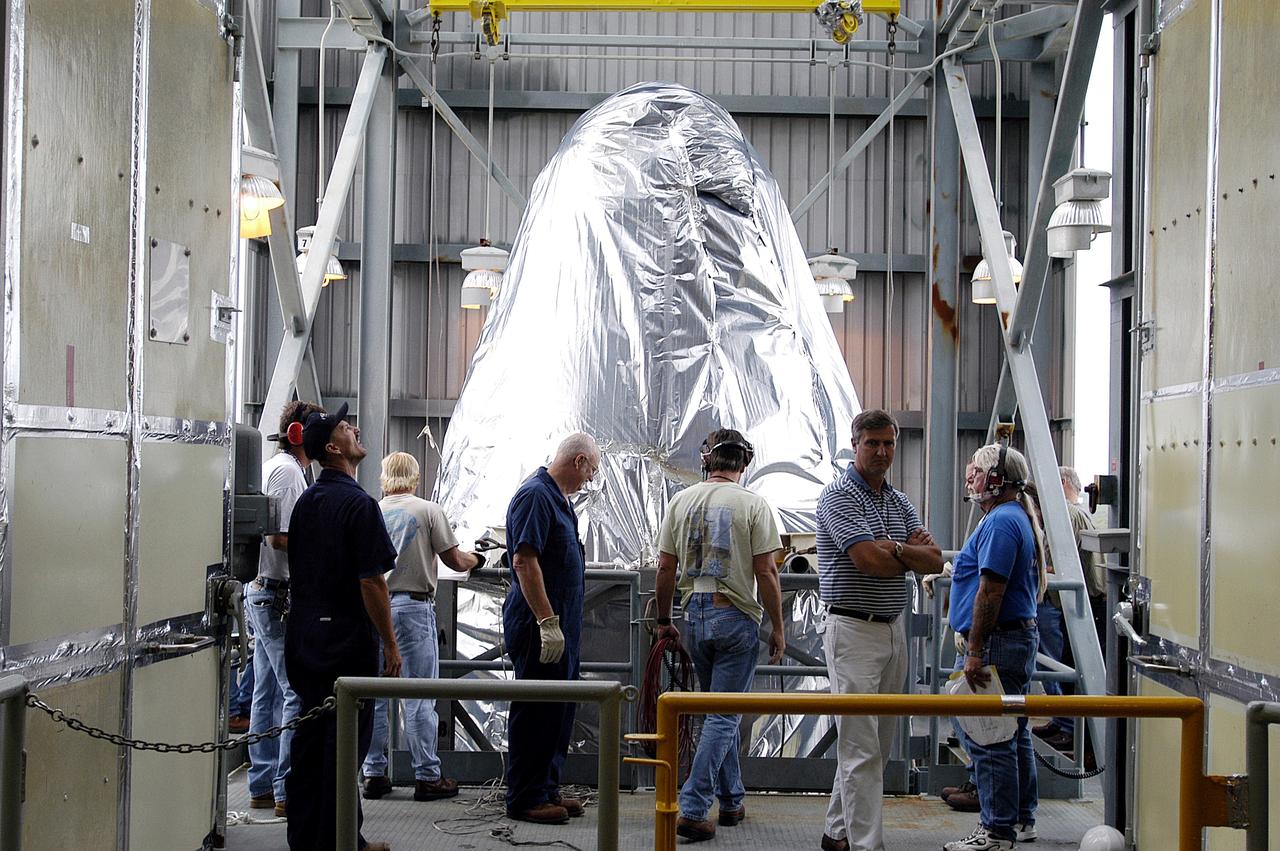
KENNEDY SPACE CENTER, FLA. - At Launch Complex 17-A, Cape Canaveral Air Force Station, the first half of the fairing for the Mars Exploration Rover 2 (MER-2/MER-A) reaches the top of the launch tower. The fairing will be installed around the payload for protection during launch. The MER Mission consists of two identical rovers designed to cover roughly 110 yards each Martian day over various terrain. Each rover will carry five scientific instruments that will allow it to search for evidence of liquid water that may have been present in the planet's past. Identical to each other, the rovers will land at different regions of Mars. Launch date for MER-A is scheduled for June 5.

KENNEDY SPACE CENTER, FLA. - At Launch Complex 17-A, Cape Canaveral Air Force Station, the first half of the fairing for the Mars Exploration Rover 2 (MER-2/MER-A) is lifted up the launch tower. The fairing will be installed around the payload for protection during launch. The MER Mission consists of two identical rovers designed to cover roughly 110 yards each Martian day over various terrain. Each rover will carry five scientific instruments that will allow it to search for evidence of liquid water that may have been present in the planet's past. Identical to each other, the rovers will land at different regions of Mars. Launch date for MER-A is scheduled for June 5.
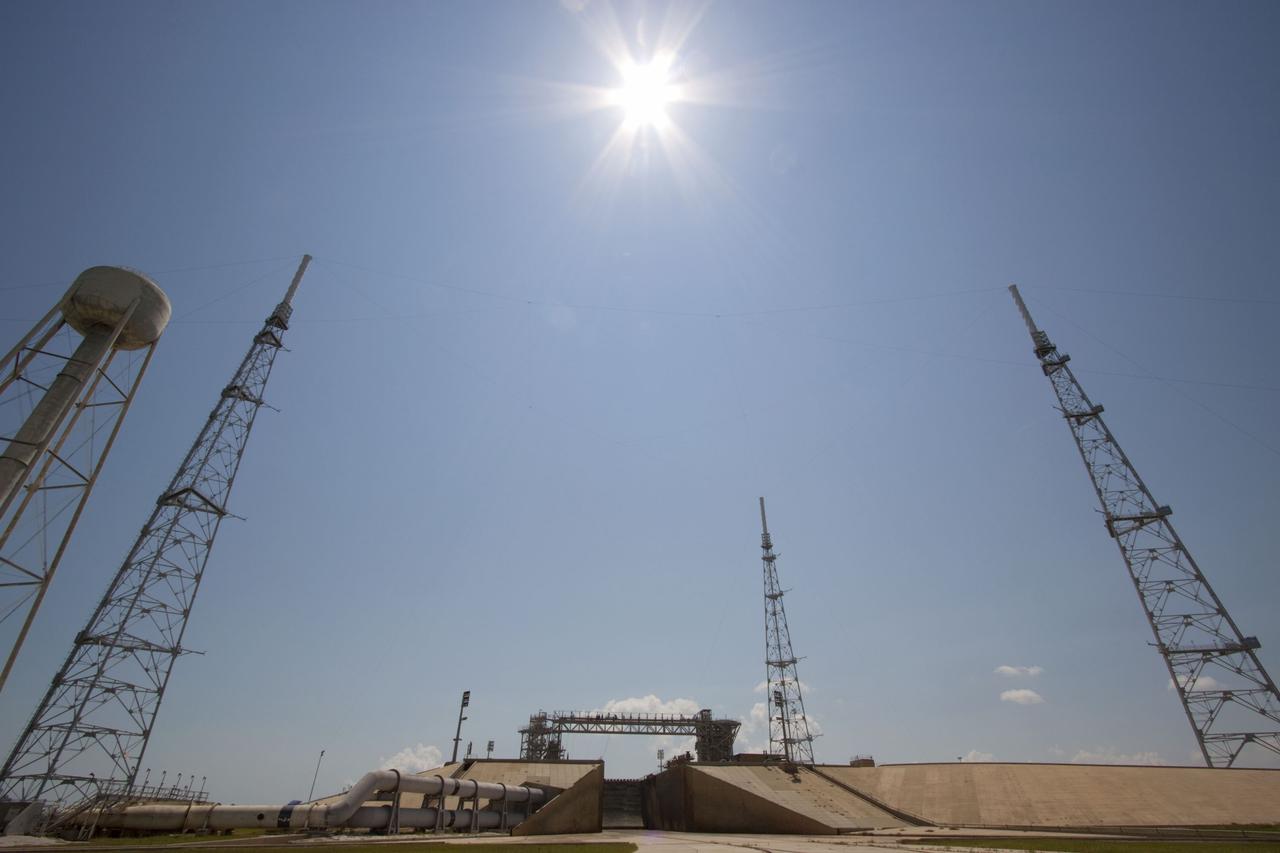
CAPE CANAVERAL, Fla. – The deconstruction of Launch Pad 39B at NASA’s Kennedy Space Center in Florida is complete. Still remaining and standing over the remnants of the fixed service structure are the 600-foot-tall lightning protection towers and the water tower used for sound suppression. In 2009, the structure at the pad was no longer needed for NASA's Space Shuttle Program, so it is being restructured for future use. The new design will feature a "clean pad" for rockets to come with their own launcher, making it more versatile for a number of vehicles. For information on NASA's future plans, visit http://www.nasa.gov/exploration. Photo credit: NASA/Jim Grossmann
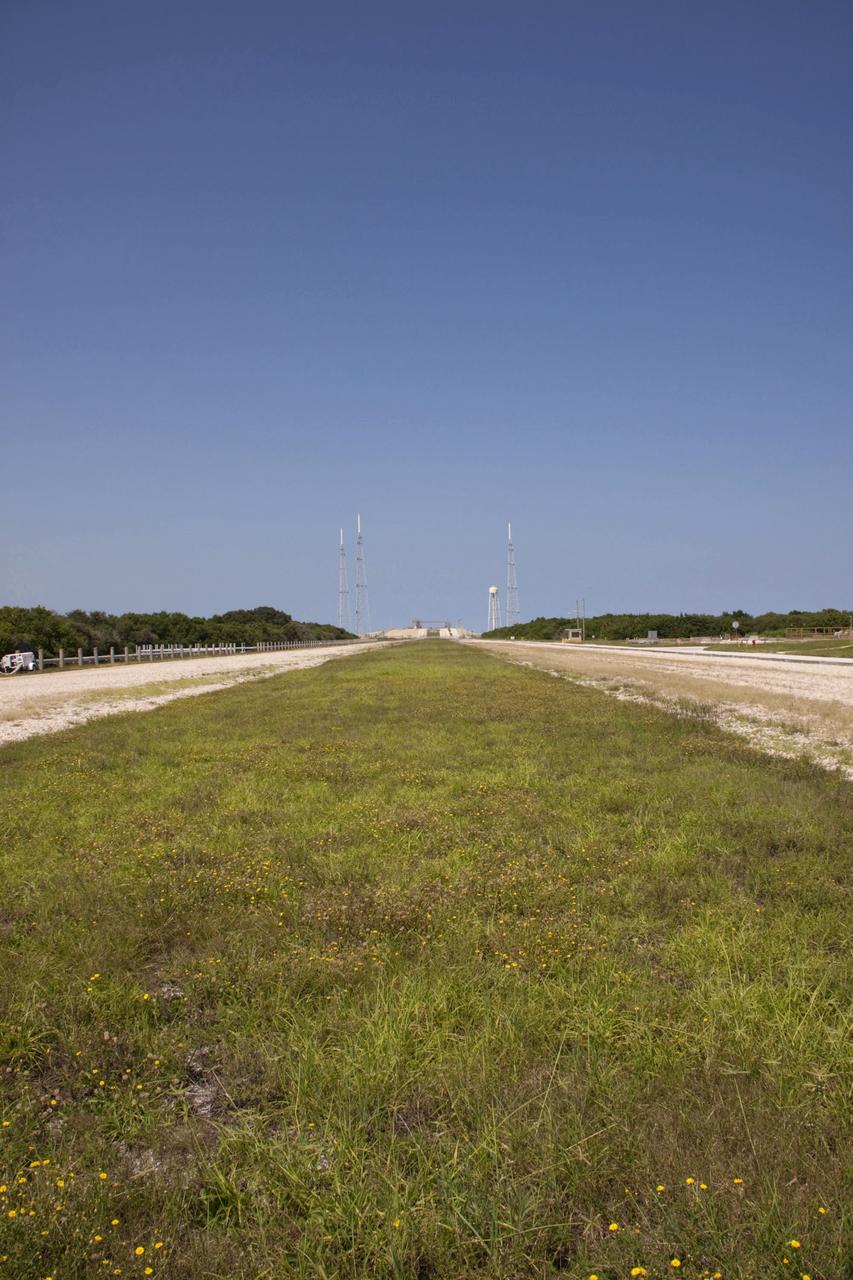
CAPE CANAVERAL, Fla. – The deconstruction of Launch Pad 39B at NASA’s Kennedy Space Center in Florida is complete. With a view from the two-track crawlerway, the three 600-foot-tall lightning protection towers and the water tower used for sound suppression stand over the remnants of the fixed service structure. In 2009, the structure at the pad was no longer needed for NASA's Space Shuttle Program, so it is being restructured for future use. The new design will feature a "clean pad" for rockets to come with their own launcher, making it more versatile for a number of vehicles. For information on NASA's future plans, visit http://www.nasa.gov/exploration. Photo credit: NASA/Jim Grossmann
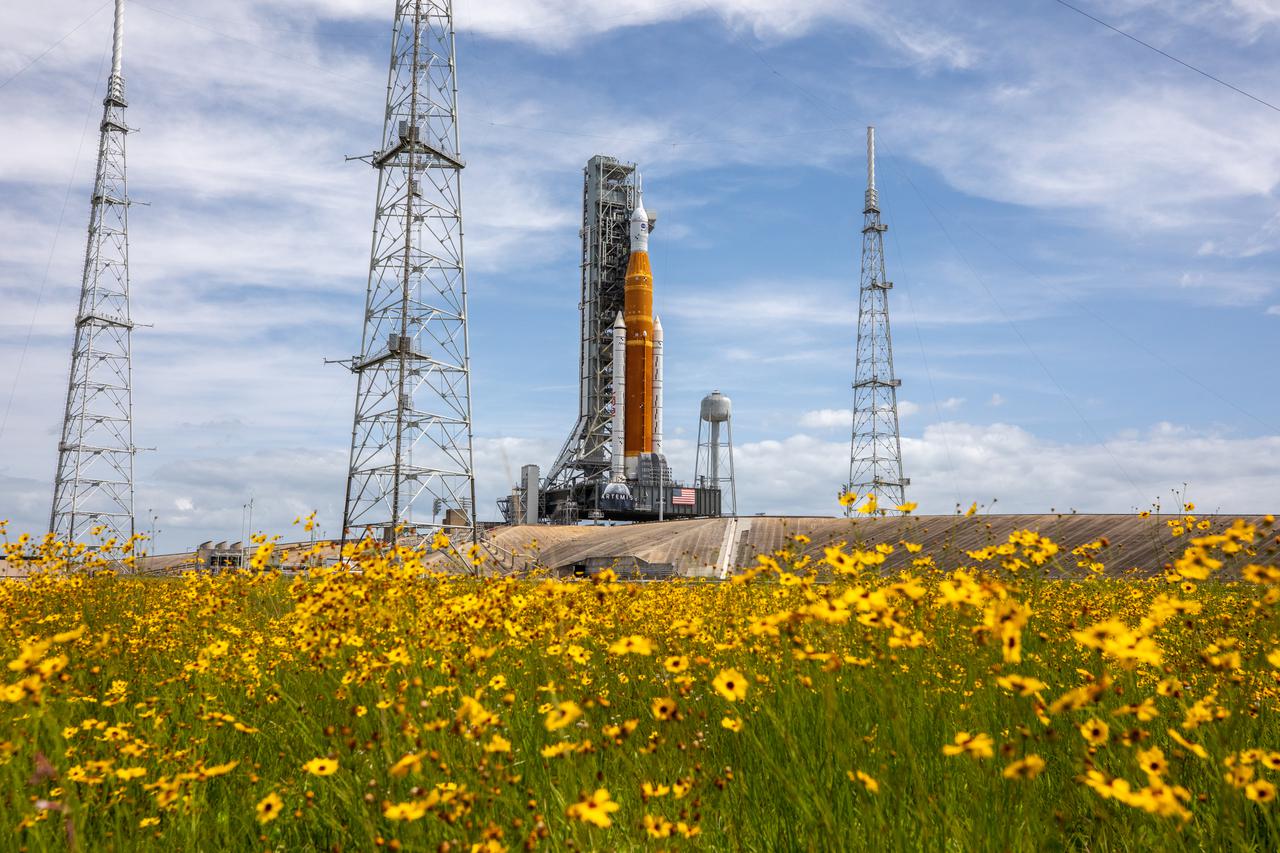
Wildflowers frame a view of the Artemis I Space Launch System (SLS) and Orion spacecraft on Launch Pad 39B at NASA’s Kennedy Space Center in Florida on April 21, 2022. Also in view are the three lightning protection towers and the water tower. The SLS and Orion atop the mobile launcher were transported to the pad on crawler-transporter 2 for a prelaunch test called a wet dress rehearsal. Artemis I will be the first integrated test of the SLS and Orion spacecraft. In future Artemis missions, NASA will land the first woman and the first person of color on the surface of the Moon, paving the way for a long-term lunar presence and serving as a steppingstone on the way to Mars.
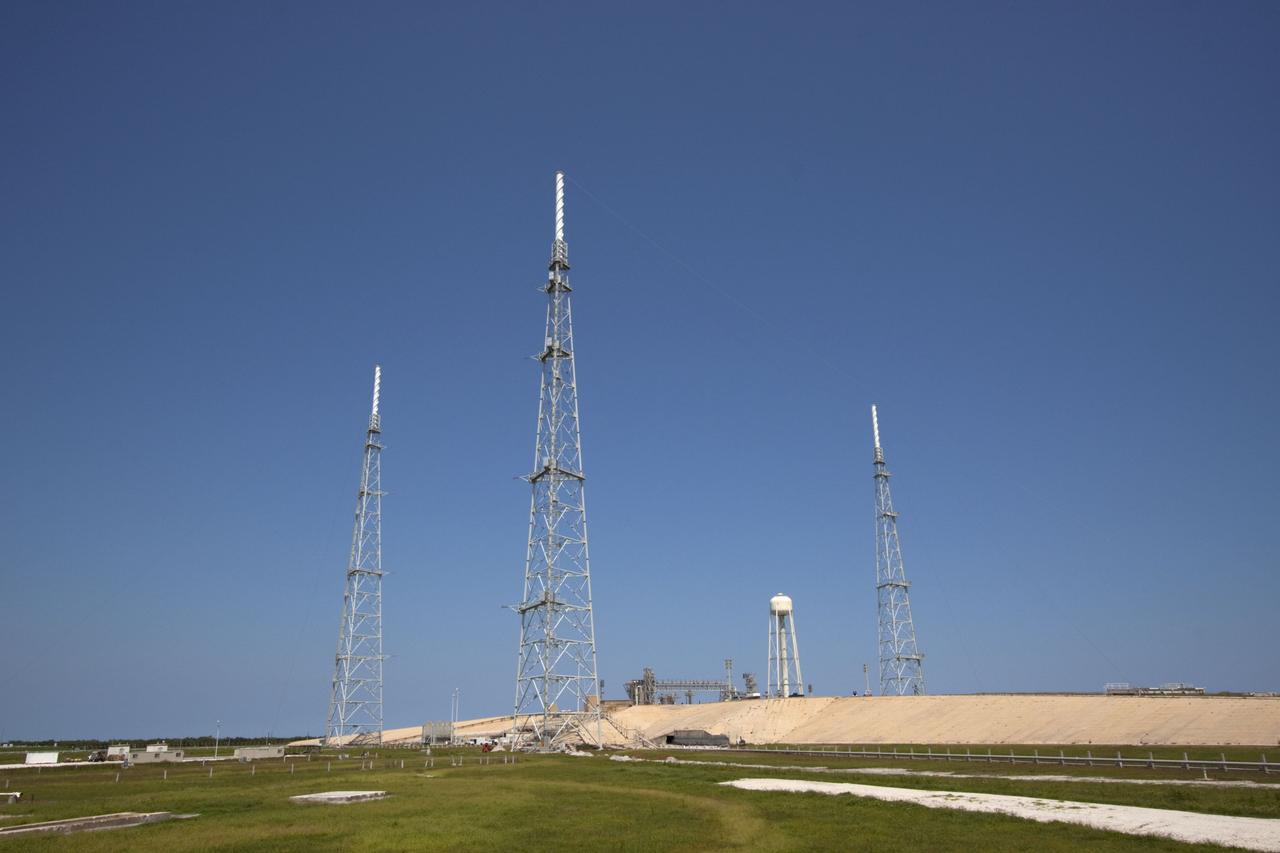
CAPE CANAVERAL, Fla. – The deconstruction of Launch Pad 39B at NASA’s Kennedy Space Center in Florida is complete. Still remaining and standing over the remnants of the fixed service structure are the three 600-foot-tall lightning protection towers and the water tower used for sound suppression. In 2009, the structure at the pad was no longer needed for NASA's Space Shuttle Program, so it is being restructured for future use. The new design will feature a "clean pad" for rockets to come with their own launcher, making it more versatile for a number of vehicles. For information on NASA's future plans, visit http://www.nasa.gov/exploration. Photo credit: NASA/Jim Grossmann
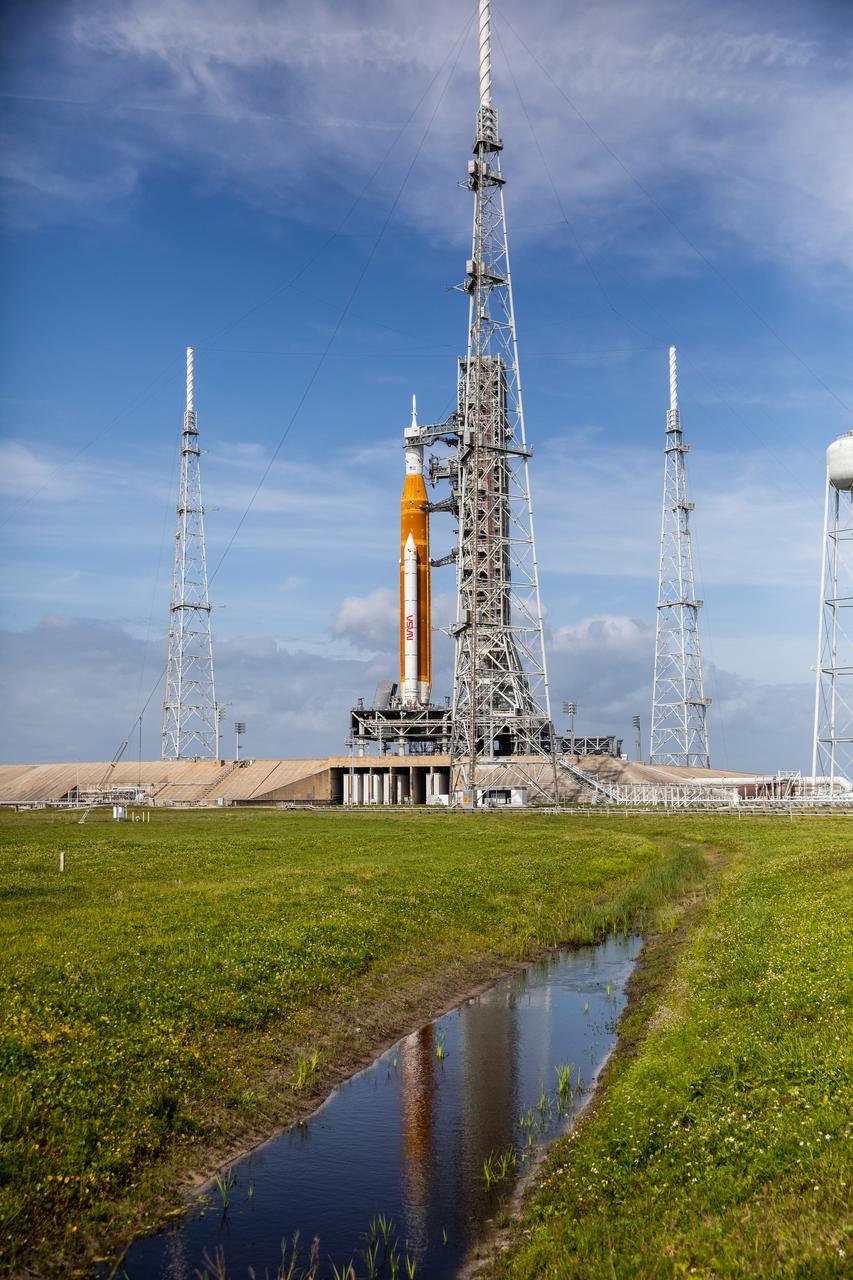
A view of the Artemis I Space Launch System (SLS) and Orion spacecraft atop the mobile launcher on Launch Pad 39B at NASA’s Kennedy Space Center in Florida on April 21, 2022. Also in view are the three lightning protection towers and water tower. The SLS and Orion atop the mobile launcher were transported to the pad on crawler-transporter 2 for a prelaunch test called a wet dress rehearsal. Artemis I will be the first integrated test of the SLS and Orion spacecraft. In future Artemis missions, NASA will land the first woman and the first person of color on the surface of the Moon, paving the way for a long-term lunar presence and serving as a steppingstone on the way to Mars.
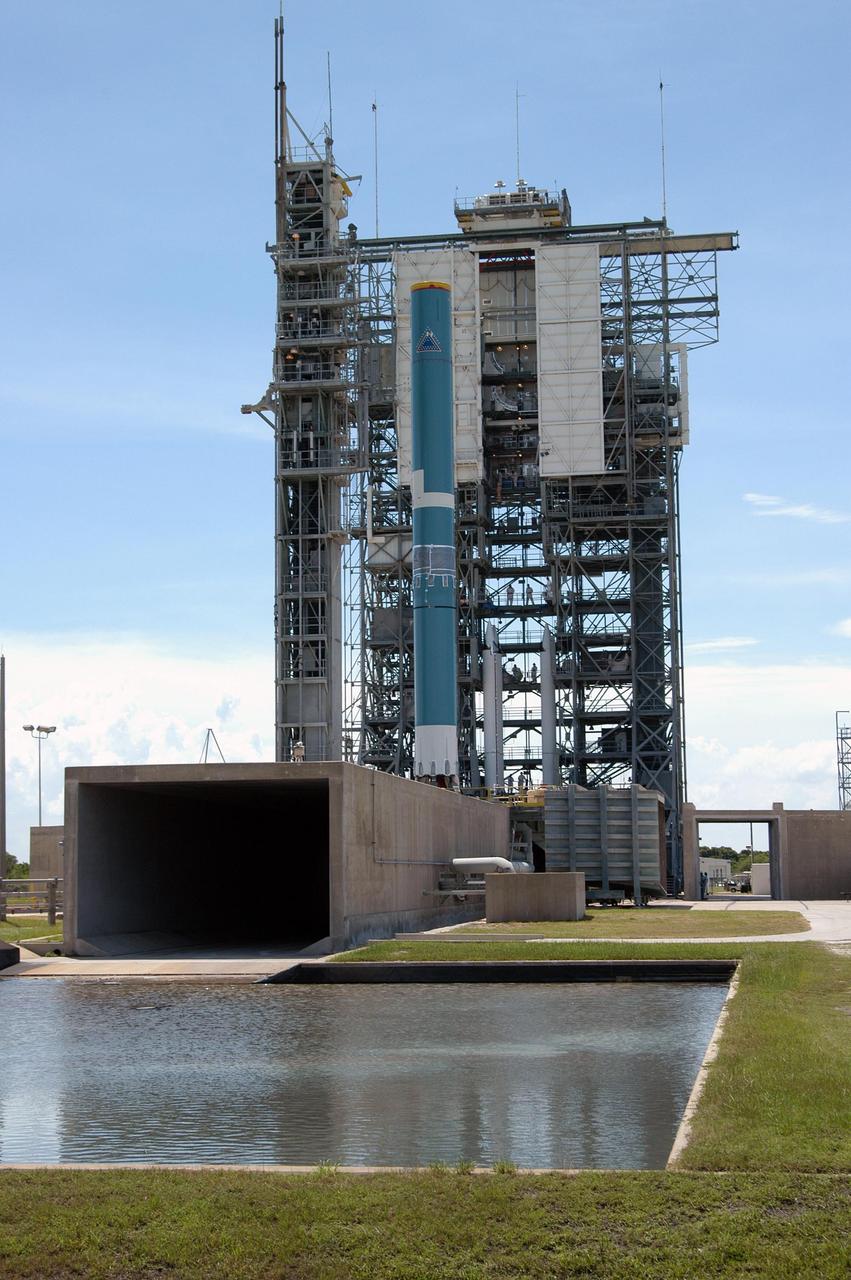
KENNEDY SPACE CENTER, FLA. - On Pad 17-B, Cape Canaveral Air Force Station, the Boeing Delta II Heavy rocket waits for the arrival of the mobile service tower behind it. In the foreground is the cooling water pond. The tower holds three out of nine Solid Rocket Boosters (SRBs) that will be mated to the Boeing Delta II for the Aug. 2 launch of the MESSENGER spacecraft to the planet Mercury. The spacecraft is expected to reach orbit around Mercury in March 2011. MESSENGER was built for NASA by the Johns Hopkins University Applied Physics Laboratory in Laurel, Md.
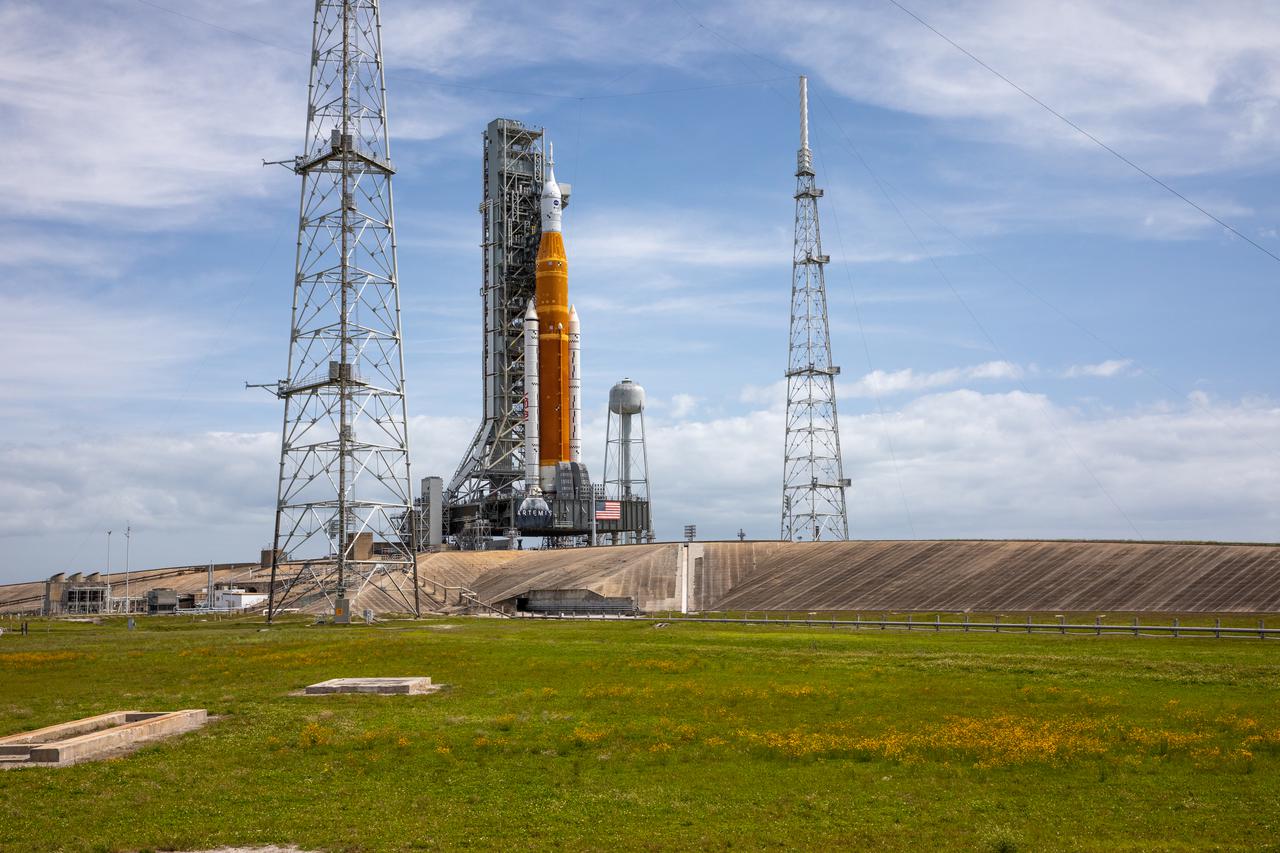
A view of the Artemis I Space Launch System (SLS) and Orion spacecraft on Launch Pad 39B at NASA’s Kennedy Space Center in Florida on April 21, 2022. Also in view are two of the three lightning protection towers and the water tower. The SLS and Orion atop the mobile launcher were transported to the pad on crawler-transporter 2 for a prelaunch test called a wet dress rehearsal. Artemis I will be the first integrated test of the SLS and Orion spacecraft. In future Artemis missions, NASA will land the first woman and the first person of color on the surface of the Moon, paving the way for a long-term lunar presence and serving as a steppingstone on the way to Mars.
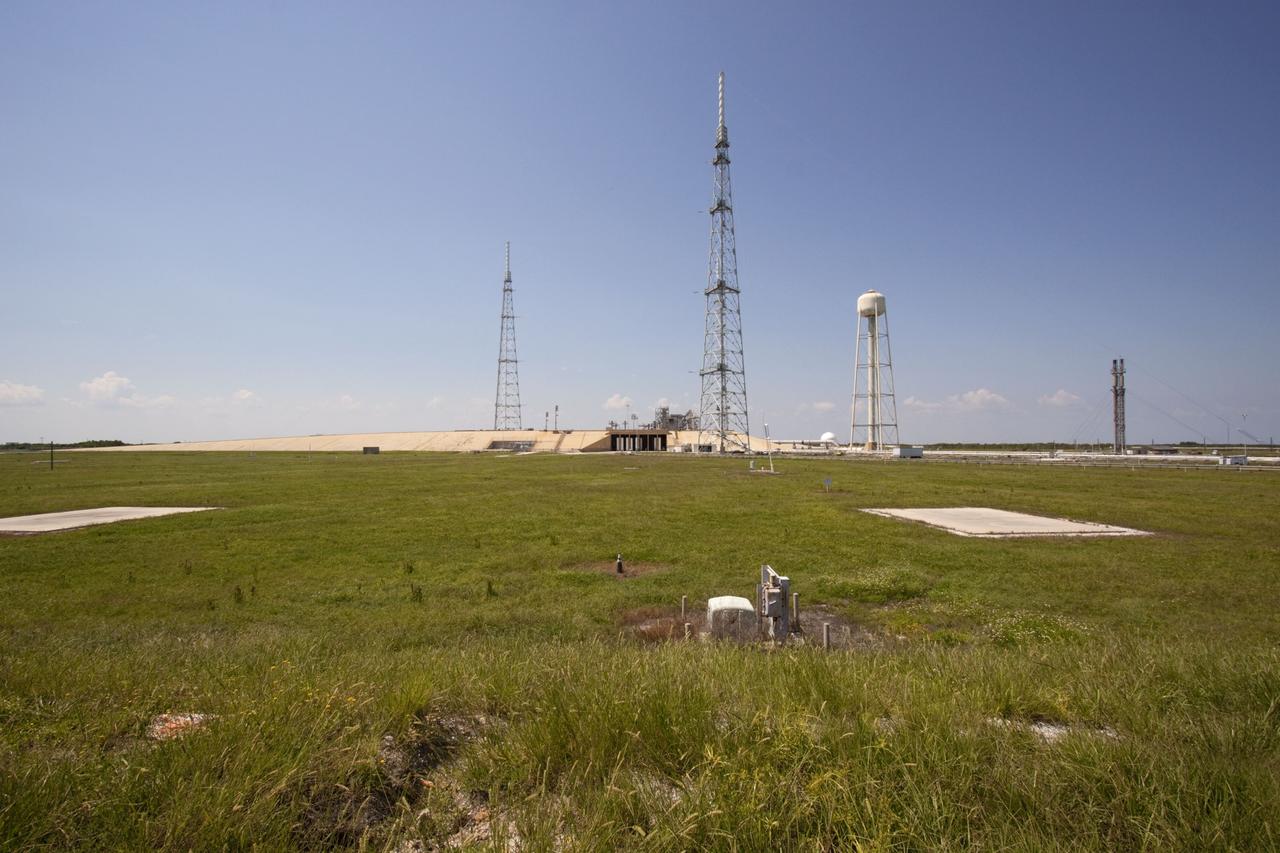
CAPE CANAVERAL, Fla. – The deconstruction of Launch Pad 39B at NASA’s Kennedy Space Center in Florida is complete. Still remaining and standing over the remnants of the fixed service structure are the 600-foot-tall lightning protection towers and the water tower used for sound suppression. In 2009, the structure at the pad was no longer needed for NASA's Space Shuttle Program, so it is being restructured for future use. The new design will feature a "clean pad" for rockets to come with their own launcher, making it more versatile for a number of vehicles. For information on NASA's future plans, visit http://www.nasa.gov/exploration. Photo credit: NASA/Jim Grossmann
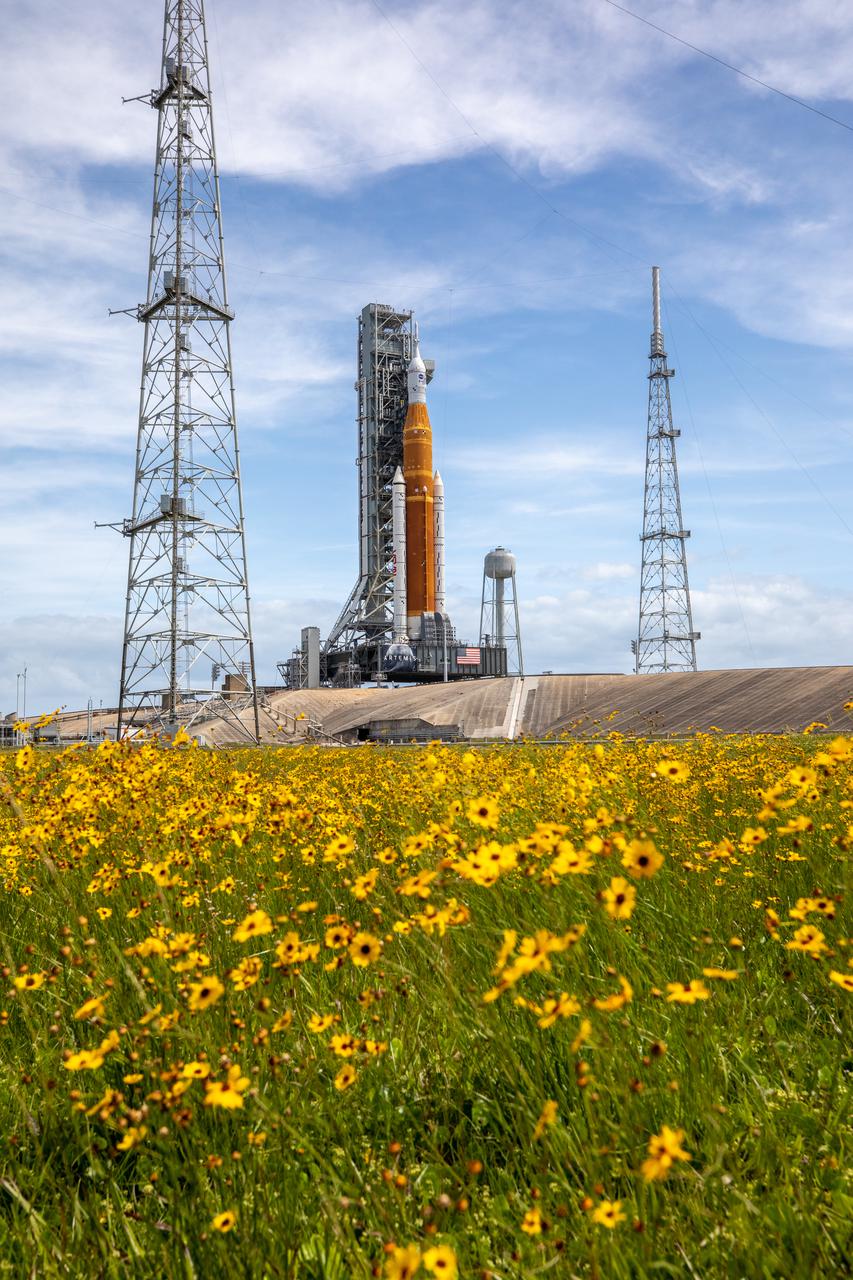
Wildflowers frame a view of the Artemis I Space Launch System (SLS) and Orion spacecraft on Launch Pad 39B at NASA’s Kennedy Space Center in Florida on April 21, 2022. Also in view are two of the three lightning protection towers and the water tower. The SLS and Orion atop the mobile launcher were transported to the pad on crawler-transporter 2 for a prelaunch test called a wet dress rehearsal. Artemis I will be the first integrated test of the SLS and Orion spacecraft. In future Artemis missions, NASA will land the first woman and the first person of color on the surface of the Moon, paving the way for a long-term lunar presence and serving as a steppingstone on the way to Mars.
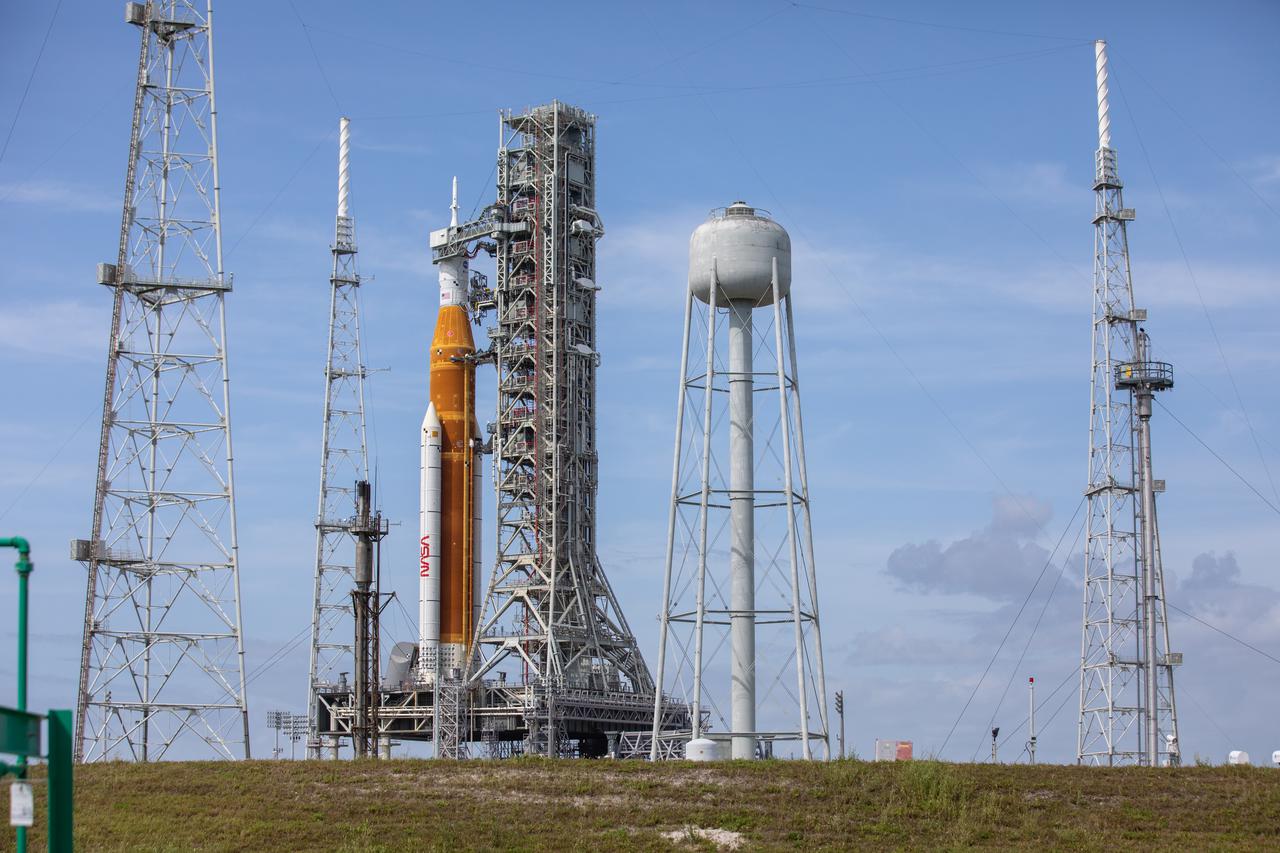
A view of the Artemis I Space Launch System (SLS) and Orion spacecraft on Launch Pad 39B at NASA’s Kennedy Space Center in Florida on April 21, 2022. Also in view are the three lightning protection towers and water tower. The SLS and Orion atop the mobile launcher were transported to the pad on crawler-transporter 2 for a prelaunch test called a wet dress rehearsal. Artemis I will be the first integrated test of the SLS and Orion spacecraft. In future Artemis missions, NASA will land the first woman and the first person of color on the surface of the Moon, paving the way for a long-term lunar presence and serving as a steppingstone on the way to Mars.
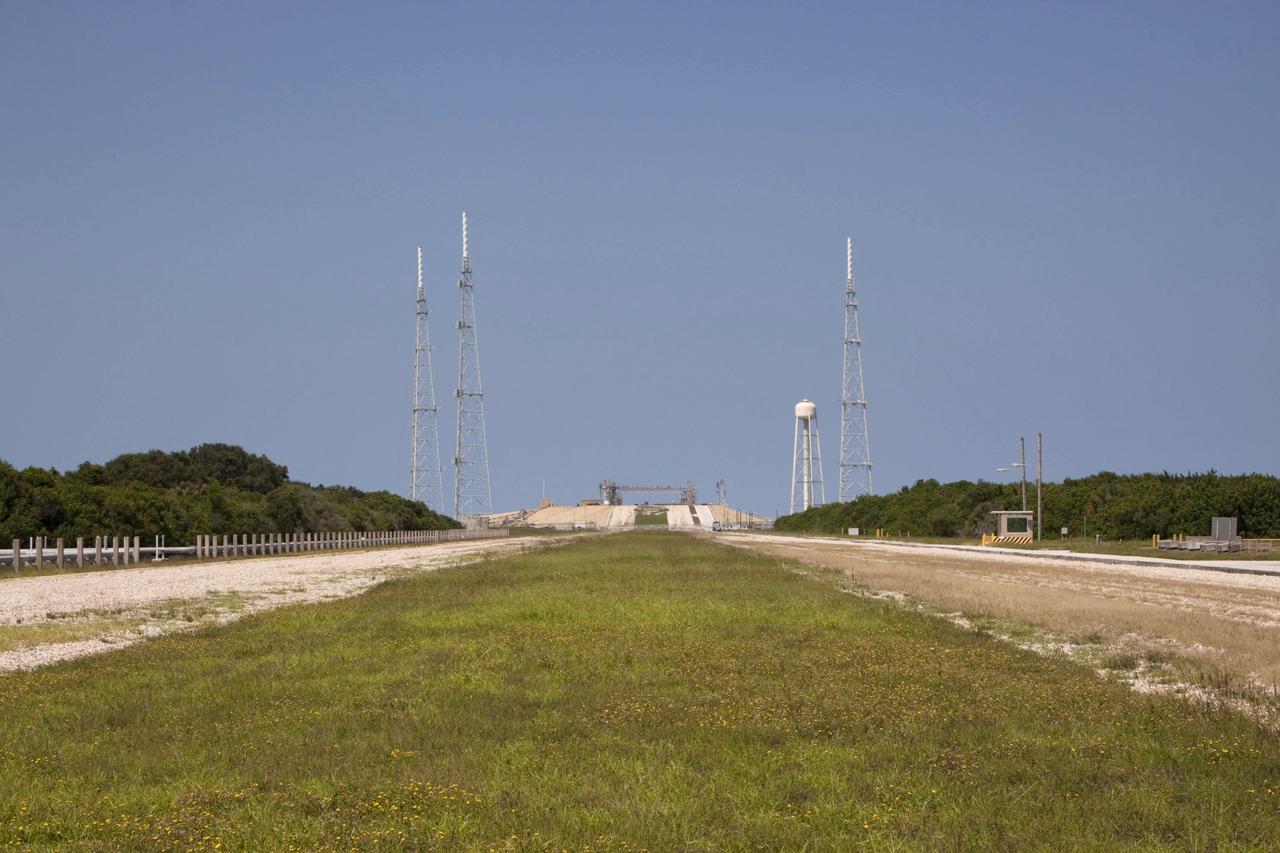
CAPE CANAVERAL, Fla. – The deconstruction of Launch Pad 39B at NASA’s Kennedy Space Center in Florida is complete. With a view from the two-track crawlerway, the three 600-foot-tall lightning protection towers and the water tower used for sound suppression stand over the remnants of the fixed service structure. In 2009, the structure at the pad was no longer needed for NASA's Space Shuttle Program, so it is being restructured for future use. The new design will feature a "clean pad" for rockets to come with their own launcher, making it more versatile for a number of vehicles. For information on NASA's future plans, visit http://www.nasa.gov/exploration. Photo credit: NASA/Jim Grossmann
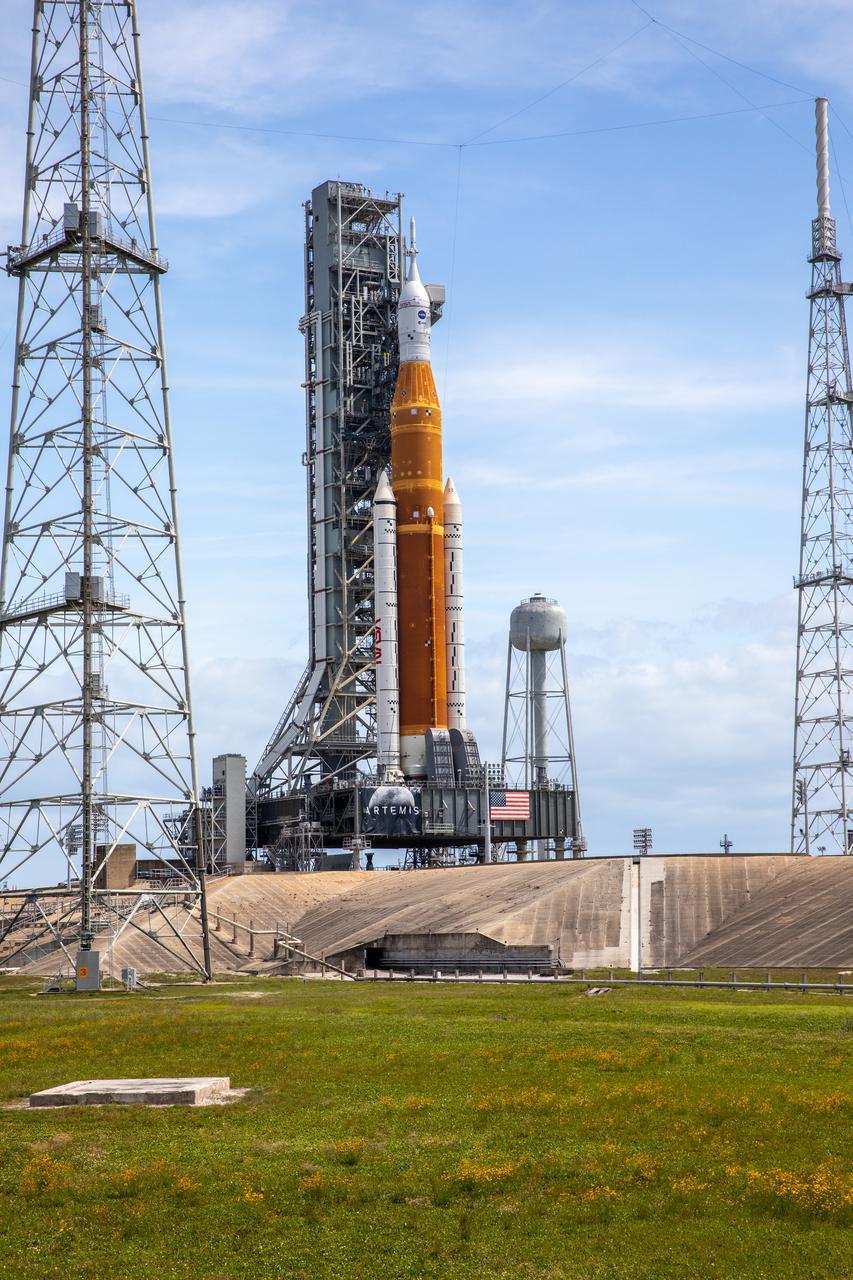
A view of the Artemis I Space Launch System (SLS) and Orion spacecraft on Launch Pad 39B at NASA’s Kennedy Space Center in Florida on April 21, 2022. Also in view are two of the three lightning protection towers and the water tower. The SLS and Orion atop the mobile launcher were transported to the pad on crawler-transporter 2 for a prelaunch test called a wet dress rehearsal. Artemis I will be the first integrated test of the SLS and Orion spacecraft. In future Artemis missions, NASA will land the first woman and the first person of color on the surface of the Moon, paving the way for a long-term lunar presence and serving as a steppingstone on the way to Mars.
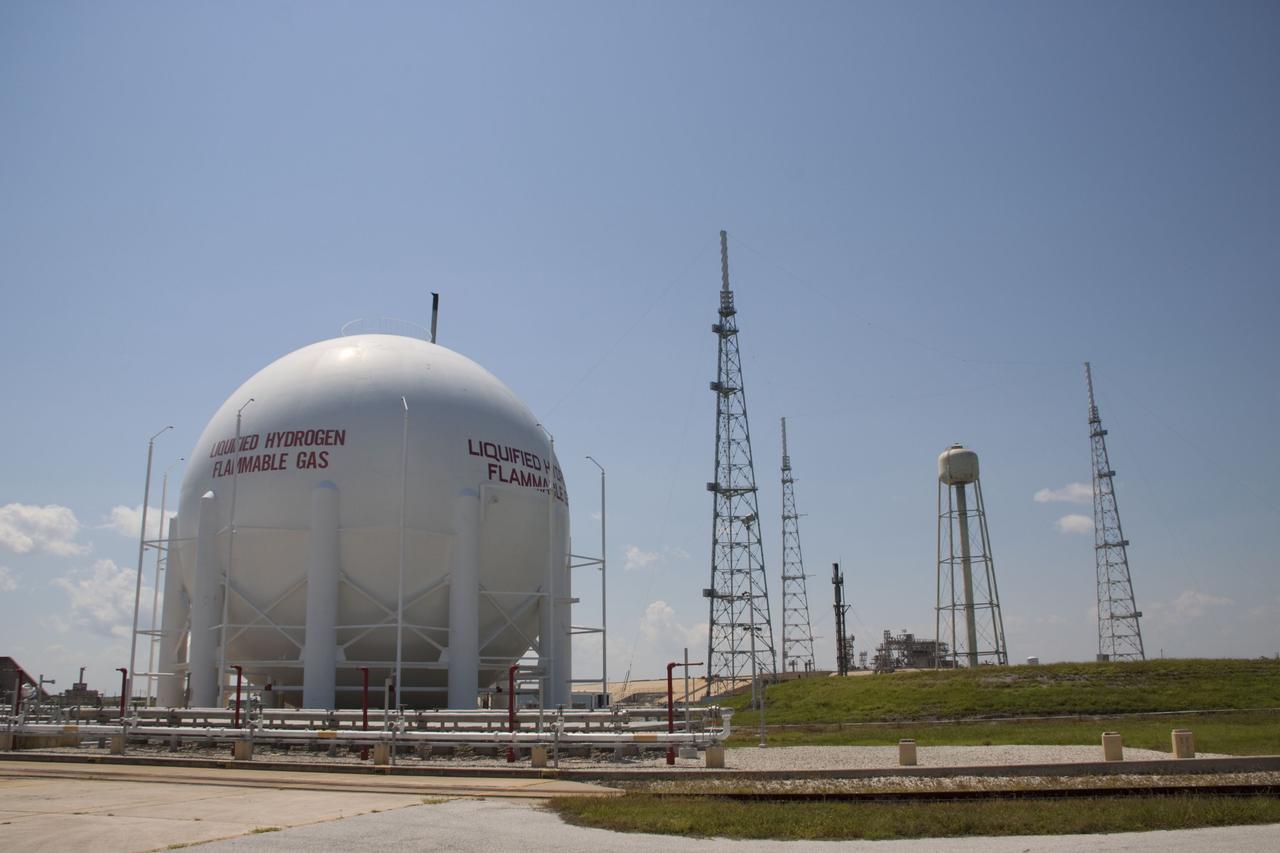
CAPE CANAVERAL, Fla. – The deconstruction of Launch Pad 39B at NASA’s Kennedy Space Center in Florida is complete. Still remaining and standing over the remnants of the fixed service structure are the 600-foot-tall lightning protection towers and the water tower used for sound suppression. In 2009, the structure at the pad was no longer needed for NASA's Space Shuttle Program, so it is being restructured for future use. The new design will feature a "clean pad" for rockets to come with their own launcher, making it more versatile for a number of vehicles. For information on NASA's future plans, visit http://www.nasa.gov/exploration. Photo credit: NASA/Jim Grossmann
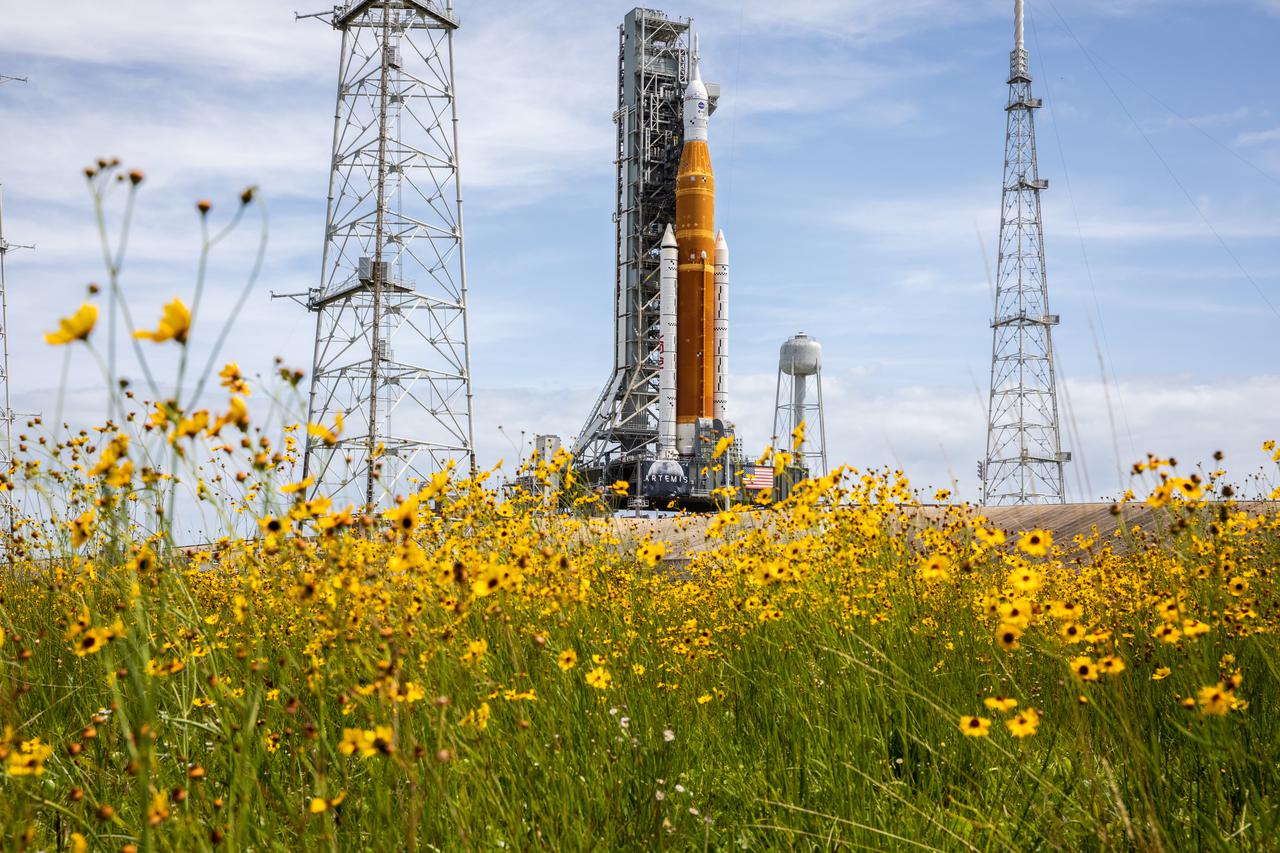
Wildflowers frame a view of the Artemis I Space Launch System (SLS) and Orion spacecraft on Launch Pad 39B at NASA’s Kennedy Space Center in Florida on April 21, 2022. Also in view are two of the three lightning protection towers and the water tower. The SLS and Orion atop the mobile launcher were transported to the pad on crawler-transporter 2 for a prelaunch test called a wet dress rehearsal. Artemis I will be the first integrated test of the SLS and Orion spacecraft. In future Artemis missions, NASA will land the first woman and the first person of color on the surface of the Moon, paving the way for a long-term lunar presence and serving as a steppingstone on the way to Mars.
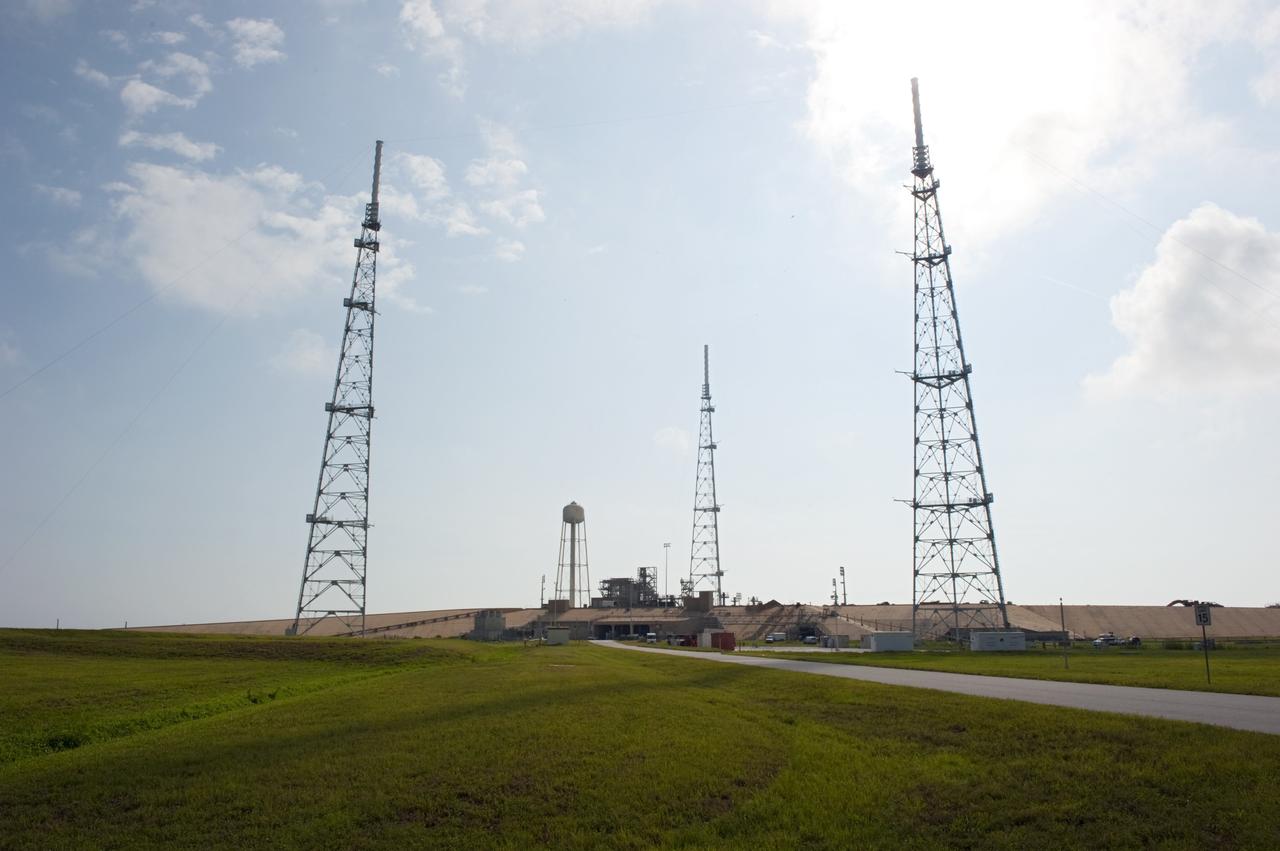
CAPE CANAVERAL, Fla. -- At NASA's Kennedy Space Center in Florida, the water tower and lightning protection system, consisting of three 600-foot-tall lightning towers, remain at Launch Pad 39B after the pad's deconstruction. Each lightning tower is 500 feet tall and topped off with an additional 100-foot fiberglass mast which supports a wire catenary system. In 2009, the structure at the pad was no longer needed for NASA's Space Shuttle Program, so it is being restructured for future use. The new design will feature a "clean pad" for rockets to come with their own launcher, making it more versatile for a number of vehicles. For information on NASA's future plans, visit http://www.nasa.gov/exploration. Photo credit: NASA/Kim Shiflett
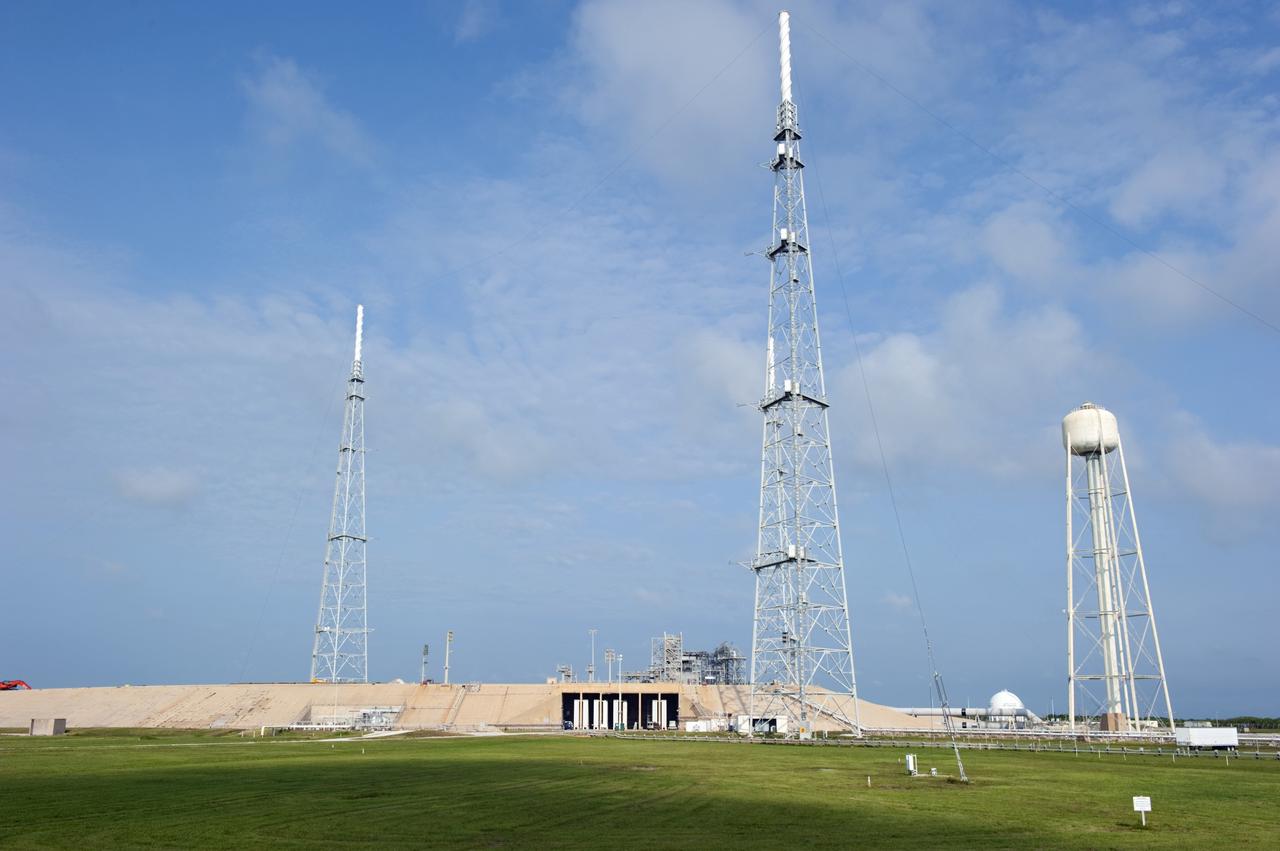
CAPE CANAVERAL, Fla. -- At NASA's Kennedy Space Center in Florida, the water tower (right) which supported the space shuttle's water deluge system still stands on Launch Pad 39B after the pad's deconstruction. In 2009, the structure at the pad was no longer needed for NASA's Space Shuttle Program, so it is being restructured for future use. The new design will feature a "clean pad" for rockets to come with their own launcher, making it more versatile for a number of vehicles. For information on NASA's future plans, visit http://www.nasa.gov/exploration. Photo credit: NASA/Kim Shiflett
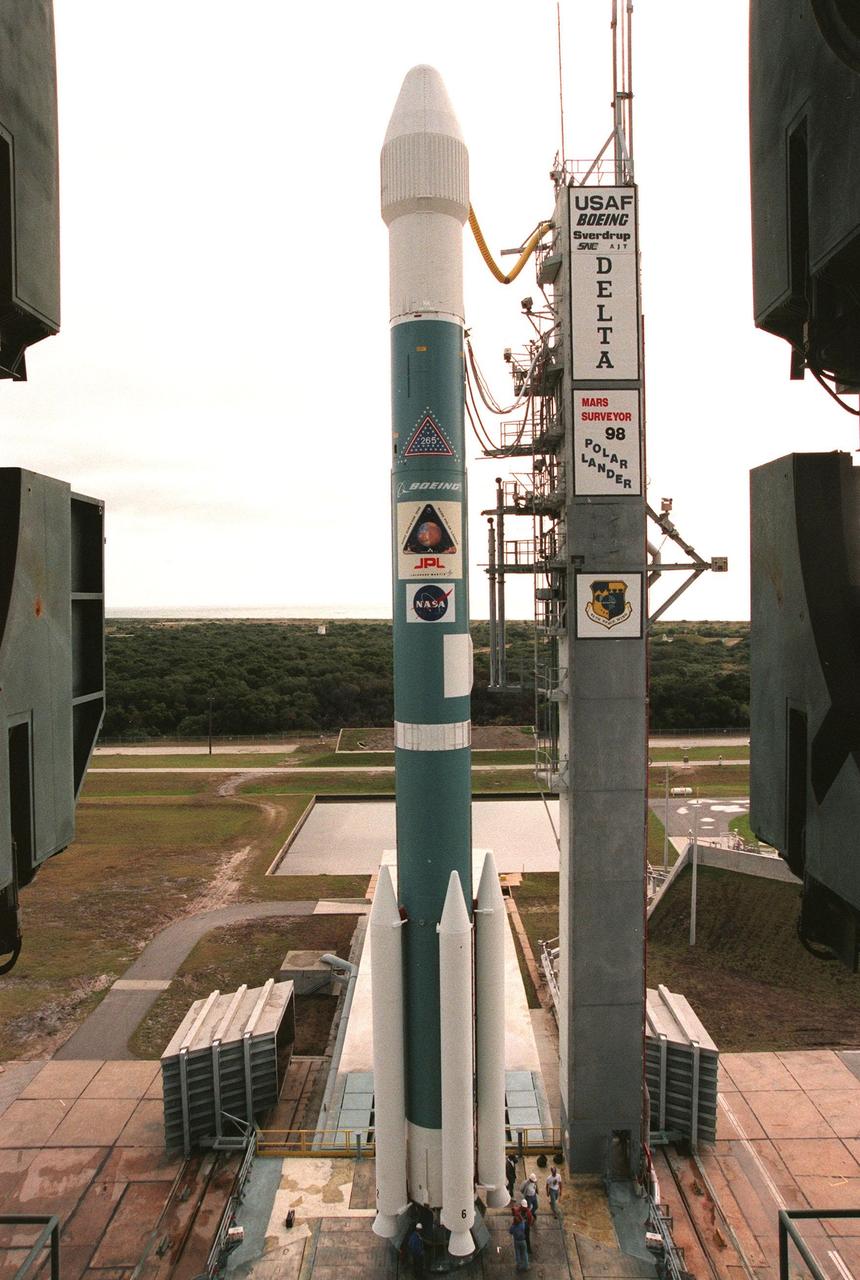
KENNEDY SPACE CENTER, FLA. -- After launch tower retraction, the Boeing Delta II rocket carrying NASA's Mars Polar lander waits for liftoff, scheduled for 3:21 p.m. EST, at Launch Complex 17B, Cape Canaveral Air Station. The lander is a solar-powered spacecraft designed to touch down on the Martian surface near the northern-most boundary of the south pole in order to study the water cycle there. The lander also will help scientists learn more about climate change and current resources on Mars, studying such things as frost, dust, water vapor and condensates in the Martian atmosphere. It is the second spacecraft to be launched in a pair of Mars Surveyor 98 missions
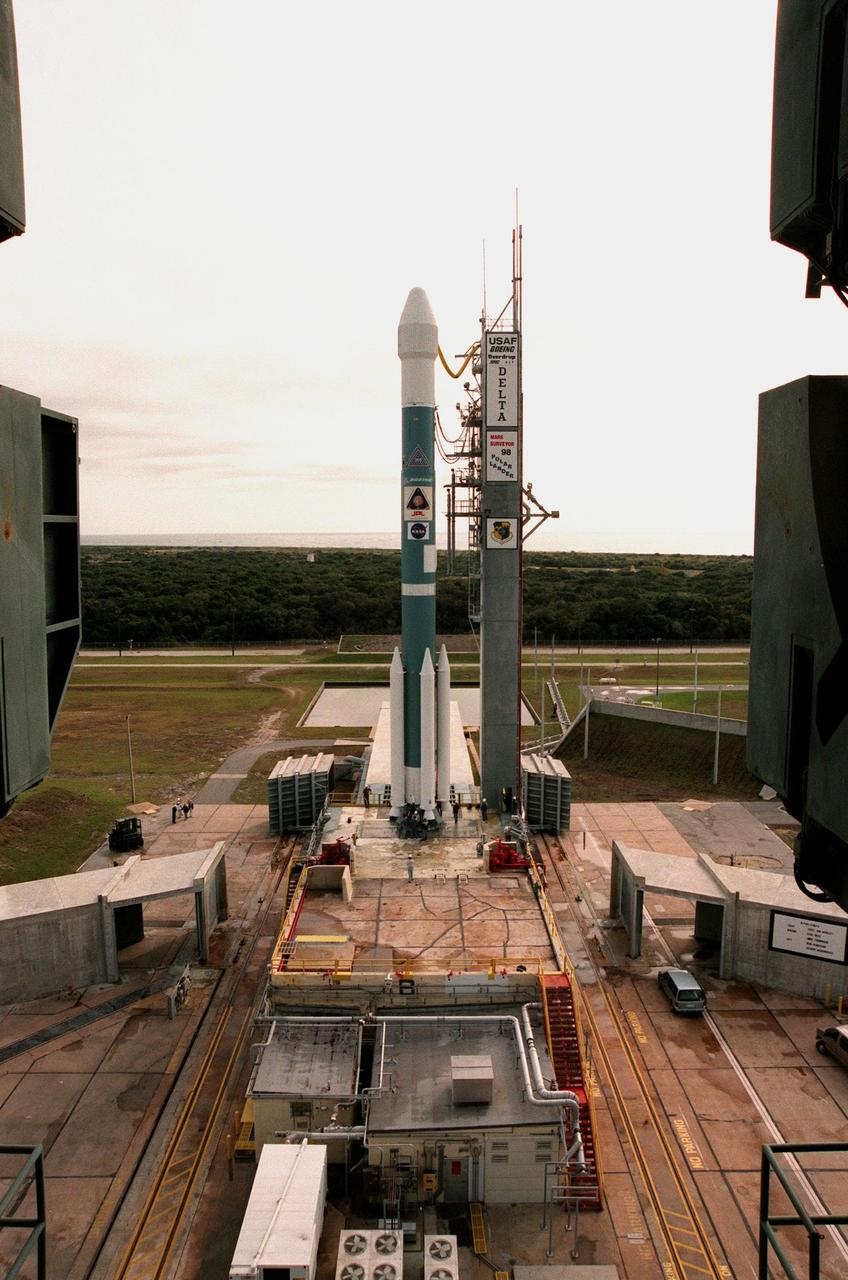
KENNEDY SPACE CENTER, FLA. -- After launch tower rollback, the Boeing Delta II rocket carrying NASA's Mars Polar lander awaits liftoff, scheduled for 3:21 p.m. EST, at Launch Complex 17B, Cape Canaveral Air Station. The lander is a solar-powered spacecraft designed to touch down on the Martian surface near the northern-most boundary of the south pole in order to study the water cycle there. The lander also will help scientists learn more about climate change and current resources on Mars, studying such things as frost, dust, water vapor and condensates in the Martian atmosphere. It is the second spacecraft to be launched in a pair of Mars Surveyor '98 missions
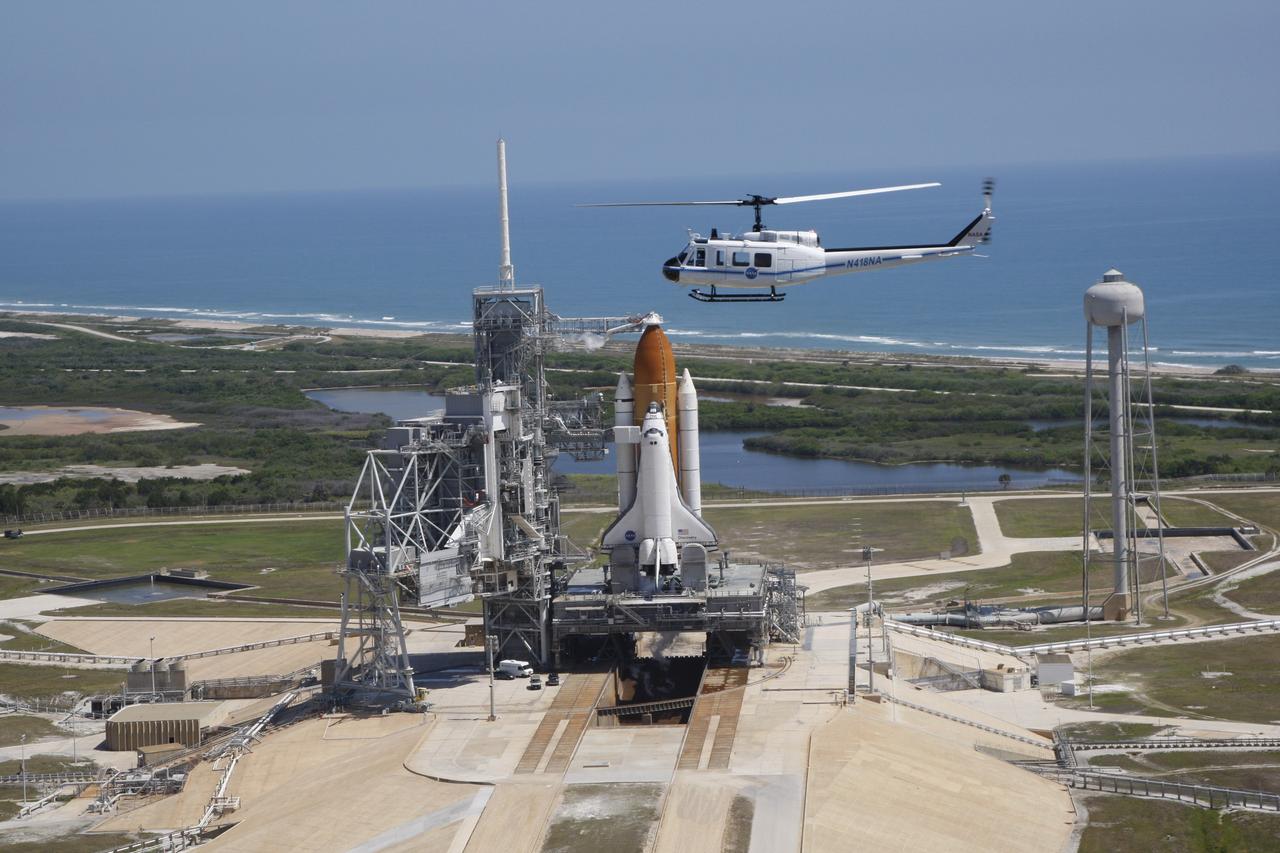
CAPE CANAVERAL, Fla. – A new NASA helicopter circles space shuttle Discovery on Launch Pad 39A prior to launch on the STS-124 mission. To the left of the shuttle is the fixed service structure with the 80-foot lightning mast on top. The rotating service structure, normally closed around the shuttle, is open for liftoff. At right of the pad is the 300,000-gallon water tower that provides the water used for sound suppression on the pad during liftoff. In the background is the Atlantic Ocean. Discovery is making its 35th flight. The STS-124 mission is the 26th in the assembly of the space station. It is the second of three flights launching components to complete the Japan Aerospace Exploration Agency's Kibo laboratory.
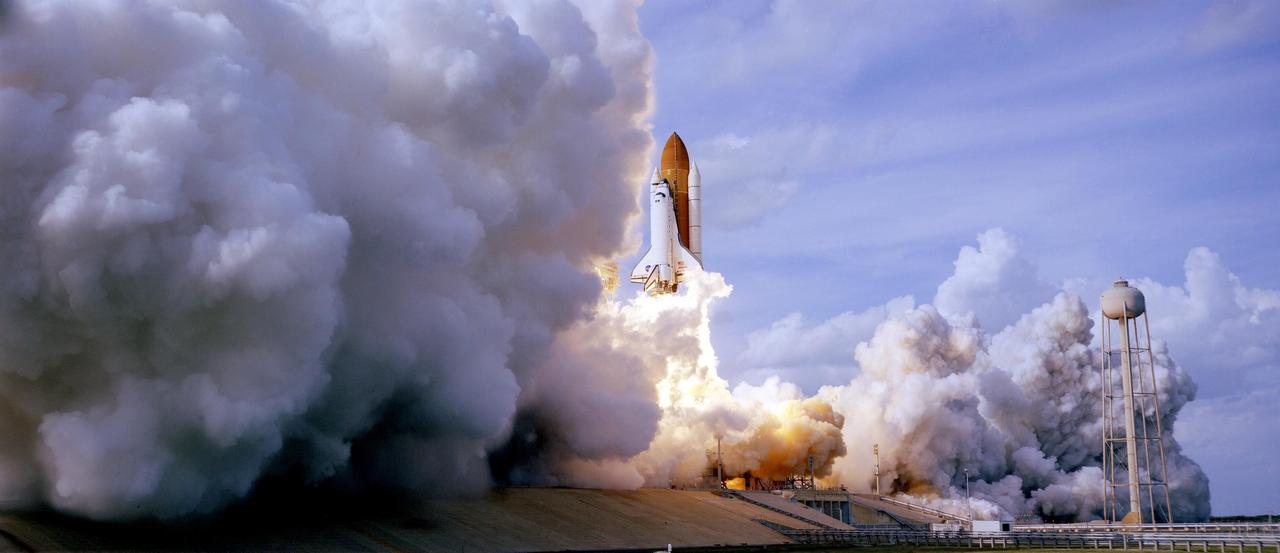
KENNEDY SPACE CENTER, FLA. -- Space shuttle Atlantis is surrounded by clouds of smoke and steam as it lifts off Launch Pad 39A on mission STS-122. At far right is the water tower that provides water for the sound suppression system during liftoff. The shuttle lifted off on time at 2:45 p.m. EST. This is the third launch attempt for Atlantis since December 2007 to carry the European Space Agency's Columbus laboratory to the International Space Station. During the 11-day mission, the crew's prime objective is to attach the laboratory to the Harmony module, adding to the station's size and capabilities. Photo credit: NASA/NASA/Rick Wetherington, Tim Terry, Tim Powers
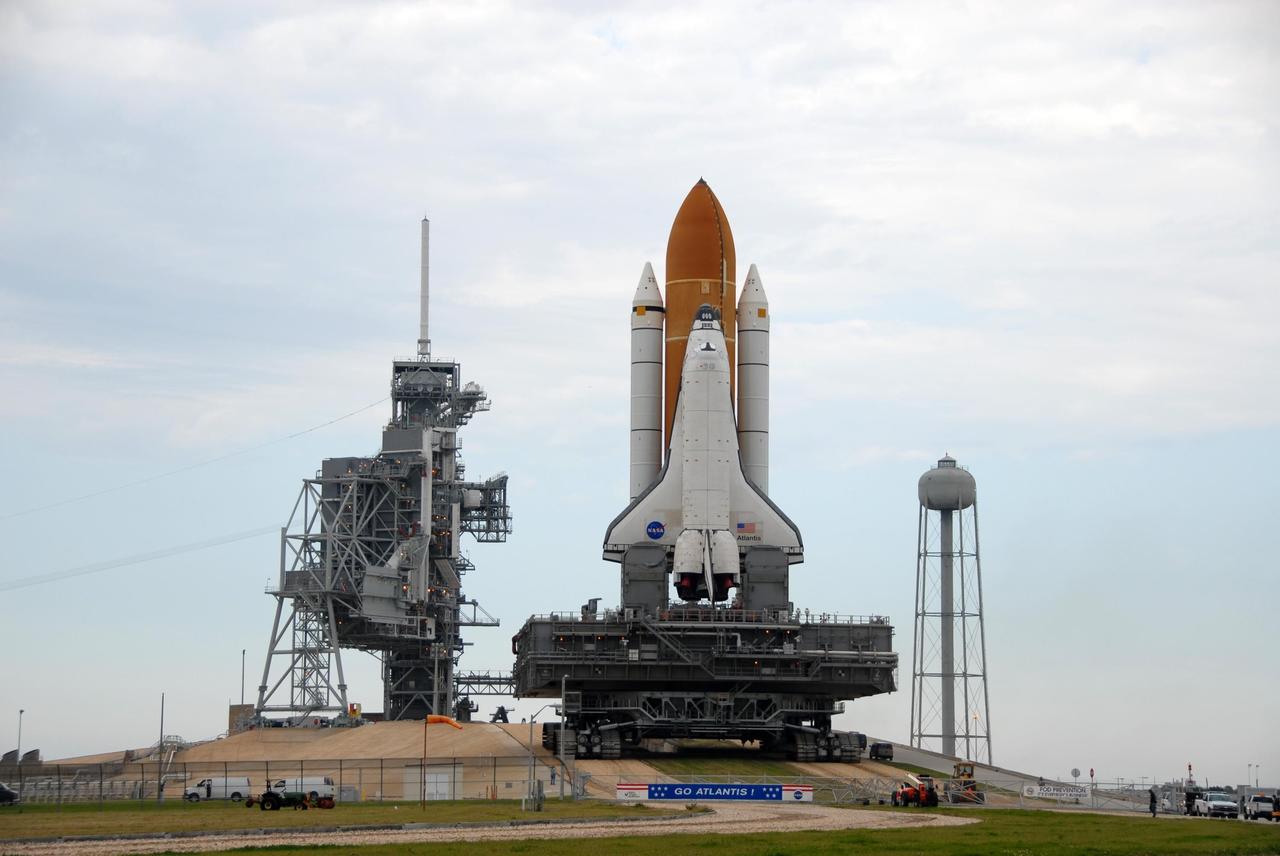
KENNEDY SPACE CENTER, FLA. -- Lined up on the horizon are Space Shuttle Atlantis, the rotating and fixed service structures of Launch Pad 39A, Launch Pad 39B, and the 300-gallon water tower of Pad 39A. The shuttle has spent six hours rolling out to Pad 39A, leaving the Vehicle Assembly Building at 8:19 a.m. The body of water in the foreground is the Banana River. The mission payload aboard Space Shuttle Atlantis is the S3/S4 integrated truss structure, along with a third set of solar arrays and batteries. The crew of six astronauts will install the truss to continue assembly of the International Space Station. Launch is targeted for March 15. Photo credit: NASA/Ken Thornsley
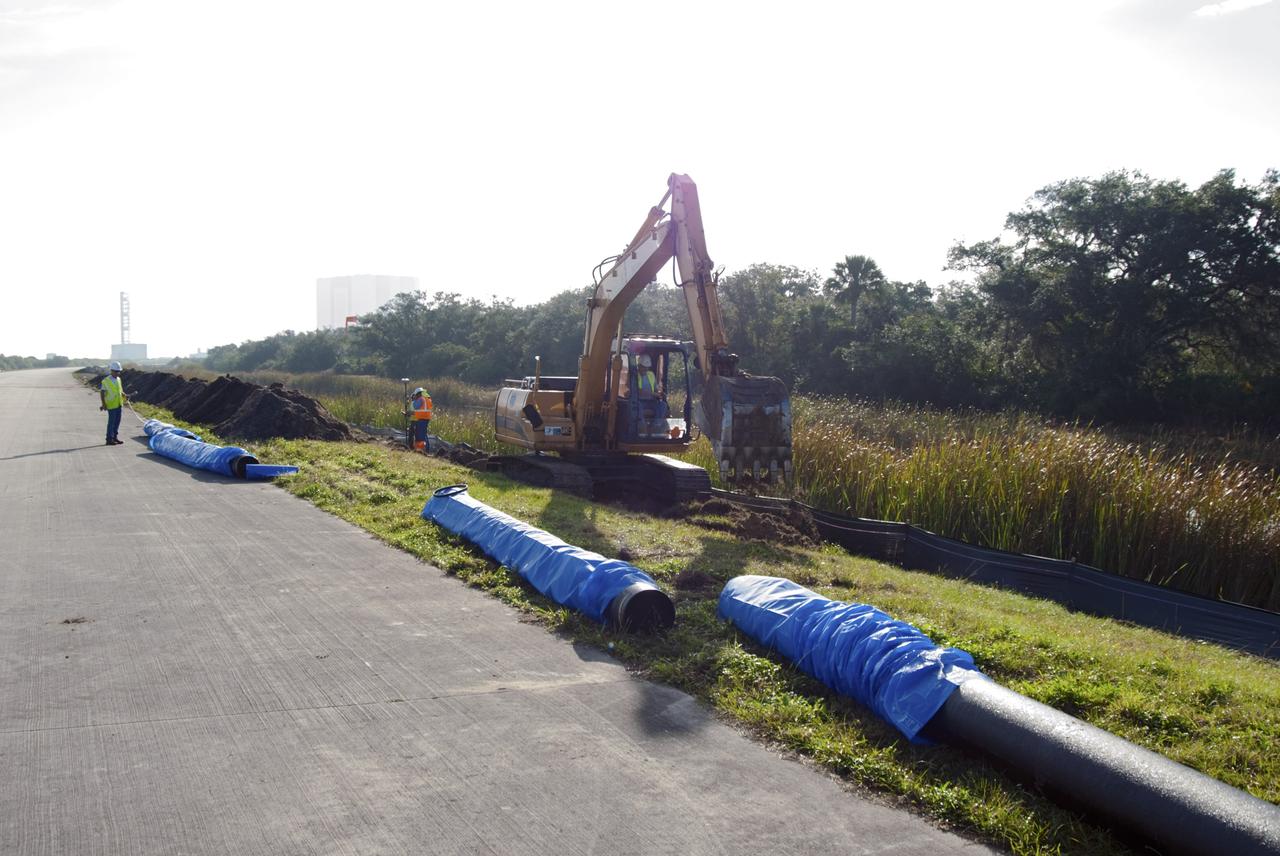
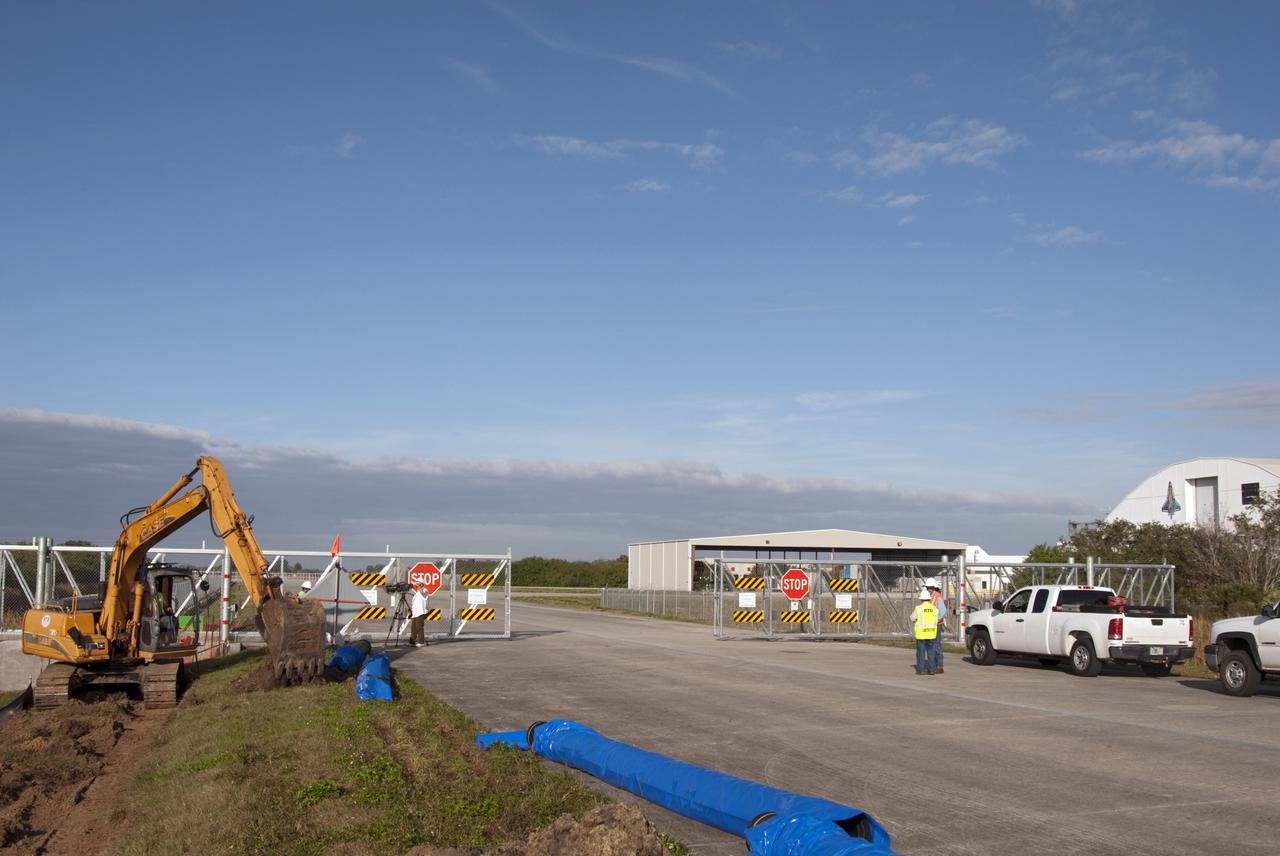
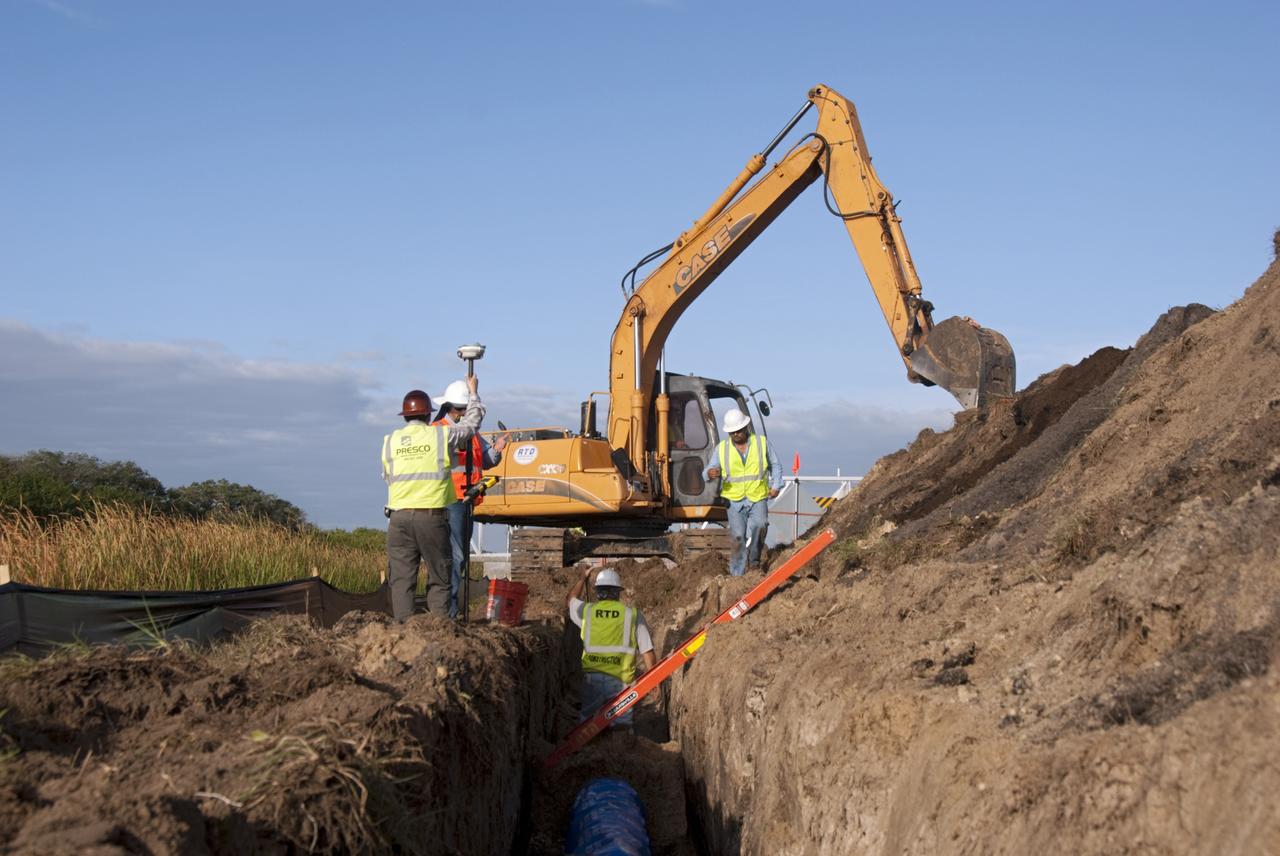
CAPE CANAVERAL, Fla. – At NASA’s Kennedy Space Center in Florida, a new 12-inch water main is being installed as part of a water/wastewater revitalizing plan. The main will provide water to the area around the shuttle landing facility's Landing Aids Control Building and fire station. NASA’s space shuttle runway is a unique national asset designed to enable the recovery of the agency’s fleet of space shuttle orbiters. The shuttle landing facility is a single, 15,000-foot long concrete runway oriented to the southeast and northwest. Air traffic control is provided from a control tower built to FAA standards. Fire and emergency response services are also available from an onsite facility. For more information, visit http://kscpartnerships.ksc.nasa.gov/slf.htm Photo credit: NASA/Tim Jacobs
CAPE CANAVERAL, Fla. – At NASA’s Kennedy Space Center in Florida, a new 12-inch water main is being installed as part of a water/wastewater revitalizing plan. The main will provide water to the area around the shuttle landing facility's Landing Aids Control Building and fire station. NASA’s space shuttle runway is a unique national asset designed to enable the recovery of the agency’s fleet of space shuttle orbiters. The shuttle landing facility is a single, 15,000-foot long concrete runway oriented to the southeast and northwest. Air traffic control is provided from a control tower built to FAA standards. Fire and emergency response services are also available from an onsite facility. For more information, visit http://kscpartnerships.ksc.nasa.gov/slf.htm Photo credit: NASA/Tim Jacobs
CAPE CANAVERAL, Fla. – At NASA’s Kennedy Space Center in Florida, a new 12-inch water main is being installed as part of a water/wastewater revitalizing plan. The main will provide water to the area around the shuttle landing facility's Landing Aids Control Building and fire station. NASA’s space shuttle runway is a unique national asset designed to enable the recovery of the agency’s fleet of space shuttle orbiters. The shuttle landing facility is a single, 15,000-foot long concrete runway oriented to the southeast and northwest. Air traffic control is provided from a control tower built to FAA standards. Fire and emergency response services are also available from an onsite facility. For more information, visit http://kscpartnerships.ksc.nasa.gov/slf.htm Photo credit: NASA/Tim Jacobs

CAPE CANAVERAL, Fla. – At NASA’s Kennedy Space Center in Florida, a new 12-inch water main is being installed as part of a water/wastewater revitalizing plan. The main will provide water to the area around the shuttle landing facility's Landing Aids Control Building and fire station. NASA’s space shuttle runway is a unique national asset designed to enable the recovery of the agency’s fleet of space shuttle orbiters. The shuttle landing facility is a single, 15,000-foot long concrete runway oriented to the southeast and northwest. Air traffic control is provided from a control tower built to FAA standards. Fire and emergency response services are also available from an onsite facility. For more information, visit http://kscpartnerships.ksc.nasa.gov/slf.htm Photo credit: NASA/Tim Jacobs

CAPE CANAVERAL, Fla. – At NASA’s Kennedy Space Center in Florida, a new 12-inch water main is being installed as part of a water/wastewater revitalizing plan. The main will provide water to the area around the shuttle landing facility's Landing Aids Control Building and fire station. NASA’s space shuttle runway is a unique national asset designed to enable the recovery of the agency’s fleet of space shuttle orbiters. The shuttle landing facility is a single, 15,000-foot long concrete runway oriented to the southeast and northwest. Air traffic control is provided from a control tower built to FAA standards. Fire and emergency response services are also available from an onsite facility. For more information, visit http://kscpartnerships.ksc.nasa.gov/slf.htm Photo credit: NASA/Tim Jacobs
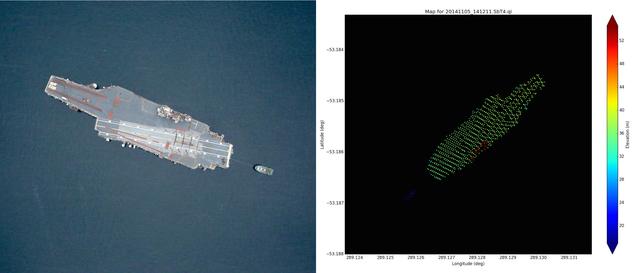
Left: NASA Digital Mapping System image of the USS Constellation taken near Punta Arenas, Chile on Nov. 5, 2014. Credit: NASA/DMS Right: Airborne Topographic Mapper wide scan lidar elevation data taken over the USS Constellation during Nov. 5, 2014 overflight. The water elevation has been removed and was 17 meters. The Constellation flight deck is about 16m above the water surface and the conning tower is about 33m above the water. Credit: NASA/ATM Read more: <a href="http://www.nasa.gov/content/goddard/icebridge/news/fall14/uss-constellation-and-thurston-island-nov-5/#.VGOy4khvL2g" rel="nofollow">www.nasa.gov/content/goddard/icebridge/news/fall14/uss-co...</a>

CAPE CANAVERAL, Fla. – At NASA’s Kennedy Space Center in Florida, a new 12-inch water main is being installed as part of a water/wastewater revitalizing plan. The main will provide water to the area around the shuttle landing facility's Landing Aids Control Building and fire station. NASA’s space shuttle runway is a unique national asset designed to enable the recovery of the agency’s fleet of space shuttle orbiters. The shuttle landing facility is a single, 15,000-foot long concrete runway oriented to the southeast and northwest. Air traffic control is provided from a control tower built to FAA standards. Fire and emergency response services are also available from an onsite facility. For more information, visit http://kscpartnerships.ksc.nasa.gov/slf.htm Photo credit: NASA/Tim Jacobs
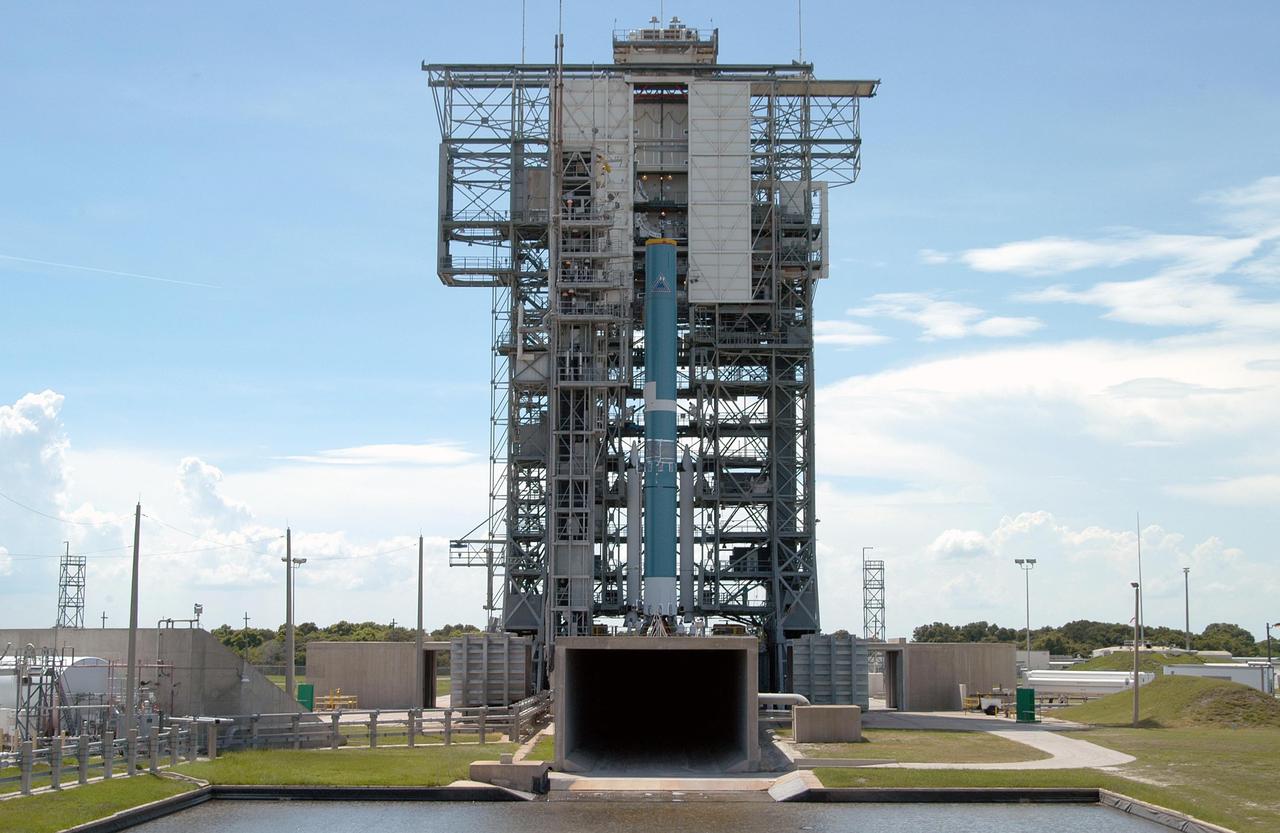
KENNEDY SPACE CENTER, FLA. - On Pad 17-B, Cape Canaveral Air Force Station, the mobile service tower delivers the first three Solid Rocket Boosters (SRBs) to the Boeing Delta II Heavy rocket for mating. In the foreground is the cooling water pond. The Delta II is the launch vehicle for the Aug. 2 launch of the MESSENGER spacecraft to the planet Mercury. The spacecraft is expected to reach orbit around Mercury in March 2011. MESSENGER was built for NASA by the Johns Hopkins University Applied Physics Laboratory in Laurel, Md.
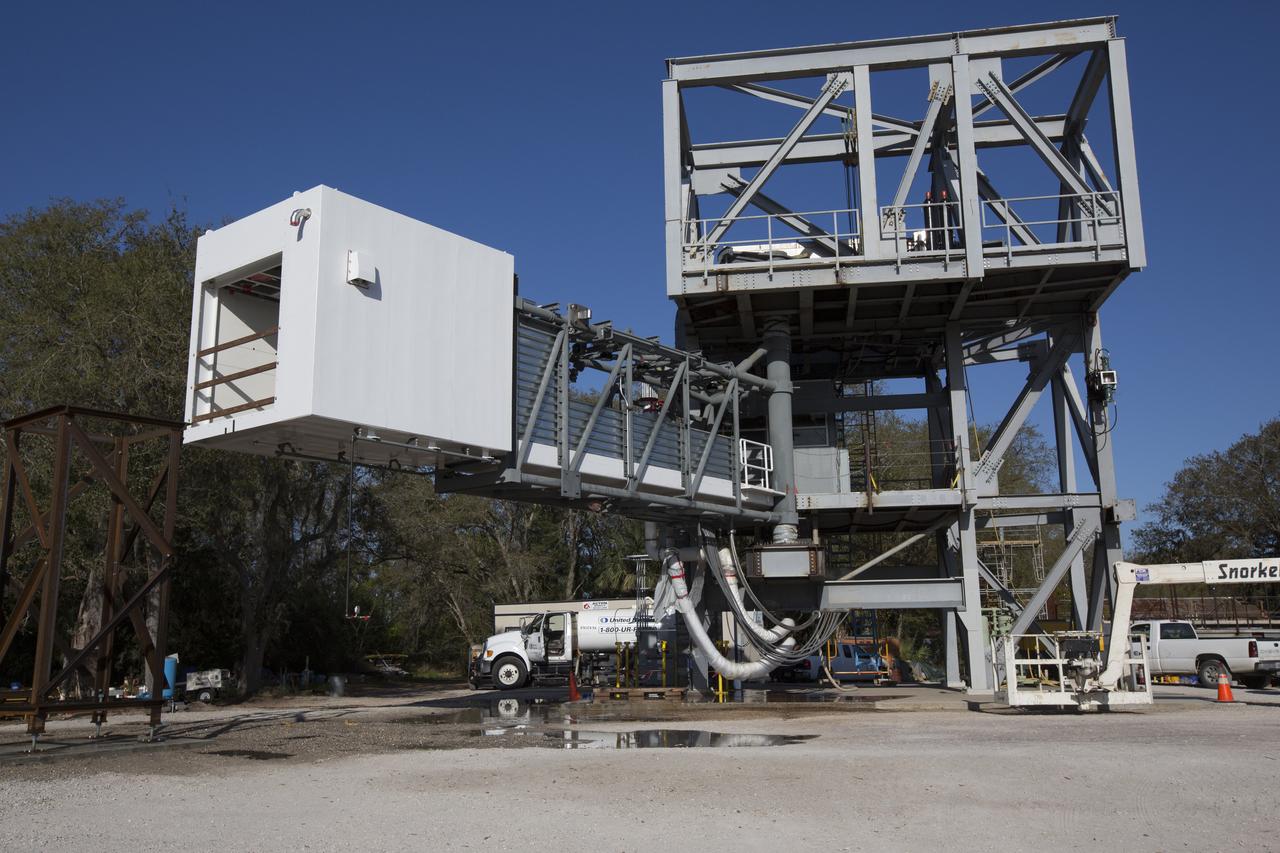
The Crew Access Arm is seen following a water deluge systems test March 23 at a construction yard near NASA's Kennedy Space Center in Florida. The arm is being tested before being installed on Space Launch Complex 41 Crew Access Tower later this year. It will be used as a bridge by astronauts to board Boeing's CST-100 Starliner spacecraft as it stands on the launch pad atop a United Launch Alliance Atlas V rocket.
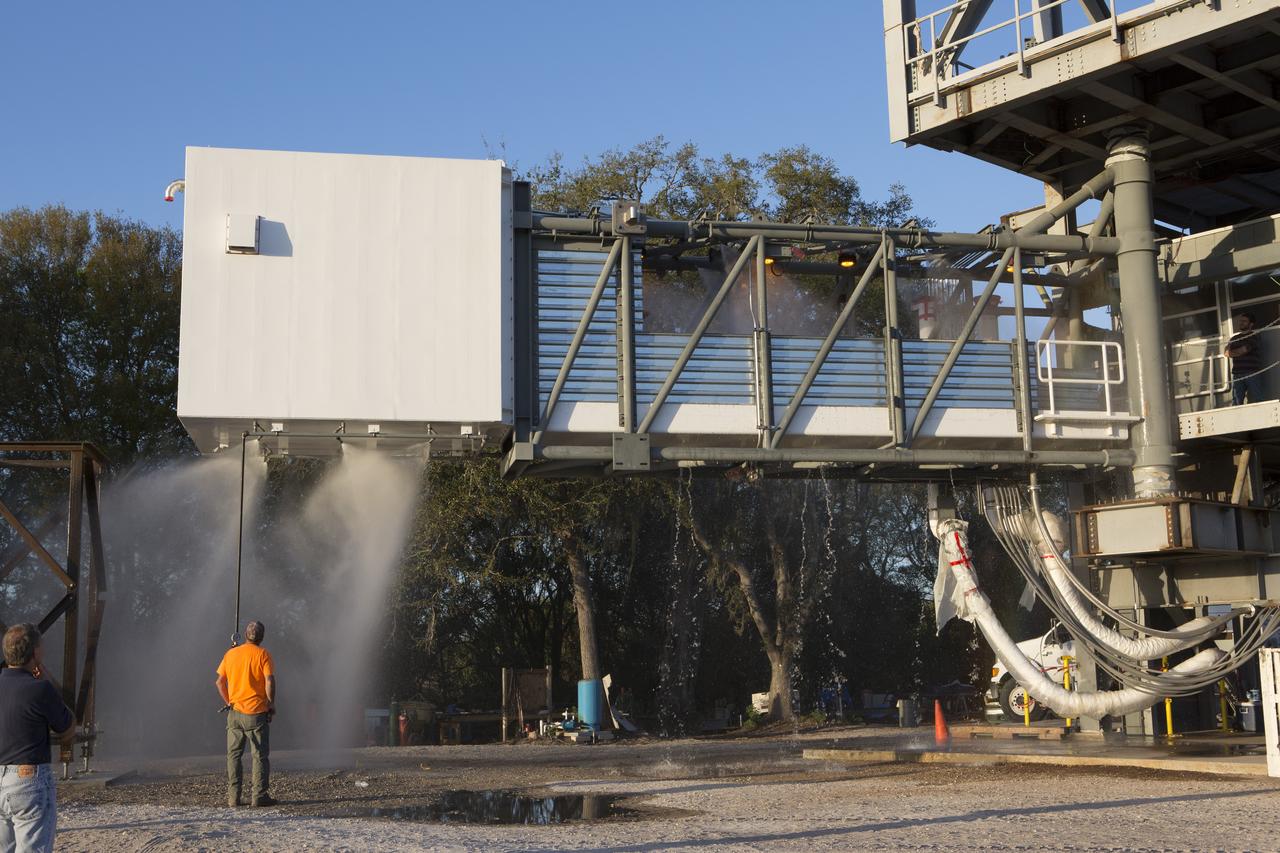
Water sprays on the Crew Access Arm during a deluge systems test March 23 at a construction yard near NASA's Kennedy Space Center in Florida. The arm is being tested before being installed on Space Launch Complex 41 Crew Access Tower later this year. It will be used as a bridge by astronauts to board Boeing's CST-100 Starliner spacecraft as it stands on the launch pad atop a United Launch Alliance Atlas V rocket.
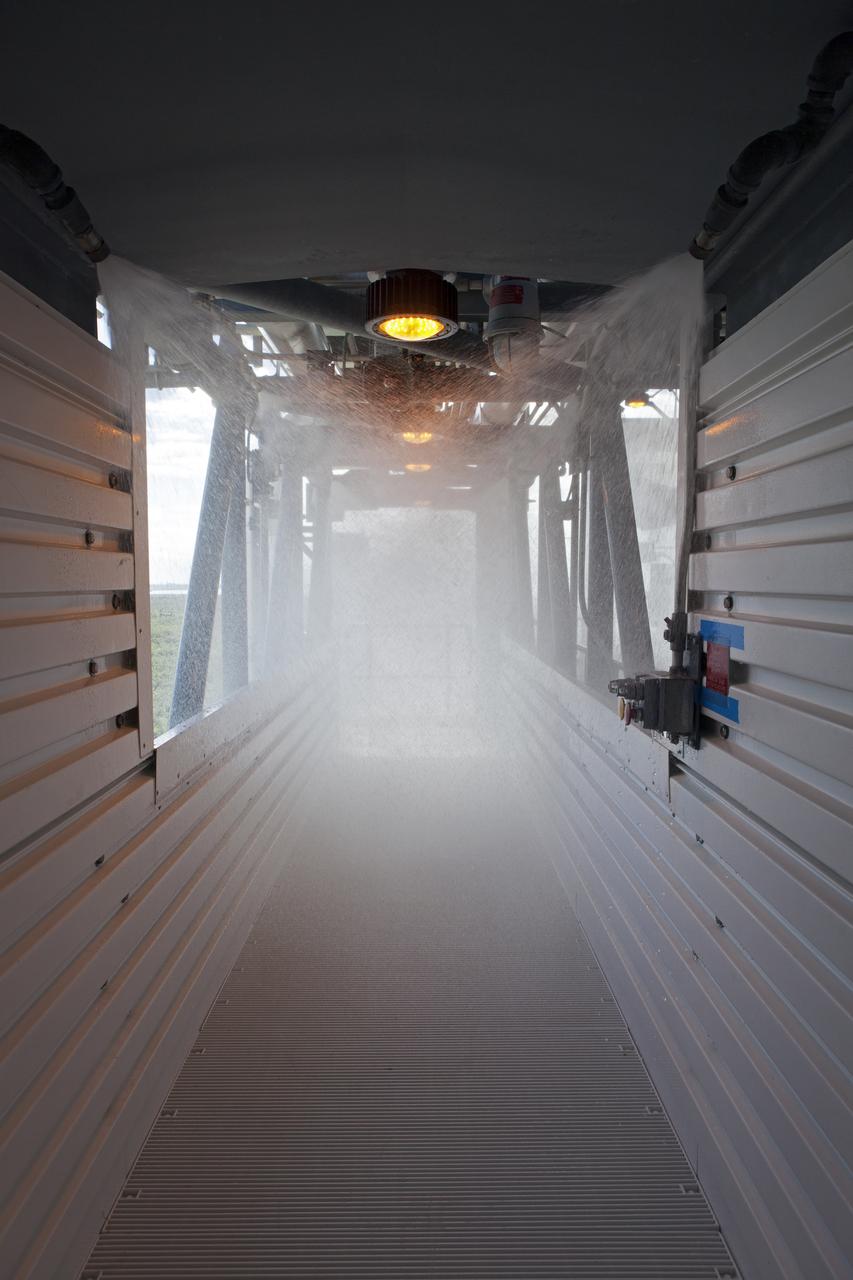
NASA, Boeing and United Launch Alliance personnel run a water deluge test on the Crew Access Tower at Space Launch Complex 41 on Cape Canaveral Air Force Station in Florida. The test gathered data on how launch site and astronaut crews would exit in the event of an emergency from the white room at the end of the crew access arm to the emergency escape system on the pad. Boeing’s Starliner will launch on a United Launch Alliance Atlas V rocket to the International Space Station as part of NASA’s Commercial Crew Program.
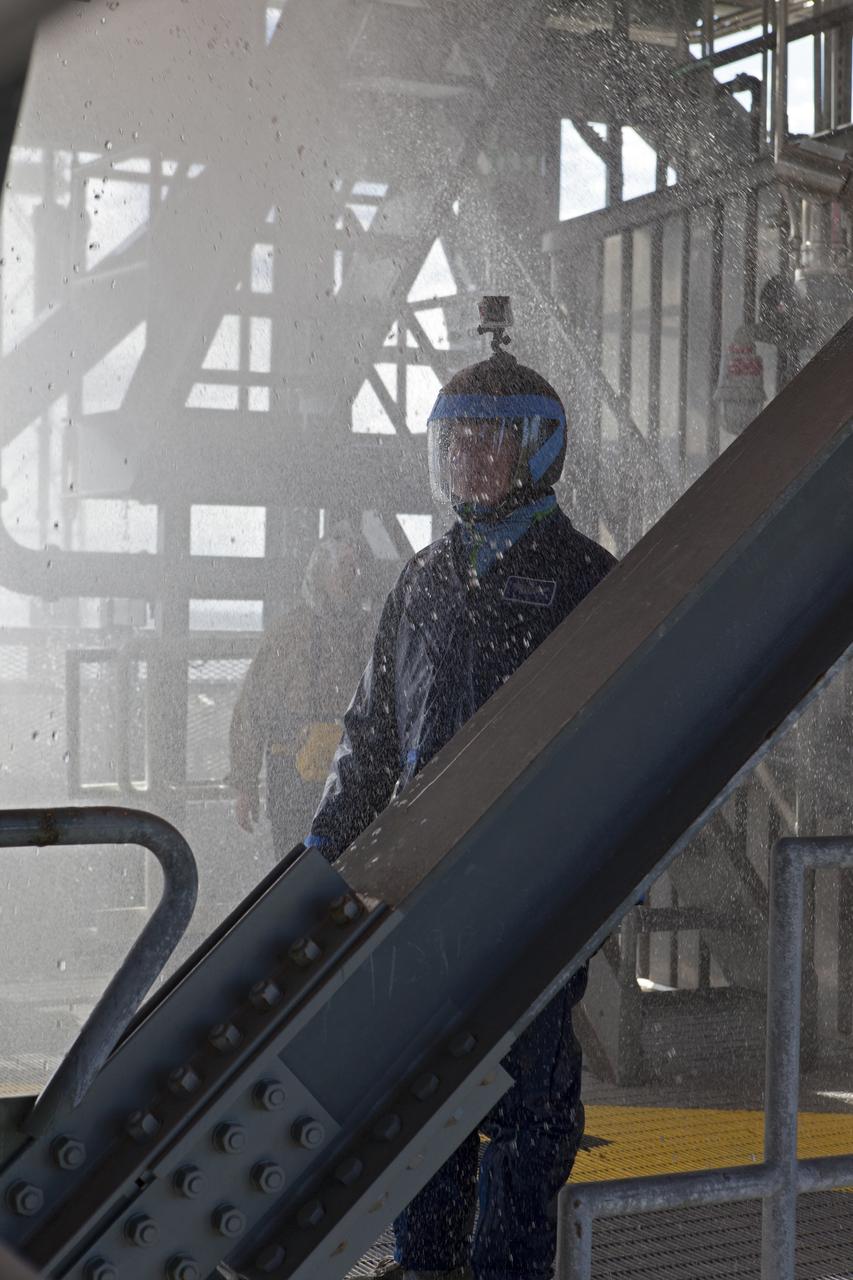
NASA and Boeing personnel experience conditions during a water deluge test on the Crew Access Tower at Space Launch Complex 41 on Cape Canaveral Air Force Station in Florida. The test gathered data on how launch site and astronaut crews would exit in the event of an emergency from the white room at the end of the crew access arm to the emergency escape system on the pad. Boeing’s Starliner will launch on a United Launch Alliance Atlas V rocket to the International Space Station as part of NASA’s Commercial Crew Program.
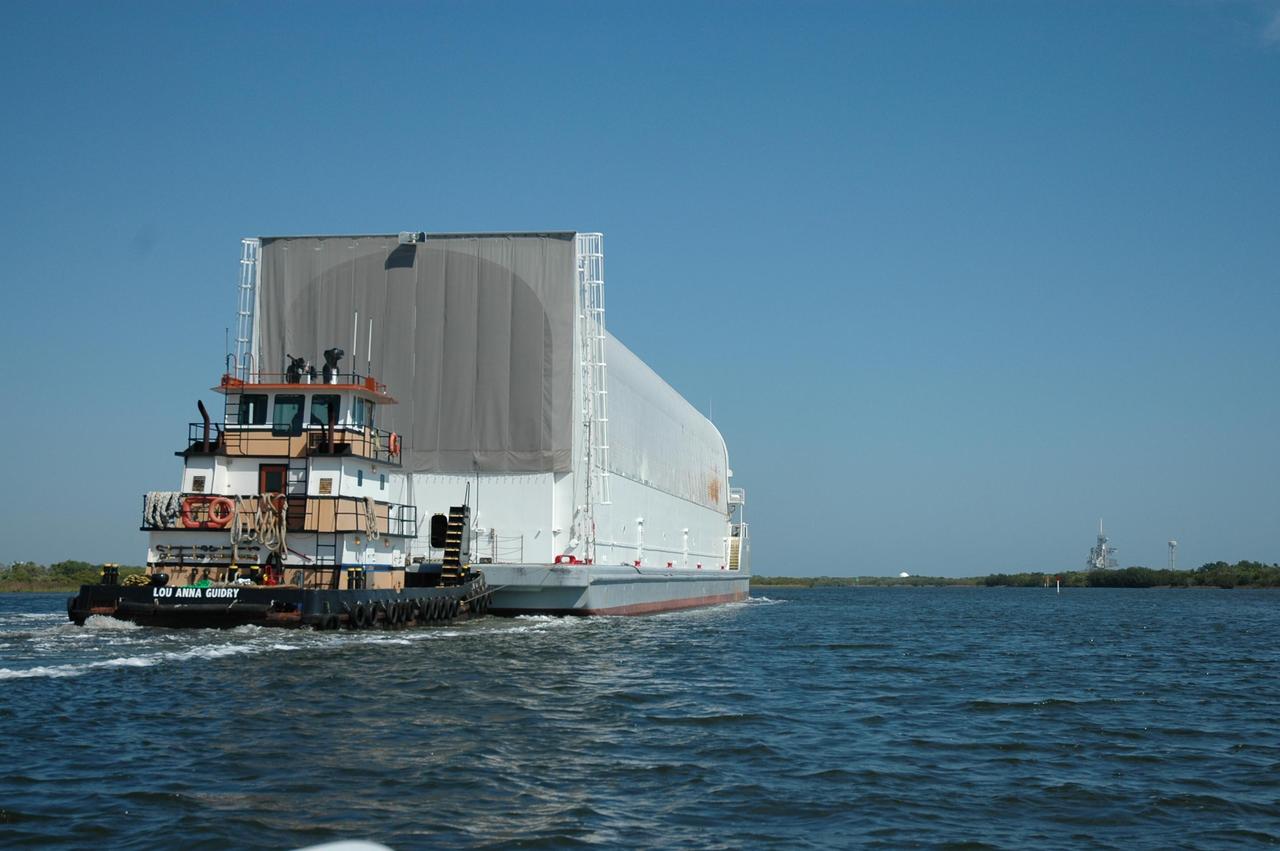
KENNEDY SPACE CENTER, FLA. -- The Pegasus barge is towed on the barge channel leading to the Launch Complex 39 Area. The barge's cargo is the external tank prepared for mission STS-118 by the Michoud Assembly Facility near New Orleans. Visible at right is one of the launch pads and the nearby water tower. The destination of the barge is the turn basin near the Vehicle Assembly Building where the tank will be offloaded and moved to the VAB. Photo credit: Dimitri Gerondidakis
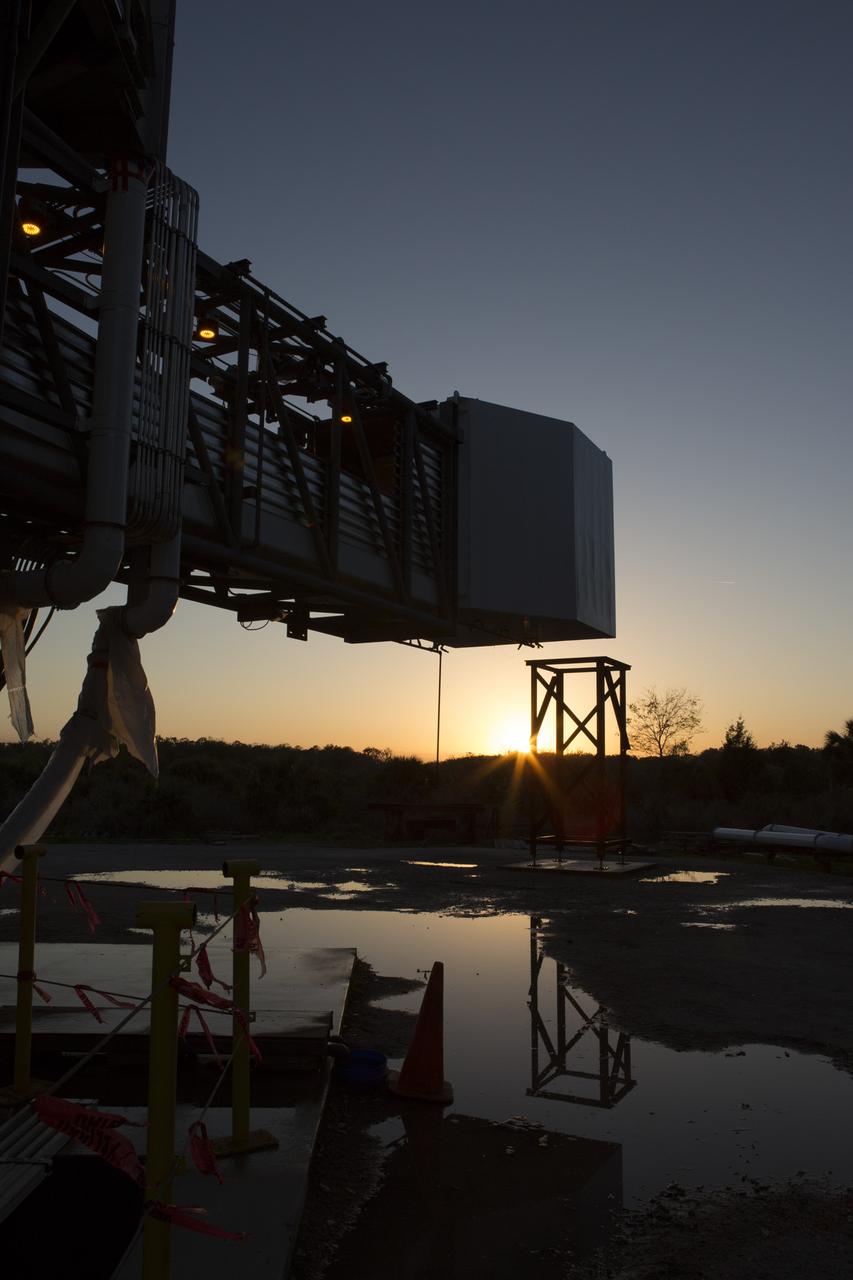
The Crew Access Arm is seen following a water deluge systems test March 23 at a construction yard near NASA's Kennedy Space Center in Florida. The arm is being tested before being installed on Space Launch Complex 41 Crew Access Tower later this year. It will be used as a bridge by astronauts to board Boeing's CST-100 Starliner spacecraft as it stands on the launch pad atop a United Launch Alliance Atlas V rocket.
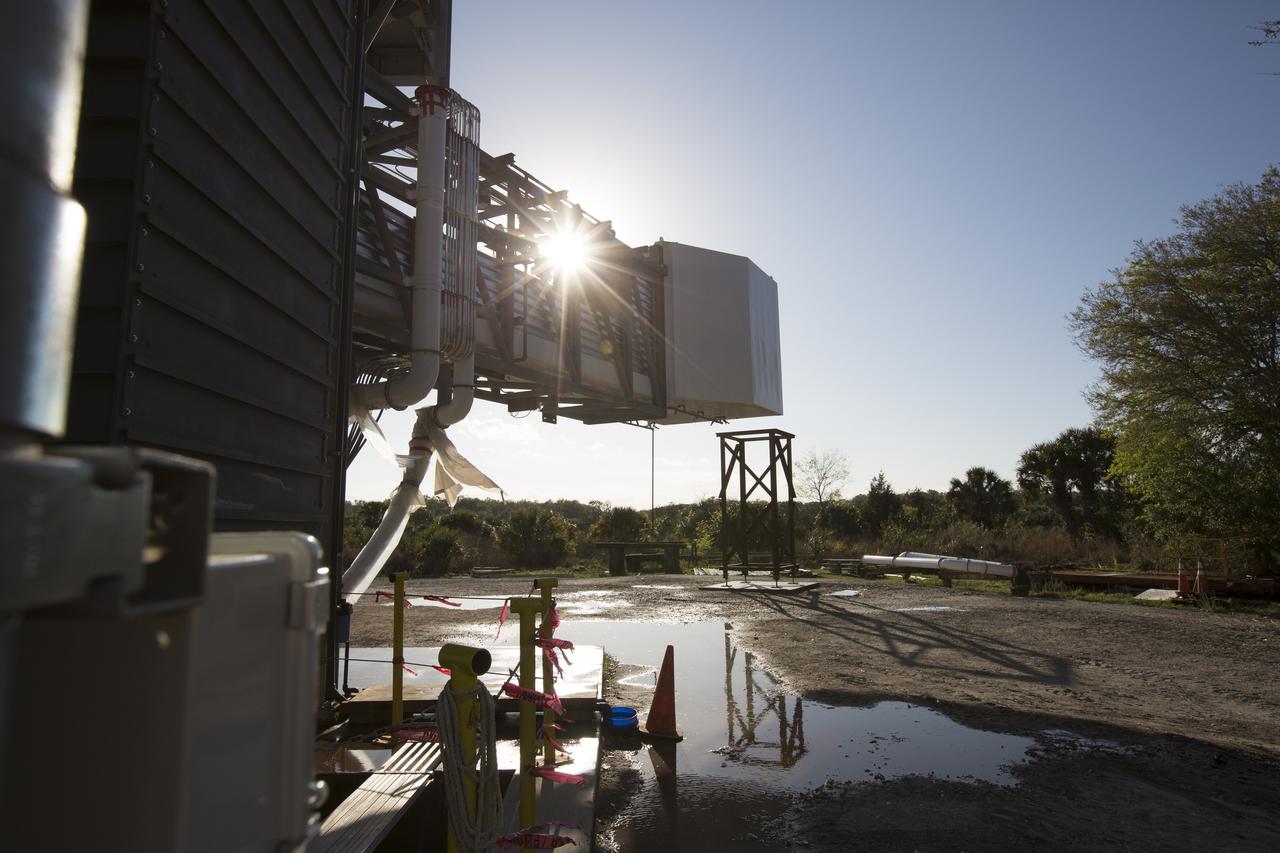
The Crew Access Arm is seen following a water deluge systems test March 23 at a construction yard near NASA's Kennedy Space Center in Florida. The arm is being tested before being installed on Space Launch Complex 41 Crew Access Tower later this year. It will be used as a bridge by astronauts to board Boeing's CST-100 Starliner spacecraft as it stands on the launch pad atop a United Launch Alliance Atlas V rocket.
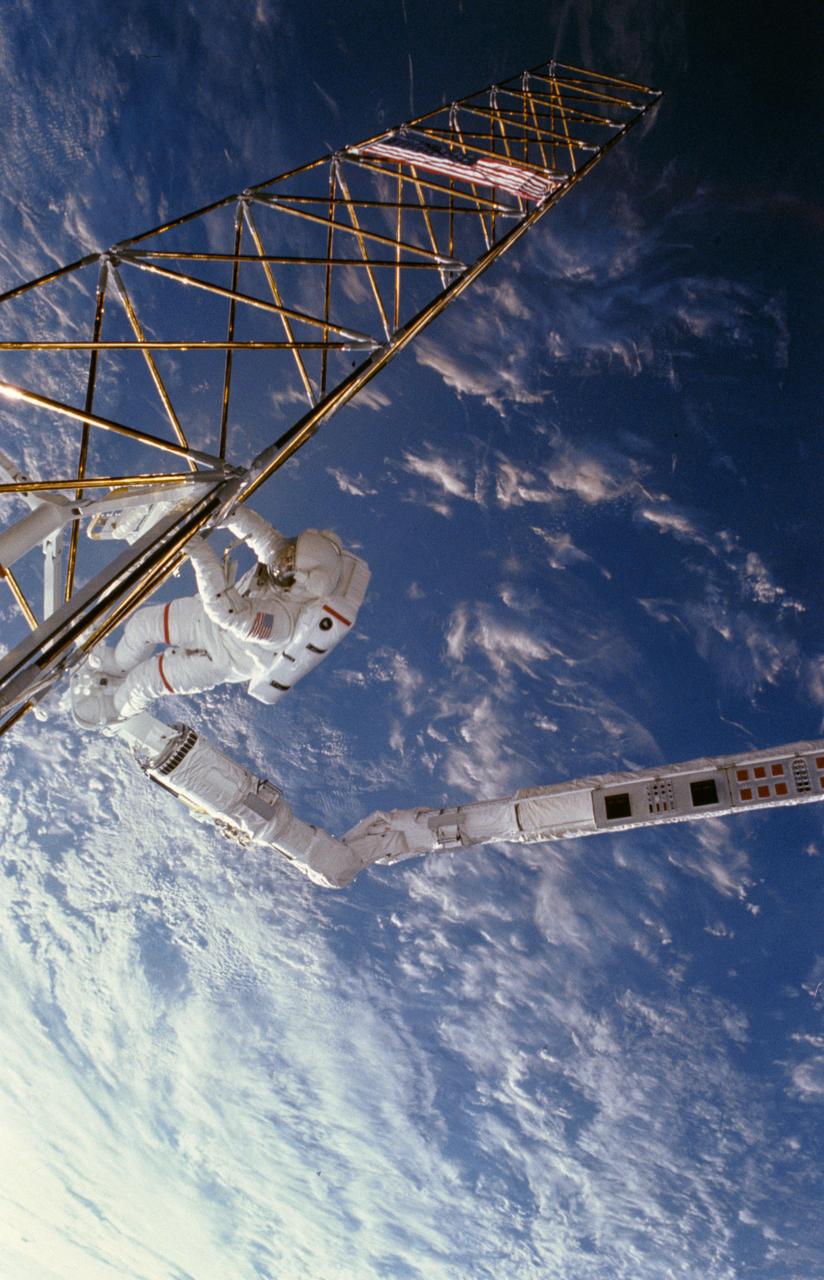
61B-102-022 (1 Dec 1985) --- Astronaut Jerry L. Ross, anchored to the foot restraint on the remote manipulator system (RMS), holds onto the tower-like Assembly Concept for Construction of Erectable Space Structures (ACCESS) device, as the Atlantis flies over white clouds and blue ocean waters. The frame was exposed with a negative-equipped camera held by Astronaut Sherwood C. Spring, who was also on the EVA-task.

Water sprays on the Crew Access Arm during a deluge systems test March 23 at a construction yard near NASA's Kennedy Space Center in Florida. The arm is being tested before being installed on Space Launch Complex 41 Crew Access Tower later this year. It will be used as a bridge by astronauts to board Boeing's CST-100 Starliner spacecraft as it stands on the launch pad atop a United Launch Alliance Atlas V rocket.
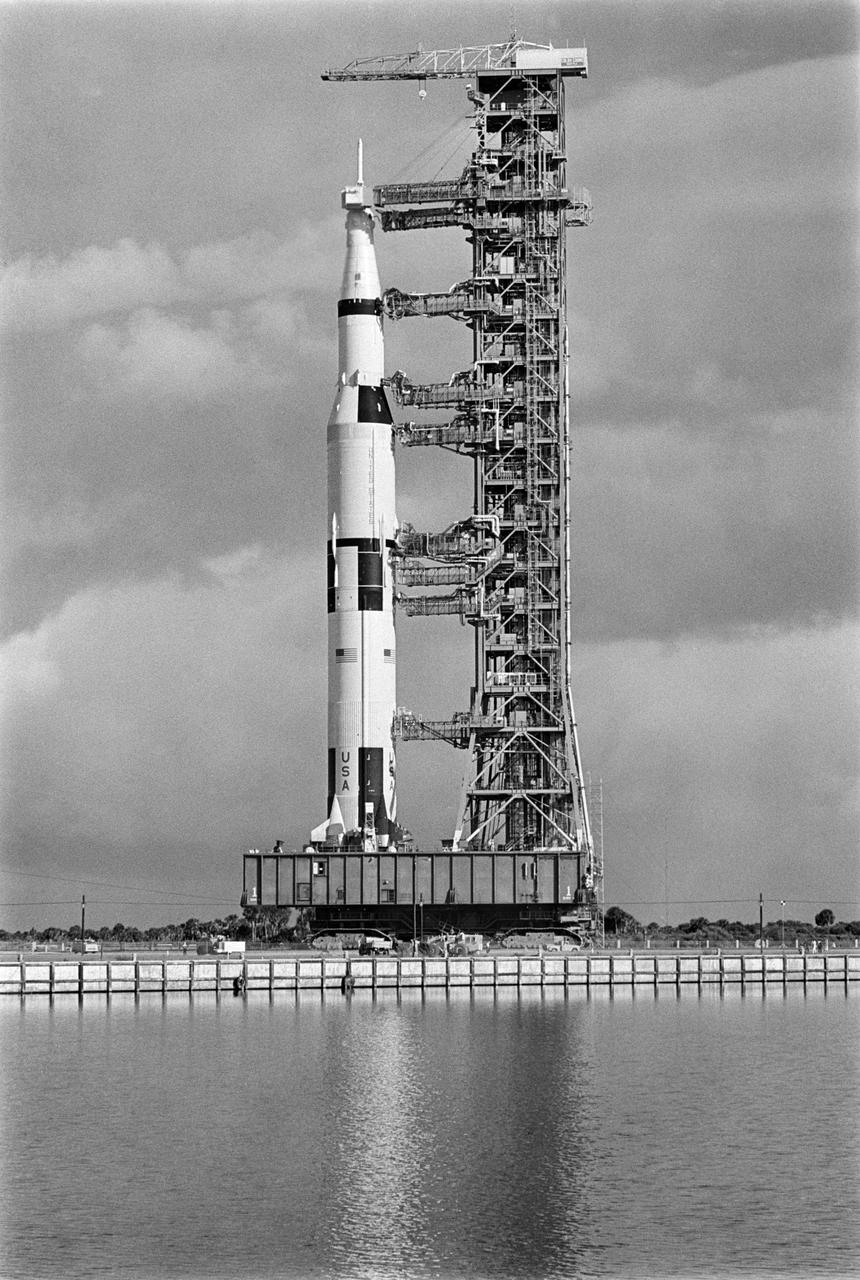
S68-49405 (9 Oct. 1968) --- The Apollo 8 (Spacecraft 103/Saturn 503) space vehicle on way from Kennedy Space Center's (KSC) Vehicle Assembly Building (VAB) to Pad A, Launch Complex 39. The Saturn V stack and its mobile launch tower are atop a huge crawler-transporter. (Ground level view, looking across water.)
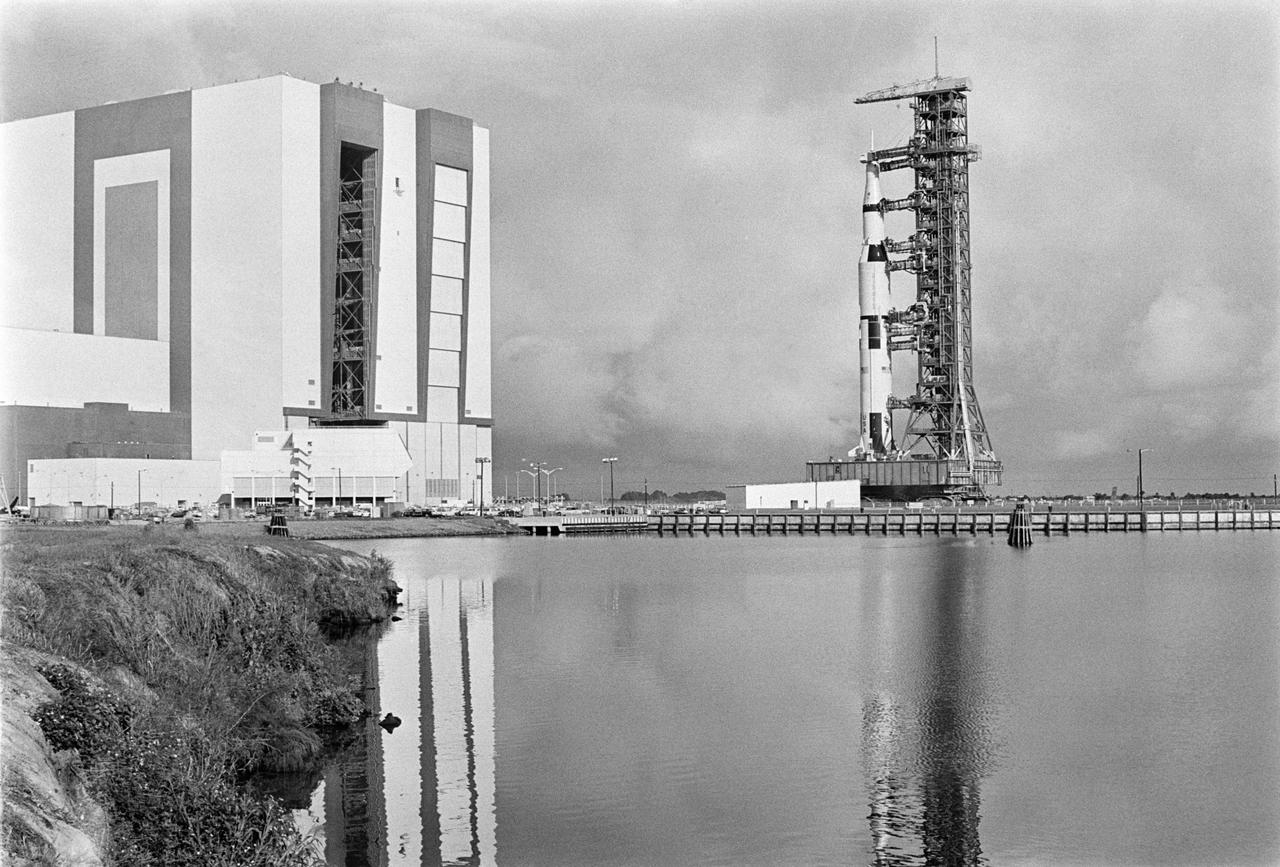
S68-49404 (9 Oct. 1968) --- The Apollo 8 (Spacecraft 103/Saturn 503) space vehicle on way from Kennedy Space Center's Vehicle Assembly Building to Pad A, Launch Complex 39. The Saturn V stack and its mobile launch tower are atop a huge crawler-transporter. (ground-level view, looking across water, with VAB on left)
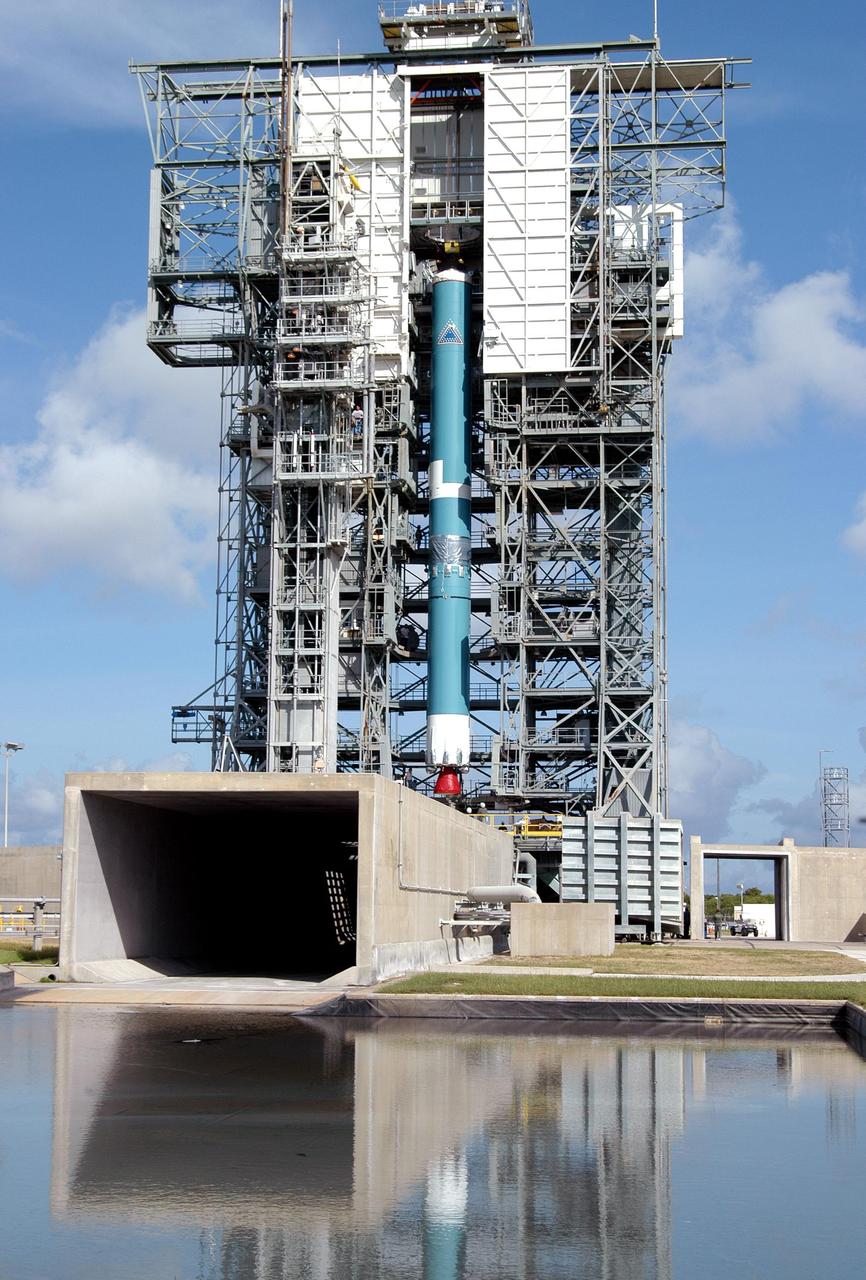
KENNEDY SPACE CENTER, FLA. - - Viewed from across the cooling water pond is the mobile service tower with the first stage of the Boeing Delta II rocket inside. The Delta II is the launch vehicle for the MESSENGER spacecraft, scheduled to lift off Aug. 2, bound for Mercury. The spacecraft is expected to reach orbit around Mercury in March 2011. MESSENGER was built for NASA by the Johns Hopkins University Applied Physics Laboratory in Laurel, Md.
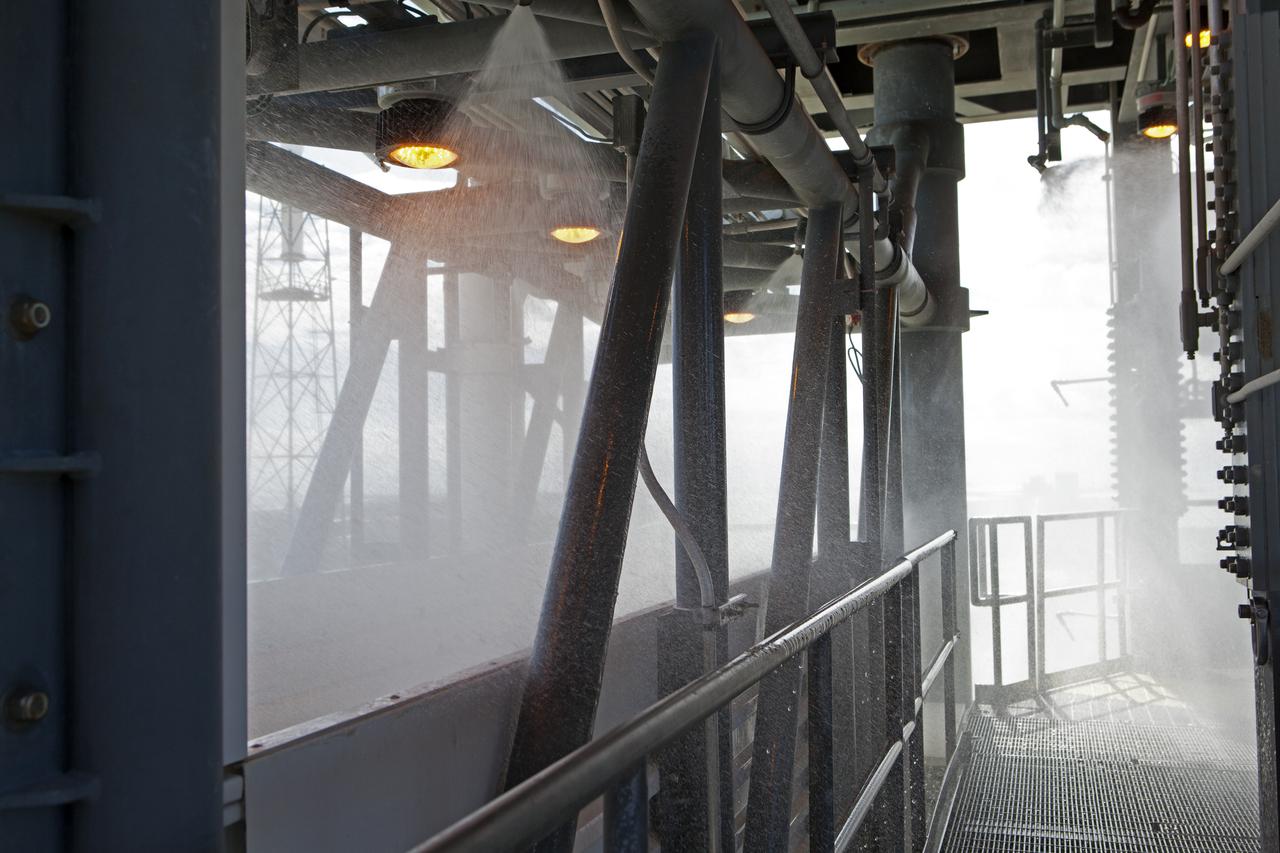
NASA, Boeing and United Launch Alliance personnel begin a water deluge test on the Crew Access Tower at Space Launch Complex 41 on Cape Canaveral Air Force Station in Florida. The test gathered data on how launch site and astronaut crews would exit in the event of an emergency from the white room at the end of the crew access arm to the emergency escape system on the pad. Boeing’s Starliner will launch on a United Launch Alliance Atlas V rocket to the International Space Station as part of NASA’s Commercial Crew Program.
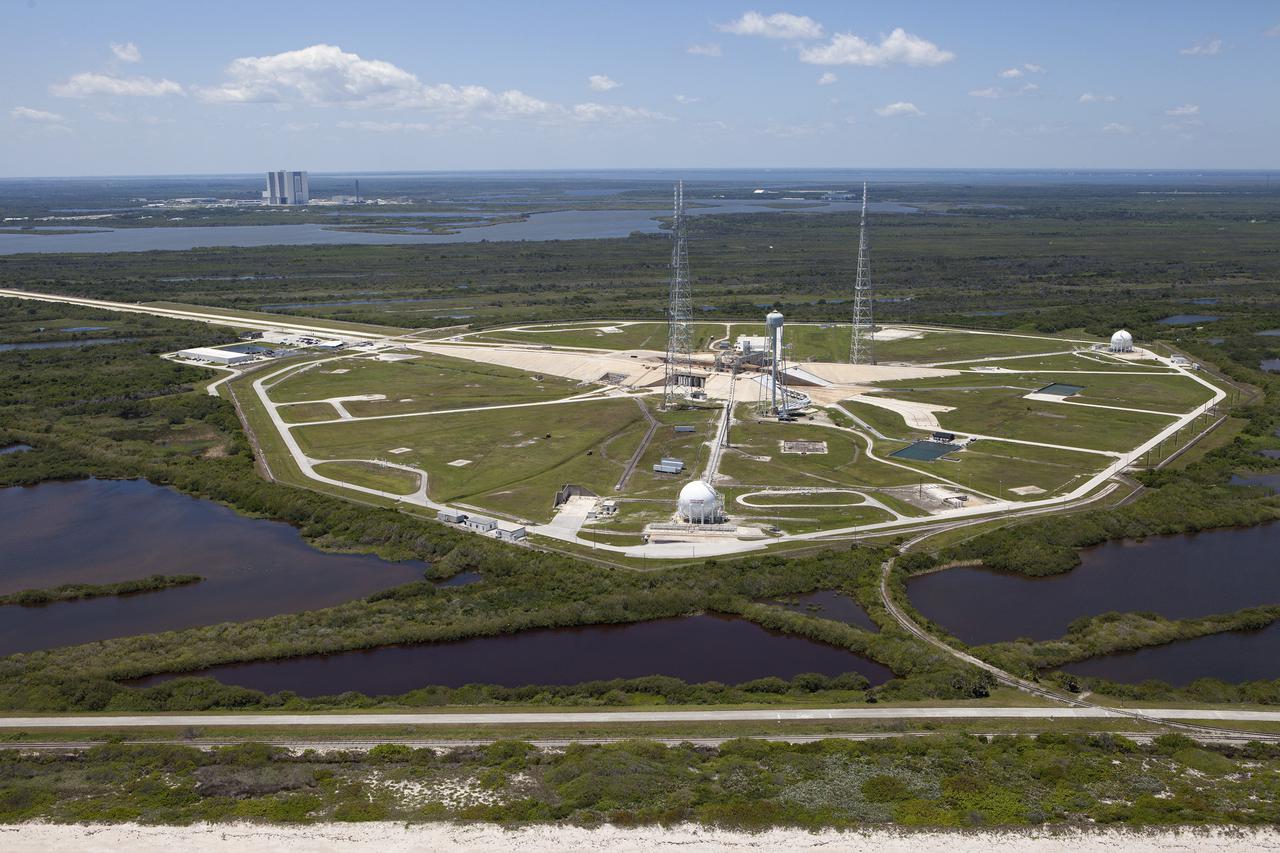
CAPE CANAVERAL, Fla. – An aerial view, from the east looking toward the west, shows the entire Launch Pad 39B area at NASA’s Kennedy Space Center in Florida. A new elevator has been constructed on the surface of the pad and the crawlerway leading up to the surface is being repaired. Repairs also are being made to the crawler track panels and catacomb roof below on either side of the flame trench. Also in view are the water tower and the three tall lightning towers that surround the pad. To the left, in the background is the Vehicle Assembly Building. Upgrades are underway at Pad B and other facilities in the Launch Complex 39 area. The Ground Systems Development and Operations, or GSDO, Program office at Kennedy is leading the center’s transformation from a historically government-only launch complex to a spaceport that can safely handle a variety of rockets and spacecraft, including NASA’s Space Launch System. For more information about GSDO, visit: http:__go.nasa.gov_groundsystems. Photo credit: NASA_Kim Shiflett
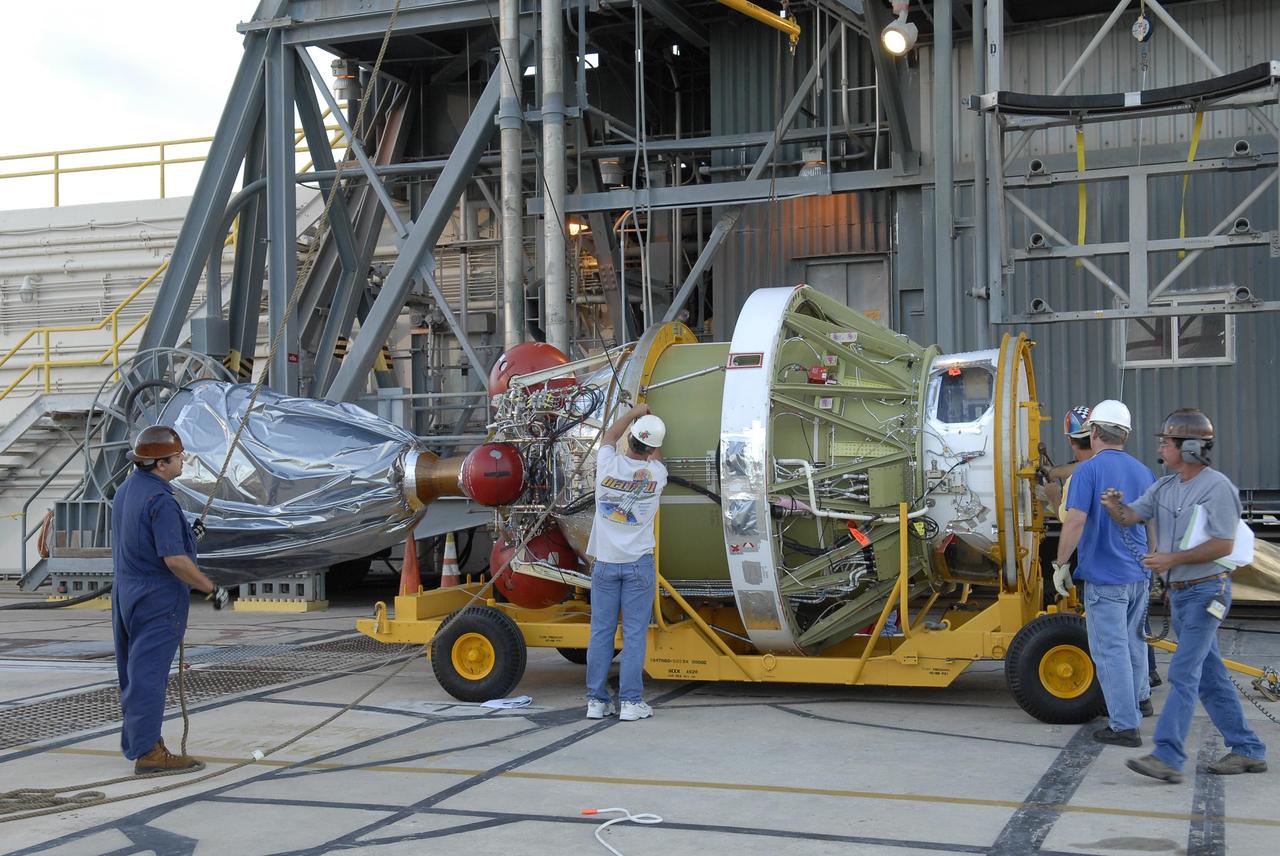
KENNEDY SPACE CENTER, FLA. -- The second stage of the Delta II launch vehicle for NASA's Phoenix Mars Lander arrives on Launch Pad 17-A at Cape Canaveral Air Force Station. The second stage will be lifted into the mobile service tower and mated with the Delta's first stage. The second stage will be lifted into the mobile service tower and mated with the first stage. Phoenix is scheduled to launch Aug. 3. Phoenix will land in icy soils near the north polar permanent ice cap of Mars and explore the history of the water in these soils and any associated rocks, while monitoring polar climate. Landing on Mars is planned in May 2008 on arctic ground where a mission currently in orbit, Mars Odyssey, has detected high concentrations of ice just beneath the top layer of soil. Photo credit: NASA/Kim Shiflett
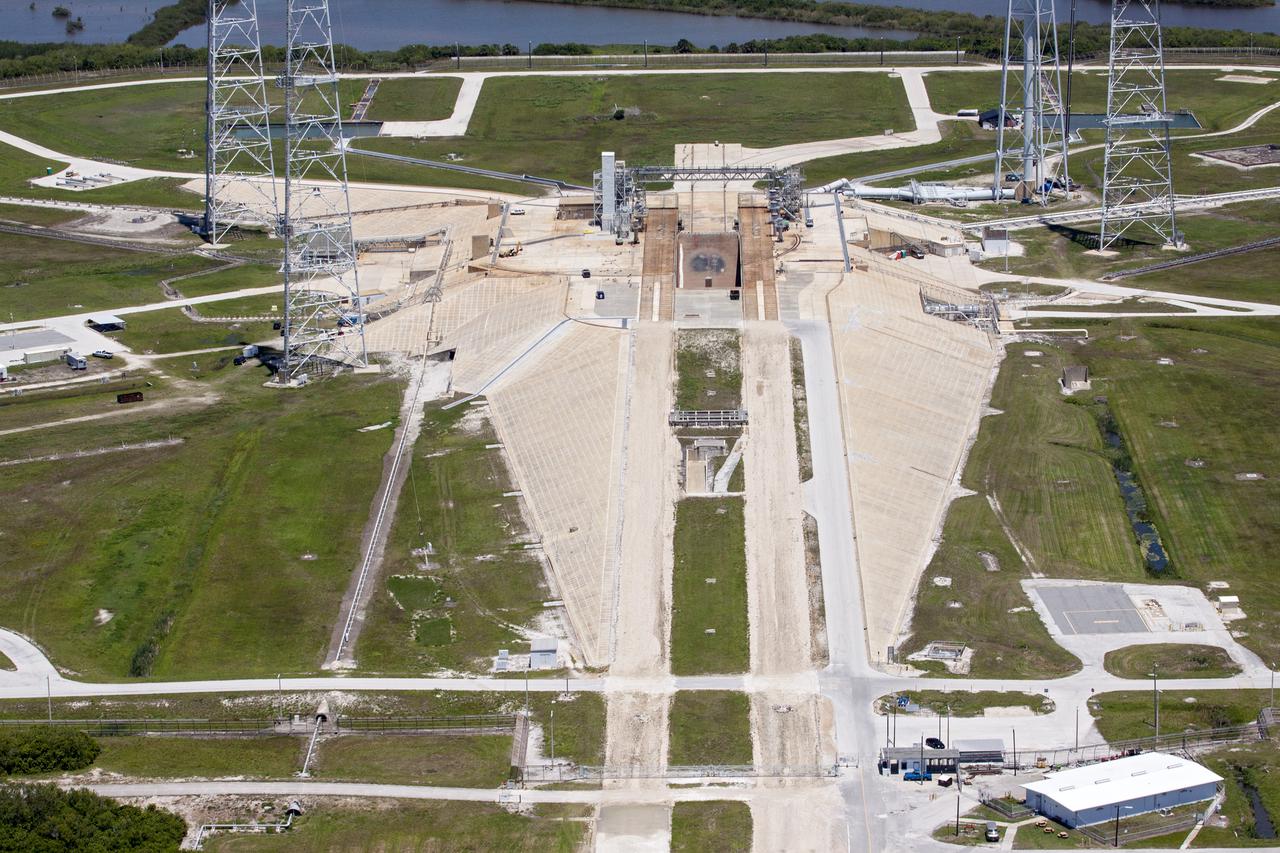
CAPE CANAVERAL, Fla. – An aerial view shows construction progress at Launch Pad 39B at NASA’s Kennedy Space Center in Florida. A new elevator has been constructed on the surface of the pad and the crawlerway leading up to the surface is being repaired. Repairs also are being made to the crawler track panels and catacomb roof below on either side of the flame trench. Also in view are portions of the water tower and the three tall lightning towers that surround the pad. Upgrades are underway at Pad B and other facilities in the Launch Complex 39 area. The Ground Systems Development and Operations, or GSDO, Program office at Kennedy is leading the center’s transformation from a historically government-only launch complex to a spaceport that can safely handle a variety of rockets and spacecraft, including NASA’s Space Launch System. For more information about GSDO, visit: http:__go.nasa.gov_groundsystems. Photo credit: NASA_Kim Shiflett
KENNEDY SPACE CENTER, FLA. — Attached to an overhead crane, the Phoenix Mars Lander is lifted up alongside the mobile service tower on Launch Pad 17-A at Cape Canaveral Air Force Station. Once inside the tower, the lander will be mated to the Delta II launch vehicle. Launch of NASA's Phoenix Mars Lander is scheduled for Aug. 3. There are two instantaneous launch times, 5:35:18 and 6:11:24 a.m. EDT. Phoenix will land in icy soils near the north polar permanent ice cap of Mars and explore the history of the water in these soils and any associated rocks, while monitoring polar climate. Landing on Mars is planned in May 2008 on arctic ground where a mission currently in orbit, Mars Odyssey, has detected high concentrations of ice just beneath the top layer of soil. NASA/George Shelton
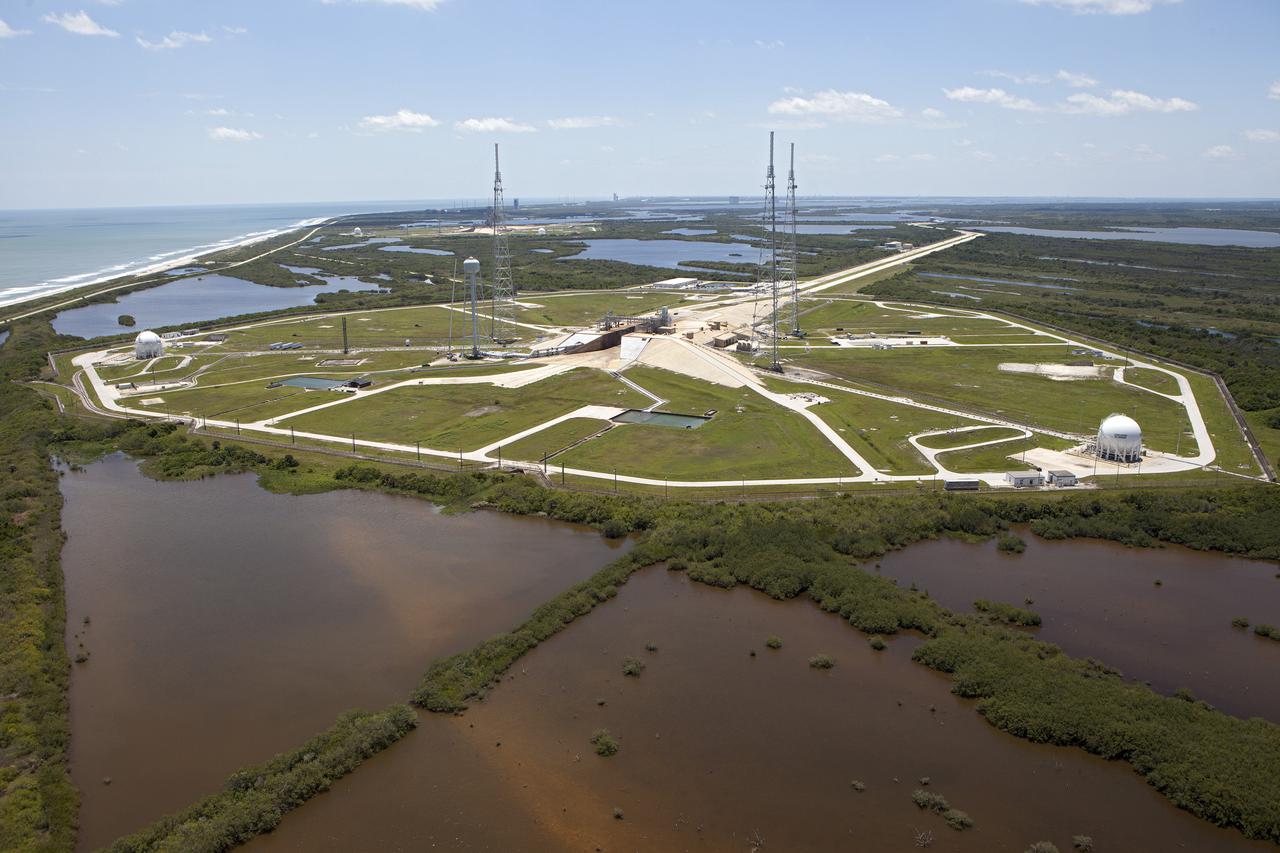
CAPE CANAVERAL, Fla. – An aerial view, from the west looking toward the east, shows the entire Launch Pad 39B area at NASA’s Kennedy Space Center in Florida. A new elevator has been constructed on the surface of the pad and the crawlerway leading up to the surface is being repaired. Repairs also are being made to the crawler track panels and catacomb roof below on either side of the flame trench. Also in view are the water tower and the three tall lightning towers that surround the pad. To the east is the Atlantic Ocean. Upgrades are underway at Pad B and other facilities in the Launch Complex 39 area. The Ground Systems Development and Operations, or GSDO, Program office at Kennedy is leading the center’s transformation from a historically government-only launch complex to a spaceport that can safely handle a variety of rockets and spacecraft, including NASA’s Space Launch System. For more information about GSDO, visit: http:__go.nasa.gov_groundsystems. Photo credit: NASA_Kim Shiflett
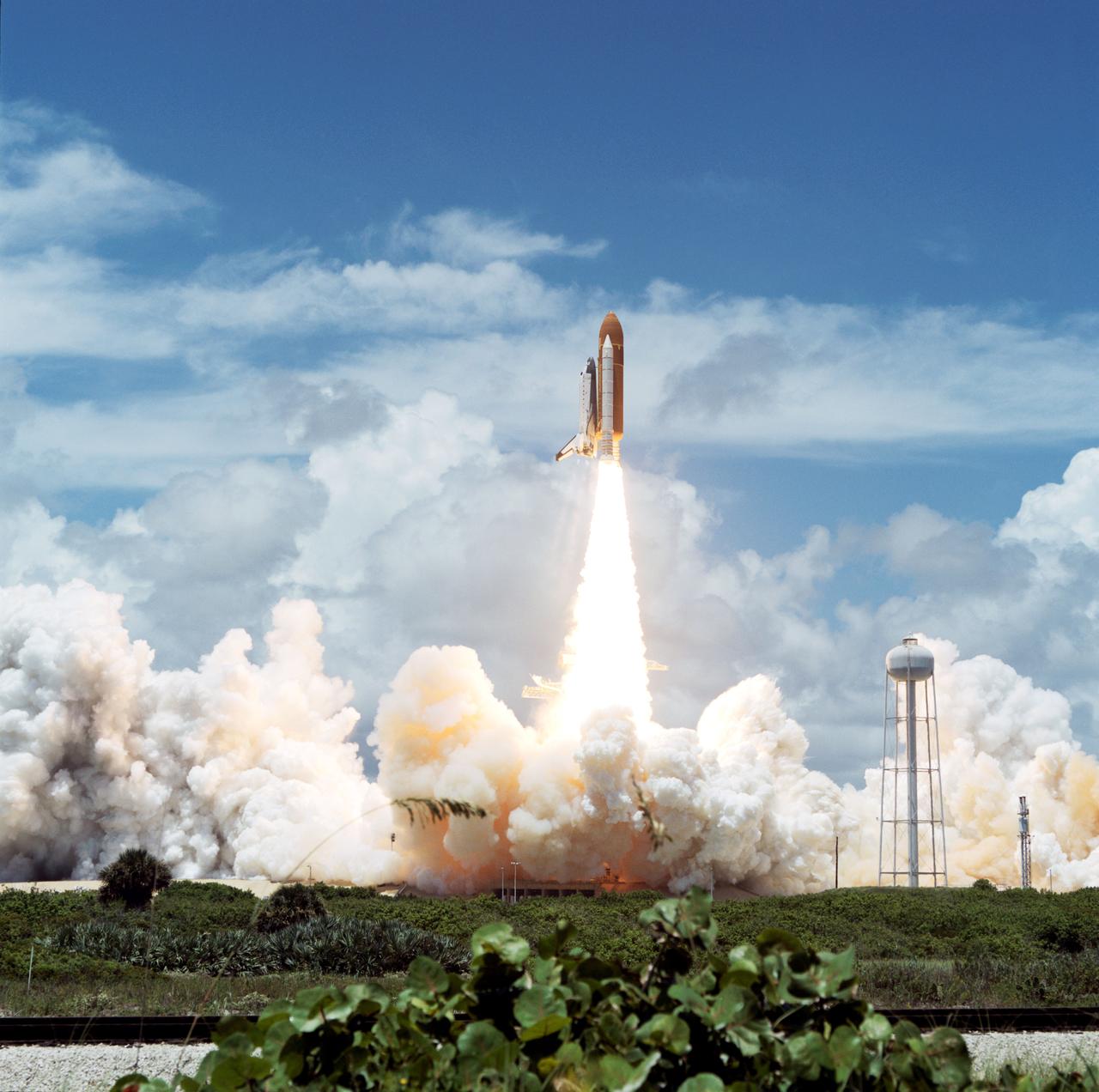
Columbia, Orbiter Vehicle (OV) 102, heads skyward after clearing the fixed service structure (FSS) tower at Kennedy Space Center (KSC) Launch Complex (LC) Pad 39A. Florida plant life appears in the foreground. The exhaust cloud produced by OV-102's solid rocket boosters (SRBs) covers the launch pad area with the exception of the sound suppression water system tower. OV-102's starboard side and the right SRB are visible from this angle. Launch occurred at 12:43 pm Eastern Daylight Time (EDT). Once in Earth orbit, STS-65's six NASA astronauts and a Japanese Payload Specialist aboard OV-102 will begin two weeks of experimentation in support of the second International Microgravity Laboratory (IML-2).
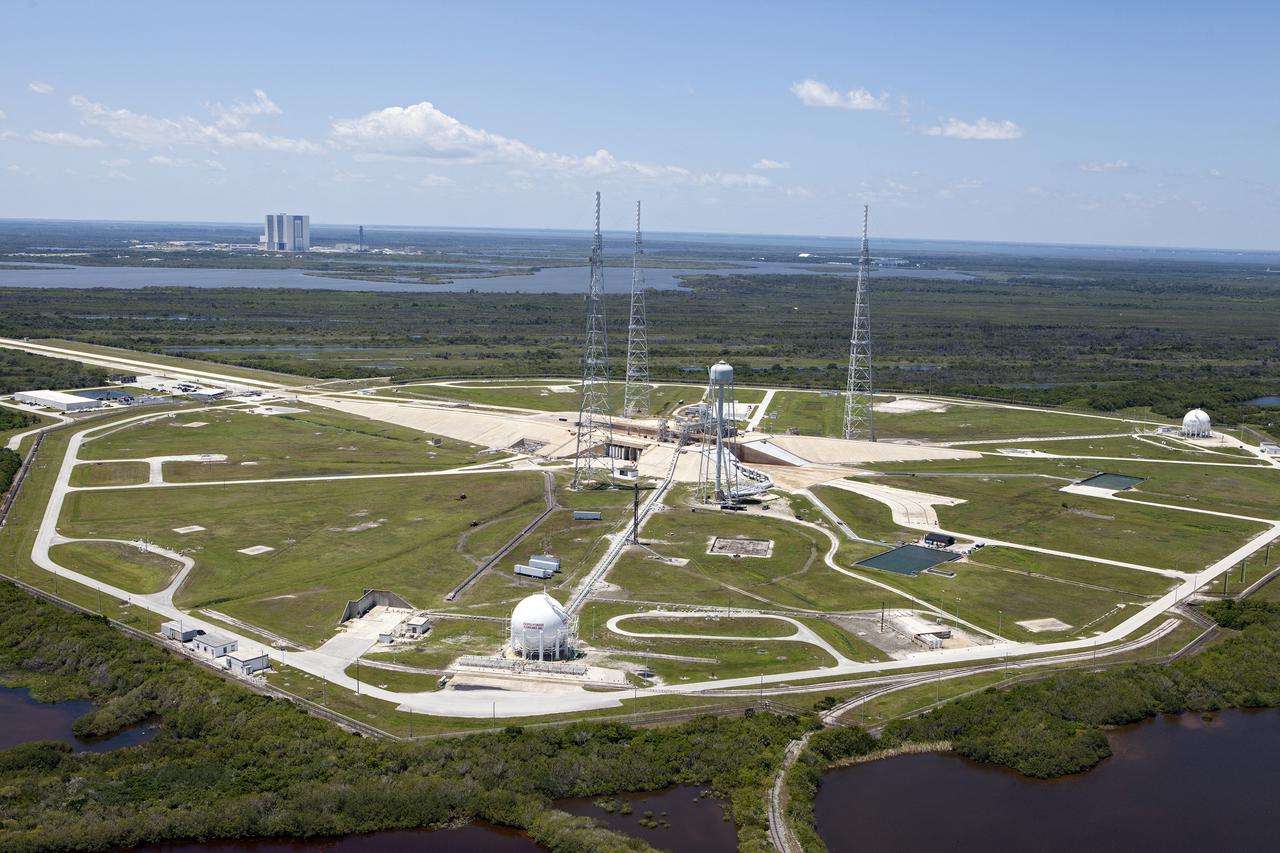
CAPE CANAVERAL, Fla. – An aerial view shows Launch Pad 39B at NASA’s Kennedy Space Center in Florida. A new elevator has been constructed on the surface of the pad and the crawlerway leading up to the surface is being repaired. Repairs also are being made to the crawler track panels and catacomb roof below on either side of the flame trench. Also in view are the water tower and the three tall lightning towers that surround the pad. To the left, in the background is the Vehicle Assembly Building. Upgrades are underway at Pad B and other facilities in the Launch Complex 39 area. The Ground Systems Development and Operations, or GSDO, Program office at Kennedy is leading the center’s transformation from a historically government-only launch complex to a spaceport that can safely handle a variety of rockets and spacecraft, including NASA’s Space Launch System. For more information about GSDO, visit: http:__go.nasa.gov_groundsystems. Photo credit: NASA_Kim Shiflett
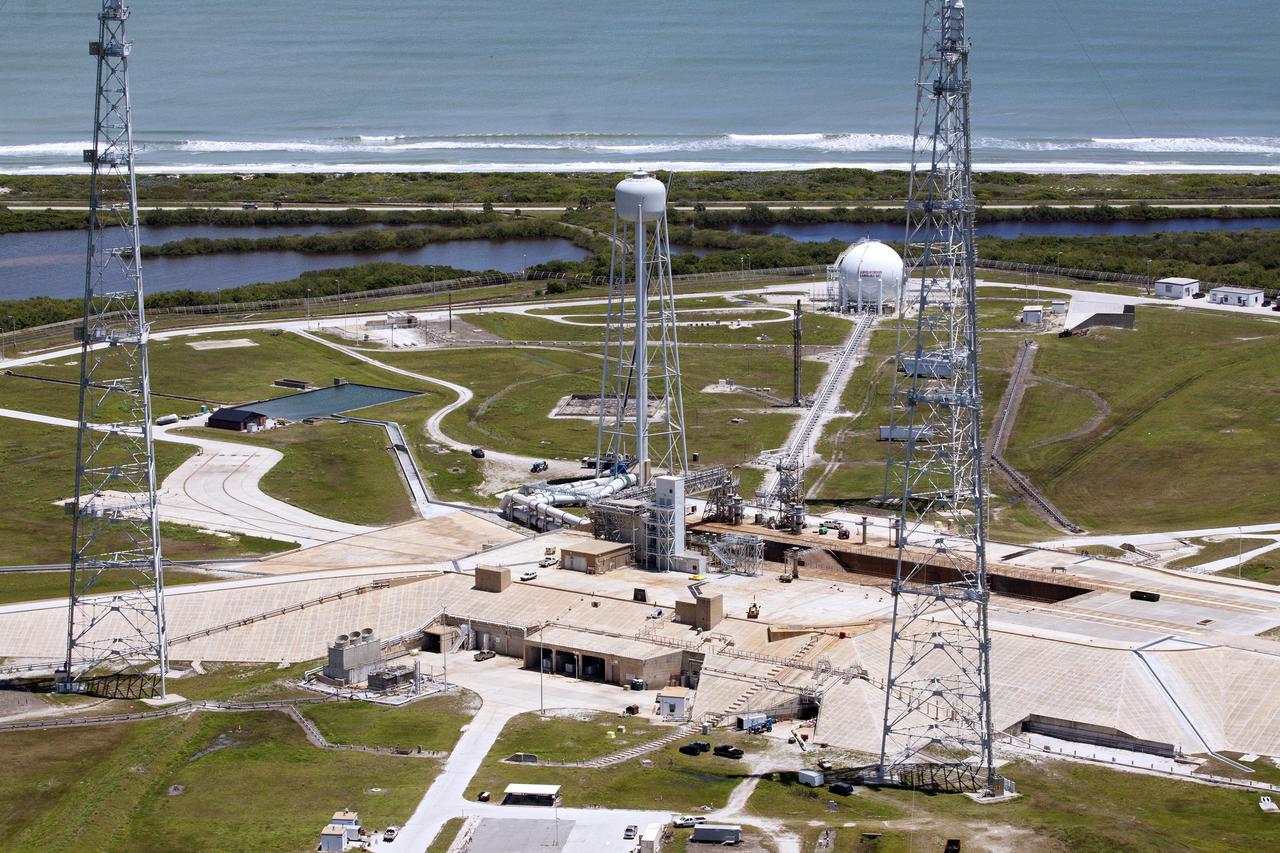
CAPE CANAVERAL, Fla. – An aerial view shows construction progress at Launch Pad 39B at NASA’s Kennedy Space Center in Florida. A new elevator has been constructed on the surface of the pad and the crawlerway leading up to the surface is being repaired. Repairs also are being made to the crawler track panels and catacomb roof below on either side of the flame trench. Also in view are the water tower and two of the three tall lightning towers that surround the pad. Upgrades are underway at Pad B and other facilities in the Launch Complex 39 area. The Ground Systems Development and Operations, or GSDO, Program office at Kennedy is leading the center’s transformation from a historically government-only launch complex to a spaceport that can safely handle a variety of rockets and spacecraft, including NASA’s Space Launch System. For more information about GSDO, visit: http:__go.nasa.gov_groundsystems. Photo credit: NASA_Kim Shiflett

CAPE CANAVERAL, Fla. – NASA's Kepler spacecraft on Launch pad 17-B at Cape Canaveral Air Force Station in Florida is lifted up to the transfer level of the mobile service tower. It will be moved into the tower for mating with the Delta II rocket for launch. The liftoff of Kepler is currently scheduled for 10:48 p.m. EST March 5. Kepler is designed to survey more than 100,000 stars in our galaxy to determine the number of sun-like stars that have Earth-size and larger planets, including those that lie in a star's "habitable zone," a region where liquid water, and perhaps life, could exist. If these Earth-size worlds do exist around stars like our sun, Kepler is expected to be the first to find them and the first to measure how common they are. Photo credit: NASA/Jack Pfaller
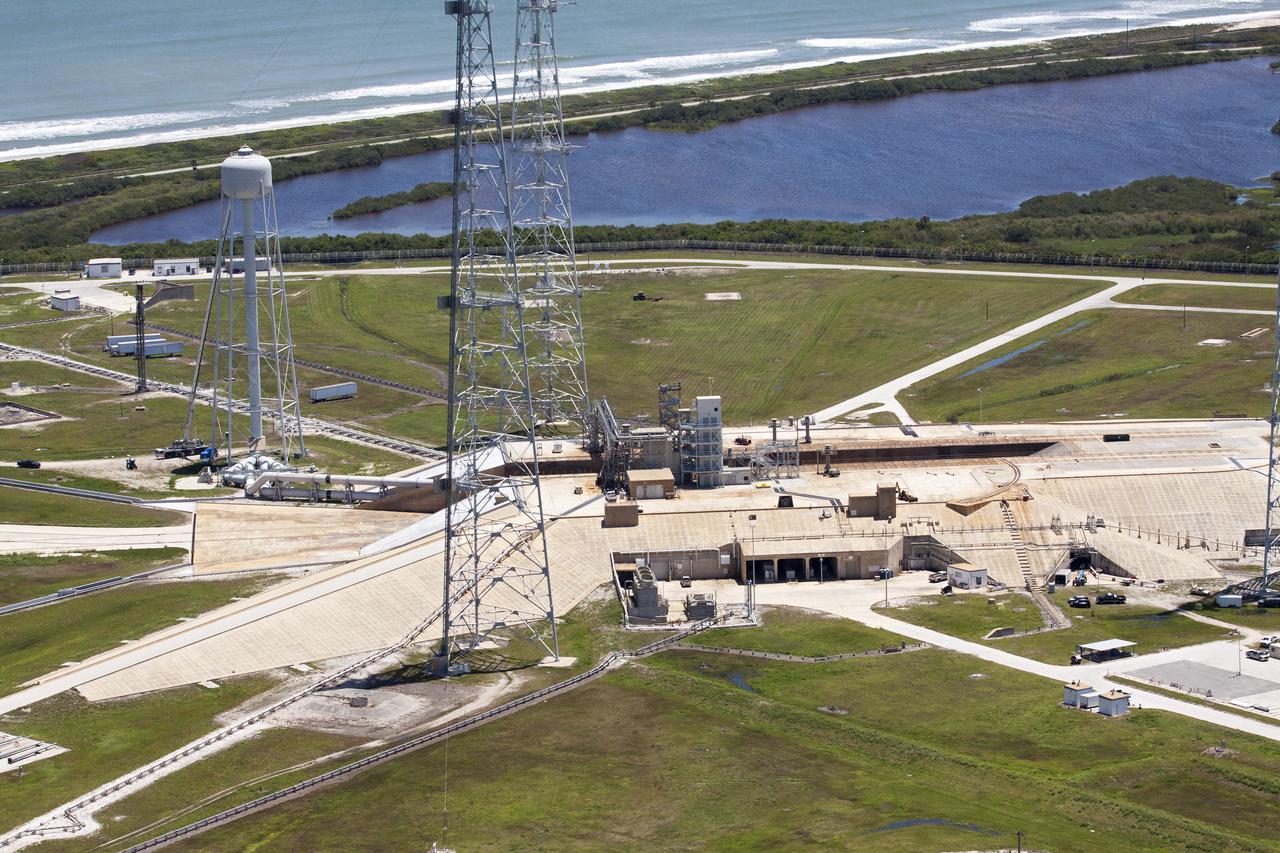
CAPE CANAVERAL, Fla. – An aerial view shows construction progress at Launch Pad 39B at NASA’s Kennedy Space Center in Florida. A new elevator has been constructed on the surface of the pad and the crawlerway leading up to the surface is being repaired. Repairs also are being made to the crawler track panels and catacomb roof below on either side of the flame trench. Also in view are the water tower and two of the three tall lightning towers that surround the pad. Upgrades are underway at Pad B and other facilities in the Launch Complex 39 area. The Ground Systems Development and Operations, or GSDO, Program office at Kennedy is leading the center’s transformation from a historically government-only launch complex to a spaceport that can safely handle a variety of rockets and spacecraft, including NASA’s Space Launch System. For more information about GSDO, visit: http:__go.nasa.gov_groundsystems. Photo credit: NASA_Kim Shiflett
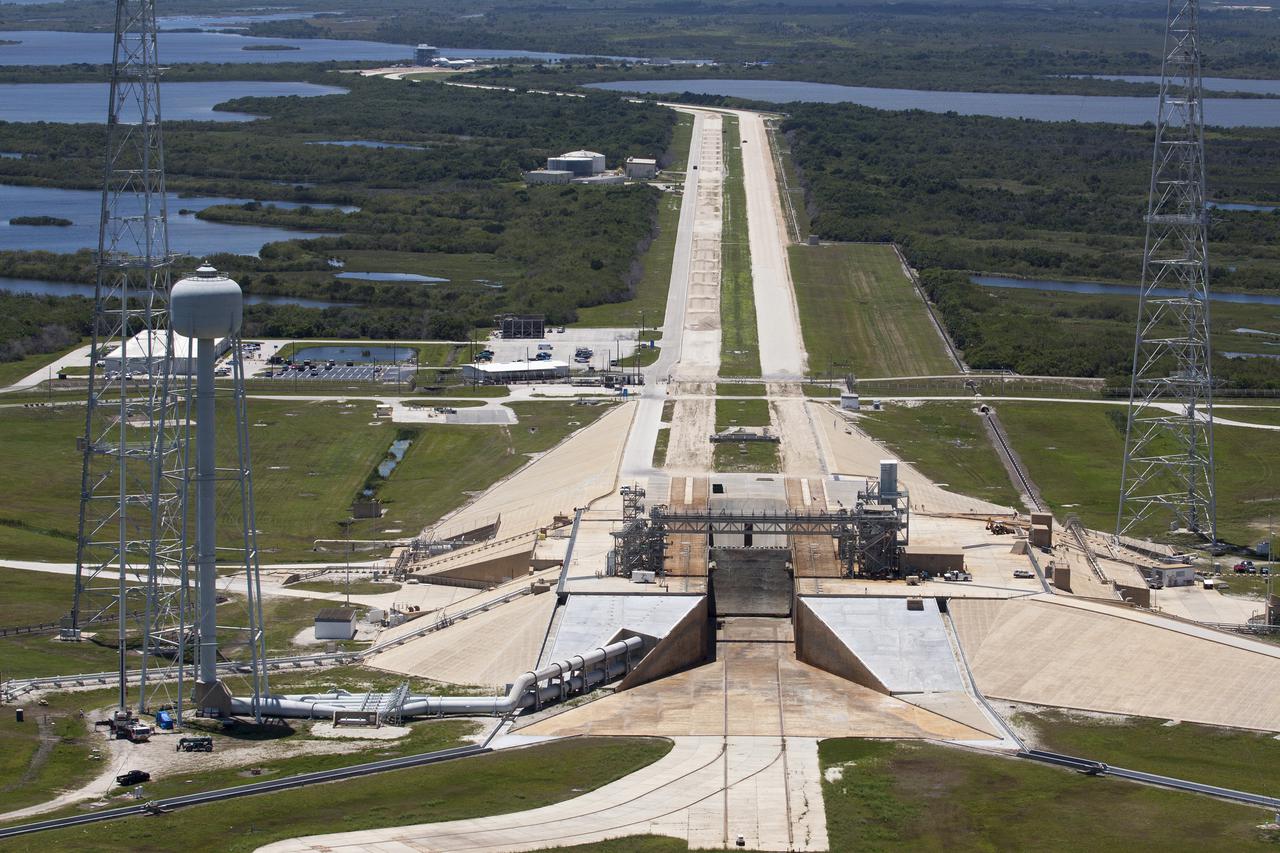
CAPE CANAVERAL, Fla. – An aerial view shows construction progress at Launch Pad 39B at NASA’s Kennedy Space Center in Florida. A new elevator has been constructed on the surface of the pad and the crawlerway leading up to the surface is being repaired. Repairs also are being made to the crawler track panels and catacomb roof below on either side of the flame trench. Also in view are the water tower and two of the three tall lightning towers that surround the pad. Upgrades are underway at Pad B and other facilities in the Launch Complex 39 area. The Ground Systems Development and Operations, or GSDO, Program office at Kennedy is leading the center’s transformation from a historically government-only launch complex to a spaceport that can safely handle a variety of rockets and spacecraft, including NASA’s Space Launch System. For more information about GSDO, visit: http:__go.nasa.gov_groundsystems. Photo credit: NASA_Kim Shiflett
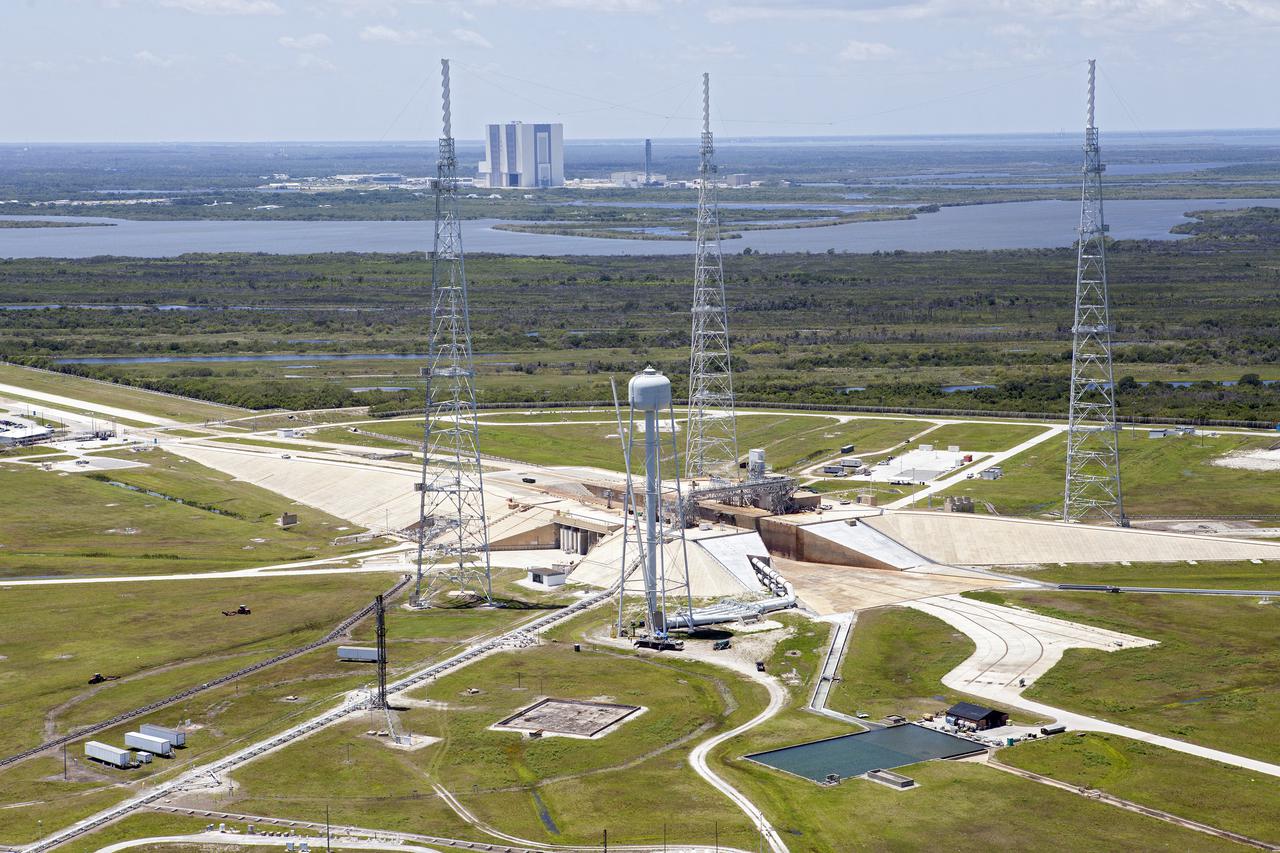
CAPE CANAVERAL, Fla. – An aerial view shows construction progress at Launch Pad 39B at NASA’s Kennedy Space Center in Florida. A new elevator has been constructed on the surface of the pad and the crawlerway leading up to the surface is being repaired. Repairs also are being made to the crawler track panels and catacomb roof below on either side of the flame trench. Also in view are the water tower and the three tall lightning towers that surround the pad. In the background is the Vehicle Assembly Building. Upgrades are underway at Pad B and other facilities in the Launch Complex 39 area. The Ground Systems Development and Operations, or GSDO, Program office at Kennedy is leading the center’s transformation from a historically government-only launch complex to a spaceport that can safely handle a variety of rockets and spacecraft, including NASA’s Space Launch System. For more information about GSDO, visit: http:__go.nasa.gov_groundsystems. Photo credit: NASA_Kim Shiflett
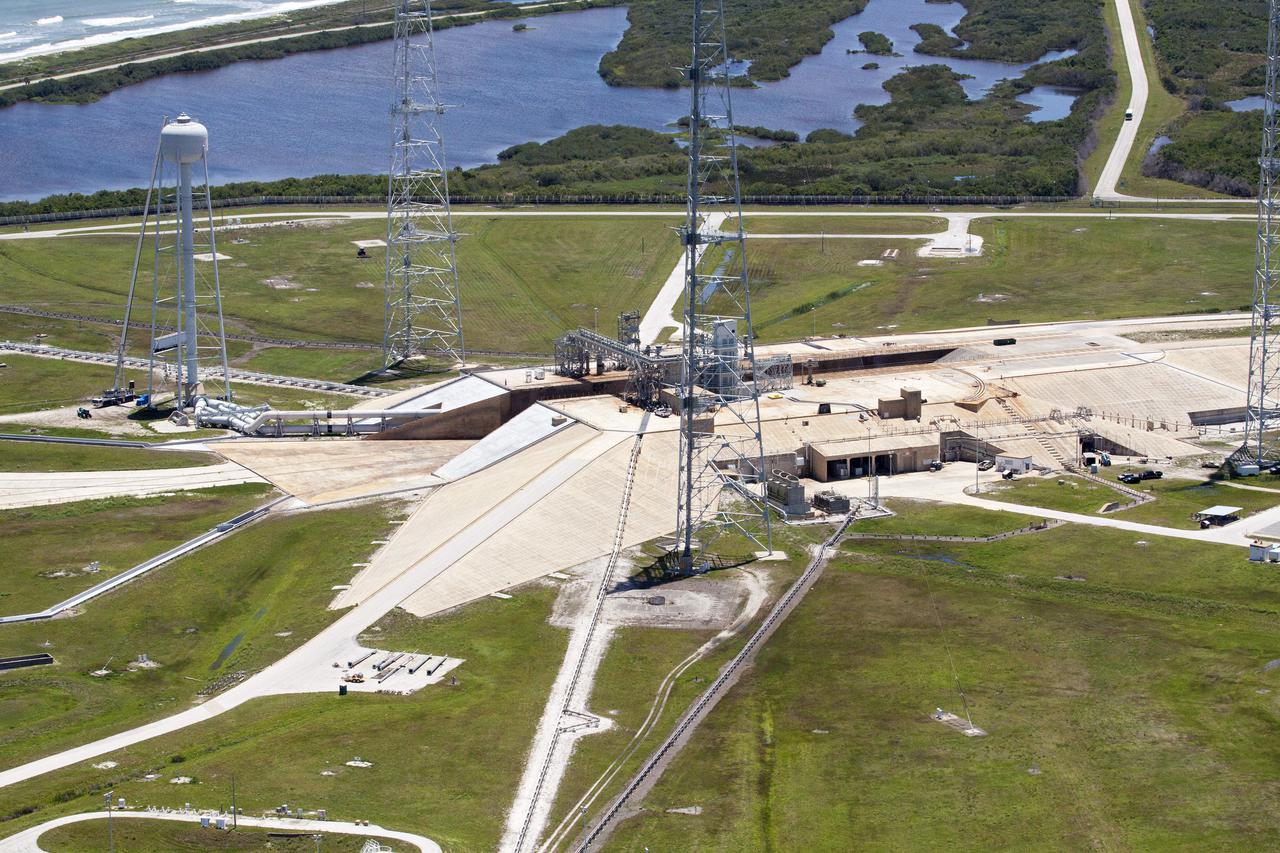
CAPE CANAVERAL, Fla. – An aerial view shows construction progress at Launch Pad 39B at NASA’s Kennedy Space Center in Florida. A new elevator has been constructed on the surface of the pad and the crawlerway leading up to the surface is being repaired. Repairs also are being made to the crawler track panels and catacomb roof below on either side of the flame trench. Also in view are the water tower and two of the three tall lightning towers that surround the pad. Upgrades are underway at Pad B and other facilities in the Launch Complex 39 area. The Ground Systems Development and Operations, or GSDO, Program office at Kennedy is leading the center’s transformation from a historically government-only launch complex to a spaceport that can safely handle a variety of rockets and spacecraft, including NASA’s Space Launch System. For more information about GSDO, visit: http:__go.nasa.gov_groundsystems. Photo credit: NASA_Kim Shiflett
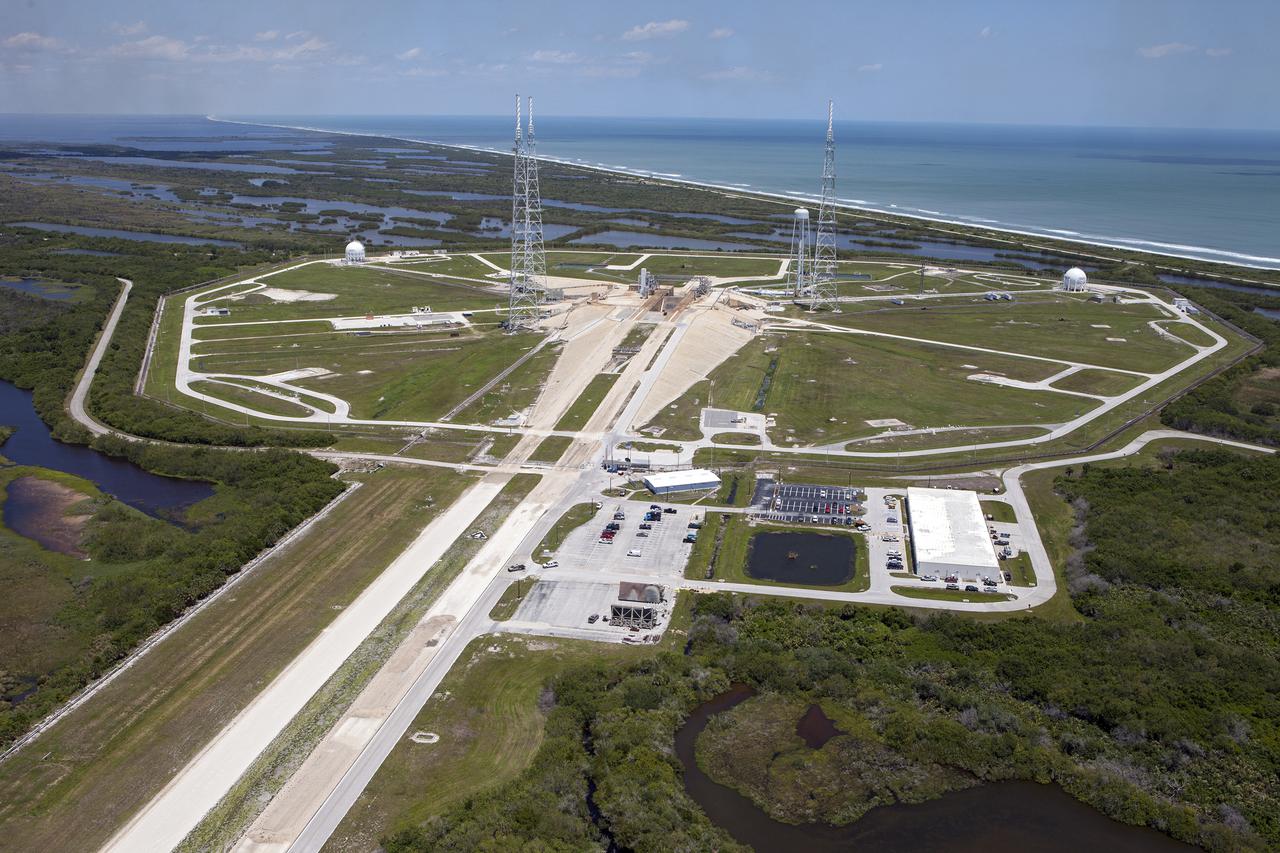
CAPE CANAVERAL, Fla. – An aerial view, from the southwest looking toward the northeast, shows the entire Launch Pad 39B area at NASA’s Kennedy Space Center in Florida with the Atlantic Ocean in the background. A new elevator has been constructed on the surface of the pad and the crawlerway leading up to the surface is being repaired. Repairs also are being made to the crawler track panels and catacomb roof below on either side of the flame trench. Also in view are the water tower and the three tall lightning towers that surround the pad. Upgrades are underway at Pad B and other facilities in the Launch Complex 39 area. The Ground Systems Development and Operations, or GSDO, Program office at Kennedy is leading the center’s transformation from a historically government-only launch complex to a spaceport that can safely handle a variety of rockets and spacecraft, including NASA’s Space Launch System. For more information about GSDO, visit: http:__go.nasa.gov_groundsystems. Photo credit: NASA_Kim Shiflett
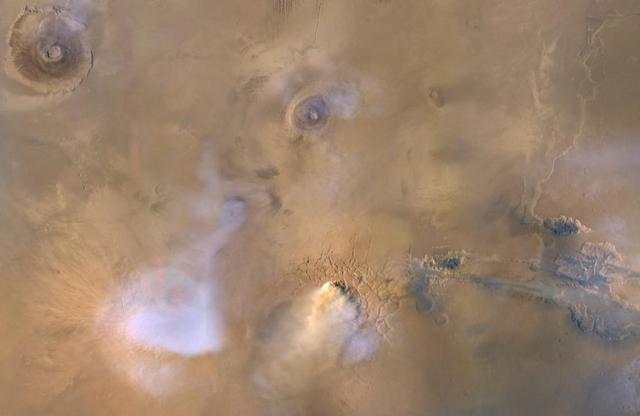
The yellow-white cloud in the bottom-center of this image is a Mars "dust tower" — a concentrated cloud of dust that can be lofted dozens of miles above the surface. The blue-white plumes are water vapor clouds. Olympus Mons, the tallest volcano in the solar system, is visible in the upper left corner, while Valles Marineris can be seen in the lower right. Heat-sensitive instruments like the Mars Climate Sounder, carried aboard NASA's Mars Reconnaissance Orbiter (MRO), can map the formation of these dust towers, which form almost continuously during global dust storms. Taken on Nov. 30, 2010, the image was produced by MRO's Mars Color Imager (MARCI), which was built and is operated by Malin Space Science Systems in San Diego. https://photojournal.jpl.nasa.gov/catalog/PIA23513
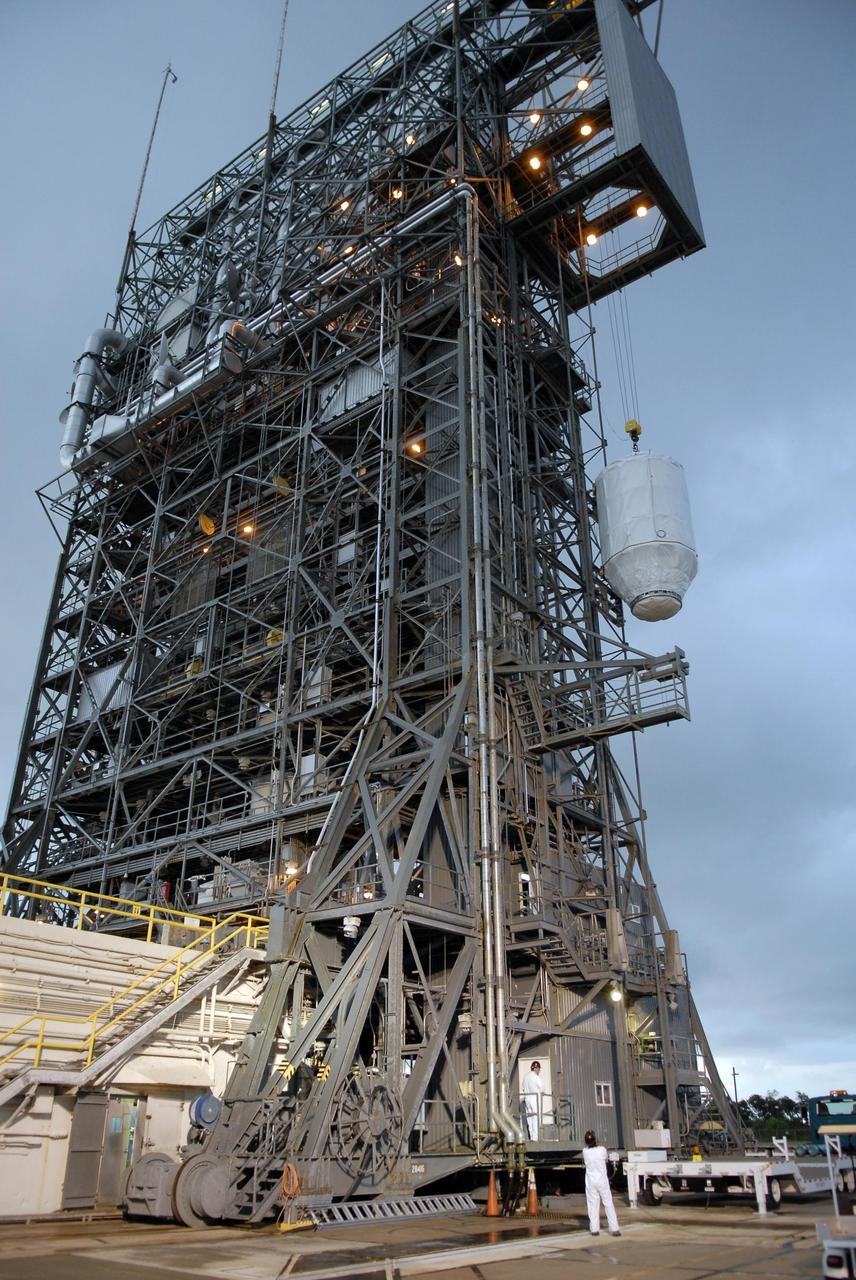
KENNEDY SPACE CENTER, FLA. — Attached to an overhead crane, the Phoenix Mars Lander is lifted up alongside the mobile service tower on Launch Pad 17-A at Cape Canaveral Air Force Station. Once inside the tower, the lander will be mated to the Delta II launch vehicle. Launch of NASA's Phoenix Mars Lander is scheduled for Aug. 3. There are two instantaneous launch times, 5:35:18 and 6:11:24 a.m. EDT. Phoenix will land in icy soils near the north polar permanent ice cap of Mars and explore the history of the water in these soils and any associated rocks, while monitoring polar climate. Landing on Mars is planned in May 2008 on arctic ground where a mission currently in orbit, Mars Odyssey, has detected high concentrations of ice just beneath the top layer of soil. NASA/George Shelton