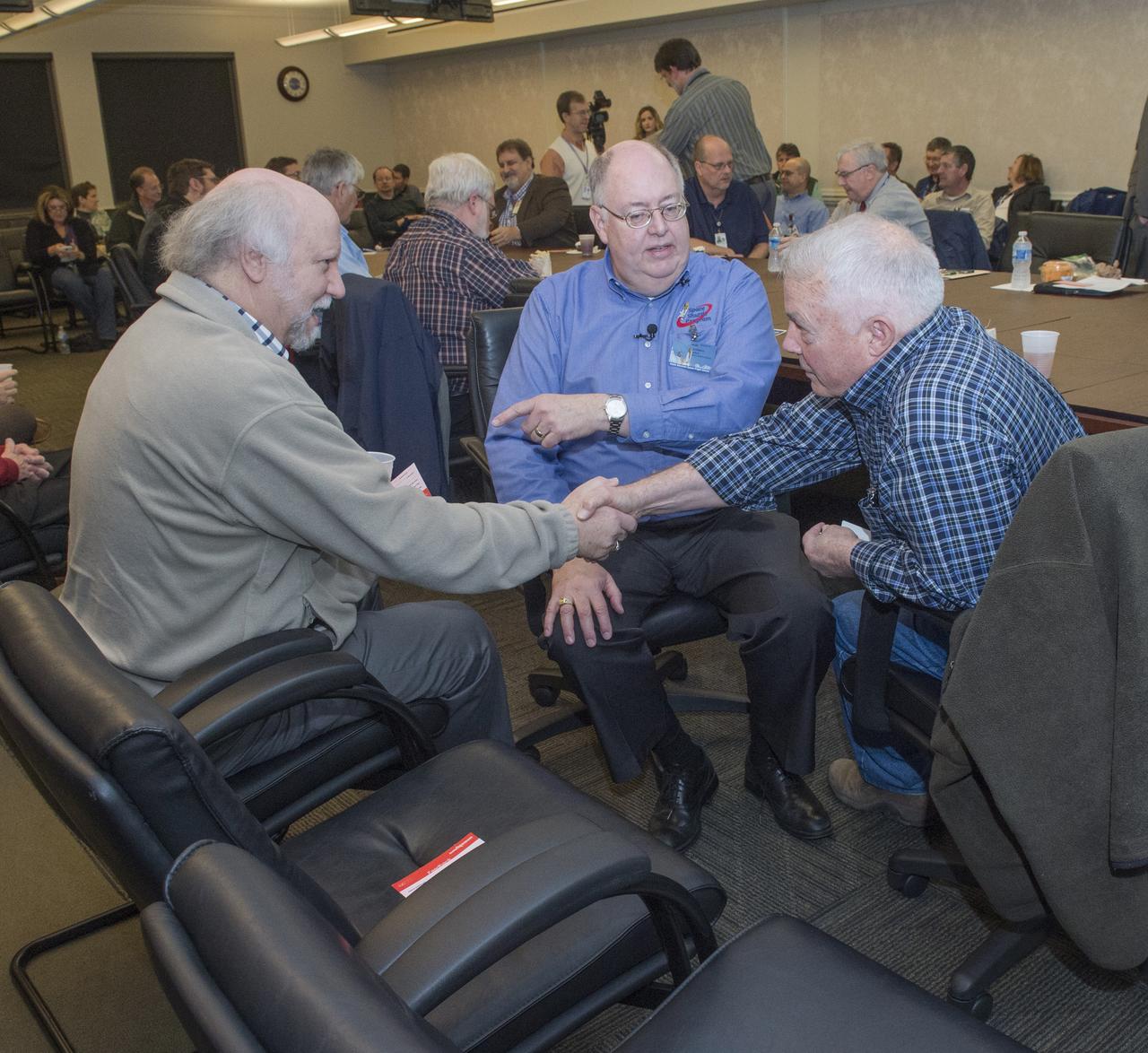
WAYNE HALE, (CENTER), INTRODUCES JOHN CHAPMAN (L) TO RETIRED BRIG. GENERAL/ASTRONAUT BOB STEWART
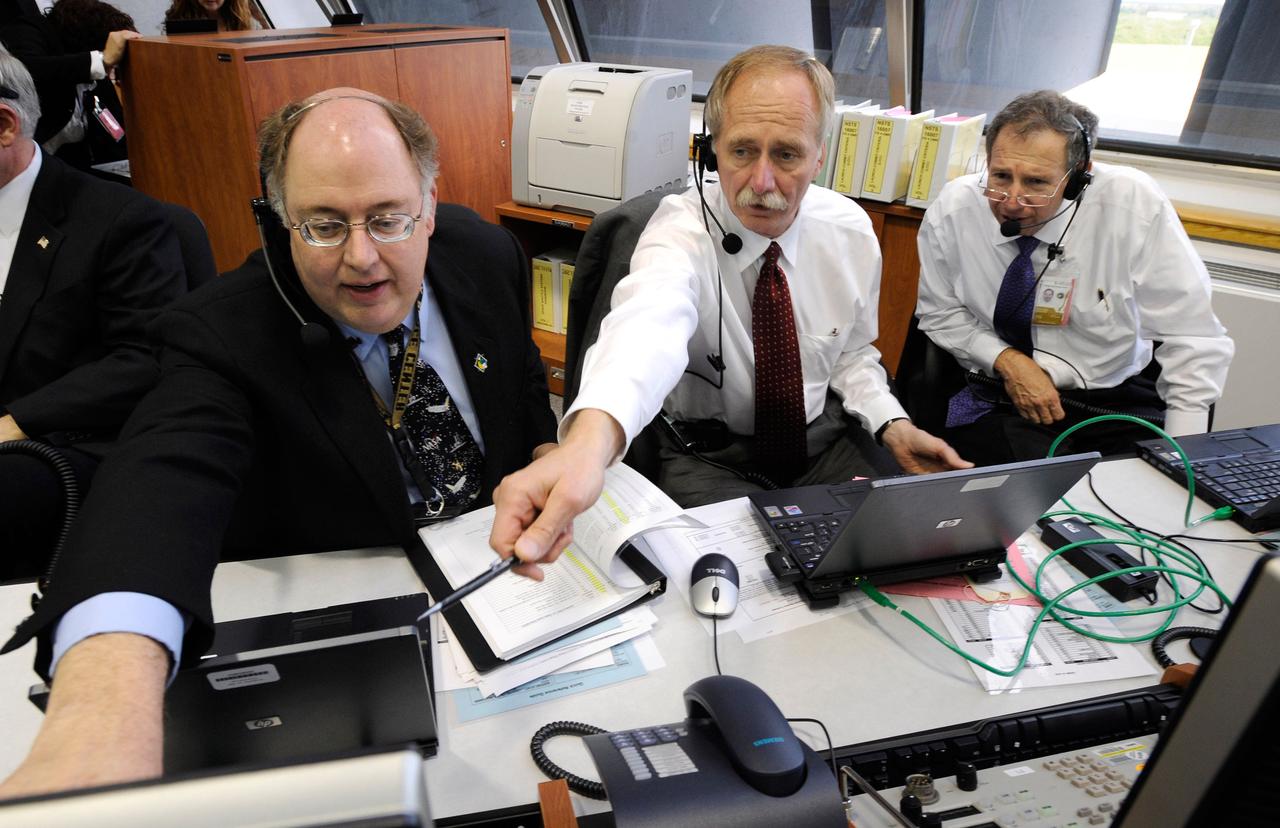
Space Program Manager Wayne Hale, Associate Administrator for Space Operations Bill Gerstenmaier and NASA Administrator Michael Griffin monitor the weather and shuttle systems prior to the launch of the Space Shuttle Atlantis (STS-122) from the Launch Control Center Thursday, Feb. 7, 2008, at the Kennedy Space Center in Cape Canaveral, Fla. The Shuttle lifted off from launch pad 39A at 2:45p.m. EST. Photo Credit: (NASA/Bill Ingalls)
NASA Associate Administrator for Space Operations William Gerstenmaier, right, look on as Space Shuttle Program Manager Wayne Hale speaks from NASA's Marshall Space Flight Center during a media briefing about the space shuttle program and processing for the STS-121 mission, Friday, April 28, 2006, at NASA Headquarters in Washington. Photo Credit (NASA/Bill Ingalls)
NASA Administrator Michael Griffin, left, and Associate Administrator for Space Operations William Gerstenmaier, right, look on as Space Shuttle Program Manager Wayne Hale talks from NASA's Marshall Space Flight Center about the space shuttle's ice frost ramps during a media briefing about the space shuttle program and processing for the STS-121 mission, Friday, April 28, 2006, at NASA Headquarters in Washington. Photo Credit (NASA/Bill Ingalls)
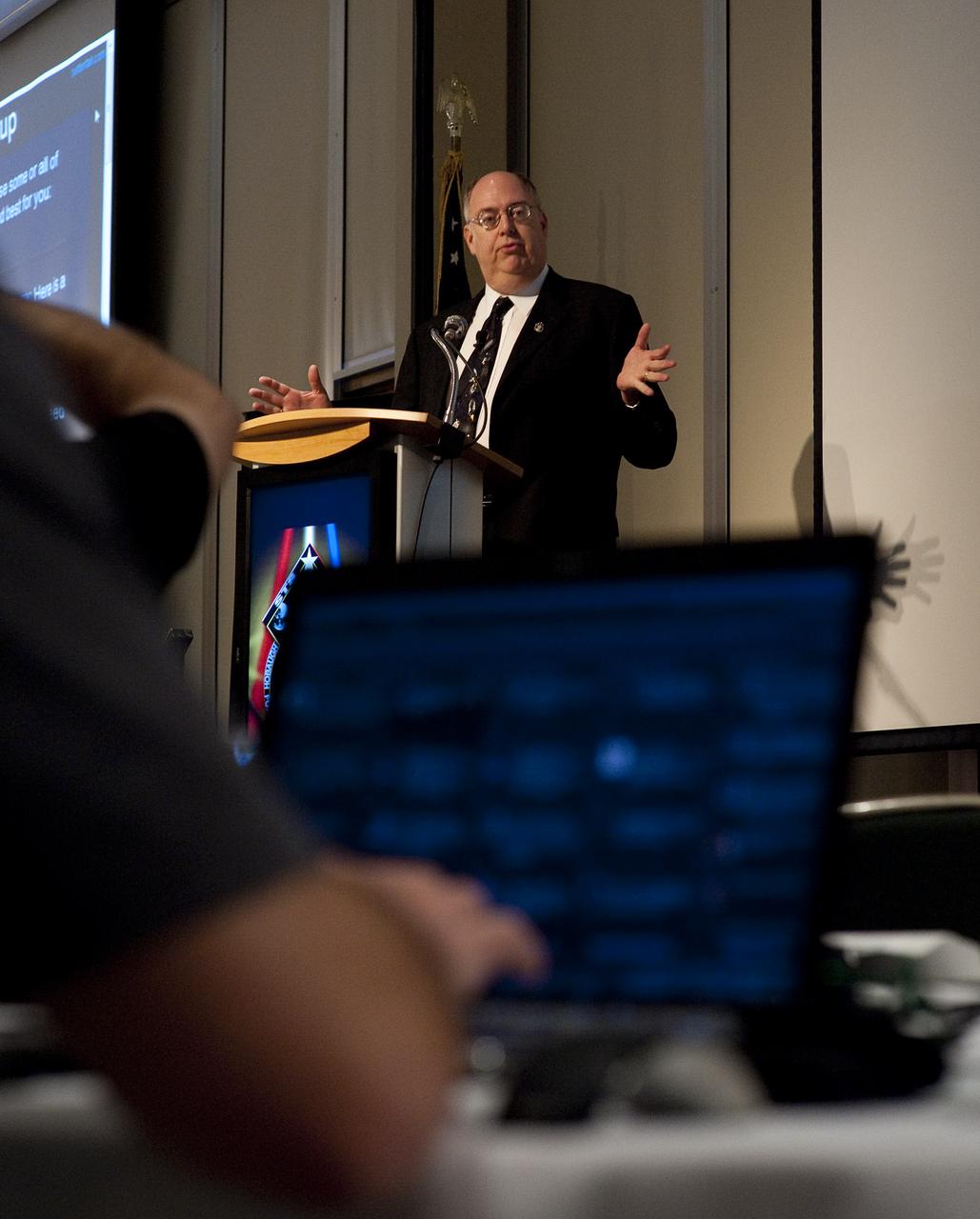
Wayne Hale, NASA strategic program planning manager speaks during a two-day NASA Tweetup event held at NASA's Kennedy Space Center in Cape Canaveral, Fla, Sunday, Nov. 15, 2009. NASA Twitter followers in attendance will have the opportunity to take a tour of NASA's Kennedy Space Center, view the STS-129 space shuttle launch and speak with shuttle technicians, engineers, astronauts and managers. Photo Credit: (NASA/Carla Cioffi)
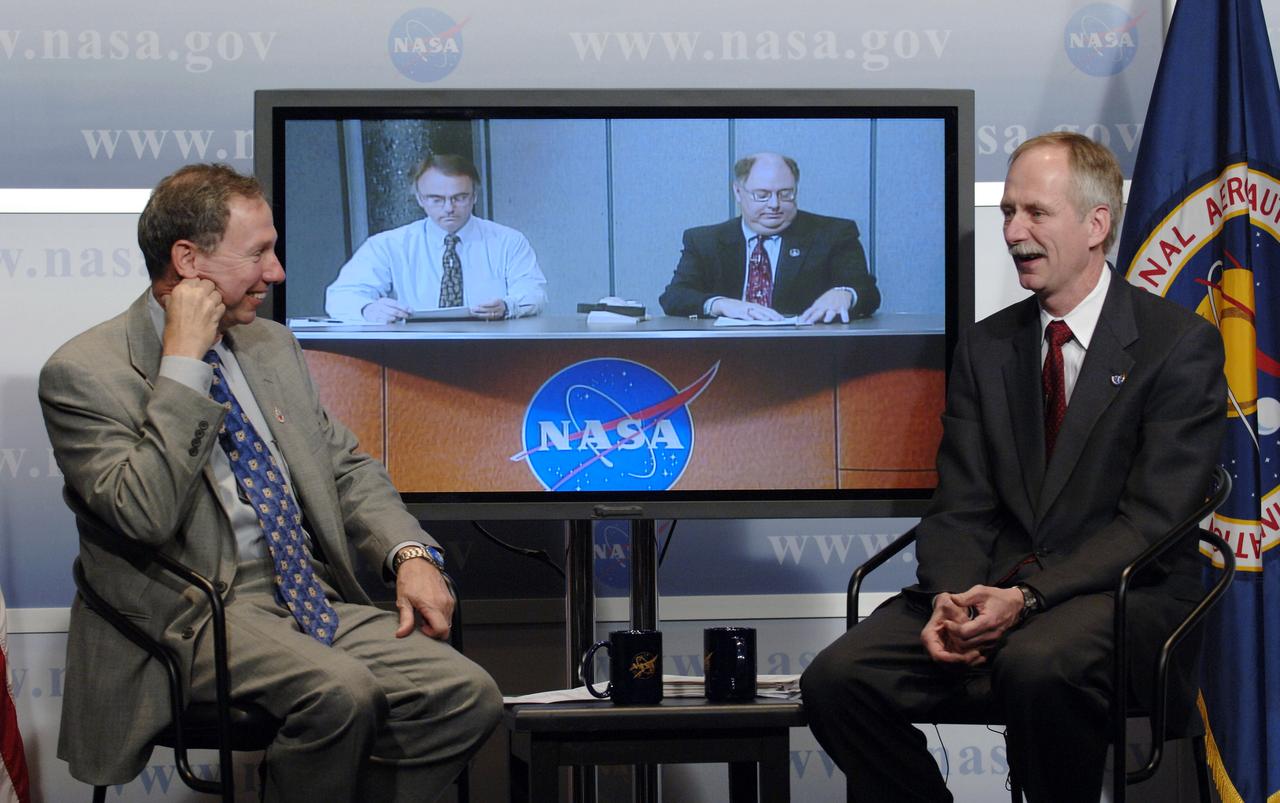
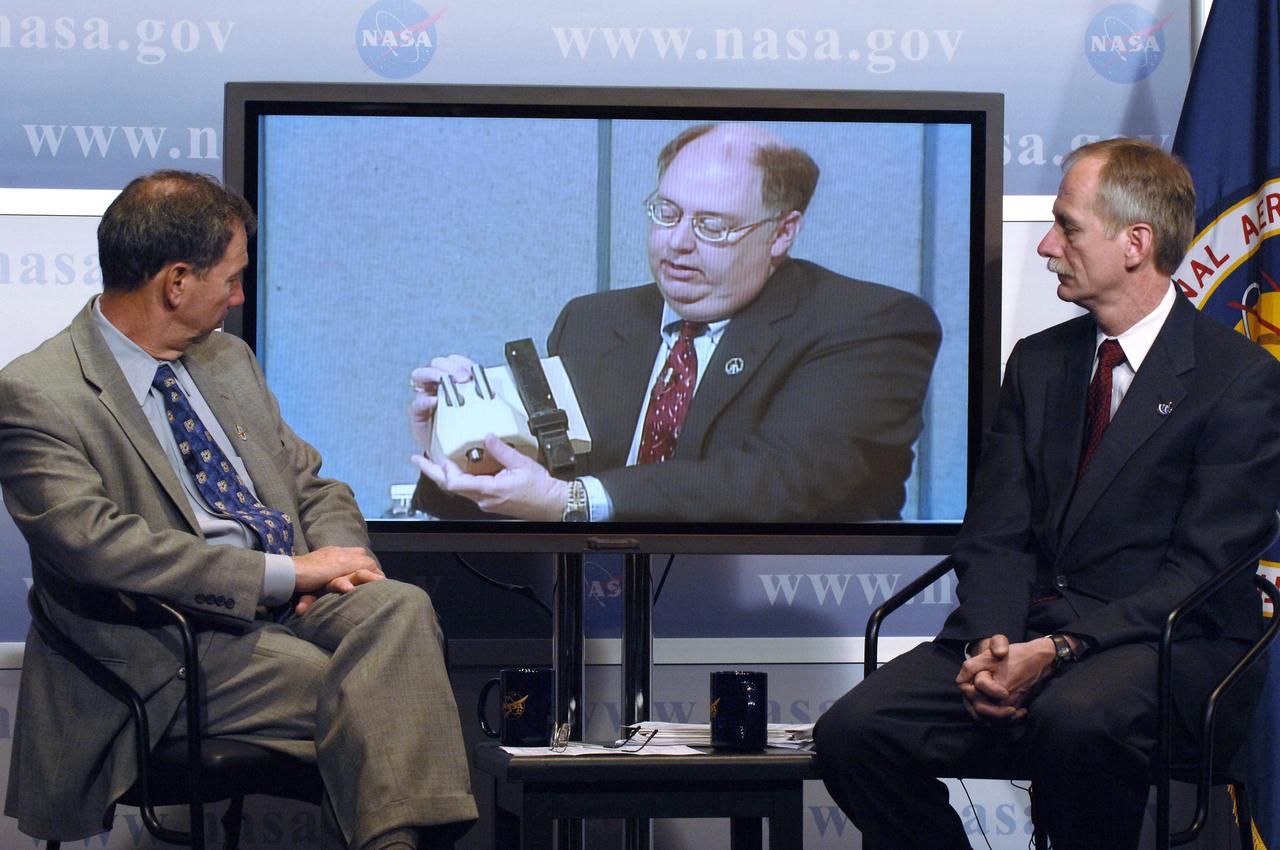
NASA Administrator Michael Griffin, left, and Associate Administrator for Space Operations William Gerstenmaier, right, smile as Space Shuttle Program Manager Wayne Hale, right on television screen, and Ken Welzyn, External Tank Chief Engineer, join in from NASA's Marshall Space Flight Center during a media briefing about the space shuttle program and processing for the STS-121 mission, Friday, April 28, 2006, at NASA Headquarters in Washington. Photo Credit (NASA/Bill Ingalls)
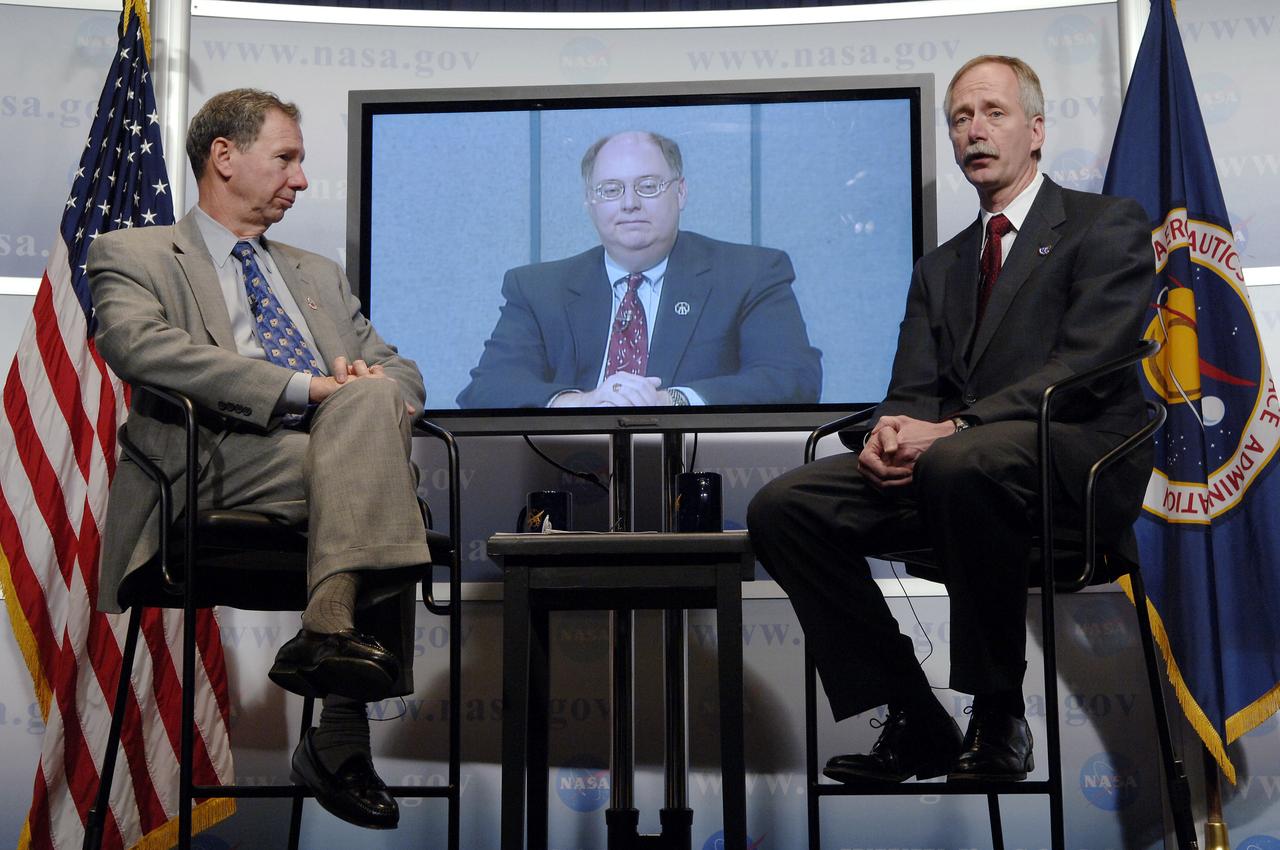
NASA Administrator Michael Griffin, left, looks on as Associate Administrator for Space Operations William Gerstenmaier, right, speaks while Space Shuttle Program Manager Wayne Hale of NASA's Marshall Space Flight Center waits by during a media briefing about the space shuttle program and processing for the STS-121 mission, Friday, April 28, 2006, at NASA Headquarters in Washington. Photo Credit (NASA/Bill Ingalls)
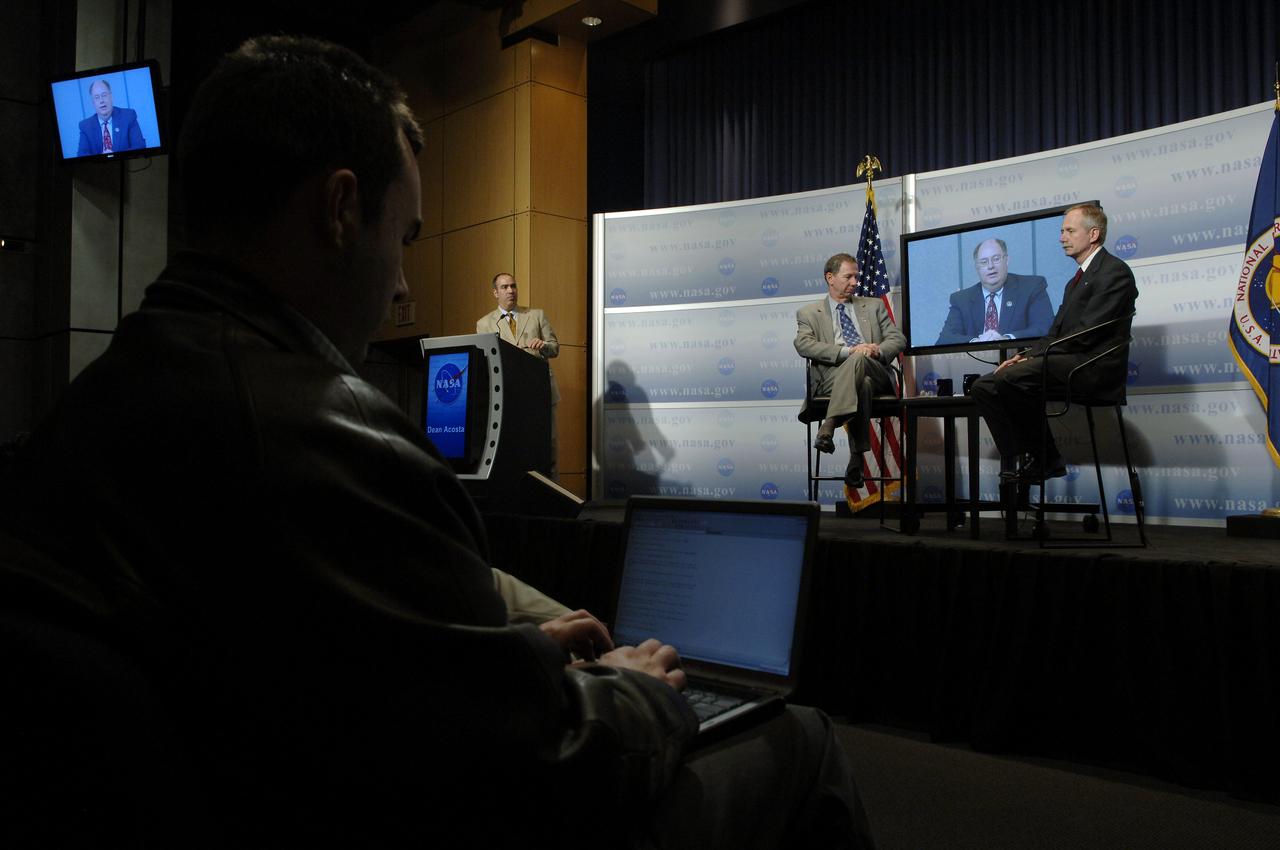
NASA Administrator Michael Griffin, second from left, and Associate Administrator for Space Operations William Gerstenmaier, right, look on as Space Shuttle Program Manager Wayne Hale speaks from NASA's Marshall Space Flight Center during a media briefing about the space shuttle program and processing for the STS-121 mission, Friday, April 28, 2006, at NASA Headquarters in Washington. Moderator Dean Acosta looks on af far left. Photo Credit (NASA/Bill Ingalls)
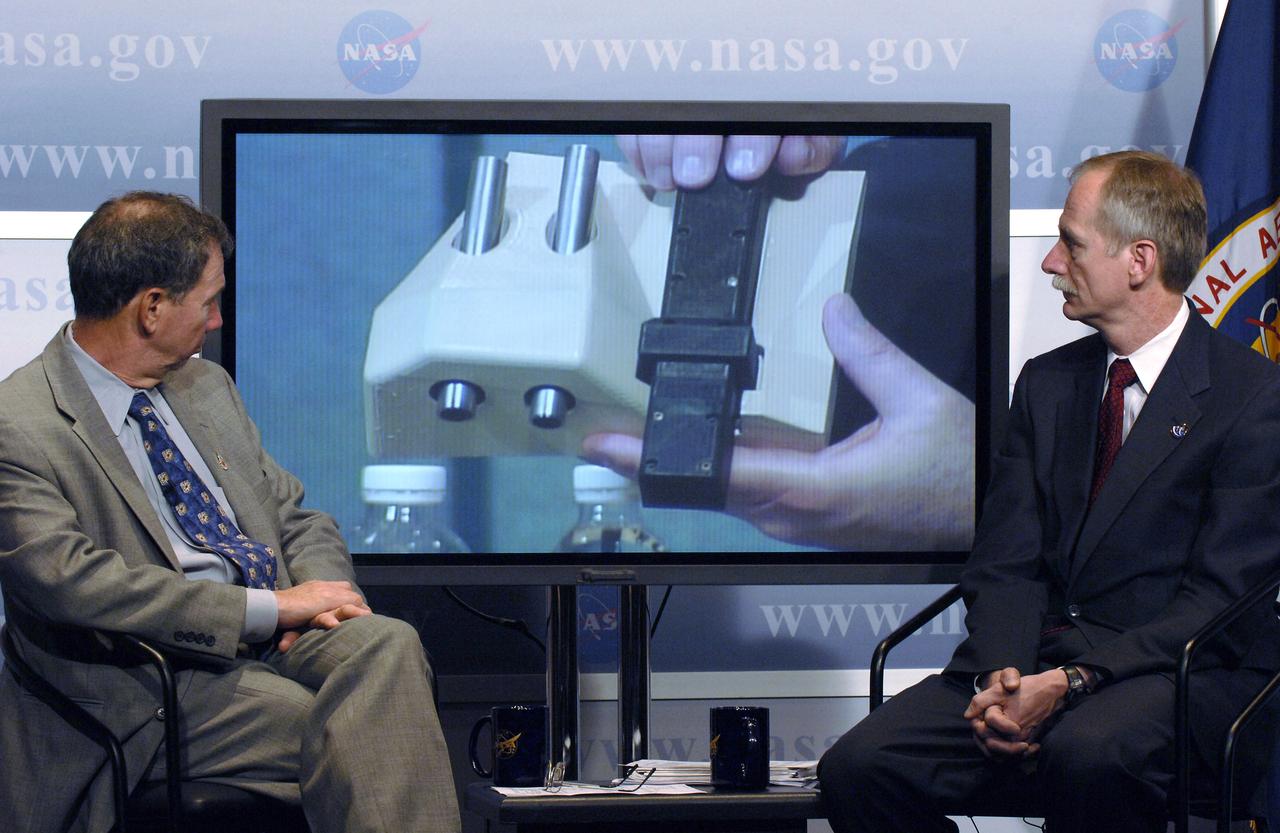
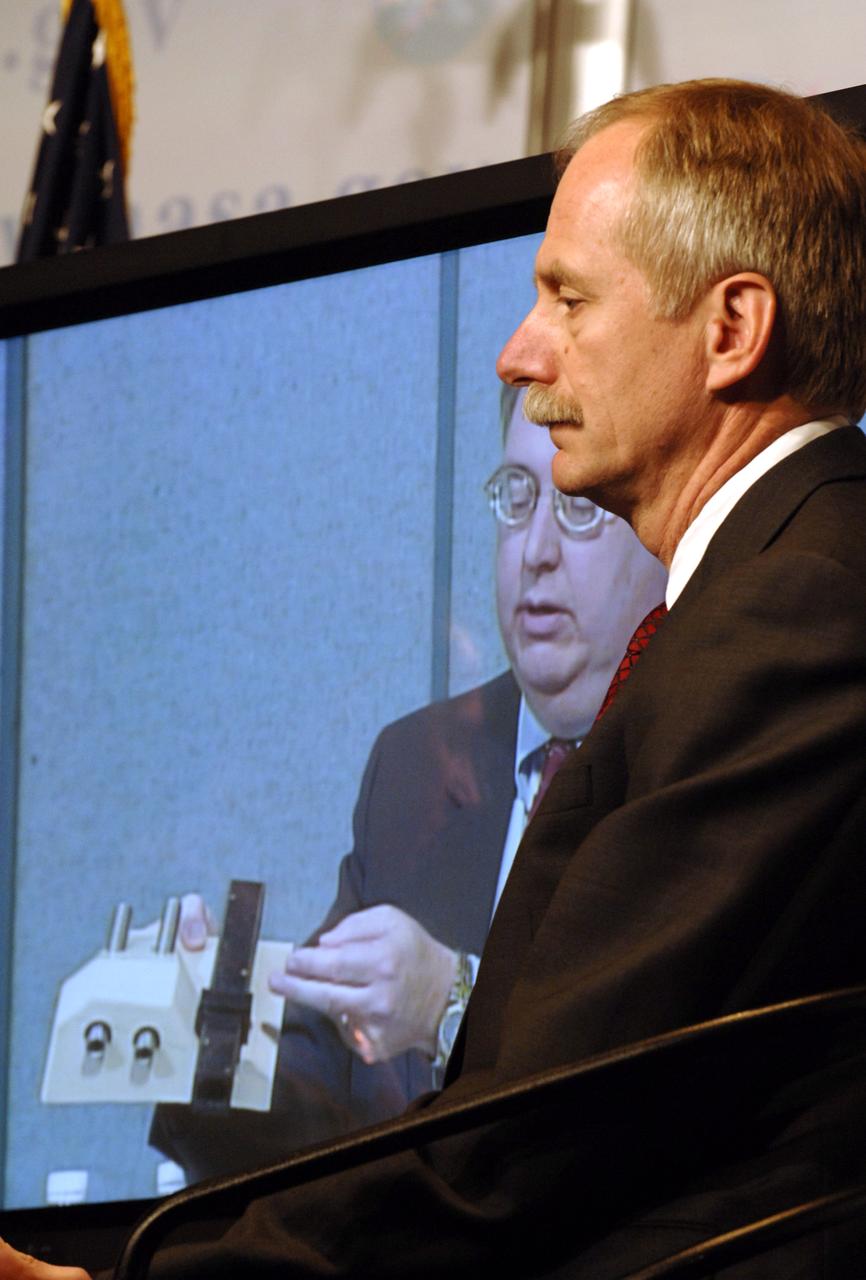
NASA Administrator Michael Griffin, left, and Associate Administrator for Space Operations William Gerstenmaier, right, look on as Space Shuttle Program Manager Wayne Hale from NASA's Marshall Space Flight Center, holds a test configuration of an ice frost ramp during a media briefing about the space shuttle program and processing for the STS-121 mission, Friday, April 28, 2006, at NASA Headquarters in Washington. Photo Credit (NASA/Bill Ingalls)
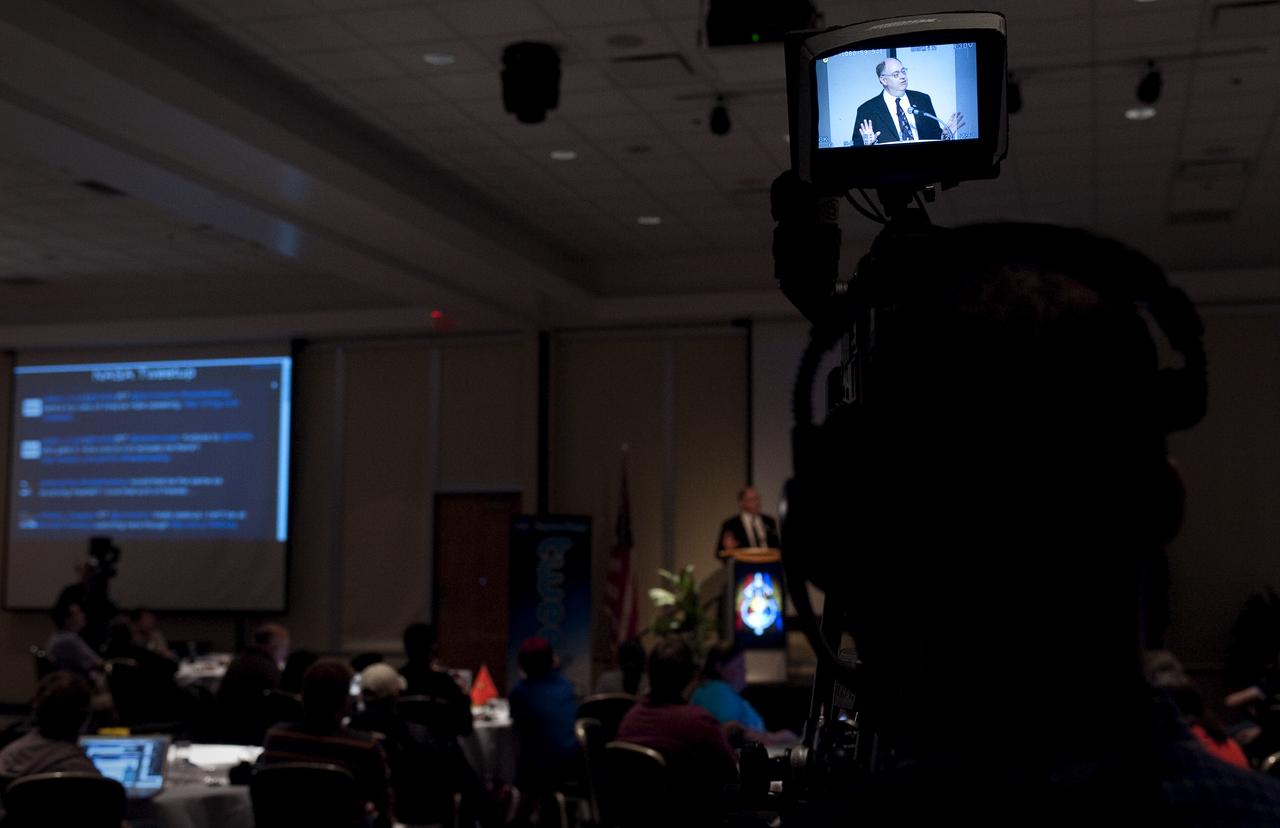
Wayne Hale, NASA strategic program planning manager, is seen on video camera as he speaks during a two-day NASA Tweetup event held at NASA's Kennedy Space Center in Cape Canaveral, Fla, Sunday, Nov. 15, 2009. NASA Twitter followers in attendance will have the opportunity to take a tour of NASA's Kennedy Space Center, view the STS-129 space shuttle launch and speak with shuttle technicians, engineers, astronauts and managers. Photo Credit: (NASA/Carla Cioffi) 
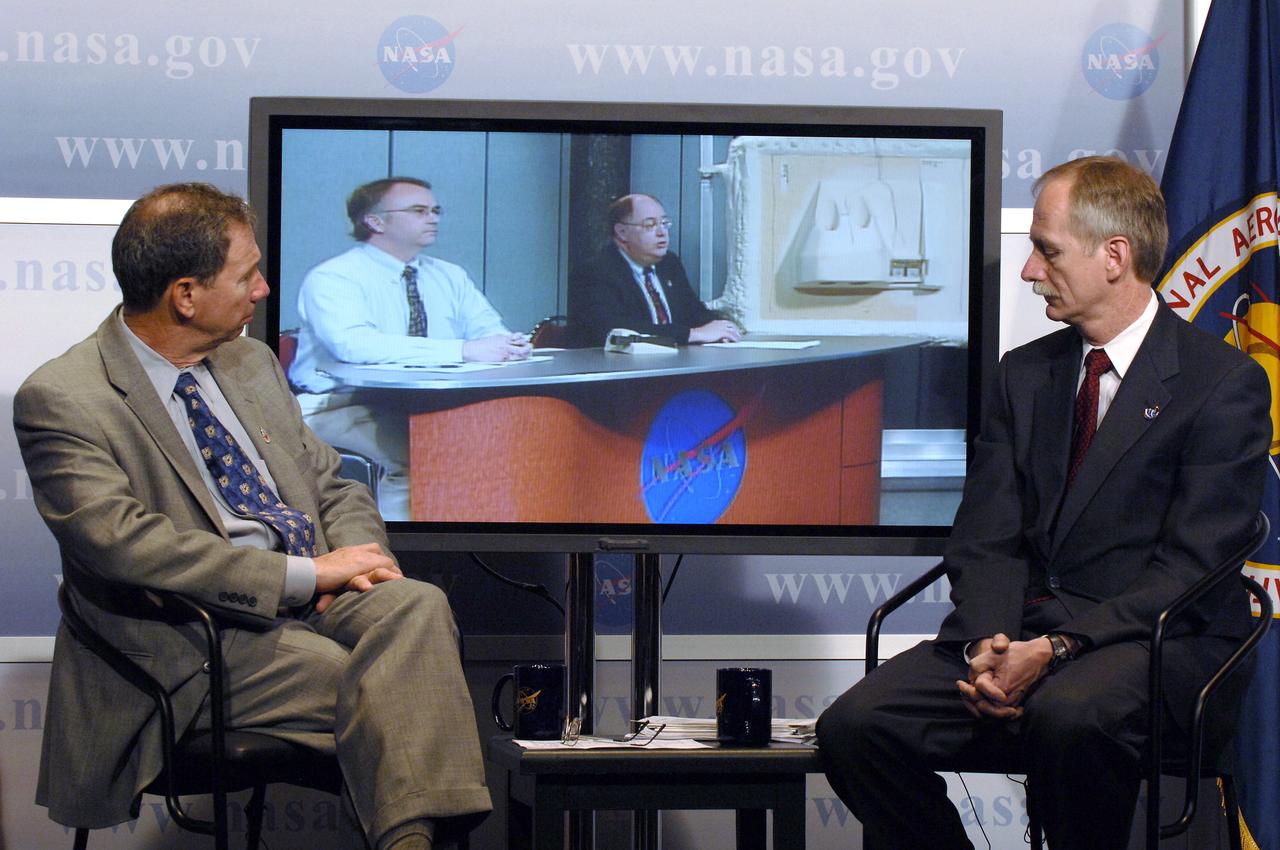
NASA Administrator Michael Griffin, left, and Associate Administrator for Space Operations William Gerstenmaier, right, look on as Space Shuttle Program Manager Wayne Hale speaks from NASA's Marshall Space Flight Center during a media briefing about the space shuttle program and processing for the STS-121 mission, Friday, April 28, 2006, at NASA Headquarters in Washington. At left on screen is Ken Welzyn, External Tank Chief Engineer. Photo Credit (NASA/Bill Ingalls)
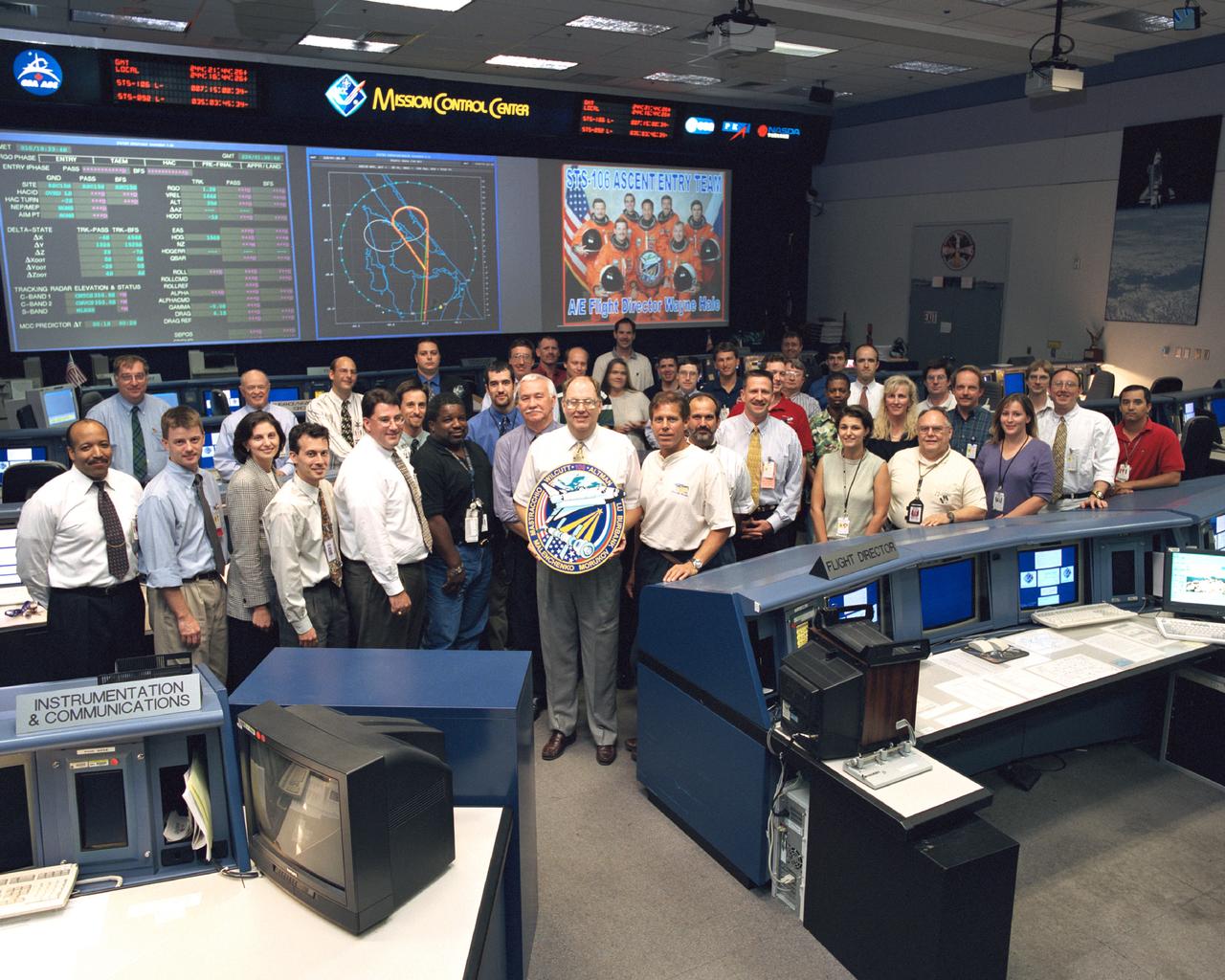
JSC2000-06076 (September 2000) --- The ascent/entry team for STS-106 poses with flight director Wayne Hale (holding insignia) in Mission Control Center.
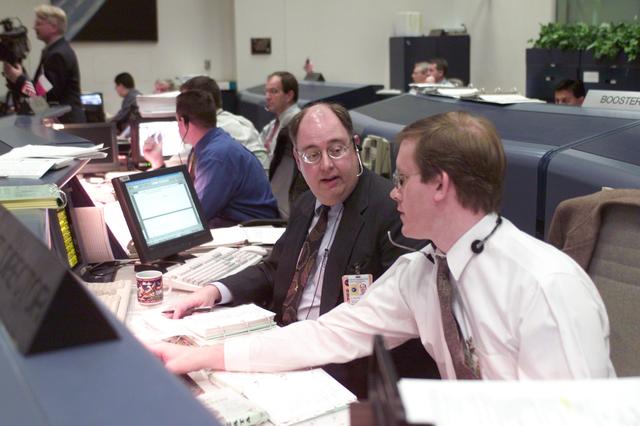
JSC2001-E-06214 (8 March 2001) --- At their console in Houston's Mission Control Center, flight directors Wayne Hale (left) and John Shannon discuss a mission detail while awaiting launch several hundred miles away in Florida. Hale is ascent director and Shannon is lead and Orbit 1 director.
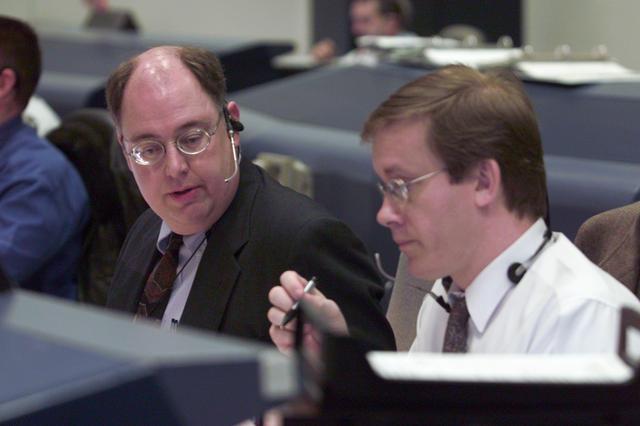
JSC2001-E-06202 (8 March 2001) --- At their console in Houston's Mission Control Center, flight directors Wayne Hale (left) and John Shannon discuss a mission detail while awaiting launch several hundred miles away in Florida. Hale is ascent director and Shannon is lead and Orbit 1 director
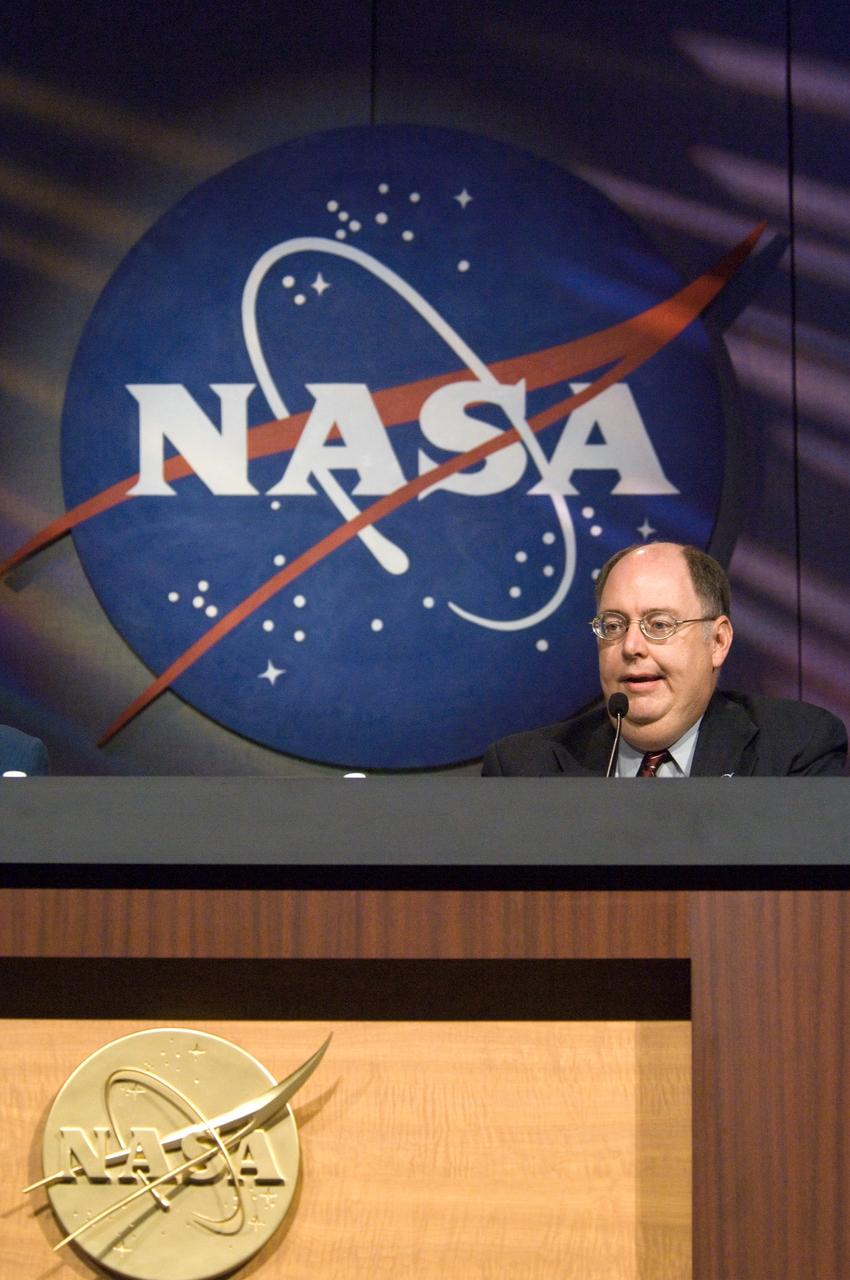
JSC2005-E-32015 (4 August 2005) --- Wayne Hale, Deputy Manager of the Shuttle Program Office, fields questions from news media represetatives during a press conference in the Olin Teague Auditorium at the Johnson Space Center. Hale had just come from a meeting of the Mission Management Team, and he passed onto the news reporters the decision of not planning for a fourth spacewalk on Discovery's STS-114 mission.
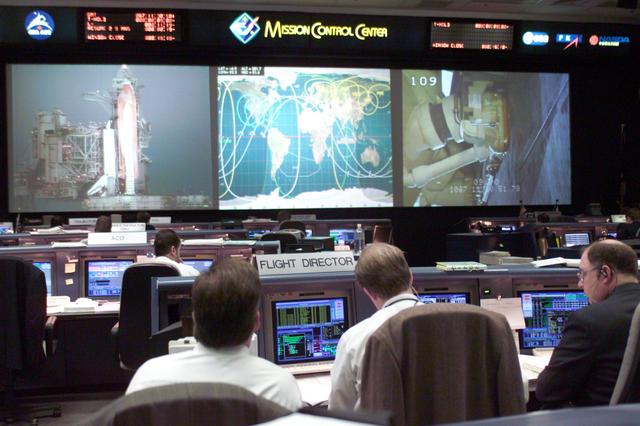
JSC2001-E-06210 (8 March 2001) --- As STS-102 Discovery liftoff countdown proceeds at the Kennedy Space Center (KSC)in Florida, flight controllers in Houston follow the progress at their assigned consoles. Ascent flight director Wayne Hale views his monitor at right.
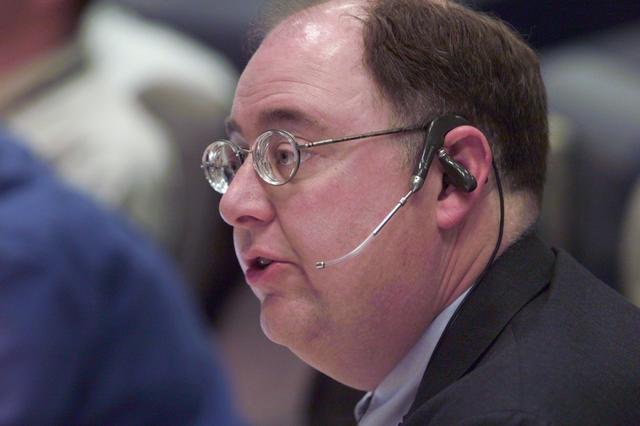
JSC2001-E-06208 (8 March 2001) --- At his console in Houston's Mission Control Center, ascent flight director Wayne Hale monitors Discovery's pre-launch activities several hundred miles away in Florida on STS-102 launch day.
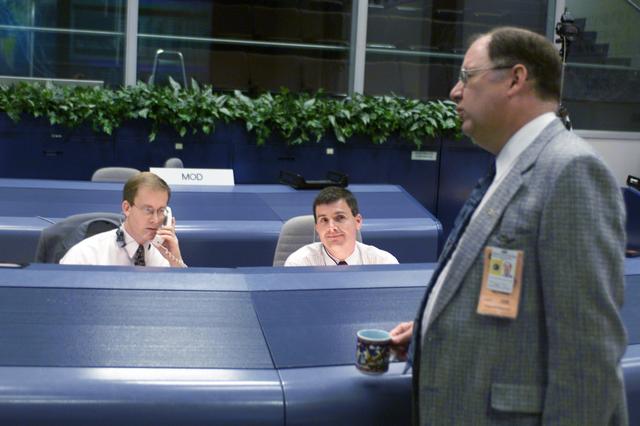
JSC2001-E-25434 (21 August 2001) --- STS-105 flight directors John Shannon (left) and Steve Stich, monitor data at their consoles in the shuttle flight control room (WFCR) in Houston’s Mission Control Center (MCC). Wayne Hale of the Mission Operations Directorate (MOD) is photographed standing in the foreground.
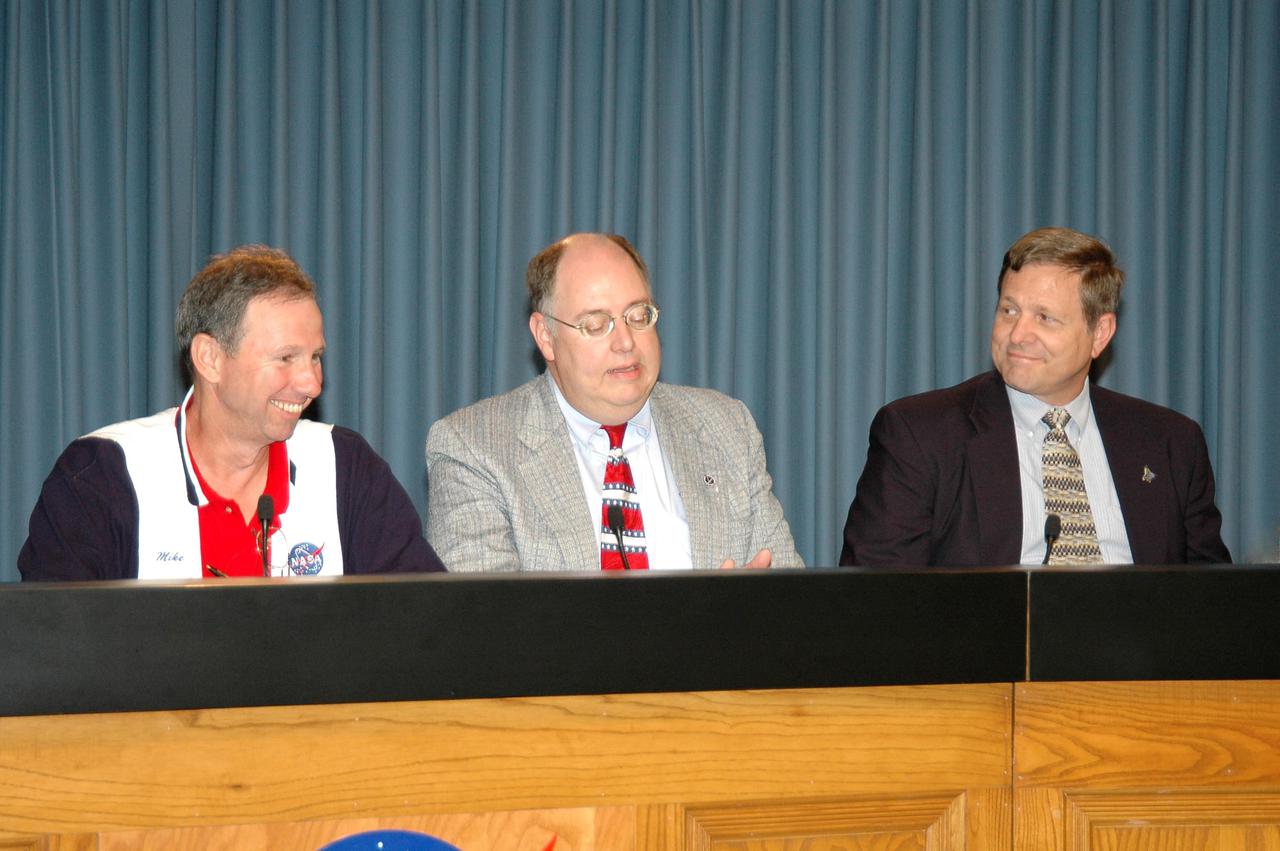
KENNEDY SPACE CENTER, FLA. - At the STS-114 Launch Readiness Press Conference at NASA Kennedy Space Center, Space Shuttle Deputy Program Manager Wayne Hale (center) answers a question from the media. At the conference, NASA officials confirmed the July 26 launch. Others seated with Hale on the stage are NASA Administrator Mike Griffin (left) and Shuttle Processing Director Mike Wetmore (right). Not pictured is launch weather officer 1st Lt. Mindy Chavez, with the U.S. Air Force 45th Weather Squadron. Liftoff of Space Shuttle Discovery on the Return to Flight mission STS-114 is scheduled for 10:39 a.m. EDT July 26 from Launch Pad 39B.
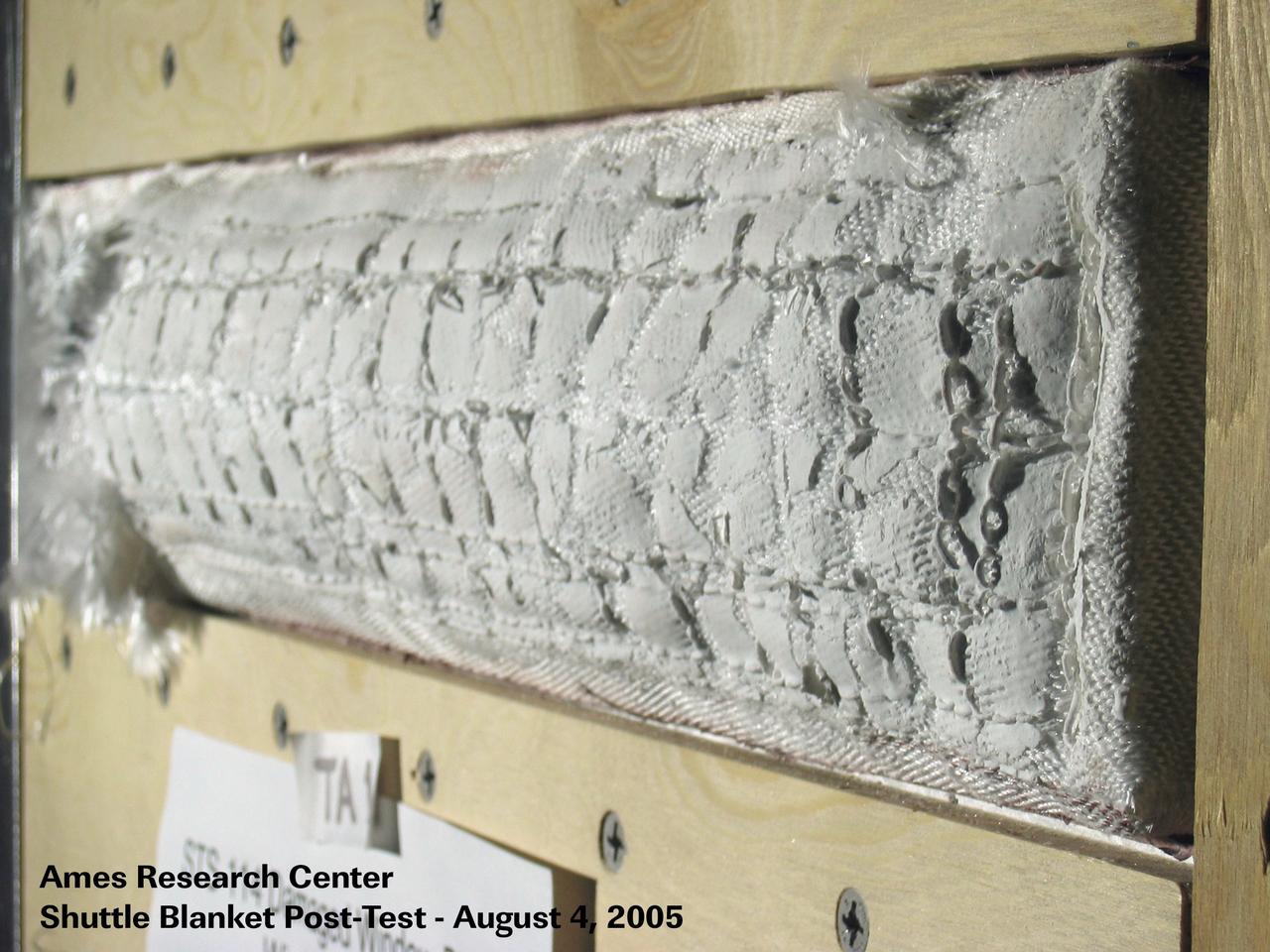
JSC2005-E-32511 (4 August 2005) --- One of four visual aids used by Shuttle Deputy Program Manager Wayne Hale during an August 4 press conference that dealt with important tests in wind tunnels at NASA's Ames Research Center. Engineers simulated the conditions of the Space Shuttle Discovery for a disrupted thermal blanket near the commander's window on the forward cabin of the spacecraft. Eventually it was decided that no additonal spacewalk work needed to be performed to fix the blanket.
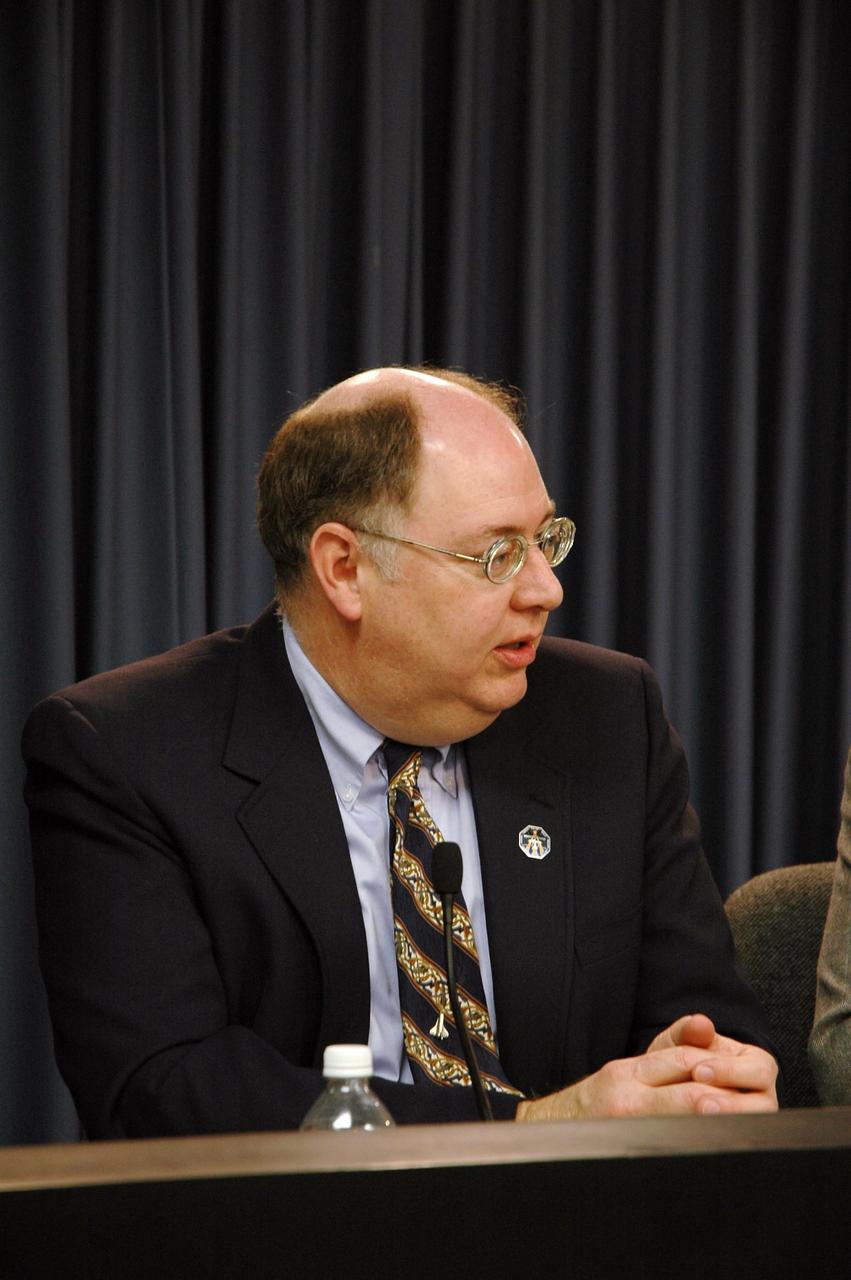
KENNEDY SPACE CENTER, FLA. - Space Shuttle Program Manager Wayne Hale answers a question from a reporter during a press conference. He and NASA Launch Director Mike Leinbach and STS-114 External Tank Tiger Team lead Tim Wilson, with the NASA Engineering & Safety Center, briefed the media about the Space Shuttle Program and mission STS-121 from the press site at NASA's Kennedy Space Center in Florida. Photo credit: NASA/Jack Pfaller
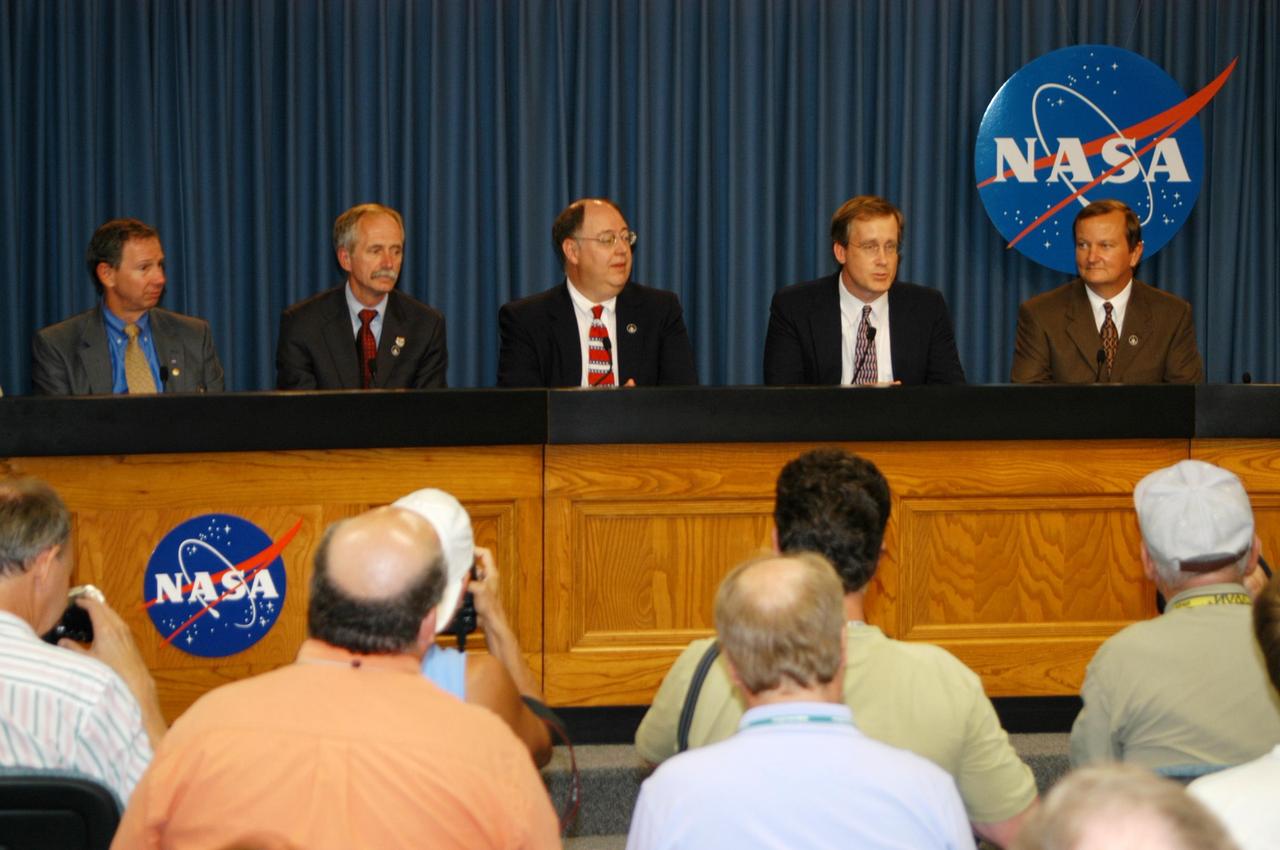
KENNEDY SPACE CENTER, FLA. - At a post-launch briefing, Shuttle Program Manager Wayne Hale, center, briefs the media about the successful launch of Space Shuttle Discovery on mission STS-121. Seated with him are, left to right, NASA Administrator Mike Griffin, NASA Associate Administrator for Space Operations Mission Bill Gerstenmaier, Chief of the Mission Management Team John Shannon, and Shuttle Launch Director Mike Leinbach. Liftoff of Discovery was on time at 2:30 p.m. EDT.
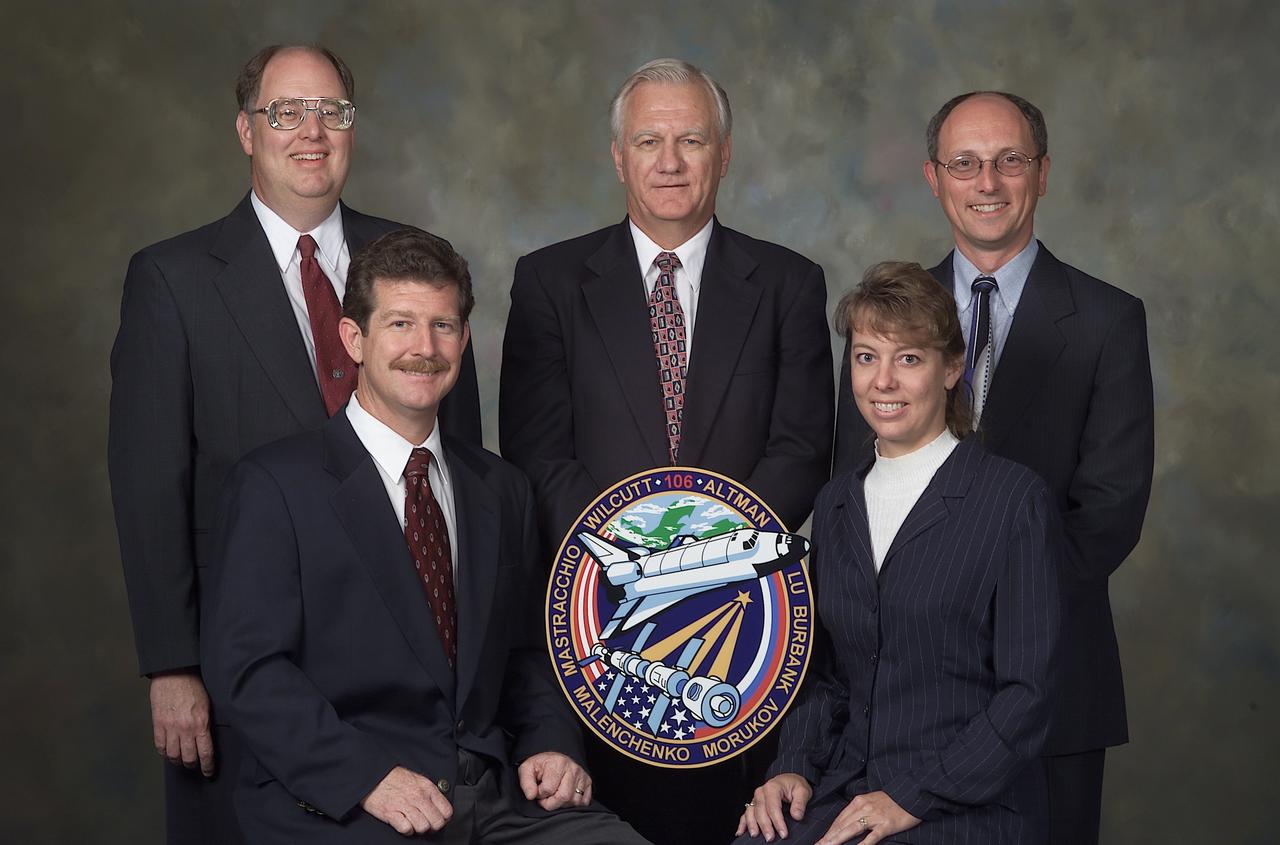
JSC2000-E-19040 (July 2000) --- These flight directors have been named for key support to the STS-106 mission, scheduled for September of this year. In front are Phil Engelauf, Orbit 1 and lead; Kelly Beck, planning. Standing, from the left, are Wayne Hale, ascent and entry; Bill Reeves, Team 4; and Paul Dye, Orbit 2. Team 4 will periodically fill in for other flight controllers, allowing some shifting of teams to other times of the day.
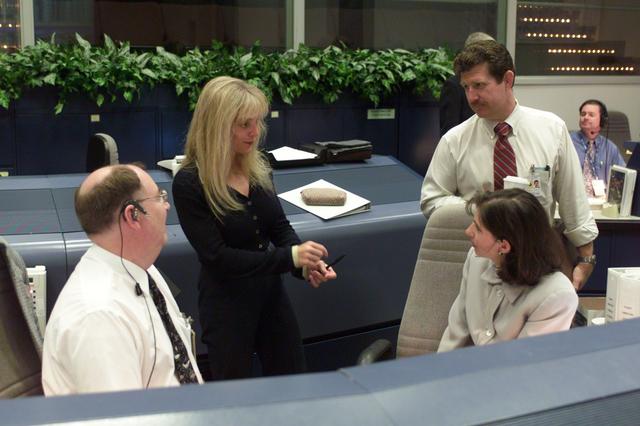
JSC2001-E-21560 (16 July 2001) --- STS-104 flight directors Wayne Hale (seated left), Catherine Koerner (seated right) and Phil Engelauf (standing left) speak with Linda Ham, Special Assistant to the Manager of the Space Shuttle Program Office, at the flight director's console in the shuttle flight control room (WFCR) in Houston's Mission Control Center (MCC).
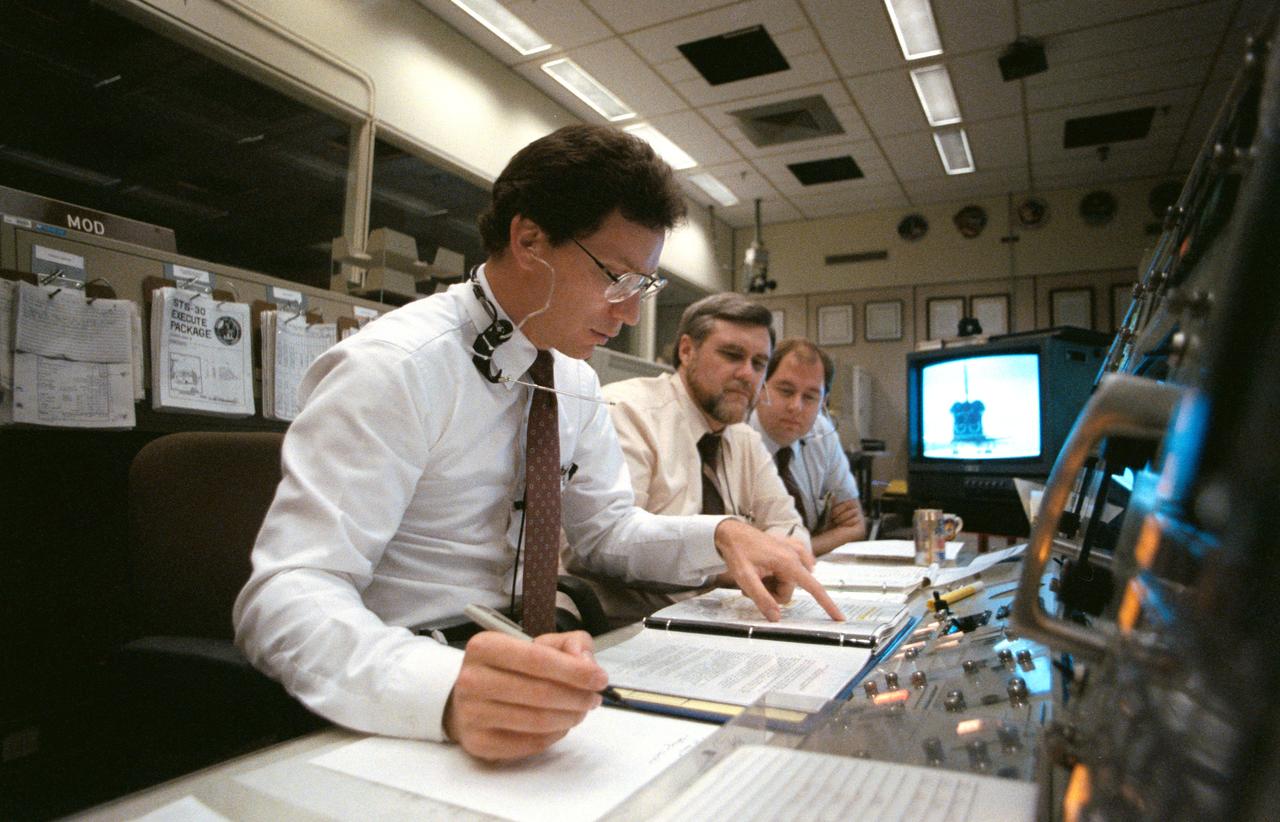
STS030-S-118 (8 May 1989 ) --- The landing phase of the space shuttle Atlantis is monitored by three flight directors in the Flight Control Room (FCR) of the Johnson Space Center's (JSC) Mission Control Center (MCC). Studying the data at the Flight Director Console are Ronald D. Dittemore, Alan L. (Lee) Briscoe and N. Wayne Hale. Moments earlier, Atlantis touched down on Runway 22 at Edwards Air Force Bakse (Note monitor).
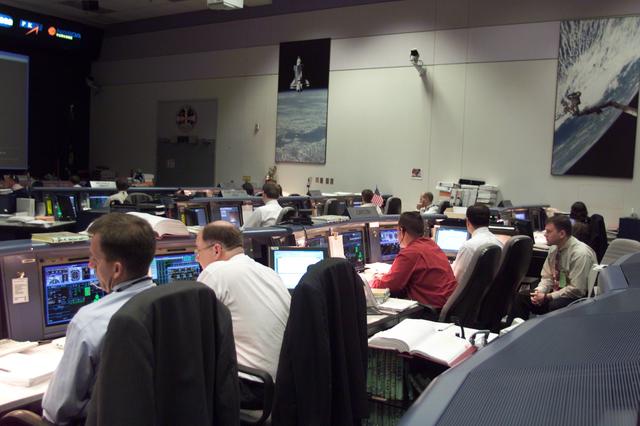
JSC2001-E-21341 (12 July 2001) --- From a familiar setting near the rear of shuttle flight control room (WFCR) at Houston's Mission Control Center (MCC), Wayne Hale (second left), ascent flight director for STS-104, pays close attention to new data related to the Space Shuttle Atlantis and its impending launch from the Kennedy Space Center (KSC) in Florida. Several other flight controllers are visible in the wide shot.
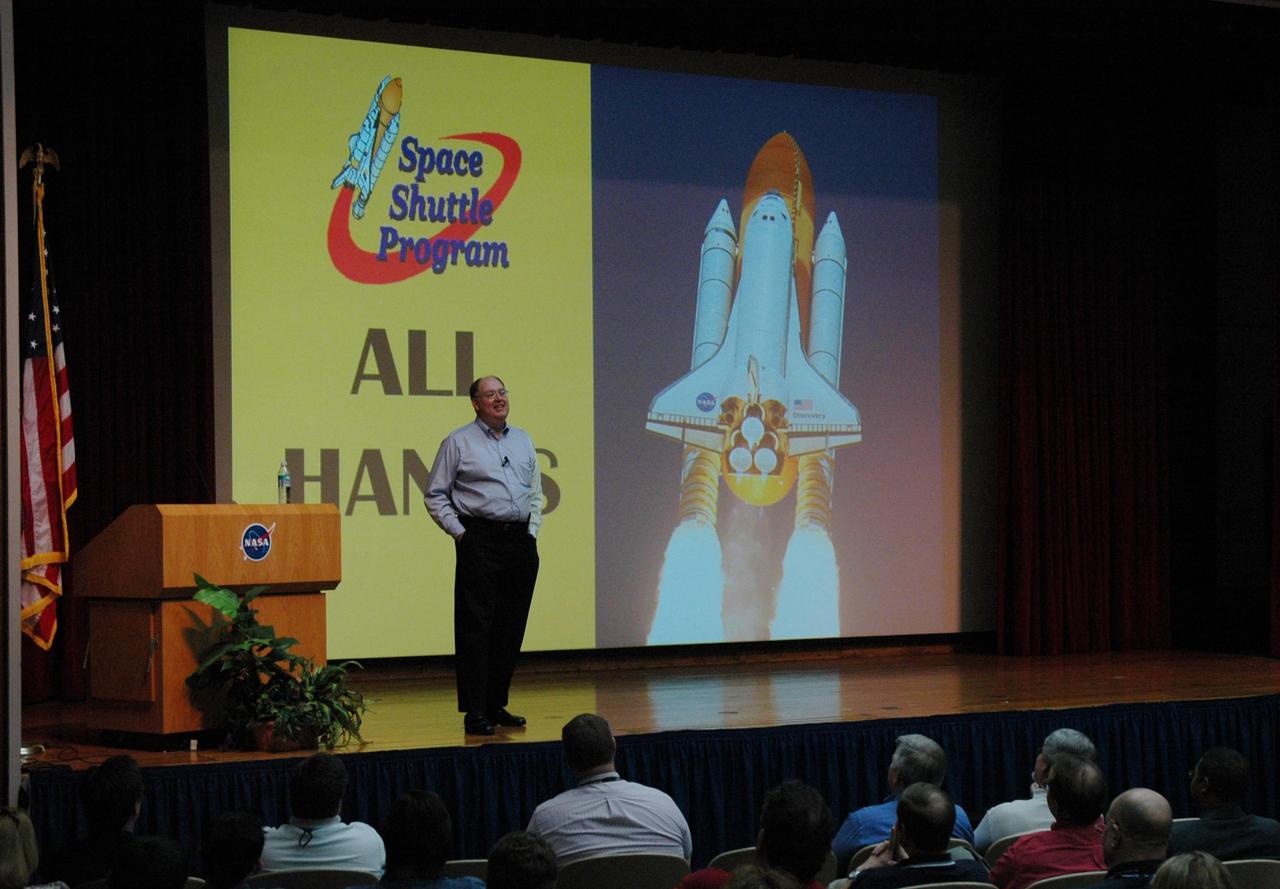
KENNEDY SPACE CENTER, FLA. - At a space shuttle all hands meeting in the training auditorium at NASA's Kennedy Space Center, Space Shuttle Program Manager Wayne Hale discusses the status of the program, successes of the STS-114 mission, effects of Hurricane Katrina on NASA facilities, and the newly released budget. Photo credit: NASA/Jim Grossmann
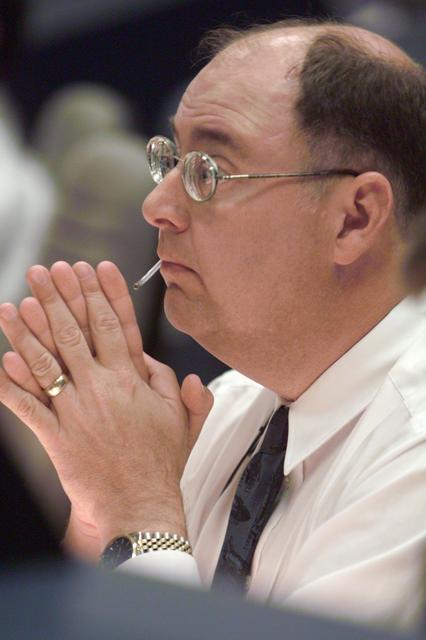
JSC2001-E-21333 (12 July 2001) --- From a familiar setting in the shuttle flight control room (WFCR) at Houston's Mission Control Center (MCC), Wayne Hale, ascent flight director for STS-104, pays close attention to new data related to the Space Shuttle Atlantis and its impending launch from the Kennedy Space Center (KSC) in Florida.
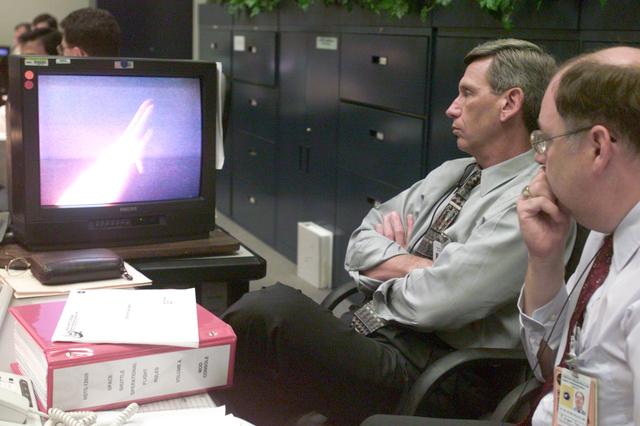
JSC2001-E-24999 (10 August 2001) --- Lawrence Bourgeois (left) and Wayne Hale watch the launch of the Space Shuttle Discovery at the Mission Operations Directorate (MOD) console in the shuttle flight control room (WFCR) in Houston's Mission Control Center (MCC). As soon as the vehicle cleared the tower in Florida, the Houston-based team of flight controllers took over the ground control of the flight.
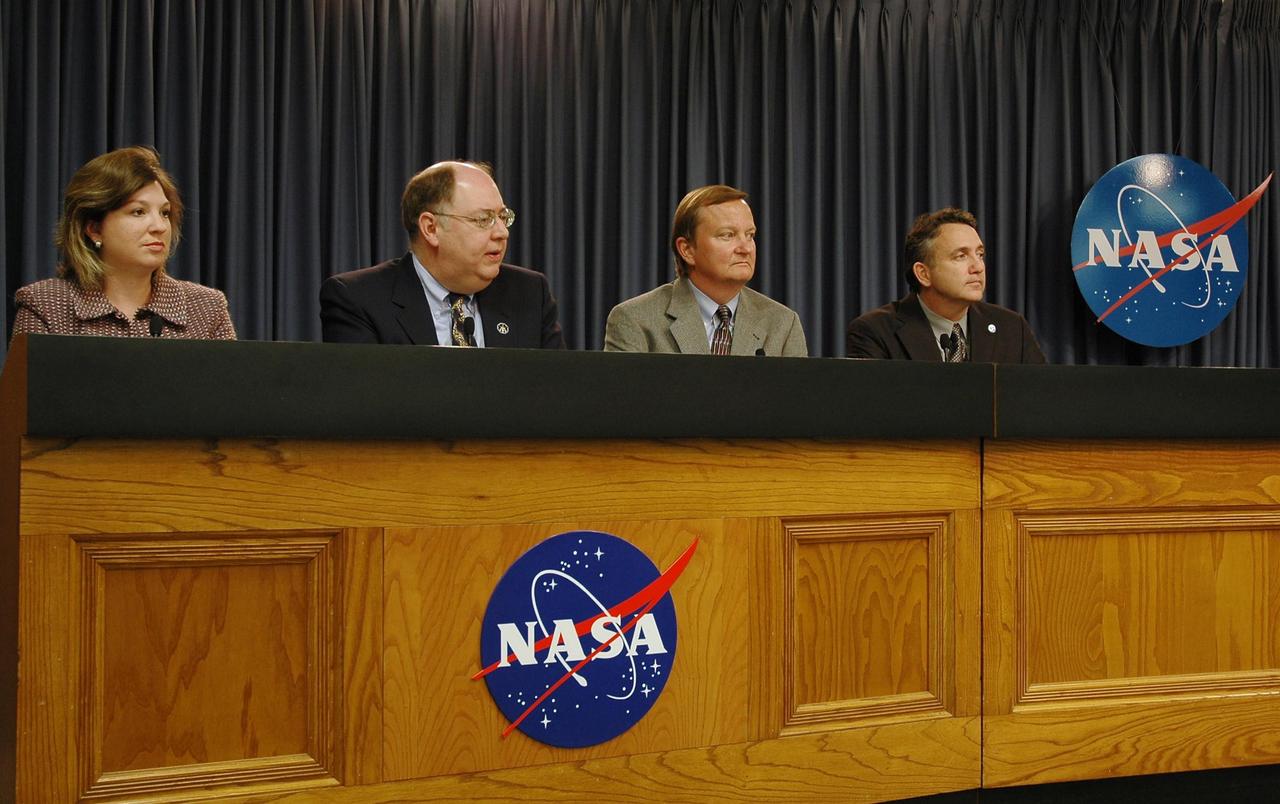
KENNEDY SPACE CENTER, FLA. - NASA managers brief the media about the Space Shuttle Program and mission STS-121 from the press site at NASA's Kennedy Space Center in Florida. Public Information Officer Jessica Rye moderated. Seated at her right are Space Shuttle Program Manager Wayne Hale, NASA Launch Director Mike Leinbach and STS-114 External Tank Tiger Team lead Tim Wilson, with the NASA Engineering & Safety Center. Photo credit: NASA/Jack Pfaller
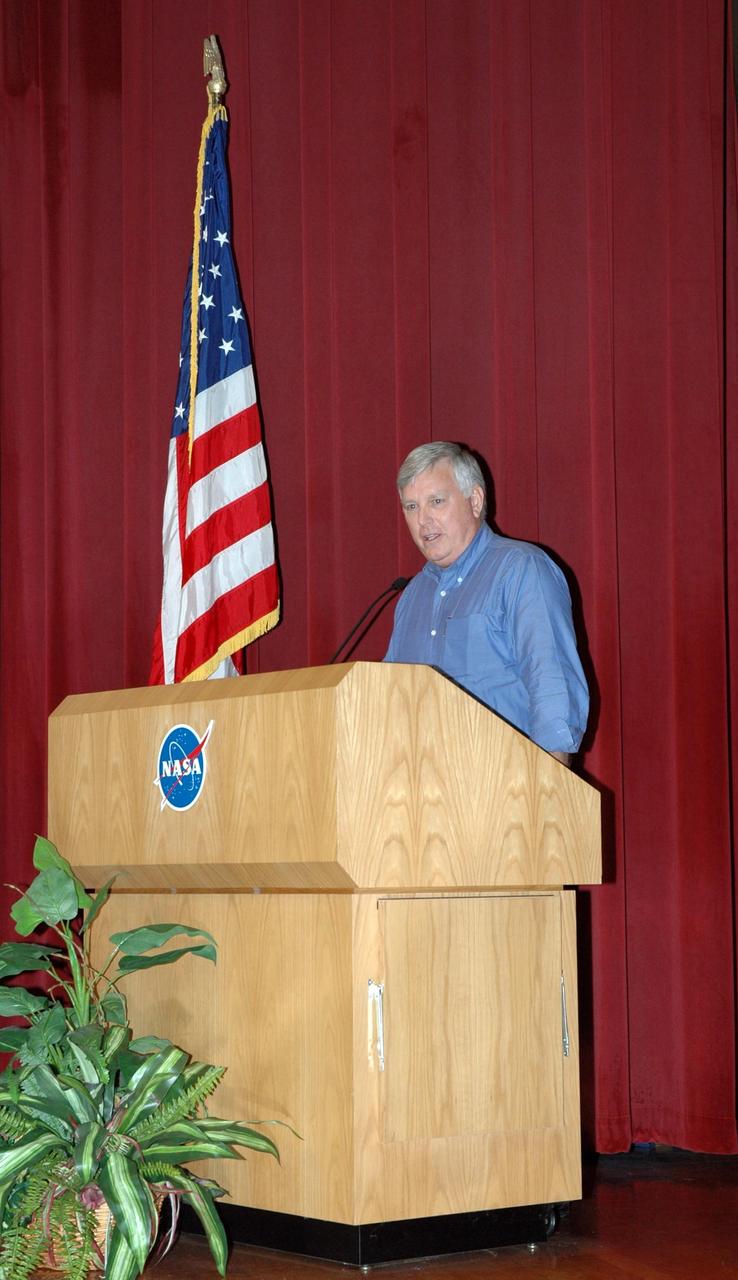
KENNEDY SPACE CENTER, FLA. - In the training auditorium at NASA's Kennedy Space Center, Center Director Jim Kennedy (at podium) welcomes Deputy Director Bill Parsons back to the center during a space shuttle all hands meeting. Following Kennedy, Space Shuttle Program Manager Wayne Hale discussed the status of the program, successes of the STS-114 mission, effects of Hurricane Katrina on NASA facilities, and the newly released budget. Photo credit: NASA/Jim Grossmann
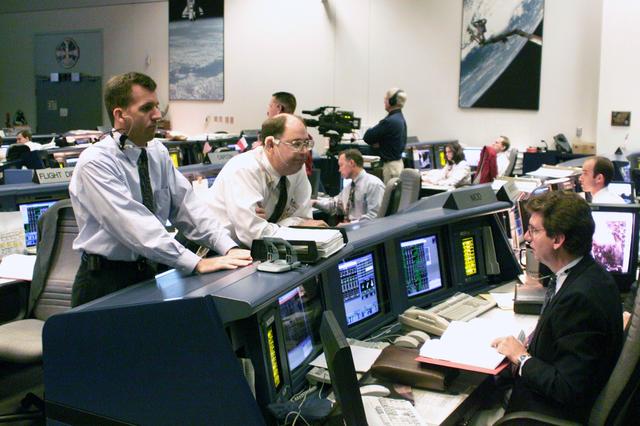
JSC2000-E-22288 (8 September2000) --- In Houston's Mission Control Center, flight directors LeRoy Cain, from left foreground, Wayne Hale and Jeffrey Bantle await the launch of the Space Shuttle Atlantis in Florida. The flight director console is on the left side of the frame. Bantle is seated at the Missions Operations Directorate (MOD) console. Once the shuttle clears the launch tower in Florida, the "baton" gets handed off to the flight controllers in Houston.
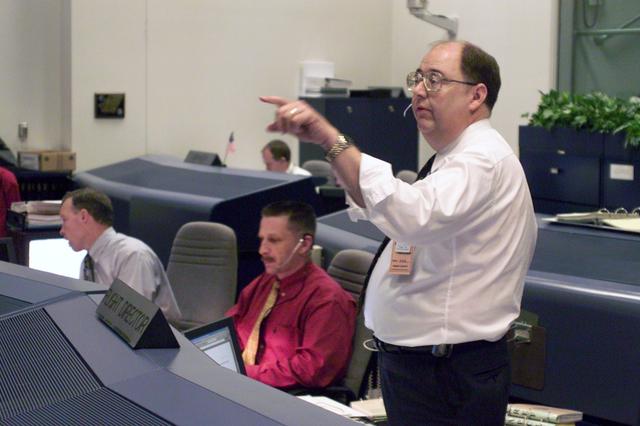
JSC2000-E-22287 (8 September 2000) --- Flight controllers in Houston await the launch of the Space Shuttle Atlantis from the Kennedy Space Center (KSC) in Florida. From the left are astronauts Dominic L. Gorie and Christopher J. Loria, both at the Spacecraft Communicator (CAPCOM) console; and Wayne Hale at the Flight Director console. The Space Shuttle later launched on schedule, at 8:46 a.m. (EDT), September 8, 2000, as the Johnson Space Center (JSC) flight control team took the baton from KSC's launch controllers.
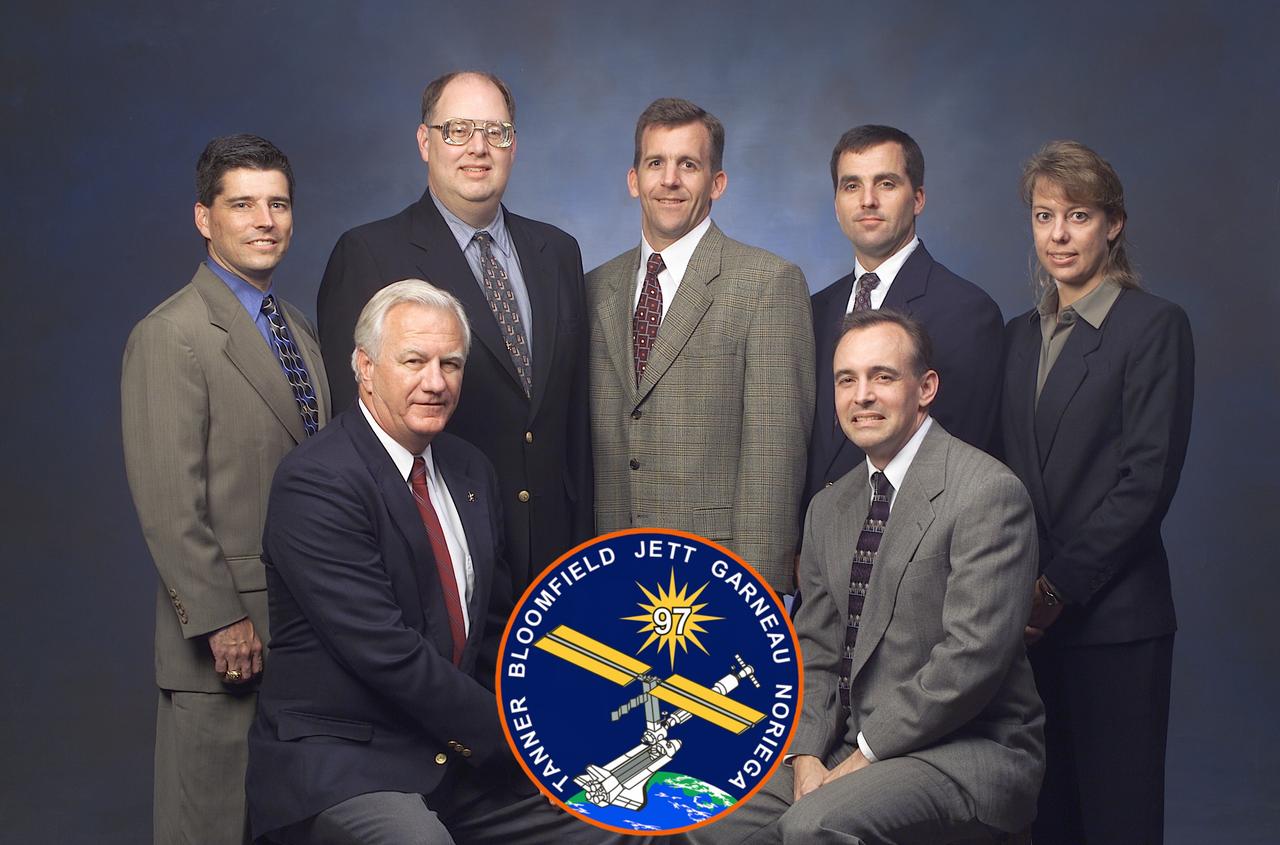
JSC2000-E-29413 (November 2000) --- Flight directors (FD) for the STS-97 mission pose for a pre-flight group portrait with the mission's insignia. Front row: Lead FD Bill Reeves (left), and Jeff Hanley. Back row, from the left: John Curry, Wayne Hale, LeRoy Cain, Paul Hill and Kelly Beck.
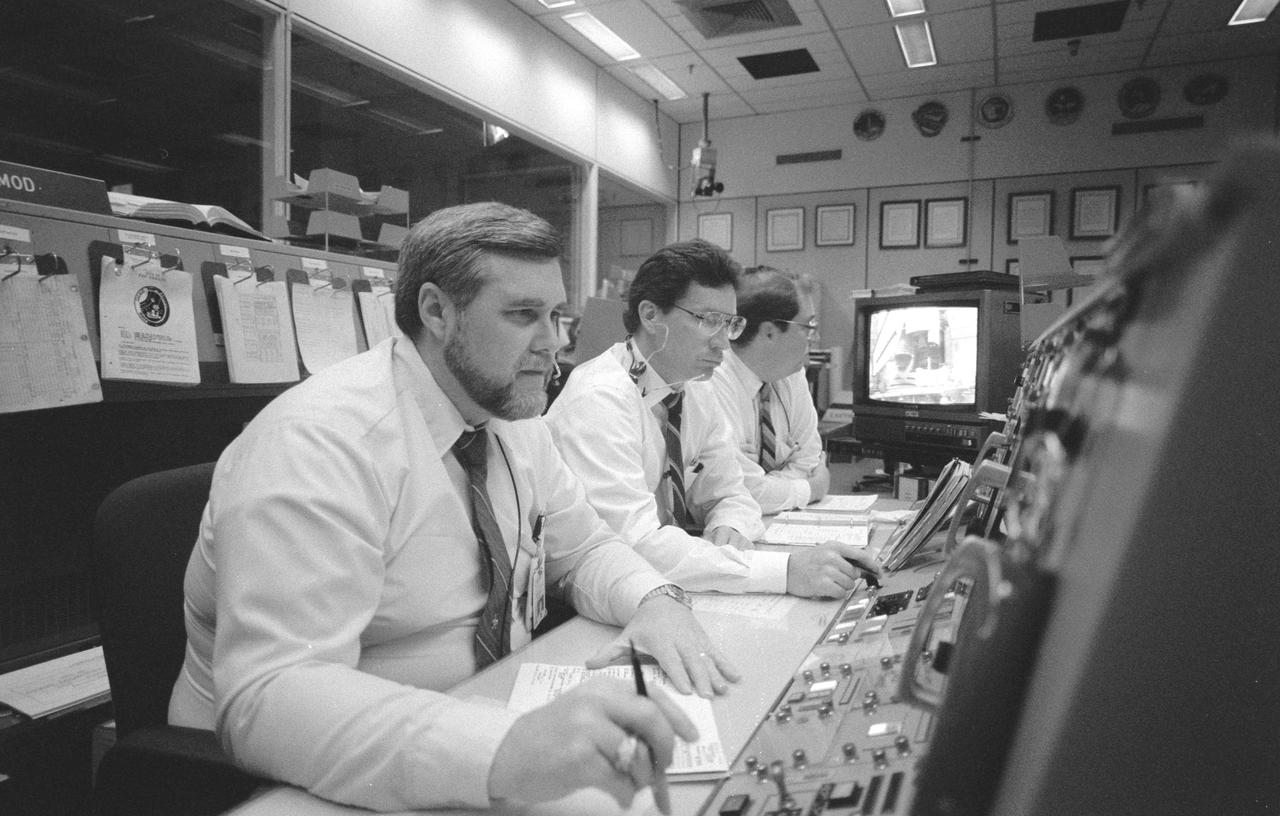
Only moments away from ignition, Atlantis, Orbiter Vehicle (OV) 104, and its five member crew are the subjects of concern drawing serious countenance in this scene in the Flight Control Room (FCR) of JSC's Mission Control Center (MCC) Bldg 30. Ascent Flight Director Alan L. Briscoe, monitors the Kennedy Space Center pre-launch activity from the flight director (FD) console, along with Ronald D. Dittemore (center) and N. Wayne Hale, Jr.
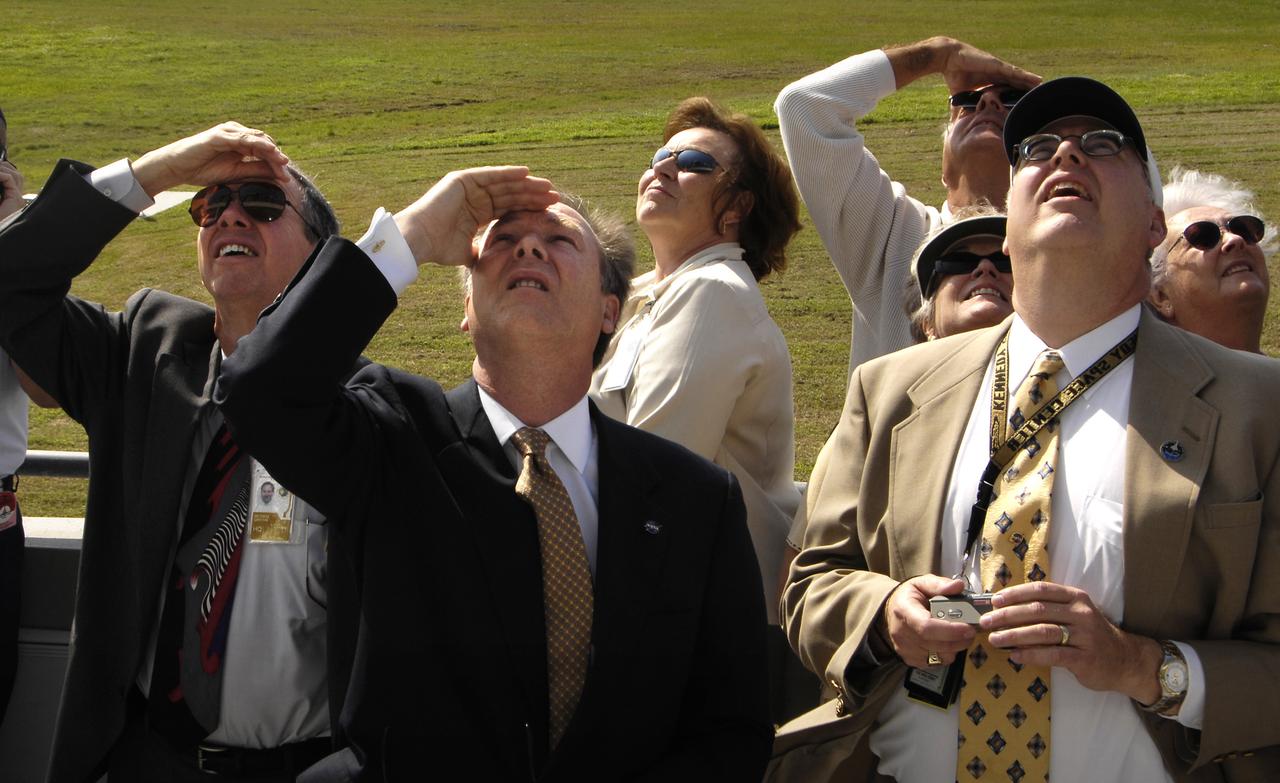
(left to right) NASA Administrator Michael Griffin, NASA Assistant Administrator for Public Affairs David Mould and NASA Space Shuttle Manager Wayne Hale watch as the space shuttle Discovery comes in for landing at NASA's Kennedy Space Center, Fla., completing the 15-day STS-120 mission to the International Space Station. Discovery landed at 1:01pm EST Wednesday after a mission that included on-orbit construction of the station with the installation of the Harmony Node 2 module and the relocation of the P6 truss. Photo Credit: 'NASA/Bill Ingalls"
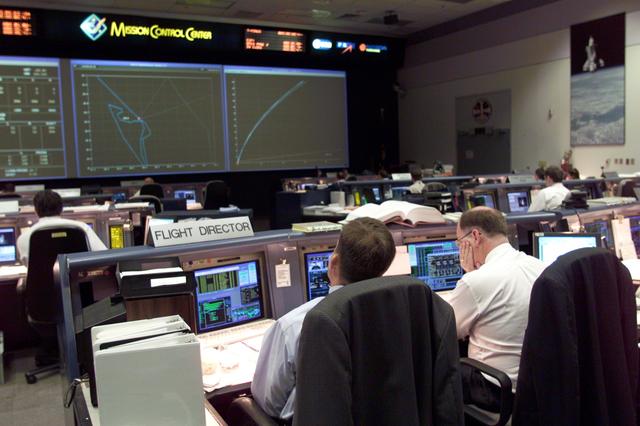
JSC2001-E-21333 (12 July 2001) --- From a familiar setting in the shuttle flight control room (WFCR)at Houston's Mission Control Center (MCC), Wayne Hale, ascent flight director for STS-104, pays close attention to new data related to the Space Shuttle Atlantis and its impending launch from the Kennedy Space Center (KSC) in Florida.
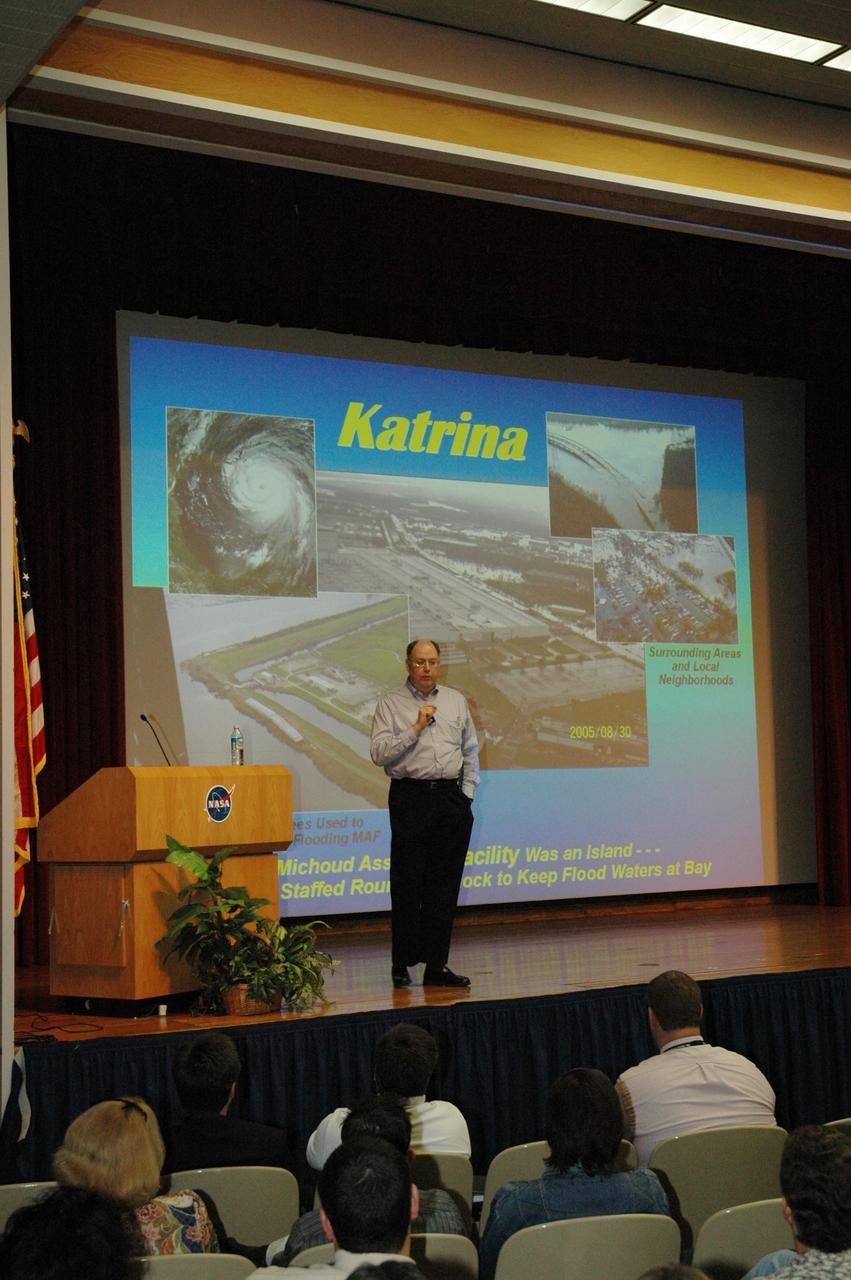
KENNEDY SPACE CENTER, FLA. - At a space shuttle all hands meeting in the training auditorium at NASA's Kennedy Space Center, Space Shuttle Program Manager Wayne Hale discusses effects of Hurricane Katrina on NASA facilities, the status of the program, successes of the STS-114 mission, and the newly released budget. Photo credit: NASA/Jim Grossmann
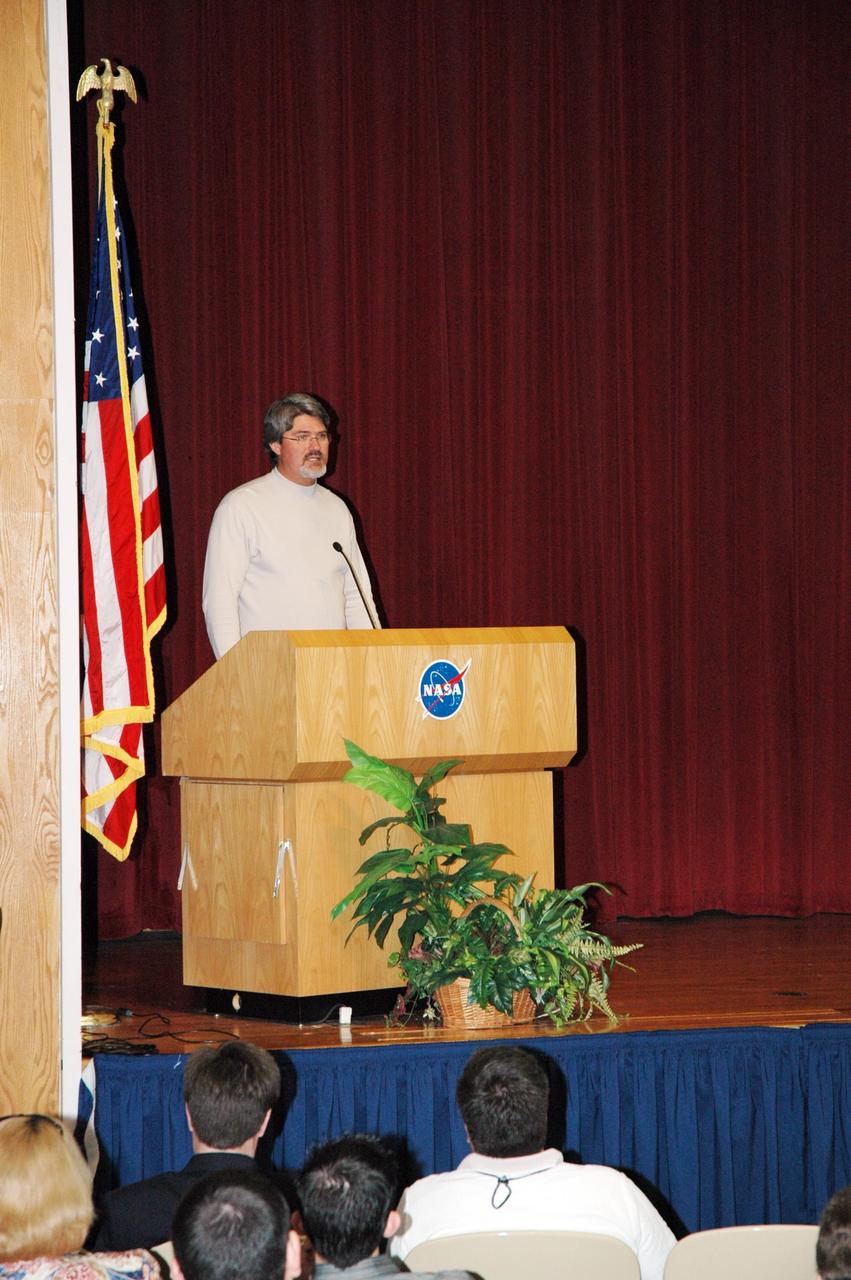
KENNEDY SPACE CENTER, FLA. - In the training auditorium at NASA's Kennedy Space Center, Deputy Director Bill Parsons, at the beginning of a space shuttle all hands meeting, speaks to employees about his journey through NASA. He was followed by Space Shuttle Program Manager Wayne Hale discussed the status of the program, successes of the STS-114 mission, effects of Hurricane Katrina on NASA facilities, and the newly released budget. Photo credit: NASA/Jim Grossmann
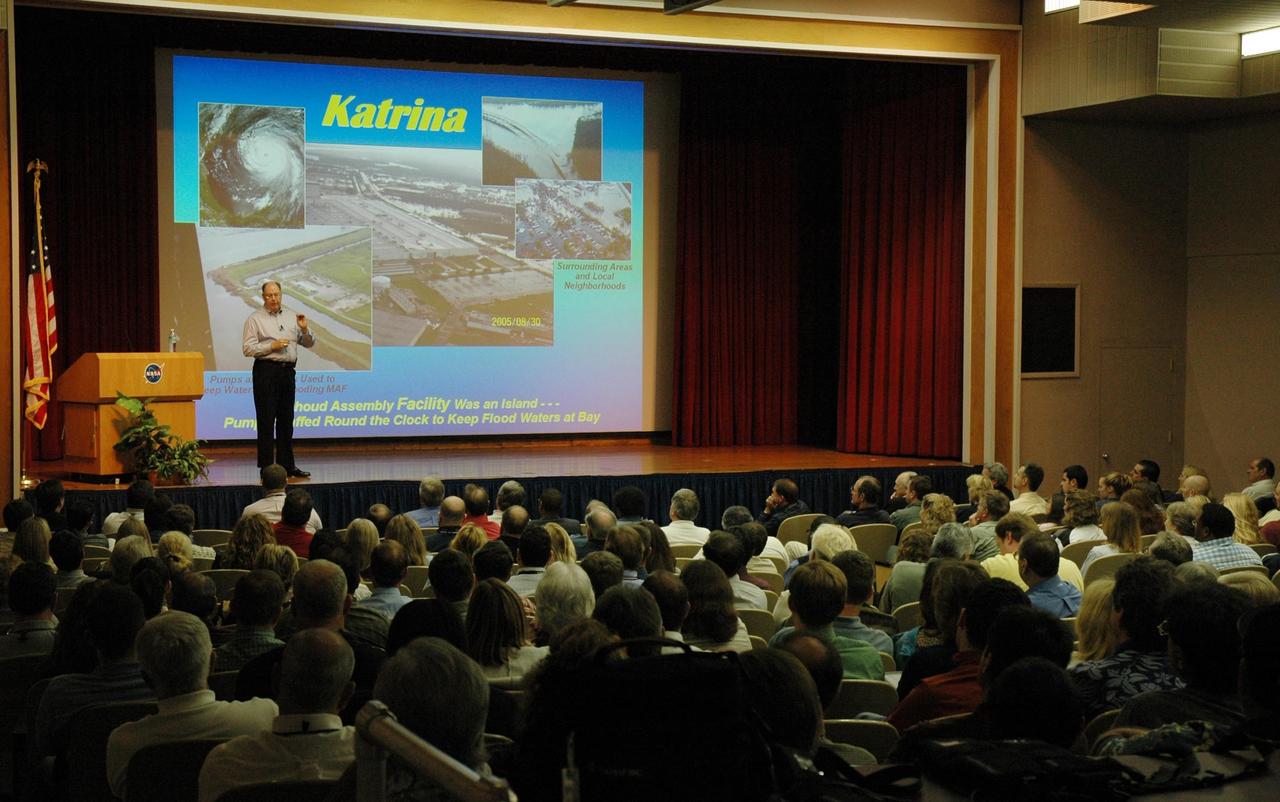
KENNEDY SPACE CENTER, FLA. - At a space shuttle all hands meeting in the training auditorium at NASA's Kennedy Space Center, Space Shuttle Program Manager Wayne Hale discusses effects of Hurricane Katrina on NASA facilities, the status of the program, successes of the STS-114 mission, and the newly released budget. Photo credit: NASA/Jim Grossmann
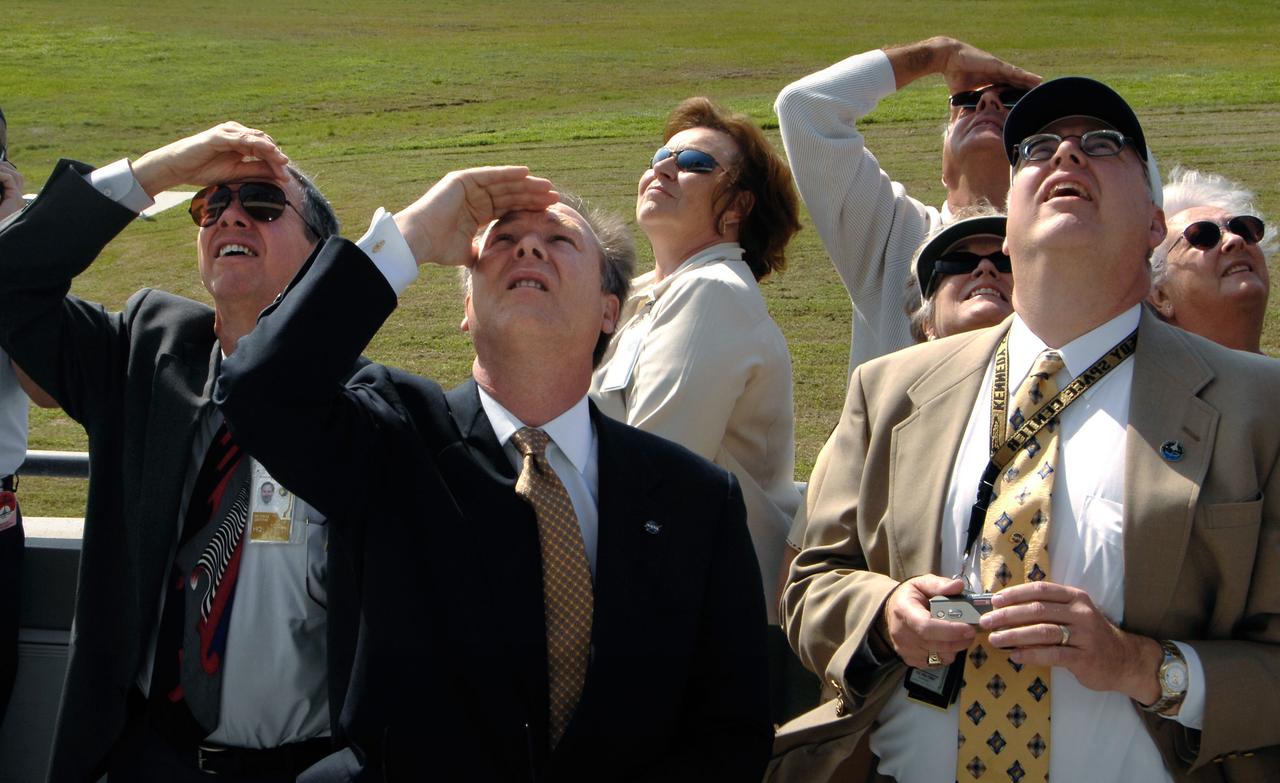
(left to right) NASA Administrator Michael Griffin, NASA Assistant Administrator for Public Affairs David Mould and NASA Space Shuttle Manager Wayne Hale watch as the space shuttle Discovery comes in for landing at NASA's Kennedy Space Center, Fla., completing the 15-day STS-120 mission to the International Space Station. Discovery landed at 1:01pm EST Wednesday after a mission that included on-orbit construction of the station with the installation of the Harmony Node 2 module and the relocation of the P6 truss. Photo Credit: 'NASA/Bill Ingalls"
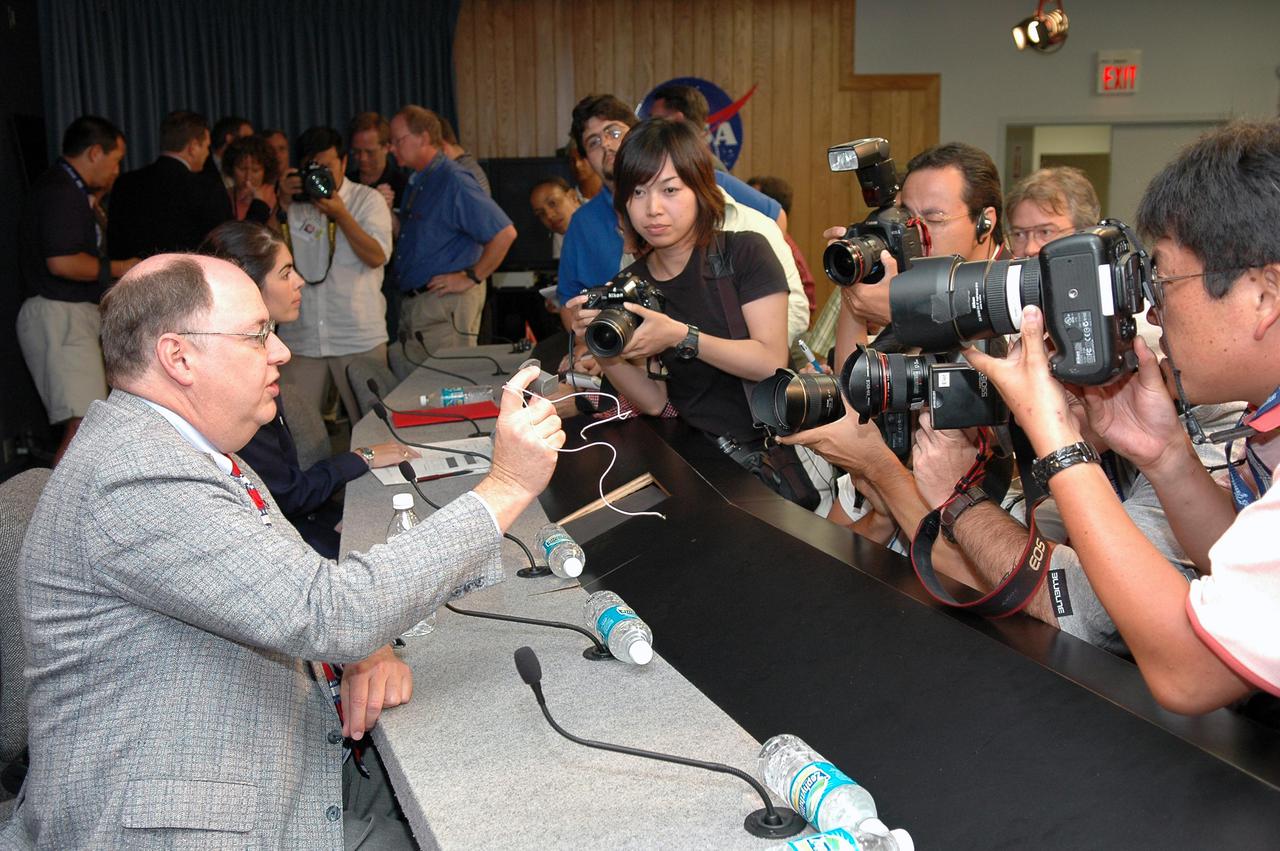
KENNEDY SPACE CENTER, FLA. - After the STS-114 Launch Readiness Press Conference at NASA Kennedy Space Center, media crowd around Space Shuttle Deputy Program Manager Wayne Hale, who is holding an ECO (engine cut-off) sensor similar to the one in the External Tank that had a faulty reading in the first launch attempt. Liftoff of Space Shuttle Discovery on the Return to Flight mission STS-114 is scheduled for 10:39 a.m. EDT July 26 from Launch Pad 39B.
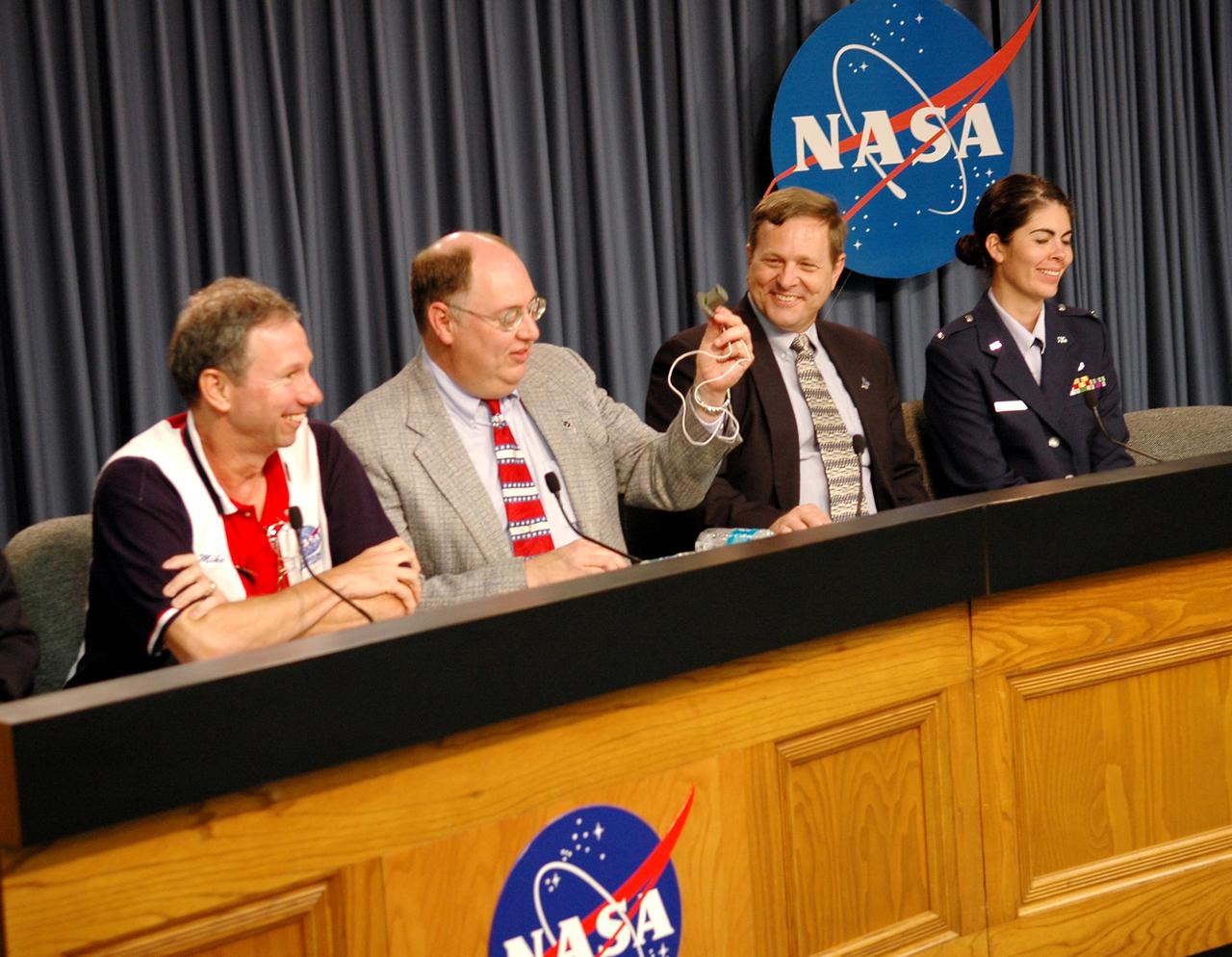
KENNEDY SPACE CENTER, FLA. - At the STS-114 Launch Readiness Press Conference at NASA Kennedy Space Center, the plan to launch July 26 is confirmed. Seated from left are NASA Administrator Mike Griffin, Space Shuttle Deputy Program Manager Wayne Hale, Shuttle Processing Director Mike Wetmore and launch weather officer 1st Lt. Mindy Chavez, with the U.S. Air Force 45th Weather Squadron. Hale is holding an ECO (engine cut-off) sensor similar to the one in Space Shuttle Discovery’s External Tank that had a faulty reading in the first launch attempt. Liftoff of Space Shuttle Discovery on the Return to Flight mission STS-114 is scheduled for 10:39 a.m. EDT July 26 from Launch Pad 39B.
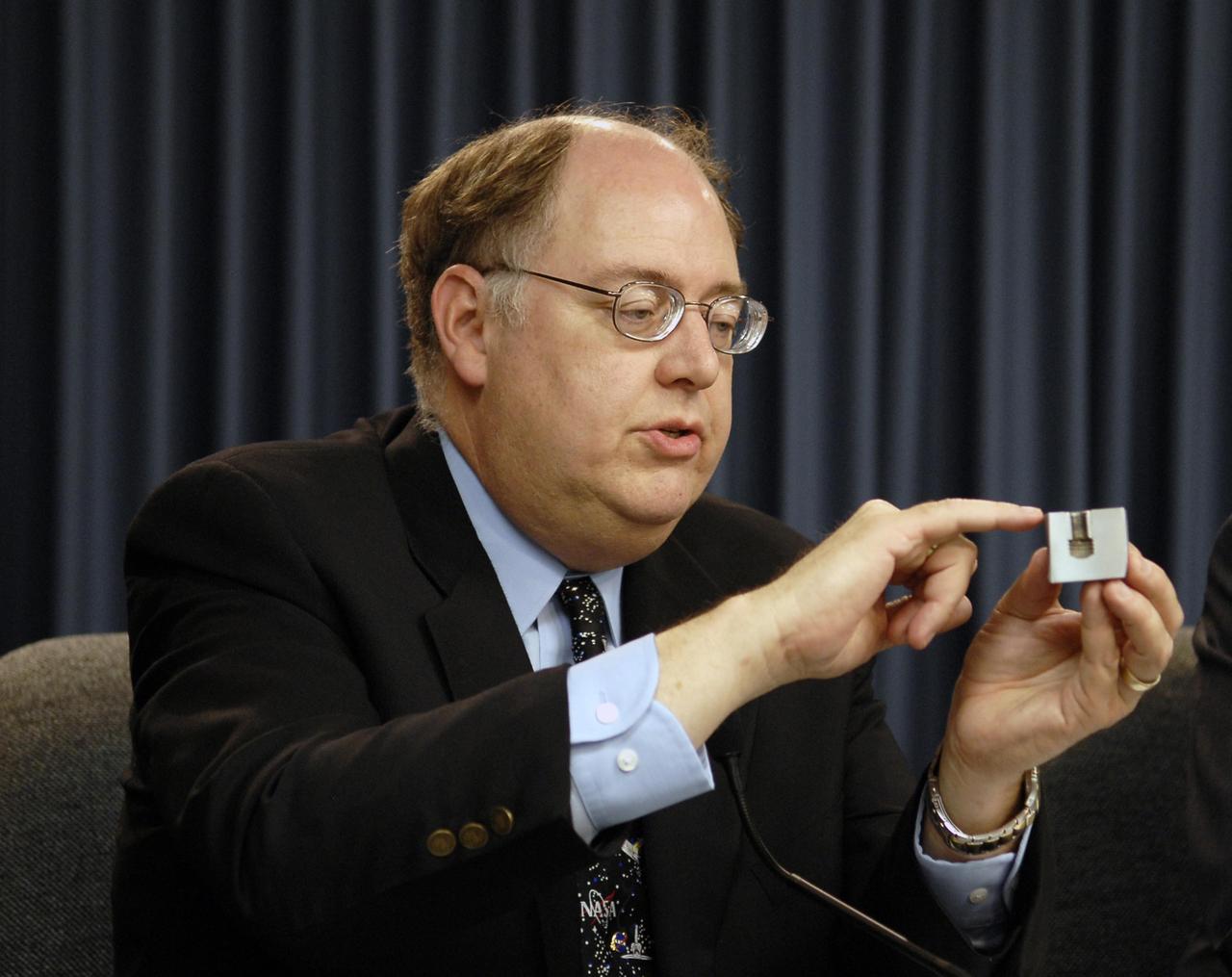
KENNEDY SPACE CENTER, FLA. -- Following the Flight Readiness Review for the STS-117 mission, NASA officials presented the decisions of NASA senior managers in a television conference. Bill Gerstenmaier, associate administrator of NASA Space Operations Mission, confirmed the launch time and date of Space Shuttle Atlantis at 7:38 p.m. EDT on June 8. Seen here is Space Shuttle Program Manager Wayne Hale (left) demonstrating the level of scrutiny engineers apply to inspecting the smallest of components that make up the shuttle system. This housing and bolt insert are part of the main engine low pressure oxidizer turbopump (LPOTP). Photo credit: NASA/Kim Shiflett
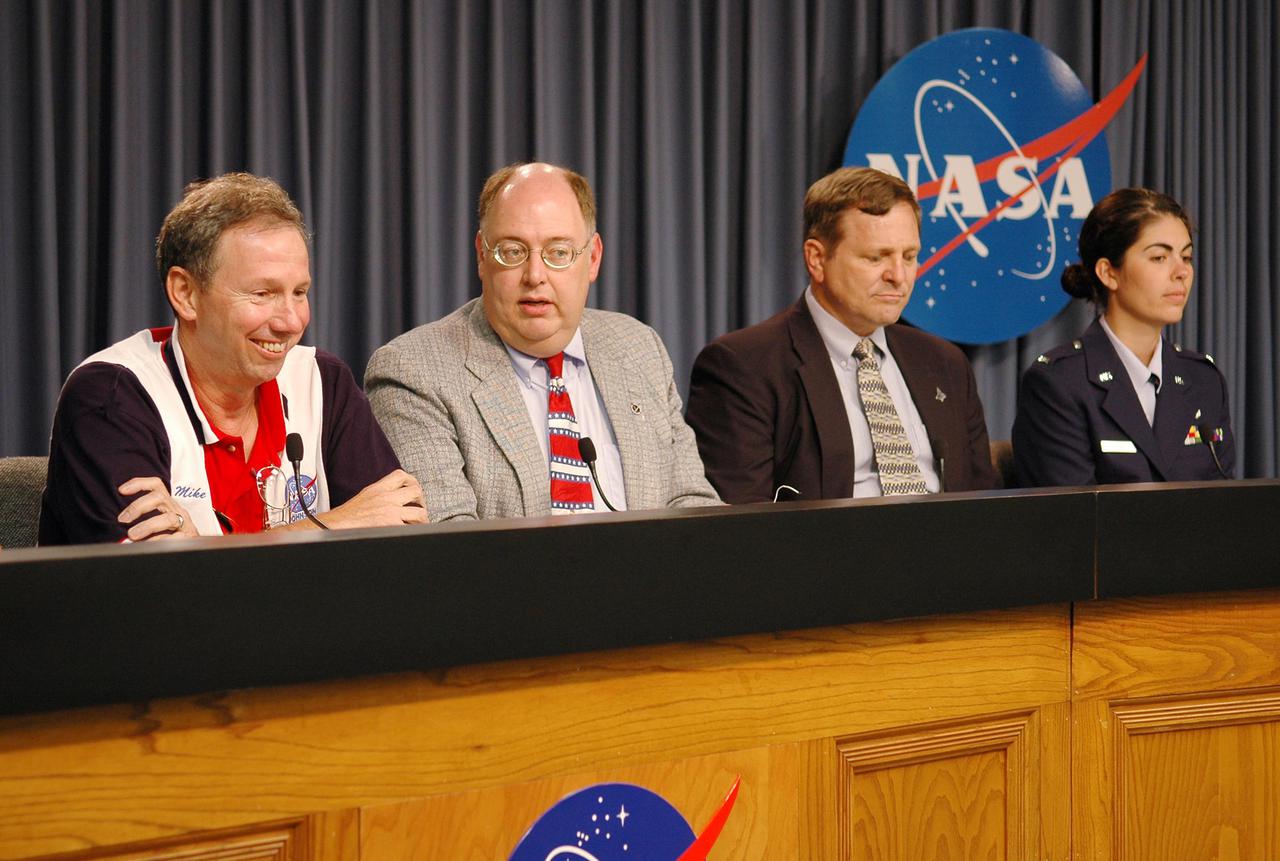
KENNEDY SPACE CENTER, FLA. - At the STS-114 Launch Readiness Press Conference at NASA Kennedy Space Center, NASA officials confirm the July 26 launch. Seated from left are NASA Administrator Mike Griffin, Space Shuttle Deputy Program Manager Wayne Hale, Shuttle Processing Director Mike Wetmore and launch weather officer 1st Lt. Mindy Chavez, with the U.S. Air Force 45th Weather Squadron. Liftoff of Space Shuttle Discovery on the Return to Flight mission STS-114 is scheduled for 10:39 a.m. EDT July 26 from Launch Pad 39B.
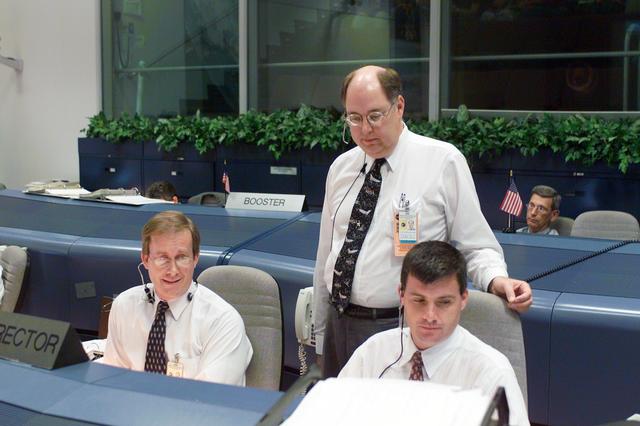
JSC2002-E-41150 (7 October 2002) --- Flight directors John Shannon (left) and Steve Stich monitor data at their consoles in the shuttle flight control room (WFCR) in Houston’s Mission Control Center (MCC). Wayne Hale (standing) of the Mission Operations Directorate (MOD) looks on. At the time this photo was taken the Space Shuttle Atlantis was about to launch from the Kennedy Space Center, Florida. Atlantis lifted off at 2:46 p.m. (CDT) on October 7, 2002. Once the vehicle cleared the tower in Florida, the Houston-based team of flight controllers took over the ground control of the flight.
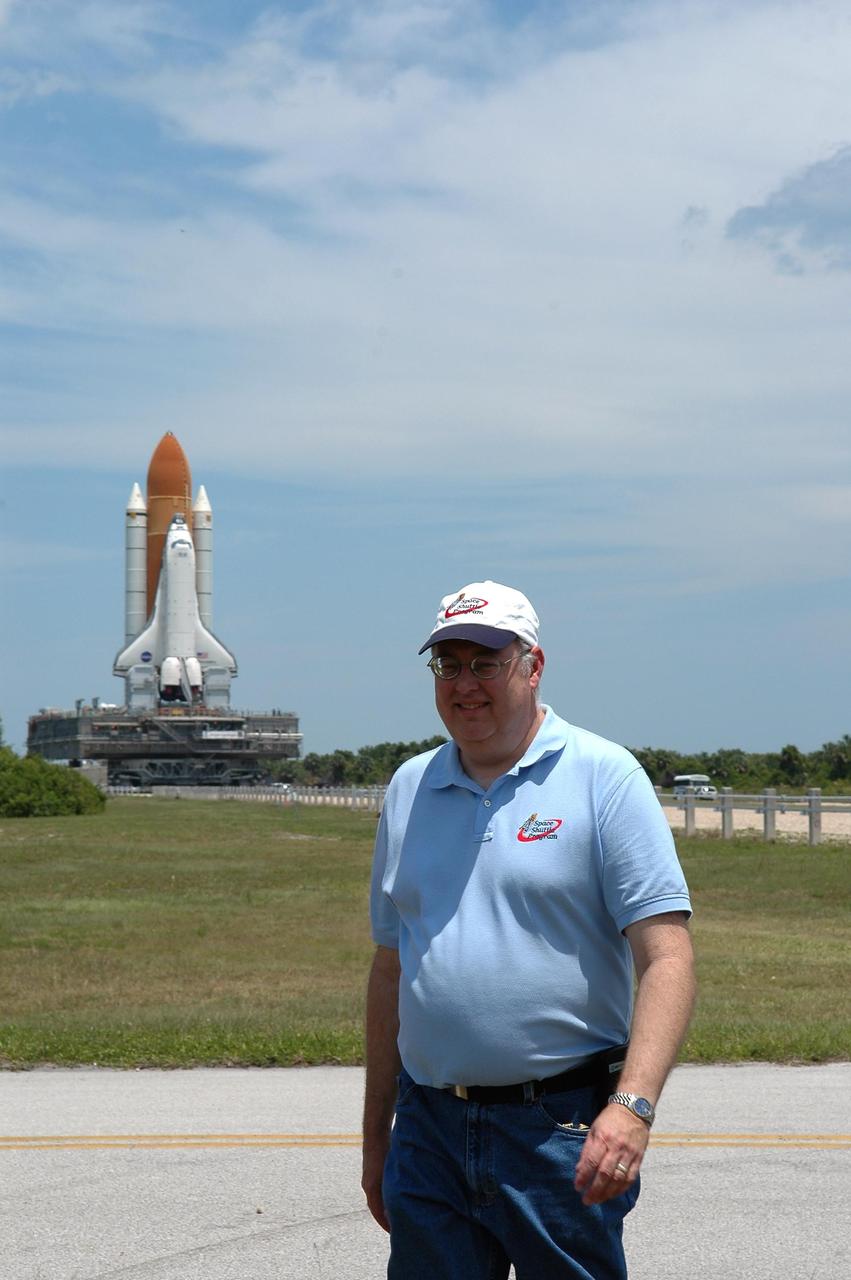
KENNEDY SPACE CENTER, FLA. -- Space Shuttle Program Director Wayne Hale is on hand to watch the historic moment of Space Shuttle Discovery's rollout to Launch Pad 39B. First motion of the shuttle (seen in the background) from NASA's Vehicle Assembly Building was at 12:45 p.m. EDT. The rollout is an important step before launch of Discovery on mission STS-121 to the International Space Station. Discovery's launch is targeted for July 1 in a launch window that extends to July 19. During the 12-day mission, Discovery's crew will test new hardware and techniques to improve shuttle safety, as well as deliver supplies and make repairs to the station. Photo credit: NASA/Kim Shiflett
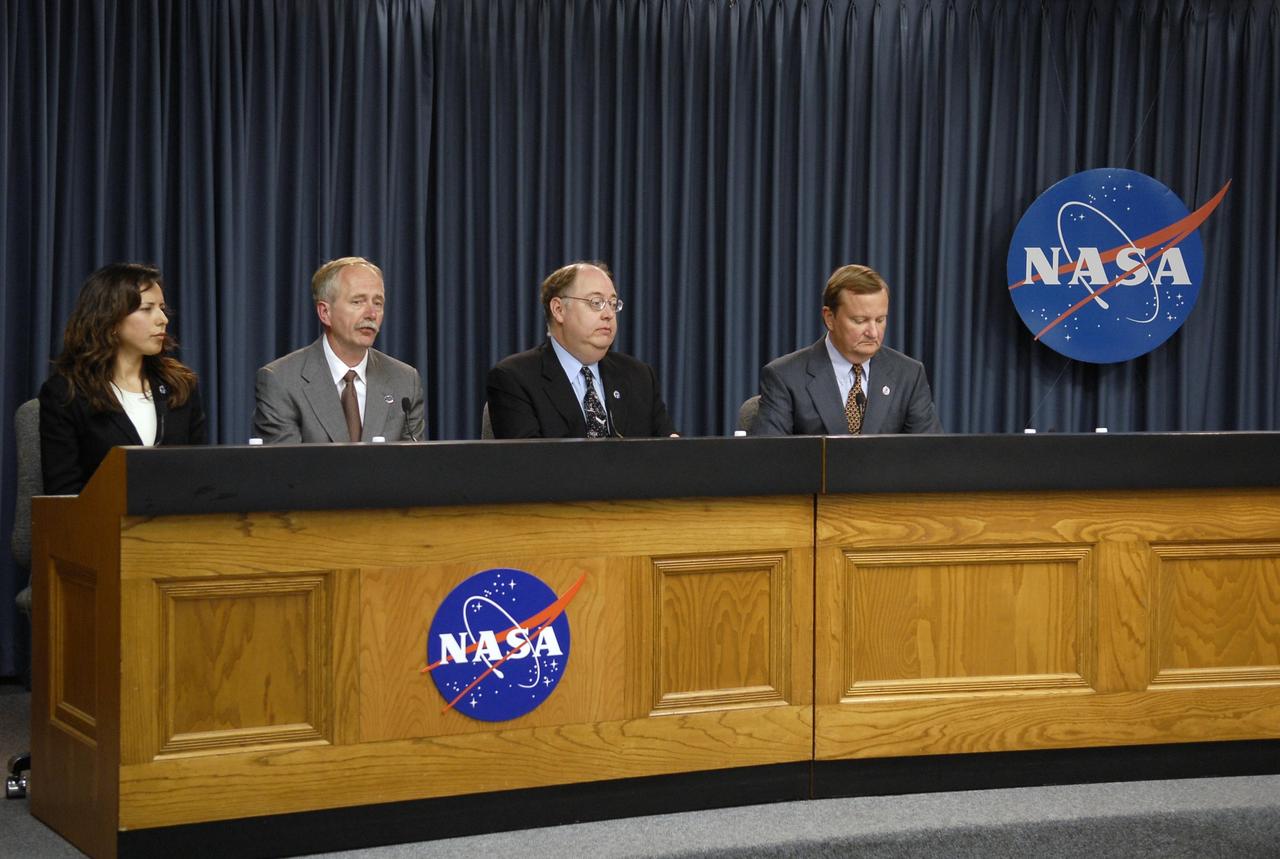
KENNEDY SPACE CENTER, FLA. -- Following the Flight Readiness Review for the STS-117 mission, NASA officials presented the decisions of NASA senior managers in a press conference. Seen here are (from left) Katherine Trinidad, of NASA Public Affairs, who moderated; Bill Gerstenmaier, associate administrator of NASA Space Operations Mission; Wayne Hale, Space Shuttle Program manager; and Mike Leinbach, Shuttle Launch Director. Gerstenmaier confirmed the launch time and date of Space Shuttle Atlantis at 7:38 p.m. EDT on June 8. Photo credit: NASA/Kim Shiflett
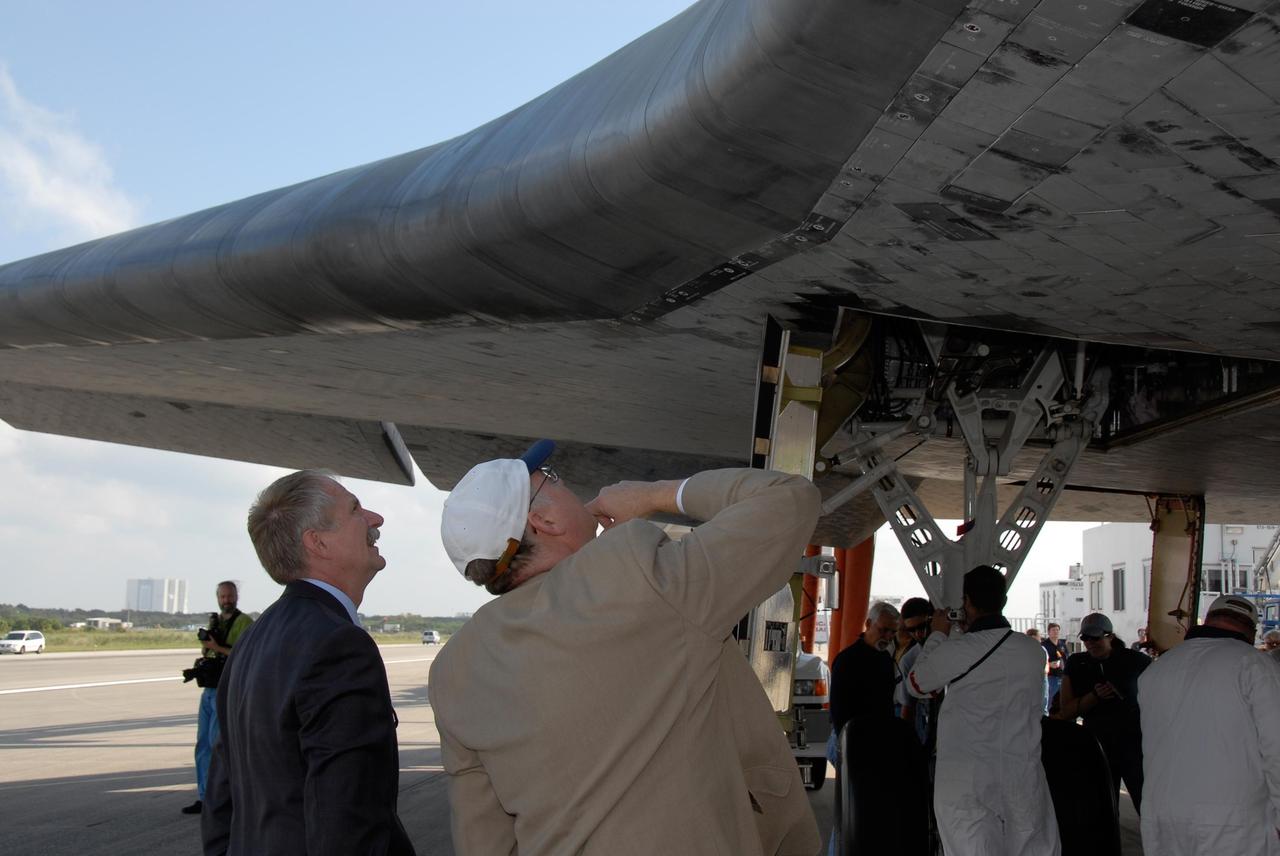
KENNEDY SPACE CENTER, FLA. -- Associate Administrator for NASA Space Operations William Gerstenmaier and Shuttle Program Manager Wayne Hale examine the thermal protection system on the wing of space shuttle Discovery after its landing at NASA's Kennedy Space Center. Discovery completed the 15-day mission STS-120, with an on-time landing at 1:01:16 p.m. Wheel stop was at 1:02:07 p.m. Mission elapsed time was 15 days, 2 hours, 24 minutes and 2 seconds. Mission STS-120 continued the construction of the station with the installation of the Harmony Node 2 module and the relocation of the P6 truss. Photo credit: NASA//Kim Shiflett
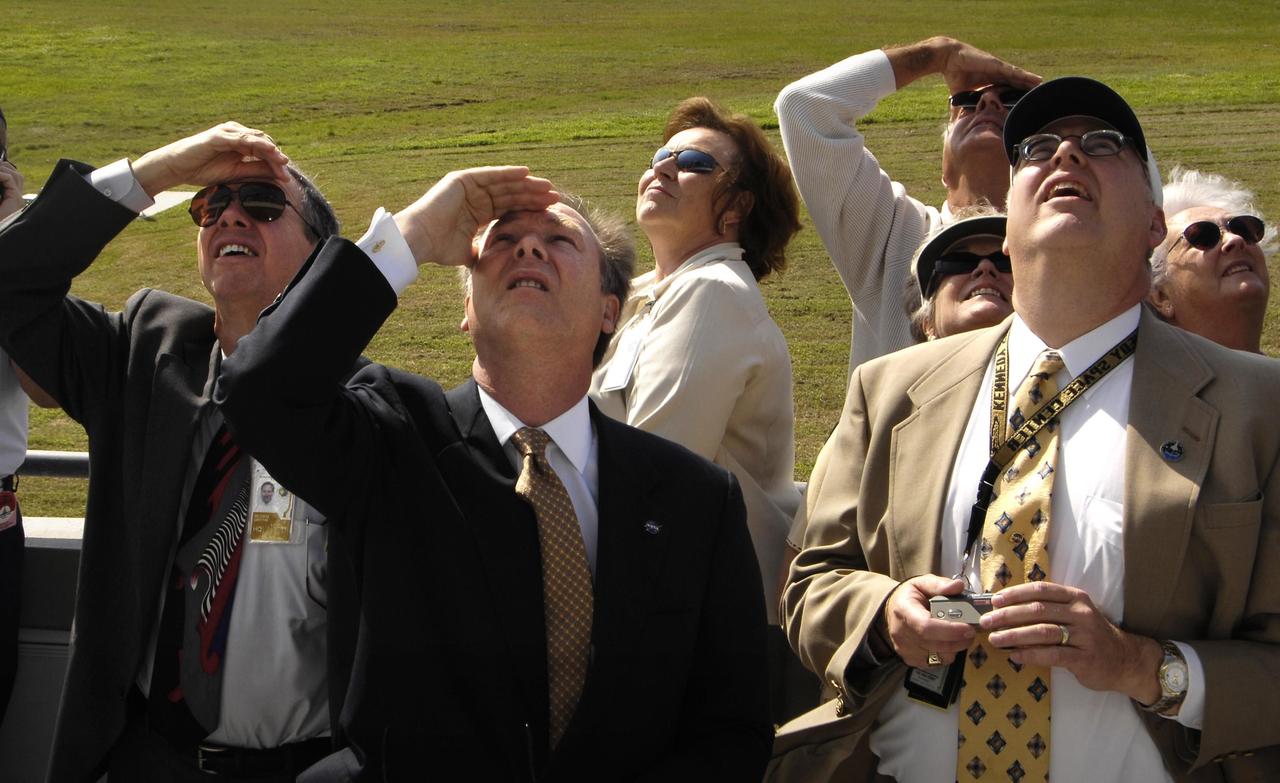
KENNEDY SPACE CENTER, FLA. -- (From left) NASA Administrator Michael Griffin, NASA Assistant Administrator for Public Affairs David Mould and NASA Space Shuttle Manager Wayne Hale watch as the space shuttle Discovery comes in for landing at NASA's Kennedy Space Center, Fla., completing the 15-day, STS-120 mission to the International Space Station. Discovery landed at 1:01 p.m. EST Wednesday after a mission that included on-orbit construction of the station with the installation of the Harmony Node 2 module and the relocation of the P6 truss. Photo credit: NASA/Bill Ingalls
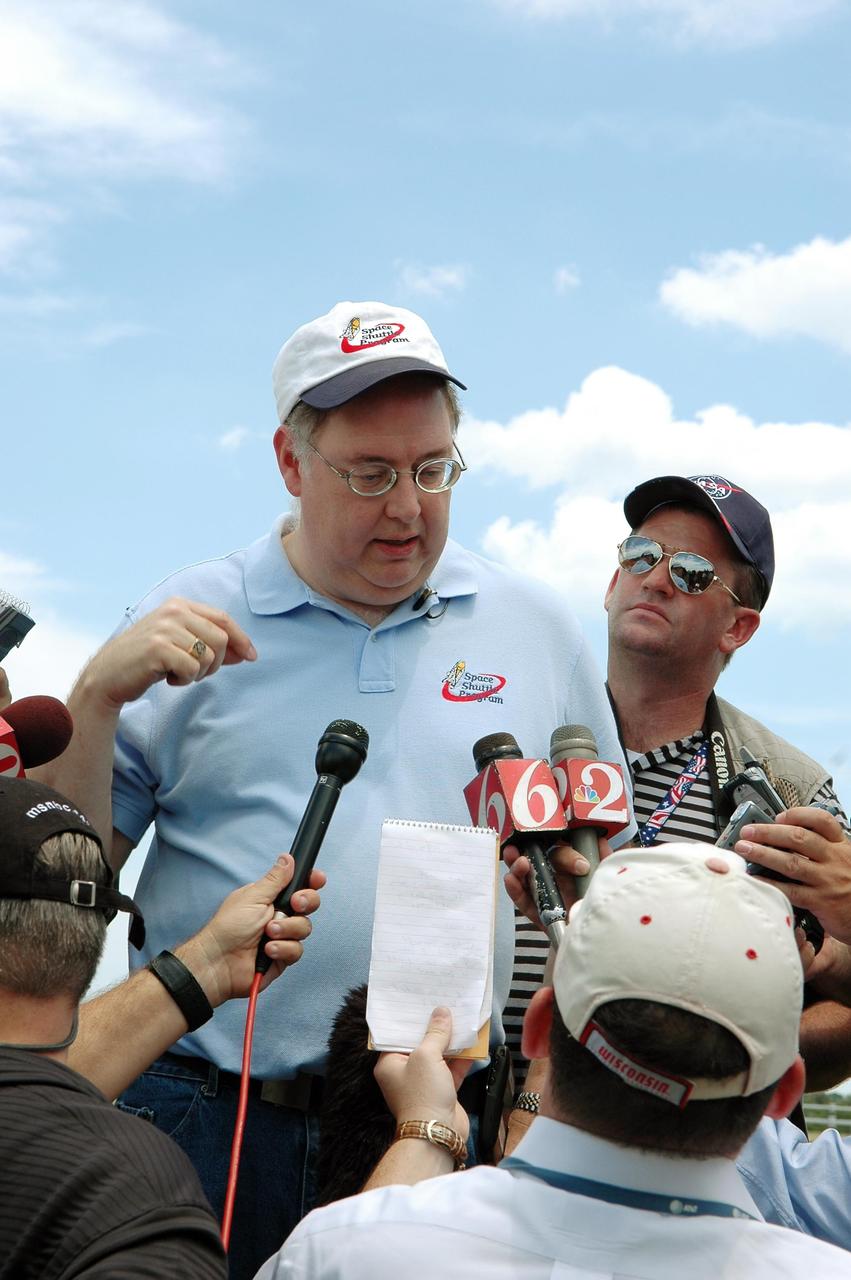
KENNEDY SPACE CENTER, FLA. -- Space Shuttle Program Director Wayne Hale talks to reporters about the rollout of Space Shuttle Discovery to Launch Pad 39B. First motion from NASA's Vehicle Assembly Building was at 12:45 p.m. EDT. The rollout is an important step before launch of Discovery on mission STS-121 to the International Space Station. Discovery's launch is targeted for July 1 in a launch window that extends to July 19. During the 12-day mission, Discovery's crew will test new hardware and techniques to improve shuttle safety, as well as deliver supplies and make repairs to the station. Photo credit: NASA/Kim Shiflett
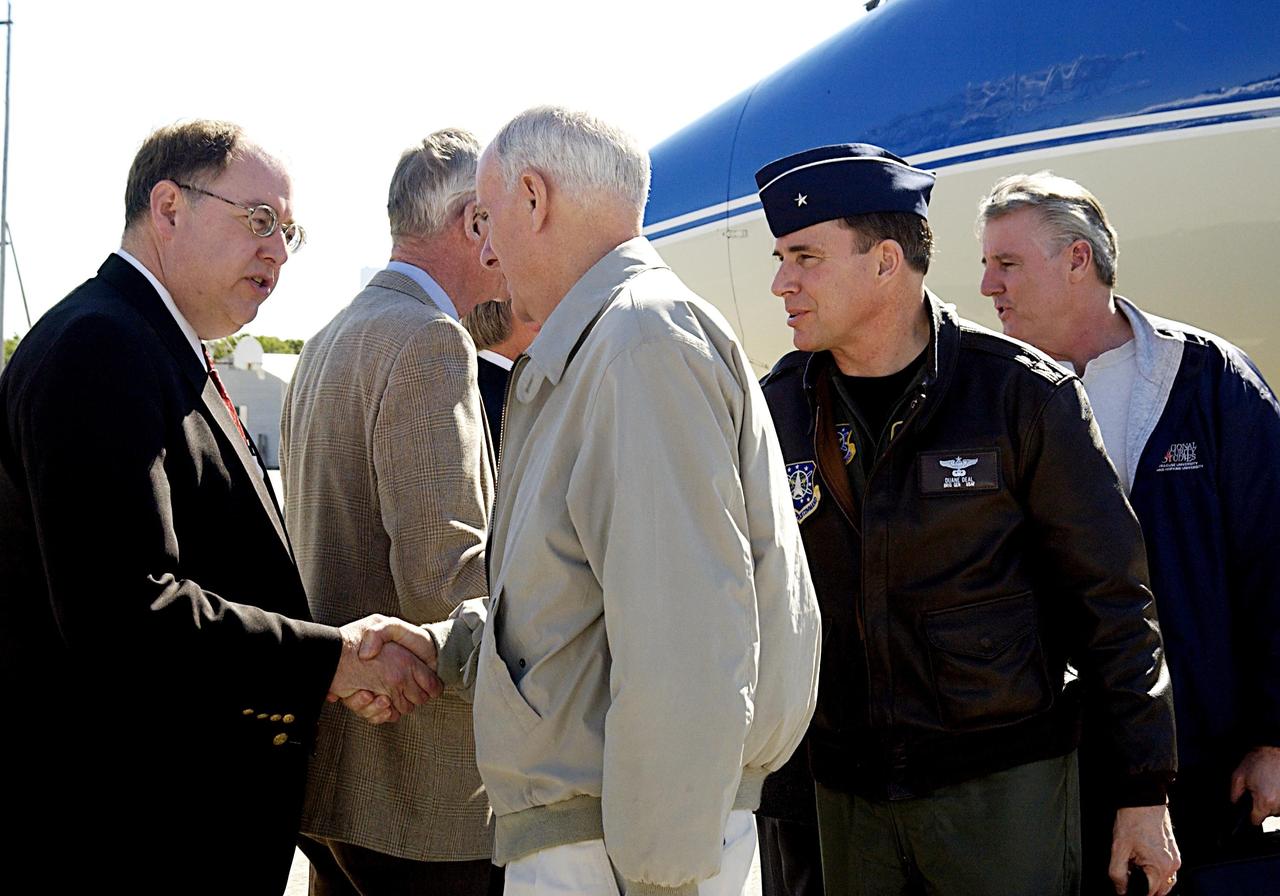
KENNEDY SPACE CENTER, FLA. - At the KSC Shuttle Landing Facility Wayne Hale, manager of Space Shuttle Program Launch Integration. greets Retired Navy Admiral Harold W. Gehman Jr., chairman of the Columbia Accident Board, after his arrival at the KSC Shuttle Landing Facility. Gehman and other members of the board (behind Gehman) are visiting sites at KSC to become familiar with the Shuttle launch process. The independent board is charged with determining what caused the destruction of the Space Shuttle Columbia and the loss of its seven-member crew on Feb. 1 during reentry.
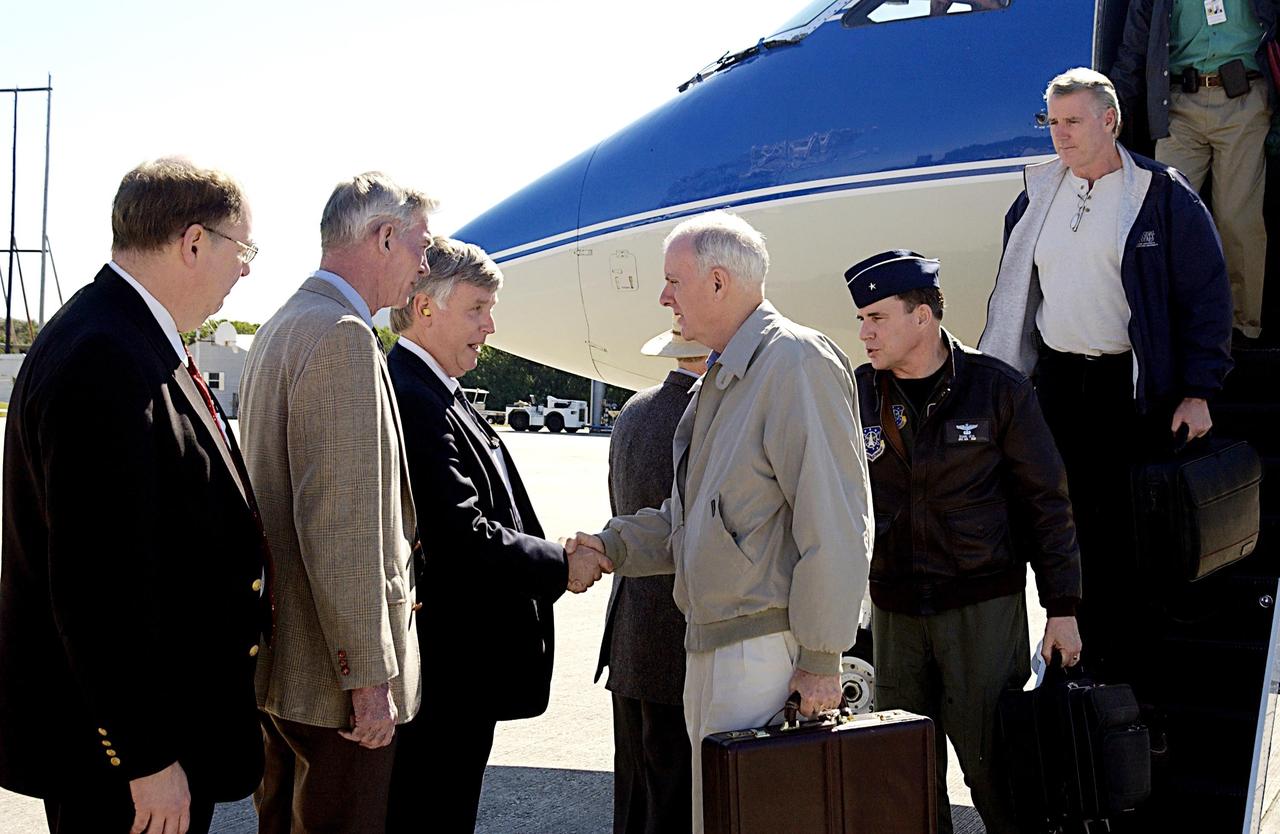
KENNEDY SPACE CENTER, FLA. -- Retired Navy Admiral Harold W. Gehman Jr. (center, with briefcase), chairman of the Columbia Accident Board, is greeted by KSC Deputy Director James Kennedy after Gehman's arrival at the KSC Shuttle Landing Facility. At far left is Wayne Hale, manager of Space Shuttle Program Launch Integration. Gehman and other members of the board, disembarking behind him, are visiting sites at KSC to become familiar with the Shuttle launch process. The independent board is charged with determining what caused the destruction of the Space Shuttle Columbia and the loss of its seven-member crew on Feb. 1 during reentry.
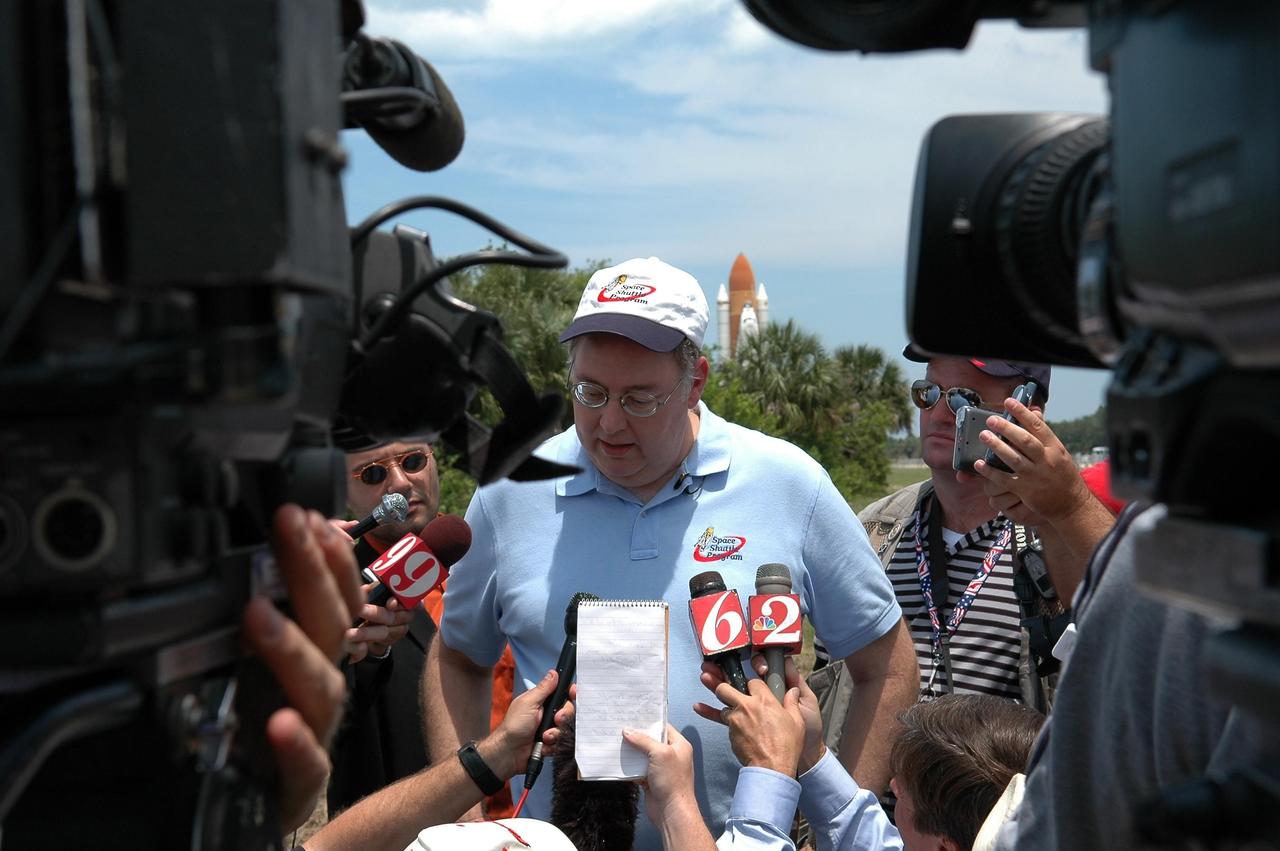
KENNEDY SPACE CENTER, FLA. -- Space Shuttle Program Director Wayne Hale talks to reporters about the rollout of Space Shuttle Discovery to Launch Pad 39B. First motion from NASA's Vehicle Assembly Building was at 12:45 p.m. EDT. The rollout is an important step before launch of Discovery on mission STS-121 to the International Space Station. Discovery's launch is targeted for July 1 in a launch window that extends to July 19. During the 12-day mission, Discovery's crew will test new hardware and techniques to improve shuttle safety, as well as deliver supplies and make repairs to the station. Photo credit: NASA/Kim Shiflett
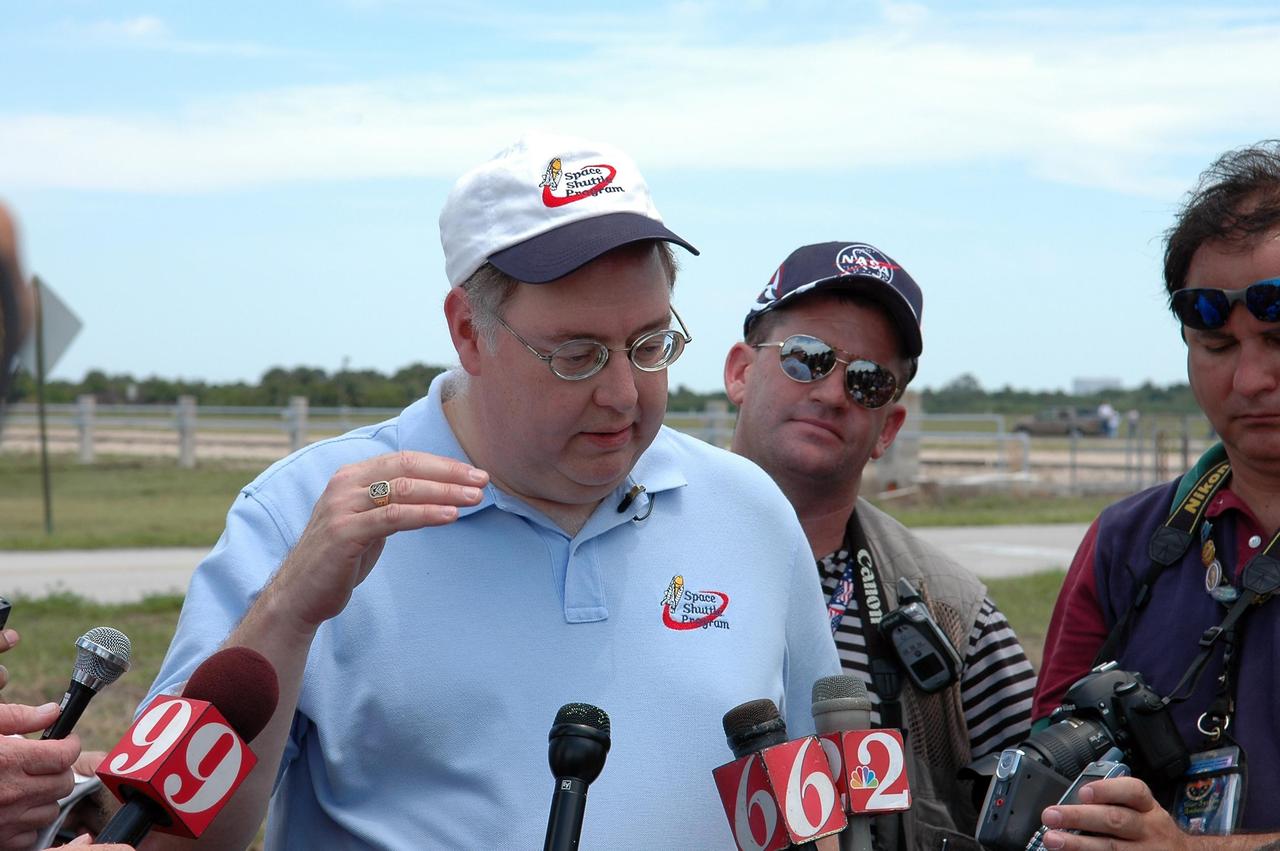
KENNEDY SPACE CENTER, FLA. -- Space Shuttle Program Director Wayne Hale talks to reporters about the rollout of Space Shuttle Discovery to Launch Pad 39B. First motion from NASA's Vehicle Assembly Building was at 12:45 p.m. EDT. The rollout is an important step before launch of Discovery on mission STS-121 to the International Space Station. Discovery's launch is targeted for July 1 in a launch window that extends to July 19. During the 12-day mission, Discovery's crew will test new hardware and techniques to improve shuttle safety, as well as deliver supplies and make repairs to the station. Photo credit: NASA/Kim Shiflett
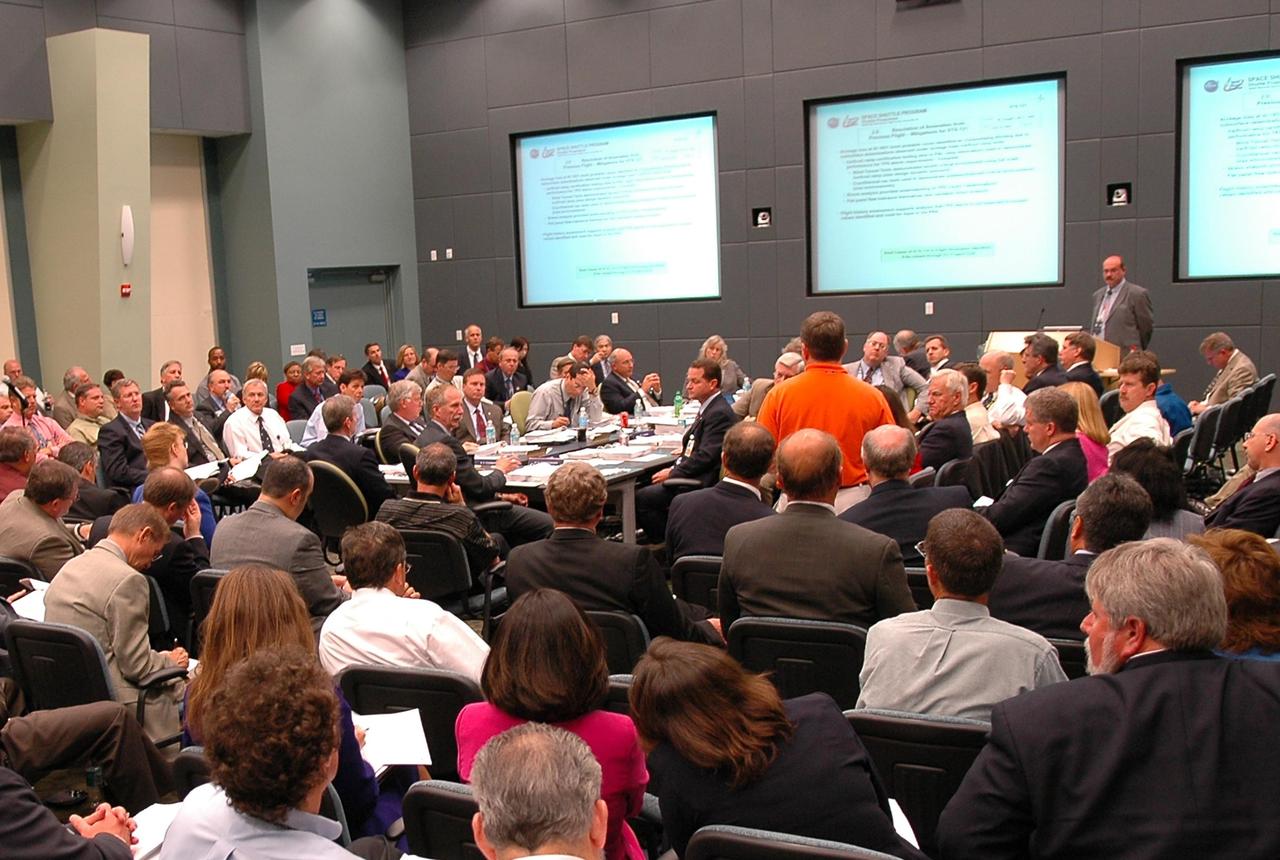
KENNEDY SPACE CENTER, FLA. - Space Shuttle Program and mission managers meet for the traditional Flight Readiness Review, a thorough assessment of preparations for the mission. Among those seated at the table on the left are Center Director Jim Kennedy, Associate Administrator for Space Operations William Gerstenmaier and Marshall Space Flight Center Director Dave King. Shuttle Program Manager Wayne Hale is seated under the center screen on the back wall. Also attending is NASA Administrator Mike Griffin. The June 16-17 meeting is designed to produce a number of key decisions about Discovery's mission, STS-121, including selection of an official launch date. Photo credit: NASA/Kim Shiflett
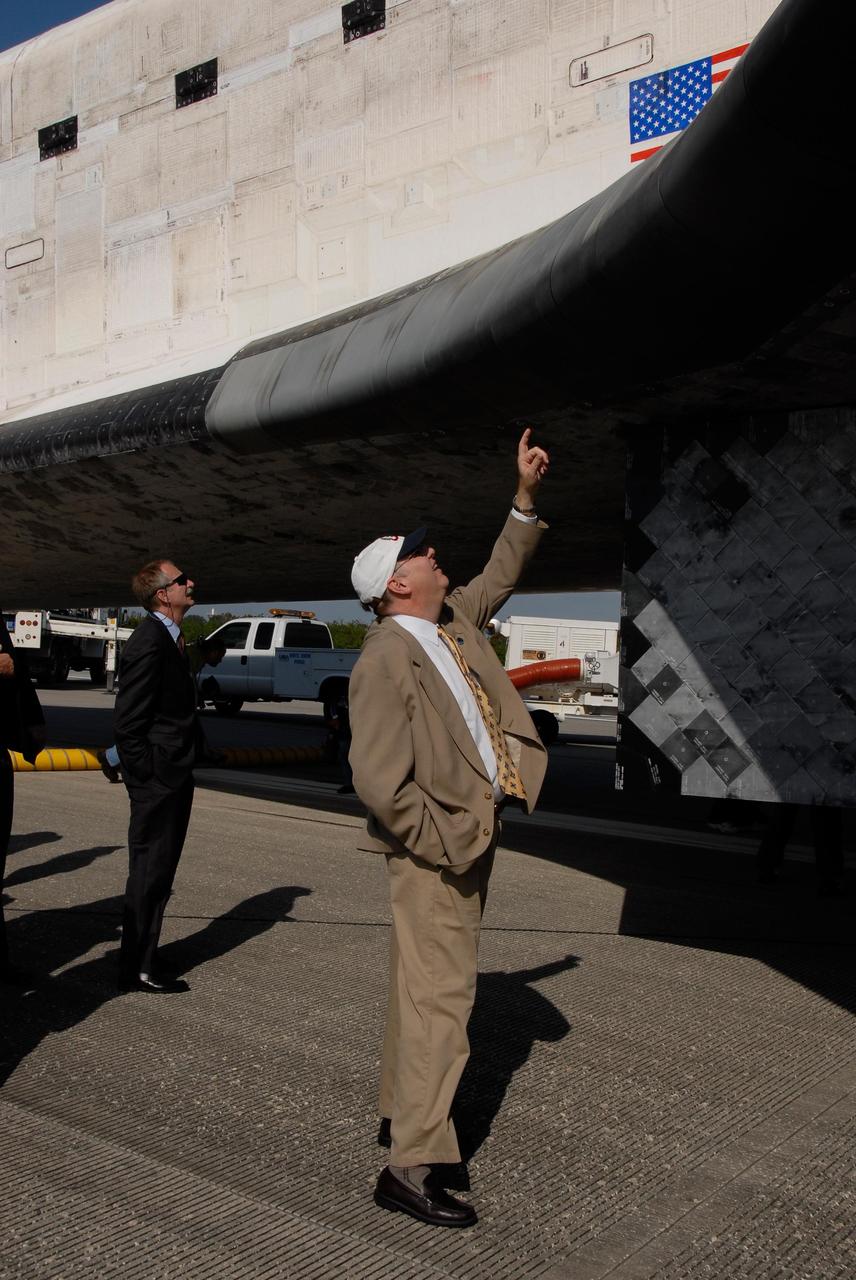
KENNEDY SPACE CENTER, FLA. -- Shuttle Program Manager Wayne Hale points to the left wing of space shuttle Discovery after its landing at NASA's Kennedy Space Center. To the left is Associate Administrator for NASA Space Operations William Gerstenmaier. Discovery completed the 15-day mission STS-120, with an on-time landing at 1:01:16 p.m. Wheel stop was at 1:02:07 p.m. Mission elapsed time was 15 days, 2 hours, 24 minutes and 2 seconds. Mission STS-120 continued the construction of the station with the installation of the Harmony Node 2 module and the relocation of the P6 truss. Photo credit: NASA/Kim Shiflett
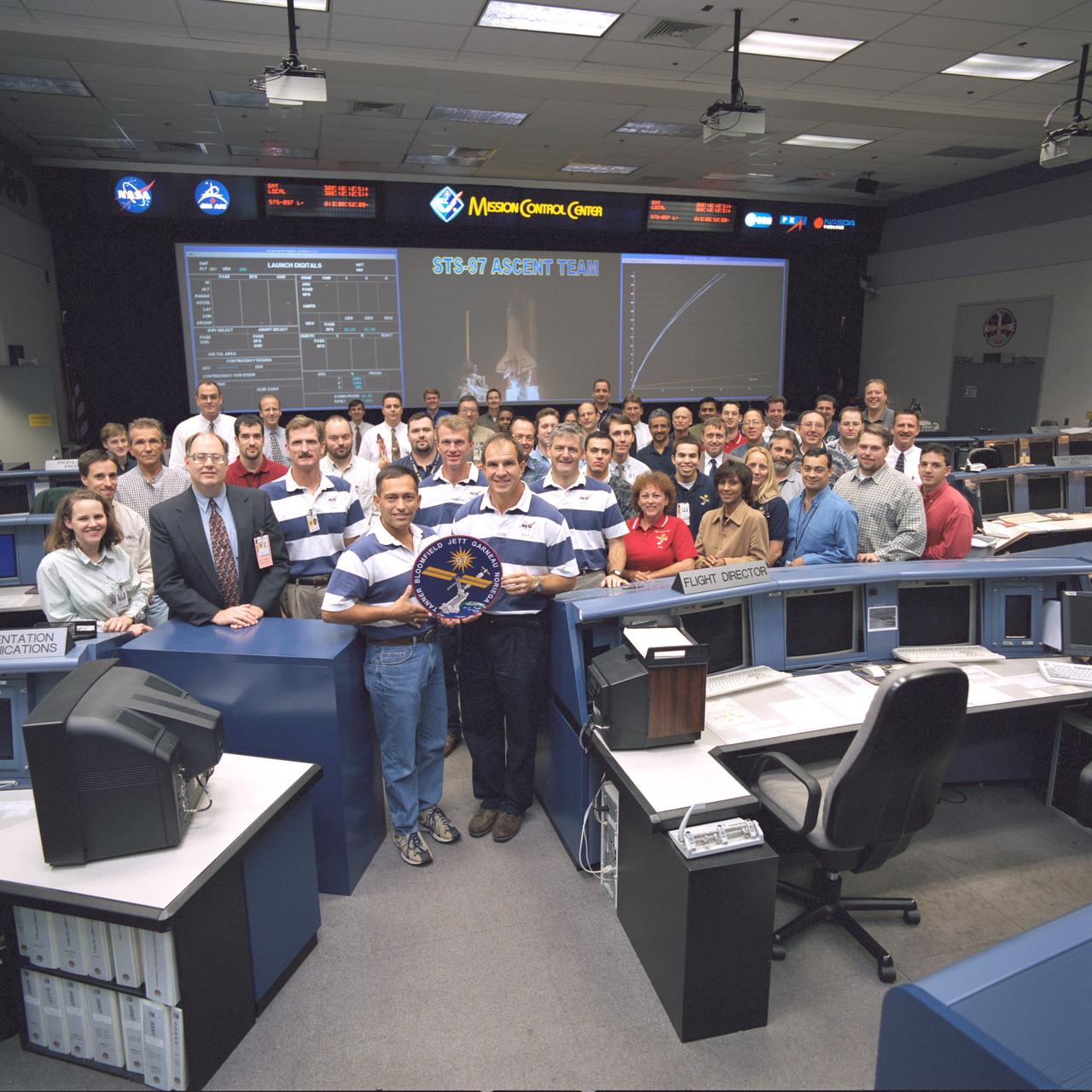
JSC2000-07294 (20 November 2000) --- The 40-odd flight controllers assigned to the STS-97 ascent team and some special guests pose for a group portrait in the shuttle flight control room in Houston's Mission Control Center (JSC). The five guests attired in the blue and white shirts are the flight crew members for the STS-97 crew, scheduled to be launched from Florida on the last day of this month. The astronauts are, from the left, Joseph R. Tanner, Carlos I. Noriega, Brent W. Jett, Jr., Michael J. Bloomfield and Marc Garneau, who represents the Canadian Space Agency (CSA). Ascent shift flight director Wayne Hale stands next to Tanner.
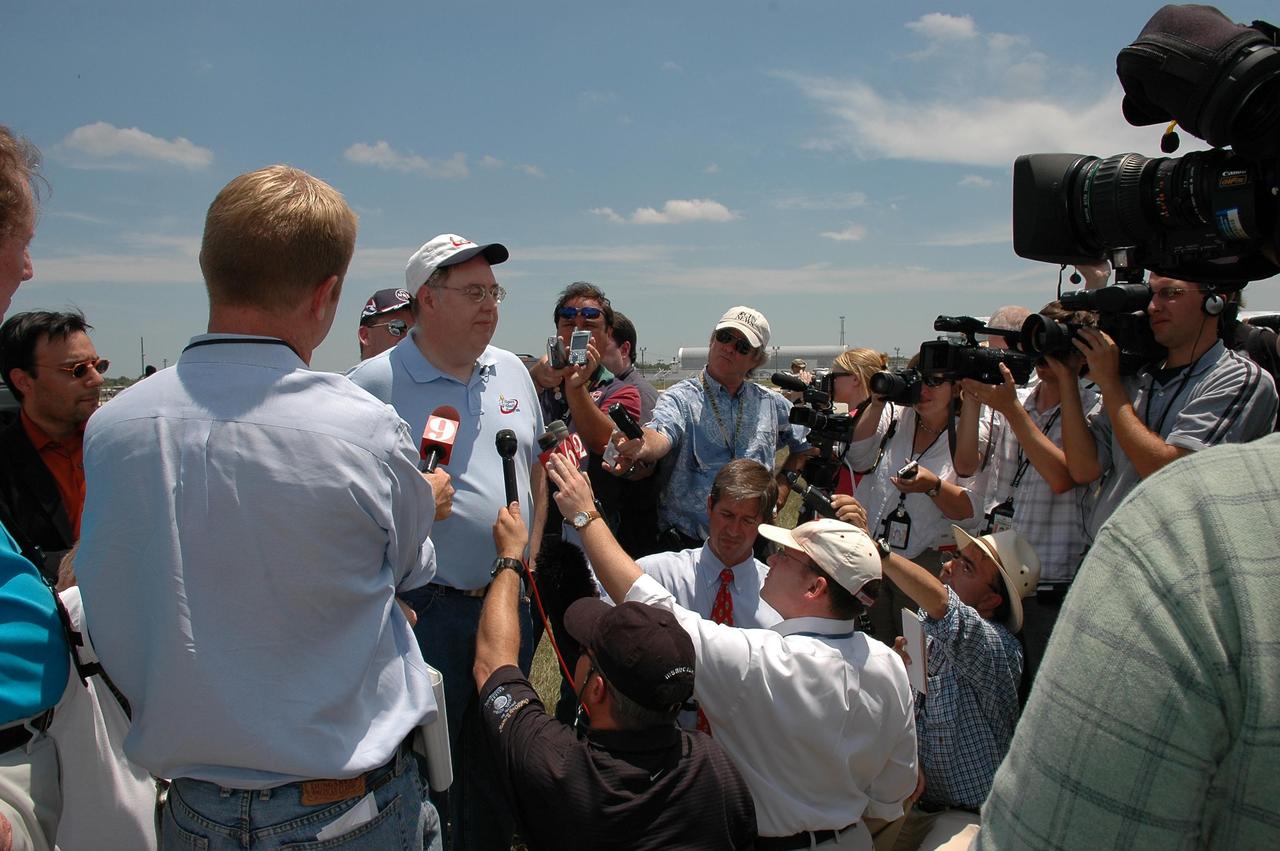
KENNEDY SPACE CENTER, FLA. -- Space Shuttle Program Director Wayne Hale talks to reporters about the rollout of Space Shuttle Discovery to Launch Pad 39B. First motion from NASA's Vehicle Assembly Building was at 12:45 p.m. EDT. The rollout is an important step before launch of Discovery on mission STS-121 to the International Space Station. Discovery's launch is targeted for July 1 in a launch window that extends to July 19. During the 12-day mission, Discovery's crew will test new hardware and techniques to improve shuttle safety, as well as deliver supplies and make repairs to the station. Photo credit: NASA/Kim Shiflett
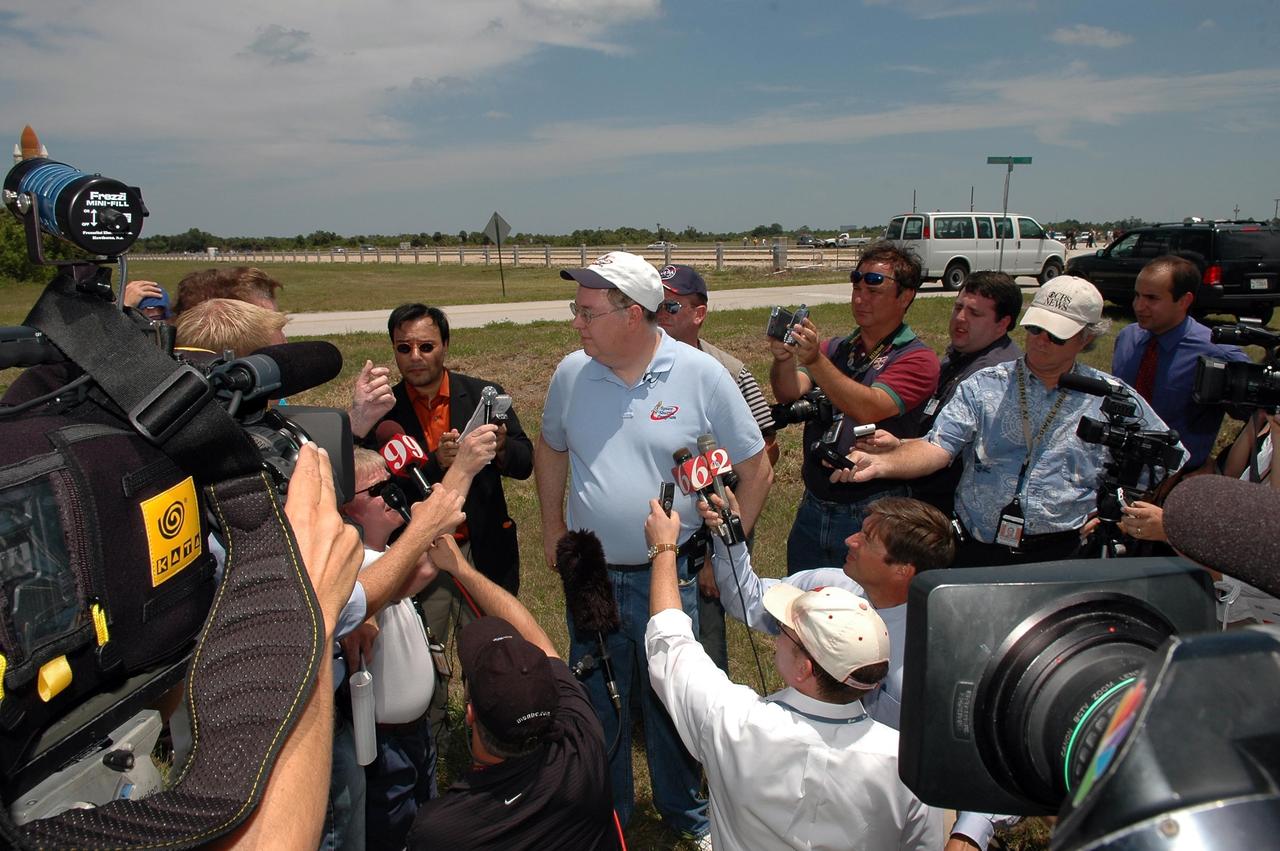
KENNEDY SPACE CENTER, FLA. -- Space Shuttle Program Director Wayne Hale talks to reporters about the rollout of Space Shuttle Discovery to Launch Pad 39B. First motion from NASA's Vehicle Assembly Building was at 12:45 p.m. EDT. The rollout is an important step before launch of Discovery on mission STS-121 to the International Space Station. Discovery's launch is targeted for July 1 in a launch window that extends to July 19. During the 12-day mission, Discovery's crew will test new hardware and techniques to improve shuttle safety, as well as deliver supplies and make repairs to the station. Photo credit: NASA/Kim Shiflett
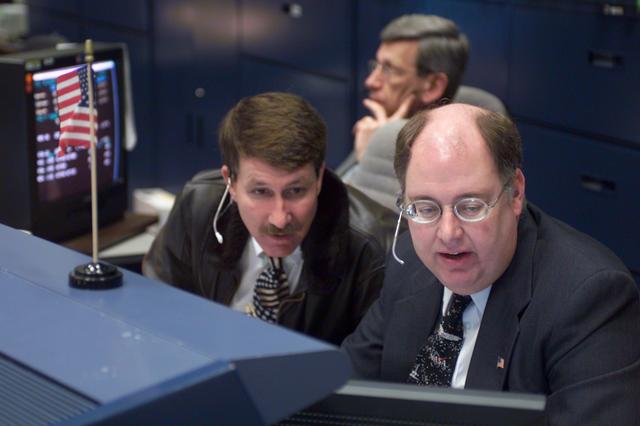
JSC2002-E-08147 (1 March 2002) --- Astronaut Kent V. Rominger (left), Wayne Hale, and Lawrence Bourgeois (background), monitor pre-flight data at the Mission Operation Directorate (MOD) console in the shuttle flight control room (WFCR) in Houston's Mission Control Center (MCC). Several hundred miles away in Florida, the STS-109 crewmembers were awaiting countdown in the crew cabin of the Space Shuttle Columbia on the launch pad at the Kennedy Space Center (KSC). As soon as the vehicle cleared the tower in Florida, the Houston-based team of flight controllers took over the ground control of the mission. Rominger is the Deputy Director of the Flight Crew Operations Directorate (FCOD) and was the FCOD management representative in the MCC. Hale, the Deputy Chief for Space Shuttle of the Flight Director’s Office, served as the MOD management representative. Bourgeois is the Mission Operations Director in the Flight Operations Department at United Space Alliance (USA), and was the USA management representative for STS-109.
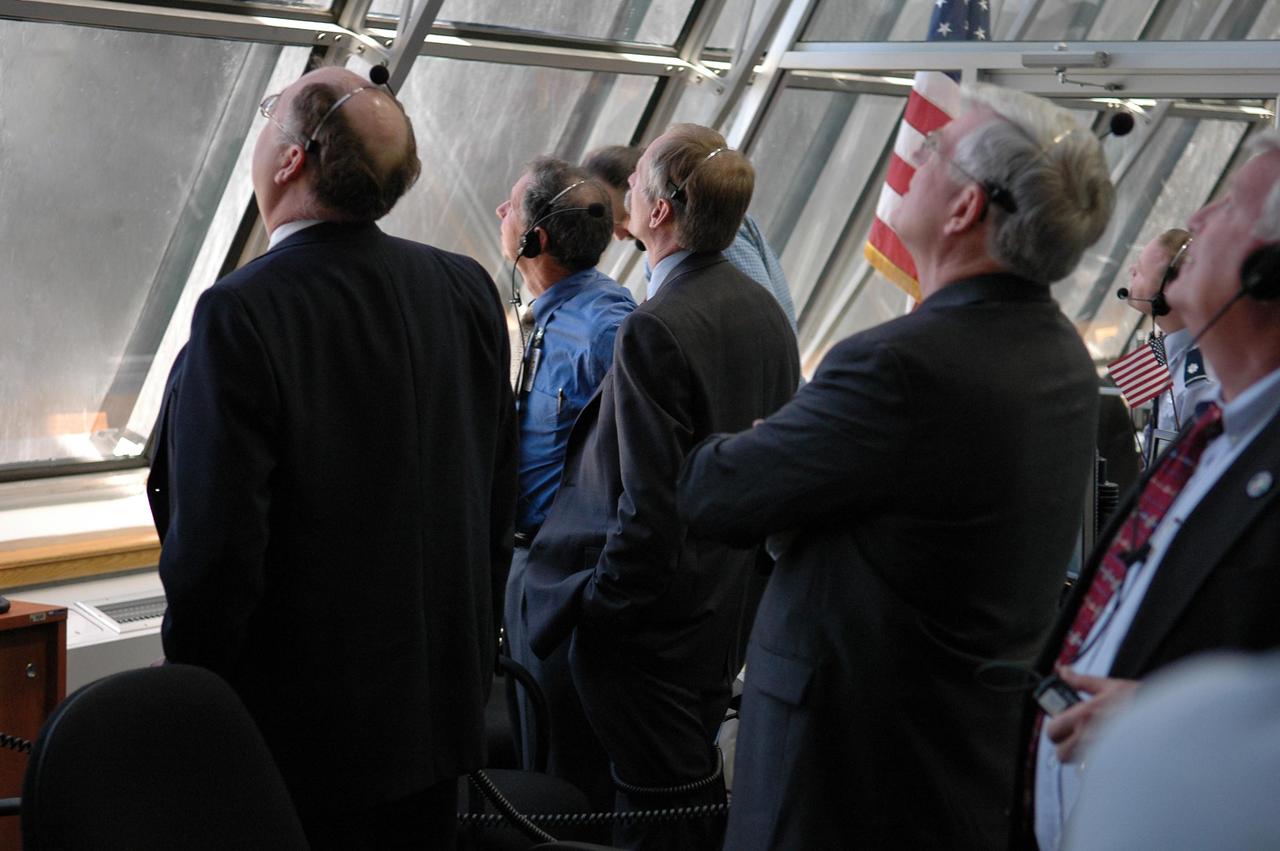
KENNEDY SPACE CENTER, FLA. - In Firing Room 4 of the Launch Control Center, Shuttle Program manager Wayne Hale (far left), NASA Associate Administrator for Space Operations Mission Bill Gerstenmaier (third from left) and Center Director Jim Kennedy (far right) watch the historic ride of Space Shuttle Discovery as it rockets through the sky on mission STS-121 -- the first ever Independence Day launch of a space shuttle. Liftoff was on-time at 2:38 p.m. EDT. During the 12-day mission, the STS-121 crew of seven will test new equipment and procedures to improve shuttle safety, as well as deliver supplies and make repairs to the International Space Station. Landing is scheduled for July 16 or 17 at Kennedy's Shuttle Landing Facility. Photo credit: NASA/Kim Shiflett
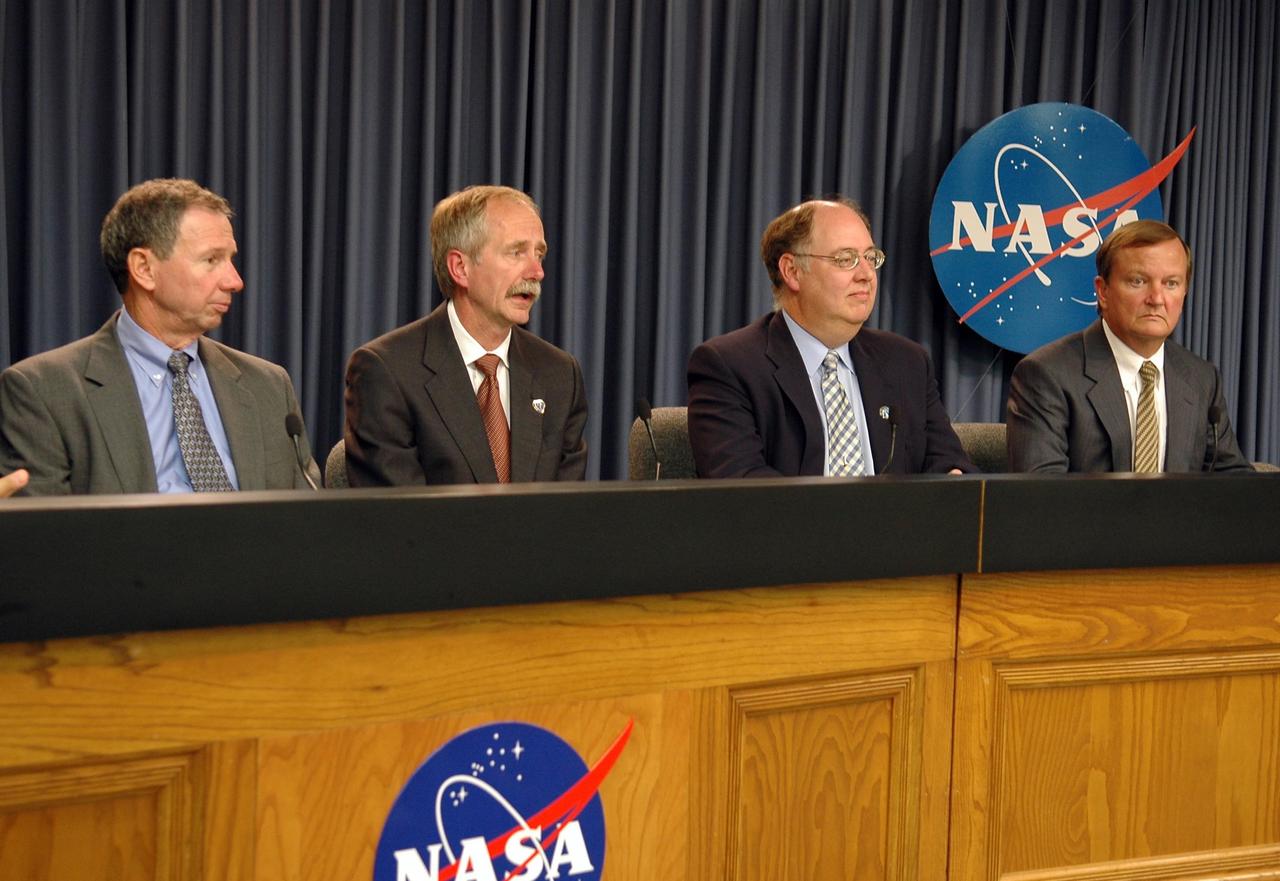
KENNEDY SPACE CENTER, FLA. - At a press conference following the Flight Readiness Review, a thorough assessment of preparations for the mission, NASA officials announce the final launch date of Aug. 27 for mission STS-115. Seated left to right are Michael Griffin, NASA administrator; Bill Gerstenmaier, associate administrator for Space Operations; Wayne Hale, Space Shuttle Program manager; and Mike Leinbach, NASA launch director. They also answered questions from the media. Mission STS-115 continues the assembly of the International Space Station with the installation of the truss segments P3 and P4. Liftoff of Space Shuttle Atlantis on mission STS-115 is targeted at approximately 4:30 p.m. EDT on Aug. 27. Photo credit: NASA/Kim Shiflett
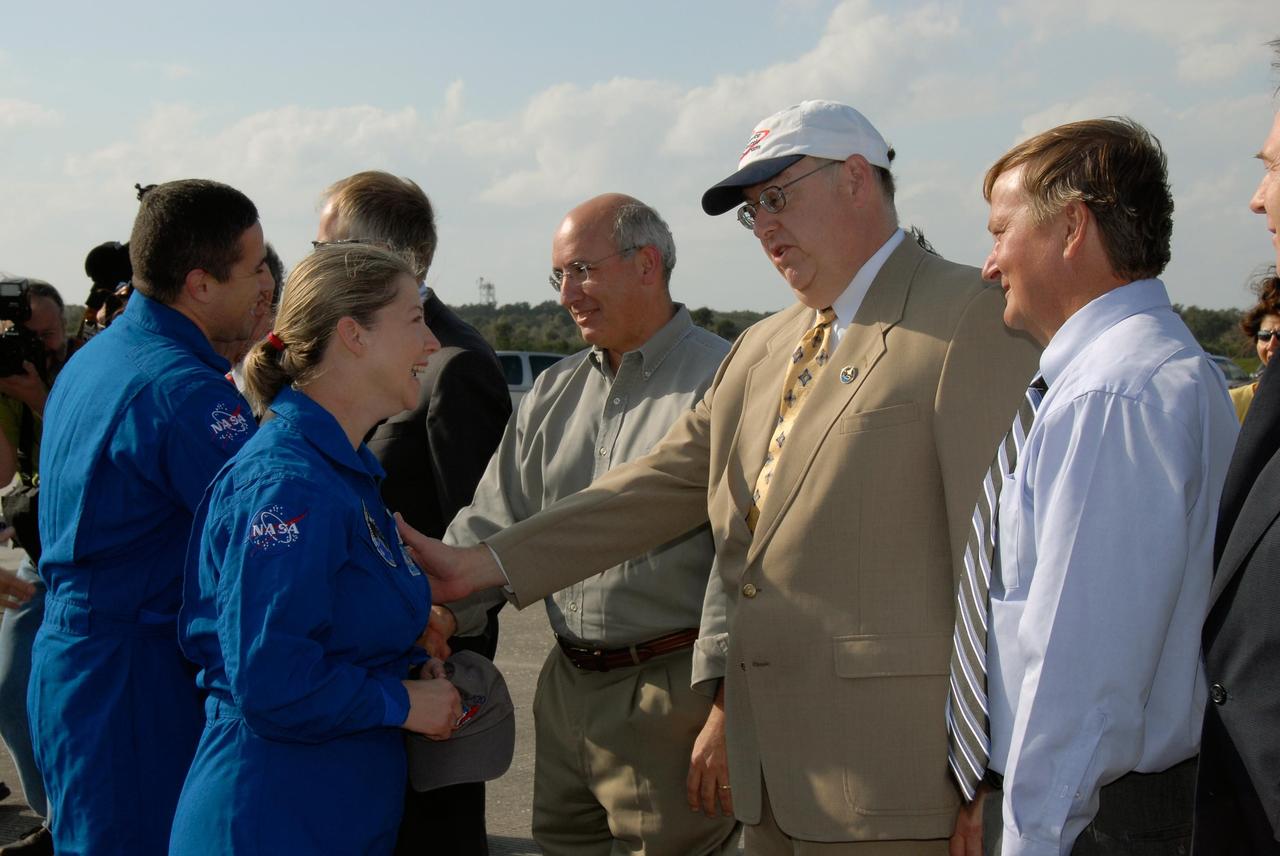
KENNEDY SPACE CENTER, FLA. -- At left, STS-120 Pilot George Zamka and Commander Pamela Melroy are greeted by NASA and Kennedy VIPs after completing their successful mission. Shuttle Program Manager Wayne Hale talks to Melroy. On the right is Shuttle Launch Director Mike Leinbach. Melroy and the Discovery crew completed the 15-day mission STS-120, with an on-time landing at 1:01:16 p.m. Wheel stop was at 1:02:07 p.m. Mission elapsed time was 15 days, 2 hours, 24 minutes and 2 seconds. Mission STS-120 continued the construction of the station with the installation of the Harmony Node 2 module and the relocation of the P6 truss. Photo credit: NASA/Kim Shiflett
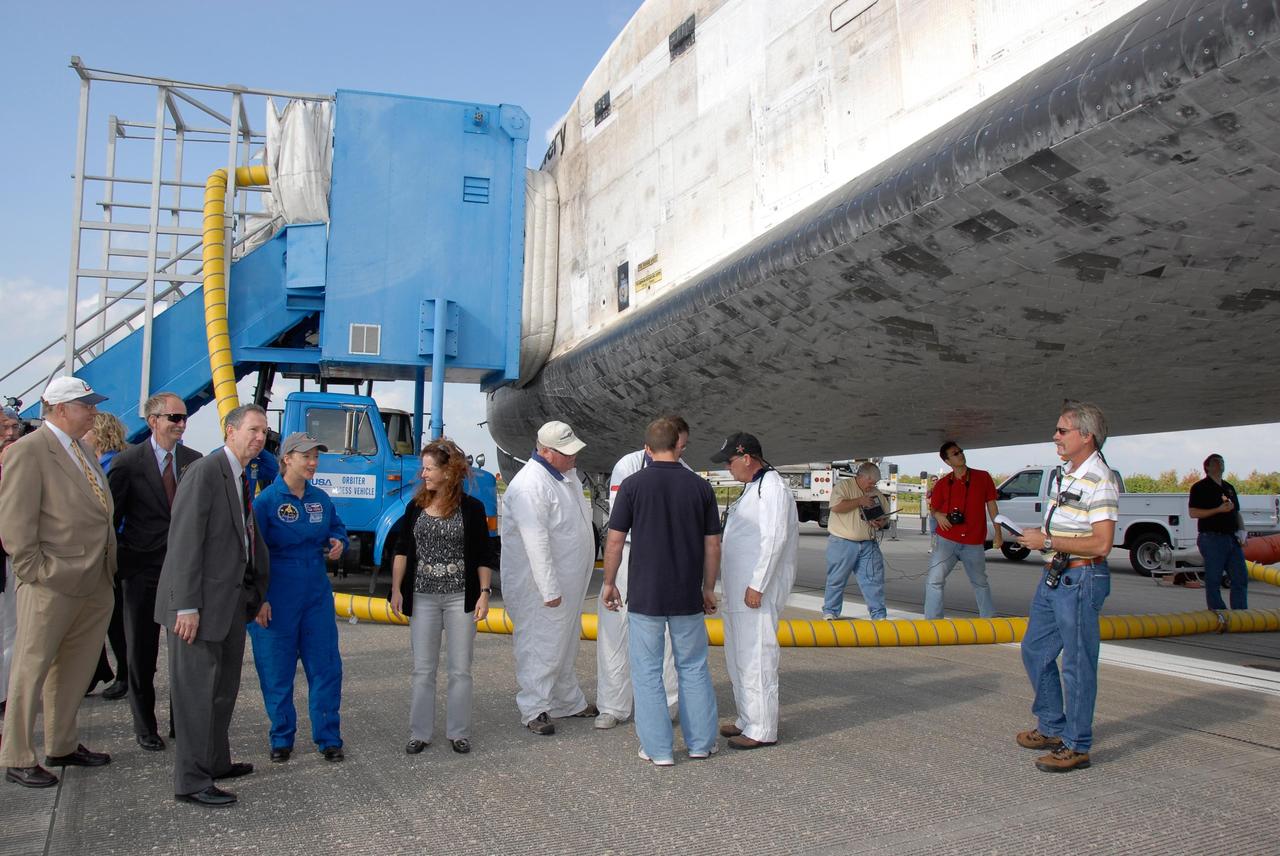
KENNEDY SPACE CENTER, FLA. -- At center, STS-120 Commander Pamela Melroy begins a checkout of space shuttle Discovery. With her are, from left, Shuttle Program Manager Wayne Hale, Associate Administrator for NASA Space Operations William Gerstenmaier and NASA Administrator Mike Griffin. On the right is Rebecca Griffin, wife of the administrator. Melroy and the Discovery crew completed the 15-day mission STS-120, with an on-time landing at 1:01:16 p.m. Wheel stop was at 1:02:07 p.m. Mission elapsed time was 15 days, 2 hours, 24 minutes and 2 seconds. Mission STS-120 continued the construction of the station with the installation of the Harmony Node 2 module and the relocation of the P6 truss. Photo credit: NASA/Kim Shiflett
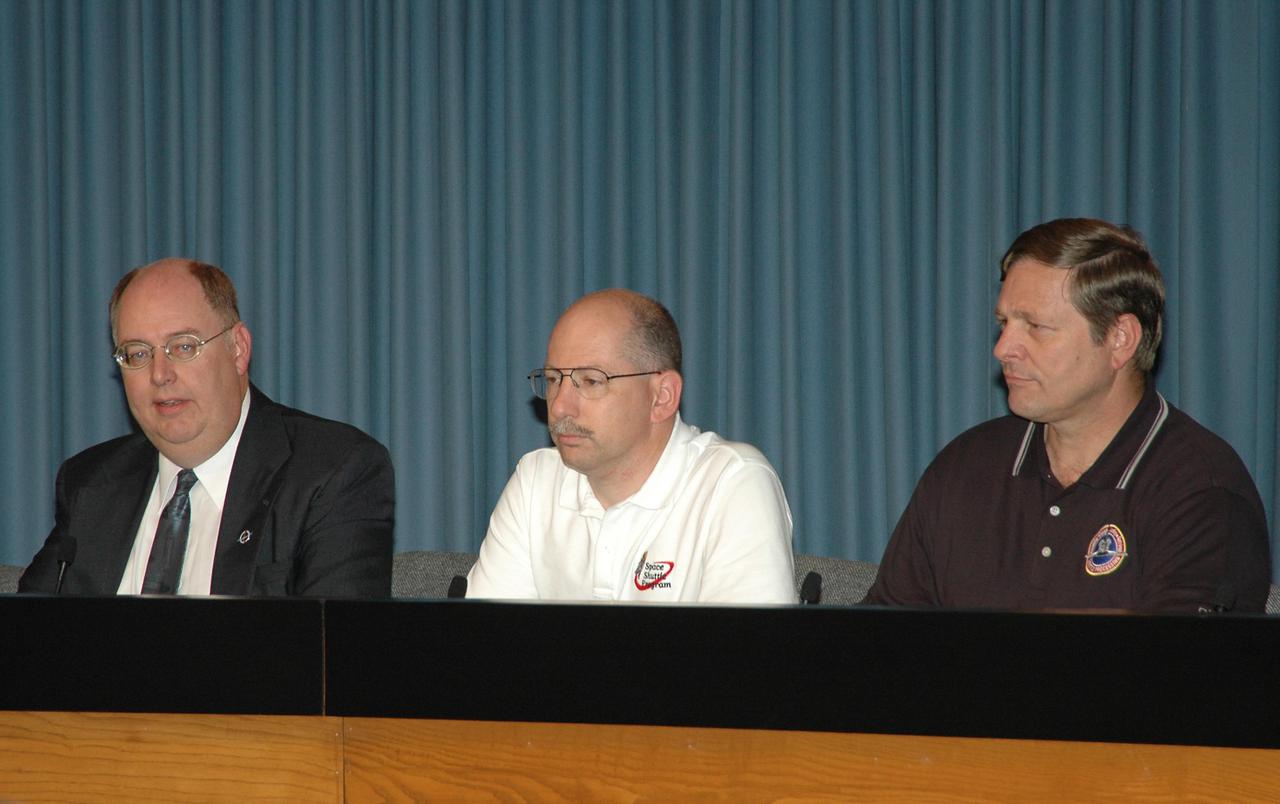
KENNEDY SPACE CENTER, FLA. - At a press conference, members of the Mission Management Team reveal aspects of the troubleshooting and testing being done on the liquid hydrogen tank low-level fuel cut-off sensor. From left are Wayne Hale, Space Shuttle deputy program manager; John Muratore, manager of Systems Engineering and Integration for the Space Shuttle Program; and Mike Wetmore, director of Space Shuttle Processing. The sensor failed a routine prelaunch check during the launch countdown July 13, causing mission managers to scrub Discovery's first launch attempt. The sensor protects the Shuttle's main engines by triggering their shutdown in the event fuel runs unexpectedly low. The sensor is one of four inside the liquid hydrogen section of the External Tank (ET).
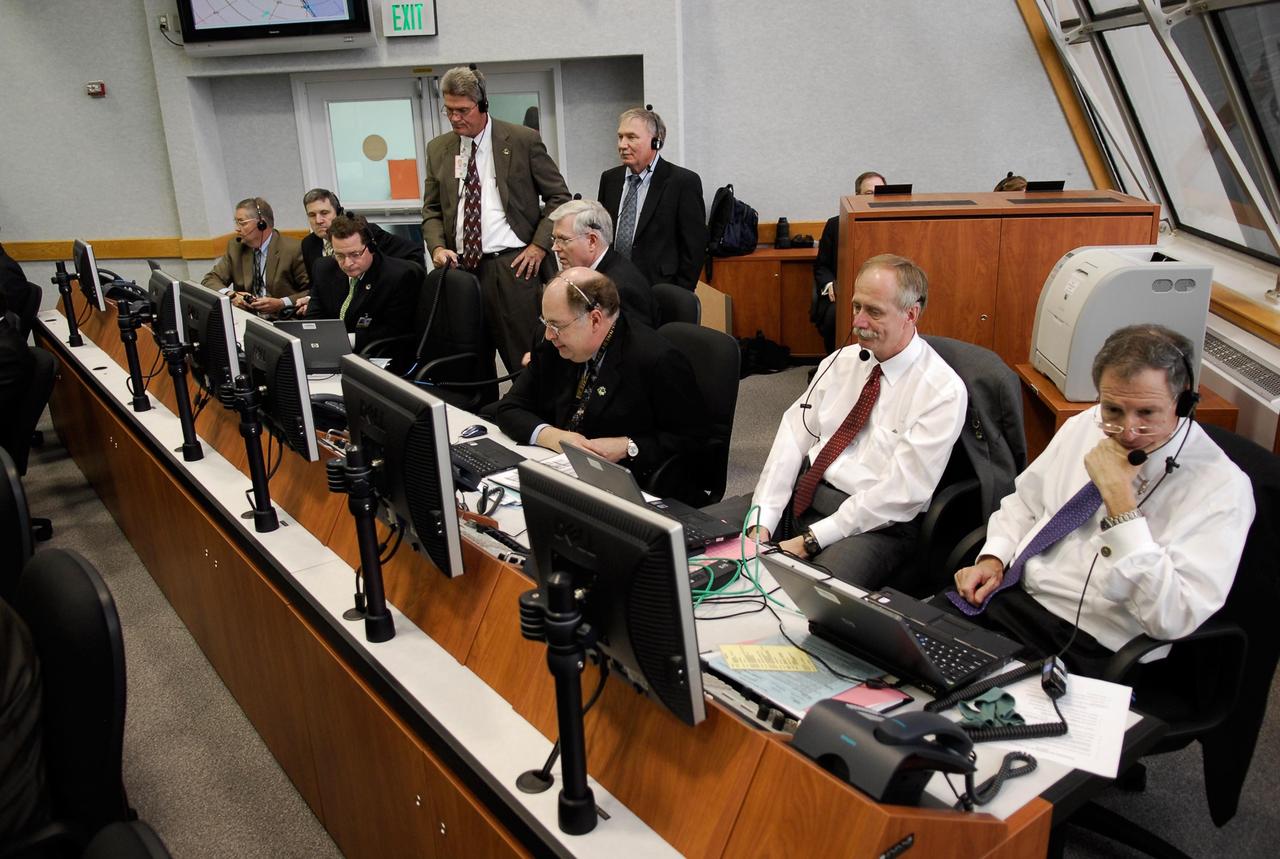
KENNEDY SPACE CENTER, FLA. -- Inside the Launch Control Center at NASA's Kennedy Space Center, NASA management watches and waits for the launch of space shuttle Atlantis on the STS-122 mission to the International Space Station. From right are NASA Administrator Mike Griffin, Associate Administrator for NASA Space Operations William H. Gerstenmaier, Shuttle Program Manager Wayne Hale. Standing on the left is Center Director Bill Parsons. The launch is the third attempt for Atlantis since December 2007 to carry the European Space Agency's Columbus laboratory to the International Space Station. During the 11-day mission, the crew's prime objective is to attach the laboratory to the Harmony module, adding to the station's size and capabilities. Photo credit: NASA/Kim Shiflett
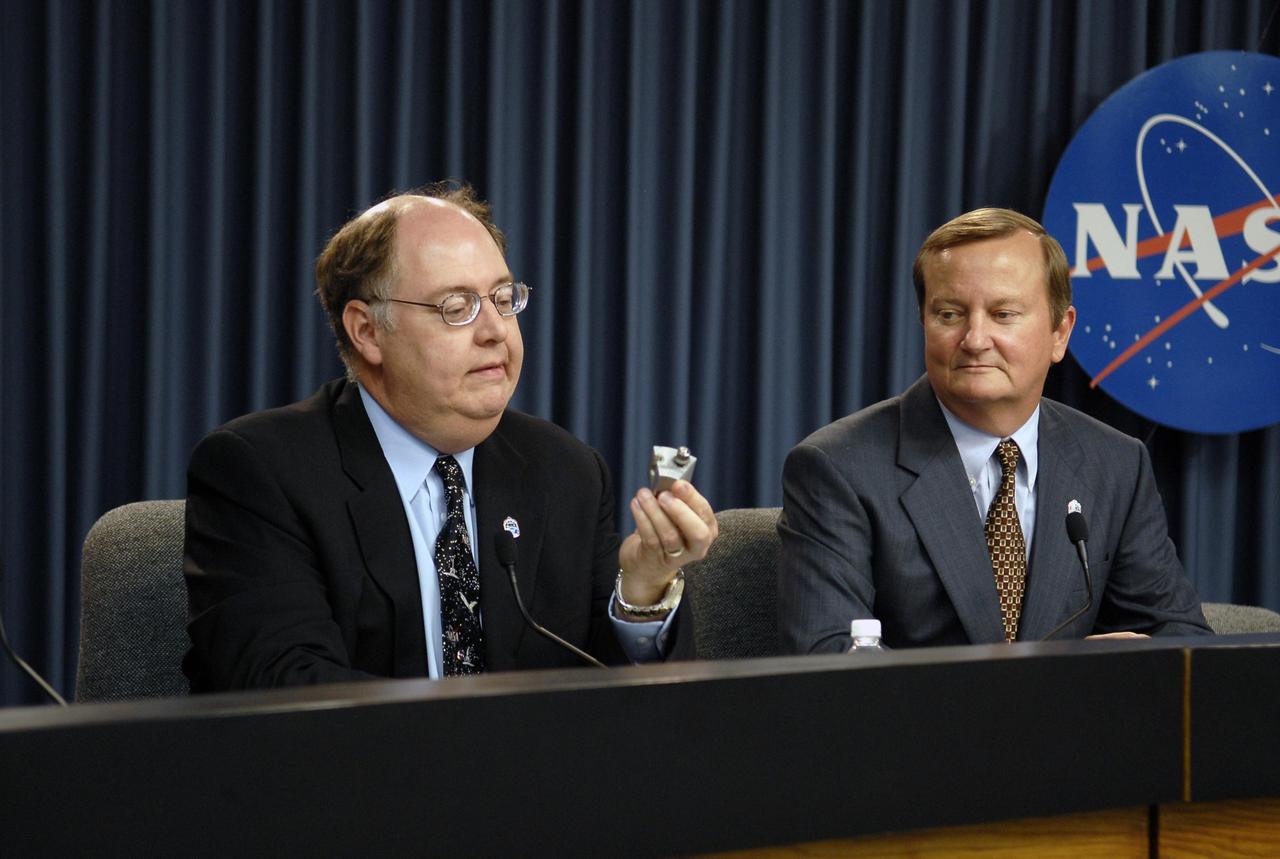
KENNEDY SPACE CENTER, FLA. -- Following the Flight Readiness Review for the STS-117 mission, NASA officials presented the decisions of NASA senior managers in a press conference. Bill Gerstenmaier, associate administrator of NASA Space Operations Mission, confirmed the launch time and date of Space Shuttle Atlantis at 7:38 p.m. EDT on June 8. Seen here is Space Shuttle Program Manager Wayne Hale (left) demonstrating the level of scrutiny engineers apply to inspecting the smallest of components that make up the shuttle system. This housing and bolt insert are part of the main engine low pressure oxidizer turbopump (LPOTP). NASA Launch Director Mike Leinbach looks on. Photo credit: NASA/Kim Shiflett
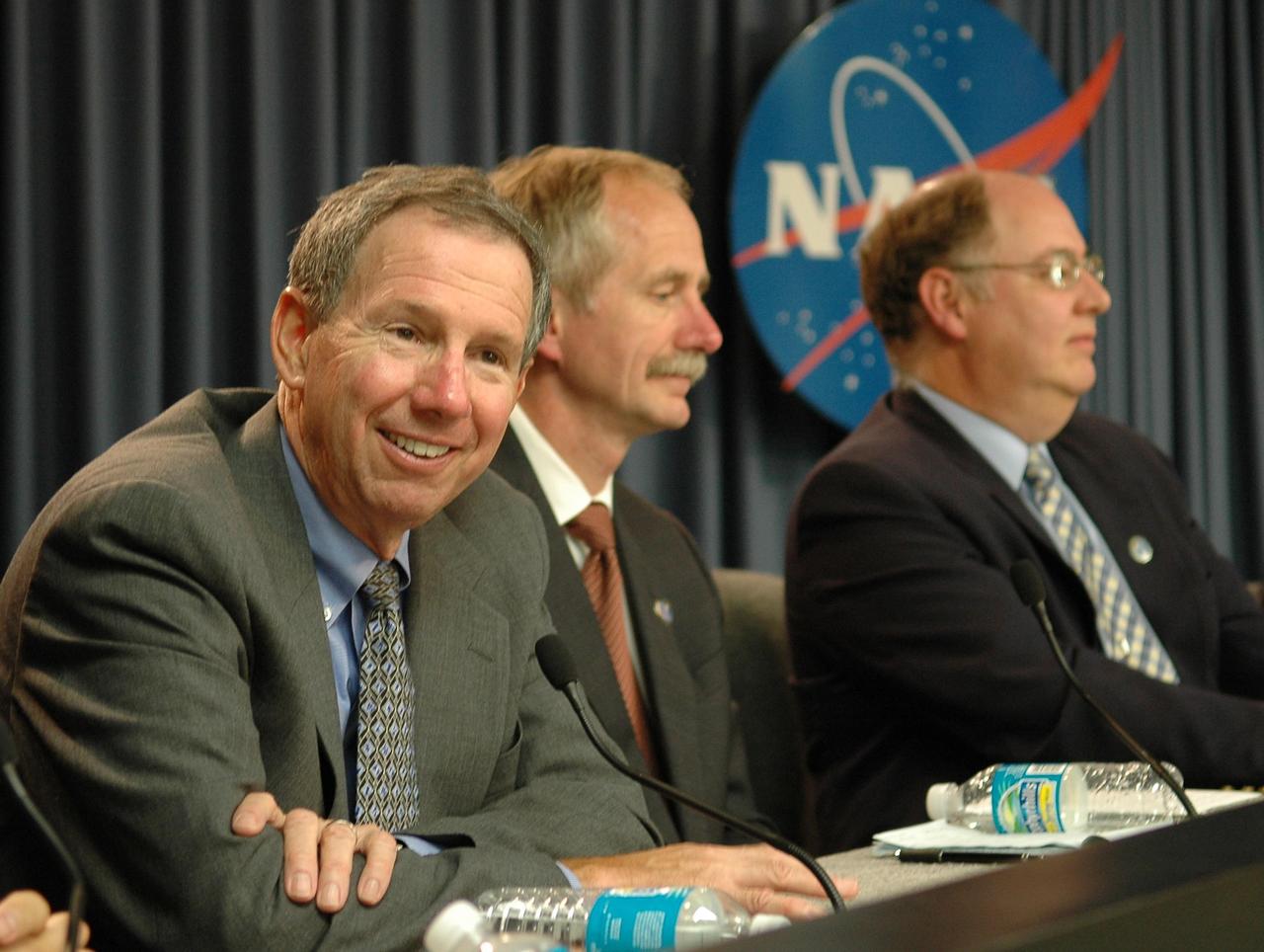
KENNEDY SPACE CENTER, FLA. - At a press conference following the Flight Readiness Review, a thorough assessment of preparations for the mission, NASA Administrator Mike Griffin is amused by a question from the media. Next to Griffin on the dais are Bill Gerstenmaier, associate administrator for Space Operations, and Wayne Hale, Space Shuttle Program manager. Also present at the conference, but not pictured, is Mike Leinbach, NASA launch director. Griffin confirmed the final launch date of Aug. 27 for mission STS-115. Mission STS-115 continues the assembly of the International Space Station with the installation of the truss segments P3 and P4. Liftoff of Space Shuttle Atlantis on mission STS-115 is targeted at approximately 4:30 p.m. EDT on Aug. 27. Photo credit: NASA/Kim Shiflett
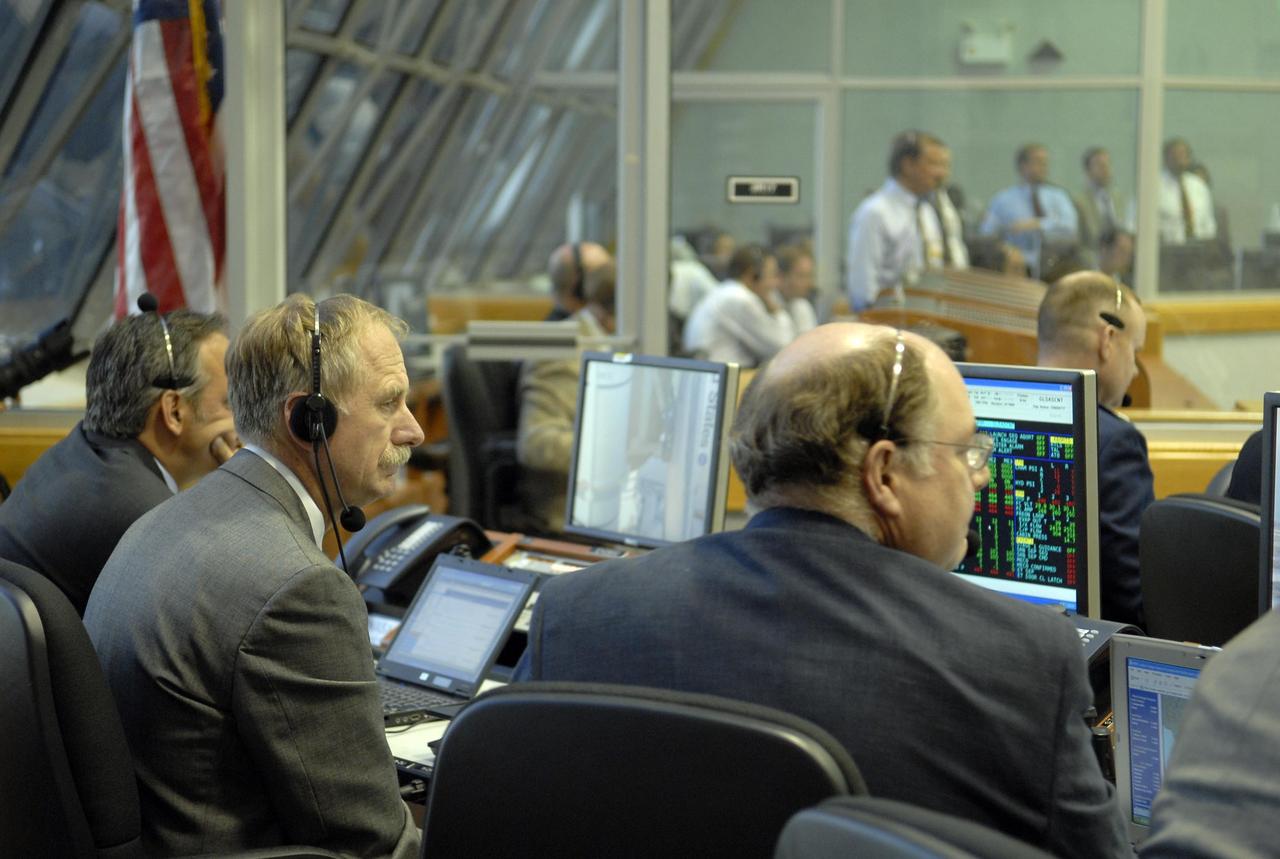
KENNEDY SPACE CENTER, FLA. -- In the Launch Control Center, William Gerstenmeier (left), associate administrator for NASA Space Operations Mission, and Wayne Hale, shuttle program manager, monitor proceedings before the launch of Space Shuttle Atlantis on mission STS-117 to the International Space Station. Liftoff from Launch Pad 39A was on-time at 7:38:04 p.m. EDT. The shuttle is delivering a new segment to the starboard side of the International Space Station's backbone, known as the truss. Three spacewalks are planned to install the S3/S4 truss segment, deploy a set of solar arrays and prepare them for operation. STS-117 is the 118th space shuttle flight, the 21st flight to the station, the 28th flight for Atlantis and the first of four flights planned for 2007. Photo credit: NASA/Kim Shiflett
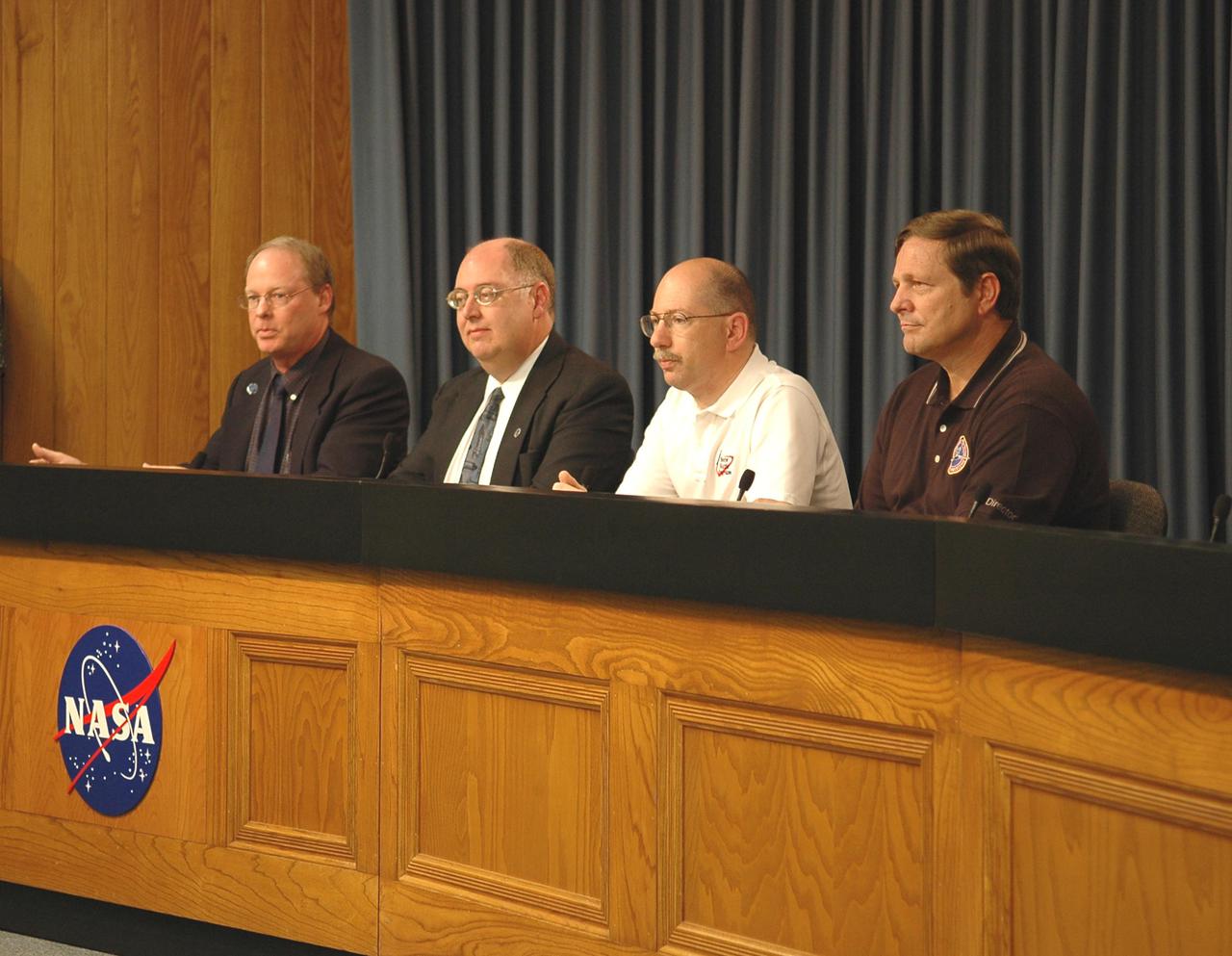
KENNEDY SPACE CENTER, FLA. - At a press conference, members of the Mission Management Team reveal aspects of the troubleshooting and testing being done on the liquid hydrogen tank low-level fuel cut-off sensor. From left are moderator Bruce Buckingham, NASA news chief; Wayne Hale, Space Shuttle deputy program manager; John Muratore, manager of Systems Engineering and Integration for the Space Shuttle Program; and Mike Wetmore, director of Space Shuttle Processing. The sensor failed a routine prelaunch check during the launch countdown July 13, causing mission managers to scrub Discovery's first launch attempt. The sensor protects the Shuttle's main engines by triggering their shutdown in the event fuel runs unexpectedly low. The sensor is one of four inside the liquid hydrogen section of the External Tank (ET).

KENNEDY SPACE CENTER, FLA. -- In the Launch Control Center, NASA and Kennedy Space Center officials observe proceedings before the launch of Space Shuttle Atlantis on mission STS-117 to the International Space Station. Second from left is KSC Director Bill Parsons. Second and third from the right are William Gerstenmeier, associate administrator for NASA Space Operations Mission, and Wayne Hale, shuttle program manager, Liftoff from Launch Pad 39A was on-time at 7:38:04 p.m. EDT. The shuttle is delivering a new segment to the starboard side of the International Space Station's backbone, known as the truss. Three spacewalks are planned to install the S3/S4 truss segment, deploy a set of solar arrays and prepare them for operation. STS-117 is the 118th space shuttle flight, the 21st flight to the station, the 28th flight for Atlantis and the first of four flights planned for 2007. Photo credit: NASA/Kim Shiflett

KENNEDY SPACE CENTER, FLA. - Media gather in the television studio at the NASA News Center to hear members of the Mission Management Team reveal aspects of the troubleshooting and testing being done on the liquid hydrogen tank low-level fuel cut-off sensor. On the stage at right are (from left) Bruce Buckingham, NASA news chief; Wayne Hale, Space Shuttle deputy program manager; John Muratore, manager of Systems Engineering and Integration for the Space Shuttle Program; and Mike Wetmore, director of Space Shuttle Processing. The sensor failed a routine prelaunch check during the launch countdown July 13, causing mission managers to scrub Discovery's first launch attempt. The sensor protects the Shuttle's main engines by triggering their shutdown in the event fuel runs unexpectedly low. The sensor is one of four inside the liquid hydrogen section of the External Tank (ET).
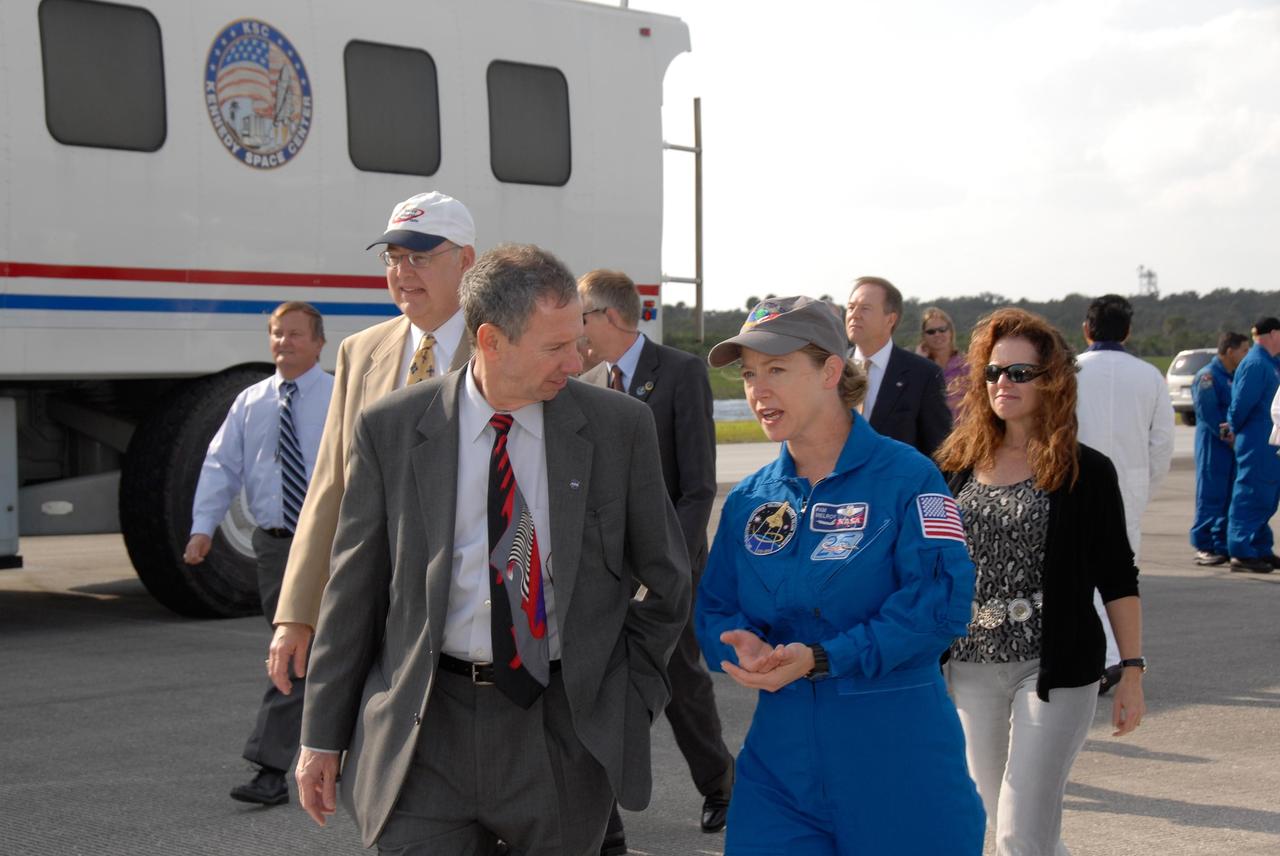
KENNEDY SPACE CENTER, FLA. -- NASA Administrator Mike Griffin talks to STS-120 Commander Pamela Melroy as they walk across the Shuttle Landing Facility at NASA's Kennedy Space Center. On the left are Shuttle Launch Director Mike Leinbach and Shuttle Program Manager Wayne Hale. At right is Rebecca Griffin, wife of the administrator. Melroy and the Discovery crew completed the 15-day mission STS-120, with an on-time landing at 1:01:16 p.m. Wheel stop was at 1:02:07 p.m. Mission elapsed time was 15 days, 2 hours, 24 minutes and 2 seconds. Mission STS-120 continued the construction of the station with the installation of the Harmony Node 2 module and the relocation of the P6 truss. Photo credit: NASA/Kim Shiflett
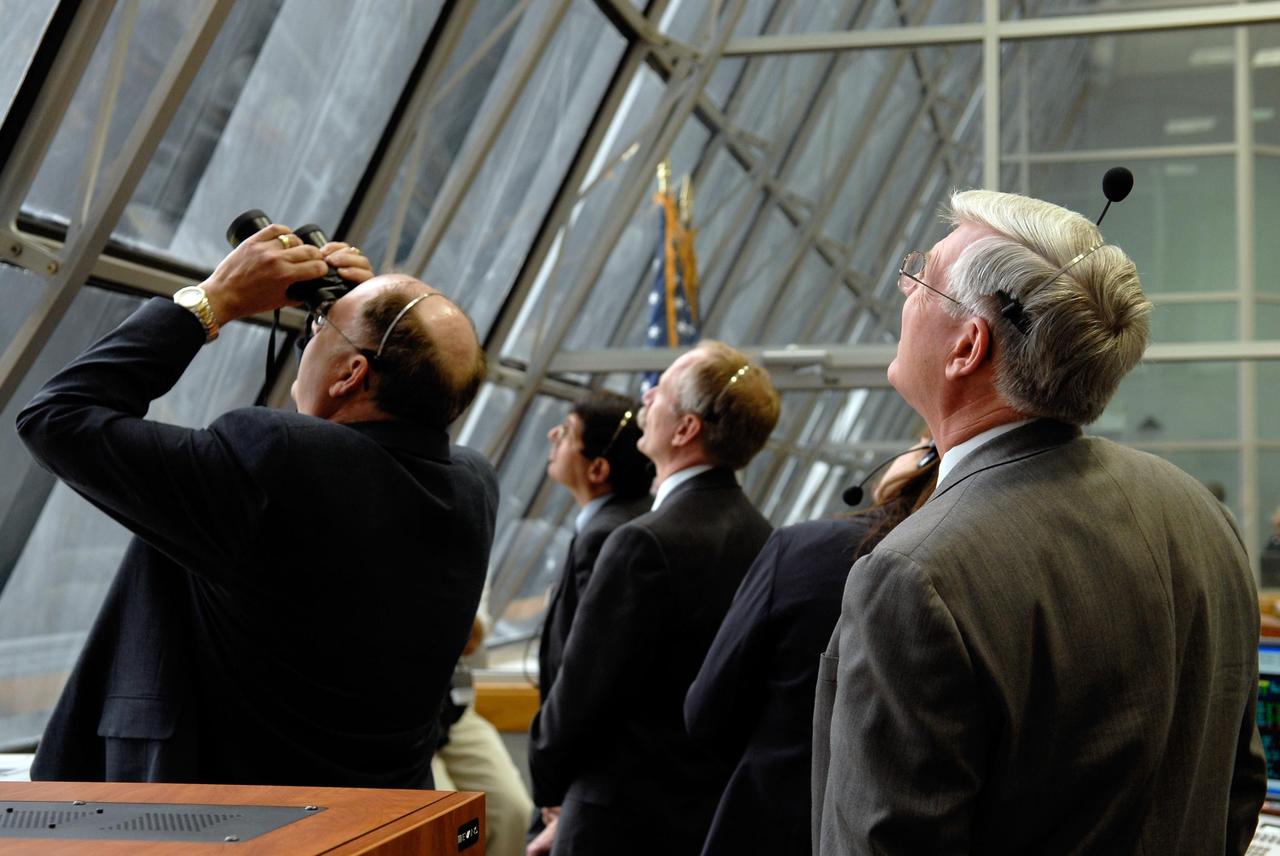
KENNEDY SPACE CENTER, FLA. -- In the firing room of the Launch Control Center at NASA's Kennedy Space Center, all eyes are on the successful launch of space shuttle Discovery on mission STS-120. From left are Space Shuttle Program Manager Wayne Hale, Associate Administrator for NASA Space Operations William Gerstenmaier, NASA Flow Director Stephanie Stilson and Johnson Space Center Director Michael Coats. Liftoff was on time at 11:38:19 a.m. EDT. Liftoff was on time at 11:38:19 a.m. EDT. Discovery carries the Italian-built U.S. Node 2, called Harmony. During the 14-day STS-120 mission, the crew will install Harmony and move the P6 solar arrays to their permanent position and deploy them. Discovery is expected to complete its mission and return home at 4:47 a.m. EST on Nov. 6. Photo credit: NASA/Kim Shiflett
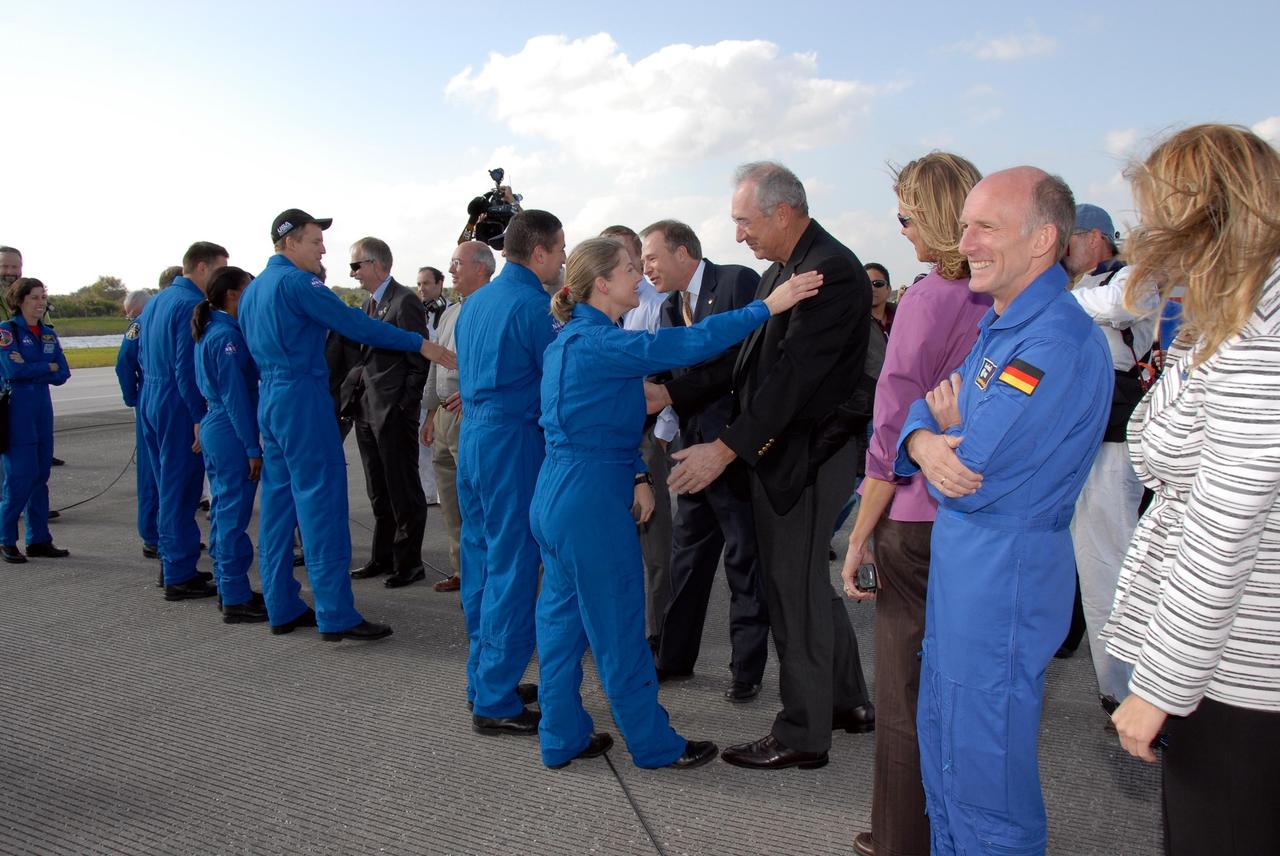
KENNEDY SPACE CENTER, FLA. -- The STS-120 crew members are greeted by NASA and Kennedy VIPs after completing their successful mission. From left are STS-120 mission specialists Doug Wheelock, Stephanie Wilson and Scott Parazynski, Pilot George Zamka and Commander Pamela Melroy. The NASA VIPs include NASA Administrator Mike Griffin, Associate Administrator for NASA Space Operations William Gerstenmaier and Shuttle Program Manager Wayne Hale. The lineup also includes Shuttle Launch Director Mike Leinbach. Melroy and the Discovery crew completed the 15-day mission STS-120, with an on-time landing at 1:01:16 p.m. Wheel stop was at 1:02:07 p.m. Mission elapsed time was 15 days, 2 hours, 24 minutes and 2 seconds. Mission elapsed time was 15 days, 2 hours, 24 minutes and 2 seconds. Mission STS-120 continued the construction of the station with the installation of the Harmony Node 2 module and the relocation of the P6 truss. Photo credit: NASA/Kim Shiflett
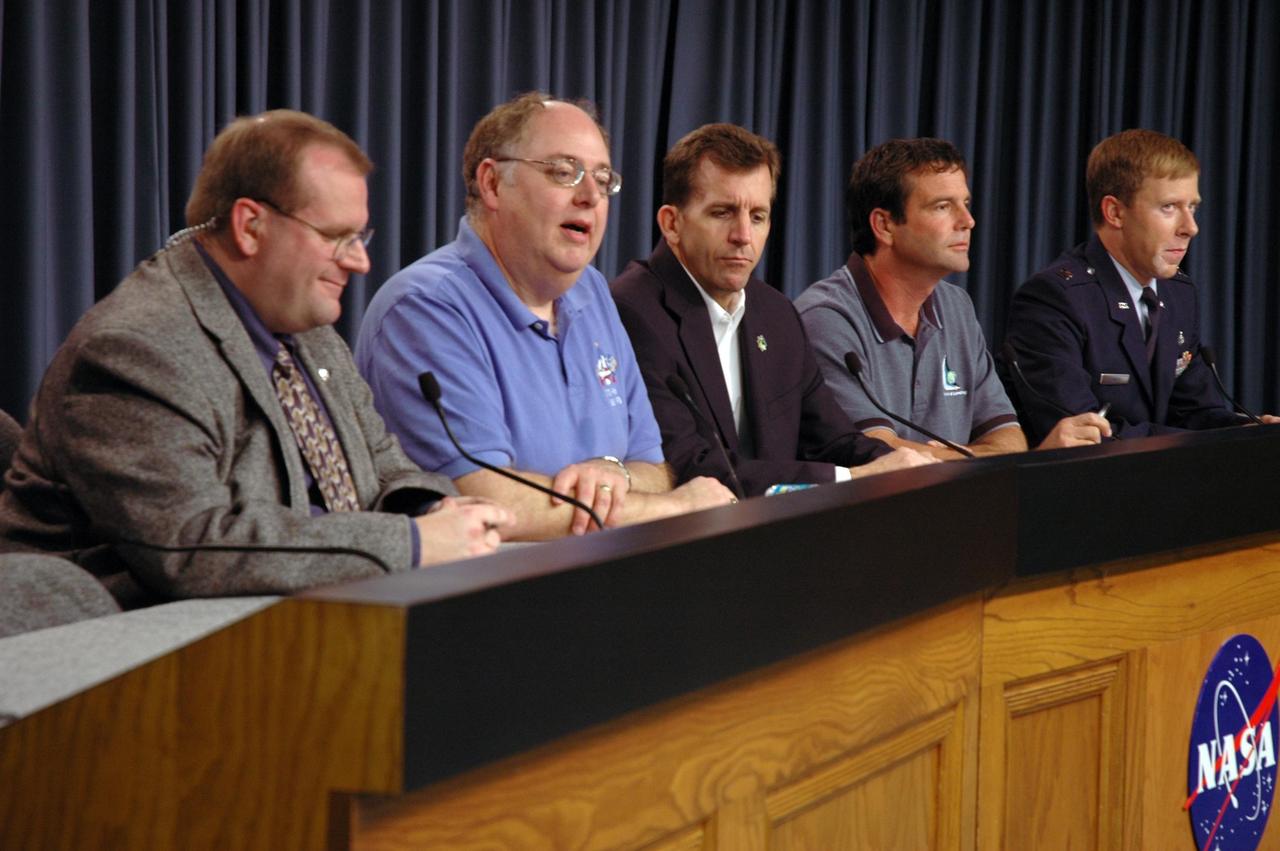
KENNEDY SPACE CENTER, FLA. -- Members of the Mission Management Team, or MMT, participate in a news briefing following the conclusion of the team's meeting. The meeting continued the discussion of the problems experienced with the space shuttle Atlantis STS-122 external tank's engine cutoff sensor system that arose during tanking on Dec. 6. From left are Allard Beutel, Kennedy Space Center news chief and briefing moderator; Wayne Hale, Space Shuttle Program manager; LeRoy Cain, MMT chairman; Doug Lyons, STS-122 launch director; and U.S. Air Force Capt. Chris Lovett, 45th Weather Squadron. An announcement was made during the briefing that the STS-122 launch, originally set for Dec. 6, was rescheduled to 3:21 p.m. Dec. 9. Atlantis will carry the Columbus Laboratory, the European Space Agency's largest contribution to the construction of the International Space Station. It will support scientific and technological research in a microgravity environment. Permanently attached to the Harmony node of the space station, the laboratory will carry out experiments in materials science, fluid physics and biosciences, as well as perform a number of technological applications. Photo credit: NASA/Cory Huston
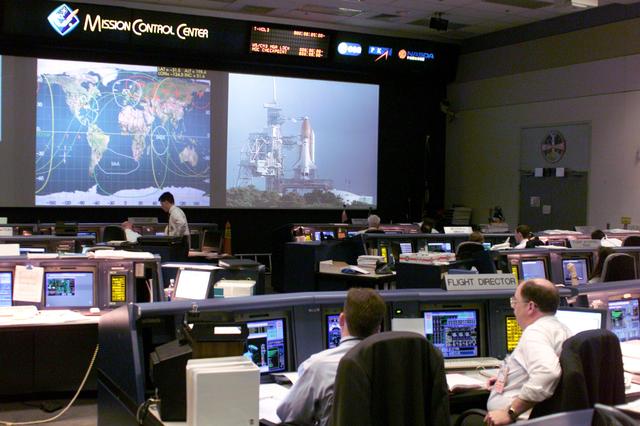
JSC2000-E-22286 (8 September 2000) --- An overall shot in Houston's Mission Control Center (MCC) shows flight controllers awaiting the launch of the Space Shuttle Atlantis from the Kennedy Space Center (KSC) in Florida. The vehicle later launched on schedule, at 8:46 a.m. (EDT), September 8, 2000, as the Johnson Space Center (JSC) flight control team took the baton from KSC's launch controllers. According to flight director Bill Reeves, "The picture referenced was taken less than an hour before launch for STS-106, before we changed the front screens for ascent operations. Wayne Hale (in glasses) is the Flight director for ascent and LeRoy Cain seated to his left was serving as "Weather Flight" for Wayne. The console in the front right corner of the room next to the screens is the Ground Control position, where I was supporting at this time. The man with white hair is Norn Talbott, who will be retiring after this flight with more than 35 years at NASA. Ray Grossman is next to him, who is training to take his place on the GC Ascent Team. I am in fron of and slightly to the right of Ray. As you can see by the boxes at the consoel behind us (Mechanical), we come well prepared for all contingencies, including donuts for early morning shifts. We were on console by 2:00 am central time for the 7:45 am launch." Reference: https://spaceflight.nasa.gov/feedback/expert/answer/mcc/sts-106/09_14_09_35_19.html