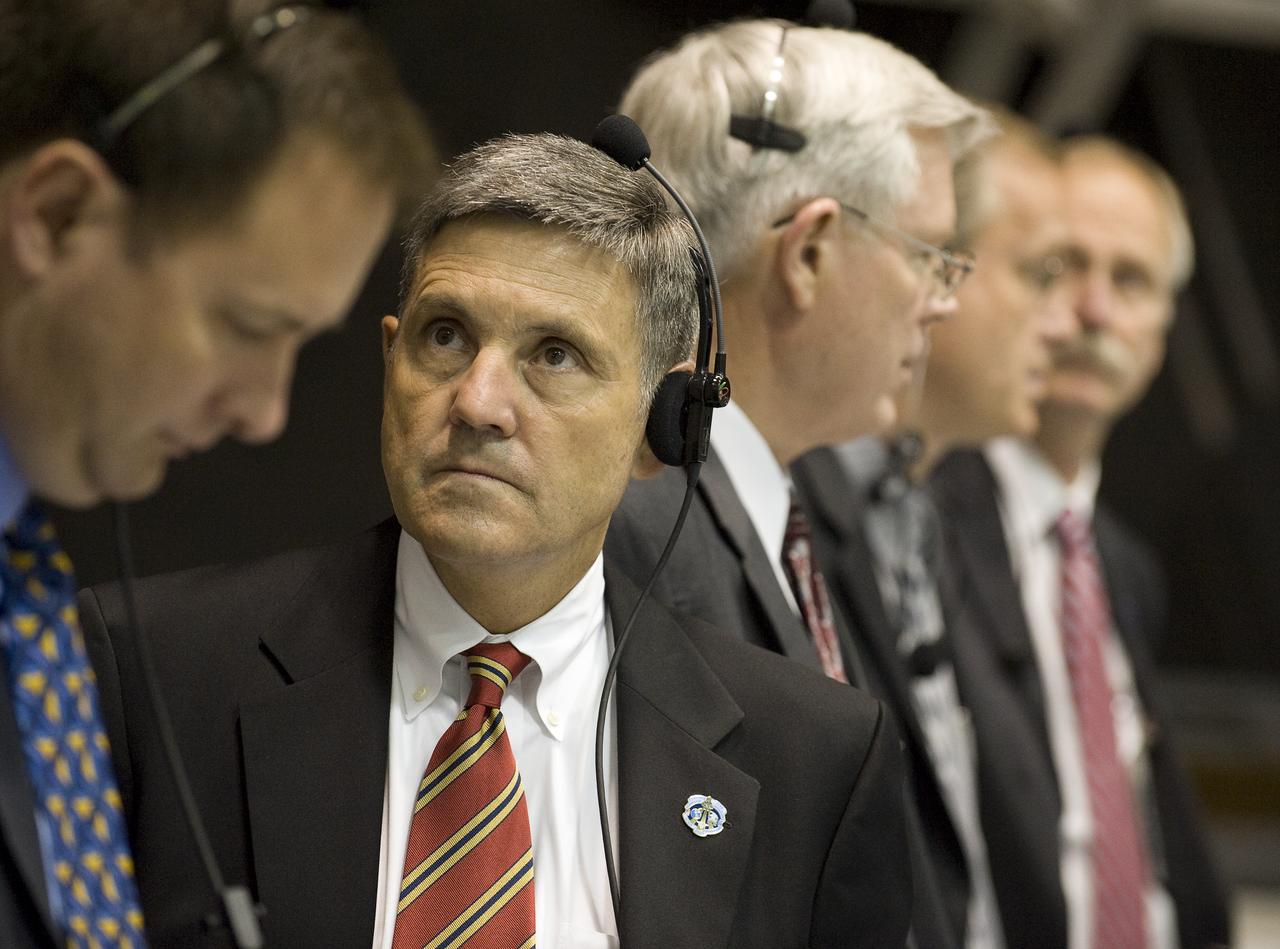
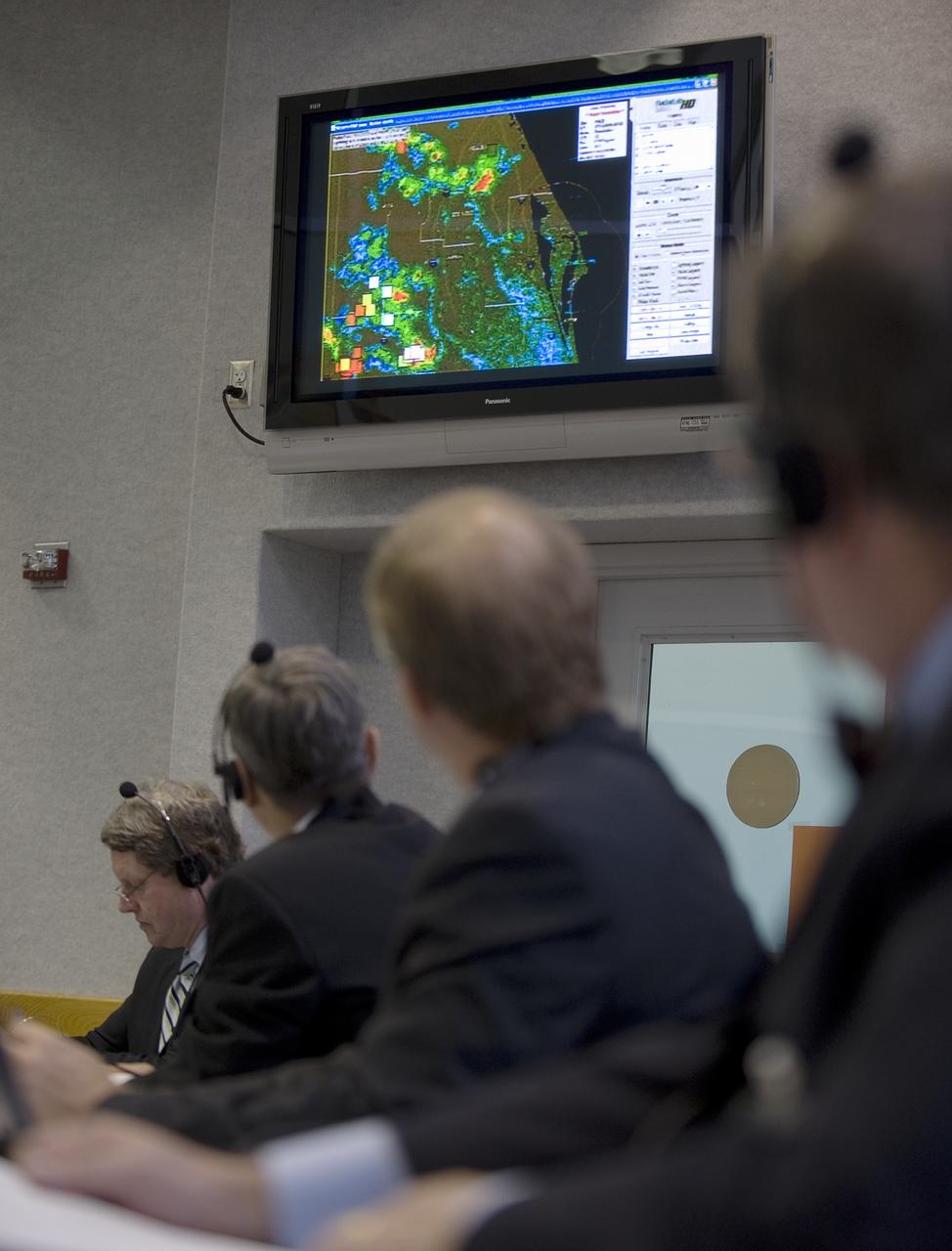
NASA Kennedy Space Center Director Robert Cabana looks at the weather radar in Firing Room Four at the Kennedy Space Center during the launch countdown of space shuttle Discovery and the STS-128 crew, Tuesday, Aug. 25, 2009 at Cape Canaveral, Fla. Discovery’s launch attempt was scrubbed due to weather conditions. Photo Credit: (NASA/Bill Ingalls)
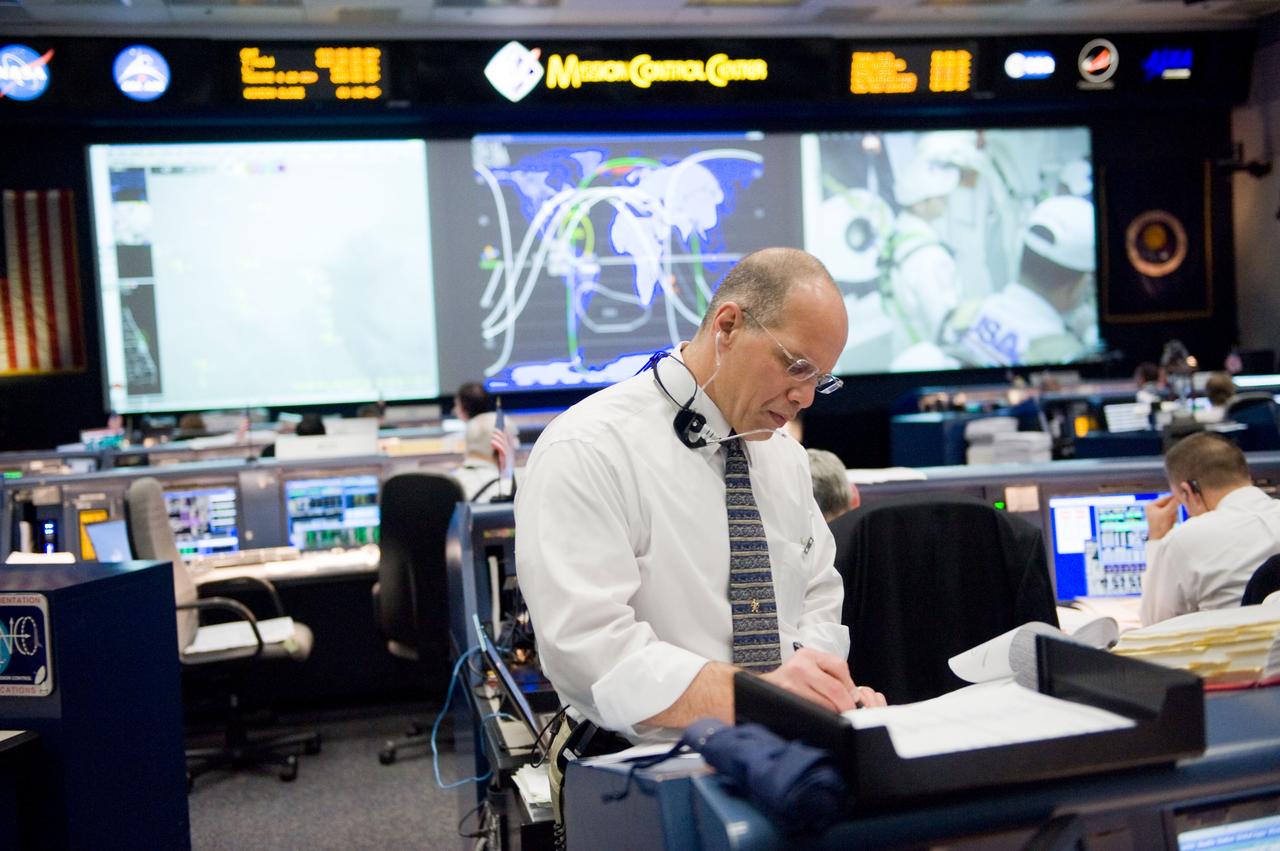
JSC2010-E-018927 (7 Feb. 2010) --- Flight director Tony Ceccacci is pictured in the space shuttle flight control room in the Johnson Space Center's Mission Control Center during the first launch attempt of the STS-130 mission. The launch was postponed until Feb. 8, due to weather conditions.
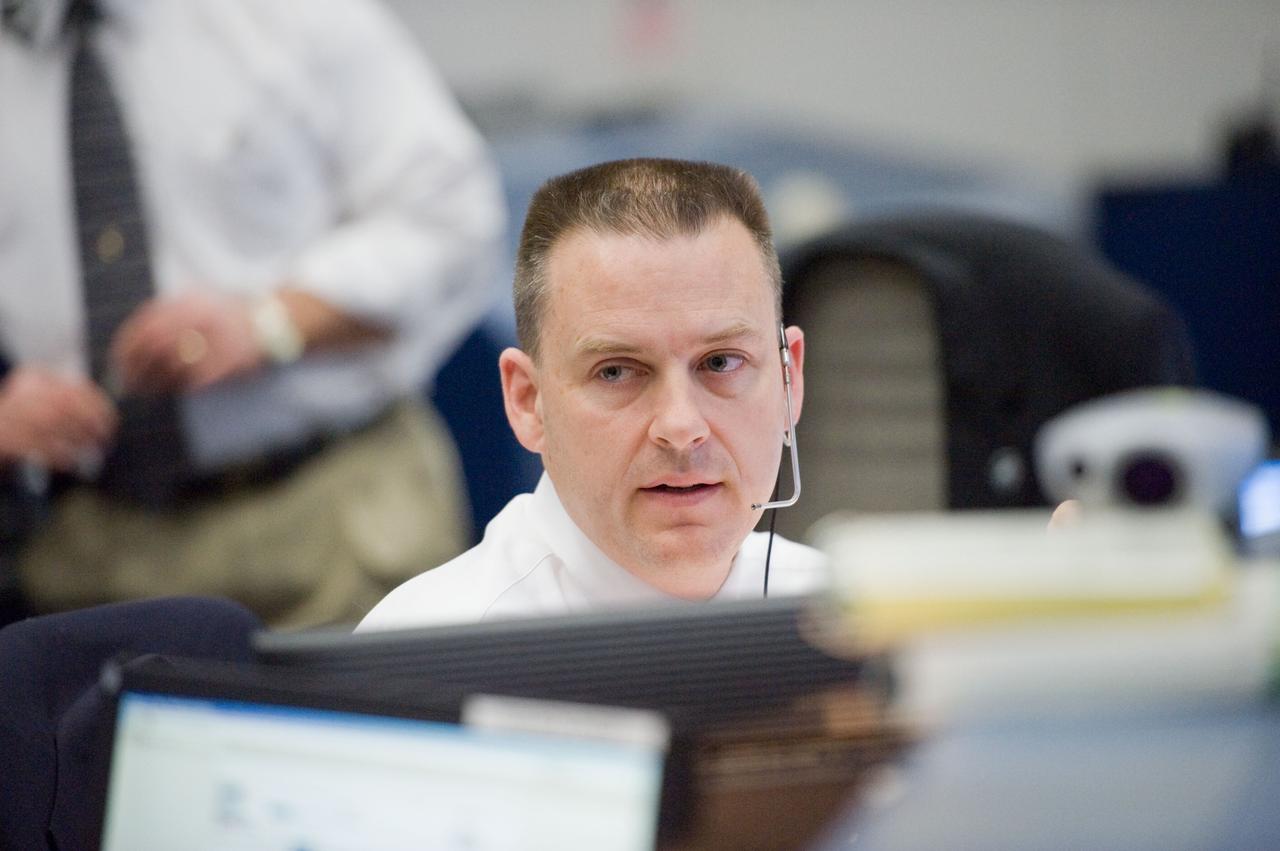
JSC2010-E-018932 (7 Feb. 2010) --- Flight director Norm Knight is pictured at his console in the space shuttle flight control room in the Johnson Space Center's Mission Control Center during the first launch attempt of the STS-130 mission. The launch was postponed until Feb. 8, due to weather conditions.
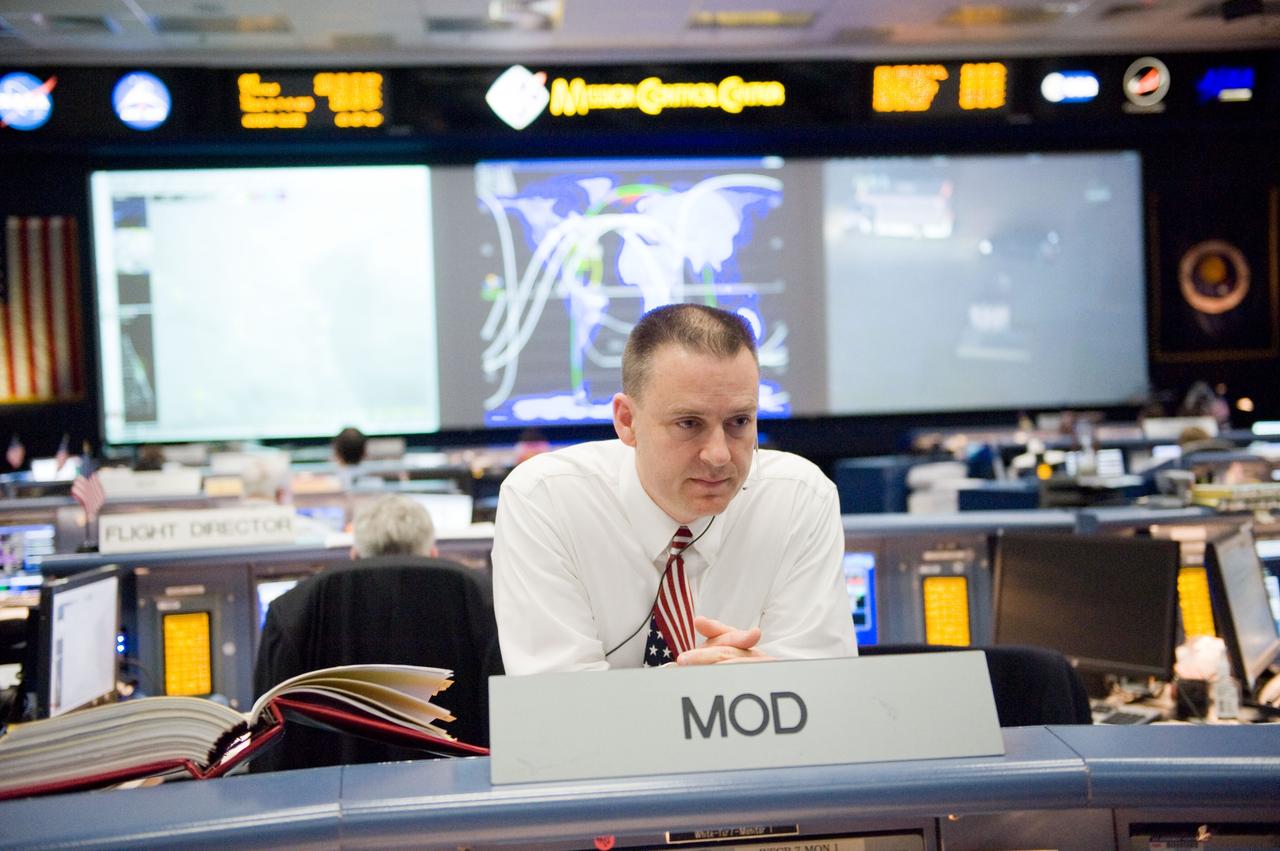
JSC2010-E-018947 (7 Feb. 2010) --- Flight director Norm Knight is pictured in the space shuttle flight control room in the Johnson Space Center's Mission Control Center during the first launch attempt of the STS-130 mission. The launch was postponed until Feb. 8, due to weather conditions.
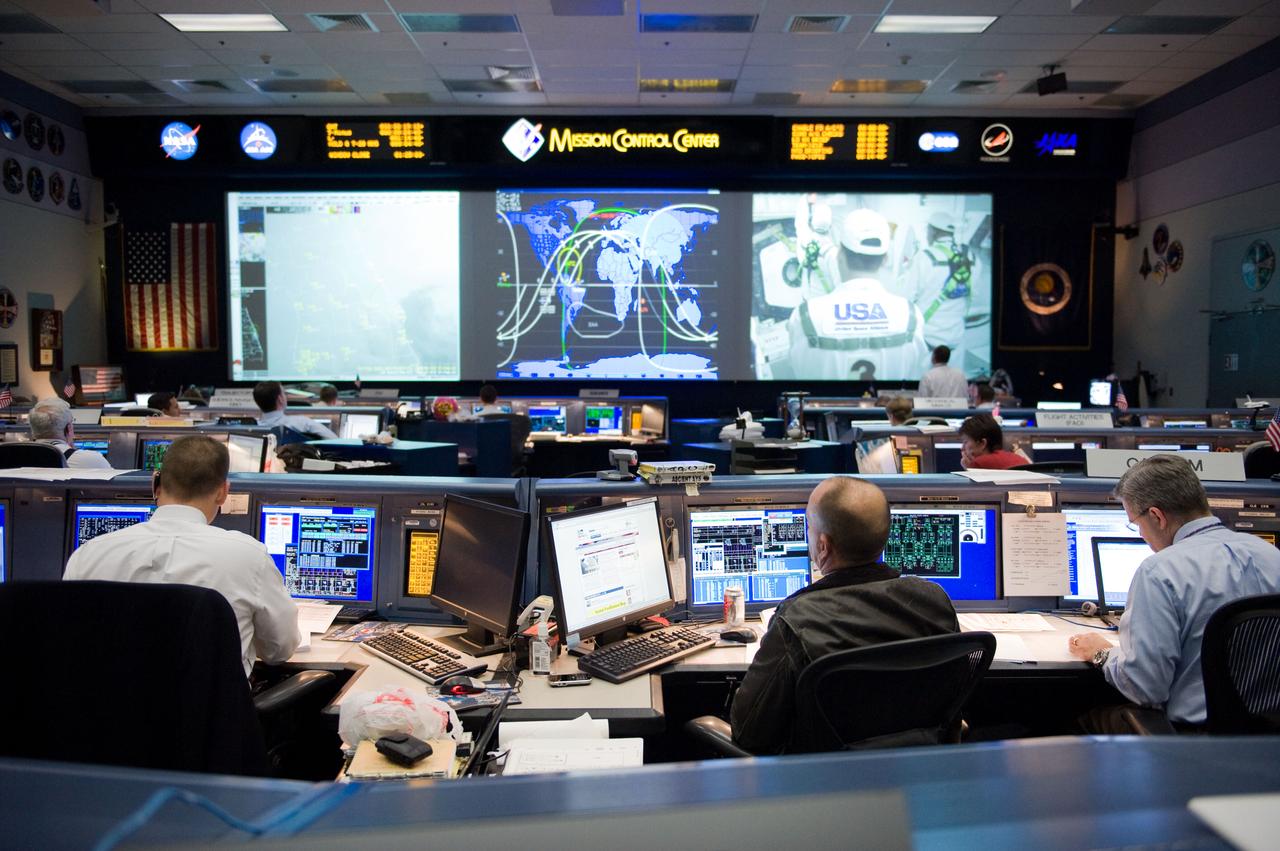
JSC2010-E-018922 (7 Feb. 2010) --- Overall view of the space shuttle flight control room in the Johnson Space Center's Mission Control Center as flight controllers anticipate the launch of STS-130. The launch attempt was later postponed until Feb. 8, due to weather conditions.
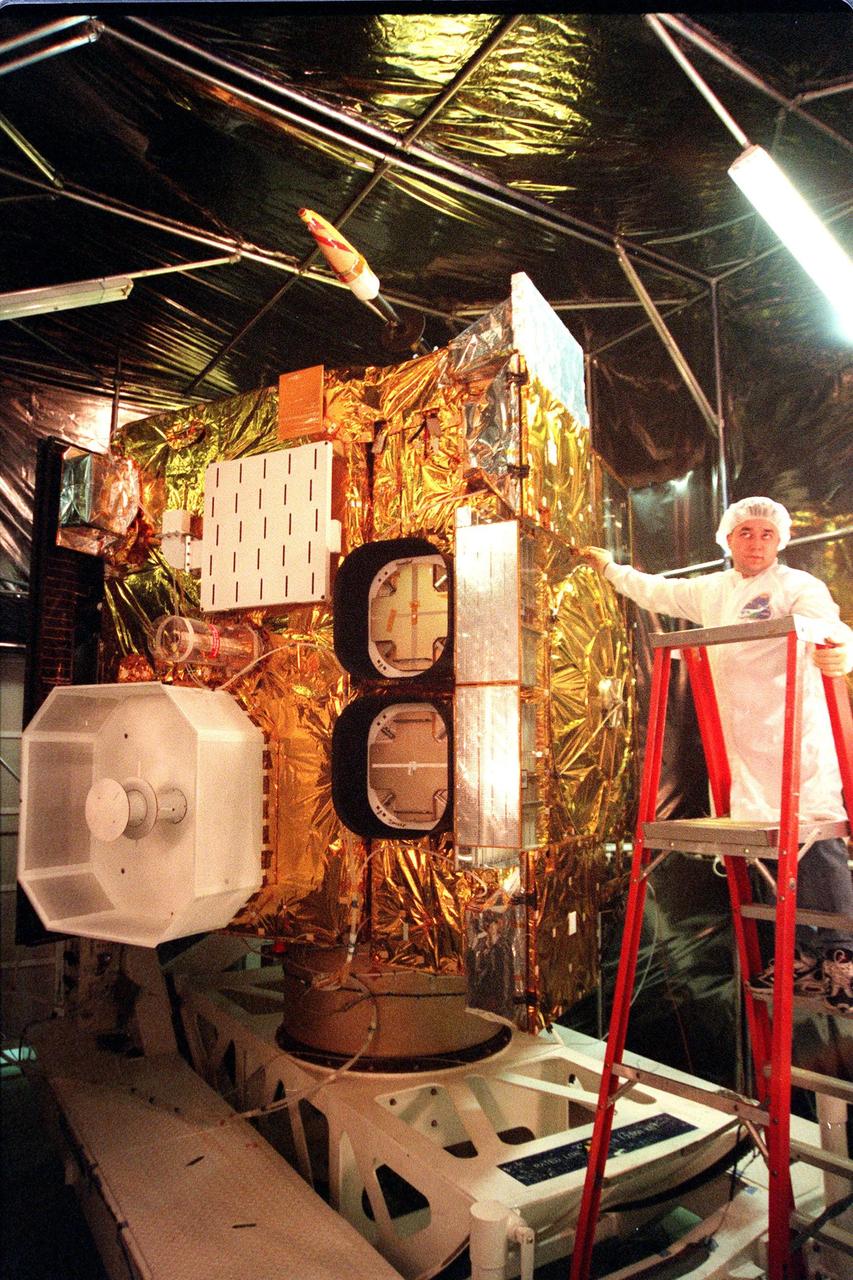
In a specially built clean room at Astrotech, Titusville, Fla., Loral technician Roberto Caballero checks the position of the <a href="http://www-pao.ksc.nasa.gov/kscpao/captions/subjects/goes-l.htm">GOES-L</a> weather satellite before beginning deployment of the sounder instrument's cooler cover door. The sounder, one of two meteorological instruments on the satellite, measures temperature and moisture in a vertical column of air from the satellite to Earth. Its findings will help forecast weather. GOES-L, which is to be launched from Cape Canaveral Air Station aboard an Atlas II rocket in late March, is the fourth of a new advanced series of geostationary weather satellites for the National Oceanic and Atmospheric Administration. It is a three-axis inertially stabilized spacecraft that will provide pictures as well as perform the atmospheric sounding. Once launched, the satellite, to be designated GOES-11, will undergo checkout and provide backup capabilities for the existing, aging GOES East weather satellite
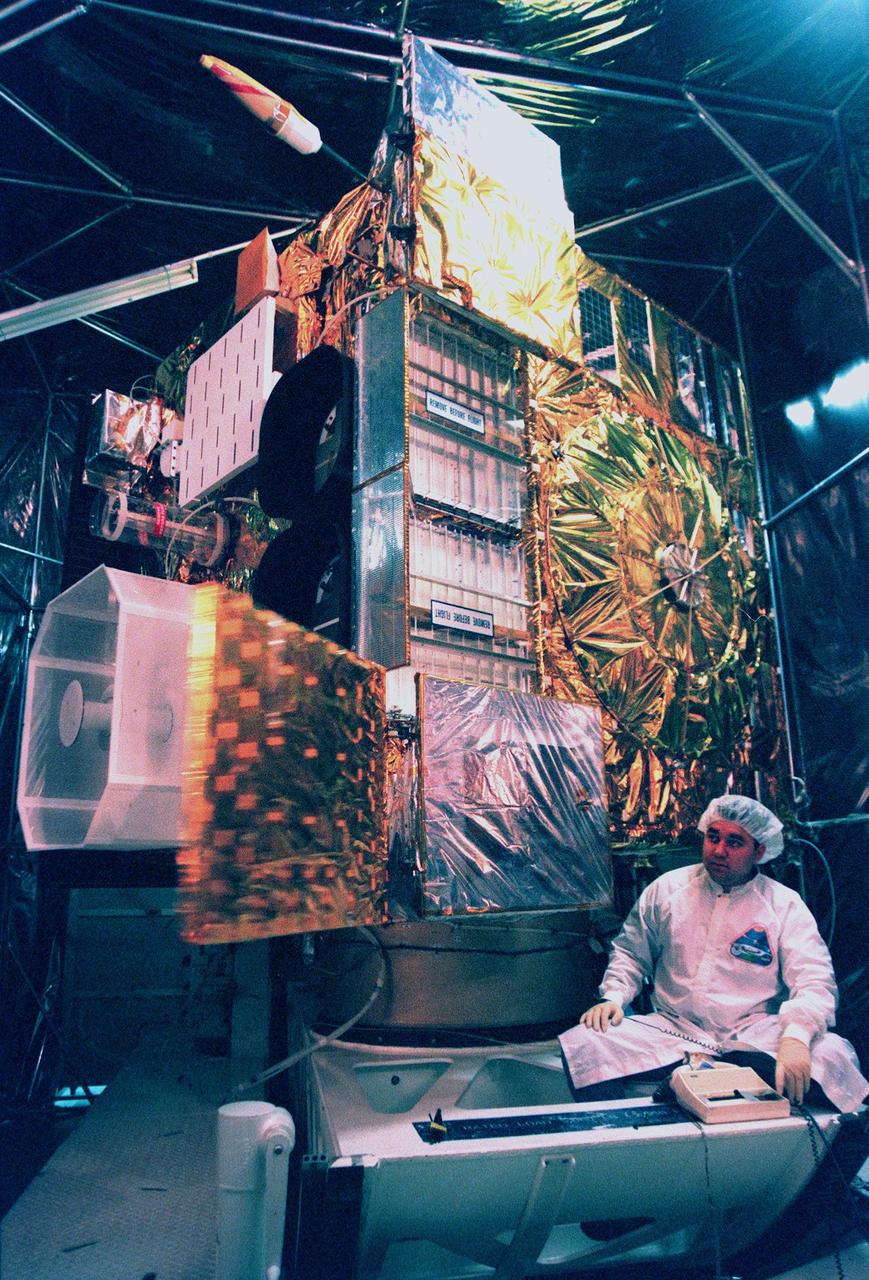
With the light casting a rosy glow in a specially built clean room at Astrotech, Titusville, Fla., Loral technician Roberto Caballero tests the deployment of the sounder instrument's cooler cover door on the <a href="http://www-pao.ksc.nasa.gov/kscpao/captions/subjects/goes-l.htm">GOES-L</a> weather satellite. The sounder, one of two meteorological instruments on the satellite, measures temperature and moisture in a vertical column of air from the satellite to Earth. Its findings will help forecast weather. GOES-L, which is to be launched from Cape Canaveral Air Station aboard an Atlas II rocket in late March, is the fourth of a new advanced series of geostationary weather satellites for the National Oceanic and Atmospheric Administration. It is a three-axis inertially stabilized spacecraft that will provide pictures as well as perform the atmospheric sounding. Once launched, the satellite, to be designated GOES-11, will undergo checkout and provide backup capabilities for the existing, aging GOES East weather satellite
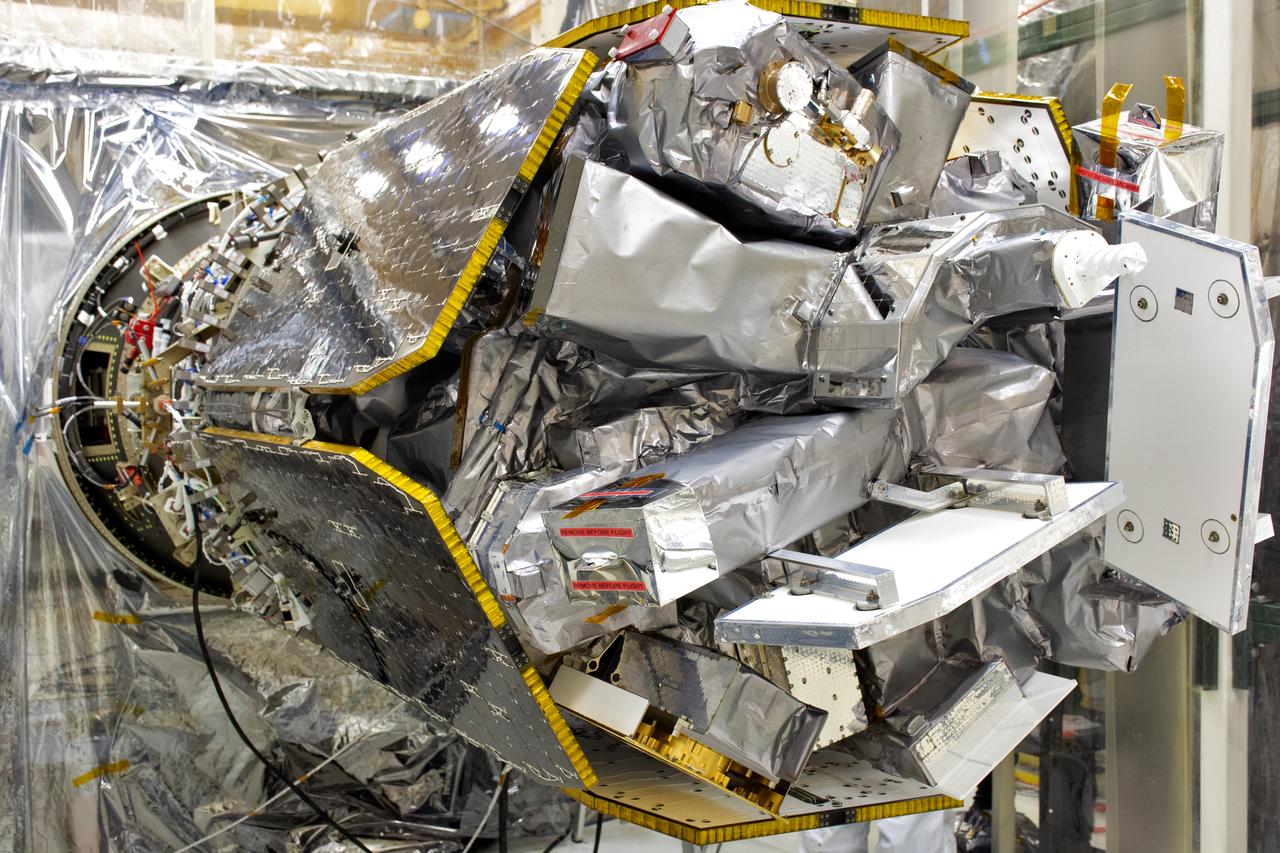
A stereographic view of NASA's Ionospheric Connection Explorer (ICON) in a clean room at Vandenberg Air Force Base in California, on Aug. 16, 2018. ICON will launch on a Northrop Grumman Pegasus XL vehicle, attached beneath the company's L-1011 Stargazer aircraft, from the Skid Strip at Cape Canaveral Air Force Station in Florida. Launch is scheduled for Oct. 26. ICON will study the frontier of space - the dynamic zone high in Earth's atmosphere where terrestrial weather from below meets space weather above. The explorer will help determine the physics of Earth's space environment and pave the way for mitigating its effects on our technology, communications systems and society.
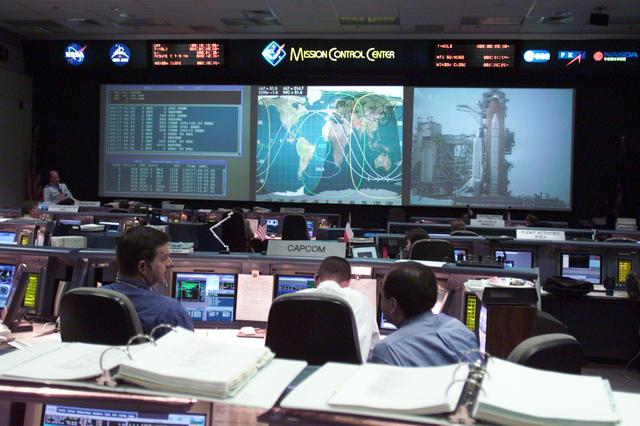
JSC2001-E-12130 (19 April 2001) --- Astronauts Scott D. Altman (left) and Mark L. Polansky (right) discuss the approaching STS-100 launch while staffing the Spacecraft Communicator (CAPCOM) console in Houston's Mission Control Center (MCC). Christopher J. (Gus) Loria (center) studies launch data at his console. Loria's CAPCOM position addresses weather issues, of which there were few on this particular launch. He will also be assigned to weather matters for the entry phase of the flight. The Space Shuttle Endeavour appears on the large screen in the front of the flight control room as liftoff countdown continues several hundred miles away at the Kennedy Space Center (KSC) in Florida.
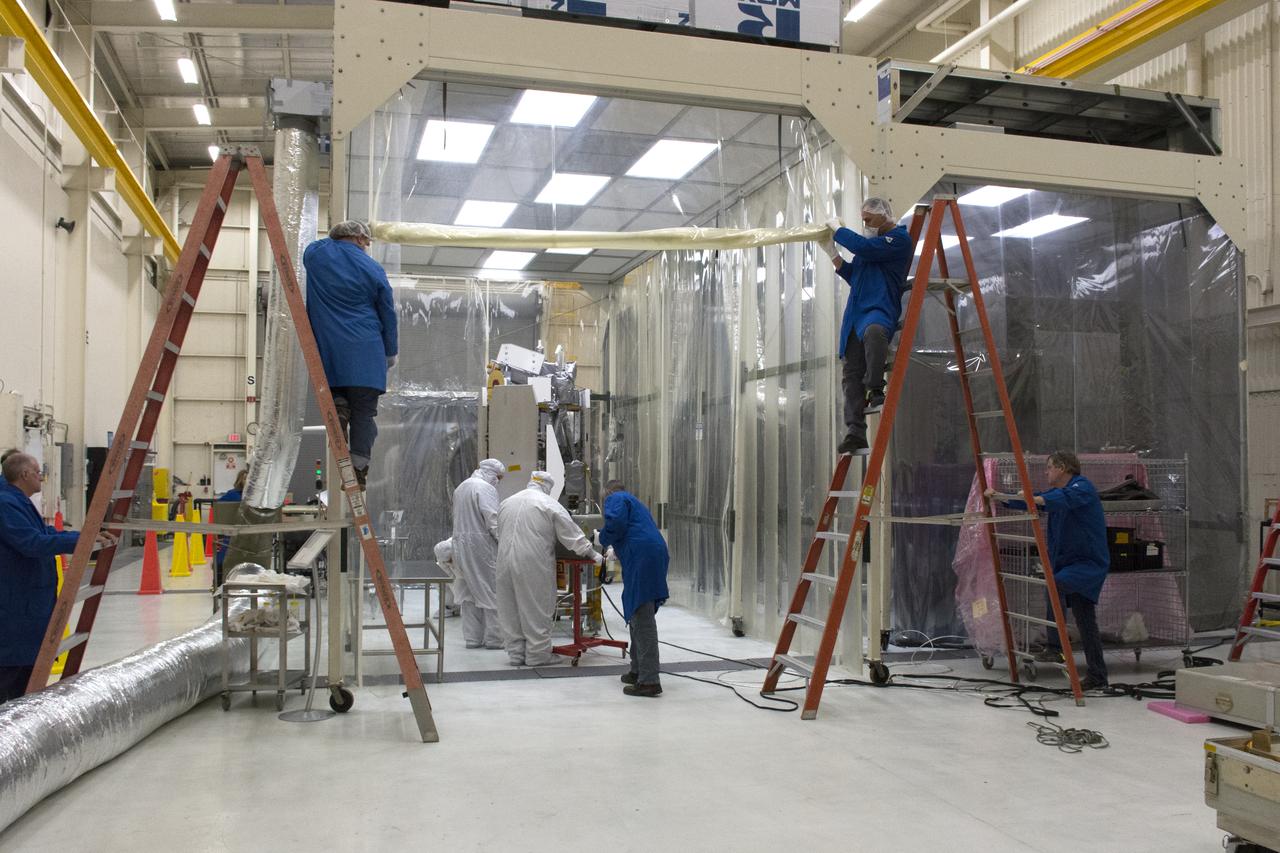
NASA's Ionospheric Connection Explorer (ICON) is moved to a clean room on May 4, 2018, inside Building 1555 at Vandenberg Air Force Base in California. The explorer will launch on June 15, 2018, from Kwajalein Atoll in the Marshall Islands (June 14 in the continental United States) on Orbital ATK's Pegasus XL rocket, which is attached to the company's L-1011 Stargazer aircraft. ICON will study the frontier of space - the dynamic zone high in Earth's atmosphere where terrestrial weather from below meets space weather above. The explorer will help determine the physics of Earth's space environment and pave the way for mitigating its effects on our technology, communications systems and society.

JSC2002-E-08144 (1 March 2002) --- Good news concerning the anticipated launch of STS-109 reaches the Spacecraft Communicator (CAPCOM) console in the Shuttle Flight Control Room of the Johnson Space Center's Mission Control Center. From left, astronauts William A. Oefelein, Charles O. Hobaugh and Mark L. Polansky, obviously are pleased with the news, possibly connected to improving weather at the launch site for the Space Shuttle Columbia several hundred miles away in Florida. Astronaut Polansky is ascent CAPCOM and Hobaugh closely monitors the Florida weather for the CAPCOM position.
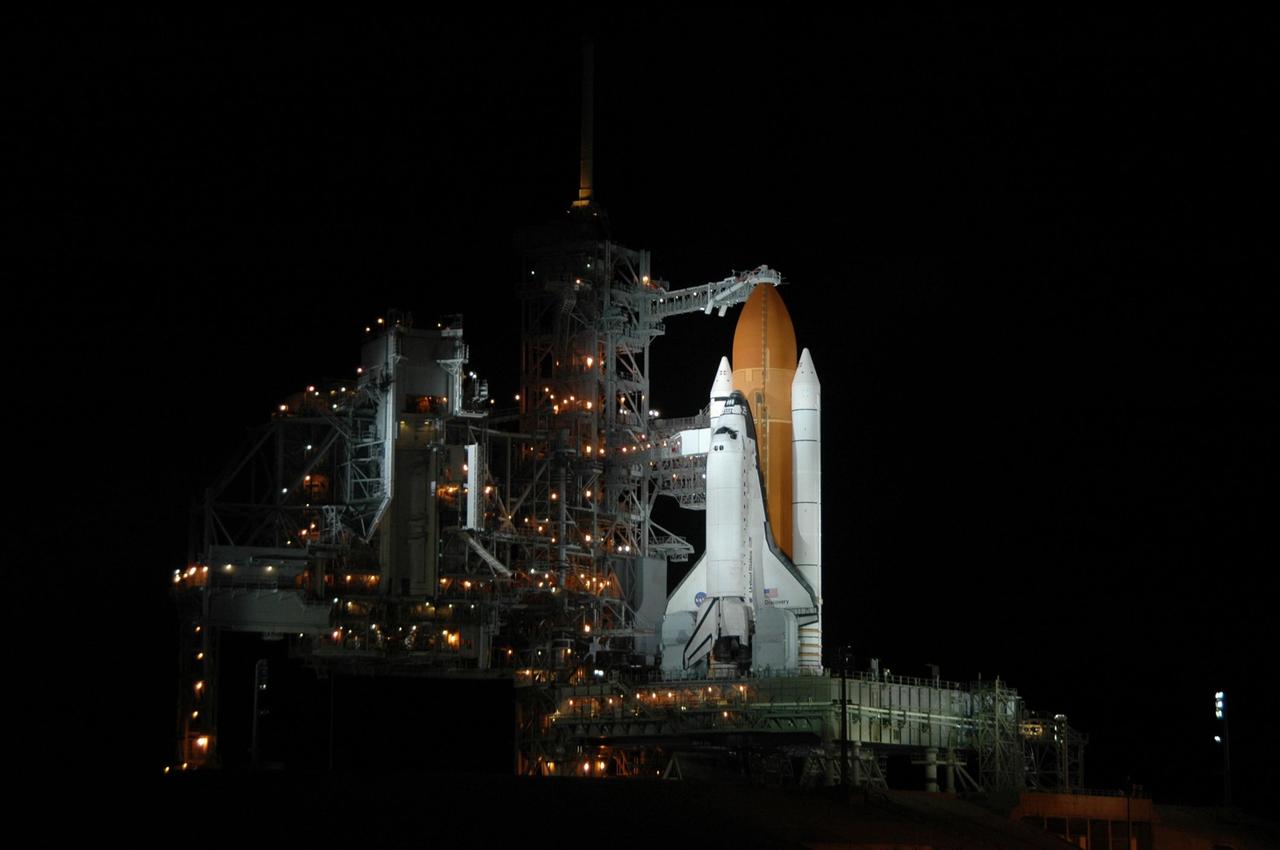
KENNEDY SPACE CENTER, FLA. - On Launch Pad 39B, Space Shuttle Discovery is bathed in spotlights under dark skies after the scrub of the launch attempt on mission STS-121. The White Room is still extended toward the cockpit area where the STS-121 crew patiently waited for the launch just hours earlier. The launch was scrubbed due to weather concerns and postponed 24 hours. Photo credit: NASA/Ken Thornsley
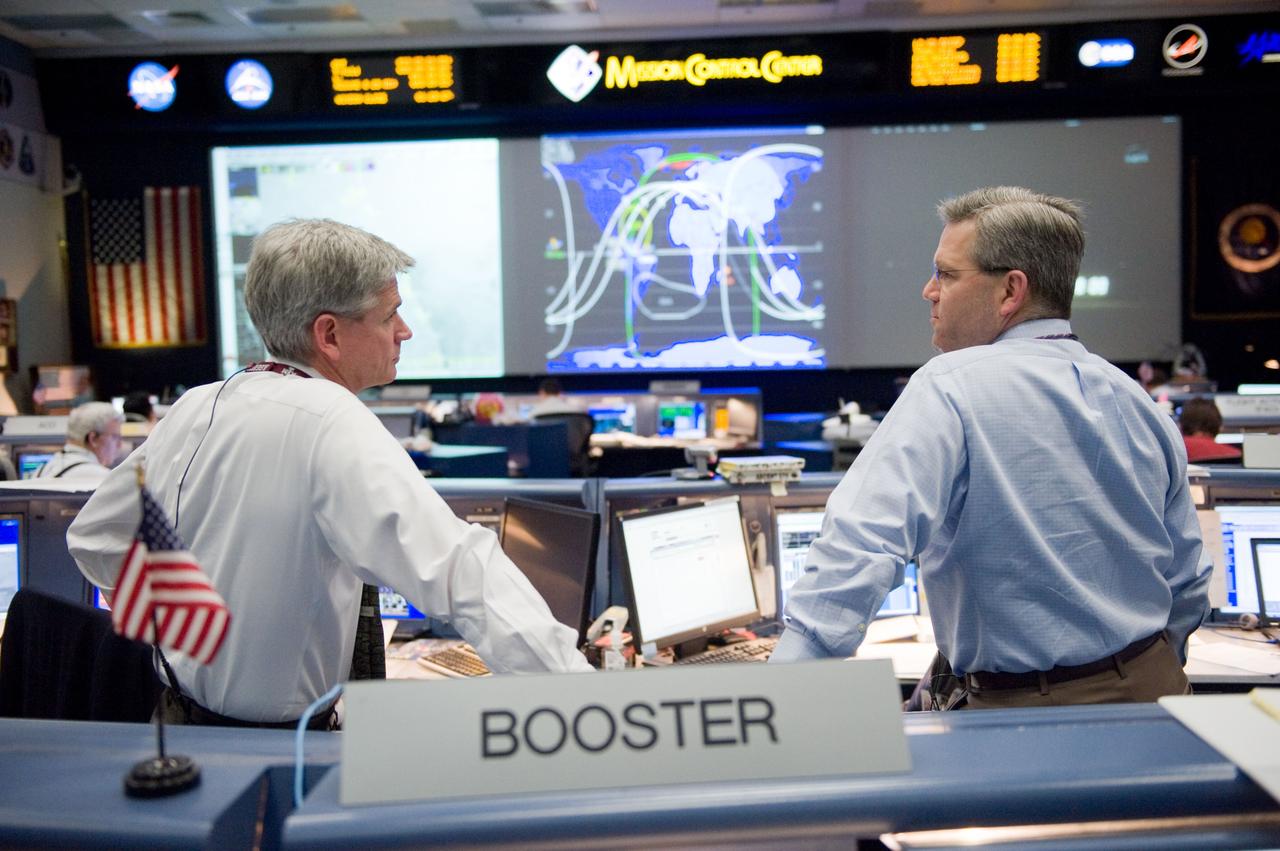
JSC2010-E-018926 (7 Feb. 2010) --- Flight director Bryan Lunney (left) and astronaut Steve Frick, STS-130 spacecraft communicator (CAPCOM), are pictured in the space shuttle flight control room in the Johnson Space Center's Mission Control Center as they anticipate the launch of STS-130. The launch attempt was later postponed until Feb. 8, due to weather conditions.
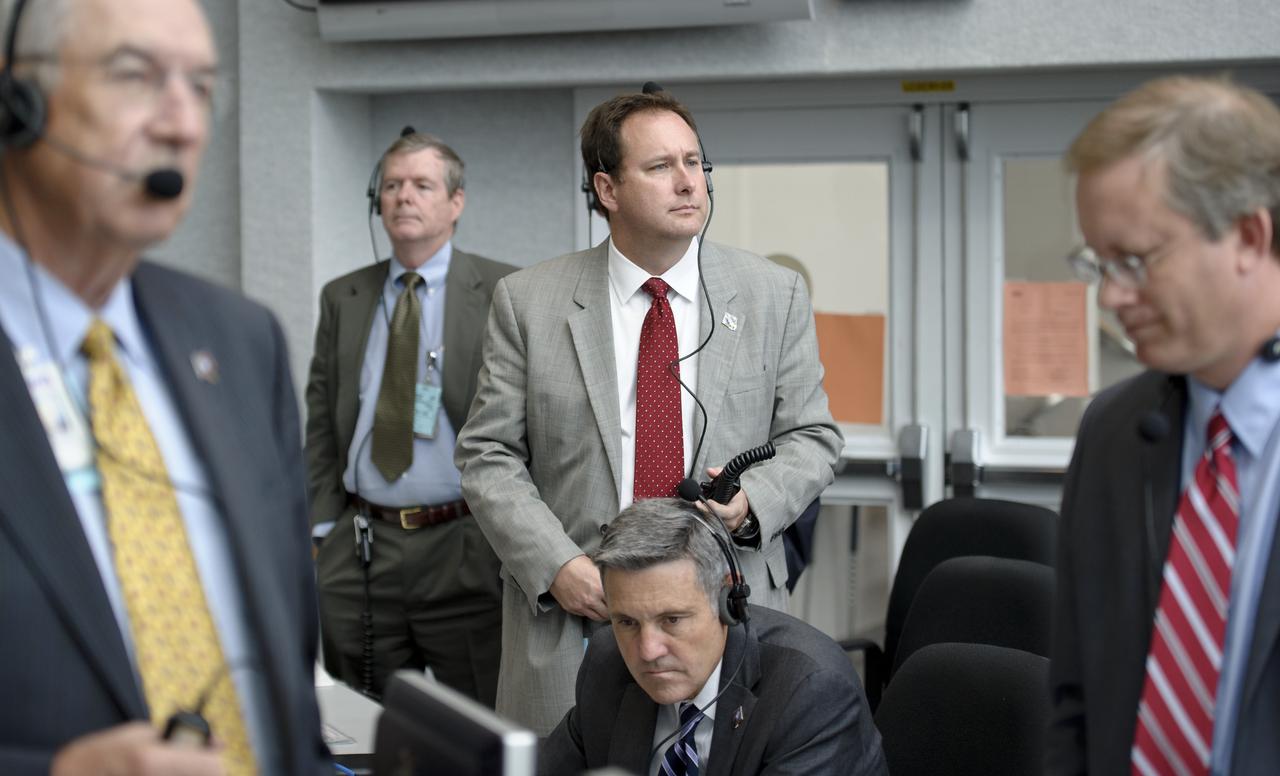
NASA Marshall Space Flight Center Director Robert Lightfoot Jr., standing center, and other management looks on from Firing Room Four of the NASA Kennedy Space Center Launch Control Center (LCC) as he and the launch team monitor the weather and countdown to the launch of the space shuttle Atlantis on Friday, July 8, 2011, in Cape Canaveral, Fla. The launch of Atlantis, STS-135, is the final flight of the shuttle program, a 12-day mission to the International Space Station. Photo Credit: (NASA/Bill Ingalls)
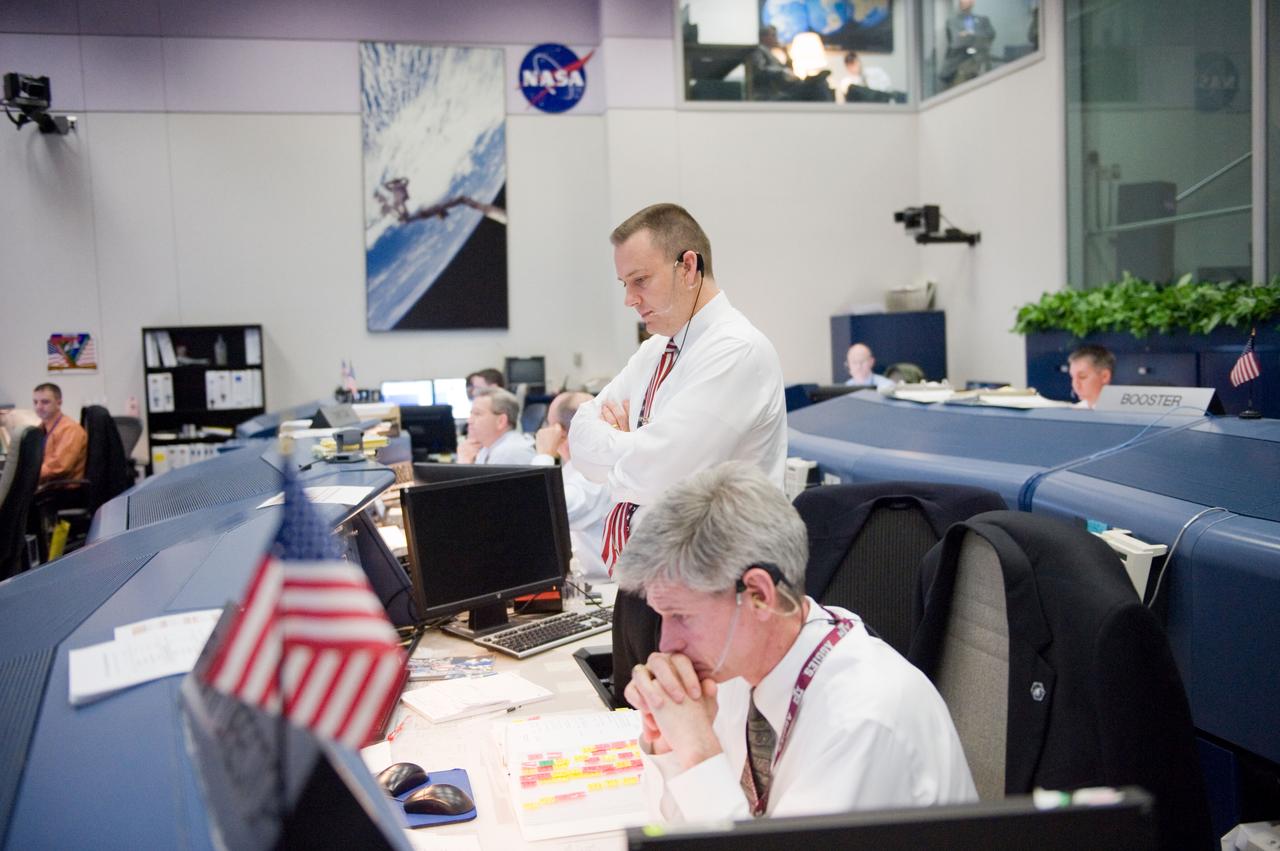
JSC2010-E-018996 (7 Feb. 2010) --- Flight directors Norm Knight (standing) and Bryan Lunney monitor data at their consoles in the space shuttle flight control room in the Johnson Space Center's Mission Control Center during the first launch attempt of the STS-130 mission. The launch was postponed until Feb. 8, due to weather conditions.
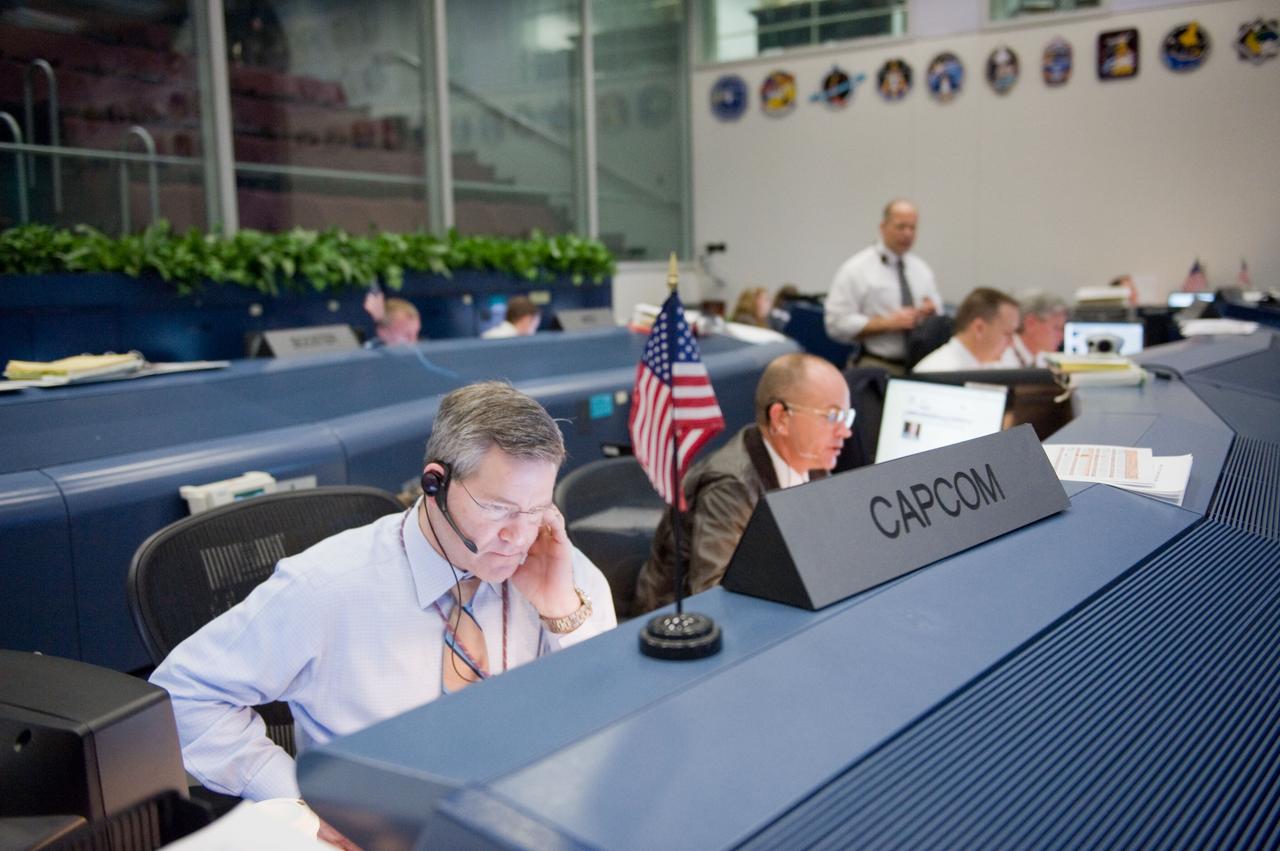
JSC2010-E-018924 (7 Feb. 2010) --- Astronauts Steve Frick (left) and Rick Sturckow, both STS-130 spacecraft communicators (CAPCOM), monitor data at their consoles in the space shuttle flight control room in the Johnson Space Center's Mission Control Center as they anticipate the launch of STS-130. The launch attempt was later postponed until Feb. 8, due to weather conditions.
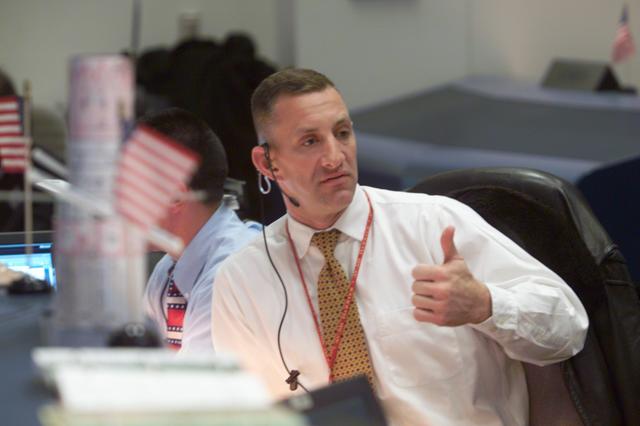
JSC2002-E-08143 (1 March 2002) --- Astronaut Charles O. Hobaugh, seated at the Spacecraft Communicator (CAPCOM) console in the Shuttle Flight Control Room of the Johnson Space Center's Mission Control Center, gives a thumbs up signal, obviously connected to improving weather at the launch site for the Space Shuttle Columbia several hundred miles away in Florida. Astronaut William A. Oefelein is partially obscured in the background.
NASA mission managers watch the latest weather radar on a monitor in Firing Room Four of the Launch Control Center at NASA's Kennedy Space Center in Cape Canaveral, Florida, Sunday, July 12, 2009. Endeavour is set to launch at 7:13p.m. EDT with the crew of STS-127 and start a 16-day mission that will feature five spacewalks and complete construction of the Japan Aerospace Exploration Agency's Kibo laboratory. Photo Credit: (NASA/Bill Ingalls)
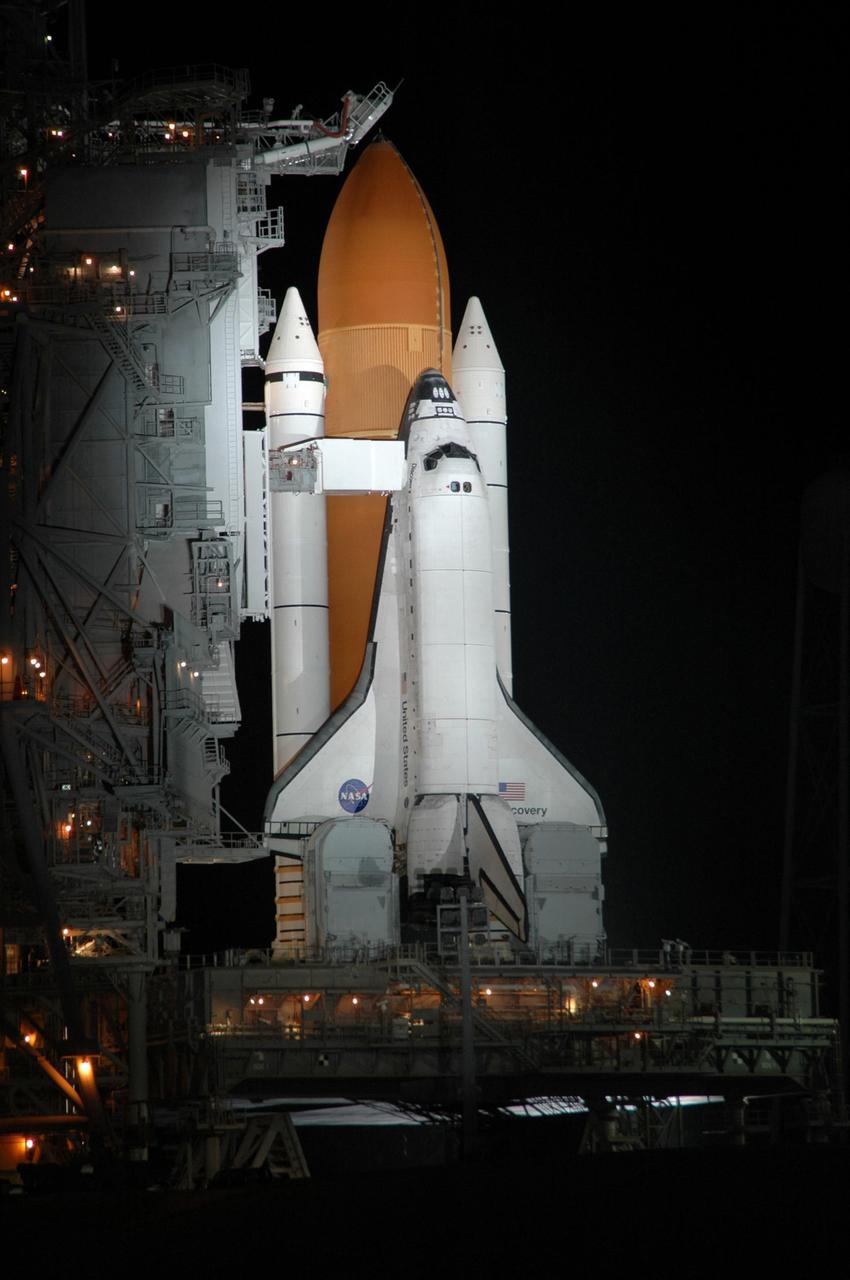
KENNEDY SPACE CENTER, FLA. - On Launch Pad 39B, Space Shuttle Discovery is bathed in spotlights under dark skies after the scrub of the launch attempt on mission STS-121. The White Room extends toward the cockpit area where the STS-121 crew patiently waited for the launch just hours earlier. The launch was scrubbed due to weather concerns and postponed 24 hours. Photo credit: NASA/Ken Thornsley
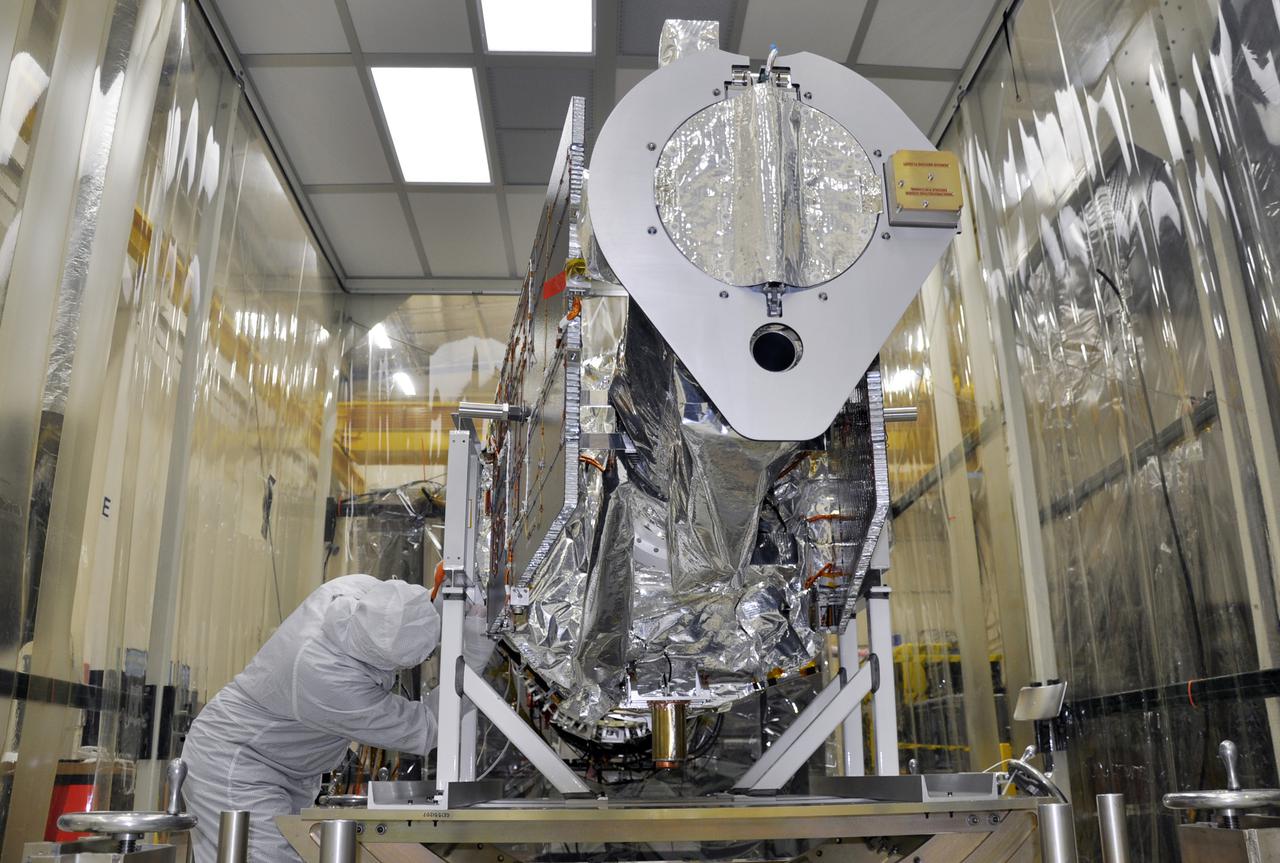
VANDENBERG AFB, Calif. – A technician finishes removing protective Mylar wrapping from NASA's IRIS spacecraft in a clean room at Vandenberg where the spacecraft will be readied for launch aboard an Orbital Sciences Pegasus XL rocket. IRIS is short for Interface Region Imaging Spectrograph and the spacecraft's mission will improve our understanding of how heat and energy move through the deepest levels of the sun’s atmosphere, thereby increasing our ability to forecast space weather. Photo credit: VAFB_Randy Beaudoin
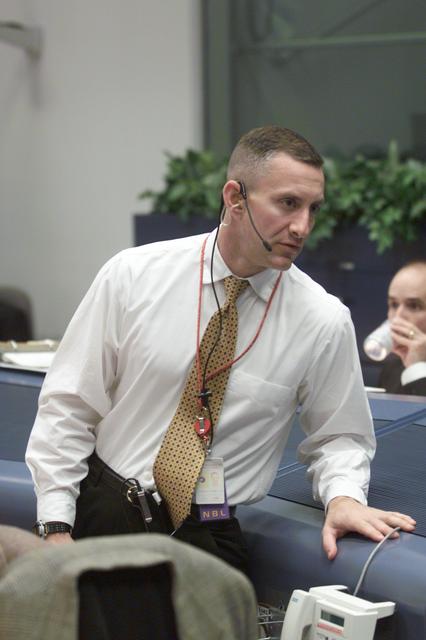
JSC2002-E-08145 (1 March 2002) --- Astronaut Charles Hobaugh, standing near the Spacecraft Communicator (CAPCOM) console in the Shuttle Flight Control Room of the Johnson Space Center's Mission Control Center, talks with astronaut Mark L. Polansky (out of frame), STS-109 ascent CAPCOM. They were monitoring the pre-launch situation at the Kennedy Space Center launch site, several hundred miles away. Hobaugh's duties, among others, were to keep up with weather conditions at and around the launch site.
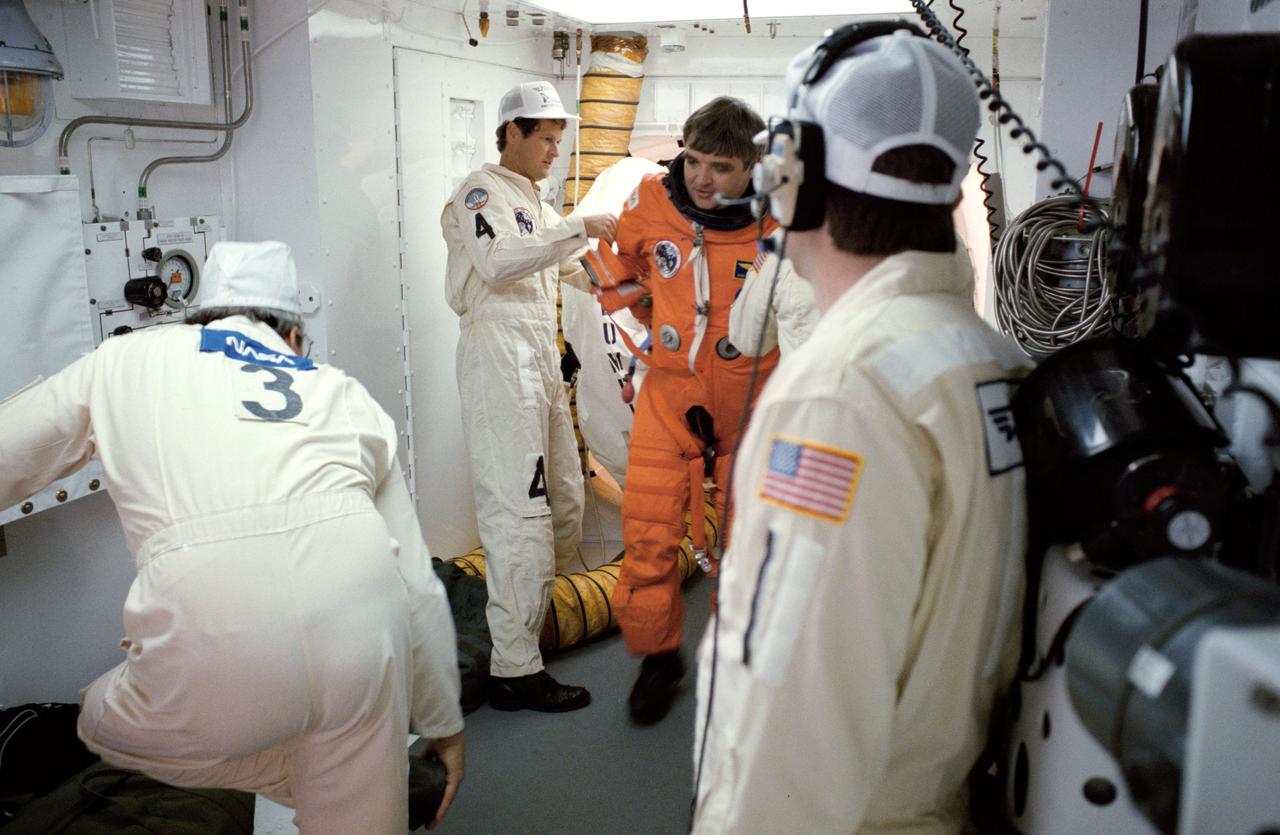
STS032-S-062 (9 Jan 1990) --- Inside the White Room at Launch Pad 39A, a suit technician helps astronaut Daniel C. Brandenstein, mission commander, suit up for the launch of the orbiter Columbia on Shuttle Mission STS-32. Dubious weather at the return-to-launch site (RTLS) caused postponement of yesterday's planned launch. During the ten day mission, the five member crew is scheduled to deploy the SYNCOM IV-5 military communications satellite and retrieve the Long Duration Exposure Facility.
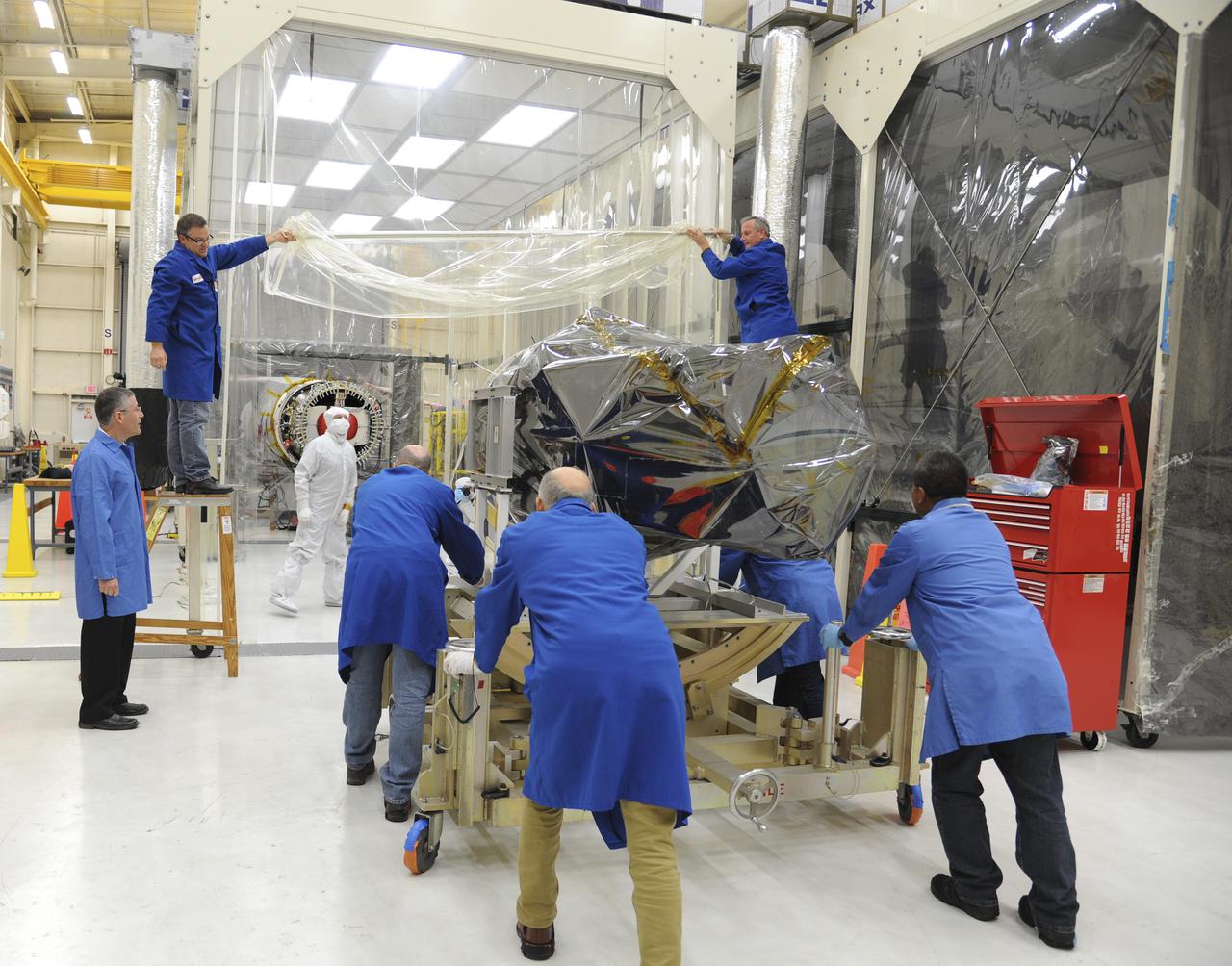
VANDENBERG AFB, Calif. – Technicians move NASA's IRIS spacecraft into a clean room at Vandenberg where the spacecraft will be readied for launch aboard an Orbital Sciences Pegasus XL rocket. IRIS is short for Interface Region Imaging Spectrograph and the spacecraft's mission will improve our understanding of how heat and energy move through the deepest levels of the sun’s atmosphere, thereby increasing our ability to forecast space weather. Photo credit: VAFB_Doug Gruber
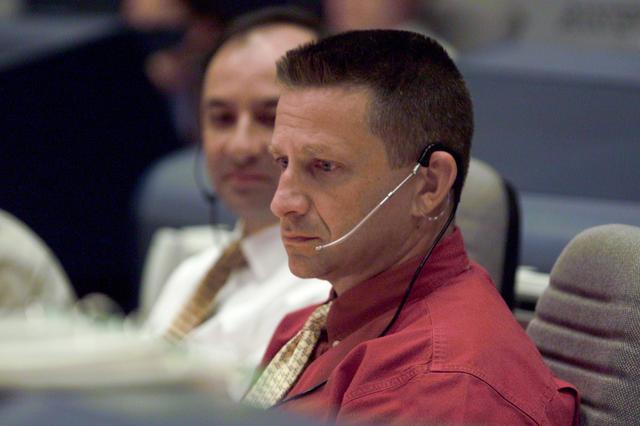
JSC2001-E-21329 (12 July 2001) --- Astronaut Christopher J. (Gus) Loria, STS-104 spacecraft communicator (CAPCOM), intently studies pre-flight data at his console in the shuttle flight control room (WFCR) in Houston's Mission Control Center (MCC) prior to the launch of Space Shuttle Atlantis. Fellow astronaut Mark L. Polansky monitors weather issues in the background.
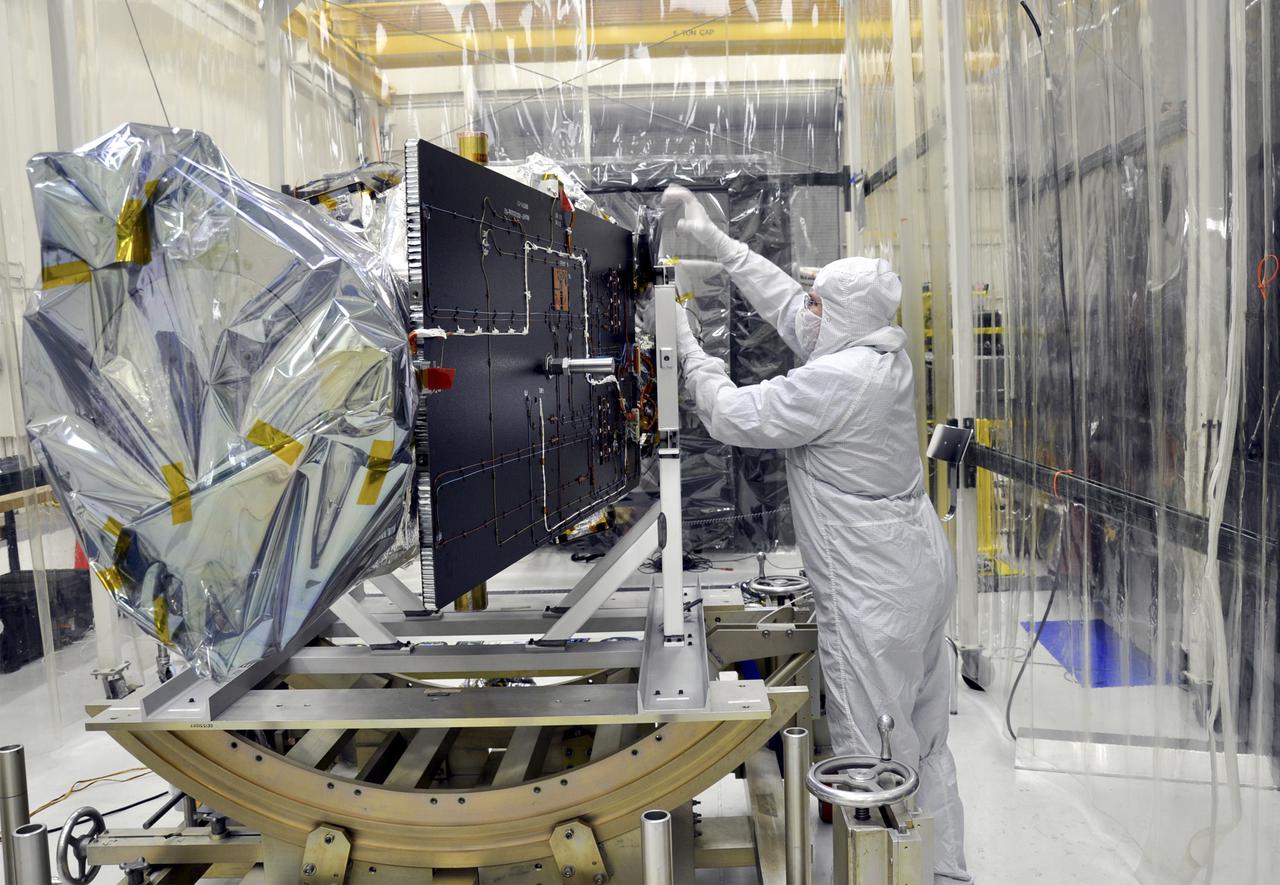
VANDENBERG AFB, Calif. – A technician removes protective Mylar wrapping from NASA's IRIS spacecraft in a clean room at Vandenberg where the spacecraft will be readied for launch aboard an Orbital Sciences Pegasus XL rocket. IRIS is short for Interface Region Imaging Spectrograph and the spacecraft's mission will improve our understanding of how heat and energy move through the deepest levels of the sun’s atmosphere, thereby increasing our ability to forecast space weather. Photo credit: VAFB_Randy Beaudoin
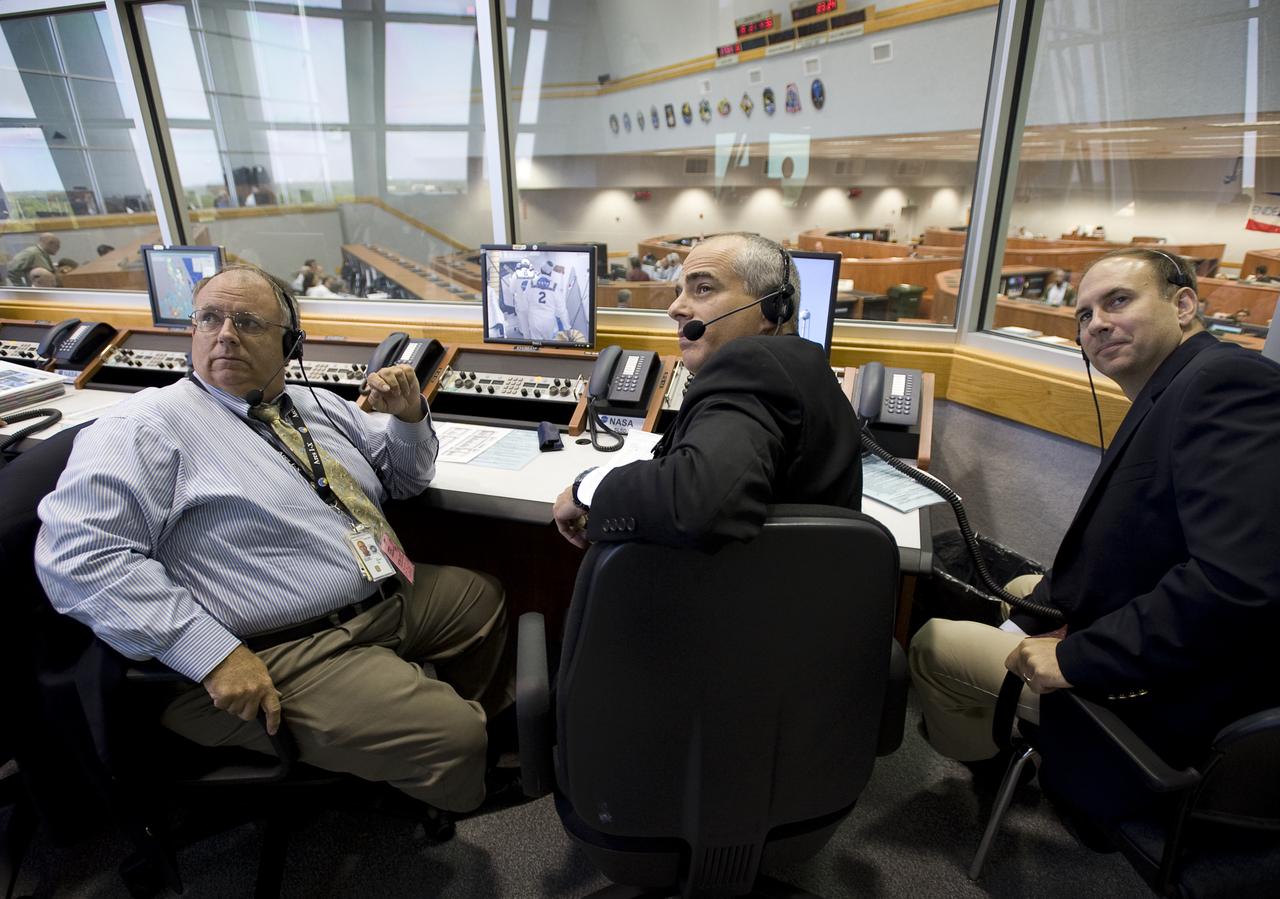
NASA mission managers watch the latest weather radar on a monitor in Firing Room Four of the Launch Control Center at NASA's Kennedy Space Center in Cape Canaveral, Florida, Sunday, July 12, 2009. Endeavour is set to launch at 7:13p.m. EDT with the crew of STS-127 and start a 16-day mission that will feature five spacewalks and complete construction of the Japan Aerospace Exploration Agency's Kibo laboratory. Photo Credit: (NASA/Bill Ingalls)

VANDENBERG AFB, Calif. – NASA's IRIS spacecraft stands in a clean room at Vandenberg where the spacecraft will be readied for launch aboard an Orbital Sciences Pegasus XL rocket. IRIS is short for Interface Region Imaging Spectrograph and the spacecraft's mission will improve our understanding of how heat and energy move through the deepest levels of the sun’s atmosphere, thereby increasing our ability to forecast space weather. Photo credit: VAFB_Randy Beaudoin

JSC2001-E-12118 (19 April 2001) --- Left to right, astronaut Christopher J. (Gus) Loria, astronaut Scott D. Altman, flight director LeRoy Cain and flight director John Shannon keep up with STS-100 pre-launch activities from their consoles in the shuttle flight control room in Houston's Mission Control Center (MCC). Altman is ascent spacecraft communicator (CAPCOM) and is assisted by Loria, CAPCOM specializing in weather issues. Cain is ascent flight director.
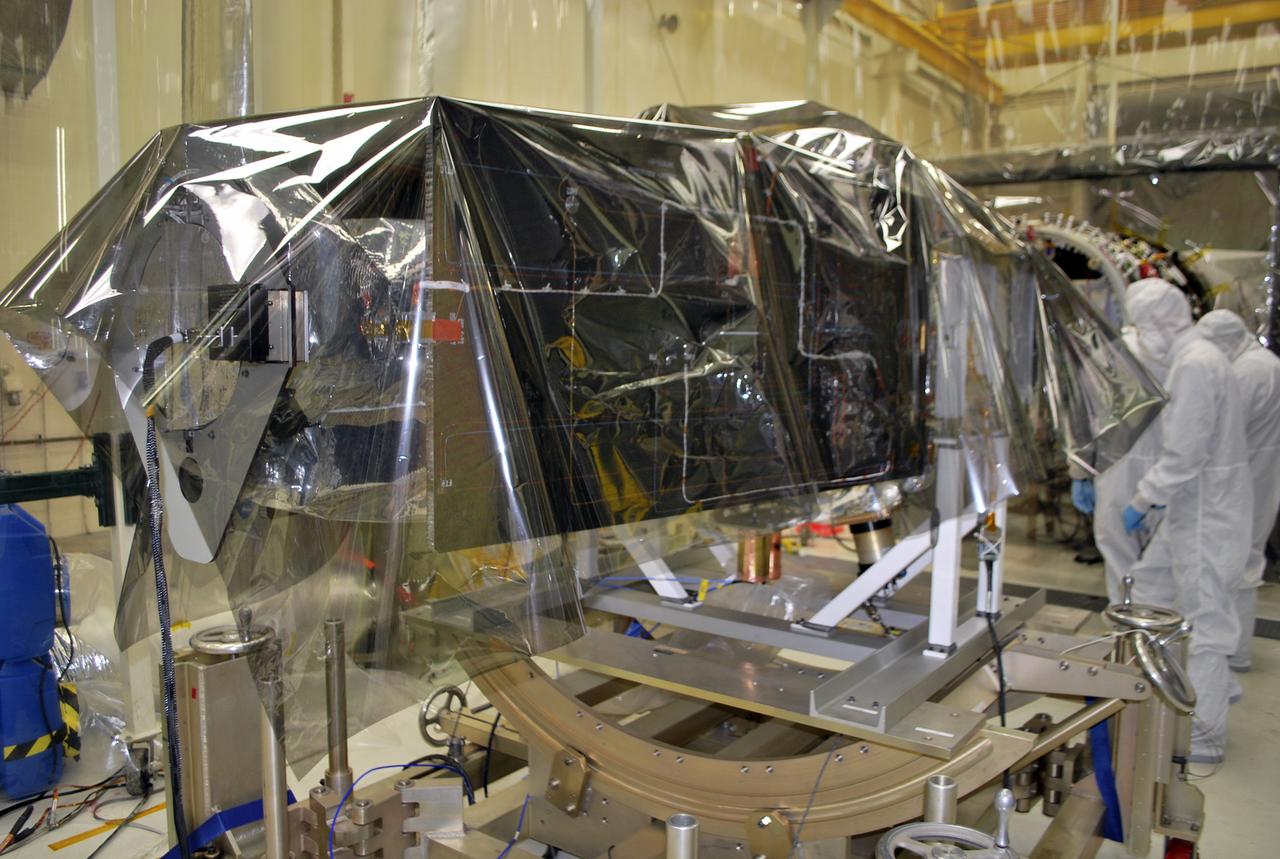
VANDENBERG AFB, Calif. – Technicians process NASA's IRIS spacecraft for launch aboard an Orbital Pegasus XL rocket. Working inside a clean room tent at Vandenberg, the technicians will conduct numerous tests and assembly operations on the spacecraft and rocket ahead of the launch. IRIS is short for Interface Region Imaging Spectrograph and the spacecraft's mission will improve our understanding of how heat and energy move through the deepest levels of the sun’s atmosphere, thereby increasing our ability to forecast space weather. Photo credit: VAFB_Randy Beaudoin
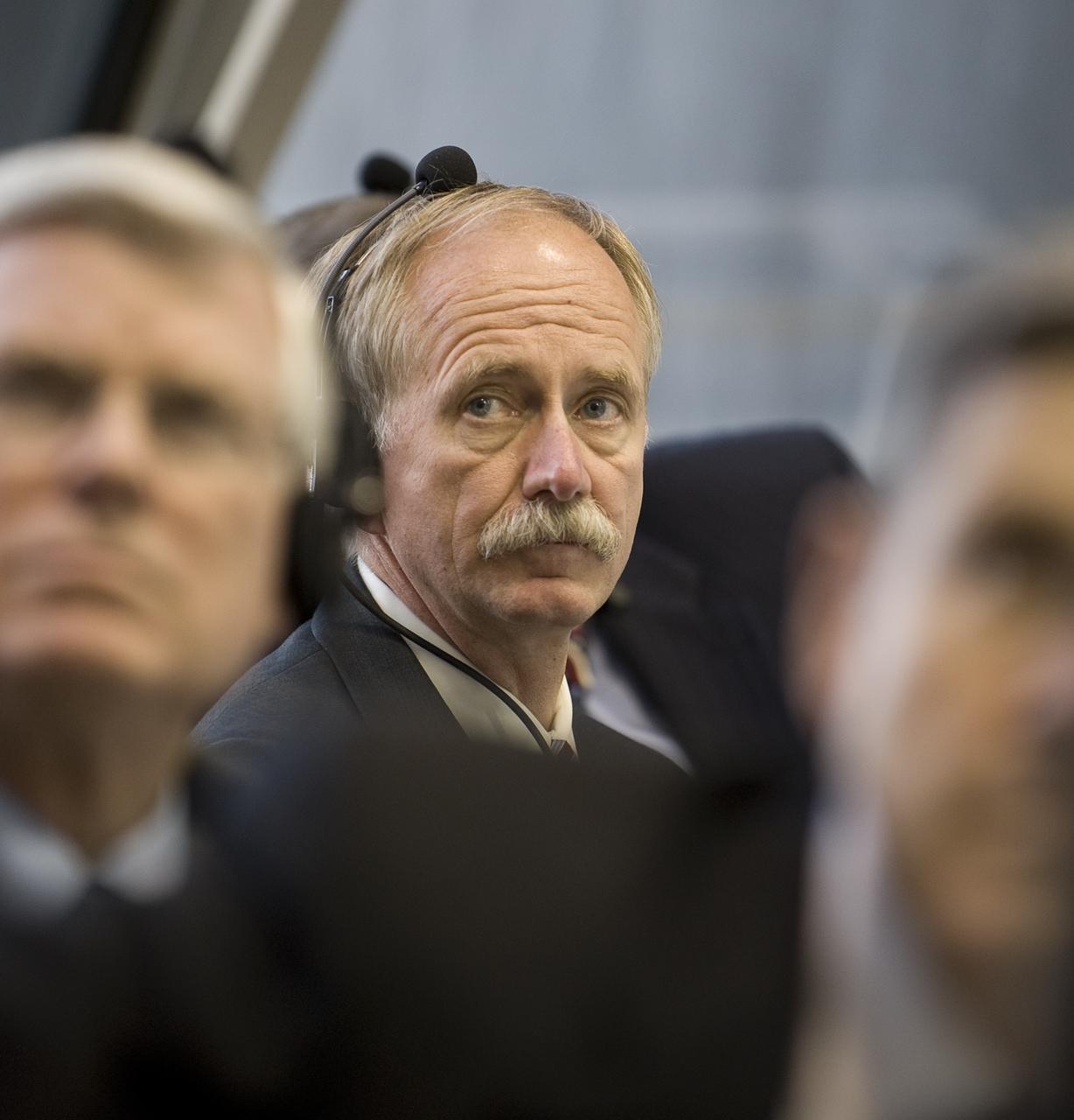
NASA Associate Administrator for Space Operations William Gerstenmaier watches the latest weather radar from Firing Room Four of the Launch Control Center at NASA's Kennedy Space Center in Cape Canaveral, Florida, Sunday, July 12, 2009. Endeavour is set to launch at 7:13p.m. EDT with the crew of STS-127 and start a 16-day mission that will feature five spacewalks and complete construction of the Japan Aerospace Exploration Agency's Kibo laboratory. Photo Credit: (NASA/Bill Ingalls)

John P. Shannon, Manager, NASA Space Shuttle Program Office watches the latest weather radar in Firing Room Four of the Launch Control Center at NASA's Kennedy Space Center in Cape Canaveral, Florida, Sunday, July 12, 2009. Endeavour is set to launch at 7:13p.m. EDT with the crew of STS-127 and start a 16-day mission that will feature five spacewalks and complete construction of the Japan Aerospace Exploration Agency's Kibo laboratory. Photo Credit: (NASA/Bill Ingalls)
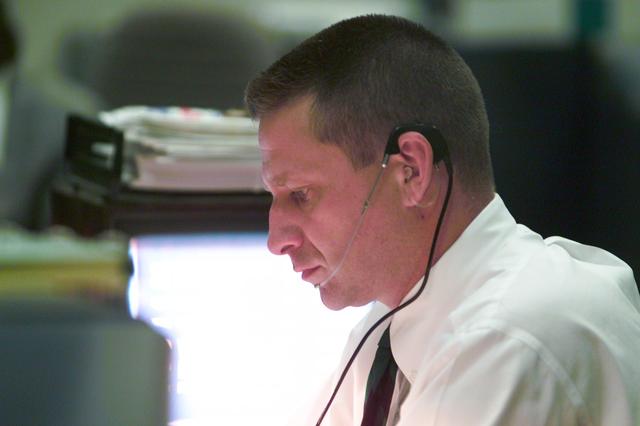
JSC2001-E-12117 (19 April 2001) --- Astronaut Christopher J. (Gus) Loria, at the Spacecraft Communicator (CAPCOM) console, peruses information on monitors and displays at his console in the flight control room in the Johnson Space Center's Mission Control Center (MCC) as countdown for the Space Shuttle Endeavour launch of STS-100 continues several hundred miles away in Florida. Loria deals with weather issues in the respective areas for both ascent and entry phases of the STS-100 mission.
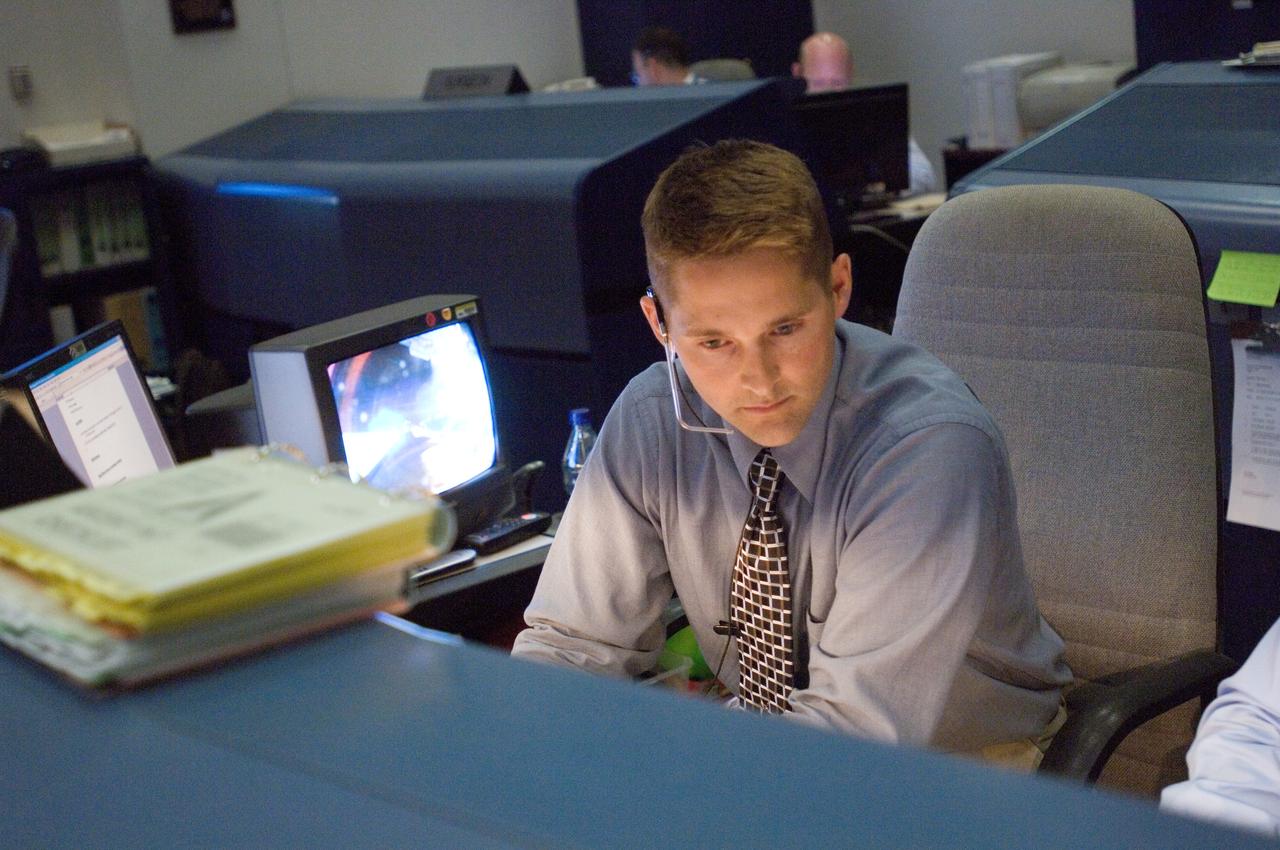
JSC2007-E-41734 (8 Aug. 2007) --- At the CAPCOM console in the space shuttle flight operations control room of Houston's Mission Control Center, astronaut James P. (Jim) Dutton Jr., STS-118 spacecraft communicator, monitors pre-launch activities of the Space Shuttle Endeavour, several hundred miles away in Florida. Dutton was assigned to watch weather at geographic areas involved in the launch.
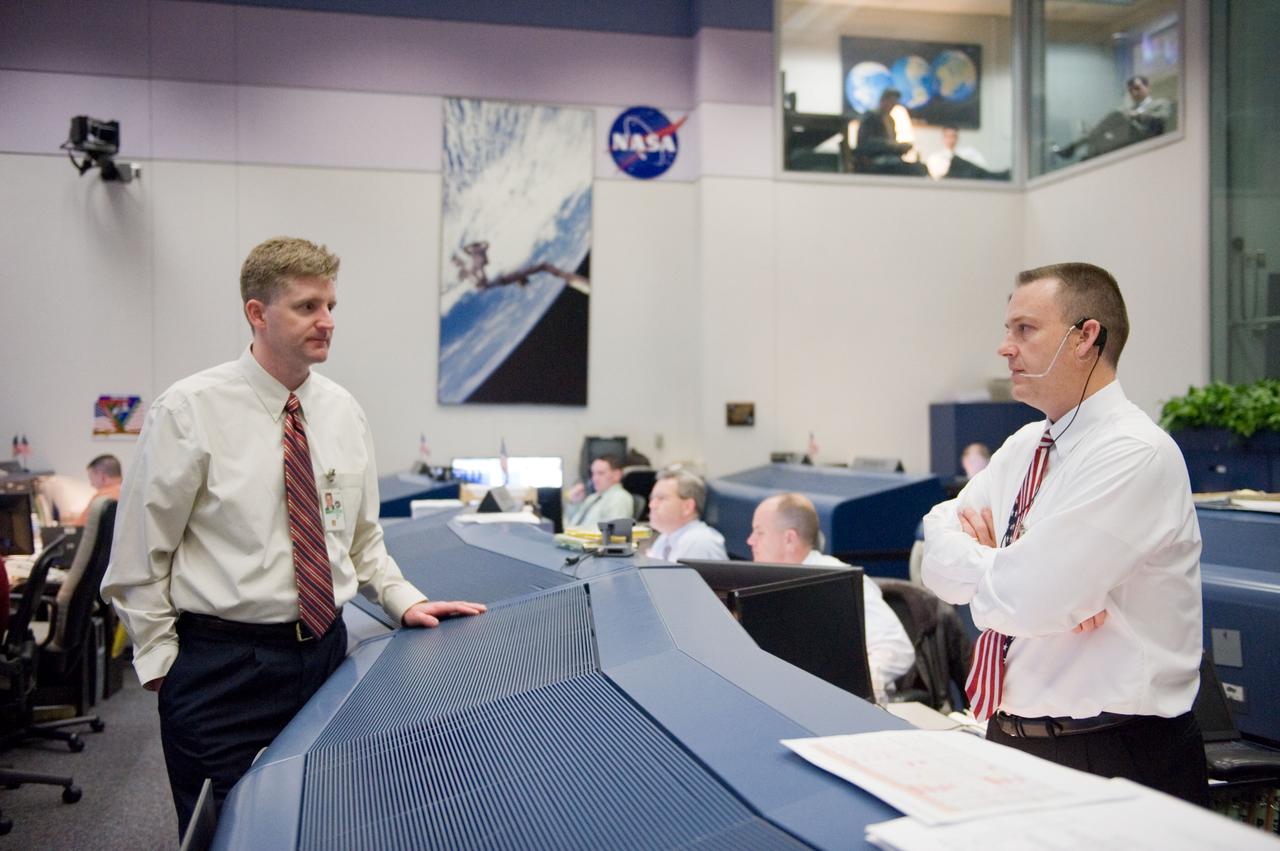
JSC2010-E-018949 (7 Feb. 2010) --- Flight director Norm Knight (right) and flight controller Mark McDonald are pictured in the space shuttle flight control room in the Johnson Space Center's Mission Control Center during the first launch attempt of the STS-130 mission. The launch was postponed until Feb. 8, due to weather conditions.
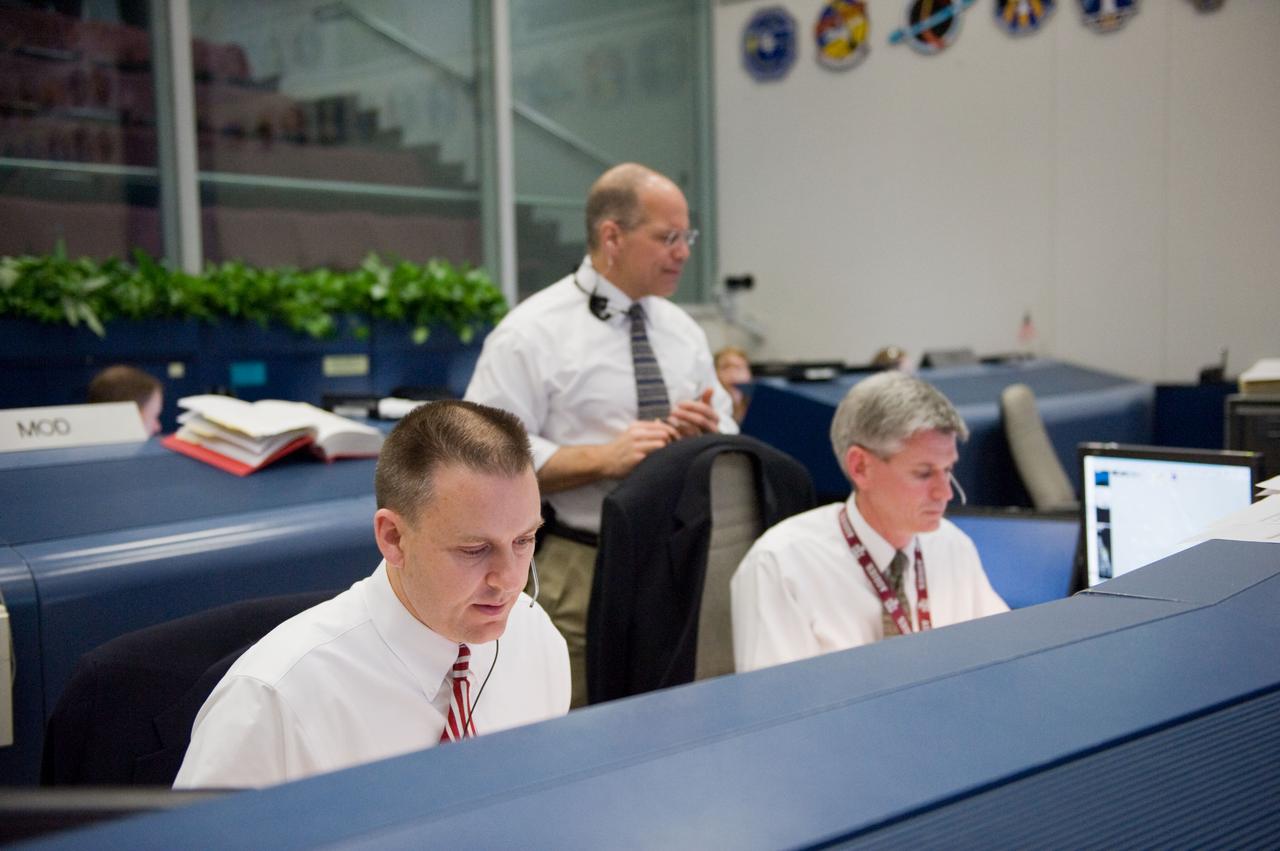
JSC2010-E-018923 (7 Feb. 2010) --- Flight directors Norm Knight (left), Bryan Lunney and Tony Ceccacci (standing) are pictured in the space shuttle flight control room in the Johnson Space Center's Mission Control Center as they anticipate the launch of STS-130. The launch attempt was later postponed until Feb. 8, due to weather conditions.
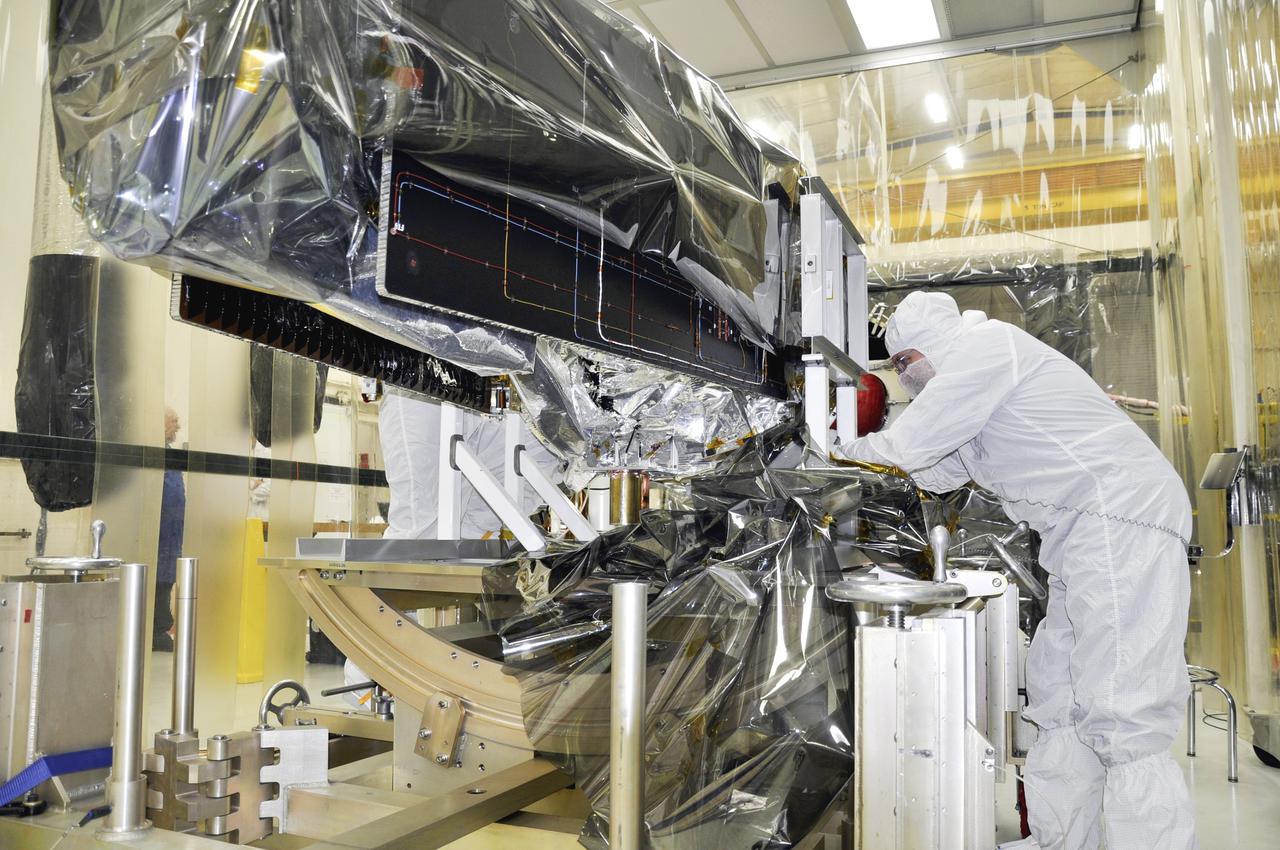
VANDENBERG AFB, Calif. – A technician removes protective Mylar wrapping from NASA's IRIS spacecraft in a clean room at Vandenberg where the spacecraft will be readied for launch aboard an Orbital Sciences Pegasus XL rocket. IRIS is short for Interface Region Imaging Spectrograph and the spacecraft's mission will improve our understanding of how heat and energy move through the deepest levels of the sun’s atmosphere, thereby increasing our ability to forecast space weather. Photo credit: VAFB_Randy Beaudoin
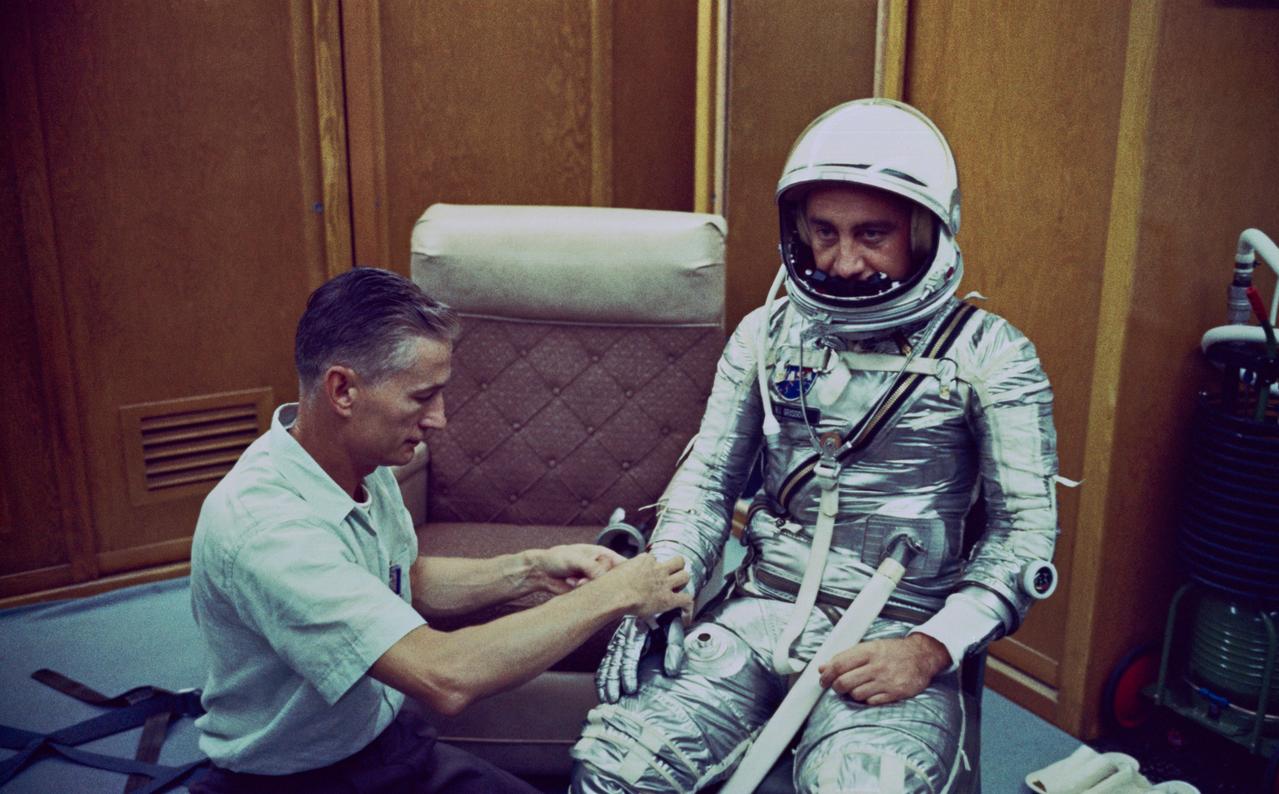
S88-55875 (19 July 1961) --- Donning a spacesuit for the Mercury-Redstone 4 (MR-4) mission, astronaut Virgil I. (Gus) Grissom chats with spaceflight equipment specialist Joe W. Schmitt in the personal equipment room of Hangar S at Cape Canaveral, Florida. Shortly after this photograph was taken, the launch was postponed two days due to unfavorable weather conditions in the area. Photo credit: NASA
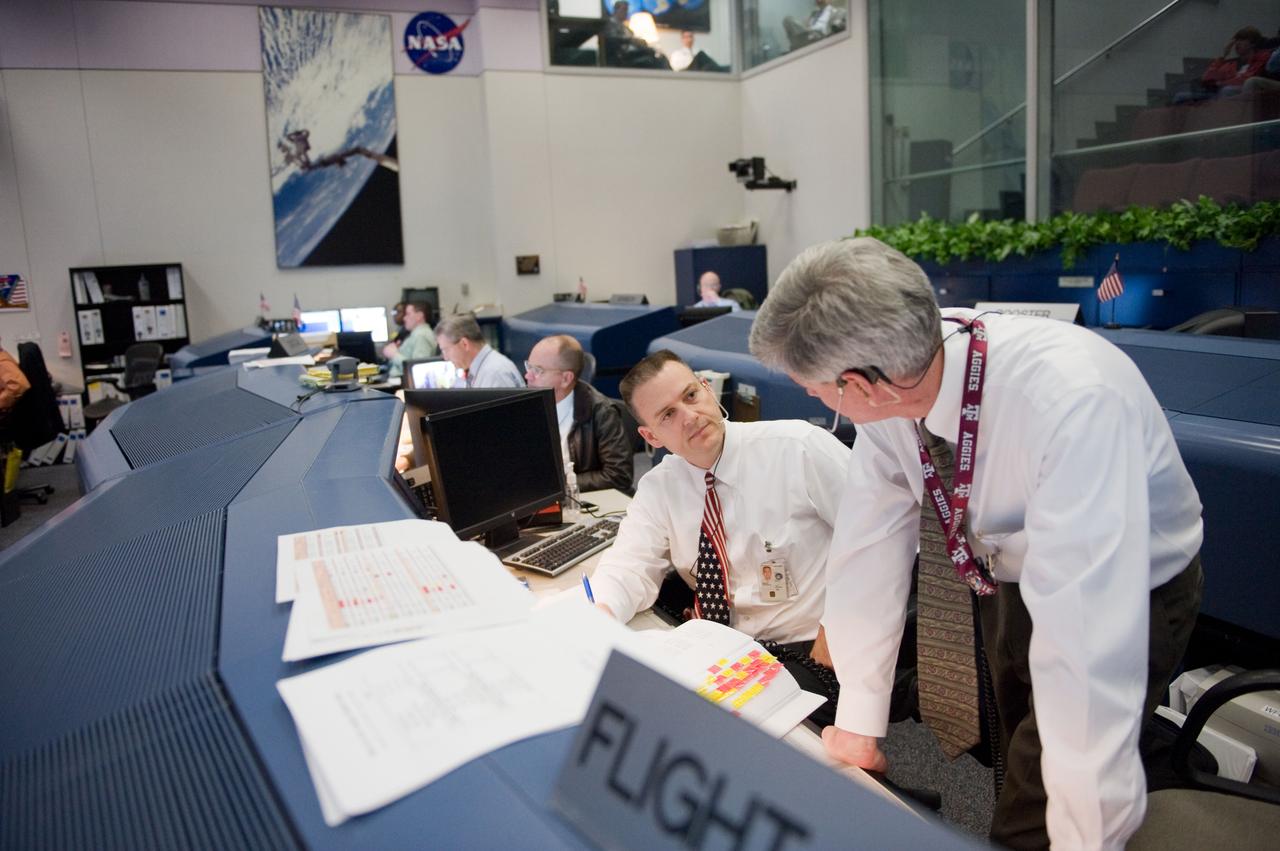
JSC2010-E-018935 (7 Feb. 2010) --- Flight directors Norm Knight (left) and Bryan Lunney are pictured at their consoles in the space shuttle flight control room in the Johnson Space Center's Mission Control Center during the first launch attempt of the STS-130 mission. The launch was postponed until Feb. 8, due to weather conditions.
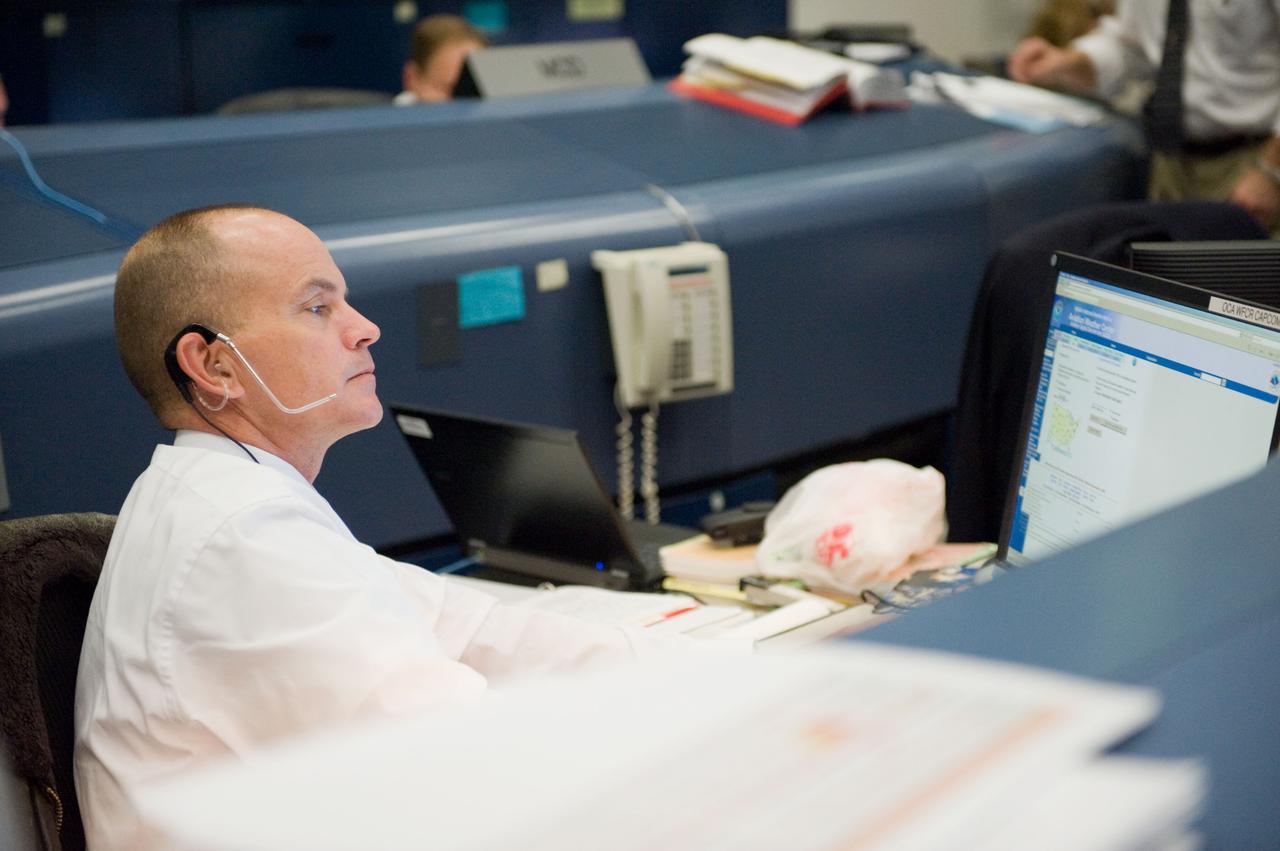
JSC2010-E-018976 (7 Feb. 2010) --- Astronaut Rick Sturckow, STS-130 spacecraft communicator (CAPCOM), is pictured at his console in the space shuttle flight control room in the Johnson Space Center's Mission Control Center during the first launch attempt of the STS-130 mission. The launch was postponed until Feb. 8, due to weather conditions.

NASA management look at the weather from the NASA Kennedy Space Center, Firing Room Four of the Launch Control Center (LCC) during the countdown to the launch of the space shuttle Atlantis on Friday, July 8, 2011, in Cape Canaveral, Fla. The launch of Atlantis, STS-135, is the final flight of the shuttle program, a 12-day mission to the International Space Station. Photo Credit: (NASA/Bill Ingalls)
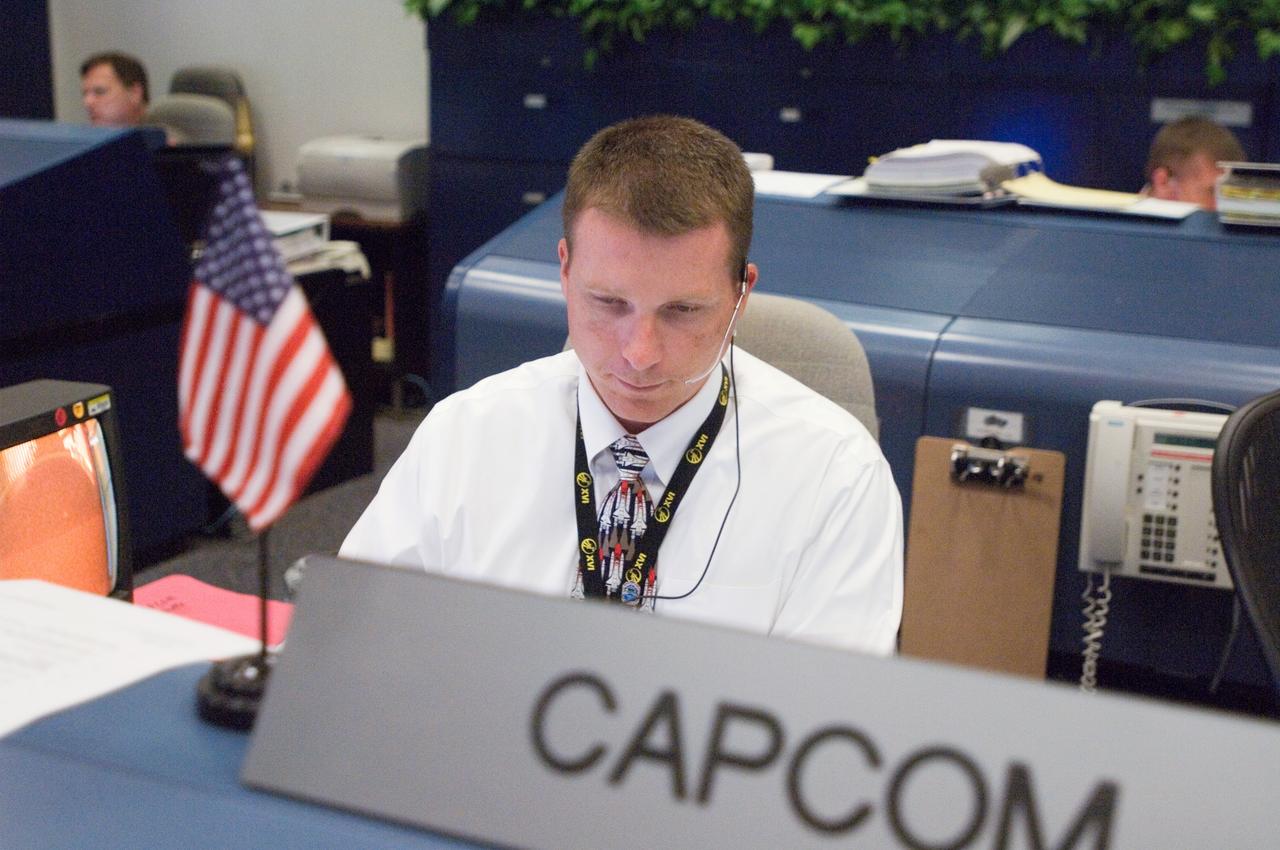
JSC2007-E-28281 (8 June 2007) --- In the space shuttle flight control room of Johnson Space Center's Mission Control Center (MCC), astronaut Terry W. Virts Jr., spacecraft communicator (CAPCOM), monitors weather data and launch countdown activities a few hundred miles away in Florida, site of Space Shuttle Atlantis' scheduled STS-117 launch. Liftoff occurred at 7:38 p.m. (EDT) on June 8, 2007 from launch pad 39A at Kennedy Space Center.
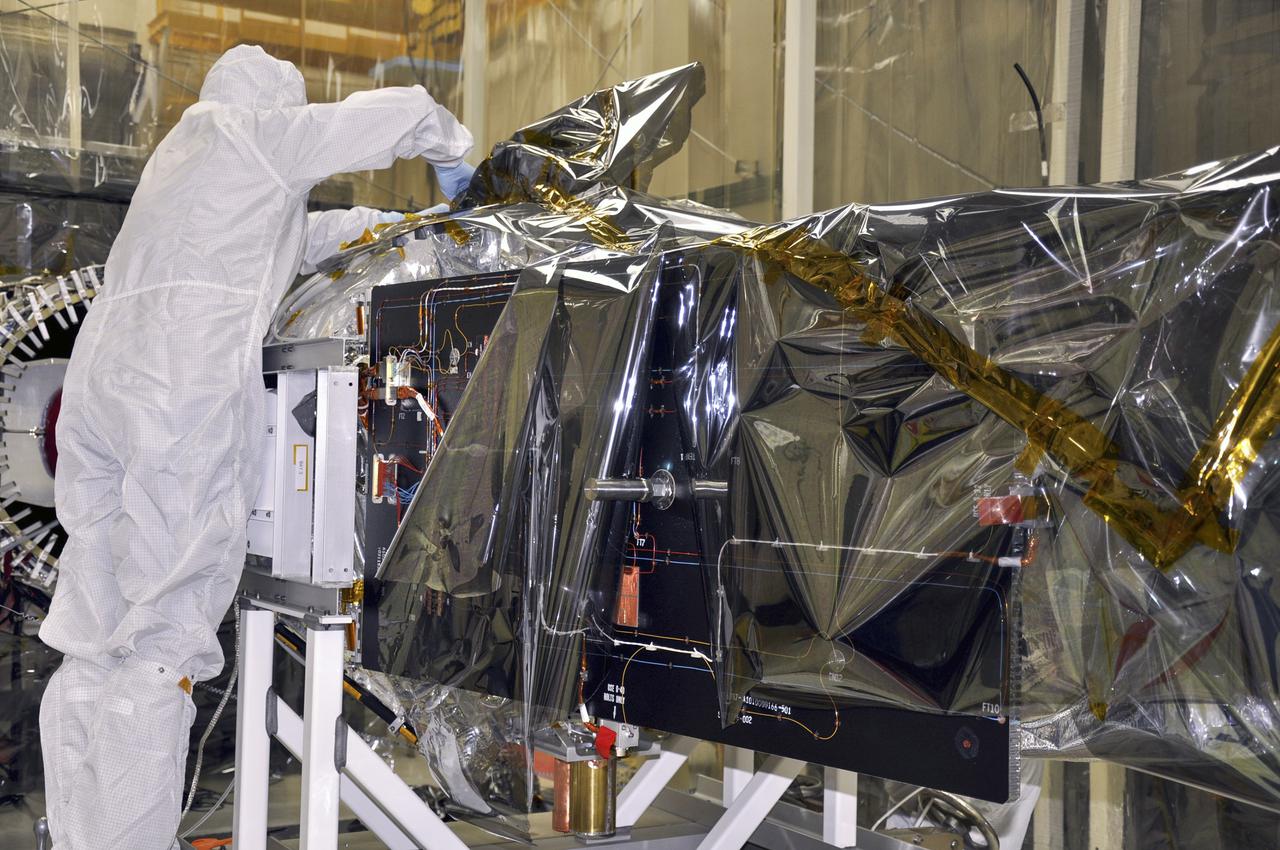
VANDENBERG AFB, Calif. – A technician removes protective Mylar wrapping from NASA's IRIS spacecraft in a clean room at Vandenberg where the spacecraft will be readied for launch aboard an Orbital Sciences Pegasus XL rocket. IRIS is short for Interface Region Imaging Spectrograph and the spacecraft's mission will improve our understanding of how heat and energy move through the deepest levels of the sun’s atmosphere, thereby increasing our ability to forecast space weather. Photo credit: VAFB_Randy Beaudoin
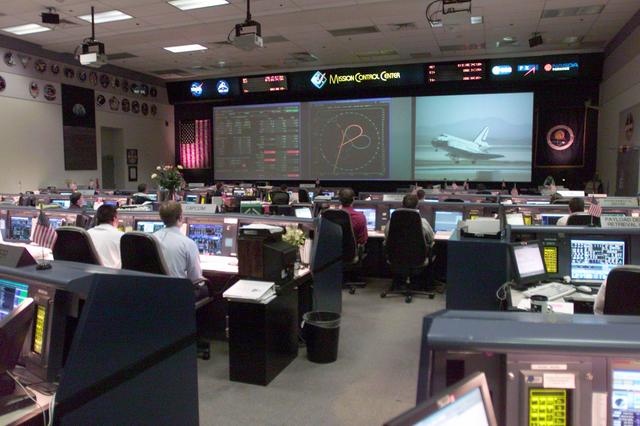
JSC2002-E-26015 (19 June 2002) --- The Space Shuttle Endeavour is shown on the big screen in this overall view of the shuttle flight control room (WFCR) in Houston’s Mission Control Center (MCC). The shuttle landed at Edwards Air Force Base, California at 10:58 a.m. (PDT) on June 19, 2002. The landing site was switched to Edwards after three days of wave offs at Kennedy Space Center, Florida, due to unacceptable weather conditions.
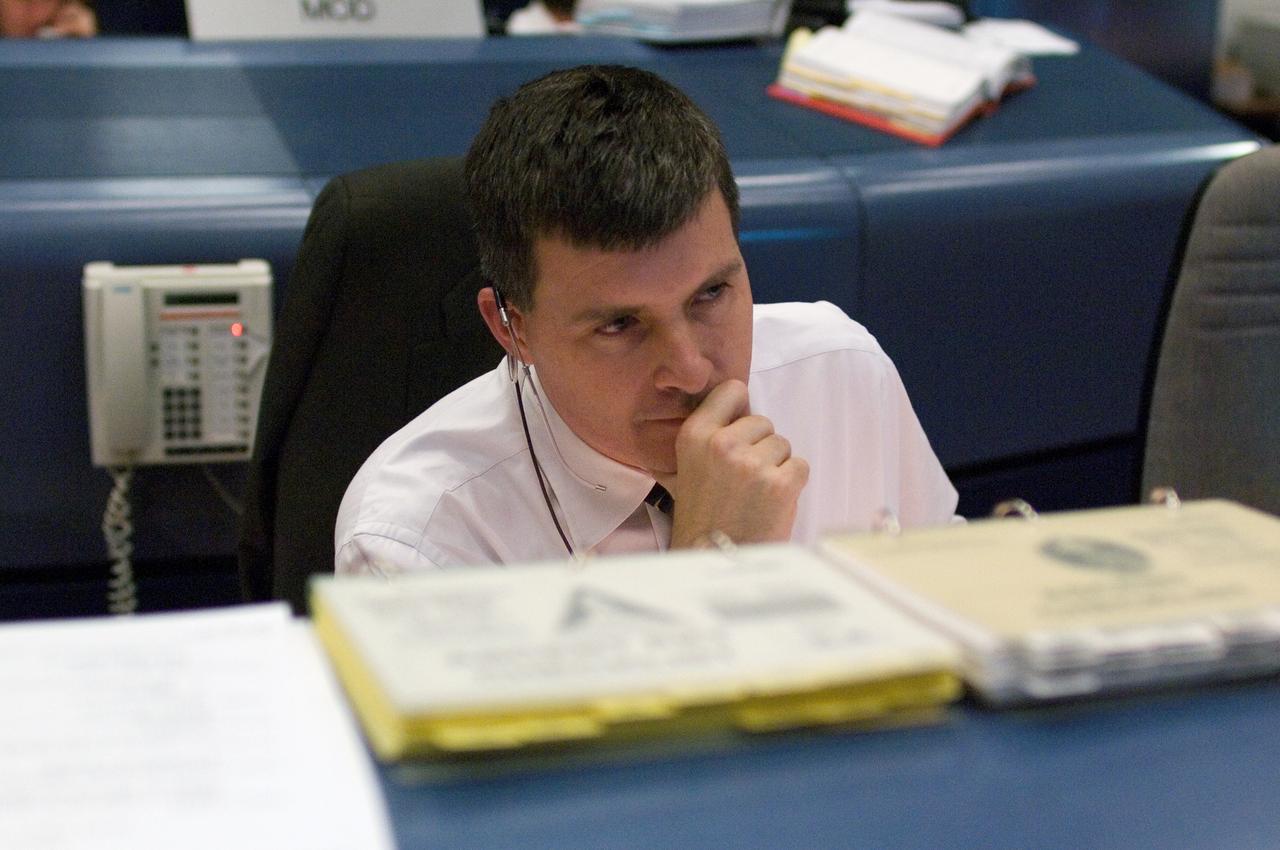
JSC2006-E-53281 (7 Dec. 2006) --- Steve Stich, STS-116 ascent flight director, monitors data and video at his console in the space shuttle flight control room within the Johnson Space Center's Mission Control Center. Flight controllers were anticipating the scheduled launch of the Space Shuttle Discovery several hundred miles away in Florida, but questionable weather conditions later caused postponement of the liftoff until Dec. 9.
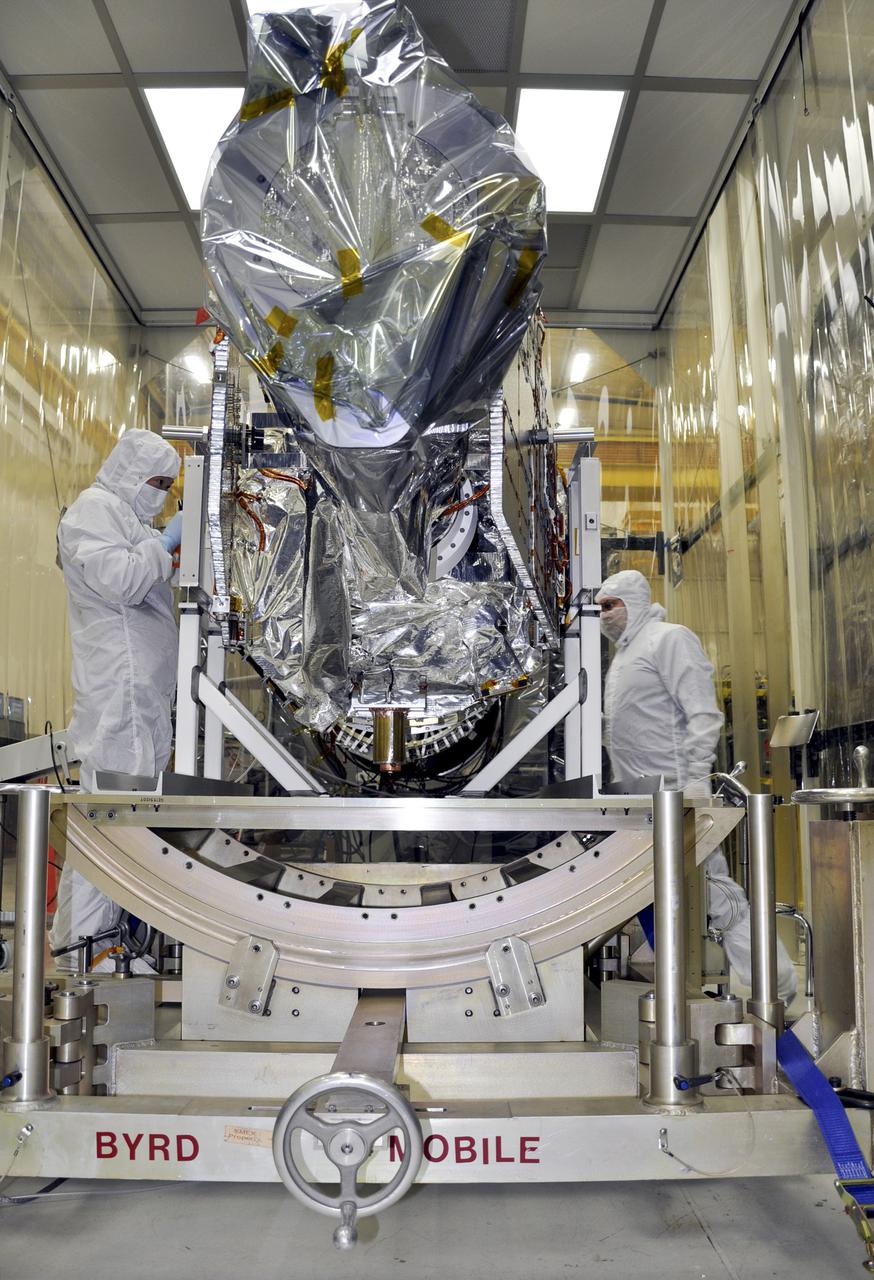
VANDENBERG AFB, Calif. – Technicians remove protective Mylar wrapping from NASA's IRIS spacecraft in a clean room at Vandenberg where the spacecraft will be readied for launch aboard an Orbital Sciences Pegasus XL rocket. IRIS is short for Interface Region Imaging Spectrograph and the spacecraft's mission will improve our understanding of how heat and energy move through the deepest levels of the sun’s atmosphere, thereby increasing our ability to forecast space weather. Photo credit: VAFB_Randy Beaudoin

JSC2001-E-21326 (12 July 2001) --- Astronaut Mark L. Polansky, STS-104 spacecraft communicator (CAPCOM) for weather issues, monitors pre-flight data at his console in the shuttle flight control room (WFCR) in Houston's Mission Control Center (MCC). Several hundred miles away in Florida, five astronauts were awaiting countdown in the crew cabin of the Space Shuttle Atlantis on the launch pad at the Kennedy Space Center (KSC).
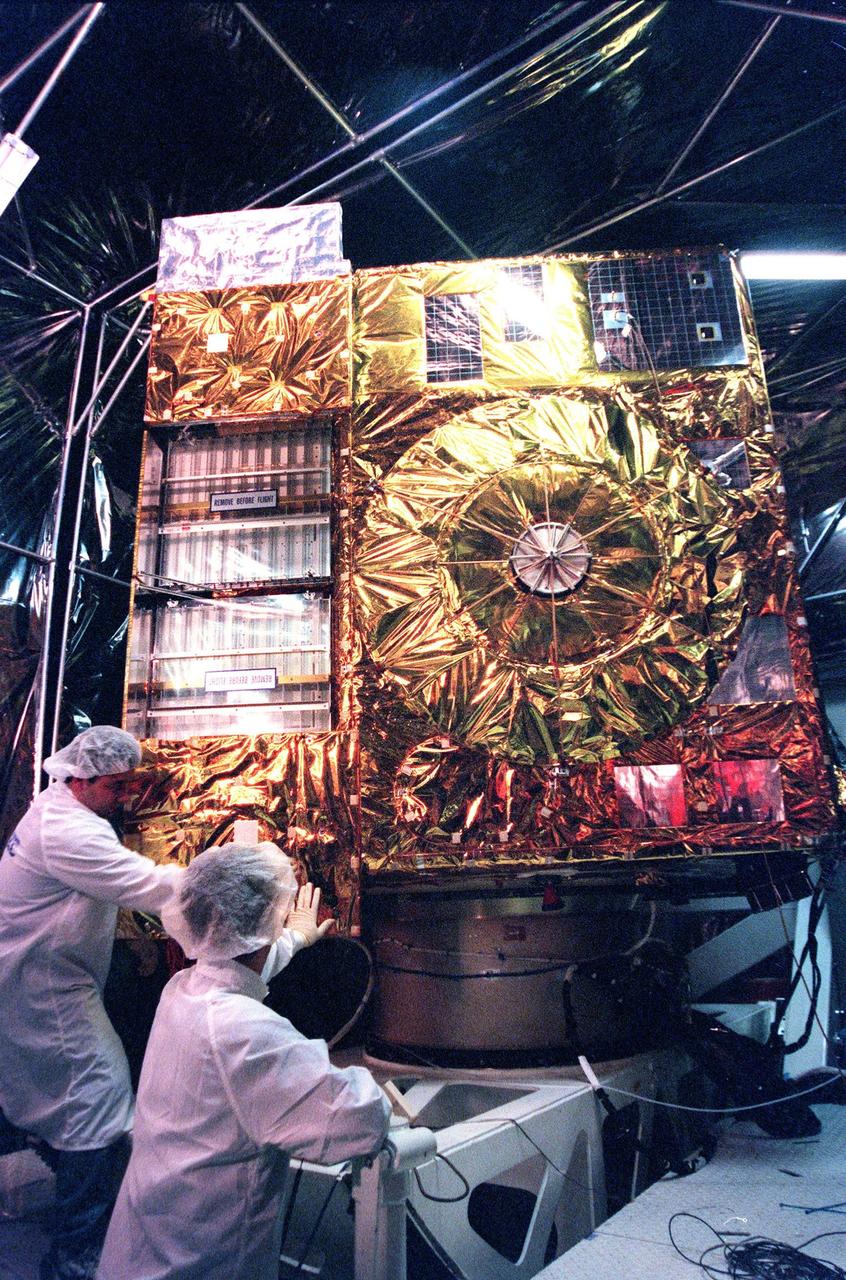
With the light casting a rosy glow in a specially built clean room at Astrotech, Titusville, Fla., Loral technicians Roberto Caballero (left) and Paul Giordano (right) maneuver the <a href="http://www-pao.ksc.nasa.gov/kscpao/captions/subjects/goes-l.htm">GOES-L</a> weather satellite into position for testing the deployment of the sounder instrument's cooler cover door. The sounder, one of two meteorological instruments on the satellite, measures temperature and moisture in a vertical column of air from the satellite to Earth. Its findings will help forecast weather. GOES-L, which is to be launched from Cape Canaveral Air Station aboard an Atlas II rocket in late March, is the fourth of a new advanced series of geostationary weather satellites for the National Oceanic and Atmospheric Administration. It is a three-axis inertially stabilized spacecraft that will provide pictures as well as perform the atmospheric sounding. Once launched, the satellite, to be designated GOES-11, will undergo checkout and provide backup capabilities for the existing, aging GOES East weather satellite
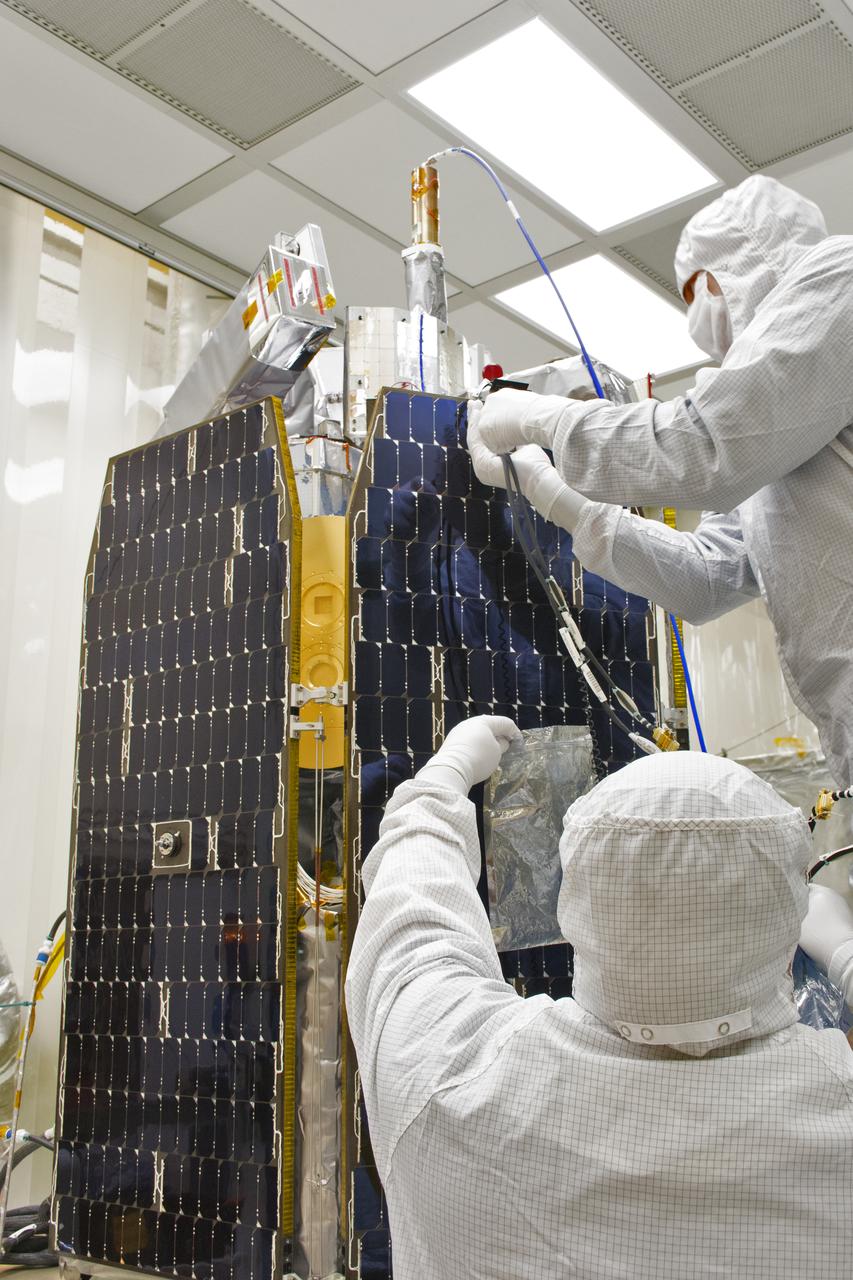
Technicians prepare NASA's Ionospheric Connection Explorer (ICON) for a solar array illumination test in a clean room inside Building 1555 at Vandenberg Air Force Base in California on May 4, 2018. The test checks for any imperfections and confirms that the solar arrays are functioning properly. The explorer will launch on June 15, 2018, from Kwajalein Atoll in the Marshall Islands (June 14 in the continental United States) on Orbital ATK's Pegasus XL rocket, which is attached to the company's L-1011 Stargazer aircraft. ICON will study the frontier of space - the dynamic zone high in Earth's atmosphere where terrestrial weather from below meets space weather above. The explorer will help determine the physics of Earth's space environment and pave the way for mitigating its effects on our technology, communications systems and society.
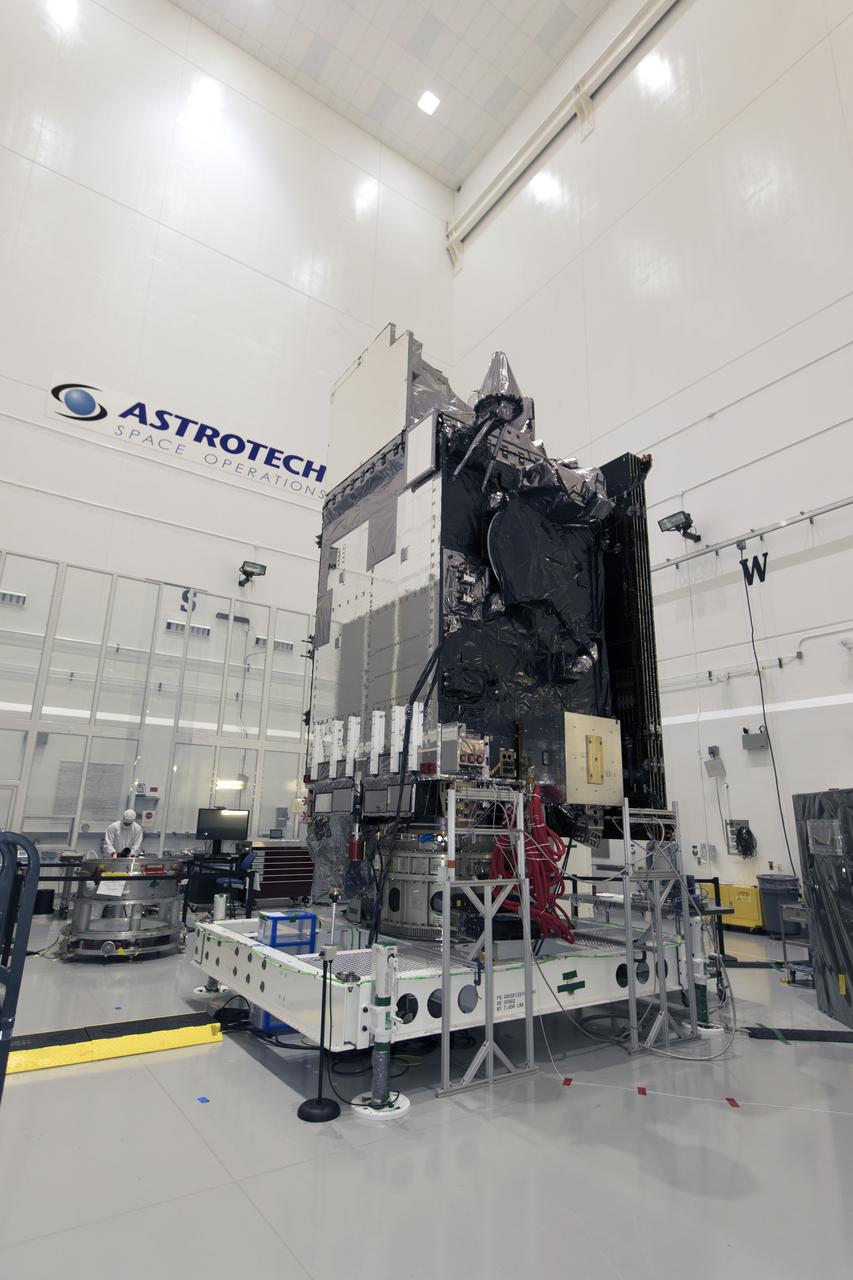
In a clean room at Astrotech Space Operations in Titusville, Florida, NOAA's Geostationary Operational Environmental Satellite-S, or GOES-S, is being prepared for encapsulation in it payload fairing. After encapsulation, the weather satellite will be moved to Space Launch Complex-41 at Cape Canaveral Air Force Station. GOES-S is the second in a series of four advanced geostationary weather satellites. The GOES-R series - consisting of the GOES-R, GOES-S, GOES-T and GOES-U spacecraft - will significantly improve the detection and observation of environmental phenomena that directly affect public safety, protection of property and the nation's economic health and prosperity. GOES-S is slated to launch March 1, 2018 aboard a United Launch Alliance Atlas V rocket.
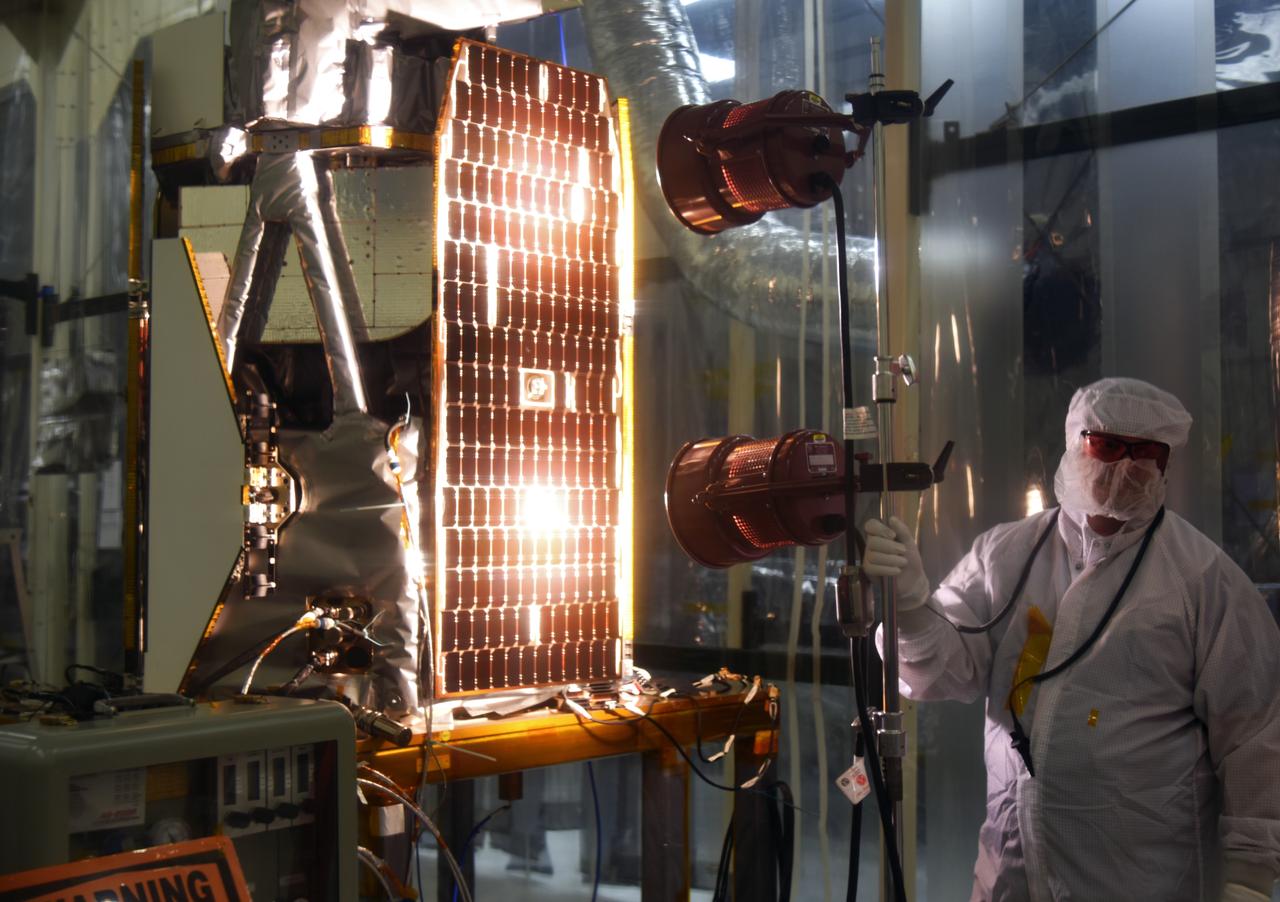
A solar array illumination test is performed on NASA's Ionospheric Connection Explorer (ICON) in a clean room on May 4, 2018, inside Building 1555 at Vandenberg Air Force Base in California. The test checks for any imperfections and confirms that the solar arrays are functioning properly. The explorer will launch on June 15, 2018, from Kwajalein Atoll in the Marshall Islands (June 14 in the continental United States) on Orbital ATK's Pegasus XL rocket, which is attached to the company's L-1011 Stargazer aircraft. ICON will study the frontier of space - the dynamic zone high in Earth's atmosphere where terrestrial weather from below meets space weather above. The explorer will help determine the physics of Earth's space environment and pave the way for mitigating its effects on our technology, communications systems and society.
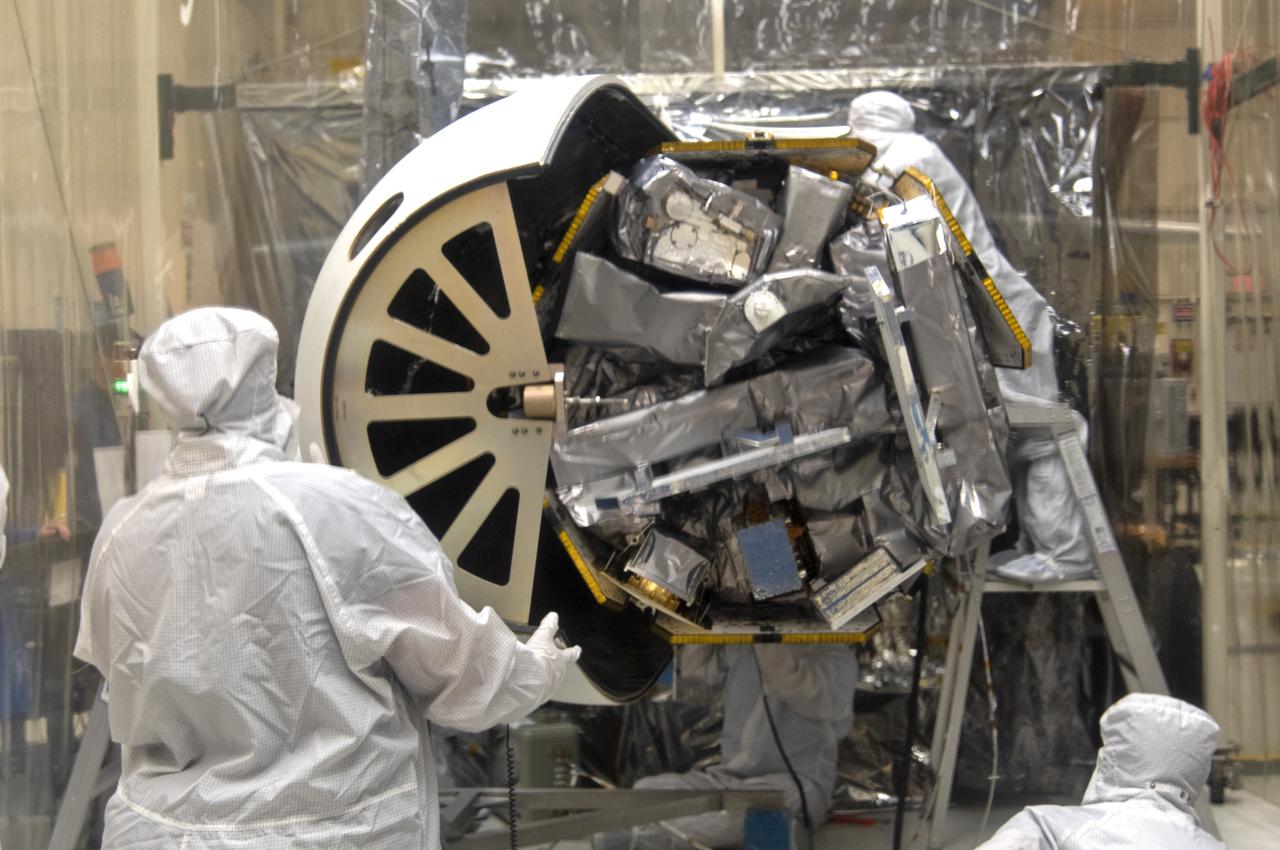
Inside a clean room in Building 1555 at Vandenberg Air Force Base in California, technicians begin to install the first half of the Northrop Grumman Pegasus XL payload fairing around NASA's Ionospheric Connection Explorer (ICON) on Aug. 22, 2018. ICON is being prepared for its launch on the Pegasus XL rocket, which is attached beneath the company's L-1011 Stargazer aircraft. Launch is scheduled for Oct. 26, from the Skid Strip at Cape Canaveral Air Force Station in Florida. ICON will study the frontier of space - the dynamic zone high in Earth's atmosphere where terrestrial weather from below meets space weather above. The explorer will help determine the physics of Earth's space environment and pave the way for mitigating its effects on our technology, communications systems and society.
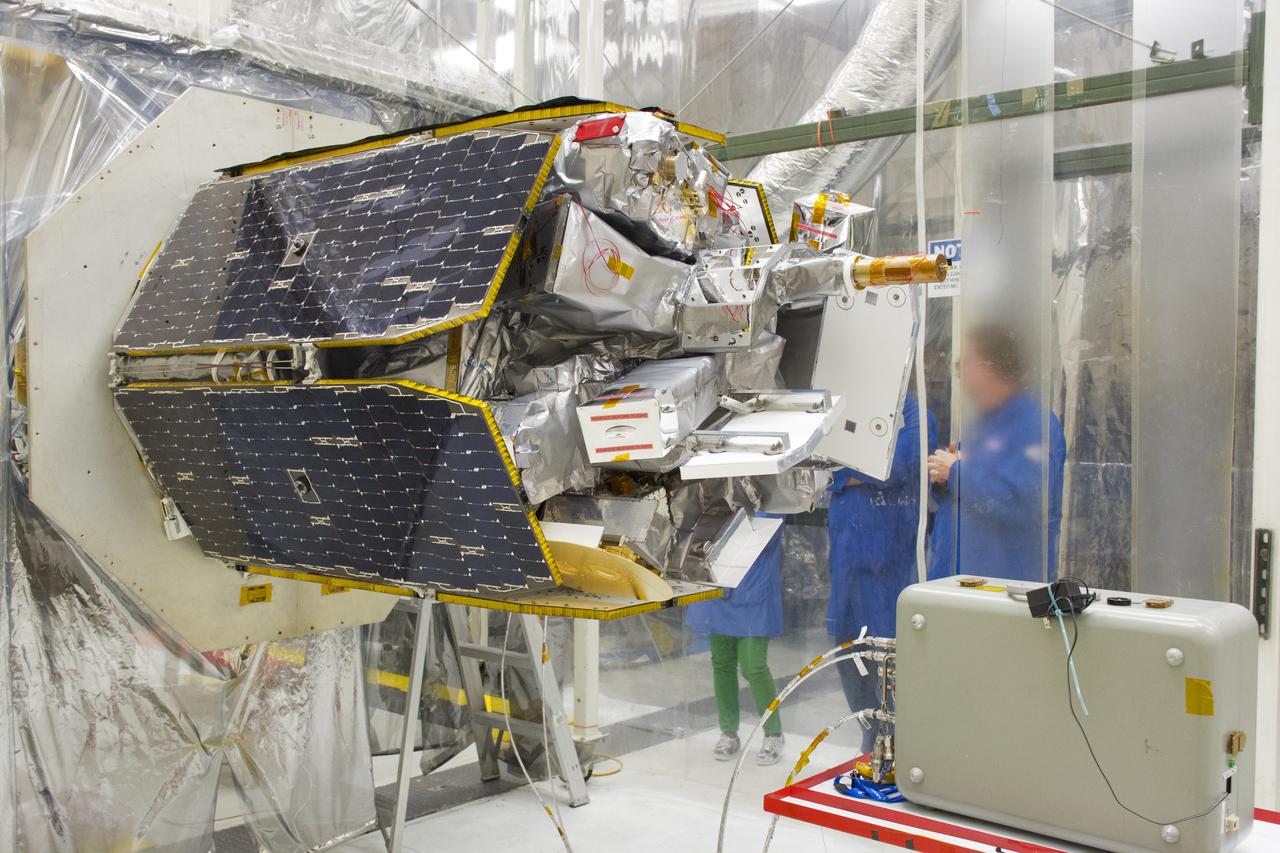
NASA's Ionospheric Connection Explorer (ICON) is attached to the Orbital ATK Pegasus XL rocket May 14, 2018, inside a clean room in Building 1555 at Vandenberg Air Force Base in California. The explorer will launch on June 15, 2018, from Kwajalein Atoll in the Marshall Islands (June 14 in the continental United States) on the Pegasus XL rocket, which is attached to the company's L-1011 Stargazer aircraft. ICON will study the frontier of space - the dynamic zone high in Earth's atmosphere where terrestrial weather from below meets space weather above. The explorer will help determine the physics of Earth's space environment and pave the way for mitigating its effects on our technology, communications systems and society.
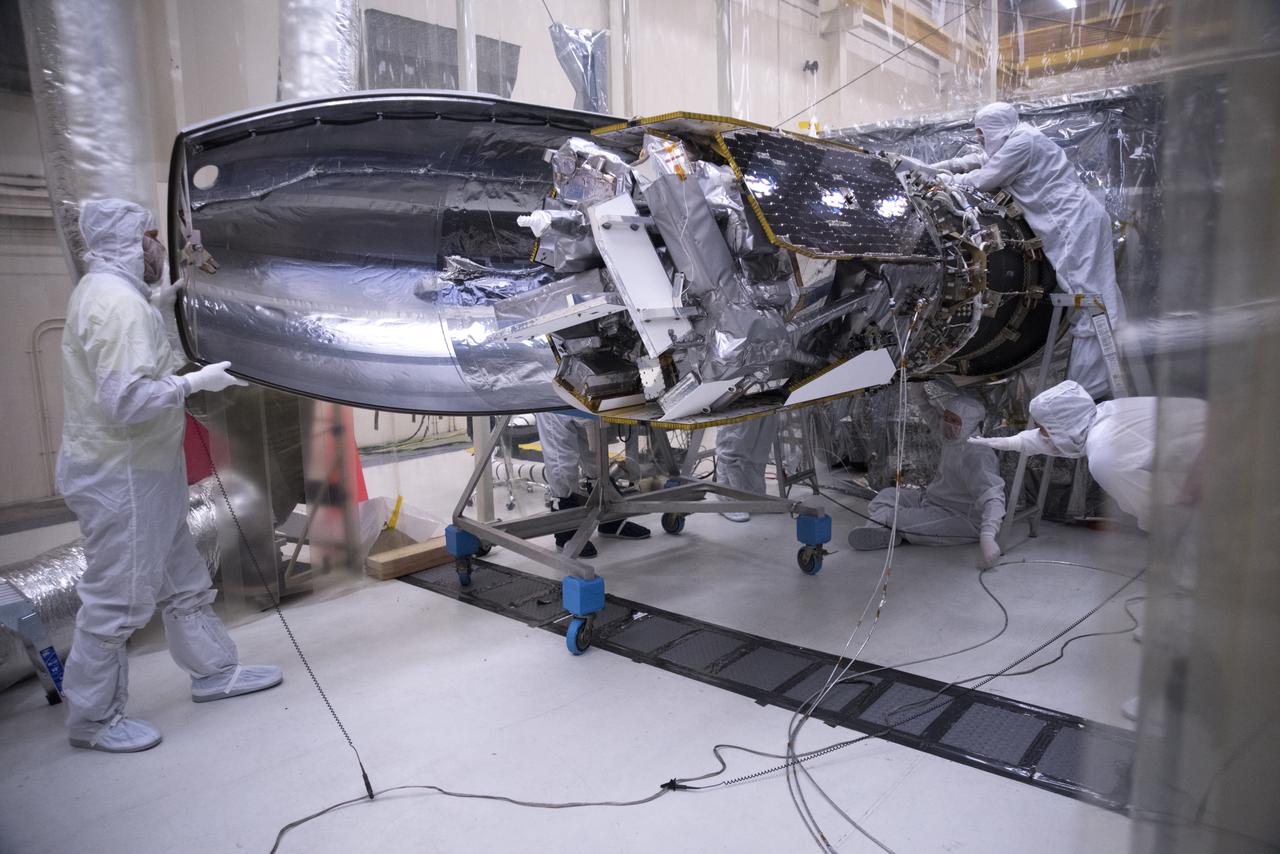
Inside a clean room in Building 1555 at Vandenberg Air Force Base in California, technicians install the first half of the Northrop Grumman Pegasus XL payload fairing around NASA's Ionospheric Connection Explorer (ICON) on Oct. 4, 2018. ICON is being prepared for its launch on the Pegasus XL, which is attached to the company's L-1011 Stargazer aircraft, from the Skid Strip at Cape Canaveral Air Force Station in Florida. Launch is scheduled for Oct. 26. ICON will study the frontier of space - the dynamic zone high in Earth's atmosphere where terrestrial weather from below meets space weather above. The explorer will help determine the physics of Earth's space environment and pave the way for mitigating its effects on our technology, communications systems and society.
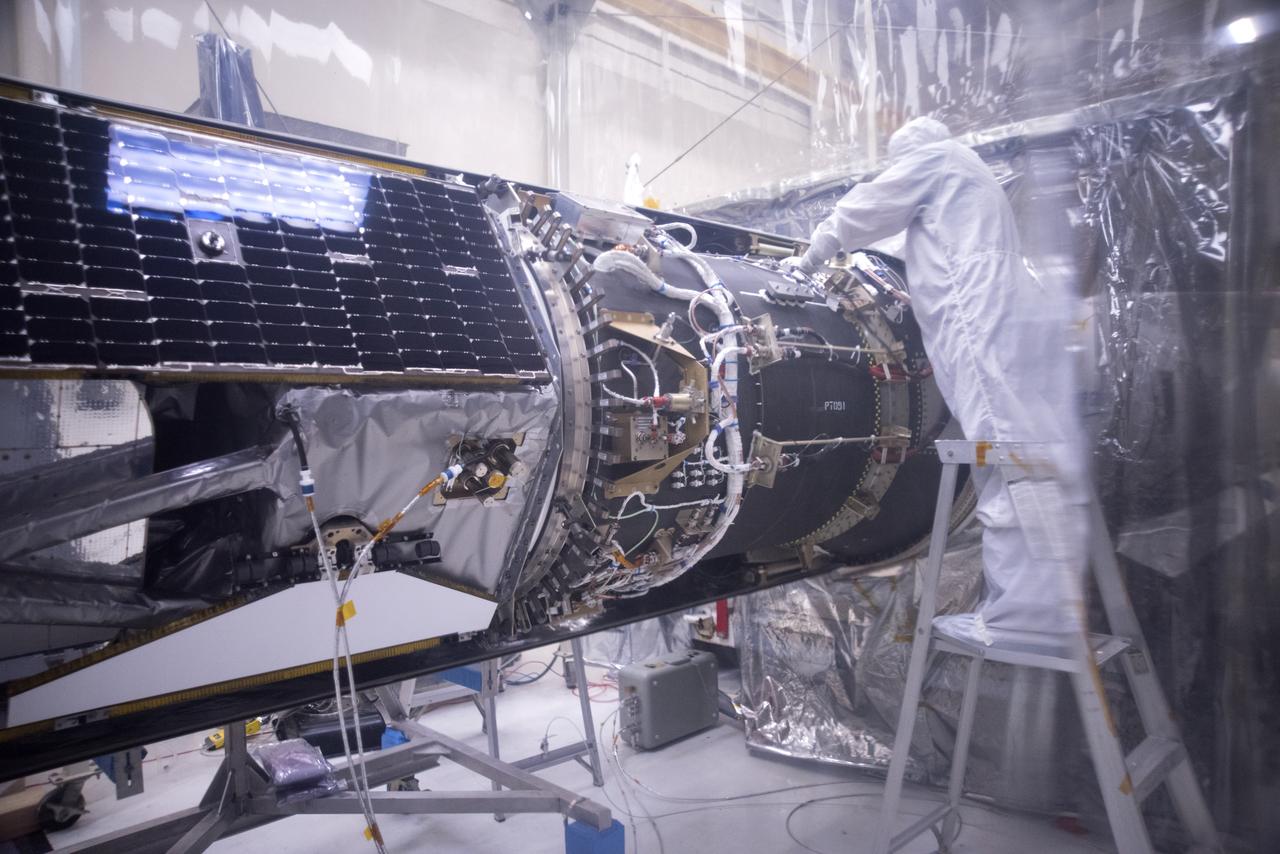
Inside a clean room in Building 1555 at Vandenberg Air Force Base in California, technicians install the first half of the Northrop Grumman Pegasus XL payload fairing around NASA's Ionospheric Connection Explorer (ICON) on Oct. 4, 2018. ICON is being prepared for its launch on the Pegasus XL, which is attached to the company's L-1011 Stargazer aircraft, from the Skid Strip at Cape Canaveral Air Force Station in Florida. Launch is scheduled for Oct. 26. ICON will study the frontier of space - the dynamic zone high in Earth's atmosphere where terrestrial weather from below meets space weather above. The explorer will help determine the physics of Earth's space environment and pave the way for mitigating its effects on our technology, communications systems and society.
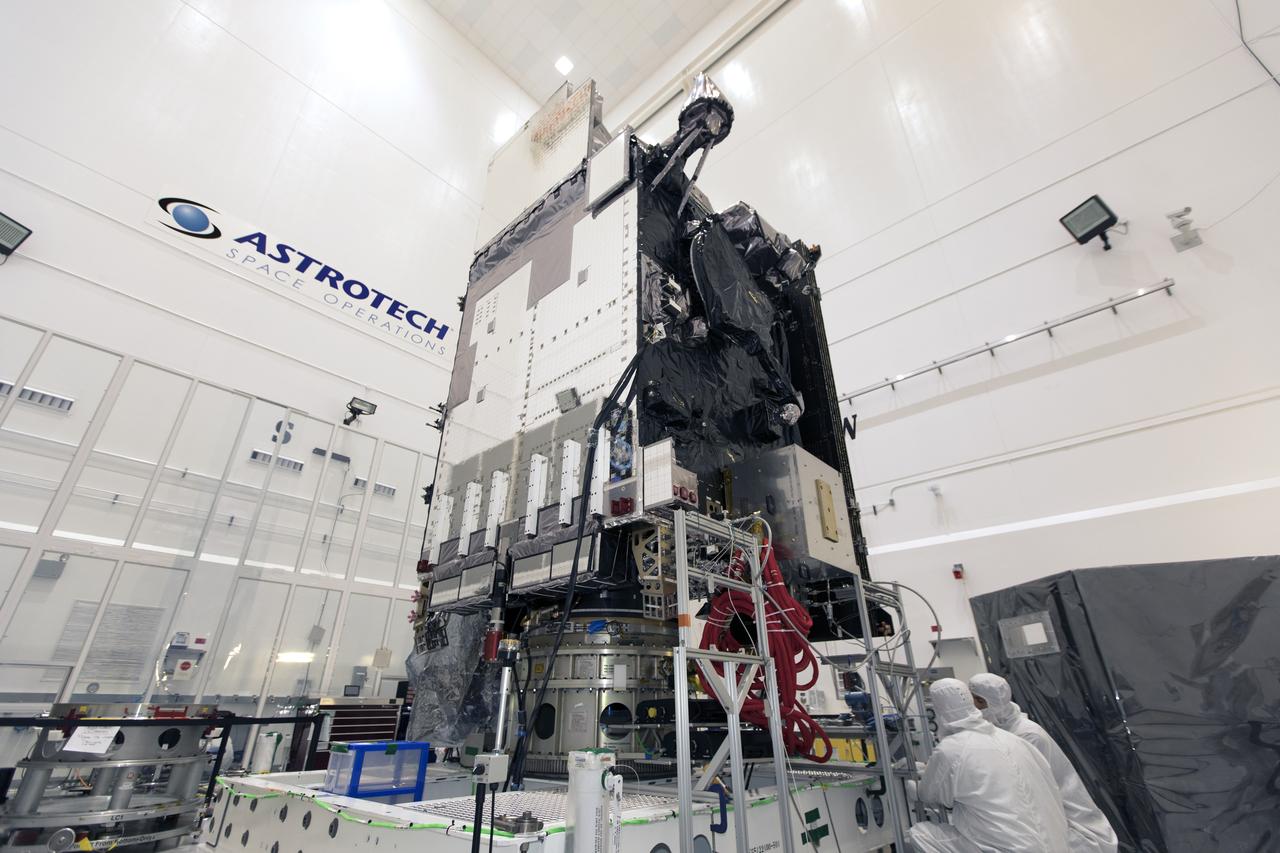
In a clean room at Astrotech Space Operations in Titusville, Florida, technicians and engineers are preparing NOAA's Geostationary Operational Environmental Satellite-S, or GOES-S, for encapsulation in it payload fairing. After encapsulation, the weather satellite will be moved to Space Launch Complex-41 at Cape Canaveral Air Force Station. GOES-S is the second in a series of four advanced geostationary weather satellites. The GOES-R series - consisting of the GOES-R, GOES-S, GOES-T and GOES-U spacecraft - will significantly improve the detection and observation of environmental phenomena that directly affect public safety, protection of property and the nation's economic health and prosperity. GOES-S is slated to launch March 1, 2018 aboard a United Launch Alliance Atlas V rocket.
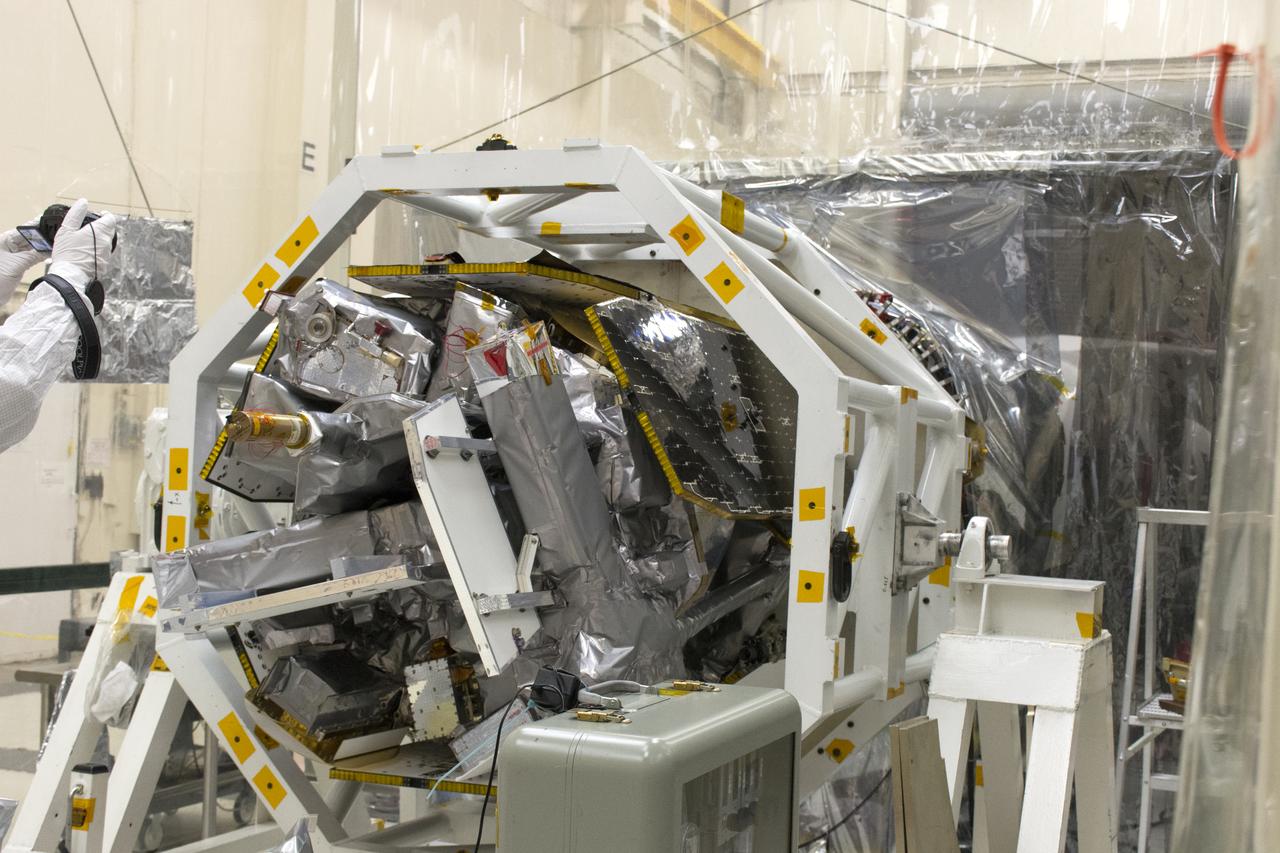
NASA's Ionospheric Connection Explorer (ICON) is in the horizontal position May 11, 2018, inside a clean room in Building 1555 at Vandenberg Air Force Base in California. ICON is being prepared to be attached to the Orbital ATK Pegasus XL rocket. The explorer will launch on June 15, 2018, from Kwajalein Atoll in the Marshall Islands (June 14 in the continental United States) on the Pegasus XL rocket, which is attached to the company's L-1011 Stargazer aircraft. ICON will study the frontier of space - the dynamic zone high in Earth's atmosphere where terrestrial weather from below meets space weather above. The explorer will help determine the physics of Earth's space environment and pave the way for mitigating its effects on our technology, communications systems and society.

Inside a clean room in Building 1555 at Vandenberg Air Force Base in California, technicians begin to install the first half of the Northrop Grumman Pegasus XL payload fairing around NASA's Ionospheric Connection Explorer (ICON) on Aug. 22, 2018. ICON is being prepared for its launch on the Pegasus XL rocket, which is attached beneath the company's L-1011 Stargazer aircraft. Launch is scheduled for Oct. 26, from the Skid Strip at Cape Canaveral Air Force Station in Florida. ICON will study the frontier of space - the dynamic zone high in Earth's atmosphere where terrestrial weather from below meets space weather above. The explorer will help determine the physics of Earth's space environment and pave the way for mitigating its effects on our technology, communications systems and society.
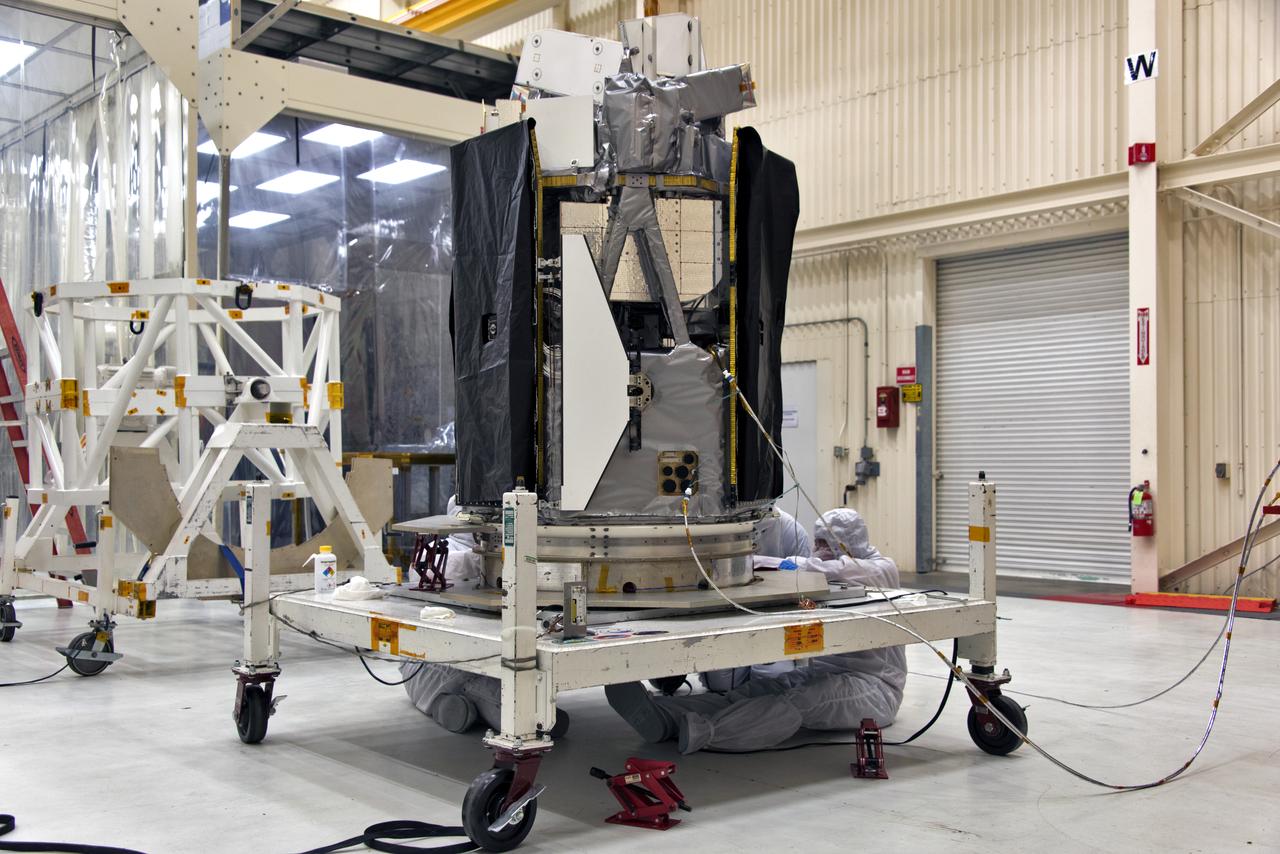
Technicians secure NASA's Ionospheric Connection Explorer (ICON) on the spacecraft separation system May 9, 2018, in a clean room inside Building 1555 at Vandenberg Air Force Base in California. The explorer will launch on June 15, 2018, from Kwajalein Atoll in the Marshall Islands (June 14 in the continental United States) on Orbital ATK's Pegasus XL rocket, which is attached to the company's L-1011 Stargazer aircraft. ICON will study the frontier of space - the dynamic zone high in Earth's atmosphere where terrestrial weather from below meets space weather above. The explorer will help determine the physics of Earth's space environment and pave the way for mitigating its effects on our technology, communications systems and society.
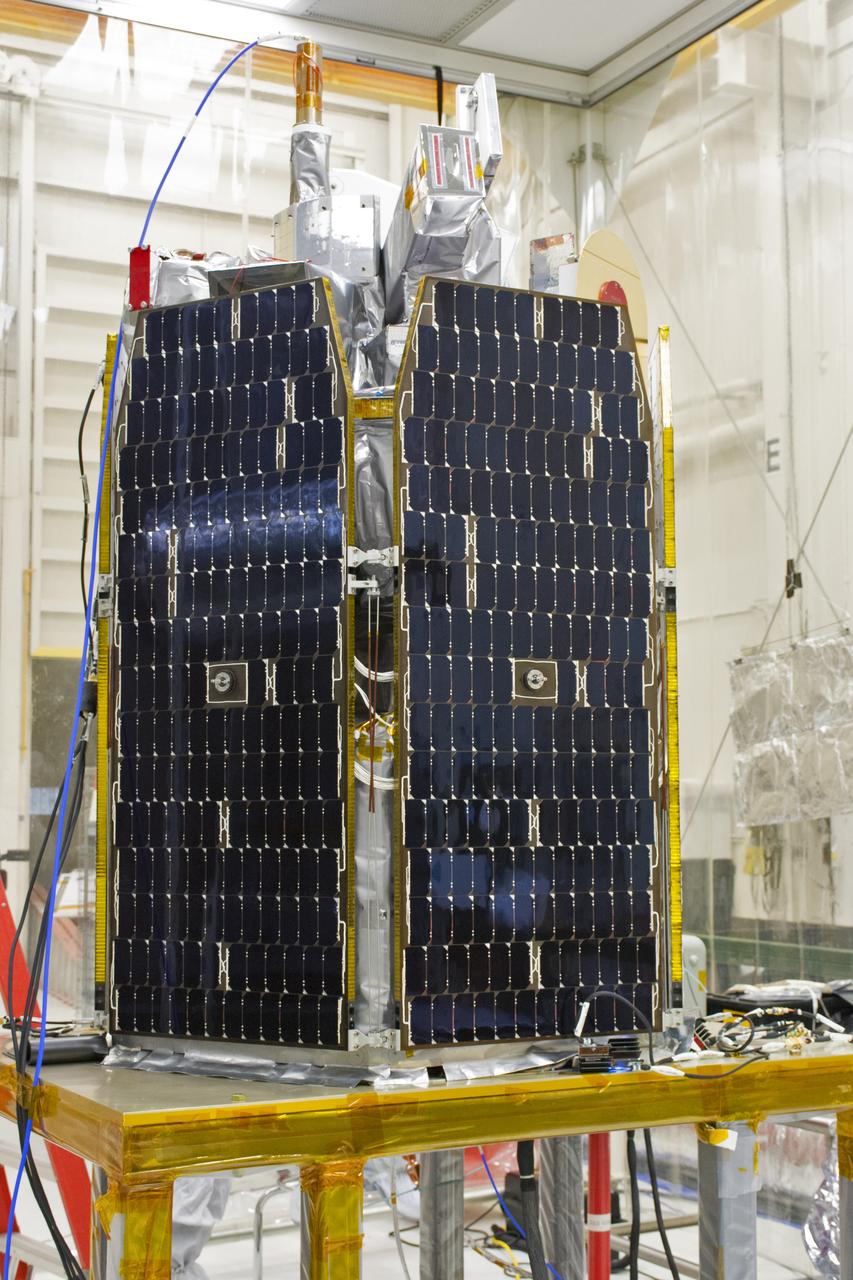
NASA's Ionospheric Connection Explorer (ICON) is prepared for a solar array illumination test in a clean room inside Building 1555 at Vandenberg Air Force Base in California on May 4, 2018. The test checks for any imperfections and confirms that the solar arrays are functioning properly. The explorer will launch on June 15, 2018, from Kwajalein Atoll in the Marshall Islands (June 14 in the continental United States) on Orbital ATK's Pegasus XL rocket, which is attached to the company's L-1011 Stargazer aircraft. ICON will study the frontier of space - the dynamic zone high in Earth's atmosphere where terrestrial weather from below meets space weather above. The explorer will help determine the physics of Earth's space environment and pave the way for mitigating its effects on our technology, communications systems and society.
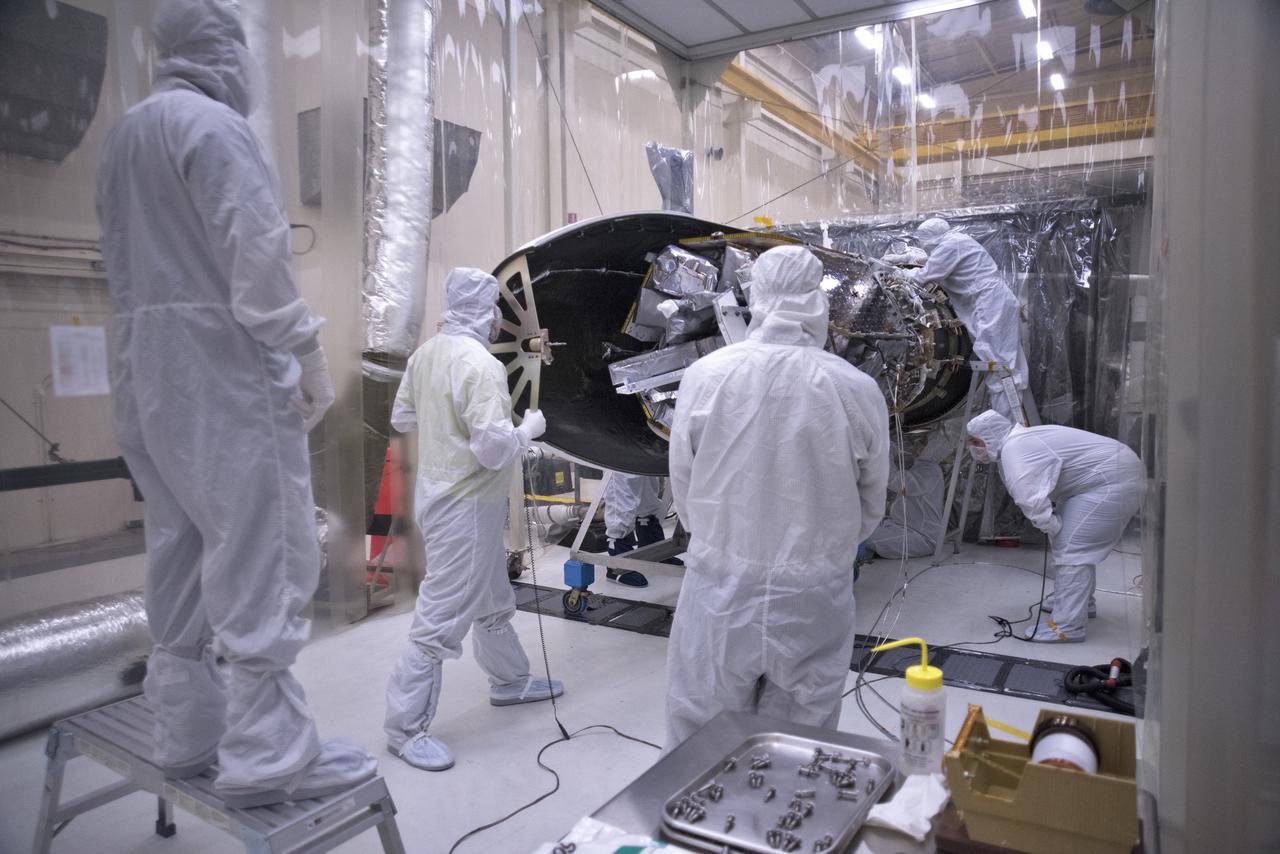
Inside a clean room in Building 1555 at Vandenberg Air Force Base in California, technicians install the first half of the Northrop Grumman Pegasus XL payload fairing around NASA's Ionospheric Connection Explorer (ICON) on Oct. 4, 2018. ICON is being prepared for its launch on the Pegasus XL, which is attached to the company's L-1011 Stargazer aircraft, from the Skid Strip at Cape Canaveral Air Force Station in Florida. Launch is scheduled for Oct. 26. ICON will study the frontier of space - the dynamic zone high in Earth's atmosphere where terrestrial weather from below meets space weather above. The explorer will help determine the physics of Earth's space environment and pave the way for mitigating its effects on our technology, communications systems and society.
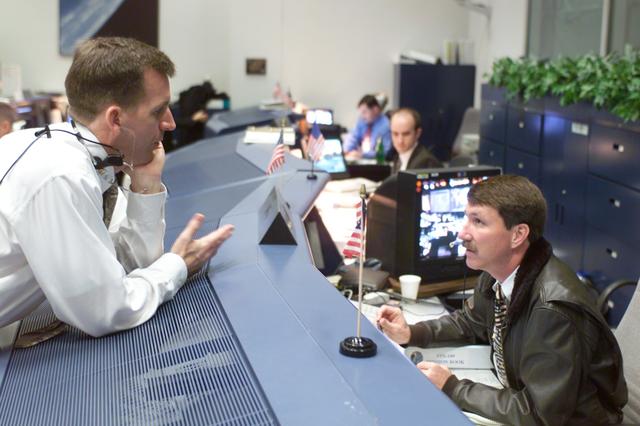
JSC2002-E-08157 (1 March 2002) --- Astronaut Kent V. Rominger (seated), and LeRoy Cain are photographed at the Mission Operation Directorate (MOD) console in the shuttle flight control room (WFCR) in Houston's Mission Control Center (MCC). Several hundred miles away in Florida, the STS-109 crewmembers were awaiting countdown in the crew cabin of the Space Shuttle Columbia on the launch pad at the Kennedy Space Center (KSC). As soon as the vehicle cleared the tower in Florida, the Houston-based team of flight controllers took over the ground control of the mission. Rominger is the Deputy Director of the Flight Crew Operations Directorate (FCOD) and was the STS-109 FCOD management representative in the MCC. Cain was the Weather Flight Director for the mission’s ascent phase, coordinating weather issues for lead Ascent Flight Director John Shannon (out of frame).
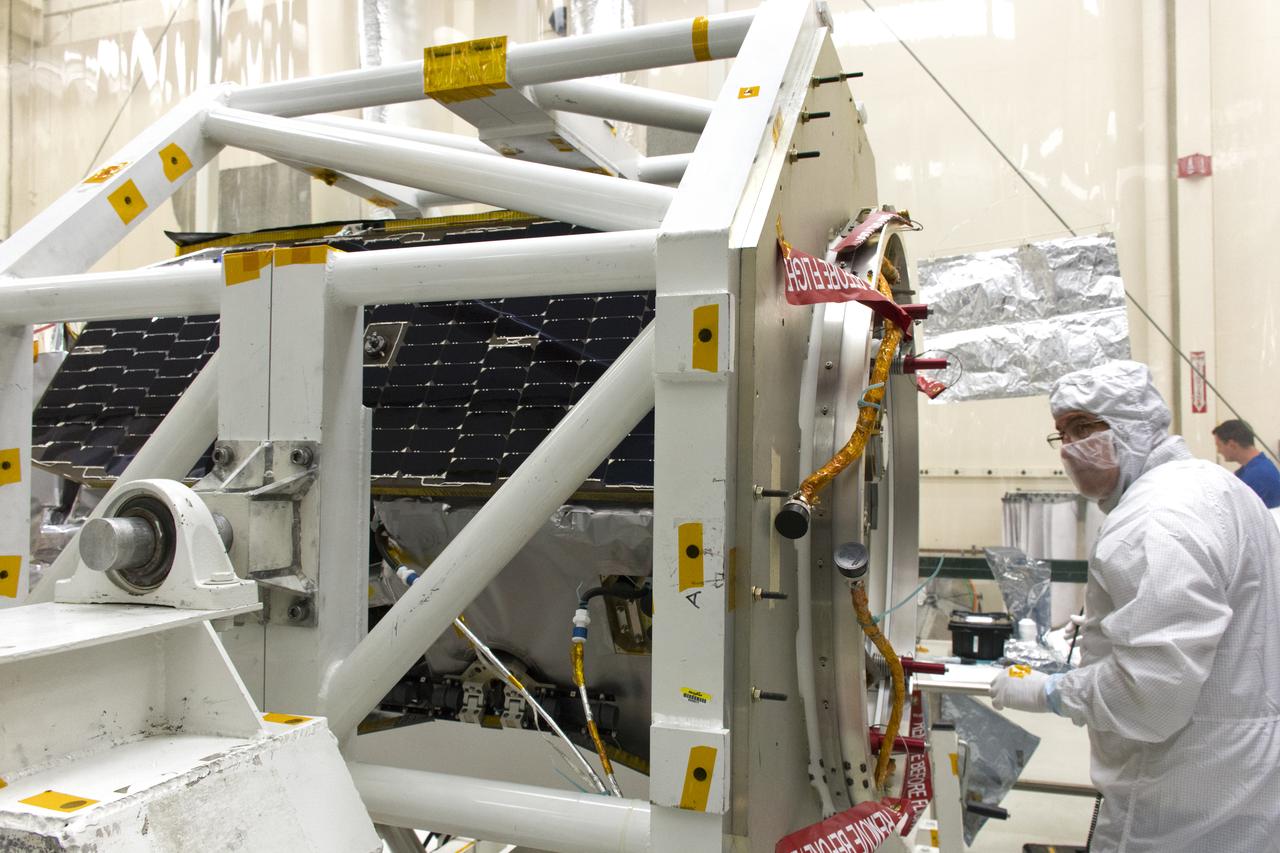
NASA's Ionospheric Connection Explorer (ICON) is in the horizontal position May 11, 2018, inside a clean room in Building 1555 at Vandenberg Air Force Base in California. ICON is being prepared to be attached to the Orbital ATK Pegasus XL rocket. The explorer will launch on June 15, 2018, from Kwajalein Atoll in the Marshall Islands (June 14 in the continental United States) on the Pegasus XL rocket, which is attached to the company's L-1011 Stargazer aircraft. ICON will study the frontier of space - the dynamic zone high in Earth's atmosphere where terrestrial weather from below meets space weather above. The explorer will help determine the physics of Earth's space environment and pave the way for mitigating its effects on our technology, communications systems and society.
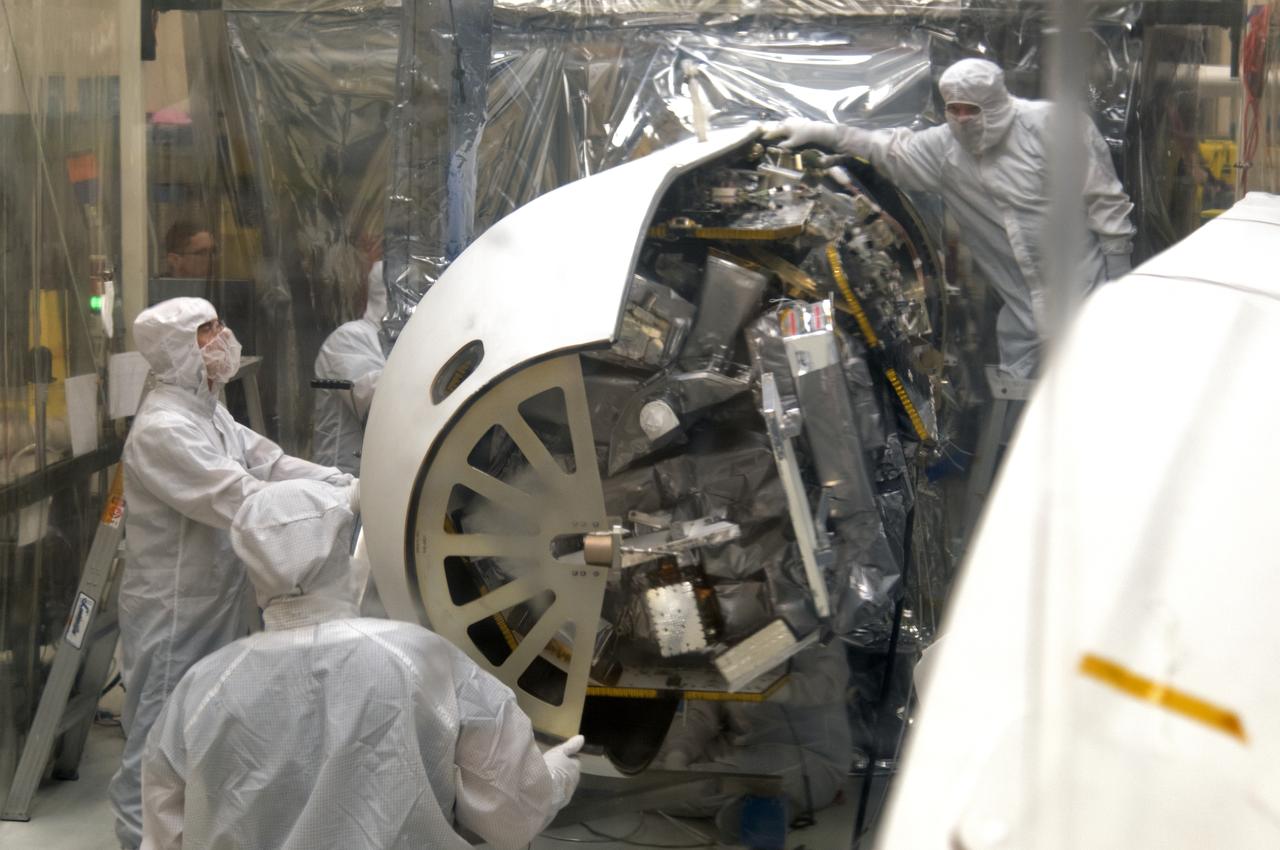
Inside a clean room in Building 1555 at Vandenberg Air Force Base in California, technicians install the first half of the Northrop Grumman Pegasus XL payload fairing around NASA's Ionospheric Connection Explorer (ICON) on Aug. 22, 2018. ICON is being prepared for its launch on the Pegasus XL rocket, which is attached beneath the company's L-1011 Stargazer aircraft. Launch is scheduled for Oct. 26, from the Skid Strip at Cape Canaveral Air Force Station in Florida. ICON will study the frontier of space - the dynamic zone high in Earth's atmosphere where terrestrial weather from below meets space weather above. The explorer will help determine the physics of Earth's space environment and pave the way for mitigating its effects on our technology, communications systems and society.
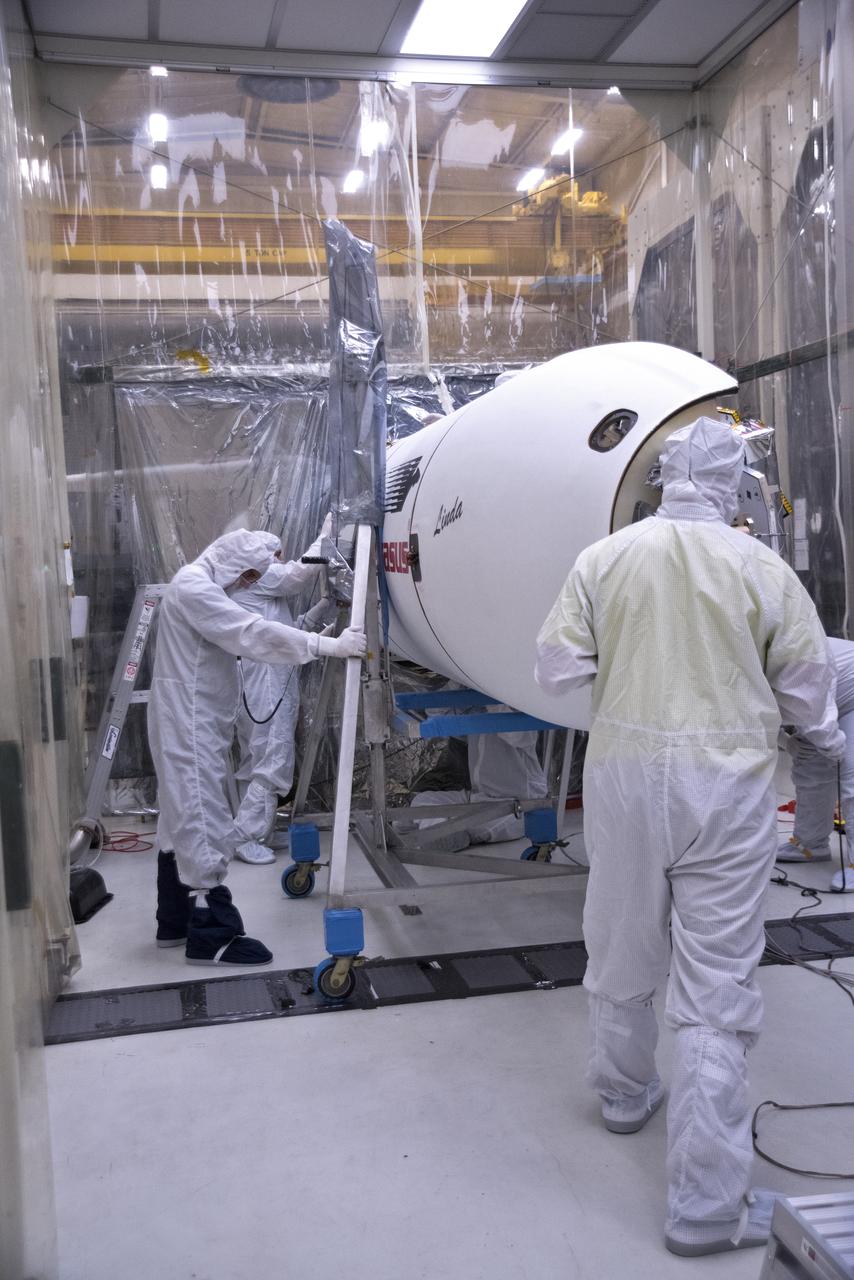
Inside a clean room in Building 1555 at Vandenberg Air Force Base in California, technicians install the first half of the Northrop Grumman Pegasus XL payload fairing around NASA's Ionospheric Connection Explorer (ICON) on Oct. 4, 2018. ICON is being prepared for its launch on the Pegasus XL, which is attached to the company's L-1011 Stargazer aircraft, from the Skid Strip at Cape Canaveral Air Force Station in Florida. Launch is scheduled for Oct. 26. ICON will study the frontier of space - the dynamic zone high in Earth's atmosphere where terrestrial weather from below meets space weather above. The explorer will help determine the physics of Earth's space environment and pave the way for mitigating its effects on our technology, communications systems and society.

A technician assists with connections as NASA's Ionospheric Connection Explorer (ICON) is attached to the Orbital ATK Pegasus XL rocket May 14, 2018, inside a clean room in Building 1555 at Vandenberg Air Force Base in California. The explorer will launch on June 15, 2018, from Kwajalein Atoll in the Marshall Islands (June 14 in the continental United States) on the Pegasus XL rocket, which is attached to the company's L-1011 Stargazer aircraft. ICON will study the frontier of space - the dynamic zone high in Earth's atmosphere where terrestrial weather from below meets space weather above. The explorer will help determine the physics of Earth's space environment and pave the way for mitigating its effects on our technology, communications systems and society.
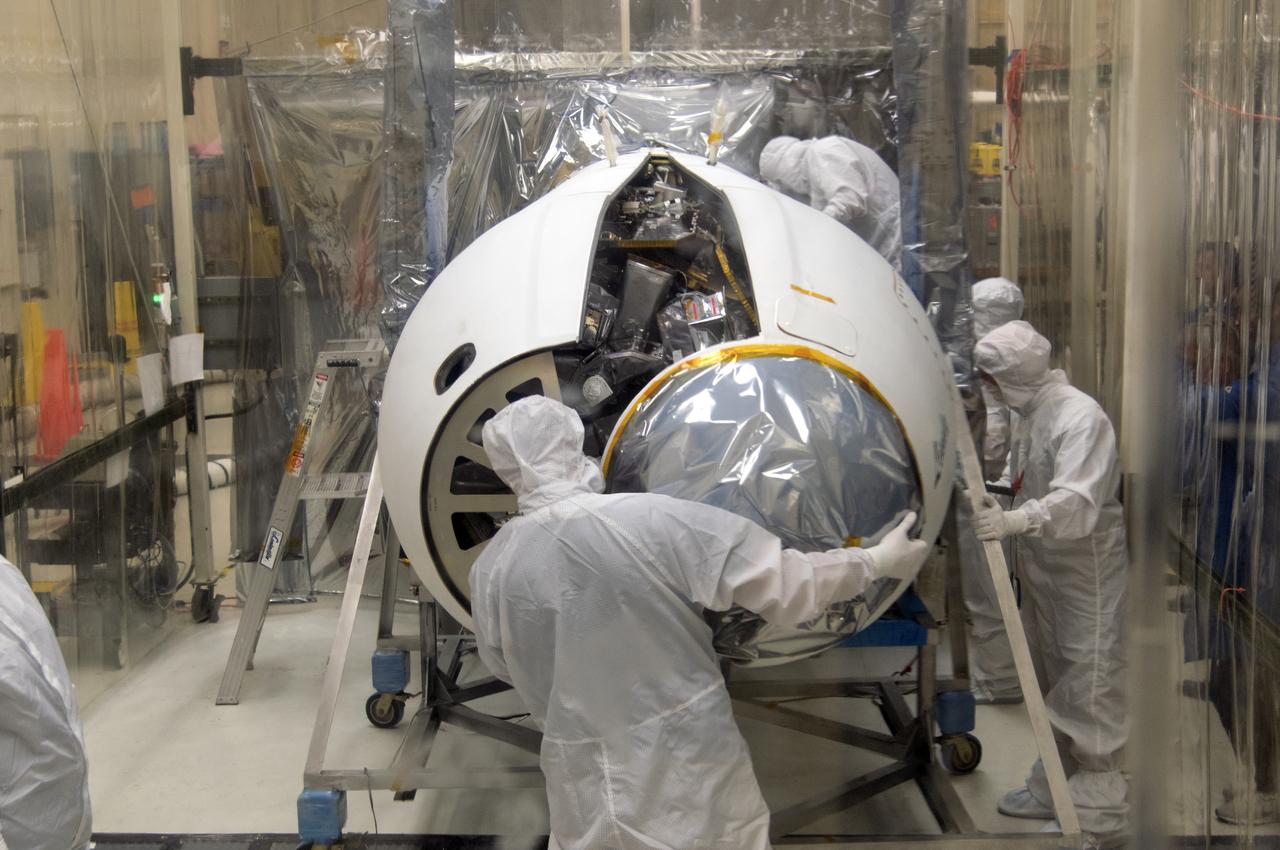
Inside a clean room in Building 1555 at Vandenberg Air Force Base in California, technicians install the second half of the Northrop Grumman Pegasus XL payload fairing around NASA's Ionospheric Connection Explorer (ICON) on Aug. 22, 2018. ICON is being prepared for its launch on the Pegasus XL rocket, which is attached beneath the company's L-1011 Stargazer aircraft. Launch is scheduled for Oct 26, from the Skid Strip at Cape Canaveral Air Force Station in Florida. ICON will study the frontier of space - the dynamic zone high in Earth's atmosphere where terrestrial weather from below meets space weather above. The explorer will help determine the physics of Earth's space environment and pave the way for mitigating its effects on our technology, communications systems and society.
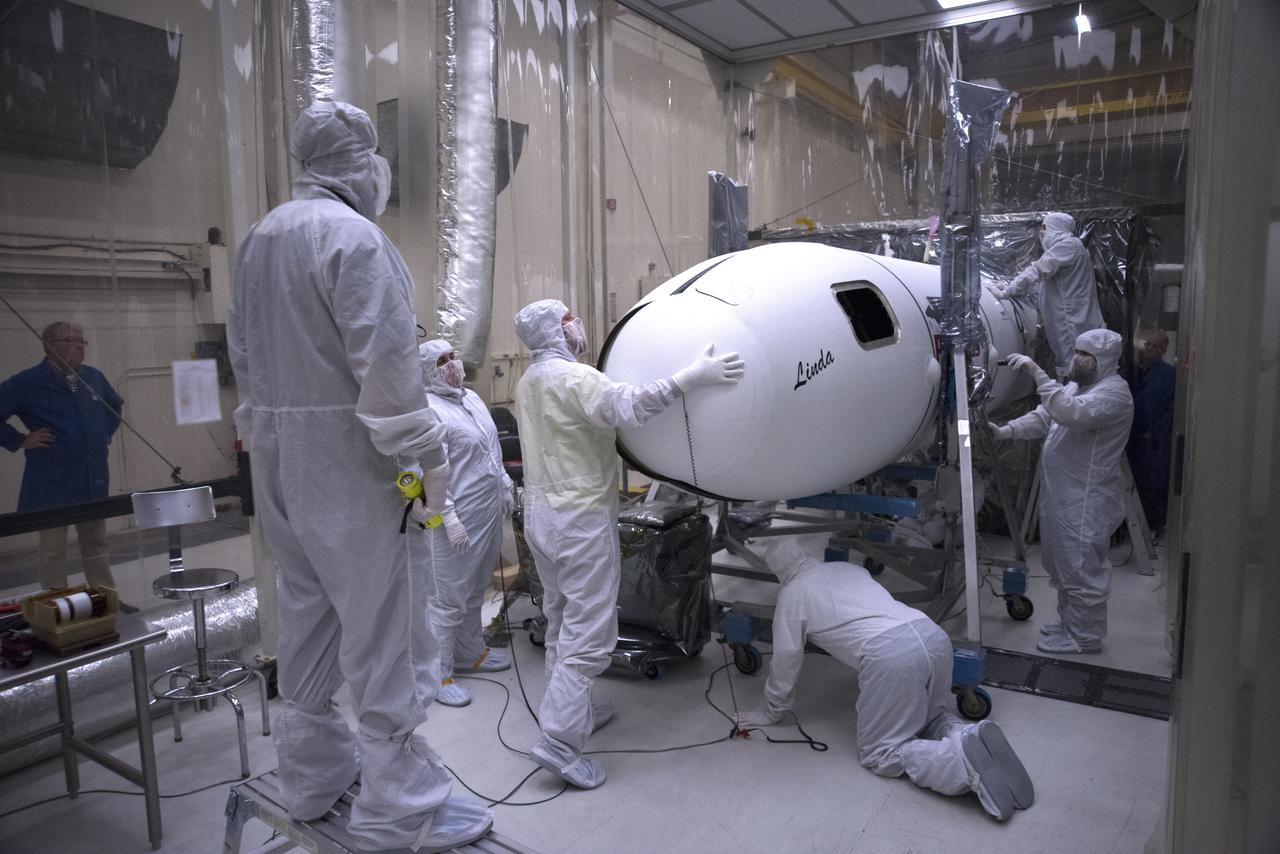
Inside a clean room in Building 1555 at Vandenberg Air Force Base in California, technicians install the second half of the Northrop Grumman Pegasus XL payload fairing around NASA's Ionospheric Connection Explorer (ICON) on Oct. 4, 2018. ICON is being prepared for its launch on the Pegasus XL, which is attached to the company's L-1011 Stargazer aircraft, from the Skid Strip at Cape Canaveral Air Force Station in Florida. Launch is scheduled for Oct. 26. ICON will study the frontier of space - the dynamic zone high in Earth's atmosphere where terrestrial weather from below meets space weather above. The explorer will help determine the physics of Earth's space environment and pave the way for mitigating its effects on our technology, communications systems and society.
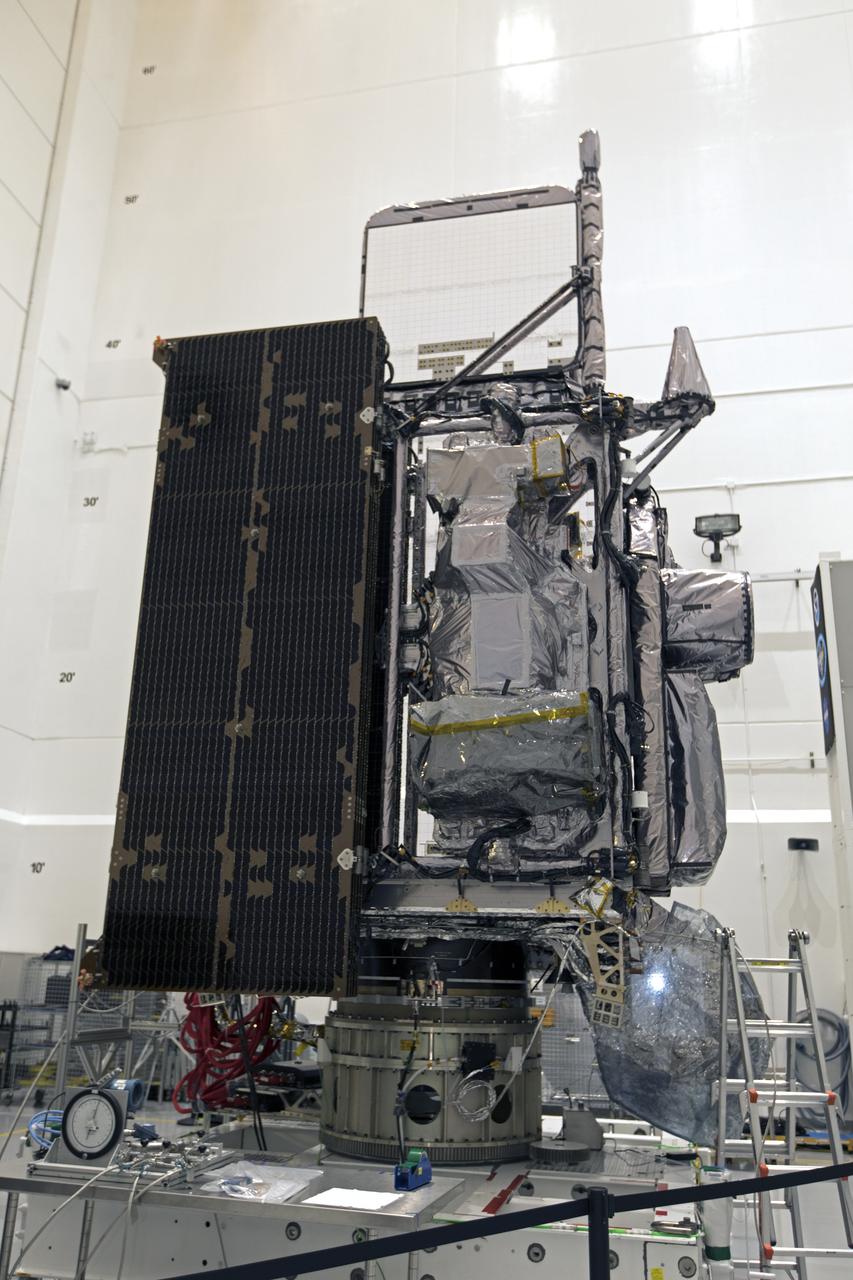
In a clean room at Astrotech Space Operations in Titusville, Florida, NOAA's Geostationary Operational Environmental Satellite-S, or GOES-S, is being prepared for encapsulation in it payload fairing. After encapsulation, the weather satellite will be moved to Space Launch Complex-41 at Cape Canaveral Air Force Station. GOES-S is the second in a series of four advanced geostationary weather satellites. The GOES-R series - consisting of the GOES-R, GOES-S, GOES-T and GOES-U spacecraft - will significantly improve the detection and observation of environmental phenomena that directly affect public safety, protection of property and the nation's economic health and prosperity. GOES-S is slated to launch March 1, 2018 aboard a United Launch Alliance Atlas V rocket.
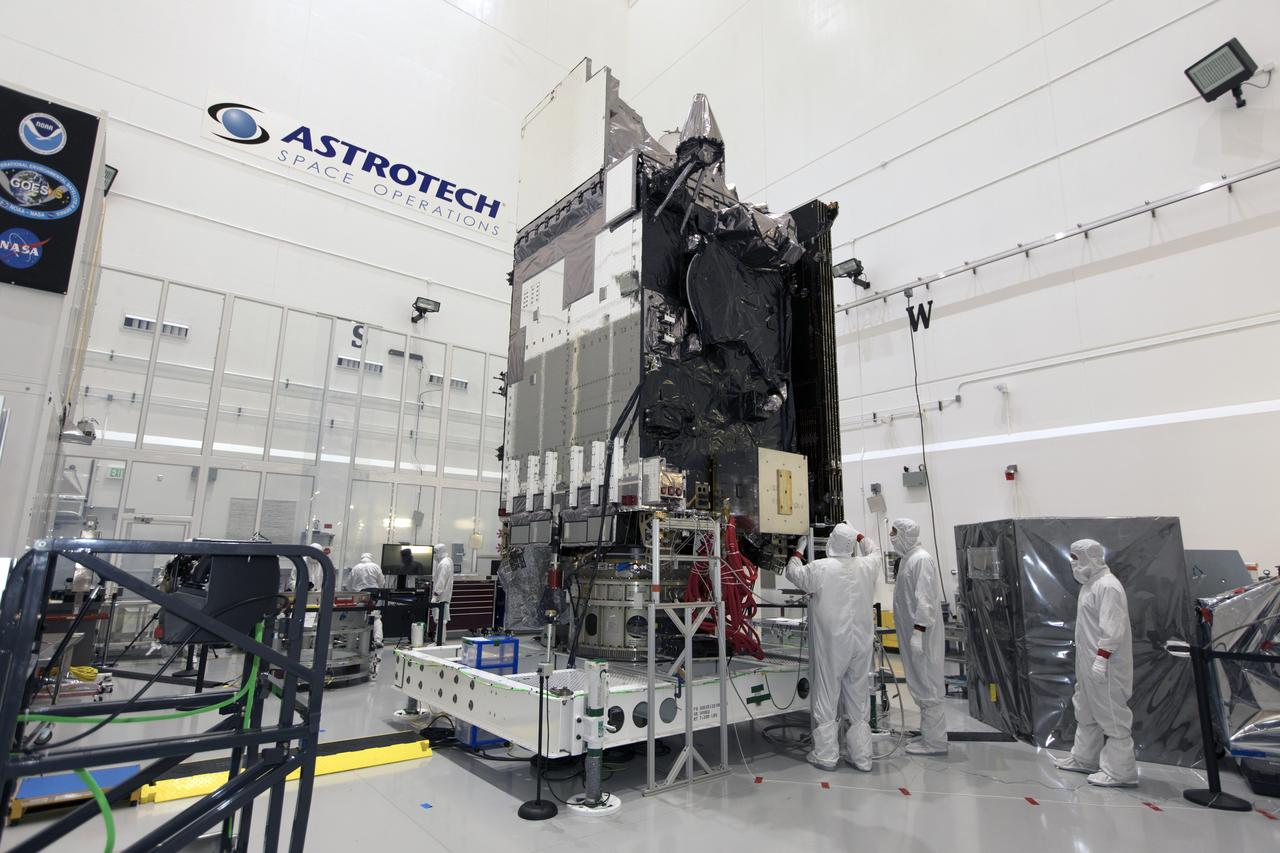
In a clean room at Astrotech Space Operations in Titusville, Florida, technicians and engineers are preparing NOAA's Geostationary Operational Environmental Satellite-S, or GOES-S, for encapsulation in it payload fairing. After encapsulation, the weather satellite will be moved to Space Launch Complex-41 at Cape Canaveral Air Force Station. GOES-S is the second in a series of four advanced geostationary weather satellites. The GOES-R series - consisting of the GOES-R, GOES-S, GOES-T and GOES-U spacecraft - will significantly improve the detection and observation of environmental phenomena that directly affect public safety, protection of property and the nation's economic health and prosperity. GOES-S is slated to launch March 1, 2018 aboard a United Launch Alliance Atlas V rocket.
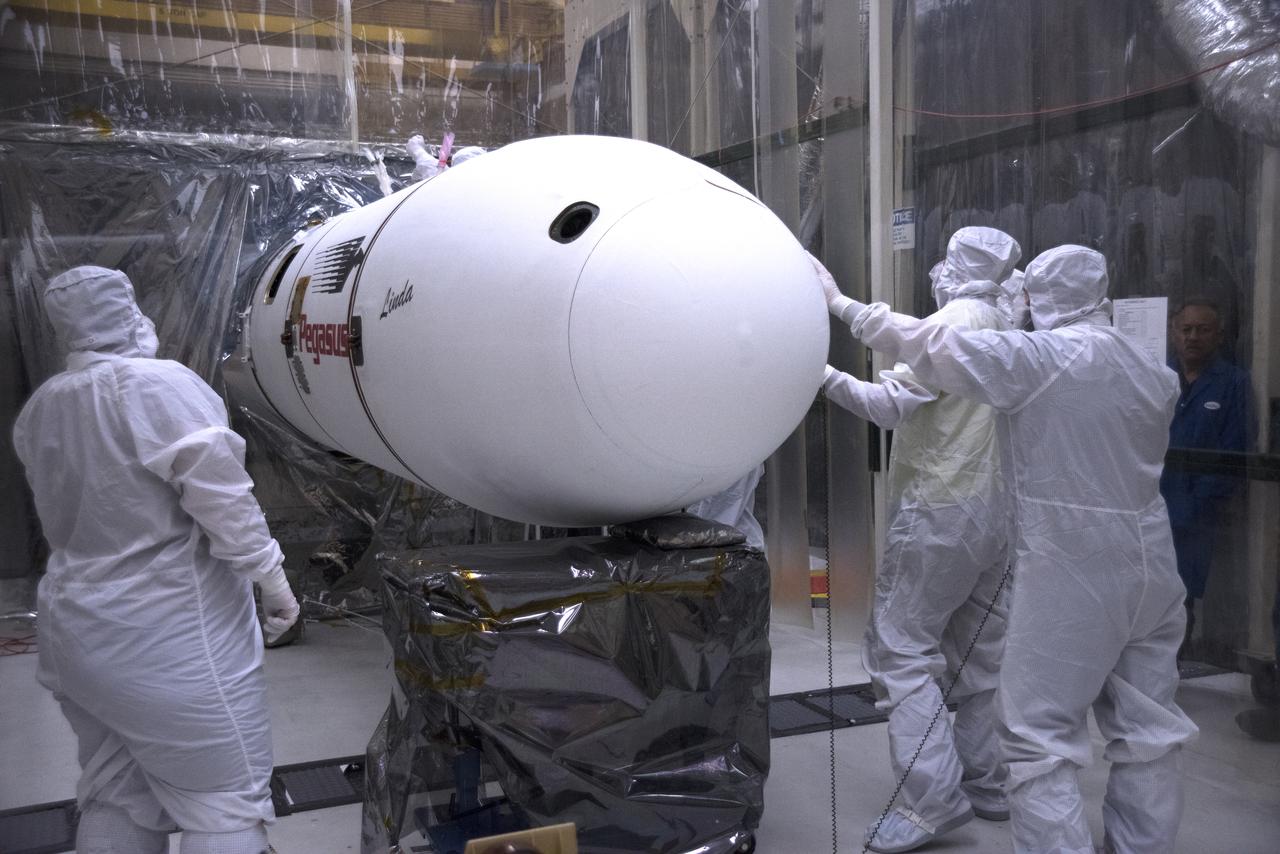
Inside a clean room in Building 1555 at Vandenberg Air Force Base in California, technicians complete installation of the second half of the Northrop Grumman Pegasus XL payload fairing around NASA's Ionospheric Connection Explorer (ICON) on Oct. 4, 2018. ICON is being prepared for its launch on the Pegasus XL, which is attached to the company's L-1011 Stargazer aircraft, from the Skid Strip at Cape Canaveral Air Force Station in Florida. Launch is scheduled for Oct. 26. ICON will study the frontier of space - the dynamic zone high in Earth's atmosphere where terrestrial weather from below meets space weather above. The explorer will help determine the physics of Earth's space environment and pave the way for mitigating its effects on our technology, communications systems and society.
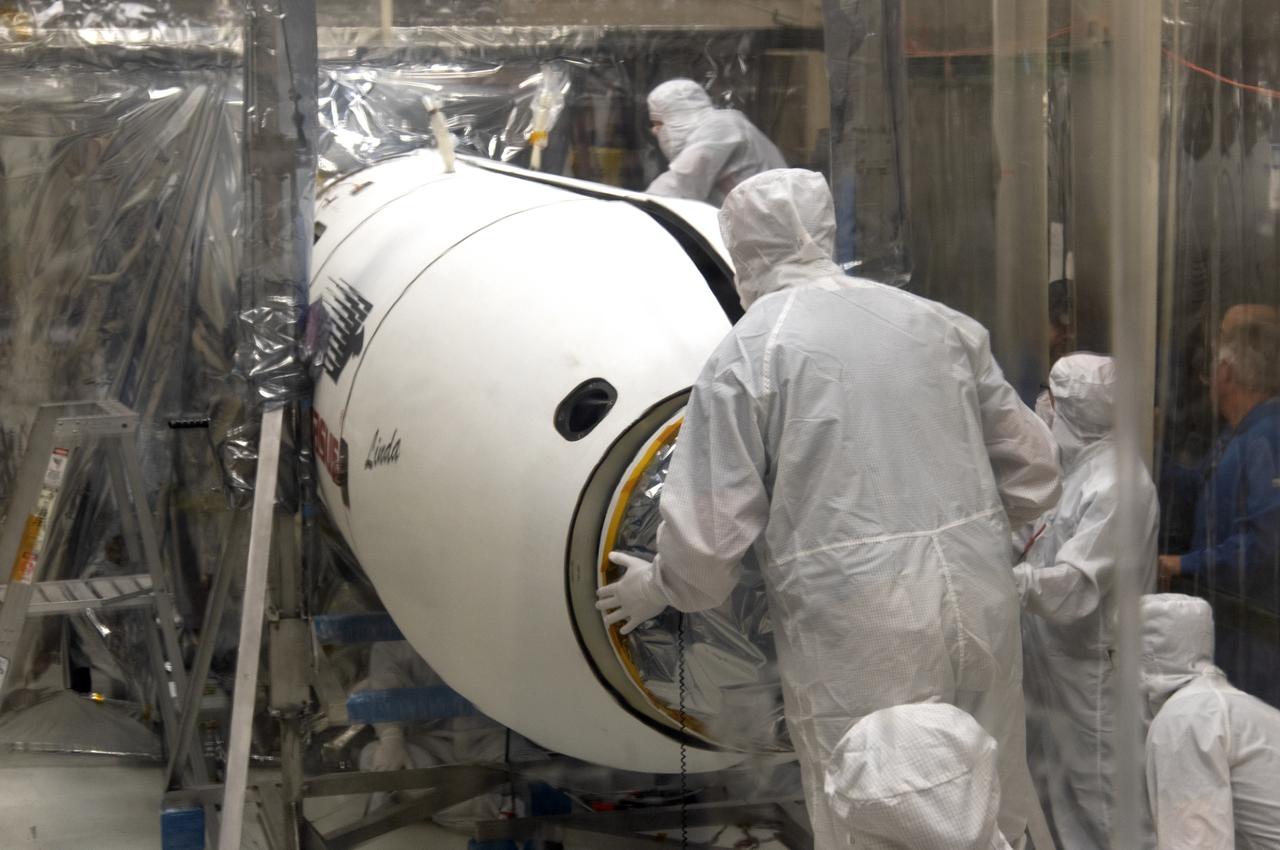
Inside a clean room in Building 1555 at Vandenberg Air Force Base in California, technicians complete installation of the Northrop Grumman Pegasus XL port and starboard payload fairings around NASA's Ionospheric Connection Explorer (ICON) on Aug. 22, 2018. ICON is being prepared for its launch on the Pegasus XL rocket, which is attached beneath the company's L-1011 Stargazer aircraft. Launch is scheduled for Oct. 26, from the Skid Strip at Cape Canaveral Air Force Station in Florida. ICON will study the frontier of space - the dynamic zone high in Earth's atmosphere where terrestrial weather from below meets space weather above. The explorer will help determine the physics of Earth's space environment and pave the way for mitigating its effects on our technology, communications systems and society.
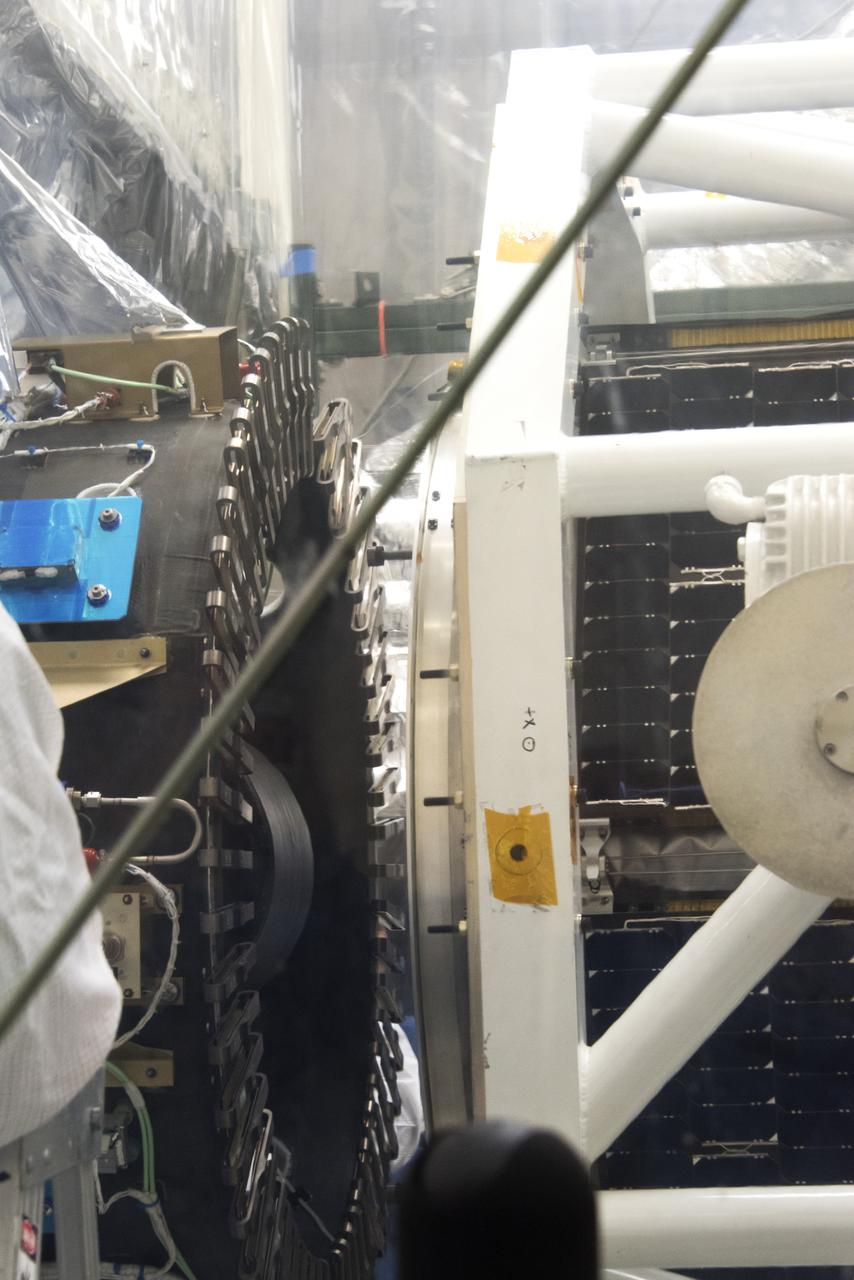
NASA's Ionospheric Connection Explorer (ICON) is being attached to the Orbital ATK Pegasus XL rocket May 14, 2018, inside a clean room in Building 1555 at Vandenberg Air Force Base in California. The explorer will launch on June 15, 2018, from Kwajalein Atoll in the Marshall Islands (June 14 in the continental United States) on the Pegasus XL rocket, which is attached to the company's L-1011 Stargazer aircraft. ICON will study the frontier of space - the dynamic zone high in Earth's atmosphere where terrestrial weather from below meets space weather above. The explorer will help determine the physics of Earth's space environment and pave the way for mitigating its effects on our technology, communications systems and society.
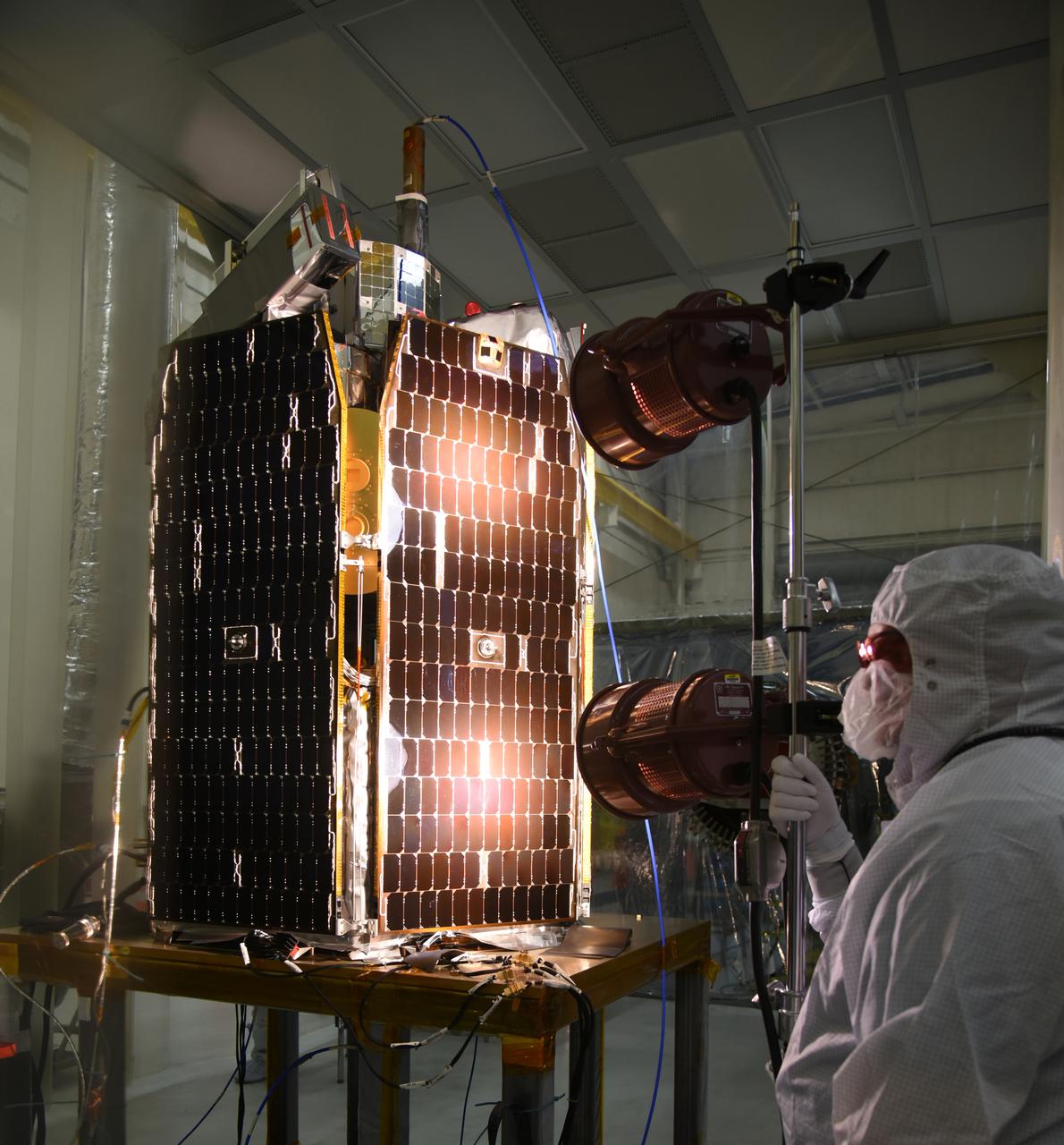
A solar array illumination test is performed on NASA's Ionospheric Connection Explorer (ICON) in a clean room on May 4, 2018, inside Building 1555 at Vandenberg Air Force Base in California. The test checks for any imperfections and confirms that the solar arrays are functioning properly. The explorer will launch on June 15, 2018, from Kwajalein Atoll in the Marshall Islands (June 14 in the continental United States) on Orbital ATK's Pegasus XL rocket, which is attached to the company's L-1011 Stargazer aircraft. ICON will study the frontier of space - the dynamic zone high in Earth's atmosphere where terrestrial weather from below meets space weather above. The explorer will help determine the physics of Earth's space environment and pave the way for mitigating its effects on our technology, communications systems and society.
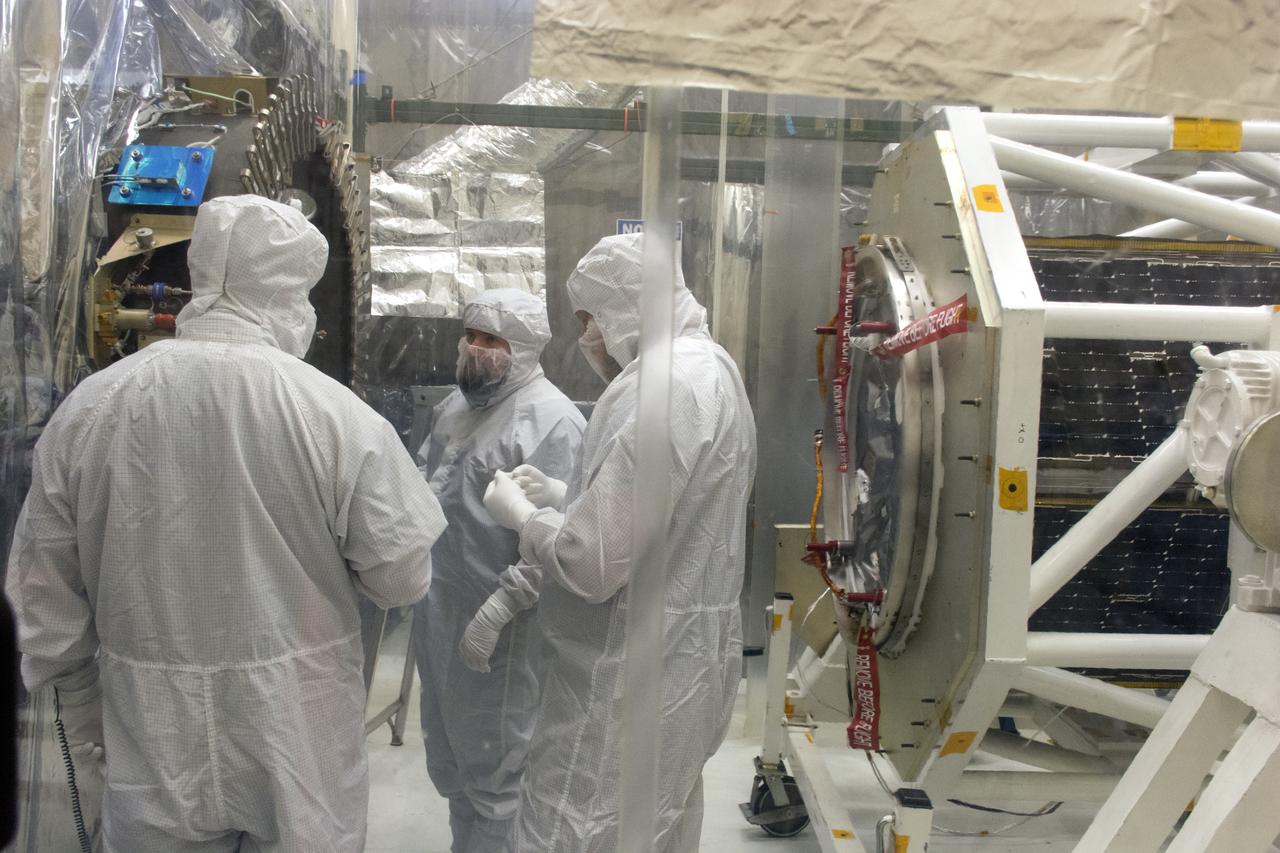
Technicians prepare NASA's Ionospheric Connection Explorer (ICON) for mating to the Orbital ATK Pegasus XL rocket May 14, 2018, inside a clean room in Building 1555 at Vandenberg Air Force Base in California. The explorer will launch on June 15, 2018, from Kwajalein Atoll in the Marshall Islands (June 14 in the continental United States) on the Pegasus XL rocket, which is attached to the company's L-1011 Stargazer aircraft. ICON will study the frontier of space - the dynamic zone high in Earth's atmosphere where terrestrial weather from below meets space weather above. The explorer will help determine the physics of Earth's space environment and pave the way for mitigating its effects on our technology, communications systems and society.
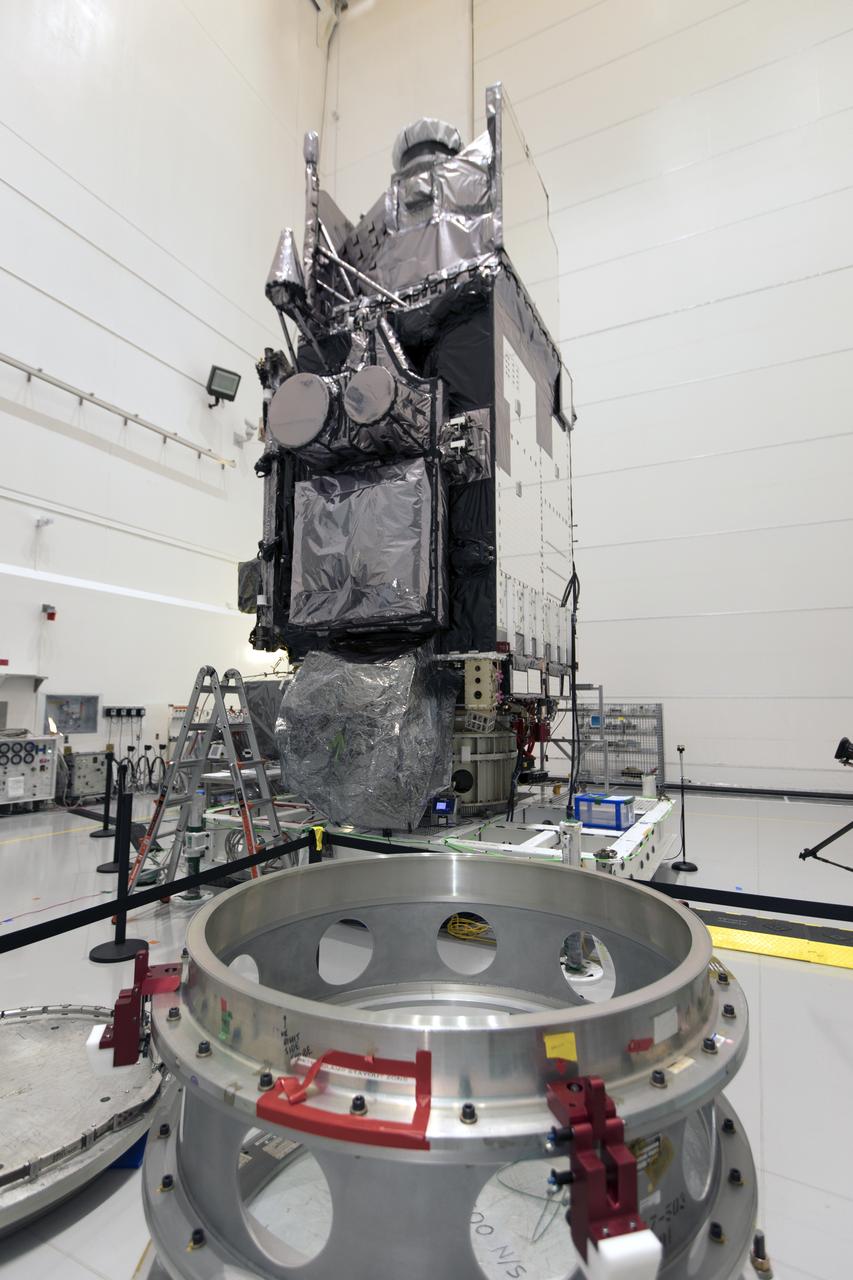
In a clean room at Astrotech Space Operations in Titusville, Florida, NOAA's Geostationary Operational Environmental Satellite-S, or GOES-S, is being prepared for encapsulation in it payload fairing. After encapsulation, the weather satellite will be moved to Space Launch Complex-41 at Cape Canaveral Air Force Station. GOES-S is the second in a series of four advanced geostationary weather satellites. The GOES-R series - consisting of the GOES-R, GOES-S, GOES-T and GOES-U spacecraft - will significantly improve the detection and observation of environmental phenomena that directly affect public safety, protection of property and the nation's economic health and prosperity. GOES-S is slated to launch March 1, 2018 aboard a United Launch Alliance Atlas V rocket.
In a clean room at Astrotech Space Operations in Titusville, Florida, NOAA's Geostationary Operational Environmental Satellite-S, or GOES-S, is being prepared for encapsulation in it payload fairing. After encapsulation, the weather satellite will be moved to Space Launch Complex-41 at Cape Canaveral Air Force Station. GOES-S is the second in a series of four advanced geostationary weather satellites. The GOES-R series - consisting of the GOES-R, GOES-S, GOES-T and GOES-U spacecraft - will significantly improve the detection and observation of environmental phenomena that directly affect public safety, protection of property and the nation's economic health and prosperity. GOES-S is slated to launch March 1, 2018 aboard a United Launch Alliance Atlas V rocket.
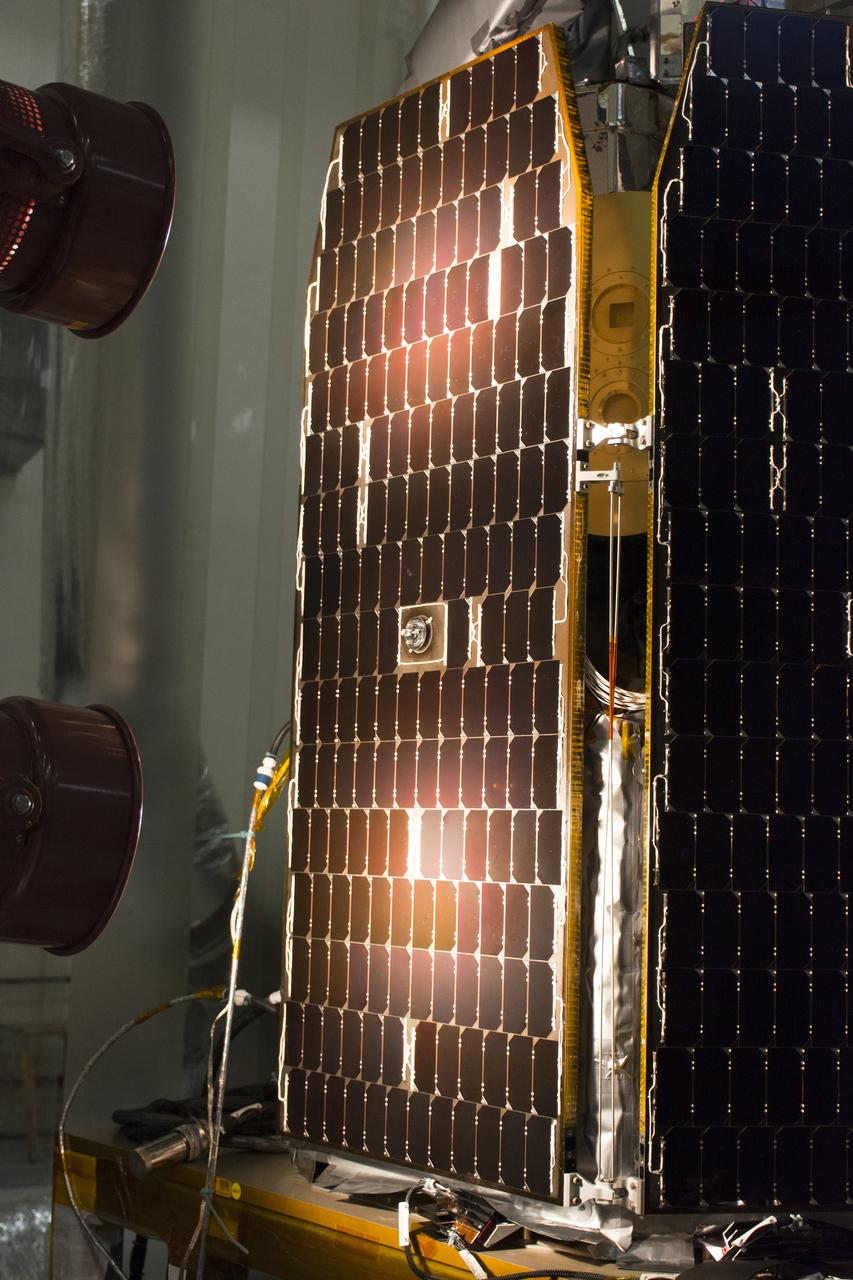
A solar array illumination test is performed on NASA's Ionospheric Connection Explorer (ICON) in a clean room inside Building 1555 at Vandenberg Air Force Base in California on May 4, 2018. The test checks for any imperfections and confirms that the solar arrays are functioning properly. The explorer will launch on June 15, 2018, from Kwajalein Atoll in the Marshall Islands (June 14 in the continental United States) on Orbital ATK's Pegasus XL rocket, which is attached to the company's L-1011 Stargazer aircraft. ICON will study the frontier of space - the dynamic zone high in Earth's atmosphere where terrestrial weather from below meets space weather above. The explorer will help determine the physics of Earth's space environment and pave the way for mitigating its effects on our technology, communications systems and society.
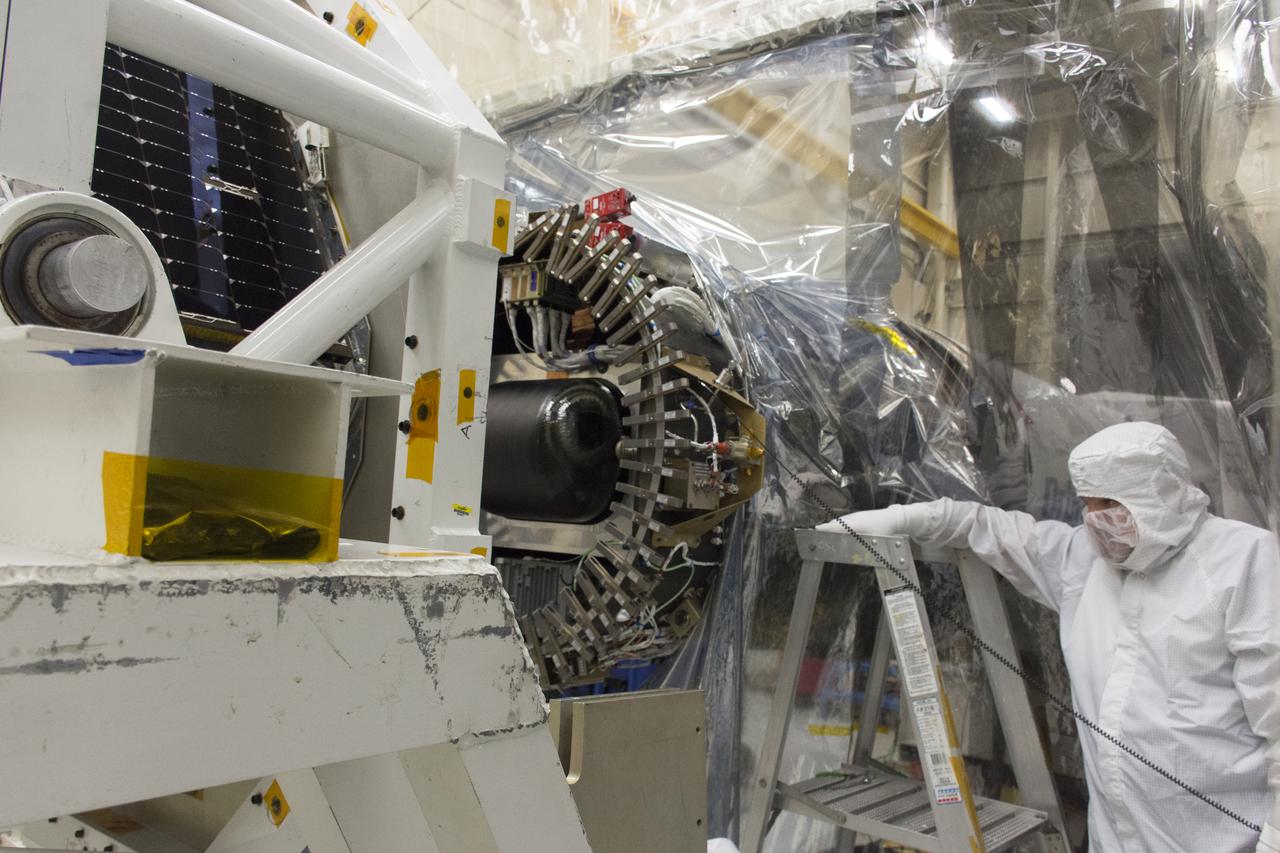
A technician monitors the progress as NASA's Ionospheric Connection Explorer (ICON) is attached to the Orbital ATK Pegasus XL rocket May 14, 2018, inside a clean room in Building 1555 at Vandenberg Air Force Base in California. The explorer will launch on June 15, 2018, from Kwajalein Atoll in the Marshall Islands (June 14 in the continental United States) on the Pegasus XL rocket, which is attached to the company's L-1011 Stargazer aircraft. ICON will study the frontier of space - the dynamic zone high in Earth's atmosphere where terrestrial weather from below meets space weather above. The explorer will help determine the physics of Earth's space environment and pave the way for mitigating its effects on our technology, communications systems and society.
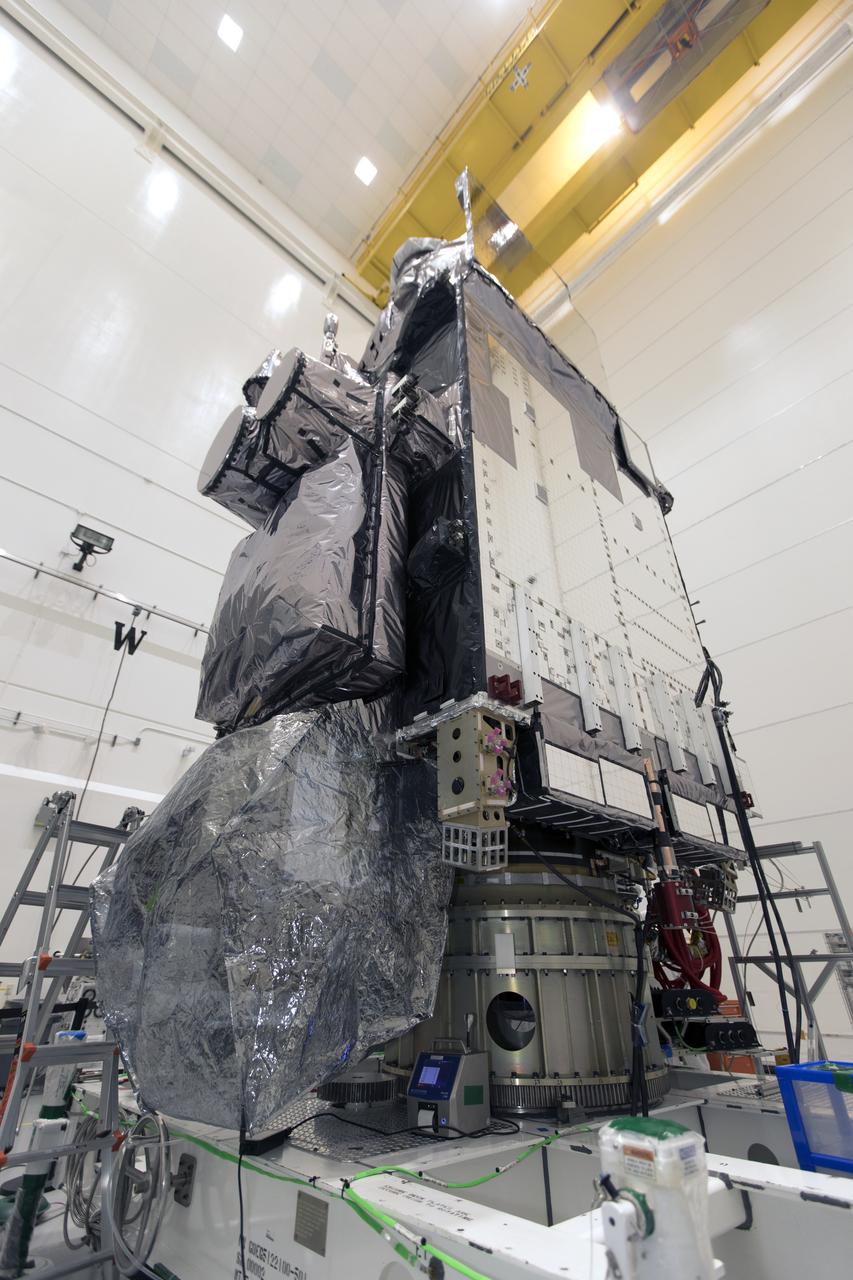
In a clean room at Astrotech Space Operations in Titusville, Florida, NOAA's Geostationary Operational Environmental Satellite-S, or GOES-S, is being prepared for encapsulation in it payload fairing. After encapsulation, the weather satellite will be moved to Space Launch Complex-41 at Cape Canaveral Air Force Station. GOES-S is the second in a series of four advanced geostationary weather satellites. The GOES-R series - consisting of the GOES-R, GOES-S, GOES-T and GOES-U spacecraft - will significantly improve the detection and observation of environmental phenomena that directly affect public safety, protection of property and the nation's economic health and prosperity. GOES-S is slated to launch March 1, 2018 aboard a United Launch Alliance Atlas V rocket.

Inside a clean room in Building 1555 at Vandenberg Air Force Base in California, technicians begin to install the second half of the Northrop Grumman Pegasus XL payload fairing around NASA's Ionospheric Connection Explorer (ICON) on Oct. 4, 2018. ICON is being prepared for its launch on the Pegasus XL, which is attached to the company's L-1011 Stargazer aircraft, from the Skid Strip at Cape Canaveral Air Force Station in Florida. Launch is scheduled for Oct. 26. ICON will study the frontier of space - the dynamic zone high in Earth's atmosphere where terrestrial weather from below meets space weather above. The explorer will help determine the physics of Earth's space environment and pave the way for mitigating its effects on our technology, communications systems and society.
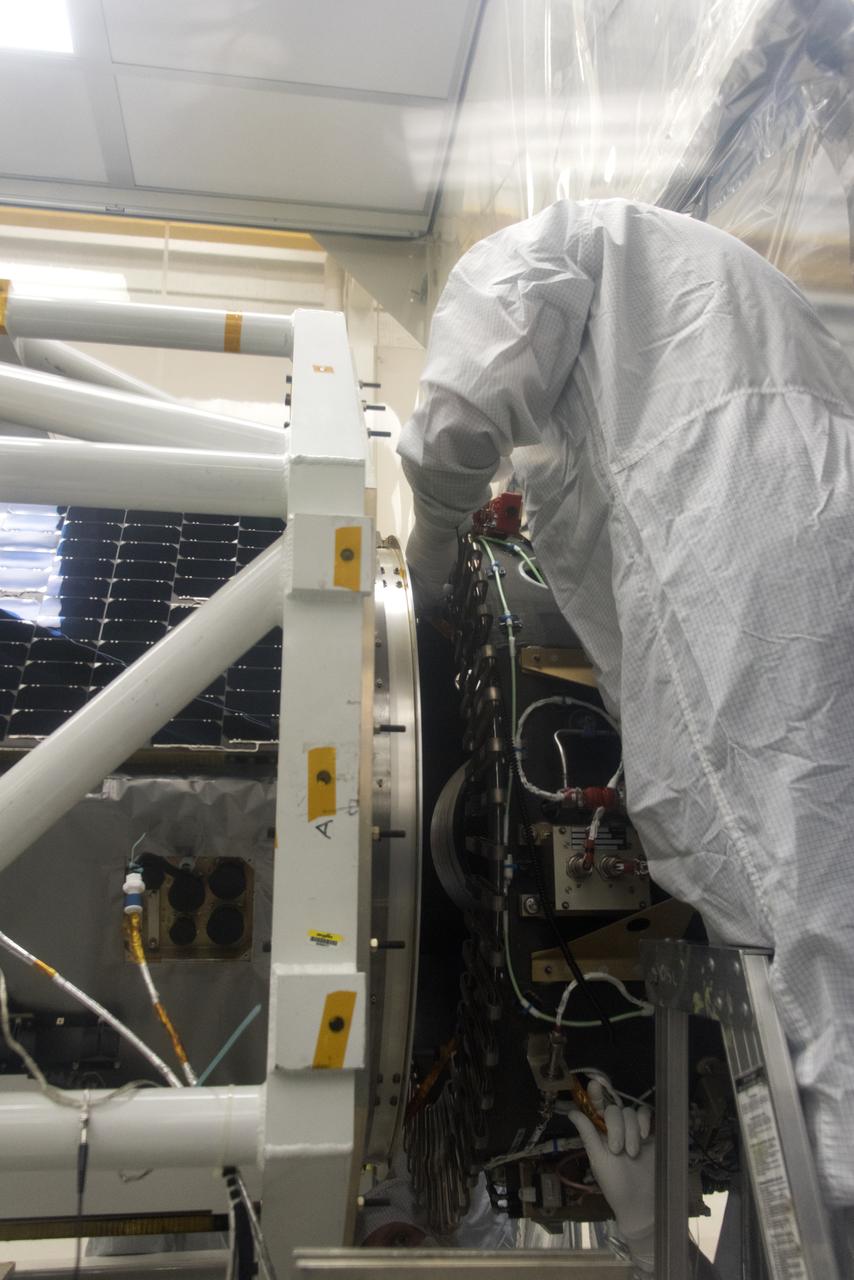
A technician assists as NASA's Ionospheric Connection Explorer (ICON) is being attached to the Orbital ATK Pegasus XL rocket May 14, 2018, inside a clean room in Building 1555 at Vandenberg Air Force Base in California. The explorer will launch on June 15, 2018, from Kwajalein Atoll in the Marshall Islands (June 14 in the continental United States) on the Pegasus XL rocket, which is attached to the company's L-1011 Stargazer aircraft. ICON will study the frontier of space - the dynamic zone high in Earth's atmosphere where terrestrial weather from below meets space weather above. The explorer will help determine the physics of Earth's space environment and pave the way for mitigating its effects on our technology, communications systems and society.
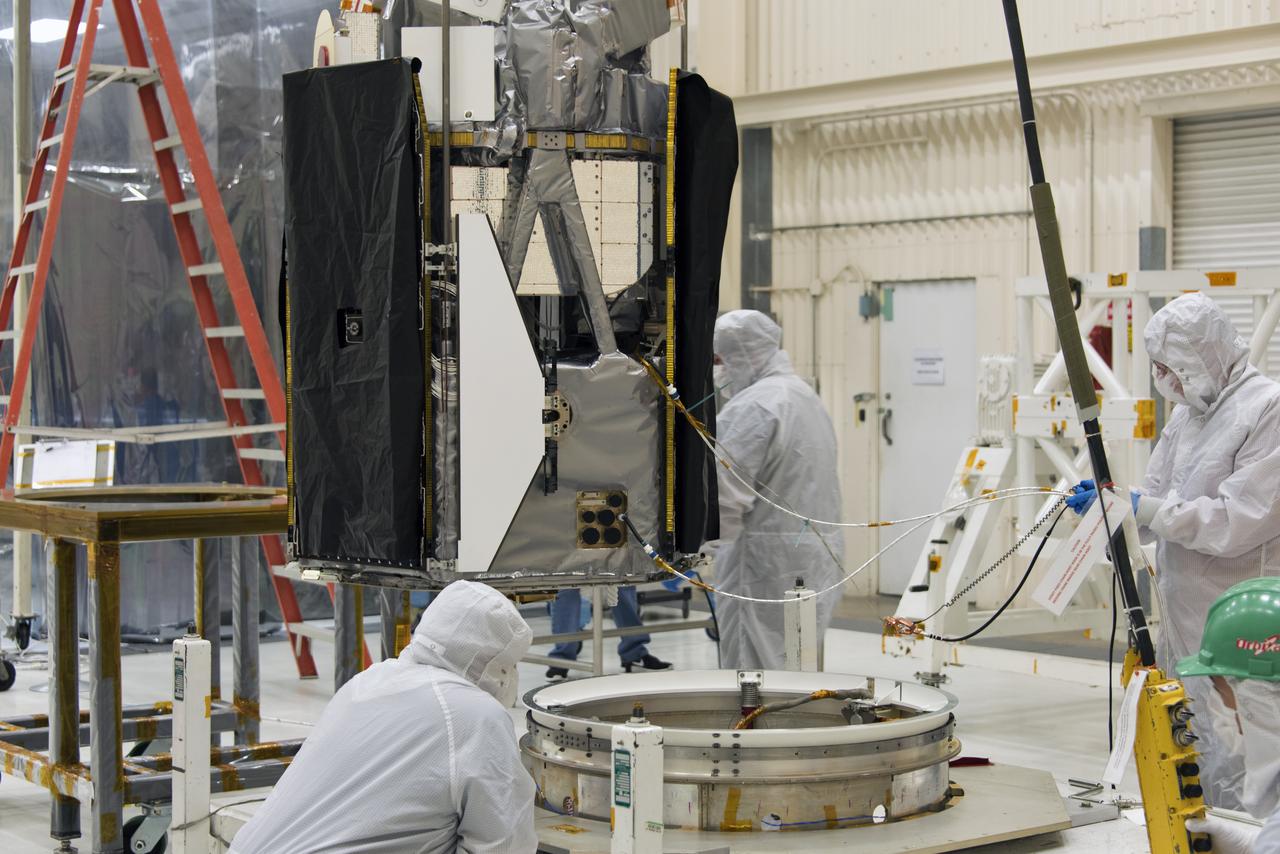
Technicians prepare NASA's Ionospheric Connection Explorer (ICON) to be attached to the spacecraft separation system May 9, 2018, in a clean room inside Building 1555 at Vandenberg Air Force Base in California. The explorer will launch on June 15, 2018, from Kwajalein Atoll in the Marshall Islands (June 14 in the continental United States) on Orbital ATK's Pegasus XL rocket, which is attached to the company's L-1011 Stargazer aircraft. ICON will study the frontier of space - the dynamic zone high in Earth's atmosphere where terrestrial weather from below meets space weather above. The explorer will help determine the physics of Earth's space environment and pave the way for mitigating its effects on our technology, communications systems and society.
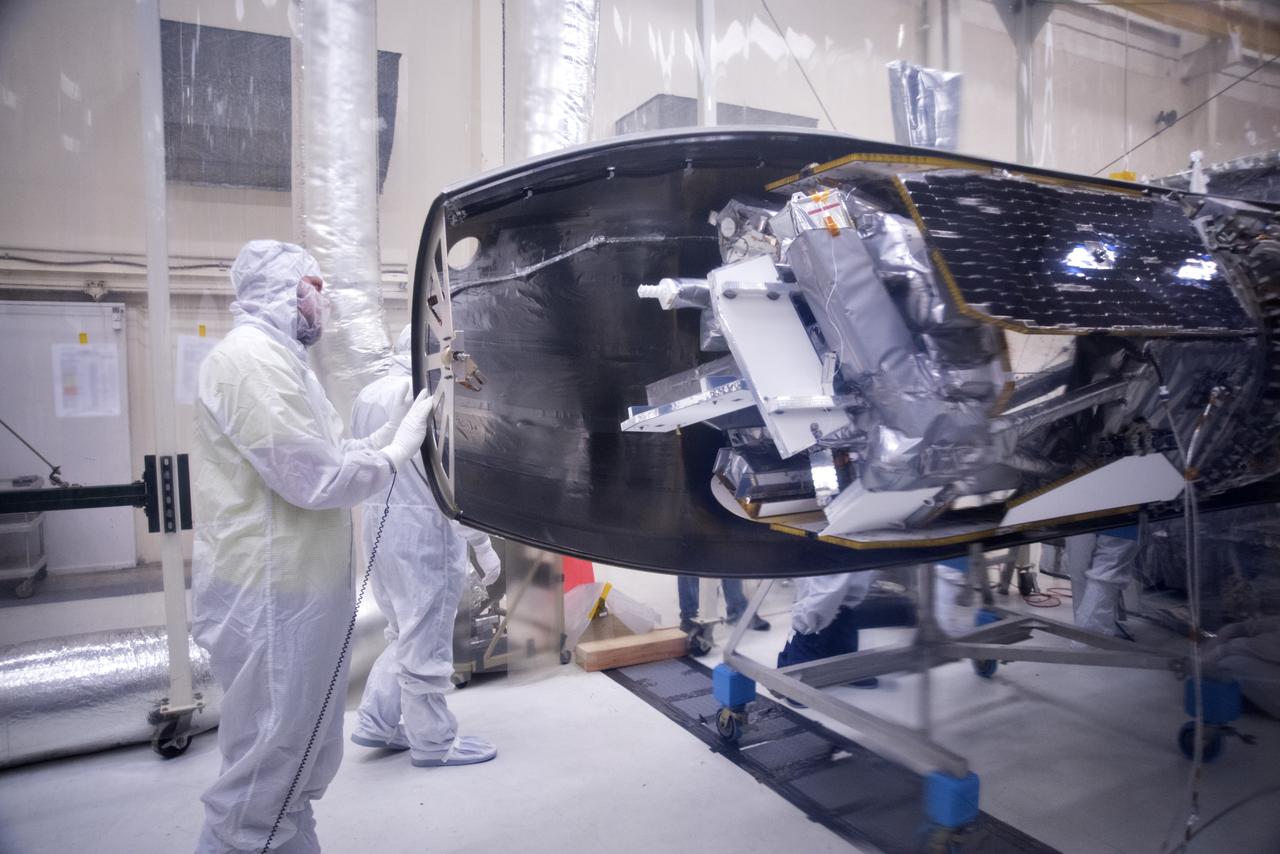
Inside a clean room in Building 1555 at Vandenberg Air Force Base in California, technicians install the first half of the Northrop Grumman Pegasus XL payload fairing around NASA's Ionospheric Connection Explorer (ICON) on Oct. 4, 2018. ICON is being prepared for its launch on the Pegasus XL, which is attached to the company's L-1011 Stargazer aircraft, from the Skid Strip at Cape Canaveral Air Force Station in Florida. Launch is scheduled for Oct. 26. ICON will study the frontier of space - the dynamic zone high in Earth's atmosphere where terrestrial weather from below meets space weather above. The explorer will help determine the physics of Earth's space environment and pave the way for mitigating its effects on our technology, communications systems and society.
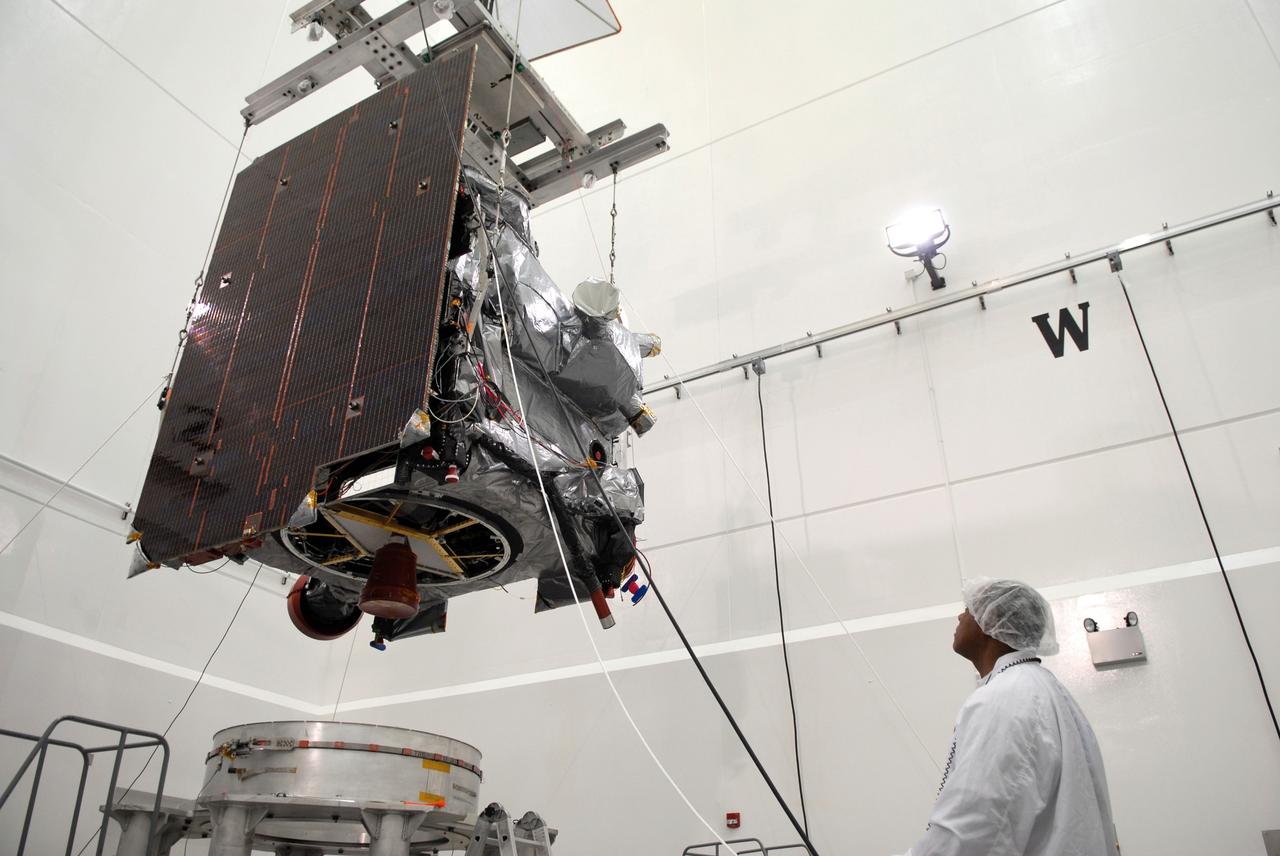
CAPE CANAVERAL, Fla. – In the Astrotech payload processing facility in Titusville, Fla., the GOES-O satellite traverses the clean room toward a special stand for loading of its oxidizer and hydrazine propellants. The latest Geostationary Operational Environmental Satellite, GOES-O was developed by NASA for the National Oceanic and Atmospheric Administration, or NOAA. The GOES satellites continuously provide observations of 60 percent of the Earth including the continental United States, providing weather monitoring and forecast operations as well as a continuous and reliable stream of environmental information and severe weather warnings. Once in orbit, GOES-O will be designated GOES-14, and NASA will provide on-orbit checkout and then transfer operational responsibility to NOAA. The GOES-O satellite is targeted to launch from Cape Canaveral Air Force Station's Launch Complex 37 no earlier than May 12 onboard a United Launch Alliance Delta IV expendable launch vehicle. Photo credit: NASA/Troy Cryder
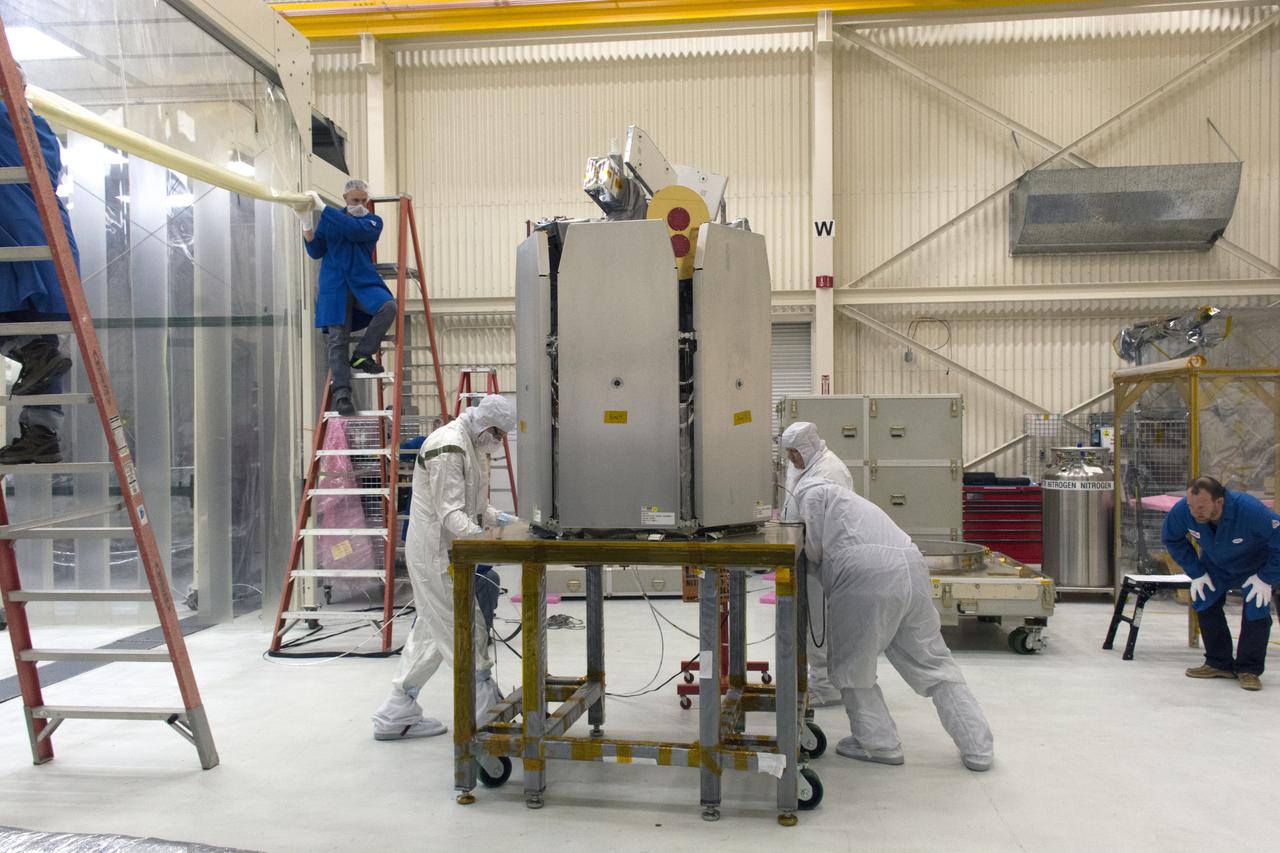
Technicians prepare NASA's Ionospheric Connection Explorer (ICON) for its move to a clean room on May 4, 2018, inside Building 1555 at Vandenberg Air Force Base in California. The explorer will launch on June 15, 2018, from Kwajalein Atoll in the Marshall Islands (June 14 in the continental United States) on Orbital ATK's Pegasus XL rocket, which is attached to the company's L-1011 Stargazer aircraft. ICON will study the frontier of space - the dynamic zone high in Earth's atmosphere where terrestrial weather from below meets space weather above. The explorer will help determine the physics of Earth's space environment and pave the way for mitigating its effects on our technology, communications systems and society.
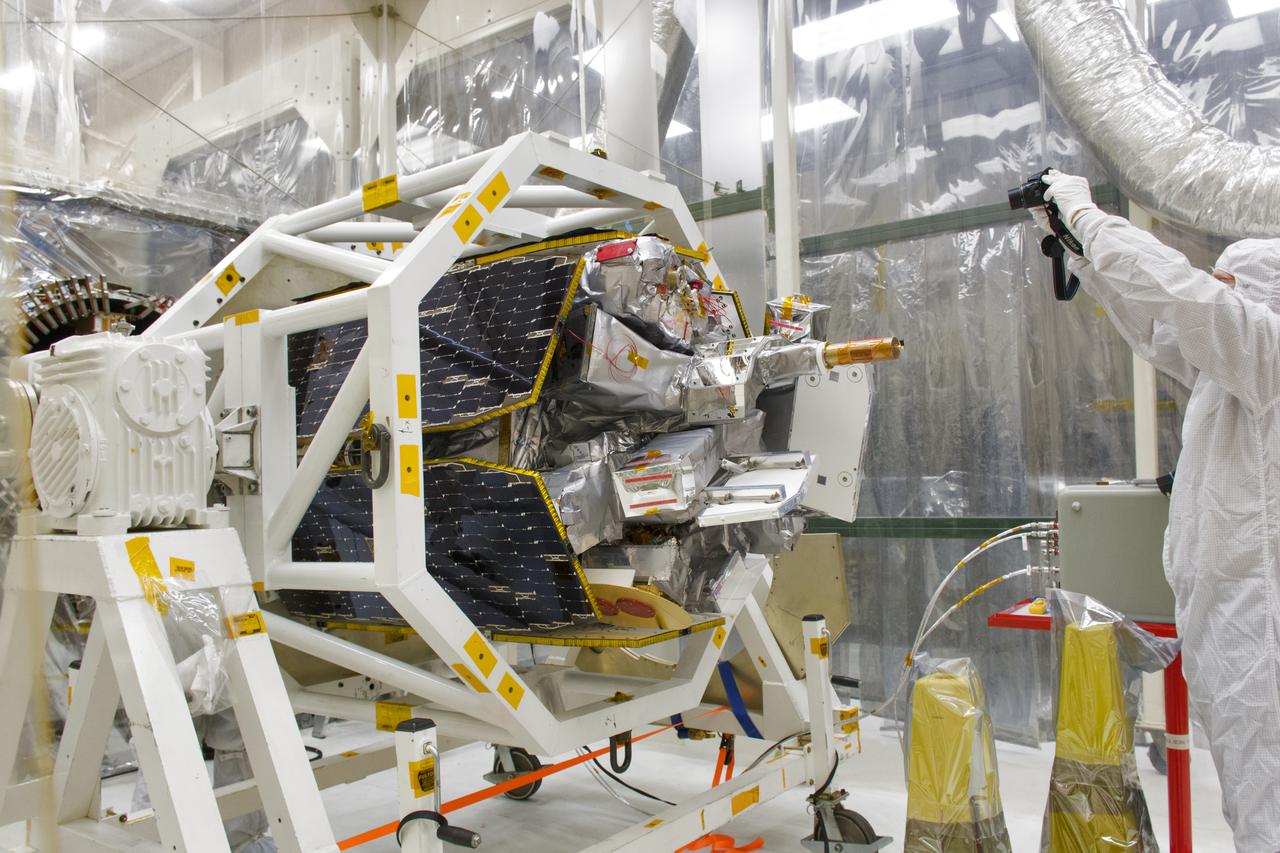
NASA's Ionospheric Connection Explorer (ICON) is in the horizontal position May 11, 2018, inside a clean room in Building 1555 at Vandenberg Air Force Base in California. ICON is being prepared to be attached to the Orbital ATK Pegasus XL rocket. The explorer will launch on June 15, 2018, from Kwajalein Atoll in the Marshall Islands (June 14 in the continental United States) on the Pegasus XL rocket, which is attached to the company's L-1011 Stargazer aircraft. ICON will study the frontier of space - the dynamic zone high in Earth's atmosphere where terrestrial weather from below meets space weather above. The explorer will help determine the physics of Earth's space environment and pave the way for mitigating its effects on our technology, communications systems and society.
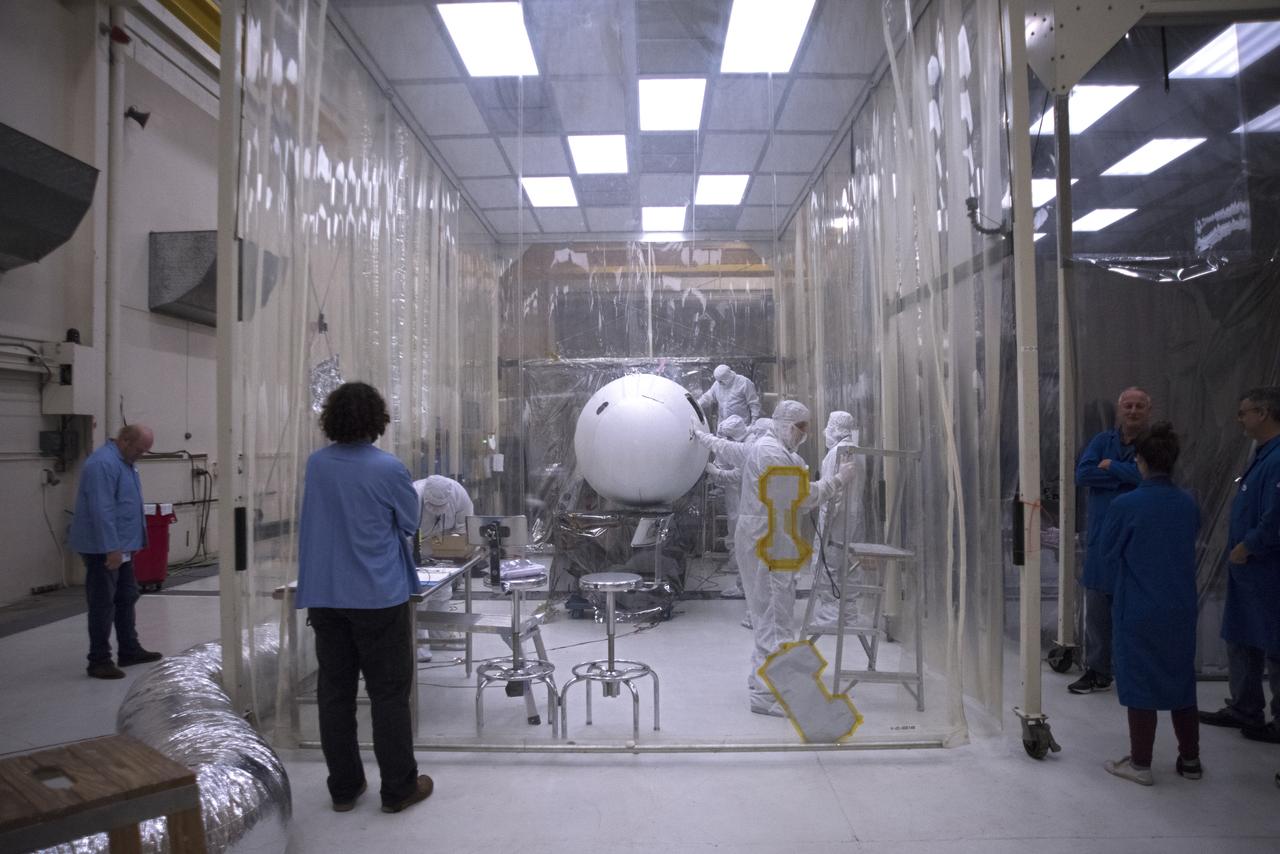
Inside a clean room in Building 1555 at Vandenberg Air Force Base in California, technicians complete installation of the second half of the Northrop Grumman Pegasus XL payload fairing around NASA's Ionospheric Connection Explorer (ICON) on Oct. 4, 2018. ICON is being prepared for its launch on the Pegasus XL, which is attached to the company's L-1011 Stargazer aircraft, from the Skid Strip at Cape Canaveral Air Force Station in Florida. Launch is scheduled for Oct. 26. ICON will study the frontier of space - the dynamic zone high in Earth's atmosphere where terrestrial weather from below meets space weather above. The explorer will help determine the physics of Earth's space environment and pave the way for mitigating its effects on our technology, communications systems and society.
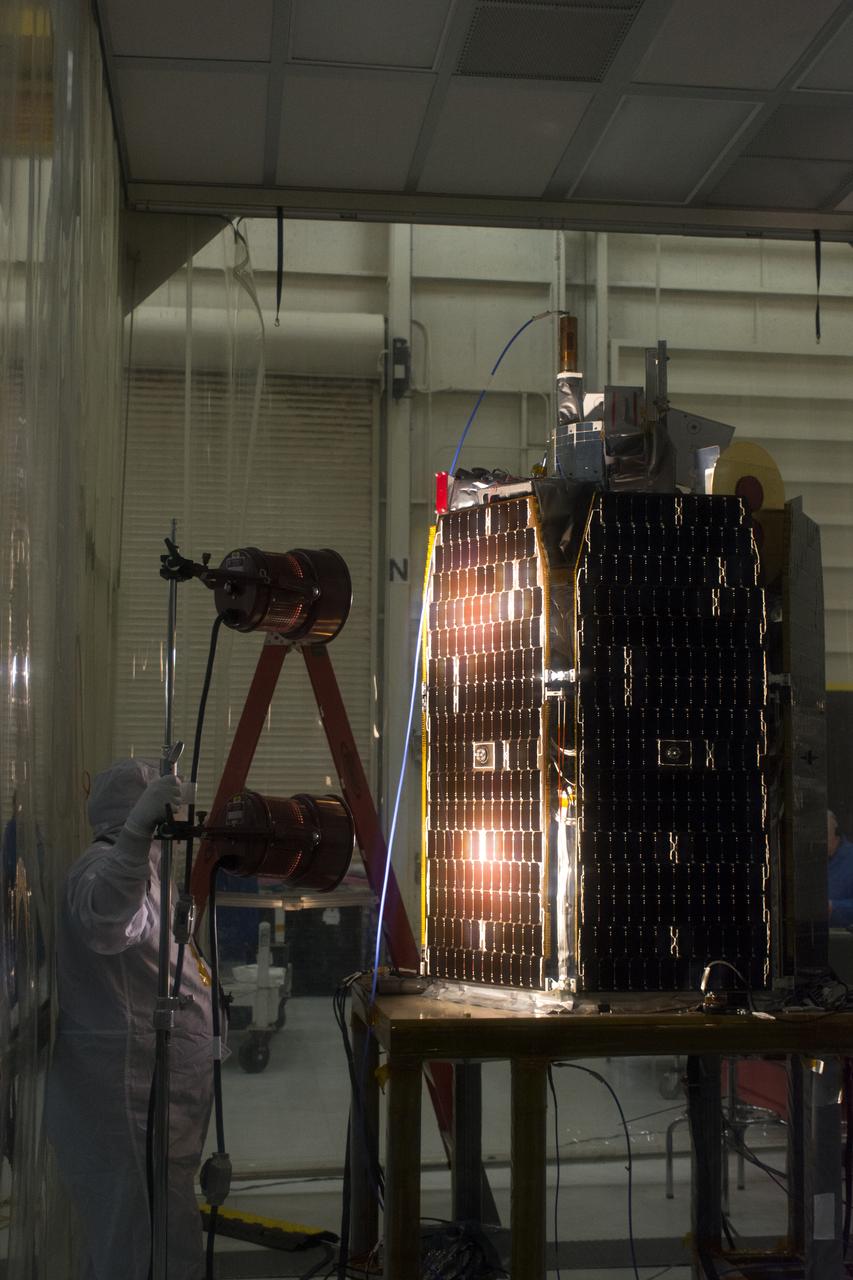
A solar array illumination test is performed on NASA's Ionospheric Connection Explorer (ICON) in a clean room inside Building 1555 at Vandenberg Air Force Base in California on May 4, 2018. The test checks for any imperfections and confirms that the solar arrays are functioning properly. The explorer will launch on June 15, 2018, from Kwajalein Atoll in the Marshall Islands (June 14 in the continental United States) on Orbital ATK's Pegasus XL rocket, which is attached to the company's L-1011 Stargazer aircraft. ICON will study the frontier of space - the dynamic zone high in Earth's atmosphere where terrestrial weather from below meets space weather above. The explorer will help determine the physics of Earth's space environment and pave the way for mitigating its effects on our technology, communications systems and society.
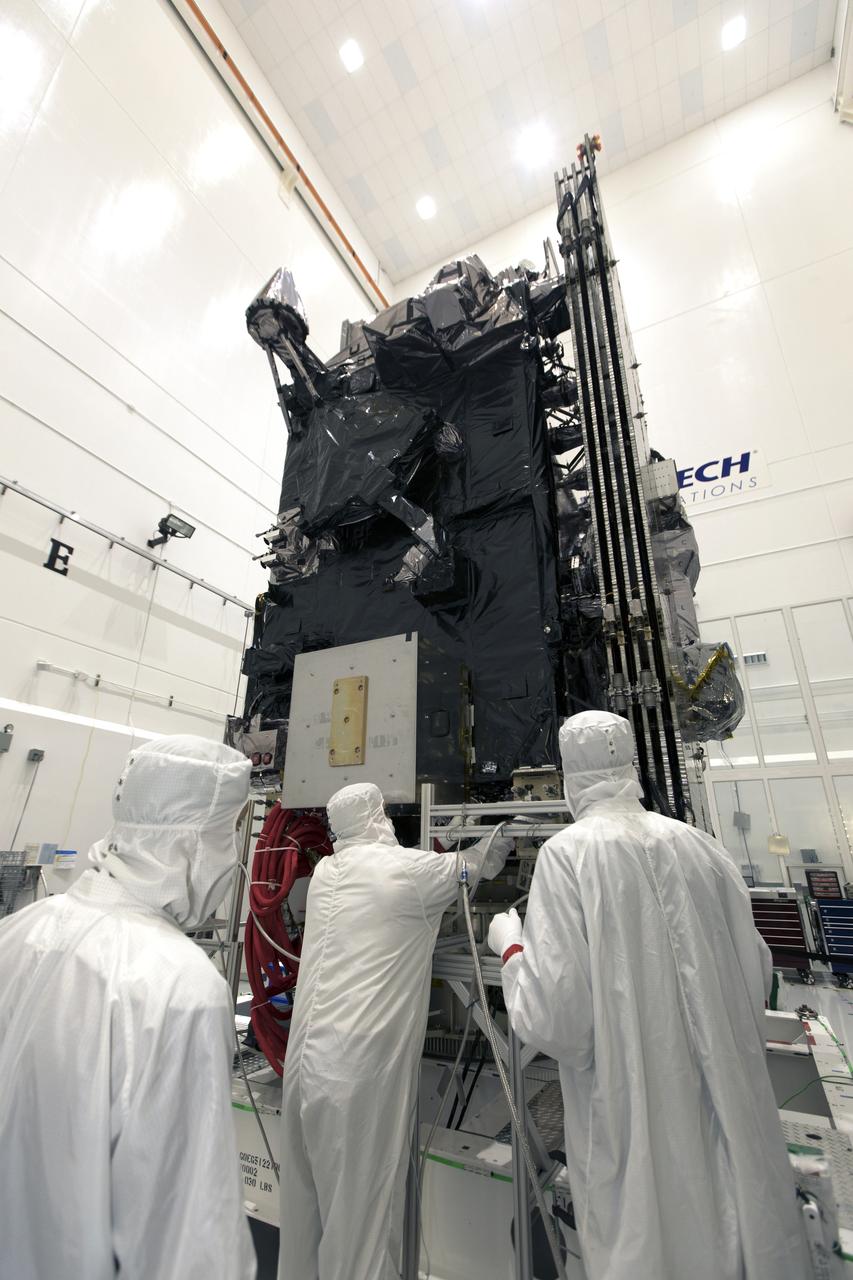
In a clean room at Astrotech Space Operations in Titusville, Florida, technicians and engineers are preparing NOAA's Geostationary Operational Environmental Satellite-S, or GOES-S, for encapsulation in it payload fairing. After encapsulation, the weather satellite will be moved to Space Launch Complex-41 at Cape Canaveral Air Force Station. GOES-S is the second in a series of four advanced geostationary weather satellites. The GOES-R series - consisting of the GOES-R, GOES-S, GOES-T and GOES-U spacecraft - will significantly improve the detection and observation of environmental phenomena that directly affect public safety, protection of property and the nation's economic health and prosperity. GOES-S is slated to launch March 1, 2018 aboard a United Launch Alliance Atlas V rocket.
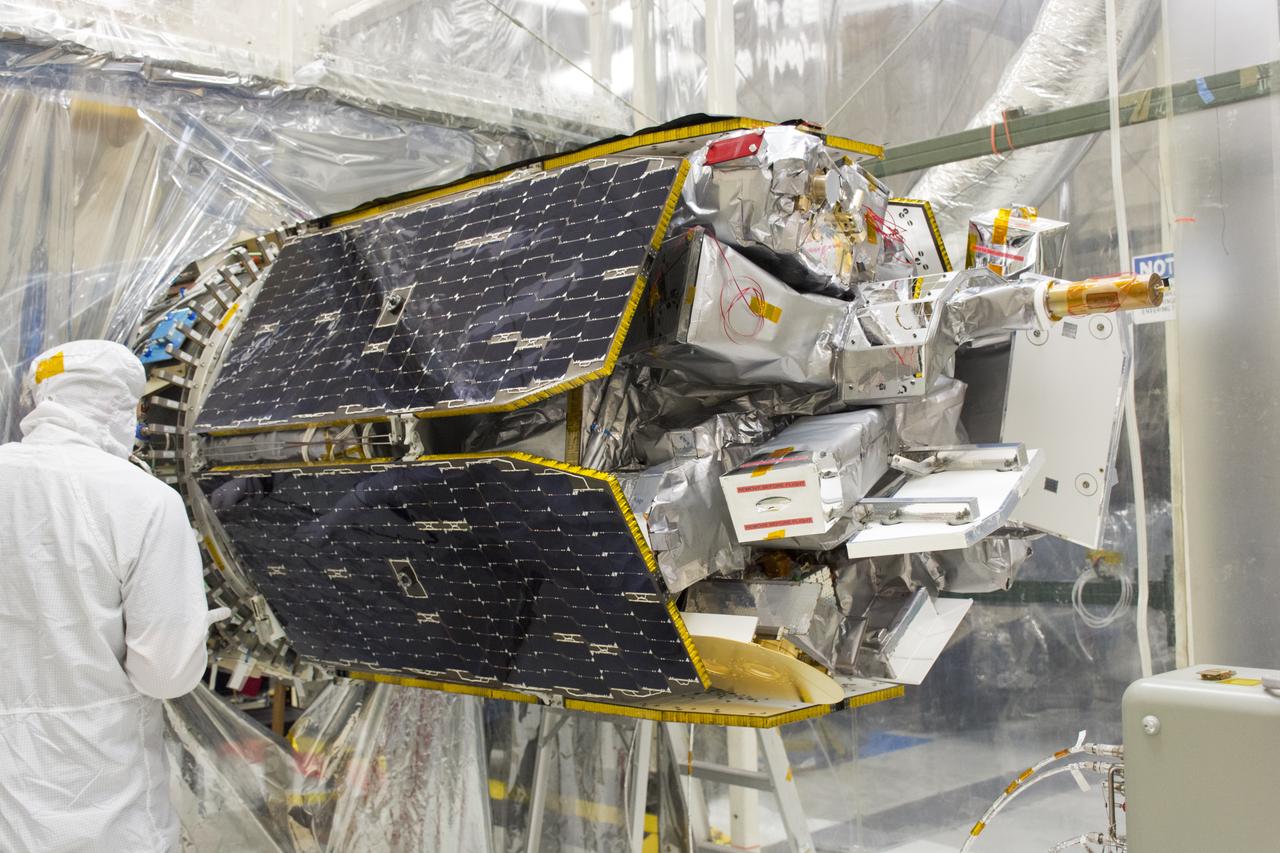
A technician assists with connections as NASA's Ionospheric Connection Explorer (ICON) is attached to the Orbital ATK Pegasus XL rocket May 14, 2018, inside a clean room in Building 1555 at Vandenberg Air Force Base in California. The explorer will launch on June 15, 2018, from Kwajalein Atoll in the Marshall Islands (June 14 in the continental United States) on the Pegasus XL rocket, which is attached to the company's L-1011 Stargazer aircraft. ICON will study the frontier of space - the dynamic zone high in Earth's atmosphere where terrestrial weather from below meets space weather above. The explorer will help determine the physics of Earth's space environment and pave the way for mitigating its effects on our technology, communications systems and society.
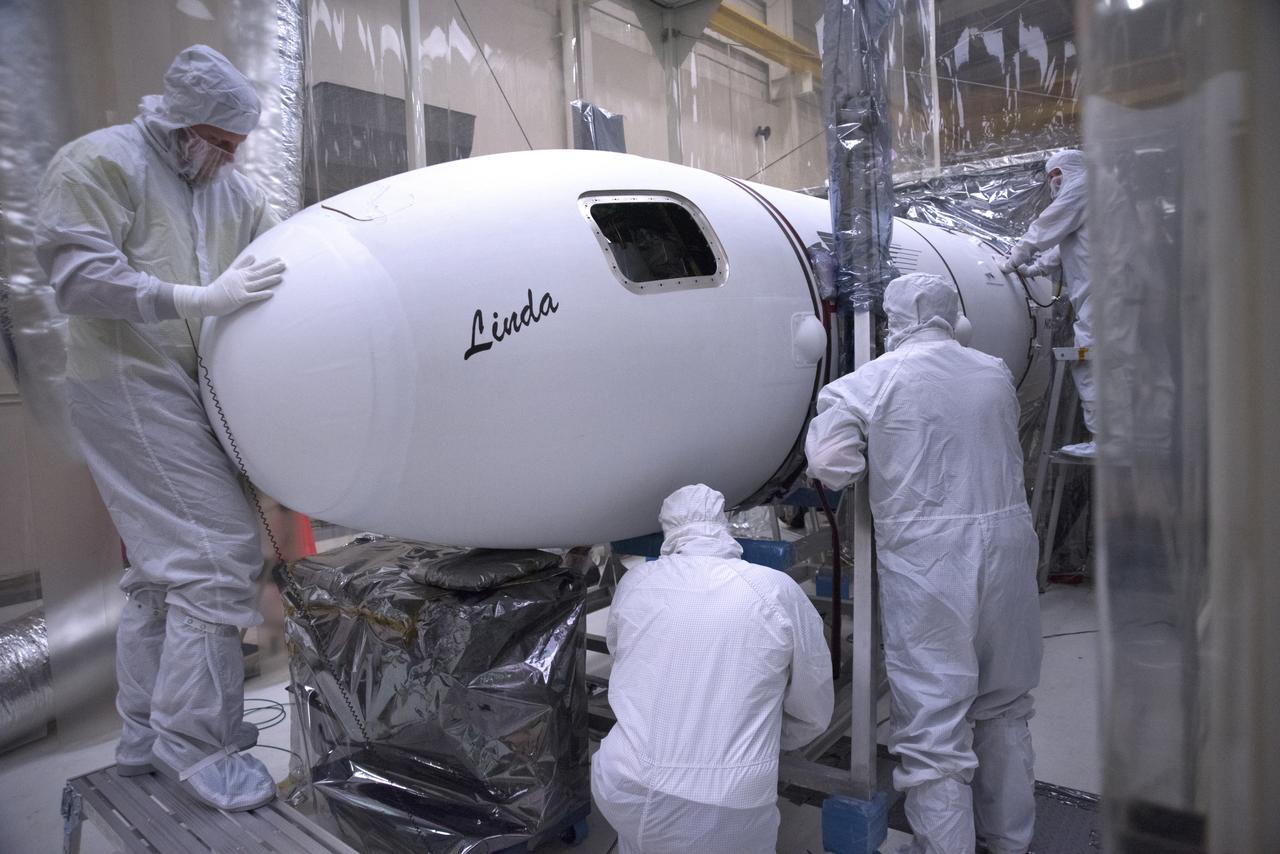
Inside a clean room in Building 1555 at Vandenberg Air Force Base in California, technicians install the second half of the Northrop Grumman Pegasus XL payload fairing around NASA's Ionospheric Connection Explorer (ICON) on Oct. 4, 2018. ICON is being prepared for its launch on the Pegasus XL, which is attached to the company's L-1011 Stargazer aircraft, from the Skid Strip at Cape Canaveral Air Force Station in Florida. Launch is scheduled for Oct. 26. ICON will study the frontier of space - the dynamic zone high in Earth's atmosphere where terrestrial weather from below meets space weather above. The explorer will help determine the physics of Earth's space environment and pave the way for mitigating its effects on our technology, communications systems and society.
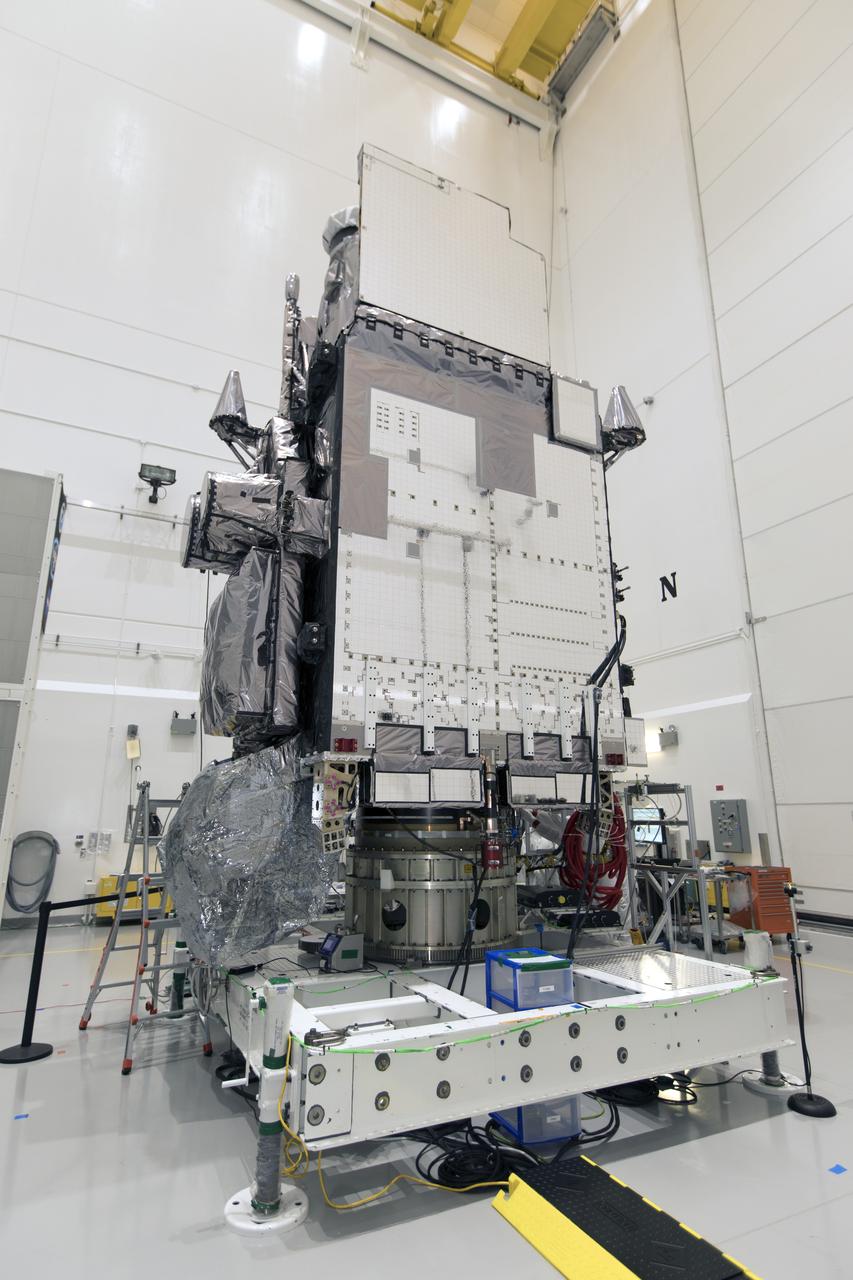
In a clean room at Astrotech Space Operations in Titusville, Florida, NOAA's Geostationary Operational Environmental Satellite-S, or GOES-S, is being prepared for encapsulation in it payload fairing. After encapsulation, the weather satellite will be moved to Space Launch Complex-41 at Cape Canaveral Air Force Station. GOES-S is the second in a series of four advanced geostationary weather satellites. The GOES-R series - consisting of the GOES-R, GOES-S, GOES-T and GOES-U spacecraft - will significantly improve the detection and observation of environmental phenomena that directly affect public safety, protection of property and the nation's economic health and prosperity. GOES-S is slated to launch March 1, 2018 aboard a United Launch Alliance Atlas V rocket.
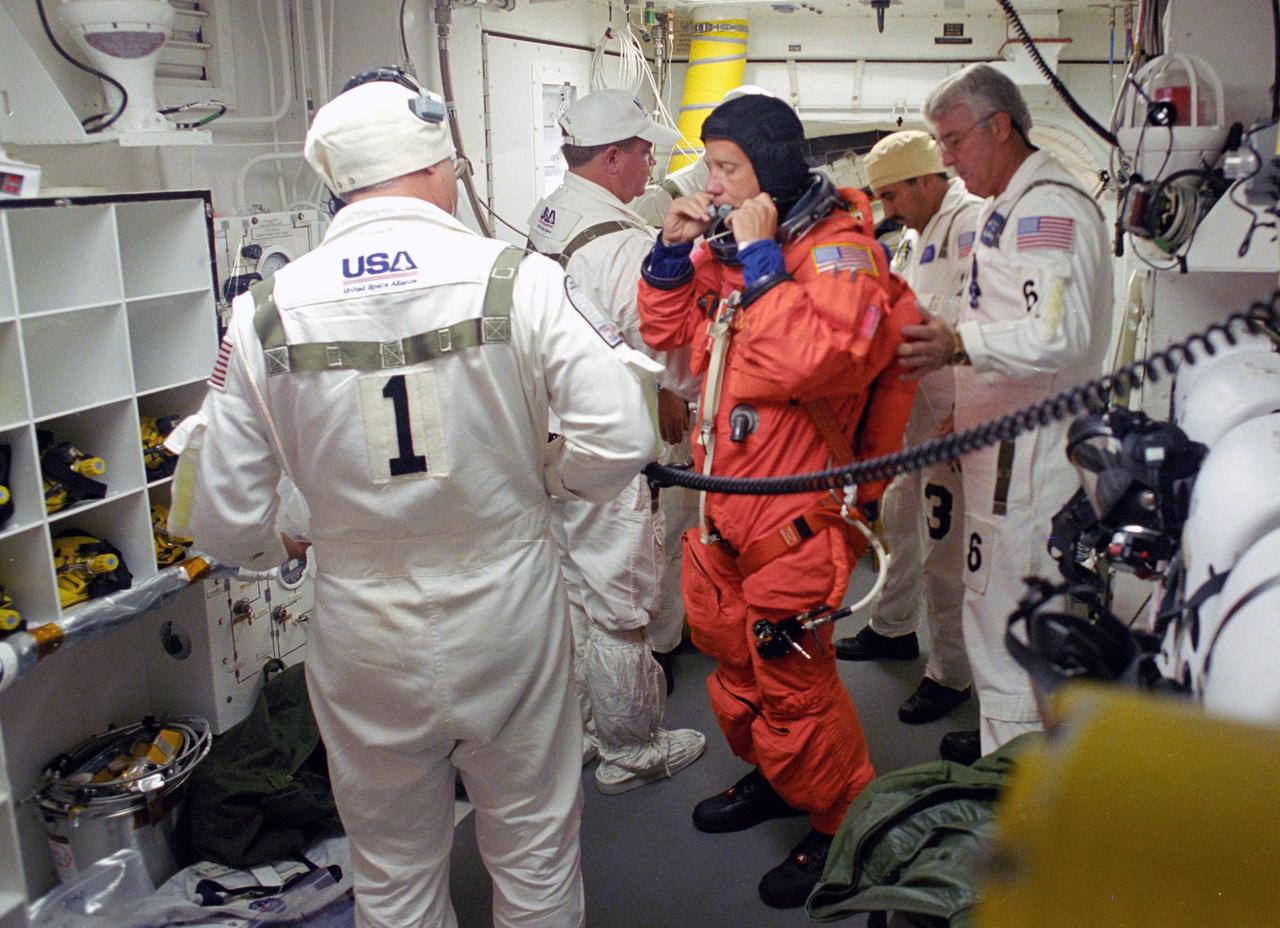
KENNEDY SPACE CENTER, FLA. - In the White Room on Launch Pad 39B, STS-121 Commander Steven Lindsey is helped by the Closeout Crew to prepare his launch suit for entering Discovery and the launch. Situated on the end of the orbiter access arm, the White Room provides access into the orbiter on the pad. The crew is preparing for the third launch attempt in four days; previous attempts were scrubbed due to weather concerns. During the 12-day mission, the STS-121 crew will test new equipment and procedures to improve shuttle safety, as well as deliver supplies and make repairs to the International Space Station. The launch of Space Shuttle Discovery on mission STS-121 is the 115th shuttle flight and the 18th U.S. flight to the International Space Station. Photo credit: NASA/Regina Mitchell-Ryall & Tony Gray
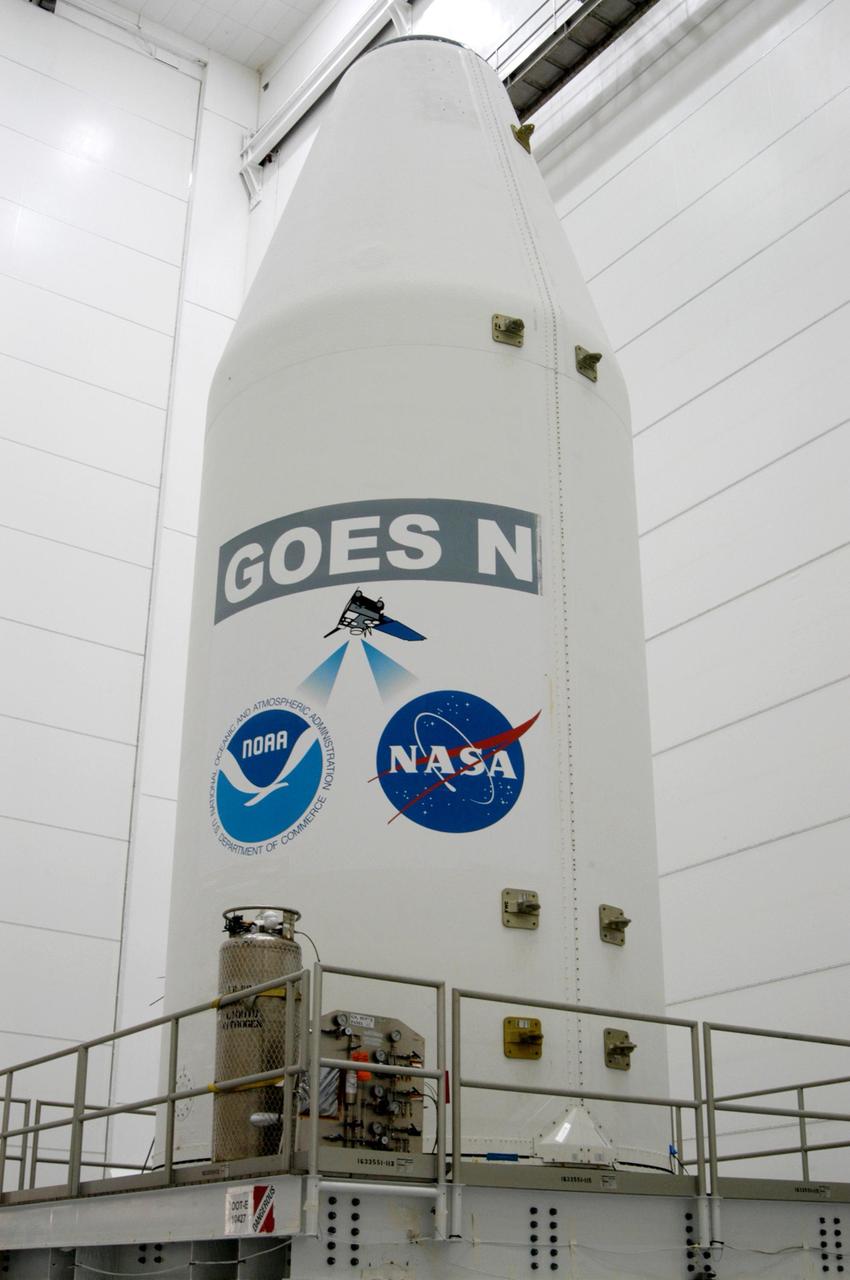
KENNEDY SPACE CENTER, FLA. - At the Astrotech Space Operations payload processing facility in Titusville, Fla., the GOES-N satellite, secured inside a payload fairing, waits inside the clean room high bay for transfer to another room and waiting work stands. Due to the extended length of time the spacecraft had been atop its Boeing Delta IV rocket without launching, the weather satellite has been returned to Astrotech for some precautionary retesting and state of health checks. Liftoff of the satellite from Launch Complex 37 at Cape Canaveral Air Force Station in Florida was scrubbed in August 2005 due to technical issues and postponed to a later date. GOES-N is the latest in a series of Geostationary Operational Environmental Satellites for NOAA and NASA providing continuous monitoring necessary for intensive data analysis. Photo credit: NASA/George Shelton
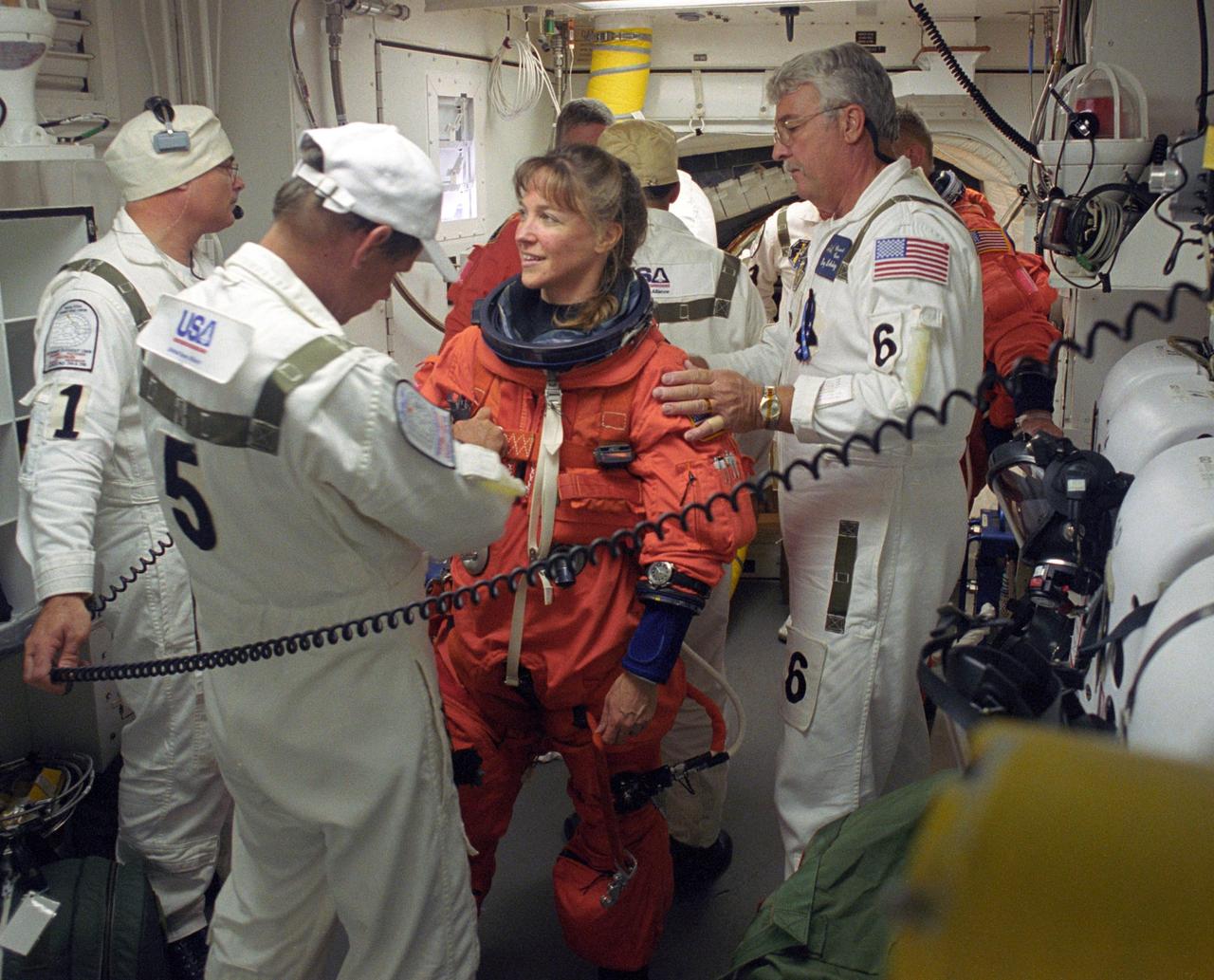
KENNEDY SPACE CENTER, FLA. - In In the White Room on Launch Pad 39B, STS-121 Mission Specialist Lisa Nowak is helped by the Closeout Crew with final preparations on her launch suit before entering Discovery. Situated on the end of the orbiter access arm, the White Room provides access into the orbiter on the pad. The crew is preparing for the third launch attempt in four days; previous attempts were scrubbed due to weather concerns. During the 12-day mission, the STS-121 crew will test new equipment and procedures to improve shuttle safety, as well as deliver supplies and make repairs to the International Space Station. The launch of Space Shuttle Discovery on mission STS-121 is the 115th shuttle flight and the 18th U.S. flight to the International Space Station.
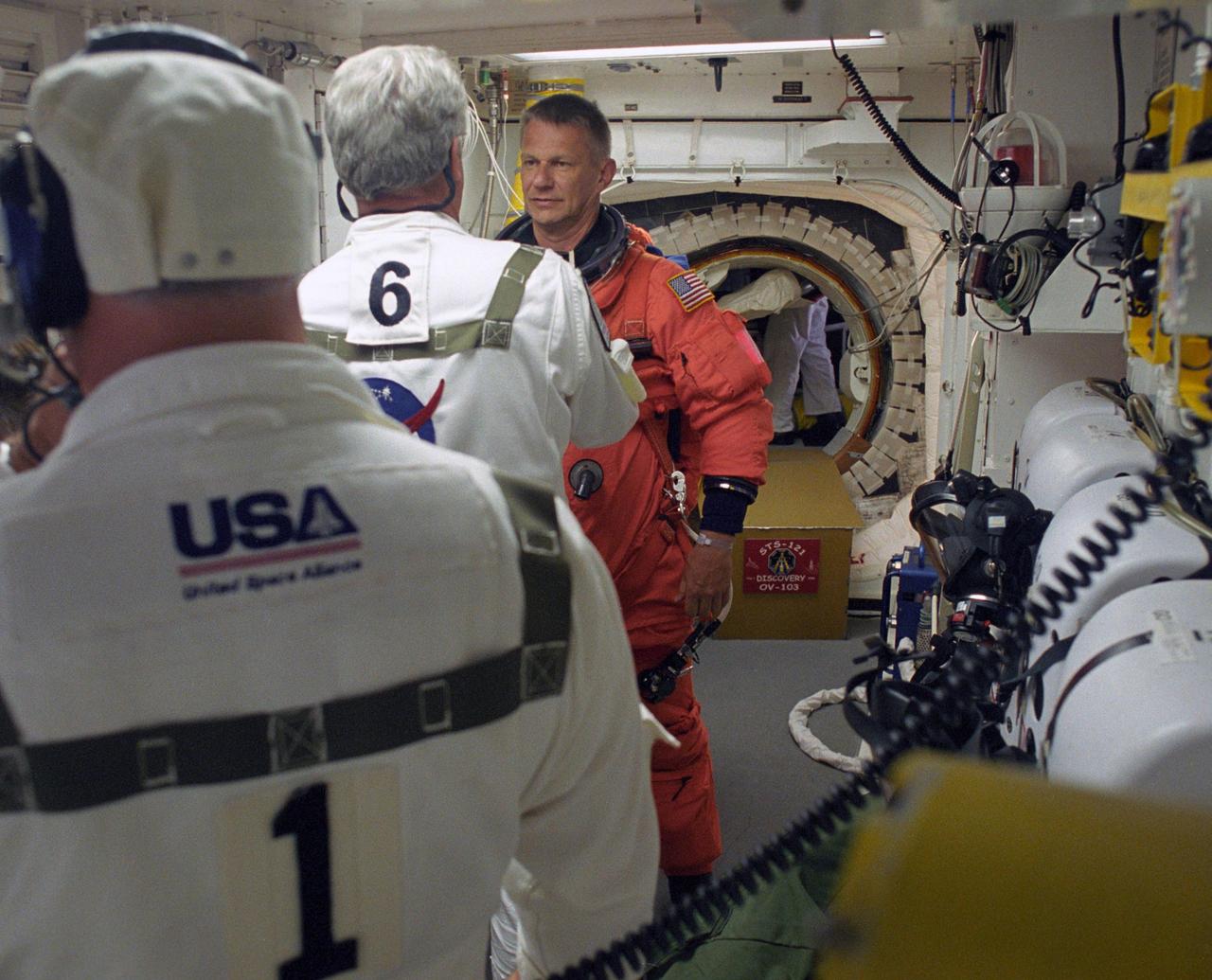
KENNEDY SPACE CENTER, FLA. - In the White Room on Launch Pad 39B, STS-121 Mission Specialist Piers Sellers gets help from the Closeout Crew with final preparations on his launch suit before entering Discovery. Situated on the end of the orbiter access arm, the White Room provides access into the orbiter on the pad. The crew is preparing for the third launch attempt in four days; previous attempts were scrubbed due to weather concerns. During the 12-day mission, the STS-121 crew will test new equipment and procedures to improve shuttle safety, as well as deliver supplies and make repairs to the International Space Station. The launch of Space Shuttle Discovery on mission STS-121 is the 115th shuttle flight and the 18th U.S. flight to the International Space Station.
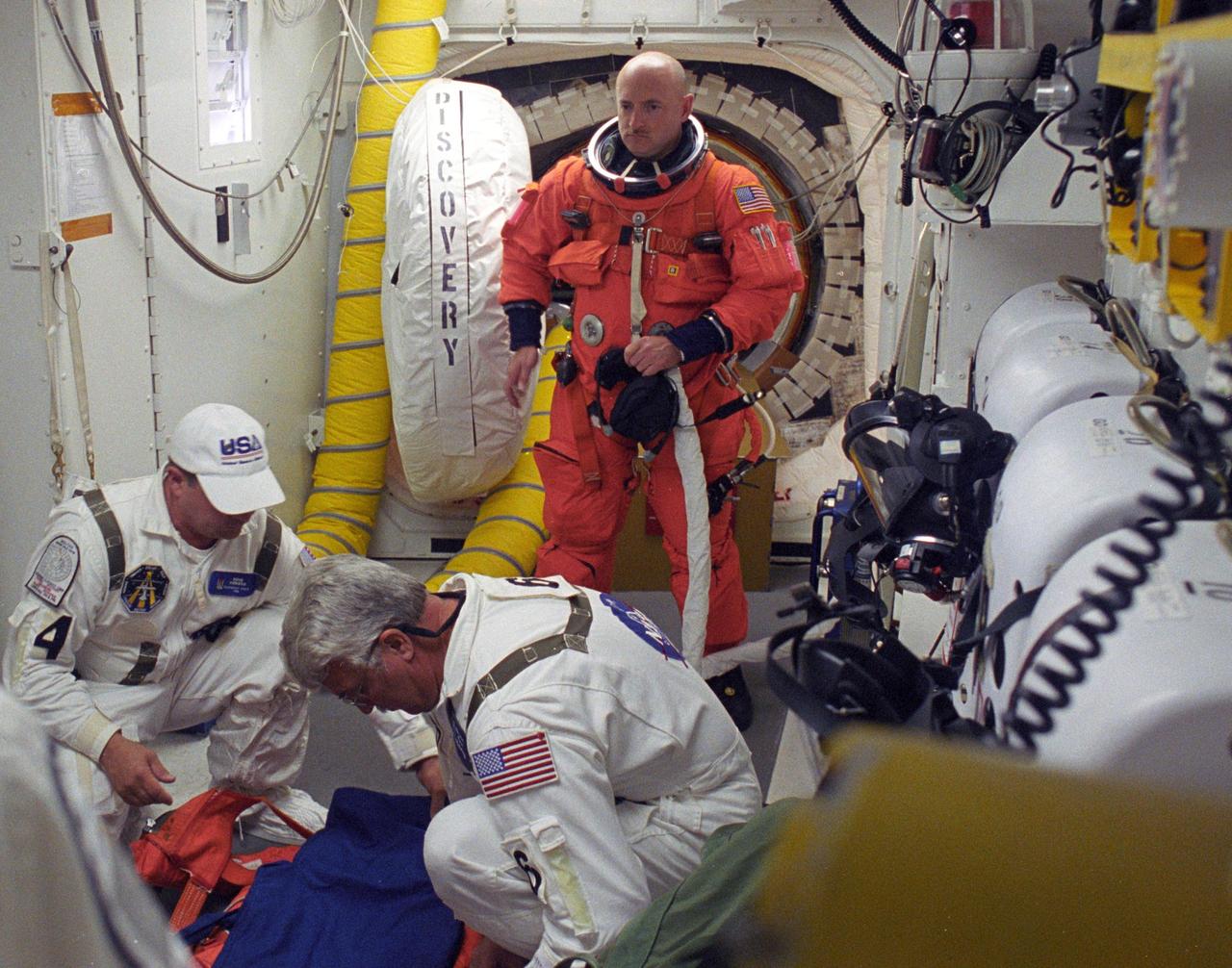
KENNEDY SPACE CENTER, FLA. - In the White Room on Launch Pad 39B, STS-121 Pilot Mark Kelly heads for the Closeout Crew who will help with final preparations on his launch suit before entering Discovery. Situated on the end of the orbiter access arm, the White Room provides access into the orbiter on the pad. The crew is preparing for the third launch attempt in four days; previous attempts were scrubbed due to weather concerns. During the 12-day mission, the STS-121 crew will test new equipment and procedures to improve shuttle safety, as well as deliver supplies and make repairs to the International Space Station. The launch of Space Shuttle Discovery on mission STS-121 is the 115th shuttle flight and the 18th U.S. flight to the International Space Station.
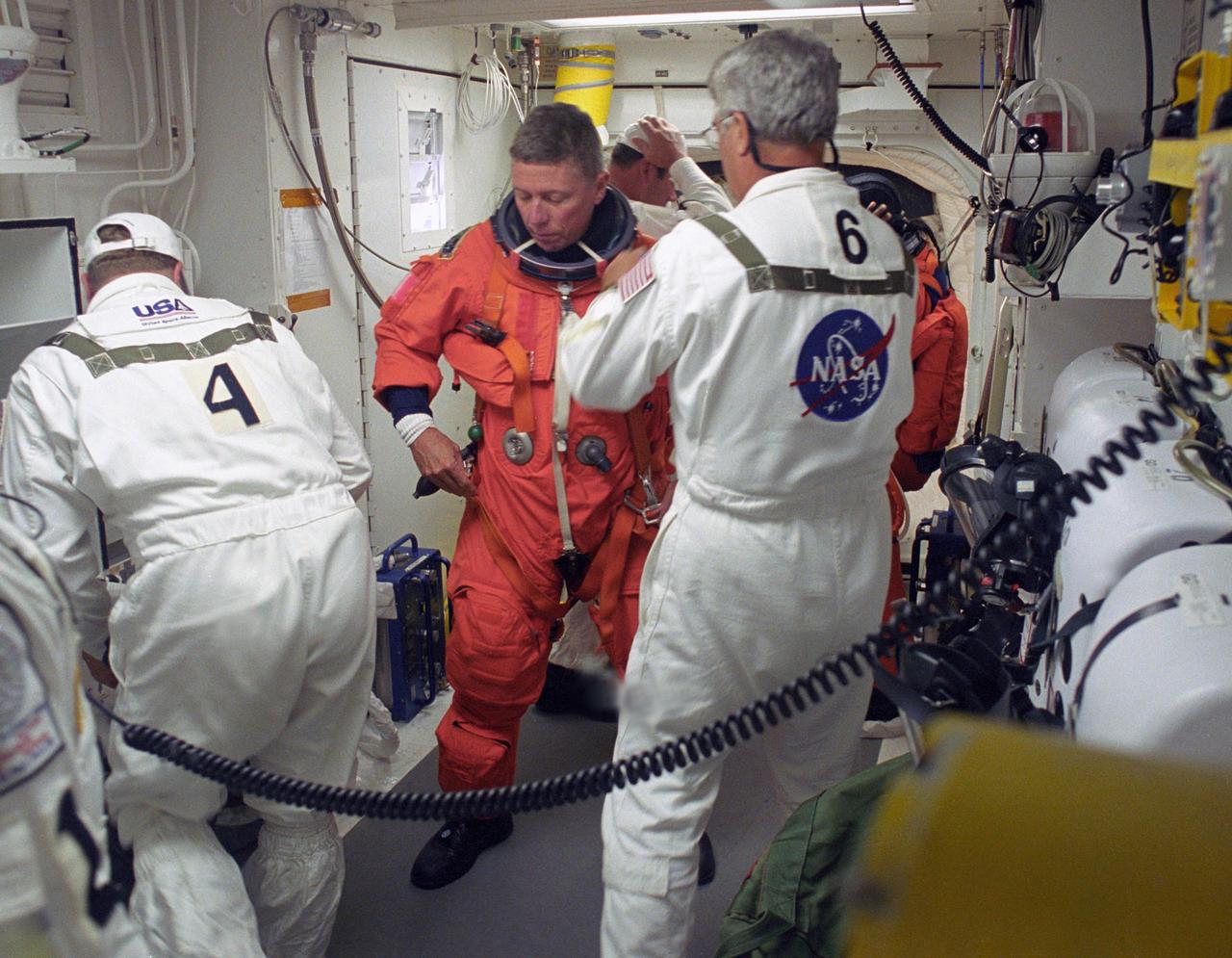
KENNEDY SPACE CENTER, FLA. - In the White Room on Launch Pad 39B, STS-121 Mission Specialist Michael Fossum gets help from the Closeout Crew with final preparations on his launch suit before entering Discovery. Situated on the end of the orbiter access arm, the White Room provides access into the orbiter on the pad. The crew is preparing for the third launch attempt in four days; previous attempts were scrubbed due to weather concerns. During the 12-day mission, the STS-121 crew will test new equipment and procedures to improve shuttle safety, as well as deliver supplies and make repairs to the International Space Station. The launch of Space Shuttle Discovery on mission STS-121 is the 115th shuttle flight and the 18th U.S. flight to the International Space Station.
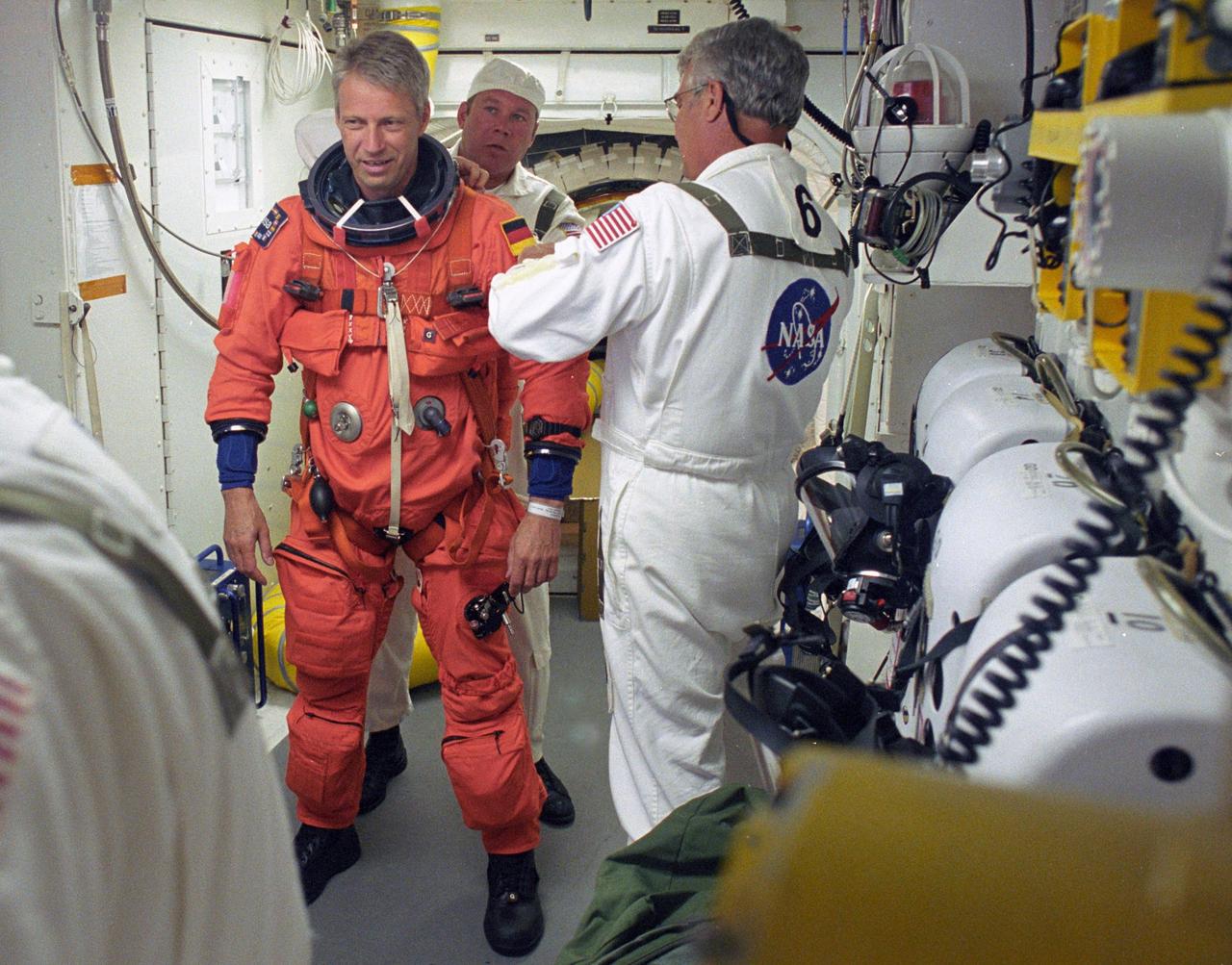
KENNEDY SPACE CENTER, FLA. - In the White Room on Launch Pad 39B, STS-121 Mission Specialist Thomas Reiter is helped by the Closeout Crew to prepare for entering Discovery and the launch. Situated on the end of the orbiter access arm, the White Room provides access into the orbiter on the pad. The crew is preparing for the third launch attempt in four days; previous attempts were scrubbed due to weather concerns. During the 12-day mission, the STS-121 crew will test new equipment and procedures to improve shuttle safety, as well as deliver supplies and make repairs to the International Space Station. The launch of Space Shuttle Discovery on mission STS-121 is the 115th shuttle flight and the 18th U.S. flight to the International Space Station. Photo credit: NASA/Regina Mitchell-Ryall & Tony Gray
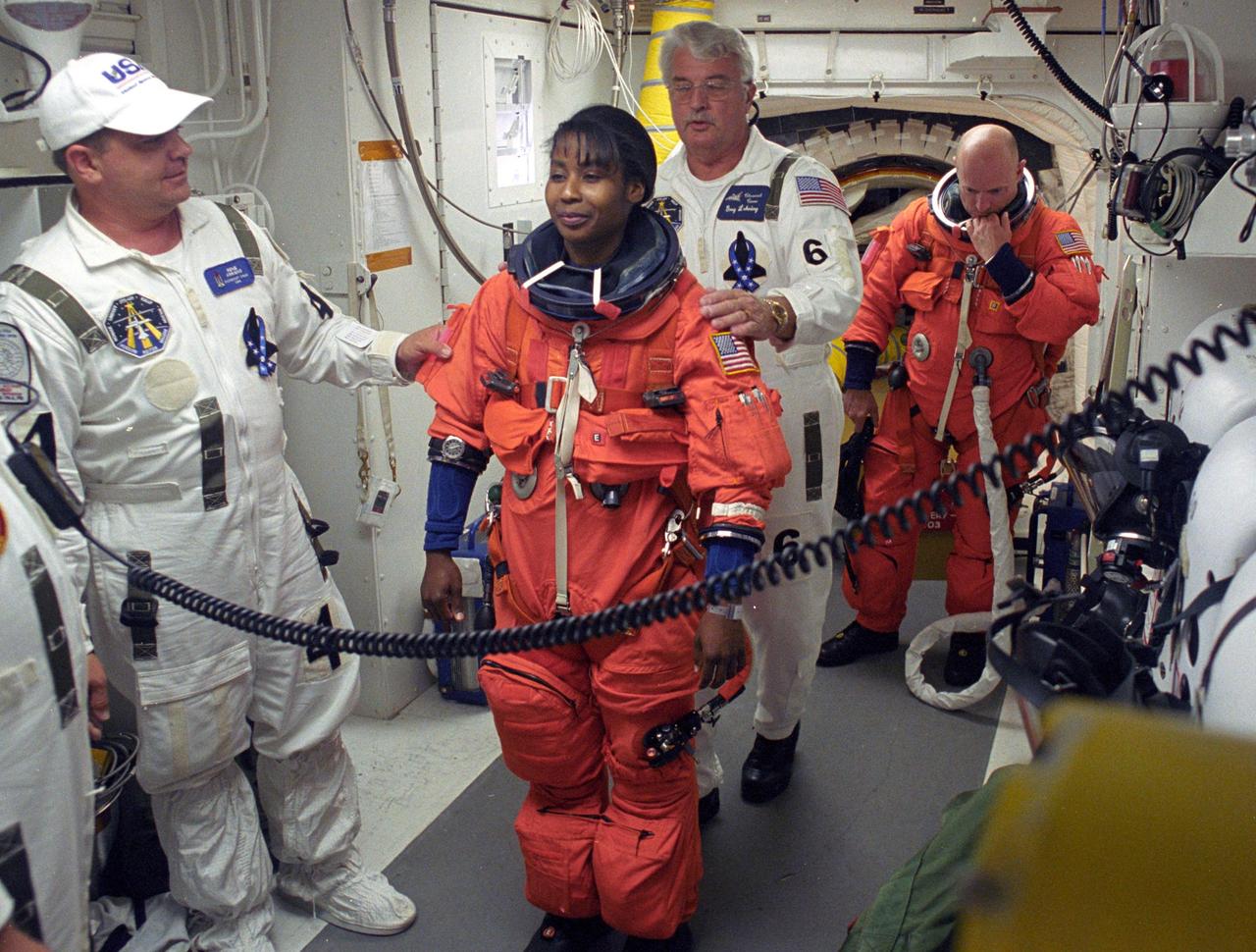
KENNEDY SPACE CENTER, FLA. - In the White Room on Launch Pad 39B, STS-121 Mission Specialist Stephanie Wilson is helped by the Closeout Crew to secure her launch suit before entering Discovery. Waiting in the back is Pilot Mark Kelly. Situated on the end of the orbiter access arm, the White Room provides access into the orbiter on the pad. The crew is preparing for the third launch attempt in four days; previous attempts were scrubbed due to weather concerns. During the 12-day mission, the STS-121 crew will test new equipment and procedures to improve shuttle safety, as well as deliver supplies and make repairs to the International Space Station. The launch of Space Shuttle Discovery on mission STS-121 is the 115th shuttle flight and the 18th U.S. flight to the International Space Station. Photo credit: NASA/Regina Mitchell-Ryall & Tony Gray