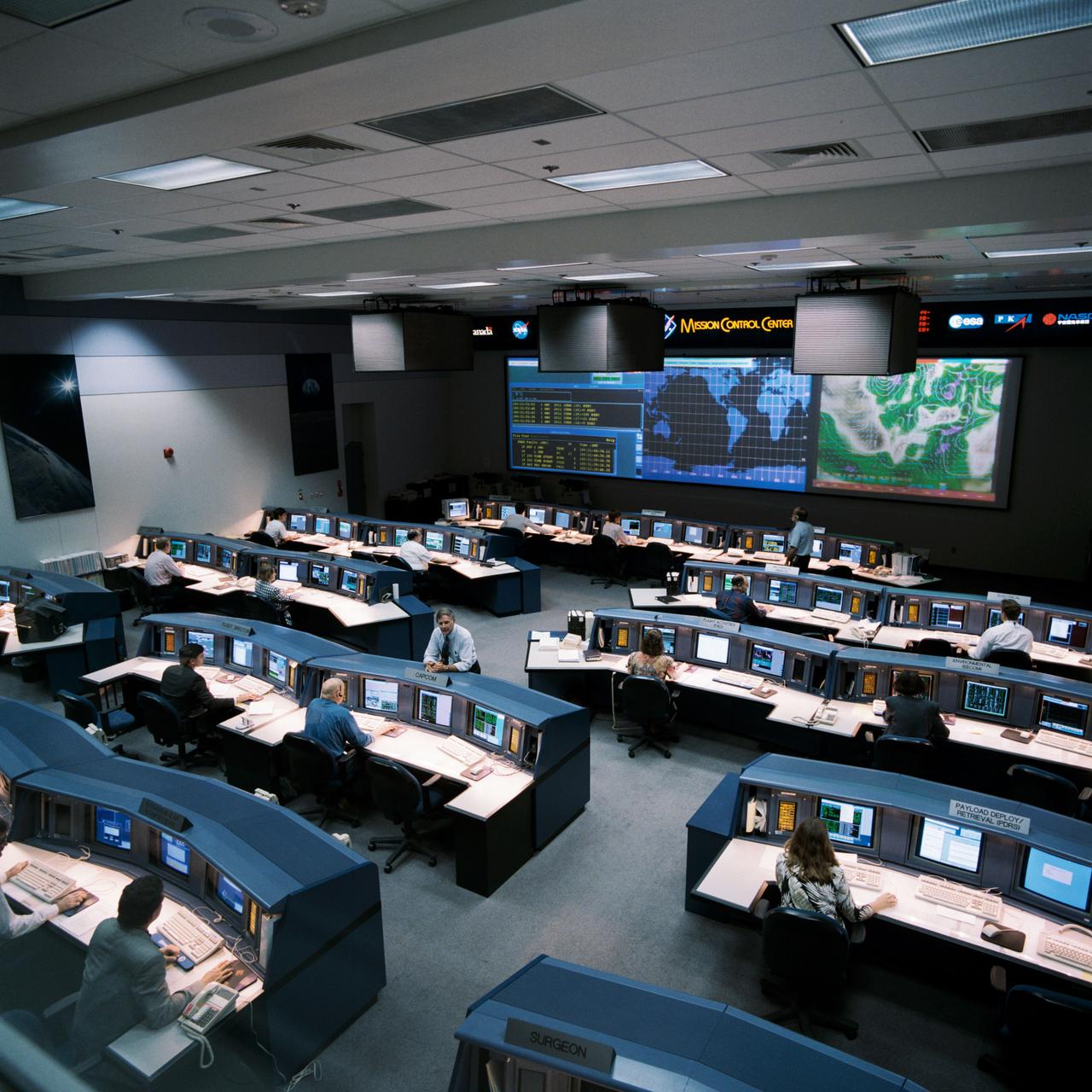
Documentation of the new mission control center White Flight Control Room (FLCR). Excellent overall view of White FLCR with personnel manning console workstations (11221). Fisheye lens perspective from Flight Director station with Brian Austin (11222). Environmental (EECOM) workstation and personnel (11223).
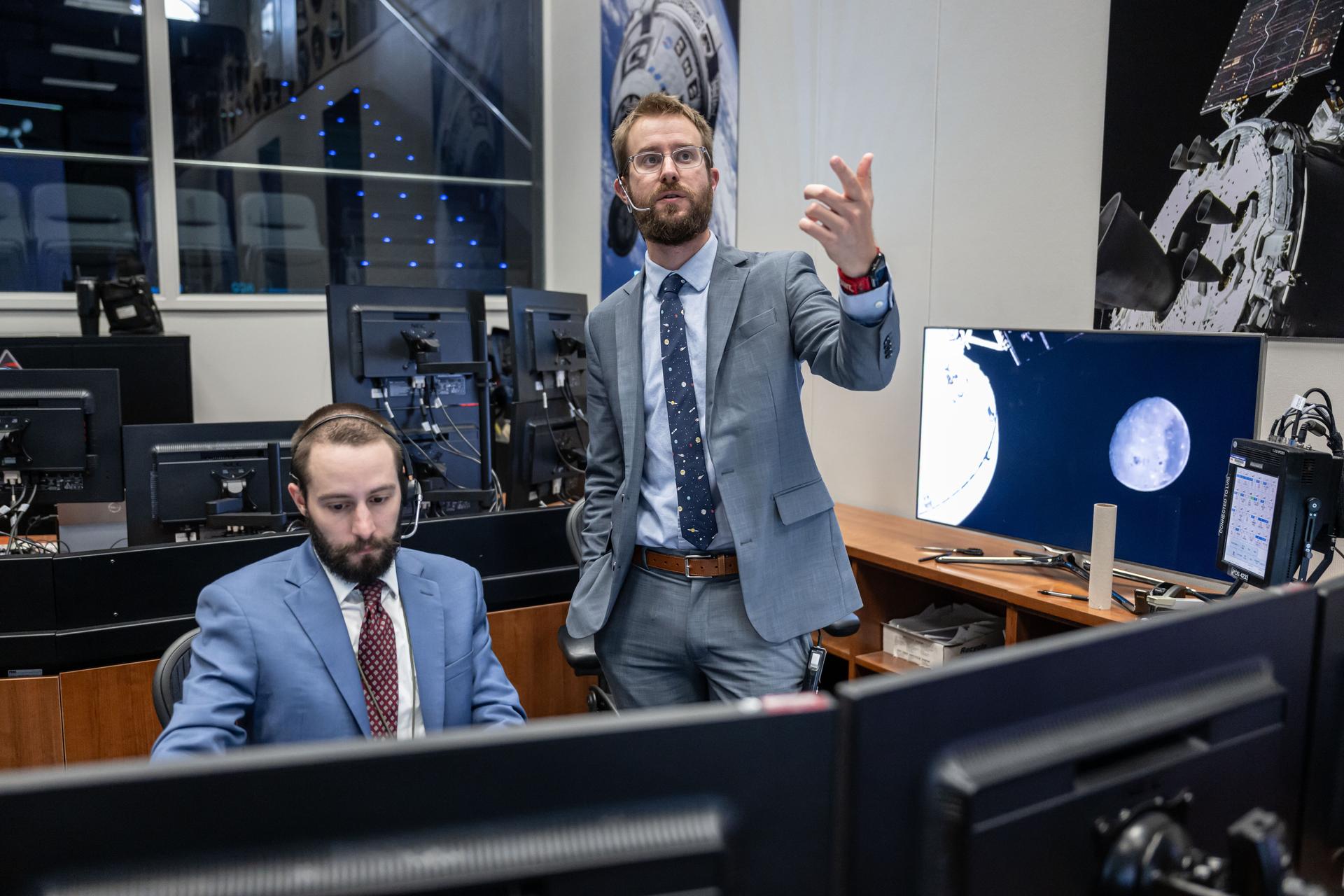
jsc2026e021749 (April 6, 2026) - Chris White, Lead INCO (Integrated Communications Officer) for Artemis II, and Matthew Johns, INCO Flight Controller, are pictured in the White Flight Control Room in the Mission Control Center at NASA’s Johnson Space Center during the Artemis II mission. This image was taken when NASA astronauts Reid Wiseman, Victor Glover, and Christina Koch, and CSA (Canadian Space Agency) astronaut Jeremy Hansen conducted the flyby of the Moon. Credit: NASA/Robert Markowitz
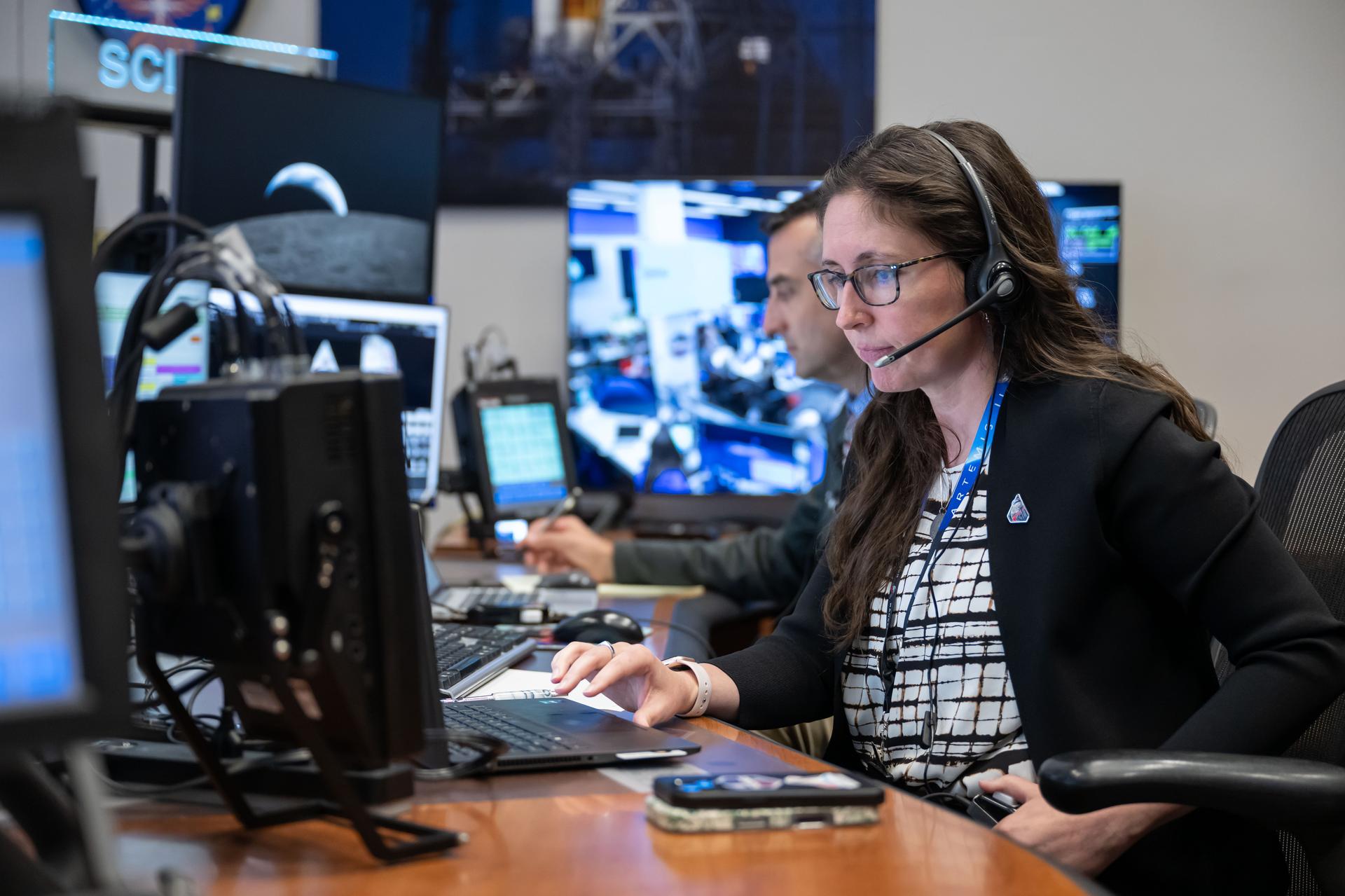
Artemis II science officers, Trevor Graff, background, and Kelsey Young are seen monitoring mission data in real-time from the Science console in the White Flight Control Room in Mission Control at NASA's Johnson Space Center in Houston. Science officers are the senior flight controllers responsible for lunar science and geology objectives during Artemis missions. Credits: NASA/Robert Markowitz
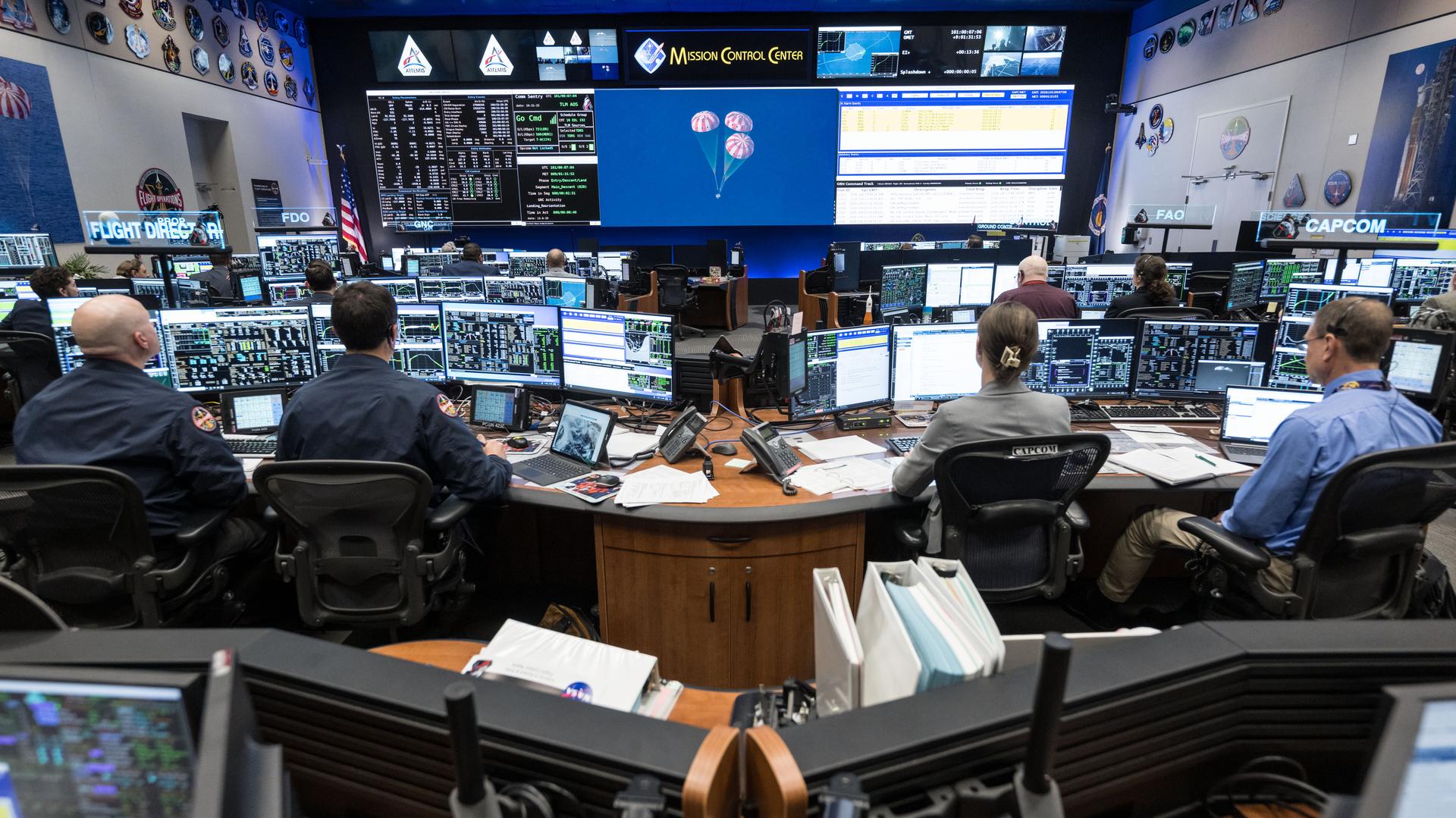
jsc2026e022251(April 10, 2026) - Artemis II Flight Control Team pictured at consoles within the White Flight Control Room in the Mission Control Center at NASA’s Johnson Space Center for the splashdown and recovery of the Artemis II crew as it landed in the Pacific Ocean off the coast of California, Friday, April 10, 2026 at 7:07 p.m. CDT. NASA’s Artemis II mission took NASA astronauts Reid Wiseman, commander; Victor Glover, pilot; Christina Koch, mission specialist; and CSA (Canadian Space Agency) astronaut Jeremy Hansen on a nearly 10-day journey around the Moon and back to Earth. In the foreground, from right to left, are Flight Director Judd Frieling, Flight Director Rick Henfling, CAPCOM (capsule communicator) Jacki Mahaffey, and astronaut Stan Love.

jsc2026e021924 (April 6, 2026) - Artemis II Flight Control Team pictured at consoles within the White Flight Control Room in the Mission Control Center at NASA’s Johnson Space Center during the Artemis II mission. This image was taken when NASA astronauts Reid Wiseman, commander; Victor Glover, pilot; Christina Koch, mission specialist; and CSA (Canadian Space Agency) astronaut Jeremy Hansen conducted the flyby of the Moon. Credit: NASA/Robert Markowitz
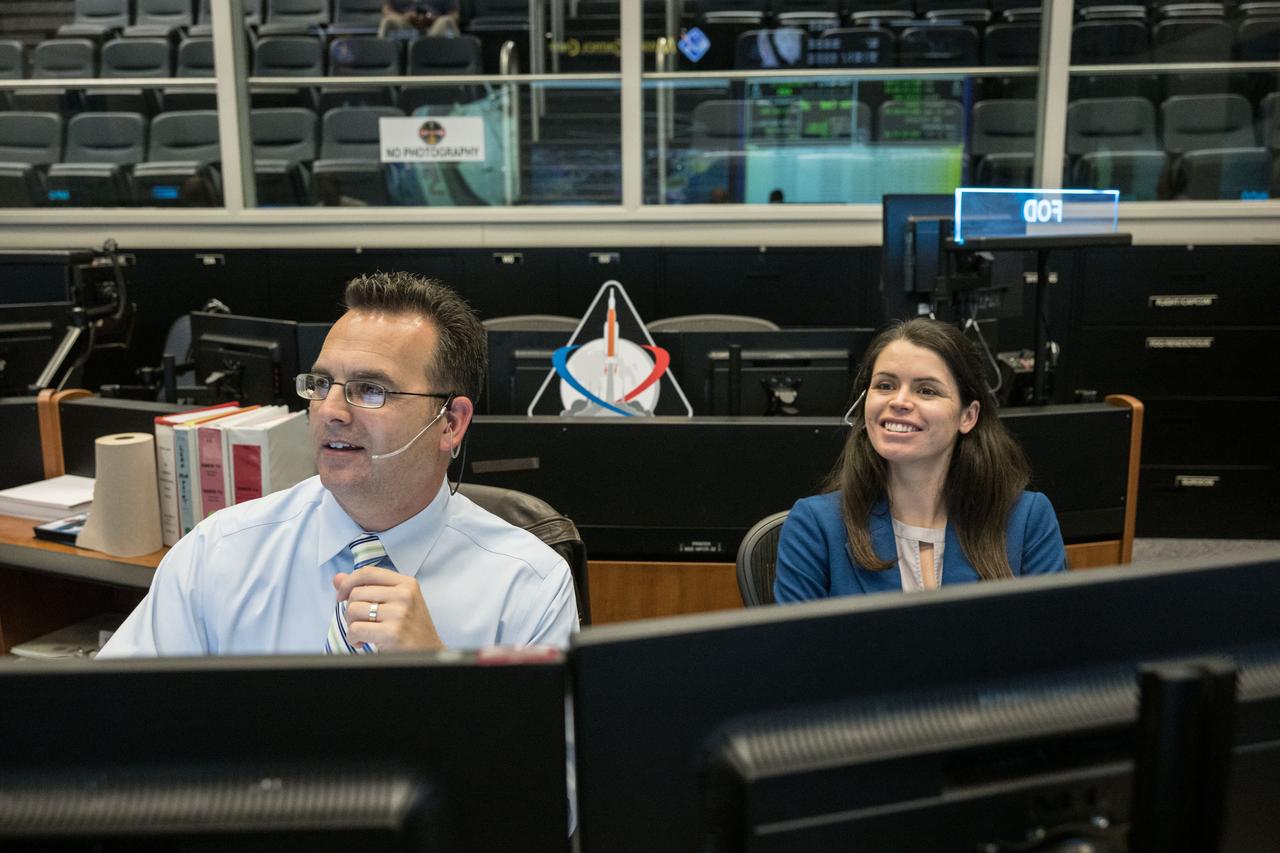
jsc2022e090070: (Nov. 28, 2022): Flight Directors Paul Konyha and Nicole McElroy smile as the Orion spacecraft reaches its record-breaking distance from the Earth, nearly 270,000 miles, on flight day 14 of the Artemis I mission. Credit: NASA/Robert Markowitz

Documentation of flight controllers in the White Flight Control Room (WFCR) on STS-114 Launch Day, July 26, 2005. View of Phil Engelauf and Flight Director Paul Hill standing at the Mission Operations Directorate (MOD) console.
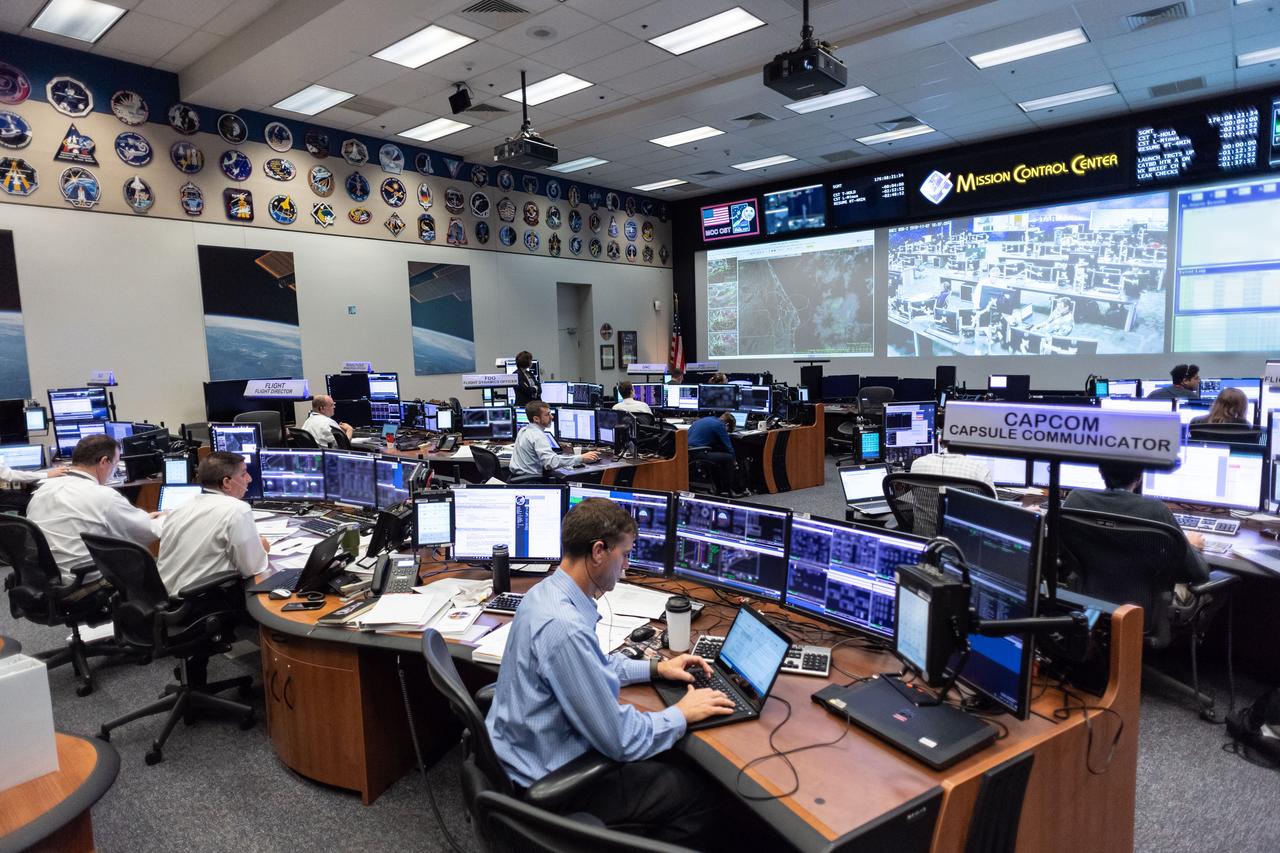
Boeing’s Flight Control Team participated in a rehearsal of prelaunch procedures for the company’s upcoming Orbital Flight Test in the White Flight Control Room in the Mission Control Center at Johnson Space Center in Houston. Boeing’s CST-100 Starliner will fly uncrewed to the International Space Station before NASA will certify the spacecraft to carry astronauts to station.

jsc2026e018917 (April 1, 2026) - The Artemis II flight control team is seen in Mission Control's White Flight Control Room during the launch and ascent of NASA's Artemis II mission on Wednesday, April 1, 2026. Credit: NASA/Robert Markowitz
jsc2026e018917 (April 1, 2026) - The Artemis II flight control team is seen in Mission Control's White Flight Control Room during the launch and ascent of NASA's Artemis II mission on Wednesday, April 1, 2026. Credit: NASA/Robert Markowitz
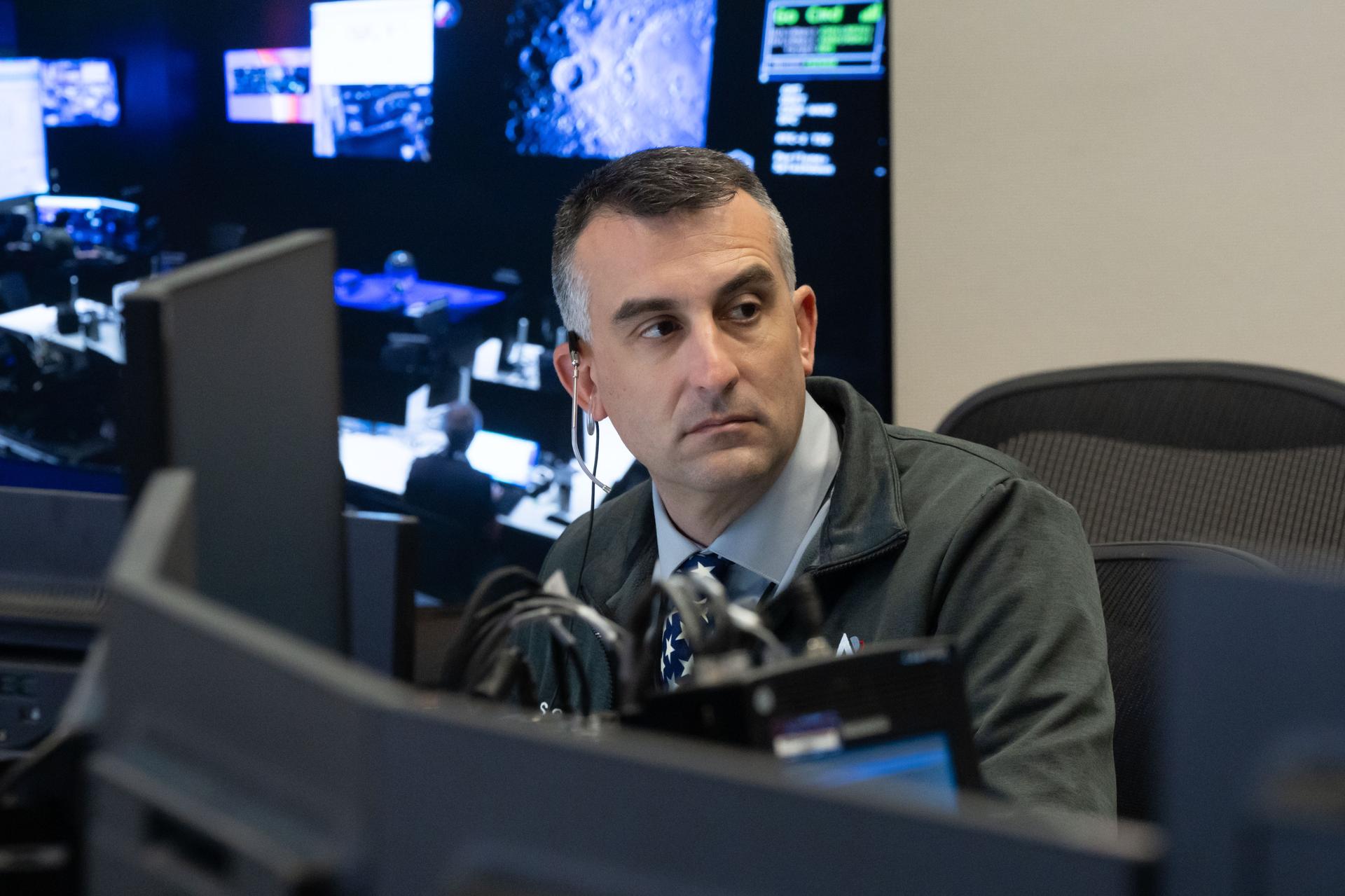
Artemis II science officer, Trevor Graff, is seen at the Science console in the White Flight Control Room in Mission Control at NASA's Johnson Space Center in Houston. Science officers are the senior flight controllers responsible for lunar science and geology objectives during Artemis missions. Credits: NASA/David DeHoyos
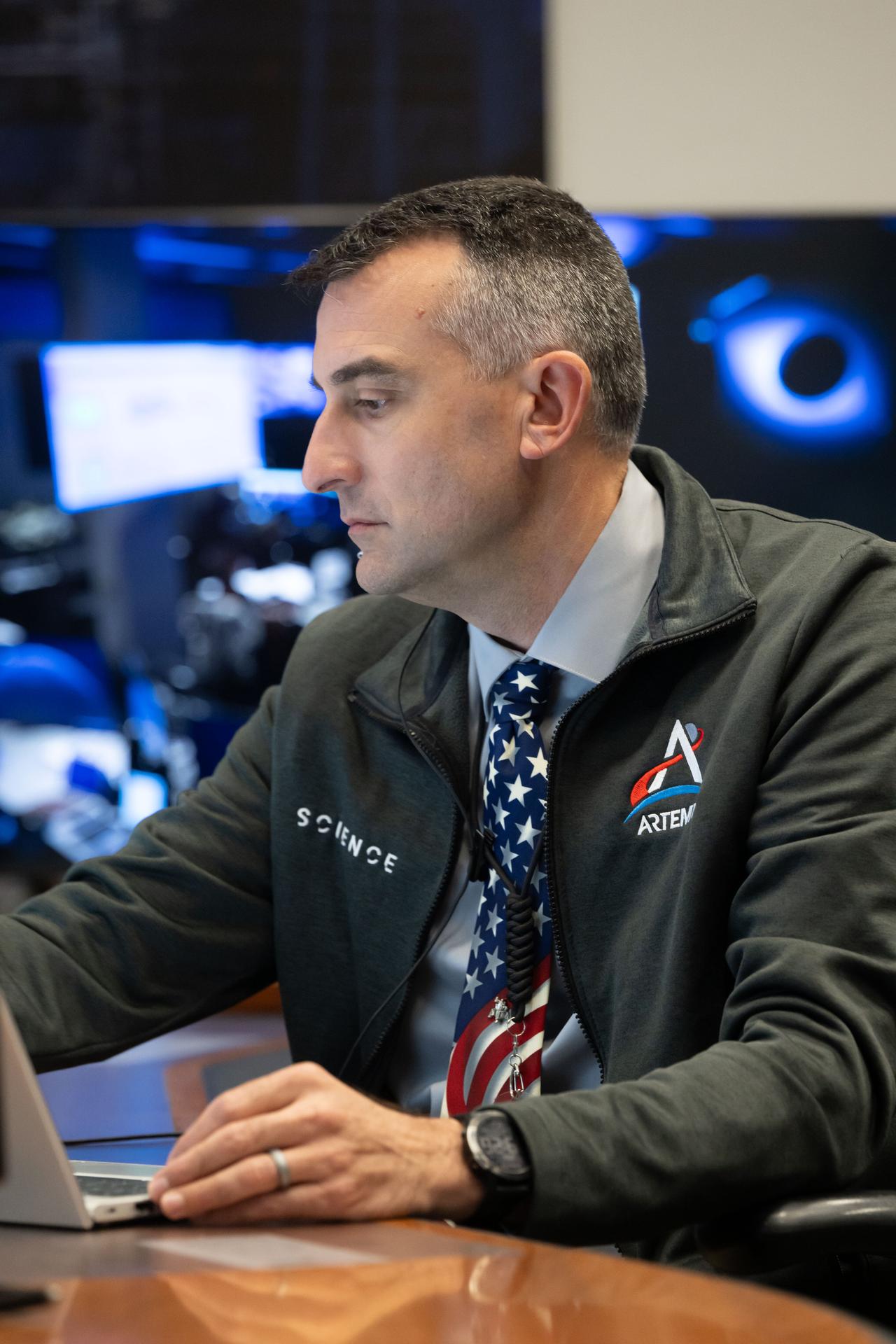
Artemis II science officer, Trevor Graff, is seen at the Science console in the White Flight Control Room in Mission Control at NASA's Johnson Space Center in Houston. Science officers are the senior flight controllers responsible for lunar science and geology objectives during Artemis missions. Credits: NASA/David DeHoyos
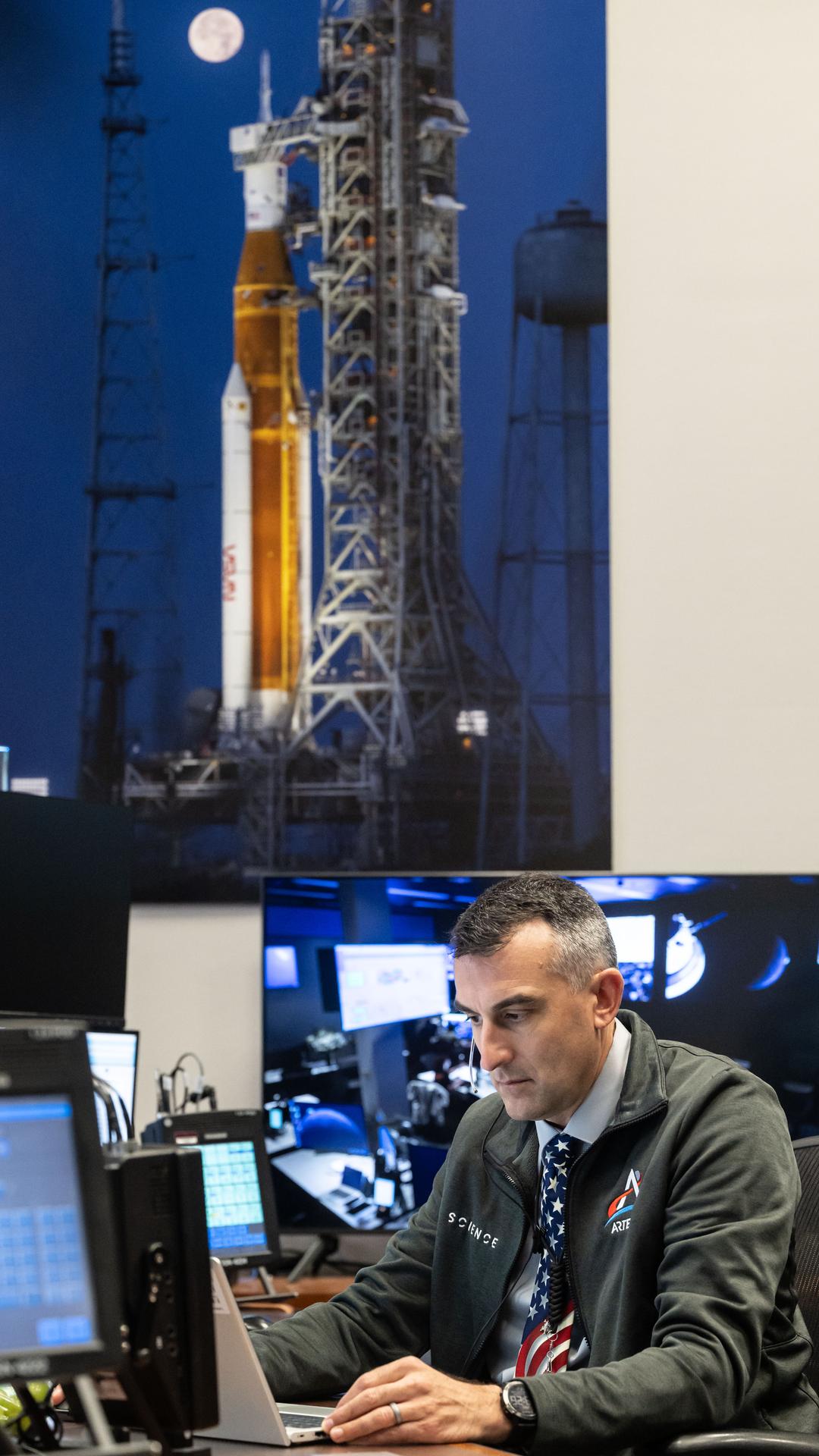
Artemis II science officer, Trevor Graff, is seen at the Science console in the White Flight Control Room in Mission Control at NASA's Johnson Space Center in Houston. Science officers are the senior flight controllers responsible for lunar science and geology objectives during Artemis missions. Credits: NASA/David DeHoyos
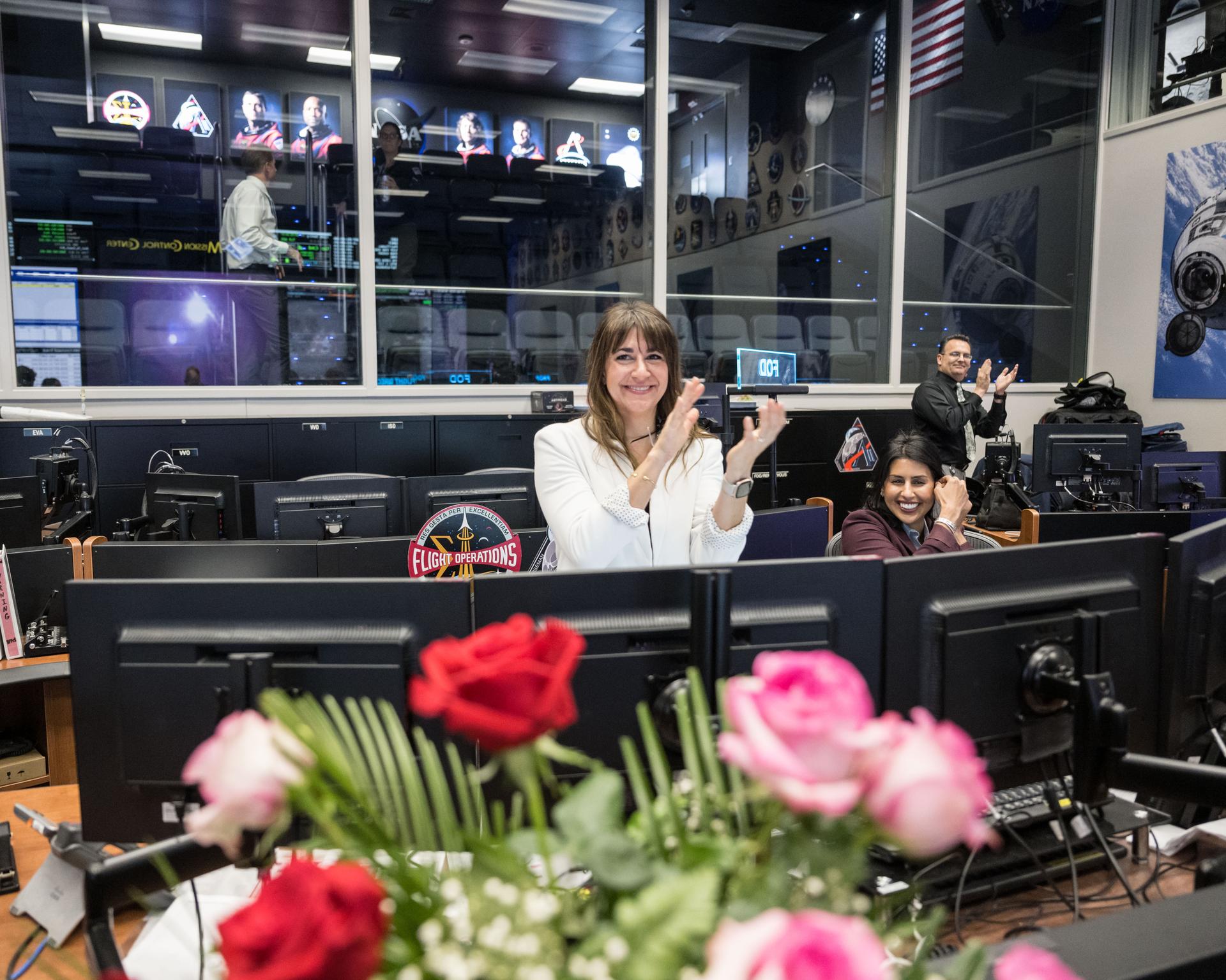
jsc2026e020501 (April 6, 2026) - NASA Flight Directors Diane Dailey, Pooja Jesrani, and Paul Konyha pictured in the White Flight Control Room during the Artemis II crew’s lunar flyby. Credit: NASA
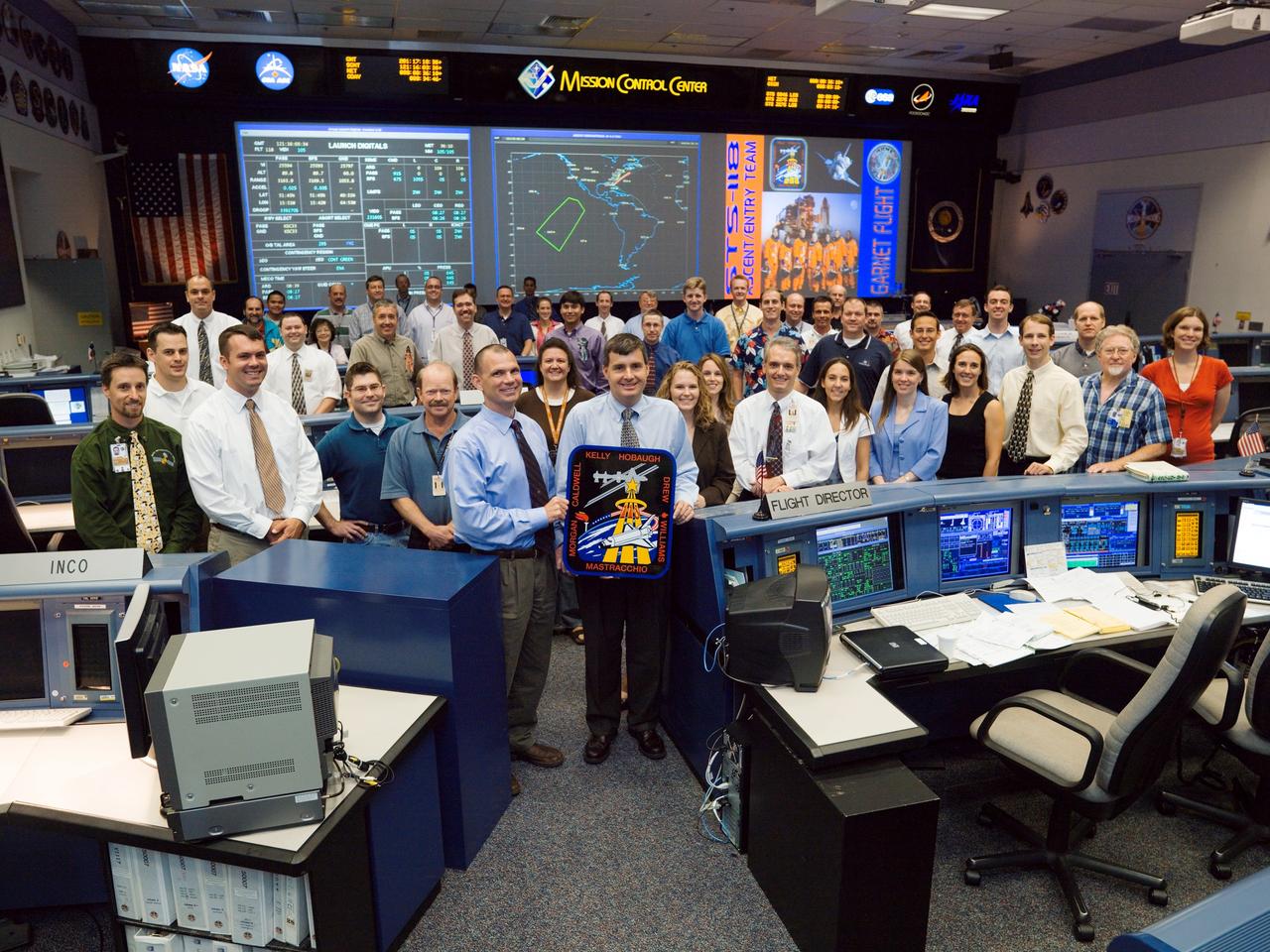
JSC2007-E-41011 (20 July 2007) --- STS-118 Ascent/Entry flight control team pose for a group portrait in the space shuttle flight control room of Houston's Mission Control Center (MCC). Flight director Steve Stich (center right) and astronaut Tony Antonelli, spacecraft communicator (CAPCOM), hold the STS-118 mission logo.
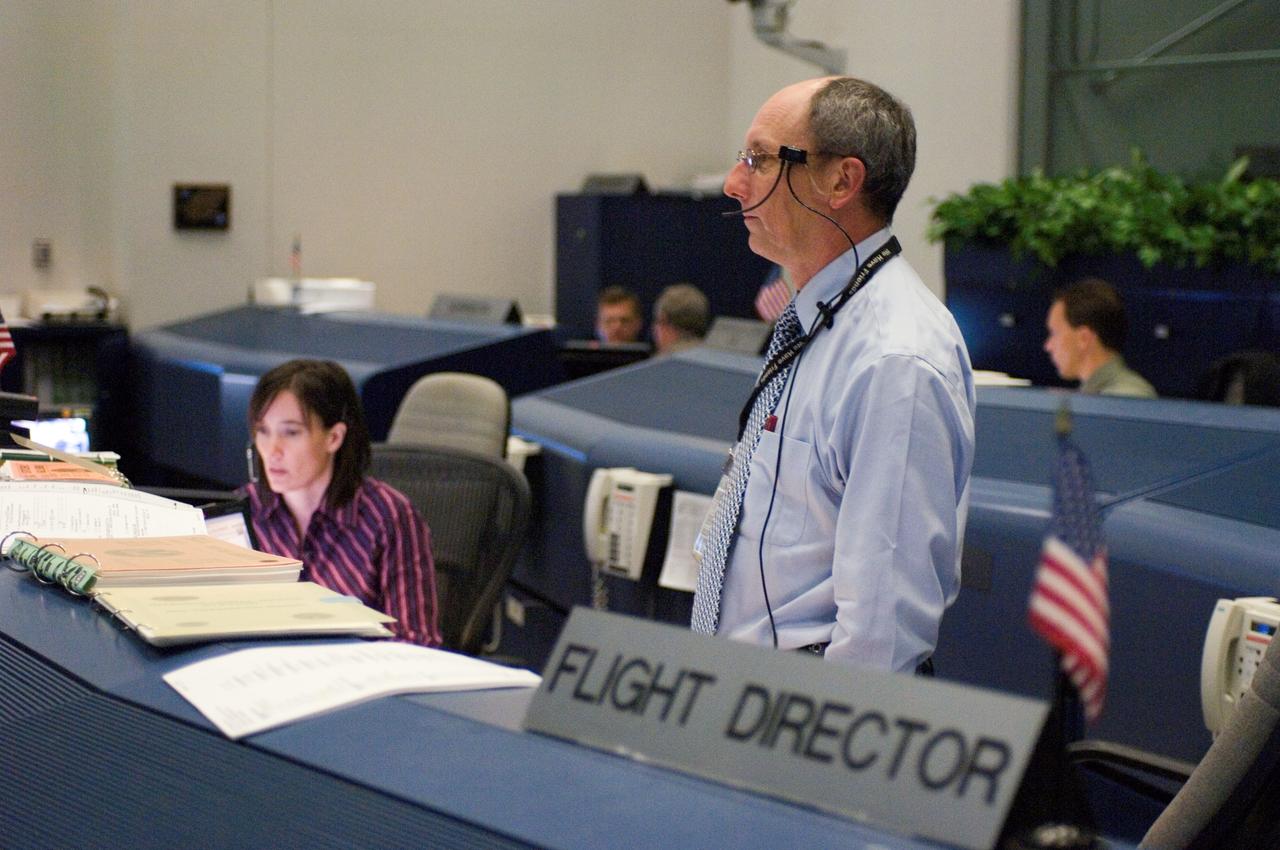
JSC2006-E-39881 (10 Sept. 2006) --- In the Shuttle (White) Flight Control Room of Houston's Mission Control Center, flight director Paul Dye (right) and spacecraft communicator (CAPCOM) Megan McArthur monitor data during the STS-115 inspection of the wings' leading edge and nose cap of the Space Shuttle Atlantis.
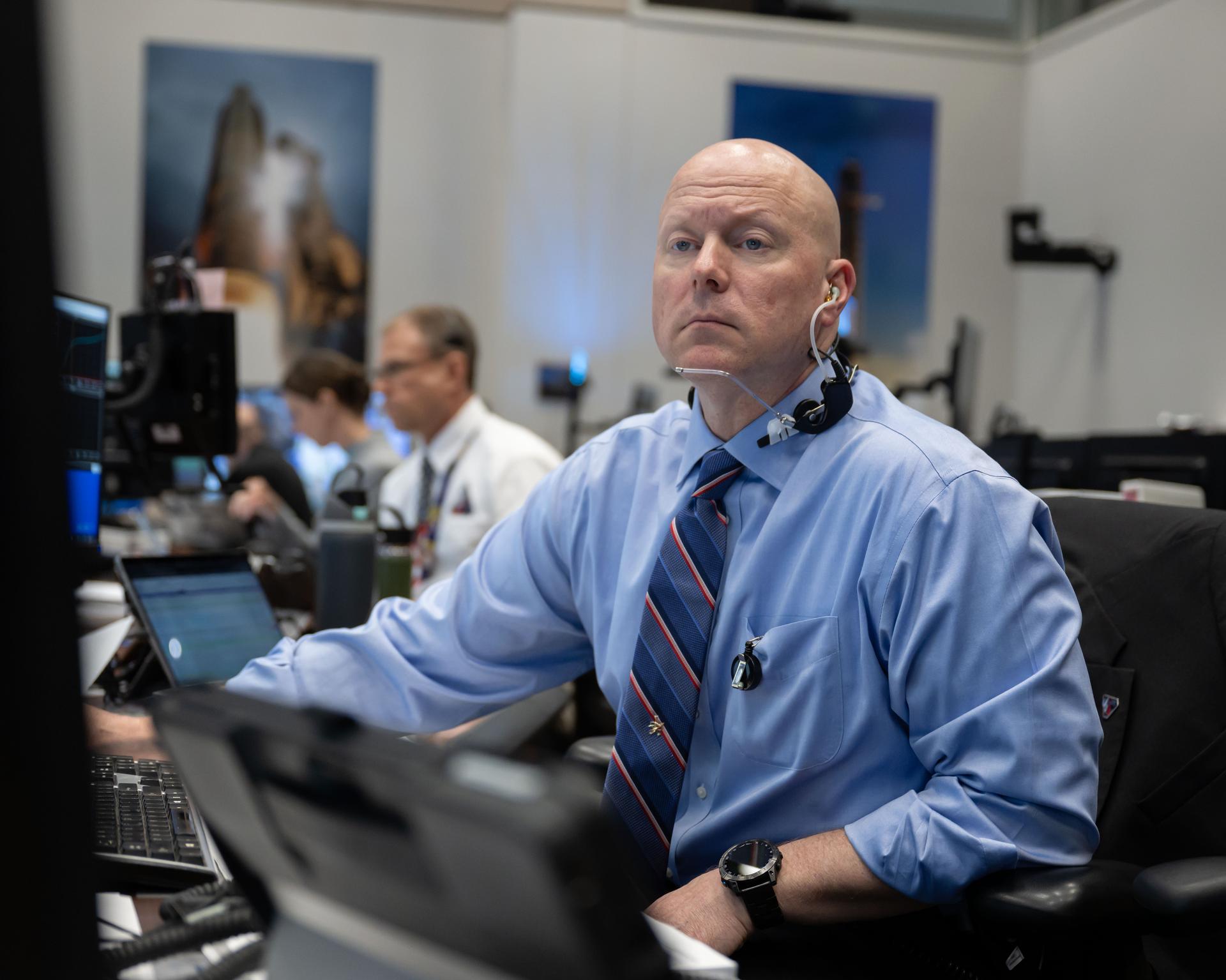
jsc2026e018916 (April 1, 2026) - Judd Frieling, the Artemis II lead flight director for ascent, is photographed in Mission Control's White Flight Control Room at NASA's Johnson Space Center during the Artemis II launch on Wednesday, April 1, 2026. Credit: NASA/Robert Markowitz

jsc2026e018918 (April 1, 2026) - Artemis II flight director Rick Henfling is seen in Mission Control's White Flight Control Room during the Artemis II launch on Wednesday, April 1, 2026. Credit: NASA/Robert Markowitz
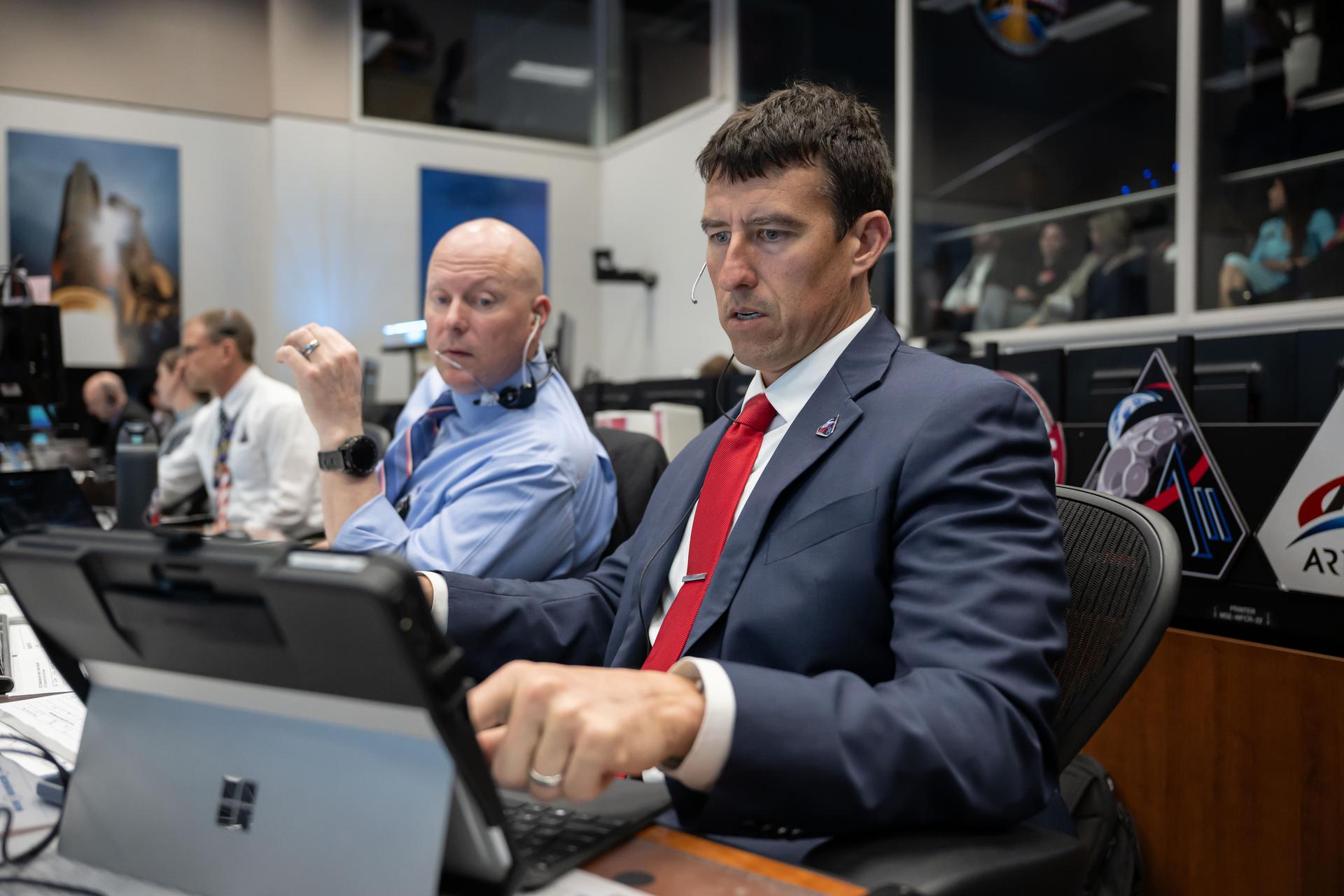
jsc2026e018919 (April 1, 2026) - NASA flight directors Rick Henfling (right) and Judd Frieling (left) sit on console in Mission Control's White Flight Control room during NASA's Artemis II mission launch on Wednesday, April 1, 2026. Credit: NASA/Robert Markowitz
jsc2026e018918 (April 1, 2026) - Artemis II flight director Rick Henfling is seen in Mission Control's White Flight Control Room during the Artemis II launch on Wednesday, April 1, 2026. Credit: NASA/Robert Markowitz
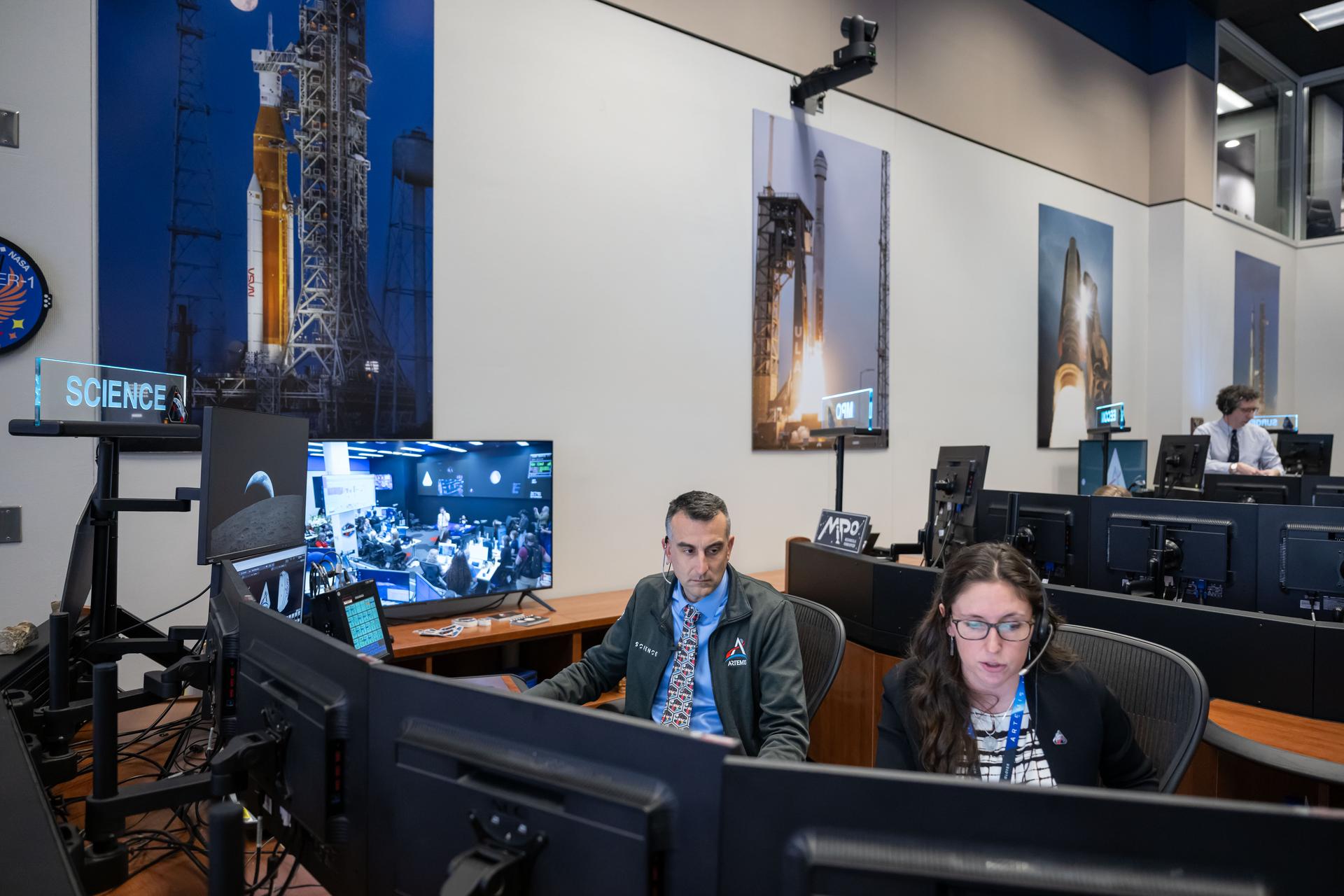
Artemis II Flight Control Team in White Flight Control Room (WFCR) during ISS Ship-to-Ship Call & Post Flyby Crew Debrief with Science Officer. Photo Date: April 7, 2026. Location: Building 30s, WFCR. Photo Credit: NASA/Robert Markowitz

jsc2022e090130 (Nov. 28, 2022): Flight Directors Paul Konyha and Nicole McElroy monitor the Orion spacecraft as it reaches its record-breaking distance from the Earth, nearly 270,000 miles, on flight day 14 of the Artemis I mission. Credit: NASA/Robert Markowitz
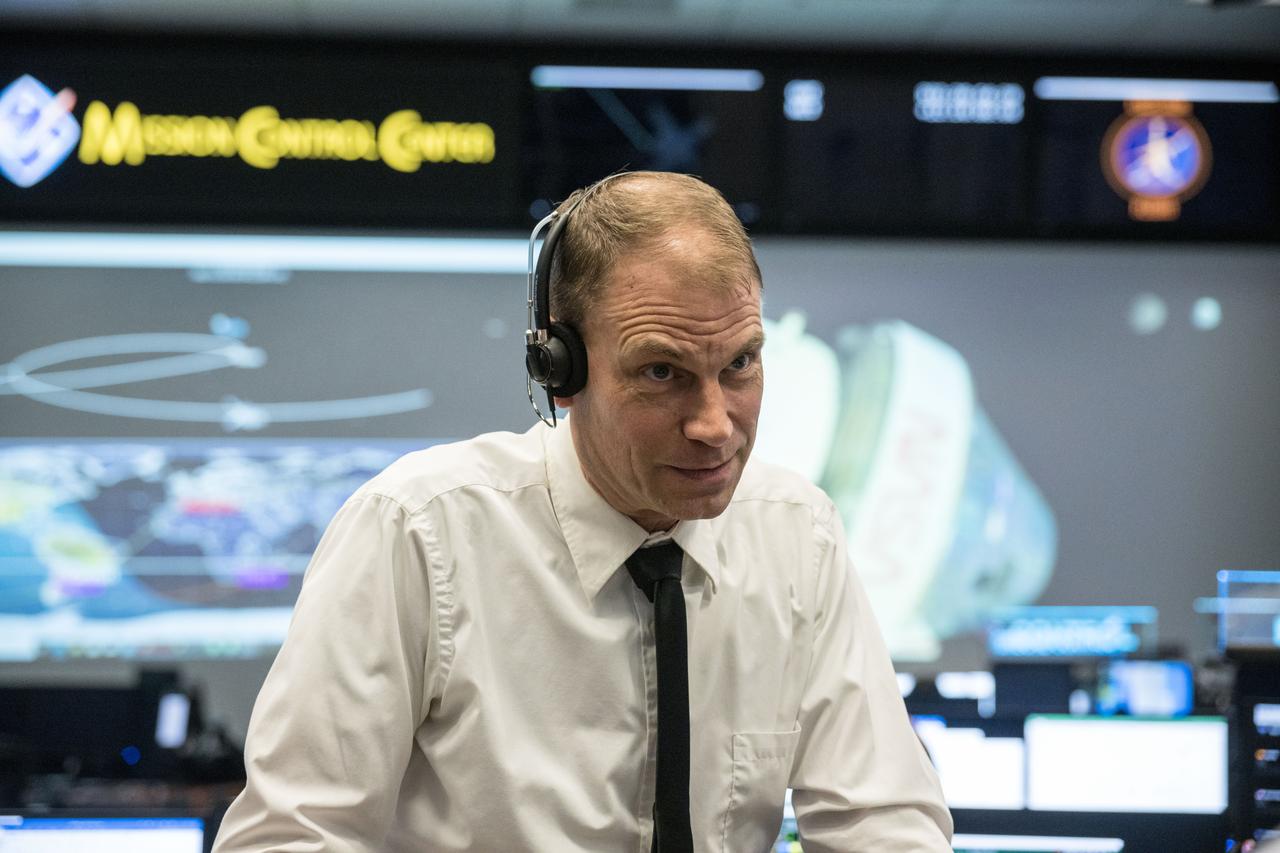
jsc2022e090080 (Nov. 28, 2022): NASA Astronaut Stan Love observes the Orion spacecraft as it reaches its maximum distance from the Earth, nearly 270,000 miles, on flight day 14 of the Artemis I mission from within the Mission Control Center in Houston, Texas. Love is practicing to be capsule communicator, or capcom, during future crewed Artemis missions. Credit: NASA/Robert Markowitz

jsc2026e018923 (April 1, 2026) - Artemis II capcom Stan Love sits on console in Mission Control's White Flight Control Room in Houston, Texas during the Artemis II mission launch and ascent on April 1, 2026. Credit: NASA/Robert Markowitz
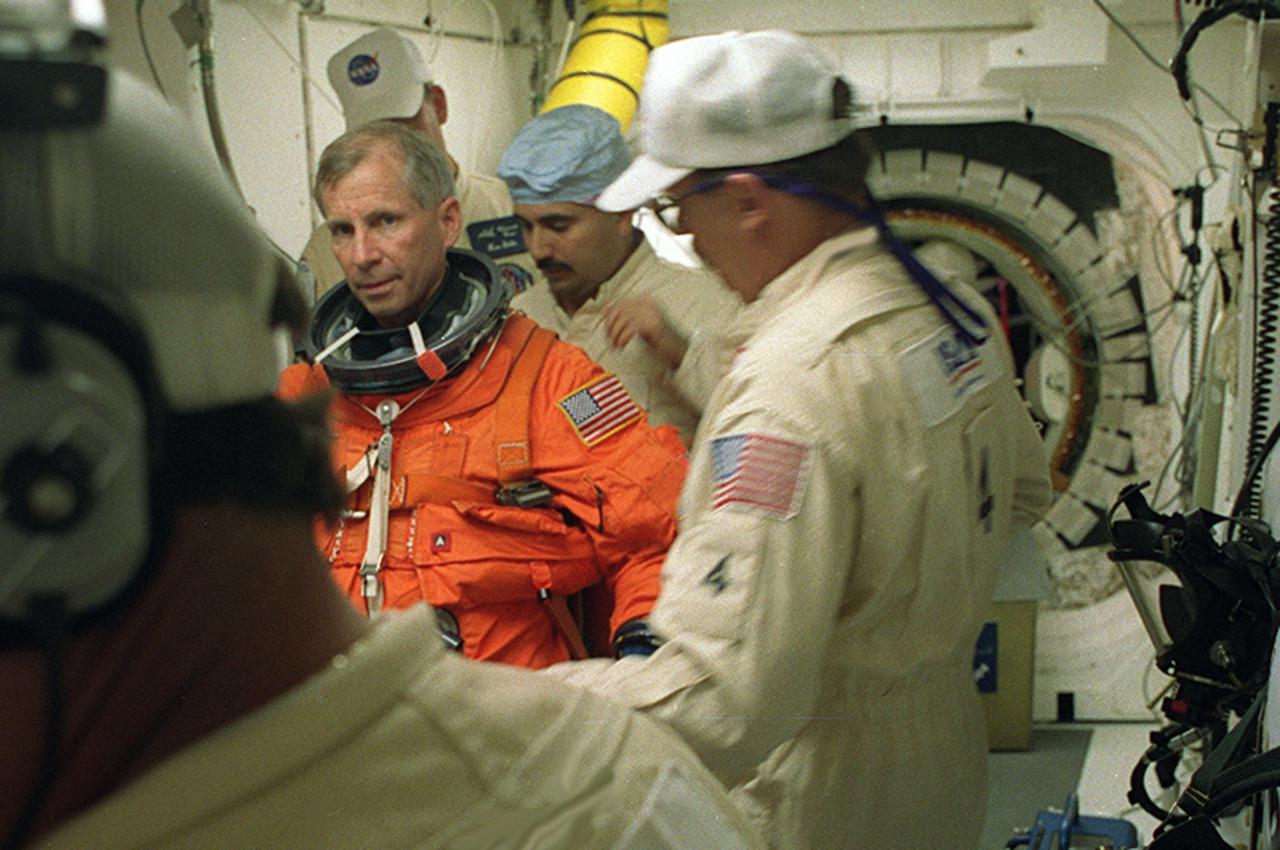
The closeout crew in the White Room help STS-98 Commander Ken Cockrell with final suitup before entering Space Shuttle Atlantis for launch. The White Room is an environmentally controlled room at the end of the Orbiter Access Arm. Atlantis is carrying the U.S. Laboratory Destiny, a key module in the growth of the Space Station. Destiny will be attached to the Unity node on the Space Station using the Shuttle’s robotic arm. Three spacewalks are required to complete the planned construction work during the 11-day mission. This mission marks the seventh Shuttle flight to the Space Station, the 23rd flight of Atlantis and the 102nd flight overall in NASA’s Space Shuttle program. The planned landing is at KSC Feb. 18 about 1 p.m
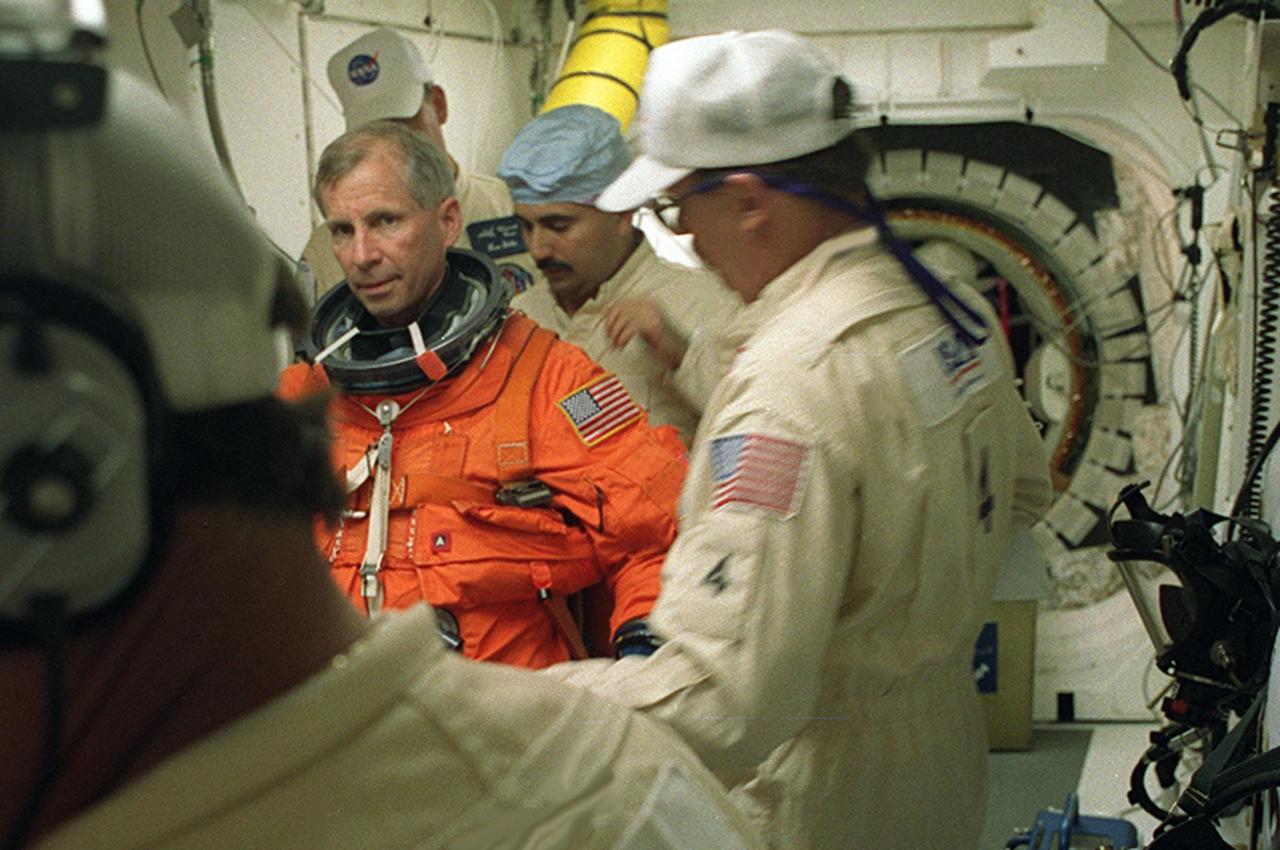
The closeout crew in the White Room help STS-98 Commander Ken Cockrell with final suitup before entering Space Shuttle Atlantis for launch. The White Room is an environmentally controlled room at the end of the Orbiter Access Arm. Atlantis is carrying the U.S. Laboratory Destiny, a key module in the growth of the Space Station. Destiny will be attached to the Unity node on the Space Station using the Shuttle’s robotic arm. Three spacewalks are required to complete the planned construction work during the 11-day mission. This mission marks the seventh Shuttle flight to the Space Station, the 23rd flight of Atlantis and the 102nd flight overall in NASA’s Space Shuttle program. The planned landing is at KSC Feb. 18 about 1 p.m

(jsc2022e089094_alt) (Nov. 21, 2022) During day 6 of the 25.5 day mission, Vanessa Wyche, Johnson Space Center, Center Director and Flight Director Rick LaBrode, inside the Artemis Mission Control Room or the White Flight Control Room at the Johnson Space Center during the Outbound Powered Flyby (OPF) burn. The Outbound Powered Flyby burn, targeted the DRI burn and was performed as Orion flew by the Moon around 62 mi (100 km)
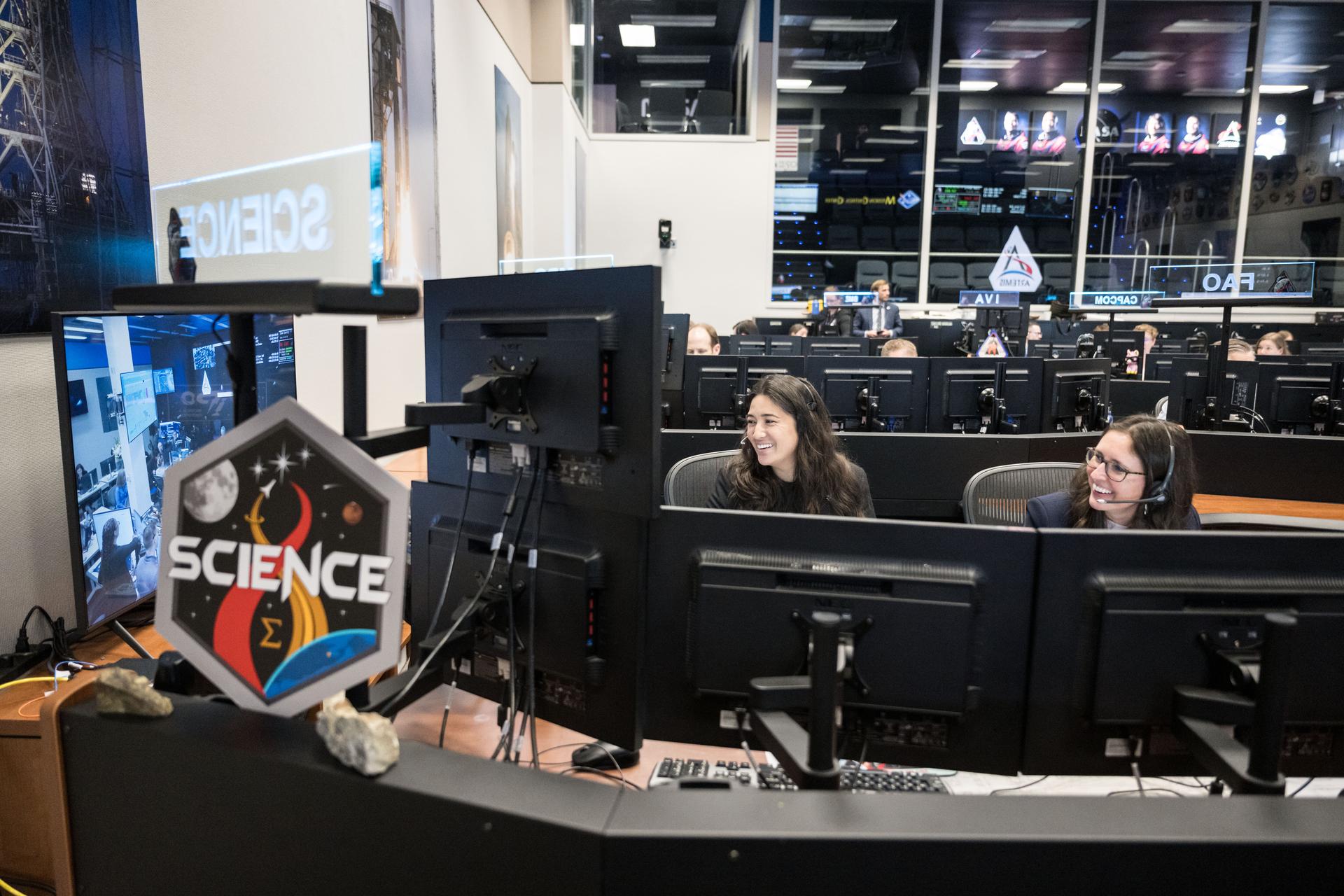
Artemis science officers, from left, Angela Garcia and Kelsey Young, watch the lunar science team celebrating in the Science Evaluation Room (SER) as they hear lunar observations from the Artemis II crew. The science team has spent years training the astronauts in geology and observation, both in the classroom and in the field. They also built the lunar targeting plan that, like a spacewalk plan, provides strong, detailed observation guidance, plus flexibility for the crew to make decisions based on what they’re seeing and experiencing in real time. The science team had many moments of celebration during the lunar flyby as the astronauts took pictures of the Moon and provided verbal descriptions of what they were seeing. This type of information reveals the geologic history of an area and will be critical to collect when future Artemis astronauts explore the Moon's surface. Credits: NASA/Robert Markowitz
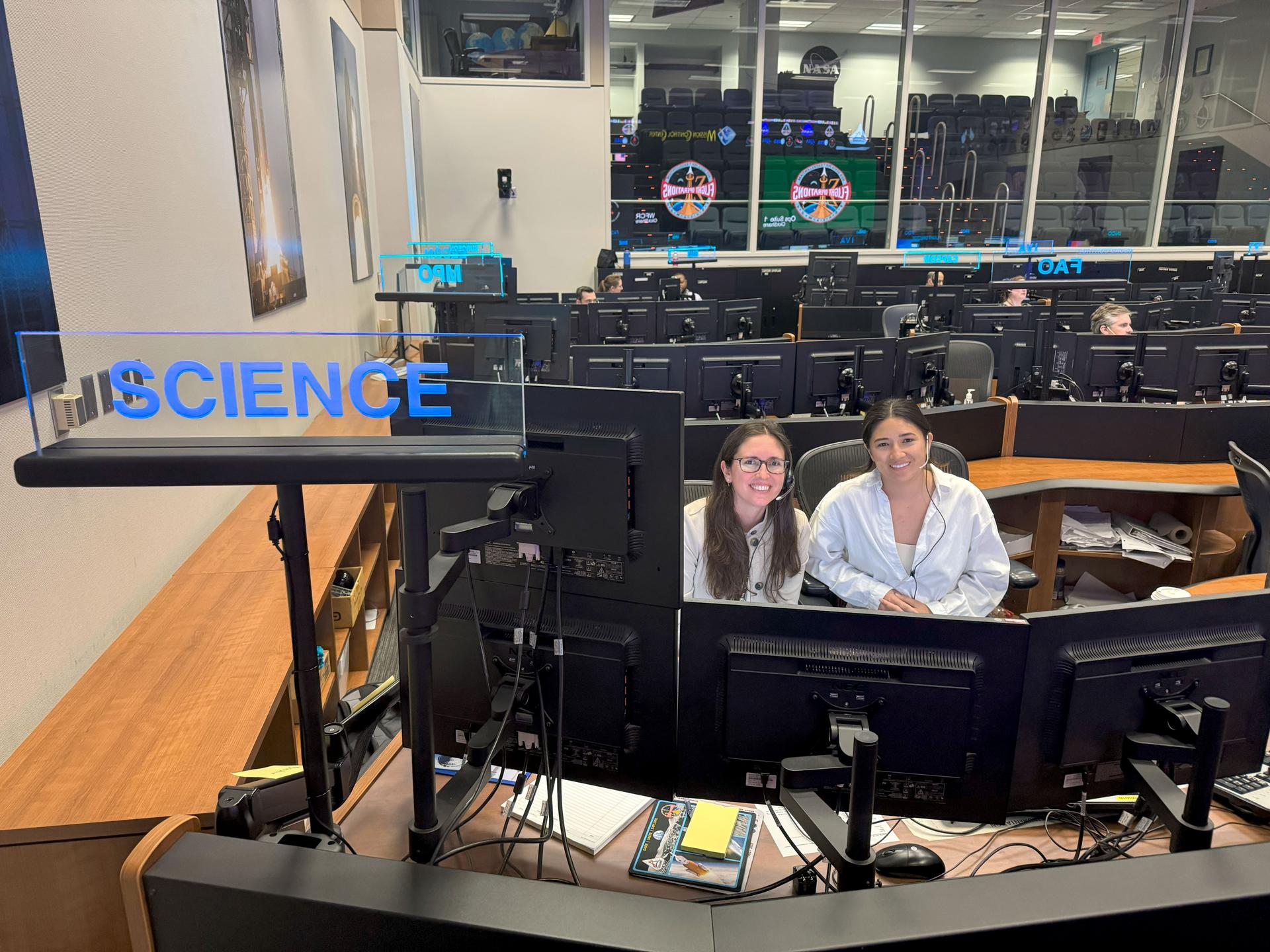
jsc2025e067512 --- Artemis II science officers Kelsey Young, left, and Angela Garcia sit at the SCIENCE console during a training simulation in the White Flight Control Room of the Mission Control Center at NASA's Johnson Space Center in Houston. Artemis II will test mission science operations and integration into flight control. Lessons learned during Artemis II science operations will pave the way for lunar science operations for future Artemis missions. A team of experts will staff the Science Evaluation Room (SER) at Johnson, providing lunar scientific expertise, data analysis, and strategic guidance in real-time to the science officer and the rest of Mission Control.
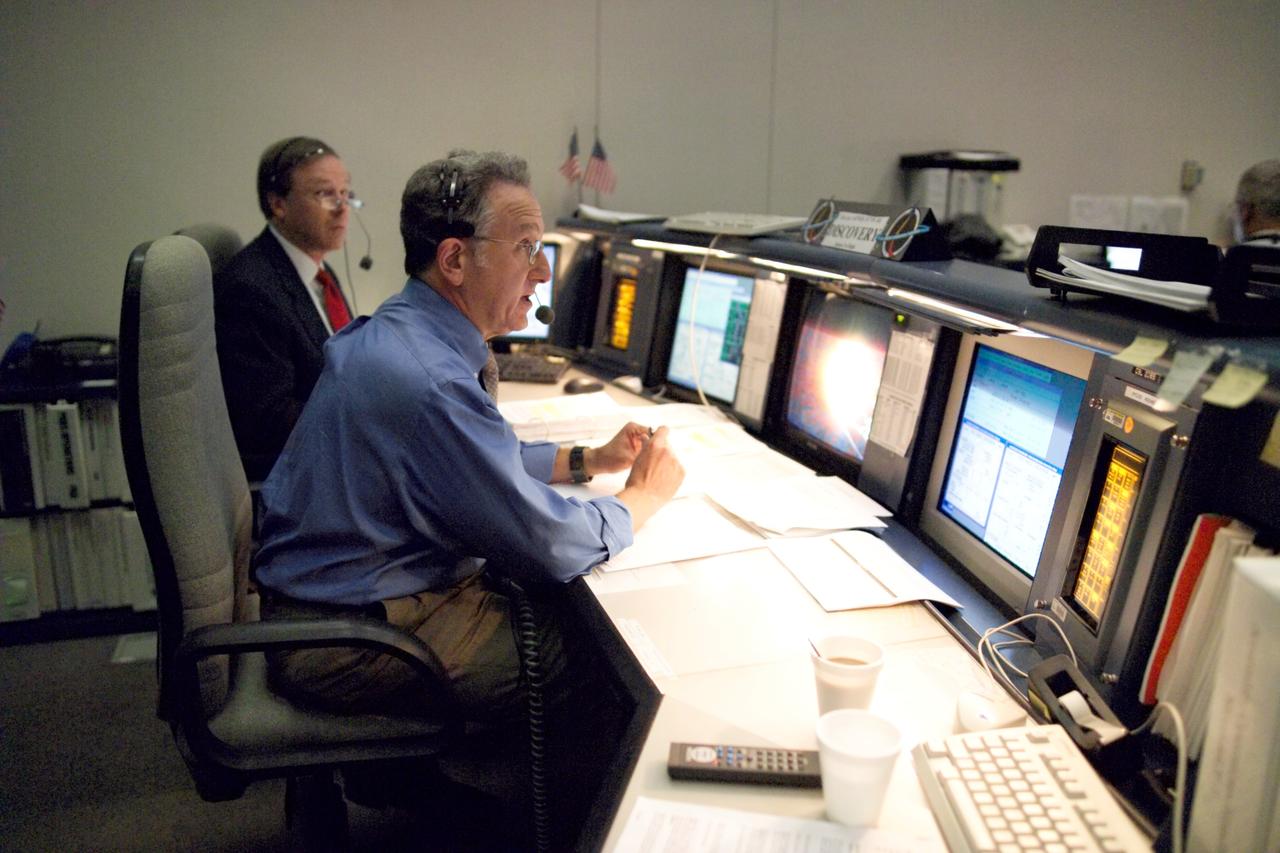
JSC2005-E-30656 (28 July 2005) --- Rob Navias, Public Affairs Office commentator, describes the activities of a very busy third flight day for STS-114 from the PAO console in the Space Shuttle (White) Flight Control Room.
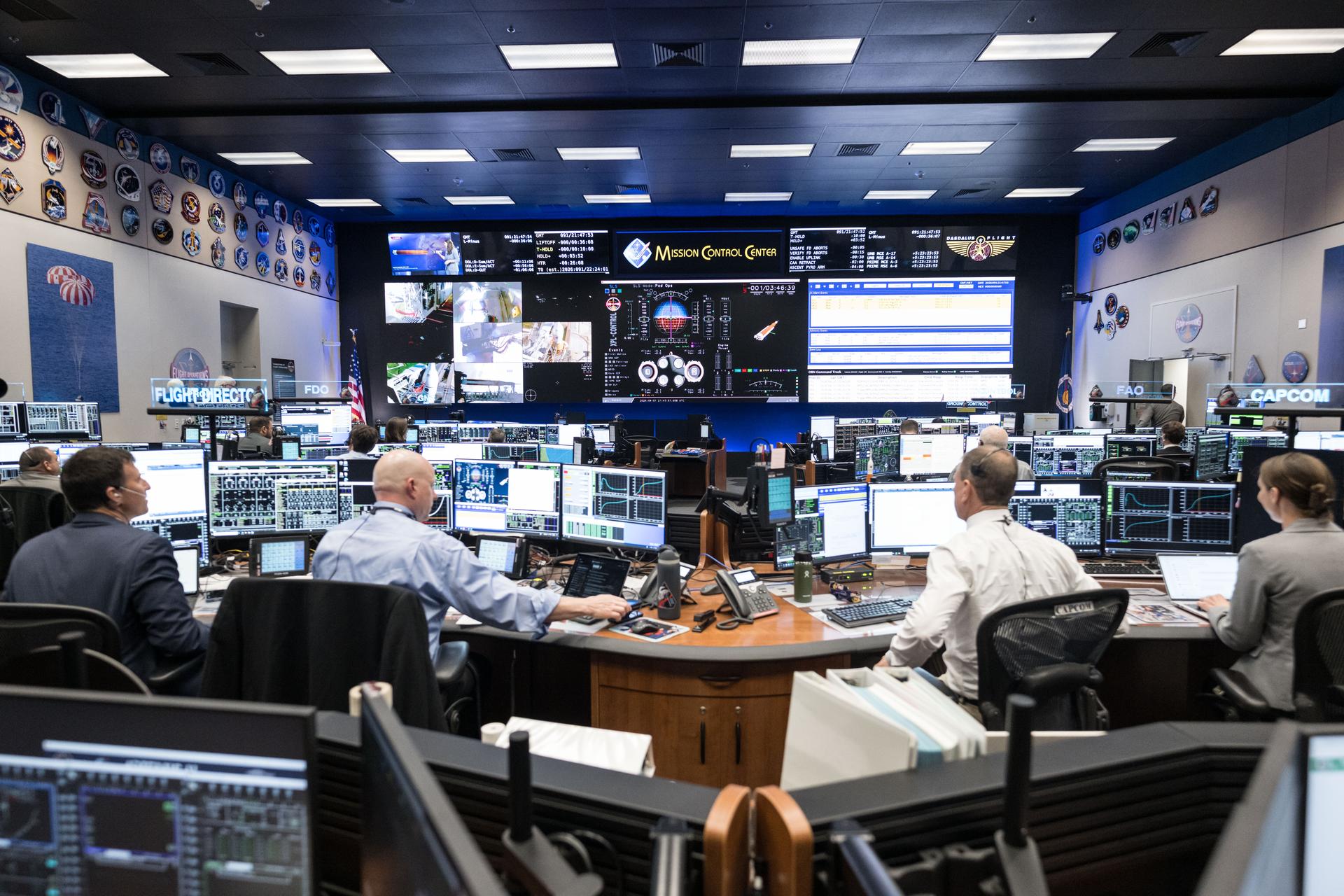
jsc2026e019468 (April 1, 2026) – The Artemis II flight control team pictured at consoles within the White Flight Control Room in the Mission Control Center at NASA’s Johnson Space Center preparing for the Artemis II launch of the SLS (Space Launch System) and Orion spacecraft to begin the approximately 10-day deep space mission. Credit: NASA
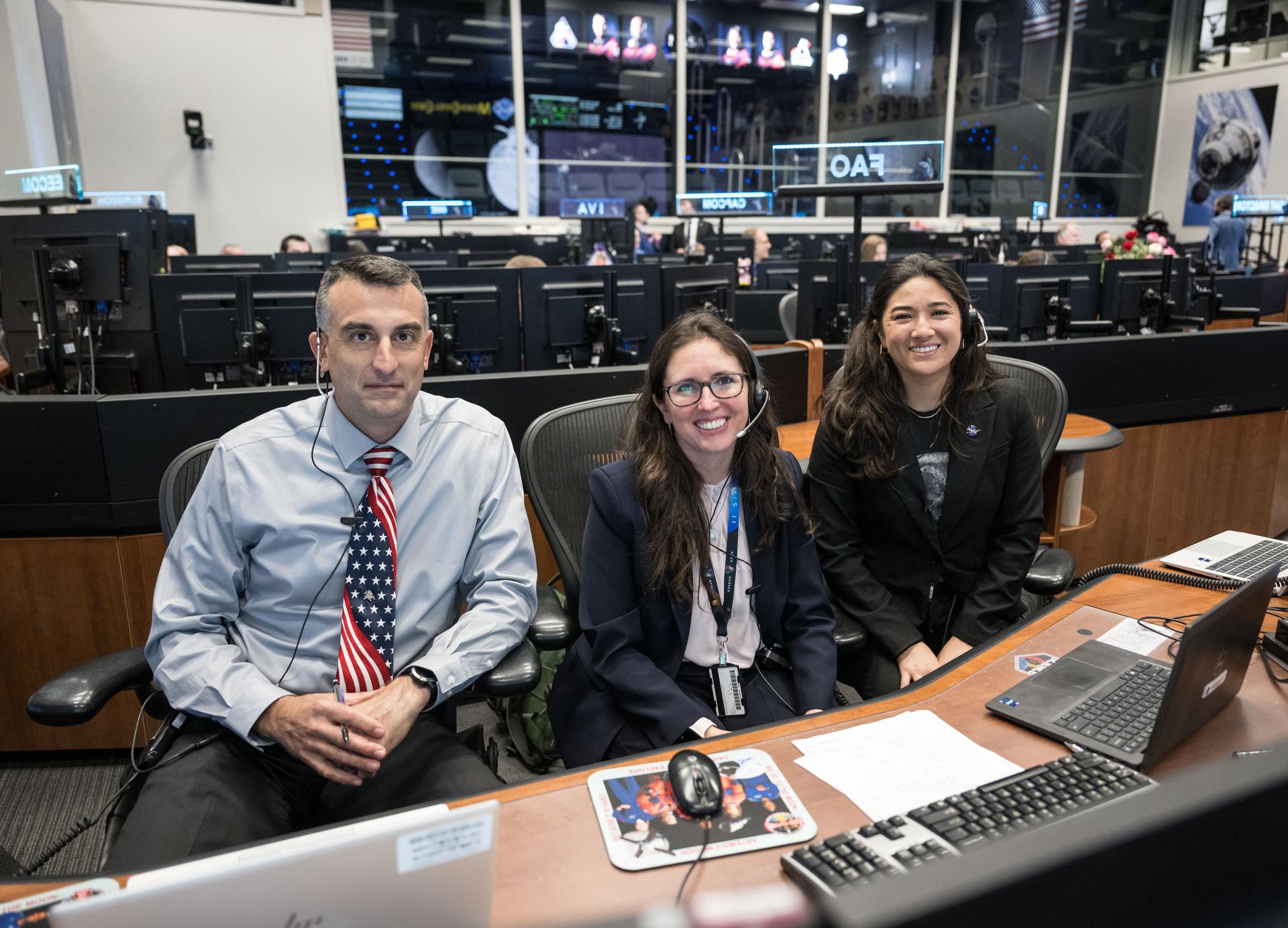
Artemis II science officers, from left, Trevor Graff, Kelsey Young, and Angela Garcia, are seen at the Science console in the White Flight Control Room in Mission Control at NASA's Johnson Space Center in Houston. Science officers are the senior flight controllers responsible for lunar science and geology objectives during Artemis missions. Credits: NASA/Robert Markowitz
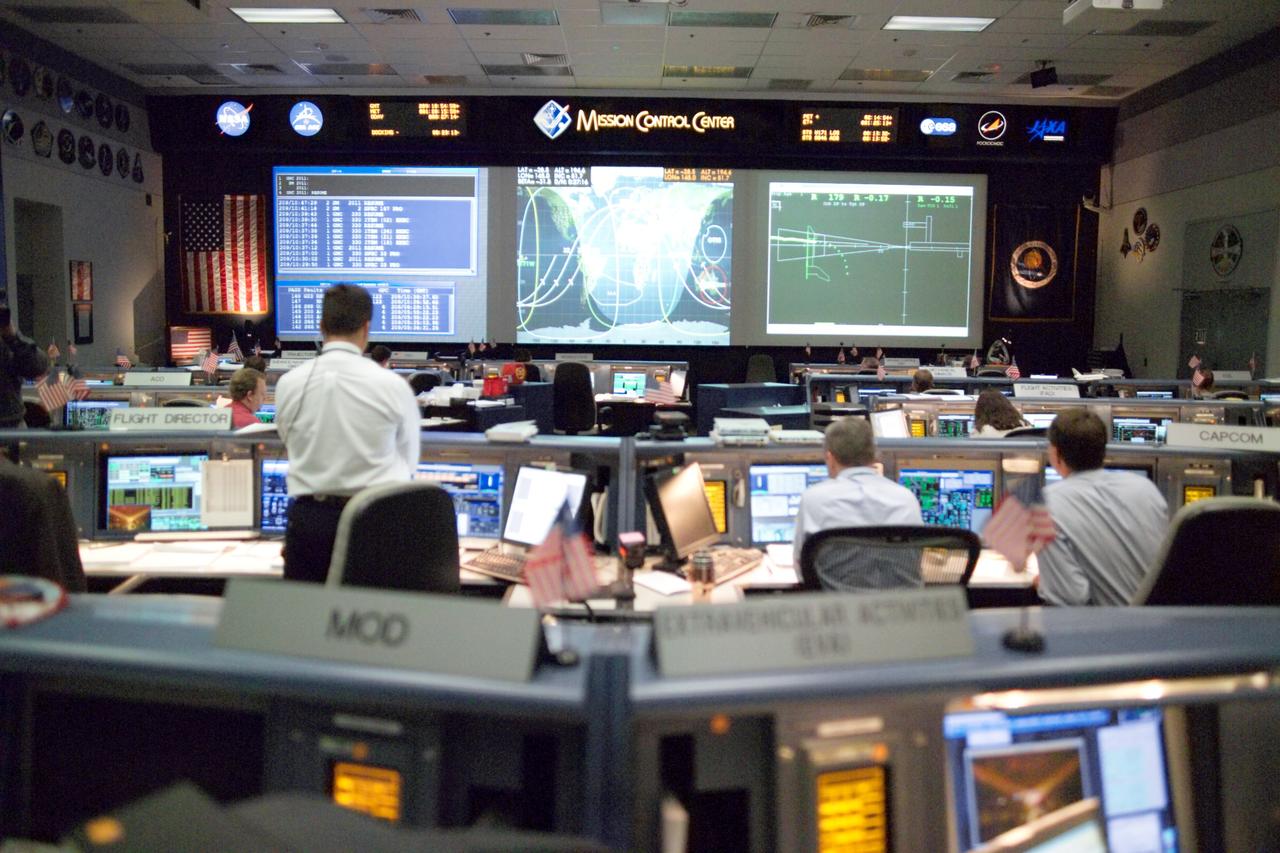
JSC2005-E-30649 (28 July 2005) --- In this wide shot of the Space Shuttle (White) Control Room, STS-114 Lead Flight Director Paul Hill stands at his console during the very busy rendezvous and docking activities between the Discovery and International Space Station.
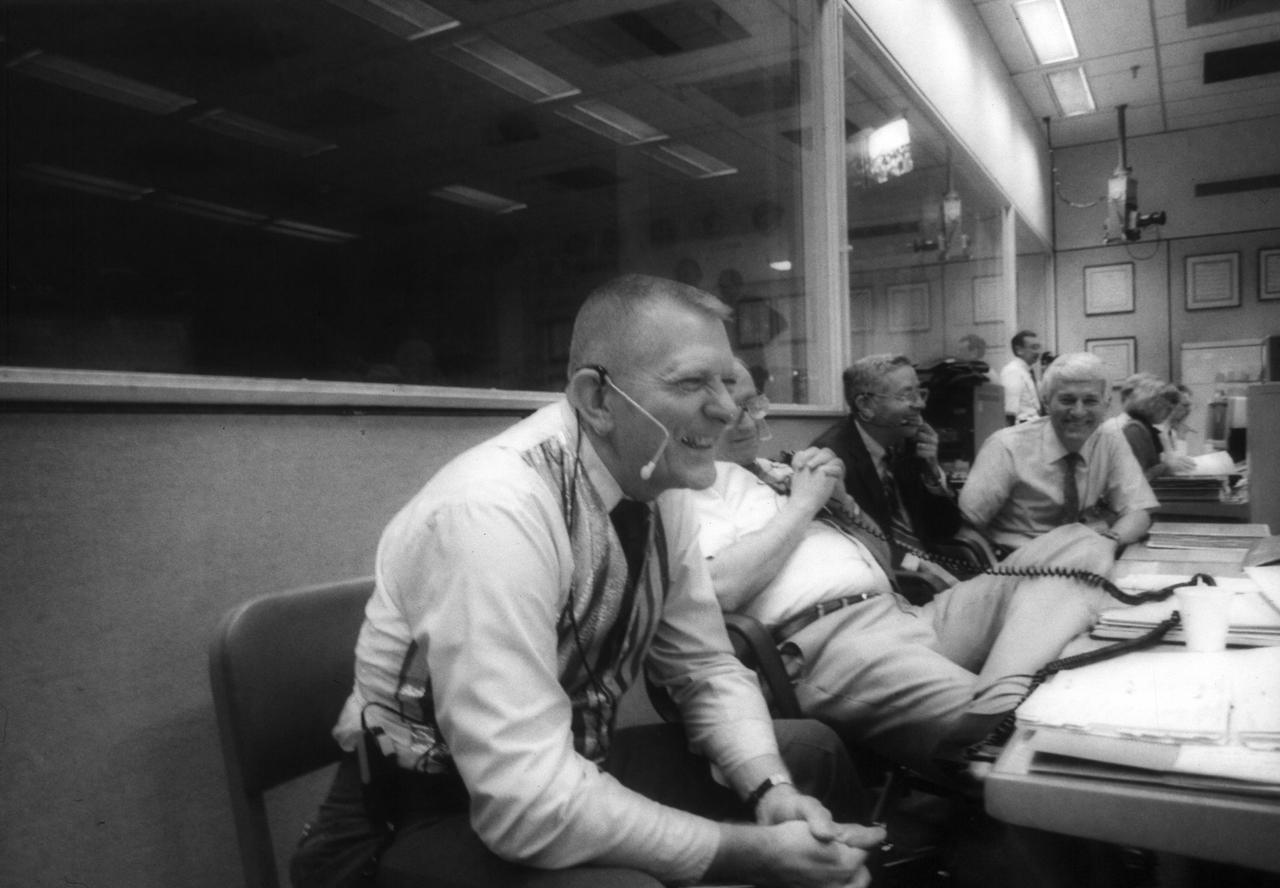
JSC officials, laughing, listen to crewmembers' commentary onboard Discovery, Orbiter Vehicle (OV) 103, during STS-26. In the Flight Control Room (FCR) of JSC's Mission Control Center (MCC) Bldg 30 and seated at the Mission Operations Directorate (MOD) console, MOD Director Eugene F. Kranz (foreground), wearing red, white and blue vest, smiles along with JSC Director Aaron Cohen and Flight Crew Operations Deputy Director Henry W. Hartsfield, Jr. (far right).
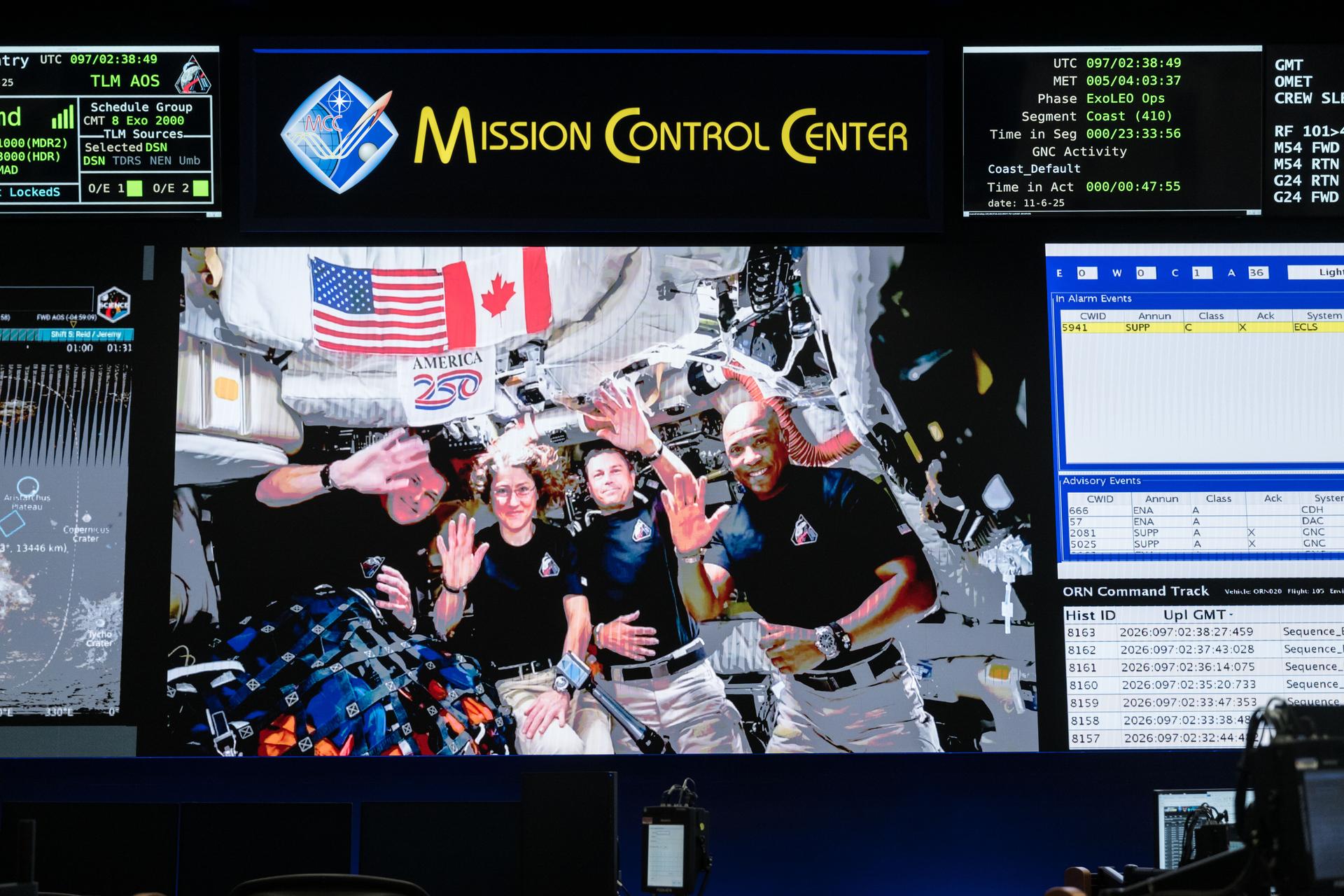
jsc2026e020504 (April 6, 2026) - The Artemis II crew – CSA (Canadian Space Agency) Astronaut Jeremy Hansen (far left) and NASA astronauts Christina Koch (center left), Reid Wiseman (center right), and Victor Glover (right) – pauses to wave after a live conversation with President Donald J. Trump following their historic lunar flyby during Flight Day 6. They are pictured on the screens of the White Flight Control room at NASA’s Mission Control Center at the agency’s Johnson Space Center in Houston. Credit: NASA
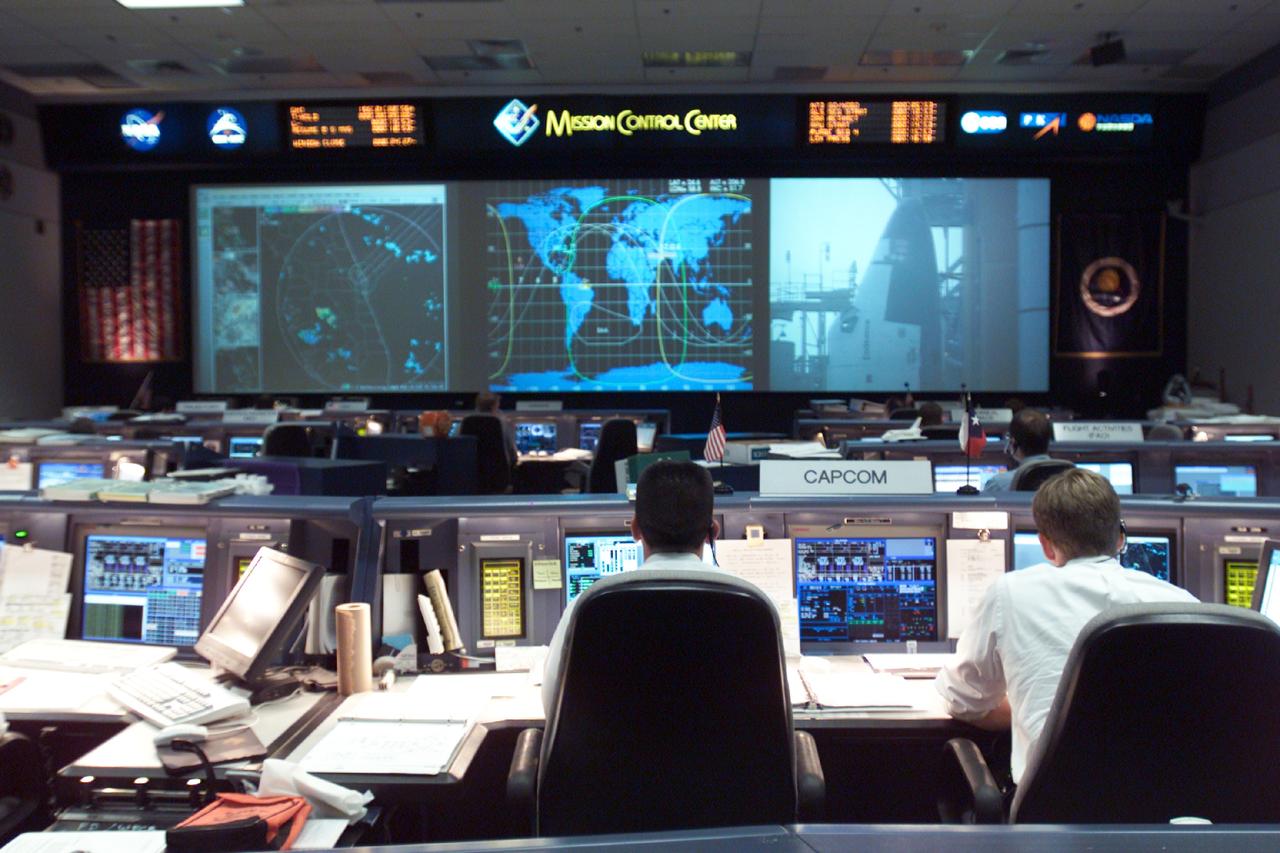
JSC2002-E-23113 (5 June 2002) --- The Space Shuttle Endeavour is shown on the big screen in this overall view of the shuttle flight control room (WFCR) in Houston’s Mission Control Center (MCC) as it is on the launch pad at Kennedy Space Center, Florida. Endeavour launched at 4:23 p.m. (CDT) on June 5, 2002. Once the vehicle cleared the tower in Florida, the Houston-based team of flight controllers took over the ground control of the flight.
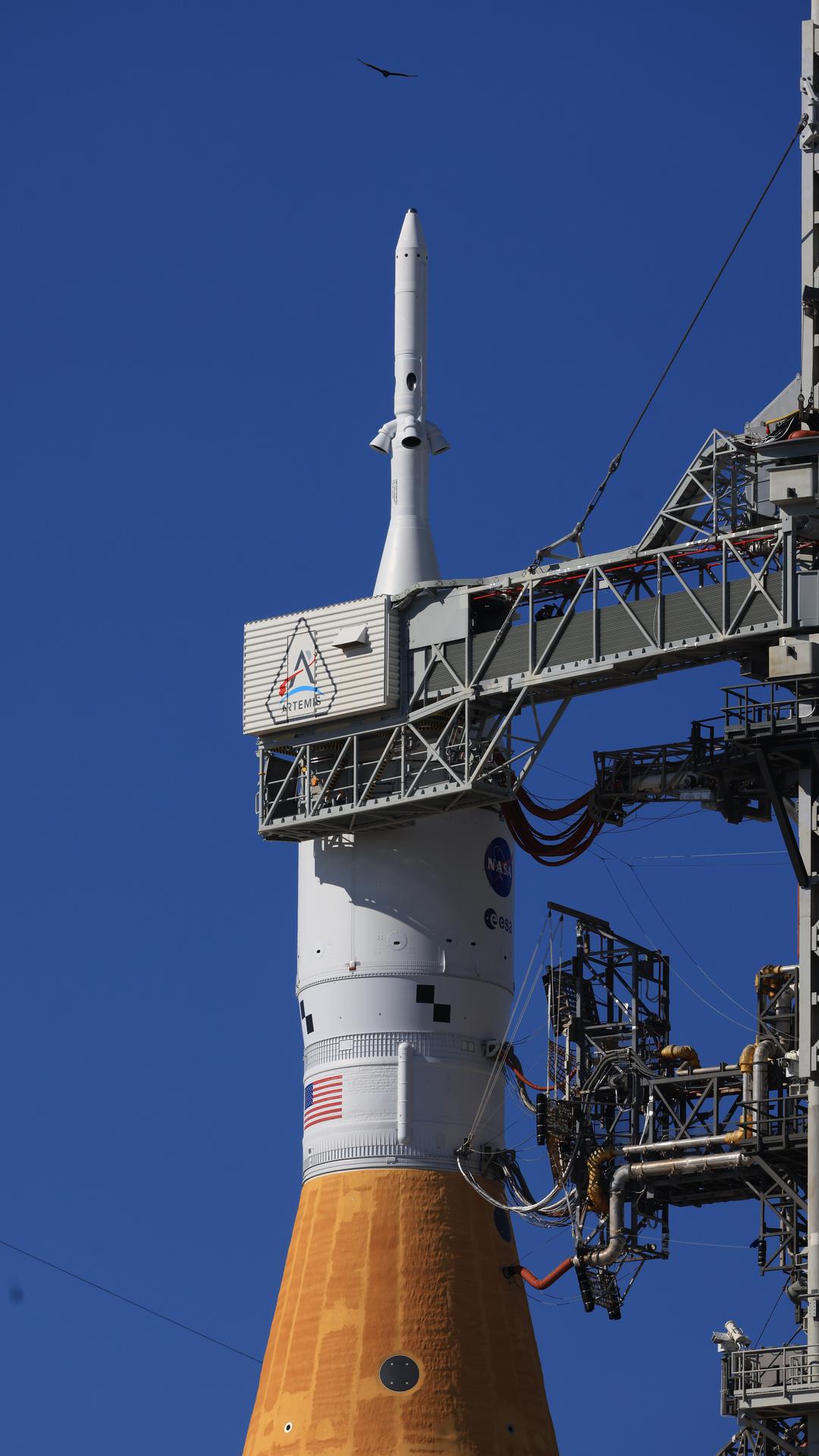
A photo shows a closeup view of the White Room connected to the crew access arm of the Orion spacecraft with launch abort system atop NASA’s Artemis II SLS (Space Launch System) rocket at Launch Complex 39B at NASA’s Kennedy Space Center in Florida on Tuesday, Feb. 10, 2026. The White Room is the small, environmentally controlled area where Artemis II Commander Reid Wiseman, Pilot Victor Glover, and Mission Specialist Christina Koch from NASA, and Mission Specialist Jeremy Hansen from the CSA (Canadian Space Agency) will make final preparations before climbing into the Orion spacecraft for launch of the Artemis II test flight.
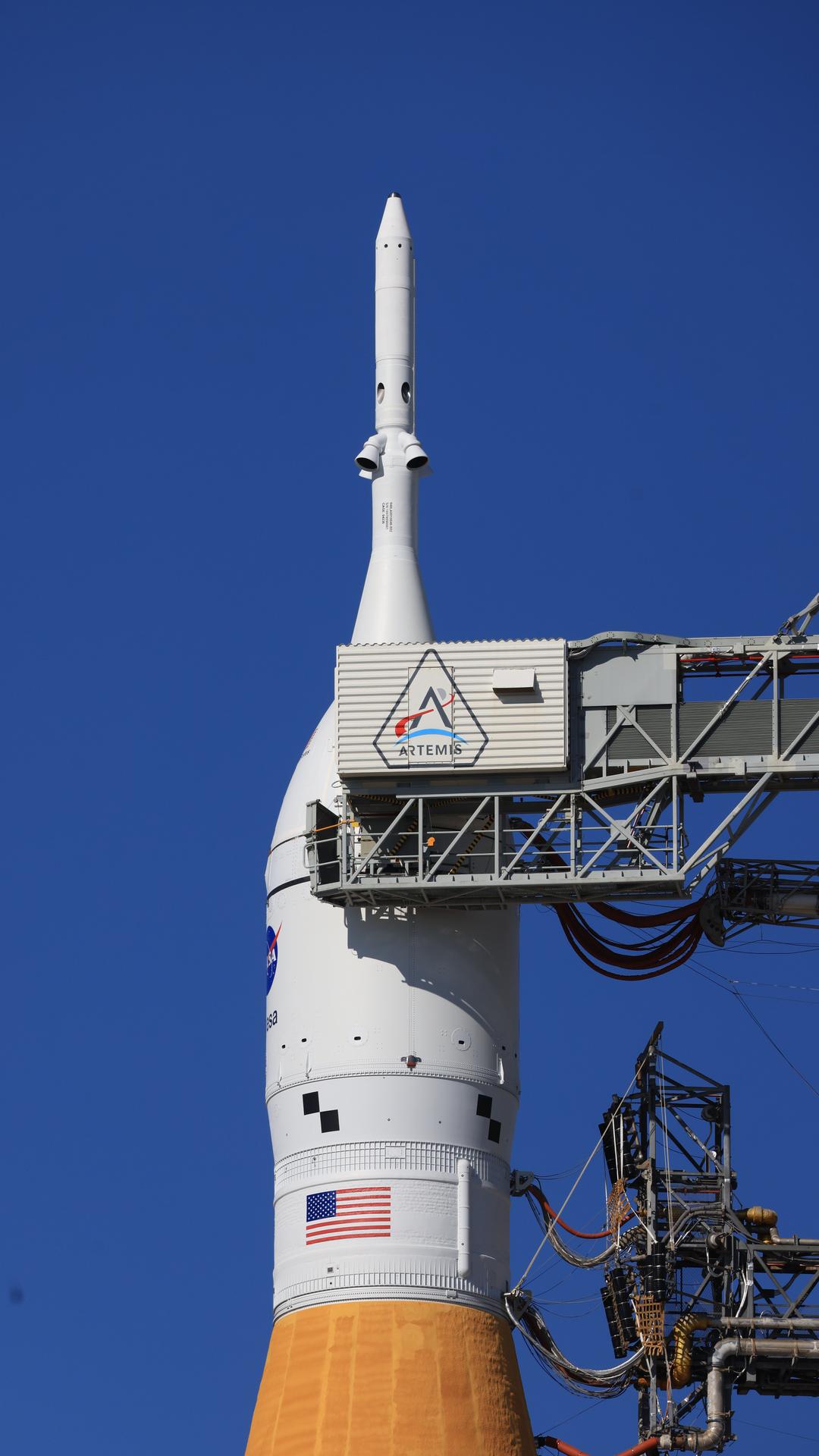
A photo shows a closeup view of the White Room connected to the crew access arm of the Orion spacecraft with launch abort system atop NASA’s Artemis II SLS (Space Launch System) rocket at Launch Complex 39B at NASA’s Kennedy Space Center in Florida on Tuesday, Feb. 10, 2026. The White Room is the small, environmentally controlled area where Artemis II Commander Reid Wiseman, Pilot Victor Glover, and Mission Specialist Christina Koch from NASA, and Mission Specialist Jeremy Hansen from the CSA (Canadian Space Agency) will make final preparations before climbing into the Orion spacecraft for launch of the Artemis II test flight.
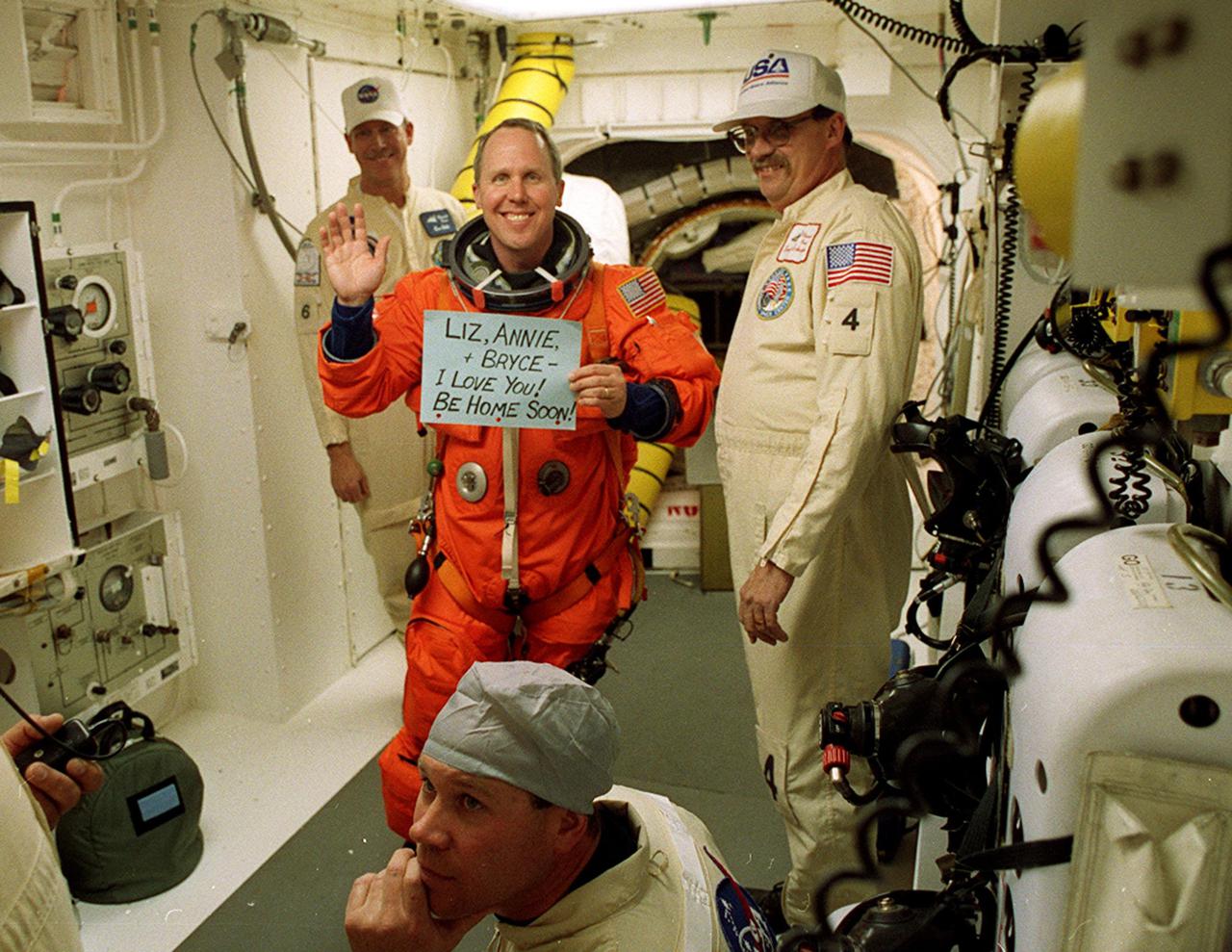
In the White Room with the closeout crew, STS-98 Mission Specialist Thomas Jones shows a message to his family before he enters Space Shuttle Atlantis for launch. The White Room is an environmentally controlled room at the end of the Orbiter Access Arm. Atlantis is carrying the U.S. Laboratory Destiny, a key module in the growth of the Space Station. Destiny will be attached to the Unity node on the Space Station using the Shuttle’s robotic arm. Three spacewalks are required to complete the planned construction work during the 11-day mission. This mission marks the seventh Shuttle flight to the Space Station, the 23rd flight of Atlantis and the 102nd flight overall in NASA’s Space Shuttle program. The planned landing is at KSC Feb. 18 about 1 p.m
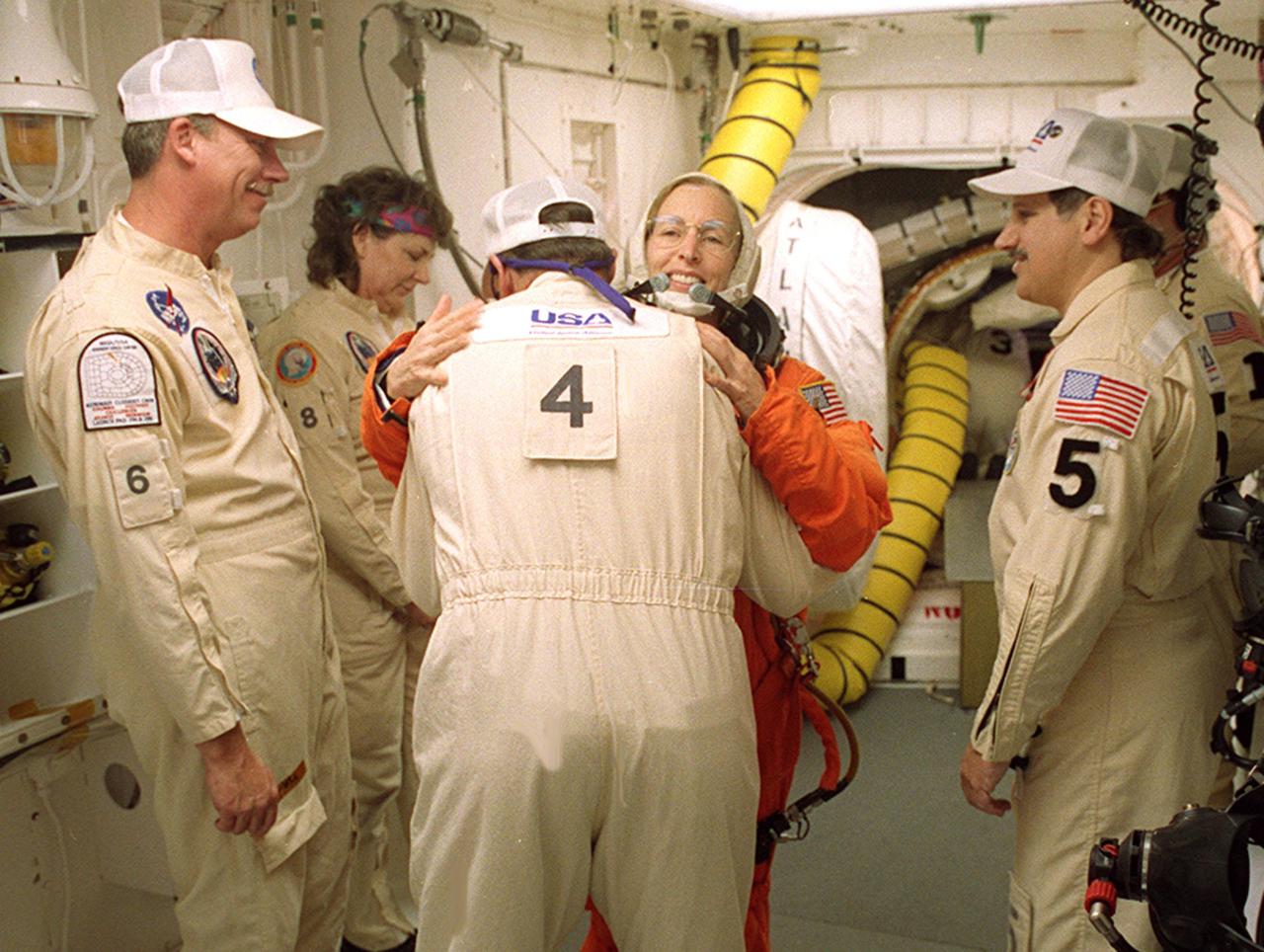
In the White Room before launch, STS-98 Mission Specialist Marsha Ivins gets a hug from a closeout crew member before she enters Space Shuttle Atlantis. The White Room is an environmentally controlled room at the end of the Orbiter Access Arm. Atlantis is carrying the U.S. Laboratory Destiny, a key module in the growth of the Space Station. Destiny will be attached to the Unity node on the Space Station using the Shuttle’s robotic arm. Three spacewalks are required to complete the planned construction work during the 11-day mission. This mission marks the seventh Shuttle flight to the Space Station, the 23rd flight of Atlantis and the 102nd flight overall in NASA’s Space Shuttle program. The planned landing is at KSC Feb. 18 about 1 p.m
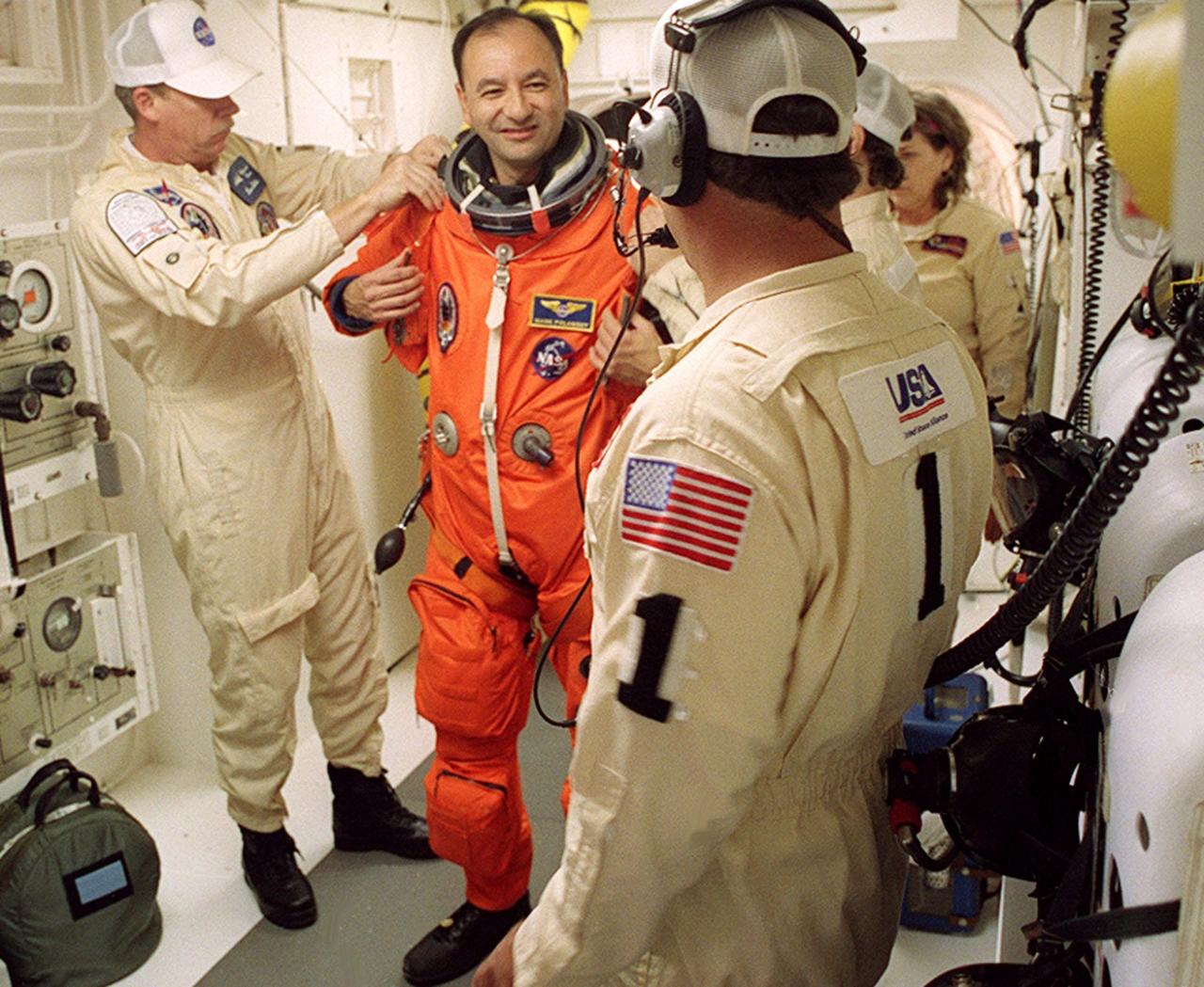
In the White Room with the closeout crew, STS-98 Pilot Mark Polansky happily undergoes final suit preparations before he enters Space Shuttle Atlantis for launch. The White Room is an environmentally controlled room at the end of the Orbiter Access Arm. Atlantis is carrying the U.S. Laboratory Destiny, a key module in the growth of the Space Station. Destiny will be attached to the Unity node on the Space Station using the Shuttle’s robotic arm. Three spacewalks are required to complete the planned construction work during the 11-day mission. This mission marks the seventh Shuttle flight to the Space Station, the 23rd flight of Atlantis and the 102nd flight overall in NASA’s Space Shuttle program. The planned landing is at KSC Feb. 18 about 1 p.m
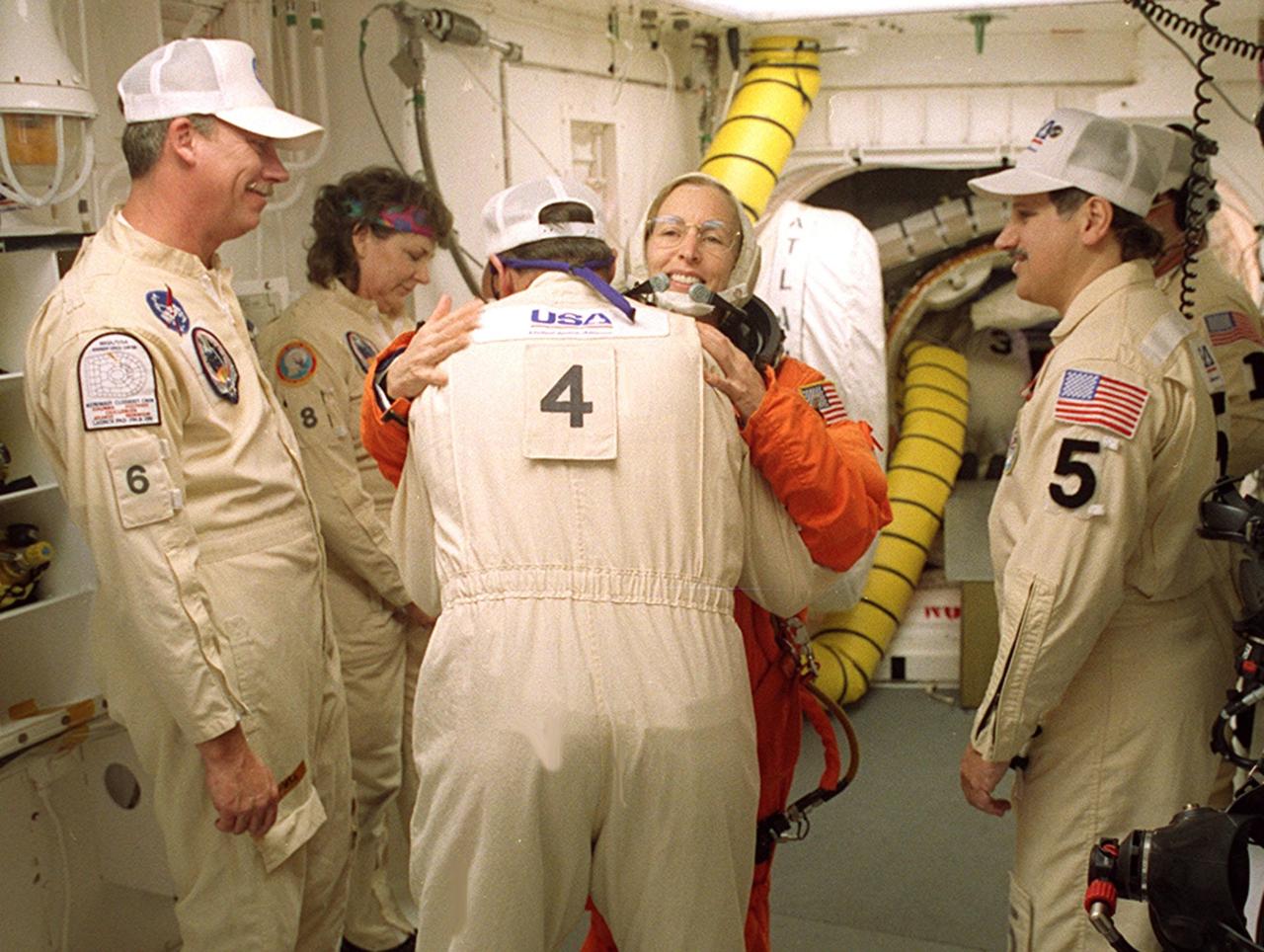
In the White Room before launch, STS-98 Mission Specialist Marsha Ivins gets a hug from a closeout crew member before she enters Space Shuttle Atlantis. The White Room is an environmentally controlled room at the end of the Orbiter Access Arm. Atlantis is carrying the U.S. Laboratory Destiny, a key module in the growth of the Space Station. Destiny will be attached to the Unity node on the Space Station using the Shuttle’s robotic arm. Three spacewalks are required to complete the planned construction work during the 11-day mission. This mission marks the seventh Shuttle flight to the Space Station, the 23rd flight of Atlantis and the 102nd flight overall in NASA’s Space Shuttle program. The planned landing is at KSC Feb. 18 about 1 p.m
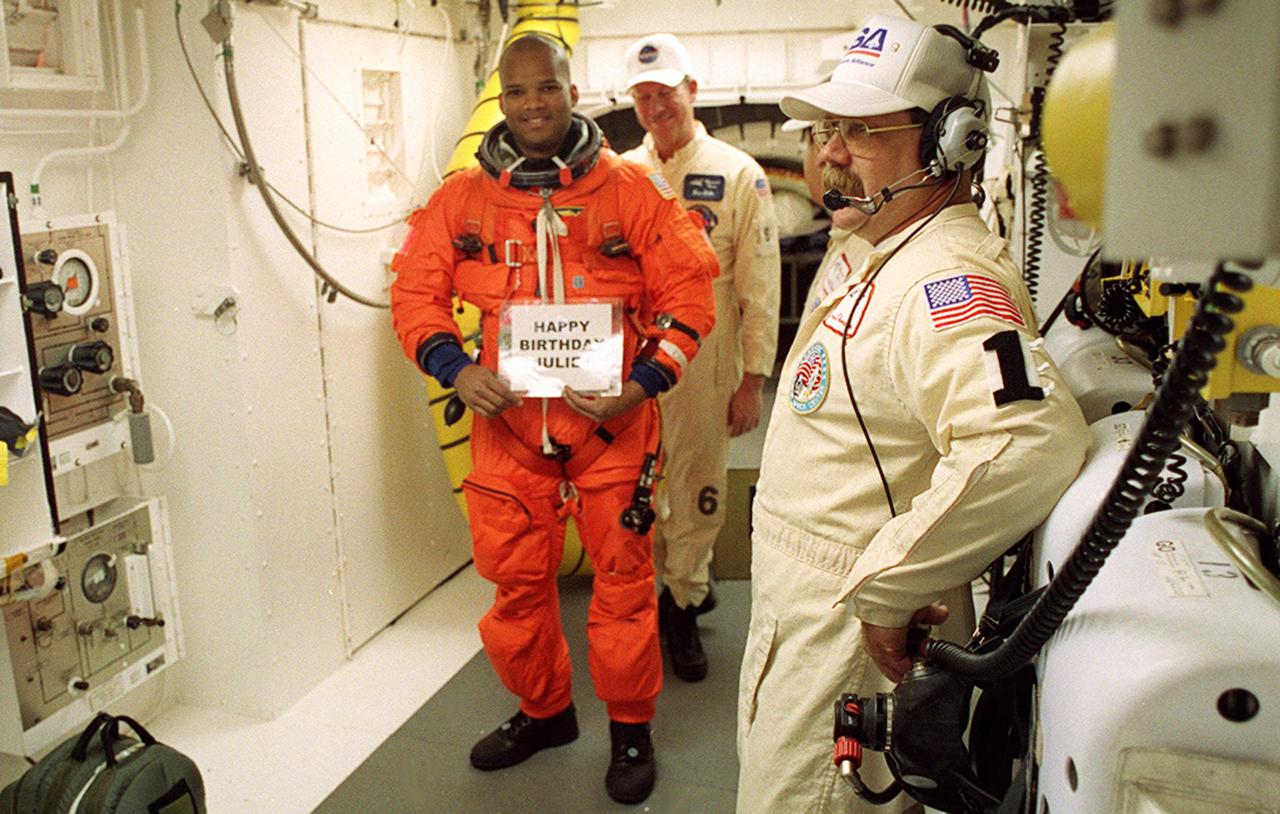
In the White Room with the closeout crew, STS-98 Mission Specialist Robert Curbeam sends a message to his wife before entering Space Shuttle Atlantis for launch. The White Room is an environmentally controlled room at the end of the Orbiter Access Arm. Atlantis is carrying the U.S. Laboratory Destiny, a key module in the growth of the Space Station. Destiny will be attached to the Unity node on the Space Station using the Shuttle’s robotic arm. Three spacewalks are required to complete the planned construction work during the 11-day mission. This mission marks the seventh Shuttle flight to the Space Station, the 23rd flight of Atlantis and the 102nd flight overall in NASA’s Space Shuttle program. The planned landing is at KSC Feb. 18 about 1 p.m
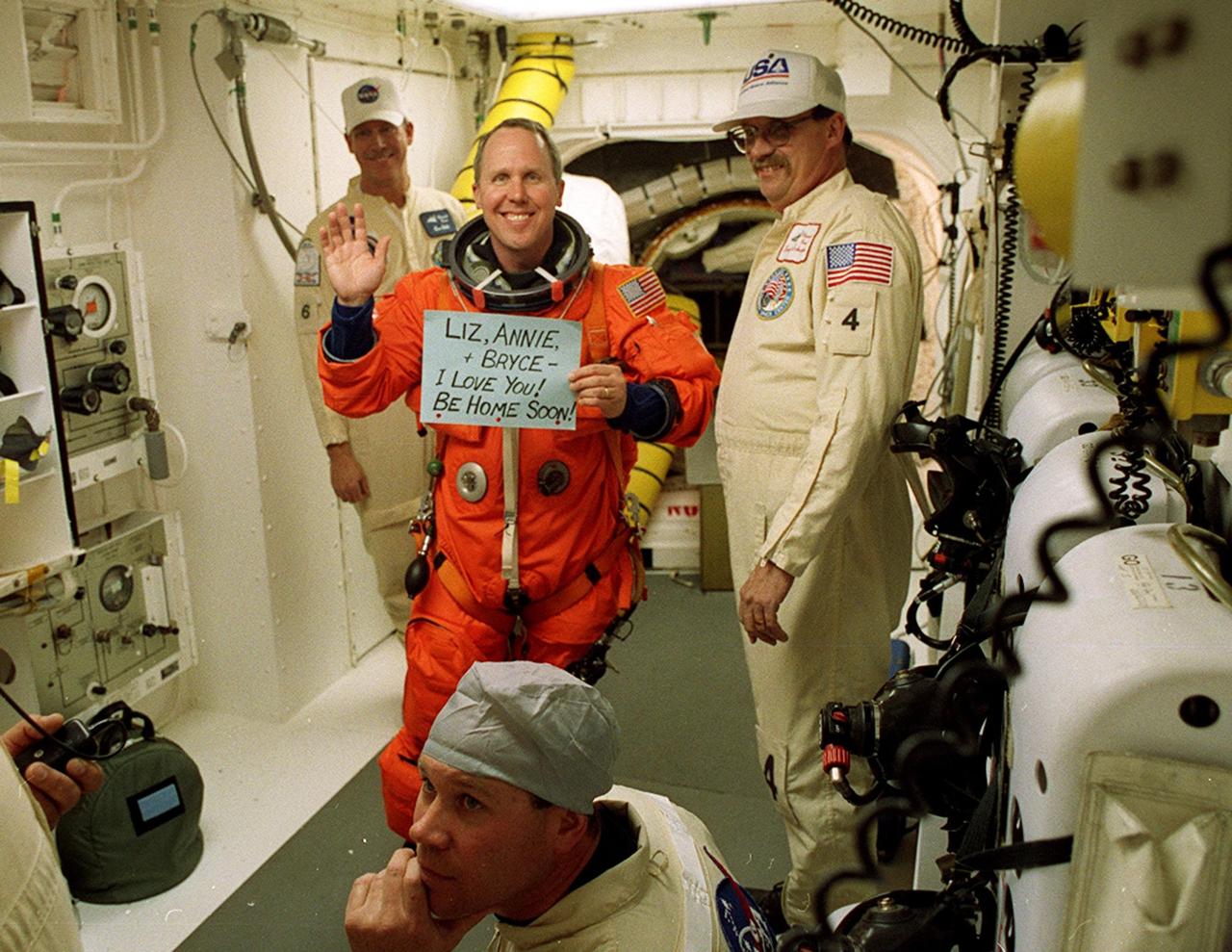
In the White Room with the closeout crew, STS-98 Mission Specialist Thomas Jones shows a message to his family before he enters Space Shuttle Atlantis for launch. The White Room is an environmentally controlled room at the end of the Orbiter Access Arm. Atlantis is carrying the U.S. Laboratory Destiny, a key module in the growth of the Space Station. Destiny will be attached to the Unity node on the Space Station using the Shuttle’s robotic arm. Three spacewalks are required to complete the planned construction work during the 11-day mission. This mission marks the seventh Shuttle flight to the Space Station, the 23rd flight of Atlantis and the 102nd flight overall in NASA’s Space Shuttle program. The planned landing is at KSC Feb. 18 about 1 p.m
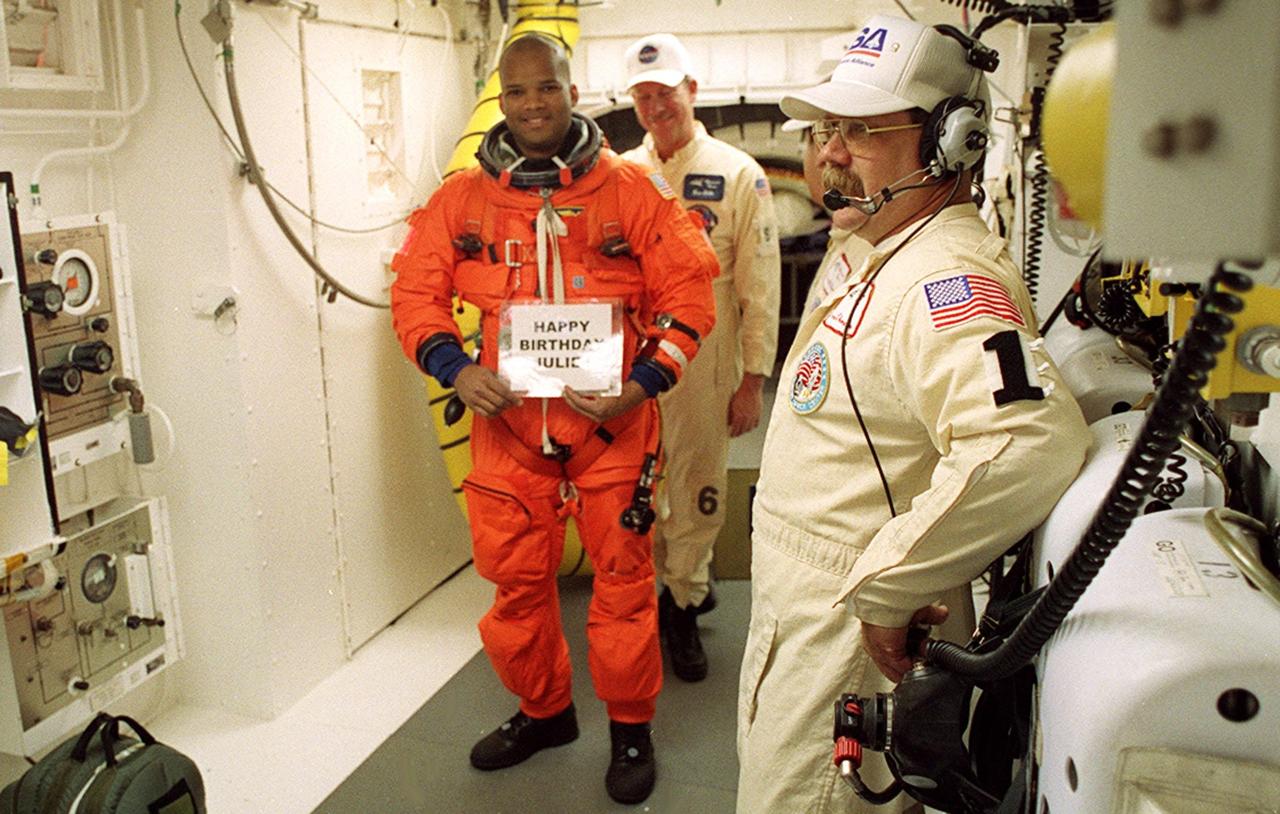
In the White Room with the closeout crew, STS-98 Mission Specialist Robert Curbeam sends a message to his wife before entering Space Shuttle Atlantis for launch. The White Room is an environmentally controlled room at the end of the Orbiter Access Arm. Atlantis is carrying the U.S. Laboratory Destiny, a key module in the growth of the Space Station. Destiny will be attached to the Unity node on the Space Station using the Shuttle’s robotic arm. Three spacewalks are required to complete the planned construction work during the 11-day mission. This mission marks the seventh Shuttle flight to the Space Station, the 23rd flight of Atlantis and the 102nd flight overall in NASA’s Space Shuttle program. The planned landing is at KSC Feb. 18 about 1 p.m
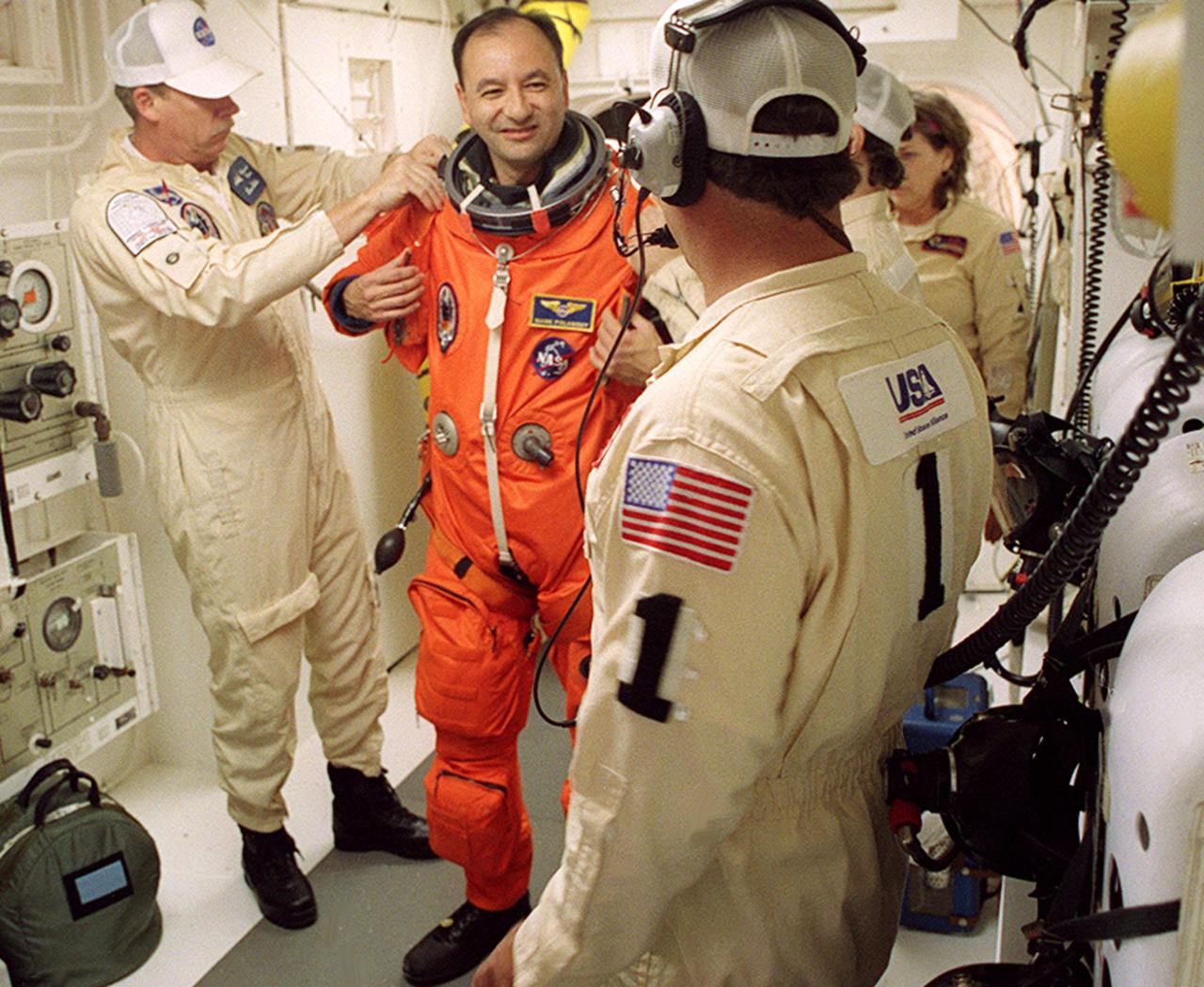
In the White Room with the closeout crew, STS-98 Pilot Mark Polansky happily undergoes final suit preparations before he enters Space Shuttle Atlantis for launch. The White Room is an environmentally controlled room at the end of the Orbiter Access Arm. Atlantis is carrying the U.S. Laboratory Destiny, a key module in the growth of the Space Station. Destiny will be attached to the Unity node on the Space Station using the Shuttle’s robotic arm. Three spacewalks are required to complete the planned construction work during the 11-day mission. This mission marks the seventh Shuttle flight to the Space Station, the 23rd flight of Atlantis and the 102nd flight overall in NASA’s Space Shuttle program. The planned landing is at KSC Feb. 18 about 1 p.m
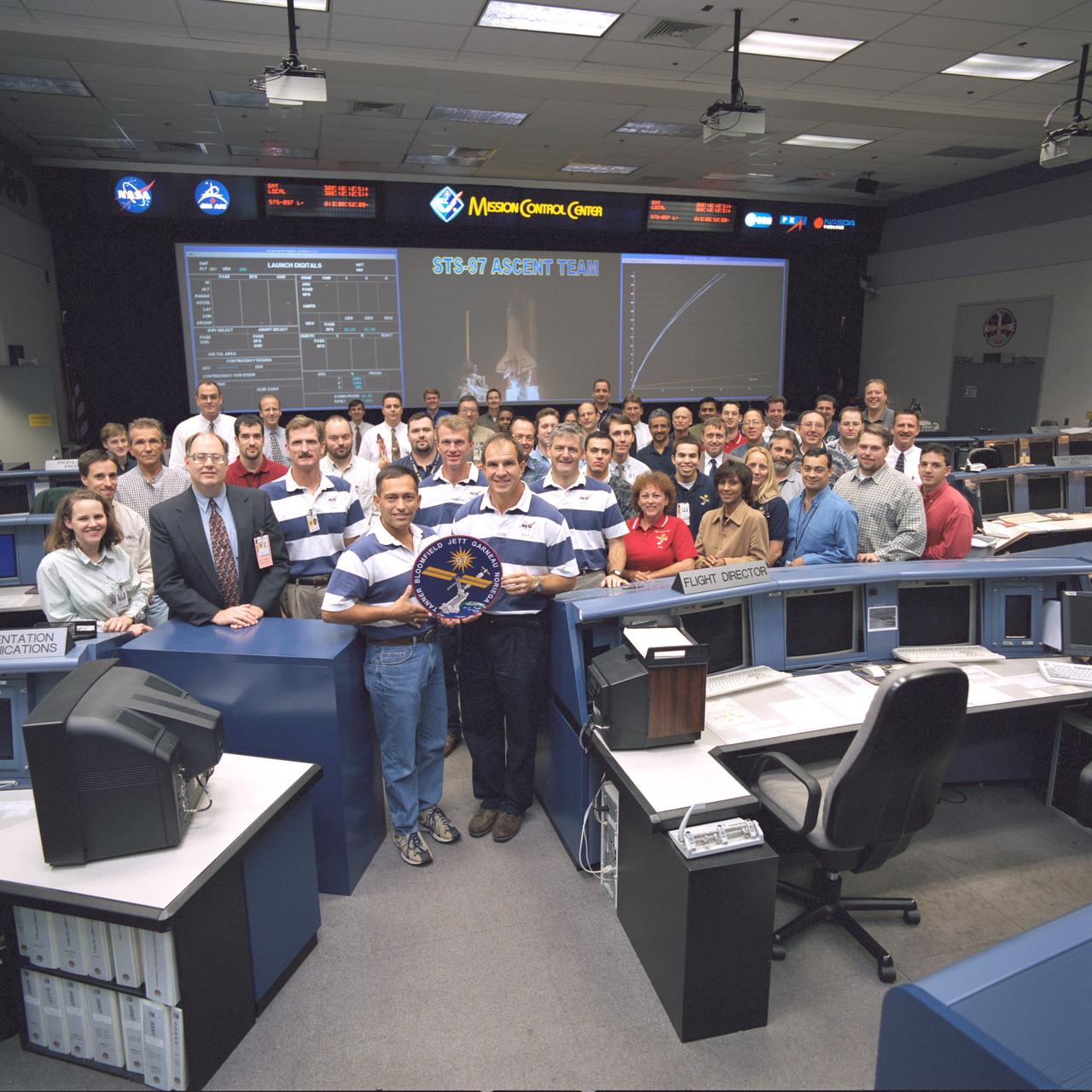
JSC2000-07294 (20 November 2000) --- The 40-odd flight controllers assigned to the STS-97 ascent team and some special guests pose for a group portrait in the shuttle flight control room in Houston's Mission Control Center (JSC). The five guests attired in the blue and white shirts are the flight crew members for the STS-97 crew, scheduled to be launched from Florida on the last day of this month. The astronauts are, from the left, Joseph R. Tanner, Carlos I. Noriega, Brent W. Jett, Jr., Michael J. Bloomfield and Marc Garneau, who represents the Canadian Space Agency (CSA). Ascent shift flight director Wayne Hale stands next to Tanner.
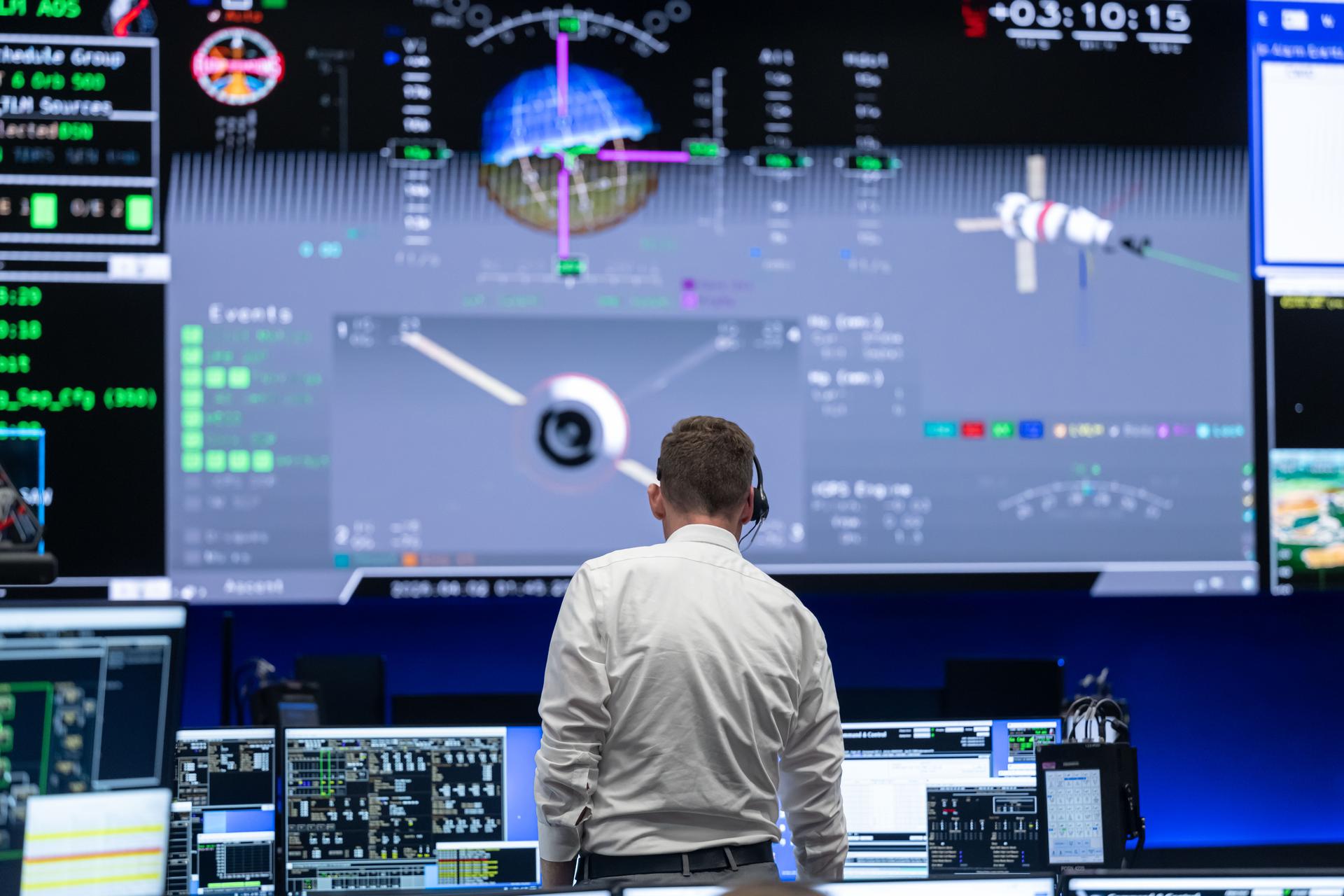
jsc2026e019242 (April 1, 2026) – Lead Artemis II Flight Director Jeff Radigan in the White Flight Control Room at the Mission Control Center at NASA’s Johnson Space Center in Houston. At the time of this photograph, a little over three hours into the mission, the Artemis II crew began a manual piloting test called the proximity operations demonstration. During the demonstration, mission controllers monitored Orion as the astronauts transitioned the spacecraft to manual mode and piloted its flight path and orientation. This demonstration will provide performance data and operational experience that cannot be readily gained on the ground in preparation for critical rendezvous, proximity operations, docking, and undocking for future Artemis missions. Credit: NASA

jsc2026e019217 (April 1, 2026) – Lead Artemis II Flight Director Jeff Radigan in the White Flight Control Room at the Mission Control Center at NASA’s Johnson Space Center in Houston. At the time of this photograph, a little over three hours into the mission, the Artemis II crew was conducting a manual piloting test called the proximity operations demonstration. During the demonstration, mission controllers monitored Orion as the astronauts transitioned the spacecraft to manual mode and piloted its flight path and orientation. This demonstration will provide performance data and operational experience that cannot be readily gained on the ground in preparation for critical rendezvous, proximity operations, docking, and undocking for future Artemis missions. Credit: NASA
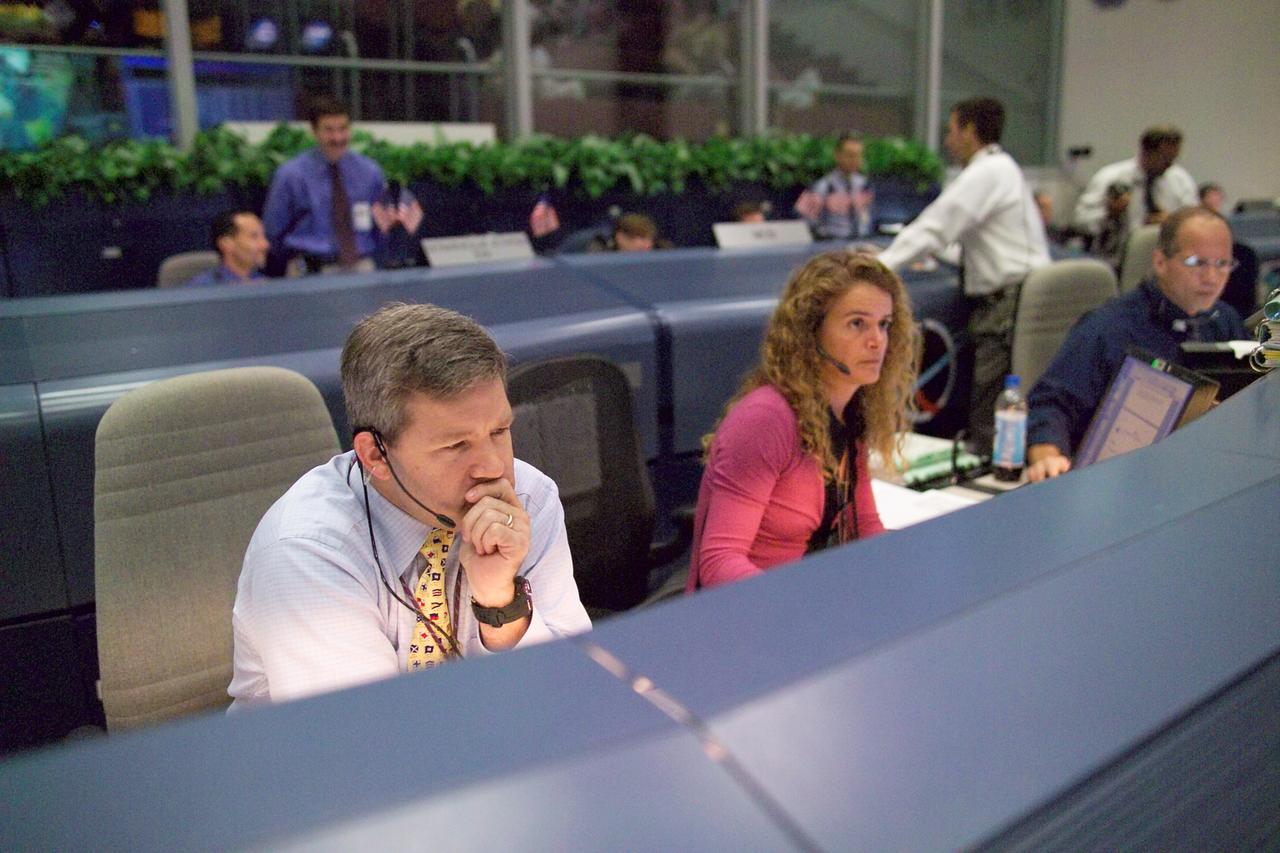
JSC2005-E-31936 (3 August 2005) --- Astronauts Julie Payette (Canadian Space Agency) and Stephen N. Frick monitor communications at the spacecraft communicator (CAPCOM) console in the Shuttle (White) Flight Control Room in Johnson Space Center’s (JSC) Mission Control Center during the third period of extravehicular activity (EVA) for STS-114.
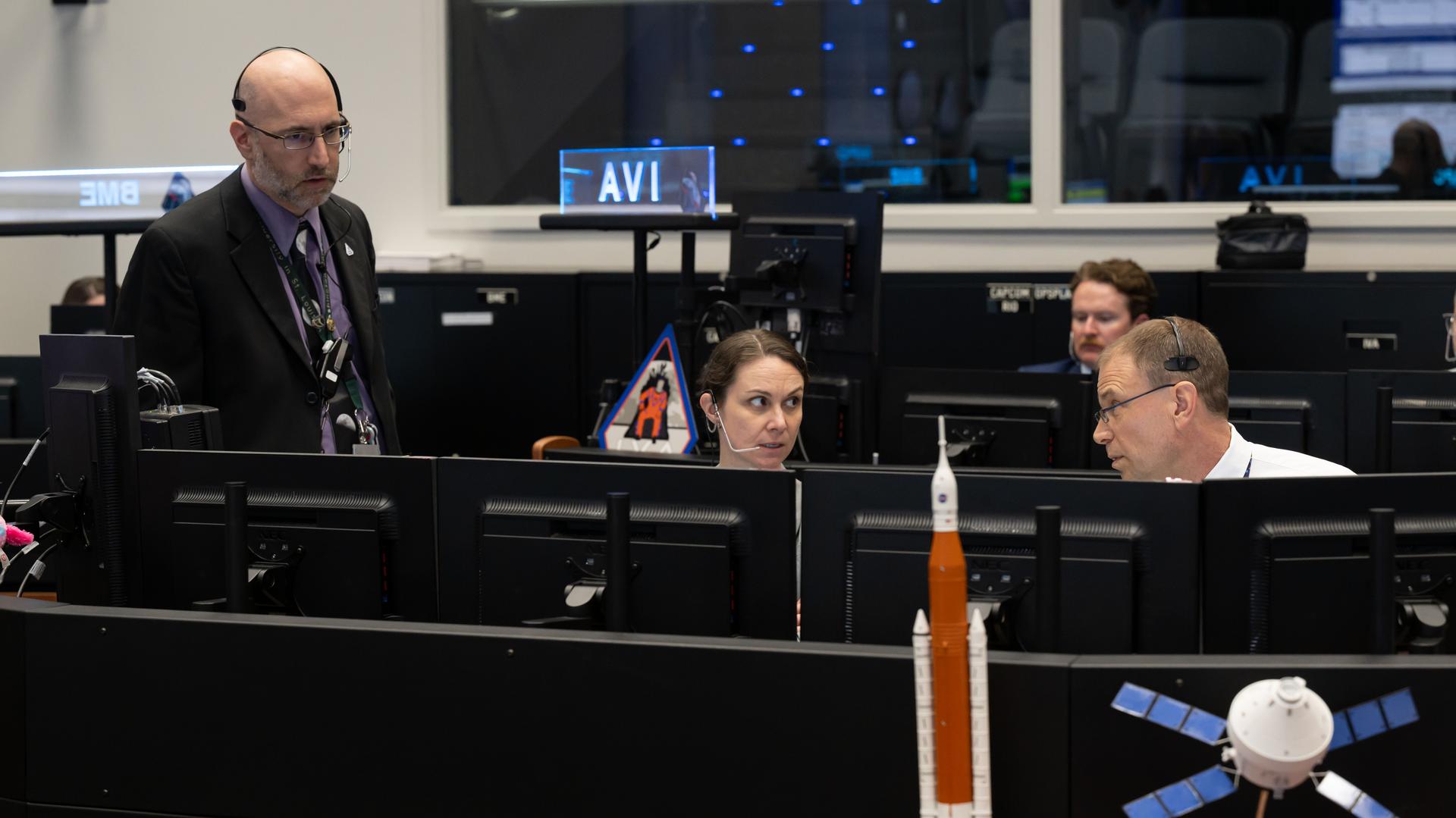
jsc2026e018915 (April 1, 2026) - Artemis II lead capcom Stan Love (right) and Artemis II chief training officer Jacki Mahaffey (middle) have a conversation in Mission Control's White Flight Control Room at NASA's Johnson Space Center during launch and ascent on Wednesday, April 1, 2026. Credit: NASA/Robert Markowitz
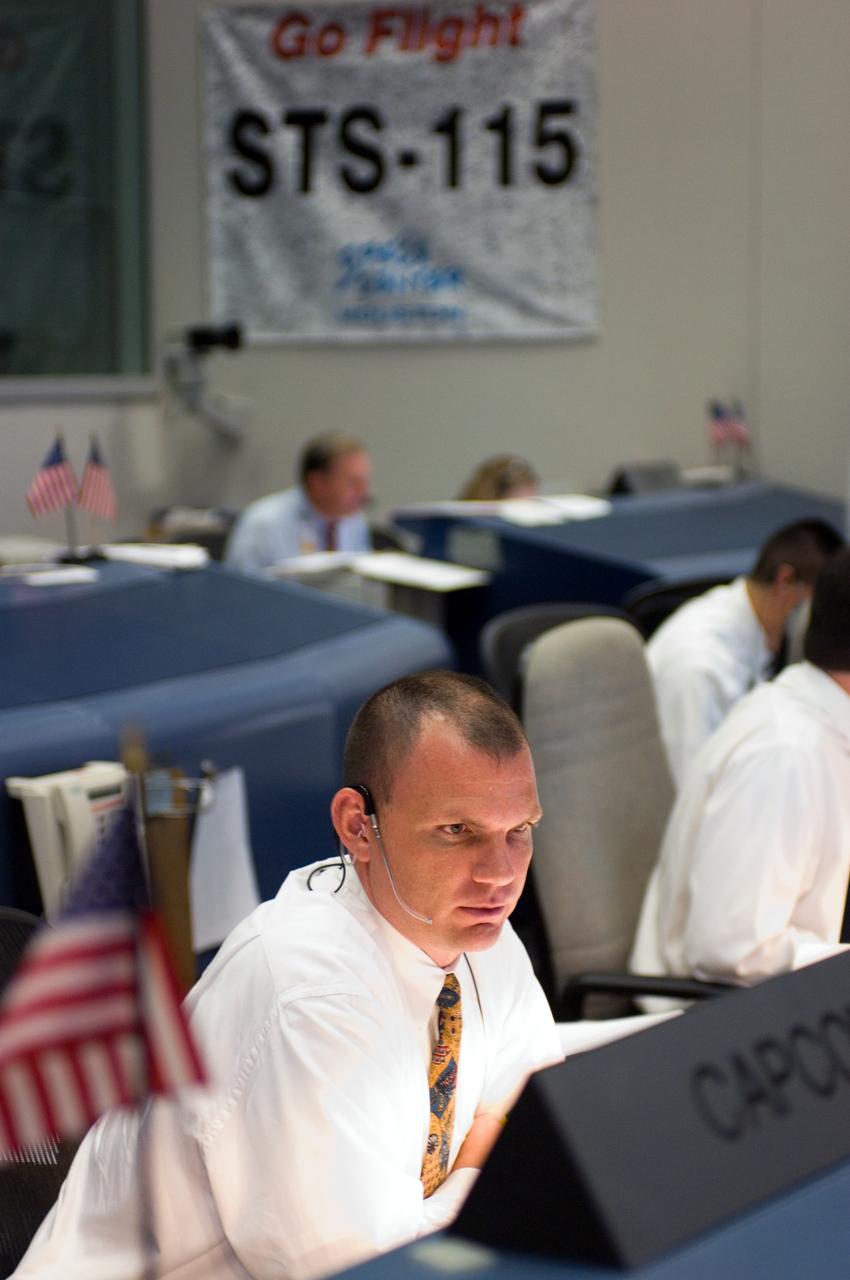
JSC2006-E-39854 (9 Sept. 2006) --- In the Shuttle (White) Flight Control Room of Houston's Mission Control Center, astronaut Dominic A. (Tony) Antonelli monitors launch countdown activities a few hundred miles away in Florida, site of Space Shuttle Atlantis' scheduled STS-115 launch. Antonelli serves as the spacecraft communicator (CAPCOM) for the ascent and entry phases. Liftoff occurred at 11:15 a.m. (EDT) on Sept. 9, 2006 from launch pad 39B at Kennedy Space Center.
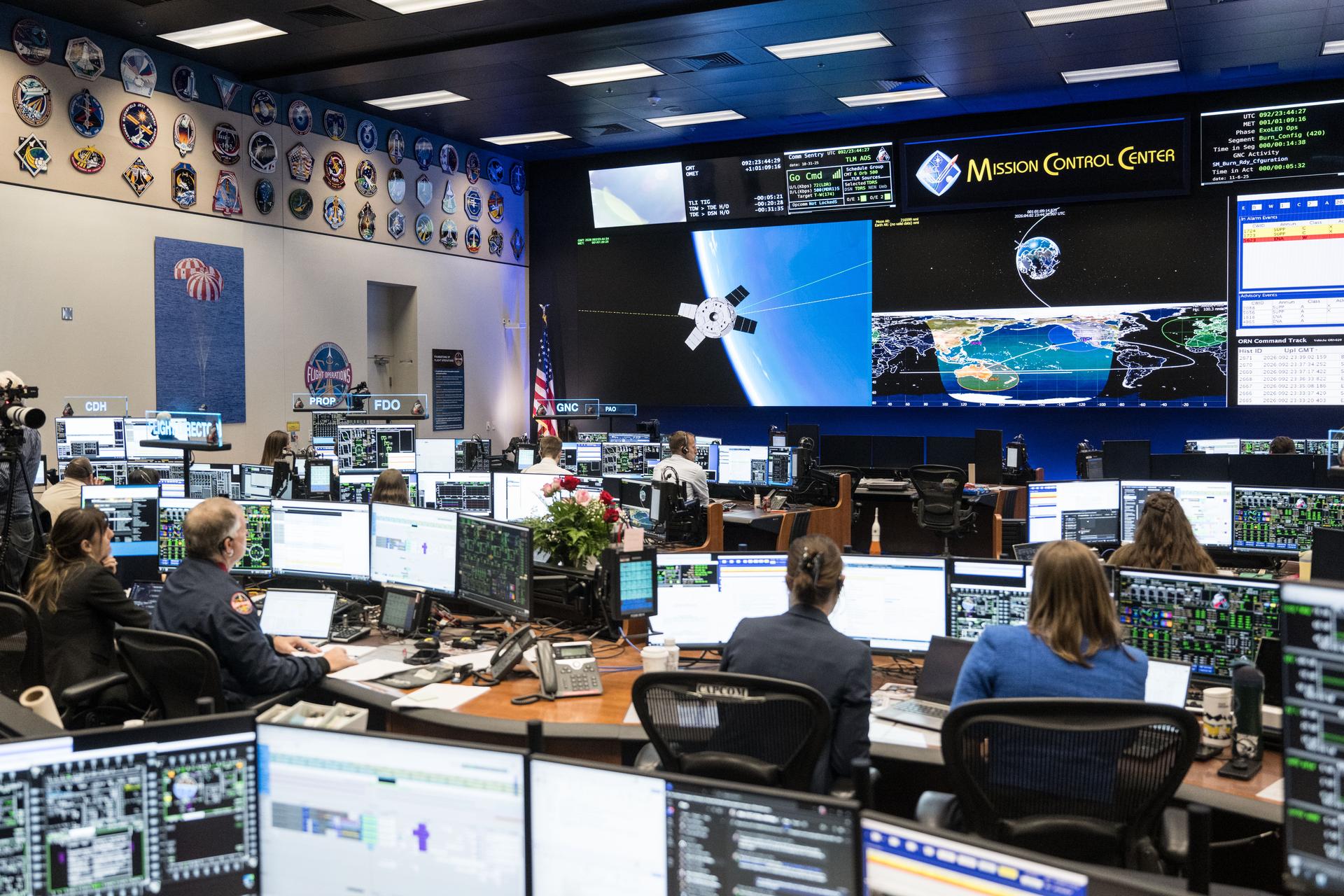
jsc2026e019618 (April 2, 2026) – The Artemis II flight control team pictured at the White Flight Control Room in the Mission Control Center at NASA’s Johnson Space Center monitors mission operations during the translunar injection (TLI) burn, which sent the crew in Orion out of Earth orbit and on a trajectory toward the Moon. After the mission management team polled “Go” for the operation, NASA’s Orion spacecraft fired its main engine for five minutes and 50 seconds beginning at 7:49 p.m. ET, to successfully complete the TLI burn.
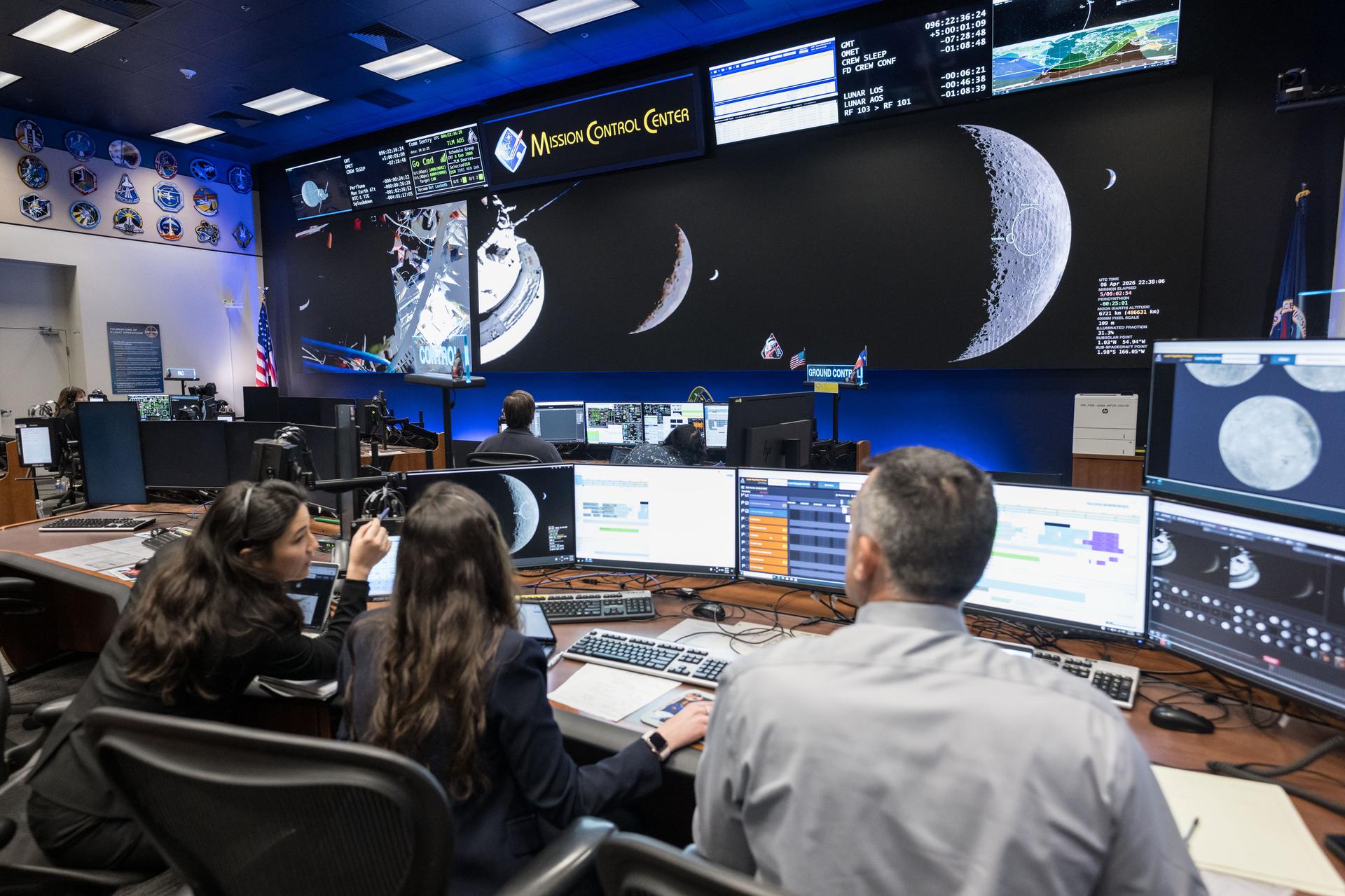
jsc2026e020490 (April 6, 2026) - Pictured from left to right, Angela Garcia, Dr. Kelsey Young, and Dr. Trevor Graff, the first science officers of the Artemis program in the White Flight Control Room in the Christopher C. Kraft Jr. Mission Control Center at NASA’s Johnson Space Center. Seen here about ten minutes before Earthset during Artemis II, these science officers are seen monitoring mission data in real-time from the Science console. They support flight controllers by analyzing scientific measurements and system performance. Their work helps ensure mission objectives are achieved safely and efficiently. Credit: NASA
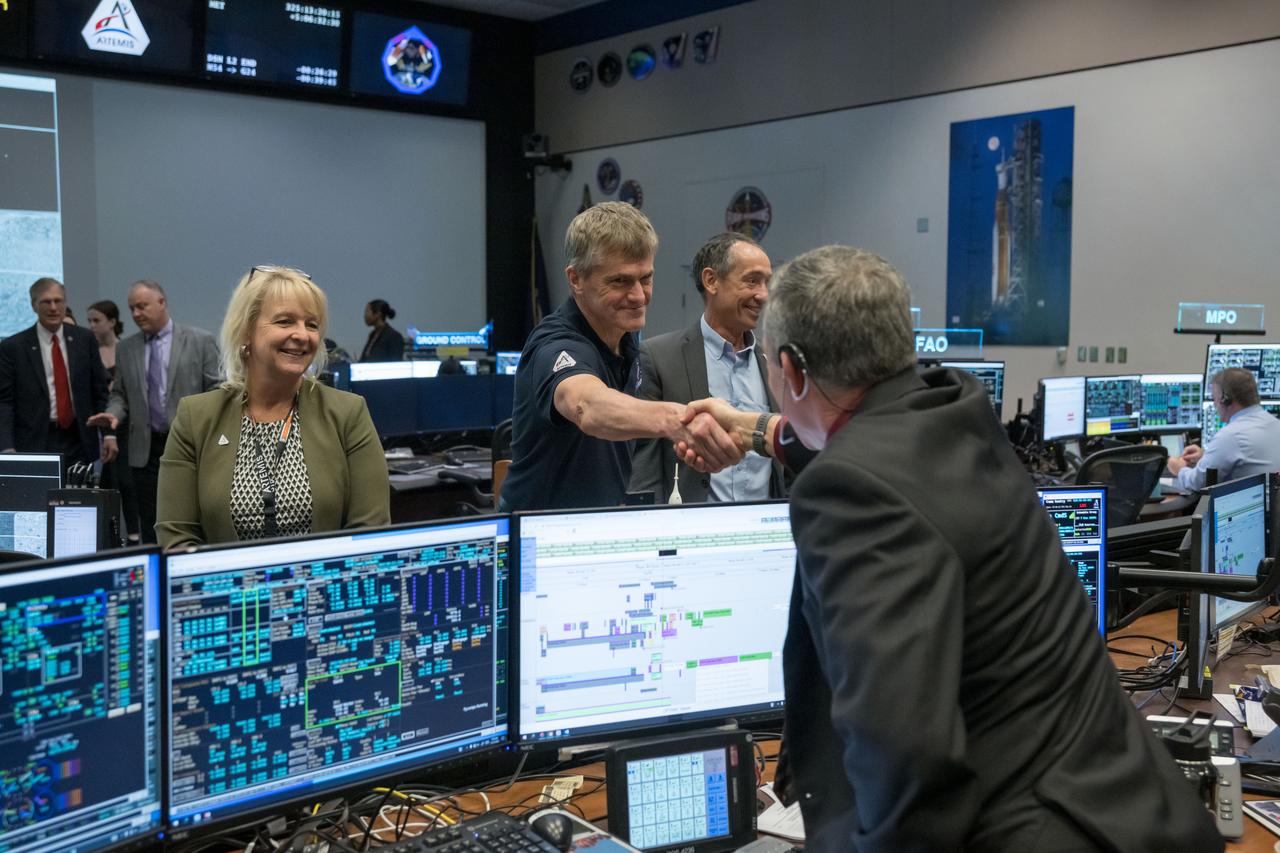
jsc2022e089183 (Nov. 21, 2022) During flight day 6 of the 25.5-day mission, Orion program managers greet Artemis I Lead Flight Director Rick LaBrode in the White Flight Control Room at the Johnson Space Center in Houston. The visit followed during the Outbound Powered Flyby (OPF) burn, which set Orion on a course to fly by the Moon at a closest distance of 81 miles (130.5 kilometers).
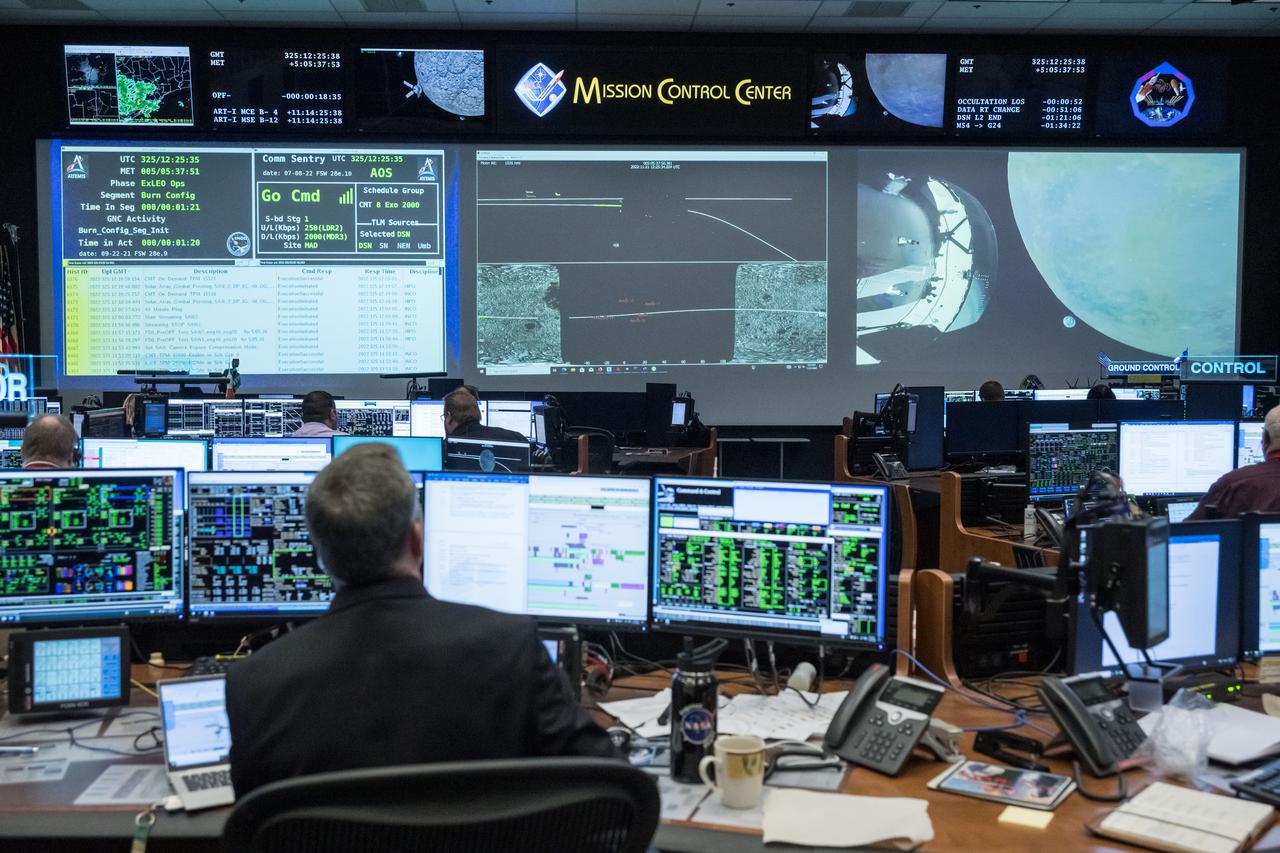
jsc2022e089168 (Nov. 21, 2022) During flight day 6 of the 25.5-day Artemis I mission, Lead Flight Director Rick LaBrode monitors the progress of the Outbound Powered Flyby (OPF) in the White Flight Control Room at Johnson Space Center in Houston. burn monitored by. The OPF burn set Orion on a course to fly by the Moon at a closest distance of 81 miles (130.5 kilometers).
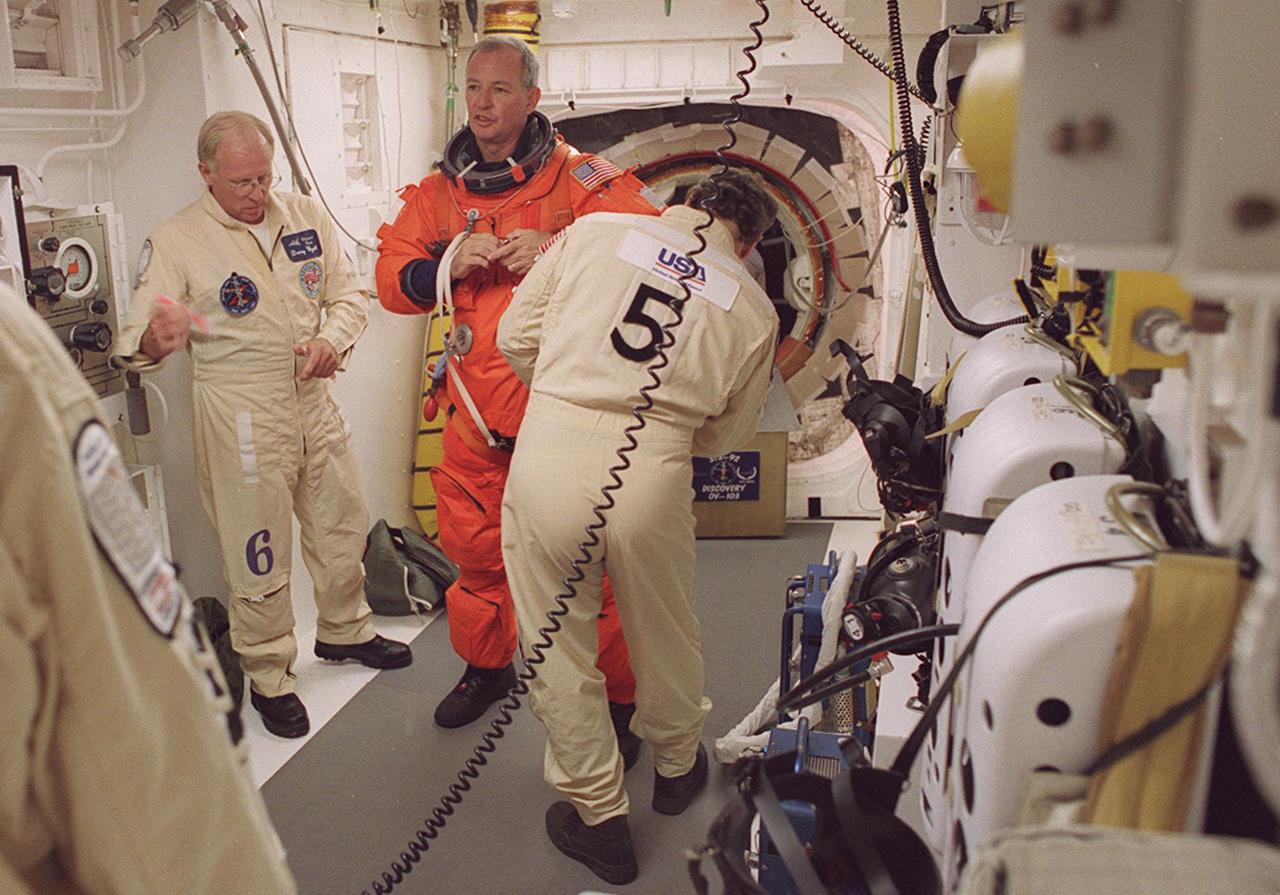
STS-92 Commander Brian Duffy is helped with final suit check in the White Room before entering Discovery. The White Room is an environmentally controlled area at the end of the Orbiter Access Arm that provides entry to the orbiter as well as emergency egress if needed. The arm remains in the extended position until 7 minutes 24 seconds before launch. Duffy and the rest of the crew are undertaking the fifth flight to the International Space Station for construction. Discovery carries a payload that includes the Integrated Truss Structure Z-1, first of 10 trusses that will form the backbone of the Space Station, and the third Pressurized Mating Adapter that will provide a Shuttle docking port for solar array installation on the sixth Station flight and Lab installation on the seventh Station flight. The mission includes four spacewalks for the construction activities. Discovery’s landing is expected Oct. 22 at 2:10 p.m. EDT
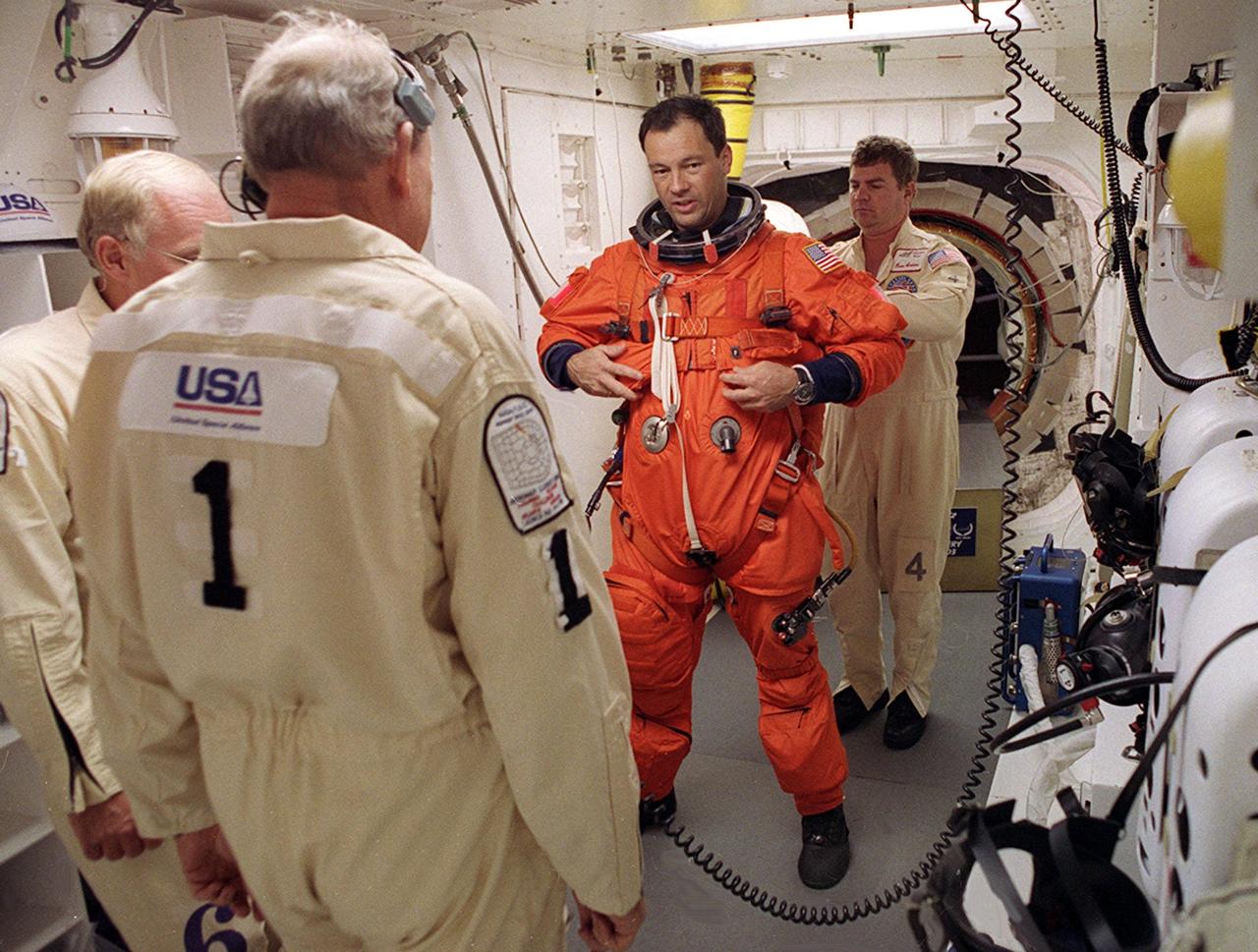
STS-92 Mission Specialist Michael E. Lopez-Alegria gets a final check of his launch and entry suit in the White Room before entering Discovery. The White Room is an environmentally controlled area at the end of the Orbiter Access Arm that provides entry to the orbiter as well as emergency egress if needed. The arm remains in the extended position until 7 minutes 24 seconds before launch. Lopez-Alegria and the rest of the crew are undertaking the fifth flight to the International Space Station for construction. Discovery carries a payload that includes the Integrated Truss Structure Z-1, first of 10 trusses that will form the backbone of the Space Station, and the third Pressurized Mating Adapter that will provide a Shuttle docking port for solar array installation on the sixth Station flight and Lab installation on the seventh Station flight. The mission includes four spacewalks for the construction activities. Discovery’s landing is expected Oct. 22 at 2:10 p.m. EDT
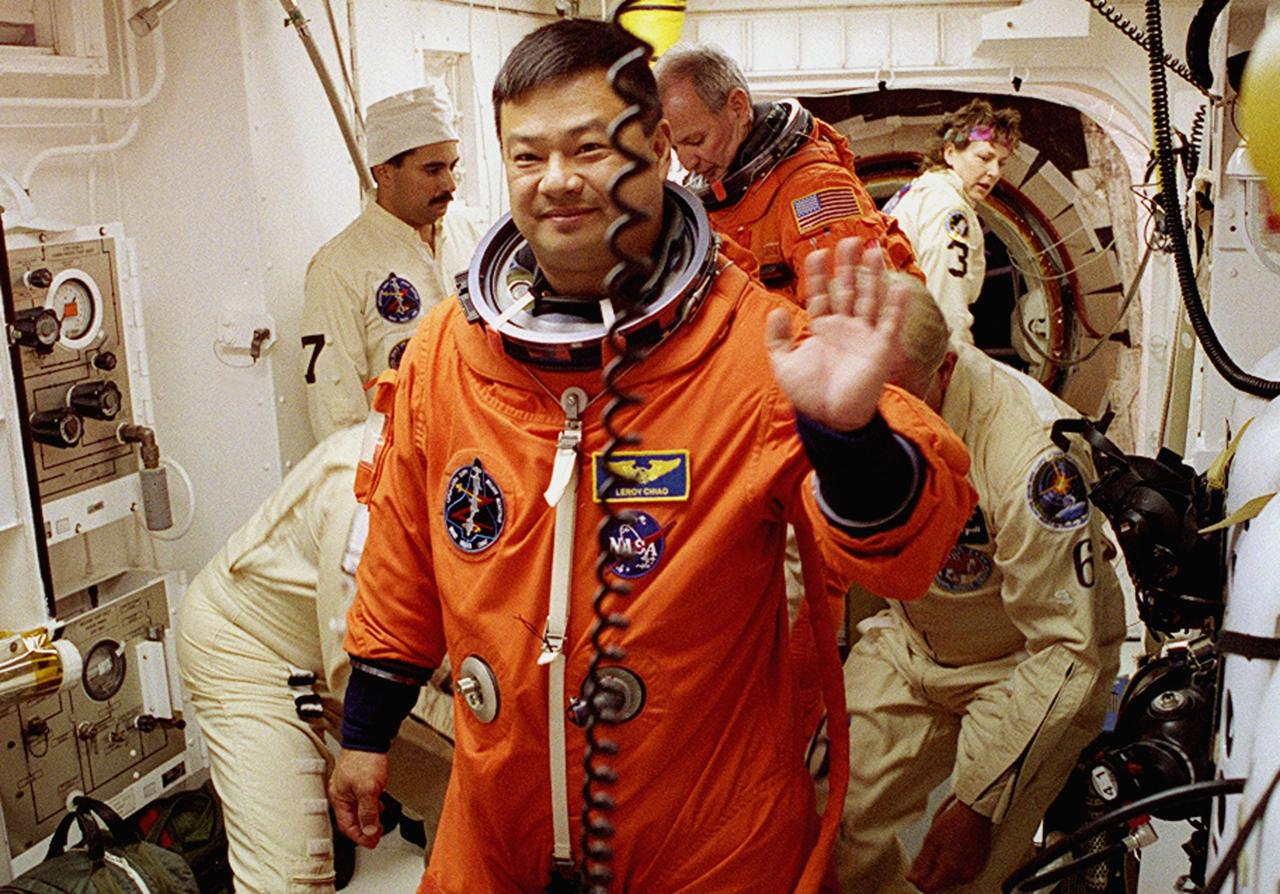
STS-92 Mission Specialist Leroy Chiao waves while waiting for suit check in the White Room. Behind him is Commander Brian Duffy. The White Room is an environmentally controlled area at the end of the Orbiter Access Arm that provides entry to the orbiter as well as emergency egress if needed. The arm remains in the extended position until 7 minutes 24 seconds before launch. Chiao, Duffy and the rest of the crew are undertaking the fifth flight to the International Space Station for construction. Discovery carries a payload that includes the Integrated Truss Structure Z-1, first of 10 trusses that will form the backbone of the Space Station, and the third Pressurized Mating Adapter that will provide a Shuttle docking port for solar array installation on the sixth Station flight and Lab installation on the seventh Station flight. The mission includes four spacewalks for the construction activities. Discovery’s landing is expected Oct. 22 at 2:10 p.m. EDT

STS-92 Mission Specialist William S. McArthur Jr. undergoes final suit check in the White Room before entering Discovery. The White Room is an environmentally controlled area at the end of the Orbiter Access Arm that provides entry to the orbiter as well as emergency egress if needed. The arm remains in the extended position until 7 minutes 24 seconds before launch. McArthur and the rest of the crew are making the fifth flight to the International Space Station for construction. Discovery carries a payload that includes the Integrated Truss Structure Z-1, first of 10 trusses that will form the backbone of the Space Station, and the third Pressurized Mating Adapter that will provide a Shuttle docking port for solar array installation on the sixth Station flight and Lab installation on the seventh Station flight. The mission includes four spacewalks for the construction activities. Discovery’s landing is expected Oct. 22 at 2:10 p.m. EDT
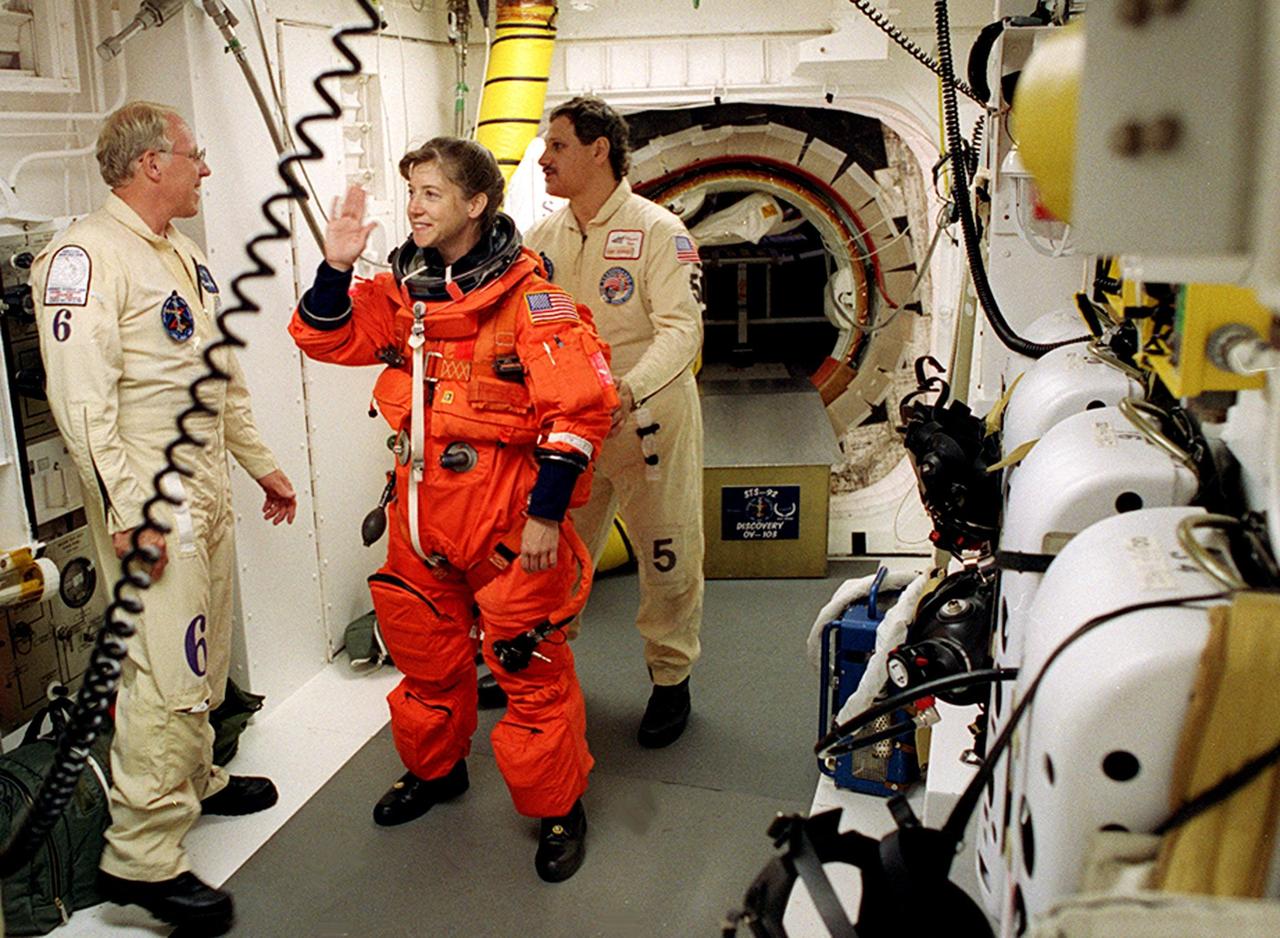
STS-92 Pilot Pamela Ann Melroy has a final check on her launch and entry suit in the White Room before entering Discovery. The White Room is an environmentally controlled area at the end of the Orbiter Access Arm that provides entry to the orbiter as well as emergency egress if needed. The arm remains in the extended position until 7 minutes 24 seconds before launch. Melroy and the rest of the crew are undertaking the fifth flight to the International Space Station for construction. Discovery carries a payload that includes the Integrated Truss Structure Z-1, first of 10 trusses that will form the backbone of the Space Station, and the third Pressurized Mating Adapter that will provide a Shuttle docking port for solar array installation on the sixth Station flight and Lab installation on the seventh Station flight. The mission includes four spacewalks for the construction activities. Discovery’s landing is expected Oct. 22 at 2:10 p.m. EDT
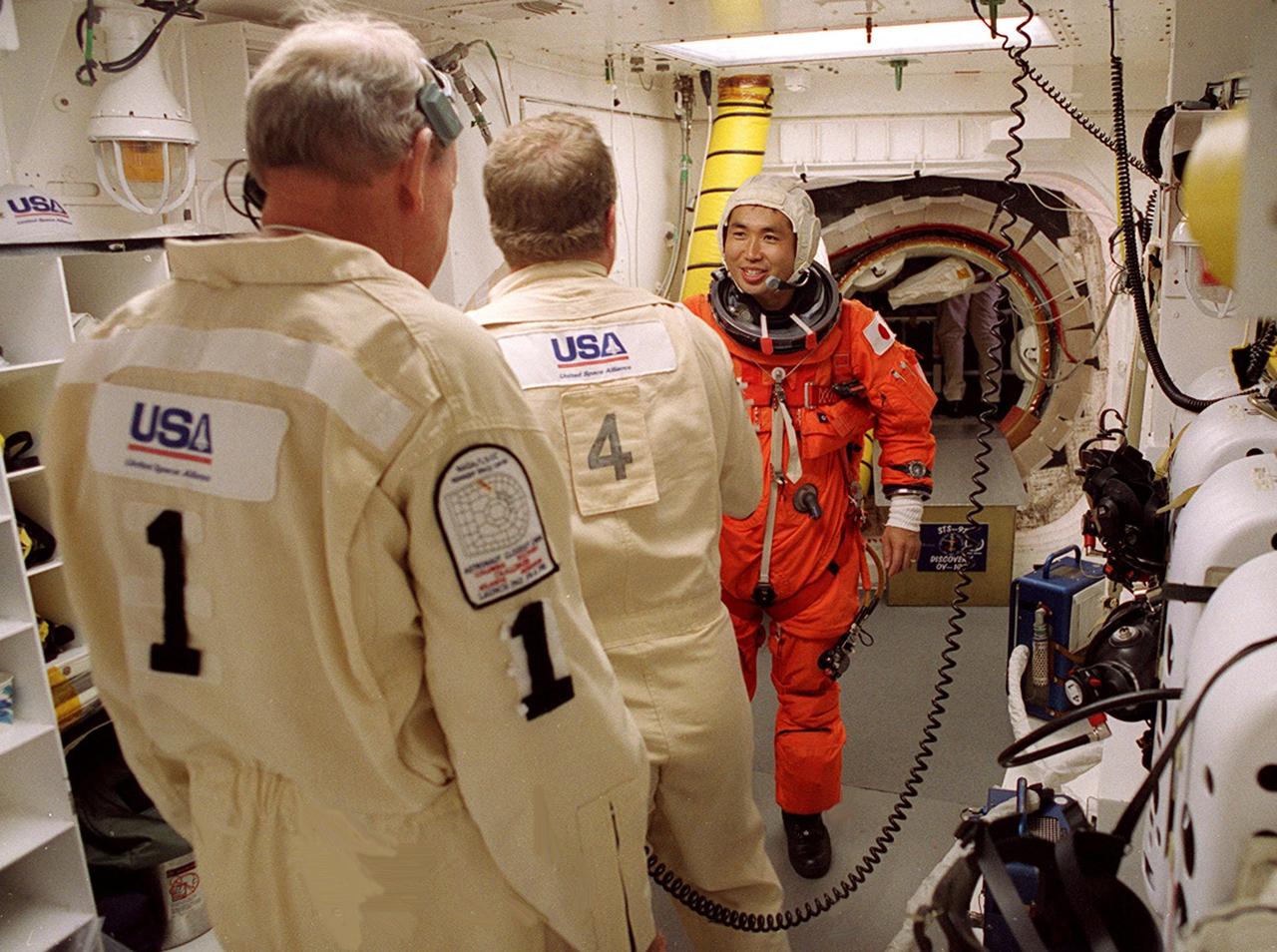
STS-92 Mission Specialist Koichi Wakata of Japan gets a final check of his launch and entry suit in the White Room before entering Discovery. The White Room is an environmentally controlled area at the end of the Orbiter Access Arm that provides entry to the orbiter as well as emergency egress if needed. The arm remains in the extended position until 7 minutes 24 seconds before launch. Wakata and the rest of the crew are making the fifth flight to the International Space Station for construction. Discovery carries a payload that includes the Integrated Truss Structure Z-1, first of 10 trusses that will form the backbone of the Space Station, and the third Pressurized Mating Adapter that will provide a Shuttle docking port for solar array installation on the sixth Station flight and Lab installation on the seventh Station flight. The mission includes four spacewalks for the construction activities. Discovery’s landing is expected Oct. 22 at 2:10 p.m. EDT
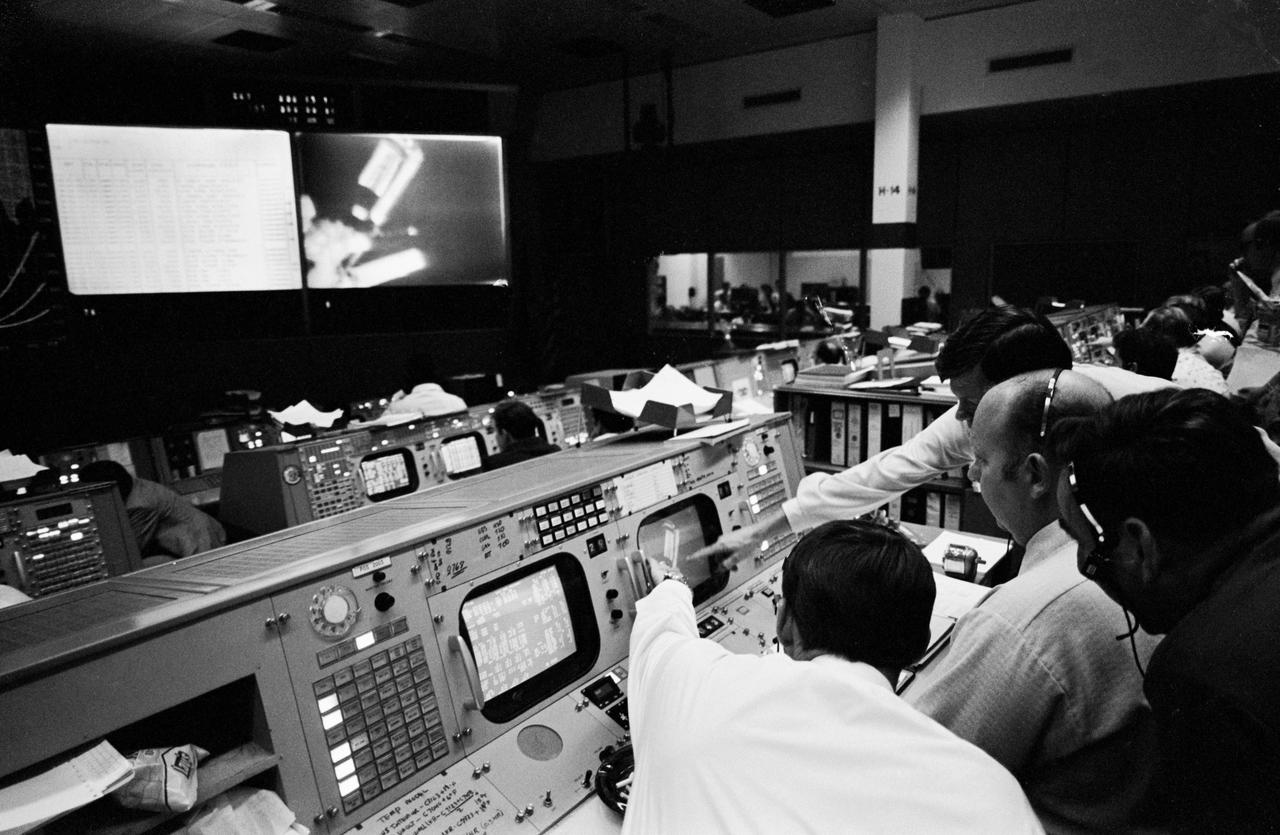
S73-26849 (25 May 1973) --- Four flight directors for the Skylab 1 and 2 mission are grouped around the flight director's console in the Mission Operations Control Room in the Mission Control Center at Johnson Space Center during the Skylab 2 Command/Service Module (CSM) "fly around" inspection of the Skylab 1 space station cluster. They are, going counterclockwise from center foreground, Donald R. Puddy (white shirt), Milton Windler, Philip C. Shaffer and M.P. Frank. A view of the Skylab 1 Orbital Workshop seen from the Skylab 2 CSM is visible on the television monitor in the background. Photo credit: NASA
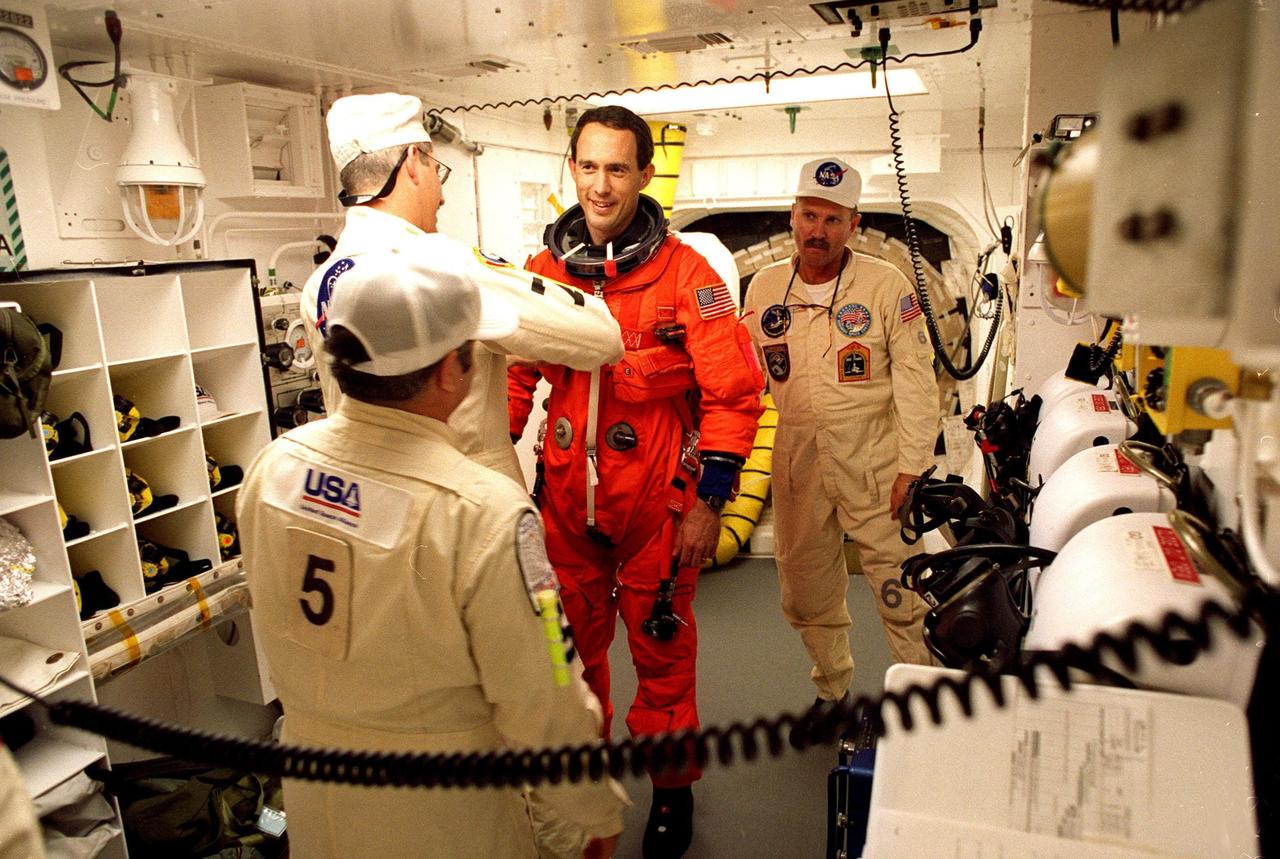
STS-88 Mission Specialist James H. Newman is assisted with his ascent and re-entry flight suit in the white room at Launch Pad 39A before entering Space Shuttle Endeavour for launch. During the nearly 12-day mission, the six-member crew will mate the first two elements of the International Space Station the already-orbiting Zarya control module with the Unity connecting module carried by Endeavour. Newman is making his third spaceflight and is one of two extravehicular activity crew members on this mission
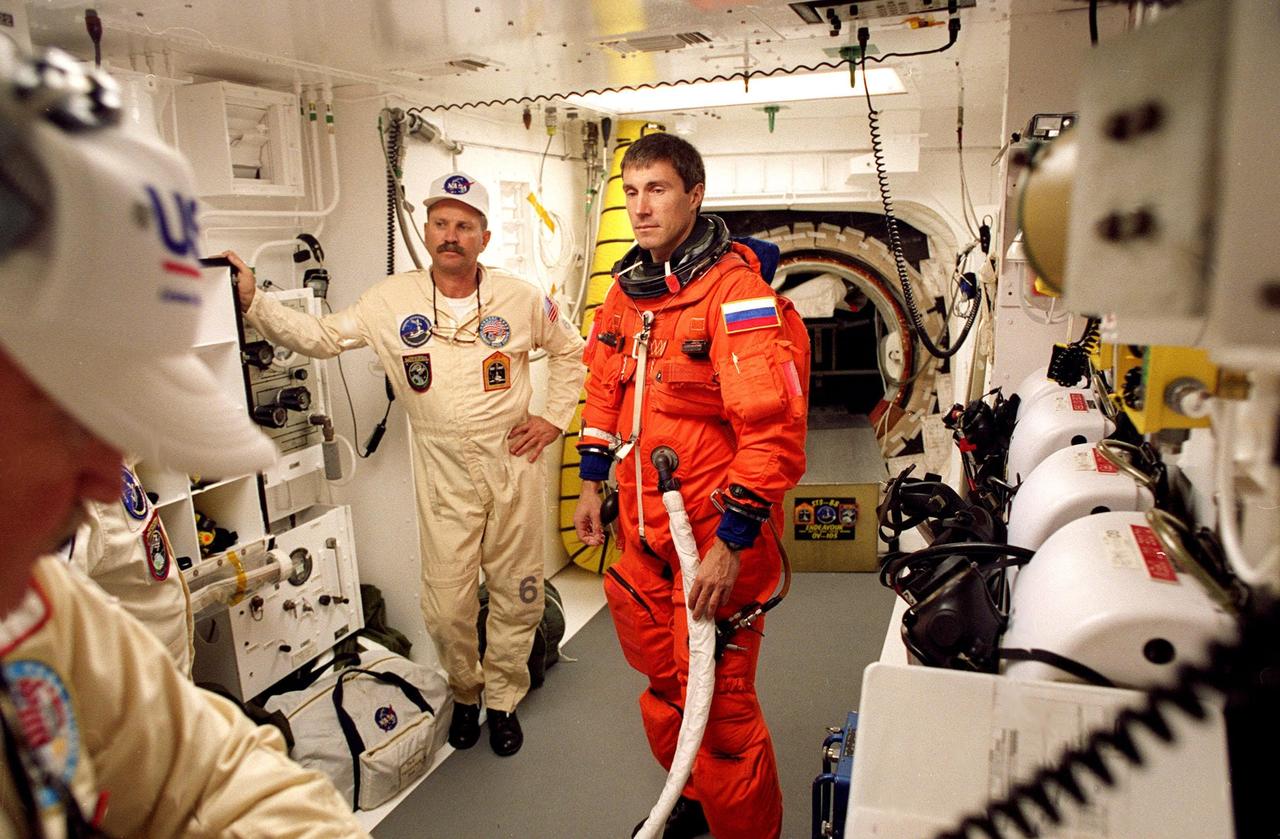
STS-88 Mission Specialist Sergei Konstantinovich Krikalev, a Russian cosmonaut, is assisted with his ascent and re-entry flight suit in the white room at Launch Pad 39A before entering Space Shuttle Endeavour for launch. During the nearly 12-day mission, the six-member crew will mate the first two elements of the International Space Station the already-orbiting Zarya control module with the Unity connecting module carried by Endeavour. He is making his fourth spaceflight
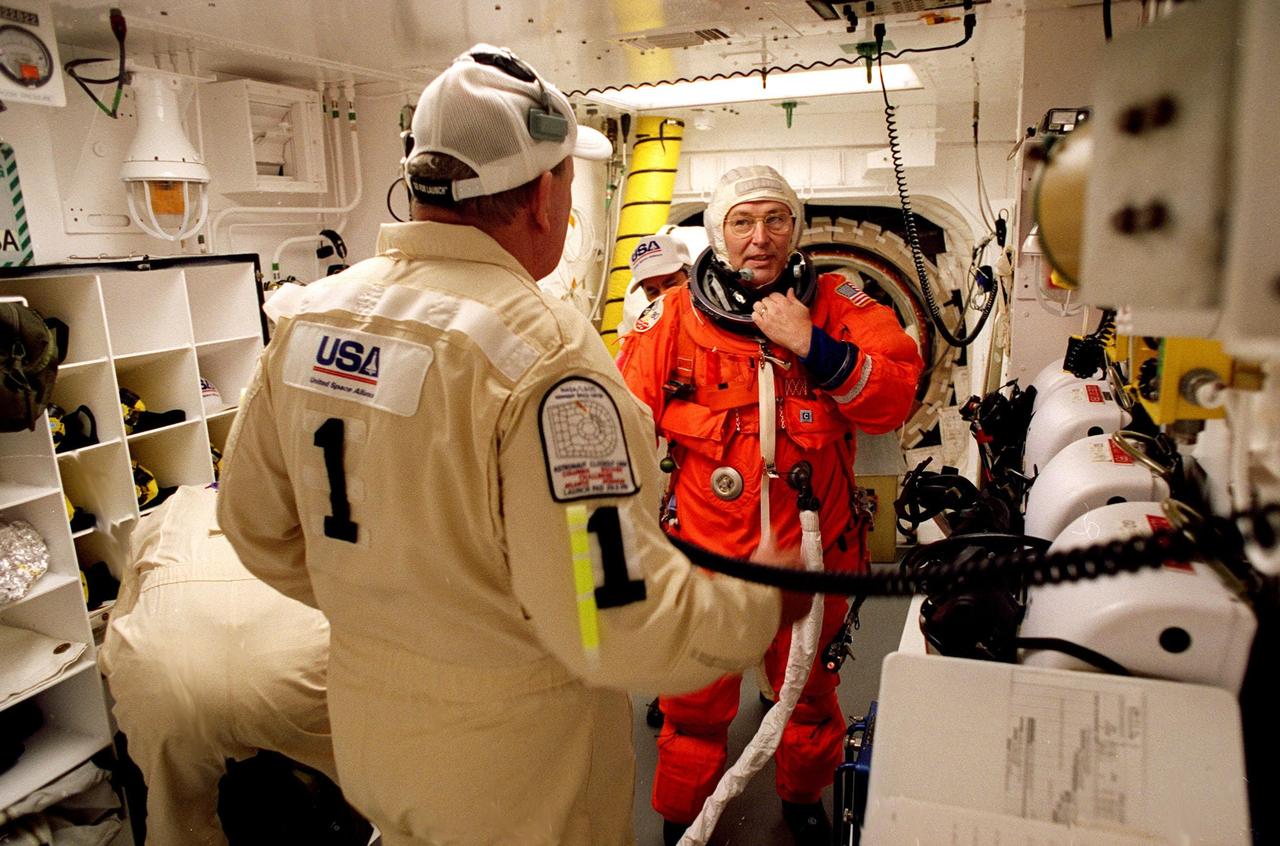
STS-88 Mission Specialist Jerry L. Ross is assisted with his ascent and re-entry flight suit in the white room at Launch Pad 39A before entering Space Shuttle Endeavour for launch. During the nearly 12-day mission, the six-member crew will mate the first two elements of the International Space Station the already-orbiting Zarya control module with the Unity connecting module carried by Endeavour. He is making his sixth spaceflight and is one of two extravehicular activity crew members on this mission
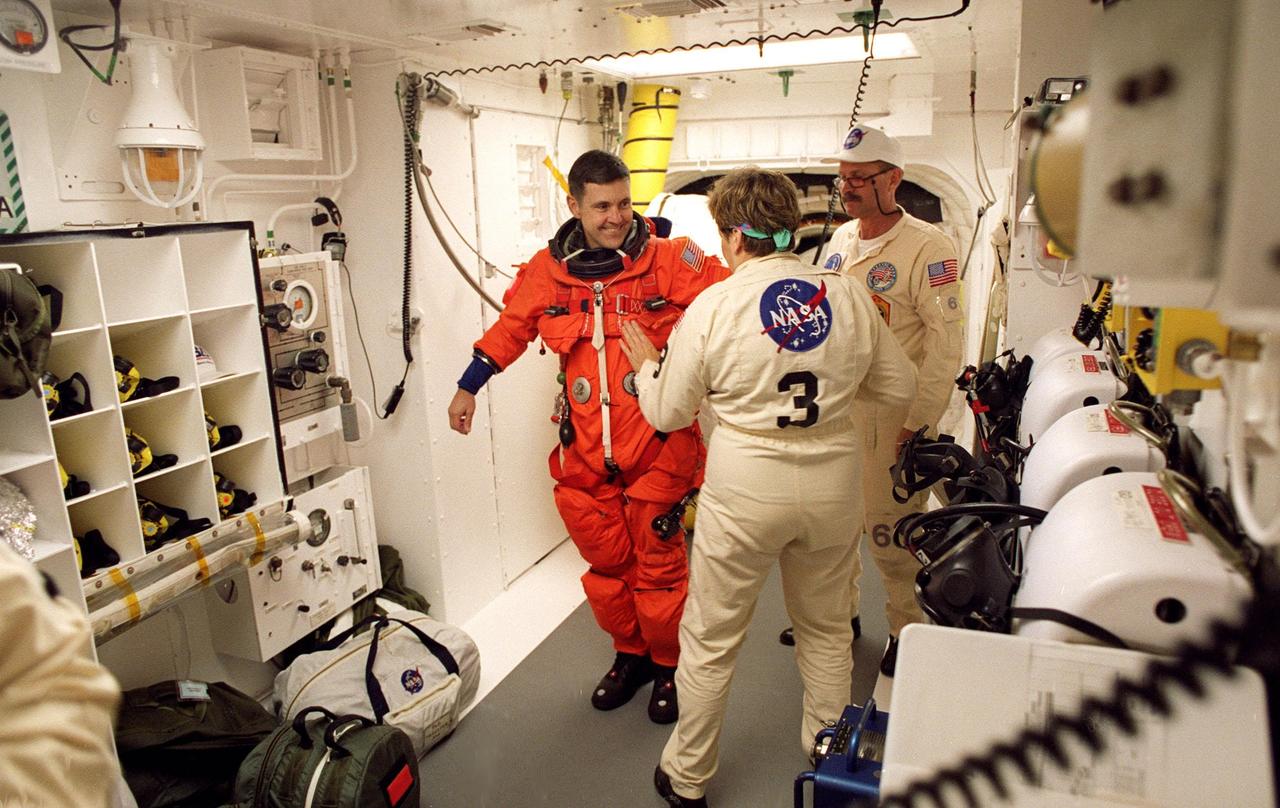
STS-88 Commander Robert D. Cabana is assisted with his ascent and re-entry flight suit in the white room at Launch Pad 39A before entering Space Shuttle Endeavour for launch. During the nearly 12-day mission, the six-member crew will mate the first two elements of the International Space Station the already-orbiting Zarya control module with the Unity connecting module carried by Endeavour. Cabana is making his fourth spaceflight
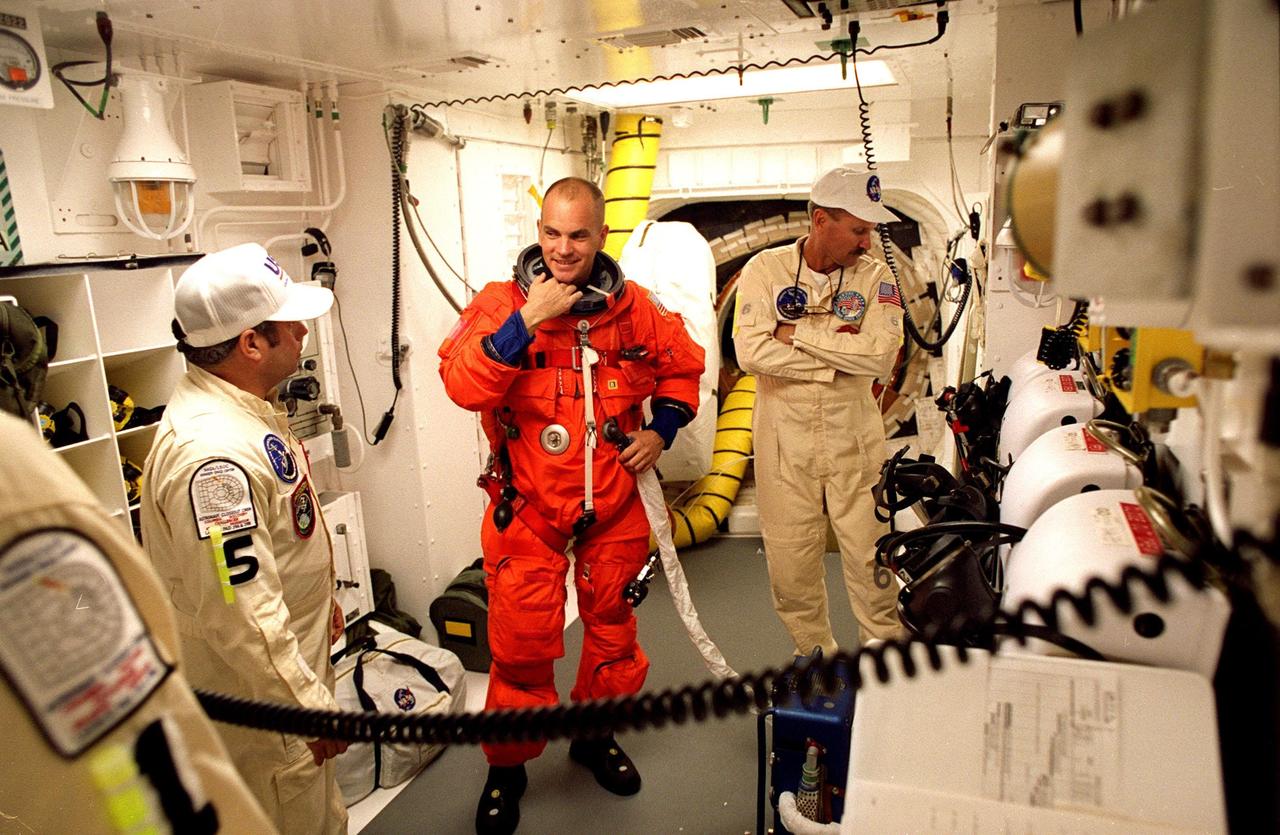
STS-88 Pilot Frederick W. "Rick" Sturckow is assisted with his ascent and re-entry flight suit in the white room at Launch Pad 39A before entering Space Shuttle Endeavour for launch. During the nearly 12-day mission, the six-member crew will mate the first two elements of the International Space Station the already-orbiting Zarya control module with the Unity connecting module carried by Endeavour. He is making his first spaceflight
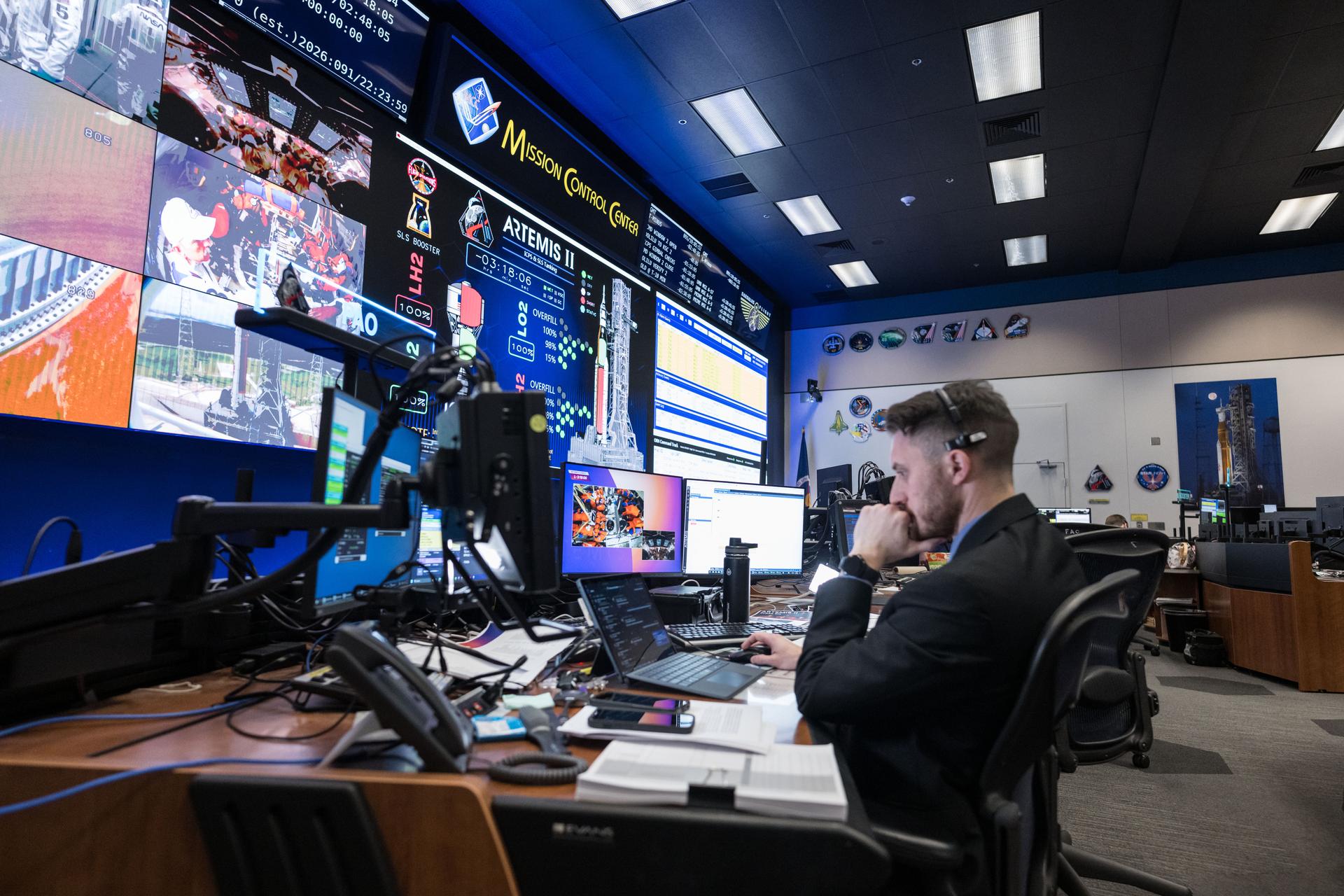
jsc2026e019363 (April 1, 2026) – Public Affairs Officer Gary Jordan prepares for the Artemis II launch in the White Flight Control Room in the Mission Control Center at NASA’s Johnson Space Center. NASA’s Artemis II SLS (Space Launch System) rocket, with the Orion spacecraft atop carrying NASA astronauts Reid Wiseman, Victor Glover, and Christina Koch, along with CSA (Canadian Space Agency) astronaut Jeremy Hansen, lifted off from Kennedy Space Center’s Launch Complex 39B in Florida at 6:35 p.m. ET to begin its journey to deep space. Credit: NASA
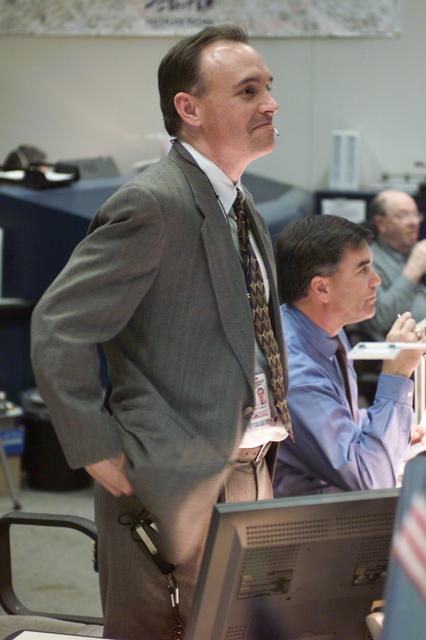
JSC2002-E-08460 (7 March 2002) --- Flight directors Jeff Hanley (standing) and Bryan P. Austin watch the large screens from their consoles in the shuttle flight control room (WFCR) in Houston;s Mission Control Center (MCC) during the STS-109 Hubble Space Telescope (HST) servicing mission.
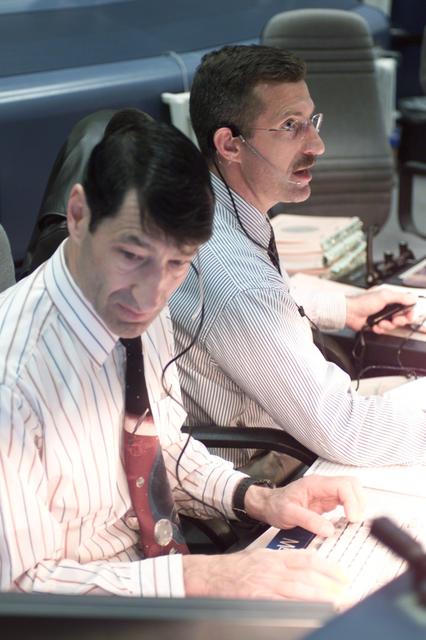
JSC2002-E-08463 (7 March 2002) --- Astronauts Mario Runco, Jr. (foreground) and Daniel C. Burbank, both spacecraft communicators (CAPCOM), monitor data at their consoles in the shuttle flight control room (WFCR) in Houston’s Mission Control Center (MCC) during the STS-109 Hubble Space Telescope (HST) servicing mission.
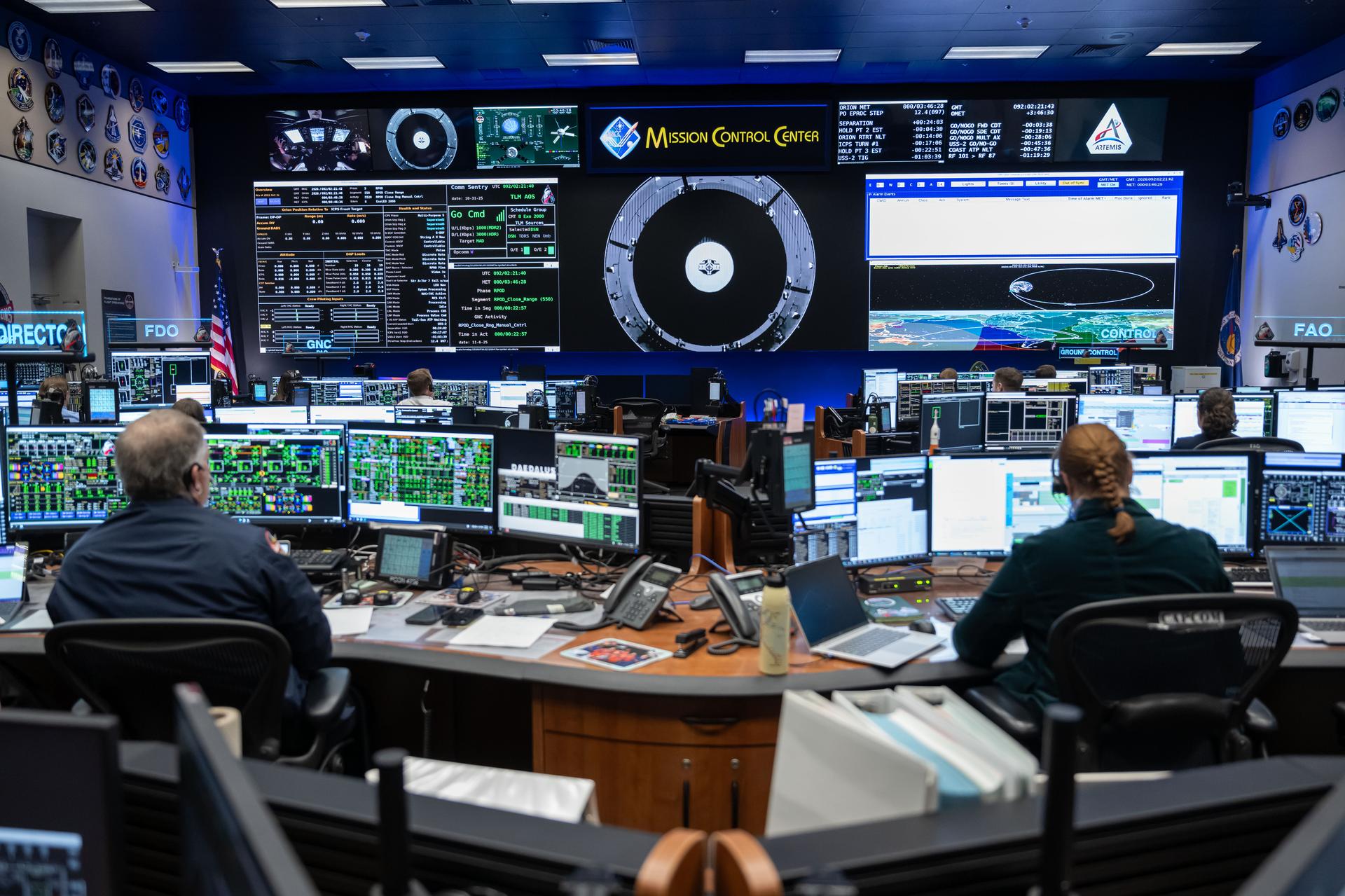
jsc2026e019255 (April 1, 2026) – Lead Artemis II Flight Director Jeff Radigan (left) and capsule communicator (capcom) Amy Dill (right) in the White Flight Control Room at the Mission Control Center at NASA’s Johnson Space Center in Houston. At the time of this photograph, a little over three hours into the mission, the Artemis II crew conducting a manual piloting test called the proximity operations demonstration. During the demonstration, mission controllers monitored Orion as the astronauts transitioned the spacecraft to manual mode and piloted its flight path and orientation. This demonstration will provide performance data and operational experience that cannot be readily gained on the ground in preparation for critical rendezvous, proximity operations, docking, and undocking for future Artemis missions. Credit: NASA
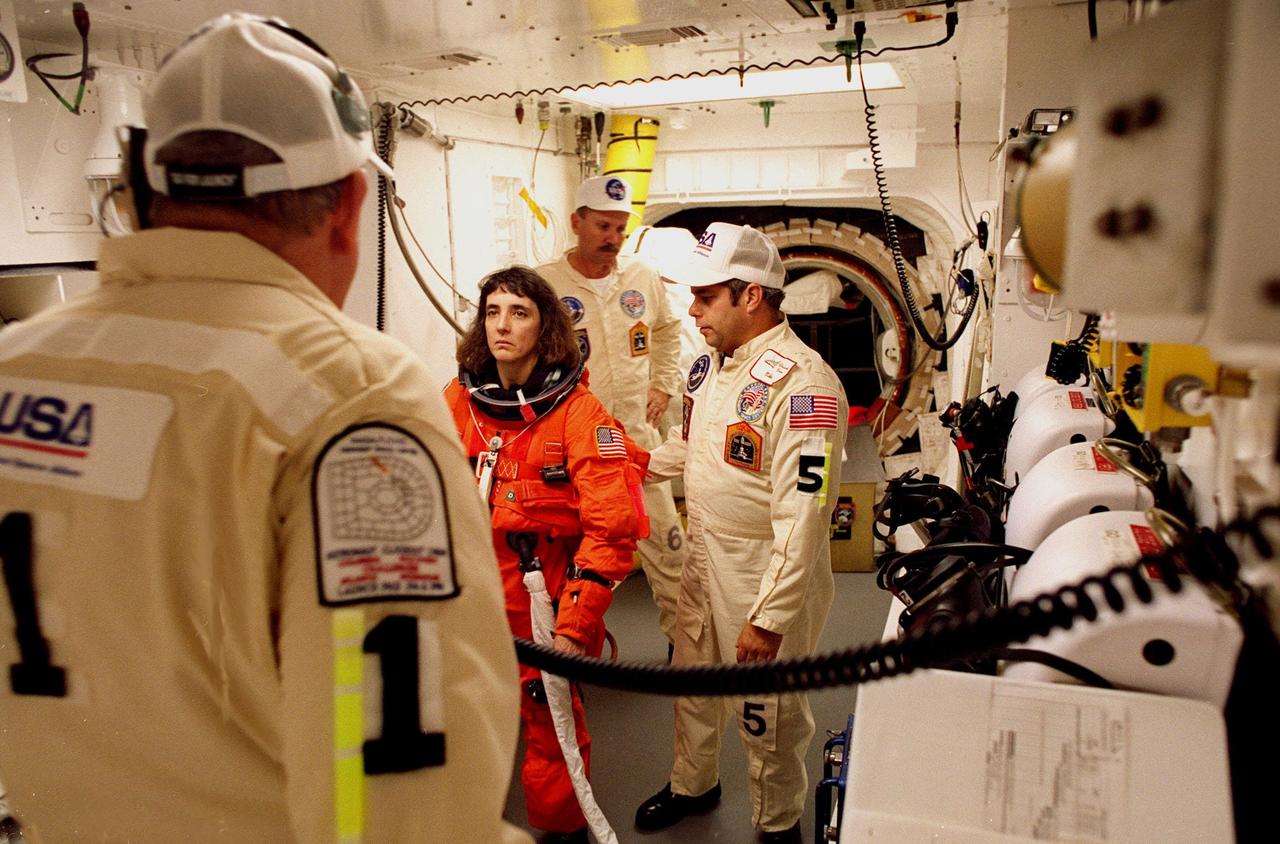
STS-88 Mission Specialist Nancy Jane Currie is assisted with her ascent and re-entry flight suit in the white room at Launch Pad 39A before entering Space Shuttle Endeavour for launch. During the nearly 12-day mission, the six-member crew will mate the first two elements of the International Space Station the already-orbiting Zarya control module with the Unity connecting module carried by Endeavour. She is making her third spaceflight as the crew's flight engineer and prime operator of the Remote Manipulator System, the robotic arm
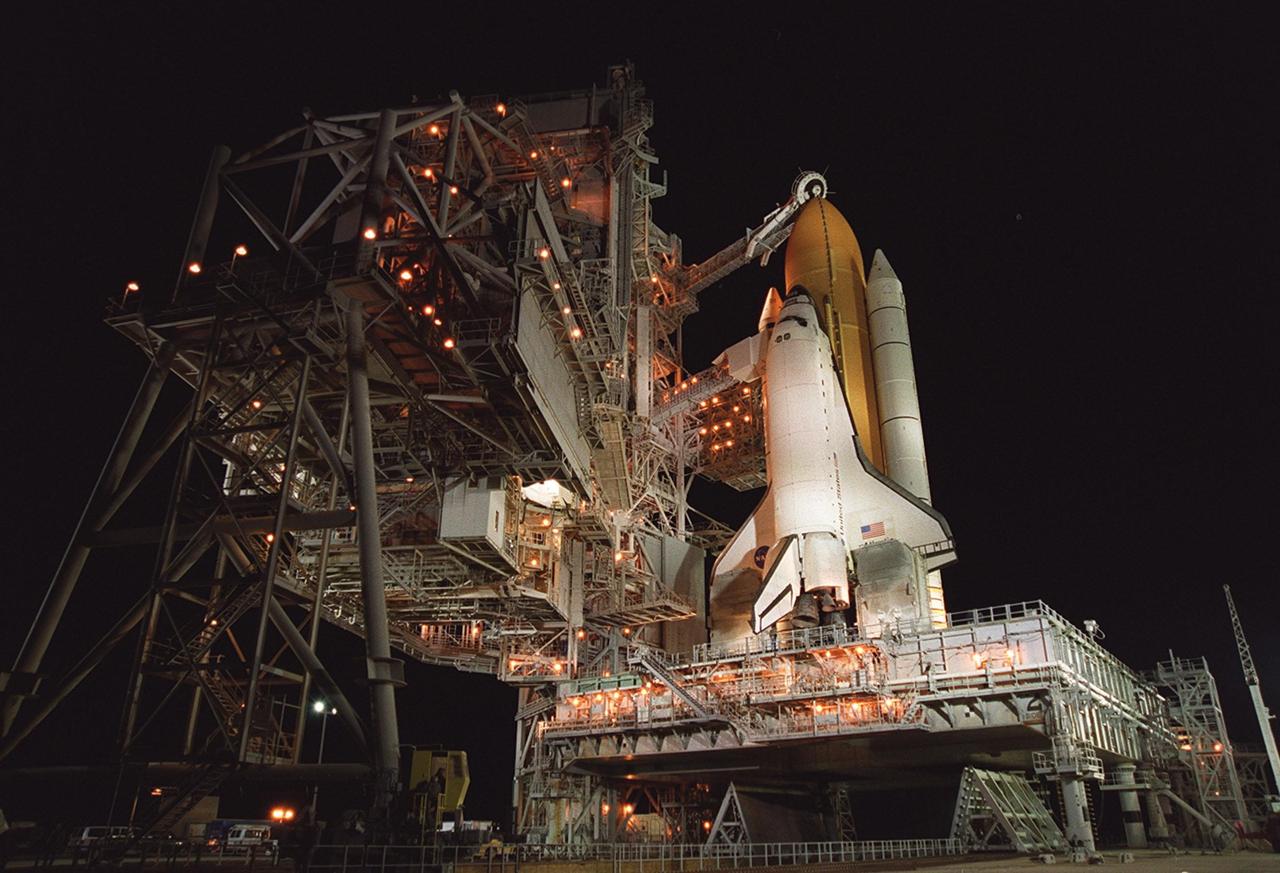
Space Shuttle Atlantis is revealed after rollback of the Rotating Service Structure. Extended to the side of Atlantis is the orbiter access arm, with the White Room at its end. The White Room is an environmentally controlled area that provides entry for the crew into Atlantis’s cockpit. Above the yellow-orange external tank is the Gaseous Oxygen Vent Arm, with the “beanie cap” vent hood raised. Before cryogenic loading, the hood will be lowered into position over the external tank vent louvers to vent gaseous oxygen vapors away from the Shuttle. Atlantis is carrying the U.S. Laboratory Destiny, a key module in the growth of the International Space Station. Destiny will be attached to the Unity node on the Space Station using the Shuttle’s robotic arm. Three spacewalks are required to complete the planned construction work during the 11-day mission. Launch is targeted for 6:11 p.m. EST and the planned landing at KSC Feb. 18 about 1:39 p.m. This mission marks the seventh Shuttle flight to the Space Station, the 23rd flight of Atlantis and the 102nd flight overall in NASA’s Space Shuttle program
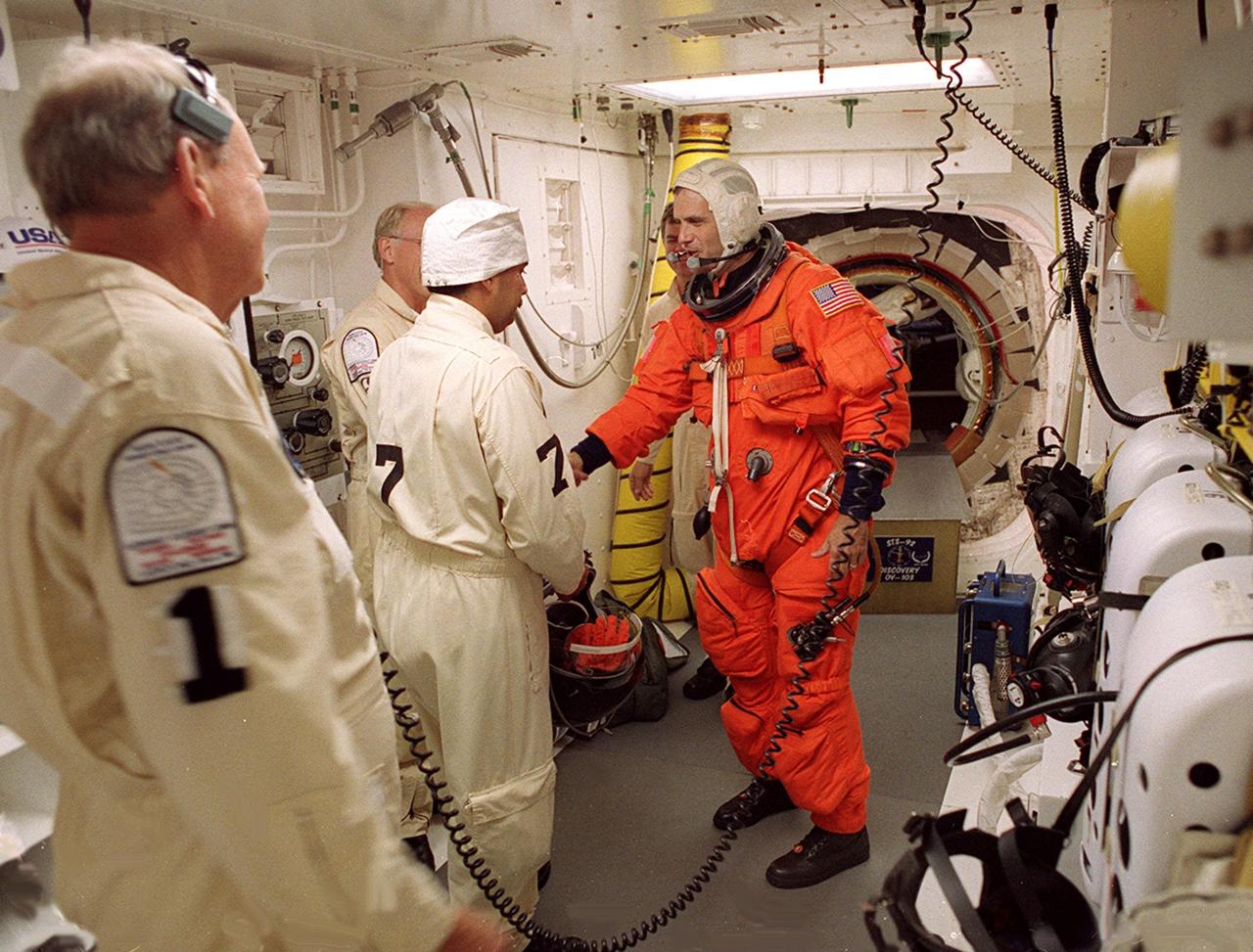
STS-92 Mission Specialist Peter J.K. “Jeff” Wisoff reaches out to shake the hand of Danny Wyatt, KSC NASA Quality Assurance specialist, after completing final check of his launch and entry suit in the White Room before entering Discovery. The White Room is an environmentally controlled area at the end of the Orbiter Access Arm that provides entry to the orbiter as well as emergency egress if needed. The arm remains in the extended position until 7 minutes 24 seconds before launch. Wisoff and the rest of the crew are undertaking the fifth flight to the International Space Station for construction. Discovery carries a payload that includes the Integrated Truss Structure Z-1, first of 10 trusses that will form the backbone of the Space Station, and the third Pressurized Mating Adapter that will provide a Shuttle docking port for solar array installation on the sixth Station flight and Lab installation on the seventh Station flight. The mission includes four spacewalks for the construction activities. Discovery’s landing is expected Oct. 22 at 2:10 p.m. EDT
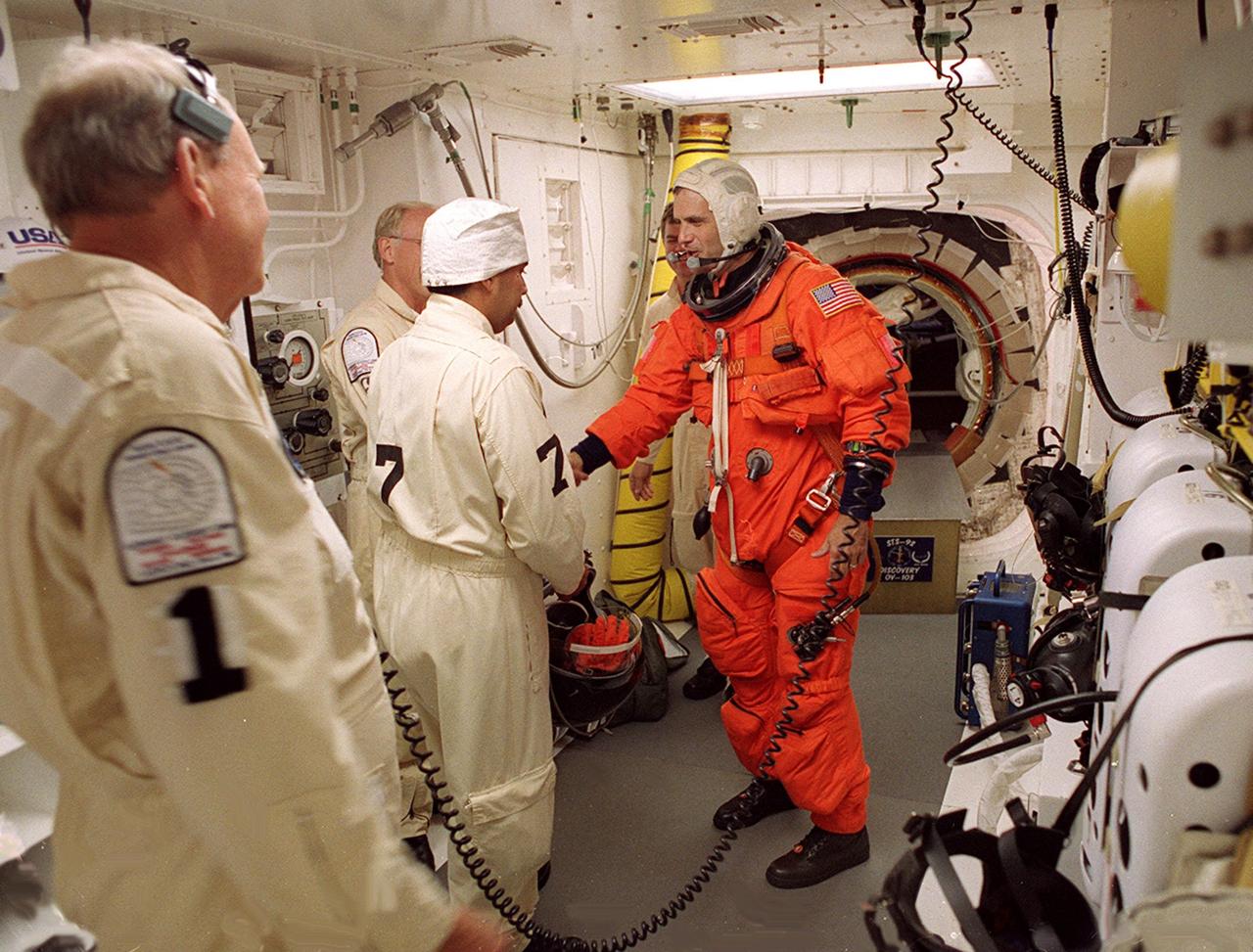
STS-92 Mission Specialist Peter J.K. “Jeff” Wisoff reaches out to shake the hand of Danny Wyatt, KSC NASA Quality Assurance specialist, after completing final check of his launch and entry suit in the White Room before entering Discovery. The White Room is an environmentally controlled area at the end of the Orbiter Access Arm that provides entry to the orbiter as well as emergency egress if needed. The arm remains in the extended position until 7 minutes 24 seconds before launch. Wisoff and the rest of the crew are undertaking the fifth flight to the International Space Station for construction. Discovery carries a payload that includes the Integrated Truss Structure Z-1, first of 10 trusses that will form the backbone of the Space Station, and the third Pressurized Mating Adapter that will provide a Shuttle docking port for solar array installation on the sixth Station flight and Lab installation on the seventh Station flight. The mission includes four spacewalks for the construction activities. Discovery’s landing is expected Oct. 22 at 2:10 p.m. EDT
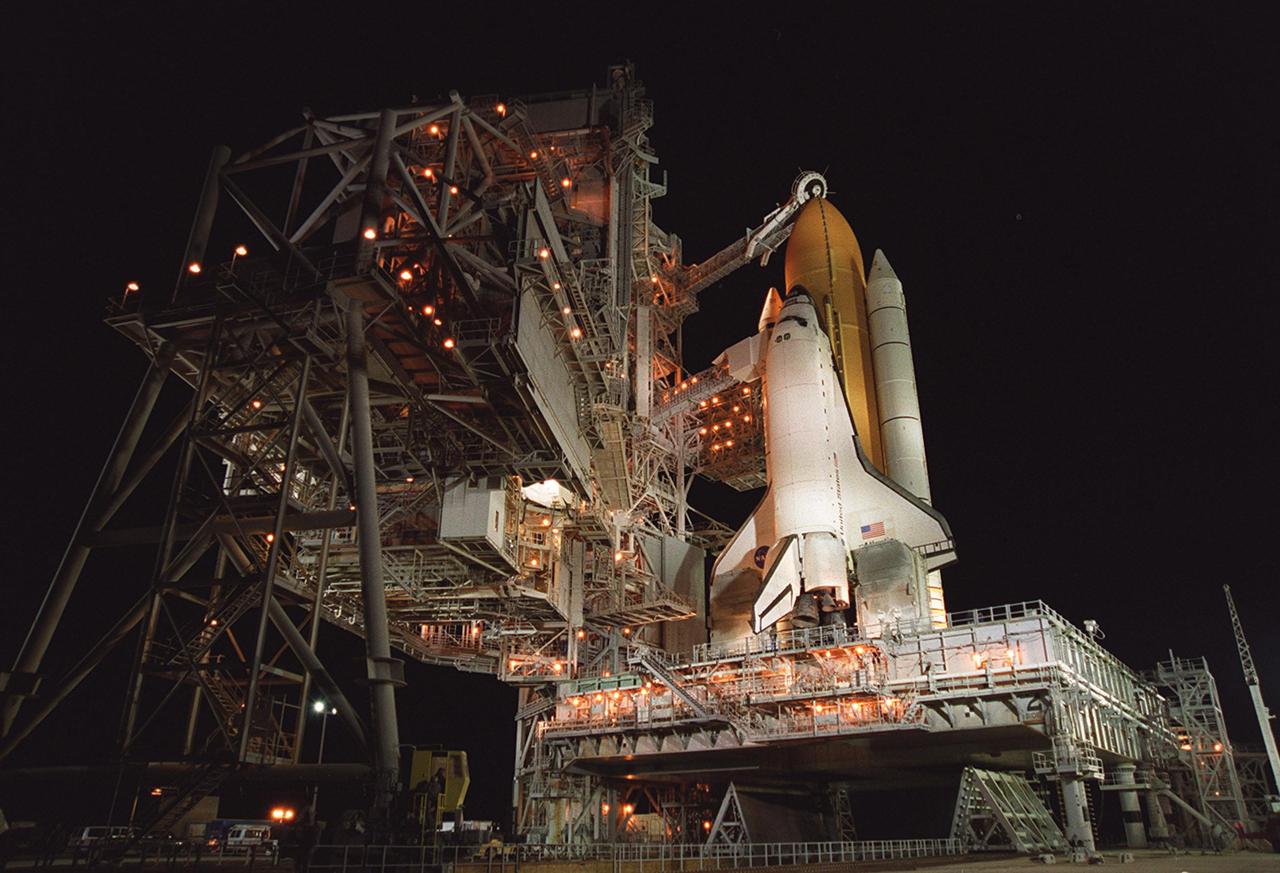
Space Shuttle Atlantis is revealed after rollback of the Rotating Service Structure. Extended to the side of Atlantis is the orbiter access arm, with the White Room at its end. The White Room is an environmentally controlled area that provides entry for the crew into Atlantis’s cockpit. Above the yellow-orange external tank is the Gaseous Oxygen Vent Arm, with the “beanie cap” vent hood raised. Before cryogenic loading, the hood will be lowered into position over the external tank vent louvers to vent gaseous oxygen vapors away from the Shuttle. Atlantis is carrying the U.S. Laboratory Destiny, a key module in the growth of the International Space Station. Destiny will be attached to the Unity node on the Space Station using the Shuttle’s robotic arm. Three spacewalks are required to complete the planned construction work during the 11-day mission. Launch is targeted for 6:11 p.m. EST and the planned landing at KSC Feb. 18 about 1:39 p.m. This mission marks the seventh Shuttle flight to the Space Station, the 23rd flight of Atlantis and the 102nd flight overall in NASA’s Space Shuttle program
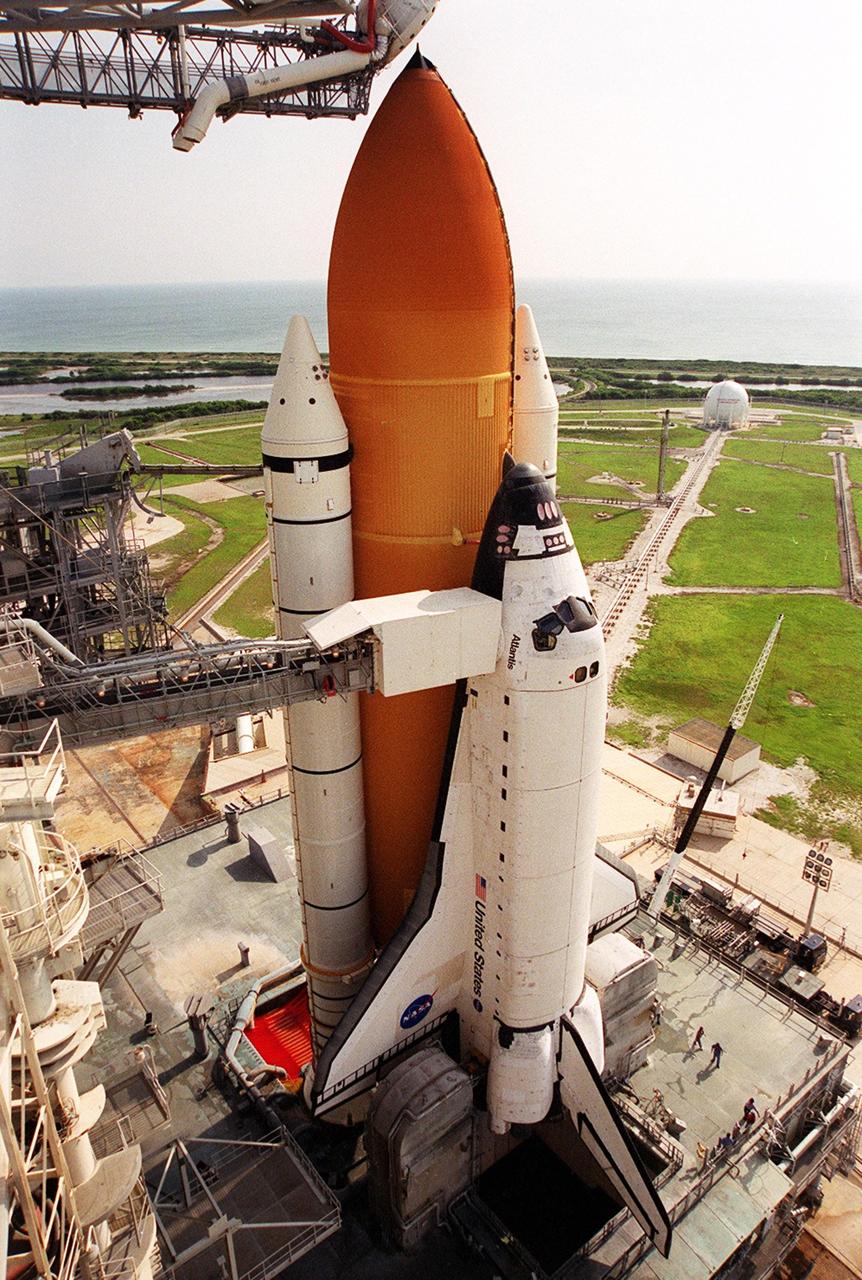
KENNEDY SPACE CENTER, Fla. -- Space Shuttle Atlantis is ready for final launch preparations. The orbiter access arm is extended to the orbiter to allow entry into Atlantis. The White Room at the end is the point of entry, and is an environmentally controlled room where the Shuttle crew have final adjustments made to their launch and entry suits. At the lower end of Atlantis are the tail service masts, in front of either wing. The masts support the fluid, gas and electrical requirements of the orbiter’s liquid oxygen and liquid hydrogen aft T-0 umbilicals. Viewed in the background is the Atlantic Ocean. Launch on mission STS-104 is scheduled for 5:04 a.m. July 12. The launch is the 10th assembly flight to the International Space Station. Along with a crew of five, Atlantis will carry the joint airlock module as primary payload
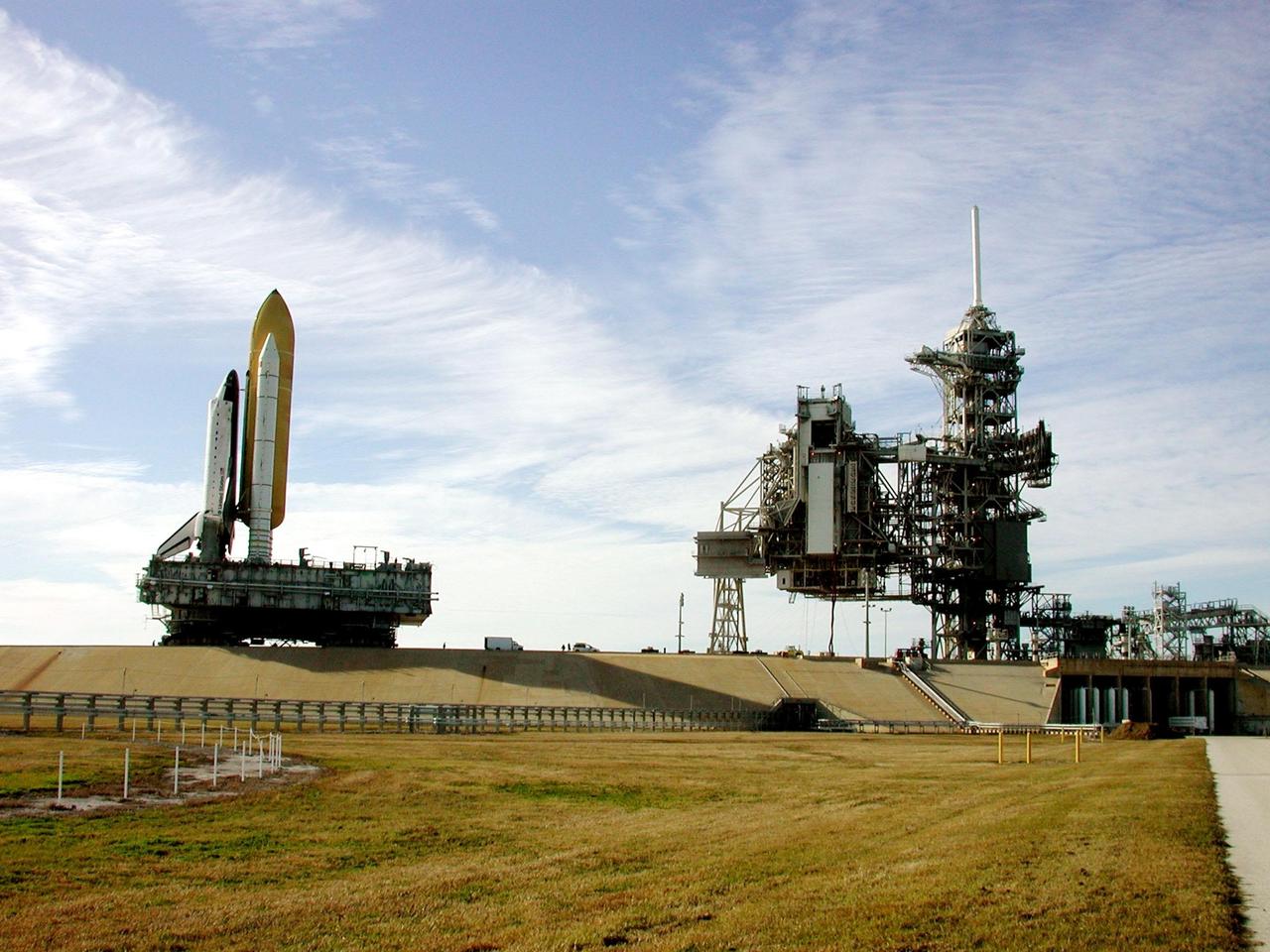
KENNEDY SPACE CENTER, Fla. -- Under wispy white morning clouds, Space Shuttle Atlantis approaches Launch Pad 39A, which shows the Rotating Service Structure open (left) and the Fixed Service Structure (right). At the RSS, the payload canister is being lifted up to the Payload Changeout Room. This is the Shuttle’s second attempt at rollout. Jan. 2 a failed computer processor on the crawler transporter aborted the rollout and the Shuttle was returned to the Vehicle Assembly Building using a secondary computer processor on the vehicle. Atlantis will fly on mission STS-98, the seventh construction flight to the International Space Station, carrying the U.S. Laboratory, named Destiny. The lab will have five system racks already installed inside the module. After delivery of electronics in the lab, electrically powered attitude control for Control Moment Gyroscopes will be activated. Atlantis is scheduled for launch no earlier than Jan. 19, 2001, with a crew of five
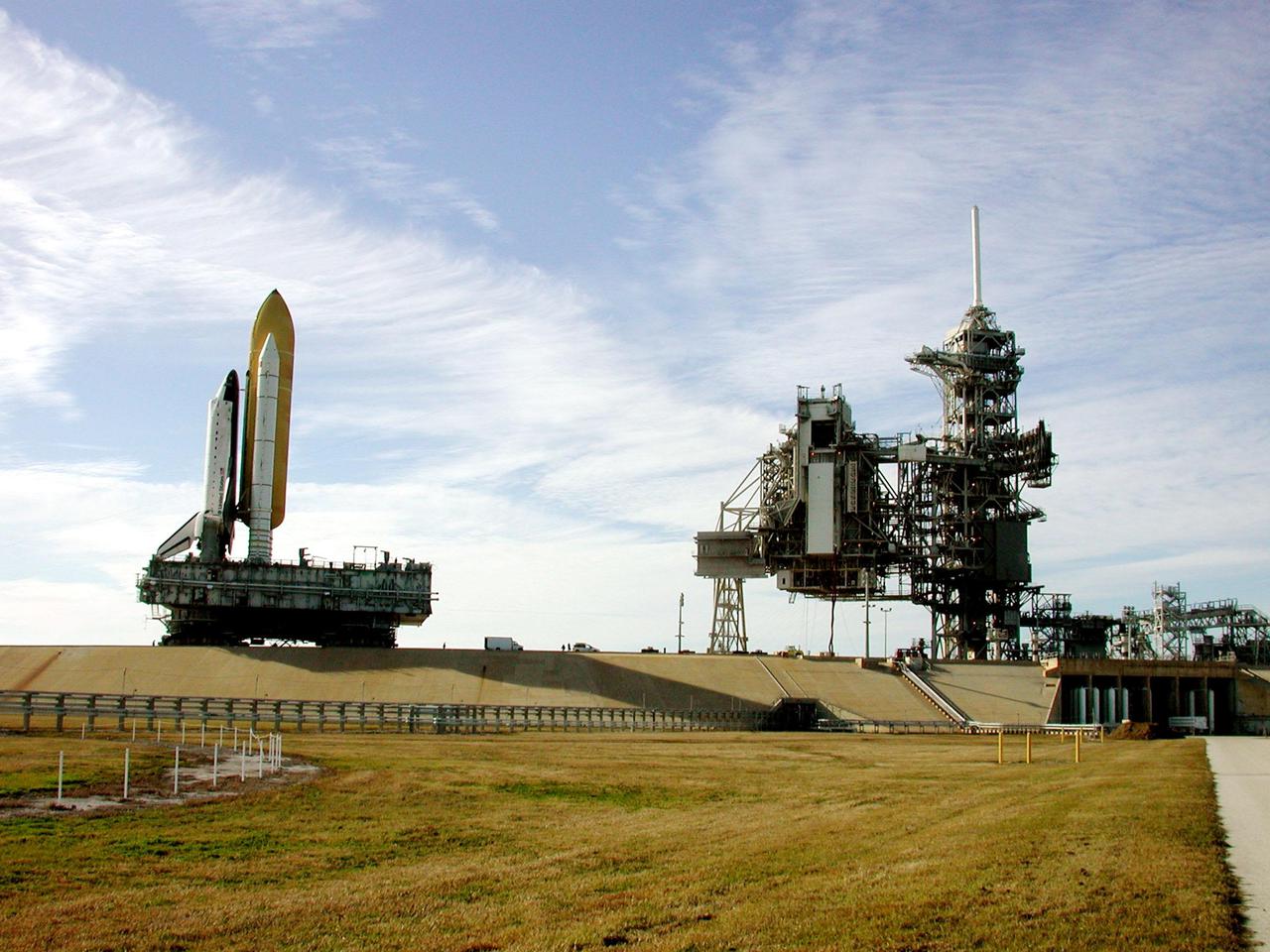
KENNEDY SPACE CENTER, Fla. -- Under wispy white morning clouds, Space Shuttle Atlantis approaches Launch Pad 39A, which shows the Rotating Service Structure open (left) and the Fixed Service Structure (right). At the RSS, the payload canister is being lifted up to the Payload Changeout Room. This is the Shuttle’s second attempt at rollout. Jan. 2 a failed computer processor on the crawler transporter aborted the rollout and the Shuttle was returned to the Vehicle Assembly Building using a secondary computer processor on the vehicle. Atlantis will fly on mission STS-98, the seventh construction flight to the International Space Station, carrying the U.S. Laboratory, named Destiny. The lab will have five system racks already installed inside the module. After delivery of electronics in the lab, electrically powered attitude control for Control Moment Gyroscopes will be activated. Atlantis is scheduled for launch no earlier than Jan. 19, 2001, with a crew of five
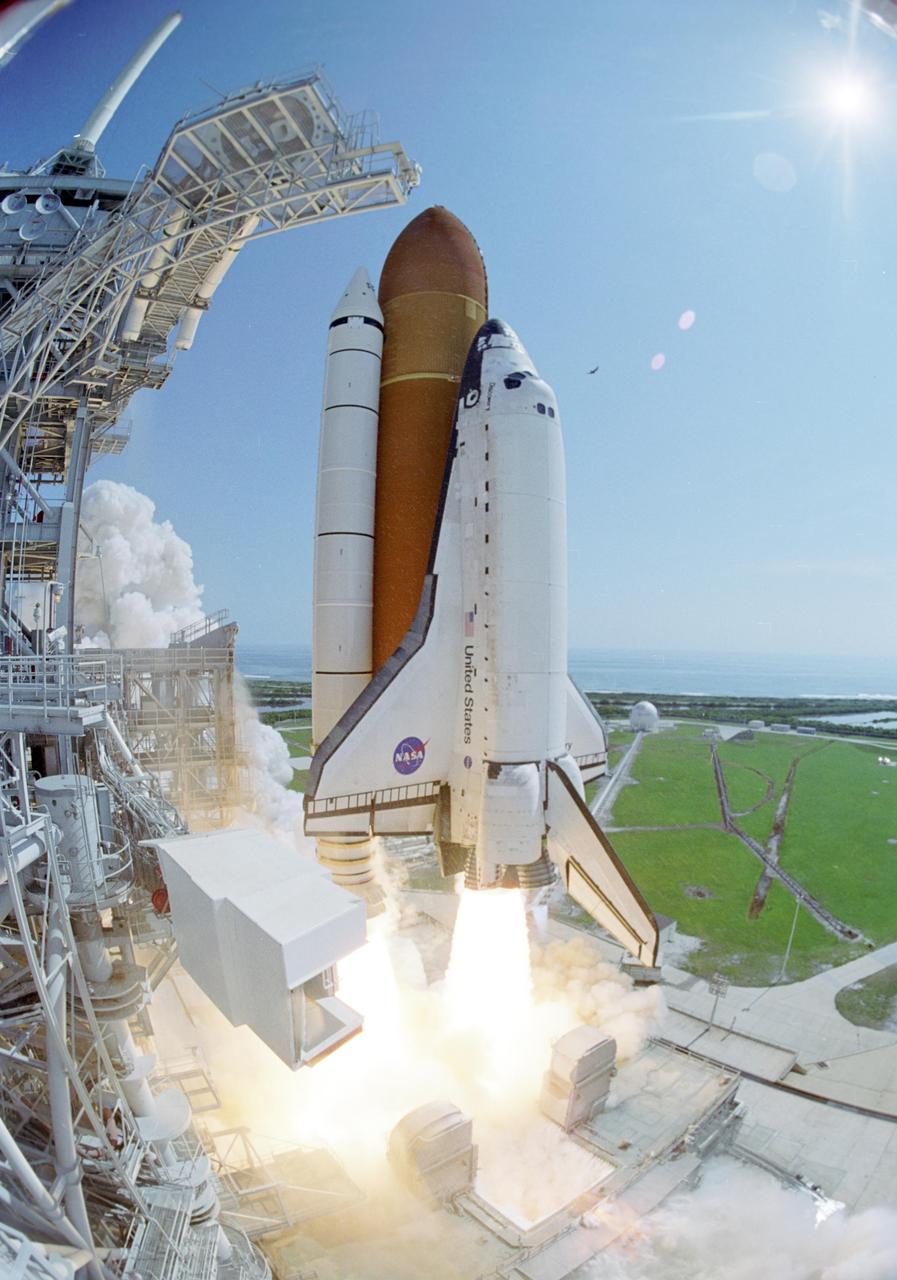
KENNEDY SPACE CENTER, FLA. - A fish-eye view shows Space Shuttle Discovery moments after liftoff from Launch Pad 39B on the historic Return to Flight mission STS-114. At left is the Fixed Service Structure with the White Room appearing to be suspended in mid-air. The White Room provides the astronauts access into the orbiter. The liftoff occurred at 10:39 a.m. EDT. On this mission to the International Space Station the crew will perform inspections on-orbit for the first time of all of the Reinforced Carbon-Carbon (RCC) panels on the leading edge of the wings and the Thermal Protection System tiles using the new Canadian-built Orbiter Boom Sensor System and the data from 176 impact and temperature sensors. Mission Specialists will also practice repair techniques on RCC and tile samples during a spacewalk in the payload bay. During two additional spacewalks, the crew will install the External Stowage Platform-2, equipped with spare part assemblies, and a replacement Control Moment Gyroscope contained in the Lightweight Multi-Purpose Experiment Support Structure. The 12-day mission is expected to end with touchdown at the Shuttle Landing Facility on Aug. 7.
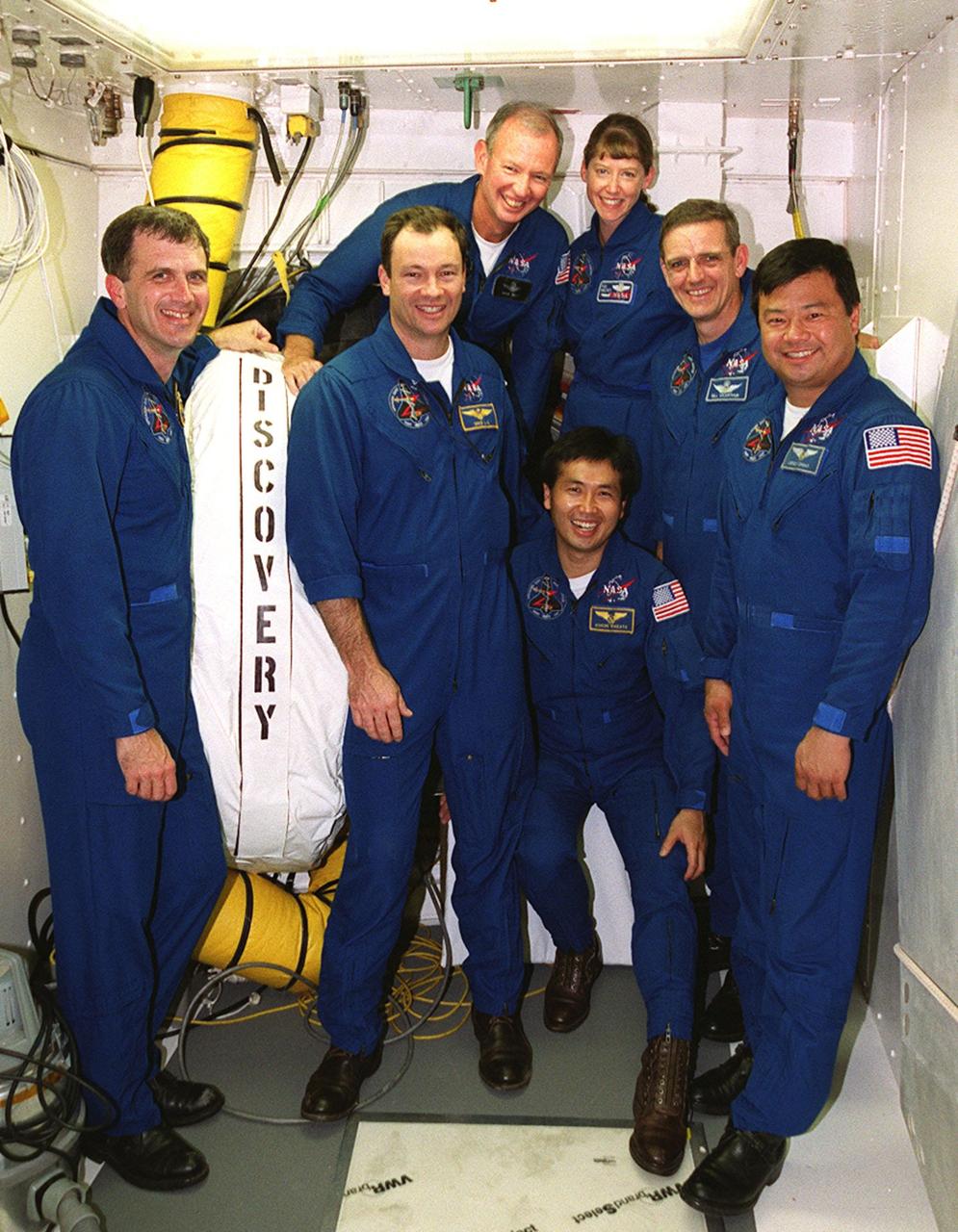
The STS-92 crew poses for a photograph in the White Room, the environmentally controlled chamber on the orbiter access arm that provides entry for the crew into the orbiter. Standing, left to right, are Mission Specialists Peter J.K. “Jeff” Wisoff and Michael E. Lopez-Alegria; Commander Brian Duffy; Pilot Pamela Ann Melroy; and Mission Specialists William S. McArthur Jr. and Leroy Chiao. Crouching in front is Mission Specialist Koichi Wakata of Japan. The crew is at KSC for Terminal Countdown Demonstration Test activities that provide emergency egress training, opportunities to inspect the mission payload, and take part in a simulated countdown. STS-92 is scheduled to launch Oct. 5 at 9:38 p.m. EDT on the fifth flight to the International Space Station. It will carry two elements of the Space Station, the Integrated Truss Structure Z1 and the third Pressurized Mating Adapter. The mission is also the 100th flight in the Shuttle program
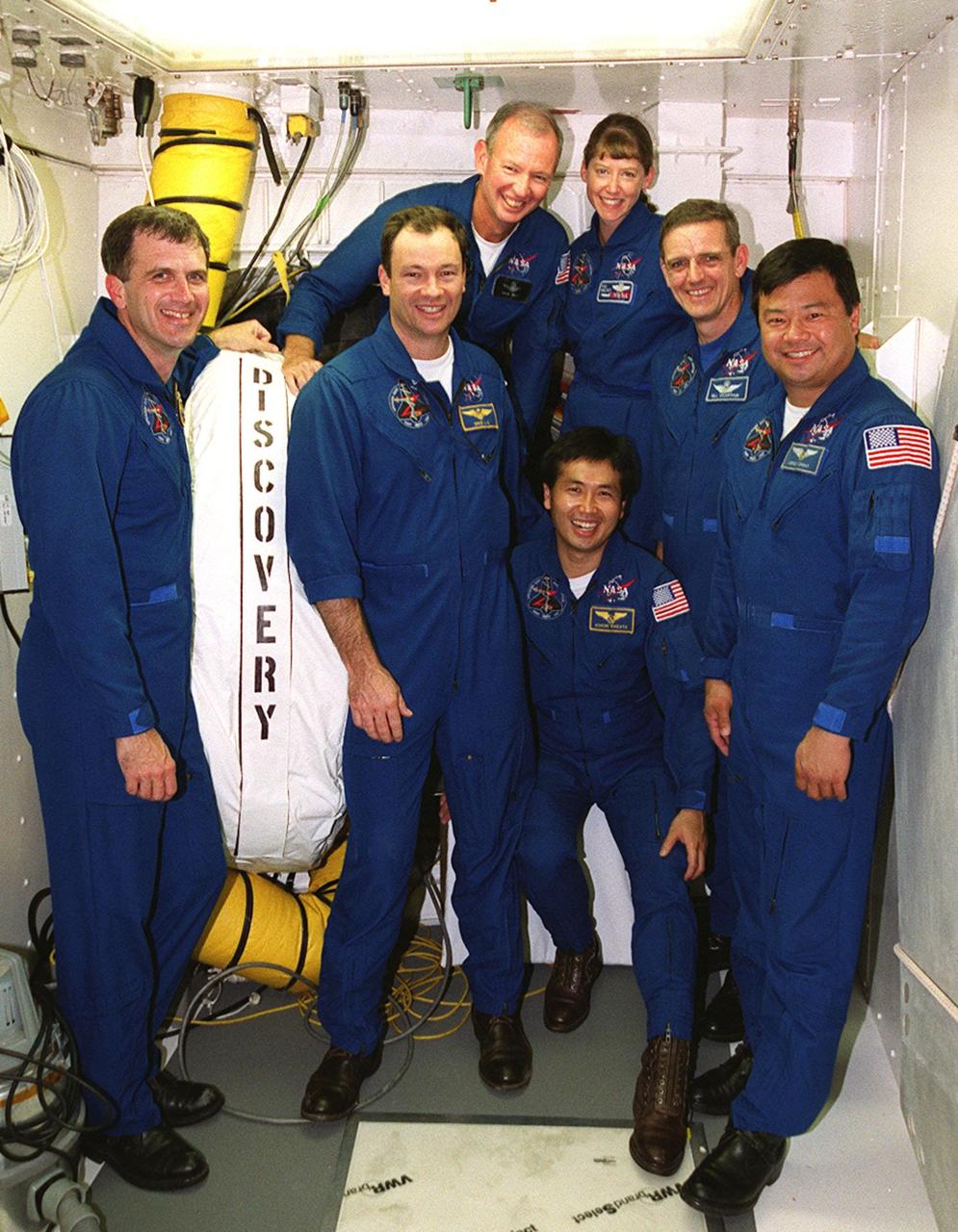
The STS-92 crew poses for a photograph in the White Room, the environmentally controlled chamber on the orbiter access arm that provides entry for the crew into the orbiter. Standing, left to right, are Mission Specialists Peter J.K. “Jeff” Wisoff and Michael E. Lopez-Alegria; Commander Brian Duffy; Pilot Pamela Ann Melroy; and Mission Specialists William S. McArthur Jr. and Leroy Chiao. Crouching in front is Mission Specialist Koichi Wakata of Japan. The crew is at KSC for Terminal Countdown Demonstration Test activities that provide emergency egress training, opportunities to inspect the mission payload, and take part in a simulated countdown. STS-92 is scheduled to launch Oct. 5 at 9:38 p.m. EDT on the fifth flight to the International Space Station. It will carry two elements of the Space Station, the Integrated Truss Structure Z1 and the third Pressurized Mating Adapter. The mission is also the 100th flight in the Shuttle program
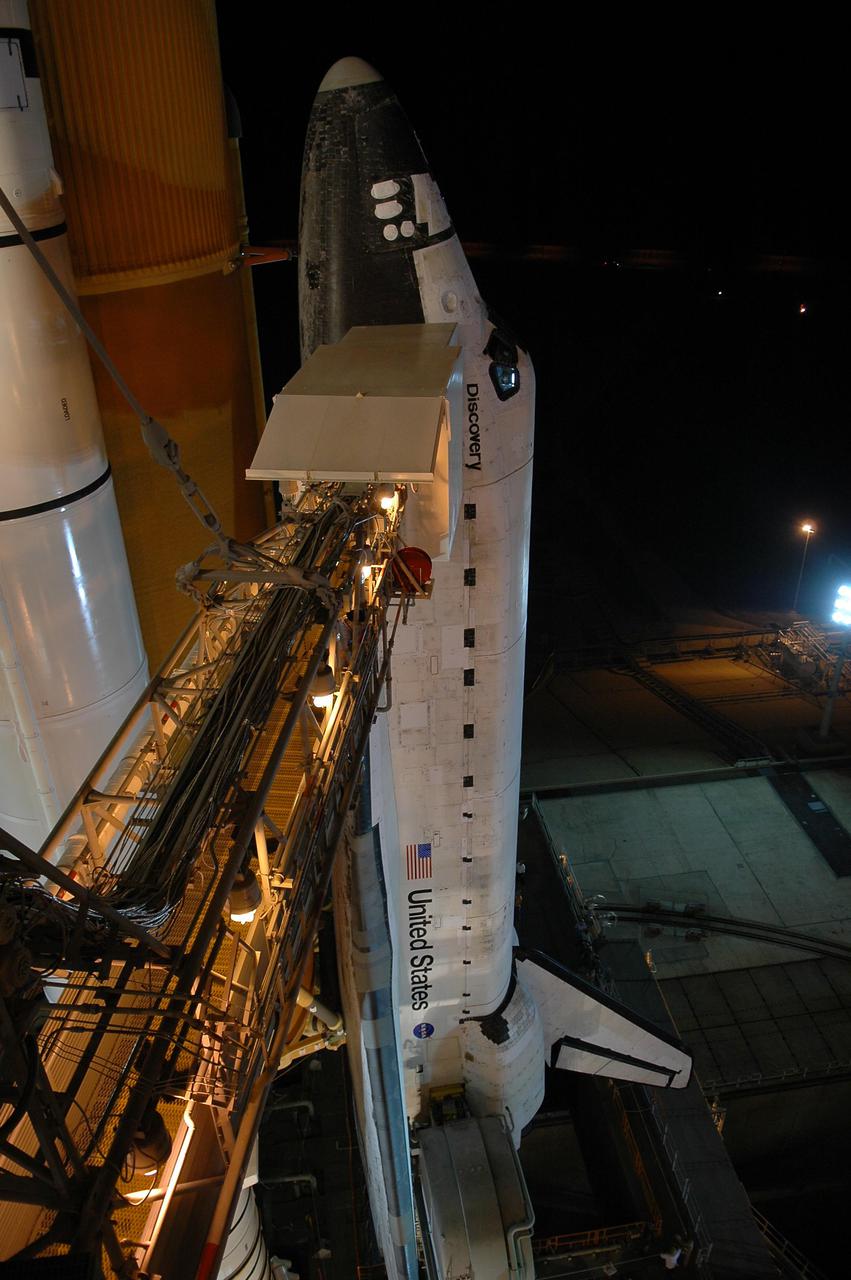
KENNEDY SPACE CENTER, FLA. - Following rollback of the Rotating Service Structure, the orbiter access arm is able to be extended to Space Shuttle Discovery. The arm provides access into Discovery through the White Room, where the astronauts are checked by the closeout crew. Discovery is scheduled to launch on the historic Return to Flight mission STS-114 at 3:51 p.m. July 13 with a crew of seven. The payload includes the External Stowage Platform-2, equipped with spare part assemblies, and a replacement Control Moment Gyroscope contained in the Lightweight Multi-Purpose Experiment Support Structure. The astronauts will make three spacewalks, including one to practice repair techniques for the Shuttle’s heat shield and one to install the new gyroscope. This is the 114th Space Shuttle flight and the 31st for Discovery. The 12-day mission is expected to end with touchdown at NASA Kennedy Space Center’s Shuttle Landing Facility at 11:06 a.m. July 25.
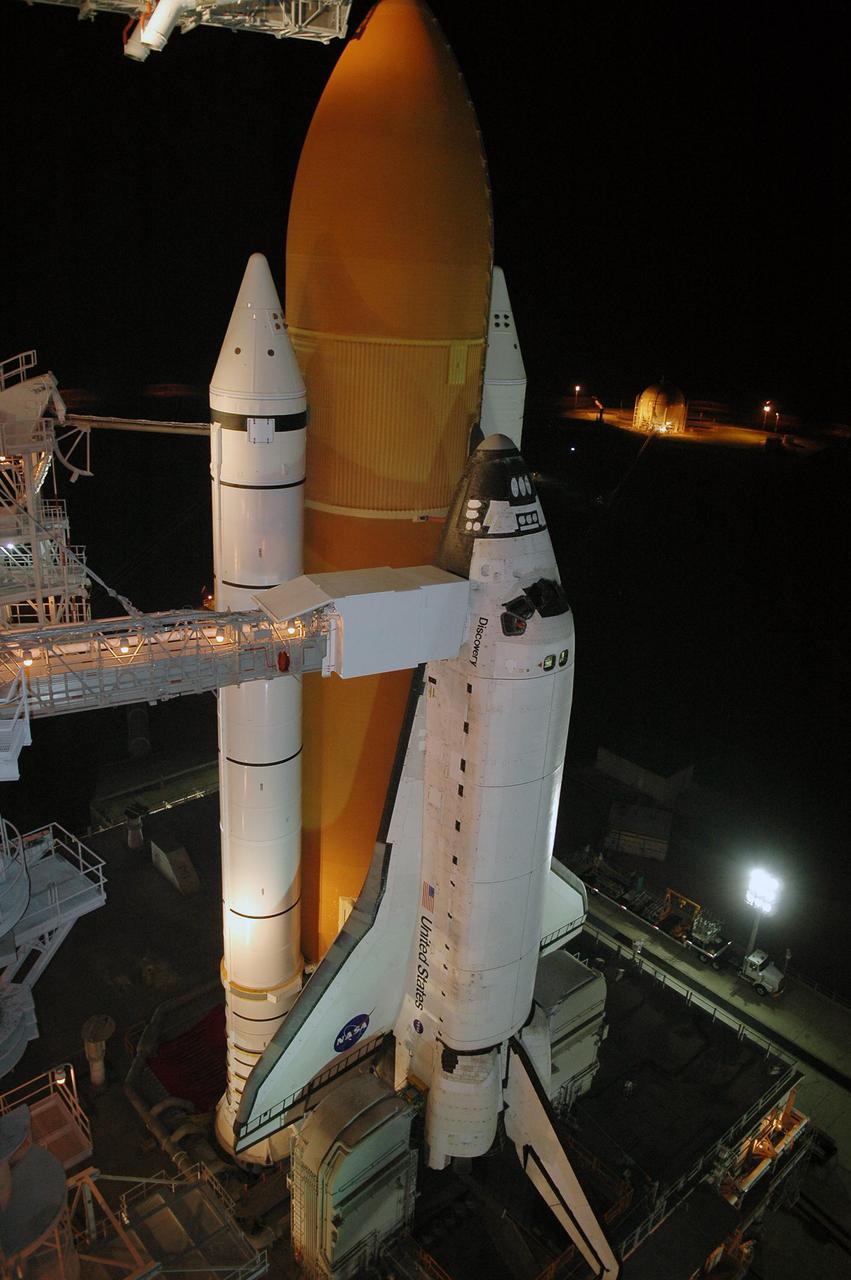
KENNEDY SPACE CENTER, FLA. - Following rollback of the Rotating Service Structure, the orbiter access arm is able to be extended to Space Shuttle Discovery. The arm provides access into Discovery through the White Room, where the astronauts are checked by the closeout crew. Behind Discovery is the orange External Tank, flanked by the twin white Solid Rocket Boosters. Discovery is scheduled to launch on the historic Return to Flight mission STS-114 at 3:51 p.m. July 13 with a crew of seven. The payload includes the External Stowage Platform-2, equipped with spare part assemblies, and a replacement Control Moment Gyroscope contained in the Lightweight Multi-Purpose Experiment Support Structure. The astronauts will make three spacewalks, including one to practice repair techniques for the Shuttle’s heat shield and one to install the new gyroscope. This is the 114th Space Shuttle flight and the 31st for Discovery. The 12-day mission is expected to end with touchdown at NASA Kennedy Space Center’s Shuttle Landing Facility at 11:06 a.m. July 25.
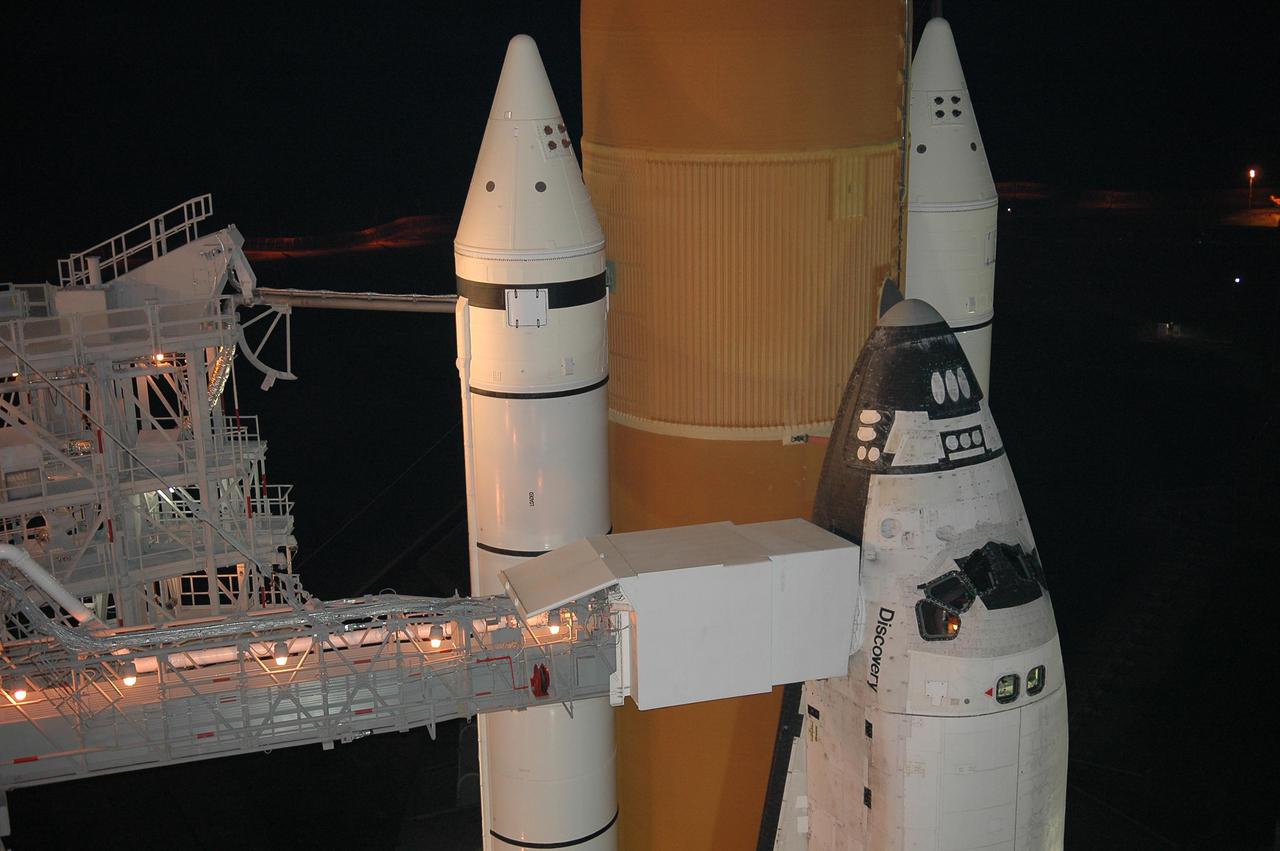
KENNEDY SPACE CENTER, FLA. - Following rollback of the Rotating Service Structure, the orbiter access arm is able to be extended to Space Shuttle Discovery. The arm provides access into Discovery through the White Room, where the astronauts are checked by the closeout crew. Behind Discovery is the orange External Tank, flanked by the twin white Solid Rocket Boosters. Discovery is scheduled to launch on the historic Return to Flight mission STS-114 at 3:51 p.m. July 13 with a crew of seven. The payload includes the External Stowage Platform-2, equipped with spare part assemblies, and a replacement Control Moment Gyroscope contained in the Lightweight Multi-Purpose Experiment Support Structure. The astronauts will make three spacewalks, including one to practice repair techniques for the Shuttle’s heat shield and one to install the new gyroscope. This is the 114th Space Shuttle flight and the 31st for Discovery. The 12-day mission is expected to end with touchdown at NASA Kennedy Space Center’s Shuttle Landing Facility at 11:06 a.m. July 25.
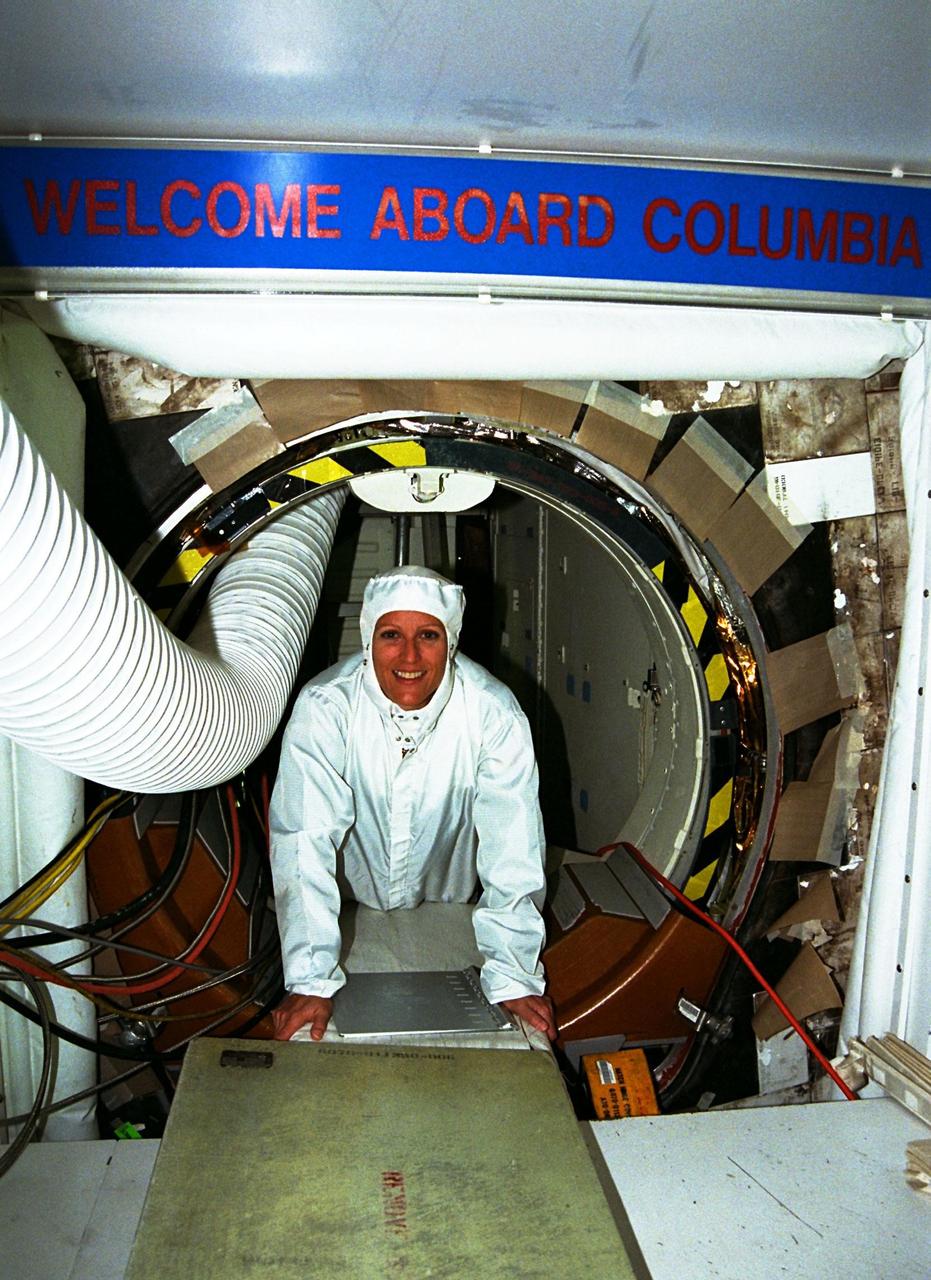
STS-90 Mission Specialist Kathryn (Kay) Hire enjoys the crawl between Columbia and the white room that allows access to the orbiter. The crew of STS-90 recently participated in the Crew Equipment Interface Test (CEIT) in Kennedy Space Center's Orbiter Processing Facility Bay 3. The CEIT gives astronauts an opportunity to get a hands-on look at the payloads with which they will be working on-orbit. Investigations during the STS-90 Neurolab mission will focus on the effects of microgravity on the nervous system. Specifically, experiments will study the adaptation of the vestibular system, the central nervous system, and the pathways that control the ability to sense location in the absence of gravity, as well as the effect of microgravity on a developing nervous system. STS-90, which will be Hire's first Shuttle flight, is scheduled for launch on April 16 at 2:19 p.m. EDT
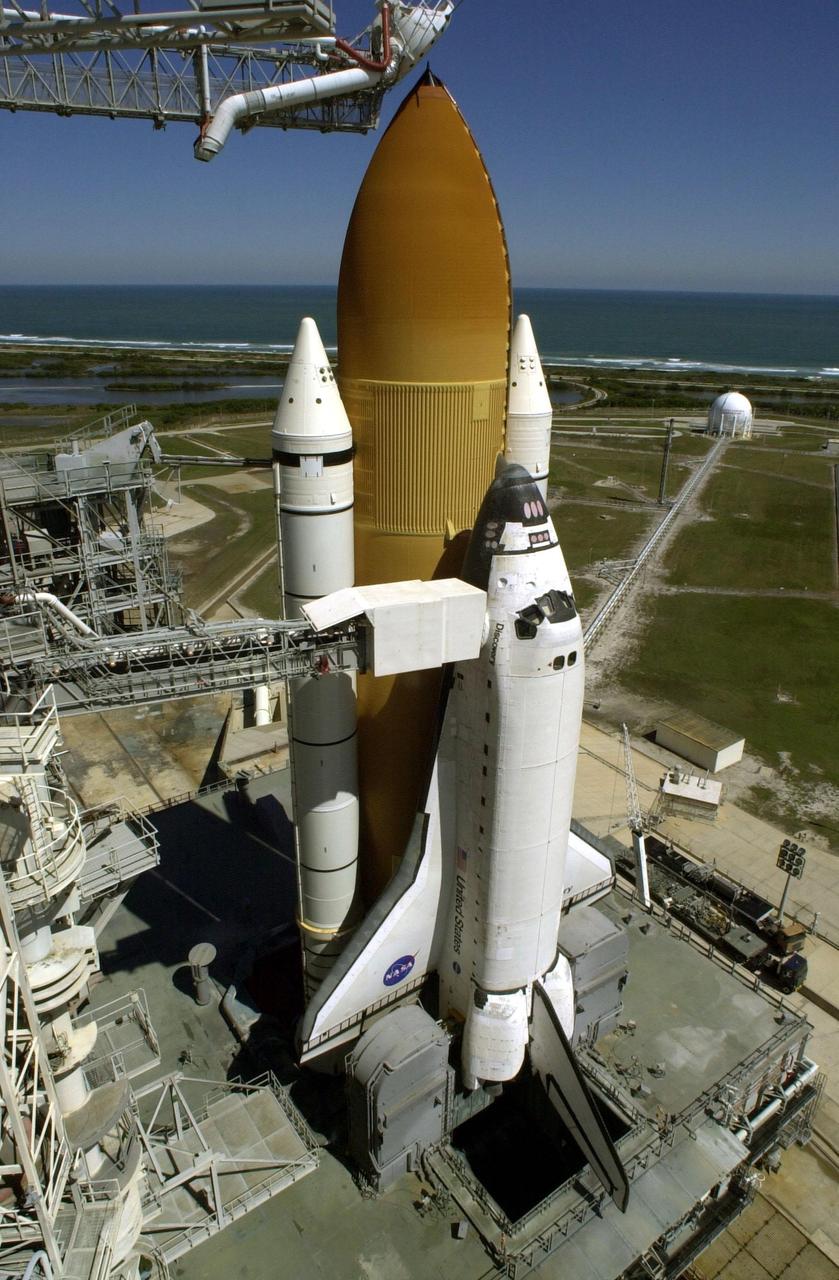
Space Shuttle Discovery sits poised on Launch Pad 39B, ready for launch at 6:42 a.m. EST March 8 on mission STS-102. Situated above the external tank is the Gaseous Oxygen Vent Arm with the “beanie cap,” a vent hood. The orbiter access arm is extended from the Fixed Service Structure (left) to the orbiter. An environmentally controlled chamber, known as the White Room, is at the end of the arm, providing entrance for the astronaut crew into the orbiter. In the distance, behind the Space Shuttle, can be seen the Atlantic Ocean. On this eighth construction flight to the International Space Station, Discovery carries the Multi-Purpose Logistics Module Leonardo, the primary delivery system used to resupply and return Station cargo requiring a pressurized environment. Leonardo will deliver up to 10 tons of laboratory racks filled with equipment, experiments and supplies for outfitting the newly installed U.S. Laboratory Destiny
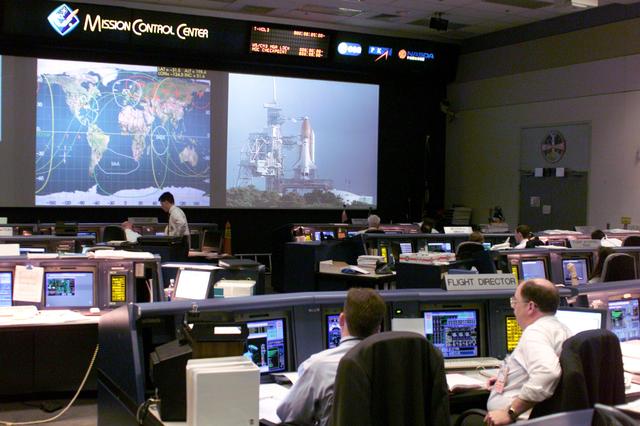
JSC2000-E-22286 (8 September 2000) --- An overall shot in Houston's Mission Control Center (MCC) shows flight controllers awaiting the launch of the Space Shuttle Atlantis from the Kennedy Space Center (KSC) in Florida. The vehicle later launched on schedule, at 8:46 a.m. (EDT), September 8, 2000, as the Johnson Space Center (JSC) flight control team took the baton from KSC's launch controllers. According to flight director Bill Reeves, "The picture referenced was taken less than an hour before launch for STS-106, before we changed the front screens for ascent operations. Wayne Hale (in glasses) is the Flight director for ascent and LeRoy Cain seated to his left was serving as "Weather Flight" for Wayne. The console in the front right corner of the room next to the screens is the Ground Control position, where I was supporting at this time. The man with white hair is Norn Talbott, who will be retiring after this flight with more than 35 years at NASA. Ray Grossman is next to him, who is training to take his place on the GC Ascent Team. I am in fron of and slightly to the right of Ray. As you can see by the boxes at the consoel behind us (Mechanical), we come well prepared for all contingencies, including donuts for early morning shifts. We were on console by 2:00 am central time for the 7:45 am launch." Reference: https://spaceflight.nasa.gov/feedback/expert/answer/mcc/sts-106/09_14_09_35_19.html
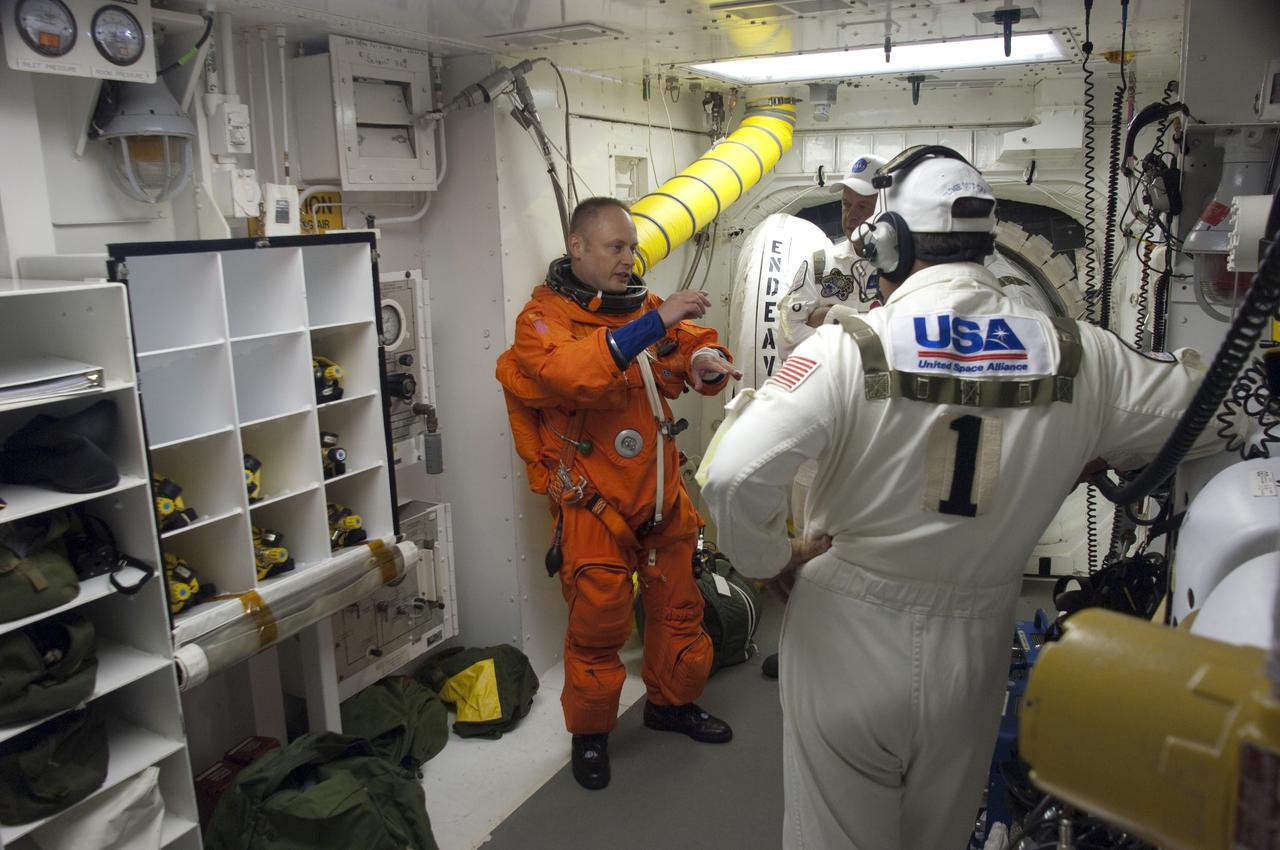
CAPE CANAVERAL, Fla. -- In the White Room at Launch Pad 39A at NASA's Kennedy Space Center in Florida, STS-134 Mission Specialist Michael Fincke prepares to board space shuttle Endeavour through the crew hatch in the background. Members of the Closeout Crew, in white uniforms, are there to assist astronauts with their launch-and-entry suits and the boarding process. Fincke last served as a member of the Expedition 18 crew of the International Space Station in 2009. This will be Fincke's first flight aboard a space shuttle. STS-134 will deliver the Alpha Magnetic Spectrometer-2 (AMS), Express Logistics Carrier-3, a high-pressure gas tank and additional spare parts for the Dextre robotic helper to the International Space Station. May 16 at 8:56 a.m. will be the second launch attempt for Endeavour. The first attempt on April 29 was scrubbed because of an issue associated with a faulty power distribution box called the aft load control assembly-2 (ALCA-2). STS-134 will be the final spaceflight for Endeavour. For more information visit, www.nasa.gov/mission_pages/shuttle/shuttlemissions/sts134/index.html. Photo credit: NASA/Sandra Joseph and Kevin O'Connell
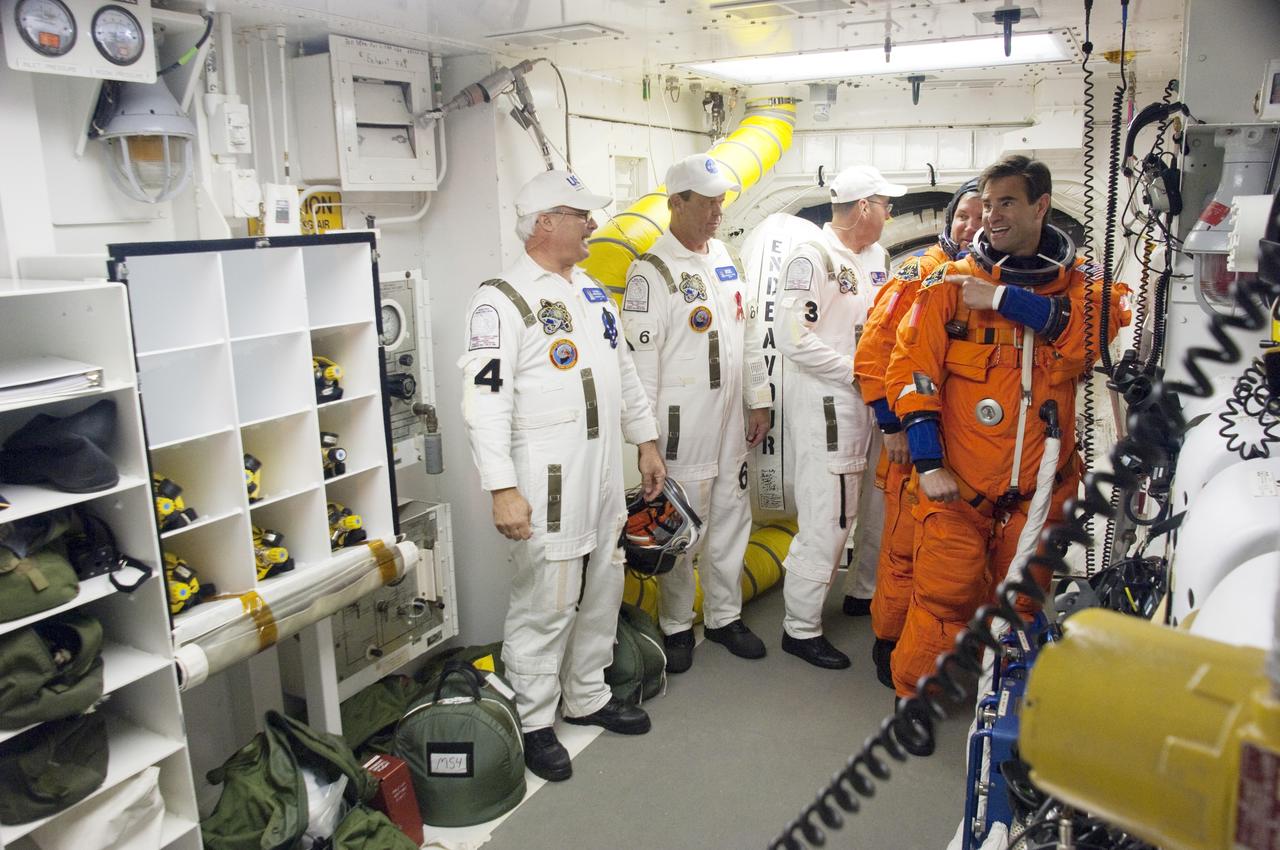
CAPE CANAVERAL, Fla. -- In the White Room at Launch Pad 39A at NASA's Kennedy Space Center in Florida, STS-134 Pilot Greg H. Johnson, left, and Mission Specialist Greg Chamitoff prepare to board space shuttle Endeavour through the crew hatch in the background. Members of the Closeout Crew, in white uniforms, are there to assist astronauts with their launch-and-entry suits and the boarding process. Johnson piloted space shuttle Endeavour during its STS-123 mission in 2008. Chamitoff last served as flight engineer and science officer aboard the International Space Station in 2008. STS-134 will deliver the Alpha Magnetic Spectrometer-2 (AMS), Express Logistics Carrier-3, a high-pressure gas tank and additional spare parts for the Dextre robotic helper to the International Space Station. May 16 at 8:56 a.m. will be the second launch attempt for Endeavour. The first attempt on April 29 was scrubbed because of an issue associated with a faulty power distribution box called the aft load control assembly-2 (ALCA-2). STS-134 will be the final spaceflight for Endeavour. For more information visit, www.nasa.gov/mission_pages/shuttle/shuttlemissions/sts134/index.html. Photo credit: NASA/Sandra Joseph and Kevin O'Connell
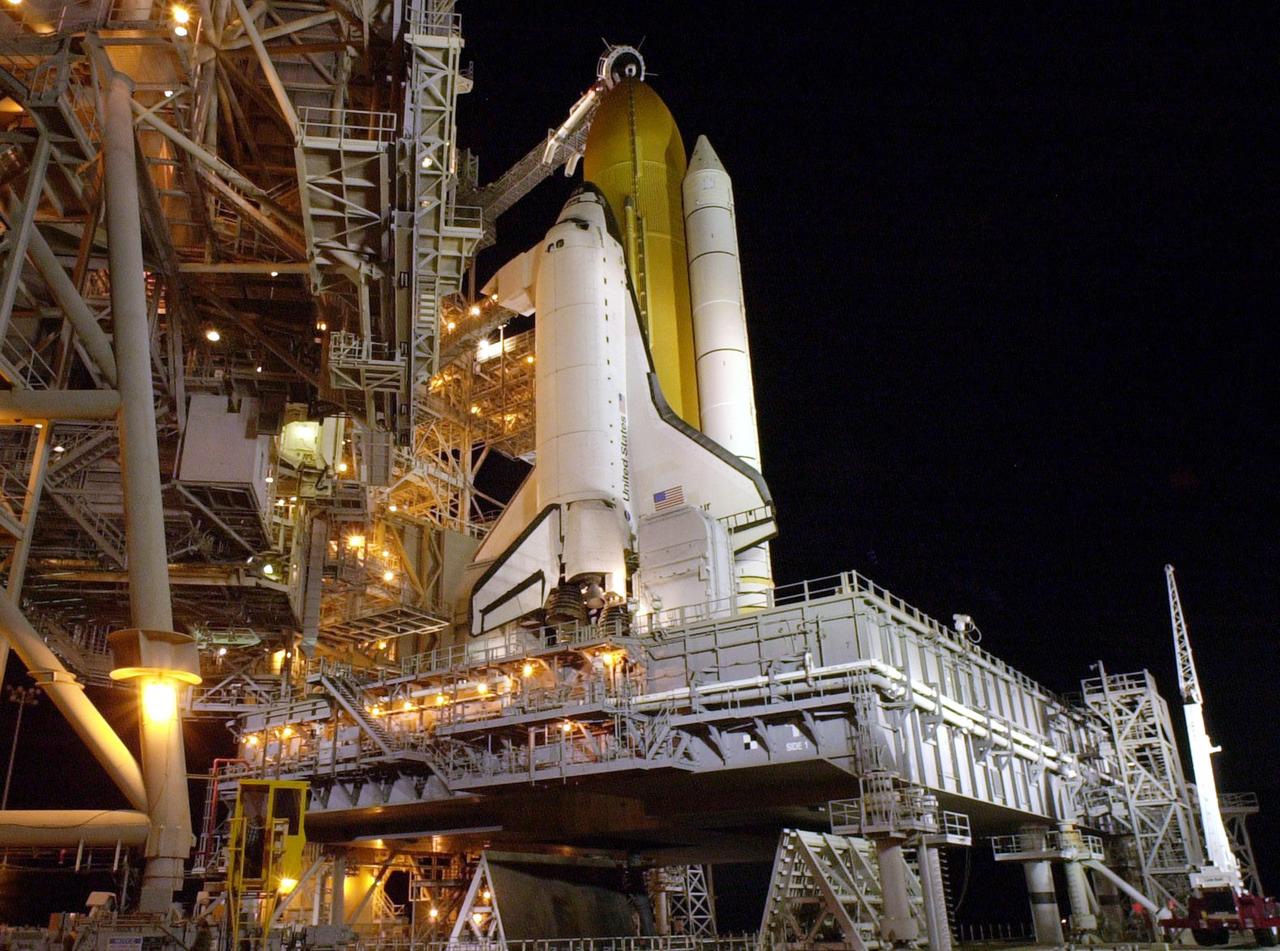
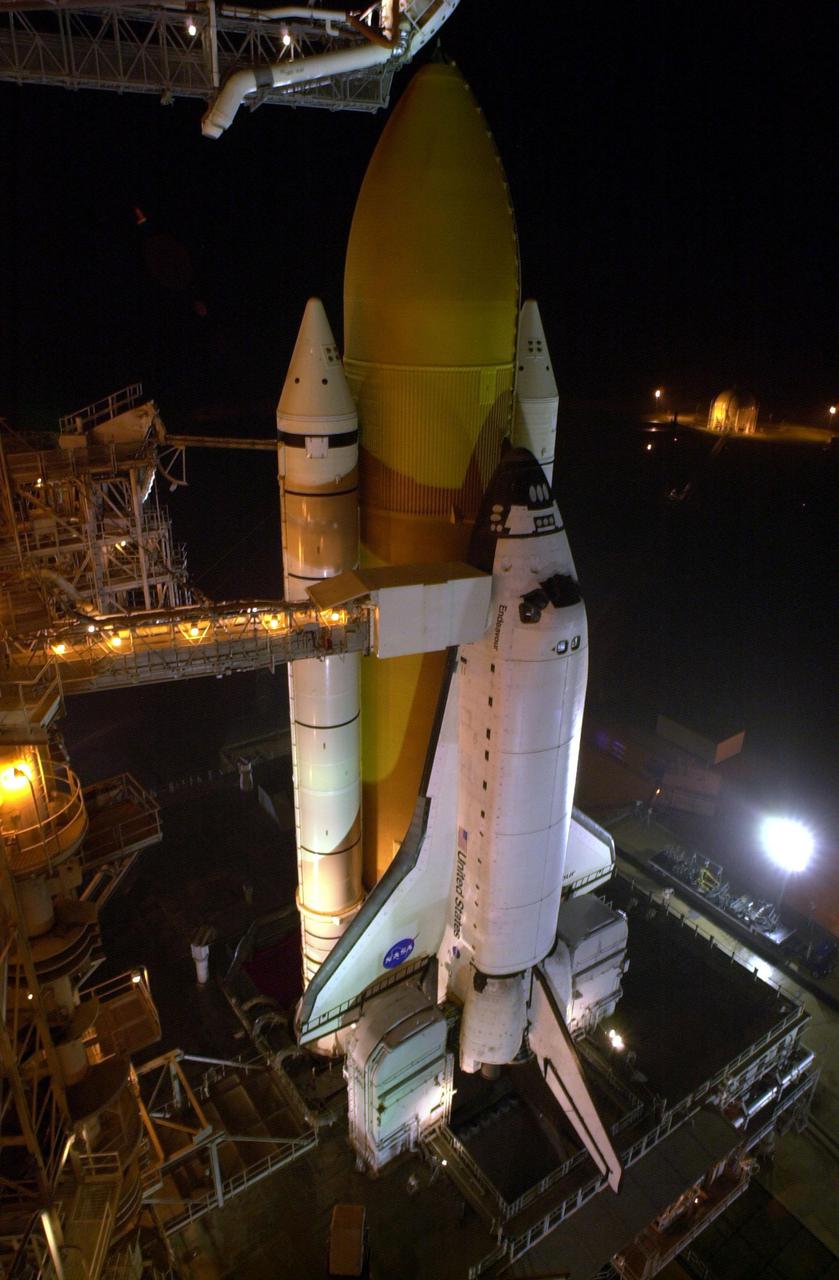
KENNEDY SPACE CENTER, Fla. -- Space Shuttle Endeavour is revealed after rollback of the Rotating Service Structure on Launch Pad 39B. Seen is one of the twin solid rocket boosters that flank the orange external tank. Above the external tank is the Gaseous Oxygen Vent Arm that vents gaseous oxygen vapors away from the Shuttle. The vent hood assembly at the end is often referred to as the "beanie cap." Stretching to the crew hatch on the side is the Orbiter Access Arm with its environmentally controlled White Room at the end. The Shuttle sits on the Mobile Launcher Platform with the two service tail masts on either side of the main engines. The tail masts support the fluid, gas and electrical requirements of the orbiter's liquid oxygen and liquid hydrogen aft T-0 umbilicals. Each tail mast is 31 feet (9.4 meters) high, 15 feet (4.6 meters) long and 9 feet (3.1 meters) wide. Endeavour is scheduled to launch on mission STS-108 Nov. 29 at 7:41 p.m. On this 12th flight to the International Space Station, known as a Utilization Flight, Endeavour will carry a crew of four plus the Expedition 4 crew, who will replace Expedition 3 aboard the ISS. The payload includes the Multi-Purpose Logistics Module Raffaello, filled with supplies, equipment and experiments
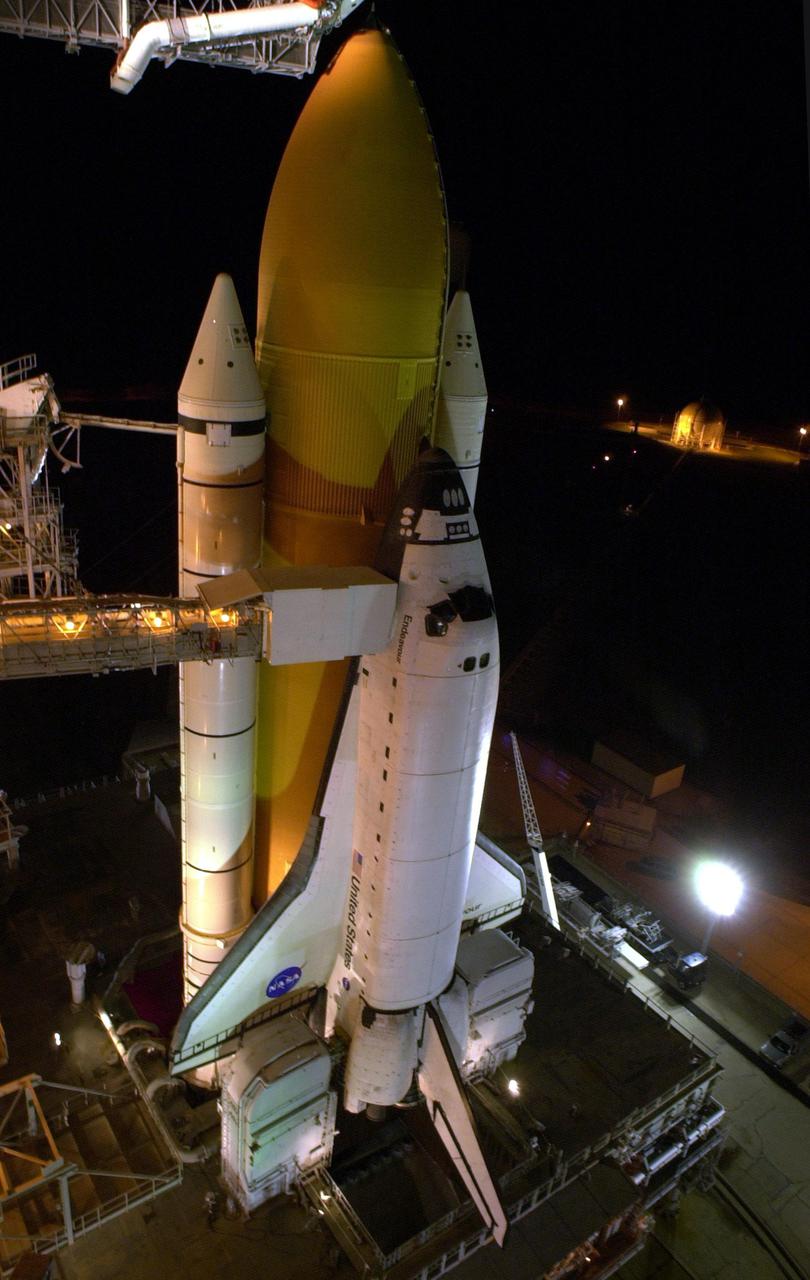
KENNEDY SPACE CENTER, Fla. -- After rollback of the Rotating Service Structure on Launch Pad 39B, Space Shuttle Endeavour is bathed in light. Twin solid rocket boosters flank the orange external tank behind Endeavour. Above the external tank is the Gaseous Oxygen Vent Arm that vents gaseous oxygen vapors away from the Shuttle. The vent hood assembly at the end is often referred to as the 'beanie cap.' Stretching to the crew hatch on the side of Endeavour is the Orbiter Access Arm with its environmentally controlled White Room at the end, through which the crew enters the vehicle. The Shuttle sits on the Mobile Launcher Platform with the two service tail masts on either side of the main engines. The tail masts support the fluid, gas and electrical requirements of the orbiter's liquid oxygen and liquid hydrogen aft T-0 umbilicals. Each tail mast is 31 feet (9.4 meters) high, 15 feet (4.6 meters) long and 9 feet (3.1 meters) wide. Endeavour is scheduled to launch on mission STS-108 Dec. 4 at 5:45 p.m. EST. On this 12th flight to the International Space Station, known as a Utilization Flight, Endeavour will carry a crew of four plus the Expedition 4 crew, who will replace Expedition 3 aboard the ISS. The payload includes the Multi-Purpose Logistics Module Raffaello, filled with supplies, equipment and experiments
KENNEDY SPACE CENTER, Fla. -- After rollback of the Rotating Service Structure on Launch Pad 39B, Space Shuttle Endeavour is bathed in light. Seen is one of the twin solid rocket boosters that flank the orange external tank. Above the external tank is the Gaseous Oxygen Vent Arm that vents gaseous oxygen vapors away from the Shuttle. The vent hood assembly at the end is often referred to as the "beanie cap." Stretching to the crew hatch on the side is the Orbiter Access Arm with its environmentally controlled White Room at the end. The Shuttle sits on the Mobile Launcher Platform with the two service tail masts on either side of the main engines. The tail masts support the fluid, gas and electrical requirements of the orbiter's liquid oxygen and liquid hydrogen aft T-0 umbilicals. Each tail mast is 31 feet (9.4 meters) high, 15 feet (4.6 meters) long and 9 feet (3.1 meters) wide. Endeavour is scheduled to launch on mission STS-108 Nov. 29 at 7:41 p.m. On this 12th flight to the International Space Station, known as a Utilization Flight, Endeavour will carry a crew of four plus the Expedition 4 crew, who will replace Expedition 3 aboard the ISS. The payload includes the Multi-Purpose Logistics Module Raffaello, filled with supplies, equipment and experiments
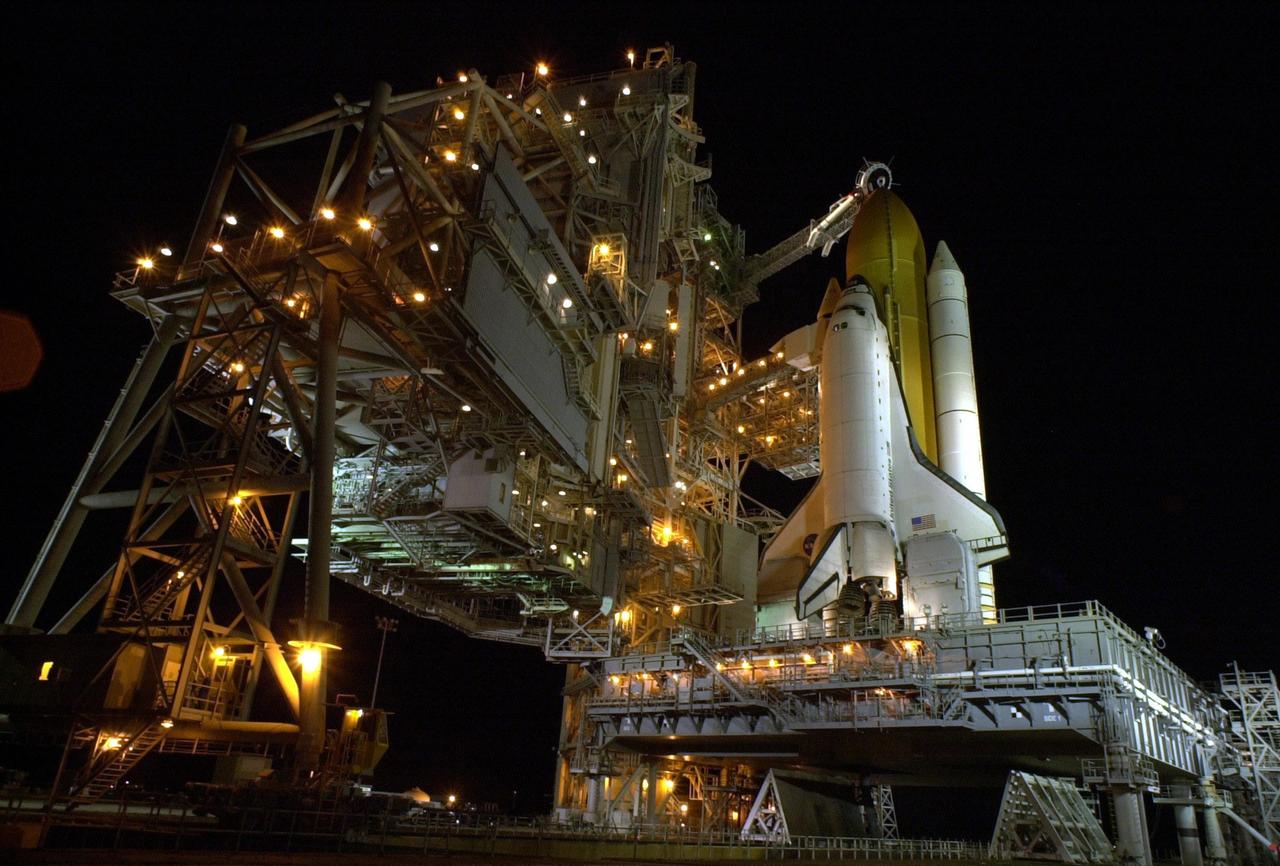
KENNEDY SPACE CENTER, Fla. -- Space Shuttle Endeavour stands ready for launch after rollback of the Rotating Service Structure on Launch Pad 39B. Seen are the twin solid rocket boosters flanking the orange external tank. Stretching to the crew hatch on the side is the Orbiter Access Arm with its environmentally controlled White Room at the end. Below Endeavour is the Mobile Launcher Platform with the two service tail masts on either side of the main engines. The tail masts support the fluid, gas and electrical requirements of the orbiter's liquid oxygen and liquid hydrogen aft T-0 umbilicals. Each tail mast is 31 feet (9.4 meters) high, 15 feet (4.6 meters) long and 9 feet (3.1 meters) wide. Endeavour is scheduled to launch on mission STS-108 Nov. 29 at 7:41 p.m. On this 12th flight to the International Space Station, known as a Utilization Flight, Endeavour will carry a crew of four plus the Expedition 4 crew, who will replace Expedition 3 aboard the ISS. The payload includes the Multi-Purpose Logistics Module Raffaello, filled with supplies, equipment and experiments
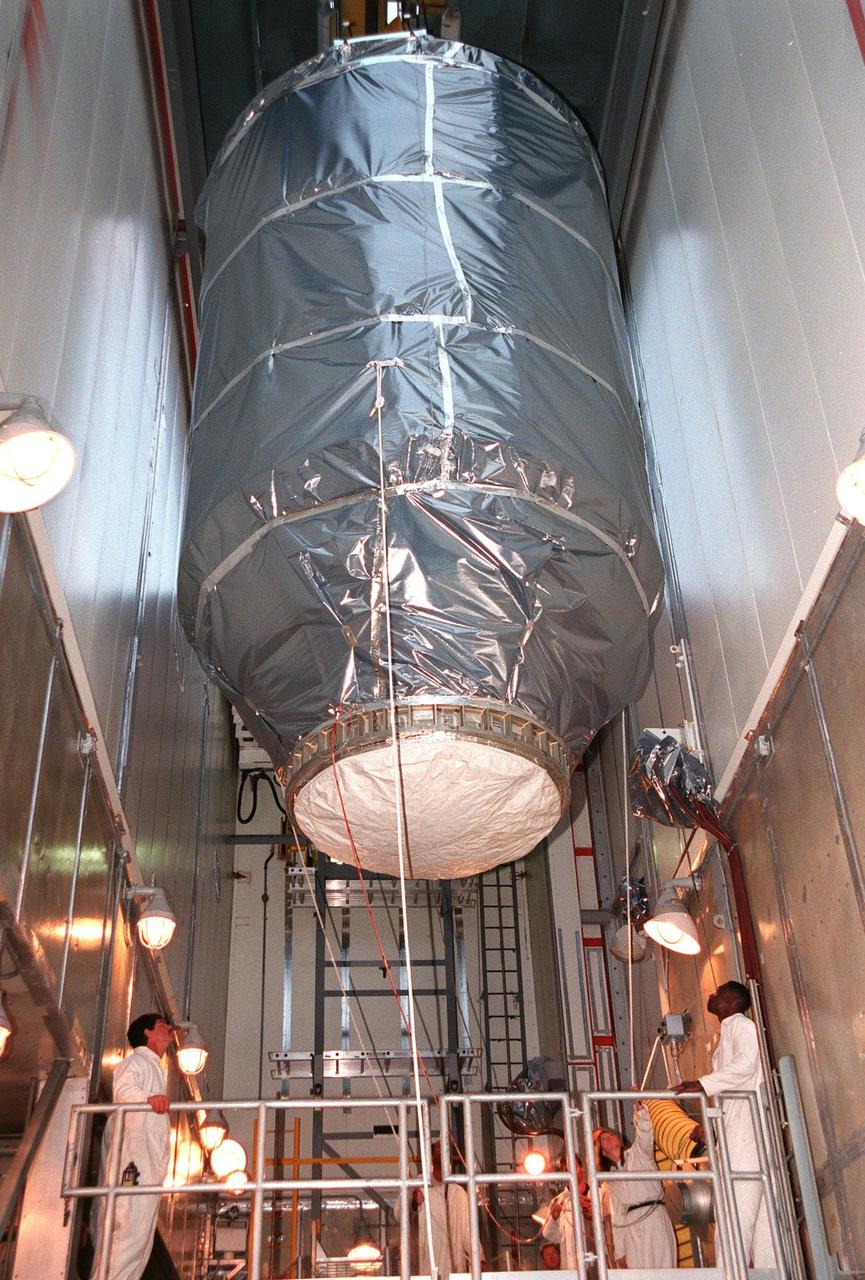
KENNEDY SPACE CENTER, FLA. -- On Launch Pad 17A at Cape Canaveral Air Station, Deep Space 1 is lowered in the white room for installation on a Boeing Delta 7326 rocket . The spacecraft is targeted for launch on Oct. 25. Deep Space 1 is the first flight in NASA's New Millennium Program, and is designed to validate 12 new technologies for scientific space missions of the next century, including the engine. Propelled by the gas xenon, the engine is being flight-tested for future deep space and Earth-orbiting missions. Deceptively powerful, the ion drive emits only an eerie blue glow as ionized atoms of xenon are pushed out of the engine. While slow to pick up speed, over the long haul it can deliver 10 times as much thrust per pound of fuel as liquid or solid fuel rockets. Other onboard experiments include software that tracks celestial bodies so the spacecraft can make its own navigation decisions without the intervention of ground controllers. Deep Space 1 will complete most of its mission objectives within the first two months, but will also do a flyby of a near-Earth asteroid, 1992 KD, in July 1999
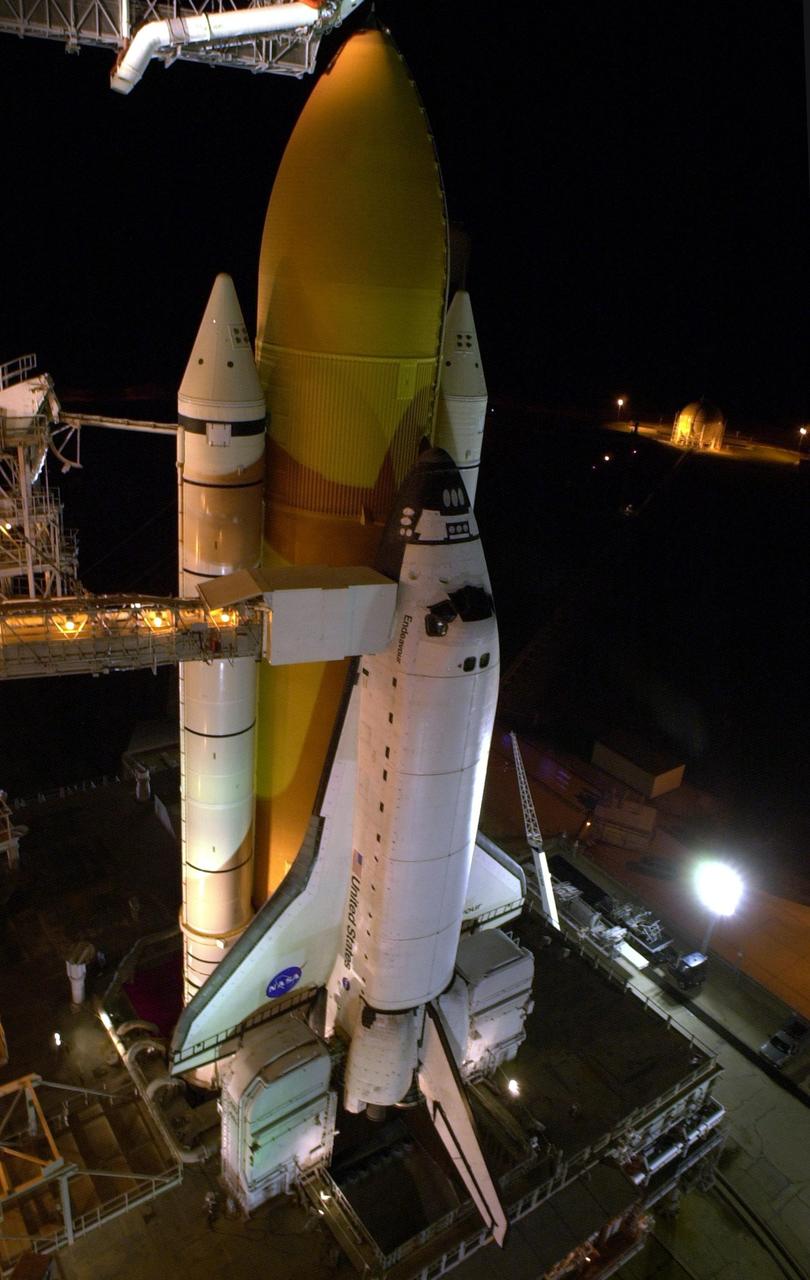
KENNEDY SPACE CENTER, Fla. -- Space Shuttle Endeavour stands ready for launch after rollback of the Rotating Service Structure on Launch Pad 39B. Seen are the twin solid rocket boosters flanking the orange external tank. Stretching to the crew hatch on the side is the Orbiter Access Arm with its environmentally controlled White Room at the end. Below Endeavour is the Mobile Launcher Platform with the two service tail masts on either side of the main engines. The tail masts support the fluid, gas and electrical requirements of the orbiter's liquid oxygen and liquid hydrogen aft T-0 umbilicals. Each tail mast is 31 feet (9.4 meters) high, 15 feet (4.6 meters) long and 9 feet (3.1 meters) wide. Endeavour is scheduled to launch on mission STS-108 Nov. 29 at 7:41 p.m. On this 12th flight to the International Space Station, known as a Utilization Flight, Endeavour will carry a crew of four plus the Expedition 4 crew, who will replace Expedition 3 aboard the ISS. The payload includes the Multi-Purpose Logistics Module Raffaello, filled with supplies, equipment and experiments
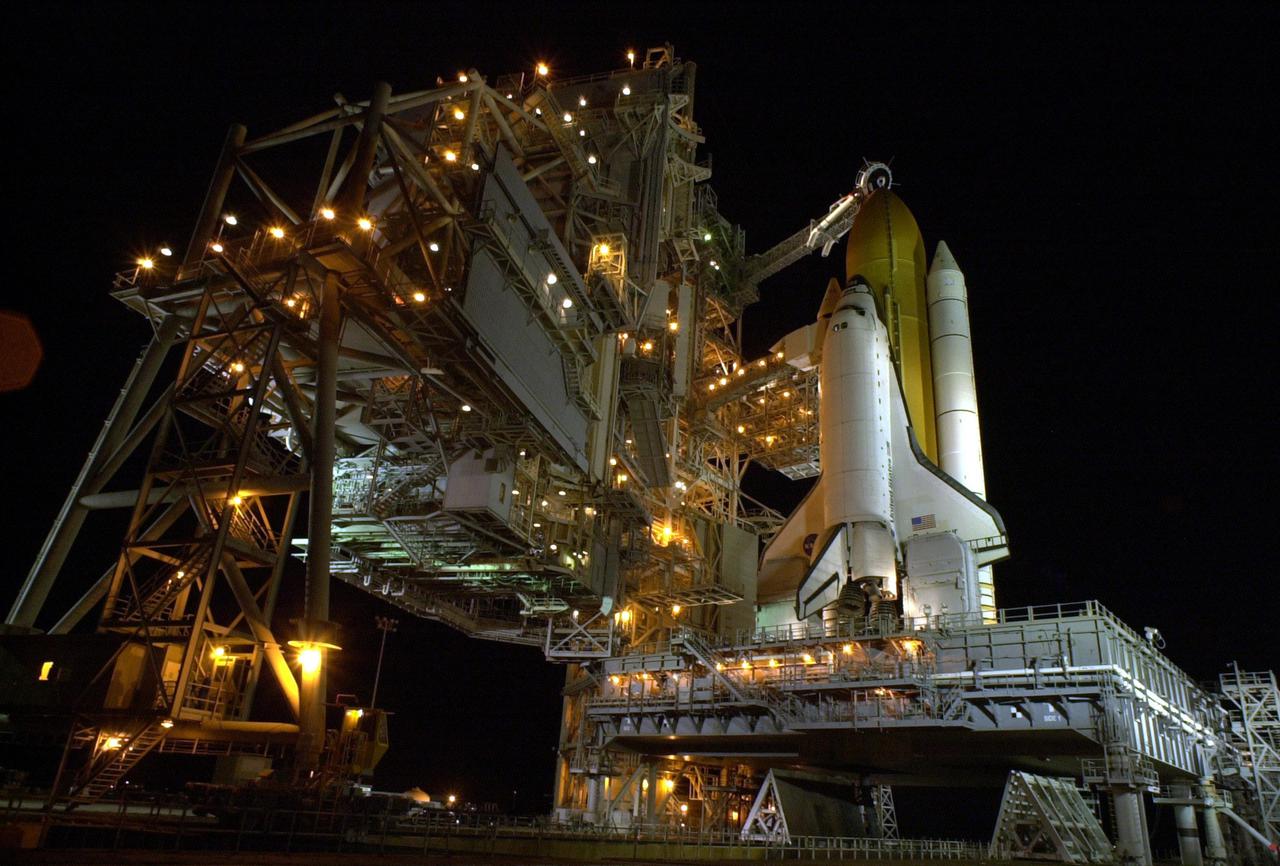
KENNEDY SPACE CENTER, Fla. -- After rollback of the Rotating Service Structure on Launch Pad 39B, Space Shuttle Endeavour is bathed in light. Seen is one of the twin solid rocket boosters that flank the orange external tank. Above the external tank is the Gaseous Oxygen Vent Arm that vents gaseous oxygen vapors away from the Shuttle. The vent hood assembly at the end is often referred to as the 'beanie cap.' Stretching to the crew hatch on the side is the Orbiter Access Arm with its environmentally controlled White Room at the end. The Shuttle sits on the Mobile Launcher Platform with the two service tail masts on either side of the main engines. The tail masts support the fluid, gas and electrical requirements of the orbiter's liquid oxygen and liquid hydrogen aft T-0 umbilicals. Each tail mast is 31 feet (9.4 meters) high, 15 feet (4.6 meters) long and 9 feet (3.1 meters) wide. Endeavour is scheduled to launch on mission STS-108 Nov. 29 at 7:41 p.m. On this 12th flight to the International Space Station, known as a Utilization Flight, Endeavour will carry a crew of four plus the Expedition 4 crew, who will replace Expedition 3 aboard the ISS. The payload includes the Multi-Purpose Logistics Module Raffaello, filled with supplies, equipment and experiments

KENNEDY SPACE CENTER, Fla. -- After rollback of the Rotating Service Structure on Launch Pad 39B, Space Shuttle Endeavour is bathed in light. Twin solid rocket boosters flank the orange external tank behind Endeavour. Above the external tank is the Gaseous Oxygen Vent Arm that vents gaseous oxygen vapors away from the Shuttle. The vent hood assembly at the end is often referred to as the "beanie cap." Stretching to the crew hatch on the side of Endeavour is the Orbiter Access Arm with its environmentally controlled White Room at the end, through which the crew enters the vehicle. The Shuttle sits on the Mobile Launcher Platform with the two service tail masts on either side of the main engines. The tail masts support the fluid, gas and electrical requirements of the orbiter's liquid oxygen and liquid hydrogen aft T-0 umbilicals. Each tail mast is 31 feet (9.4 meters) high, 15 feet (4.6 meters) long and 9 feet (3.1 meters) wide. Endeavour is scheduled to launch on mission STS-108 Dec. 4 at 5:45 p.m. EST. On this 12th flight to the International Space Station, known as a Utilization Flight, Endeavour will carry a crew of four plus the Expedition 4 crew, who will replace Expedition 3 aboard the ISS. The payload includes the Multi-Purpose Logistics Module Raffaello, filled with supplies, equipment and experiments
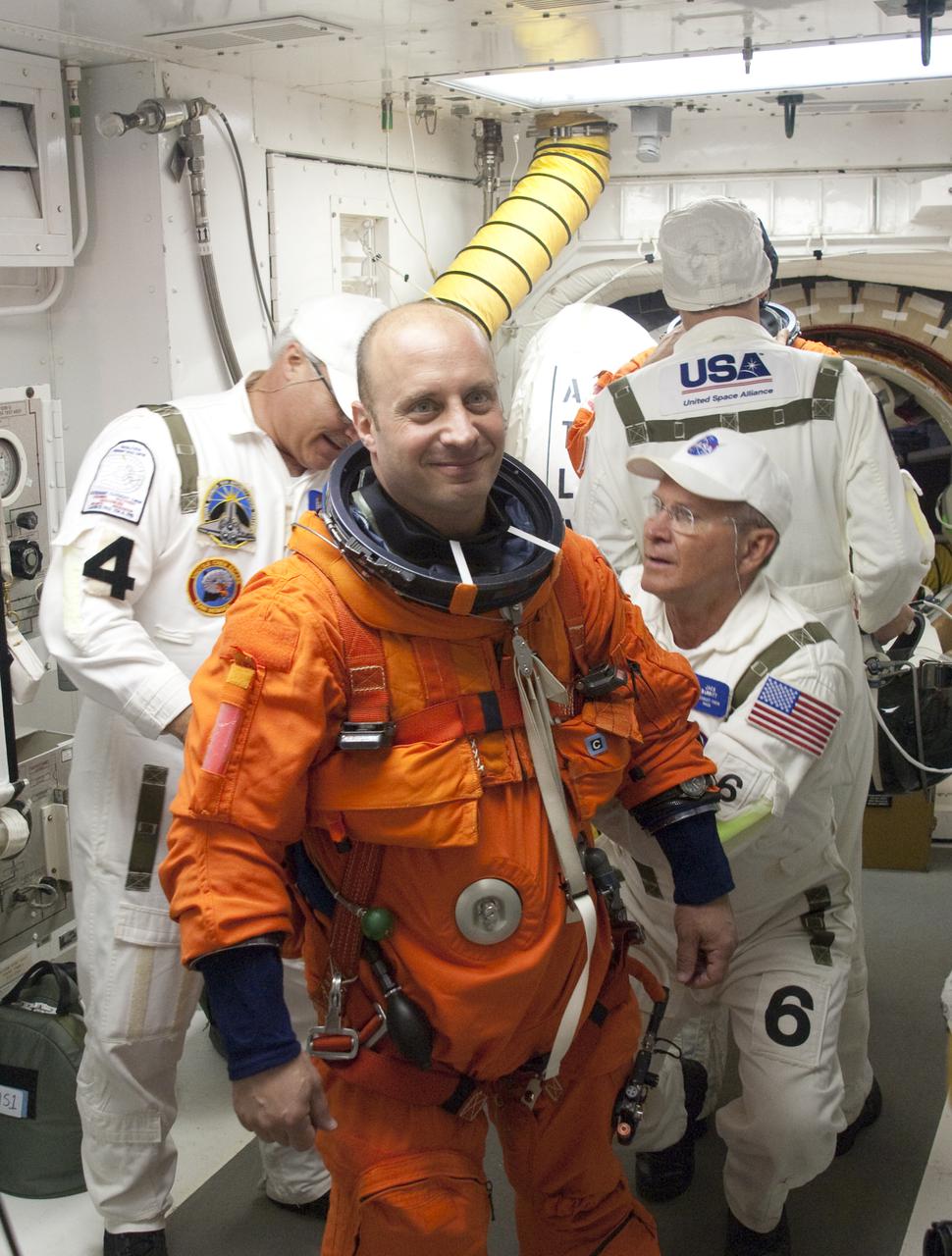
CAPE CANAVERAL, Fla. - In the White Room at Launch Pad 39A at NASA's Kennedy Space Center in Florida, United Space Alliance space suit technicians help STS-132 Mission Specialist Garrett Reisman put on the parachute for his launch-and-entry suit before he enters space shuttle Atlantis through the crew hatch in the background. Reisman was a flight engineer on the International Space Station's Expedition 16 and 17. Liftoff of the STS-132 mission is set for 2:20 p.m. EDT on May 14. The six-member STS-132 crew will deliver the Russian-built Mini Research Module-1 to the International Space Station. Named Rassvet, Russian for 'dawn,' the module is the second in a series of new pressurized components for Russia and will be permanently attached to the Earth-facing port of the Zarya control module. Rassvet will be used for cargo storage and will provide an additional docking port to the station. Also aboard Atlantis is an Integrated Cargo Carrier, or ICC, an unpressurized flat bed pallet and keel yoke assembly used to support the transfer of exterior cargo from the shuttle to the station. STS-132 is the 34th mission to the station and the last scheduled flight for Atlantis. For more information on the STS-132 mission objectives, payload and crew, visit http:__www.nasa.gov_mission_pages_shuttle_shuttlemissions_sts132_index.html. Photo Credit: NASA_Sandra Joseph and Kevin O'Connell