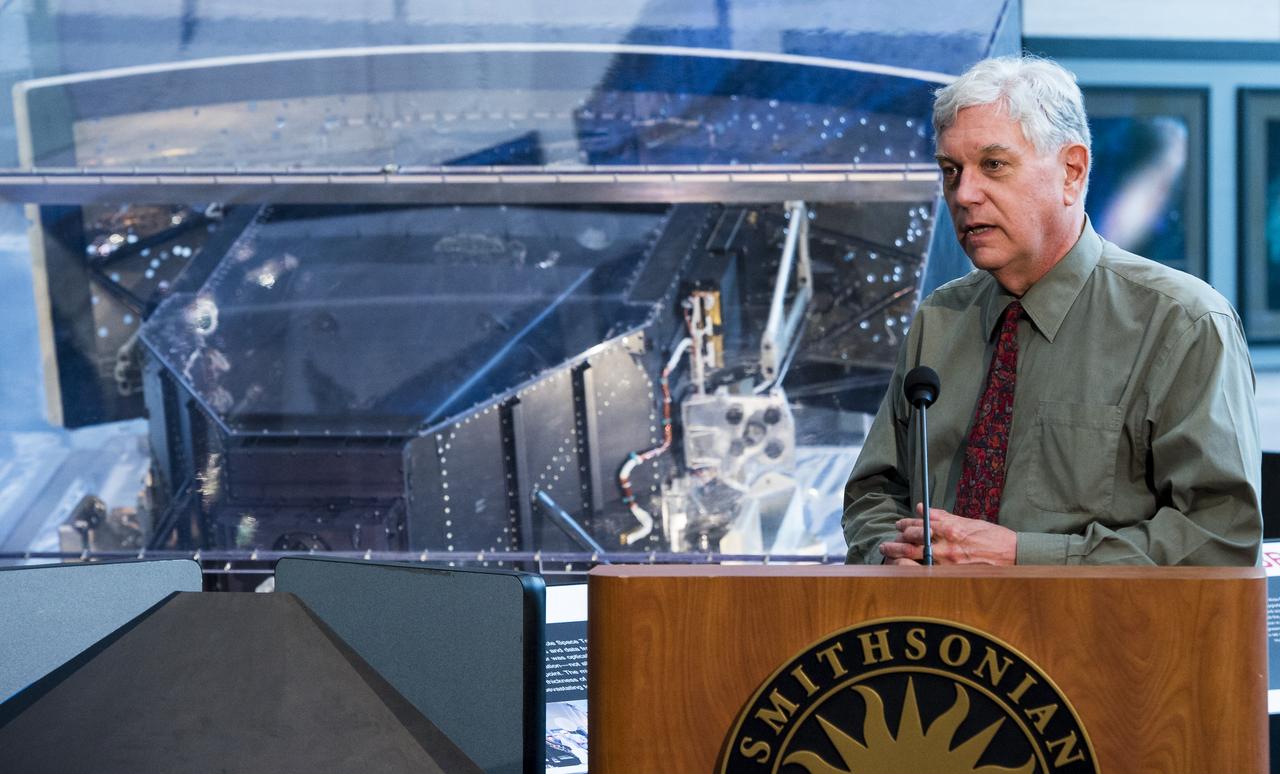
John Trauger, former principal investigator for the Wide Field Planetary Camera 2 (WFPC2) at NASA's Jet Propultion Laboratory (JPL), speaks at an event unveiling a new exhibit featuring Hubble's Corrective Optics Space Telescope Axial Replacement (COSTAR) and the WFPC2 on Wednesday, April 23, 2014 at the Smithsonian National Air and Space Museum in Washington, DC. COSTAR and WFPC2 were installed in Hubble during the first space shuttle servicing mission in 1993 and returned to Earth on the fifth and final servicing mission in 2009. Photo Credit: (NASA/Joel Kowsky)
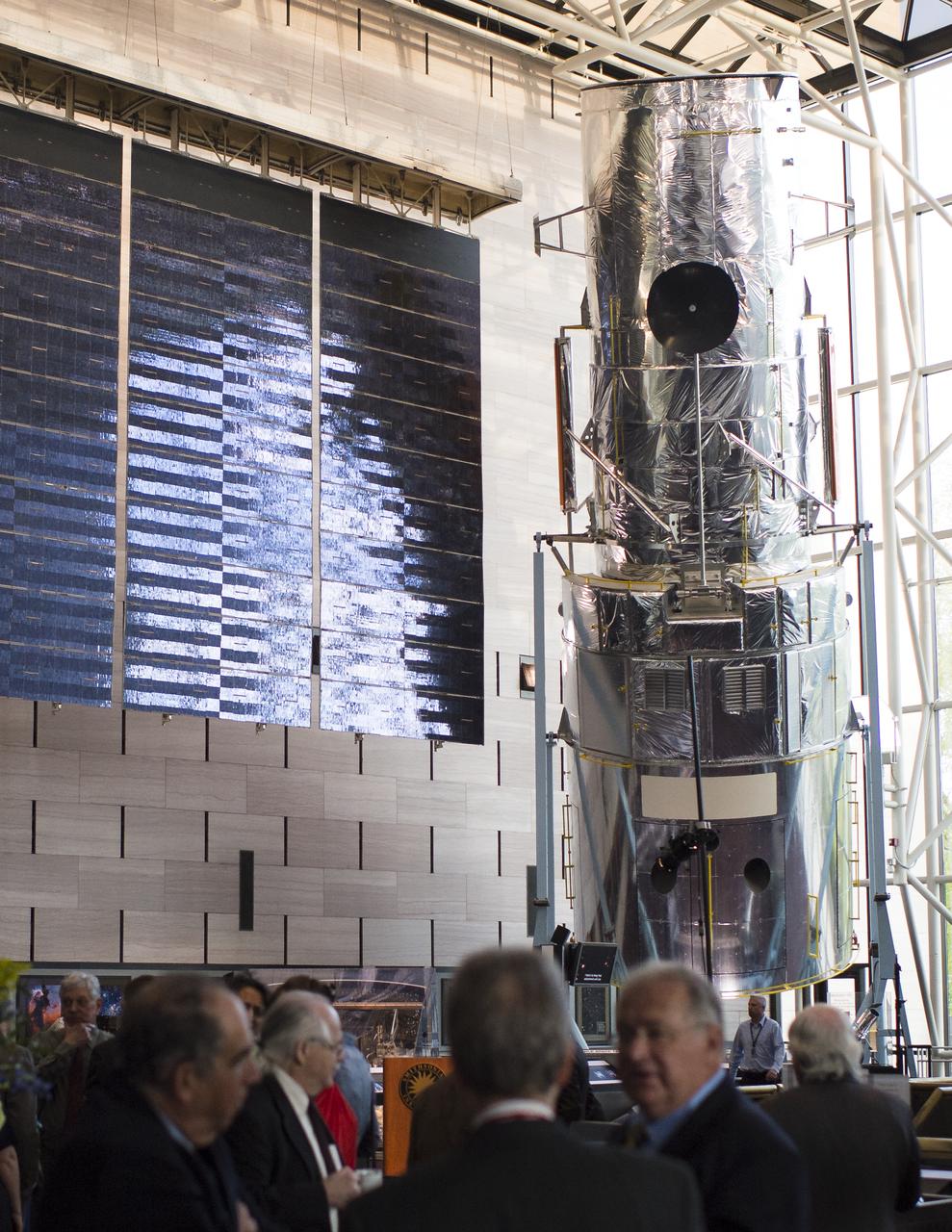
The Hubble Space Telescope Structural Dynamic Test Vehicle is seen inside the Space Hall at the Smithsonian National Air and Space Museum during an event unveiling a new exhibit featuring Hubble's Corrective Optics Space Telescope Axial Replacement (COSTAR) and the Wide Field and Planetary Camera 2 (WFPC2) on Wednesday, April 23, 2014 in Washington, DC. COSTAR and WFPC2 were were installed in Hubble during the first space shuttle servicing mission in 1993 and returned to Earth on the fifth and final servicing mission in 2009. Photo Credit: (NASA/Joel Kowsky)
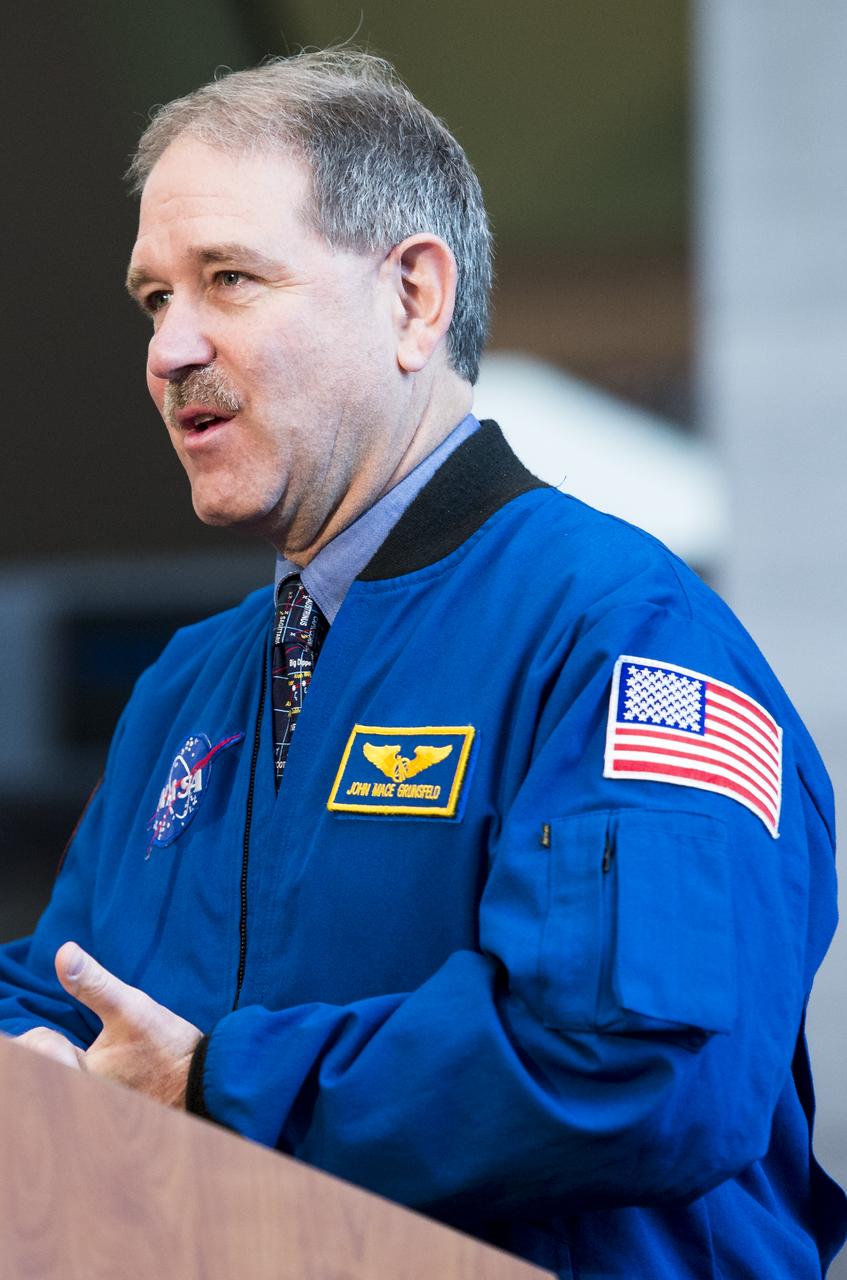
John Grunsfeld, NASA Associate Administrator for the Science Mission Directorate, speaks during during an event unveiling a new exhibit featuring Hubble's Corrective Optics Space Telescope Axial Replacement (COSTAR) and the Wide Field and Planetary Camera 2 (WFPC2) on Wednesday, April 23, 2014 at the Smithsonian National Air and Space Museum in Washington, DC. Grunsfeld flew on three of space shuttle servicing missions to Hubble, including the fifth and final mission in 2009 which returned COSTAR and WFPC2 to Earth. Photo Credit: (NASA/Joel Kowsky)
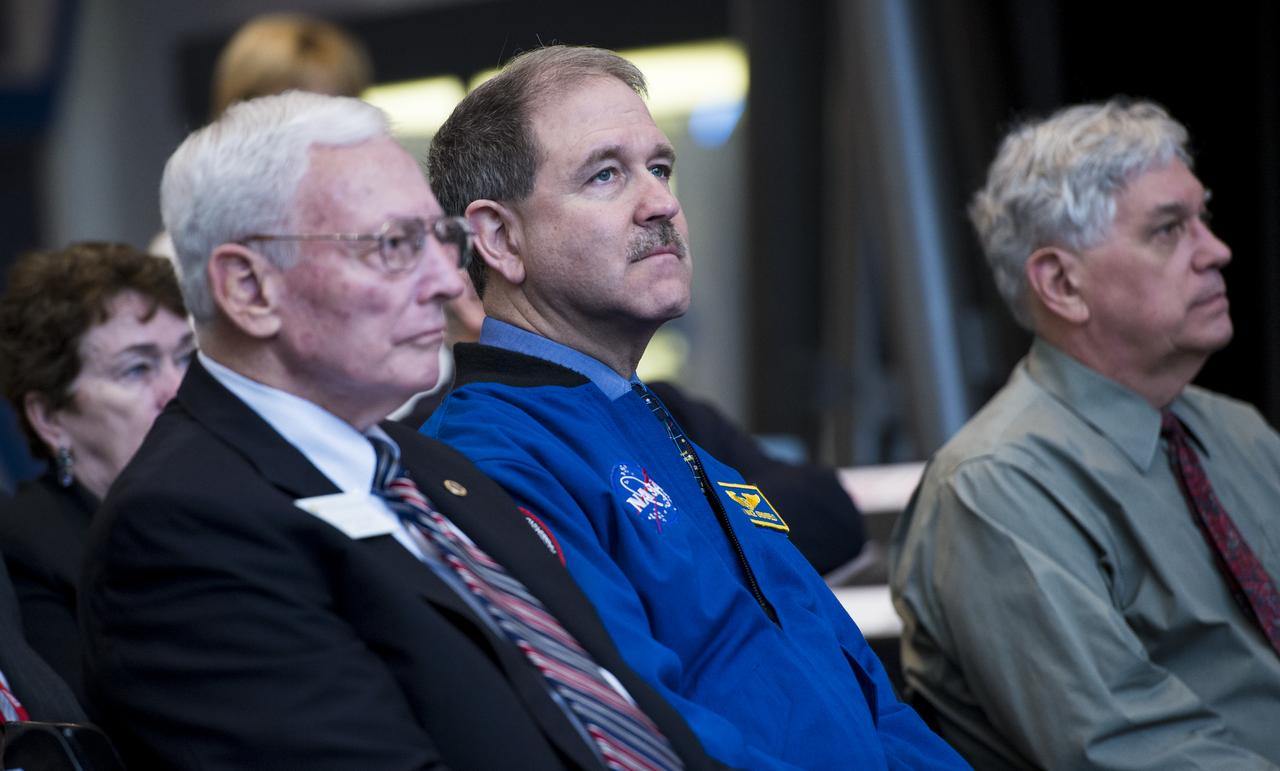
John Grunsfeld, NASA Associate Administrator for the Science Mission Directorate, is seen during during an event unveiling a new exhibit featuring Hubble's Corrective Optics Space Telescope Axial Replacement (COSTAR) and the Wide Field and Planetary Camera 2 (WFPC2) on Wednesday, April 23, 2014 at the Smithsonian National Air and Space Museum in Washington, DC. Grunsfeld flew on three of space shuttle servicing missions to Hubble, including the fifth and final mission in 2009 which returned COSTAR and WFPC2 to Earth. Photo Credit: (NASA/Joel Kowsky)
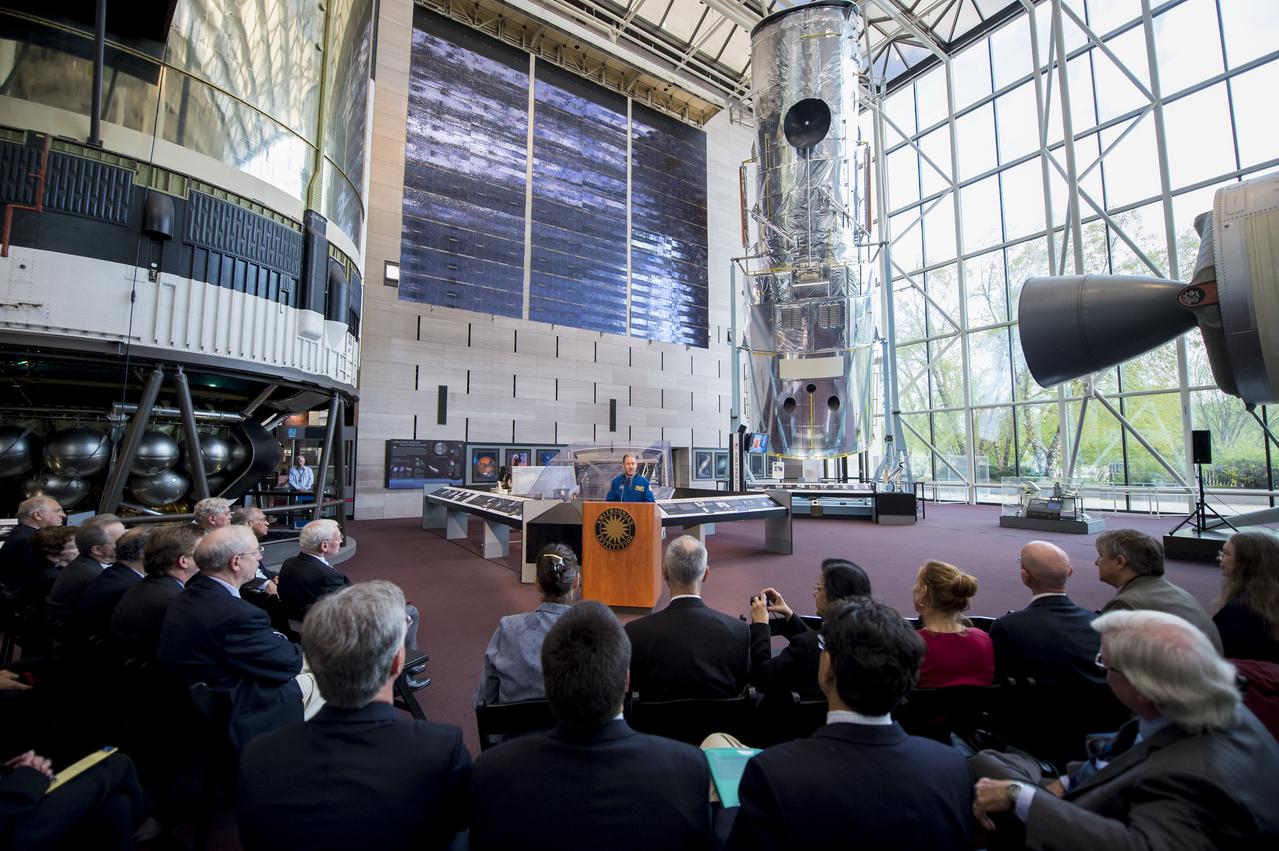
John Grunsfeld, NASA Associate Administrator for the Science Mission Directorate, speaks during an event unveiling a new exhibit featuring Hubble's Corrective Optics Space Telescope Axial Replacement (COSTAR) and the Wide Field and Planetary Camera 2 (WFPC2) on Wednesday, April 23, 2014 at the Smithsonian National Air and Space Museum in Washington, DC. Grunsfeld flew on three of space shuttle servicing missions to Hubble, including the fifth and final mission in 2009 which returned COSTAR and WFPC2 to Earth. Photo Credit: (NASA/Joel Kowsky)

Astronauts Jeffrey Hoffman and Story Musgrave install the Wide Field and Planetary Camera 2 (WFPC2) on the Hubble Space Telescope, during SM1 in December, 1993. https://photojournal.jpl.nasa.gov/catalog/PIA22911

Taken by the Wide Field Planetary Camera 2 (WFPC2) of the Hubble Space Telescope (HST), this image of MyCn18, a young planetary nebula located about 8,000 light-years away, reveals its true shape to be an hourglass with an intricate pattern of "etchings" in its walls. The arc-like etchings could be the remnants of discrete shells ejected from the star when it was younger, flow instabilities, or could result from the action of a narrow beam of matter impinging on the hourglass walls. According to one theory on the formation of planetary nebulae, the hourglass shape is produced by the expansion of a fast stellar wind within a slowly expanding cloud, which is denser near its equator than near its poles. Hubble has also revealed other features in MyCn18 which are completely new and unexpected. For example, there is a pair of intersecting elliptical rings in the central region which appear to be the rims of a smaller hourglass. This picture has been composed from three separate images taken in the light of ionized nitrogen (represented by red), hydrogen (green) and doubly-ionized oxygen (blue). The results are of great interest because they shed new light on the poorly understood ejection of stellar matter which accompanies the slow death of sun-like stars. An unseen companion star and accompanying gravitational effects may well be necessary in order to explain the structure of MyCn18. The Marshall Space Flight Center (MSFC) had responsibility for design, development, and construction of the HST.
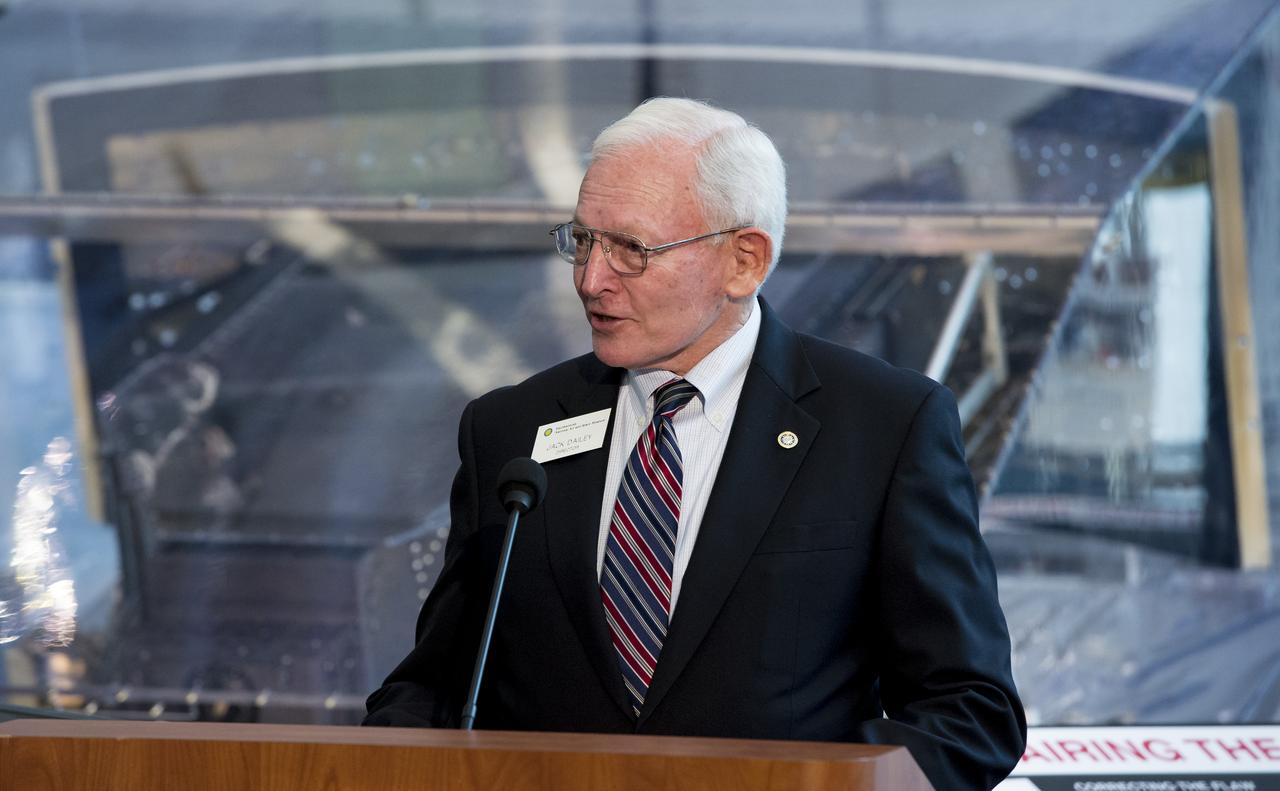
Gen. J.R. "Jack" Dailey, Director of the Smithsonian National Air and Space Museum speaks at an event unveiling a new exhibit featuring Hubble's Corrective Optics Space Telescope Axial Replacement (COSTAR) and the Wide Field and Planetary Camera 2 (WFPC2) on Wednesday, April 23, 2014 at the Smithsonian National Air and Space Museum in Washington, DC. COSTAR and WFPC2 were installed in Hubble during the first space shuttle servicing mission in 1993 and returned to Earth on the fifth and final servicing mission in 2009. Photo Credit: (NASA/Joel Kowsky)
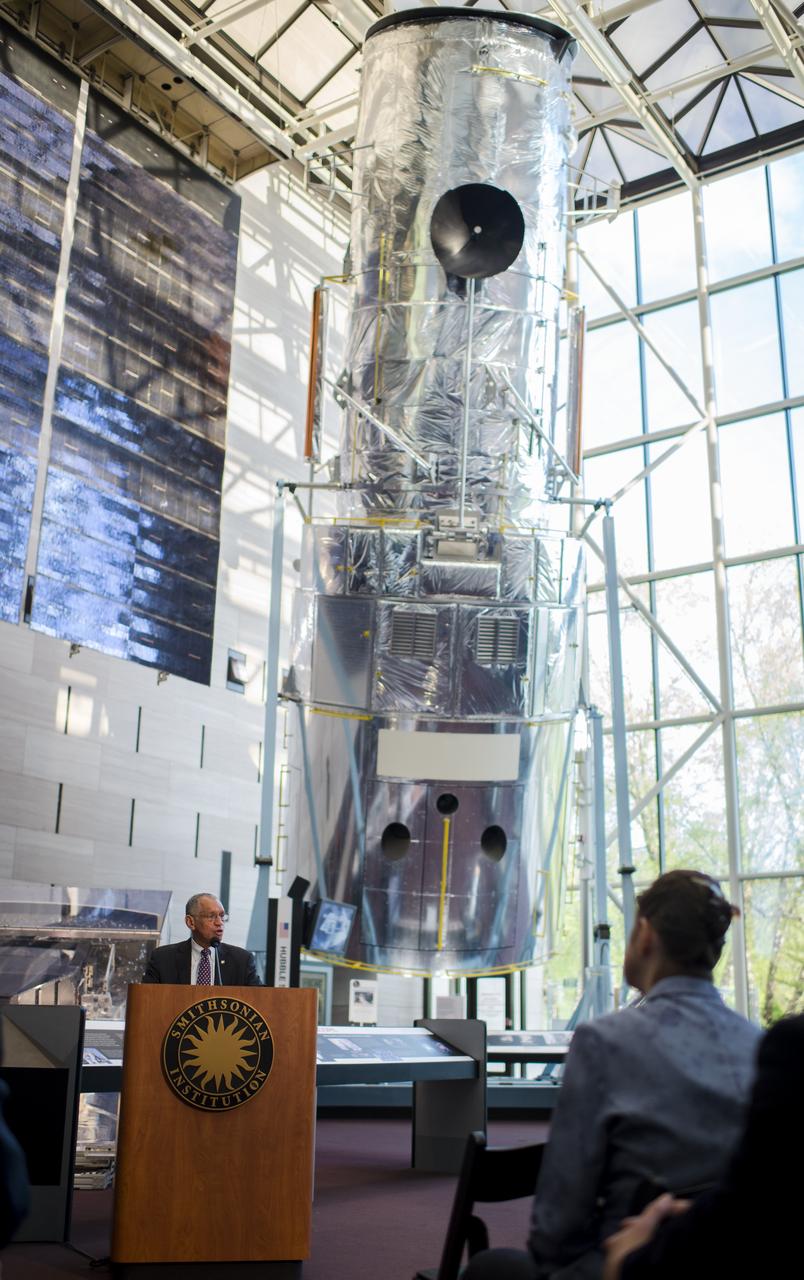
NASA Administrator Charles Bolden speaks at an event unveiling a new exhibit featuring Hubble's Corrective Optics Space Telescope Axial Replacement (COSTAR) and the Wide Field and Planetary Camera 2 (WFPC2) on Wednesday, April 23, 2014 at the Smithsonian National Air and Space Museum in Washington, DC. Administrator Bolden piloted space shuttle Discovery on the mission that deployed the Hubble Space Telescope in 1990. Photo Credit: (NASA/Joel Kowsky)
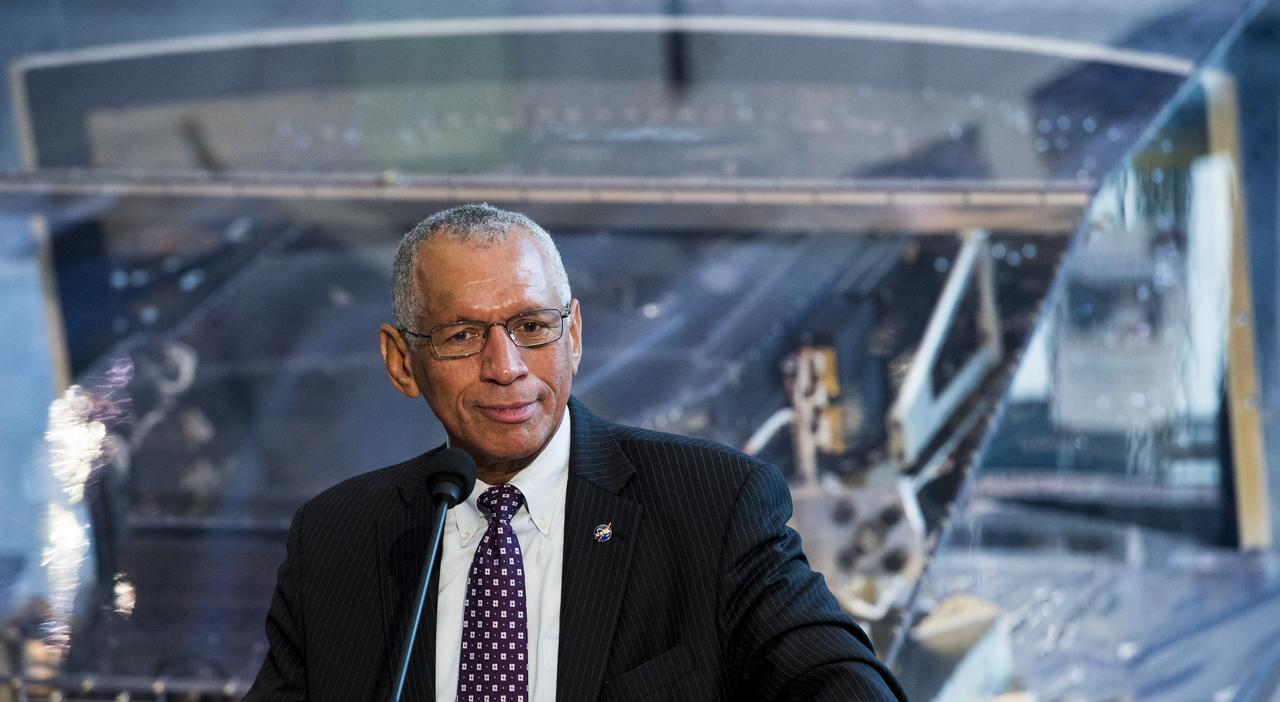
NASA Administrator Charles Bolden speaks at an event unveiling a new exhibit featuring Hubble's Corrective Optics Space Telescope Axial Replacement (COSTAR) and the Wide Field and Planetary Camera 2 (WFPC2) on Wednesday, April 23, 2014 at the Smithsonian National Air and Space Museum in Washington, DC. Administrator Bolden piloted space shuttle Discovery on the mission that deployed the Hubble Space Telescope in 1990. Photo Credit: (NASA/Joel Kowsky)

In the center of this image, taken with the NASA/ESA Hubble Space Telescope, is the galaxy cluster SDSS J1038+4849 — and it seems to be smiling. You can make out its two orange eyes and white button nose. In the case of this “happy face”, the two eyes are very bright galaxies and the misleading smile lines are actually arcs caused by an effect known as strong gravitational lensing. Galaxy clusters are the most massive structures in the Universe and exert such a powerful gravitational pull that they warp the spacetime around them and act as cosmic lenses which can magnify, distort and bend the light behind them. This phenomenon, crucial to many of Hubble’s discoveries, can be explained by Einstein’s theory of general relativity. In this special case of gravitational lensing, a ring — known as an Einstein Ring — is produced from this bending of light, a consequence of the exact and symmetrical alignment of the source, lens and observer and resulting in the ring-like structure we see here. Hubble has provided astronomers with the tools to probe these massive galaxies and model their lensing effects, allowing us to peer further into the early Universe than ever before. This object was studied by Hubble’s Wide Field and Planetary Camera 2 (WFPC2) and Wide Field Camera 3 (WFC3) as part of a survey of strong lenses. A version of this image was entered into the Hubble’s Hidden Treasures image processing competition by contestant Judy Schmidt. Image Credit: NASA/ESA
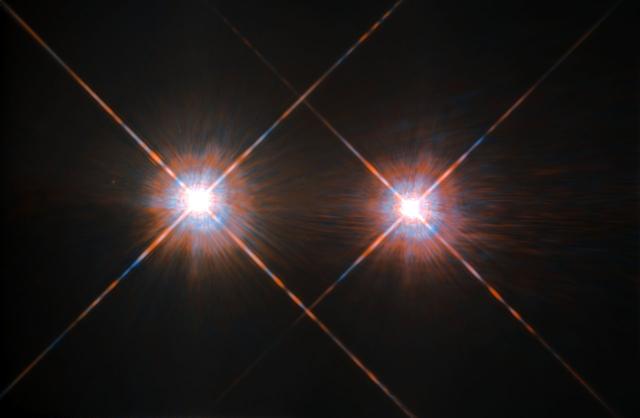
The closest star system to the Earth is the famous Alpha Centauri group. Located in the constellation of Centaurus (The Centaur), at a distance of 4.3 light-years, this system is made up of the binary formed by the stars Alpha Centauri A and Alpha Centauri B, plus the faint red dwarf Alpha Centauri C, also known as Proxima Centauri. This NASA/ESA Hubble Space Telescope has given us this stunning view of the bright Alpha Centauri A (on the left) and Alpha Centauri B (on the right), shining like huge cosmic headlamps in the dark. The image was captured by the Wide-Field and Planetary Camera 2 (WFPC2). WFPC2 was Hubble’s most used instrument for the first 13 years of the space telescope’s life, being replaced in 2009 by Wide-Field Camera 3 (WFC3) during Servicing Mission 4. This portrait of Alpha Centauri was produced by observations carried out at optical and near-infrared wavelengths. Compared to the sun, Alpha Centauri A is of the same stellar type, G2, and slightly bigger, while Alpha Centauri B, a K1-type star, is slightly smaller. They orbit a common center of gravity once every 80 years, with a minimum distance of about 11 times the distance between Earth and the sun. Because these two stars are, together with their sibling Proxima Centauri, the closest to Earth, they are among the best studied by astronomers. And they are also among the prime targets in the hunt for habitable exoplanets. Using the European Space Organization's HARPS instrument, astronomers already discovered a planet orbiting Alpha Centauri B. Then on Aug. 24, 2016, astronomers announced the intriguing discovery of a nearly Earth-sized planet in the habitable zone orbiting the star Proxima Centauri Image credit: ESA/NASA
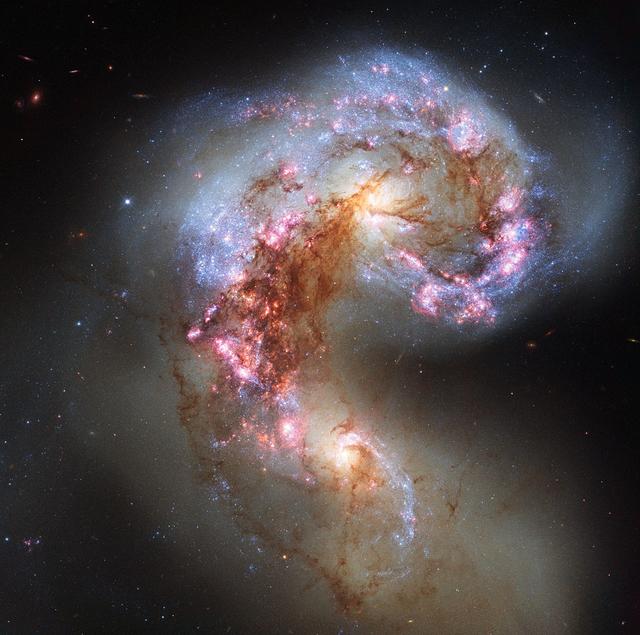
The NASA/ESA Hubble Space Telescope has snapped the best ever image of the Antennae Galaxies. Hubble has released images of these stunning galaxies twice before, once using observations from its Wide Field and Planetary Camera 2 (WFPC2) in 1997, and again in 2006 from the Advanced Camera for Surveys (ACS). Each of Hubble’s images of the Antennae Galaxies has been better than the last, due to upgrades made during the famous servicing missions, the last of which took place in 2009. The galaxies — also known as NGC 4038 and NGC 4039 — are locked in a deadly embrace. Once normal, sedate spiral galaxies like the Milky Way, the pair have spent the past few hundred million years sparring with one another. This clash is so violent that stars have been ripped from their host galaxies to form a streaming arc between the two. In wide-field images of the pair the reason for their name becomes clear — far-flung stars and streamers of gas stretch out into space, creating long tidal tails reminiscent of antennae. This new image of the Antennae Galaxies shows obvious signs of chaos. Clouds of gas are seen in bright pink and red, surrounding the bright flashes of blue star-forming regions — some of which are partially obscured by dark patches of dust. The rate of star formation is so high that the Antennae Galaxies are said to be in a state of starburst, a period in which all of the gas within the galaxies is being used to form stars. This cannot last forever and neither can the separate galaxies; eventually the nuclei will coalesce, and the galaxies will begin their retirement together as one large elliptical galaxy. This image uses visible and near-infrared observations from Hubble’s Wide Field Camera 3 (WFC3), along with some of the previously-released observations from Hubble’s Advanced Camera for Surveys (ACS). Credit: NASA/European Space Agency <b><a href="http://www.nasa.gov/audience/formedia/features/MP_Photo_Guidelines.html" rel="nofollow">NASA image use policy.</a></b> <b><a href="http://www.nasa.gov/centers/goddard/home/index.html" rel="nofollow">NASA Goddard Space Flight Center</a></b> enables NASA’s mission through four scientific endeavors: Earth Science, Heliophysics, Solar System Exploration, and Astrophysics. Goddard plays a leading role in NASA’s accomplishments by contributing compelling scientific knowledge to advance the Agency’s mission. <b>Follow us on <a href="http://twitter.com/NASA_GoddardPix" rel="nofollow">Twitter</a></b> <b>Like us on <a href="http://www.facebook.com/pages/Greenbelt-MD/NASA-Goddard/395013845897?ref=tsd" rel="nofollow">Facebook</a></b> <b>Find us on <a href="http://instagram.com/nasagoddard?vm=grid" rel="nofollow">Instagram</a></b>
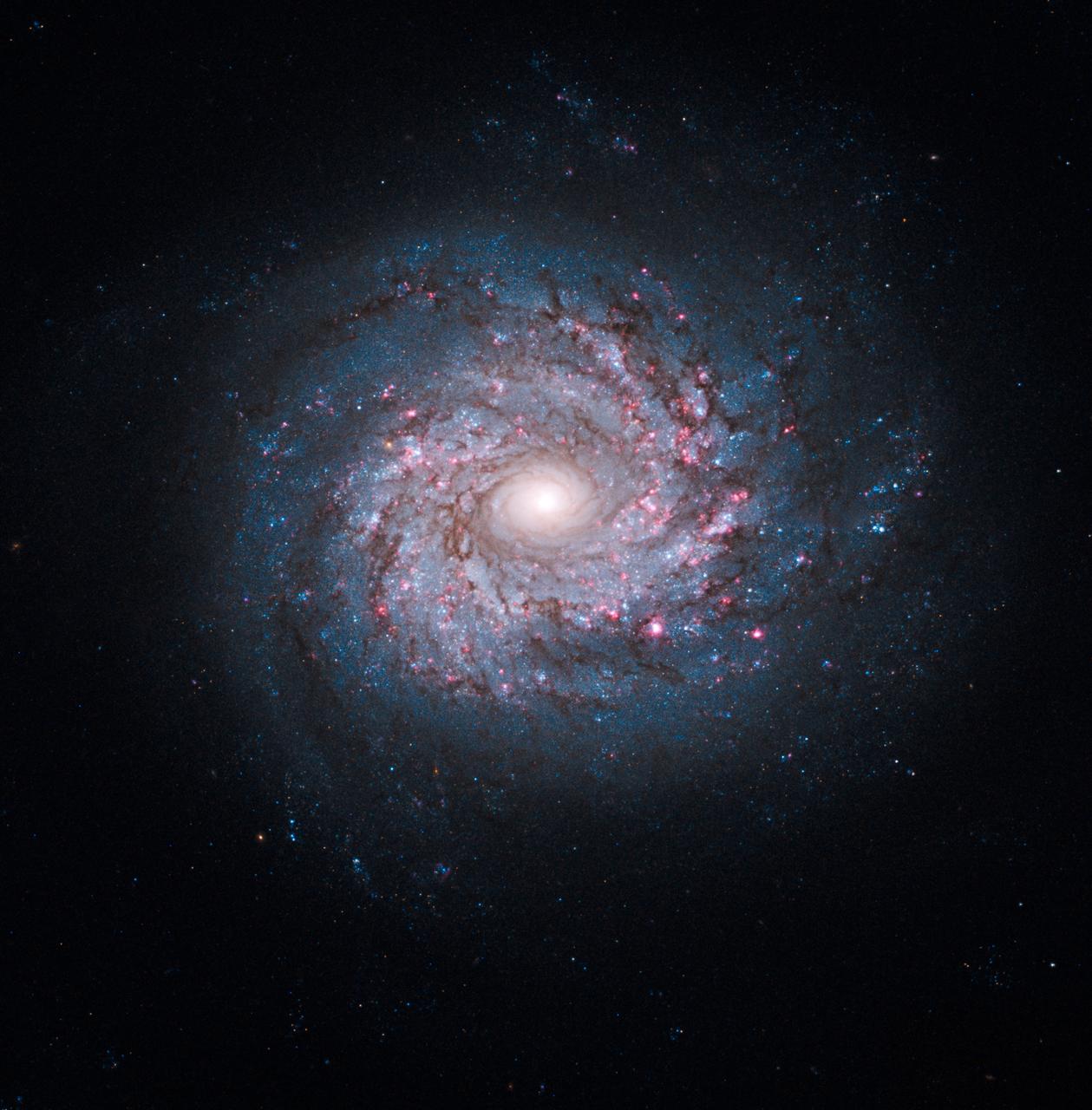
NASA image release October 19, 2010 Though the universe is chock full of spiral-shaped galaxies, no two look exactly the same. This face-on spiral galaxy, called NGC 3982, is striking for its rich tapestry of star birth, along with its winding arms. The arms are lined with pink star-forming regions of glowing hydrogen, newborn blue star clusters, and obscuring dust lanes that provide the raw material for future generations of stars. The bright nucleus is home to an older population of stars, which grow ever more densely packed toward the center. NGC 3982 is located about 68 million light-years away in the constellation Ursa Major. The galaxy spans about 30,000 light-years, one-third of the size of our Milky Way galaxy. This color image is composed of exposures taken by the Hubble Space Telescope's Wide Field Planetary Camera 2 (WFPC2), the Advanced Camera for Surveys (ACS), and the Wide Field Camera 3 (WFC3). The observations were taken between March 2000 and August 2009. The rich color range comes from the fact that the galaxy was photographed invisible and near-infrared light. Also used was a filter that isolates hydrogen emission that emanates from bright star-forming regions dotting the spiral arms. The Hubble Space Telescope is a project of international cooperation between NASA and the European Space Agency. NASA's Goddard Space Flight Center manages the telescope. The Space Telescope Science Institute (STScI) conducts Hubble science operations. STScI is operated for NASA by the Association of Universities for Research in Astronomy, Inc. in Washington, D.C. Credit: NASA, ESA, and the Hubble Heritage Team (STScI/AURA) Acknowledgment: A. Riess (STScI) <b><a href="http://www.nasa.gov/centers/goddard/home/index.html" rel="nofollow">NASA Goddard Space Flight Center</a></b> enables NASA’s mission through four scientific endeavors: Earth Science, Heliophysics, Solar System Exploration, and Astrophysics. Goddard plays a leading role in NASA’s accomplishments by contributing compelling scientific knowledge to advance the Agency’s mission. <b>Follow us on <a href="http://twitter.com/NASA_GoddardPix" rel="nofollow">Twitter</a></b> <b>Join us on <a href="http://www.facebook.com/pages/Greenbelt-MD/NASA-Goddard/395013845897?ref=tsd" rel="nofollow">Facebook</a></b>

For the 26th birthday of NASA’s Hubble Space Telescope, astronomers are highlighting a Hubble image of an enormous bubble being blown into space by a super-hot, massive star. The Hubble image of the Bubble Nebula, or NGC 7635, was chosen to mark the 26th anniversary of the launch of Hubble into Earth orbit by the STS-31 space shuttle crew on April 24, 1990 “As Hubble makes its 26th revolution around our home star, the sun, we celebrate the event with a spectacular image of a dynamic and exciting interaction of a young star with its environment. The view of the Bubble Nebula, crafted from WFC-3 images, reminds us that Hubble gives us a front row seat to the awe inspiring universe we live in,” said John Grunsfeld, Hubble astronaut and associate administrator of NASA’s Science Mission Directorate at NASA Headquarters, in Washington, D.C. The Bubble Nebula is seven light-years across—about one-and-a-half times the distance from our sun to its nearest stellar neighbor, Alpha Centauri, and resides 7,100 light-years from Earth in the constellation Cassiopeia. The seething star forming this nebula is 45 times more massive than our sun. Gas on the star gets so hot that it escapes away into space as a “stellar wind” moving at over four million miles per hour. This outflow sweeps up the cold, interstellar gas in front of it, forming the outer edge of the bubble much like a snowplow piles up snow in front of it as it moves forward. As the surface of the bubble's shell expands outward, it slams into dense regions of cold gas on one side of the bubble. This asymmetry makes the star appear dramatically off-center from the bubble, with its location in the 10 o’clock position in the Hubble view. Dense pillars of cool hydrogen gas laced with dust appear at the upper left of the picture, and more “fingers” can be seen nearly face-on, behind the translucent bubble. The gases heated to varying temperatures emit different colors: oxygen is hot enough to emit blue light in the bubble near the star, while the cooler pillars are yellow from the combined light of hydrogen and nitrogen. The pillars are similar to the iconic columns in the “Pillars of Creation” Eagle Nebula. As seen with the structures in the Eagle Nebula, the Bubble Nebula pillars are being illuminated by the strong ultraviolet radiation from the brilliant star inside the bubble. The Bubble Nebula was discovered in 1787 by William Herschel, a prominent British astronomer. It is being formed by a proto-typical Wolf-Rayet star, BD +60º2522, an extremely bright, massive, and short-lived star that has lost most of its outer hydrogen and is now fusing helium into heavier elements. The star is about four million years old, and in 10 million to 20 million years, it will likely detonate as a supernova. Hubble’s Wide Field Camera-3 imaged the nebula in visible light with unprecedented clarity in February 2016. The colors correspond to blue for oxygen, green for hydrogen, and red for nitrogen. This information will help astronomers understand the geometry and dynamics of this complex system. The Bubble Nebula is one of only a handful of astronomical objects that have been observed with several different instruments onboard Hubble. Hubble also imaged it with the Wide Field Planetary Camera (WFPC) in September 1992, and with Wide Field Planetary Camera-2 (WFPC2) in April 1999. The Hubble Space Telescope is a project of international cooperation between NASA and the European Space Agency. NASA's Goddard Space Flight Center in Greenbelt, Maryland, manages the telescope. The Space Telescope Science Institute (STScI) in Baltimore, Maryland, conducts Hubble science operations. STScI is operated for NASA by the Association of Universities for Research in Astronomy in Washington, D.C. Credit: NASA, ESA, and the Hubble Heritage Team (STScI/AURA)

For the 26th birthday of NASA’s Hubble Space Telescope, astronomers are highlighting a Hubble image of an enormous bubble being blown into space by a super-hot, massive star. The Hubble image of the Bubble Nebula, or NGC 7635, was chosen to mark the 26th anniversary of the launch of Hubble into Earth orbit by the STS-31 space shuttle crew on April 24, 1990 “As Hubble makes its 26th revolution around our home star, the sun, we celebrate the event with a spectacular image of a dynamic and exciting interaction of a young star with its environment. The view of the Bubble Nebula, crafted from WFC-3 images, reminds us that Hubble gives us a front row seat to the awe inspiring universe we live in,” said John Grunsfeld, Hubble astronaut and associate administrator of NASA’s Science Mission Directorate at NASA Headquarters, in Washington, D.C. The Bubble Nebula is seven light-years across—about one-and-a-half times the distance from our sun to its nearest stellar neighbor, Alpha Centauri, and resides 7,100 light-years from Earth in the constellation Cassiopeia. The seething star forming this nebula is 45 times more massive than our sun. Gas on the star gets so hot that it escapes away into space as a “stellar wind” moving at over four million miles per hour. This outflow sweeps up the cold, interstellar gas in front of it, forming the outer edge of the bubble much like a snowplow piles up snow in front of it as it moves forward. As the surface of the bubble's shell expands outward, it slams into dense regions of cold gas on one side of the bubble. This asymmetry makes the star appear dramatically off-center from the bubble, with its location in the 10 o’clock position in the Hubble view. Dense pillars of cool hydrogen gas laced with dust appear at the upper left of the picture, and more “fingers” can be seen nearly face-on, behind the translucent bubble. The gases heated to varying temperatures emit different colors: oxygen is hot enough to emit blue light in the bubble near the star, while the cooler pillars are yellow from the combined light of hydrogen and nitrogen. The pillars are similar to the iconic columns in the “Pillars of Creation” Eagle Nebula. As seen with the structures in the Eagle Nebula, the Bubble Nebula pillars are being illuminated by the strong ultraviolet radiation from the brilliant star inside the bubble. The Bubble Nebula was discovered in 1787 by William Herschel, a prominent British astronomer. It is being formed by a proto-typical Wolf-Rayet star, BD +60º2522, an extremely bright, massive, and short-lived star that has lost most of its outer hydrogen and is now fusing helium into heavier elements. The star is about four million years old, and in 10 million to 20 million years, it will likely detonate as a supernova. Hubble’s Wide Field Camera-3 imaged the nebula in visible light with unprecedented clarity in February 2016. The colors correspond to blue for oxygen, green for hydrogen, and red for nitrogen. This information will help astronomers understand the geometry and dynamics of this complex system. The Bubble Nebula is one of only a handful of astronomical objects that have been observed with several different instruments onboard Hubble. Hubble also imaged it with the Wide Field Planetary Camera (WFPC) in September 1992, and with Wide Field Planetary Camera-2 (WFPC2) in April 1999. The Hubble Space Telescope is a project of international cooperation between NASA and the European Space Agency. NASA's Goddard Space Flight Center in Greenbelt, Maryland, manages the telescope. The Space Telescope Science Institute (STScI) in Baltimore, Maryland, conducts Hubble science operations. STScI is operated for NASA by the Association of Universities for Research in Astronomy in Washington, D.C. Credit: NASA, ESA, and the Hubble Heritage Team (STScI/AURA)
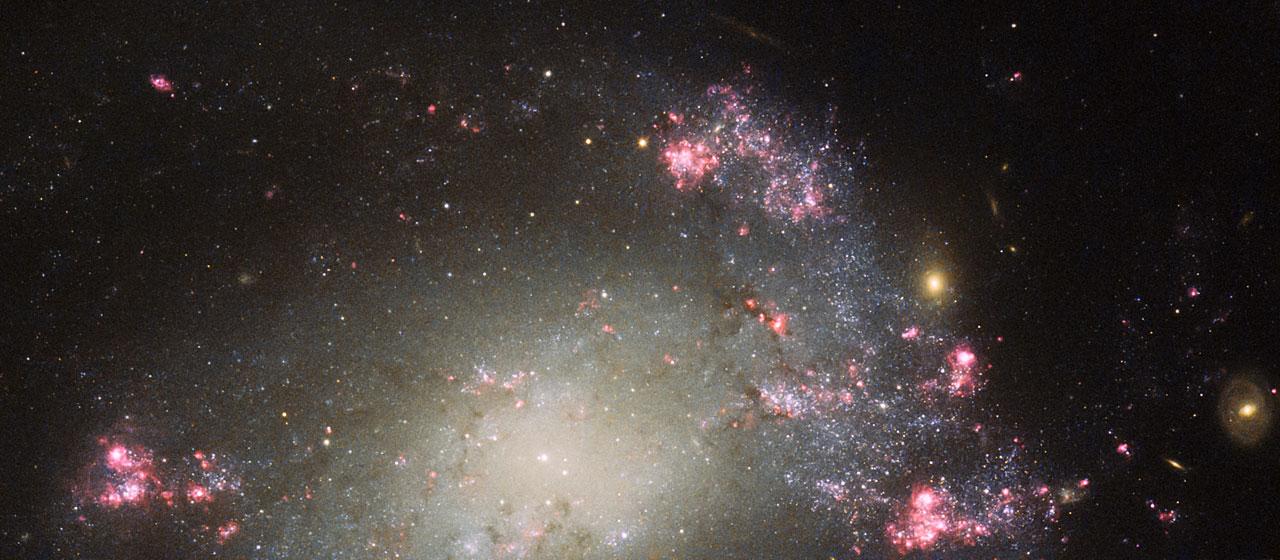
Bursts of pink and red, dark lanes of mottled cosmic dust, and a bright scattering of stars — this NASA/ESA Hubble Space Telescope image shows part of a messy barred spiral galaxy known as NGC 428. It lies approximately 48 million light-years away from Earth in the constellation of Cetus (The Sea Monster). Although a spiral shape is still just about visible in this close-up shot, overall NGC 428’s spiral structure appears to be quite distorted and warped, thought to be a result of a collision between two galaxies. There also appears to be a substantial amount of star formation occurring within NGC 428 — another telltale sign of a merger. When galaxies collide their clouds of gas can merge, creating intense shocks and hot pockets of gas and often triggering new waves of star formation. NGC 428 was discovered by William Herschel in December 1786. More recently a type Ia supernova designated SN2013ct was discovered within the galaxy by Stuart Parker of the BOSS (Backyard Observatory Supernova Search) project in Australia and New Zealand, although it is unfortunately not visible in this image. This image was captured by Hubble’s Advanced Camera for Surveys (ACS) and Wide Field and Planetary Camera 2 (WFPC2). A version of this image was entered into the Hubble’s Hidden Treasures Image Processing competition by contestants Nick Rose and the Flickr user penninecloud. Links: Nick Rose’s image on Flickr Penninecloud’s image on Flickr
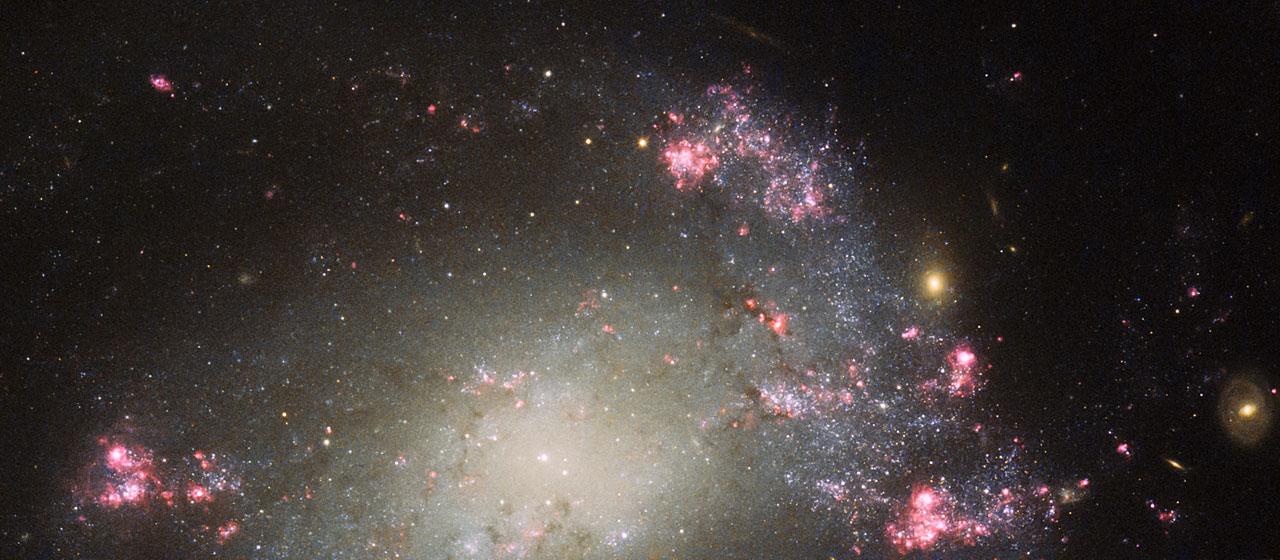
Bursts of pink and red, dark lanes of mottled cosmic dust, and a bright scattering of stars — this NASA/ESA Hubble Space Telescope image shows part of a messy barred spiral galaxy known as NGC 428. It lies approximately 48 million light-years away from Earth in the constellation of Cetus (The Sea Monster). Although a spiral shape is still just about visible in this close-up shot, overall NGC 428’s spiral structure appears to be quite distorted and warped, thought to be a result of a collision between two galaxies. There also appears to be a substantial amount of star formation occurring within NGC 428 — another telltale sign of a merger. When galaxies collide their clouds of gas can merge, creating intense shocks and hot pockets of gas, and often triggering new waves of star formation. NGC 428 was discovered by William Herschel in December 1786. More recently a type of supernova designated SN2013ct was discovered within the galaxy by Stuart Parker of the BOSS (Backyard Observatory Supernova Search) project in Australia and New Zealand, although it is unfortunately not visible in this image. This image was captured by Hubble’s Advanced Camera for Surveys (ACS) and Wide Field and Planetary Camera 2 (WFPC2). Image credit: ESA/Hubble and NASA and S. Smartt (Queen's University Belfast), Acknowledgements: Nick Rose and Flickr user pennine cloud <b><a href="http://www.nasa.gov/audience/formedia/features/MP_Photo_Guidelines.html" rel="nofollow">NASA image use policy.</a></b> <b><a href="http://www.nasa.gov/centers/goddard/home/index.html" rel="nofollow">NASA Goddard Space Flight Center</a></b> enables NASA’s mission through four scientific endeavors: Earth Science, Heliophysics, Solar System Exploration, and Astrophysics. Goddard plays a leading role in NASA’s accomplishments by contributing compelling scientific knowledge to advance the Agency’s mission. <b>Follow us on <a href="http://twitter.com/NASAGoddardPix" rel="nofollow">Twitter</a></b> <b>Like us on <a href="http://www.facebook.com/pages/Greenbelt-MD/NASA-Goddard/395013845897?ref=tsd" rel="nofollow">Facebook</a></b> <b>Find us on <a href="http://instagrid.me/nasagoddard/?vm=grid" rel="nofollow">Instagram</a></b>
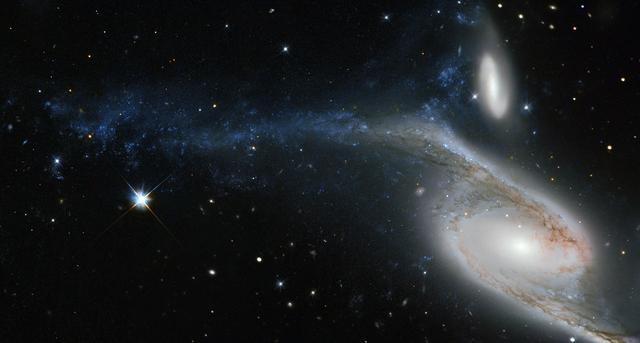
This picture, taken by the NASA/ESA Hubble Space Telescope’s Wide Field Planetary Camera 2 (WFPC2), shows a galaxy known as NGC 6872 in the constellation of Pavo (The Peacock). Its unusual shape is caused by its interactions with the smaller galaxy that can be seen just above NGC 6872, called IC 4970. They both lie roughly 300 million light-years away from Earth. From tip to tip, NGC 6872 measures over 500,000 light-years across, making it the second largest spiral galaxy discovered to date. In terms of size it is beaten only by NGC 262, a galaxy that measures a mind-boggling 1.3 million light-years in diameter! To put that into perspective, our own galaxy, the Milky Way, measures between 100,000 and 120,000 light-years across, making NGC 6872 about five times its size. The upper left spiral arm of NGC 6872 is visibly distorted and is populated by star-forming regions, which appear blue on this image. This may have been be caused by IC 4970 recently passing through this arm — although here, recent means 130 million years ago! Astronomers have noted that NGC 6872 seems to be relatively sparse in terms of free hydrogen, which is the basis material for new stars, meaning that if it weren’t for its interactions with IC 4970, NGC 6872 might not have been able to produce new bursts of star formation. Credit: Image credit: ESA/Hubble & NASA / Acknowledgement: Judy Schmidt <b><a href="http://www.nasa.gov/audience/formedia/features/MP_Photo_Guidelines.html" rel="nofollow">NASA image use policy.</a></b> <b><a href="http://www.nasa.gov/centers/goddard/home/index.html" rel="nofollow">NASA Goddard Space Flight Center</a></b> enables NASA’s mission through four scientific endeavors: Earth Science, Heliophysics, Solar System Exploration, and Astrophysics. Goddard plays a leading role in NASA’s accomplishments by contributing compelling scientific knowledge to advance the Agency’s mission. <b>Follow us on <a href="http://twitter.com/NASAGoddardPix" rel="nofollow">Twitter</a></b> <b>Like us on <a href="http://www.facebook.com/pages/Greenbelt-MD/NASA-Goddard/395013845897?ref=tsd" rel="nofollow">Facebook</a></b> <b>Find us on <a href="http://instagram.com/nasagoddard?vm=grid" rel="nofollow">Instagram</a></b>
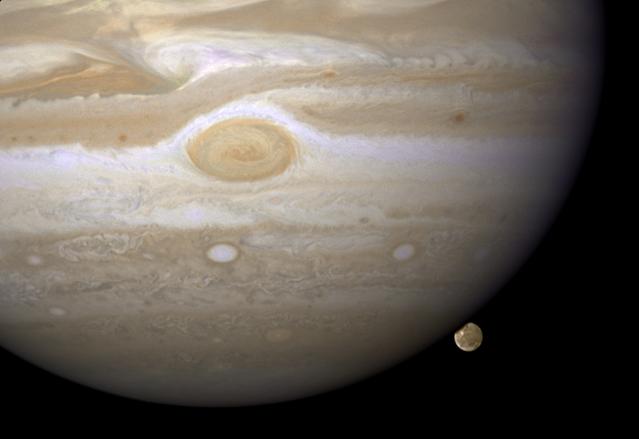
Hubble Catches Jupiter's Largest Moon Going to the 'Dark Side' HST/WFPC2 Image of Jupiter and Ganymede Taken April 9, 2007 NASA's Hubble Space Telescope has caught Jupiter's moon Ganymede playing a game of "peek-a-boo." In this crisp Hubble image, Ganymede is shown just before it ducks behind the giant planet. Ganymede completes an orbit around Jupiter every seven days. Because Ganymede's orbit is tilted nearly edge-on to Earth, it routinely can be seen passing in front of and disappearing behind its giant host, only to reemerge later. Composed of rock and ice, Ganymede is the largest moon in our solar system. It is even larger than the planet Mercury. But Ganymede looks like a dirty snowball next to Jupiter, the largest planet in our solar system. Jupiter is so big that only part of its Southern Hemisphere can be seen in this image. Hubble's view is so sharp that astronomers can see features on Ganymede's surface, most notably the white impact crater, Tros, and its system of rays, bright streaks of material blasted from the crater. Tros and its ray system are roughly the width of Arizona. The image also shows Jupiter's Great Red Spot, the large eye-shaped feature at upper left. A storm the size of two Earths, the Great Red Spot has been raging for more than 300 years. Hubble's sharp view of the gas giant planet also reveals the texture of the clouds in the Jovian atmosphere as well as various other storms and vortices. Astronomers use these images to study Jupiter's upper atmosphere. As Ganymede passes behind the giant planet, it reflects sunlight, which then passes through Jupiter's atmosphere. Imprinted on that light is information about the gas giant's atmosphere, which yields clues about the properties of Jupiter's high-altitude haze above the cloud tops. This color image was made from three images taken on April 9, 2007, with the Wide Field Planetary Camera 2 in red, green, and blue filters. The image shows Jupiter and Ganymede in close to natural colors. For additional information go to: <a href="http://hubblesite.org/newscenter/archive/releases/2008/42/" rel="nofollow">hubblesite.org/newscenter/archive/releases/2008/42/</a> Credit: NASA, ESA, and E. Karkoschka (University of Arizona) <b><a href="http://www.nasa.gov/audience/formedia/features/MP_Photo_Guidelines.html" rel="nofollow">NASA image use policy.</a></b> <b><a href="http://www.nasa.gov/centers/goddard/home/index.html" rel="nofollow">NASA Goddard Space Flight Center</a></b> enables NASA’s mission through four scientific endeavors: Earth Science, Heliophysics, Solar System Exploration, and Astrophysics. Goddard plays a leading role in NASA’s accomplishments by contributing compelling scientific knowledge to advance the Agency’s mission. <b>Follow us on <a href="http://twitter.com/NASAGoddardPix" rel="nofollow">Twitter</a></b> <b>Like us on <a href="http://www.facebook.com/pages/Greenbelt-MD/NASA-Goddard/395013845897?ref=tsd" rel="nofollow">Facebook</a></b> <b>Find us on <a href="http://instagram.com/nasagoddard?vm=grid" rel="nofollow">Instagram</a></b>