
Terrence Wilcutt, NASA Chief Safety and Mission Assurance, addresses an audience of GRC managers during a Lessons In Leadership Series, Executive Leadership Workshop at Glenn Research Center. August 13, 2019.
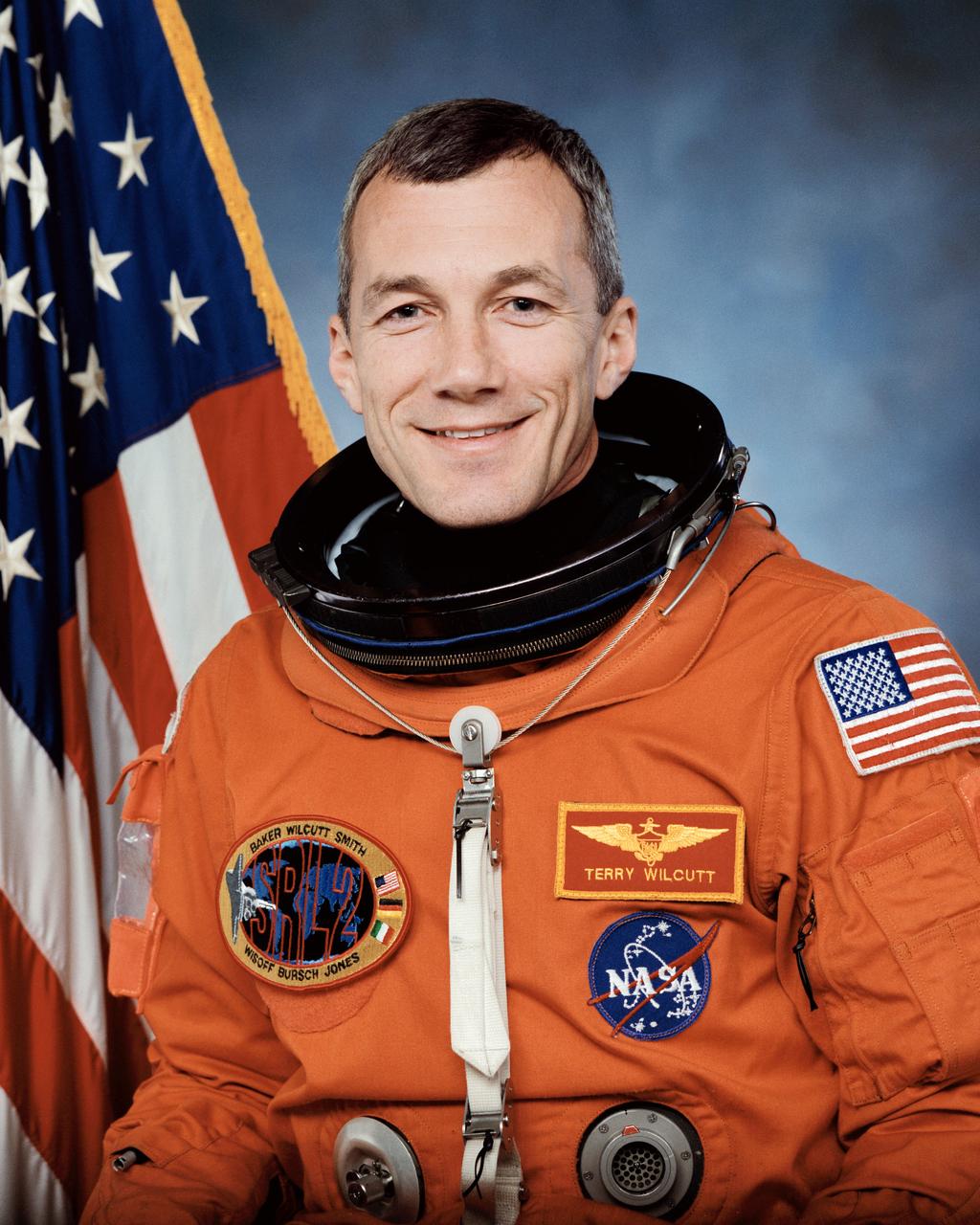
S94-31663 (7 April 1994) --- Astronaut Terrence W. Wilcutt, commander. Photo credit: NASA

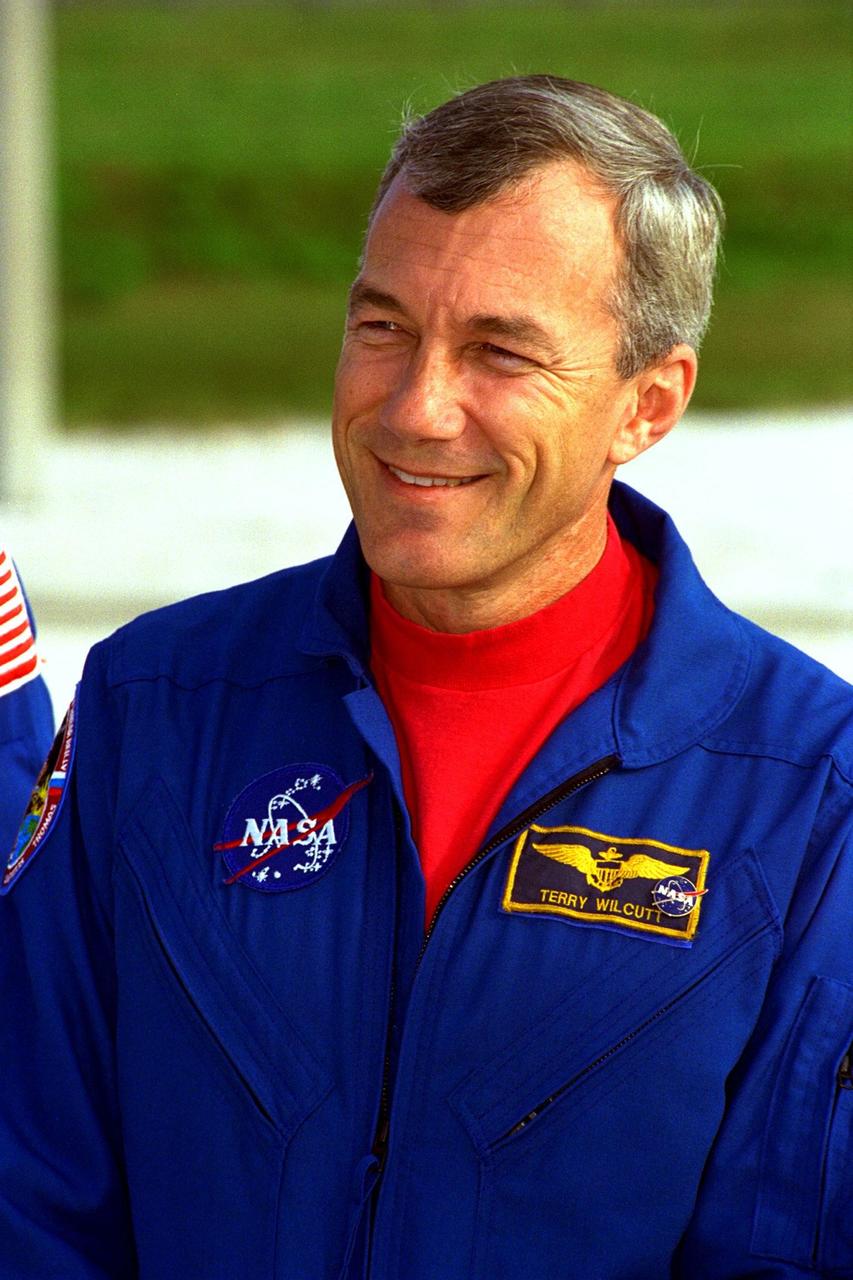
JSC2003-E-041874 (19 June 2003) ---- Official portrait of astronaut Terrence W. Wilcutt. Photo credit: NASA
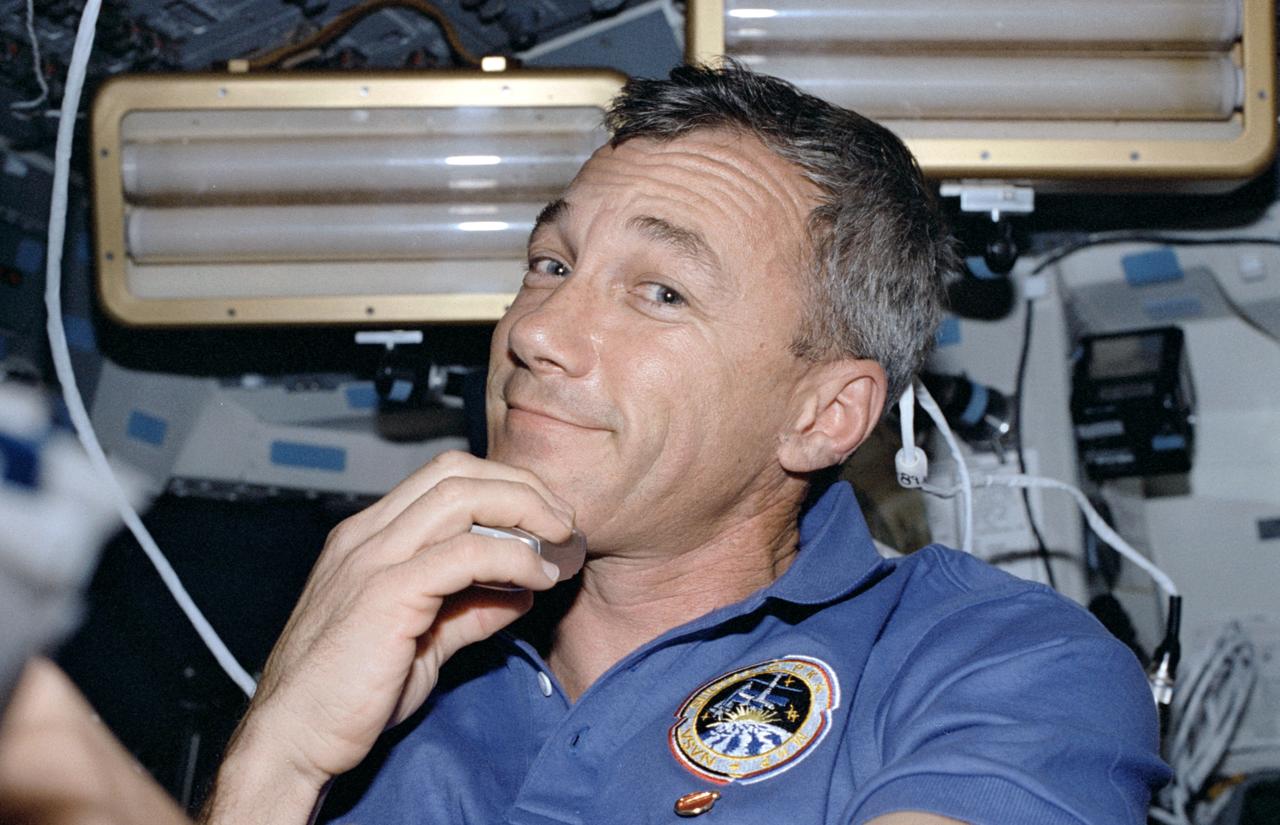
STS089-375-018 (22-31 Jan. 1998) --- Astronaut Terrence W. (Terry) Wilcutt, STS-89 mission commander, uses a battery-powered razor to shave aboard the Earth-orbiting space shuttle Endeavour. Photo credit: NASA
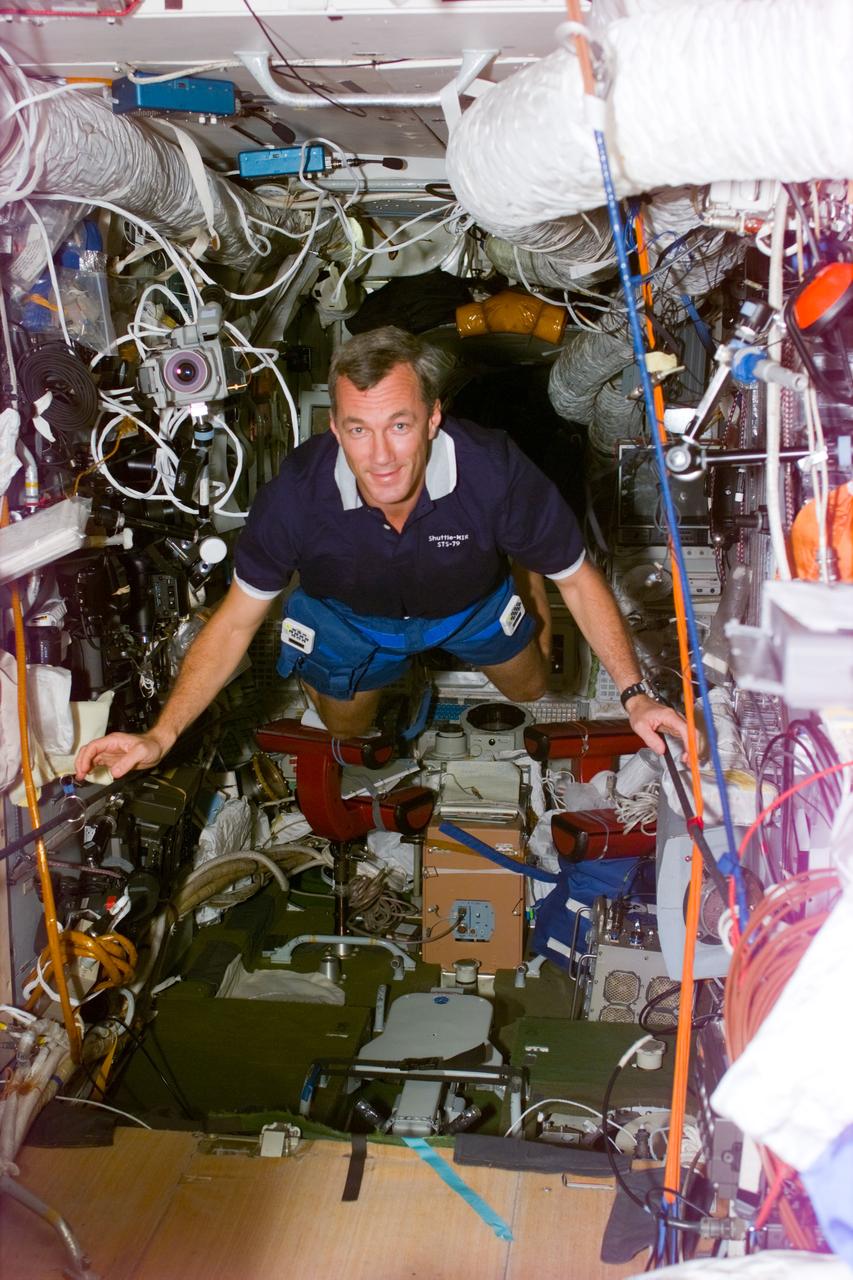
STS79-E-5198 (21 September 1996) --- Astronaut Terrence W. Wilcutt, STS-79 pilot, floats through Russia's Mir Space Station Base Block Module, during Flight Day 6.
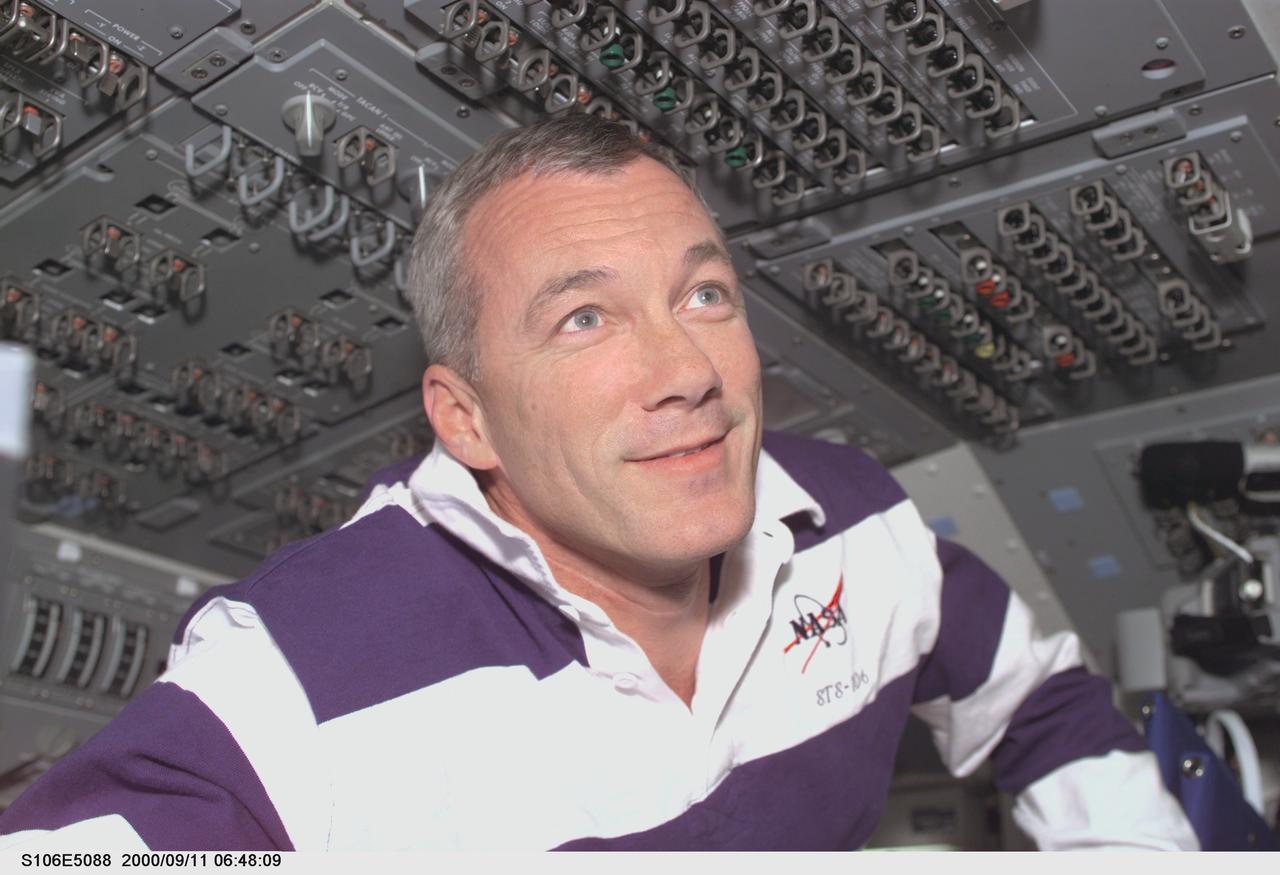
S106-E-5088 (11 September 2000) --- Astronaut Terrence W. Wilcutt, mission commander, on the flight deck of the Space Shuttle Atlantis during Flight Day 3 activity.
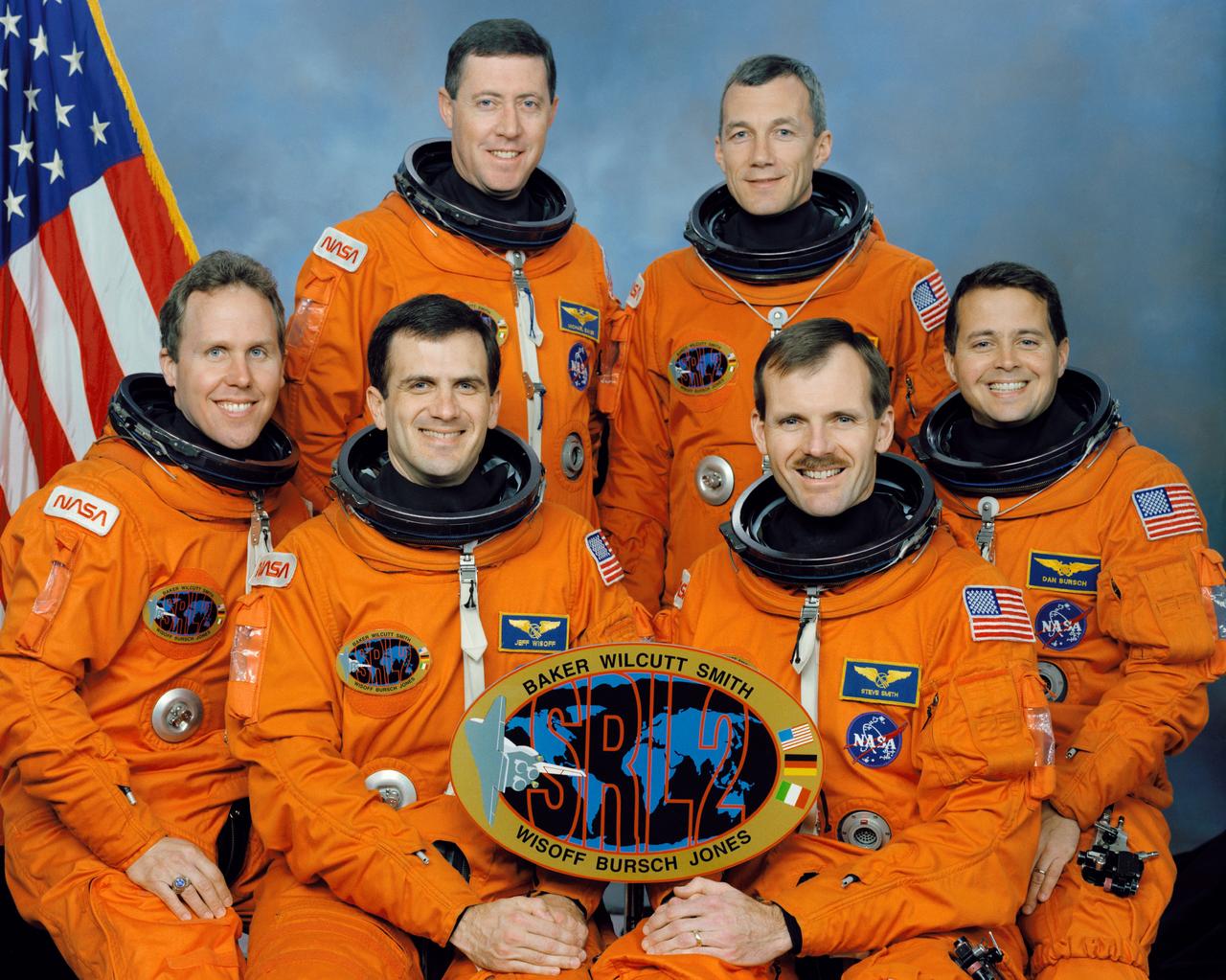
These six NASA astronauts composed the crew of the STS-68 mission that launched aboard the Space Shuttle Endeavour on September 30, 1994. Standing are, left to right, Michael A. Baker, mission commander; and Terrence W. Wilcutt, pilot. On the front row are, left to right, Thomas D. Jones, payload commander; and Peter J. K. (Jeff) Wisoff, Steven L. Smith, and Daniel W. Bursch, all mission specialists. STS-68 marked the second flight of the Space Radar Laboratory, part of NASA’s mission to planet Earth.
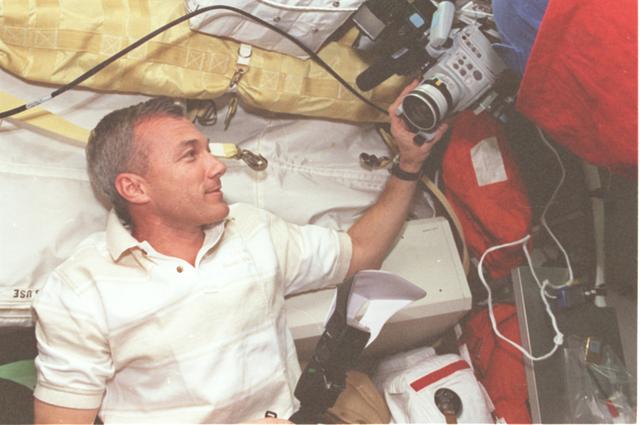
STS089-364-019 (22-31 Jan. 1998) --- Astronaut Terrence W. (Terry) Wilcutt, STS-89 mission commander, adjusts a camcorder onboard the Earth-orbiting space shuttle Endeavour. The Primary Life Support System (PLSS) for an Extravehicular Mobility Unit (EMU) is stored nearby. Though no extravehicular activity (EVA) was planned for the nine-day mission, the EMU spacesuit was carried onboard in the event a contingency EVA was required. Photo credit: NASA
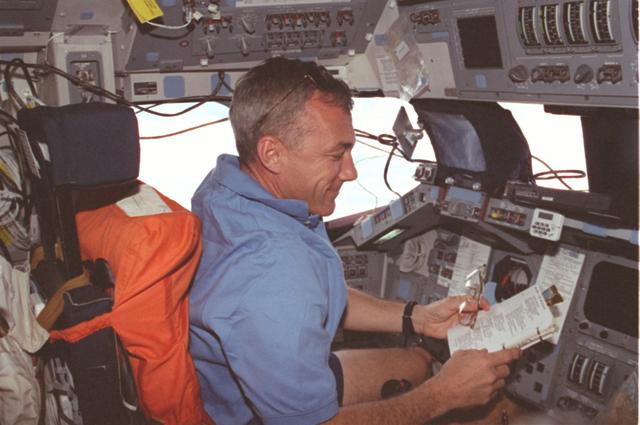
STS089-362-010 (22-31 Jan. 1998) --- Astronaut Terrence W. (Terry) Wilcutt, STS-89 mission commander, peruses data on a checklist at the commander's station on the port side of the space shuttle Endeavour's flight deck. Photo credit: NASA
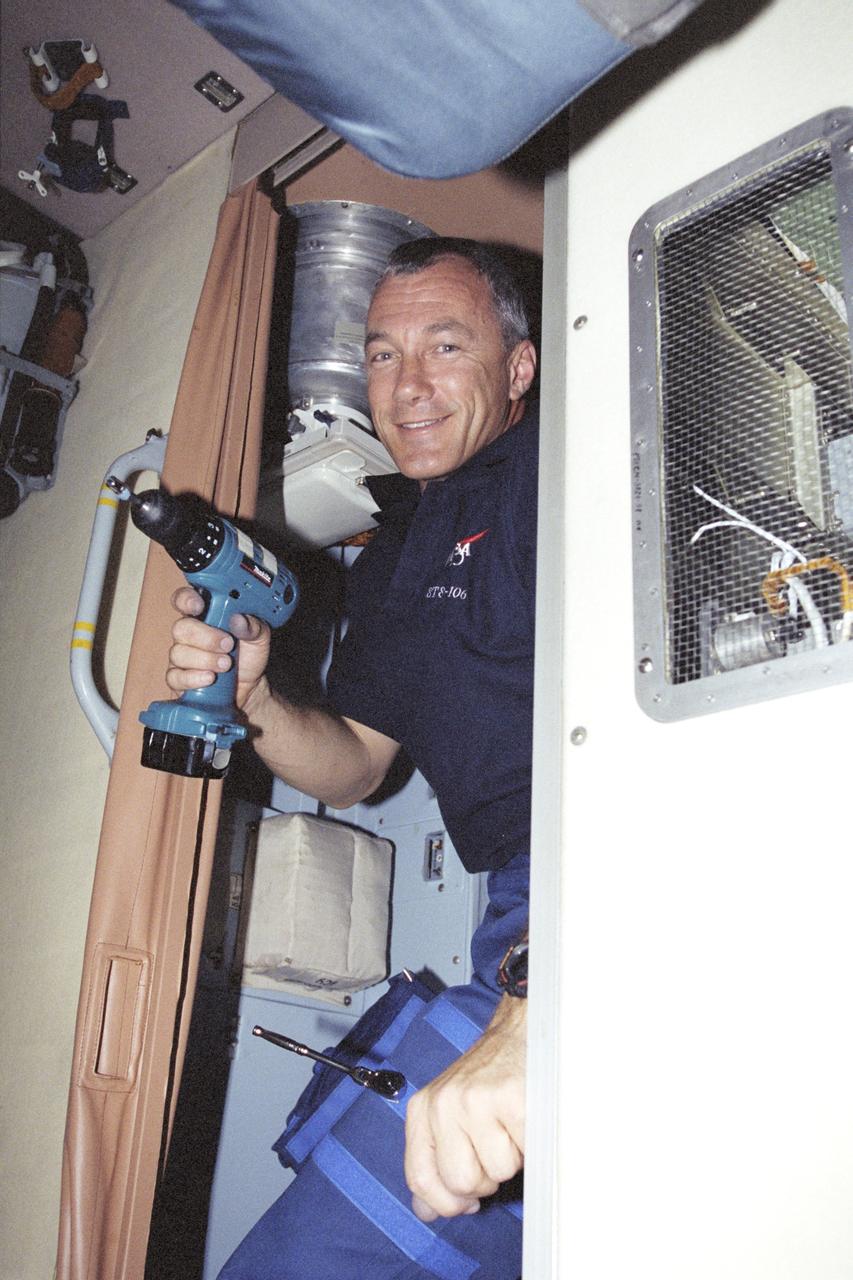
STS106-389-023 (8-20 September 2000) --- Astronaut Terrence W. Wilcutt, STS-106 commander, uses a drill during installation work in the Service Module, which linked with the International Space Station (ISS) in July of this year. Wilcutt and four other astronauts, along with two cosmonauts, teamed to perform electrician's work and other detail work on the new addition.
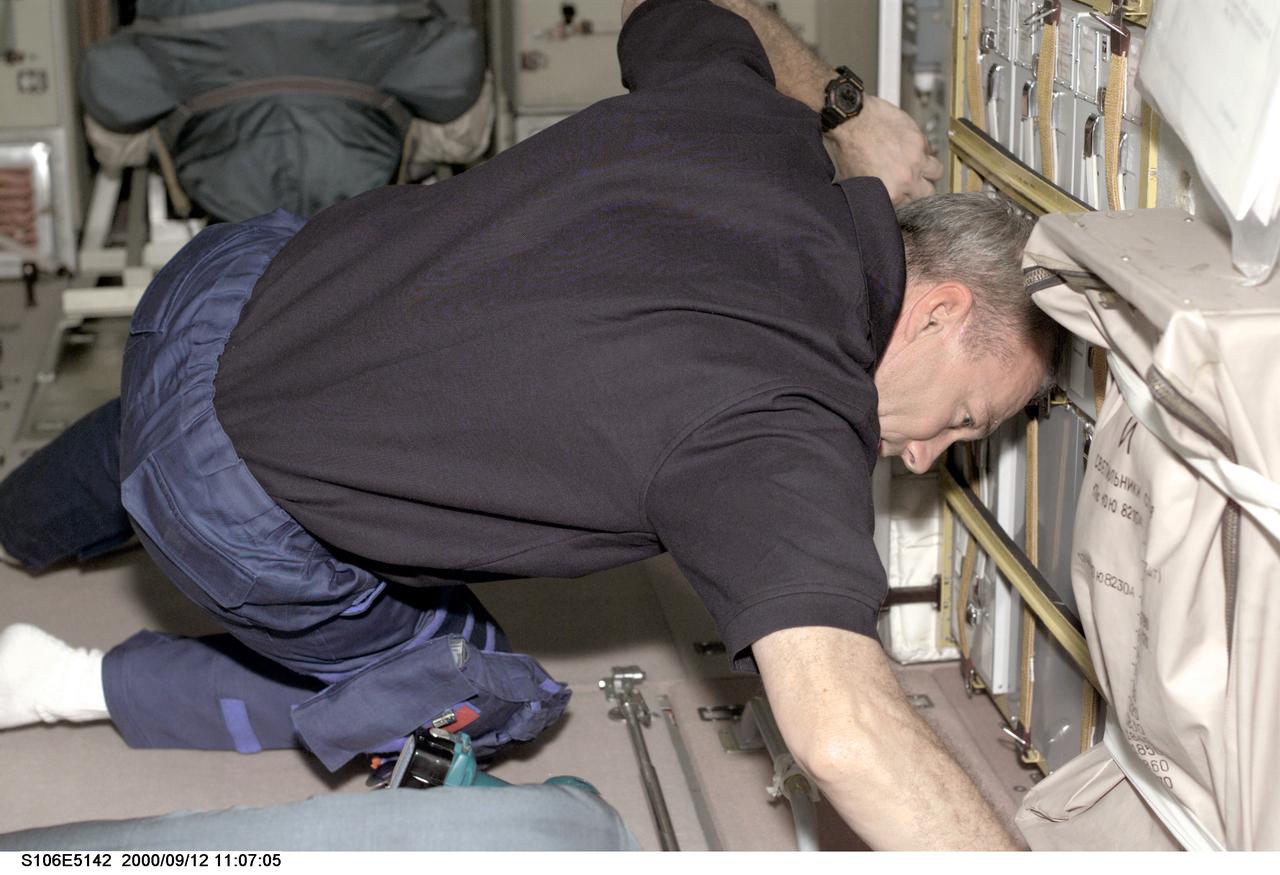
STS106-E-5142 (12 September 2000) --- Astronaut Terrence W. Wilcutt, mission commander, works to prepare the interior of the Zvezda service module on the International Space Station (ISS) for astronauts and cosmonauts who will soon start to live there.
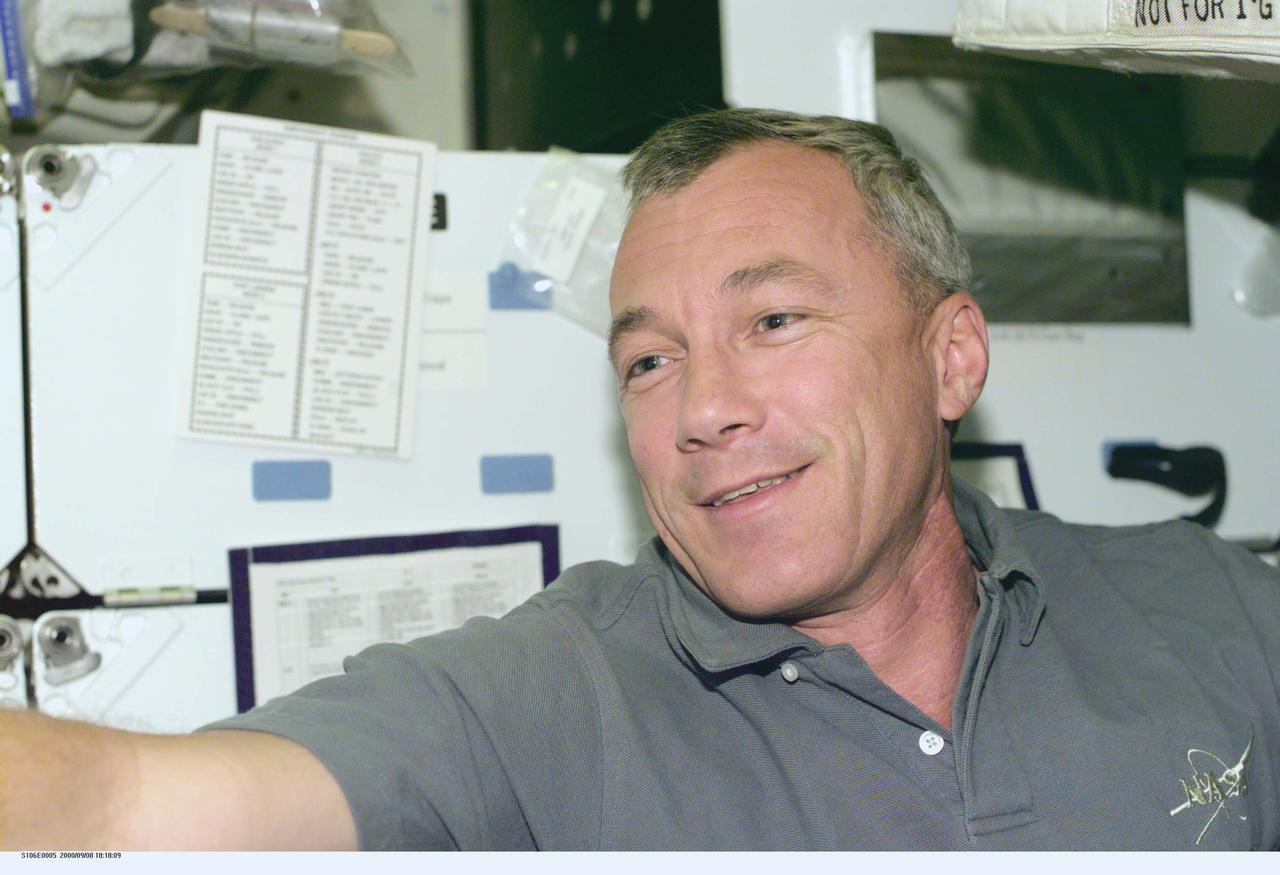
S106-E-5005 (8 September 2000) --- Astronaut Terrence W. Wilcutt, mission commander, participates in early tasks aboard the Space Shuttle Atlantis, now headed toward its date with the International Space Station (ISS).
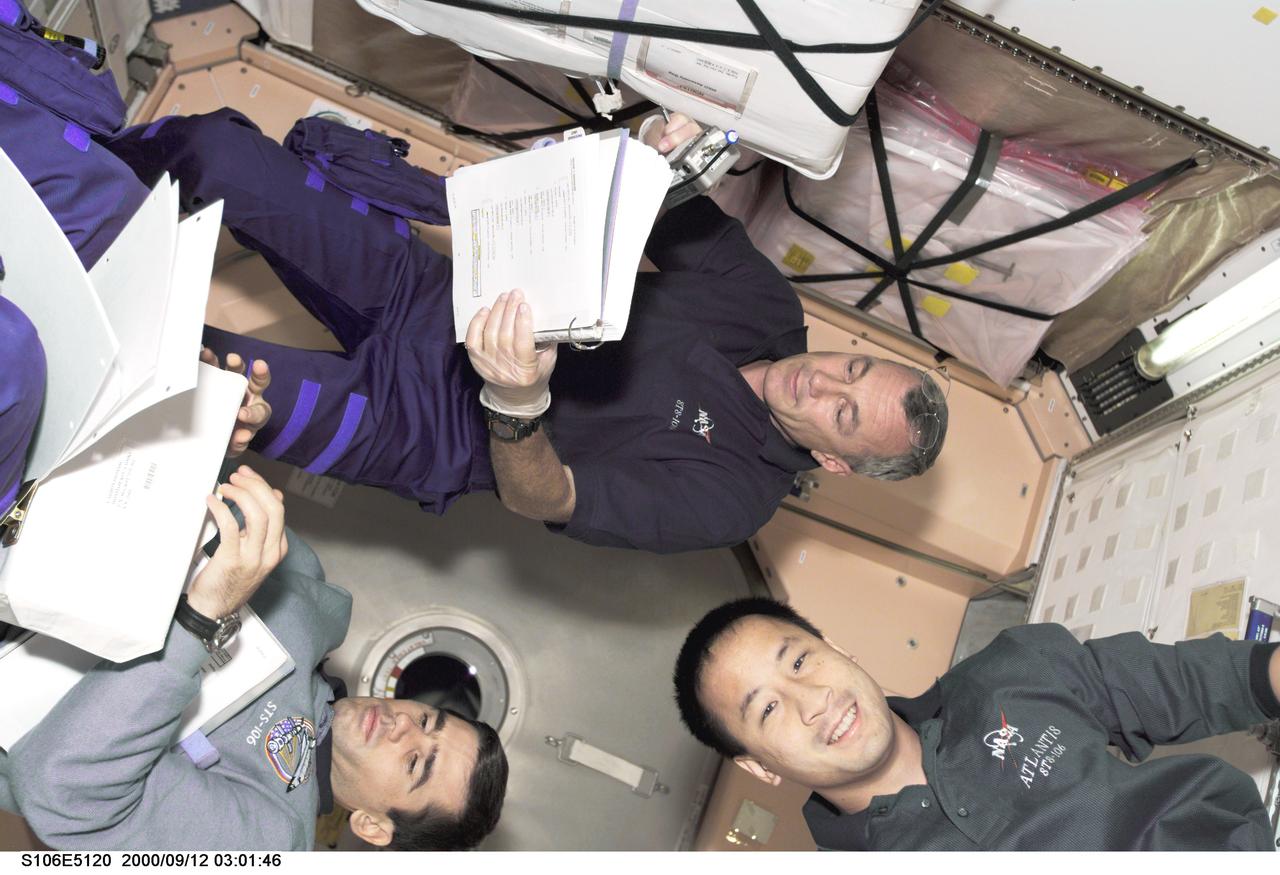
S106-E-5120 (12 September 2000) --- From the left, cosmonaut Yuri I. Malenchenko, and astronauts Edward T. Lu and Terrence W. Wilcutt float inside the U.S.-built Unity node after entering the International Space Station (ISS) for its first manned visit since May of this year. Wilcutt is commander of the seven-member crew. Malenchenko is a mission specialist representing the Russian Aviation and Space Agency. He and Lu, also a mission specialist, performed six hours of extravehicular work on the exterior of the station earlier in the mission.
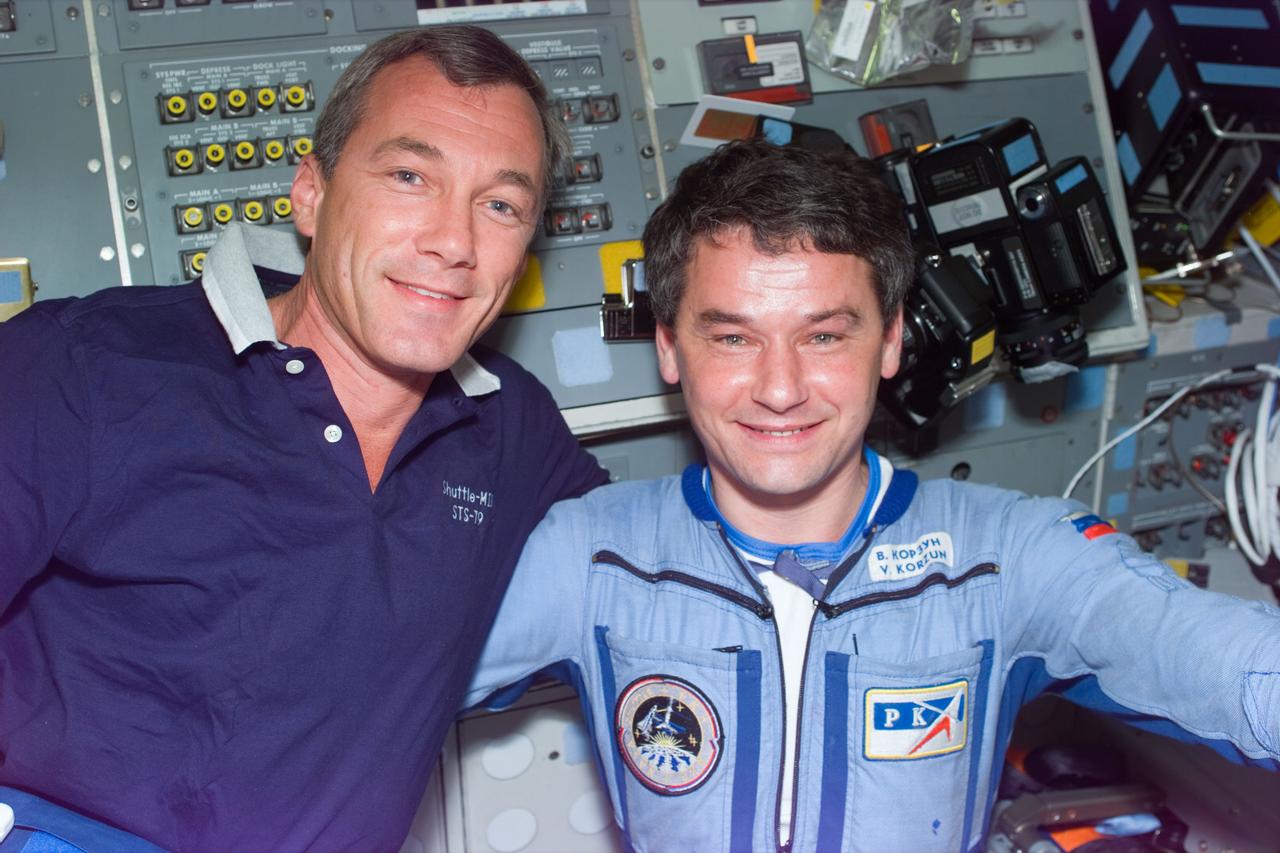
STS79-E-5192 (21 September 1996) --- Astronaut Terrence W. Wilcutt, pilot, talks about shared chores with cosmonaut Valeri G. Korzun, Mir-22 commander on the Space Shuttle Atlantis' flight deck, during Flight Day 6.
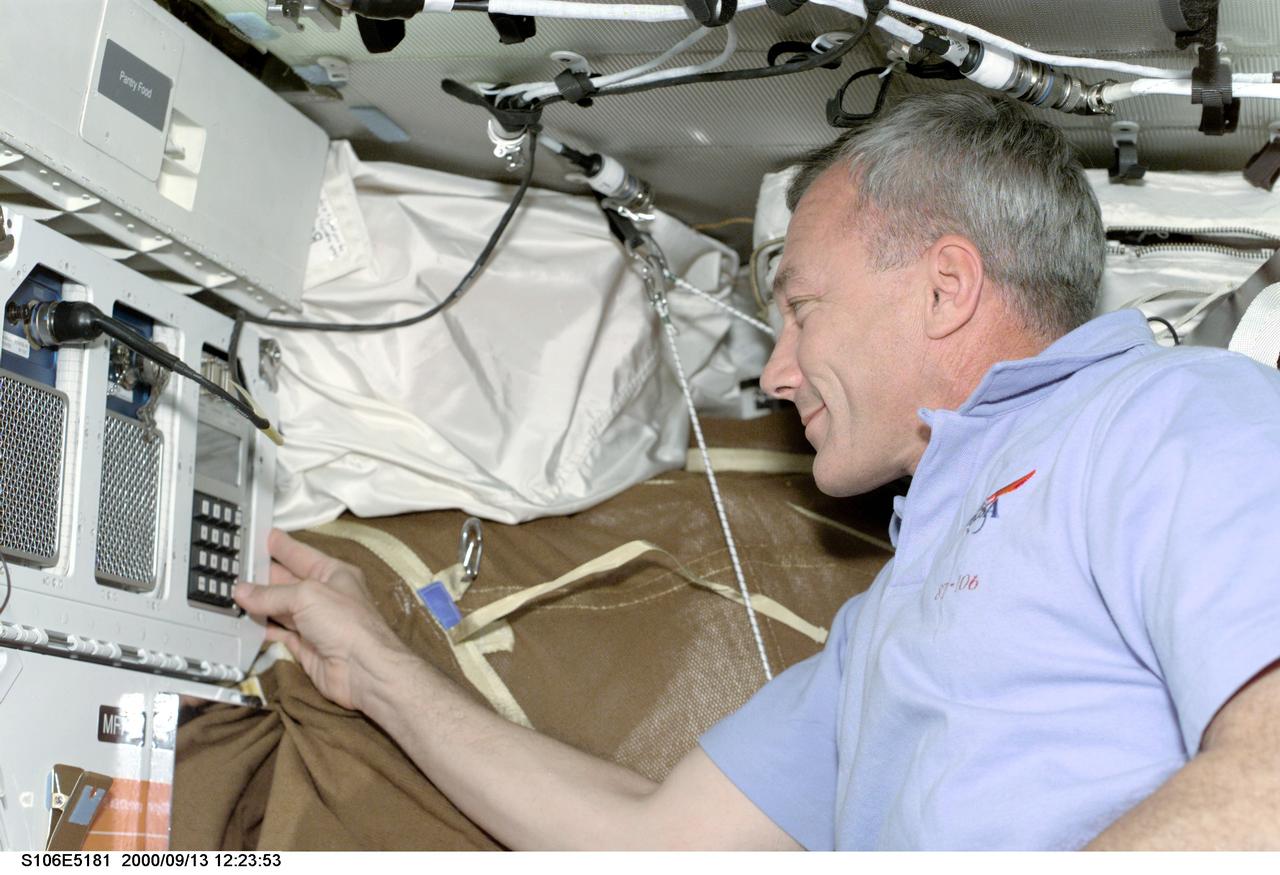
S106-E-5181 (13 September 2000) --- Astronaut Terrence W. Wilcutt, mission commander, works on the mid deck of the Earth-orbiting Space Shuttle Atlantis. The commander was likely doing a daily status check on the Commercial Generic Bioprocessing Apparatus (CGBA).
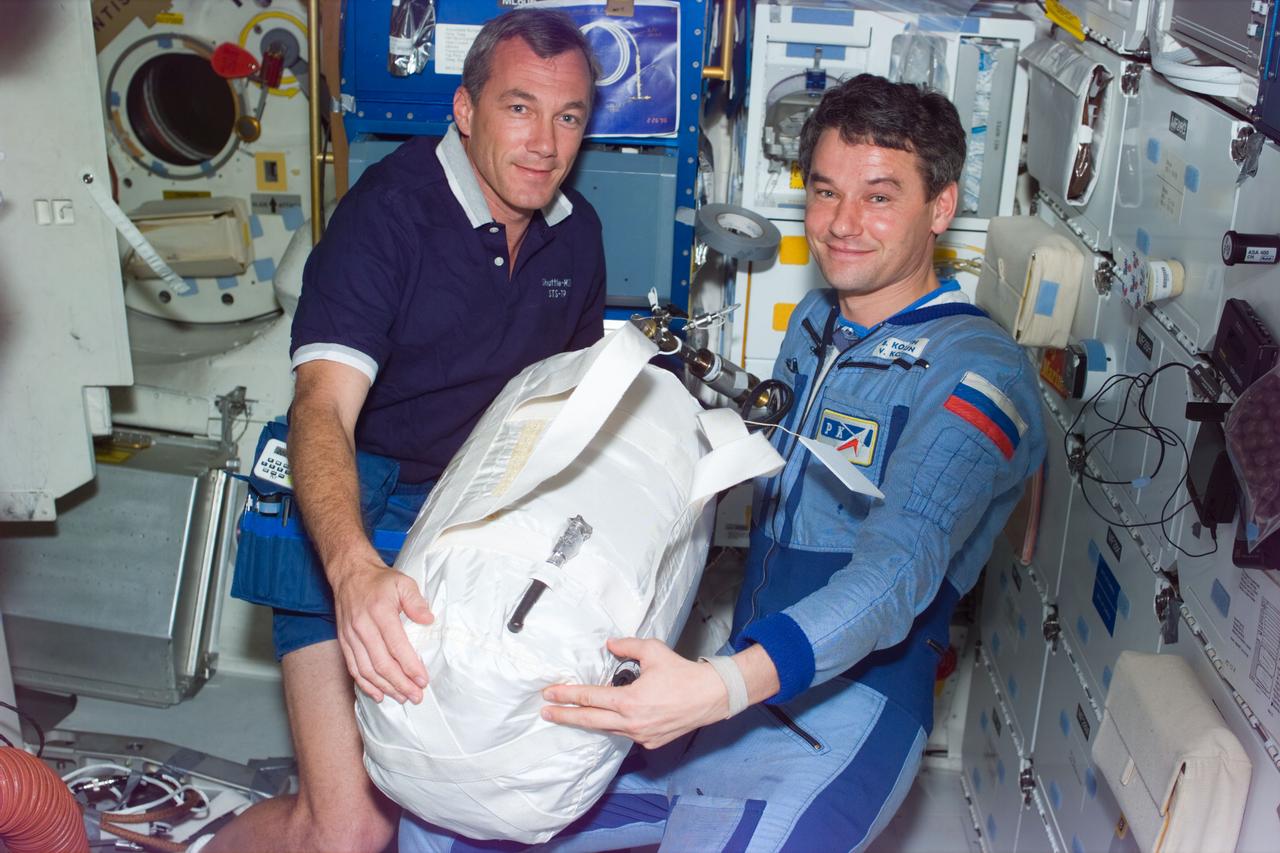
STS79-E-5193 (21 September 1996) --- Astronaut Terrence W. Wilcutt, STS-79 pilot, and cosmonaut Valeri G. Korzun, Mir-22 commander, transfer the Contingency Water Container (CWC), during Flight Day 6.
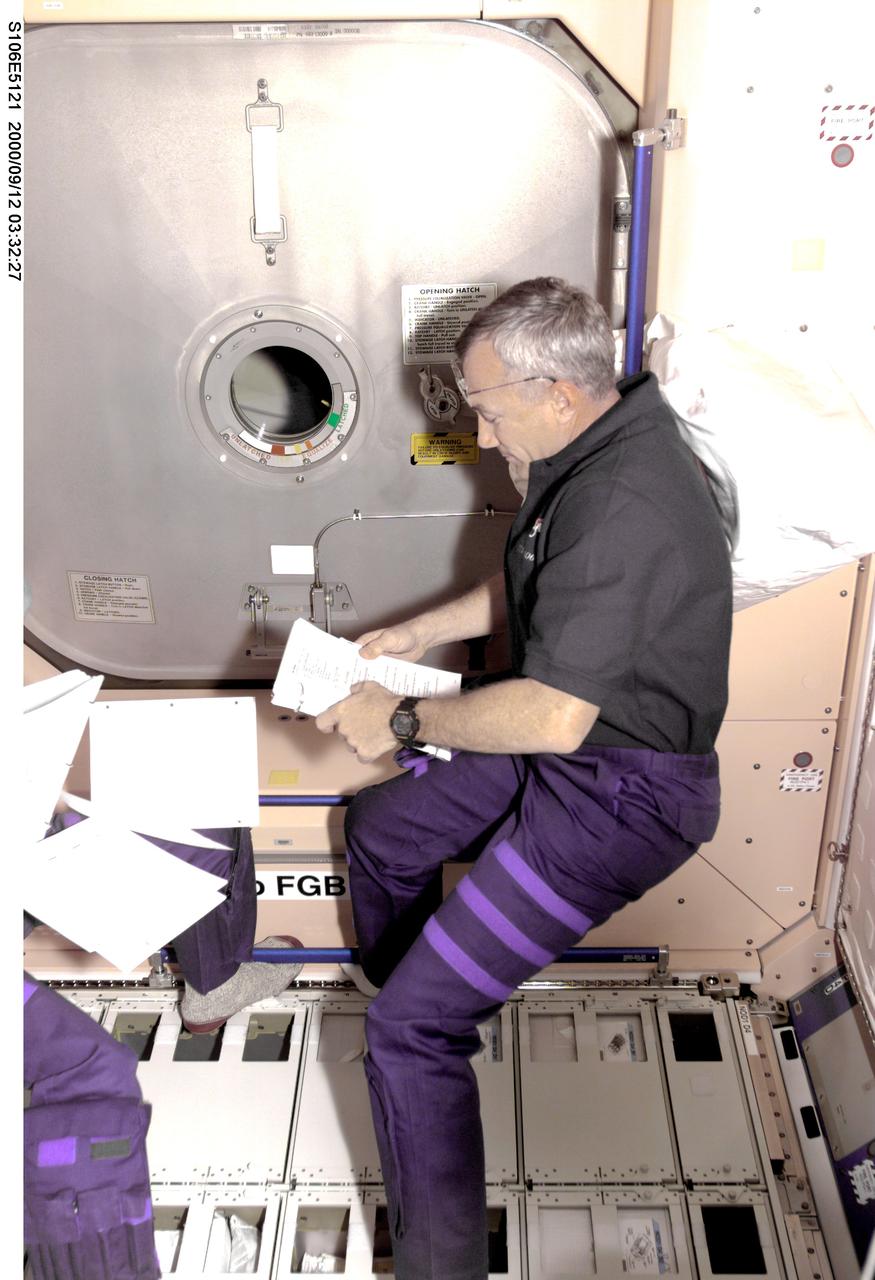
S106-E-5121 (12 September 2000) --- Astronaut Terrence W. Wilcutt, mission commander, floats inside the U.S.-built Unity node after entering the International Space Station (ISS) for its first manned visit since May of this year.
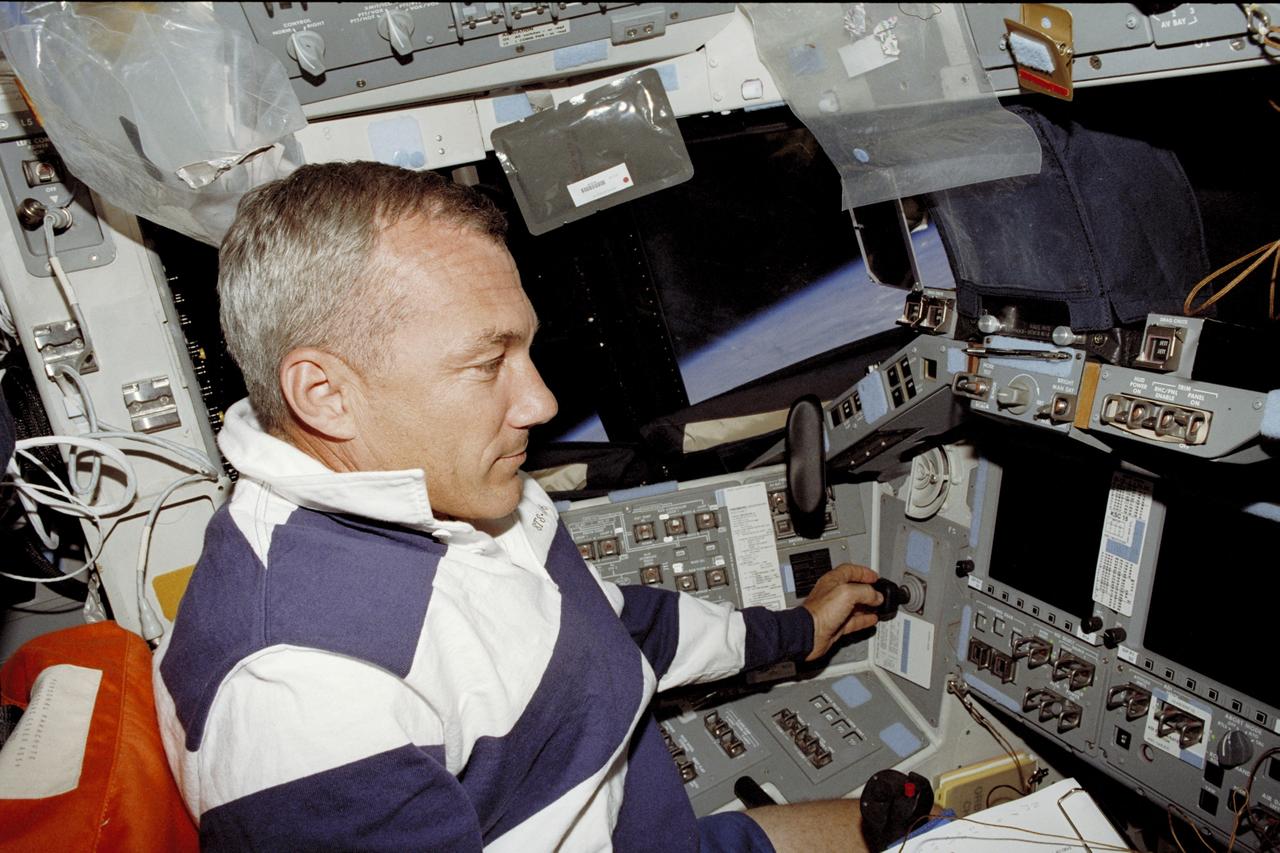
STS106-352-009 (8-20 September 2000) --- Astronaut Terrence W. Wilcutt, STS-106 mission commander, performs a firing of the reaction control system on the flight deck of the Space Shuttle Atlantis. Earth’s horizon is visible through the commander’s window.

S89-E-5247 (26 Jan 1998) --- This Electronic Still Camera (ESC) image shows astronaut Terrence W. Wilcutt, commander, on the flight-deck of the Earth-orbiting Space Shuttle Endeavour. This ESC view was taken on January 26, 1998, at 18:47:06 MET.
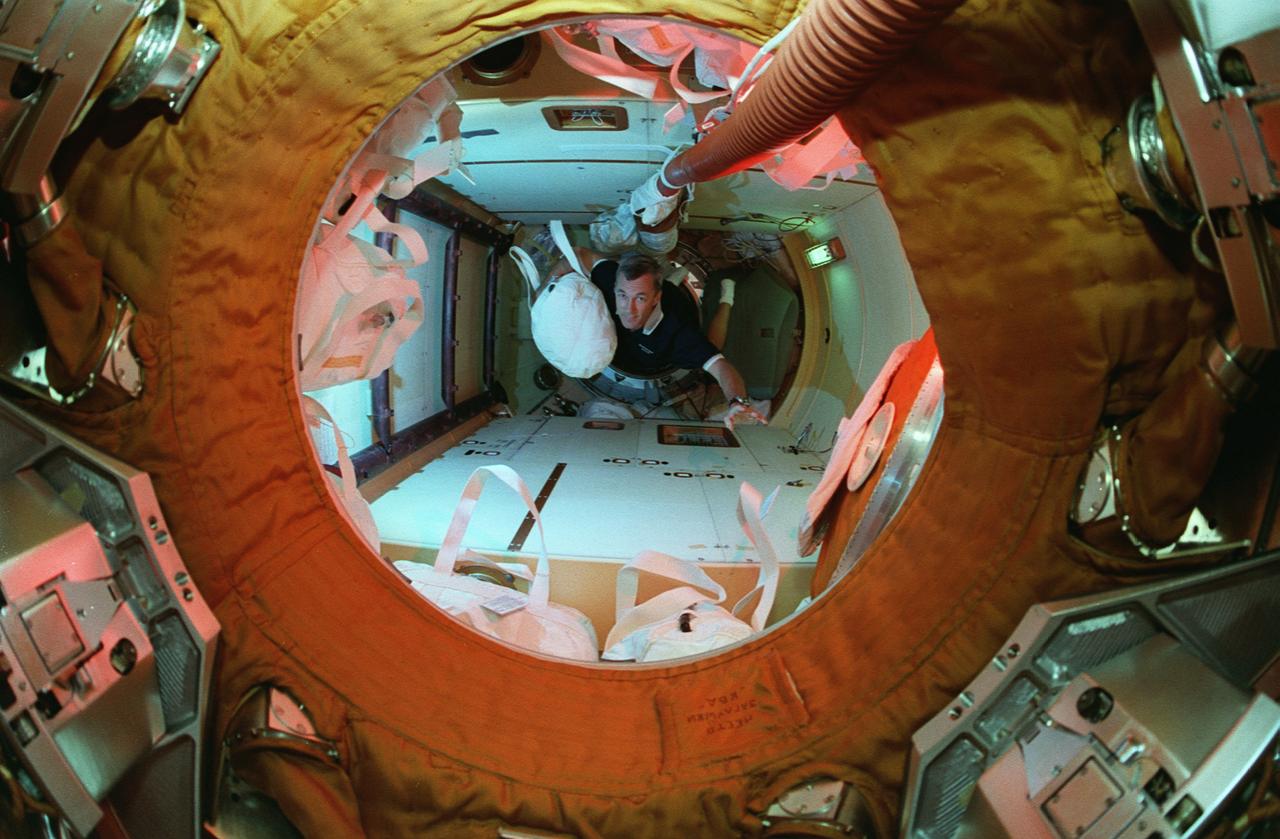
STS079-335-001 (16-26 Sept. 1996) --- Astronaut Terrence W. Wilcutt traverses into Russia's Mir Space Station Kristall Module toting a water bag from the Space Shuttle Atlantis to be used on Mir. This photograph is one of fifteen 35mm frames (along with four 70mm frames) of still photography documenting the activities of NASA's STS-79 mission, which began with a Sept. 16, 1996, liftoff from Launch Pad 39A the Kennedy Space Center (KSC) and ended with a landing at KSC on September 26, 1996. Onboard for the launch were astronauts William F. Readdy, commander; Wilcutt, pilot; John E. Blaha, Jerome (Jay) Apt, Thomas D. Akers and Carl E. Walz, all mission specialists. On flight day 4, the crew docked with Mir. Shannon W. Lucid, who had spent six months aboard Mir, switched cosmonaut guest researcher roles with Blaha. The latter joined fellow Mir-22 crewmembers Valeri G. Korzun, commander, and Aleksandr Y. Kaleri, flight engineer.

S106-E-5122 (12 September) --- Astronaut Terrence W. Wilcutt (left), mission commander, and cosmonaut Yuri I. Malenchenko, mission specialist, look over what is basically an agenda for several busy days ahead for readying the International Space Station (ISS) for its first inhabitants. Malenchenko is one of two Russian cosmonauts on the flight. He had joined astronaut Edward T. Lu earlier in the mission for six-plus hours of extravehicular work on the station.
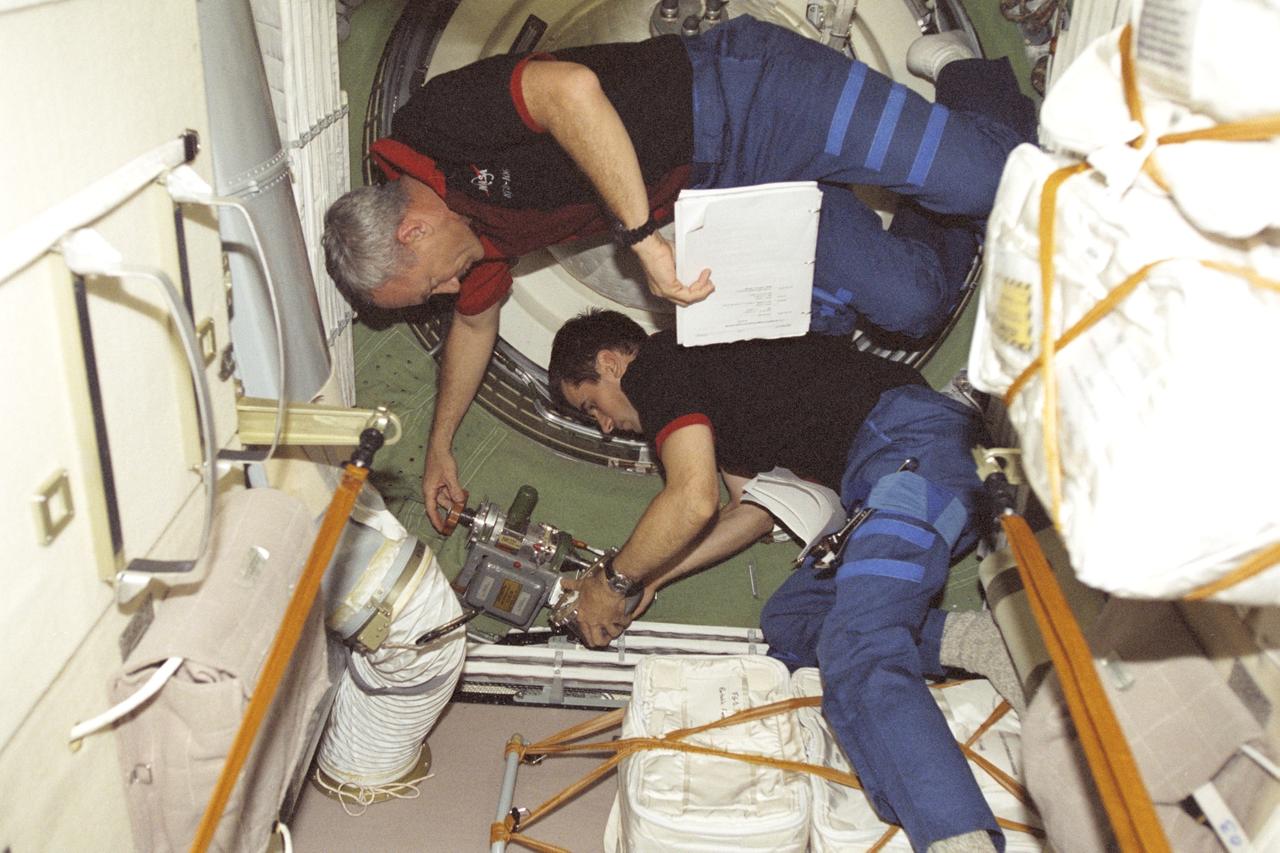
STS106-322-026 (17 September 2000) --- Astronaut Terrence W. Wilcutt (right), STS-106 mission commander, and cosmonaut Yuri I. Malenchenko, mission specialist, in the functional cargo block (FGB) or Zarya on the International Space Station (ISS), work on preparations for undocking between the Space Shuttle Atlantis and the station. Separation took place on September 17, 2000 at 10:46 p.m. (CDT). Malenchenko represents Rosaviakosmos.
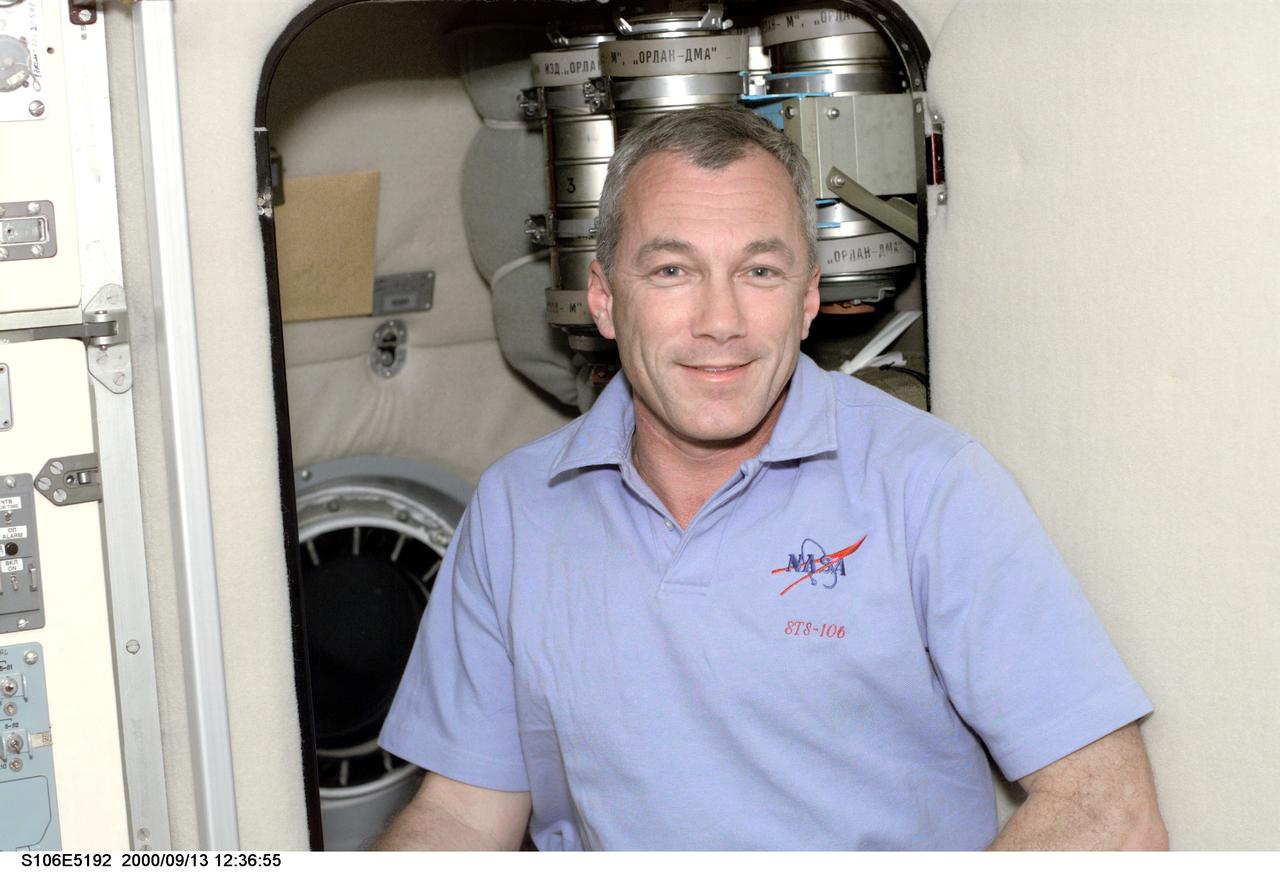
S106-E-5192 (13 September 2000) --- Astronaut Terrence W. Wilcutt, mission commander, displays a pleasant countenance onboard the International Space Station as the crew nears the halfway point of docked operations with the International Space Station. In all the crew will have 189 hours, 40 minutes of planned Atlantis-ISS docked time. For most of the remainder of the time until the Atlantis undocks from the ISS, the STS-106 astronauts and cosmonauts continue electrical work and transfer activities.
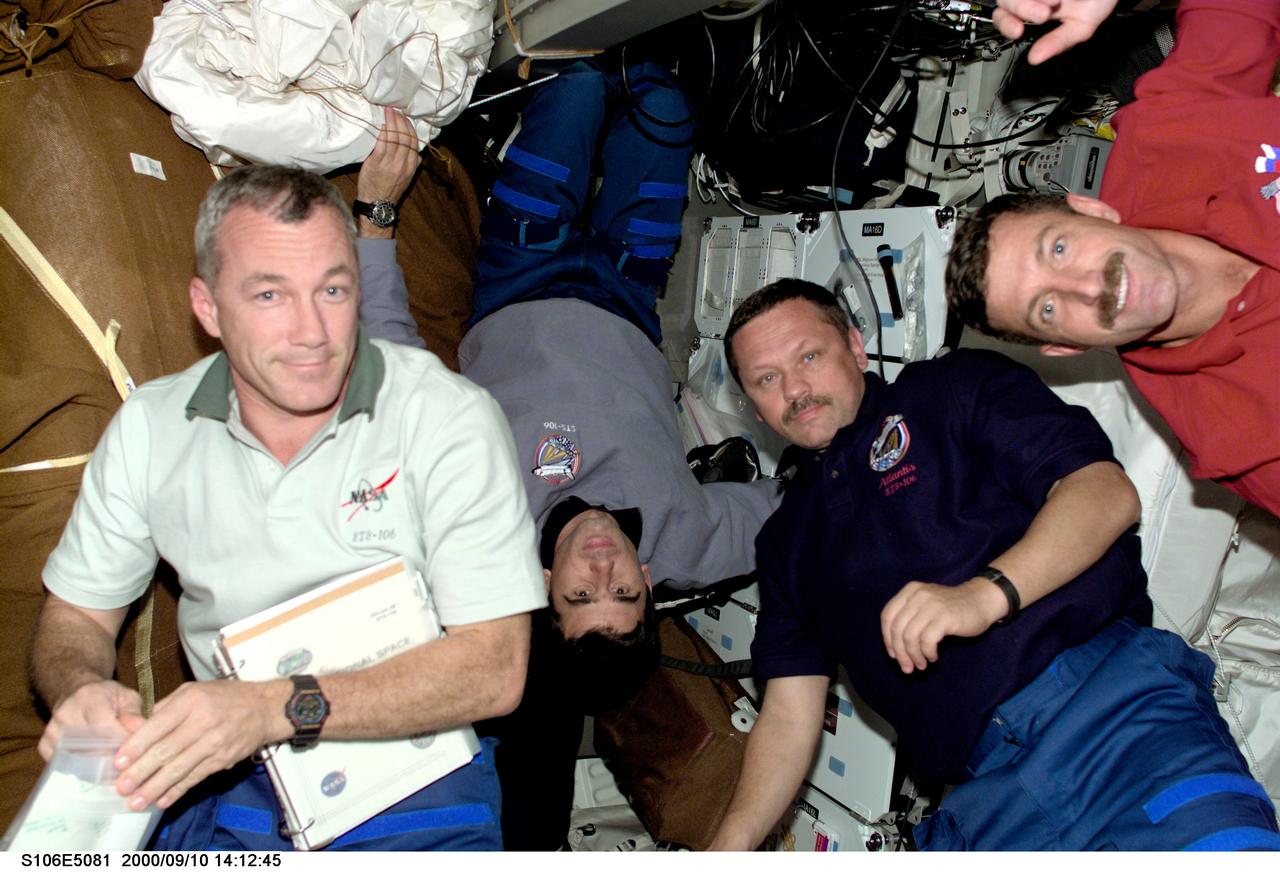
S106-E-5081 (10 September 2000) --- Two cosmonauts and two astronauts discuss supplies to be moved from Atlantis mid deck during Flight Day 3 activity. From the left are astronaut Terrence W. Wilcutt, mission commander; cosmonauts Yuri I. Malenchenko and Boris V. Morukov, mission specialists representing the Russian Aviation and Space Agency; along with astronaut Daniel C. Burbank, mission specialist.
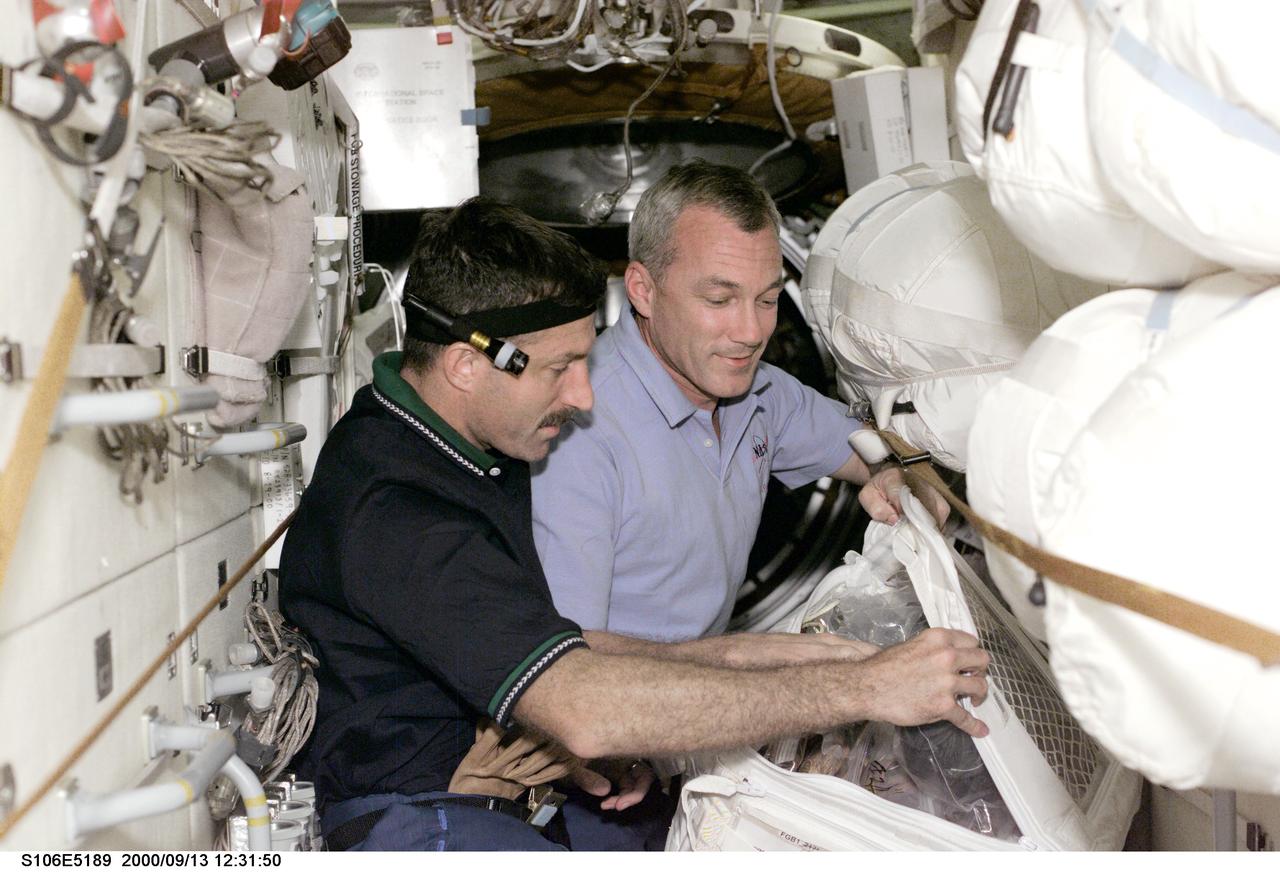
S106-E-5189 (13 September 2000) --- Astronauts Daniel C. Burbank (left), mission specialist, and Terrence W. Wilcutt, mission commander, check some stowed supplies in the Zvezda service module during Flight Day 5 activity. Most of this day was spent in divided chores among the seven crew members, who performed both moving of supplies and detail work on the International Space Station's interior.
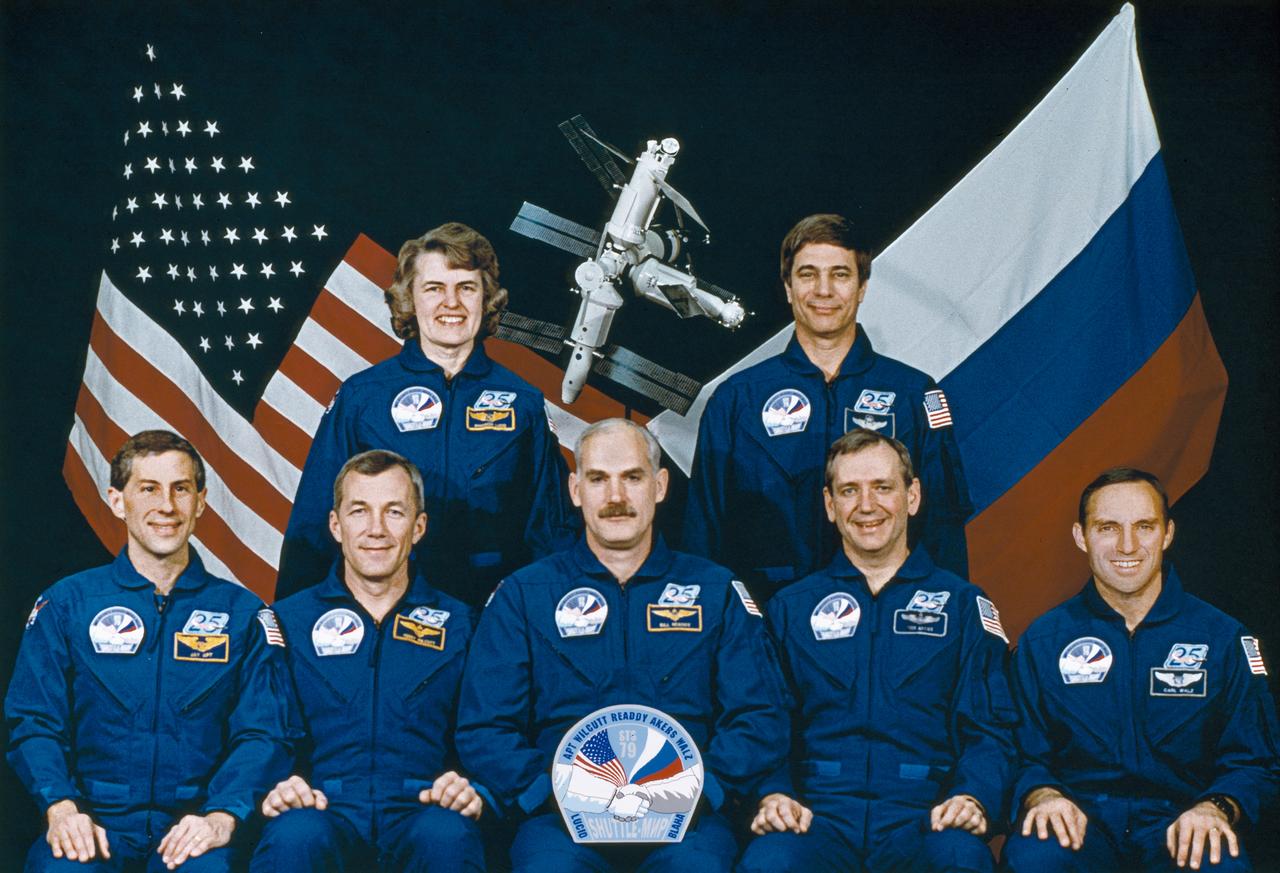
The crew assigned to the STS-79 mission included (seated front left to right) Jerome (Jay) Apt, mission specialist; Terrence W. Wilcutt, pilot; William F. Readdy, commander; Thomas D. Akers, and Carl E. Walz, both mission specialists. On the back row (left to right) are mission specialists Shannon W. Lucid, and John E. Blaha. Launched aboard the Space Shuttle Atlantis on September 16, 1996 at 4:54:49 am (EDT), the STS-79 mission marked the fourth U.S. Space Shuttle-Russian Space Station Mir docking, the second flight of the SPACEHAB module in support of Shuttle-Mir activities and the first flight of the SPACEHAB Double Module Configuration.
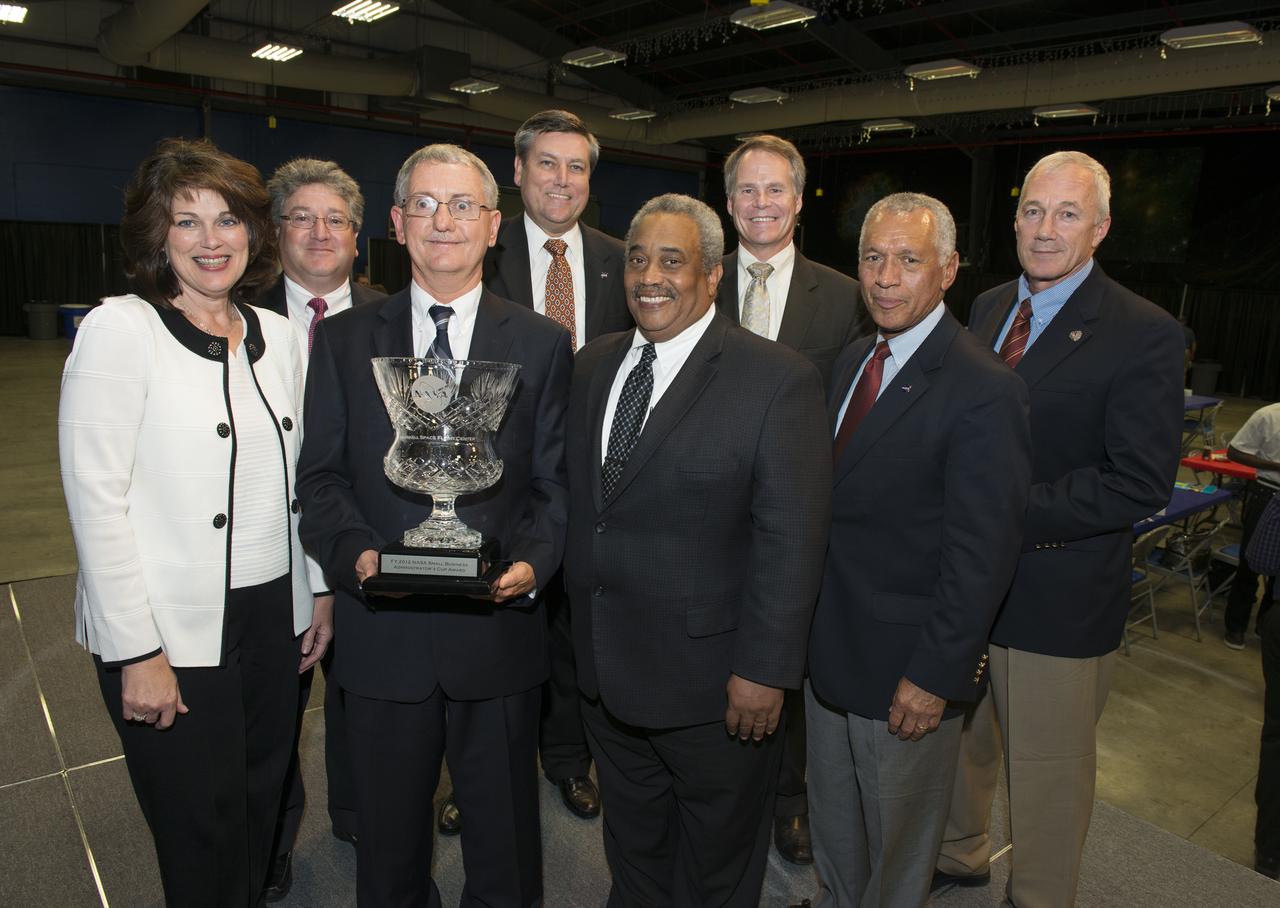
NASA ADMINISTRATOR CHARLES BOLDEN PRESENTS CENTER LEADERS WITH THE SMALL BUSINESS ADMINISTRATOR’S CUP. PARTICIPATING IN THE AWARD CEREMONY WERE, FROM LEFT, MARSHALL ASSOCIATE DIRECTOR ROBIN HENDERSON, DAVID IOSCO, DEPUTY DIRECTOR OF MARSHALL’S OFFICE OF PROCUREMENT; MARSHALL SMALL BUSINESS SPECIALIST DAVID BROCK; MARSHALL CENTER DIRECTOR PATRICK SCHEUERMANN; GLENN DELGADO, ASSOCIATE ADMINISTRATOR OF NASA’S OFFICE OF SMALL BUSINESS PROGRAMS; KIM WHITSON, DIRECTOR OF MARSHALL’S OFFICE OF PROCUREMENT; NASA ADMINISTRATOR CHARLES BOLDEN; AND TERRY WILCUTT, ASSOCIATE ADMINISTRATOR OF NASA’S OFFICE OF SAFETY AND MISSION ASSURANCE.

Dr. Marla Perez-Davis, GRC Deputy Center Director, Ralph Roe, NASA Chief Engineer, Dr. Janet Kavandi, GRC Center Director, and Terrence Wilcutt, NASA Chief Safety and Mission Assurance, address an audience of GRC managers during a Lessons In Leadership Series, Executive Leadership Workshop at Glenn Research Center. August 13, 2019.

Dr. Marla Perez-Davis, GRC Deputy Center Director, Ralph Roe, NASA Chief Engineer, Dr. Janet Kavandi, GRC Center Director, and Terrence Wilcutt, NASA Chief Safety and Mission Assurance, address an audience of GRC managers during a Lessons In Leadership Series, Executive Leadership Workshop at Glenn Research Center. August 13, 2019.

Dr. Marla Perez-Davis, GRC Deputy Center Director, Ralph Roe, NASA Chief Engineer, Dr. Janet Kavandi, GRC Center Director, and Terrence Wilcutt, NASA Chief Safety and Mission Assurance, address an audience of GRC managers during a Lessons In Leadership Series, Executive Leadership Workshop at Glenn Research Center. August 13, 2019.

Five NASA astronauts and two cosmonauts representing the Russian Aviation and Space Agency take a break in training from their scheduled September 2000 visit to the International Space Station (ISS). Astronauts Terrence W. Wilcutt (right front), and Scott D. Altman (left front) are mission commander and pilot, respectively. On the back row (from the left) are mission specialists Boris V. Morukov, cosmonaut, along with astronauts Richard A. Mastracchio, Edward T. Lu, and Daniel C. Burbank, and cosmonaut Yuri I. Malenchenko. Morukov and Malenchenko represent the Russian Aviation and Space Agency. Launched aboard the Space Shuttle Atlantis on September 8, 2000 at 7:46 a.m. (CDT), the STS-106 crew successfully prepared the International Space Station (ISS) for occupancy. Acting as plumbers, movers, installers and electricians, they installed batteries, power converters, a toilet and a treadmill on the outpost. They also delivered more than 2,993 kilograms (6,600 pounds) of supplies. Lu and Malenchenko performed a space walk to connect power, and data and communications cables to the newly arrived Zvezda Service Module and the Station.
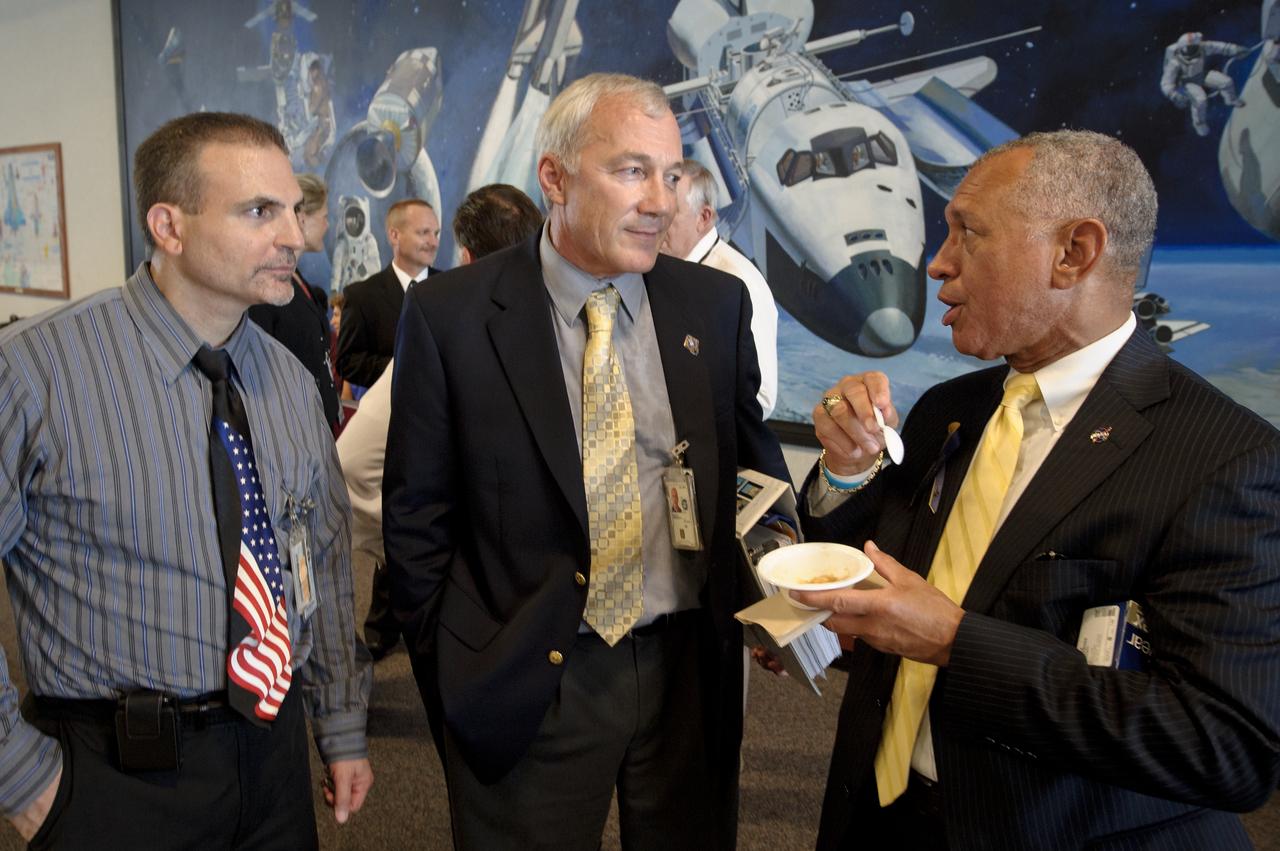
NASA Administrator Charles Bolden, right, talks with NASA Space Shuttle Flight Safety Manager Peter Panetta, left, and NASA Director, Safety and Mission Assurance, Johnson Space Center, and former Astronaut Terrence Wilcutt during the traditional post launch beans and cornbread reception at the NASA Kennedy Space Center, Launch Control Center (LCC) shortly after the space shuttle Atlantis, STS-135, launched on Friday, July 8, 2011, in Cape Canaveral, Fla. The launch of Atlantis is the final flight of the shuttle program, a 12-day mission to the International Space Station. Photo Credit: (NASA/Bill Ingalls)
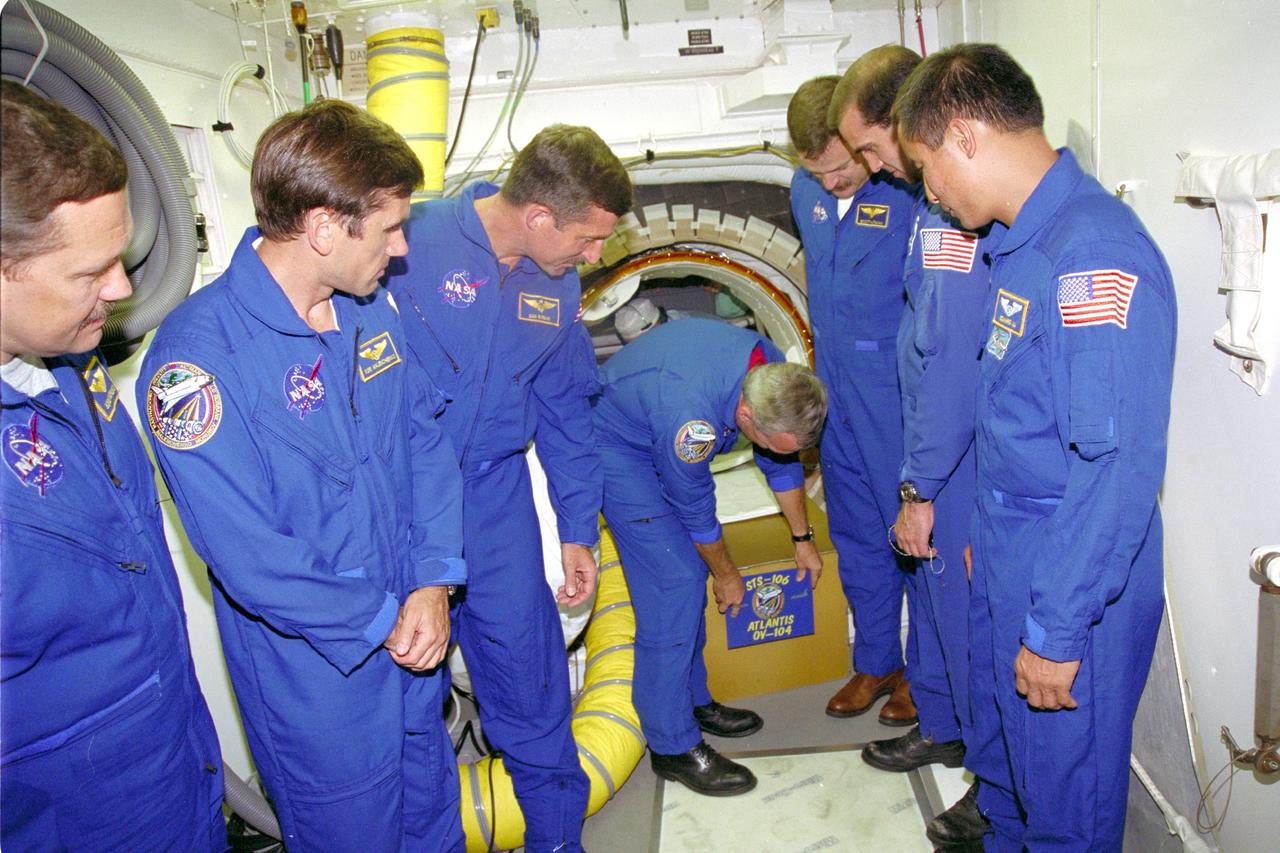
KENNEDY SPACE CENTER, FLA. -- STS-106 Commander Terrence W. Wilcutt bends to place the STS-106 mission patch at the entrance of Atlantis in the white room of Launch Pad 39-B. Other STS-106 crew members pictured are, from left, Mission Specialists Boris V. Morukov, Yuri I. Malenchenko, Daniel C. Burbank, Pilot Scott D. Altman, Mission Specialists Richard A. Mastracchio and Edward T. Lu. Malenchenko and Morukov are with the Russian Aviation and Space Agency. The flight crew were at Kennedy Space Center to take part in Terminal Countdown Demonstration Test (TCDT) activities. The TCDT provides the crew with emergency egress training and opportunities to inspect their mission payload in the orbiter’s payload bay. STS-106 is scheduled to launch Sept. 8, 2000, at 8:31 a.m. EDT from Launch Pad 39B. On the 11-day mission, the seven-member crew will perform support tasks on orbit, transfer supplies and prepare the living quarters in the newly arrived Zvezda Service Module. The first long-duration crew, dubbed “Expedition One,” is due to arrive at the Station in late fall
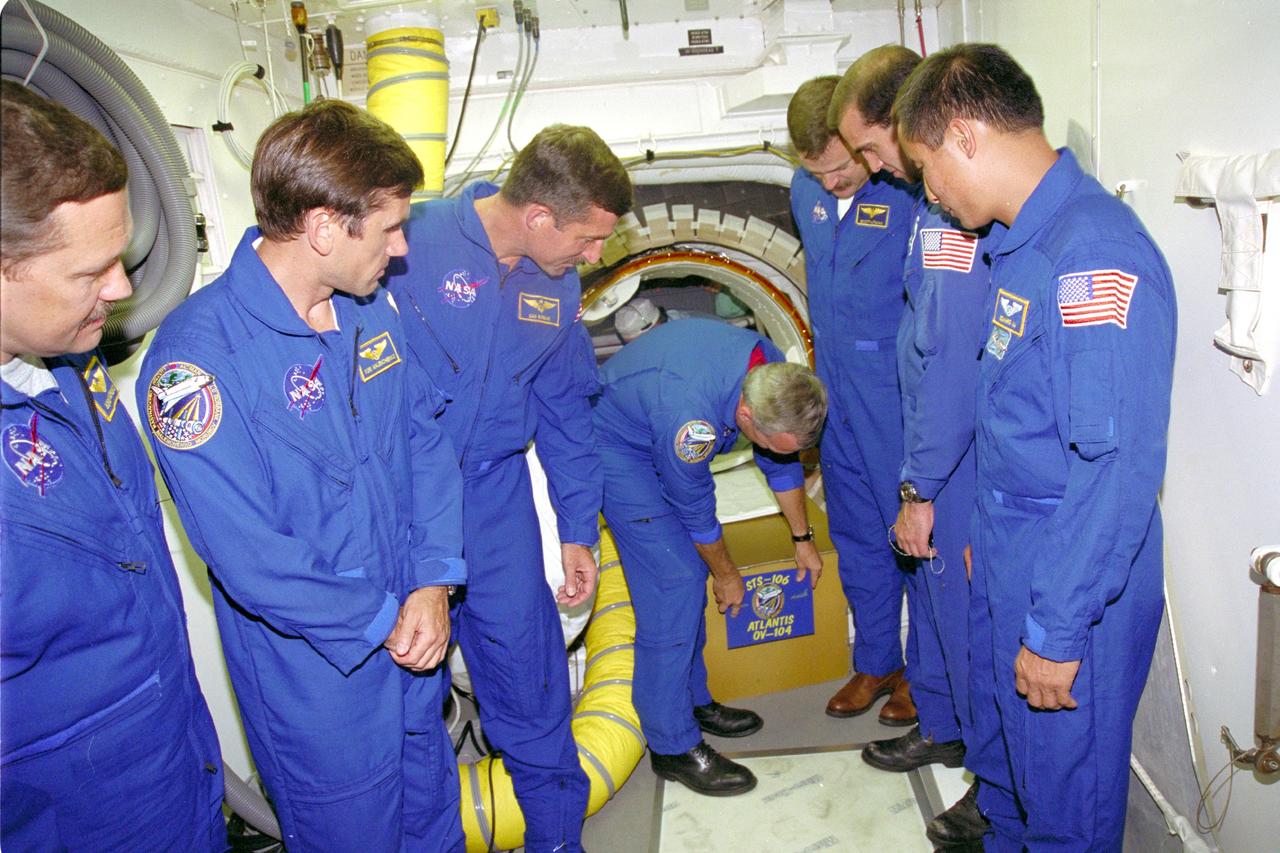
KENNEDY SPACE CENTER, FLA. -- STS-106 Commander Terrence W. Wilcutt bends to place the STS-106 mission patch at the entrance of Atlantis in the white room of Launch Pad 39-B. Other STS-106 crew members pictured are, from left, Mission Specialists Boris V. Morukov, Yuri I. Malenchenko, Daniel C. Burbank, Pilot Scott D. Altman, Mission Specialists Richard A. Mastracchio and Edward T. Lu. Malenchenko and Morukov are with the Russian Aviation and Space Agency. The flight crew were at Kennedy Space Center to take part in Terminal Countdown Demonstration Test (TCDT) activities. The TCDT provides the crew with emergency egress training and opportunities to inspect their mission payload in the orbiter’s payload bay. STS-106 is scheduled to launch Sept. 8, 2000, at 8:31 a.m. EDT from Launch Pad 39B. On the 11-day mission, the seven-member crew will perform support tasks on orbit, transfer supplies and prepare the living quarters in the newly arrived Zvezda Service Module. The first long-duration crew, dubbed “Expedition One,” is due to arrive at the Station in late fall
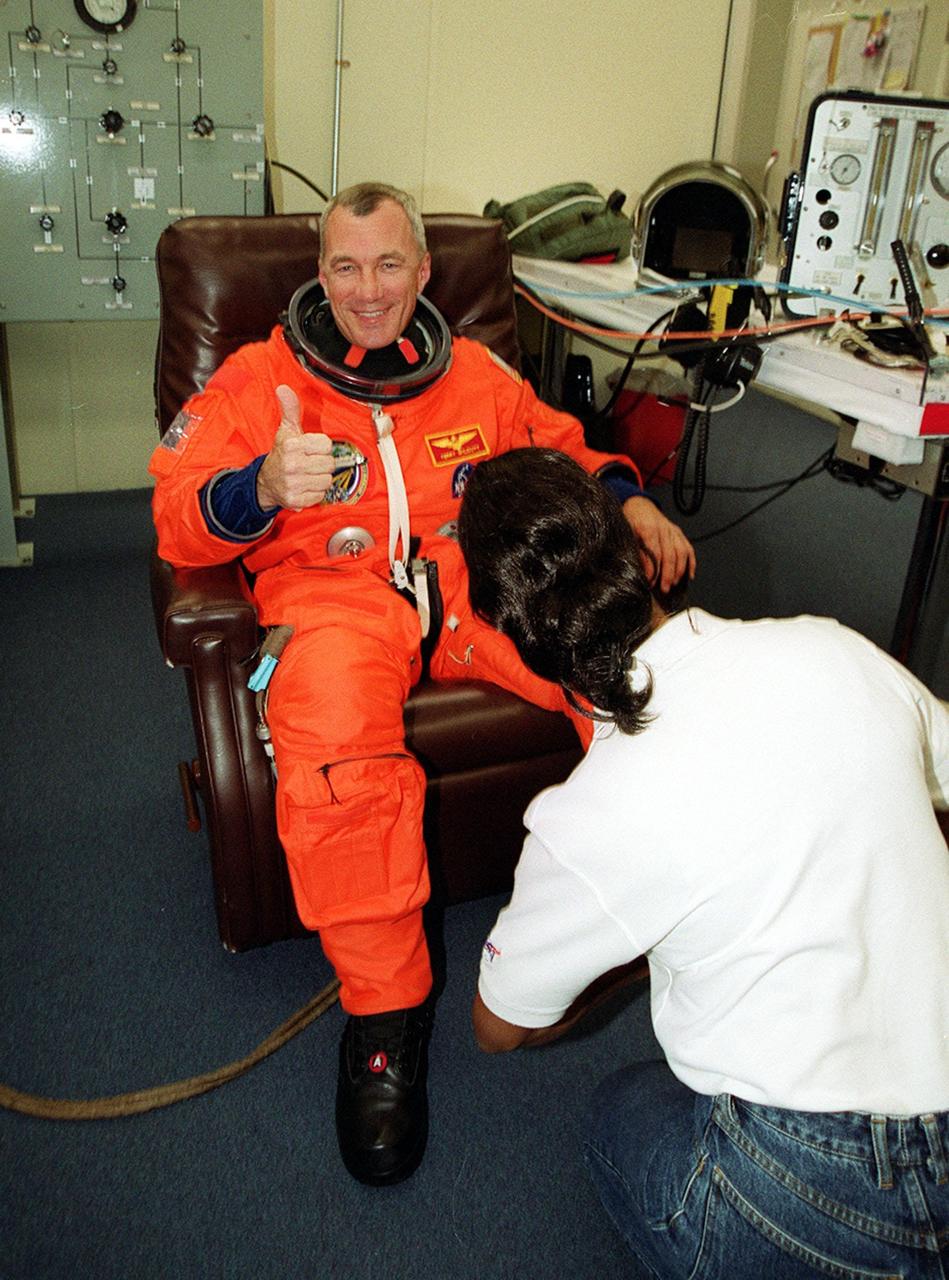
STS-106 Commander Terrence W. Wilcutt gives thumbs up for launch today as he gets help suiting up. This is Wilcutt’s fourth Shuttle flight. Space Shuttle Atlantis is set to lift off 8:45 a.m. EDT on the fourth flight to the International Space Station. During the 11-day mission, the seven-member crew will perform support tasks on orbit, transfer supplies and prepare the living quarters in the newly arrived Zvezda Service Module. The first long-duration crew, dubbed “Expedition One,” is due to arrive at the Station in late fall. Atlantis is scheduled to land at KSC Sept. 19 at 4:59 a.m. EDT
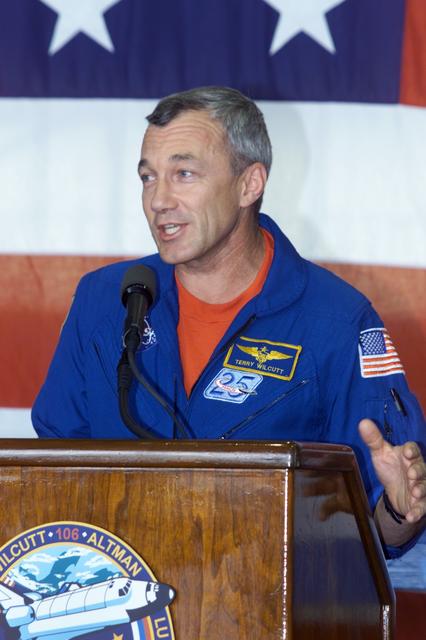
JSC2000-E-23451 (21 September 2000) --- Astronaut Terrence W. Wilcutt, STS-106 mission commander, addresses the crowd that visited Ellington Field's Hangar 990 to welcome home the STS-106 astronauts and cosmonauts. Seated on the dais, from the left, are astronaut Edward T. Lu, cosmonaut Yuri I. Malenchenko, and astronauts Terrence W. Wilcutt and Daniel C. Burbank. Not in the frame are astronaut Richard A. Mastracchio and cosmonaut Boris V. Morukov. The seven-man crew landed approximately 24 hours earlier in Florida, wrapping up a 4.9 million-mile mission in which more than three tons of equipment were delivered to the international outpost.
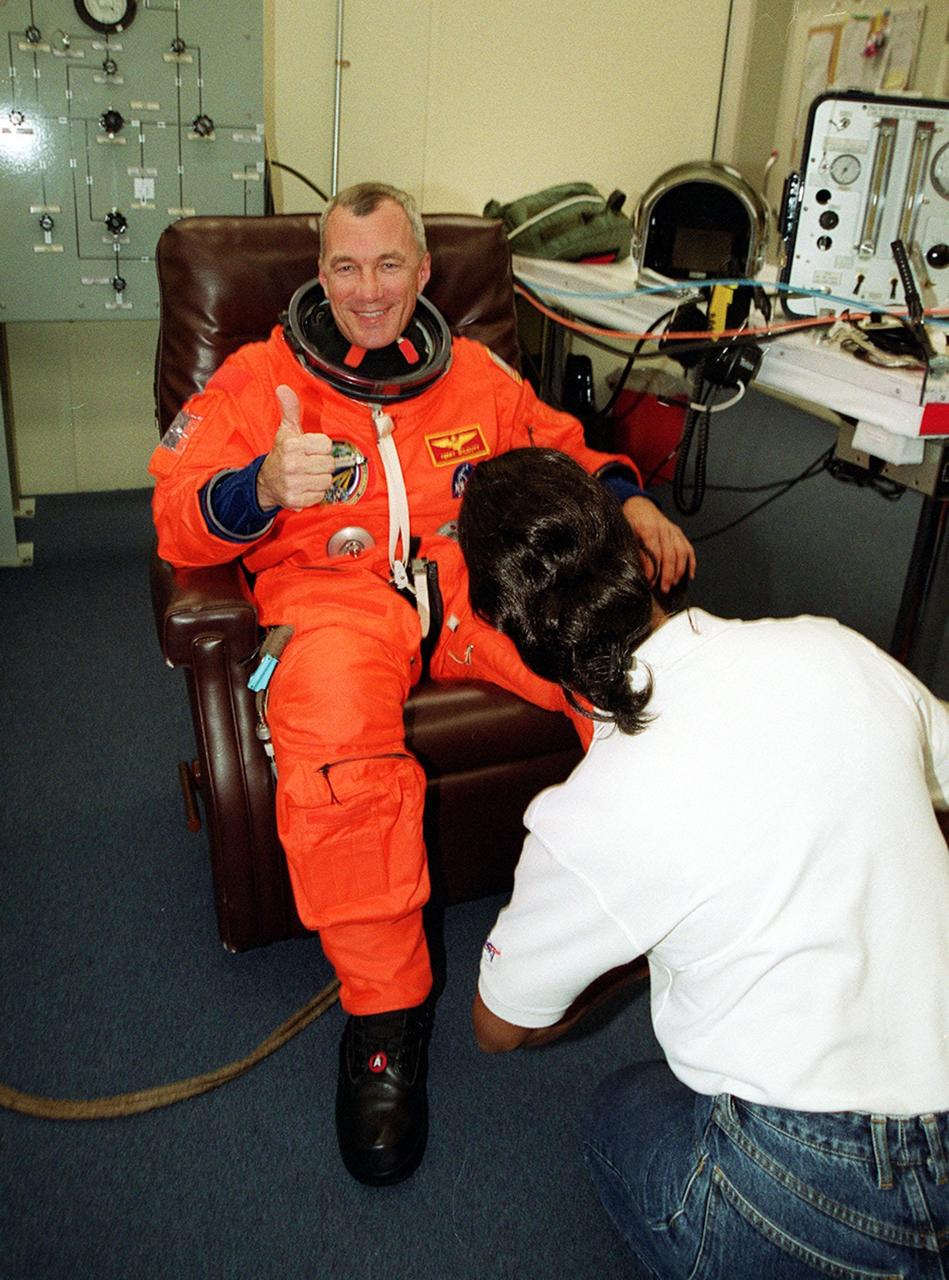
STS-106 Commander Terrence W. Wilcutt gives thumbs up for launch today as he gets help suiting up. This is Wilcutt’s fourth Shuttle flight. Space Shuttle Atlantis is set to lift off 8:45 a.m. EDT on the fourth flight to the International Space Station. During the 11-day mission, the seven-member crew will perform support tasks on orbit, transfer supplies and prepare the living quarters in the newly arrived Zvezda Service Module. The first long-duration crew, dubbed “Expedition One,” is due to arrive at the Station in late fall. Atlantis is scheduled to land at KSC Sept. 19 at 4:59 a.m. EDT
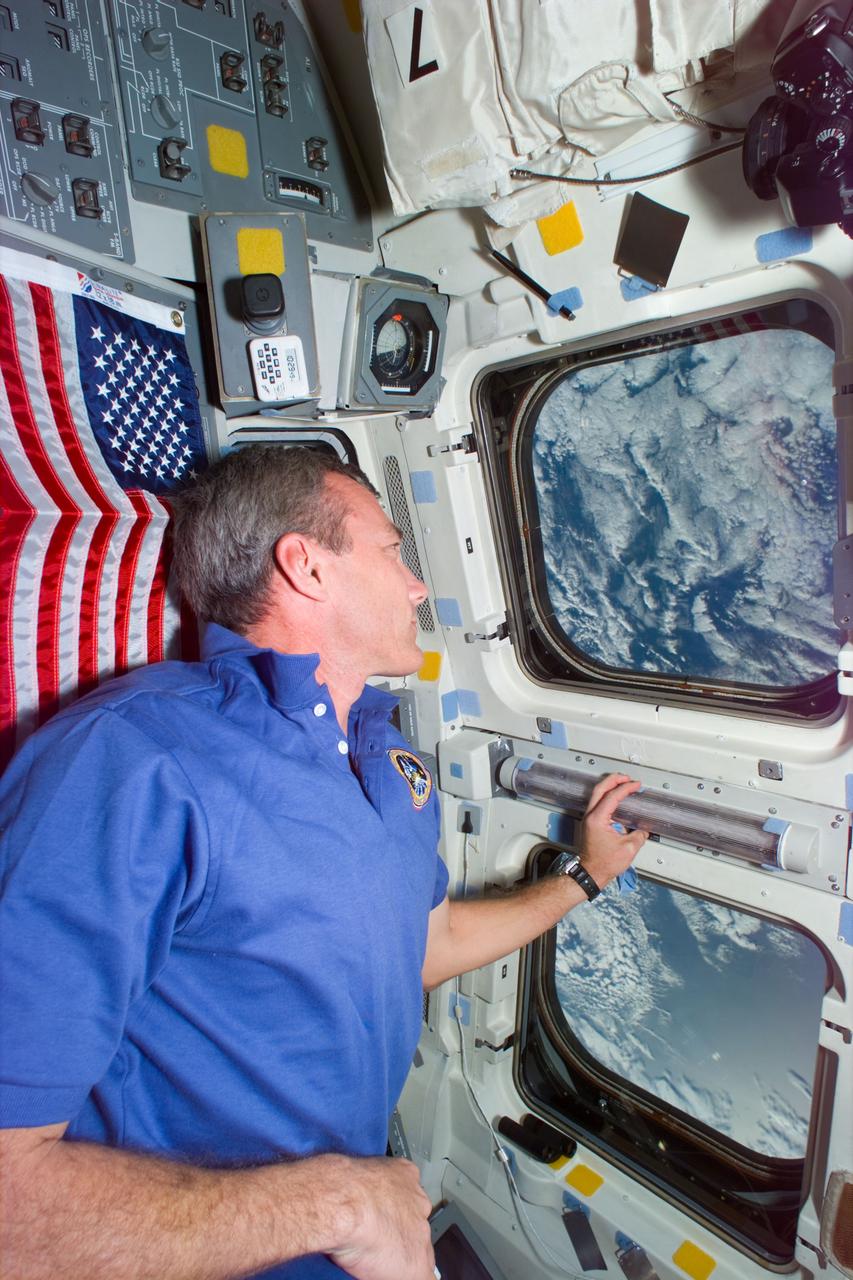
STS79-E-5379 (24 September 1996) --- Astronaut Terrence W. Wilcutt, pilot, watches the Russia's Mir Space Station, with fellow astronaut John E. Blaha, cosmonaut guest researcher onboard, gradually getting further and further away from the Space Shuttle Atlantis, during Flight Day 9.
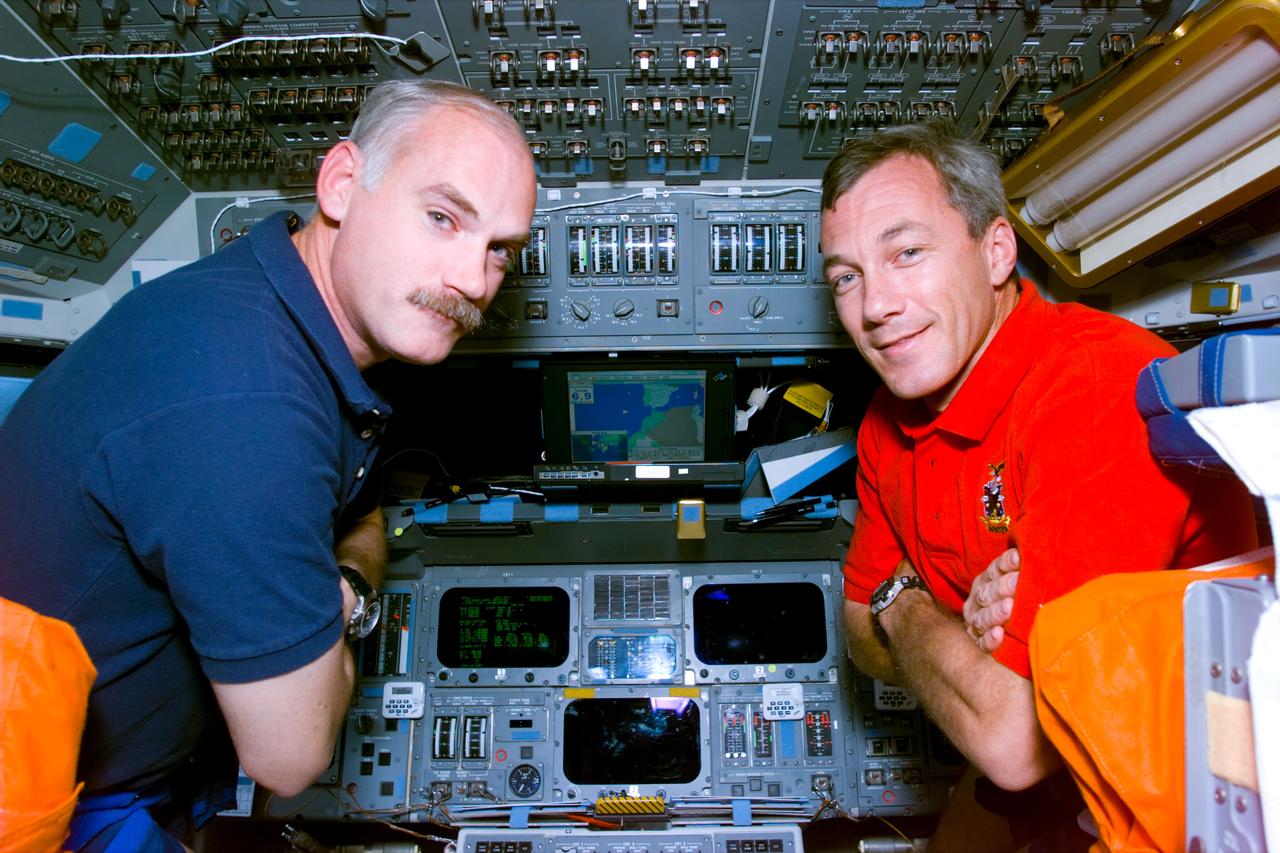
STS79-E-5383 (24 September 1996) --- Astronauts William F. Readdy (left) and Terrence W. Wilcutt sit at the commander and pilot stations, respectively, during undocking operations, during Flight Day 9, onboard the Space Shuttle Atlantis.

JSC2000-02564 (21 March 2000) --- Astronaut Terrence W. (Terry) Wilcutt, STS-106 mission commander, talks with crew training staff members during a simulation of an emergency bailout exercise in the water of the Neutral Buoyancy Laboratory (NBL) near the Johnson Space Center (JSC).
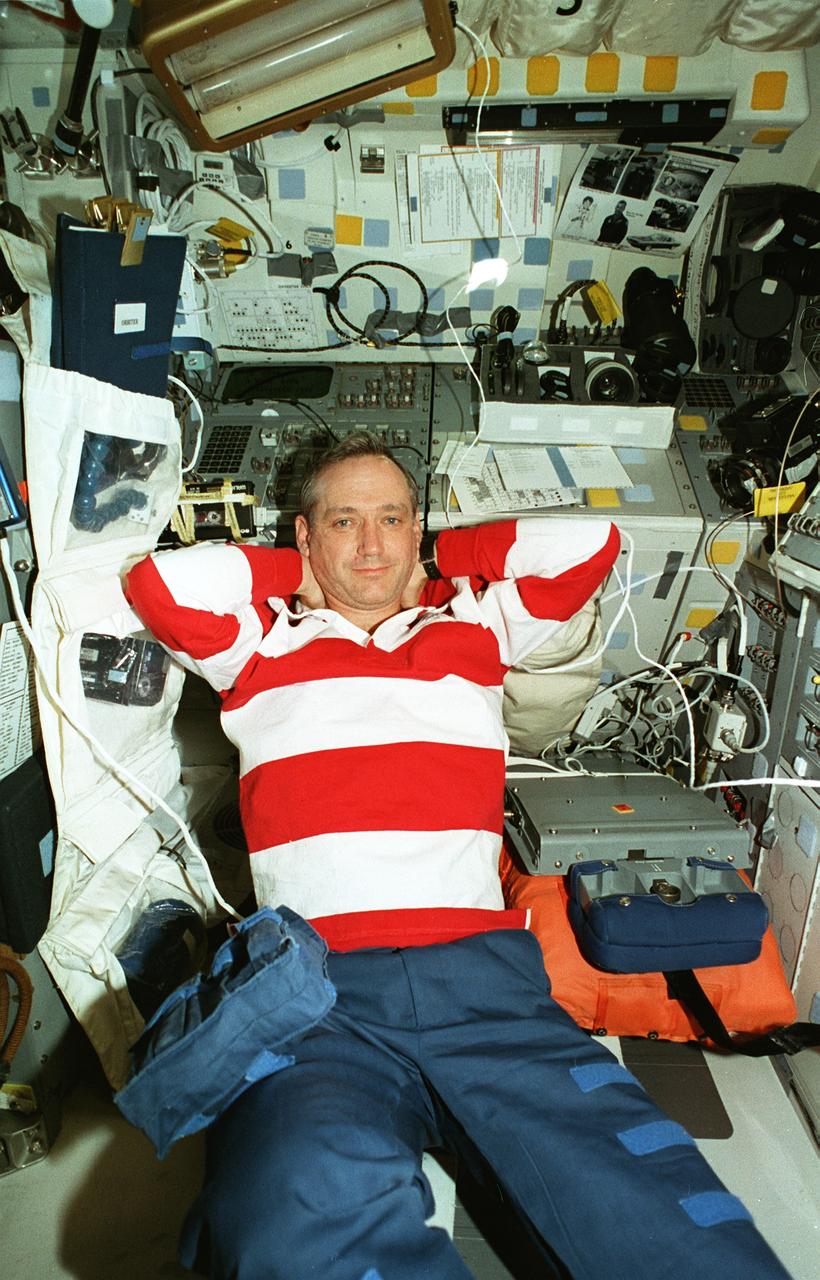
STS079-354-016 (20 Sept. 1996) --- Astronaut Thomas D. Akers, mission specialist, spends a few moments of his off-duty time aboard the Space Shuttle Atlantis in a rare relaxed posture. Akers is on the aft flight deck, looking toward overhead windows (out of frame) through which he could see several of the components of Russia's Mir Space Station, docked for several days to Atlantis. Later, during a post-flight presentation to an assembly of co-workers in Houston, astronaut William F. Readdy, mission commander, recalled this moment as the only one on the STS-79 flight during which he witnessed Akers not busy with transfer chores or Spacehab experiment tasks. Several pieces of camera equipment and a stowed chair used during launch and entry are identifiable among the items on the flight deck.
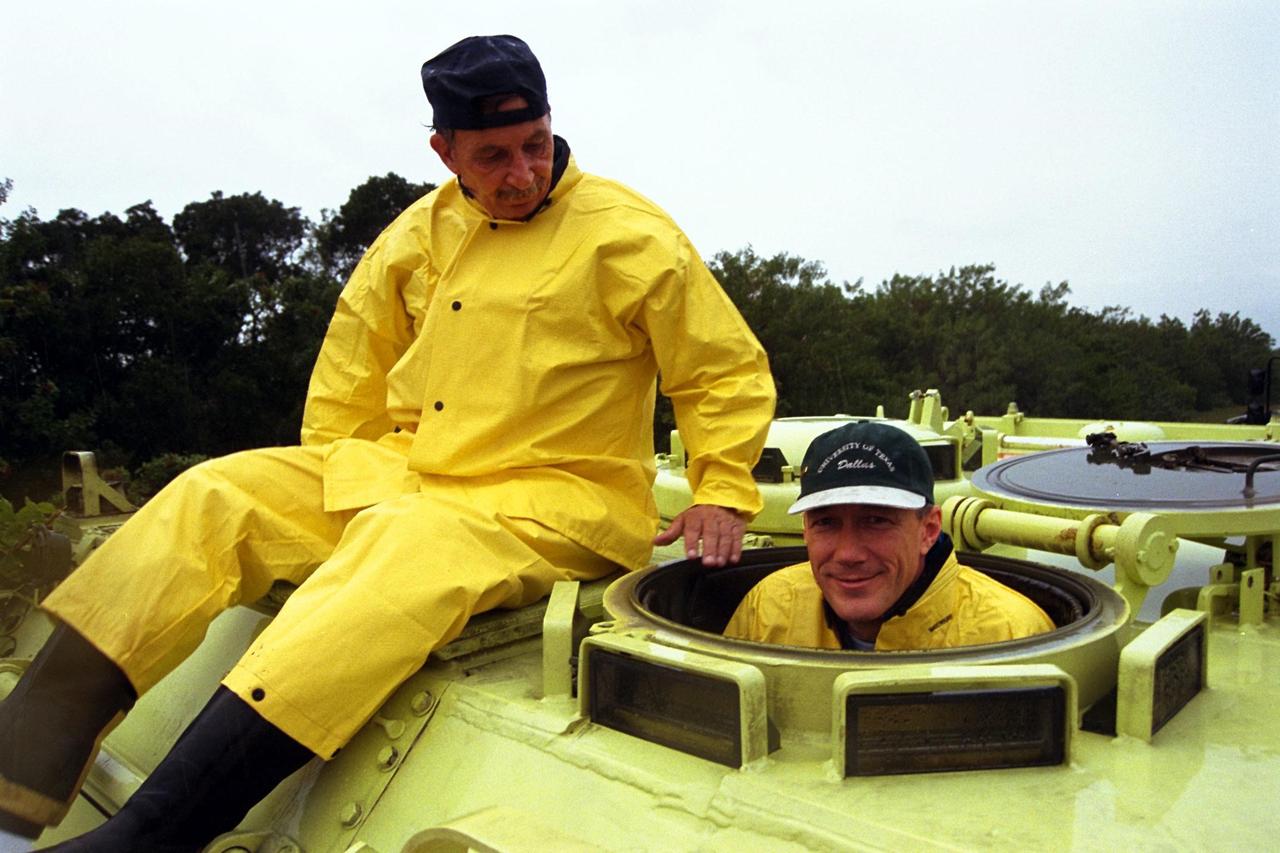
STS-89 Commander Terrence Wilcutt gets ready to train in an M-113 armored personnel carrier as part of Terminal Countdown Demonstration Test (TCDT) activities. The TCDT is held at KSC prior to each Space Shuttle flight to provide crews with an opportunity to participate in simulated countdown activities. Standing inside the M-113 vehicle is Wilcutt while George Hoggard, a training officer with KSC Fire Services, sits atop the armored personnel carrier. The STS-89 mission will be the eighth docking of the Space Shuttle with the Russian Space Station Mir. After docking, STS-89 Mission Specialist Andrew Thomas, Ph.D., will transfer to the space station, succeeding David Wolf, M.D., who will return to Earth aboard Endeavour. Dr. Thomas will live and work on Mir until June. STS-89 is scheduled for a Jan. 22 liftoff at 9:48 p.m

S89-E-5367 (28 Jan 1998) --- This Electronic Still Camera (ESC) image shows astronaut Terrence W. Wilcutt, commander, minutes after Docking Module (DM) hatch door closure. Wilcutt has a microphone speaker box in his left hand, for communication to NASA ground controllers in Houston, Texas. The closing of the hatch ended the eighth Shuttle/Mir joint docking activities between the Space Shuttle and Russia's Mir Space Station. The STS-89 crew dropped of astronaut Andrew S. W. Thomas, replacing astronaut David A. Wolf as cosmonaut guest researcher. Thomas will be the last American astronaut to serve a tour aboard Mir. Astronaut Wolf is returning aboard the Space Shuttle Endeavour, making it's first Mir docking mission. This ESC view was taken on January 28, 1998, at 22:39:32 GMT.
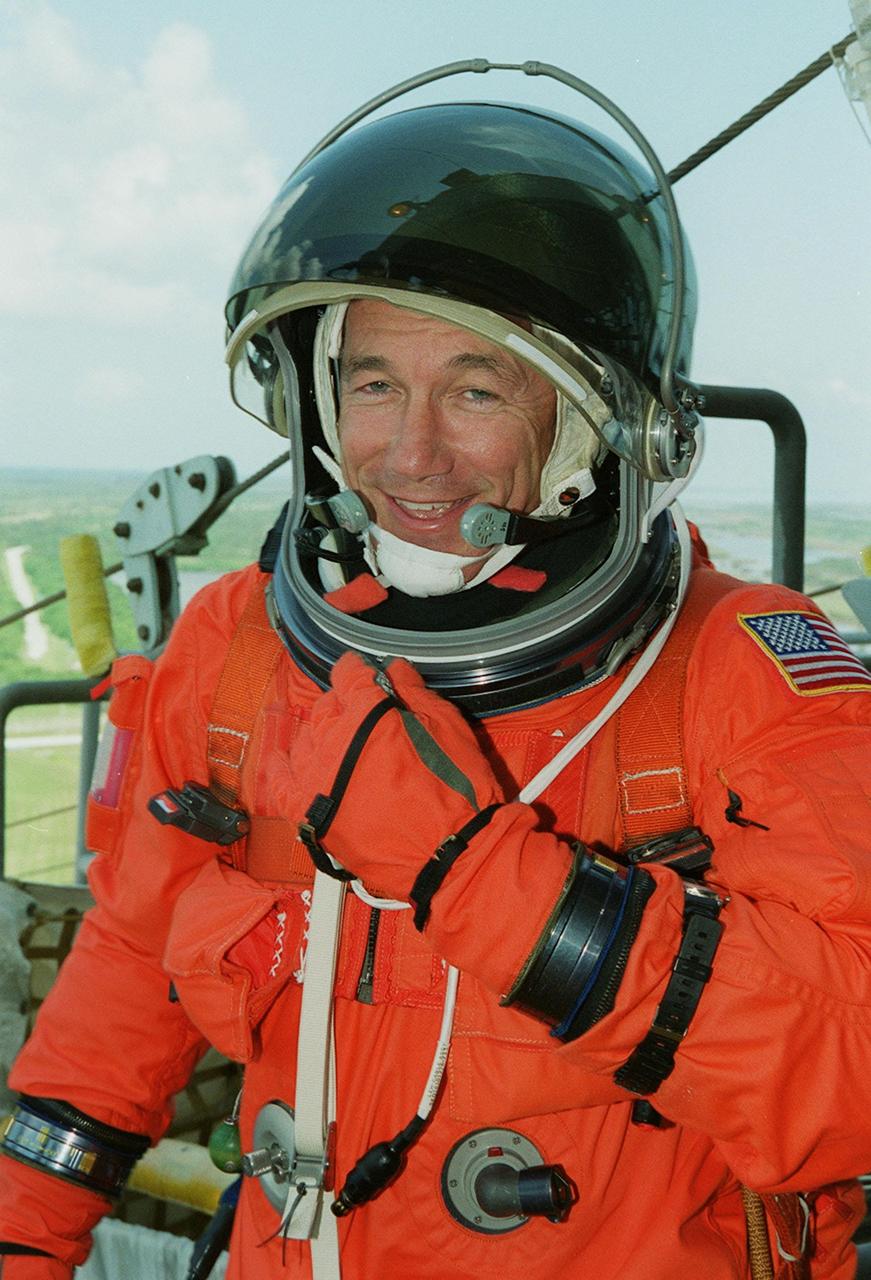
KENNEDY SPACE CENTER, Fla. -- STS-106 Commander Terrence W. Wilcutt grins after climbing out of a slidewire basket on the 195-foot level of Launch Pad 39B. The basket is part of emergency egress equipment from the pad. Wilcutt and the STS-106 crew are taking part in Terminal Countdown Demonstration Activities (TCDT), which include emergency egress training, opportunities to inspect their mission payload in the orbiter’s payload bay, and a simulated launch countdown. STS-106 is scheduled to launch Sept. 8, 2000, at 8:31 a.m. EDT from Launch Pad 39B. On the 11-day mission, the seven-member crew will perform support tasks on orbit, transfer supplies and prepare the living quarters in the newly arrived Zvezda Service Module. The first long-duration crew, dubbed “Expedition One,” is due to arrive at the Station in late fall
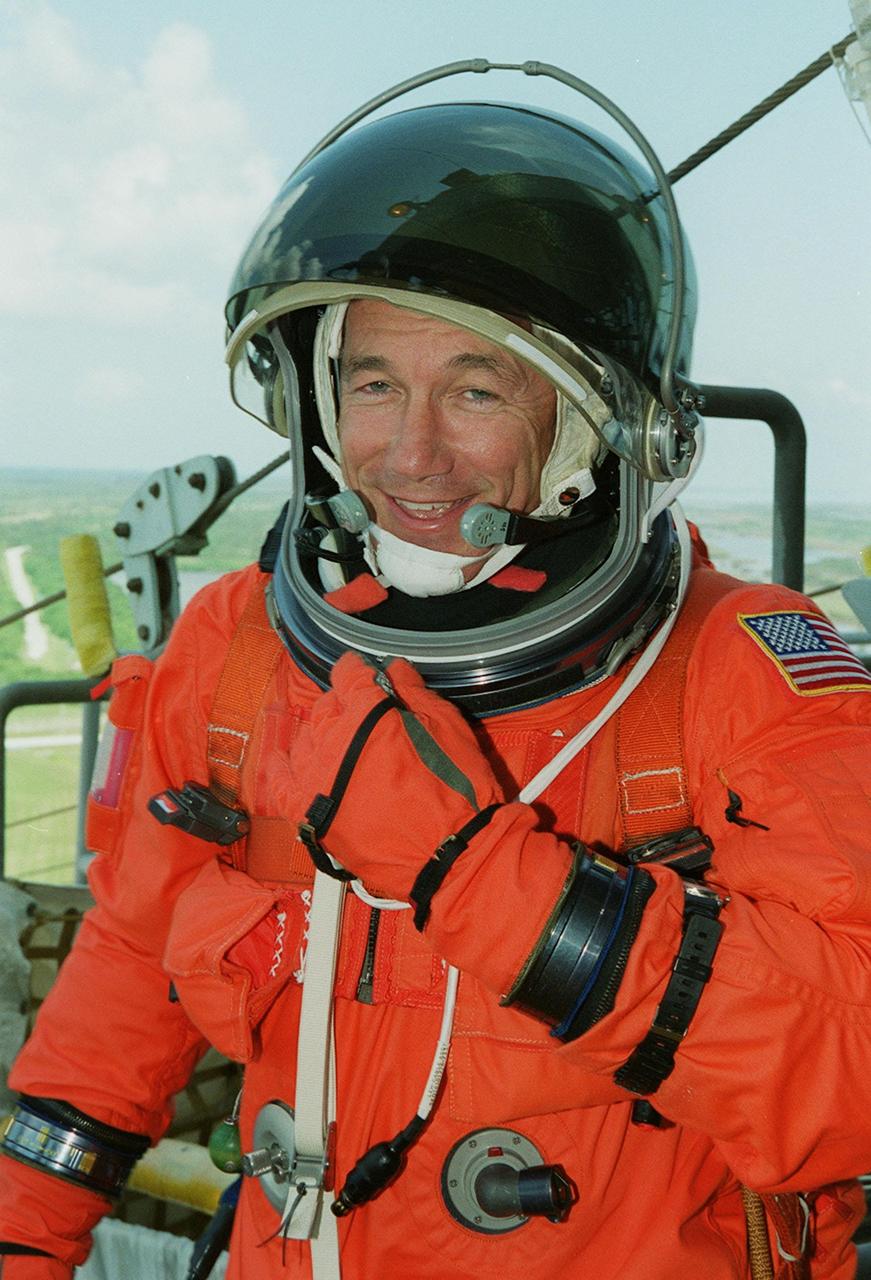
KENNEDY SPACE CENTER, Fla. -- STS-106 Commander Terrence W. Wilcutt grins after climbing out of a slidewire basket on the 195-foot level of Launch Pad 39B. The basket is part of emergency egress equipment from the pad. Wilcutt and the STS-106 crew are taking part in Terminal Countdown Demonstration Activities (TCDT), which include emergency egress training, opportunities to inspect their mission payload in the orbiter’s payload bay, and a simulated launch countdown. STS-106 is scheduled to launch Sept. 8, 2000, at 8:31 a.m. EDT from Launch Pad 39B. On the 11-day mission, the seven-member crew will perform support tasks on orbit, transfer supplies and prepare the living quarters in the newly arrived Zvezda Service Module. The first long-duration crew, dubbed “Expedition One,” is due to arrive at the Station in late fall
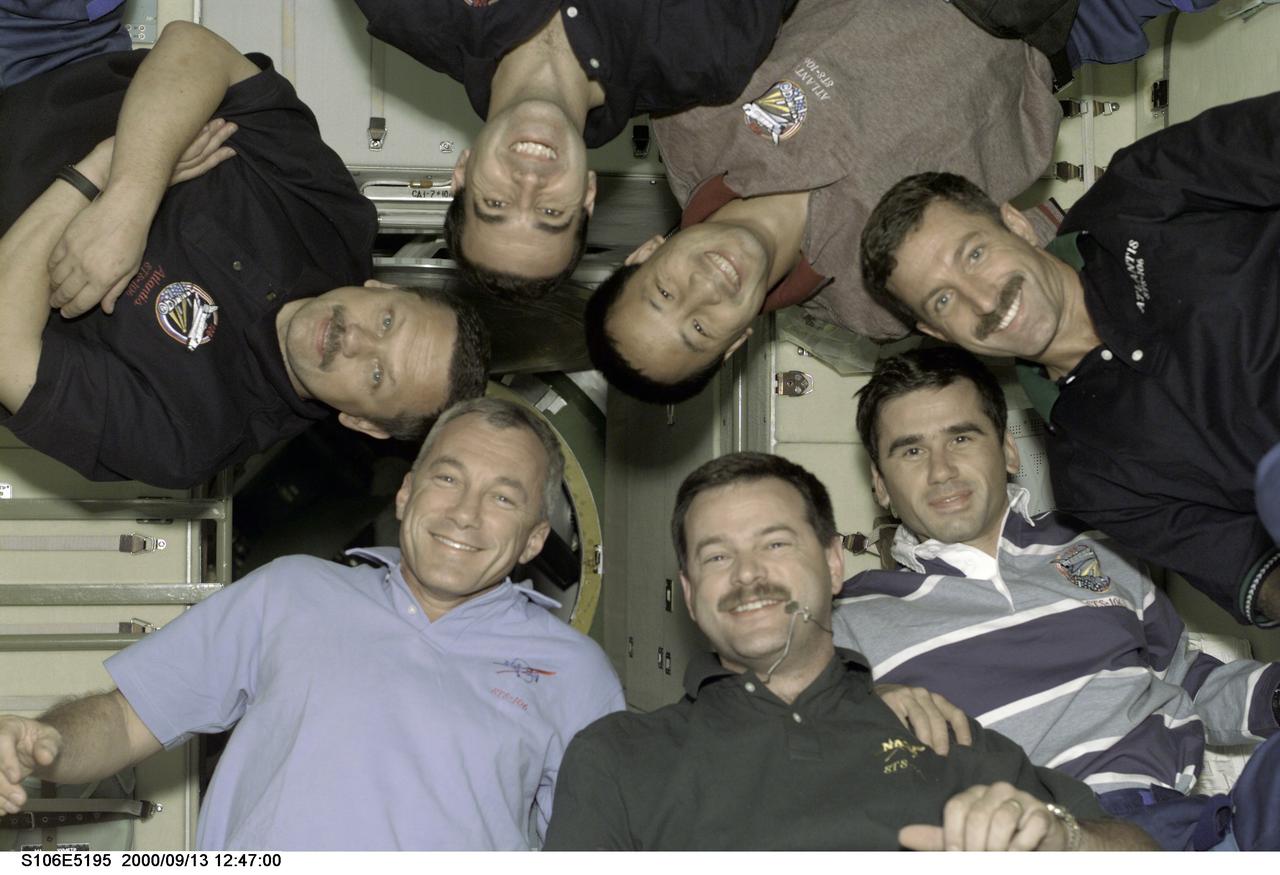
STS106-E-5195 (13 September 2000) --- Two cosmonauts and five astronauts pose for a tradition-based inflight crew portrait aboard the International Space Station (ISS), which is currently docked with the Space Shuttle Atlantis. Astronauts Terrence W. Wilcutt, mission commander, and Scott D. Altman (bottom center) are surrounded by the five mission specialists (counterclockwise from Wilcutt) -- cosmonaut Boris V. Morukov, astronauts Richard A. Mastracchio, Edward T. Lu and Daniel C. Burbank, along with cosmonaut Yuri I. Malenchenko. Morukov and Malenchenko represent the Russian Aviation and Space Agency. The seven had just taken a brief break from the continuing tasks they're performing to help ready the ISS for other astronauts and cosmonauts permanent habitation in the near future.
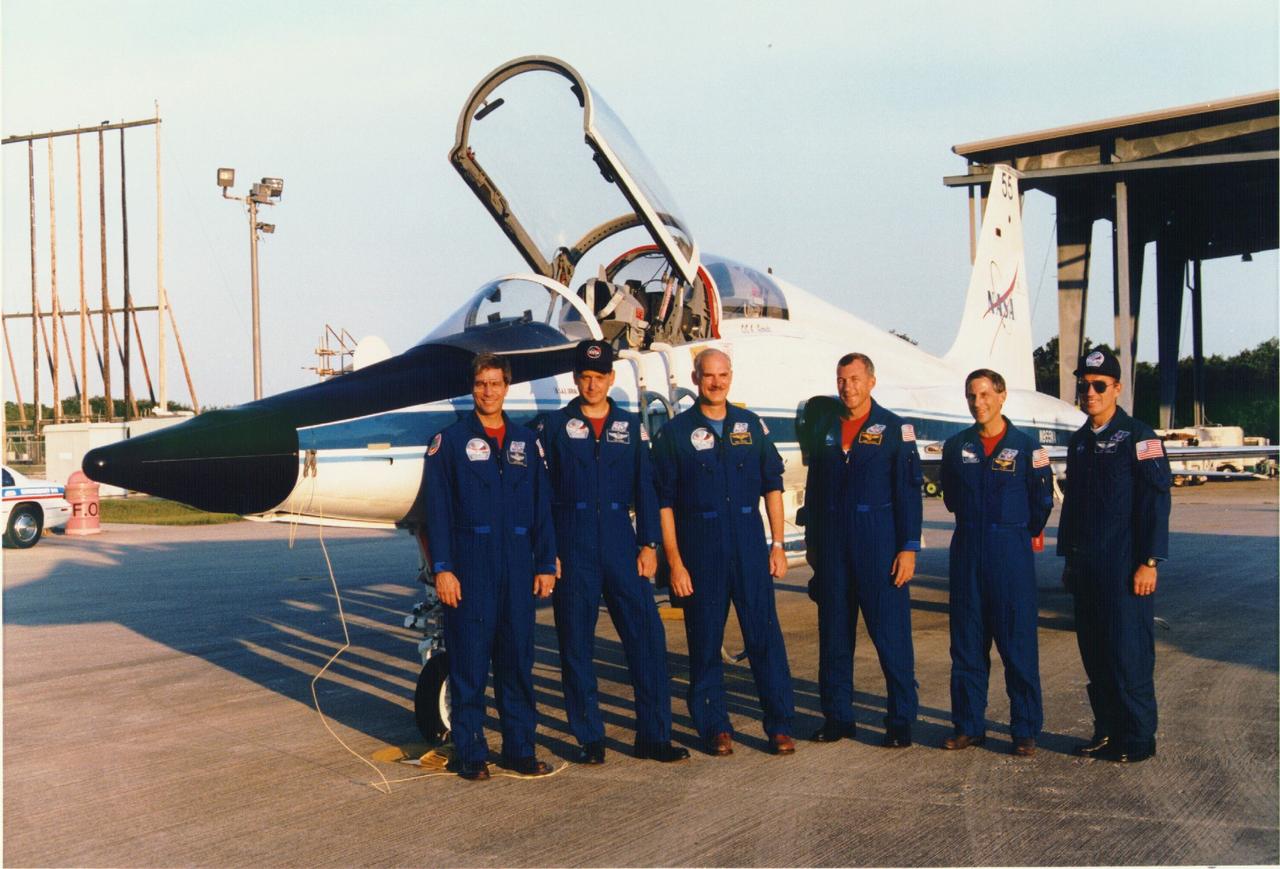
KENNEDY SPACE CENTER, FLA. - The STS-79 astronauts arrive at KSC's Shuttle Landing Facility in their T-38 aircraft from Johnson Space Center in Houston. From left are Mission Specialists John E. Blaha and Tom Akers; Commander William F. Readdy; PIlot Terrence W. Wilcutt; and Mission Specialists Jay Apt and Carl E. Walz. The astronauts are at KSC for the Terminal Countdown Demonstration Test, a dress rehearsal for launch. They are scheduled to lift off around Sept. 12 on Mission STS-79, the fourth docking between the U.S. Shuttle and Russian Space Station Mir.
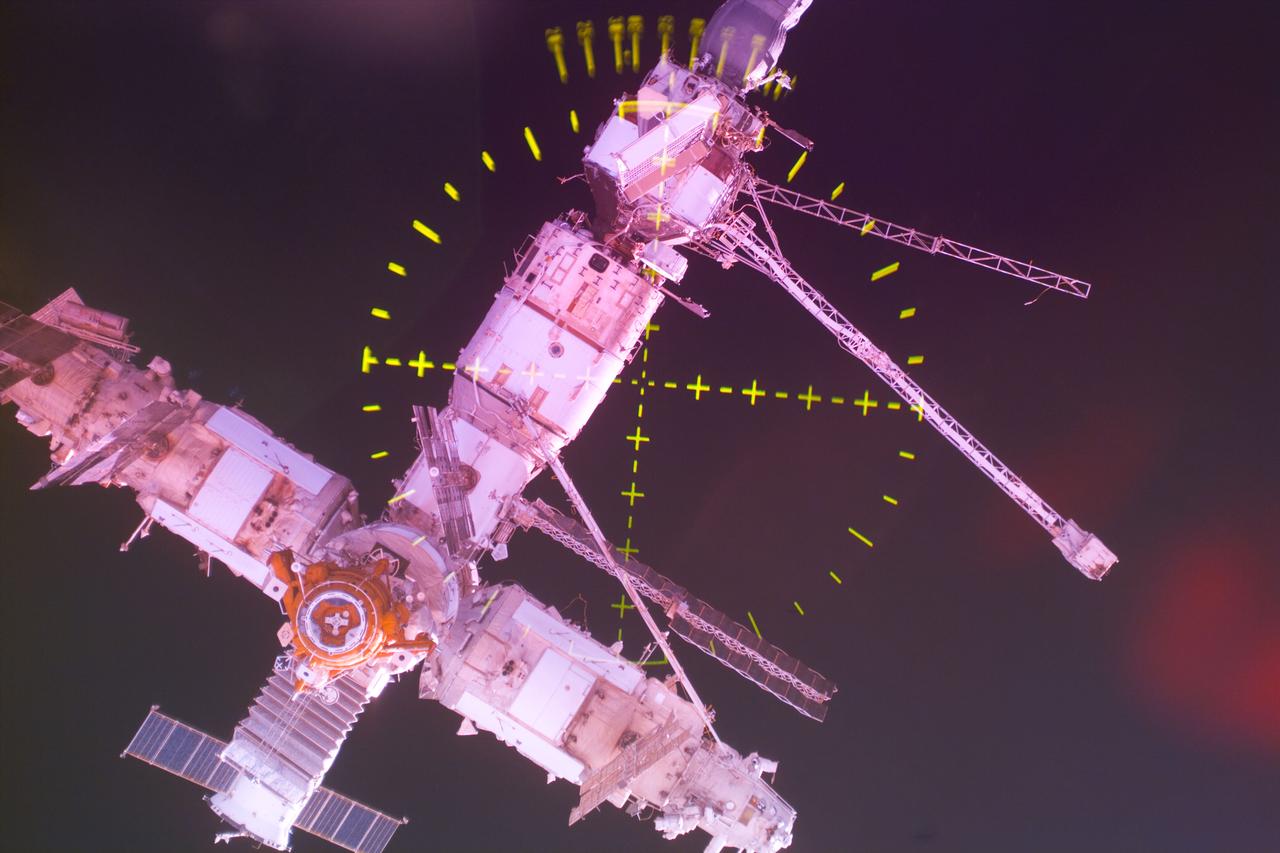
S89-E-5166 (24 Jan 1998) --- This Electronic Still Camera (ESC) image shows the black space forming the backdrop for this view of Russia's Mir Space Station, inside 500 feet and closing. Astronaut Terrence W. (Terry) Wilcutt was at the controls of the Space Shuttle Endeavour during this event -- the eighth of nine planned Shuttle/Mir link-ups. The markings in the frame are those of the Crew Optical Alignment System (COAS). The ESC image was exposed at 19:48:14 GMT, January 24, 1998.
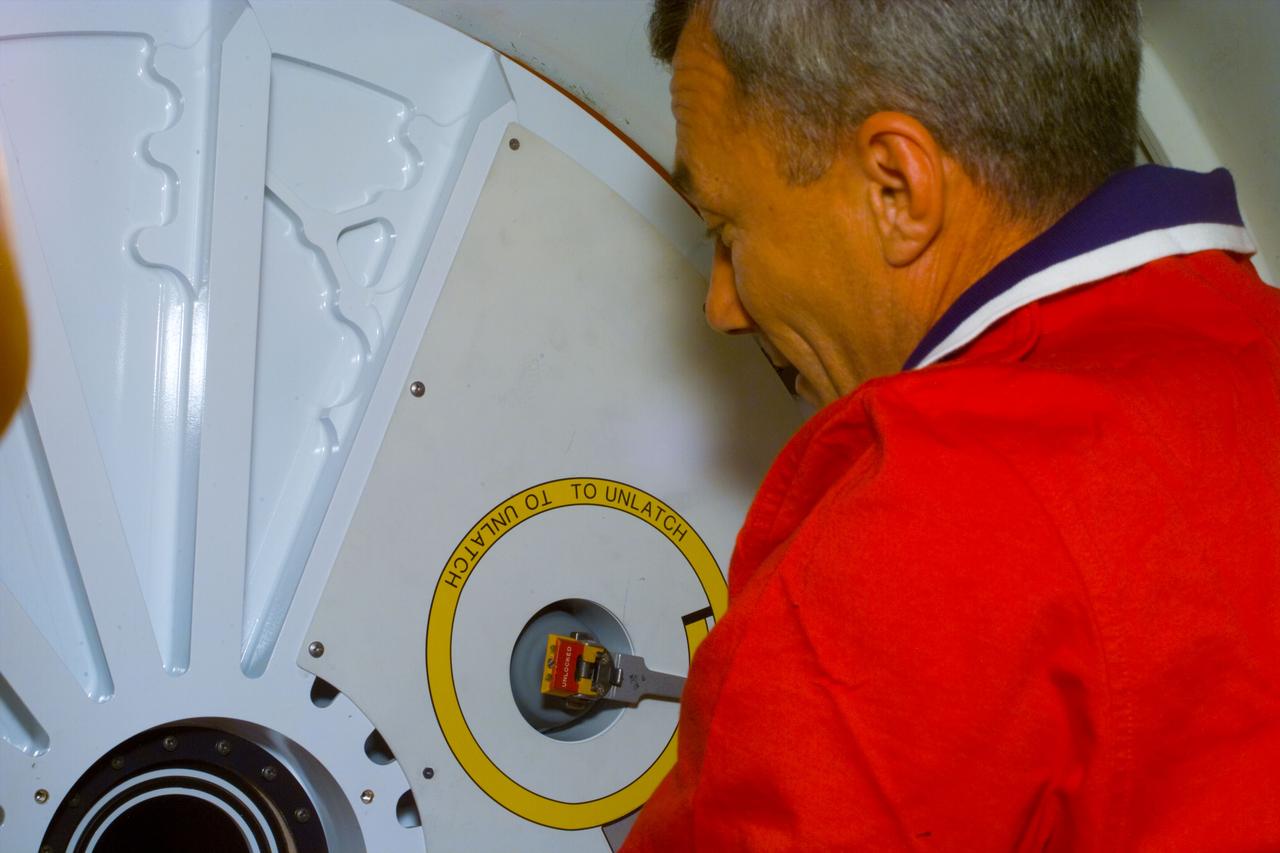
S89-E-5169 (24 Jan 1998) --- Astronaut Terrence W. Wilcutt, mission commander, prepares to open the hatchway to the tunnel that will eventuate an eighth reunion between Shuttle-delivered astronauts and Mir-based cosmonauts in Earth-orbit. The picture was taken with an Electronic Still Camera (ESC) at 22:35:42 GMT, January 24, 1998.
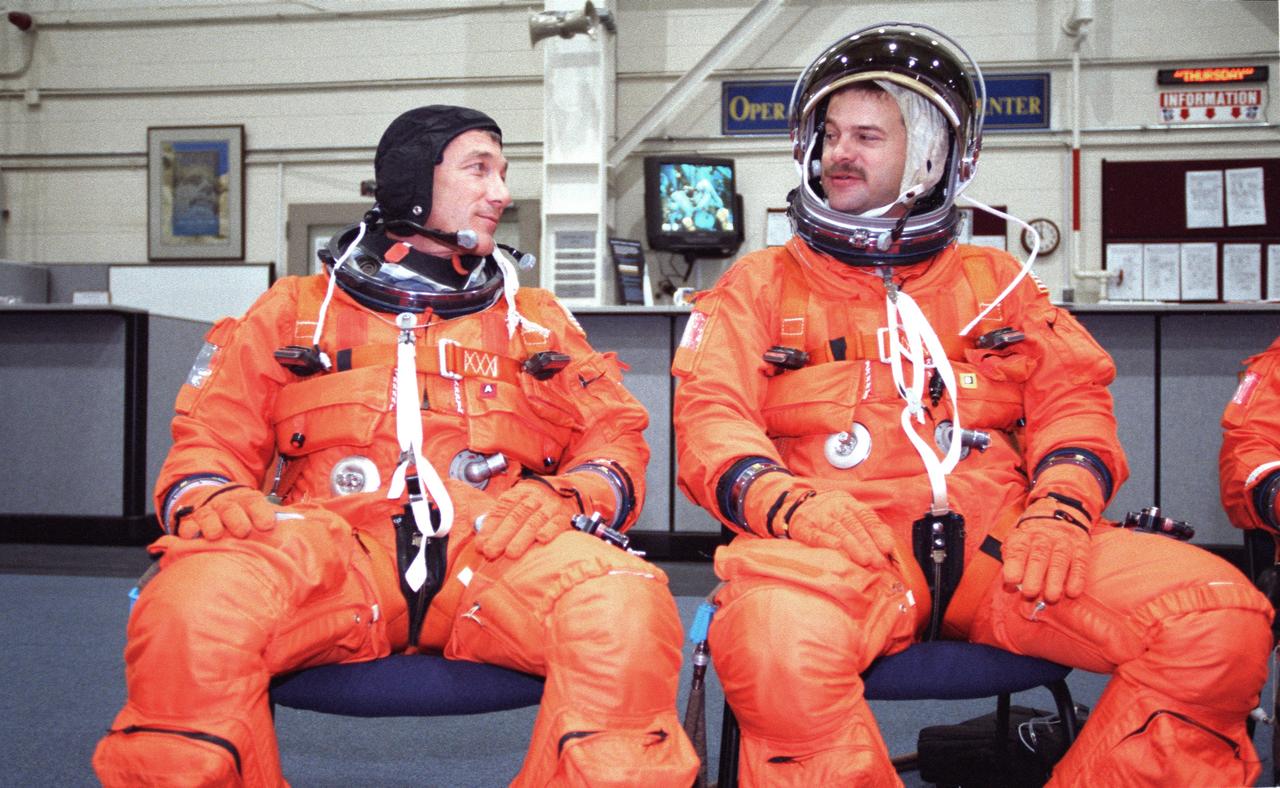
JSC2000-02933 (5 April 2000) --- Astronauts Terrence W. (Terry) Wilcutt (left), mission commander, and Scott D. Altman, pilot, await ingress of a crew training mockup to begin an emergency egress training session at the Johnson Space Center (JSC). The two will join three other NASA astronauts and two cosmonauts representing the Russian Aviation and Space Agency for a late summer visit to the International Space Station (ISS).

KENNEDY SPACE CENTER, FLA. -- Members of the STS-116 crew look over equipment at SPACEHAB in Port Canaveral, Fla. On the left are Mission Specialists Robert Curbeam and Christer Fuglesang; on the right are Commander Terrence Wilcutt and Pilot William Oefelein. Objective of their mission to the International Space Station is to deliver and attach the third port truss segment, the P5 Truss, deactivate and retract the P6 Truss Channel 4B (port-side) solar array, and reconfigure station power from 2A and 4A solar arrays. A launch date is under review.
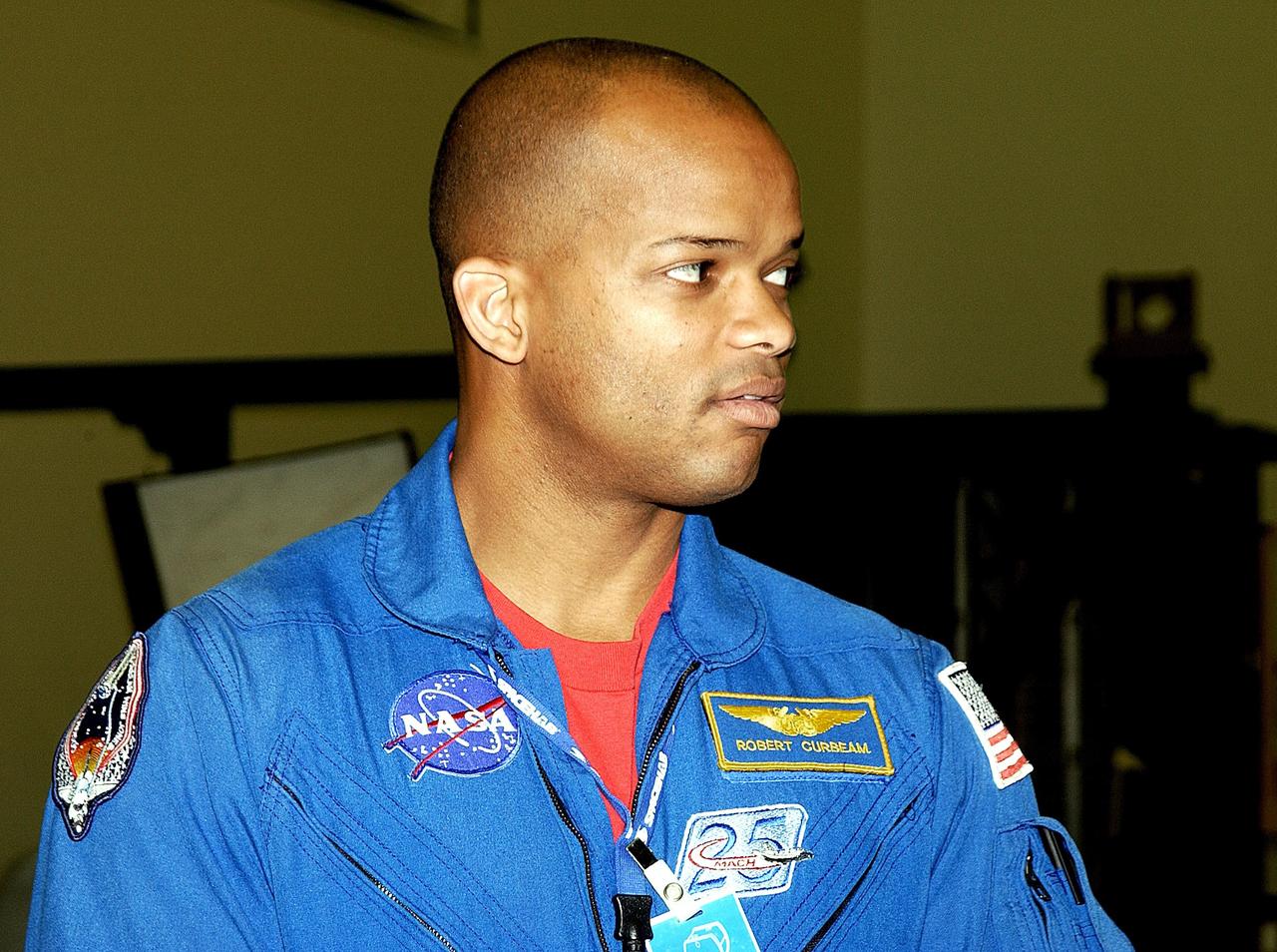
KENNEDY SPACE CENTER, FLA. - STS-116 Mission Specialist Robert Curbeam is in training at SPACEHAB, Port Canaveral, Fla., along with other crew members Commander Terrence Wilcutt, Pilot William Oelefein and Mission Specialist Christer Fuglesang. Objective of their mission to the International Space Station is to deliver and attach the third port truss segment, the P5 Truss, deactivate and retract the P6 Truss Channel 4B (port-side) solar array, and reconfigure station power from 2A and 4A solar arrays. A launch date is under review.
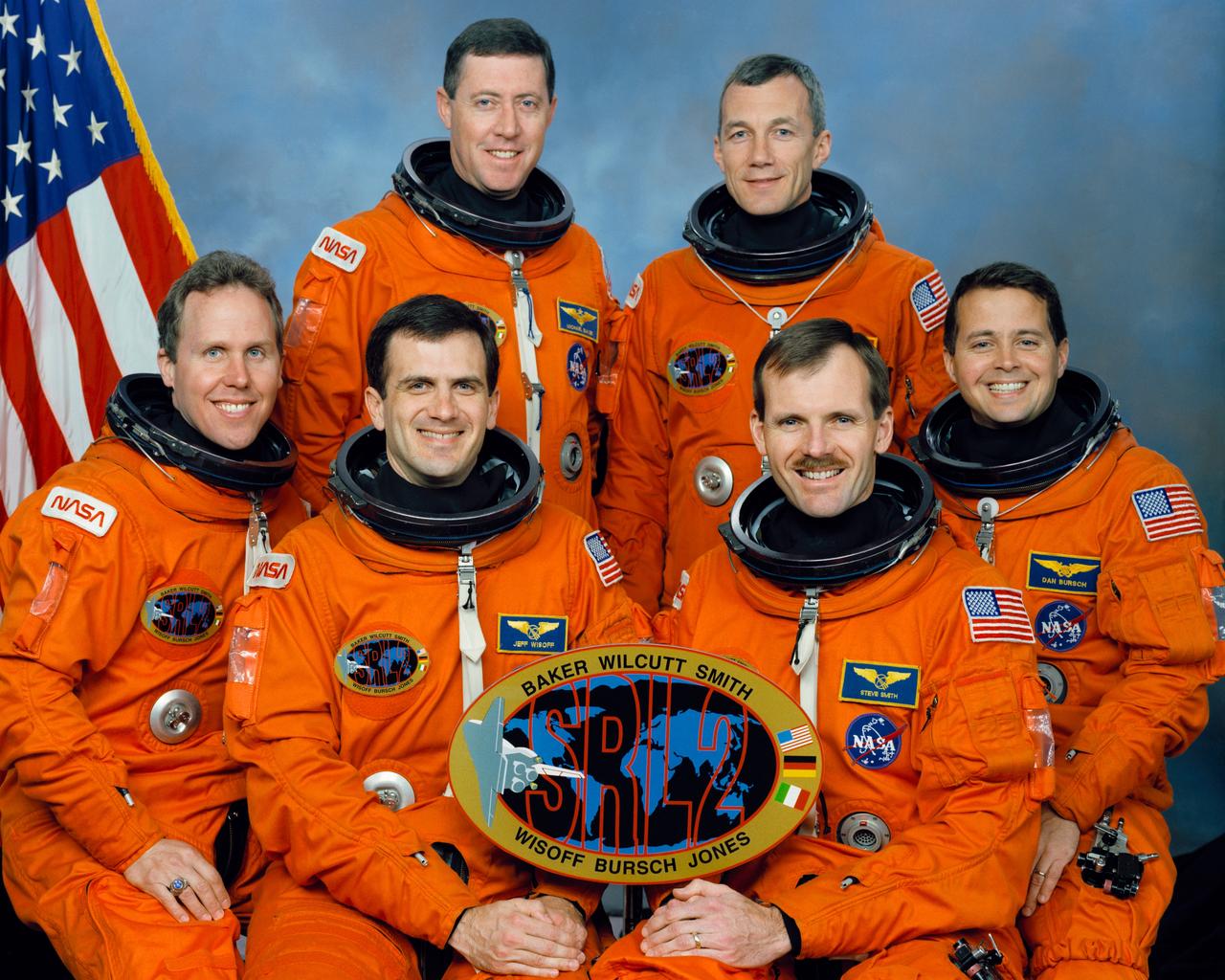
STS068-S-002 (March 1994) --- These six NASA astronauts are in training for the mission, scheduled for launch later this year. Standing are, left to right, Michael A. Baker, mission commander; and Terrence W. Wilcutt, pilot. On the front row are, left to right, Thomas D. Jones, payload commander; and Peter J. K. (Jeff) Wisoff, Steven L. Smith and Daniel W. Bursch, all mission specialists.
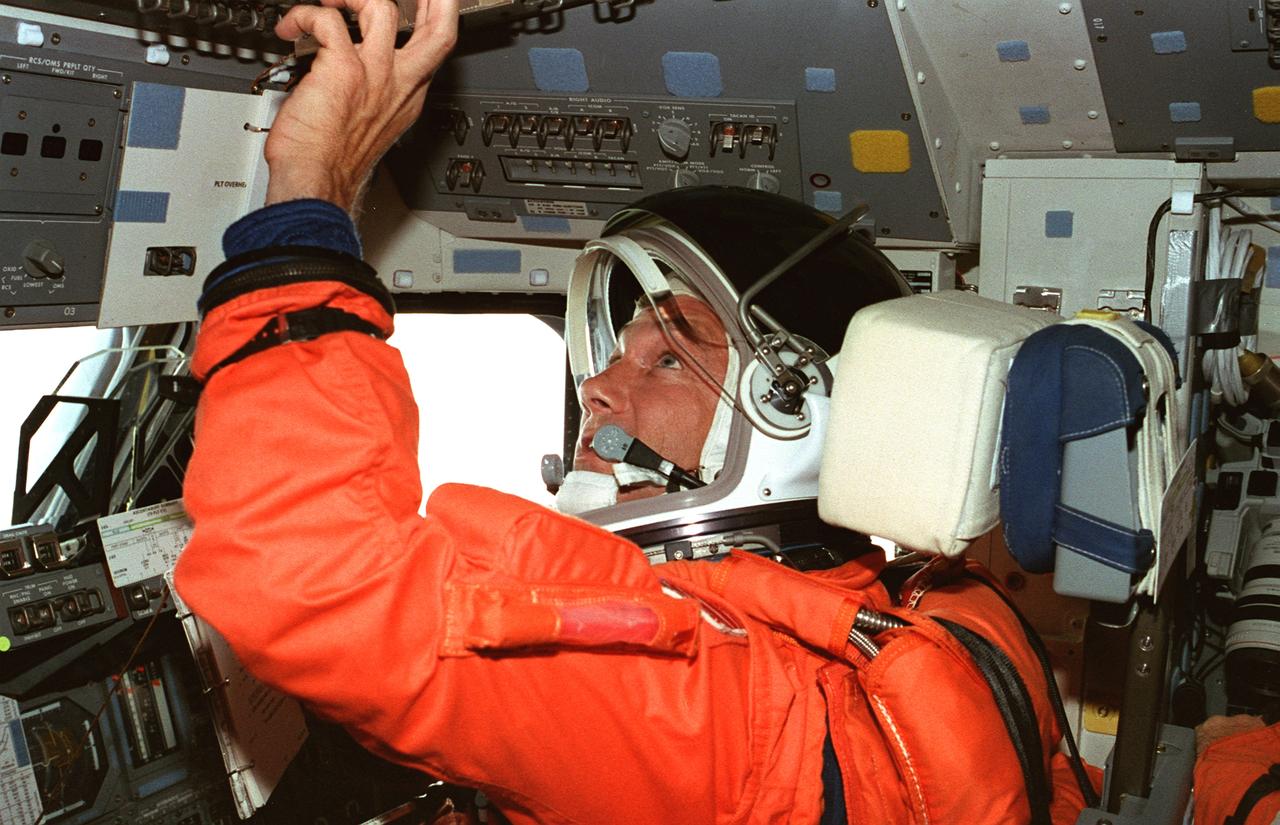
STS079-348-004 (16 Sept. 1996) --- Soon after the space shuttle Atlantis completed its rocket mode ascent to Earth-orbit, astronaut Terrence W. Wilcutt, pilot, begins to ready the Orbiter for ten days of orbiting Earth by activating switches on the flight deck's right overhead panel. Though the launch was a nocturnal one, the crew experienced its first sunrise just after Atlantis achieved its orbital posture.
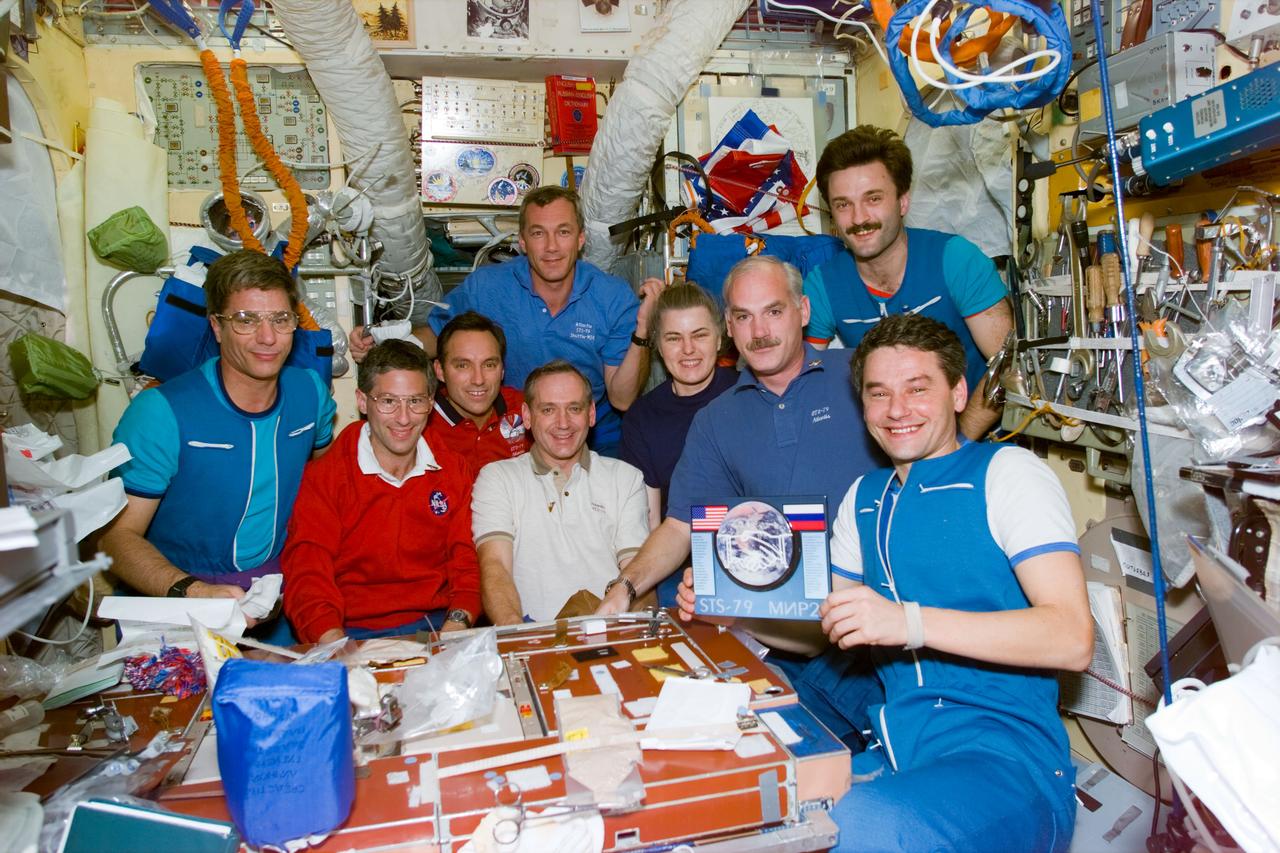
STS79-E-5180 (20 September 1996) --- The entire crews of STS-79 and Mir-22 are shown during a gift exchange ceremony aboard Russia's Mir Space Station's Base Block, during Flight Day 5. Front row, from the left, John E. Blaha, Jerome (Jay) Apt, Carl E. Walz, Thomas D. Akers, Shannon W. Lucid, William F. Readdy and Valeri G. Korzun. Back row: Terrence W. Wilcutt and Aleksandr Y. Kaleri.
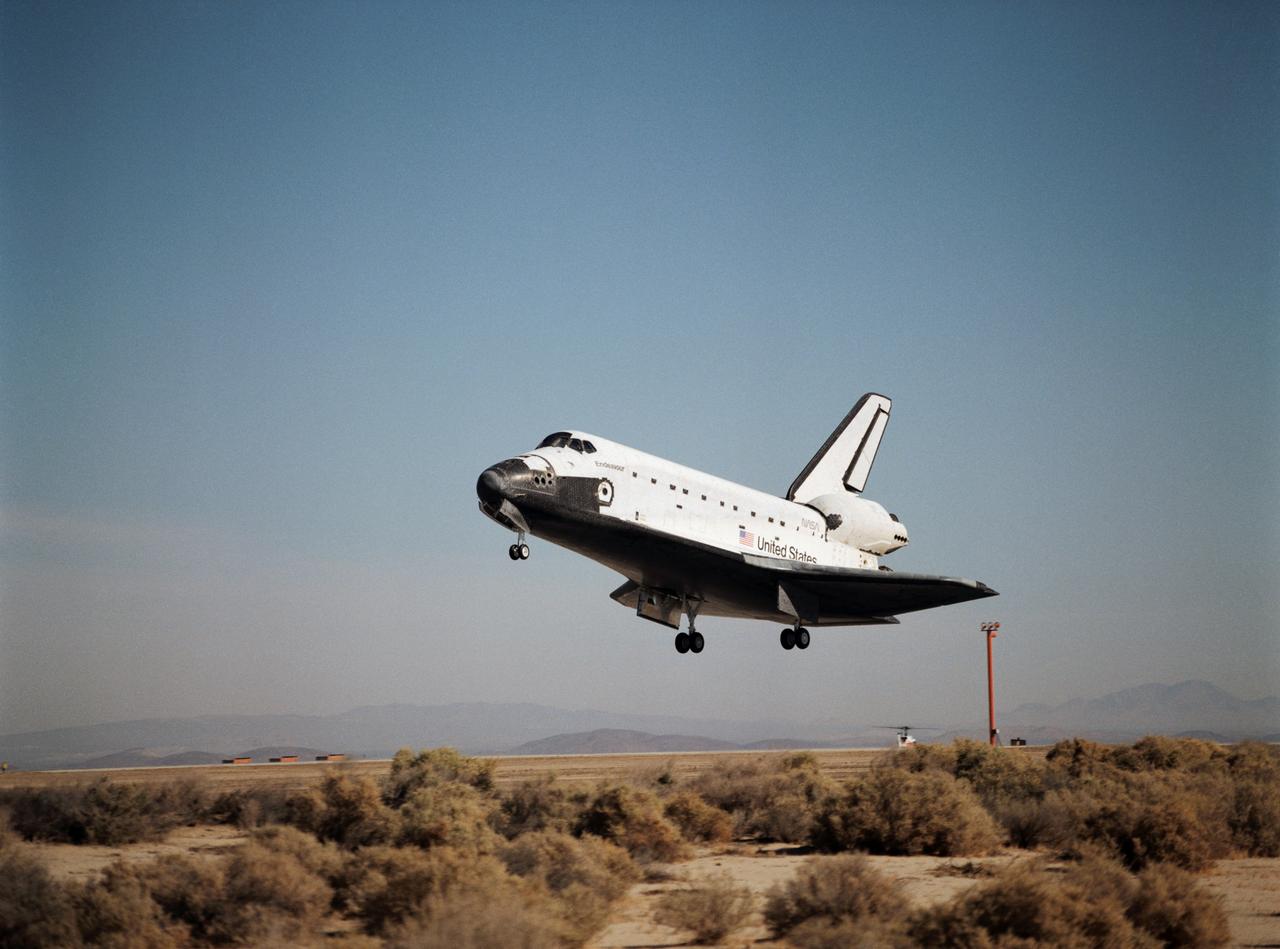
STS068-S-060 (11 October 1994) --- With its main landing gear not quite on the runway, the Space Shuttle Endeavour wraps up an eleven-day mission at Edwards Air Force Base, California. Landing occurred at 10:02 a.m. (PDT), October 11, 1994. Onboard were astronauts Michael A. Baker, mission commander; Terrence W. Wilcutt, pilot; Thomas D. Jones, payload commander; and Daniel W. Bursch, Peter J. K. (Jeff) Wisoff and Steven L. Smith, all mission specialists.
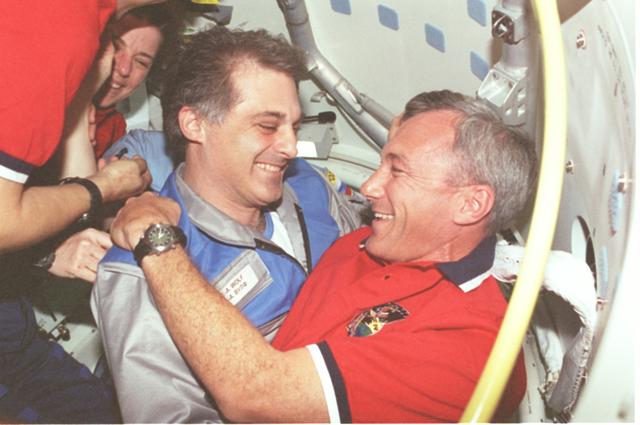
STS089-386-013 (22-31 Jan. 1998) --- Astronaut David A. Wolf, cosmonaut guest researcher, greets Terrence W. Wilcutt, STS-89 shuttle mission commander, and Bonnie J. Dunbar, payload commander, after hatch opening following Russia?s Mir Space Station's and the space shuttle Endeavour's docking. The greeting kicked off several days of joint activity between the NASA and Mir crew members, during the eighth shuttle/Mir docking mission. Photo credit: NASA
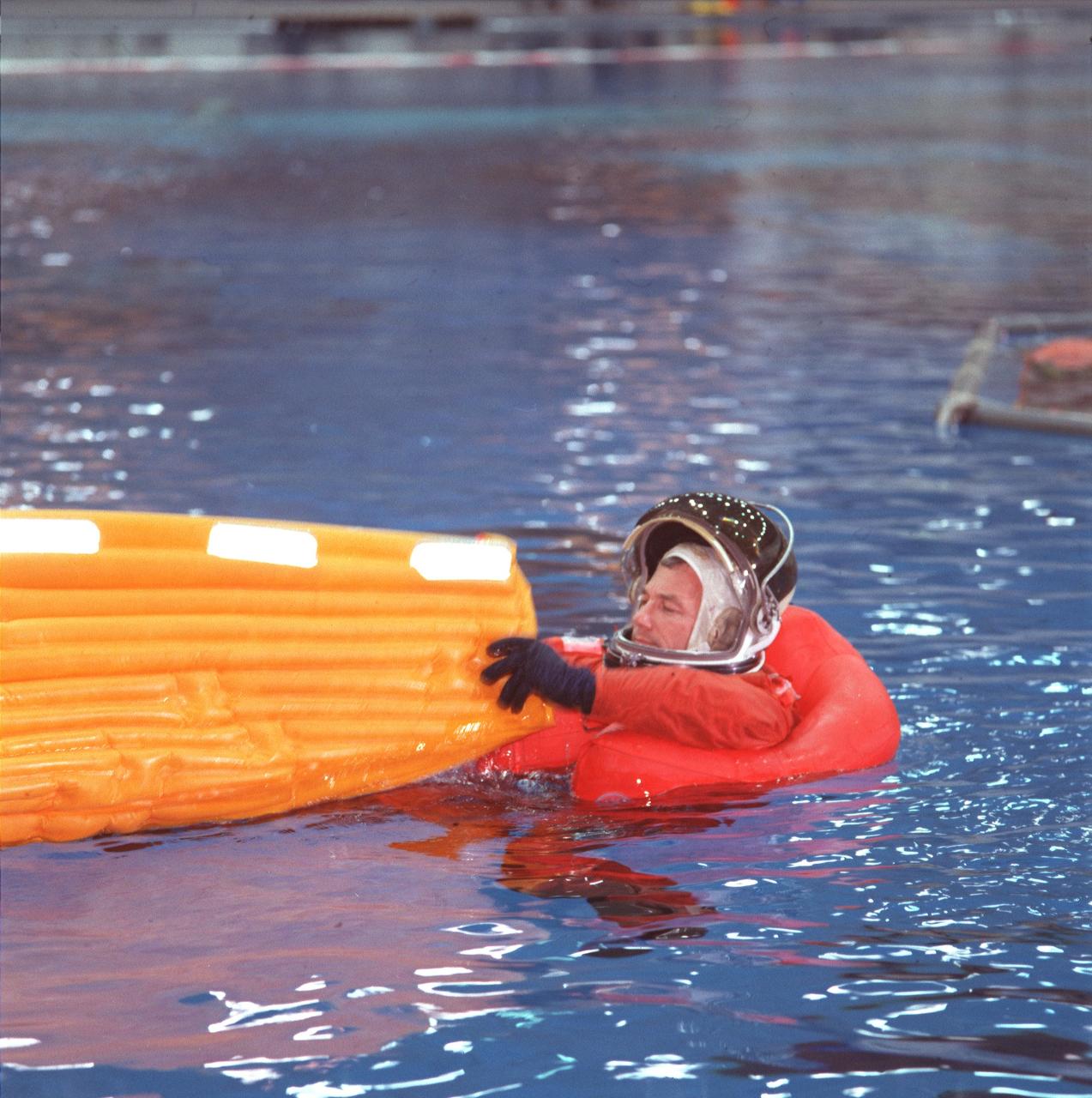
JSC2000-02567 (21 March 2000) --- Astronaut Terrence W. (Terry) Wilcutt, STS-106 mission commander, empties water from his newly-deployed life raft during a simulation of an emergency bailout exercise. The water survival training routinely takes place in the Neutral Buoyancy Laboratory (NBL) near the Johnson Space Center (JSC).
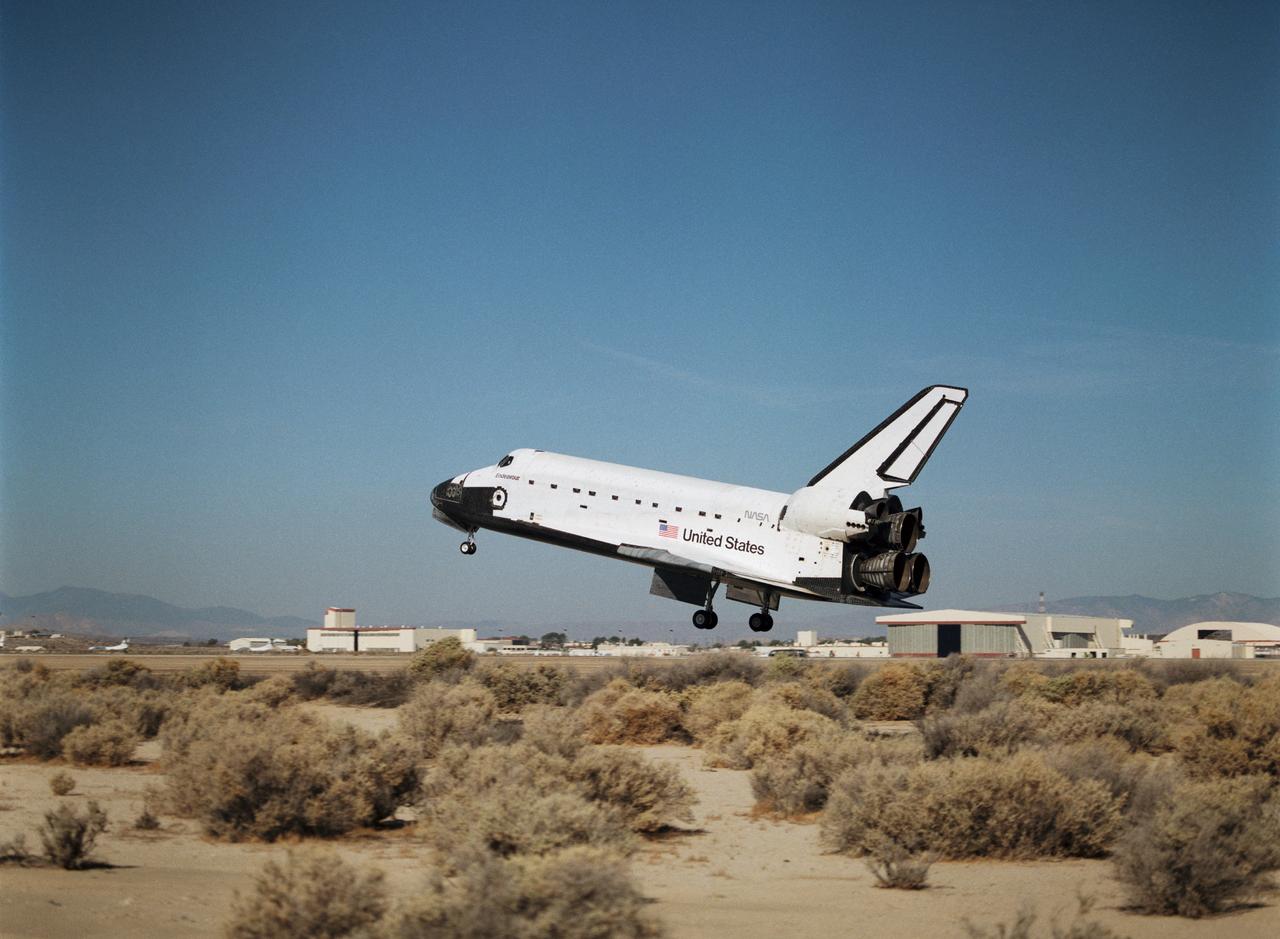
STS068-S-059 (11 October 1994) --- With its main landing gear not quite on the runway, the Space Shuttle Endeavour wraps up an eleven-day mission at Edwards Air Force Base, California. Landing occurred at 10:02 a.m. (PDT), October 11, 1994. Onboard were astronauts Michael A. Baker, mission commander; Terrence W. Wilcutt, pilot; Thomas D. Jones, payload commander; and Daniel W. Bursch, Peter J. K. (Jeff) Wisoff and Steven L. Smith, all mission specialists.

KENNEDY SPACE CENTER, FLA. - The STS-116 crew poses outside the SPACEHAB module during training. In the rear are Commander Terrence Wilcutt and Mission Specialist Christer Fuglesang; in front are Pilot William Oefelein and Mission Specialist Robert Curbeam. Objective of their mission to the International Space Station is to deliver and attach the third port truss segment, the P5 Truss, deactivate and retract the P6 Truss Channel 4B (port-side) solar array, and reconfigure station power from 2A and 4A solar arrays. A launch date is under review.
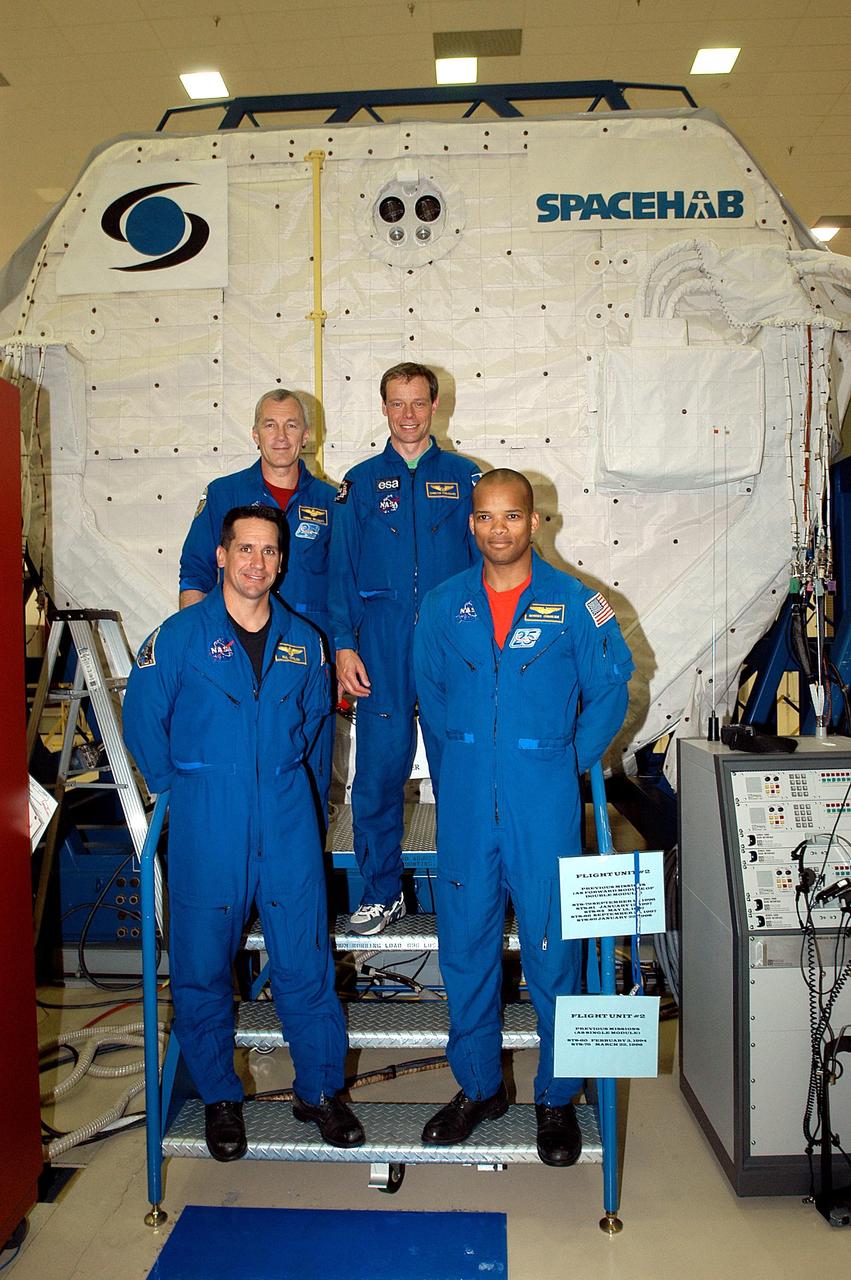
KENNEDY SPACE CENTER, FLA. -- The STS-116 crew poses outside the SPACEHAB module during training. In the rear are Commander Terrence Wilcutt and Mission Specialist Christer Fuglesang;; in front are Pilot William Oefelein and Mission Specialist Robert Curbeam. Objective of their mission to the International Space Station is to deliver and attach the third port truss segment, the P5 Truss, deactivate and retract the P6 Truss Channel 4B (port-side) solar array, and reconfigure station power from 2A and 4A solar arrays. A launch date is under review.
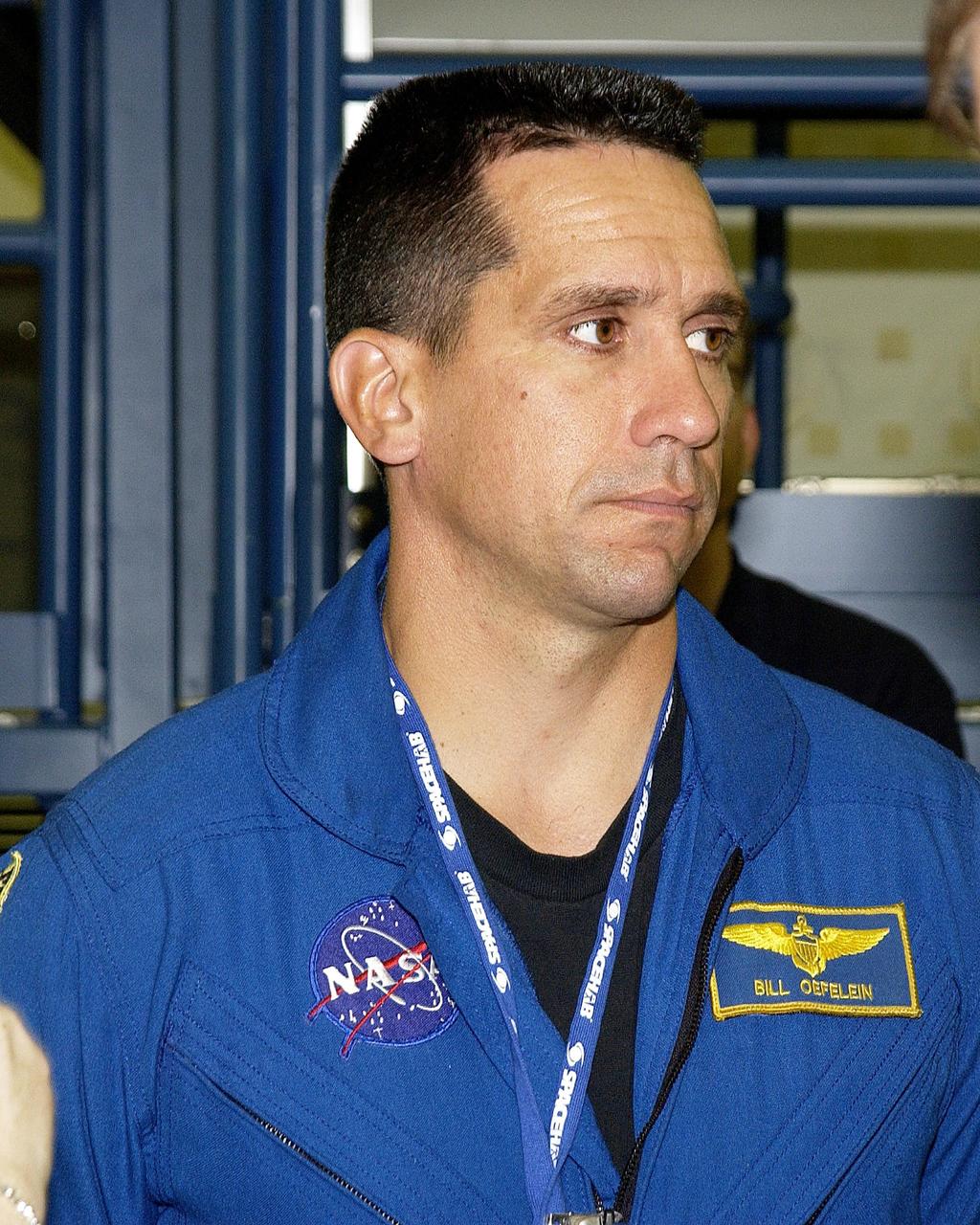
KENNEDY SPACE CENTER, FLA. - STS-116 Pilot William Oelefein is in training at SPACEHAB, Port Canaveral, Fla., along with other crew members Commander Terrence Wilcutt and Mission Specialists Robert Curbeam and Christer Fuglesang. Objective of their mission to the International Space Station is to deliver and attach the third port truss segment, the P5 Truss, deactivate and retract the P6 Truss Channel 4B (port-side) solar array, and reconfigure station power from 2A and 4A solar arrays. A launch date is under review.
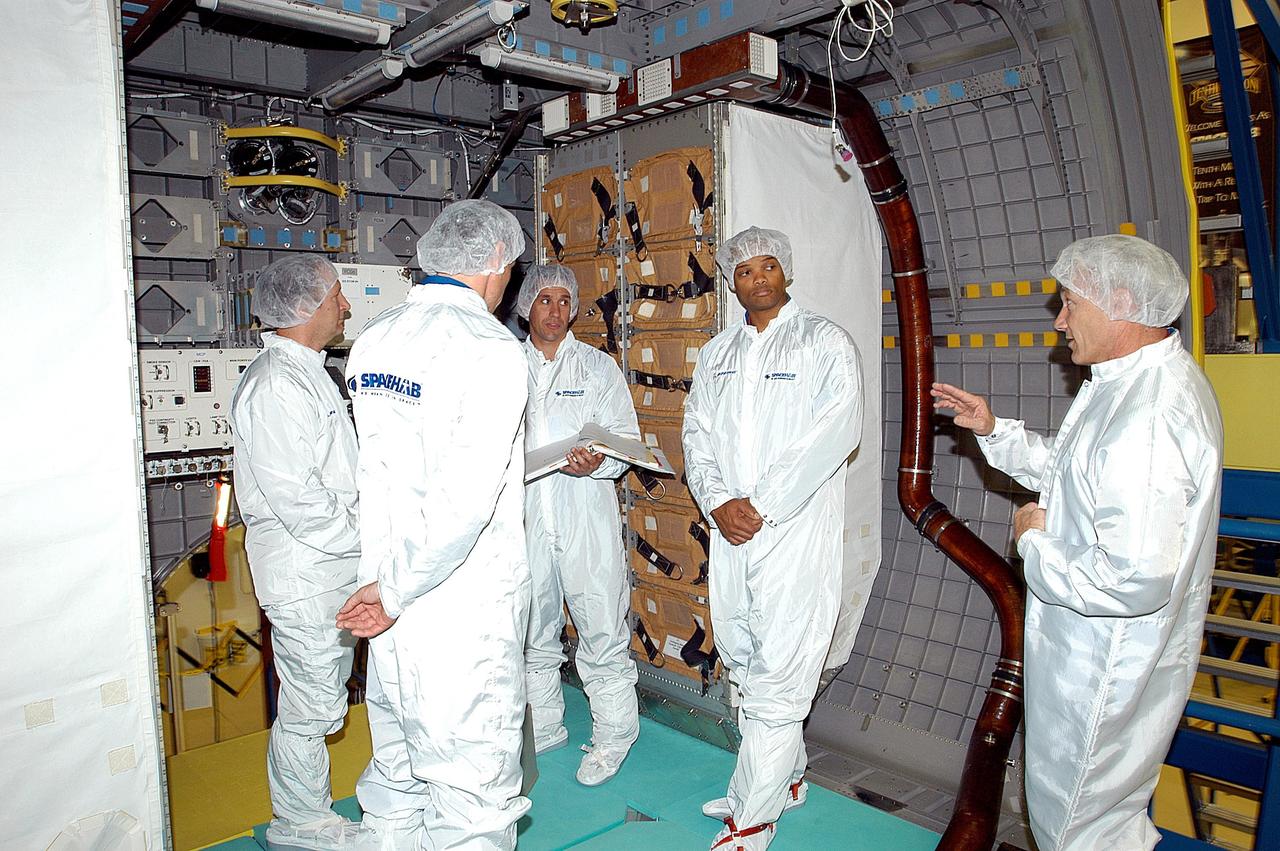
KENNEDY SPACE CENTER, FLA. - The STS-116 crew take part in training in the SPACEHAB module. From left are Mission Specialist Christer Fuglesang; a trainer; Pilot Michael Oefelein; Mission Specialist Robert Curbeam; and Commander Terrence Wilcutt. Objective of their mission to the International Space Station is to deliver and attach the third port truss segment, the P5 Truss, deactivate and retract the P6 Truss Channel 4B (port-side) solar array, and reconfigure station power from 2A and 4A solar arrays. A launch date is under review
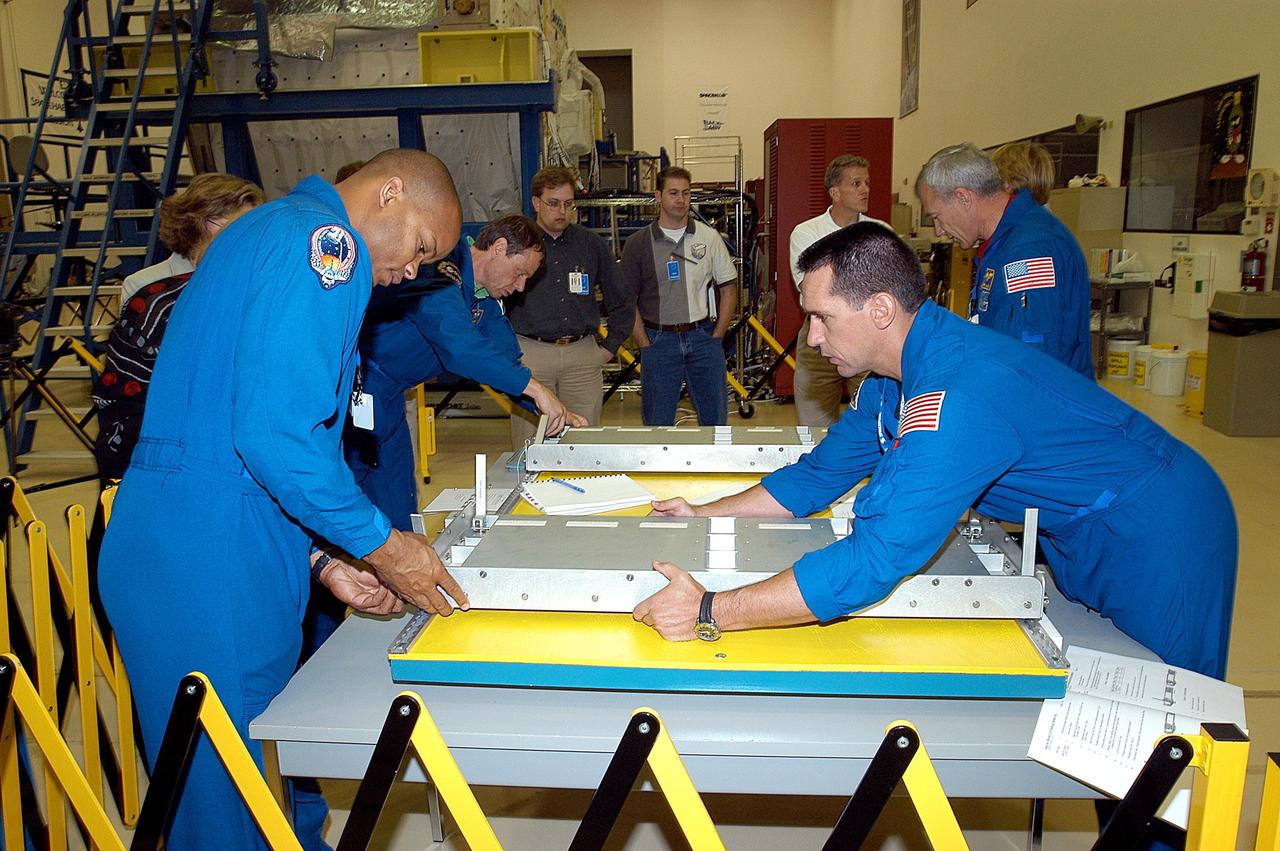
KENNEDY SPACE CENTER, FLA. -- Members of the STS-116 crew handle equipment at SPACEHAB in Port Canaveral, Fla. On the left are Mission Specialists Robert Curbeam and Christer Fuglesang; on the right are Pilot William Oefelein (front) and Commander Terrence Wilcutt. Objective of their mission to the International Space Station is to deliver and attach the third port truss segment, the P5 Truss, deactivate and retract the P6 Truss Channel 4B (port-side) solar array, and reconfigure station power from 2A and 4A solar arrays. A launch date is under review.
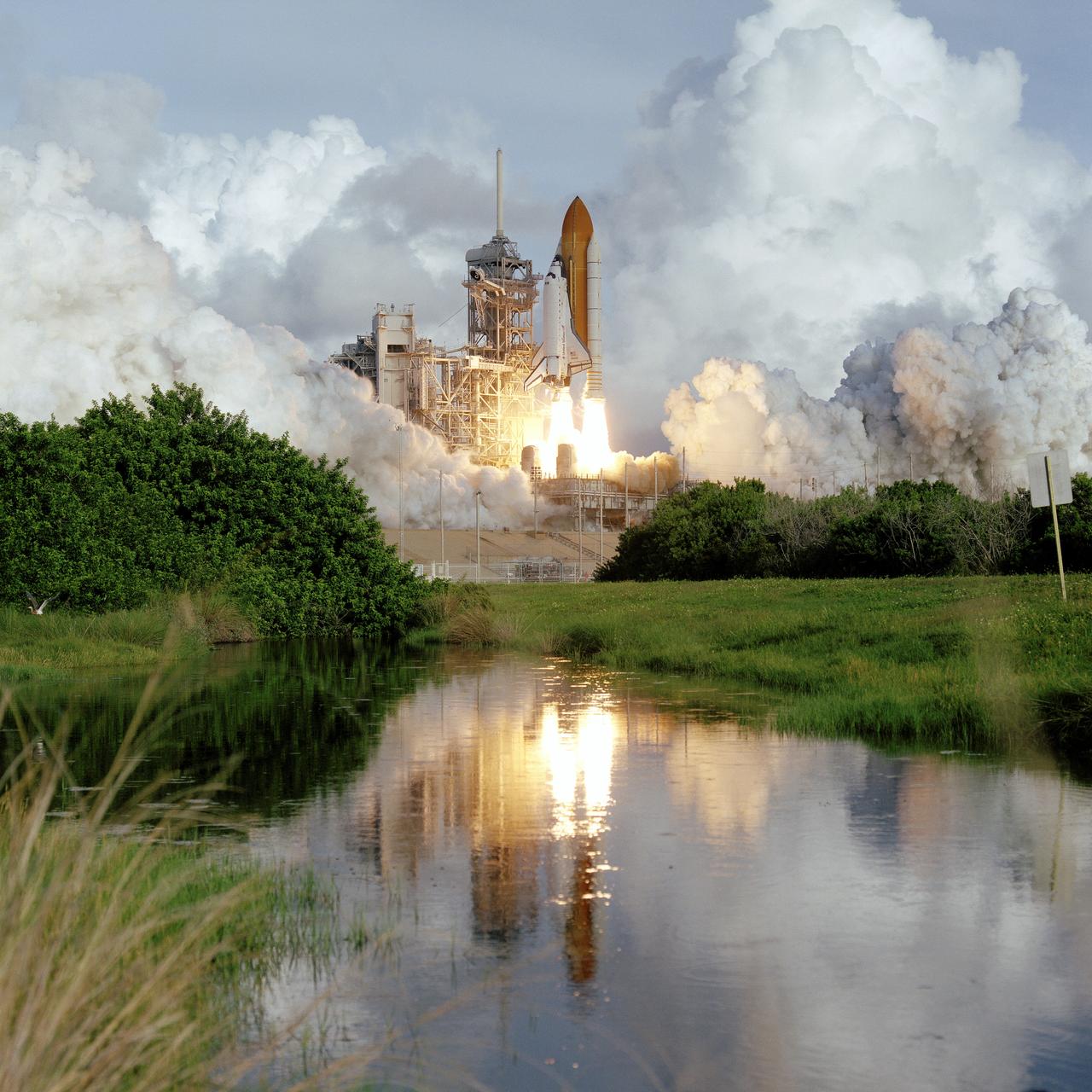
STS106-S-010 (8 Sept. 2000) --- The Space Shuttle Atlantis is mirrored in nearby marsh waters as it makes its 22nd launch into space. The perfect on-time liftoff for STS-106 occurred at 8:45:47 a.m. (EDT), Sept. 8, 2000. Onboard the shuttle were astronauts Terrence W. Wilcutt, Scott D. Altman, Edward T. Lu, Richard A. Mastracchio and Daniel C. Burbank, along with cosmonauts Yuri I. Malenchenko and Boris V. Morukov who represent the Russian Aviation and Space Agency.
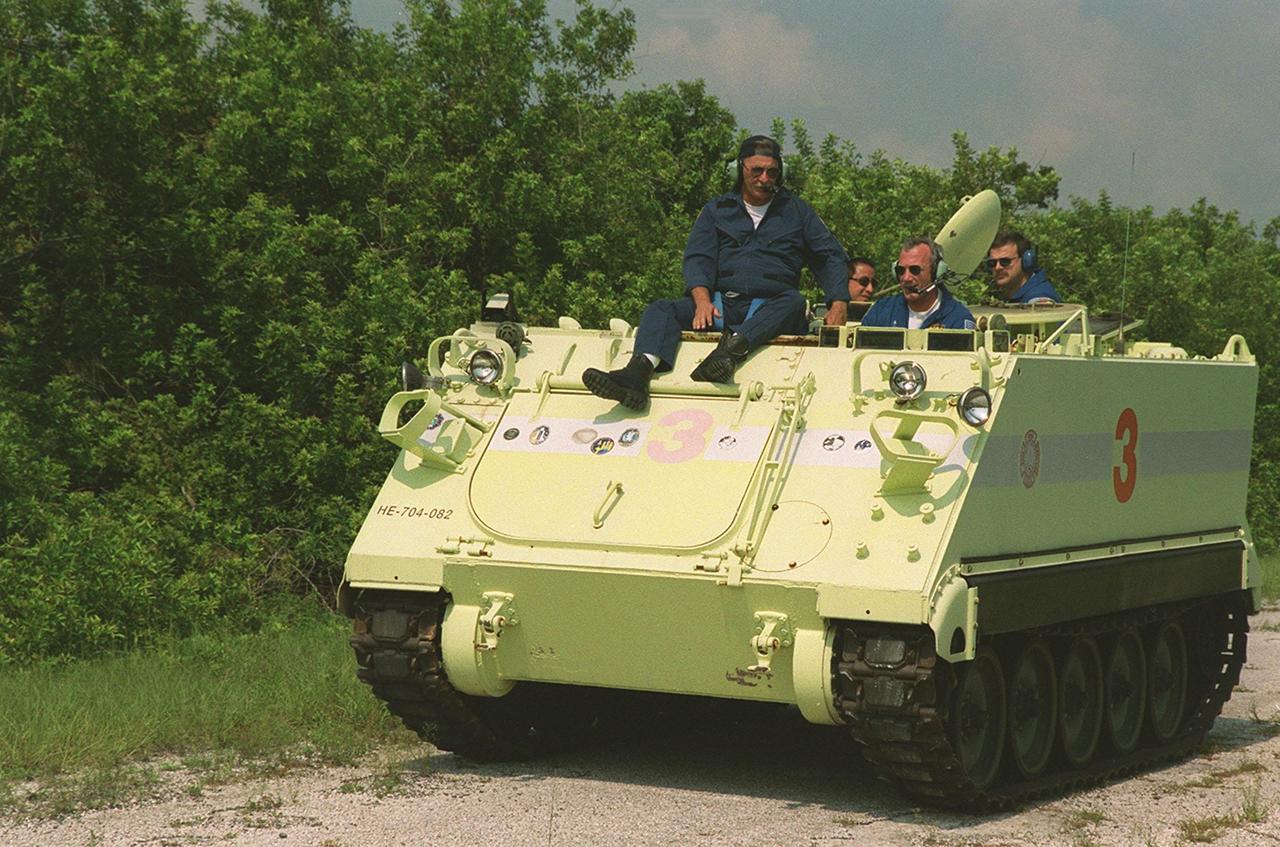
Capt. George Hoggard, trainer with the KSC Fire Department, oversees STS-106 Commander Terrence W. Wilcutt as he the practices driving the small armored personnel carrier that is part of emergency egress training. Behind Hoggard and Wilcutt are Mission Specialist Edward T. Lu and Pilot Scott D. Altman. They and the rest of the crew are taking part in Terminal Countdown Demonstration Test (TCDT) activities. The tracked vehicle could be used by the crew in the event of an emergency at the pad during which the crew must make a quick exit from the area. The TCDT also provides simulated countdown exercises and opportunities to inspect the mission payloads in the orbiter’s payload bay. STS-106 is scheduled to launch Sept. 8, 2000, at 8:31 a.m. EDT from Launch Pad 39B. On the 11-day mission, the seven-member crew will perform support tasks on orbit, transfer supplies and prepare the living quarters in the newly arrived Zvezda Service Module. The first long-duration crew, dubbed “Expedition One,” is due to arrive at the Station in late fall
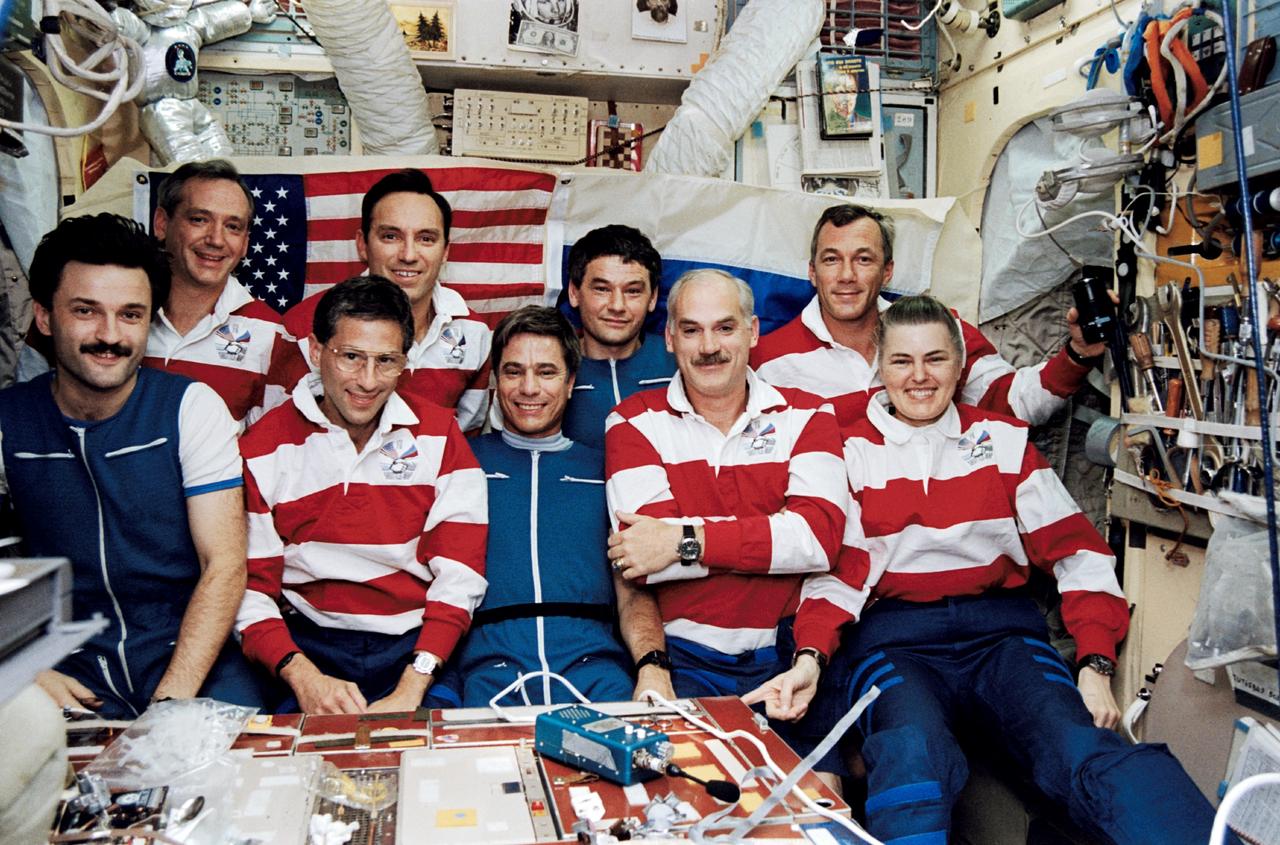
STS079-349-022 (16-26 Sept. 1996) --- The traditional inflight crew portrait, taken in Russia's Mir Space Station base block. Front row, left to right, Aleksandr Y. Kaleri, Jerome (Jay) Apt, John E. Blaha, William F. Readdy and Shannon W. Lucid. Back row, left to right, Thomas D. Akers, Carl E. Walz, Valeri G. Korzun and Terrence W. Wilcutt. This photograph is one of fifteen 35mm frames (along with four 70mm frames) of still photography documenting the activities of NASA's STS-79 mission, which began with a September 16, 1996, liftoff from Launch Pad 39A the Kennedy Space Center (KSC) and ended with a landing at KSC on September 26, 1996. Onboard for the launch were astronauts Readdy, commander; Wilcutt, pilot; Blaha, Apt, Akers and Walz, all mission specialists. On flight day 4, the crew docked with the Mir Space Station. Lucid, who had spent six months aboard Mir, switched cosmonaut guest researcher roles with Blaha. The latter joined fellow Mir-22 crewmembers Korzun, commander, and Kaleri, flight engineer.
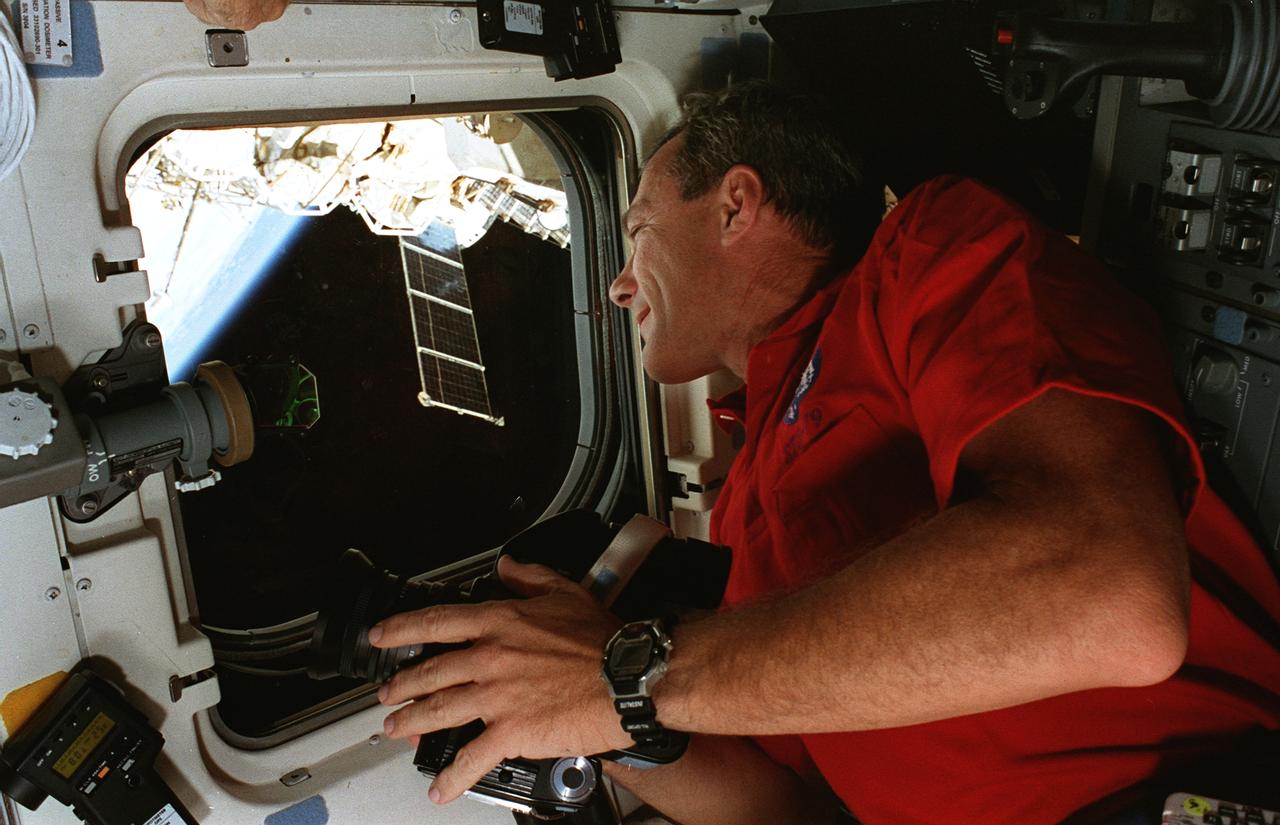
STS079-353-007 (16-26 Sept. 1996) --- Astronaut Terrence W. Wilcutt, on the Space Shuttle Atlantis' aft flight deck, takes pictures of Earth for study by Earth observations scientists at the Johnson Space Center (JSC). Several components of the docked Russia's Mir Space Station can be seen in the background. This photograph is one of fifteen 35mm frames (along with four 70mm frames) of still photography documenting the activities of NASA's STS-79 mission, which began with a September 16, 1996, liftoff from Launch Pad 39A the Kennedy Space Center (KSC) and ended with a landing at KSC on September 26, 1996. Onboard for the launch were astronauts William F. Readdy, commander; Wilcutt, pilot; John E. Blaha, Jerome (Jay) Apt, Thomas D. Akers and Carl E. Walz, all mission specialists. On flight day 4, the crew docked with Russia's Mir Space Station. Shannon W. Lucid, who had spent six months aboard Mir, switched cosmonaut guest researcher roles with Blaha. The latter joined fellow Mir-22 crew members Valeri G. Korzun, commander, and Aleksandr Y. Kaleri, flight engineer.
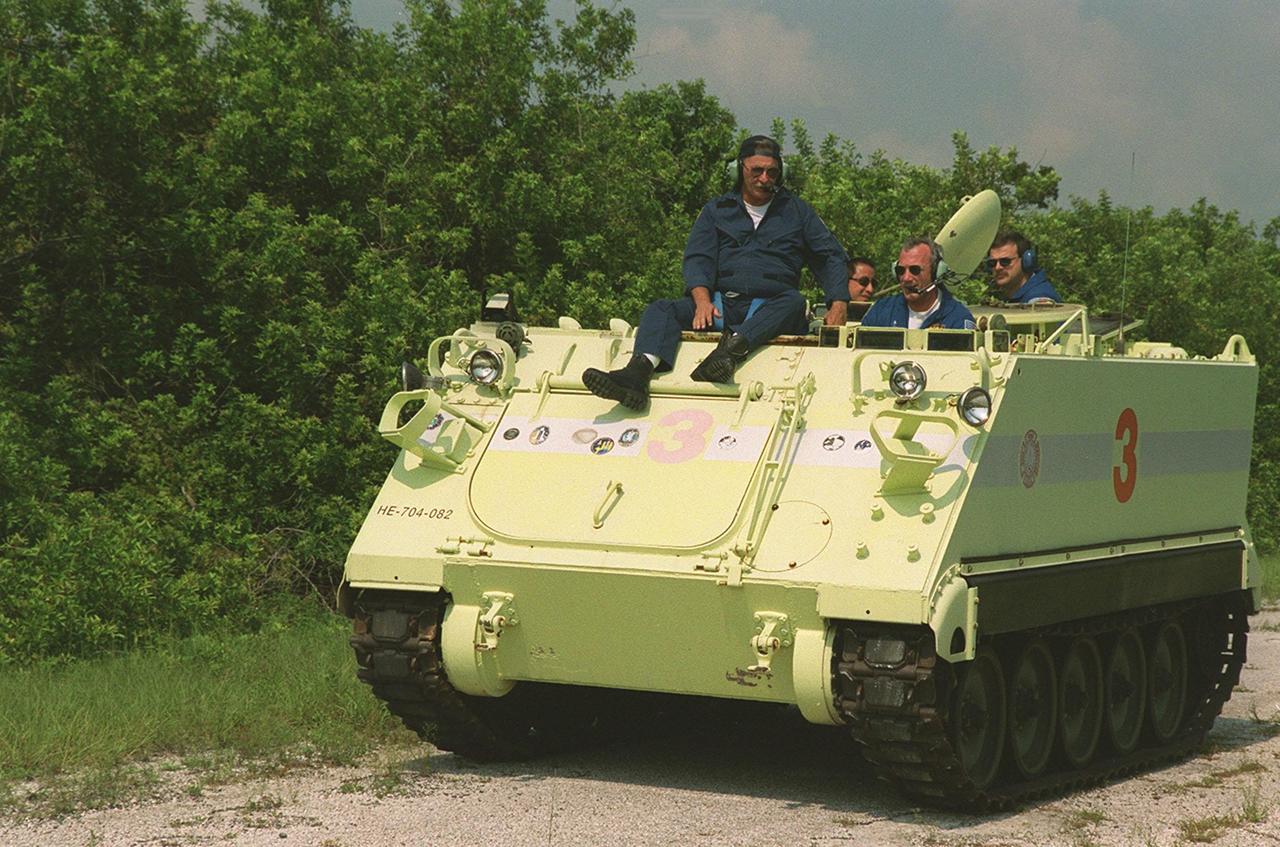
Capt. George Hoggard, trainer with the KSC Fire Department, oversees STS-106 Commander Terrence W. Wilcutt as he the practices driving the small armored personnel carrier that is part of emergency egress training. Behind Hoggard and Wilcutt are Mission Specialist Edward T. Lu and Pilot Scott D. Altman. They and the rest of the crew are taking part in Terminal Countdown Demonstration Test (TCDT) activities. The tracked vehicle could be used by the crew in the event of an emergency at the pad during which the crew must make a quick exit from the area. The TCDT also provides simulated countdown exercises and opportunities to inspect the mission payloads in the orbiter’s payload bay. STS-106 is scheduled to launch Sept. 8, 2000, at 8:31 a.m. EDT from Launch Pad 39B. On the 11-day mission, the seven-member crew will perform support tasks on orbit, transfer supplies and prepare the living quarters in the newly arrived Zvezda Service Module. The first long-duration crew, dubbed “Expedition One,” is due to arrive at the Station in late fall
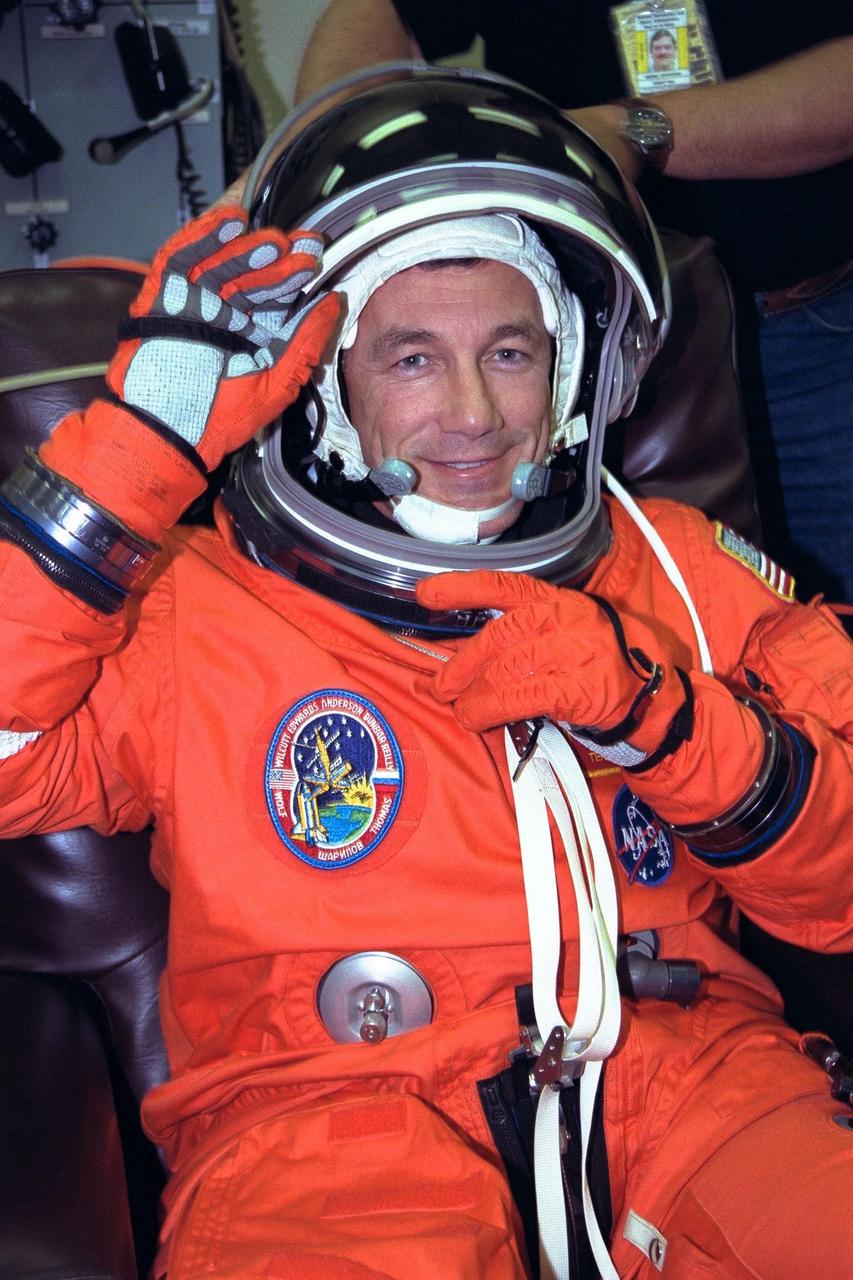
STS-89 Commander Terrence Wilcutt smiles as he completes the donning of his launch/entry suit in the Operations and Checkout (O&C) Building. A veteran of two space flights, he has logged more than 512 hours in space. He served as pilot on STS-68 and STS-79. He and six fellow crew members will soon depart the O&C and head for Launch Pad 39A, where the Space Shuttle Endeavour will lift off during a launch window that opens at 9:43 p.m. EST, Jan. 22. STS-89 is the eighth of nine planned missions to dock the Space Shuttle with Russia's Mir space station
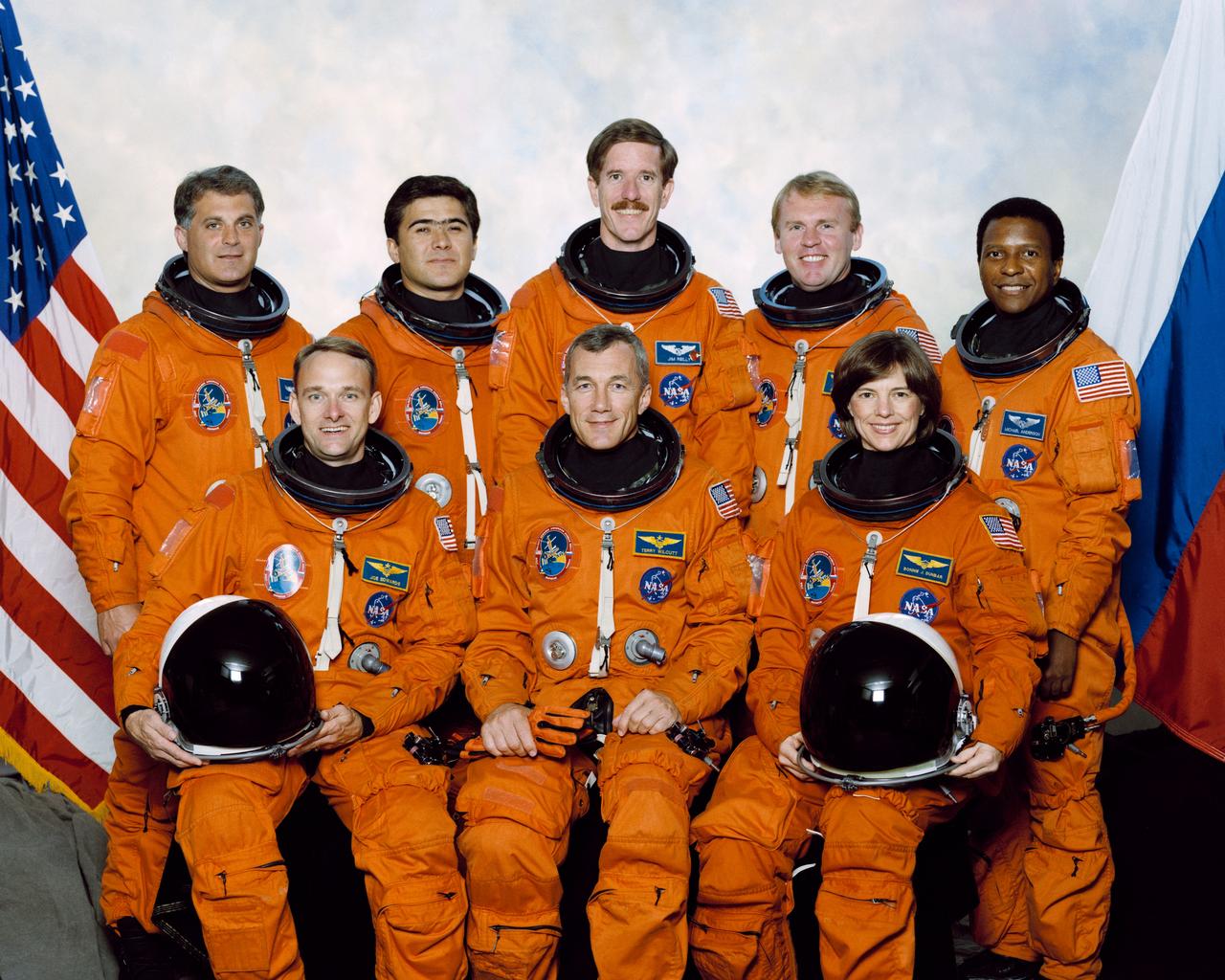
STS089-S-002 (Oct. 1997) --- These seven astronauts and one cosmonaut represent the flight crew for the STS-89 mission to Russia?s Mir Space Station. On the front row, from the left, are astronauts Joe F. Edwards, Jr., pilot; Terrence W. Wilcutt, commander; and Bonnie J. Dunbar, mission specialist. On the back row are David A. Wolf, currently onboard the Mir Space Station as a cosmonaut guest researcher; Salizan S. Sharipov, mission specialist representing the Russian Space Agency (RSA); James F. Reilly, mission specialist; Andrew S. W. Thomas, replacing Wolf aboard Mir as cosmonaut guest researcher; and Michael P. Anderson, mission specialist.

KENNEDY SPACE CENTER, FLA. - At SPACEHAB, Port Canaveral, Fla., STS-116 crew members take part in training for their mission. Seen here are (from left) Mission Specialist Christer Fuglesang, Pilot Michael Oelefein, Mission Specialist Robert Curbeam and Commander Terrence Wilcutt. Fuglesang is with the European Space Agency. Objective of their mission to the International Space Station is to deliver and attach the third port truss segment, the P5 Truss, deactivate and retract the P6 Truss Channel 4B (port-side) solar array, and reconfigure station power from 2A and 4A solar arrays. A launch date is under review.
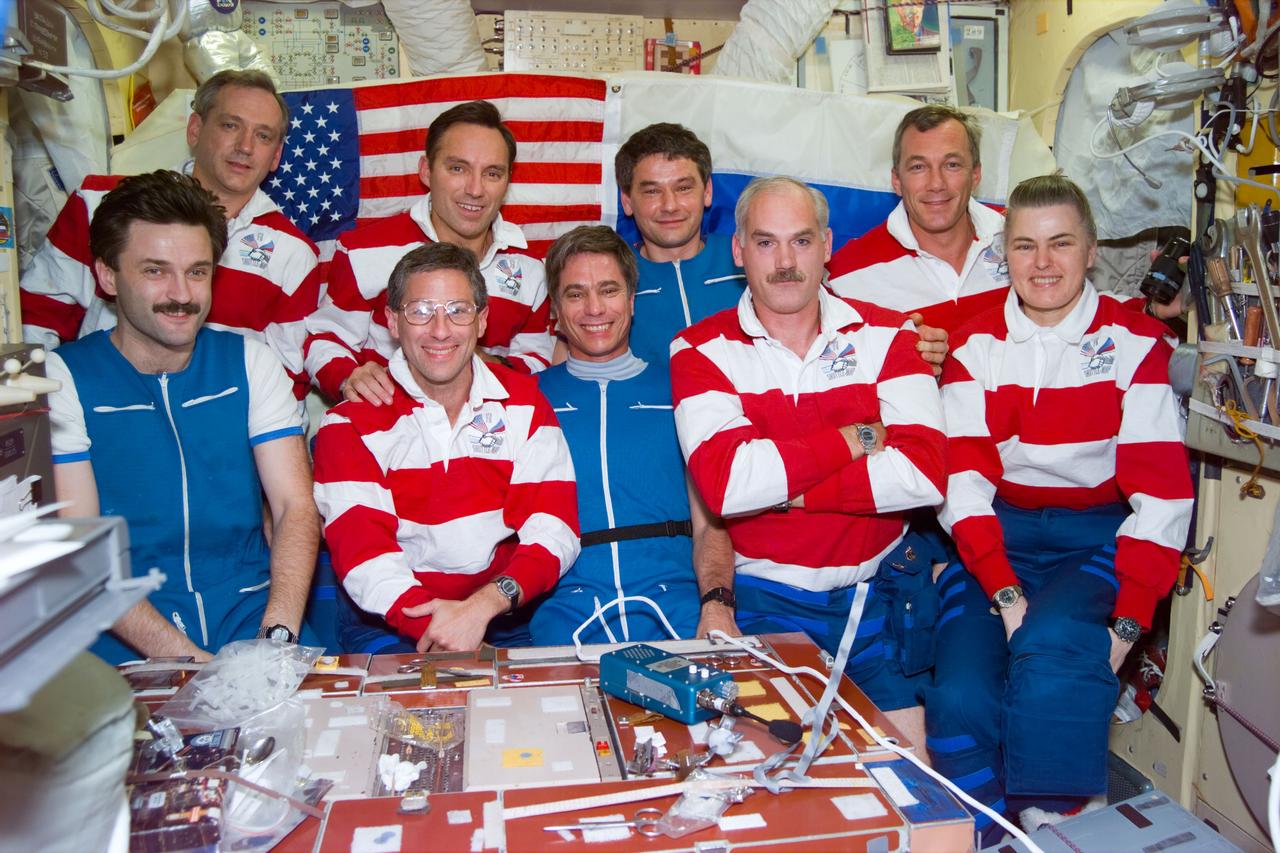
STS79-E-5289 (23 September 1996) --- Crew members of STS-79 and Mir-22 pose for final group portrait aboard Russia's Mir Space Station's Core Module before going separate ways in Earth-orbit, during Flight Day 8. Front row, left to right, are Aleksandr Y. Kaleri, Jerome (Jay) Apt, William F. Readdy and Shannon W. Lucid. On the back row are, left to right, Thomas D. Akers, Carl E. Walz, Valeri G. Korzun and Terrence W. Wilcutt. Note Blaha, the new cosmonaut researcher for Mir-22, is now wearing the uniform of that crew and Lucid's garment is uniform with the STS-79 astronauts.

KENNEDY SPACE CENTER, FLA. - STS-116 Commander Terrence Wilcutt reaches for a packet placed inside equipment at SPACEHAB, Port Canaveral, Fla. He and other crew members - Pilot William Oefelein and Mission Specialists Robert Curbeam and Christer Fuglesang - are training at the facility. Objective of their mission to the International Space Station is to deliver and attach the third port truss segment, the P5 Truss, deactivate and retract the P6 Truss Channel 4B (port-side) solar array, and reconfigure station power from 2A and 4A solar arrays. A launch date is under review.
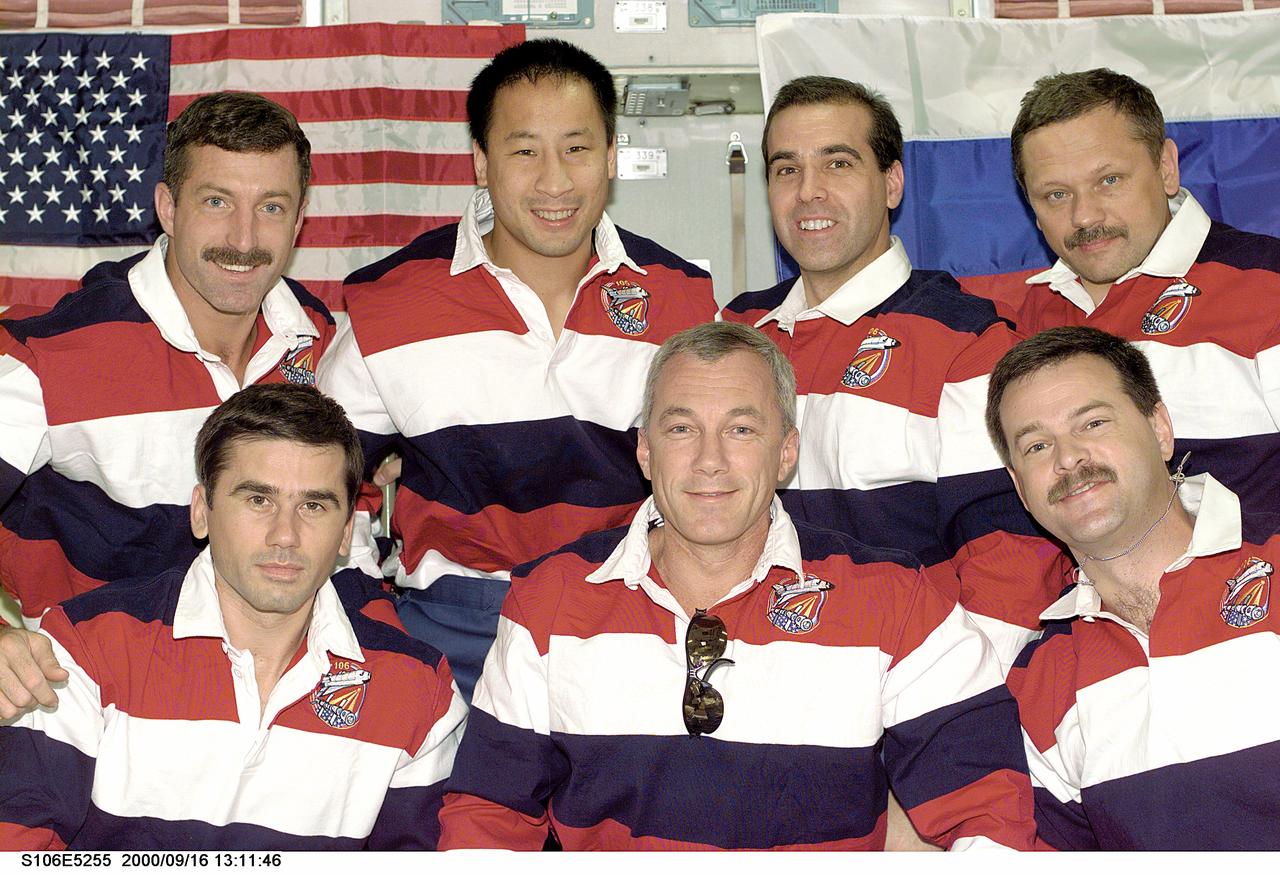
S106-E-5255 (16 September 2000) --- STS-106 crew members, rapidly approaching the time when good-byes to the International Space Station (ISS) will be in order, pose for an inflight crew portrait, snapped by a pre-set electronic still camera (ESC) nearby. Astronaut Terrence W. Wilcutt, mission commander, is at front center, and Scott D. Altman, pilot, front right. Cosmonaut Yuri I. Malenchenko, mission specialist, is at front left. In the rear are (from the left) astronauts Daniel C. Burbank, Edward T. Lu and Richard A. Mastracchio, along with cosmonaut Boris V. Morukov, all mission specialists. Malenchenko and Morukov represent the Russian Aviation and Space Agency.
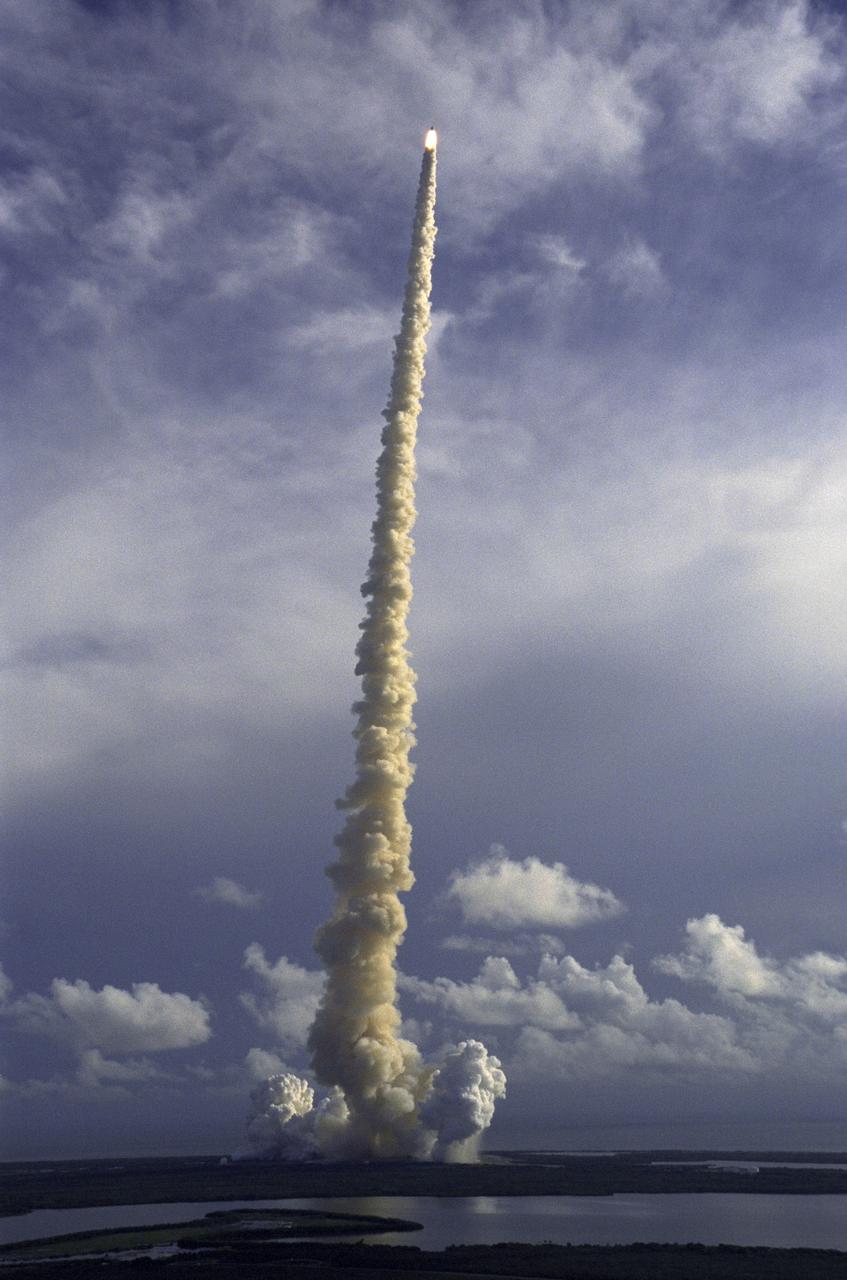
STS106-S-005 (8 September 2000) --- This distant view of the STS-106 liftoff was photographed across marsh waters around Mosquito Lagoon and Banana Creek, looking toward the Atlantic Ocean. The perfect on-time liftoff of the Space Shuttle Atlantis occurred at 8:45:47 a.m. (EDT), September 8, 2000. Onboard the shuttle were astronauts Terrence W. Wilcutt, Scott D. Altman, Edward T. Lu, Richard A. Mastracchio and Daniel C. Burbank, along with cosmonauts Yuri I. Malenchenko and Boris V. Morukov who represent the Russian Aviation and Space Agency.
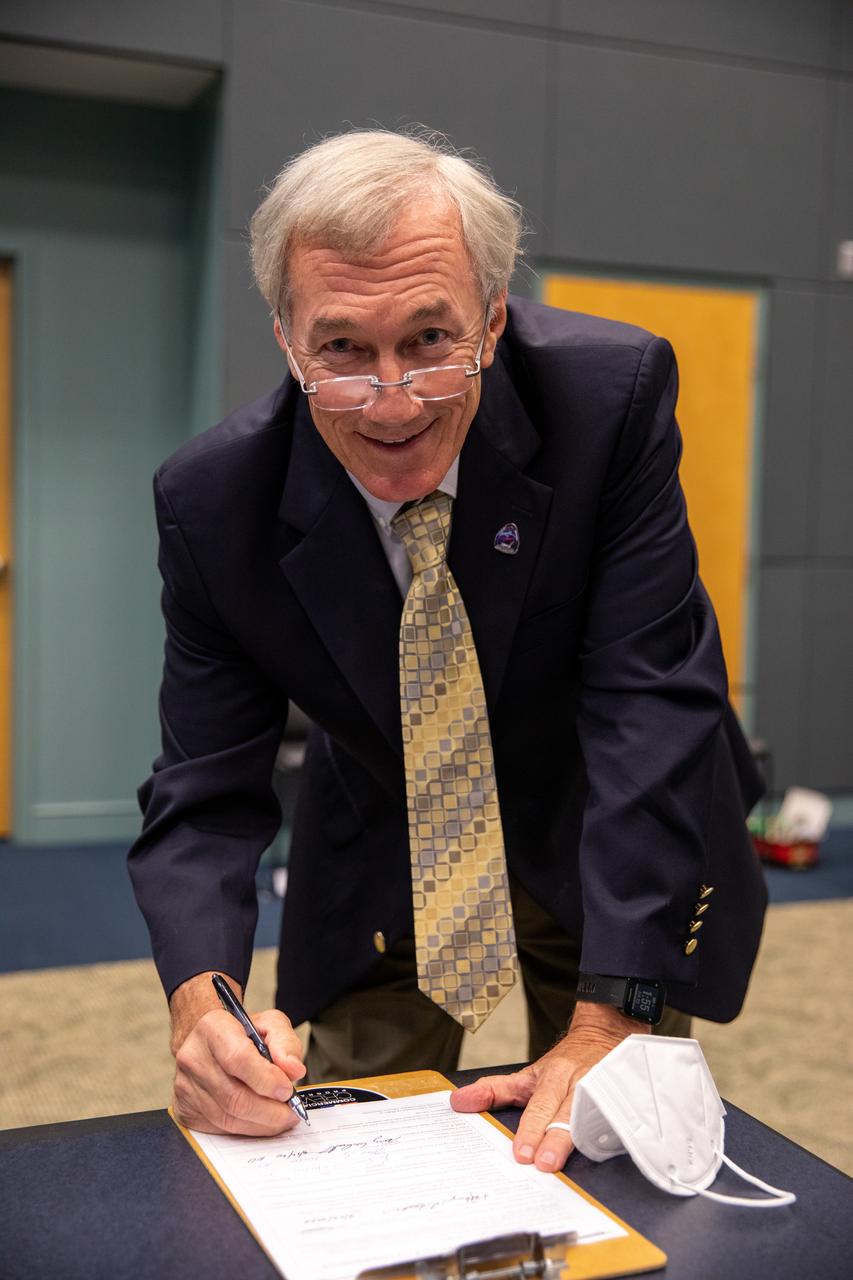
On May 22, 2020, inside the Operations Support Building II at NASA’s Kennedy Space Center in Florida, NASA Chief of Safety and Mission Assurance Terrence Wilcutt signs the official document denoting the agency and SpaceX are a ‘Go’ for the upcoming Demo-2 launch, following the conclusion of the flight readiness review. A SpaceX Falcon 9 rocket and Crew Dragon spacecraft will carry NASA astronauts Robert Behnken and Douglas Hurley to the International Space Station as part of the agency’s Commercial Crew Program, returning human spaceflight capability to the U.S. after nearly a decade. Launch is slated for 4:33 p.m. EDT on Wednesday, May 27, from Kennedy’s Launch Complex 39A.
KENNEDY SPACE CENTER, Fla. -- STS-89 Commander Terrence Wilcutt participates in a question and answer session for the media during Terminal Countdown Demonstration Test (TCDT) activities at KSC. The seven astronauts assigned to the eighth Shuttle-Mir docking flight are at KSC for this dress rehearsal for launch, which includes emergency egress training at the launch pad and culminates with a simulated countdown. The Space Shuttle Endeavour is undergoing preparations for liftoff, scheduled for Jan. 22. STS-89 Mission Specialist Andrew Thomas, Ph.D, will transfer to the Russian Space Station Mir, and succeed David Wolf, M.D., who will return to Earth aboard Endeavour. Dr. Thomas will live and work on Mir until June
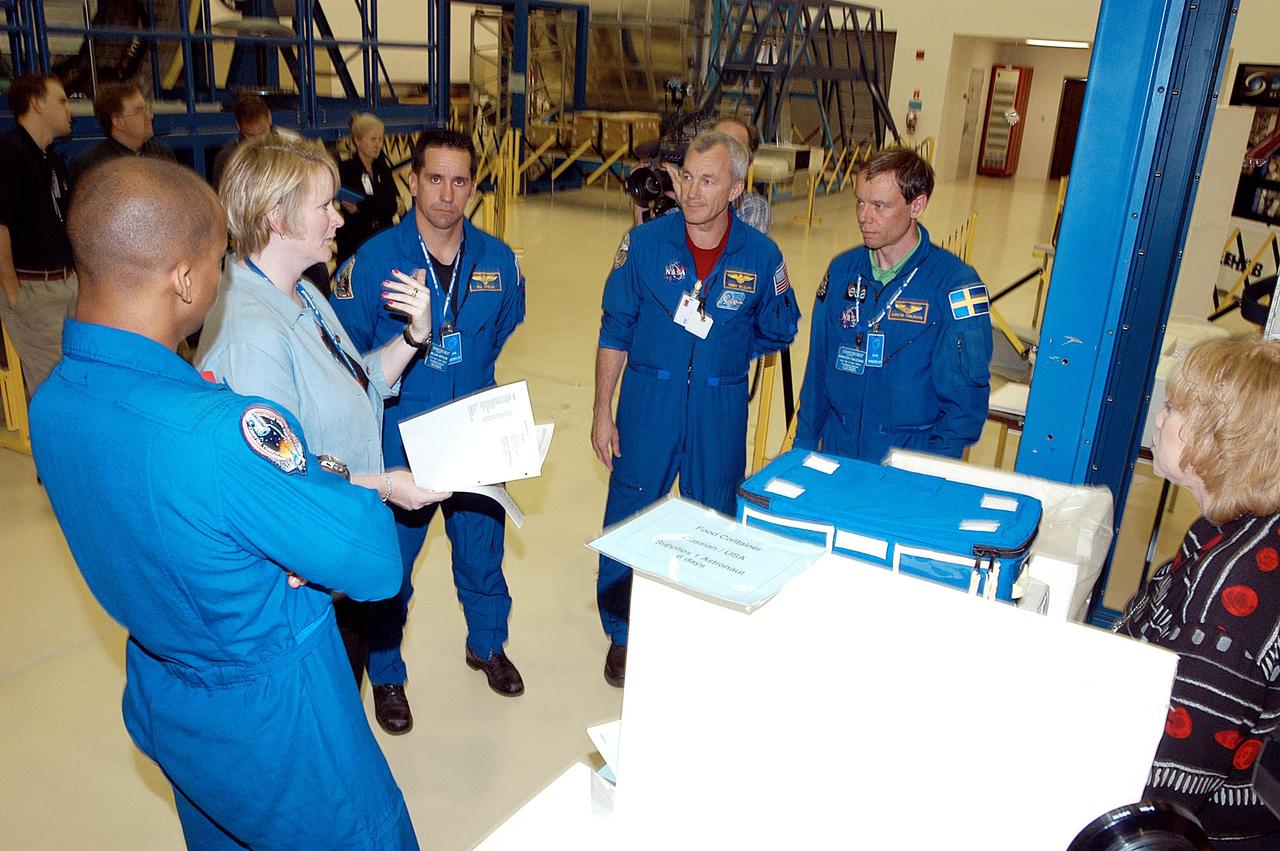
KENNEDY SPACE CENTER, FLA. - The STS-116 crew takes part in training at SPACEHAB in Port Canaveral, Fla. From left are Mission Specialist Robert Curbeam, Pilot William Oefelein, Commander Terrence Wilcutt and Mission Specialist Christer Fuglesang. Objective of their mission to the International Space Station is to deliver and attach the third port truss segment, the P5 Truss, deactivate and retract the P6 Truss Channel 4B (port-side) solar array, and reconfigure station power from 2A and 4A solar arrays. A launch date is under review.
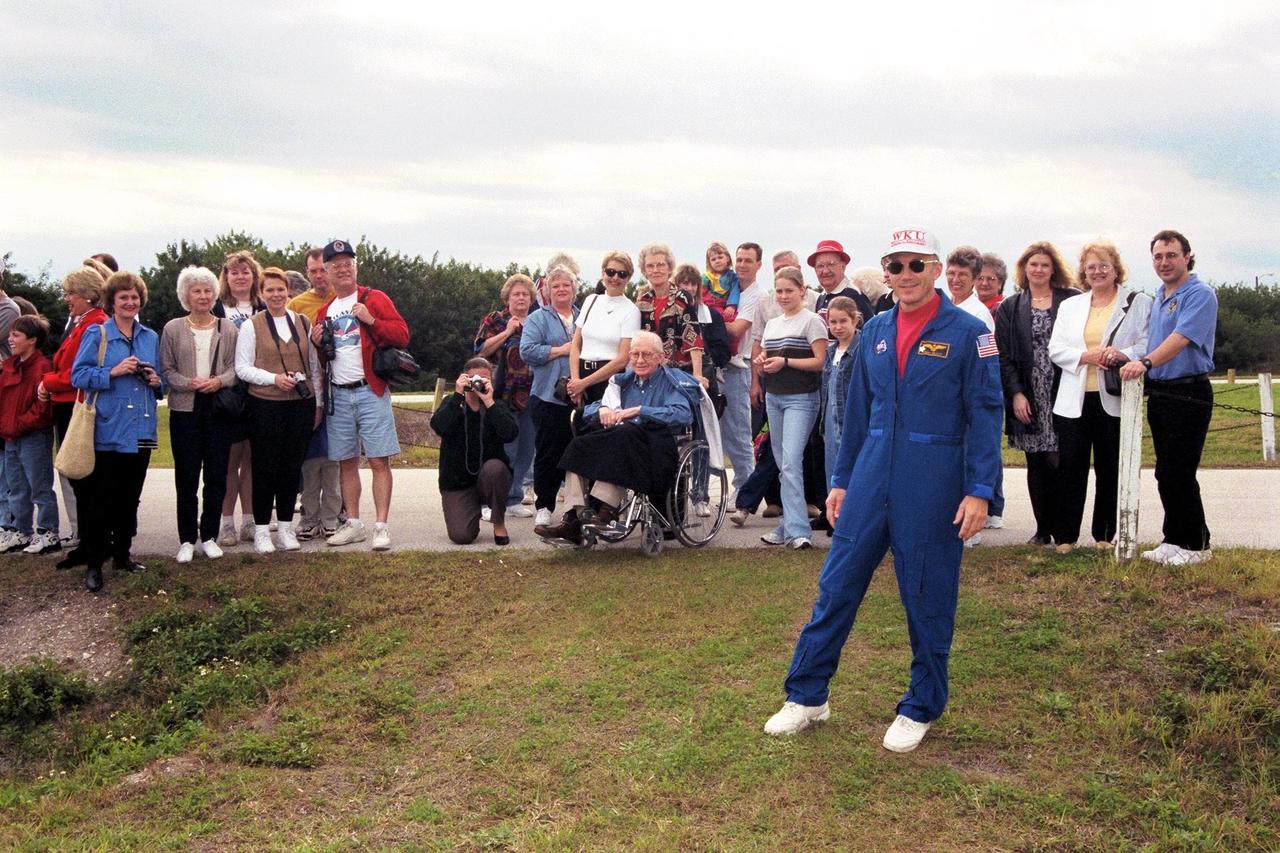
KENNEDY SPACE CENTER, Fla. -- STS-89 Commander Terrence Wilcutt poses in front of the crew's family and friends at KSC's Launch Pad 39A the day before the scheduled launch of Space Shuttle Endeavour. Final preparations are under way toward liftoff on Jan. 22 on the eighth mission to dock with the Russian Space Station Mir. After docking, Mission Specialist Andrew Thomas, Ph.D., will transfer to the space station, succeeding David Wolf, M.D., who will return to Earth aboard Endeavour. Dr. Thomas will live and work on Mir until June. STS-89 is scheduled for liftoff at 9:48 p.m. EST

STS-89 Commander Terrence Wilcutt is assisted with his ascent and re-entry flight suit in the white room at Launch Pad 39A before entering Space Shuttle Endeavour for launch. The STS-89 mission will be the eighth docking of the Space Shuttle with the Russian Space Station Mir. After docking, Mission Specialist Andrew Thomas, Ph.D., will transfer to the space station, succeeding David Wolf, M.D., who will return to Earth aboard Endeavour. Dr. Thomas will live and work on Mir until June. STS-89 is scheduled for a Jan. 22 liftoff at 9:48 p.m
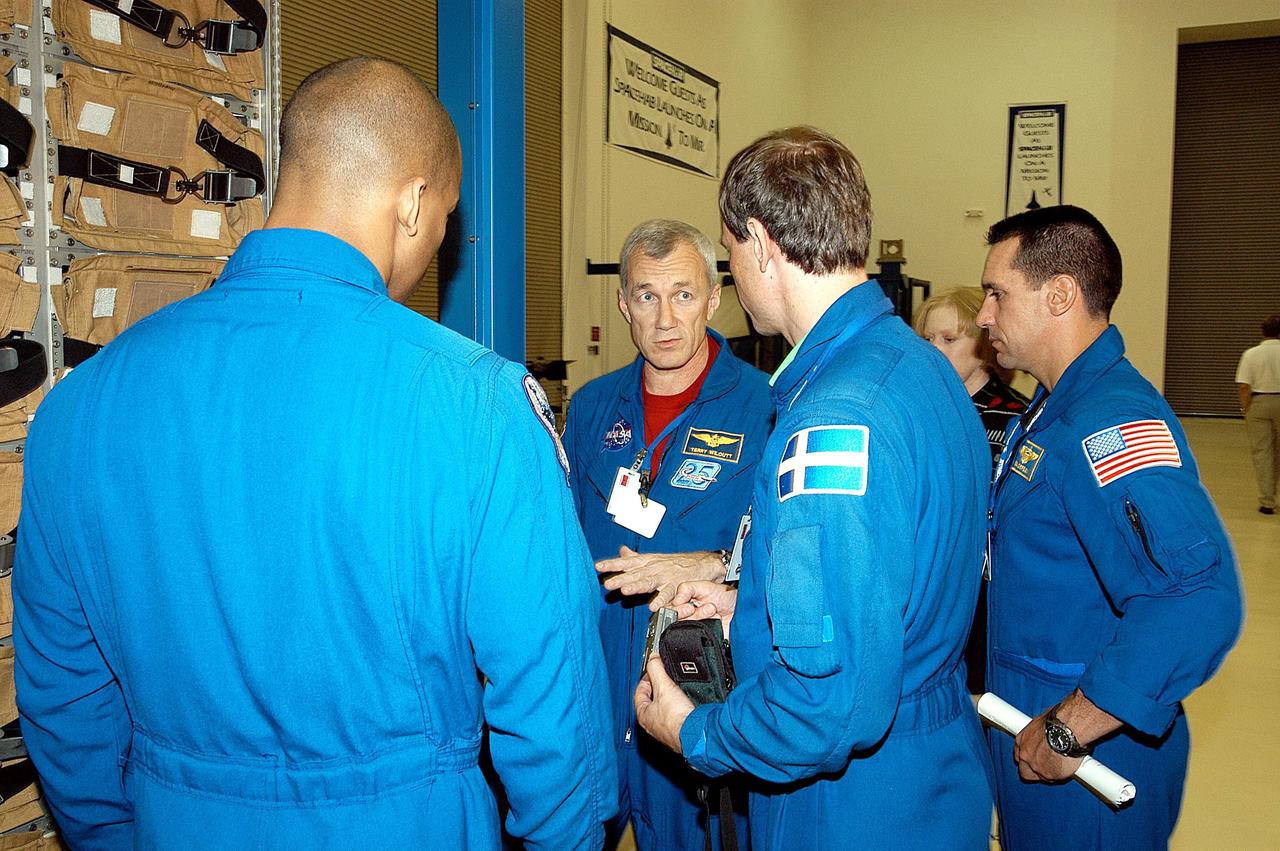
KENNEDY SPACE CENTER, FLA. - The STS-116 crew share thoughts during training at SPACEHAB in Port Canaveral, Fla. From left are Mission Specialist Robert Curbeam, Commander Terrence Wilcutt, Mission Specialist Christer Fuglesang and Pilot William Oefelein. Objective of their mission to the International Space Station is to deliver and attach the third port truss segment, the P5 Truss, deactivate and retract the P6 Truss Channel 4B (port-side) solar array, and reconfigure station power from 2A and 4A solar arrays. A launch date is under review.
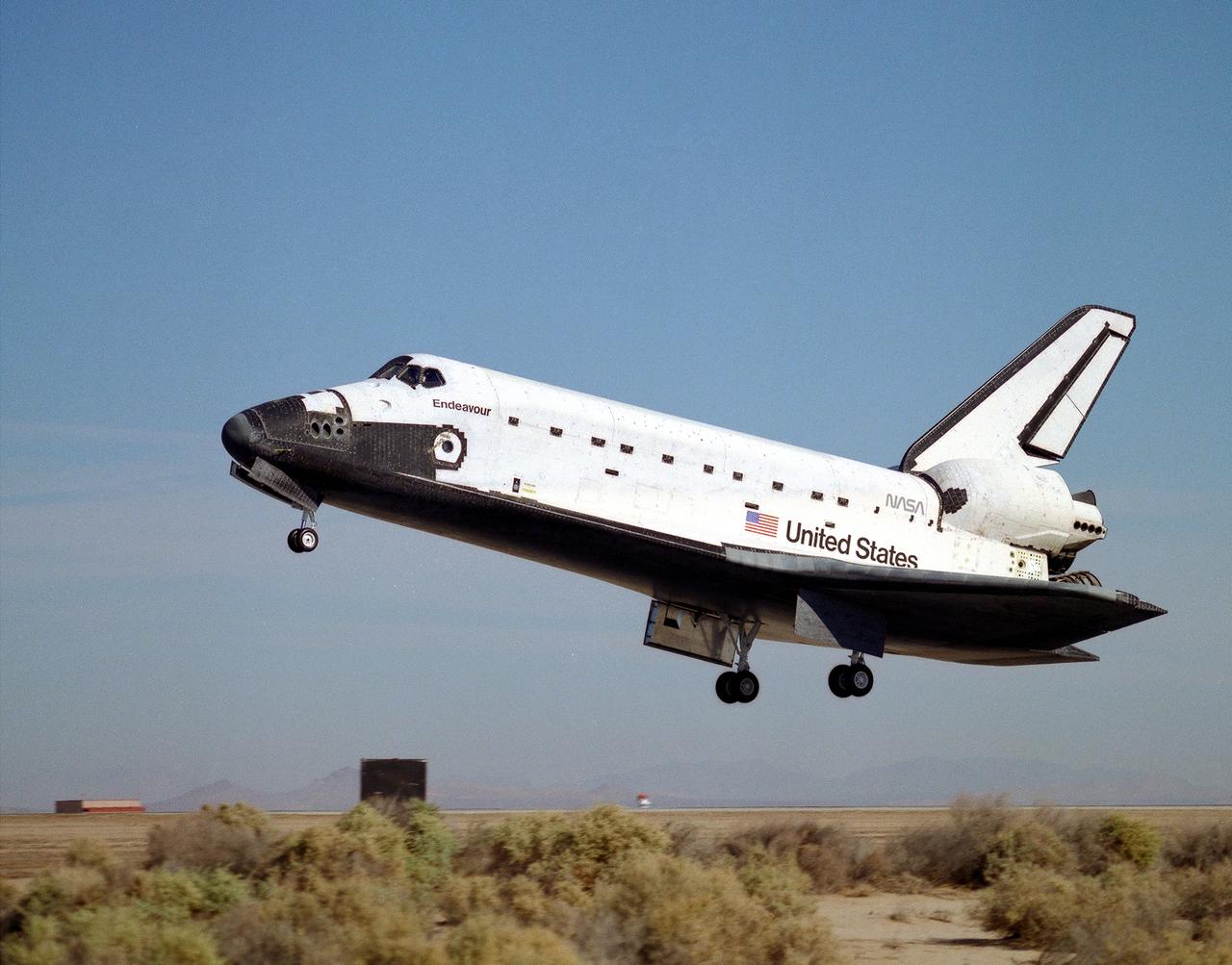
The space shuttle Endeavour glides to a landing on runway 22 at Edwards, California, to complete the highly successful STS-68 mission dedicated to radar imaging of the earth's surface as part of NASA's Mission To Planet Earth program. The landing was at 10:02 a.m. (PDT) 11 October 1994, after waiving off from the Kennedy Space Center, Florida, earlier that morning due to adverse weather at Kennedy. The Endeavour crew was originally scheduled to land at Kennedy the morning of October 10, but mission planners decided early in the flight to extend the mission by one day. Mission commander was Michael A. Baker, making his third flight, and the pilot was Terrence W. Wilcutt, on his first mission.
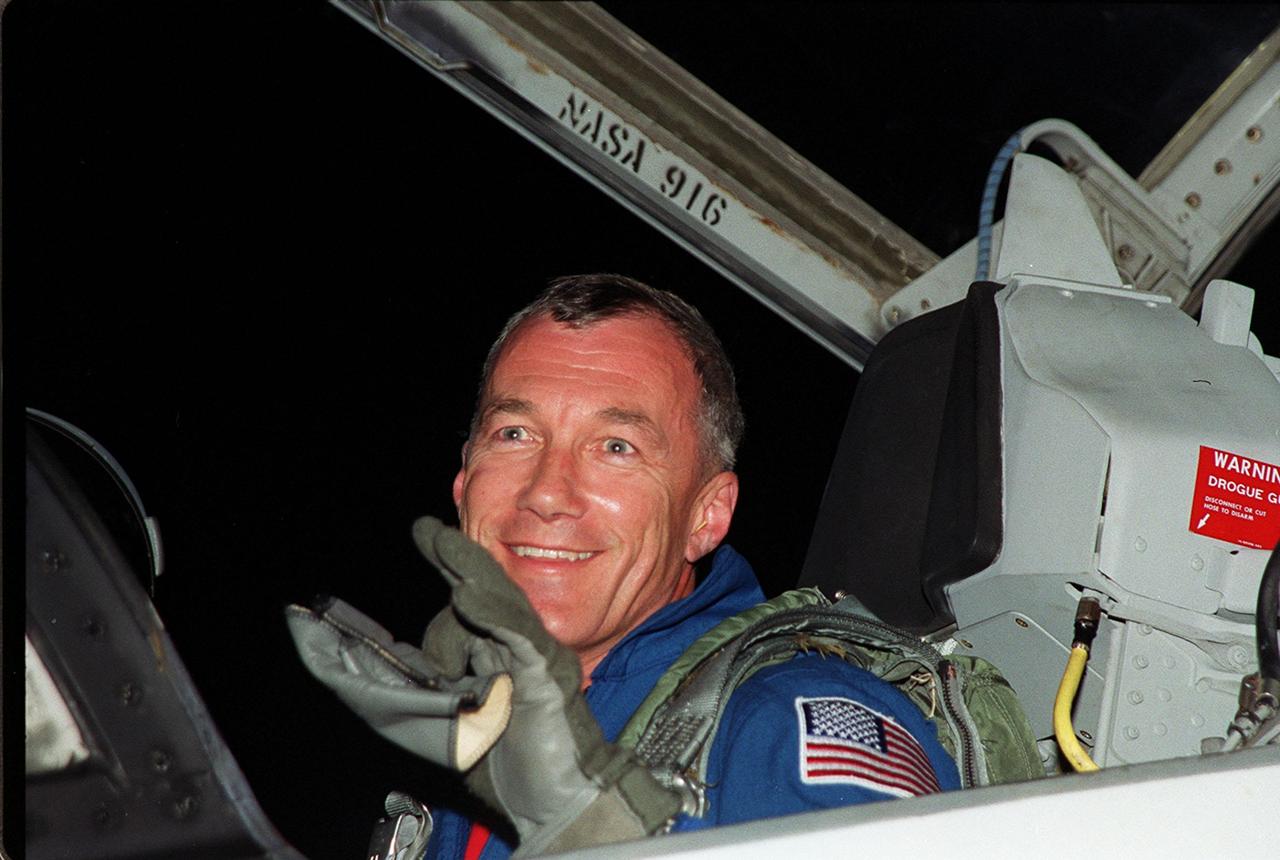
STS-106 Commander Terrence W. Wilcutt waves to onlookers as he arrives at the KSC Shuttle Landing Facility. He and the rest of the crew will be making pre-launch preparations for the fourth flight to the International Space Station. STS-106 is scheduled to launch Sept. 8, 2000, at 8:45 a.m. EDT from Launch Pad 39B. On the 11-day mission, the seven-member crew will perform support tasks on orbit, transfer supplies and prepare the living quarters in the newly arrived Zvezda Service Module. The first long-duration crew, dubbed “Expedition One,” is due to arrive at the Station in late fall
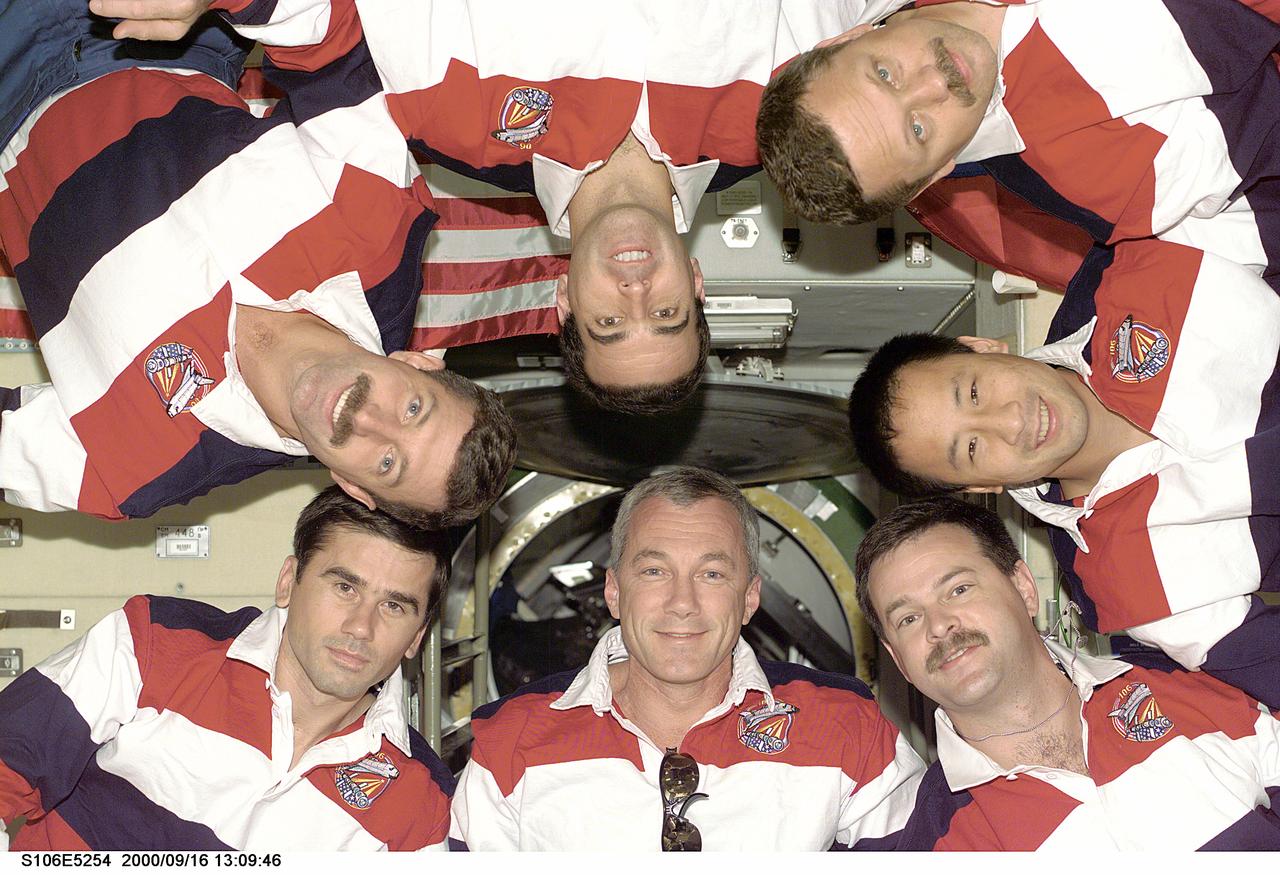
S106-E-5254 (16 September 2000) --- A brief break during busy moving tasks and detail work afforded the STS-106 crew members an opportunity for another traditional inflight crew portrait, snapped by a pre-set electronic still camera (ESC) nearby. Astronaut Terrence W. Wilcutt, mission commander, is at bottom center. Counterclockwise from that point are cosmonaut Yuri I. Malenchenko, astronauts Daniel C. Burbank and Richard A. Mastracchio, cosmonaut Boris V. Morukov and astronaut Edward T. Lu, all mission specialists; along with astronaut Scott D. Altman, pilot. Malenchenko and Morukov represent the Russian Aviation and Space Agency.
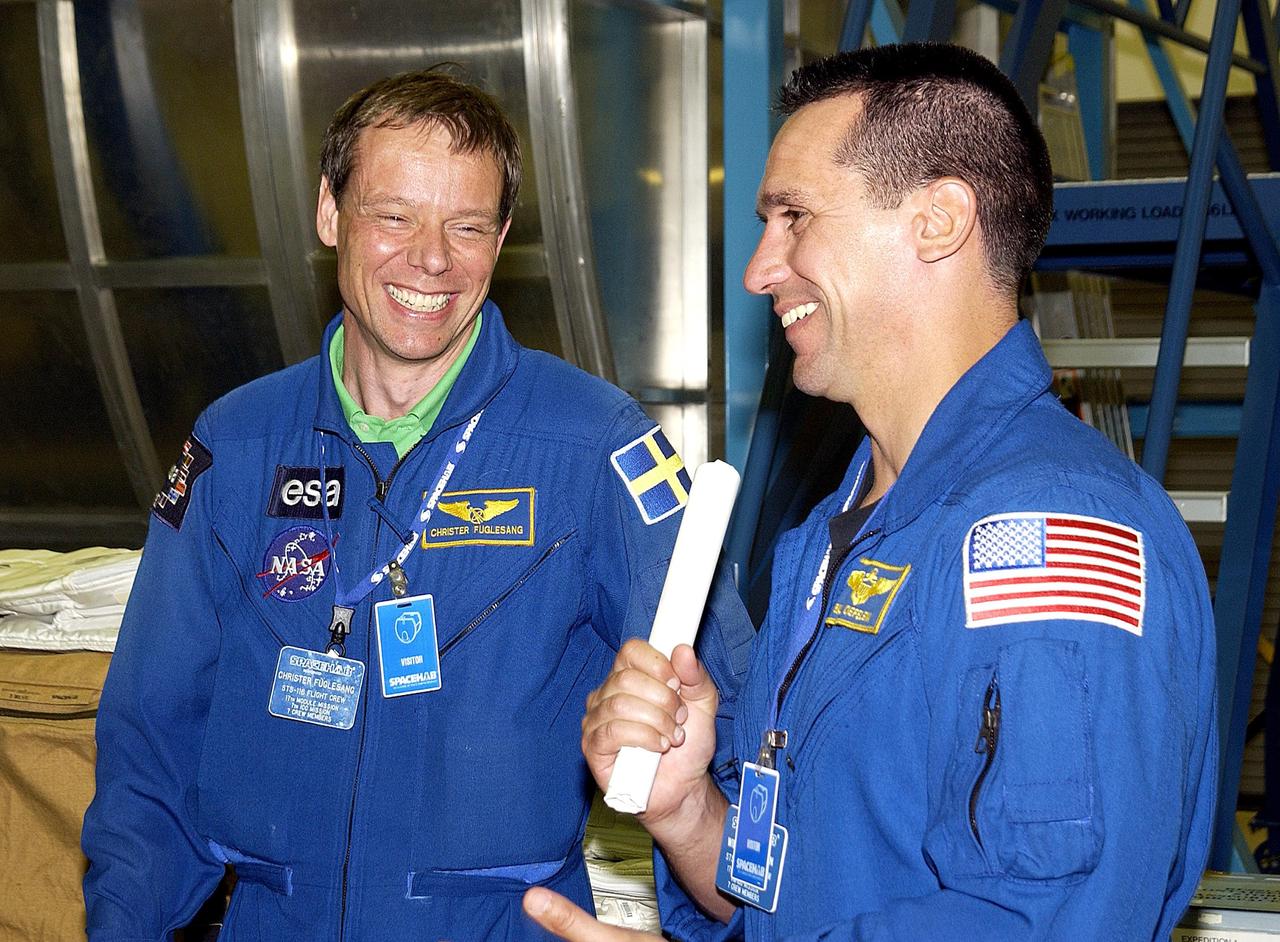
KENNEDY SPACE CENTER, FLA. - At SPACEHAB, Port Canaveral, Fla., STS-116 Mission Specialist Christer Fuglesang (left) and Pilot Michael Oelefein share a laugh during a break in training. Fuglesang is with the European Space Agency. Not seen are Commander Terrence Wilcutt and Mission Specialist Robert Curbeam. Objective of their mission to the International Space Station is to deliver and attach the third port truss segment, the P5 Truss, deactivate and retract the P6 Truss Channel 4B (port-side) solar array, and reconfigure station power from 2A and 4A solar arrays. A launch date is under review.
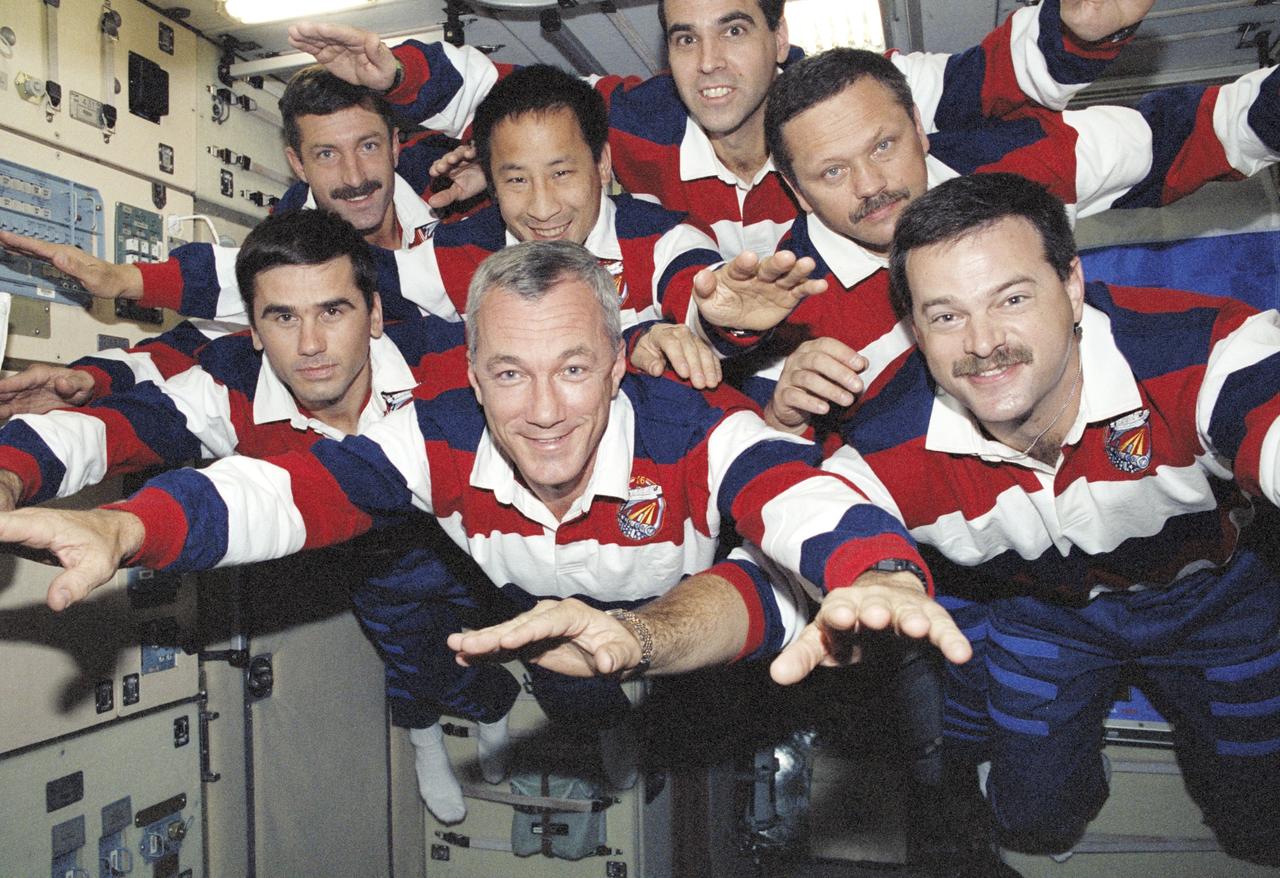
STS106-373-034 (8-20 September 2000) --- The seven crew members for the STS-106 mission pose in a flying position for the traditional in-flight crew portrait in the Zvezda Service Module on the International Space Station (ISS). In the foreground are astronauts Terrence W. Wilcutt (center), mission commander, flanked by cosmonaut Yuri I. Malenchenko (left), mission specialist, and Scott D. Altman, pilot. On the back row are astronauts Daniel C. Burbank, Edward T. Lu, and Richard A. Mastracchio, along with cosmonaut Boris V. Morukov, all mission specialists. Malenchenko and Morukov represent Rosaviakosmos.
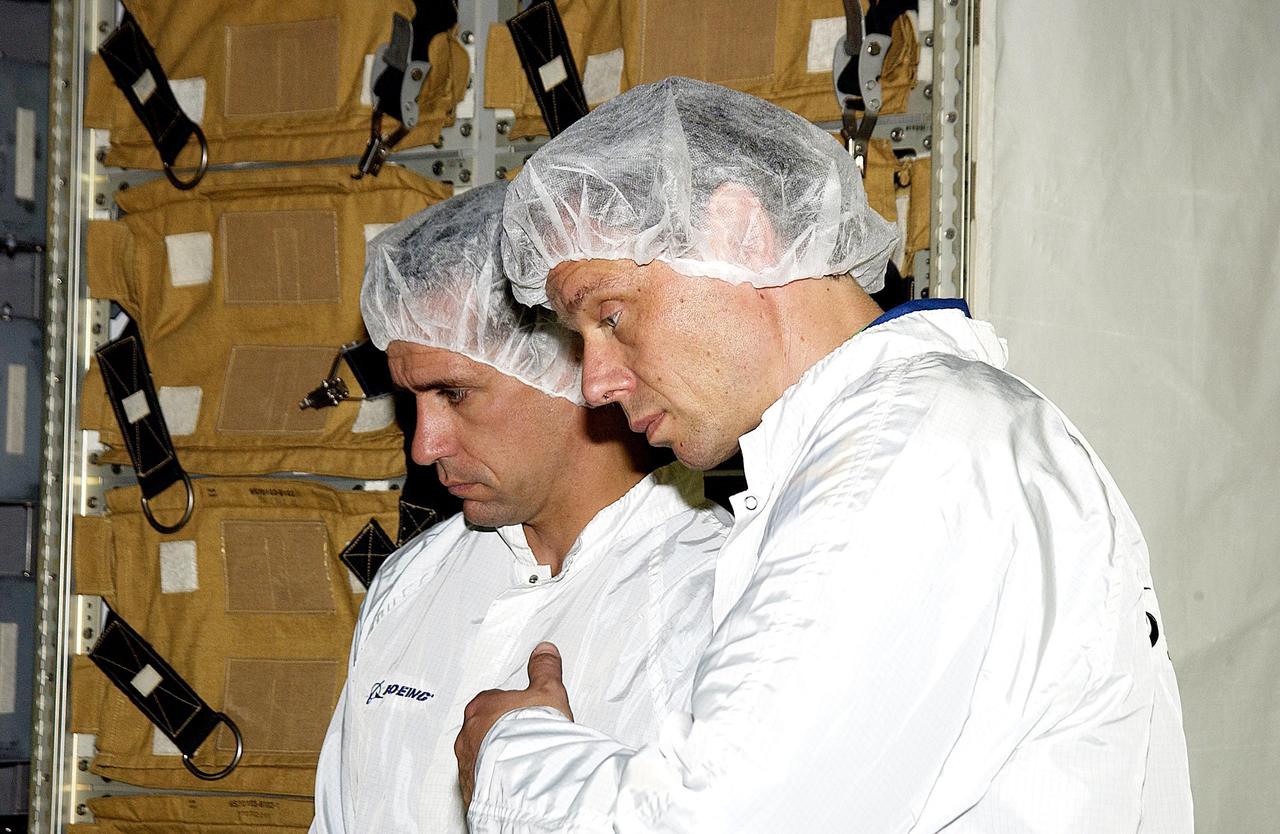
KENNEDY SPACE CENTER, FLA. - At SPACEHAB, Port Canaveral, Fla., STS-116 crew members take part in training for their mission. Seen here are Pilot Michael Oelefein (left) and Mission Specialist Christer Fuglesang, who is with the European Space Agency. Other crew members are Commander Terrence Wilcutt and Mission Specialist Robert Curbeam. Objective of their mission to the International Space Station is to deliver and attach the third port truss segment, the P5 Truss, deactivate and retract the P6 Truss Channel 4B (port-side) solar array, and reconfigure station power from 2A and 4A solar arrays. A launch date is under review.
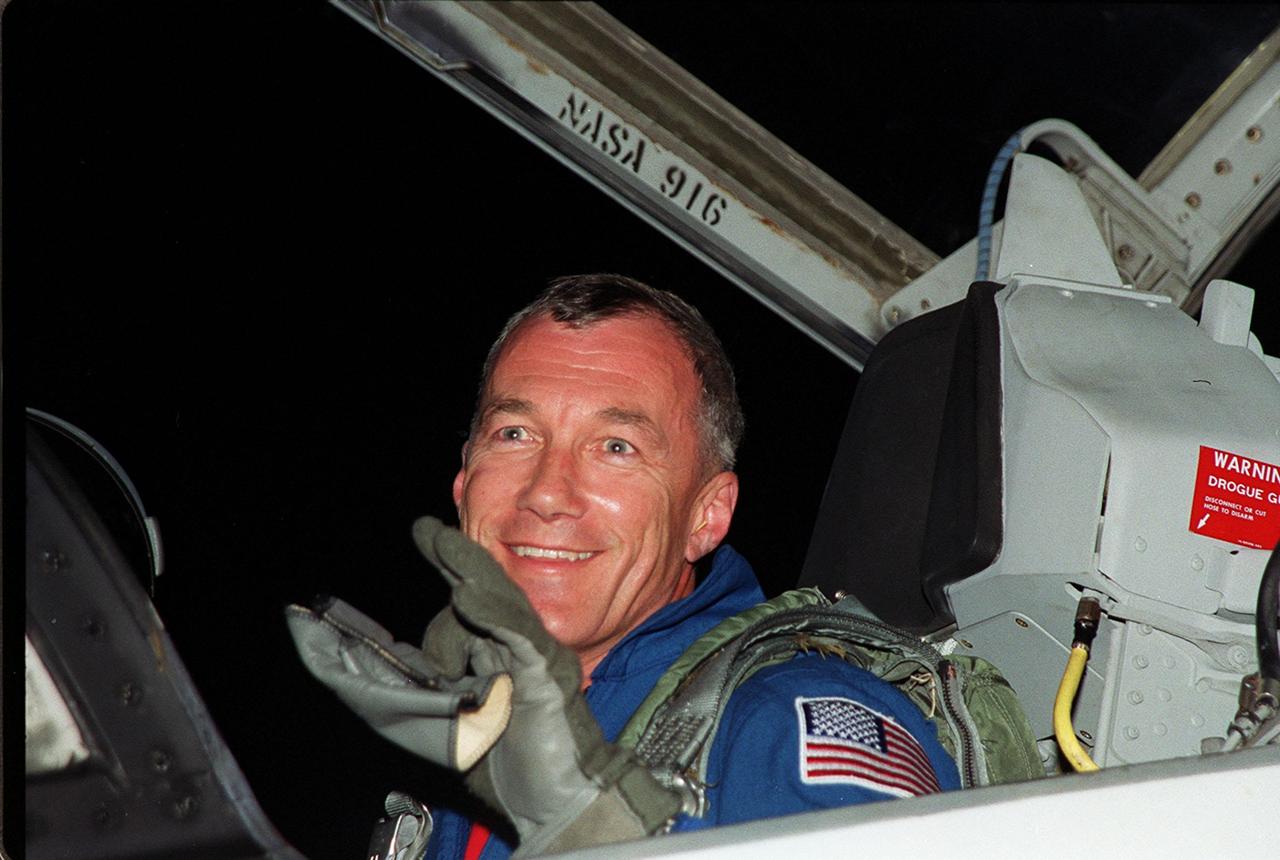
STS-106 Commander Terrence W. Wilcutt waves to onlookers as he arrives at the KSC Shuttle Landing Facility. He and the rest of the crew will be making pre-launch preparations for the fourth flight to the International Space Station. STS-106 is scheduled to launch Sept. 8, 2000, at 8:45 a.m. EDT from Launch Pad 39B. On the 11-day mission, the seven-member crew will perform support tasks on orbit, transfer supplies and prepare the living quarters in the newly arrived Zvezda Service Module. The first long-duration crew, dubbed “Expedition One,” is due to arrive at the Station in late fall
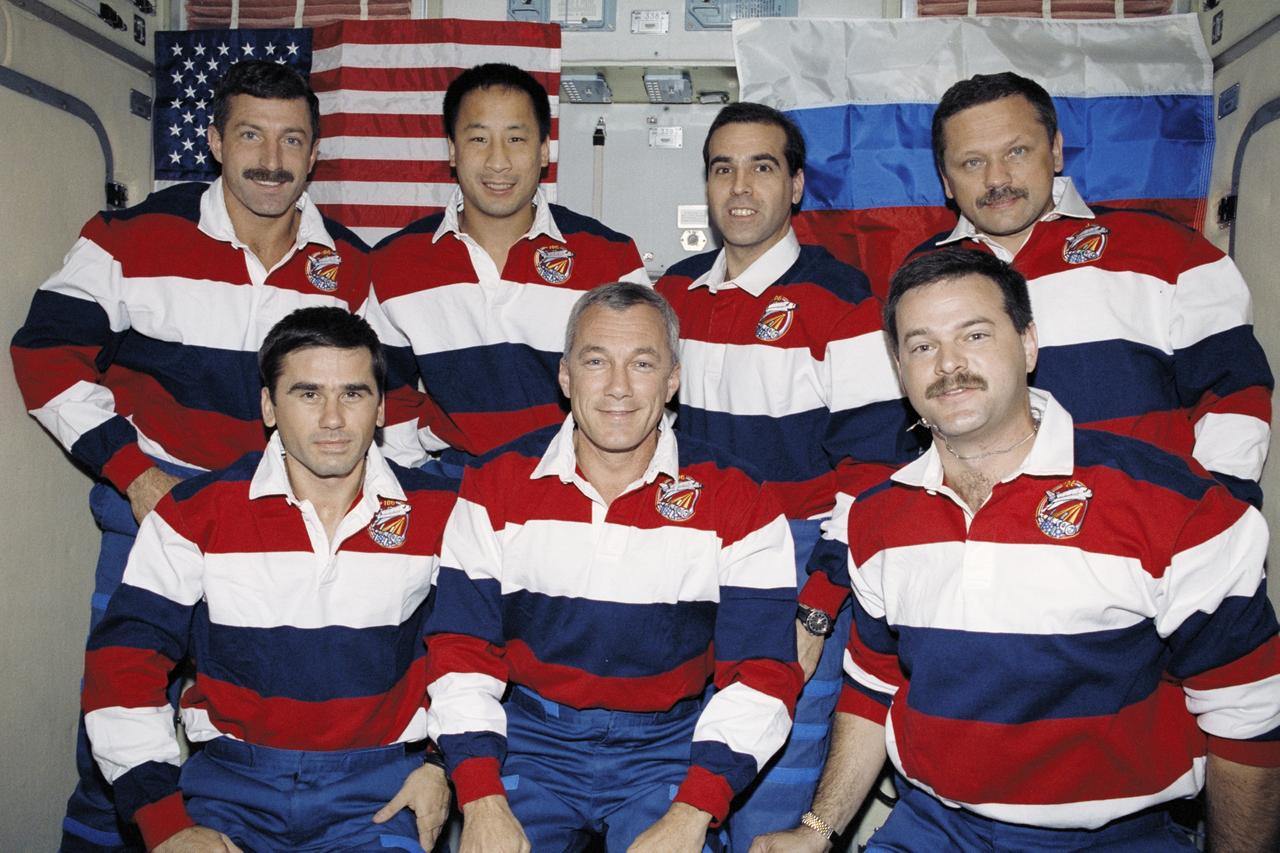
STS106-373-019 (8-20 September 2000) --- Five astronauts and two cosmonauts pose for the STS-106 version of the traditional inflight crew portrait. Though the tradition is long standing, this portrait represents a relatively new element as it was taken onboard the International Space Station, docked for a few days with the Space Shuttle Atlantis. In front, from the left, are cosmonaut Yuri I. Malenchenko, mission specialist; Terrence W. Wilcutt, mission commander; and Scott D. Altman, pilot. In back are, from left, astronauts Daniel C. Burbank, Edward T. Lu and Richard A. Mastracchio, along with cosmonaut Boris V. Morukov. Morukov and Malenchenko represent the Russian Aviaition and Space Agency.
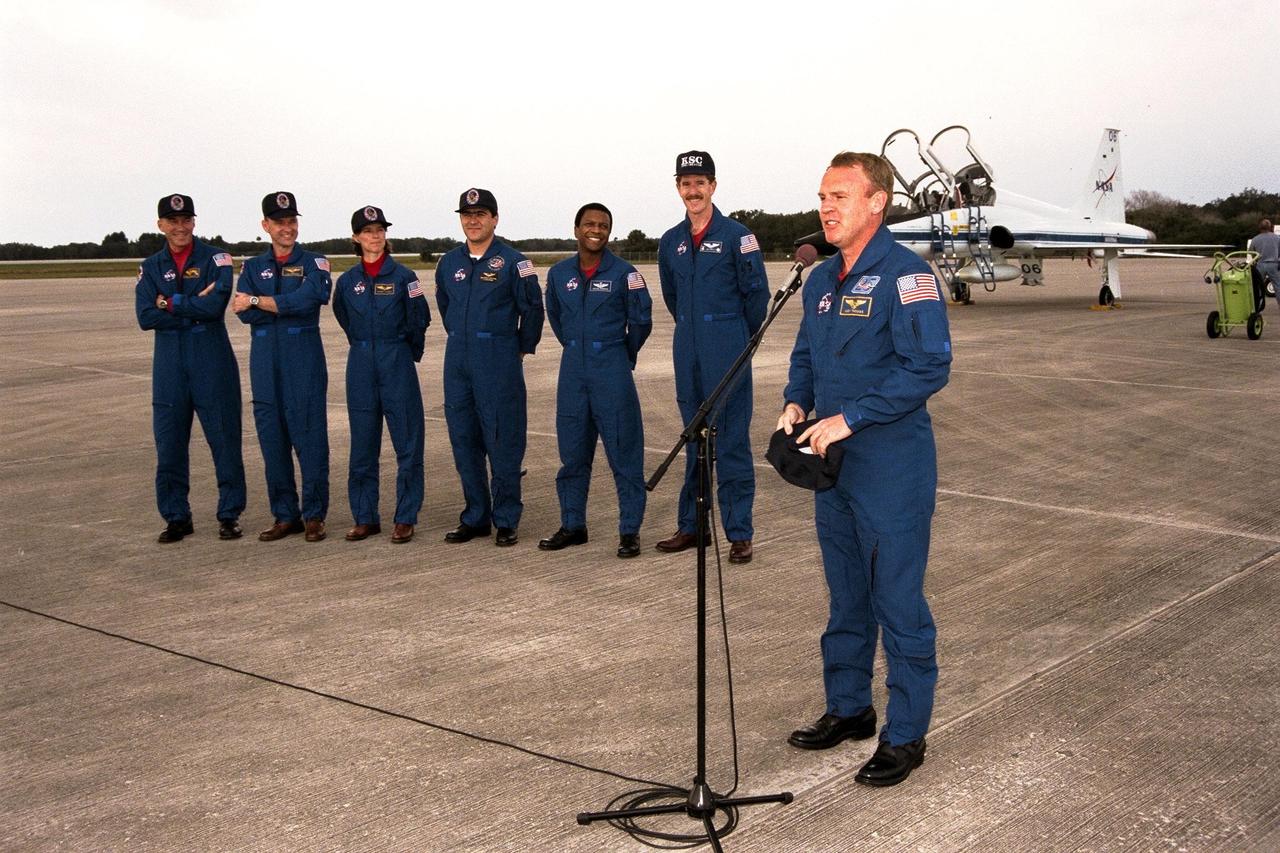
The STS-89 crew speak with the press after arriving at Kennedy Space Center's Shuttle Landing Facility in preparation for launch later this week. From left to right the crew include Commander Terrence Wilcutt; Pilot Joe Edwards Jr.; and Mission Specialists Bonnie Dunbar, Ph.D.; Salizhan Sharipov with the Russian Space Agency; Michael Anderson; James Reilly, Ph.D.; and Andrew Thomas, Ph.D. (at microphone). Dr. Thomas will succeed David Wolf, M.D., on the Russian Space Station Mir. Launch is scheduled for January 22 at 9:48 p.m. EST

KENNEDY SPACE CENTER, FLA. - At SPACEHAB, Port Canaveral, Fla., STS-116 crew members take part in training for their mission. Seen here are (from left) Mission Specialist Christer Fuglesang, Pilot Michael Oelefein and Mission Specialist Robert Curbeam. Not seen is Commander Terrence Wilcutt. Fuglesang is with the European Space Agency. Objective of their mission to the International Space Station is to deliver and attach the third port truss segment, the P5 Truss, deactivate and retract the P6 Truss Channel 4B (port-side) solar array, and reconfigure station power from 2A and 4A solar arrays. A launch date is under review.
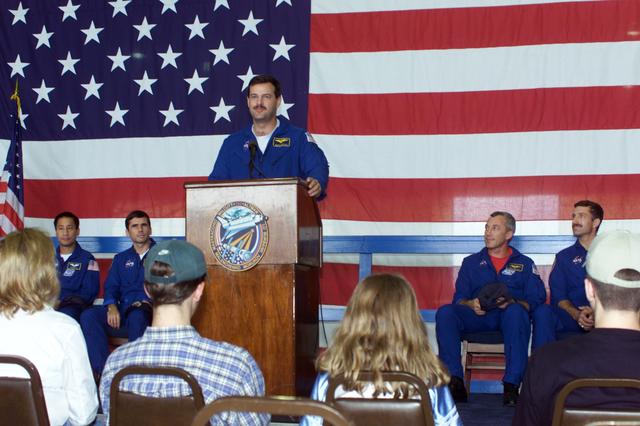
JSC2000-E-23454 (21 September 2000) --- Astronaut Scott D. Altman, STS-106 pilot, addresses the crowd that visited Ellington Field's Hangar 990 to welcome home the STS-106 astronauts and cosmonauts. Seated on the dais, from the left, are astronaut Edward T. Lu, cosmonaut Yuri I. Malenchenko, astronaut Terrence W. Wilcutt and Daniel C. Burbank. Not in the frame are astronaut Richard A. Mastracchio and cosmonaut Boris V. Morukov. The seven-man crew landed approximately 24 hours earlier in Florida, wrapping up a 4.9 million-mile mission in which more than three tons of equipment were delivered to the international outpost.
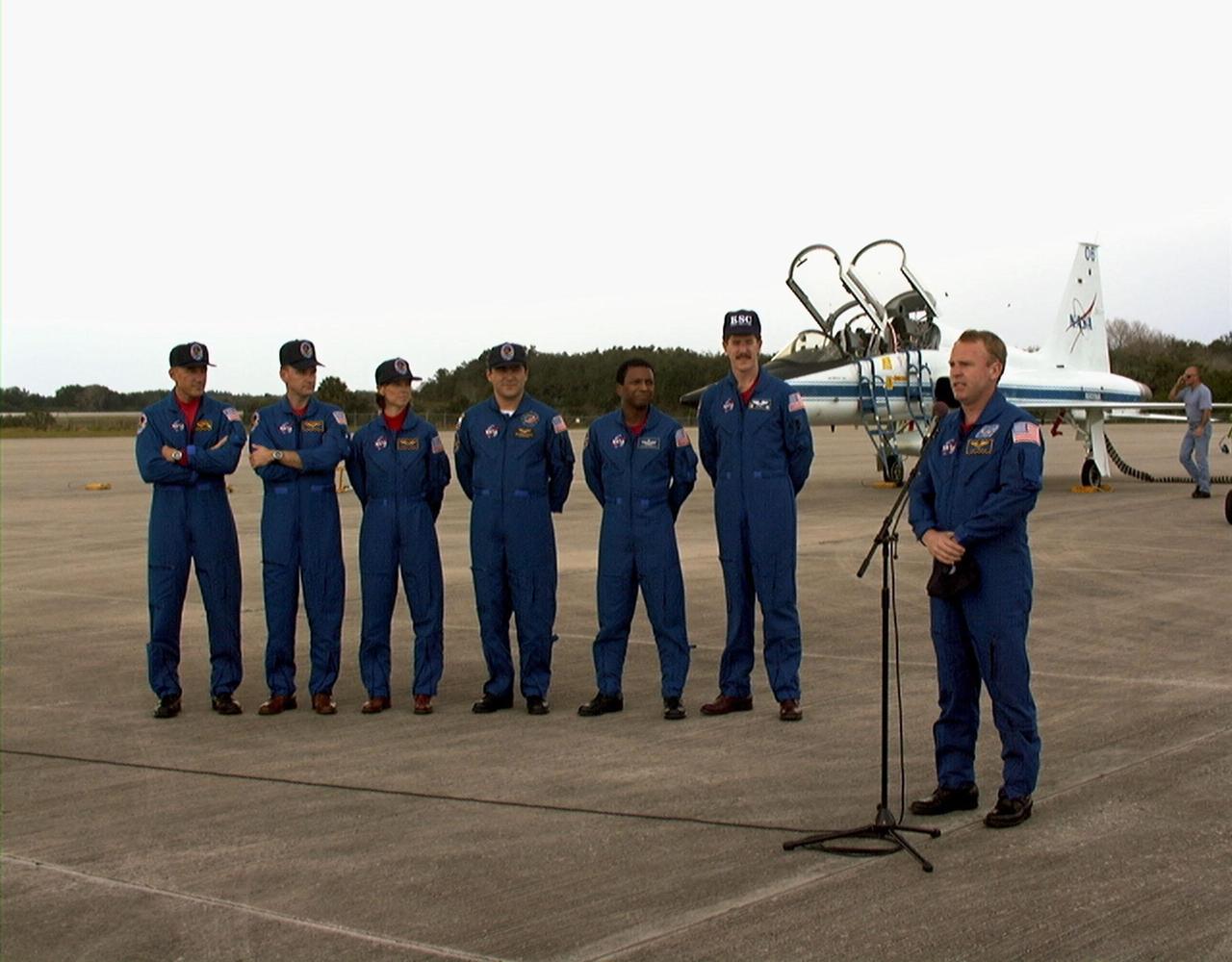
The STS-89 crew speak with the press after arriving at Kennedy Space Center's Shuttle Landing Facility in preparation for launch later this week. From left to right the crew include Commander Terrence Wilcutt; Pilot Joe Edwards Jr.; and Mission Specialists Bonnie Dunbar, Ph.D.; Salizhan Sharipov with the Russian Space Agency; Michael Anderson; James Reilly, Ph.D.; and Andrew Thomas, Ph.D. (at microphone). Dr. Thomas will succeed David Wolf, M.D., on the Russian Space Station Mir. Launch is scheduled for January 22 at 9:48 p.m. EST
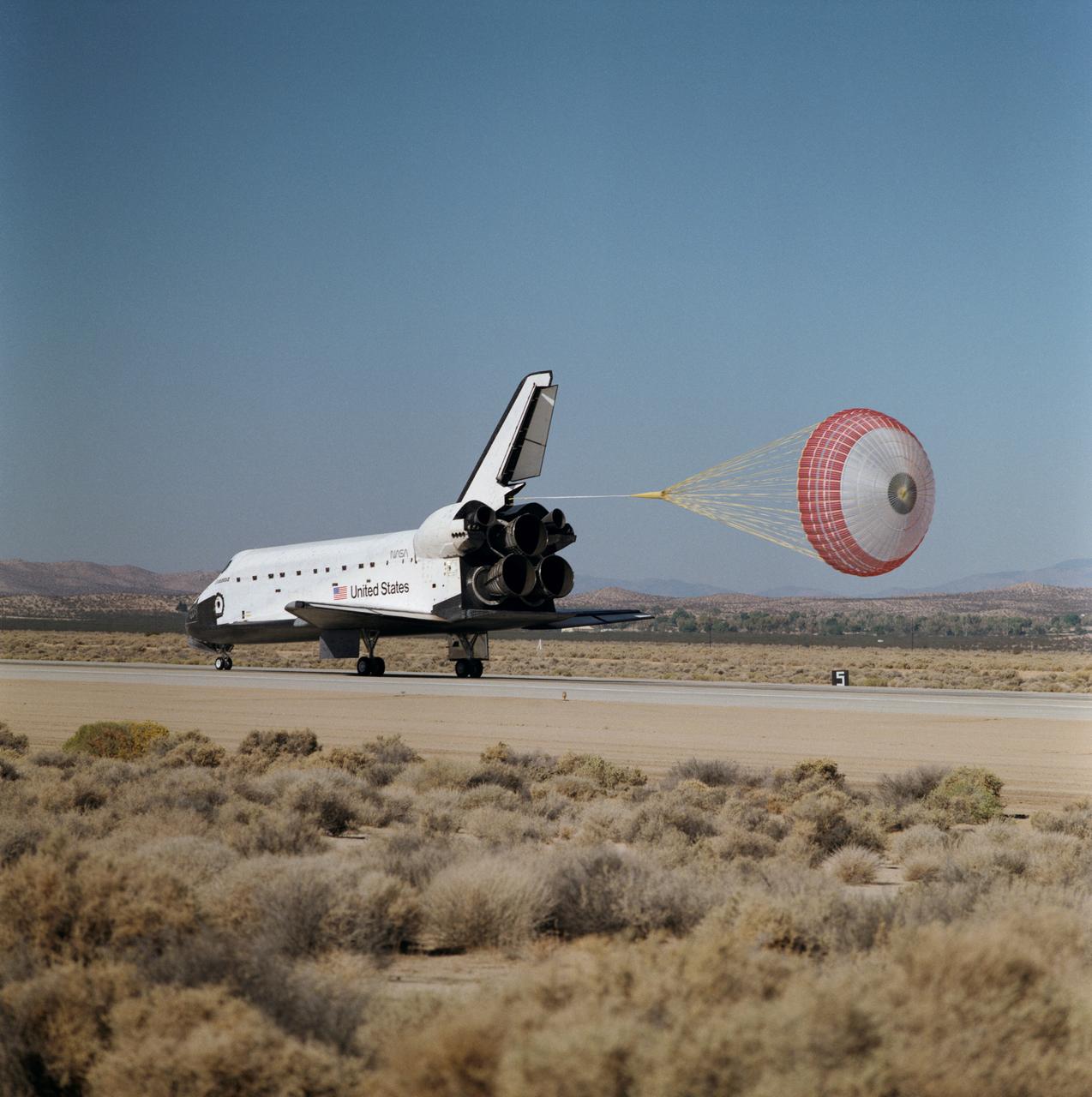
STS068-S-061 (11 October 1994) --- The drag chute system, one of 13 Detailed Test Objectives (DTO) for STS-68, is deployed as the Space Shuttle Endeavour completes an eleven-day mission at Edwards Air Force Base, California. Landing occurred at 10:02 a.m. (PDT), October 11, 1994. Onboard were astronauts Michael A. Baker, mission commander; Terrence W. Wilcutt, pilot; Thomas D. Jones, payload commander; and Daniel W. Bursch, Peter J. K. (Jeff) Wisoff and Steven L. Smith, all mission specialists.
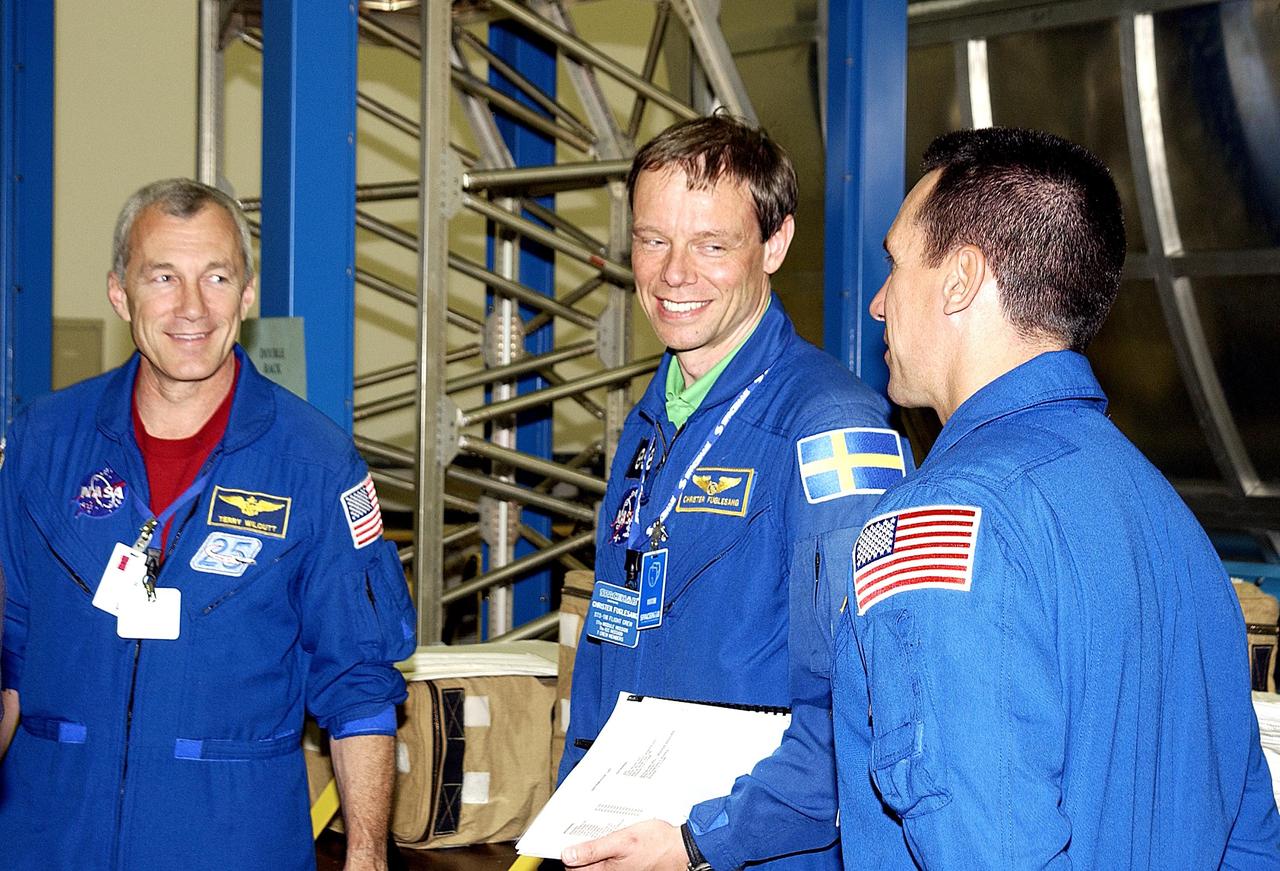
KENNEDY SPACE CENTER, FLA. - During a break in training at SPACEHAB, Port Canaveral, Fla., STS-116 Commander Terrence Wilcutt, Mission Specialist Christer Fuglesang and Pilot Michael Oelefein share a laugh. Not seen is Mission Specialist Robert Curbeam. Objective of their mission to the International Space Station is to deliver and attach the third port truss segment, the P5 Truss, deactivate and retract the P6 Truss Channel 4B (port-side) solar array, and reconfigure station power from 2A and 4A solar arrays. A launch date is under review.
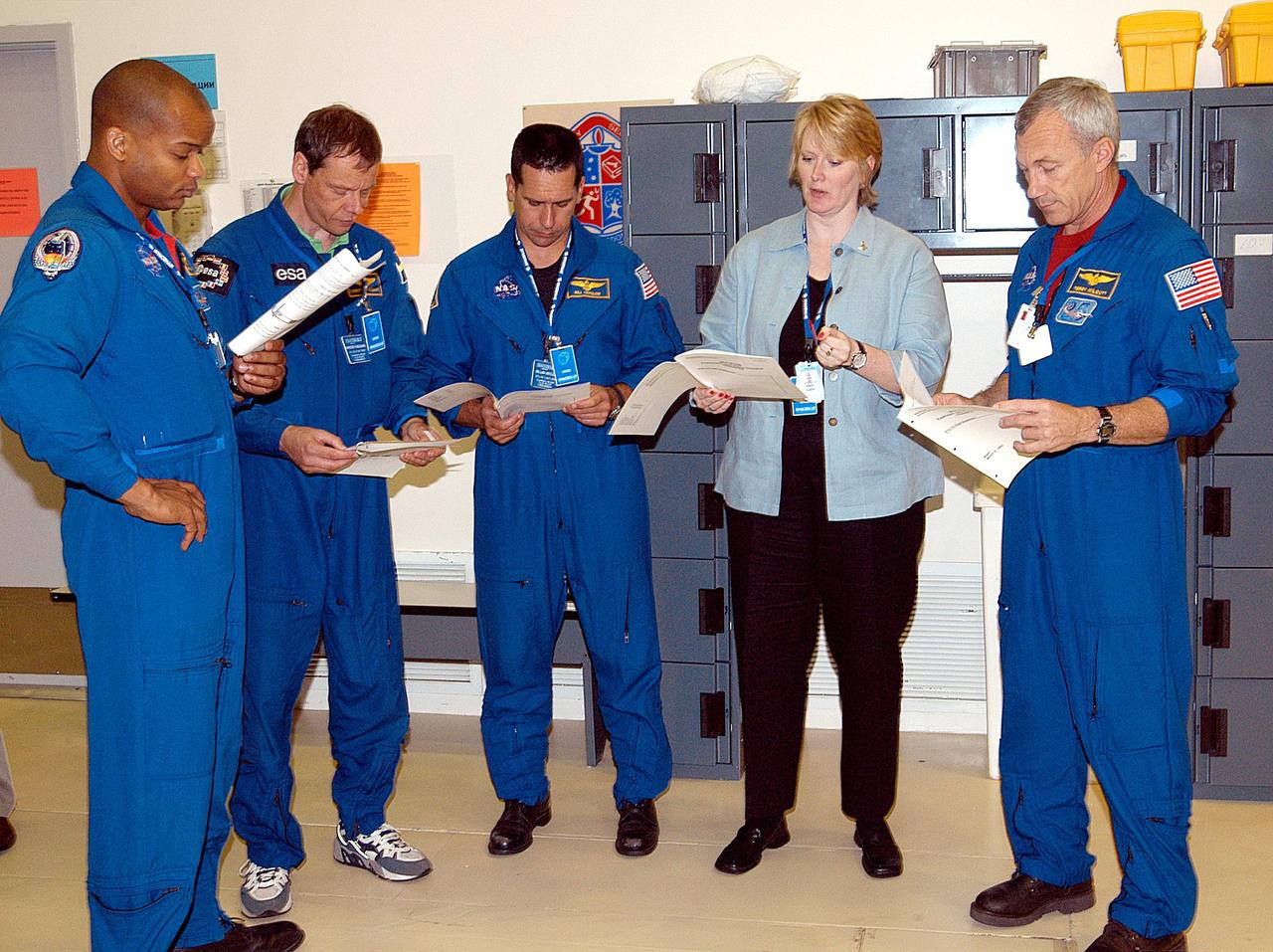
KENNEDY SPACE CENTER, FLA. - Members of the STS-116 crew review data during training at SPACEHAB in Port Canaveral, Fla. From left are Mission Specialists Robert Curbeam and Christer Fuglesang, Pilot William Oefelein and (far right) Commander Terrence Wilcutt. Fuglesang is with the European Space Agency. Objective of their mission to the International Space Station is to deliver and attach the third port truss segment, the P5 Truss, deactivate and retract the P6 Truss Channel 4B (port-side) solar array, and reconfigure station power from 2A and 4A solar arrays. A launch date is under review.
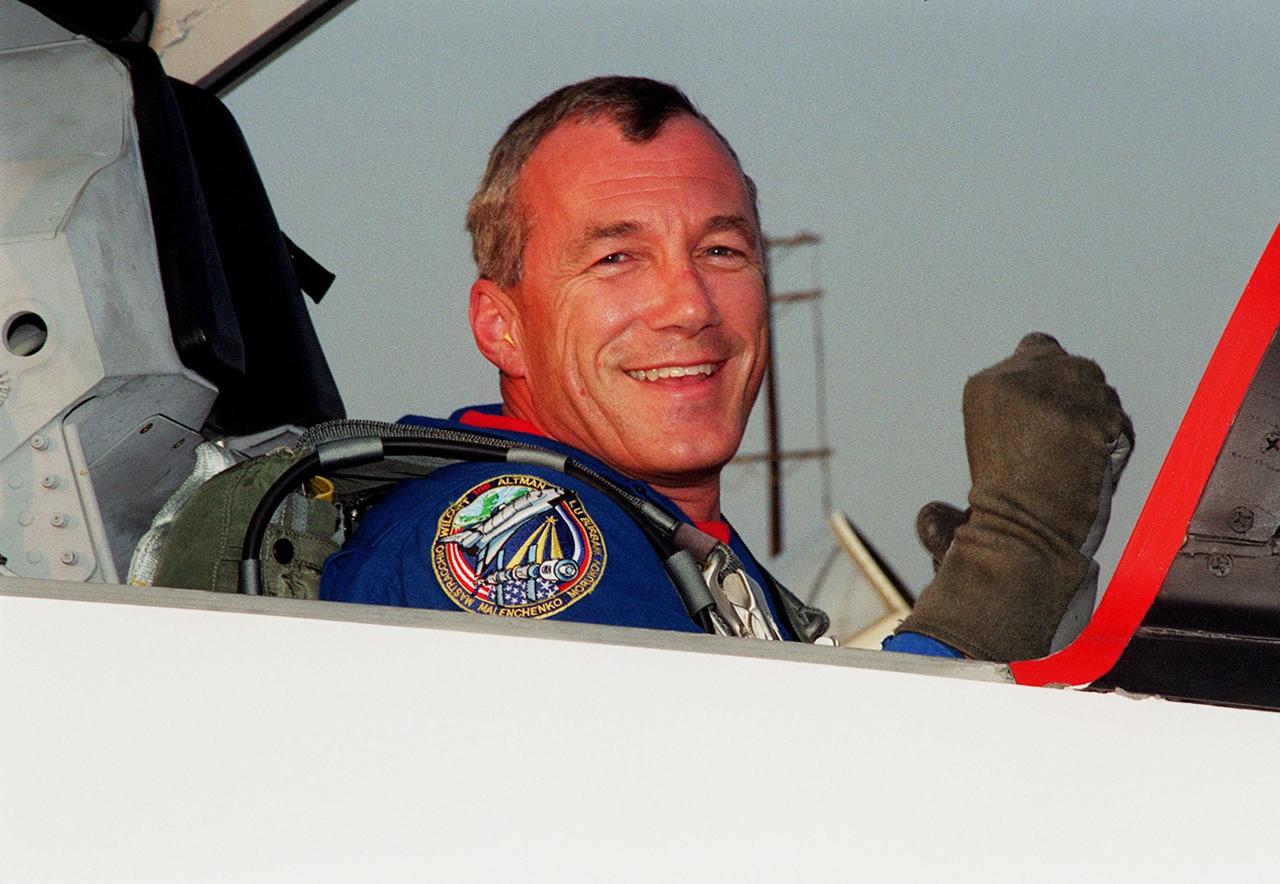
STS-106 Commander Terrence W. Wilcutt grins after landing at the KSC Shuttle Landing Facility aboard a T-38 jet aircraft. He and the rest of the crew will be taking part in Terminal Countdown Demonstration Test activities, which include emergency egress training and a simulated launch countdown. STS-106 is scheduled to launch Sept. 8, 2000, at 8:31 a.m. EDT from Launch Pad 39B. On the 11-day mission, the seven-member crew will perform support tasks on orbit, transfer supplies and prepare the living quarters in the newly arrived Zvezda Service Module. The first long-duration crew, dubbed “Expedition One,” is due to arrive at the Station in late fall
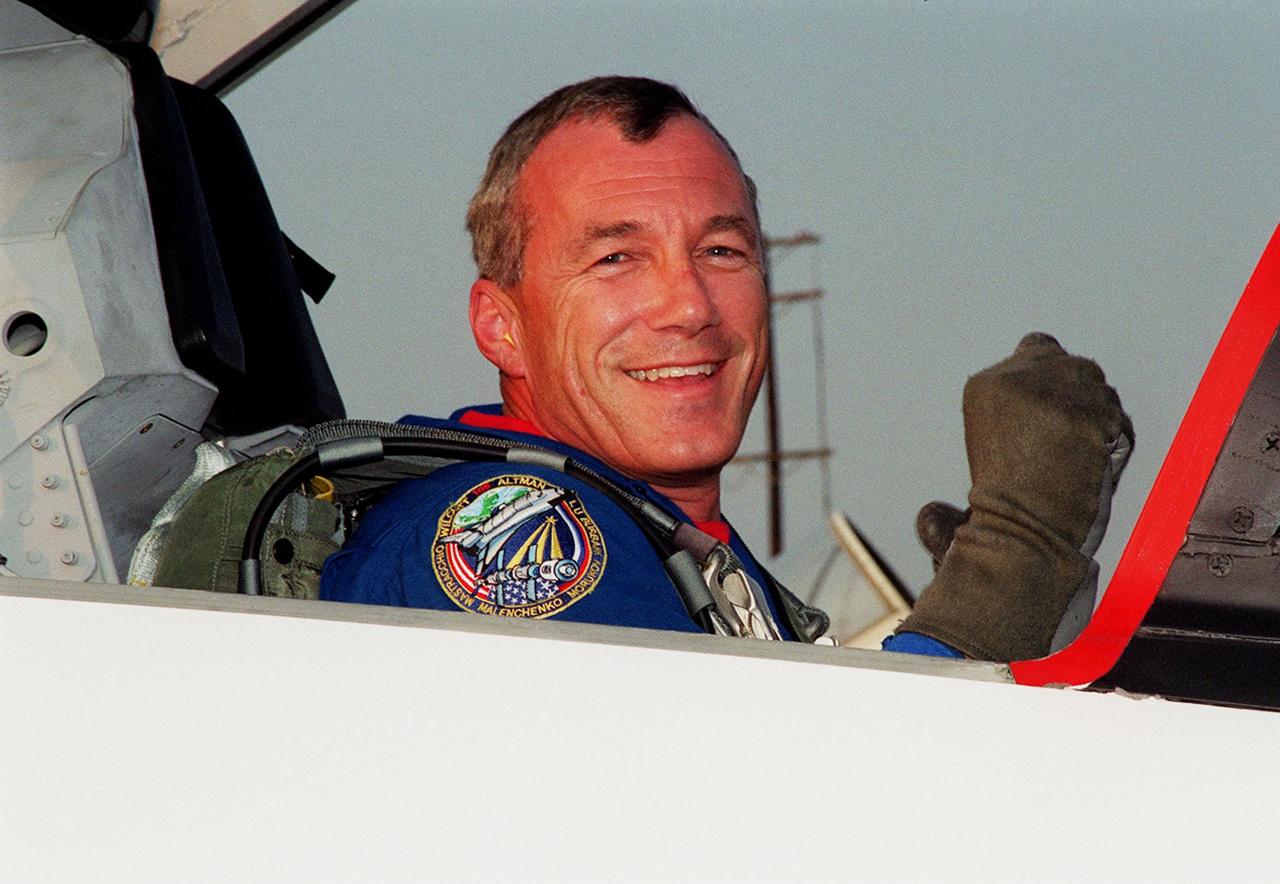
STS-106 Commander Terrence W. Wilcutt grins after landing at the KSC Shuttle Landing Facility aboard a T-38 jet aircraft. He and the rest of the crew will be taking part in Terminal Countdown Demonstration Test activities, which include emergency egress training and a simulated launch countdown. STS-106 is scheduled to launch Sept. 8, 2000, at 8:31 a.m. EDT from Launch Pad 39B. On the 11-day mission, the seven-member crew will perform support tasks on orbit, transfer supplies and prepare the living quarters in the newly arrived Zvezda Service Module. The first long-duration crew, dubbed “Expedition One,” is due to arrive at the Station in late fall
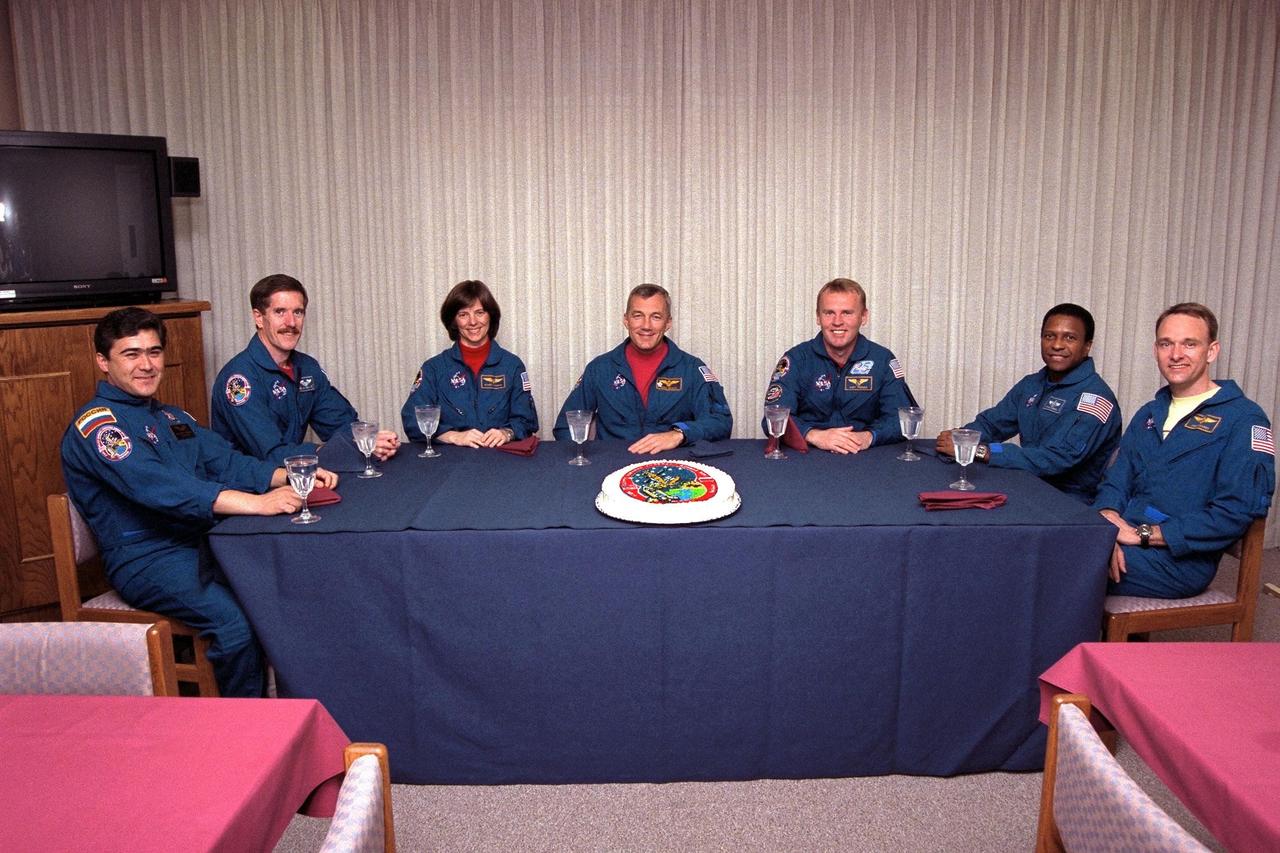
The STS-89 crew enjoy the traditional pre-liftoff "breakfast" in the crew quarters of the Operations and Checkout Building. They are (from left) Mission Specialists Salizhan Sharipov of the Russian Space Agency, James Reilly, Ph.D., Bonnie Dunbar, Ph.D., Commander Terrence Wilcutt, Mission Specialists Andrew Thomas, Ph.D., Michael Anderson, and Pilot Joe Edwards Jr. After a weather briefing, the flight crew will be fitted with their launch/entry suits and depart for Launch Pad 39A. Once there, they will take their positions in the crew cabin of the Space Shuttle Endeavour to await a liftoff during a 10-minute window that will open at 9:43 p.m. EST, Jan. 22