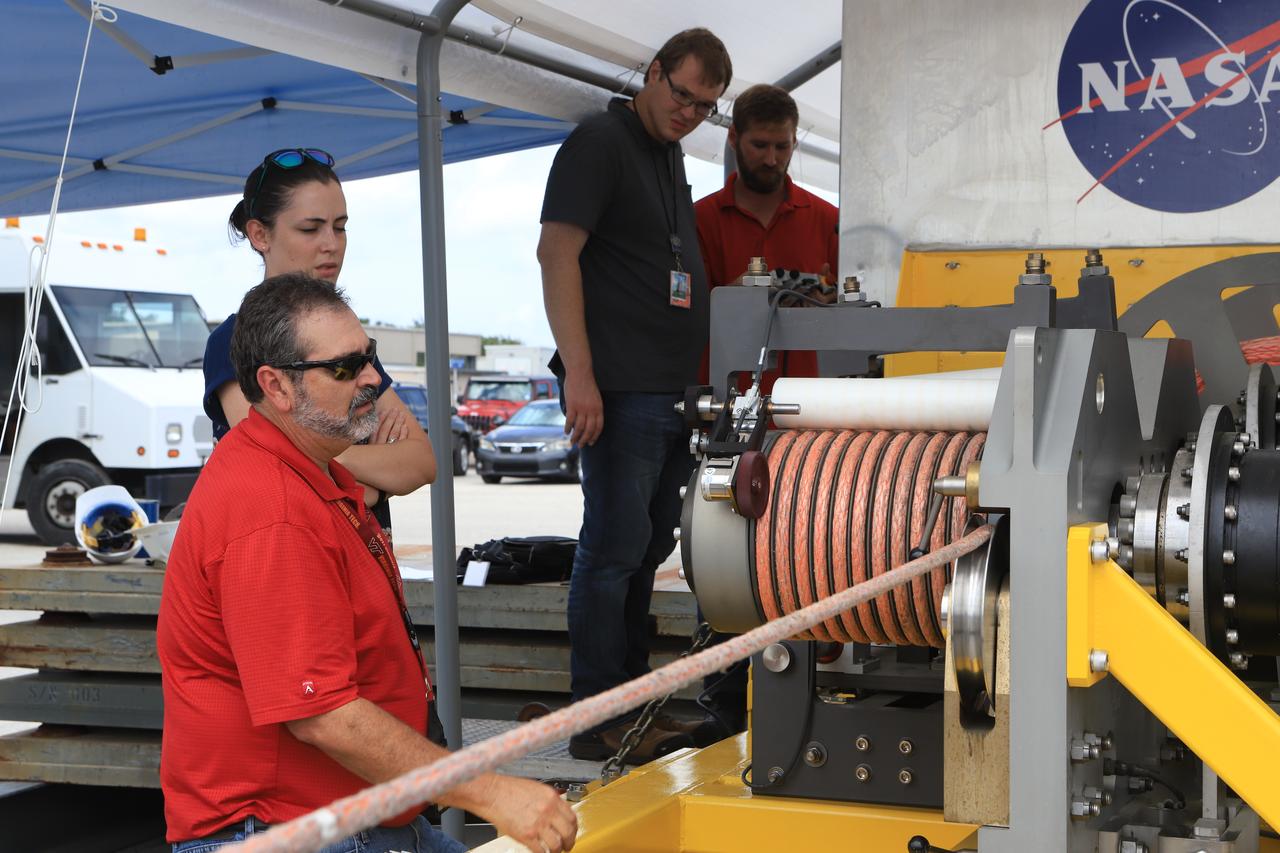
Winch Training For URT-7
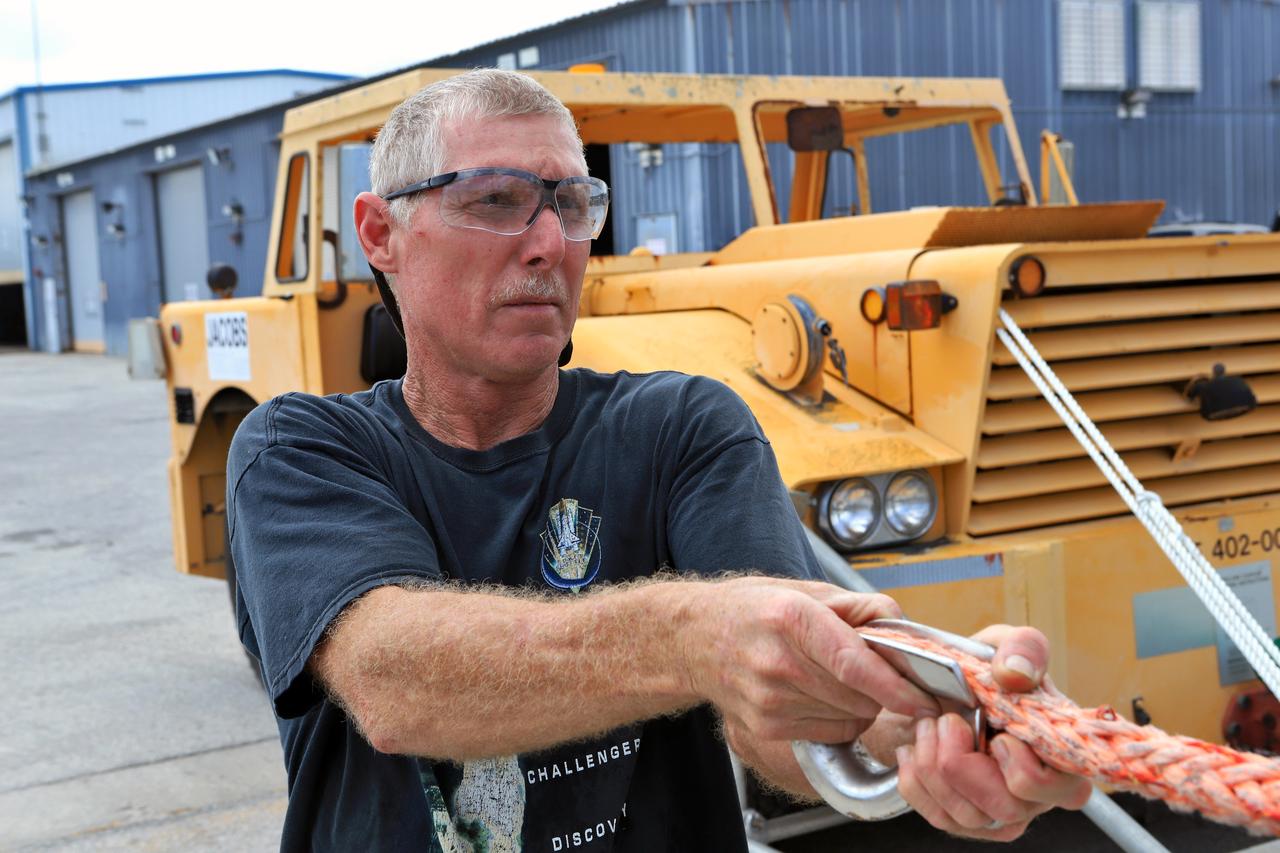
Orion Landing and Recovery team member John Stirling, with Jacobs, practices using a winch to prepare for Underway Recovery Test 7 ( URT-7) on Sept. 5, 2018, in the heavy equipment yard at NASA's Kennedy Space Center in Florida. During URT-7, the recovery team, including Exploration Ground Systems and the U.S. Navy, will practice recovering a test version of the Orion crew module in the Pacific Ocean, off the coast of California, and guiding it into the well deck of a ship. Over several days, the team will demonstrate and evaluate new recovery processes, procedures, hardware and personnel in open waters. Orion is the exploration spacecraft designed to carry astronauts to deep space destinations, including the Moon and on to Mars. Orion will have emergency abort capability, sustain the crew during space travel and provide safe re-entry from deep space return velocities.
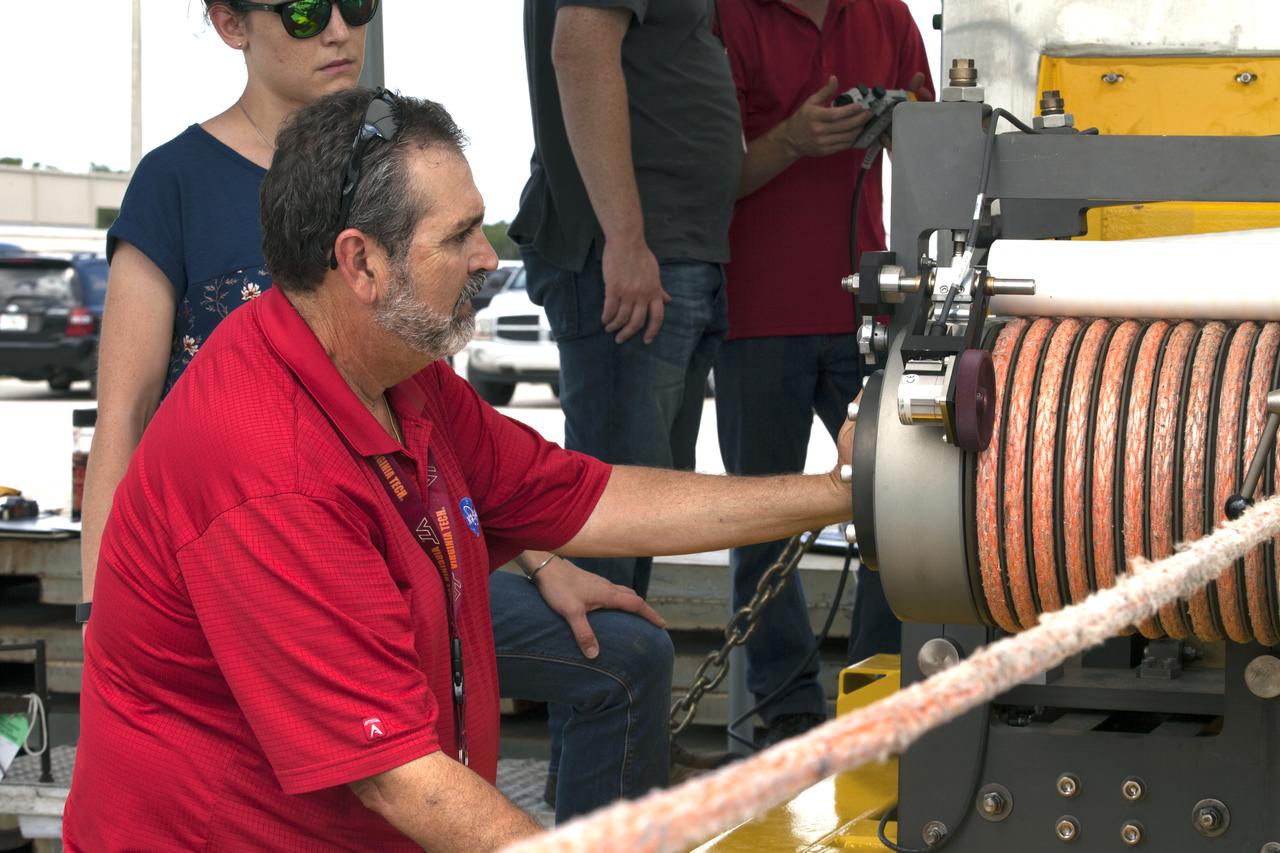
Orion Landing and Recovery team members with Jacobs practice using a winch to prepare for Underway Recovery Test 7 (URT-7) on Sept. 5, 2018, in the heavy equipment yard at NASA's Kennedy Space Center in Florida. In front is Pete Ruett. Behind him is Amy Hein. Both are handling and access engineers. During URT-7, the recovery team, including Exploration Ground Systems and the U.S. Navy, will practice recovering a test version of the Orion crew module in the Pacific Ocean, off the coast of California, and guiding it into the well deck of a ship. Over several days, the team will demonstrate and evaluate new recovery processes, procedures, hardware and personnel in open waters. Orion is the exploration spacecraft designed to carry astronauts to deep space destinations, including the Moon and on to Mars. Orion will have emergency abort capability, sustain the crew during space travel and provide safe re-entry from deep space return velocities.
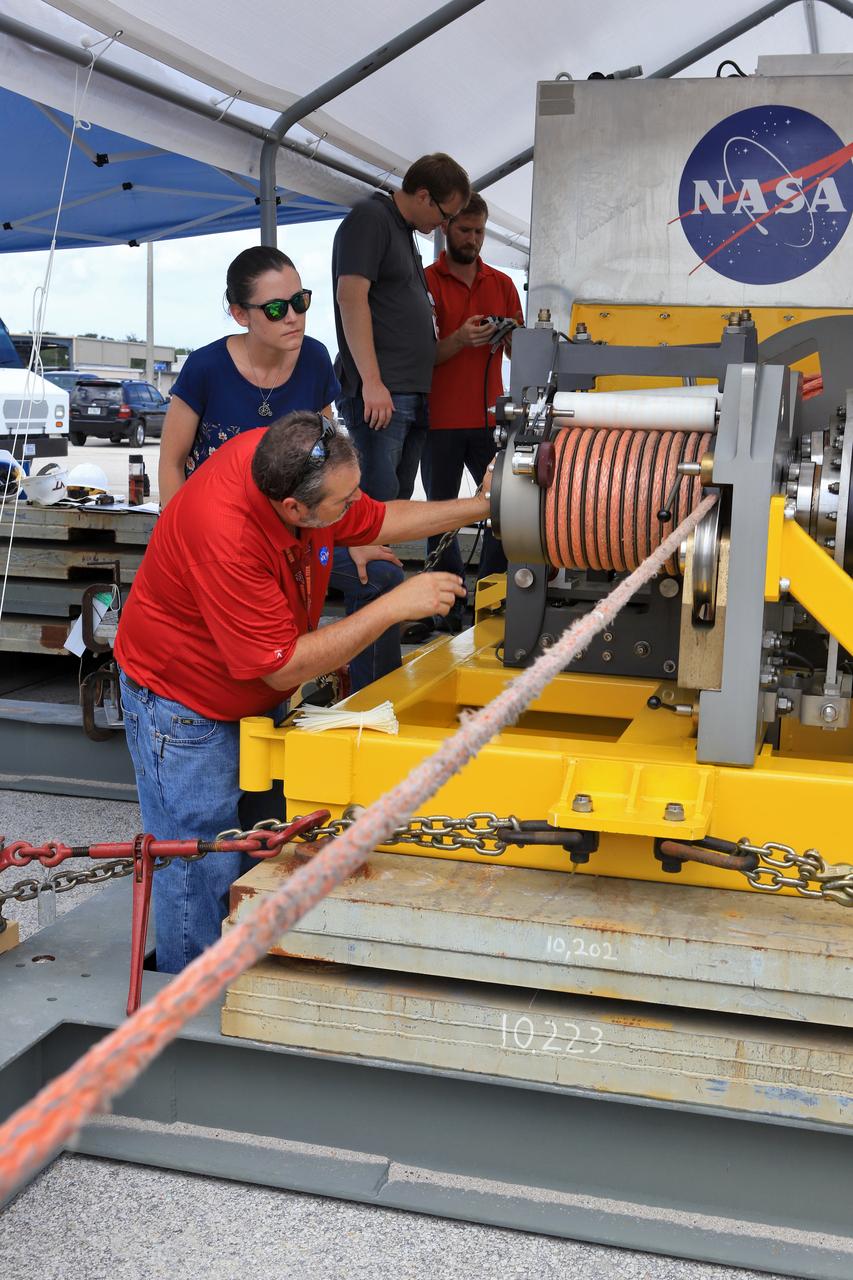
Orion Landing and Recovery team members with Jacobs, practice using a winch to prepare for Underway Recovery Test 7 (URT-7) on Sept. 5, 2018, in the heavy equipment yard at NASA's Kennedy Space Center in Florida. From left, are handling and access engineers Pete Ruett, Amy Hein, Peter Thorn and Eric Hernandez. During URT-7, the recovery team, including Exploration Ground Systems and the U.S. Navy, will practice recovering a test version of the Orion crew module in the Pacific Ocean, off the coast of California, and guiding it into the well deck of a ship. Over several days, the team will demonstrate and evaluate new recovery processes, procedures, hardware and personnel in open waters. Orion is the exploration spacecraft designed to carry astronauts to deep space destinations, including the Moon and on to Mars. Orion will have emergency abort capability, sustain the crew during space travel and provide safe re-entry from deep space return velocities.
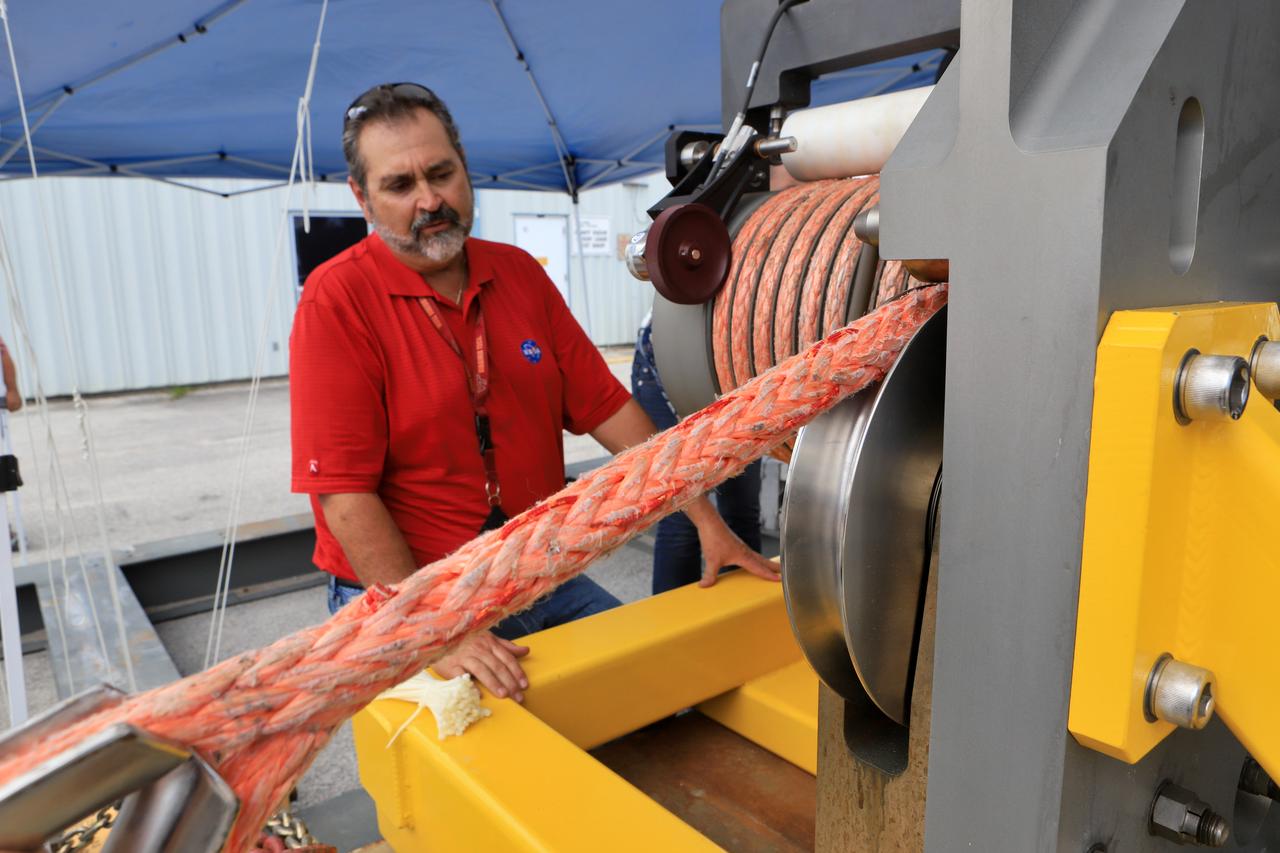
Orion Landing and Recovery team member Pete Ruett, with Jacobs, practices using a winch to prepare for Underway Recovery Test 7 (URT-7) on Sept. 5, 2018, in the heavy equipment yard at NASA's Kennedy Space Center in Florida. Ruett is a handling and access engineer. During URT-7, the recovery team, including Exploration Ground Systems and the U.S. Navy, will practice recovering a test version of the Orion crew module in the Pacific Ocean, off the coast of California, and guiding it into the well deck of a ship. Over several days, the team will demonstrate and evaluate new recovery processes, procedures, hardware and personnel in open waters. Orion is the exploration spacecraft designed to carry astronauts to deep space destinations, including the Moon and on to Mars. Orion will have emergency abort capability, sustain the crew during space travel and provide safe re-entry from deep space return velocities.
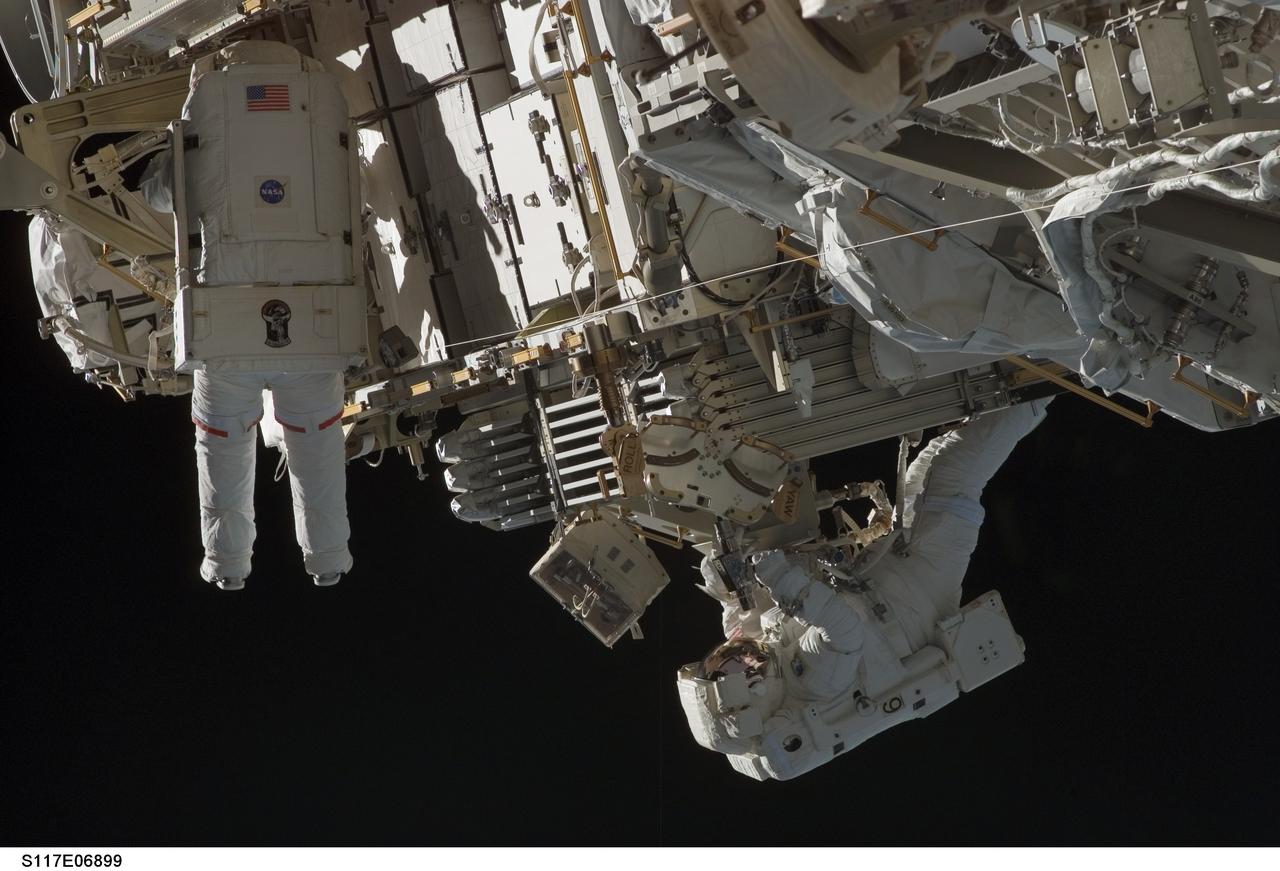
S117-E-06899 (11 June 2007) --- Astronauts Jim Reilly (left) and John "Danny" Olivas (bottom right), both STS-117 mission specialists, participate in the mission's first planned session of extravehicular activity (EVA), as construction resumes on the International Space Station. Among other tasks, Reilly and Olivas connected power, data and cooling cables between S1 and S3; released the launch restraints from and deployed the four solar array blanket boxes on S4 and released the cinches and winches holding the photovoltaic radiator on S4.
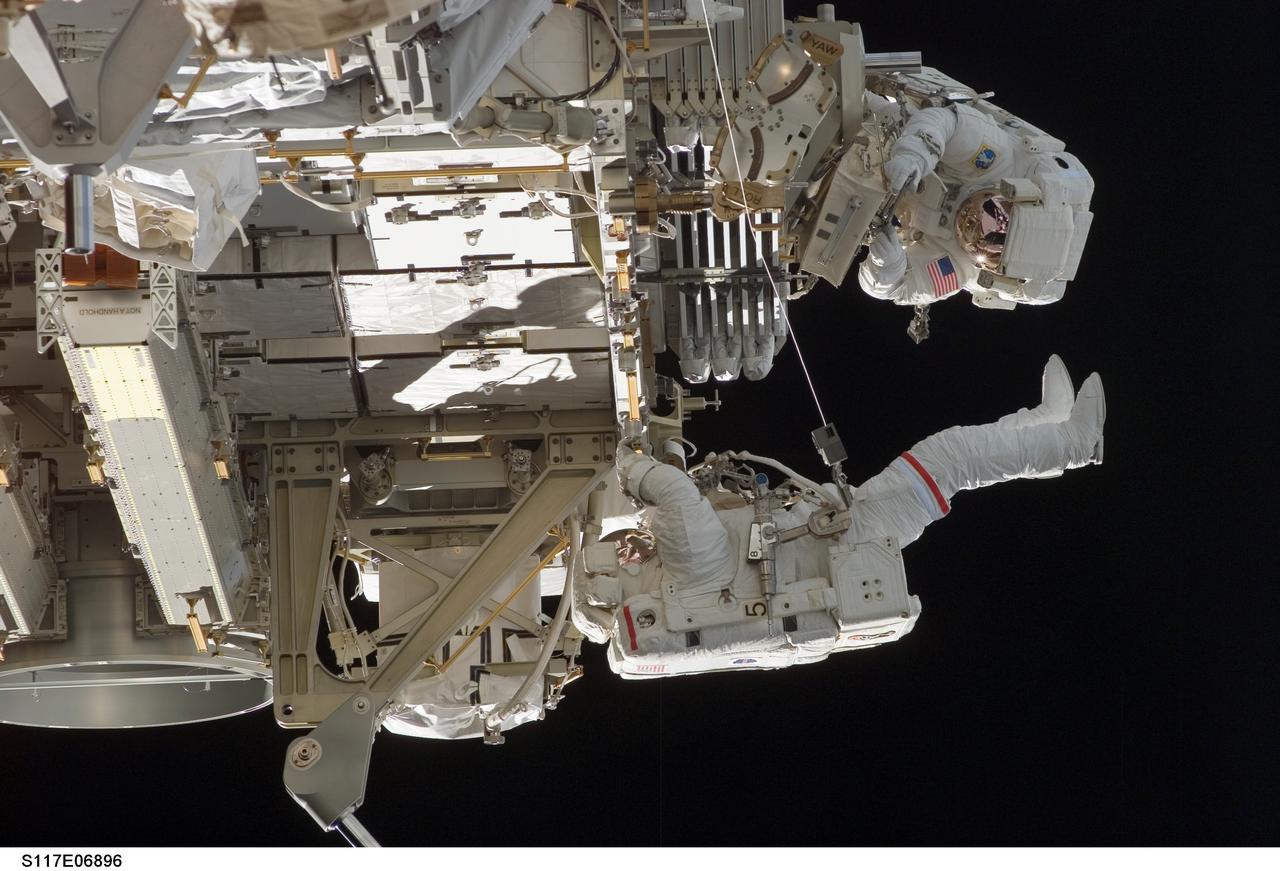
S117-E-06896 (11 June 2007) --- Astronauts Jim Reilly (bottom) and John "Danny" Olivas (top right), both STS-117 mission specialists, participate in the mission's first planned session of extravehicular activity (EVA), as construction resumes on the International Space Station. Among other tasks, Reilly and Olivas connected power, data and cooling cables between S1 and S3; released the launch restraints from and deployed the four solar array blanket boxes on S4 and released the cinches and winches holding the photovoltaic radiator on S4.
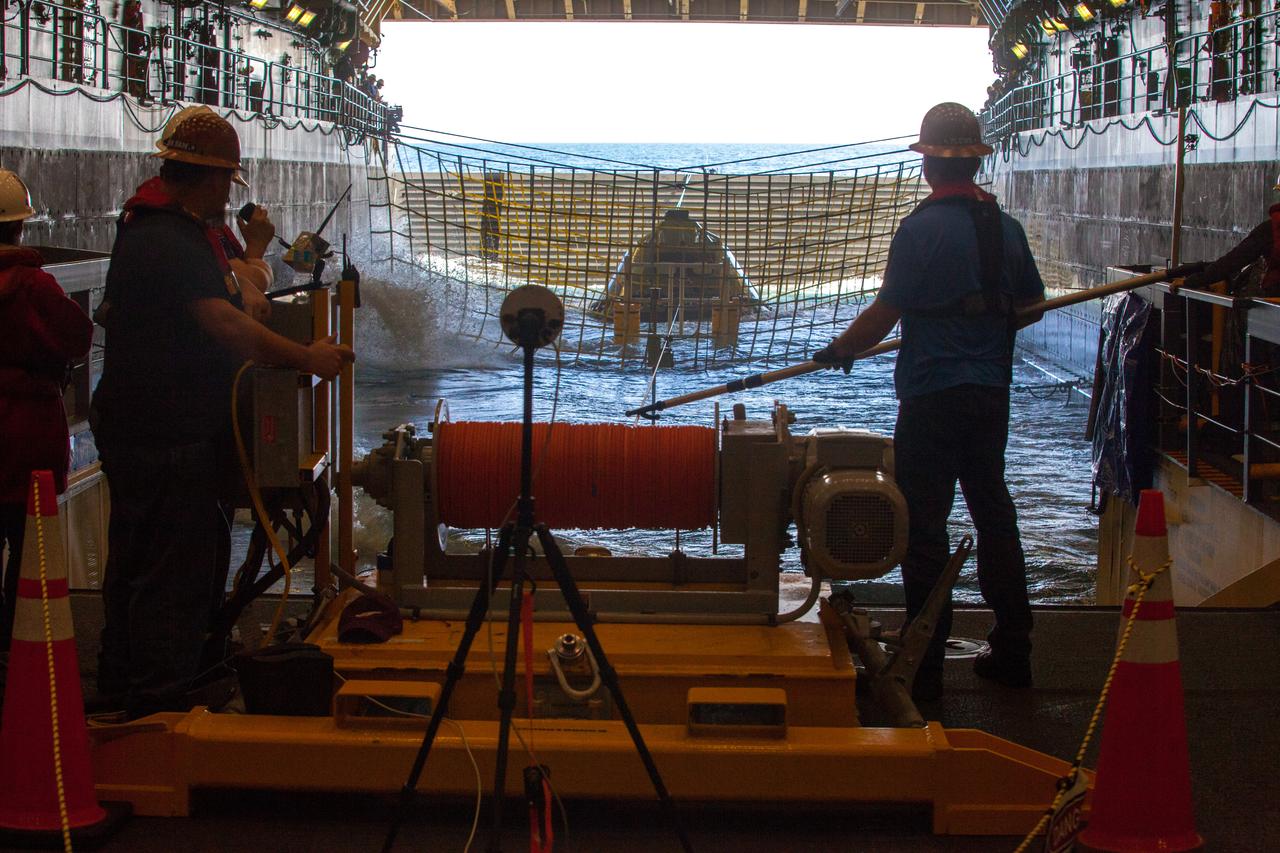
Winch team operators help guide a test version of the Orion crew module into the flooded well deck of the USS San Diego during Underway Recovery Test 5 in the Pacific Ocean off the coast of California. NASA's Ground Systems Development and Operations Program and the U.S. Navy are conducting a series of tests to prepare for recovery of Orion on its return from deep space missions. The testing will allow the team to demonstrate and evaluate recovery processes, procedures, hardware and personnel in open waters. Part of Batch images transfer from Flickr.
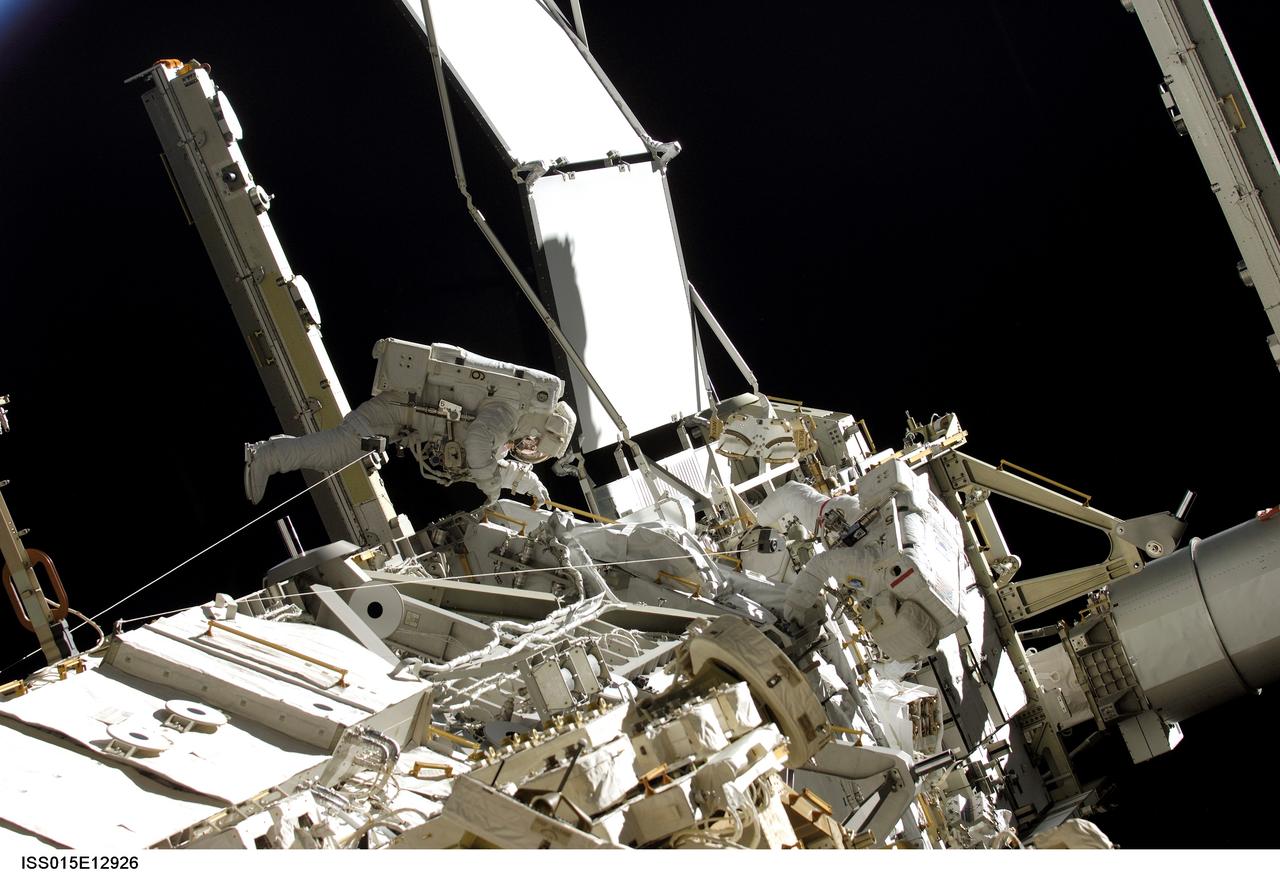
ISS015-E-12926 (11 June 2007) --- Astronauts Jim Reilly (right) and John "Danny" Olivas, both STS-117 mission specialists, participate in the mission's first planned session of extravehicular activity (EVA), as construction continues on the International Space Station. Among other tasks, Reilly and Olivas connected power, data and cooling cables between S1 and S3; released the launch restraints from and deployed the four solar array blanket boxes on S4 and released the cinches and winches holding the photovoltaic radiator on S4.
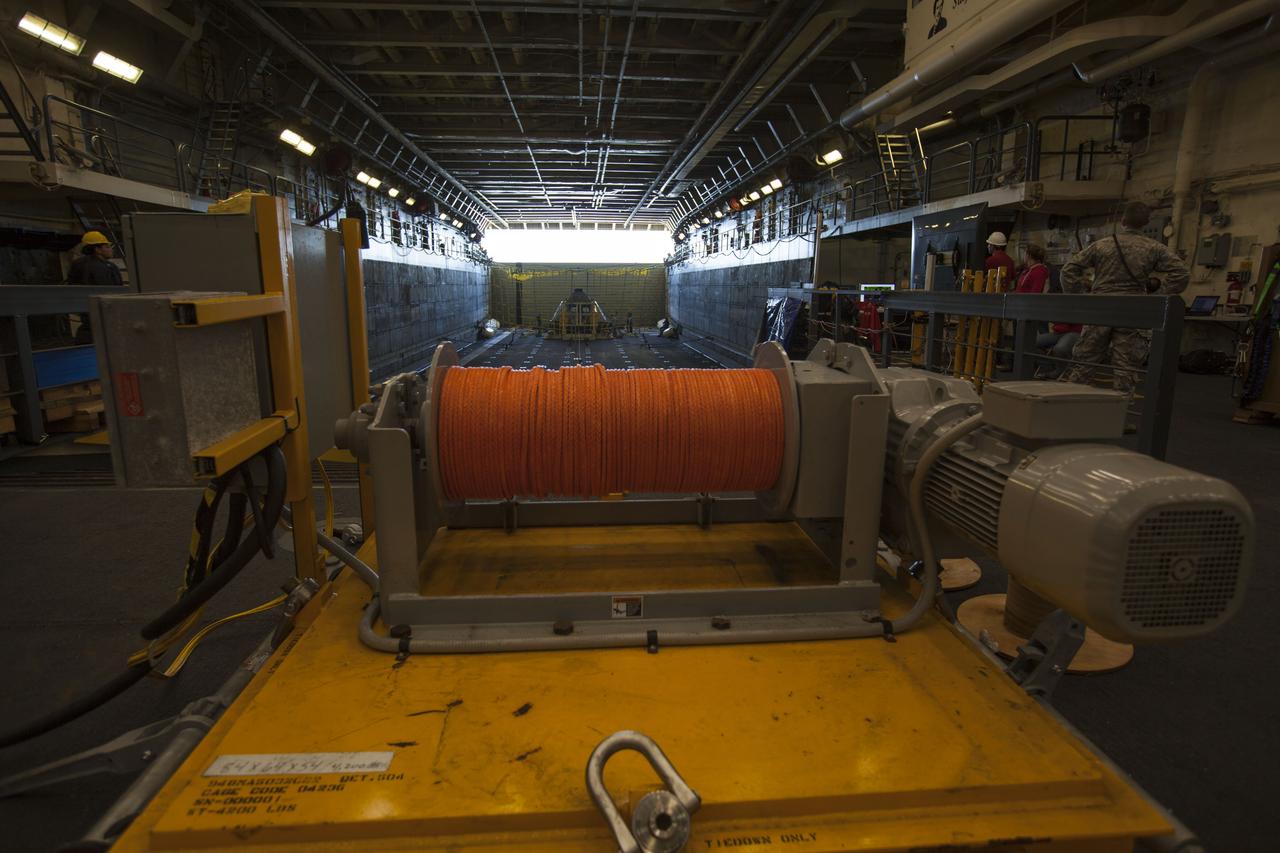
A test version of the Orion crew module is secured in the well deck of the USS San Diego for Underway Recovery Test 5 in the Pacific Ocean off the coast of California. In view is the winch system that will be used to help retrieve the crew module during a series of tests in open waters. NASA's Ground Systems Development and Operations Program and the U.S. Navy will practice retrieving and securing the crew module in the well deck of the ship using a set of tethers and the winch system to prepare for recovery of Orion on its return from deep space missions. The testing will allow the team to demonstrate and evaluate recovery processes, procedures, hardware and personnel in open waters. Orion is the exploration spacecraft designed to carry astronauts to destinations not yet explored by humans, including an asteroid and NASA's Journey to Mars. It will have emergency abort capability, sustain the crew during space travel and provide safe re-entry from deep space return velocities. Orion is scheduled to launch on NASA's Space Launch System in late 2018. For more information, visit http://www.nasa.gov/orion.
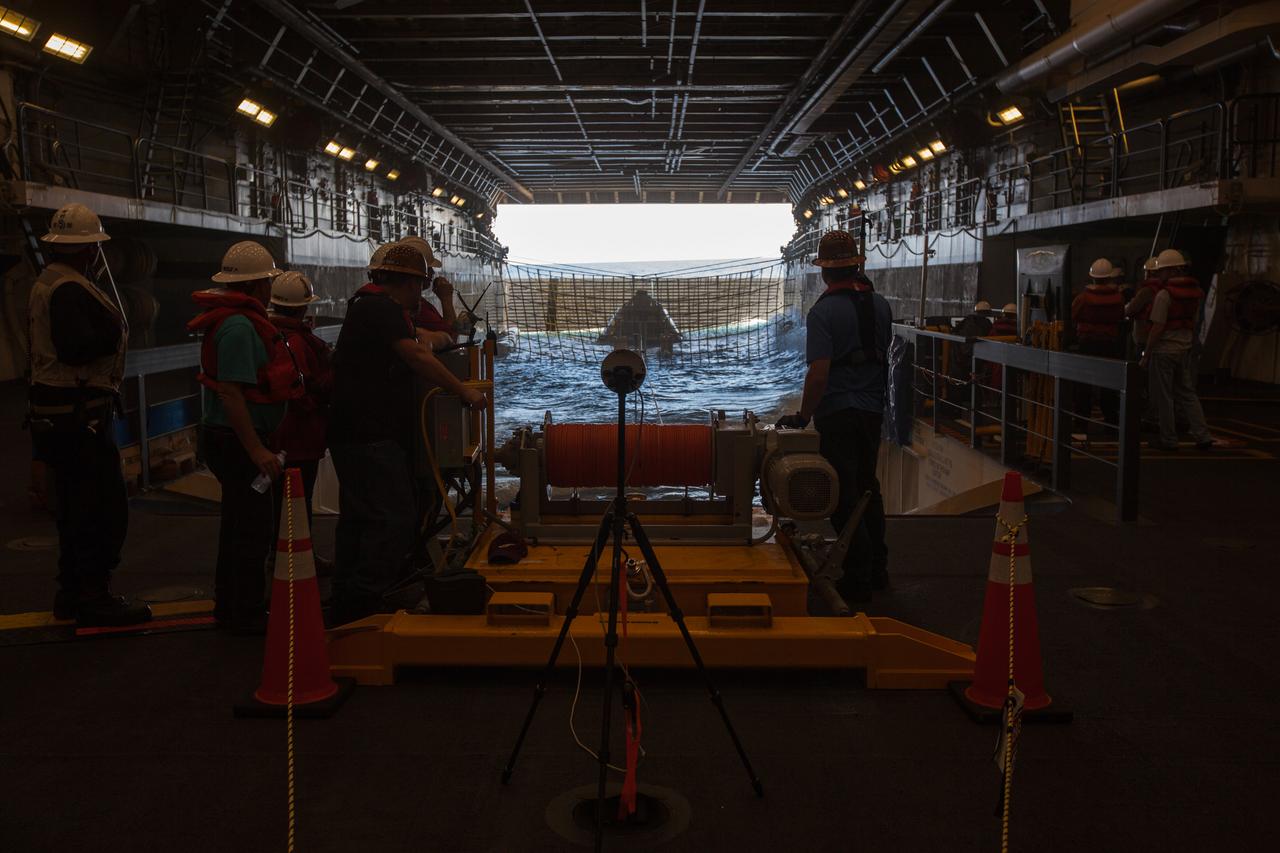
Winch team operators help guide a test version of the Orion crew module in the flooded well deck of the USS San Diego during Underway Recovery Test 5 in the Pacific Ocean off the coast of California on Oct. 29, 2016. NASA's Ground Systems Development and Operations Program and the U.S. Navy are conducting a series of tests using the ship's well deck, the test module, various watercraft and equipment to prepare for recovery of Orion on its return from deep space missions. The testing will allow the team to demonstrate and evaluate recovery processes, procedures, hardware and personnel in open waters. Part of Batch images transfer from Flickr.
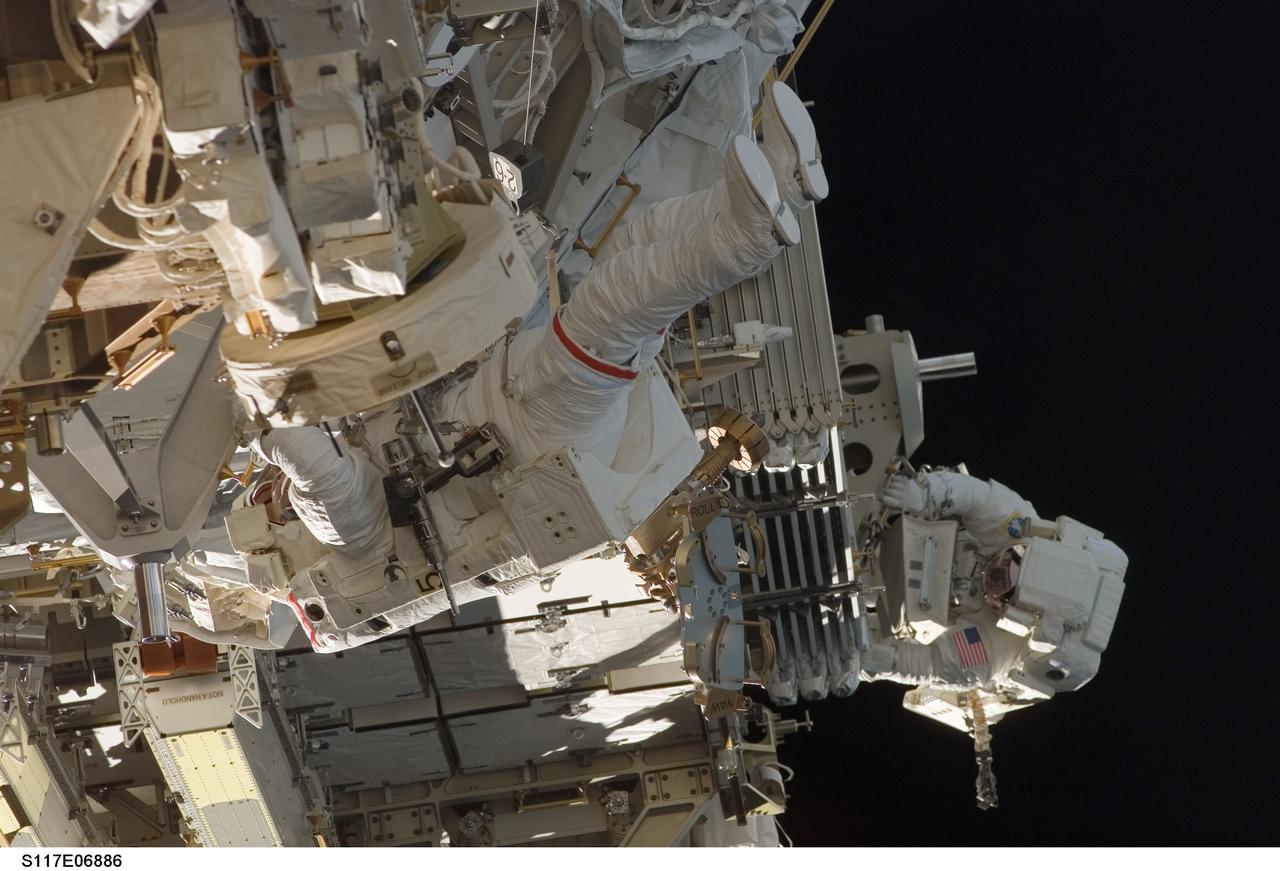
S117-E-06886 (11 June 2007) --- Astronauts Jim Reilly (center frame) and John "Danny" Olivas (bottom right), both STS-117 mission specialists, participate in the mission's first planned session of extravehicular activity (EVA), as construction resumes on the International Space Station. Among other tasks, Reilly and Olivas connected power, data and cooling cables between S1 and S3; released the launch restraints from and deployed the four solar array blanket boxes on S4 and released the cinches and winches holding the photovoltaic radiator on S4.
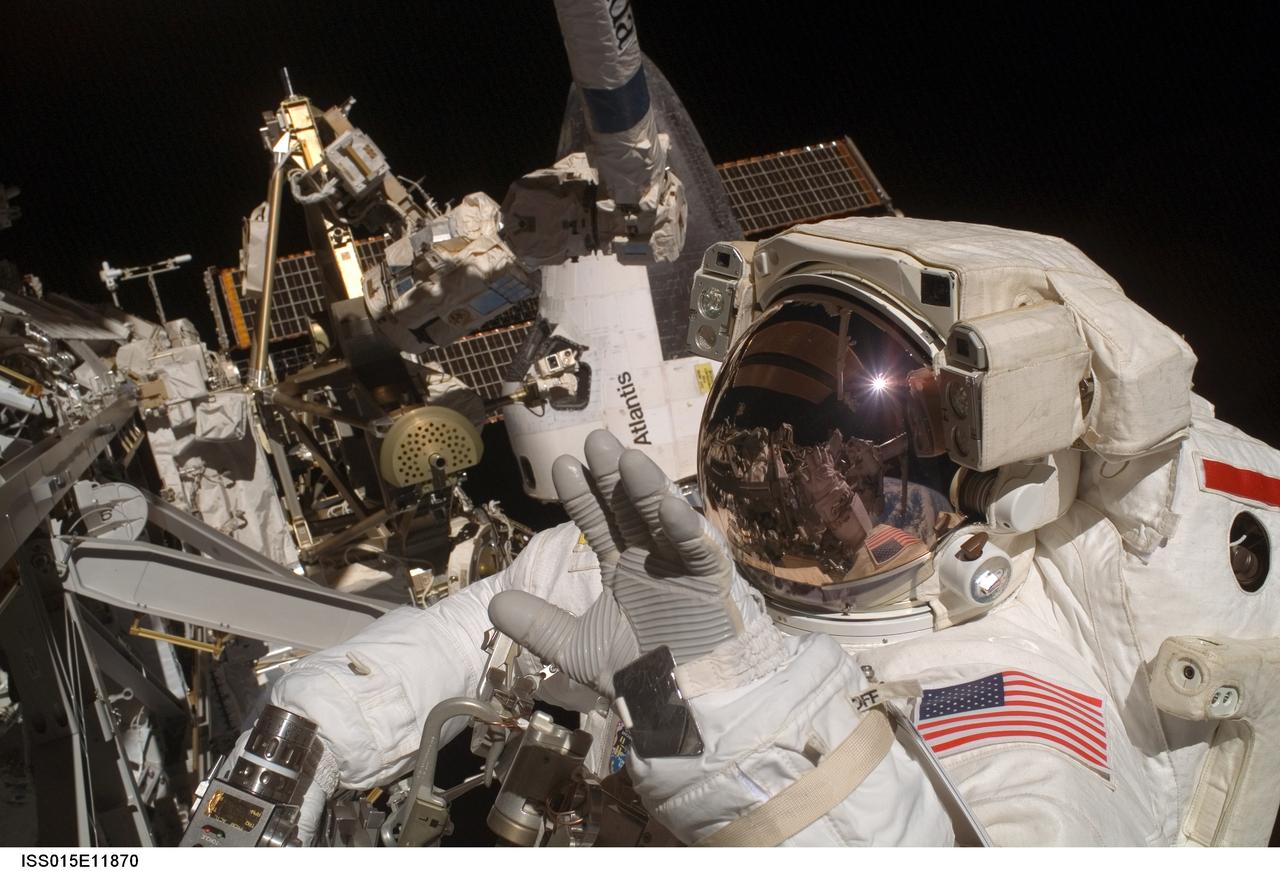
ISS015-E-11870 (11 June 2007) --- Astronauts Jim Reilly and John "Danny" Olivas (visible among Reilly's helmet reflections), both STS-117 mission specialists, participate in the mission's first planned session of extravehicular activity (EVA), as construction resumes on the International Space Station. Among other tasks, Reilly and Olivas connected power, data and cooling cables between S1 and S3; released the launch restraints from and deployed the four solar array blanket boxes on S4 and released the cinches and winches holding the photovoltaic radiator on S4. The crew cabin and nose of Space Shuttle Atlantis docked to the station is visible in the background.
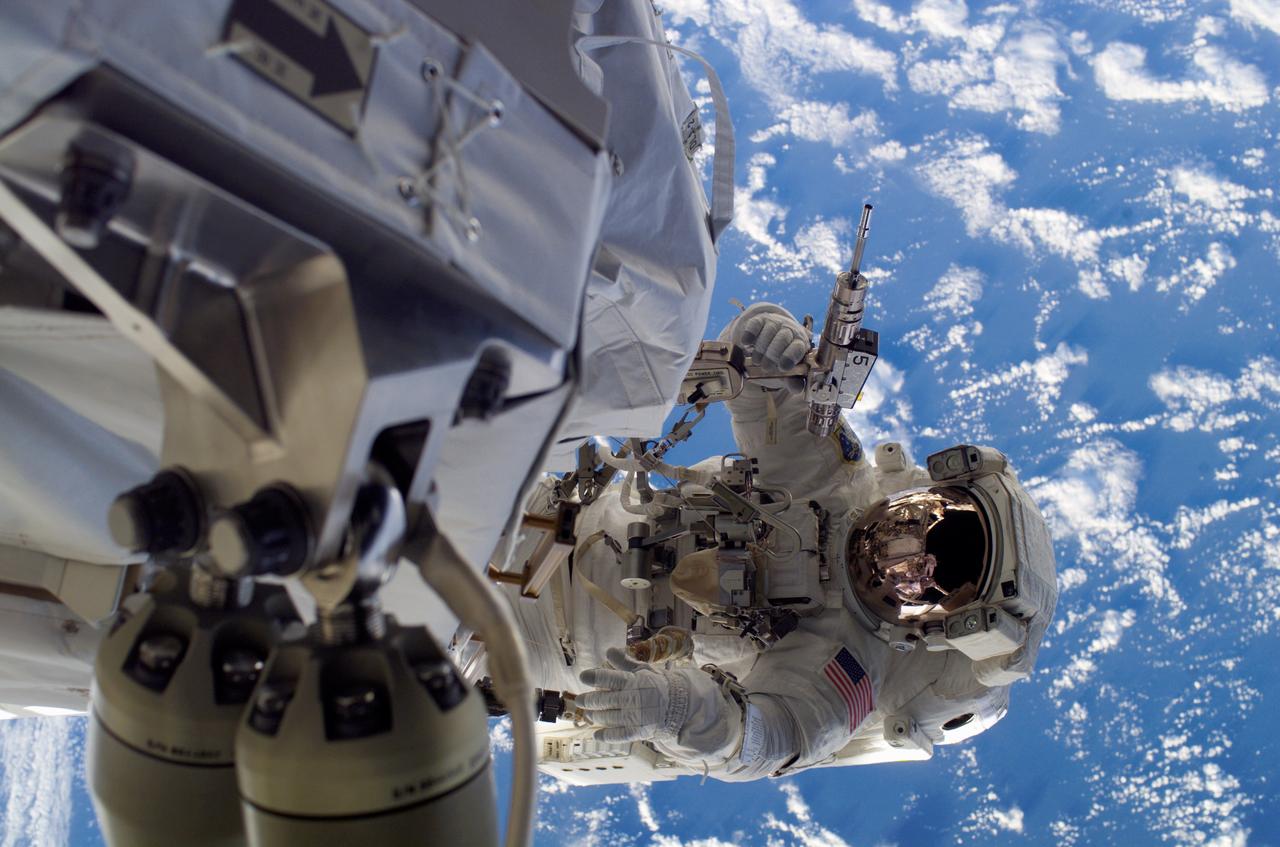
ISS015-E-11831 (11 June 2007) --- Astronauts John "Danny" Olivas and Jim Reilly (out of frame), both STS-117 mission specialists, participate in the mission's first planned session of extravehicular activity (EVA), as construction resumes on the International Space Station. Among other tasks, Reilly and Olivas connected power, data and cooling cables between S1 and S3; released the launch restraints from and deployed the four solar array blanket boxes on S4 and released the cinches and winches holding the photovoltaic radiator on S4. A blue and white Earth provided the backdrop for the scene.
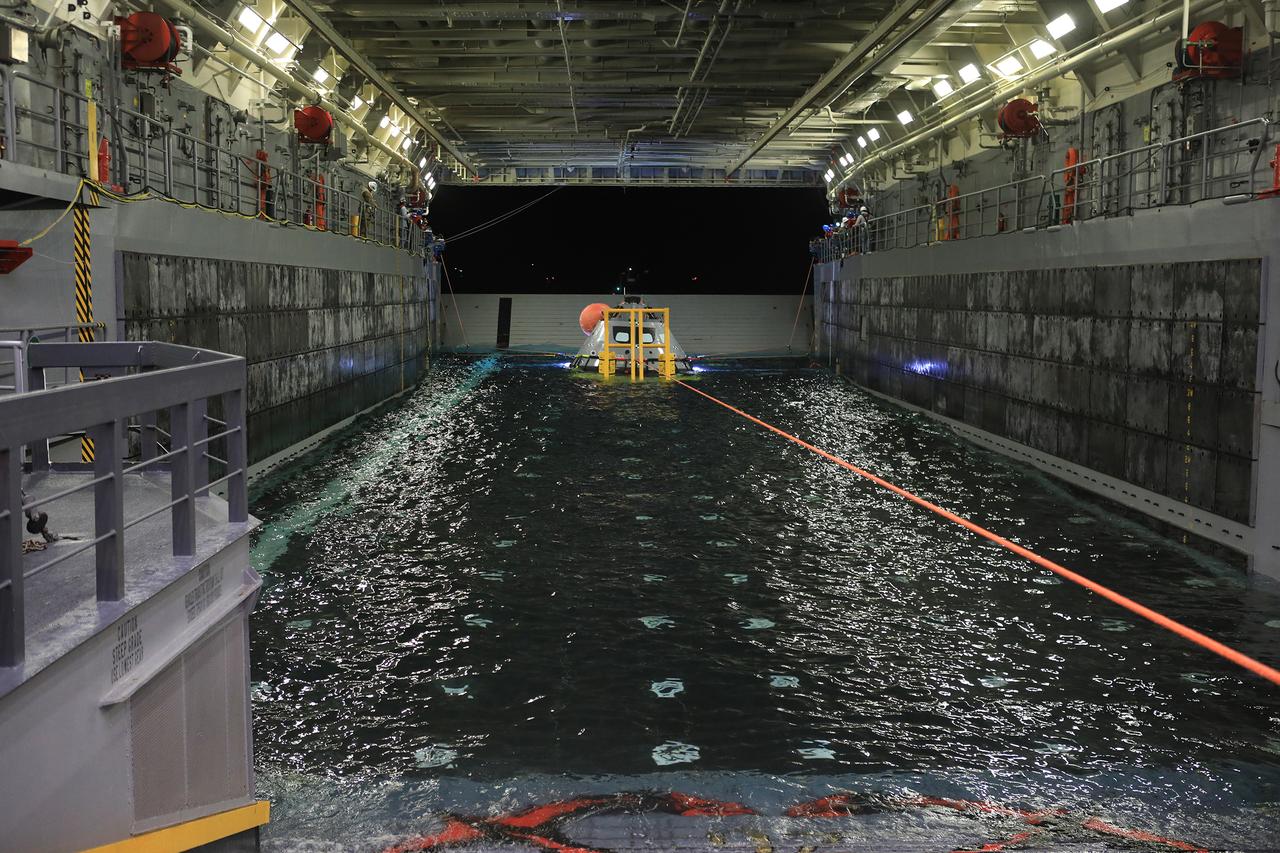
Inside the well deck of the USS John P. Murtha, a winch line pulls the test version of the Orion capsule onto its cradle while tending lines on the well walls help guide it into place during Underway Recovery Test-7 (URT-7) on Nov. 1, 2018. URT-7 is one in a series conducted the EGS Recovery Team to verify and validate procedures and hardware that will be used to recover the Orion spacecraft after it splashes down in the Pacific Ocean following deep space exploration missions. Orion will have emergency abort capability, sustain the crew during space travel and provide safe re-entry from deep space return velocities.
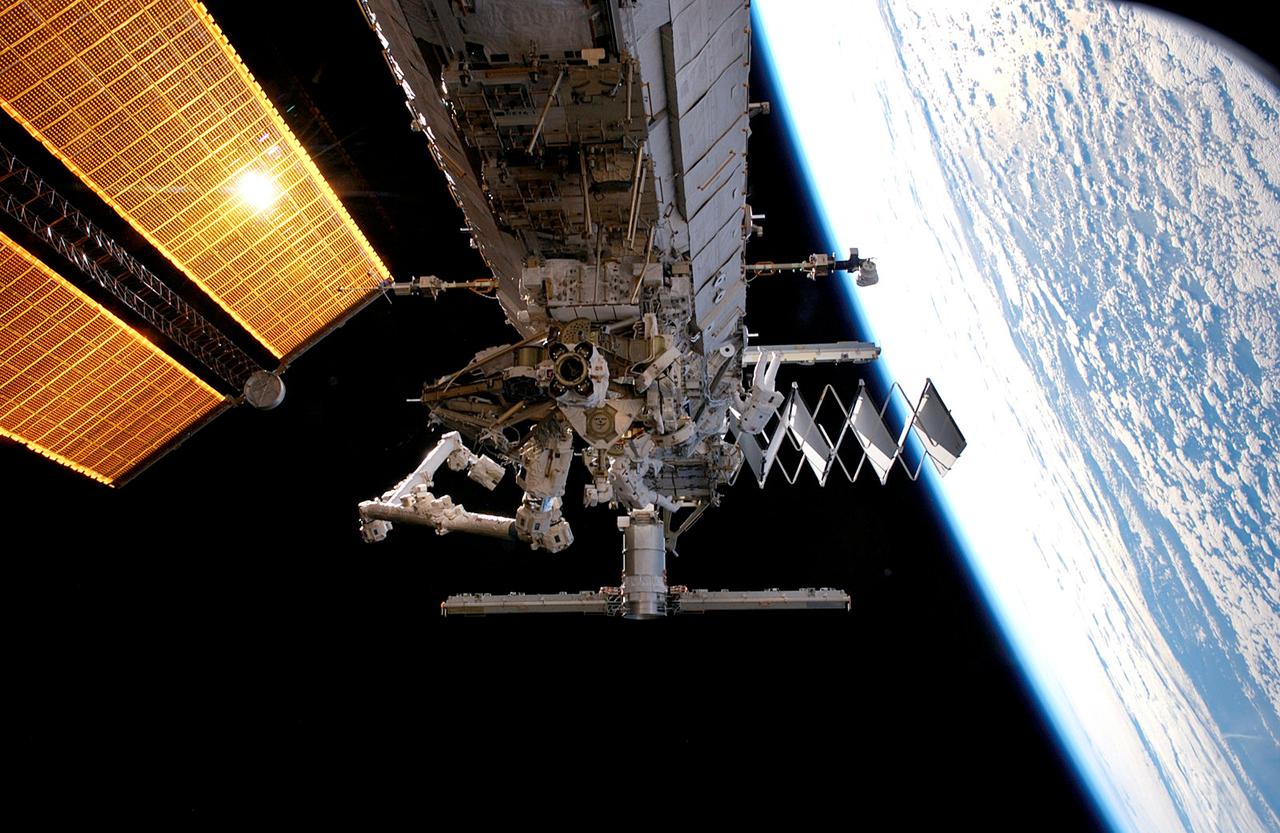
ISS015-E-12863 (11 June 2007) --- Astronauts Jim Reilly (left) and John "Danny" Olivas, both STS-117 mission specialists, participate in the mission's first planned session of extravehicular activity (EVA), as construction continues on the International Space Station. Among other tasks, Reilly and Olivas connected power, data and cooling cables between S1 and S3; released the launch restraints from and deployed the four solar array blanket boxes on S4 and released the cinches and winches holding the photovoltaic radiator on S4. Earth's horizon and the blackness of space provide the backdrop for the scene.
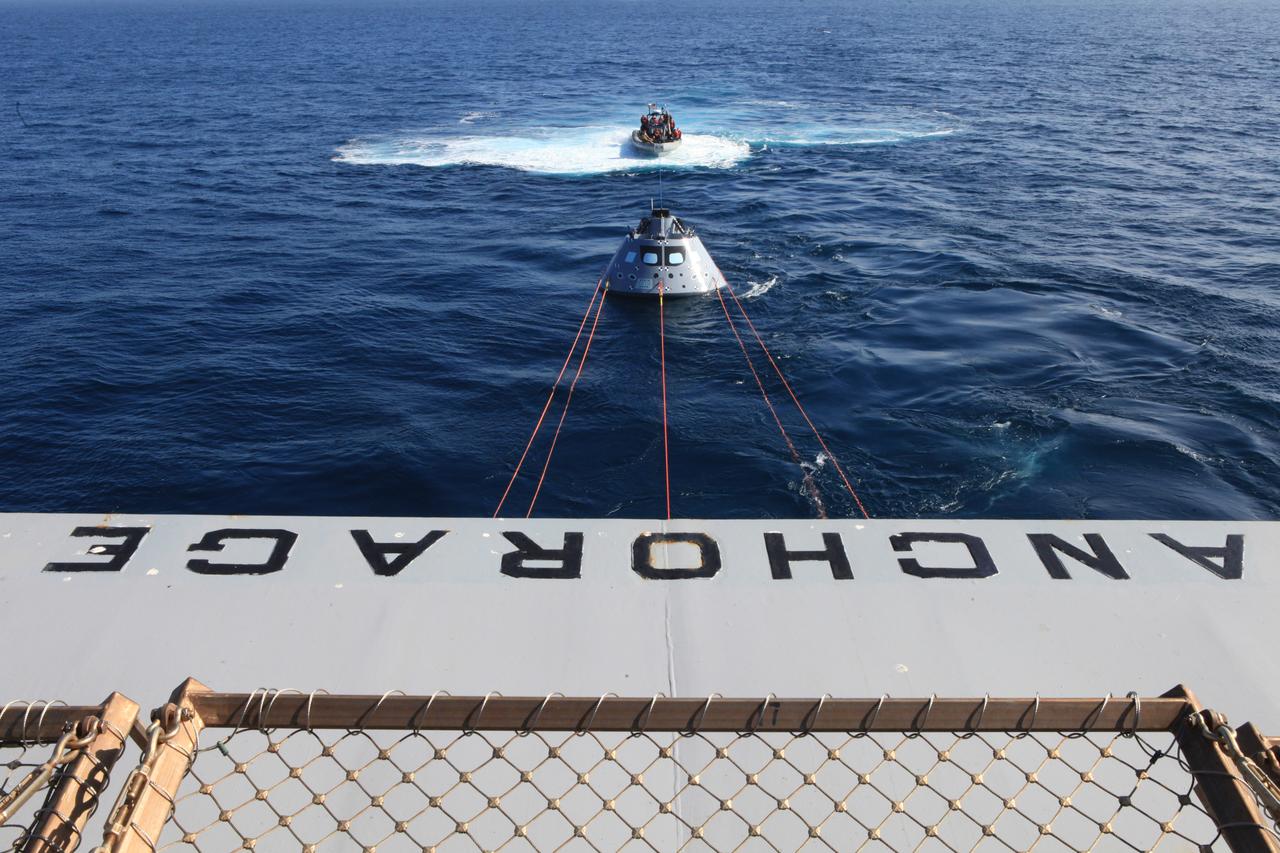
Off the rear of the USS Anchorage, the Orion test article is pulled in by a winch line at the rear of the USS Anchorage’s well deck that brings the capsule into the ship, along with four manned LLAMAs (Line Load Attenuation Mechanism Assembly) that control the capsule’s side-to-side movement and a tending line attached to a rigid hull inflatable boat for controlling Orion’s movement behind the ship. The Underway Recovery Test 6 (URT-6) is spearheaded by Kennedy Space Center's NASA Recovery Team. In partnership with the U.S. Navy, the testing will provide important data that is being used to improve recovery procedures and hardware ahead of Orion's next flight, Exploration Mission-1, when it splashes down in the Pacific Ocean.
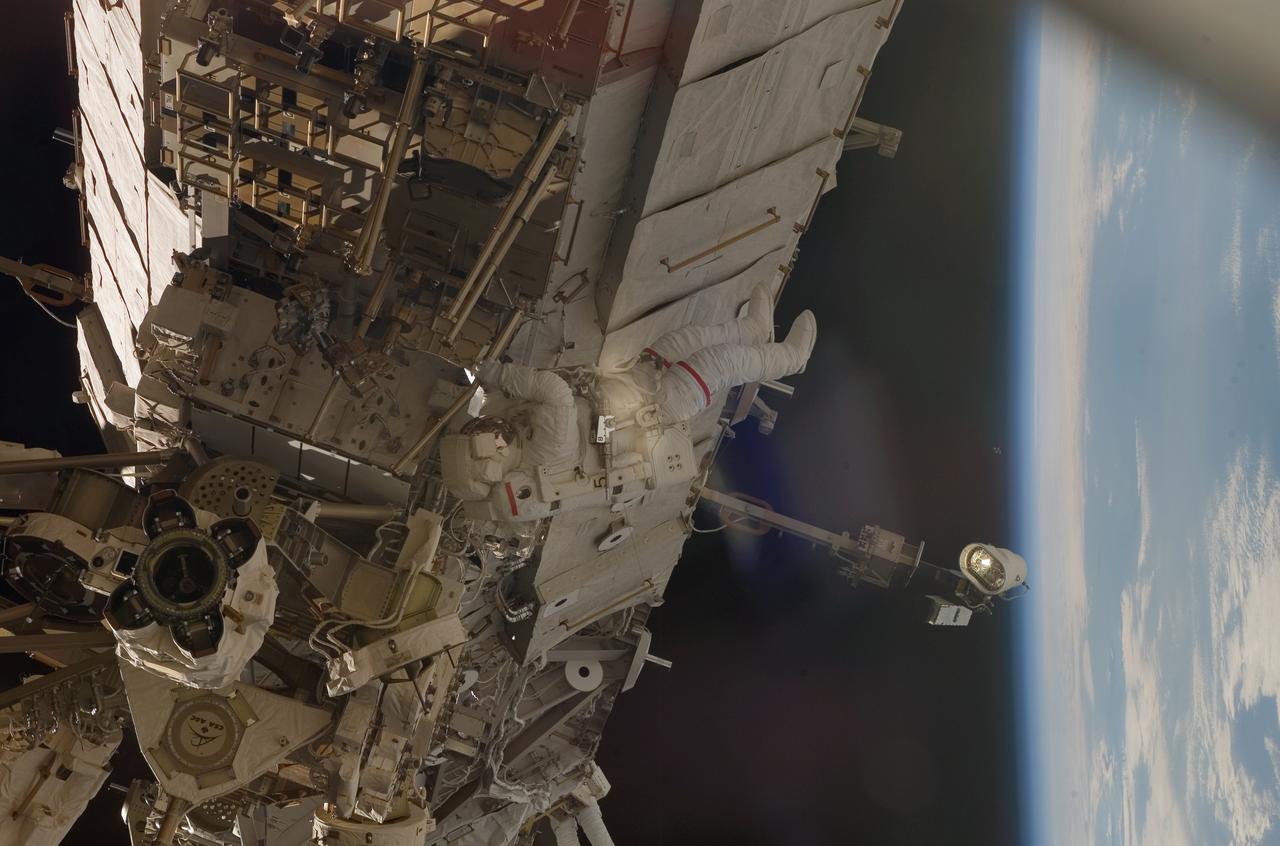
STS-117 astronauts and mission specialists Jim Reilly (center frame), and John “Danny” Olivas (bottom center), participated in the first Extra Vehicular Activity (EVA) as construction resumed on the International Space Station (ISS). Among other tasks, the two connected power, data, and cooling cables between trusses 1 (S1) and 3 (S3), released the launch restraints from and deployed the four solar array blanket boxes on S4, and released the cinches and winches holding the photovoltaic radiator on S4. The primary mission objective was the installment of the second and third starboard truss segments (S3 and S4).
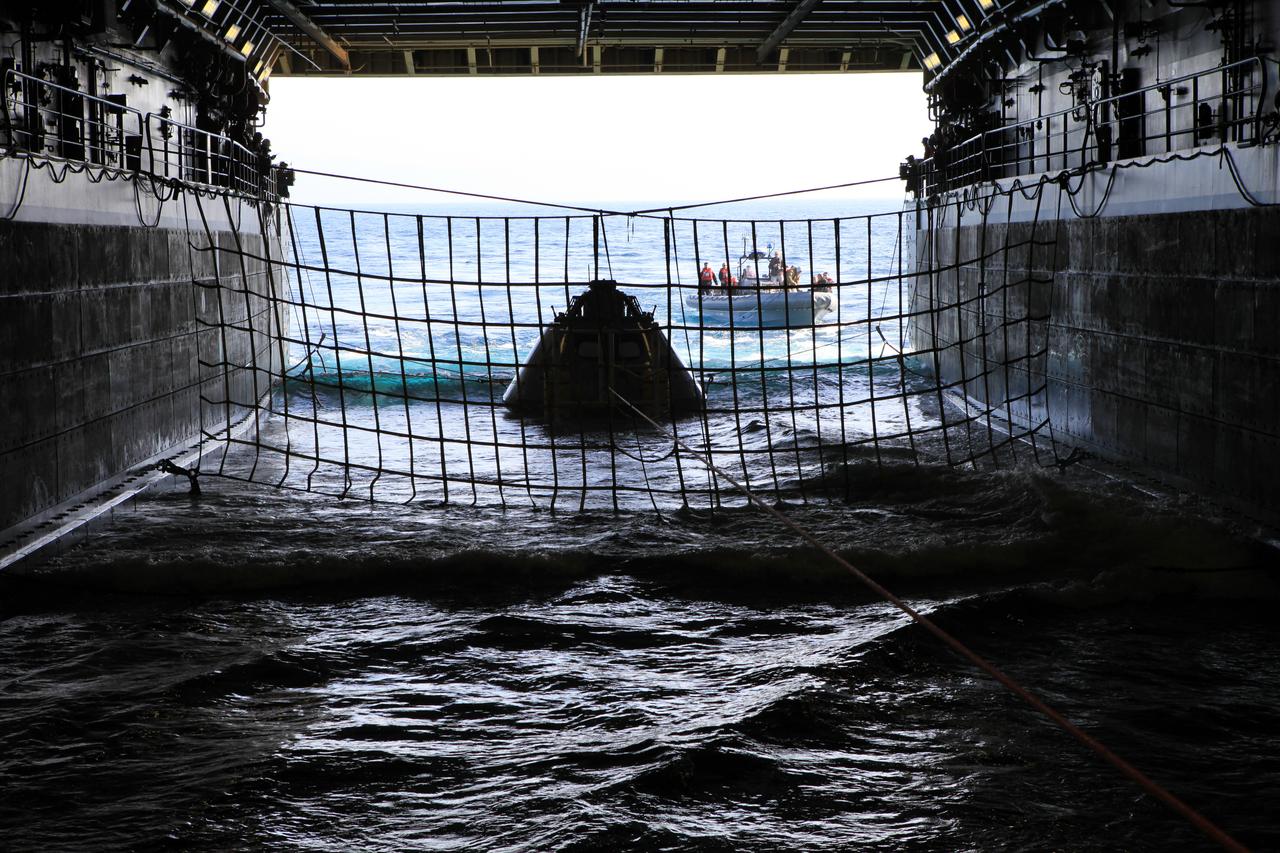
As part of Underway Recovery Test 6 on Jan. 18, 2018, the Orion test article is pulled in by a winch line at the rear of the USS Anchorage’s well deck that brings the capsule into the ship, along with four manned LLAMAs (Line Load Attenuation Mechanism Assembly) that control the capsule’s side-to-side movement and a tending line attached to a rigid hull inflatable boat for controlling Orion’s movement behind the ship. The testing with Kennedy Space Center's NASA Recovery Team and the U.S. Navy will provide important data that is being used to improve recovery procedures and hardware ahead of Orion's next flight, Artemis I, when it splashes down in the Pacific Ocean.
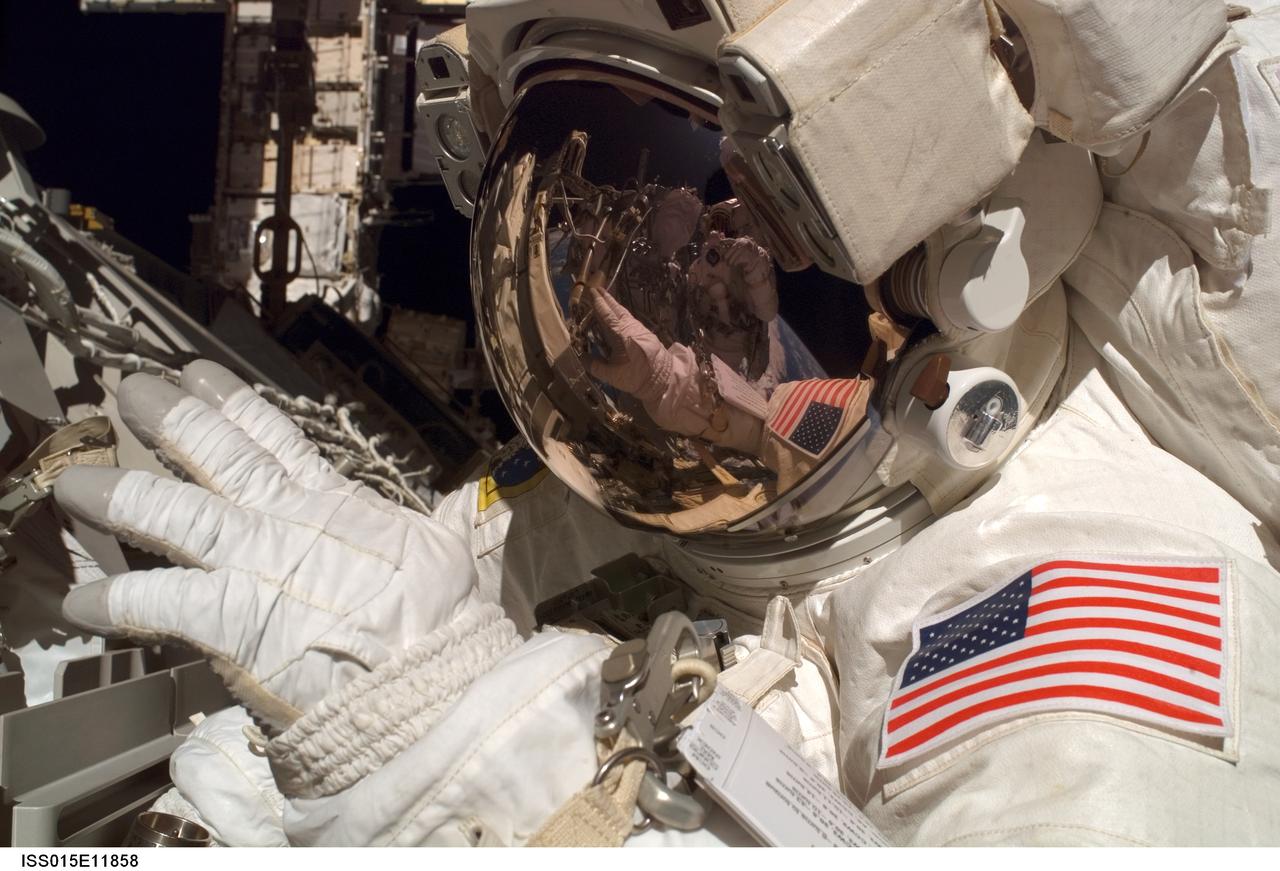
ISS015-E-11858 (11 June 2007) --- Astronauts Jim Reilly and John "Danny" Olivas (visible among Reilly's helmet reflections), both STS-117 mission specialists, participate in the mission's first planned session of extravehicular activity (EVA), as construction resumes on the International Space Station. Among other tasks, Reilly and Olivas connected power, data and cooling cables between S1 and S3; released the launch restraints from and deployed the four solar array blanket boxes on S4 and released the cinches and winches holding the photovoltaic radiator on S4.
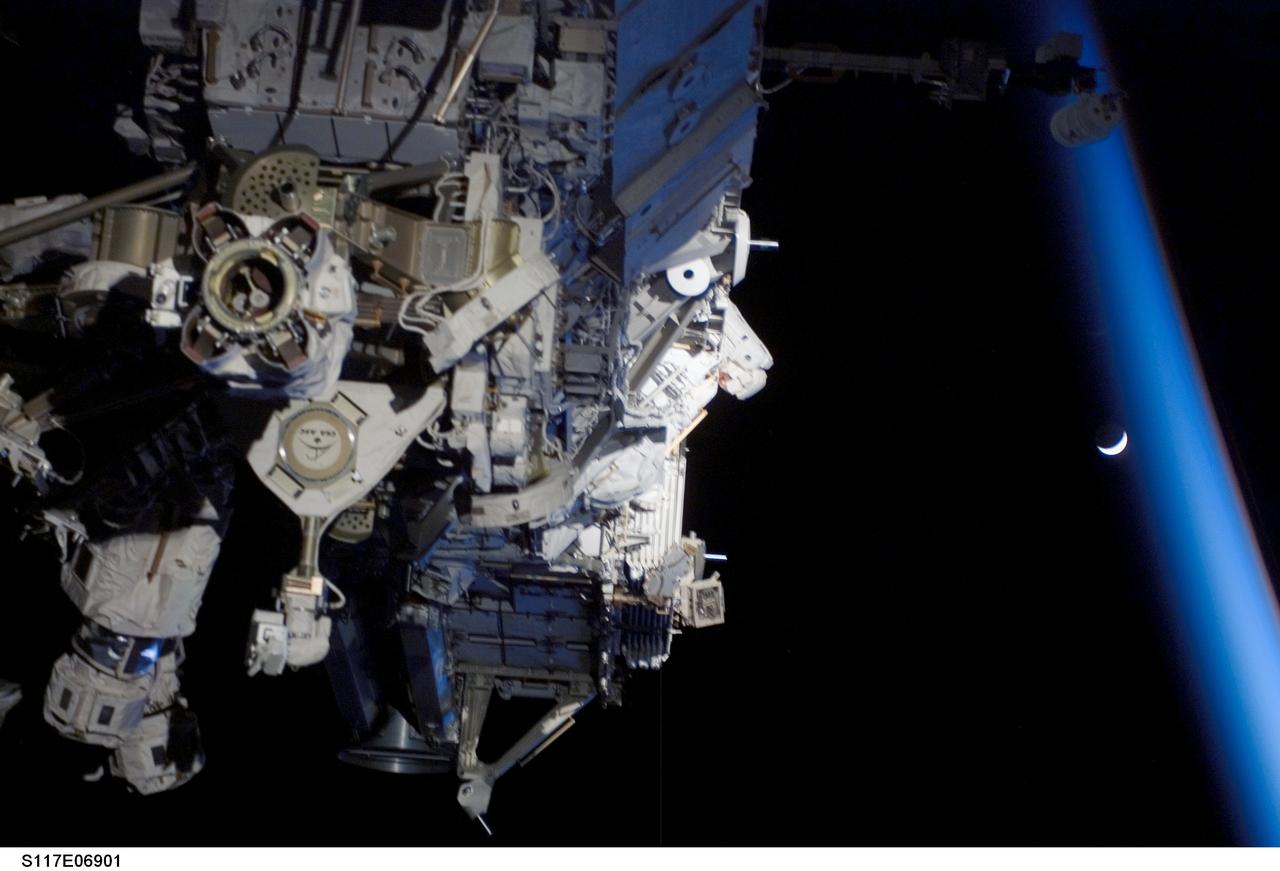
S117-E-06901 (11 June 2007) --- Astronauts Jim Reilly (out of frame) and John "Danny" Olivas (partially obscured, center), both STS-117 mission specialists, participate in the mission's first planned session of extravehicular activity (EVA), as construction resumes on the International Space Station. Among other tasks, Reilly and Olivas connected power, data and cooling cables between S1 and S3; released the launch restraints from and deployed the four solar array blanket boxes on S4 and released the cinches and winches holding the photovoltaic radiator on S4. Earth's horizon and a crescent moon are visible at right.
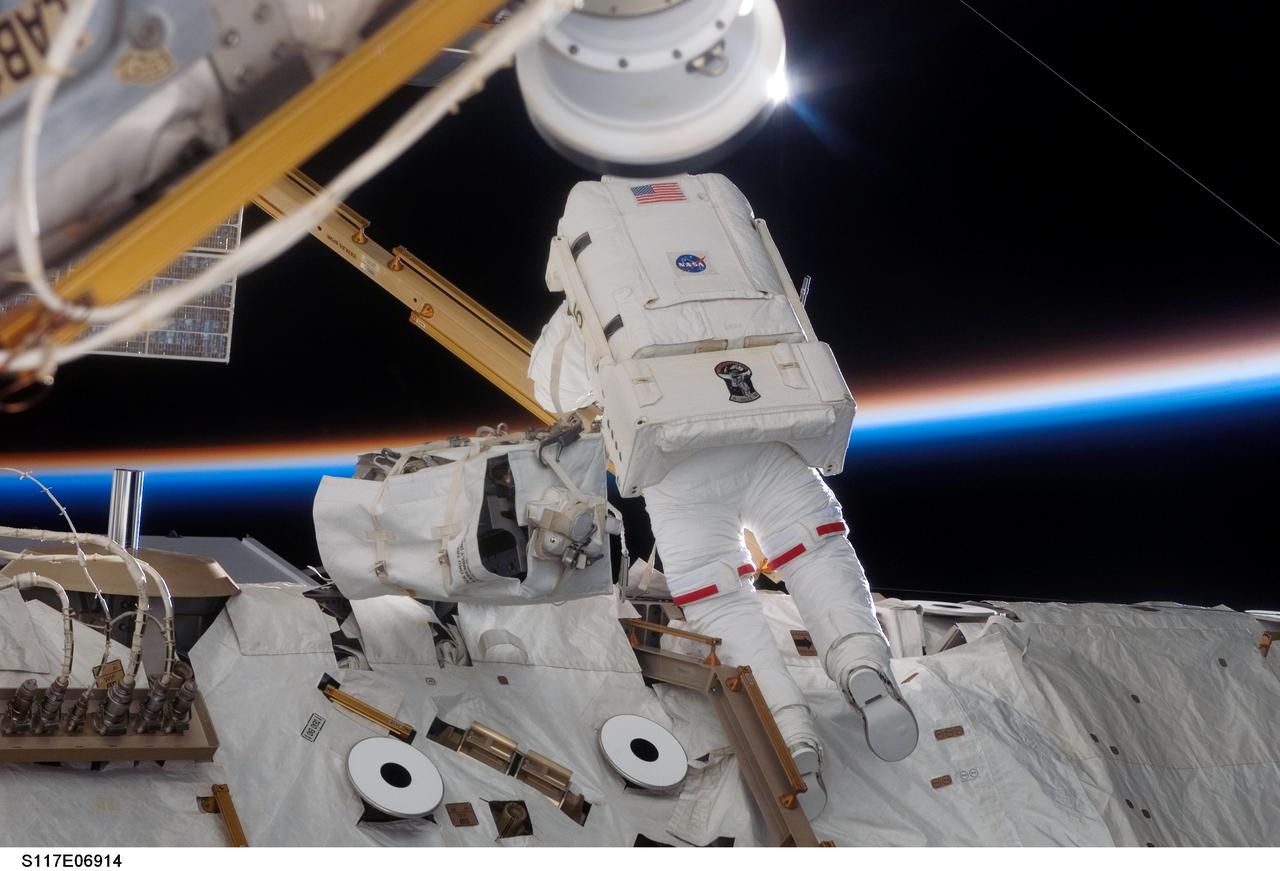
S117-E-06914 (11 June 2007) --- Astronauts Jim Reilly (center frame) and John "Danny" Olivas (out of frame), both STS-117 mission specialists, participate in the mission's first planned session of extravehicular activity (EVA), as construction resumes on the International Space Station. Among other tasks, Reilly and Olivas connected power, data and cooling cables between S1 and S3; released the launch restraints from and deployed the four solar array blanket boxes on S4 and released the cinches and winches holding the photovoltaic radiator on S4. Earth's horizon and the blackness of space provided the backdrop for the scene.
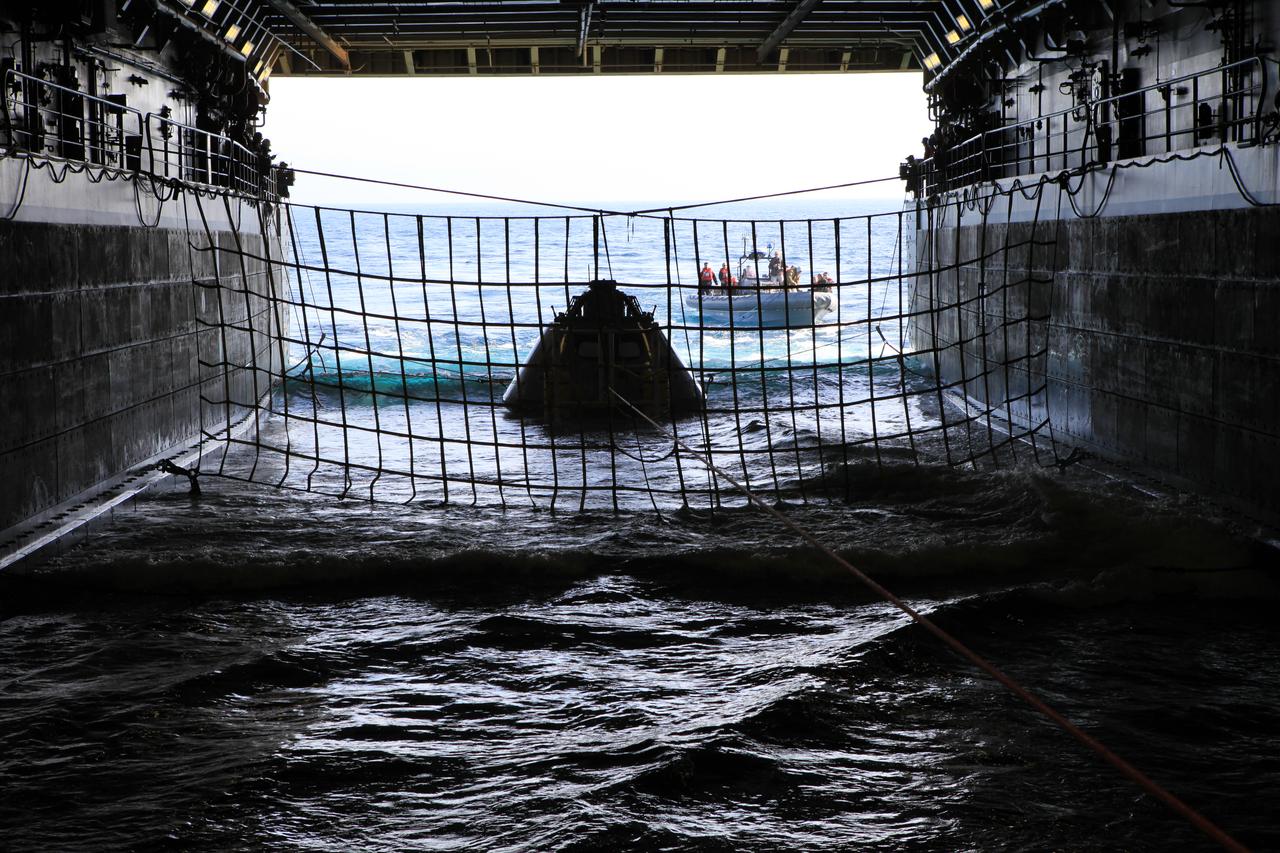
As part of Underway Recovery Test 6, the Orion test article is pulled in by a winch line at the rear of the USS Anchorage’s well deck that brings the capsule into the ship, along with four manned LLAMAs (Line Load Attenuation Mechanism Assembly) that control the capsule’s side-to-side movement and a tending line attached to a rigid hull inflatable boat for controlling Orion’s movement behind the ship. The testing with Kennedy Space Center's NASA Recovery Team and the U.S. Navy will provide important data that is being used to improve recovery procedures and hardware ahead of Orion's next flight, Exploration Mission-1, when it splashes down in the Pacific Ocean.
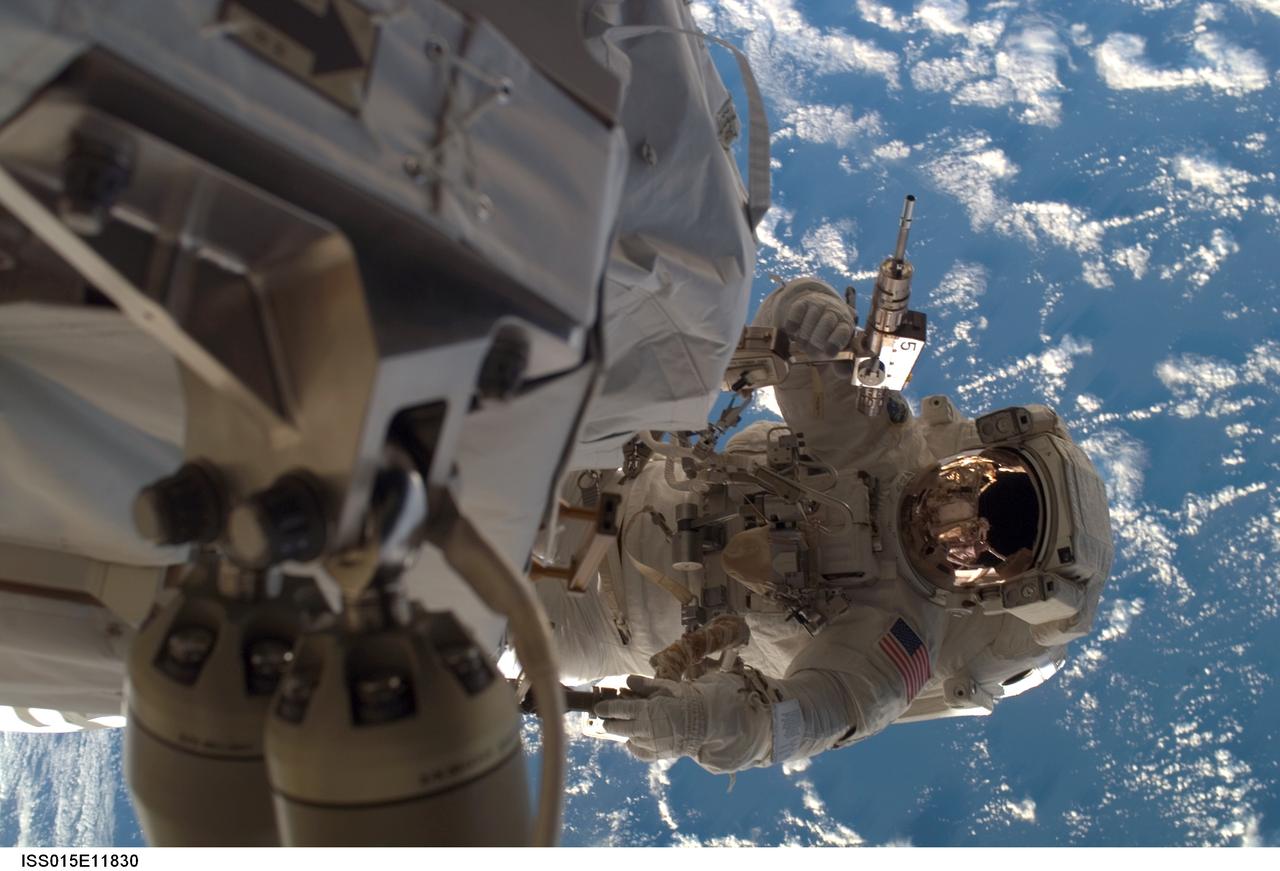
ISS015-E-11830 (11 June 2007) --- Astronauts John "Danny" Olivas and Jim Reilly (out of frame), both STS-117 mission specialists, participate in the mission's first planned session of extravehicular activity (EVA), as construction resumes on the International Space Station. Among other tasks, Reilly and Olivas connected power, data and cooling cables between S1 and S3; released the launch restraints from and deployed the four solar array blanket boxes on S4 and released the cinches and winches holding the photovoltaic radiator on S4. A blue and white Earth provided the backdrop for the scene.
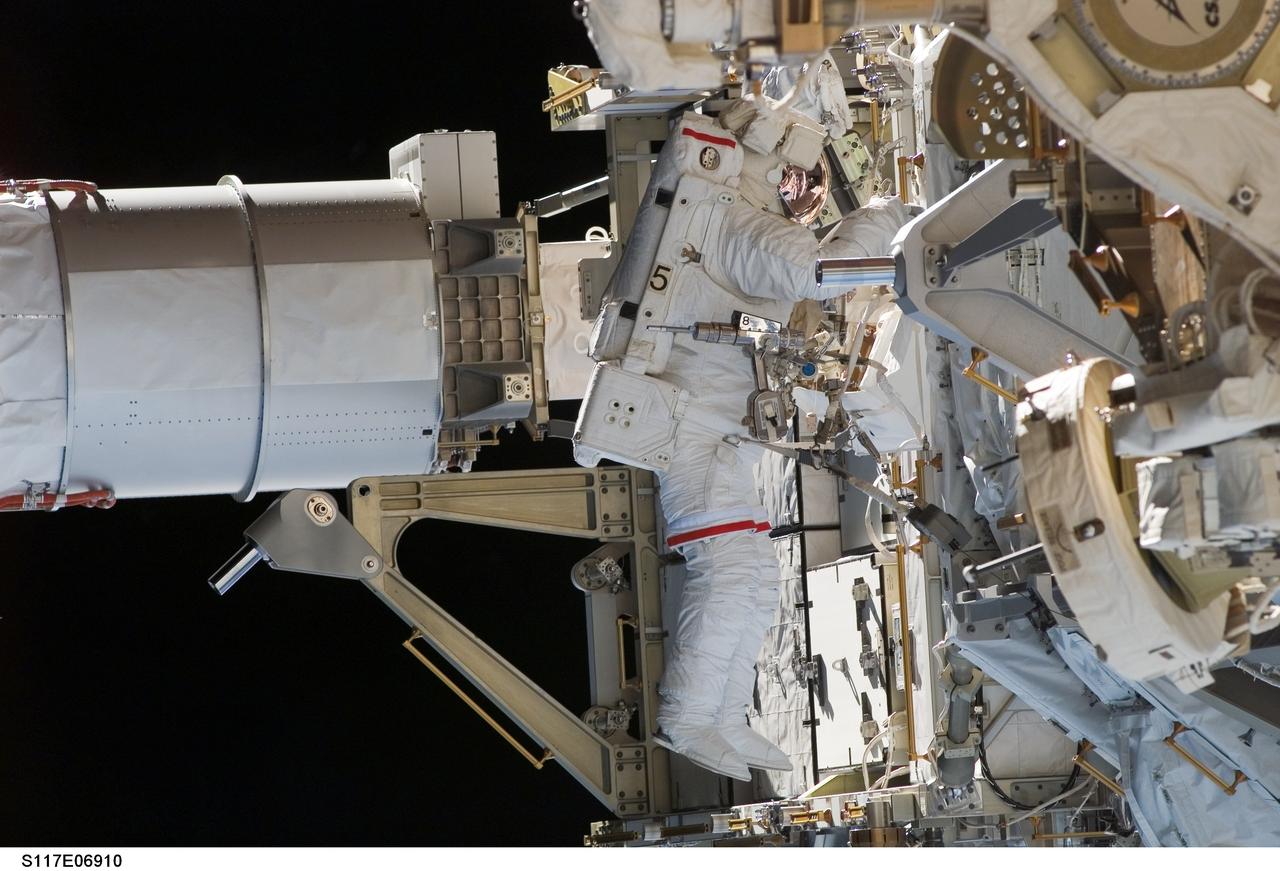
S117-E-06910 (11 June 2007) --- Astronauts Jim Reilly (center frame) and John "Danny" Olivas (out of frame), both STS-117 mission specialists, participate in the mission's first planned session of extravehicular activity (EVA), as construction resumes on the International Space Station. Among other tasks, Reilly and Olivas connected power, data and cooling cables between S1 and S3; released the launch restraints from and deployed the four solar array blanket boxes on S4 and released the cinches and winches holding the photovoltaic radiator on S4.
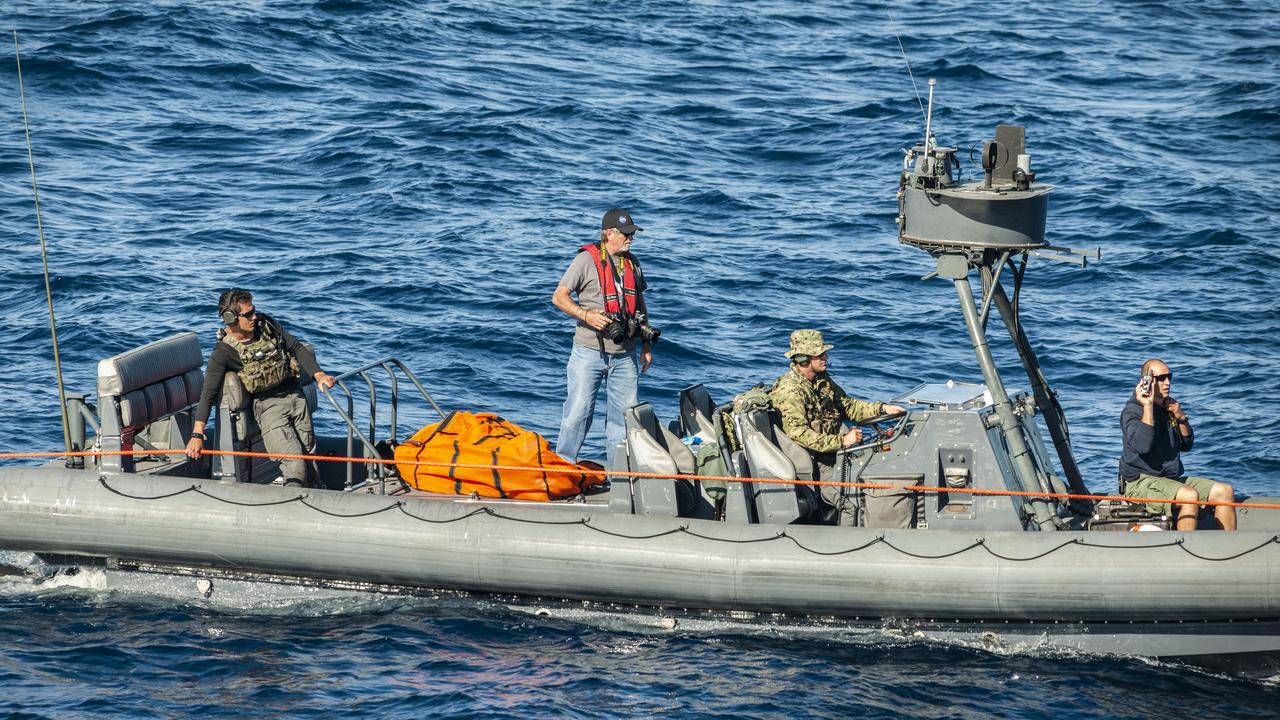
NASA Recovery Team members aboard a rigid hull boat monitor the winch line attached to a test version of the Orion capsule during Underway Recovery Test-7 (URT-7) on Oct. 31, 2018, in the Pacific Ocean. URT-7 is one in a series of tests that the EGS Recovery Team, along with the U.S. Navy, are conducting to verify and validate procedures and hardware that will be used to recover the Orion spacecraft after it splashes down in the Pacific Ocean following deep space exploration missions. Orion will have emergency abort capability, sustain the crew during space travel and provide safe re-entry from deep space return velocities.

As part of Underway Recovery Test 6, the Orion test article is pulled in by a winch line at the rear of the USS Anchorage’s well deck that brings the capsule into the ship, along with four manned LLAMAs (Line Load Attenuation Mechanism Assembly) that control the capsule’s side-to-side movement and a tending line attached to a rigid hull inflatable boat for controlling Orion’s movement behind the ship. The testing with Kennedy Space Center's NASA Recovery Team and the U.S. Navy will provide important data that is being used to improve recovery procedures and hardware ahead of Orion's next flight, Exploration Mission-1, when it splashes down in the Pacific Ocean.
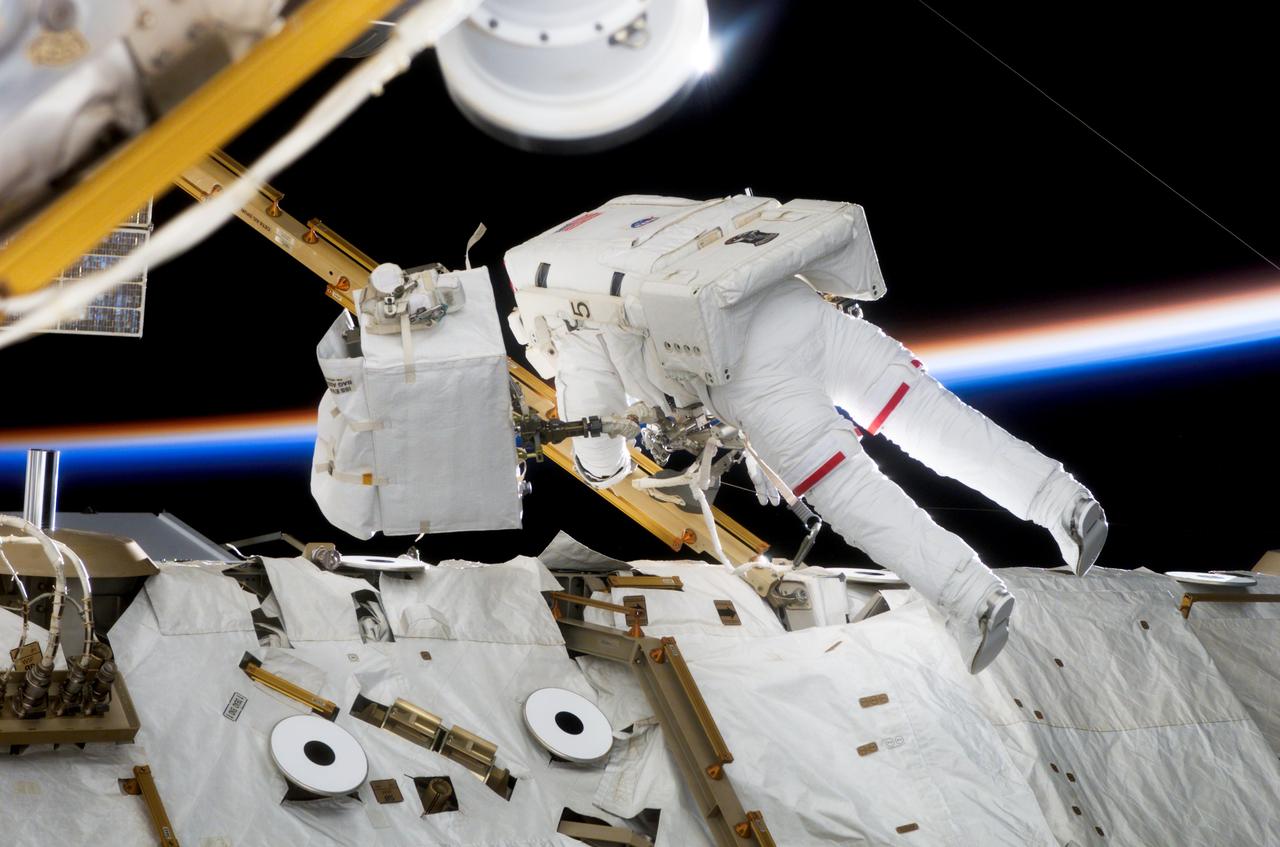
S117-E-06912 (11 June 2007) --- Astronaut Jim Reilly, STS-117 mission specialist, participates in the mission's first planned session of extravehicular activity (EVA) as construction continues on the International Space Station. Among other tasks, Reilly and astronaut John "Danny" Olivas (out of frame), connected power, data and cooling cables between S1 and S3; released the launch restraints from and deployed the four solar array blanket boxes on S4 and released the cinches and winches holding the photovoltaic radiator on S4. Earth's horizon and the blackness of space provide the backdrop for the scene.
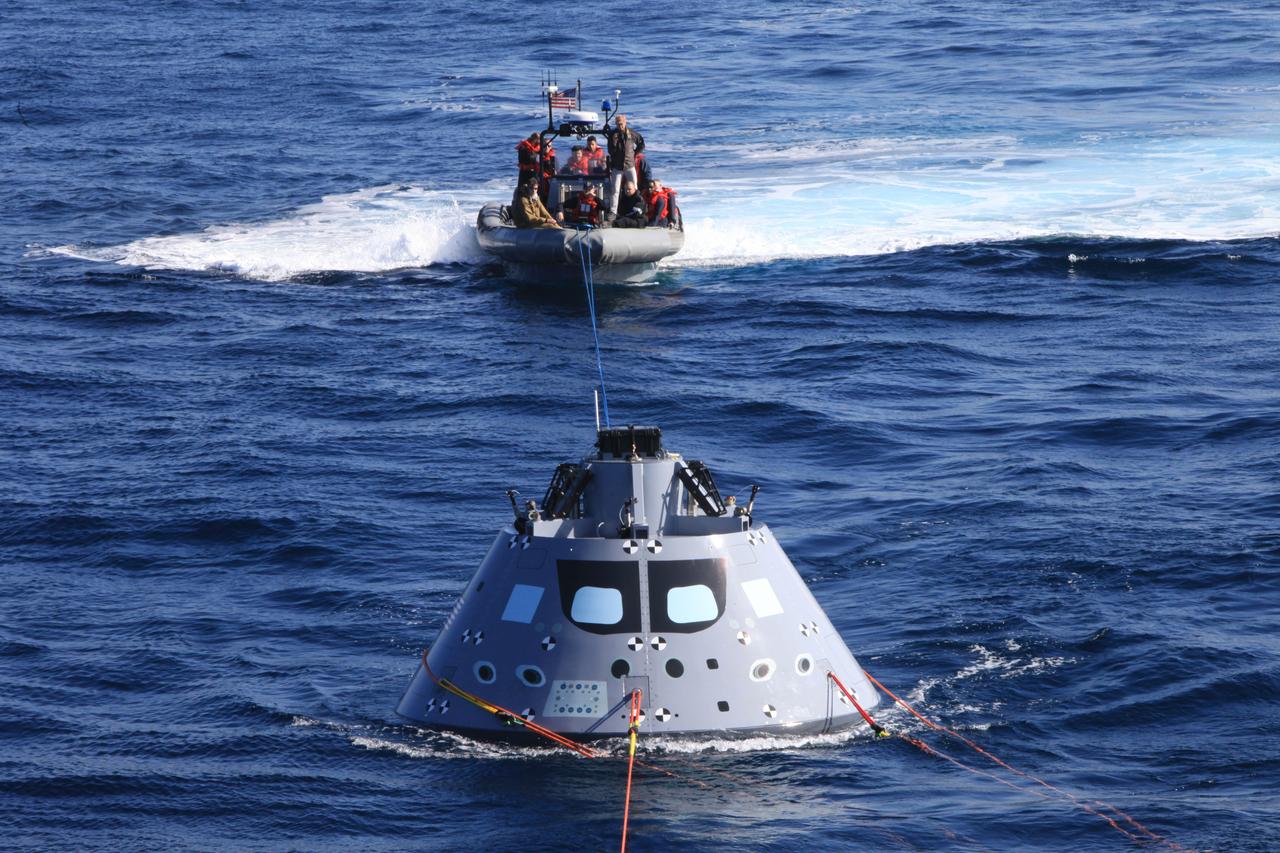
As part of Underway Recovery Test 6 on Jan. 18, 2018, the Orion test article is pulled in by a winch line at the rear of the USS Anchorage’s well deck that brings the capsule into the ship, along with four manned LLAMAs (Line Load Attenuation Mechanism Assembly) that control the capsule’s side-to-side movement and a tending line attached to a rigid hull inflatable boat for controlling Orion’s movement behind the ship. The testing with Kennedy Space Center's NASA Recovery Team and the U.S. Navy will provide important data that is being used to improve recovery procedures and hardware ahead of Orion's next flight, Artemis I, when it splashes down in the Pacific Ocean.
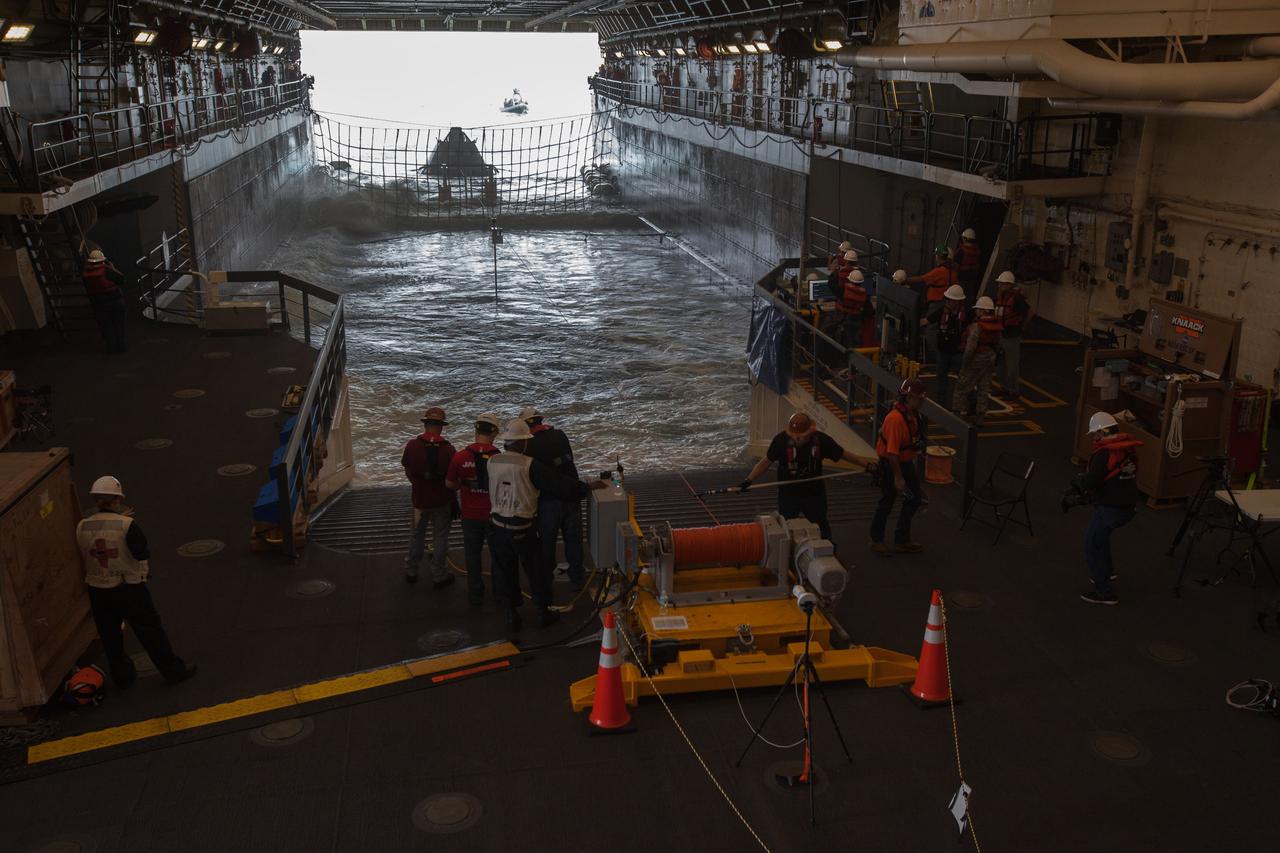
Winch team operators help guide a test version of the Orion crew module into the flooded well deck of the USS San Diego during Underway Recovery Test 5 in the Pacific Ocean off the coast of California on Oct. 30, 2016. NASA's Ground Systems Development and Operations Program and the U.S. Navy are conducting a series of tests using the ship's well deck, the test module, various watercraft and equipment to prepare for recovery of Orion on its return from deep space missions. The testing will allow the team to demonstrate and evaluate recovery processes, procedures, hardware and personnel in open waters. Part of Batch images transfer from Flickr.
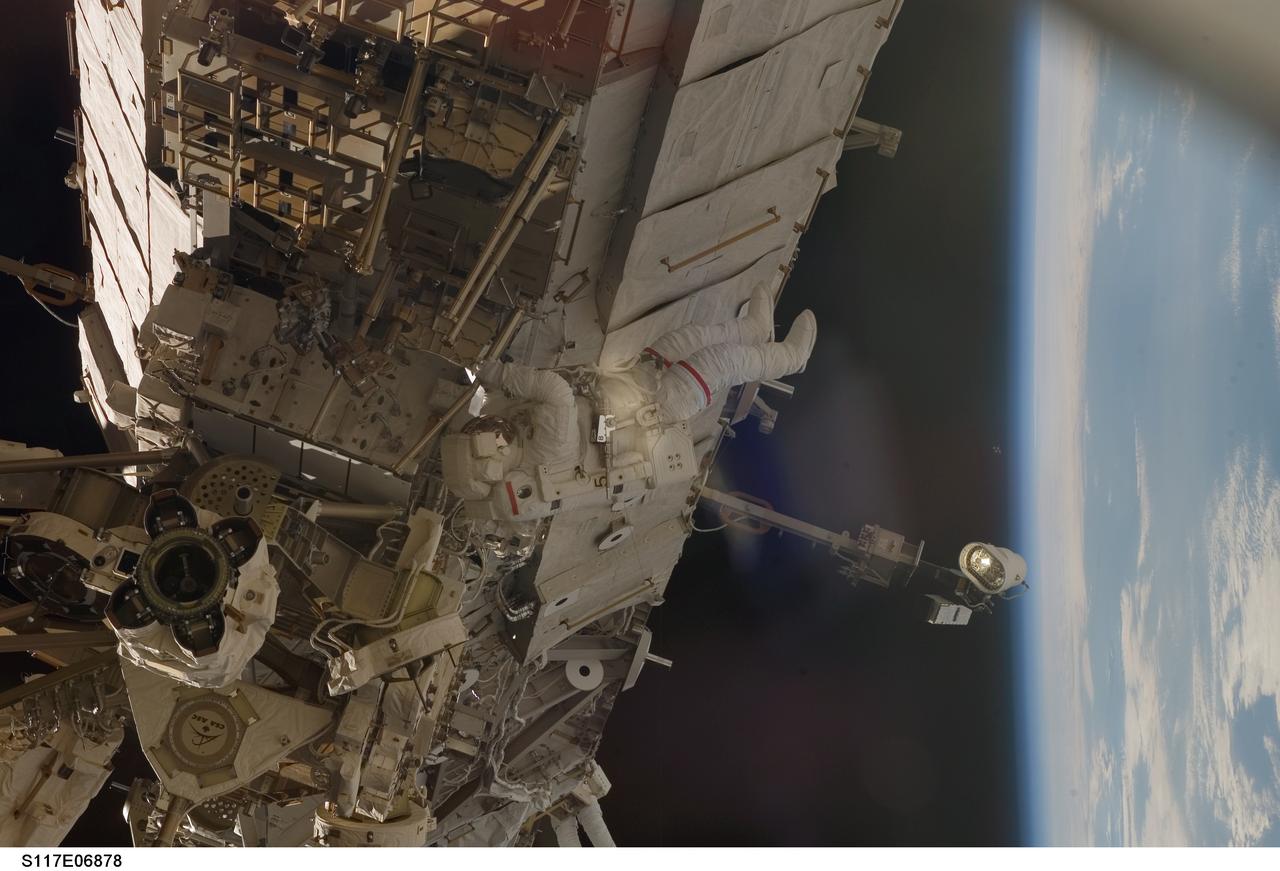
S117-E-06878 (11 June 2007) --- Astronauts Jim Reilly (center frame) and John "Danny" Olivas (bottom center), both STS-117 mission specialists, participate in the mission's first planned session of extravehicular activity (EVA), as construction resumes on the International Space Station. Among other tasks, Reilly and Olivas connected power, data and cooling cables between S1 and S3; released the launch restraints from and deployed the four solar array blanket boxes on S4 and released the cinches and winches holding the photovoltaic radiator on S4.
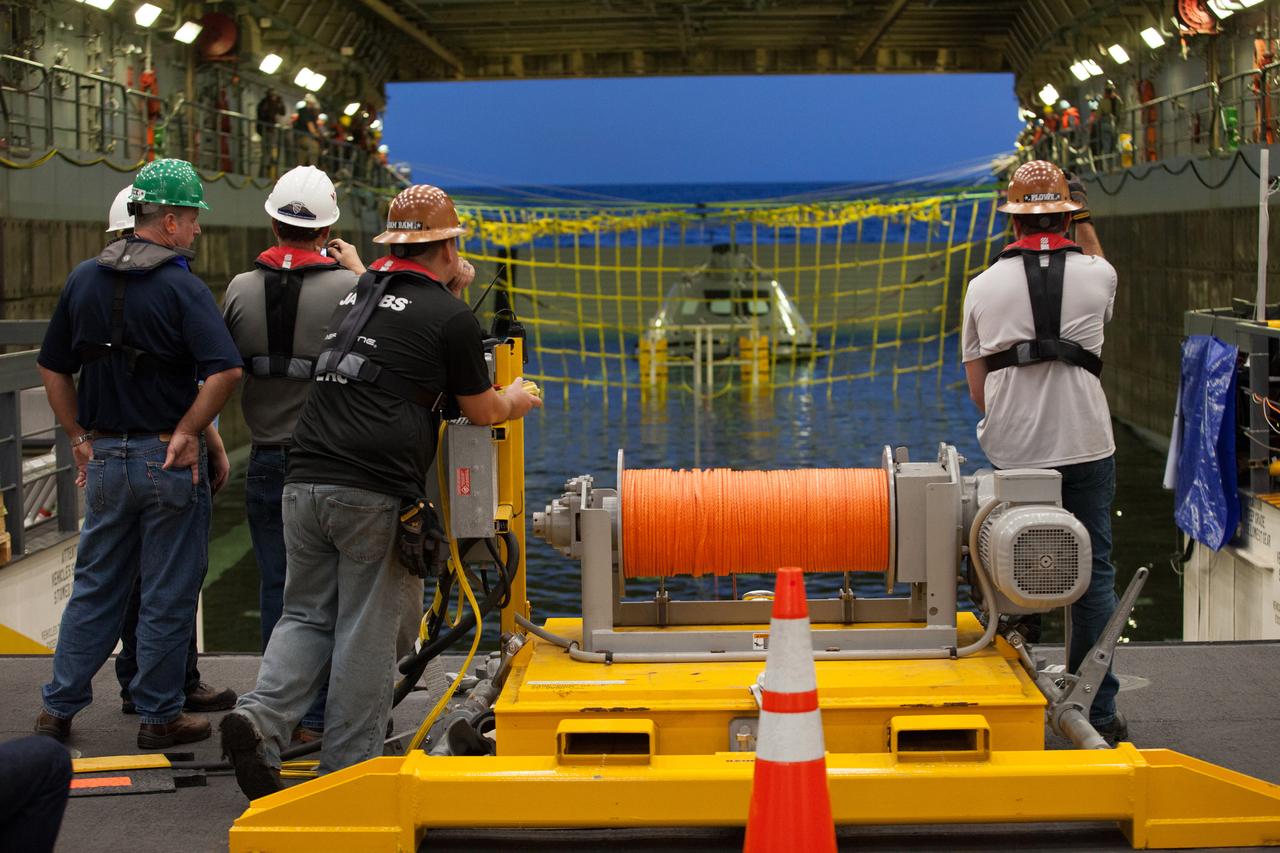
Winch operations team members watch as a test version of the Orion crew module is secured in the flooded well deck of the USS San Diego for the start of Underway Recovery Test 5 in the Pacific Ocean off the coast of California. NASA's Ground Systems Development and Operations Program and the U.S. Navy are conducting a series of tests to prepare for recovery of Orion on its return from deep space missions. The testing will allow the team to demonstrate and evaluate recovery processes, procedures, hardware and personnel in open waters. Part of Batch images transfer from Flickr.
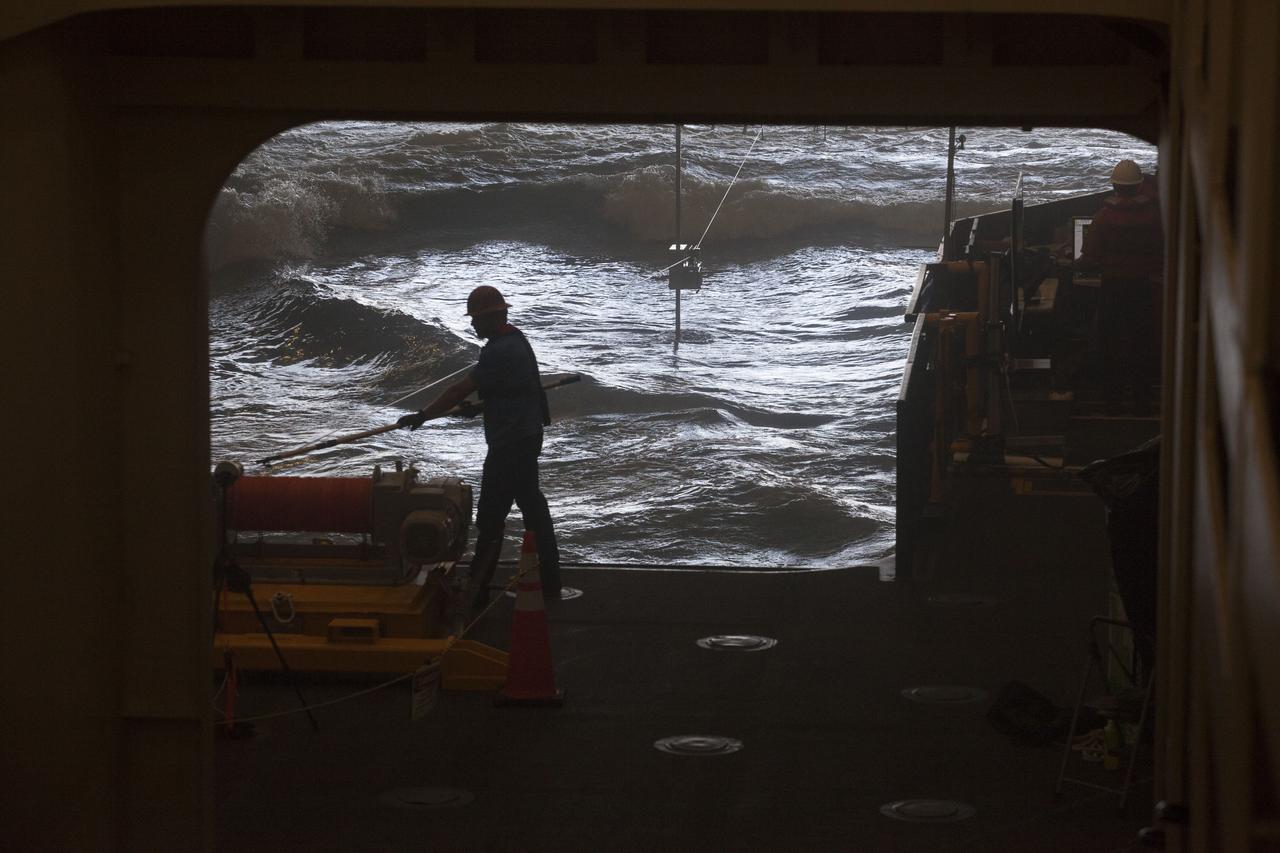
Inside the well deck of the USS San Diego, a winch operator prepares for Underway Recovery Test 5 in the Pacific Ocean off the coast of California. NASA's Ground Systems Development and Operations Program and the U.S. Navy are practicing recovery techniques to prepare for recovery of Orion on its return from deep space missions. The testing will allow the team to demonstrate and evaluate recovery processes, procedures, hardware and personnel in open waters. Orion is the exploration spacecraft designed to carry astronauts to destinations not yet explored by humans, including an asteroid and NASA's Journey to Mars. It will have emergency abort capability, sustain the crew during space travel and provide safe re-entry from deep space return velocities. Orion is scheduled to launch on NASA's Space Launch System in late 2018. For more information, visit http://www.nasa.gov/orion.
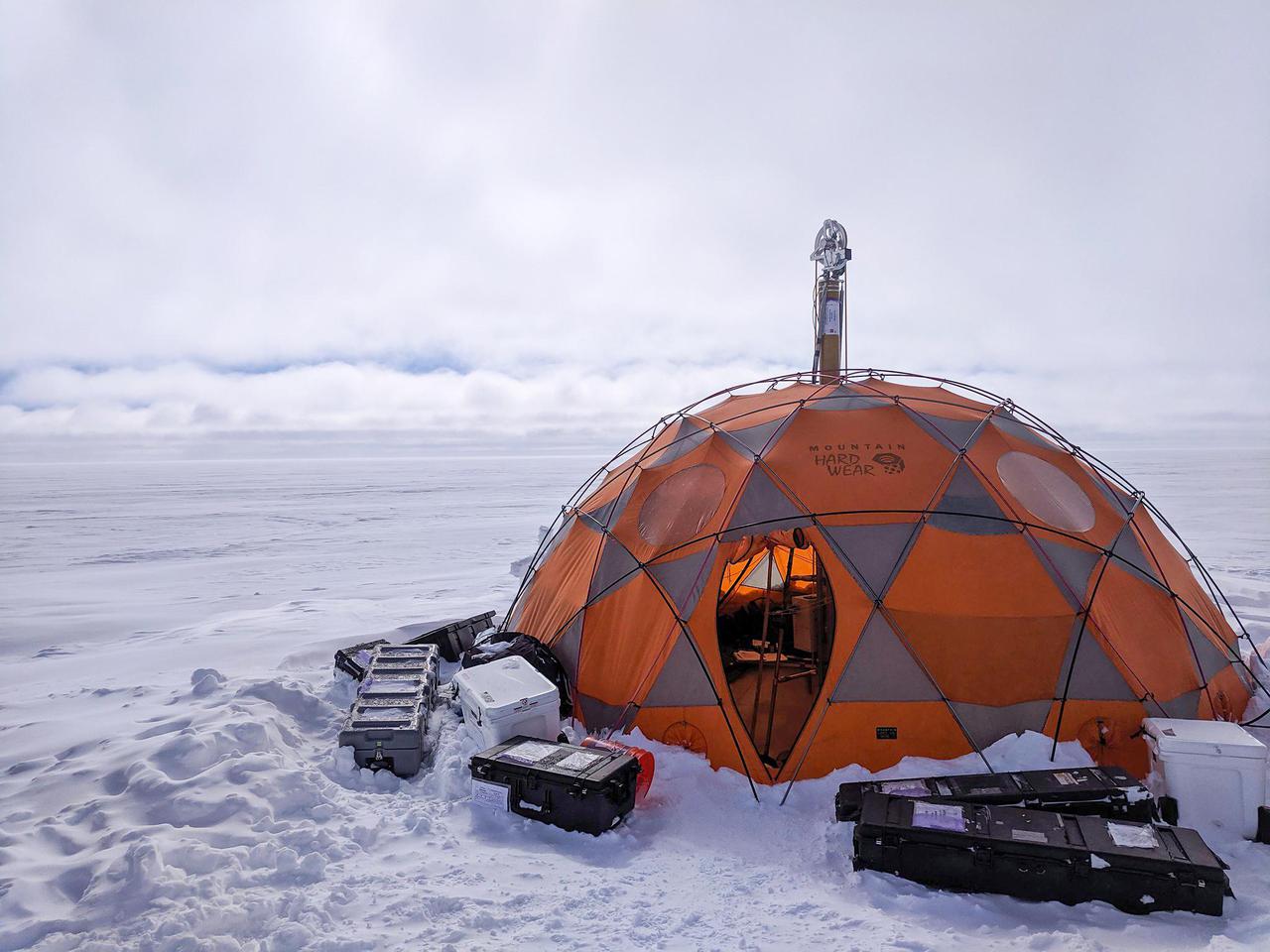
During 2019 field tests near Greenland's Summit Station, a high-elevation remote observing station, the WATSON (Wireline Analysis Tool for the Subsurface Observation of Northern ice sheets) instrument is put through its paces to seek out signs of life, or biosignatures, 360 feet (110 meters) down a borehole. In this photograph, the winch that holds the drill pokes out the top of the drill tent. WATSON could one day be launched aboard a robotic mission to seek out biosignatures on the ocean moons of Enceladus, Europa, or even Titan. The WATSON team hopes to test the instrument in a variety of cold locations on Earth to see how the distribution and variety of biosignatures change depending on where they are. By testing WATSON in different Earth analogs — areas on Earth that can stand in for those on other worlds — scientists would be able to better understand the chemical fingerprints of any biosignatures detected on other worlds. https://photojournal.jpl.nasa.gov/catalog/PIA24169
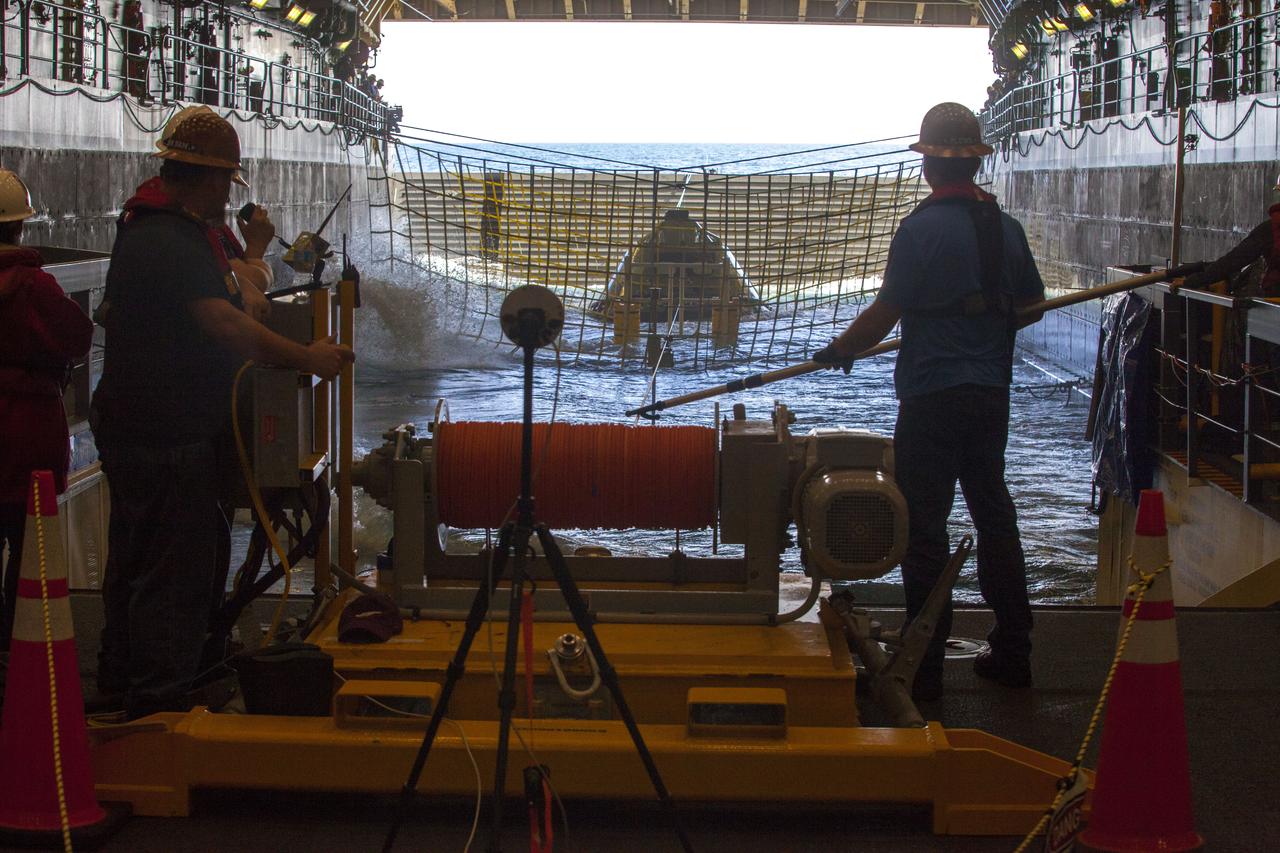
Winch team operators help guide a test version of the Orion crew module into the flooded well deck of the USS San Diego during Underway Recovery Test 5 in the Pacific Ocean off the coast of California. NASA's Ground Systems Development and Operations Program and the U.S. Navy are conducting a series of tests to prepare for recovery of Orion on its return from deep space missions. The testing will allow the team to demonstrate and evaluate recovery processes, procedures, hardware and personnel in open waters. Orion is the exploration spacecraft designed to carry astronauts to destinations not yet explored by humans, including an asteroid and NASA's Journey to Mars. It will have emergency abort capability, sustain the crew during space travel and provide safe re-entry from deep space return velocities. Orion is scheduled to launch on NASA's Space Launch System in late 2018. For more information, visit http://www.nasa.gov/orion.
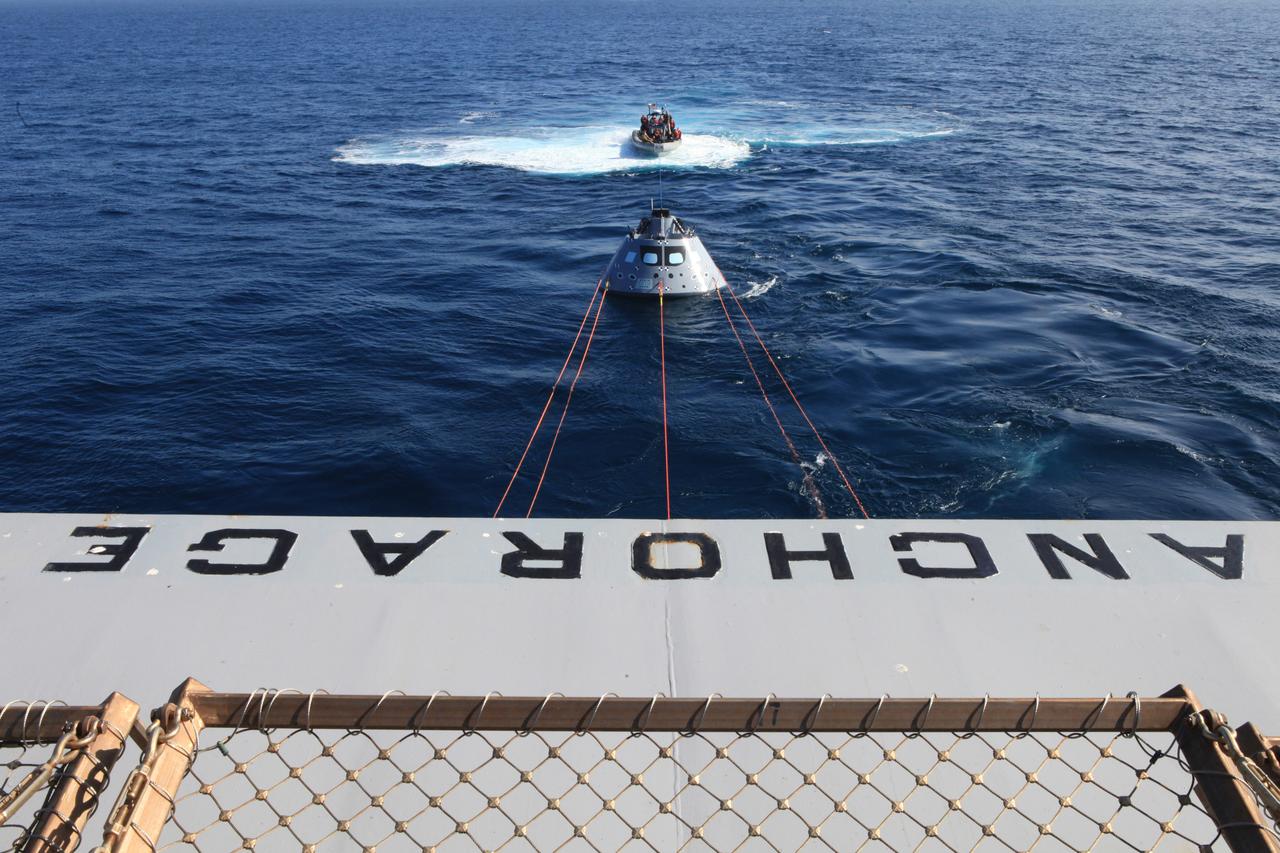
Off the rear of the USS Anchorage on Jan. 18, 2018, the Orion test article is pulled in by a winch line at the rear of the USS Anchorage’s well deck that brings the capsule into the ship, along with four manned LLAMAs (Line Load Attenuation Mechanism Assembly) that control the capsule’s side-to-side movement and a tending line attached to a rigid hull inflatable boat for controlling Orion’s movement behind the ship. The Underway Recovery Test 6 (URT-6) is spearheaded by Kennedy Space Center's NASA Recovery Team. In partnership with the U.S. Navy, the testing will provide important data that is being used to improve recovery procedures and hardware ahead of Orion's next flight, Artemis I, when it splashes down in the Pacific Ocean.
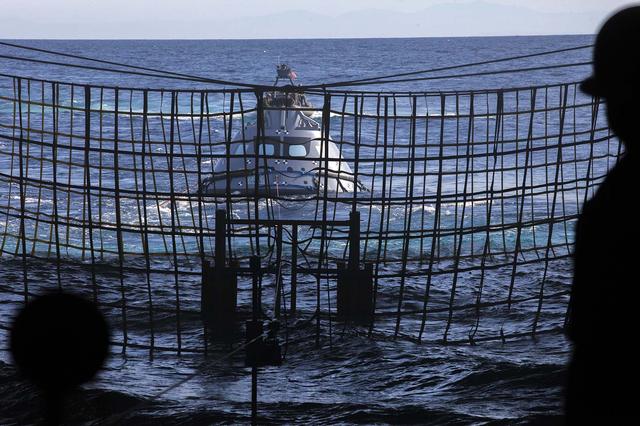
A test version of the Orion crew module floats outside the well deck of the USS San Diego on the fourth day of Underway Recovery Test 5 in the Pacific Ocean off the coast of California. NASA's Ground Systems Development and Operations Program and the U.S. Navy are practicing retrieving and securing the crew module in the well deck of the ship using tethers and a winch system to prepare for recovery of Orion on its return from deep space missions. The testing will allow the team to demonstrate and evaluate recovery processes, procedures, hardware and personnel in open waters. Orion is the exploration spacecraft designed to carry astronauts to destinations not yet explored by humans, including an asteroid and NASA's Journey to Mars. It will have emergency abort capability, sustain the crew during space travel and provide safe re-entry from deep space return velocities. Orion is scheduled to launch on NASA's Space Launch System in late 2018. For more information, visit http://www.nasa.gov/orion.
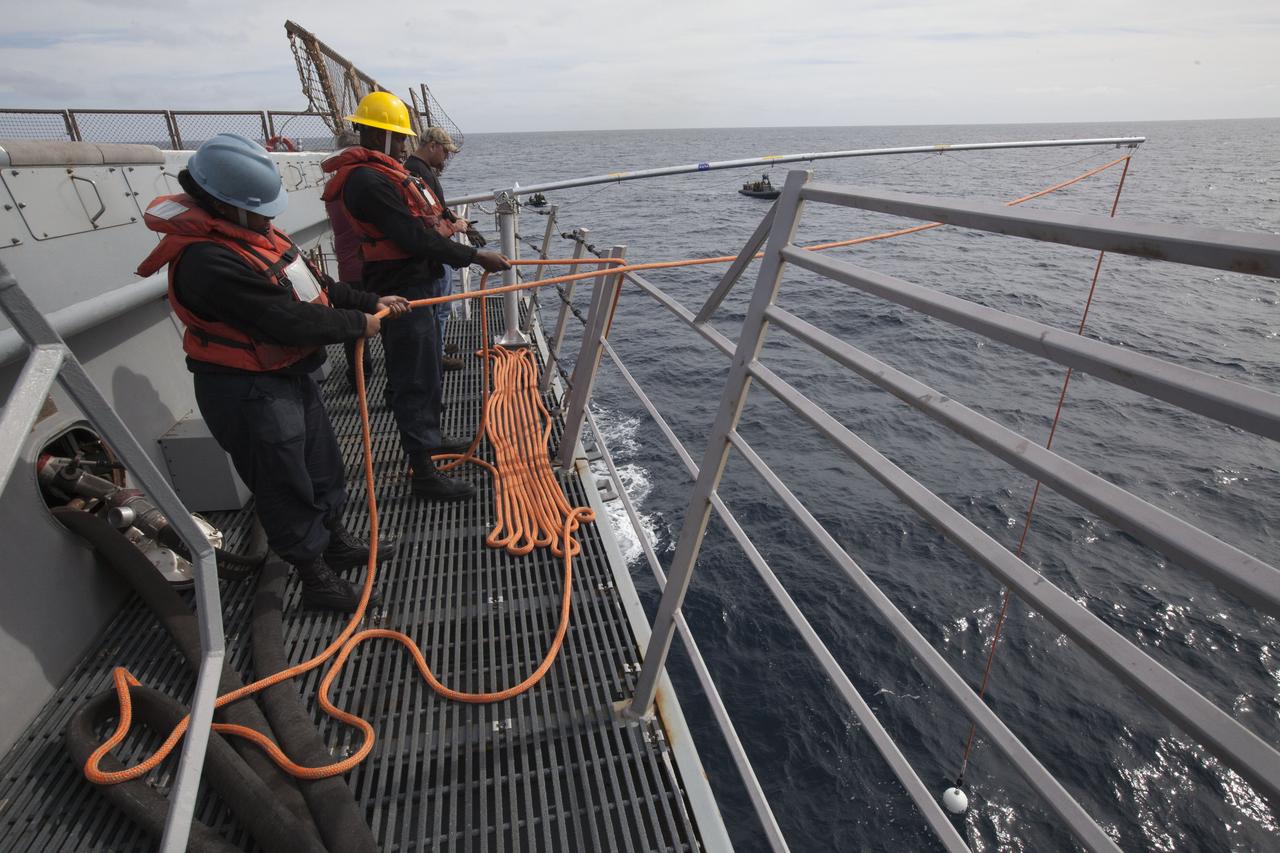
U.S. Navy personnel check tether lines and a winch line on the deck of the USS San Diego in the Pacific Ocean off the coast of California. NASA's Ground Systems Development and Operations Program and the U.S. Navy are conducting a series of tests, called Underway Recovery Test 5, using the ship's well deck and a test version of the Orion crew module to prepare for recovery of Orion on its return from deep space missions. The testing will allow the team to demonstrate and evaluate recovery processes, procedures, hardware and personnel in open waters. Orion is the exploration spacecraft designed to carry astronauts to destinations not yet explored by humans, including an asteroid and NASA's Journey to Mars. It will have emergency abort capability, sustain the crew during space travel and provide safe re-entry from deep space return velocities. Orion is scheduled to launch on NASA's Space Launch System in late 2018. For more information, visit http://www.nasa.gov/orion.
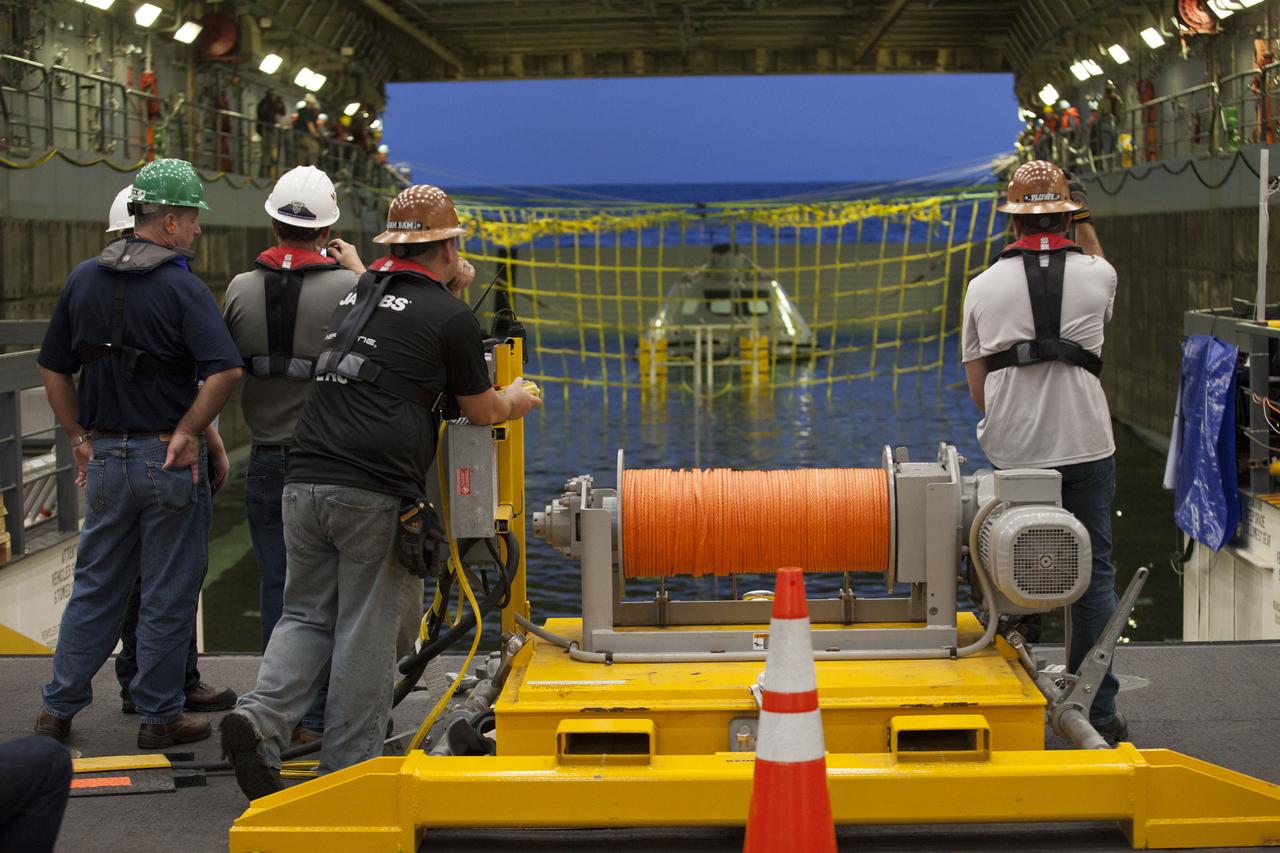
Winch operations team members watch as a test version of the Orion crew module is secured in the flooded well deck of the USS San Diego for the start of Underway Recovery Test 5 in the Pacific Ocean off the coast of California. NASA's Ground Systems Development and Operations Program and the U.S. Navy are conducting a series of tests to prepare for recovery of Orion on its return from deep space missions. The testing will allow the team to demonstrate and evaluate recovery processes, procedures, hardware and personnel in open waters. Orion is the exploration spacecraft designed to carry astronauts to destinations not yet explored by humans, including an asteroid and NASA's Journey to Mars. It will have emergency abort capability, sustain the crew during space travel and provide safe re-entry from deep space return velocities. Orion is scheduled to launch on NASA's Space Launch System in late 2018. For more information, visit http://www.nasa.gov/orion.
A test version of the Orion crew module has been tethered and pulled into the well deck of the USS San Diego using a winch system during the second day of Underway Recovery Test 5 in the Pacific Ocean off the coast of California. NASA's Ground Systems Development and Operations Program and the U.S. Navy are conducting a series of tests to prepare for recovery of Orion on its return from deep space missions. The testing will allow the team to demonstrate and evaluate recovery processes, procedures, hardware and personnel in open waters. Orion is the exploration spacecraft designed to carry astronauts to destinations not yet explored by humans, including an asteroid and NASA's Journey to Mars. It will have emergency abort capability, sustain the crew during space travel and provide safe re-entry from deep space return velocities. Orion is scheduled to launch on NASA's Space Launch System in late 2018. For more information, visit http://www.nasa.gov/orion.
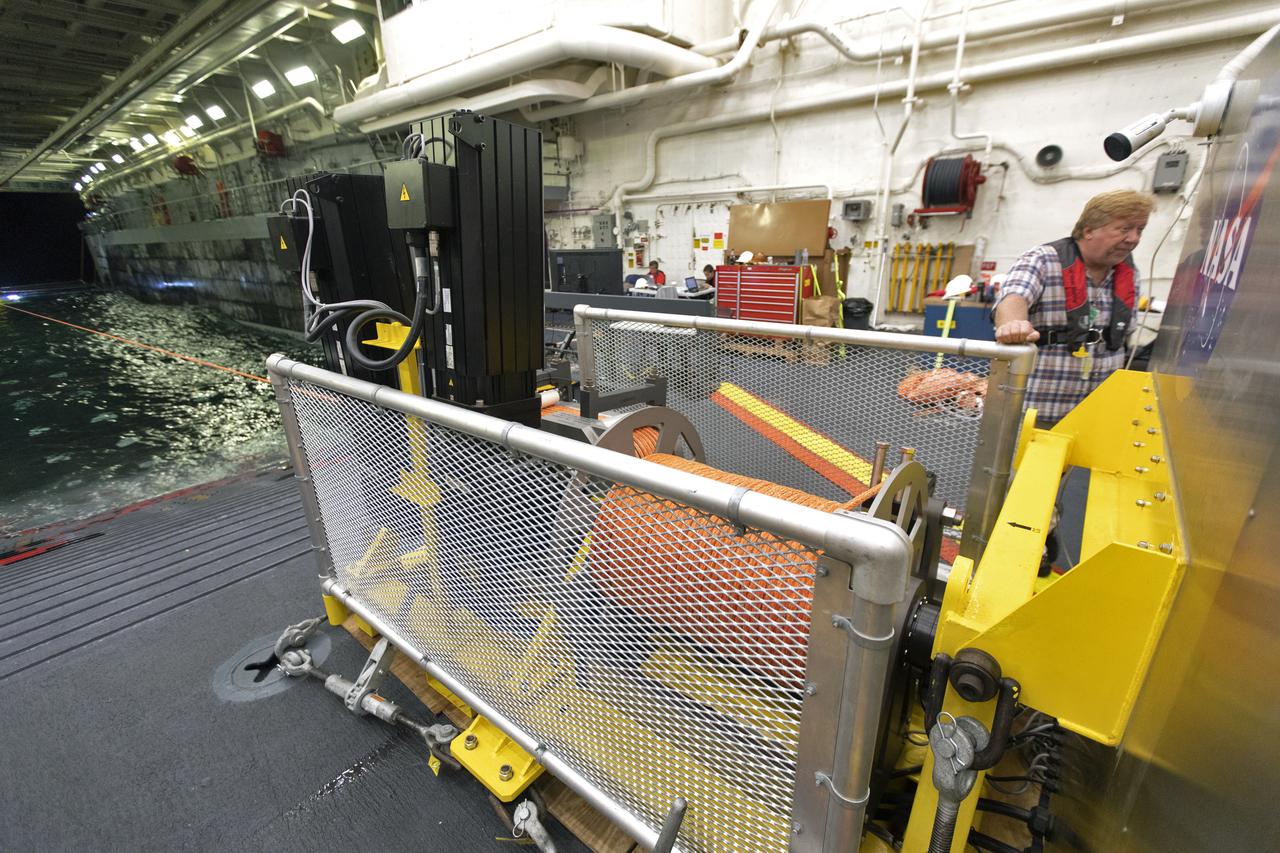
Inside the well deck of the USS John P. Murtha, a winch line is being used to tow a test version of the Orion crew module into the well deck during Underway Recovery Test-7 (URT-7), during the evening on Nov. 4, 2018. NASA's Recovery Team, along with the U.S. Navy, are practicing recovery of the Orion capsule as part of URT-7 in the Pacific Ocean. URT-7 is one in a series of tests to verify and validate procedures and hardware that will be used to recover the Orion spacecraft after it splashes down in the Pacific Ocean following deep space exploration missions. Orion will have emergency abort capability, sustain the crew during space travel and provide safe re-entry from deep space return velocities.
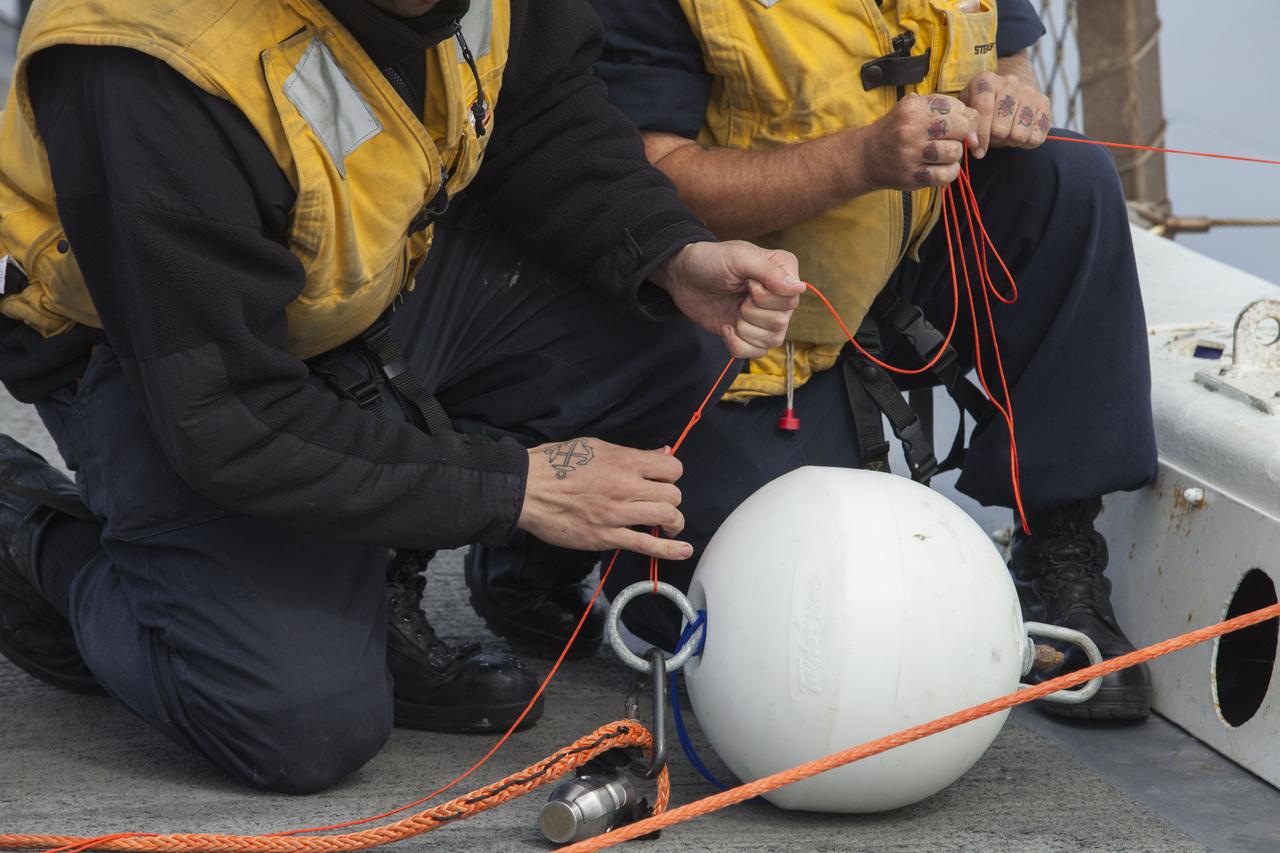
U.S. Navy personnel check tether and winch lines on the deck of the USS San Diego to prepare for Underway Recovery Test 5 in the Pacific Ocean off the coast of California. NASA's Ground Systems Development and Operations Program and the U.S. Navy are conducting a series of tests using the ship's well deck, a test version of the Orion crew module, various watercraft and equipment to prepare for recovery of Orion on its return from deep space missions. The testing will allow the team to demonstrate and evaluate recovery processes, procedures, hardware and personnel in open waters. Orion is the exploration spacecraft designed to carry astronauts to destinations not yet explored by humans, including an asteroid and NASA's Journey to Mars. It will have emergency abort capability, sustain the crew during space travel and provide safe re-entry from deep space return velocities. Orion is scheduled to launch on NASA's Space Launch System in late 2018. For more information, visit http://www.nasa.gov/orion.
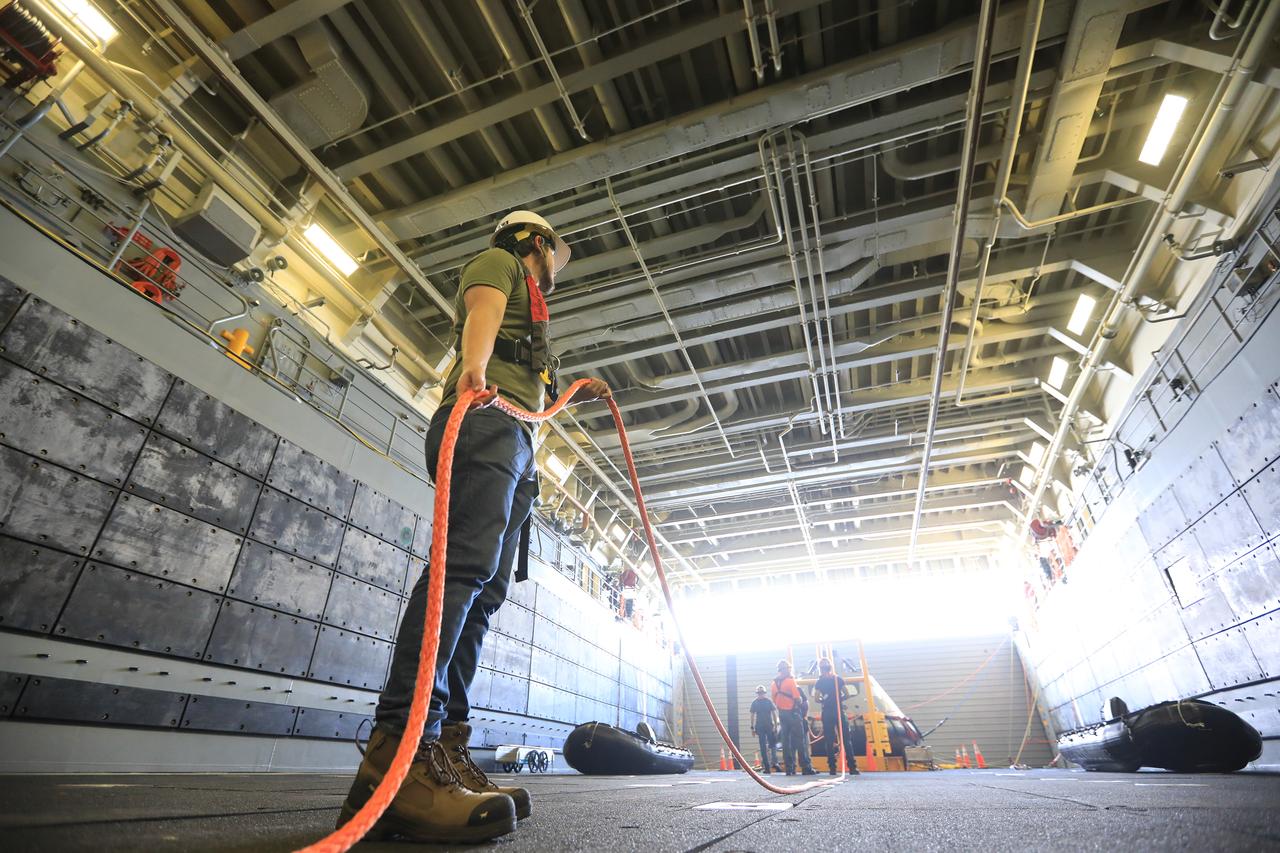
Jose Martinez, an instrumentation engineer with Jacobs, runs the winch line out to the test version of the Orion capsule in the well deck of the USS John P. Murtha, during Underway Recovery Test-7 (URT-7) on Oct. 31, 2018, in the Pacific Ocean. Exploration Ground Systems and the U.S. Navy are using the mock Orion to verify and validate processes, procedures, hardware and personnel during recovery of Orion in open waters. URTs are a series of tests to verify and validate procedures and hardware that will be used to recover the Orion spacecraft after it splashed down in the Pacific Ocean following deep space exploration missions. Orion will have emergency abort capability, sustain the crew during space travel and provide safe re-entry from deep space return velocities.
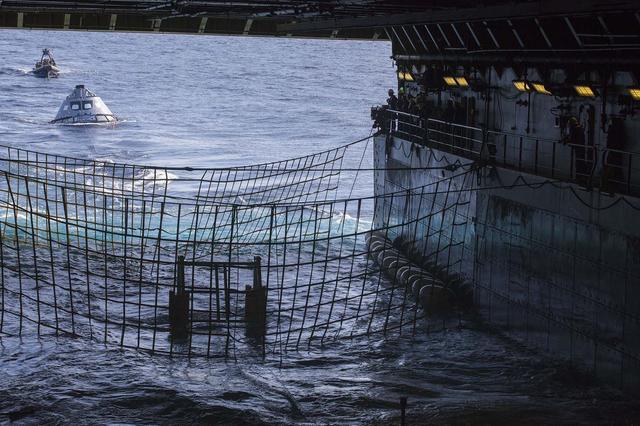
A test version of the Orion crew module floats outside the well deck of the USS San Diego on the fourth day of Underway Recovery Test 5 in the Pacific Ocean off the coast of California. NASA's Ground Systems Development and Operations Program and the U.S. Navy are practicing retrieving and securing the crew module in the well deck of the ship using tethers and a winch system to prepare for recovery of Orion on its return from deep space missions. The testing will allow the team to demonstrate and evaluate recovery processes, procedures, hardware and personnel in open waters. Orion is the exploration spacecraft designed to carry astronauts to destinations not yet explored by humans, including an asteroid and NASA's Journey to Mars. It will have emergency abort capability, sustain the crew during space travel and provide safe re-entry from deep space return velocities. Orion is scheduled to launch on NASA's Space Launch System in late 2018. For more information, visit http://www.nasa.gov/orion.
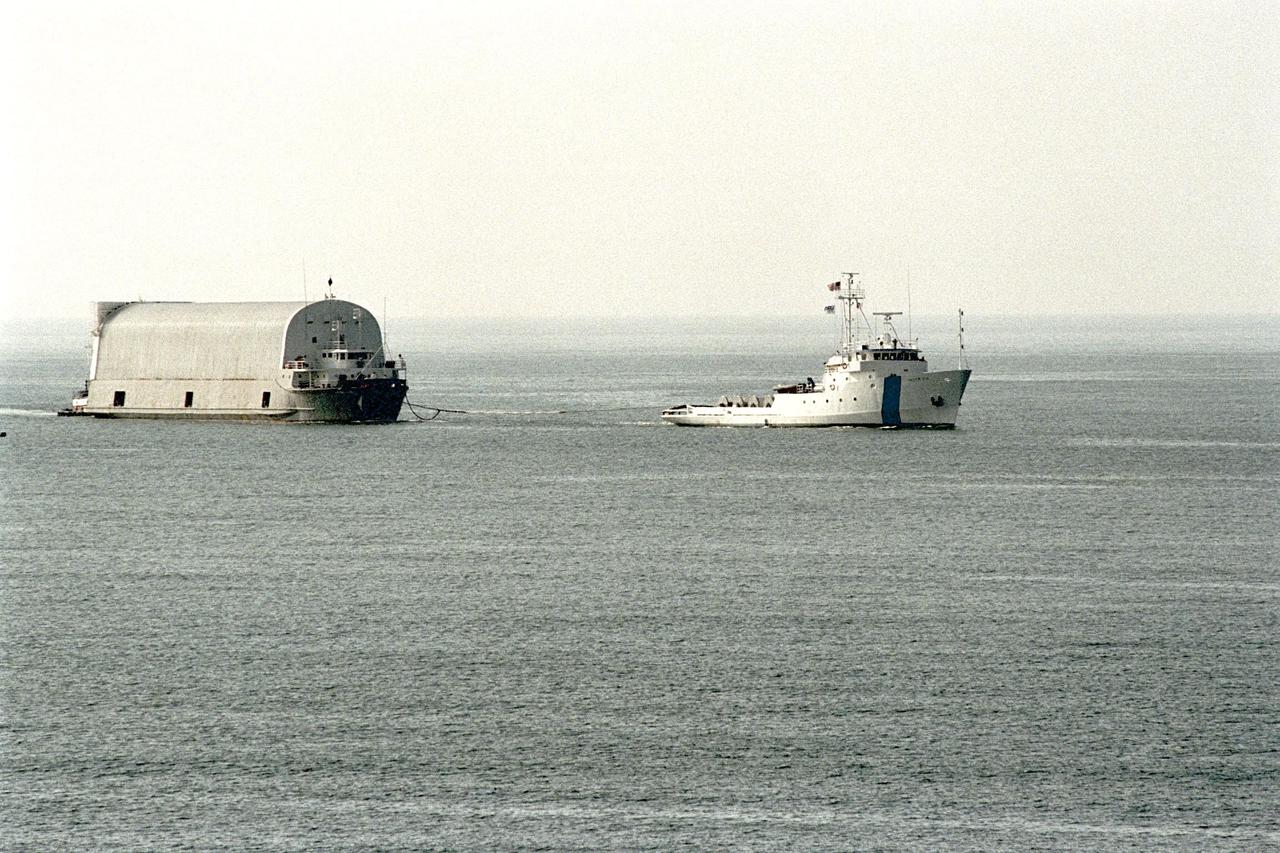
KENNEDY SPACE CENTER, FLA. -- Freedom Star, one of NASA's two solid rocket booster recovery ships, tows a barge containing the third Space Shuttle super lightweight external tank (SLWT) into Port Canaveral. This SLWT will be used to launch the orbiter Discovery on mission STS-95 in October. This first-time towing arrangement, part of a cost savings plan by NASA to prudently manage existing resources, began June 12 from the Michoud Assembly Facility in New Orleans where the Shuttle's external tanks are manufactured. The barge will now be transported up the Banana River to the LC-39 turn basin using a conventional tugboat. Previously, NASA relied on an outside contractor to provide external tank towing services at a cost of about $120,000 per trip. The new plan allows NASA's Space Flight Operations contractor, United Space Alliance (USA), to provide the same service directly to NASA using the recovery ships during their downtime between Shuttle launches. Studies show a potential savings of about $50,000 per trip. The cost of the necessary ship modifications should be paid back by the fourteenth tank delivery. The other recovery ship, Liberty Star, has also undergone deck strengthening enhancements and will soon have the necessary towing winch installed. The other recovery vessel, Liberty Star, has undergone deck strengthening enhancements along with Freedom Star and will soon have the necessary towing winch installed
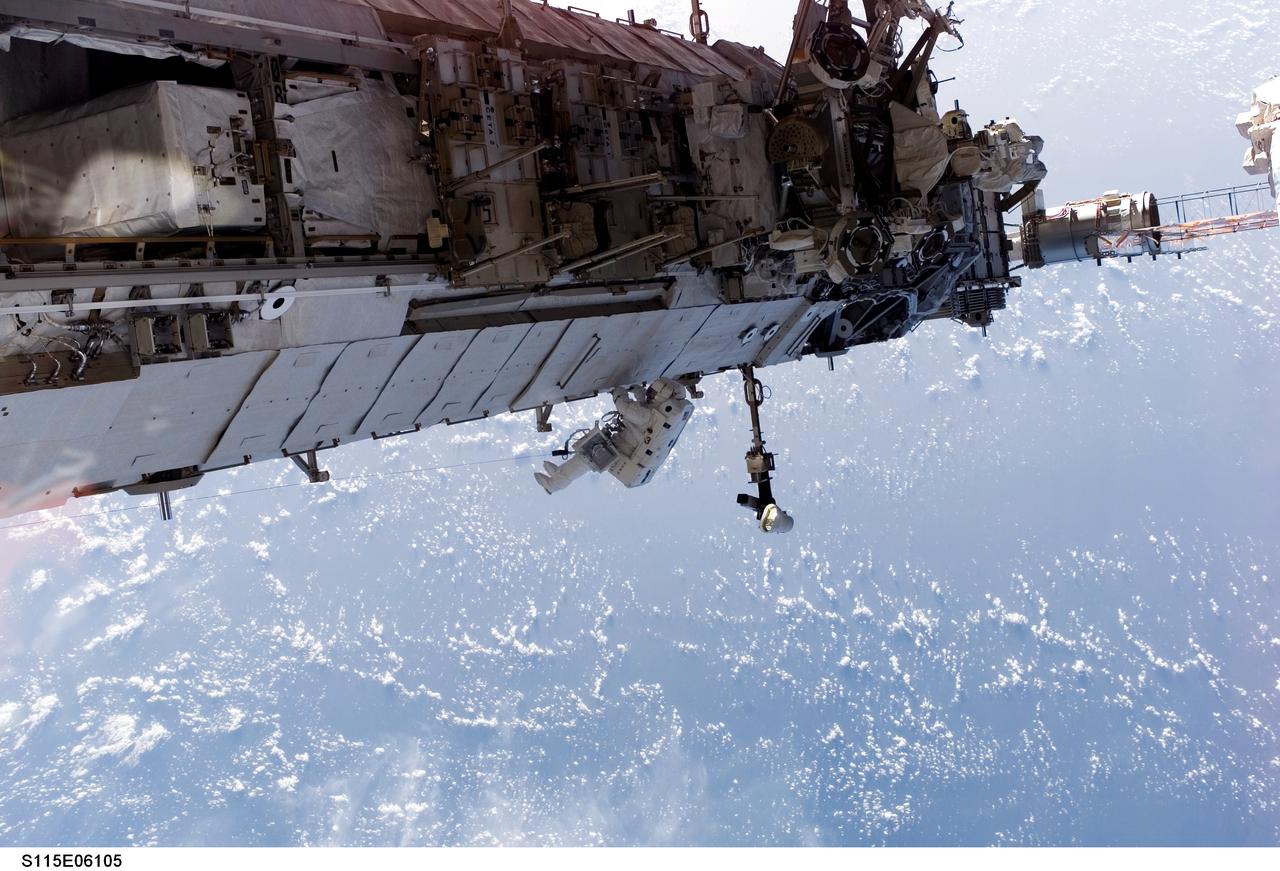
S115-E-06105 (15 Sept. 2006) --- In the center of this panoramic scene of new hardware on the International Space Station, astronaut Heidemarie M. Stefanyshyn-Piper, mission specialist, participates in the final of three scheduled STS-115 space walks. Her partner on both of her two spacewalks this week is astronaut Joseph R. Tanner, out of frame.
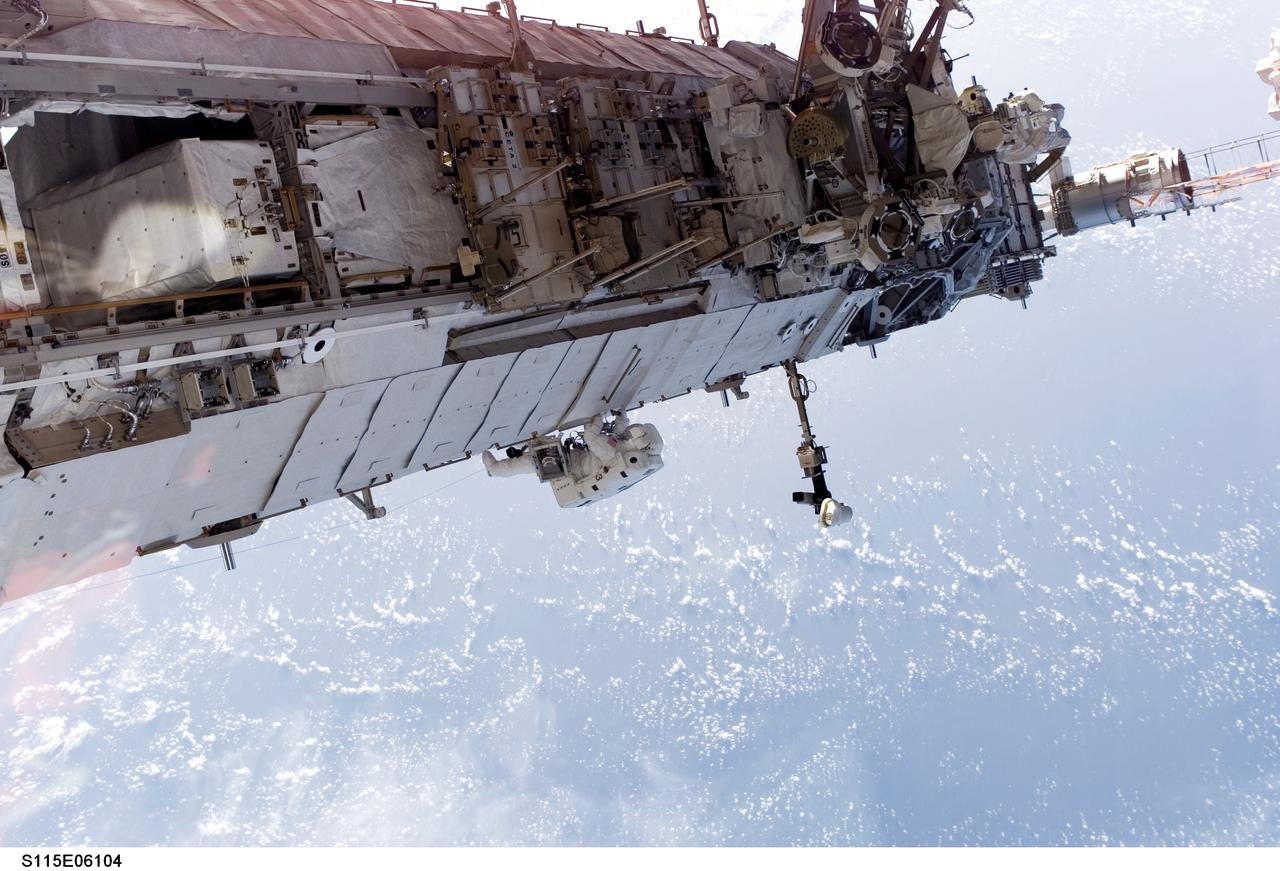
S115-E-06104 (15 Sept. 2006) --- In the center of this panoramic scene of new hardware on the International Space Station, astronaut Heidemarie M. Stefanyshyn-Piper, mission specialist, participates in the final of three scheduled STS-115 space walks.
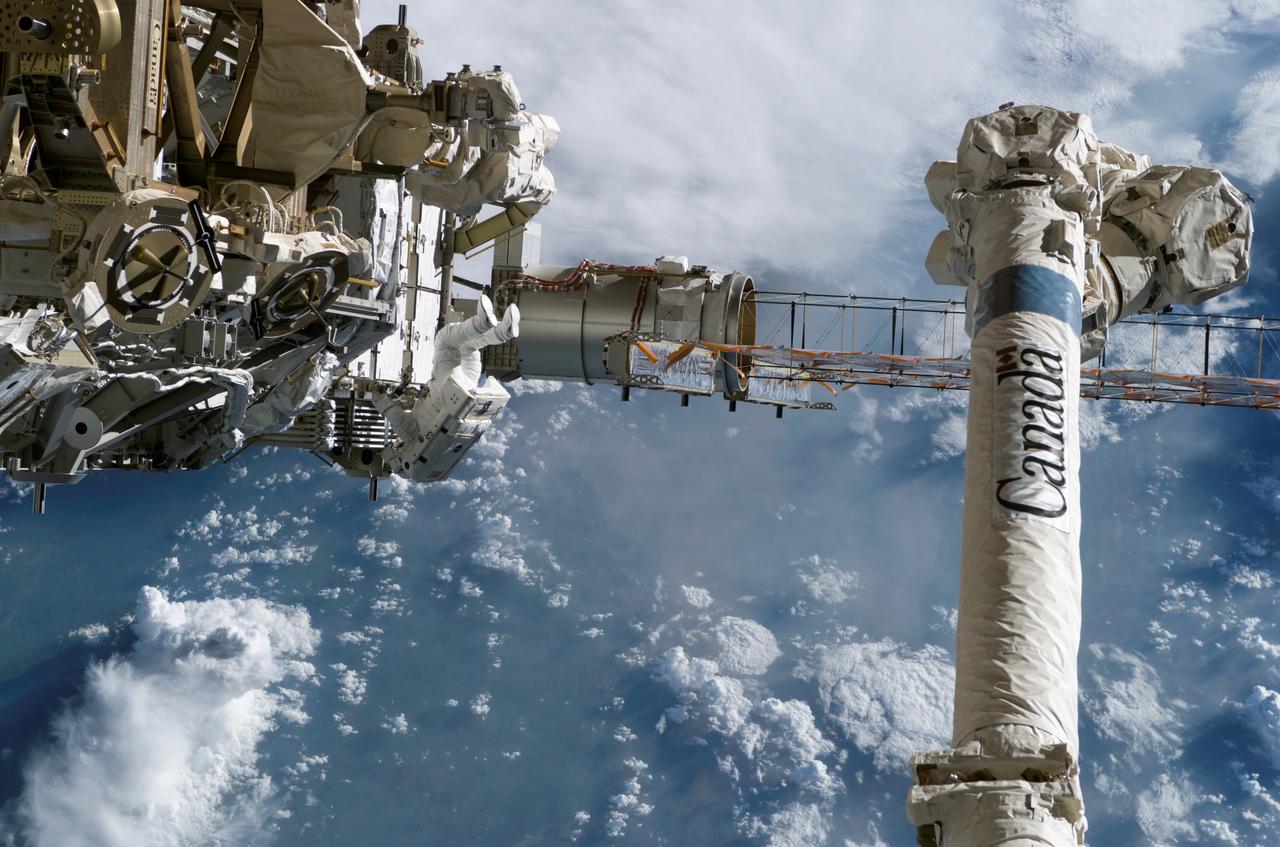
S115-E-06123 (15 Sept. 2006) --- Astronauts Heidemarie M. Stefanyshyn-Piper (center left) and Joseph R. Tanner (out of frame), both STS-115 mission specialists, participate in the final session of extravehicular activity (EVA) for the Space Shuttle Atlantis and International Space Station crewmembers as construction resumes on the orbital outpost.
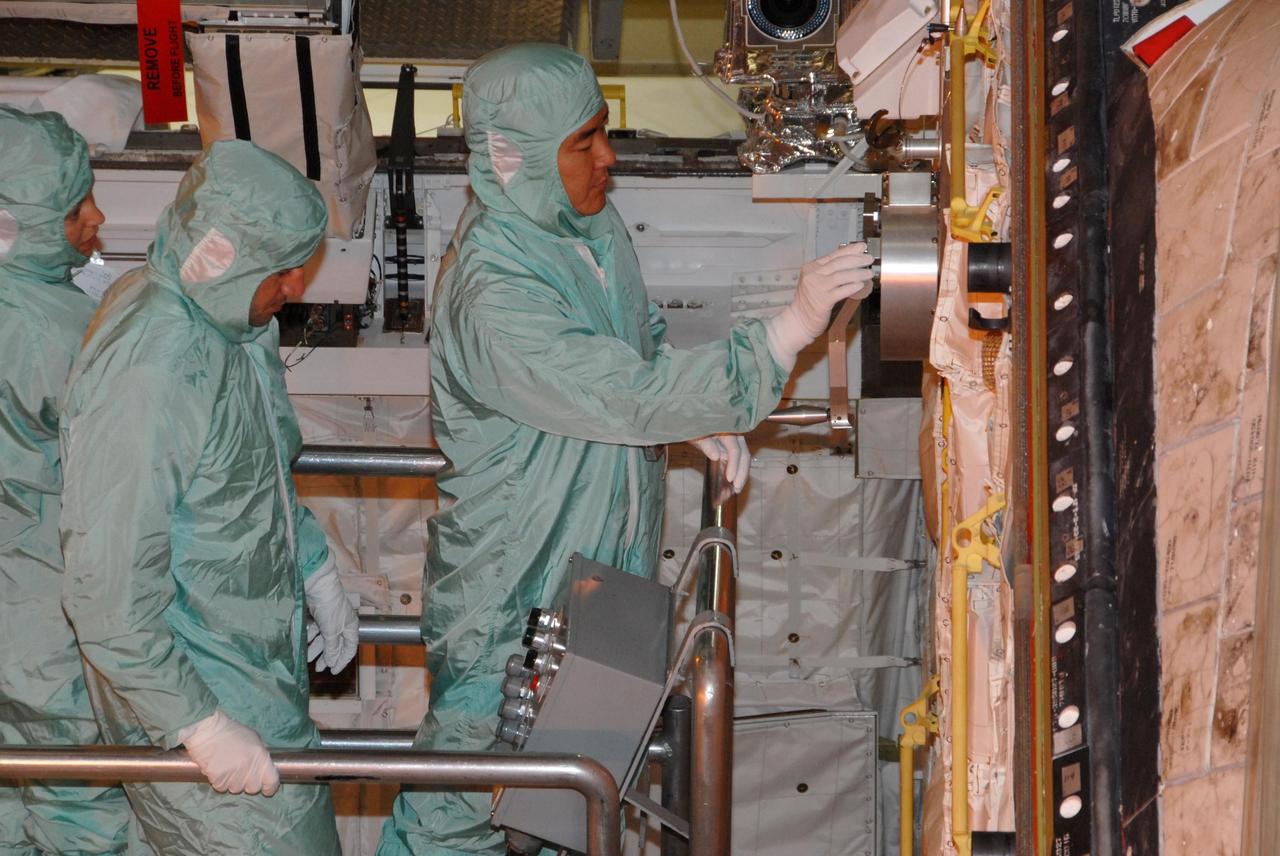
KENNEDY SPACE CENTER, FLA. - In Discovery's payload bay in Orbiter Processing Facility bay 3, STS-120 crew members are getting hands-on experience with a winch that is used to manually close the payload bay doors in the event that becomes necessary. At center is Pilot George D. Zamka and at right is Expedition 16 Flight Engineer Daniel M. Tani. The STS-120 crew is at Kennedy for a crew equipment interface test, or CEIT, which includes harness training, inspection of the thermal protection system and camera operation for planned extravehicular activities, or EVAs. The STS-120 mission will deliver the Harmony module, christened after a school contest, which will provide attachment points for European and Japanese laboratory modules on the International Space Station. Known in technical circles as Node 2, it is similar to the six-sided Unity module that links the U.S. and Russian sections of the station. Built in Italy for the United States, Harmony will be the first new U.S. pressurized component to be added. The STS-120 mission is targeted to launch on Oct. 20. Photo credit: NASA/George Shelton
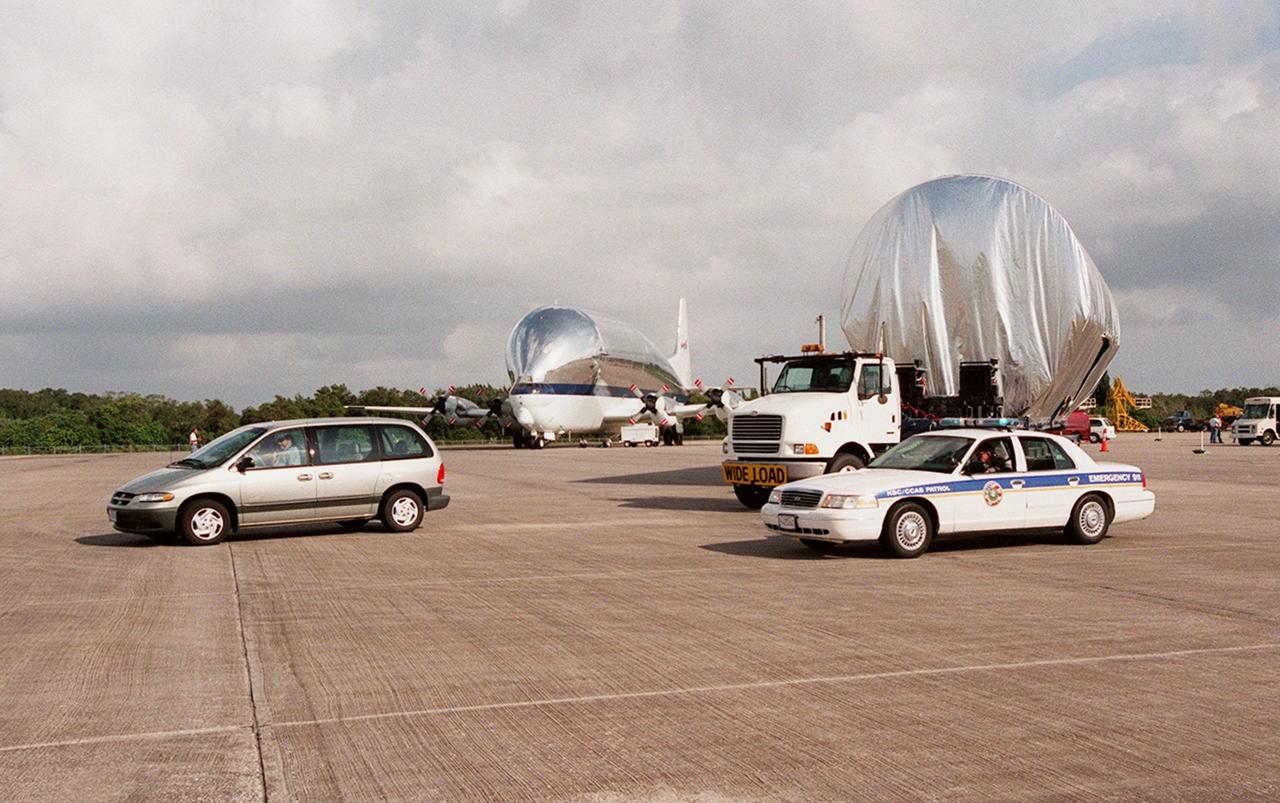
KENNEDY SPACE CENTER, FLA. -- Escort vehicles prepare to leave the Shuttle Landing Facility with the S1 truss (at right) on its trek to the Operations and Checkout Building. Manufactured by the Boeing Co. in Huntington Beach, Calif., this component of the ISS is the first starboard (right-side) truss segment, whose main job is providing structural support for the orbiting research facility's radiator panels that cool the Space Station's complex power system. The S1 truss segment also will house communications systems, external experiment positions and other subsystems. Primarily constructed of aluminum, the truss segment is 45 feet long, 15 feet wide and 6 feet tall. When fully outfitted, it will weigh 31,137 pounds. The truss is slated for flight in 2001. The truss arrived at KSC aboard NASA's Super Guppy, seen in the background. The aircraft is uniquely built with a 25-foot diameter fuselage designed to handle oversized loads and a "fold-away" nose that opens 110 degrees for cargo loading. A system of rails in the cargo compartment, used with either Guppy pallets or fixtures designed for specific cargo, makes cargo loading simple and efficient. Rollers mounted in the rails allow pallets or fixtures to be moved by an electric winch mounted beneath the cargo floor. Automatic hydraulic lock pins in each rail secure the pallet for flight
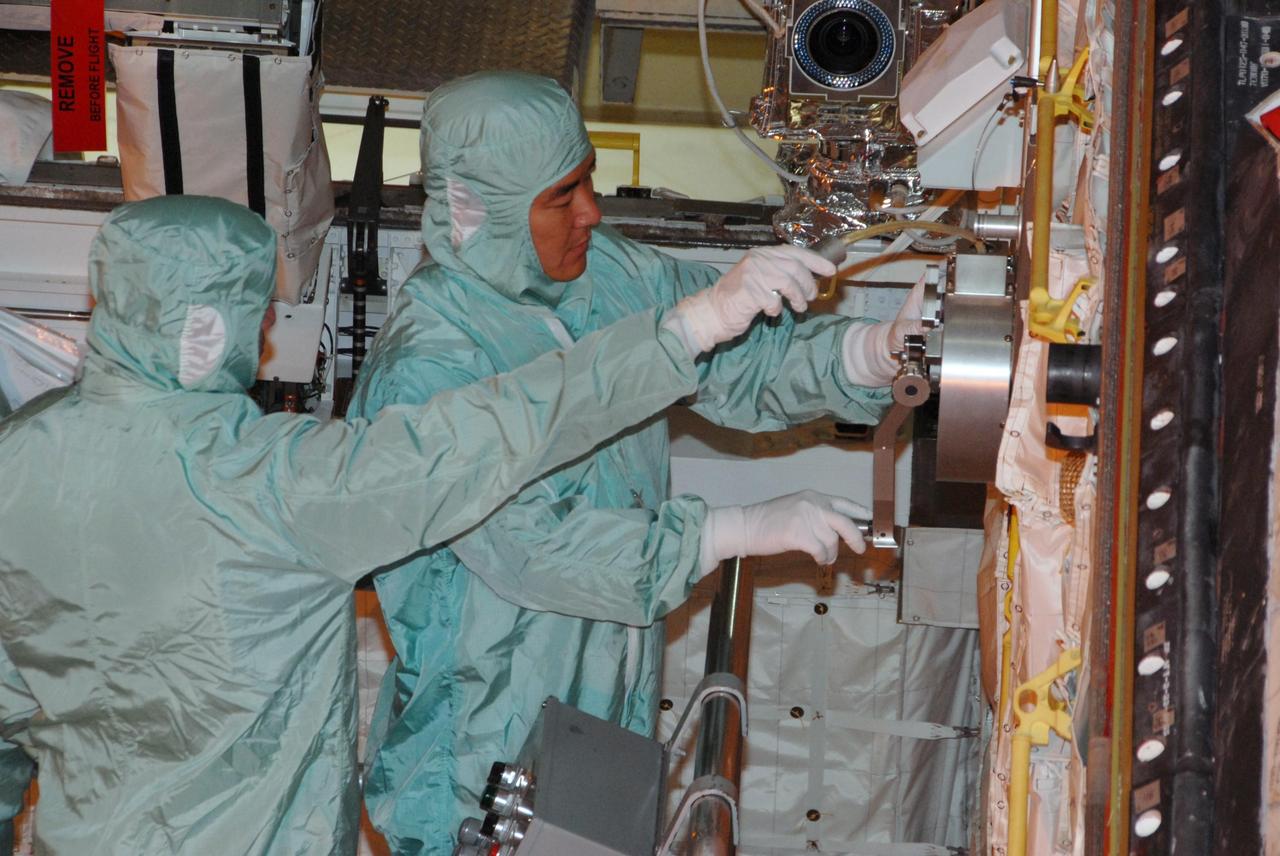
KENNEDY SPACE CENTER, FLA. - In Discovery's payload bay in Orbiter Processing Facility bay 3, STS-120 crew members are getting hands-on experience with a winch that is used to manually close the payload bay doors in the event that becomes necessary. At right is Expedition 16 Flight Engineer Daniel M. Tani. The STS-120 crew is at Kennedy for a crew equipment interface test, or CEIT, which includes harness training, inspection of the thermal protection system and camera operation for planned extravehicular activities, or EVAs. The STS-120 mission will deliver the Harmony module, christened after a school contest, which will provide attachment points for European and Japanese laboratory modules on the International Space Station. Known in technical circles as Node 2, it is similar to the six-sided Unity module that links the U.S. and Russian sections of the station. Built in Italy for the United States, Harmony will be the first new U.S. pressurized component to be added. The STS-120 mission is targeted to launch on Oct. 20. Photo credit: NASA/George Shelton
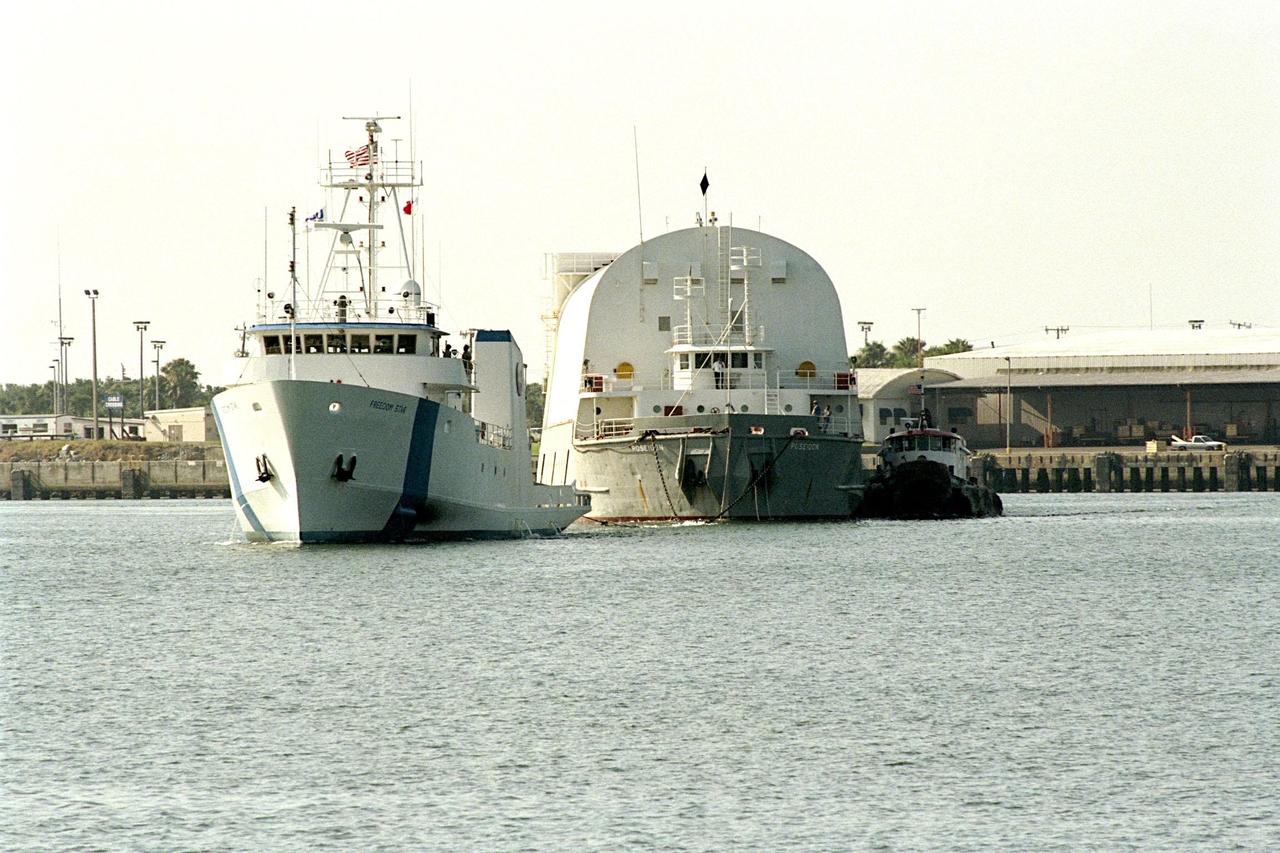
KENNEDY SPACE CENTER, FLA. -- Freedom Star, one of NASA's two solid rocket booster recovery ships, tows a barge containing the third Space Shuttle super lightweight external tank (SLWT) into Port Canaveral. This SLWT will be used to launch the orbiter Discovery on mission STS-95 in October. This first-time towing arrangement, part of a cost savings plan by NASA to prudently manage existing resources, began June 12 from the Michoud Assembly Facility in New Orleans where the Shuttle's external tanks are manufactured. The barge will now be transported up the Banana River to the LC-39 turn basin using a conventional tugboat. Previously, NASA relied on an outside contractor to provide external tank towing services at a cost of about $120,000 per trip. The new plan allows NASA's Space Flight Operations contractor, United Space Alliance (USA), to provide the same service directly to NASA using the recovery ships during their downtime between Shuttle launches. Studies show a potential savings of about $50,000 per trip. The cost of the necessary ship modifications should be paid back by the fourteenth tank delivery. The other recovery ship, Liberty Star, has also undergone deck strengthening enhancements and will soon have the necessary towing winch installed
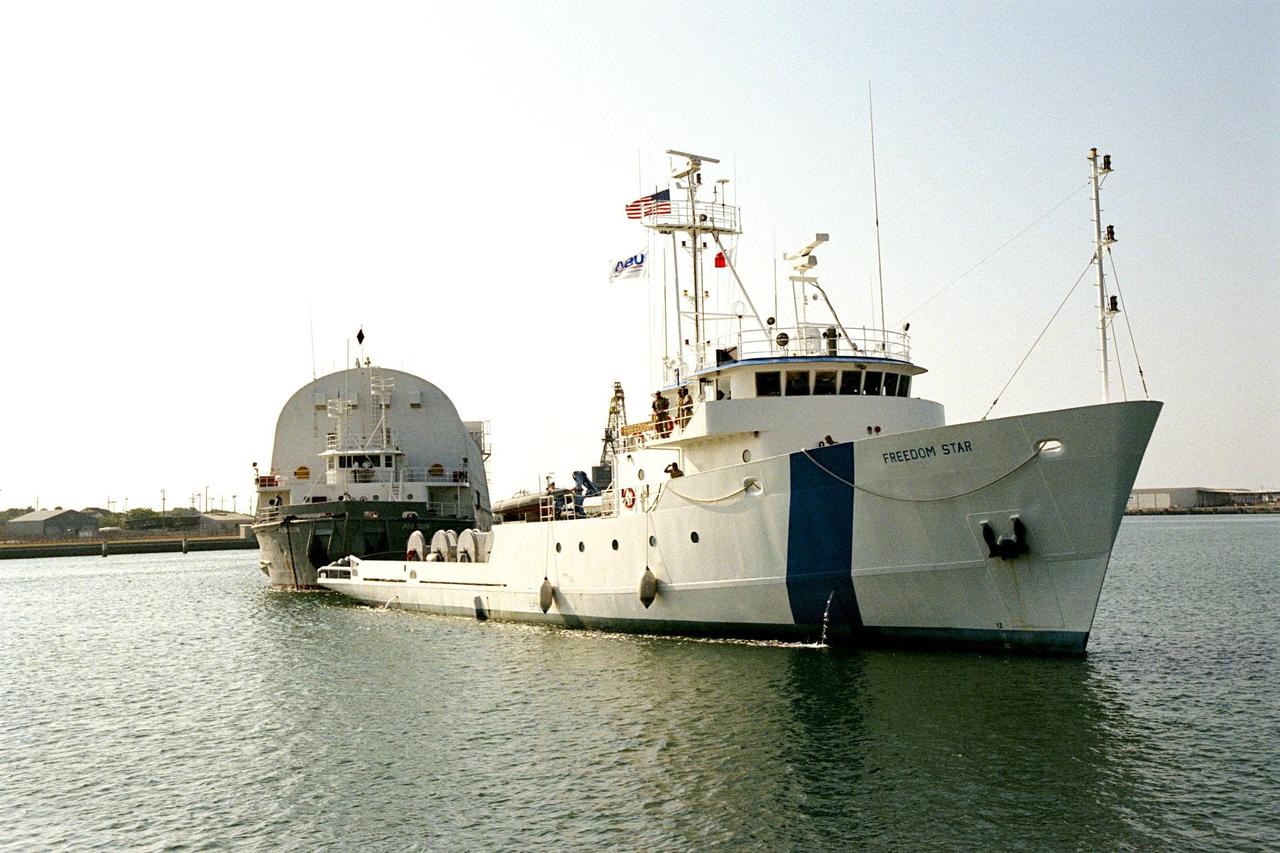
KENNEDY SPACE CENTER, FLA. -- Freedom Star, one of NASA's two solid rocket booster recovery ships, tows a barge containing the third Space Shuttle super lightweight external tank (SLWT) into Port Canaveral. This SLWT will be used to launch the orbiter Discovery on mission STS-95 in October. This first-time towing arrangement, part of a cost savings plan by NASA to prudently manage existing resources, began June 12 from the Michoud Assembly Facility in New Orleans where the Shuttle's external tanks are manufactured. The barge will now be transported up the Banana River to the LC-39 turn basin using a conventional tugboat. Previously, NASA relied on an outside contractor to provide external tank towing services at a cost of about $120,000 per trip. The new plan allows NASA's Space Flight Operations contractor, United Space Alliance (USA), to provide the same service directly to NASA using the recovery ships during their downtime between Shuttle launches. Studies show a potential savings of about $50,000 per trip. The cost of the necessary ship modifications should be paid back by the fourteenth tank delivery. The other recovery ship, Liberty Star, has also undergone deck strengthening enhancements and will soon have the necessary towing winch installed
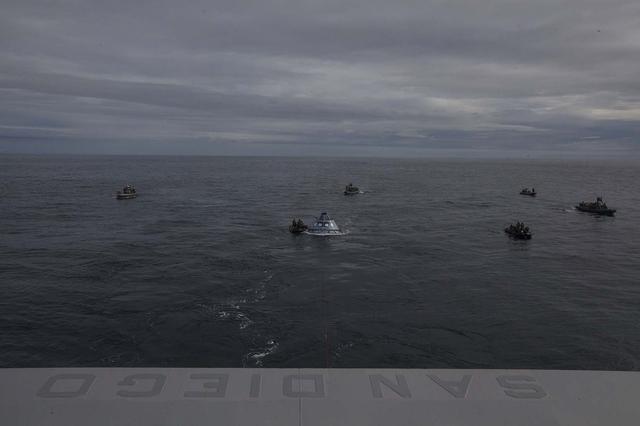
U.S. Navy divers and other personnel in several rigid hull inflatable and Zodiac boats have surrounded a test version of the Orion crew module during Underway Recovery Test 5 in the Pacific Ocean off the coast of California. An orange winch line has been attached to the test module to pull it into the well deck of the USS San Diego. NASA's Ground Systems Development and Operations Program and the U.S. Navy are conducting a series of tests using the Navy ship, various watercraft and equipment to practice for recovery of Orion on its return from deep space missions. The testing allows the team to demonstrate and evaluate recovery processes, procedures, hardware and personnel in open waters. Orion is the exploration spacecraft designed to carry astronauts to destinations not yet explored by humans, including an asteroid and NASA's Journey to Mars. It will have emergency abort capability, sustain the crew during space travel and provide safe re-entry from deep space return velocities. Orion is scheduled to launch on NASA's Space Launch System in late 2018. For more information, visit http://www.nasa.gov/orion.
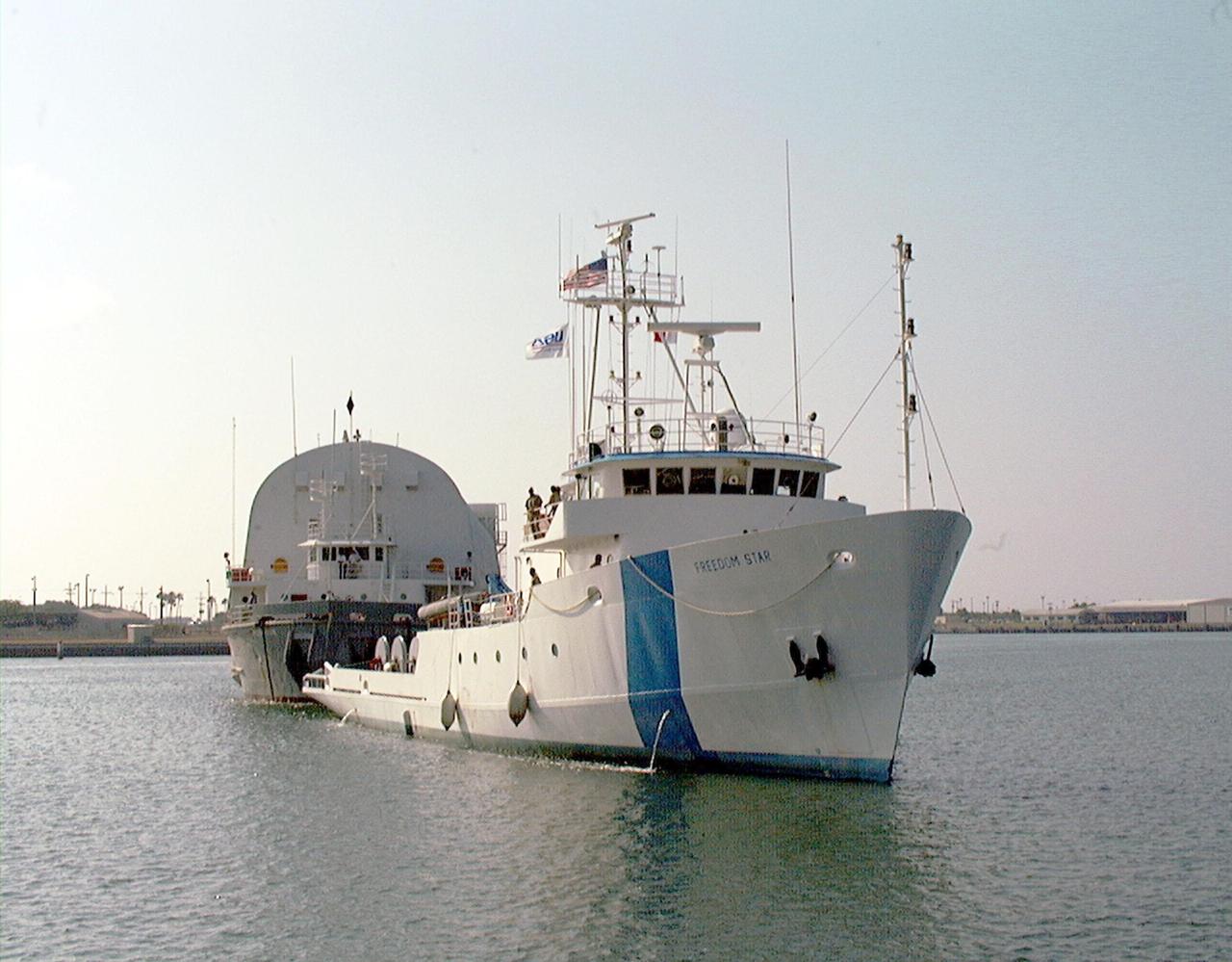
KENNEDY SPACE CENTER, FLA. -- Freedom Star, one of NASA's two solid rocket booster recovery ships, tows a barge containing the third Space Shuttle super lightweight external tank (SLWT) into Port Canaveral. This SLWT will be used to launch the orbiter Discovery on mission STS-95 in October. This first-time towing arrangement, part of a cost savings plan by NASA to prudently manage existing resources, began June 12 from the Michoud Assembly Facility in New Orleans where the Shuttle's external tanks are manufactured. The barge will now be transported up the Banana River to the LC-39 turn basin using a conventional tugboat. Previously, NASA relied on an outside contractor to provide external tank towing services at a cost of about $120,000 per trip. The new plan allows NASA's Space Flight Operations contractor, United Space Alliance (USA), to provide the same service directly to NASA using the recovery ships during their downtime between Shuttle launches. Studies show a potential savings of about $50,000 per trip. The cost of the necessary ship modifications should be paid back by the fourteenth tank delivery. The other recovery ship, Liberty Star, has also undergone deck strengthening enhancements and will soon have the necessary towing winch installed
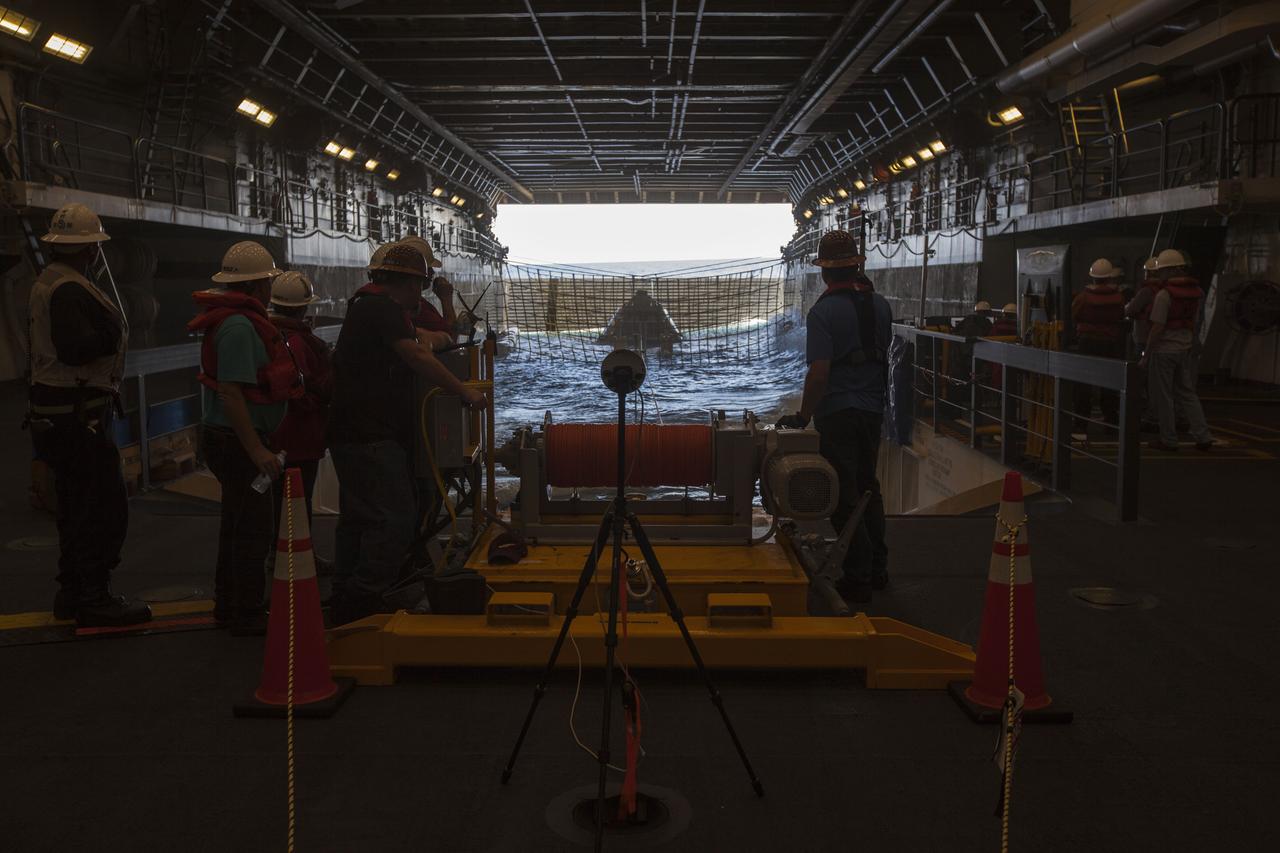
Winch team operators help guide a test version of the Orion crew module in the flooded well deck of the USS San Diego during Underway Recovery Test 5 in the Pacific Ocean off the coast of California. NASA's Ground Systems Development and Operations Program and the U.S. Navy are conducting a series of tests using the ship's well deck, the test module, various watercraft and equipment to prepare for recovery of Orion on its return from deep space missions. The testing will allow the team to demonstrate and evaluate recovery processes, procedures, hardware and personnel in open waters. Orion is the exploration spacecraft designed to carry astronauts to destinations not yet explored by humans, including an asteroid and NASA's Journey to Mars. It will have emergency abort capability, sustain the crew during space travel and provide safe re-entry from deep space return velocities. Orion is scheduled to launch on NASA's Space Launch System in late 2018. For more information, visit http://www.nasa.gov/orion.
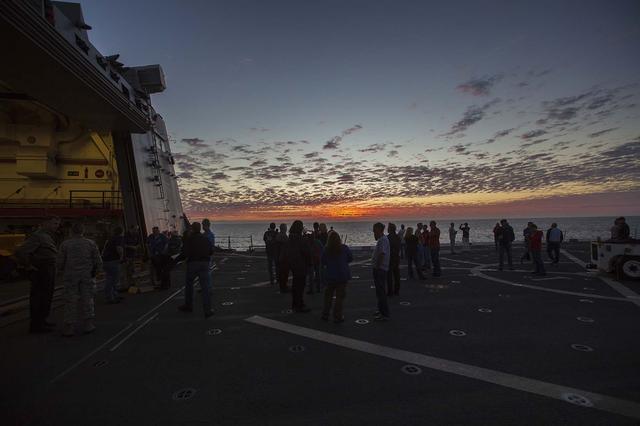
NASA, contractor and U.S. Navy personnel are on the deck of the USS San Diego as the sun sets on the fourth day of Underway Recovery Test 5 in the Pacific Ocean off the coast of California. NASA's Ground Systems Development and Operations Program and the U.S. Navy practiced retrieving and securing a test version of the Orion crew module in the well deck of the ship using tethers and a winch system to prepare for recovery of Orion on its return from deep space missions. The testing will allow the team to demonstrate and evaluate recovery processes, procedures, hardware and personnel in open waters. Orion is the exploration spacecraft designed to carry astronauts to destinations not yet explored by humans, including an asteroid and NASA's Journey to Mars. It will have emergency abort capability, sustain the crew during space travel and provide safe re-entry from deep space return velocities. Orion is scheduled to launch on NASA's Space Launch System in late 2018. For more information, visit http://www.nasa.gov/orion.
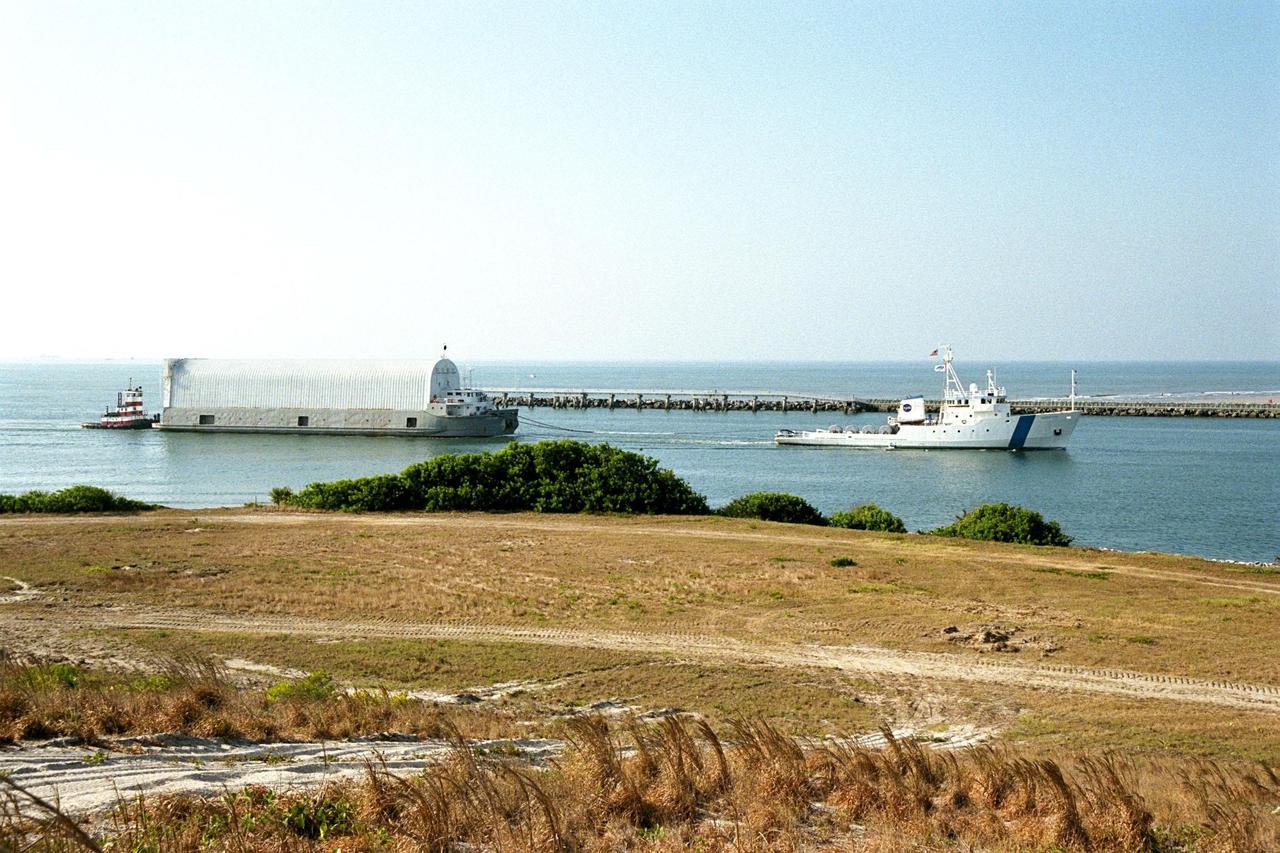
KENNEDY SPACE CENTER, FLA. -- Freedom Star, one of NASA's two solid rocket booster recovery ships, tows a barge containing the third Space Shuttle super lightweight external tank (SLWT) into Port Canaveral. This SLWT will be used to launch the orbiter Discovery on mission STS-95 in October. This first-time towing arrangement, part of a cost savings plan by NASA to prudently manage existing resources, began June 12 from the Michoud Assembly Facility in New Orleans where the Shuttle's external tanks are manufactured. The barge will now be transported up the Banana River to the LC-39 turn basin using a conventional tugboat. Previously, NASA relied on an outside contractor to provide external tank towing services at a cost of about $120,000 per trip. The new plan allows NASA's Space Flight Operations contractor, United Space Alliance (USA), to provide the same service directly to NASA using the recovery ships during their downtime between Shuttle launches. Studies show a potential savings of about $50,000 per trip. The cost of the necessary ship modifications should be paid back by the fourteenth tank delivery. The other recovery ship, Liberty Star, has also undergone deck strengthening enhancements and will soon have the necessary towing winch installed
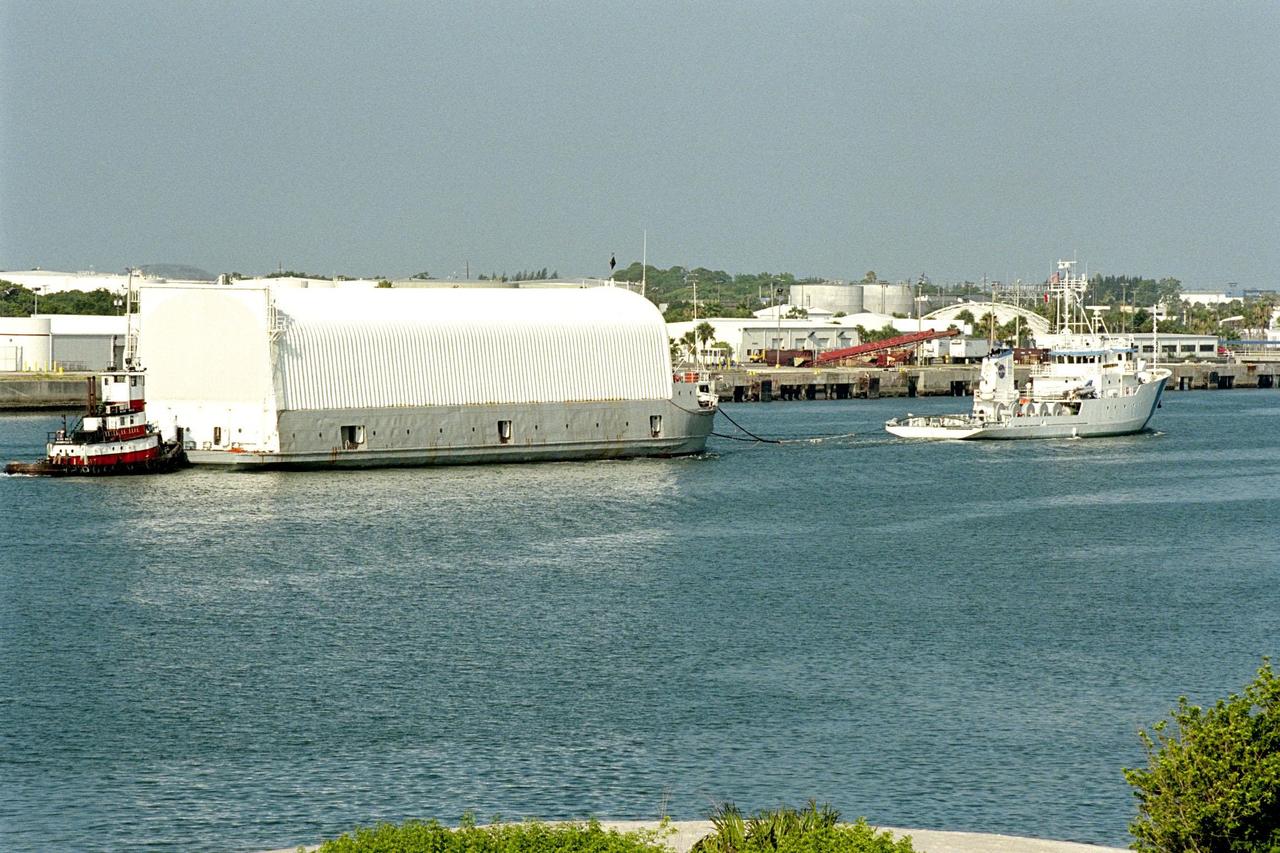
KENNEDY SPACE CENTER, FLA. -- Freedom Star, one of NASA's two solid rocket booster recovery ships, tows a barge containing the third Space Shuttle super lightweight external tank (SLWT) into Port Canaveral. This SLWT will be used to launch the orbiter Discovery on mission STS-95 in October. This first-time towing arrangement, part of a cost savings plan by NASA to prudently manage existing resources, began June 12 from the Michoud Assembly Facility in New Orleans where the Shuttle's external tanks are manufactured. The barge will now be transported up the Banana River to the LC-39 turn basin using a conventional tugboat. Previously, NASA relied on an outside contractor to provide external tank towing services at a cost of about $120,000 per trip. The new plan allows NASA's Space Flight Operations contractor, United Space Alliance (USA), to provide the same service directly to NASA using the recovery ships during their downtime between Shuttle launches. Studies show a potential savings of about $50,000 per trip. The cost of the necessary ship modifications should be paid back by the fourteenth tank delivery. The other recovery ship, Liberty Star, has also undergone deck strengthening enhancements and will soon have the necessary towing winch installed
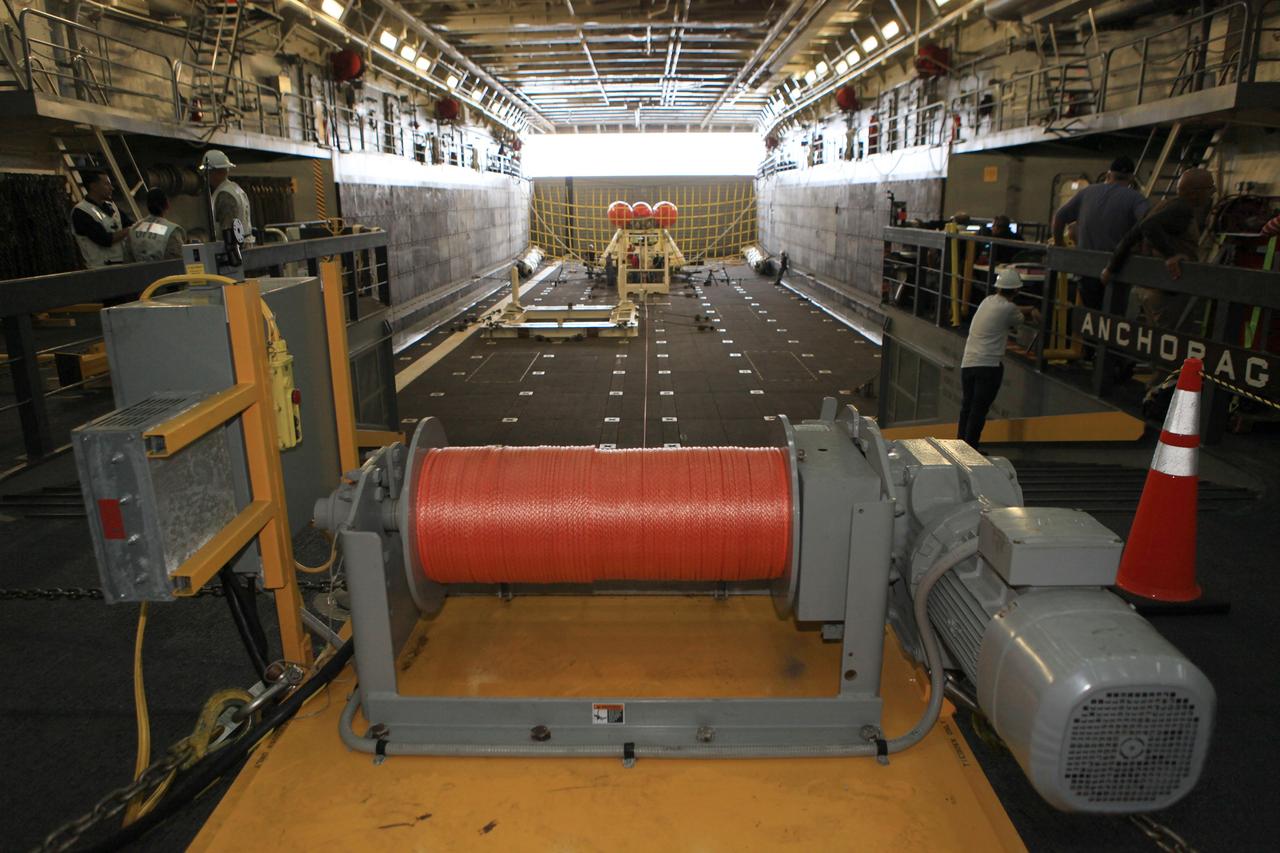
SAN DIEGO, Calif. – Inside the well deck of the U.S. Navy's USS Anchorage, the Orion boilerplate test vehicle is secured on its cradle before the start of a portion of Underway Recovery Test 2. A winch line leads to the test vehicle and tether lines have been attached to control Orion. The bright orange stabilizers have been readied to keep Orion upright in the water if needed. NASA, Lockheed Martin and the U.S. Navy are conducting the test in the Pacific Ocean off the coast of San Diego to prepare for recovery of the Orion crew module on its return from a deep space mission. The underway recovery test will allow the team to demonstrate and evaluate the recovery processes, procedures, new hardware and personnel in open waters. The Ground Systems Development and Operations Program is conducting the underway recovery test. Orion is the exploration spacecraft designed to carry astronauts to destinations not yet explored by humans, including an asteroid and Mars. It will have emergency abort capability, sustain the crew during space travel and provide safe re-entry from deep space return velocities. The first unpiloted test flight of the Orion is scheduled to launch in 2014 atop a Delta IV rocket and in 2017 on NASA’s Space Launch System rocket. For more information, visit http://www.nasa.gov/orion. Photo credit: NASA/Kim Shiflett
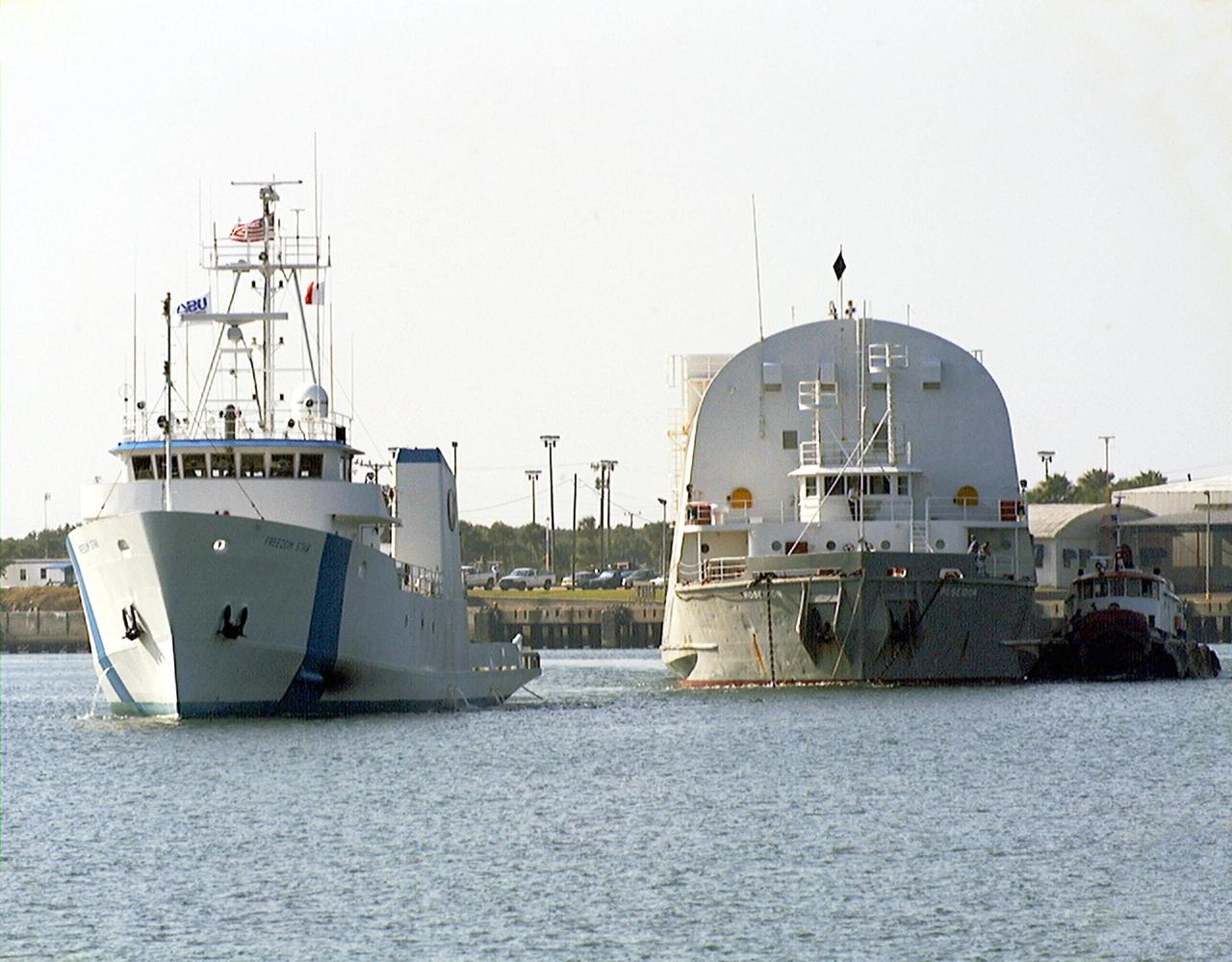
KENNEDY SPACE CENTER, FLA. -- Freedom Star, one of NASA's two solid rocket booster recovery ships, tows a barge containing the third Space Shuttle super lightweight external tank (SLWT) into Port Canaveral. This SLWT will be used to launch the orbiter Discovery on mission STS-95 in October. This first-time towing arrangement, part of a cost savings plan by NASA to prudently manage existing resources, began June 12 from the Michoud Assembly Facility in New Orleans where the Shuttle's external tanks are manufactured. The barge will now be transported up the Banana River to the LC-39 turn basin using a conventional tugboat. Previously, NASA relied on an outside contractor to provide external tank towing services at a cost of about $120,000 per trip. The new plan allows NASA's Space Flight Operations contractor, United Space Alliance (USA), to provide the same service directly to NASA using the recovery ships during their downtime between Shuttle launches. Studies show a potential savings of about $50,000 per trip. The cost of the necessary ship modifications should be paid back by the fourteenth tank delivery. The other recovery ship, Liberty Star, has also undergone deck strengthening enhancements and will soon have the necessary towing winch installed
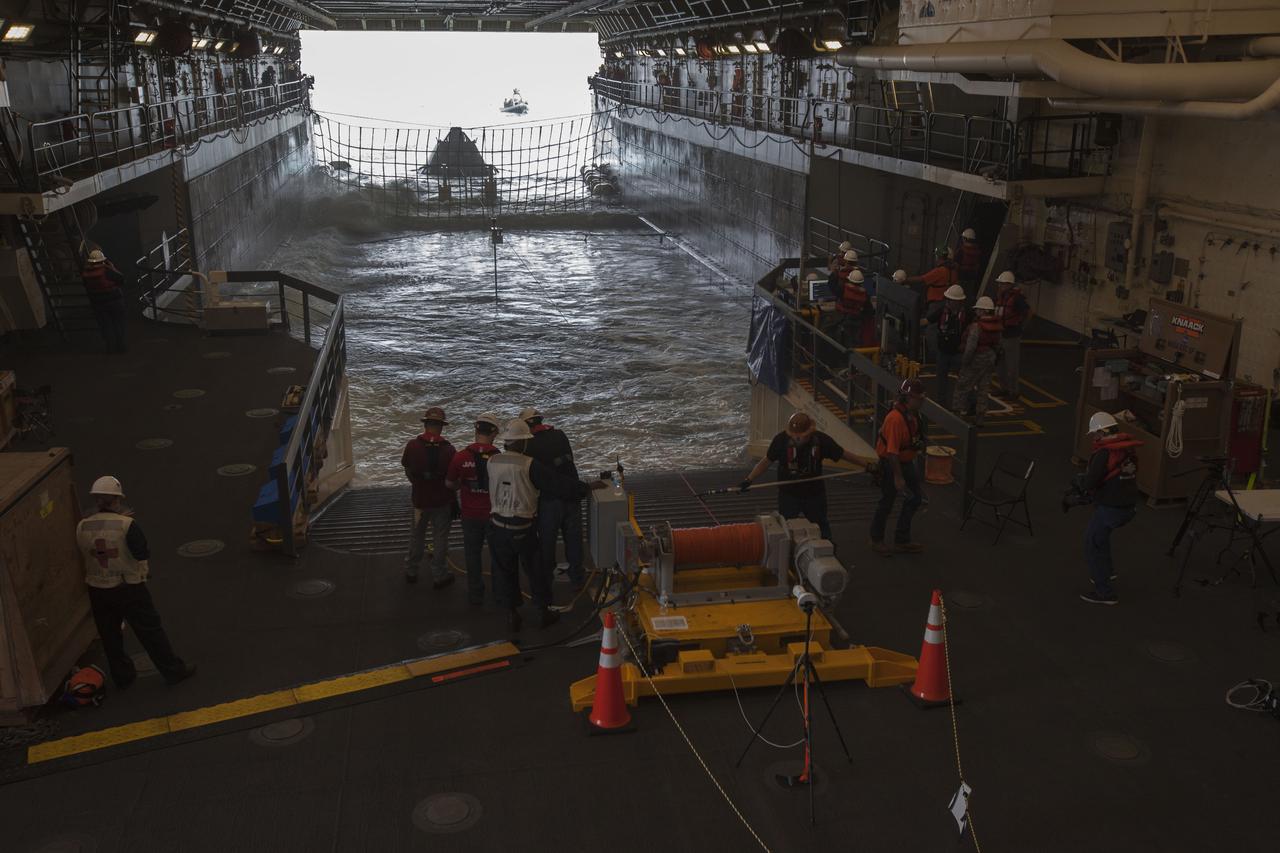
Winch team operators help guide a test version of the Orion crew module into the flooded well deck of the USS San Diego during Underway Recovery Test 5 in the Pacific Ocean off the coast of California. NASA's Ground Systems Development and Operations Program and the U.S. Navy are conducting a series of tests using the ship's well deck, the test module, various watercraft and equipment to prepare for recovery of Orion on its return from deep space missions. The testing will allow the team to demonstrate and evaluate recovery processes, procedures, hardware and personnel in open waters. Orion is the exploration spacecraft designed to carry astronauts to destinations not yet explored by humans, including an asteroid and NASA's Journey to Mars. It will have emergency abort capability, sustain the crew during space travel and provide safe re-entry from deep space return velocities. Orion is scheduled to launch on NASA's Space Launch System in late 2018. For more information, visit http://www.nasa.gov/orion.
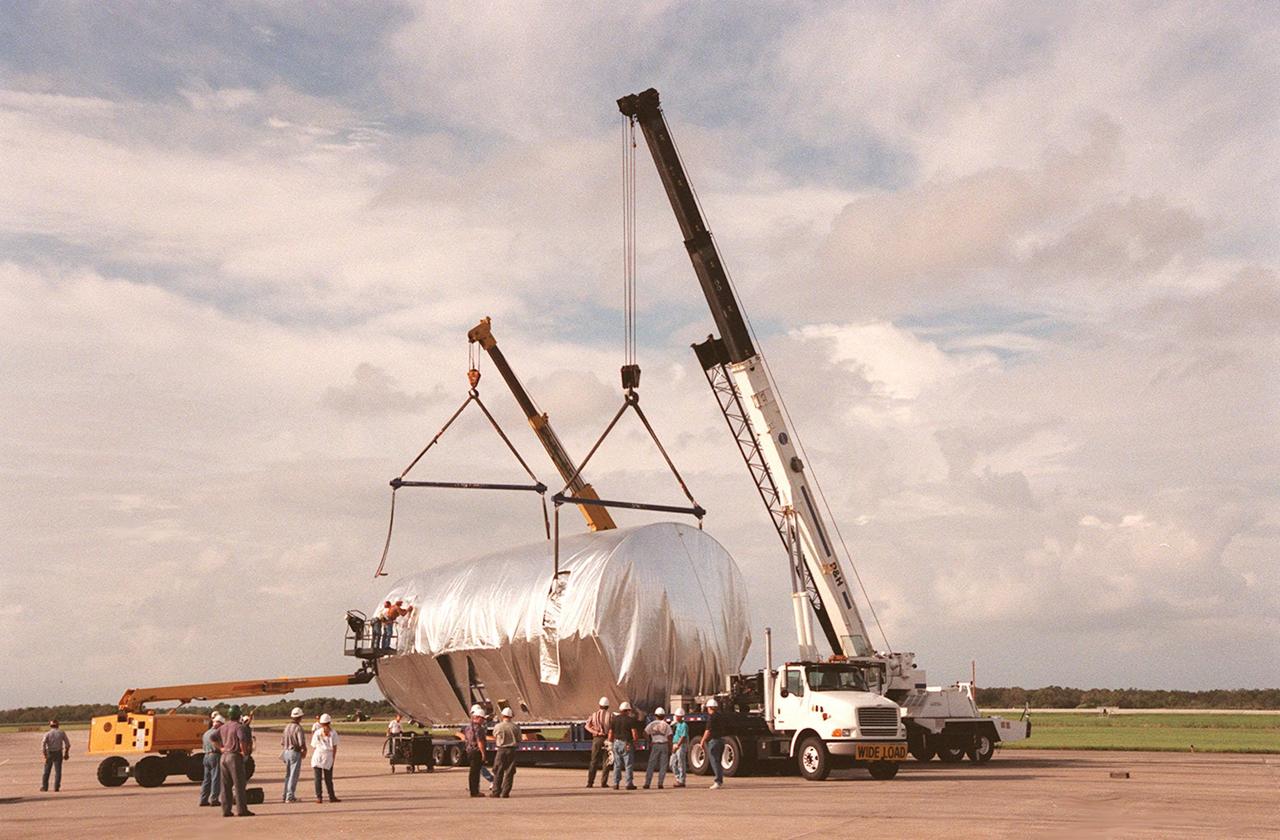
KENNEDY SPACE CENTER, FLA. -- At the Shuttle Landing Facility, workers attach cranes to the S1 truss, a segment of the International Space Station, to lift the truss to a payload transporter for its transfer to the Operations and Checkout Building. Manufactured by the Boeing Co. in Huntington Beach, Calif., this component of the ISS is the first starboard (right-side) truss segment, whose main job is providing structural support for the orbiting research facility's radiator panels that cool the Space Station's complex power system. The S1 truss segment also will house communications systems, external experiment positions and other subsystems. Primarily constructed of aluminum, the truss segment is 45 feet long, 15 feet wide and 6 feet tall. When fully outfitted, it will weigh 31,137 pounds. The truss is slated for flight in 2001. The truss arrived at KSC aboard NASA's Super Guppy, with a 25-foot diameter fuselage designed to handle oversized loads. Loading the Guppy is easy because of the unique "fold-away" nose of the aircraft that opens 110 degrees for cargo loading. A system of rails in the cargo compartment, used with either Guppy pallets or fixtures designed for specific cargo, makes cargo loading simple and efficient. Rollers mounted in the rails allow pallets or fixtures to be moved by an electric winch mounted beneath the cargo floor. Automatic hydraulic lock pins in each rail secure the pallet for flight
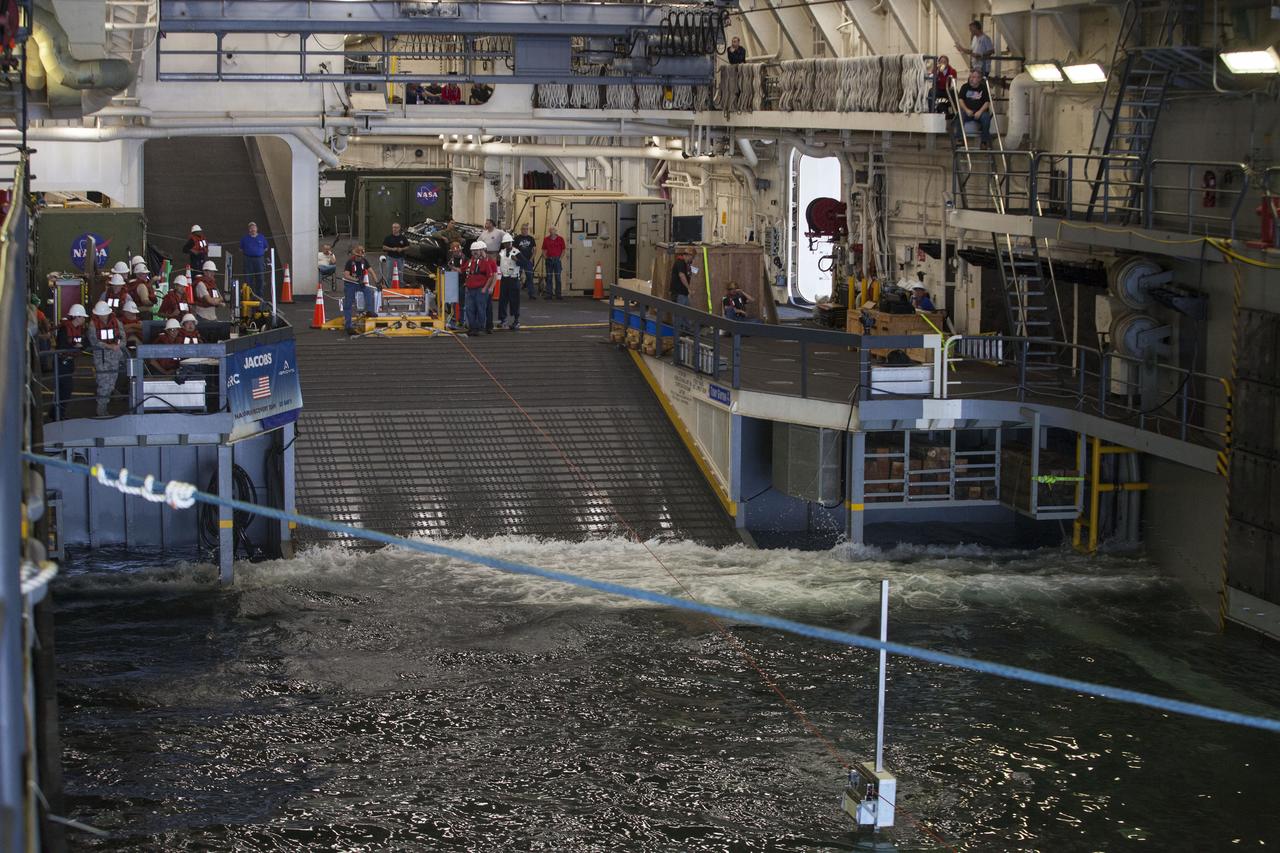
In the flooded well deck of the USS San Diego, recovery team members watch as a winch line is operated to help guide a test version of the Orion crew module into the well deck during Orion Underway Recovery Test 5 in the Pacific Ocean off the coast of California. NASA's Ground Systems Development and Operations Program and the U.S. Navy will practice recovery techniques using the well deck of the ship and a test version of the Orion crew module to prepare for recovery of Orion on its return from deep space missions. The testing will allow the team to demonstrate and evaluate recovery processes, procedures, hardware and personnel in open waters. Orion is the exploration spacecraft designed to carry astronauts to destinations not yet explored by humans, including an asteroid and NASA's Journey to Mars. It will have emergency abort capability, sustain the crew during space travel and provide safe re-entry from deep space return velocities. Orion is scheduled to launch on NASA's Space Launch System in late 2018. For more information, visit http://www.nasa.gov/orion.
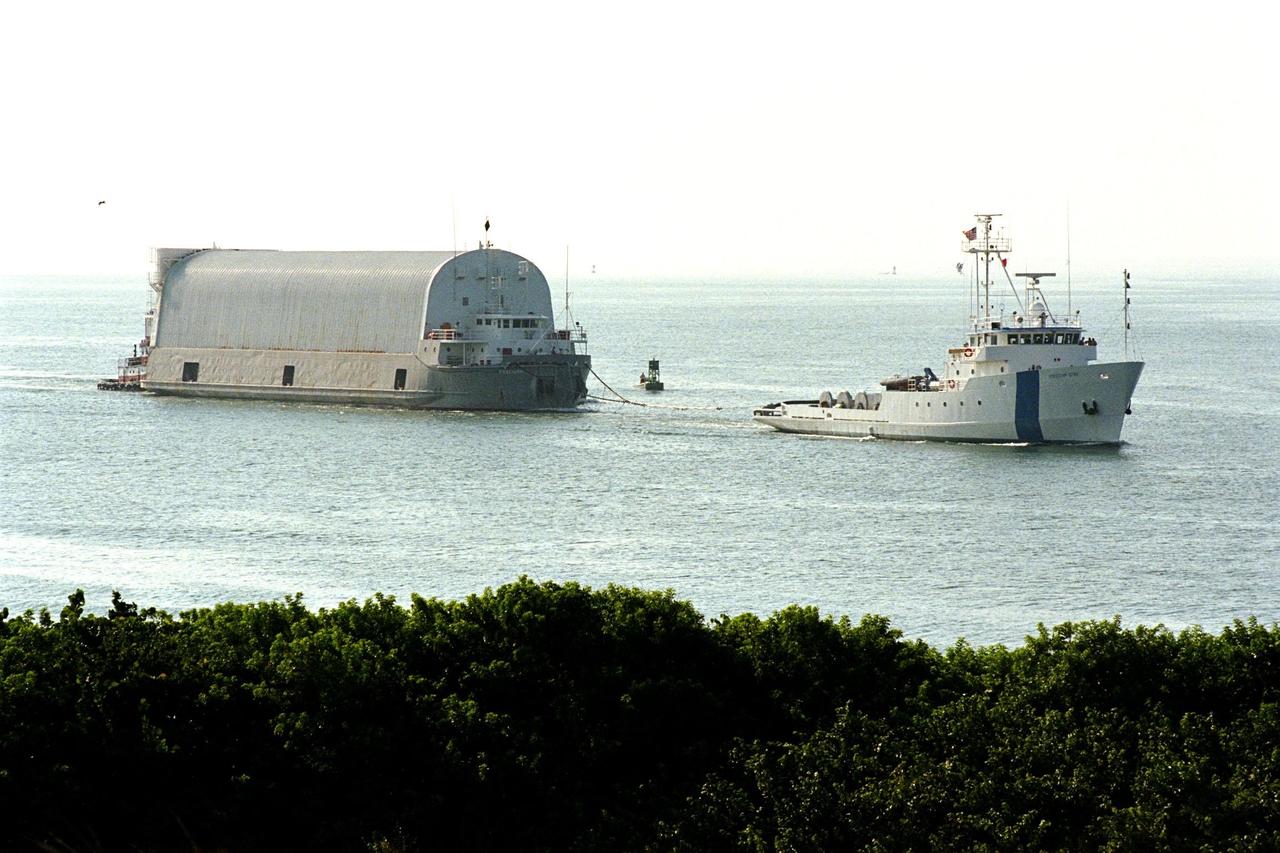
KENNEDY SPACE CENTER, FLA. -- Freedom Star, one of NASA's two solid rocket booster recovery ships, tows a barge containing the third Space Shuttle super lightweight external tank (SLWT) into Port Canaveral. This SLWT will be used to launch the orbiter Discovery on mission STS-95 in October. This first-time towing arrangement, part of a cost savings plan by NASA to prudently manage existing resources, began June 12 from the Michoud Assembly Facility in New Orleans where the Shuttle's external tanks are manufactured. The barge will now be transported up the Banana River to the LC-39 turn basin using a conventional tugboat. Previously, NASA relied on an outside contractor to provide external tank towing services at a cost of about $120,000 per trip. The new plan allows NASA's Space Flight Operations contractor, United Space Alliance (USA), to provide the same service directly to NASA using the recovery ships during their downtime between Shuttle launches. Studies show a potential savings of about $50,000 per trip. The cost of the necessary ship modifications should be paid back by the fourteenth tank delivery. The other recovery ship, Liberty Star, has also undergone deck strengthening enhancements and will soon have the necessary towing winch installed.
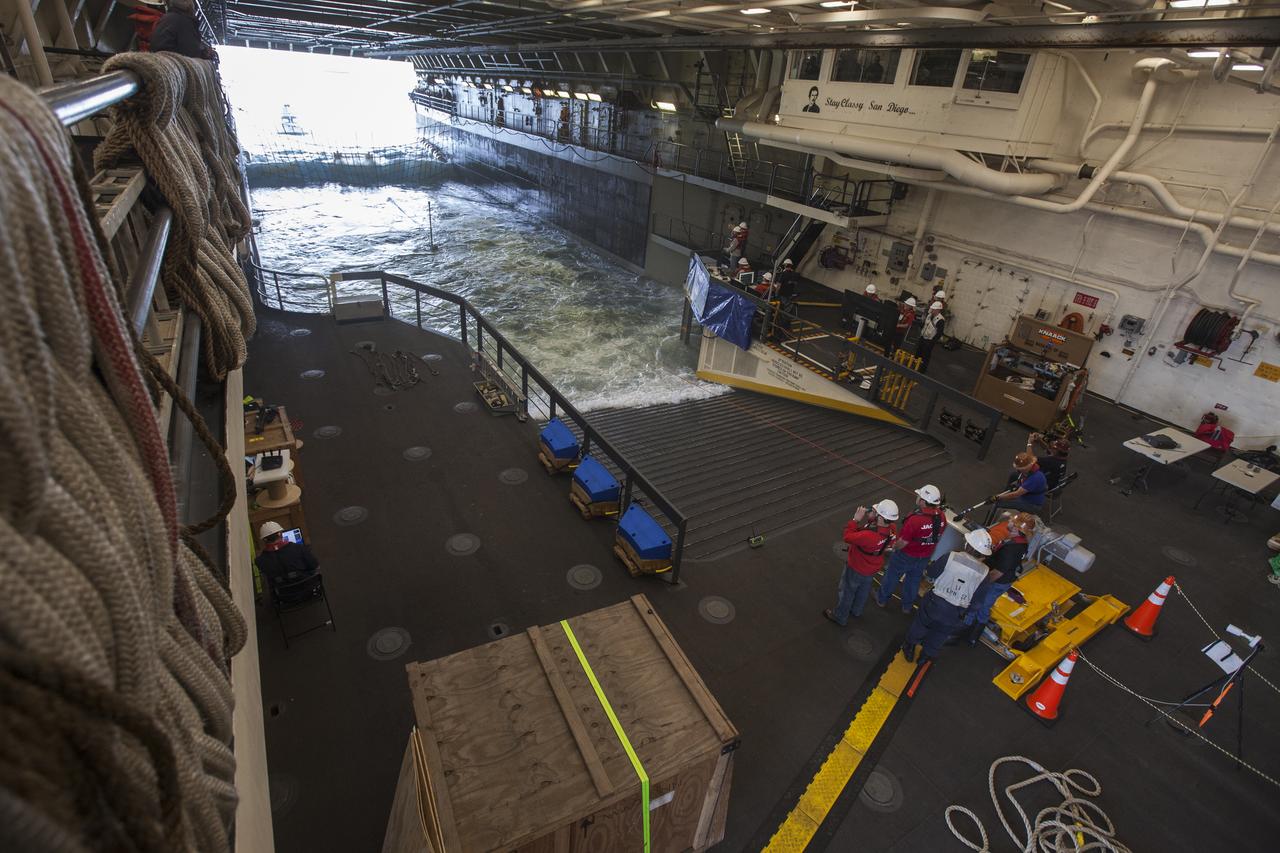
Winch operators, at right, watch from the flooded well deck of the USS San Diego as a test version of the Orion crew module is guided to the well deck during Underway Recovery Test 5 in the Pacific Ocean off the coast of California. NASA's Ground Systems Development and Operations Program and the U.S. Navy are conducting a series of tests using the well deck of the USS San Diego, several watercraft, support equipment and personnel to prepare for recovery of Orion on its return from deep space missions. The testing will allow the team to demonstrate and evaluate recovery processes, procedures, hardware and personnel in open waters. Orion is the exploration spacecraft designed to carry astronauts to destinations not yet explored by humans, including an asteroid and NASA's Journey to Mars. It will have emergency abort capability, sustain the crew during space travel and provide safe re-entry from deep space return velocities. Orion is scheduled to launch on NASA's Space Launch System in late 2018. For more information, visit http://www.nasa.gov/orion.
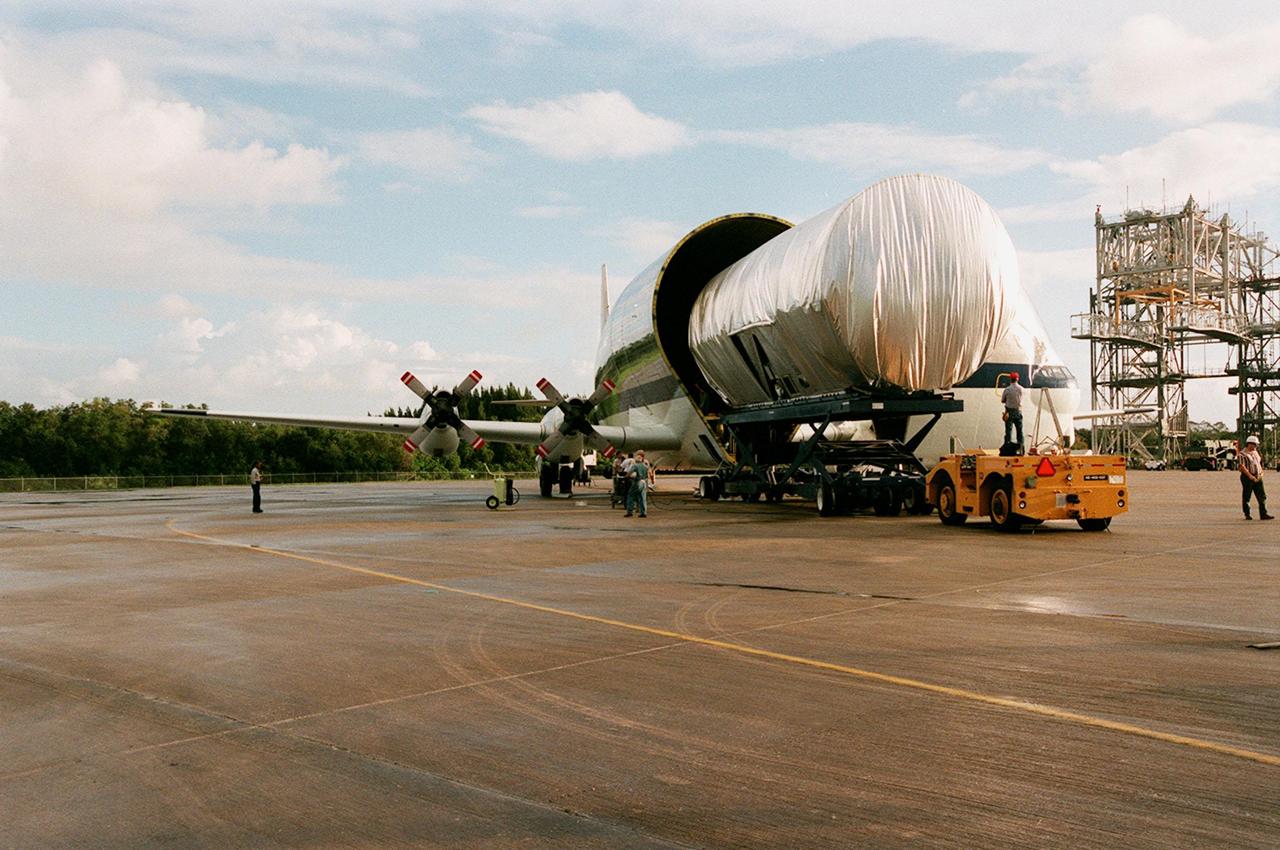
KENNEDY SPACE CENTER, FLA. -- At the Shuttle Landing Facility, the newly arrived S1 truss, a segment of the International Space Station (ISS), is offloaded from NASA's Super Guppy aircraft. Manufactured by the Boeing Co. in Huntington Beach, Calif., this component of the ISS is the first starboard (right-side) truss segment, whose main job is providing structural support for the orbiting research facility's radiator panels that cool the Space Station's complex power system. The S1 truss segment also will house communications systems, external experiment positions and other subsystems. Primarily constructed of aluminum, the truss segment is 45 feet long, 15 feet wide and 6 feet tall. When fully outfitted, it will weigh 31,137 pounds. The truss is slated for flight in 2001. The Super Guppy, with its 25-foot diameter fuselage designed to handle oversized loads, is well prepared to transport the truss and other ISS segments. Loading the Guppy is easy because of the unique "fold-away" nose of the aircraft that opens 110 degrees for cargo loading. A system of rails in the cargo compartment, used with either Guppy pallets or fixtures designed for specific cargo, makes cargo loading simple and efficient. Rollers mounted in the rails allow pallets or fixtures to be moved by an electric winch mounted beneath the cargo floor. Automatic hydraulic lock pins in each rail secure the pallet for flight. The truss is being transferred to the Operations and Checkout Building
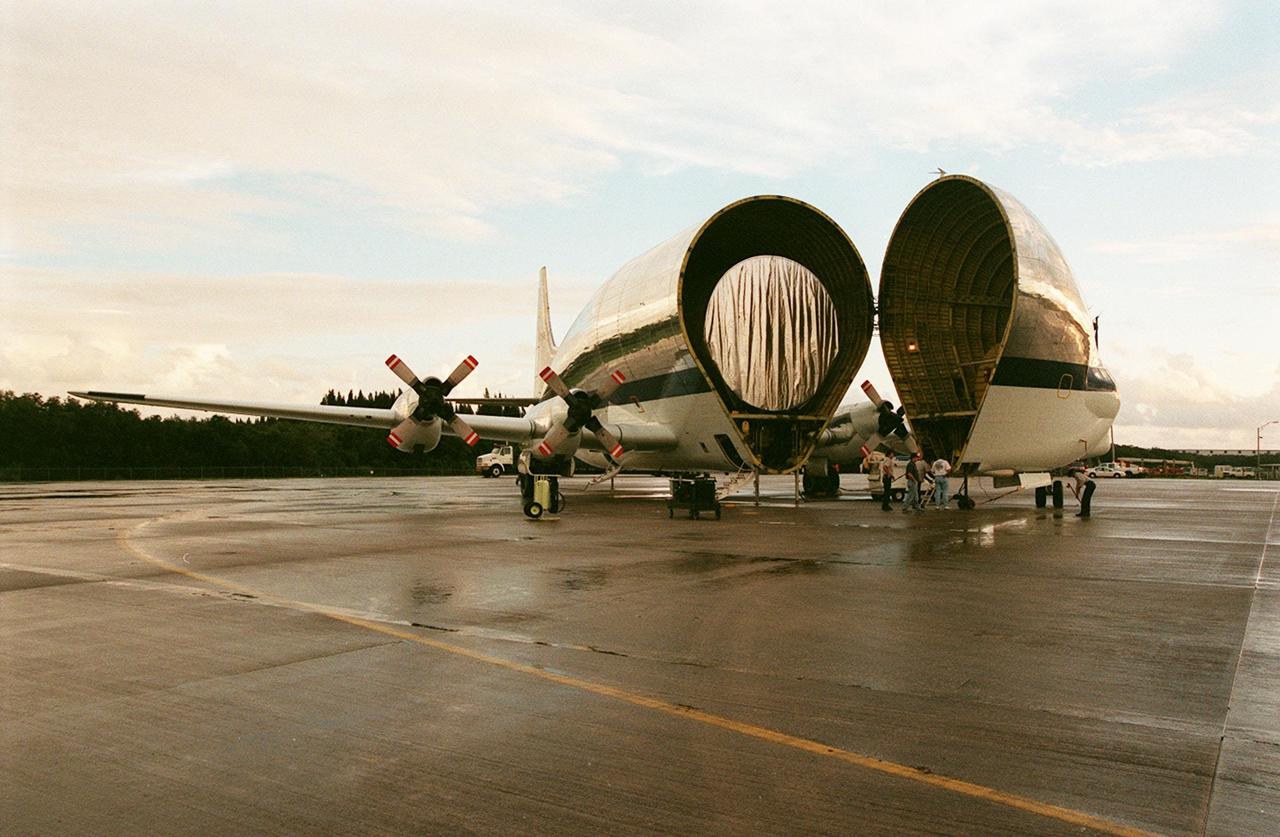
KENNEDY SPACE CENTER, FLA. -- At KSC's Shuttle Landing Facility, NASA's Super Guppy opens to reveal its cargo, the International Space Station's (ISS) S1 truss. Manufactured by the Boeing Co. in Huntington Beach, Calif., this component of the ISS is the first starboard (right-side) truss segment, whose main job is providing structural support for the orbiting research facility's radiator panels that cool the Space Station's complex power system. The S1 truss segment also will house communications systems, external experiment positions and other subsystems. Primarily constructed of aluminum, the truss segment is 45 feet long, 15 feet wide and 6 feet tall. When fully outfitted, it will weigh 31,137 pounds. The truss is slated for flight in 2001. The Super Guppy, with its 25-foot diameter fuselage designed to handle oversized loads, is well prepared to transport the truss and other ISS segments. Loading the Guppy is easy because of the unique "fold-away" nose of the aircraft that opens 110 degrees for cargo loading. A system of rails in the cargo compartment, used with either Guppy pallets or fixtures designed for specific cargo, makes cargo loading simple and efficient. Rollers mounted in the rails allow pallets or fixtures to be moved by an electric winch mounted beneath the cargo floor. Automatic hydraulic lock pins in each rail secure the pallet for flight. The truss is to be transferred to the Operations and Checkout Building
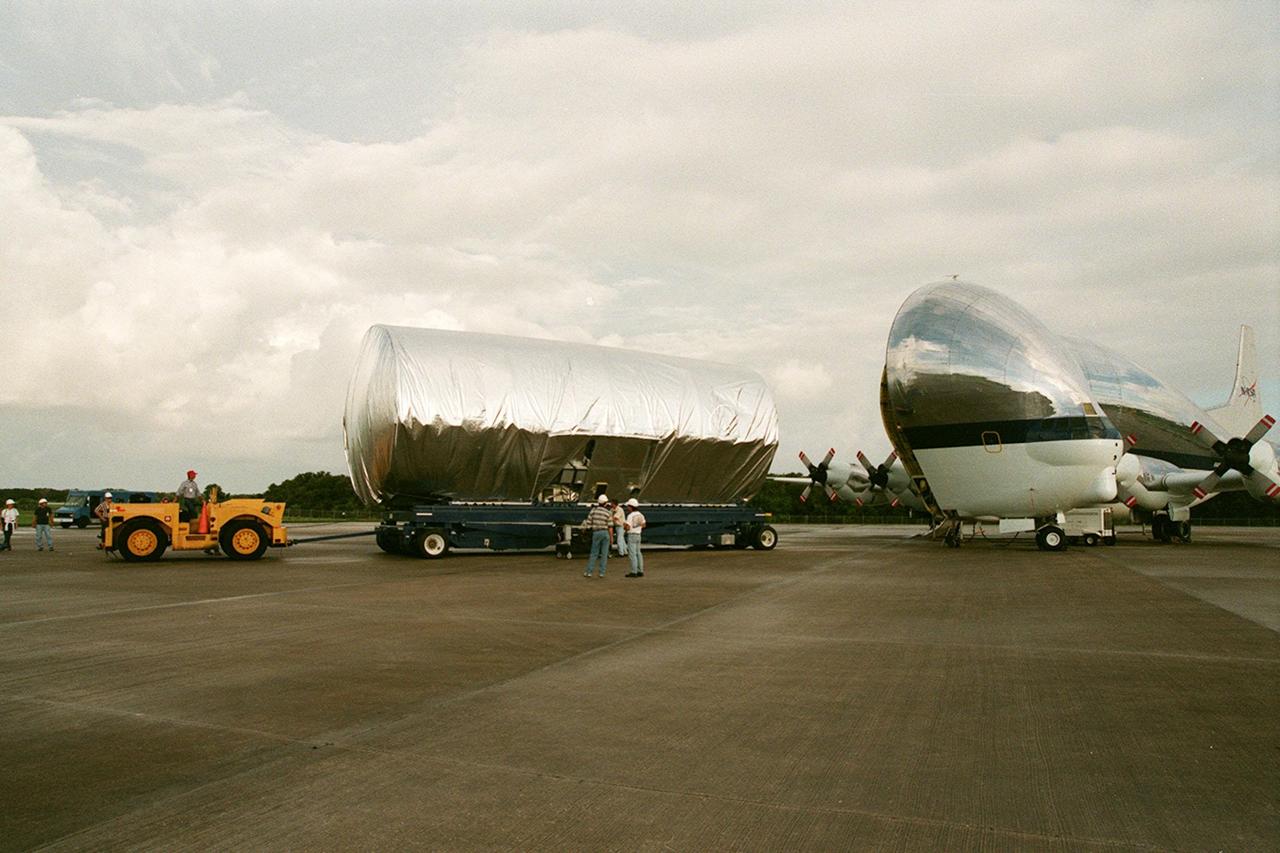
KENNEDY SPACE CENTER, FLA. -- At the Shuttle Landing Facility, the S1 truss, a segment of the International Space Station, is moved away from the Super Guppy that brought it to KSC from Marshall Space Flight Center. Manufactured by the Boeing Co. in Huntington Beach, Calif., this component of the ISS is the first starboard (right-side) truss segment, whose main job is providing structural support for the orbiting research facility's radiator panels that cool the Space Station's complex power system. The S1 truss segment also will house communications systems, external experiment positions and other subsystems. Primarily constructed of aluminum, the truss segment is 45 feet long, 15 feet wide and 6 feet tall. When fully outfitted, it will weigh 31,137 pounds. The truss is slated for flight in 2001. The Super Guppy, with its 25-foot diameter fuselage designed to handle oversized loads, is well prepared to transport the truss and other ISS segments. Loading the Guppy is easy because of the unique "fold-away" nose of the aircraft that opens 110 degrees for cargo loading. A system of rails in the cargo compartment, used with either Guppy pallets or fixtures designed for specific cargo, makes cargo loading simple and efficient. Rollers mounted in the rails allow pallets or fixtures to be moved by an electric winch mounted beneath the cargo floor. Automatic hydraulic lock pins in each rail secure the pallet for flight. The truss is being transferred to the Operations and Checkout Building
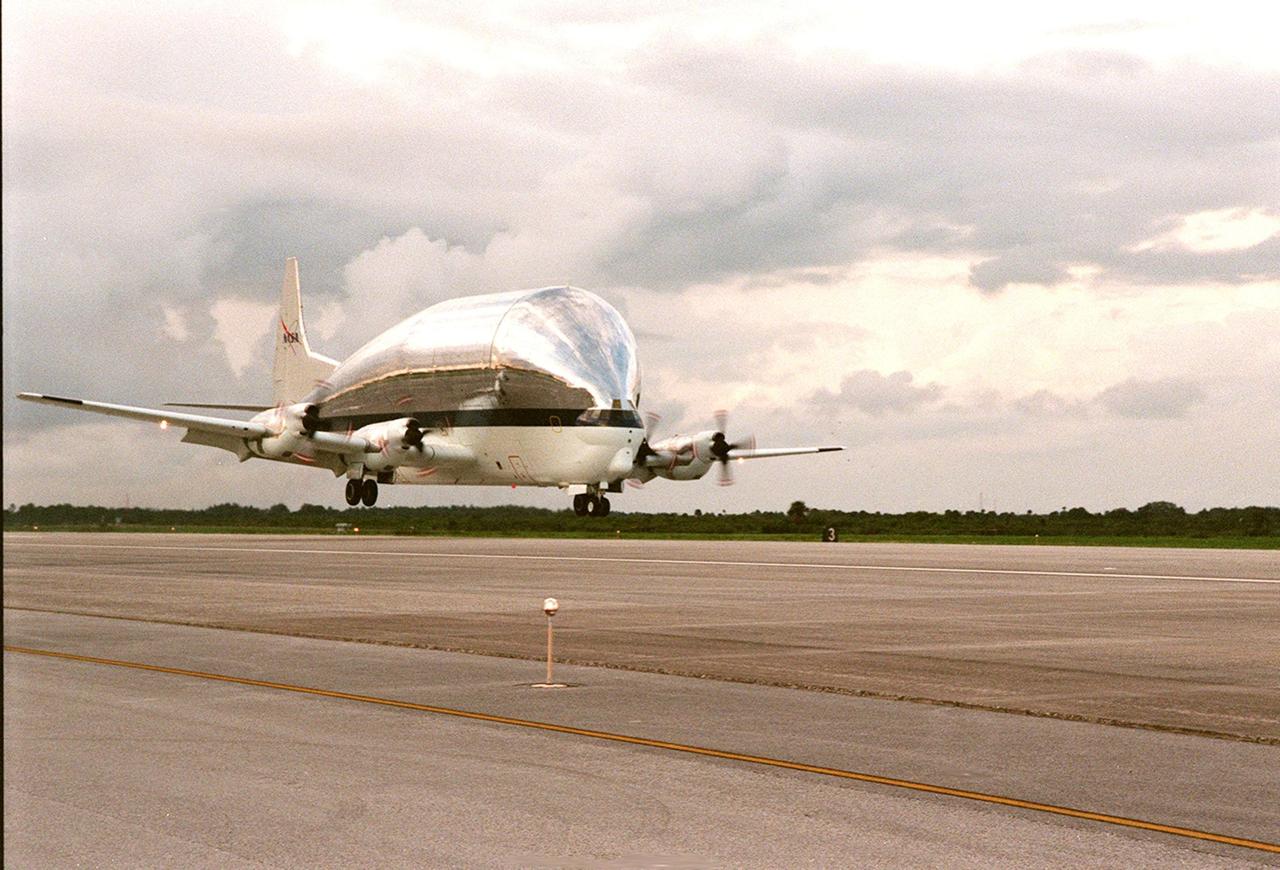
KENNEDY SPACE CENTER, FLA. -- NASA's Super Guppy airplane, with the International Space Station's (ISS) S1 truss aboard, arrives at KSC's Shuttle Landing Facility from Marshall Space Flight Center. Manufactured by the Boeing Co. in Huntington Beach, Calif., this component of the ISS is the first starboard (right-side) truss segment, whose main job is providing structural support for the orbiting research facility's radiator panels that cool the Space Station's complex power system. The S1 truss segment also will house communications systems, external experiment positions and other subsystems. Primarily constructed of aluminum, the truss segment is 45 feet long, 15 feet wide and 6 feet tall. When fully outfitted, it will weigh 31,137 pounds. The truss is slated for flight in 2001. The Super Guppy, with its 25-foot diameter fuselage designed to handle oversized loads, is well prepared to transport the truss and other ISS segments. Loading the Guppy is easy because of the unique "fold-away" nose of the aircraft that opens 110 degrees for cargo loading. A system of rails in the cargo compartment, used with either Guppy pallets or fixtures designed for specific cargo, makes cargo loading simple and efficient. Rollers mounted in the rails allow pallets or fixtures to be moved by an electric winch mounted beneath the cargo floor. Automatic hydraulic lock pins in each rail secure the pallet for flight. The truss is to be moved to the Operations and Checkout Building
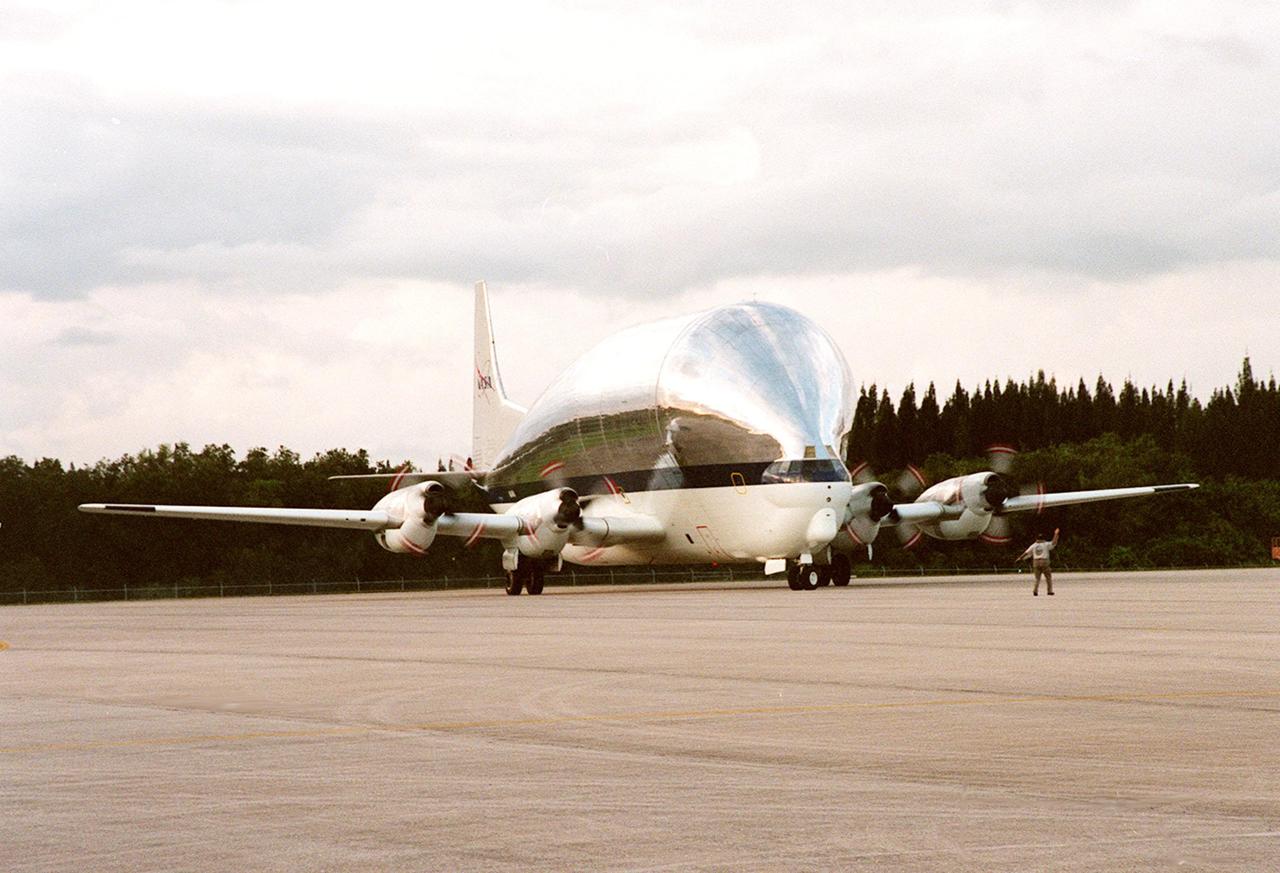
KENNEDY SPACE CENTER, FLA. -- NASA's Super Guppy airplane, with the International Space Station's (ISS) S1 truss aboard, rolls to a stop at KSC's Shuttle Landing Facility. Manufactured by the Boeing Co. in Huntington Beach, Calif., this component of the ISS is the first starboard (right-side) truss segment, whose main job is providing structural support for the orbiting research facility's radiator panels that cool the Space Station's complex power system. The S1 truss segment also will house communications systems, external experiment positions and other subsystems. Primarily constructed of aluminum, the truss segment is 45 feet long, 15 feet wide and 6 feet tall. When fully outfitted, it will weigh 31,137 pounds. The truss is slated for flight in 2001. The Super Guppy, with its 25-foot diameter fuselage designed to handle oversized loads, is well prepared to transport the truss and other ISS segments. Loading the Guppy is easy because of the unique "fold-away" nose of the aircraft that opens 110 degrees for cargo loading. A system of rails in the cargo compartment, used with either Guppy pallets or fixtures designed for specific cargo, makes cargo loading simple and efficient. Rollers mounted in the rails allow pallets or fixtures to be moved by an electric winch mounted beneath the cargo floor. Automatic hydraulic lock pins in each rail secure the pallet for flight. The truss is to be transferred to the Operations and Checkout Building