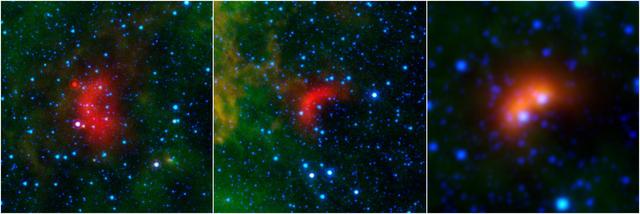
Bow shocks thought to mark the paths of massive, speeding stars are highlighted in these images from NASA's Spitzer Space Telescope and Wide-field Infrared Survey Explorer, or WISE. Cosmic bow shocks occur when massive stars zip through space, pushing material ahead of them in the same way that water piles up in front of a race boat. The stars also produce high-speed winds that smack into this compressed material. The end result is pile-up of heated material that glows in infrared light. In these images, infrared light has been assigned the colored red. Green shows wispy dust in the region and blue shows stars. The two images at left are from Spitzer, and the one on the right is from WISE. The speeding stars thought to be creating the bow shocks can be seen at the center of each arc-shaped feature. The image at right actually consists of two bow shocks and two speeding stars. All the speeding stars are massive, ranging from about 8 to 30 times the mass of our sun. http://photojournal.jpl.nasa.gov/catalog/PIA20062
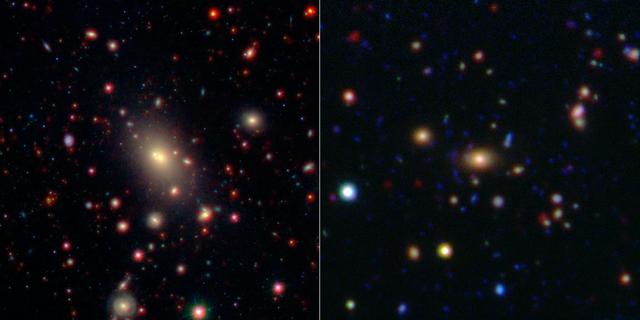
This image shows two of the galaxy clusters observed by NASA WISE and Spitzer Space Telescope missions. Galaxy clusters are among the most massive structures in the universe.
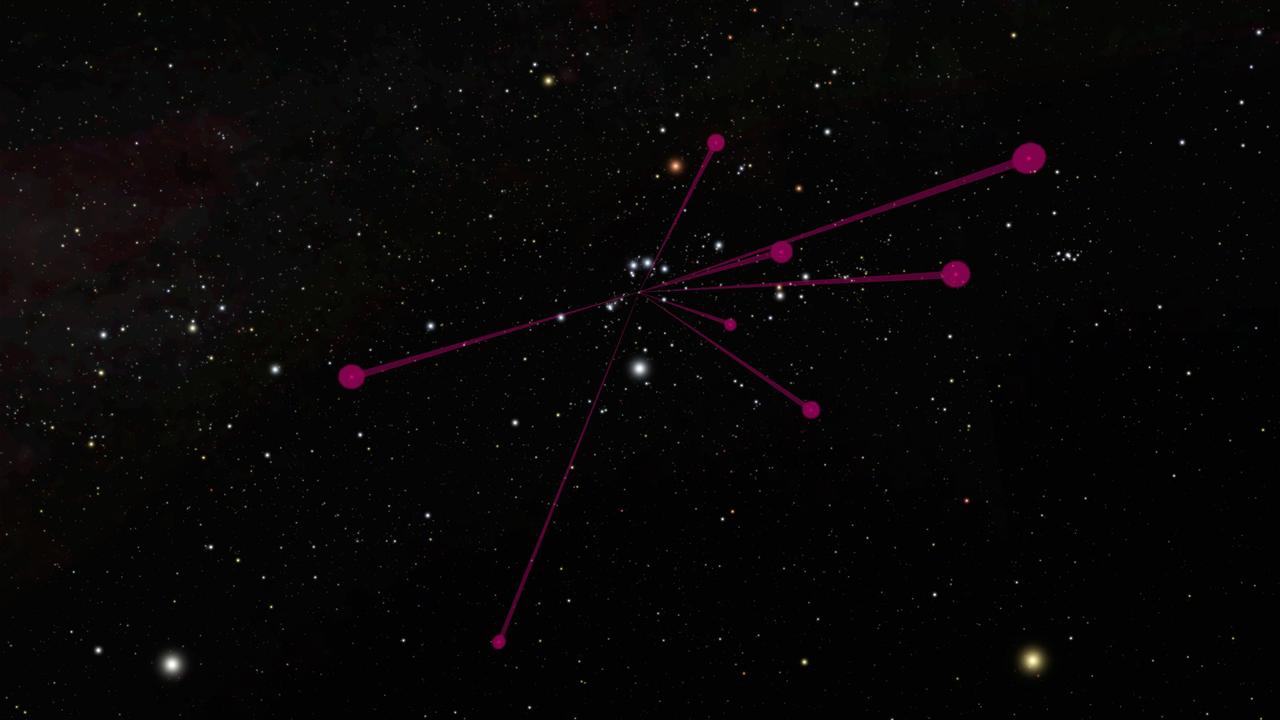
The locations of brown dwarfs discovered by NASA Wide-field Infrared Survey Explorer, or WISE, and mapped by NASA Spitzer Space Telescope, are shown in this diagram as red circles.

This new image of the Orion Nebula produced using previously released data from three telescopes shows two enormous caverns carved out by unseen giant stars that can release up to a million times more light than our Sun. All that radiation breaks apart dust grains there, helping to create the pair of cavities. Much of the remaining dust is swept away when the stars produce wind or when they die explosive deaths as supernovae. This infrared image shows dust but no stars. Blue light indicates warm dust heated by unseen massive stars. Observed in infrared light – a range of wavelengths outside what human eyes can detect – the views were provided by NASA's retired Spitzer Space Telescope and the Wide-Field Infrared Survey Explorer (WISE), which now operates under the moniker NEOWISE. Spitzer and WISE were both managed by NASA's Jet Propulsion Laboratory in Southern California, which is a division of Caltech. Around the edge of the two cavernous regions, the dust that appears green is slightly cooler. Red indicates cold dust that reaches temperatures of about minus 440 Fahrenheit (minus 260 Celsius). The cold dust appears mostly on the outskirts of the dust cloud, away from the regions where stars form. The red and green light shows data from the now-retired Herschel Space Telescope, an ESA (European Space Agency) observatory that captured wavelengths in the far-infrared and microwave ranges, where cold dust radiates. In between the two hollow regions are orange filaments where dust condenses and forms new stars. Over time, these filaments may produce new giant stars that will once again reshape the region. https://photojournal.jpl.nasa.gov/catalog/PIA25434
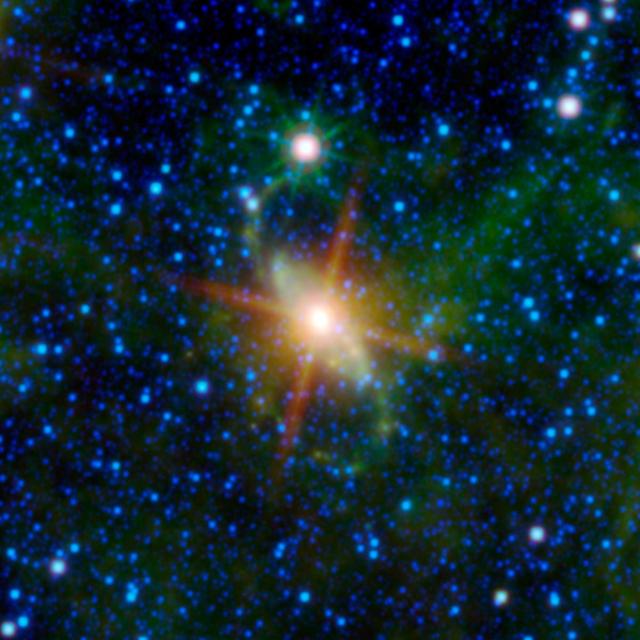
There something special going on in the nearby Circinus galaxy, as revealed by this image from NASA WISE telescope. The Circinus galaxy is located in the constellation of Circinus and is obscured by the plane of our Milky Way galaxy.
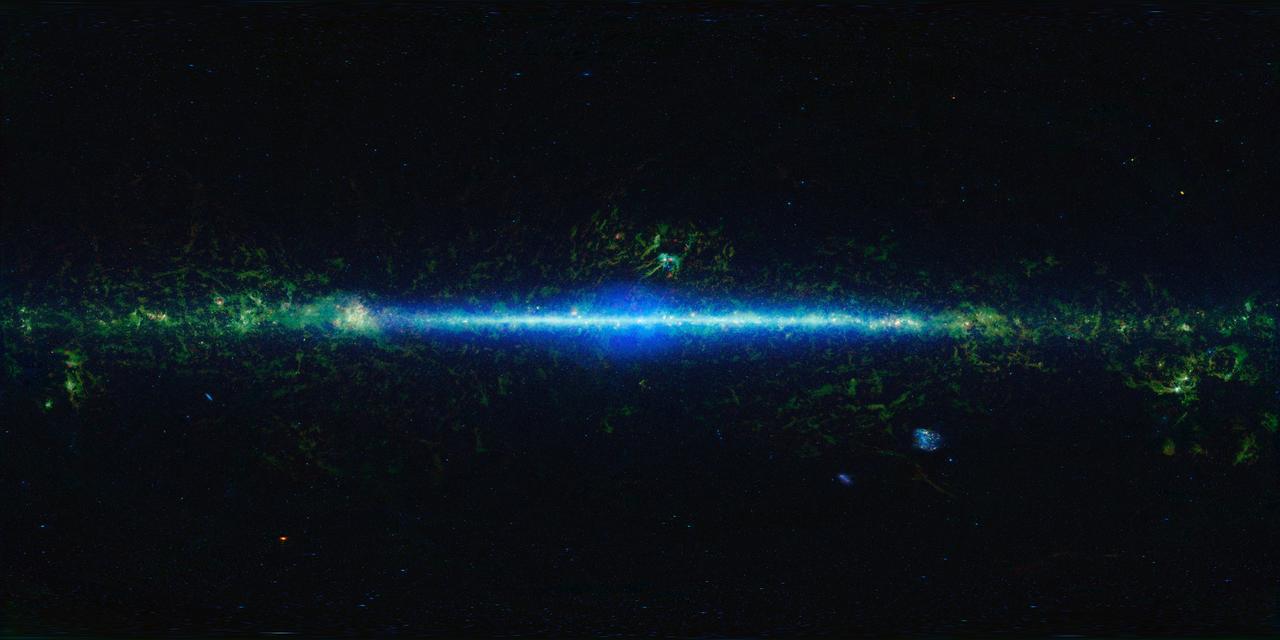
This mosaic of images covering the entire sky was observed by NASA WISE telescope and is part of its All-Sky Data Release. The projection used in this image of the sky is called an equirectangular.

The Flame Nebula sits on the eastern hip of Orion the Hunter, a constellation most easily visible in the northern hemisphere during winter evenings in this view from NASA WISE Telescope.
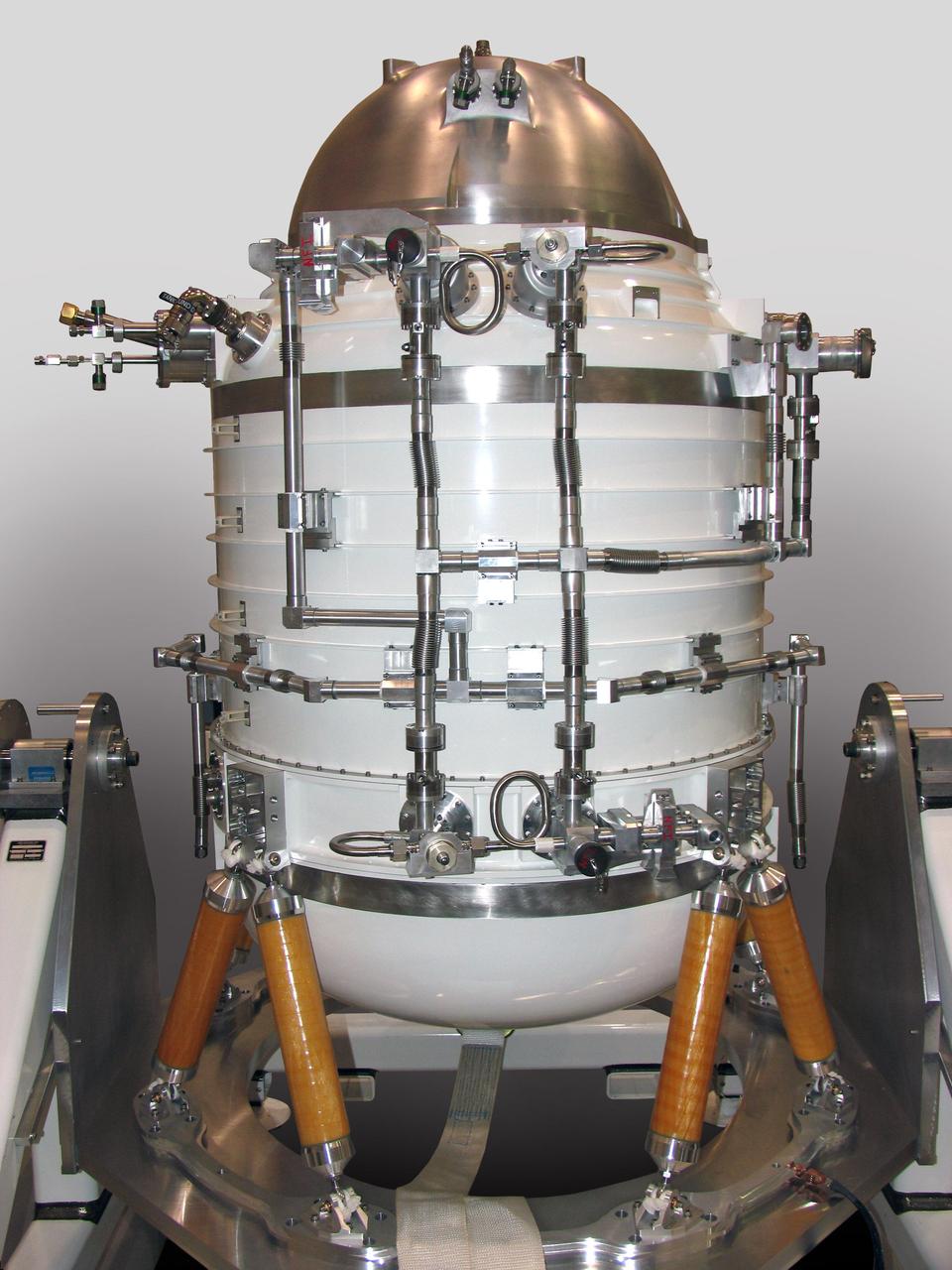
Some say the science instrument on NASA Wide-field Infrared Survey Explorer mission resembles the Star Wars robot R2-D2. The instrument is enclosed in a solid-hydrogen cryostat, which cools the WISE telescope and detectors.
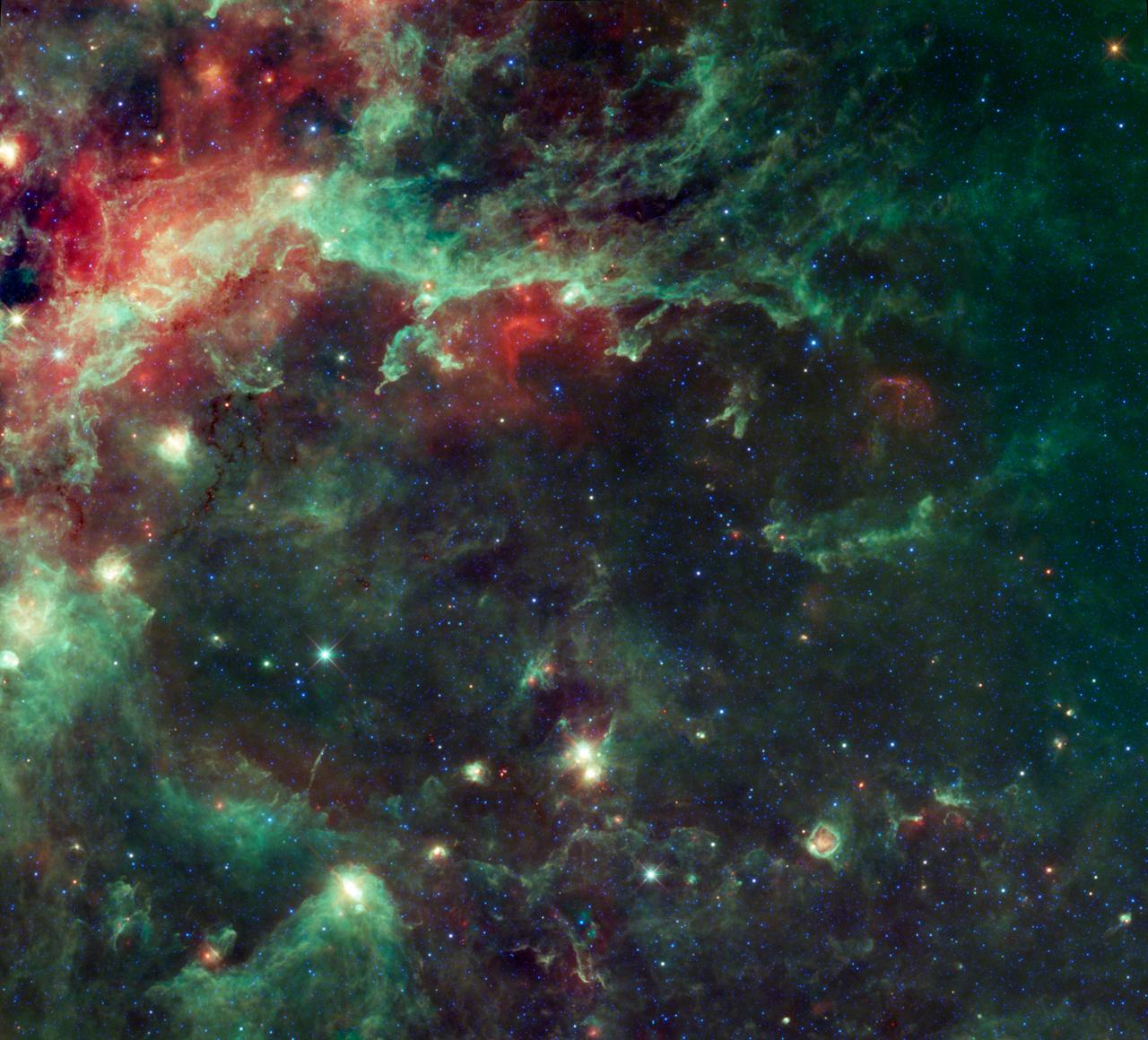
Best known as a swan winging its way across the night, the constellation Cygnus is easily seen in the northern hemisphere summertime sky. NASA WISE telescope captured this image of a huge complex of star-forming clouds and stellar clusters.
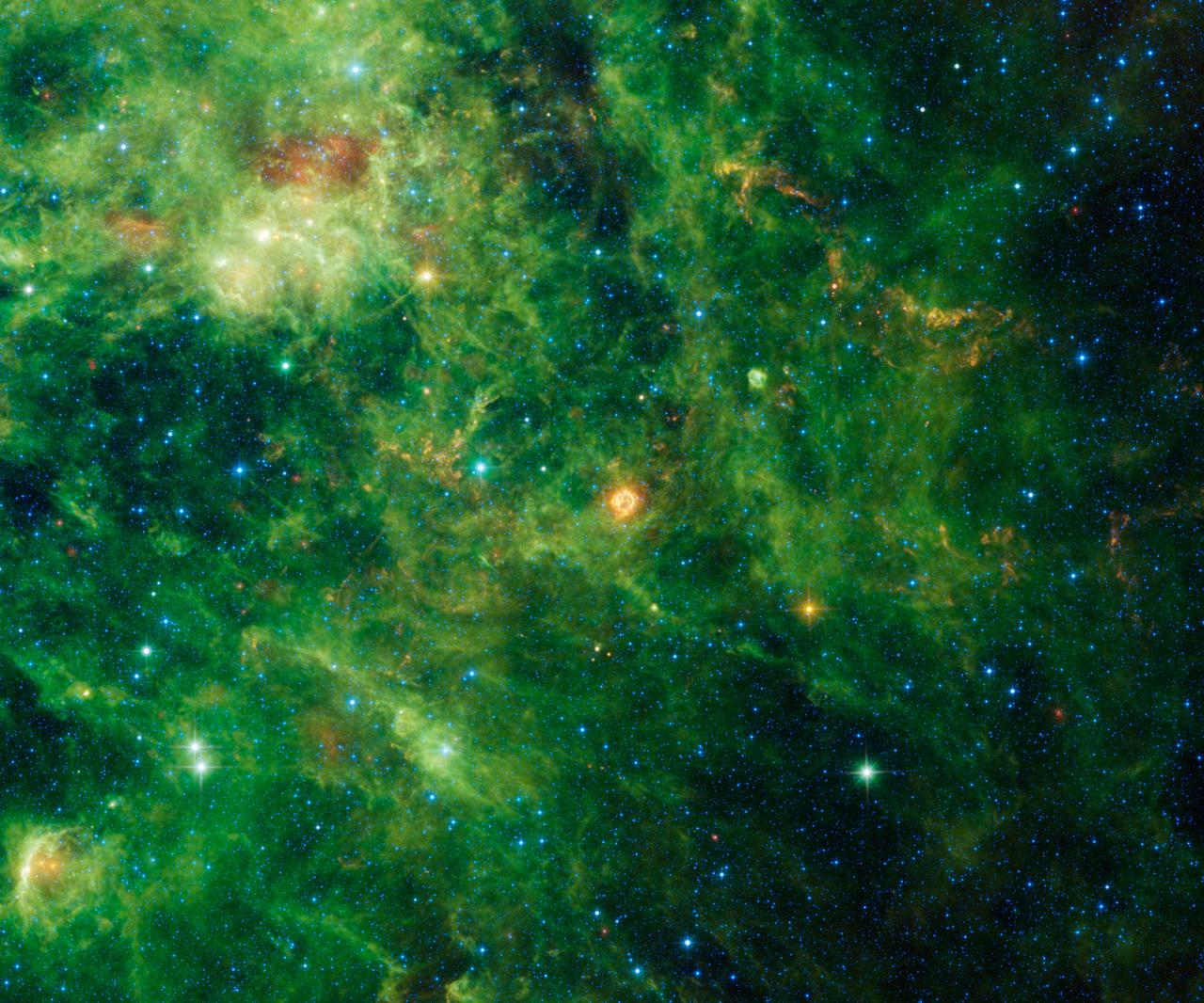
Listed as Cassiopeia A, this remnant of the supernova is one of the brightest radio sources in the known universe. More recently, NASA WISE telescope detected infrared echoes of the flash of light rippling outwards from the supernova.

This mosaic from NASA WISE Telescope is of the Soul Nebula. It is an open cluster of stars surrounded by a cloud of dust and gas located about 6,500 light-years from Earth in the constellation Cassiopeia, near the Heart Nebula.
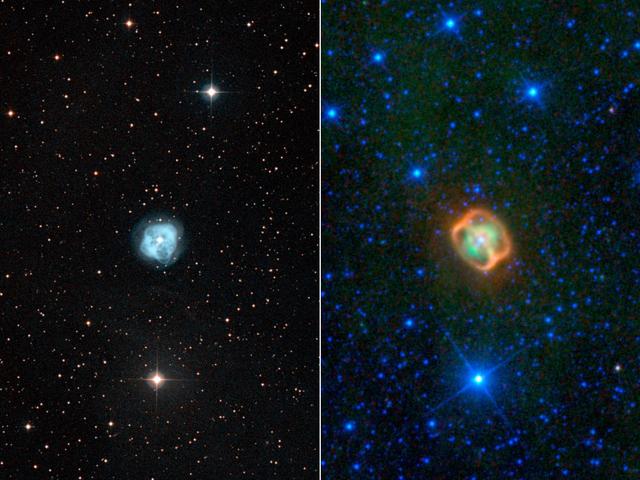
This image composite shows two views of a puffy, dying star, or planetary nebula, known as NGC 1514. At left is a view from a ground-based, visible-light telescope; the view on the right shows the object in infrared light from NASA WISE telescope.
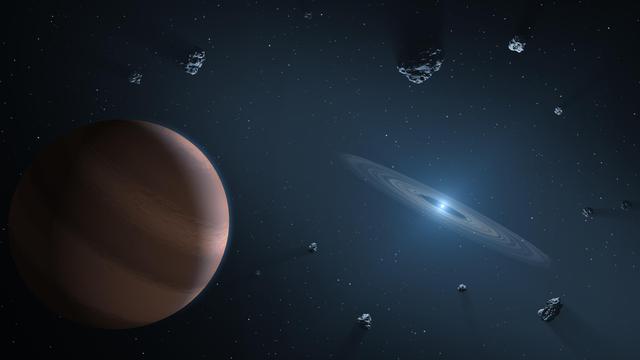
This artist's concept shows an exoplanet and debris disk orbiting a polluted white dwarf. White dwarfs are dim, dense remnants of stars similar to the Sun that have exhausted their nuclear fuel and blown off their outer layers. By "pollution," astronomers mean heavy elements invading the photospheres -- the outer atmospheres -- of these stars. The leading explanation is that exoplanets could push small rocky bodies toward the star, whose powerful gravity would pulverize them into dust. That dust, containing heavy elements from the torn-apart body, would then fall on the star. NASA's Spitzer Space Telescope has been instrumental in expanding the field of polluted white dwarfs orbited by hot, dusty disks. Since launch in 2004, Spitzer has confirmed about 40 of these special stars. Another space telescope, NASA's Wide-field Infrared Survey Explorer (WISE), also detected a handful, bringing the total up to about four dozen known today. Because these objects are so faint, infrared light is crucial to identifying them. https://photojournal.jpl.nasa.gov/catalog/PIA22084
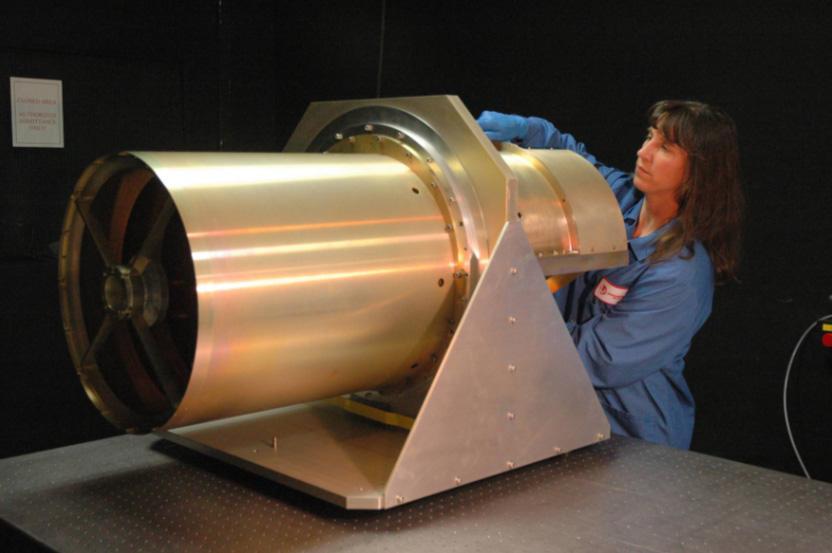
This image shows NASA 40 cm diameter Wide-field Infrared Survey Explorer telescope. Here the lead optical test engineer attaches the back-end imager optics to the afocal.
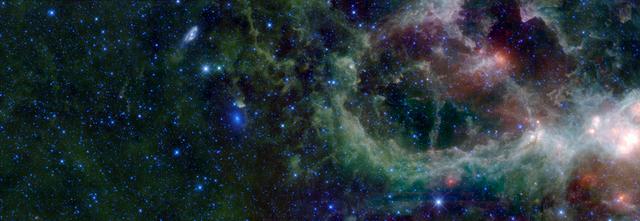
This mosaic of images from NASA WISE Telescope is in the constellation of Cassiopeia. This region contains a large star forming nebula within the Milky Way Galaxy, sometimes called the Heart Nebula, and is over 6 thousand light-years from Earth.
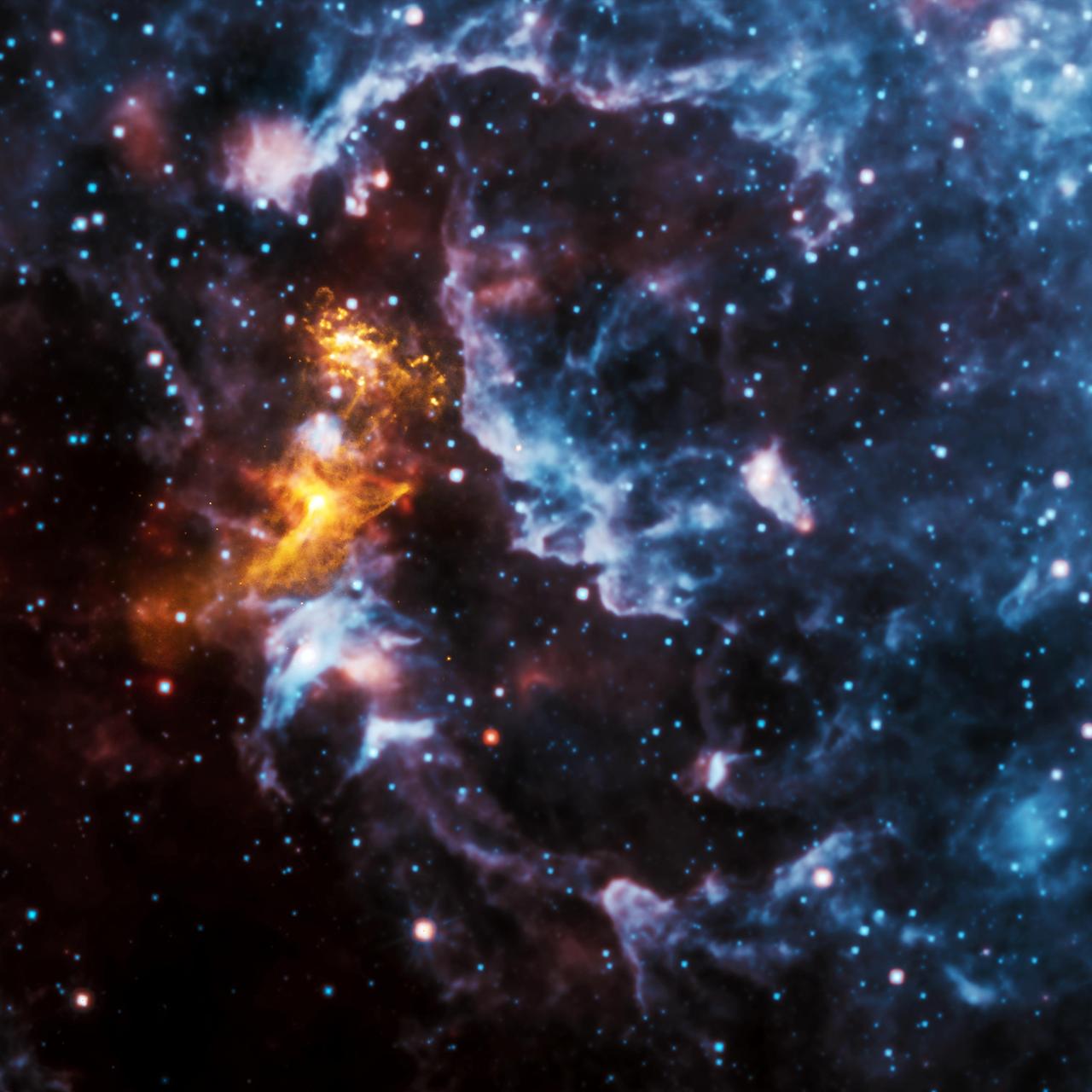
In this image of PSR B1509-58 about 170,000 light-years from Earth, X-rays from NASA Chandra in gold are seen along with infrared data from NASA Wide-field Infrared Survey Explorer WISE telescope in red, green and blue.

Peering more than 10 billion light-years into the distance, WISE has found tens of millions of actively feeding supermassive lack holes across the full sky. The orange circles highlight those that the telescope identified in a small patch of sky; the two zoomed-in images came from the Hubble Space Telescope. WISE easily sees these monsters because their powerful, accreting black holes warm the dust, causing it to glow in infrared light. The blue circles indicate black holes that were detected using visible-light imagers. In most, that light is blocked by dust. https://photojournal.jpl.nasa.gov/catalog/PIA23588
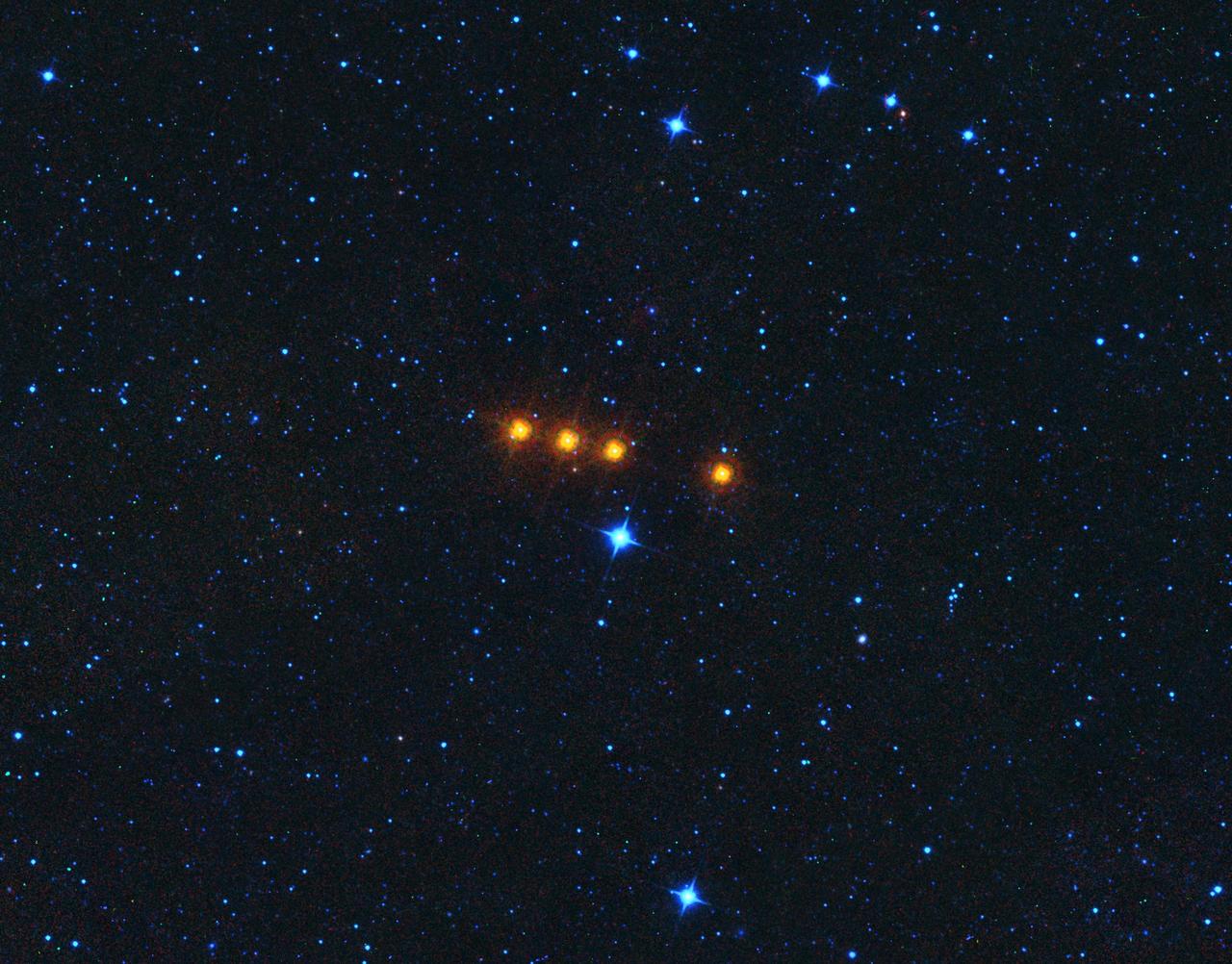
The asteroid Euphrosyne glides across a field of background stars in this time-lapse view from NASA's WISE spacecraft. WISE obtained the images used to create this view over a period of about a day around May 17, 2010, during which it observed the asteroid four times. Because WISE (renamed NEOWISE in 2013) is an infrared telescope, it senses heat from asteroids. Euphrosyne is quite dark in visible light, but glows brightly at infrared wavelengths. This view is a composite of images taken at four different infrared wavelengths: 3.4 microns (color-coded blue), 4.6 microns (cyan), 12 microns (green) and 22 microns (red). The moving asteroid appears as a string of red dots because it is much cooler than the distant background stars. Stars have temperatures in the thousands of degrees, but the asteroid is cooler than room temperature. Thus the stars are represented by shorter wavelength (hotter) blue colors in this view, while the asteroid is shown in longer wavelength (cooler) reddish colors. The WISE spacecraft was put into hibernation in 2011 upon completing its goal of surveying the entire sky in infrared light. WISE cataloged three quarters of a billion objects, including asteroids, stars and galaxies. In August 2013, NASA decided to reinstate the spacecraft on a mission to find and characterize more asteroids. http://photojournal.jpl.nasa.gov/catalog/PIA19645

NASA Administrator Charles Bolden speaks at the 215th meeting of the American Astronomical Society (AAS) in Washington on Tuesday, Jan. 5, 2009. Throughout the meeting, NASA research and mission highlights will be presented from missions that include Kepler, the Spitzer Space Telescope, the Hubble Space Telescope, and the newly launched Wide-field Infrared Survey Explorer, or WISE. Photo Credit: (NASA/Bill Ingalls)

NASA Administrator Charles Bolden speaks at the 215th meeting of the American Astronomical Society (AAS) in Washington on Tuesday, Jan. 5, 2009. Throughout the meeting, NASA research and mission highlights will be presented from missions that include Kepler, the Spitzer Space Telescope, the Hubble Space Telescope, and the newly launched Wide-field Infrared Survey Explorer, or WISE. Photo Credit: (NASA/Bill Ingalls)

NASA Administrator Charles Bolden speaks at the 215th meeting of the American Astronomical Society (AAS) in Washington on Tuesday, Jan. 5, 2009. Throughout the meeting, NASA research and mission highlights will be presented from missions that include Kepler, the Spitzer Space Telescope, the Hubble Space Telescope, and the newly launched Wide-field Infrared Survey Explorer, or WISE. Photo Credit: (NASA/Bill Ingalls)

The dusty face of the Eagle Nebula and its surroundings are revealed in this image based on data from NASA's Wide Field Survey Explorer (WISE). WISE detects infrared light, or a range of wavelengths longer than what the human eye can see. This large star forming region is about 5,700 light years away from Earth and is most famous for being home to the the "Pillars of Creation," a region famously imaged by NASA's Hubble and James Webb space telescopes. The WISE data reveals the entire structure of the nebula surrounding the pillars, which themselves can be seen as a faint yellow-green feature inside the white circle. While the WISE view of the "Pillars" is not as sharp as those taken by Webb and Hubble, the telescope's wide field of view allows us to explore the extended nebula around it. When viewed in visible light, the dust is dark and opaque. In these infrared wavelengths, the dust becomes more translucent, and emits infrared light, shown in green, yellow, and red in this image. The data used in this image came from WISE's primary mission which ran from 2009 to 2011. In 2013, NASA took the spacecraft out of hibernation and began using it to track and study near-Earth objects. The mission and the spacecraft were renamed NEOWISE. However, the data is still being used by astronomers to study objects and regions outside our solar system. Blue and cyan are used to represent infrared light at wavelengths of 3.4 and 4.6 microns, while green and red display longer wavelengths of 12 and 22 microns, respectively. Animation available at https://photojournal.jpl.nasa.gov/catalog/PIA25433
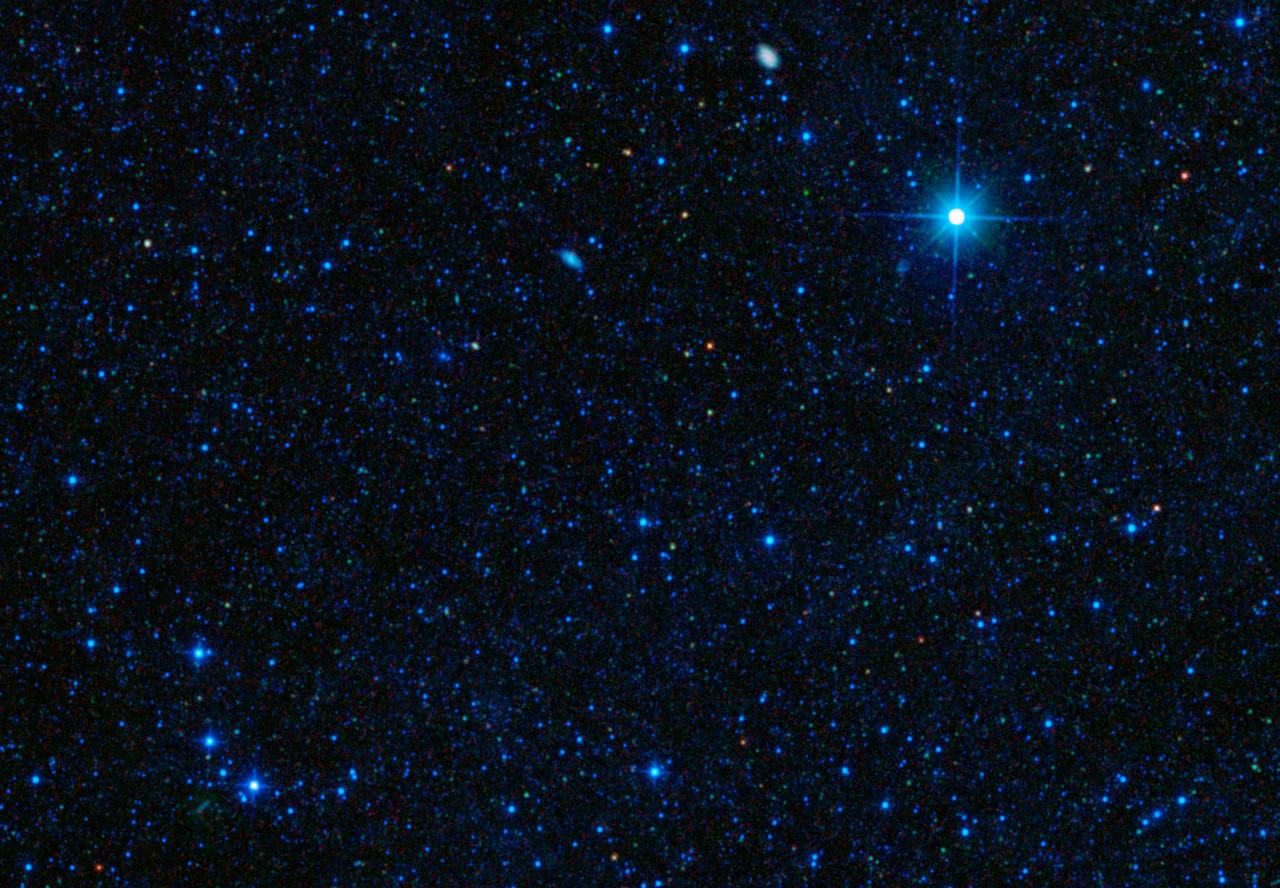
The tiny red spot in this image is one of the most efficient star-making galaxies ever observed, converting gas into stars at the maximum possible rate. The galaxy is shown here is from NASA WISE, which first spotted the rare galaxy in infrared light.
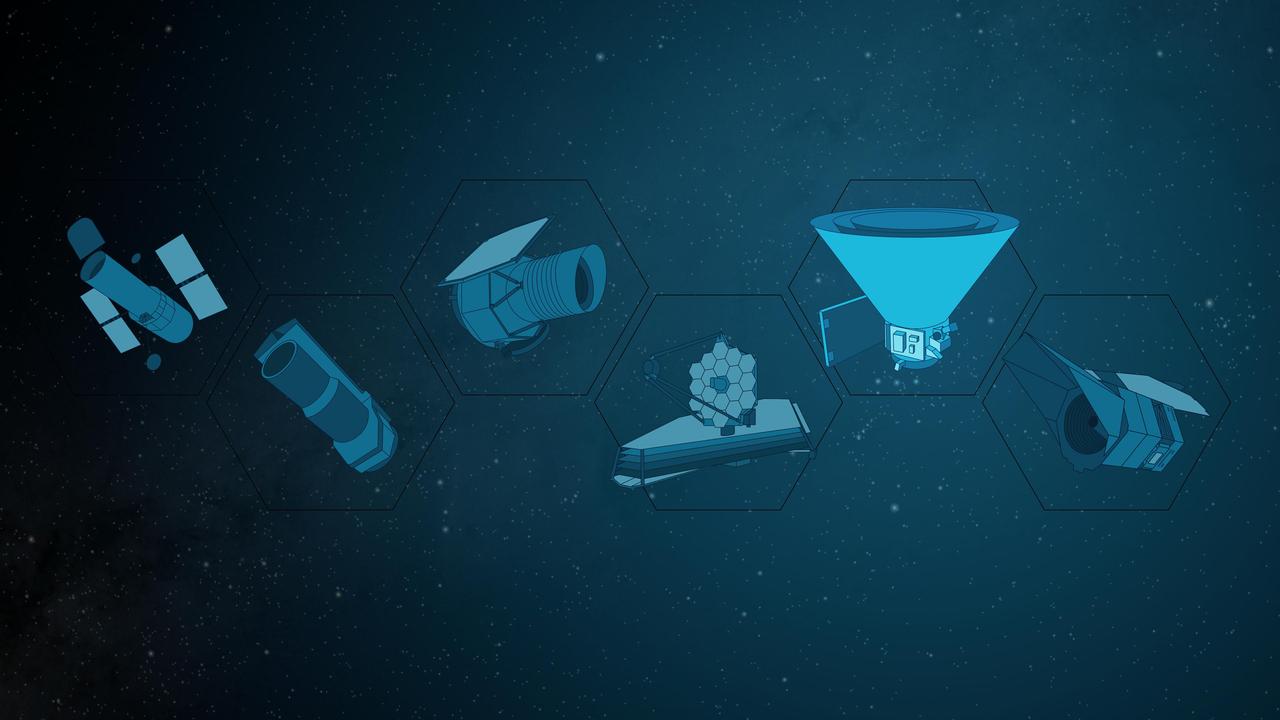
In this illustration, NASA's SPHEREx mission is highlighted among a line of other NASA space telescopes. The mission will survey the entire sky using spectroscopy, detecting hundreds of millions of stars and galaxies and generating a valuable data set that will complement the work of other NASA observatories such as those depicted here. Shown from left to right (and not to scale) are: Hubble Space Telescope, launched in April 1990 Spitzer Space Telescope, launch in August 2003 WISE (Wide-Field Infrared Survey Explorer), launched in December 2009 James Webb Space Telescope, launched in December 2021 SPHEREx (Spectro-Photometer for the History of the Universe, Epoch of Reionization and Ices Explorer), targeted for launch in February 2025 Nancy Grace Roman Space Telescope, targeted for launch by May 2027 The SPHEREx observatory will image the entire sky in 102 colors (each an individual wavelength of light) to help scientists answer big-picture questions about the origins of our universe, galaxies, and key ingredients for life in our galaxy, such as water. https://photojournal.jpl.nasa.gov/catalog/PIA26535
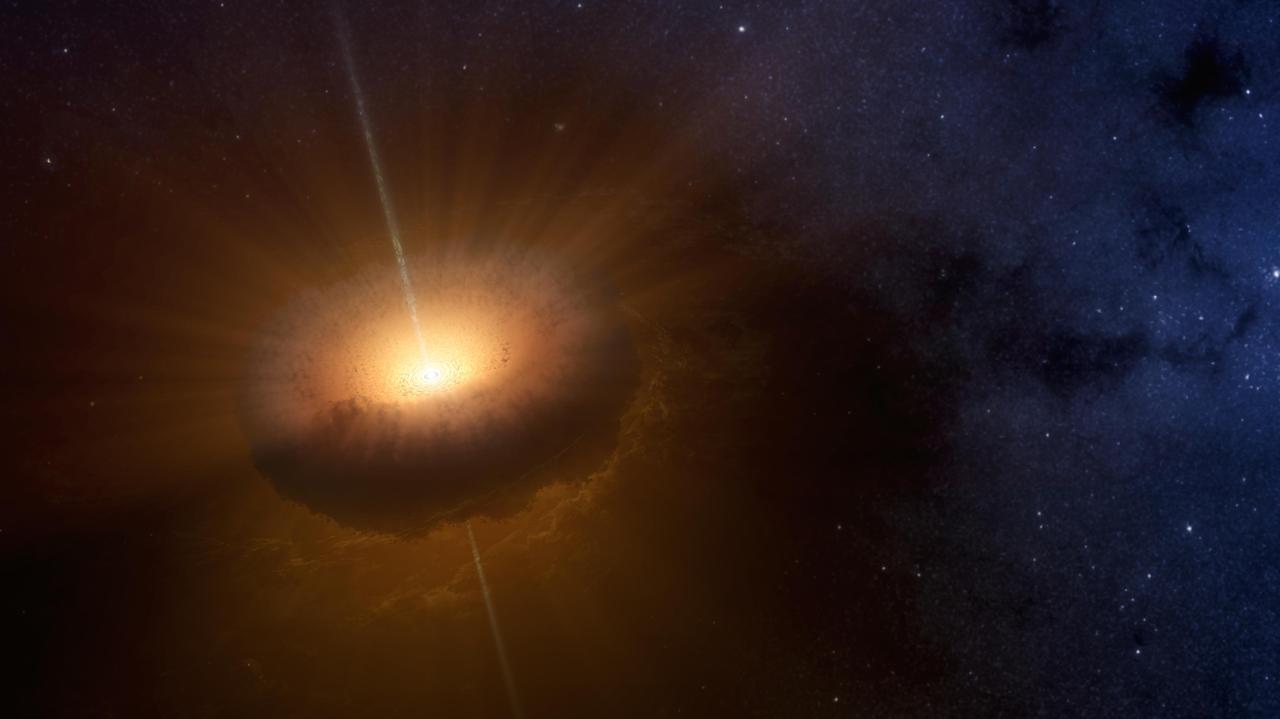
This artist's concept shows an unusual celestial object called CX330 was first detected as a source of X-ray light in 2009 by NASA's Chandra X-Ray Observatory while it was surveying the bulge in the central region of the Milky Way. A 2016 study in the Monthly Notices of the Royal Astronomical Society found that CX330 is the most isolated young star that has been discovered. Researchers compared NASA's Wide-field Infrared Survey Explorer (WISE) data from 2010 with NASA's Spitzer Space Telescope data from 2007 to come to this conclusion. CX330 is not near any star-forming region. As of the most recent observation, which was August 2015, this object was outbursting, meaning it was launching "jets" of material that slam into the gas and dust around it. Astronomers plan to continue studying the object, including with future telescopes that could view CX330 in other wavelengths of light. http://photojournal.jpl.nasa.gov/catalog/PIA20700

This image from NASA's retired Spitzer Space Telescope highlights the stars and dust clouds in the Andromeda galaxy. One of Earth's nearest galactic neighbors, Andromeda spans a swath of sky nearly 3.8 degrees across, which is close to the width of eight full Moons lined up side by side. The area around the galaxy includes data from NASA's Wide-field Infrared Survey Explorer (WISE). Spitzer observed infrared light, a range of wavelengths longer than what human eyes can detect. In this image, starlight glows blue and cyan (representing infrared wavelengths of 3.6 and 4.5 microns). Dust dominates the galaxy in red (8 microns). The longest wavelength detected by Spitzer (24 microns) gives an indication of the dust's temperature and is represented in green; it combines with the red to create orange and yellow, indicating regions where stars are forming. https://photojournal.jpl.nasa.gov/catalog/PIA26276

KENNEDY SPACE CENTER, FLA. - United Space Alliance (USA) workers J.D. Wise, left, and Robert Shackelford, with drill, try to stop an approximately 24-foot-long crack from getting any bigger on the Mobile Launcher Platform (MLP), which is holding the Space Shuttle Discovery en route to Launch Pad 39A for the STS-82 mission. Discovery was on its way out to the launch pad when engineers heard a loud bang and noticed that a crack had developed on the MLP. Rollout had begun shortly after 7 a.m. EST and was stopped at about 8:25 a.m. This Y-shaped crack is on the MLP surface and runs from near the left-hand solid rocket booster flame hole toward the near corner of the MLP. Rollout of Discovery resumed just past noon after structural engineers determined that the integrity of the MLP had not been compromised. Discovery is scheduled to lift off on the second Hubble Space Telescope servicing mission on Feb. 11.
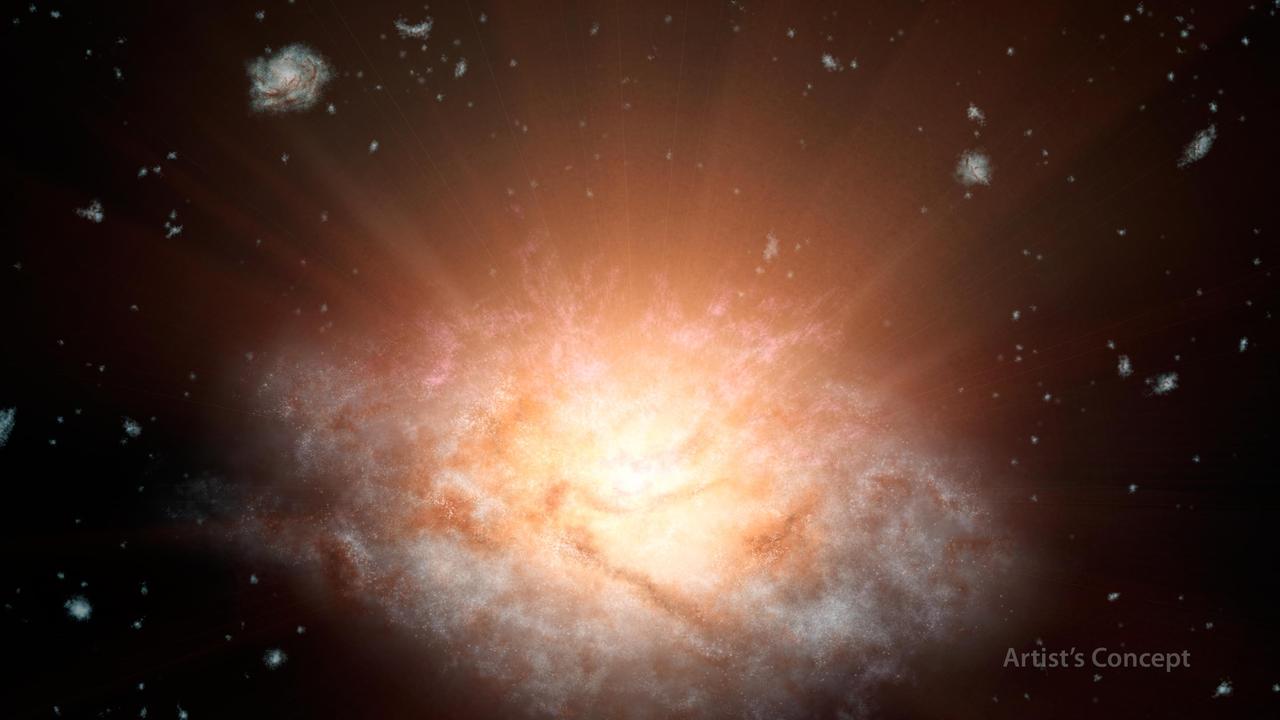
This artist's concept depicts the current record holder for the most luminous galaxy in the universe. The galaxy, named WISE J224607.57-052635.0, is erupting with light equal to more than 300 trillion suns. It was discovered by NASA's Wide-Field Infrared Survey Explorer, or WISE. The galaxy is smaller than the Milky Way, yet puts out 10,000 times more energy. Scientists think that a supermassive black hole at the center of this dusty galaxy is busily consuming gaseous material in a colossal growth spurt. As the gas is dragged toward the black hole, it heats up and blasts out visible, ultraviolet and X-ray light. The dust swaddling the galaxy absorbs this light and heats up, radiating longer-wavelength, infrared light. The dust also blocks our view of shorter, visible-light wavelengths, while letting longer-wavelengths through. This is similar to what happens when sunlight streams through our dusty atmosphere, producing a brilliant red sunrise. In fact, more than 99 percent of the light escaping from this dusty galaxy is infrared. As a result, it is much harder to see with optical telescopes. Because light from the galaxy hosting the black hole has traveled 12.5 billion years to reach us, astronomers are seeing the object as it was in the distant past. During this epoch, galaxies would have been more than five times closer together than they are now, as illustrated in the background of the artist's concept. This is due to the expansion of space -- space itself and the galaxies in it are stretching apart from each other at ever-increasing speeds. http://photojournal.jpl.nasa.gov/catalog/PIA19339

The Blue Ring Nebula was discovered in 2004 by NASA's Galaxy Evolution Explorer (GALEX) mission. Astronomers think the nebula was created by the merger of two stars, and that we are seeing the system a few thousand years after the merger, when evidence of the collision is still apparent. The blue light in the image shows the debris cloud created by the merger. As the hot cloud of material expanded into space and cooled down, it formed hydrogen molecules that collided with the interstellar medium (the particles occupying the space between stars). These collisions caused the hydrogen molecules to radiate far-ultraviolet light, which was detected by GALEX. Yellow indicates near-ultraviolet light, also detected by GALEX, which is emitted by the star at the center of the nebula and many surrounding stars. Infrared light observed by NASA's Wide-field Infrared Survey Explorer (WISE) is also shown in red, and is primarily emitted by the central star. Detailed analysis of the WISE data revealed a ring of debris around the star – further evidence of a merger. Magenta indicates optical light — light visible to the human eye — collected using the Hale Telescope. This light comes from the shockwave at the front of the expanding debris cones. The optical light helped astronomers discover that the nebula actually consists of two cones moving away from the central star. The base of one cone is moving almost directly toward Earth, while the other is moving almost directly away, and the magenta light outlines the two bases. The blue region in the image shows where the cones overlap; the non-overlapping regions are too faint for GALEX to see. Figure A shows the orientation of the cones to Earth and the way they appear to overlap. https://photojournal.jpl.nasa.gov/catalog/PIA23867

In this illustration showing NEO Surveyor, NASA's next-generation near-Earth object hunter, the spacecraft floats in an infrared starfield containing stars, star clusters, gas, and dust. More than 100 asteroids can be seen as red dots, with some of them visible in a track that shows how they were captured at different times as they marched across the sky. This starfield was observed by NASA's Wide-field Infrared Survey Explorer, or WISE, during its primary all-sky survey in March 2010 before it was put into hibernation a year later. In December 2013, the space telescope was reactivated to search for more asteroids as the NEOWISE mission. NASA's NEO Surveyor will build upon the successes of NEOWISE as the first space mission built specifically to find large numbers of hazardous asteroids and comets. The space telescope will launch to a region of gravitational stability between the Earth and the Sun called the L1 Lagrange point, where the spacecraft will orbit during its five-year primary mission. From this location, the space telescope will view the solar system in infrared wavelengths &ndash light that is invisible to the human eye. Because those wavelengths are mostly blocked by Earth's atmosphere, larger ground-based observatories may miss near-Earth objects that NEO Surveyor will be able to spot from space by using its modest light-collecting aperture of nearly 20 inches (50 centimeters). NEO Surveyor's cutting-edge detectors are designed to observe two heat-sensitive infrared bands that were chosen specifically so the spacecraft can track the most challenging-to-find near-Earth objects, such as dark asteroids and comets that don't reflect much visible light. In the infrared wavelengths to which NEO Surveyor is sensitive, these objects glow as they are heated by sunlight. In addition, NEO Surveyor will be able to find asteroids that approach Earth from the direction of the Sun, as well as those that lead and trail our planet's orbit, where they are typically obscured by the glare of sunlight – objects known as Earth Trojans. The mission is tasked by NASA's Planetary Science Division within the Science Mission Directorate; program oversight is provided by the PDCO, which was established in 2016 to manage the agency's ongoing efforts in planetary defense. NASA's Planetary Missions Program Office at Marshall Space Flight Center provides program management for NEO Surveyor. The project is being developed by JPL and is led by survey director Amy Mainzer at the University of Arizona. Established aerospace and engineering companies have been contracted to build the spacecraft and its instrumentation, including Ball Aerospace , Space Dynamics Laboratory, and Teledyne. The Laboratory for Atmospheric and Space Physics at the University of Colorado, Boulder will support operations, and IPAC-Caltech in Pasadena, California, is responsible for processing survey data and producing the mission's data products. Caltech manages JPL for NASA. https://photojournal.jpl.nasa.gov/catalog/PIA25253
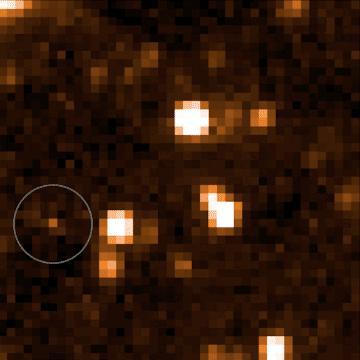
This image shows data from NASA's Near-Earth Object Wide-Field Infrared Survey Explorer (NEOWISE), launched in 2009 under the moniker WISE. The object in the bottom left corner is a brown dwarf officially named WISEA J153429.75-104303.3 and nicknamed “The Accident.” The Accident was discovered by citizen scientist Dan Caselden, who was using an online program he built to find brown dwarfs in NEOWISE data. Caselden's program attempted to remove the stationary objects emitting infrared light (like distant stars) from the NEOWISE maps and highlight moving objects that had characteristics similar to those of known brown dwarfs. He was looking at one such brown dwarf candidate when he spotted WISEA J153429.75-104303.3, which hadn't been highlighted by the program because it did not match the program's profile of a brown dwarf. The Accident confused scientists because it was faint in some key wavelengths, suggesting it was very cold (and old), but bright in others, indicating a higher temperature. A study in the Astrophysical Journal Letters posits that The Accident might be 10 billion to 13 billion years old – at least double the median age of other known brown dwarfs. That means it would have formed when our galaxy was much younger and had a different chemical makeup. The paper's authors think The Accident's brightness in certain wavelengths is an indicator that it contains very little methane, meaning it probably formed when the Milky Way was still young and carbon-poor. (Methane is composed of hydrogen and carbon). The study relies on additional observations using the W. M. Keck Observatory in Hawaii and NASA's Hubble and Spitzer Space Telescopes. Movie available at https://photojournal.jpl.nasa.gov/catalog/PIA24578

In archived NASA data, researchers have discovered "super spiral" galaxies that dwarf our own spiral galaxy, the Milky Way, and compete in size and brightness with the largest galaxies in the universe. The unprecedented galaxies have long hidden in plain sight by mimicking the appearance of typical spirals. Three examples of super spirals are presented here in images taken by the Sloan Digital Sky Survey. The super spiral on the left (Figure 1), catalogued as 2MASX J08542169+0449308, contains two galactic nuclei, instead of just the usual one, and thus looks like two eggs frying in a pan. The central image (Figure 2) shows a super spiral designated 2MASX J16014061+2718161, and it also contains the double nuclei. On the right (Figure 3), a huge galaxy with the moniker SDSS J094700.08+254045.7 stands as one of the biggest and brightest super spirals. The mega-galaxy's starry disk and spiral arms stretch about 320,000 light-years across, or more than three times the breadth of the Milky Way. These double nuclei, which are known to result from the recent merger of two galaxies, could offer a vital hint about the potential origin of super spirals. Researchers speculate that a special merger involving two, gas-rich spiral galaxies could see their pooled gases settle down into a new, larger stellar disk -- presto, a super spiral. The super spirals were discovered using the NASA/IPAC Extragalactic Database, or NED, an online repository containing information on over 100 million galaxies. NED brings together a wealth of data from many different projects, including ultraviolet light observations from the Galaxy Evolution Explorer, visible light from Sloan Digital Sky Survey, infrared light from the 2-Micron All-Sky Survey, and links to data from other missions such as NASA's Spitzer Space Telescope and Wide-Field Infrared Survey Explorer, or WISE. http://photojournal.jpl.nasa.gov/catalog/PIA20064
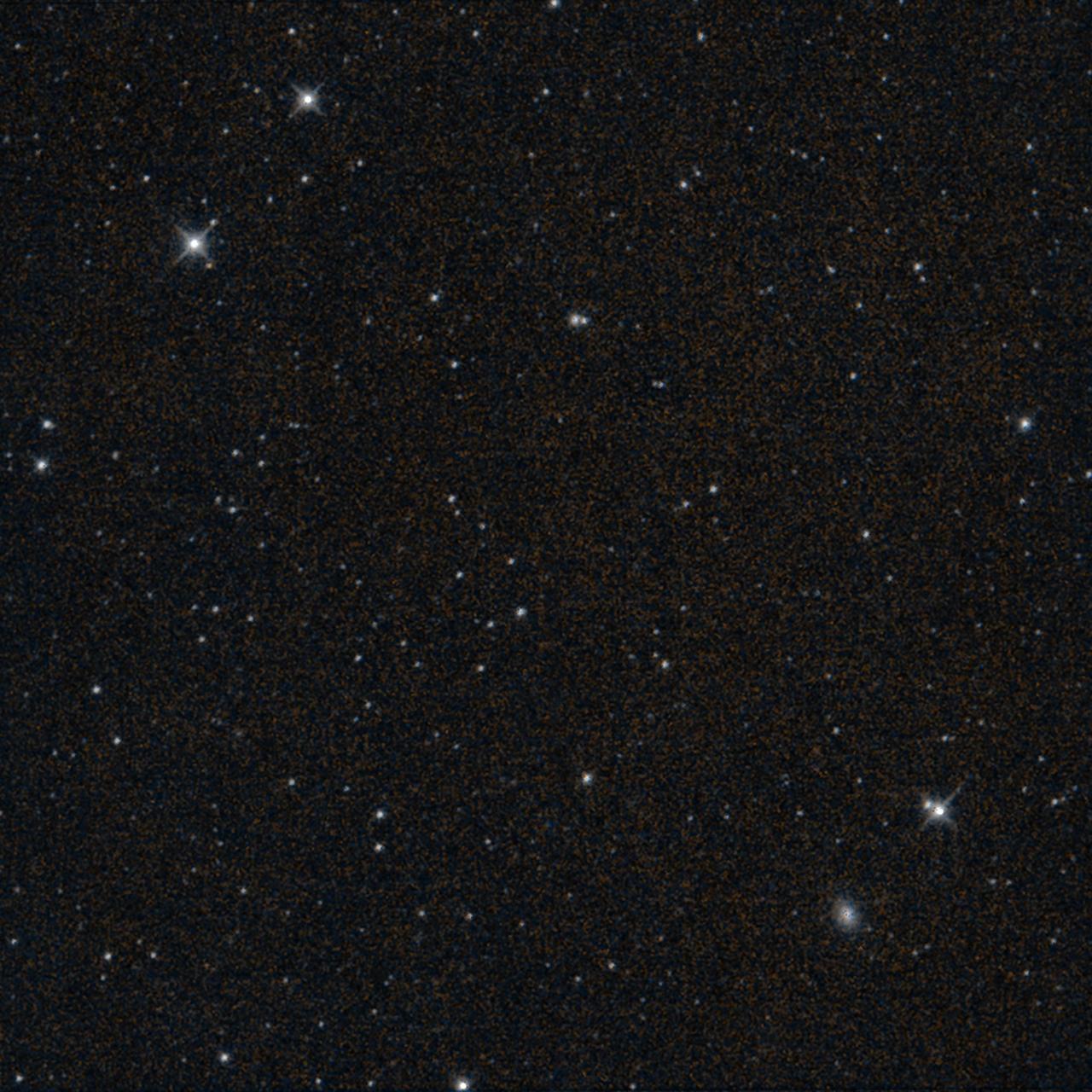
This starfield was imaged by NASA's Near-Earth Object Wide-field Infrared Survey Explorer (NEOWISE) moments before the mission's science survey ended at midnight on July 31, 2024. The observation shows part of Fornax, a constellation that is visible in Southern Hemisphere skies. The spacecraft's final image, which was processed by IPAC at Caltech, takes in a view about three times the width of Earth's full Moon. This infrared exposure is the space telescope's 26,886,704th, a number that includes observations captured during its WISE (Wide-field Infrared Survey Explorer) mission. In addition to the stars and galaxies that appear as points of light, the spiral galaxy NGC 1339 can be seen as a fuzzy oval in the bottom right of the observation. NGC 1339 is about 64 million light-years from Earth. On Aug. 8, a week after the image was captured, project engineers commanded the spacecraft to turn its transmitter off for the last time. This concluded more than 10 years of the planetary defense mission's search for asteroids and comets, including those that could pose a threat to Earth. By repeatedly observing the sky from low Earth orbit, NEOWISE created all-sky maps featuring 1.45 million infrared measurements of more than 44,000 solar system objects. Of the 3,000-plus near-Earth objects it detected, 215 were first spotted by NEOWISE. The mission also discovered 25 new comets, including the famed comet C/2020 F3 NEOWISE. https://photojournal.jpl.nasa.gov/catalog/PIA26385
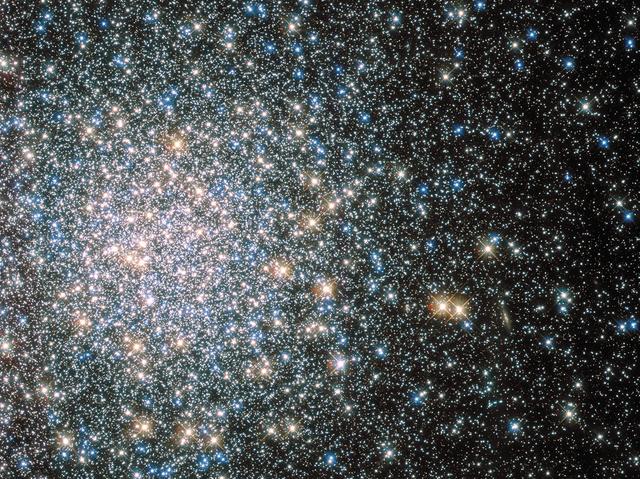
This sparkling jumble is Messier 5 — a globular cluster consisting of hundreds of thousands of stars bound together by their collective gravity. But Messier 5 is no normal globular cluster. At 13 billion years old it dates back to close to the beginning of the Universe, which is some 13.8 billion years of age. It is also one of the biggest clusters known, and at only 24 500 light-years away, it is no wonder that Messier 5 is a popular site for astronomers to train their telescopes on. Messier 5 also presents a puzzle. Stars in globular clusters grow old and wise together. So Messier 5 should, by now, consist of old, low-mass red giants and other ancient stars. But it is actually teeming with young blue stars known as blue stragglers. These stars spring to life when stars collide, or rip material from one another. Credit: ESA/NASA <b><a href="http://www.nasa.gov/audience/formedia/features/MP_Photo_Guidelines.html" rel="nofollow">NASA image use policy.</a></b> <b><a href="http://www.nasa.gov/centers/goddard/home/index.html" rel="nofollow">NASA Goddard Space Flight Center</a></b> enables NASA’s mission through four scientific endeavors: Earth Science, Heliophysics, Solar System Exploration, and Astrophysics. Goddard plays a leading role in NASA’s accomplishments by contributing compelling scientific knowledge to advance the Agency’s mission. <b>Follow us on <a href="http://twitter.com/NASAGoddardPix" rel="nofollow">Twitter</a></b> <b>Like us on <a href="http://www.facebook.com/pages/Greenbelt-MD/NASA-Goddard/395013845897?ref=tsd" rel="nofollow">Facebook</a></b> <b>Find us on <a href="http://instagram.com/nasagoddard?vm=grid" rel="nofollow">Instagram</a></b>
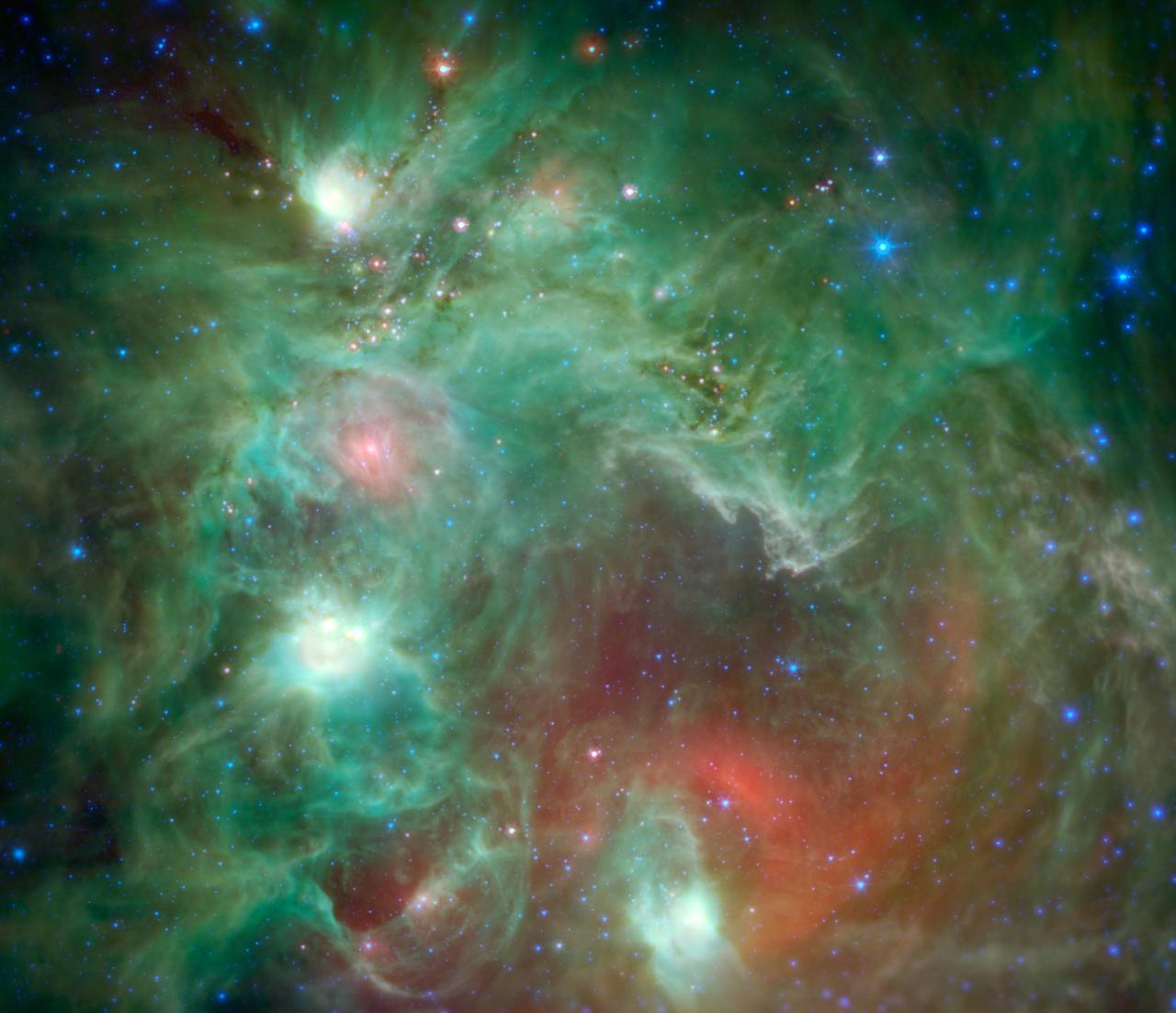
Scores of baby stars shrouded by dust are revealed in this infrared image of the star-forming region NGC 2174, as seen by NASA Spitzer Space Telescope. Found in the constellation Orion, NGC 2174 is located around 6,400 light-years away. Some of the clouds in the region resemble the face of a monkey in visible-light images, hence the nebula's nickname: the "Monkey Head." However, in infrared images such as this, the monkey disappears. That's because different clouds are highlighted in infrared and visible-light images. Found in the northern reaches of the constellation Orion, NGC 2174 is located around 6,400 light-years away. Columns of dust, slightly to the right of center in the image, are being carved out of the dust by radiation and stellar winds from the hottest young stars recently born in the area. Spitzer's infrared view provides us with a preview of the next clusters of stars that will be born in the coming millennia. The reddish spots of light scattered through the darker filaments are infant stars swaddled by blankets of warm dust. The warm dust glows brightly at infrared wavelengths. Eventually, these stars will pop out of their dusty envelopes and their light will carve away at the dust clouds surrounding them. In this image, infrared wavelengths have been assigned visible colors we see with our eyes. Light with a wavelength of 3.5 microns is shown in blue, 8.0 microns is green, and 24 microns in red. The greens show the organic molecules in the dust clouds, illuminated by starlight. Reds are caused by the thermal radiation emitted from the very hottest areas of dust. Areas around the edges that were not observed by Spitzer have been filled in using infrared observations from NASA's Wide Field Infrared Survey Explorer, or WISE. http://photojournal.jpl.nasa.gov/catalog/PIA19836