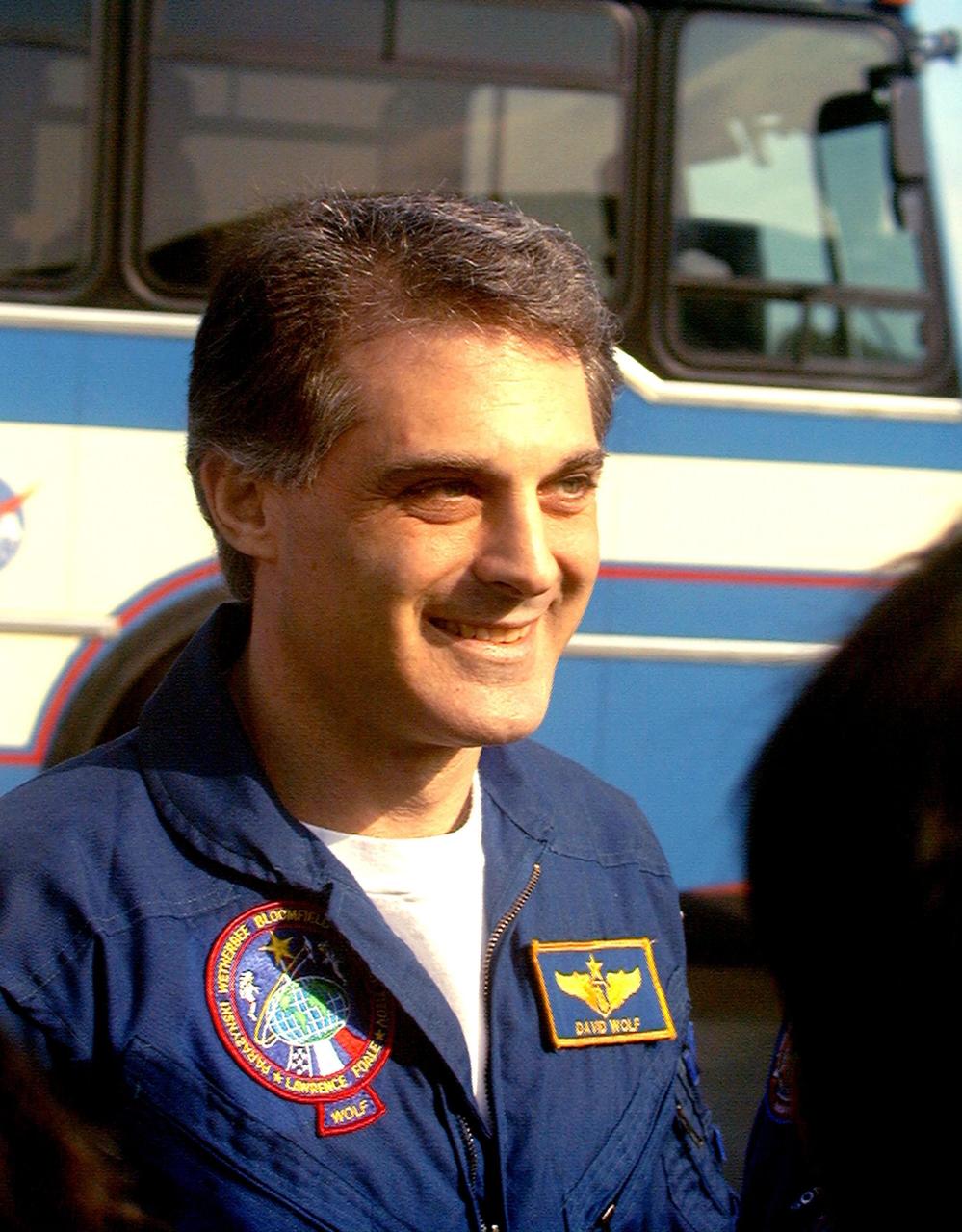
NASA astronaut and Mir 24 crew member David Wolf, M.D., enjoys a moment with the media at the Skid Strip at Cape Canaveral Air Station on Feb. 1 moments before his departure for Johnson Space Center. The STS-89 crew that brought Dr. Wolf back to Earth arrived at KSC aboard the orbiter Endeavour Jan. 31, concluding the eighth Shuttle-Mir docking mission. STS-89 Mission Specialist Andrew Thomas, Ph.D., succeeded Dr. Wolf on Mir and is scheduled to remain on the Russian space station until the STS-91 Shuttle mission returns in June 1998. In addition to the docking and crew exchange, STS-89 included the transfer of science, logistical equipment and supplies between the two orbiting spacecrafts
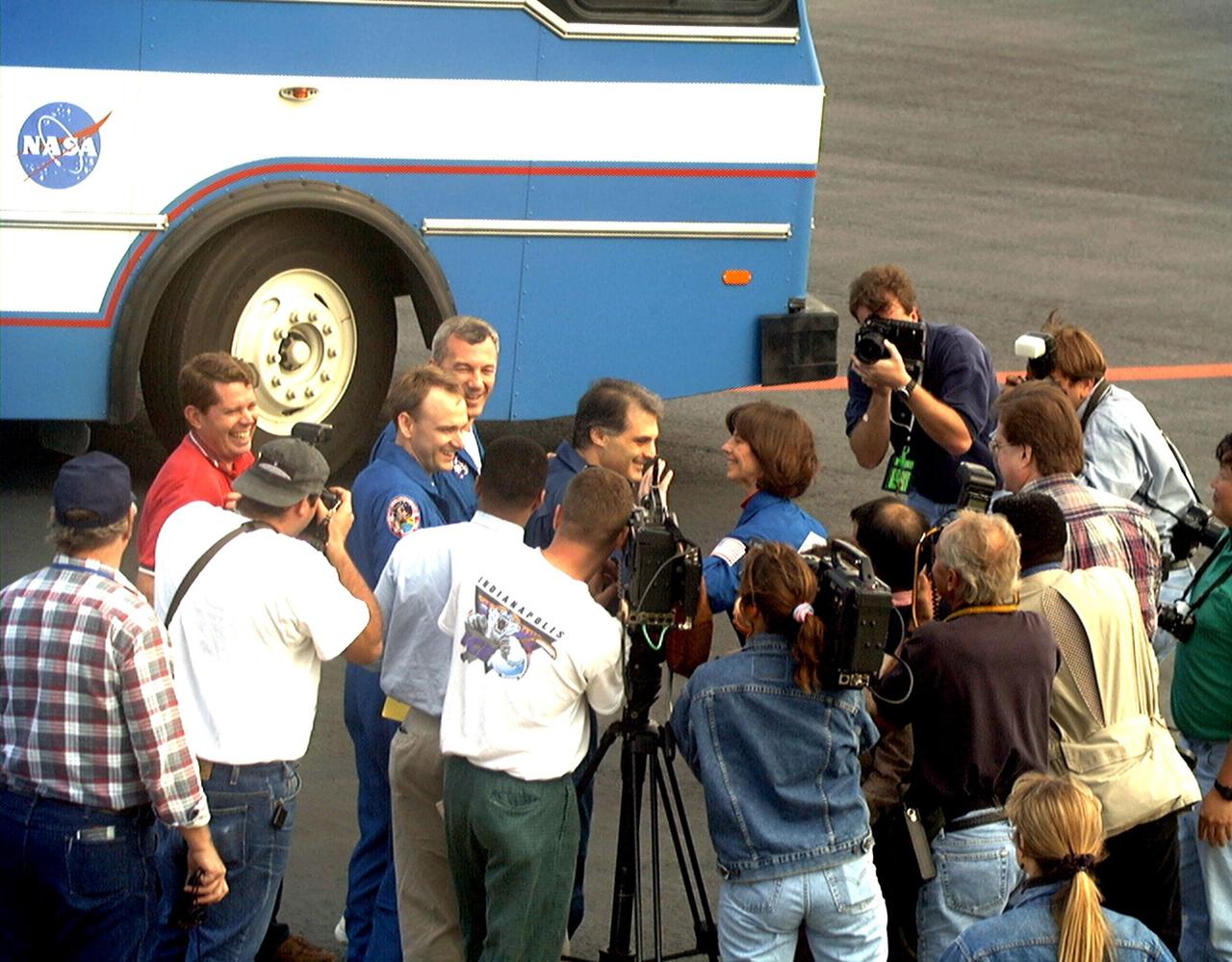
NASA astronaut and Mir 24 crew member David Wolf, M.D., enjoys a moment with the media at the Skid Strip at Cape Canaveral Air Station on Feb. 1 moments before his departure for Johnson Space Center. Other STS-89 crew members surrounding Dr. Wolf include, left to right, Pilot Joe Edwards Jr.; Commander Terrence Wilcutt; and Mission Specialist Bonnie Dunbar, Ph.D. In the red shirt behind Edwards is JSC Director of Flight Crew Operations David Leestma. The STS-89 crew that brought Dr. Wolf back to Earth arrived at KSC aboard the orbiter Endeavour Jan. 31, concluding the eighth Shuttle-Mir docking mission. STS-89 Mission Specialist Andrew Thomas, Ph.D., succeeded Dr. Wolf on Mir and is scheduled to remain on the Russian space station until the STS-91 Shuttle mission returns in June 1998. In addition to the docking and crew exchange, STS-89 included the transfer of science, logistical equipment and supplies between the two orbiting spacecrafts
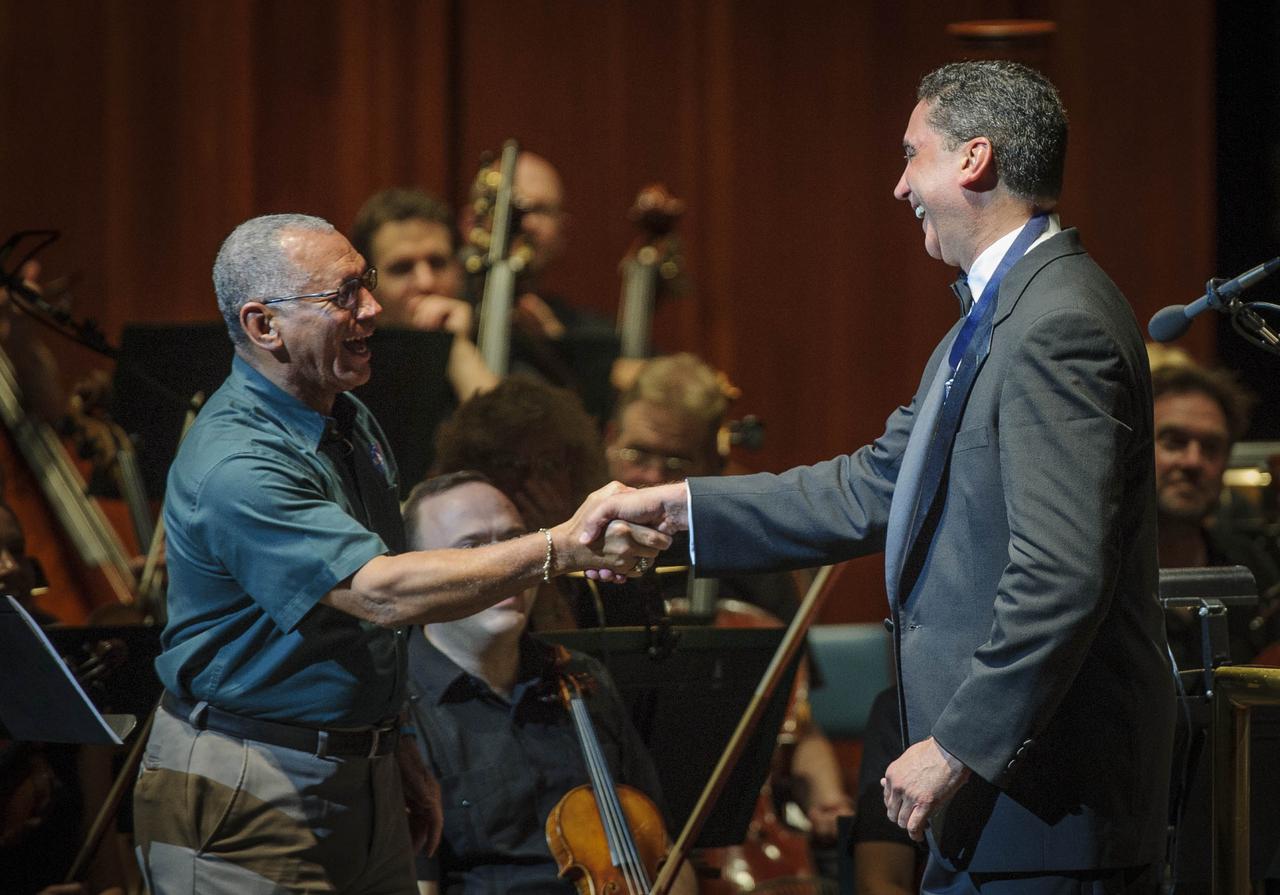
NASA Administrator Charles Bolden, left, shakes hands with Emil de Cou, conductor of the National Symphony Orchestra during a performance entitled "The Planets--An HD Odyessy", Friday evening, July 27, 2012, at the Wolf Trap National Park for the Performing Arts in Vienna, Va. Photo Credit: (NASA/Paul E. Alers)
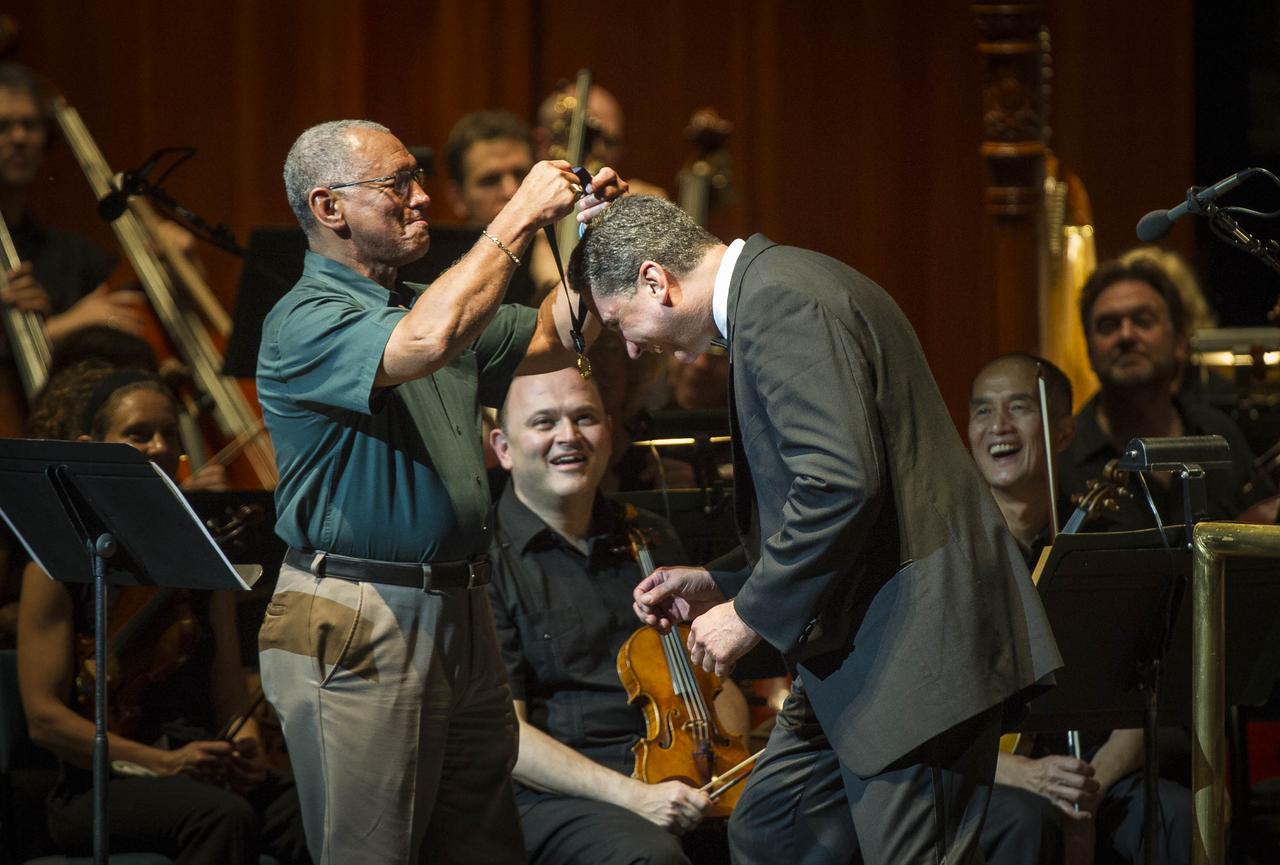
NASA Administrator Charles Bolden, left, presents a medal to Emil de Cou, conductor of the National Symphony Orchestra during a performance entitled "The Planets--An HD Odyessy", Friday evening, July 27, 2012, at the Wolf Trap National Park for the Performing Arts in Vienna, Va. Photo Credit: (NASA/Paul E. Alers)
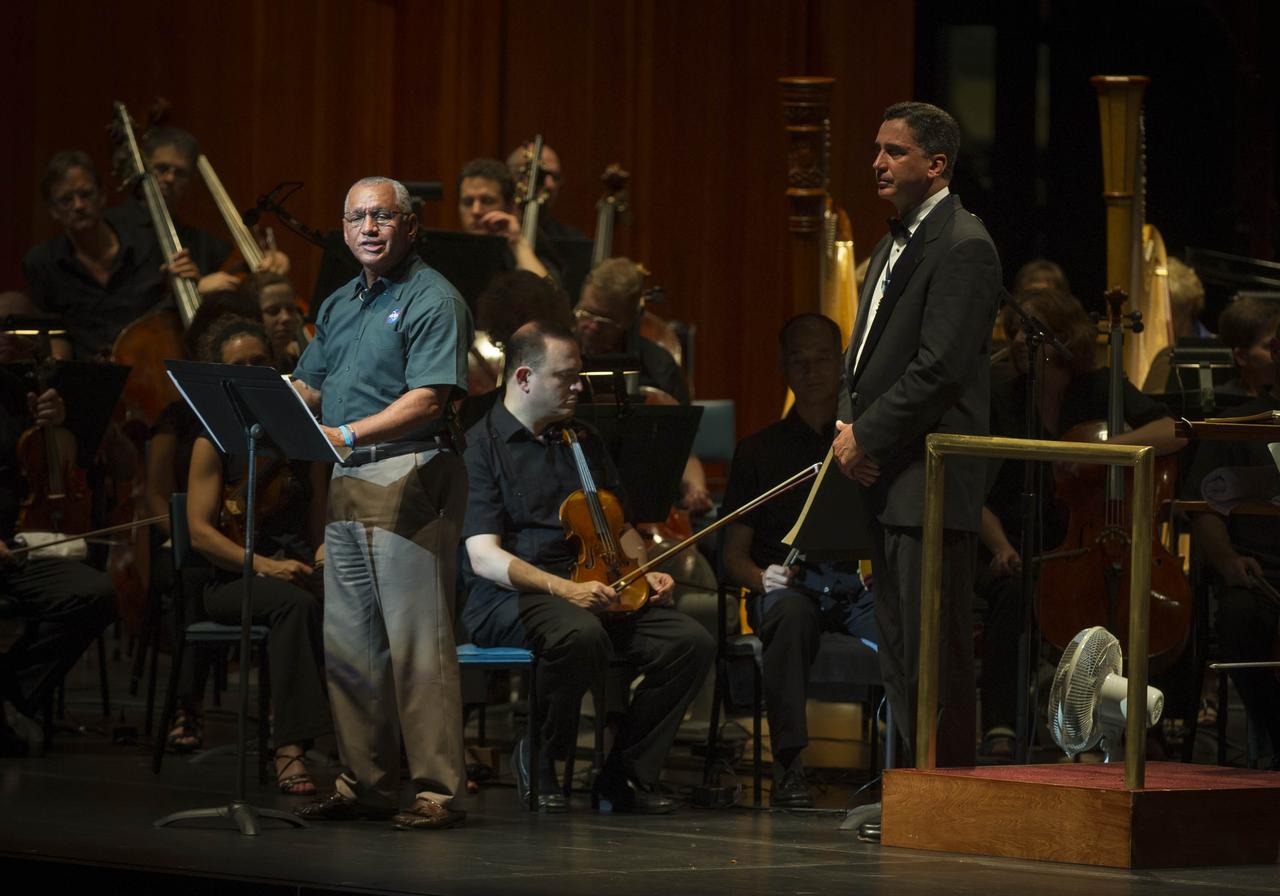
NASA Administrator Charles Bolden, left, speaks as Emil de Cou, conductor of the National Symphony Orchestra, right, looks on during a performance entitled "The Planets--An HD Odyessy", Friday evening, July 27, 2012, at the Wolf Trap National Park for the Performing Arts in Vienna, Va. Photo Credit: (NASA/Paul E. Alers)
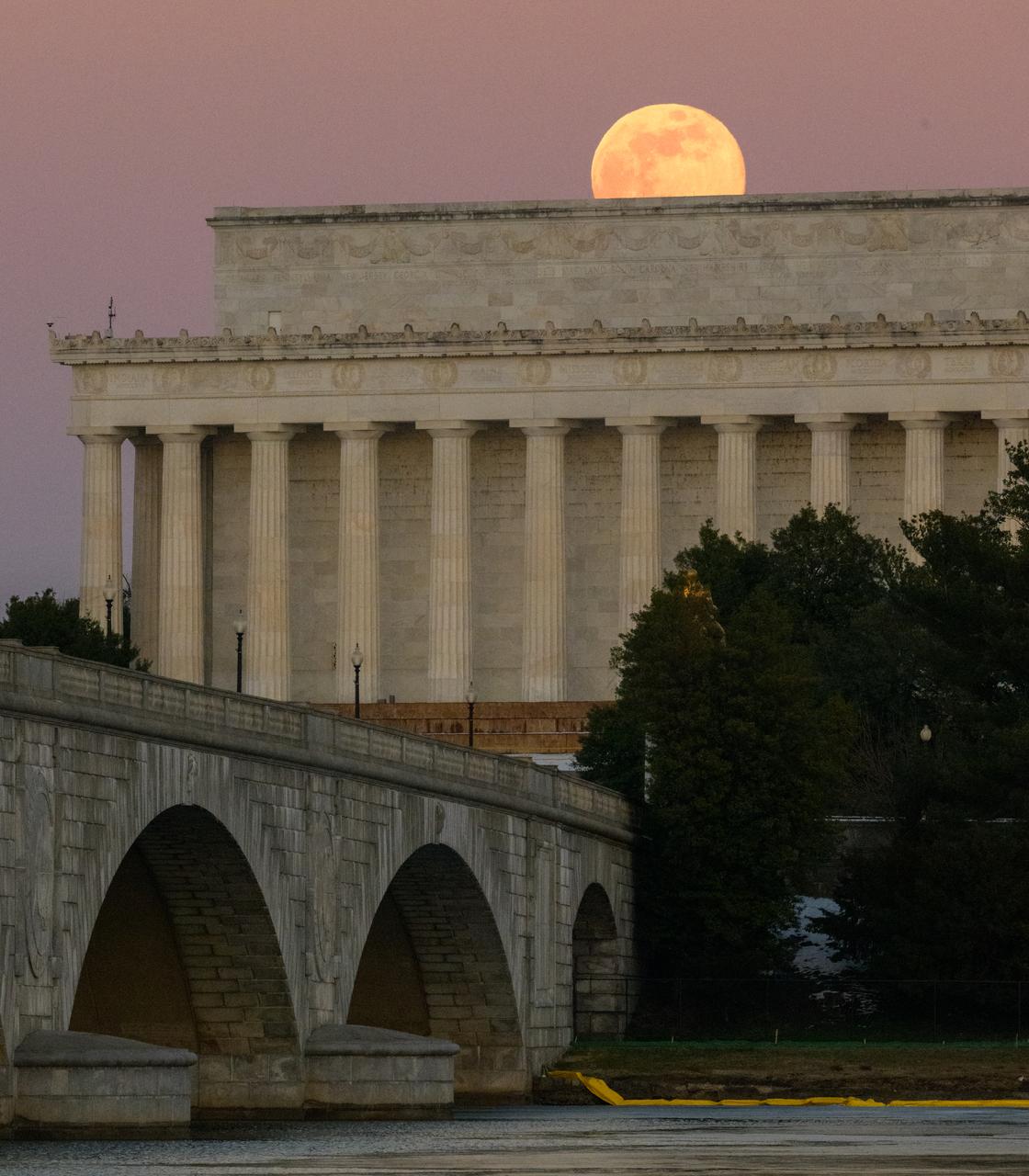
The full Moon, also known in January as the Wolf Moon, rises above the Lincoln Memorial and the Memorial Bridge, Monday, Jan. 13, 2025, as seen from Arlington, Virginia. Photo Credit: (NASA/Bill Ingalls)
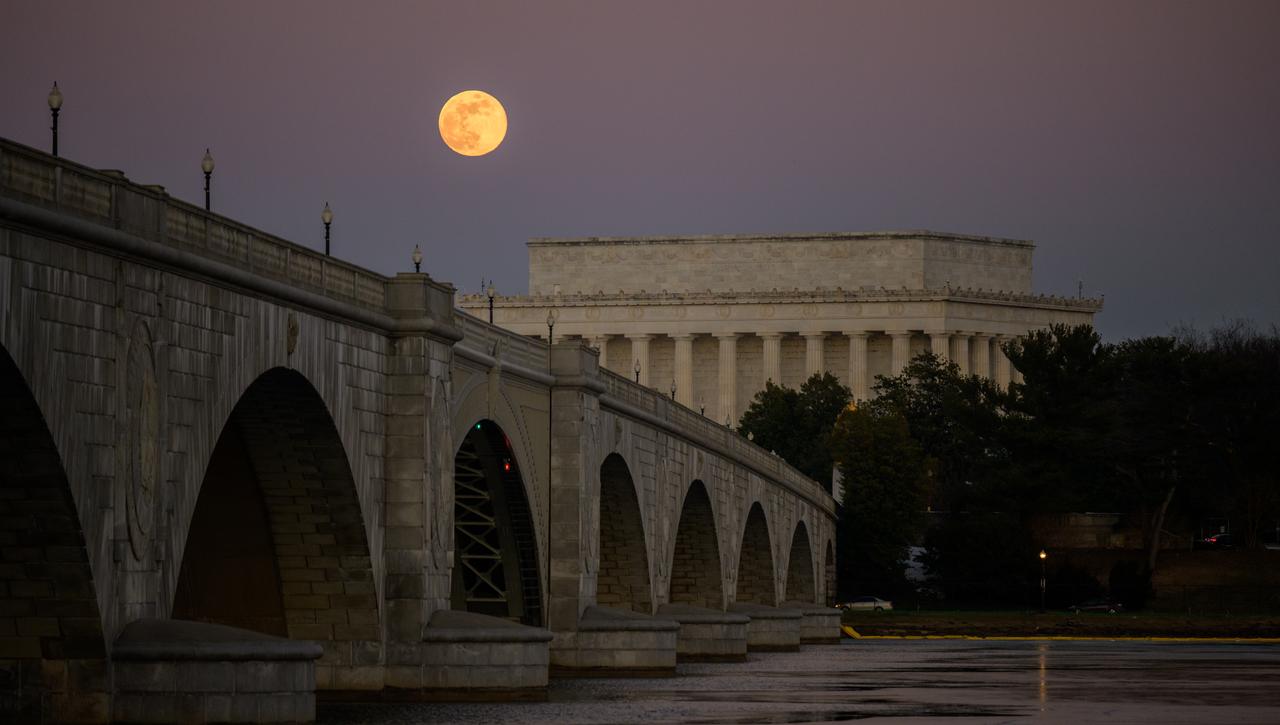
The full Moon, also known in January as the Wolf Moon, rises above the Lincoln Memorial and the Memorial Bridge, Monday, Jan. 13, 2025, as seen from Arlington, Virginia. Photo Credit: (NASA/Bill Ingalls)
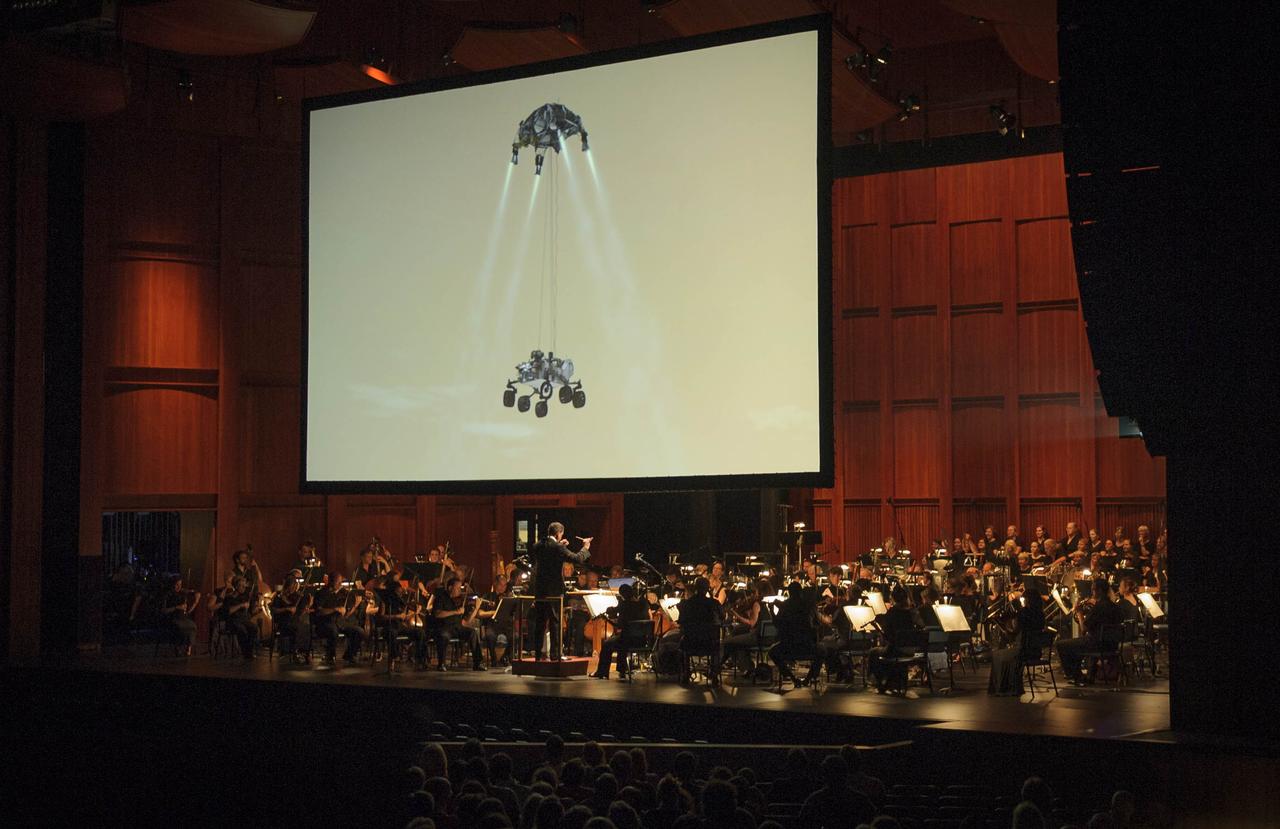
An image of the Mars rover Curiosity is seen on a giant screen as Emil de Cou, conducts the National Symphony Orchestra during a performance entitled "The Planets--An HD Odyessy", Friday evening, July 27, 2012, at the Wolf Trap National Park for the Performing Arts in Vienna, Va. Photo Credit: (NASA/Paul E. Alers)
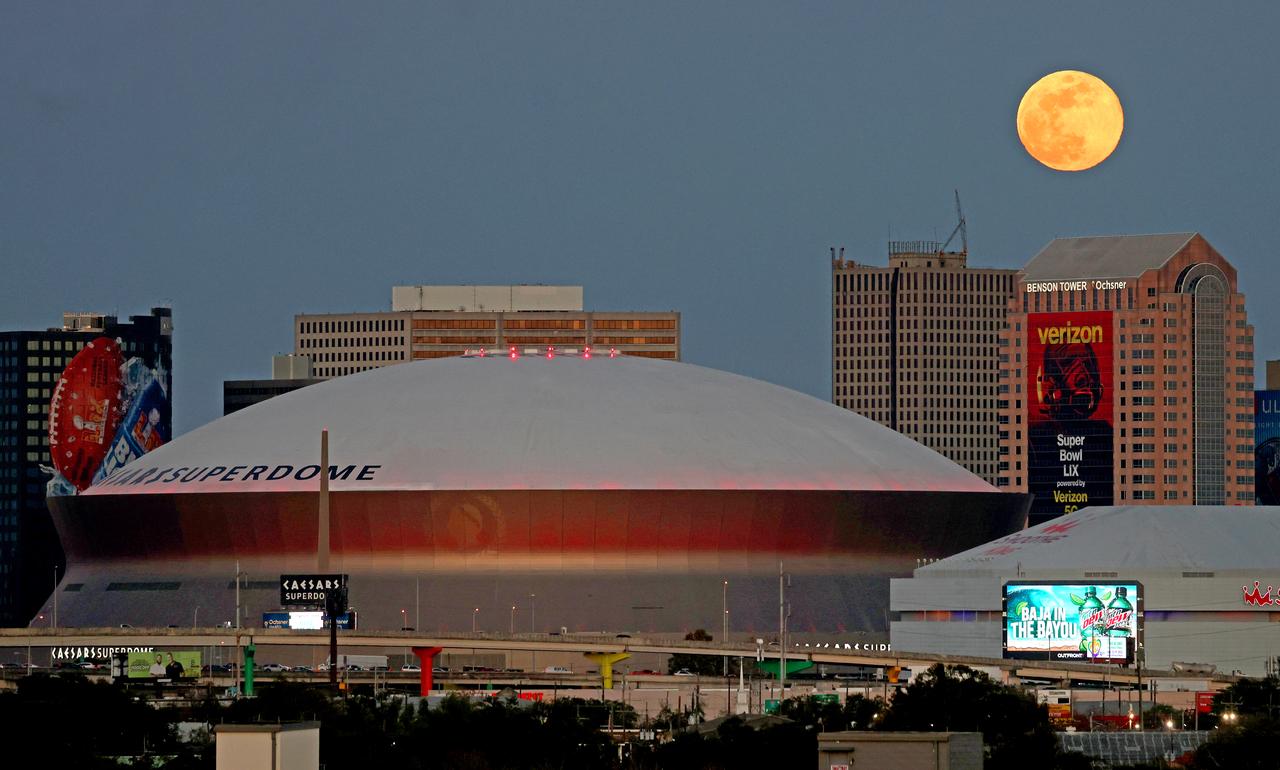
The full moon rises over the Superdome and the city of New Orleans, Louisiana on Monday evening, January 13, 2025. The Wolf Moon, also known as the Ice or Cold Moon, was full at 5:27 p.m. EST. New Orleans is home to NASA’s Michoud Assembly Facility where several pieces of hardware for the SLS (Space Launch system) are being built. Image credit: NASA/Michael DeMocker
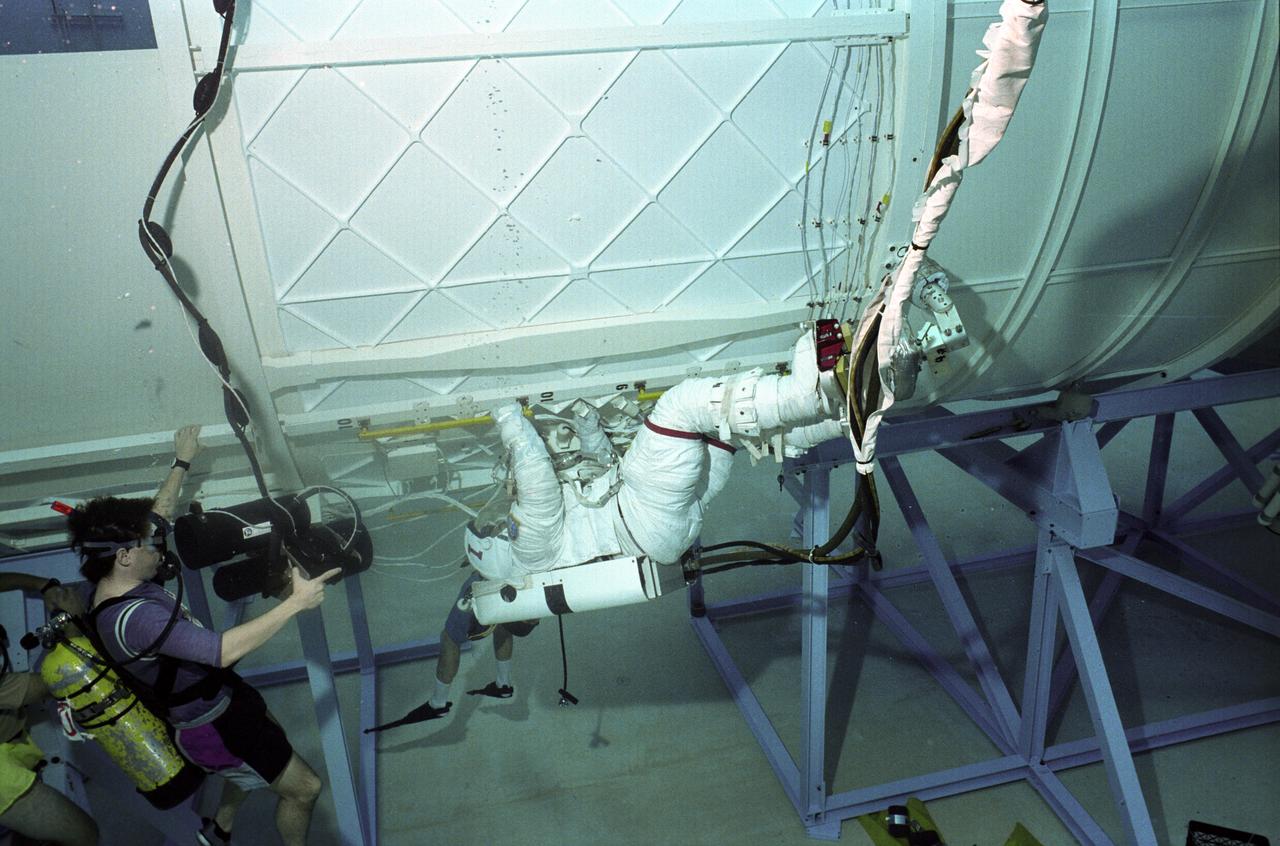
Astronauts Tamara Jernigan (#1) and David Wolf (#2) are training in the Neutral Buoyancy Simulator (NBS) at Marshall Space Flight center with an exercise for International Space Station Alpha. The NBS provided the weightless environment encountered in space needed for testing and the practices of Extravehicular Activities (EVA).
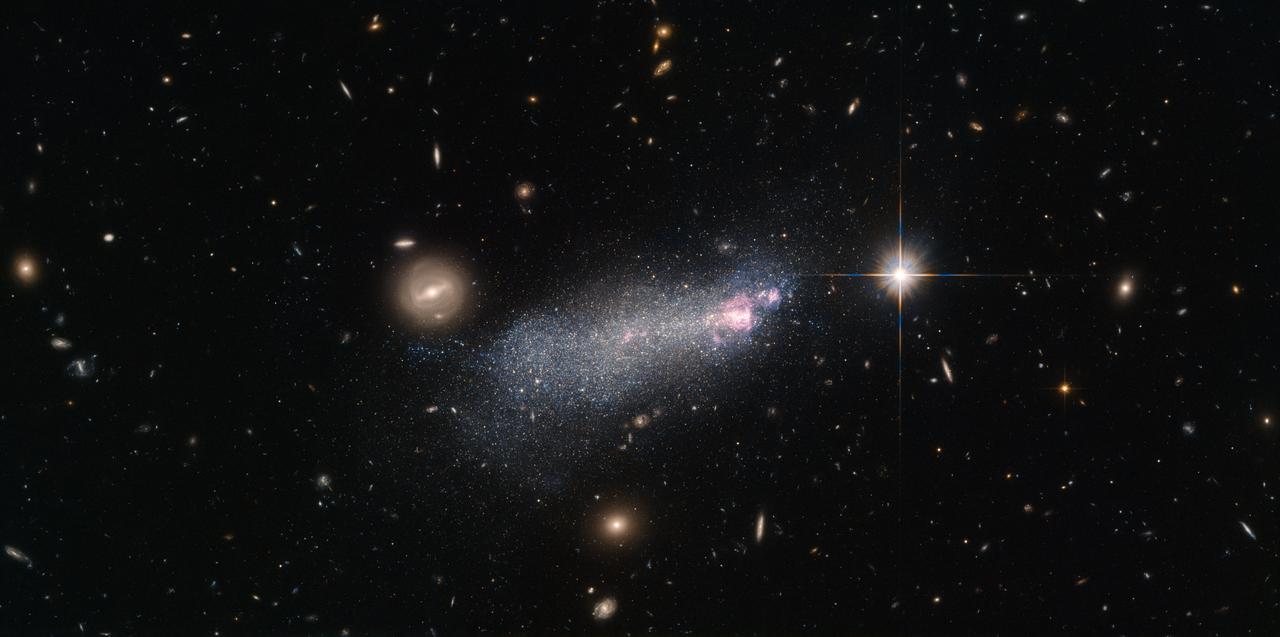
This NASA/European Space Agency (ESA) Hubble Space Telescope picture shows a galaxy named SBS 1415+437 (also called SDSS CGB 12067.1), located about 45 million light-years from Earth. SBS 1415+437 is a Wolf-Rayet galaxy, a type of star-bursting galaxy with an unusually high number of extremely hot and massive stars known as Wolf-Rayet stars. These stars can be around 20 times as massive as the sun, but seem to be on a mission to shed surplus mass as quickly as possible — they blast substantial winds of particles out into space, causing them to dwindle at a rapid rate. A typical star of this type can lose a mass equal to that of our sun in just 100,000 years! These massive stars are also incredibly hot, with surface temperatures some 10 to 40 times that of the sun, and very luminous, glowing at tens of thousands to several million times the brightness of the sun. Many of the brightest and most massive stars in the Milky Way are Wolf-Rayet stars. Because these stars are so intense they do not last very long, burning up their fuel and blasting their bulk out into the cosmos on very short timescale — only a few hundred thousand years. Because of this it is unusual to find more than a few of these stars per galaxy — except in Wolf-Rayet galaxies, like the one in this image. Credit: ESA/Hubble & NASA <b><a href="http://www.nasa.gov/audience/formedia/features/MP_Photo_Guidelines.html" rel="nofollow">NASA image use policy.</a></b> <b><a href="http://www.nasa.gov/centers/goddard/home/index.html" rel="nofollow">NASA Goddard Space Flight Center</a></b> enables NASA’s mission through four scientific endeavors: Earth Science, Heliophysics, Solar System Exploration, and Astrophysics. Goddard plays a leading role in NASA’s accomplishments by contributing compelling scientific knowledge to advance the Agency’s mission. <b>Follow us on <a href="http://twitter.com/NASAGoddardPix" rel="nofollow">Twitter</a></b> <b>Like us on <a href="http://www.facebook.com/pages/Greenbelt-MD/NASA-Goddard/395013845897?ref=tsd" rel="nofollow">Facebook</a></b> <b>Find us on <a href="http://instagrid.me/nasagoddard/?vm=grid" rel="nofollow">Instagram</a></b> <b><a href="http://goes.gsfc.nasa.gov/" rel="nofollow">Credit: NOAA/NASA GOES Project</a></b>
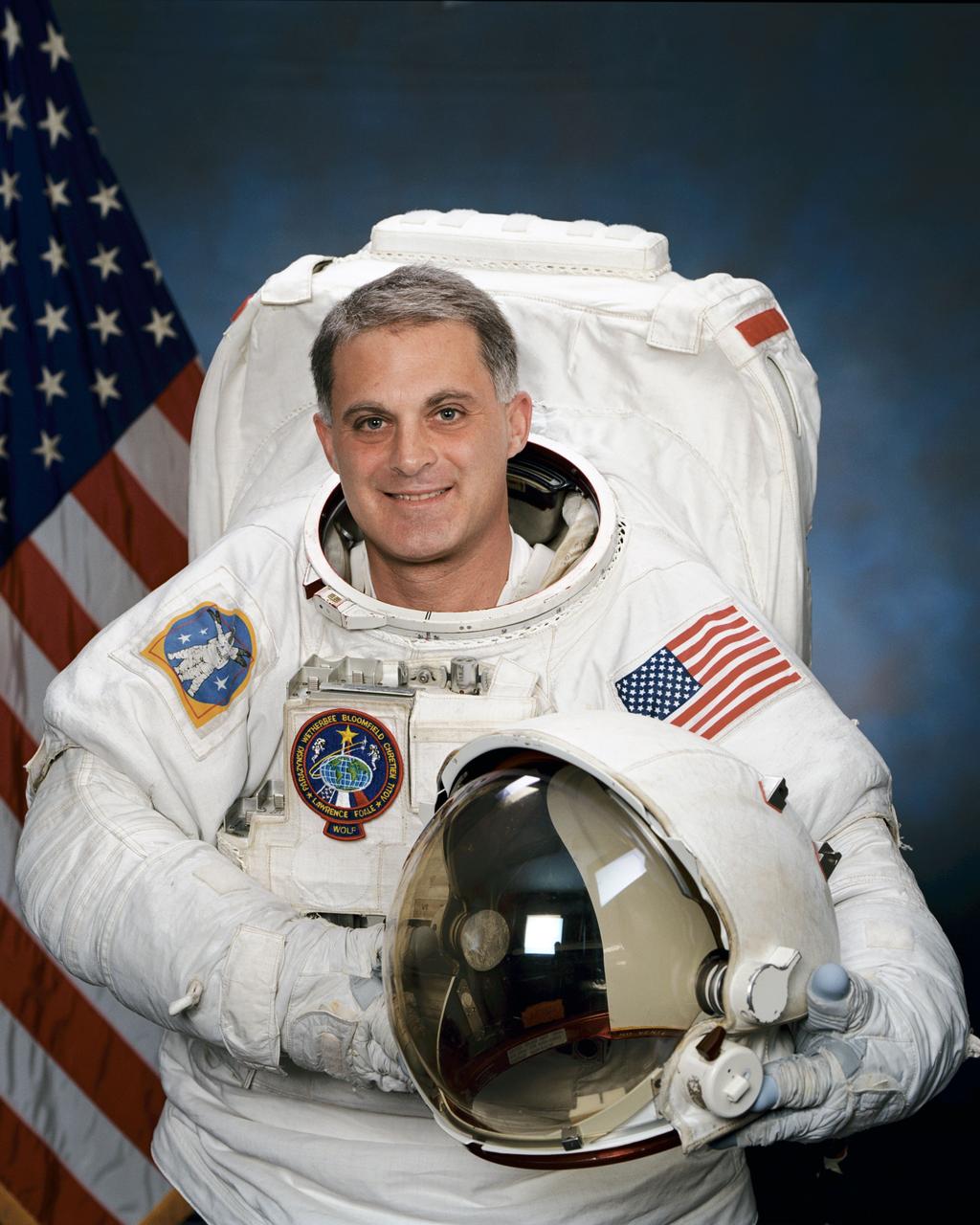
JSC2000-03056 (12 April 2000) --- Astronaut David A. Wolf, mission specialist.
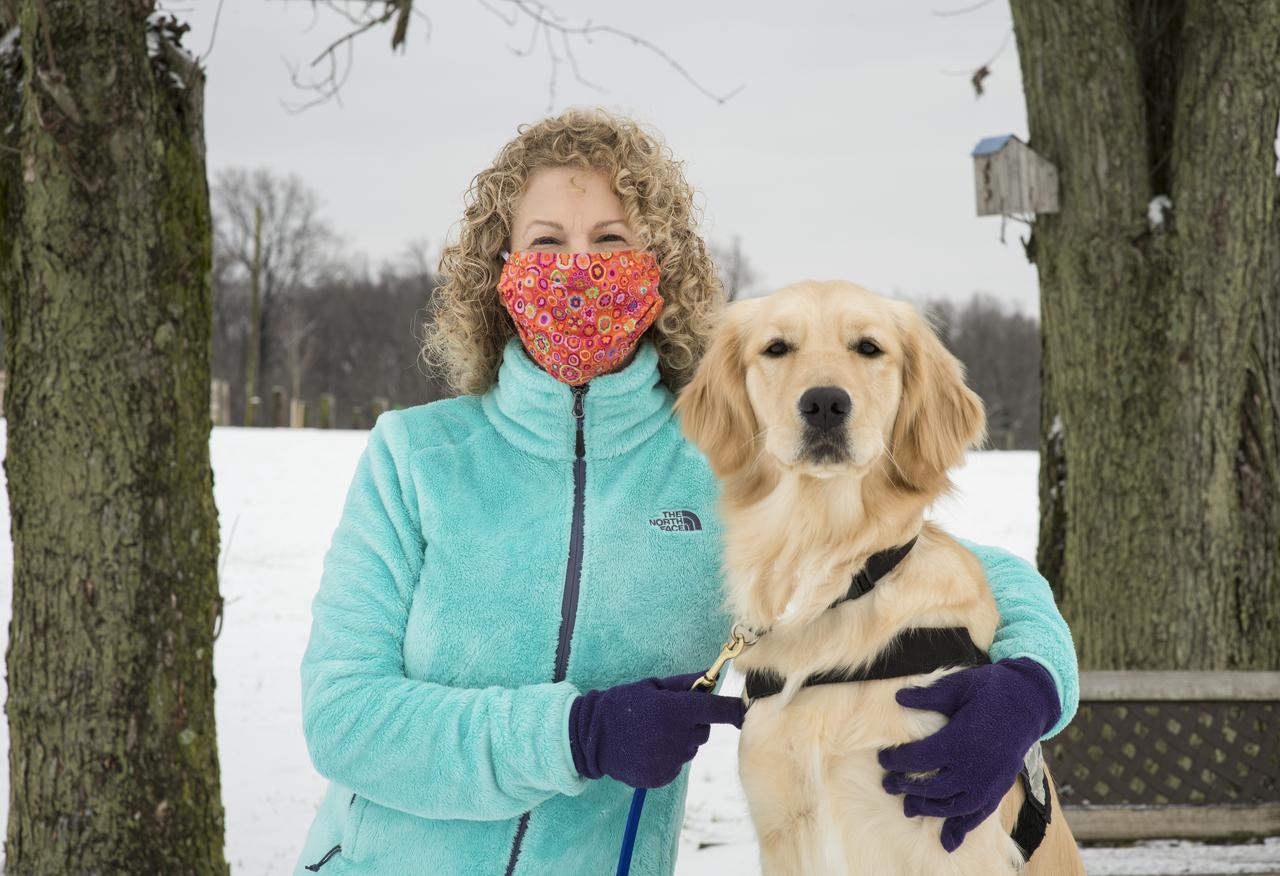
“It was part of my career, but then it was also personal. I was doing it on a volunteer basis, but it was part of my work because I was bringing my service dog in training everywhere with me, which meant to work every day and to meetings at NOAA (National Oceanic and Atmospheric Administration). And I was taking the dog across the country to meetings over at Ball Aerospace; that was all part of the training of a service dog. That was an incredible time. I really enjoyed it. “The fact that I was able to do the two combined, that to me was just such an accomplishment. To some people, it could be they got permission to do it and then that’s all they focused on was the dog, but no. I had my job I had to do. I’ve always gotten a distinguished rating in my performances my entire career, and it didn't change when I was training this service dog. “It was a challenge for sure. “After I had to turn back over the service dog I trained, it was really very difficult because the dog was with me for two years, even though I knew it was for a wonderful cause. I ended up going out and getting my own dog who I’ve trained to be a therapy dog, so now we do therapy visits with veterans, elderly, and others. ” Jean Wolfe, Program Executive for the Geostationary Operational Environmental Satellite (GOES)-R Series Program at NASA Headquarters, poses for a portrait with Bonnie, who was named for U.S. Air Force Reserve Major Bonnie Carroll, Ret., Friday, Dec. 18, 2020 at the Warrior Canine Connection in Boyds, MD. “Warrior Canine Connection enlists service members and veterans with combat stress in the critical mission of training service dogs for fellow Wounded Warriors.” Photo Credit: (NASA/Aubrey Gemignani)
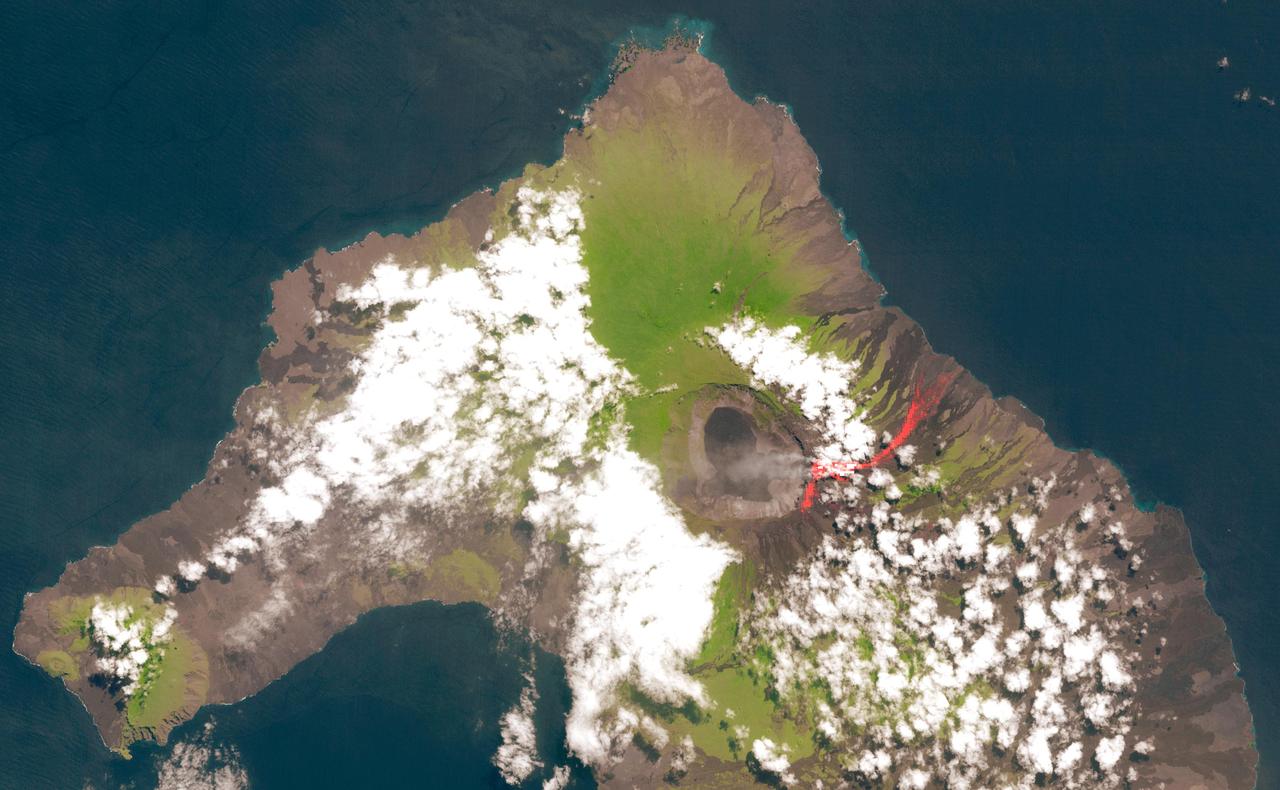
On May 26, 2015, Wolf Volcano on Isabela Island in the Galapagos Islands erupted for the first time in 33 years. This image was acquired by NASA Terra spacecraft on June 11, 2015, after the eruption had quieted.
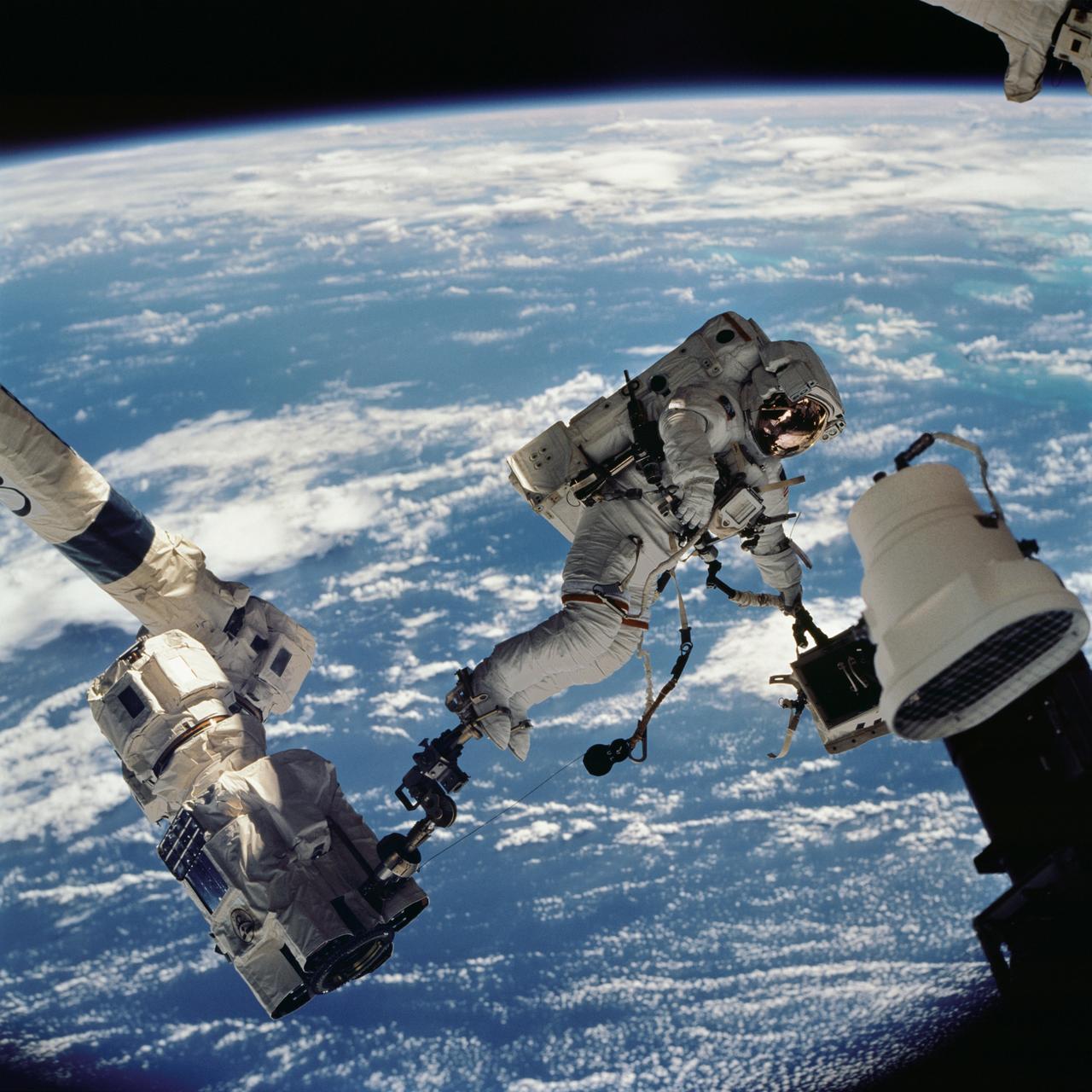
Anchored to a foot restraint on the Space Station Remote Manipulator System (SSRMS) or Canadarm2, astronaut David A. Wolf, STS-112 mission specialist, participates in the mission's first session of extravehicular activity (EVA). Wolf is carrying the Starboard One (S1) outboard nadir external camera which was installed on the end of the S1 Truss on the International Space Station (ISS). Launched October 7, 2002 aboard the Space Shuttle Orbiter Atlantis, the STS-112 mission lasted 11 days and performed three EVAs. Its primary mission was to install the S1 Integrated Truss Structure and Equipment Translation Aid (CETA) Cart to the ISS. The S1 truss provides structural support for the orbiting research facility's radiator panels, which use ammonia to cool the Station's complex power system. The S1 truss, attached to the S0 (S Zero) truss installed by the previous STS-110 mission, flows 637 pounds of anhydrous ammonia through three heat rejection radiators. The truss is 45-feet long, 15-feet wide, 10-feet tall, and weighs approximately 32,000 pounds. The CETA is the first of two human-powered carts that will ride along the International Space Station's railway providing a mobile work platform for future extravehicular activities by astronauts.
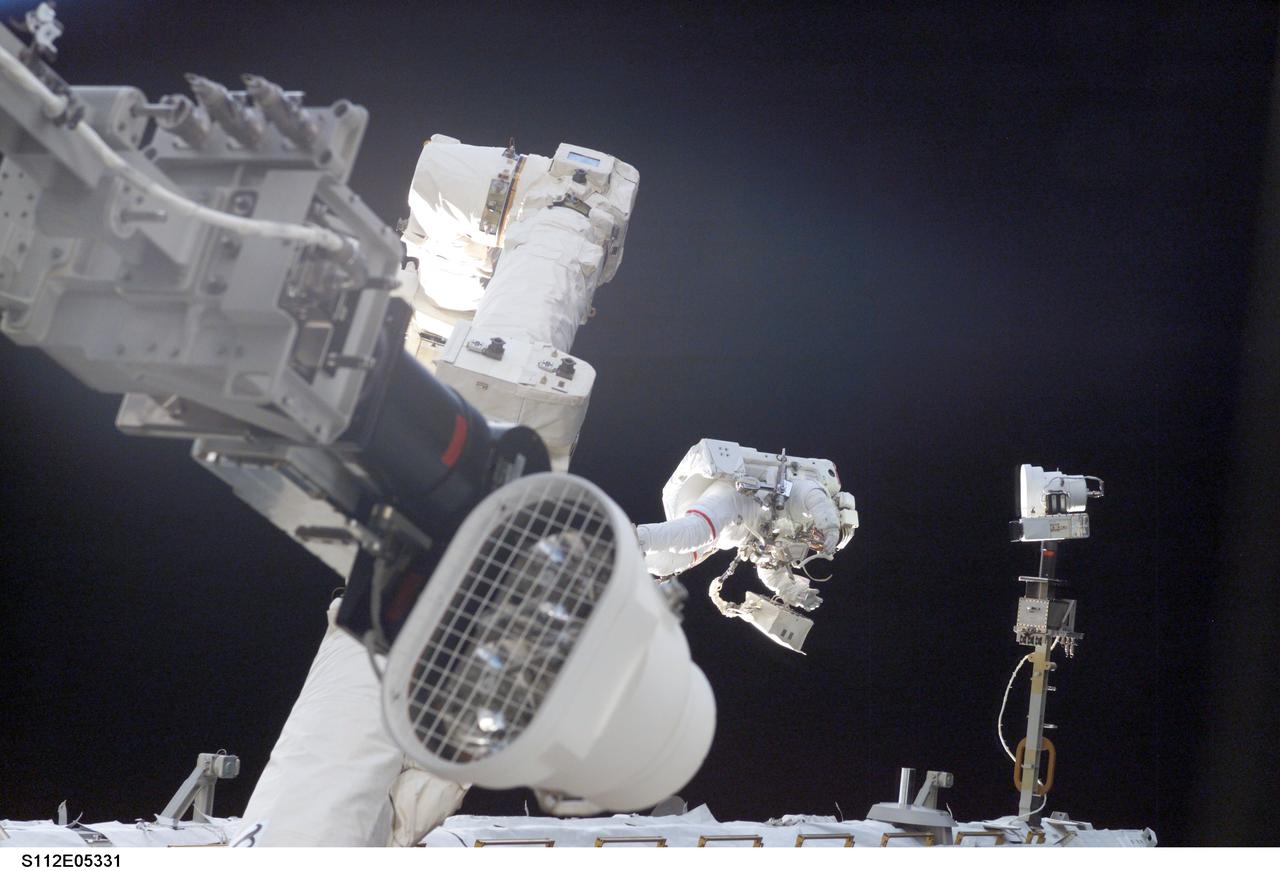
STS112-E-5331 (12 October 2002) --- Astronaut David A. Wolf, mission specialist, participates in a six hour, four minute spacewalk, the second of three scheduled for the STS-112 mission. Astronauts Wolf and Piers J. Sellers are the assigned spacewalkers for all three.
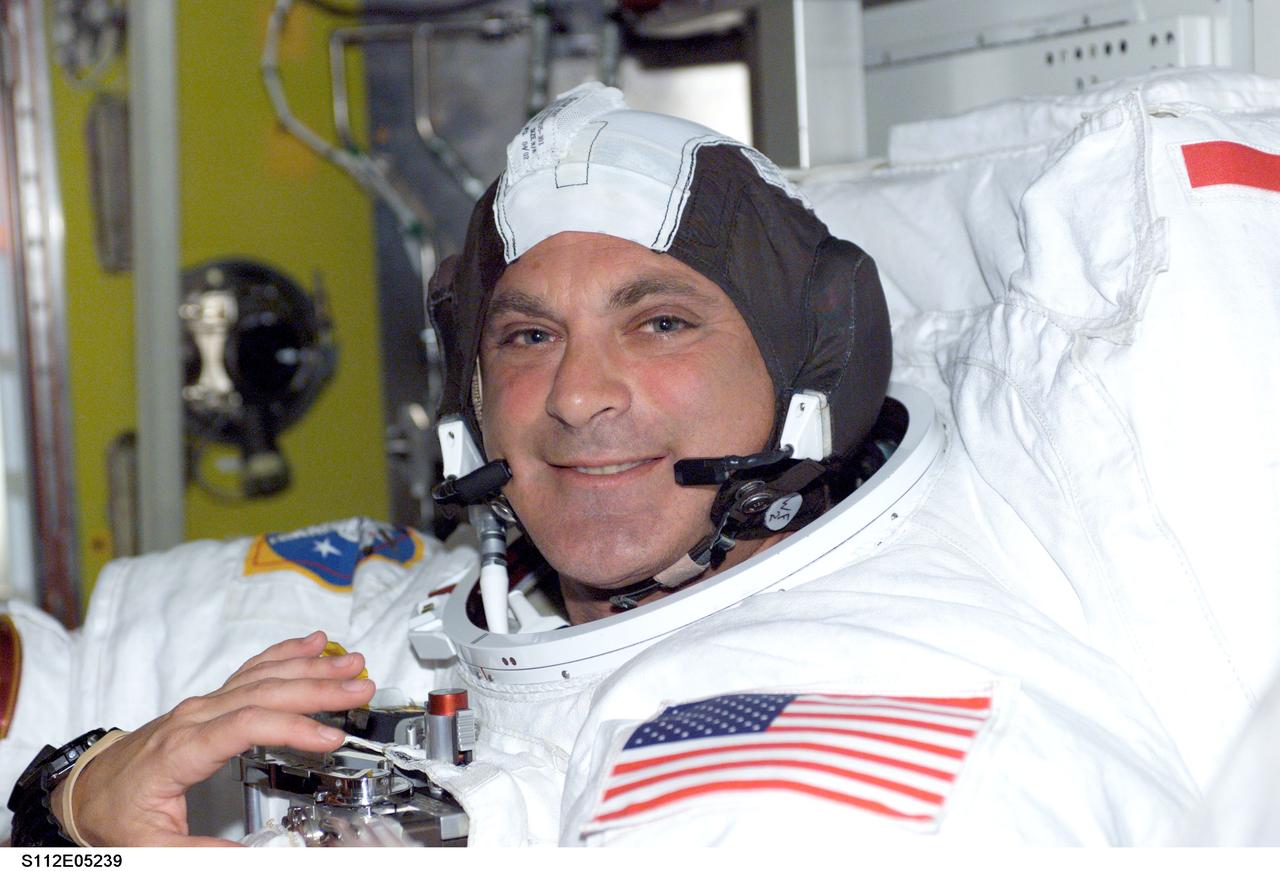
STS112-E-5239 (12 October 2002) --- Astronaut David A. Wolf, STS-112 mission specialist, is only a helmet donning and several minutes away from being ready for the mission's second extravehicular activity (EVA). Wolf was later joined by astronaut Piers J. Sellers for the six hour, four minute spacewalk.
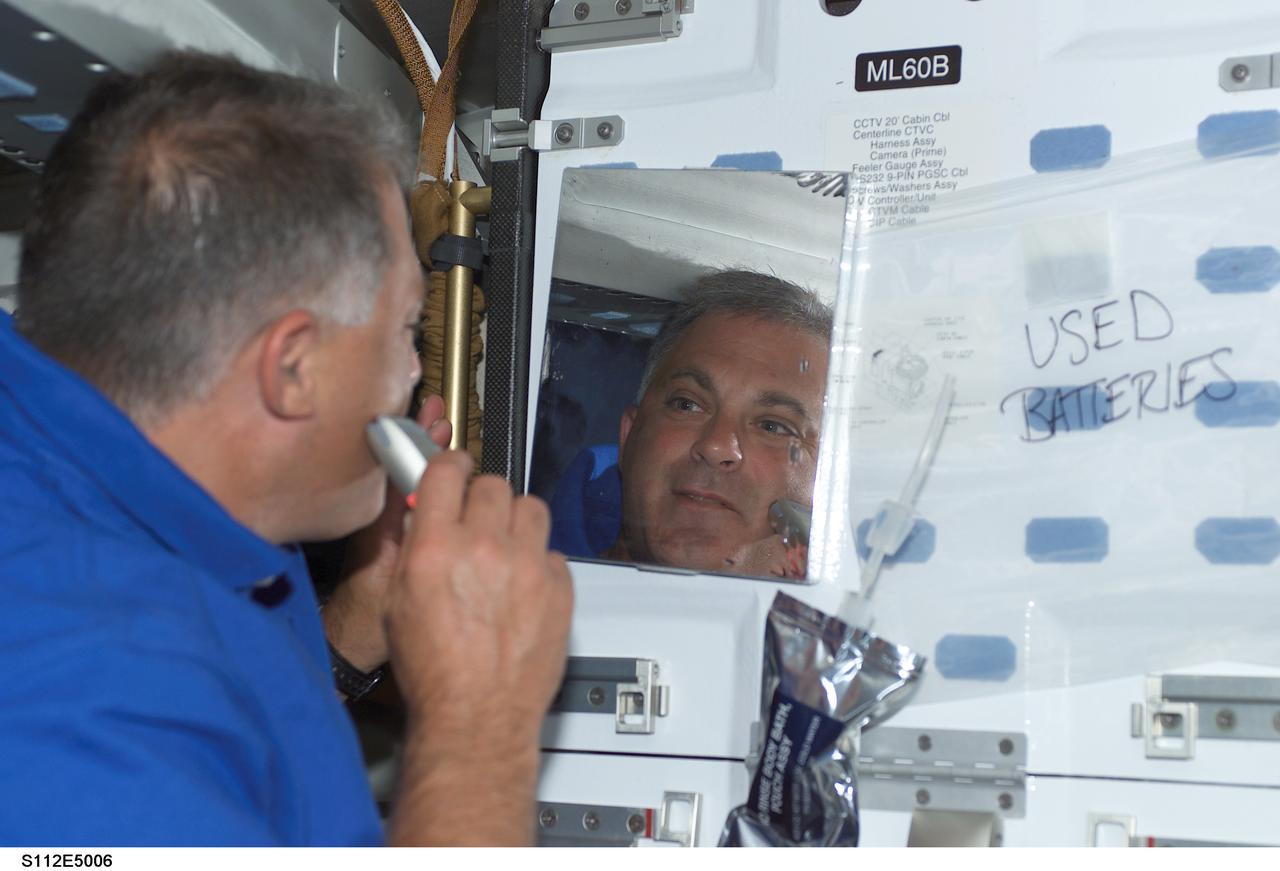
STS112-E-05006 (8 October 2002) --- Astronaut David A. Wolf, STS-112 mission specialist, uses a razor on his face during flight day two on the middeck of the Space Shuttle Atlantis.
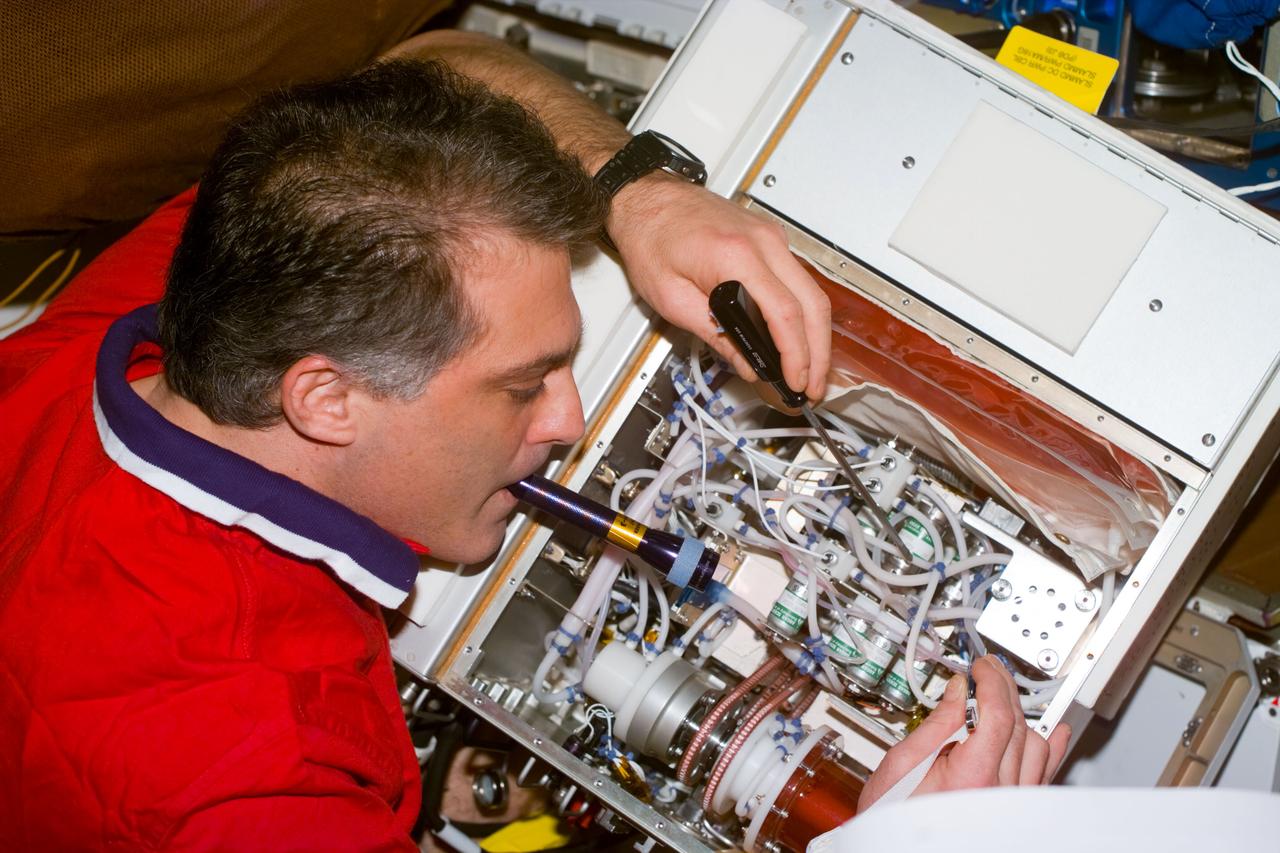
S89-E-5274 (26 Jan 1998) --- This Electronic Still Camera (ESC) image shows astronaut David A. Wolf, mission specialist and cosmonaut guest researcher, holding a pen light in his teeth to get better lighting in this piece of equipment, he is working on onboard the Space Shuttle Endeavour. Wolf is being replaced by astronaut Andrew S. W. Thomas as the cosmonaut guest researcher onboard Russia's Mir Space Station. Thomas will be the last American astronaut to serve onboard the Mir. This ESC view was taken on January 26, 1998, at 14:28:06 GMT.
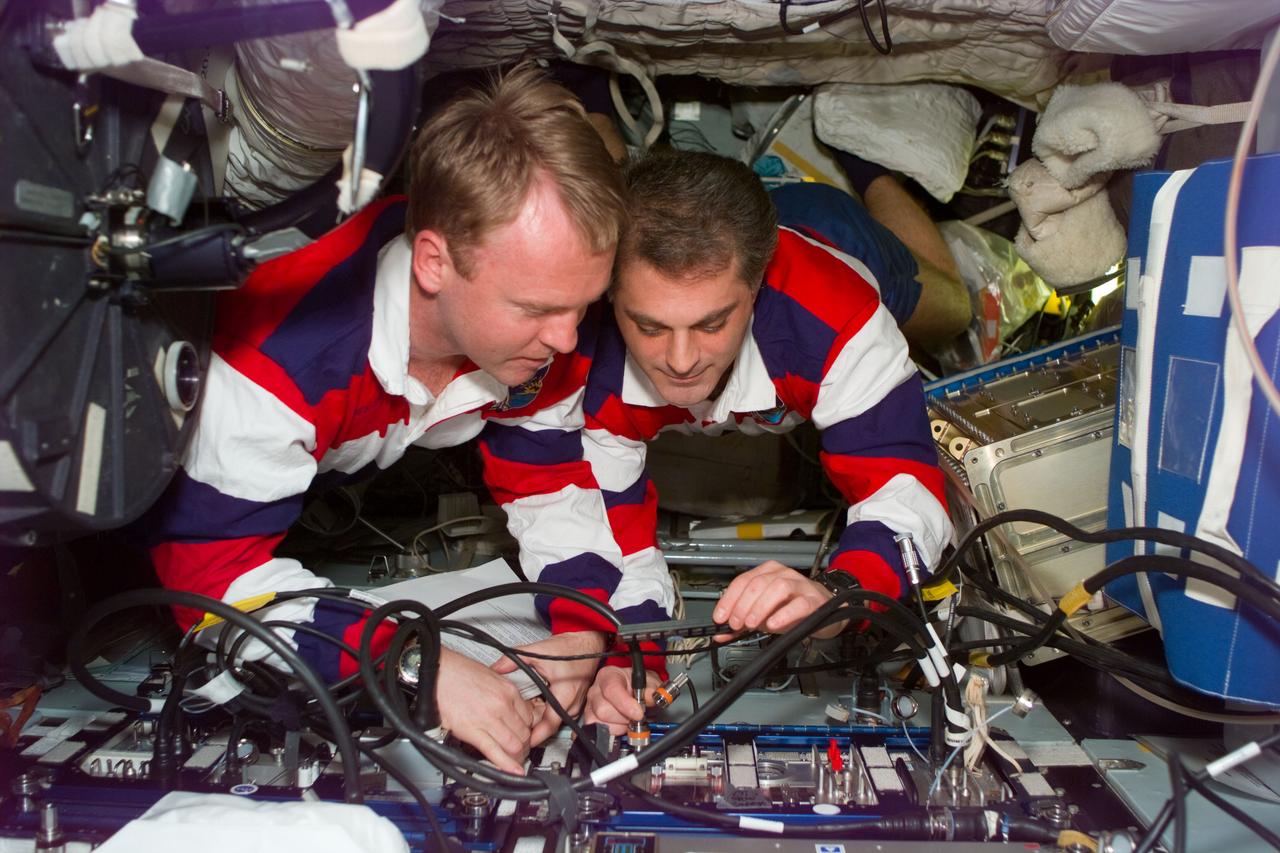
S89-E-5320 (26 Jan 1998) --- This Electronic Still Camera (ESC) image shows astronauts and cosmonaut guest researchers Andrew S. W. Thomas (on left) and David A. Wolf during hand-over operations onboard the Russian Mir Space Station. Wolf is explaining the operations of this equipment to Thomas. Thomas, replacing Wolf as cosmonaut guest researcher, will be the last American astronaut to serve a tour aboard the Mir. This ESC view was taken on January 26, 1998, at 15:58:39 MET.
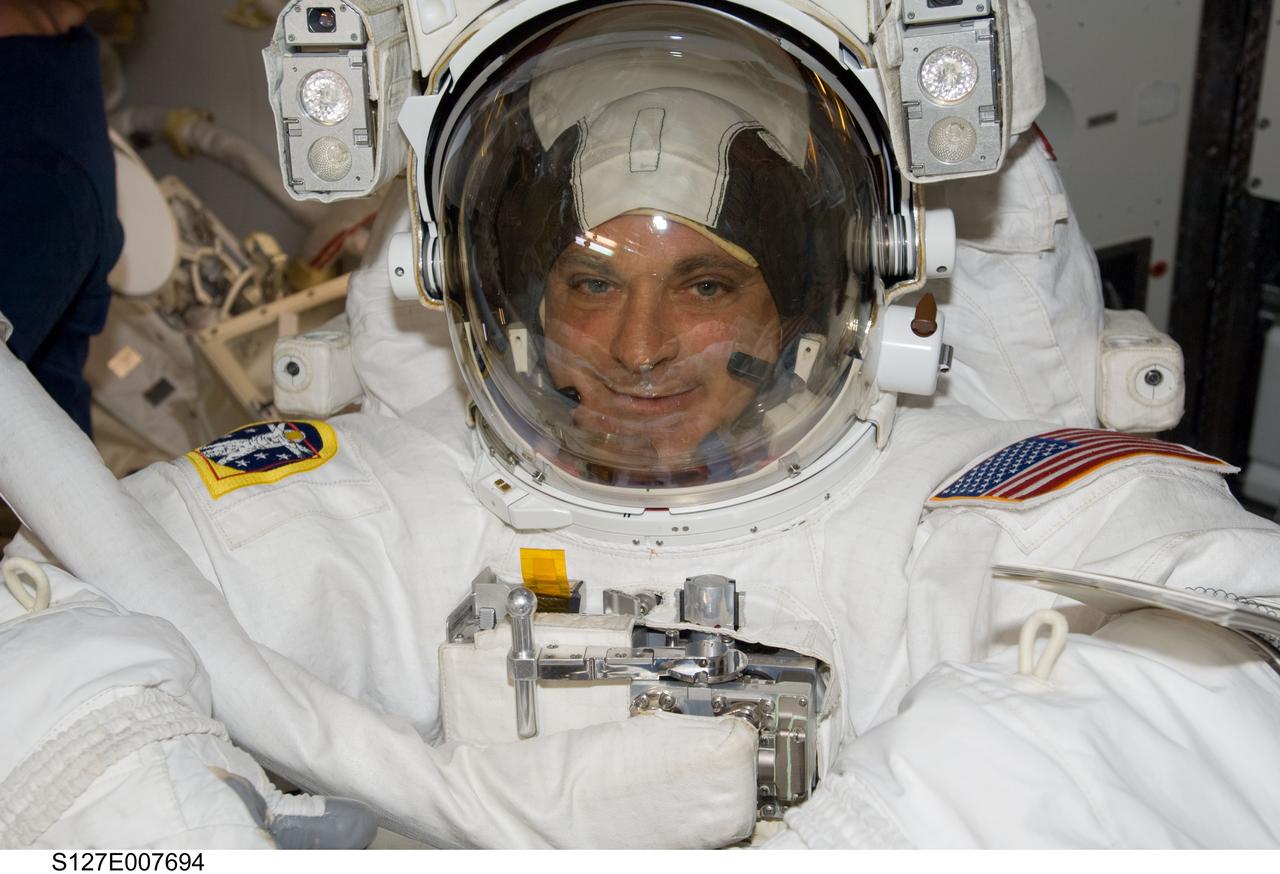
S127-E-007694 (22 July 2009) --- Astronaut Dave Wolf, STS-127 mission specialist, is just about ready to participate in Endeavour's third space walk of a scheduled five overall for this flight. He joined astronaut Christopher Cassidy STS-127 mission specialist, for the session.
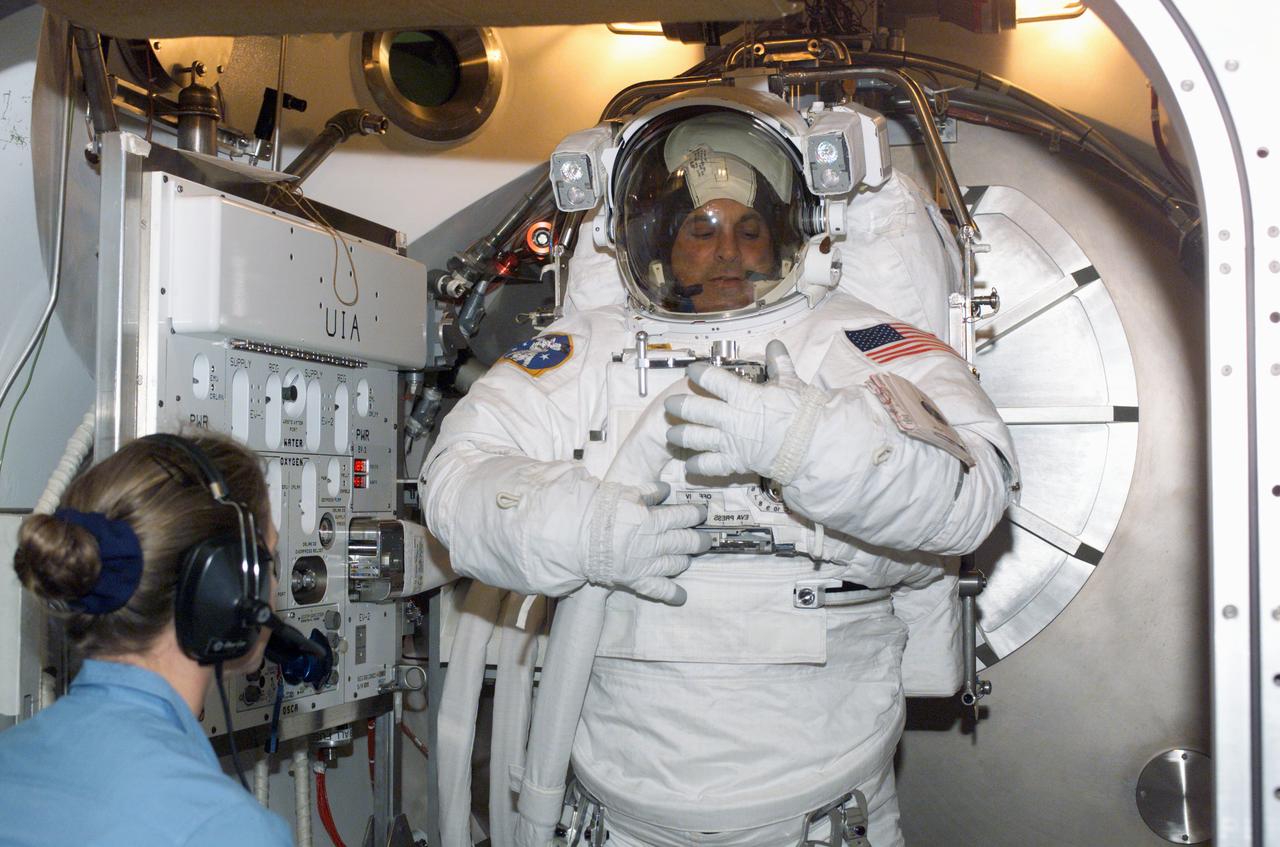
JSC2002-E-27129 (27 June 2002) --- Astronaut David A. Wolf, STS-112 mission specialist, is photographed during an Extravehicular Mobility Unit (EMU) fit check in a Space Station Airlock Test Article (SSATA) in the Crew Systems Laboratory at the Johnson Space Center (JSC).
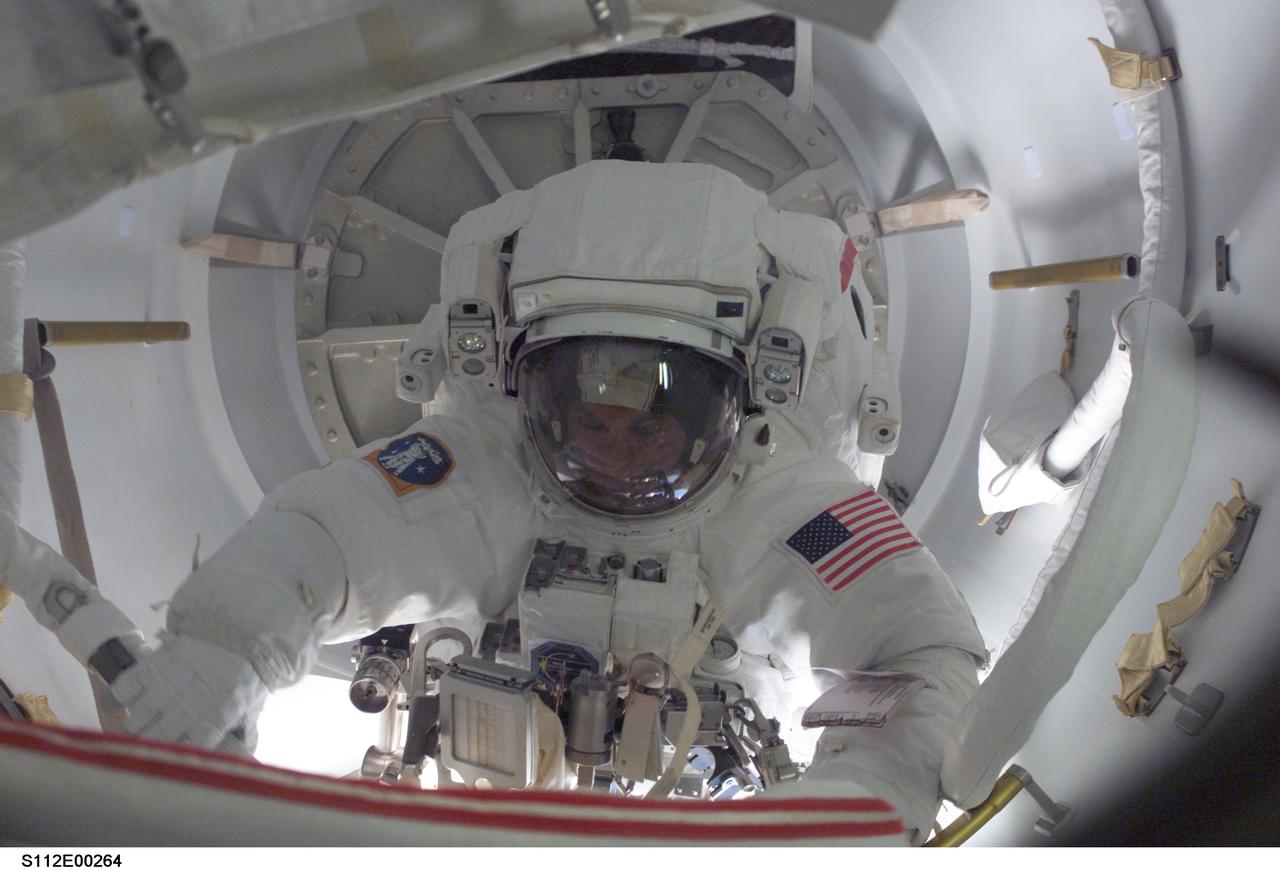
STS112-E-5264 (12 October 2002) --- Astronaut David A. Wolf, STS-112 mission specialist, is ready to egress the airlock to begin the mission's second scheduled spacewalk.
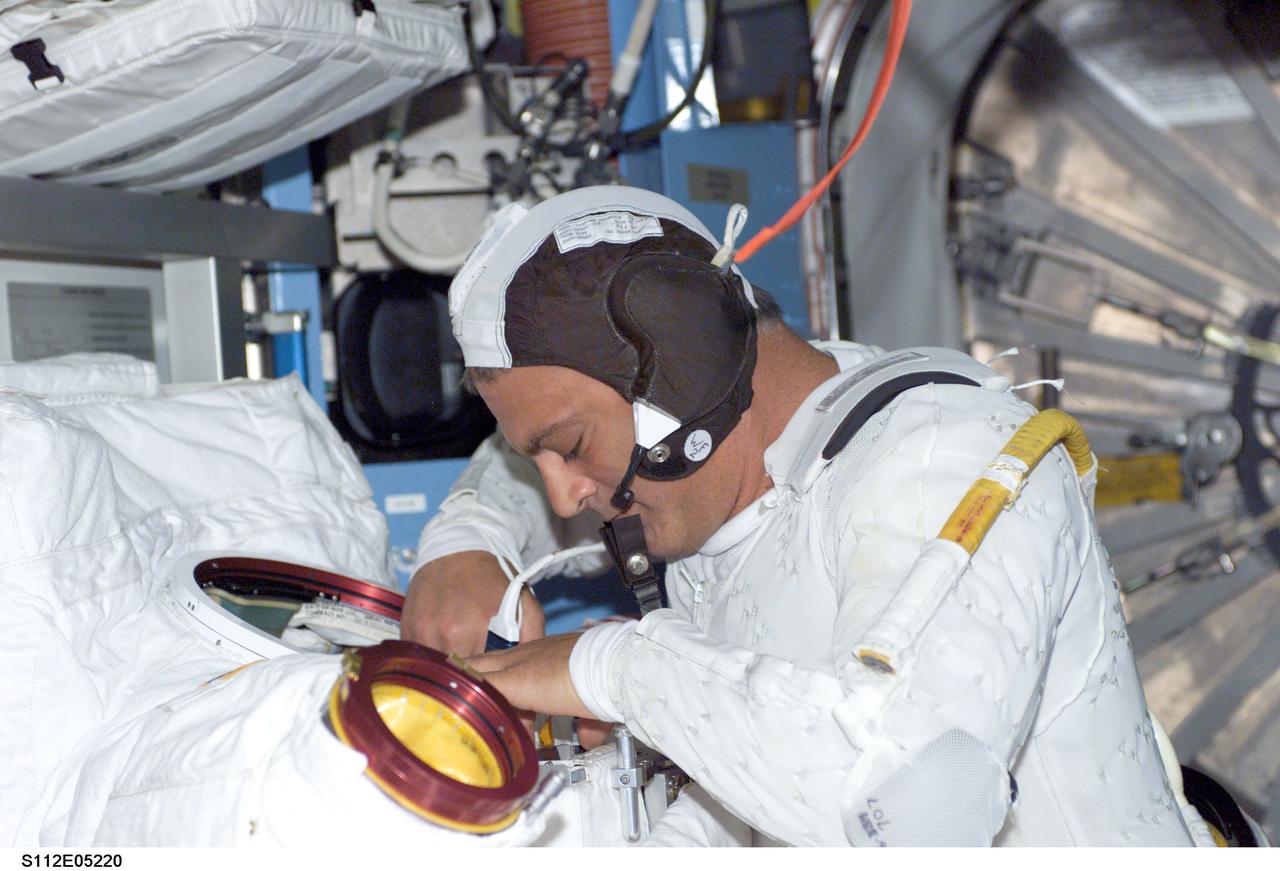
STS112-E-5220 (12 October 2002) --- Astronaut David A. Wolf, STS-112 mission specialist, gets his extravehicular mobility unit (EMU) spacesuit ready for the second scheduled spacewalk of the mission.
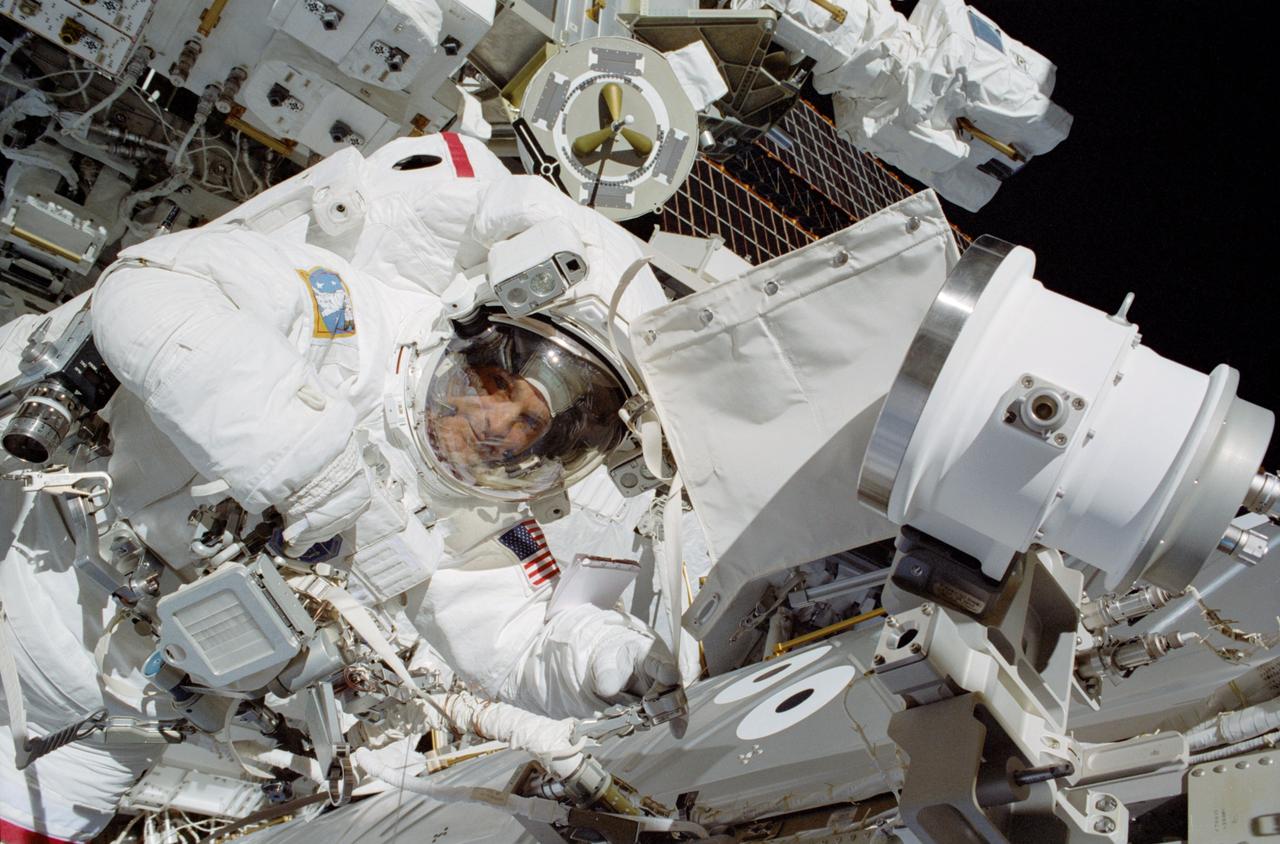
STS112-304-013 (12 October 2002) --- Astronaut David A. Wolf, STS-112 mission specialist, participates in the mission’s second session of extravehicular activity (EVA).
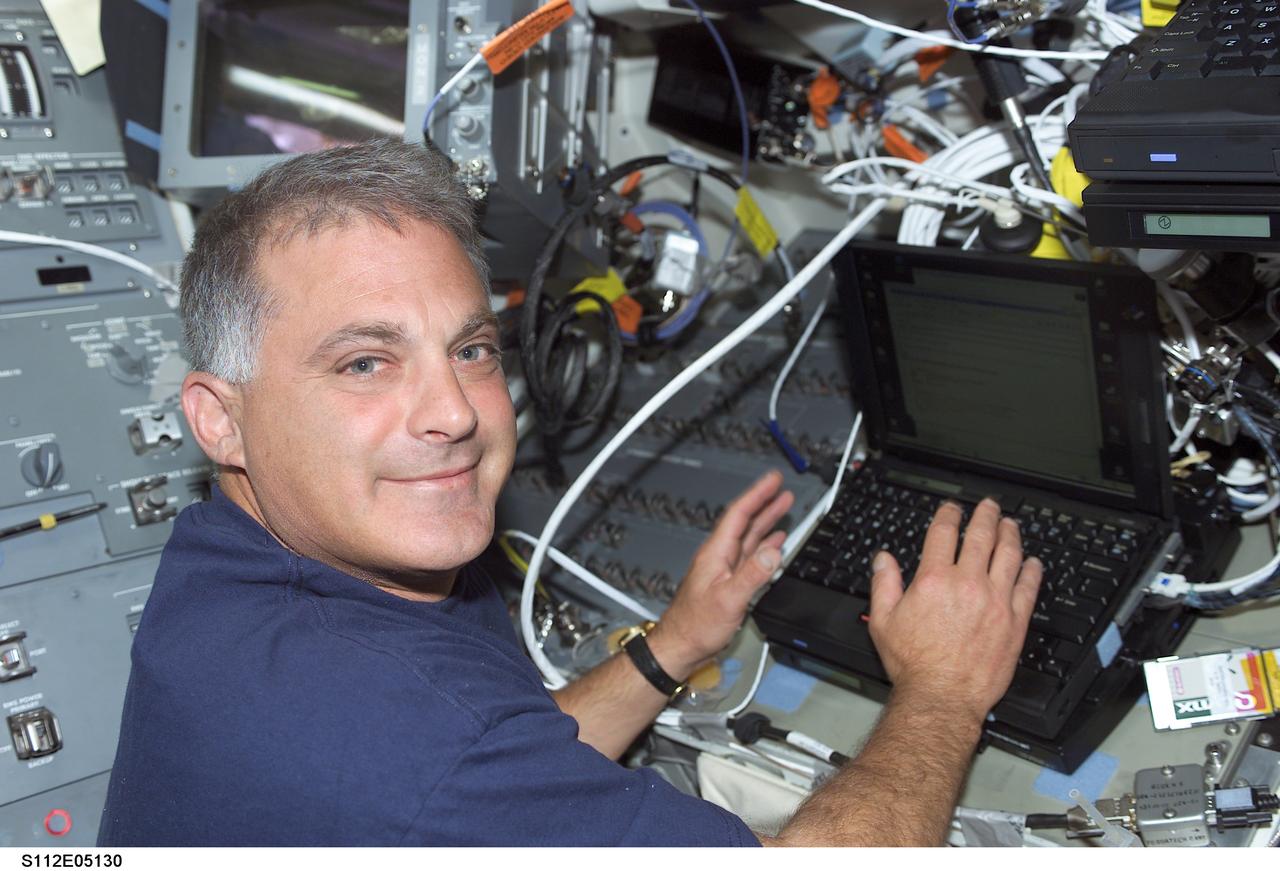
STS112-E-05130 (11 October 2002) --- Astronaut David A. Wolf, STS-112 mission specialist, is pictured on the aft flight deck of the Space Shuttle Atlantis.
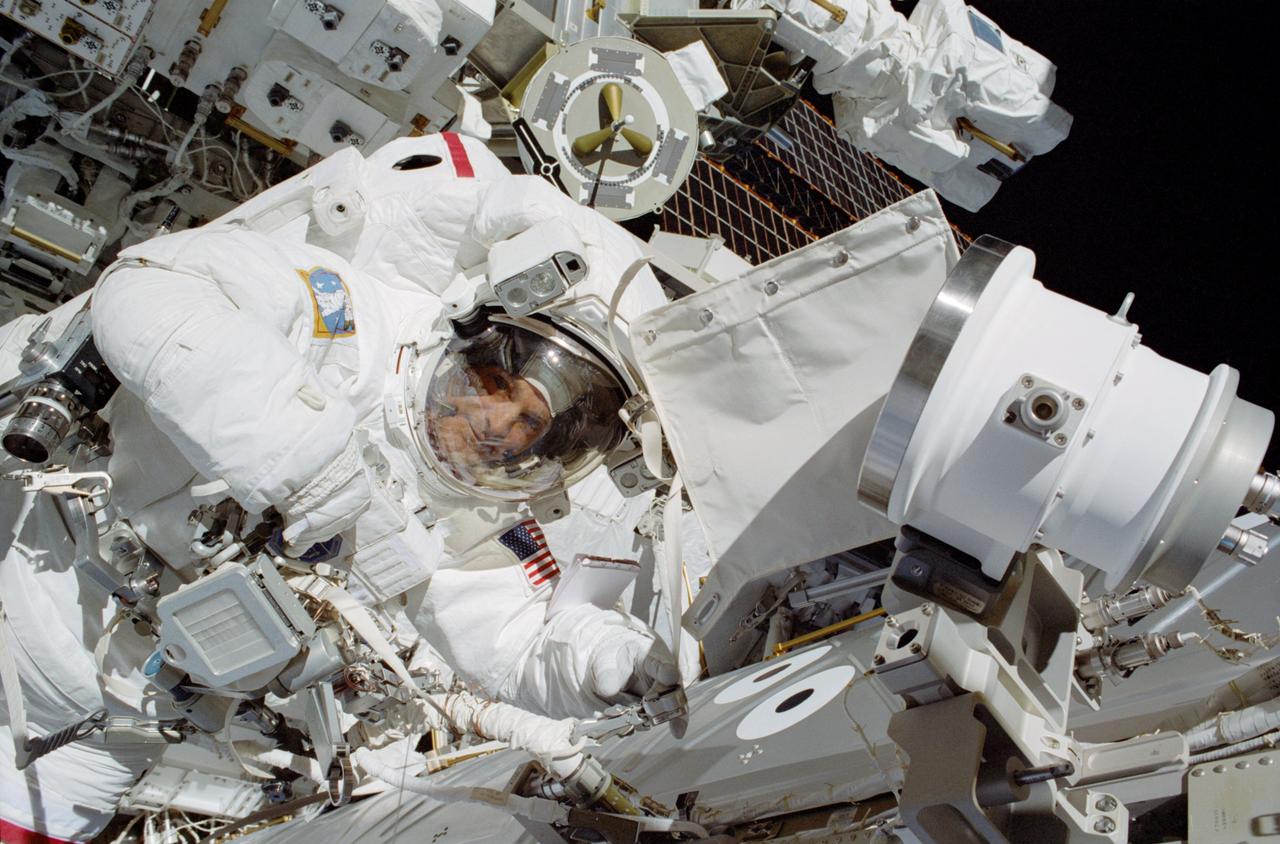
Astronaut David A. Wolf, STS-112 mission specialist, participates in the mission's second session of extravehicular activity (EVA), a six hour, four minute space walk, in which an exterior station television camera was installed outside of the Destiny Laboratory. Launched October 7, 2002 aboard the Space Shuttle Orbiter Atlantis, the STS-112 mission lasted 11 days and performed three EVA sessions. Its primary mission was to install the Starboard (S1) Integrated Truss Structure and Equipment Translation Aid (CETA) Cart to the International Space Station (ISS). The S1 truss provides structural support for the orbiting research facility's radiator panels, which use ammonia to cool the Station's complex power system. The S1 truss, attached to the S0 (S Zero) truss installed by the previous STS-110 mission, flows 637 pounds of anhydrous ammonia through three heat rejection radiators. The truss is 45-feet long, 15-feet wide, 10-feet tall, and weighs approximately 32,000 pounds. The CETA is the first of two human-powered carts that will ride along the International Space Station's railway providing a mobile work platform for future extravehicular activities by astronauts.
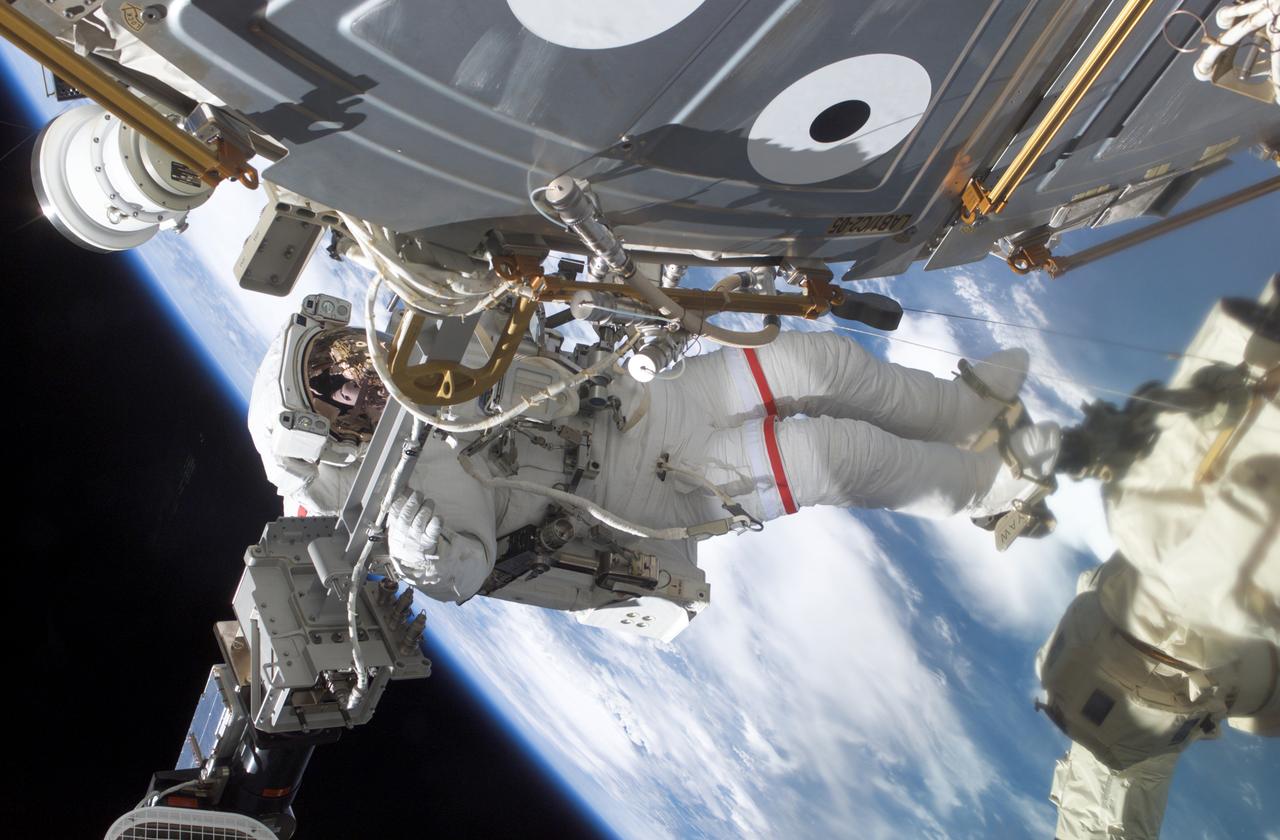
Astronaut David A. Wolf, STS-112 mission specialist, participates in the mission's second session of extravehicular activity (EVA), a six hour, four minute space walk, in which an exterior station television camera was installed outside of the Destiny Laboratory. Launched October 7, 2002 aboard the Space Shuttle Orbiter Atlantis, the STS-112 mission lasted 11 days and performed three EVA sessions. Its primary mission was to install the Starboard (S1) Integrated Truss Structure and Equipment Translation Aid (CETA) Cart to the International Space Station (ISS). The S1 truss provides structural support for the orbiting research facility's radiator panels, which use ammonia to cool the Station's complex power system. The S1 truss, attached to the S0 (S Zero) truss installed by the previous STS-110 mission, flows 637 pounds of anhydrous ammonia through three heat rejection radiators. The truss is 45-feet long, 15-feet wide, 10-feet tall, and weighs approximately 32,000 pounds. The CETA is the first of two human-powered carts that will ride along the International Space Station's railway providing a mobile work platform for future extravehicular activities by astronauts.
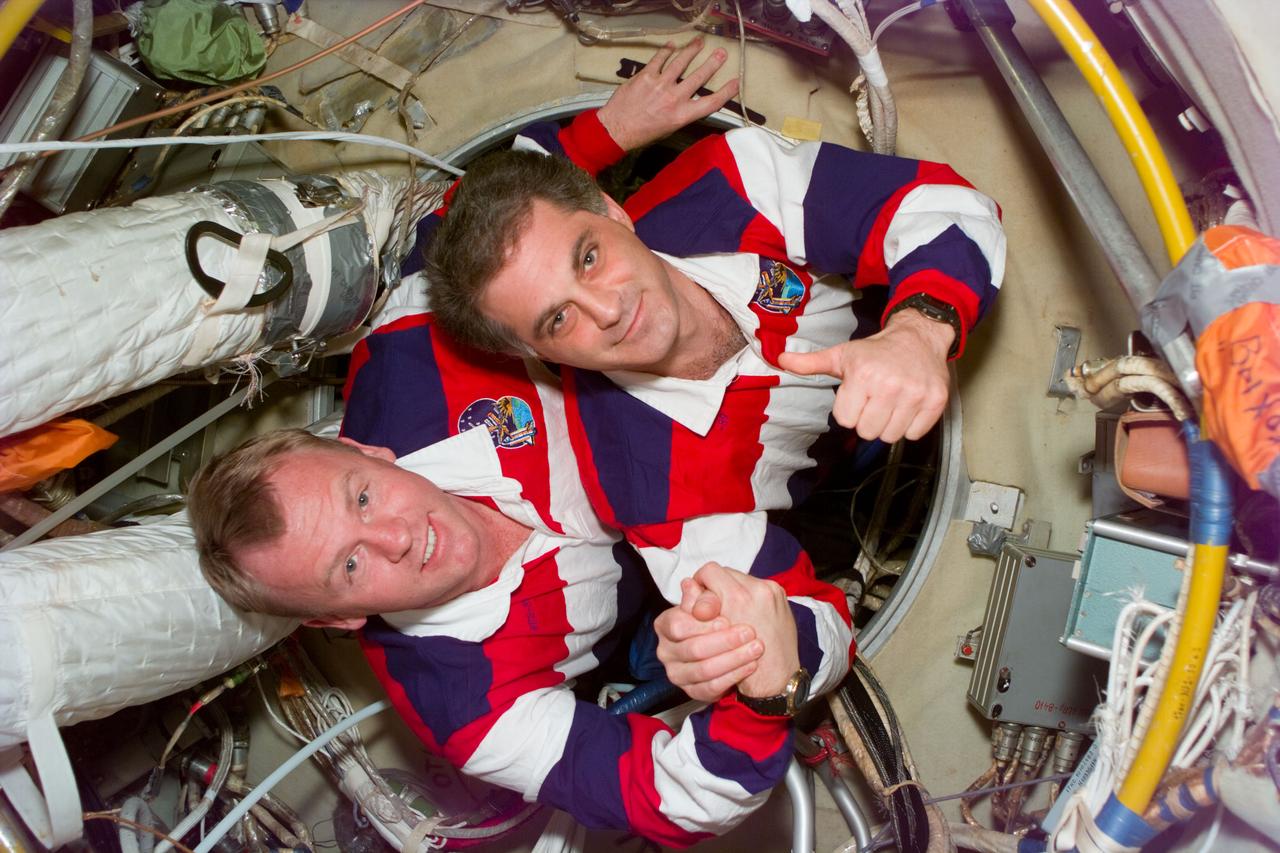
S89-E-5315 (26 Jan 1998) --- This Electronic Still Camera (ESC) image shows astronauts and cosmonaut guest researchers Andrew S. W. Thomas and David A. Wolf (giving thumbs up) in a hatchway onboard Russia's Mir Space Station. Thomas, replacing Wolf as cosmonaut guest researcher, will be the last American astronaut to serve a tour aboard Mir. This ESC view was taken on January 26, 1998, at 15:52:27 MET.
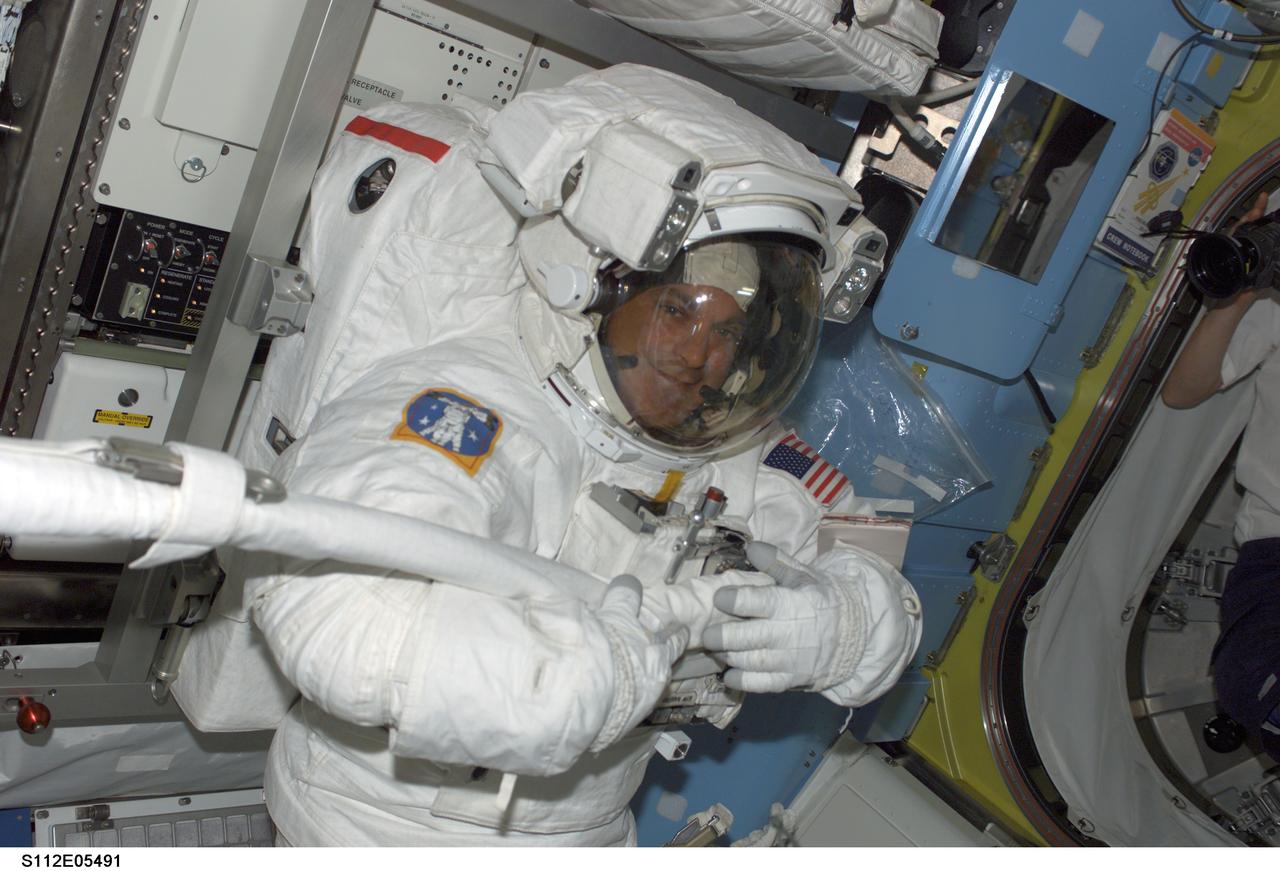
STS112-E-05491 (14 October 2002) --- Astronaut David A. Wolf, STS-112 mission specialist, attired in his Extravehicular Mobility Unit (EMU) space suit, is photographed in the Quest Airlock on the International Space Station (ISS) prior to the third scheduled session of extravehicular activity (EVA). Astronaut Piers J. Sellers (out of frame), mission specialist, joined Wolf on the spacewalk.
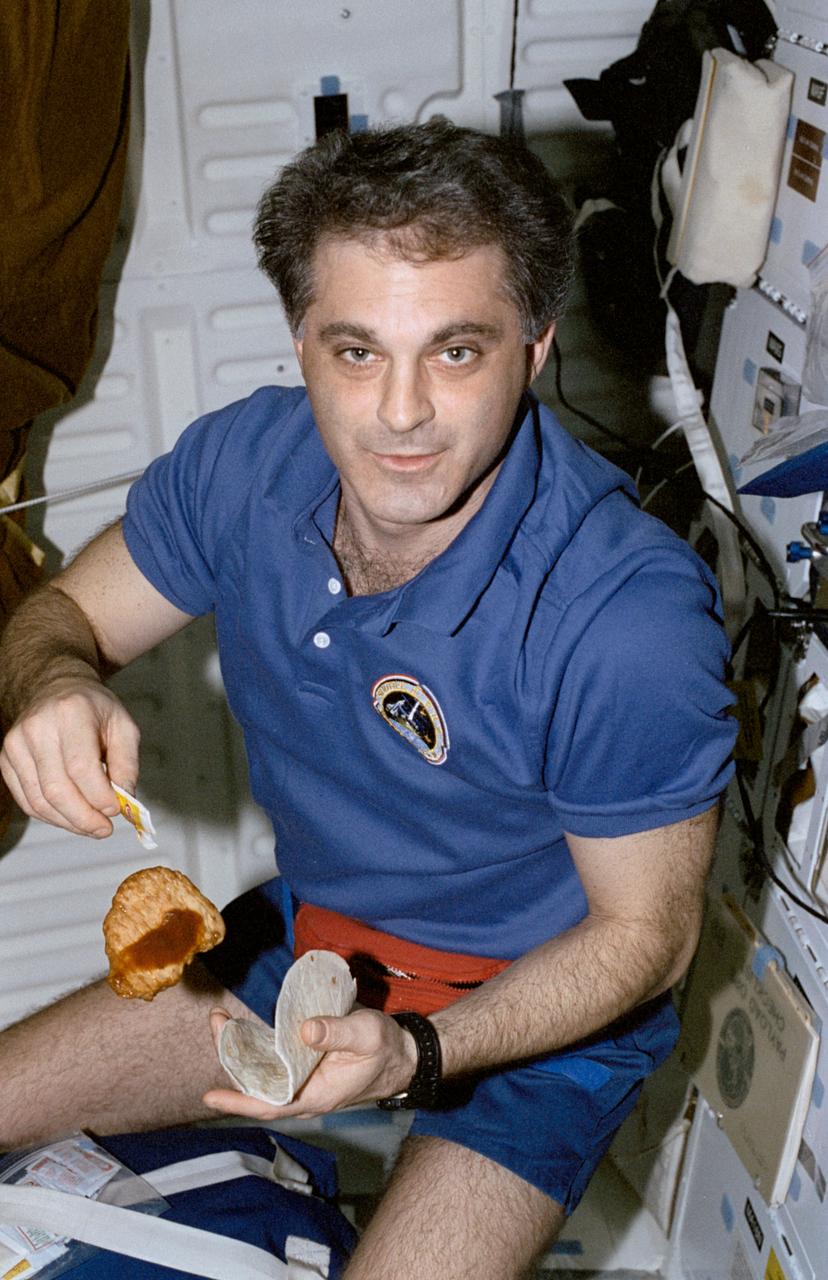
STS089-370-034 (22-31 Jan. 1998) --- Astronaut David A. Wolf, freshly removed from a long stay aboard Russia’s Mir Space Station, creates a sandwich onboard the Earth-orbiting space shuttle Endeavour. Wolf had earlier been replaced on Mir by Andrew S. W. Thomas, cosmonaut guest researcher, who will be last NASA astronaut assigned to Mir duty as part of the Phase I program. Photo credit: NASA
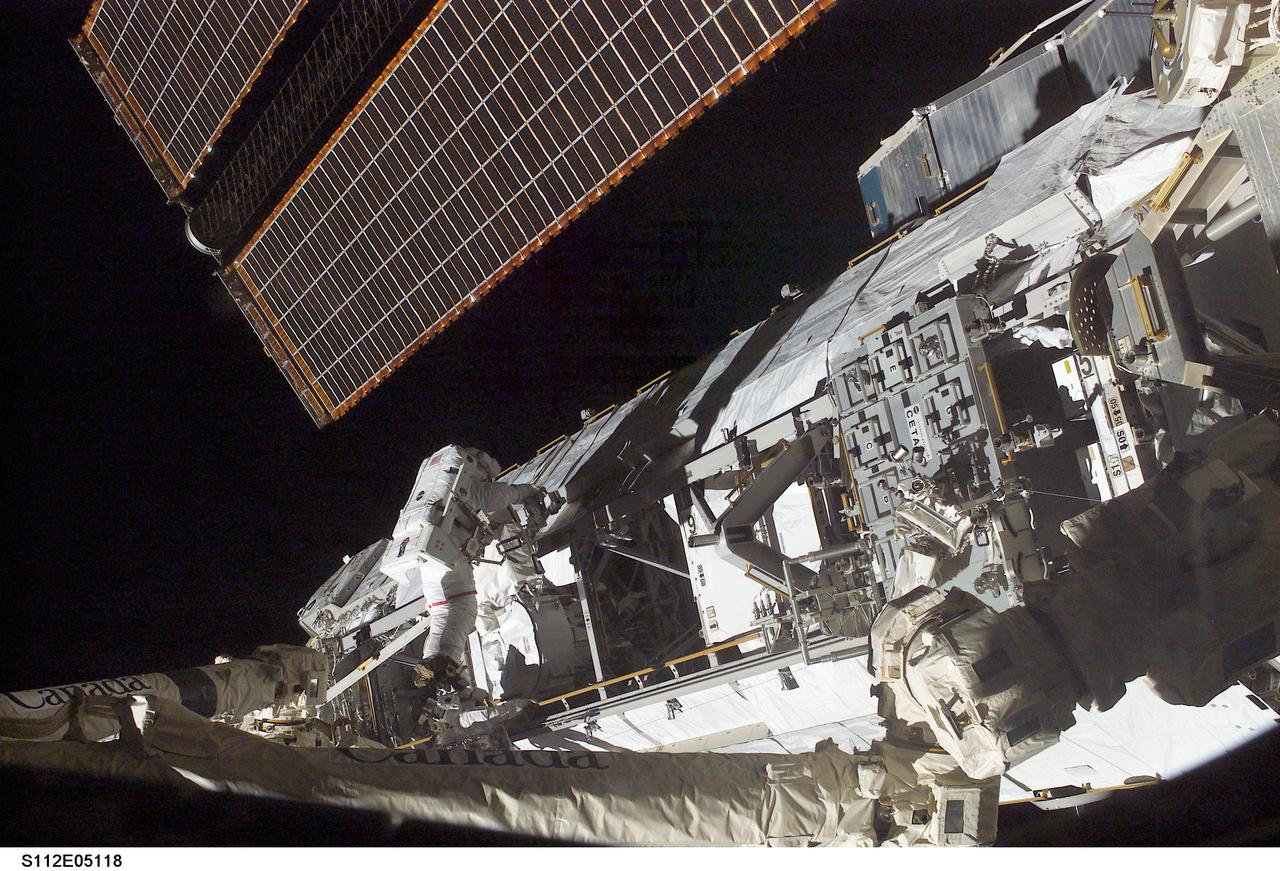
STS112-E-05118 (10 October 2002) --- Astronaut David A. Wolf, STS-112 mission specialist, works on the Starboard One (S1) Truss, newly installed on the International Space Station (ISS). Astronaut Piers J. Sellers (out of frame), mission specialist, worked in tandem with Wolf during the spacewalk. STS-112’s first session of extravehicular activity (EVA) lasted 7 hours and 1 minute.

S89-E-5310 (26 Jan 1998) --- This Electronic Still Camera (ESC) image shows astronauts David A. Wolf, former cosmonaut guest researcher (on left), and Andrew S. W. Thomas, future cosmonaut guest researcher. Wolf, during hand-over operations, explains the use of this scientific piece of equipment to Thomas, who will use this equipment during his tour aboard the Russian Mir Space Station. This ESC view was taken on January 26, 1998, at 15:50:31 MET.

STS112-E-05488 (14 October 2002) --- Astronaut David A. Wolf, STS-112 mission specialist, attired in his Extravehicular Mobility Unit (EMU) space suit, is photographed in the Quest Airlock on the International Space Station (ISS) prior to the third scheduled session of extravehicular activity (EVA). Astronaut Piers J. Sellers (out of frame), mission specialist, joined Wolf on the spacewalk.
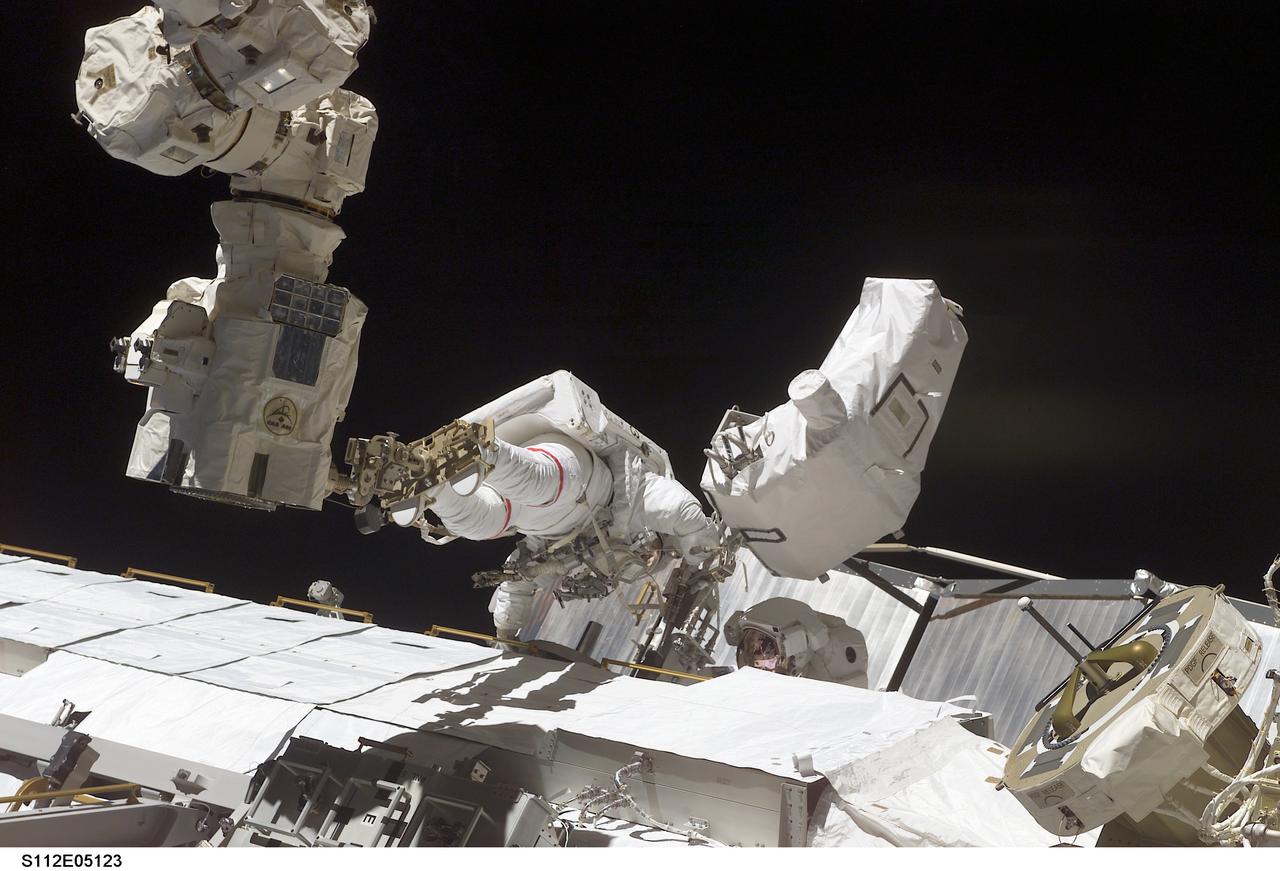
STS112-E-05123 (10 October 2002) --- Astronaut David A. Wolf, STS-112 mission specialist, anchored to the end of the Canadarm2, works on the Starboard One (S1) Truss, newly installed on the International Space Station (ISS). Astronaut Piers J. Sellers (partially obscured), mission specialist, worked in tandem with Wolf during the spacewalk. STS-112’s first session of extravehicular activity (EVA) lasted 7 hours and 1 minute.
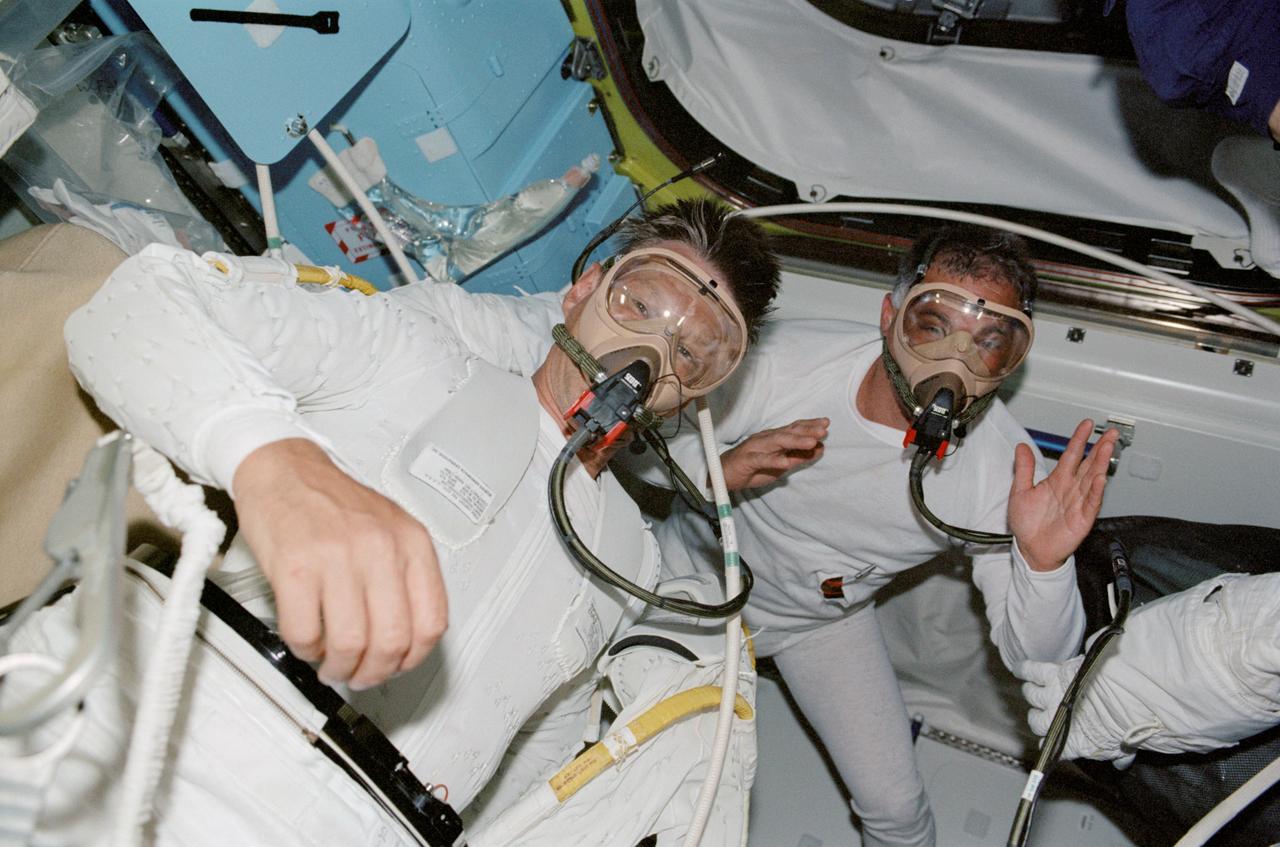
STS112-309-033 (10 October 2002) --- Astronauts Piers J. Sellers (left) and David A. Wolf, STS-112 mission specialists, are photographed in the midst of a pre-breathe exercise in preparation for the mission’s first session of extravehicular activity (EVA). Sellers and Wolf are attired in the liquid cooling and ventilation garment that complements the Extravehicular Mobility Unit (EMU) space suit.
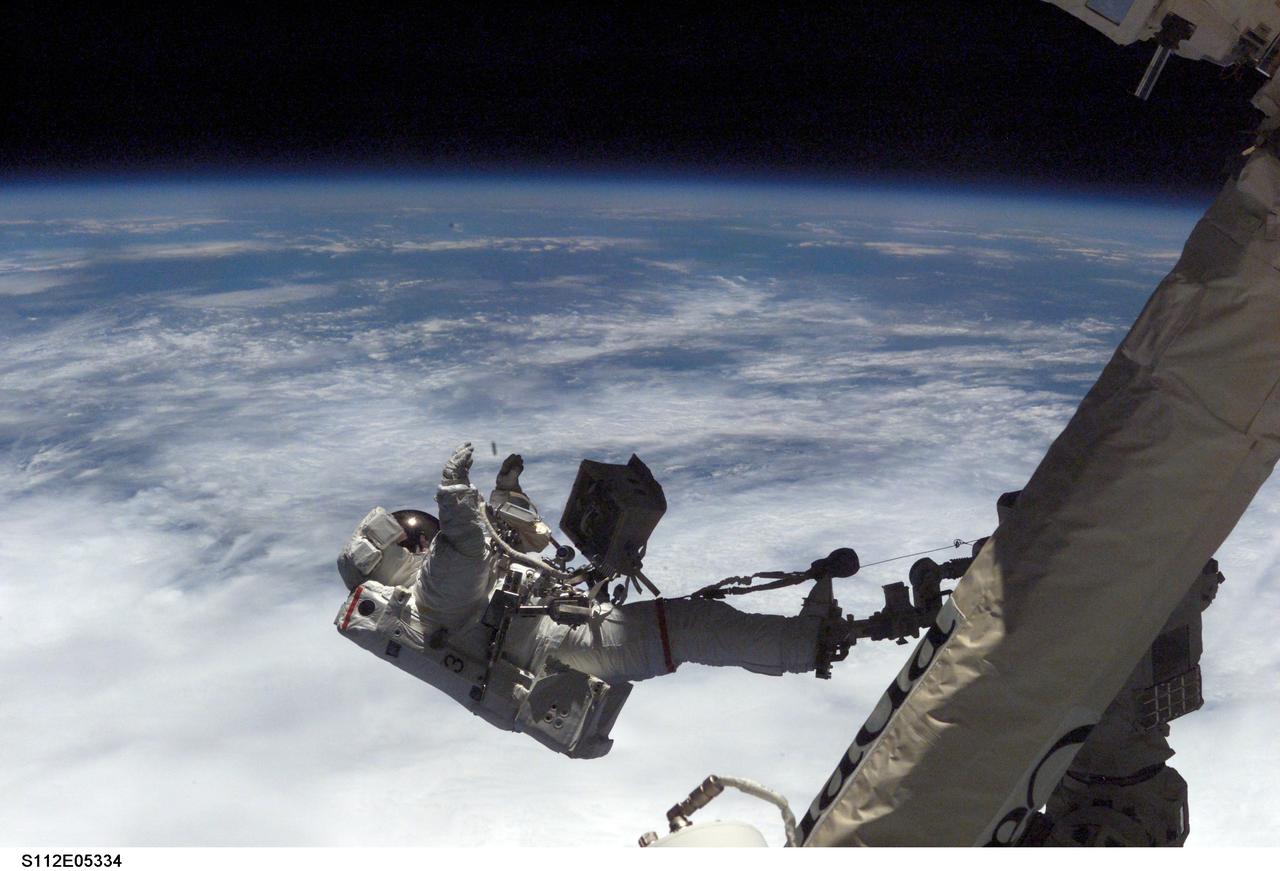
STS112-E-5334 (12 October 2002) --- Astronaut David A. Wolf, mission specialist, his feet securely planted in a restraint device on the end of the Space Station Remote Manipulator System (SSRMS) or Canadarm2, appears suspended over a heavily cloud-covered part of Earth. Astronauts Wolf and Piers J. Sellers were the assigned spacewalkers for this the second STS-112 spacewalk as well as the two others.
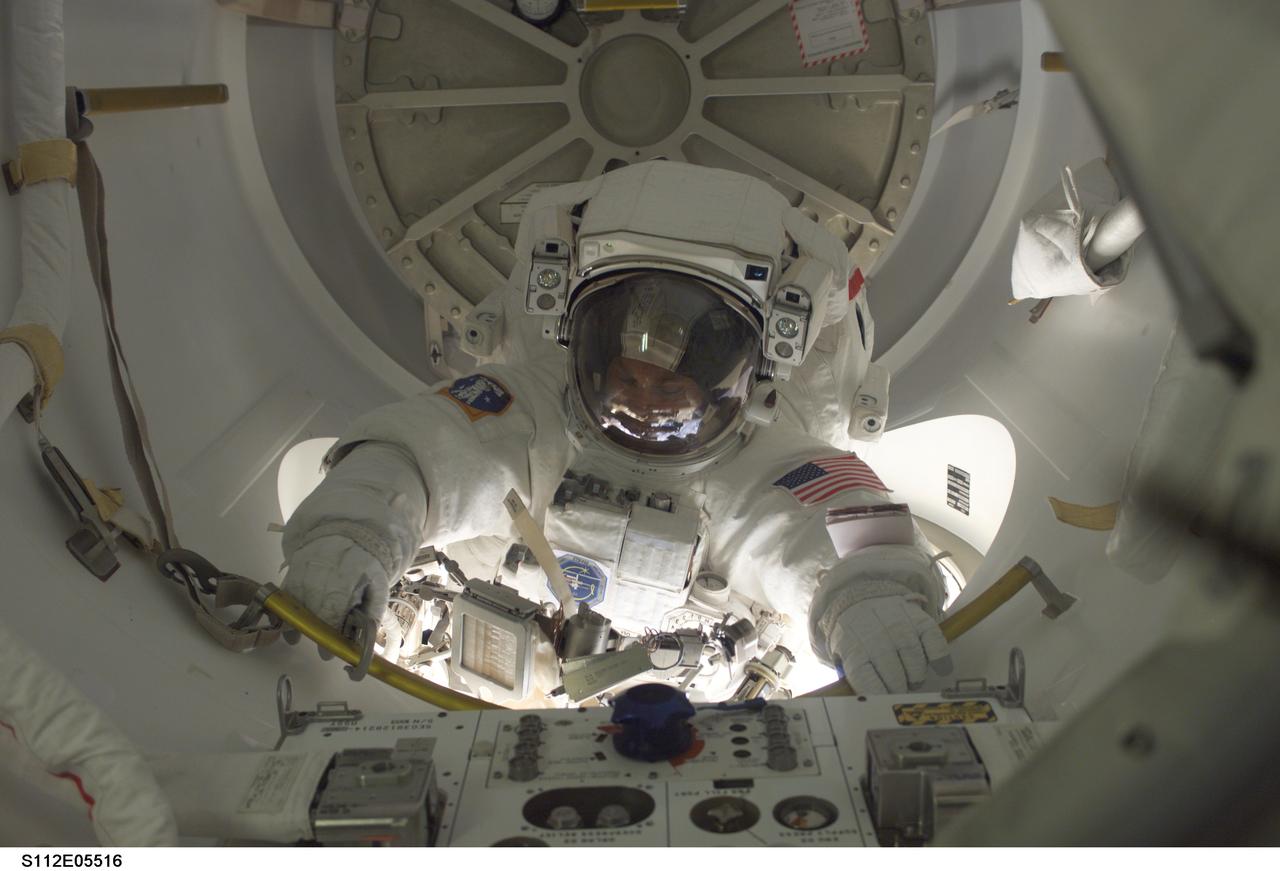
STS112-E-05516 (14 October 2002) --- Astronaut David A. Wolf, STS-112 mission specialist, exits the Quest Airlock on the International Space Station (ISS) to begin the third and final scheduled session of extravehicular activity (EVA) for the STS-112 mission. Astronaut Piers J. Sellers (out of frame), mission specialist, joined Wolf on the spacewalk.
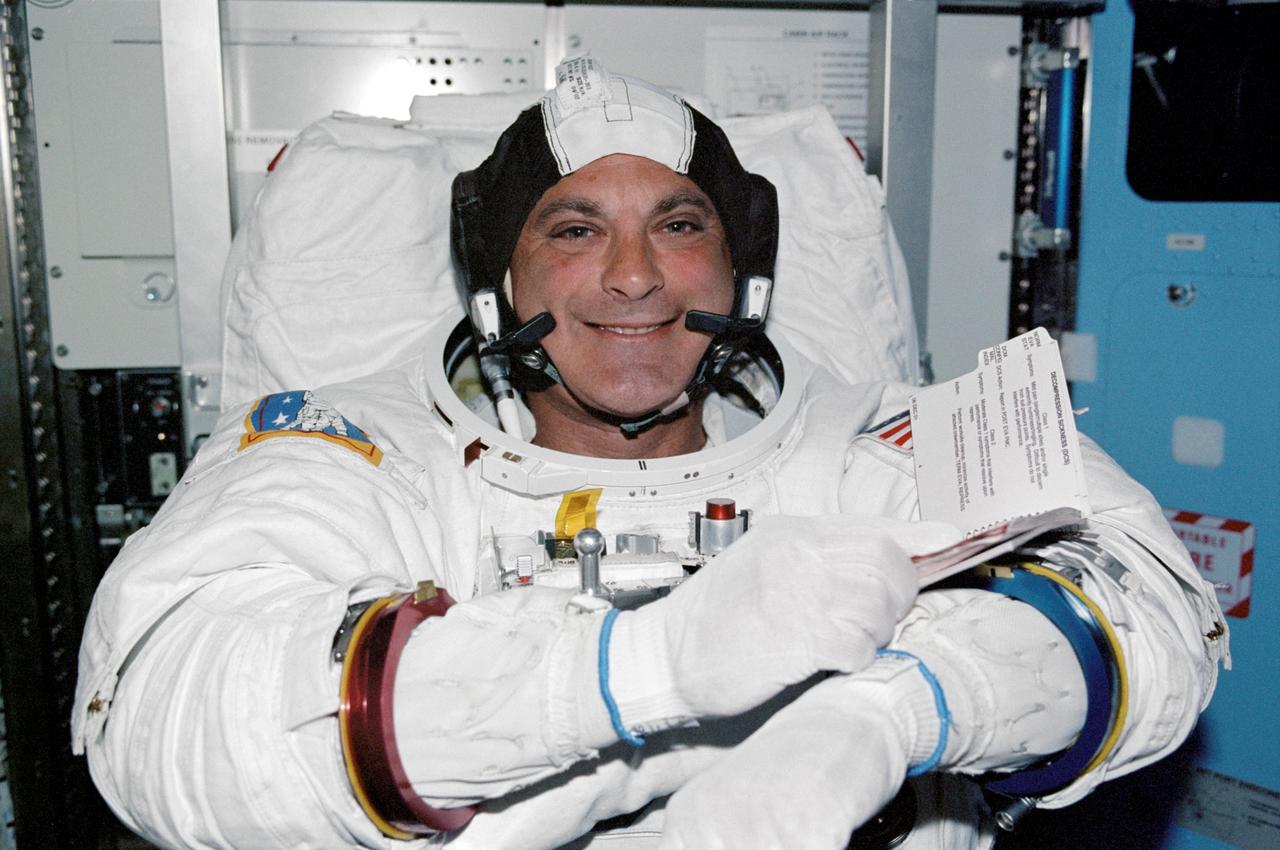
STS112-336-020 (12 October 2002) --- Astronaut David A. Wolf, STS-112 mission specialist, looks over a procedures checklist in the Quest Airlock on the International Space Station (ISS). Wolf is attired in his Extravehicular Mobility Unit (EMU) spacesuit.
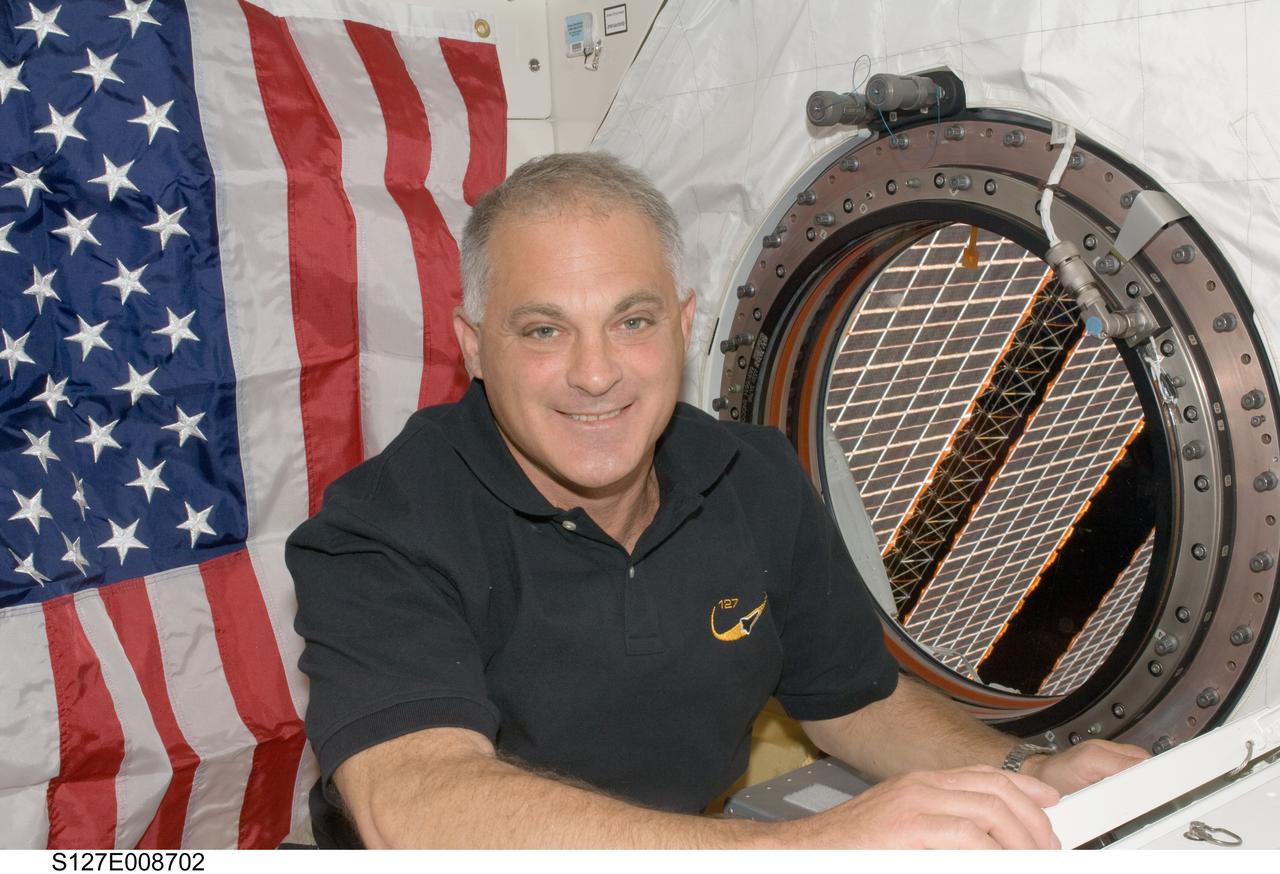
S127-E-008702 (25 July 2009) --- Astronaut Dave Wolf, STS-127 mission specialist, is pictured near a window in the Kibo laboratory of the International Space Station while Space Shuttle Endeavour remains docked with the station.
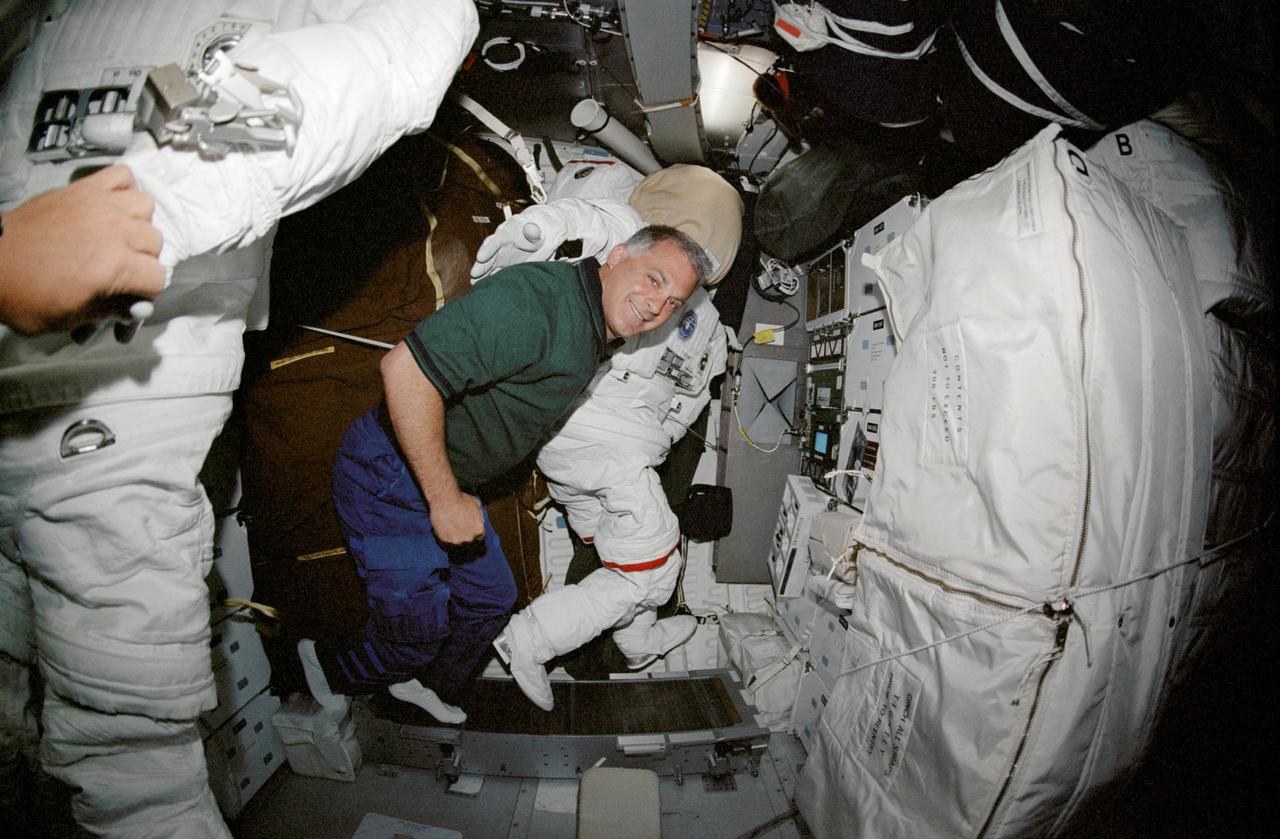
STS112-309-008 (7-18 October 2002) --- Astronaut David A. Wolf, STS-112 mission specialist, is pictured near an Extravehicular Mobility Unit (EMU) space suit on the middeck of the Space Shuttle Atlantis.
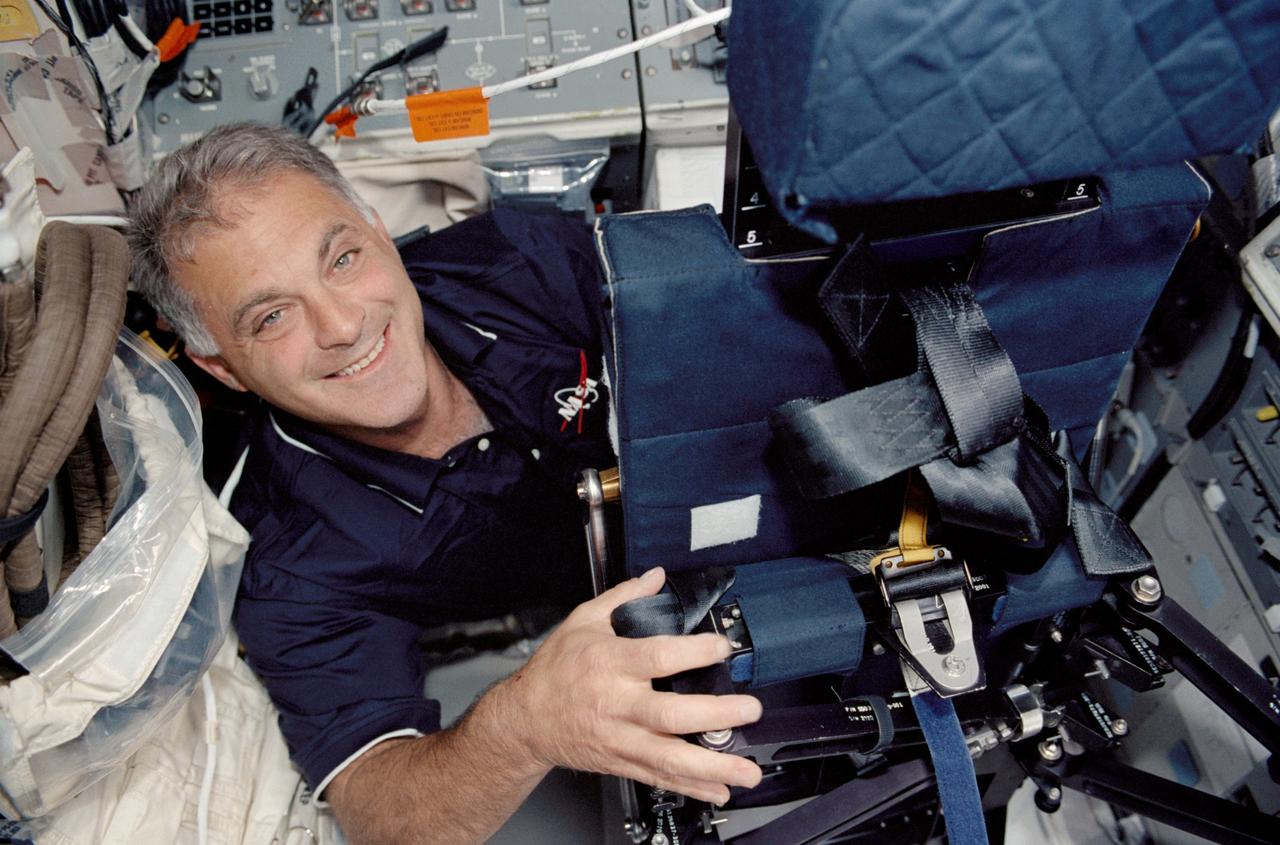
STS112-324-008 (7-18 October 2002) --- Astronaut David A. Wolf, STS-112 mission specialist, works with a temporary flight deck seat, used for launch and entry, on the Space Shuttle Atlantis.
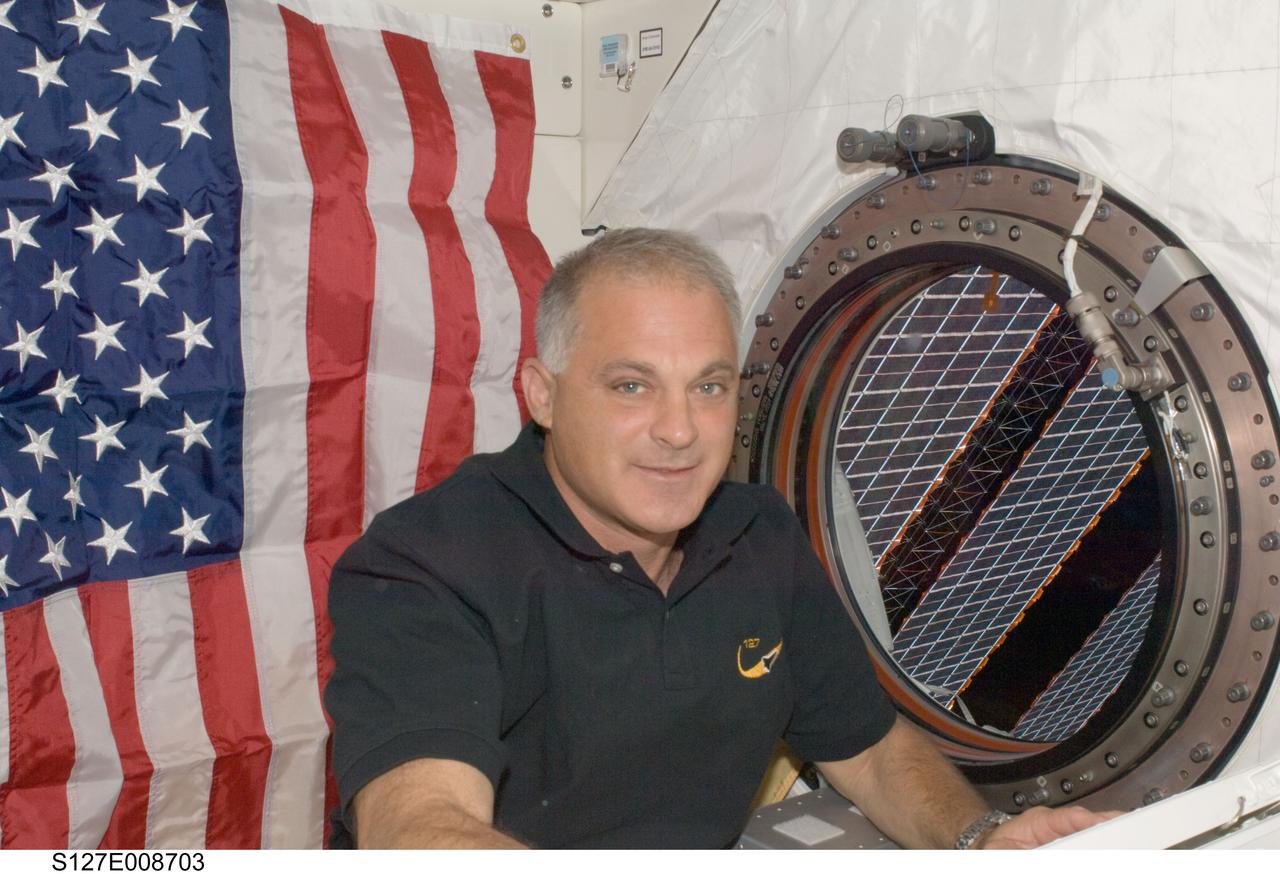
S127-E-008703 (25 July 2009) --- Astronaut Dave Wolf, STS-127 mission specialist, is pictured near a window in the Kibo laboratory of the International Space Station while Space Shuttle Endeavour remains docked with the station.

This image from NASA's James Webb Space Telescope reveals at least 17 concentric dust rings emanating from a pair of stars orbiting one another. Located just over 5,000 light-years from Earth, the system is known as Wolf-Rayet 140 because one of the stars is a Wolf-Rayet star. The other is an O-type star, one of the most massive star types known. Each ring was created when the two stars came close together and their stellar winds (streams of gas they blow into space) collided, compressing the gas and forming dust. A ring is produced once per orbit, every 7.93 years. A Wolf-Rayet star is an O-type star born with at least 25 times more mass than our Sun that is nearing the end of its life, when it will likely collapse directly to black hole, or explode as a supernova. These delays between periods of dust production create the unique ring pattern. Some Wolf-Rayet binaries in which the stars are close enough together and have circular orbits produce dust continuously, often forming a pinwheel pattern. WR 140's rings are also referred to as shells because they are not perfectly circular and are thicker and wider than they appear in the image. The rings appear brighter in some areas but are almost invisible in others, rather than forming a perfect "bullseye" pattern. That's because production of dust is variable as the stars get close to one another, and because Webb views the system at an angle and is not looking directly at the orbital plane of the stars. One of the densest regions of dust production creates the bright feature appearing at 2 o'clock. The image was taken by the Mid-Infrared Instrument (MIRI), now managed by the agency's Goddard Space Flight Center. MIRI was developed through a 50-50 partnership between NASA and ESA (European Space Agency). The Jet Propulsion Laboratory in Southern California led the effort for NASA, and a multinational consortium of European astronomical institutes contributed for ESA. Webb's science instruments detect infrared light, a range of wavelengths emitted by warm objects and invisible to the human eye. MIRI detects the longest infrared wavelengths, which means it can often see cooler objects – including these dust rings – than the other three Webb instruments can. The filters used to take this image were the F770W (7.7 micrometers, shown as blue), F1500W (15 micrometers, shown as green), and F2100W (21 micrometers, shown as red). The observations were done under Webb's early release observation (ERO) program number 1349. The most common element found in stars, hydrogen, can't form dust on its own. But Wolf-Rayet stars in their later stages have blown away all of their hydrogen, so they eject elements typically found deep in a star's interior, like carbon, which can form dust. Data from MIRI's Medium Resolution Spectrometer (MRS) shows that the dust made by WR 140 is likely made of a class of molecules called polycyclic aromatic hydrocarbons (PAHs), which are a type of organic carbon-rich compounds that are thought to enrich the carbon content throughout the Universe. Initial processing of the Webb WR 140 data included eight bright "spikes" of light emanating from the center of the image. These are not features of the system, but so-called artifacts of the telescope itself. They were removed from the image, in order to give viewers an unobscured view of the source object. https://photojournal.jpl.nasa.gov/catalog/PIA25432

Felisa Wolfe-Simon, director, Astrobiology Program, NASA Headquarters, speaks during a press conference, Thursday, Dec. 2, 2010, at NASA Headquarters in Washington. NASA-funded astrobiology research has changed the fundamental knowledge about what comprises all known life on Earth. Researchers conducting tests in the harsh environment of Mono Lake in California have discovered the first known microorganism on Earth able to thrive and reproduce using the toxic chemical arsenic. Photo Credit: (NASA/Paul E. Alers)

Felisa Wolfe-Simon, a lead researcher and NASA astrobiology research fellow, speaks during a press conference, Thursday, Dec. 2, 2010, at NASA Headquarters in Washington. NASA-funded astrobiology research has changed the fundamental knowledge about what comprises all known life on Earth. Researchers conducting tests in the harsh environment of Mono Lake in California have discovered the first known microorganism on Earth able to thrive and reproduce using the toxic chemical arsenic. Photo Credit: (NASA/Paul E. Alers)
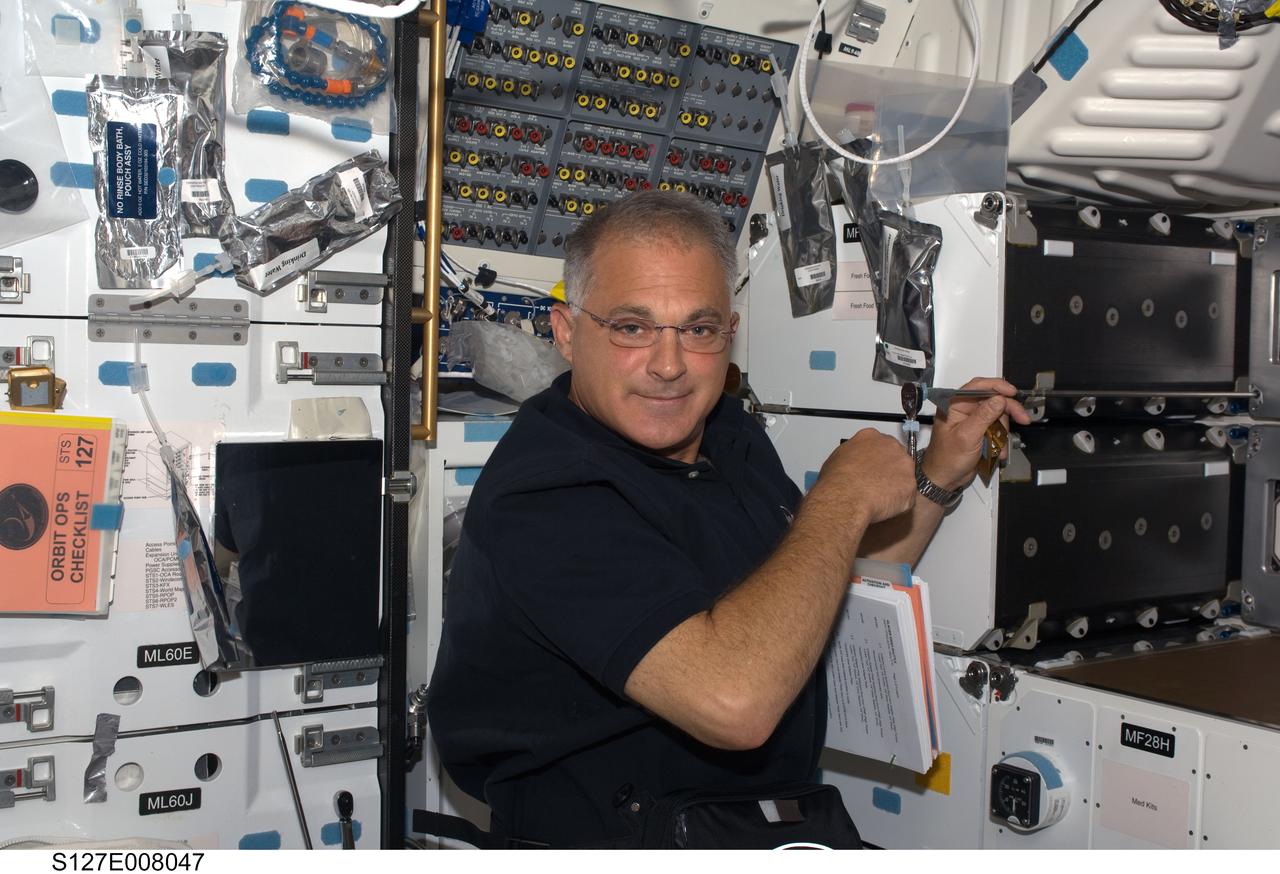
S127-E-008047 (23 July 2009) --- Astronaut Dave Wolf, STS-127 mission specialist, on Endeavour's middeck during flight day nine.

S127-E-007978 (22 July 2009) Astronauts Christopher Cassidy (left) and Dave Wolf work with the Integrated Cargo Carrier-VLD, as they remove and replace batteries on the P6 truss during STS-127's third session of extravehicular activity.
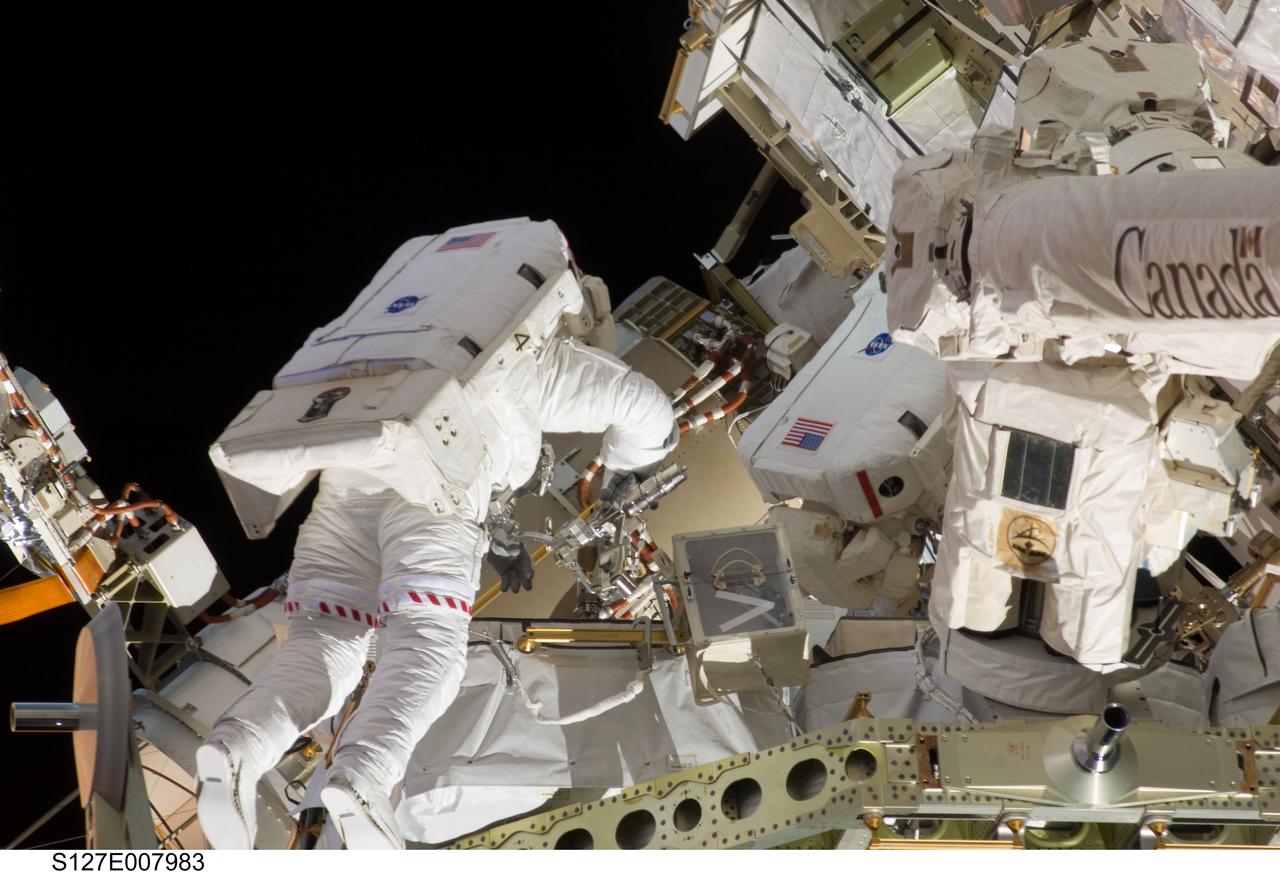
S127-E-007983 (22 July 2009) --- Astronaut Christopher Cassidy, STS-127 mission specialist, participates in Endeavour's third space walk of a scheduled five overall for this flight. This was Cassidy's first of a scheduled three sessions for him. Astronaut Dave Wolf, Cassidy's EVA colleague, partially visible at right.
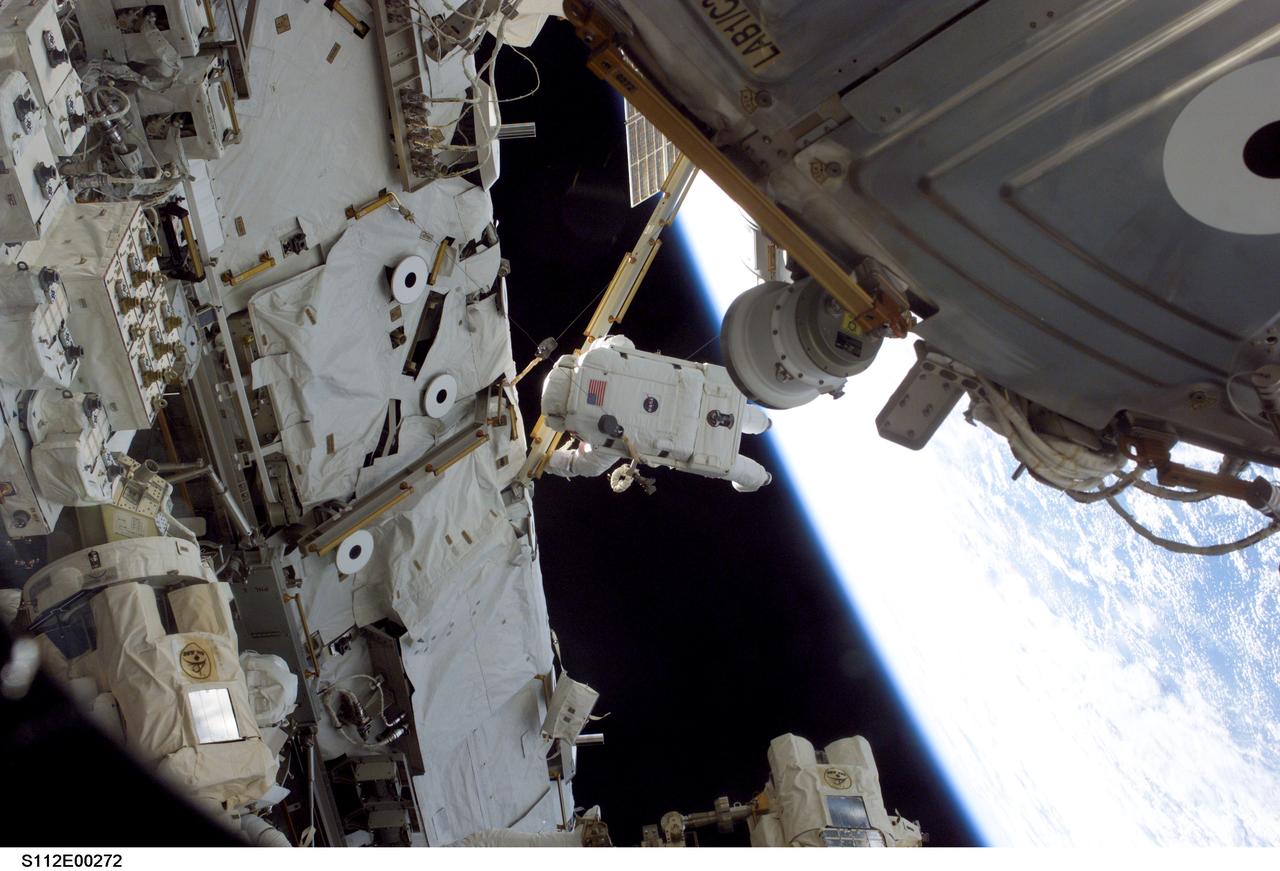
STS112-E-5272 (12 October 2002) --- Astronaut David A. Wolf, mission specialist, works near a truss on the International Space Station (ISS) during the STS-112 mission's second spacewalk. Part of the Destiny Laboratory is visible in the foreground.
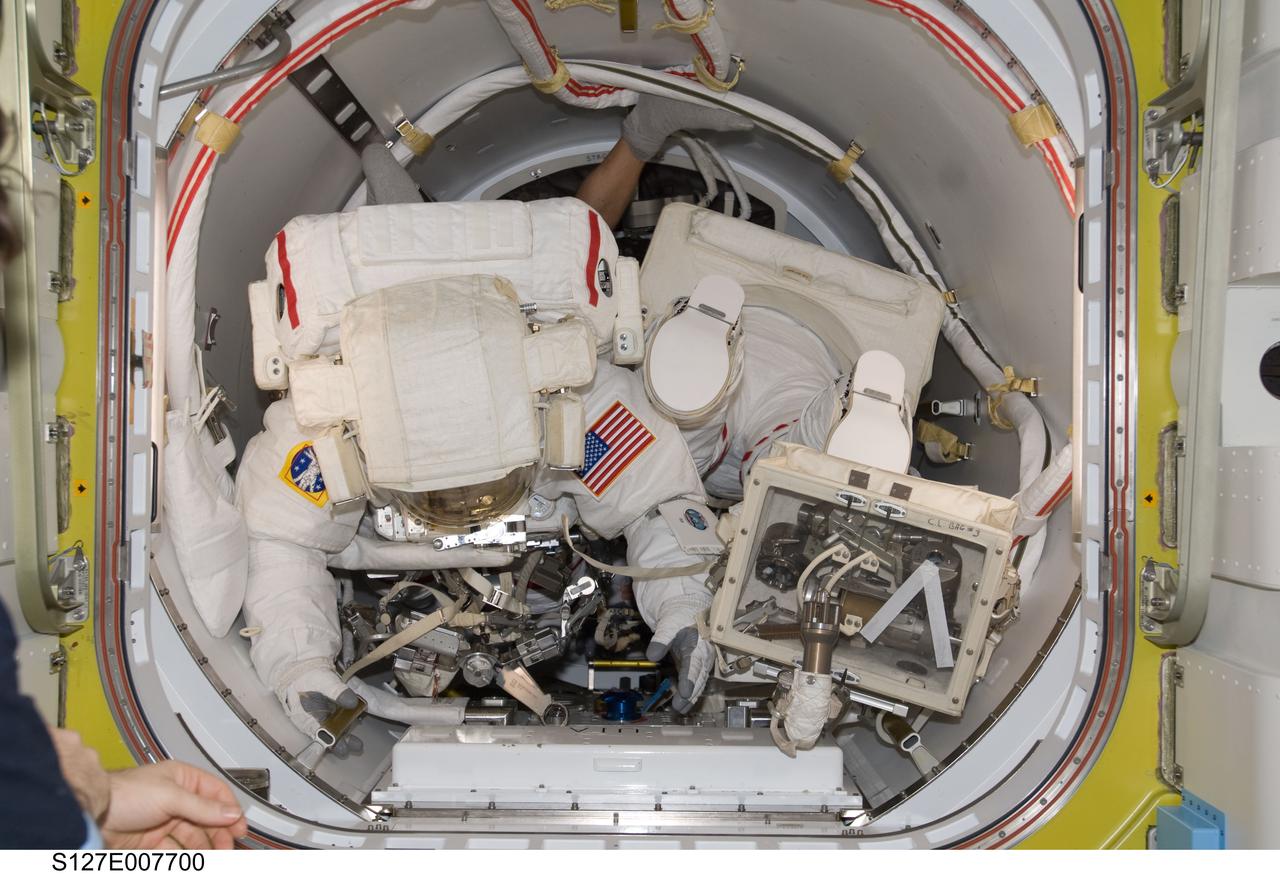
S127-E-007700 (22 July 2009) --- Astronaut Dave Wolf, STS-127 mission specialist, is seconds away from egressing the International Space Station to begin his third spacewalk of the current mission. Astronaut Christopher Cassidy, mission specialist, whose feet and backpack are visible, was about to make his initial spacewalk.
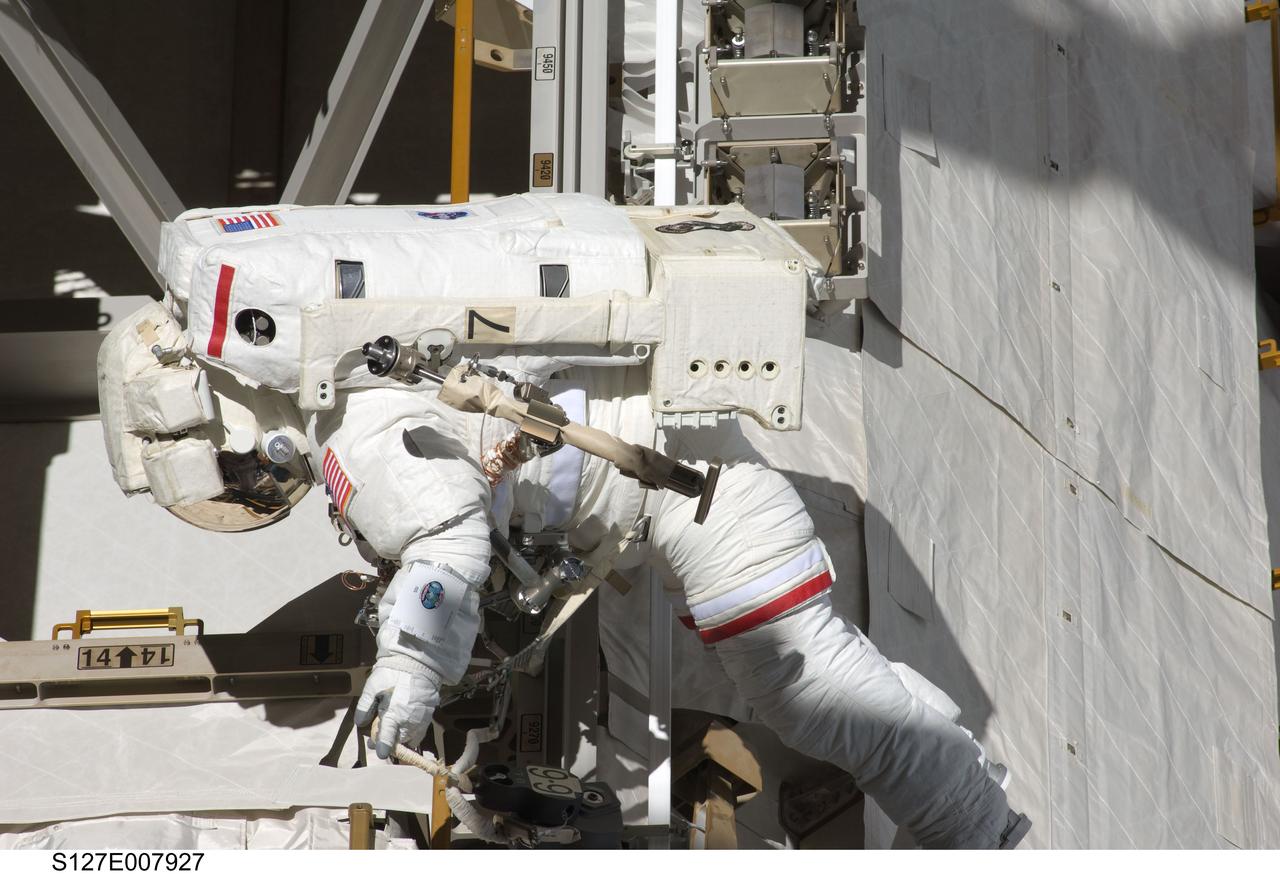
S127-e-007927 (22 July 2009) --- Astronaut Dave Wolf, mission specialist, is pictured during his third and final STS-127 session of extravehicular activity. The crew has two more spacewalks scheduled after this to continue work on the International Space Station.
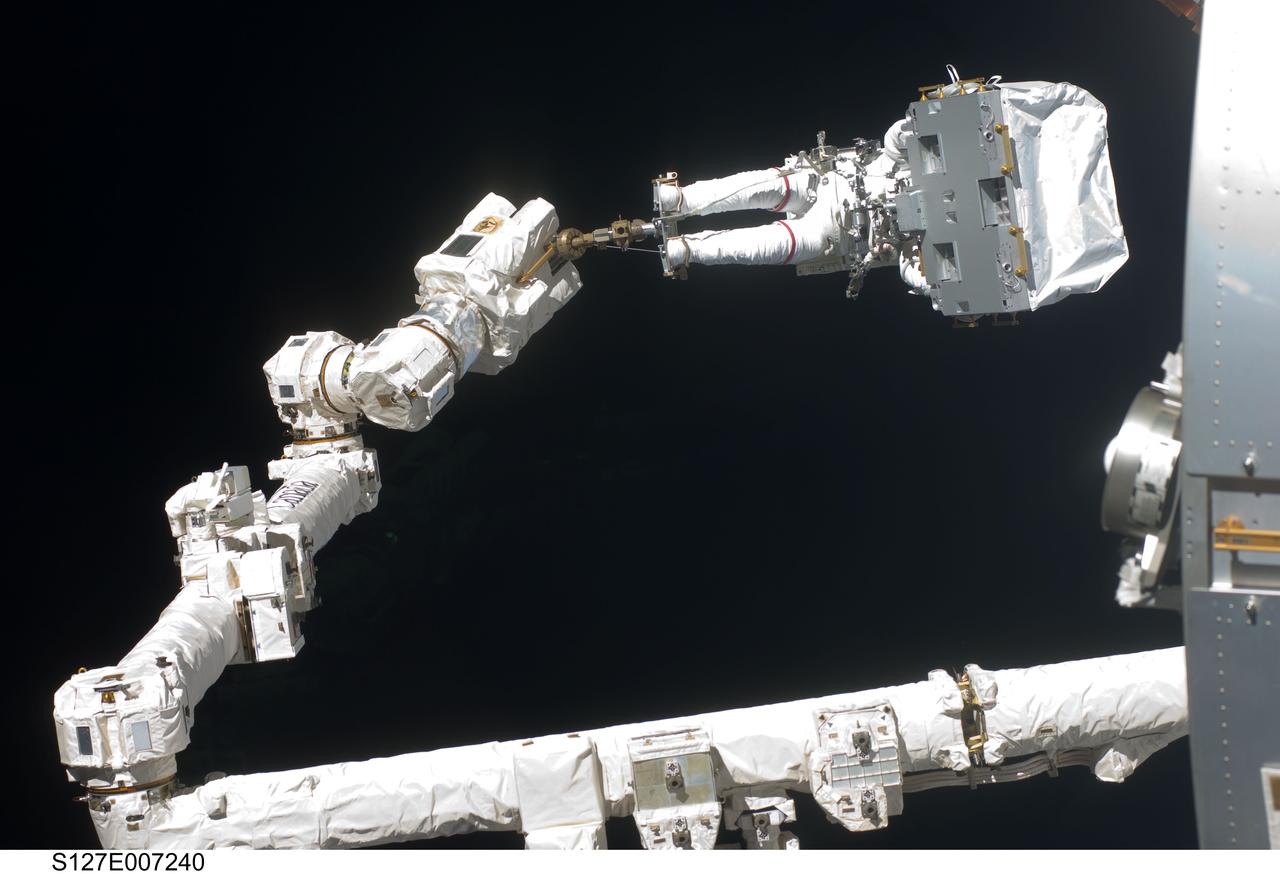
S127-E-007240 (20 July 2009) --- During the second STS-127 spacewalk, astronauts Dave Wolf and Tom Marshburn (out of frame), with help from their crewmates inside the International Space Station and the Space Shuttle Endeavour, transported the Linear Drive Unit (LDU) and two other parts to the station's External Stowage Platform 3 for long-term storage. Wolf is standing on the end of Canadarm2, which is anchored on the orbital outpost.
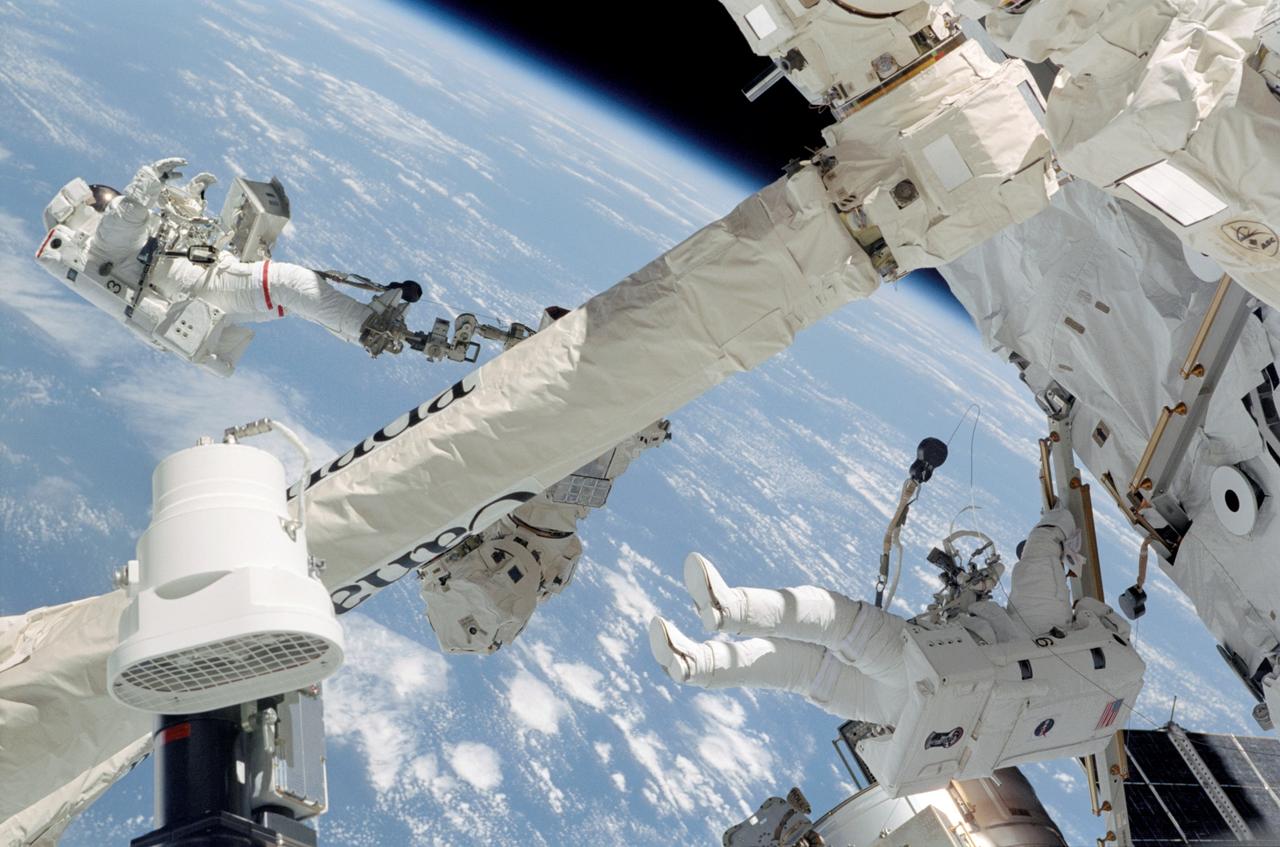
STS112-326-033 (12 October 2002) --- Astronauts David A. Wolf (left) and Piers J. Sellers, both STS-112 mission specialists, participate in the mission’s second session of extravehicular activity (EVA). Wolf is anchored to a foot restraint on the International Space Station’s (ISS) Canadarm2 while Sellers traverses along the airlock spur, a route used by spacewalkers to get from the Quest airlock on the station to the outpost's truss.
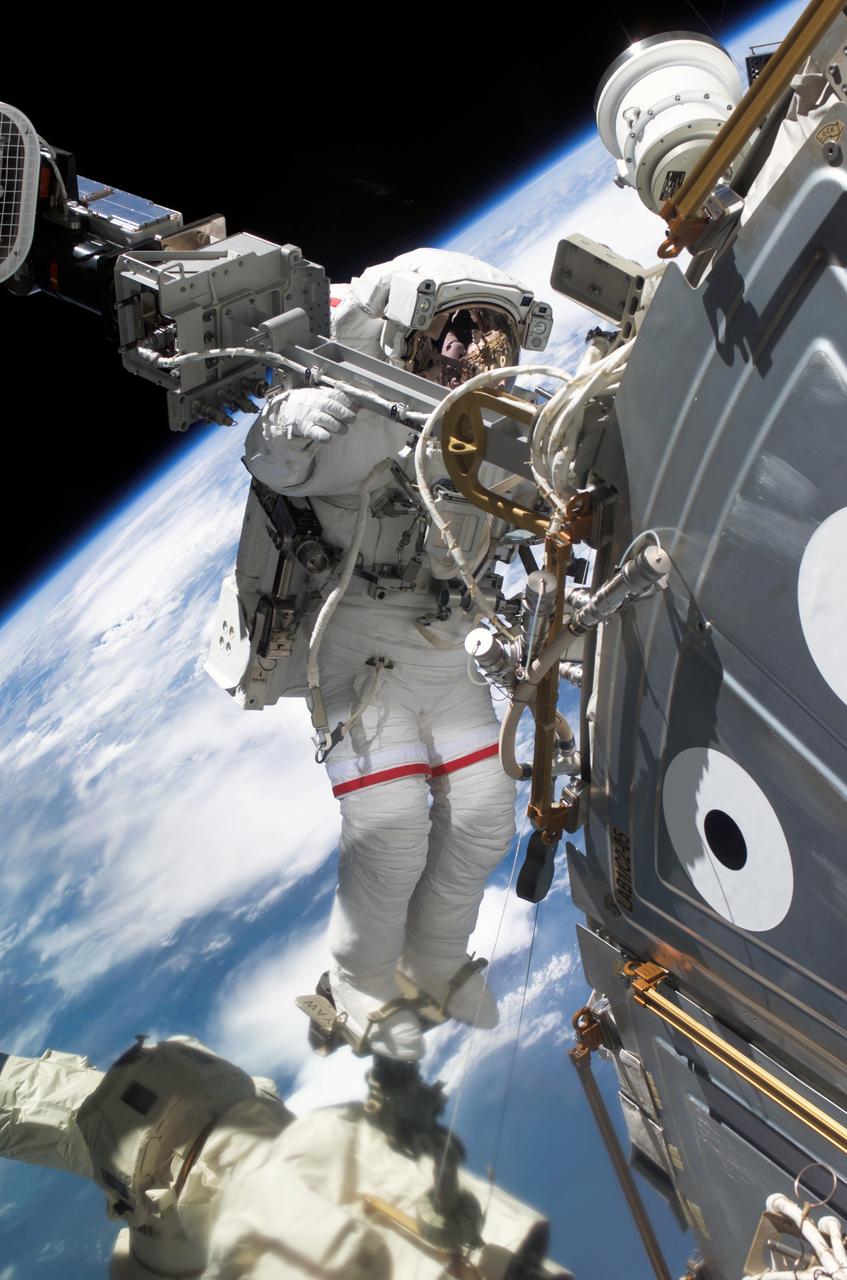
S112-E-05315 (12 Oct. 2002) --- Astronaut David A. Wolf, STS-112 mission specialist, carries out a task to install an additional exterior station television camera outside of the Destiny Laboratory during the second spacewalk of the STS-112 mission. Astronauts Wolf and Piers J. Sellers are scheduled for a total of three spacewalks for the mission.
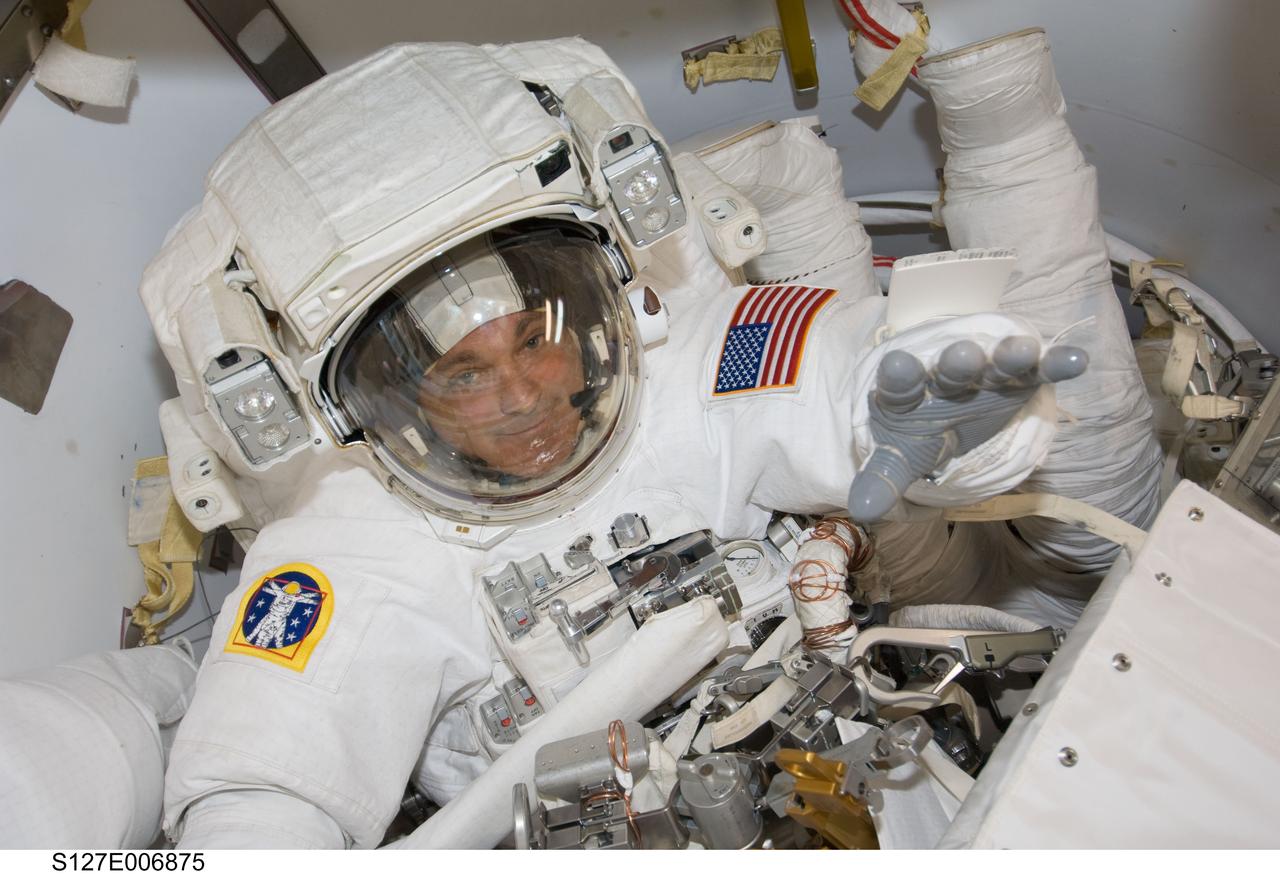
S127-E-006875 (18 July 2009) --- Astronaut Dave Wolf, mission specialist, on July 18 was one of two Endeavour astronauts to kick off a series of five sessions of ISS-related extravehicular activity for the STS-127 crew. Wolf, seen onboard the orbital outpost here, was joined by astronaut Tim Kopra for this session, his first of three scheduled.
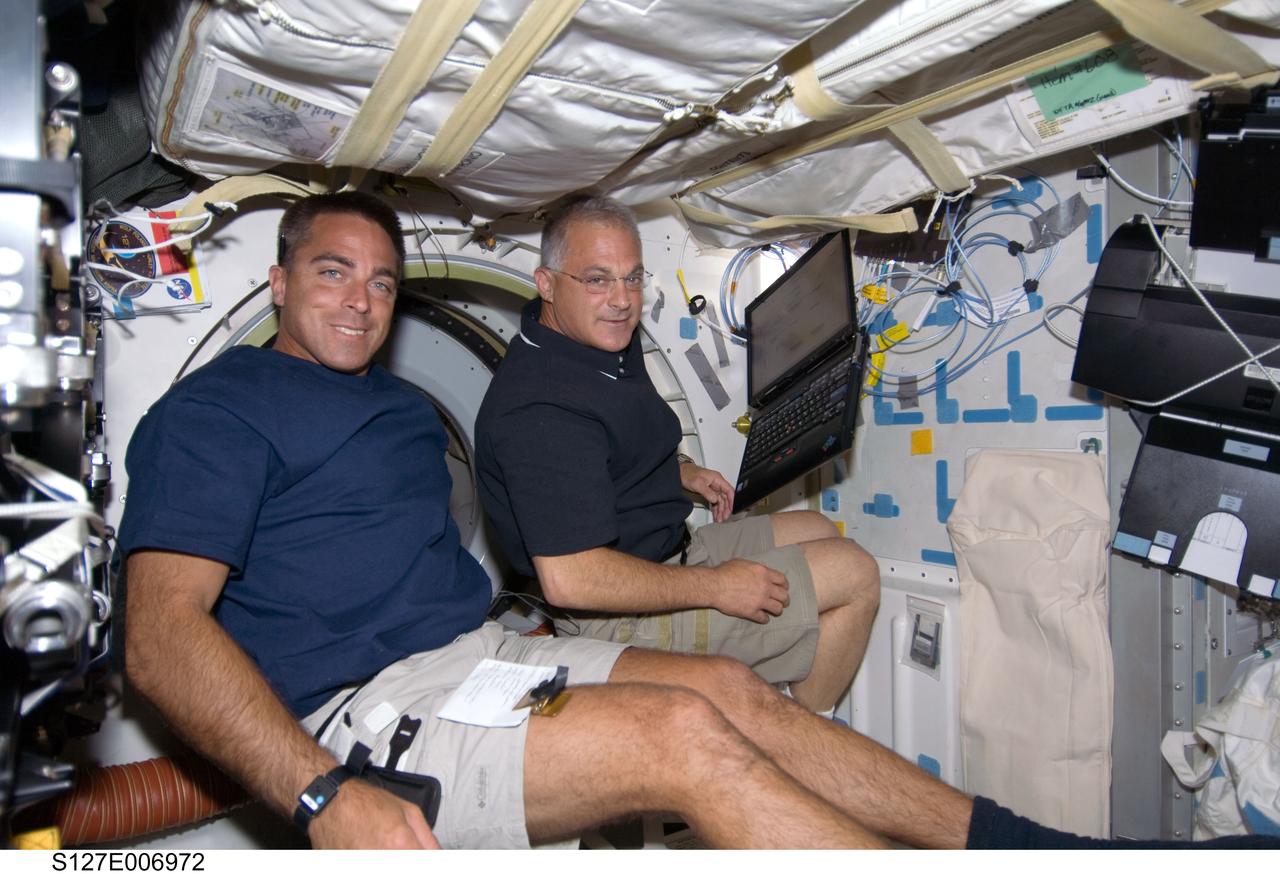
S127-E-006972 (19 July 2009) --- On Endeavour's mid deck, astronauts Christopher Cassidy (left) and Dave Wolf, both STS-127 mission specialists, may be talking over their upcoming shared space walk, scheduled for flight day 8. The extravehicular activity they share will be the third and final EVA session in a week's time for Wolf and it will be the first of three for Cassidy.
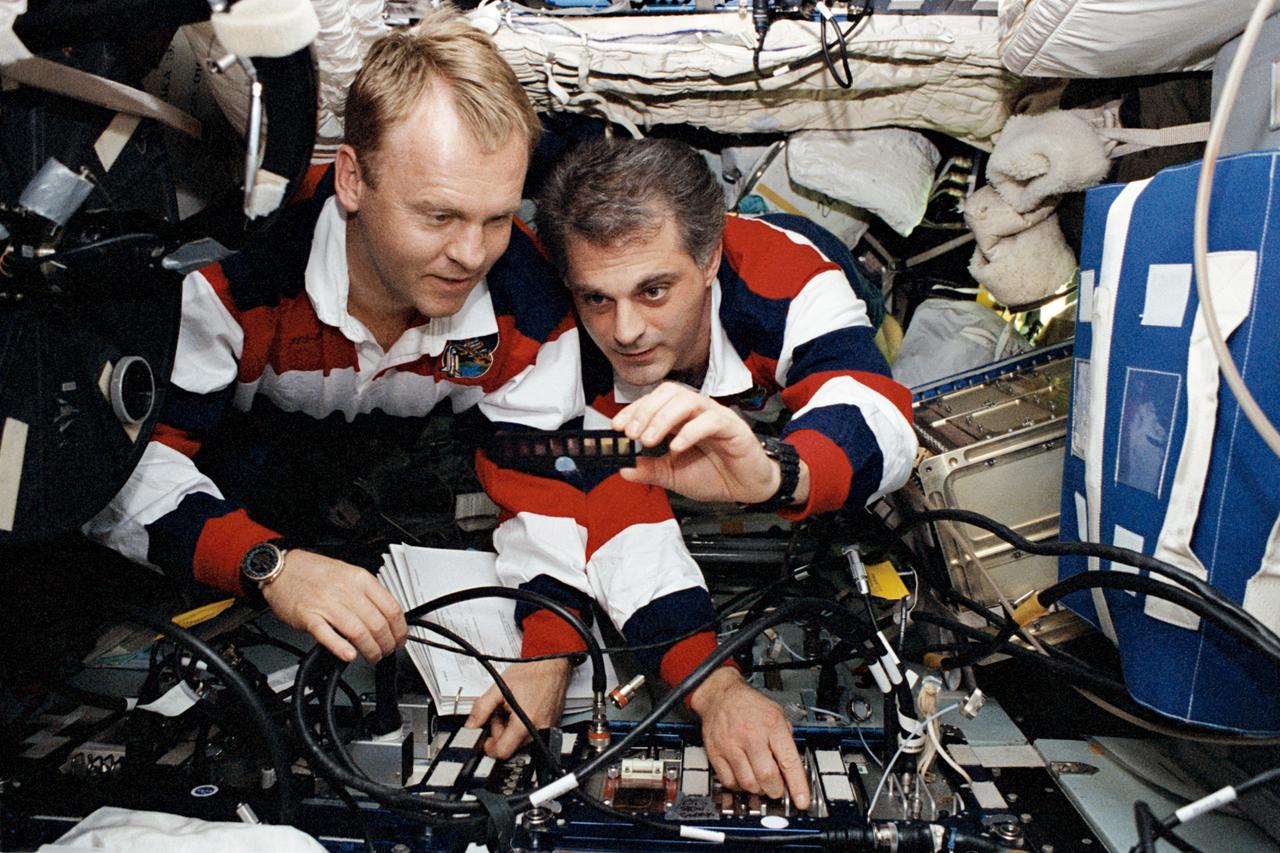
STS089-390-008 (22-31 Jan 1998) --- Astronauts David A. Wolf (right), newly a member of the Space Shuttle Endeavour STS-89 crew; and Andrew S. W. Thomas, his cosmonaut guest researcher replacement on the Russia?s Mir Space Station, Mir-24 crew, check out the CoCult hardware, a Mir tissue experiment. Wolf is holding a sample display from the hardware.
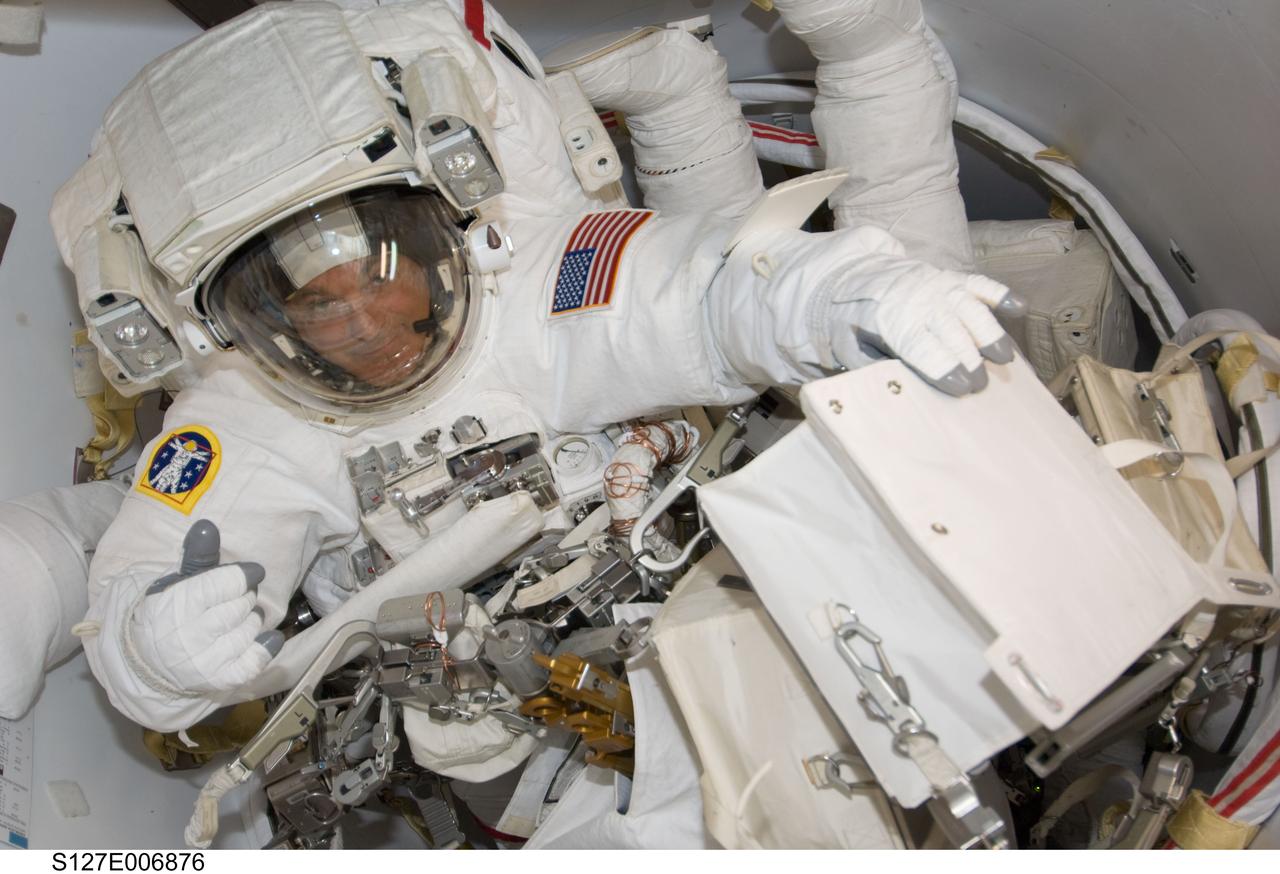
S127-E-006876 (18 July 2009) --- Astronaut Dave Wolf, mission specialist, on July 18 was one of two Endeavour astronauts to kick off a series of five sessions of ISS-related extravehicular activity for the STS-127 crew. Wolf, seen onboard the orbital outpost here, was joined by astronaut Tim Kopra for this session, his first of three scheduled.
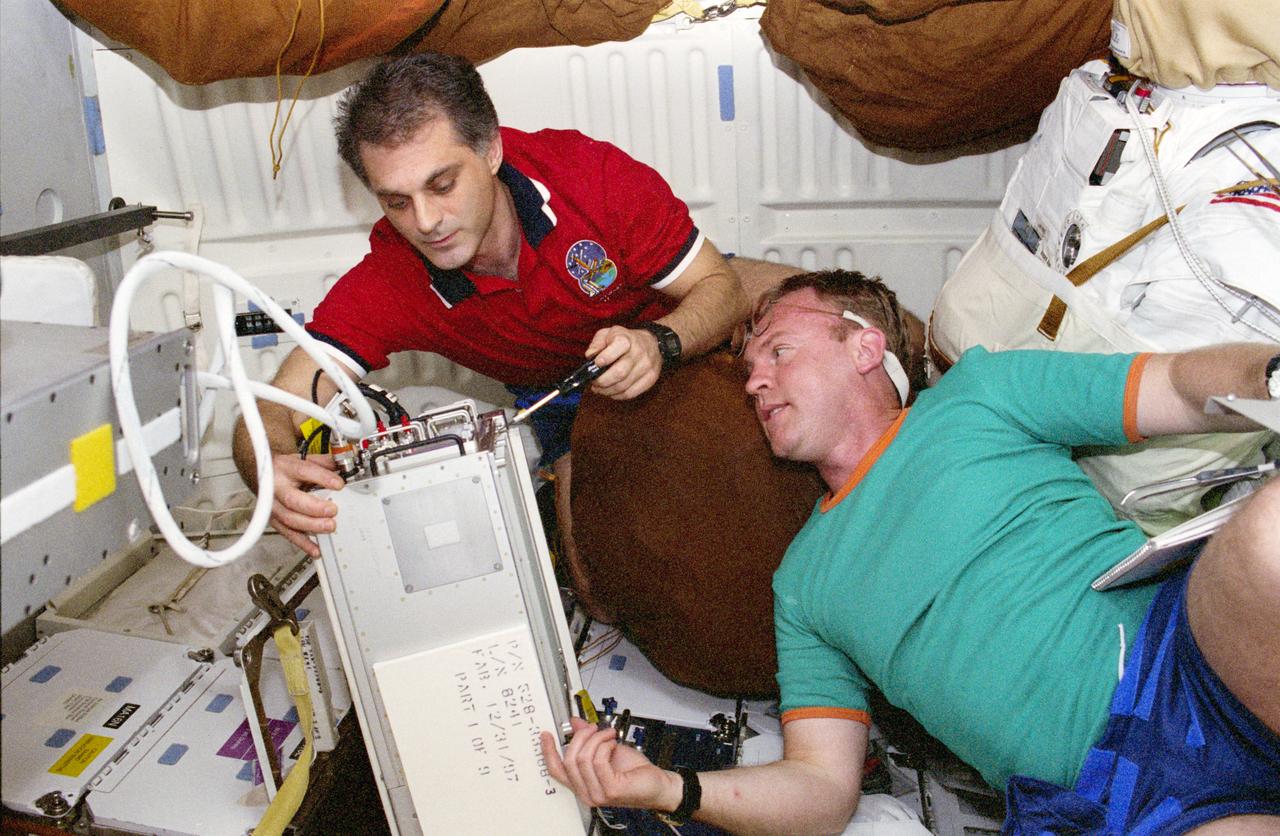
STS089-364-022 (22-31 Jan. 1998) --- Astronauts David A. Wolf, a new member of the STS-89 crew; and Andrew S. W. Thomas, a new member of the Mir-24 crew, check out the just-unstowed CoCult hardware, a Mir tissue experiment. Wolf will return aboard the space shuttle Endeavour after spending four months on the Russian Mir Space Station. Thomas is the final United States astronaut to serve as guest researcher aboard Mir. Photo credit: NASA
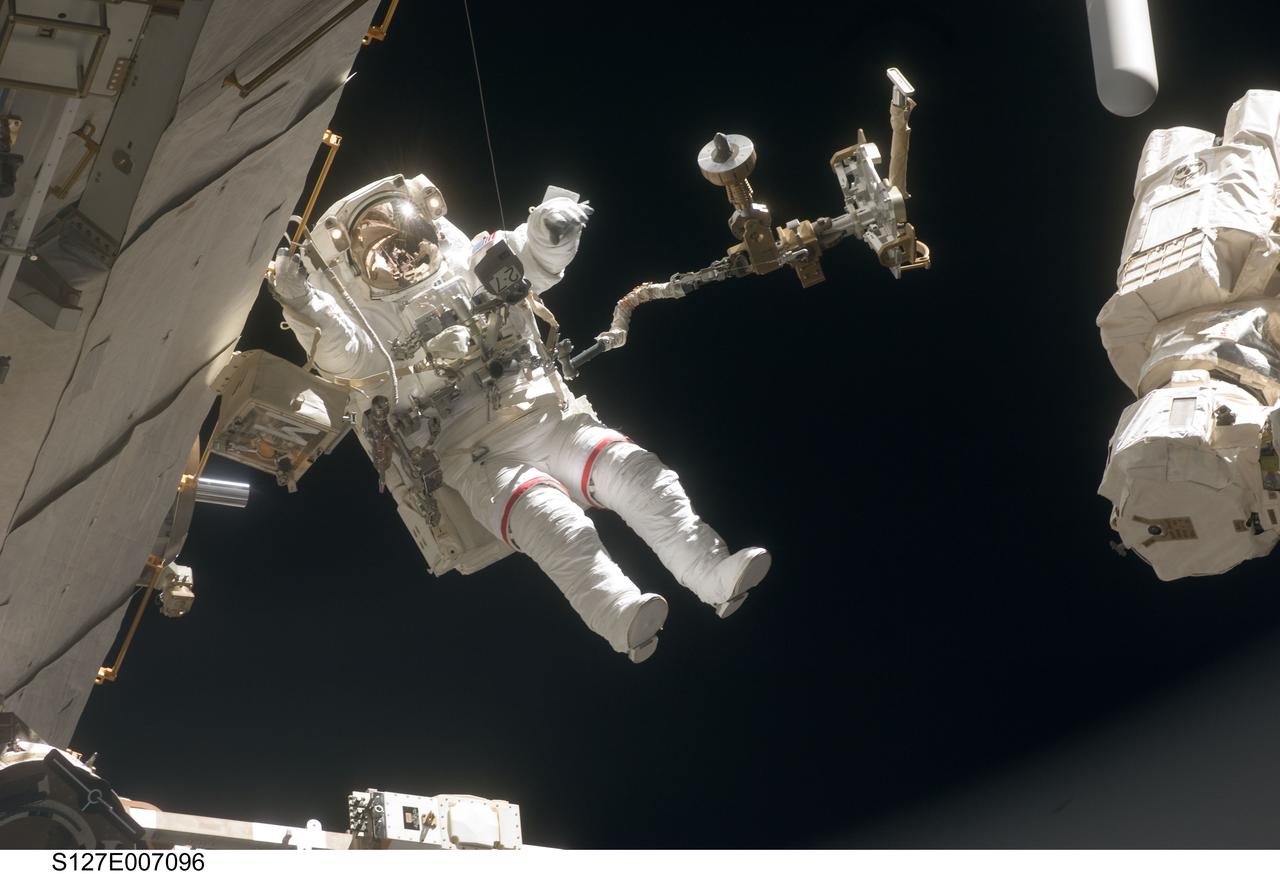
S127-E-007096 (20 July 2009) --- This is one of a series of digital still images showing astronaut Dave Wolf performing his second spacewalk and the Endeavour’s second also of the scheduled five overall in a little over a week’s time to continue work on the International Space Station. The equipment floating in front of Wolf is tethered to his spacesuit. Astronauts Wolf and Tom Marshburn (out of frame), both mission specialists, successfully transferred a spare KU-band antenna to long-term storage on the space station, along with a backup coolant system pump module and a spare drive motor for the station's robot arm transporter. Installation of a television camera on the Japanese Exposed Facility experiment platform was deferred to a later spacewalk.
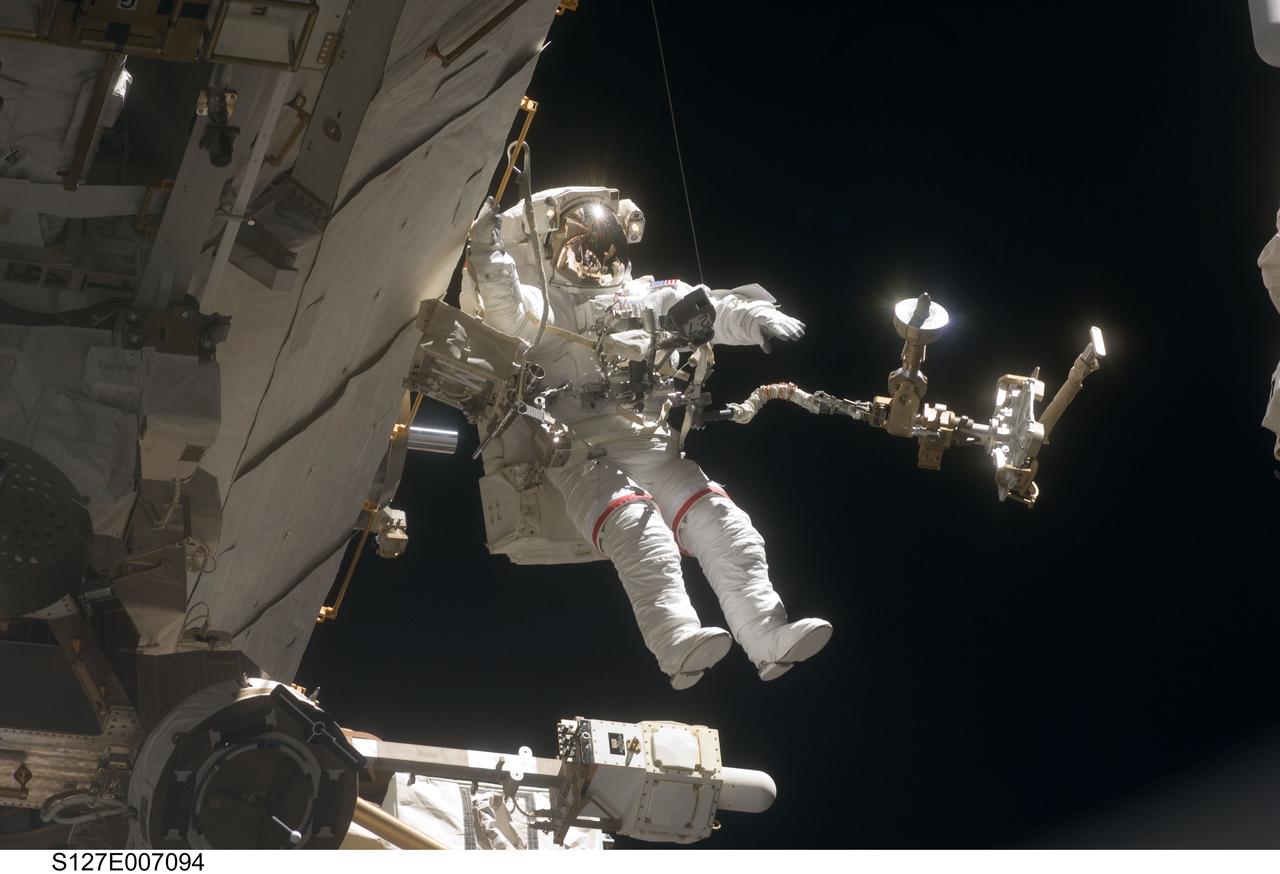
S127-E-007094 (20 July 2009) --- This is one of a series of digital still images showing astronaut Dave Wolf performing his second spacewalk and the Endeavour’s second also of the scheduled five overall in a little over a week’s time to continue work on the International Space Station. The equipment floating in front of Wolf is tethered to his spacesuit. Astronauts Wolf and Tom Marshburn (out of frame), both mission specialists, successfully transferred a spare KU-band antenna to long-term storage on the space station, along with a backup coolant system pump module and a spare drive motor for the station's robot arm transporter. Installation of a television camera on the Japanese Exposed Facility experiment platform was deferred to a later spacewalk.
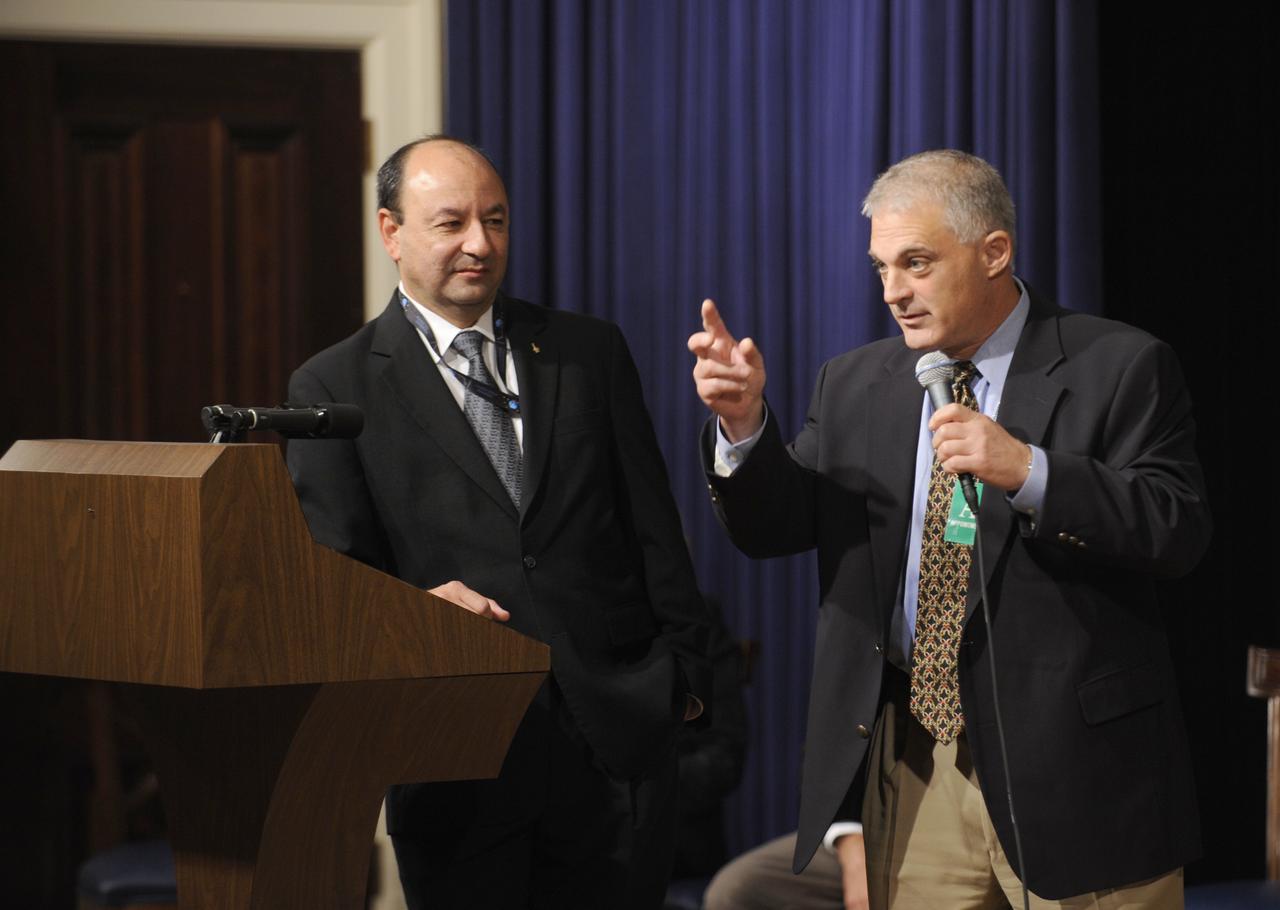
STS-127 Commander Mark Polansky, left, looks on as crew member David Wolf answer a question during a presentation to White House interns at the Eisenhower Executiive Office Building in Washington, Thursday, Sept. 24, 2009. Photo Credit: (NASA/Paul E. Alers)
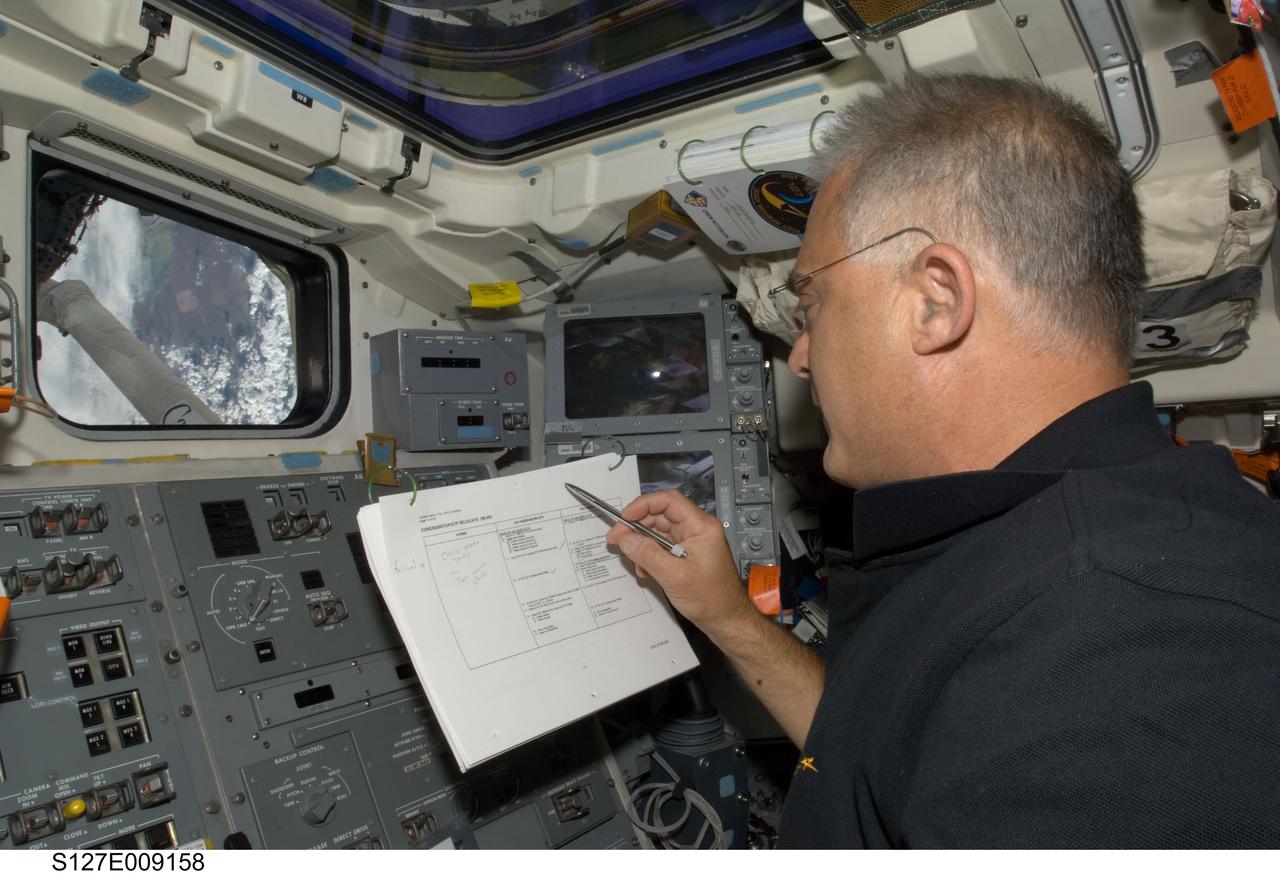
S127-E-009158 (27 July 2009) --- Astronaut Dave Wolf, STS-127 mission specialist, looks over a checklist on the aft flight deck of Space Shuttle Endeavour while docked with the International Space Station.
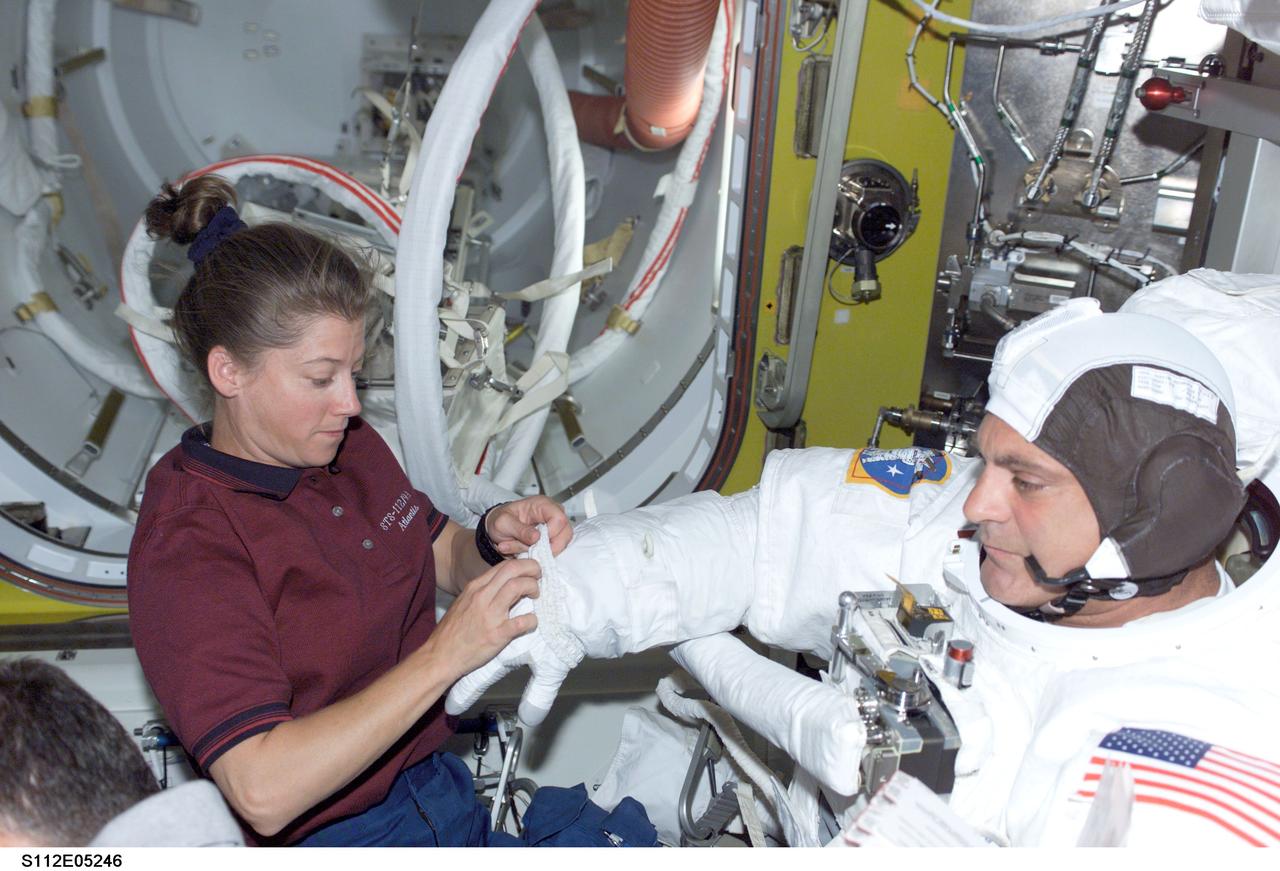
STS112-E-5246 (12 October 2002) --- Astronaut Pamela Melroy, STS-112 pilot, assists astronaut David A. Wolf with his extravehicular mobility unit (EMU) spacesuit prior to the mission's second scheduled spacewalk.
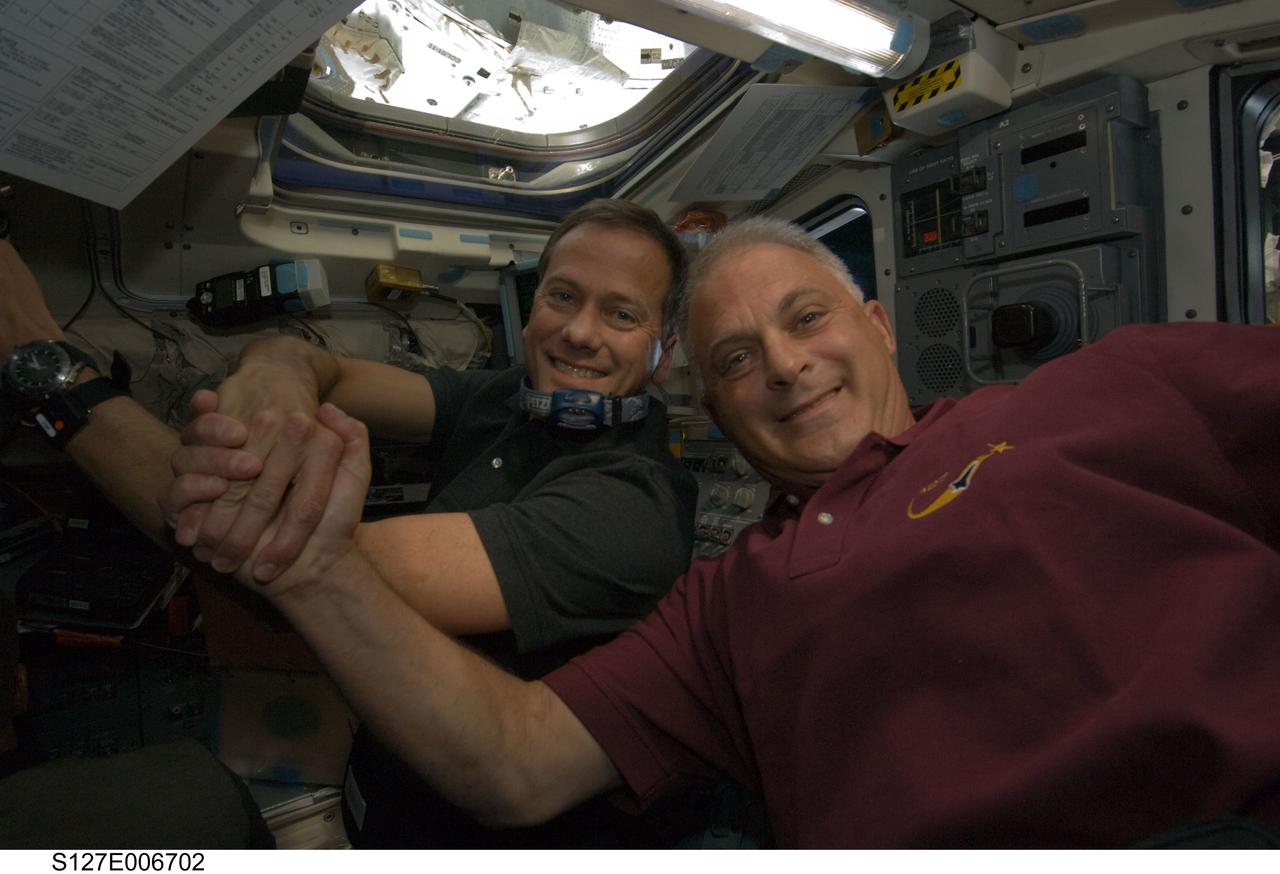
S127-E-006702 (17 July 2009) --- Astronauts Tom Marshburn (left) and Dave Wolf, both STS-127 mission specialists, celebrate the successful docking of the Space Shuttle Endeavour and the International Space Station.
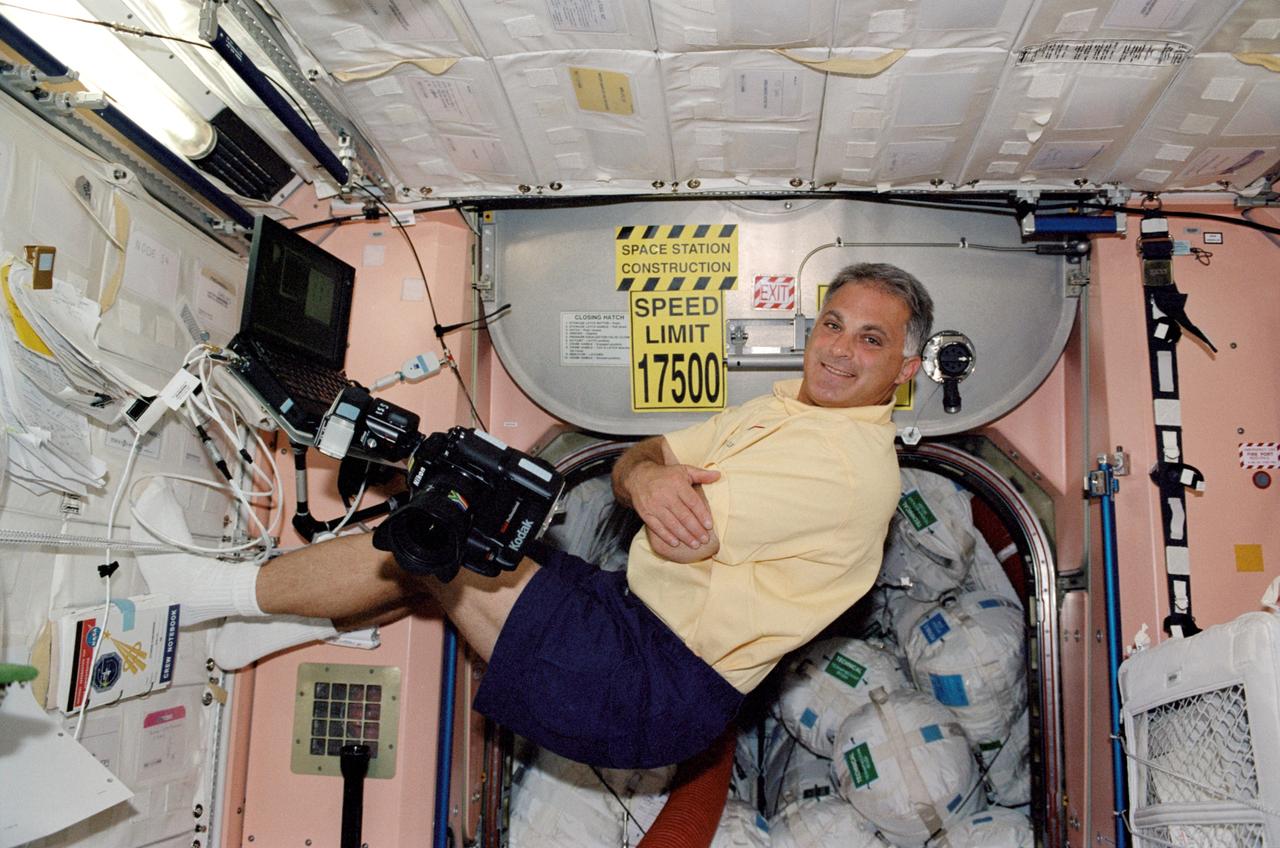
STS112-314-010 (7-18 October 2002) --- Astronaut David A. Wolf, STS-112 mission specialist, floats in the Unity node on the International Space Station (ISS).
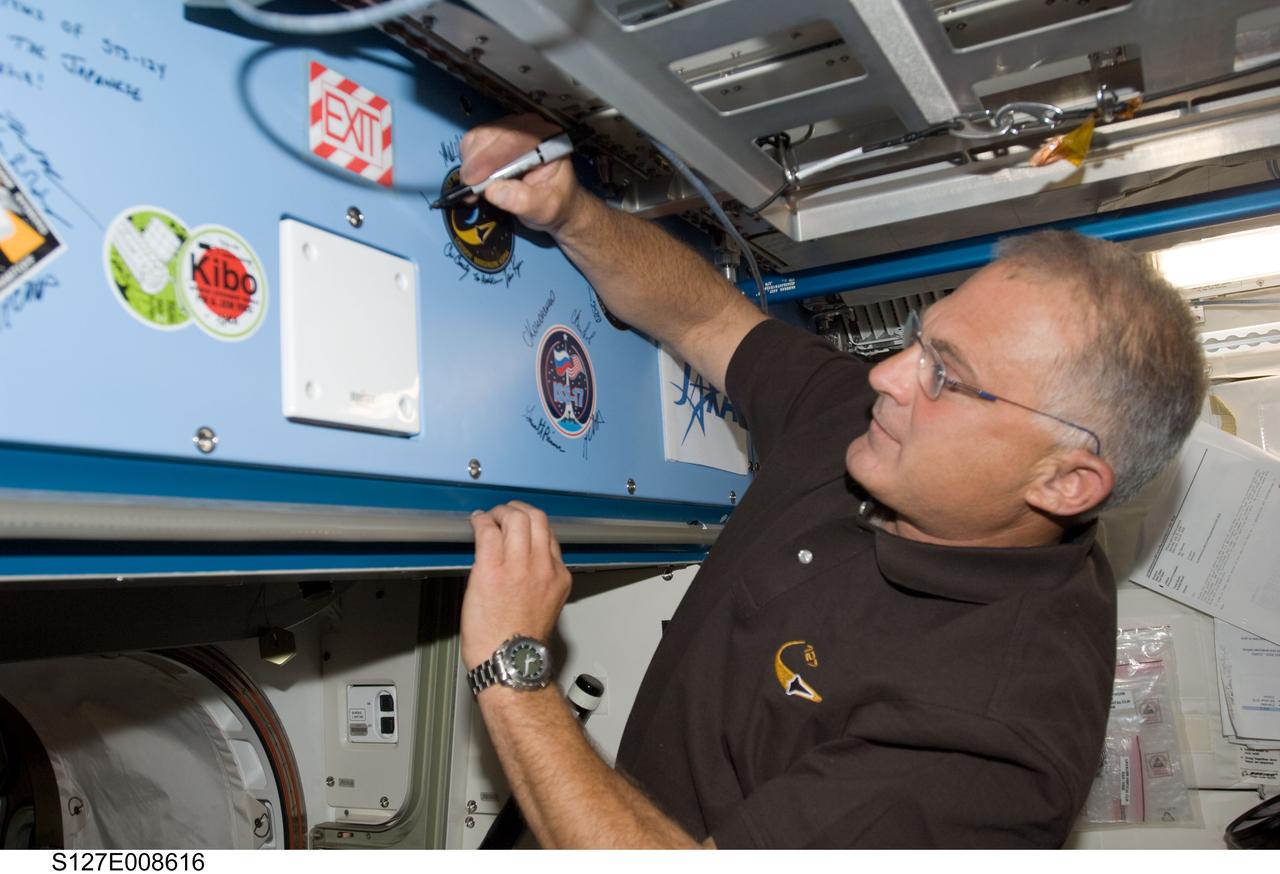
S127-E-008616 (25 July 2009) --- Flight day 11 activities for the joint shuttle-station crews included the traditional autographing of the station. Astronaut Dave Wolf, STS-127 mission specialist, has the pen in this frame.
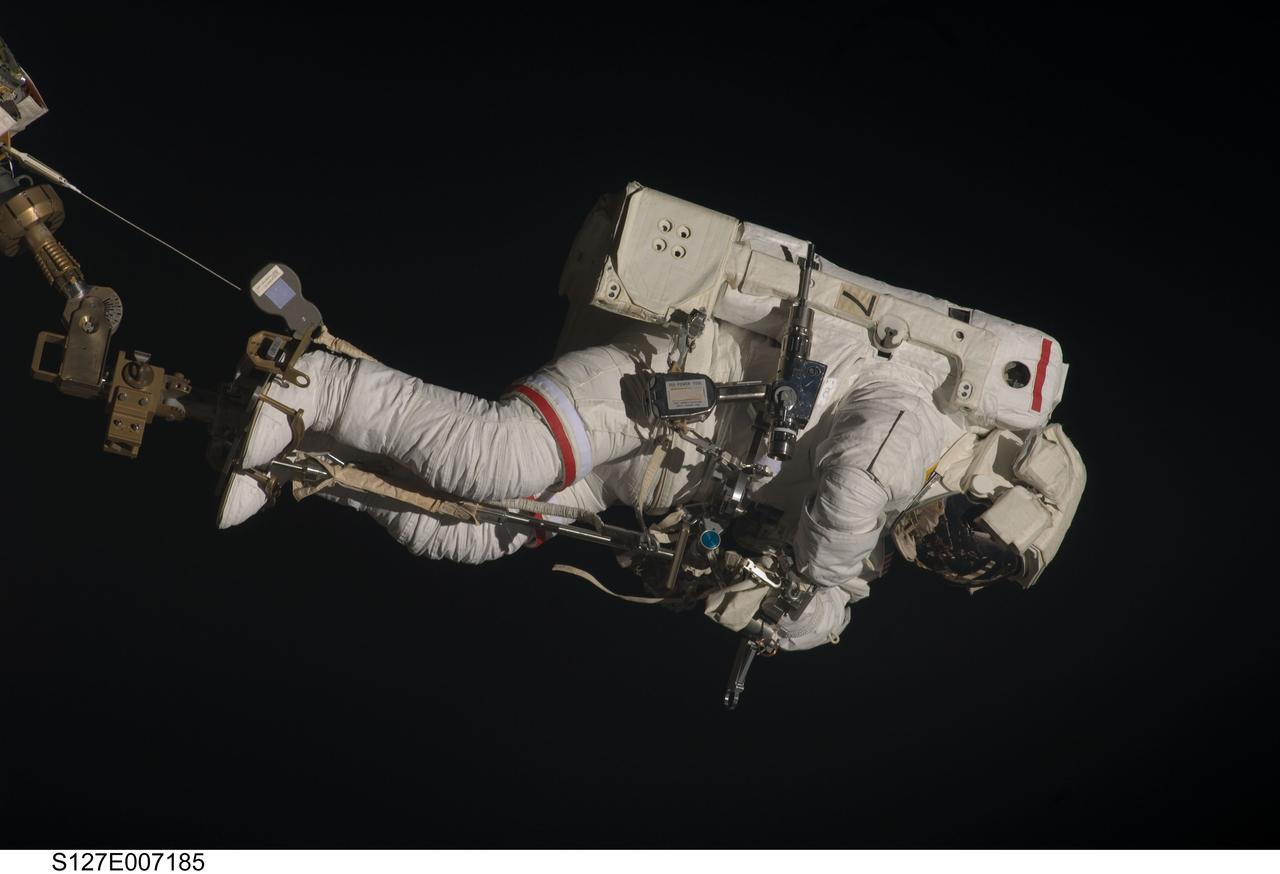
S127-E-007185 (20 July 2009) --- This is one of a series of digital still images showing astronaut Dave Wolf performing his second spacewalk and the Endeavour’s second also of the scheduled five overall in a little over a week’s time to continue work on the International Space Station. Astronauts Wolf and Tom Marshburn (out of frame), both STS-127 mission specialists, successfully transferred a spare KU-band antenna to long-term storage on the space station, along with a backup coolant system pump module and a spare drive motor for the station's robot arm transporter. Installation of a television camera on the Japanese Exposed Facility experiment platform was deferred to a later spacewalk.
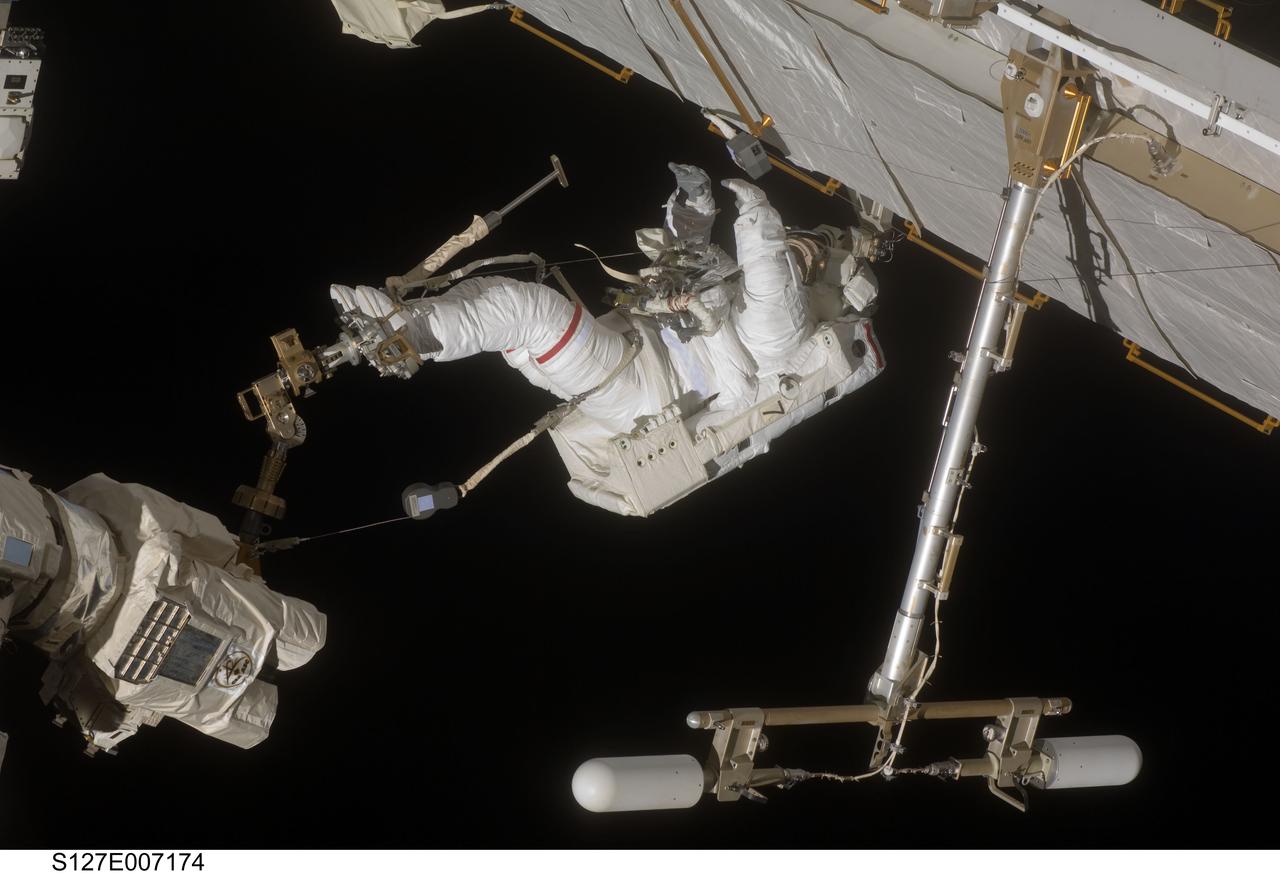
S127-E-007174 (20 July 2009) --- This is one of a series of digital still images showing astronaut Dave Wolf performing his second spacewalk and the Endeavour’s second also of the scheduled five overall in a little over a week’s time to continue work on the International Space Station. Astronauts Wolf and Tom Marshburn (out of frame), both mission specialists, successfully transferred a spare KU-band antenna to long-term storage on the space station, along with a backup coolant system pump module and a spare drive motor for the station's robot arm transporter. Installation of a television camera on the Japanese Exposed Facility experiment platform was deferred to a later spacewalk.
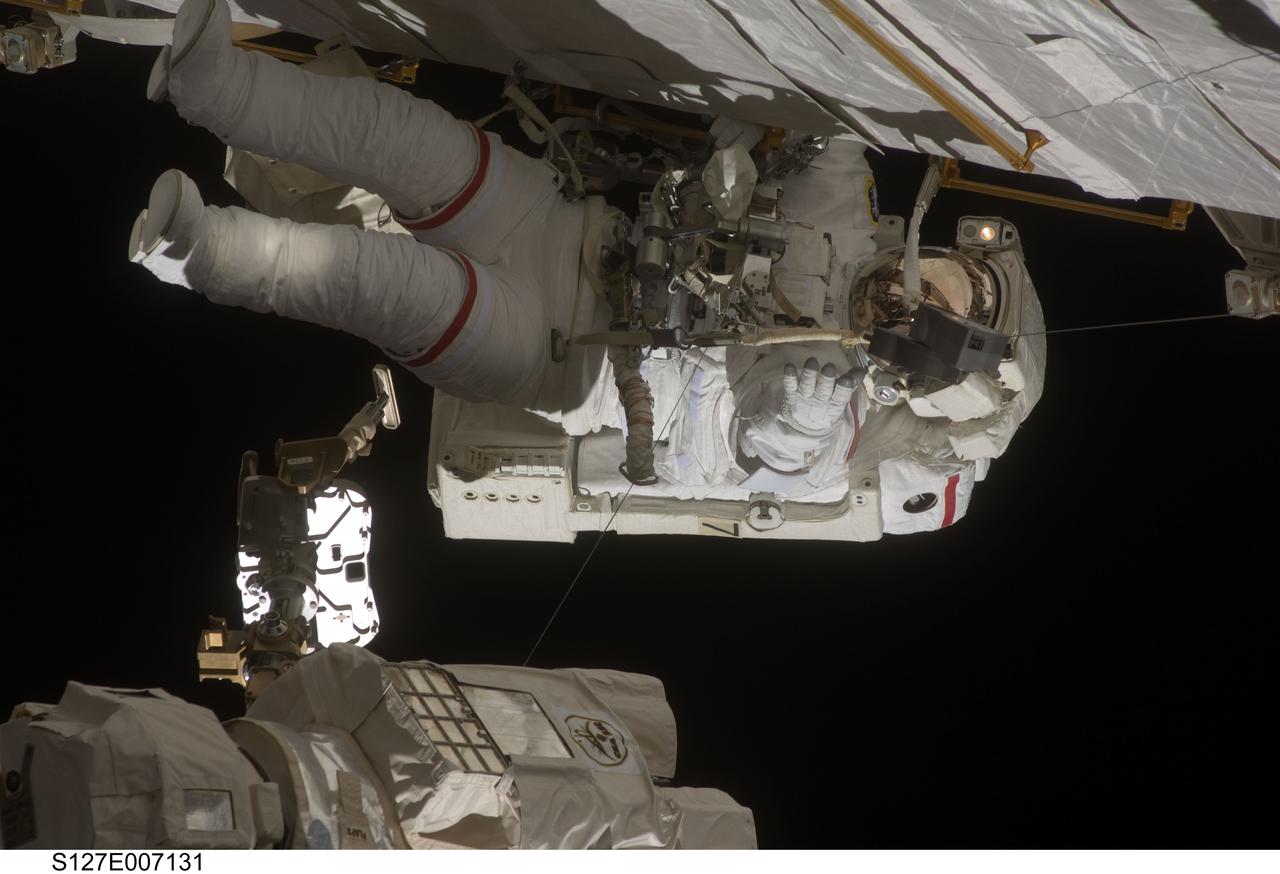
S127-E-007131 (20 July 2009) --- This is one of a series of digital still images showing astronaut Dave Wolf performing his second spacewalk and the Endeavour’s second also of the scheduled five overall in a little over a week’s time to continue work on the International Space Station. Astronauts Wolf and Tom Marshburn (out of frame), both mission specialists, successfully transferred a spare KU-band antenna to long-term storage on the space station, along with a backup coolant system pump module and a spare drive motor for the station's robot arm transporter. Installation of a television camera on the Japanese Exposed Facility experiment platform was deferred to a later spacewalk.
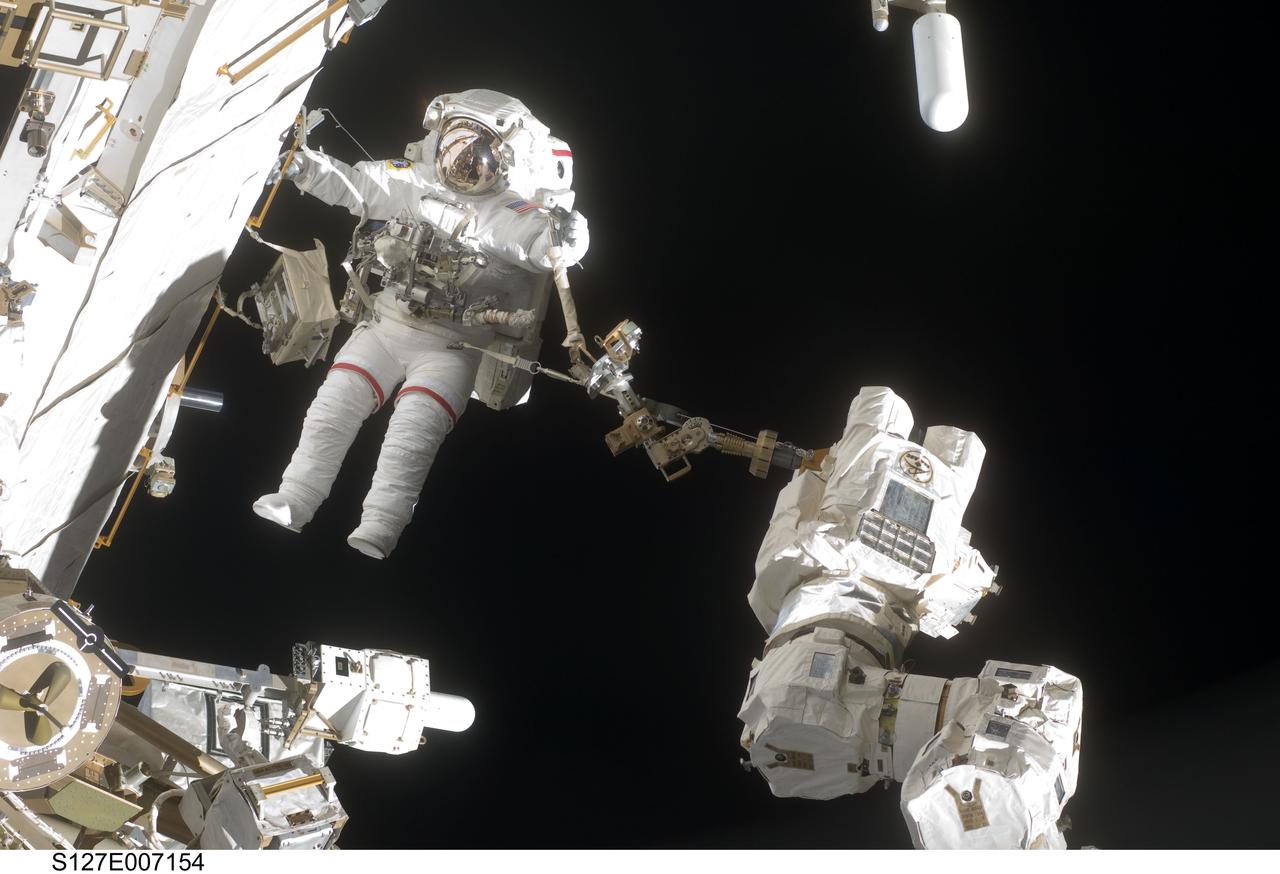
S127-E-007154 (20 July 2009) --- This is one of a series of digital still images showing astronaut Dave Wolf performing his second spacewalk and the Endeavour’s second also of the scheduled five overall in a little over a week’s time to continue work on the International Space Station. Astronauts Wolf and Tom Marshburn (out of frame), both mission specialists, successfully transferred a spare KU-band antenna to long-term storage on the space station, along with a backup coolant system pump module and a spare drive motor for the station's robot arm transporter. Installation of a television camera on the Japanese Exposed Facility experiment platform was deferred to a later spacewalk.
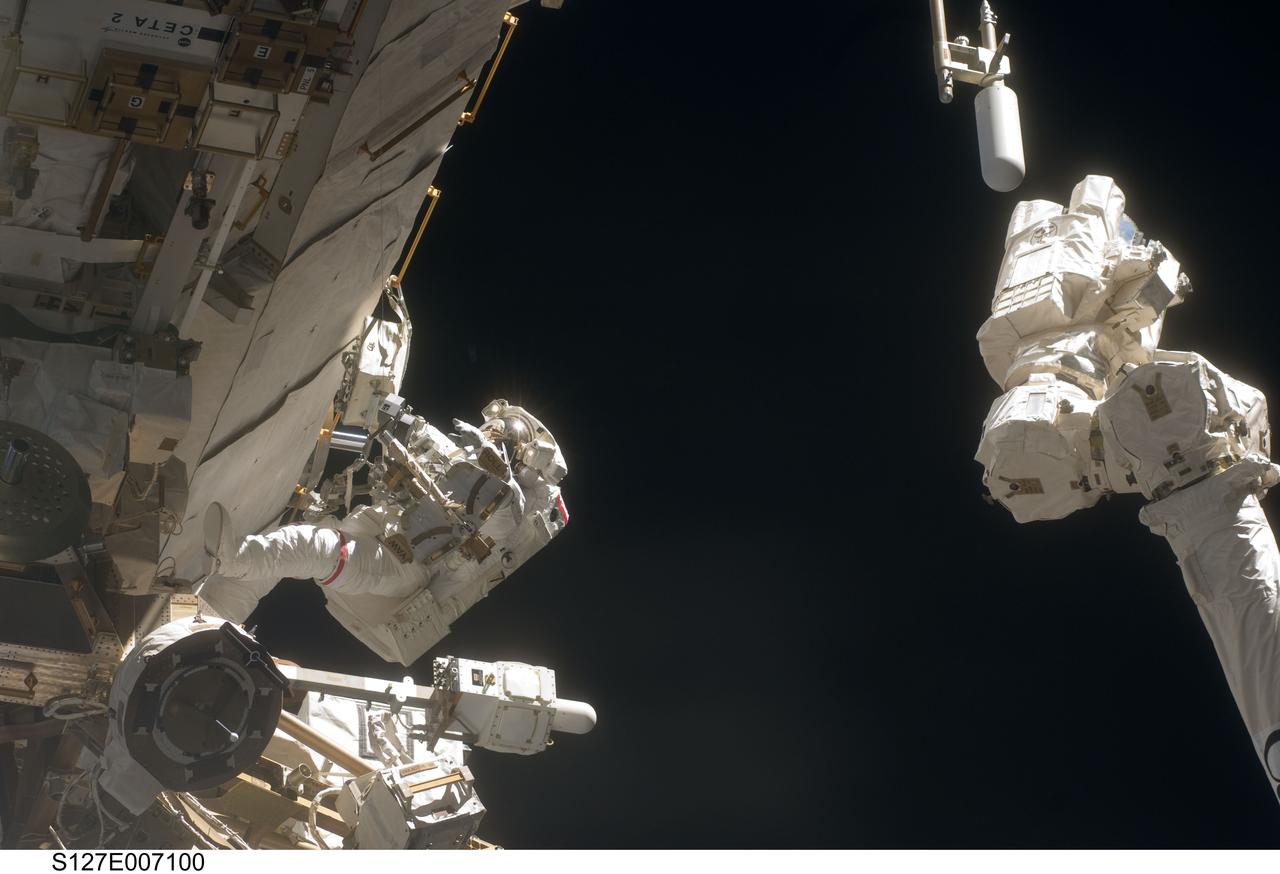
S127-E-007100 (20 July 2009) --- This is one of a series of digital still images showing astronaut Dave Wolf performing his second spacewalk and the Endeavour’s second also of the scheduled five overall in a little over a week’s time to continue work on the International Space Station. Astronauts Wolf and Tom Marshburn (out of frame), both mission specialists, successfully transferred a spare KU-band antenna to long-term storage on the space station, along with a backup coolant system pump module and a spare drive motor for the station's robot arm transporter. Installation of a television camera on the Japanese Exposed Facility experiment platform was deferred to a later spacewalk.
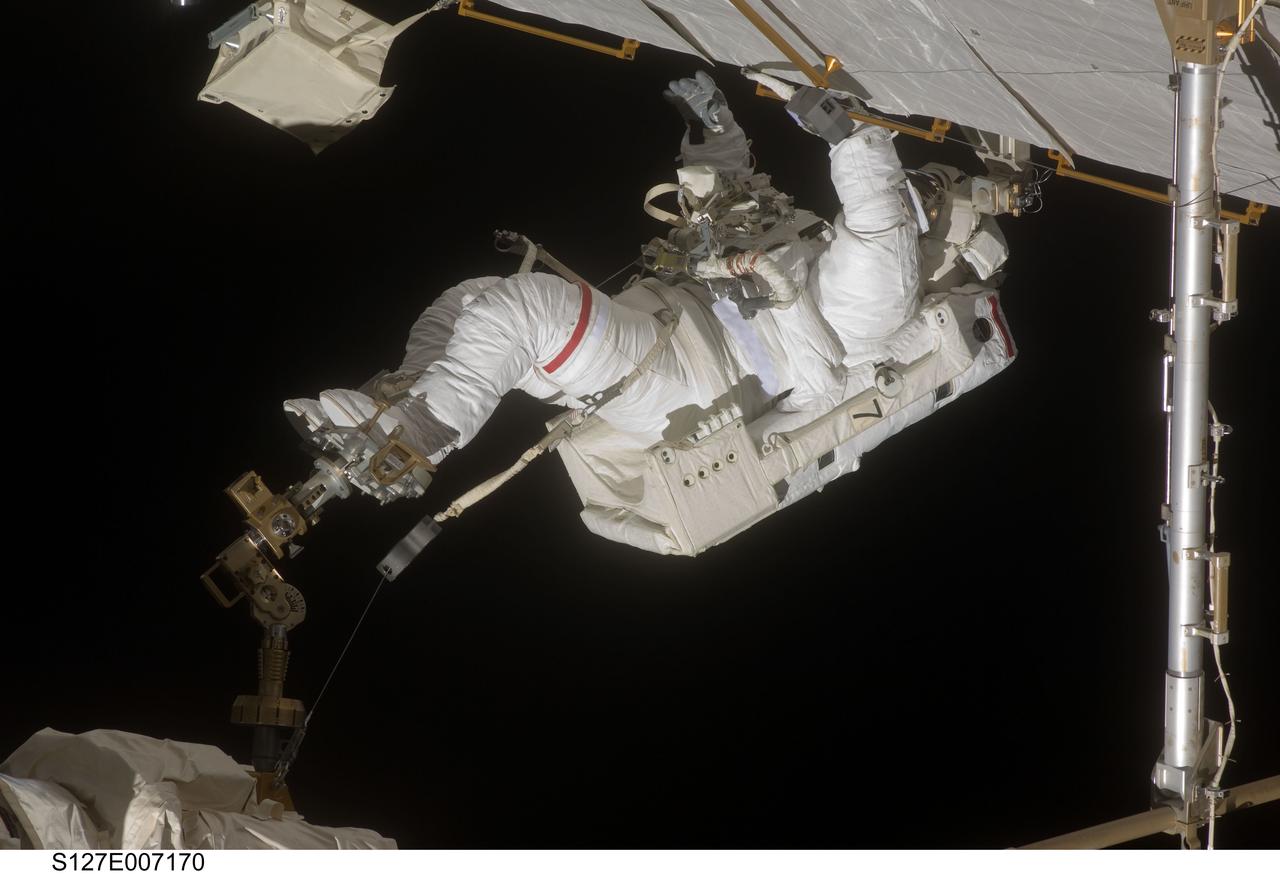
S127-E-007170 (20 July 2009) --- This is one of a series of digital still images showing astronaut Dave Wolf performing his second spacewalk and the Endeavour’s second also of the scheduled five overall in a little over a week’s time to continue work on the International Space Station. Astronauts Wolf and Tom Marshburn (out of frame), both mission specialists, successfully transferred a spare KU-band antenna to long-term storage on the space station, along with a backup coolant system pump module and a spare drive motor for the station's robot arm transporter. Installation of a television camera on the Japanese Exposed Facility experiment platform was deferred to a later spacewalk.
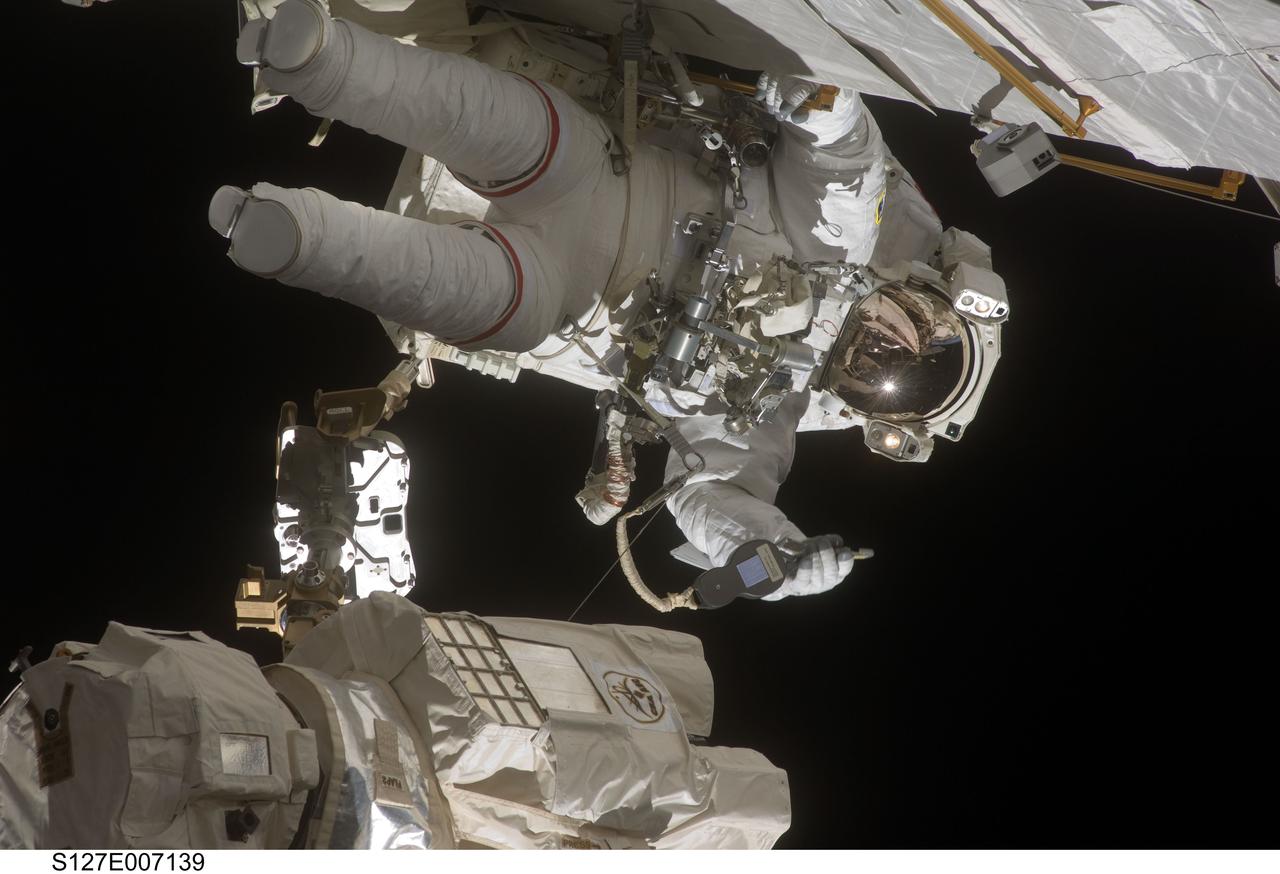
S127-E-007139 (20 July 2009) --- This is one of a series of digital still images showing astronaut Dave Wolf performing his second spacewalk and the Endeavour’s second also of the scheduled five overall in a little over a week’s time to continue work on the International Space Station. Astronauts Wolf and Tom Marshburn (out of frame), both mission specialists, successfully transferred a spare KU-band antenna to long-term storage on the space station, along with a backup coolant system pump module and a spare drive motor for the station's robot arm transporter. Installation of a television camera on the Japanese Exposed Facility experiment platform was deferred to a later spacewalk.
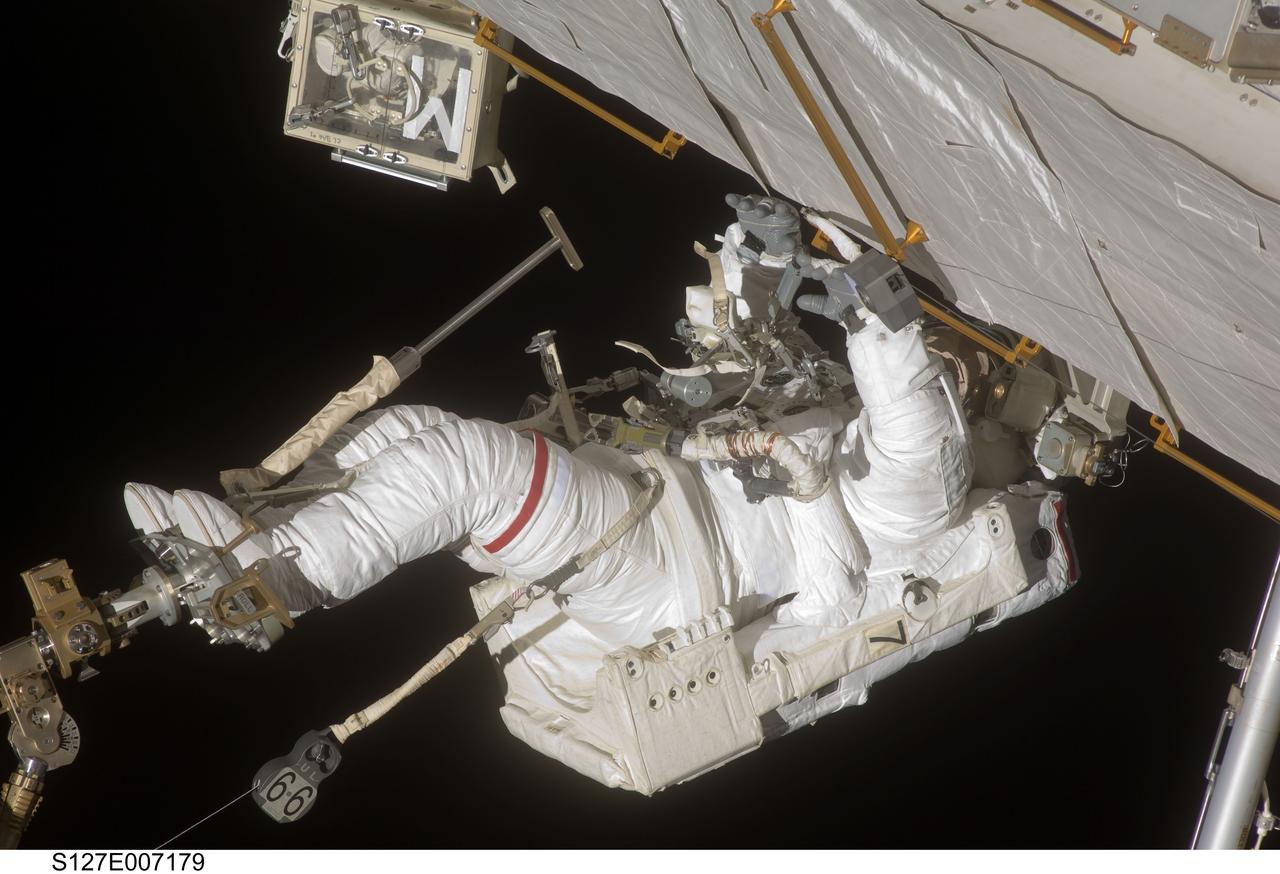
S127-E-007179 (20 July 2009) --- This is one of a series of digital still images showing astronaut Dave Wolf performing his second spacewalk and the Endeavour’s second also of the scheduled five overall in a little over a week’s time to continue work on the International Space Station. Astronauts Wolf and Tom Marshburn (out of frame), both mission specialists, successfully transferred a spare KU-band antenna to long-term storage on the space station, along with a backup coolant system pump module and a spare drive motor for the station's robot arm transporter. Installation of a television camera on the Japanese Exposed Facility experiment platform was deferred to a later spacewalk.
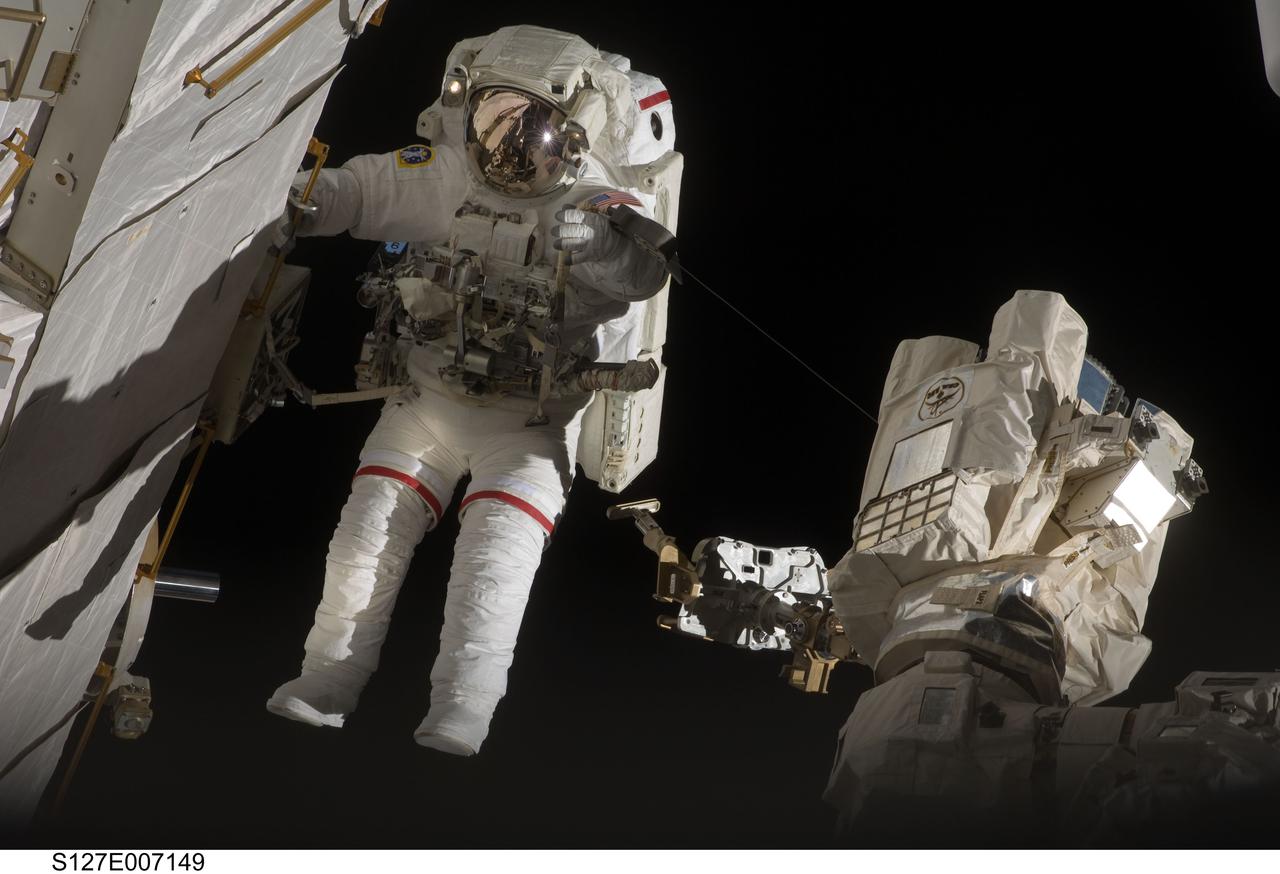
S127-E-007149 (20 July 2009) --- This is one of a series of digital still images showing astronaut Dave Wolf performing his second spacewalk and the Endeavour’s second also of the scheduled five overall in a little over a week’s time to continue work on the International Space Station. Astronauts Wolf and Tom Marshburn (out of frame), both mission specialists, successfully transferred a spare KU-band antenna to long-term storage on the space station, along with a backup coolant system pump module and a spare drive motor for the station's robot arm transporter. Installation of a television camera on the Japanese Exposed Facility experiment platform was deferred to a later spacewalk.
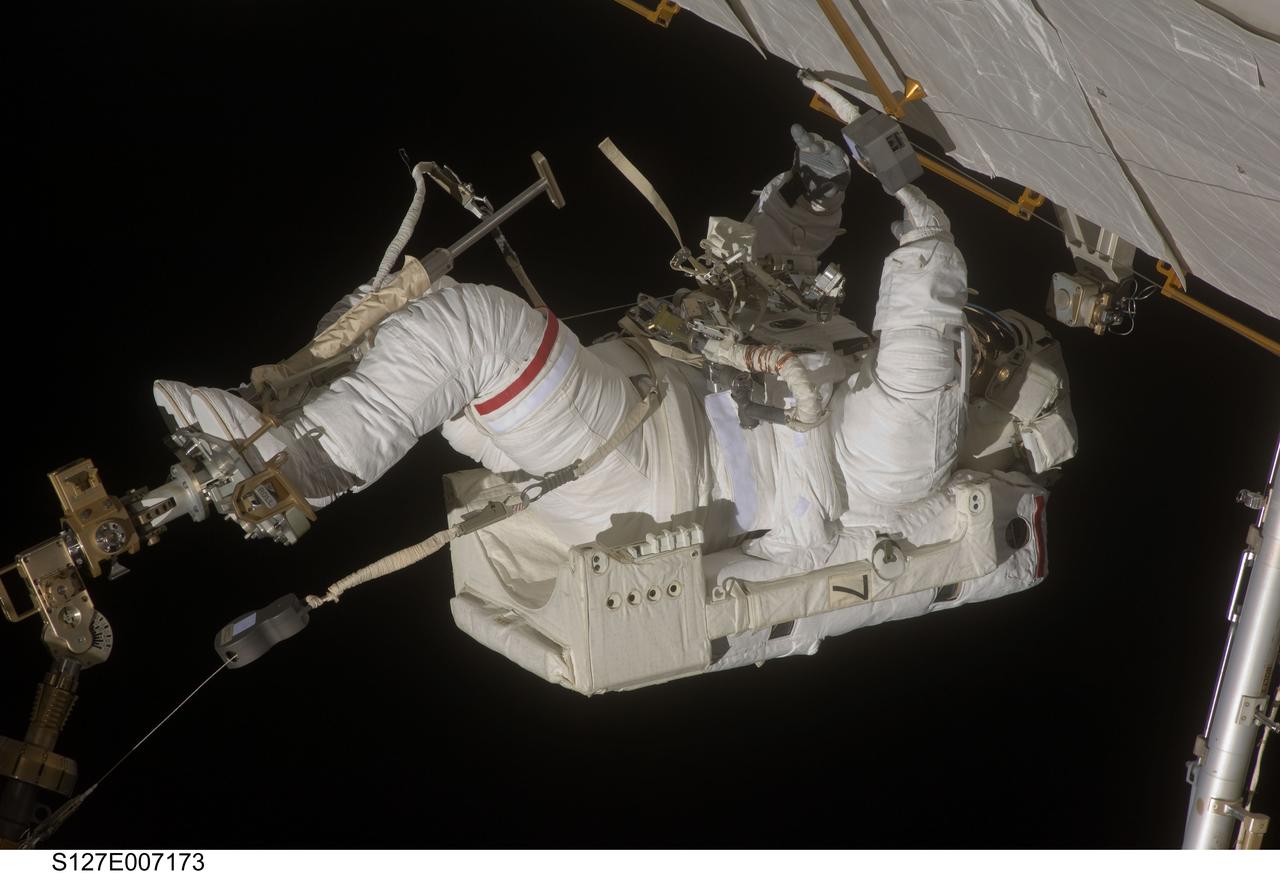
S127-E-007173 (20 July 2009) --- This is one of a series of digital still images showing astronaut Dave Wolf performing his second spacewalk and the Endeavour’s second also of the scheduled five overall in a little over a week’s time to continue work on the International Space Station. Astronauts Wolf and Tom Marshburn (out of frame), both mission specialists, successfully transferred a spare KU-band antenna to long-term storage on the space station, along with a backup coolant system pump module and a spare drive motor for the station's robot arm transporter. Installation of a television camera on the Japanese Exposed Facility experiment platform was deferred to a later spacewalk.
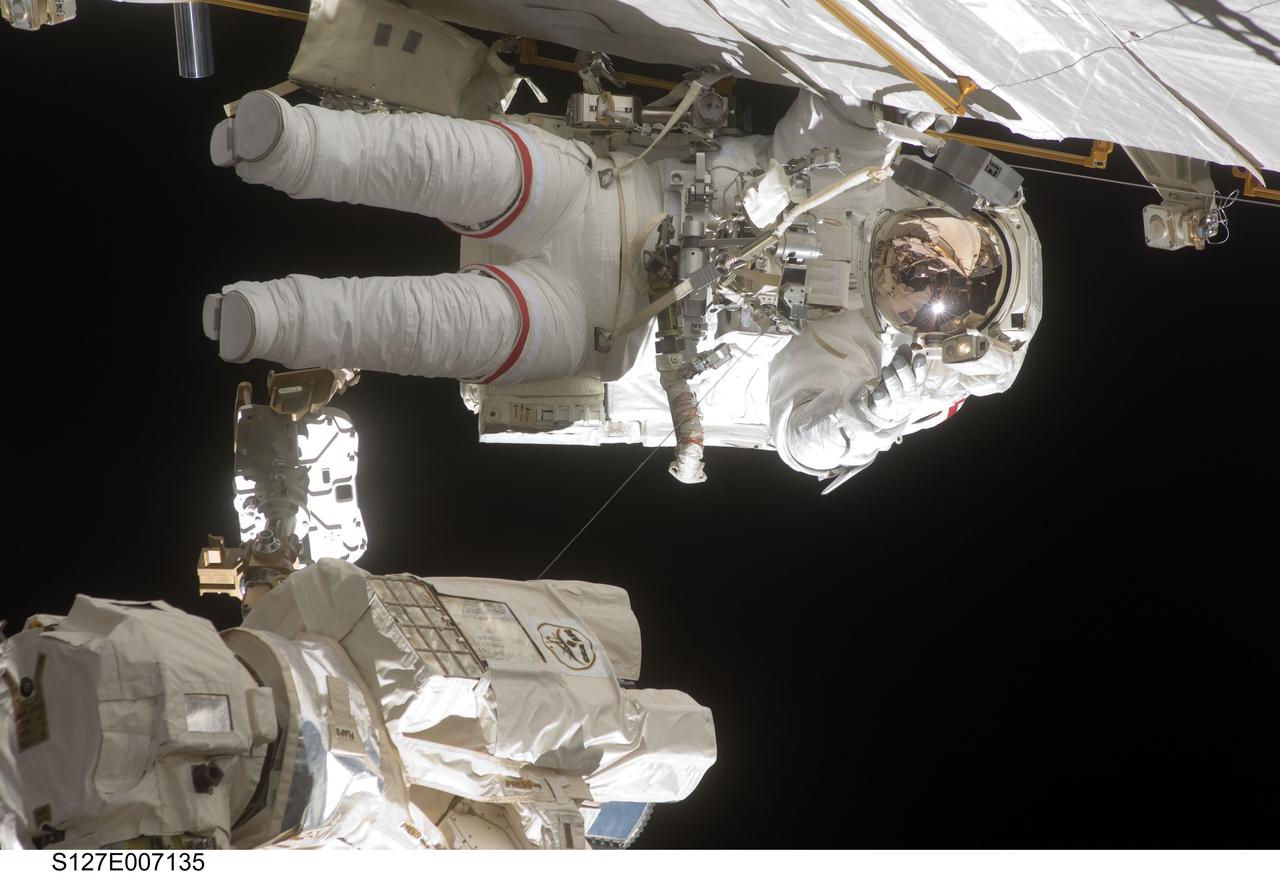
S127-E-007135 (20 July 2009) --- This is one of a series of digital still images showing astronaut Dave Wolf performing his second spacewalk and the Endeavour’s second also of the scheduled five overall in a little over a week’s time to continue work on the International Space Station. Astronauts Wolf and Tom Marshburn (out of frame), both mission specialists, successfully transferred a spare KU-band antenna to long-term storage on the space station, along with a backup coolant system pump module and a spare drive motor for the station's robot arm transporter. Installation of a television camera on the Japanese Exposed Facility experiment platform was deferred to a later spacewalk.
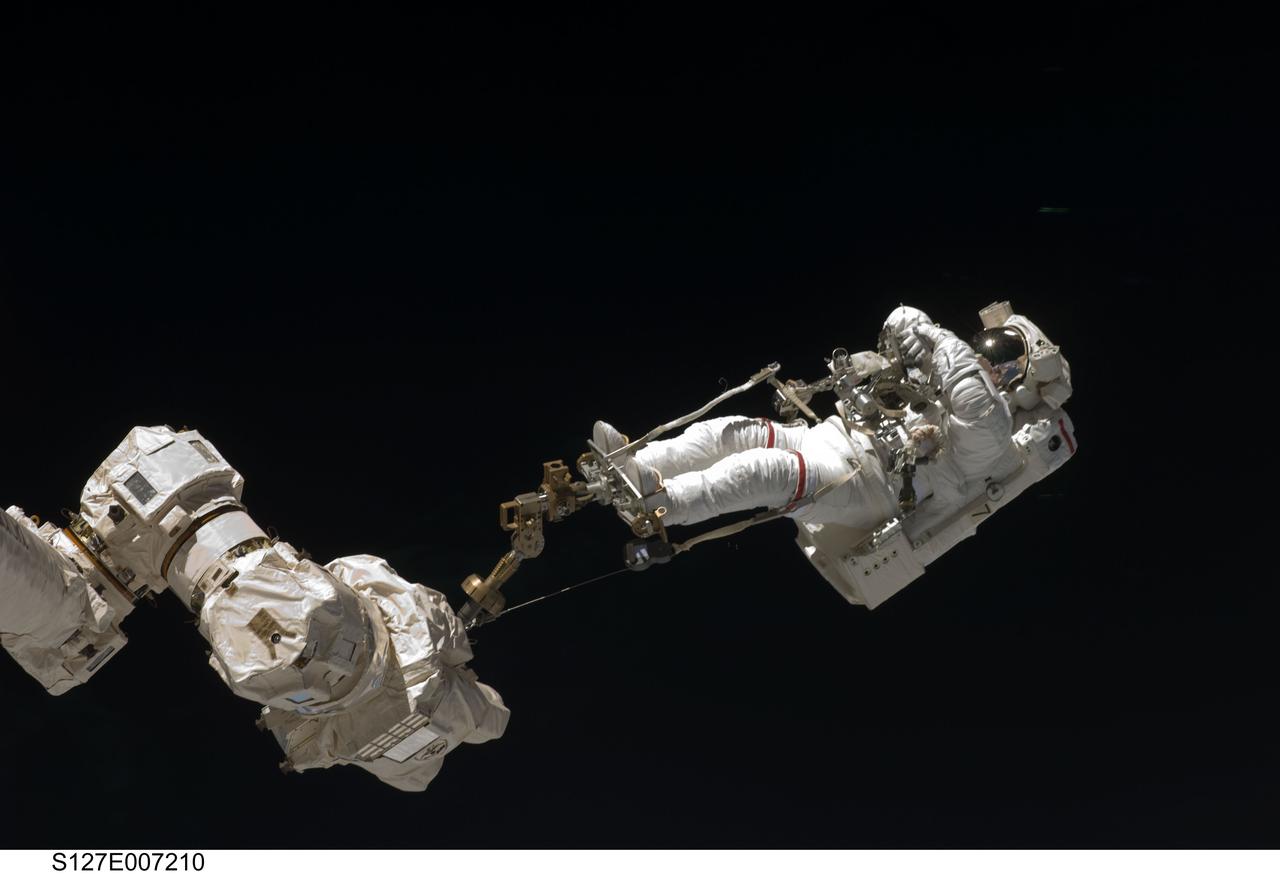
S127-E-007210 (20 July 2009) --- This is one of a series of digital still images showing astronaut Dave Wolf performing his second spacewalk and the Endeavour’s second also of the scheduled five overall in a little over a week’s time to continue work on the International Space Station. Astronauts Wolf and Tom Marshburn (out of frame), both mission specialists, successfully transferred a spare KU-band antenna to long-term storage on the space station, along with a backup coolant system pump module and a spare drive motor for the station's robot arm transporter. Installation of a television camera on the Japanese Exposed Facility experiment platform was deferred to a later spacewalk.
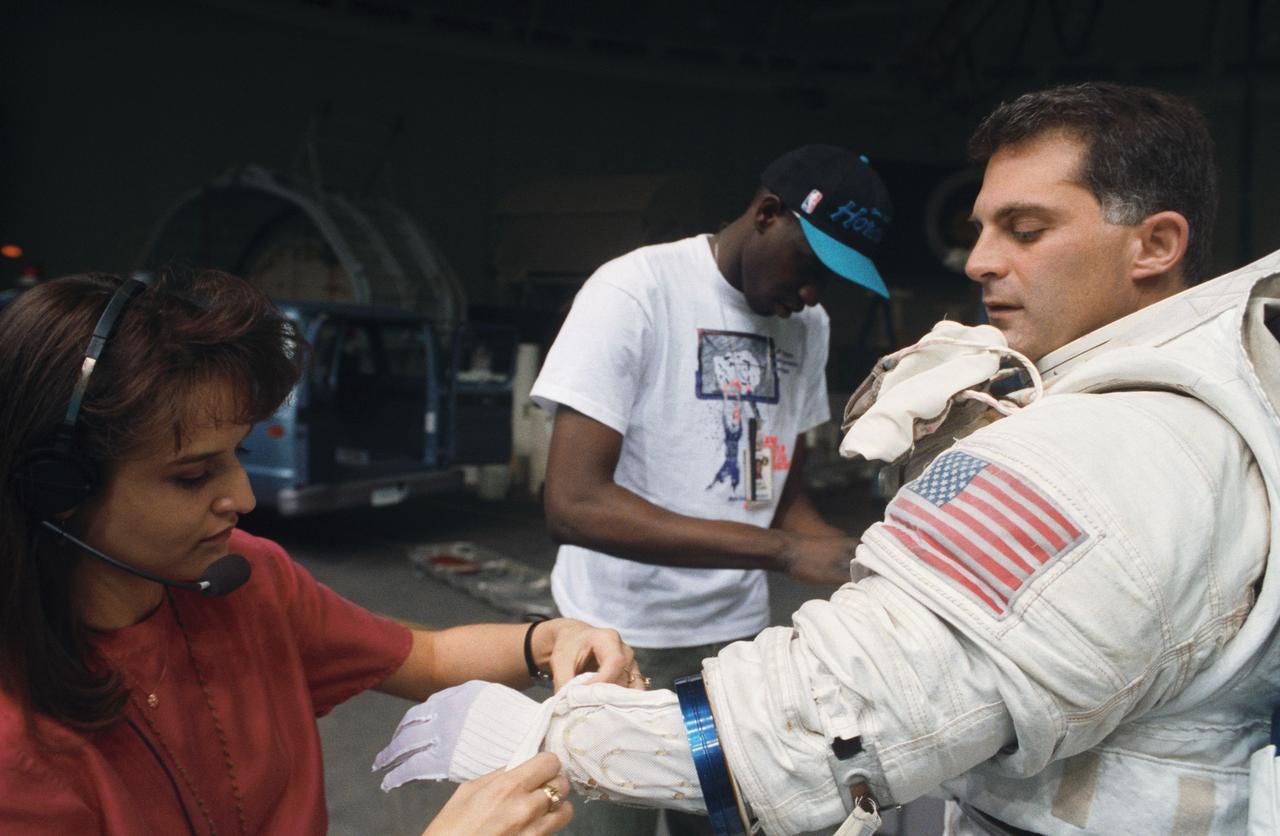
S93-31706 (3 April 1993) --- With the aid of technicians and training staffers astronaut David A. Wolf prepares to participate in training for contingency Extravehicular Activity (EVA) for the STS-58 mission. Sharing a moveable platform with Wolf was astronaut Shannon W. Lucid (out of frame). For simulation purposes, the two mission specialists were about to be submerged to a point of neutral buoyancy in the Johnson Space Center's (JSC) Weightless Environment Training Facility (WET-F). Though the Spacelab Life Sciences (SLS-2) mission does not include a planned EVA, all crews designate members to learn proper procedures to perform outside the spacecraft in the event of failure of remote means to accomplish those tasks.
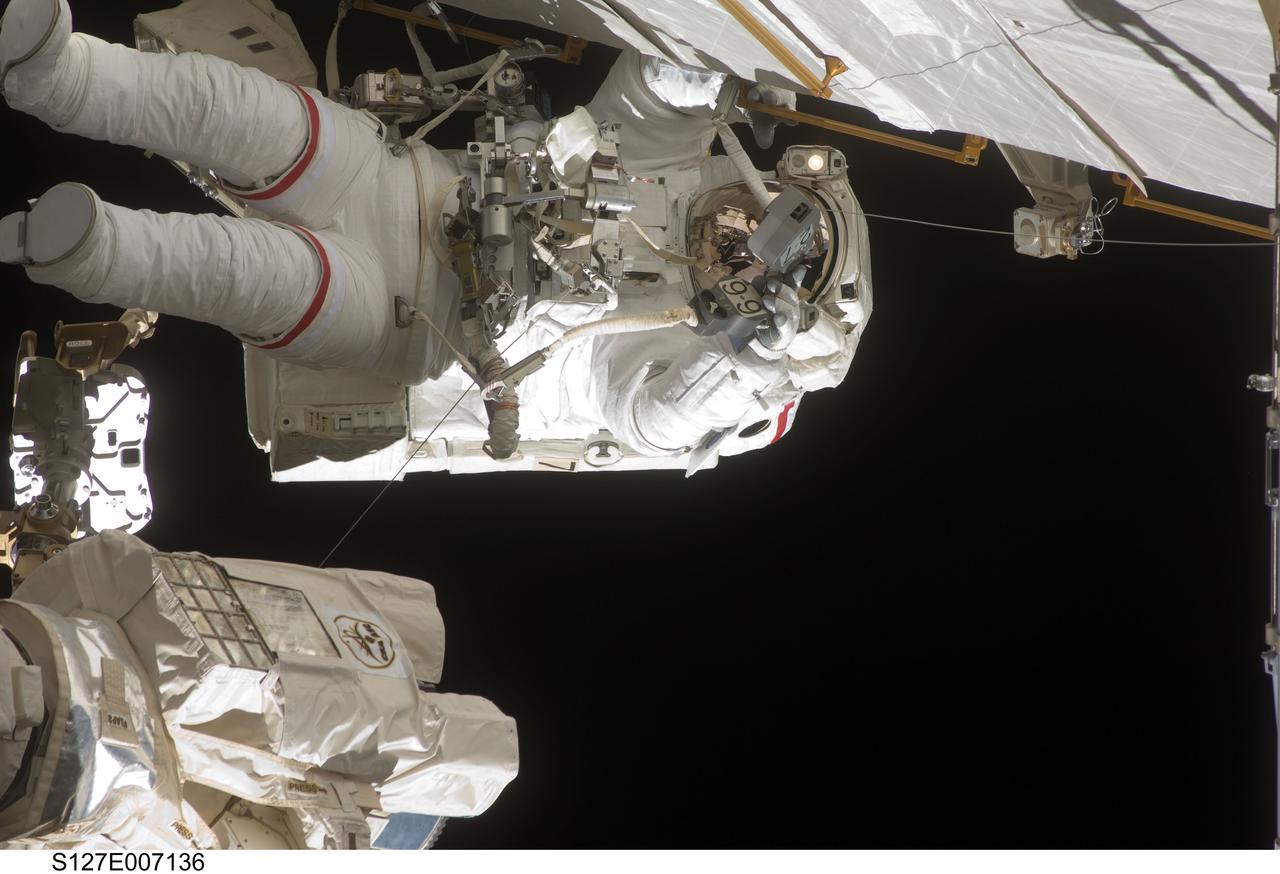
S127-E-007136 (20 July 2009) --- This is one of a series of digital still images showing astronaut Dave Wolf performing his second spacewalk and the Endeavour’s second also of the scheduled five overall in a little over a week’s time to continue work on the International Space Station. Astronauts Wolf and Tom Marshburn (out of frame), both mission specialists, successfully transferred a spare KU-band antenna to long-term storage on the space station, along with a backup coolant system pump module and a spare drive motor for the station's robot arm transporter. Installation of a television camera on the Japanese Exposed Facility experiment platform was deferred to a later spacewalk.
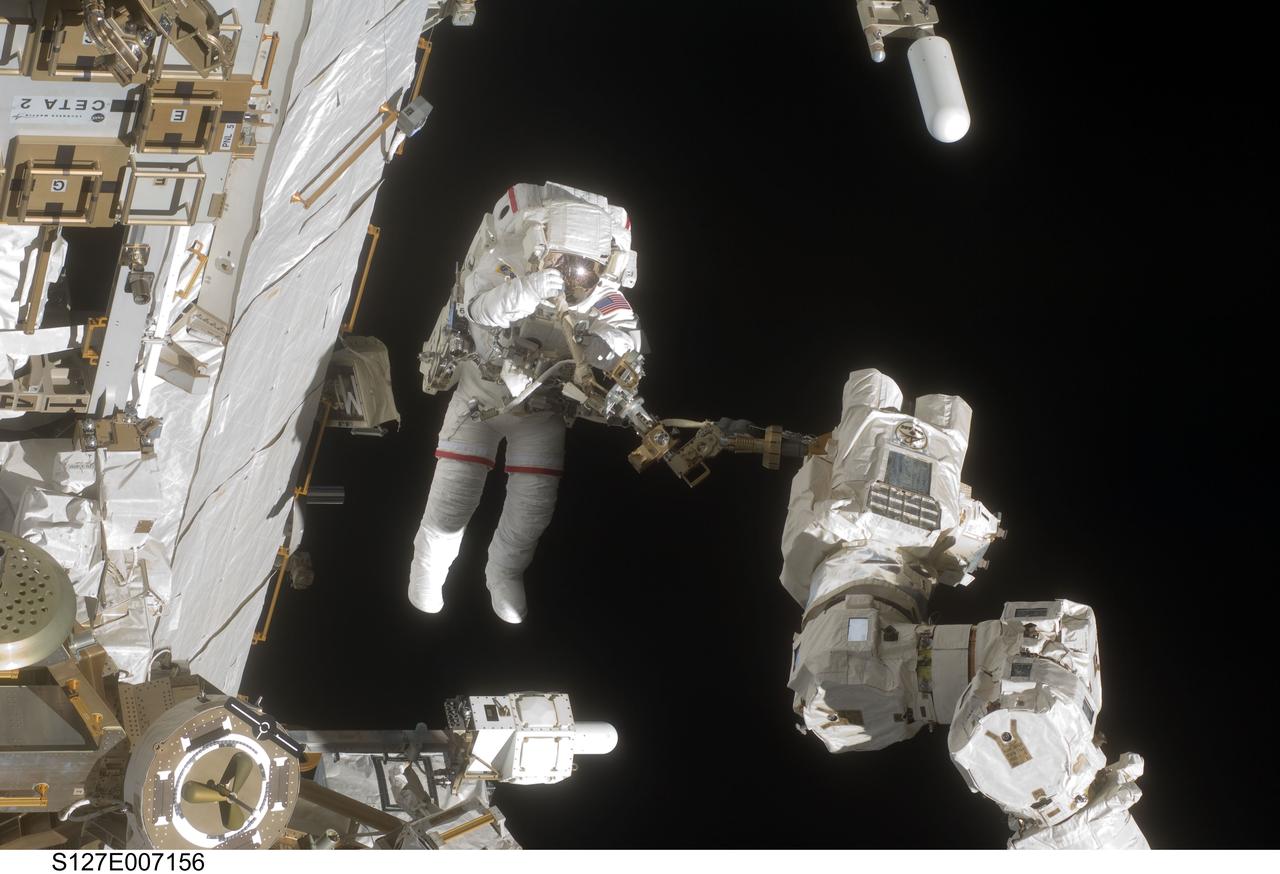
S127-E-007156 (20 July 2009) --- This is one of a series of digital still images showing astronaut Dave Wolf performing his second spacewalk and the Endeavour’s second also of the scheduled five overall in a little over a week’s time to continue work on the International Space Station. Astronauts Wolf and Tom Marshburn (out of frame), both mission specialists, successfully transferred a spare KU-band antenna to long-term storage on the space station, along with a backup coolant system pump module and a spare drive motor for the station's robot arm transporter. Installation of a television camera on the Japanese Exposed Facility experiment platform was deferred to a later spacewalk.
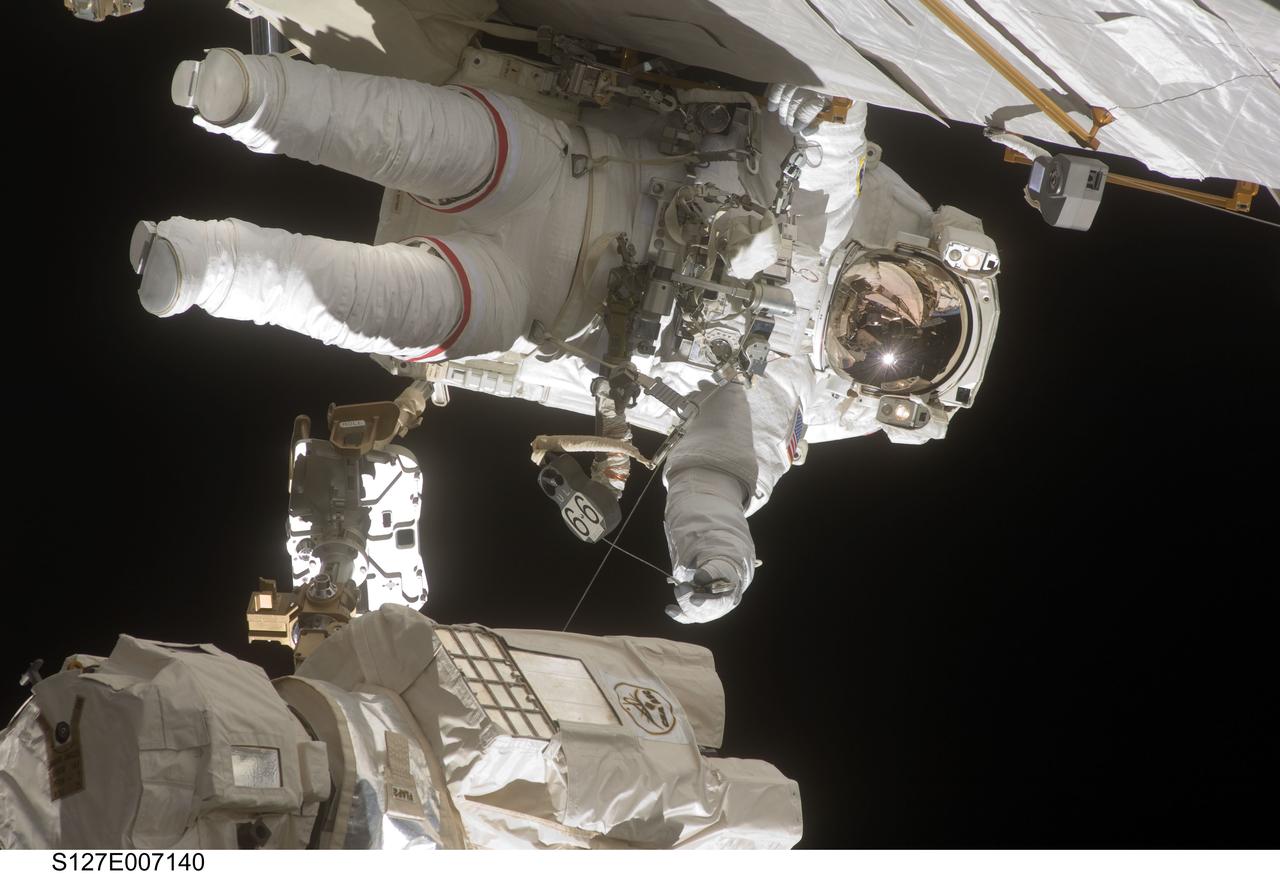
S127-E-007140 (20 July 2009) --- This is one of a series of digital still images showing astronaut Dave Wolf performing his second spacewalk and the Endeavour’s second also of the scheduled five overall in a little over a week’s time to continue work on the International Space Station. Astronauts Wolf and Tom Marshburn (out of frame), both mission specialists, successfully transferred a spare KU-band antenna to long-term storage on the space station, along with a backup coolant system pump module and a spare drive motor for the station's robot arm transporter. Installation of a television camera on the Japanese Exposed Facility experiment platform was deferred to a later spacewalk.
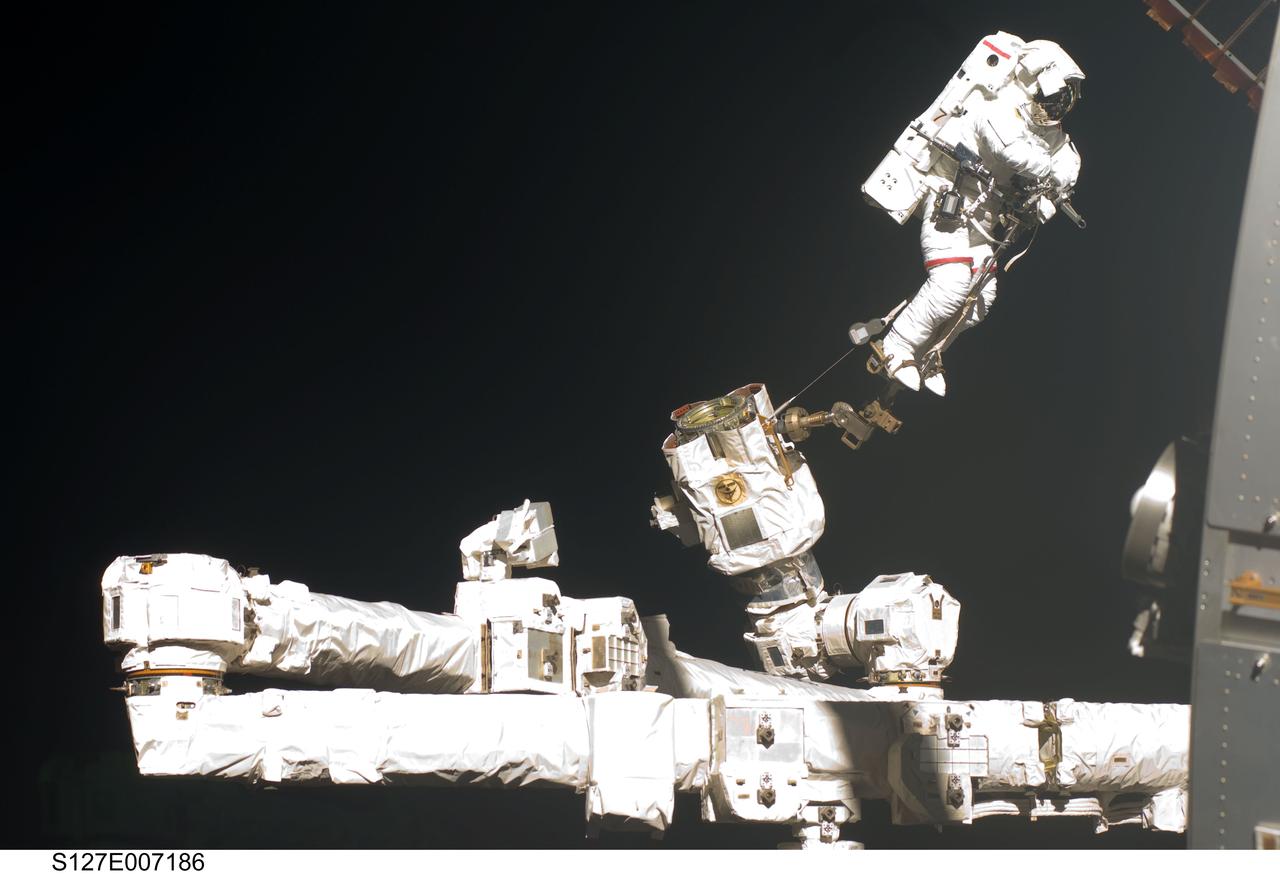
S127-E-007186 (20 July 2009) --- This is one of a series of digital still images showing astronaut Dave Wolf performing his second spacewalk and the Endeavour’s second also of the scheduled five overall in a little over a week’s time to continue work on the International Space Station. Astronauts Wolf and Tom Marshburn (out of frame), both mission specialists, successfully transferred a spare KU-band antenna to long-term storage on the space station, along with a backup coolant system pump module and a spare drive motor for the station's robot arm transporter. Installation of a television camera on the Japanese Exposed Facility experiment platform was deferred to a later spacewalk.
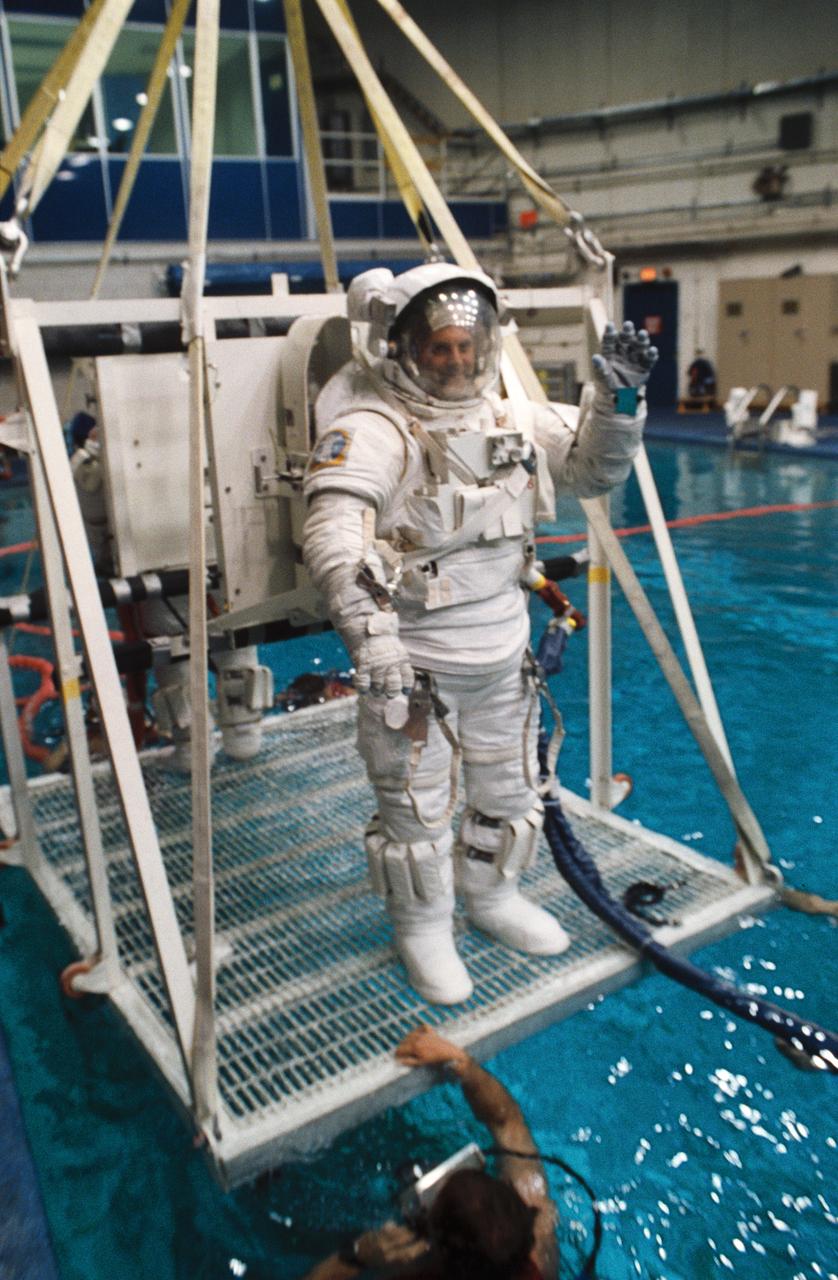
S93-31702 (3 April 1993) --- Astronaut David A. Wolf participates in training for contingency extravehicular activity (EVA) for the STS-58 mission. Behind Wolf, sharing the platform with him is astronaut Shannon W. Lucid. For simulation purposes, the two mission specialists were about to be submerged to a point of neutral buoyancy in the Johnson Space Center's (JSC) Weightless Environment Training Facility (WET-F). Though the Spacelab Life Sciences (SLS-2) mission does not include a planned EVA, all crews designate members to learn proper procedures to perform outside the spacecraft in the event of failure of remote means to accomplish those tasks.
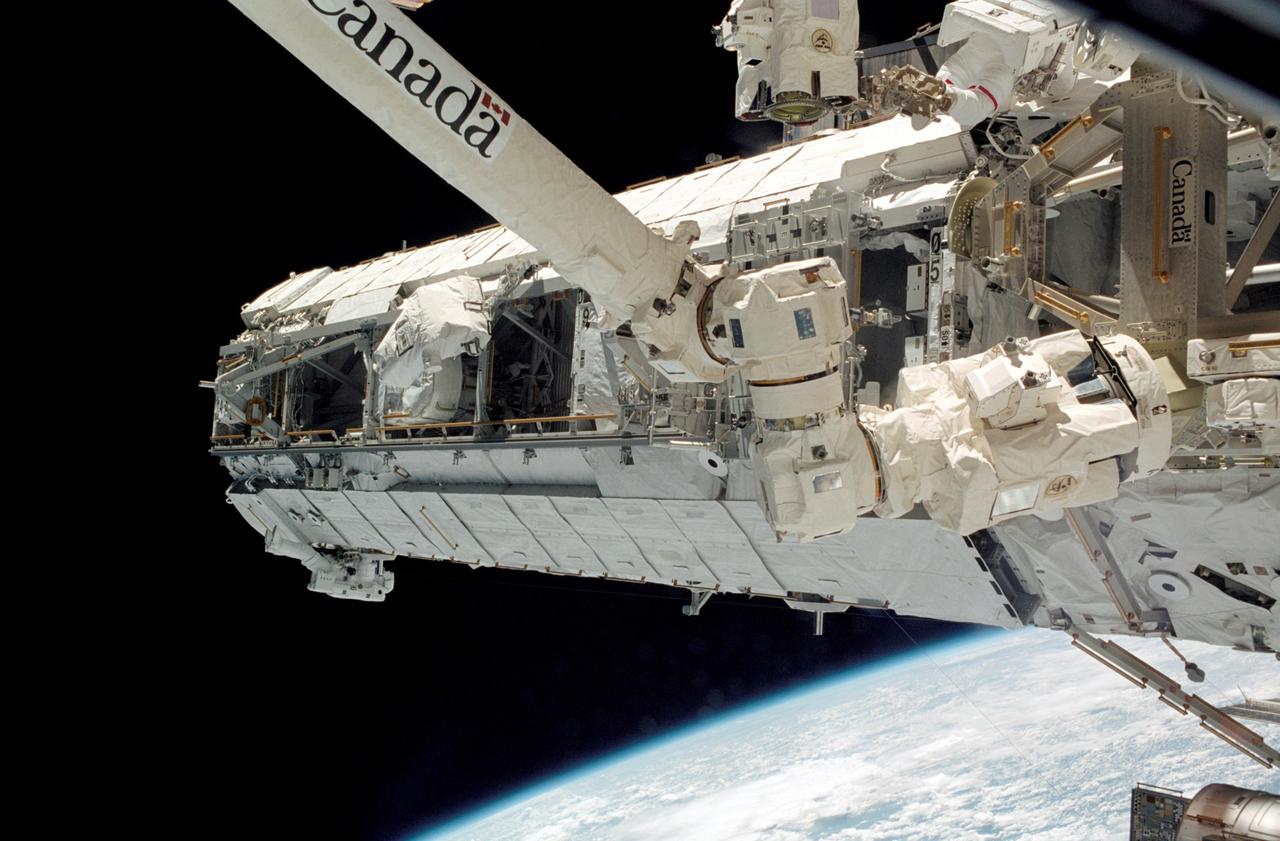
Launched October 7, 2002 aboard the Space Shuttle Orbiter Atlantis, the STS-112 mission lasted 11 days and performed three sessions of Extra Vehicular Activity (EVA). Its primary mission was to install the Starboard (S1) Integrated Truss Structure and Equipment Translation Aid (CETA) Cart to the International Space Station (ISS). The S1 truss provides structural support for the orbiting research facility's radiator panels, which use ammonia to cool the Station's complex power system. The S1 truss, attached to the S0 (S Zero) truss installed by the previous STS-110 mission, flows 637 pounds of anhydrous ammonia through three heat rejection radiators. The truss is 45-feet long, 15-feet wide, 10-feet tall, and weighs approximately 32,000 pounds. The CETA is the first of two human-powered carts that will ride along the International Space Station's railway providing a mobile work platform for future extravehicular activities by astronauts. This is a view of the newly installed S1 Truss as photographed during the mission's first scheduled EVA. The Station's Canadarm2 is in the foreground. Visible are astronauts Piers J. Sellers (lower left) and David A. Wolf (upper right), both STS-112 mission specialists.
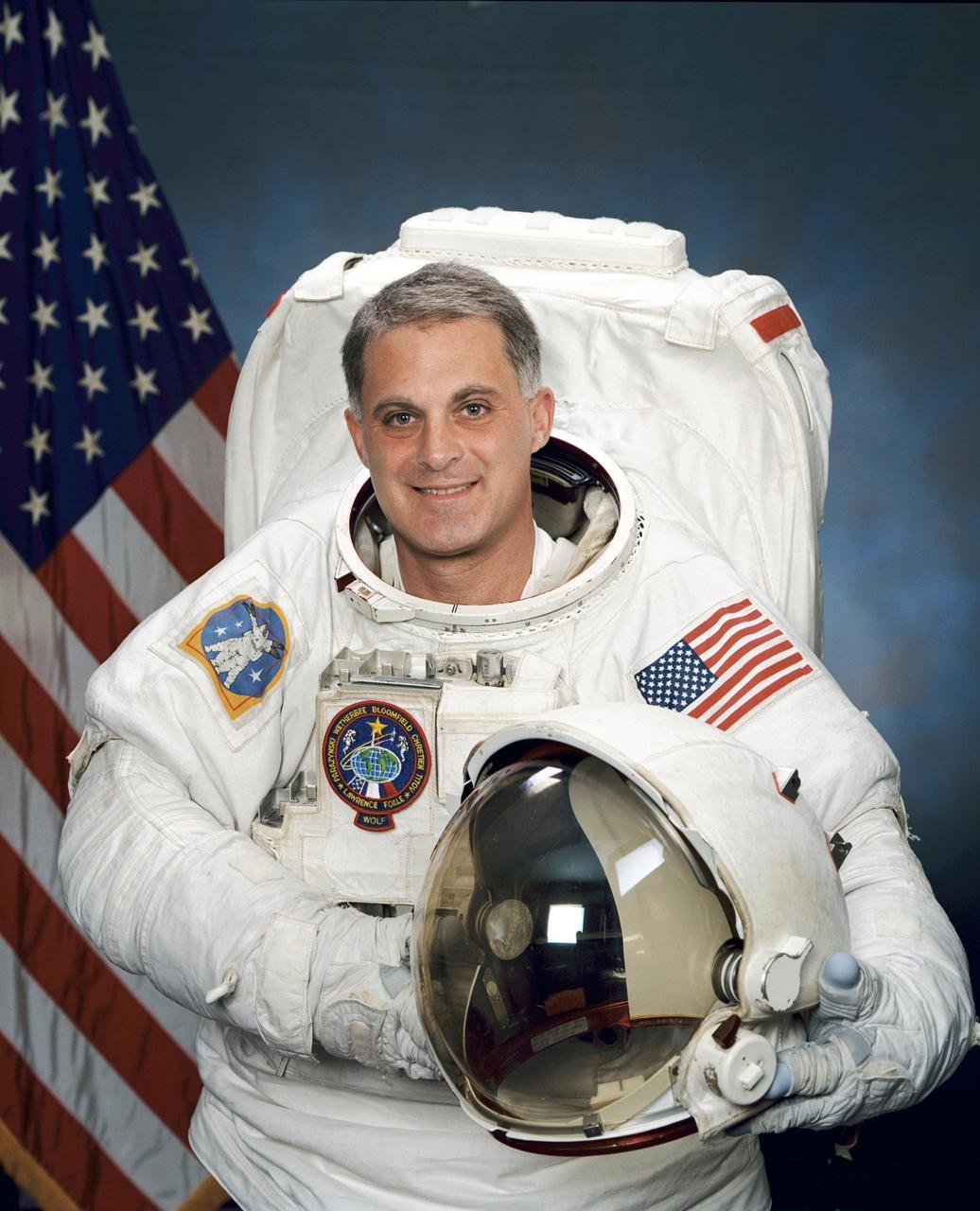
JOHNSON SPACE CENTER, HOUSTON, TEXAS -- (JSC2000-03056) Official portrait of astronaut David A. Wolf, mission specialist.
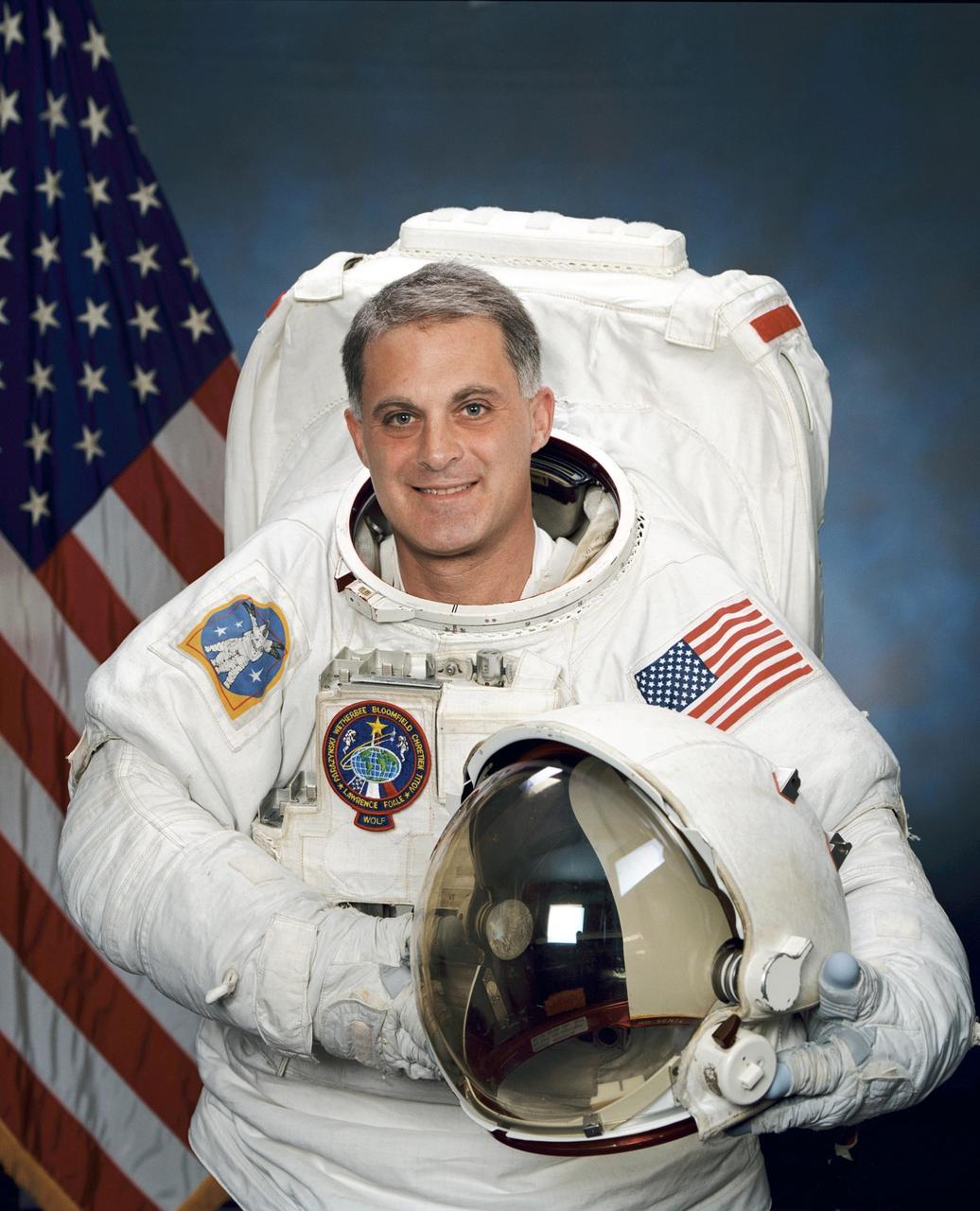
JOHNSON SPACE CENTER, HOUSTON, TEXAS -- (JSC2000-03056) Official portrait of astronaut David A. Wolf, mission specialist.
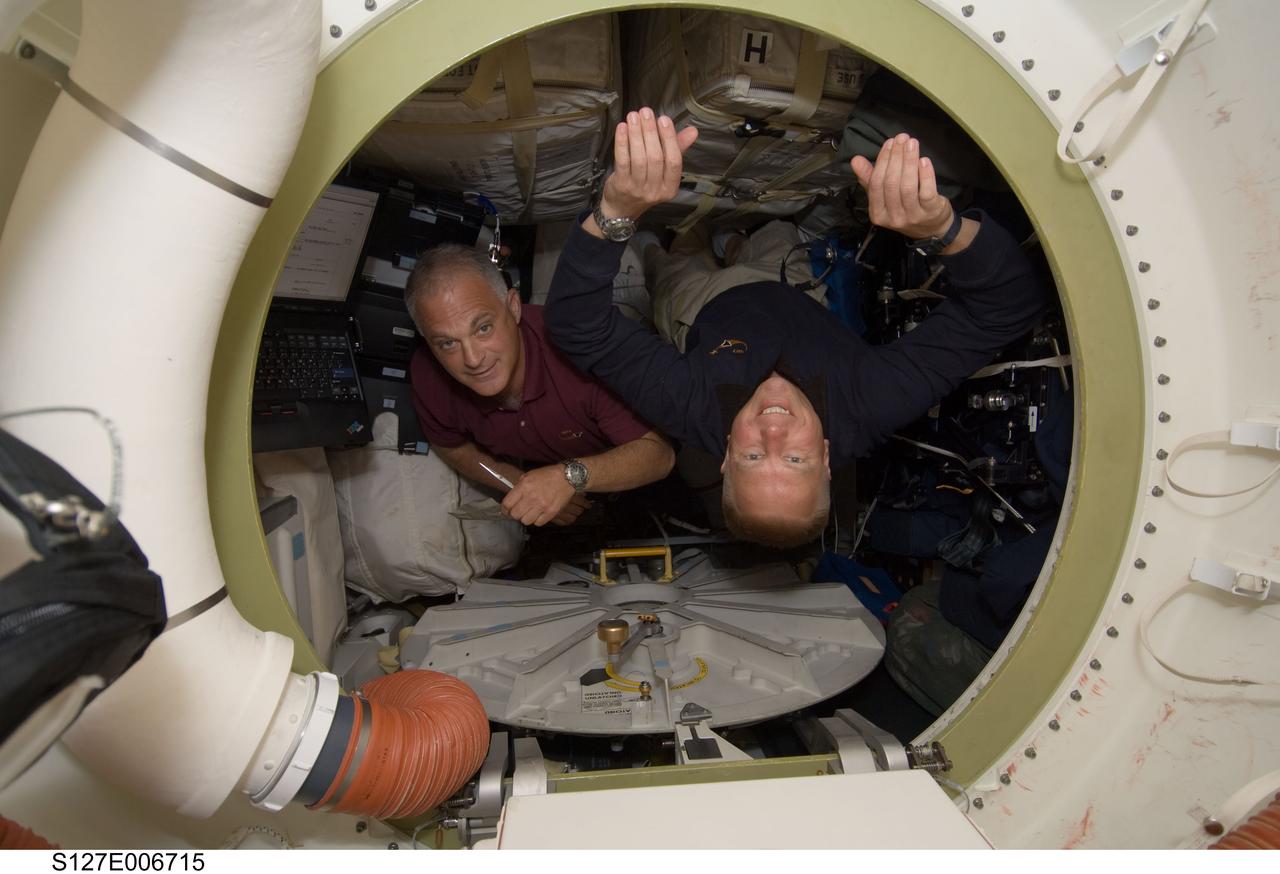
S127-E-006715 (17 July 2009) --- Astronaut Tim Kopra (right), STS-127 mission specialist, floats toward his new home for the next several months, as he will soon transform from a shuttle crewmember to an ISS flight engineer. Astronaut Dave Wolf, STS-127 mission specialist, is at left. The two are scheduled to join efforts for a July 18 spacewalk.
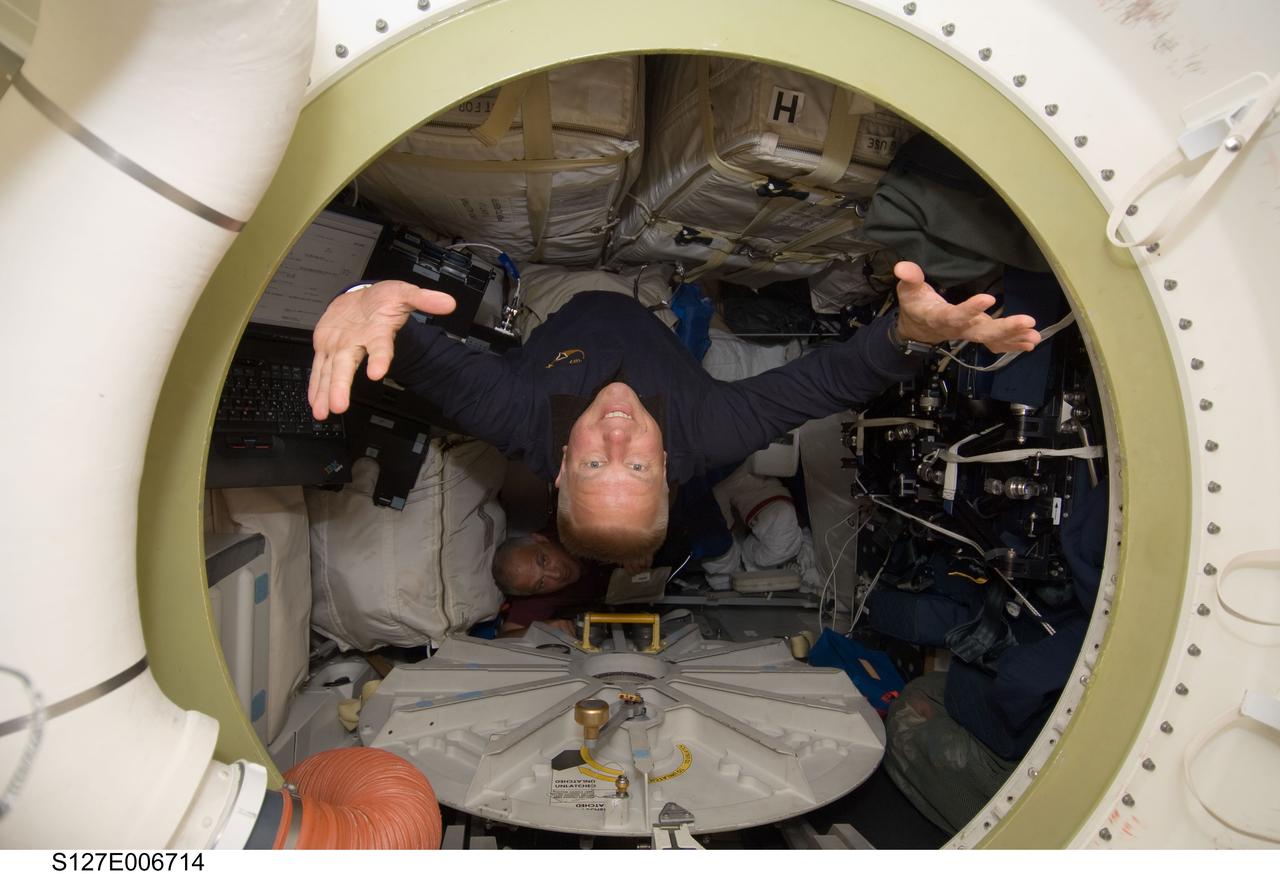
S127-E-006714 (17 July 2009) --- Astronaut Tim Kopra, STS-127 mission specialist, floats toward his new home for the next several months, as he will soon transform from a shuttle crewmember to an ISS flight engineer. Astronaut Dave Wolf, STS-127 mission specialist, can be seen in the background. The two are scheduled to join efforts for a July 18 spacewalk.
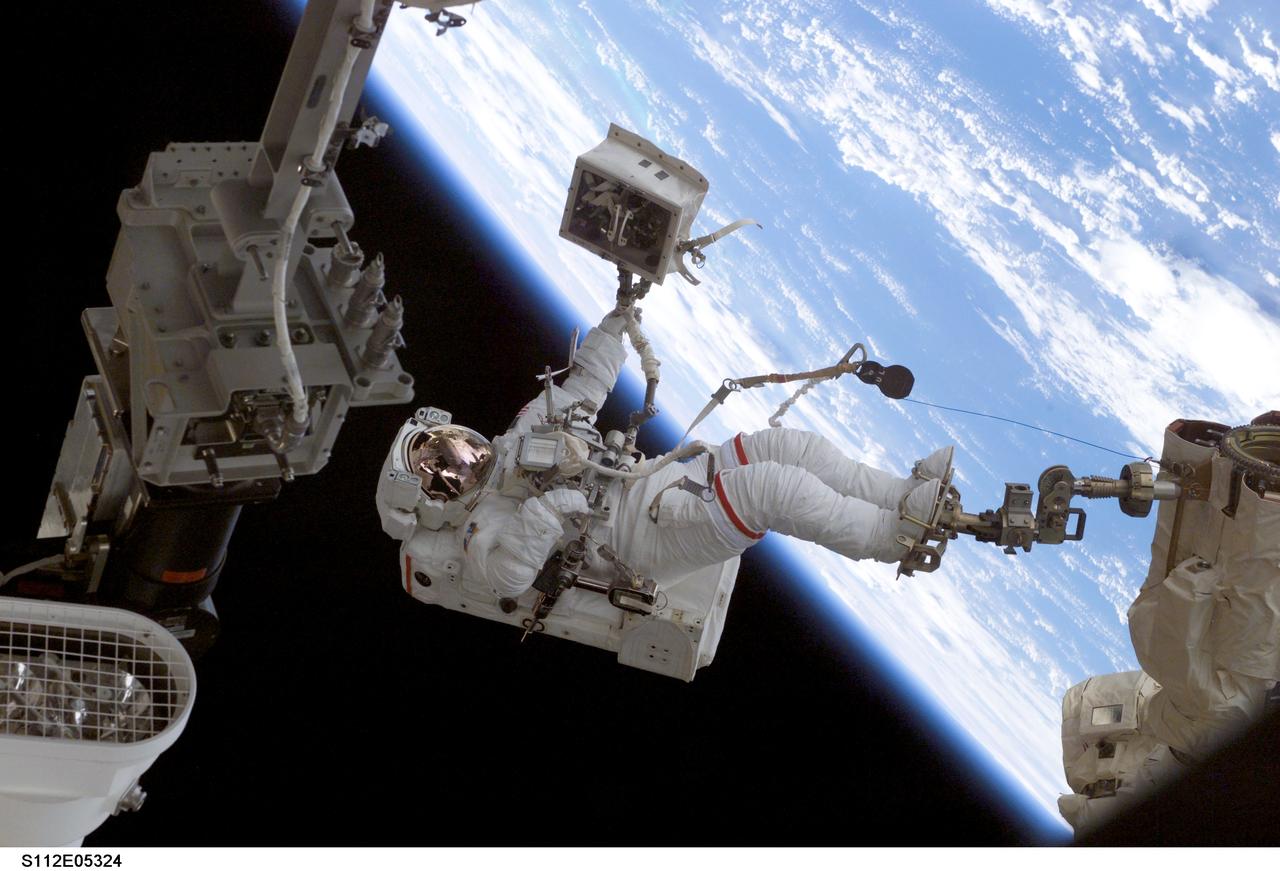
STS112-E-5324 (12 October 2002) --- Astronaut David A. Wolf, STS-112 mission specialist, his feet secured to a foot restraint on the end of the Space Station Remote Manipulator System (SSRMS) or Canadarm2, participates in a six hour, four minute session of extravehicular activity (EVA) on which he was joined by astronaut Piers J. Sellers (out of frame).
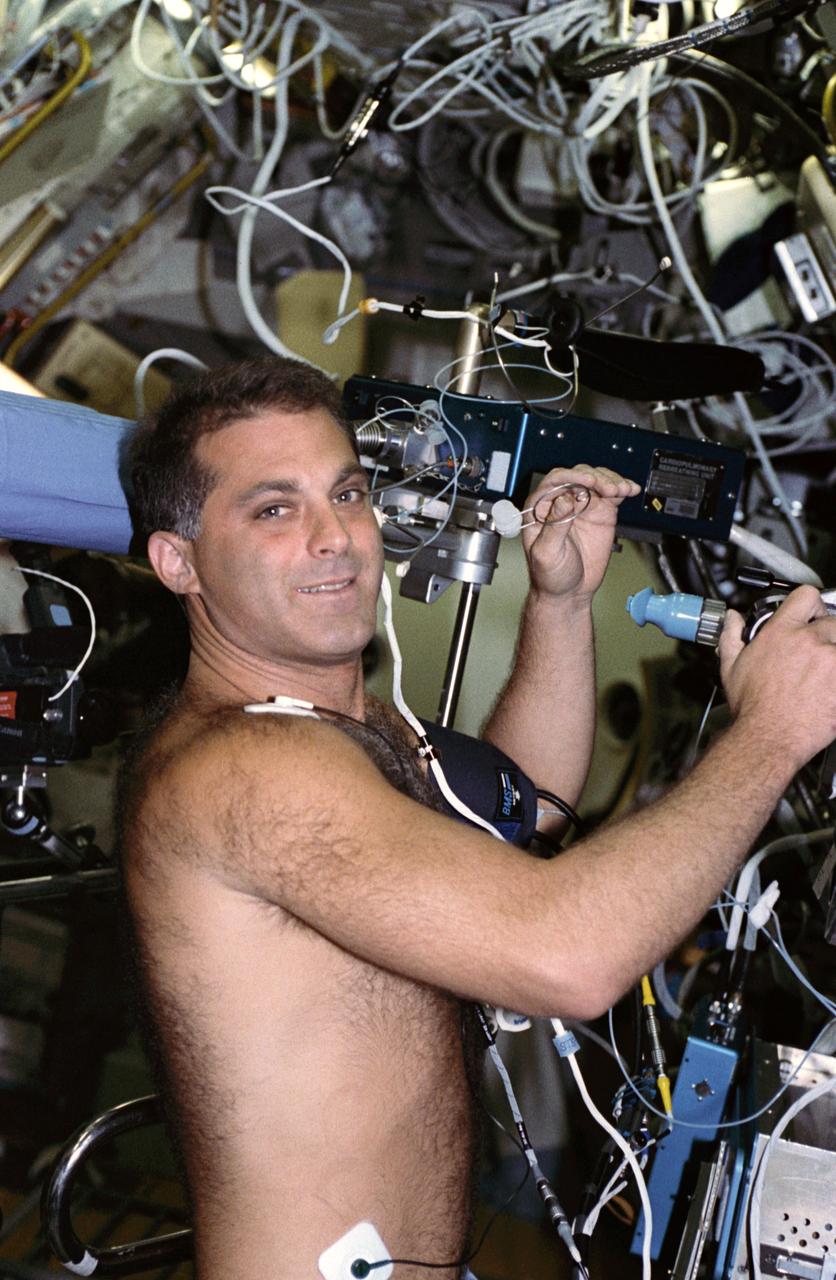
STS058-204-014 (18 Oct.-1 Nov. 1993) --- Astronaut David A. Wolf, mission specialist, participates in an experiment that investigates in-space distribution and movement of blood and gas in the pulmonary system. The data gathered during the two-week flight will be compared with results of tests performed on Earth to determine the changes that occur in pulmonary functions. Photo credit: NASA
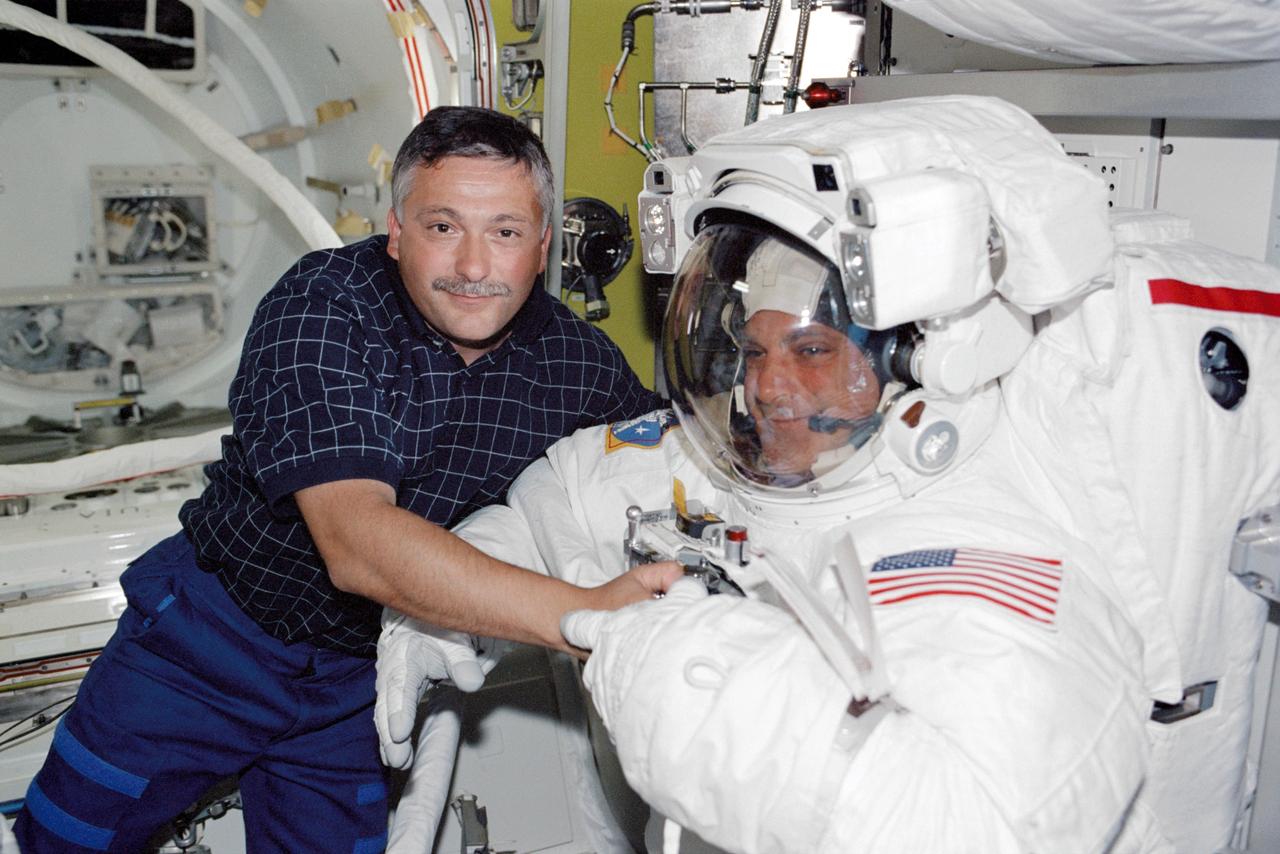
STS112-318-028 (14 October 2002) --- Cosmonaut Fyodor N. Yurchikhin (left), STS-112 mission specialist, assists astronaut David A. Wolf, mission specialist, with the final touches on his Extravehicular Mobility Unit (EMU) space suit in the Quest Airlock on the International Space Station (ISS). Yurchikhin represents Rosaviakosmos.
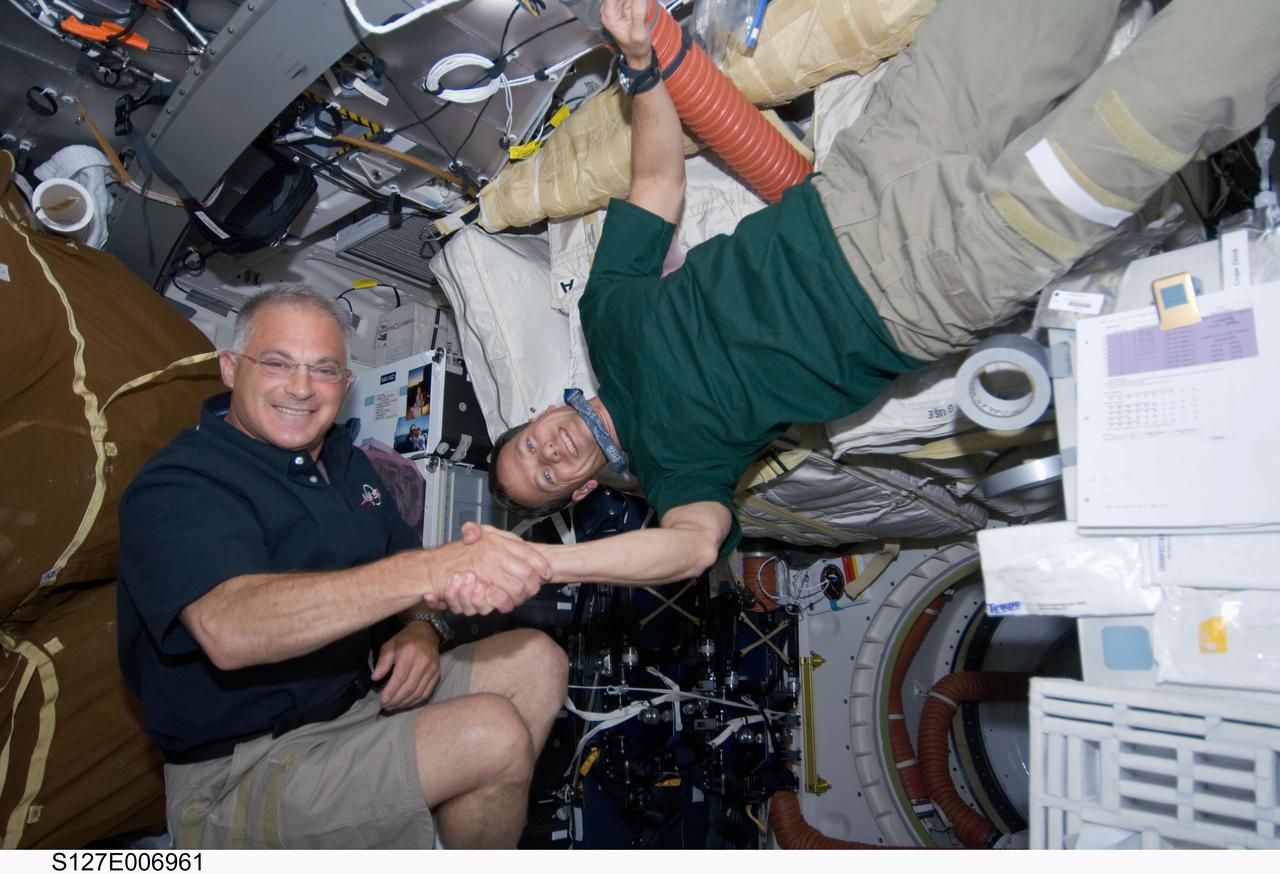
S127-E-006961 (19 July 2009) --- Astronauts Dave Wolf (left) and Tom Marshburn, both STS-127 mission specialists, share a moment shaking hands on the mid deck of the Space Shuttle Endeavour. Tomorrow they will share more than a few moments performing a spacewalk to perform work on the adjoined International Space Station.
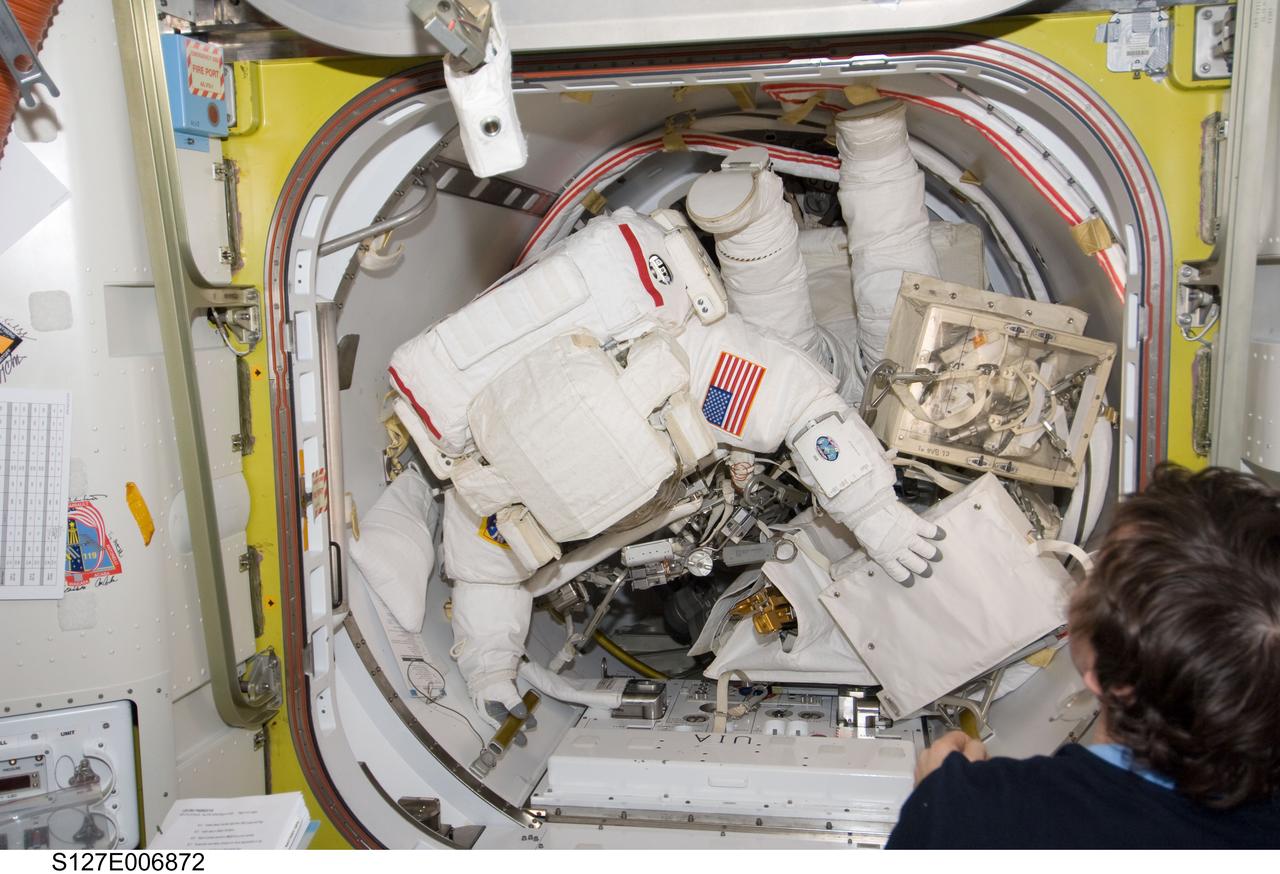
S127-E-006872 (18 July 2009) --- In the International Space Station's Quest airlock, astronauts Dave Wolf (foreground) and Tim Kopra (feet and legs visible in background) are suited and ready for the first of five spacewalks scheduled during the STS-127 mission.
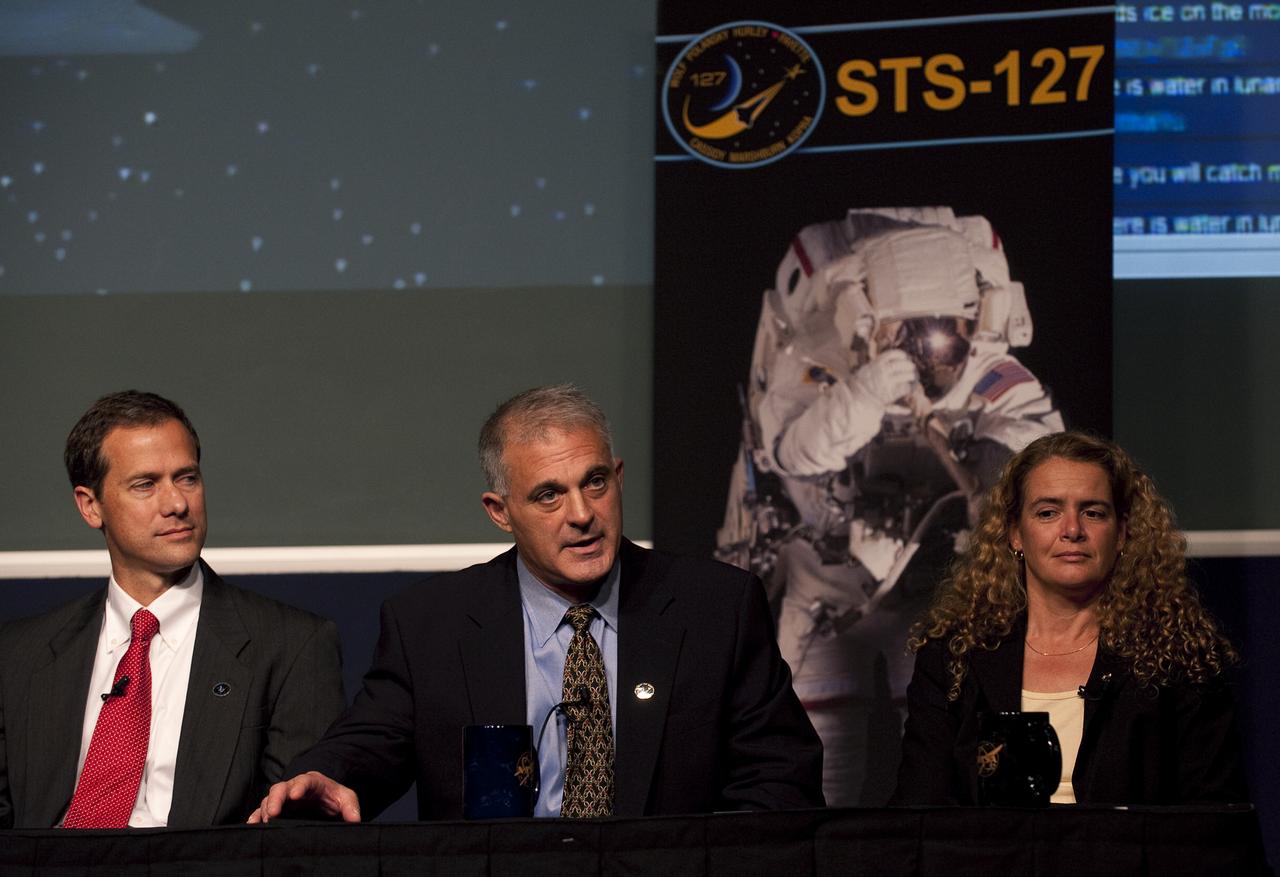
NASA Astronaut and Mission Specialist Dave Wolf, center, answers questions at the NASA Tweetup event held at NASA Headquarters, September 24, 2009 in Washington. Nearly 200 of NASA’s Twitter followers are in attendance. Photo Credit: (NASA/Carla Cioffi)
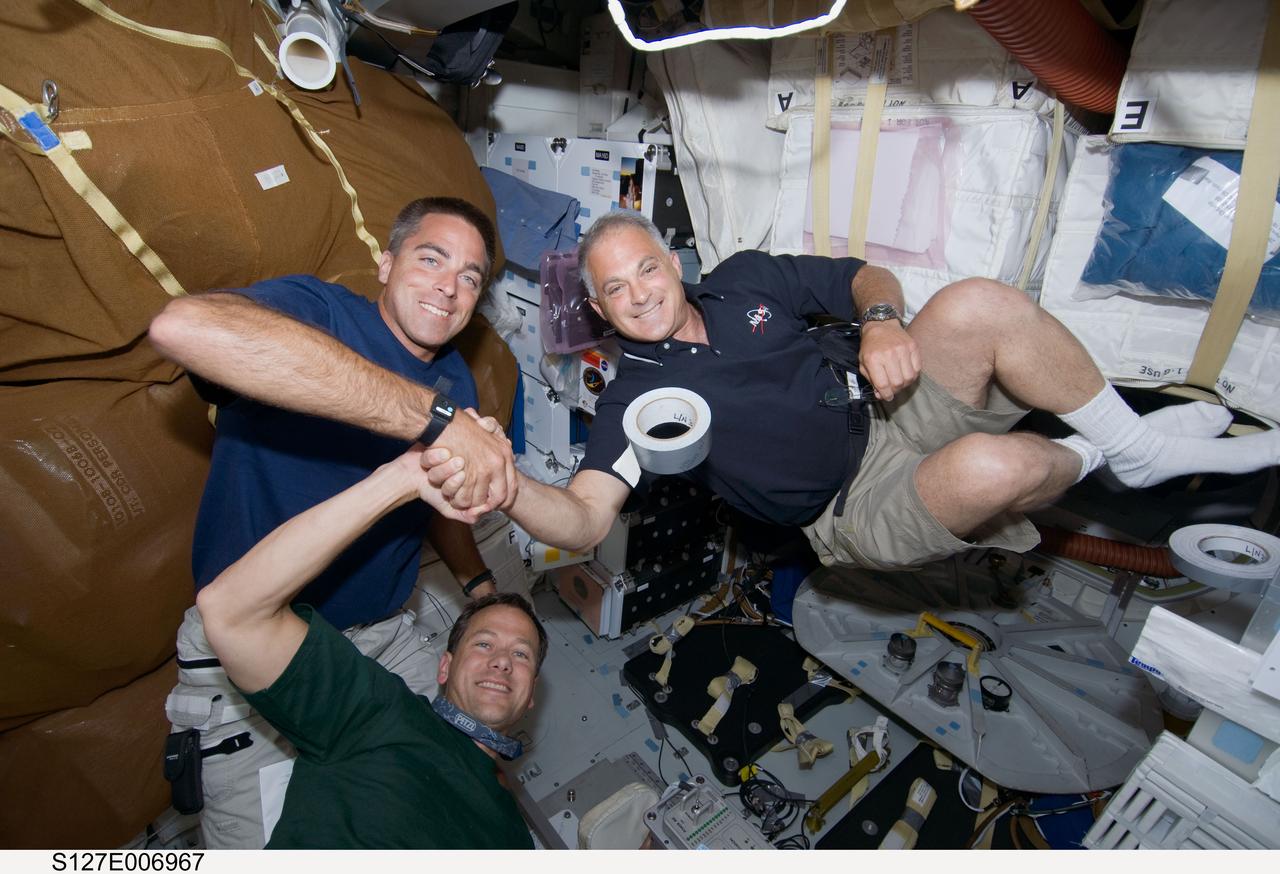
S127-E-006967 (19 July 2009) --- Astronauts Christopher Cassidy (left), Dave Wolf (right)and Tom Marshburn (bottom), all STS-127 mission specialists, share a moment shaking hands with one another on the mid deck of the Space Shuttle Endeavour. Tomorrow Wolf and Marshburn will share more than a few moments performing a spacewalk to perform work on the adjoined International Space Station. Then on flight day 10, Marshburn and Cassidy will perform the fourth of five scheduled space walks.
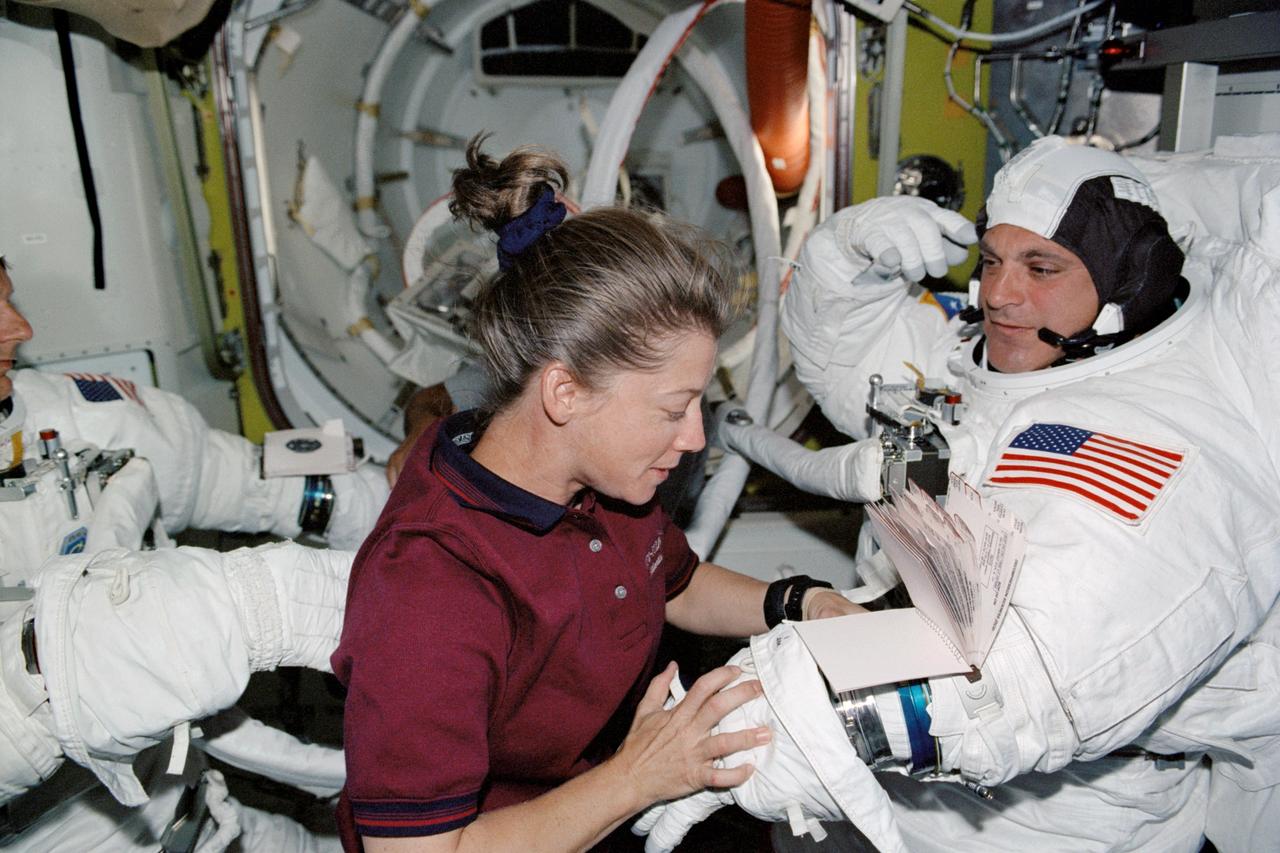
STS112-336-035 (12 October 2002) --- Astronaut Pamela A. Melroy, STS-112 pilot, assists astronaut David A. Wolf, mission specialist, with the final touches on his Extravehicular Mobility Unit (EMU) spacesuit prior to the mission’s second session of extravehicular activity (EVA). Astronaut Piers J. Sellers (partially out of frame), mission specialist, joined Wolf on the spacewalk.
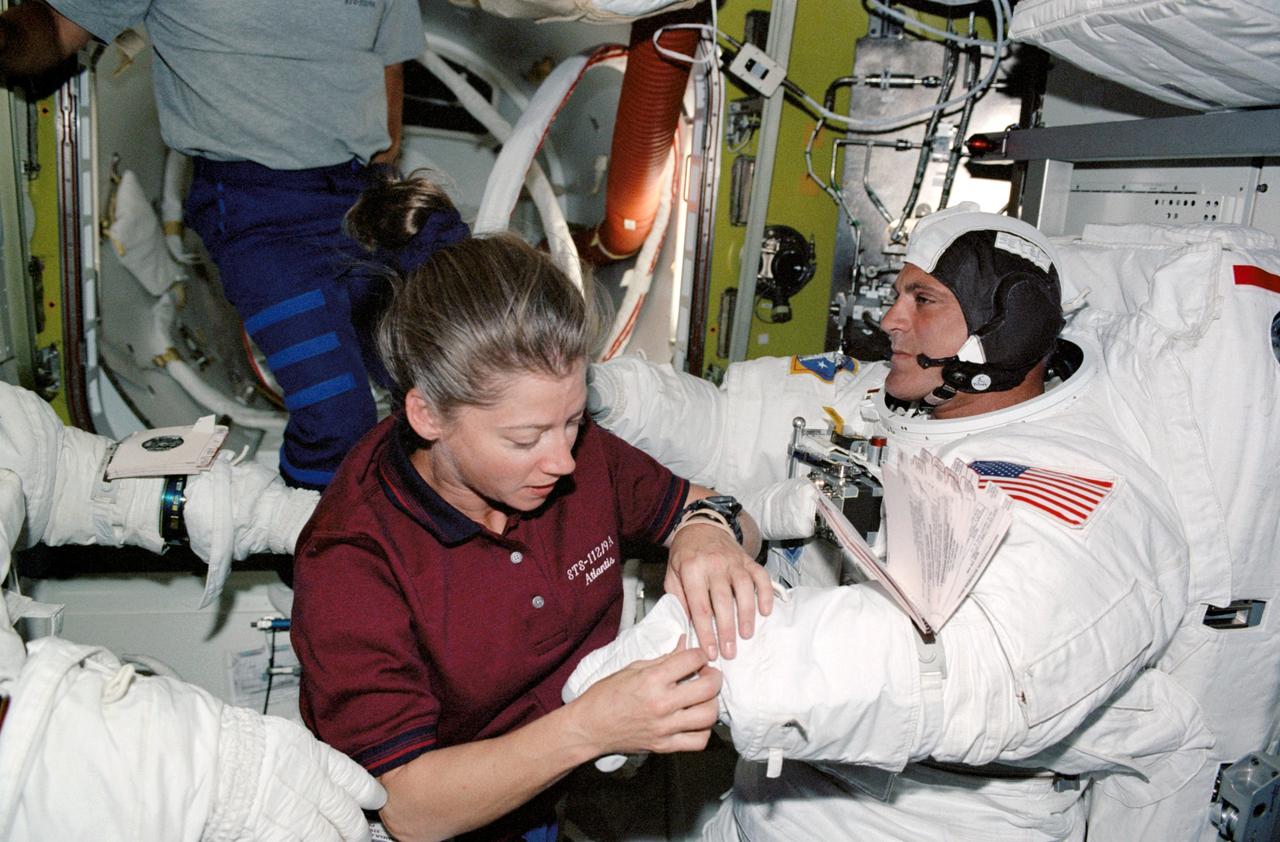
STS112-332-002 (12 October 2002) --- Astronaut Pamela A. Melroy, STS-112 pilot, assists astronaut David A. Wolf, mission specialist, with the final touches on his Extravehicular Mobility Unit (EMU) spacesuit prior to the mission’s second session of extravehicular activity (EVA). Astronaut Piers J. Sellers (partially out of frame), mission specialist, joined Wolf on the spacewalk.