
Veterans of the X-15 flight research program, most of them now retired, reunited at Dryden on the 40th anniversary of the last X-15 flight on Oct. 24, 1968 for a historical colloquium on the X-15 by noted aerospace historian and author Dennis Jenkins on Oct. 24, 2008. Gathered in front of the replica of X-15 #3 the were (from left) Johnny Armstrong, Betty Love, Paul Reukauf, Bob Hoey, Dave Stoddard, Dean Webb, Vince Capasso, Bill Dana (who flew the last flight), John McTigue and T.D. Barnes. Jenkins, the author of "X-15: Extending the Frontiers of Flight," maintained during his presentation that despite setbacks, the X-15 program became the most successful of all the X-plane research programs due to the can-do, fix-the-problem and go-fly-again attitude of the X-15's cadre of engineers and technicians.
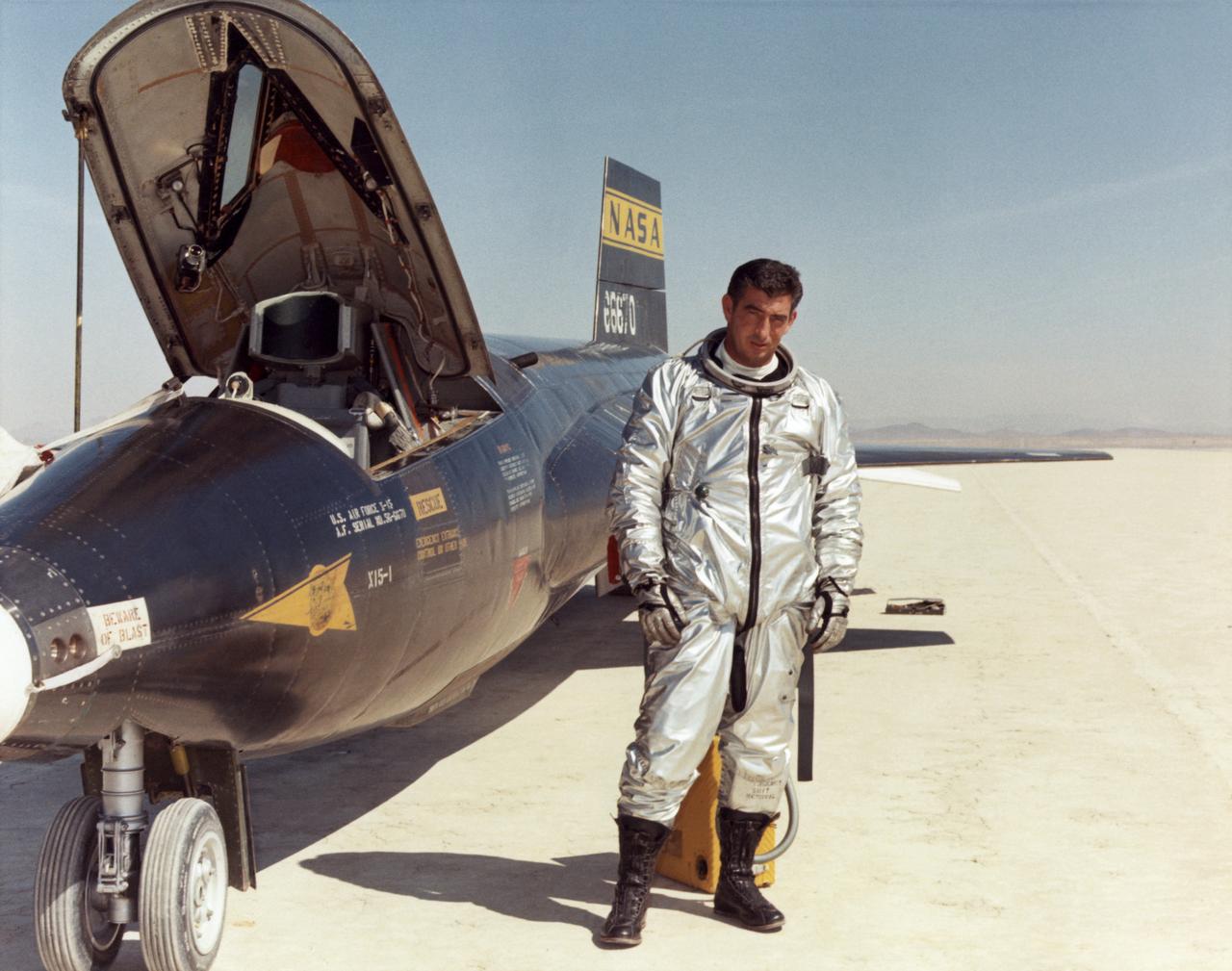
Air Force test pilot Maj. Michael J. Adams stands beside X-15 ship number one. Adams was selected for the X-15 program in 1966 and made his first flight on Oct. 6, 1966. On Nov. 15, 1967, Adams made his seventh and final X-15 flight. The X-15 launched from the B-52, but during the ascent an electrical problem affected the X-15's control system. The aircraft crashed northwest of Cuddeback Lake, California, causing the death of Adams. He was posthumously awarded Air Force astronaut wings because his final flight exceeded 50 miles in altitude. Adams was the only pilot lost in the 199-flight X-15 program.
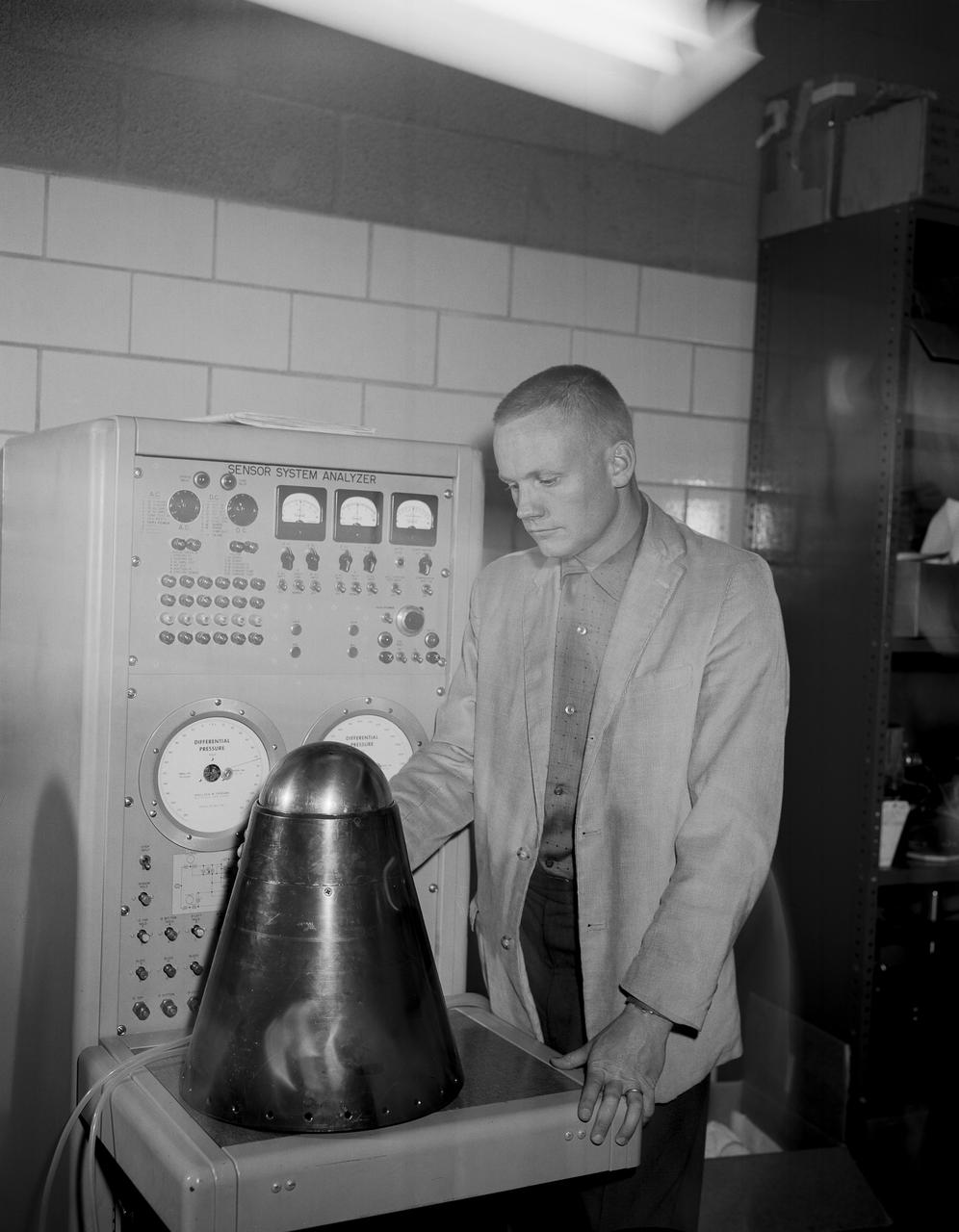
From the program’s inception, Neil Armstrong was actively engaged in both the piloting and engineering aspects of the X-15. He flew the first mission using a new flow-direction sensor (ball nose) and the first flight with a self-adaptive flight control system. Collaborating closely with designers and engineers on the system’s development, he made seven flights in the X-15 between December 1960 and July 1962. During these missions, he reached a peak altitude of 207,500 feet in the X-15-3 and a top speed of 3,989 mph (Mach 5.74) in the X-15-1.
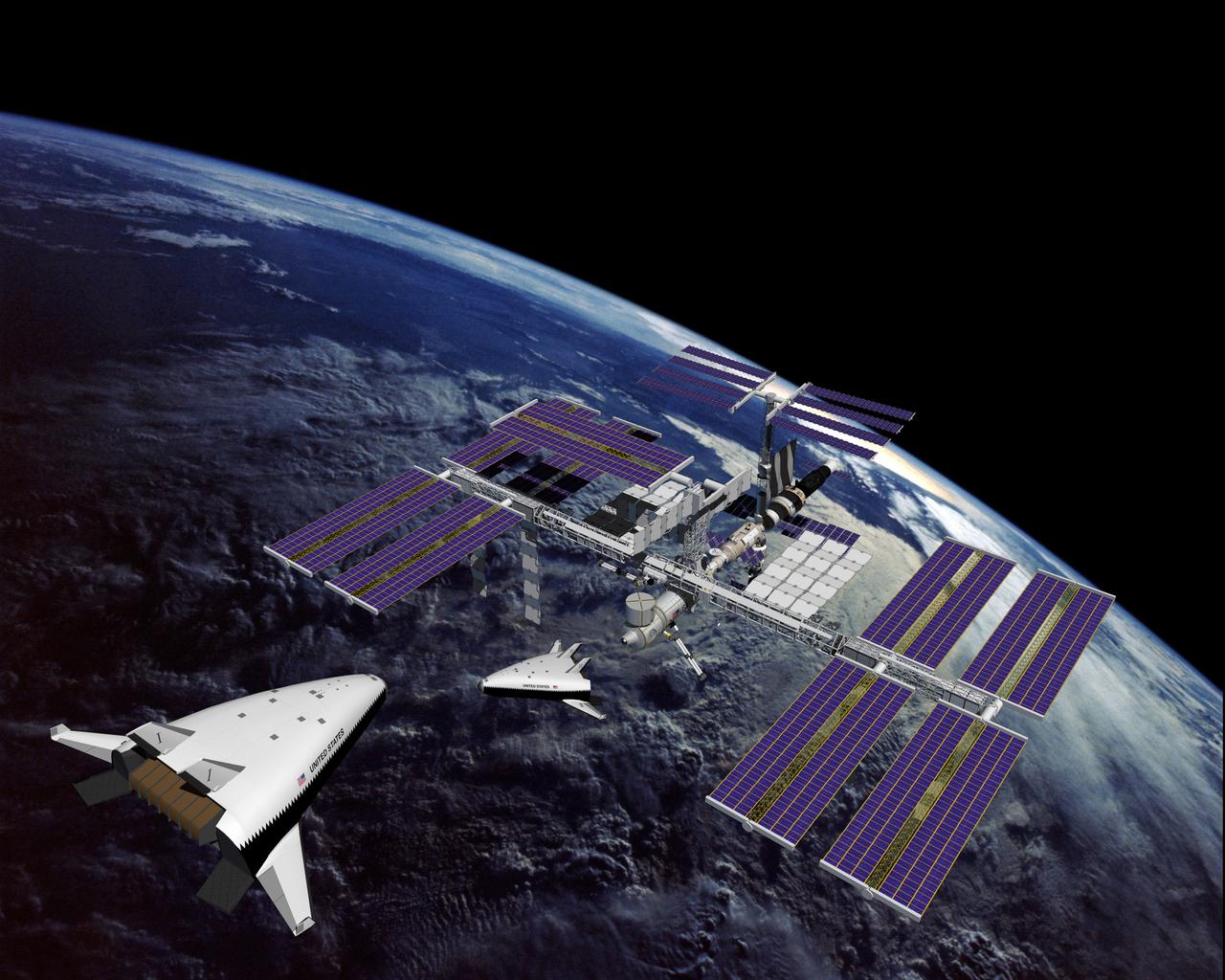
This is an artist's concept of the completely operational International Space Station being approached by an X-33 Reusable Launch Vehicle (RLV). The X-33 program was designed to pave the way to a full-scale, commercially developed RLV as the flagship technology demonstrator for technologies that would lower the cost of access to space. It is unpiloted, taking off vertically like a rocket, reaching an altitude of up to 60 miles and speeds between Mach 13 and 15, and landing horizontally like an airplane. The X-33 program was cancelled in 2001.
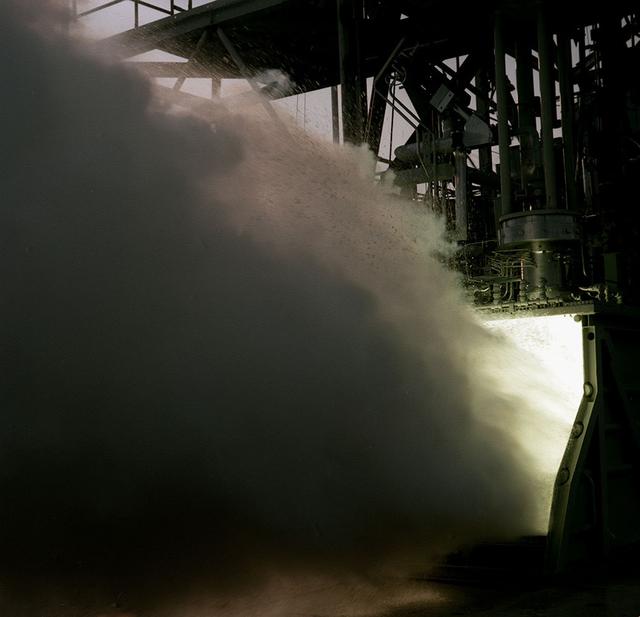
This photodepicts a 15 K Fastrac motor ignition test performed at Marshall Test Stand-116. The Fastrac motor is an alternative low-cost engine which is being developed and tested at Marshall. This engine was to eventually be used on an X-34 launchvehicle. The X-34 program was cancelled in 2001.
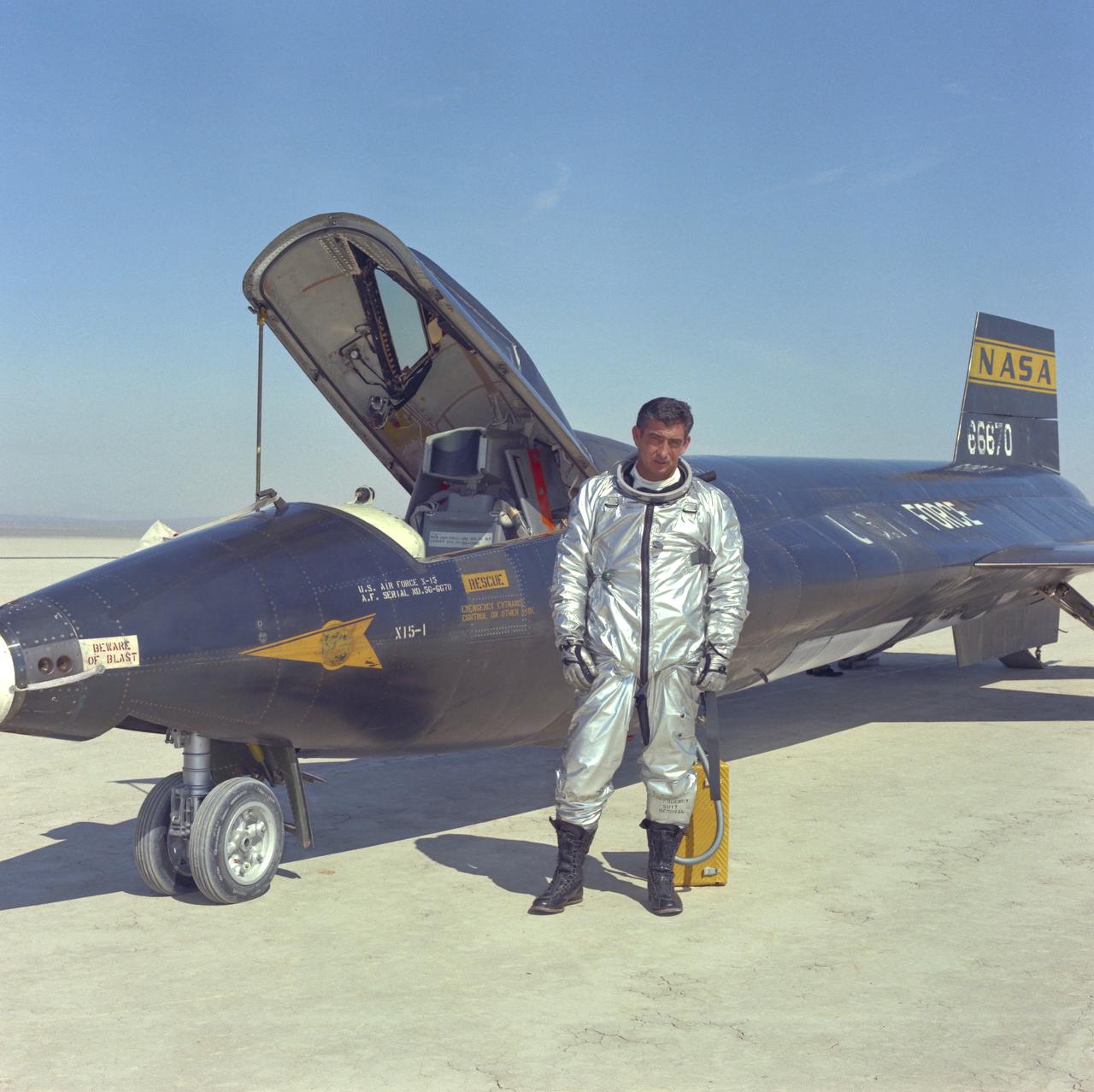
Air Force pilot Mike Adams poses in front of X-15-#1 after flight on Rogers Dry Lake at Edwards Air Force Base in California.
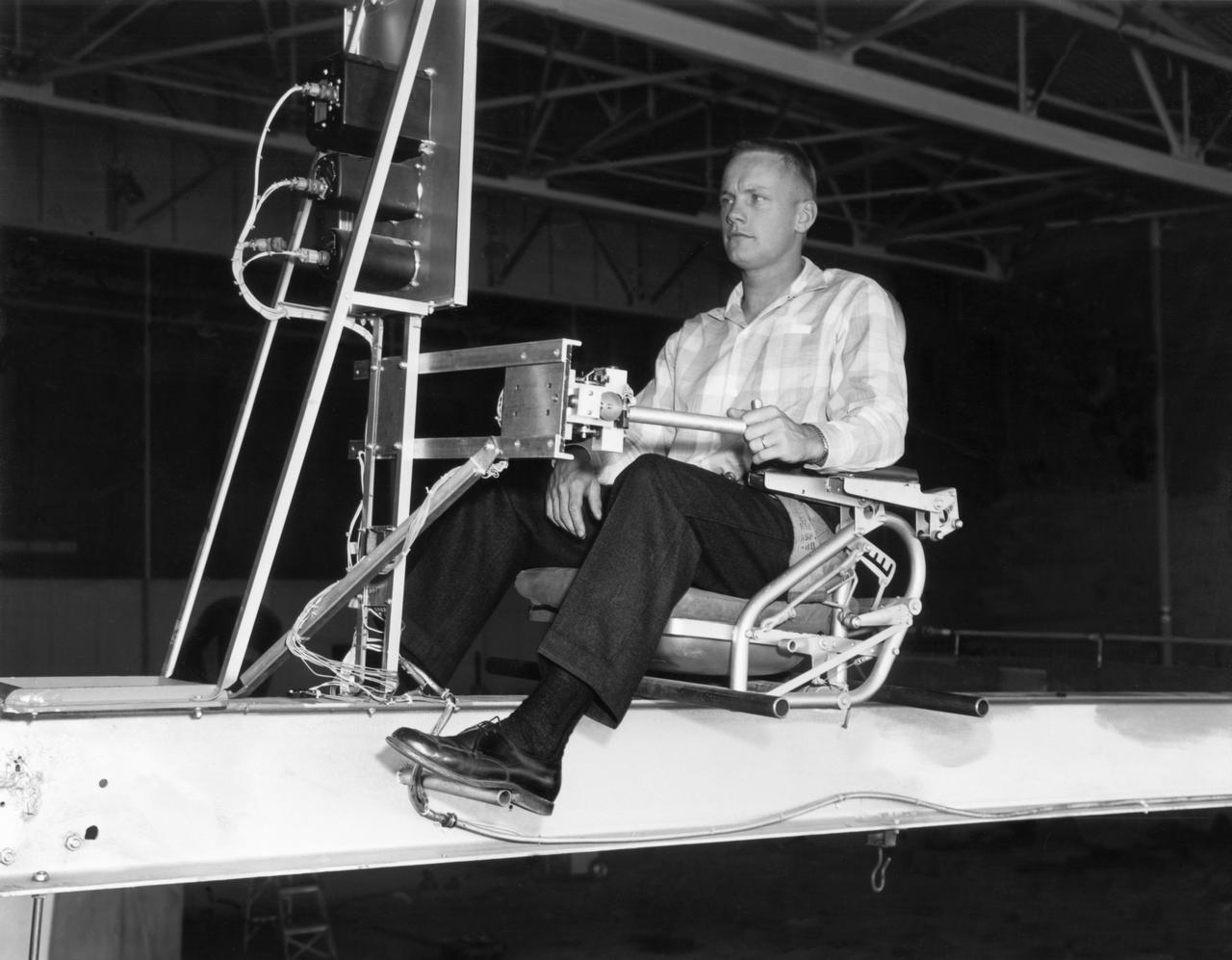
Famed astronaut Neil A. Armstrong, the first man to set foot on the moon during the historic Apollo 11 space mission in July 1969, served for seven years as a research pilot at the NACA-NASA High-Speed Flight Station, now the Dryden Flight Research Center, at Edwards, California, before he entered the space program. Armstrong joined the National Advisory Committee for Aeronautics (NACA) at the Lewis Flight Propulsion Laboratory (later NASA's Lewis Research Center, Cleveland, Ohio, and today the Glenn Research Center) in 1955. Later that year, he transferred to the High-Speed Flight Station at Edwards as an aeronautical research scientist and then as a pilot, a position he held until becoming an astronaut in 1962. He was one of nine NASA astronauts in the second class to be chosen. As a research pilot Armstrong served as project pilot on the F-100A and F-100C aircraft, F-101, and the F-104A. He also flew the X-1B, X-5, F-105, F-106, B-47, KC-135, and Paresev. He left Dryden with a total of over 2450 flying hours. He was a member of the USAF-NASA Dyna-Soar Pilot Consultant Group before the Dyna-Soar project was cancelled, and studied X-20 Dyna-Soar approaches and abort maneuvers through use of the F-102A and F5D jet aircraft. Armstrong was actively engaged in both piloting and engineering aspects of the X-15 program from its inception. He completed the first flight in the aircraft equipped with a new flow-direction sensor (ball nose) and the initial flight in an X-15 equipped with a self-adaptive flight control system. He worked closely with designers and engineers in development of the adaptive system, and made seven flights in the rocket plane from December 1960 until July 1962. During those fights he reached a peak altitude of 207,500 feet in the X-15-3, and a speed of 3,989 mph (Mach 5.74) in the X-15-1. Armstrong has a total of 8 days and 14 hours in space, including 2 hours and 48 minutes walking on the Moon. In March 1966 he was commander of the Gemini 8 or
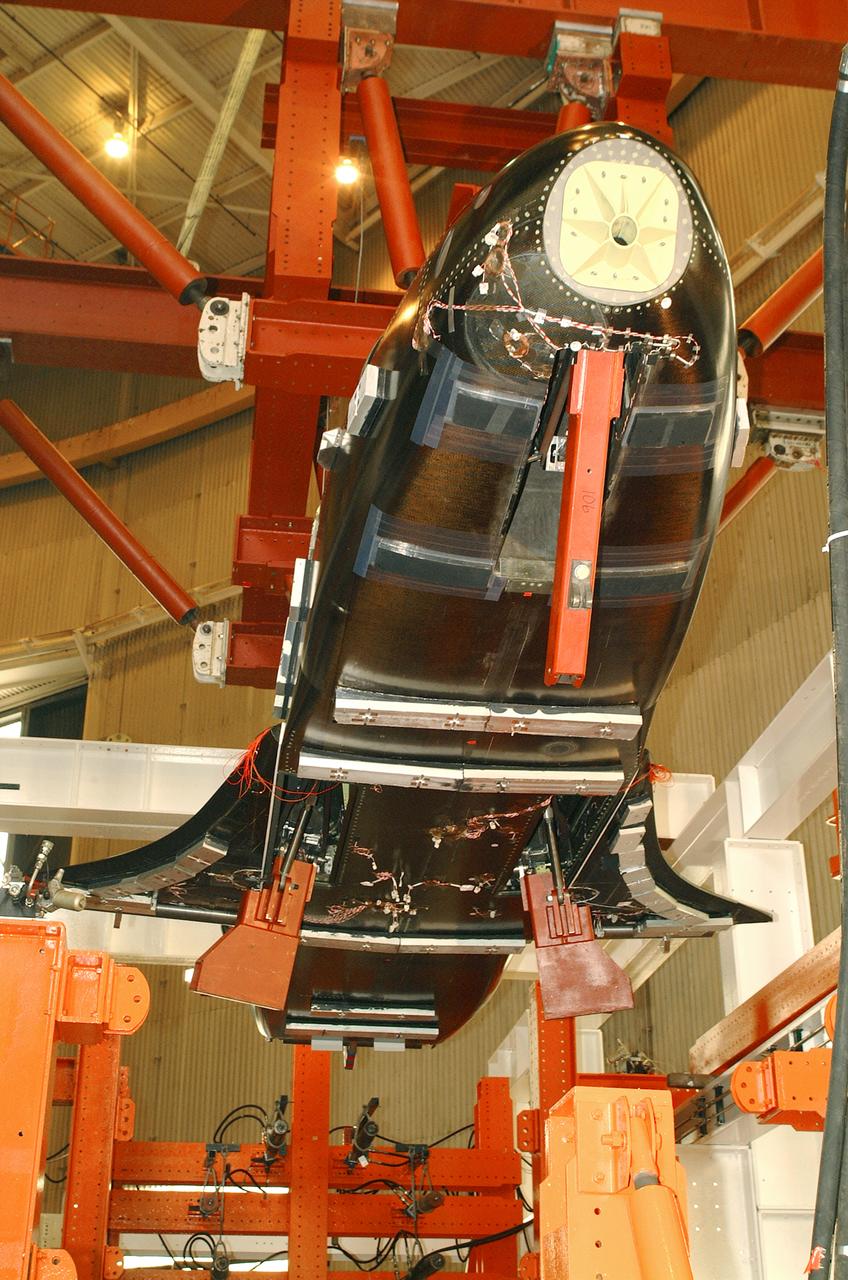
NASA's X-37 Approach and Landing Test Vehicle is installed is a structural facility at Boeing's Huntington Beach, California plant. Tests, completed in July, were conducted to verify the structural integrity of the vehicle in preparation for atmospheric flight tests. Atmospheric flight tests of the Approach and Landing Test Vehicle are scheduled for 2004 and flight tests of the Orbital Vehicle are scheduled for 2006. The X-37 experimental launch vehicle is roughly 27.5 feet (8.3 meters) long and 15 feet (4.5 meters) in wingspan. It's experiment bay is 7 feet (2.1 meters) long and 4 feet (1.2 meters) in diameter. Designed to operate in both the orbital and reentry phases of flight, the X-37 will increase both safety and reliability, while reducing launch costs from $10,000 per pound to $1,000.00 per pound. The X-37 program is managed by the Marshall Space Flight Center and built by the Boeing Company.
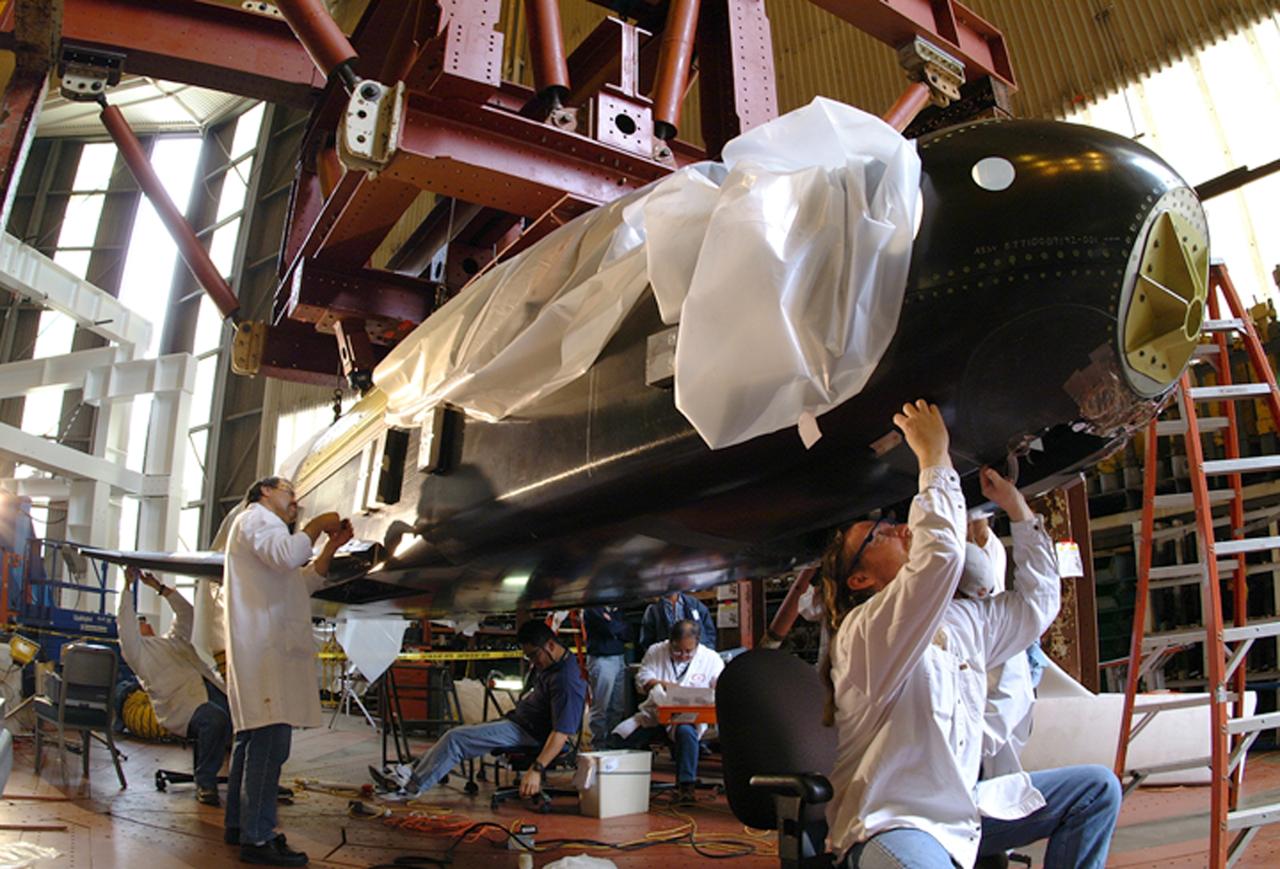
NASA's X-37 Approach and Landing Test Vehicle is installed is a structural facility at Boeing's Huntington Beach, California plant, where technicians make adjustments to composite panels. Tests, completed in July, were conducted to verify the structural integrity of the vehicle in preparation for atmospheric flight tests. Atmospheric flight tests of the Approach and Landing Test Vehicle are scheduled for 2004 and flight tests of the Orbital Vehicle are scheduled for 2006. The X-37 experimental launch vehicle is roughly 27.5 feet (8.3 meters) long and 15 feet (4.5 meters) in wingspan. It's experiment bay is 7 feet (2.1 meters) long and 4 feet (1.2 meters) in diameter. Designed to operate in both the orbital and reentry phases of flight, the X-37 will increase both safety and reliability, while reducing launch costs from $10,000 per pound to $1,000.00 per pound. The X-37 program is managed by the Marshall Space Flight Center and built by the Boeing Company.
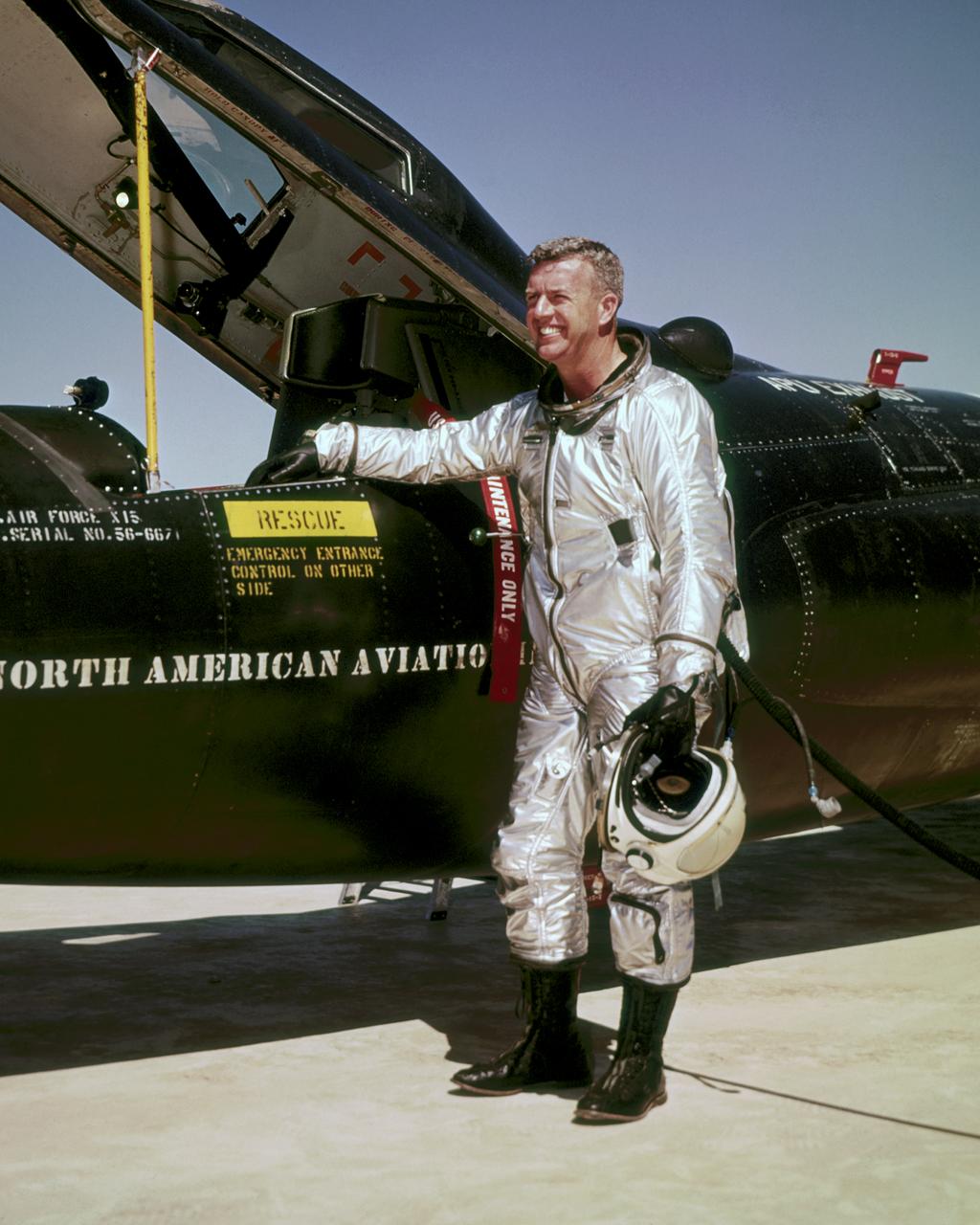
Joseph A. Walker was a Chief Research Pilot at the NASA Dryden Flight Research Center during the mid-1960s. He joined the NACA in March 1945, and served as project pilot at the Edwards flight research facility on such pioneering research projects as the D-558-1, D-558-2, X-1, X-3, X-4, X-5, and the X-15. He also flew programs involving the F-100, F-101, F-102, F-104, and the B-47. Walker made the first NASA X-15 flight on March 25, 1960. He flew the research aircraft 24 times and achieved its fastest speed and highest altitude. He attained a speed of 4,104 mph (Mach 5.92) during a flight on June 27, 1962, and reached an altitude of 354,300 feet on August 22, 1963 (his last X-15 flight). He was the first man to pilot the Lunar Landing Research Vehicle (LLRV) that was used to develop piloting and operational techniques for lunar landings. Walker was born February 20, 1921, in Washington, Pa. He lived there until graduating from Washington and Jefferson College in 1942, with a B.A. degree in Physics. During World War II he flew P-38 fighters for the Air Force, earning the Distinguished Flying Cross and the Air Medal with Seven Oak Clusters. Walker was the recipient of many awards during his 21 years as a research pilot. These include the 1961 Robert J. Collier Trophy, 1961 Harmon International Trophy for Aviators, the 1961 Kincheloe Award and 1961 Octave Chanute Award. He received an honorary Doctor of Aeronautical Sciences degree from his alma mater in June of 1962. Walker was named Pilot of the Year in 1963 by the National Pilots Association. He was a charter member of the Society of Experimental Test Pilots, and one of the first to be designated a Fellow. He was fatally injured on June 8, 1966, in a mid-air collision between an F-104 he was piloting and the XB-70.
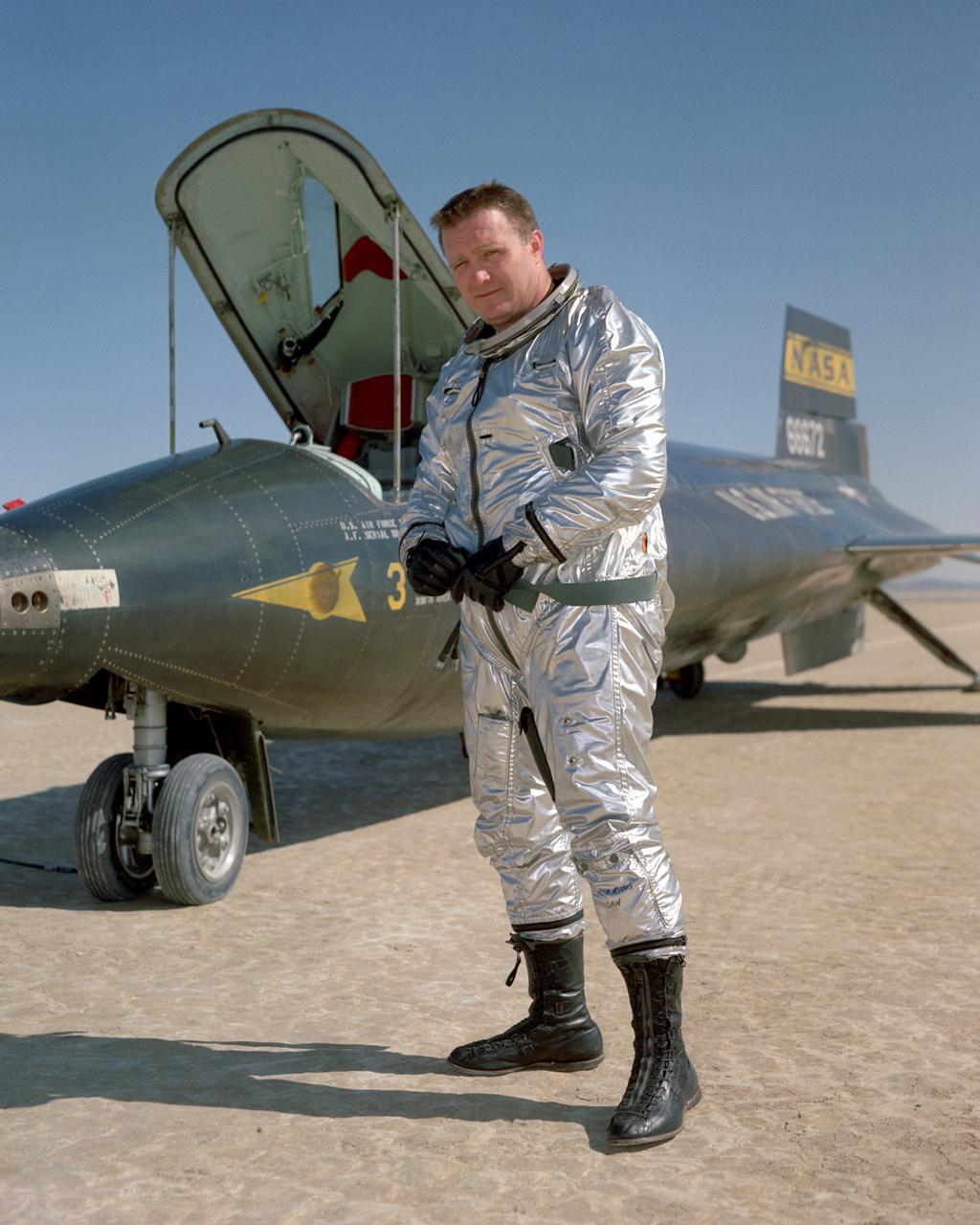
John B. McKay was one of the first pilots assigned to the X-15 flight research program at NASA's Flight Research Center, Edwards, Calif. As a civilian research pilot and aeronautical engineer, he made 30 flights in X-15s from October 28, 1960, until September 8, 1966. His peak altitude was 295,600 feet, and his highest speed was 3863 mph (Mach 5.64). McKay was with the NACA and NASA from February 8,1951 until October 5, 1971 and specialized in high-speed flight research programs. He began as an NACA intern, but assumed pilot status on July 11, 1952. In addition to the X-l5, he flew such experimental aircraft as the D-558-1, D-558-2, X-lB, and the X-lE. He has also served as a research pilot on flight programs involving the F-100, F-102, F-104, and the F-107. Born on December 8, 1922, in Portsmouth, Va., McKay graduated from Virginia Polytechnic Institute in 195O with a Bachelor of Science degree in Aeronautical Engineering. During World War II he served as a Navy pilot in the Pacific Theater, earning the Air Medal and Two Clusters, and a Presidential Unit Citation. McKay wrote several technical papers, and was a member of the American Institute of Aeronautics and Astronautics, as well as the Society of Experimental Test Pilots. He passed away on April 27, 1975.
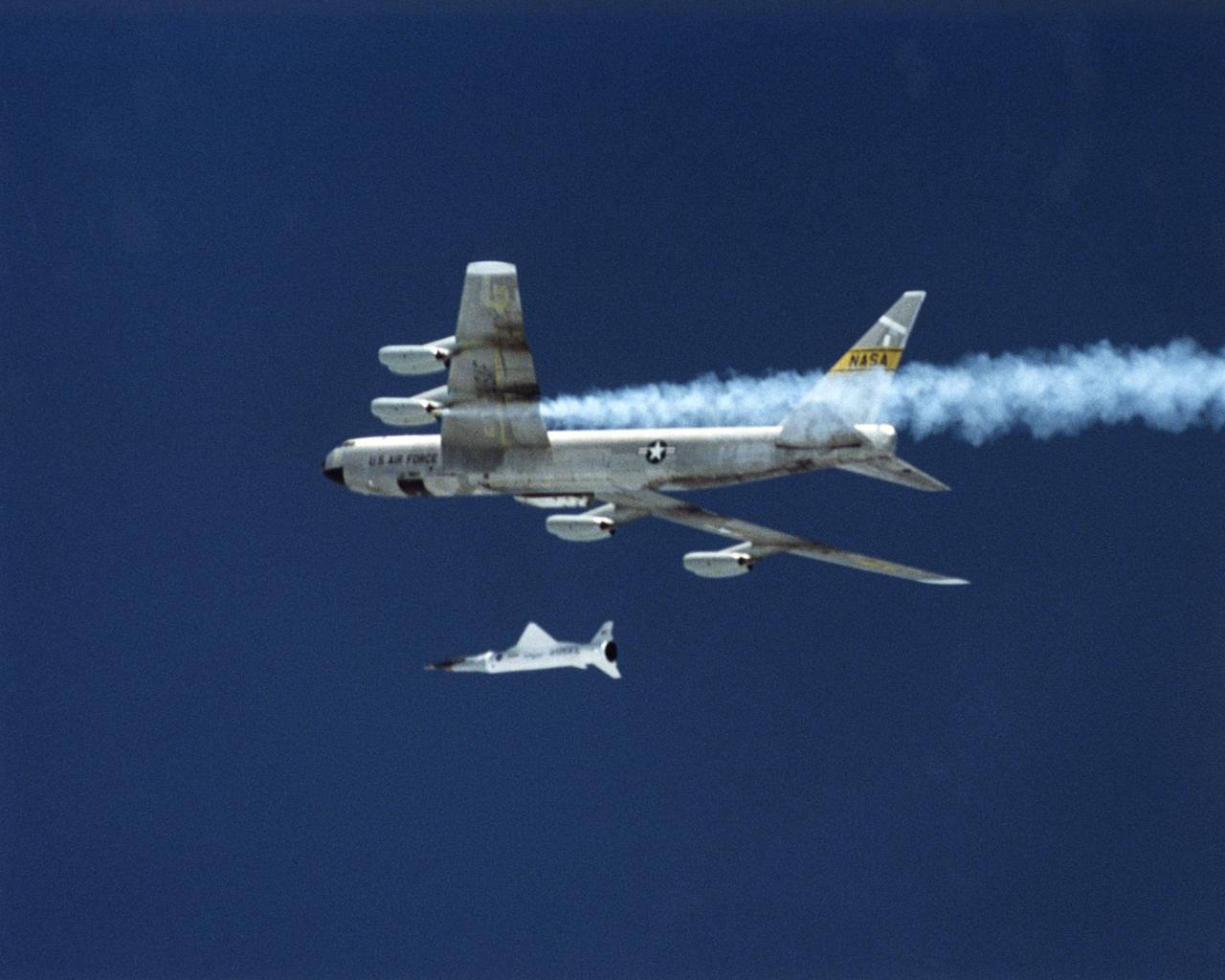
The first X-43A hypersonic research aircraft and its modified Pegasus booster rocket were carried aloft by NASA's NB-52B carrier aircraft from Dryden Flight Research Center at Edwards Air Force Base, Calif., on June 2, 2001 for the first of three high-speed free flight attempts. About an hour and 15 minutes later the Pegasus booster was released from the B-52 to accelerate the X-43A to its intended speed of Mach 7. Before this could be achieved, the combined Pegasus and X-43A "stack" lost control about eight seconds after ignition of the Pegasus rocket motor. The mission was terminated and explosive charges ensured the Pegasus and X-43A fell into the Pacific Ocean in a cleared Navy range area. A NASA investigation board is being assembled to determine the cause of the incident. Work continues on two other X-43A vehicles, the first of which could fly by late 2001. Central to the X-43A program is its integration of an air-breathing "scramjet" engine that could enable a variety of high-speed aerospace craft, and promote cost-effective access to space. The 12-foot, unpiloted research vehicle was developed and built for NASA by MicroCraft Inc., Tullahoma, Tenn. The booster was built by Orbital Sciences Corp. at Chandler, Ariz.
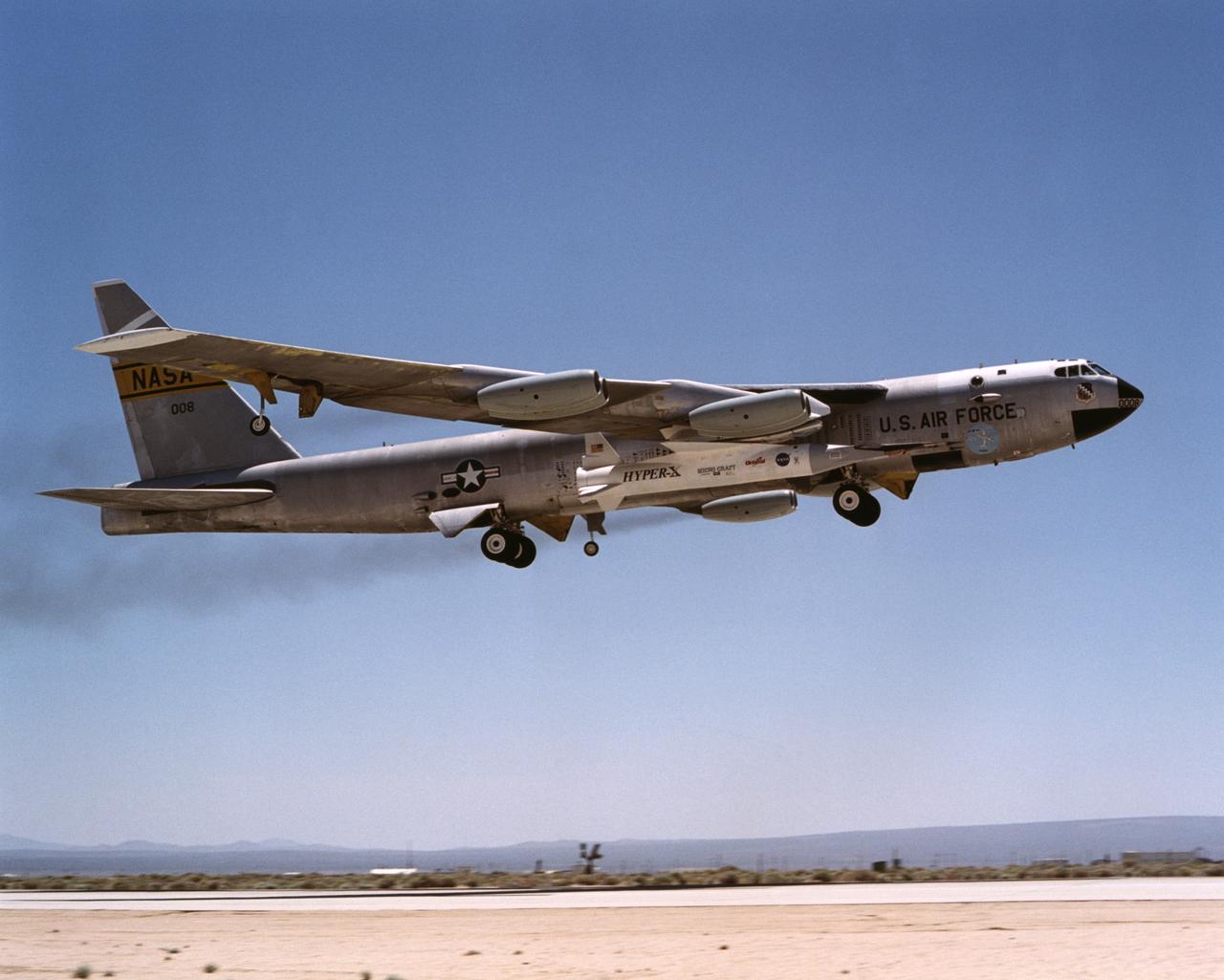
The first X-43A hypersonic research aircraft and its modified Pegasus booster rocket were carried aloft by NASA's NB-52B carrier aircraft from Dryden Flight Research Center at Edwards Air Force Base, Calif., on June 2, 2001 for the first of three high-speed free flight attempts. About an hour and 15 minutes later the Pegasus booster was released from the B-52 to accelerate the X-43A to its intended speed of Mach 7. Before this could be achieved, the combined Pegasus and X-43A "stack" lost control about eight seconds after ignition of the Pegasus rocket motor. The mission was terminated and explosive charges ensured the Pegasus and X-43A fell into the Pacific Ocean in a cleared Navy range area. A NASA investigation board is being assembled to determine the cause of the incident. Work continues on two other X-43A vehicles, the first of which could fly by late 2001. Central to the X-43A program is its integration of an air-breathing "scramjet" engine that could enable a variety of high-speed aerospace craft, and promote cost-effective access to space. The 12-foot, unpiloted research vehicle was developed and built for NASA by MicroCraft Inc., Tullahoma, Tenn. The booster was built by Orbital Sciences Corp. at Chandler, Ariz.
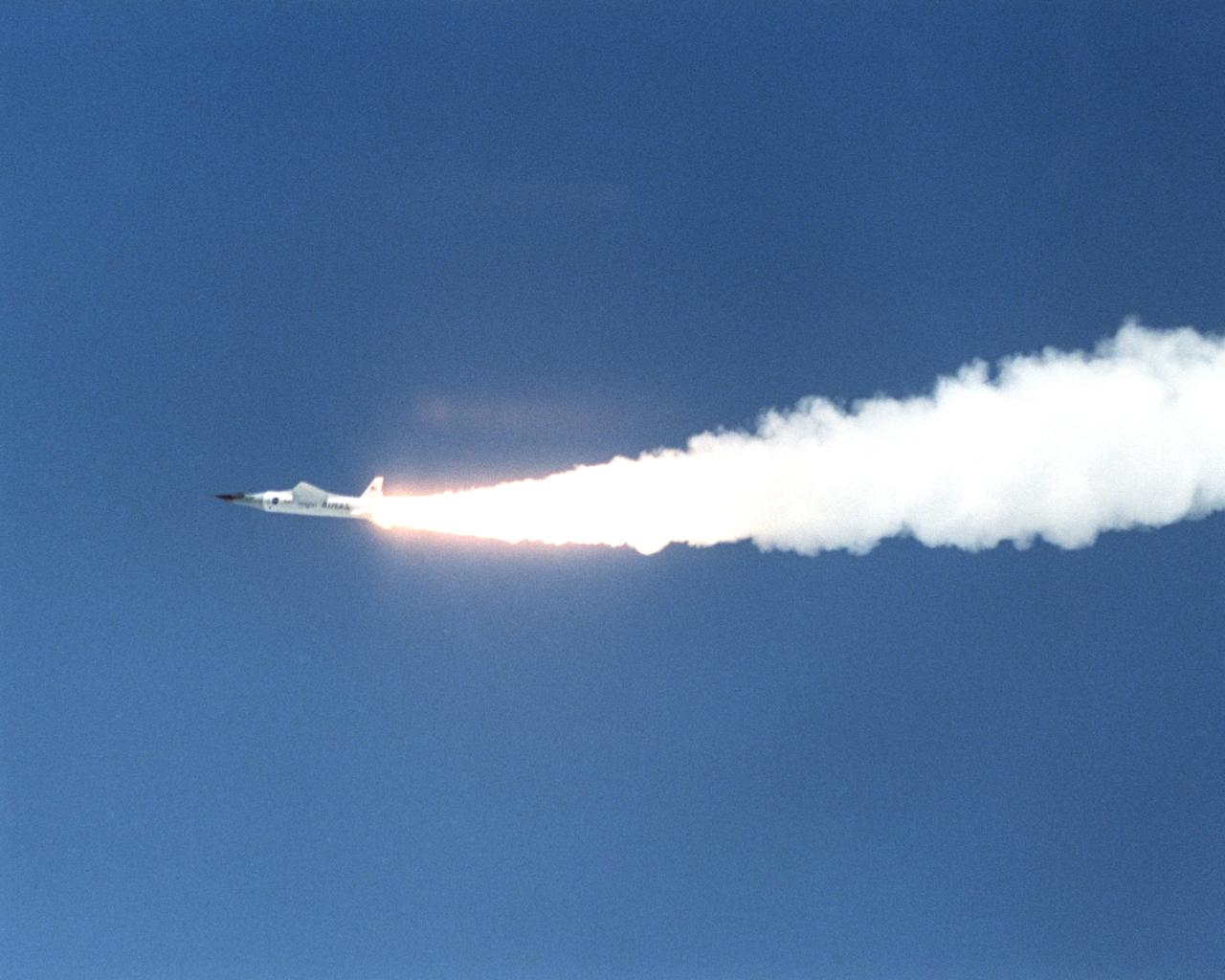
The first X-43A hypersonic research aircraft and its modified Pegasus booster rocket were carried aloft by NASA's NB-52B carrier aircraft from Dryden Flight Research Center at Edwards Air Force Base, Calif., on June 2, 2001 for the first of three high-speed free flight attempts. About an hour and 15 minutes later the Pegasus booster was released from the B-52 to accelerate the X-43A to its intended speed of Mach 7. Before this could be achieved, the combined Pegasus and X-43A "stack" lost control about eight seconds after ignition of the Pegasus rocket motor. The mission was terminated and explosive charges ensured the Pegasus and X-43A fell into the Pacific Ocean in a cleared Navy range area. A NASA investigation board is being assembled to determine the cause of the incident. Work continues on two other X-43A vehicles, the first of which could fly by late 2001. Central to the X-43A program is its integration of an air-breathing "scramjet" engine that could enable a variety of high-speed aerospace craft, and promote cost-effective access to space. The 12-foot, unpiloted research vehicle was developed and built for NASA by MicroCraft Inc., Tullahoma, Tenn. The booster was built by Orbital Sciences Corp. at Chandler, Ariz.

The first X-43A hypersonic research aircraft and its modified Pegasus booster rocket were carried aloft by NASA's NB-52B carrier aircraft from Dryden Flight Research Center at Edwards Air Force Base, Calif., on June 2, 2001 for the first of three high-speed free flight attempts. About an hour and 15 minutes later the Pegasus booster was released from the B-52 to accelerate the X-43A to its intended speed of Mach 7. Before this could be achieved, the combined Pegasus and X-43A "stack" lost control about eight seconds after ignition of the Pegasus rocket motor. The mission was terminated and explosive charges ensured the Pegasus and X-43A fell into the Pacific Ocean in a cleared Navy range area. A NASA investigation board is being assembled to determine the cause of the incident. Work continues on two other X-43A vehicles, the first of which could fly by late 2001. Central to the X-43A program is its integration of an air-breathing "scramjet" engine that could enable a variety of high-speed aerospace craft, and promote cost-effective access to space. The 12-foot, unpiloted research vehicle was developed and built for NASA by MicroCraft Inc., Tullahoma, Tenn. The booster was built by Orbital Sciences Corp. at Chandler, Ariz.
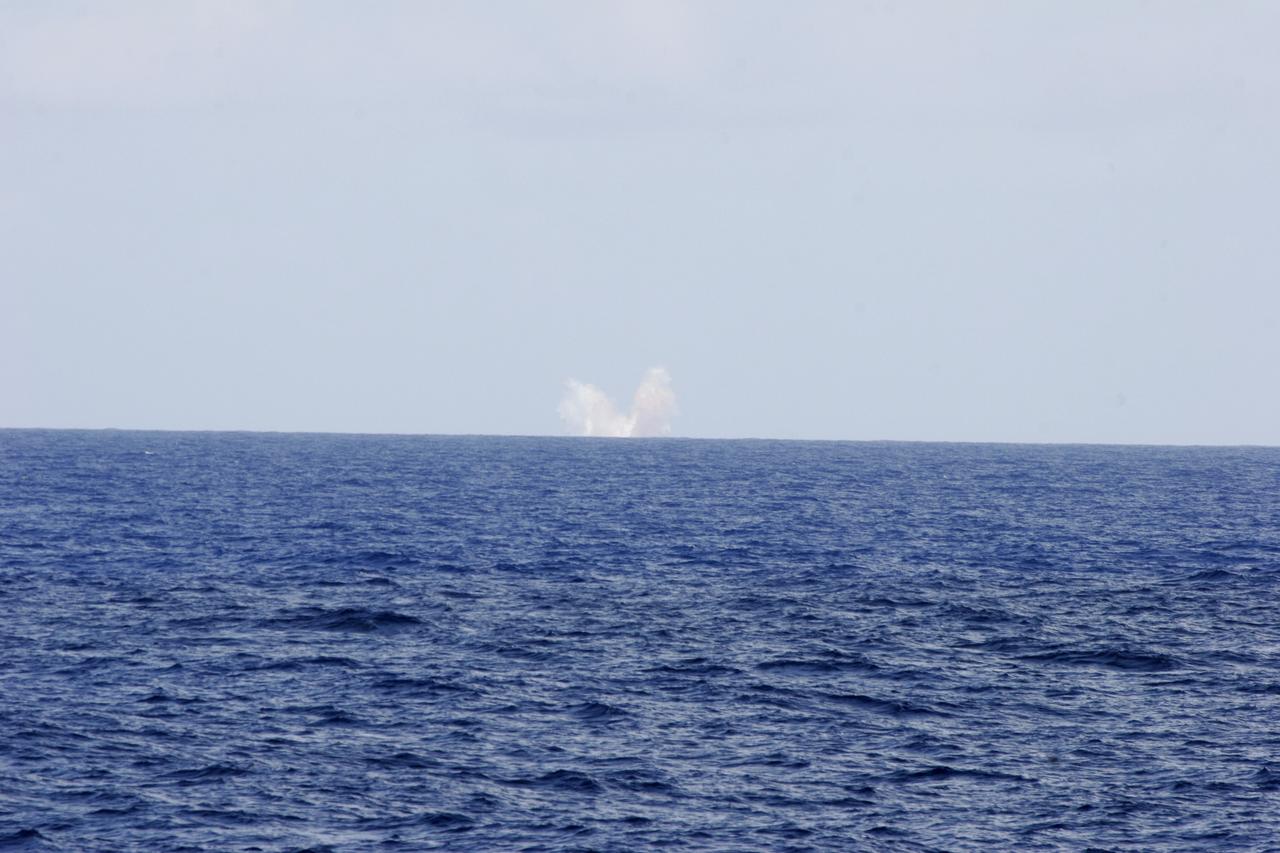
CAPE CANAVERAL, Fla. – The upper stage of the Ares I-X rocket falls into the Atlantic Ocean off the coast of NASA's Kennedy Space Center in Florida approximately 12 to 15 miles from the solid rocket booster recovery ship Freedom Star following the launch of the flight test mission. Liftoff of the 6-minute flight test was at 11:30 a.m. EDT Oct. 28. This was the first launch from Kennedy's pads of a vehicle other than the space shuttle since the Apollo Program's Saturn rockets were retired. The parts used to make the Ares I-X booster flew on 30 different shuttle missions ranging from STS-29 in 1989 to STS-106 in 2000. The data returned from more than 700 sensors throughout the rocket will be used to refine the design of future launch vehicles and bring NASA one step closer to reaching its exploration goals. For information on the Ares I-X vehicle and flight test, visit http://www.nasa.gov/aresIX. Photo credit: United Space Alliance

This photograph depicts an air-breathing rocket engine prototype in the test bay at the General Applied Science Lab facility in Ronkonkoma, New York. Air-breathing engines, known as rocket based, combined-cycle engines, get their initial take-off power from specially designed rockets, called air-augmented rockets, that boost performance about 15 percent over conventional rockets. When the vehicle's velocity reaches twice the speed of sound, the rockets are turned off and the engine relies totally on oxygen in the atmosphere to burn hydrogen fuel, as opposed to a rocket that must carry its own oxygen, thus reducing weight and flight costs. Once the vehicle has accelerated to about 10 times the speed of sound, the engine converts to a conventional rocket-powered system to propel the craft into orbit or sustain it to suborbital flight speed. NASA's Advanced Space Transportation Program at Marshall Space Flight Center, along with several industry partners and collegiate forces, is developing this technology to make space transportation affordable for everyone from business travelers to tourists. The goal is to reduce launch costs from today's price tag of $10,000 per pound to only hundreds of dollars per pound. NASA's series of hypersonic flight demonstrators currently include three air-breathing vehicles: the X-43A, X-43B and X-43C.
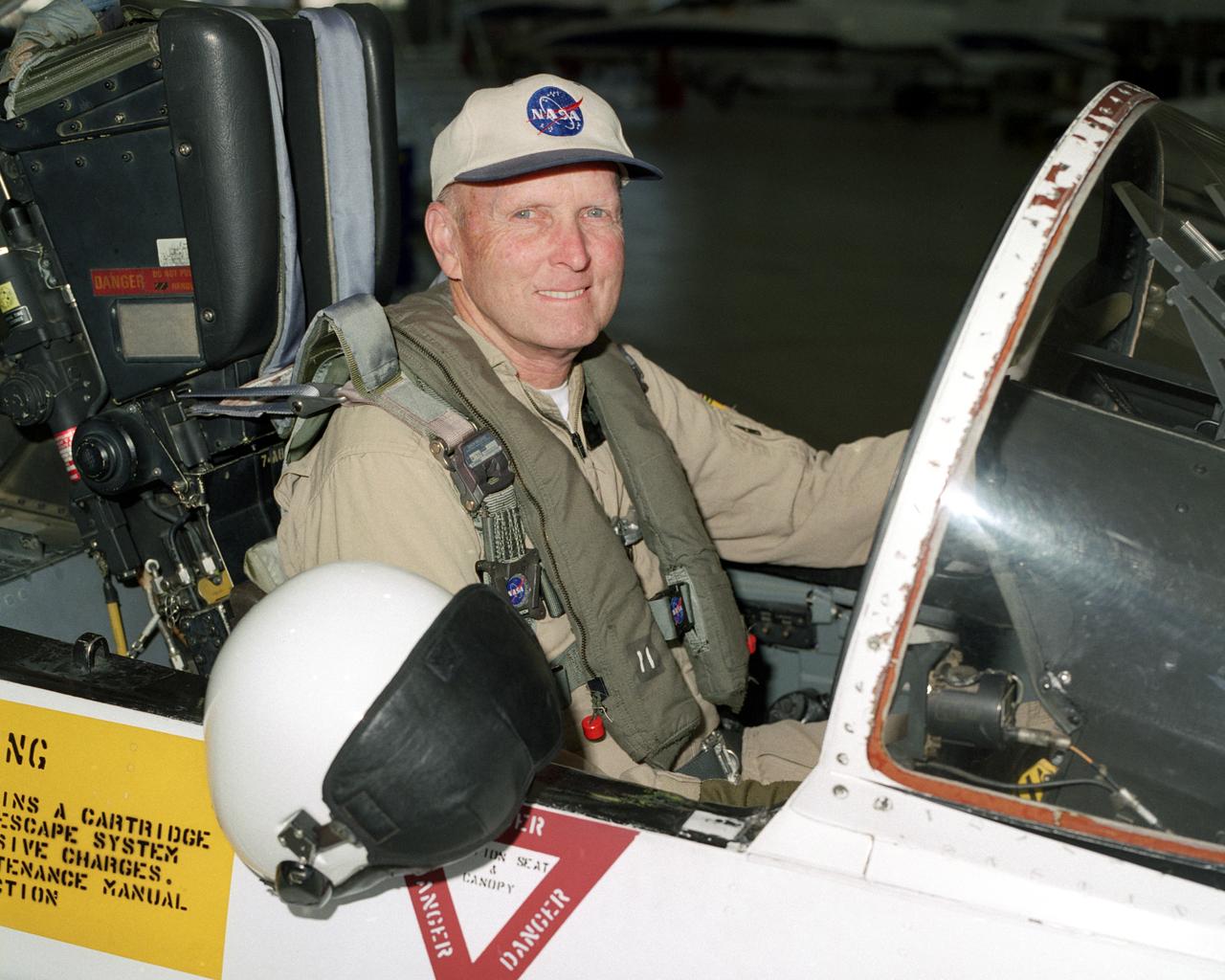
Former NASA astronaut C. Gordon Fullerton, seated in the cockpit of an F/A-18, is a research pilot at NASA's Dryden Flight Research Center, Edwards, Calif. Since transferring to Dryden in 1986, his assignments have included a variety of flight research and support activities piloting NASA's B-52 launch aircraft, the 747 Shuttle Carrier Aircraft (SCA), and other multi-engine and high performance aircraft. He flew a series of development air launches of the X-38 prototype Crew Return Vehicle and in the launches for the X-43A Hyper-X project. Fullerton also flies Dryden's DC-8 Airborne Science aircraft in support a variety of atmospheric physics, ground mapping and meteorology studies. Fullerton also was project pilot on the Propulsion Controlled Aircraft program, during which he successfully landed both a modified F-15 and an MD-11 transport with all control surfaces neutralized, using only engine thrust modulation for control. Fullerton also evaluated the flying qualities of the Russian Tu-144 supersonic transport during two flights in 1998, one of only two non-Russian pilots to fly that aircraft. With more than 15,000 hours of flying time, Fullerton has piloted 135 different types of aircraft in his career. As an astronaut, Fullerton served on the support crews for the Apollo 14, 15, 16, and 17 lunar missions. In 1977, Fullerton was on one of the two flight crews that piloted the Space Shuttle prototype Enterprise during the Approach and Landing Test Program at Dryden. Fullerton was the pilot on the STS-3 Space Shuttle orbital flight test mission in 1982, and commanded the STS-51F Spacelab 2 mission in 1985. He has logged 382 hours in space flight. In July 1988, he completed a 30-year career with the U.S. Air Force and retired as a colonel.

An artist's rendering of the air-breathing, hypersonic X-43B, the third and largest of NASA's Hyper-X series flight demonstrators, which could fly later this decade. Revolutionizing the way we gain access to space is NASA's primary goal for the Hypersonic Investment Area, managed for NASA by the Advanced Space Transportation Program at the Marshall Space Flight Center in Huntsville, Alabama. The Hypersonic Investment area, which includes leading-edge partners in industry and academia, will support future generation reusable vehicles and improved access to space. These technology demonstrators, intended for flight testing by decade's end, are expected to yield a new generation of vehicles that routinely fly about 100,000 feet above Earth's surface and reach sustained speeds in excess of Mach 5 (3,750 mph), the point at which "supersonic" flight becomes "hypersonic" flight. The flight demonstrators, the Hyper-X series, will be powered by air-breathing rocket or turbine-based engines, and ram/scramjets. Air-breathing engines, known as combined-cycle systems, achieve their efficiency gains over rocket systems by getting their oxygen for combustion from the atmosphere, as opposed to a rocket that must carry its oxygen. Once a hypersonic vehicle has accelerated to more than twice the speed of sound, the turbine or rockets are turned off, and the engine relies solely on oxygen in the atmosphere to burn fuel. When the vehicle has accelerated to more than 10 to 15 times the speed of sound, the engine converts to a conventional rocket-powered system to propel the craft into orbit or sustain it to suborbital flight speed. NASA's series of hypersonic flight demonstrators includes three air-breathing vehicles: the X-43A, X-43B and X-43C.
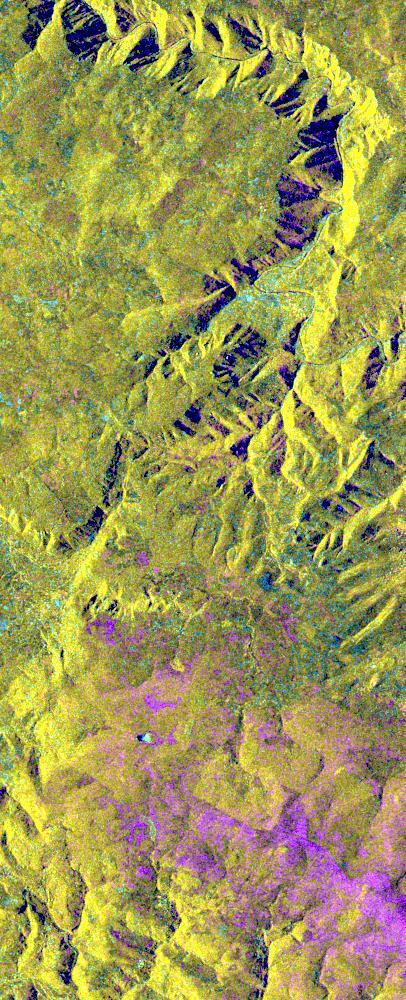
This is an X-band seasonal image of the central part of Lozere Departement situated south of the Massif Central in France. The image is 10 kilometers by 25 kilometers (6 miles by 15.5 miles) and is centered at approximately 44.3 degrees north latitude and 3 degrees east longitude. This image was acquired by the Spaceborne Imaging Radar-C/X-band Synthetic Aperture Radar aboard the space shuttle Endeavour on April 15, 1994 and on October 6, 1994. The image channels have the following color assignments: red was acquired in April; green was acquired in October; and blue is the ratio of the two data sets combined. Seasonal differences in the vegetation are visible in pink, which are heaths growing in the spring. This research area features two large limestone plateaus cut by the famous Gorges du Tarn, standing in parallel with the granite mountain range known as the Cevennes Mountains nearby. Land-use consists mainly of grasslands, heaths and forests. Forest types seen in the images are Austrian pines,Scots pines, spruce, fir and beech trees. Most forests were planted at the end of the 19th century through a national reforestation program aimed at reducing the strong erosion risks in these areas. This program was so successful that today the forests are exploited for forest pulpwood and sawlogs, but also remain protected as conservation regions. The study being performed in this area will assess the potential of spaceborne radar remote sensing for temperate forest type mapping and forest resource monitoring. The combination of X-band SAR data with lower frequency data (such as the SIR-C L-band data) allows scientists to distinguish forest tree species and biomass, or areas of ground vegetation. The lessons learned from the radar images of these controlled forest regions can be applied to larger areas and naturally grown forests to help ecologists protect and maintain them. The SIR-C/X-SAR images will be investigated by scientists from the remote sensing laboratory Cemagref in Montpellier and the National Forestry Board in Mende, France. http://photojournal.jpl.nasa.gov/catalog/PIA01755
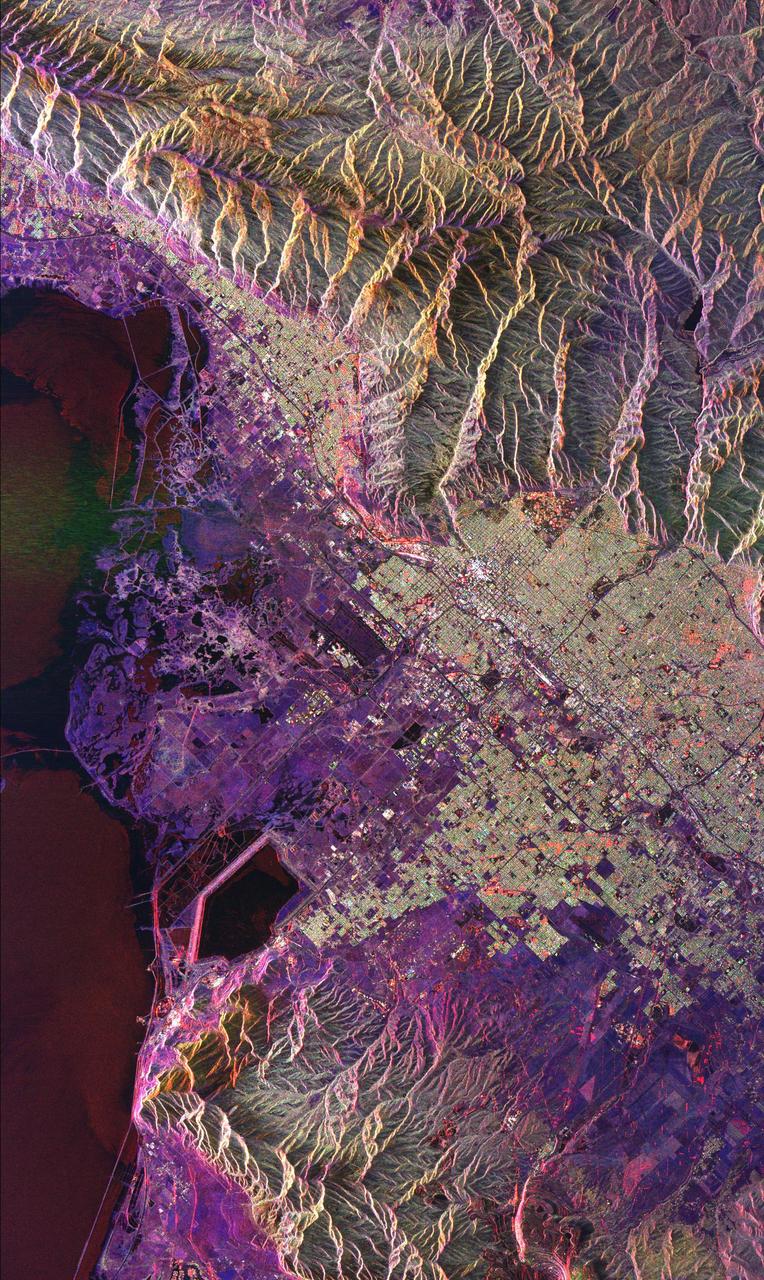
This radar image of Salt Lake City, Utah, illustrates the different land use patterns that are present in the Utah Valley. Salt Lake City lies between the shores of the Great Salt Lake (the dark area on the left side of the image) and the Wasatch Front Range (the mountains in the upper half of the image). The Salt Lake City area is of great interest to urban planners because of the combination of lake, valley and alpine environments that coexist in the region. Much of the southern shore of the Great Salt Lake is a waterfowl management area. The green grid pattern in the right center of the image is Salt Lake City and its surrounding communities. The Salt Lake City airport is visible as the brown rectangle near the center of the image. Interstate Highway 15 runs from the middle right edge to the upper left of the image. The bright white patch east of Interstate 15 is the downtown area, including Temple Square and the state capitol. The University of Utah campus is the yellowish area that lies at the base of the mountains, east of Temple Square. The large reservoir in the lower left center is a mine tailings pond. The semi-circular feature in the mountains at the bottom edge of the image is the Kennecott Copper Mine. The area shown is 60 kilometers by 40 kilometers (37 miles by 25 miles) and is centered at 40.6 degrees north latitude, 112.0 degrees west longitude. North is toward the upper left. This image was acquired by the Spaceborne Imaging Radar-C/X-Band Synthetic Aperture Radar (SIR-C/X-SAR) aboard the space shuttle Endeavour on April 10, 1994. The colors in this image represent the following radar channels and polarizations: red is L-band, horizontally transmitted and received; green is L-band, horizontally transmitted and vertically received; and blue is C-band, horizontally transmitted and vertically received. SIR-C/X-SAR, a joint mission of the German, Italian and United States space agencies, is part of NASA's Mission to Planet Earth program. http://photojournal.jpl.nasa.gov/catalog/PIA01798
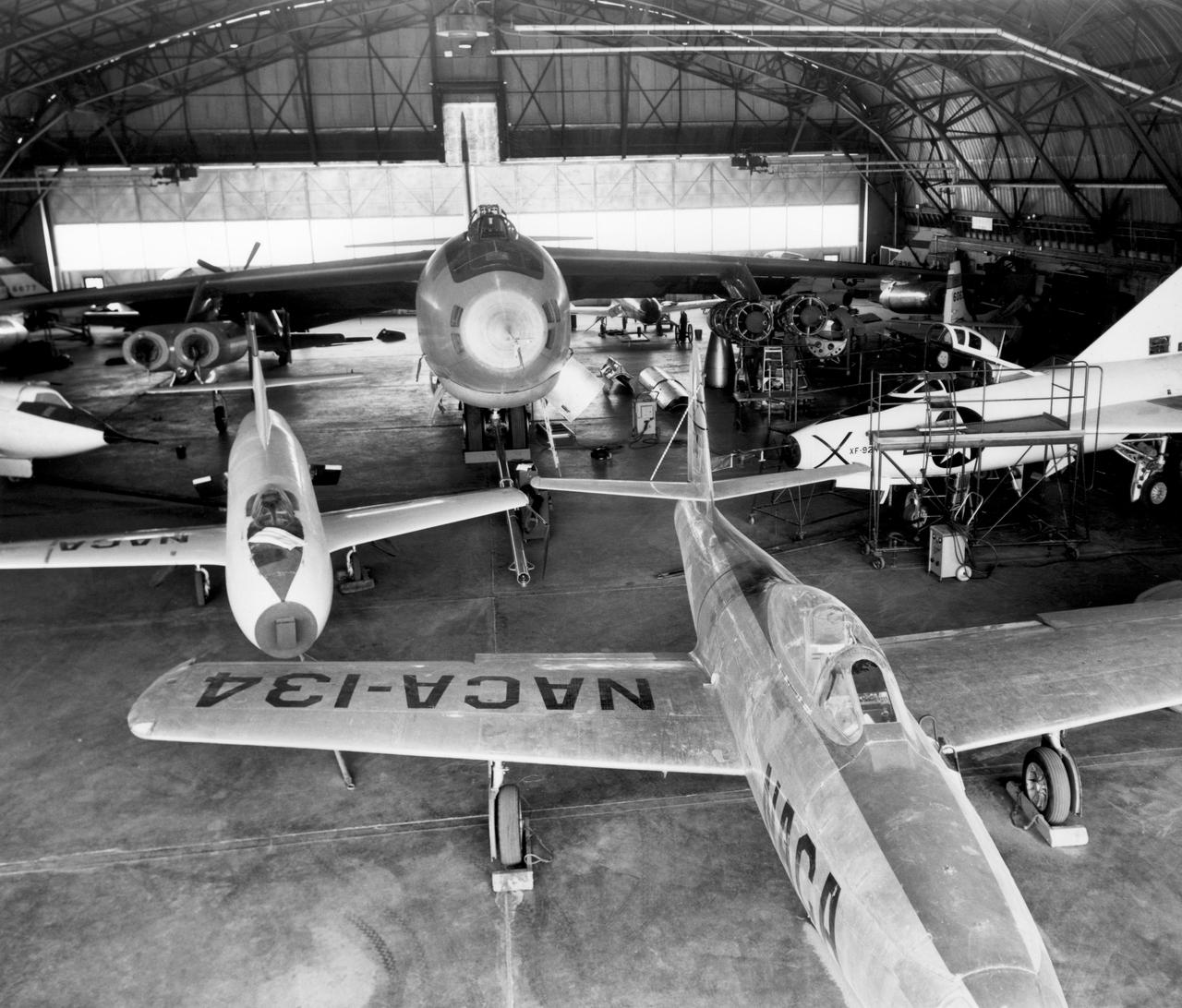
In the center foreground of this 1953 hangar photo is the YF-84A (NACA 134/Air Force 45-59490) used for vortex generator research. It arrived on November 28, 1949, and departed on April 21, 1954. Beside it is the third D-558-1 aircraft (NACA 142/Navy 37972). This aircraft was used for a total of 78 transonic research flights from April 1949 to June 1954. It replaced the second D-558-1, lost in the crash which killed Howard Lilly. Just visible on the left edge is the nose of the first D-558-2 (NACA 143/Navy 37973). Douglas turned the aircraft over to NACA on August 31, 1951, after the contractor had completed its initial test flights. NACA only made a single flight with the aircraft, on September 17, 1956, before the program was cancelled. In the center of the photo is the B-47A (NACA 150/Air Force 49-1900). The B-47 jet bomber, with its thin, swept-back wings, and six podded engines, represented the state of the art in aircraft design in the early 1950s. The aircraft undertook a number of research activities between May 1953 and its 78th and final research flight on November 22, 1957. The tests showed that the aircraft had a buffeting problem at speeds above Mach 0.8. Among the pilots who flew the B-47 were later X-15 pilots Joe Walker, A. Scott Crossfield, John B. McKay, and Neil A. Armstrong. On the right side of the B-47 is NACA's X-1 (Air Force 46-063). The second XS-1 aircraft built, it was fitted with a thicker wing than that on the first aircraft, which had exceeded Mach 1 on October 14, 1947. Flight research by NACA pilots indicated that this thicker wing produced 30 percent more drag at transonic speeds compared to the thinner wing on the first X-1. After a final flight on October 23, 1951, the aircraft was grounded due to the possibility of fatigue failure of the nitrogen spheres used to pressurize the fuel tanks. At the time of this photo, in 1953, the aircraft was in storage. In 1955, the aircraft was extensively modified, becoming the X-1E. In front o
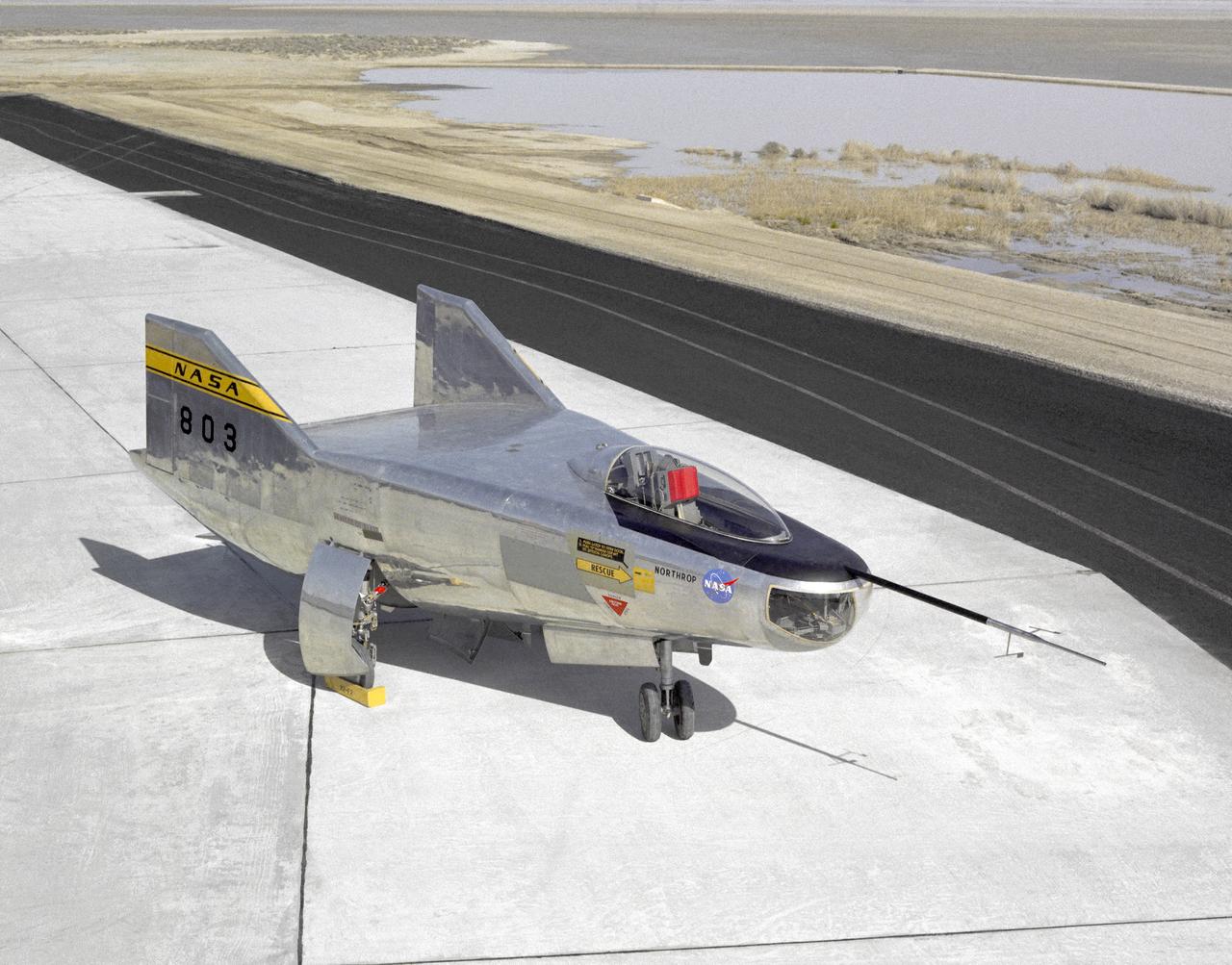
The M2-F2 Lifting Body is seen here on the ramp at the NASA Dryden Flight Research Center. The success of Dryden's M2-F1 program led to NASA's development and construction of two heavyweight lifting bodies based on studies at NASA's Ames and Langley research centers -- the M2-F2 and the HL-10, both built by the Northrop Corporation. The "M" refers to "manned" and "F" refers to "flight" version. "HL" comes from "horizontal landing" and 10 is for the tenth lifting body model to be investigated by Langley. The first flight of the M2-F2 -- which looked much like the "F1" -- was on July 12, 1966. Milt Thompson was the pilot. By then, the same B-52 used to air launch the famed X-15 rocket research aircraft was modified to also carry the lifting bodies. Thompson was dropped from the B-52's wing pylon mount at an altitude of 45,000 feet on that maiden glide flight. The M2-F2 weighed 4,620 pounds, was 22 feet long, and had a width of about 10 feet. On May 10, 1967, during the sixteenth glide flight leading up to powered flight, a landing accident severely damaged the vehicle and seriously injured the NASA pilot, Bruce Peterson. NASA pilots and researchers realized the M2-F2 had lateral control problems, even though it had a stability augmentation control system. When the M2-F2 was rebuilt at Dryden and redesignated the M2-F3, it was modified with an additional third vertical fin -- centered between the tip fins -- to improve control characteristics. The M2-F2/F3 was the first of the heavy-weight, entry-configuration lifting bodies. Its successful development as a research test vehicle answered many of the generic questions about these vehicles. NASA donated the M2-F3 vehicle to the Smithsonian Institute in December 1973. It is currently hanging in the Air and Space Museum along with the X-15 aircraft number 1, which was its hangar partner at Dryden from 1965 to 1969.
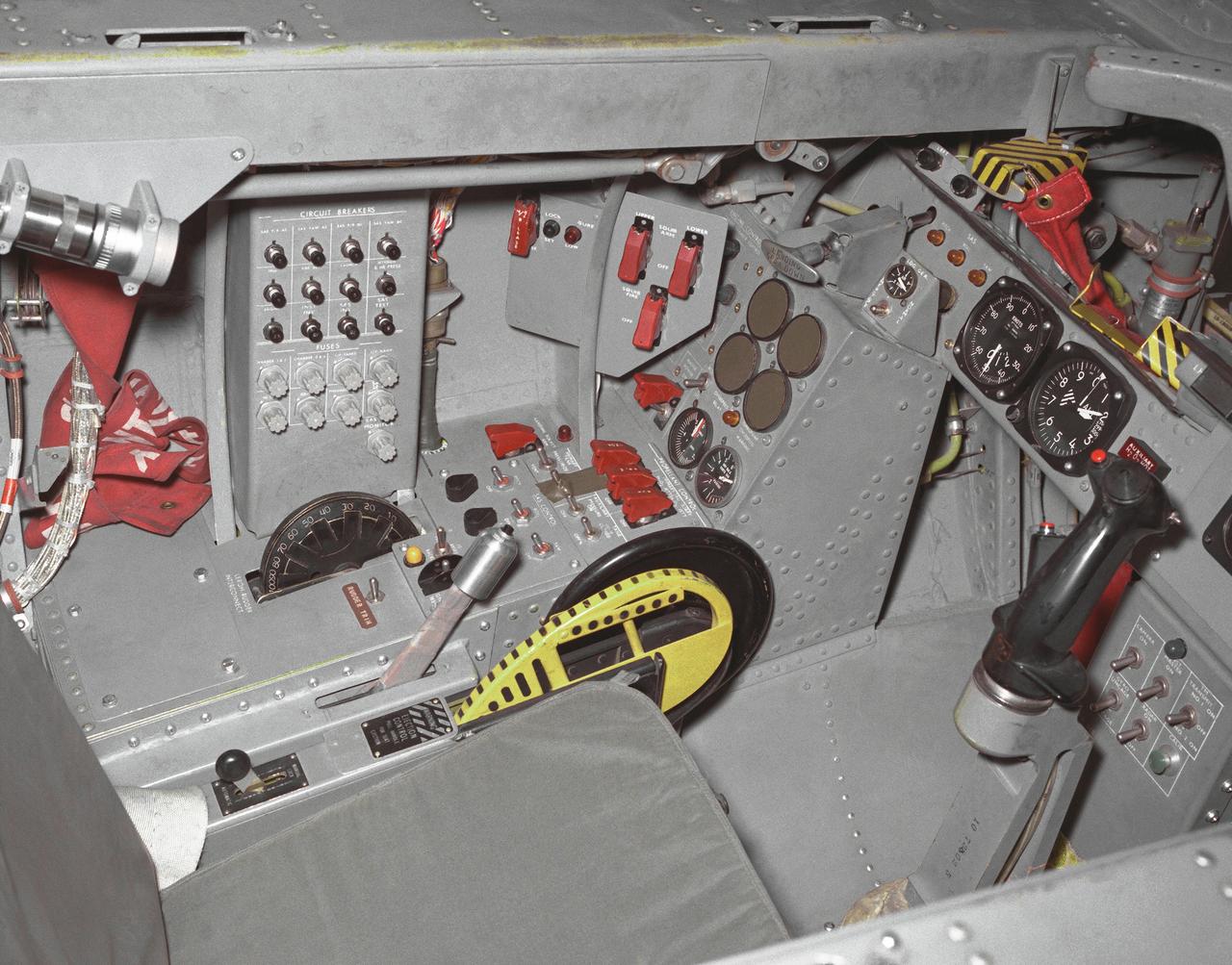
This photo shows the left side cockpit instrumentation panel of the M2-F2 Lifting Body. The success of Dryden's M2-F1 program led to NASA's development and construction of two heavyweight lifting bodies based on studies at NASA's Ames and Langley research centers -- the M2-F2 and the HL-10, both built by the Northrop Corporation. The "M" refers to "manned" and "F" refers to "flight" version. "HL" comes from "horizontal landing" and 10 is for the tenth lifting body model to be investigated by Langley. The first flight of the M2-F2 -- which looked much like the "F1" -- was on July 12, 1966. Milt Thompson was the pilot. By then, the same B-52 used to air launch the famed X-15 rocket research aircraft was modified to also carry the lifting bodies. Thompson was dropped from the B-52's wing pylon mount at an altitude of 45,000 feet on that maiden glide flight. The M2-F2 weighed 4,620 pounds, was 22 feet long, and had a width of about 10 feet. On May 10, 1967, during the sixteenth glide flight leading up to powered flight, a landing accident severely damaged the vehicle and seriously injured the NASA pilot, Bruce Peterson. NASA pilots and researchers realized the M2-F2 had lateral control problems, even though it had a stability augmentation control system. When the M2-F2 was rebuilt at Dryden and redesignated the M2-F3, it was modified with an additional third vertical fin -- centered between the tip fins -- to improve control characteristics. The M2-F2/F3 was the first of the heavy-weight, entry-configuration lifting bodies. Its successful development as a research test vehicle answered many of the generic questions about these vehicles. NASA donated the M2-F3 vehicle to the Smithsonian Institute in December 1973. It is currently hanging in the Air and Space Museum along with the X-15 aircraft number 1, which was its hangar partner at Dryden from 1965 to 1969.
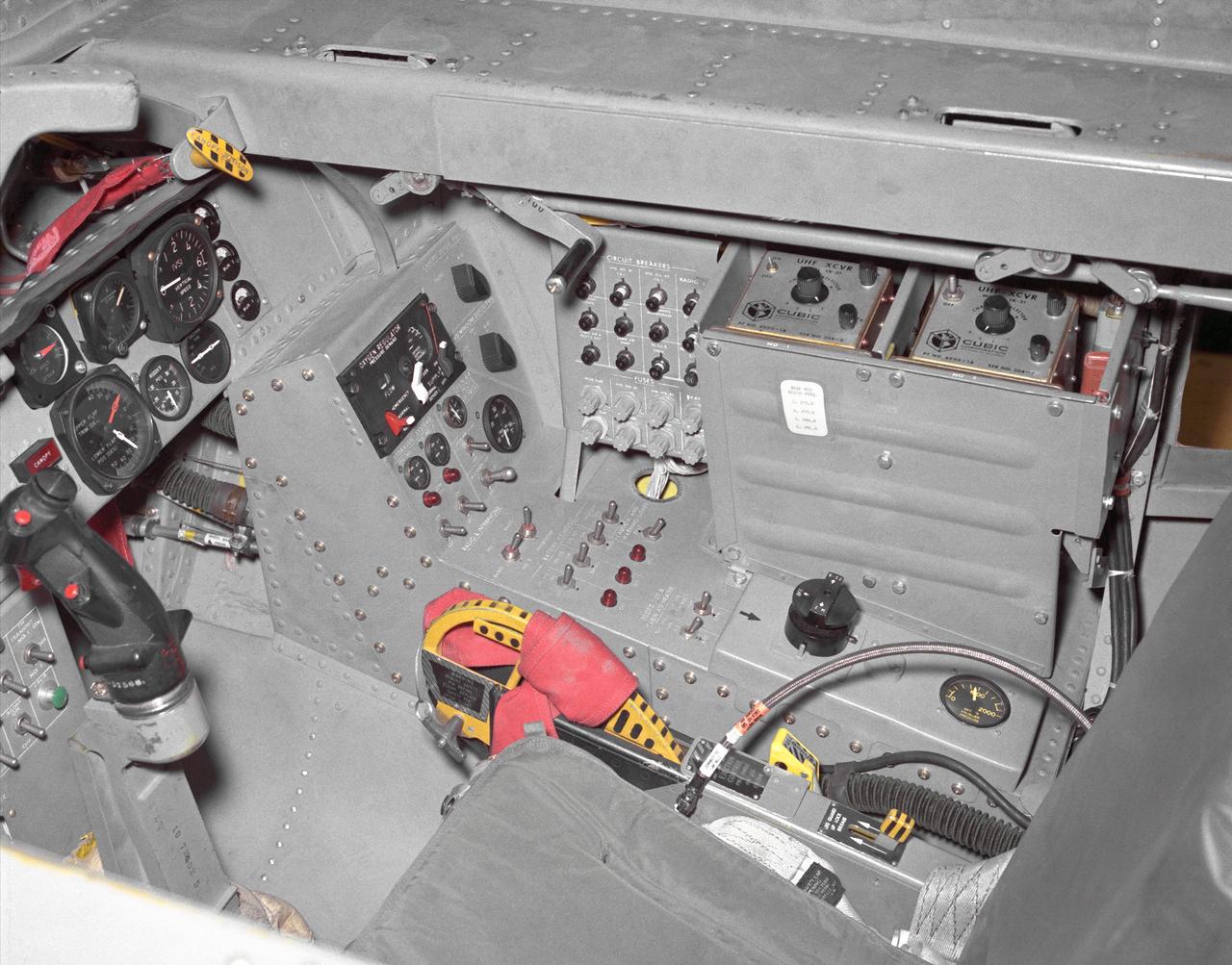
This photo shows the right side cockpit instrumentation panel of the M2-F2 Lifting Body. The success of Dryden's M2-F1 program led to NASA's development and construction of two heavyweight lifting bodies based on studies at NASA's Ames and Langley research centers -- the M2-F2 and the HL-10, both built by the Northrop Corporation. The "M" refers to "manned" and "F" refers to "flight" version. "HL" comes from "horizontal landing" and 10 is for the tenth lifting body model to be investigated by Langley. The first flight of the M2-F2 -- which looked much like the "F1" -- was on July 12, 1966. Milt Thompson was the pilot. By then, the same B-52 used to air launch the famed X-15 rocket research aircraft was modified to also carry the lifting bodies. Thompson was dropped from the B-52's wing pylon mount at an altitude of 45,000 feet on that maiden glide flight. The M2-F2 weighed 4,620 pounds, was 22 feet long, and had a width of about 10 feet. On May 10, 1967, during the sixteenth glide flight leading up to powered flight, a landing accident severely damaged the vehicle and seriously injured the NASA pilot, Bruce Peterson. NASA pilots and researchers realized the M2-F2 had lateral control problems, even though it had a stability augmentation control system. When the M2-F2 was rebuilt at Dryden and redesignated the M2-F3, it was modified with an additional third vertical fin -- centered between the tip fins -- to improve control characteristics. The M2-F2/F3 was the first of the heavy-weight, entry-configuration lifting bodies. Its successful development as a research test vehicle answered many of the generic questions about these vehicles. NASA donated the M2-F3 vehicle to the Smithsonian Institute in December 1973. It is currently hanging in the Air and Space Museum along with the X-15 aircraft number 1, which was its hangar partner at Dryden from 1965 to 1969.
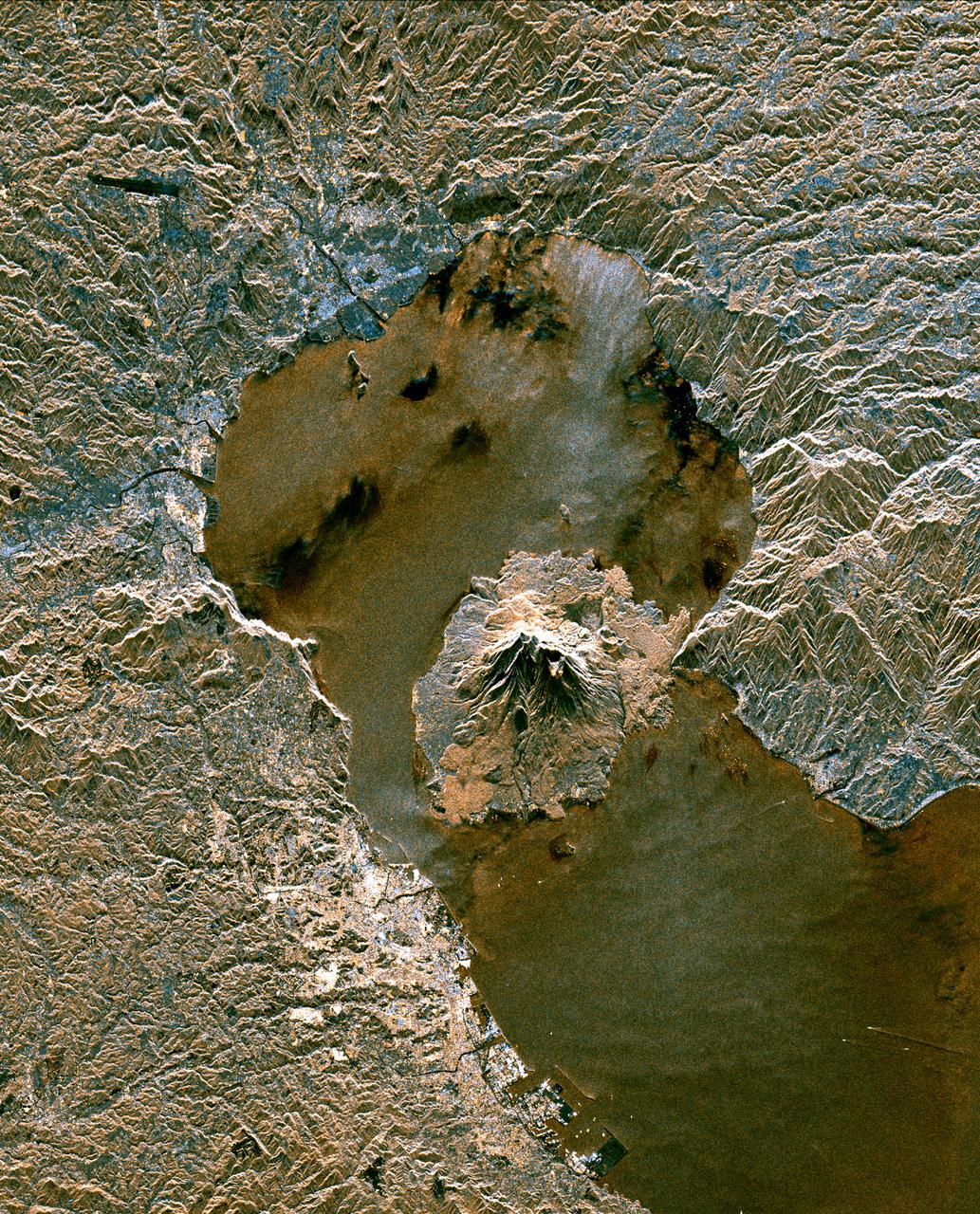
The active volcano Sakura-Jima on the island of Kyushu, Japan is shown in the center of this radar image. The volcano occupies the peninsula in the center of Kagoshima Bay, which was formed by the explosion and collapse of an ancient predecessor of today's volcano. The volcano has been in near continuous eruption since 1955. Its explosions of ash and gas are closely monitored by local authorities due to the proximity of the city of Kagoshima across a narrow strait from the volcano's center, shown below and to the left of the central peninsula in this image. City residents have grown accustomed to clearing ash deposits from sidewalks, cars and buildings following Sakura-jima's eruptions. The volcano is one of 15 identified by scientists as potentially hazardous to local populations, as part of the international "Decade Volcano" program. The image was acquired by the Spaceborne Imaging Radar-C/X-Band Synthetic Aperture Radar (SIR-C/X-SAR) onboard the space shuttle Endeavour on October 9, 1994. SIR-C/X-SAR, a joint mission of the German, Italian and the United States space agencies, is part of NASA's Mission to Planet Earth. The image is centered at 31.6 degrees North latitude and 130.6 degrees East longitude. North is toward the upper left. The area shown measures 37.5 kilometers by 46.5 kilometers (23.3 miles by 28.8 miles). The colors in the image are assigned to different frequencies and polarizations of the radar as follows: red is L-band vertically transmitted, vertically received; green is the average of L-band vertically transmitted, vertically received and C-band vertically transmitted, vertically received; blue is C-band vertically transmitted, vertically received. http://photojournal.jpl.nasa.gov/catalog/PIA01777
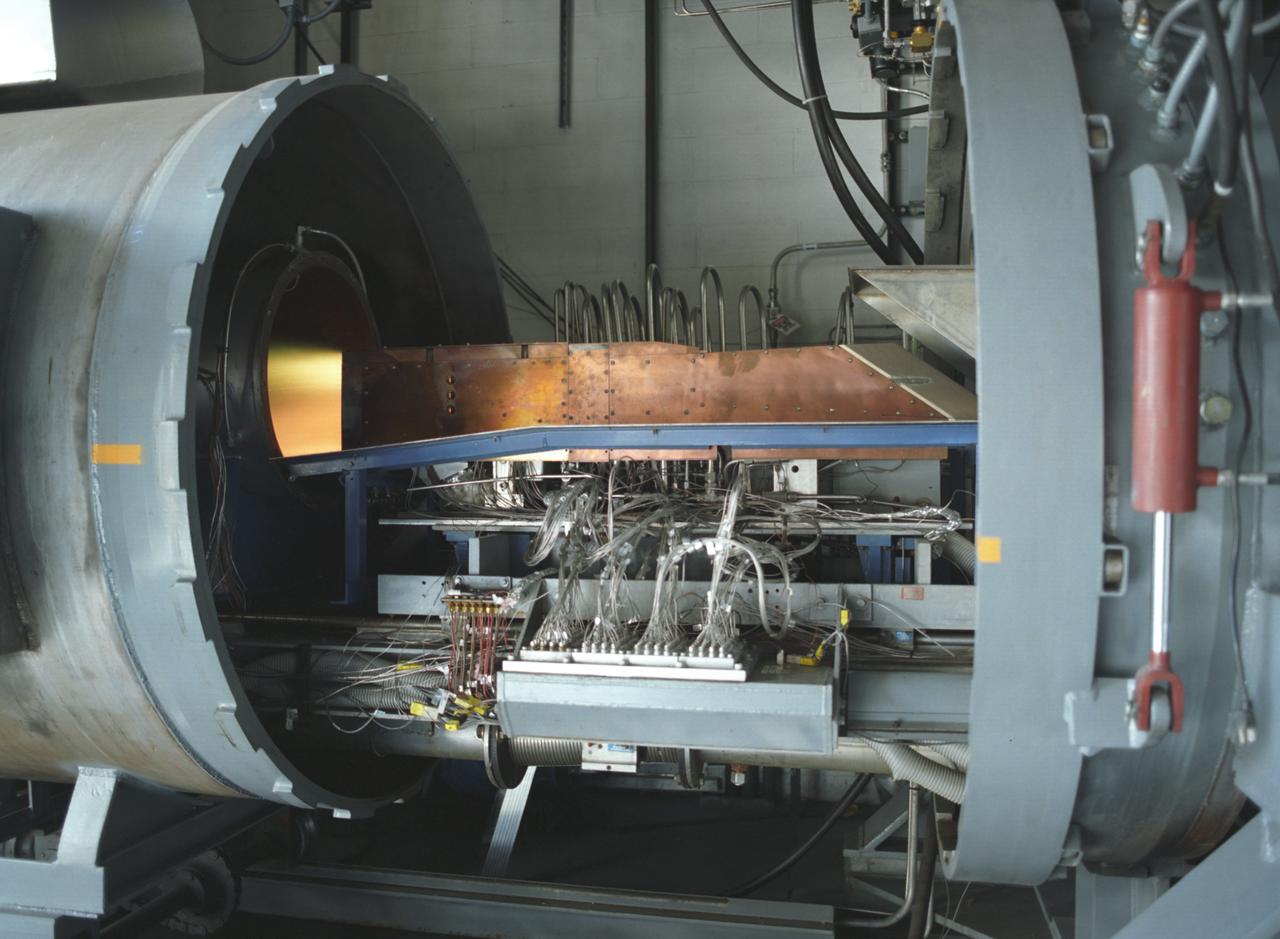
This photograph depicts an air-breathing rocket engine that completed an hour or 3,600 seconds of testing at the General Applied Sciences Laboratory in Ronkonkoma, New York. Referred to as ARGO by its design team, the engine is named after the mythological Greek ship that bore Jason and the Argonauts on their epic voyage of discovery. Air-breathing engines, known as rocket based, combined-cycle engines, get their initial take-off power from specially designed rockets, called air-augmented rockets, that boost performance about 15 percent over conventional rockets. When the vehicle's velocity reaches twice the speed of sound, the rockets are turned off and the engine relies totally on oxygen in the atmosphere to burn hydrogen fuel, as opposed to a rocket that must carry its own oxygen, thus reducing weight and flight costs. Once the vehicle has accelerated to about 10 times the speed of sound, the engine converts to a conventional rocket-powered system to propel the craft into orbit or sustain it to suborbital flight speed. NASA's Advanced SpaceTransportation Program at Marshall Space Flight Center, along with several industry partners and collegiate forces, is developing this technology to make space transportation affordable for everyone from business travelers to tourists. The goal is to reduce launch costs from today's price tag of $10,000 per pound to only hundreds of dollars per pound. NASA's series of hypersonic flight demonstrators currently include three air-breathing vehicles: the X-43A, X-43B and X-43C.

Matthew Mullin and Bobby Meazell, Orbital ATK/Columbia Scientific Balloon Facility technicians, conduct compatibility testing on NASA Langley Research Center’s Radiation Dosimetry Experiment payload Wednesday, Sept. 9, at Fort Sumner, N.M. The successful compatibility test was a key milestone in ensuring the flight readiness of RaD-X, which is scheduled to launch on an 11-million-cubic-foot NASA scientific balloon no earlier than Friday, Sept. 11, from the agency’s balloon launching facility in Fort Sumner. RaD-X will measure cosmic ray energy at two separate altitude regions in the stratosphere—above 110,000 feet and between 69,000 to 88,500 feet. The data is key to confirming Langley’s Nowcast of Atmospheric Ionizing Radiation for Aviation Safety (NAIRAS) model, which is a physics-based model that determines solar radiation and galactic cosmic ray exposure globally in real-time. The NAIRAS modeling tool will be used to help enhance aircraft safety as well as safety procedures for the International Space Station. In addition to the primary payload, 100 small student experiments will fly on the RaD-X mission as part of the Cubes in Space program. The program provides 11- to 18-year-old middle and high school students a no-cost opportunity to design and compete to launch an experiment into space or into the near-space environment. The cubes measure just 4 centimeters by 4 centimeters. NASA’s scientific balloons offer low-cost, near-space access for scientific payloads weighing up to 8,000 pounds for conducting scientific investigations in fields such as astrophysics, heliophysics and atmospheric research. NASA’s Wallops Flight Facility in Virginia manages the agency’s scientific balloon program with 10 to 15 flights each year from launch sites worldwide. Orbital ATK provides program management, mission planning, engineering services and field operations for NASA’s scientific balloon program. The program is executed from the Columbia Scientific Balloon Facility in Palestine, Texas. The Columbia team has launched more than 1,700 scientific balloons in over 35 years of operation. Anyone may track the progress of the Fort Sumner flights, which includes a map showing the balloon’s real-time location, at: <a href="http://towerfts.csbf.nasa.gov/" rel="nofollow">towerfts.csbf.nasa.gov/</a> For more information on the balloon program, see: <a href="http://www.nasa.gov/scientificballoons" rel="nofollow">www.nasa.gov/scientificballoons</a> <b><a href="http://www.nasa.gov/audience/formedia/features/MP_Photo_Guidelines.html" rel="nofollow">NASA image use policy.</a></b> <b><a href="http://www.nasa.gov/centers/goddard/home/index.html" rel="nofollow">NASA Goddard Space Flight Center</a></b> enables NASA’s mission through four scientific endeavors: Earth Science, Heliophysics, Solar System Exploration, and Astrophysics. Goddard plays a leading role in NASA’s accomplishments by contributing compelling scientific knowledge to advance the Agency’s mission. <b>Follow us on <a href="http://twitter.com/NASAGoddardPix" rel="nofollow">Twitter</a></b> <b>Like us on <a href="http://www.facebook.com/pages/Greenbelt-MD/NASA-Goddard/395013845897?ref=tsd" rel="nofollow">Facebook</a></b> <b>Find us on <a href="http://instagrid.me/nasagoddard/?vm=grid" rel="nofollow">Instagram</a></b>
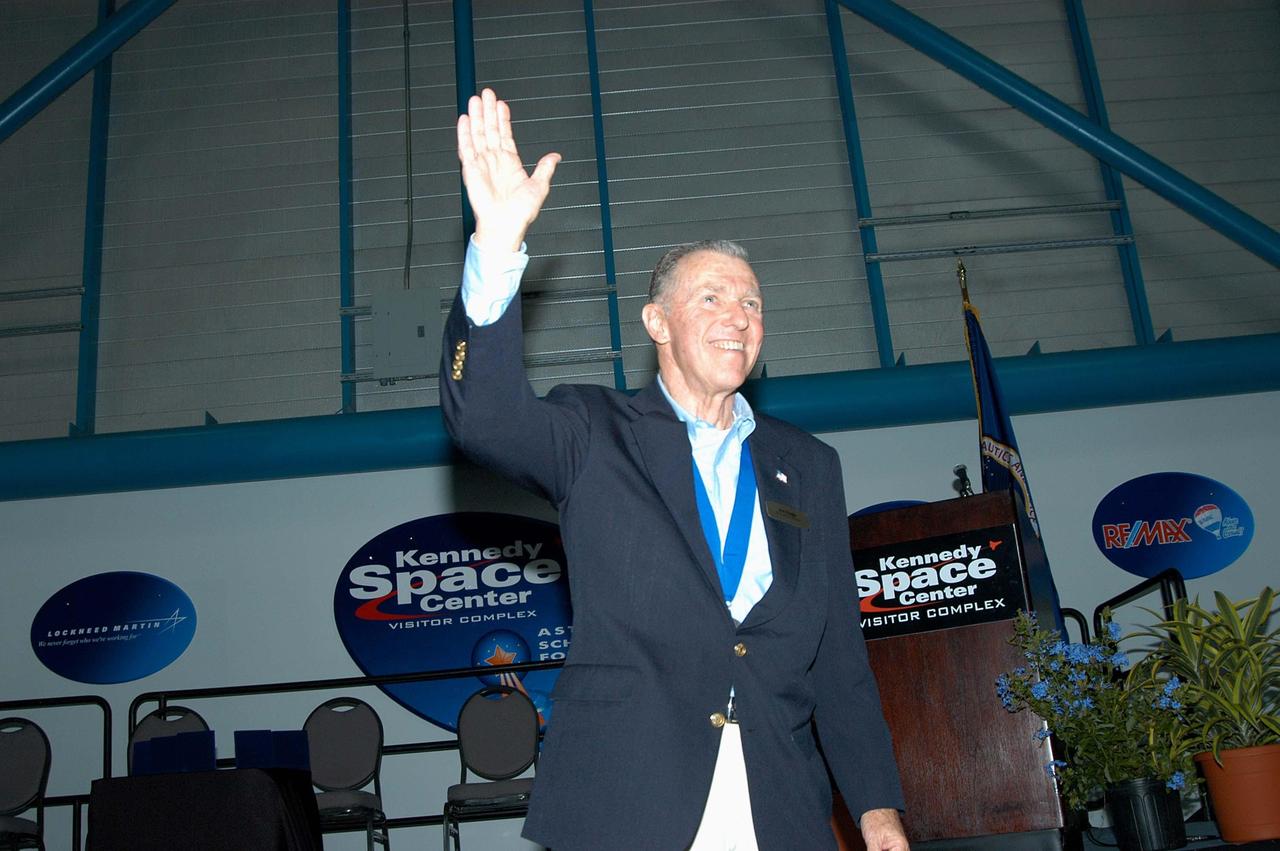
KENNEDY SPACE CENTER, FLA. -- Former astronaut Joe Engle acknowledges the applause as he is introduced as a previous inductee into the U.S. Astronaut Hall of Fame. He and other Hall of Fame members were present for the induction of five new space program heroes into the U.S. Astronaut Hall of Fame: Richard O. Covey, commander of the Hubble Space Telescope repair mission; Norman E. Thagard, the first American to occupy Russia’s Mir space station; the late Francis R. "Dick" Scobee, commander of the ill-fated 1986 Challenger mission; Kathryn D. Sullivan, the first American woman to walk in space; and Frederick D. Gregory, the first African-American to command a space mission and the current NASA deputy administrator. Engle made 16 flights in the X-15 rocket plane before he became a NASA astronaut and flew two Space Shuttle missions. In 1981, he commanded the second flight of Columbia, the first manned spacecraft to be reflown in space, and in 1985 he commanded a five-man crew on the 20th shuttle flight, a satellite-deploy and repair mission. The induction ceremony was held at the Apollo/Saturn V Center at KSC. The U.S. Astronaut Hall of Fame opened in 1990 to provide a place where space travelers could be remembered for their participation and accomplishments in the U.S. space program. The five inductees join 52 previously honored astronauts from the ranks of the Gemini, Apollo, Skylab, Apollo-Soyuz, and Space Shuttle programs.
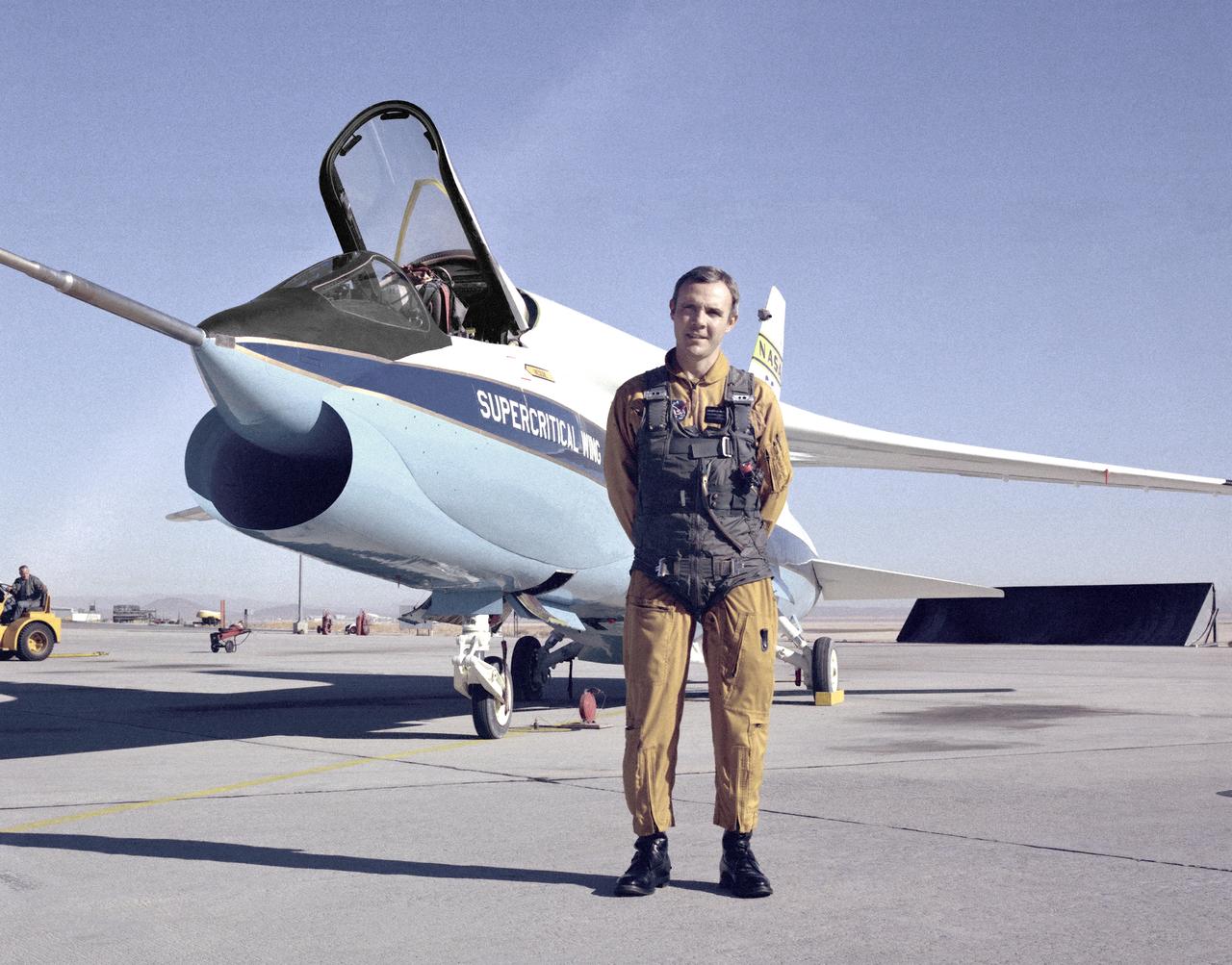
A Vought F-8A Crusader was selected by NASA as the testbed aircraft (designated TF-8A) to install an experimental Supercritical Wing (SCW) in place of the conventional wing. The unique design of the Supercritical Wing reduces the effect of shock waves on the upper surface near Mach 1, which in turn reduces drag. In this photograph the TF-8A Crusader with Supercritical Wing is shown on the ramp with project pilot Tom McMurtry standing beside it. McMurtry received NASA's Exceptional Service Medal for his work on the F-8 SCW aircraft. He also flew the AD-1, F-15 Digital Electronic Engine Control, the KC-130 winglets, the F-8 Digital Fly-By-Wire and other flight research aircraft including the remotely piloted 720 Controlled Impact Demonstration and sub-scale F-15 research projects. In addition, McMurtry was the 747 co-pilot for the Shuttle Approach and Landing Tests and made the last glide flight in the X-24B. McMurtry was Dryden’s Director for Flight Operations from 1986 to 1998, when he became Associate Director for Operations at NASA Dryden. In 1982, McMurtry received the Iven C. Kincheloe Award from the Society of Experimental Test Pilots for his contributions as project pilot on the AD-1 Oblique Wing program. In 1998 he was named as one of the honorees at the Lancaster, Calif., ninth Aerospace Walk of Honor ceremonies. In 1999 he was awarded the NASA Distinguished Service Medal. He retired in 1999 after a distinguished career as pilot and manager at Dryden that began in 1967.
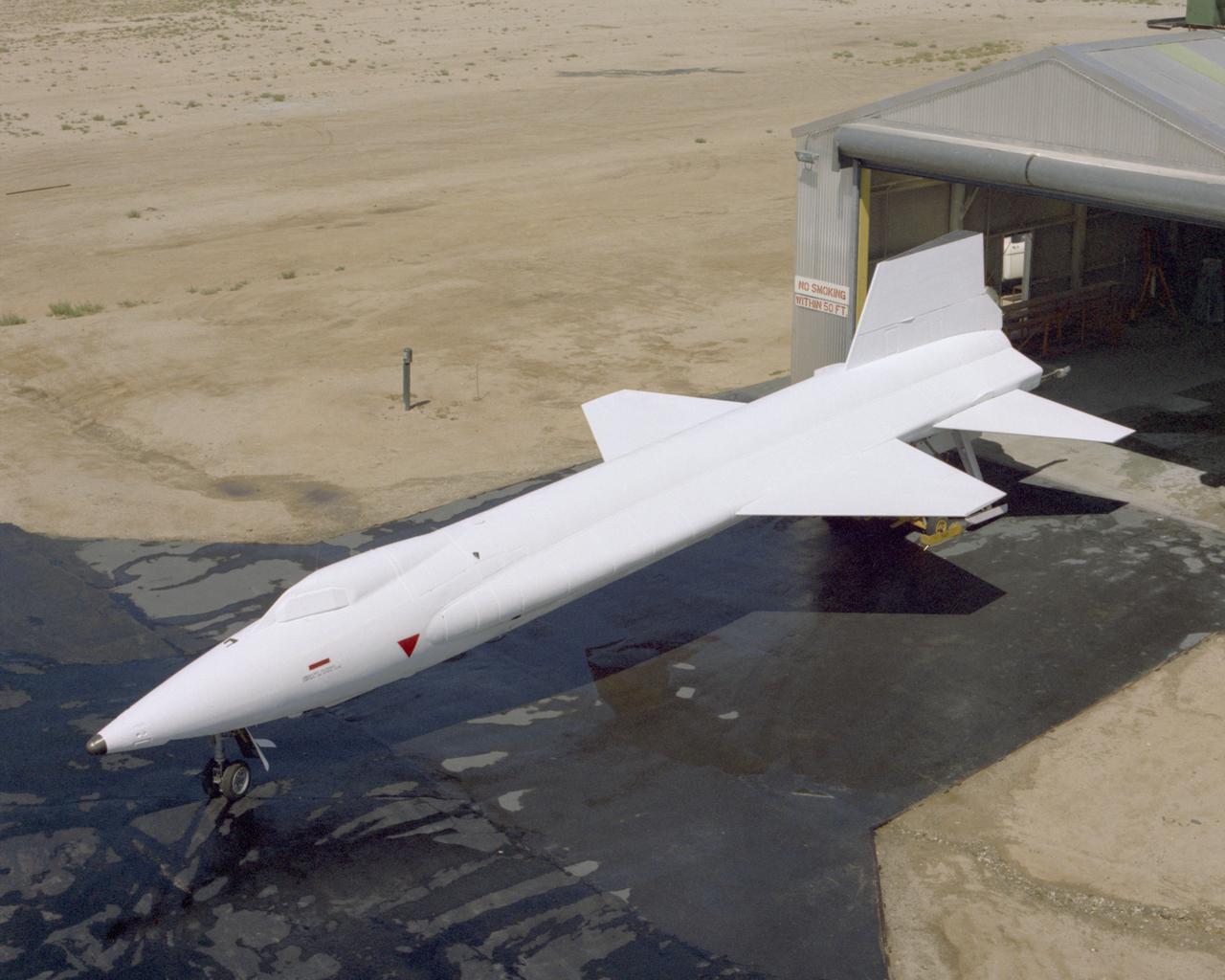
X-15A-2 is rolled out of the paint shop after having the full scale ablative applied. In June 1967, the X-15A-2 rocket-powered research aircraft received a full-scale ablative coating to protect the craft from the high temperatures associated with hypersonic flight (above Mach 5). This pink eraser-like substance, applied to the X-15A-2 aircraft (56-6671), was then covered with a white sealant coat before flight. This coating would help the #2 aircraft reach the record speed of 4,520 mph (Mach 6.7).
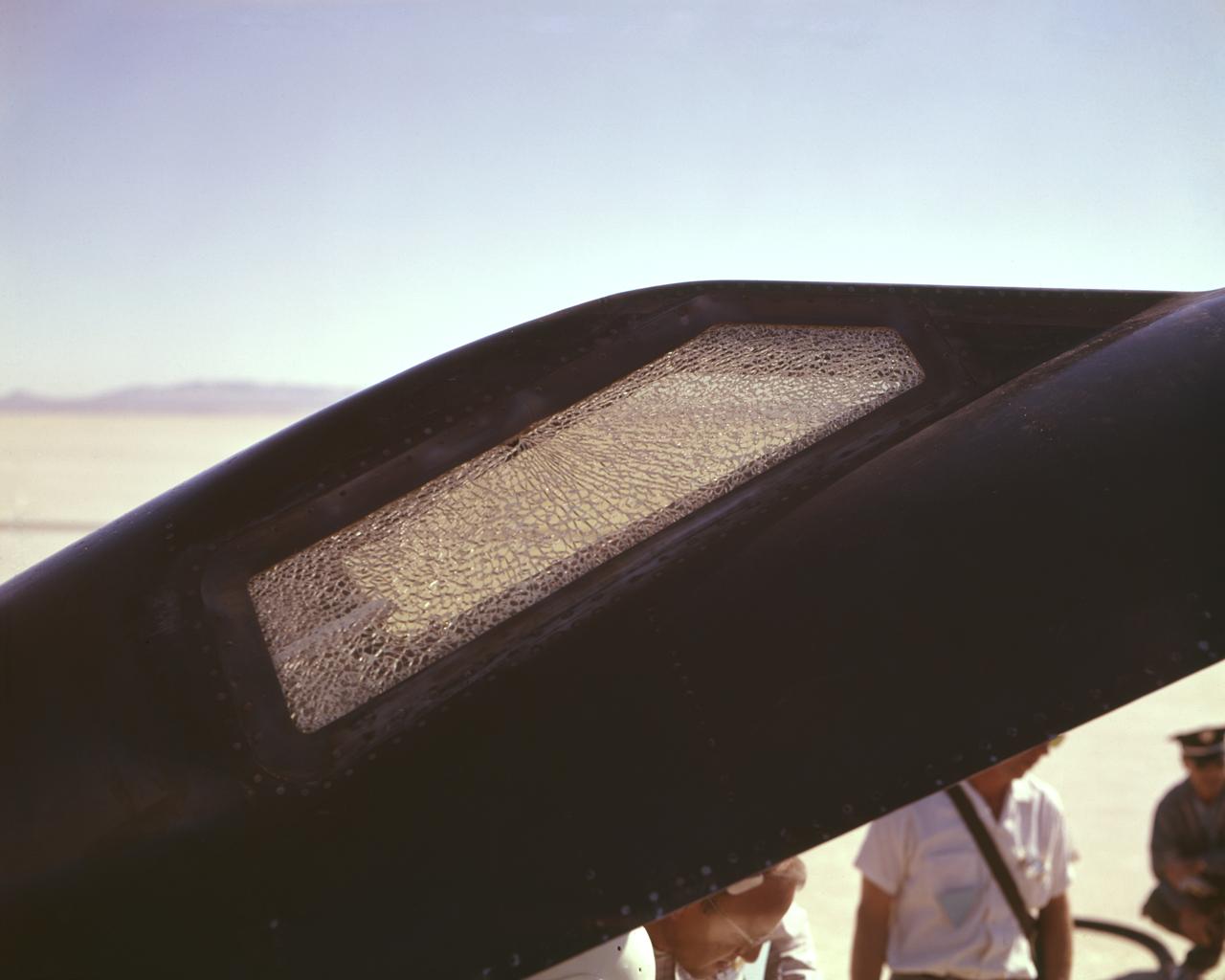
Cracked canopy glass on right side of X-15 #2 after flt. 2-21-37 on Nov. 9 1961. Robert White-pilot. First flight to mach 6.

Southwestern US, with Las Vegas, NV in foreground, taken by X-15 Hycon HR-236 Camera during flt. 2-39-70 on June 27, 1965.
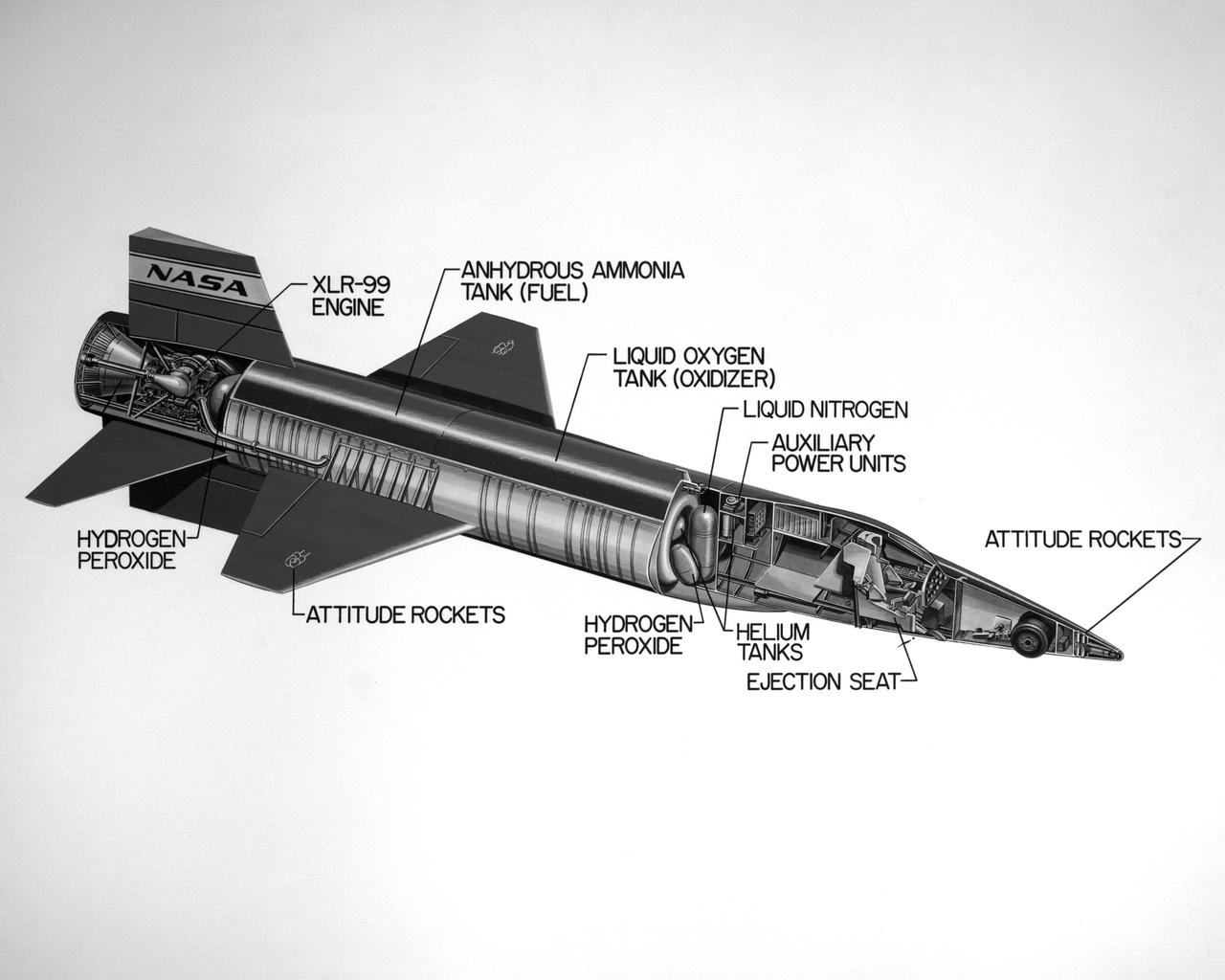
Cutaway drawing of the North American X-15.
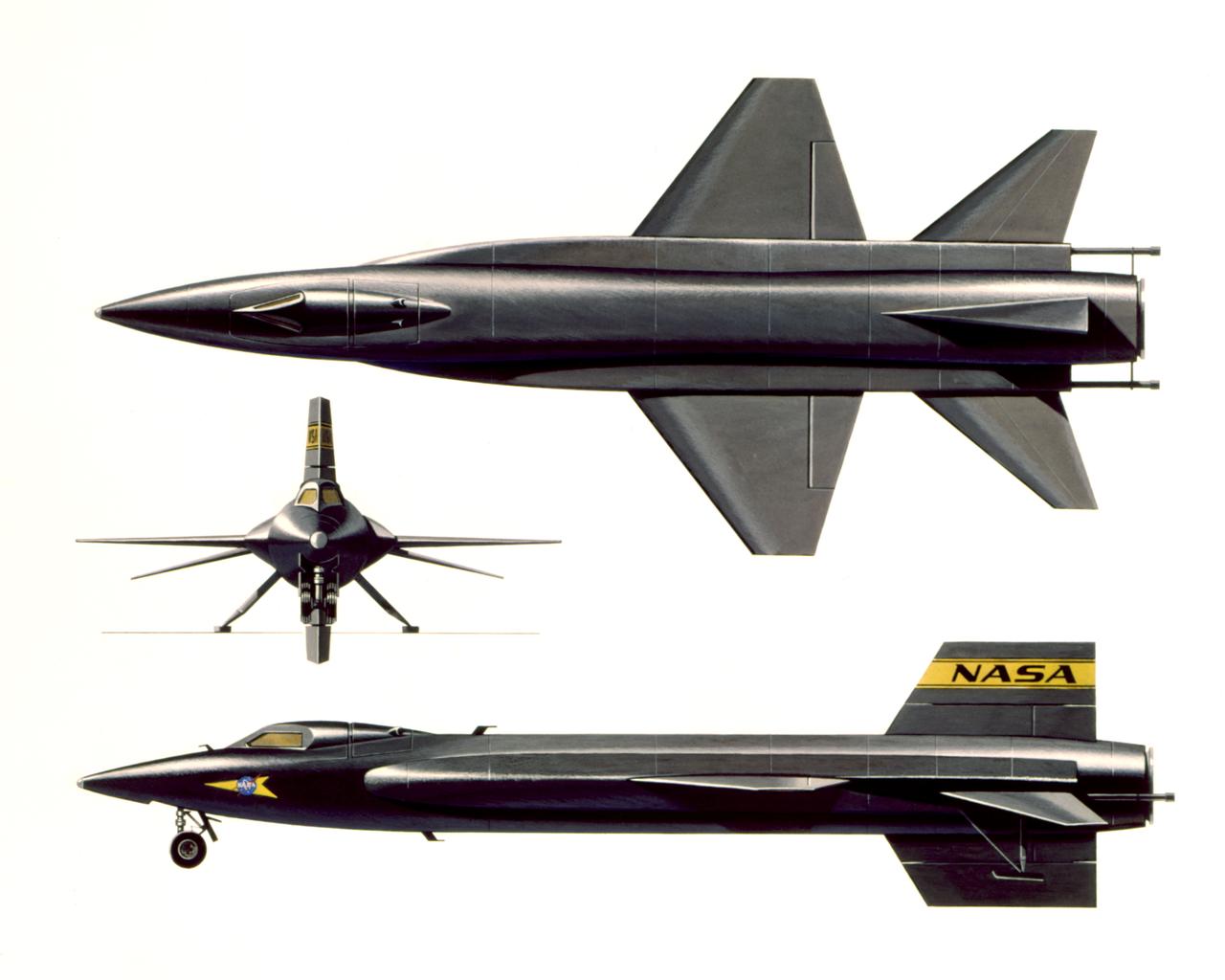
Three view art of the North American X-15.
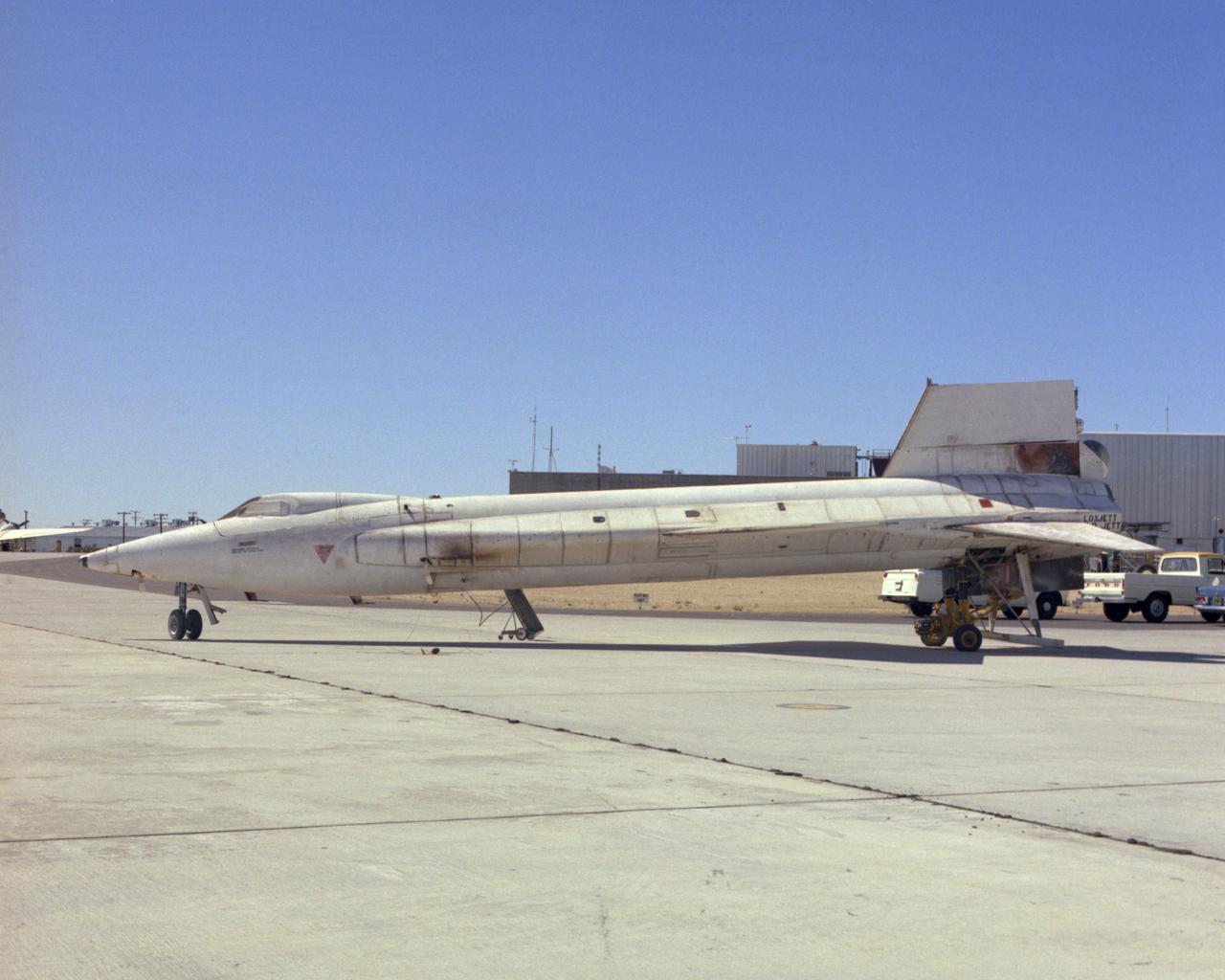
X-15A-2 post flight photo showing heat damage from Mach 6.7 flight on 3 Oct 67. Flt. 2-53-97; pilot-Pete Knight.
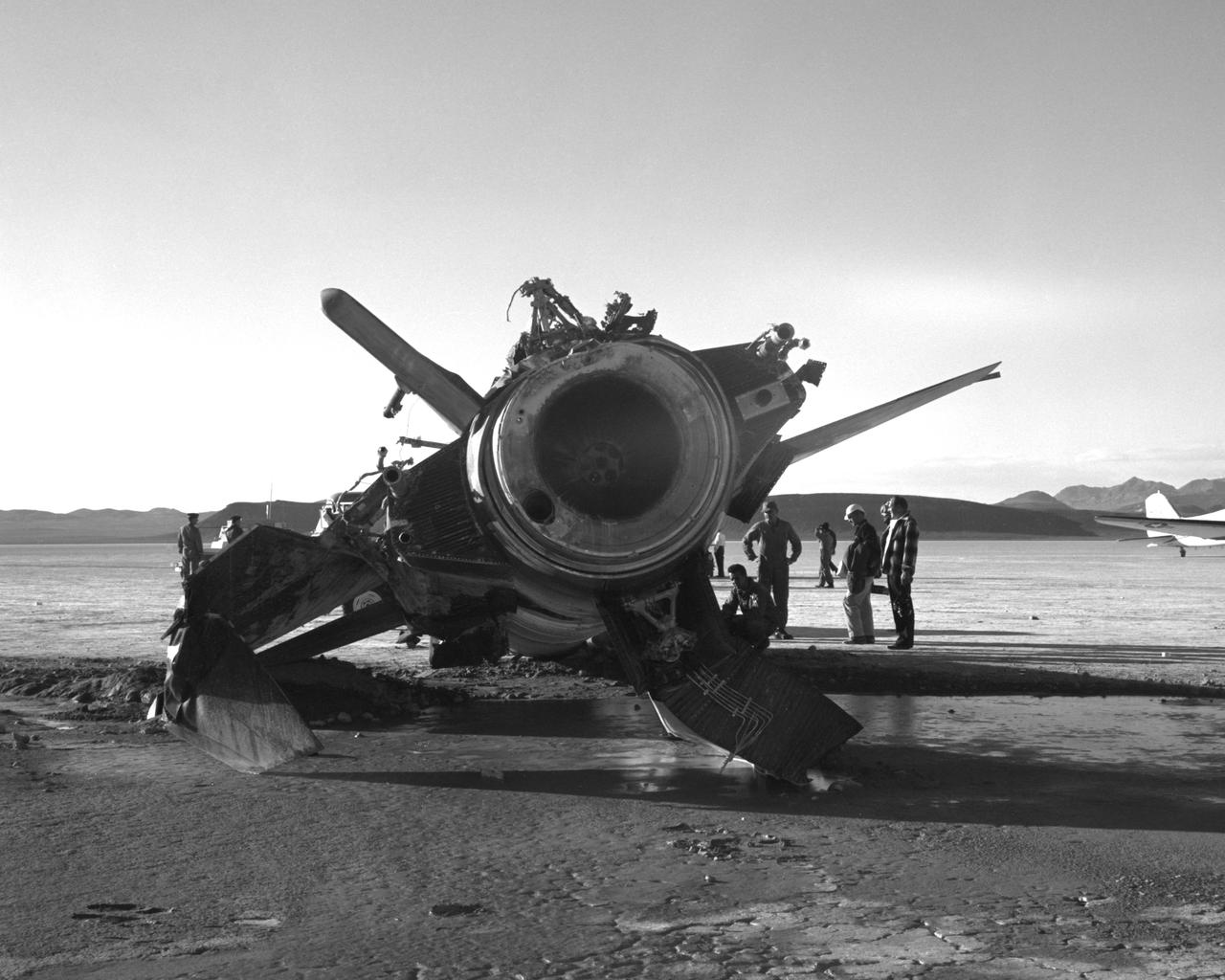
NASA research pilot Jack McKay was injured in a crash landing of the X-15 #2 on November 9, 1962. Following the launch from the B-52 to begin flight 2-31-52, he started the X-15's rocket engine, only to discover that it produced just 30 percent of its maximum thrust. He had to make a high-speed emergency landing on Mud Lake, NV, without flaps but with a significant amount of fuel still in the aircraft. As the X-15 slid across the lakebed, the left skid collapsed; the aircraft turned sideways and flipped onto its back. McKay suffered back injuries but was eventually able to resume X-15 pilot duties, making 22 more flights. The X-15 was sent back to North American Aviation and rebuilt into the X-15A-2.
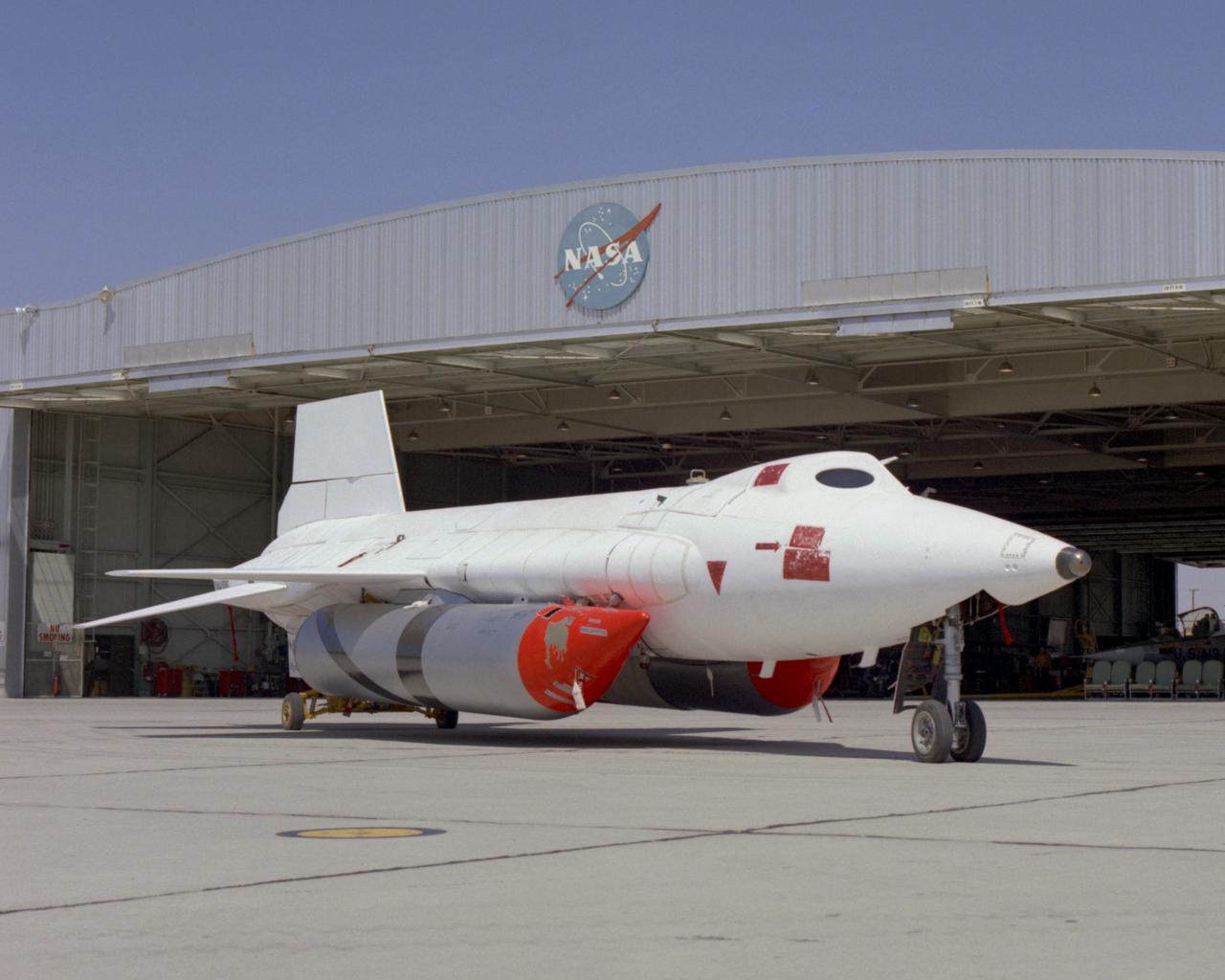
X-15A-2 with full scale ablative and external tanks installed parked in front of hangar. In June 1967, the X-15A-2 rocket-powered research aircraft received a full-scale ablative coating to protect the craft from the high temperatures associated with hypersonic flight (above Mach 5). This pink eraser-like substance, applied to the X-15A-2 aircraft (56-6671), was then covered with a white sealant coat before flight. This coating would help the #2 aircraft reach the record speed of 4,520 mph (Mach 6.7).
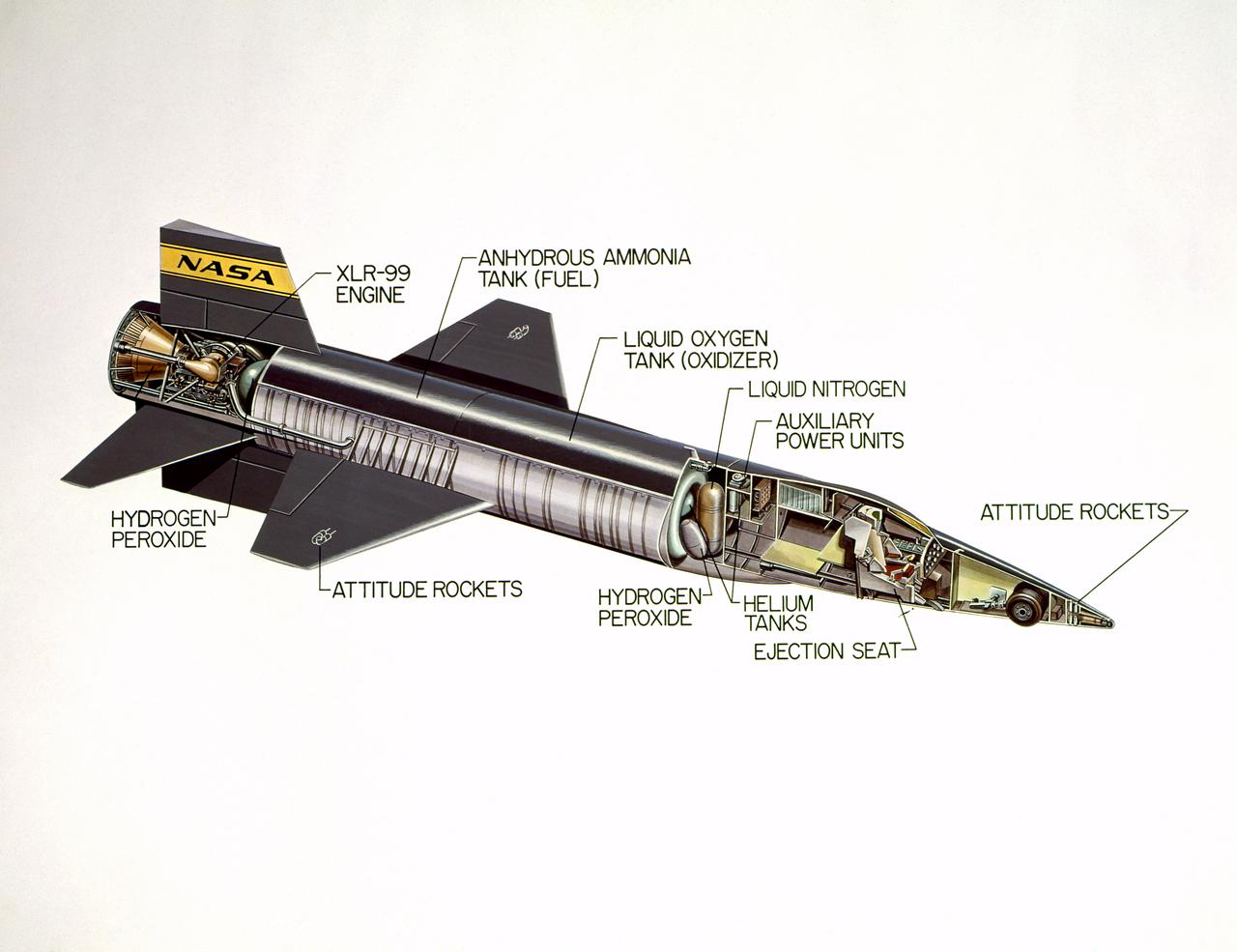
Cutaway drawing of the North American X-15.
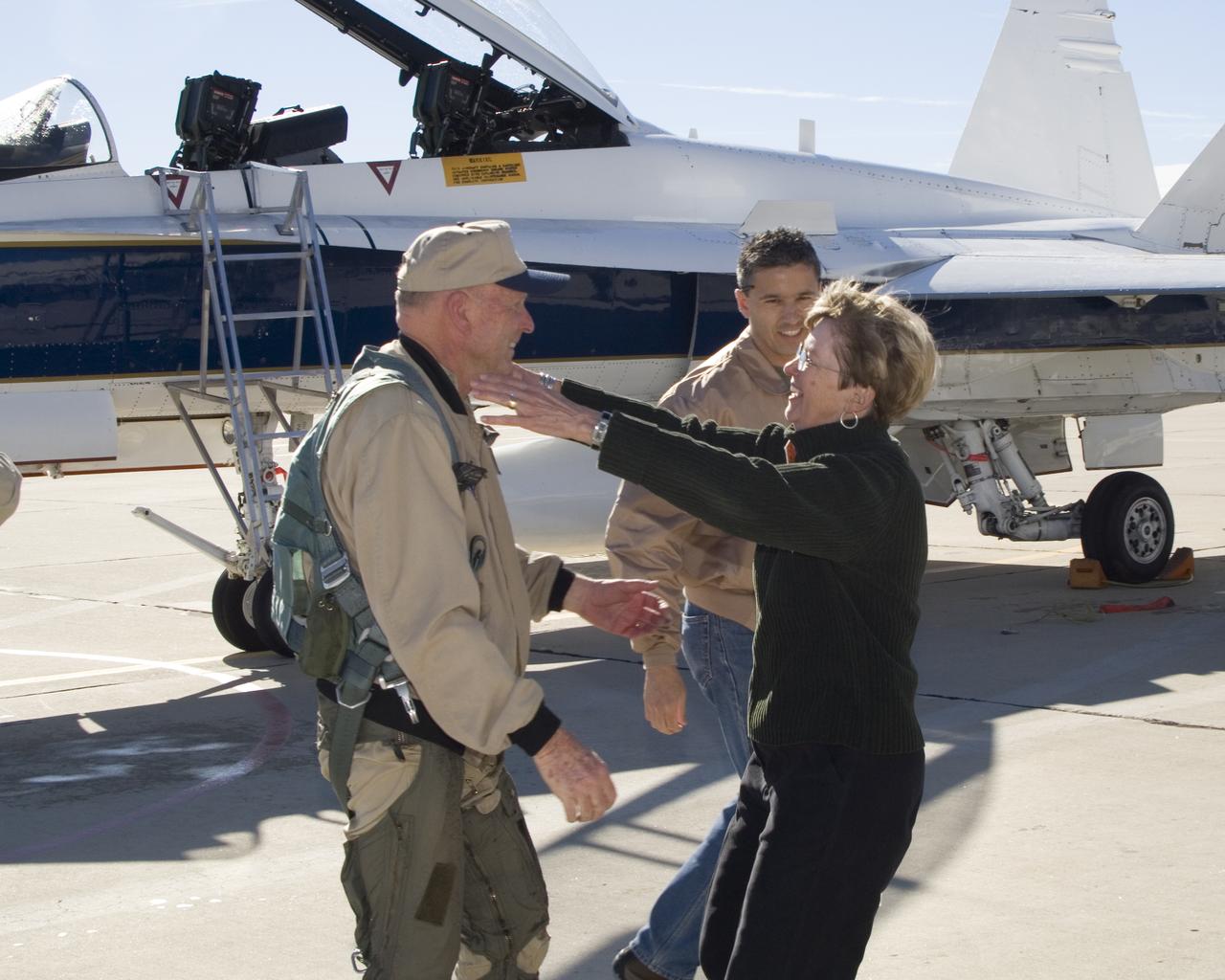
NASA Dryden research pilot Gordon Fullerton is greeted by his wife Marie on the Dryden ramp after his final flight in a NASA F/A-18 on Dec. 21, 2007.
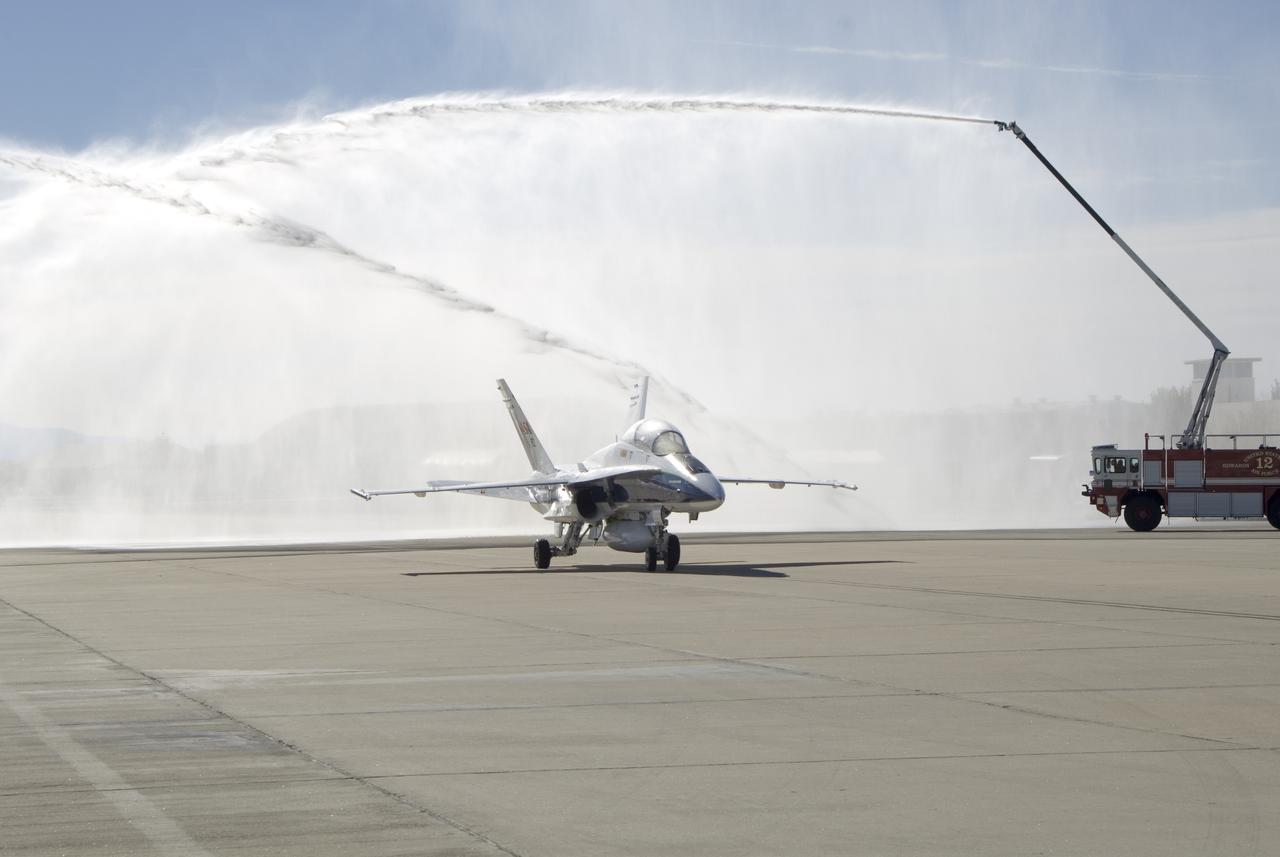
Long-time NASA Dryden research pilot and former astronaut C. Gordon Fullerton capped an almost 50-year flying career, including more than 38 years with NASA, with a final flight in a NASA F/A-18 on Dec. 21, 2007. Fullerton and Dryden research pilot Jim Smolka flew a 90-minute pilot proficiency formation aerobatics flight with another Dryden F/A-18 and a Dryden T-38 before concluding with two low-level formation flyovers of Dryden before landing. Fullerton was honored with a water-cannon spray arch provided by two fire trucks from the Edwards Air Force Base fire department as he taxied the F/A-18 up to the Dryden ramp, and was then greeted by his wife Marie and several hundred Dryden staff after his final flight. Fullerton began his flying career with the U.S. Air Force in 1958 after earning bachelor's and master's degrees in mechanical engineering from the California Institute of Technology. Initially trained as a fighter pilot, he later transitioned to multi-engine bombers and became a bomber operations test pilot after attending the Air Force Aerospace Research Pilot School at Edwards Air Force Base, Calif. He then was assigned to the flight crew for the planned Air Force Manned Orbital Laboratory in 1966. Upon cancellation of that program, the Air Force assigned Fullerton to NASA's astronaut corps in 1969. He served on the support crews for the Apollo 14, 15, 16 and 17 lunar missions, and was later assigned to one of the two flight crews that piloted the space shuttle prototype Enterprise during the Approach and Landing Test program at Dryden. He then logged some 382 hours in space when he flew on two early space shuttle missions, STS-3 on Columbia in 1982 and STS-51F on Challenger in 1985. He joined the flight crew branch at NASA Dryden after leaving the astronaut corps in 1986. During his 21 years at Dryden, Fullerton was project pilot on a number of high-profile research efforts, including the Propulsion Controlled Aircraft, the high-speed landing tests of
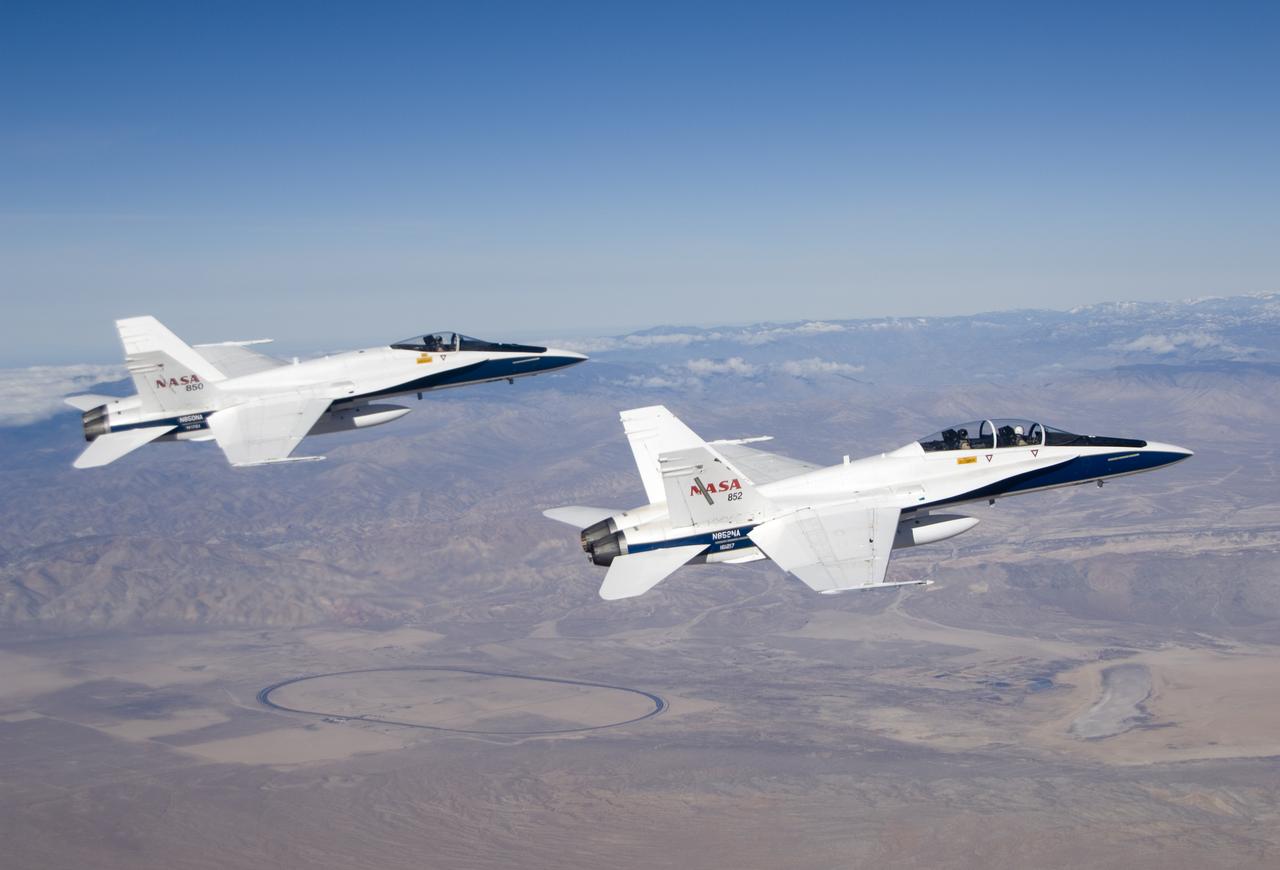
Long-time NASA Dryden research pilot and former astronaut C. Gordon Fullerton capped an almost 50-year flying career, including more than 38 years with NASA, with a final flight in a NASA F/A-18 on Dec. 21, 2007. Fullerton and Dryden research pilot Jim Smolka flew a 90-minute pilot proficiency formation aerobatics flight with another Dryden F/A-18 and a Dryden T-38 before concluding with two low-level formation flyovers of Dryden before landing. Fullerton was honored with a water-cannon spray arch provided by two fire trucks from the Edwards Air Force Base fire department as he taxied the F/A-18 up to the Dryden ramp, and was then greeted by his wife Marie and several hundred Dryden staff after his final flight. Fullerton began his flying career with the U.S. Air Force in 1958 after earning bachelor's and master's degrees in mechanical engineering from the California Institute of Technology. Initially trained as a fighter pilot, he later transitioned to multi-engine bombers and became a bomber operations test pilot after attending the Air Force Aerospace Research Pilot School at Edwards Air Force Base, Calif. He then was assigned to the flight crew for the planned Air Force Manned Orbital Laboratory in 1966. Upon cancellation of that program, the Air Force assigned Fullerton to NASA's astronaut corps in 1969. He served on the support crews for the Apollo 14, 15, 16 and 17 lunar missions, and was later assigned to one of the two flight crews that piloted the space shuttle prototype Enterprise during the Approach and Landing Test program at Dryden. He then logged some 382 hours in space when he flew on two early space shuttle missions, STS-3 on Columbia in 1982 and STS-51F on Challenger in 1985. He joined the flight crew branch at NASA Dryden after leaving the astronaut corps in 1986. During his 21 years at Dryden, Fullerton was project pilot on a number of high-profile research efforts, including the Propulsion Controlled Aircraft, the high-speed landing tests of sp
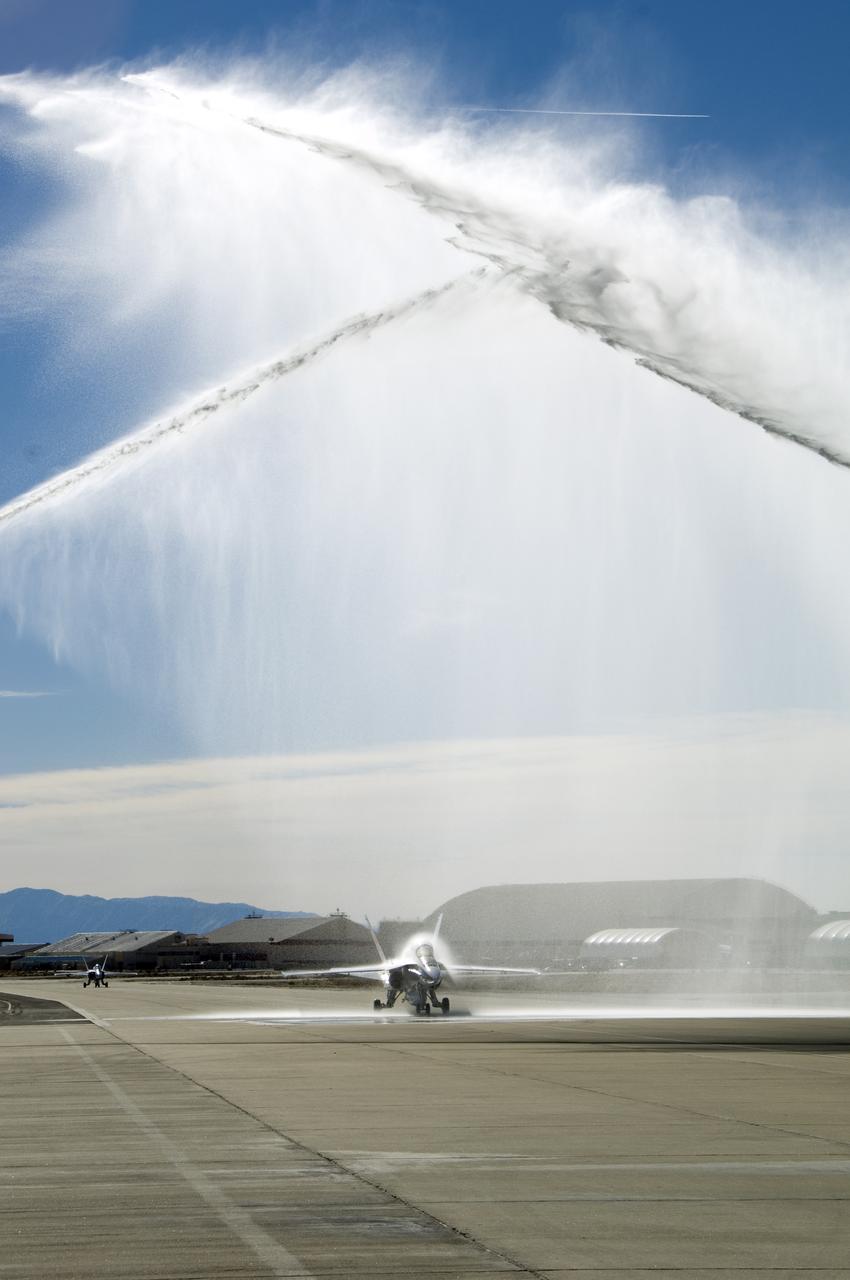
Long-time NASA Dryden research pilot and former astronaut C. Gordon Fullerton capped an almost 50-year flying career, including more than 38 years with NASA, with a final flight in a NASA F/A-18 on Dec. 21, 2007. Fullerton and Dryden research pilot Jim Smolka flew a 90-minute pilot proficiency formation aerobatics flight with another Dryden F/A-18 and a Dryden T-38 before concluding with two low-level formation flyovers of Dryden before landing. Fullerton was honored with a water-cannon spray arch provided by two fire trucks from the Edwards Air Force Base fire department as he taxied the F/A-18 up to the Dryden ramp, and was then greeted by his wife Marie and several hundred Dryden staff after his final flight. Fullerton began his flying career with the U.S. Air Force in 1958 after earning bachelor's and master's degrees in mechanical engineering from the California Institute of Technology. Initially trained as a fighter pilot, he later transitioned to multi-engine bombers and became a bomber operations test pilot after attending the Air Force Aerospace Research Pilot School at Edwards Air Force Base, Calif. He then was assigned to the flight crew for the planned Air Force Manned Orbital Laboratory in 1966. Upon cancellation of that program, the Air Force assigned Fullerton to NASA's astronaut corps in 1969. He served on the support crews for the Apollo 14, 15, 16 and 17 lunar missions, and was later assigned to one of the two flight crews that piloted the space shuttle prototype Enterprise during the Approach and Landing Test program at Dryden. He then logged some 382 hours in space when he flew on two early space shuttle missions, STS-3 on Columbia in 1982 and STS-51F on Challenger in 1985. He joined the flight crew branch at NASA Dryden after leaving the astronaut corps in 1986. During his 21 years at Dryden, Fullerton was project pilot on a number of high-profile research efforts, including the Propulsion Controlled Aircraft, the high-speed landing tests of
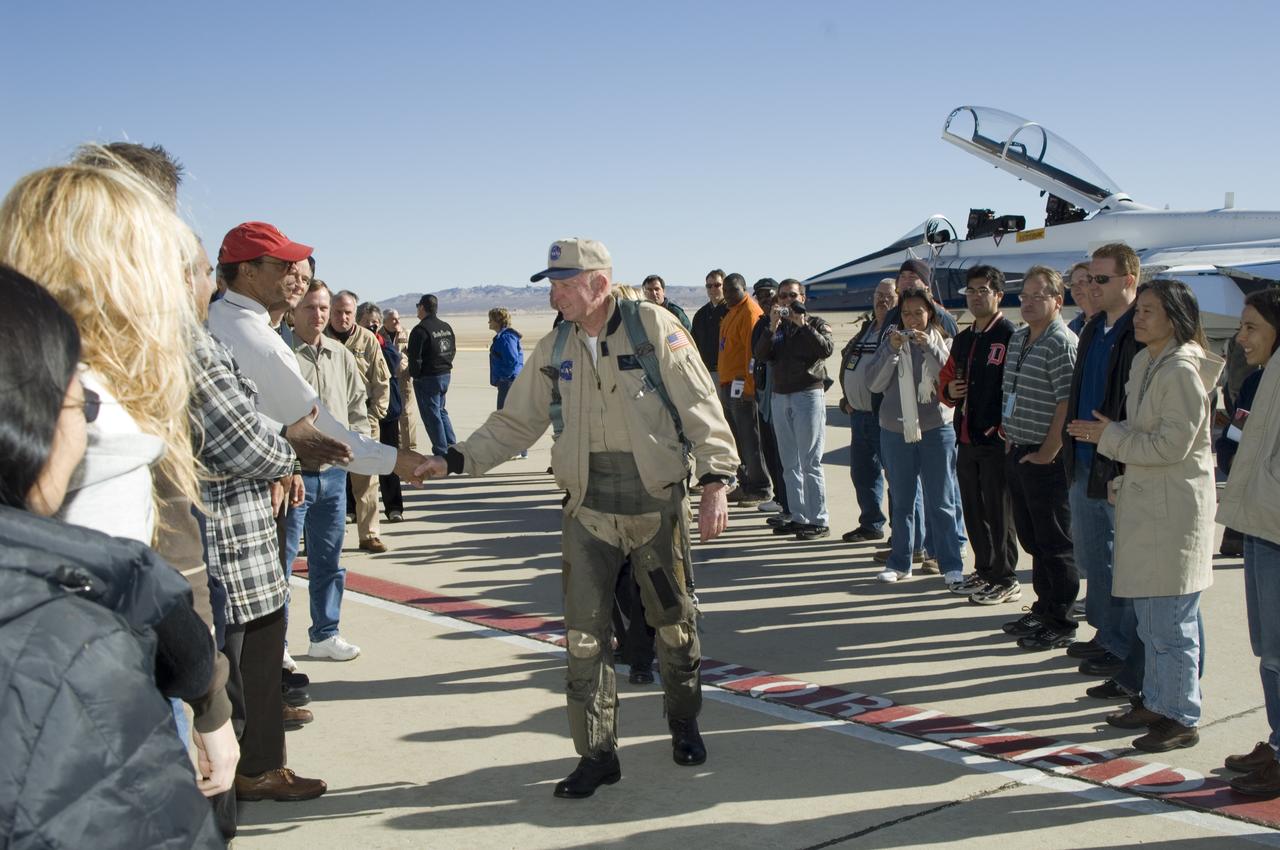
Long-time NASA Dryden research pilot and former astronaut C. Gordon Fullerton capped an almost 50-year flying career, including more than 38 years with NASA, with a final flight in a NASA F/A-18 on Dec. 21, 2007. Fullerton and Dryden research pilot Jim Smolka flew a 90-minute pilot proficiency formation aerobatics flight with another Dryden F/A-18 and a Dryden T-38 before concluding with two low-level formation flyovers of Dryden before landing. Fullerton was honored with a water-cannon spray arch provided by two fire trucks from the Edwards Air Force Base fire department as he taxied the F/A-18 up to the Dryden ramp, and was then greeted by his wife Marie and several hundred Dryden staff after his final flight. Fullerton began his flying career with the U.S. Air Force in 1958 after earning bachelor's and master's degrees in mechanical engineering from the California Institute of Technology. Initially trained as a fighter pilot, he later transitioned to multi-engine bombers and became a bomber operations test pilot after attending the Air Force Aerospace Research Pilot School at Edwards Air Force Base, Calif. He then was assigned to the flight crew for the planned Air Force Manned Orbital Laboratory in 1966. Upon cancellation of that program, the Air Force assigned Fullerton to NASA's astronaut corps in 1969. He served on the support crews for the Apollo 14, 15, 16 and 17 lunar missions, and was later assigned to one of the two flight crews that piloted the space shuttle prototype Enterprise during the Approach and Landing Test program at Dryden. He then logged some 382 hours in space when he flew on two early space shuttle missions, STS-3 on Columbia in 1982 and STS-51F on Challenger in 1985. He joined the flight crew branch at NASA Dryden after leaving the astronaut corps in 1986. During his 21 years at Dryden, Fullerton was project pilot on a number of high-profile research efforts, including the Propulsion Controlled Aircraft, the high-speed landing tests of
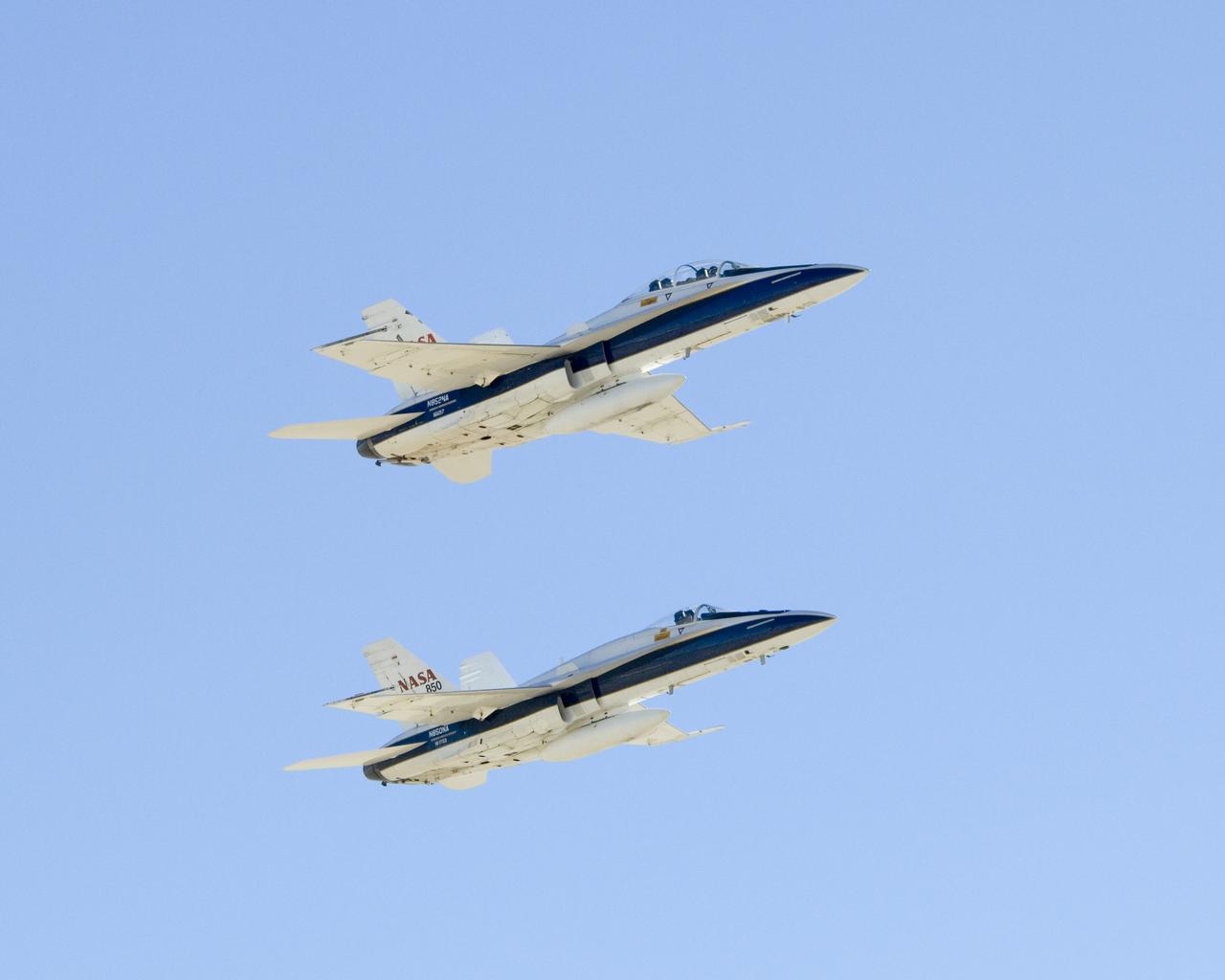
Long-time NASA Dryden research pilot and former astronaut C. Gordon Fullerton capped an almost 50-year flying career, including more than 38 years with NASA, with a final flight in a NASA F/A-18 on Dec. 21, 2007. Fullerton and Dryden research pilot Jim Smolka flew a 90-minute pilot proficiency formation aerobatics flight with another Dryden F/A-18 and a Dryden T-38 before concluding with two low-level formation flyovers of Dryden before landing. Fullerton was honored with a water-cannon spray arch provided by two fire trucks from the Edwards Air Force Base fire department as he taxied the F/A-18 up to the Dryden ramp, and was then greeted by his wife Marie and several hundred Dryden staff after his final flight. Fullerton began his flying career with the U.S. Air Force in 1958 after earning bachelor's and master's degrees in mechanical engineering from the California Institute of Technology. Initially trained as a fighter pilot, he later transitioned to multi-engine bombers and became a bomber operations test pilot after attending the Air Force Aerospace Research Pilot School at Edwards Air Force Base, Calif. He then was assigned to the flight crew for the planned Air Force Manned Orbital Laboratory in 1966. Upon cancellation of that program, the Air Force assigned Fullerton to NASA's astronaut corps in 1969. He served on the support crews for the Apollo 14, 15, 16 and 17 lunar missions, and was later assigned to one of the two flight crews that piloted the space shuttle prototype Enterprise during the Approach and Landing Test program at Dryden. He then logged some 382 hours in space when he flew on two early space shuttle missions, STS-3 on Columbia in 1982 and STS-51F on Challenger in 1985. He joined the flight crew branch at NASA Dryden after leaving the astronaut corps in 1986. During his 21 years at Dryden, Fullerton was project pilot on a number of high-profile research efforts, including the Propulsion Controlled Aircraft, the high-speed landing tests of
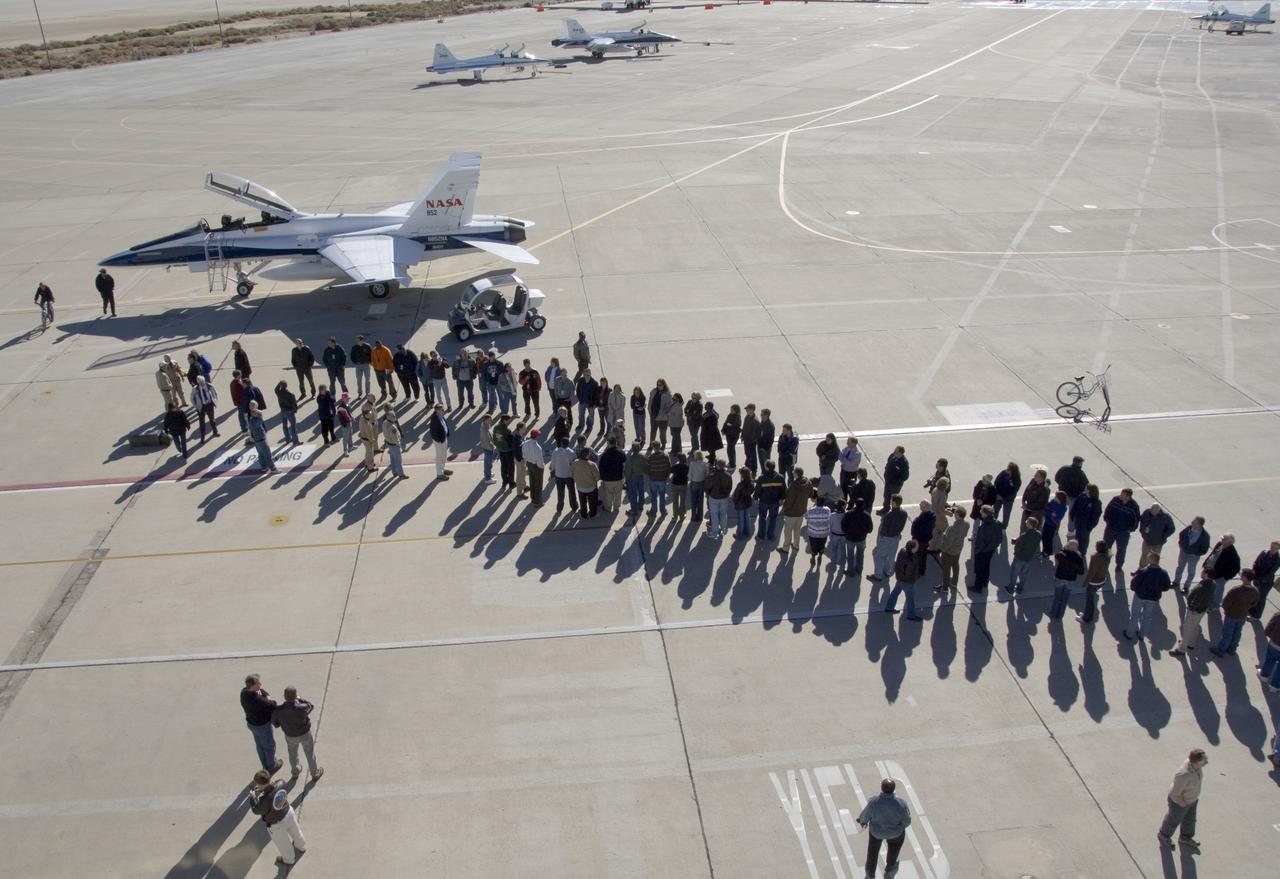
Long-time NASA Dryden research pilot and former astronaut C. Gordon Fullerton capped an almost 50-year flying career, including more than 38 years with NASA, with a final flight in a NASA F/A-18 on Dec. 21, 2007. Fullerton and Dryden research pilot Jim Smolka flew a 90-minute pilot proficiency formation aerobatics flight with another Dryden F/A-18 and a Dryden T-38 before concluding with two low-level formation flyovers of Dryden before landing. Fullerton was honored with a water-cannon spray arch provided by two fire trucks from the Edwards Air Force Base fire department as he taxied the F/A-18 up to the Dryden ramp, and was then greeted by his wife Marie and several hundred Dryden staff after his final flight. Fullerton began his flying career with the U.S. Air Force in 1958 after earning bachelor's and master's degrees in mechanical engineering from the California Institute of Technology. Initially trained as a fighter pilot, he later transitioned to multi-engine bombers and became a bomber operations test pilot after attending the Air Force Aerospace Research Pilot School at Edwards Air Force Base, Calif. He then was assigned to the flight crew for the planned Air Force Manned Orbital Laboratory in 1966. Upon cancellation of that program, the Air Force assigned Fullerton to NASA's astronaut corps in 1969. He served on the support crews for the Apollo 14, 15, 16 and 17 lunar missions, and was later assigned to one of the two flight crews that piloted the space shuttle prototype Enterprise during the Approach and Landing Test program at Dryden. He then logged some 382 hours in space when he flew on two early space shuttle missions, STS-3 on Columbia in 1982 and STS-51F on Challenger in 1985. He joined the flight crew branch at NASA Dryden after leaving the astronaut corps in 1986. During his 21 years at Dryden, Fullerton was project pilot on a number of high-profile research efforts, including the Propulsion Controlled Aircraft, the high-speed landing tests of