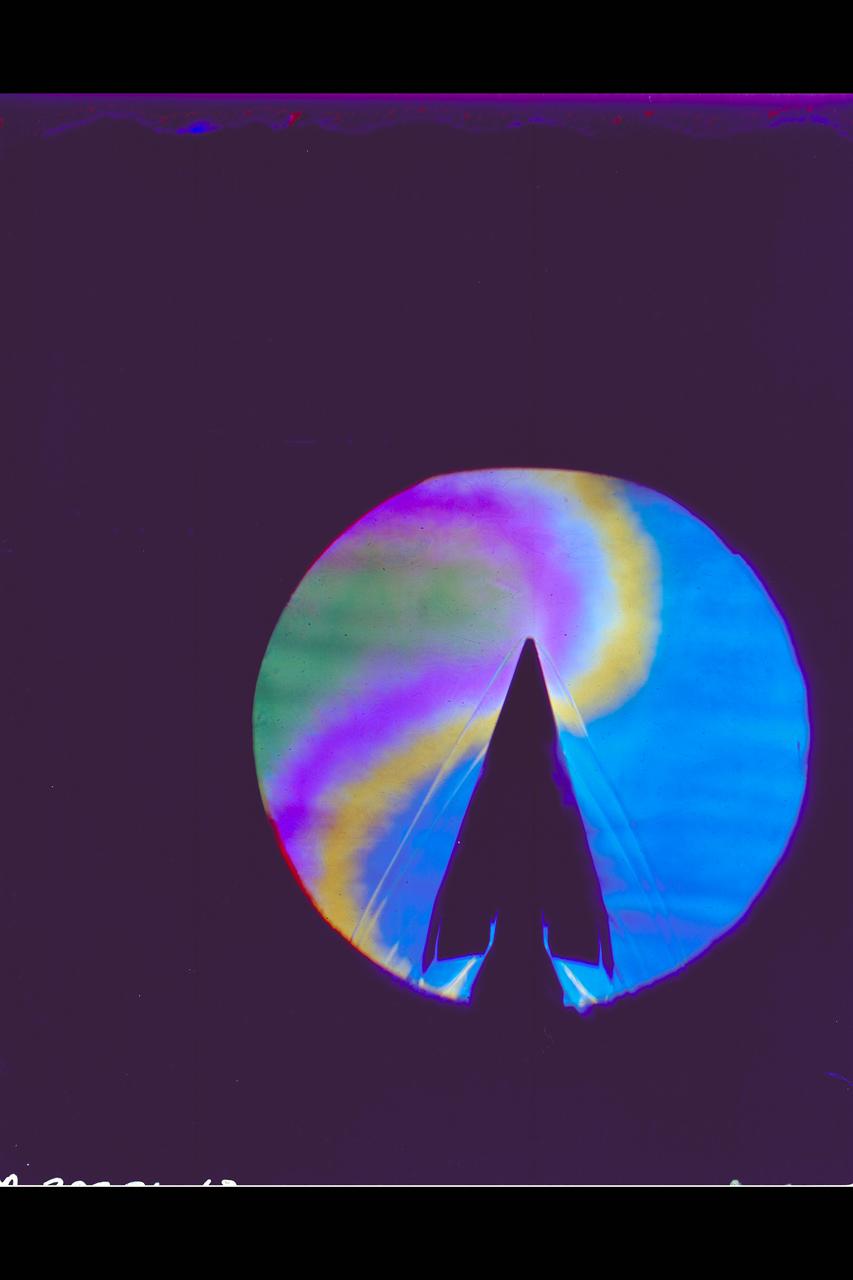
X-20 Dyna Soar on 624-A Titan III Booster: Schlieren
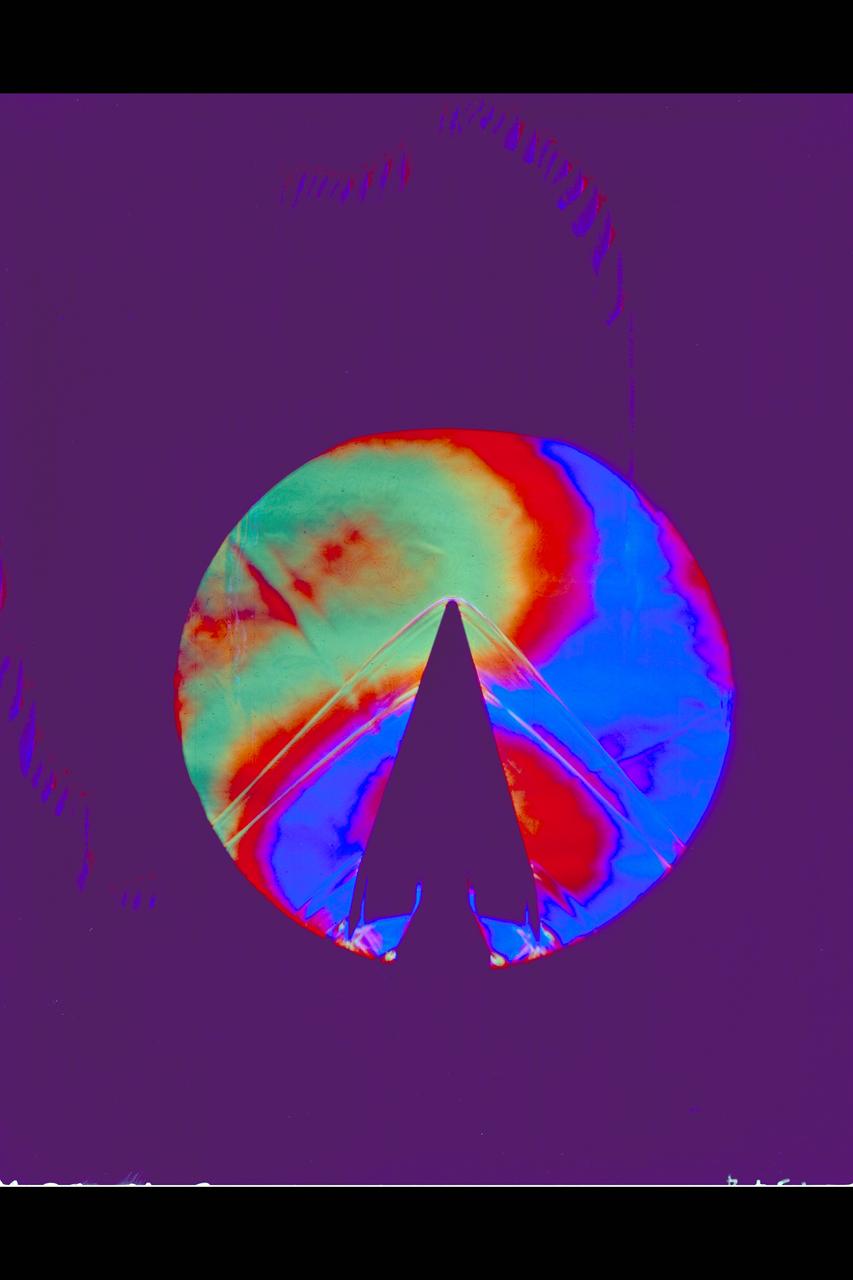
Schlieren of X-20 Dyna Soar mounted on 624-A Titan III Booster
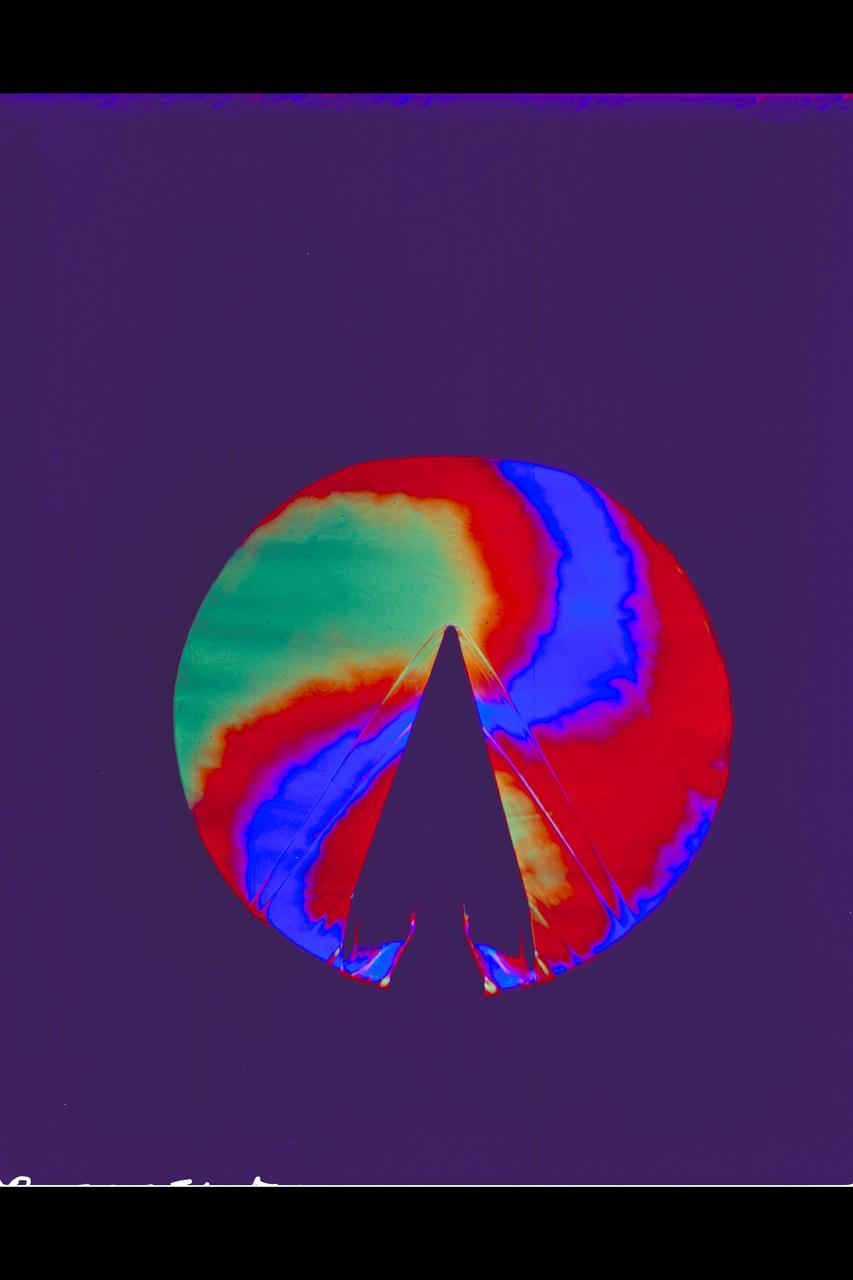
X-20 Dyna Soar on 624-A Titan III Booster: Schlieren
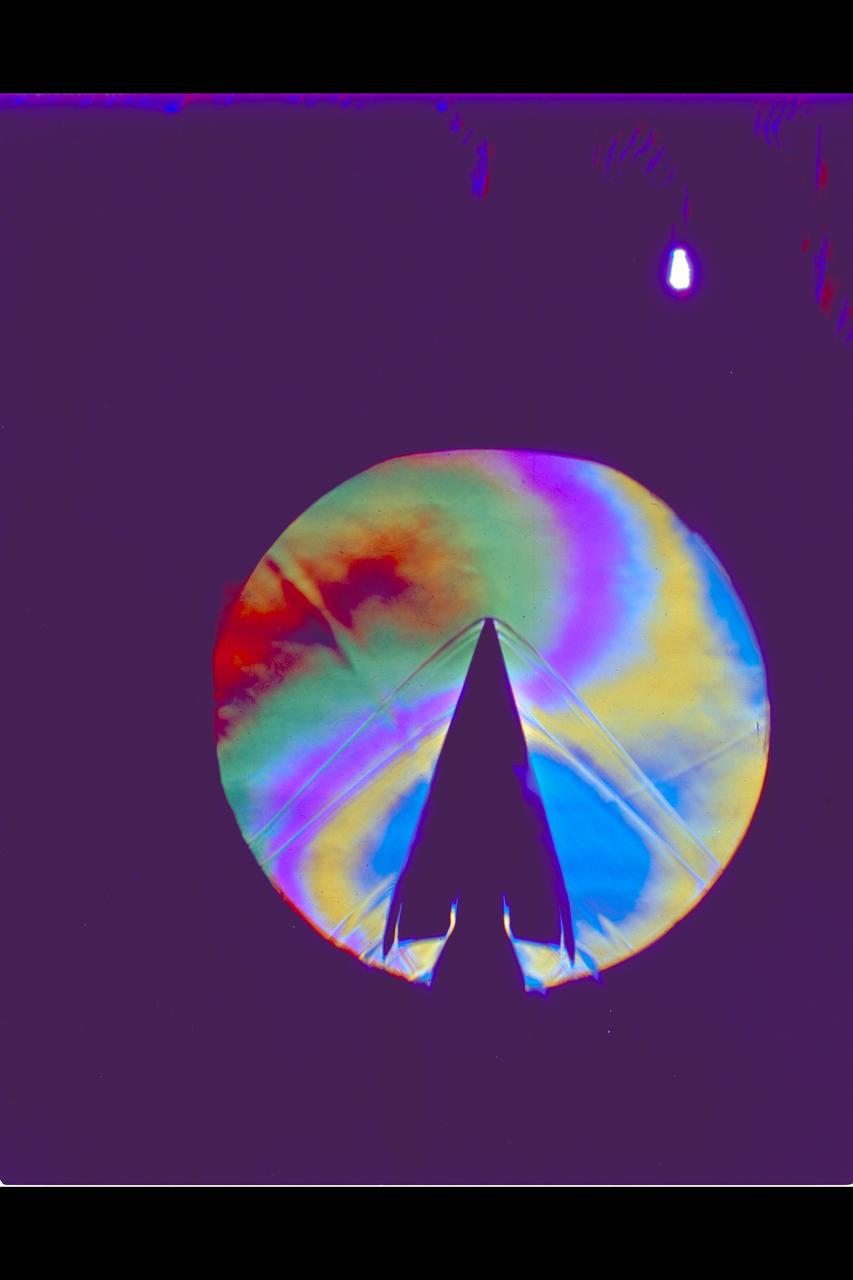
X-20 Dyna Soar on 624-A Titan III Booster: Schlieren
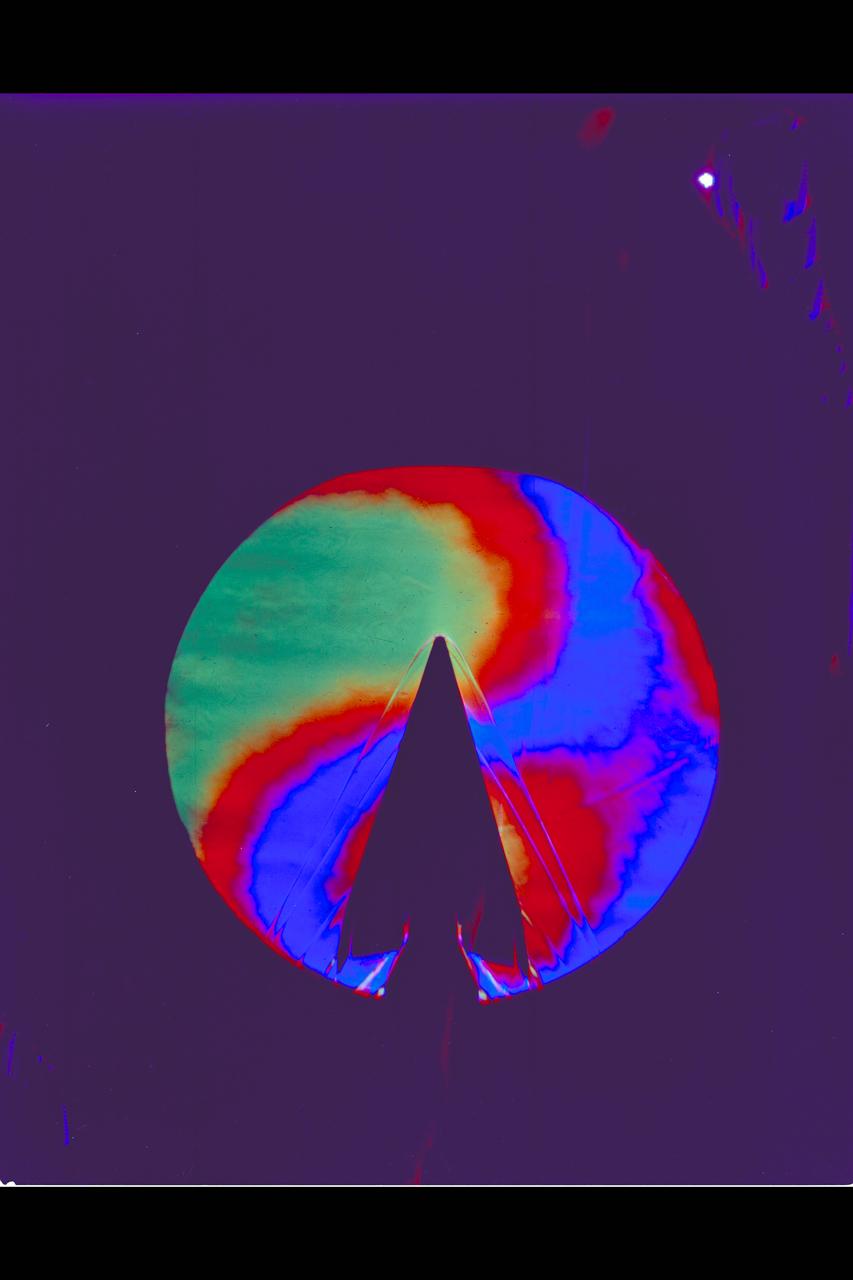
X-20 Dyna Soar on 624-A Titan III Booster: Schlieren

X-20 Dyna Soar on 624-A Titan III Booster: Schlieren
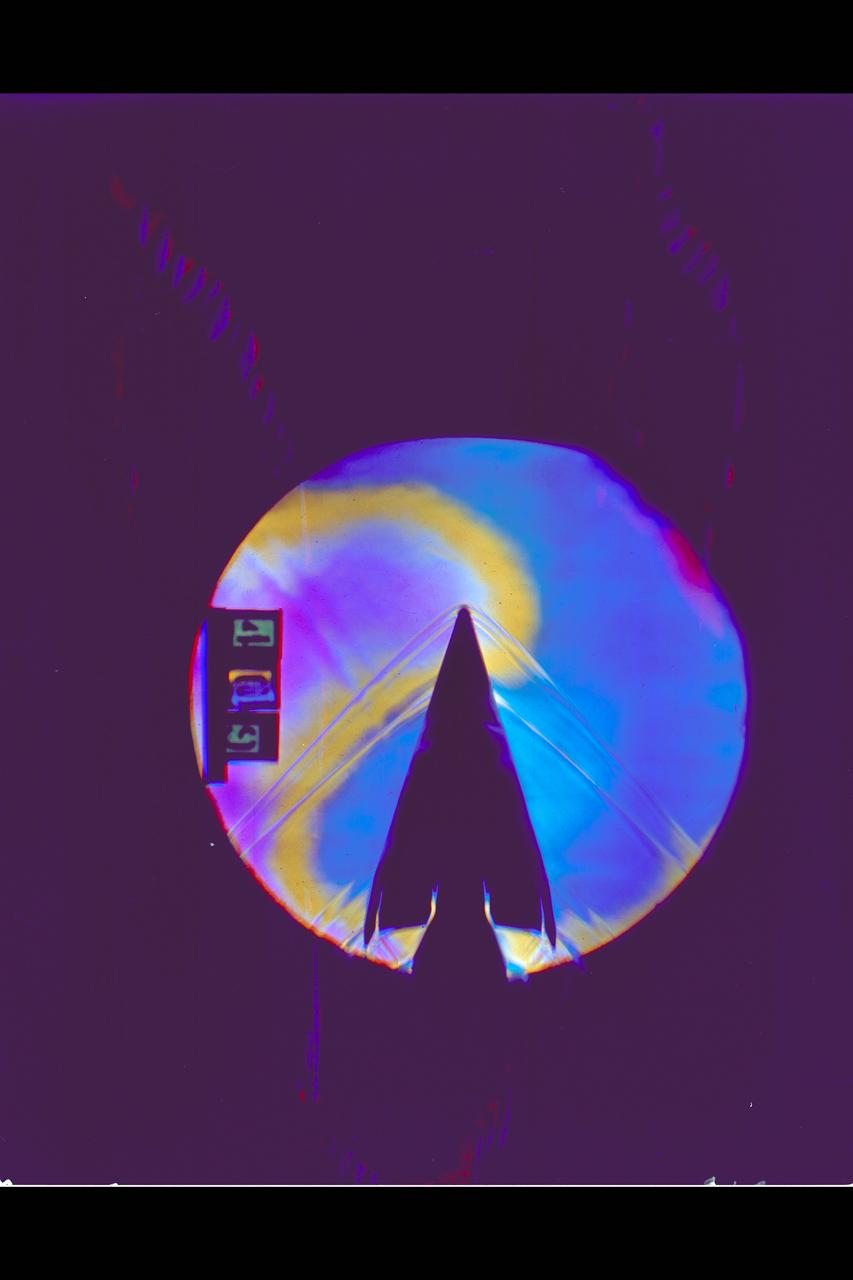
Schlieren of X-20 Dyna Soar mounted on 624-A Titan III Booster
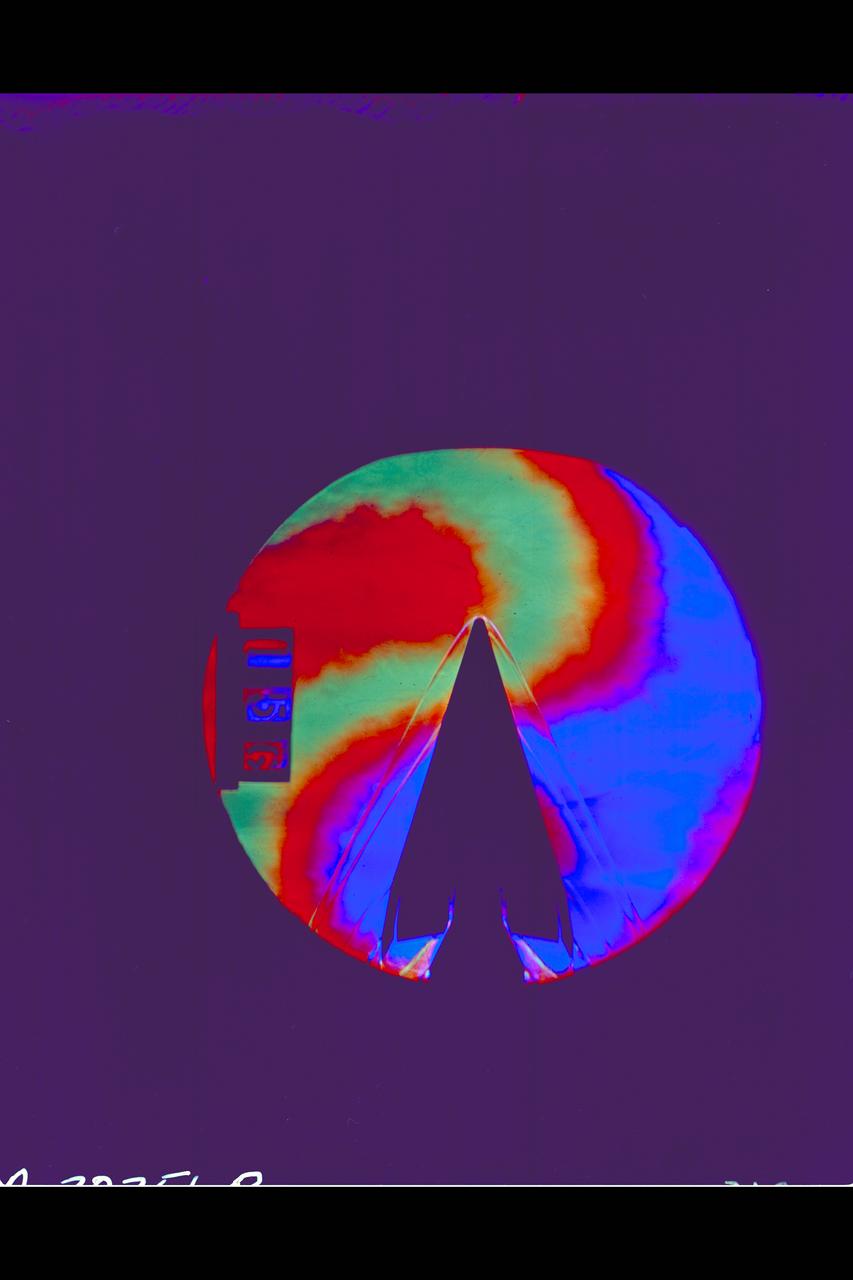
X-20 Dyna Soar on 624-A Titan III Booster: Schlieren
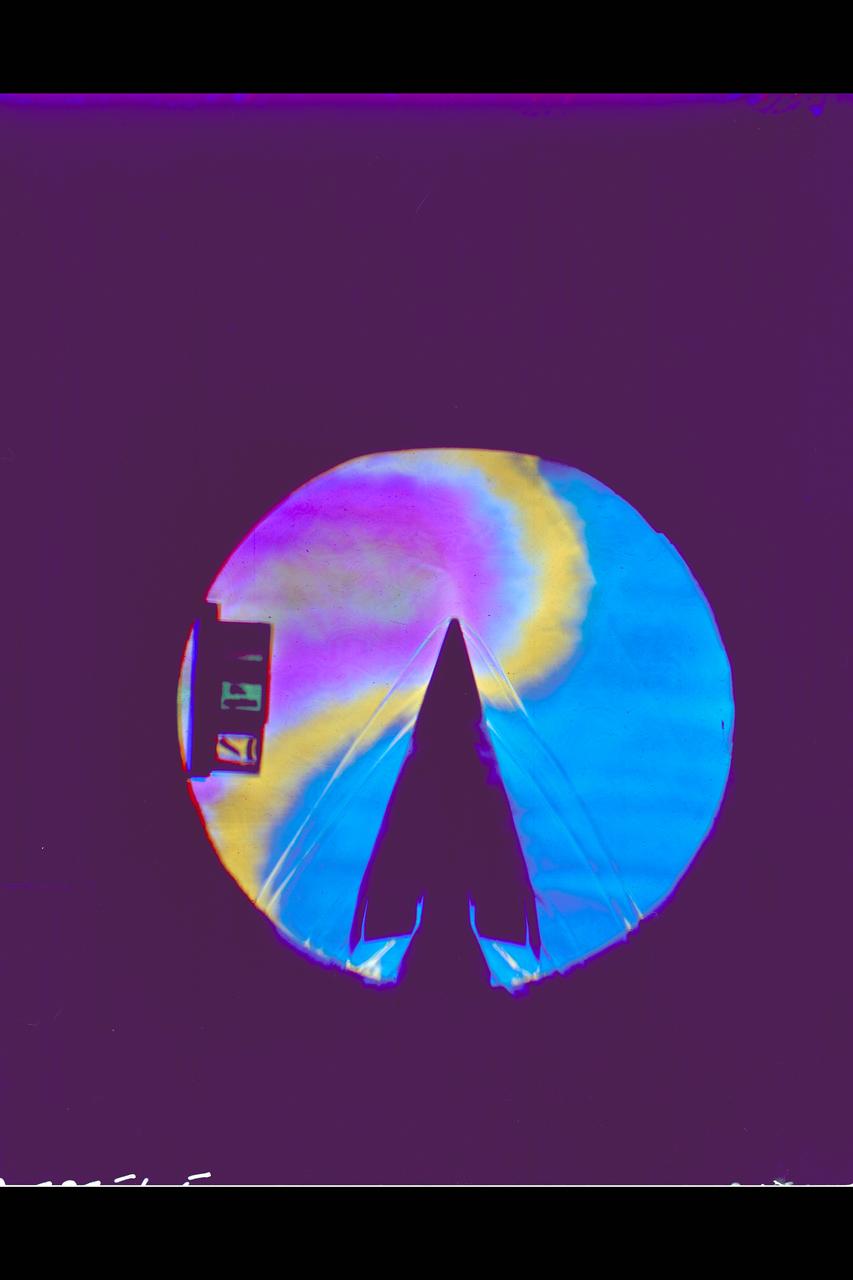
X-20 Dyna Soar on 624-A Titan III Booster: Schlieren
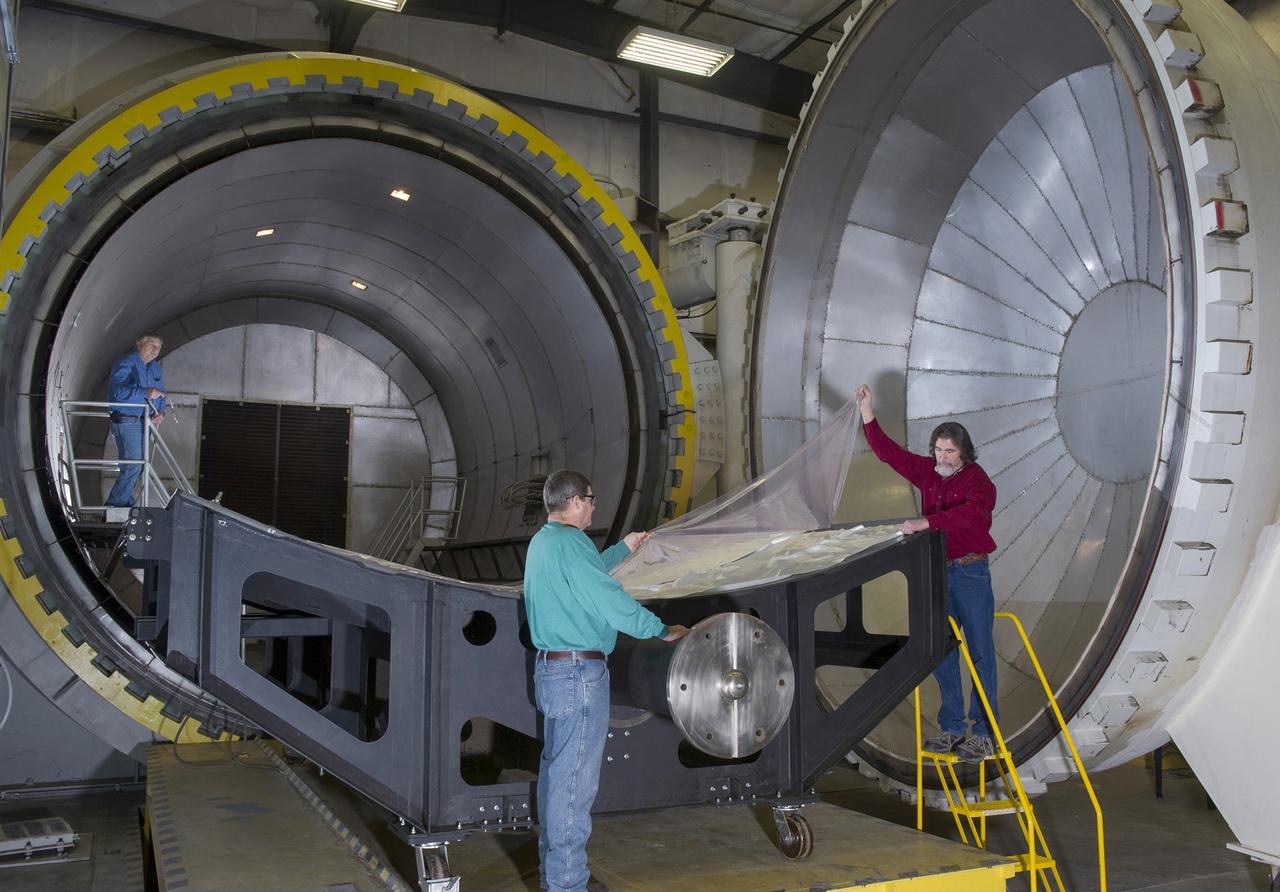
JAMES NEWTON, LEFT, PHILLIP THOMPSON, CENTER, AND DAVID LAWRENCE, RIGHT PREPARE COMPOSITE TOOL FOR CURE IN 18' X 20' AUTOCLAVE IN BUILDING 4707
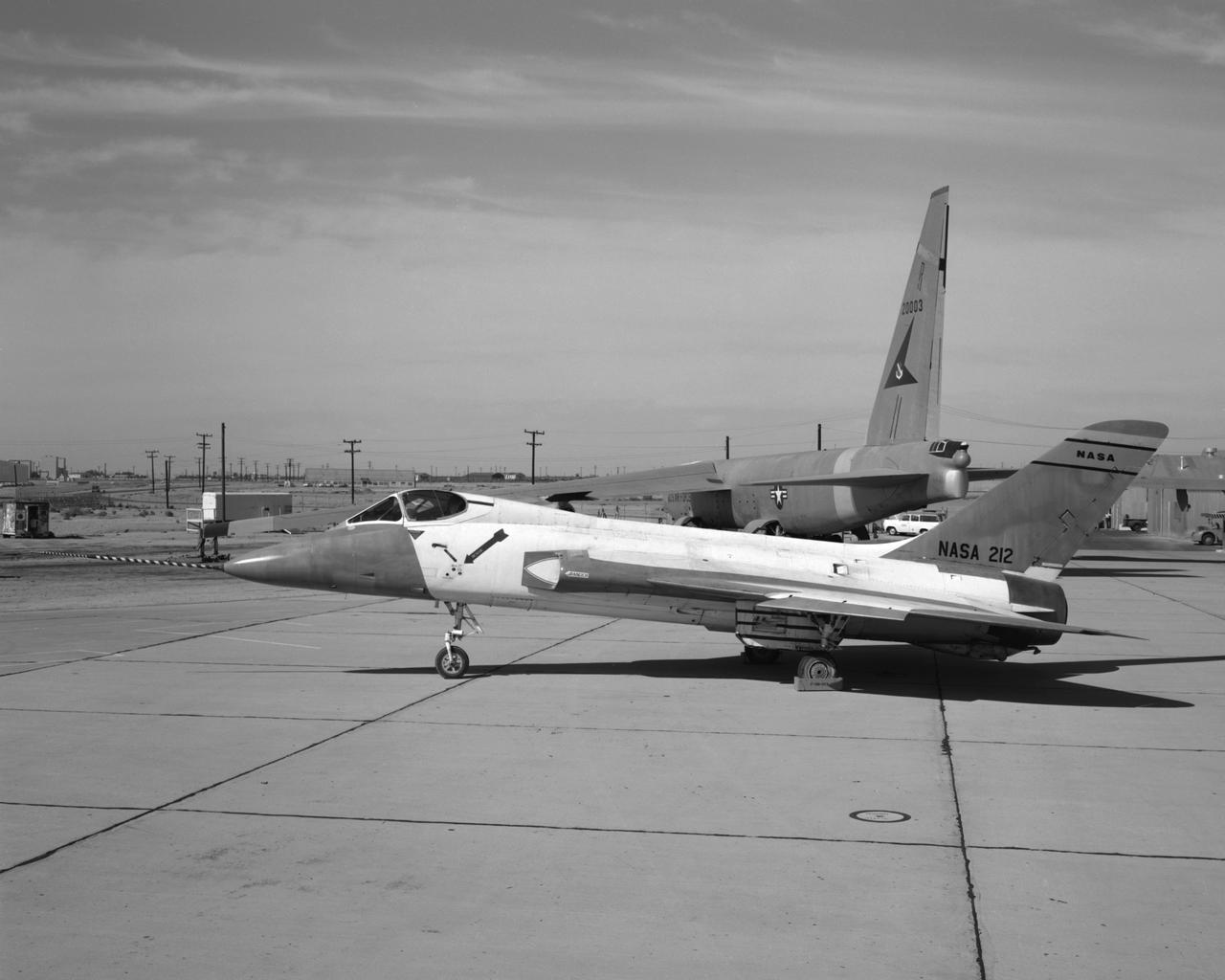
F5D Skylancer NASA 212 modified as the X-20 Dyna-Soar vision field simulator.
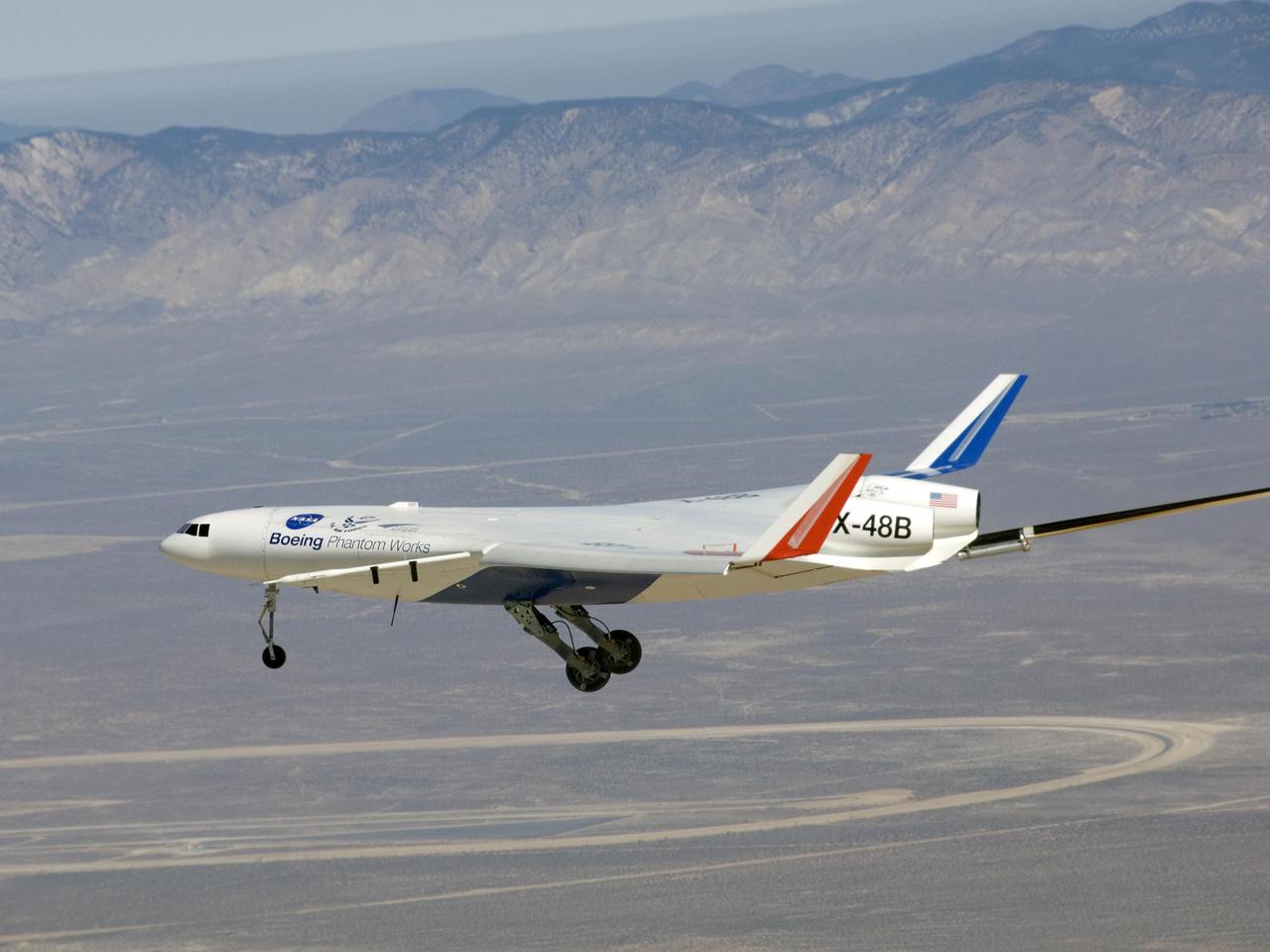
X-48B blended wing body aircraft during first flight on July 20, 2007.
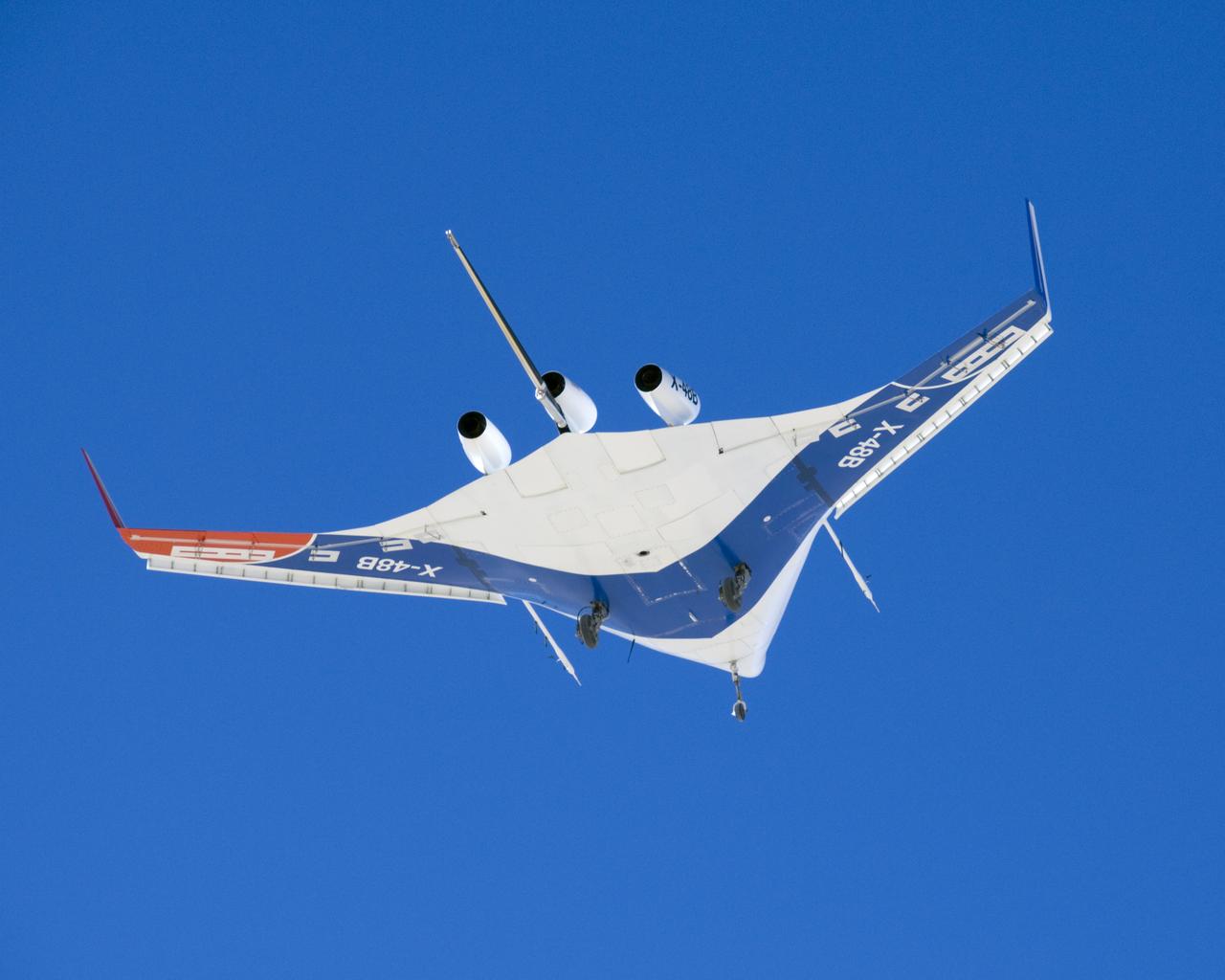
A pristine blue sky backdrops the X-48B Blended Wing Body aircraft during the aircraft's first flight July 20, 2007, from NASA's Dryden Flight Research Center.
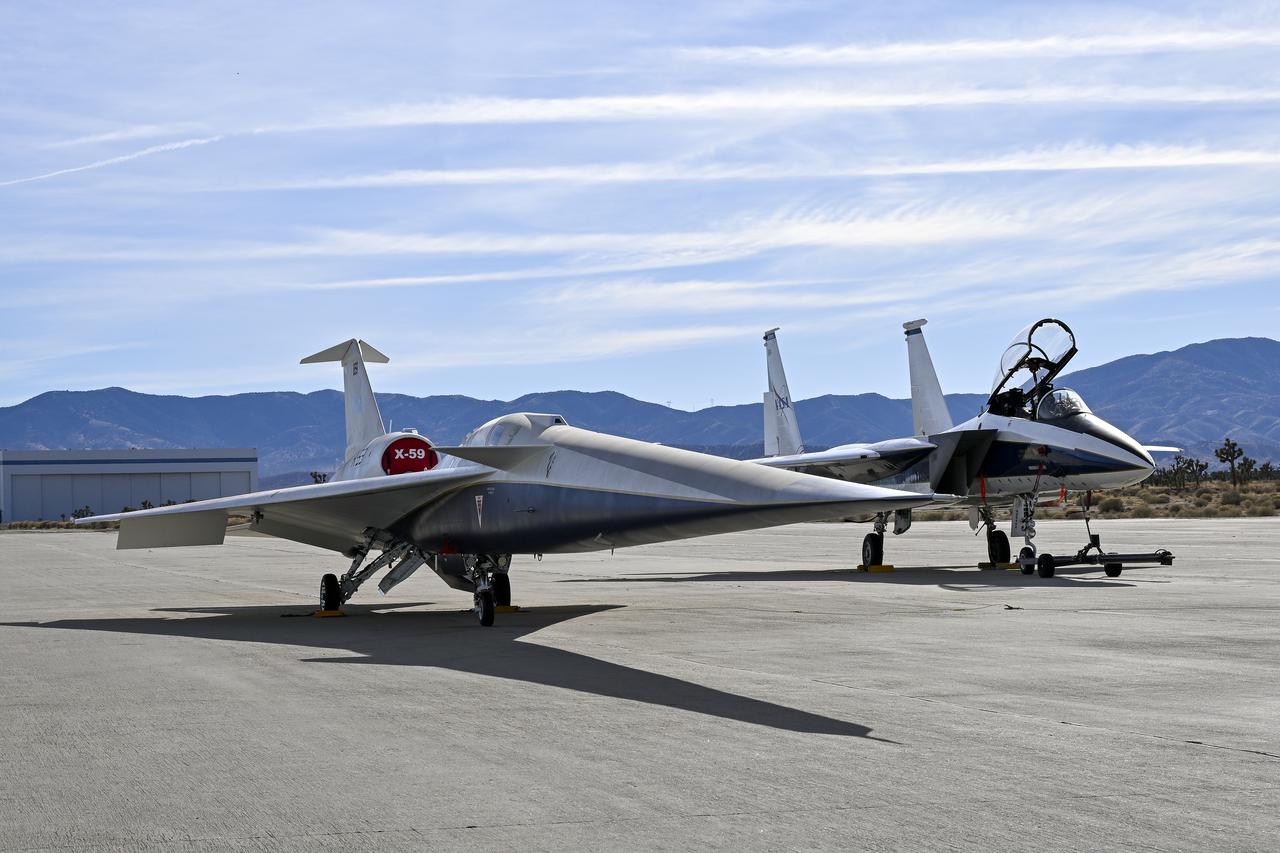
A NASA F-15 aircraft sits 20 feet off the left side of the X-59 aircraft, with a white hangar and hills in the background, during electromagnetic interference testing.
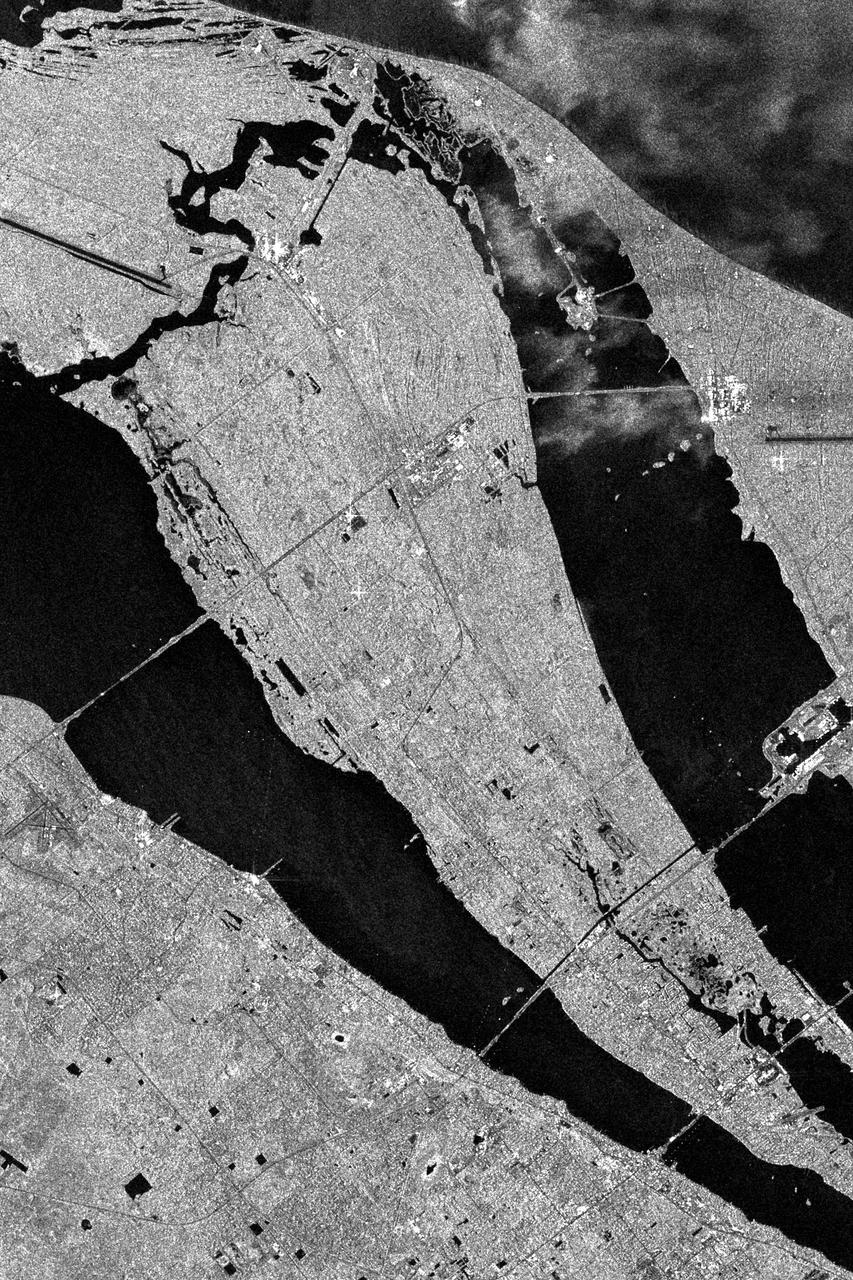
This is an X-band Synthetic Aperture Radar image spanning an area of about 20 kilometers by 40 kilometers 12 miles by 25 miles of NASA Kennedy Space Center, Florida.
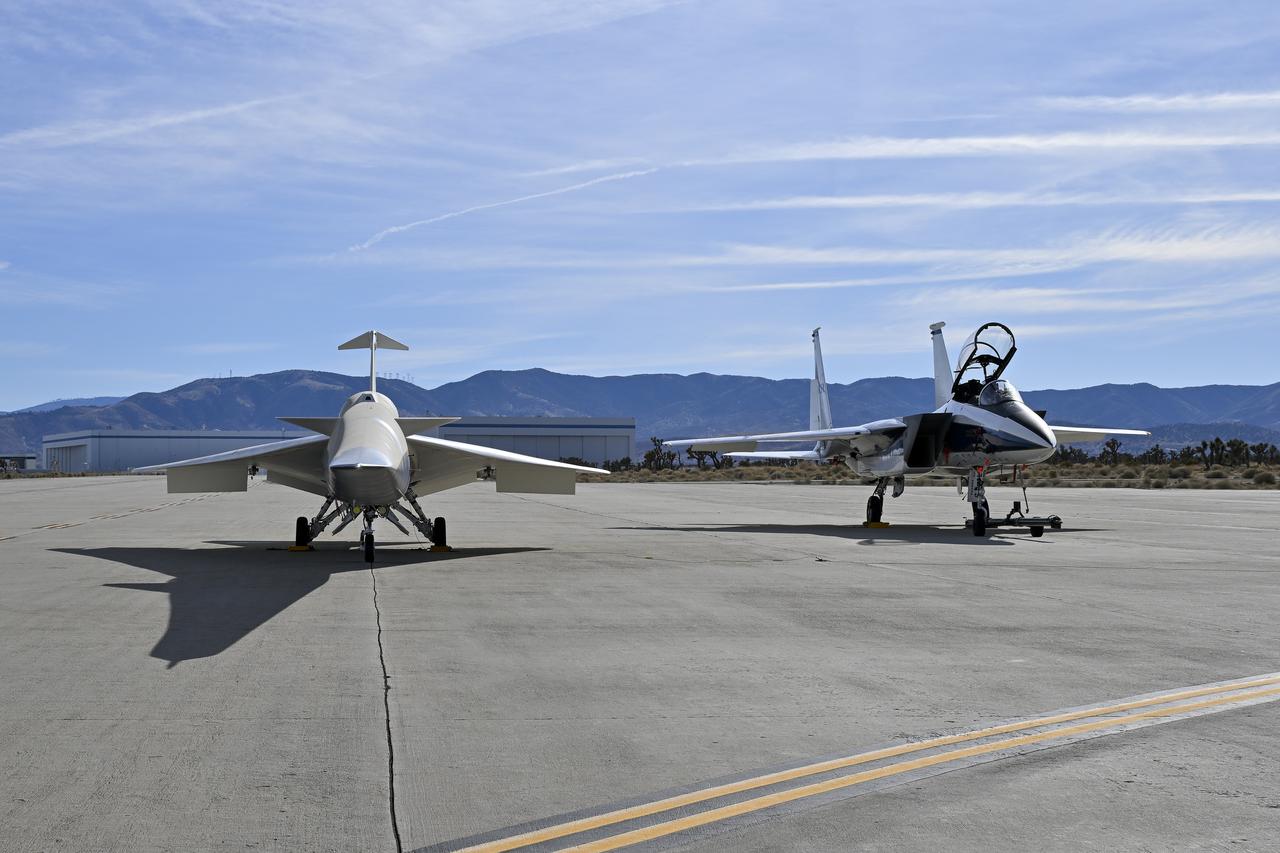
A NASA F-15 aircraft sits 20 feet off the left side of the X-59 aircraft, with a white hangar and hills in the background, during electromagnetic interference testing.

Atlas Image mosaic, covering 14.8 x 20.0 on the sky, of the Trifid Nebula, aka Messier 20 and NGC 6514. The Trifid is only about 1.5 degrees northwest on the sky of the larger Lagoon Nebula Messier 8 in the constellation Sagittarius
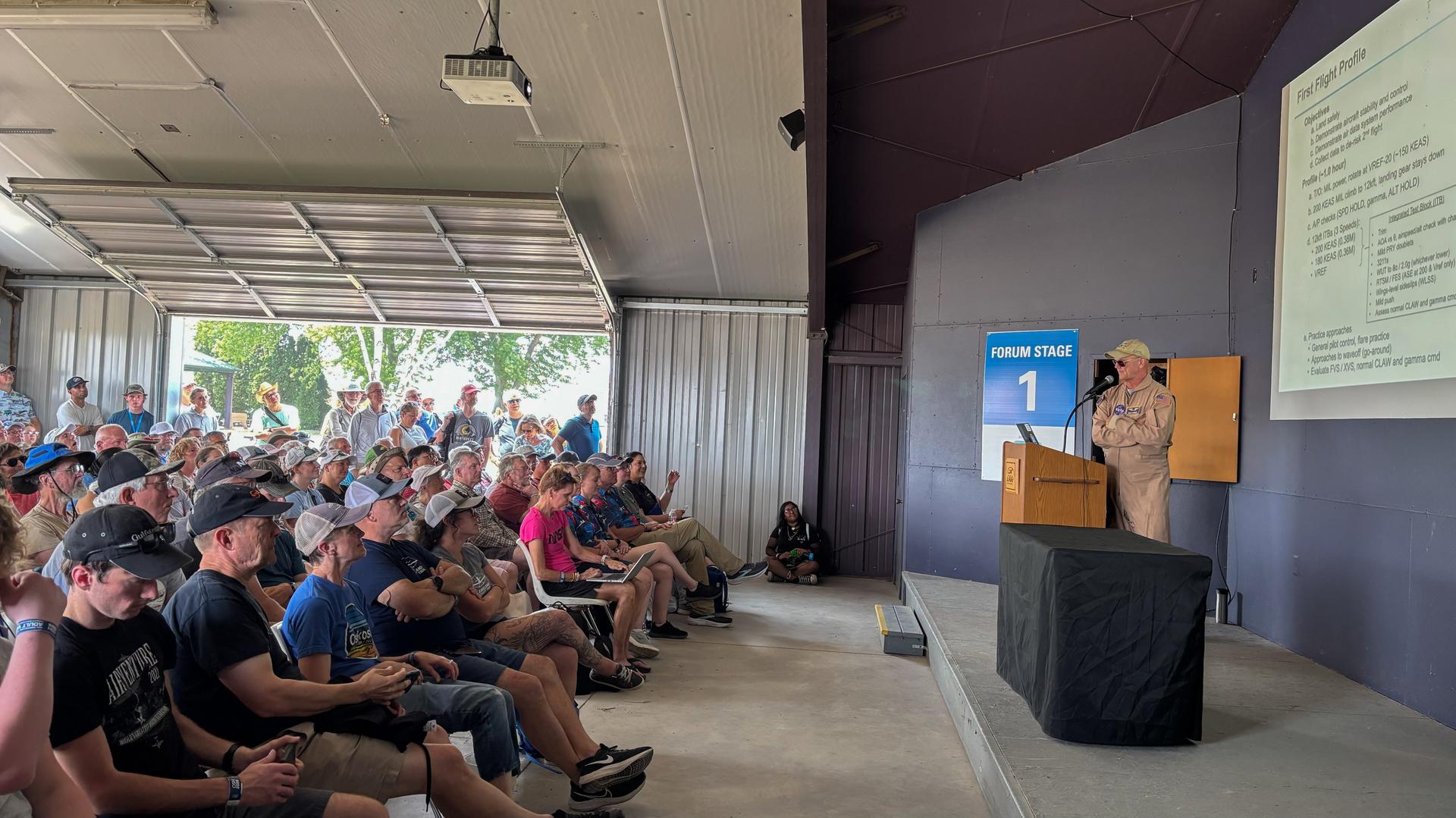
NASA test pilot Nils Larson speaks at his forum presentation “NASA’s X-59 Flight Tests Kick Off!” at the 2026 Experimental Aircraft Association (EAA) AirVenture air show in Oshkosh, Wisconsin, on Monday, July 20, 2026.
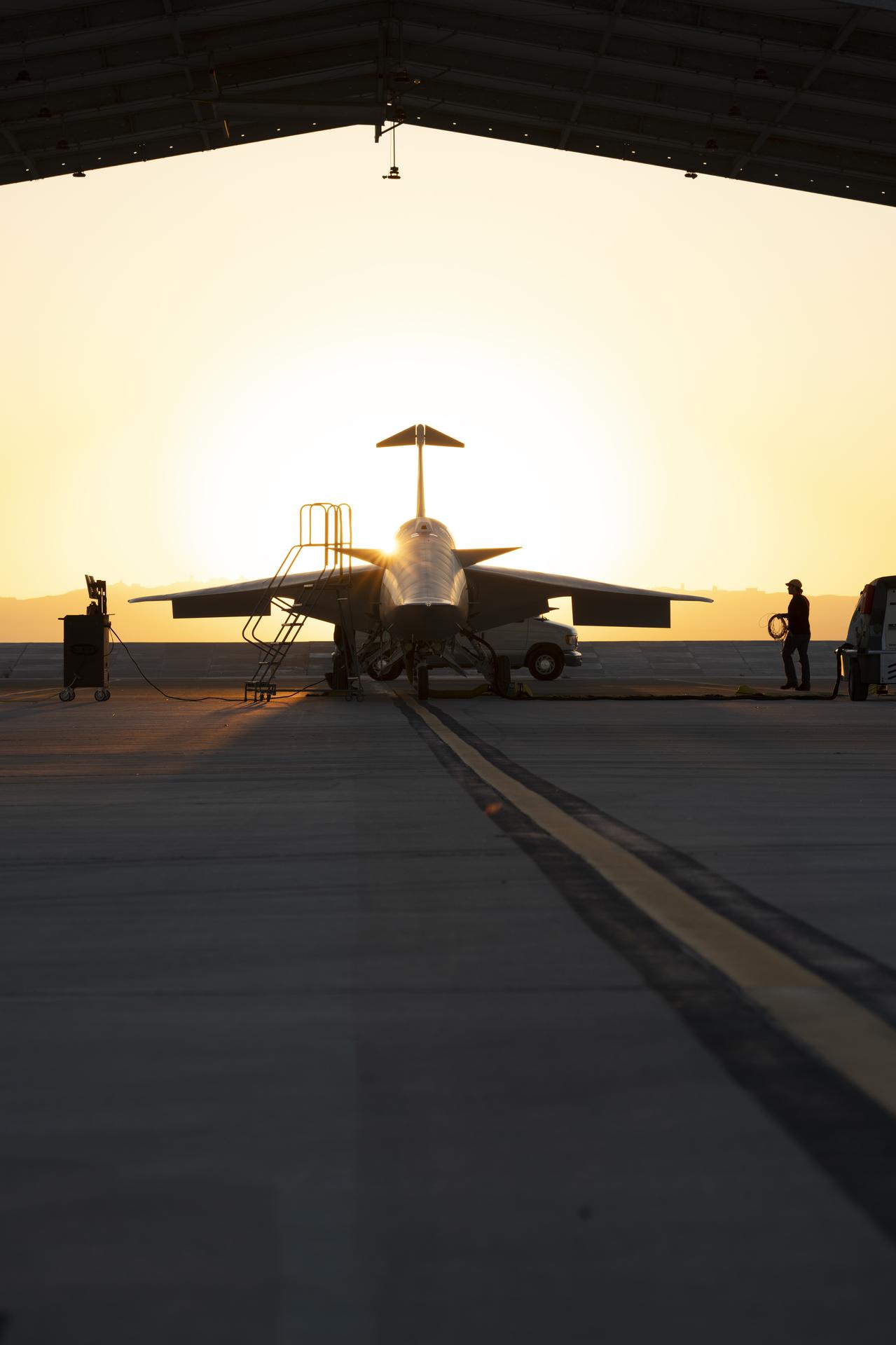
NASA’s X-59 quiet supersonic research aircraft sits in a run stall during sunrise on Tuesday, March 20, 2026, near NASA’s Armstrong Flight Research Center in Edwards, California, ahead of its second flight.
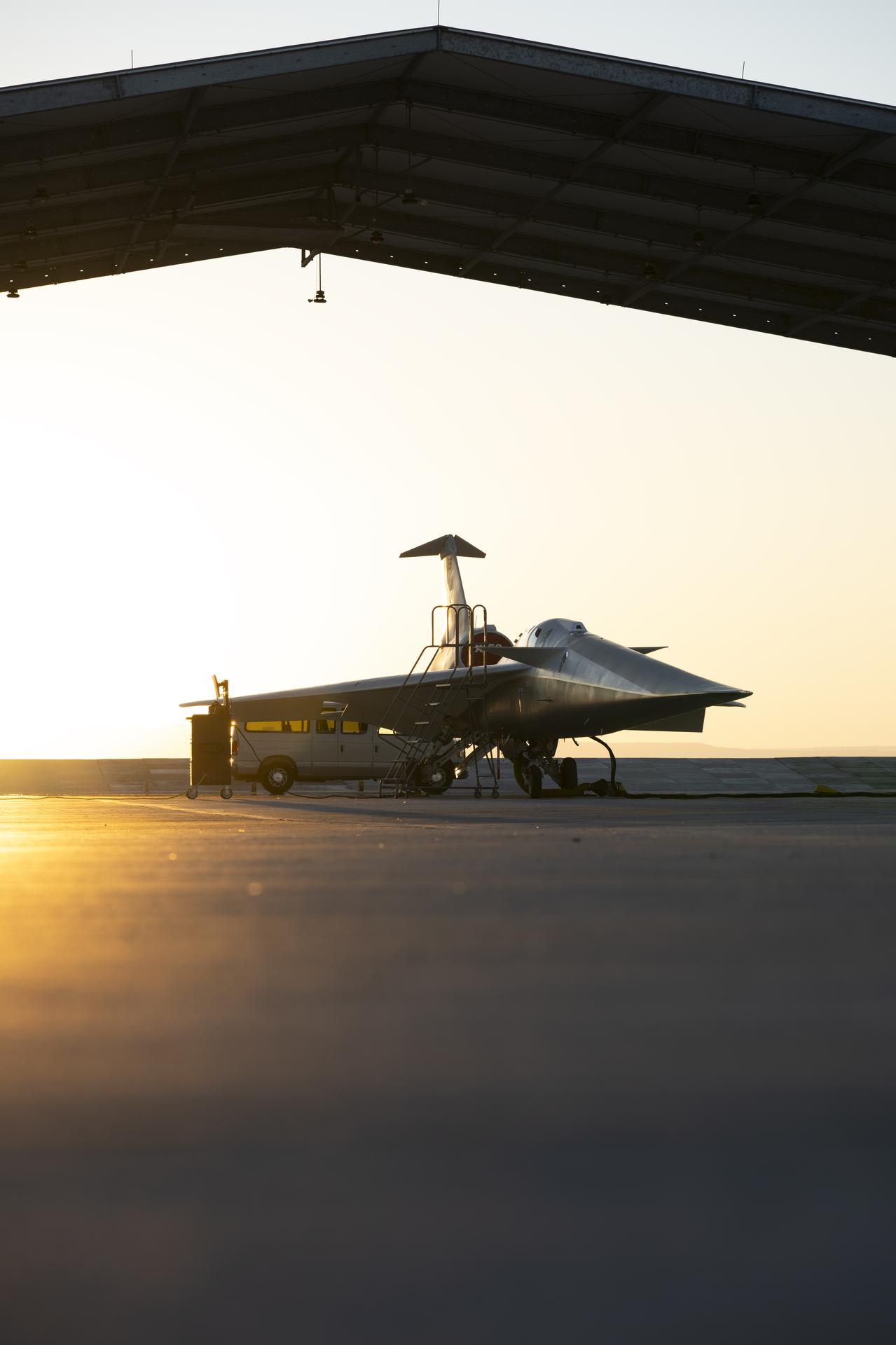
NASA’s X-59 quiet supersonic research aircraft sits in a run stall during sunrise on Tuesday, March 20, 2026, near NASA’s Armstrong Flight Research Center in Edwards, California, ahead of its second flight.
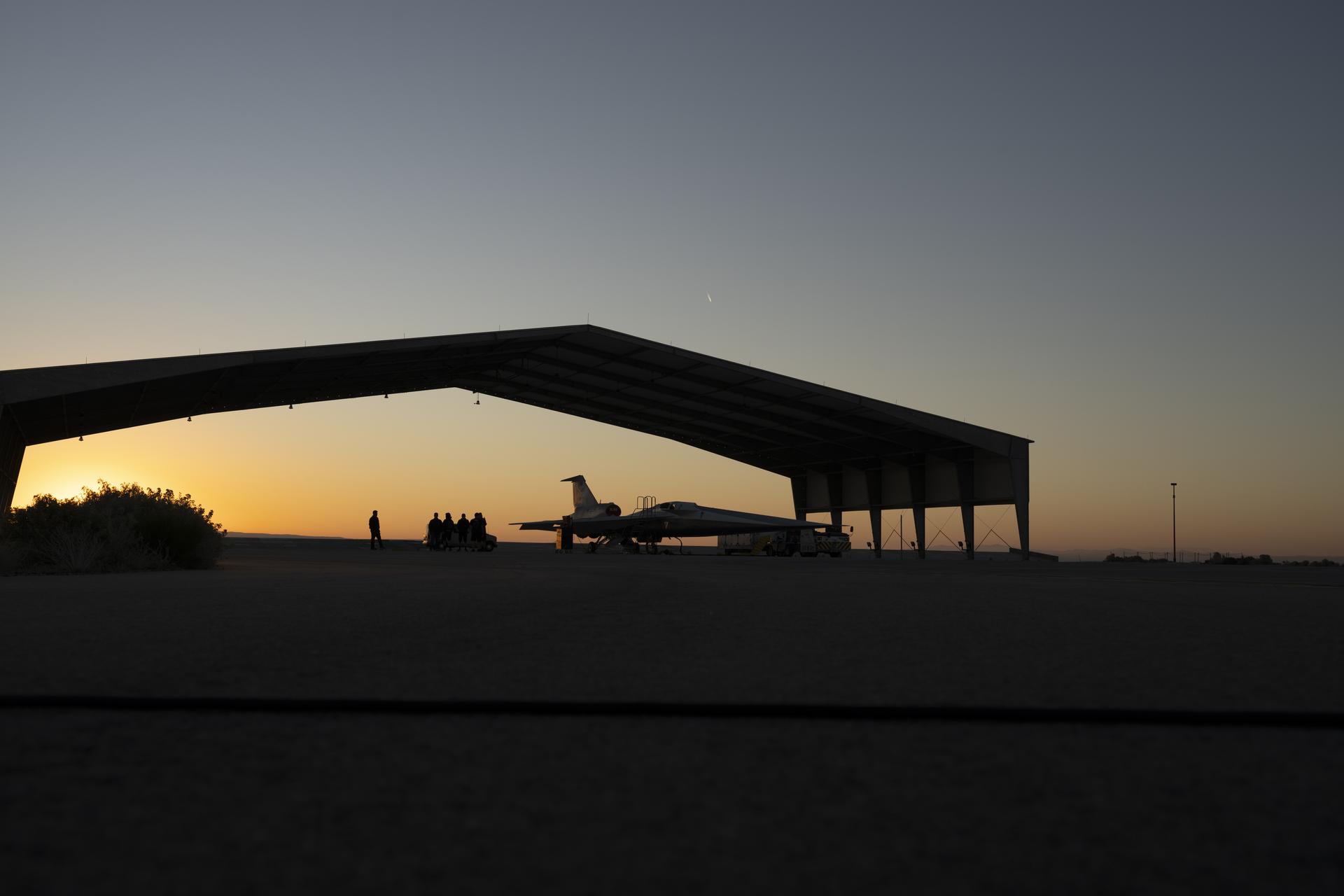
NASA’s X-59 quiet supersonic research aircraft sits in a run stall during sunrise on Tuesday, March 20, 2026, near NASA’s Armstrong Flight Research Center in Edwards, California, ahead of its second flight.
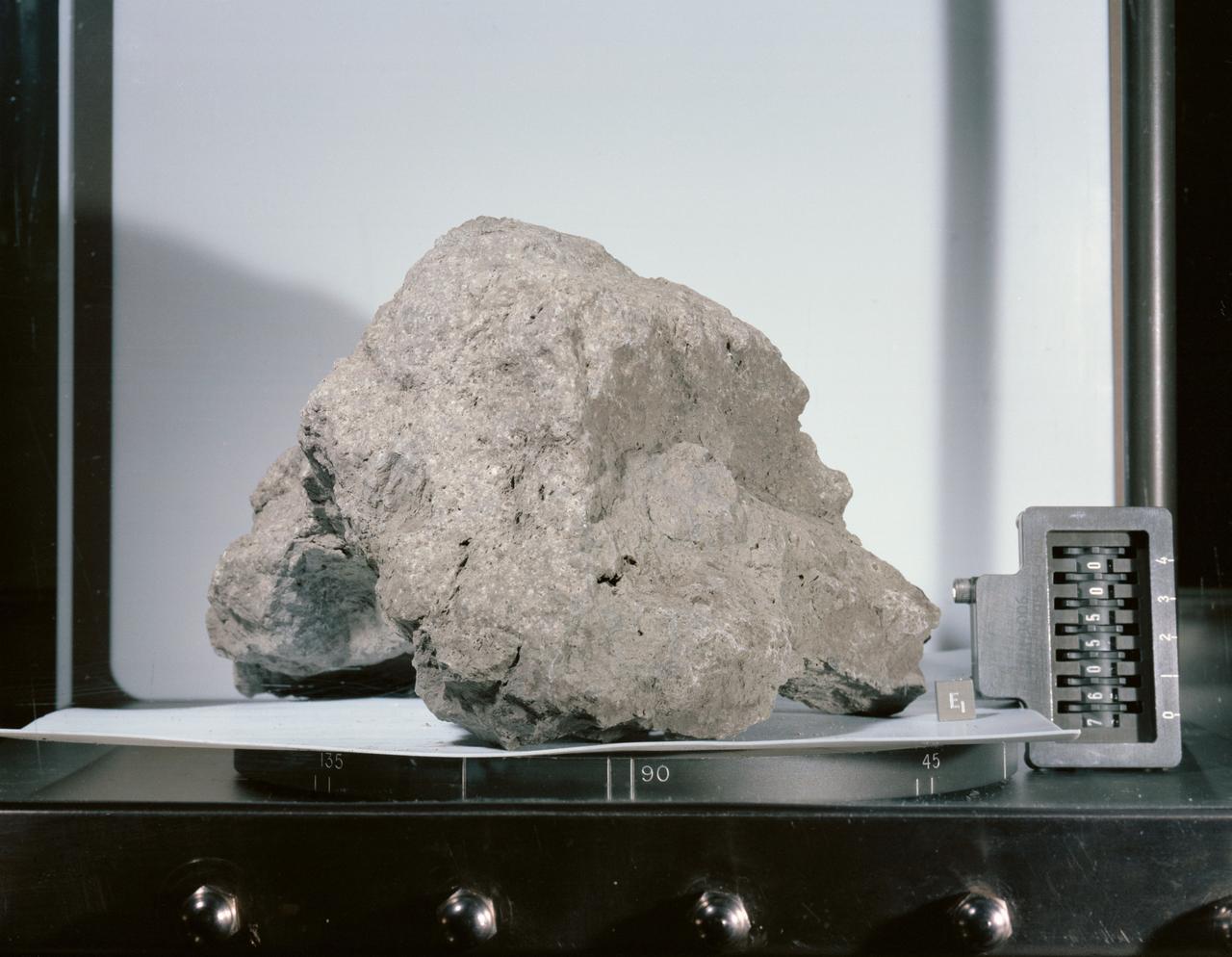
S73-15713 (January 1973) --- A close-up view of Apollo 17 lunar rock sample No. 76055 being studied and analyzed in the Lunar Receiving Laboratory at the Manned Spacecraft Center. This tan-gray irregular, rounded breccia was among many lunar samples brought back from the Taurus-Littrow landing site by the Apollo 17 crew. The rock measures 18 x 20 x 25 centimeters (7.09 x 7.87 x 9.84 inches) and weighs 6,389 grams (14.2554 pounds). The rock was collected from the south side of the lunar roving vehicle while the Apollo 17 astronauts were at Station 7 (base of North Massif).
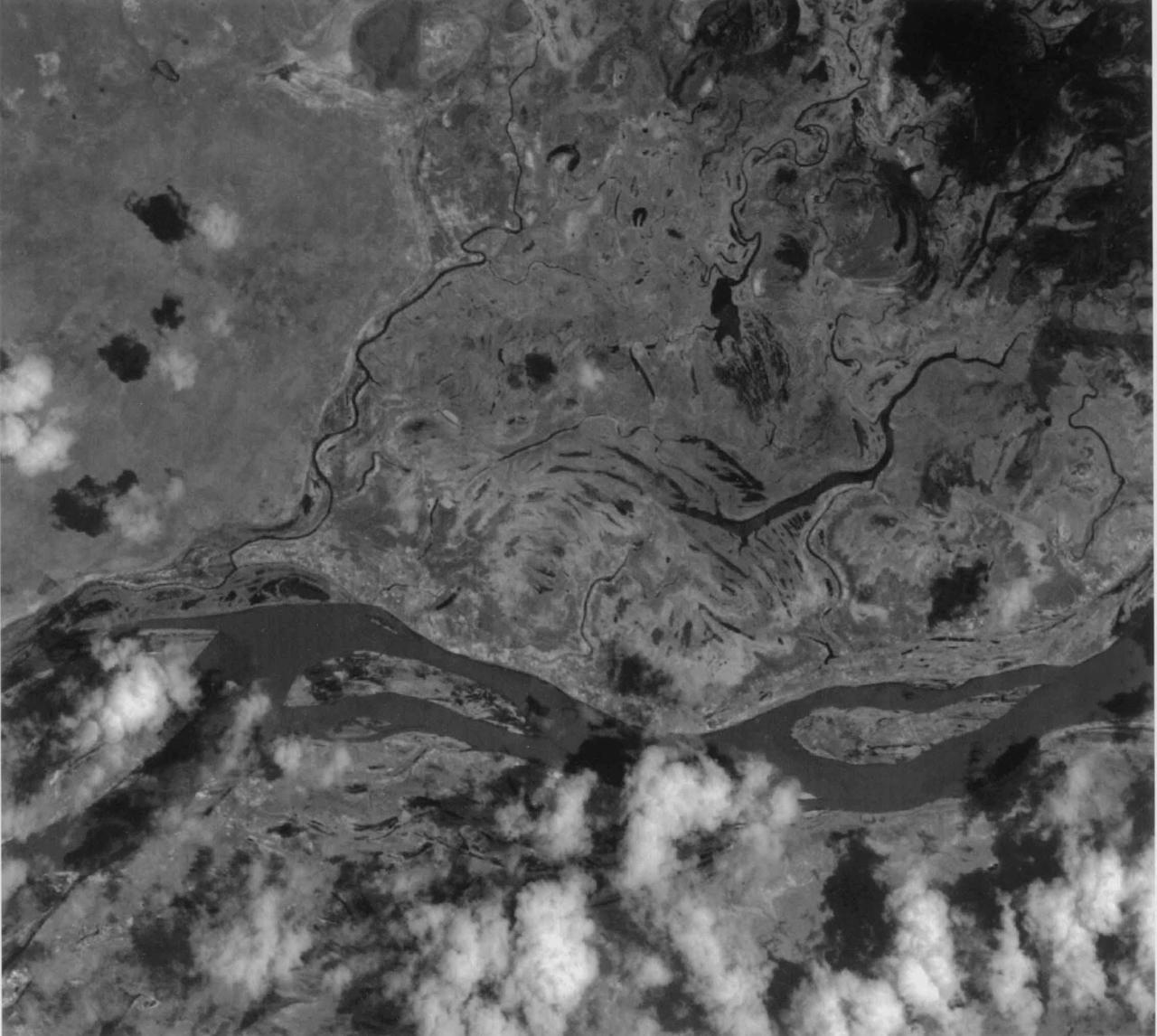
This image of the San Francisco River channel, and its surrounding flood zone, in Brazil was acquired by band 3N of ASTER's Visible/Near Infrared sensor. The surrounding area along the river channel in light gray to white could be covered by dense tropical rain forests. The water surface of the San Francisco River shows rather gray color as compared to small lakes and tributaries, which could indicate that the river water is contaminated by suspended material. The size of image: 20 km x 20 km approx., ground resolution 15 m x 15 m approximately. http://photojournal.jpl.nasa.gov/catalog/PIA02451

In this fish-eye view, a worker oversees the movement of the Chandra X-ray Observatory into the payload bay of the orbiter Columbia. Chandra is the primary payload on mission STS-93, scheduled to launch no earlier than July 20 aboard Space Shuttle Columbia. The world's most powerful X-ray telescope, Chandra will allow scientists from around the world to see previously invisible black holes and high-temperature gas clouds, giving the observatory the potential to rewrite the books on the structure and evolution of our universe
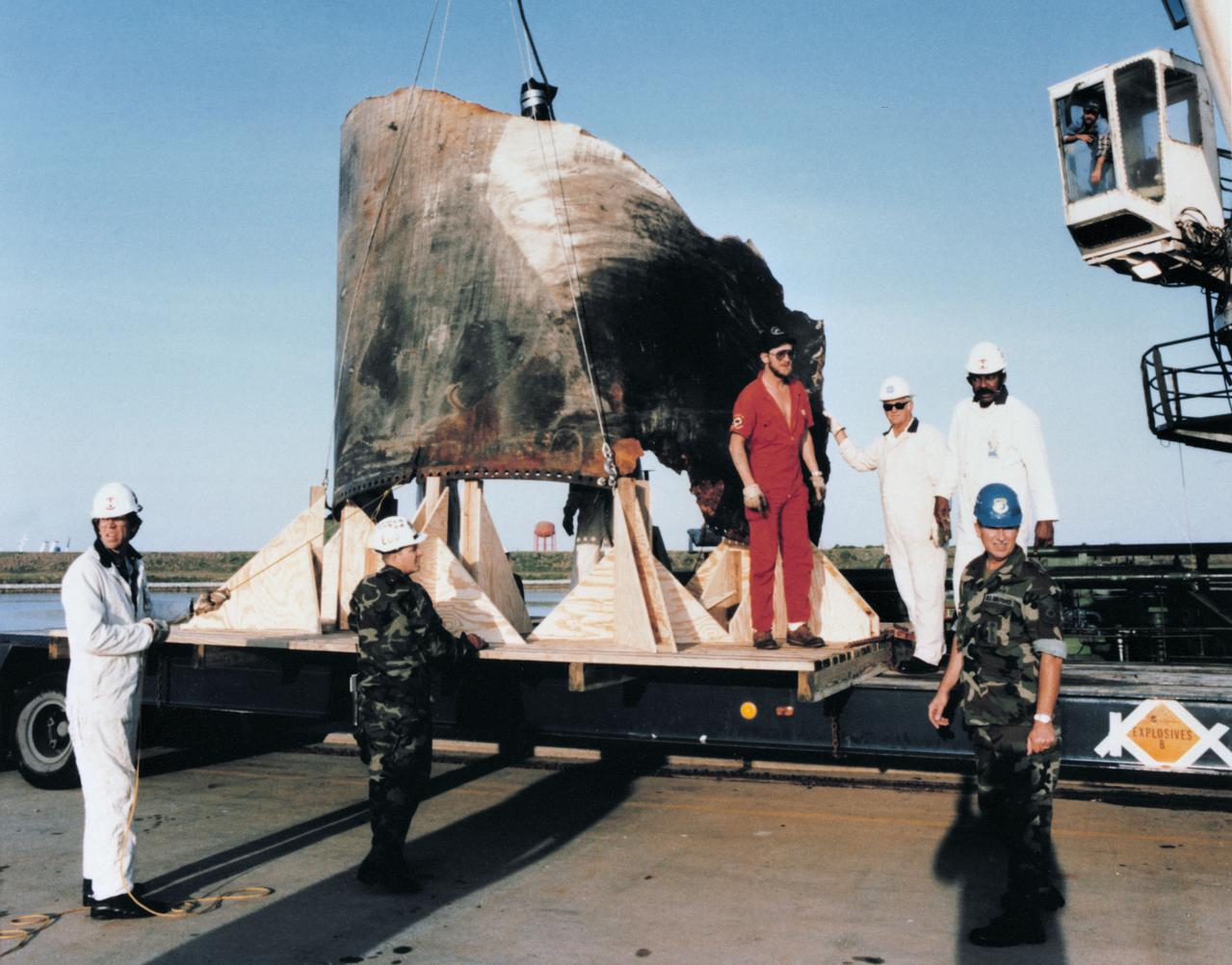
S86-30504 (16 April 1986) --- A 4,000 pound, 11' x 20' piece of the aft center segment tang joint of the space shuttle Challenger's right-hand solid rocket booster is off loaded from the Stena Workhorse after its recovery on April 13, 1986. The burned out area is 15" x 28". Photo credit: NASA
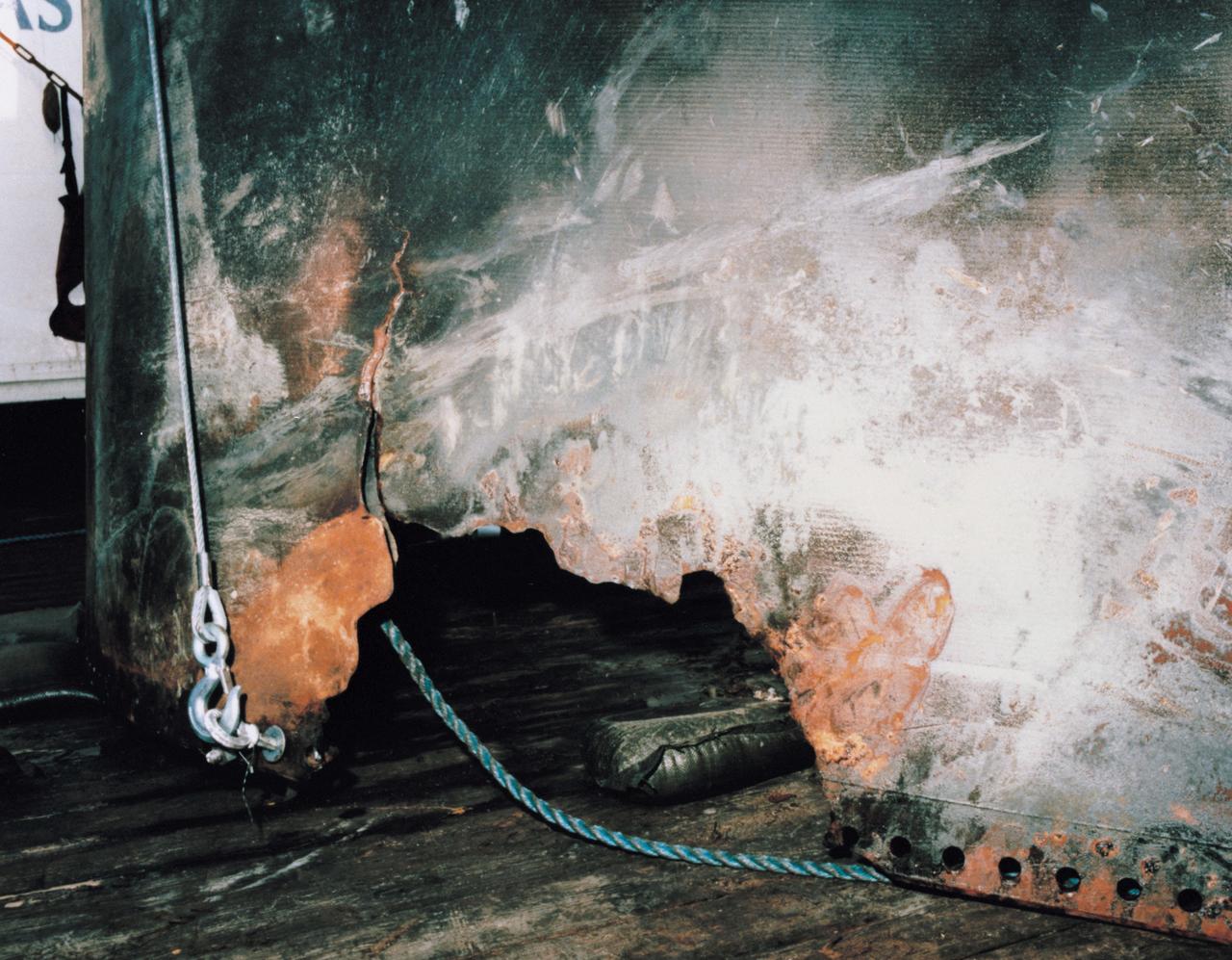
S86-30503 (16 April 1986) --- A 4,000 pound, 11' x 20' piece of the aft center segment tang joint of the space shuttle Challenger's right-hand solid rocket booster is off loaded from the Stena Workhorse after its recovery on April 13, 1986. The burned out area is 15" x 28". Photo credit: NASA
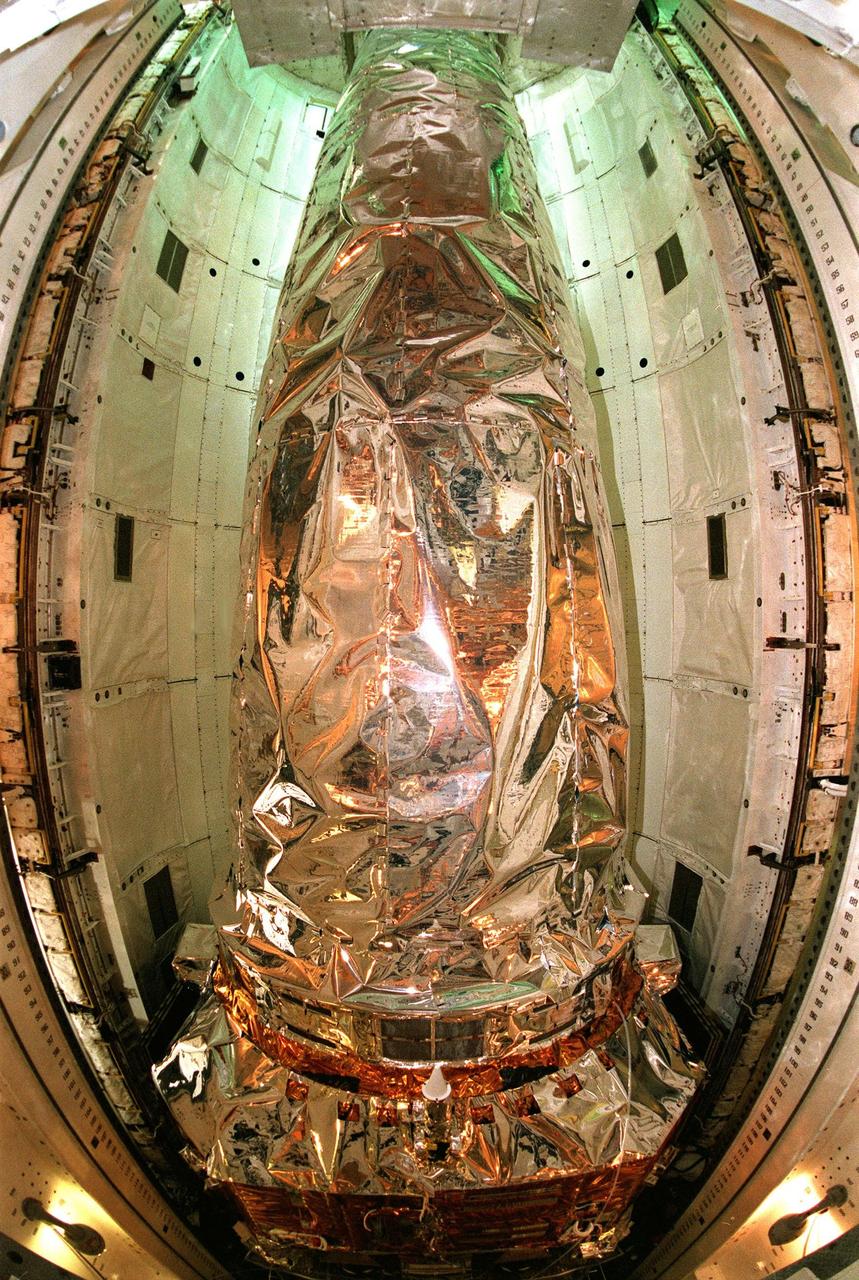
In this fish-eye view, the Chandra X-ray Observatory rests inside the payload bay of the orbiter Columbia. Chandra is the primary payload on mission STS-93, scheduled to launch no earlier than July 20 aboard Space Shuttle Columbia. The world's most powerful X-ray telescope, Chandra will allow scientists from around the world to see previously invisible black holes and high-temperature gas clouds, giving the observatory the potential to rewrite the books on the structure and evolution of our universe
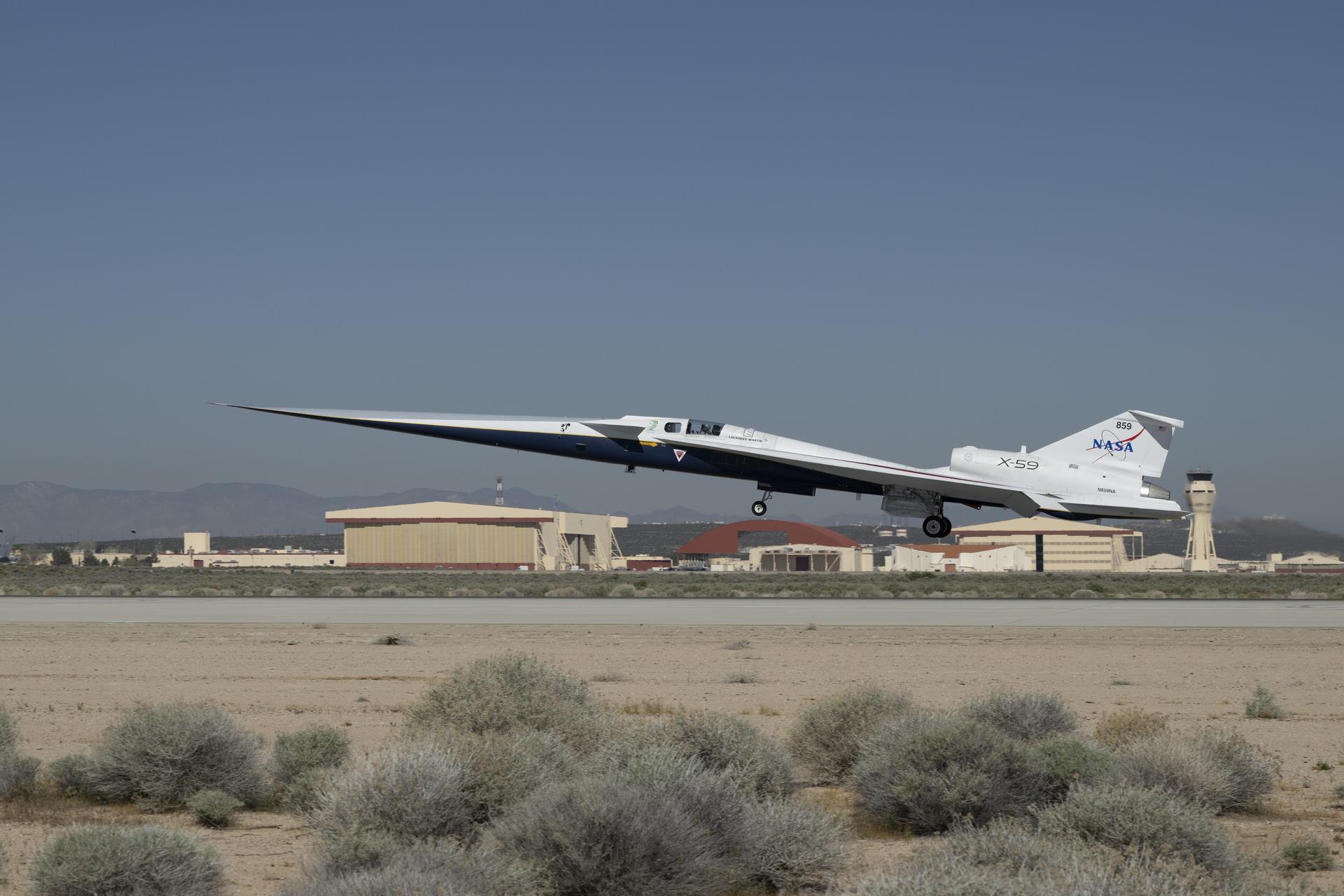
NASA’s X-59 quiet supersonic aircraft takes off for its second flight Friday, March 20, 2026, near NASA’s Armstrong Flight Research Center in Edwards, California. The X-59 is central to NASA’s Quesst mission, which aims to demonstrate quiet supersonic flight by reducing the loud sonic boom to a softer sonic “thump,” potentially enabling faster commercial air travel over land.
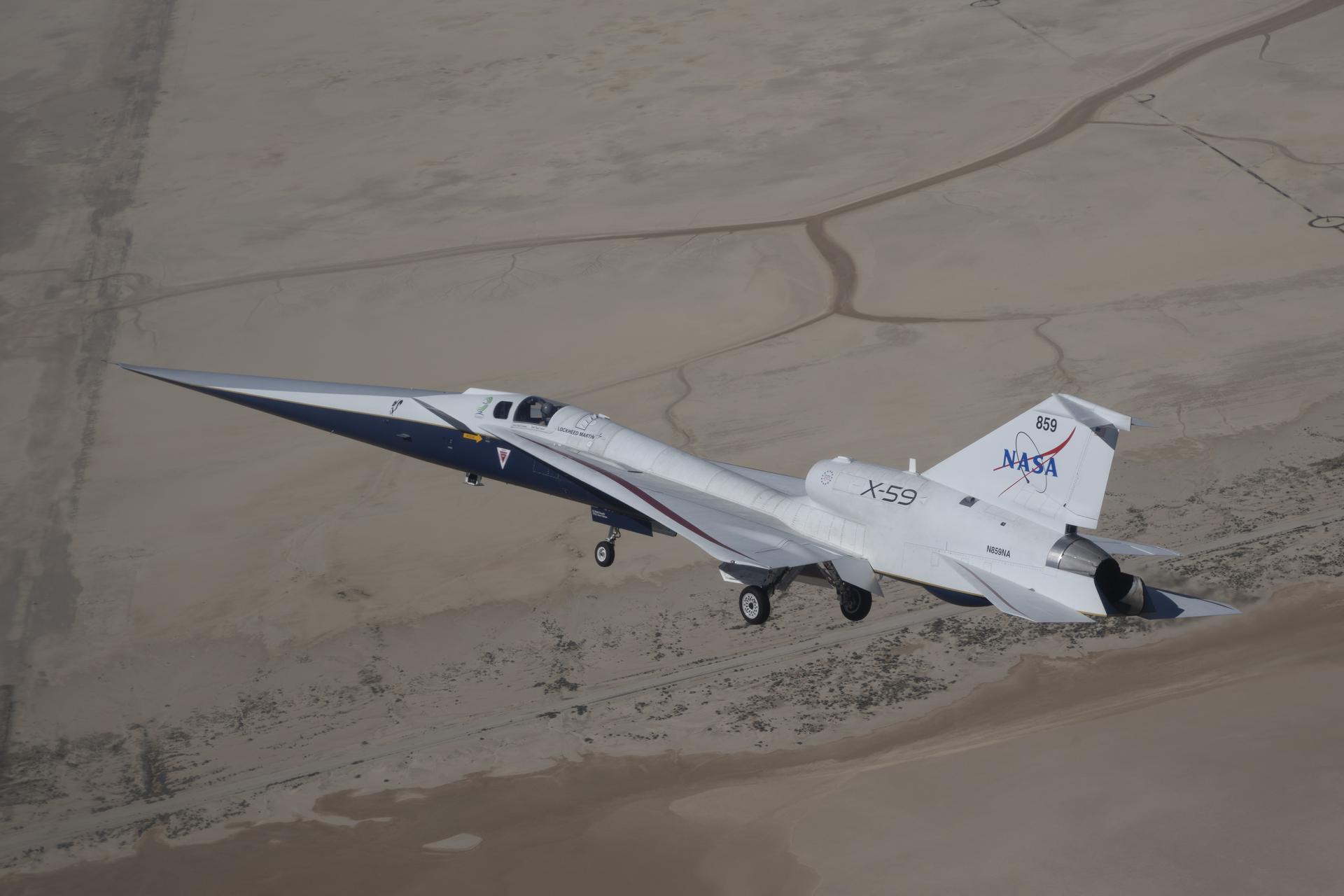
NASA’s X-59 quiet supersonic aircraft flies its second flight Friday, March 20, 2026, near NASA’s Armstrong Flight Research Center in Edwards, California. The X-59 is central to NASA’s Quesst mission, which aims to demonstrate quiet supersonic flight by reducing the loud sonic boom to a softer sonic “thump,” potentially enabling faster commercial air travel over land.
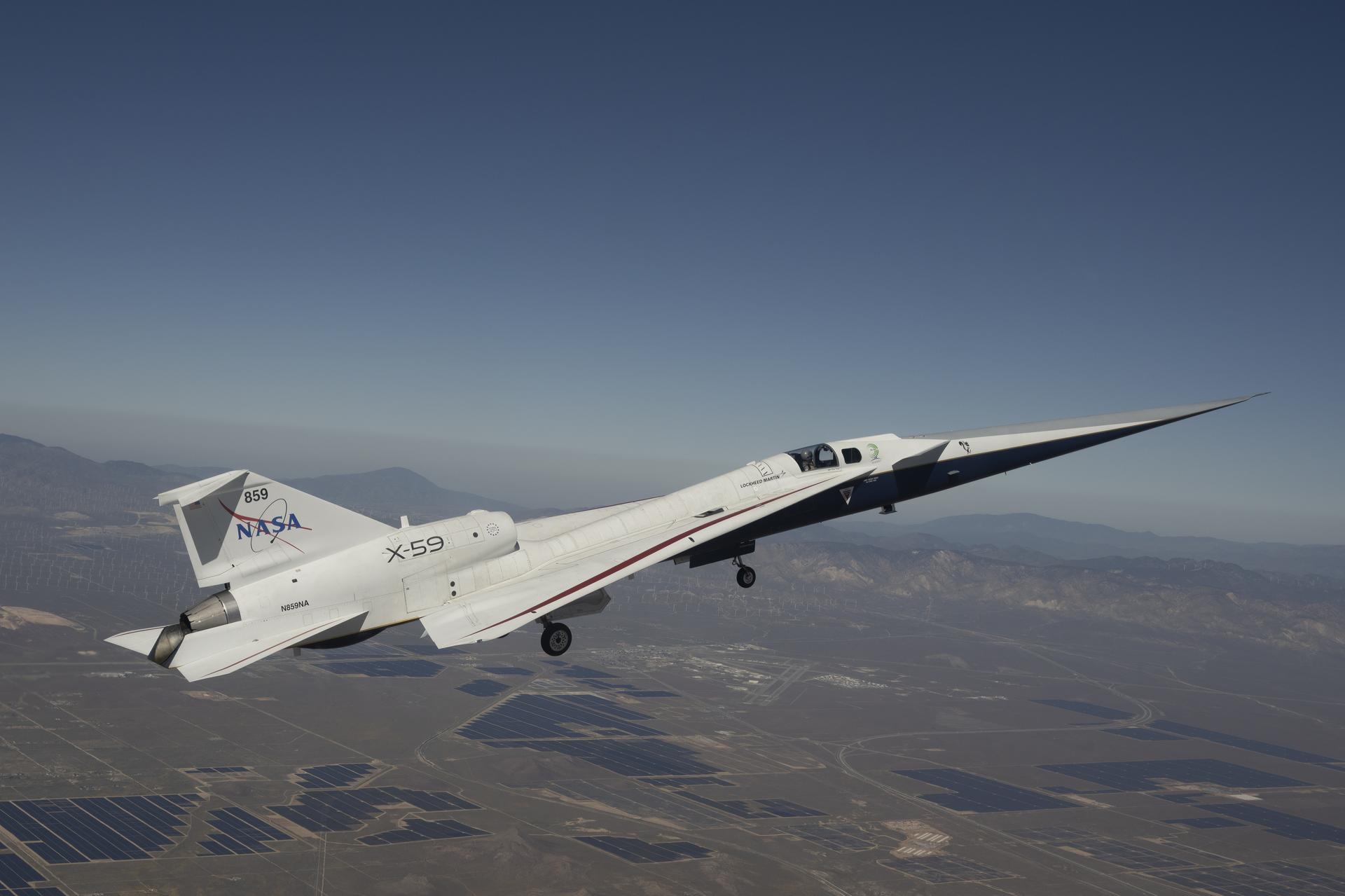
NASA’s X-59 quiet supersonic aircraft flies its second flight Friday, March 20, 2026, near NASA’s Armstrong Flight Research Center in Edwards, California. The X-59 is central to NASA’s Quesst mission, which aims to demonstrate quiet supersonic flight by reducing the loud sonic boom to a softer sonic “thump,” potentially enabling faster commercial air travel over land.
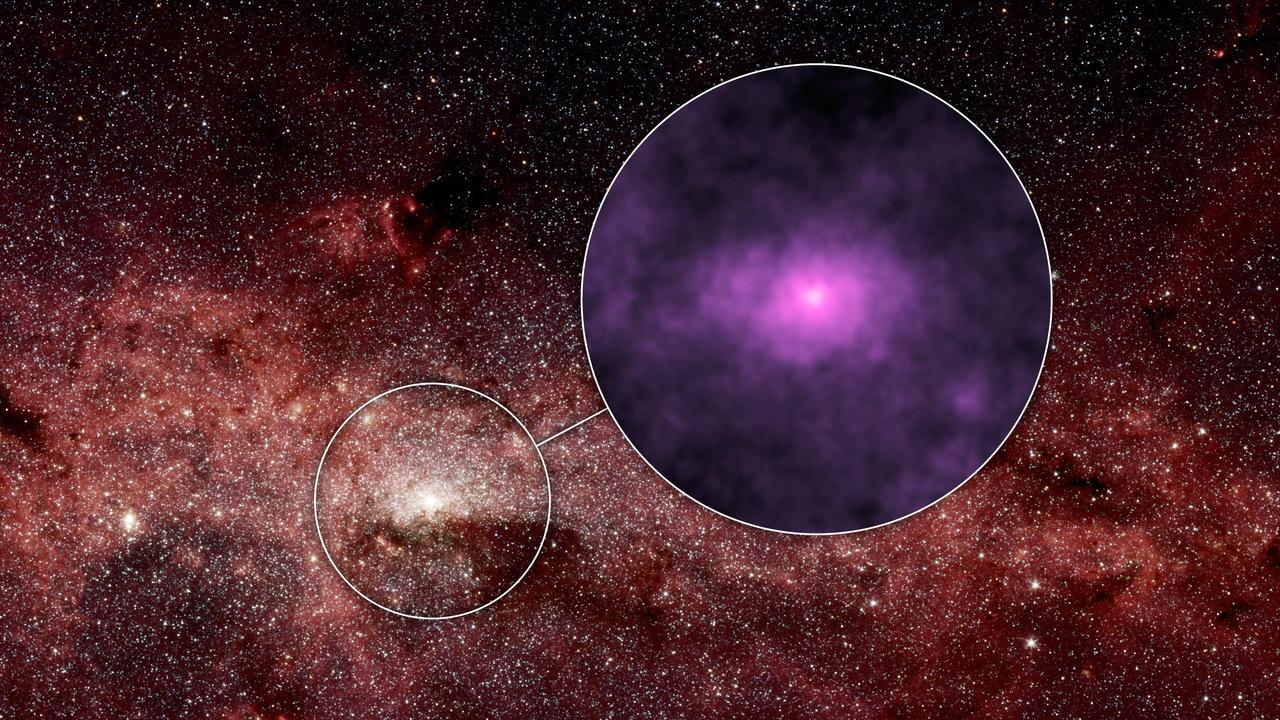
NASA's Nuclear Spectroscopic Telescope Array, or NuSTAR, has captured a new high-energy X-ray view (magenta, Figure 1) of the bustling center of our Milky Way galaxy. The smaller circle shows the area where the NuSTAR image was taken -- the very center of our galaxy, where a giant black hole resides. That region is enlarged to the right, in the larger circle, to show the NuSTAR data. The NuSTAR picture is one of the most detailed ever taken of the center of our galaxy in high-energy X-rays. The X-ray light, normally invisible to our eyes, has been assigned the color magenta. The brightest point of light near the center of the X-ray picture is coming from a spinning dead star, known as a pulsar, which is near the giant black hole. While the pulsar's X-ray emissions were known before, scientists were surprised to find more high-energy X-rays than predicted in the surrounding regions, seen here as the elliptical haze. Astronomers aren't sure what the sources of the extra X-rays are, but one possibility is a population of dead stars. The background picture was captured in infrared light by NASA's Spitzer Space Telescope. The NuSTAR image has an X-ray energy range of 20 to 40 kiloelectron volts. http://photojournal.jpl.nasa.gov/catalog/PIA19334
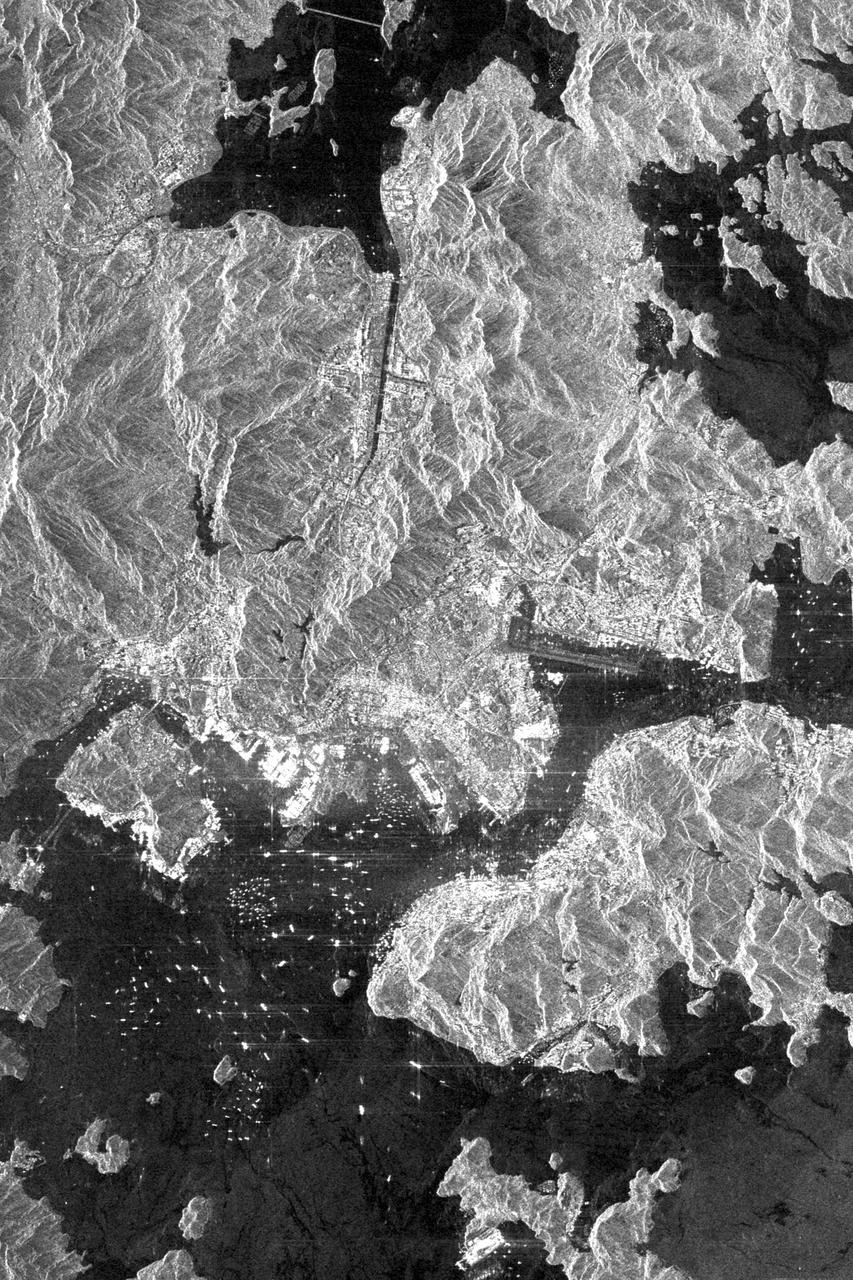
This is an X-SAR image spanning an area of approximately 20 kilometers by 40 kilometers (12 miles by 25 miles) of the island of Hong Kong, the Kowloon Peninsula and the new territories in southern China, taken by the imaging radar on board the space shuttle Endeavour on October 4, 1994. North is toward the top left corner of the image. The Kaitak Airport runway on Kowloon Peninsula (center right of image) was built on reclaimed land and extends almost 3 kilometers (nearly 2 miles) into Victoria Harbor. To the south of the harbor lies the island of Hong Kong. The bright areas around the harbor are the major residential and business districts. Housing more than six million residents, Hong Kong is the most densely populated area in the world. The large number of objects visible in the harbor and surrounding waters are a variety of sea-going vessels, anchored in one of the busiest seaports in the Far East. http://photojournal.jpl.nasa.gov/catalog/PIA01750
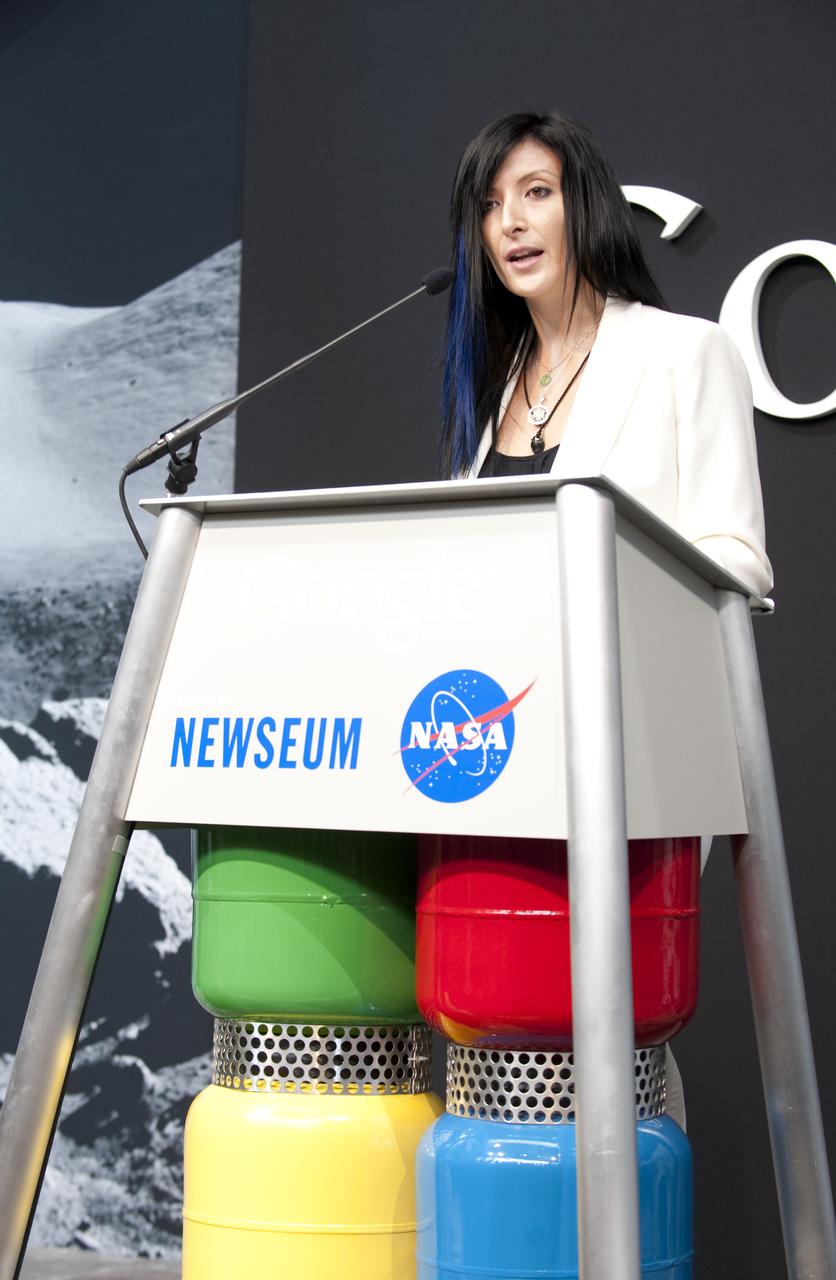
Tiffany Montague, Technical Program Manager for NASA and Google Lunar X PRIZE, Google, Inc., speaks during a press conference, Monday, July 20, 2009, announcing the launch of Moon in Google Earth, an immersive 3D atlas of the Moon, accessible within Google Earth 5.0, Monday, July 20, 2009, at the Newseum in Washington. Photo Credit: (NASA/Bill Ingalls)
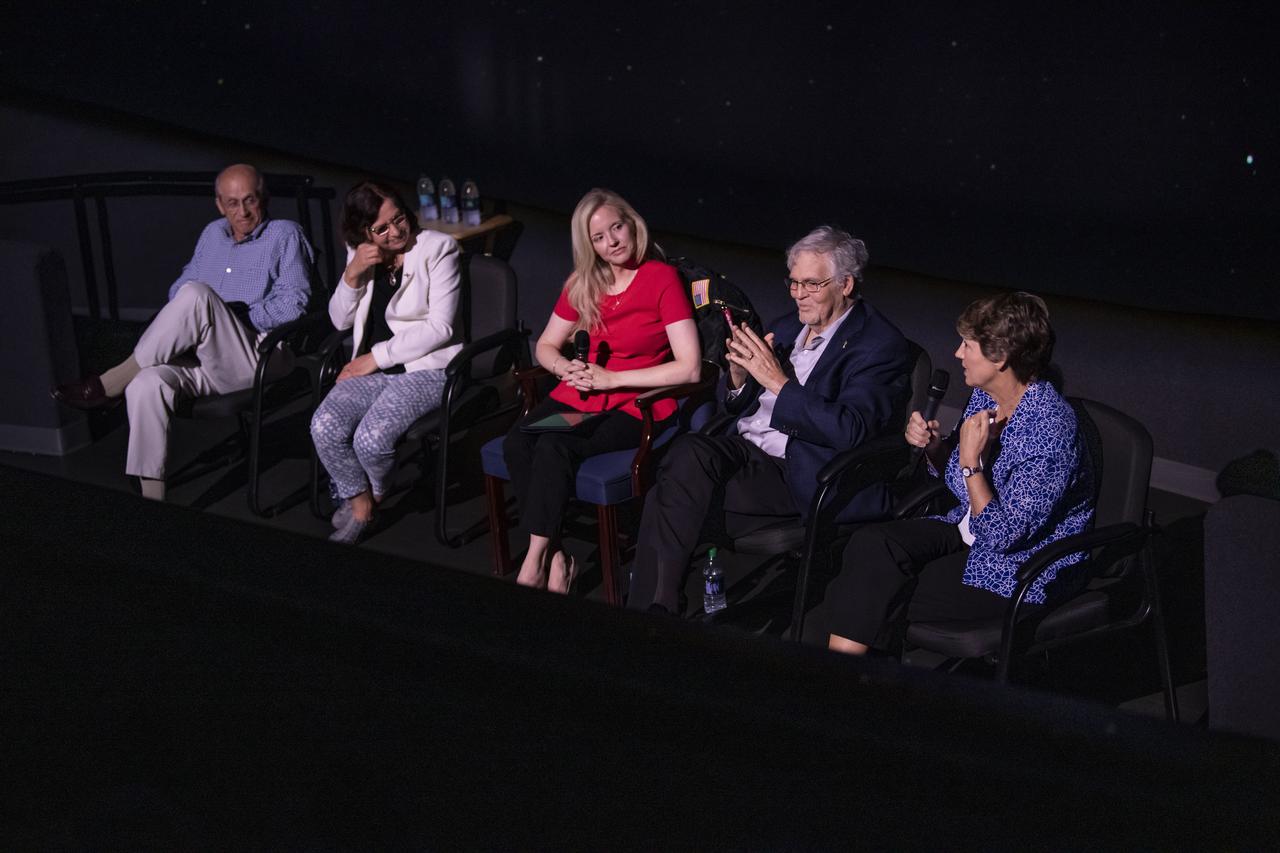
The 20th year of the Chandra X-ray Telescope was celebrated at the U.S. Space and Rocket Center's planetarium. The speakers were retired Astronaut Eileen Collins, Astrophysicist at the "Chandra X-ray Center Aneta Siemiginowska, "Senior Astrophysicist at the Chandra X-ray center Harvey Tananbaum, and Chandra Project Scientist Dr. Martin Weisskopf. The panel discussion was moderated by Kim Kowal Arcand, "Visualizaton Lead at the Chandra X-ray Center.

KENNEDY SPACE CENTER, FLA. -- In the VIP Lounge, Apollo/Saturn V Center, First Lady Hillary Rodham Clinton gets ready to speak to the group gathered there before the launch of STS-93. At right is NASA Administrator Daniel Goldin. Liftoff of Space Shuttle Columbia is scheduled for 12:36 a.m. EDT July 20. Much attention has been generated over the launch due to Commander Eileen M. Collins, the first woman to serve as commander of a Shuttle mission. The primary payload of the five-day mission is the Chandra X-ray Observatory, which will allow scientists from around the world to study some of the most distant, powerful and dynamic objects in the universe. The new telescope is 20 to 50 times more sensitive than any previous X-ray telescope and is expected to unlock the secrets of supernovae, quasars and black holes
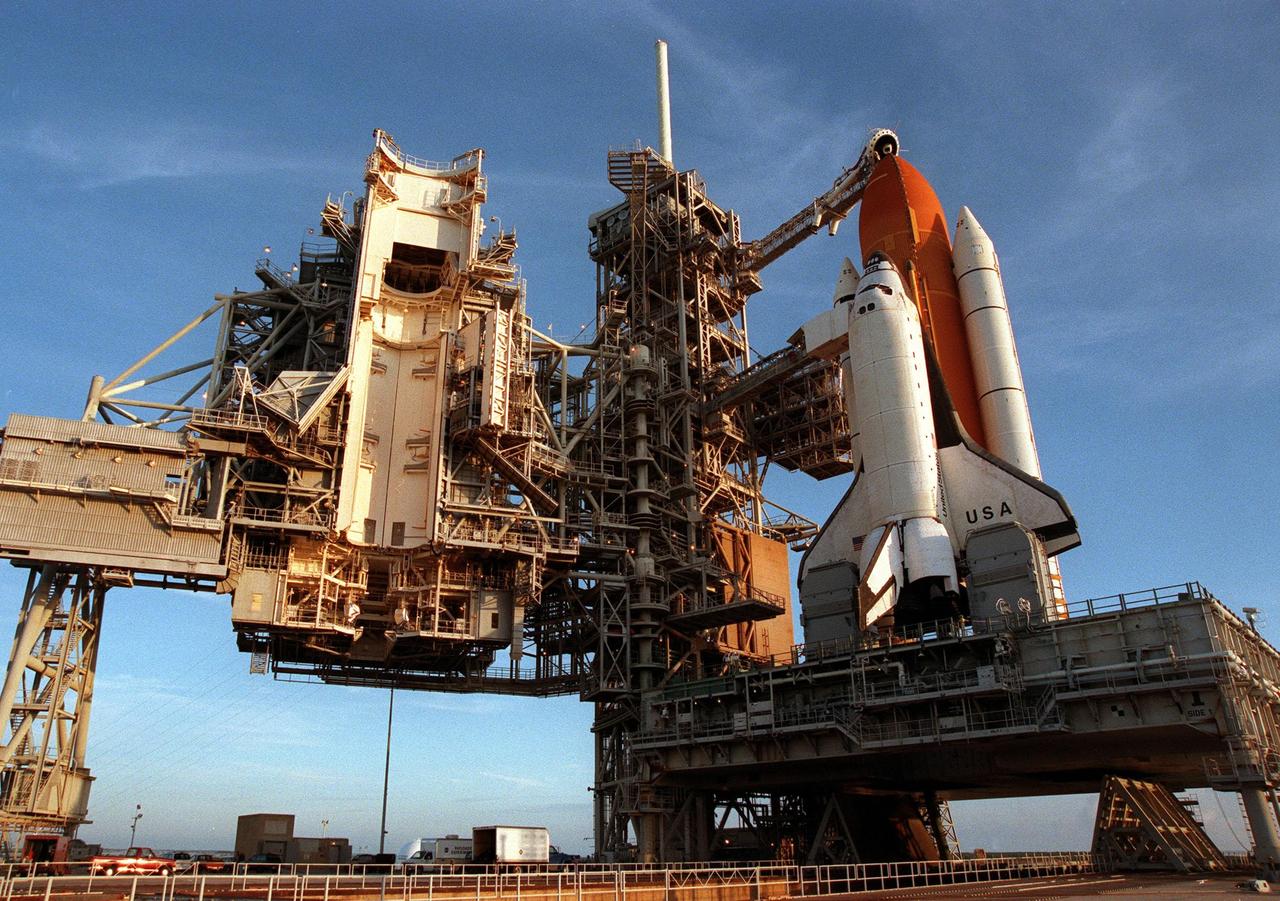
The rollback of the Rotating Service Structure on launch Pad 39-B reveals Space Shuttle Columbia on its mobile launcher platform, waiting for the launch of mission STS-93 on July 20 at 12:36 a.m. EDT. The primary payload of STS-93 is the Chandra X-ray Observatory, which will allow scientists from around the world to study some of the most distant, powerful and dynamic objects in the universe. The new telescope is 20 to 50 times more sensitive than any previous X-ray telescope and is expected unlock the secrets of supernovae, quasars and black holes. The STS-93 crew numbers five: Commander Eileen M. Collins, Pilot Jeffrey S. Ashby, and Mission Specialists Steven A. Hawley (Ph.D.), Catherine G. Coleman (Ph.D.) and Michel Tognini of France, with the Centre National d'Etudes Spatiales (CNES). Collins is the first woman to serve as commander of a shuttle mission
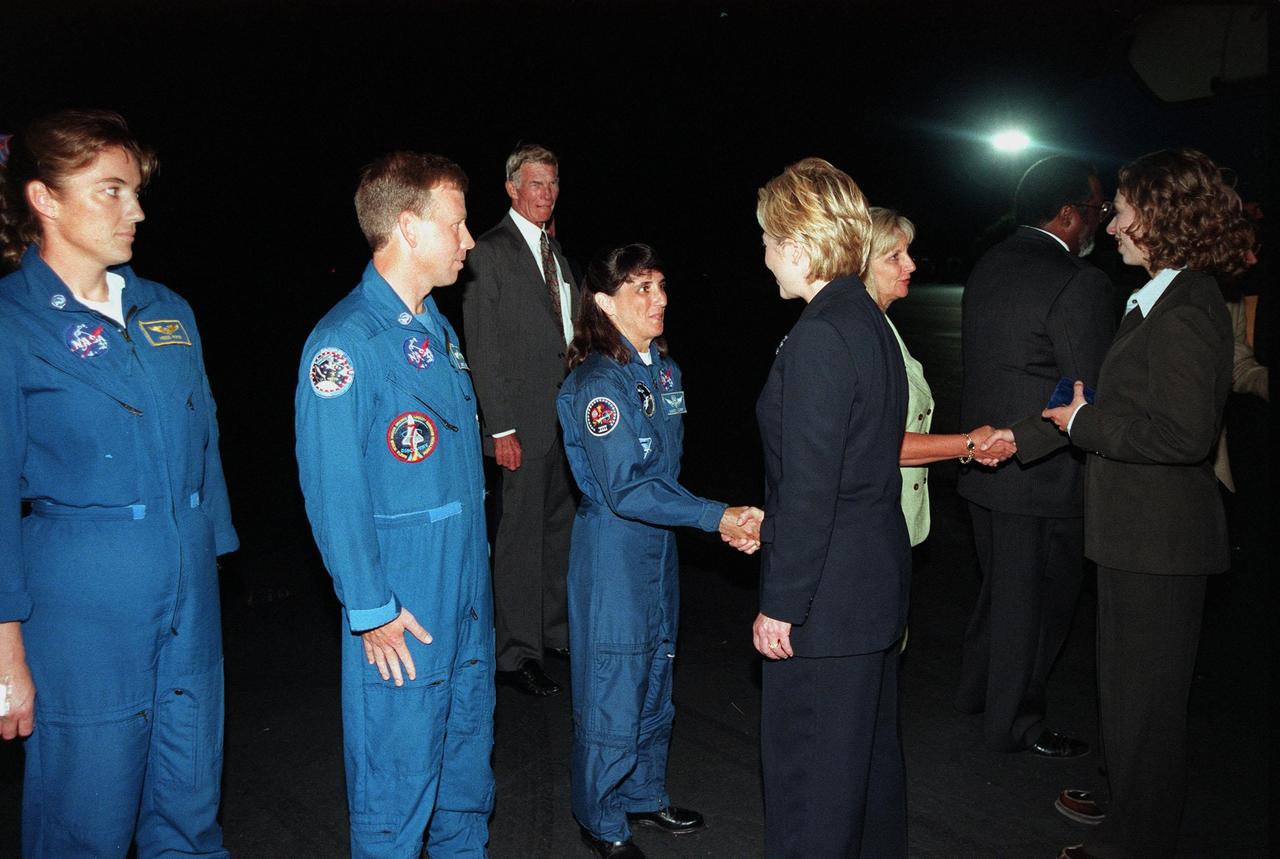
First Lady Hillary Rodham Clinton is greeted by Astronaut Nancy Jane Currie upon Mrs. Clinton's arrival at the Skid Strip at Cape Canaveral Air Station. Waiting at left are Astronauts Heidemarie M. Stefanyshyn-Piper and Steven W. Lindsey. Mrs. Clinton and her daughter, Chelsea (far right) are here to view the launch of Space Shuttle mission STS-93, scheduled for 12:36 a.m. EDT July 20. Much attention has been generated over the launch due to Commander Eileen M. Collins, the first woman to serve as commander of a Shuttle mission. The primary payload of the five-day mission is the Chandra X-ray Observatory, which will allow scientists from around the world to study some of the most distant, powerful and dynamic objects in the universe. The new telescope is 20 to 50 times more sensitive than any previous X-ray telescope and is expected to unlock the secrets of supernovae, quasars and black holes
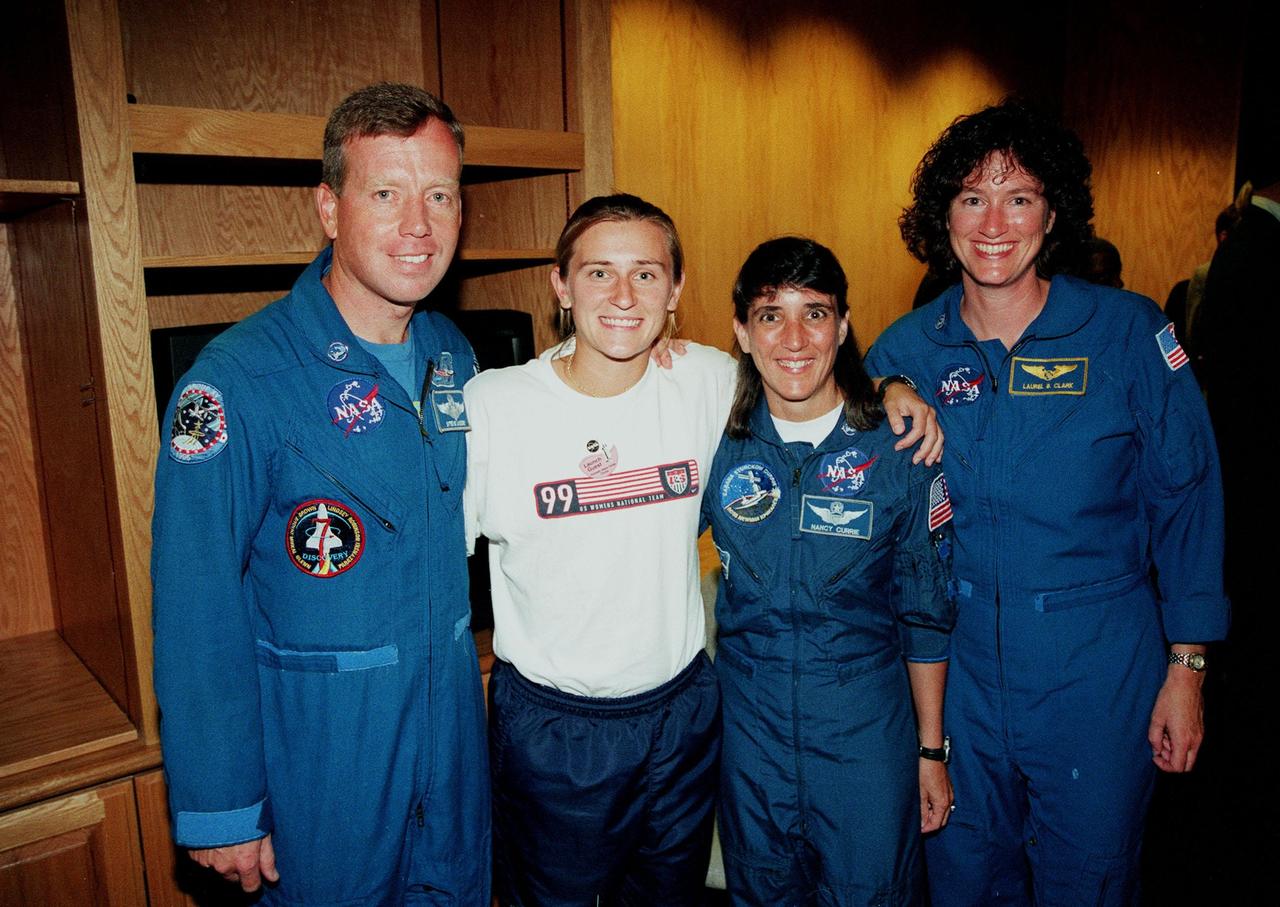
A member of the U.S. Women's World Cup Soccer Team poses with Astronauts (from left) Steven W. Lindsey, Nancy Jane Currie and Laurel B. Clark. The team arrived at the Skid Strip at Cape Canaveral Air Station with First Lady Hillary Rodham Clinton to view the launch of Space Shuttle mission STS-93. Liftoff is scheduled for 12:36 a.m. EDT July 20. Much attention has been generated over the launch due to Commander Eileen M. Collins, the first woman to serve as commander of a Shuttle mission. The primary payload of the five-day mission is the Chandra X-ray Observatory, which will allow scientists from around the world to study some of the most distant, powerful and dynamic objects in the universe. The new telescope is 20 to 50 times more sensitive than any previous X-ray telescope and is expected to unlock the secrets of supernovae, quasars and black holes

A member of the U.S. Women's World Cup Soccer Team is greeted by NASA Astronaut Scott E. Parazynski (left) upon her arrival at the Skid Strip at Cape Canaveral Air Station as her teammates look on. The team is at KSC to view the launch of Space Shuttle mission STS-93 scheduled for liftoff at 12:36 a.m. EDT July 20. Much attention has been generated over the launch due to Commander Eileen M. Collins, the first woman to serve as commander of a Shuttle mission. The primary payload of the five-day mission is the Chandra X-ray Observatory, which will allow scientists from around the world to study some of the most distant, powerful and dynamic objects in the universe. The new telescope is 20 to 50 times more sensitive than any previous X-ray telescope and is expected to unlock the secrets of supernovae, quasars and black holes

Among those gathered at the VIP viewing site for the launch of STS-93 are First Lady Hillary Rodham Clinton (center) and Donna Shalala, secretary , Department of Health and Human Services (far right). Also present is Chelsea Clinton. Much attention has been generated over the launch due to Commander Eileen M. Collins, the first woman to serve as commander of a Shuttle mission. The primary payload of the five-day mission is the Chandra X-ray Observatory, which will allow scientists from around the world to study some of the most distant, powerful and dynamic objects in the universe. The new telescope is 20 to 50 times more sensitive than any previous X-ray telescope and is expected to unlock the secrets of supernovae, quasars and black holes. Liftoff of Space Shuttle Columbia is scheduled for 12:36 a.m. EDT July 20
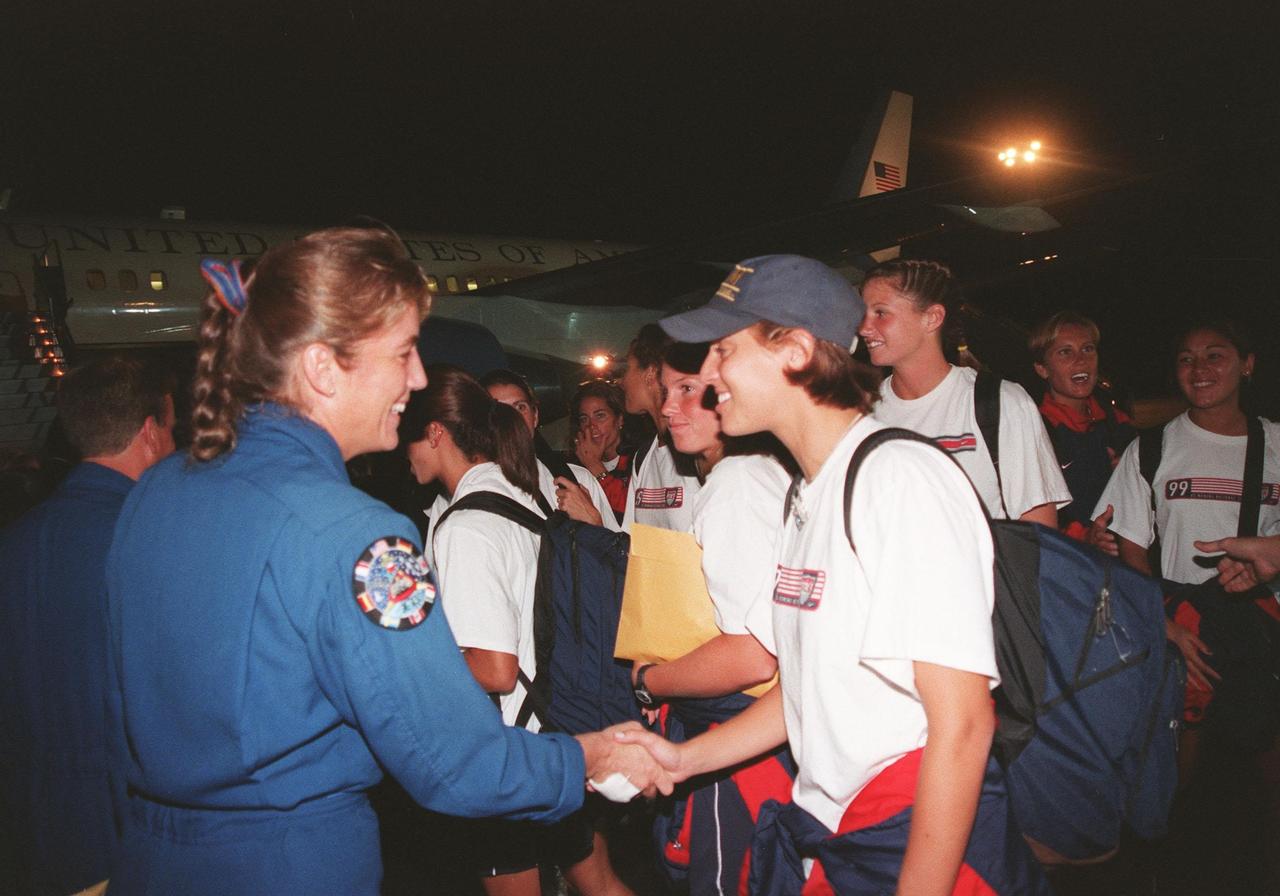
A member of the U.S. Women's World Cup Soccer Team is greeted by NASA Astronaut Heidemarie M. Stefanyshyn-Piper (left) upon her arrival at the Skid Strip at Cape Canaveral Air Station to view the launch of Space Shuttle mission STS-93. Liftoff is scheduled for 12:36 a.m. EDT July 20. Much attention has been generated over the launch due to Commander Eileen M. Collins, the first woman to serve as commander of a Shuttle mission. The primary payload of the five-day mission is the Chandra X-ray Observatory, which will allow scientists from around the world to study some of the most distant, powerful and dynamic objects in the universe. The new telescope is 20 to 50 times more sensitive than any previous X-ray telescope and is expected to unlock the secrets of supernovae, quasars and black holes
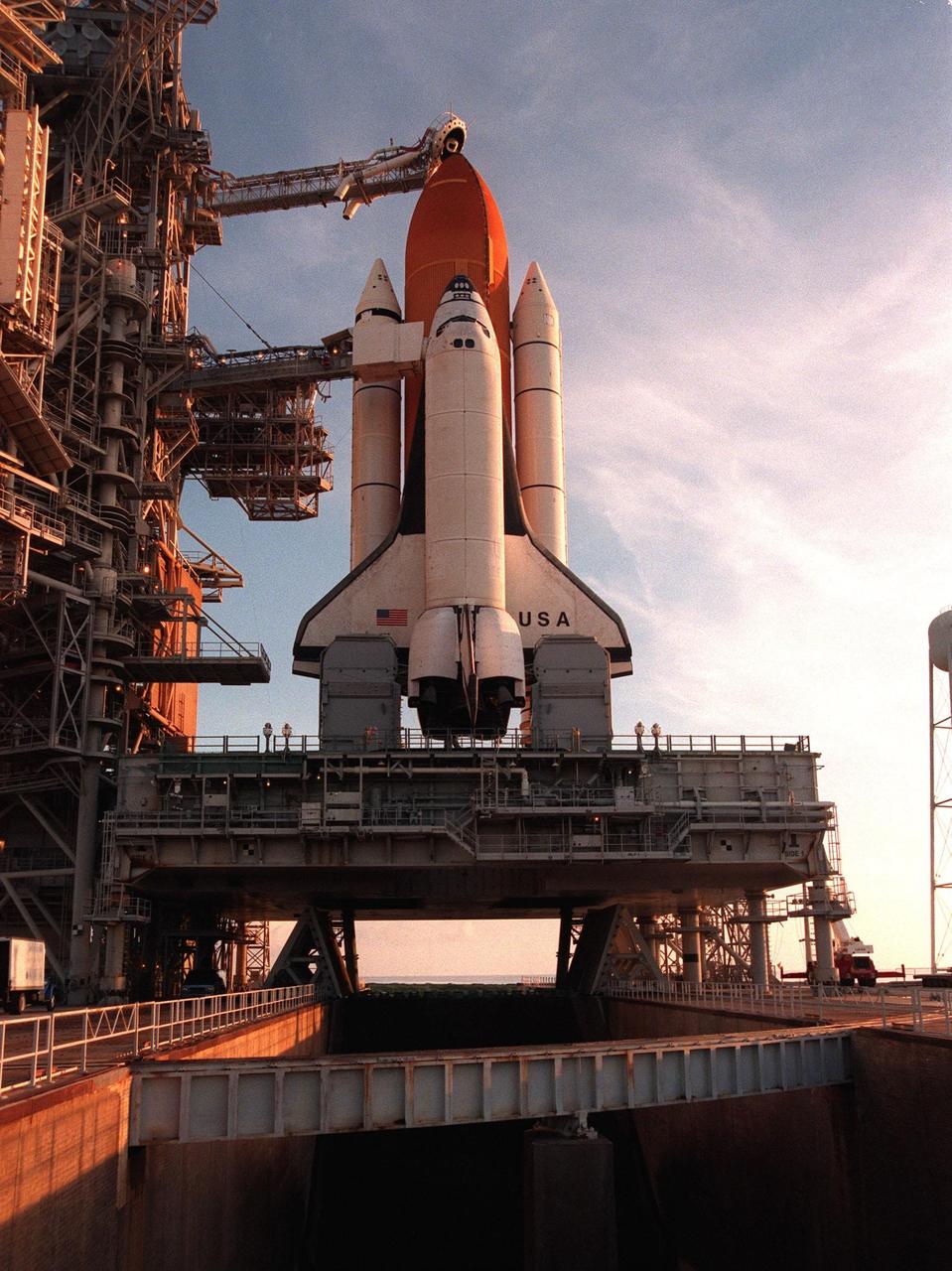
Space Shuttle Columbia, sitting on its mobile launcher platform, is framed against the early morning sky after the rollback of the Rotating Service Structure on Launch Pad 39-B. Columbia waits for the launch of mission STS-93 July 20 at 12:36 a.m. EDT. The primary payload of STS-93 is the Chandra X-ray Observatory, which will allow scientists from around the world to study some of the most distant, powerful and dynamic objects in the universe. The new telescope is 20 to 50 times more sensitive than any previous X-ray telescope and is expected unlock the secrets of supernovae, quasars and black holes. The STS-93 crew numbers five: Commander Eileen M. Collins, Pilot Jeffrey S. Ashby, and Mission Specialists Steven A. Hawley (Ph.D.), Catherine G. Coleman (Ph.D.) and Michel Tognini of France, with the Centre National d'Etudes Spatiales (CNES). Collins is the first woman to serve as commander of a shuttle mission
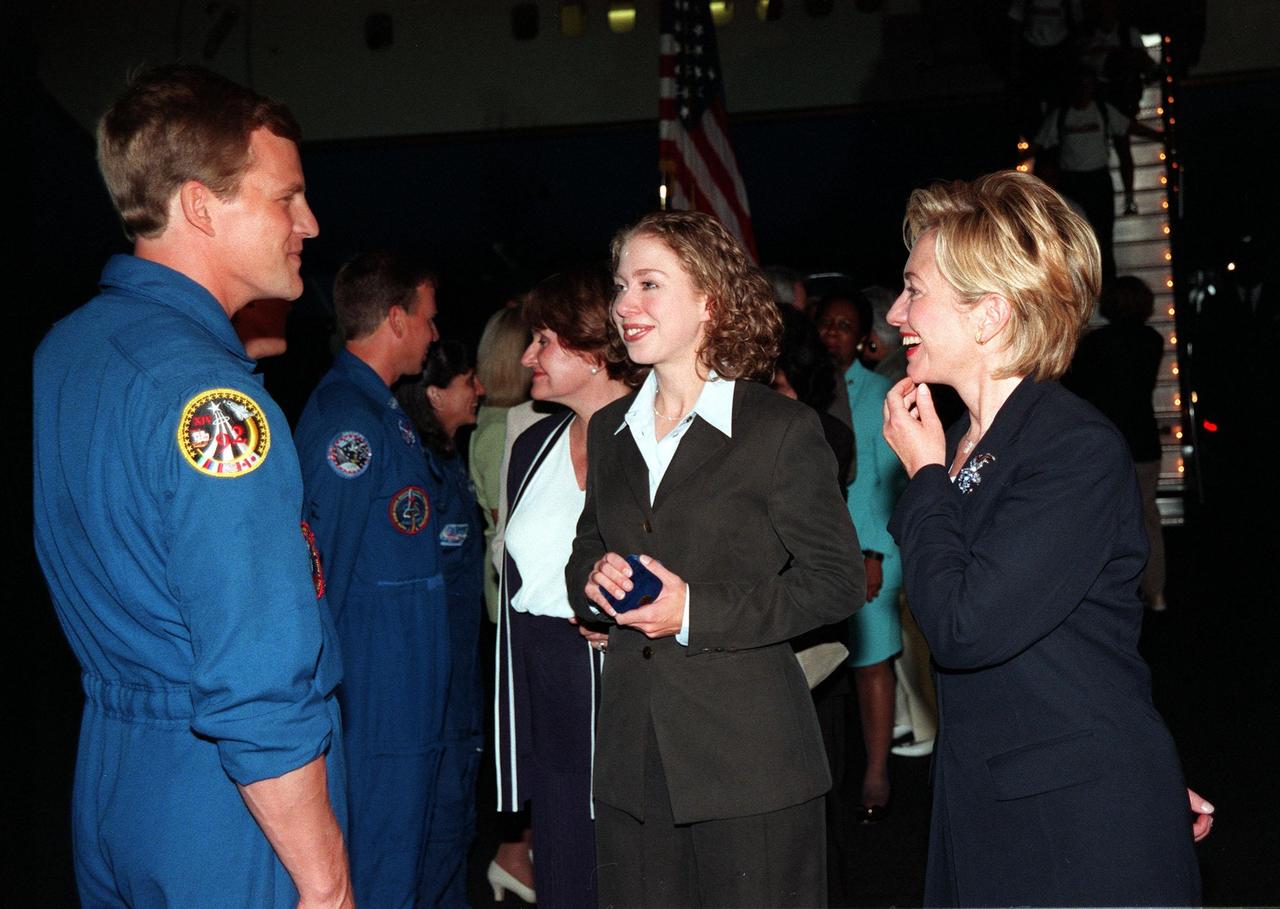
First Lady Hillary Rodham Clinton (right) and her daughter, Chelsea, are greeted by NASA Astronaut Scott E. Parazynski (left) upon their arrival at the Skid Strip at Cape Canaveral Air Station to view the launch of Space Shuttle mission STS-93. Liftoff is scheduled for 12:36 a.m. EDT July 20. Much attention has been generated over the launch due to Commander Eileen M. Collins, the first woman to serve as commander of a Shuttle mission. The primary payload of the five-day mission is the Chandra X-ray Observatory, which will allow scientists from around the world to study some of the most distant, powerful and dynamic objects in the universe. The new telescope is 20 to 50 times more sensitive than any previous X-ray telescope and is expected to unlock the secrets of supernovae, quasars and black holes
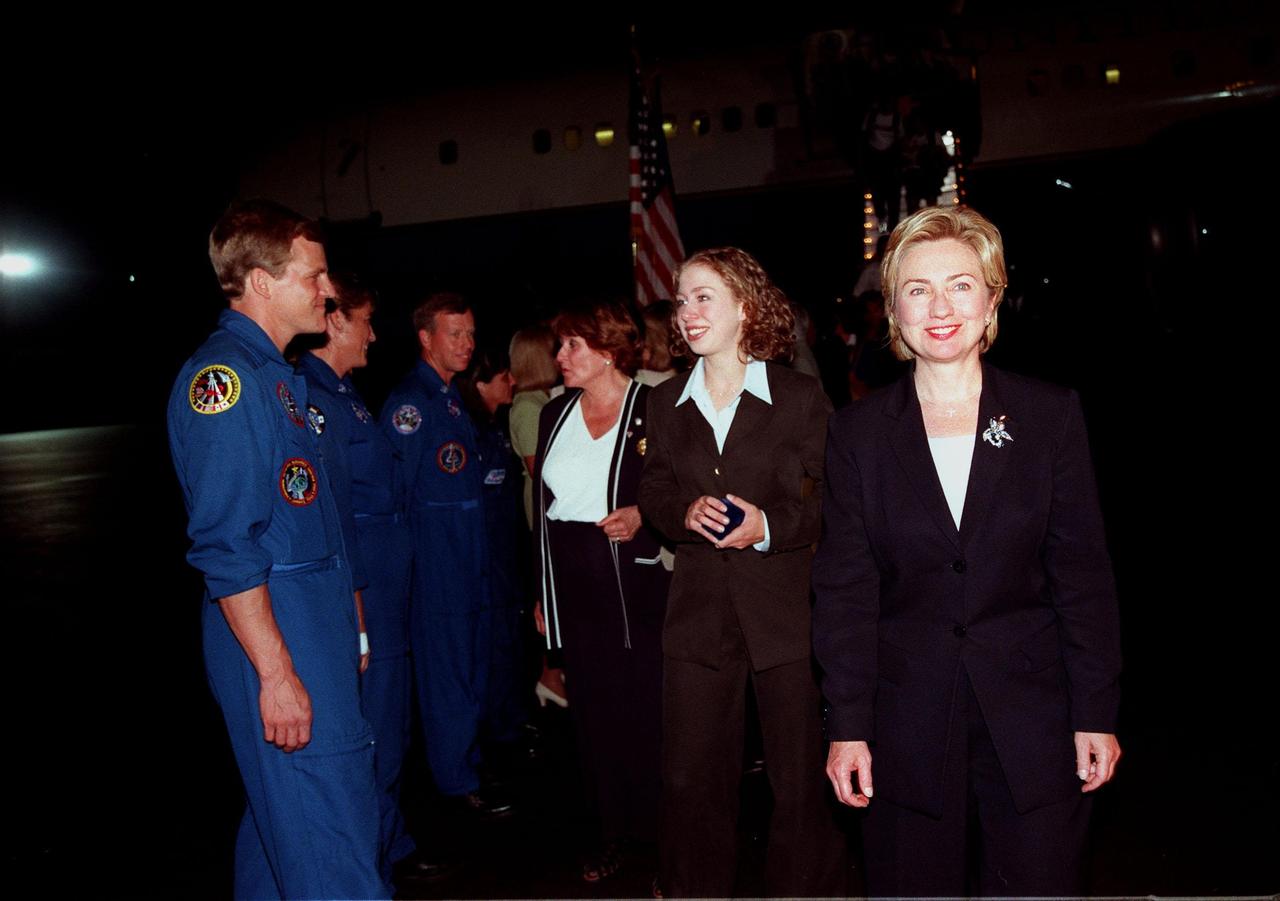
First Lady Hillary Rodham Clinton (right) and her daughter, Chelsea, are greeted by NASA Astronaut Scott E. Parazynski (left) upon their arrival at the Skid Strip at Cape Canaveral Air Station to view the launch of Space Shuttle mission STS-93. Liftoff is scheduled for 12:36 a.m. EDT July 20. Much attention has been generated over the launch due to Commander Eileen M. Collins, the first woman to serve as commander of a Shuttle mission. The primary payload of the five-day mission is the Chandra X-ray Observatory, which will allow scientists from around the world to study some of the most distant, powerful and dynamic objects in the universe. The new telescope is 20 to 50 times more sensitive than any previous X-ray telescope and is expected to unlock the secrets of supernovae, quasars and black holes
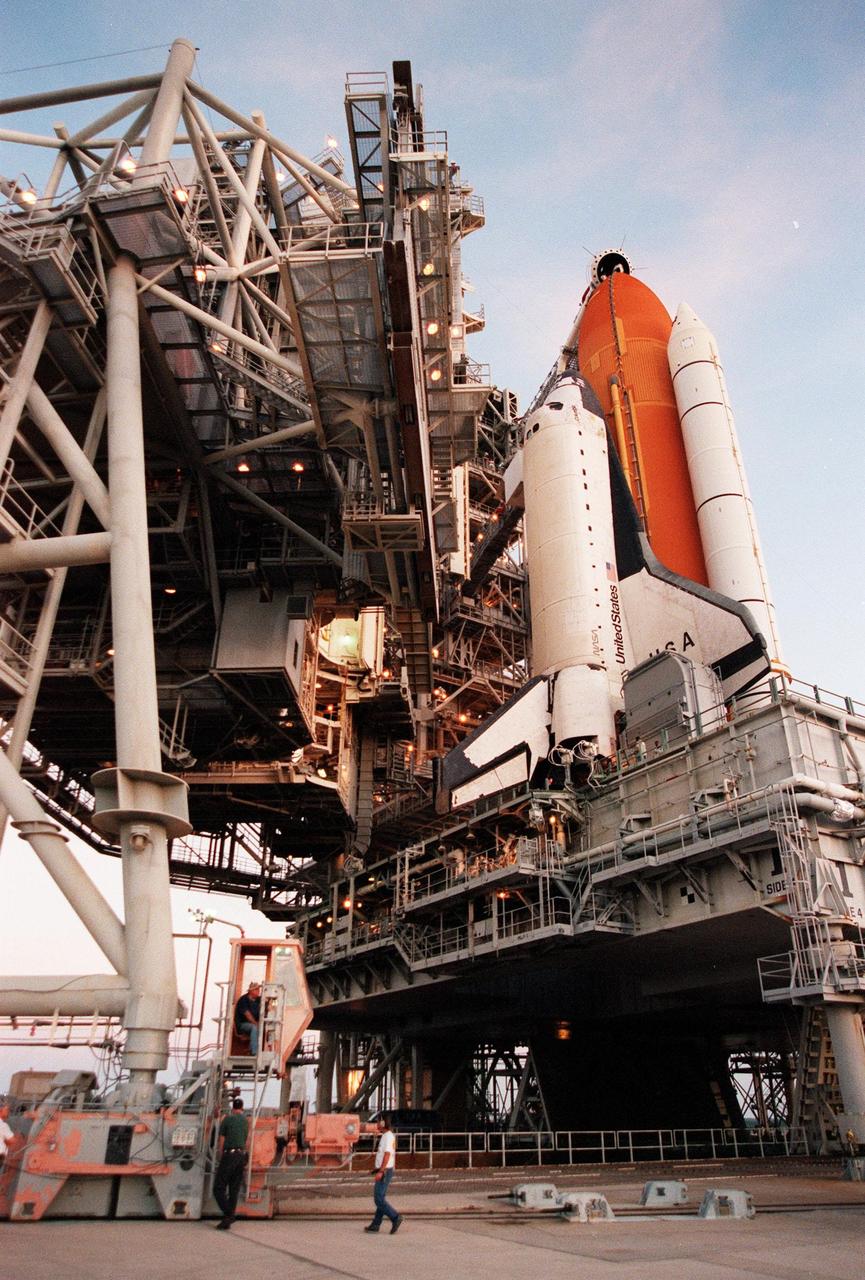
The Rotating Service Structure is rolled back from Space Shuttle Columbia on Launch Pad 39-B, in preparation for launch of mission STS-93 July 20 at 12:36 a.m. EDT. The primary payload of STS-93 is the Chandra X-ray Observatory, which will allow scientists from around the world to study some of the most distant, powerful and dynamic objects in the universe. The new telescope is 20 to 50 times more sensitive than any previous X-ray telescope and is expected unlock the secrets of supernovae, quasars and black holes. The STS-93 crew numbers five: Commander Eileen M. Collins, Pilot Jeffrey S. Ashby, and Mission Specialists Steven A. Hawley (Ph.D.), Catherine G. Coleman (Ph.D.) and Michel Tognini of France, with the Centre National d'Etudes Spatiales (CNES). Collins is the first woman to serve as commander of a shuttle mission
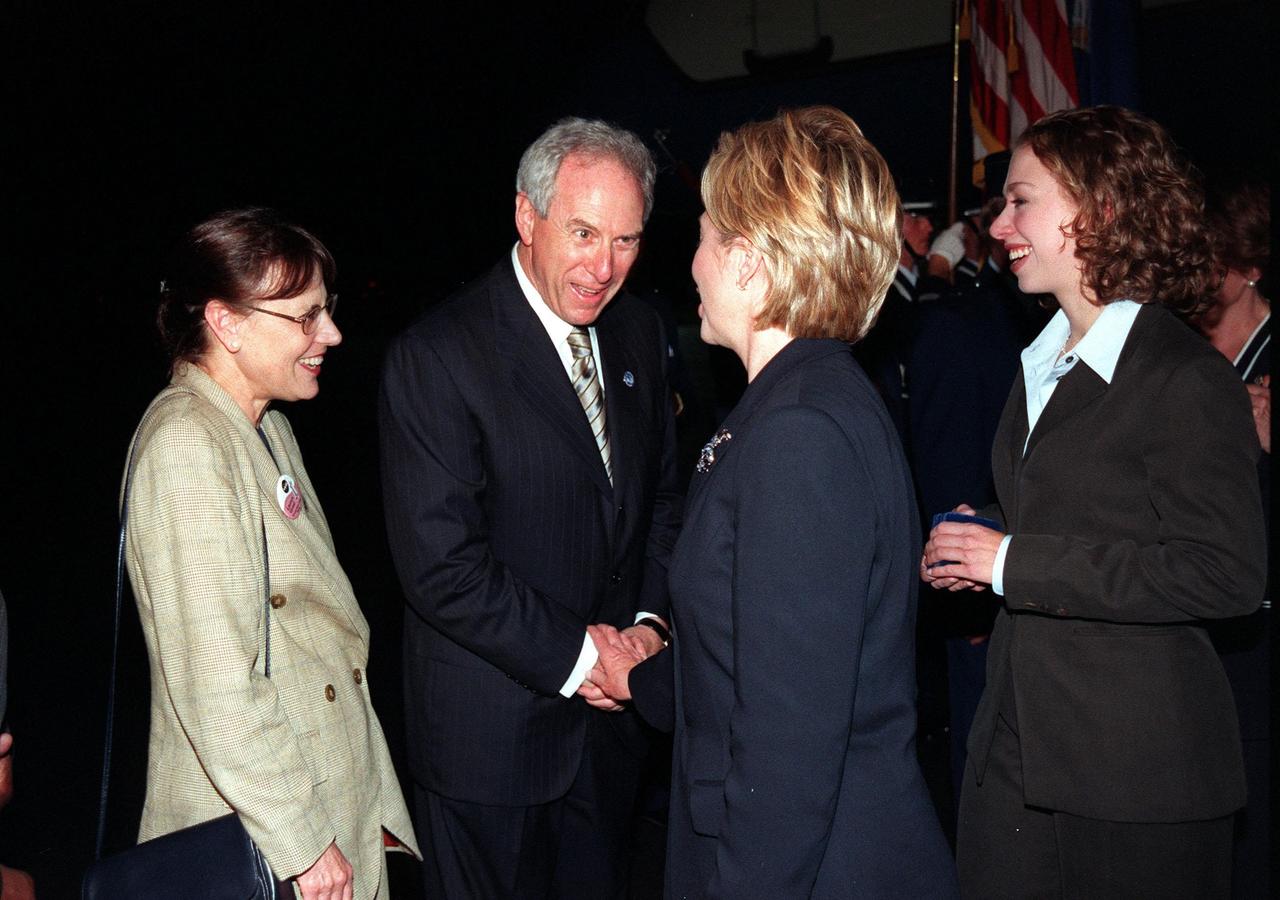
Upon their arrival at the Skid Strip at Cape Canaveral Air Station, First Lady Hillary Rodham Clinton and her daughter, Chelsea, are greeted by NASA Administrator Daniel S. Goldin and Mrs. Goldin. Mrs. Clinton and Chelsea are here to view the launch of Space Shuttle mission STS-93, scheduled for 12:36 a.m. EDT July 20. Much attention has been generated over the launch due to Commander Eileen M. Collins, the first woman to serve as commander of a Shuttle mission. The primary payload of the five-day mission is the Chandra X-ray Observatory, which will allow scientists from around the world to study some of the most distant, powerful and dynamic objects in the universe. The new telescope is 20 to 50 times more sensitive than any previous X-ray telescope and is expected to unlock the secrets of supernovae, quasars and black holes
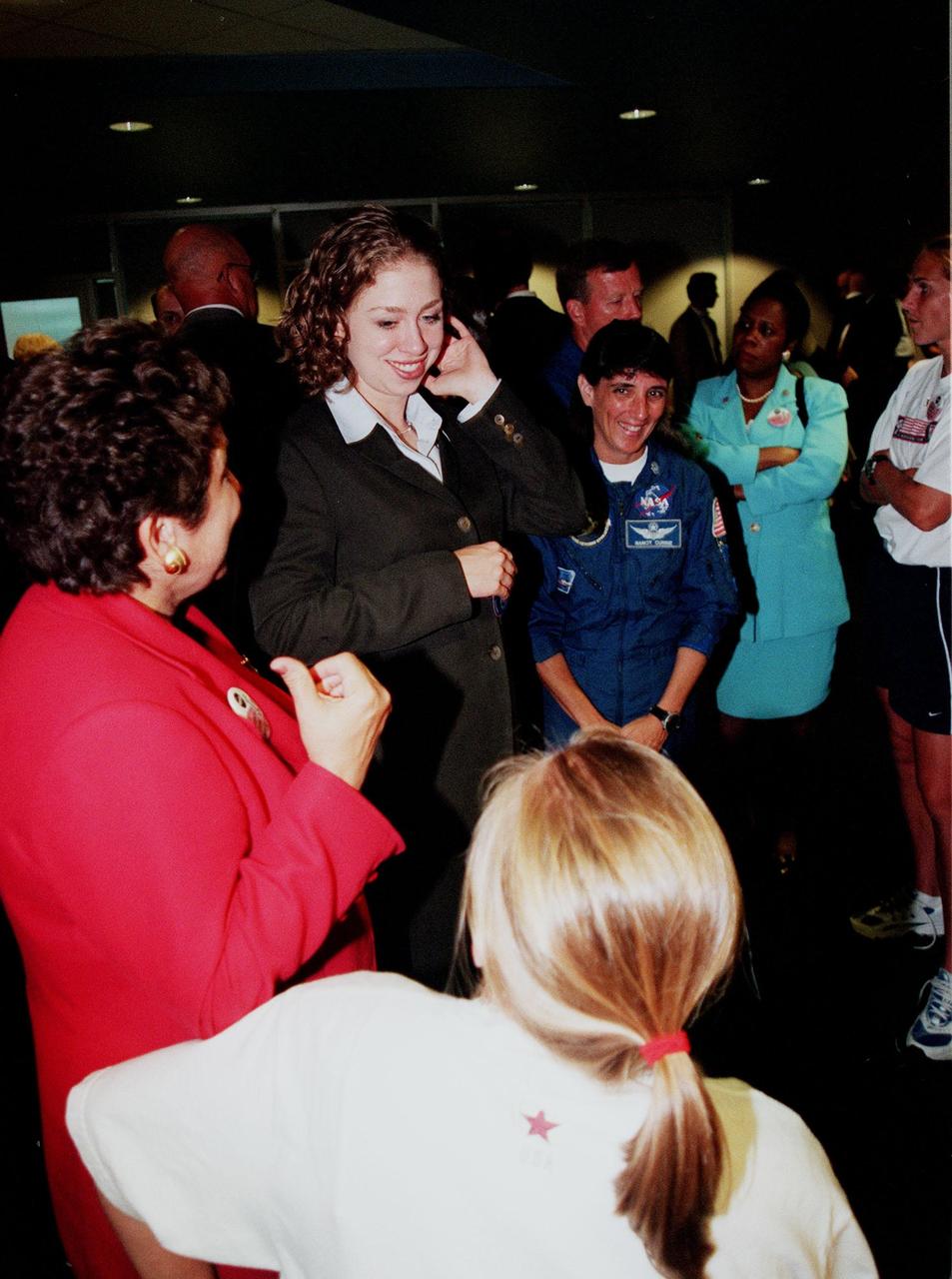
Generating her own attention waiting for the launch of STS-93 at the VIP viewing site is Chelsea Clinton, daughter of the President and Mrs. Clinton. The First Lady and Chelsea arrived earlier to view the launch. Much attention has been generated over STS-93 due to Commander Eileen M. Collins, the first woman to serve as commander of a Shuttle mission. The primary payload of the five-day mission is the Chandra X-ray Observatory, which will allow scientists from around the world to study some of the most distant, powerful and dynamic objects in the universe. The new telescope is 20 to 50 times more sensitive than any previous X-ray telescope and is expected to unlock the secrets of supernovae, quasars and black holes. Liftoff of Space Shuttle Columbia is scheduled for 12:36 a.m. EDT July 20
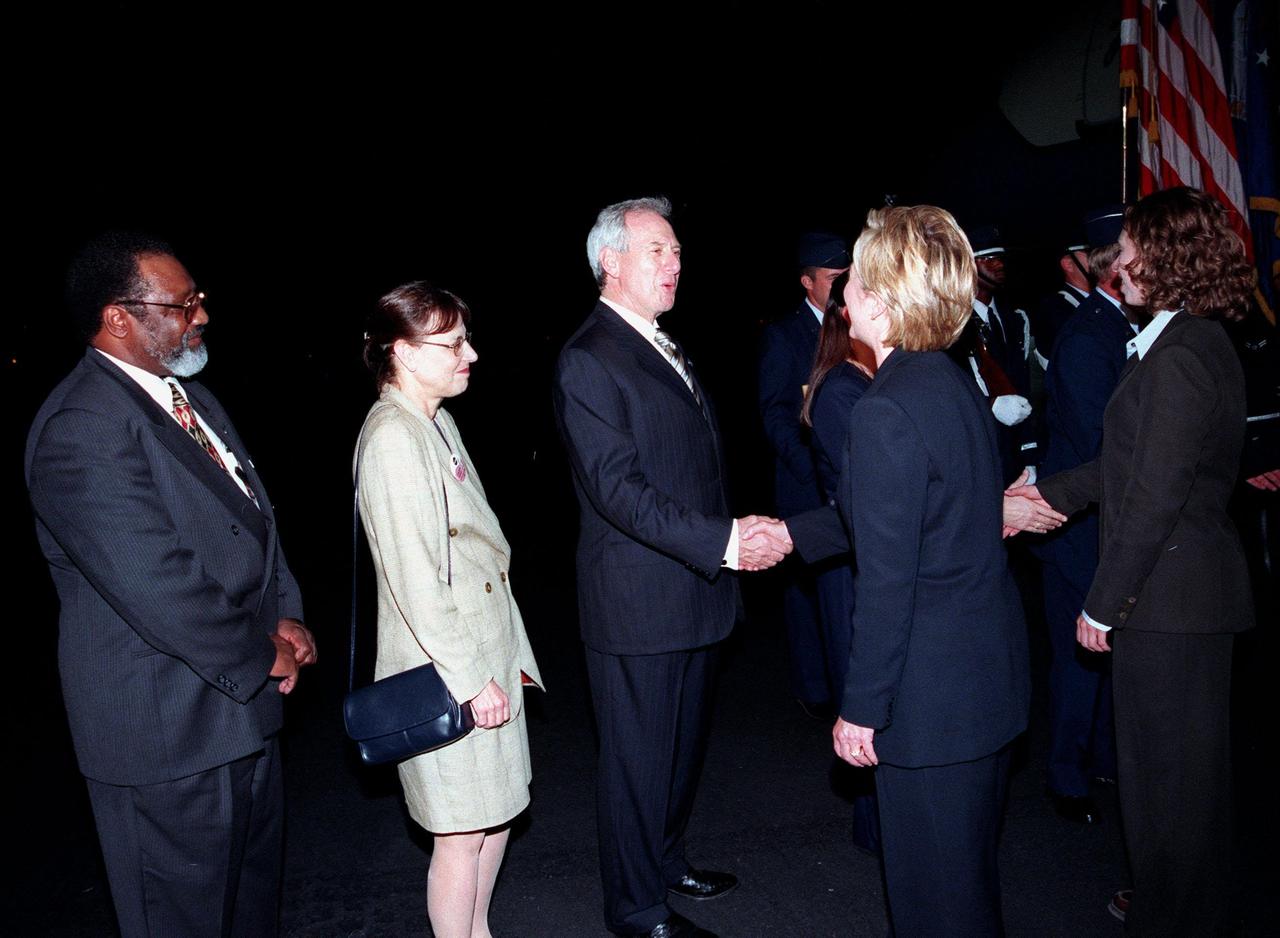
First Lady Hillary Rodham Clinton and her daughter, Chelsea, are greeted by NASA Administrator Daniel S. Goldin upon their arrival at the Skid Strip at Cape Canaveral Air Station. Next to Gold are (from left) Deputy Director for Business Operations Jim Jennings and Mrs. Goldin. Mrs. Clinton and Chelsea are here to view the launch of Space Shuttle mission STS-93, scheduled for 12:36 a.m. EDT July 20. Much attention has been generated over the launch due to Commander Eileen M. Collins, the first woman to serve as commander of a Shuttle mission. The primary payload of the five-day mission is the Chandra X-ray Observatory, which will allow scientists from around the world to study some of the most distant, powerful and dynamic objects in the universe. The new telescope is 20 to 50 times more sensitive than any previous X-ray telescope and is expected to unlock the secrets of supernovae, quasars and black holes

KENNEDY SPACE CENTER, FLA. -- At the Apollo/Saturn V Center, NASA Administrator Daniel Goldin (right) chats with First Lady Hillary Rodham Clinton and others while waiting for the launch of STS-93. Much attention has been generated over STS-93 due to Commander Eileen M. Collins, the first woman to serve as commander of a Shuttle mission. The primary payload of the five-day mission is the Chandra X-ray Observatory, which will allow scientists from around the world to study some of the most distant, powerful and dynamic objects in the universe. The new telescope is 20 to 50 times more sensitive than any previous X-ray telescope and is expected to unlock the secrets of supernovae, quasars and black holes. Liftoff of Space Shuttle Columbia is scheduled for 12:36 a.m. EDT July 20
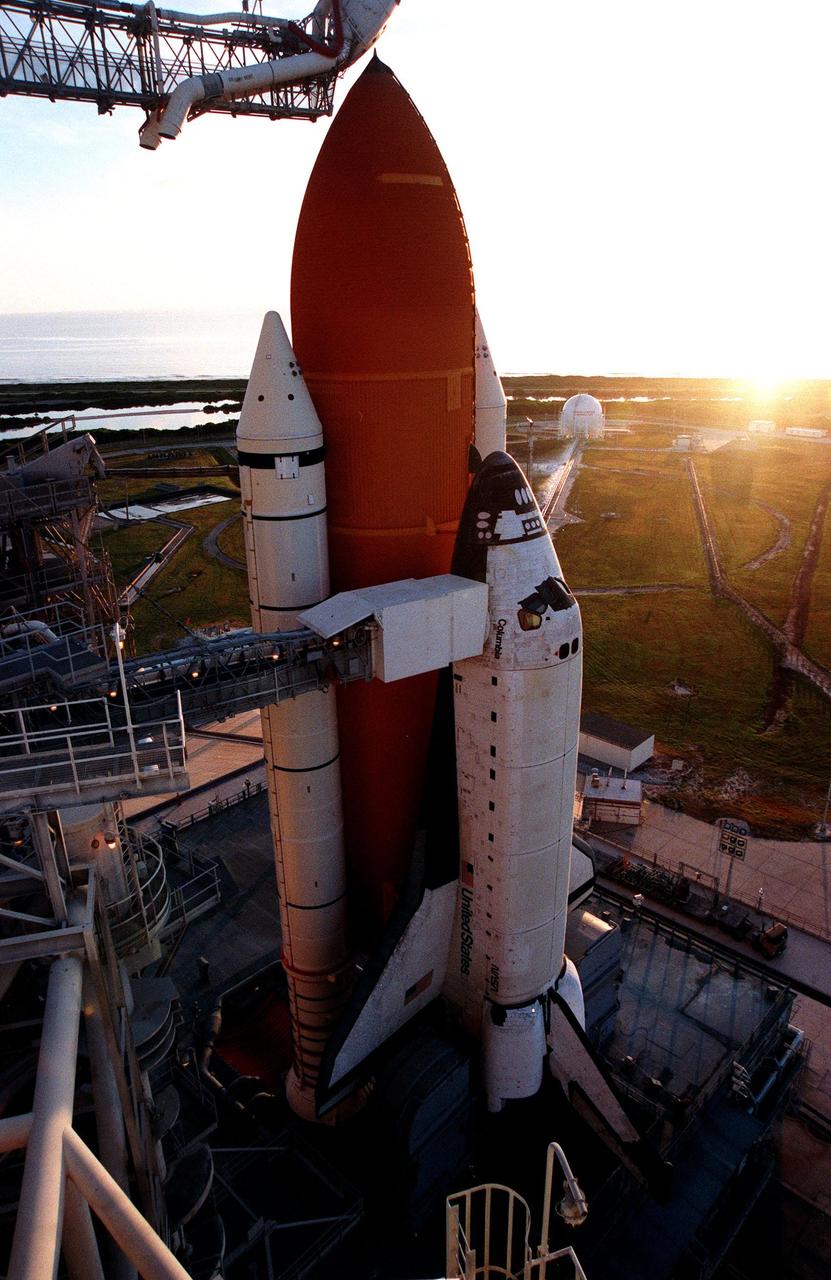
Space Shuttle Columbia catches the rising sun after the rollback of the Rotating Service Structure on Launch Pad 39-B. Columbia waits for the launch of mission STS-93 July 20 at 12:36 a.m. EDT. The primary payload of STS-93 is the Chandra X-ray Observatory, which will allow scientists from around the world to study some of the most distant, powerful and dynamic objects in the universe. The new telescope is 20 to 50 times more sensitive than any previous X-ray telescope and is expected unlock the secrets of supernovae, quasars and black holes. The STS-93 crew numbers five: Commander Eileen M. Collins, Pilot Jeffrey S. Ashby, and Mission Specialists Steven A. Hawley (Ph.D.), Catherine G. Coleman (Ph.D.) and Michel Tognini of France, with the Centre National d'Etudes Spatiales (CNES). Collins is the first woman to serve as commander of a shuttle mission
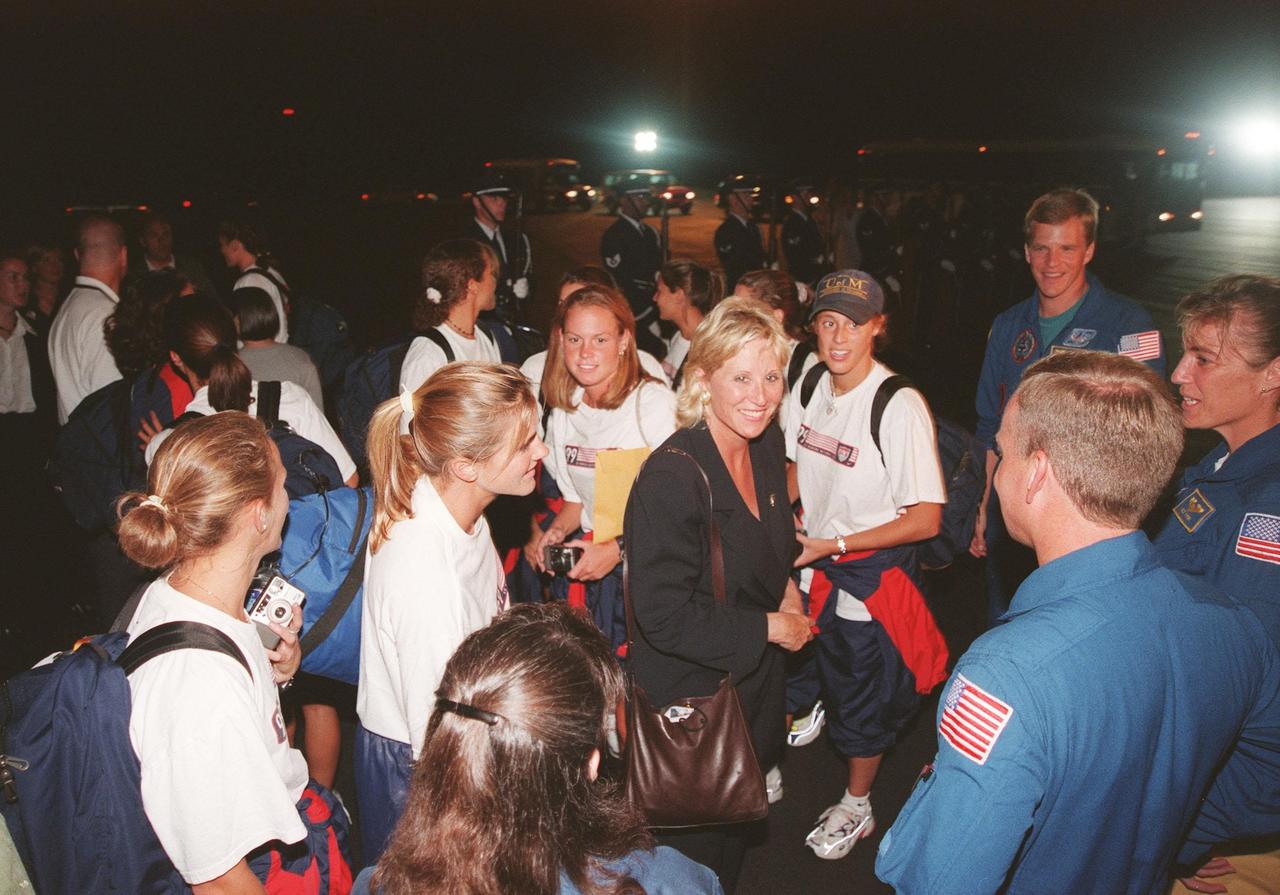
Members of the U.S. Women's World Cup Soccer Team were greeted upon their arrival at the Skid Strip at Cape Canaveral Air Station by Astronauts (right) Steven W. Lindsey, Heidemarie M. Stefanyshyn-Piper and Scott E. Parzynski. The team are here to view the launch of Space Shuttle mission STS-93, scheduled for 12:36 a.m. EDT July 20. Much attention has been generated over the launch due to Commander Eileen M. Collins, the first woman to serve as commander of a Shuttle mission. The primary payload of the five-day mission is the Chandra X-ray Observatory, which will allow scientists from around the world to study some of the most distant, powerful and dynamic objects in the universe. The new telescope is 20 to 50 times more sensitive than any previous X-ray telescope and is expected to unlock the secrets of supernovae, quasars and black holes
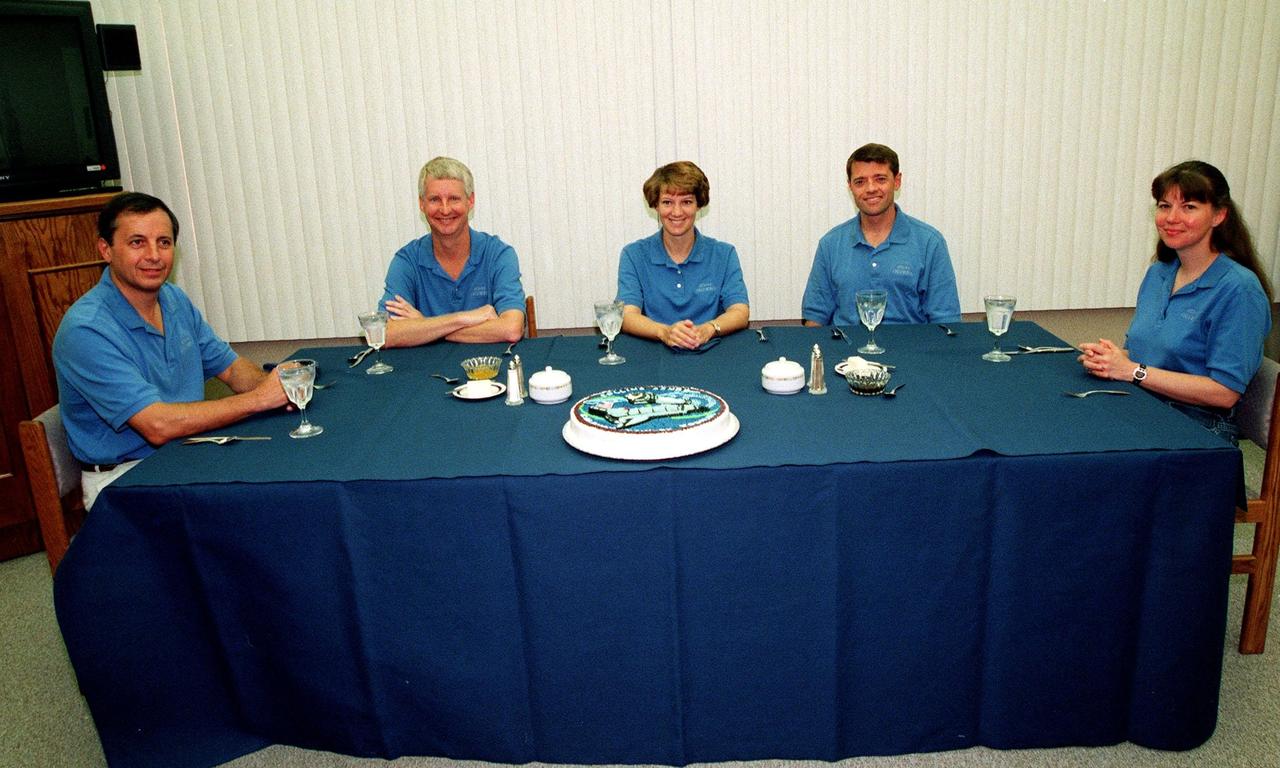
The STS-93 crew gathers for breakfast in the Operations and Checkout Building before suiting up for launch. Space Shuttle Columbia is due to launch Tuesday, July 20, at 12:36 a.m. EDT. Seated from left are Mission Specialists Michel Tognini, of France, who represents the Centre National d'Etudes Spatiales (CNES), and Steven A. Hawley (Ph.D.), Commander Eileen M. Collins, Pilot Jeffrey S. Ashby, and Mission Specialist Catherine G. Coleman (Ph.D.). STS-93 is a five-day mission primarily to release the Chandra X-ray Observatory, which will allow scientists from around the world to study some of the most distant, powerful and dynamic objects in the universe. The new telescope is 20 to 50 times more sensitive than any previous X-ray telescope and is expected unlock the secrets of supernovae, quasars and black holes. Collins is the first woman to serve as commander of a Shuttle mission

First Lady Hillary Rodham Clinton is greeted by Astronauts (from left) Heidemarie M. Stefanyshyn-Piper, Steven W. Lindsey, and Nancy Jane Currie upon Mrs. Clinton's arrival at the Skid Strip at Cape Canaveral Air Station. She and her daughter, Chelsea (far right) are here to view the launch of Space Shuttle mission STS-93, scheduled for 12:36 a.m. EDT July 20. Much attention has been generated over the launch due to Commander Eileen M. Collins, the first woman to serve as commander of a Shuttle mission. The primary payload of the five-day mission is the Chandra X-ray Observatory, which will allow scientists from around the world to study some of the most distant, powerful and dynamic objects in the universe. The new telescope is 20 to 50 times more sensitive than any previous X-ray telescope and is expected to unlock the secrets of supernovae, quasars and black holes
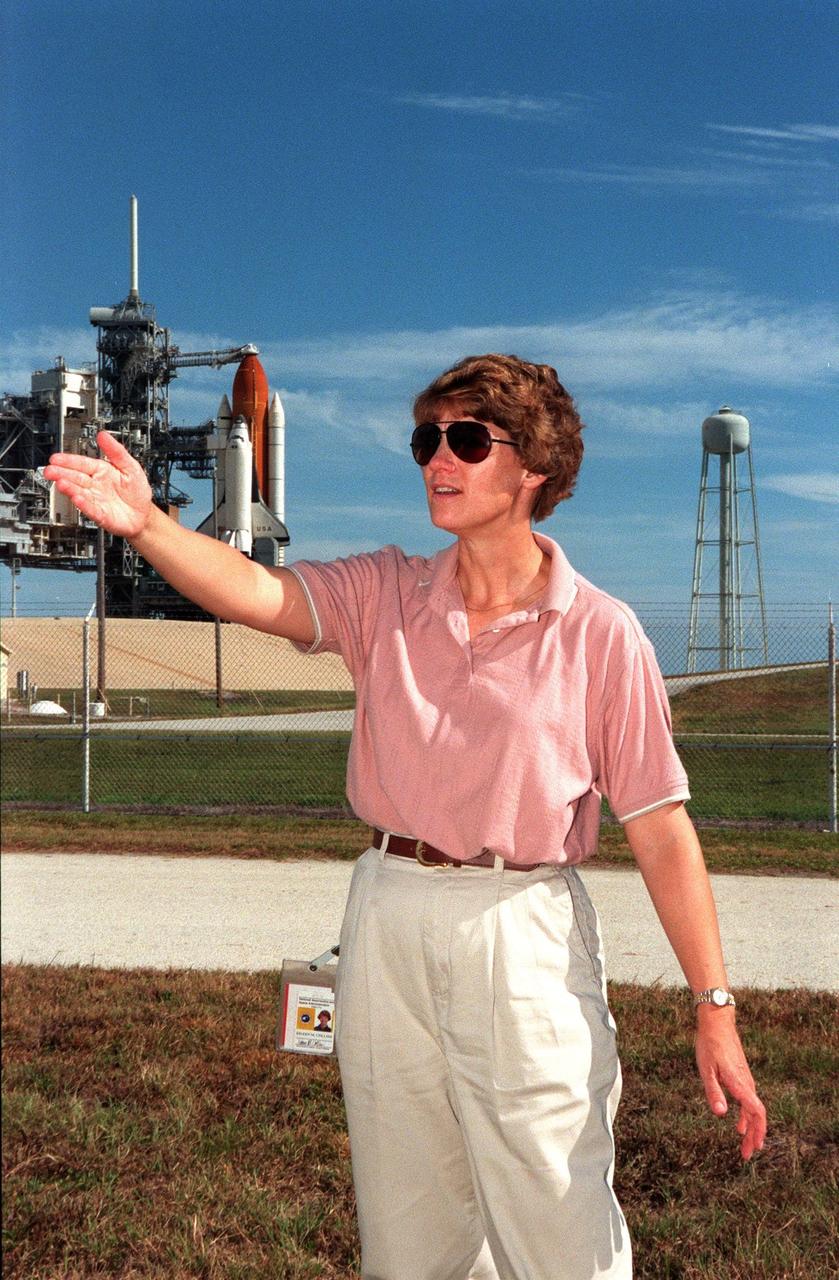
STS-93 Commander Eileen M. Collins waves to her family nearby, a last meeting before launch of mission STS-93 on July 20. Liftoff is scheduled for 12:36 a.m. EDT. The primary mission of STS-93 is the release of the Chandra X-ray Observatory, which will allow scientists from around the world to study some of the most distant, powerful and dynamic objects in the universe. The new telescope is 20 to 50 times more sensitive than any previous X-ray telescope and is expected to unlock the secrets of supernovae, quasars and black holes. The STS-93 crew numbers five: Commander Collins, Pilot Jeffrey S. Ashby, and Mission Specialists Steven A. Hawley (Ph.D.), Catherine G. Coleman (Ph.D.) and Michel Tognini of France, with the Centre National d'Etudes Spatiales (CNES). Collins is the first woman to serve as commander of a shuttle mission

STS059-86-059 (9-20 April 1994) --- This oblique handheld Hasselblad 70mm photo shows Death Valley, near California's border with Nevada. The valley -- the central feature of Death Valley National Monument -- extends north to south for some 140 miles (225 kilometers). Hemmed in to the east by the Amargosa Range and to the west by the Panamints, its width varies from 5 to 15 miles (8 to 24 kilometers). Using Spaceborne Imaging Radar (SIR-C) and X-band Synthetic Aperture Radar (X-SAR) onboard the Space Shuttle Endeavour, the crew was able to record a great deal of data on this and other sites, as part of NASA's Mission to Planet Earth.
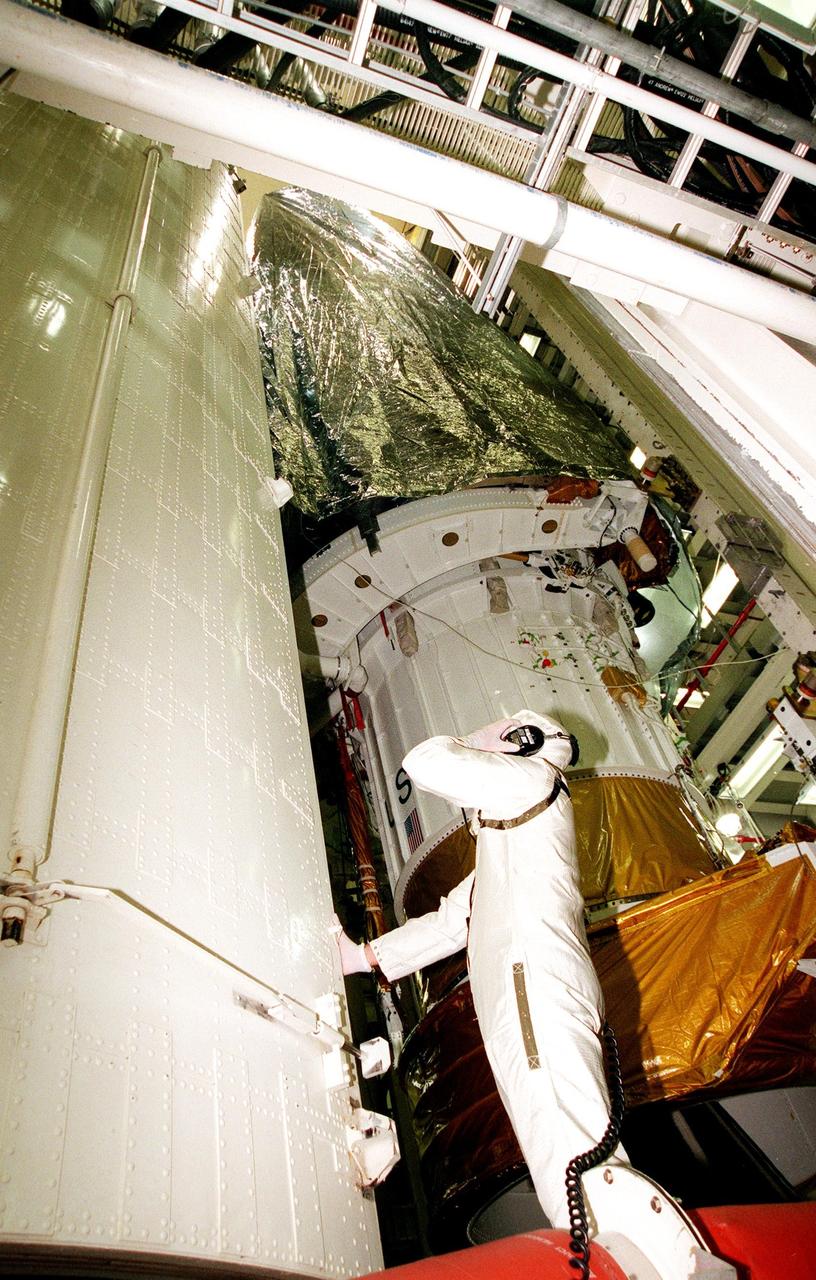
Inside the Vertical Processing Facility, a worker keeps check on the transfer of the Chandra X-ray Observatory (right) as it is transferred to the KSC payload canister transporter (left). The transporter will carry Chandra out to Launch Pad 39B for its scheduled launch, to take place no earlier than July 20 at 12:36 a.m. EDT aboard Space Shuttle Columbia, on mission STS-93. With the world's most powerful X-ray telescope, Chandra will allow scientists from around the world to see previously invisible black holes and high-temperature gas clouds, giving the observatory the potential to rewrite the books on the structure and evolution of our universe
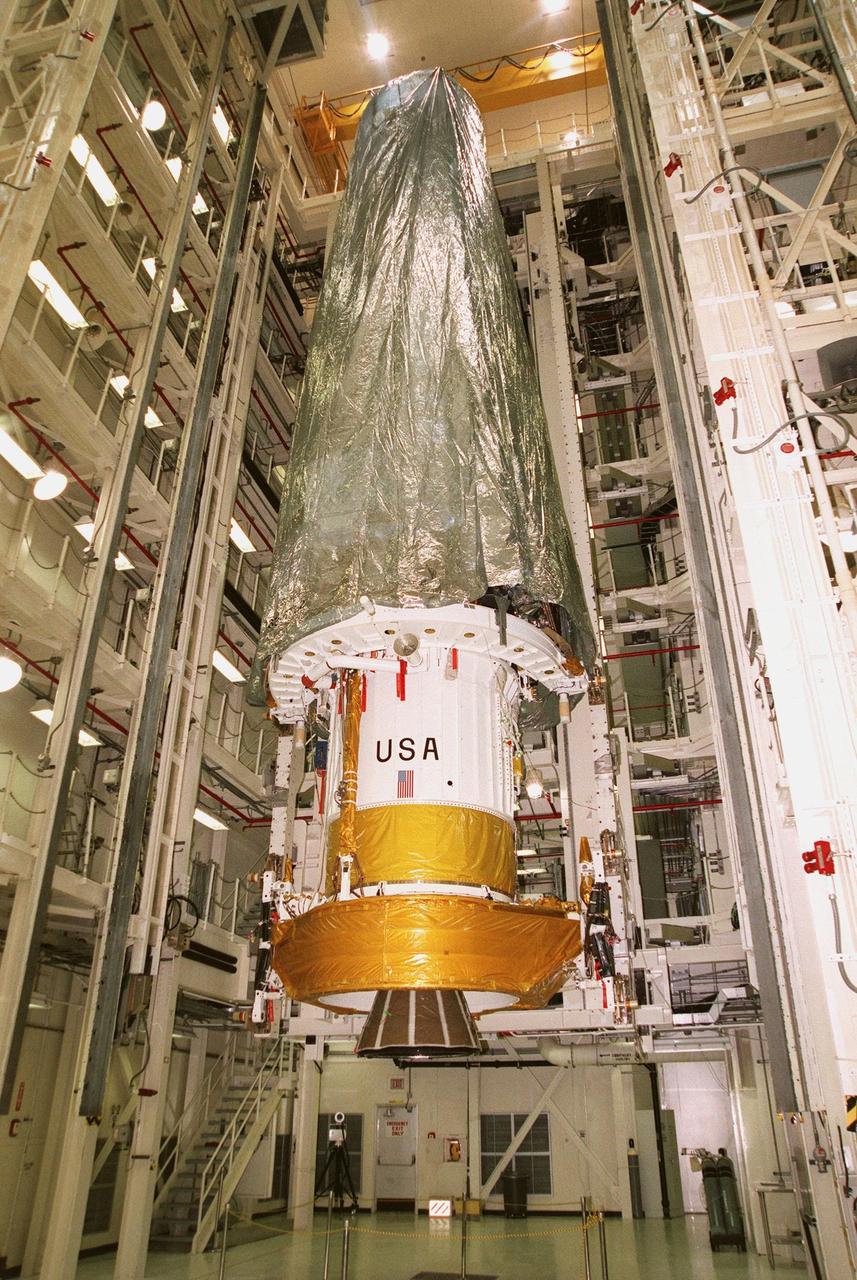
Inside the Vertical Processing Facility, the Chandra X-ray Observatory is lifted by an overhead crane in order to transfer it into the payload canister transporter and out to Launch Pad 39B. Chandra is scheduled to launch no earlier than July 20 at 12:36 a.m. EDT aboard Space Shuttle Columbia, on mission STS-93. With the world's most powerful X-ray telescope, Chandra will allow scientists from around the world to see previously invisible black holes and high-temperature gas clouds, giving the observatory the potential to rewrite the books on the structure and evolution of our universe
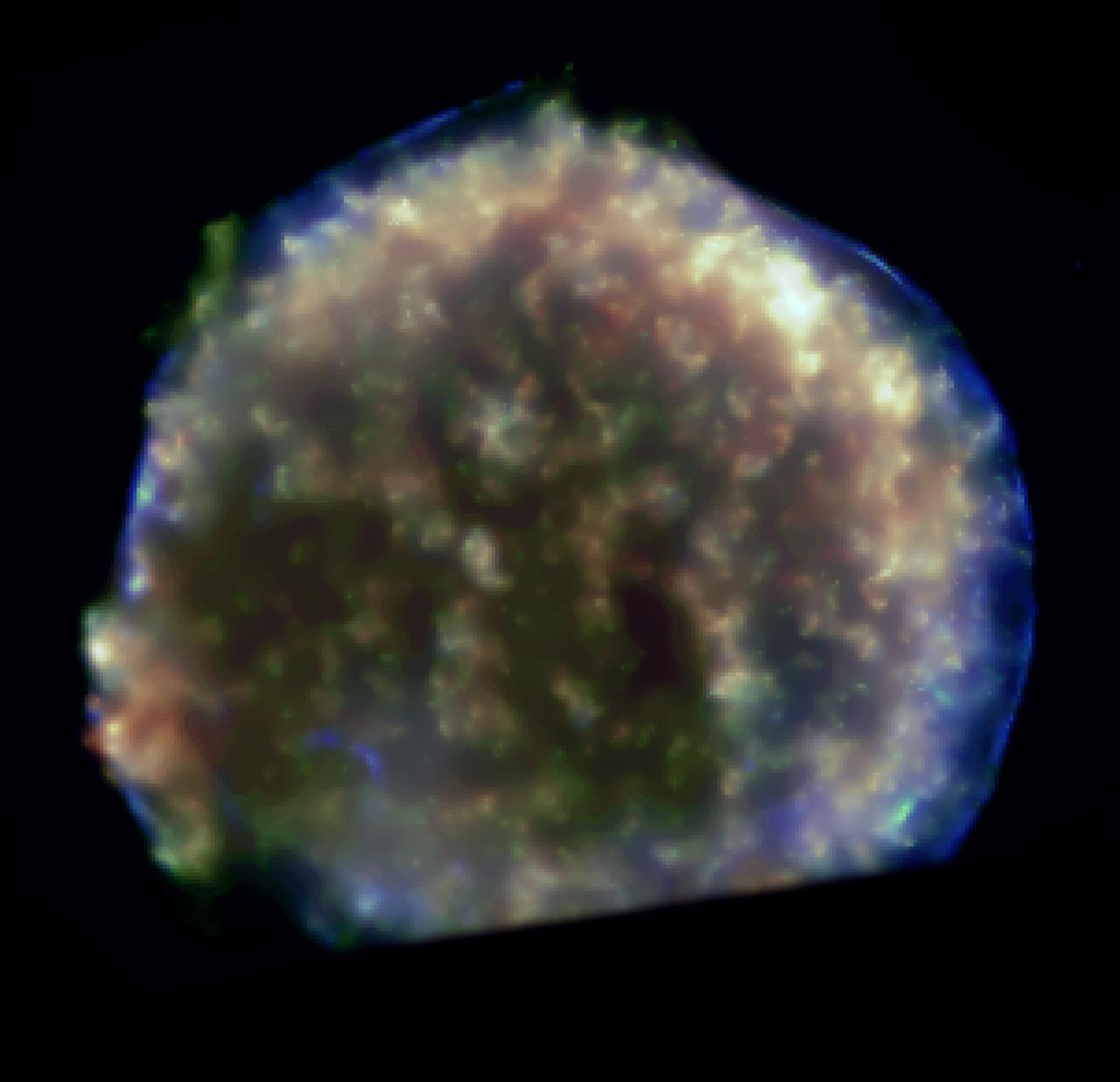
This Chandra image reveals, in detail, the turbulent debris created by a supernova explosion that was observed by the Danish Astronomer Tycho Brahe in the year 1572. The colors show different x-ray energies, with red, green, and blue representing low, medium, and high energies, respectively. Most likely caused by the destruction of a white dwarf star, a shock wave produced by the expanding debris is outlined by the sharp blue circular arcs of 20 million degree Celsius gas seen on the outer rim. The stellar debris, visible only by x-ray, has a temperature of about 10 million degrees, and shows up as mottled yellow, green, and red fingers of gas.
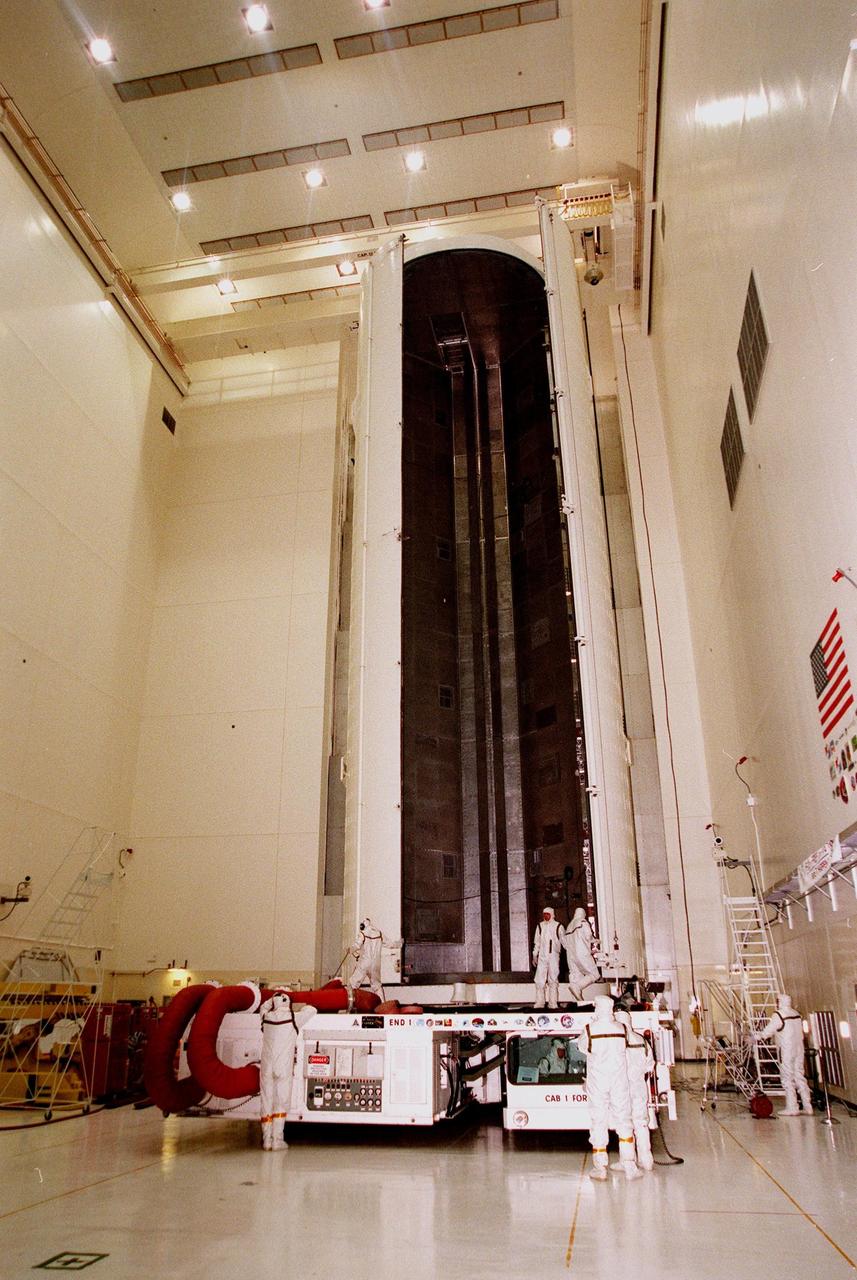
Workers help set up the KSC payload canister transporter as it waits in the Vertical Processing Facility to retrieve the Chandra X-ray Observatory and carry it out to Launch Pad 39B. Chandra is scheduled to launch no earlier than July 20 at 12:36 a.m. EDT aboard Space Shuttle Columbia, on mission STS-93. With the world's most powerful X-ray telescope, Chandra will allow scientists from around the world to see previously invisible black holes and high-temperature gas clouds, giving the observatory the potential to rewrite the books on the structure and evolution of our universe
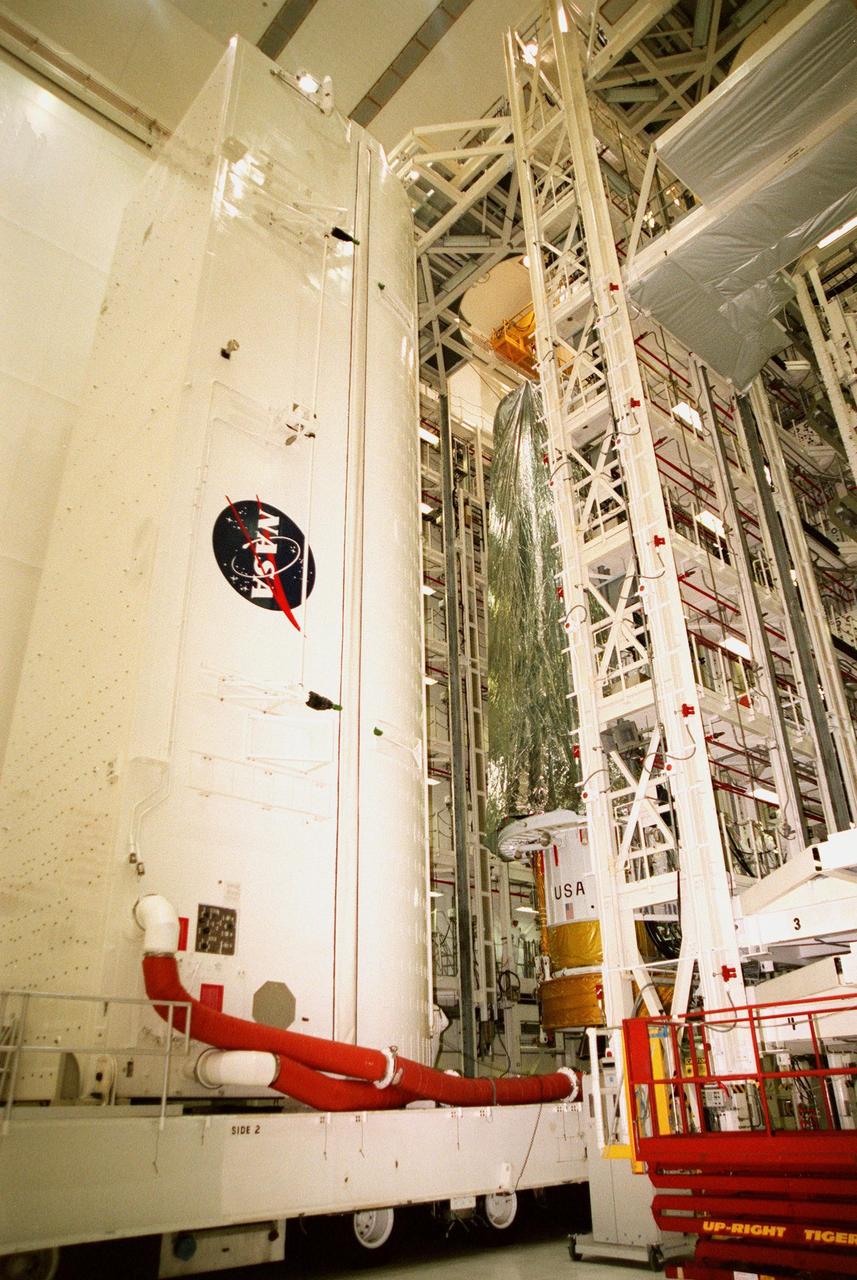
Inside the Vertical Processing Facility, the KSC payload canister transporter (left) backs up to the Chandra X-ray Observatory, stationed within the gridwork at right. The transporter will carry Chandra out to Launch Pad 39B for its scheduled launch, to take place no earlier than July 20 at 12:36 a.m. EDT aboard Space Shuttle Columbia, on mission STS-93. With the world's most powerful X-ray telescope, Chandra will allow scientists from around the world to see previously invisible black holes and high-temperature gas clouds, giving the observatory the potential to rewrite the books on the structure and evolution of our universe
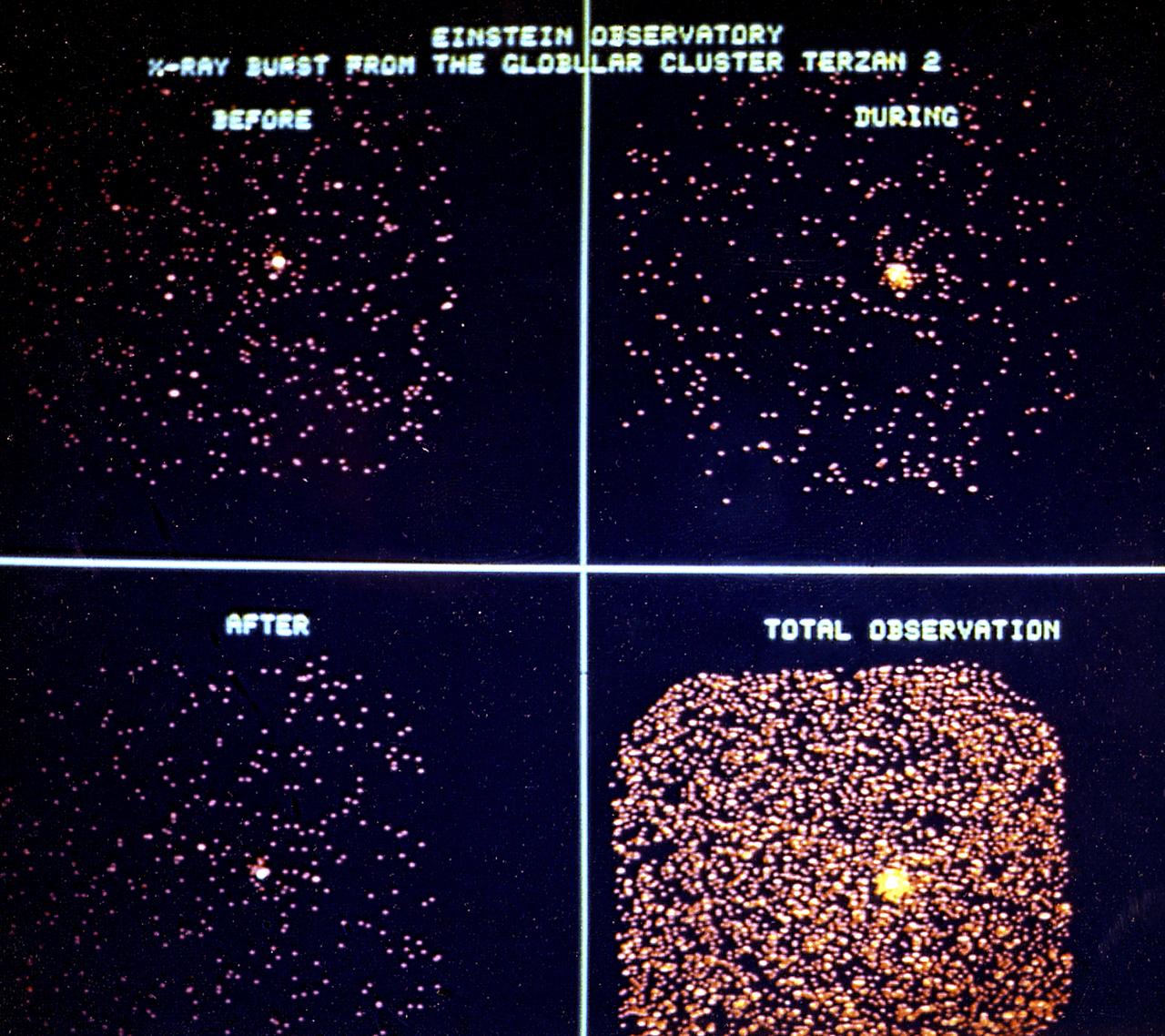
The dramatic change in x-ray emission from the Terzan 2 cluster is shown in this series of 2.5-minute exposures taken with the High Energy Astronomy Observatory (HEAO)-2/Einstein Observatory immediately before, during, and after the burst. Total exposure (20 minutes) of the object, including the outburst, is shown in the fourth photograph. These images represent the first observation of an x-ray burst in progress. The actual burst lasted 50 seconds. Among the rarest, and most bizarre, phenomena observed by x-ray astronomers are the so-called cosmic bursters (x-ray sources that suddenly and dramatically increase in intensity then subside). These sudden bursts of intense x-ray radiation apparently come from compact objects with a diameter smaller than 30 miles (48 kilometers). Yet, despite their minuscule size, a typical x-ray burster can release more x-ray energy in a single brief burst than our Sun does in an entire week. The HEAO-2, the first imaging and largest x-ray telescope built to date, was capable of producing actual photographs of x-ray objects. Shortly after launch, the HEAO-2 was nicknamed the Einstein Observatory by its scientific experimenters in honor of the centernial of the birth of Albert Einstein, whose concepts of relativity and gravitation have influenced much of modern astrophysics, particularly x-ray astronomy. The HEAO was designed and developed by TRW, Inc. under the project management of the Marshall Space Flight Center.
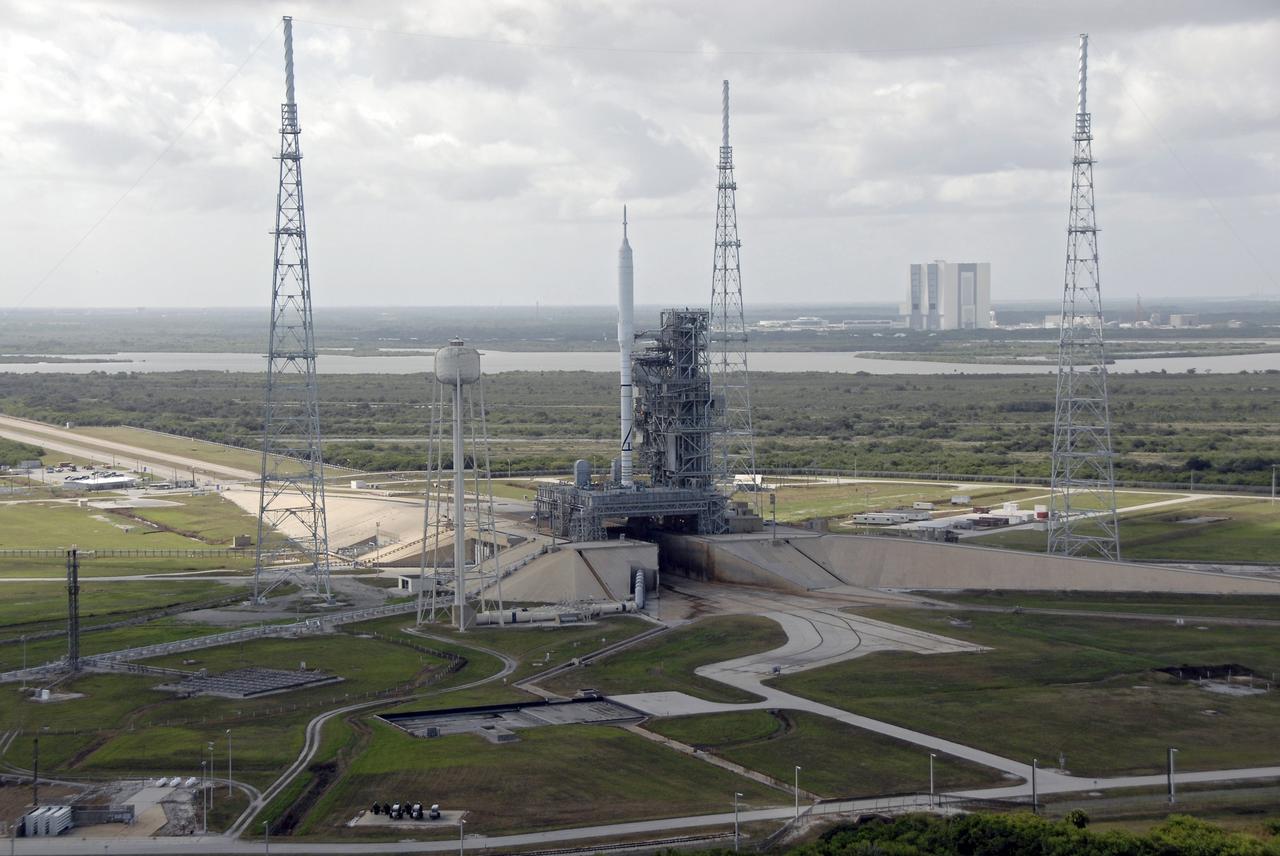
CAPE CANAVERAL, Fla. – At NASA's Kennedy Space Center in Florida, the 327-foot-tall Ares I-X rocket undergoes final processing on Launch Pad 39B for its upcoming flight test. The 525-foot Vehicle Assembly Building, or VAB, where the rocket was assembled is in the background. The rocket's 4.2-mile move from the VAB to the pad, known as rollout, took place Oct. 20. Pad modifications to support the Ares I-X include the removal of shuttle unique subsystems, such as the orbiter access arm and a section of the gaseous oxygen vent arm, and the installation of three 600-foot lightning towers, access platforms, environmental control systems and a vehicle stabilization system. Part of the Constellation Program, the Ares I-X is the test vehicle for the Ares I. The Ares I-X flight test is set for Oct. 27. For information on the Ares I-X vehicle and flight test, visit http://www.nasa.gov/aresIX. Photo credit: NASA/Kim Shiflett

Leon Van Speybroeck of the Harvard-Smithsonian Center for Astrophysics in Cambridge Massachusetts was awarded the 2002 Bruno Rossi Prize of the High-Energy Astrophysics Division of the American Astronomy Society. The Rossi Prize is an arnual recognition of significant contributions in high-energy astrophysics in honor of the Massachusetts Institute of Technology's late Professor Bruno Rossi, an authority on cosmic ray physics and a pioneer in the field of x-ray astronomy. Van Speybroeck, who led the effort to design and make the x-ray mirrors for NASA's premier Chandra X-Ray Observatory, was recognized for a career of stellar achievements in designing precision x-ray optics. As Telescope Scientist for Chandra, he has worked for more than 20 years with a team that includes scientists and engineers from the Harvard-Smithsonian, NASA's Marshall Space Flight Center, TRW, Inc., Huhes-Danbury (now B.F. Goodrich Aerospace), Optical Coating Laboratories, Inc., and Eastman-Kodak on all aspects of the x-ray mirror assembly that is the heart of the observatory.
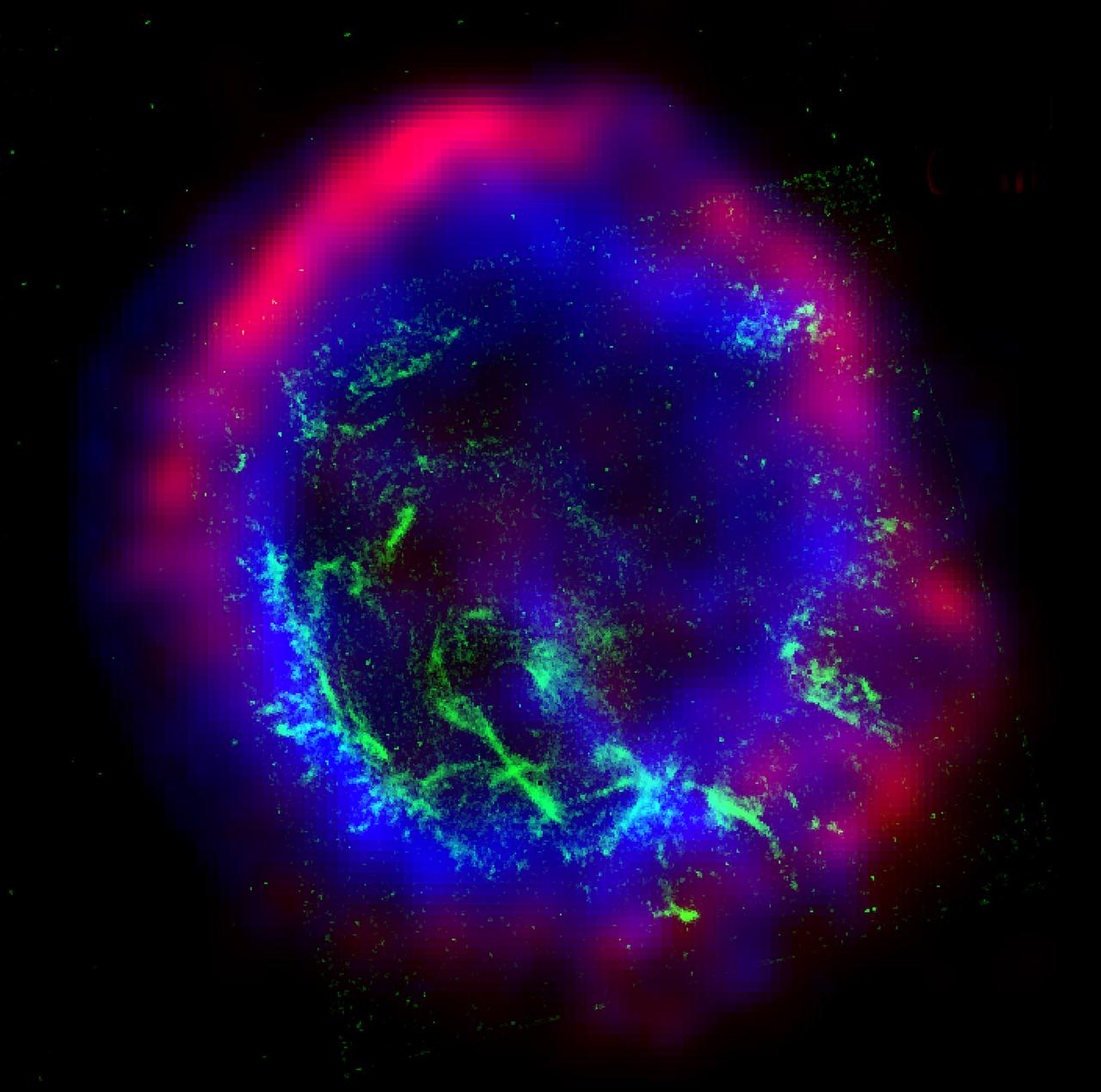
This image is a color composite of the supernova remnant E0102-72: x-ray (blue), optical (green), and radio (red). E0102-72 is the remnant of a star that exploded in a nearby galaxy known as the Small Magellanic Cloud. The star exploded outward at speeds in excess of 20 million kilometers per hour (12 million mph) and collided with surrounding gas. This collision produced two shock waves, or cosmic sonic booms, one traveling outward, and the other rebounding back into the material ejected by the explosion. The radio image, shown in red, was made using the Australia Telescope Compact Array. The radio waves are due to extremely high-energy electrons spiraling around magnetic field lines in the gas and trace the outward moving shock wave. The Chandra X-ray Observatory image, shown in blue, shows gas that has been heated to millions of degrees by the rebounding, or reverse shock wave. The x-ray data show that this gas is rich in oxygen and neon. These elements were created by nuclear reactions inside the star and hurled into space by the supernova. The Hubble Space Telescope optical image, shown in green, shows dense clumps of oxygen gas that have "cooled" to about 30,000 degrees. Photo Credit: X-ray (NASA/CXC/SAO); optical (NASA/HST): radio: (ACTA)
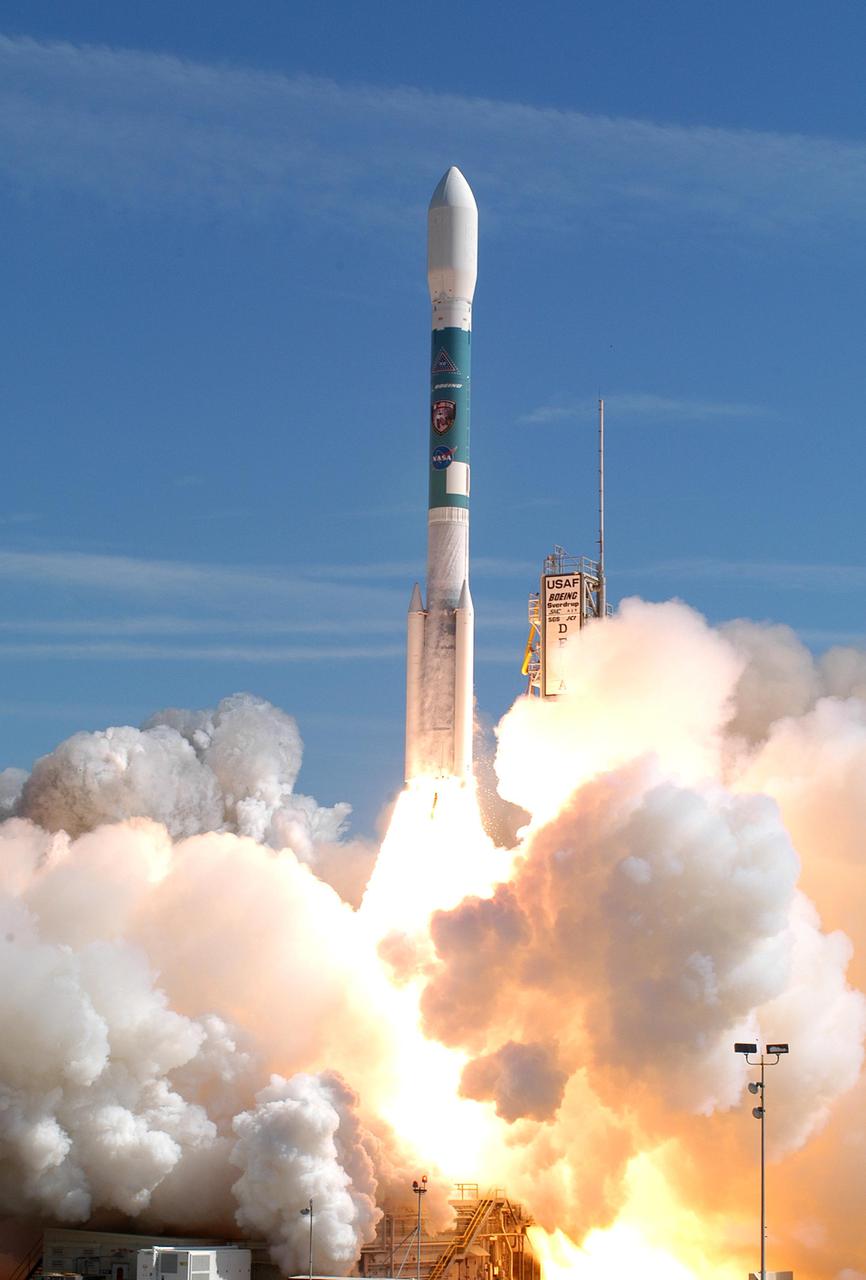
KENNEDY SPACE CENTER, FLA. - Clouds of exhaust form around a Boeing Delta II expendable launch vehicle as it blasts NASA's Swift spacecraft on its mission at Complex 17A, Cape Canaveral Air Force Station, on Nov. 20 at 12:16:00.611 p.m. EST. Swift is a first-of-its-kind multi-wavelength observatory dedicated to the study of gamma-ray burst science. Its three instruments will work together to observe GRBs and afterglows in the gamma ray, X-ray, ultraviolet and optical wavebands.
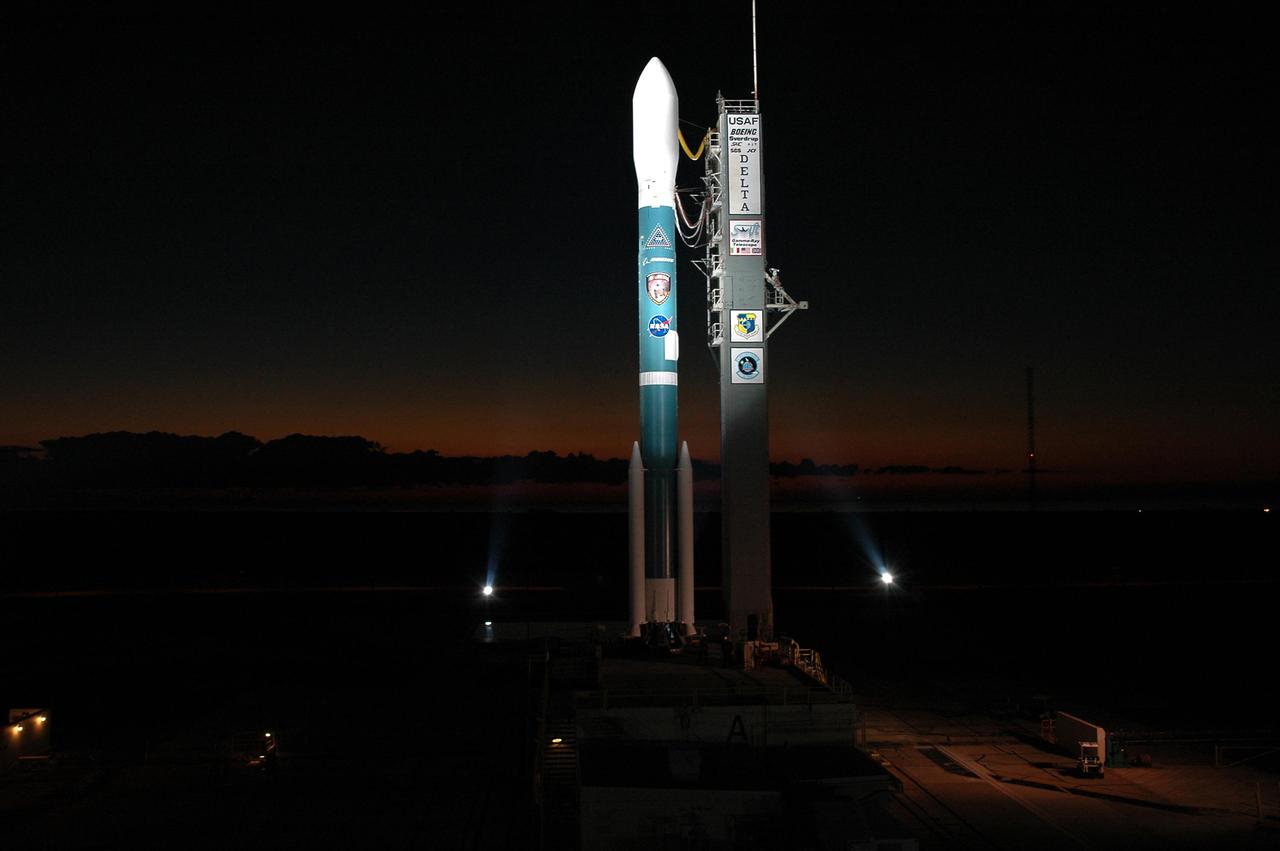
KENNEDY SPACE CENTER, FLA. - A Boeing Delta II expendable launch vehicle stands ready to launch NASA’s Swift spacecraft following tower rollback at Complex 17A, Cape Canaveral Air Force Station. Swift is a first-of-its-kind multi-wavelength observatory dedicated to the study of gamma-ray burst science. Its three instruments will work together to observe GRBs and afterglows in the gamma ray, X-ray, ultraviolet and optical wavebands. Swift is scheduled to launch Nov. 20 at 12:10 p.m. EST.
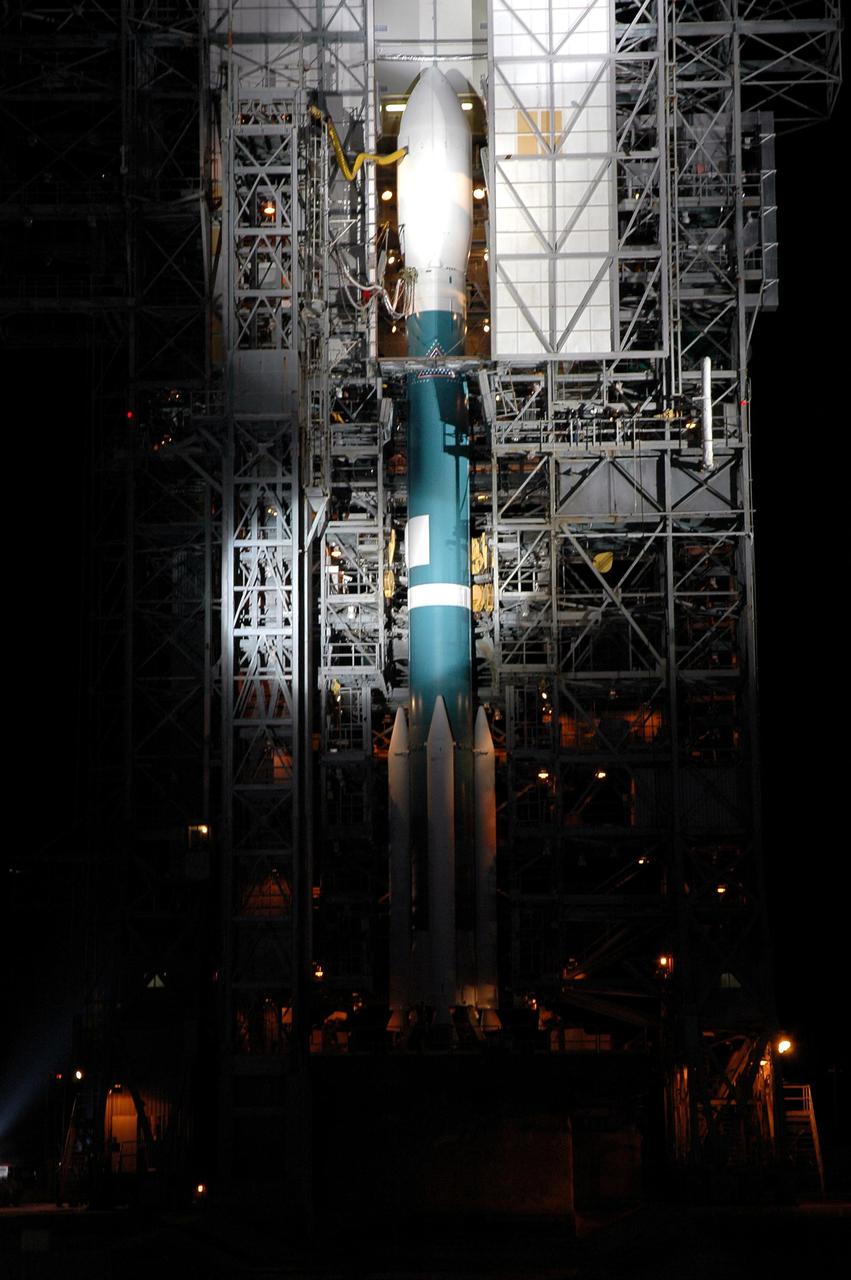
KENNEDY SPACE CENTER, FLA. - A Boeing Delta II expendable launch vehicle stands ready to launch NASA’s Swift spacecraft following tower rollback at Complex 17A, Cape Canaveral Air Force Station. Swift is a first-of-its-kind multi-wavelength observatory dedicated to the study of gamma-ray burst science. Its three instruments will work together to observe GRBs and afterglows in the gamma ray, X-ray, ultraviolet and optical wavebands. Swift is scheduled to launch Nov. 20 at 12:10 p.m. EST.
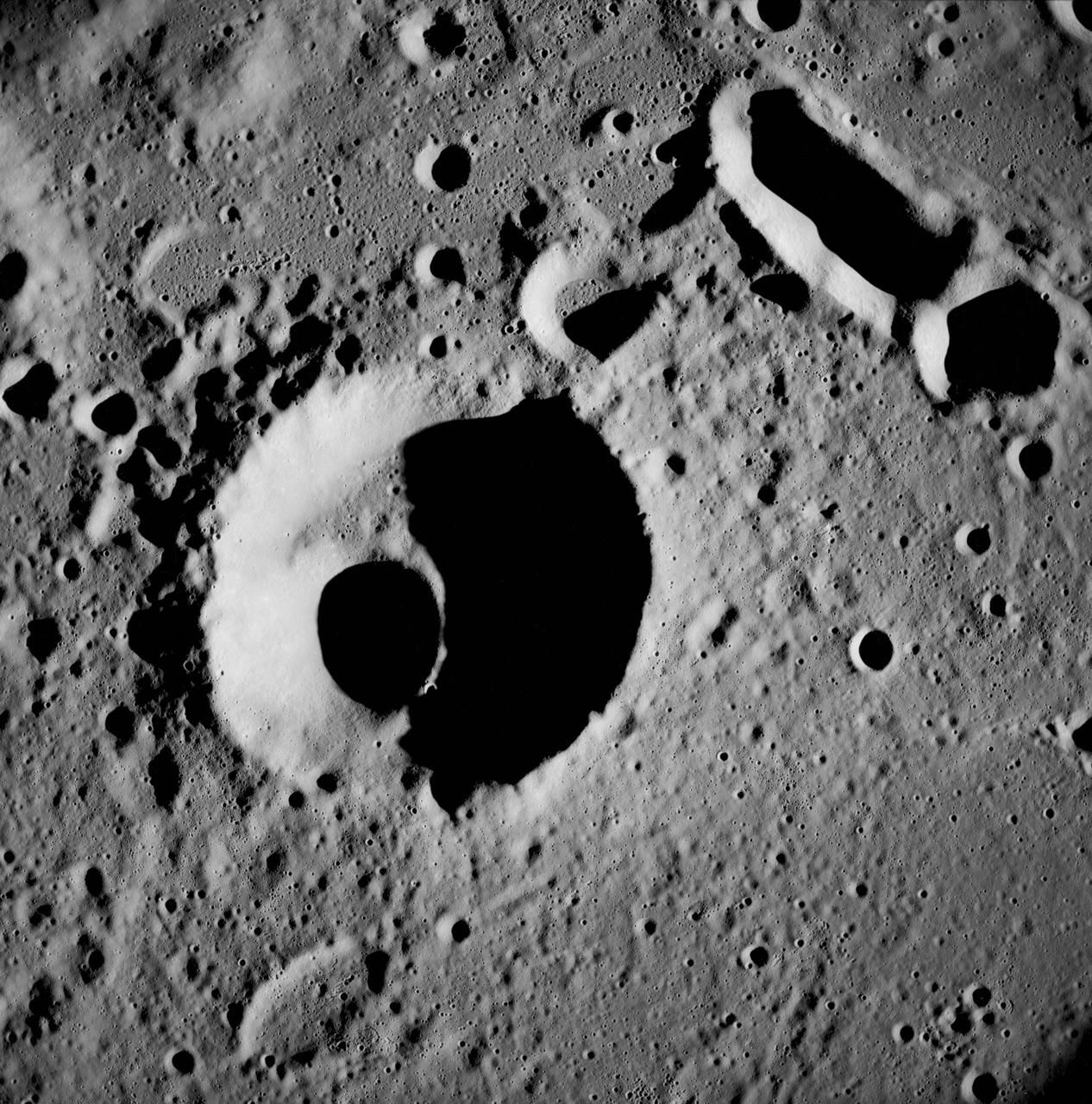
AS08-12-2052 (21-27 Dec. 1968) --- This near-vertical photograph from the Apollo 8 spacecraft covers an area of approximately 50 x 50 statute miles within a 250-statute-miles-in-diameter crater on the lunar farside. The center of this large crater is located at about 157 degrees west longitude and 4 degrees south latitude. The large crater in the center of the picture is about 20 statute miles in diameter.
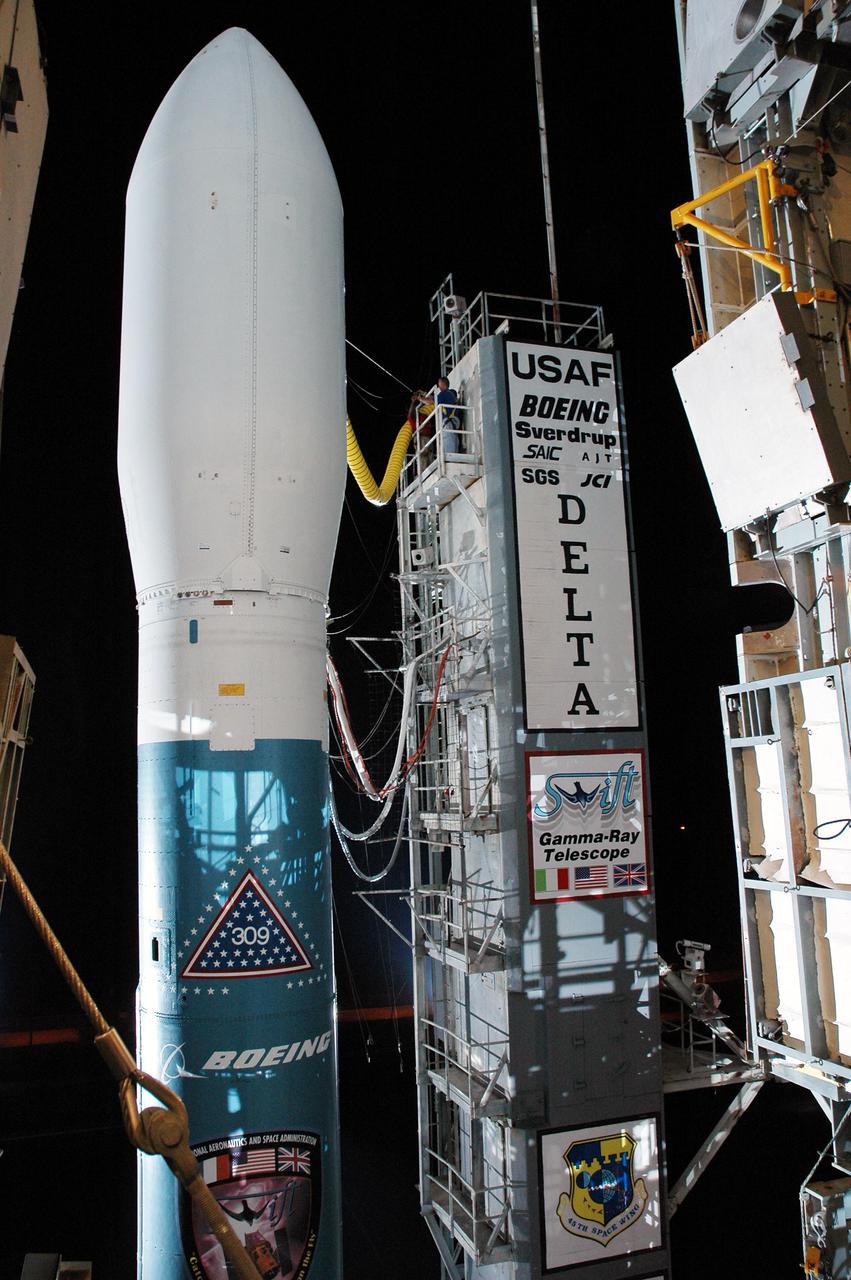
KENNEDY SPACE CENTER, FLA. - A Boeing Delta II expendable launch vehicle stands ready to launch NASA’s Swift spacecraft following tower rollback at Complex 17A, Cape Canaveral Air Force Station. Swift is a first-of-its-kind multi-wavelength observatory dedicated to the study of gamma-ray burst science. Its three instruments will work together to observe GRBs and afterglows in the gamma ray, X-ray, ultraviolet and optical wavebands. Swift is scheduled to launch Nov. 20 at 12:10 p.m. EST.
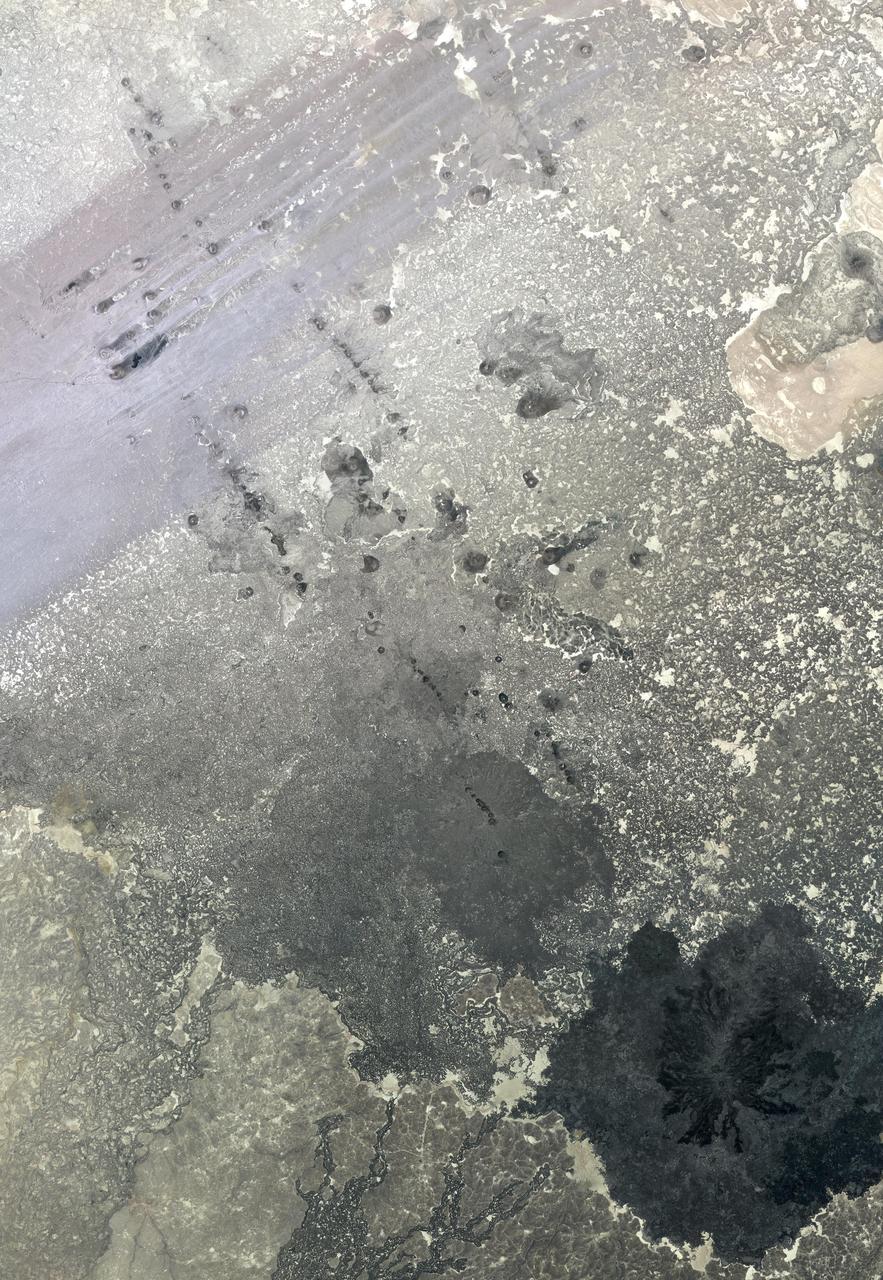
In southern Syria, the Azraq-Wadi as Sirhan Depression is the site of young volcanic activity, producing an extensive basaltic volcanic field. The north-northwest to south-southeast structural and fault control of the crust is evident in the straight alignment of numerous chains of cinder cones. At the top of the image, the northeast trending streaks are windblown sand deposits. The image was acquired May 20, 2009, covers an area of 46.5 x 67 km, and is located at 33.3 degrees north, 37.1 degrees east. http://photojournal.jpl.nasa.gov/catalog/PIA19479
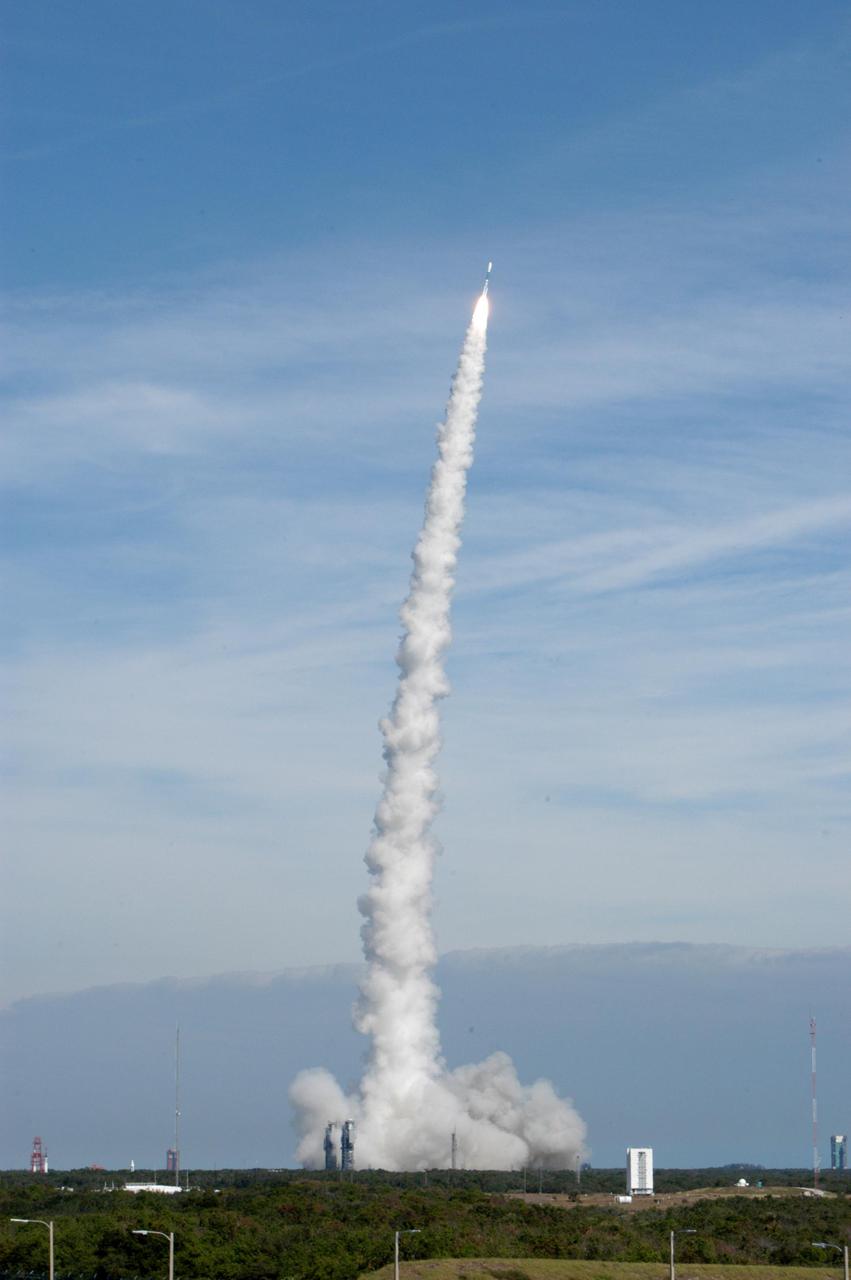
KENNEDY SPACE CENTER, FLA. - Seen from a distance, NASA's Swift spacecraft lifts off from Complex 17A, Cape Canaveral Air Force Station, on Nov. 20 at 12:16:00.611 p.m. EST aboard a Boeing Delta II expendable launch vehicle. Swift is a first-of-its-kind multi-wavelength observatory dedicated to the study of gamma-ray burst science. Its three instruments will work together to observe GRBs and afterglows in the gamma ray, X-ray, ultraviolet and optical wavebands.
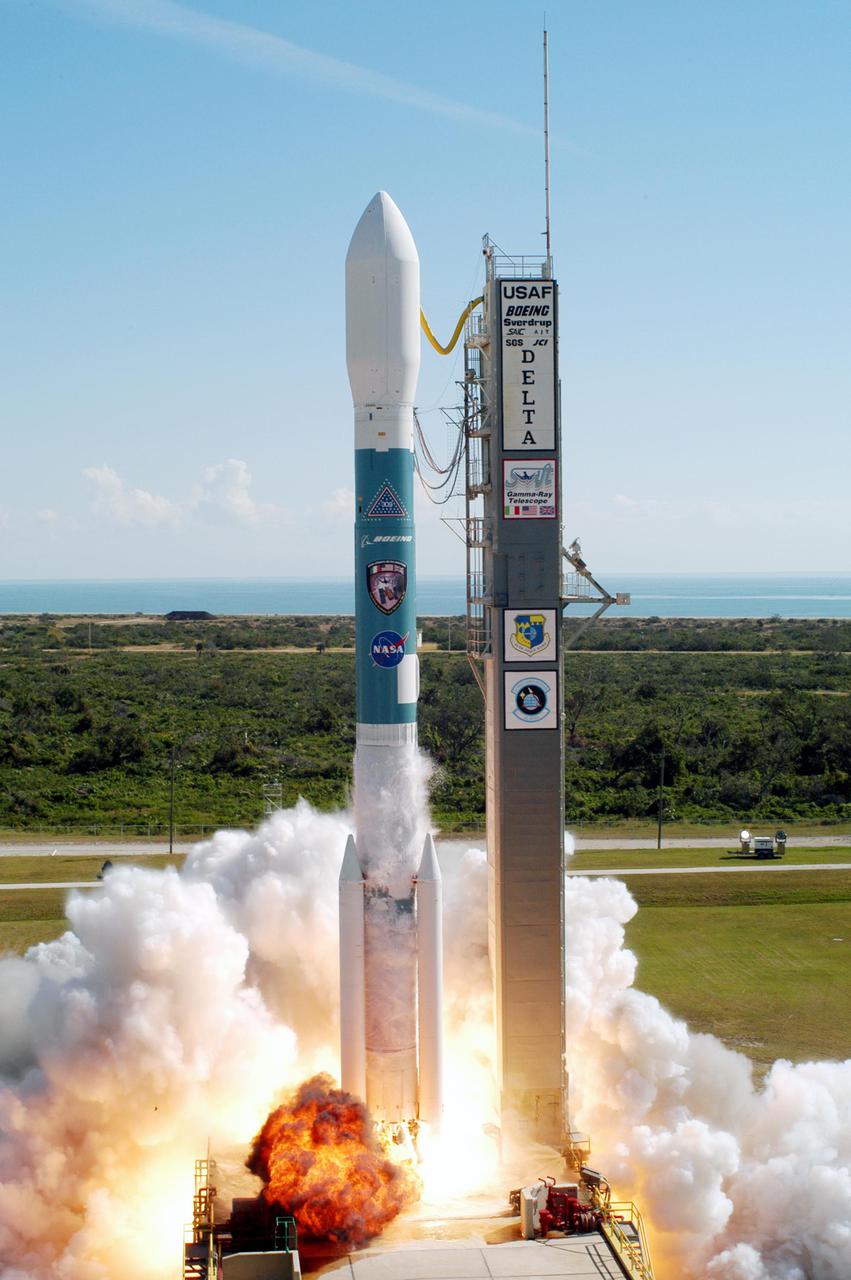
KENNEDY SPACE CENTER, FLA. - The engines of a Boeing Delta II expendable launch vehicle ignite to blast NASA's Swift spacecraft on its way at Complex 17A, Cape Canaveral Air Force Station, on Nov. 20 at 12:16:00.611 p.m. EST. Swift is a first-of-its-kind multi-wavelength observatory dedicated to the study of gamma-ray burst science. Its three instruments will work together to observe GRBs and afterglows in the gamma ray, X-ray, ultraviolet and optical wavebands.
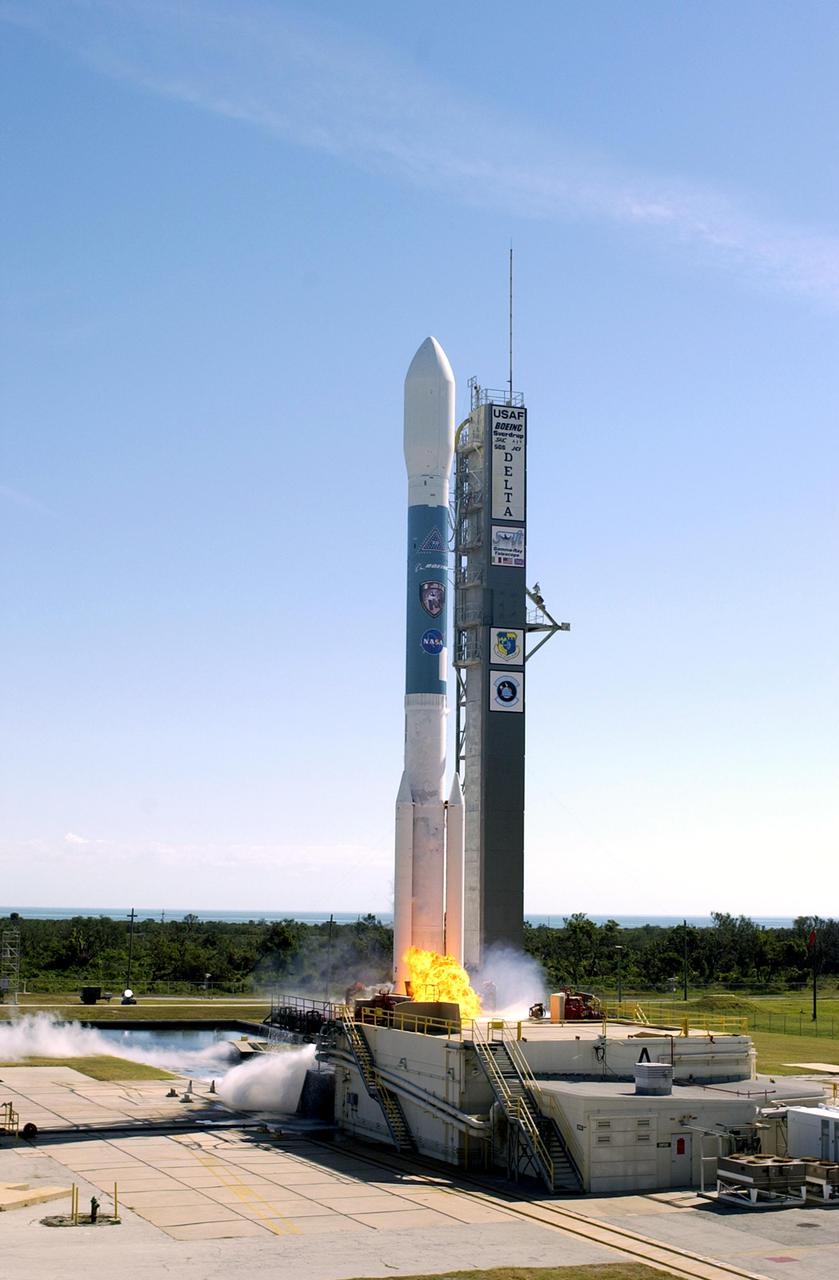
KENNEDY SPACE CENTER, FLA. - NASA's Swift spacecraft lifts off from Complex 17A into the beautiful blue sky above Cape Canaveral Air Force Station on Nov. 20 at 12:16:00.611 p.m. EST aboard a Boeing Delta II expendable launch vehicle. Swift is a first-of-its-kind multi-wavelength observatory dedicated to the study of gamma-ray burst science. Its three instruments will work together to observe GRBs and afterglows in the gamma ray, X-ray, ultraviolet and optical wavebands.
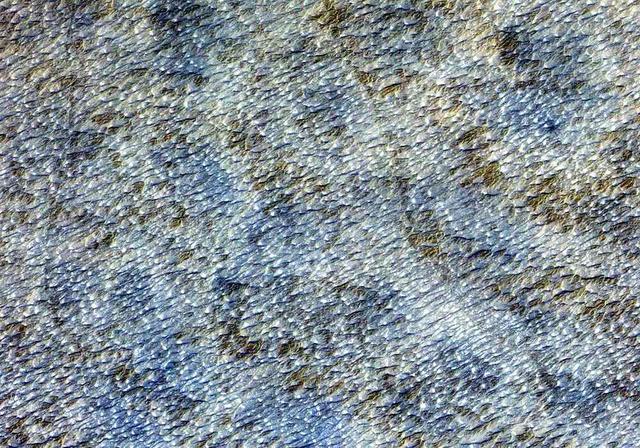
This ASTER image covers an area of 10.5 x 15 km in southern Afghanistan and was acquired on August 20, 2000. The band 3-2-1 composite shows part of an extensive field of barchan sand dunes south of Kandahar. The shape of the dunes indicates that the prevailing wind direction is from the west. The image is located at 30.7 degrees north latitude and 65.7 degrees east longitude. http://photojournal.jpl.nasa.gov/catalog/PIA11099
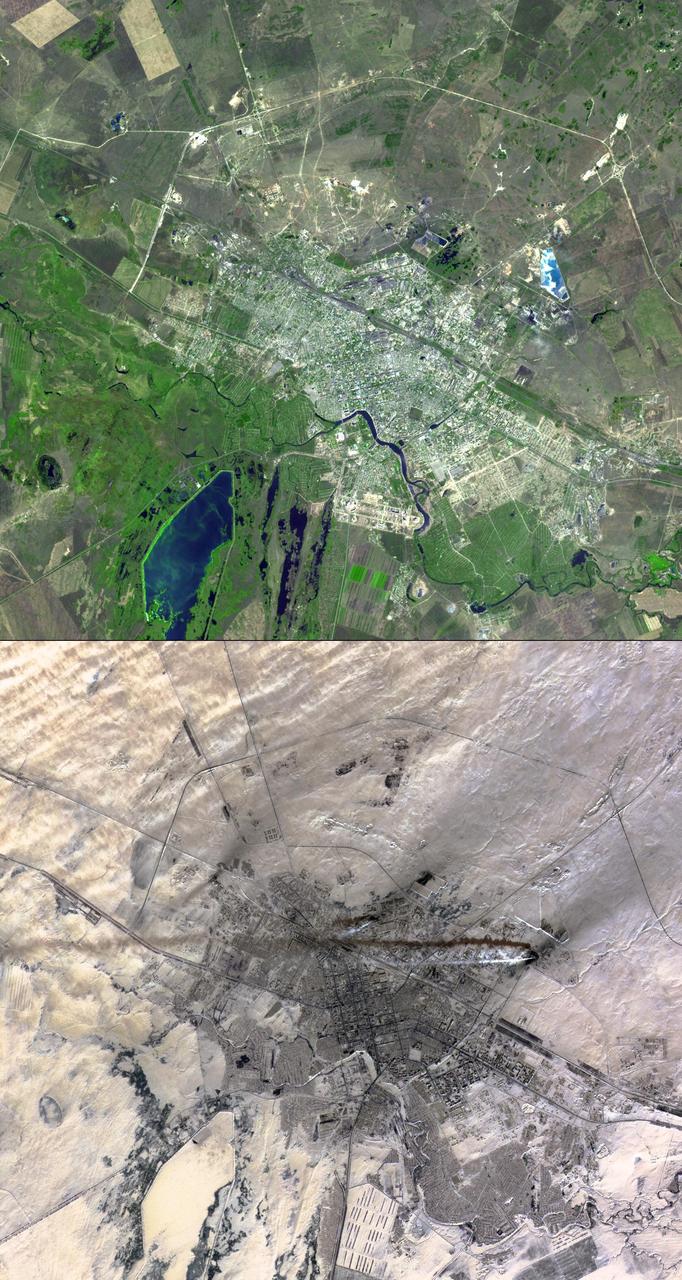
Astana is the capital and second largest city of Kazakhstan, with a population of about 600,000. It was founded as a fort in 1824 on the Ishim River by Siberian Cossacks, and became a railway junction in the early 20th century. Astana became the capital of the newly-independent Kazakhstan in 1997. These two images were acquired March 20, 2001 and September 5, 2003, cover an area of 22.5 x 24 km, and are located near 51.2 degrees north latitude, 71.4 degrees east longitude. This image is from NASA Terra satellite. http://photojournal.jpl.nasa.gov/catalog/PIA10612
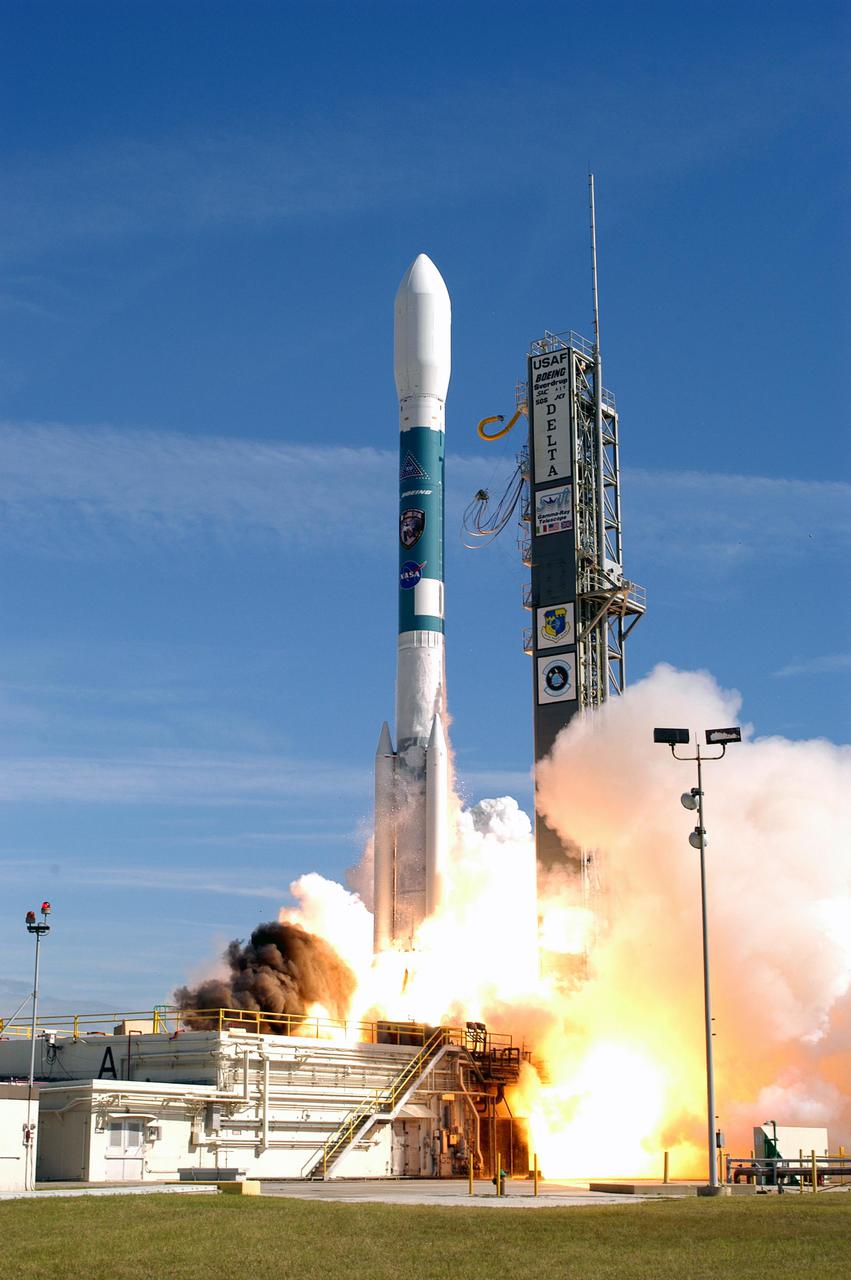
KENNEDY SPACE CENTER, FLA. - NASA's Swift spacecraft lifts off from Complex 17A, Cape Canaveral Air Force Station in sunny Florida, on Nov. 20 at 12:16:00.611 p.m. EST aboard a Boeing Delta II expendable launch vehicle. Swift is a first-of-its-kind multi-wavelength observatory dedicated to the study of gamma-ray burst science. Its three instruments will work together to observe GRBs and afterglows in the gamma ray, X-ray, ultraviolet and optical wavebands.
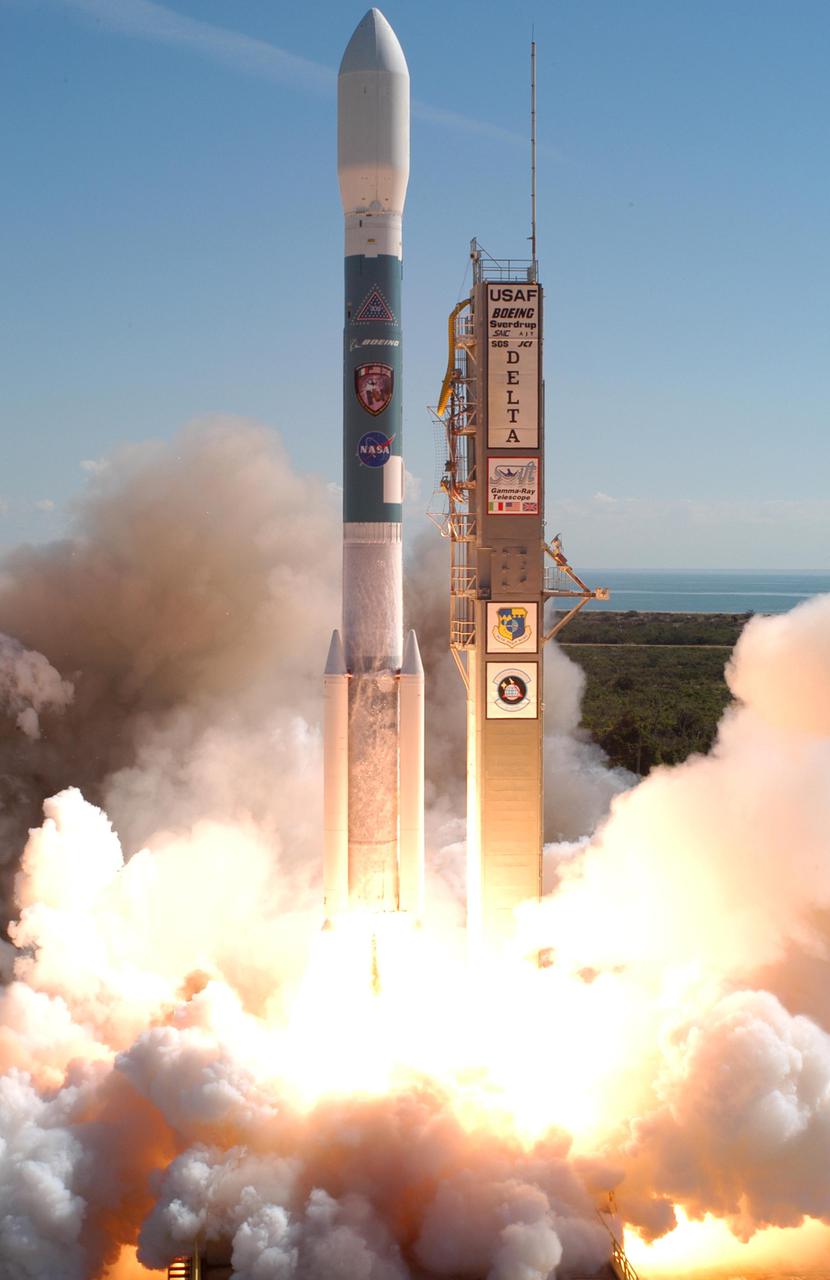
KENNEDY SPACE CENTER, FLA. - The engines of a Boeing Delta II expendable launch vehicle ignite to blast NASA's Swift spacecraft on its way at Complex 17A, Cape Canaveral Air Force Station, on Nov. 20 at 12:16:00.611 p.m. EST. Swift is a first-of-its-kind multi-wavelength observatory dedicated to the study of gamma-ray burst science. Its three instruments will work together to observe GRBs and afterglows in the gamma ray, X-ray, ultraviolet and optical wavebands.
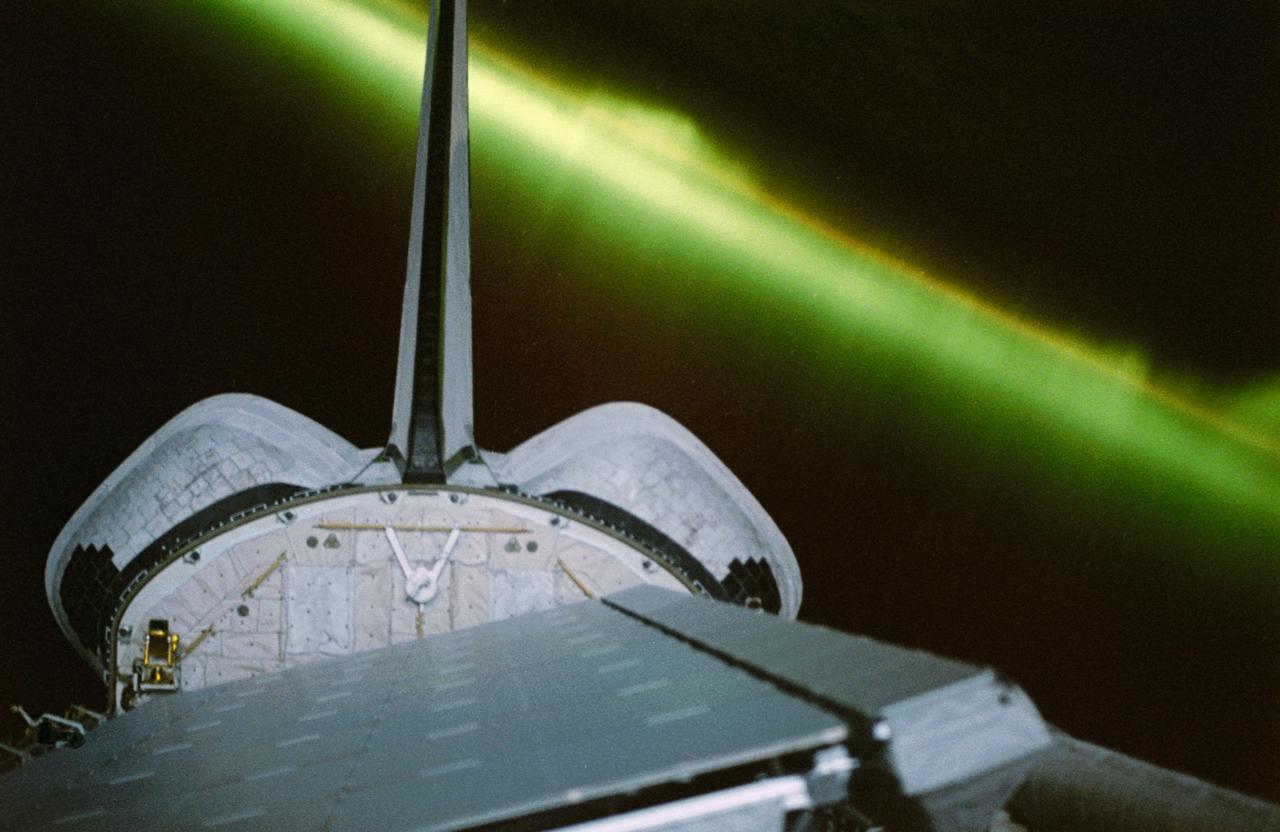
STS059-50-011 (9-20 April 94) --- A greenish appearing aurora forms the backdrop for this 35mm scene of the Earth orbiting Space Shuttle Endeavour's aft cargo bay. Featured in the bay are the antennae for the SIR-C/X-SAR imaging radar instruments, illuminated by moonlight. The crew sighted the southern lights (aurora australis) several times during each of the eleven days of the mission.
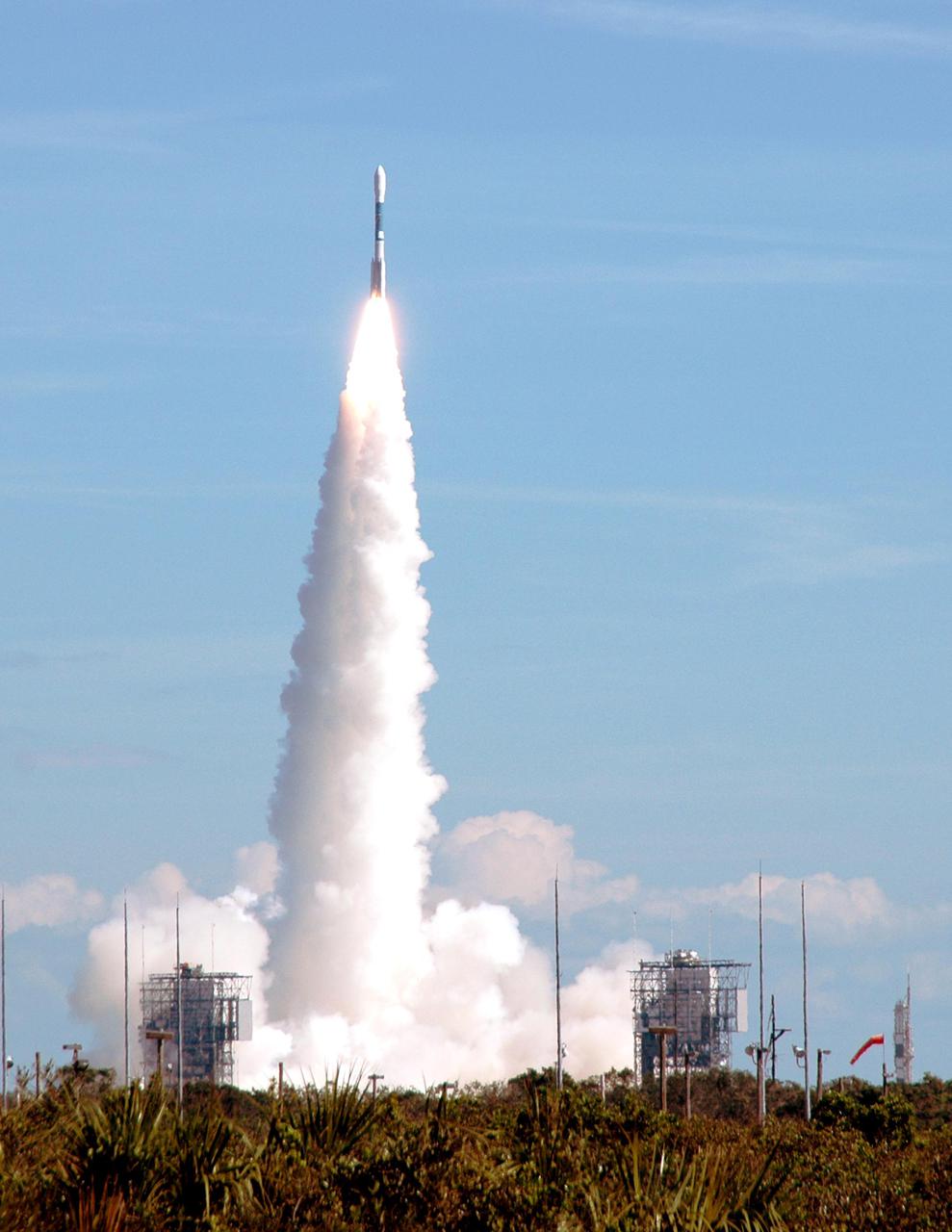
KENNEDY SPACE CENTER, FLA. - NASA's Swift spacecraft blasts off from Complex 17A into the beautiful blue sky above Cape Canaveral Air Force Station on Nov. 20 at 12:16:00.611 p.m. EST aboard a Boeing Delta II expendable launch vehicle. Swift is a first-of-its-kind multi-wavelength observatory dedicated to the study of gamma-ray burst science. Its three instruments will work together to observe GRBs and afterglows in the gamma ray, X-ray, ultraviolet and optical wavebands.
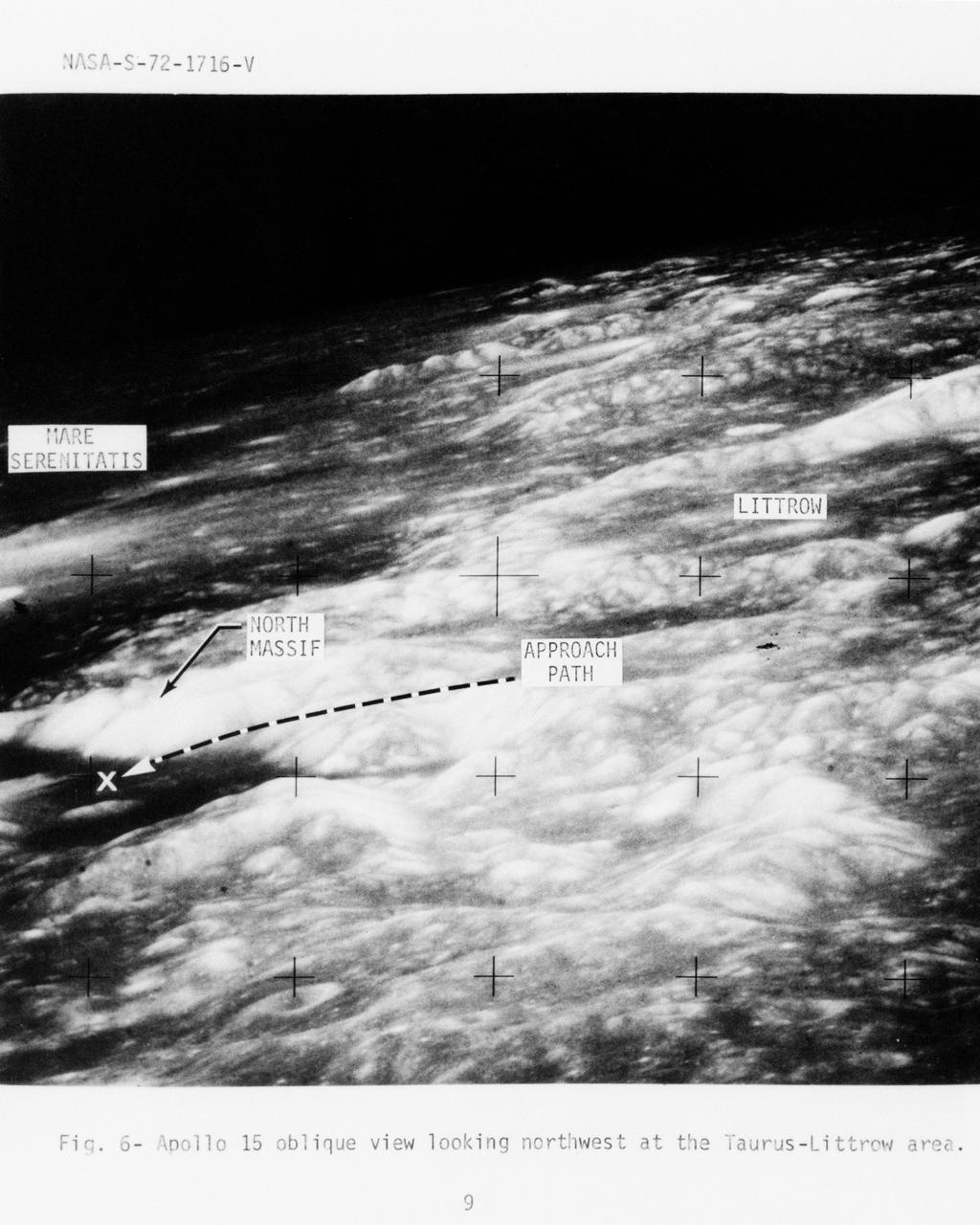
S72-01716 (July 1972) --- An oblique view of the Taurus-Littrow area on the lunar nearside, as photographed from the Apollo 15 spacecraft in lunar orbit. This is an enlarged view. The "X" marks the landing site of the scheduled Apollo 17 lunar landing mission. The overlay points out several features in the photograph. The coordinates of the Apollo 17 touchdown point are 30 degrees 44 minutes 58 seconds east longitude and 20 degrees 9 minutes 50 seconds north latitude.
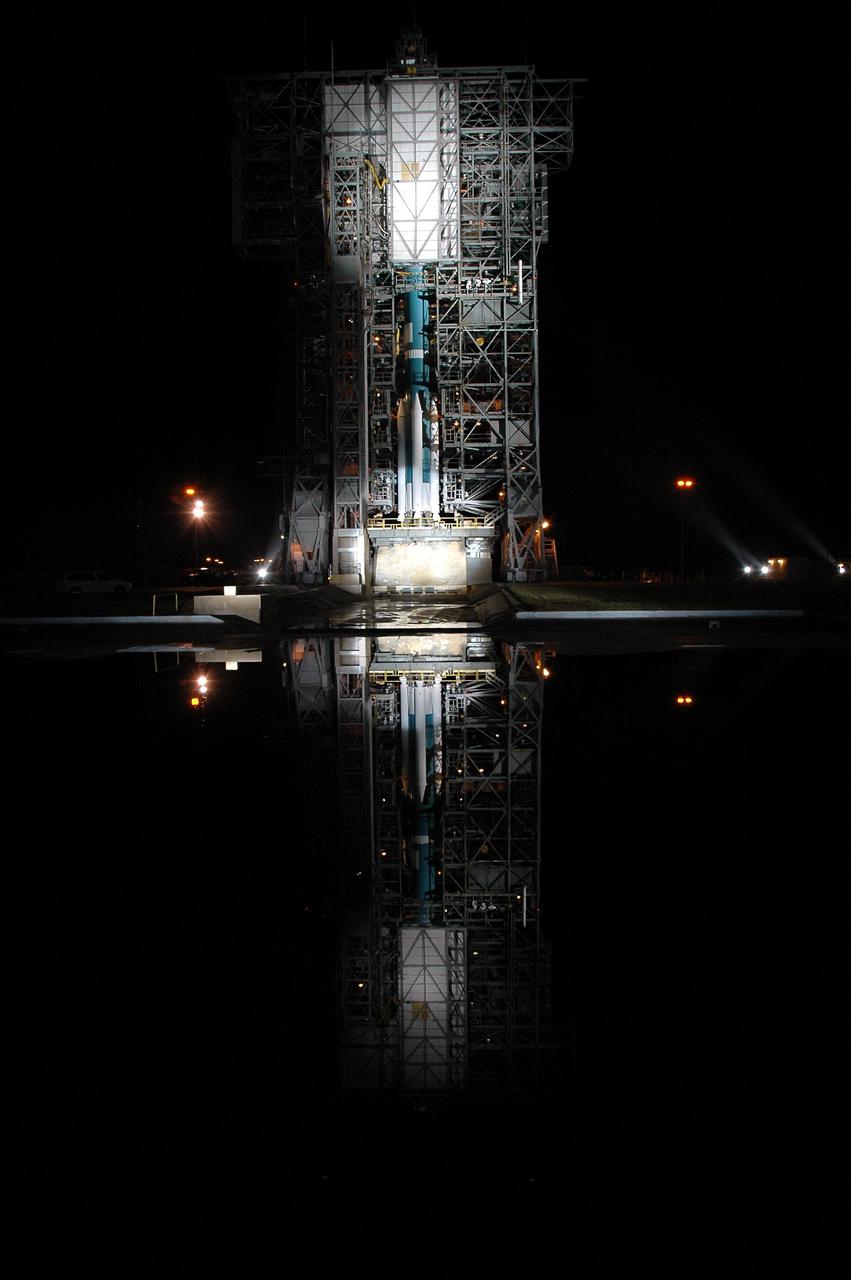
KENNEDY SPACE CENTER, FLA. - A Boeing Delta II expendable launch vehicle stands ready to launch NASA’s Swift spacecraft following tower rollback at Complex 17A, Cape Canaveral Air Force Station. Swift is a first-of-its-kind multi-wavelength observatory dedicated to the study of gamma-ray burst science. Its three instruments will work together to observe GRBs and afterglows in the gamma ray, X-ray, ultraviolet and optical wavebands. Swift is scheduled to launch Nov. 20 at 12:10 p.m. EST.

KENNEDY SPACE CENTER, FLA. - A Boeing Delta II expendable launch vehicle stands ready to launch NASA’s Swift spacecraft following tower rollback at Complex 17A, Cape Canaveral Air Force Station. Swift is a first-of-its-kind multi-wavelength observatory dedicated to the study of gamma-ray burst science. Its three instruments will work together to observe GRBs and afterglows in the gamma ray, X-ray, ultraviolet and optical wavebands. Swift is scheduled to launch Nov. 20 at 12:10 p.m. EST.
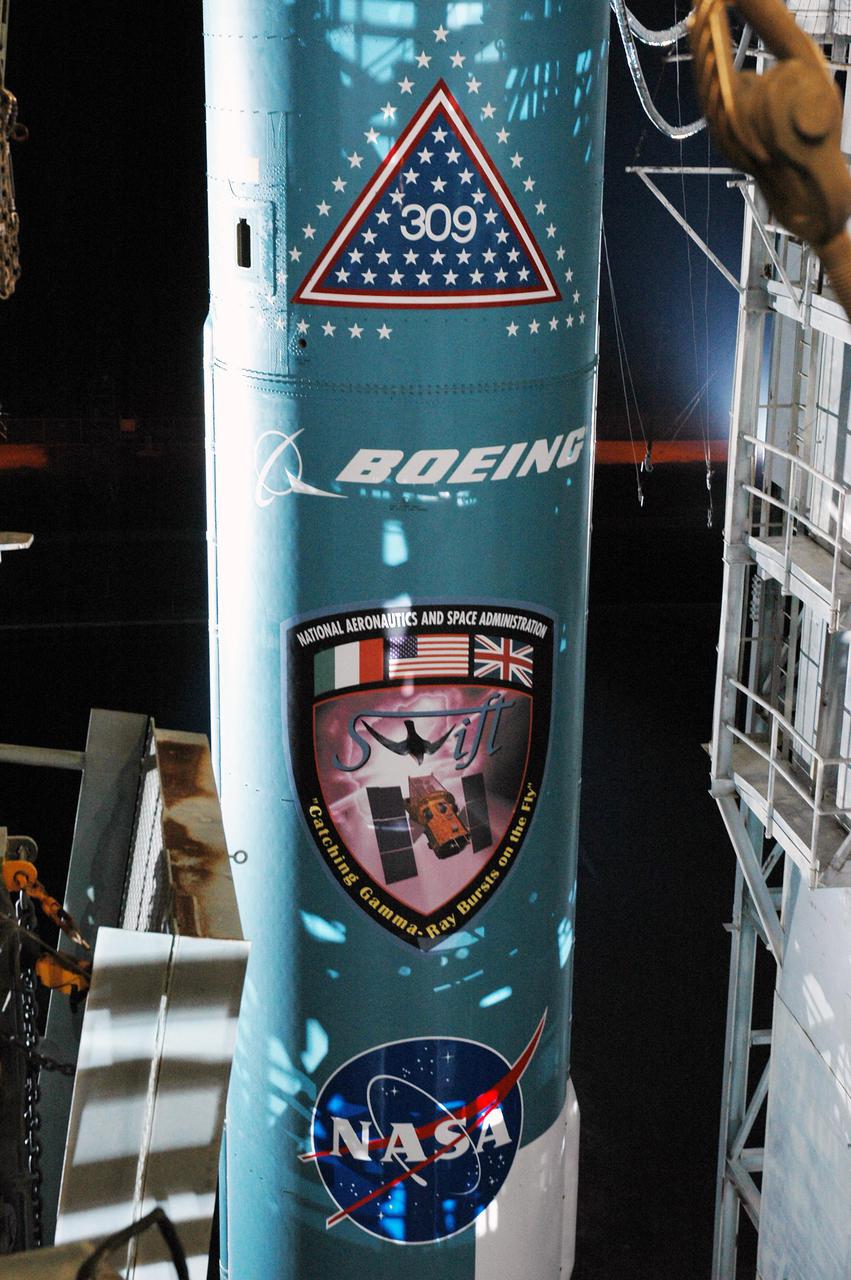
KENNEDY SPACE CENTER, FLA. - A Boeing Delta II expendable launch vehicle stands ready to launch NASA’s Swift spacecraft following tower rollback at Complex 17A, Cape Canaveral Air Force Station. Swift is a first-of-its-kind multi-wavelength observatory dedicated to the study of gamma-ray burst science. Its three instruments will work together to observe GRBs and afterglows in the gamma ray, X-ray, ultraviolet and optical wavebands. Swift is scheduled to launch Nov. 20 at 12:10 p.m. EST.
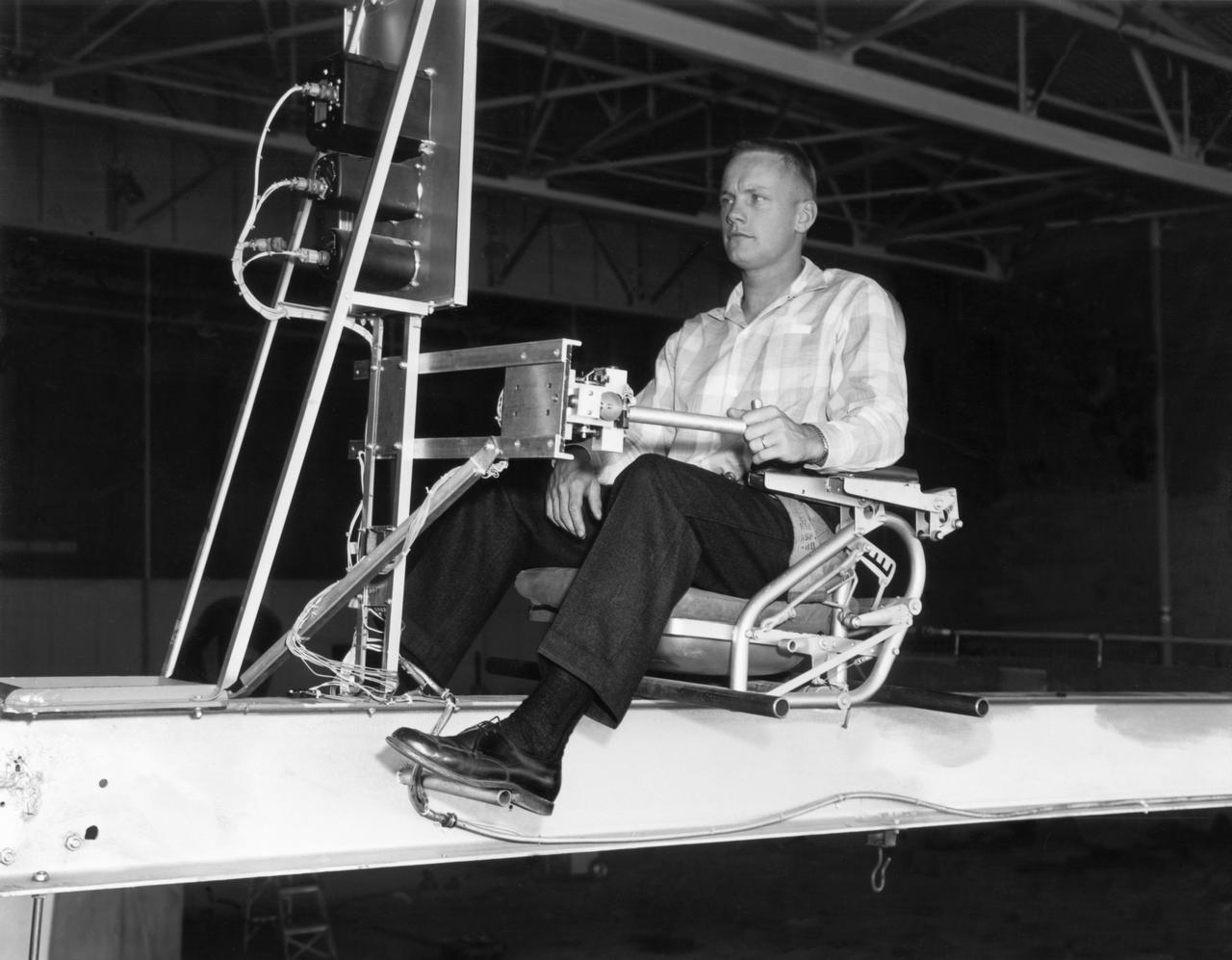
Famed astronaut Neil A. Armstrong, the first man to set foot on the moon during the historic Apollo 11 space mission in July 1969, served for seven years as a research pilot at the NACA-NASA High-Speed Flight Station, now the Dryden Flight Research Center, at Edwards, California, before he entered the space program. Armstrong joined the National Advisory Committee for Aeronautics (NACA) at the Lewis Flight Propulsion Laboratory (later NASA's Lewis Research Center, Cleveland, Ohio, and today the Glenn Research Center) in 1955. Later that year, he transferred to the High-Speed Flight Station at Edwards as an aeronautical research scientist and then as a pilot, a position he held until becoming an astronaut in 1962. He was one of nine NASA astronauts in the second class to be chosen. As a research pilot Armstrong served as project pilot on the F-100A and F-100C aircraft, F-101, and the F-104A. He also flew the X-1B, X-5, F-105, F-106, B-47, KC-135, and Paresev. He left Dryden with a total of over 2450 flying hours. He was a member of the USAF-NASA Dyna-Soar Pilot Consultant Group before the Dyna-Soar project was cancelled, and studied X-20 Dyna-Soar approaches and abort maneuvers through use of the F-102A and F5D jet aircraft. Armstrong was actively engaged in both piloting and engineering aspects of the X-15 program from its inception. He completed the first flight in the aircraft equipped with a new flow-direction sensor (ball nose) and the initial flight in an X-15 equipped with a self-adaptive flight control system. He worked closely with designers and engineers in development of the adaptive system, and made seven flights in the rocket plane from December 1960 until July 1962. During those fights he reached a peak altitude of 207,500 feet in the X-15-3, and a speed of 3,989 mph (Mach 5.74) in the X-15-1. Armstrong has a total of 8 days and 14 hours in space, including 2 hours and 48 minutes walking on the Moon. In March 1966 he was commander of the Gemini 8 or
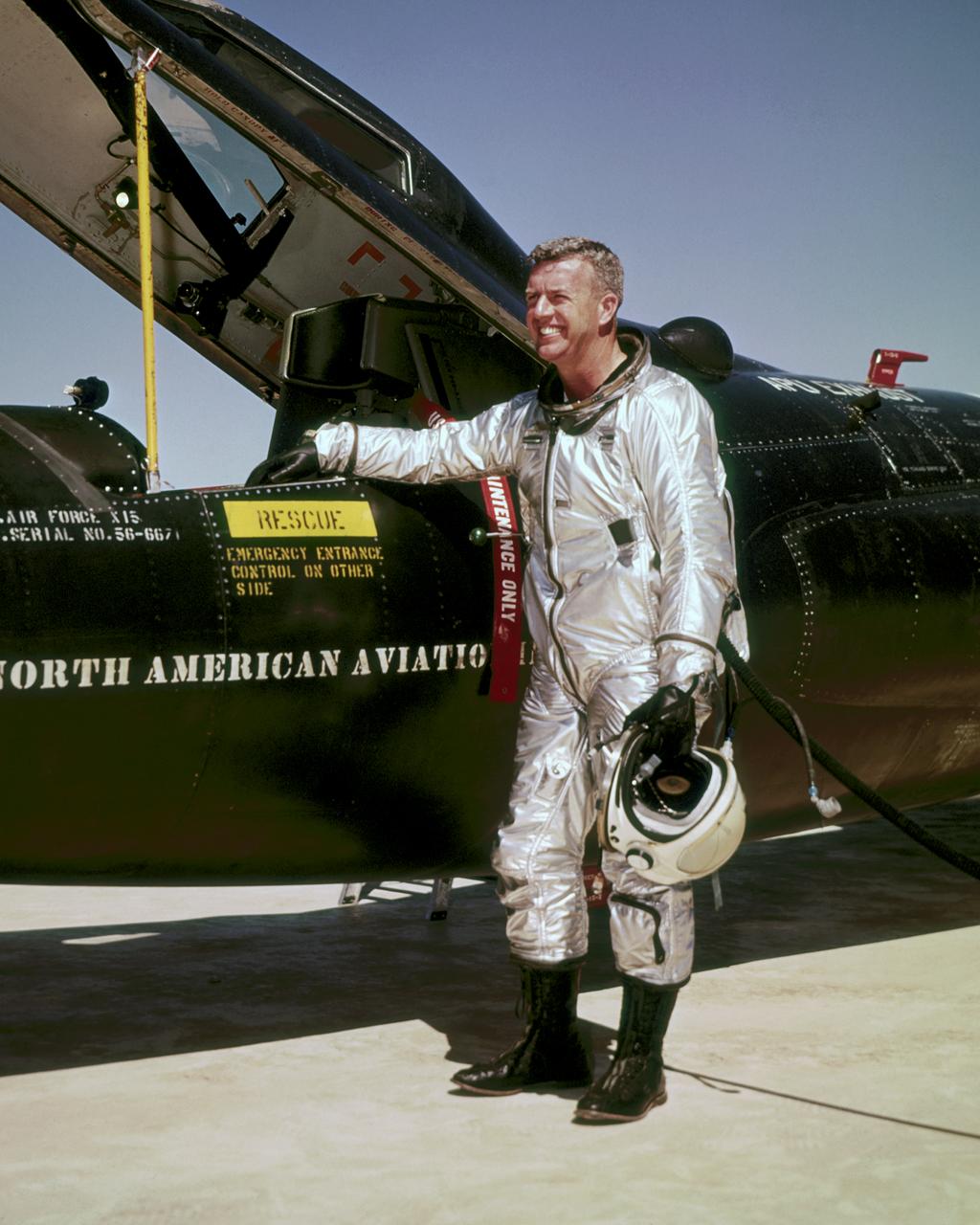
Joseph A. Walker was a Chief Research Pilot at the NASA Dryden Flight Research Center during the mid-1960s. He joined the NACA in March 1945, and served as project pilot at the Edwards flight research facility on such pioneering research projects as the D-558-1, D-558-2, X-1, X-3, X-4, X-5, and the X-15. He also flew programs involving the F-100, F-101, F-102, F-104, and the B-47. Walker made the first NASA X-15 flight on March 25, 1960. He flew the research aircraft 24 times and achieved its fastest speed and highest altitude. He attained a speed of 4,104 mph (Mach 5.92) during a flight on June 27, 1962, and reached an altitude of 354,300 feet on August 22, 1963 (his last X-15 flight). He was the first man to pilot the Lunar Landing Research Vehicle (LLRV) that was used to develop piloting and operational techniques for lunar landings. Walker was born February 20, 1921, in Washington, Pa. He lived there until graduating from Washington and Jefferson College in 1942, with a B.A. degree in Physics. During World War II he flew P-38 fighters for the Air Force, earning the Distinguished Flying Cross and the Air Medal with Seven Oak Clusters. Walker was the recipient of many awards during his 21 years as a research pilot. These include the 1961 Robert J. Collier Trophy, 1961 Harmon International Trophy for Aviators, the 1961 Kincheloe Award and 1961 Octave Chanute Award. He received an honorary Doctor of Aeronautical Sciences degree from his alma mater in June of 1962. Walker was named Pilot of the Year in 1963 by the National Pilots Association. He was a charter member of the Society of Experimental Test Pilots, and one of the first to be designated a Fellow. He was fatally injured on June 8, 1966, in a mid-air collision between an F-104 he was piloting and the XB-70.
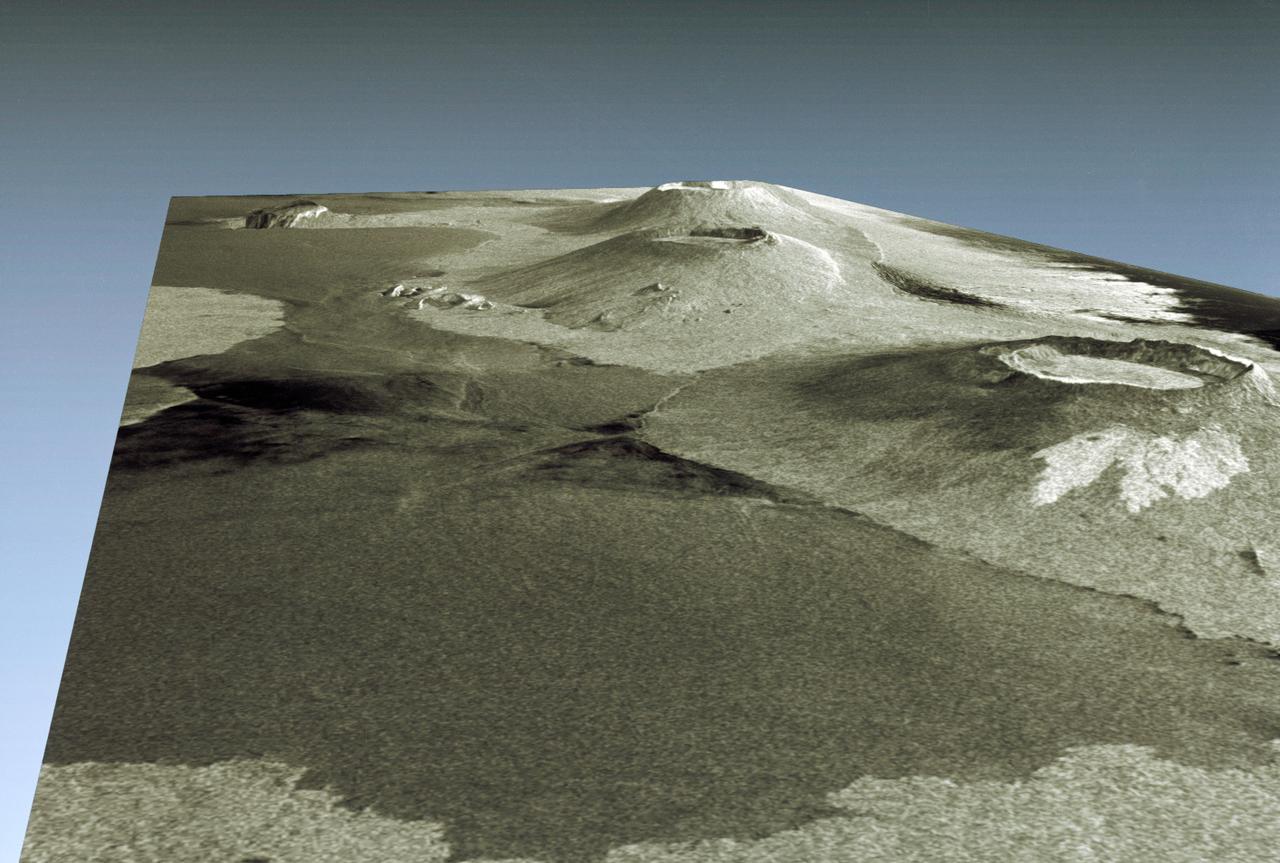
STS059-S-085 (18 April 1994) --- This is a three-dimensional perspective view of part of Isla Isabela in the western Galapagos Islands. It was taken by the L-Band radar in HH polarization from the Spaceborne Imaging Radar-C and X-Band Synthetic Aperture Radar (SIR-C/X-SAR) on the 40th orbit of the Space Shuttle Endeavour. This view was constructed by overlaying a SIR-C radar image on a U.S. Geological Survey digital elevation map. The image is centered at about .5 degrees south latitude and 91 degrees west longitude, and covers an area of 75 by 60 kilometers. The radar incidence angle at the center of the image is about 20 degrees. The western Galapagos Islands, which lie about 1200 kilometers west of Ecuador in the eastern Pacific, have six active volcanoes similar to the volcanoes found in Hawaii. Since the time of Charles Darwin's visit to the area in 1835, there have been over 60 recorded eruptions on these volcanoes. This SIR-C/X-SAR image of Alcedo and Sierra Negra volcanoes shows the rougher lava flows as bright features, while ash deposits and smooth pahoehoe lava flows appear dark. The Galapagos Islands are one of the SIR-C/X-SAR supersites and data of this area will be taken several times during the flight to allow scientists to conduct topographic change studies and to search for different lava flow types, ash deposits and fault lines. SIR-C/X-SAR is part of NASA's Mission to Planet Earth (MTPE). SIR-C/X-SAR radars illuminate Earth with microwaves allowing detailed observations at any time, regardless of weather or sunlight conditions. SIR-C/X-SAR uses three microwave wavelengths: L-Band (24 cm), C-Band (6 cm), and X-Band (3 cm). The multi-frequency data will be used by the international scientific community to better understand the global environment and how it is changing. The SIR-C/X-SAR data, complemented by aircraft and ground studies, will give scientists clearer insights into those environmental changes which are caused by nature and those changes which are induced by human activity. SIR-C was developed by NASA's Jet Propulsion Laboratory (JPL). X-SAR was developed by the Dornire and Alenia Spazio Companies for the German Space Agency, Deutsche Agentur fuer Raumfahrtangelegenheiten (DARA), and the Italian Space Agency, Agenzia Spaziale Italiana (ASI). JPL Photo ID: P-43938
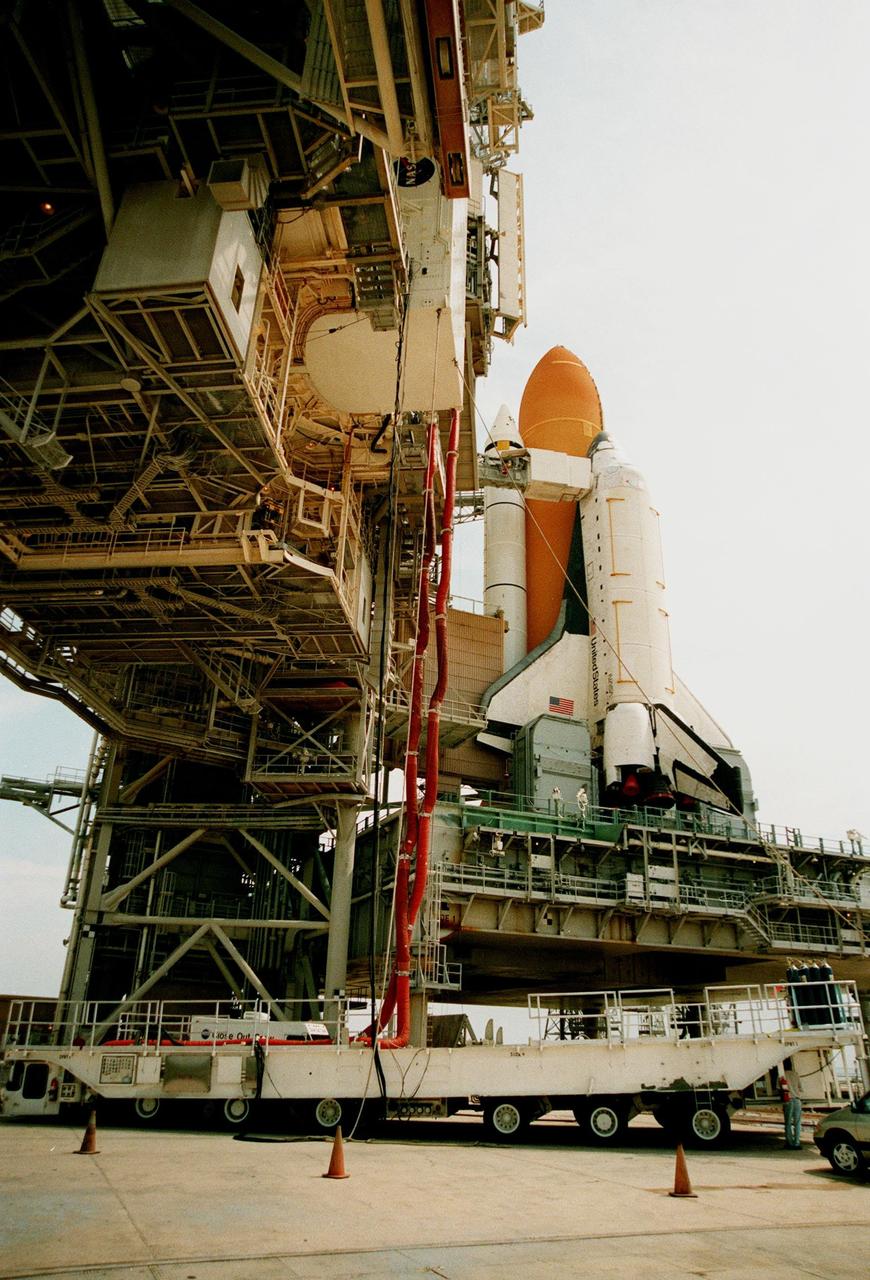
KENNEDY SPACE CENTER, FLA. -- At Launch Pad 39B, the payload canister carrying the Chandra X-ray Observatory begins its ascent up the Rotating Service Structure (RSS) to the Payload Changeout Room. Umbilical hoses, which maintain a controlled environment for the observatory, are still attached to the payload canister transporter below that transferred the observatory from the Vertical Processing Facility. The observatory will be moved into the payload bay of the Space Shuttle Columbia, seen in the background, after the RSS rotates to a position behind Columbia. The world's most powerful X-ray telescope, Chandra will allow scientists from around the world to see previously invisible black holes and high-temperature gas clouds, giving the observatory the potential to rewrite the books on the structure and evolution of our universe. Chandra is scheduled for launch no earlier than July 20 aboard Space Shuttle Columbia, on mission STS-93
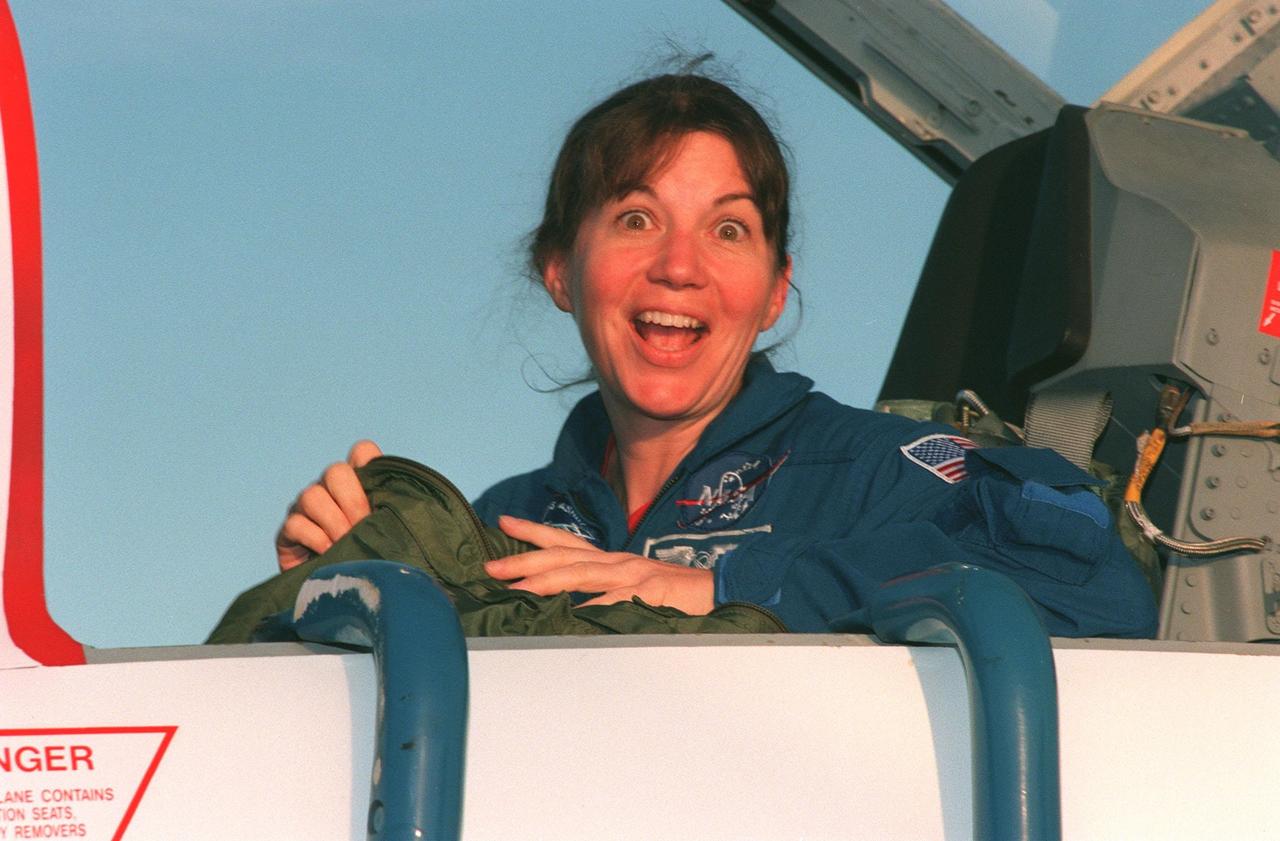
STS-93 Mission Specialist Catherine G. "Cady" Coleman (Ph.D.) shows her sense of humor upon arriving at KSC's Shuttle Landing Facility aboard a T-38 jet aircraft. She and other crew members Commander Eileen Collins, Pilot Jeffrey S. Ashby, and Mission Specialists Steven A. Hawley (Ph.D.) and Michel Tognini of France, with the Centre National d'Etudes Spatiales (CNES), are arriving for pre-launch activities. Coleman is making her second Shuttle flight. The primary mission of STS-93 is the release of the Chandra X-ray Observatory, which will allow scientists from around the world to study some of the most distant, powerful and dynamic objects in the universe. The new telescope is 20 to 50 times more sensitive than any previous X-ray telescope and is expected to unlock the secrets of supernovae, quasars and black holes
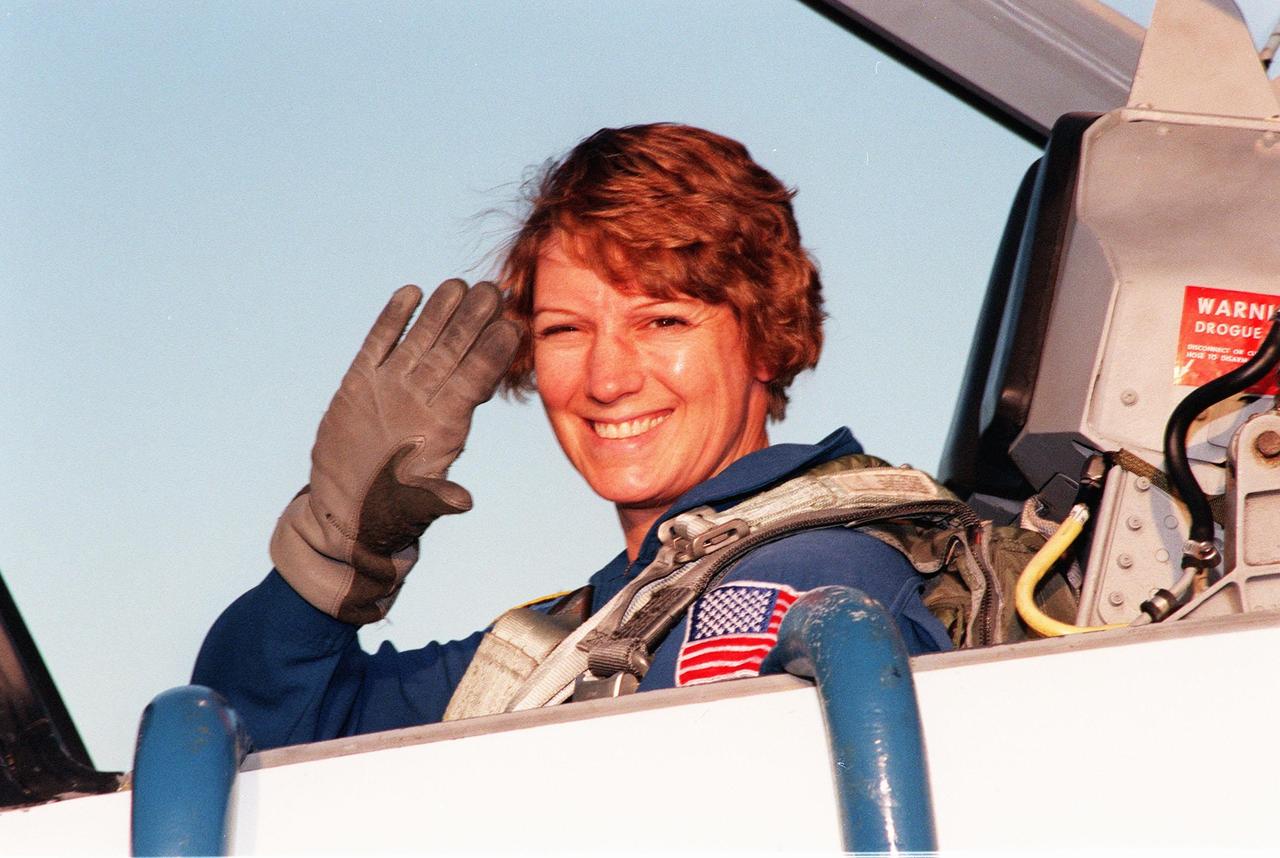
STS-93 Commander Eileen Collins waves to spectators after landing at Kennedy Space Center's Shuttle Landing Facility (SLF) aboard a T-38 jet aircraft. She and other crew members Pilot Jeffrey S. Ashby and Mission Specialists Steven A. Hawley (Ph.D.), Catherine G. "Cady" Coleman (Ph.D.) and Michel Tognini of France, with the Centre National d'Etudes Spatiales (CNES), are arriving for pre-launch activities. Collins is the first woman to serve as mission commander. This is her third Shuttle flight. The primary mission of STS-93 is the release of the Chandra X-ray Observatory, which will allow scientists from around the world to study some of the most distant, powerful and dynamic objects in the universe. The new telescope is 20 to 50 times more sensitive than any previous X-ray telescope and is expected to unlock the secrets of supernovae, quasars and black holes
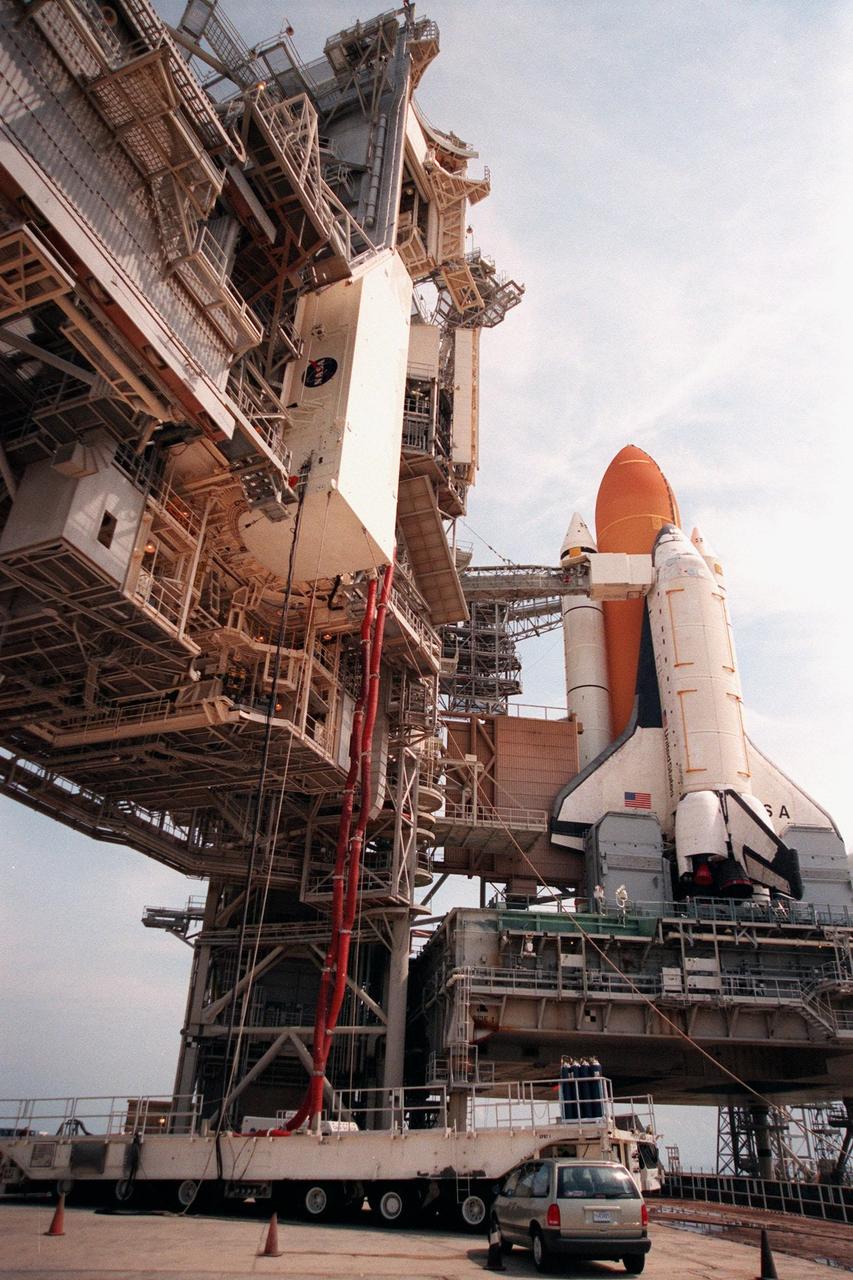
KENNEDY SPACE CENTER, FLA. -- At Launch Pad 39B, the payload canister carrying the Chandra X-ray Observatory nears the end of its ascent up the Rotating Service Structure (RSS) to the Payload Changeout Room. Umbilical hoses, which maintain a controlled environment for the observatory, are still attached to the payload canister transporter below that transferred the payload from the Vertical Processing Facility. The observatory will be moved into the payload bay of the Space Shuttle Columbia, seen in the background, after the RSS rotates to a position behind Columbia. The world's most powerful X-ray telescope, Chandra will allow scientists from around the world to see previously invisible black holes and high-temperature gas clouds, giving the observatory the potential to rewrite the books on the structure and evolution of our universe. Chandra is scheduled for launch no earlier than July 20 aboard Space Shuttle Columbia, on mission STS-93
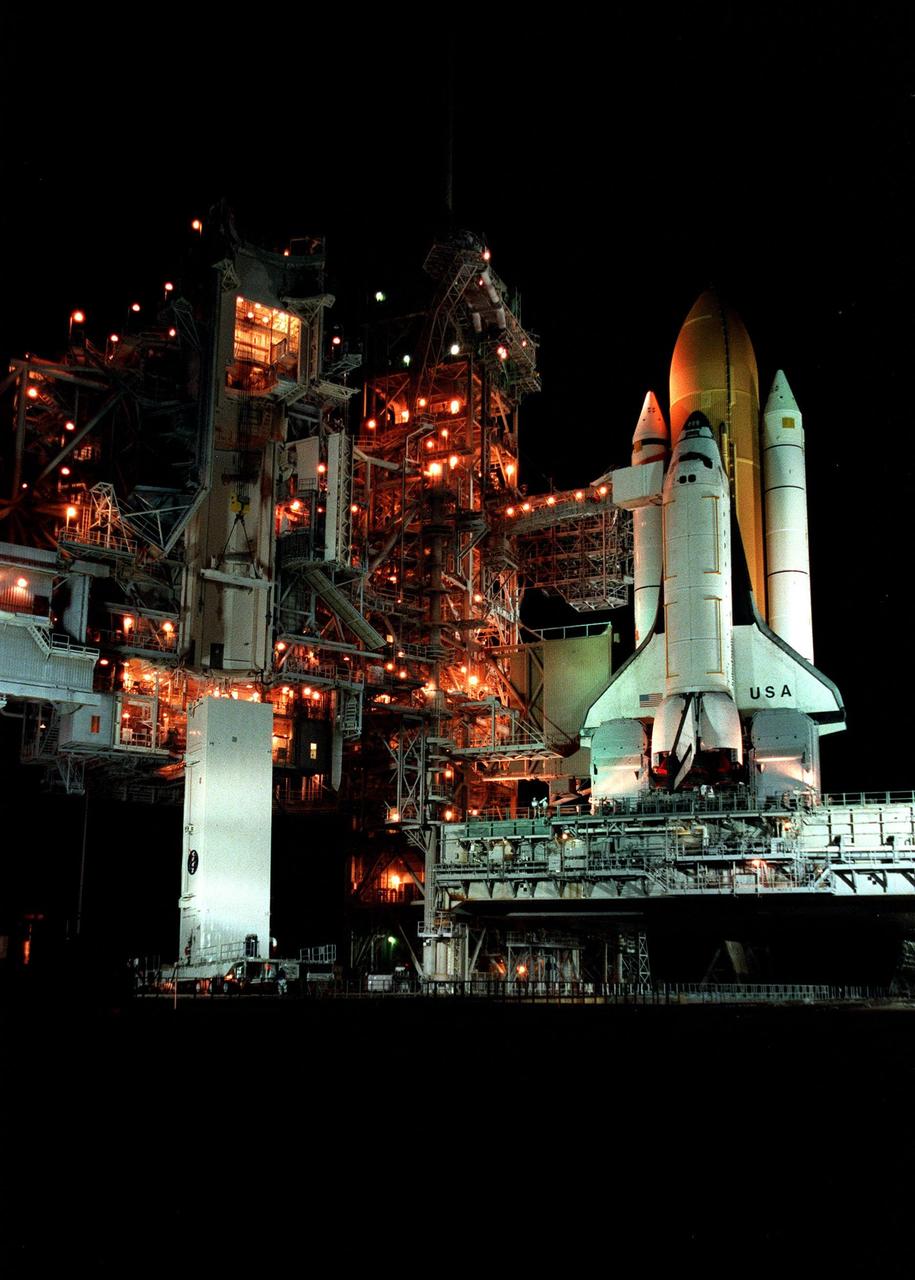
KENNEDY SPACE CENTER, FLA. -- Hours before dawn, the payload canister transporter delivers its cargo (lower left) to Launch Pad 39B, below the Rotating Service Structure (RSS). Inside the canister is the Chandra X-ray Observatory, primary payload on mission STS-93, scheduled to launch no earlier than July 20 aboard Space Shuttle Columbia (right). The canister will be lifted up to the Payload Changeout Room in the RSS where it will be relieved of its cargo. After the RSS rotates to a position behind Columbia, the observatory will then be installed vertically in the orbiter payload bay. The world's most powerful X-ray telescope, Chandra will allow scientists from around the world to see previously invisible black holes and high-temperature gas clouds, giving the observatory the potential to rewrite the books on the structure and evolution of our universe

Following initial captive flight tests last year at NASA's Dryden Flight Research Center, Edwards Air Force Base, California, the X-34 technology demonstrator began a new series of tests last week in which it is being towed behind a semi-truck and released to coast on the Edwards dry lakebed. On July 20, 2000, it was towed and released twice at speeds of five and 10 miles per hour. On July 24, 2000, it was towed and released twice at 10 and 30 miles per hour. Twelve tests are planned during which the X-34 will be towed for distances up to 10,000 feet and released at speeds up to 80 miles per hour. The test series is expected to last at least six weeks.
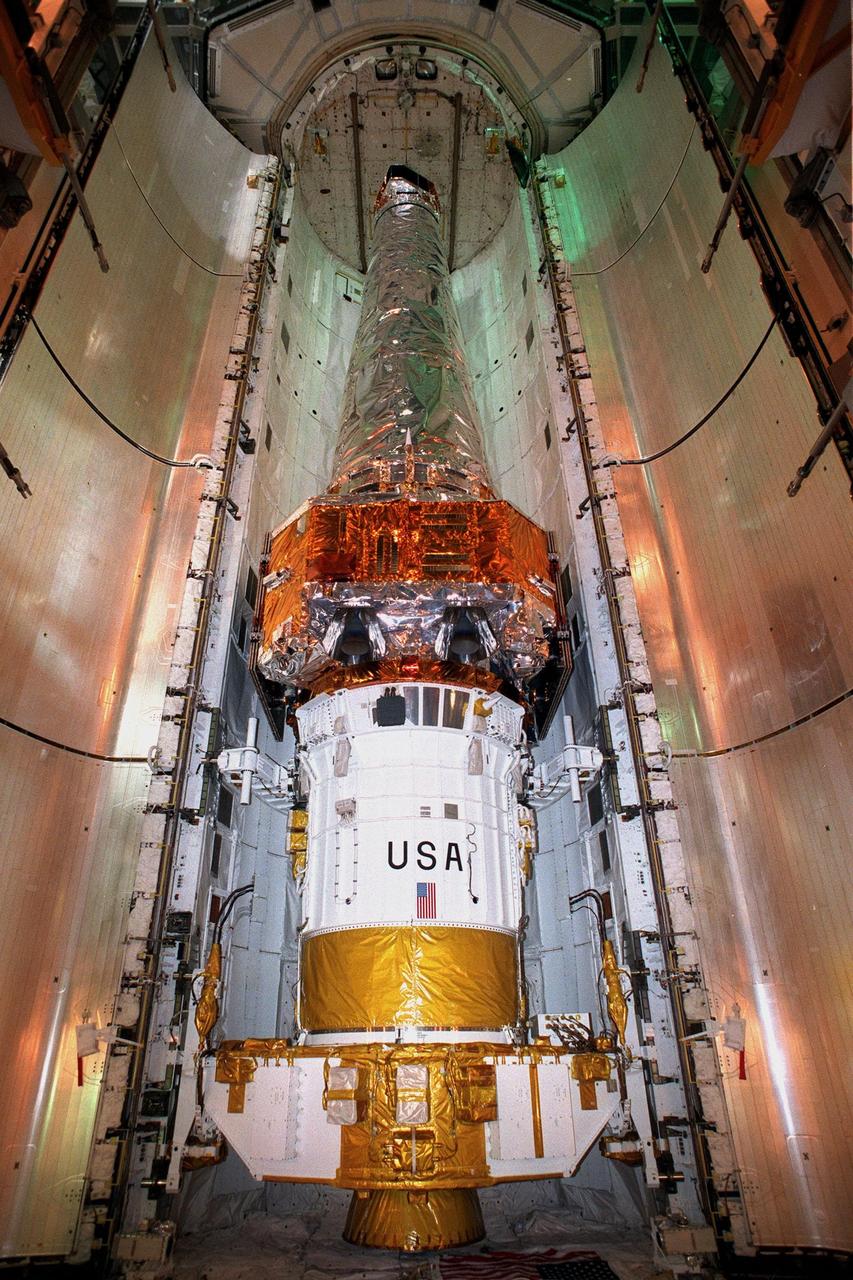
At Launch Pad 39-B, the Chandra X-ray Observatory sits inside the payload bay of Space Shuttle Columbia, waiting for the doors to close. Chandra is the primary payload on mission STS-93, scheduled to launch aboard Columbia July 20 at 12:36 a.m. EDT. The combined Chandra/Inertial Upper Stage, seen here, measures 57 feet long and weighs 50,162 pounds. Fully deployed with solar arrays extended, the observatory measures 45.3 feet long and 64 feet wide. The world's most powerful X-ray telescope, Chandra will allow scientists from around the world to see previously invisible black holes and high-temperature gas clouds, giving the observatory the potential to rewrite the books on the structure and evolution of our universe
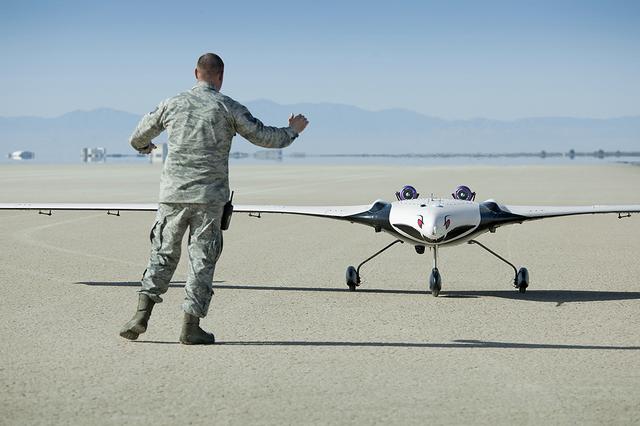
The X-56A Multi-Utility Technology Testbed (MUTT) is greeted on an Edwards Air Force Base runway by a U.S. Air Force Research Laboratory (AFRL) team member. NASA’s Armstrong Flight Research Center and the AFRL, along with participants from Langley Research Center and Glenn Research Center, and support from Lockheed Martin, are using the second X-56A (dubbed “Buckeye”) to check out aircraft systems, evaluate handling qualities, characterize and expand the airplane’s performance envelope, and verify pre-flight predictions regarding aircraft behavior. The 20-minute flight marked the beginning of a research effort designed to yield significant advances in aeroservoelastic technology using a low-cost, modular, remotely piloted aerial vehicle.

This Chandra X-ray observatory image of M83 shows numerous point-like neutron stars and black hole x-ray sources scattered throughout the disk of this spiral galaxy. The bright nuclear region of the galaxy glows prominently due to a burst of star formation that is estimated to have begun about 20 million years ago in the galaxy's time frame. The nuclear region, enveloped by a 7 million degree Celsius gas cloud of carbon, neon, magnesium, silicon, and sulfur atoms, contains a much higher concentration of neutron stars and black holes than the rest of the galaxy. Hot gas with a slightly lower temperature of 4 million degrees observed along the spiral arms of the galaxy suggests that star formation in this region may be occurring at a more sedate rate.
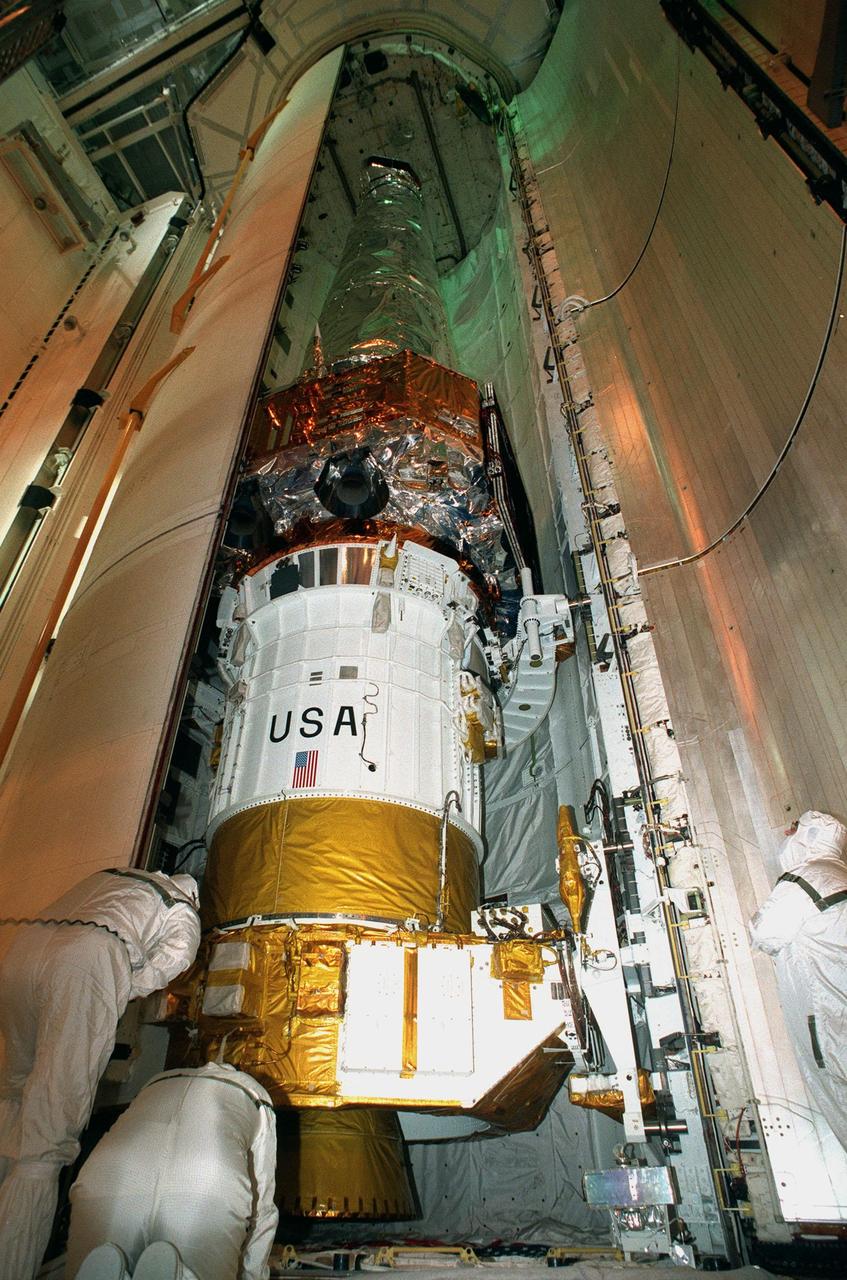
At Launch Pad 39-B, the Space Shuttle Columbia's payload bay doors close around the Chandra X-ray Observatory inside, while workers monitor the activity. Chandra is the primary payload on mission STS-93, scheduled to launch aboard Columbia July 20 at 12:36 a.m. EDT. The combined Chandra/Inertial Upper Stage, seen here, measures 57 feet long and weighs 50,162 pounds. Fully deployed with solar arrays extended, the observatory measures 45.3 feet long and 64 feet wide. The world's most powerful X-ray telescope, Chandra will allow scientists from around the world to see previously invisible black holes and high-temperature gas clouds, giving the observatory the potential to rewrite the books on the structure and evolution of our universe
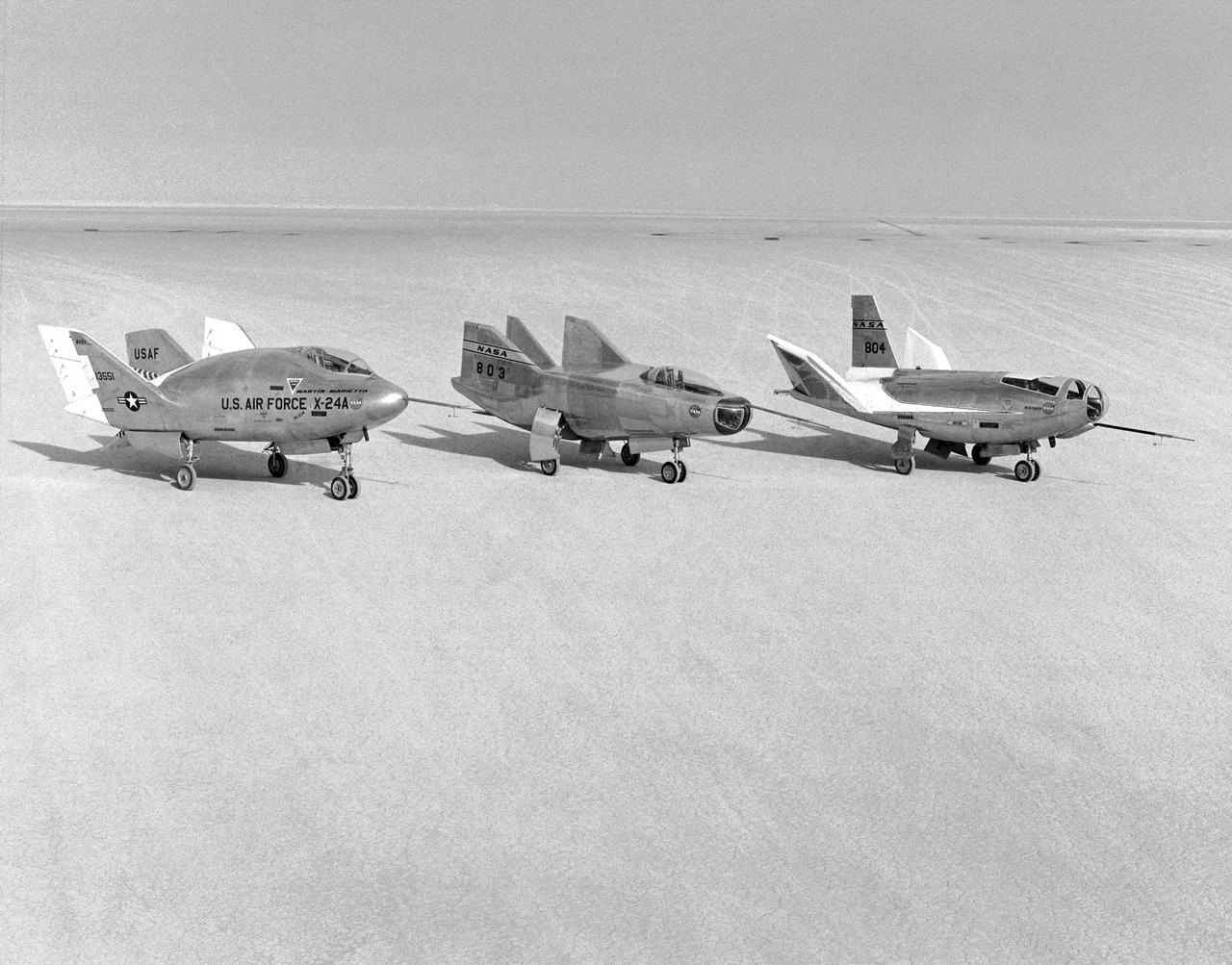
The wingless, lifting body aircraft sitting on Rogers Dry Lake at what is now NASA's Dryden Flight Research Center, Edwards, California, from left to right are the X-24A, M2-F3 and the HL-10. The lifting body aircraft studied the feasibility of maneuvering and landing an aerodynamic craft designed for reentry from space. These lifting bodies were air launched by a B-52 mother ship, then flew powered by their own rocket engines before making an unpowered approach and landing. They helped validate the concept that a space shuttle could make accurate landings without power. The X-24A flew from April 17, 1969 to June 4, 1971. The M2-F3 flew from June 2, 1970 until December 20, 1972. The HL-10 flew from December 22, 1966 until July 17, 1970 and logged the highest and fastest records in the lifting body program.
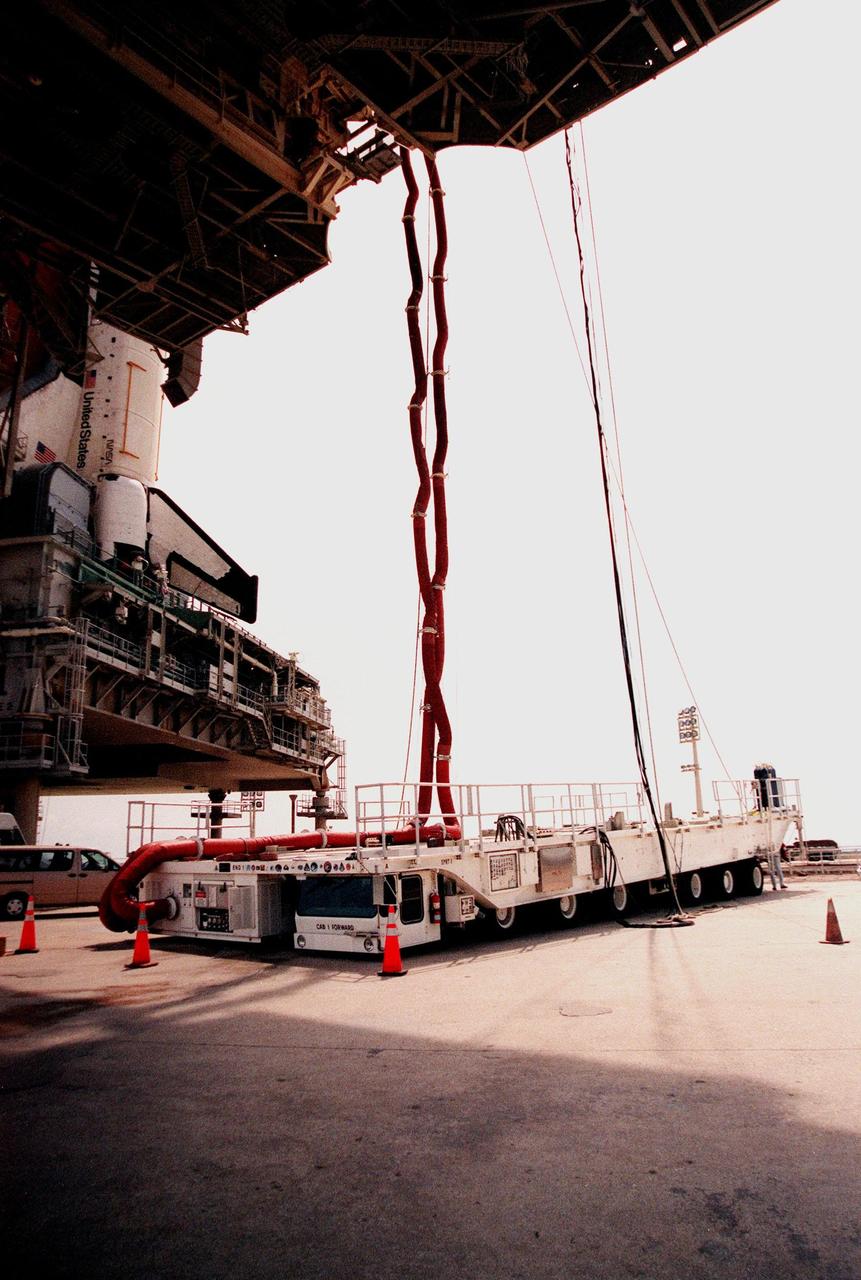
KENNEDY SPACE CENTER, FLA. -- The payload canister transporter that brought the Chandra X-ray Observatory to Launch Pad 39B waits while the payload canister is lifted up the Rotating Service Structure above it. Umbilical hoses are still attached during the process, maintaining a controlled environment during the transfer. At left is seen a part of the Space Shuttle Columbia, which will carry the observatory into space. The world's most powerful X-ray telescope, Chandra will allow scientists from around the world to see previously invisible black holes and high-temperature gas clouds, giving the observatory the potential to rewrite the books on the structure and evolution of our universe. Chandra is scheduled for launch no earlier than July 20 aboard Space Shuttle Columbia, on mission STS-93
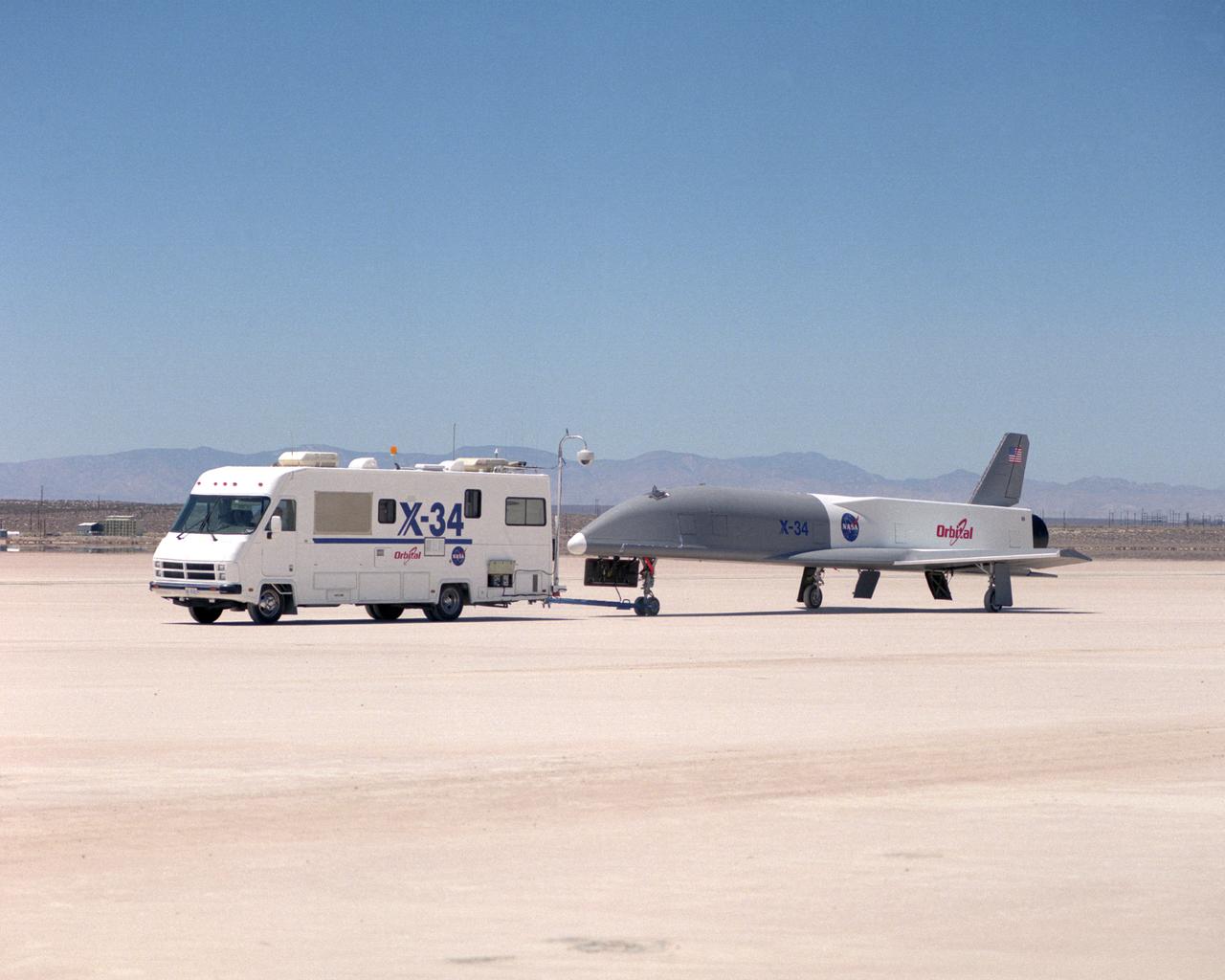
Following initial captive flight tests last year at NASA's Dryden Flight Research Center, Edwards Air Force Base, California, the X-34 technology demonstrator began a new series of tests last week in which it is being towed behind a semi-truck and released to coast on the Edwards dry lakebed. On July 20, 2000, it was towed and released twice at speeds of five and 10 miles per hour. On July 24, 2000, it was towed and released twice at 10 and 30 miles per hour. Twelve tests are planned during which the X-34 will be towed for distances up to 10,000 feet and released at speeds up to 80 miles per hour. The test series is expected to last at least six weeks.
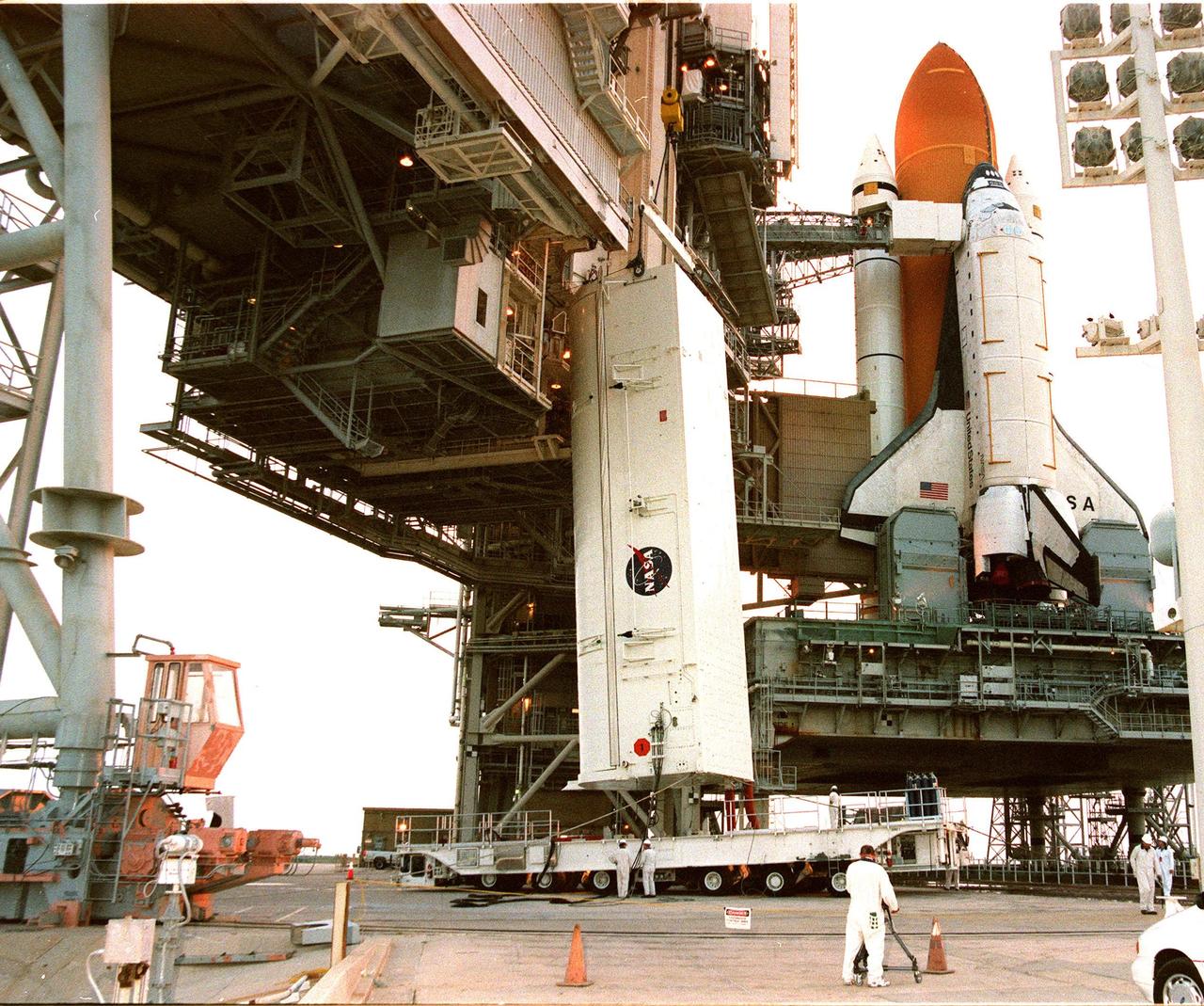
KENNEDY SPACE CENTER, FLA. -- In the early morning daylight, the payload canister containing the Chandra X-ray Observatory begins its ascent up the Rotating Service Structure (RSS). The canister arrived at the pad on the payload canister transporter below it. The canister will be lifted up to the Payload Changeout Room in the RSS where it will be relieved of its cargo. After the RSS rotates to a position behind Space Shuttle Columbia (at right), the observatory will then be installed vertically in the orbiter payload bay. The world's most powerful X-ray telescope, Chandra will allow scientists from around the world to see previously invisible black holes and high-temperature gas clouds, giving the observatory the potential to rewrite the books on the structure and evolution of our universe. Chandra is the primary payload on mission STS-93, scheduled to launch no earlier than July 20 aboard Space Shuttle Columbia (right)