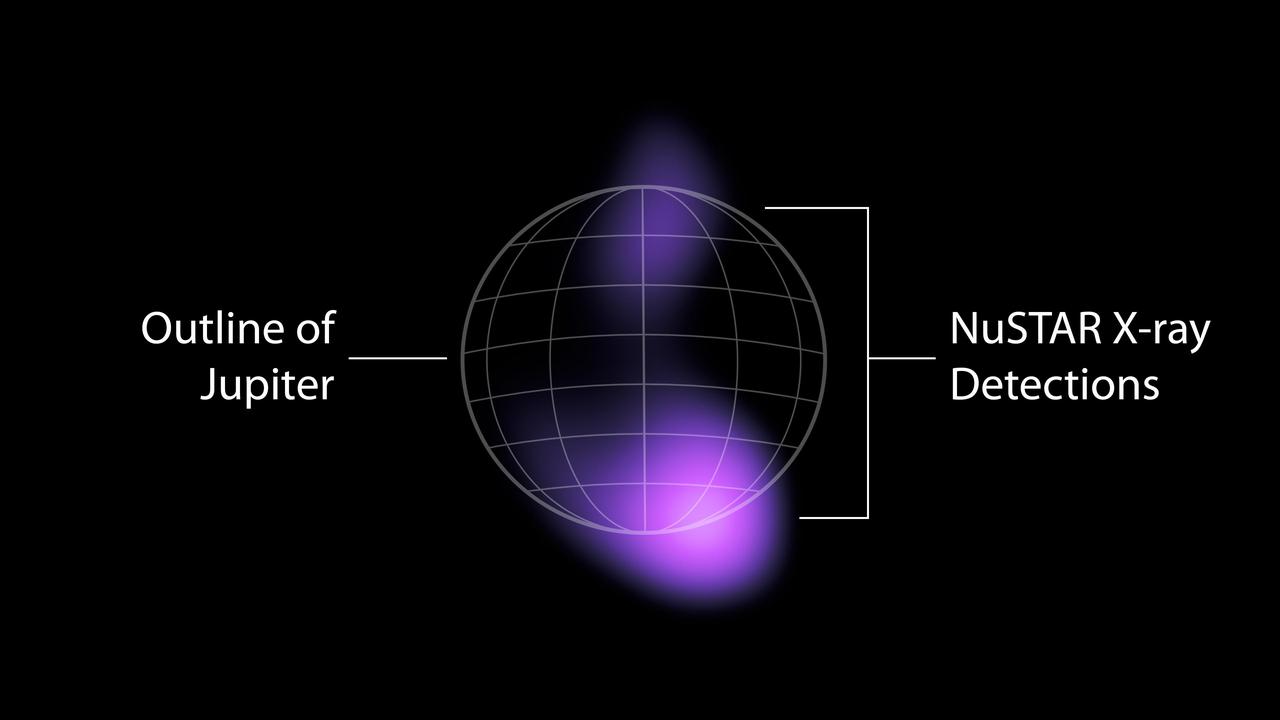
The areas where high-energy X-rays were detected by NASA's NuSTAR (Nuclear Spectroscopic Telescope Array) from the auroras near Jupiter's north and south poles are shown in purple in this graphic. The emissions are the highest-energy light ever seen at Jupiter and the highest-energy light ever detected from a planet in our solar system other than Earth. The light comes from accelerated electrons colliding with the atmosphere. NuSTAR cannot pinpoint the source of the light with high precision, but can only find that it is coming from somewhere in the purple-colored regions. X-rays are a form of light, but with much higher energies and shorter wavelengths than the visible light human eyes can see. NASA's Chandra X-ray Observatory and the ESA (European Space Agency) XMM-Newton observatory have both studied X-rays from Jupiter's auroras – produced when volcanos on Jupiter's moon Io shower the planet with ions (atoms stripped of their electrons). Jupiter's powerful magnetic field accelerates the particles and funnels them toward the planet's poles, where they collide with its atmosphere and release energy in the form of light, including X-rays. Electrons from Io are also accelerated by the planet's magnetic field, according to observations by the Jovian Auroral Distributions Experiment (JADE) and Jupiter Energetic-particle Detector Instrument (JEDI) on NASA's Juno spacecraft, which arrived at Jupiter in 2016. Researchers suspected that those electrons should produce even higher-energy X-rays than those observed by Chandra and XMM-Newton, and the NuSTAR detections confirm that hypothesis. The high-energy X-rays are relatively faint, and required a week of NuSTAR observations to detect. Scientists have detected X-rays in Earth's auroras with even higher energies than what NuSTAR saw at Jupiter, but those emissions can only be spotted by small satellites or high-altitude balloons that get extremely close to the locations in the atmosphere that generate those X-rays. https://photojournal.jpl.nasa.gov/catalog/PIA25131
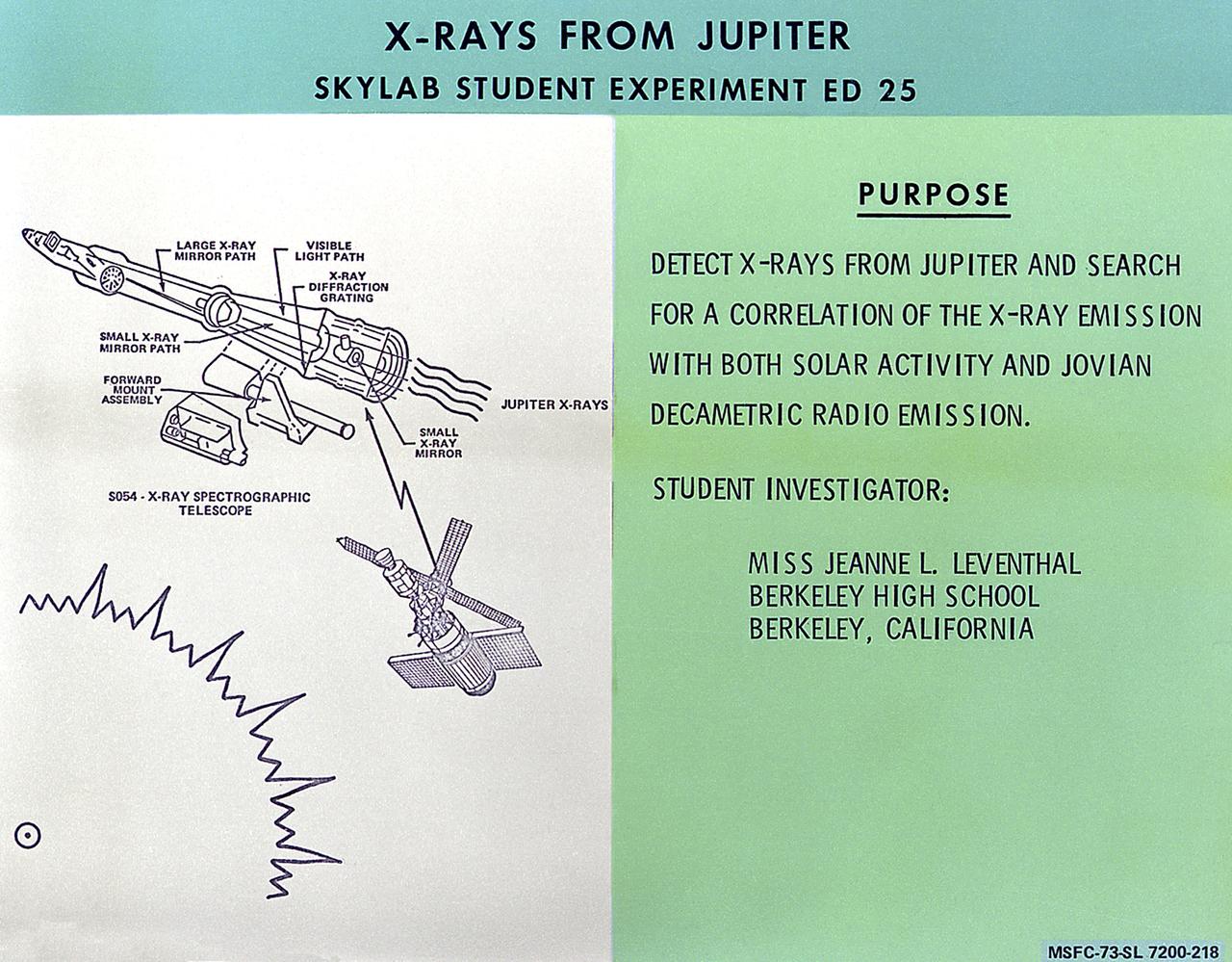
This chart describes the Skylab student experiment X-Rays from Jupiter, proposed by Jearne Leventhal of Berkeley, California. This experiment was an investigation to detect x-rays from the planet Jupiter and determine any correlation with solar flare activity. In March 1972, NASA and the National Science Teachers Association selected 25 experiment proposals for flight on Skylab. Science advisors from the Marshall Space Flight Center aided and assisted the students in developing the proposals for flight on Skylab.
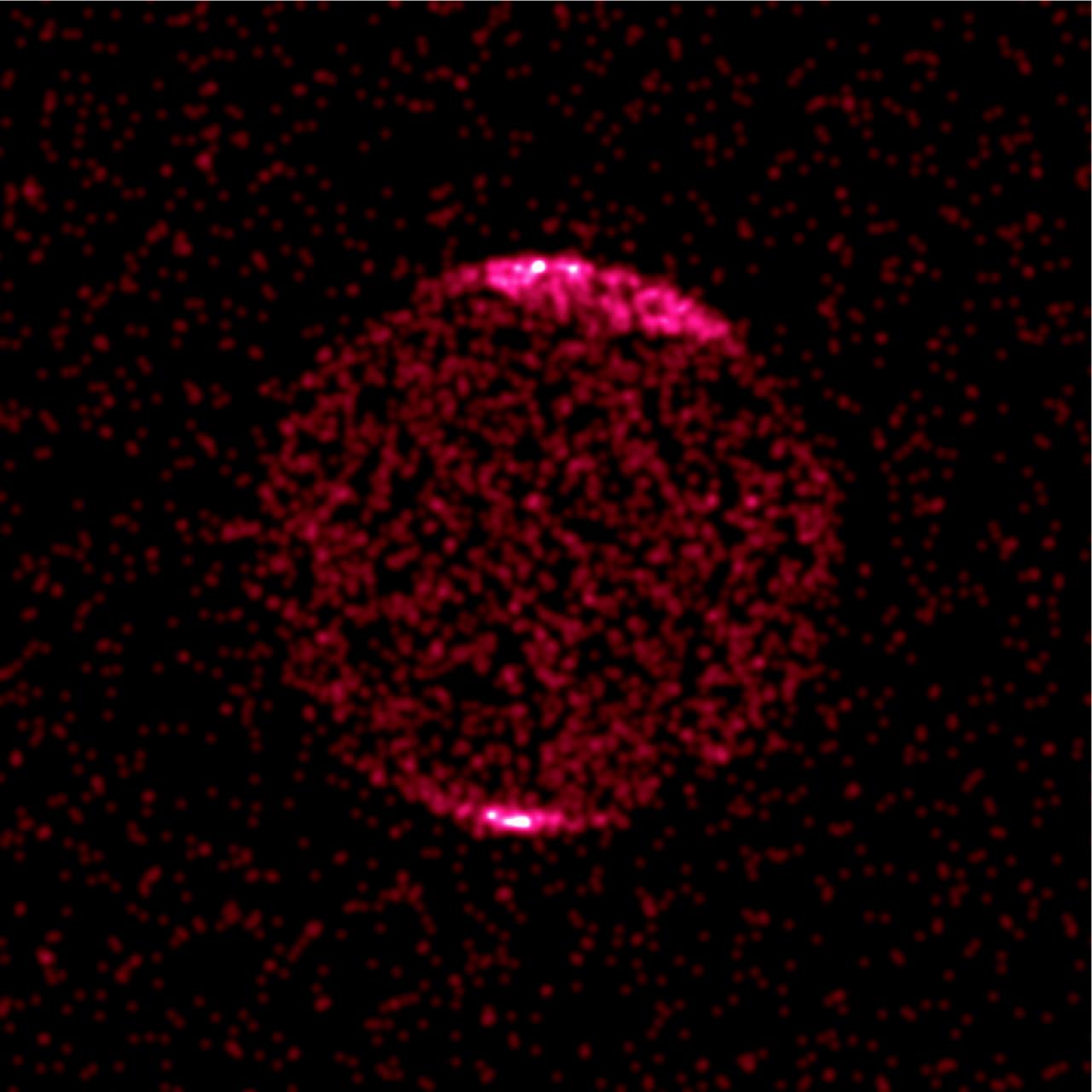
This Chandra image of Jupiter shows concentrations of aurora x-rays near the north and south poles due to a single `hot spot' that pulsates with a period of 45 minutes, similar to high-latitude radio pulsation previously detected by NASA's Galileo and Cassini spacecraft. Previous x-ray detections of Jupiter have been made with other x-ray telescopes, but did not reveal that the sources of the x-rays, energetic oxygen and sulfur ions, would be located so near the poles. Previous theories held that ions were mostly coming from Jupiter's moon, lo. Chandra's ability to pinpoint the source of the x-rays discards this theory since ions coming from near lo's orbit carnot reach the observed high latitudes. One possibility is that particles flowing out from the Sun are captured in the outer regions of Jupiter's magnetic field, then accelerated and directed toward its magnetic pole. Once captured, the ions would bounce back and forth in the magnetic field from Jupiter's north pole to the south pole in an oscillating motion that could explain the pulsation.
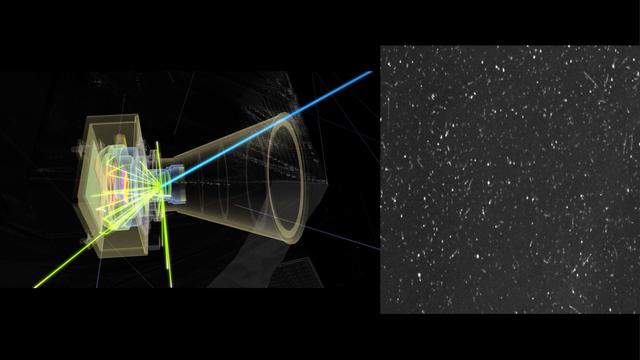
This animation gives an X-ray view of the Juno spacecraft's Stellar Reference Unit (SRU) star camera (left) as it is bombarded by high-energy particles in Jupiter's inner radiation belts. Even though the SRU camera head is six times more heavily shielded than Juno's radiation vault, the highest-energy particles in Jupiter's extreme radiation environment can still penetrate, striking the imaging sensor inside. The signatures from high-energy electron and ion hits appear as dots, squiggles, and streaks (right) in the images collected by the SRU, like static on a television screen. Juno's Radiation Monitoring Investigation collects SRU images and uses image processing to extract these radiation-induced noise signatures to profile the radiation levels encountered by Juno during its close flybys of Jupiter. Animation available at https://photojournal.jpl.nasa.gov/catalog/PIA24436

In this photograph, the instruments of the Astro-1 Observatory are erected in the cargo bay of the Columbia orbiter. Astro-1 was launched aboard the the Space Shuttle Orbiter Columbia (STS-35) mission on December 2, 1990. The Astro Observatory was designed to explore the universe by observing and measuring the ultraviolet radiation from celestial objects. Astronomical targets of observation selected for Astro missions included planets, stars, star clusters, galaxies, clusters of galaxies, quasars, remnants of exploded stars (supernovae), clouds of gas and dust (nebulae), and the interstellar medium. Astro-1 used a Spacelab pallet system with an instrument pointing system and a cruciform structure for bearing the three ultraviolet instruments mounted in a parallel configuration. The three instruments were:The Hopkins Ultraviolet Telescope (HUT), the Wisconsin Ultraviolet Photo-Polarimeter Experiment (WUPPE), and the Ultraviolet Imaging Telescope (UIT). Also in the payload bay was the Broad Band X-Ray Telescope (BBXRT). Scientific return included approximately 1,000 photographs of the ultraviolet sky in the most extensive ultraviolet imagery ever attempted, the longest ultraviolet spectral observation of a comet ever made, and data never before seen on types of active galaxies called Seyfert galaxies. The mission also provided data on a massive supergiant star captured in outburst and confirmed that a spectral feature observed in the interstellar medium was due to graphite. In addition, Astro-1 acquired superb observations of the Jupiter magnetic interaction with one of its satellites.