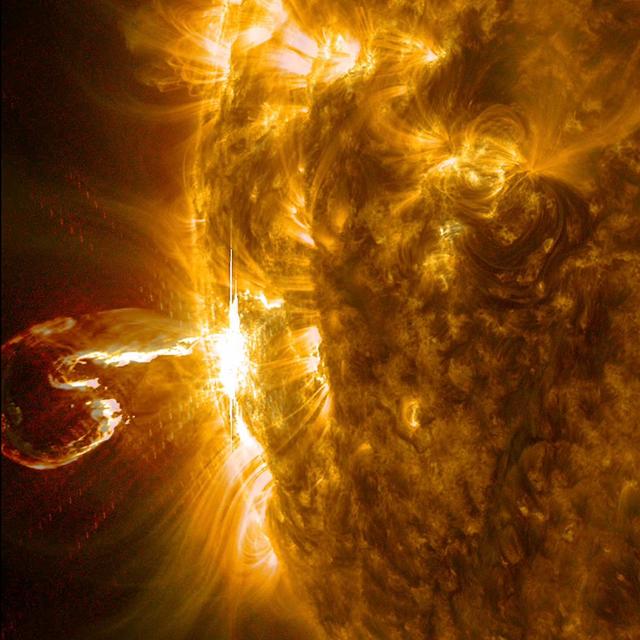
An active region at the edge of the Sun blew out an X4 flare (one of the largest of the solar cycle) and a coronal mass ejection on Feb. 25, 2014. The still image of the ejected plasma (taken at 00:45 UT) shows it curled like a shrimp, but this eruption was no shrimp: it was powerful. The images seen here are a combination of two wavelengths of extreme ultraviolet light (171 and 304 Angstroms). The video clip covers about three hours of activity. Credit: NASA/GSFC/Solar Dynamics Observatory <b><a href="http://www.nasa.gov/audience/formedia/features/MP_Photo_Guidelines.html" rel="nofollow">NASA image use policy.</a></b> <b><a href="http://www.nasa.gov/centers/goddard/home/index.html" rel="nofollow">NASA Goddard Space Flight Center</a></b> enables NASA’s mission through four scientific endeavors: Earth Science, Heliophysics, Solar System Exploration, and Astrophysics. Goddard plays a leading role in NASA’s accomplishments by contributing compelling scientific knowledge to advance the Agency’s mission. <b>Follow us on <a href="http://twitter.com/NASAGoddardPix" rel="nofollow">Twitter</a></b> <b>Like us on <a href="http://www.facebook.com/pages/Greenbelt-MD/NASA-Goddard/395013845897?ref=tsd" rel="nofollow">Facebook</a></b> <b>Find us on <a href="http://instagram.com/nasagoddard?vm=grid" rel="nofollow">Instagram</a></b>