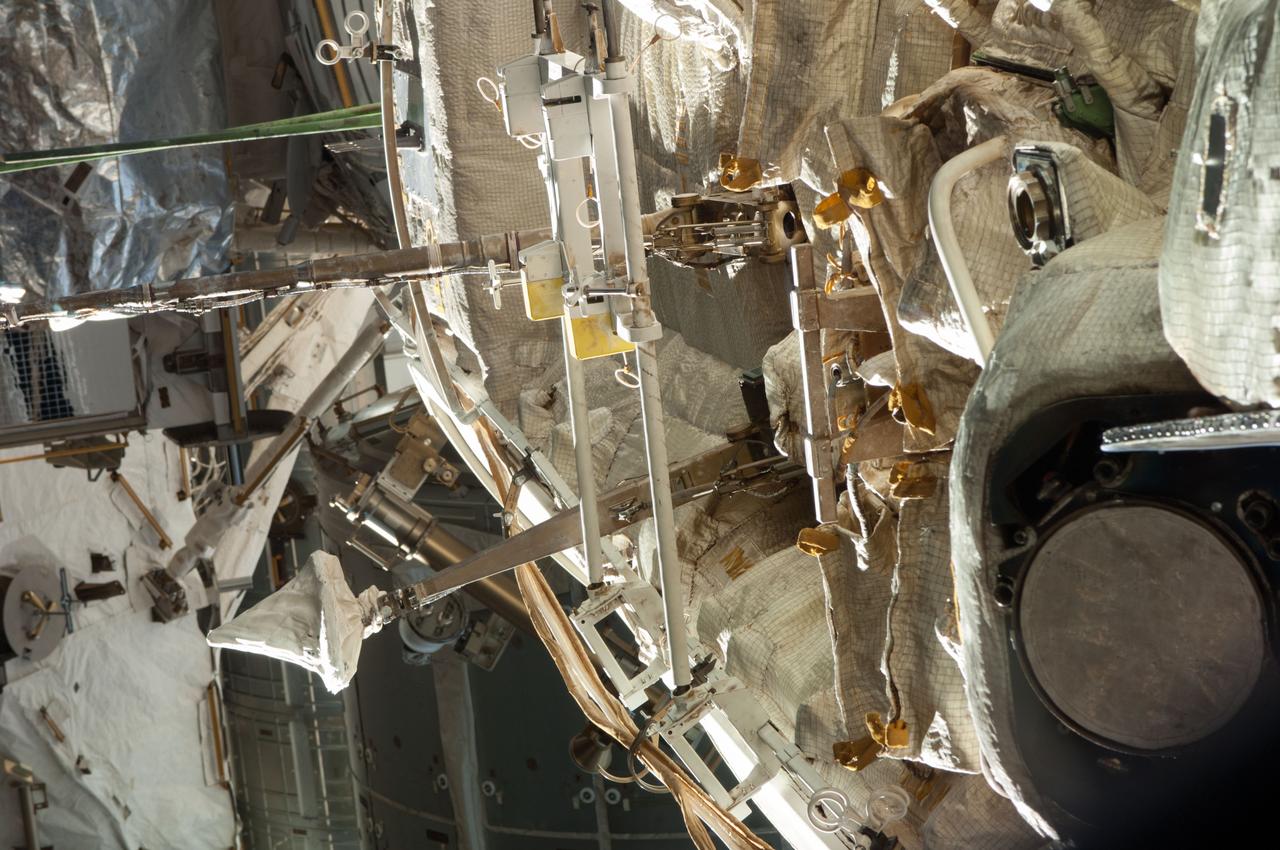
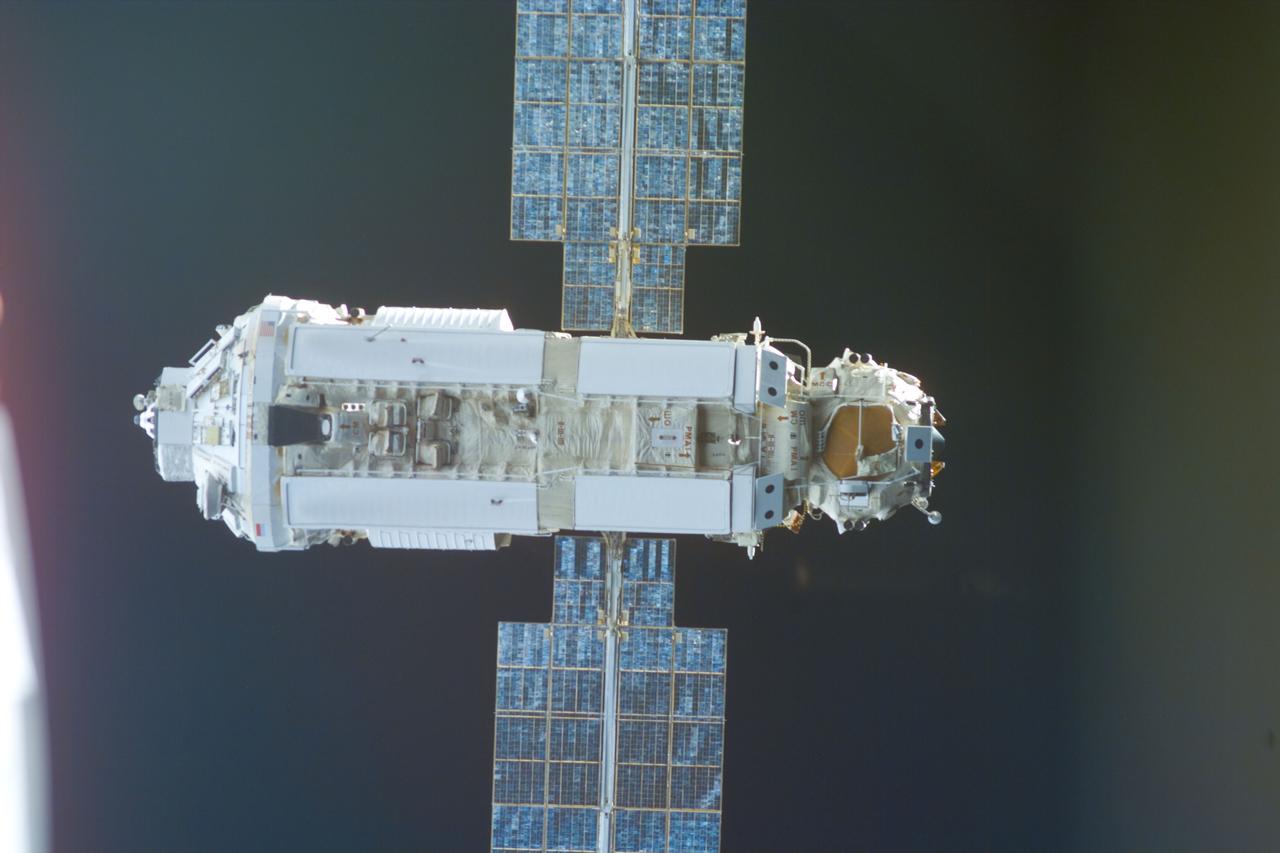
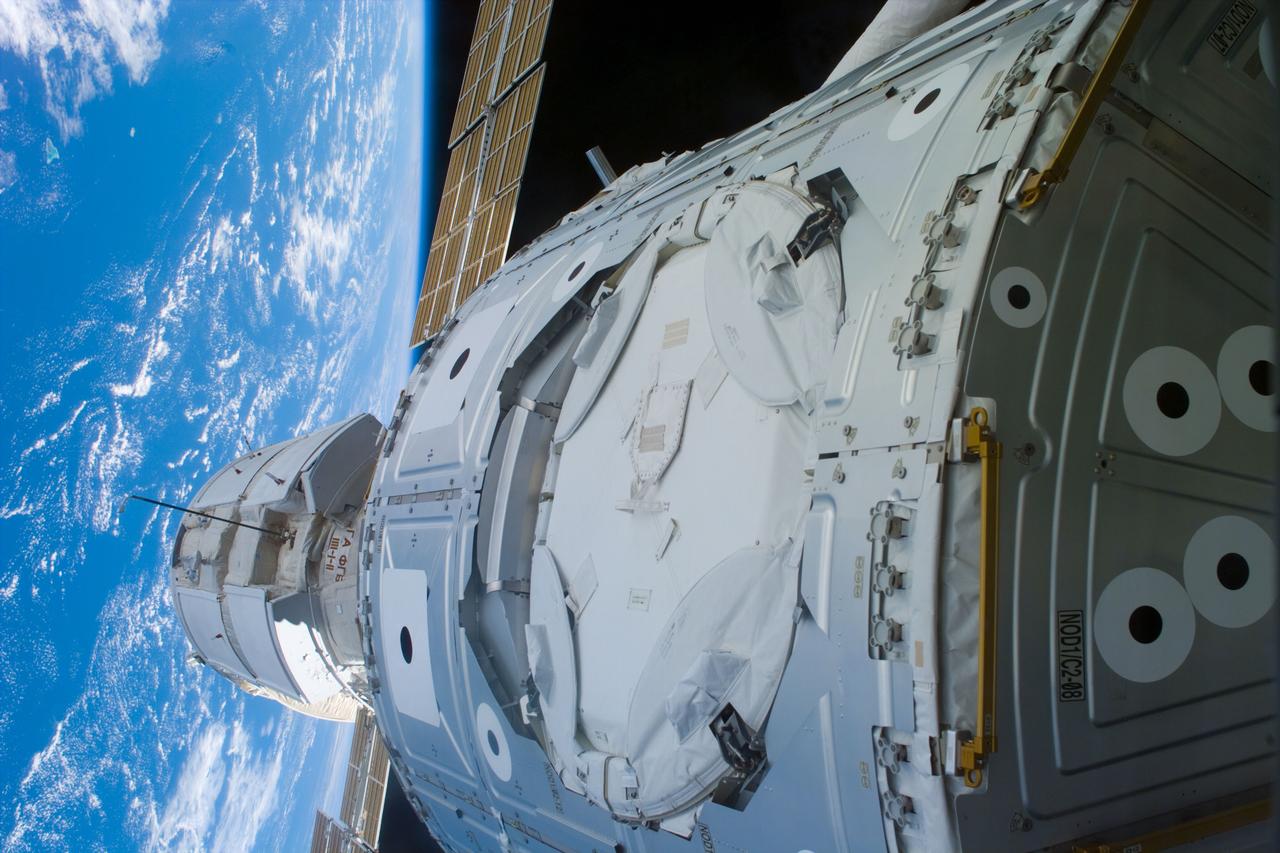
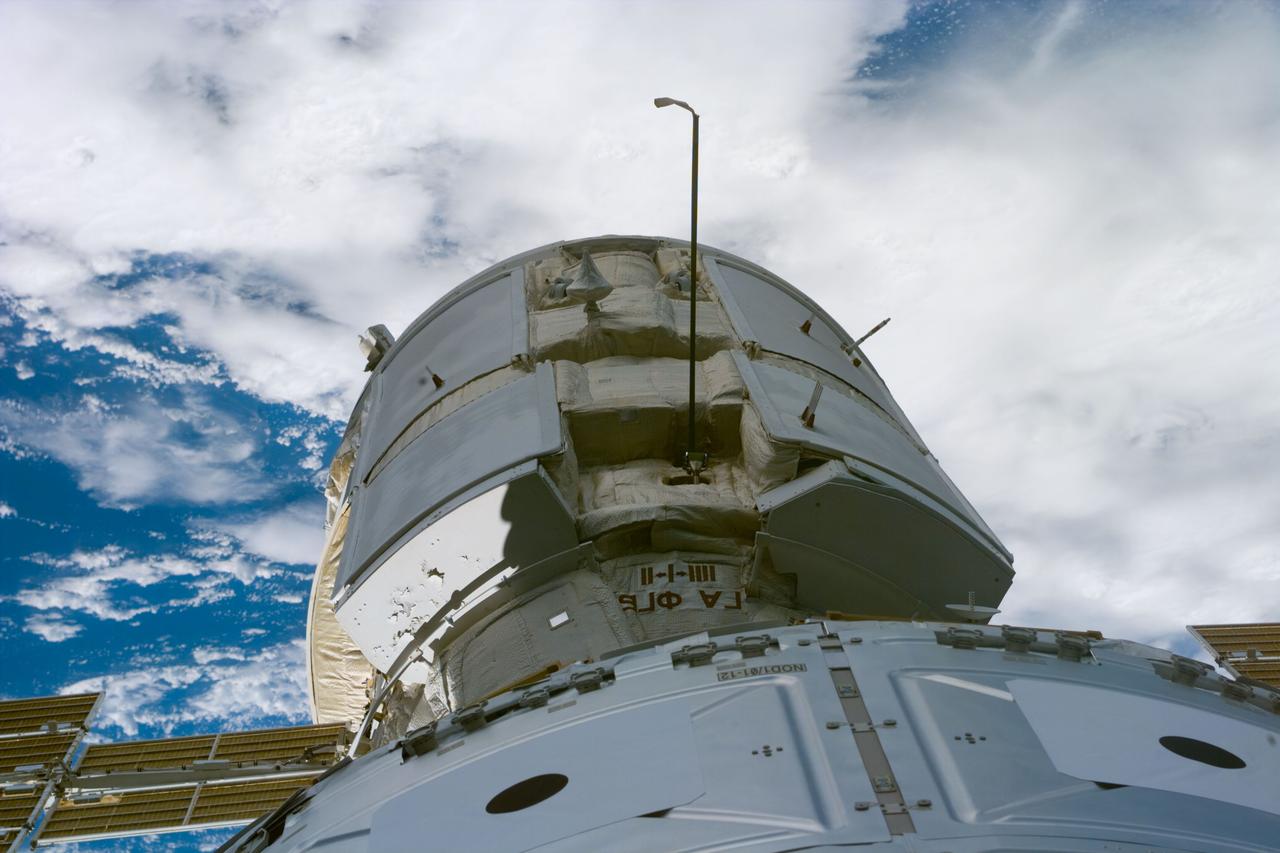
Survey view of a portion of the Zarya Functional Cargo Block (FGB) taken through a window in the Russian segment of the ISS during Expedition 35. Portions of the S0 and Z1 Truss segments are also in view.

STS088-359-029 (4-15 Dec. 1998) --- Astronauts James H. Newman and Nancy J. Currie, both mission specialists, work in the FGB or Zarya Module of the International Space Station (ISS). The two were using the computers to confer with ground controllers about tasks they were attempting to perform in Zarya.

JSC2006-E-43476 (November 1998) --- Computer-generated artist's rendering of the International Space Station after flight 1A/R. The functional cargo block (FGB) or Zarya Control Module was launched atop a Russian Proton rocket. Zarya provides battery power and fuel storage.
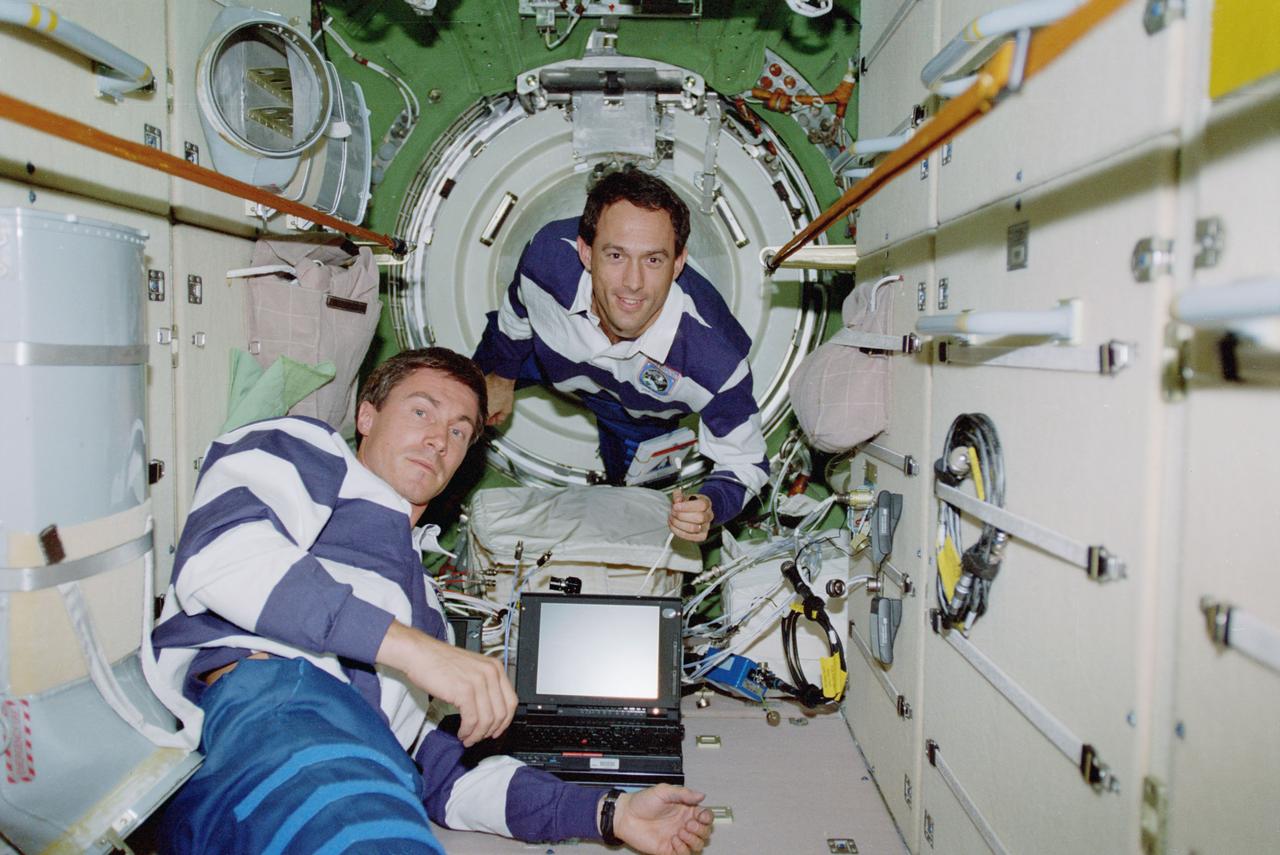
STS088-357-008 (4-15 Dec. 1998) --- Cosmonaut Sergei K. Krikalev (foreground), mission specialist representing the Russian Space Agency (RSA), and astronaut James H. Newman, mission specialist, participate in video teleconference with ground controllers while working in the Russian-built FGB or Zarya Module. At the time the photo was made, Zarya was docked with the United States-built Unity (Node 1) Module, which was temporarily connected to the Space Shuttle Endeavour?s cargo bay. The mission specialists, along with other members of the crew, were in the process of setting up interior systems of Zarya.
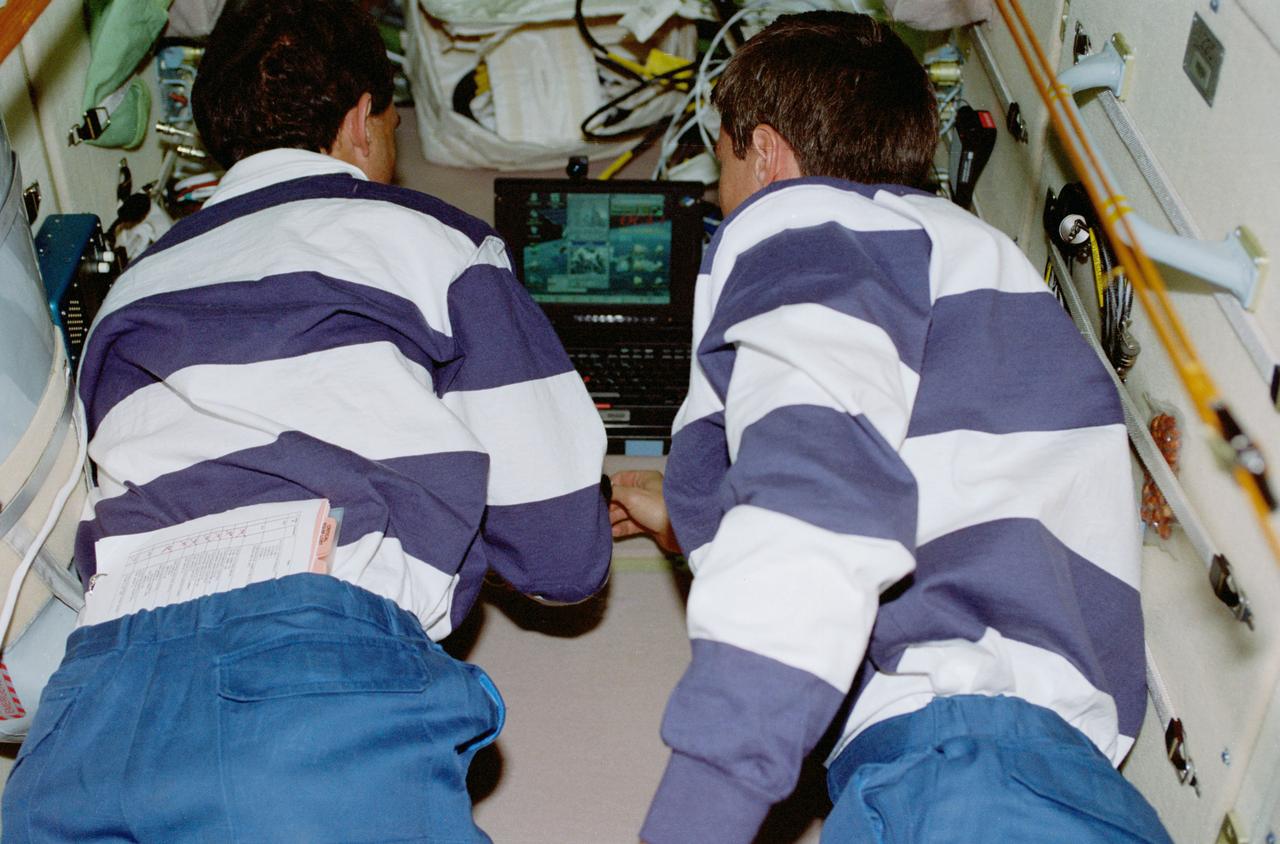
STS088-359-005 (4-15 Dec. 1998) --- Cosmonaut Sergei K. Krikalev (right), mission specialist representing the Russian Space Agency (RSA), and astronaut James H. Newman, mission specialist, participate in video teleconference with ground controllers while working in the Russian-built FGB or Zarya Module. Zarya is docked with the United States-built Unity (Node 1) Module, which is temporarily docked in Space Shuttle Endeavour?s cargo bay. The mission specialists, along with other members of the crew, were in the process of setting up interior systems of Zarya.
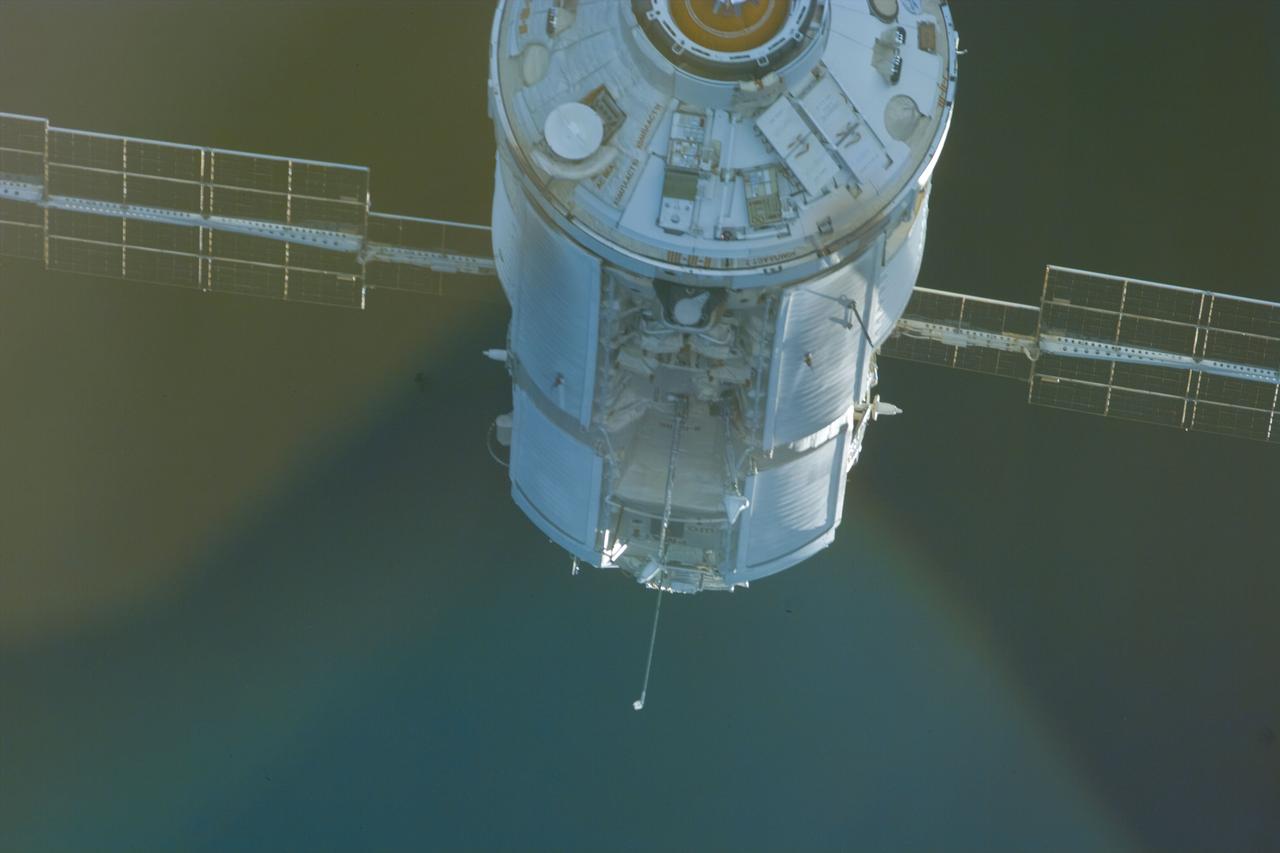
S88-E-5044 (12-06-98) --- With Endeavour's astronauts waiting to mate the Russian-built Zarya control module with the U.S.-built Unity connecting module, an electronic still camera (ESC) was used to record this image of the approaching Zarya. Using the shuttle's 50-ft.-long Canadian-built robot arm, astronaut Nancy J. Currie, working from Endeavour's aft flight deck, plucked Zarya out of orbit at 5:47 p.m. (CST), Dec. 6. The craft had been orbiting Earth for a little over 16 days prior to the grapple and subsequent docking to Unity. This image was recorded at 22:53:55 GMT, Dec. 6.
S88-E-5045 (12-06-98) --- With Endeavour's astronauts waiting to mate the Russian-built Zarya control module with the U.S.-built Unity connecting module, an electronic still camera (ESC) was used to record this image of the approaching Zarya. Using the shuttle's 50-ft.-long Canadian-built robot arm, astronaut Nancy J. Currie, working from Endeavour's aft flight deck, plucked Zarya out of orbit at 5:47 p.m. (CST), Dec. 6. The craft had been orbiting Earth for a little over 16 days prior to the grapple and subsequent docking to Unity. This image was recorded at 23:02:06 GMT, Dec. 6.
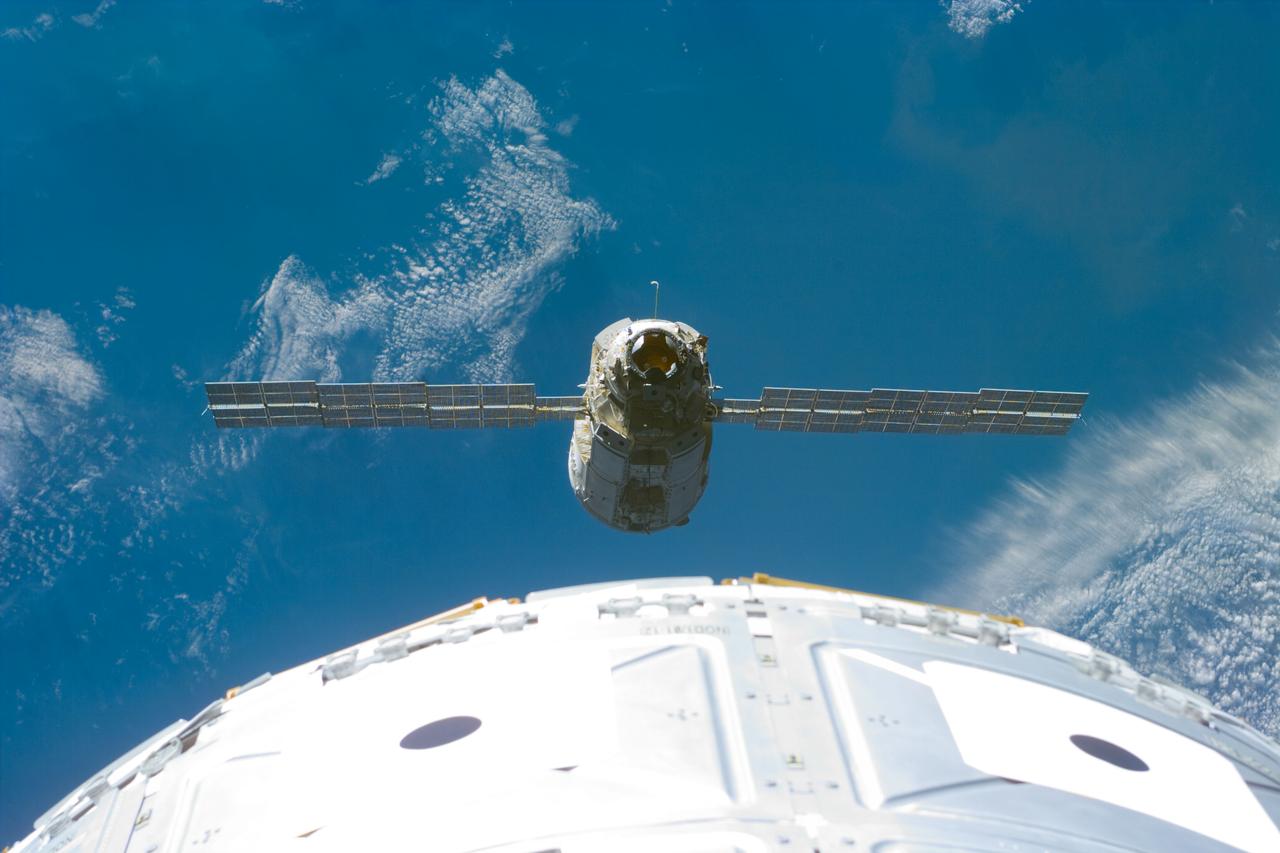
S88-E-5047 (12-06-98) --- With Endeavour's astronauts waiting to mate the Russian-built Zarya control module with the U.S.-built Unity connecting module, an electronic still camera (ESC) was used to record this image of the approaching Zarya. A portion of Unity is in the foreground. Using the shuttle's 50-ft.-long Canadian-built robot arm, astronaut Nancy J. Currie, working from Endeavour's aft flight deck, plucked Zarya out of orbit at 5:47 p.m. (CST), Dec. 6. The craft had been orbiting Earth for a little over 16 days prior to the grapple and subsequent docking to Unity. This image was recorded at 23:11:05 GMT, Dec. 6.
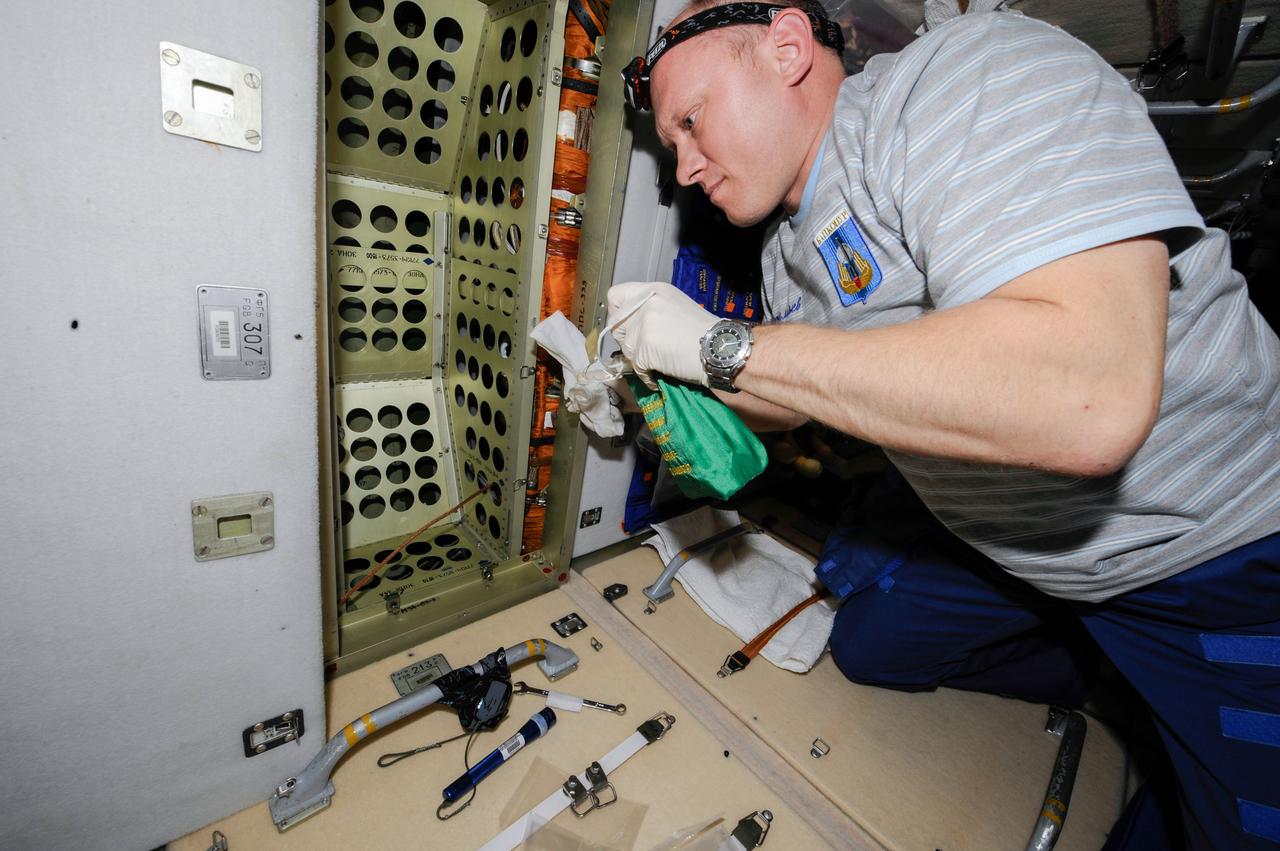
Expedition 39 flight engineer and Roscosmos cosmonaut Oleg Artemyev works to treat the area behind Panel 307 with a fungicide. Image was taken in the Zarya Functional Cargo Block (FGB).
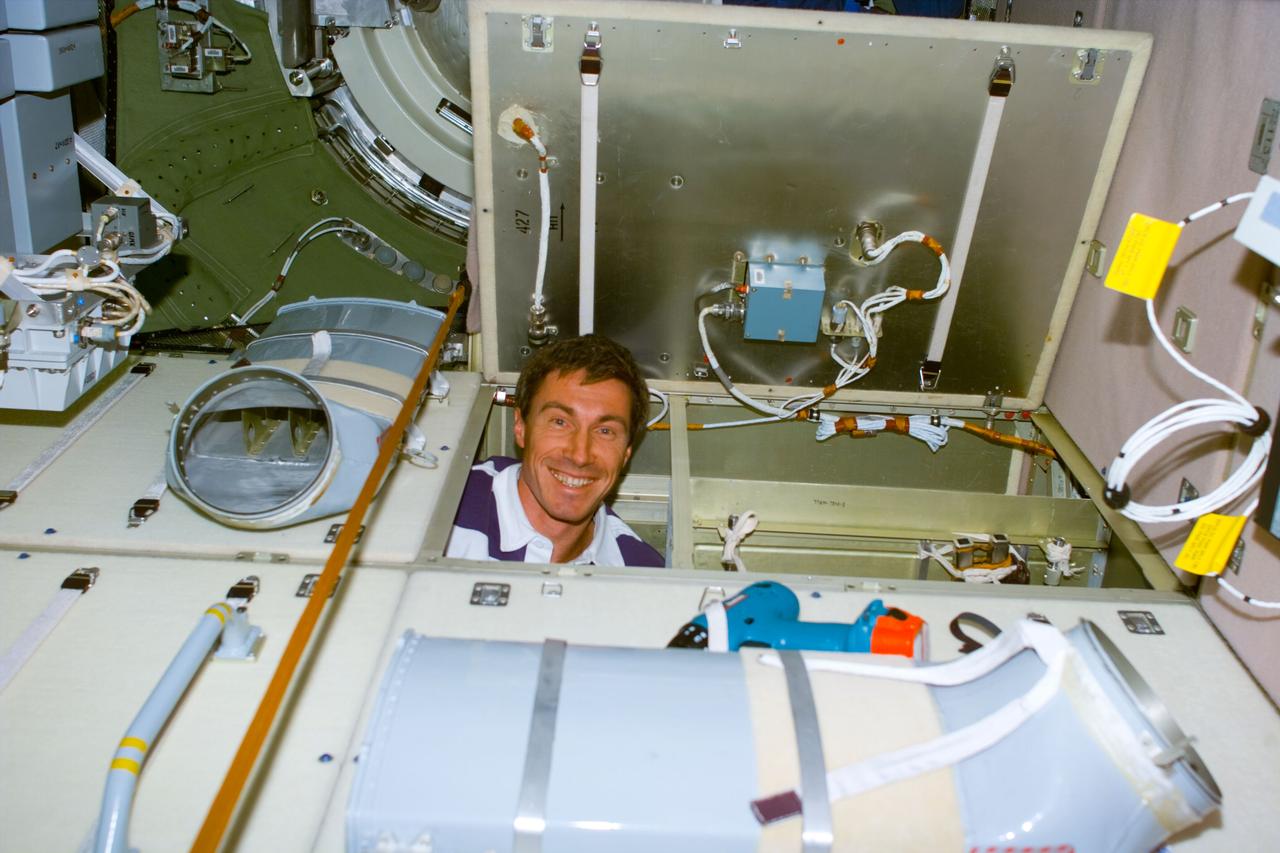
S88-E-5086 (12-11-98) --- Sergei Krikalev, mission specialist representing the Russian Space Agency (RSA), pokes his head up from inside one of the bays inside the walls on the Russian-built Zarya module. Krikalev and astronaut Nancy J. Currie replaced a faulty unit which controls the discharging of stored energy from one of Zarya's six batteries. The photo was taken with an electronic still camera (ESC) at 05:41:18 GMT, Dec. 11.
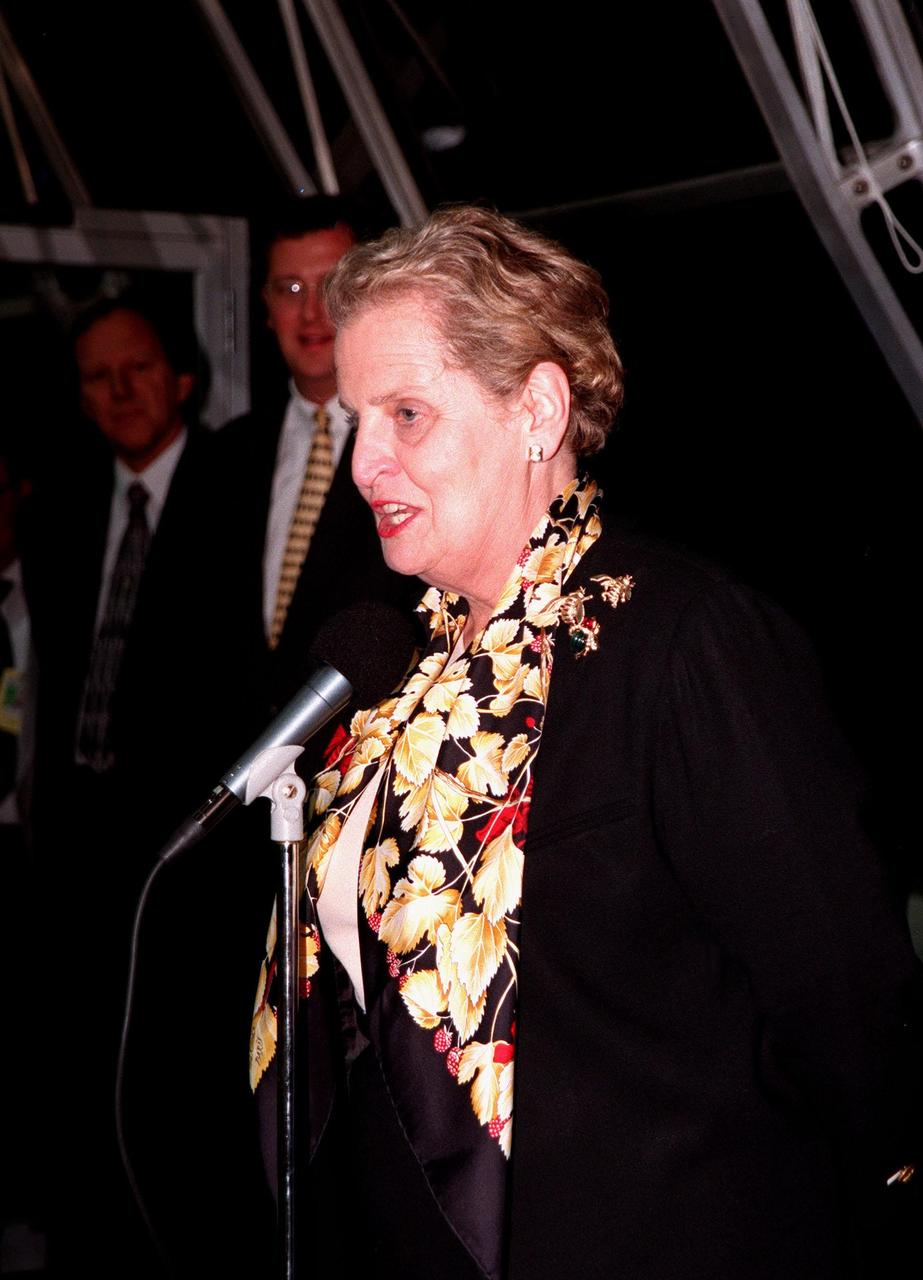
In a firing room of the Launch Control Center, U.S. Secretary of State Madeleine Albright speaks to the launch team after the successful launch of Space Shuttle Endeavour at 3:35:34 a.m. EST. During the nearly 12-day mission of STS-88, the six-member crew will mate in space the first two elements of the International Space Station the already-orbiting Zarya control module and the Unity connecting module carried by Endeavour
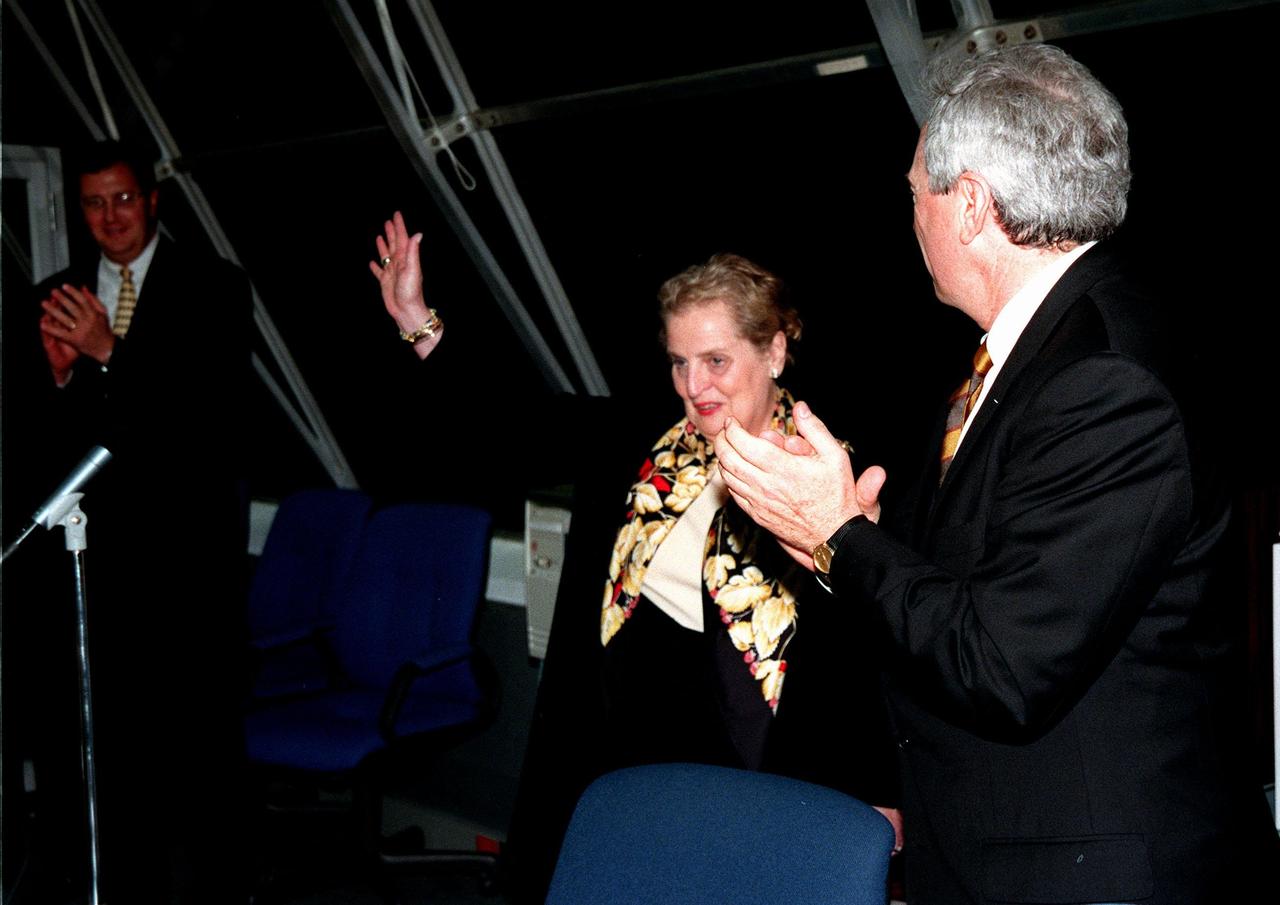
In a firing room of the Launch Control Center,U.S. Secretary of State Madeleine Albright waves to the personnel after her speech about the successful launch of Space Shuttle Endeavour. At her right is NASA Administrator Daniel Goldin. During the nearly 12-day mission of STS-88, the six-member crew will mate in space the first two elements of the International Space Station the already-orbiting Zarya control module and the Unity connecting module carried by Endeavour
S88-E-5050 (12-07-98) --- Just a few feet away from the camera lens onboard Endeavour, the Russian-built Zarya control module and the U.S.-built Unity connecting module are connected in the shuttle's cargo bay. Using the Endeavour's 50-ft.-long Canadian-built robot arm, astronaut Nancy J. Currie, working from the aft flight deck, plucked Zarya out of orbit at 5:47 p.m. (CST), Dec. 6. The craft had been orbiting Earth for a little over 16 days prior to the grapple and subsequent docking to Unity. This image was recorded with an electronic still camera (ESC) at 00:24:53 GMT, Dec. 7.
S88-E-5049 (12-07-98) --- Just a few feet away from the camera lens onboard Endeavour, the Russian-built Zarya control module and the U.S.-built Unity connecting module are mated in the shuttle's cargo bay. Using the Endeavour's 50-ft.-long Canadian-built robot arm, astronaut Nancy J. Currie, working from the aft flight deck, plucked Zarya out of orbit at 5:47 p.m. (CST), Dec. 6. The craft had been orbiting Earth for a little over 16 days prior to the grapple and subsequent docking to Unity. This image was recorded with an electronic still camera (ESC) at 00:22:48 GMT, Dec. 7.
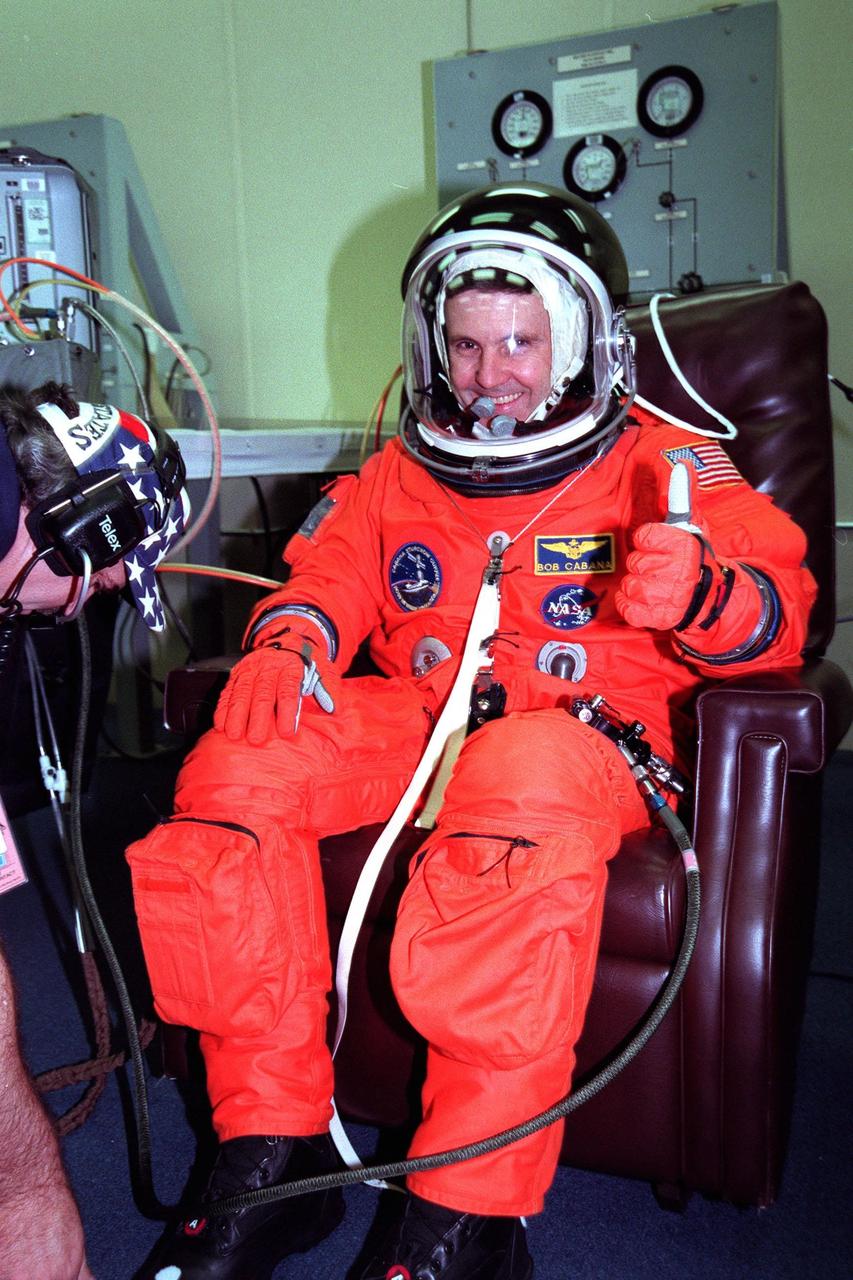
In the Operations and Checkout Building, STS-88 Commander Robert D. Cabana gives a thumbs up during suit check before launch. Mission STS-88 is expected to lift off at 3:56 a.m. EST with the six-member crew aboard Space Shuttle Endeavour on Dec. 3. Endeavour carries the Unity connecting module, which the crew will be mating with the Russian-built Zarya control module already in orbit. In addition to Unity, two small replacement electronics boxes are on board for possible repairs to Zarya batteries. The mission is expected to last 11 days, 19 hours and 49 minutes, landing at 10:17 p.m. EST on Dec. 14
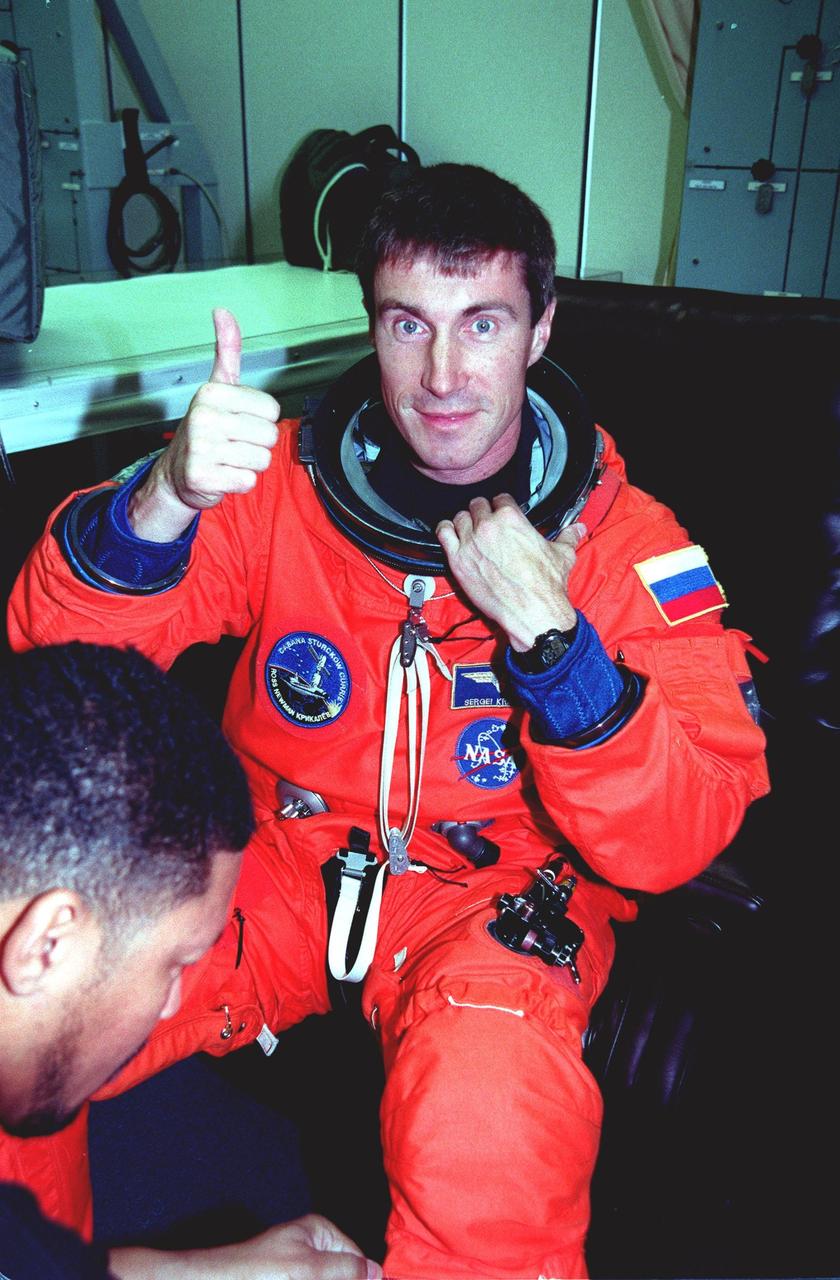
In the Operations and Checkout Building, STS-88 Mission Specialist Sergei Konstantinovich Krikalev, a Russian cosmonaut, gives a thumbs up during suit check before launch. Mission STS-88 is expected to lift off at 3:56 a.m. EST with the six-member crew aboard Space Shuttle Endeavour on Dec. 3. Endeavour carries the Unity connecting module, which the crew will be mating with the Russian-built Zarya control module already in orbit. In addition to Unity, two small replacement electronics boxes are on board for possible repairs to Zarya batteries. The mission is expected to last 11 days, 19 hours and 49 minutes, landing at 10:17 p.m. EST on Dec. 14
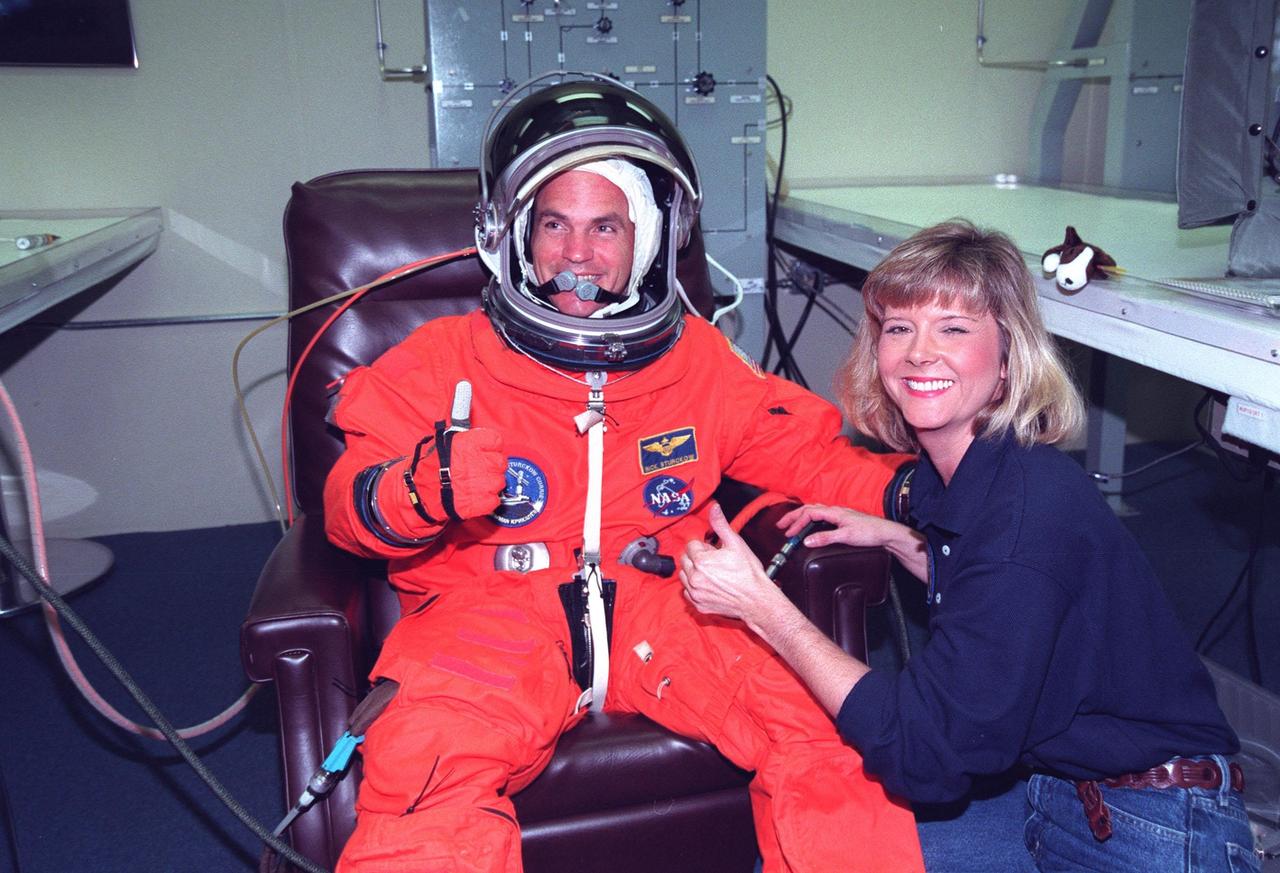
In the Operations and Checkout Building, STS-88 Pilot Frederick W. "Rick" Sturckow gets help with his flight suit from suit technician Terri McKinney before launch. Mission STS-88 is expected to launch at 3:56 a.m. EST with the six-member crew aboard Space Shuttle Endeavour on Dec. 3. Endeavour carries the Unity connecting module, which the crew will be mating with the Russian-built Zarya control module already in orbit. In addition to Unity, two small replacement electronics boxes are on board for possible repairs to Zarya batteries. The mission is expected to last 11 days, 19 hours and 49 minutes, landing at 10:17 p.m. EST on Dec. 14
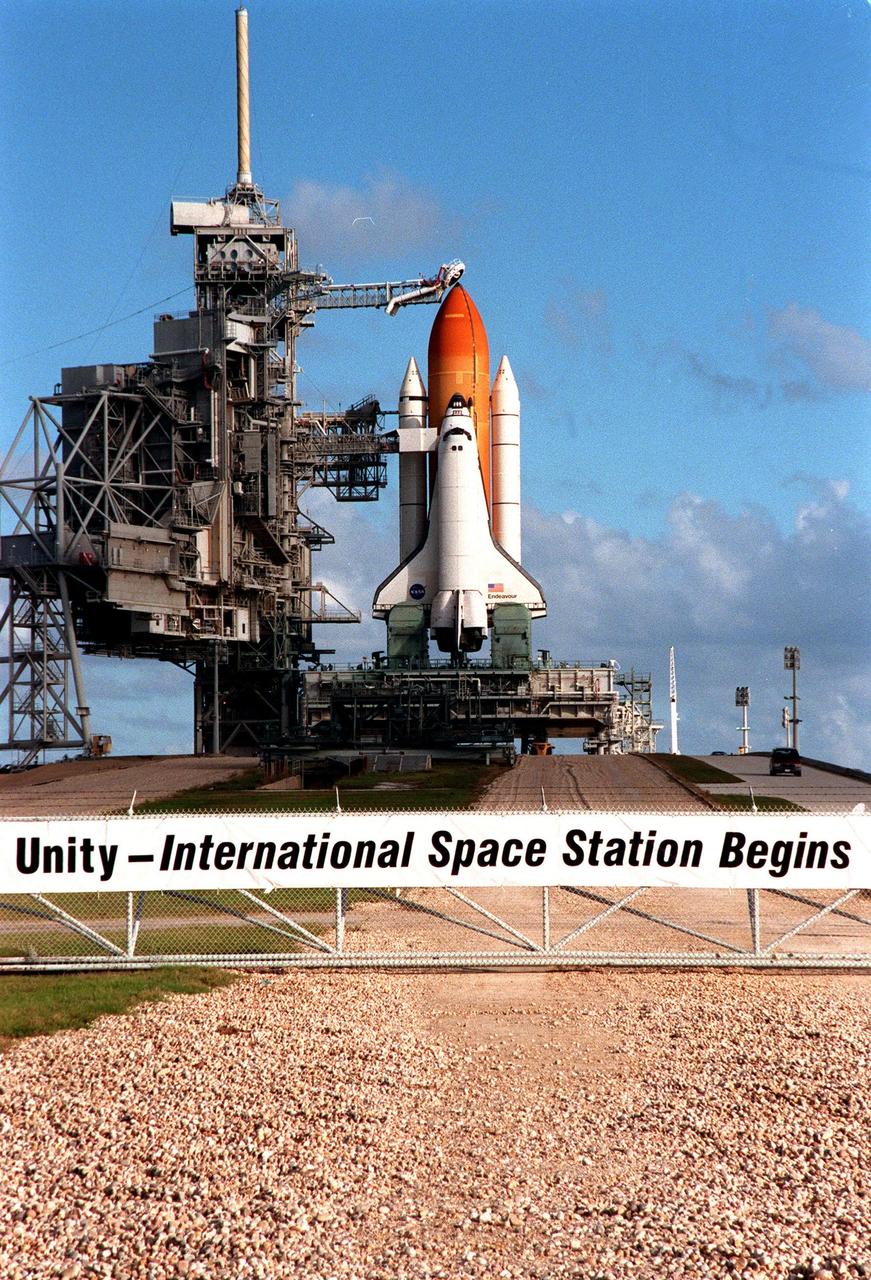
KENNEDY SPACE CENTER, FLA. -- The sign on the fence at Launch Pad 39A announces the mission of STS-88 and Space Shuttle Endeavour, poised on the pad for launch. Lift-off is targeted for 3:56 a.m. on Dec. 3. The first U.S. launch for the International Space Station, STS-88 is expected to last 11 days, 19 hours and 49 minutes, and land at 10:17 p.m. EST on Dec. 14. Endeavour carries the Unity connecting module which the crew will be mating with the Russian-built Zarya control module already in orbit. In addition to Unity, two small replacement electronics boxes are on board for possible repairs to Zarya batteries
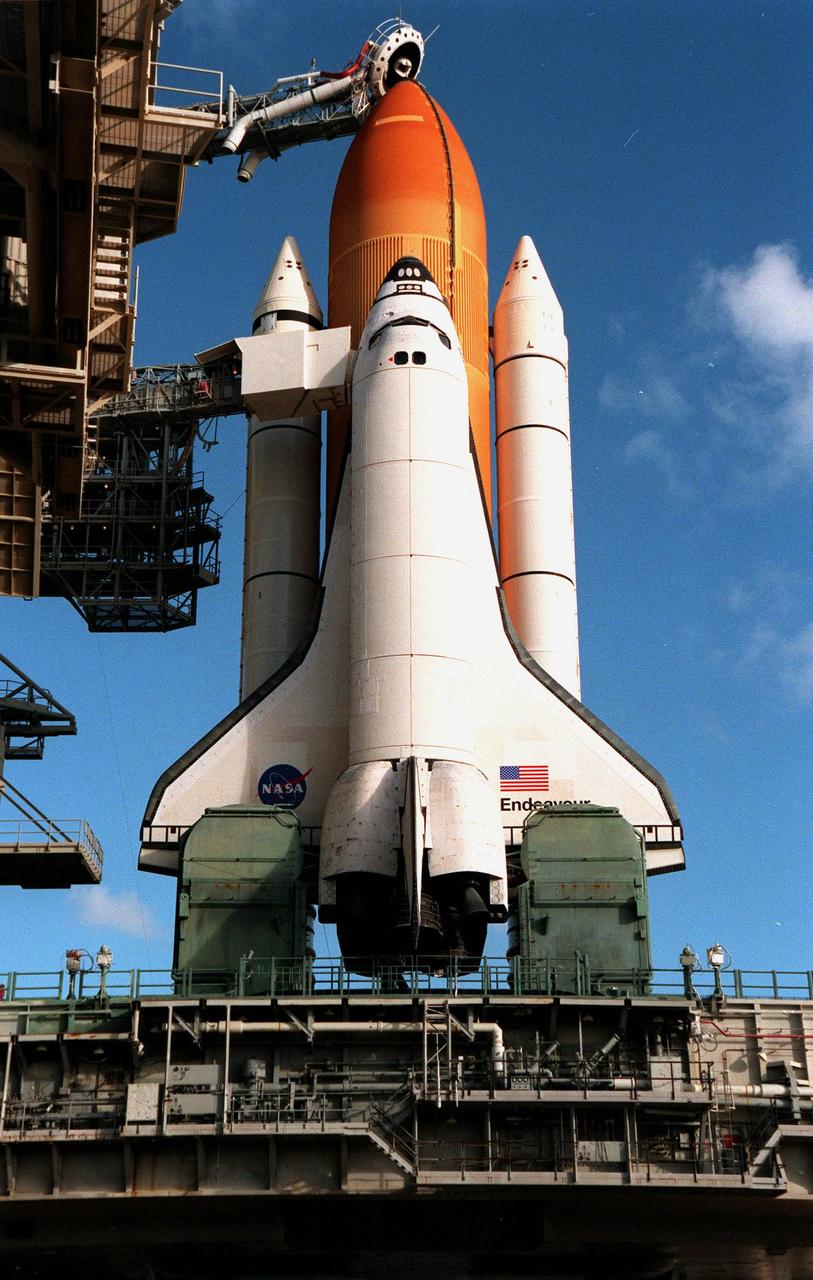
KENNEDY SPACE CENTER, FLA. -- With the Rotating Service Structure on Launch Pad 39A rolled back, the Space Shuttle Endeavour on top of the Mobile Launcher Platform is poised for launch on mission STS-88. Lift-off is targeted for 3:56 a.m. on Dec. 3. The first U.S. launch for the International Space Station, STS-88 is expected to last 11 days, 19 hours and 49 minutes, and land at 10:17 p.m. EST on Dec. 14. Endeavour carries the Unity connecting module which the crew will be mating with the Russian-built Zarya control module already in orbit. In addition to Unity, two small replacement electronics boxes are on board for possible repairs to Zarya batteries
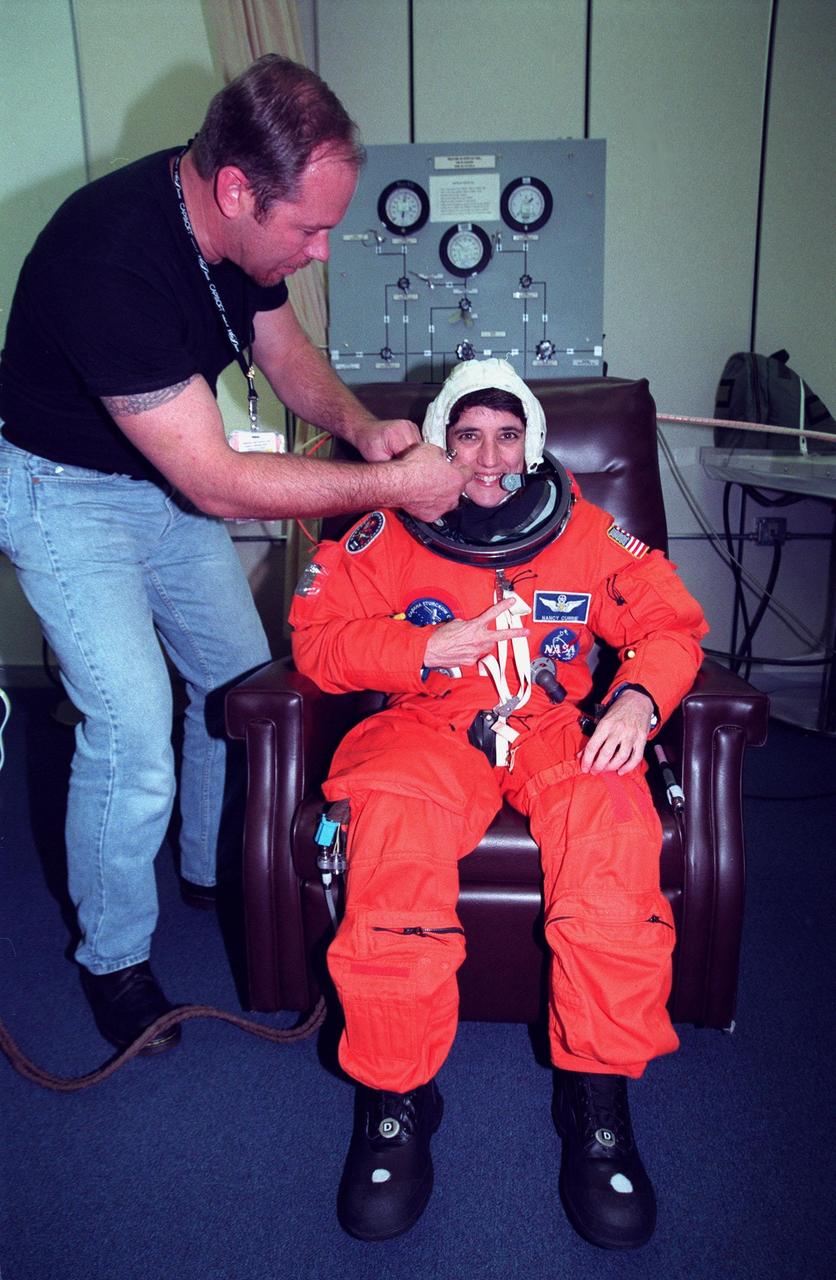
In the Operations and Checkout Building, STS-88 Mission Specialist Nancy J. Currie gets help with her flight suit from suit technician Drew Billingsley before launch. Mission STS-88 is expected to launch at 3:56 a.m. EST with the six-member crew aboard Space Shuttle Endeavour on Dec. 3. Endeavour carries the Unity connecting module, which the crew will be mating with the Russian-built Zarya control module already in orbit. In addition to Unity, two small replacement electronics boxes are on board for possible repairs to Zarya batteries. The mission is expected to last 11 days, 19 hours and 49 minutes, landing at 10:17 p.m. EST on Dec. 14
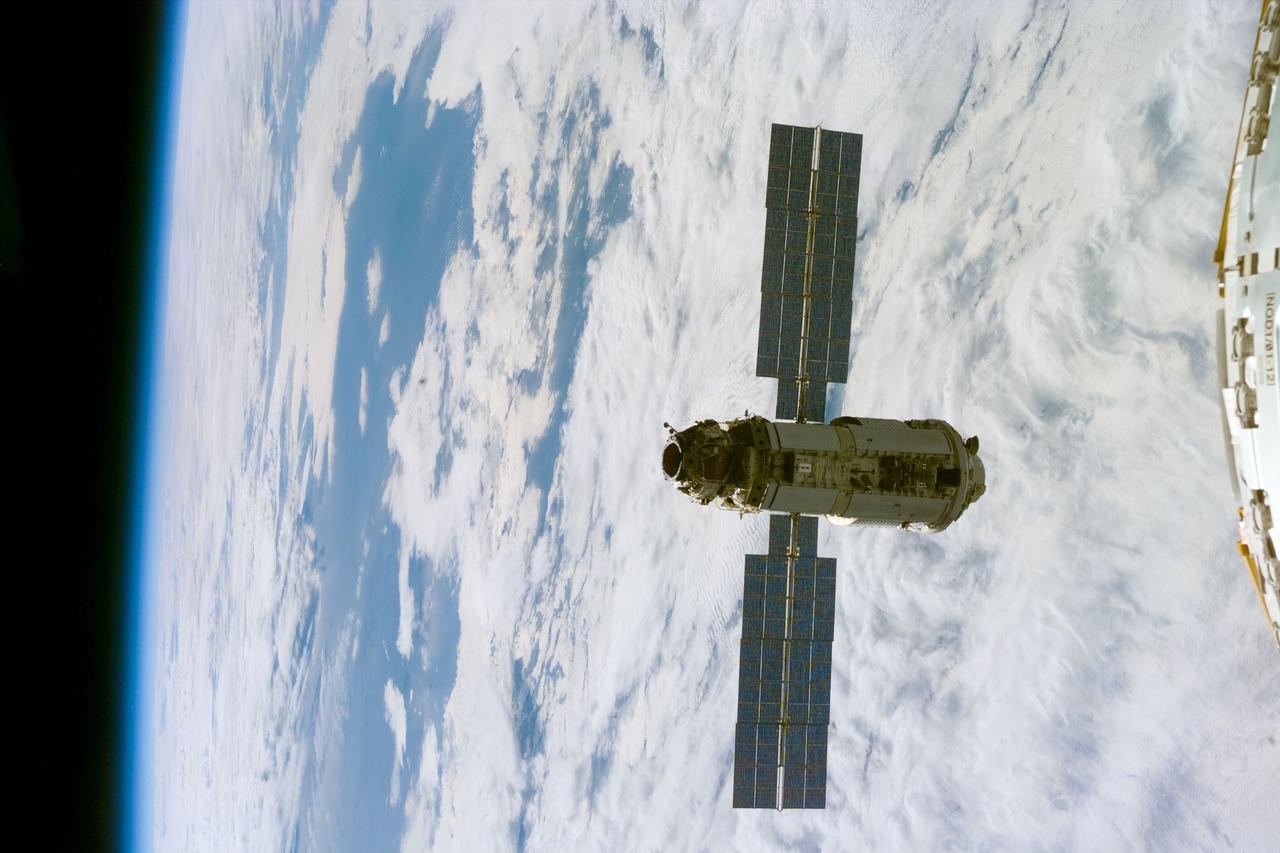
S88-E-5046 (12-06-98) --- With Endeavour's astronauts waiting to mate the Russian-built Zarya control module with the U.S.-built Unity connecting module, an electronic still camera (ESC) was used to record this image of the approaching Zarya, backdropped over a blue and white Earth. A small part of Unity can be seen (in uncropped versions of the photo) at right. Using the shuttle's 50-ft.-long Canadian-built robot arm, astronaut Nancy J. Currie, working from Endeavour's aft flight deck, plucked Zarya out of orbit at 5:47 p.m. (CST), Dec. 6. The craft had been orbiting Earth for a little over 16 days prior to the grapple and subsequent docking to Unity. This image was recorded at 23:06:12 GMT, Dec. 6.
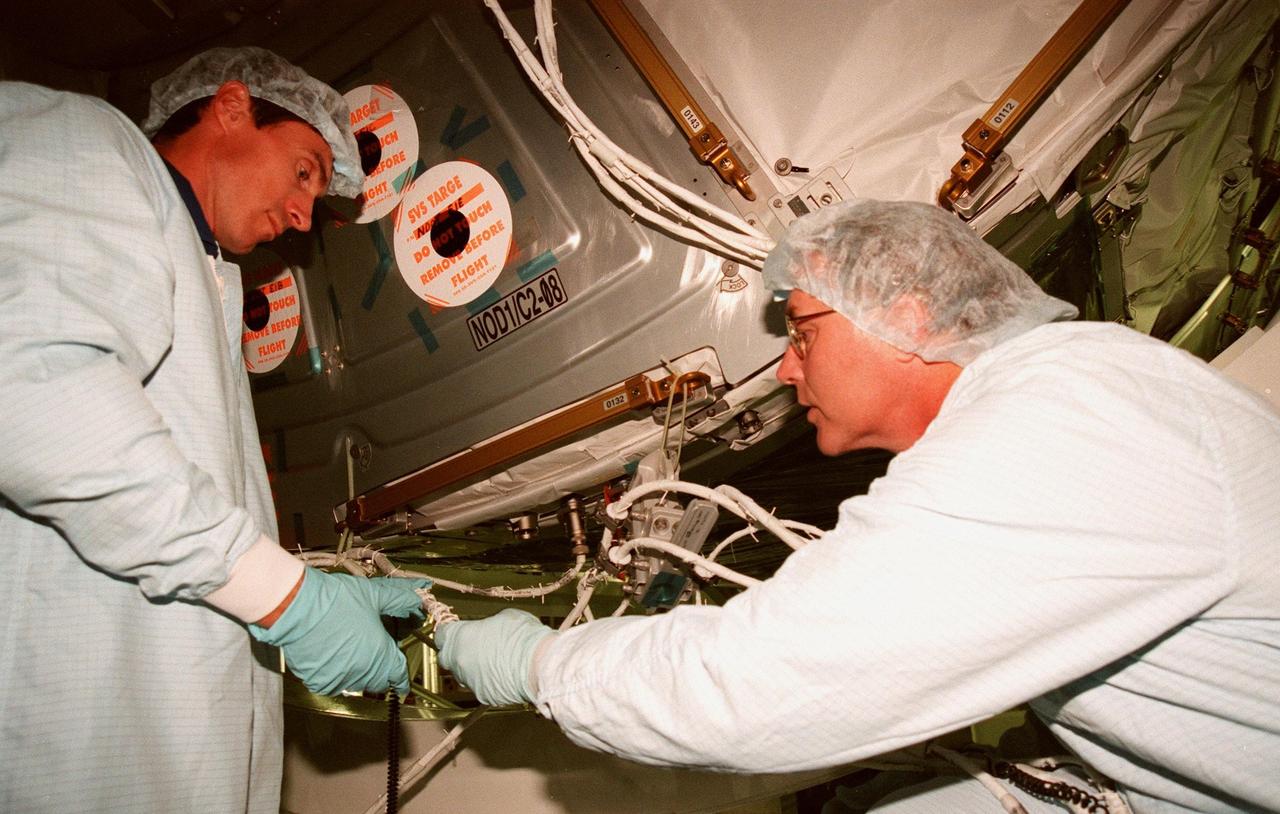
KENNEDY SPACE CENTER, FLA. -- In the Space Station Processing Facility, STS-88 Mission Specialists Sergei Krikalev, a Russian cosmonaut, and Jerry L. Ross check out equipment on the Unity connecting module, primary payload on the mission. The STS-88 crew members are participating in a Crew Equipment Interface Test (CEIT), familiarizing themselves with the orbiter's midbody and crew compartments. Scheduled for launch on Dec. 3, 1998, STS-88 will be the first Space Shuttle launch for the International Space Station. The Unity connecting module will be mated to the Russian-built Zarya control module, already on orbit after a November launch. Unity will have two Pressurized Mating Adapters (PMAs) attached and 1 stowage rack installed inside. PMA-1 will connect U.S. and Russian elements; PMA-2 will provide a Shuttle docking location. Eventually, Unity's six ports will provide connecting points for the Z1 truss exterior framework, U.S. lab, airlock, cupola, Node 3, and the Multi-Purpose Logistics Module, as well as the control module. Zarya is a self-supporting active vehicle, providing propulsive control capability and power through the early assembly stages. It provides fuel storage capability and a rendezvous and docking capability to the Service Module
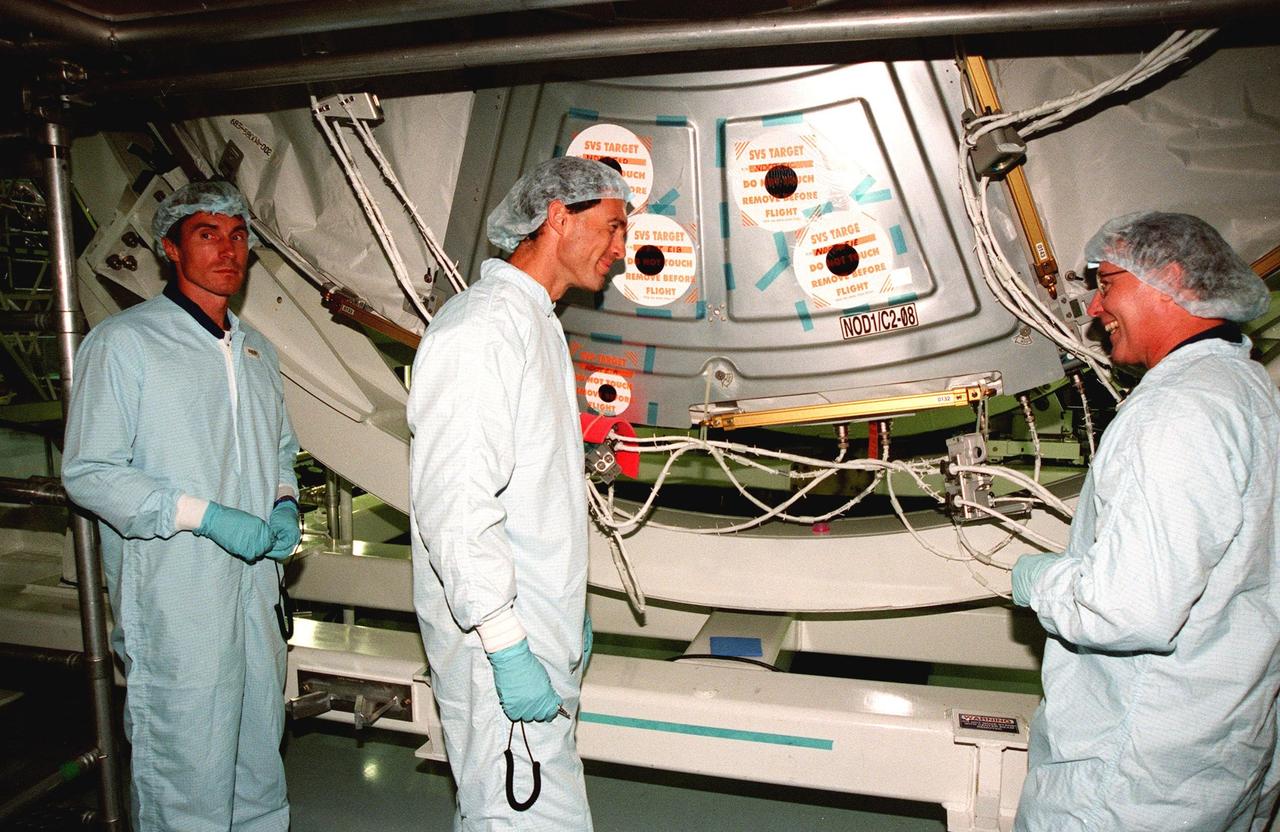
KENNEDY SPACE CENTER, FLA. -- In the Space Station Processing Facility, STS-88 Mission Specialists Sergei Krikalev (left), a Russian cosmonaut; James H. Newman (center); and Jerry L. Ross conduct a sharp-edge inspection of the Unity connecting module, which is the primary payload on their upcoming mission. The STS-88 crew members are participating in a Crew Equipment Interface Test (CEIT), familiarizing themselves with the orbiter's midbody and crew compartments. Targeted for liftoff on Dec. 3, 1998, STS-88 will be the first Space Shuttle launch for assembly of the International Space Station (ISS). The primary payload is the Unity connecting module which will be mated to the Russian-built Zarya control module, expected to be already on orbit after a November launch from Russia. The first major U.S.-built component of ISS, Unity will serve as a connecting passageway to living and working areas of the space station. Unity has two attached pressurized mating adapters (PMAs) and one stowage rack installed inside. PMA-1 provides the permanent connection point between Unity and Zarya; PMA-2 will serve as a Space Shuttle docking port. Zarya is a self-supporting active vehicle, providing propulsive control capability and power during the early assembly stages. It also has fuel storage capability
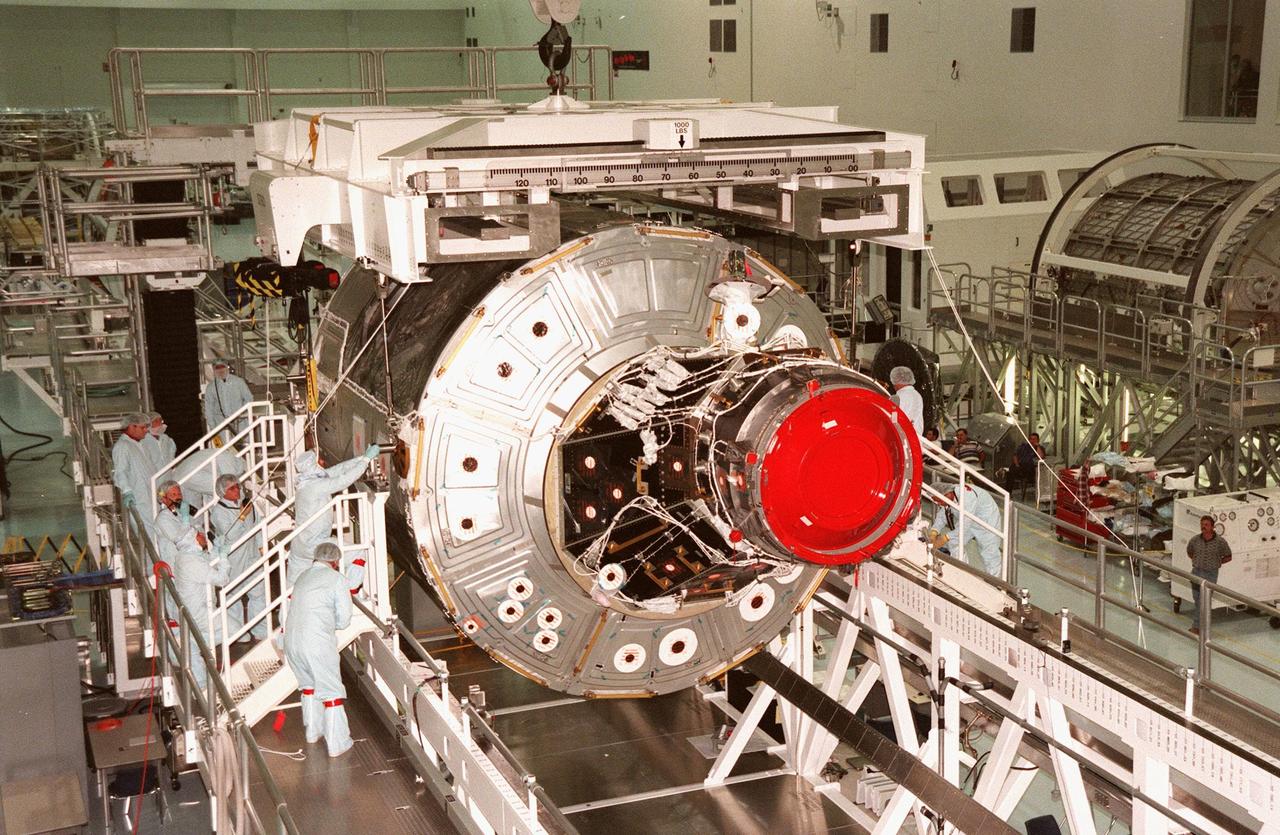
In the Space Station Processing Facility, workers attach the overhead crane that will lift the Unity connecting module from its workstand to move the module to the payload canister. Part of the International Space Station (ISS), Unity is scheduled for launch aboard Space Shuttle Endeavour on Mission STS-88 in December. The Unity is a connecting passageway to the living and working areas of ISS. While on orbit, the flight crew will deploy Unity from the payload bay and attach Unity to the Russian-built Zarya control module which will be in orbit at that time
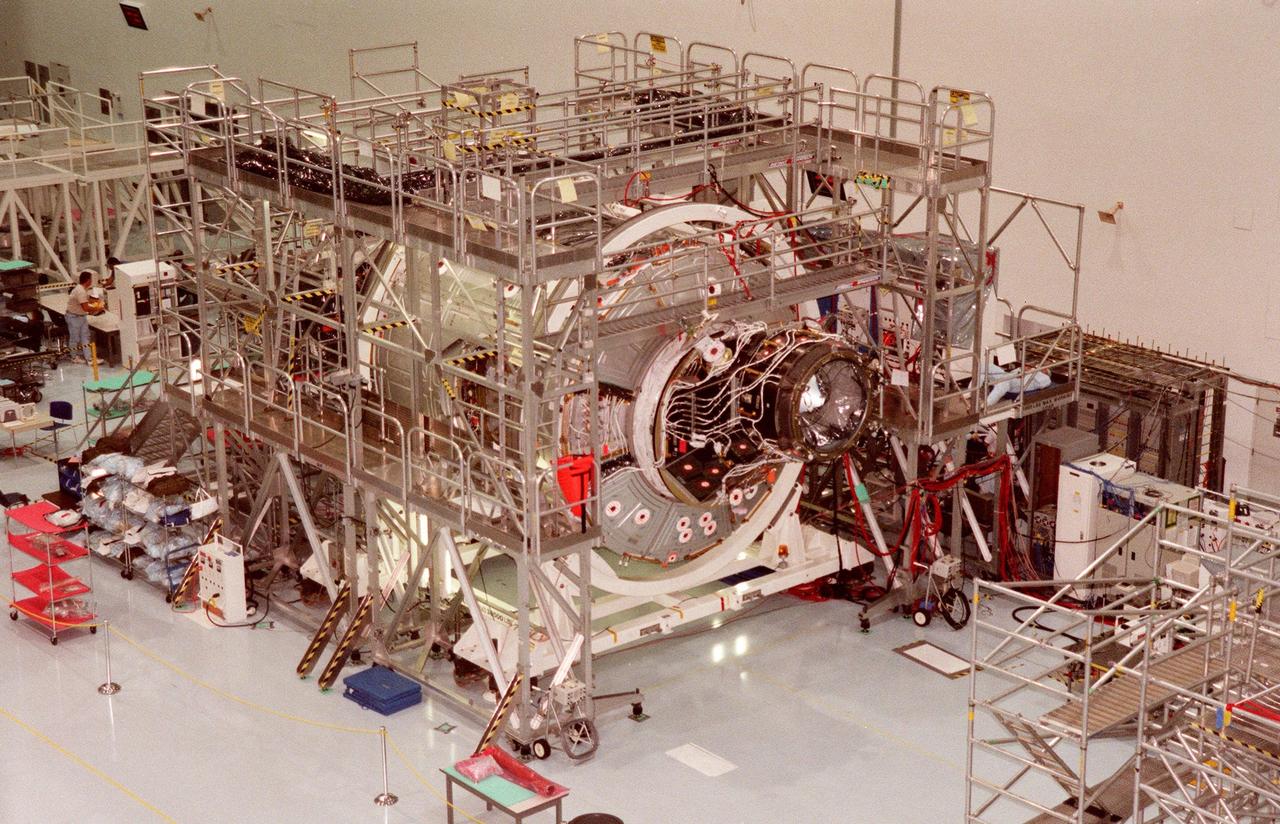
KENNEDY SPACE CENTER, FLA. -- Unity connecting module, part of the International Space Station, awaits processing in the Space Station Processing Facility (SSPF). On the end at the right can be seen the Pressurized Mating Adapter 2, which provides entry into the module. The Unity, scheduled to be launched on STS-88 in December 1998, will be mated to the Russian-built Zarya control module which will already be in orbit. STS-88 will be the first Space Shuttle launch for the International Space Station
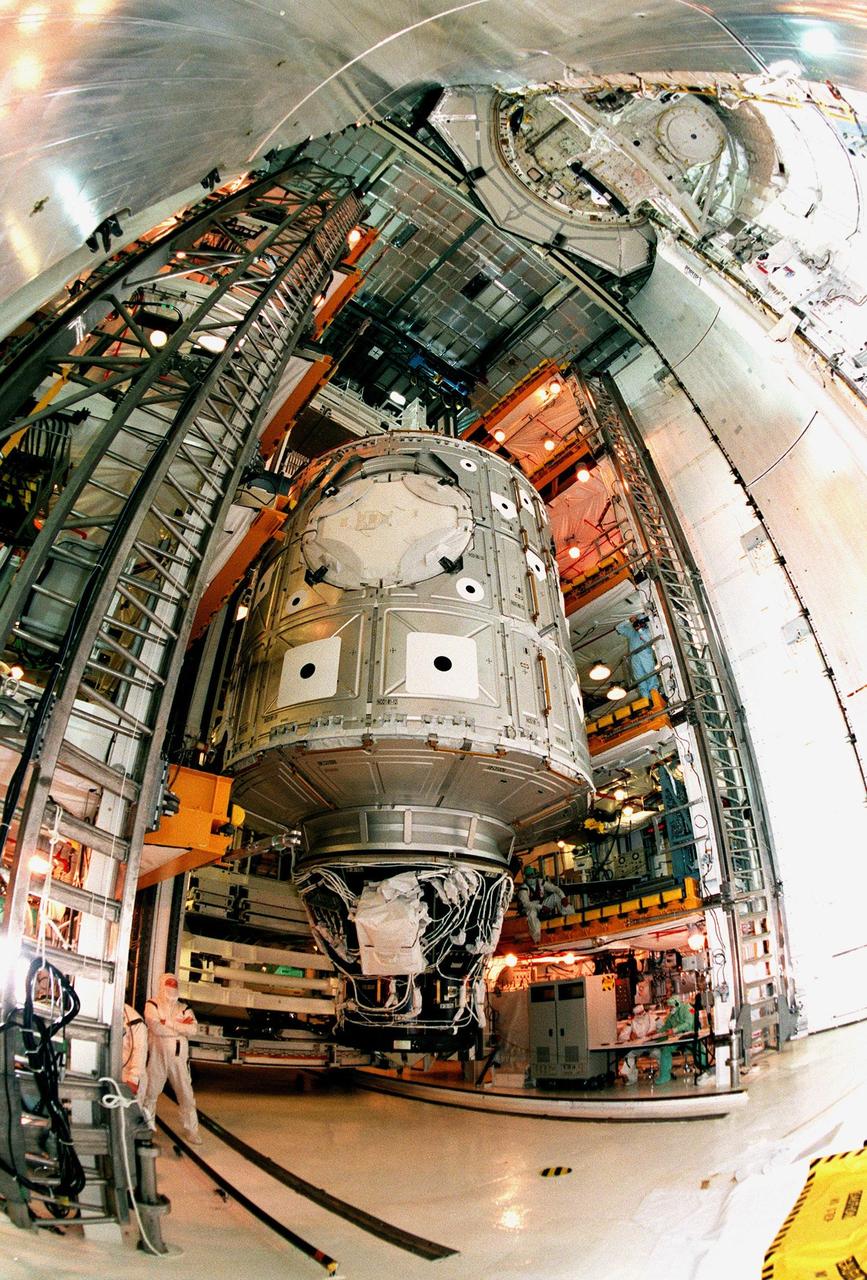
Looking like a painting, this wide-angle view shows the Unity connecting module being moved toward the payload bay of the orbiter Endeavour at Launch Pad 39A. Part of the International Space Station (ISS), Unity is scheduled for launch Dec. 3, 1998, on Mission STS-88. The Unity is a connecting passageway to the living and working areas of ISS. While on orbit, the flight crew will deploy Unity from the payload bay and attach it to the Russian-built Zarya control module which will be in orbit at that time
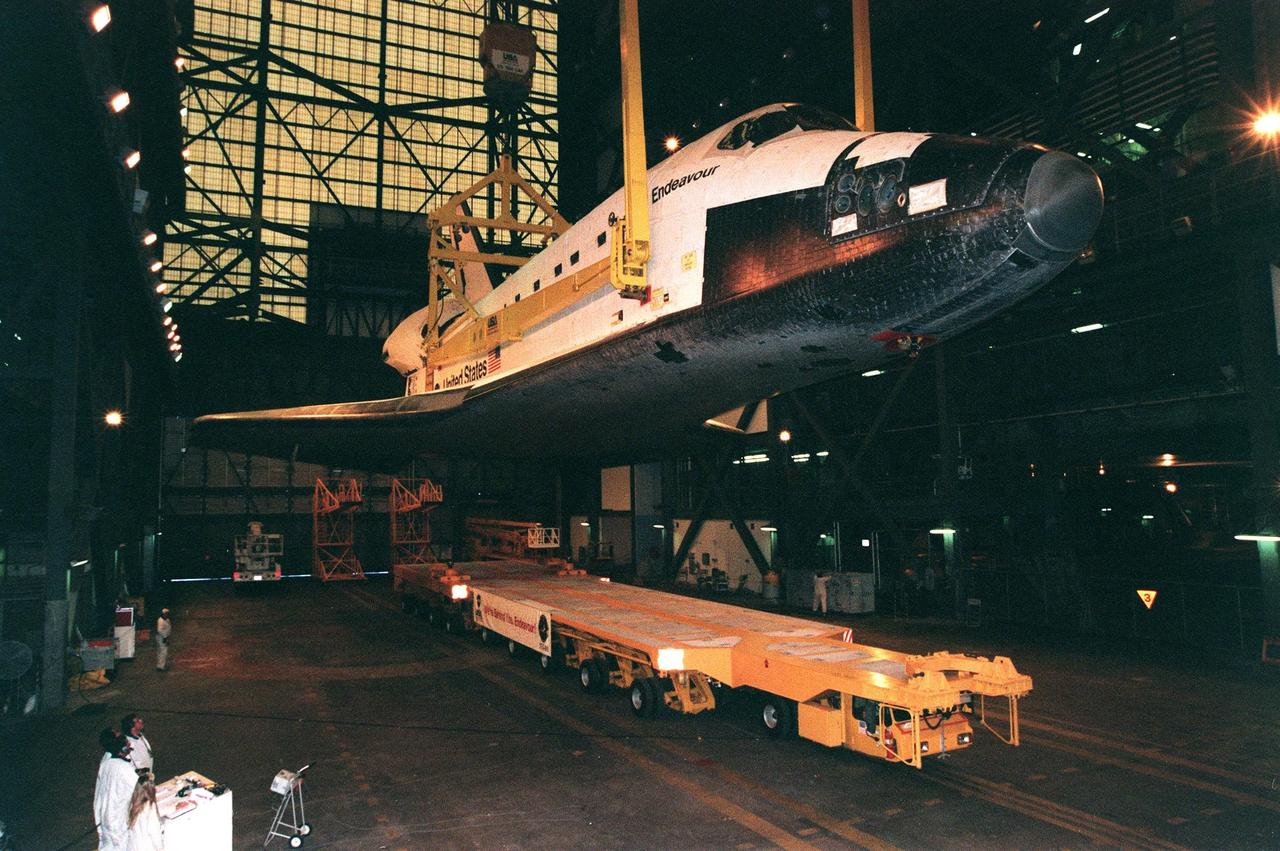
KENNEDY SPACE CENTER, FLA. -- Orbiter Endeavour is lifted off the transporter to raise it to a vertical position inside the Vehicle Assembly Building where it will be mated with the solid rocket boosters and external tank. Endeavour is scheduled to fly on mission STS-88, the first flight for the International Space Station, on Dec. 3, 1998. The primary payload on the mission is the Unity connecting module, which will be mated to the Russian-built Zarya control module expected to already be in orbit at that time
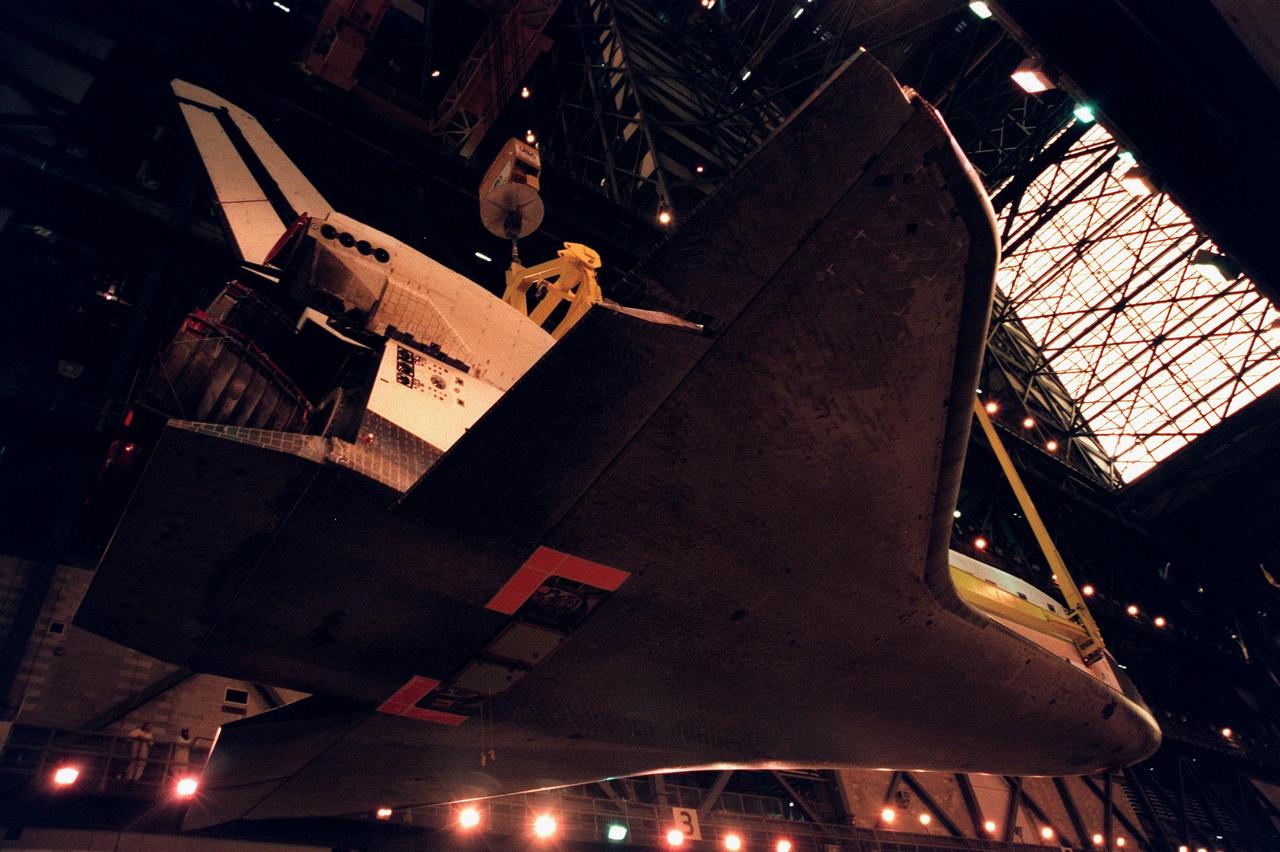
KENNEDY SPACE CENTER, FLA. -- Viewed from below, the orbiter Endeavour appears in flight as it hangs suspended inside the Vehicle Assembly Building. The orbiter is being lifted to its vertical position to be mated to the solid rocket boosters and external tank that will help launch STS-88 in December 1998. STs-88 is the first flight for the International Space Station, with the primary payload the Unity connecting module. Unity will be mated to the Russian-built Zarya control module expected to already be in orbit at that time

KENNEDY SPACE CENTER, FLA. -- Orbiter Endeavour is suspended in a vertical position inside the Vehicle Assembly Building where it will be mated with the solid rocket boosters and external tank. Endeavour is scheduled to fly on mission STS-88, the first flight for the International Space Station, on Dec. 3, 1998. The primary payload on the mission is the Unity connecting module, which will be mated to the Russian-built Zarya control module expected to already be in orbit at that time
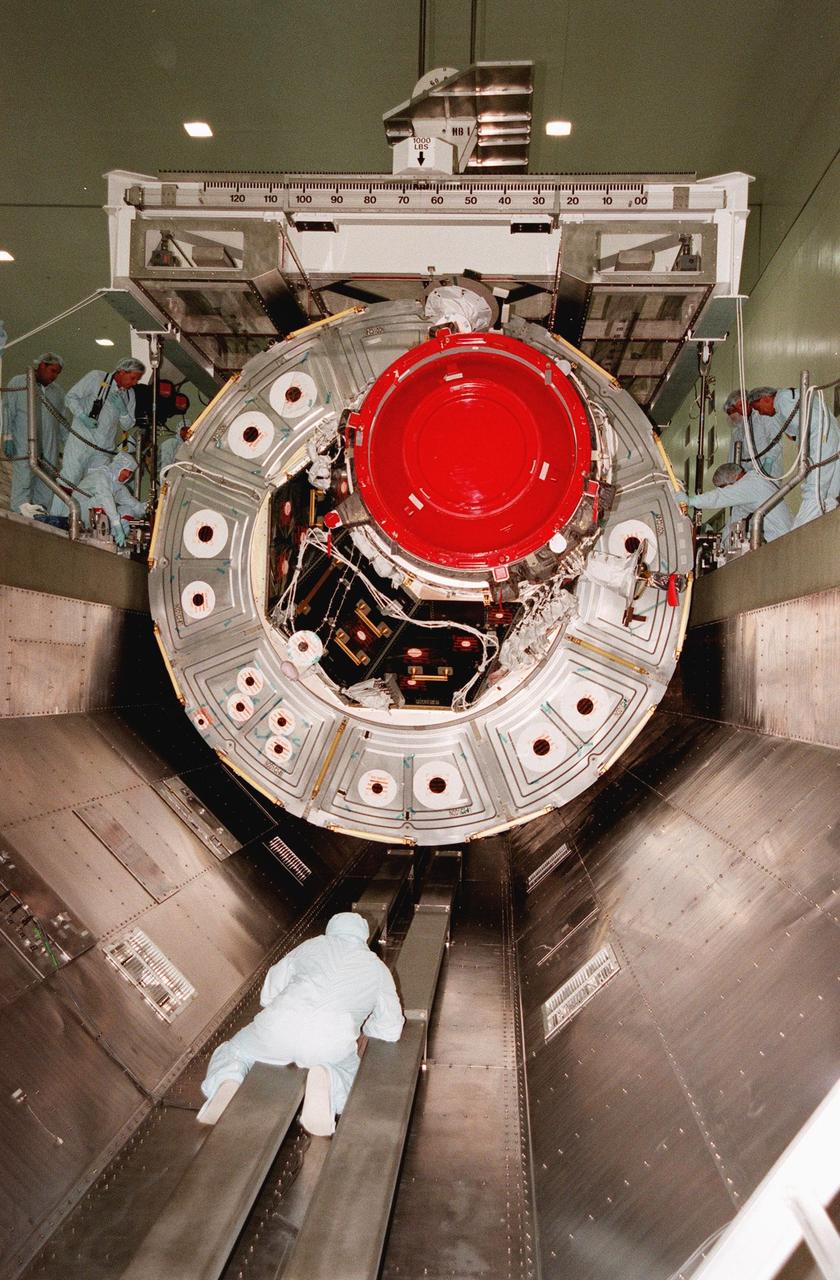
In the Space Station Processing Facility, workers at the side and on the floor of the payload canister guide the Unity connecting module into position for transfer to the launch pad. Part of the International Space Station (ISS), Unity is scheduled for launch aboard Space Shuttle Endeavour on Mission STS-88 in December. The Unity is a connecting passageway to the living and working areas of ISS. While on orbit, the flight crew will deploy Unity from the payload bay and attach Unity to the Russian-built Zarya control module which will be in orbit at that time
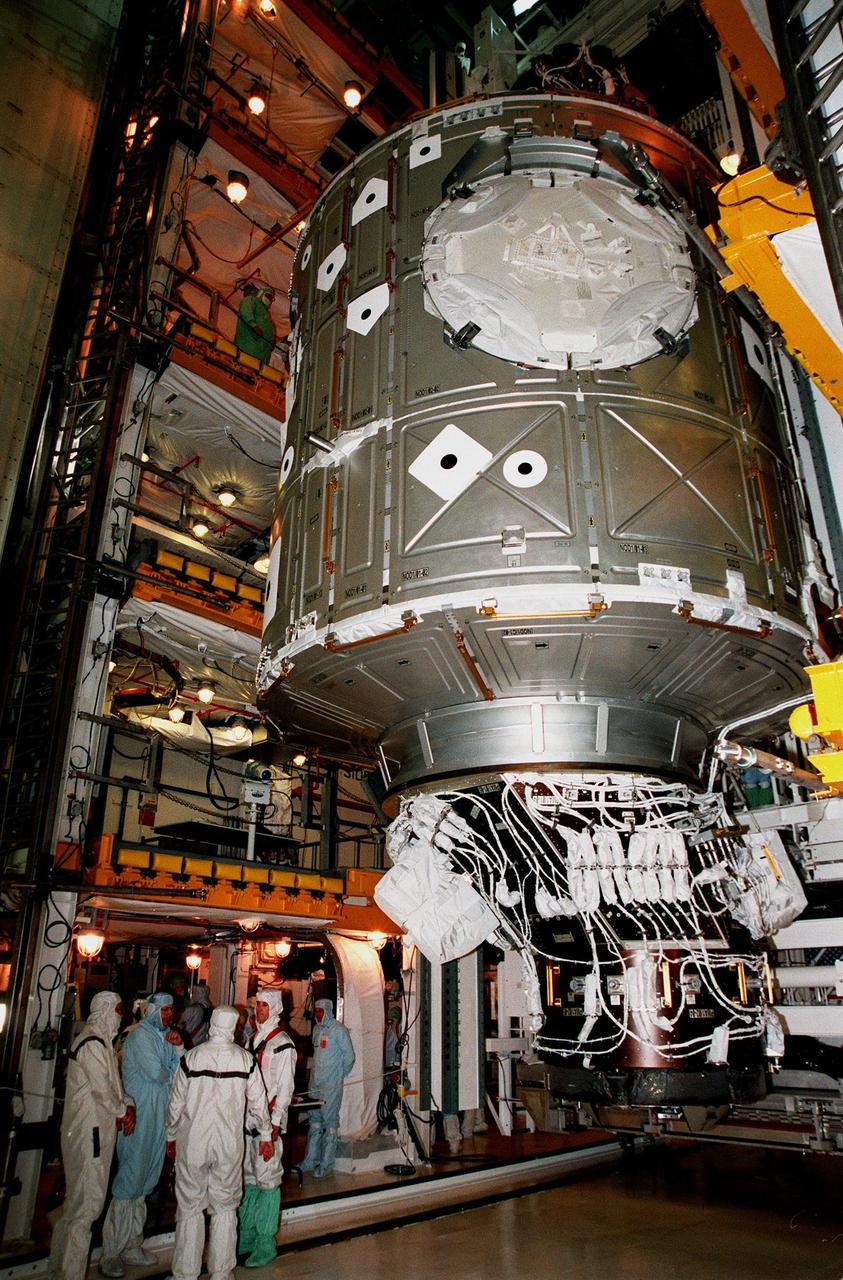
The Unity connecting module is moved toward the payload bay of the orbiter Endeavour at Launch Pad 39A. Part of the International Space Station (ISS), Unity is scheduled for launch Dec. 3, 1998, on Mission STS-88 . The Unity is a connecting passageway to the living and working areas of ISS. While on orbit, the flight crew will deploy Unity from the payload bay and attach it to the Russian-built Zarya control module which will be in orbit at that time
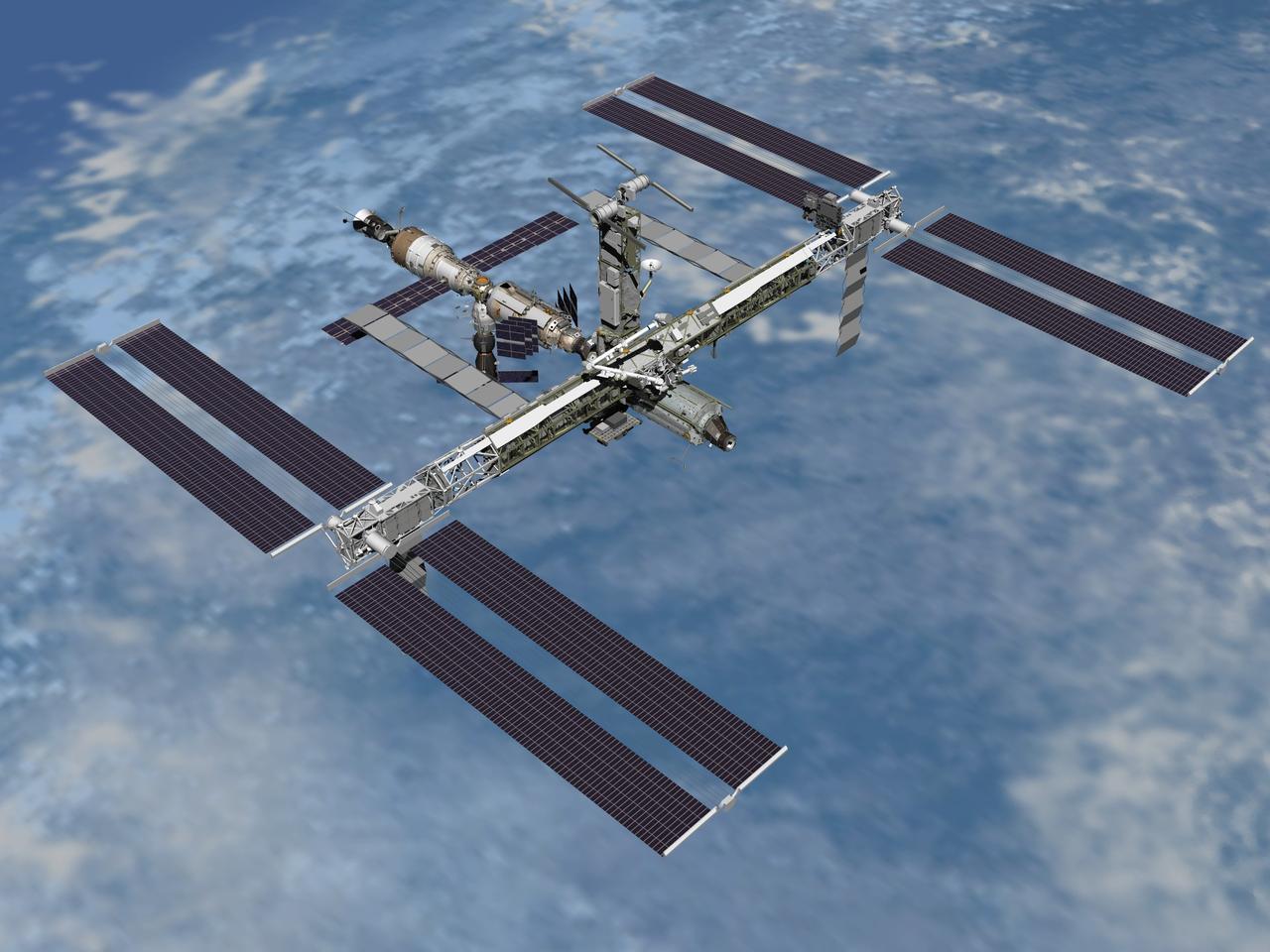
JSC2007-E-47329 (September 2007) --- Computer-generated artist's rendering of the International Space Station as of Sept. 28, 2007. Zarya module's arrays are retracted to allow room for the future deployment of the thermal control system radiators. Soyuz 14 (TMA-10) is docked to the Zvezda Service Module aft port and Progress 26 resupply vehicle remains docked to the Pirs Docking Compartment.
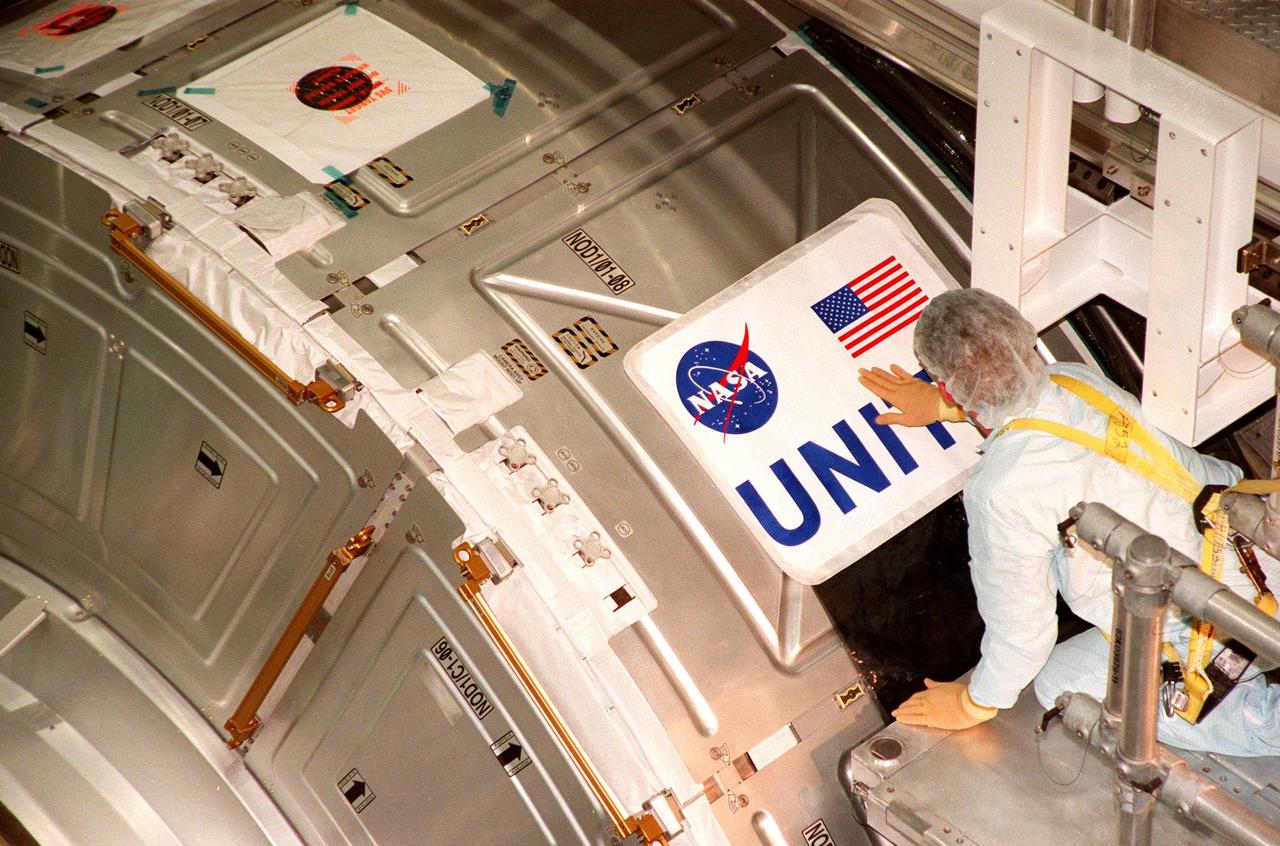
In the Space Station Processing Facility, a worker places the nameplate on the side of the Unity connecting module, part of the International Space Station. Unity was expected to be transported to Launch Pad 39A on Oct. 26 for launch aboard Space Shuttle Endeavour on Mission STS-88 in December. The Unity is a connecting passageway to the living and working areas of ISS. While on orbit, the flight crew will deploy Unity from the payload bay and attach Unity to the Russian-built Zarya control module which will be in orbit at that time
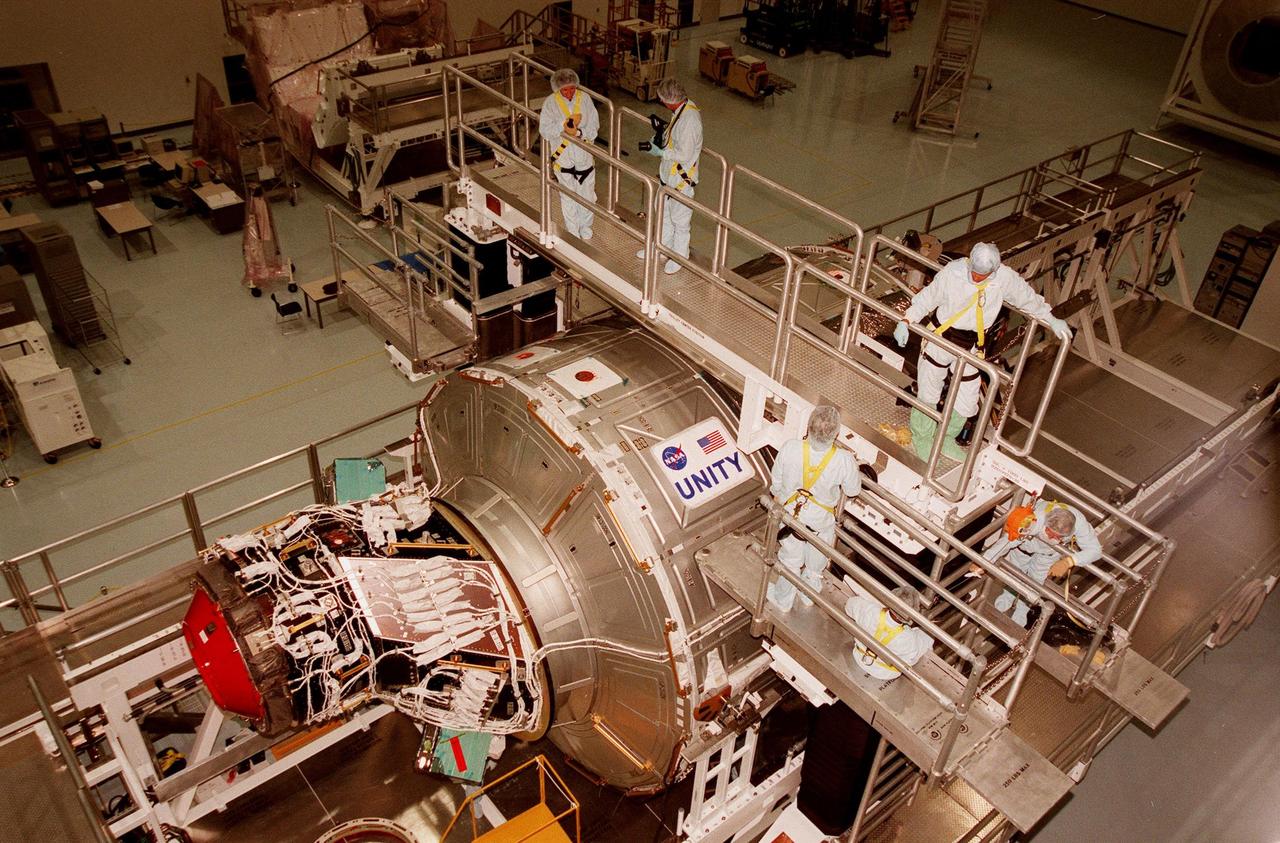
In the Space Station Processing Facility, workers look over the Unity connecting module, part of the International Space Station, after attaching the nameplate. Unity was expected to be transported to Launch Pad 39A on Oct. 26 for launch aboard Space Shuttle Endeavour on Mission STS-88 in December. The Unity is a connecting passageway to the living and working areas of ISS. While on orbit, the flight crew will deploy Unity from the payload bay and attach Unity to the Russian-built Zarya control module which will be in orbit at that time
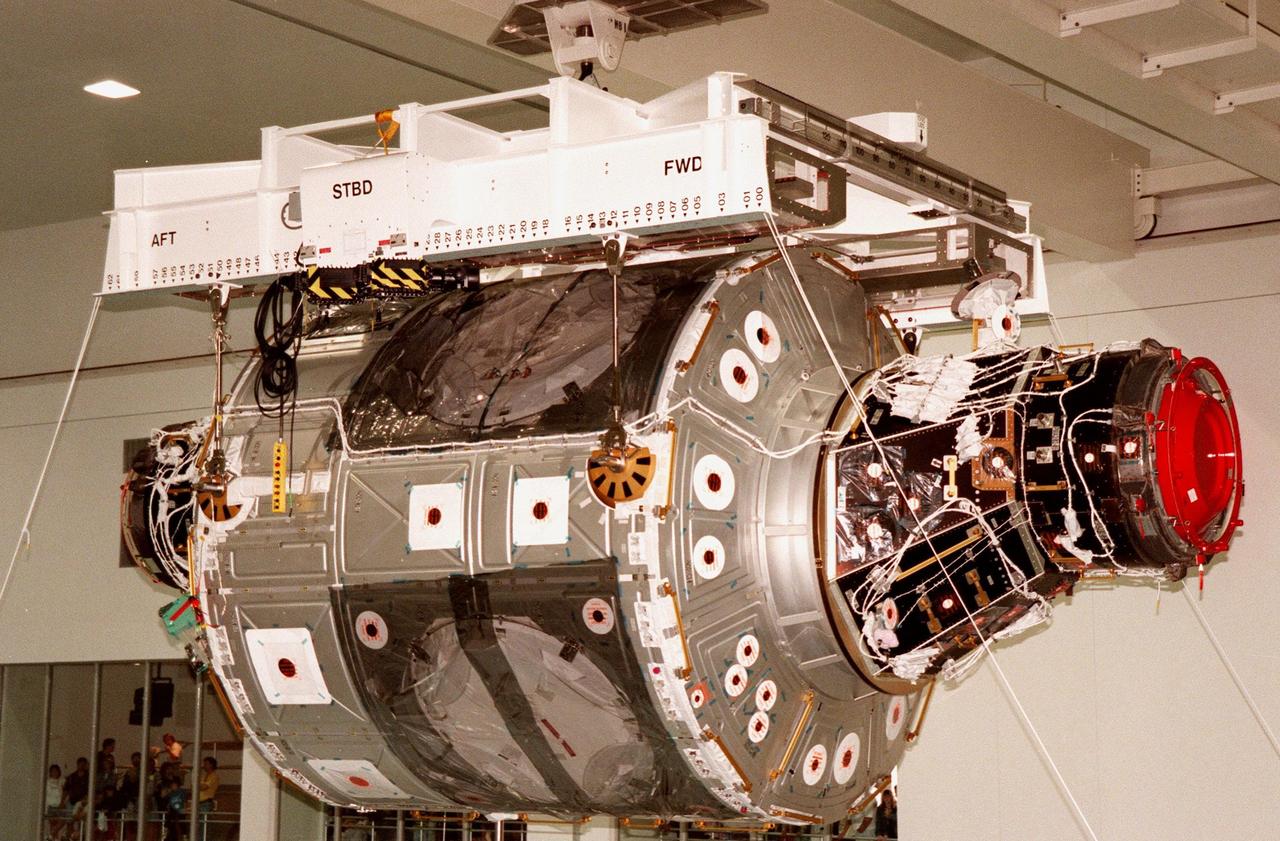
In the Space Station Processing Facility, a closeup view shows the overhead crane holding the Unity connecting module as it moves it to the payload canister for transfer to the launch pad. Part of the International Space Station (ISS), Unity is scheduled for launch aboard Space Shuttle Endeavour on Mission STS-88 in December. The Unity is a connecting passageway to the living and working areas of ISS. While on orbit, the flight crew will deploy Unity from the payload bay and attach Unity to the Russian-built Zarya control module which will be in orbit at that time
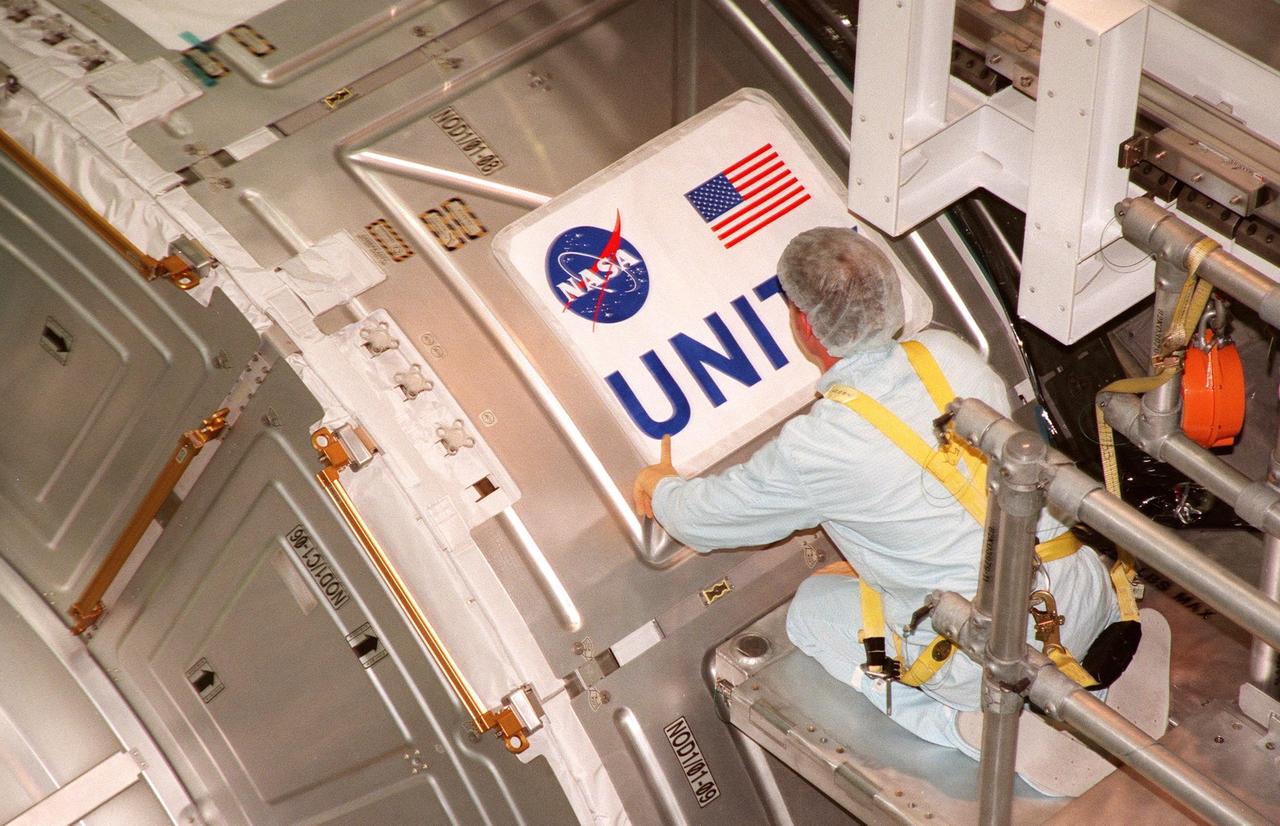
In the Space Station Processing Facility, a worker checks placement of the nameplate for the Unity connecting module, part of the International Space Station. Unity was expected to be transported to Launch Pad 39A on Oct. 26 for launch aboard Space Shuttle Endeavour on Mission STS-88 in December. The Unity is a connecting passageway to the living and working areas of ISS. While on orbit, the flight crew will deploy Unity from the payload bay and attach Unity to the Russian-built Zarya control module which will be in orbit at that time
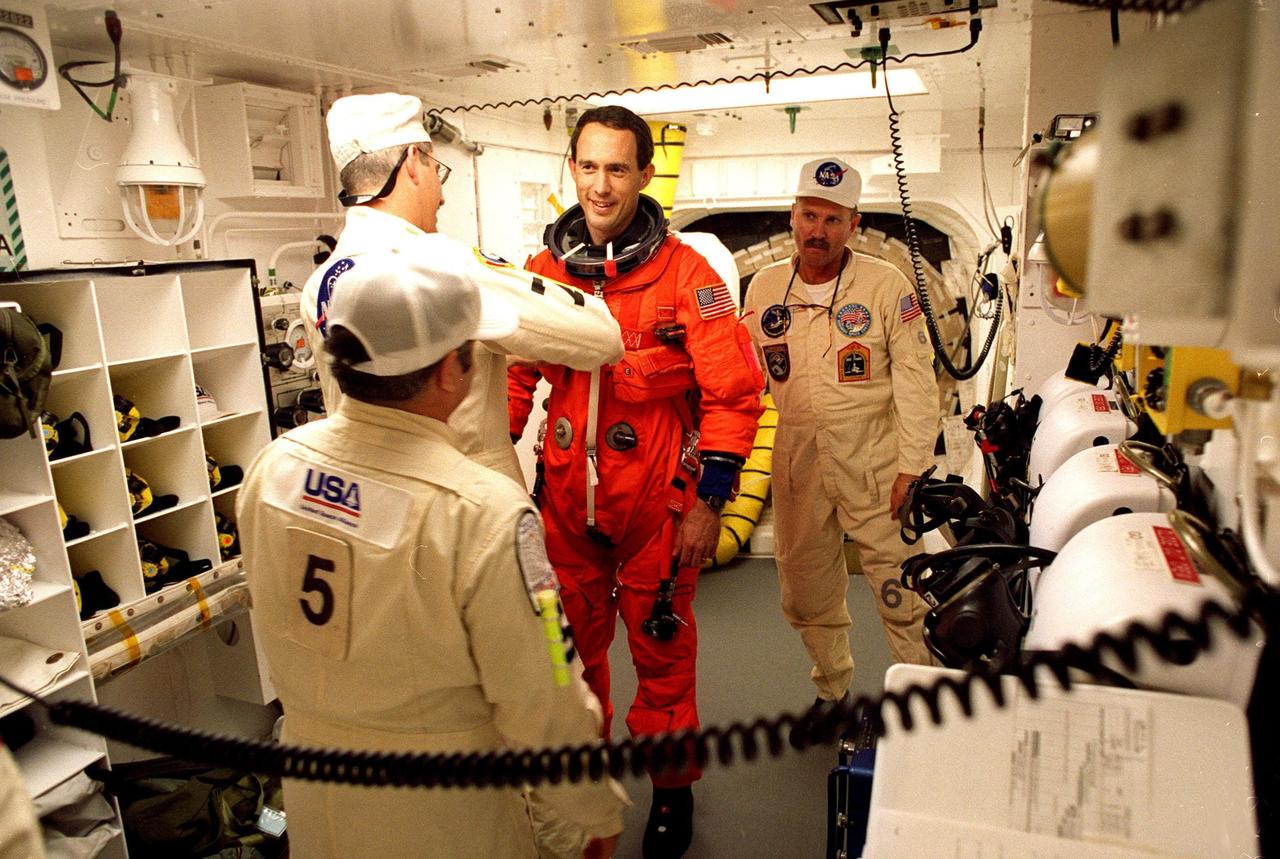
STS-88 Mission Specialist James H. Newman is assisted with his ascent and re-entry flight suit in the white room at Launch Pad 39A before entering Space Shuttle Endeavour for launch. During the nearly 12-day mission, the six-member crew will mate the first two elements of the International Space Station the already-orbiting Zarya control module with the Unity connecting module carried by Endeavour. Newman is making his third spaceflight and is one of two extravehicular activity crew members on this mission
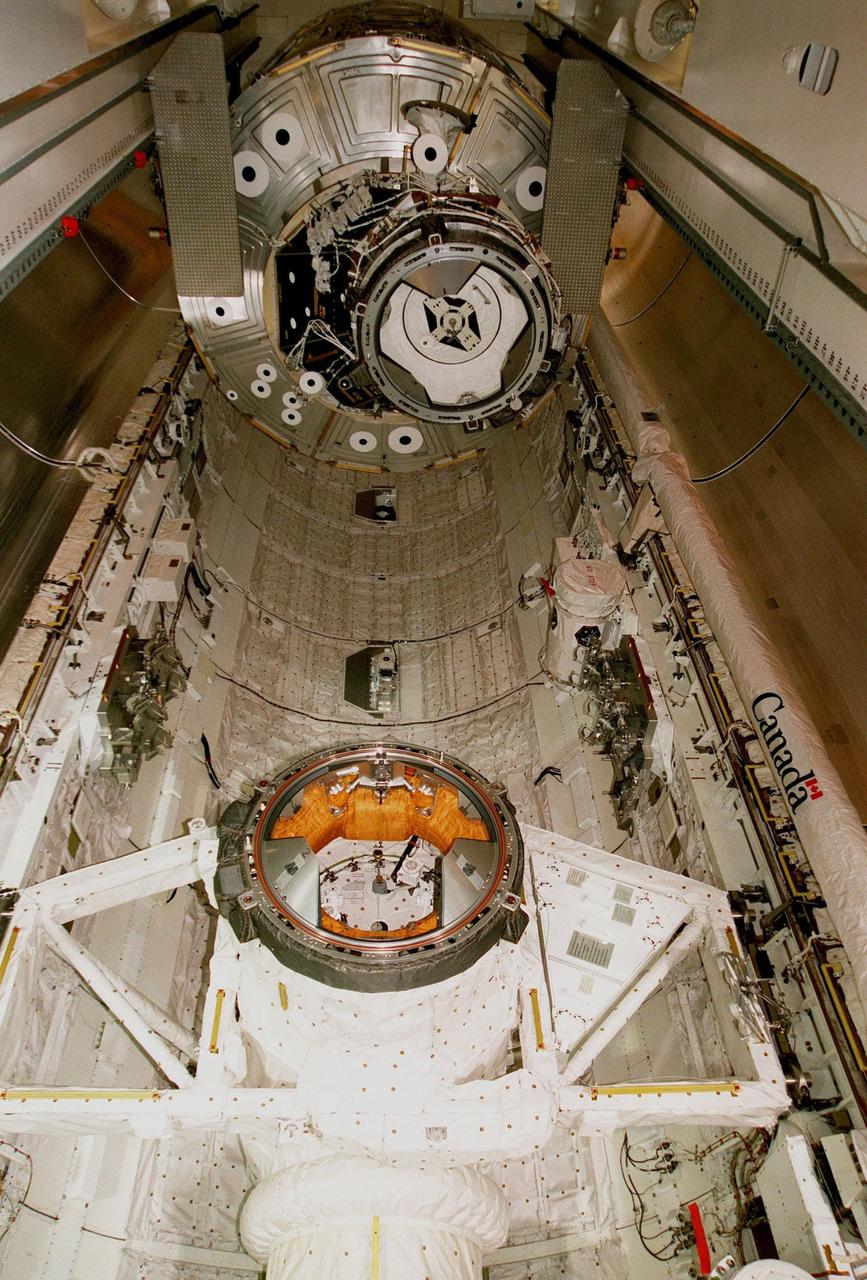
Viewed from below, the Unity connecting module is moved into the payload bay of the orbiter Endeavour at Launch Pad 39A. Part of the International Space Station (ISS), Unity is scheduled for launch Dec. 3, 1998, on Mission STS-88. The Unity is a connecting passageway to the living and working areas of ISS. While on orbit, the flight crew will deploy Unity from the payload bay and attach it to the Russian-built Zarya control module which will be in orbit at that time
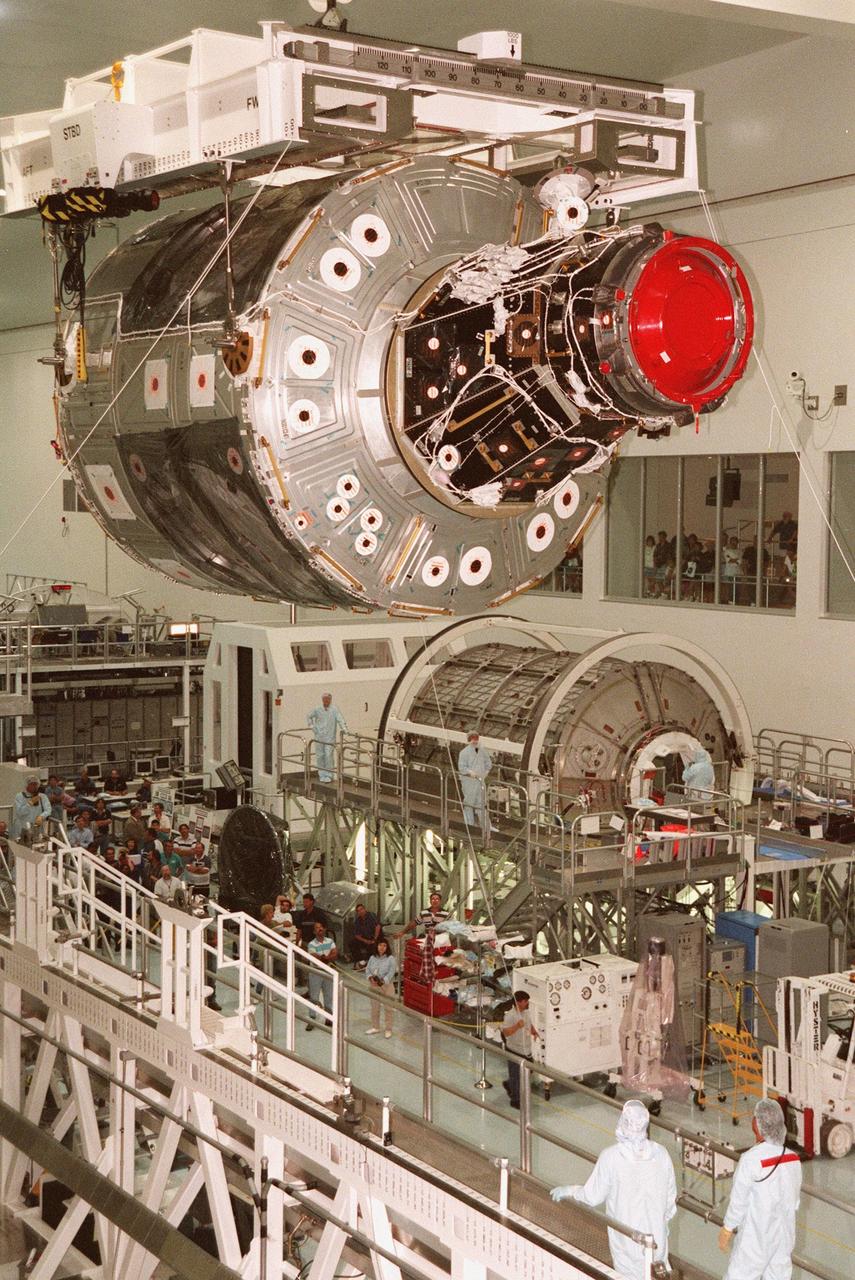
In the Space Station Processing Facility, an overhead crane moves the Unity connecting module to the payload canister for transfer to the launch pad. Part of the International Space Station (ISS), Unity is scheduled for launch aboard Space Shuttle Endeavour on Mission STS-88 in December. The Unity is a connecting passageway to the living and working areas of ISS. While on orbit, the flight crew will deploy Unity from the payload bay and attach Unity to the Russian-built Zarya control module which will be in orbit at that time
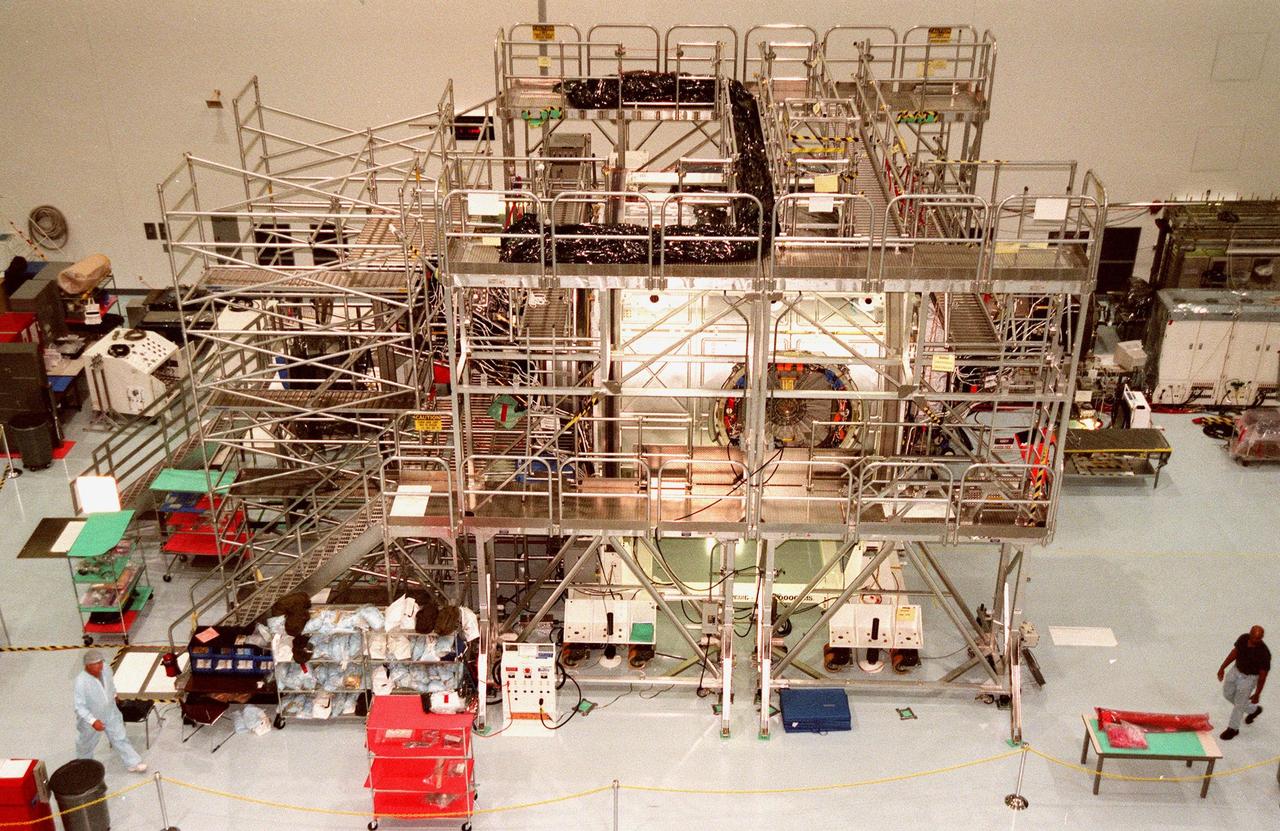
KENNEDY SPACE CENTER, FLA. -- The Unity connecting module is viewed from above while it awaits processing in the Space Station Processing Facility (SSPF). On the side can be seen the connecting hatch. The Unity, scheduled to be launched on STS-88 in December 1998, will be mated to the Russian-built Zarya control module which will already be in orbit. STS-88 will be the first Space Shuttle launch for the International Space Station
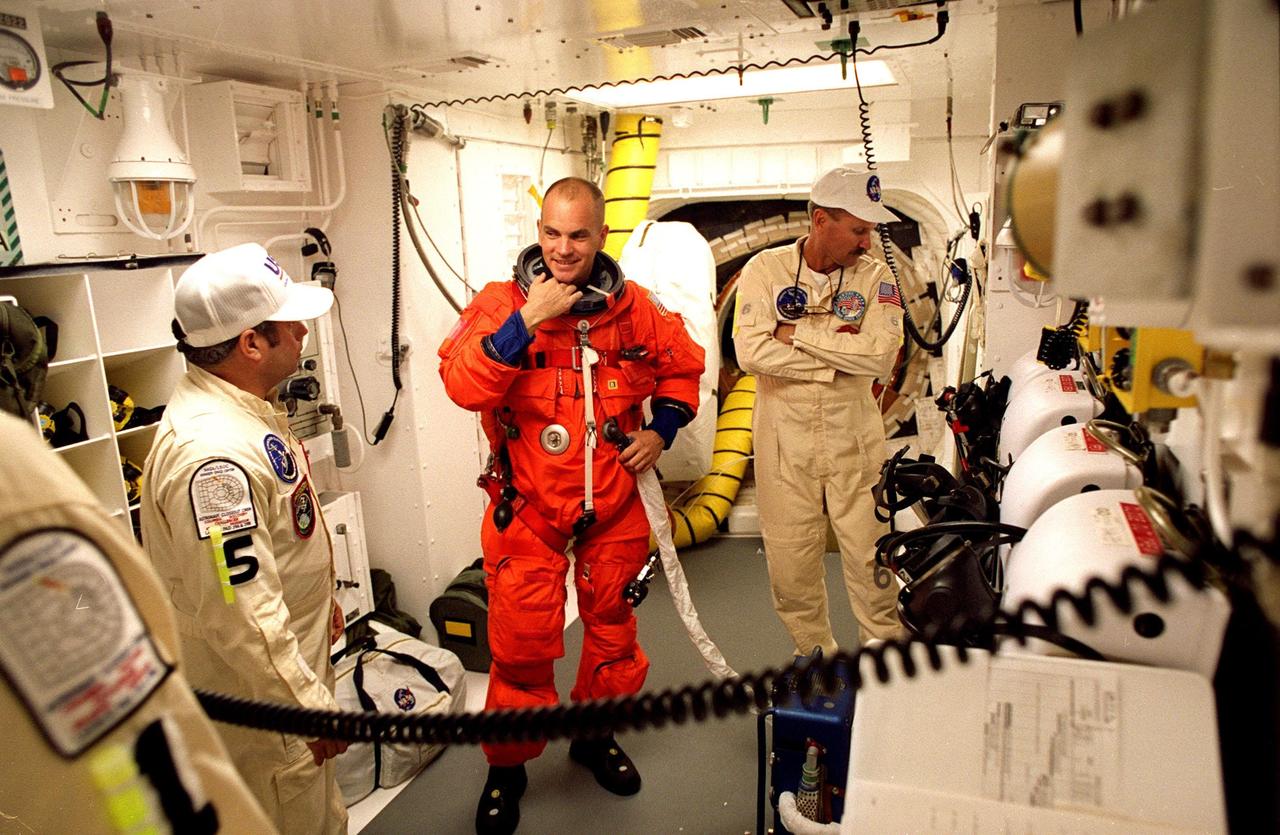
STS-88 Pilot Frederick W. "Rick" Sturckow is assisted with his ascent and re-entry flight suit in the white room at Launch Pad 39A before entering Space Shuttle Endeavour for launch. During the nearly 12-day mission, the six-member crew will mate the first two elements of the International Space Station the already-orbiting Zarya control module with the Unity connecting module carried by Endeavour. He is making his first spaceflight
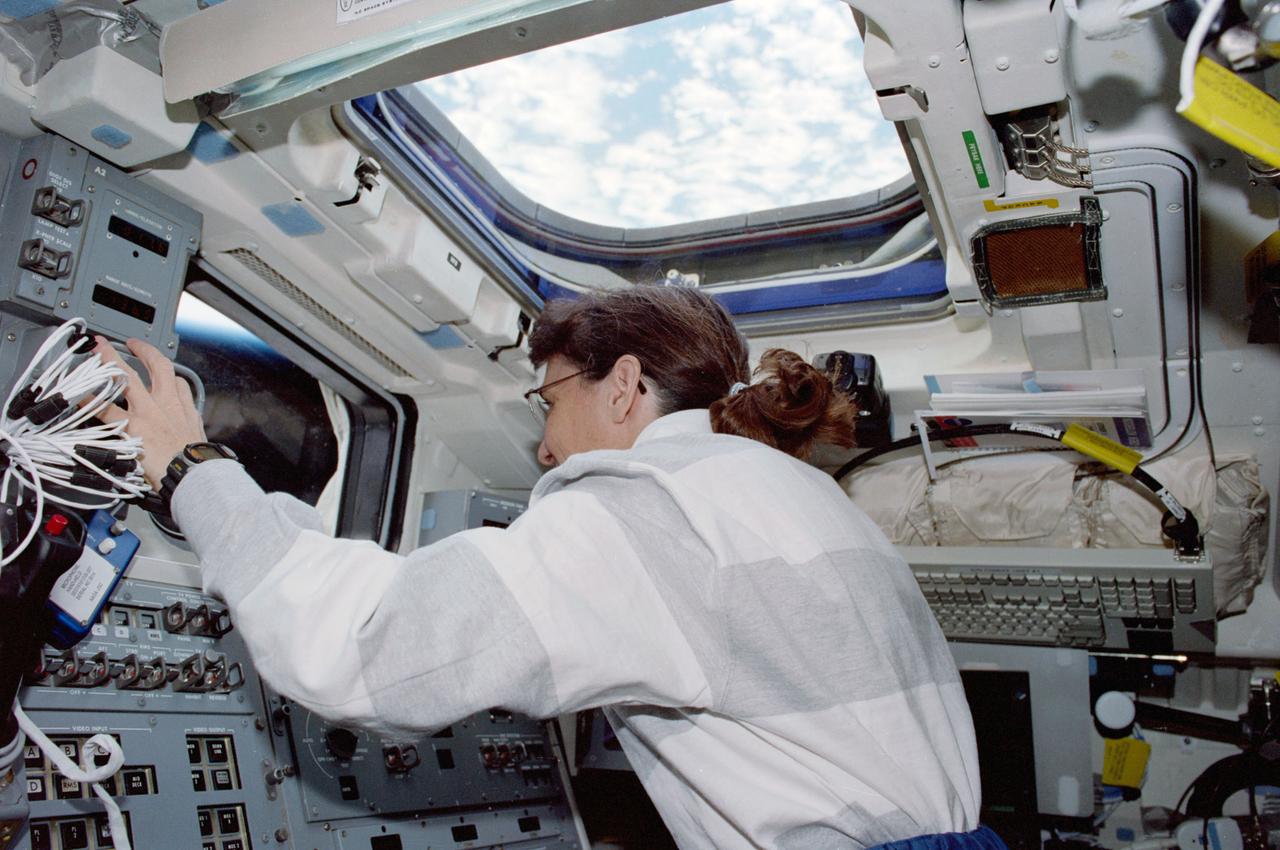
STS088-335-006 (4-15 Dec. 1998) --- Astronaut Nancy J. Currie, mission specialist, looking out the aft flight window, works the controls of the Remote Manipulator System (RMS) arm onboard the Earth-orbiting Space Shuttle Endeavour. She was in the process of moving the stowed United States-built Unity Module (Node 1) into a docked configuration with Endeavour?s docking system. This process preceded rendezvous and docking with the Russian-built FGB Module (Zarya).
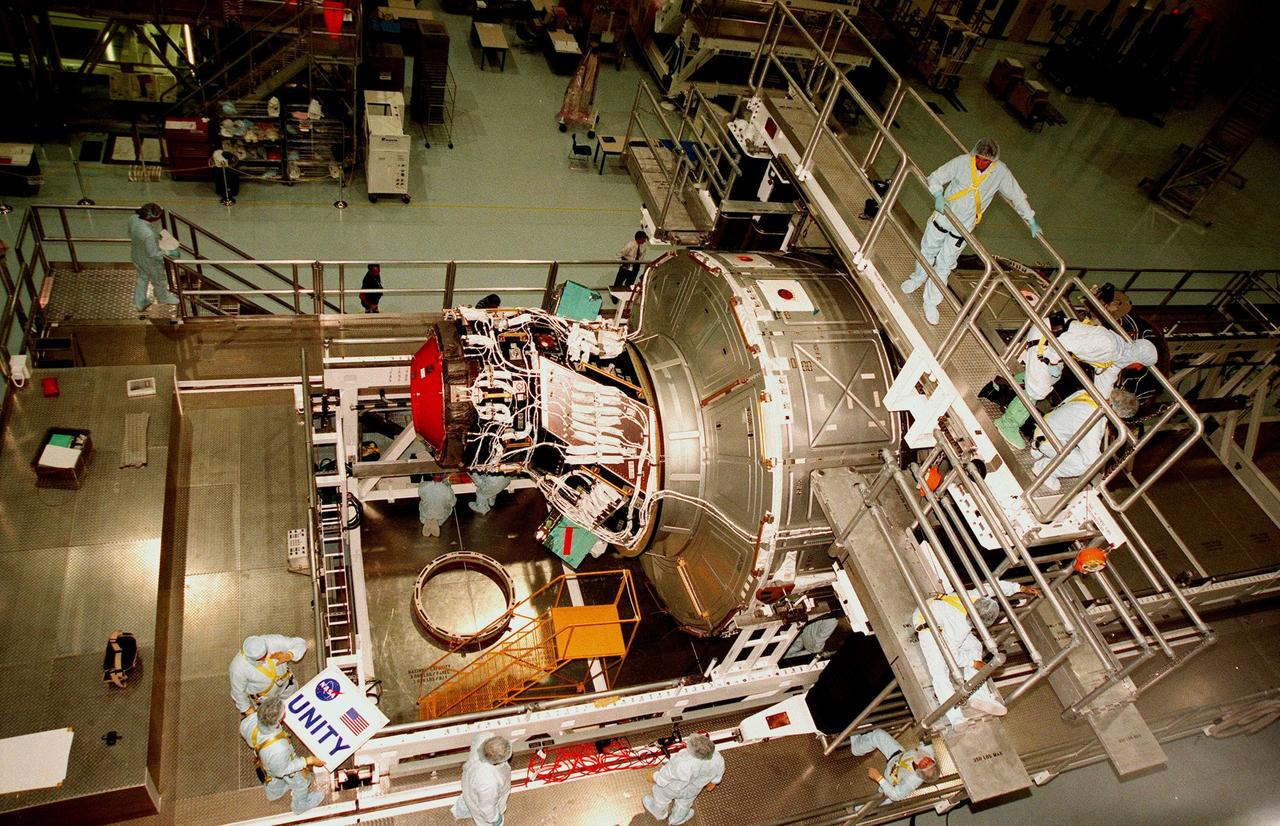
In the Space Station Processing Facility, workers make a final check of the nameplate to be attached to the Unity connecting module, part of the International Space Station. Unity was expected to be transported to Launch Pad 39A on Oct. 26 for launch aboard Space Shuttle Endeavour on Mission STS-88 in December. The Unity is a connecting passageway to the living and working areas of ISS. While on orbit, the flight crew will deploy Unity from the payload bay and attach Unity to the Russian-built Zarya control module which will be in orbit at that time
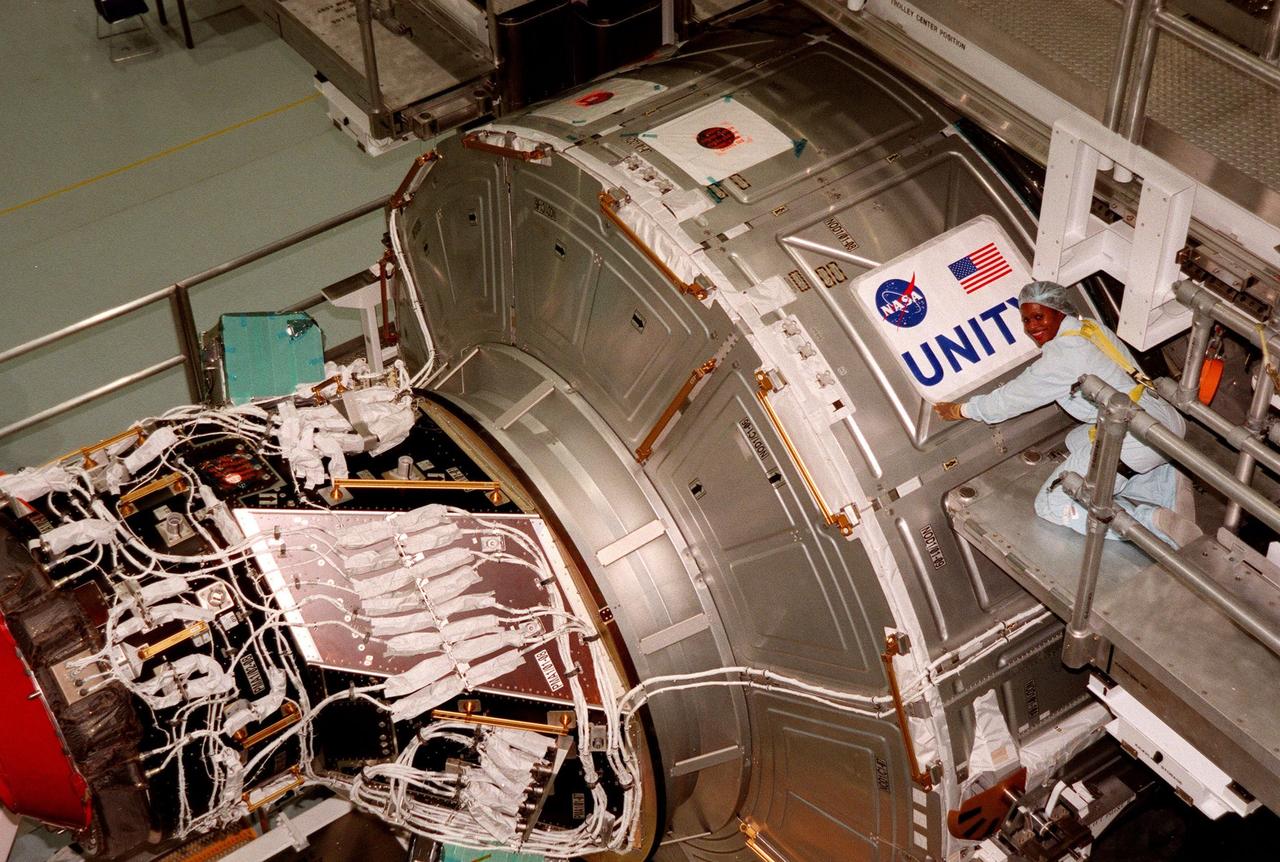
In the Space Station Processing Facility, Joan Higgenbotham, with KSC's Astronaut Office Computer Support, checks placement of the nameplate for the Unity connecting module, part of the International Space Station. Unity was expected to be transported to Launch Pad 39A on Oct. 26 for launch aboard Space Shuttle Endeavour on Mission STS-88 in December. The Unity is a connecting passageway to the living and working areas of ISS. While on orbit, the flight crew will deploy Unity from the payload bay and attach Unity to the Russian-built Zarya control module which will be in orbit at that time
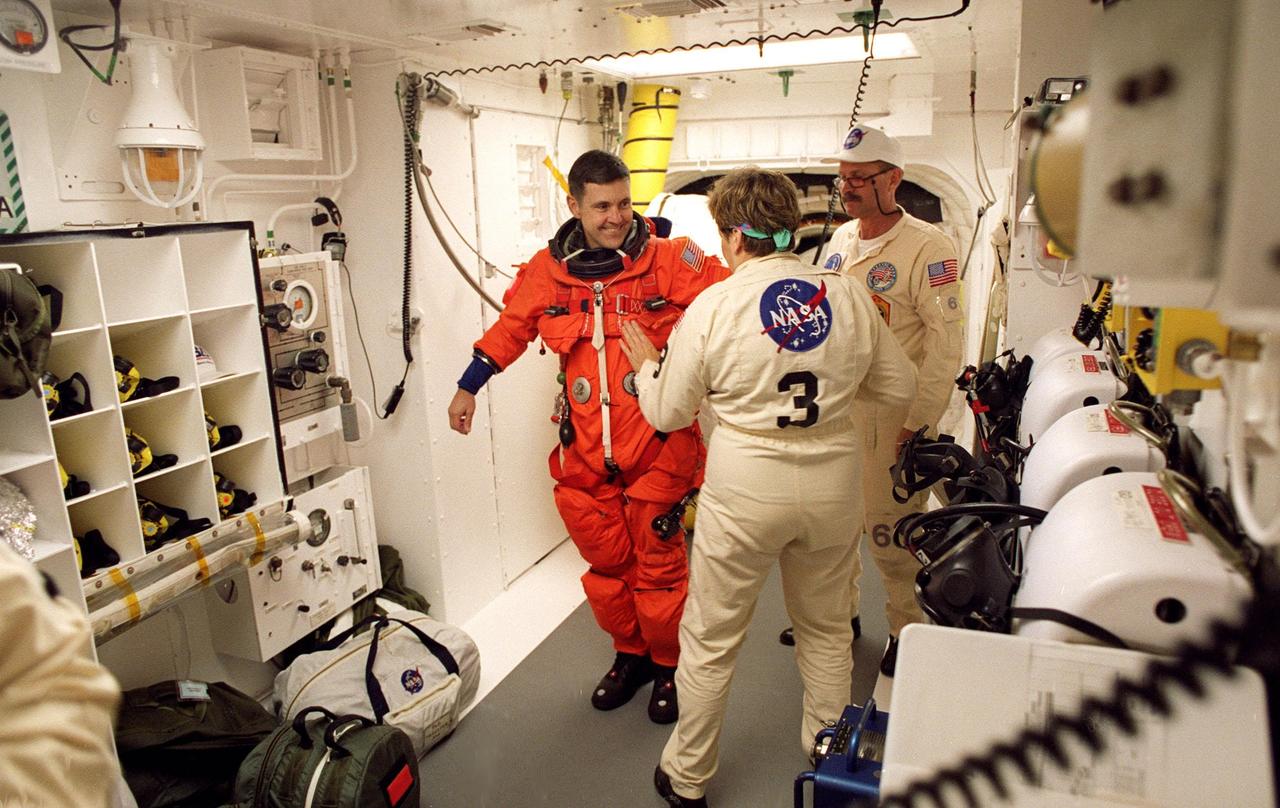
STS-88 Commander Robert D. Cabana is assisted with his ascent and re-entry flight suit in the white room at Launch Pad 39A before entering Space Shuttle Endeavour for launch. During the nearly 12-day mission, the six-member crew will mate the first two elements of the International Space Station the already-orbiting Zarya control module with the Unity connecting module carried by Endeavour. Cabana is making his fourth spaceflight
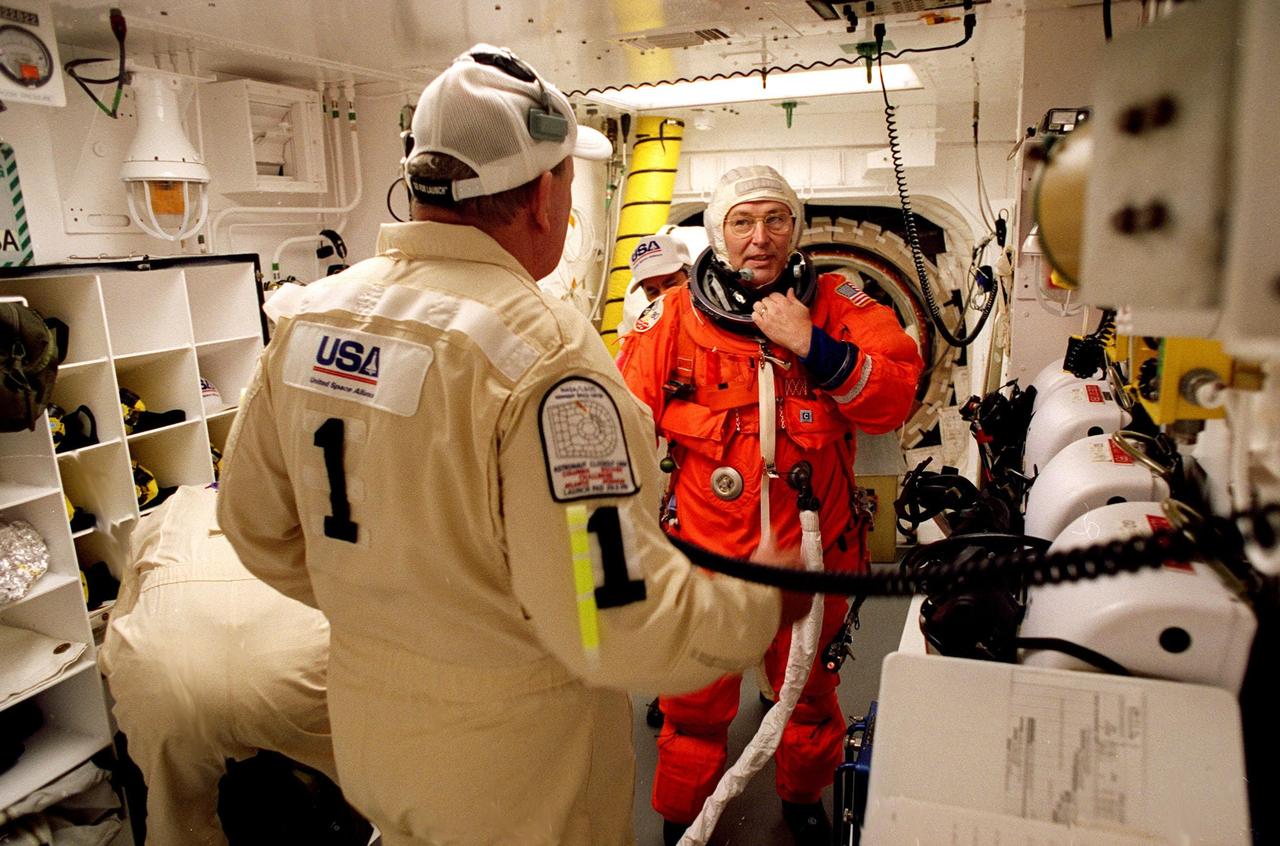
STS-88 Mission Specialist Jerry L. Ross is assisted with his ascent and re-entry flight suit in the white room at Launch Pad 39A before entering Space Shuttle Endeavour for launch. During the nearly 12-day mission, the six-member crew will mate the first two elements of the International Space Station the already-orbiting Zarya control module with the Unity connecting module carried by Endeavour. He is making his sixth spaceflight and is one of two extravehicular activity crew members on this mission
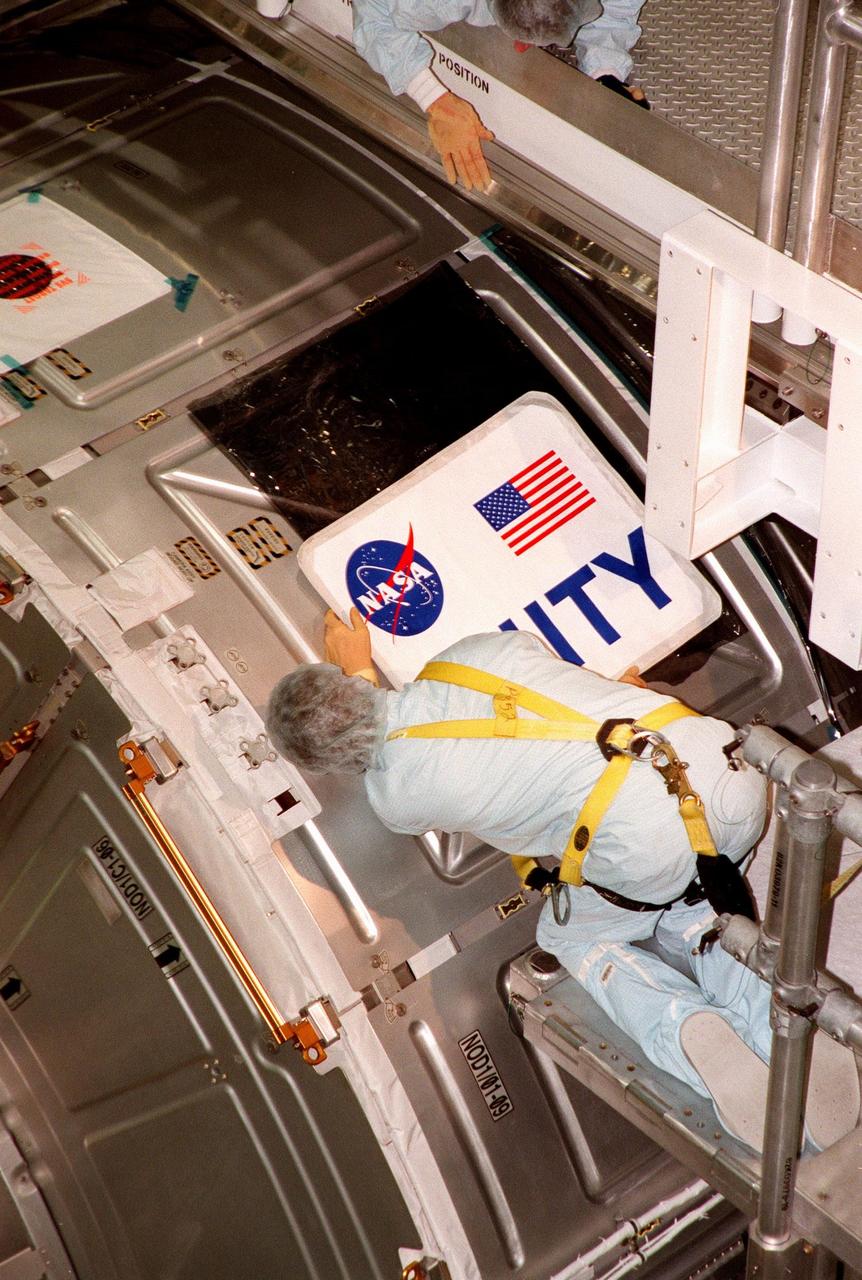
In the Space Station Processing Facility, a worker checks placement of the nameplate to be attached to the Unity connecting module, part of the International Space Station. Unity was expected to be transported to Launch Pad 39A on Oct. 26 for launch aboard Space Shuttle Endeavour on Mission STS-88 in December. The Unity is a connecting passageway to the living and working areas of ISS. While on orbit, the flight crew will deploy Unity from the payload bay and attach Unity to the Russian-built Zarya control module which will be in orbit at that time
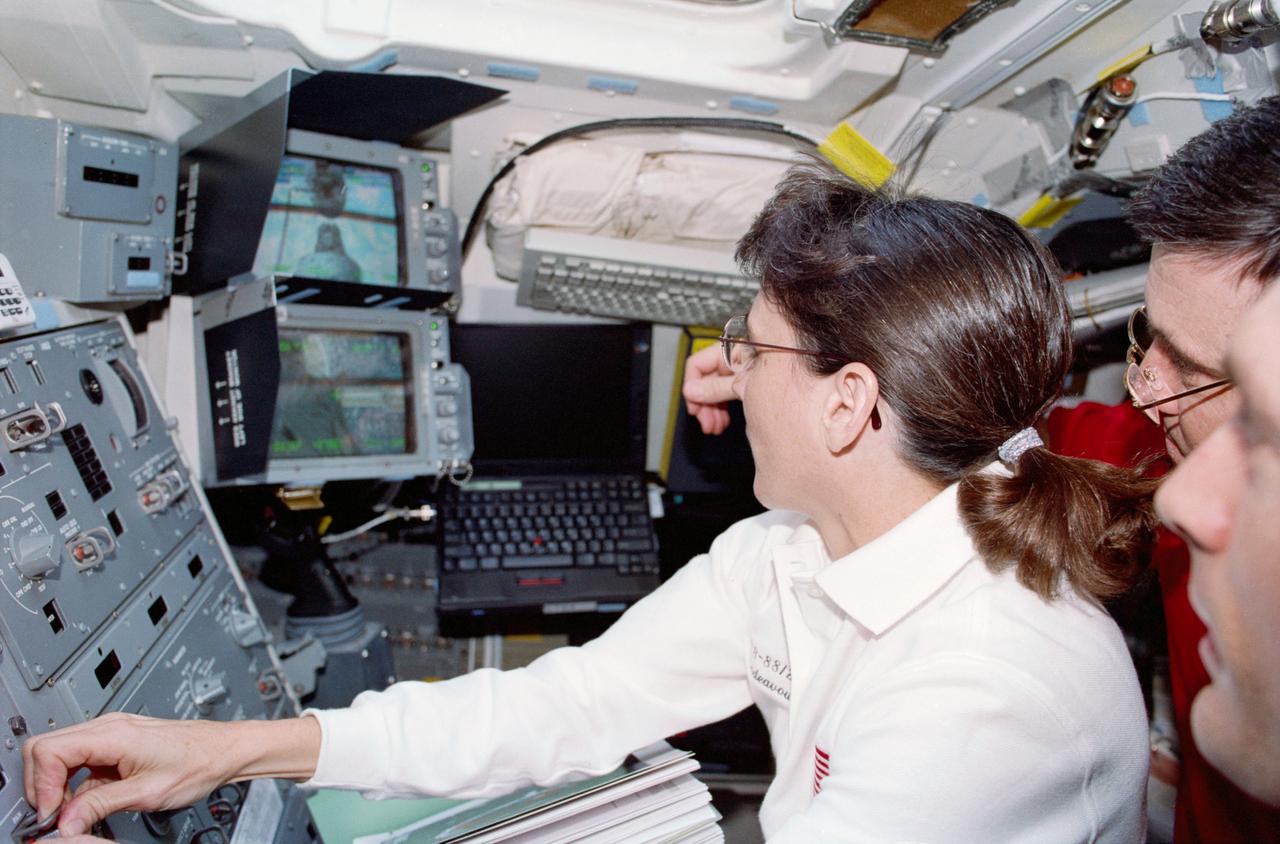
STS088-341-024 (4-15 Dec. 1998) --- Astronaut Nancy J. Currie, mission specialist, operates the controls of Endeavour's remote manipulator system (RMS) arm to ease the Russian-built Zarya module onto the U.S.-built Unity connecting module in the shuttle's cargo bay. At right are astronauts Robert D. Cabana, mission commander; and James H. Newman, mission specialist, partially out of frame.
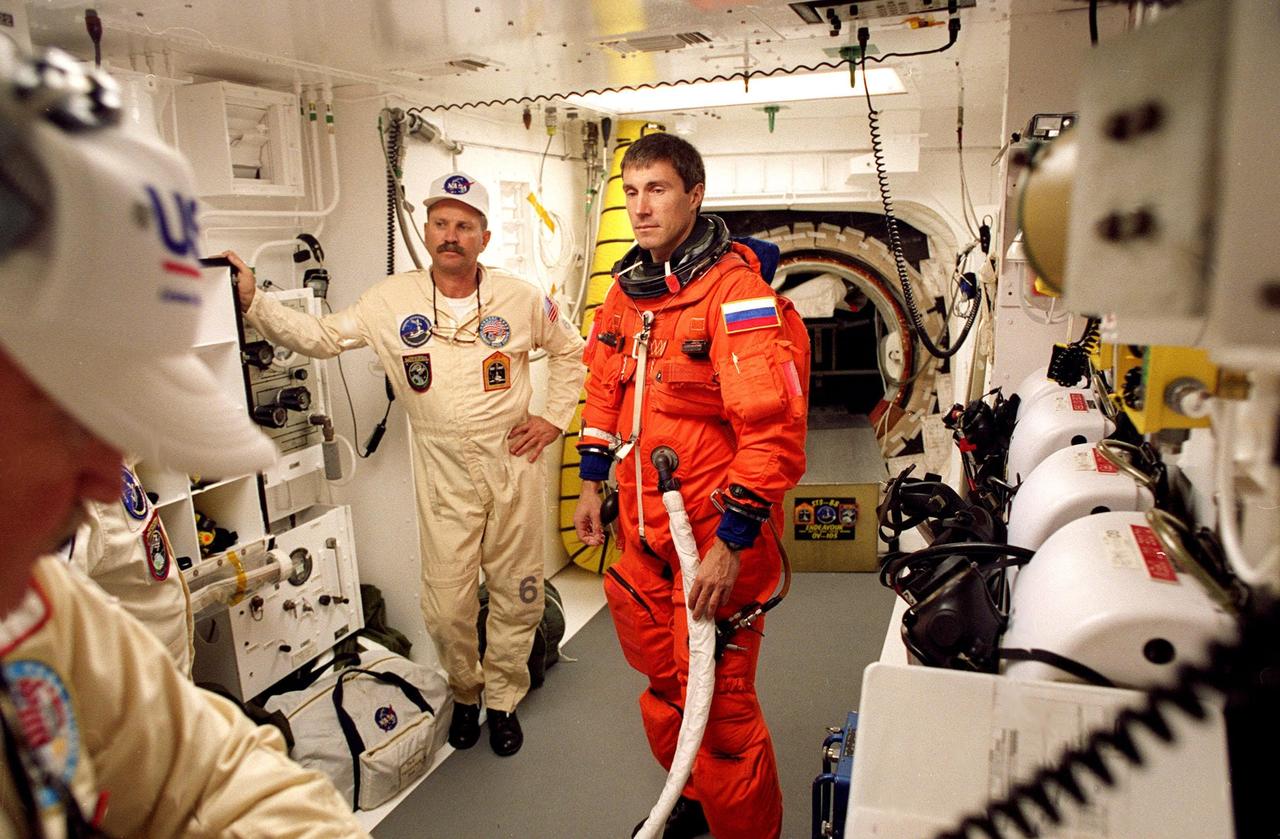
STS-88 Mission Specialist Sergei Konstantinovich Krikalev, a Russian cosmonaut, is assisted with his ascent and re-entry flight suit in the white room at Launch Pad 39A before entering Space Shuttle Endeavour for launch. During the nearly 12-day mission, the six-member crew will mate the first two elements of the International Space Station the already-orbiting Zarya control module with the Unity connecting module carried by Endeavour. He is making his fourth spaceflight
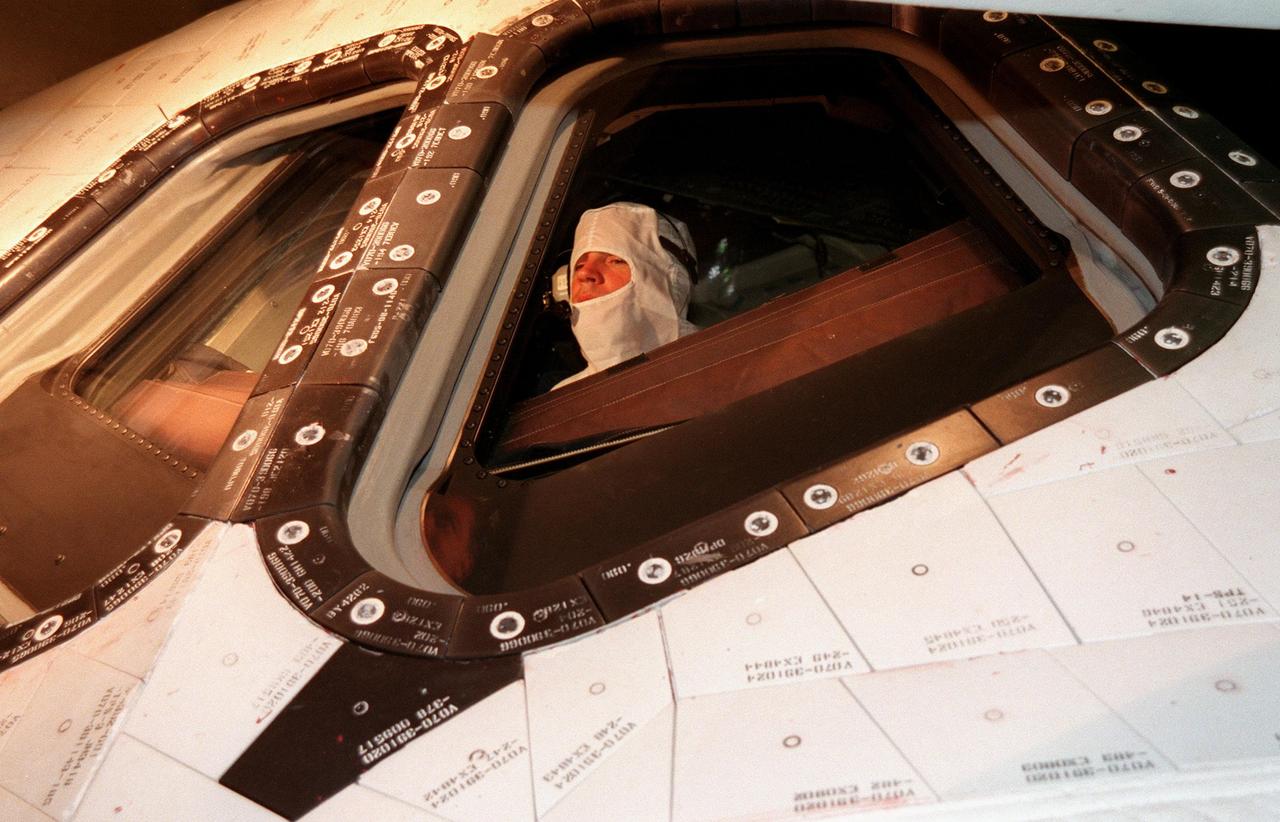
KENNEDY SPACE CENTER, FLA. -- In the Orbiter Processing Facility Bay 1, STS-88 Pilot Frederick W. Sturckow makes a visual inspection of windows on the Space Shuttle orbiter Endeavour. The STS-88 crew members are participating in a Crew Equipment Interface Test (CEIT), familiarizing themselves with the orbiter's midbody and crew compartments. Targeted for launch on Dec. 3, 1998, STS-88 will be the first Space Shuttle launch for assembly of the International Space Station (ISS). The primary payload is the Unity connecting module which will be mated to the Russian-built Zarya control module, expected to be already on orbit after a November launch from Russia. The first major U.S.-built component of ISS, Unity will serve as a connecting passageway to living and working areas of the space station. Unity has two attached pressurized mating adapters (PMAs) and one stowage rack installed inside. PMA-1 provides the permanent connection point between Unity and Zarya; PMA-2 will serve as a Space Shuttle docking port. Zarya is a self-supporting active vehicle, providing propulsive control capability and power during the early assembly stages. It also has fuel storage capability
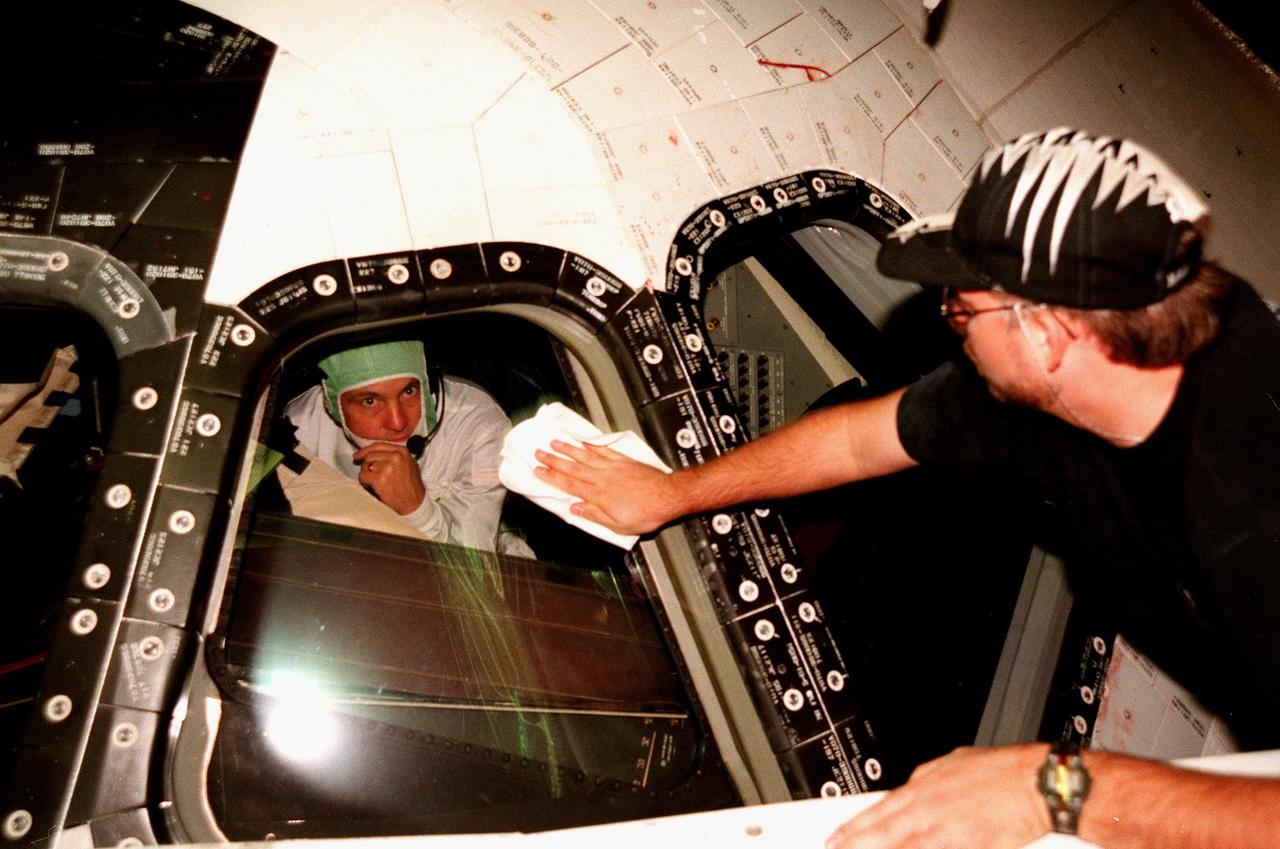
KENNEDY SPACE CENTER, FLA. -- In the Orbiter Processing Facility Bay 1, STS-88 Commander Robert D. Cabana watches from inside Space Shuttle orbiter Endeavour as worker Tracey Hackett cleans the outside of a window. The STS-88 crew members are participating in a Crew Equipment Interface Test (CEIT), familiarizing themselves with the orbiter's midbody and crew compartments. Targeted for liftoff on Dec. 3, 1998, STS-88 will be the first Space Shuttle launch for assembly of the International Space Station (ISS). The primary payload is the Unity connecting module which will be mated to the Russian-built Zarya control module, expected to be already on orbit after a November launch from Russia. The first major U.S.-built component of ISS, Unity will serve as a connecting passageway to living and working areas of the space station. Unity has two attached pressurized mating adapters (PMAs) and one stowage rack installed inside. PMA-1 provides the permanent connection point between Unity and Zarya; PMA-2 will serve as a Space Shuttle docking port. Zarya is a self-supporting active vehicle, providing propulsive control capability and power during the early assembly stages. It also has fuel storage capability
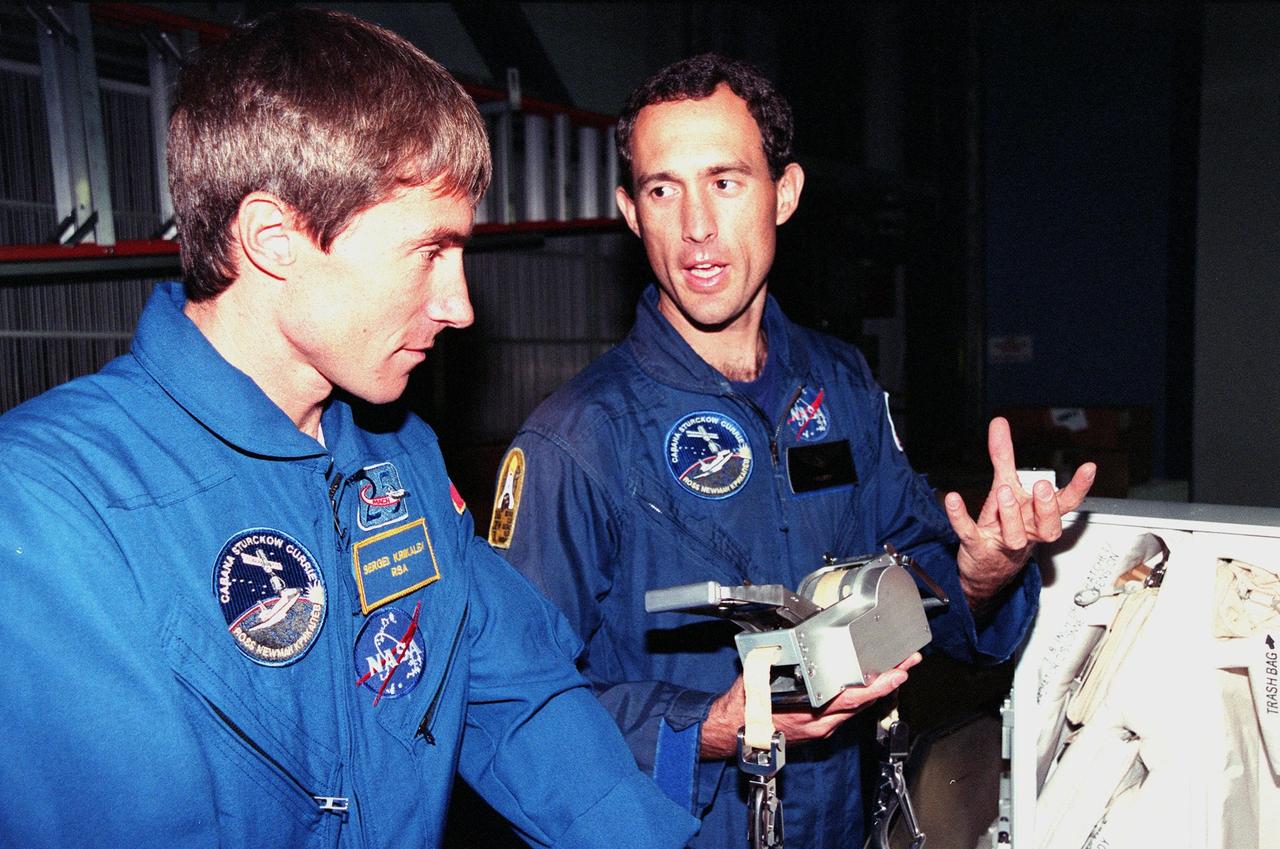
KENNEDY SPACE CENTER, FLA. -- Inside the Orbiter Processing Facility Bay 1, STS-88 Mission Specialists Sergei Krikalev (left), a Russian cosmonaut; and James H. Newman look over equipment for their upcoming flight. The STS-88 crew members are participating in a Crew Equipment Interface Test (CEIT), familiarizing themselves with the orbiter's midbody and crew compartments. Targeted for liftoff on Dec. 3, 1998, STS-88 will be the first Space Shuttle launch for assembly of the International Space Station (ISS). The primary payload is the Unity connecting module which will be mated to the Russian-built Zarya control module, expected to be already on orbit after a November launch from Russia. The first major U.S.-built component of ISS, Unity will serve as a connecting passageway to living and working areas of the space station. Unity has two attached pressurized mating adapters (PMAs) and one stowage rack installed inside. PMA-1 provides the permanent connection point between Unity and Zarya; PMA-2 will serve as a Space Shuttle docking port. Zarya is a self-supporting active vehicle, providing propulsive control capability and power during the early assembly stages. It also has fuel storage capability
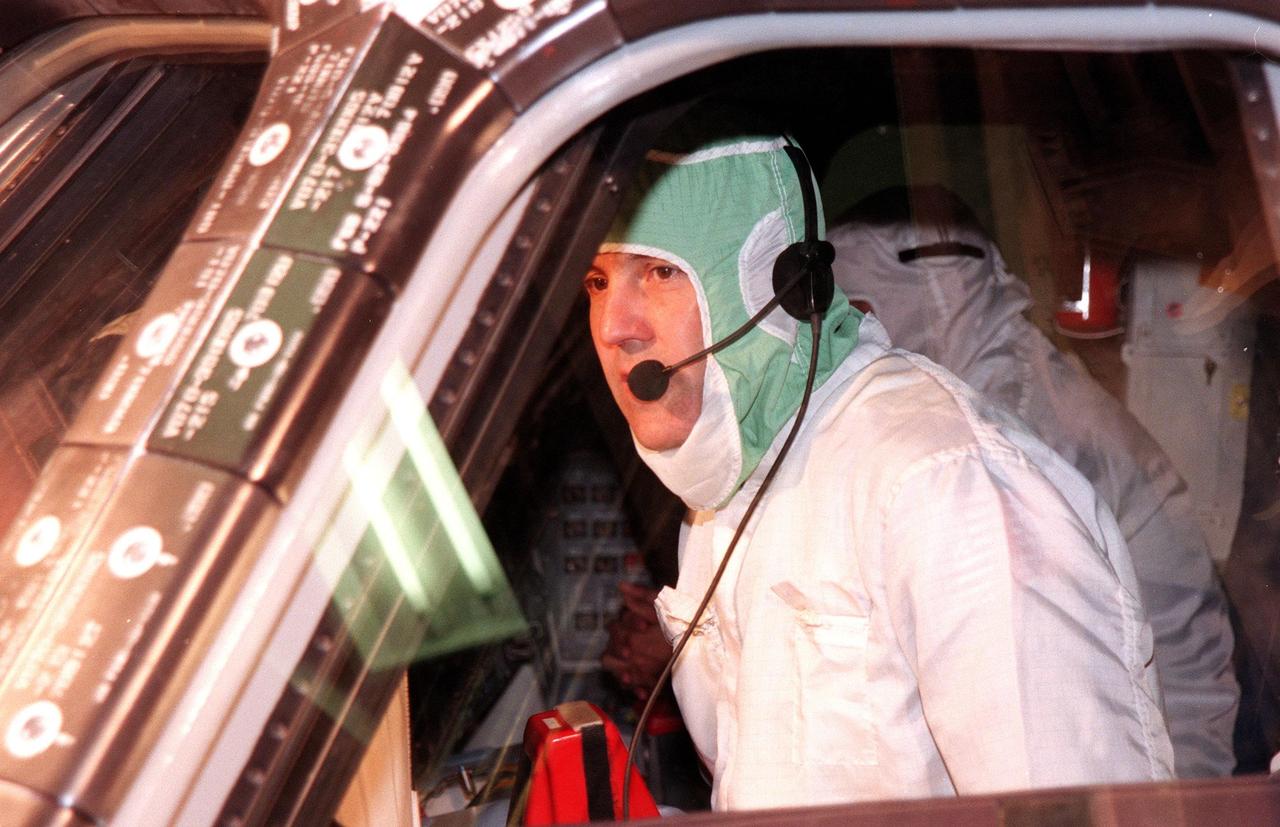
KENNEDY SPACE CENTER, FLA. -- In the Orbiter Processing Facility Bay 1, STS-88 Commander Robert D. Cabana makes a visual inspection of the windows on Space Shuttle orbiter Endeavour. The STS-88 crew members are participating in a Crew Equipment Interface Test (CEIT), familiarizing themselves with the orbiter's midbody and crew compartments. Targeted for liftoff on Dec. 3, 1998, STS-88 will be the first Space Shuttle launch for assembly of the International Space Station (ISS). The primary payload is the Unity connecting module which will be mated to the Russian-built Zarya control module, expected to be already on orbit after a November launch from Russia. The first major U.S.-built component of ISS, Unity will serve as a connecting passageway to living and working areas of the space station. Unity has two attached pressurized mating adapters (PMAs) and one stowage rack installed inside. PMA-1 provides the permanent connection point between Unity and Zarya; PMA-2 will serve as a Space Shuttle docking port. Zarya is a self-supporting active vehicle, providing propulsive control capability and power during the early assembly stages. It also has fuel storage capability
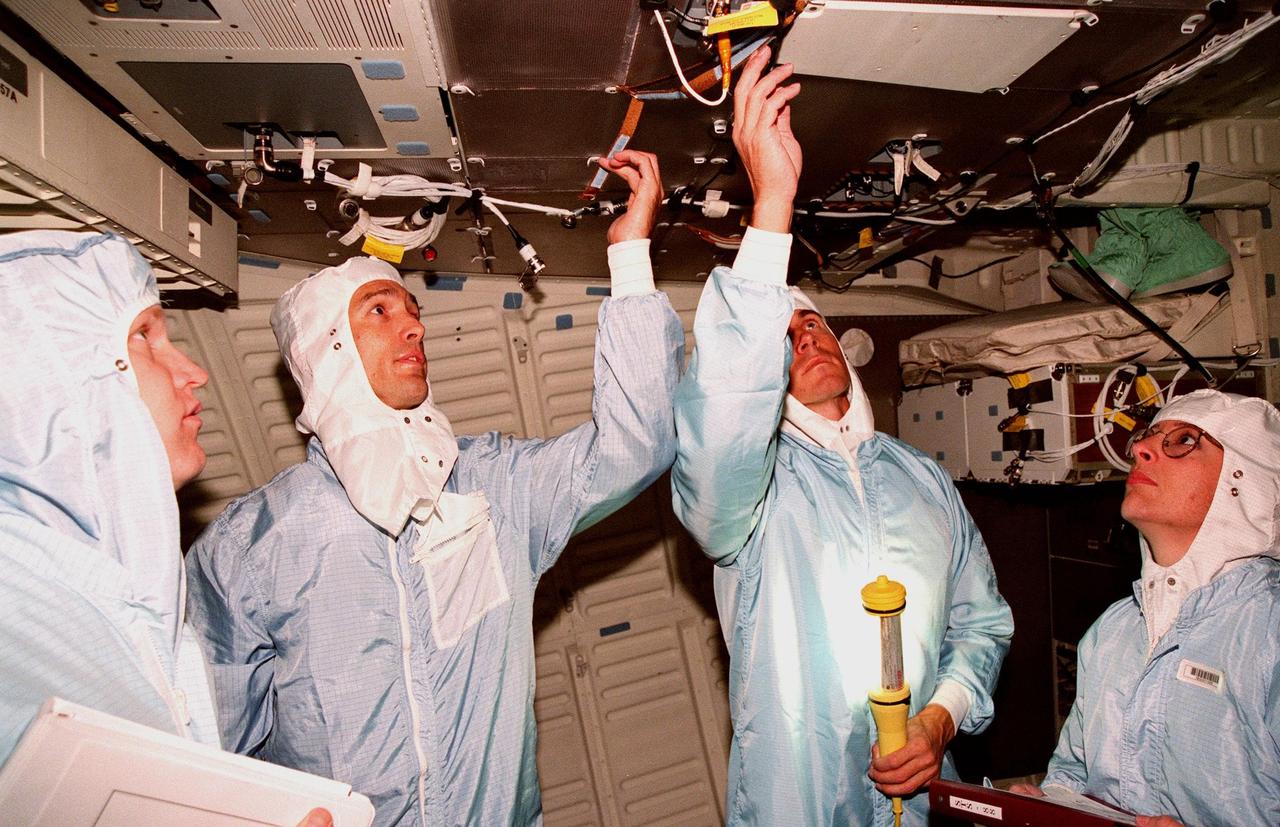
KENNEDY SPACE CENTER, FLA. -- Inside Space Shuttle orbiter Endeavour in the Orbiter Processing Facility Bay 1, workers James Neilhouse (left) and Melissa Groening (right) watch while STS-88 Mission Specialists James H. Newman (second from left) and Sergei Krikalev, a Russian cosmonaut, check overhead equipment. STS-88 crew members are participating in a Crew Equipment Interface Test (CEIT), familiarizing themselves with the orbiter's midbody and crew compartments. Targeted for liftoff on Dec. 3, 1998, STS-88 will be the first Space Shuttle launch for assembly of the International Space Station (ISS). The primary payload is the Unity connecting module which will be mated to the Russian-built Zarya control module, expected to be already on orbit after a November launch from Russia. The first major U.S.-built component of ISS, Unity will serve as a connecting passageway to living and working areas of the space station. Unity has two attached pressurized mating adapters (PMAs) and one stowage rack installed inside. PMA-1 provides the permanent connection point between Unity and Zarya; PMA-2 will serve as a Space Shuttle docking port. Zarya is a self-supporting active vehicle, providing propulsive control capability and power during the early assembly stages. It also has fuel storage capability.
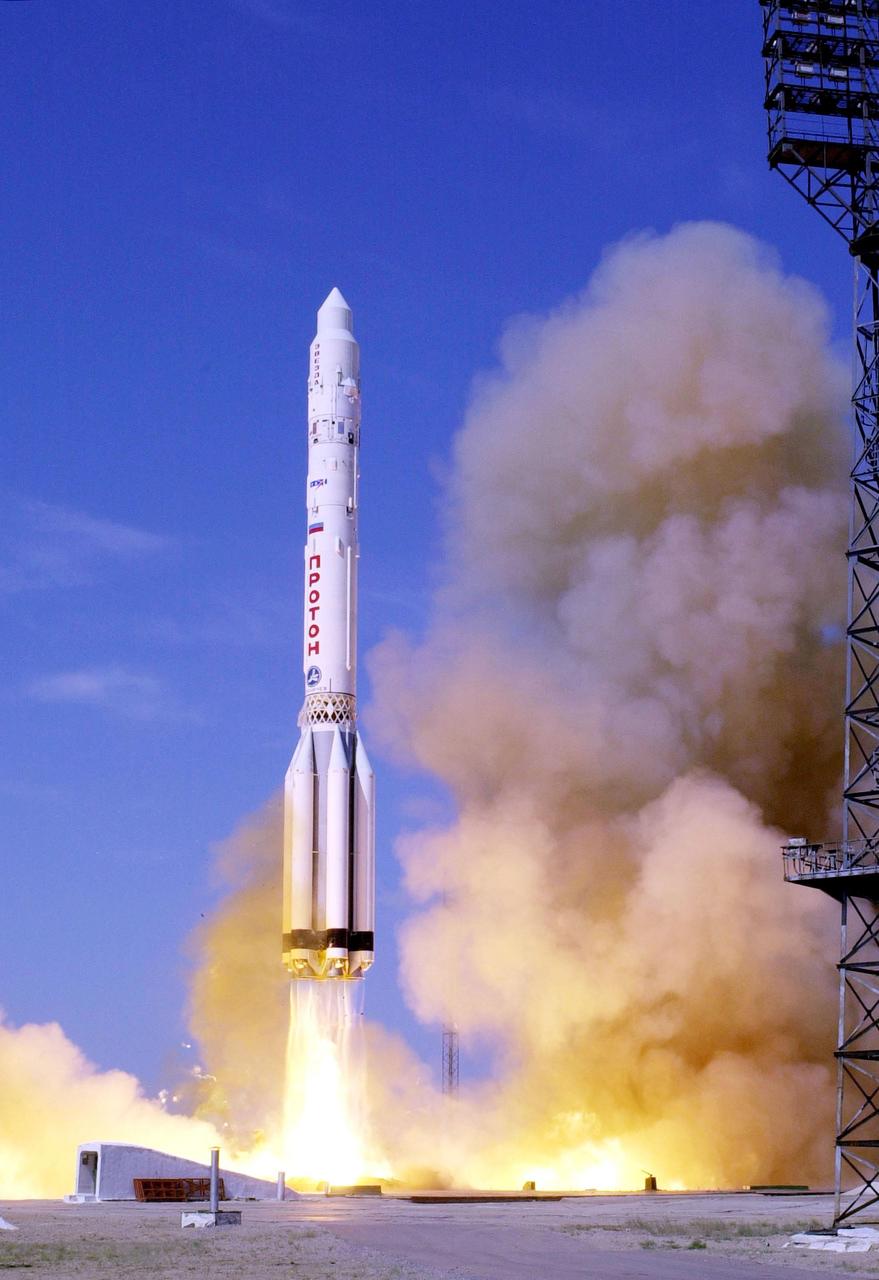
A Russian 3-stage Proton rocket blasts into the sky at 12:56 a.m. EDT with the Russian-built Zvezda module in a successful launch from Baikonur Cosmodrome, Kazakhstan. Zvezda is the primary Russian contribution to the International Space Station, serving as the early Station living quarters. It will also provide early propulsive attitude control and reboost capabilities and be the main docking port for Russian Progress cargo resupply vehicles. The third Station component, Zvezda will dock by remote control with the already orbiting Zarya and Unity modules at an altitude of about 245 by 230 statute miles. <i>(Image taken with Nikon D1 digital camera.)</i
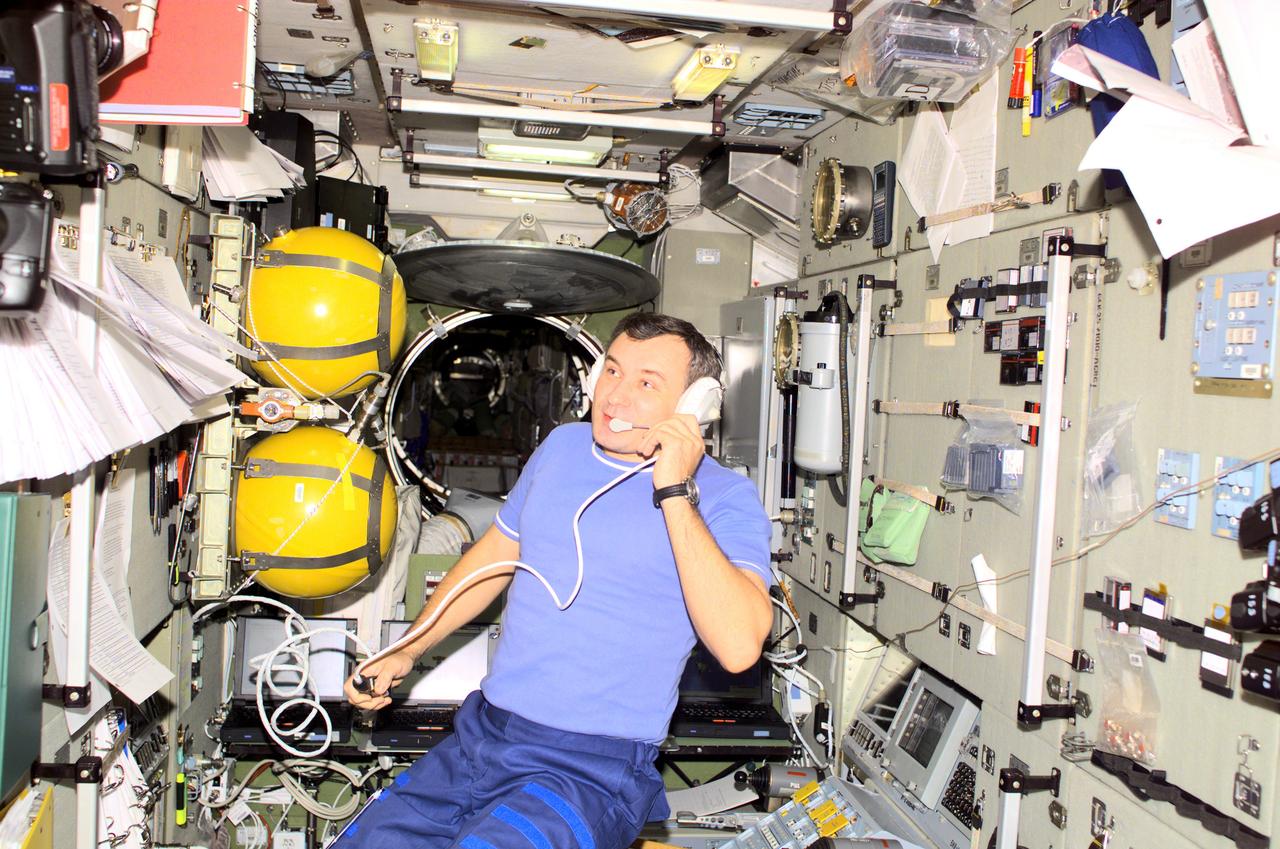
Aboard the International Space Station (ISS), Cosmonaut and Expedition Three flight engineer Vladimir N. Dezhurov, representing Rosaviakosmos, talks with flight controllers from the Zvezda Service Module. Russian-built Zvezda is linked to the Functional Cargo Block (FGB), or Zarya, the first component of the ISS. Zarya was launched on a Russian Proton rocket prior to the launch of Unity. The third component of the ISS, Zvezda (Russian word for star), the primary Russian contribution to the ISS, was launched by a three-stage Proton rocket on July 12, 2000. Zvezda serves as the cornerstone for early human habitation of the Station, providing living quarters, a life support system, electrical power distribution, a data processing system, flight control system, and propulsion system. It also provides a communications system that includes remote command capabilities from ground flight controllers. The 42,000-pound module measures 43 feet in length and has a wing span of 98 feet. Similar in layout to the core module of Russia's Mir space station, it contains 3 pressurized compartments and 13 windows that allow ultimate viewing of Earth and space.

STS-88 Commander Robert D. Cabana smiles at onlookers after his arrival at the Shuttle Landing Facility aboard a T-38 jet aircraft. He joins other crew members Pilot Frederick W. "Rick" Sturckow and Mission Specialists Nancy J. Currie, Jerry L. Ross, James H. Newman and Sergei Konstantinovich Krikalev, a Russian cosmonaut, for prelaunch preparations for Mission STS-88 aboard Space Shuttle Endeavour. The scheduled time of launch is 3:56 a.m. EST on Dec. 3 from Launch Pad 39A. The mission is the first U.S. launch for the International Space Station. Endeavour carries the Unity connecting module which the crew will be mating with the Russian-built Zarya control module already in orbit. In addition to Unity, Endeavour will carry two small replacement electronics boxes for possible repairs to Zarya batteries. The mission is scheduled to last nearly 12 days
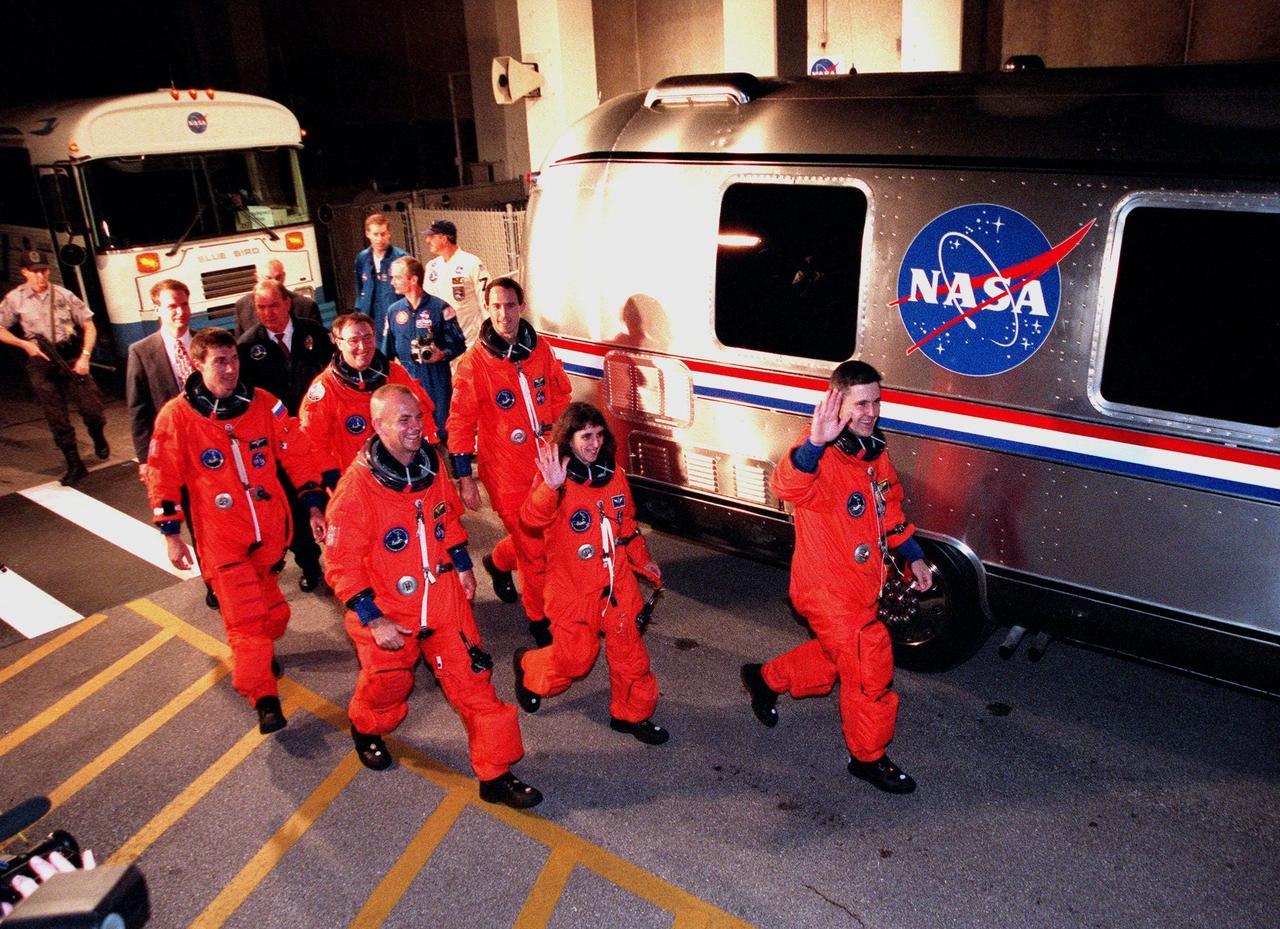
After leaving the Operations and Checkout Building, the STS-88 crew approach the Astrovan for their trip to Launch Pad 39A. In the back row are (left to right) Mission Specialist Sergei Konstantinovich Krikalev, a Russian cosmonaut, and Mission Specialists Jerry L. Ross and James H. Newman. In the front row (left to right) are Pilot Frederick W. "Rick" Sturckow, Mission Specialist Nancy J. Currie and Commander Robert D. Cabana. STS-88 is expected to launch at 3:56 a.m. EST with the six-member crew aboard Space Shuttle Endeavour on Dec. 3. Endeavour carries the Unity connecting module, which the crew will be mating with the Russian-built Zarya control module already in orbit. In addition to Unity, two small replacement electronics boxes are on board for possible repairs to Zarya batteries. The mission is expected to last 11 days, 19 hours and 49 minutes, with landing at 10:17 p.m. EST on Dec. 14
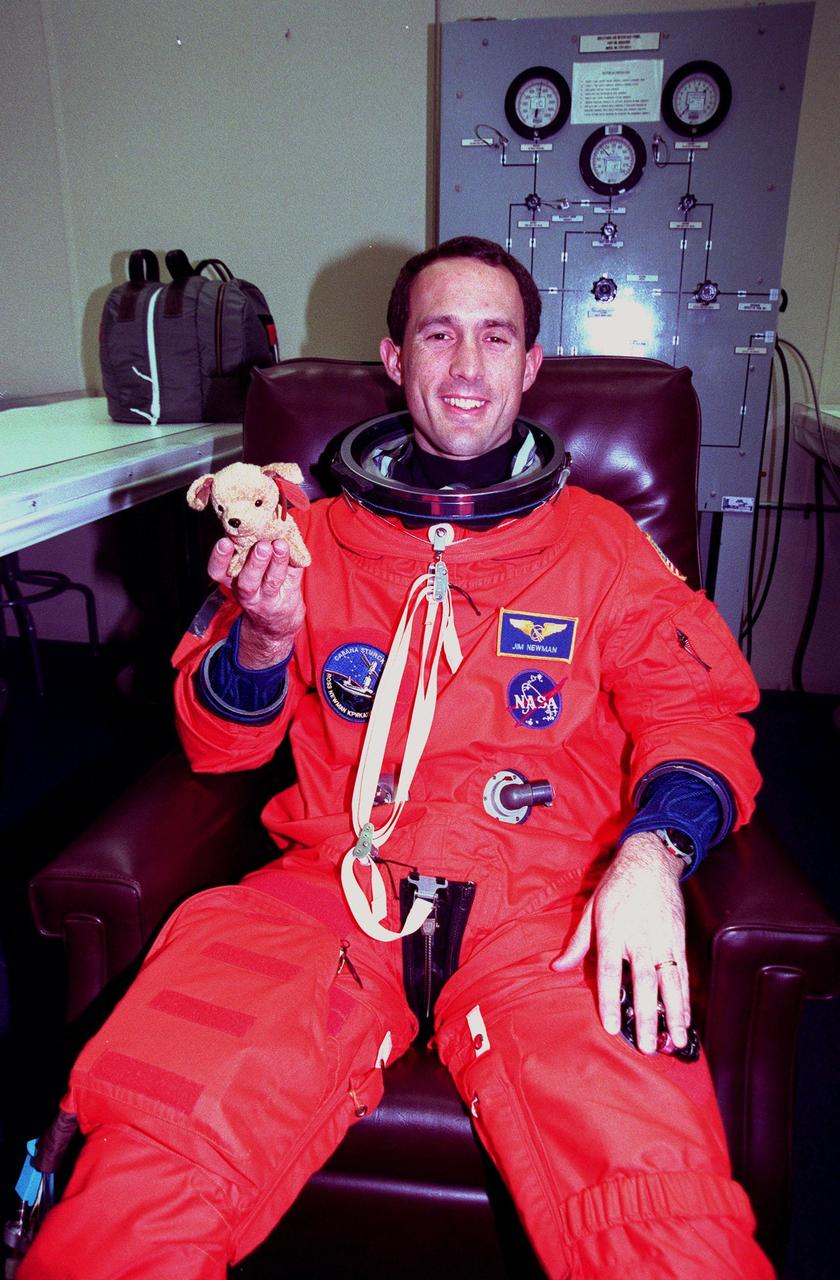
KENNEDY SPACE CENTER, FLA. -- In the Operations and Checkout Building, STS-88 Mission Specialist James H. Newman takes part in a complete suit check before launch. Newman holds a toy dog, "Pluto," representing the crew nickname Dog Crew 3 and Newman's nickname, Pluto. Mission STS-88 is expected to launch at 3:56 a.m. EST with the six-member crew aboard Space Shuttle Endeavour on Dec. 3. Endeavour carries the Unity connecting module, which the crew will be mating with the Russian-built Zarya control module already in orbit. In addition to Unity, two small replacement electronics boxes are on board for possible repairs to Zarya batteries. The mission is expected to last 11 days, 19 hours and 49 minutes, landing at 10:17 p.m. EST on Dec. 14

The STS-88 crew gather for the traditional pre-launch breakfast in the Operations and Checkout Building. From left to right are Mission Specialists Jerry L. Ross and Nancy J. Currie, Commander Robert D. Cabana, Pilot Frederick W. "Rick" Sturckow, and Mission Specialists James H. Newman and Sergei Konstantinovich Krikalev, a Russian cosmonaut. Mission STS-88 is expected to launch at 3:56 a.m. EST aboard Space Shuttle Endeavour on Dec. 3. Endeavour carries the Unity connecting module, which the crew will be mating with the Russian-built Zarya control module already on orbit. In addition to Unity, two small replacement electronics boxes are on board for possible repairs to Zarya batteries. The mission is expected to last 11 days, 19 hours and 49 minutes, landing at 10:17 p.m. EST on Dec. 14

STS-88 Mission Specialist Sergei Konstantinovich Krikalev, a Russian cosmonaut, smiles at onlookers after his arrival at the Shuttle Landing Facility aboard a T-38 jet aircraft. He joins the five other crew members, Commander Robert D. Cabana, Pilot Frederick W. "Rick" Sturckow and Mission Specialists Nancy J. Currie, Jerry L. Ross and James H. Newman, for prelaunch preparations for Mission STS-88 aboard Space Shuttle Endeavour. The scheduled time of launch is 3:56 a.m. EST on Dec. 3 from Launch Pad 39A. The mission is the first U.S. launch for the International Space Station. Endeavour carries the Unity connecting module which the crew will be mating with the Russian-built Zarya control module already in orbit. In addition to Unity, Endeavour will carry two small replacement electronics boxes for possible repairs to Zarya batteries. The mission is scheduled to last nearly 12 days

KENNEDY SPACE CENTER, FLA. -- The Service Structure driver (inside the cab near bottom of photo) begins rolling back the Rotating Service Structure on Launch Pad 39A to reveal the Space Shuttle Endeavour with its external tank and two solid rocket boosters on top of the Mobile Launcher Platform. Endeavour is ready for launch of mission STS-88 targeted for 3:56 a.m. on Dec. 3. The first U.S. launch for the International Space Station, STS-88 is expected to last 11 days, 19 hours and 49 minutes, and land at 10:17 p.m. EST on Dec. 14. Endeavour carries the Unity connecting module which the crew will be mating with the Russian-built Zarya control module already in orbit. In addition to Unity, two small replacement electronics boxes are on board for possible repairs to Zarya batteries
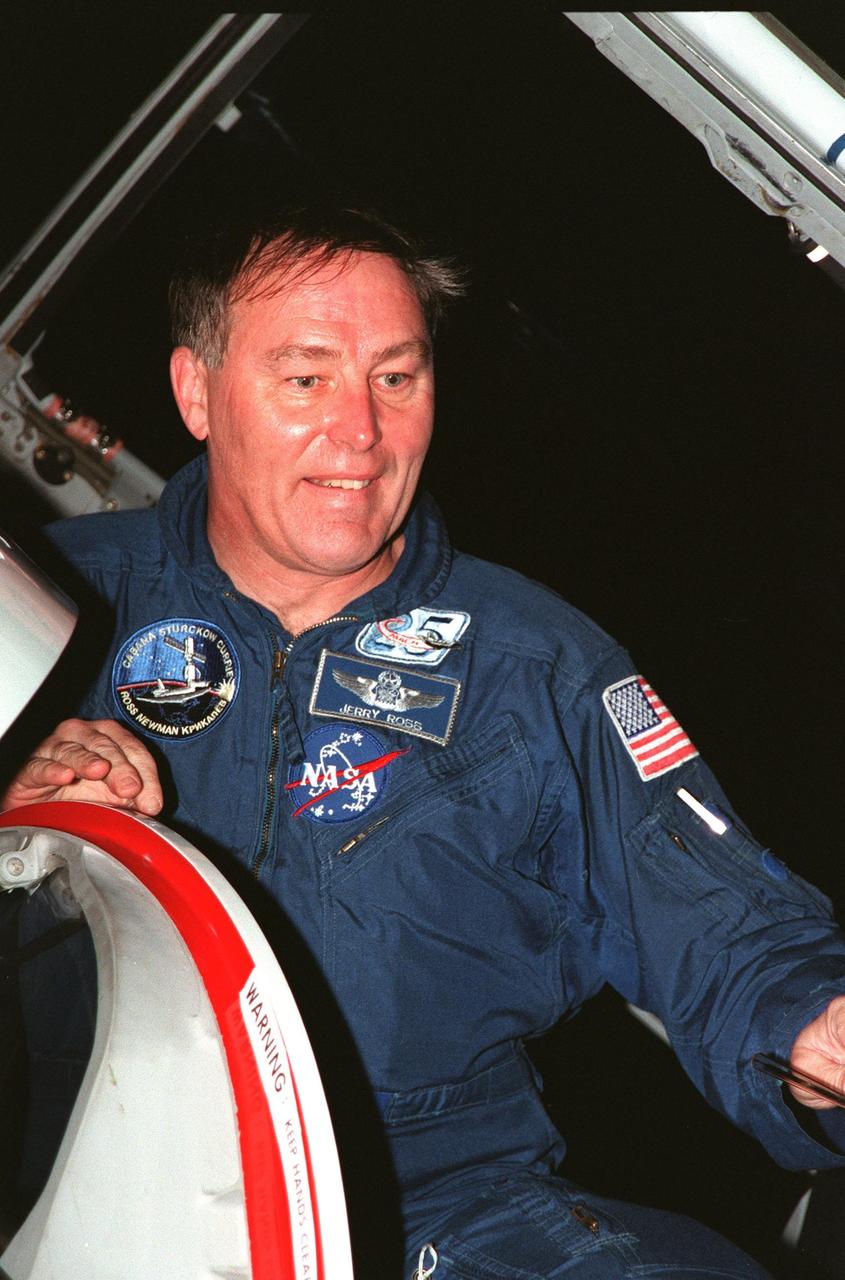
A smiling STS-88 Mission Specialist Jerry L. Ross prepares to exit the T-38 jet aircraft that brought him to the Shuttle Landing Facility. He joins the five other crew members, Commander Robert D. Cabana, Pilot Frederick W. "Rick" Sturckow, and Mission Specialists Nancy J. Currie, James H. Newman and Sergei Konstantinovich Krikalev, a Russian cosmonaut, for prelaunch preparations for mission STS-88 aboard Space Shuttle Endeavour. The scheduled time of launch is 3:56 a.m. EST on Dec. 3 from Launch Pad 39A. The mission is the first U.S. launch for the International Space Station. Endeavour carries the Unity connecting module which the crew will be mating with the Russian-built Zarya control module already in orbit. In addition to Unity, Endeavour will carry two small replacement electronics boxes for possible repairs to Zarya batteries. The mission is scheduled to last nearly 12 days
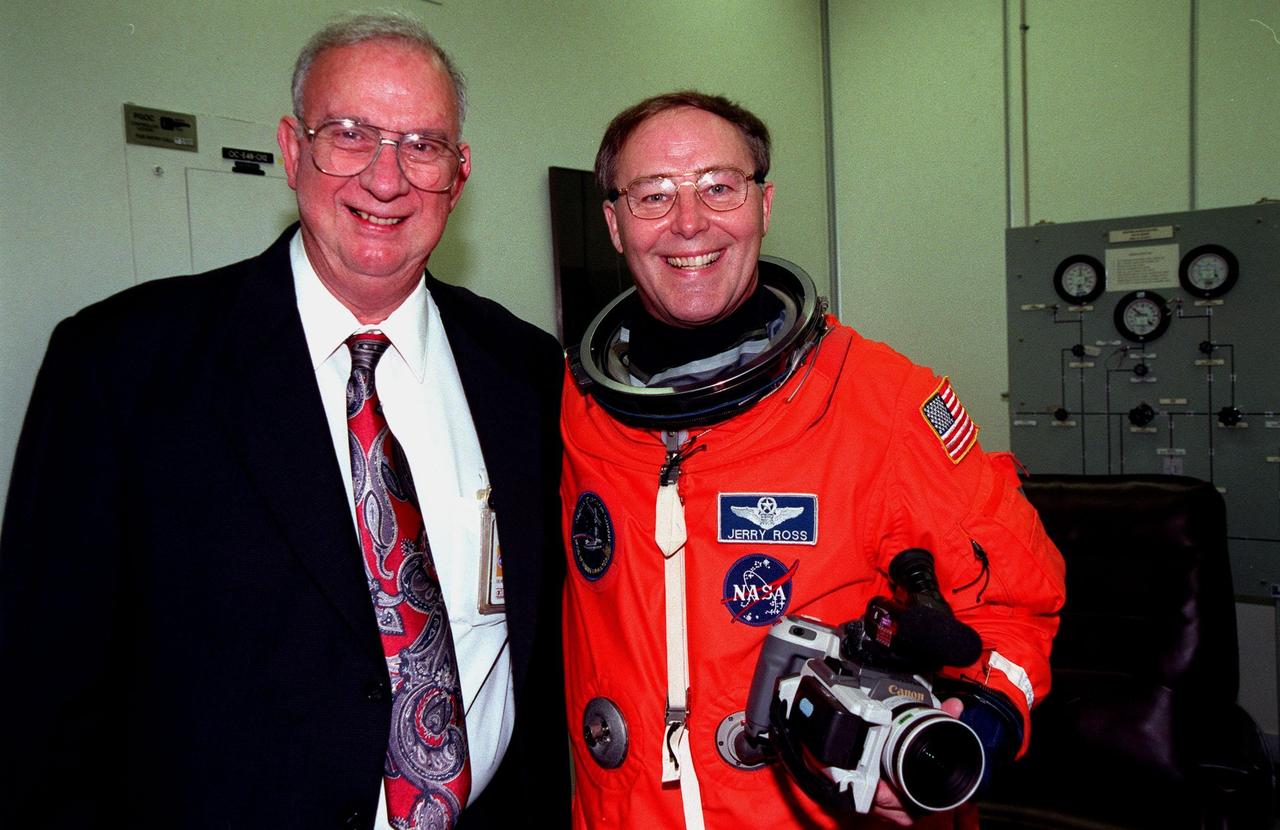
KENNEDY SPACE CENTER, FLA. -- In the Operations and Checkout Building, STS-88 Mission Specialist Jerry L. Ross (right) takes part in a complete suit check before launch. Standing with him is Owen Bertrand, chief of the Vehicle Integration Test office at Johnson Space Center. This is Bertrand's last launch before retiring in January. Mission STS-88 is expected to launch at 3:56 a.m. EST with the six-member crew aboard Space Shuttle Endeavour on Dec. 3. Endeavour carries the Unity connecting module, which the crew will be mating with the Russian-built Zarya control module already in orbit. In addition to Unity, two small replacement electronics boxes are on board for possible repairs to Zarya batteries. The mission is expected to last 11 days, 19 hours and 49 minutes, landing at 10:17 p.m. EST on Dec. 14
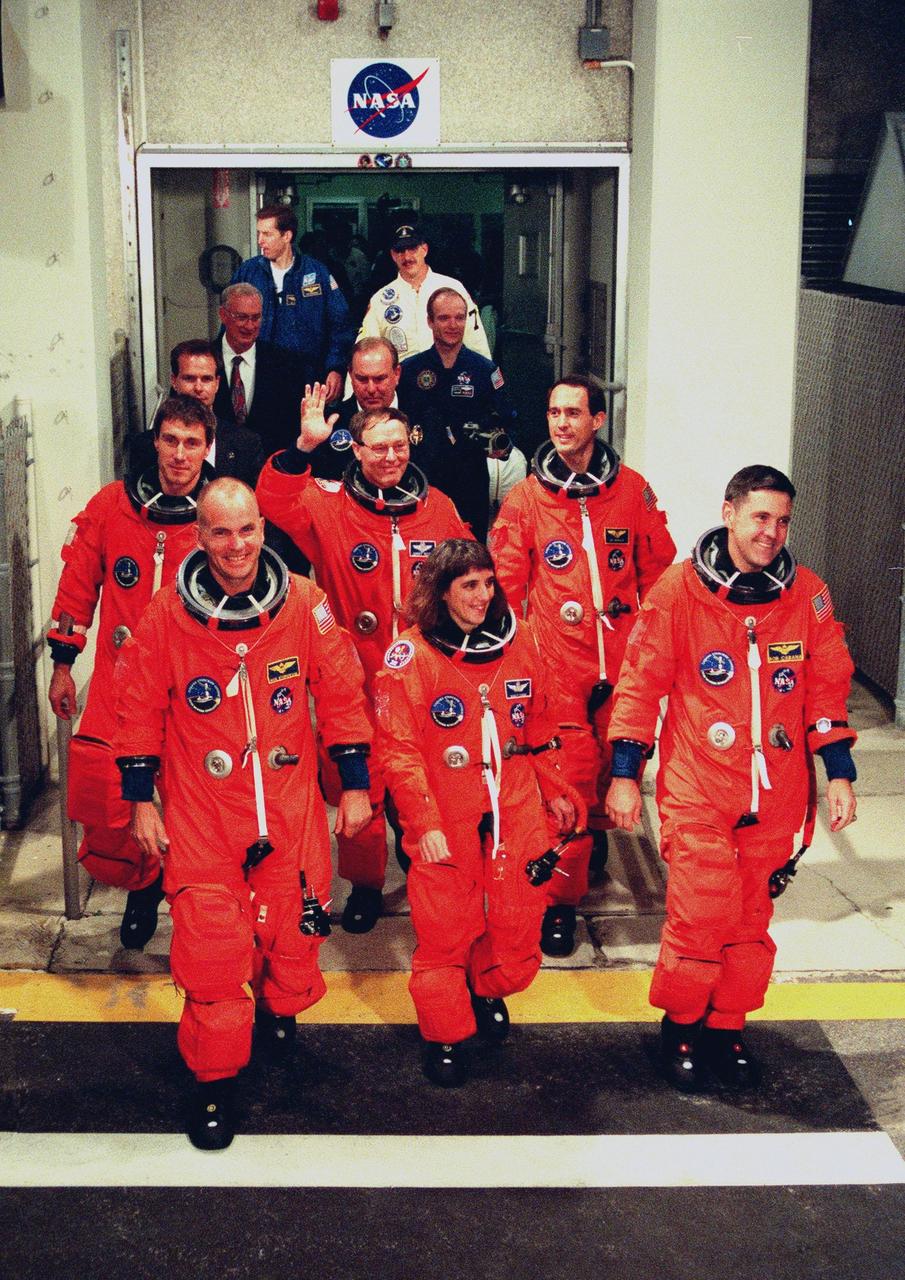
The STS-88 crew leave the Operations and Checkout Building for their trip to Launch Pad 39A. In the front row (left to right) are Pilot Frederick W. "Rick" Sturckow, Mission Specialist Nancy J. Currie and Commander Robert D. Cabana. Behind them (left to right) are Mission Specialist Sergei Konstantinovich Krikalev, a Russian cosmonaut, and Mission Specialists Jerry L. Ross and James H. Newman. STS-88 is expected to launch at 3:56 a.m. EST with the six-member crew aboard Space Shuttle Endeavour on Dec. 3. Endeavour carries the Unity connecting module, which the crew will be mating with the Russian-built Zarya control module already in orbit. In addition to Unity, two small replacement electronics boxes are on board for possible repairs to Zarya batteries. The mission is expected to last 11 days, 19 hours and 49 minutes, with landing at 10:17 p.m. EST on Dec. 14
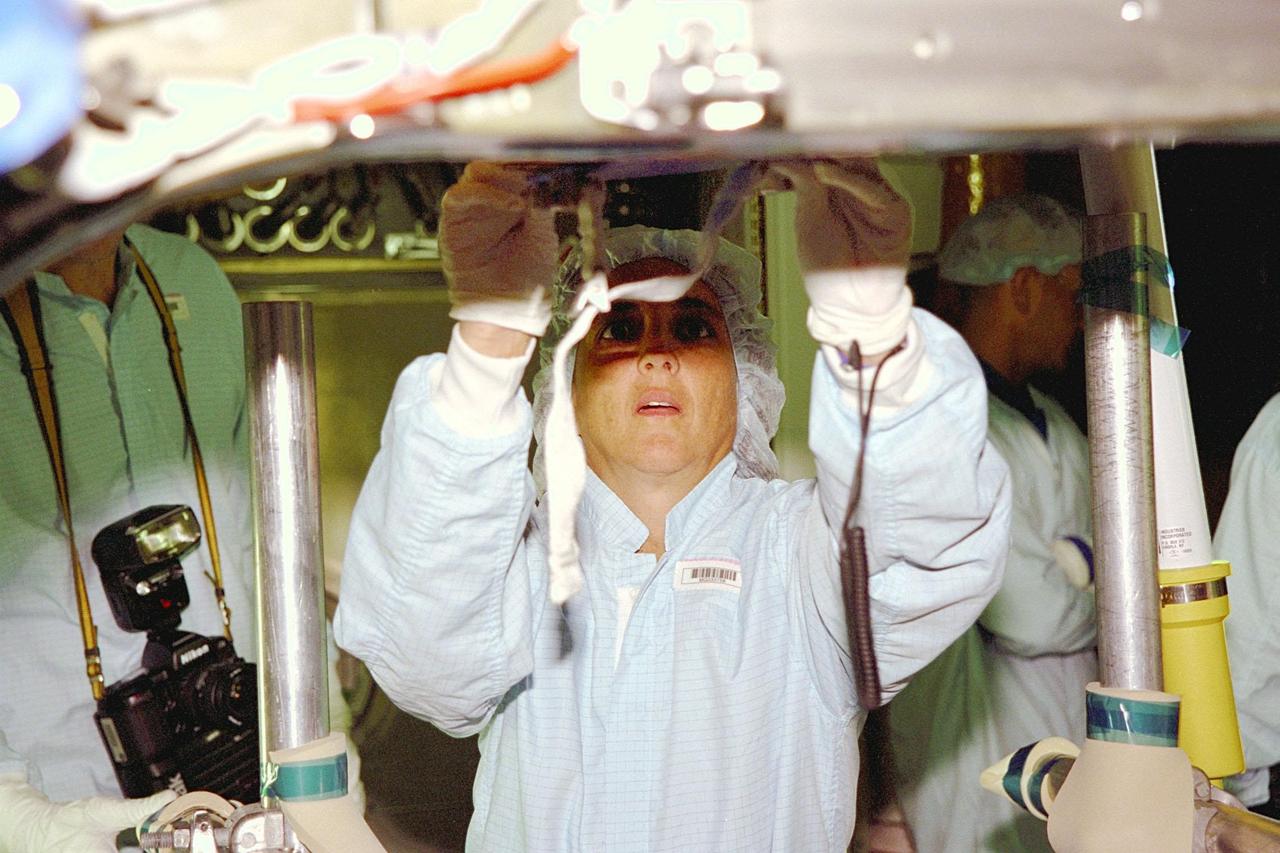
KENNEDY SPACE CENTER, FLA. -- STS-88 Mission Specialist Nancy J. Currie works on a foot restraint attached to the Unity connecting module, part of the International Space Station, in the Space Station Processing Facility at KSC. During the mission, the Unity connecting module will be mated to the Zarya control module, which will already be in orbit. The STS-88 crew is participating in a Crew Equipment Interface Test, which gives astronauts an opportunity for a hands-on look at the payloads on which they will be working while on orbit. STS-88 will be the first Space Shuttle launch for the International Space Station. Launch is scheduled for December 1998
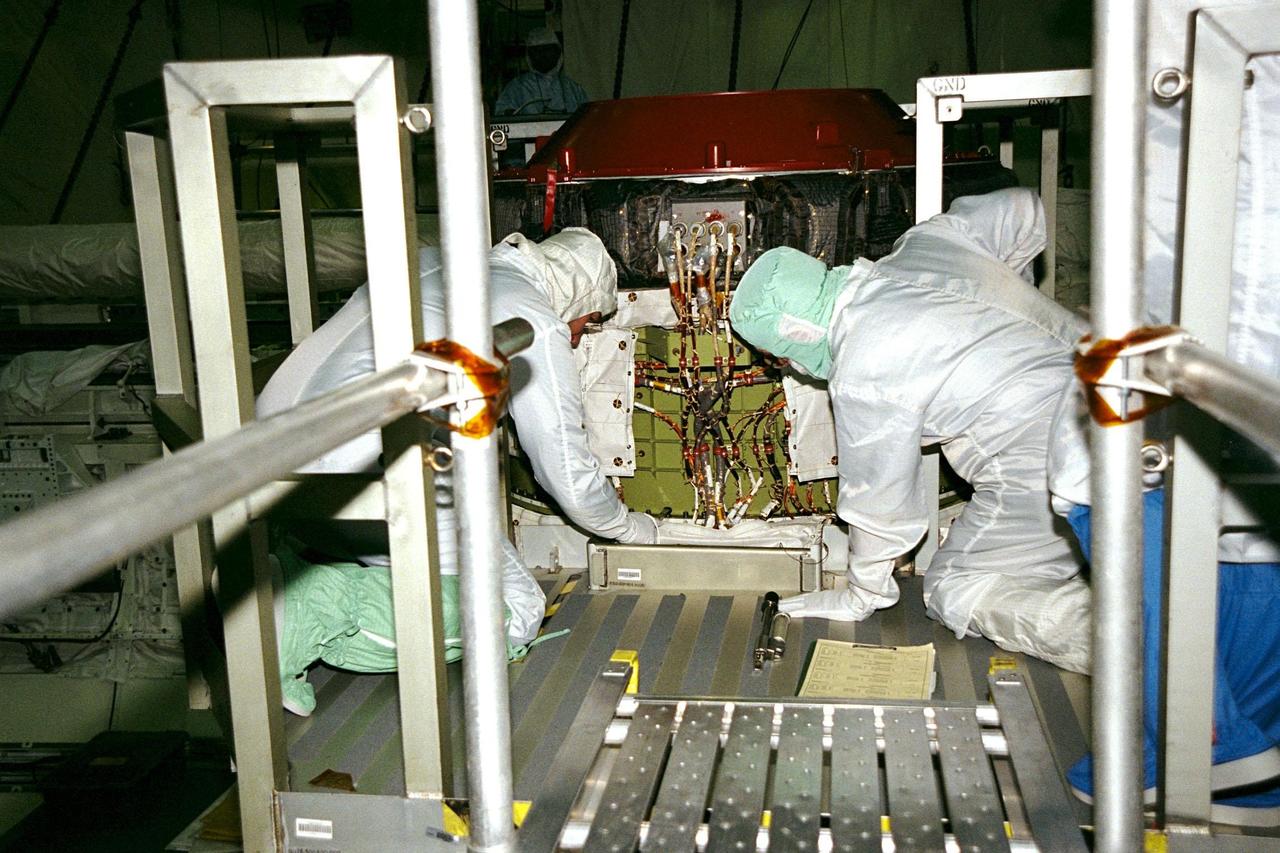
STS-88 crew members inspect the orbital docking mechanism in the payload bay of Orbiter Endeavor during the Crew Equipment Interface Test (CEIT), held in the Orbiter Processing Facility Bay 1 at KSC. The tunnel and airlock are below it. The CEIT gives astronauts an opportunity for a hands-on look at the payloads on which they will be working on orbit. STS-88 will be the first Space Shuttle launch for the International Space Station. Scheduled to lift off from KSC on Dec. 3, 1998, the seven-day mission will be highlighted by the mating of the U.S.-built Unity connecting module to the Zarya control module, which will already be in orbit, and two space walks to connect power and data transmission cables between the two modules
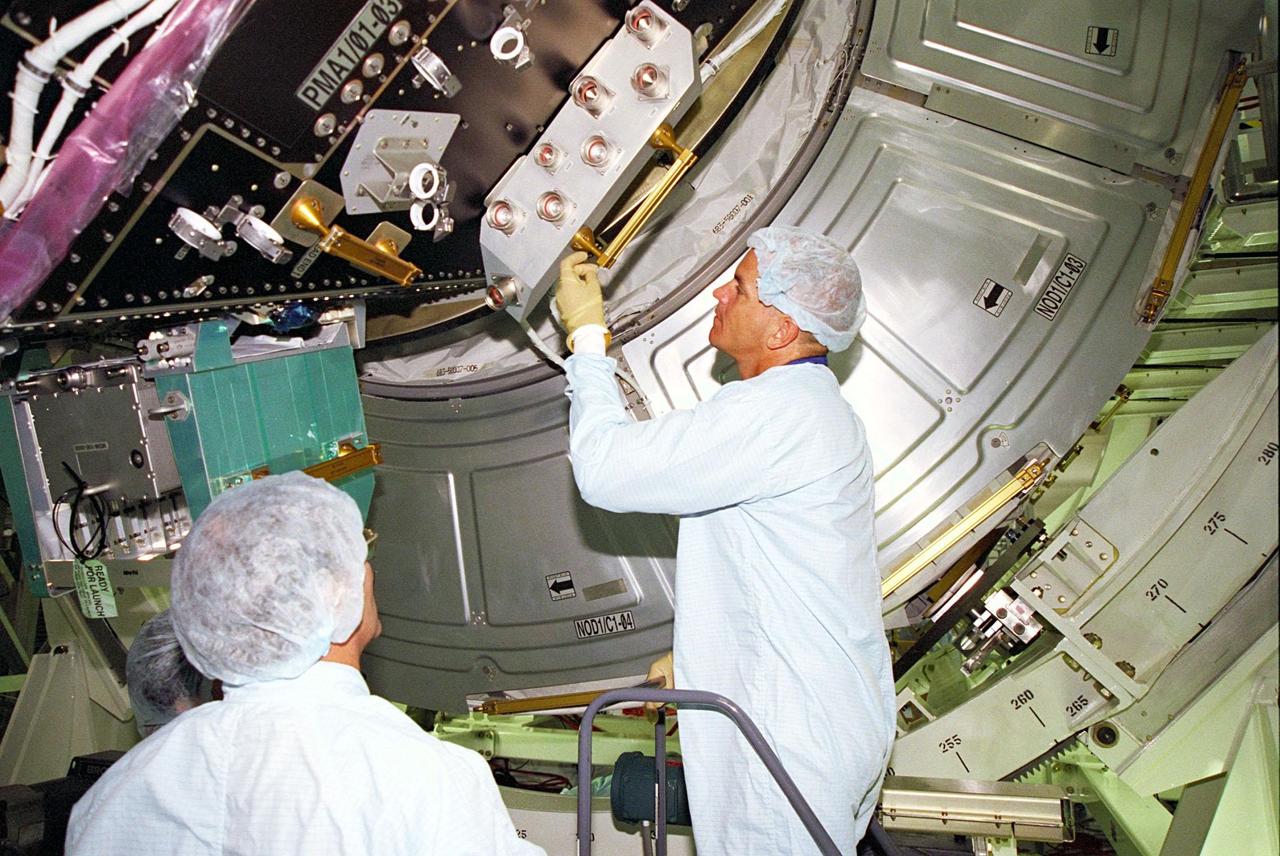
KENNEDY SPACE CENTER, FLA. -- STS-88 Pilot Rick W. Sturckow inspects equipment on the Unity connecting module, part of the International Space Station, in the Space Station Processing Facility at KSC. During the mission, the Unity connecting module will be mated to the Zarya control module, which will already be in orbit. The STS-88 crew is participating in a Crew Equipment Interface Test, which gives astronauts an opportunity for a hands-on look at the payloads on which they will be working while on orbit. STS-88 will be the first Space Shuttle launch for the International Space Station. Launch is scheduled for December 1998
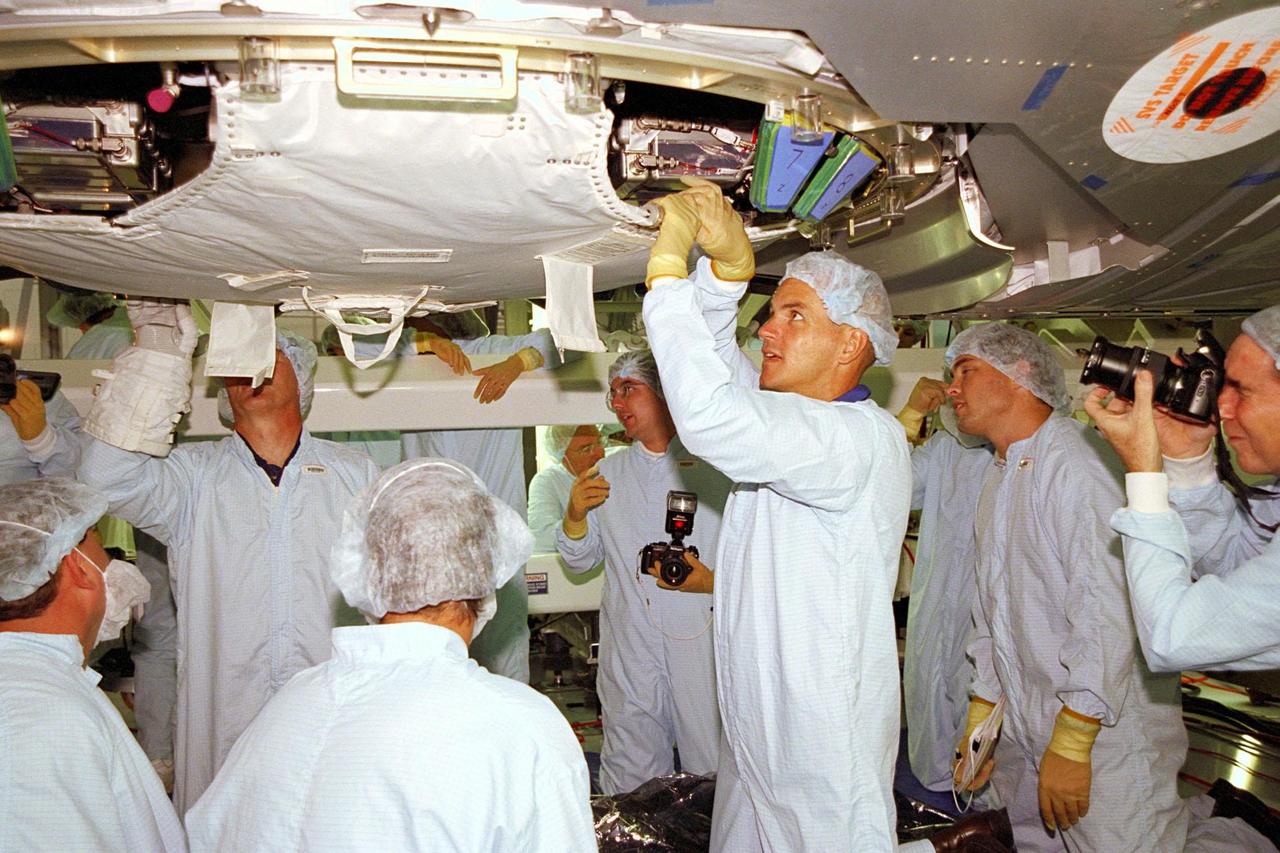
KENNEDY SPACE CENTER, FLA. -- STS-88 crew members and technicians watch as Pilot Rick W. Sturckow inspects equipment on the Unity connecting module, part of the International Space Station, in the Space Station Processing Facility at KSC. During the mission, the Unity connecting module will be mated to the Zarya control module, which will already be in orbit. The STS-88 crew is participating in a Crew Equipment Interface Test, which gives astronauts an opportunity for a hands-on look at the payloads on which they will be working while on orbit. STS-88 will be the first Space Shuttle launch for the International Space Station. Launch is scheduled for December 1998
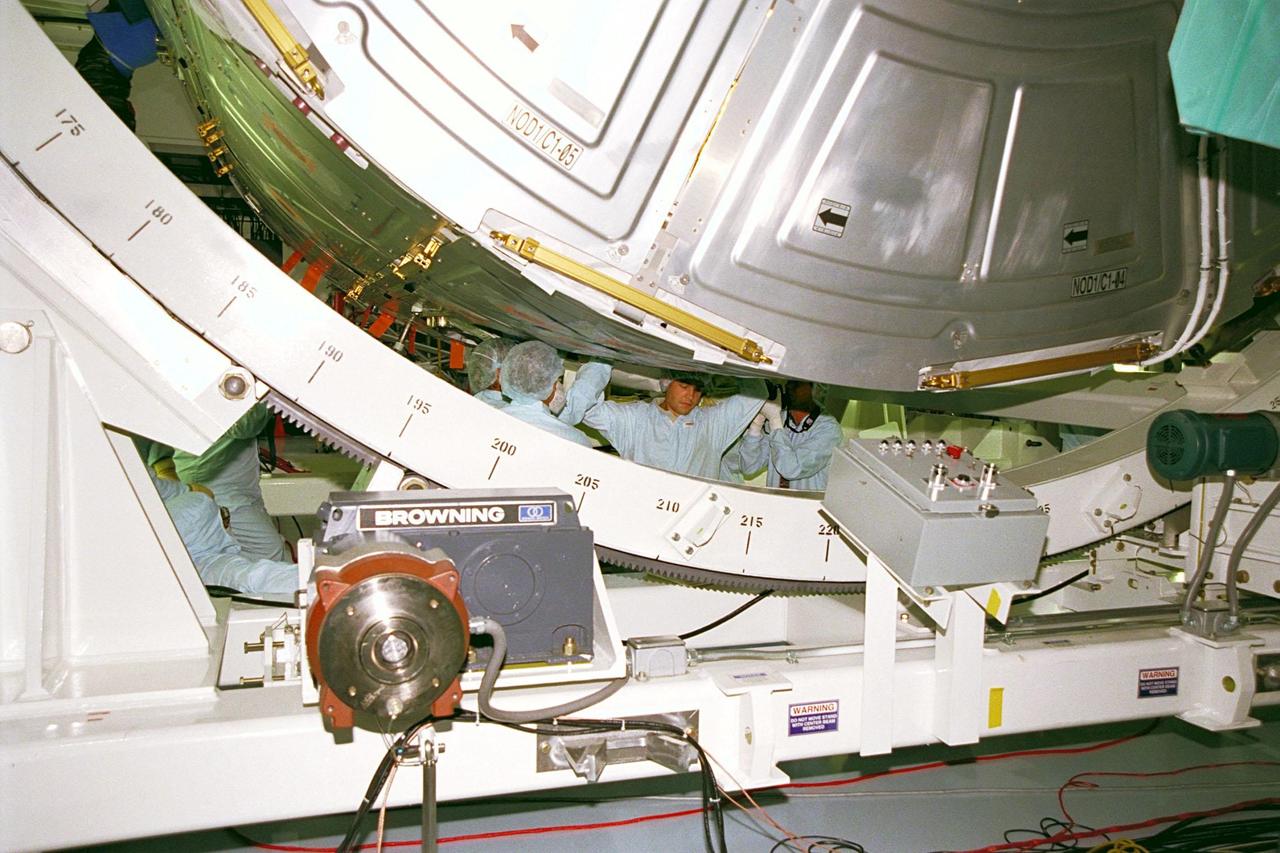
KENNEDY SPACE CENTER, FLA. -- STS-88 crew members and technicians get under the Unity connecting module to examine it during a Crew Equipment Interface Test (CEIT) in the Space Station Processing Facility at KSC. The Unity connecting module is part of the International Space Station, and during the mission, will be mated to the Zarya control module, which will already be in orbit. The CEIT gives astronauts an opportunity for a hands-on look at the payloads on which they will be working while on orbit. STS-88 will be the first Space Shuttle launch for the International Space Station. Launch is scheduled for December 1998
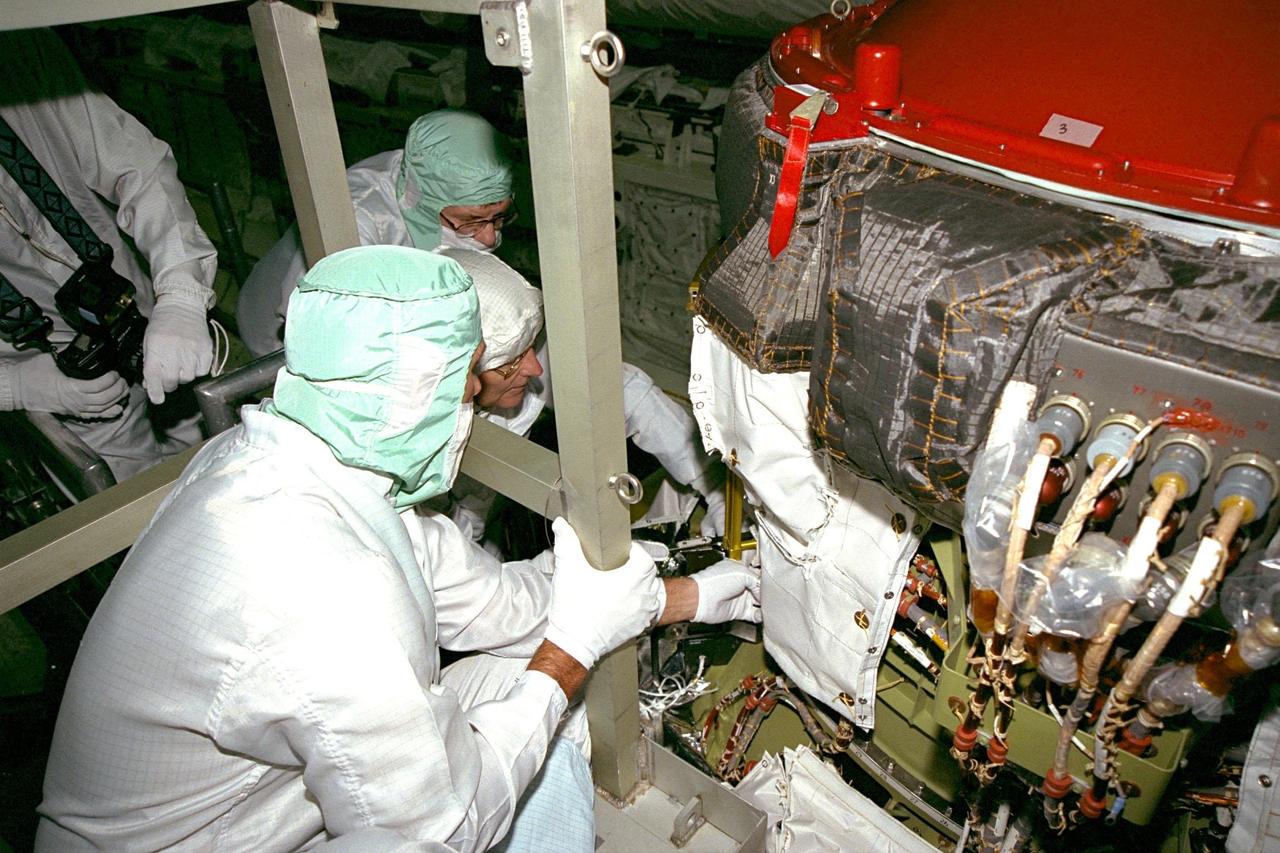
STS-88 crew members inspect the orbital docking mechanism in the payload bay of Orbiter Endeavour during the Crew Equipment Interface Test (CEIT), held in the Orbiter Processing Facility Bay 1 at KSC. The CEIT gives astronauts an opportunity for a hands-on look at the payloads on which they will be working on orbit. STS-88 will be the first Space Shuttle launch for the International Space Station. Scheduled to lift off on Dec. 3, 1998, the seven-day mission will be highlighted by the mating of the U.S.-built Unity connecting module to the Zarya control module, which will already be in orbit, and two space walks to connect power and data transmission cables between the two modules
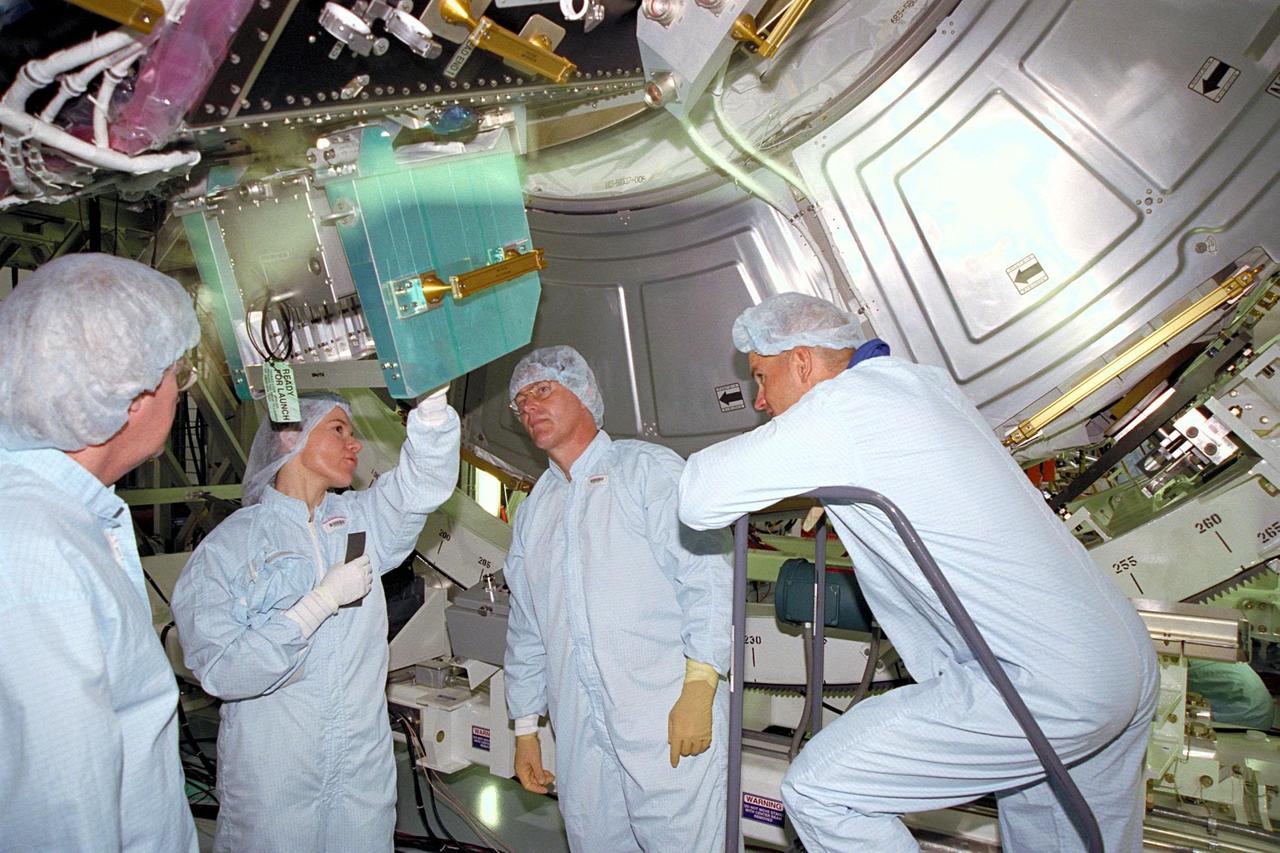
KENNEDY SPACE CENTER, FLA. -- As part of the Crew Equipment Interface Test (CEIT), Boeing Structural Engineer Karry Switzer (second from left) shows part of the Unity connecting module to STS-88 crew members Mission Specialist Jerry L. Ross and Pilot Rick W. Sturckow in the Space Station Processing Facility at KSC. The Unity connecting module, part of the International Space Station, will be mated to the Zarya control module, which will already be in orbit. The CEIT gives astronauts an opportunity for a hands-on look at the payloads on which they will be working while on orbit. STS-88 will be the first Space Shuttle launch for the International Space Station. Launch is scheduled for December 1998
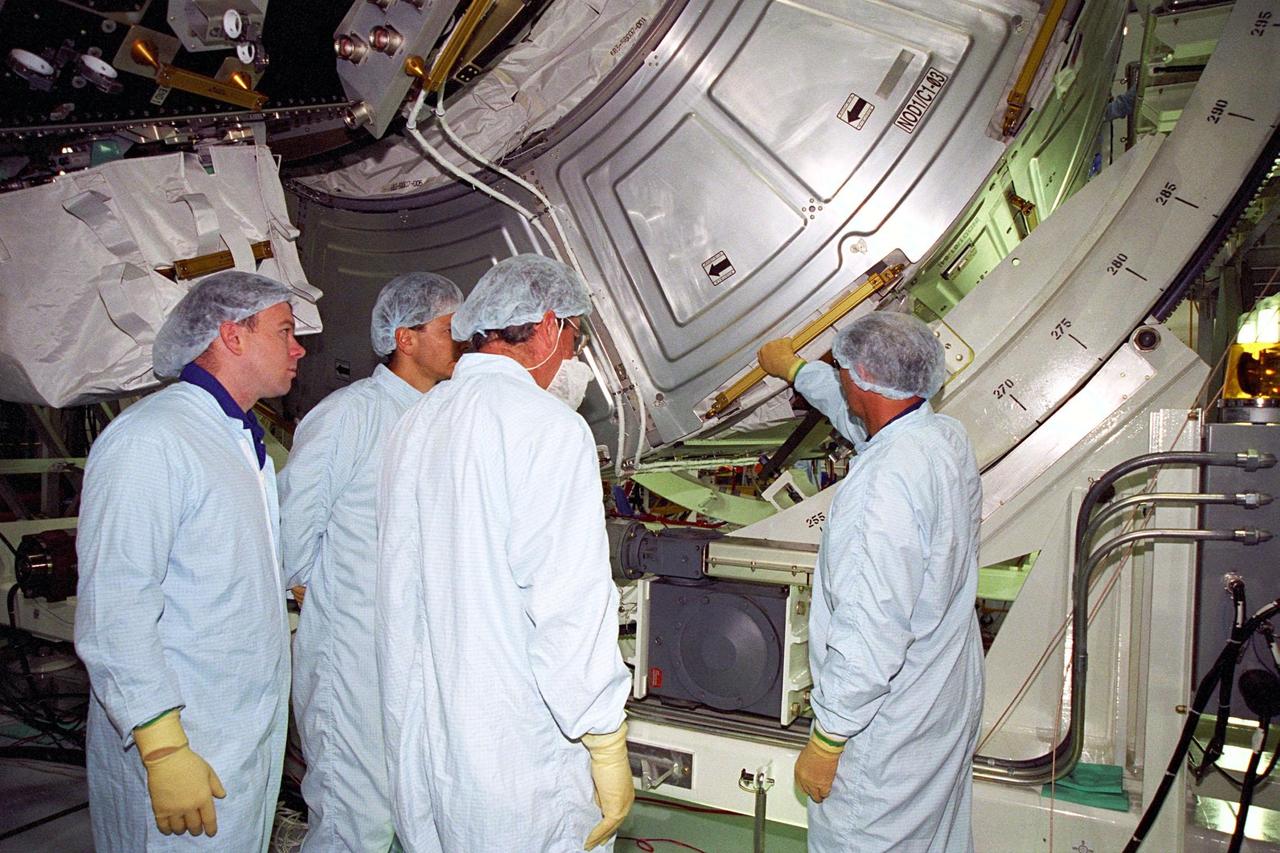
Astronauts Scott J. Kelly and Piers J. Sellers join STS-88 Mission Specialist Jerry L. Ross and a Boeing technician in inspecting the Unity connecting module, part of the International Space Station, at the Space Station Processing Facility at KSC. The Unity connecting module will be mated to the Zarya control module, which will already be in orbit. The STS-88 crew is participating in a Crew Equipment Interface Test (CEIT), which gives astronauts an opportunity for a hands-on look at the payloads on which they will be working while on orbit. STS-88 will be the first Space Shuttle launch for the International Space Station. Launch is scheduled for December 1998
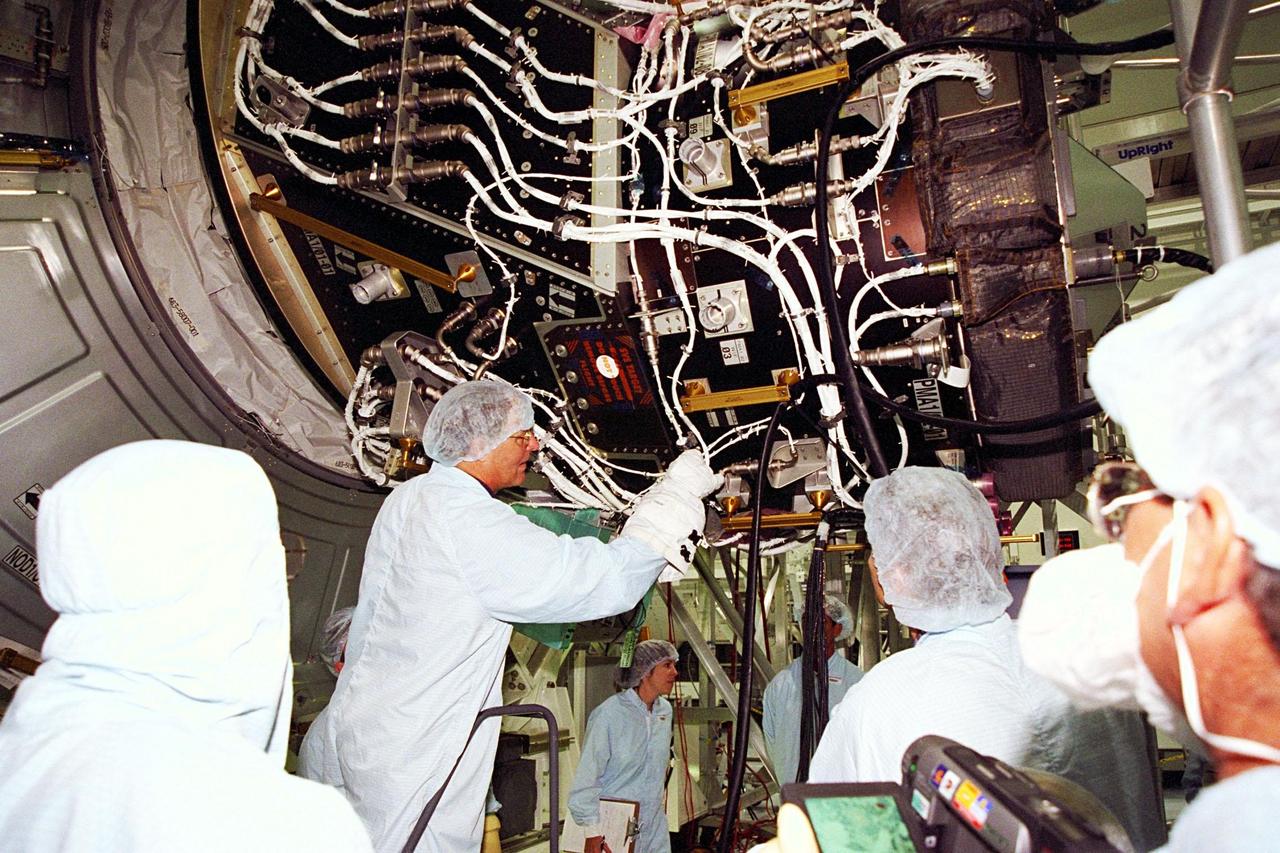
KENNEDY SPACE CENTER, FLA. -- Members of the STS-88 crew watch as Mission Specialist Jerry L. Ross inspects the Unity connecting module, part of the International Space Station, in the Space Station Processing Facility at KSC. During the mission, the Unity connecting module will be mated to the Zarya control module, which will already be in orbit. The STS-88 crew is participating in a Crew Equipment Interface Test, which gives astronauts an opportunity for a hands-on look at the payloads on which they will be working while on orbit. STS-88 will be the first Space Shuttle launch for the International Space Station. Launch is scheduled for December 1998
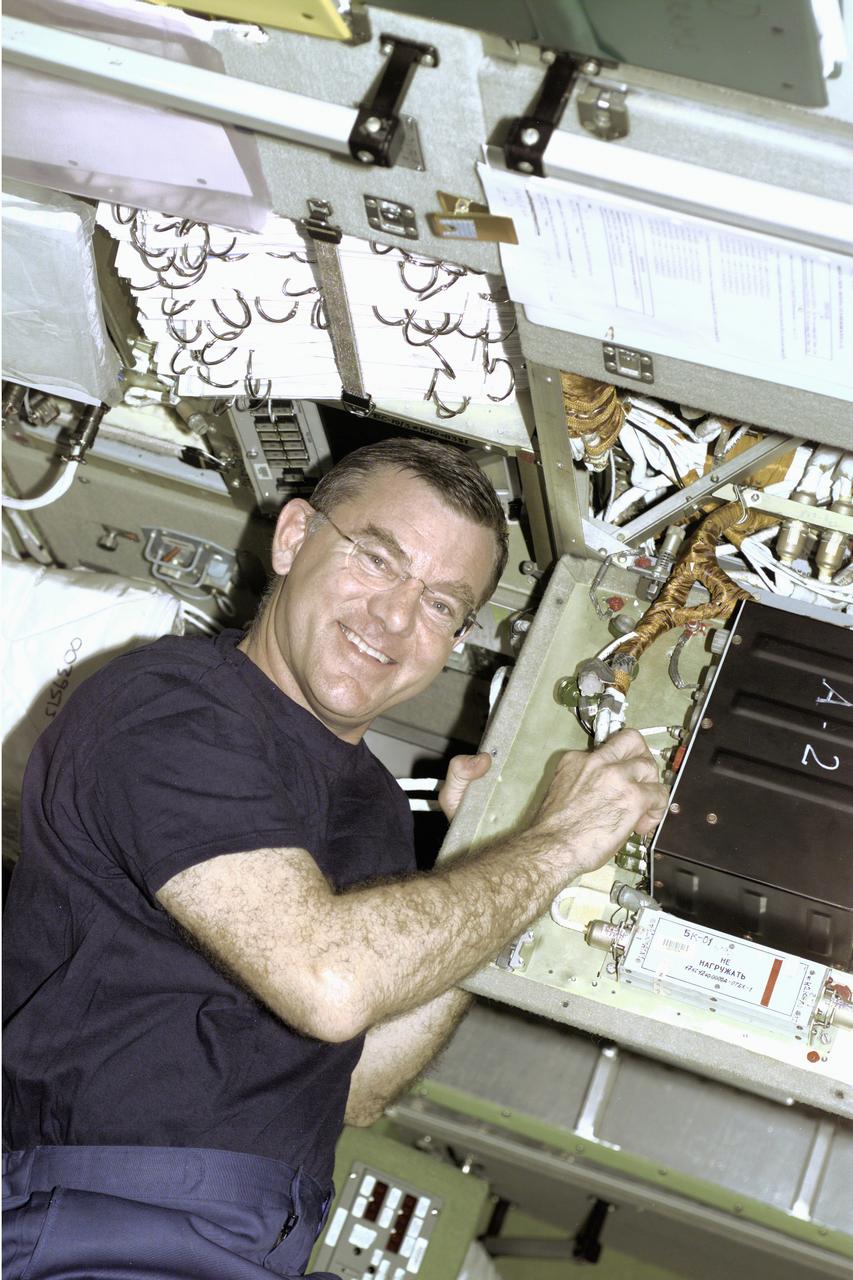
Astronaut James S. Voss, Expedition Two flight engineer, performs an electronics task in the Russian Zvezda Service Module on the International Space Station (ISS). Zvezda is linked to the Russian-built Functional Cargo Block (FGB), or Zarya, the first component of the ISS. Zarya was launched on a Russian Proton rocket prior to the launch of Unity, the first U.S.-built component to the ISS. Zvezda (Russian word for star), the third component of the ISS and the primary Russian contribution to the ISS, was launched by a three-stage Proton rocket on July 12, 2000. Zvezda serves as the cornerstone for early human habitation of the station, providing living quarters, a life support system, electrical power distribution, a data processing system, a flight control system, and a propulsion system. It also provides a communications system that includes remote command capabilities from ground flight controllers. The 42,000-pound module measures 43 feet in length and has a wing span of 98 feet. Similar in layout to the core module of Russia's Mir space station, it contains 3 pressurized compartments and 13 windows that allow ultimate viewing of Earth and space.
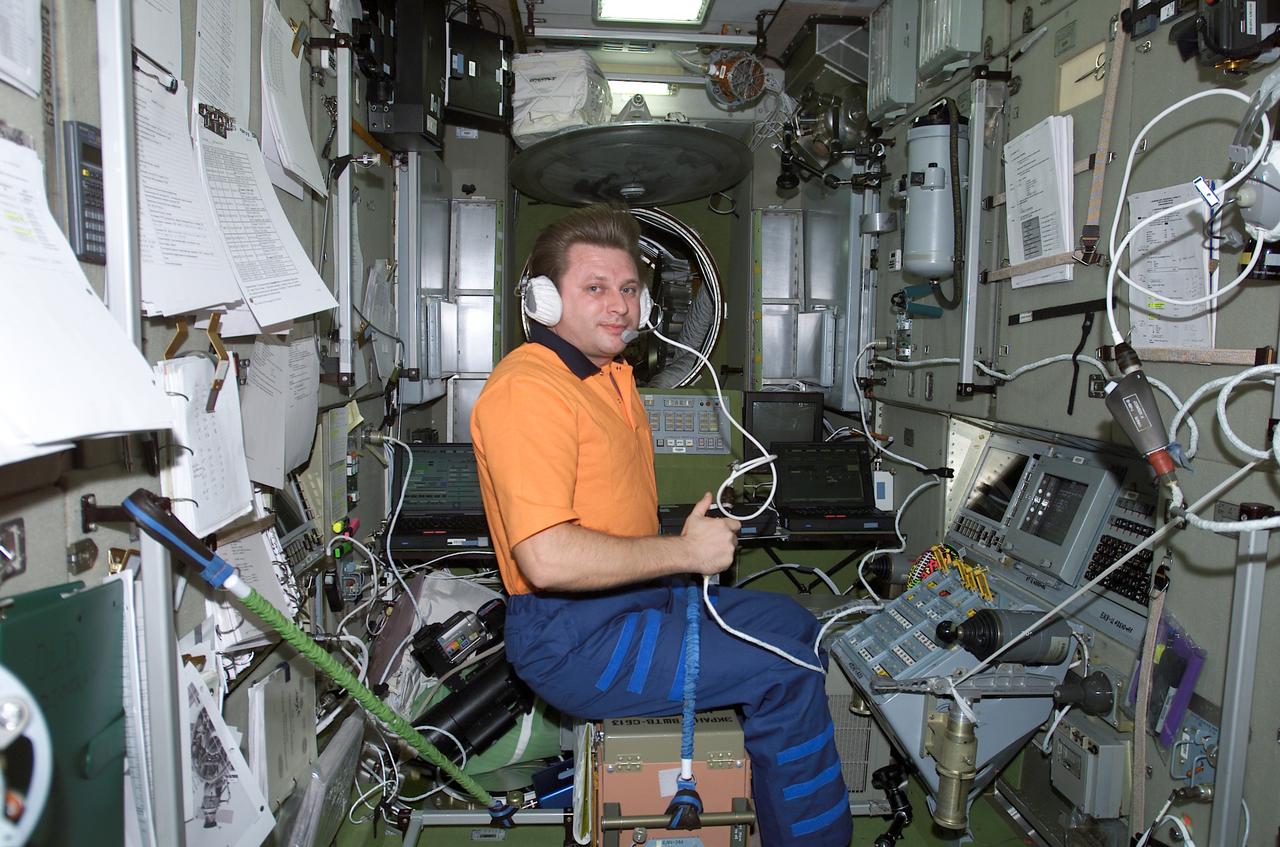
Cosmonaut Yury I. Onufrienko, Expedition Four mission commander, uses a communication system in the Russian Zvezda Service Module on the International Space Station (ISS). The Zvezda is linked to the Russian-built Functional Cargo Block (FGB) or Zarya, the first component of the ISS. Zarya was launched on a Russian Proton rocket prior to the launch of Unity. The third component of the ISS, Zvezda (Russian word for star), the primary Russian contribution to the ISS, was launched by a three-stage Proton rocket on July 12, 2000. Zvezda serves as the cornerstone for early human habitation of the station, providing living quarters, a life support system, electrical power distribution, a data processing system, flight control system, and propulsion system. It also provides a communications system that includes remote command capabilities from ground flight controllers. The 42,000-pound module measures 43 feet in length and has a wing span of 98 feet. Similar in layout to the core module of Russia's Mir space station, it contains 3 pressurized compartments and 13 windows that allow ultimate viewing of Earth and space.
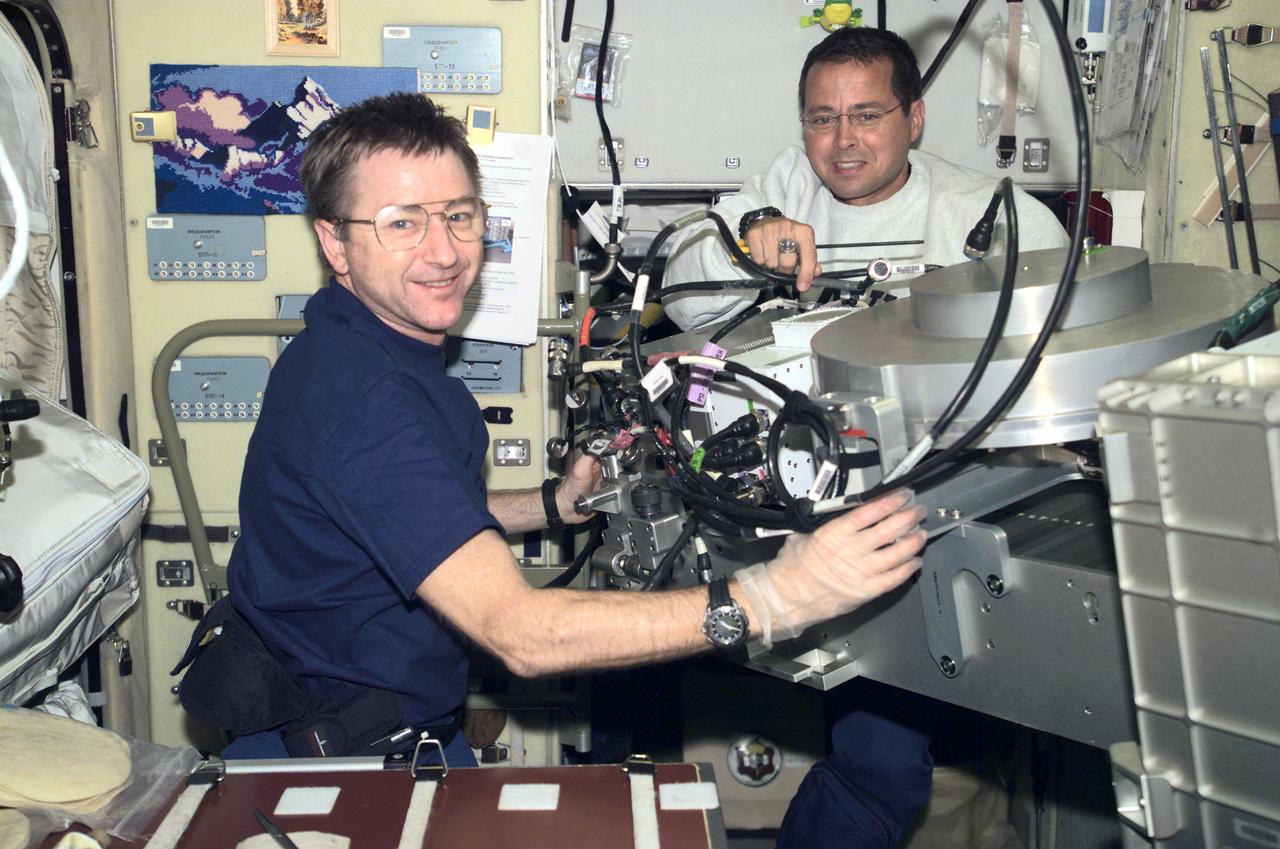
Astronauts Frank L. Culbertson, Jr. (left), Expedition Three mission commander, and Daniel W. Bursch, Expedition Four flight engineer, work in the Russian Zvezda Service Module on the International Space Station (ISS). Zvezda is linked to the Russian built Functional Cargo Block (FGB), or Zarya, the first component of the ISS. Zarya was launched on a Russian Proton rocket prior to the launch of Unity. The third component of the ISS, Zvezda (Russian word for star), the primary Russian contribution to the ISS, was launched by a three-stage Proton rocket on July 12, 2000. Zvezda serves as the cornerstone for early human habitation of the Station, providing living quarters, a life support system, electrical power distribution, a data processing system, a flight control system, and a propulsion system. It also provides a communications system that includes remote command capabilities from ground flight controllers. The 42,000 pound module measures 43 feet in length and has a wing span of 98 feet. Similar in layout to the core module of Russia's Mir space station, it contains 3 pressurized compartments and 13 windows that allow ultimate viewing of Earth and space.
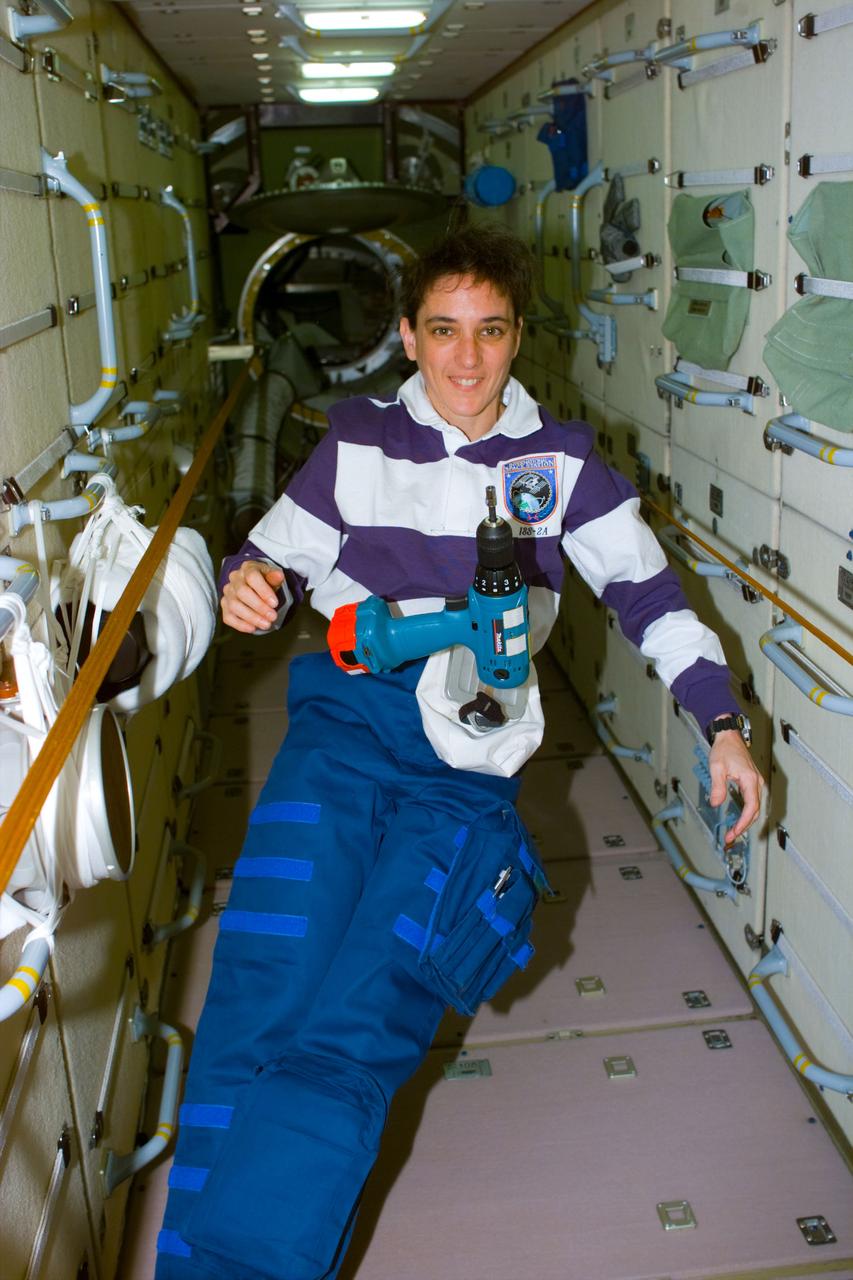
S88-E-5083 (12-11-98) --- Astronaut Nancy J. Currie, mission specialist, with a rechargeable power tool on Zarya. One of Currie's tasks was to replace a faulty unit which controls the discharging of stored energy from one of the Russian-built module's six batteries. The photo was taken with an electronic still camera (ESC) at 05:24:08 GMT, Dec. 11.
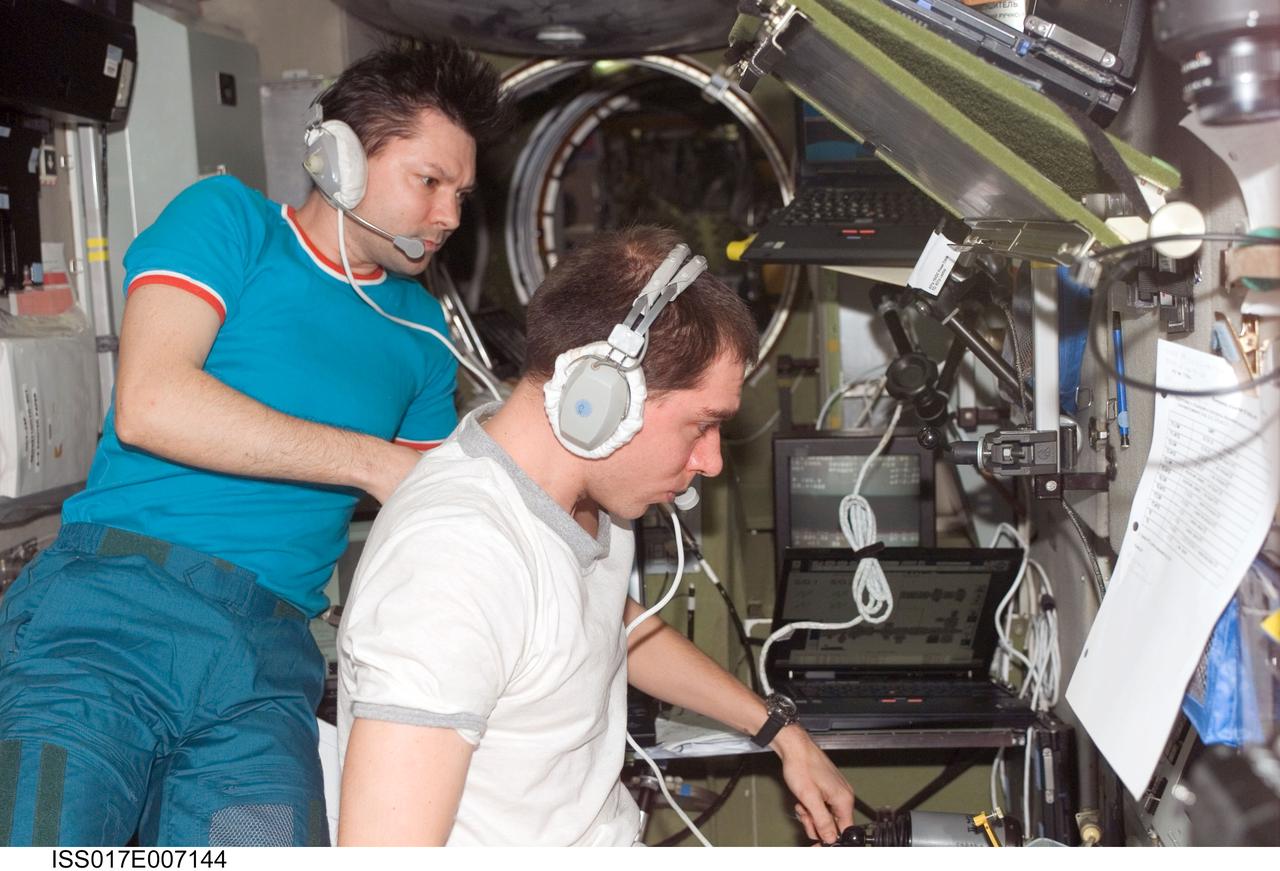
ISS017-E-007144 (16 May 2008) --- Cosmonauts Sergei Volkov (right) and Oleg Kononenko, Expedition 17 commander and flight engineer, respectively, monitor data at the manual TORU docking system controls in the Zvezda Service Module of the International Space Station during the docking of the Progress 29 supply vehicle. The Progress used the automated Kurs system to dock to the station's Zarya nadir port, which occurred at 4:39 p.m. (CDT) on May 16, 2008.
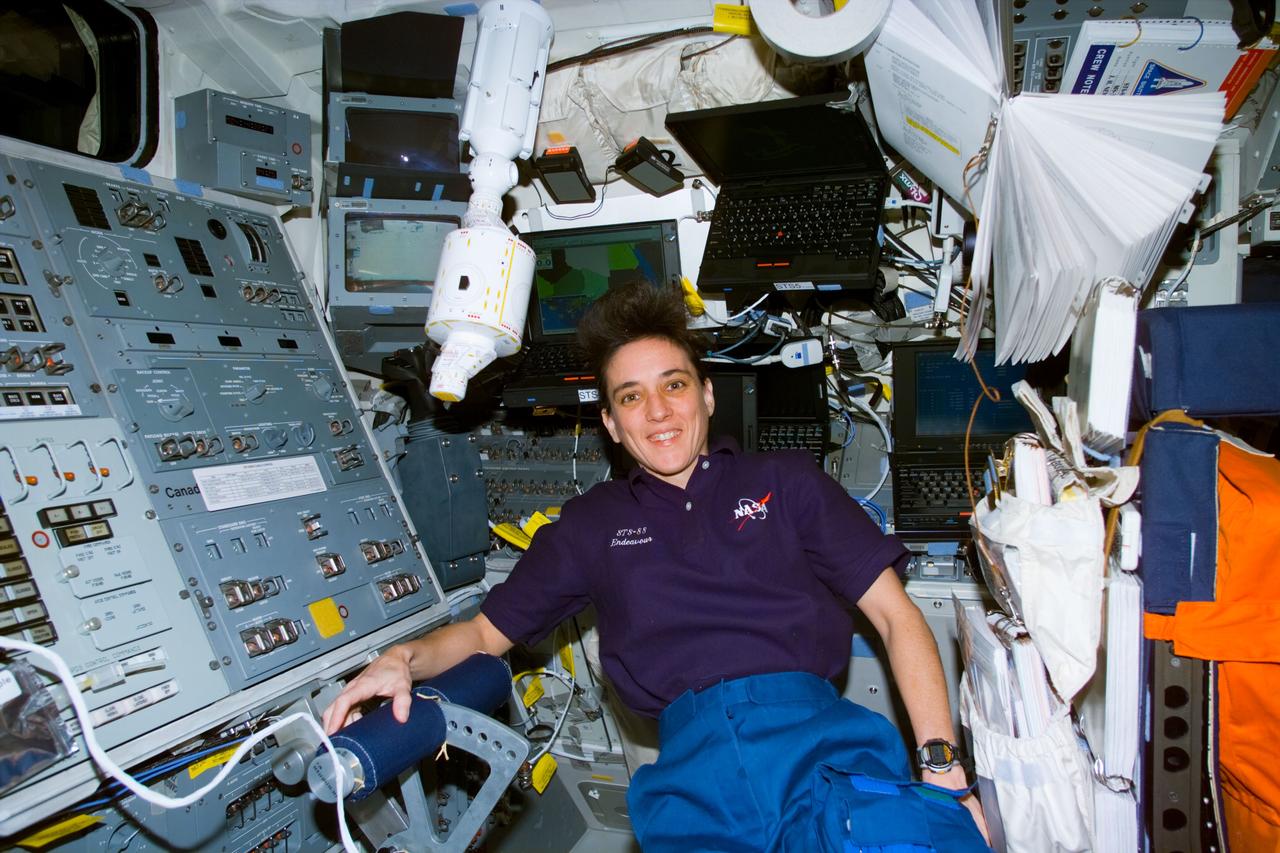
S88-E-5165 (12-08-98) --- Astronaut Nancy J. Currie spent a great deal of time at controls on the aft flight deck of the Space Shuttle Endeavour during the STS-88 mission. Earlier in the mission, from this station, Currie performed some precise maneuvers with the remote manipulator system (RMS)in mating the U.S.-built Unity module and the Russian-built Zarya. This photo was taken with an electronic still camera (ESC) at 23:18:23 GMT, Dec. 8.
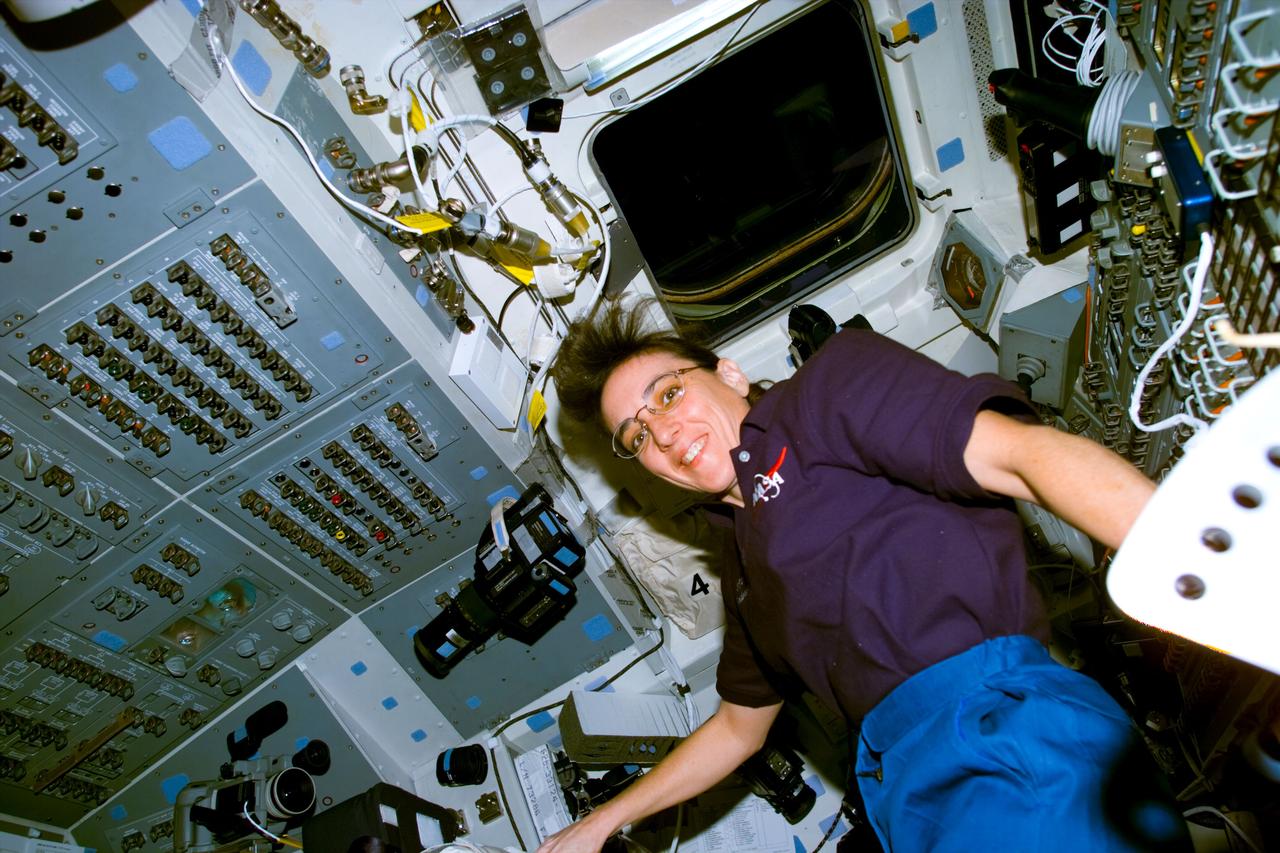
S88-E-5164 (12-08-98) --- Astronaut Nancy J. Currie spent a great deal of time at controls on the aft flight deck of the Space Shuttle Endeavour during the STS-88 mission. Earlier in the mission, from a nearby station, Currie performed some precise maneuvers with the remote manipulator system (RMS)in mating the U.S.-built Unity module and the Russian-built Zarya. This photo was taken with an electronic still camera (ESC) at 23:18:23 GMT, Dec. 8.
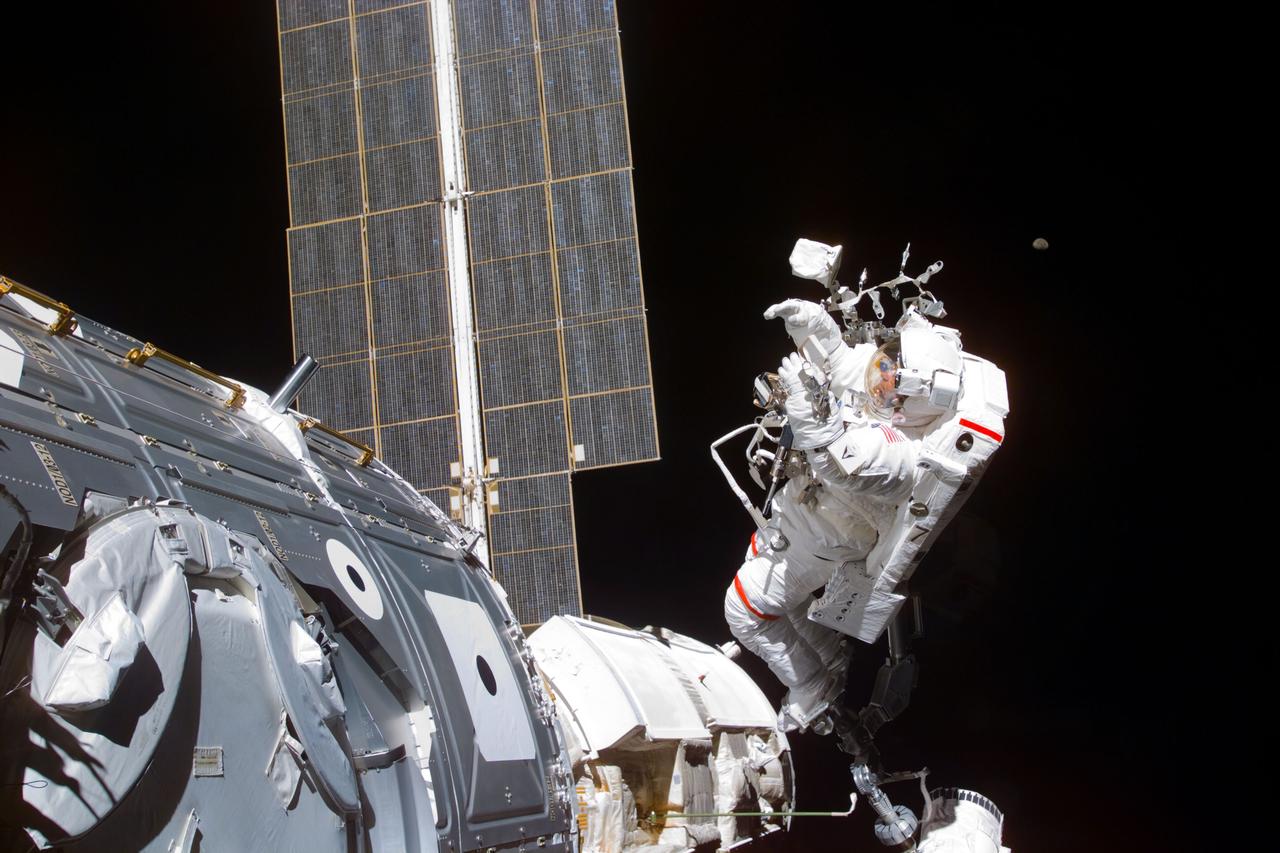
S88-E-5058 (12-08-98) --- Astronaut Jerry L. Ross takes a picture during a 7-hour, 21 minute spacewalk. Astronauts Ross and James H. Newman went on to mate 40 cables and connectors runing 76 feet from the Zarya control module to Unity, with the 35-ton complex towering over Endeavour's cargo bay. The photo was taken with an electronic still camera (ESC) at 00:35:05 GMT, Dec. 8.
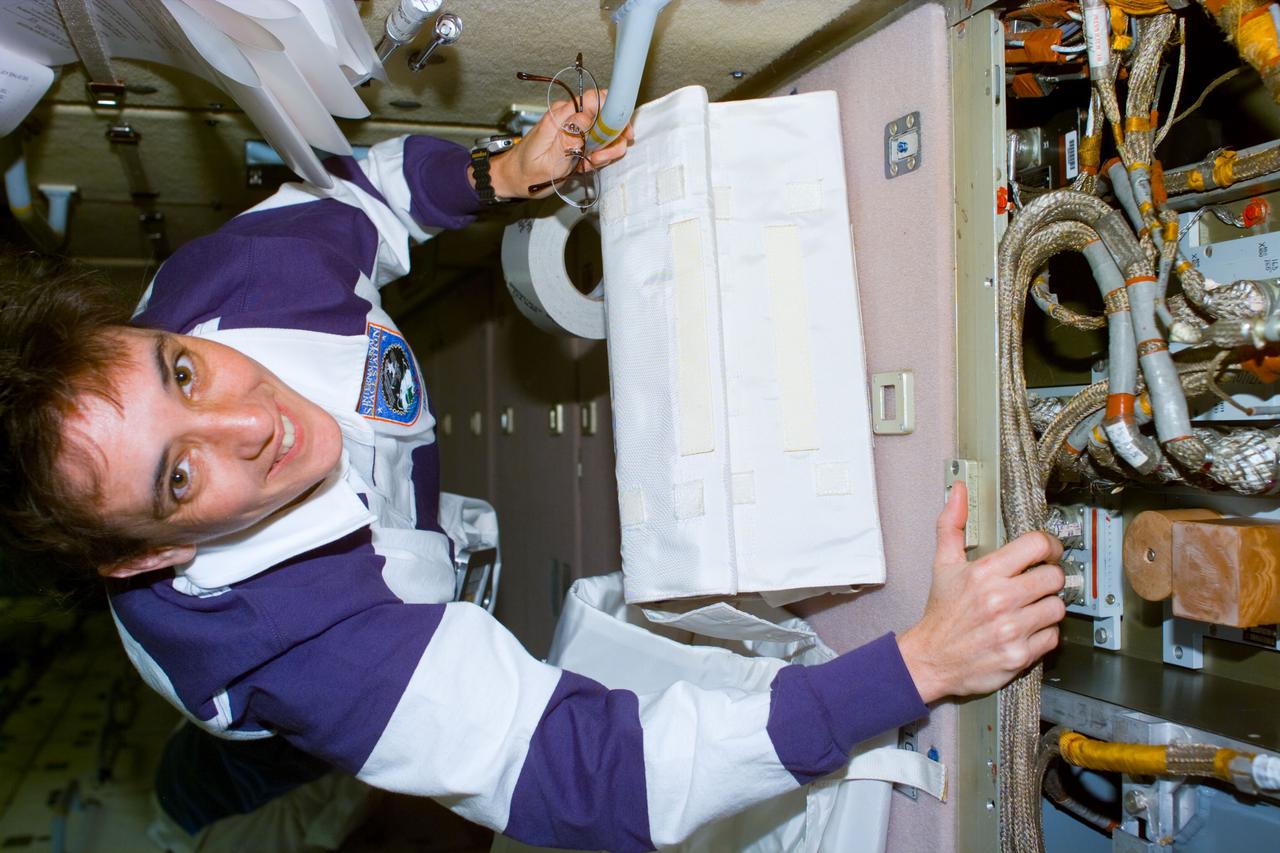
S88-E-5076 (12-11-98) --- Astronaut Nancy J. Currie, mission specialist, participates in work aboard Zarya. One of Currie's tasks was to replace a faulty unit which controls the discharging of stored energy from one of the module's six batteries. The photo was taken with an electronic still camera (ESC) at 01:58:16 GMT, Dec. 11.
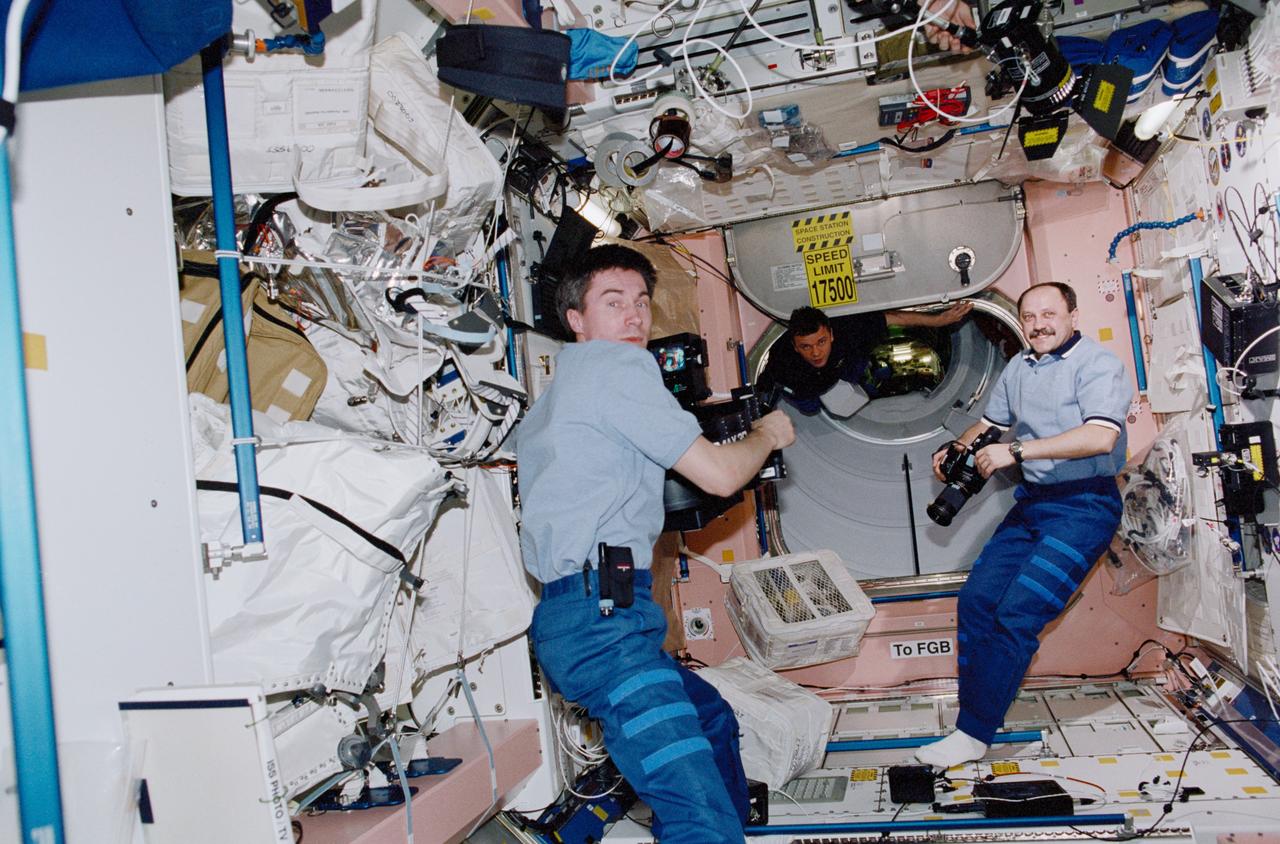
STS102-340-014 (8-21 March 2001) --- Cosmonaut Sergei K. Krikalev, Expedition One flight engineer (left), and cosmonaut Yury V. Usachev, Expedition Two commander, are photographed in the Unity node holding cameras. Cosmonaut Yuri P. Gidzenko, Expedition Two commander, joins them as he floats through the tunnel from the Russian-built Zarya control module. All three are associated with Rosaviakosmos.
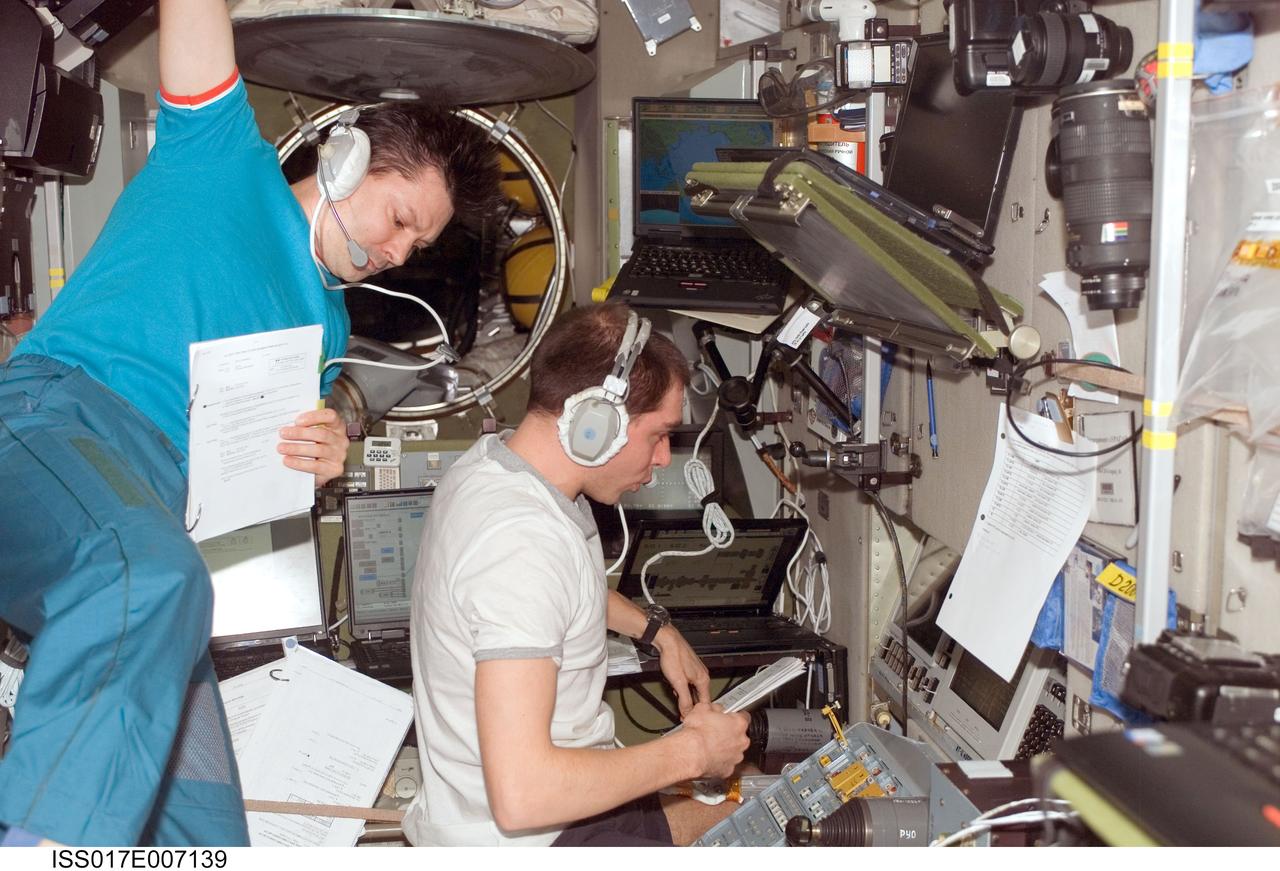
ISS017-E-007139 (16 May 2008) --- Cosmonauts Sergei Volkov (right) and Oleg Kononenko, Expedition 17 commander and flight engineer, respectively, monitor data at the manual TORU docking system controls in the Zvezda Service Module of the International Space Station during the docking of the Progress 29 supply vehicle. The Progress used the automated Kurs system to dock to the station's Zarya nadir port, which occurred at 4:39 p.m. (CDT) on May 16, 2008.
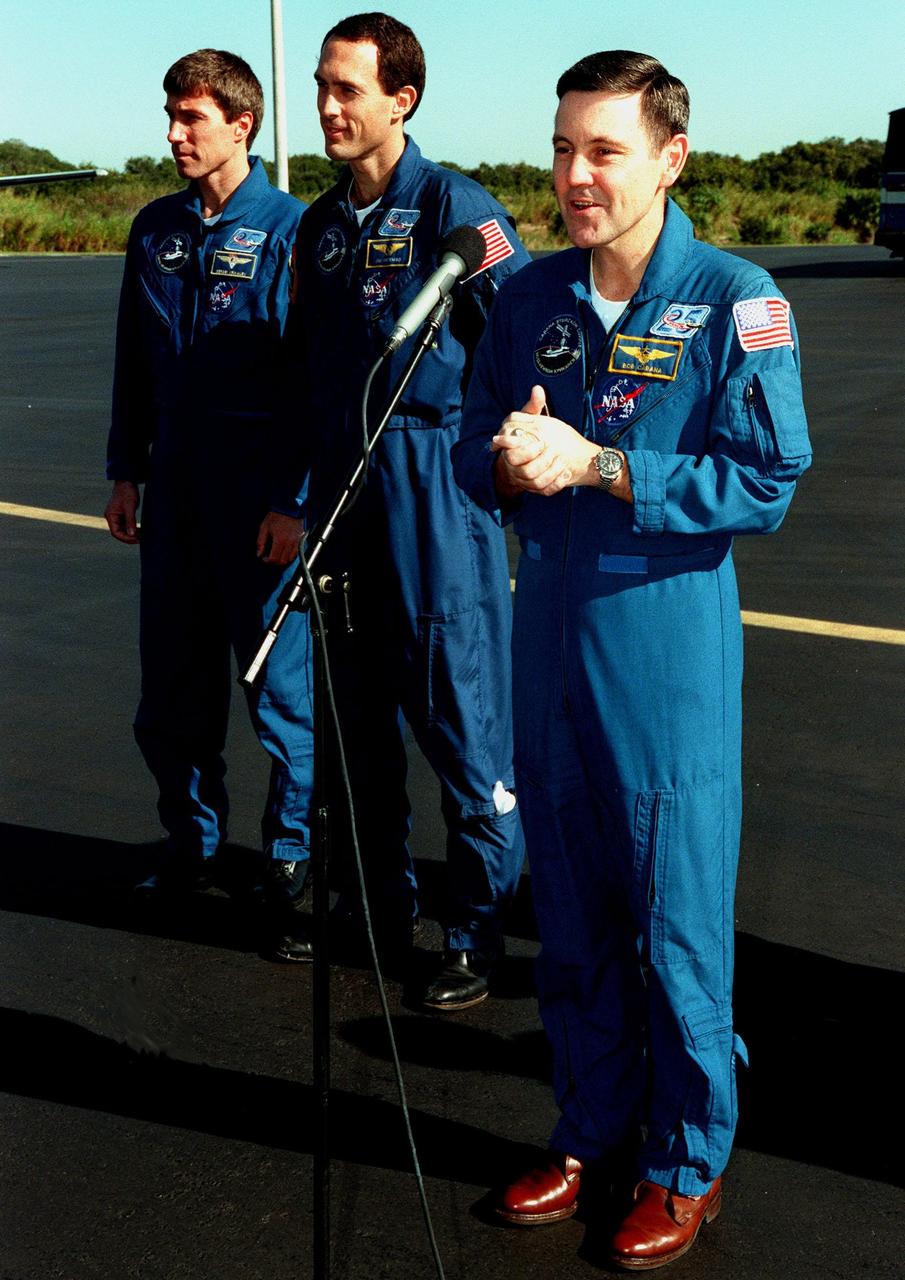
STS-88 Commander Robert D. Cabana (at microphone) speaks to the news media before the crew's departure at Cape Canaveral Air Station. At left are Mission Specialists Sergei Konstantinovich Krikalev and James H. Newman. The other crew members (not shown) are Mission Specialists Jerry L. Ross and Nancy J. Currie, and Pilot Frederick W. "Rick" Sturckow. The STS-88 crew returned Dec. 15 from a 12-day mission on orbit constructing the first elements of the International Space Station, the U.S.-built Unity connecting module and Russian-built Zarya control module
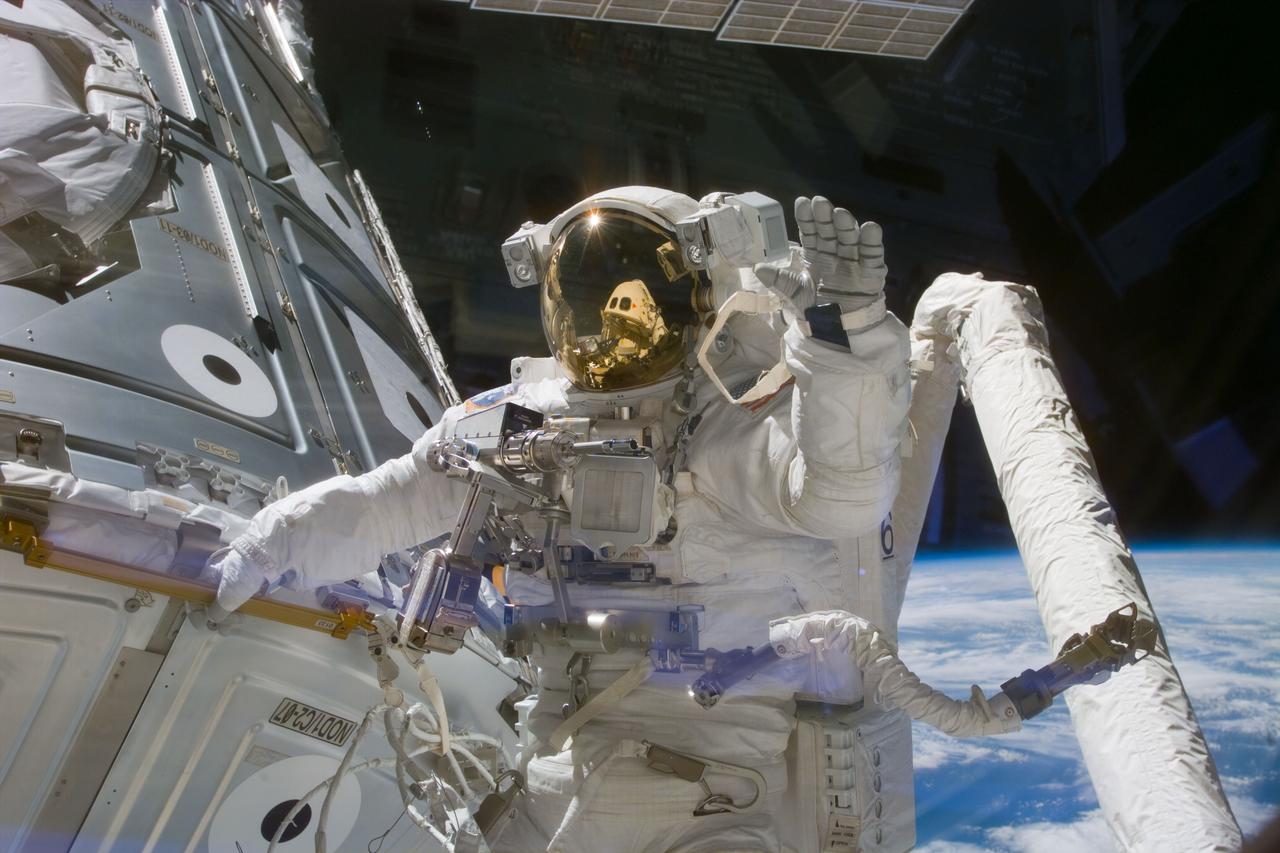
S88-E-5057 (12-07-98) --- Astronaut James H. Newman, waves at camera as he holds onto one of the hand rails on the Unity connecting module during the early stages of a 7-hour, 21-minute spacewalk. Astronauts Newman and Jerry L. Ross, both mission specialists, went on to mate 40 cables and connectors running 76 feet from the Zarya control module to Unity, with the 35-ton complex towering over Endeavour's cargo bay. This photo was taken with an electronic still camera (ESC) at 23:37:40 GMT, Dec. 7.
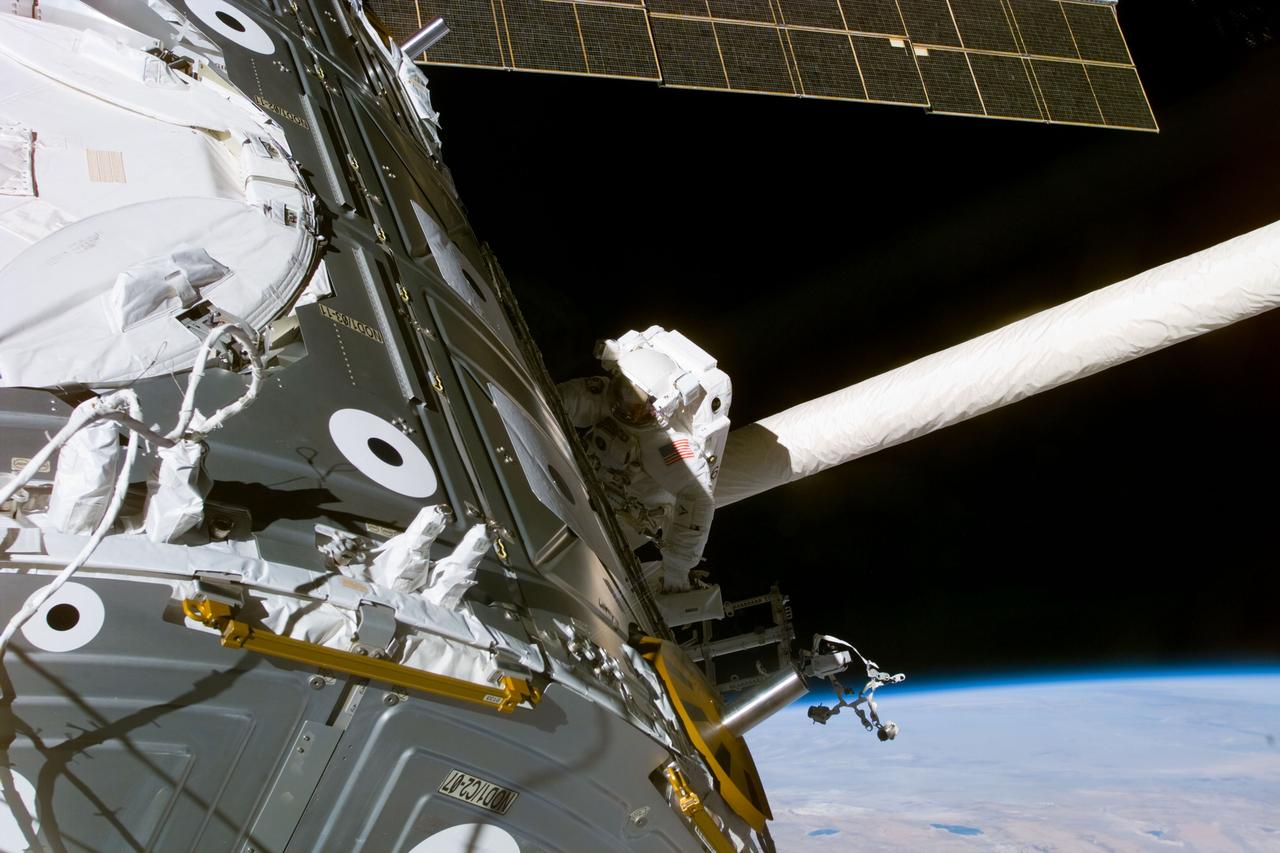
S88-E-5060 (12-08-98) --- Astronaut James H. Newman is seen near the Unity module during late phases of the first of three scheduled spacewalks on STS-88. At the end of the extravehicular activity (EVA), astronauts Newman and Jerry L. Ross, both mission specialists, were successful in mating 40 cables and connectors running 76 feet from the Zarya control module to Unity, with the 35-ton complex towering over Endeavour's cargo bay. The spacewalk last 7 hours and 21 minutes. This photo was taken with an electronic still camera (ESC) at 03:50:28 GMT, Dec. 8.
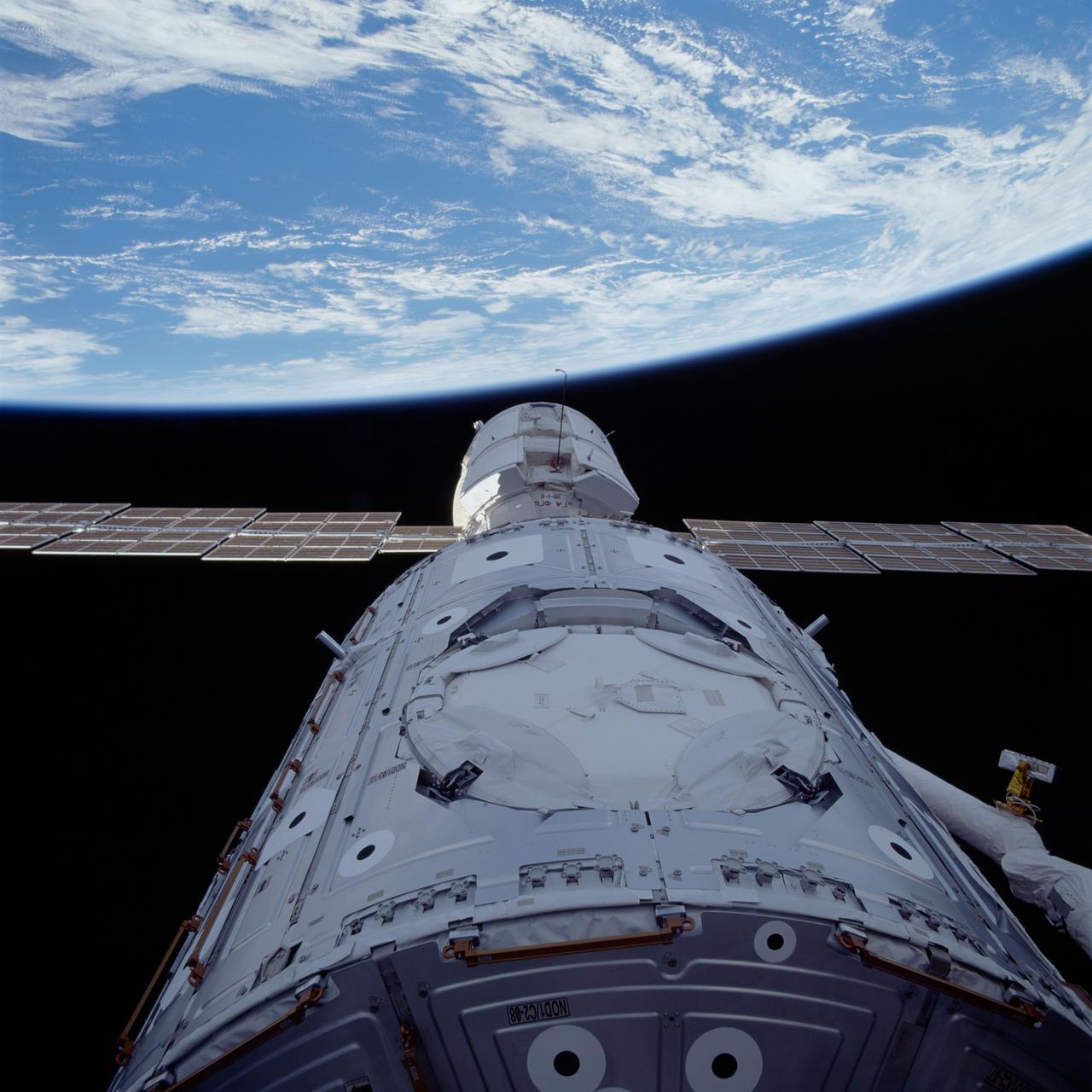
STS088-719-071 (6 Dec. 1998) --- Just a few feet away from a 70mm camera onboard the Space Shuttle Endeavour, the Russian-built control module and the U.S.-built Unity connecting module are mated in the shuttle's cargo bay. Using Endeavour's 50-ft. long Canadian-built Remote Manipulator System (RMS) robot arm, astronaut Nancy J. Currie working from the aft flight deck, plucked Zarya out of orbit at 5:47 p.m. (CST), December 6. The craft had been orbiting Earth for a little over 16 days prior to grapple and subsequent docking to Unity.
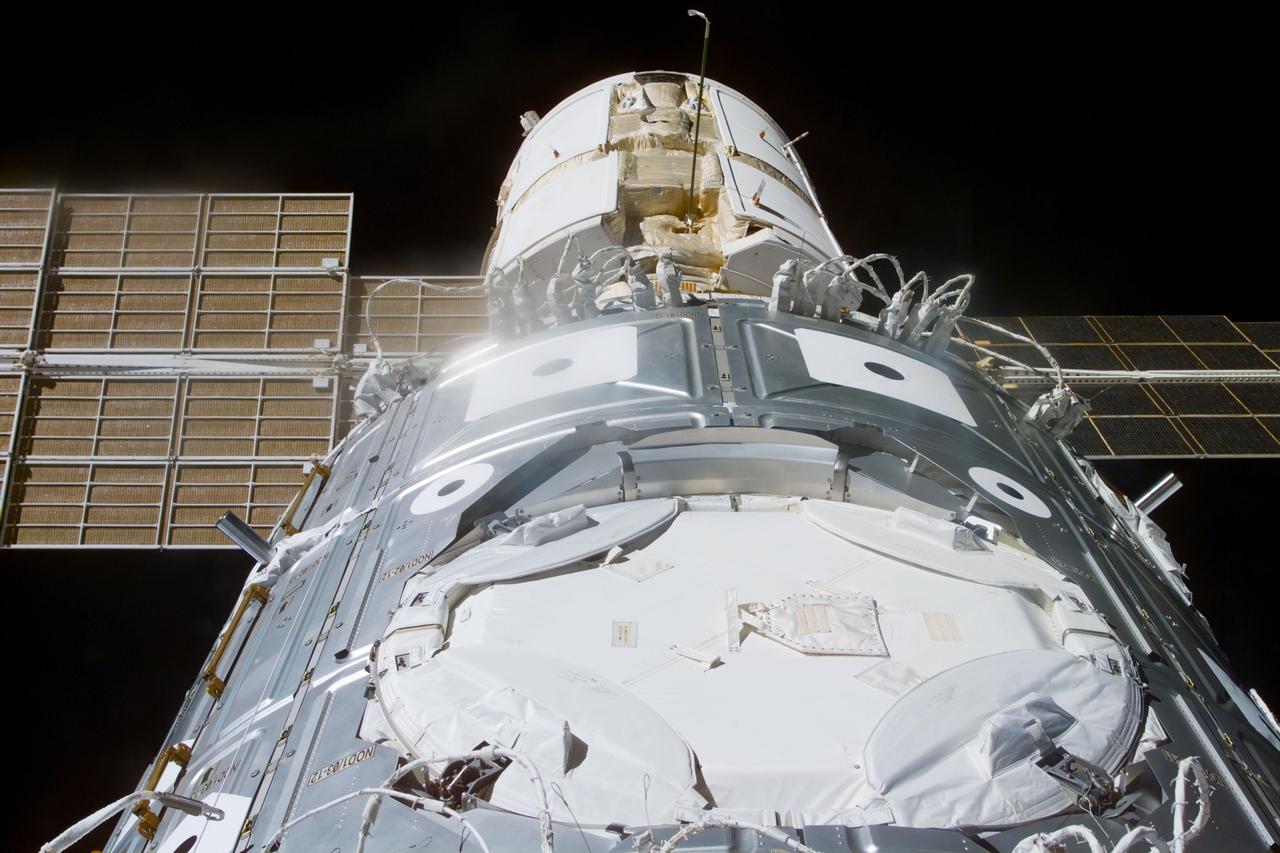
S88-E-5061 (12-08-98) --- Cables and wires in place on the Unity module signify the end of the first of three spacewalks scheduled for the STS-88 mission. Astronauts Jerry L. Ross and James H. Newman, both mission specialists, were succesful in mating 40 cables and connectors running 76 feet from the Zarya control module (seen at top in this photo) to Unity, with the 35-ton complex towering over Endeavour's cargo bay. This photo was taken with an electronic still camera (ESC) at 03:37:35 GMT, Dec. 8.
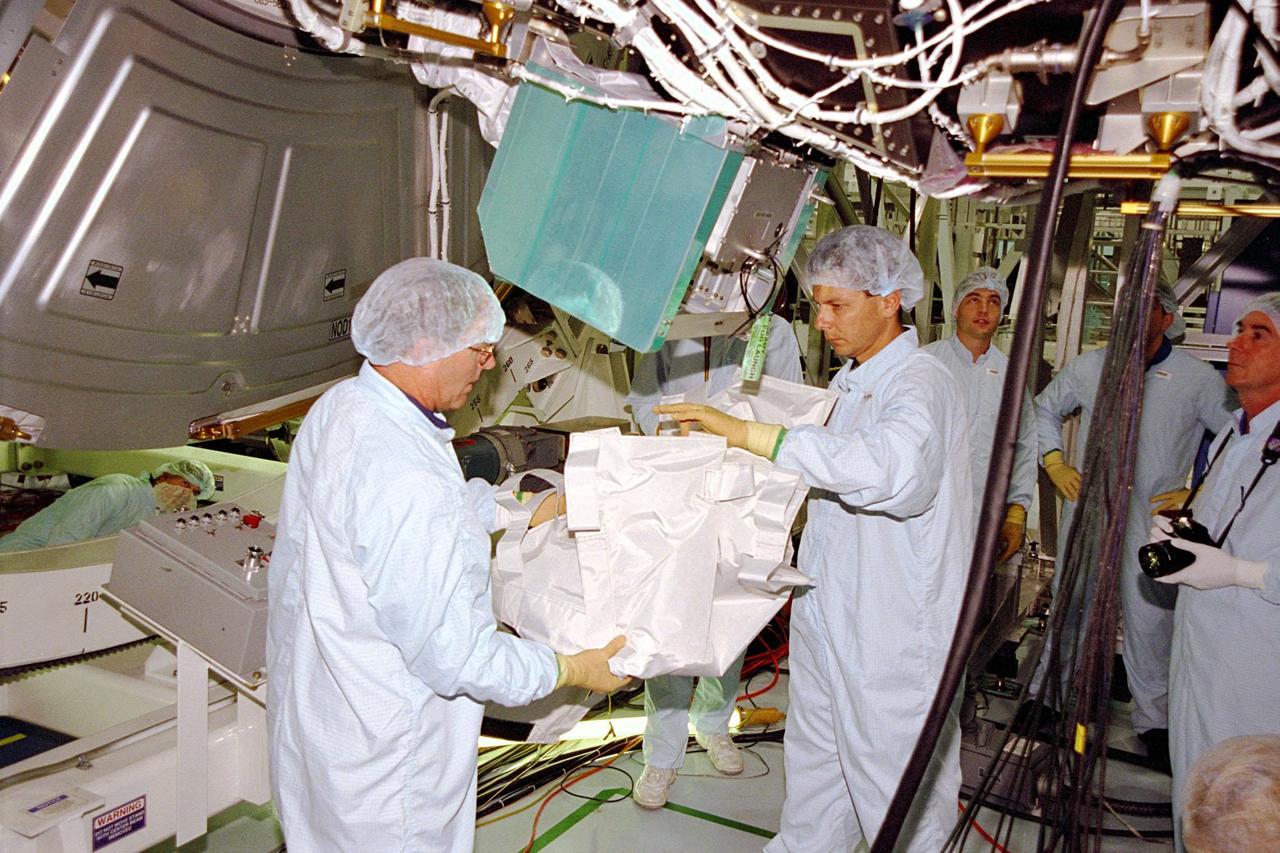
KENNEDY SPACE CENTER, FLA. -- STS-88 Mission Specialist Jerry L. Ross removes a cover from the Unity connecting module, part of the International Space Station, while other crew members and technicians watch. The Unity will be mated to the Zarya control module, which will already be in orbit. The STS-88 crew is participating in the Crew Equipment Interface Test (CEIT) held in the Space Station Processing Facility. The CEIT gives astronauts an opportunity for a hands-on look at the payloads on which they will be working while on orbit. STS-88 will be the first Space Shuttle launch for the International Space Station. Launch is scheduled for December 1998
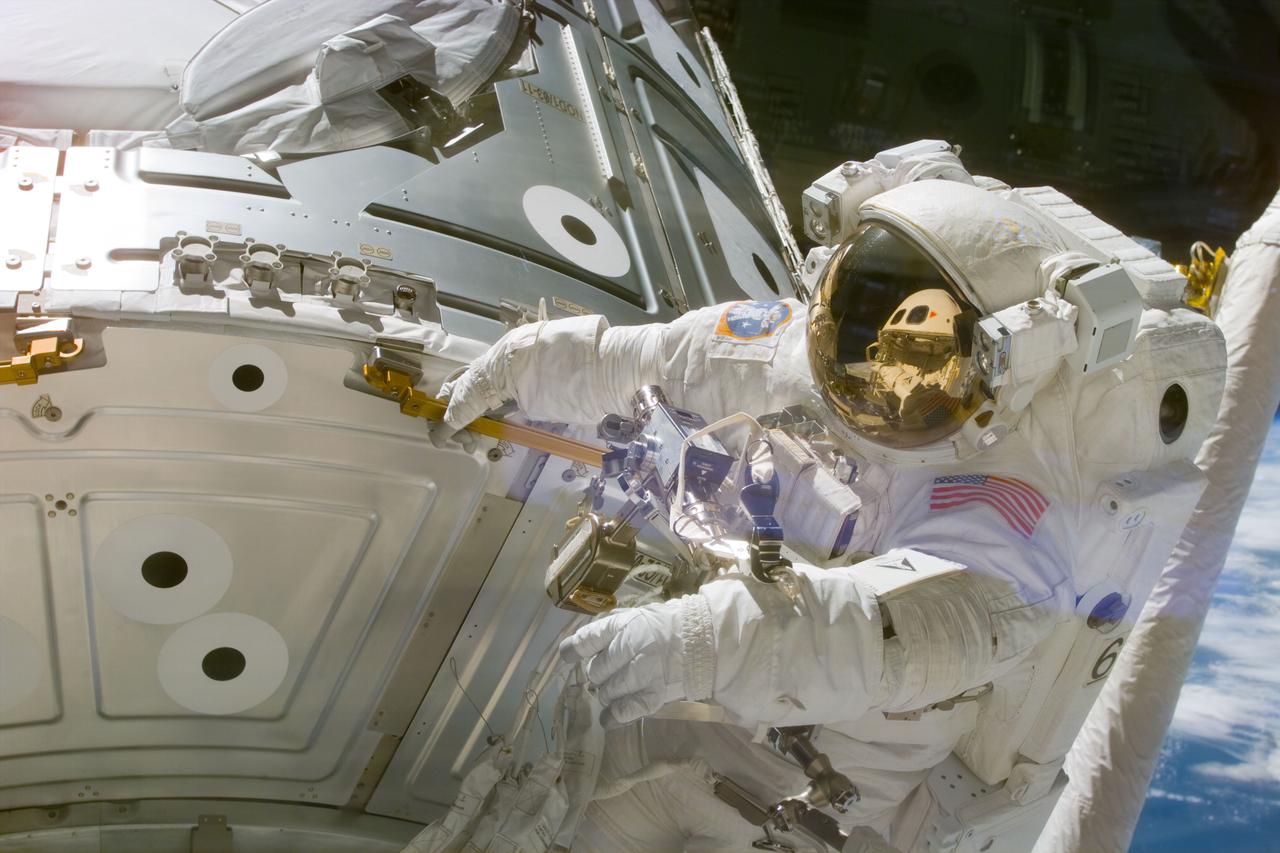
S88-E-5056 (12-07-98) --- Astronaut James H. Newman, holds one of the hand rails on the Unity connecting module during the early stages of a 7-hour, 21-minute spacewalk. Astronauts Newman and Jerry L. Ross, both mission specialists, went on to mate 40 cables and connectors running 76 feet from the Zarya control module to Unity, with the 35-ton complex towering over Endeavour's cargo bay. This photo was taken with an electronic still camera (ESC) at 23:37:07 GMT, Dec. 7.
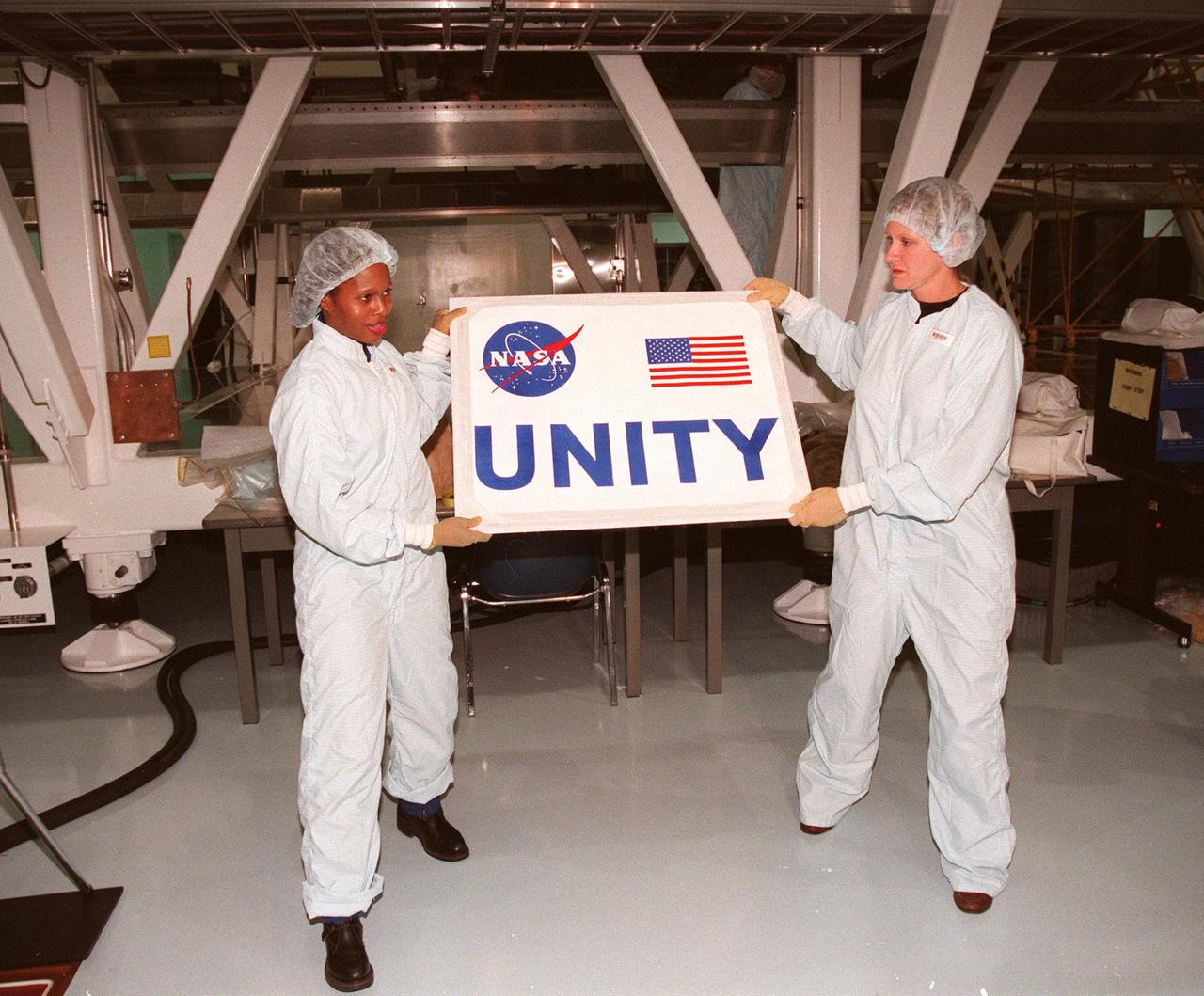
In the Space Station Processing Facility, holding the nameplate for the Unity connecting module are (left) Joan Higginbotham, with the Astronaut Office Computer Support Branch, and (right) Nancy Tolliver, with Boeing-Huntsville. Part of the International Space Station, Unity was expected to be transported to Launch Pad 39A on Oct. 26 for launch aboard Space Shuttle Endeavour on Mission STS-88 in December. The Unity is a connecting passageway to the living and working areas of ISS. While on orbit, the flight crew will deploy Unity from the payload bay and attach Unity to the Russian-built Zarya control module which will be in orbit at that time
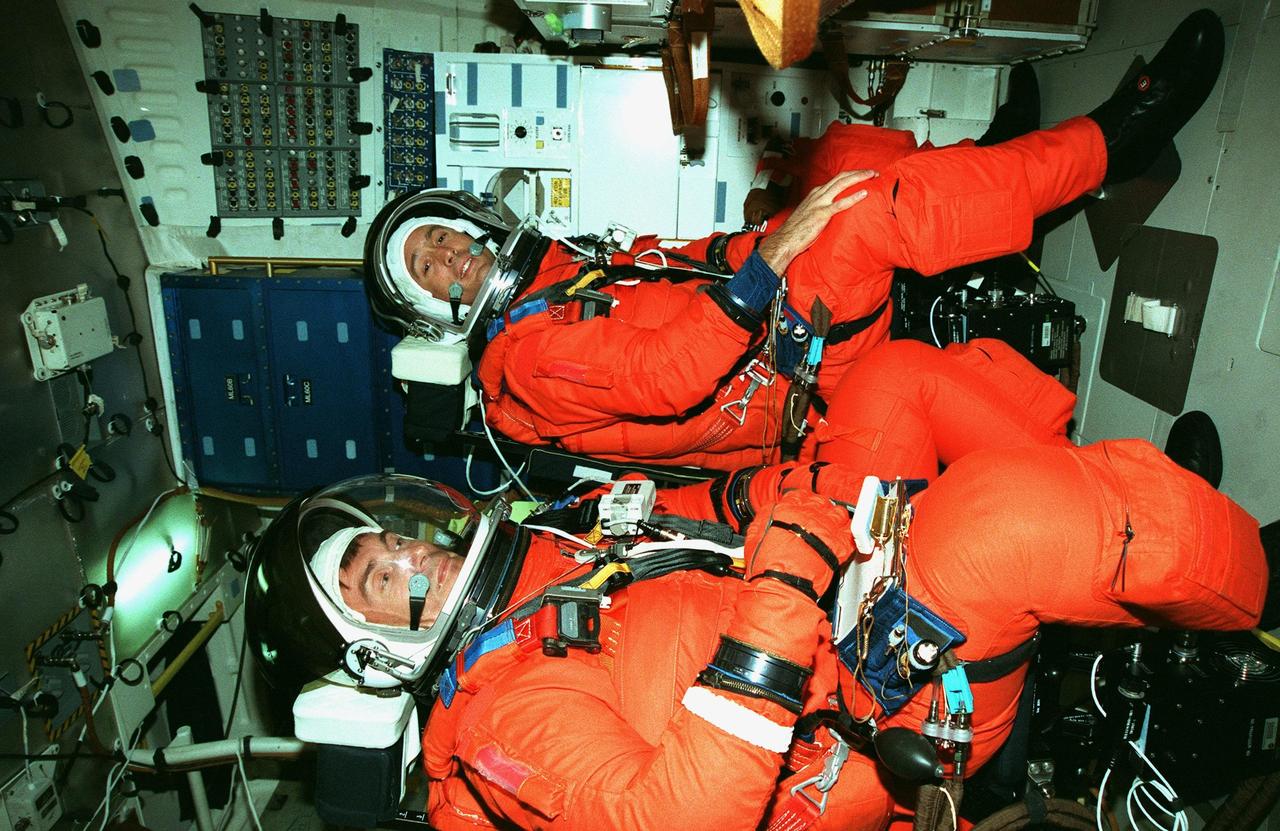
STS-88 Mission Specialists Sergei Konstantinovich Krikalev (left) and James H. Newman (right) sit inside orbiter Endeavour during Terminal Countdown Demonstration Activities (TCDT). The TCDT includes mission familiarization activities, emergency egress training, and the simulated main engine cut-off exercise. Mission STS-88 is targeted for launch on Dec. 3, 1998. It is the first U.S. flight for the assembly of the International Space Station and will carry the Unity connecting module. Unity will be mated with the already orbiting Russian-built Zarya control module. The 12-day mission includes three planned spacewalks to connect power, data and utility lines and install exterior equipment
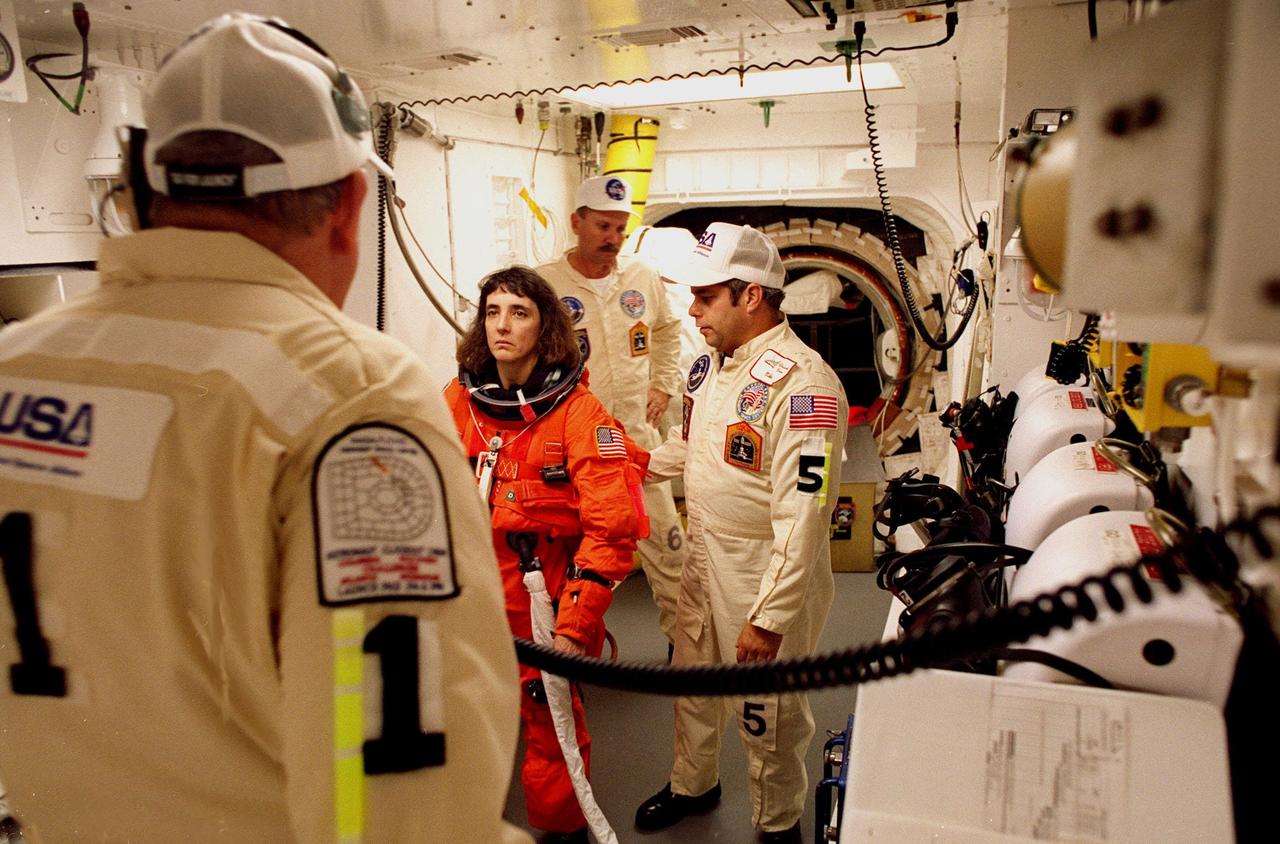
STS-88 Mission Specialist Nancy Jane Currie is assisted with her ascent and re-entry flight suit in the white room at Launch Pad 39A before entering Space Shuttle Endeavour for launch. During the nearly 12-day mission, the six-member crew will mate the first two elements of the International Space Station the already-orbiting Zarya control module with the Unity connecting module carried by Endeavour. She is making her third spaceflight as the crew's flight engineer and prime operator of the Remote Manipulator System, the robotic arm
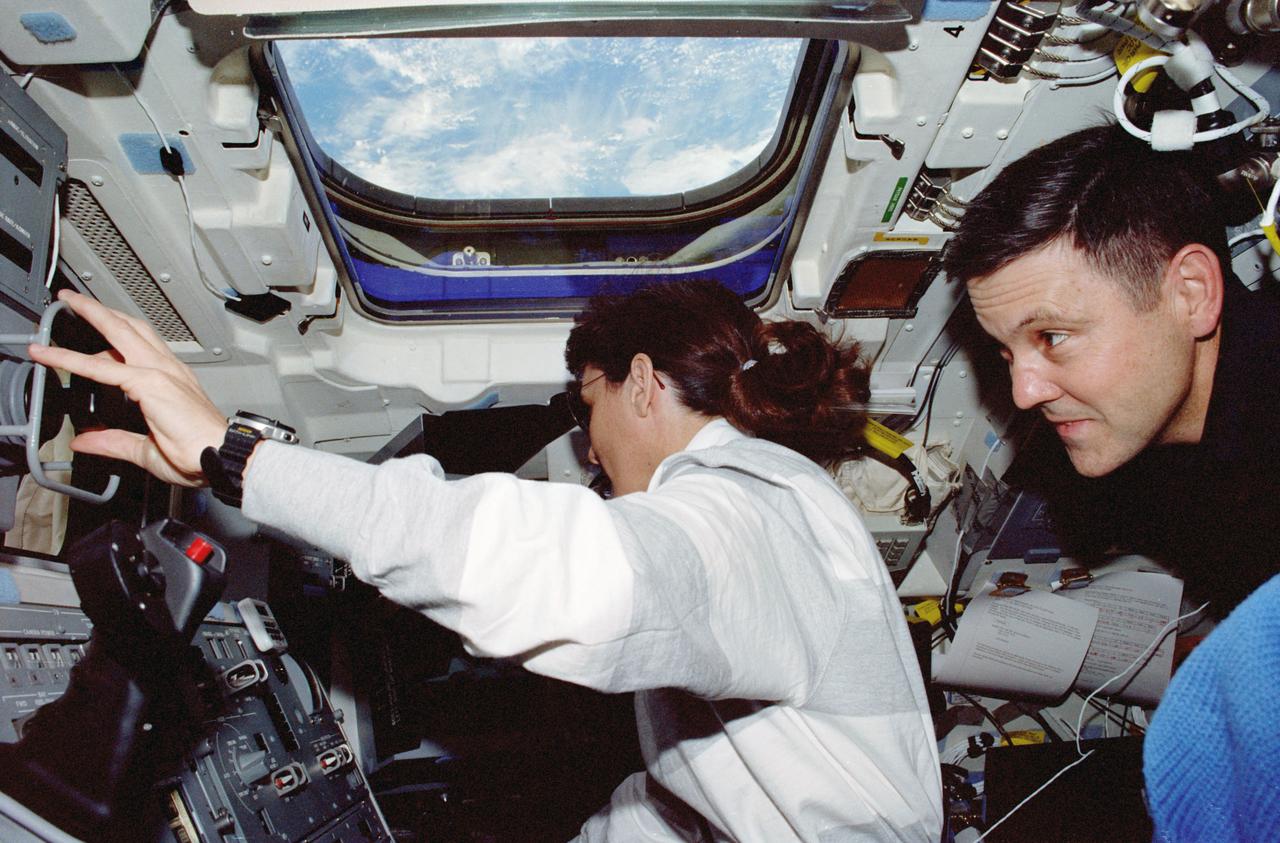
STS088-335-015 (4-15 Dec. 1998) --- Astronauts Nancy J. Currie, mission specialist, and Robert D. Cabana, commander, are busy on the flight deck of the Earth-orbiting Space Shuttle Endeavour. Currie is working the controls of the Remote Manipulator System (RMS) arm, while Cabana observes. The crew used the RMS for docking and extravehicular activity (EVA) support during the mission. At mission?s end, the connected United States-built Unity Module (Node 1) and the Russian-built FGB Module (Zarya) were released in Earth-orbit.
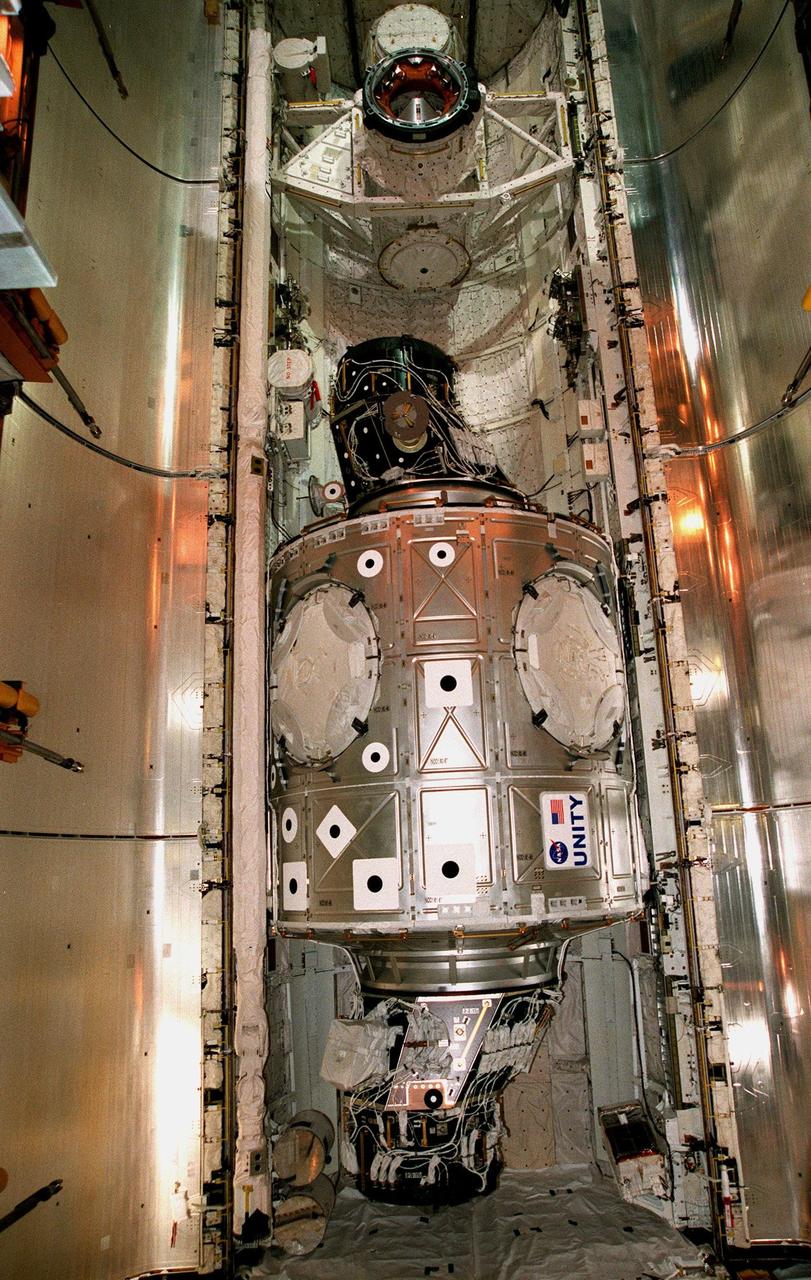
The Unity connecting module rests inside the open payload bay of the orbiter Endeavour at Launch Pad 39A. At the top of bay is the docking mechanism first used with launches to Mir, the Russian space station. Unity is the first U.S. element of the International Space Station (ISS) and is scheduled for launch Dec. 3, 1998, on Mission STS-88. The Unity is a connecting passageway to the living and working areas of ISS. While on orbit, the flight crew will deploy Unity from the payload bay and attach it to the Russian-built Zarya control module which will be in orbit at that time. The mission is expected to last nearly 12 days, landing back at the Kennedy Space Center on Dec. 14
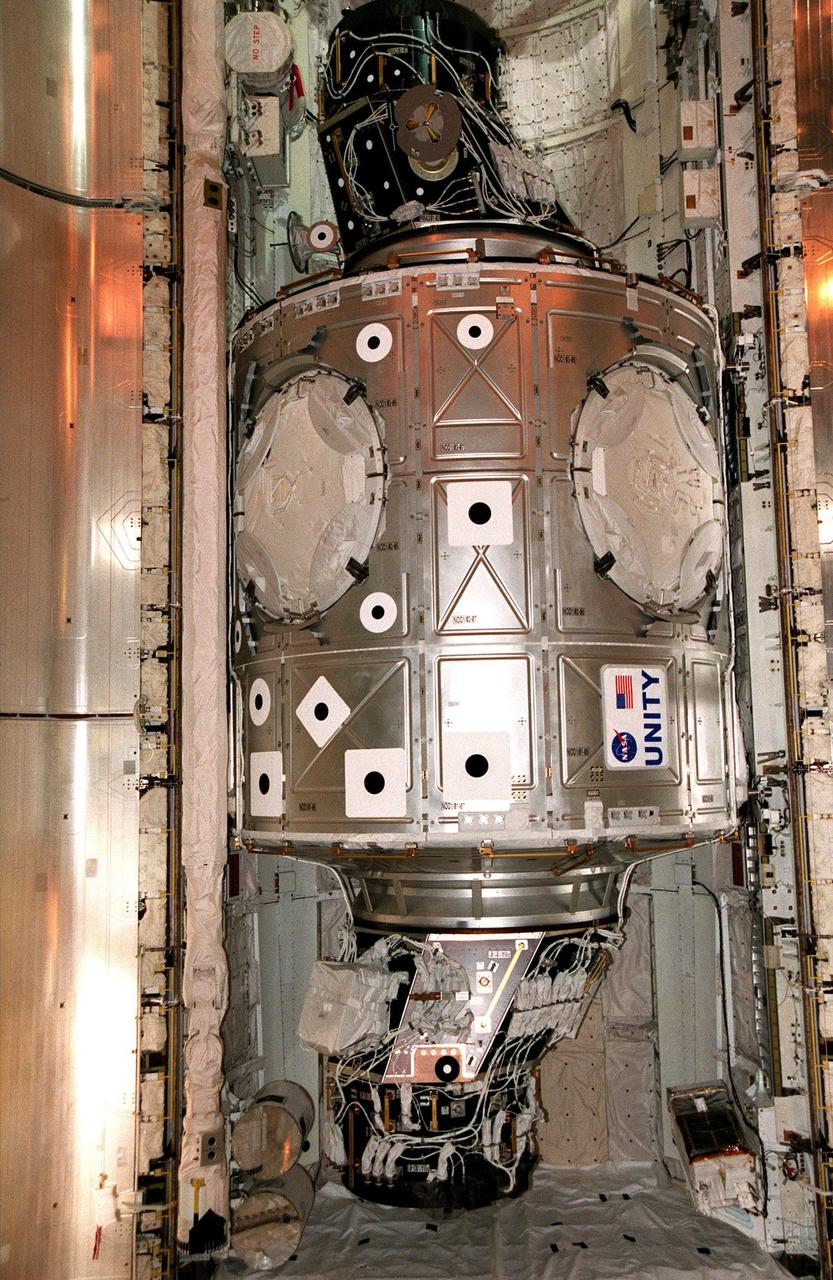
The Unity connecting module rests inside the payload bay of the orbiter Endeavour at Launch Pad 39A. The first U.S. element of the International Space Station (ISS), Unity is scheduled for launch Dec. 3, 1998, on Mission STS-88. The Unity is a connecting passageway to the living and working areas of ISS. While on orbit, the flight crew will deploy Unity from the payload bay and attach it to the Russian-built Zarya control module which will be in orbit at that time. The mission is expected to last nearly 12 days, landing back at the Kennedy Space Center on Dec. 14
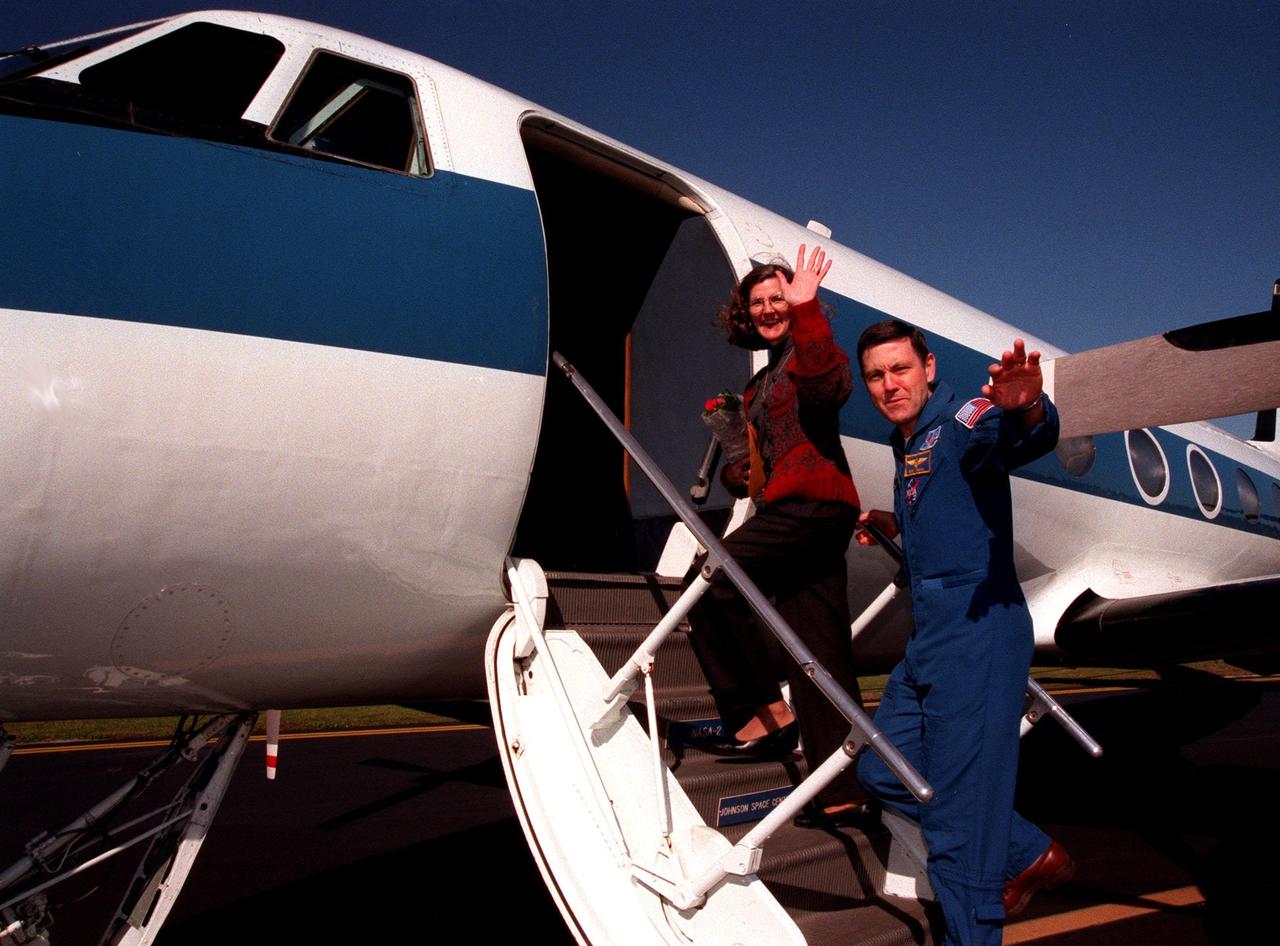
STS-88 Commander Robert D. Cabana and his wife, Nancy, enter the airplane that will return them to Houston and the Johnson Space Center. They will be joined by other crew members, with their families, Pilot Frederick W. "Rick" Sturckow. Mission Specialists Sergei Konstantinovich Krikalev, James H. Newman, Jerry L. Ross and Nancy J. Currie. The STS-88 crew returned Dec. 15 from a 12-day mission on orbit constructing the first elements of the International Space Station, the U.S.-built Unity connecting module and Russian-built Zarya control module
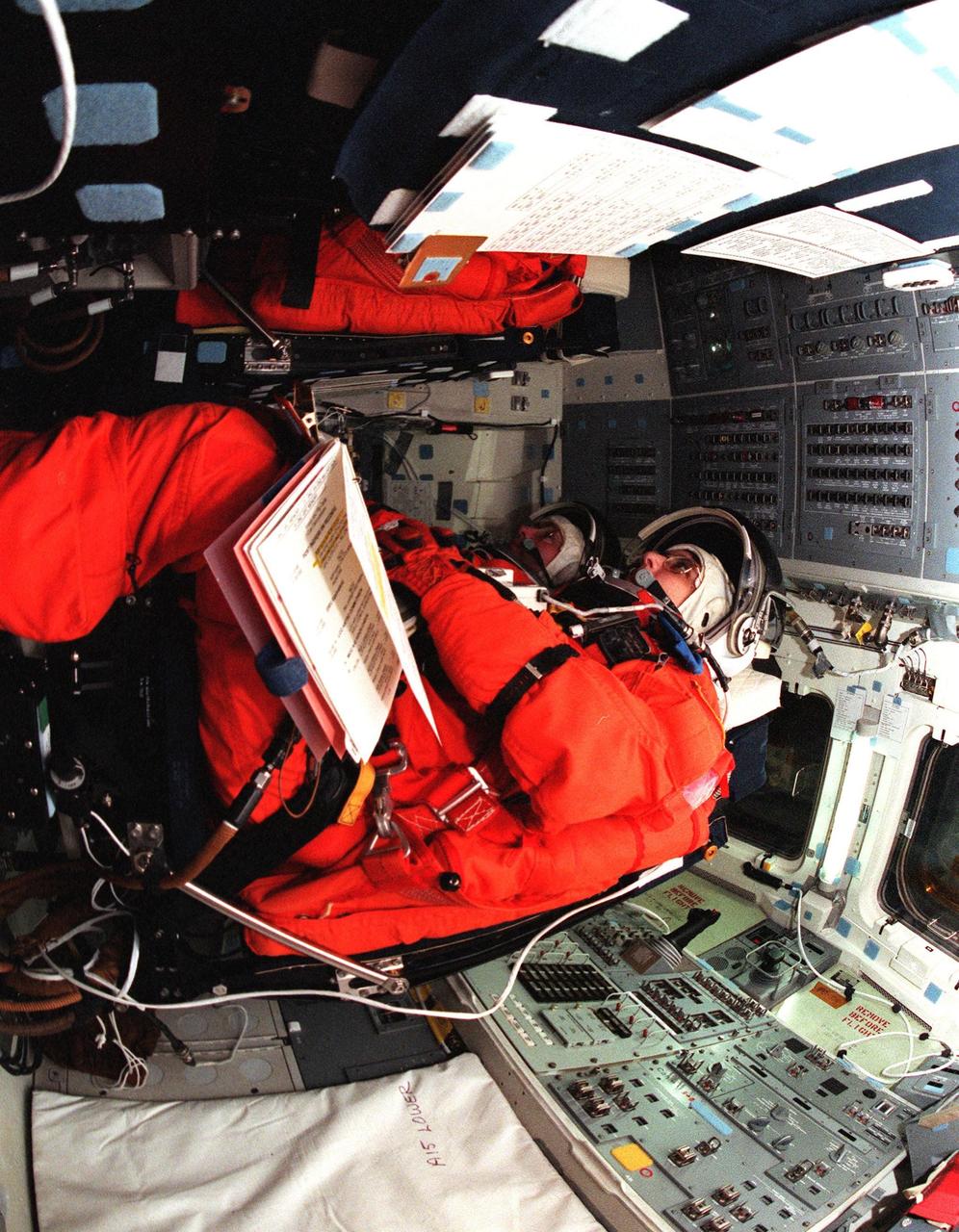
STS-88 Mission Specialists Nancy J. Currie, Ph.D., (back) and Jerry L. Ross (front) check over equipment inside orbiter Endeavour during Terminal Countdown Demonstration Activities (TCDT). The TCDT includes mission familiarization activities, emergency egress training, and the simulated main engine cut-off exercise. Mission STS-88 is targeted for launch on Dec. 3, 1998. It is the first U.S. flight for the assembly of the International Space Station and will carry the Unity connecting module. Unity will be mated with the already orbiting Russian-built Zarya control module. The 12-day mission includes three planned spacewalks to connect power, data and utility lines and install exterior equipment