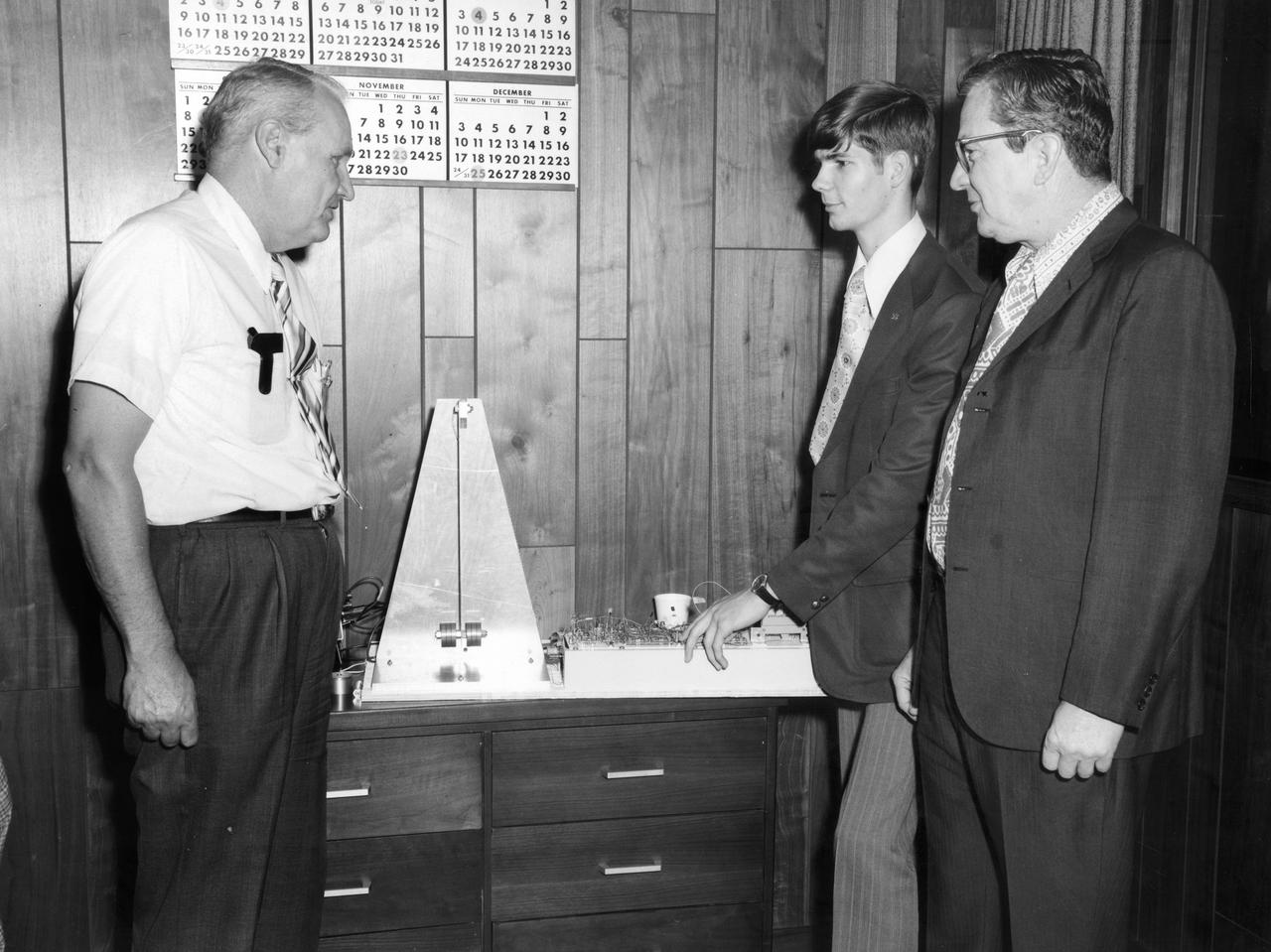
Rockford, Illinois high school student, Vincent Converse, discussed his proposed Skylab experiment with Dr. Robert Head (right) and Gene Greshman of Marshall Space Flight Center (MSFC). His experiment, “Zero Gravity Mass Measurement” used a simple leaf spring with the mass to be weighed attached to the end. The electronic package oscillated the spring at a specific rate and the results were recorded electronically. Converse was among 25 winners of a contest in which some 3,500 high school students proposed experiments for the following year’s Skylab mission. Of the 25 students, 6 did not see their experiments conducted on Skylab because the experiments were not compatible with Skylab hardware and timelines. Of the 19 remaining, 11 experiments required the manufacture of equipment, such as that of Converse’s experiment.
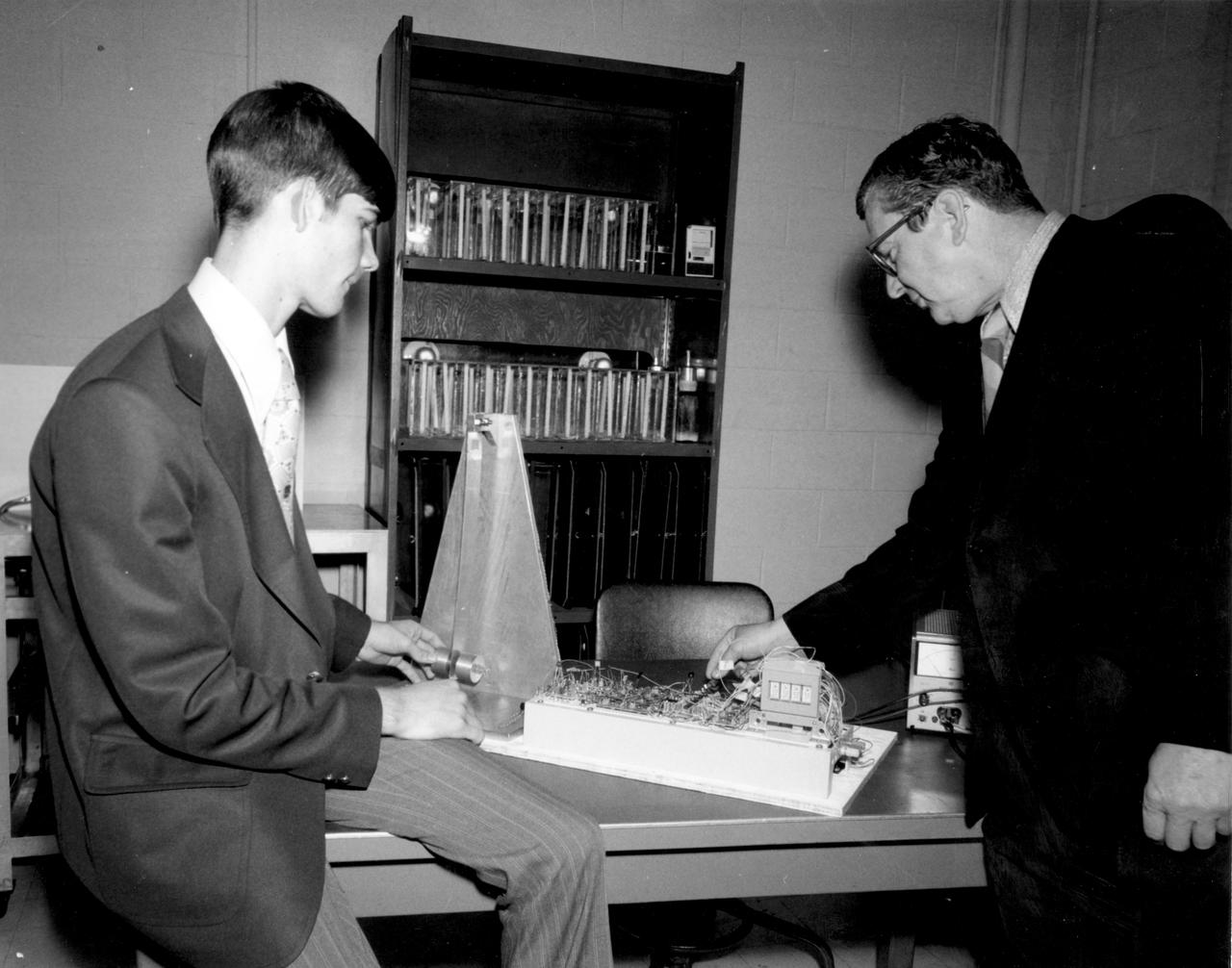
Rockford, Illinois high school student, Vincent Converse (left), and Robert Head of the Marshall Space Flight Center (MSFC), check out the equipment to be used in conducting the student’s experiment aboard the Skylab the following year. His experiment, “Zero Gravity Mass Measurement” used a simple leaf spring with the mass to be weighed attached to the end. An electronic package oscillated the spring at a specific rate and the results were recorded electronically. Converse was among 25 winners of a contest in which some 3,500 high school students proposed experiments for the following year’s Skylab mission. The nationwide scientific competition was sponsored by the National Science Teachers Association and the National Aeronautics and Space Administration (NASA). The winning students, along with their parents and sponsor teachers, visited MSFC two months earlier where they met with scientists and engineers, participated in design reviews for their experiments, and toured MSFC facilities. Of the 25 students, 6 did not see their experiments conducted on Skylab because the experiments were not compatible with Skylab hardware and timelines. Of the 19 remaining, 11 experiments required the manufacture of additional equipment.
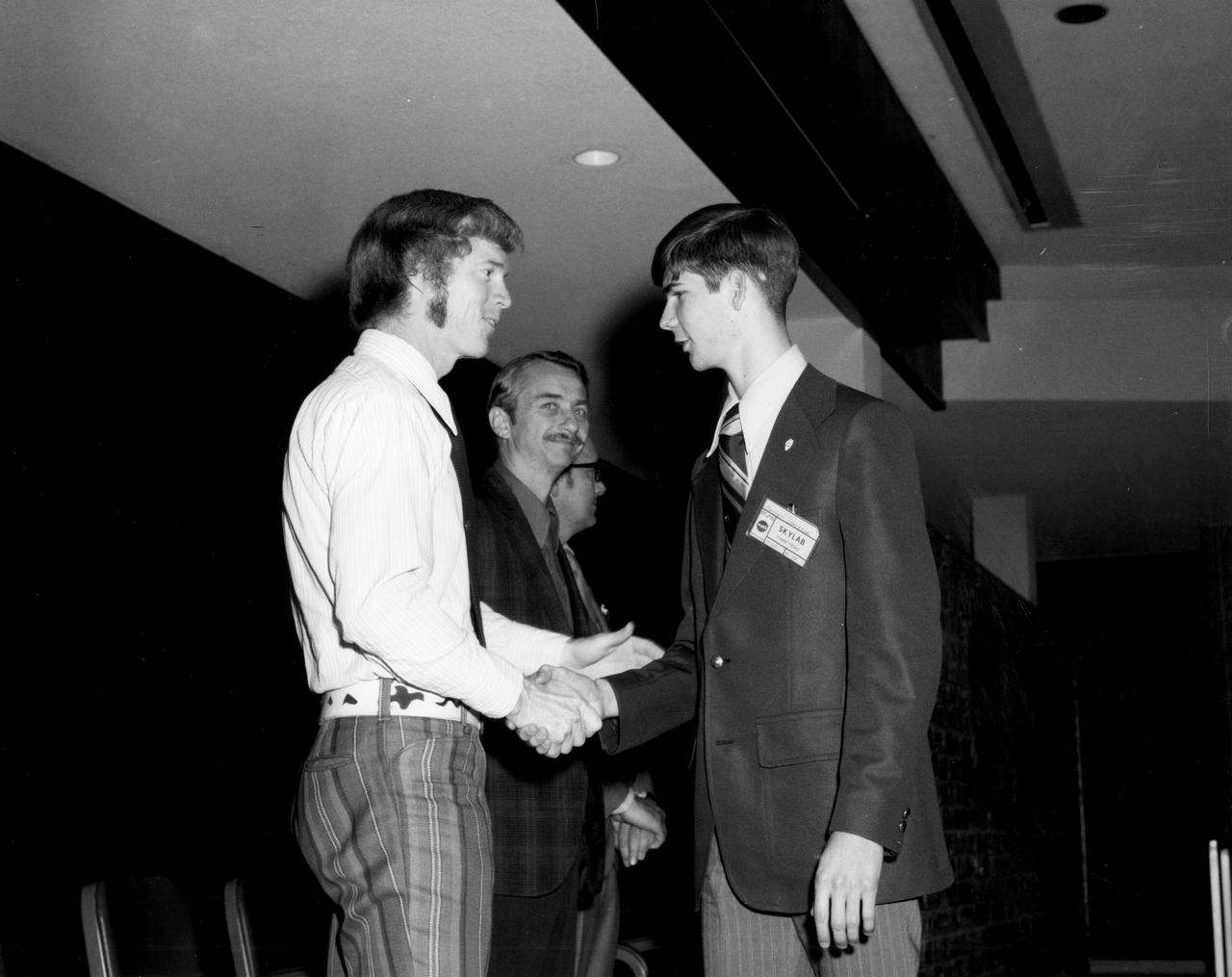
Rockford, Illinois high school student, Vincent Converse (right), is greeted by astronauts Russell L. Schweickart and Owen K. Garriott during a tour of the Marshall Space Flight Center (MSFC). Converse was among 25 winners of a contest in which some 3,500 high school students proposed experiments for the following year’s Skylab mission. His experiment, “Zero Gravity Mass Measurement” used a simple leaf spring with the mass to be weighed attached to the end. An electronic package oscillated the spring at a specific rate and the results were recorded electronically. The nationwide scientific competition was sponsored by the National Science Teachers Association and the National Aeronautics and Space Administration (NASA). The winning students, along with their parents and sponsor teachers, visited MSFC where they met with scientists and engineers, participated in design reviews for their experiments, and toured MSFC facilities. Of the 25 students, 6 did not see their experiments conducted on Skylab because the experiments were not compatible with Skylab hardware and timelines. Of the 19 remaining, 11 experiments required the manufacture of additional equipme
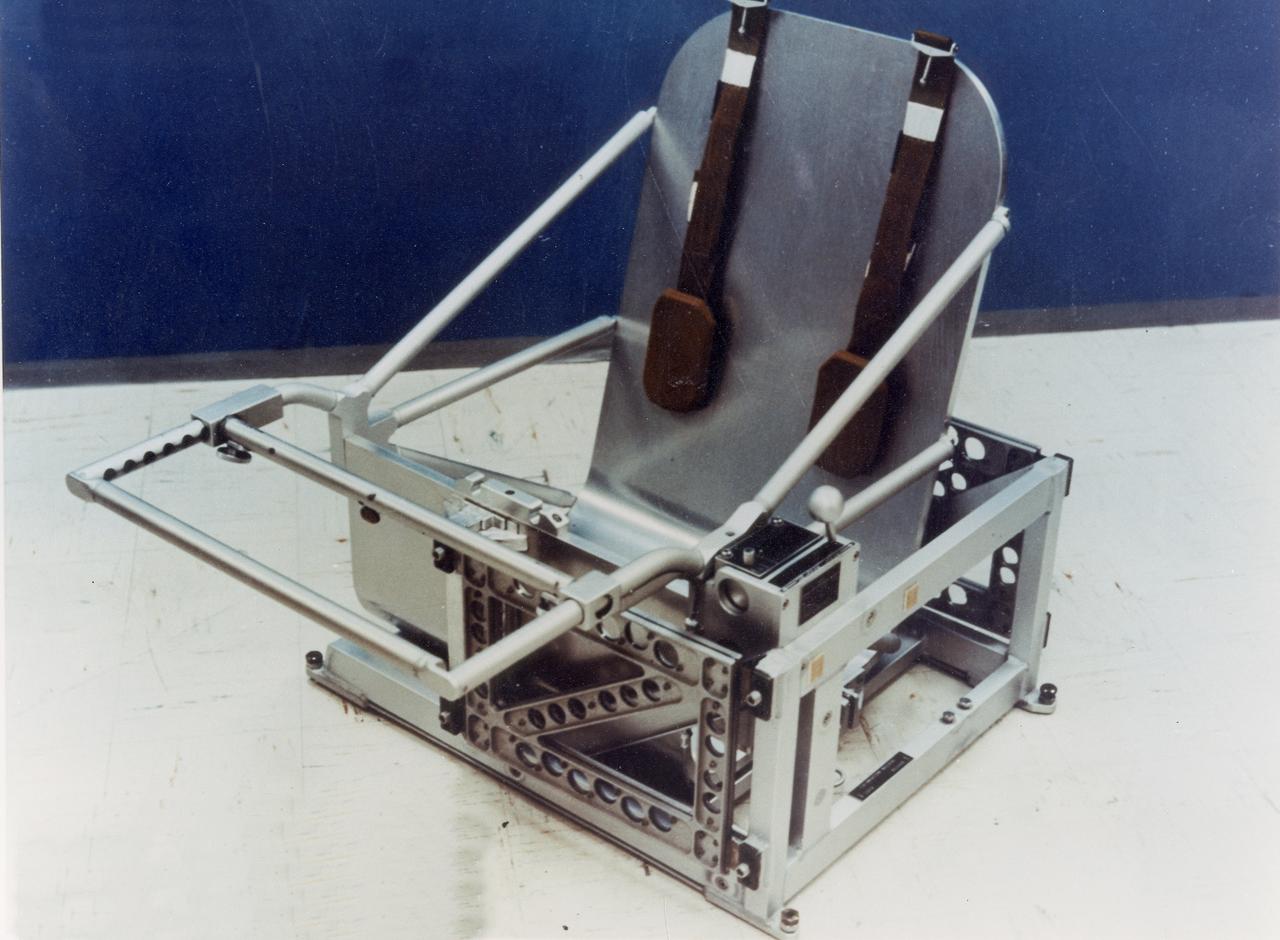
Skylab's Body Mass Measurement chair, the facility of the Body Mass Measurement experiment (M172), is shown here in this 1970 photograph. The M172 experiment determined the body mass of each crew member and observed changes in body masses during flight. Knowledge of exact body mass variations throughout the flight in significantly aided in the correlation of other medical data obtained during the flight. Mass measurements under zero-gravity conditions were achieved by the application of Newton's second law (force equals mass times acceleration). The Marshall Space Flight Center had program management responsibility for the development of Skylab hardware and experiments.
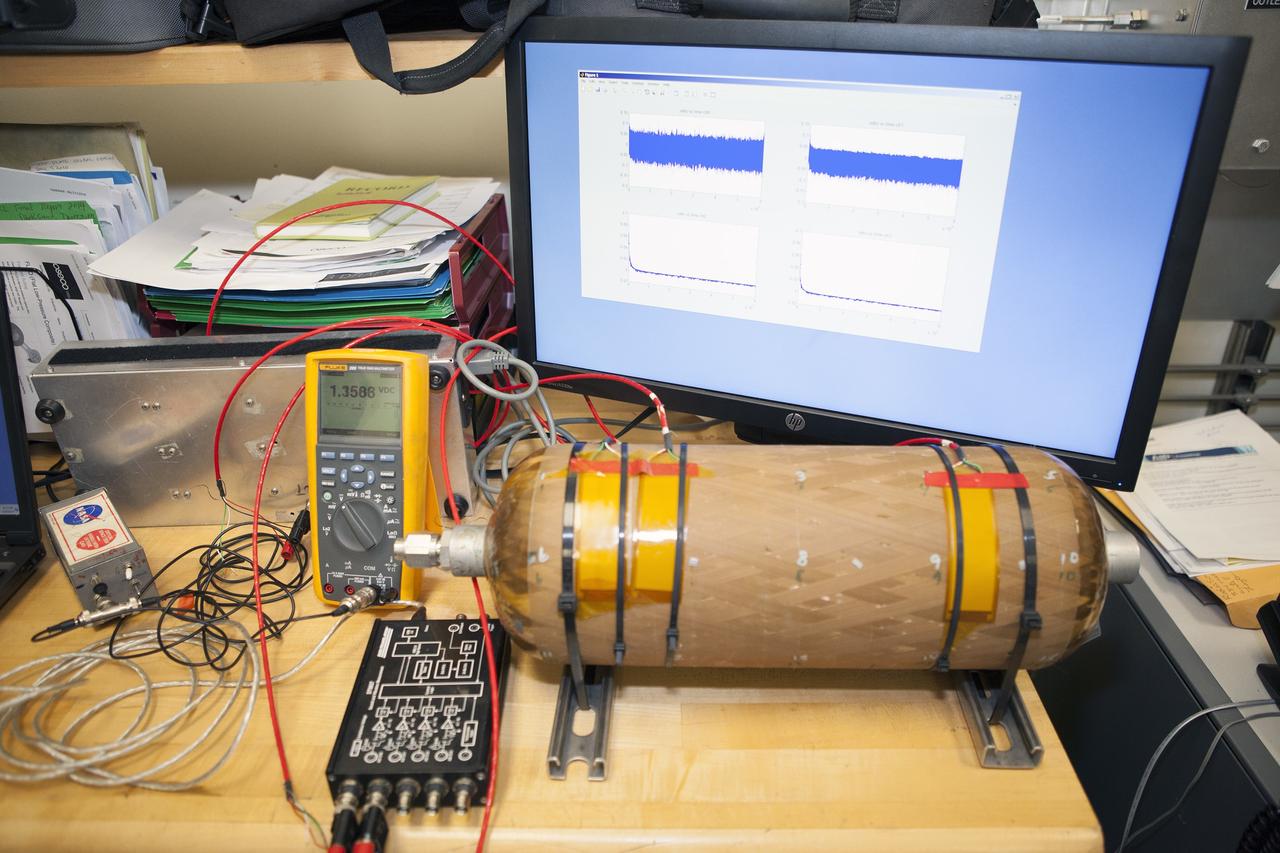
CAPE CANAVERAL, Fla. – Several Lead Zirconate Titanate, or PZT, mass gaging sensors have been attached to a composite tank during a test inside a laboratory at the Cryogenics Testbed Facility at NASA's Kennedy Space Center in Florida. The PZT-based system was developed at Kennedy as a way to measure the mass of a fluid and the structural health of a tank using vibration signatures on Earth or in reduced/zero g gravity. The mass gaging technology has received approval to be on the first sub-orbital flight on the Virgin Galactic Space Plane in 2015. NASA experiments using the PZT technology will be used by Embry-Riddle Aeronautical University in conjunction with Carthage College on a fluid transfer experiment. Photo credit: NASA/Daniel Casper
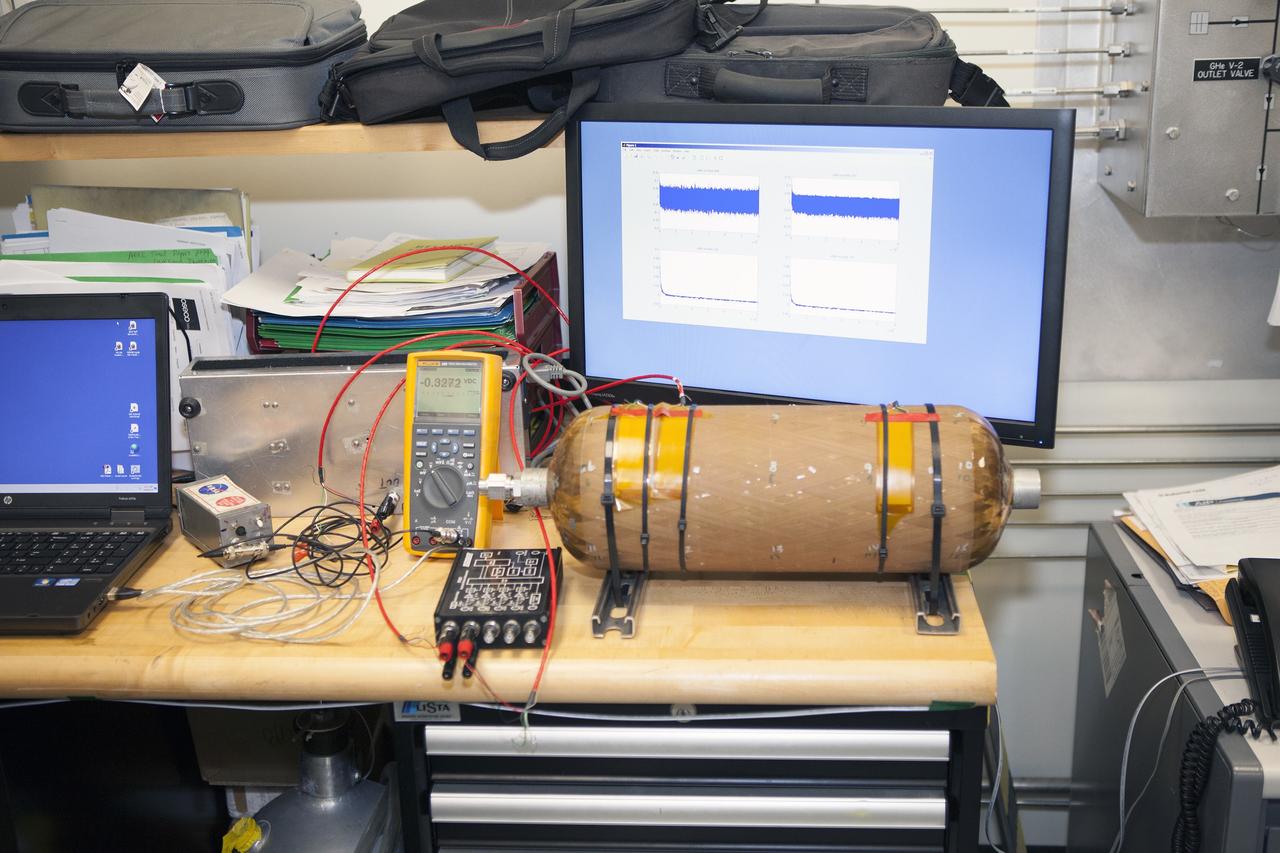
CAPE CANAVERAL, Fla. – Several Lead Zirconate Titanate, or PZT, mass gaging sensors have been attached to a composite tank during a test inside a laboratory at the Cryogenics Testbed Facility at NASA's Kennedy Space Center in Florida. The PZT-based system was developed at Kennedy as a way to measure the mass of a fluid and the structural health of a tank using vibration signatures on Earth or in reduced/zero g gravity. The mass gaging technology has received approval to be on the first sub-orbital flight on the Virgin Galactic Space Plane in 2015. NASA experiments using the PZT technology will be used by Embry-Riddle Aeronautical University in conjunction with Carthage College on a fluid transfer experiment. Photo credit: NASA/Daniel Casper
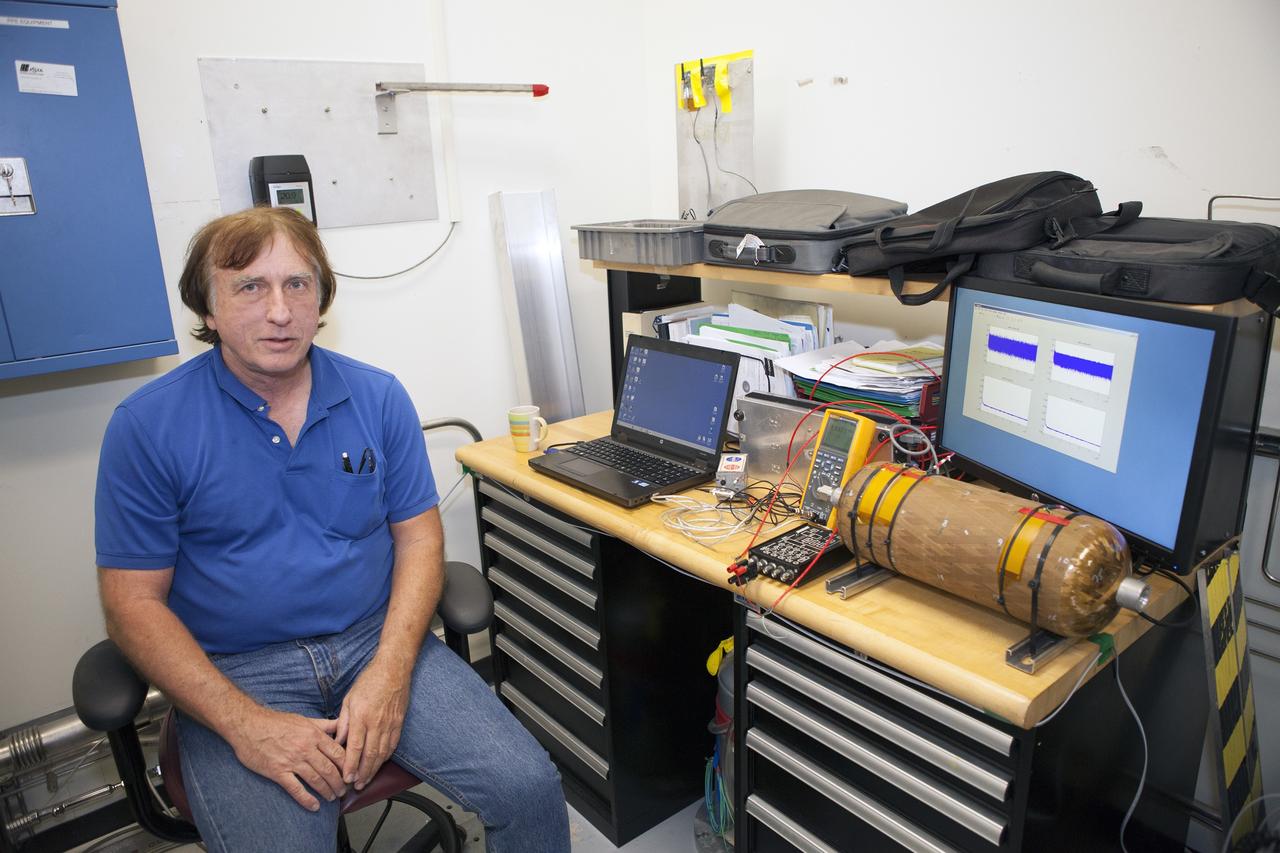
CAPE CANAVERAL, Fla. – Rudy Werlink, a fluid systems engineer in the Engineering Directorate at NASA's Kennedy Space Center in Florida, monitors a test in a lab at the Cryogenics Testbed Facility using the Lead Zirconate Titanate, or PZT-based system that he developed. Werlink developed the PZT-based system at Kennedy as a way to measure the mass of a fluid and the structural health of a tank using vibration signatures on Earth or in reduced/zero g gravity. The mass gaging technology has received approval to be on the first sub-orbital flight on the Virgin Galactic Space Plane in 2015. NASA experiments using the PZT technology will be used by Embry-Riddle Aeronautical University in conjunction with Carthage College on a fluid transfer experiment. Photo credit: NASA/Daniel Casper