
This photo shows the zodiacal light as it appeared on March 1, 2021, in Skull Valley, Utah. The Pleiades star cluster is visible near the top of the light column. Mars is just below that. https://photojournal.jpl.nasa.gov/catalog/PIA24432
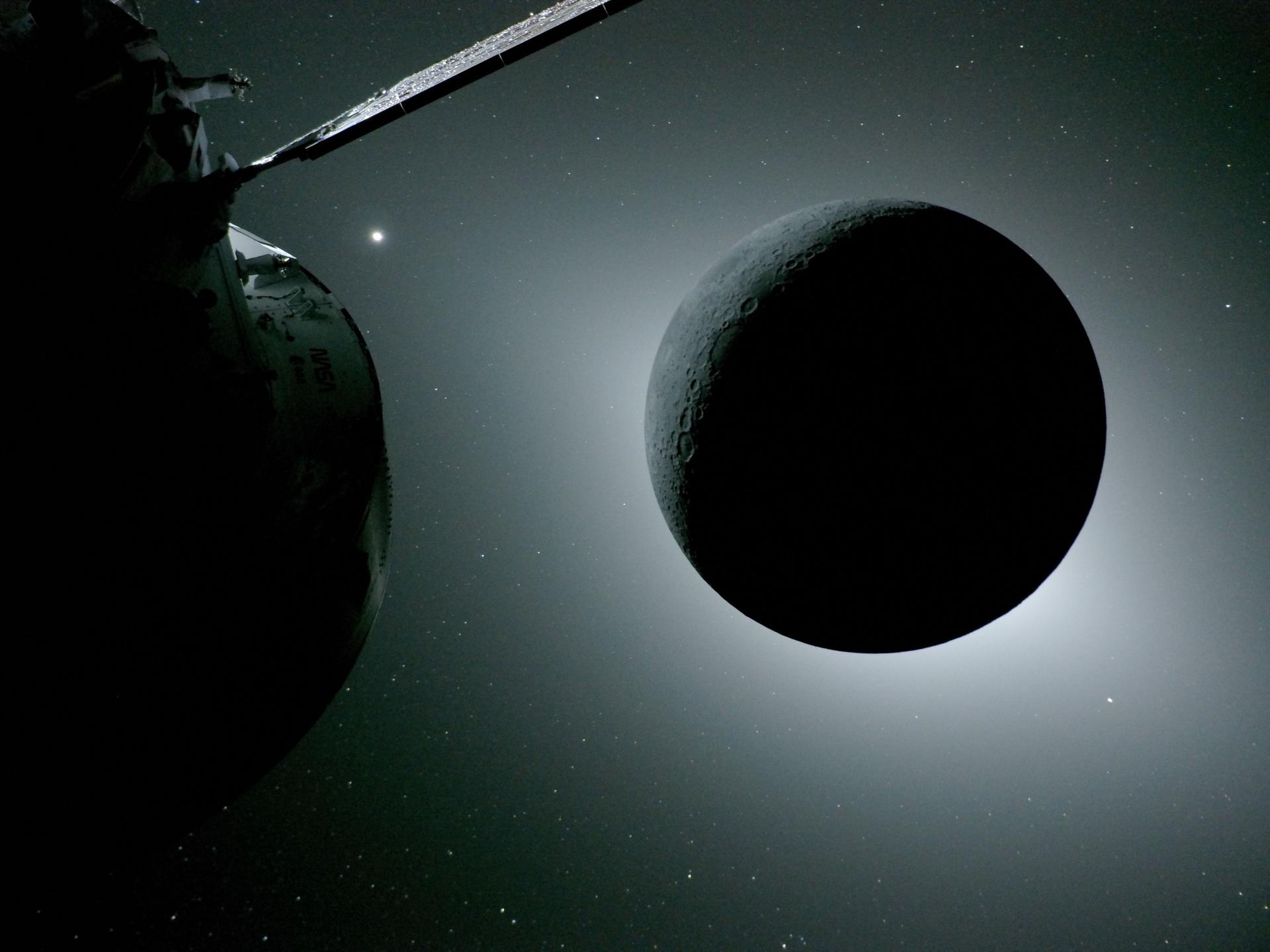
art002e016324 (April 6, 2026) - The solar eclipse captured from a camera mounted on one of the Orion spacecraft’s solar array wings during the Artemis II crew’s flyby of the Moon’s far side. The science community is investigating whether the glow around the Moon is from zodiacal light -- interplanetary dust that’s reflecting sunlight -- the solar corona, or a combination of the two. Unlike minutes-long eclipses as viewed from Earth, the Artemis II crew saw the Sun hide behind the Moon for nearly an hour. In this image, Venus can be spotted on the left, and Saturn on the right of the Moon. Credit: NASA
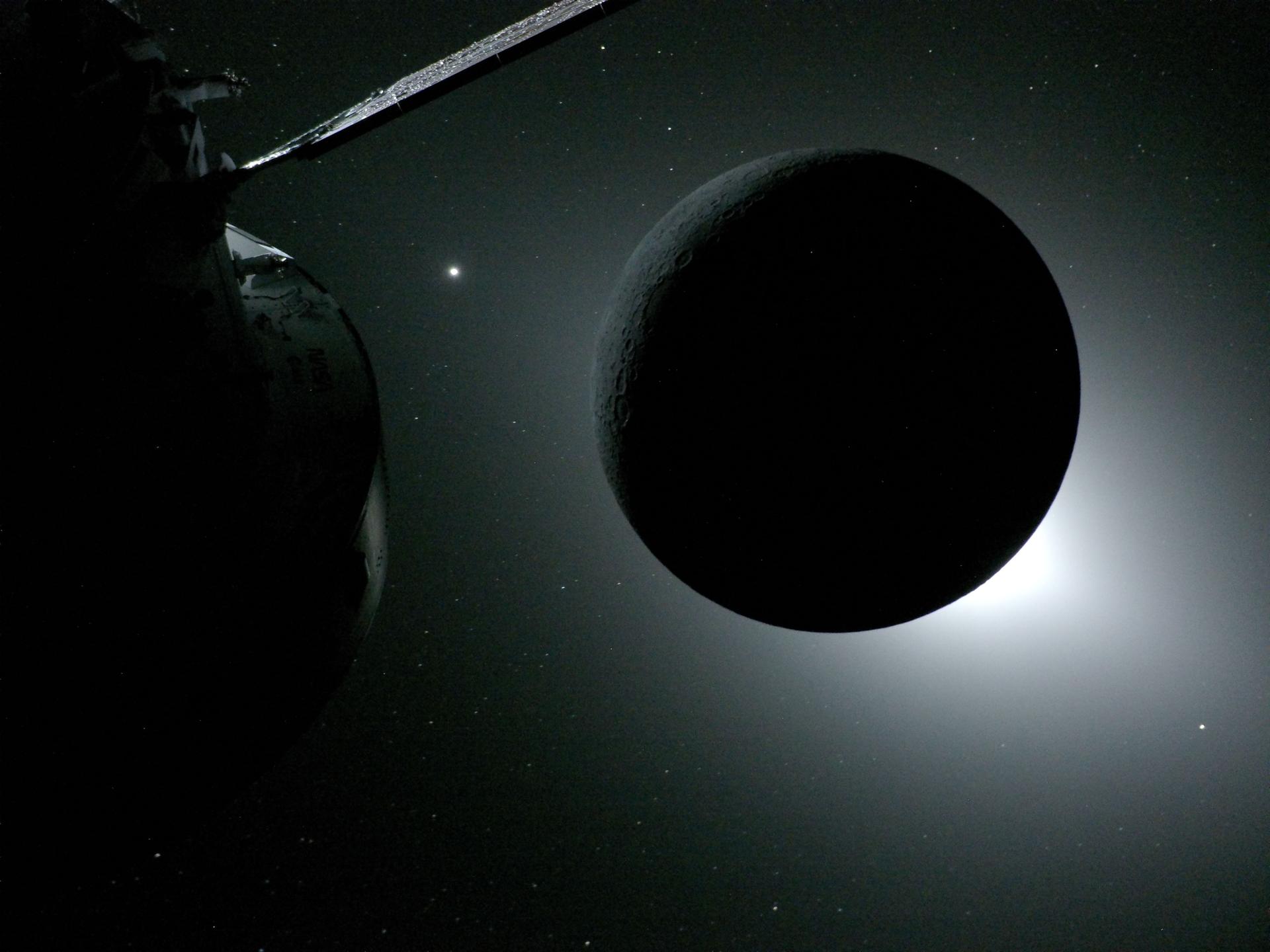
art002e016318 (April 6, 2026) - The solar eclipse captured from a camera mounted on one of the Orion spacecraft’s solar array wings during the Artemis II crew’s flyby of the Moon’s far side. The science community is investigating whether the glow around the Moon is from zodiacal light -- interplanetary dust that’s reflecting sunlight -- the solar corona, or a combination of the two. Unlike minutes-long eclipses as viewed from Earth, the Artemis II crew saw the Sun hide behind the Moon for nearly an hour. In this image, Venus can be spotted on the left, and Saturn on the right of the Moon. Credit: NASA
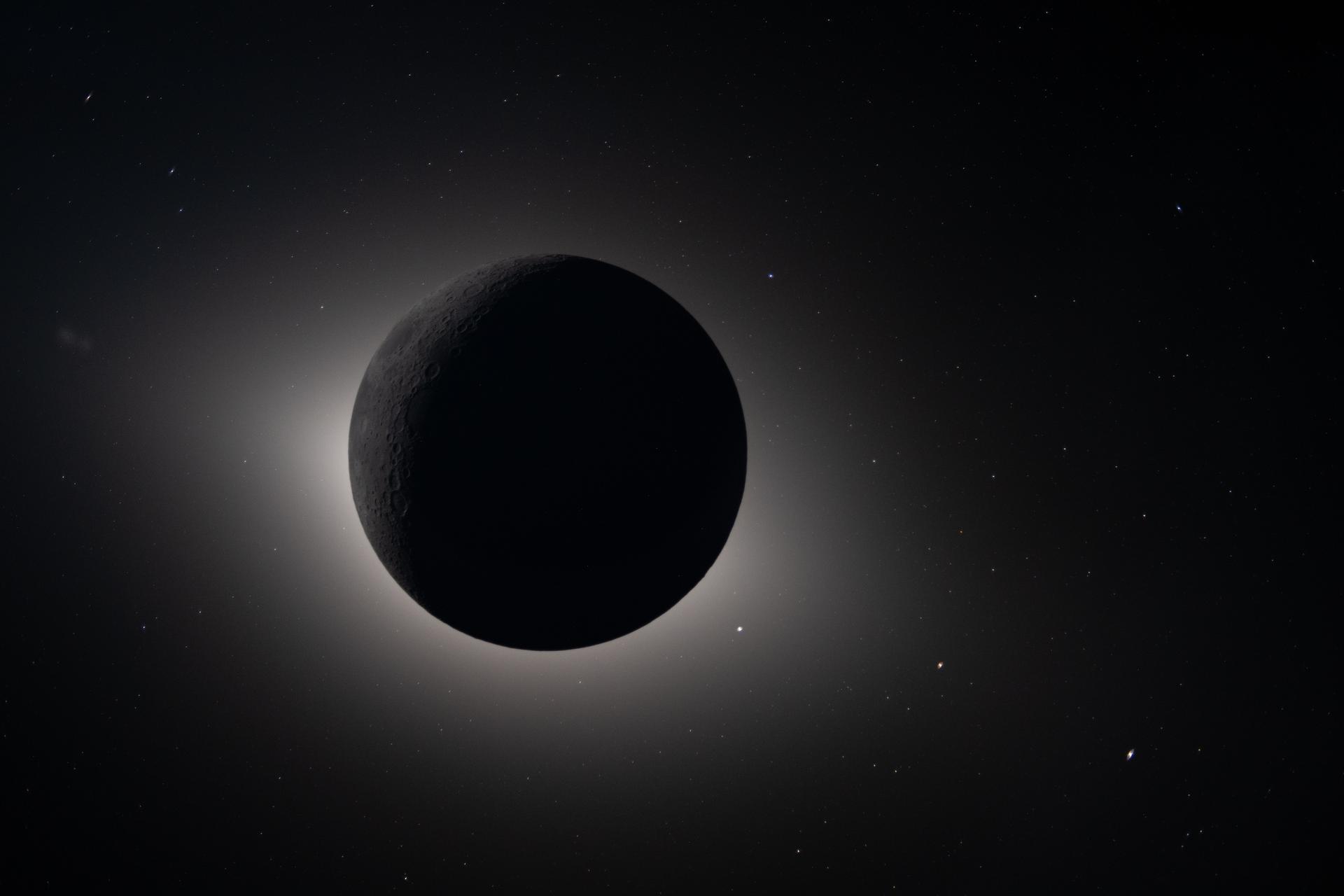
art002e009301 (April 6, 2026) – Captured by the Artemis II crew during their lunar flyby on April 6, 2026, this image shows the Moon fully eclipsing the Sun. From the crew’s perspective, the Moon appears large enough to completely block the Sun, creating nearly 54 minutes of totality and extending the view far beyond what is possible from Earth. We see a glowing halo around the dark lunar disk. The science community is investigating whether this effect is due to the corona, zodiacal light, or a combination of the two. Also visible are stars, typically too faint to see when imaging the Moon, but with the Moon in darkness stars are readily imaged. This unique vantage point provides both a striking visual and a valuable opportunity for astronauts to document their observations during humanity’s return to deep space. The faint glow of the nearside of the Moon is visible in this image, having been illuminated by light reflected off the Earth.
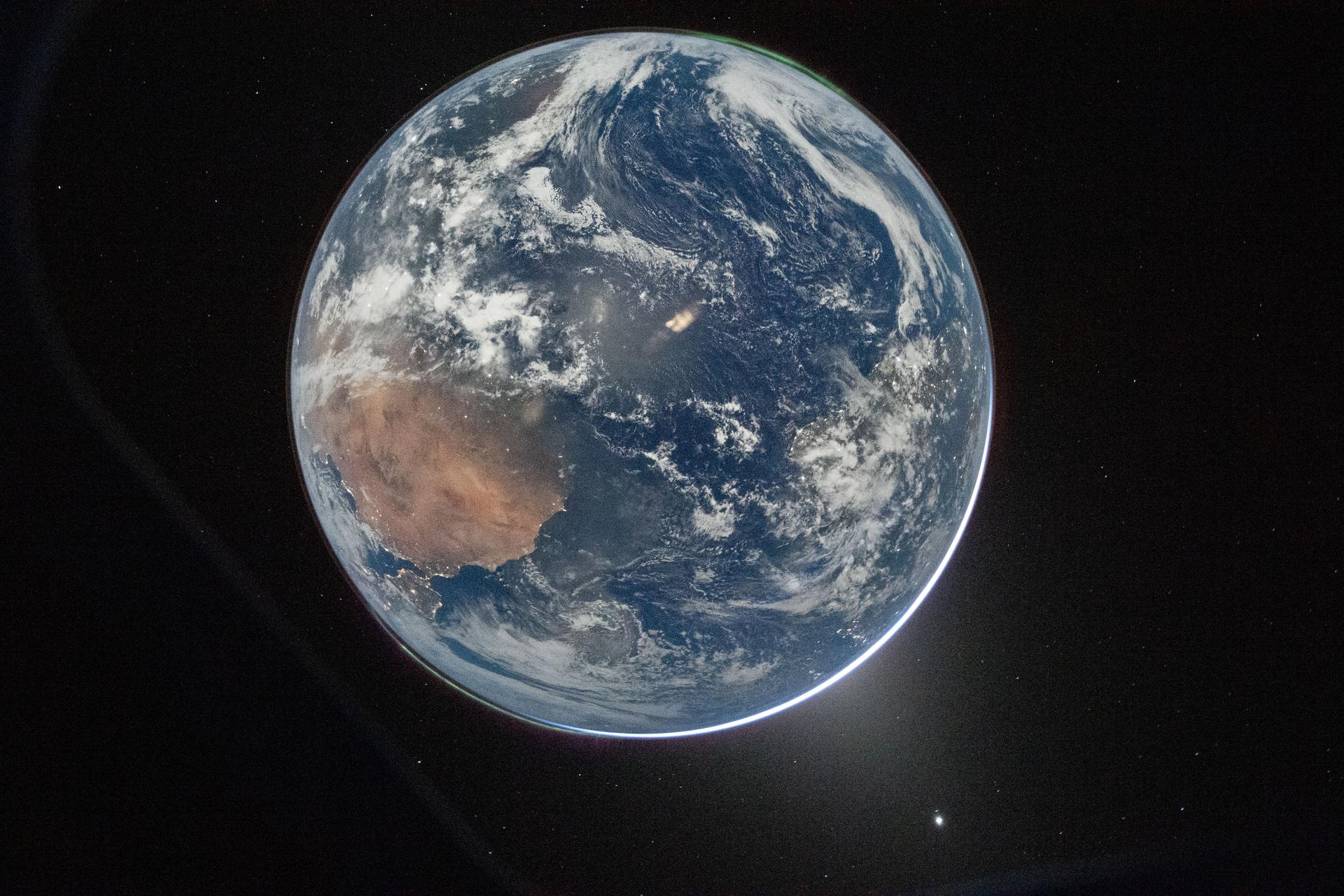
art002e000192 (April 3, 2026) - This nighttime picture of Earth was taken on April 2, 2026, by an Artemis II crew member aiming a camera through a window of the Orion spacecraft. The image was captured after Orion completed its translunar injection burn, the critical maneuver that sent the spacecraft on its path toward the Moon and back. The visible hemisphere appears awash in sunlight, but it is actually lit by moonlight — sunlight reflected from the lunar surface. Along the upper left (south) and lower right (north) edges of Earth’s disk, green auroras glow against the dark sky, showing charged particles from the Sun interacting with gases in Earth’s atmosphere. Africa is visible on the left, while a translucent cone of light capped by a bright Venus extends into space from Earth’s lower right edge. This zodiacal light is caused by sunlight reflecting off interplanetary dust. A thin white crescent along the lower right edge of Earth marks the planet’s daytime atmosphere illuminated by the Sun, which lies on the opposite side of Earth from Orion’s perspective. City lights are also visible, especially along coastlines. Credits: NASA
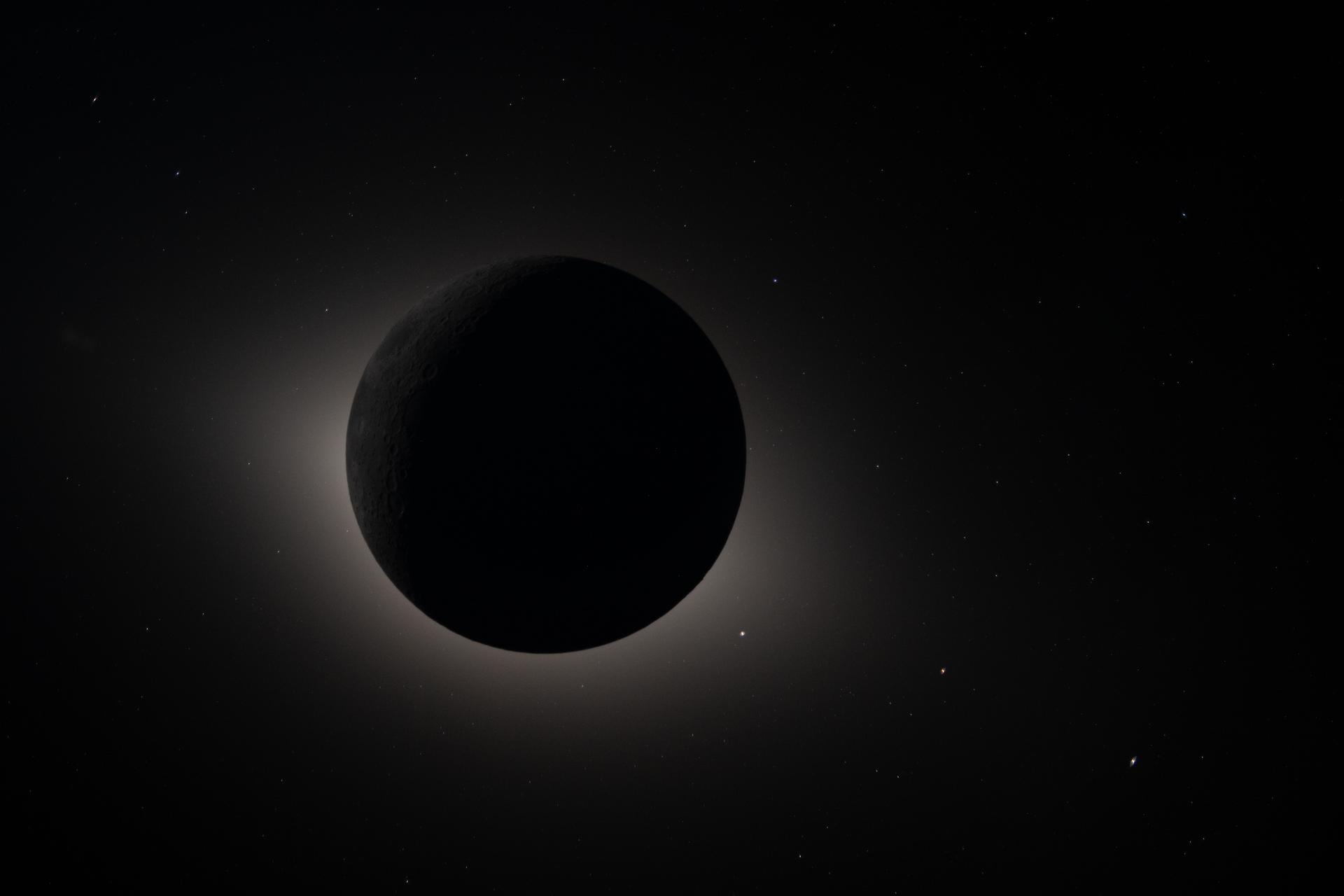
art002e015967 (April 6, 2026) - The Sun is eclipsed by the Moon in this April 6, 2026, image from NASA’s Orion. The glow around the Moon is called zodiacal light, which describes interplanetary dust that’s reflecting sunlight. Unlike minutes-long eclipses as viewed from Earth, the Artemis II crew saw the Sun hide behind the Moon for nearly an hour. Because the astronauts were so close to the Moon (4,067 miles at closest approach), the Moon appeared much larger than the Sun; because of this, it took longer for the Sun to make its transit across the Moon and peek out the other side. From Earth, the Moon and Sun appear about the same size, so even small changes in their alignment quickly bring the Sun back into view, making totality much shorter. The two bright spots to the right of the Moon are Saturn and Mars. Credit: NASA
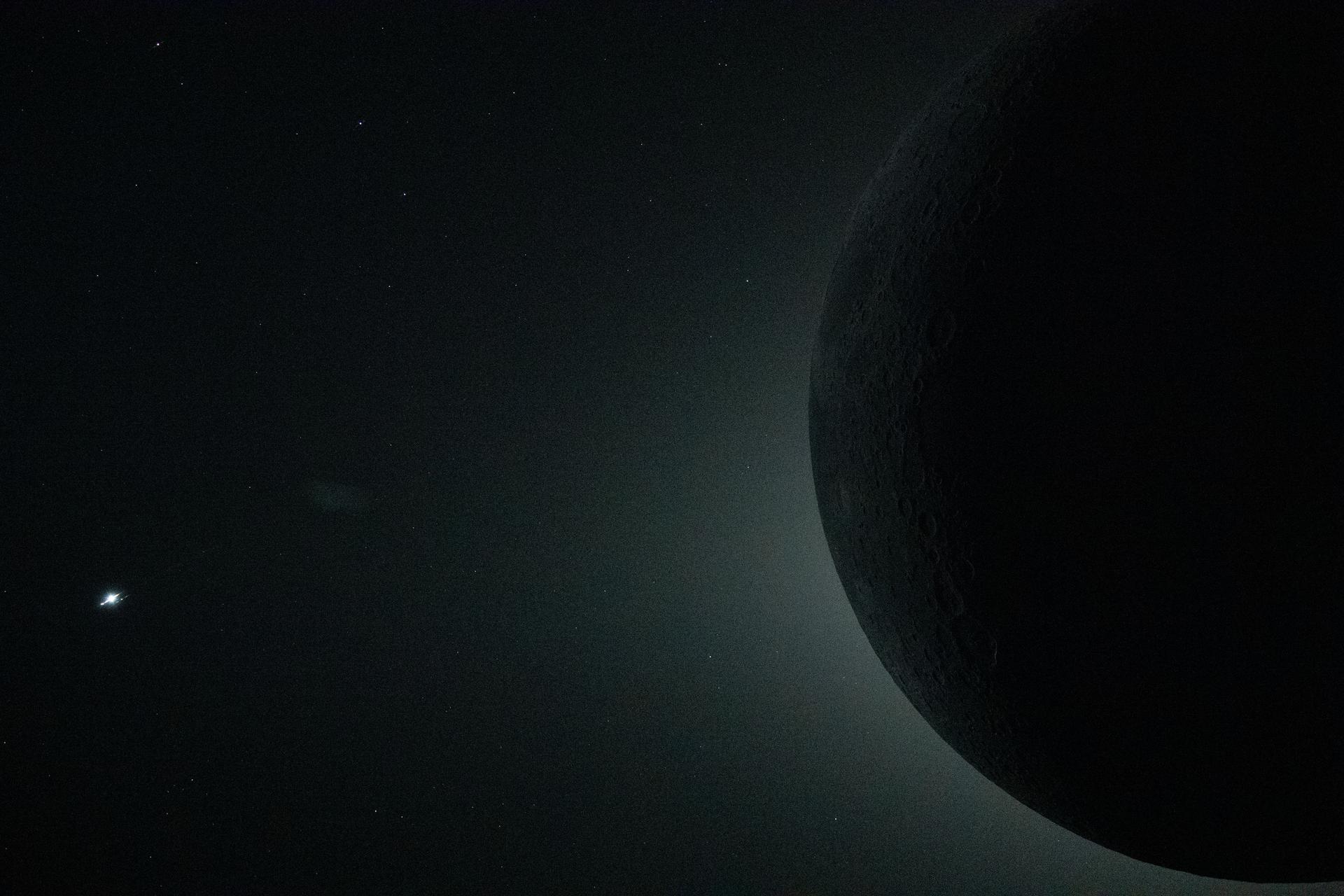
art002e009298 (April 6, 2026) – A close-up view from the Orion spacecraft during the Artemis II crew’s lunar flyby on April 6, 2026, captures a total solar eclipse, with only part of the Moon visible in the frame as it fully obscures the Sun. We see a glowing halo around the dark lunar disk. The science community is investigating whether this effect is due to the corona, zodiacal light, or a combination of the two. From this deep-space vantage point, the Moon appeared large enough to sustain nearly 54 minutes of totality, far longer than total solar eclipses typically seen from Earth. The bright silver glint on the left edge of the image is the planet Venus. The round, dark gray feature visible along the Moon’s horizon between the 9 and 10 o’clock positions is Mare Crisium, a feature visible from Earth. We see faint lunar features because light reflected off of Earth provides a source of illumination.
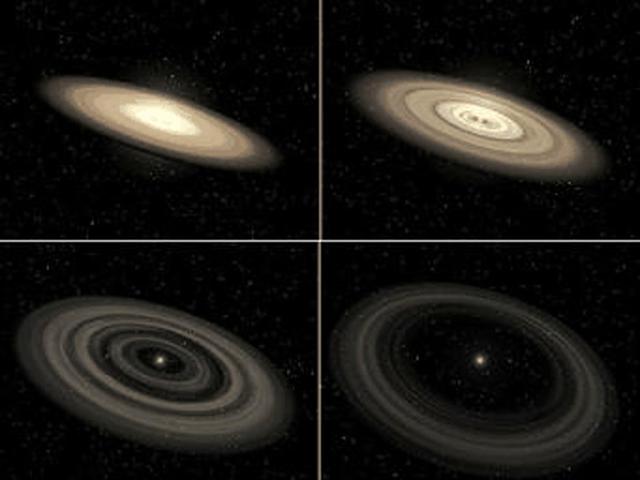
This frame from an animation shows the evolution of a planet-forming disk around a star. Initially, the young disk is bright and thick with dust, providing raw materials for building planets. In the first 10 million years or so, gaps appear within the disk as newborn planets coalesce out of the dust, clearing out a path. In time, this planetary "debris disk" thins out as gravitational interactions with numerous planets slowly sweep away the dust. Steady pressure from the starlight and solar winds also blows out the dust. After a few billion years, only a thin ring remains in the outermost reaches of the system, a faint echo of the once-brilliant disk. Our own solar system has a similar debris disk -- a ring of comets called the Kuiper Belt. Leftover dust in the inner portion of the solar system is known as "zodiacal dust." Bright, young disks can be imaged directly by visible-light telescopes, such as NASA's Hubble Space Telescope. Older, fainter debris disks can be detected only by infrared telescopes like NASA's Spitzer Space Telescope, which sense the disks' dim heat. http://photojournal.jpl.nasa.gov/catalog/PIA07099
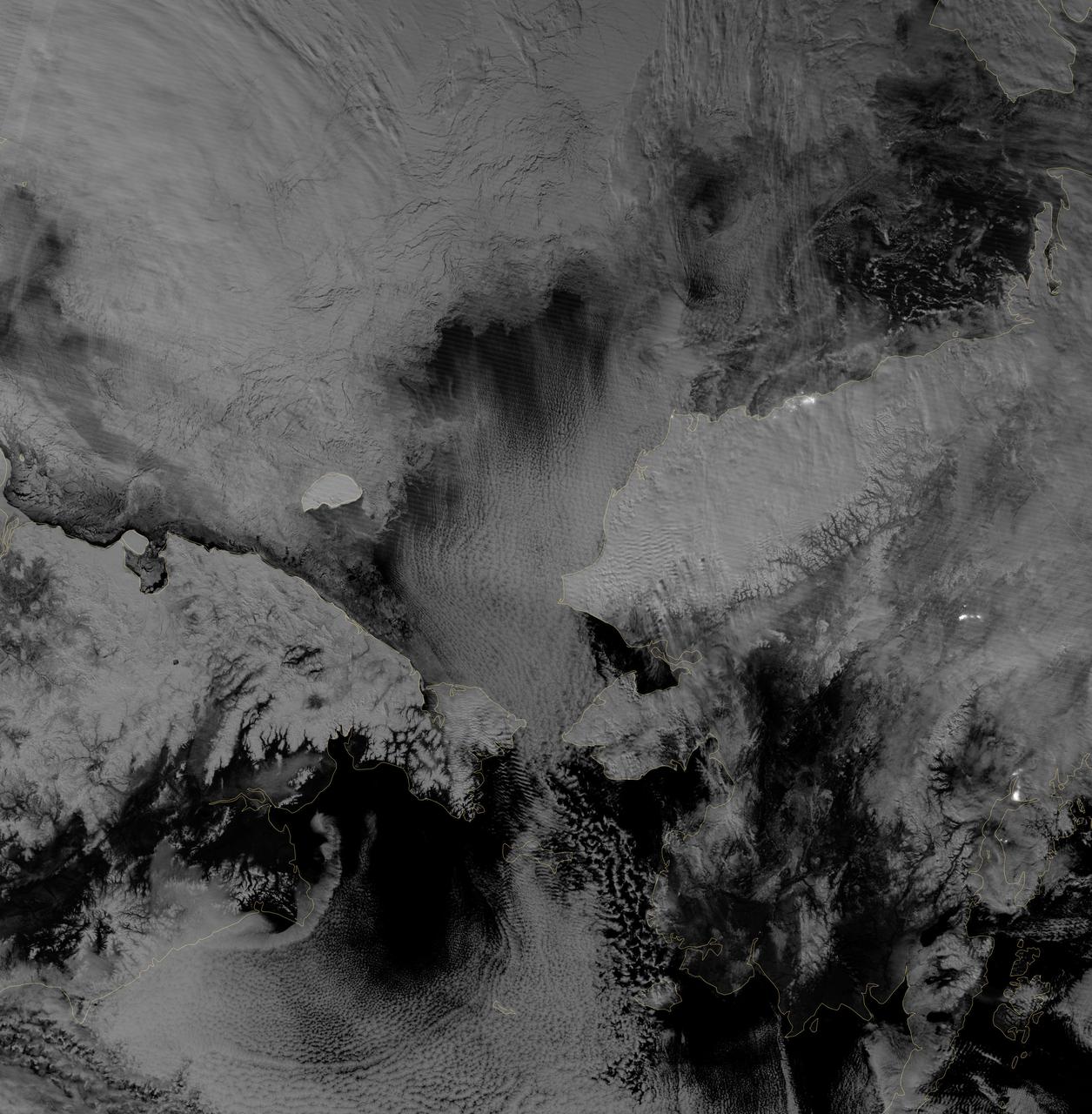
Image acquired October 30, 2012 Scientists watched the Arctic with particular interest in the summer of 2012, when Arctic sea ice set a new record low. The behavior of sea ice following such a low extent also interests scientists, but as Arctic sea ice was advancing in the autumn of 2012, so was polar darkness. Fortunately, the Visible Infrared Imaging Radiometer Suite (VIIRS) on the Suomi NPP satellite can see in the dark. The VIIRS “day-night band” detects light in a range of wavelengths from green to near-infrared and uses filtering techniques to observe signals such as gas flares, auroras, wildfires, city lights, and reflected moonlight. VIIRS acquired this nighttime view of sea ice north of Russia and Alaska on October 30, 2012. The day-night band takes advantage of moonlight, airglow (the atmosphere’s self-illumination through chemical reactions), zodiacal light (sunlight scattered by interplanetary dust), and starlight from the Milky Way. By using these dim light sources, the day-night band can detect changes in clouds, snow cover, and sea ice. The VIIRS day-night band offers a unique perspective because once polar night has descended, satellite sensors relying on visible light can no longer produce photo-like images. And although passive microwave sensors can monitor sea ice through the winter, they offer much lower resolution. Steve Miller of the Cooperative Institute for Research in the Atmosphere at Colorado State University has used the day-night band to study nighttime behavior of weather systems and sees advantages in studying the polar regions. “There’s a lot of use with these measurements as we look back at a season of record ice melt in the Arctic,” Miller says. “We can observe areas where there is ice melt and reformation, where there’s clear water and ships can pass through—especially as the ‘great darkness’ approaches with winter.” Ted Scambos of the National Snow and Ice Data Center at the University of Colorado concurs. “Things start changing rapidly in the late fall: sea ice formation and snow cover extent at the highest latitudes. This lets us see rapid-growth areas in detail.” The day-night band is also useful for following weather systems, including severe storms, which can develop and strike populous areas at night as well as day. Geostationary Operational Environmental Satellites orbit the Earth’s equator. The satellites offer uninterrupted observations of North America, but high-latitude areas such as Alaska may benefit more from polar-orbiting satellites. Miller explains, “In the high latitudes, the orbits begin to overlap considerably, which gives you a lot more passes in Alaska. If you start to look at multiple passes and stitch them together, you can get a version of a poor man’s geostationary time loop of the weather.” Day-night band imagery at high latitudes has already proven useful for tracking rapid ice movement and diagnosing Gulf of Alaska circulations. The day-night band is even useful at tracking ship movement at high latitudes. NASA Earth Observatory image by Jesse Allen and Robert Simmon, using VIIRS Day-Night Band data from the Suomi National Polar-orbiting Partnership. Suomi NPP is the result of a partnership between NASA, the National Oceanic and Atmospheric Administration, and the Department of Defense. Caption by Michon Scott. Instrument: Suomi NPP - VIIRS Credit: <b><a href="http://www.earthobservatory.nasa.gov/" rel="nofollow"> NASA Earth Observatory</a></b> <b>Click here to view all of the <a href="http://earthobservatory.nasa.gov/Features/NightLights/" rel="nofollow"> Earth at Night 2012 images </a></b> <b>Click here to <a href="http://earthobservatory.nasa.gov/NaturalHazards/view.php?id=79825" rel="nofollow"> read more </a> about this image </b> <b><a href="http://www.nasa.gov/audience/formedia/features/MP_Photo_Guidelines.html" rel="nofollow">NASA image use policy.</a></b> <b><a href="http://www.nasa.gov/centers/goddard/home/index.html" rel="nofollow">NASA Goddard Space Flight Center</a></b> enables NASA