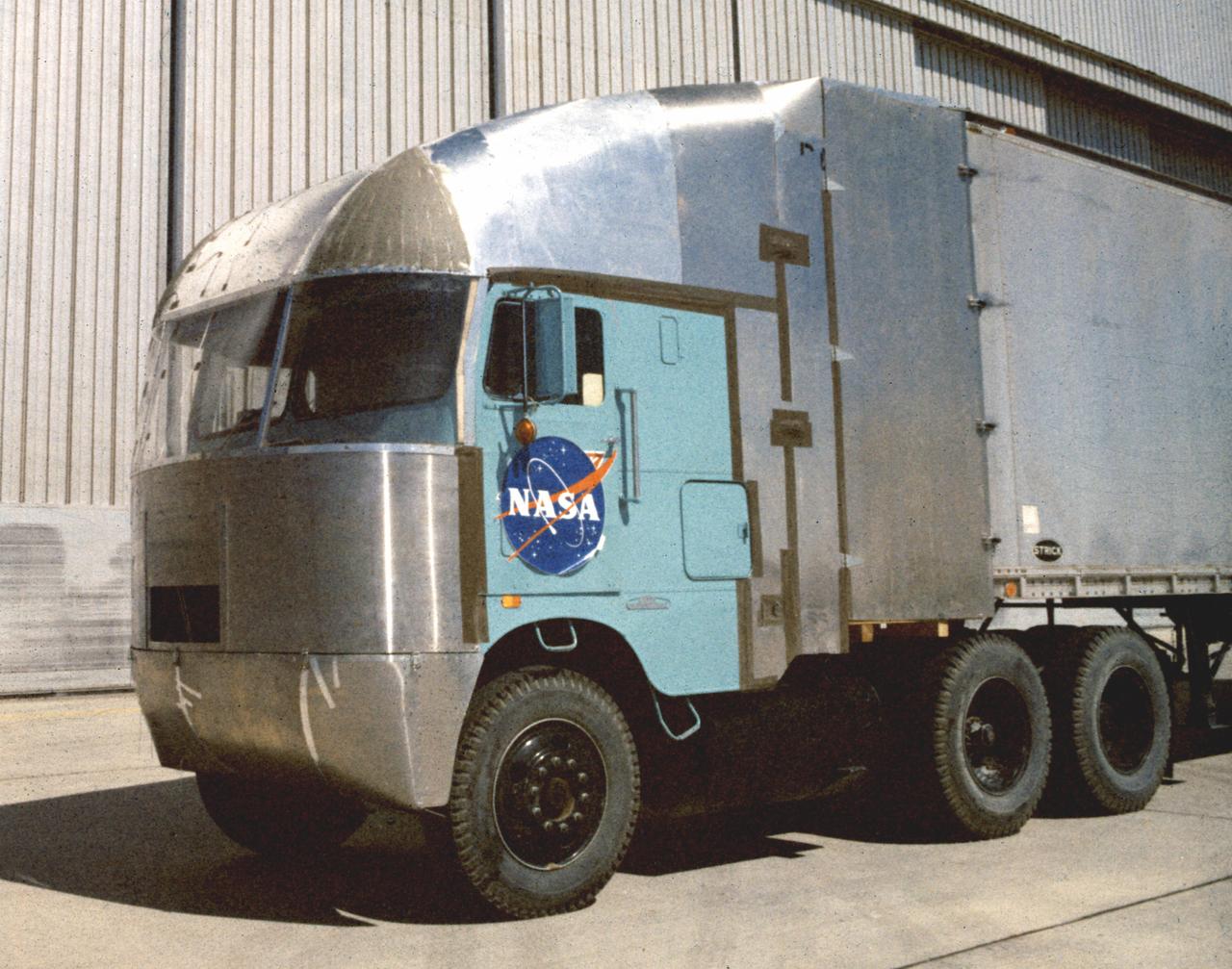
Air flow testing on aerodynamic truck
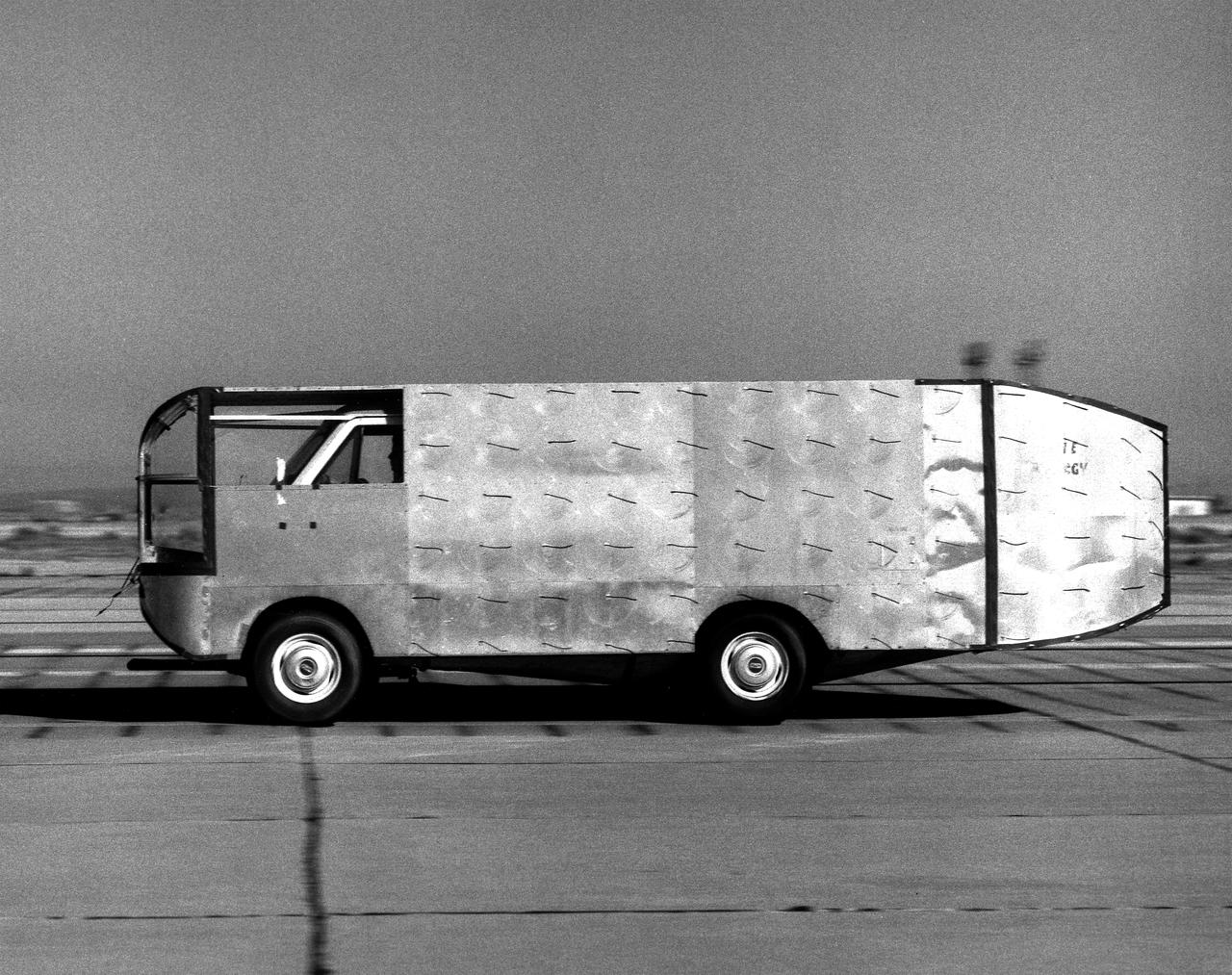
Air flow testing on aerodynamic truck
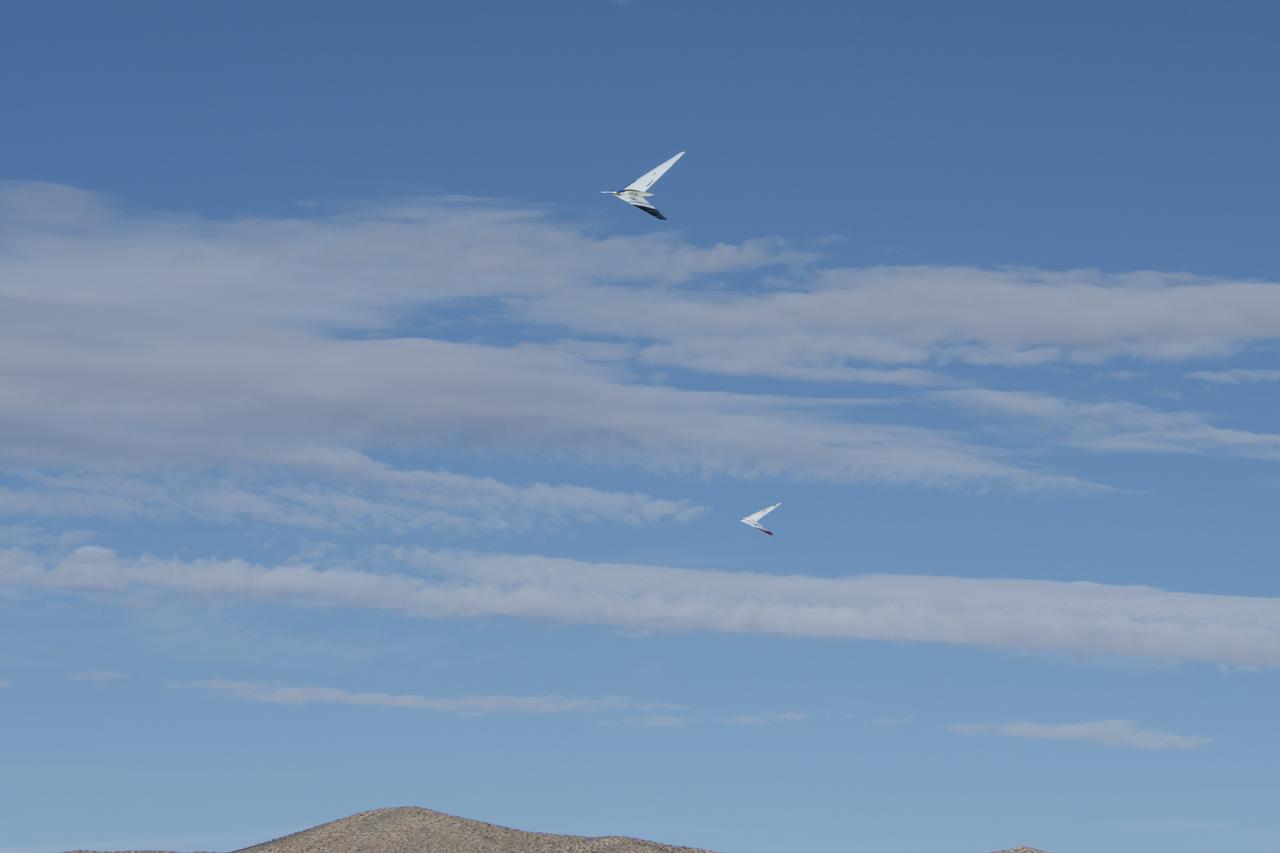
NASA Armstrong Flight Research Center conducted its first formation flight with the Preliminary Research Aerodynamic Design to Lower Drag (Prandtl) aircrafts Prandtl-D2 and Prandtl-3C.
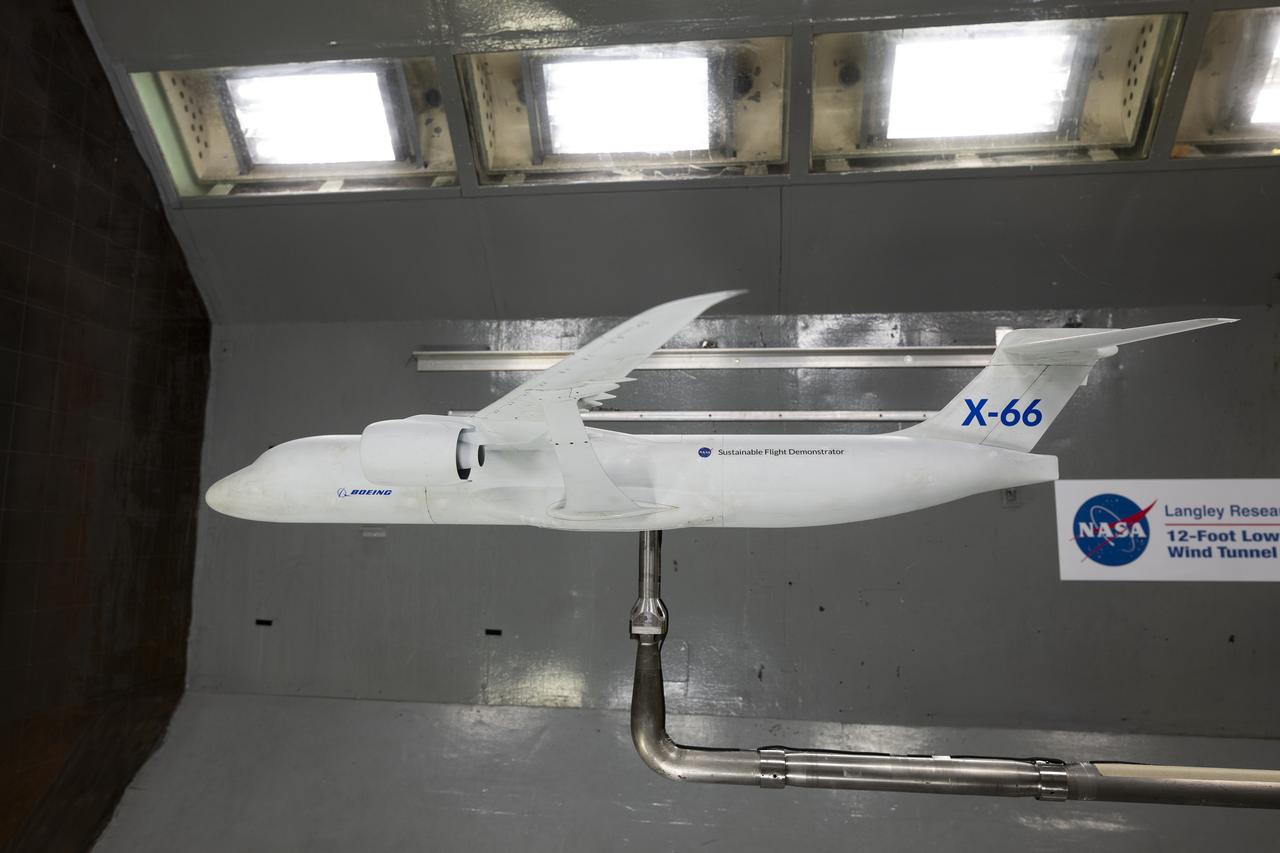
A model of the X-66 aircraft with a wingspan of almost 6 feet was placed in the 12-Foot Low-Speed Wind Tunnel at NASA’s Langley Research Center in Hampton, Virginia on October 30, 2024. During the tests, the team captured measurements of forces such as lift and drag over many aerodynamic configurations and flight conditions.
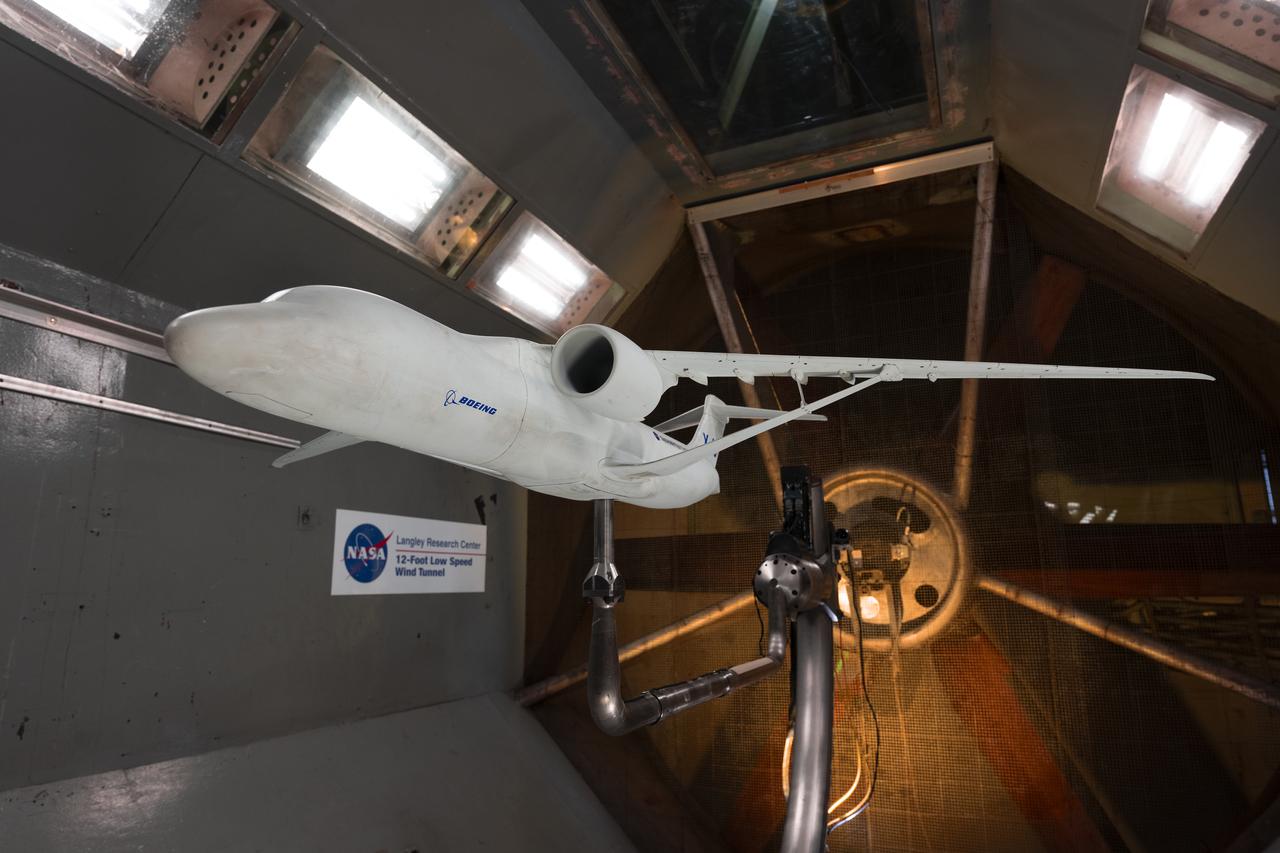
A model of the X-66 aircraft with a wingspan of almost 6 feet was placed in the 12-Foot Low-Speed Wind Tunnel at NASA’s Langley Research Center in Hampton, Virginia on October 30, 2024. During the tests, the team captured measurements of forces such as lift and drag over many aerodynamic configurations and flight conditions.
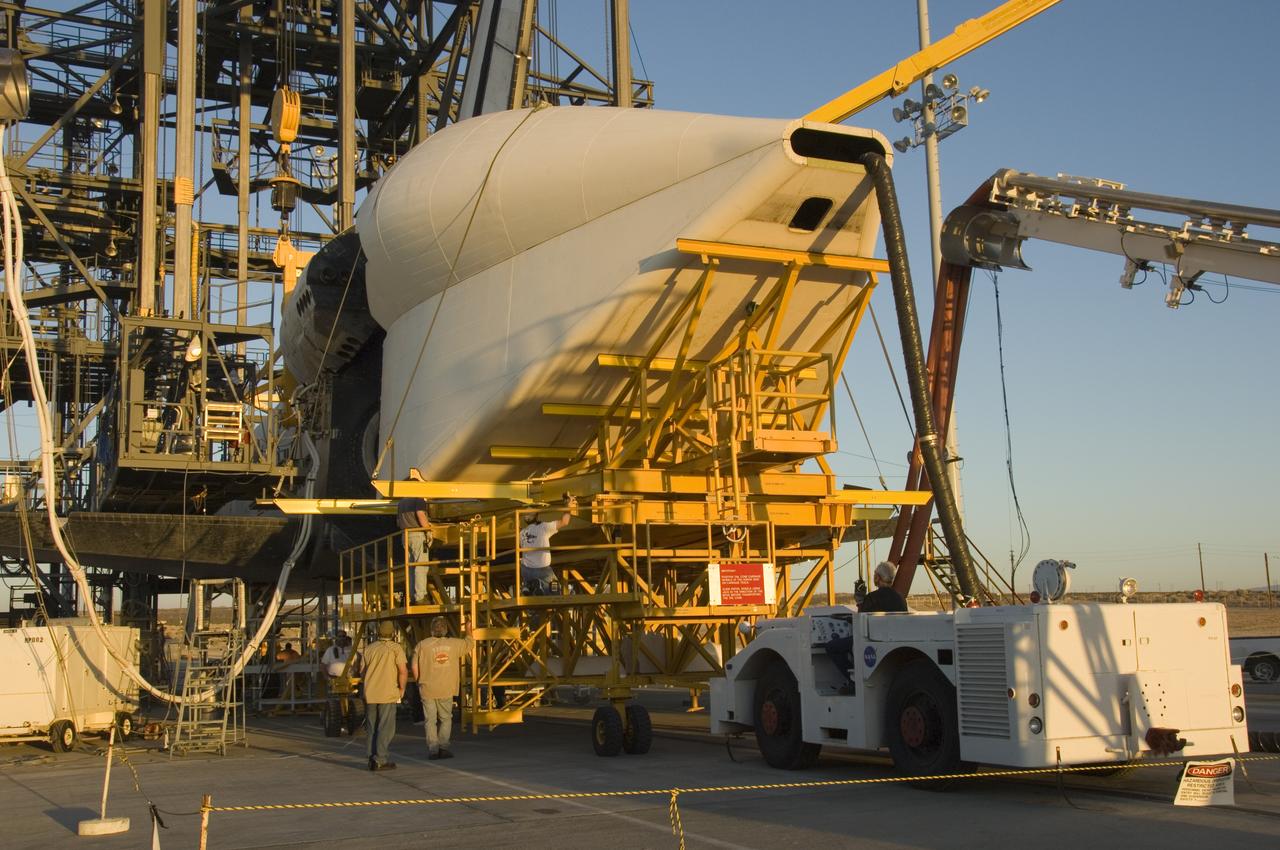
Technicians attach the tail cone, which helps reduce aerodynamic drag and turbulence during its ferry flight, to the Space Shuttle Atlantis in preparation for its return to NASA's Kennedy Space Center in Florida. After the tail-cone is installed, Discovery will be mounted on NASA's modified Boeing 747 Shuttle Carrier Aircraft, or SCA, for the return flight.
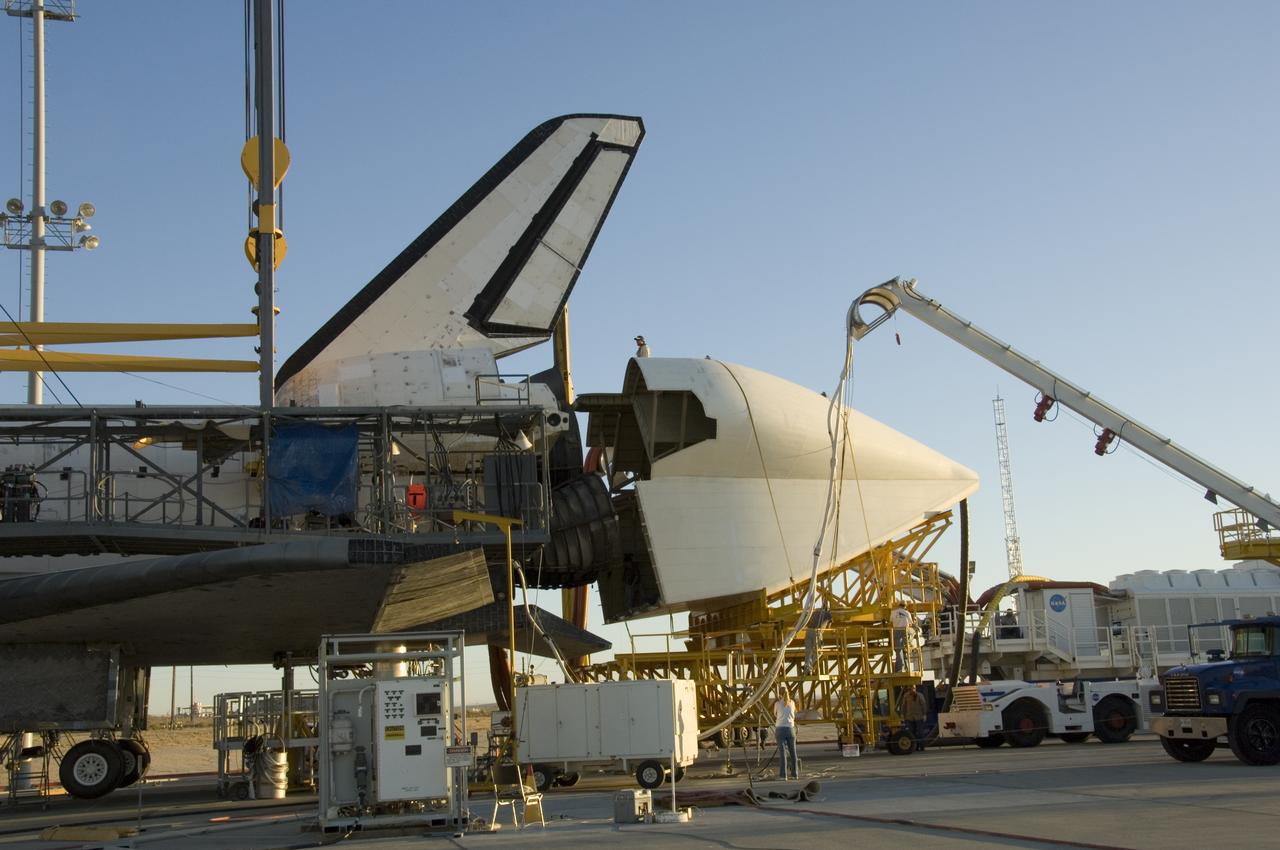
Technicians attach the tail cone, which helps reduce aerodynamic drag and turbulence during its ferry flight, to the Space Shuttle Atlantis in preparation for its return to NASA's Kennedy Space Center in Florida. After the tail-cone is installed, Discovery will be mounted on NASA's modified Boeing 747 Shuttle Carrier Aircraft, or SCA, for the return flight.
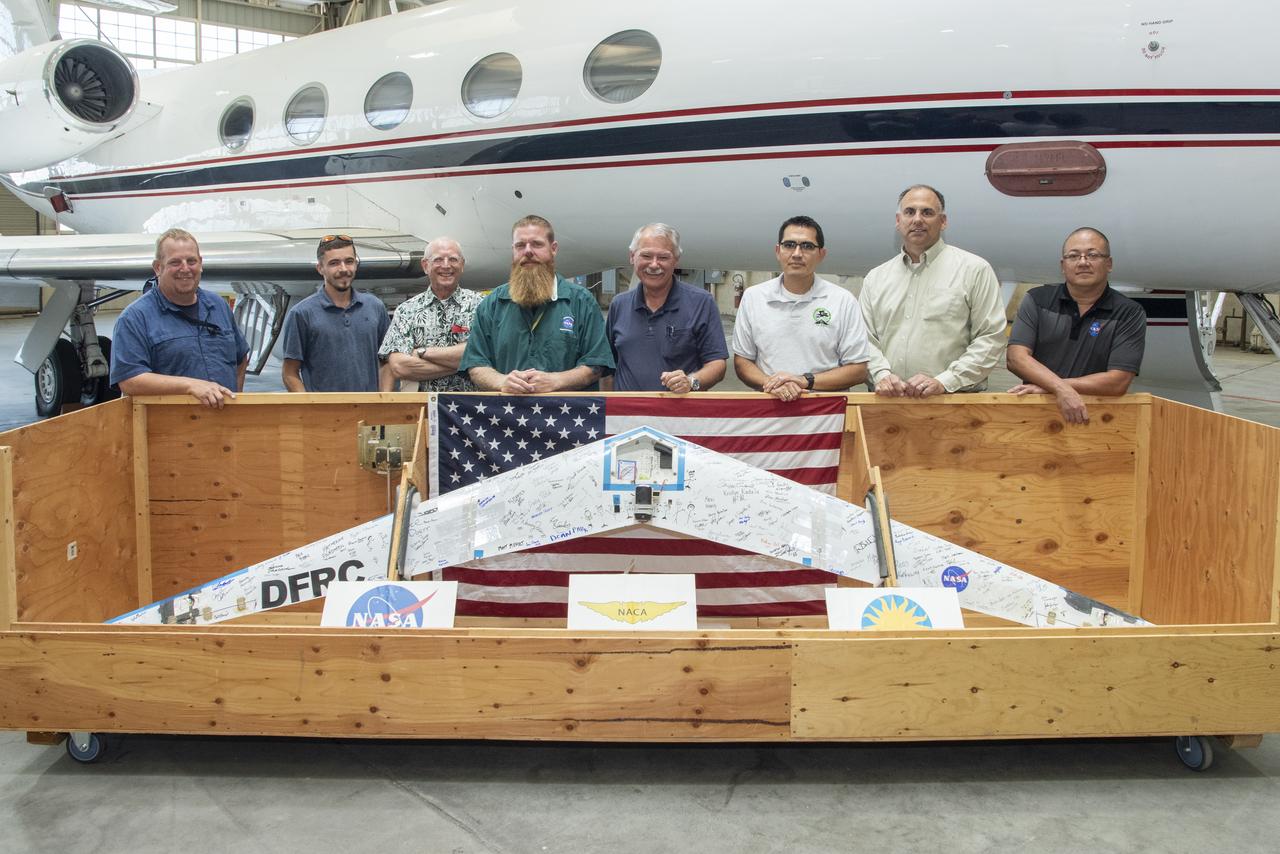
Preliminary Research Aerodynamic Design to Lower Drag, or Prandtl-D1, will be displayed in an upcoming Innovations Gallery at the National Air and Space Museum, the Smithsonian Institute. The aircraft, which flew from NASA's Armstrong Flight Research Center in California, uses a method of aircraft design that introduces a twist that results in a more efficient wing. From left are Robert "Red" Jensen, Logan Shaw, Christian Gelzer, Justin Hall, Al Bowers, Oscar Murillo, Brian Eslinger and Derek Abramson
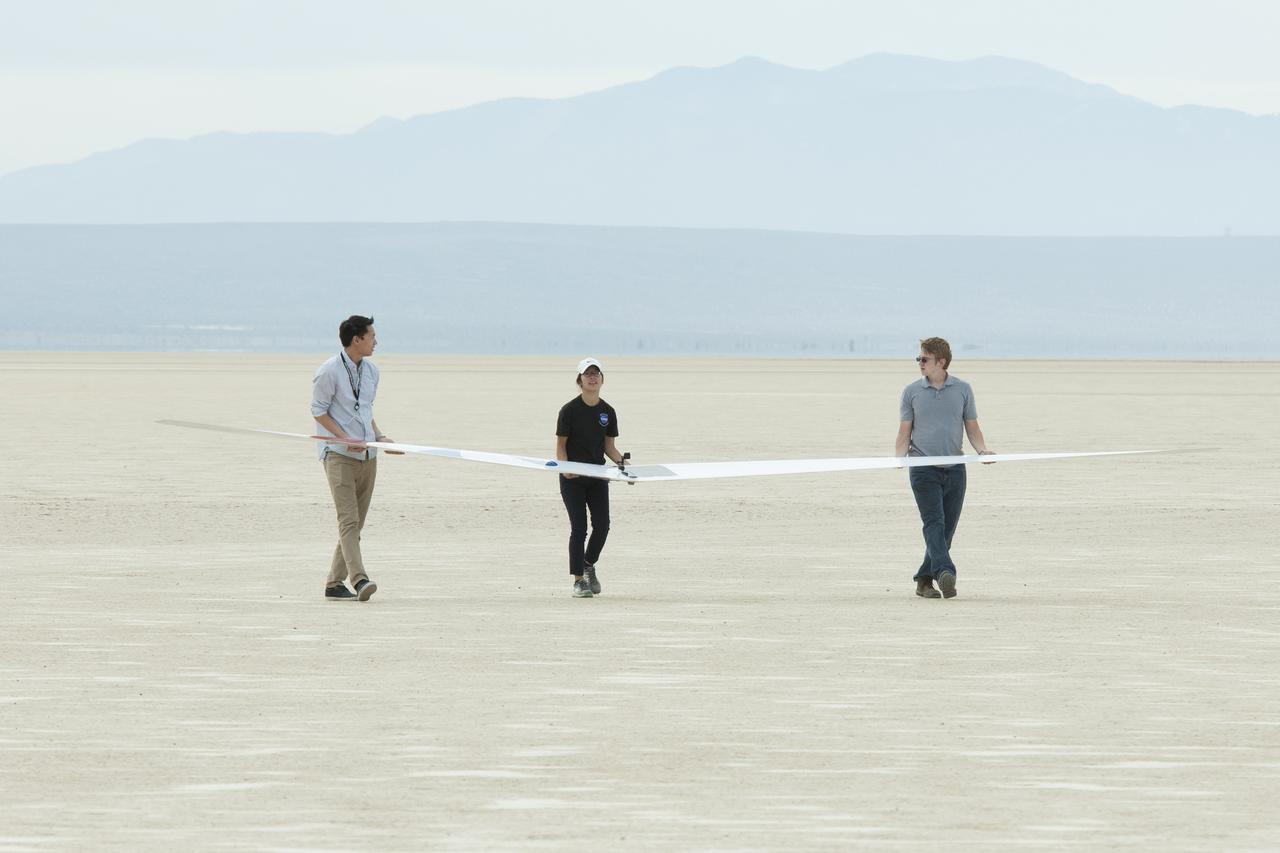
David Lee, Golda Nguyen and Scott Gleason recover the Prandtl-D No. 3 after one of its first flights.
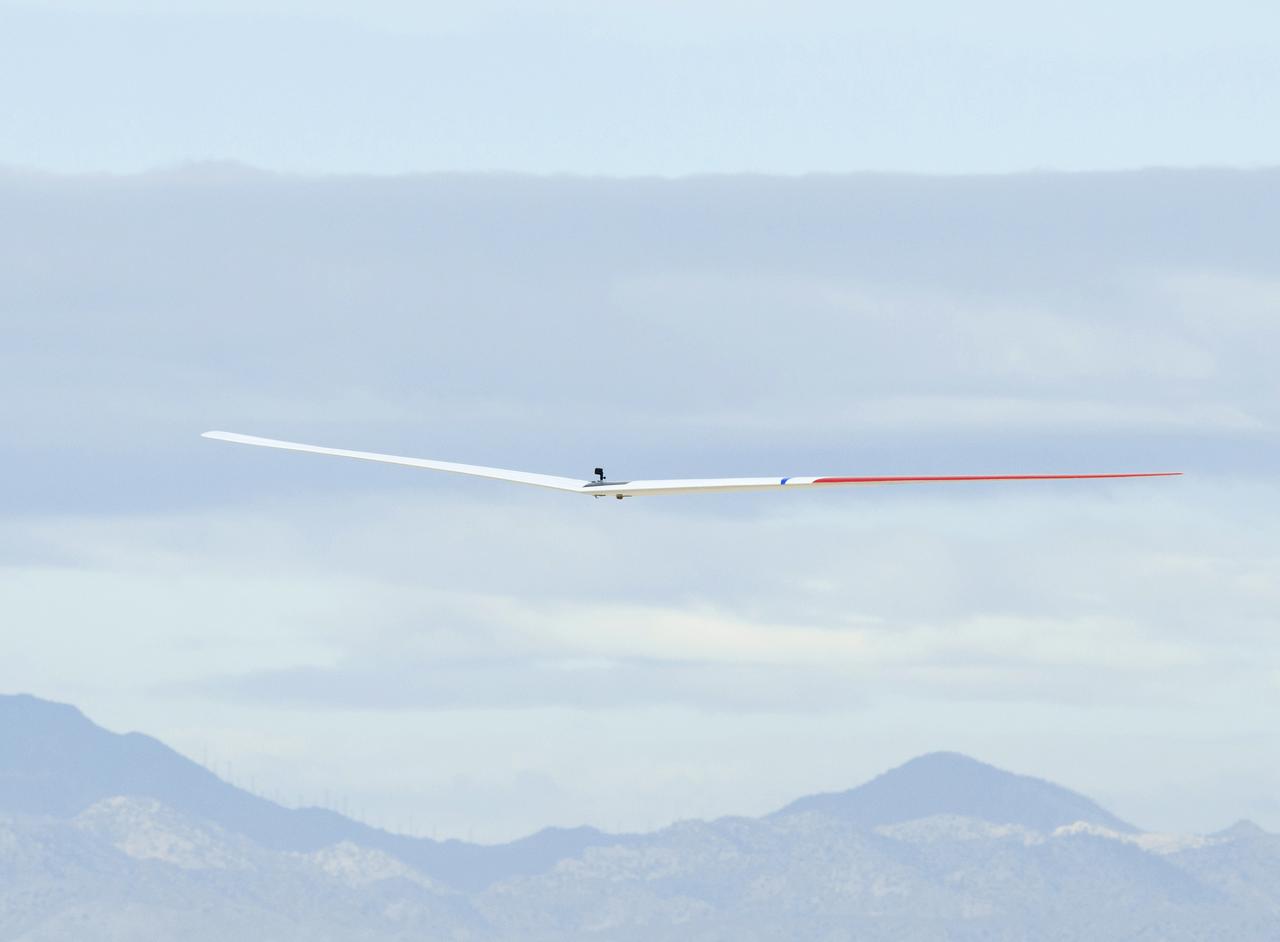
The Prandtl-D No. 3 research aircraft is being readied for new flight tests this summer. It had its first flight on Oct. 28, 2015.
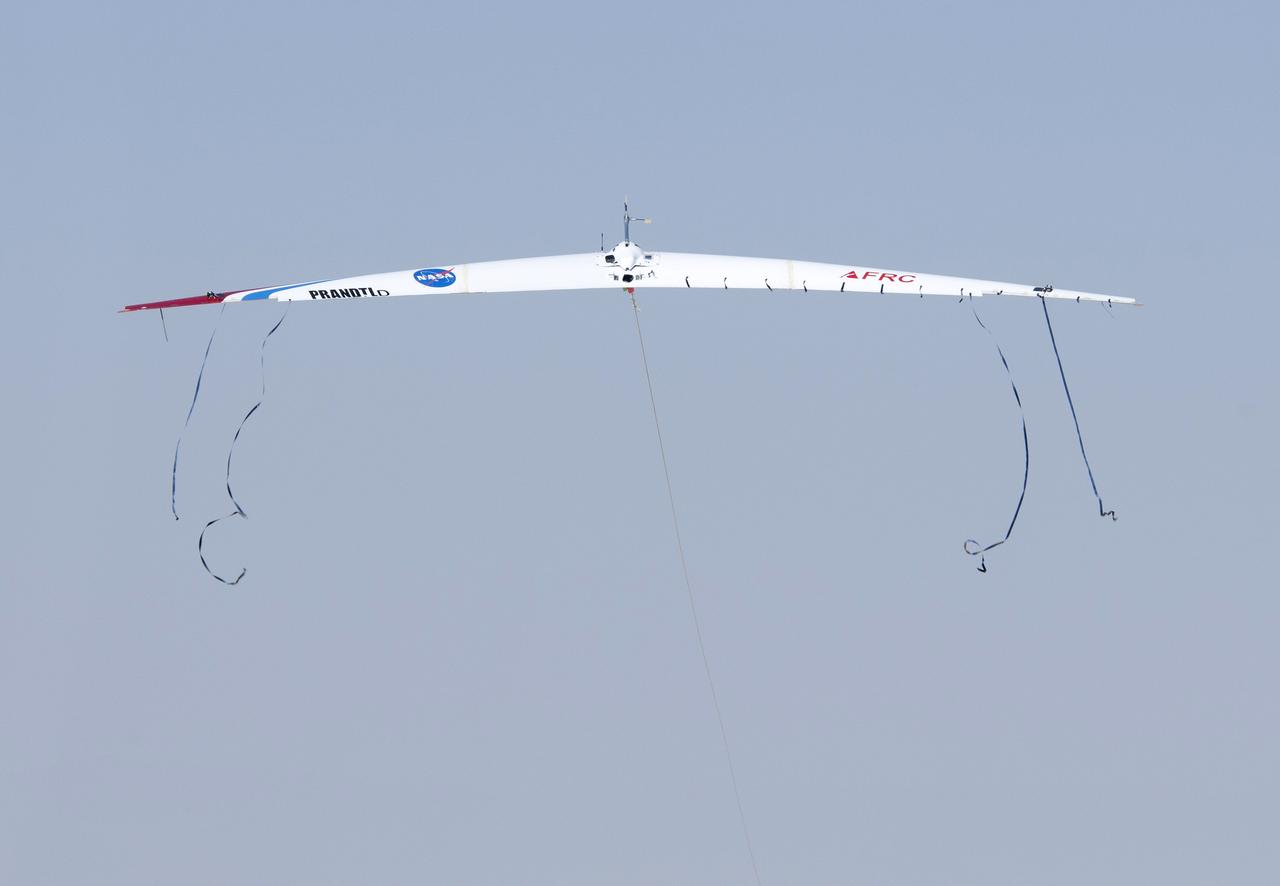
The streamers on the Prandtl-D No. 2 as it is launched illustrate how aerodynamic forces are maximized as birds overlap wingtips when flying in formation.
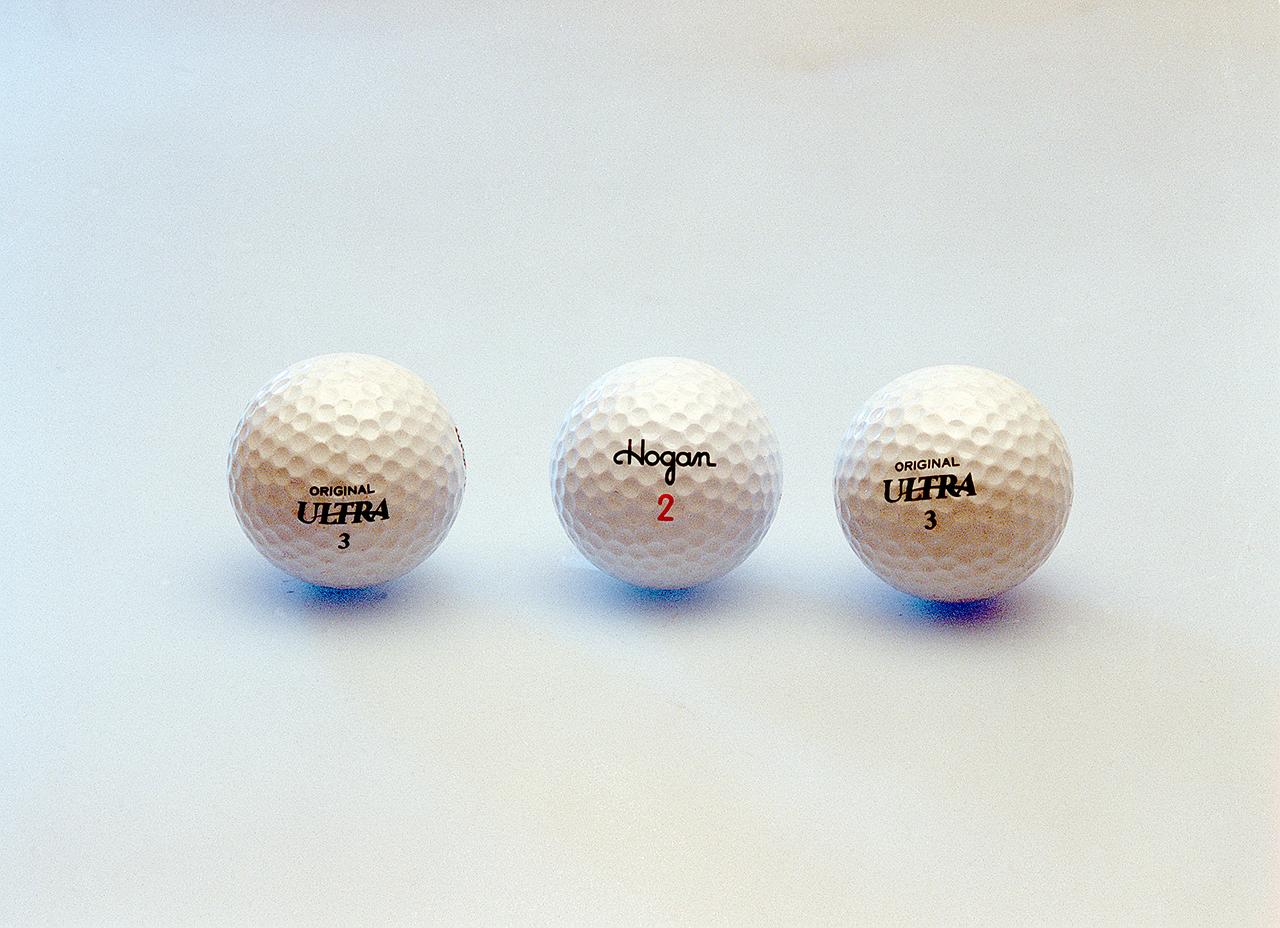
The Ultra 500 Series golf balls, introduced in 1995 by Wilson Sporting Goods Company, has 500 dimples arranged in a pattern of 60 spherical triangles. The design employs NASA's aerodynamics technology analysis of air loads of the tank and Shuttle orbiter that was performed under the Space Shuttle External Tank program. According to Wilson, this technology provides "the most symmetrical ball surface available, sustaining initial velocity longer and producing the most stable ball flight for unmatched accuracy and distance." The dimples are in three sizes, shapes and depths mathematically positioned for the best effect. The selection of dimples and their placement optimizes the interaction of opposing forces of lift and drag. Large dimples reduce air drag, enhance lift, and maintain spin for distance. Small dimples prevent excessive lift that destabilizes the ball flight and the medium size dimples blend the other two.
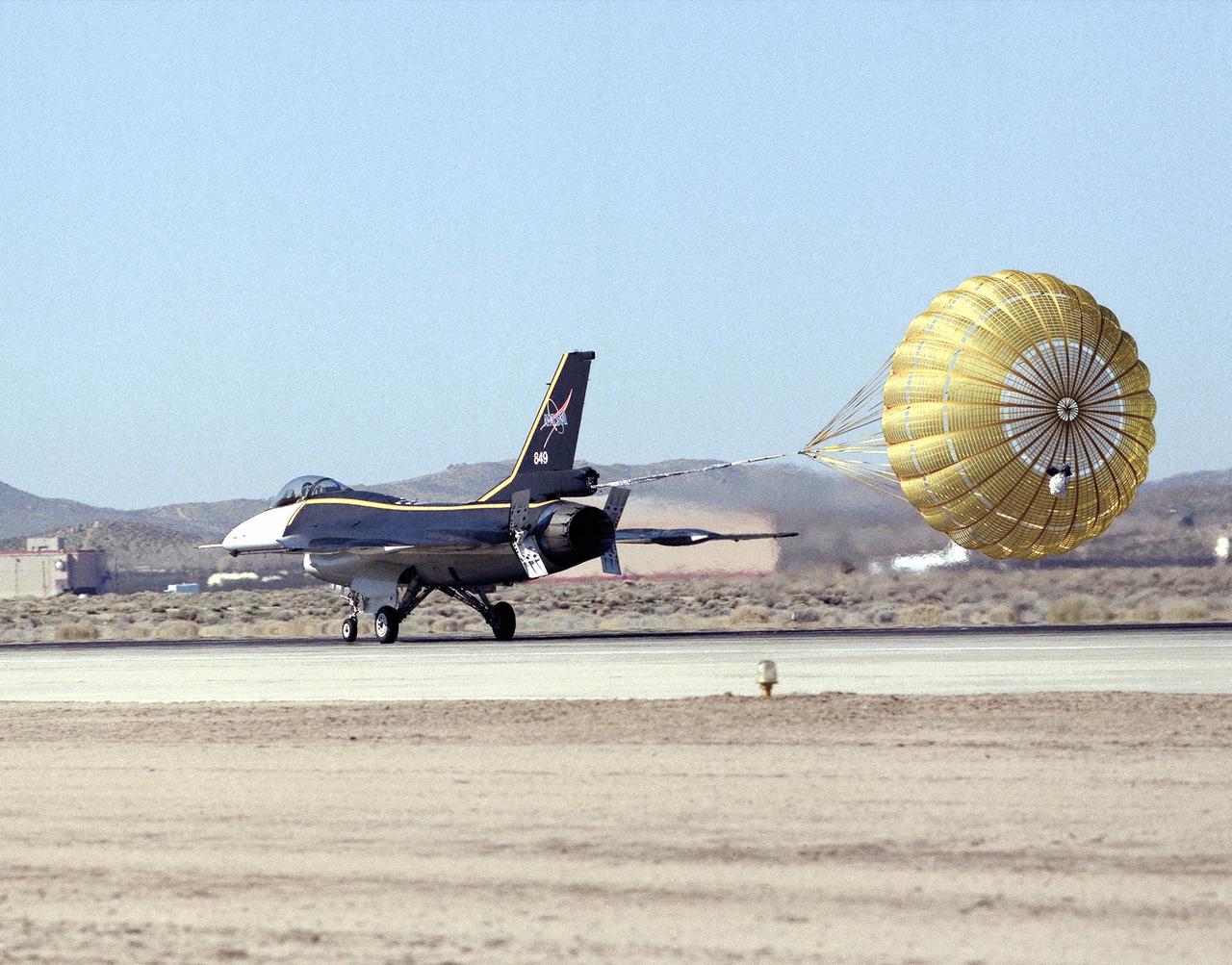
NASA's single-seat F-16XL makes a drag chute landing on the runway at Edwards Air Force Base in California's Mojave Desert. The aircraft was most recently used in the Cranked-Arrow Wing Aerodynamics Project (CAWAP) to test boundary layer pressures and distribution. Previously it had been used in a program to investigate the characteristics of sonic booms for NASA's High Speed Research Program. Data from the program will be used in the development of a high speed civilian transport. During the series of sonic boom research flights, the F-16XL was used to probe the shock waves being generated by a NASA SR-71 and record their shape and intensity.
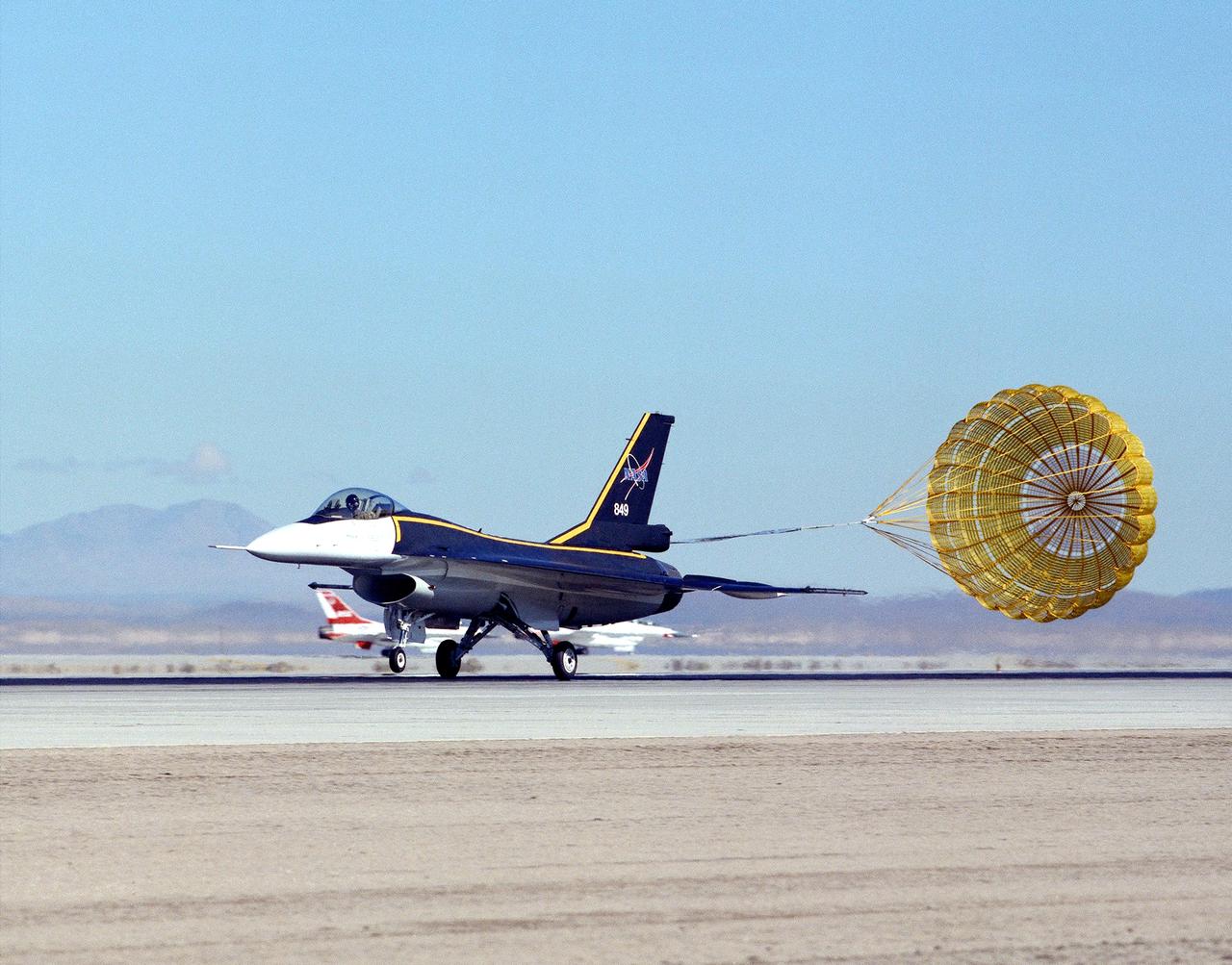
NASA's single-seat F-16XL makes a drag chute landing at the Dryden Flight Research Center, Edwards, California. The aircraft was most recently used in the Cranked-Arrow Wing Aerodynamics Project (CAWAP) to test boundary layer pressures and distribution. Previously it had been used in a program to investigate the characteristics of sonic booms for NASA's High Speed Research Program. Data from the program will be used in the development of a high speed civilian transport. During the series of sonic boom research flights, the F-16XL was used to probe the shock waves being generated by a NASA SR-71 and record their shape and intensity.
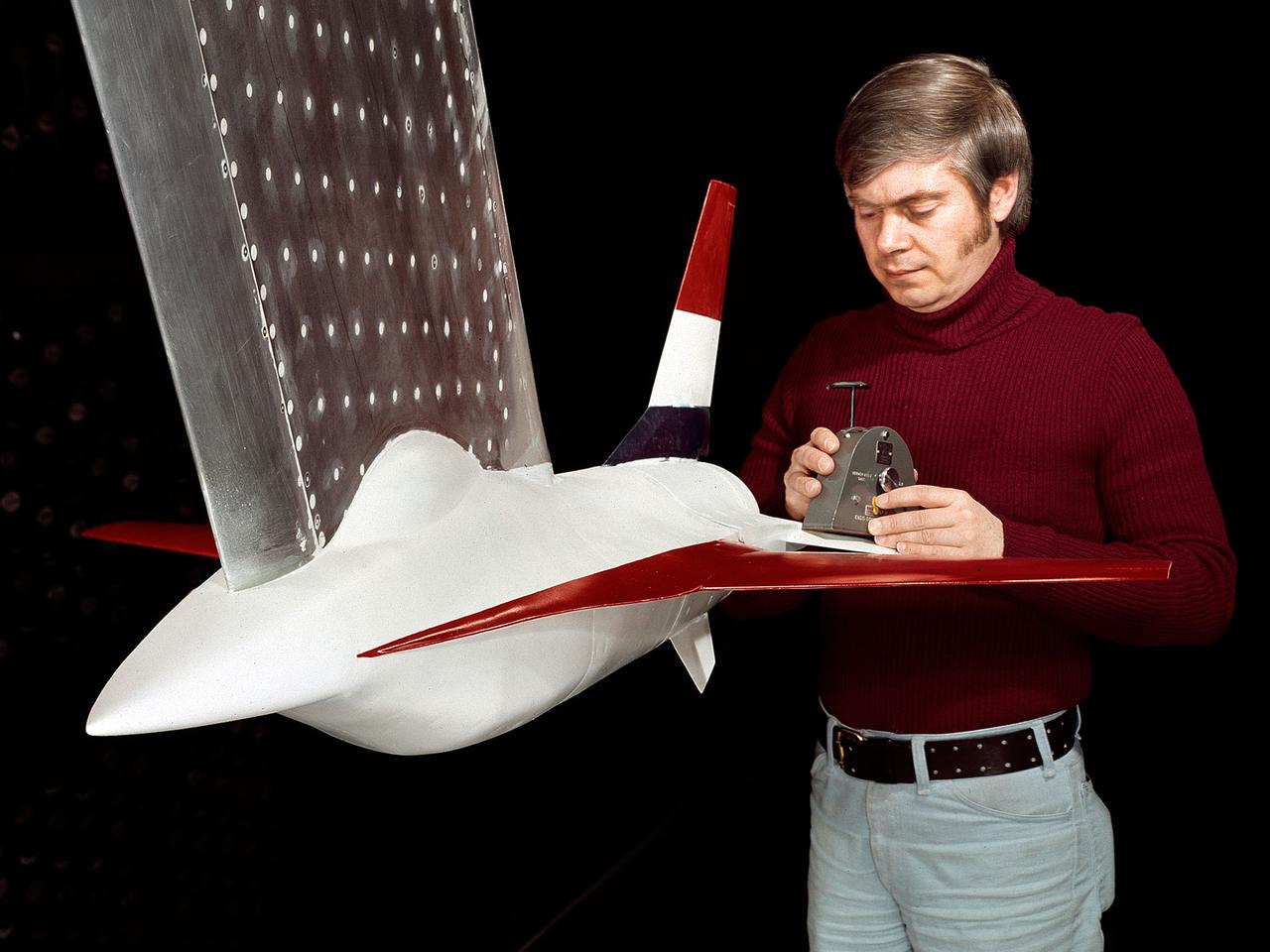
A model of the General Dynamics YF-16 Fighting Falcon in the test section of the 8- by 6-Foot Supersonic Wind Tunnel at the National Aeronautics and Space Administration (NASA) Lewis Research Center. The YF-16 was General Dynamics response to the military’s 1972 request for proposals to design a new 20,000-pound fighter jet with exceptional acceleration, turn rate, and range. The aircraft included innovative design elements to help pilots survive turns up to 9Gs, a new frameless bubble canopy, and a Pratt and Whitney 24,000-pound thrust F-100 engine. The YF-16 made its initial flight in February 1974, just six weeks before this photograph, at Edwards Air Force Base. Less than a year later, the Air Force ordered 650 of the aircraft, designated as F-16 Fighting Falcons. The March and April 1974 tests in the 8- by 6-foot tunnel analyzed the aircraft’s fixed-shroud ejector nozzle. The fixed-nozzle area limited drag, but also limited the nozzle’s internal performance. NASA researchers identified and assessed aerodynamic and aerodynamic-propulsion interaction uncertainties associated the prototype concept. YF-16 models were also tested extensively in the 11- by 11-Foot Transonic Wind Tunnel and 9- by 7-Foot Supersonic Wind Tunnel at Ames Research Center and the 12-Foot Pressure Wind Tunnel at Langley Research Center.
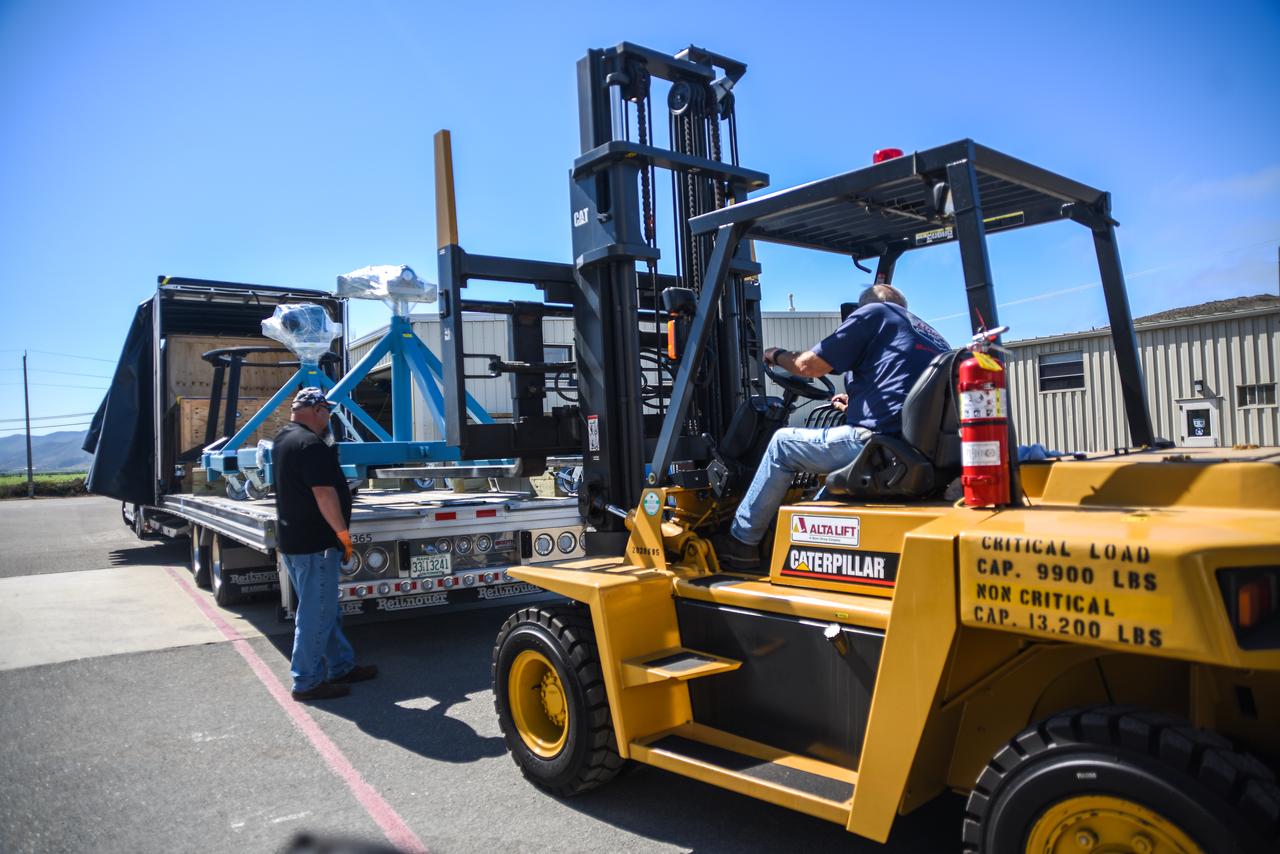
NASA’s Low-Earth Orbit Flight Test of an Inflatable Decelerator, or LOFTID, arrives by cargo truck at Vandenberg Space Force Base in California on Aug. 15, 2022. The technology demonstration mission will demonstrate inflatable heat shield technology that uses aerodynamic drag to slow down spacecraft in the most mass-efficient way. This technology could enable a variety of proposed NASA missions to destinations such as Mars, Venus, and Titan, as well as returning heavier payloads from low-Earth orbit. LOFTID is a rideshare launching with the National Oceanic and Atmospheric Administration’s (NOAA) Joint Polar Satellite System-2 (JPSS-2) satellite. NASA and NOAA are targeting Nov. 1 for the JPSS-2 launch on a United Launch Alliance (ULA) Atlas V 401 rocket from Space Launch Complex-3 at Vandenberg Space Force Base.
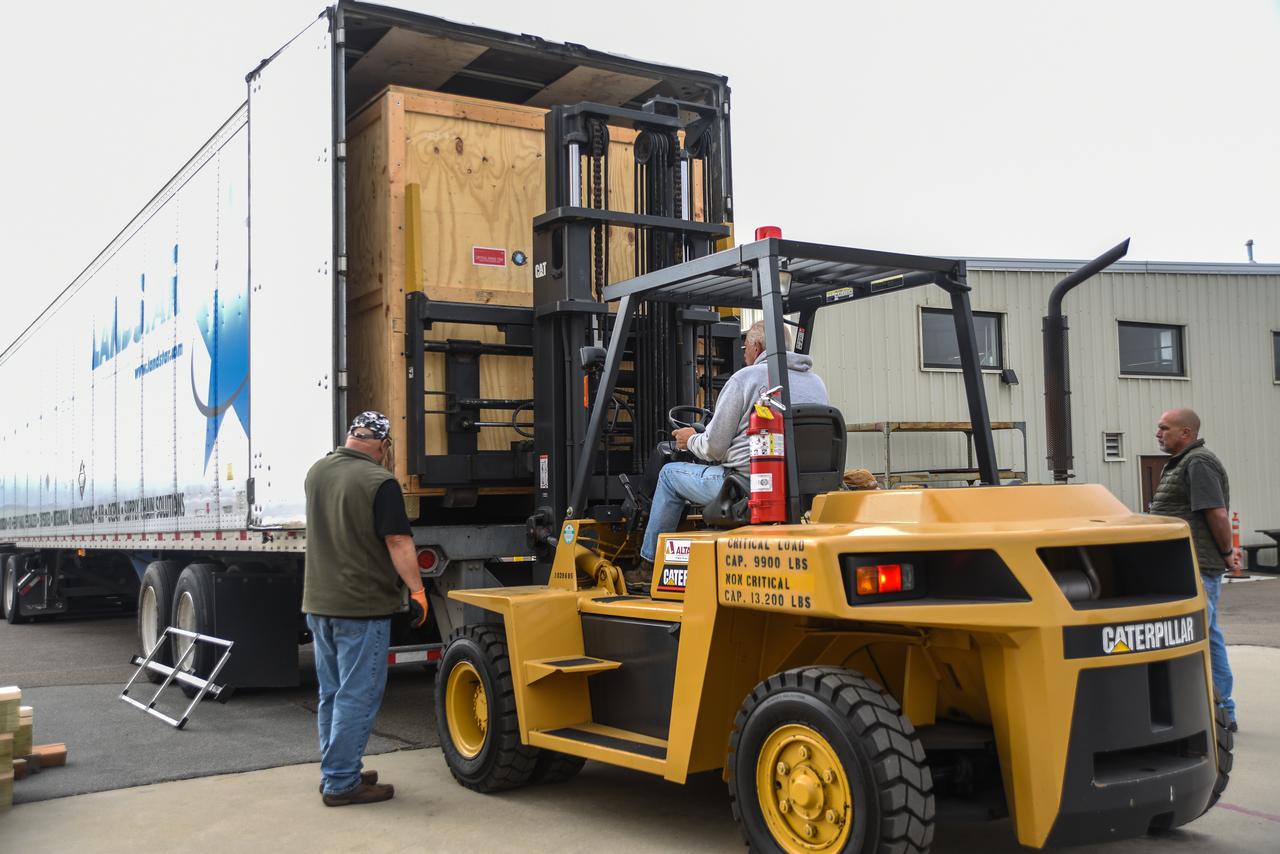
NASA’s Low-Earth Orbit Flight Test of an Inflatable Decelerator, or LOFTID, arrives by cargo truck at Vandenberg Space Force Base in California on Aug. 15, 2022. The technology demonstration mission will demonstrate inflatable heat shield technology that uses aerodynamic drag to slow down spacecraft in the most mass-efficient way. This technology could enable a variety of proposed NASA missions to destinations such as Mars, Venus, and Titan, as well as returning heavier payloads from low-Earth orbit. LOFTID is a rideshare launching with the National Oceanic and Atmospheric Administration’s (NOAA) Joint Polar Satellite System-2 (JPSS-2) satellite. NASA and NOAA are targeting Nov. 1 for the JPSS-2 launch on a United Launch Alliance (ULA) Atlas V 401 rocket from Space Launch Complex-3 at Vandenberg Space Force Base.
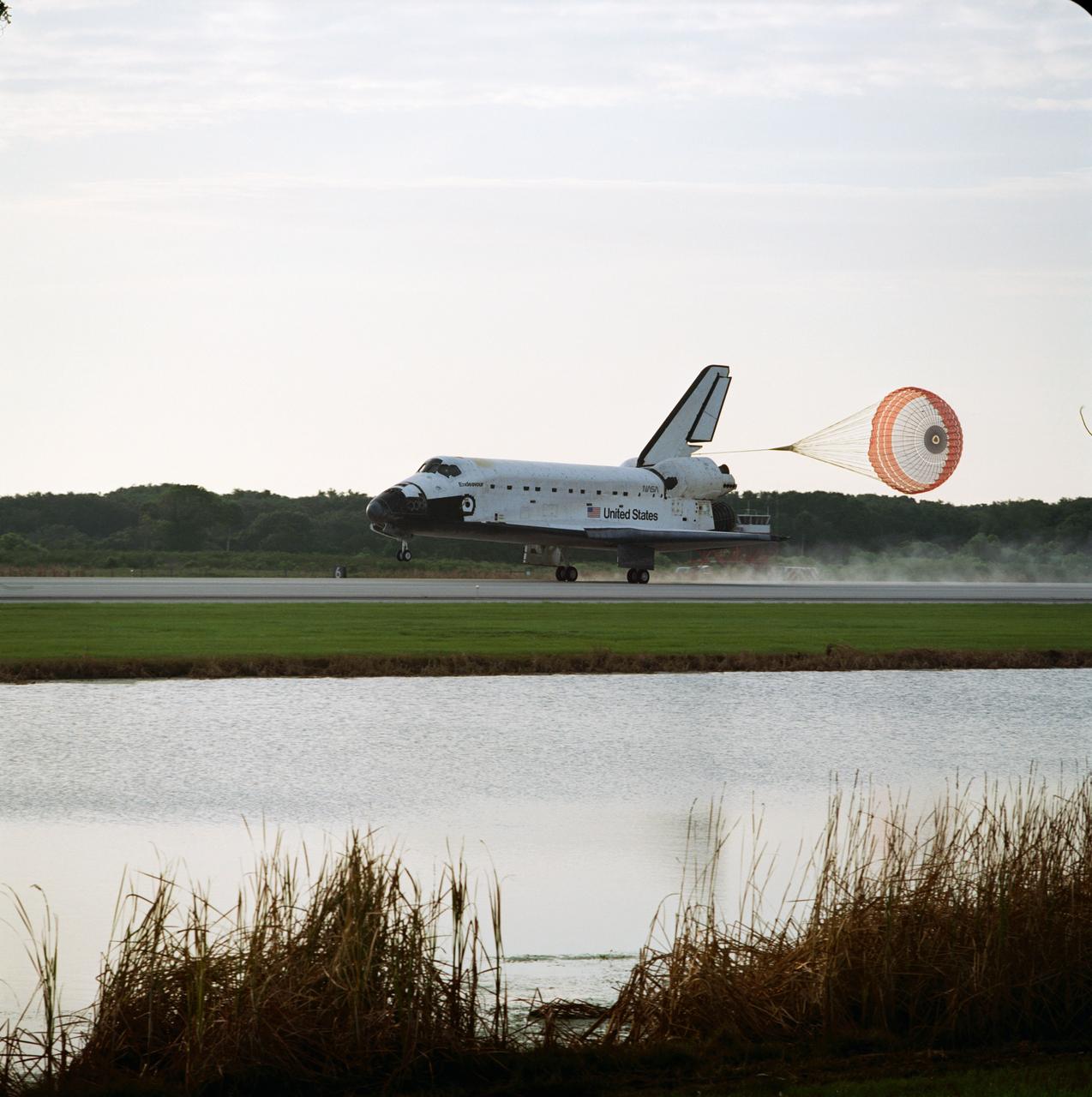
STS077-S-012 (29 May 1996) --- As its drag chute is released on Runway 33 at the Kennedy Space Center (KSC), the Space Shuttle Endeavour marks its return to Earth following a ten-day mission in space. Touchdown came at 7:09 a.m. (EDT), May 29, 1996. Leading the crew onboard was astronaut John H. Casper, mission commander. Other crew members were astronauts Curtis L. Brown, Jr., pilot; along with Daniel W. Bursch, Mario Runco, Jr., Andrew S. W. Thomas and Marc Garneau, all mission specialists. Garneau represents the Canadian Space Agency (CSA). During the approximately 10-day mission, the crew performed a variety of payload activities, including microgravity research aboard the Spacehab 4 Module, deployment and retrieval of the Spartan 207 and deployment and rendezvous with the Passive Aerodynamically-Stabilized Magnetically-Damped Satellite (PAMS).
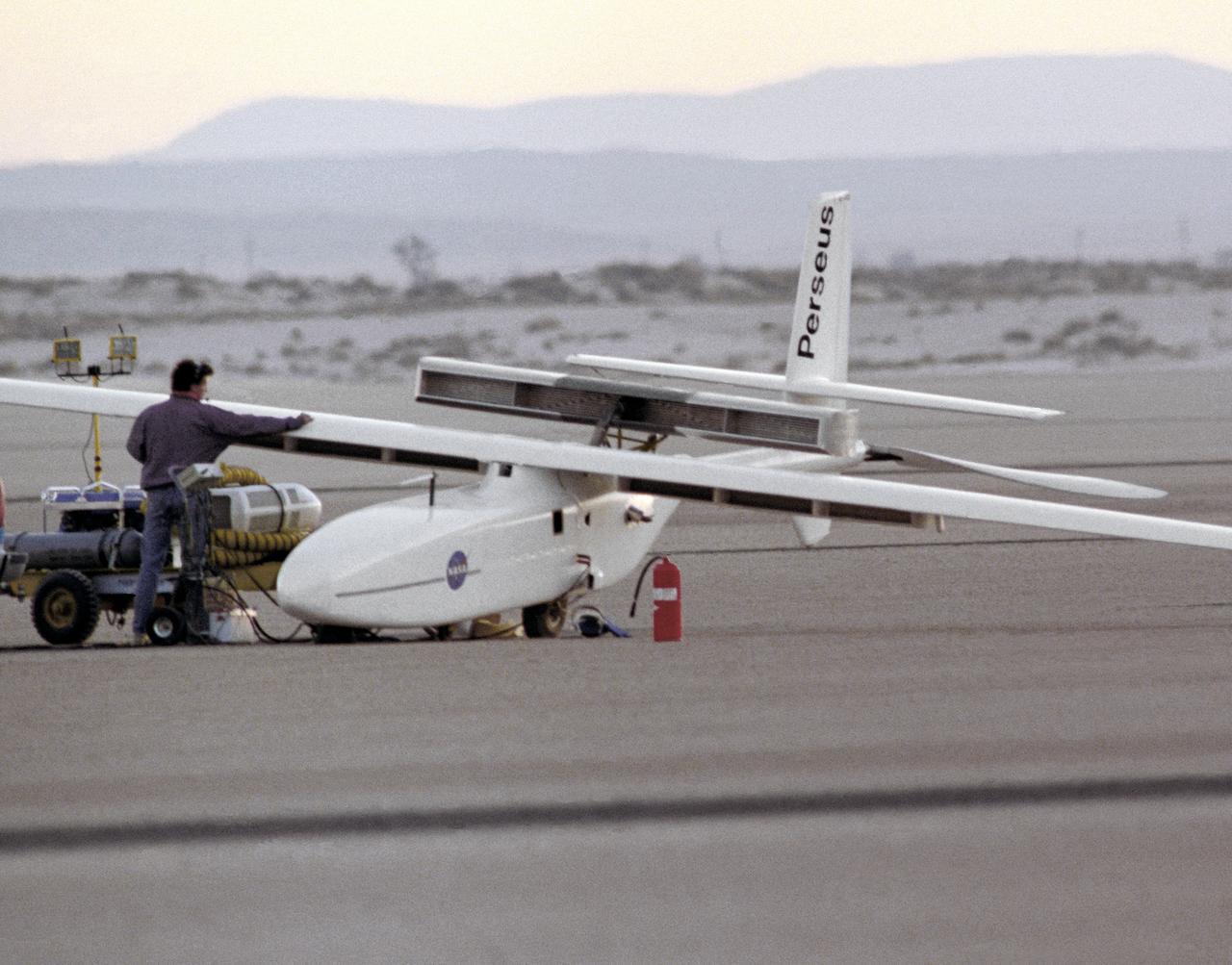
The Perseus A, a remotely-piloted, high-altitude research vehicle, is seen just after landing on Rogers Dry Lake at the Dryden Flight Research Center, Edwards, California. The Perseus A had a unique method of takeoff and landing. To make the aircraft as aerodynamic and lightweight as possible, designers gave it only two very small centerline wheels for landing. These wheels were very close to the fuselage, and therefore produced very little drag. However, since the fuselage sat so close to the ground, it was necessary to keep the large propeller at the rear of the aircraft locked in a horizontal position during takeoff. The aircraft was towed to about 700 feet in the air, where the engine was started and the aircraft began flying under its own power.
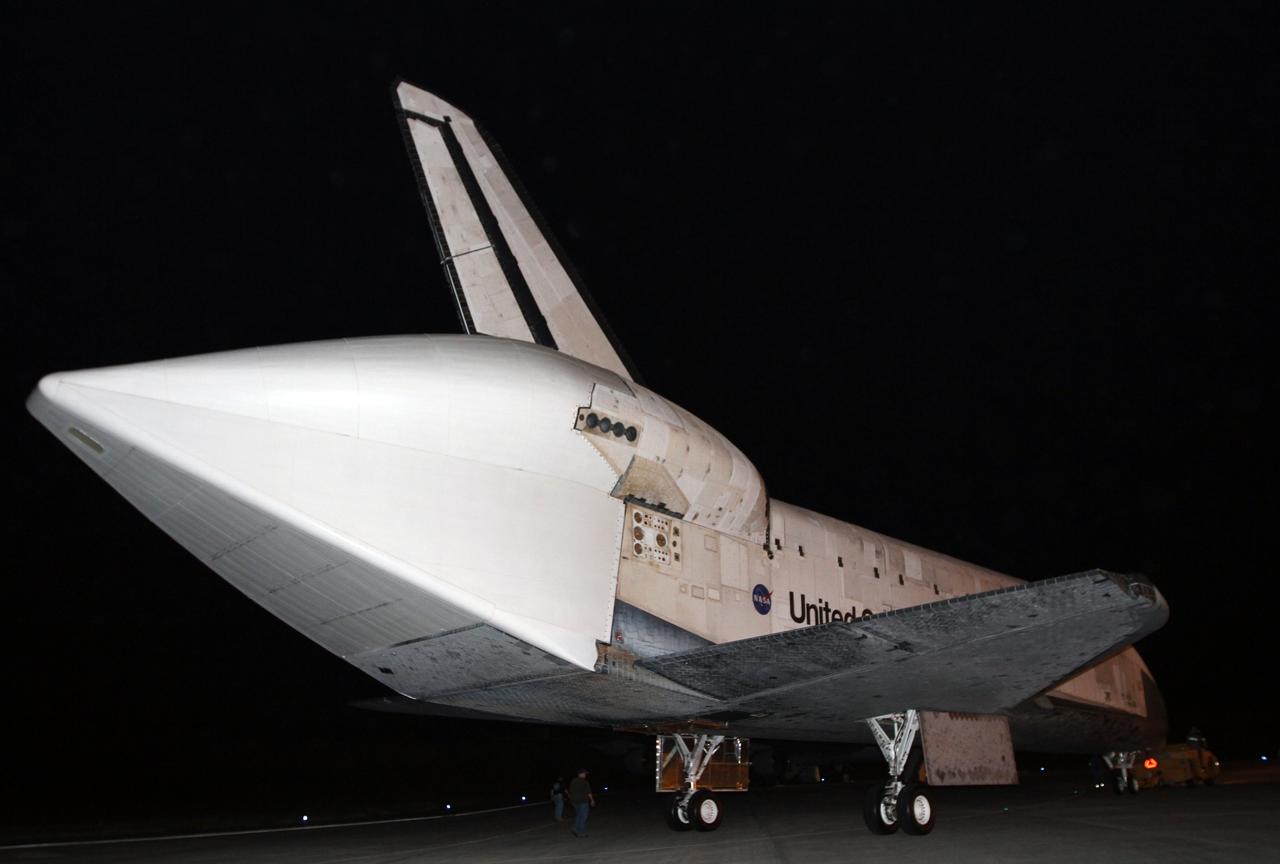
CAPE CANAVERAL, Fla. – Space shuttle Discovery makes its way in darkness to the Shuttle Landing Facility, or SLF, at NASA’s Kennedy Space Center in Florida. A tail cone has been installed over its three replica shuttle main engines to reduce aerodynamic drag and turbulence during its upcoming ferry flight. At the SLF, Discovery will be hoisted onto a Shuttle Carrier Aircraft, or SCA, with the aid of a mate-demate device. The SCA, a modified Boeing 747 jet airliner, is scheduled to ferry Discovery to the Washington Dulles International Airport in Virginia on April 17, after which the shuttle will be placed on permanent public display in the Smithsonian's National Air and Space Museum Steven F. Udvar-Hazy Center. For more information on shuttle transition and retirement activities, visit http://www.nasa.gov/transition. Photo credit: NASA/Kim Shiflett
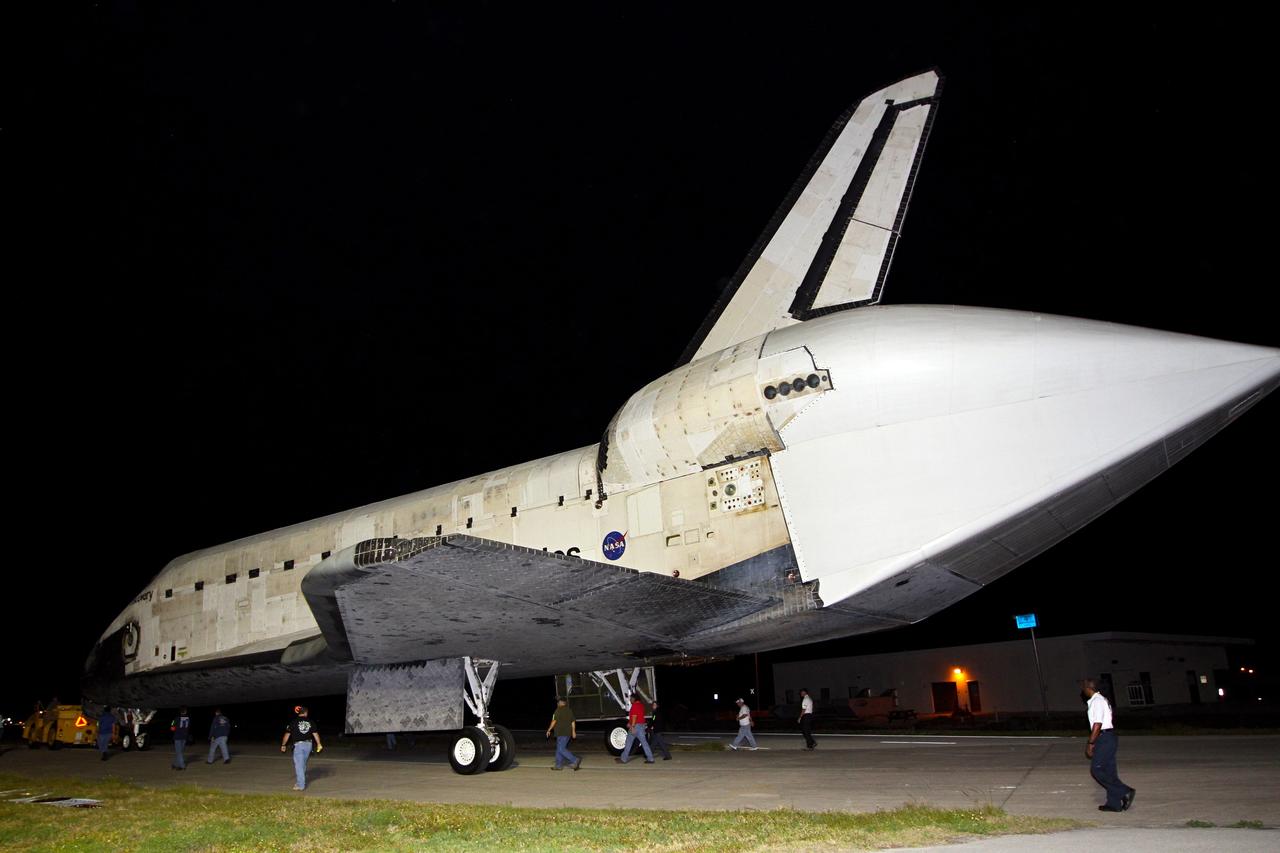
CAPE CANAVERAL, Fla. – A team of aerospace technicians accompanies space shuttle Discovery as it is towed for the final time from the Launch Complex 39 area to the Shuttle Landing Facility or SLF, at NASA’s Kennedy Space Center in Florida. A tail cone has been installed over Discovery’s three replica shuttle main engines to reduce aerodynamic drag and turbulence during its upcoming ferry flight. At the SLF, Discovery will be hoisted onto a Shuttle Carrier Aircraft, or SCA, with the aid of a mate-demate device. The SCA, a modified Boeing 747 jet airliner, is scheduled to ferry Discovery to the Washington Dulles International Airport in Virginia on April 17, after which the shuttle will be placed on permanent public display in the Smithsonian's National Air and Space Museum Steven F. Udvar-Hazy Center. For more information on shuttle transition and retirement activities, visit http://www.nasa.gov/transition. Photo credit: NASA/Kim Shiflett
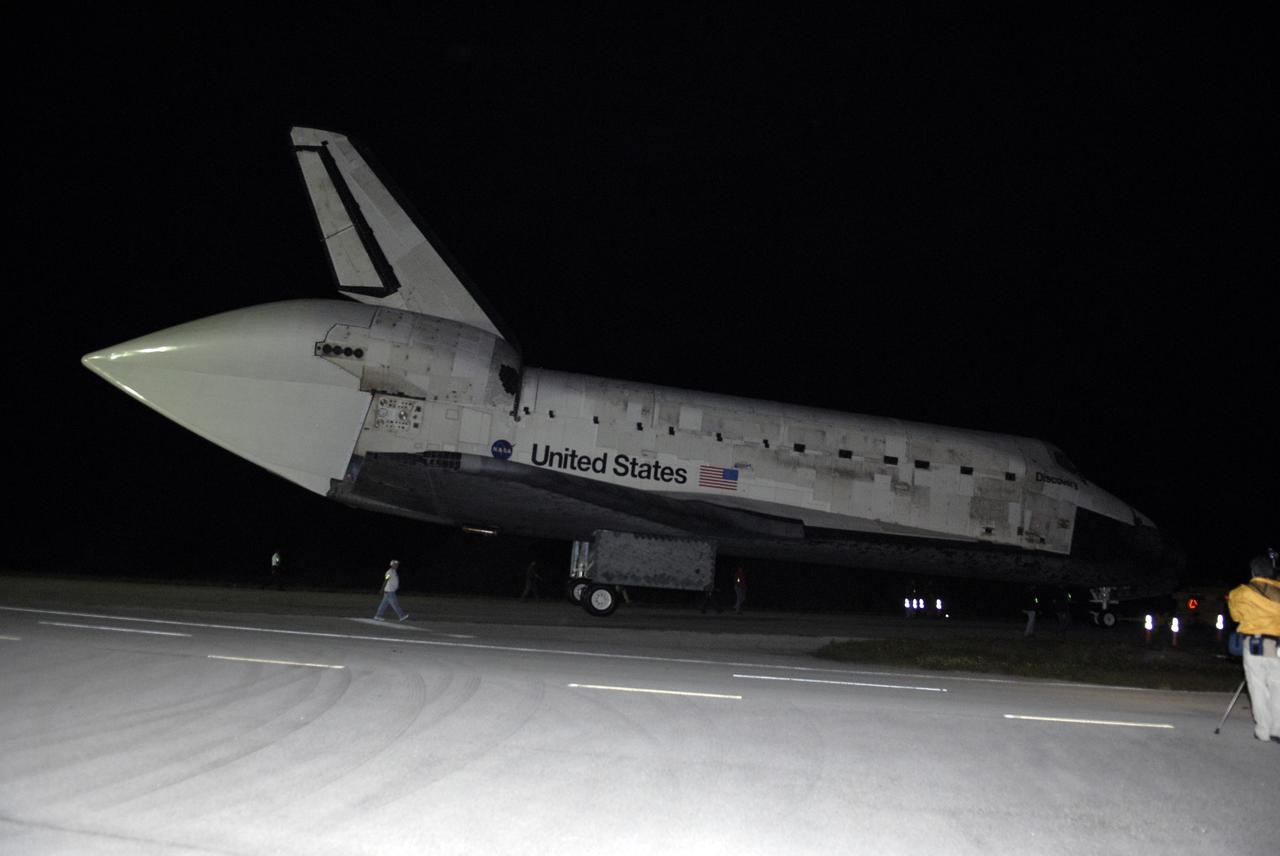
CAPE CANAVERAL, Fla. – Space shuttle Discovery makes its way in darkness along the access road to the Shuttle Landing Facility, or SLF, at NASA’s Kennedy Space Center in Florida. A tail cone has been installed over its three replica shuttle main engines to reduce aerodynamic drag and turbulence during its upcoming ferry flight. At the SLF, Discovery will be hoisted onto a Shuttle Carrier Aircraft, or SCA, with the aid of a mate-demate device. The SCA, a modified Boeing 747 jet airliner, is scheduled to ferry Discovery to the Washington Dulles International Airport in Virginia on April 17, after which the shuttle will be placed on permanent public display in the Smithsonian's National Air and Space Museum Steven F. Udvar-Hazy Center. For more information on shuttle transition and retirement activities, visit http://www.nasa.gov/transition. Photo credit: NASA/Tim Jacobs
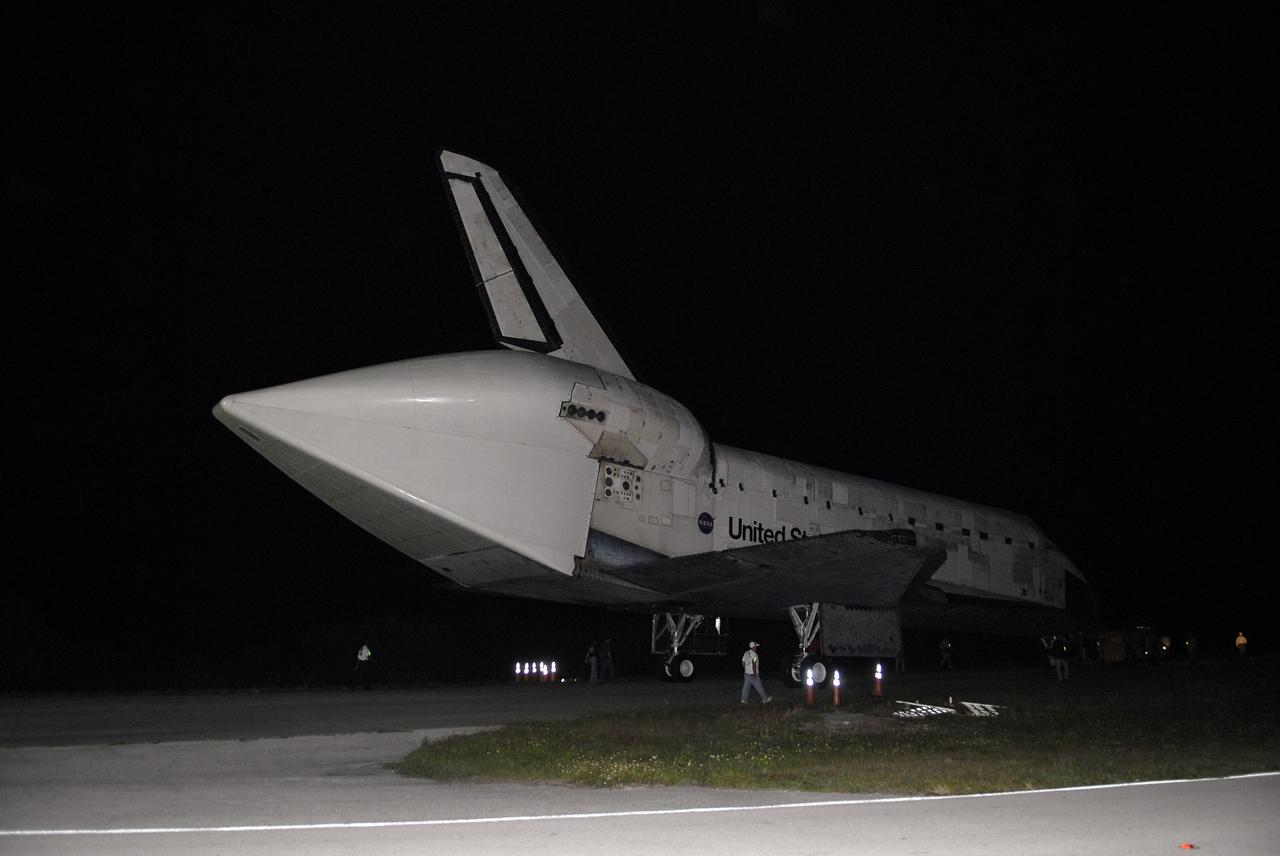
CAPE CANAVERAL, Fla. – Space shuttle Discovery makes its way in darkness along the access road to the Shuttle Landing Facility, or SLF, at NASA’s Kennedy Space Center in Florida. A tail cone has been installed over its three replica shuttle main engines to reduce aerodynamic drag and turbulence during its upcoming ferry flight. At the SLF, Discovery will be hoisted onto a Shuttle Carrier Aircraft, or SCA, with the aid of a mate-demate device. The SCA, a modified Boeing 747 jet airliner, is scheduled to ferry Discovery to the Washington Dulles International Airport in Virginia on April 17, after which the shuttle will be placed on permanent public display in the Smithsonian's National Air and Space Museum Steven F. Udvar-Hazy Center. For more information on shuttle transition and retirement activities, visit http://www.nasa.gov/transition. Photo credit: NASA/Tim Jacobs
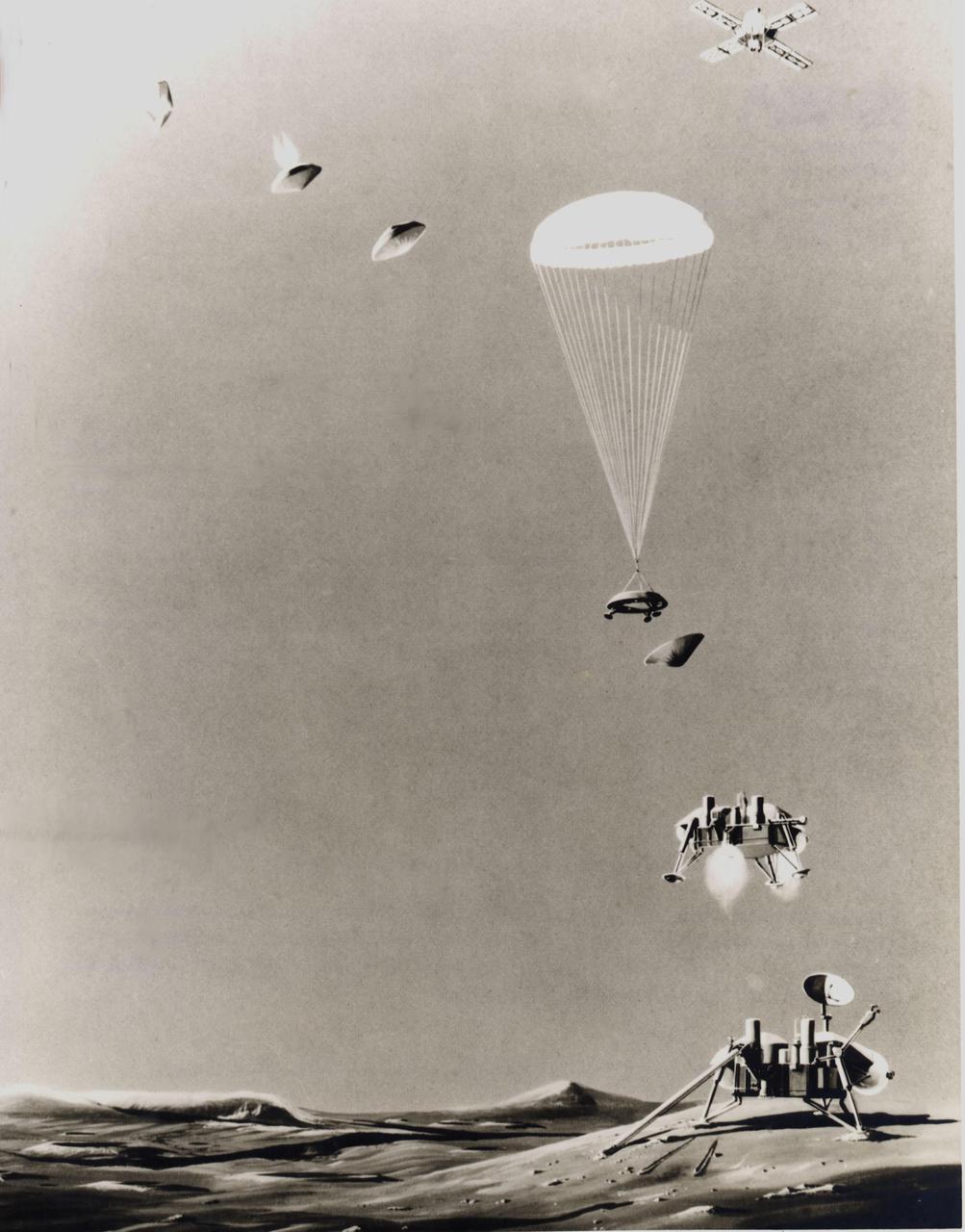
This is an artist's conception of the sequence of events that will take place just prior to landing a life-detection laboratory on the surface of Mars on July 4, 1976. Above right, the Viking spacecraft, composed of an orbiter and a lander, has been in orbit around the Red Planet since June 19, 1976, taking pictures of the planned landing site to ascertain its safety before releasing the lander (top, left) for its threeto five-hour descent. Protected by aeroshells, the heat-sterilized lander hurtles into the thin Martian atmosphere at a speed of about 10,000 mph, to be slowed first by aerodynamic drag until the shell is discarded, then by parachute (center) and finally by retrorockets to assure a gentle landing. Instruments will study the structure and composition of the Martian atmosphere as the lander drifts down. Viking 2 is scheduled to arrive at Mars on Aug. 7 and touch down on the surface on Sept. 4.
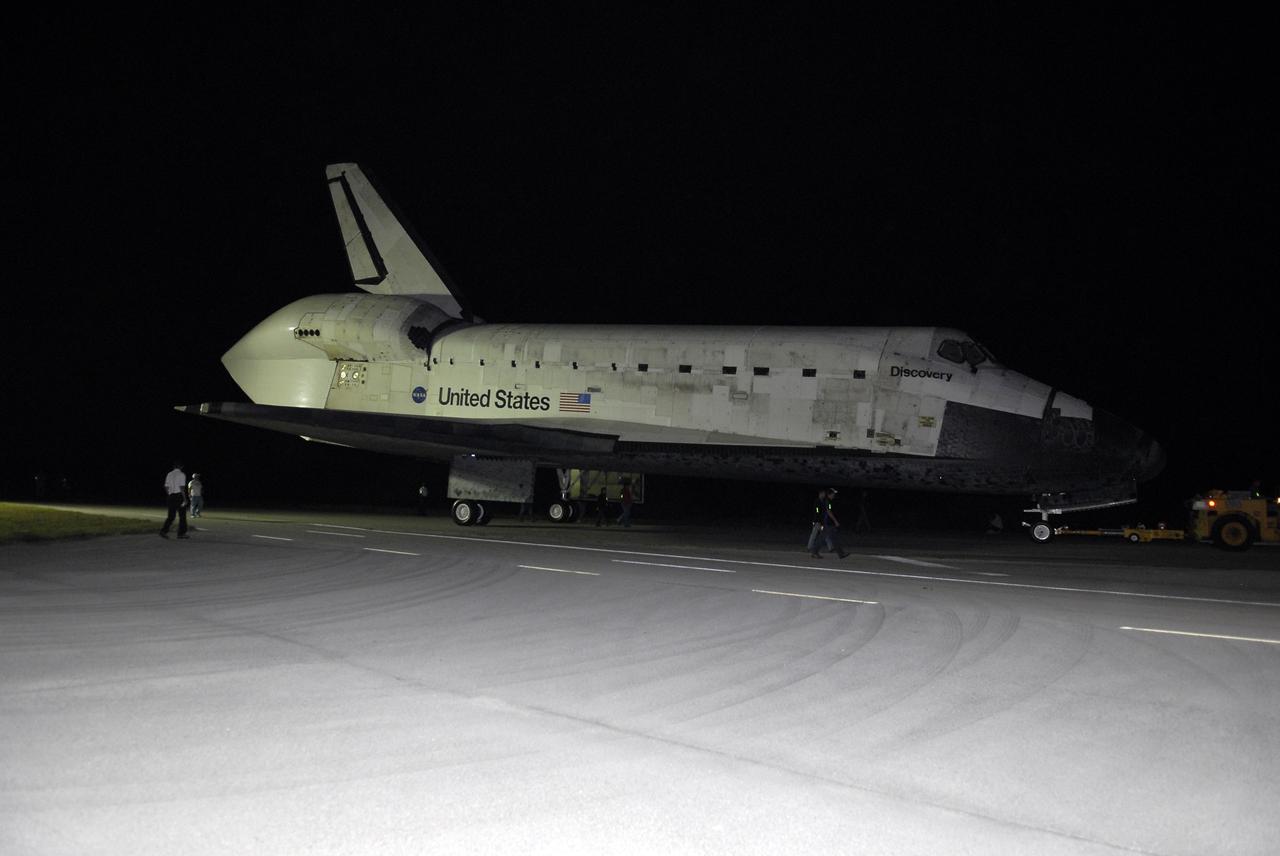
CAPE CANAVERAL, Fla. – Space shuttle Discovery is towed along the access road to the Shuttle Landing Facility, or SLF, at NASA’s Kennedy Space Center in Florida. A tail cone has been installed over its three replica shuttle main engines to reduce aerodynamic drag and turbulence during its upcoming ferry flight. At the SLF, Discovery will be hoisted onto a Shuttle Carrier Aircraft, or SCA, with the aid of a mate-demate device. The SCA, a modified Boeing 747 jet airliner, is scheduled to ferry Discovery to the Washington Dulles International Airport in Virginia on April 17, after which the shuttle will be placed on permanent public display in the Smithsonian's National Air and Space Museum Steven F. Udvar-Hazy Center. For more information on shuttle transition and retirement activities, visit http://www.nasa.gov/transition. Photo credit: NASA/Tim Jacobs
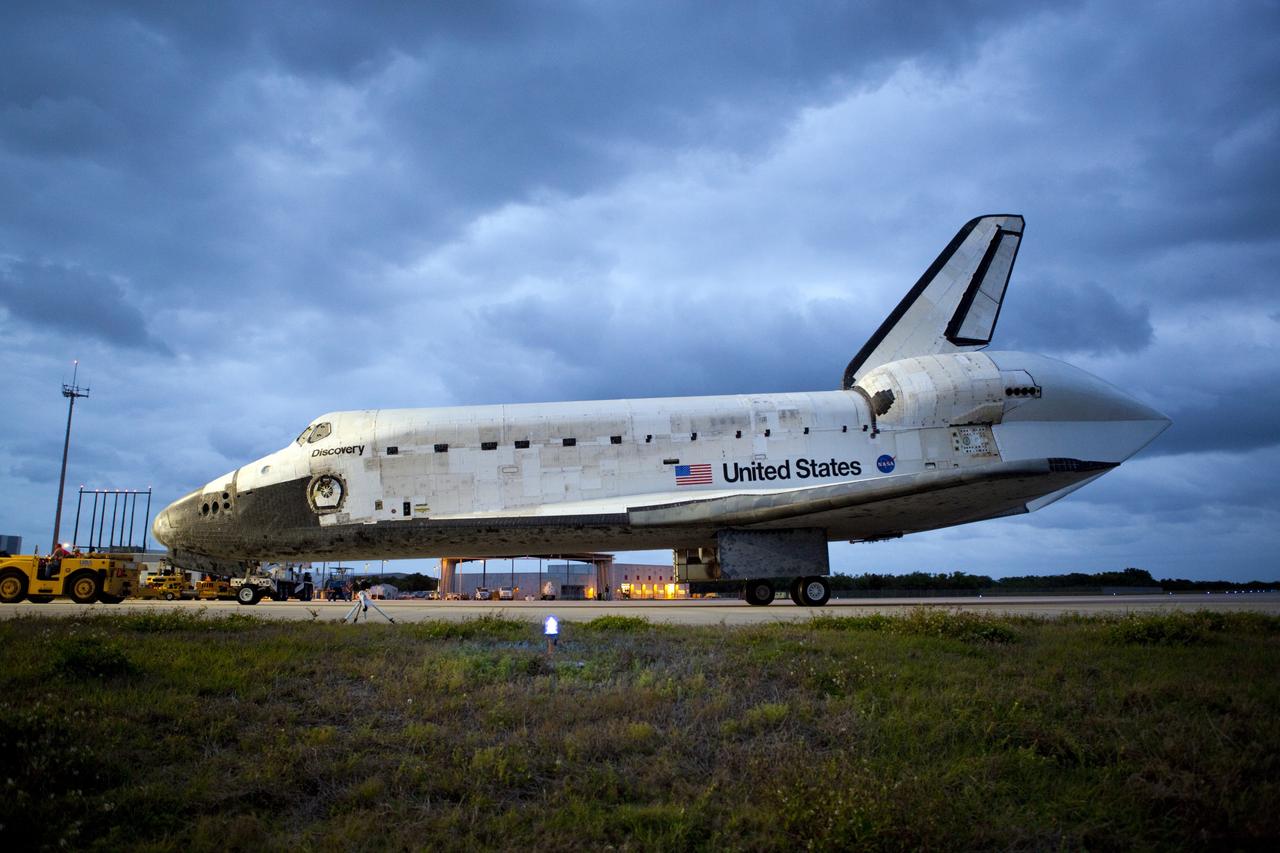
CAPE CANAVERAL, Fla. – Space Shuttle Discovery’s move from the Vehicle Assembly Building to the Shuttle Landing Facility, or SLF, is complete as the sun comes up over NASA’s Kennedy Space Center in Florida. A tail cone has been installed over its three replica shuttle main engines to reduce aerodynamic drag and turbulence during its upcoming ferry flight. At the SLF, Discovery will be hoisted onto a Shuttle Carrier Aircraft, or SCA, with the aid of a mate-demate device. The SCA, a modified Boeing 747 jet airliner, is scheduled to ferry Discovery to the Washington Dulles International Airport in Virginia on April 17, after which the shuttle will be placed on permanent public display in the Smithsonian's National Air and Space Museum Steven F. Udvar-Hazy Center. For more information on shuttle transition and retirement activities, visit http://www.nasa.gov/transition. Photo credit: NASA/Dimitri Gerondidakis
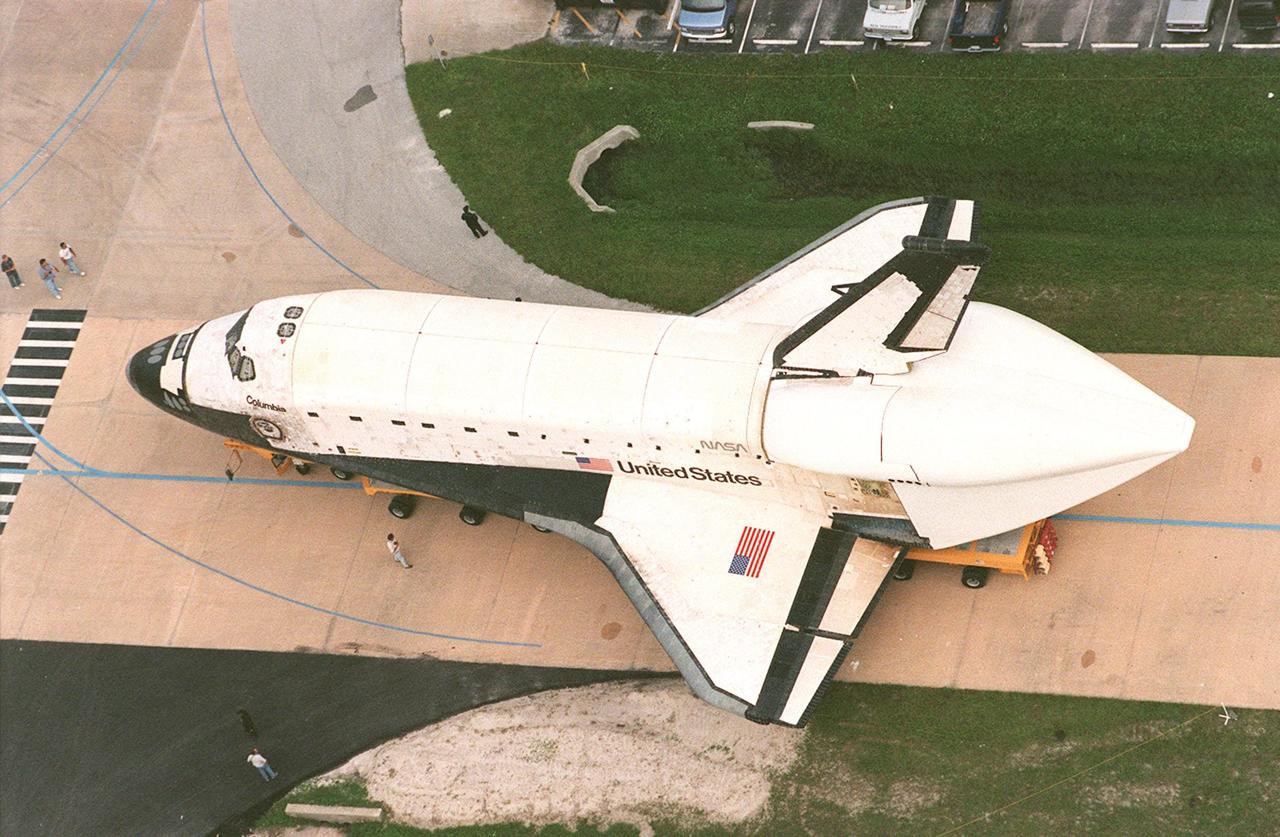
KENNEDY SPACE CENTER, FLA. -- On an orbiter transporter, Columbia is turned, after rolling out of KSC's Orbiter Processing Facility bay 3, for its move to the Shuttle Landing Facility's (SLF) Mate-Demate Device. At the SLF the orbiter is to be mated to the Boeing 747 Shuttle Carrier Aircraft for a ferry flight to Palmdale, Calif. On the rear of the orbiter can be seen the tail cone, a fairing that is installed over the aft fuselage of the orbiter to decrease aerodynamic drag and buffet when the Shuttle Carrier Aircraft is transporting the orbiter cross-country. It is 36 feet long, 25 feet wide, and 22 feet high. Columbia, the oldest of four orbiters in NASA's fleet, will undergo extensive inspections and modifications in Boeing's Orbiter Assembly Facility during a nine-month orbiter maintenance down period (OMDP), the second in its history. Orbiters are periodically removed from flight operations for an OMDP. Columbia's first was in 1994. Along with more than 100 modifications on the vehicle, Columbia will be the second orbiter to be outfitted with the multifunctional electronic display system, or "glass cockpit." Columbia is expected to return to KSC in July 2000
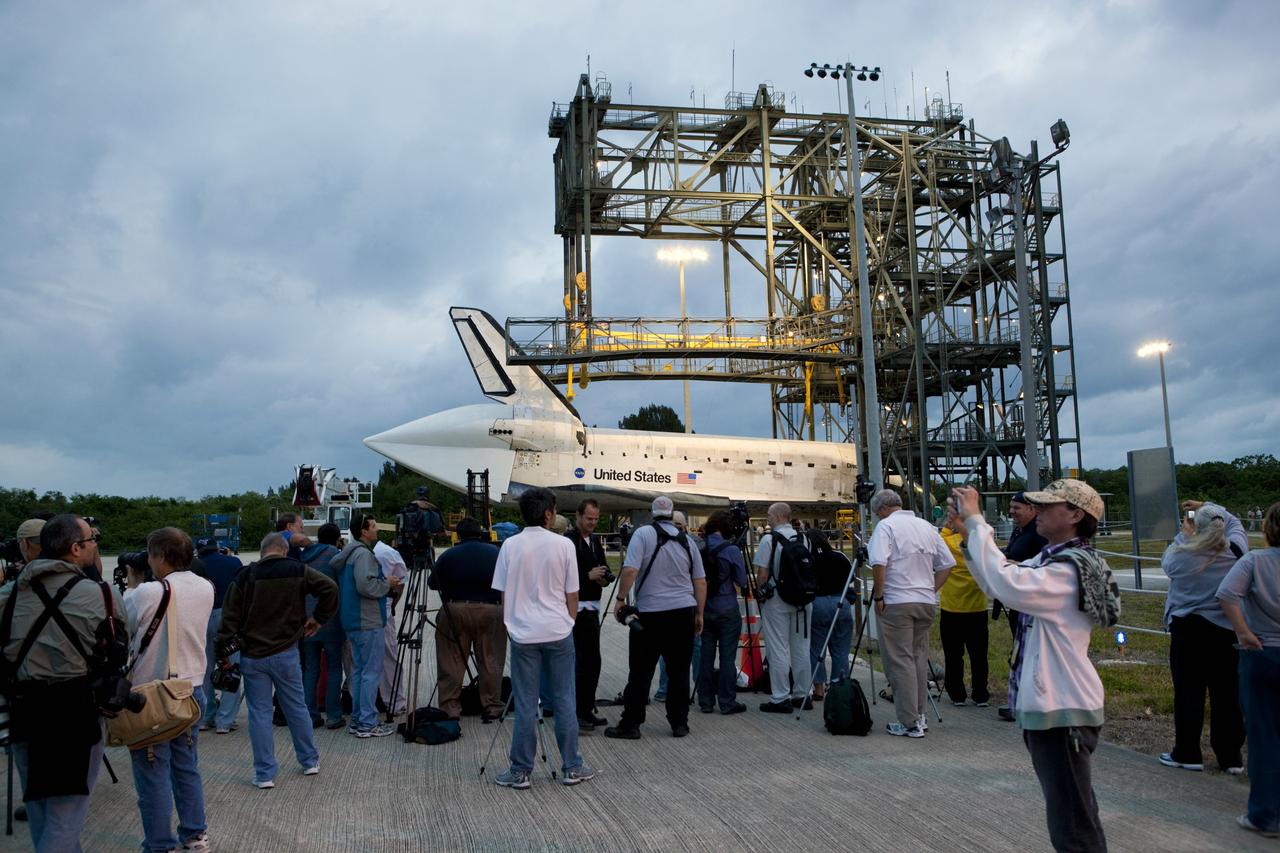
CAPE CANAVERAL, Fla. – Media representatives are on hand for the arrival of space shuttle Discovery at the mate-demate device, or MDD, at the Shuttle Landing Facility, or SLF, at NASA’s Kennedy Space Center in Florida. A tail cone has been installed over its three replica shuttle main engines to reduce aerodynamic drag and turbulence during its upcoming ferry flight. The MDD is a large gantry-like steel structure used to hoist a shuttle off the ground and position it onto the back of a Shuttle Carrier Aircraft, or SCA. The SCA is a Boeing 747 jet, originally manufactured for commercial use, which was modified by NASA to transport the shuttles between destinations on Earth. The SCA designated NASA 905 is assigned to the remaining ferry missions, delivering the shuttles to their permanent public display sites. Discovery’s new home will be the Smithsonian's National Air and Space Museum Steven F. Udvar-Hazy Center in Chantilly, Va. For more information on the SCA, visit http://www.nasa.gov/centers/dryden/news/FactSheets/FS-013-DFRC.html. For more information on shuttle transition and retirement activities, visit http://www.nasa.gov/transition. Photo credit: NASA/Dimitri Gerondidakis
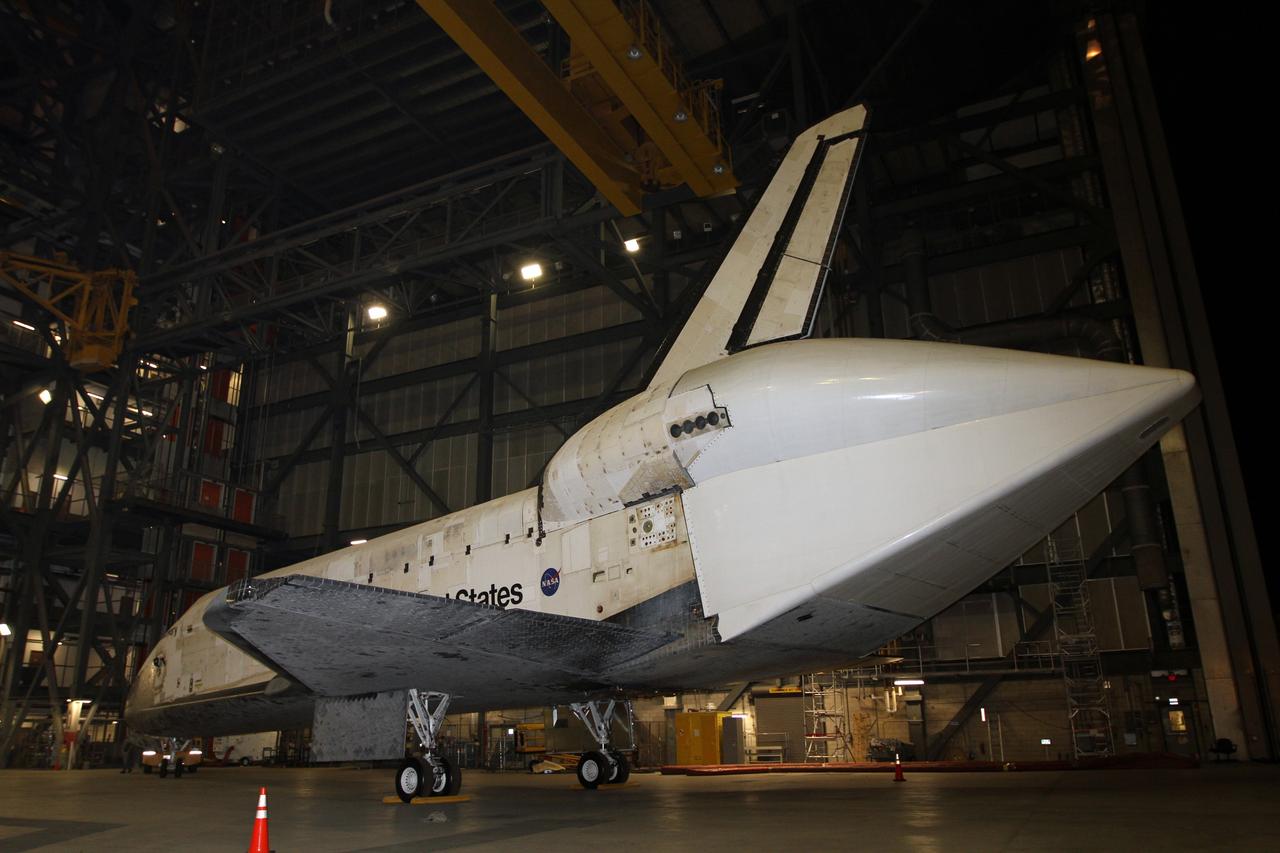
CAPE CANAVERAL, Fla. – Preparations to tow space shuttle Discovery from the Vehicle Assembly Building, or VAB, to the Shuttle Landing Facility, or SLF, are under way at NASA’s Kennedy Space Center in Florida. A tail cone has been installed over its three replica shuttle main engines to reduce aerodynamic drag and turbulence during its upcoming ferry flight. Discovery was in storage in the VAB’s high bay 4 awaiting departure from Kennedy’s Launch Complex 39 area for the final time. At the SLF, Discovery will be hoisted onto a Shuttle Carrier Aircraft, or SCA, with the aid of a mate-demate device. The SCA, a modified Boeing 747 jet airliner, is scheduled to transport Discovery to the Washington Dulles International Airport in Virginia on April 17, after which the shuttle will be placed on permanent public display in the Smithsonian's National Air and Space Museum Steven F. Udvar-Hazy Center. For more information on shuttle transition and retirement activities, visit http://www.nasa.gov/transition. Photo credit: NASA/Kim Shiflett
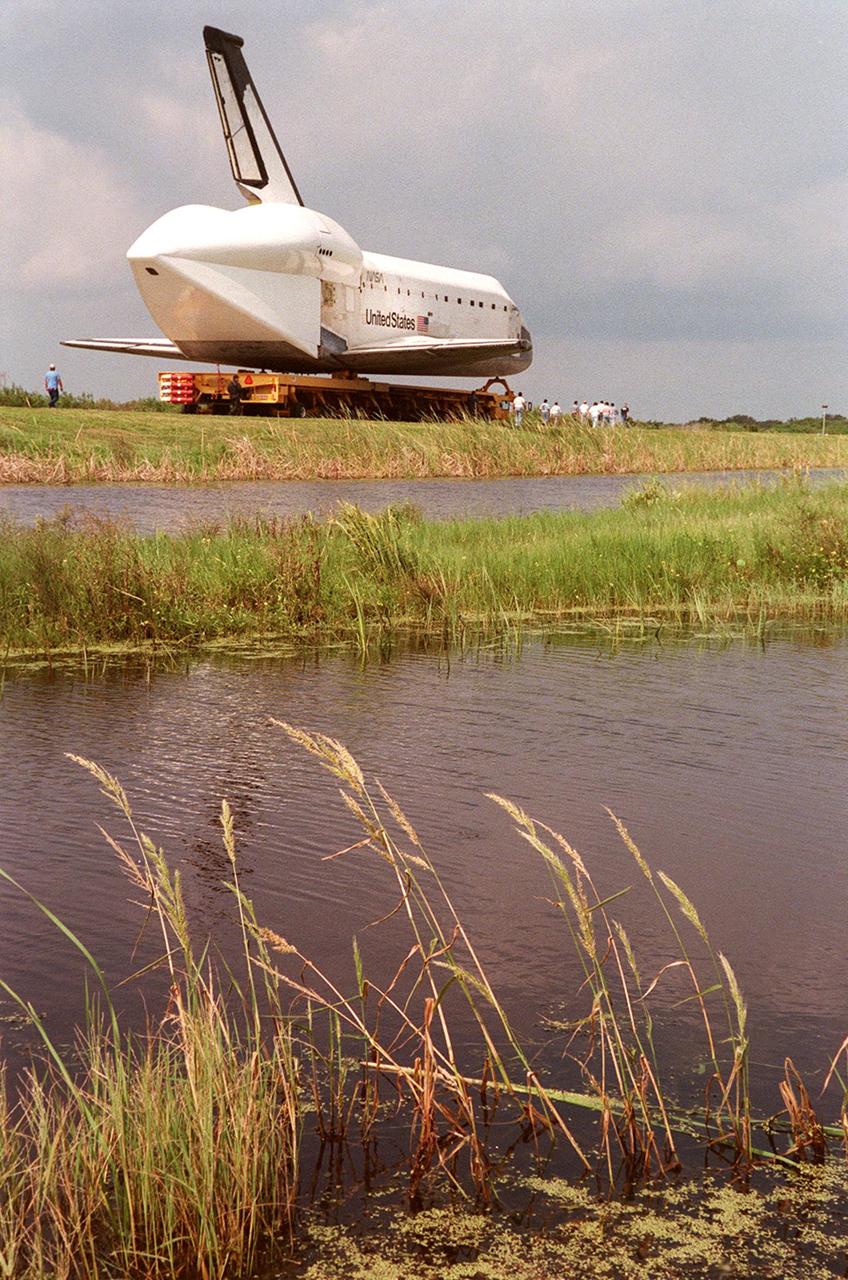
KENNEDY SPACE CENTER, FLA. -- Aboard a transporter, the orbiter Columbia is moved on the tow-way along the Banana Creek. Columbia is heading to the Shuttle Landing Facility's (SLF) Mate-Demate Device where it will be mated to the Boeing 747 Shuttle Carrier Aircraft for a ferry flight to Palmdale, Calif. On the rear of the orbiter can be seen the tail cone, a fairing that is installed over the aft fuselage of the orbiter to decrease aerodynamic drag and buffet when the Shuttle Carrier Aircraft is transporting the orbiter cross-country. It is 36 feet long, 25 feet wide, and 22 feet high. Columbia, the oldest of four orbiters in NASA's fleet, will undergo extensive inspections and modifications in Boeing's Orbiter Assembly Facility during a nine-month orbiter maintenance down period (OMDP), the second in its history. Orbiters are periodically removed from flight operations for an OMDP. Columbia's first was in 1994. Along with more than 100 modifications on the vehicle, Columbia will be the second orbiter to be outfitted with the multifunctional electronic display system, or "glass cockpit." Columbia is expected to return to KSC in July 2000
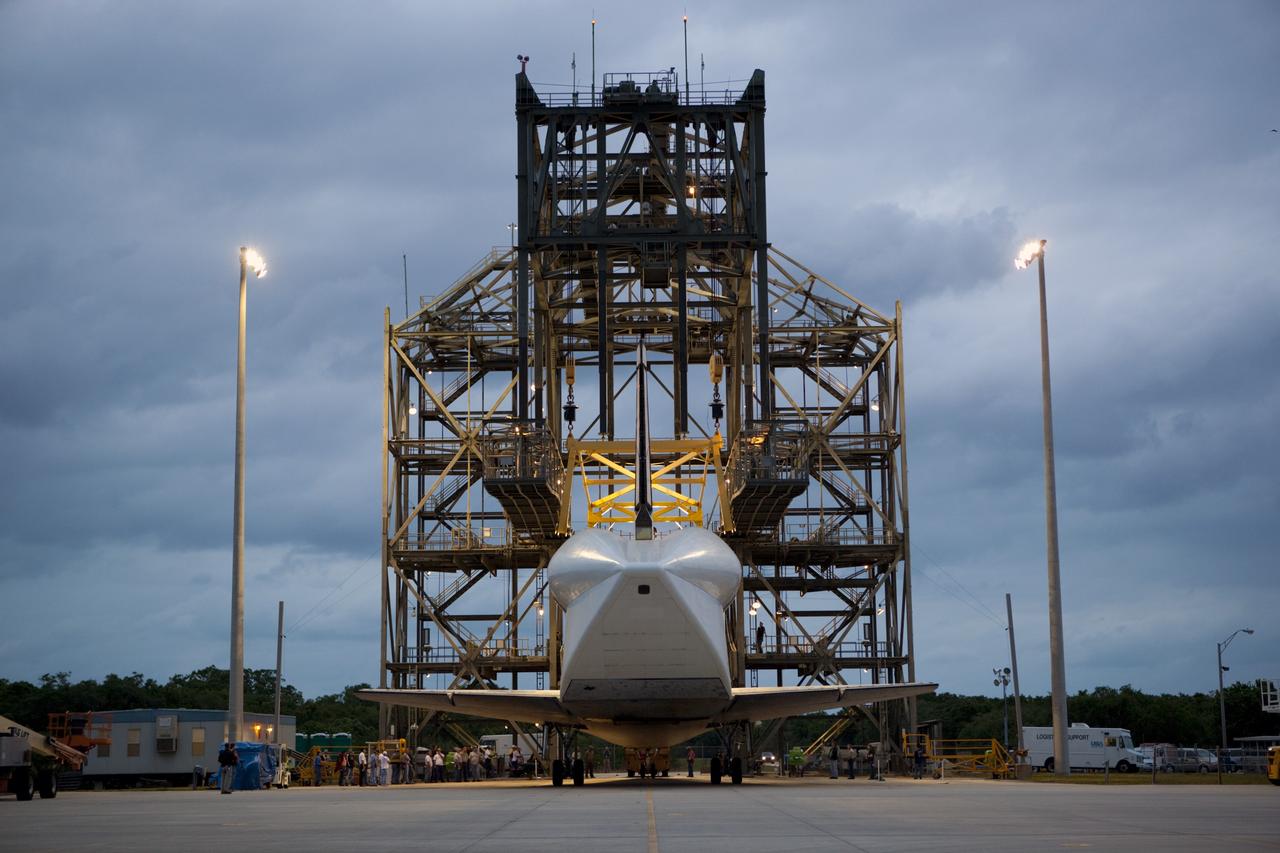
CAPE CANAVERAL, Fla. – Space shuttle Discovery rolls into position beneath the mate-demate device, or MDD, at the Shuttle Landing Facility, or SLF, at NASA’s Kennedy Space Center in Florida. A tail cone has been installed over its three replica shuttle main engines to reduce aerodynamic drag and turbulence during its upcoming ferry flight. The MDD is a large gantry-like steel structure used to hoist a shuttle off the ground and position it onto the back of a Shuttle Carrier Aircraft, or SCA. The SCA is a Boeing 747 jet, originally manufactured for commercial use, which was modified by NASA to transport the shuttles between destinations on Earth. The SCA designated NASA 905 is assigned to the remaining ferry missions, delivering the shuttles to their permanent public display sites. Discovery’s new home will be the Smithsonian's National Air and Space Museum Steven F. Udvar-Hazy Center in Chantilly, Va. For more information on the SCA, visit http://www.nasa.gov/centers/dryden/news/FactSheets/FS-013-DFRC.html. For more information on shuttle transition and retirement activities, visit http://www.nasa.gov/transition. Photo credit: NASA/Dimitri Gerondidakis
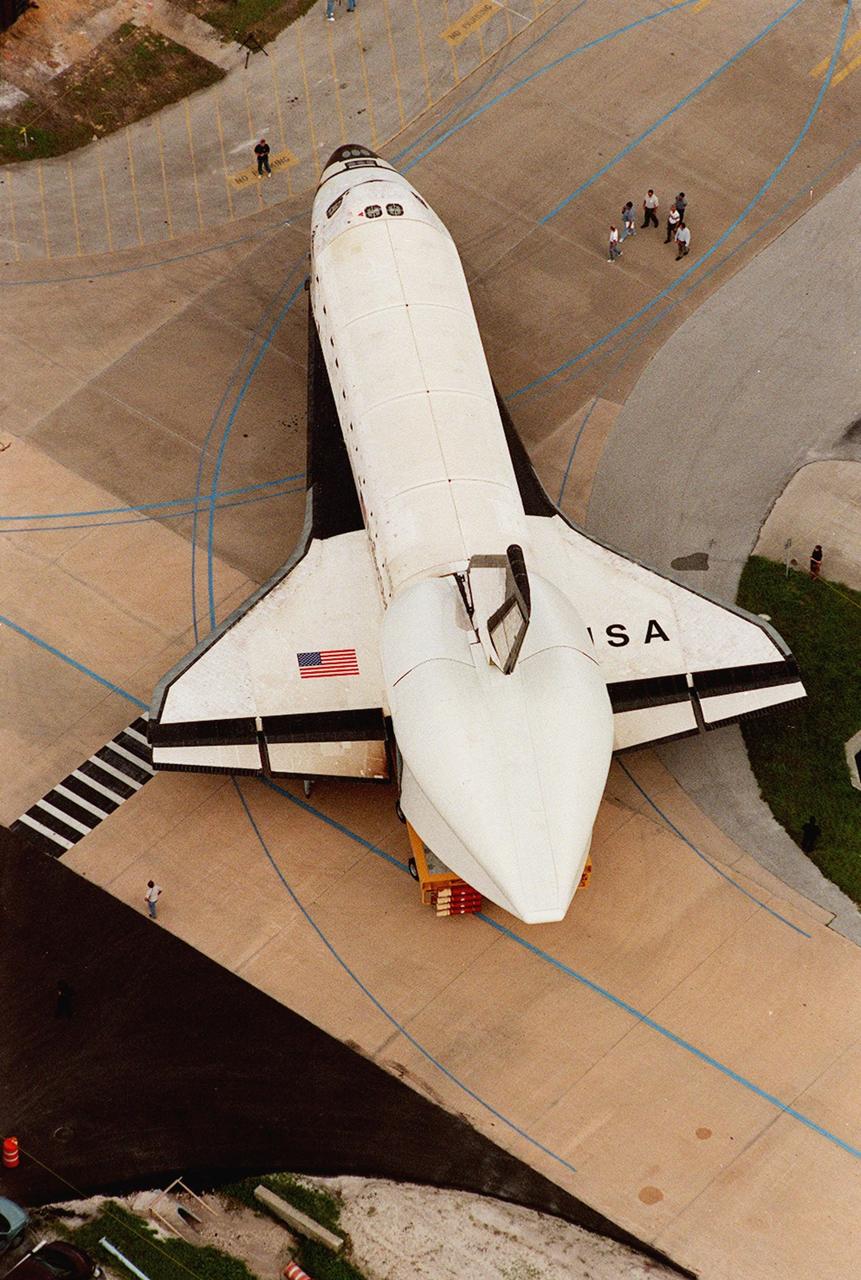
KENNEDY SPACE CENTER, FLA. -- Photographed from overhead, the orbiter Columbia begins to turn after rolling out of KSC's Orbiter Processing Facility bay 3, bound for the Shuttle Landing Facility's (SLF) Mate-Demate Device. At the SLF the orbiter is to be mated to the Boeing 747 Shuttle Carrier Aircraft for a ferry flight to Palmdale, Calif. On the rear of the orbiter can be seen the tail cone, a fairing that is installed over the aft fuselage of the orbiter to decrease aerodynamic drag and buffet when the Shuttle Carrier Aircraft is transporting the orbiter cross-country. It is 36 feet long, 25 feet wide, and 22 feet high. Columbia, the oldest of four orbiters in NASA's fleet, will undergo extensive inspections and modifications in Boeing's Orbiter Assembly Facility during a nine-month orbiter maintenance down period (OMDP), the second in its history. Orbiters are periodically removed from flight operations for an OMDP. Columbia's first was in 1994. Along with more than 100 modifications on the vehicle, Columbia will be the second orbiter to be outfitted with the multifunctional electronic display system, or "glass cockpit." Columbia is expected to return to KSC in July 2000
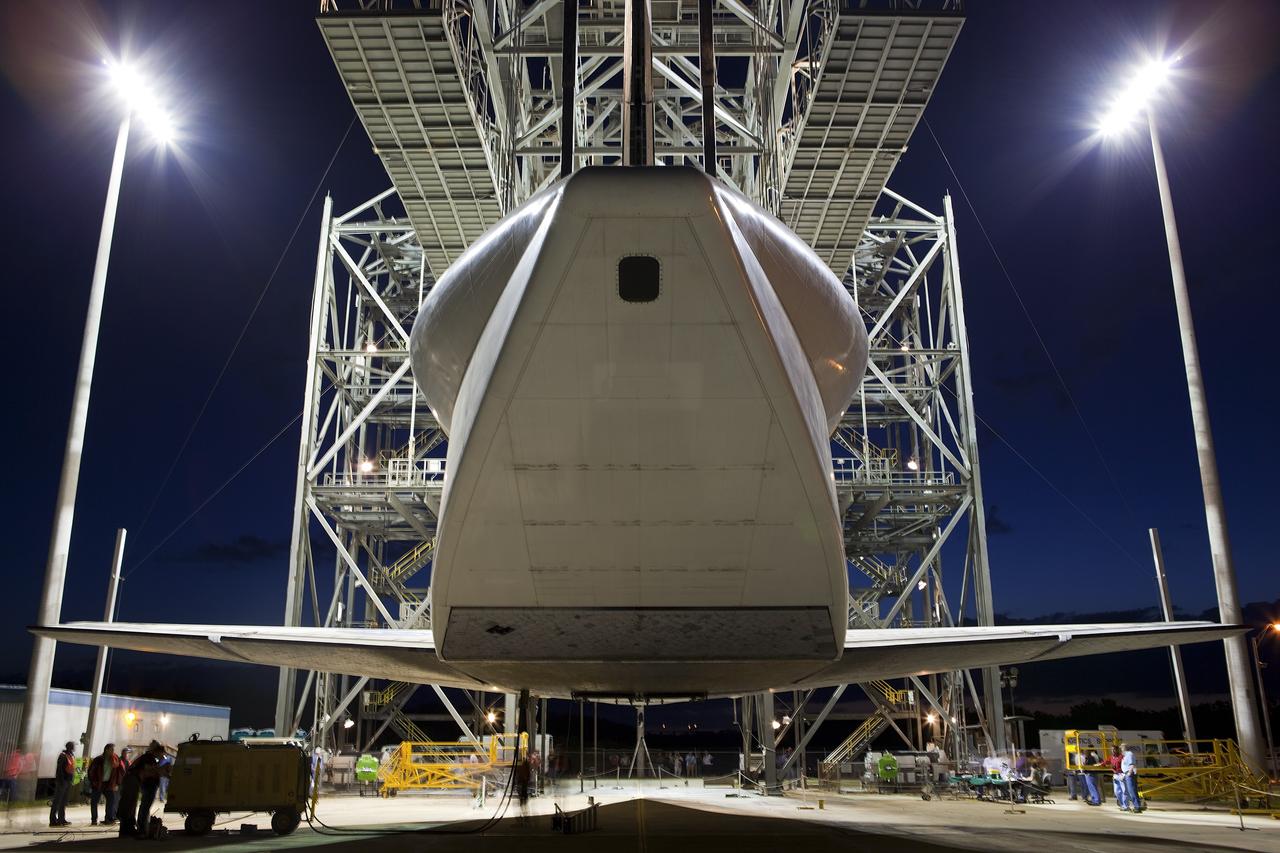
CAPE CANAVERAL, Fla. – Before daybreak at the Shuttle Landing Facility at NASA’s Kennedy Space Center in Florida, space shuttle Discovery hovers above the ground at the mate-demate device. Operations are under way to position Discovery on top of a Shuttle Carrier Aircraft in preparation for its departure from Kennedy on Tuesday. A tail cone has been installed over Discovery’s three replica shuttle main engines to reduce aerodynamic drag and turbulence during the ferry flight. The device, known as the MDD, is a large gantry-like steel structure used to hoist a shuttle off the ground and position it onto the back of the aircraft, or SCA. The SCA is a Boeing 747 jet, originally manufactured for commercial use, which was modified by NASA to transport the shuttles between destinations on Earth. The SCA designated NASA 905 is assigned to the remaining ferry missions, delivering the shuttles to their permanent public display sites. NASA 905 is scheduled to ferry Discovery to the Washington Dulles International Airport in Virginia on April 17, after which the shuttle will be placed on display in the Smithsonian's National Air and Space Museum Steven F. Udvar-Hazy Center. For more information on the SCA, visit http://www.nasa.gov/centers/dryden/news/FactSheets/FS-013-DFRC.html. For more information on shuttle transition and retirement activities, visit http://www.nasa.gov/transition. Photo credit: NASA/Dimitri Gerondidakis
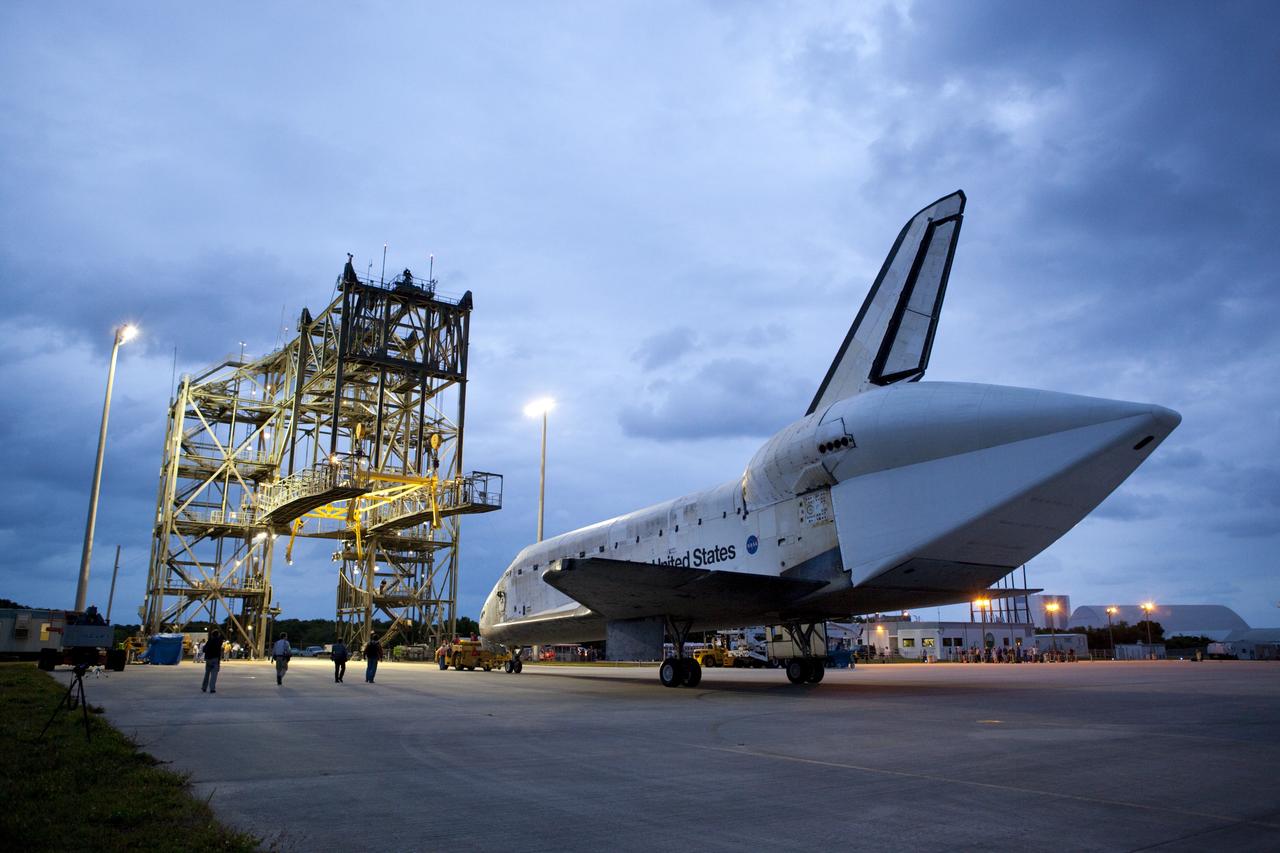
CAPE CANAVERAL, Fla. – Space shuttle Discovery is towed into position next to the mate-demate device, or MDD, at the Shuttle Landing Facility, or SLF, at NASA’s Kennedy Space Center in Florida. A tail cone has been installed over its three replica shuttle main engines to reduce aerodynamic drag and turbulence during its upcoming ferry flight. The MDD is a large gantry-like steel structure used to hoist a shuttle off the ground and position it onto the back of a Shuttle Carrier Aircraft, or SCA. The SCA is a Boeing 747 jet, originally manufactured for commercial use, which was modified by NASA to transport the shuttles between destinations on Earth. The SCA designated NASA 905 is assigned to the remaining ferry missions, delivering the shuttles to their permanent public display sites. Discovery’s new home will be the Smithsonian's National Air and Space Museum Steven F. Udvar-Hazy Center in Chantilly, Va. For more information on the SCA, visit http://www.nasa.gov/centers/dryden/news/FactSheets/FS-013-DFRC.html. For more information on shuttle transition and retirement activities, visit http://www.nasa.gov/transition. Photo credit: NASA/Dimitri Gerondidakis
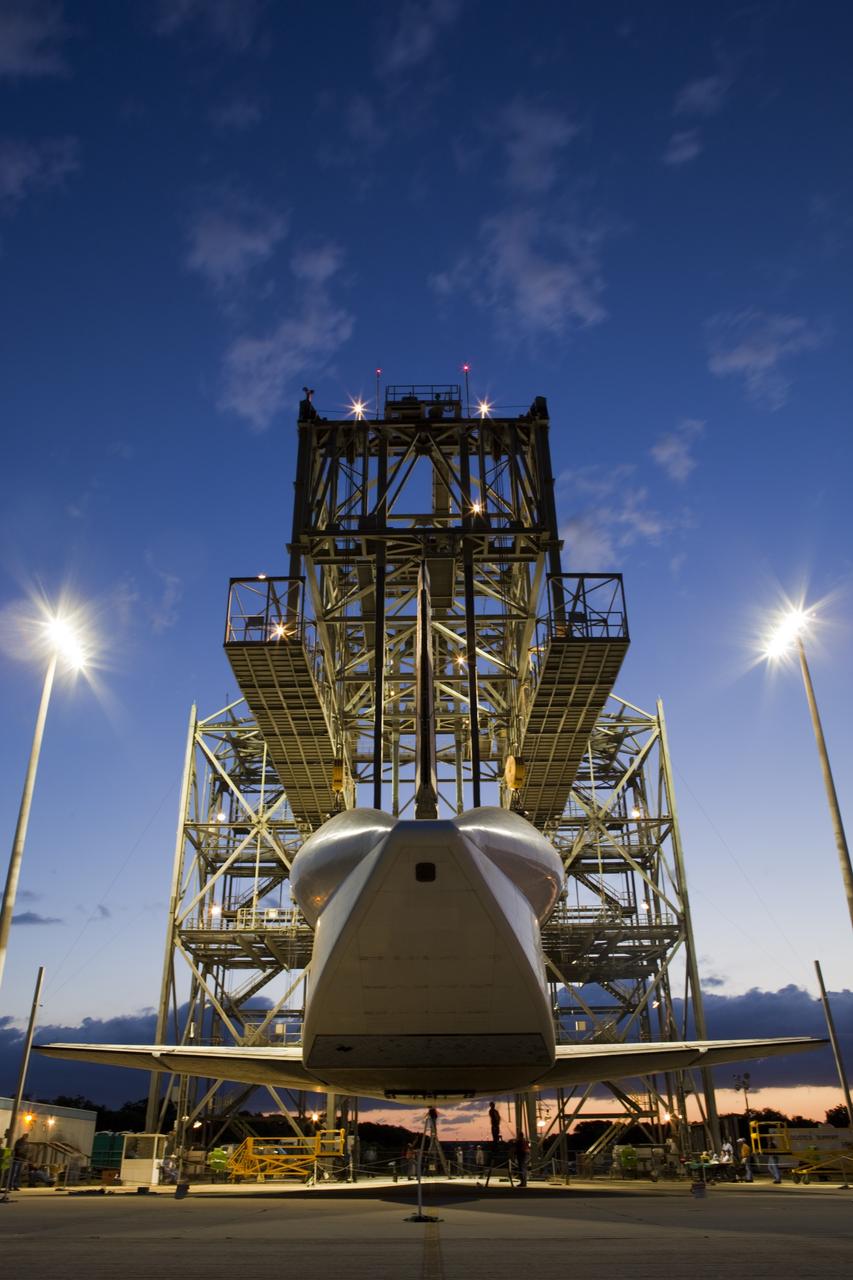
CAPE CANAVERAL, Fla. – As the sun rises over the Shuttle Landing Facility at NASA’s Kennedy Space Center in Florida, operations are under way at the mate-demate device to lift space shuttle Discovery on top of a Shuttle Carrier Aircraft. A tail cone has been installed over Discovery’s three replica shuttle main engines to reduce aerodynamic drag and turbulence during the ferry flight. The device, known as the MDD, is a large gantry-like steel structure used to hoist a shuttle off the ground and position it onto the back of the aircraft, or SCA. The SCA is a Boeing 747 jet, originally manufactured for commercial use, which was modified by NASA to transport the shuttles between destinations on Earth. The SCA designated NASA 905 is assigned to the remaining ferry missions, delivering the shuttles to their permanent public display sites. NASA 905 is scheduled to ferry Discovery to the Washington Dulles International Airport in Virginia on April 17, after which the shuttle will be placed on display in the Smithsonian's National Air and Space Museum Steven F. Udvar-Hazy Center. For more information on the SCA, visit http://www.nasa.gov/centers/dryden/news/FactSheets/FS-013-DFRC.html. For more information on shuttle transition and retirement activities, visit http://www.nasa.gov/transition. Photo credit: NASA/Dimitri Gerondidakis
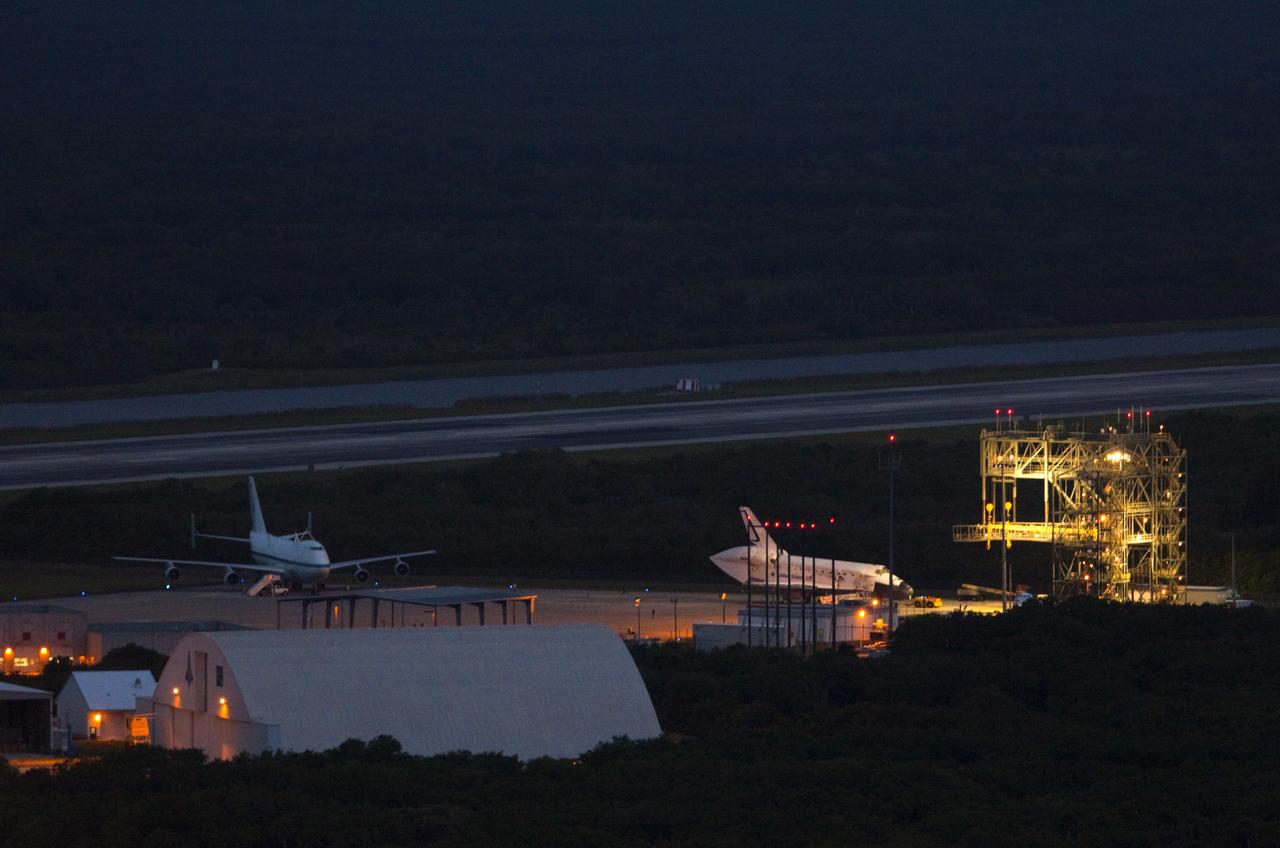
CAPE CANAVERAL, Fla. – At the Shuttle Landing Facility at NASA’s Kennedy Space Center in Florida, space shuttle Discovery rolls past a Shuttle Carrier Aircraft, or SCA, toward the mate-demate device, or MDD. A tail cone has been installed over its three replica shuttle main engines to reduce aerodynamic drag and turbulence during its upcoming ferry flight. The MDD is a large gantry-like steel structure used to hoist a shuttle off the ground and position it onto the back of an SCA. The SCA is a Boeing 747 jet, originally manufactured for commercial use, which was modified by NASA to transport the shuttles between destinations on Earth. The SCA designated NASA 905 is assigned to the remaining ferry missions, delivering the shuttles to their permanent public display sites. NASA 905 is scheduled to ferry Discovery to the Washington Dulles International Airport in Virginia on April 17, after which the shuttle will be placed on display in the Smithsonian's National Air and Space Museum Steven F. Udvar-Hazy Center. For more information on the SCA, visit http://www.nasa.gov/centers/dryden/news/FactSheets/FS-013-DFRC.html. For more information on shuttle transition and retirement activities, visit http://www.nasa.gov/transition. Photo credit: NASA/Jim Grossmann
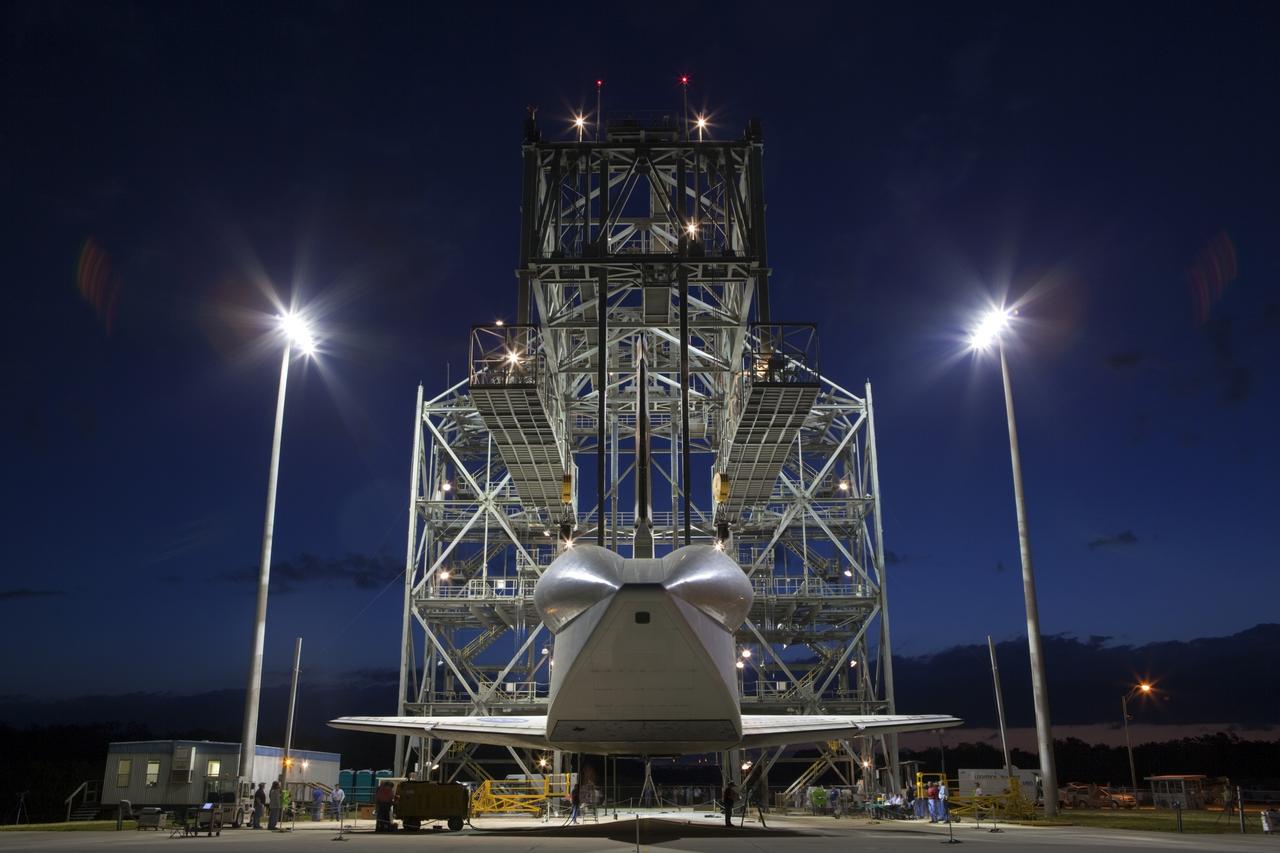
CAPE CANAVERAL, Fla. – Before daybreak at the Shuttle Landing Facility at NASA’s Kennedy Space Center in Florida, space shuttle Discovery hovers above the ground at the mate-demate device. Operations are under way to position Discovery on top of a Shuttle Carrier Aircraft in preparation for its departure from Kennedy on Tuesday. A tail cone has been installed over Discovery’s three replica shuttle main engines to reduce aerodynamic drag and turbulence during the ferry flight. The device, known as the MDD, is a large gantry-like steel structure used to hoist a shuttle off the ground and position it onto the back of the aircraft, or SCA. The SCA is a Boeing 747 jet, originally manufactured for commercial use, which was modified by NASA to transport the shuttles between destinations on Earth. The SCA designated NASA 905 is assigned to the remaining ferry missions, delivering the shuttles to their permanent public display sites. NASA 905 is scheduled to ferry Discovery to the Washington Dulles International Airport in Virginia on April 17, after which the shuttle will be placed on display in the Smithsonian's National Air and Space Museum Steven F. Udvar-Hazy Center. For more information on the SCA, visit http://www.nasa.gov/centers/dryden/news/FactSheets/FS-013-DFRC.html. For more information on shuttle transition and retirement activities, visit http://www.nasa.gov/transition. Photo credit: NASA/Dimitri Gerondidakis
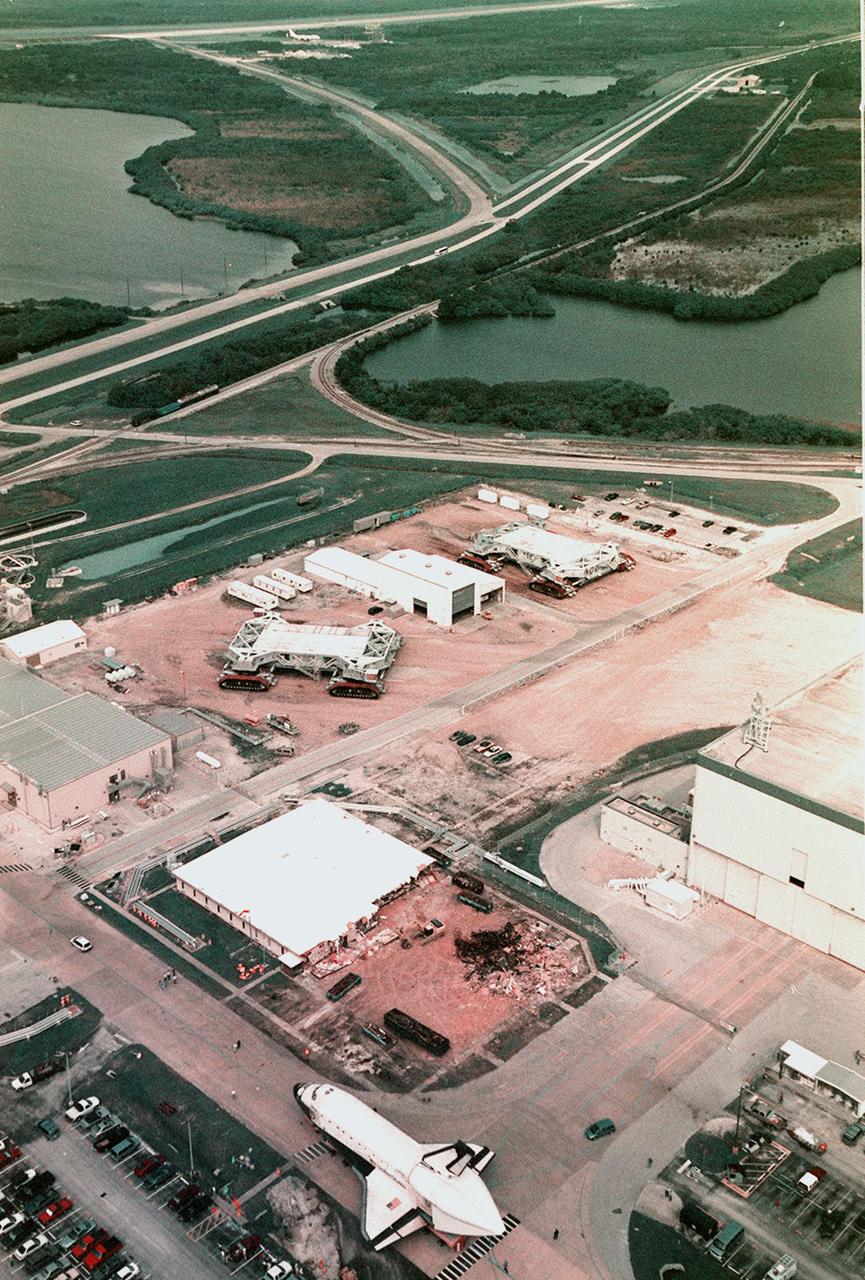
On an orbiter transporter, Columbia is ready for its move to the Shuttle Landing Facility's (SLF) Mate-Demate Device (MDD), in the distance at the top of the photo. Seen next to the MDD is the Boeing 747 Shuttle Carrier Aircraft which will carry the orbiter piggyback in a ferry flight to Palmdale, Calif. On the rear of the orbiter can be seen the tail cone, a fairing that is installed over the aft fuselage of the orbiter to decrease aerodynamic drag and buffet when the Shuttle Carrier Aircraft is transporting the orbiter cross-country. It is 36 feet long, 25 feet wide, and 22 feet high. Columbia, the oldest of four orbiters in NASA's fleet, will undergo extensive inspections and modifications in Boeing's Orbiter Assembly Facility during a nine-month orbiter maintenance down period (OMDP), the second in its history. Orbiters are periodically removed from flight operations for an OMDP. Columbia's first was in 1994. Along with more than 100 modifications on the vehicle, Columbia will be the second orbiter to be outfitted with the multifunctional electronic display system, or 'glass cockpit.' Columbia is expected to return to KSC in July 2000.
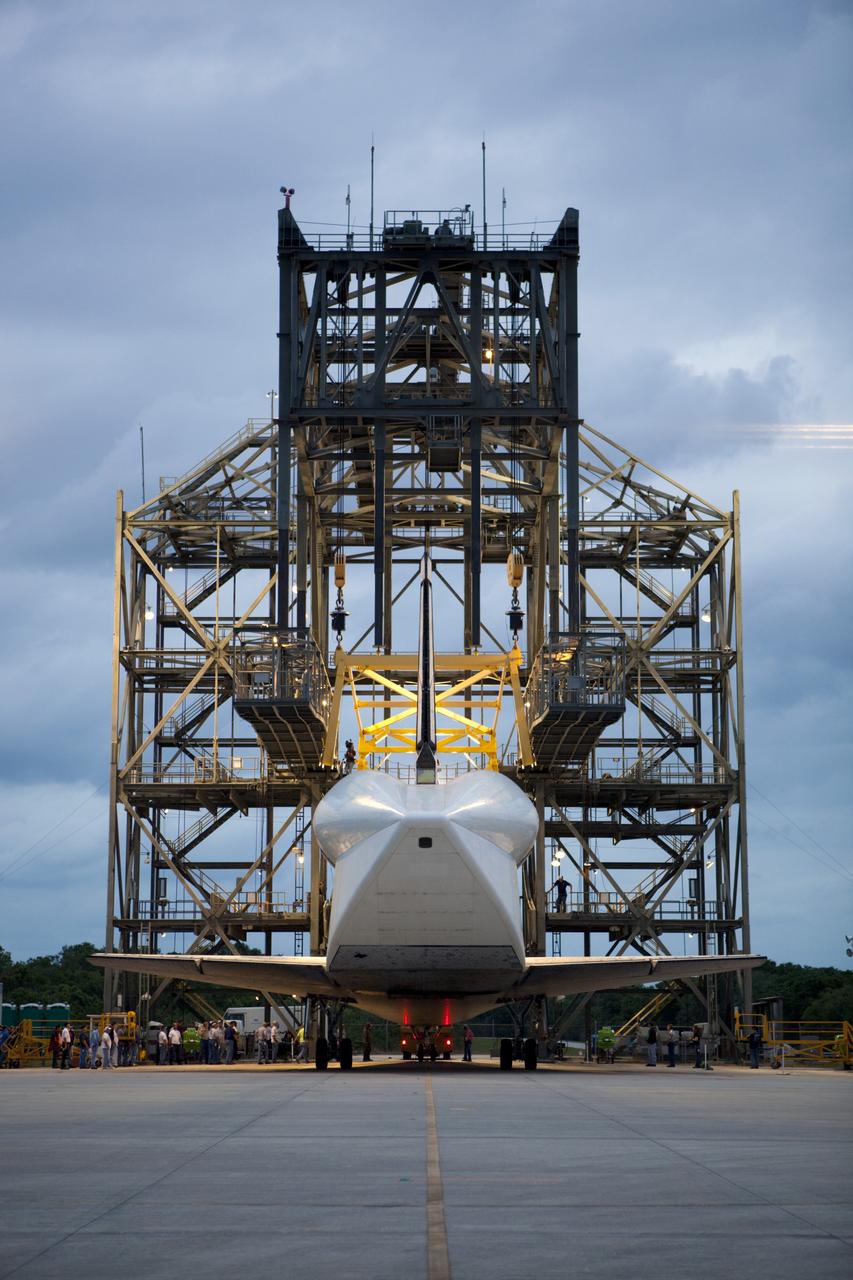
CAPE CANAVERAL, Fla. – Space shuttle Discovery rolls into position beneath the mate-demate device, or MDD, at the Shuttle Landing Facility, or SLF, at NASA’s Kennedy Space Center in Florida. A tail cone has been installed over its three replica shuttle main engines to reduce aerodynamic drag and turbulence during its upcoming ferry flight. The MDD is a large gantry-like steel structure used to hoist a shuttle off the ground and position it onto the back of a Shuttle Carrier Aircraft, or SCA. The SCA is a Boeing 747 jet, originally manufactured for commercial use, which was modified by NASA to transport the shuttles between destinations on Earth. The SCA designated NASA 905 is assigned to the remaining ferry missions, delivering the shuttles to their permanent public display sites. Discovery’s new home will be the Smithsonian's National Air and Space Museum Steven F. Udvar-Hazy Center in Chantilly, Va. For more information on the SCA, visit http://www.nasa.gov/centers/dryden/news/FactSheets/FS-013-DFRC.html. For more information on shuttle transition and retirement activities, visit http://www.nasa.gov/transition. Photo credit: NASA/Dimitri Gerondidakis
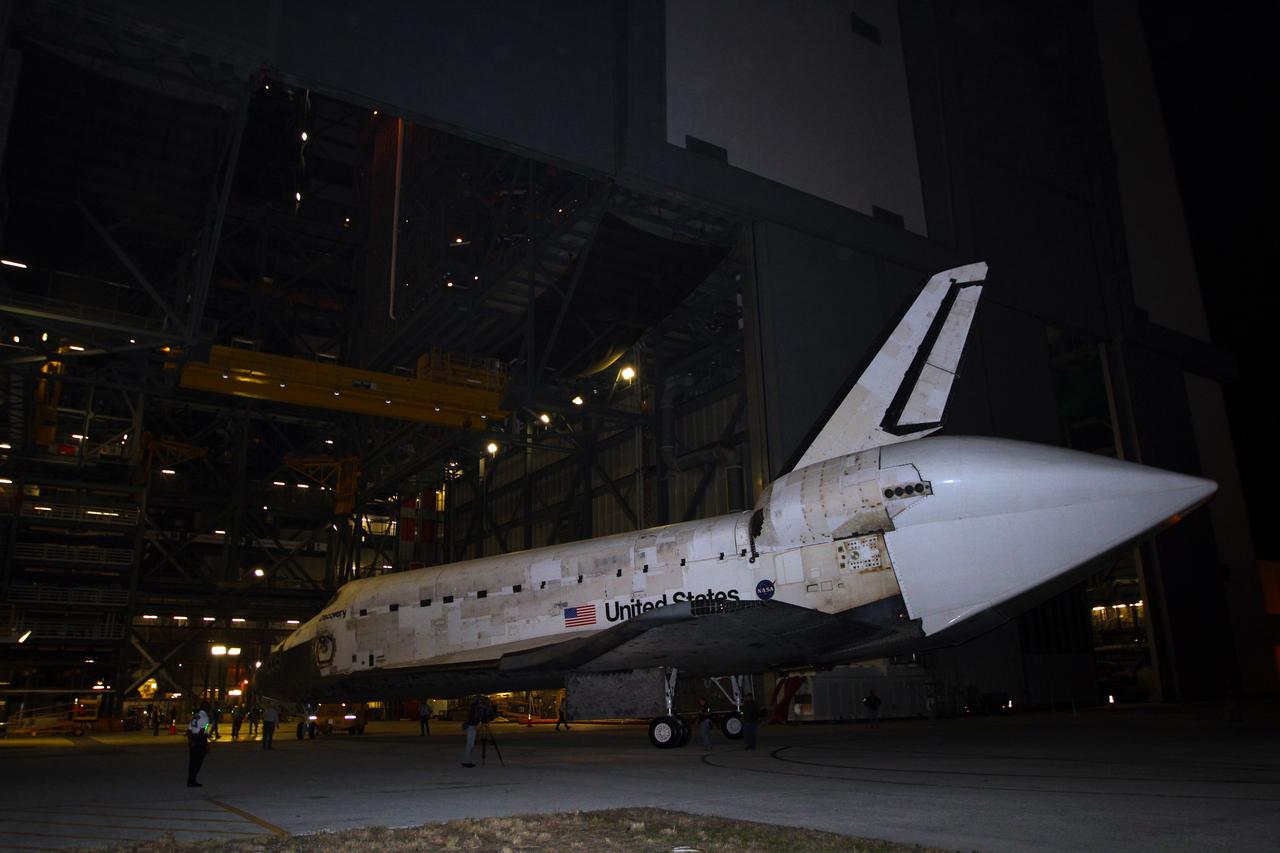
CAPE CANAVERAL, Fla. – Space shuttle Discovery rolls out of the Vehicle Assembly Building, or VAB, at NASA’s Kennedy Space Center in Florida, into darkness for its trip to the Shuttle Landing Facility, or SLF. Its move got under way at 5 a.m. EDT. A tail cone has been installed over its three replica shuttle main engines to reduce aerodynamic drag and turbulence during its upcoming ferry flight. Discovery was in storage in the VAB’s high bay 4 awaiting departure from Kennedy’s Launch Complex 39 area for the final time. At the SLF, Discovery will be hoisted onto a Shuttle Carrier Aircraft, or SCA, with the aid of a mate-demate device. The SCA, a modified Boeing 747 jet airliner, is scheduled to transport Discovery to the Washington Dulles International Airport in Virginia on April 17, after which the shuttle will be placed on permanent public display in the Smithsonian's National Air and Space Museum Steven F. Udvar-Hazy Center. For more information on shuttle transition and retirement activities, visit http://www.nasa.gov/transition. Photo credit: NASA/Kim Shiflett
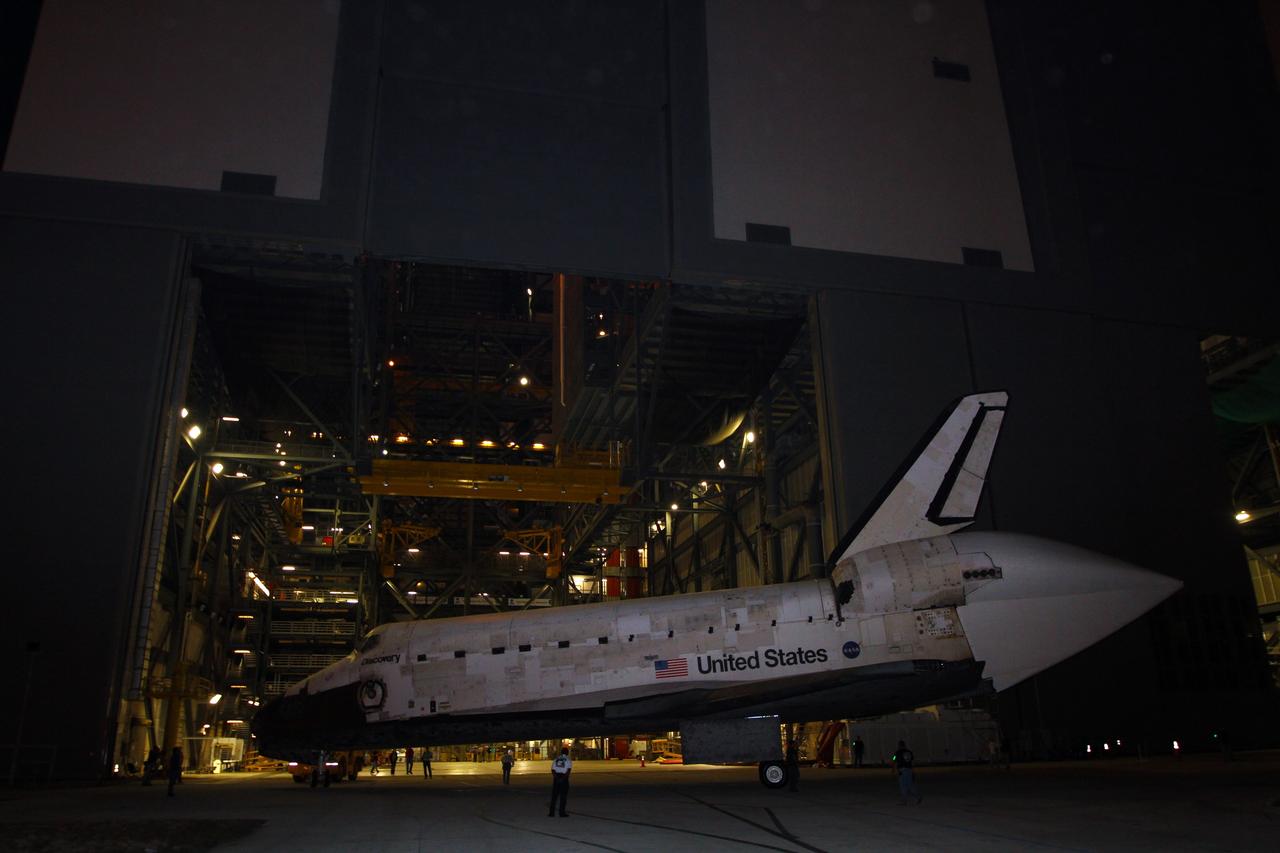
CAPE CANAVERAL, Fla. – Space shuttle Discovery executes a three-point turnaround outside the Vehicle Assembly Building, or VAB, at NASA’s Kennedy Space Center in Florida, for its trip to the Shuttle Landing Facility, or SLF. Its move got under way at 5 a.m. EDT. A tail cone has been installed over its three replica shuttle main engines to reduce aerodynamic drag and turbulence during its upcoming ferry flight. Discovery was in storage in the VAB’s high bay 4 awaiting departure from Kennedy’s Launch Complex 39 area for the final time. At the SLF, Discovery will be hoisted onto a Shuttle Carrier Aircraft, or SCA, with the aid of a mate-demate device. The SCA, a modified Boeing 747 jet airliner, is scheduled to transport Discovery to the Washington Dulles International Airport in Virginia on April 17, after which the shuttle will be placed on permanent public display in the Smithsonian's National Air and Space Museum Steven F. Udvar-Hazy Center. For more information on shuttle transition and retirement activities, visit http://www.nasa.gov/transition. Photo credit: NASA/Kim Shiflett
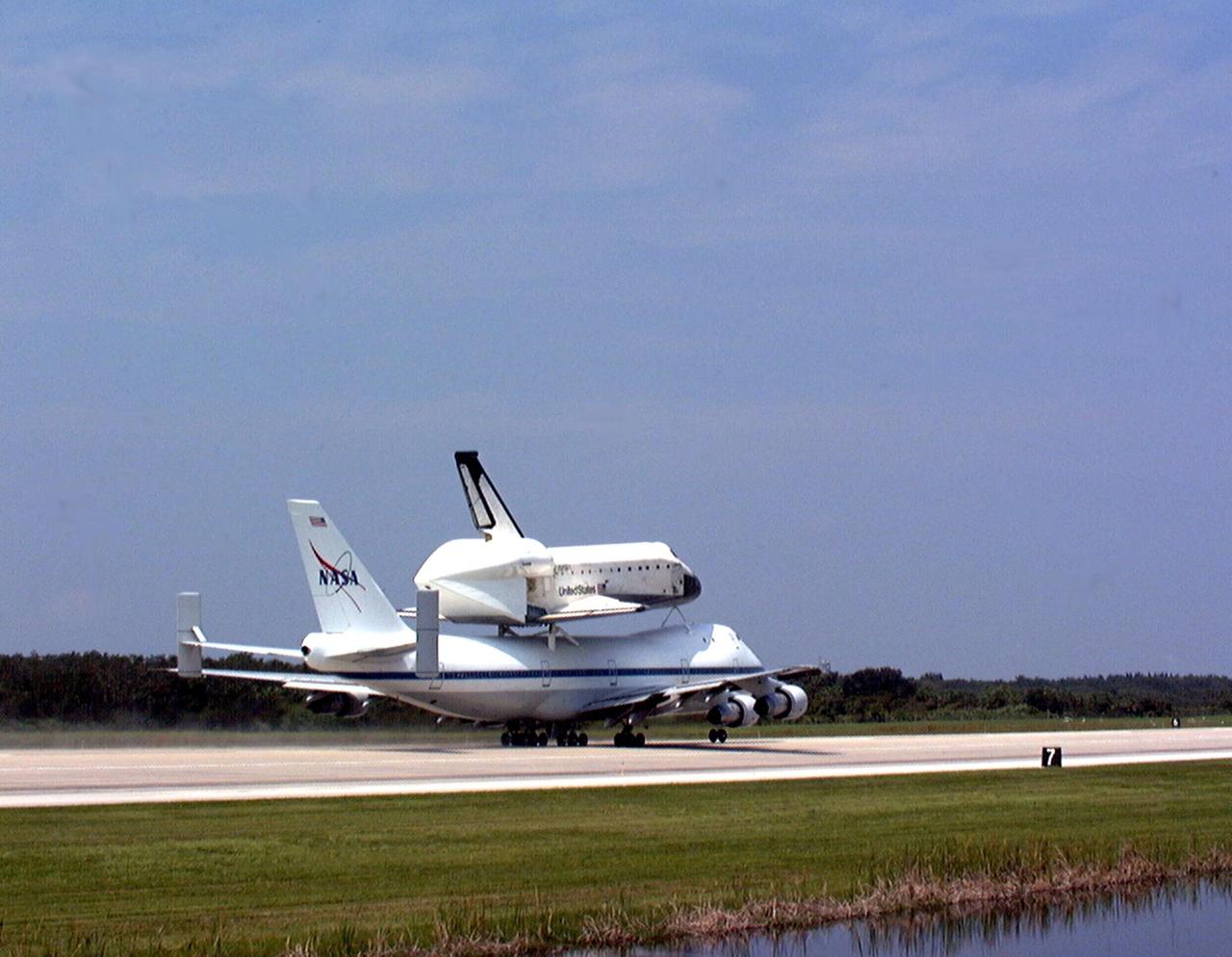
KENNEDY SPACE CENTER, FLA. -- From the Shuttle Landing Facility at Kennedy Space Center, the orbiter Columbia moves down the runway on the back of a Boeing 747 Shuttle Carrier Aircraft on a ferry flight to Palmdale, Calif. On the rear of the orbiter can be seen the tail cone, a fairing that is installed over the aft fuselage of the orbiter to decrease aerodynamic drag and buffet when the Shuttle Carrier Aircraft is transporting the orbiter cross-country. It is 36 feet long, 25 feet wide, and 22 feet high. Columbia, the oldest of four orbiters in NASA's fleet, will undergo extensive inspections and modifications in Boeing's Orbiter Assembly Facility during a nine-month orbiter maintenance down period (OMDP), the second in its history. Orbiters are periodically removed from flight operations for an OMDP. Columbia's first was in 1994. Along with more than 100 modifications on the vehicle, Columbia will be the second orbiter to be outfitted with the multifunctional electronic display system, or "glass cockpit." Columbia is expected to return to KSC in July 2000
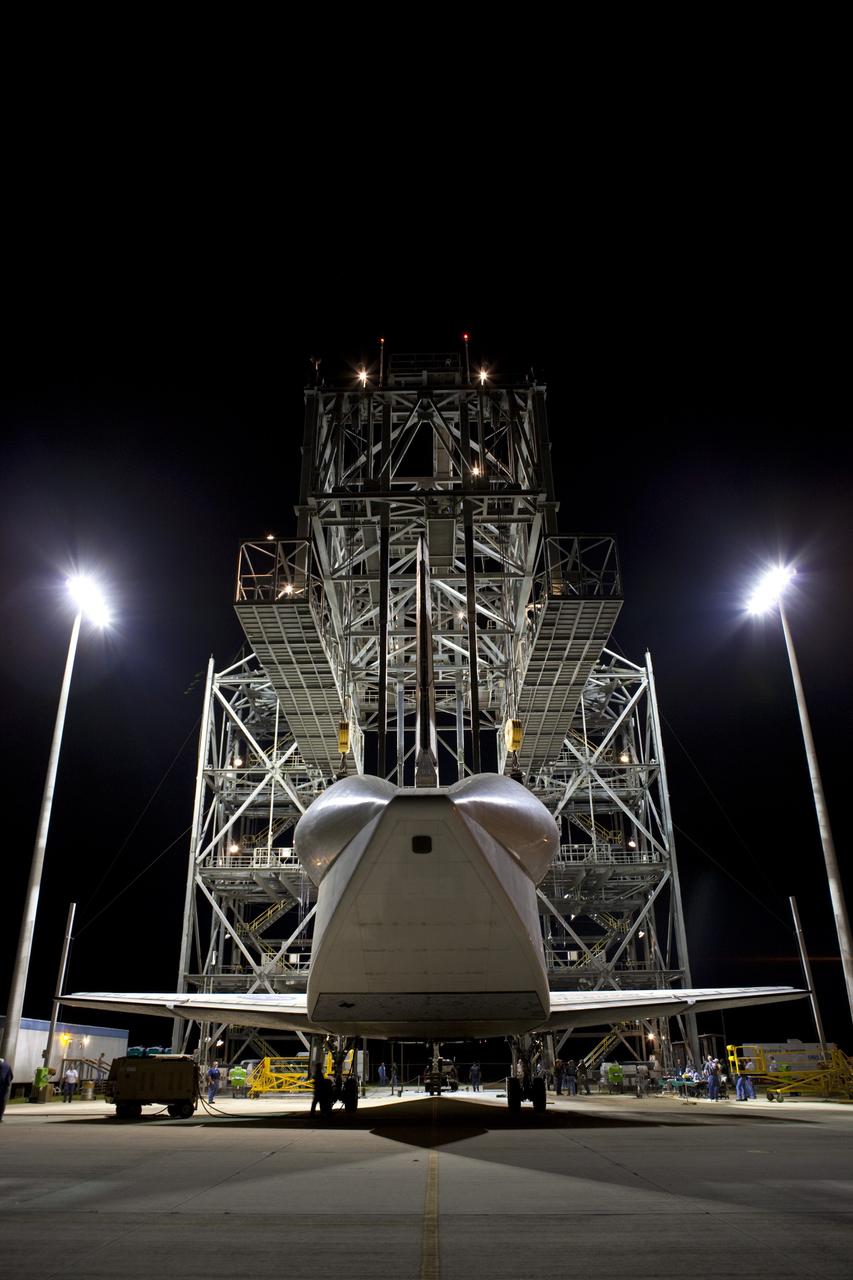
CAPE CANAVERAL, Fla. – Before daybreak at the Shuttle Landing Facility at NASA’s Kennedy Space Center in Florida, preparations are under way at the mate-demate device to resume mating operations of space shuttle Discovery to a Shuttle Carrier Aircraft. A tail cone covers Discovery’s three replica shuttle main engines to reduce aerodynamic drag and turbulence during the ferry flight. The device, known as the MDD, is a large gantry-like steel structure used to hoist a shuttle off the ground and position it onto the back of the aircraft, or SCA. The SCA is a Boeing 747 jet, originally manufactured for commercial use, which was modified by NASA to transport the shuttles between destinations on Earth. The SCA designated NASA 905 is assigned to the remaining ferry missions, delivering the shuttles to their permanent public display sites. NASA 905 is scheduled to ferry Discovery to the Washington Dulles International Airport in Virginia on April 17, after which the shuttle will be placed on display in the Smithsonian's National Air and Space Museum Steven F. Udvar-Hazy Center. For more information on the SCA, visit http://www.nasa.gov/centers/dryden/news/FactSheets/FS-013-DFRC.html. For more information on shuttle transition and retirement activities, visit http://www.nasa.gov/transition. Photo credit: NASA/Dimitri Gerondidakis
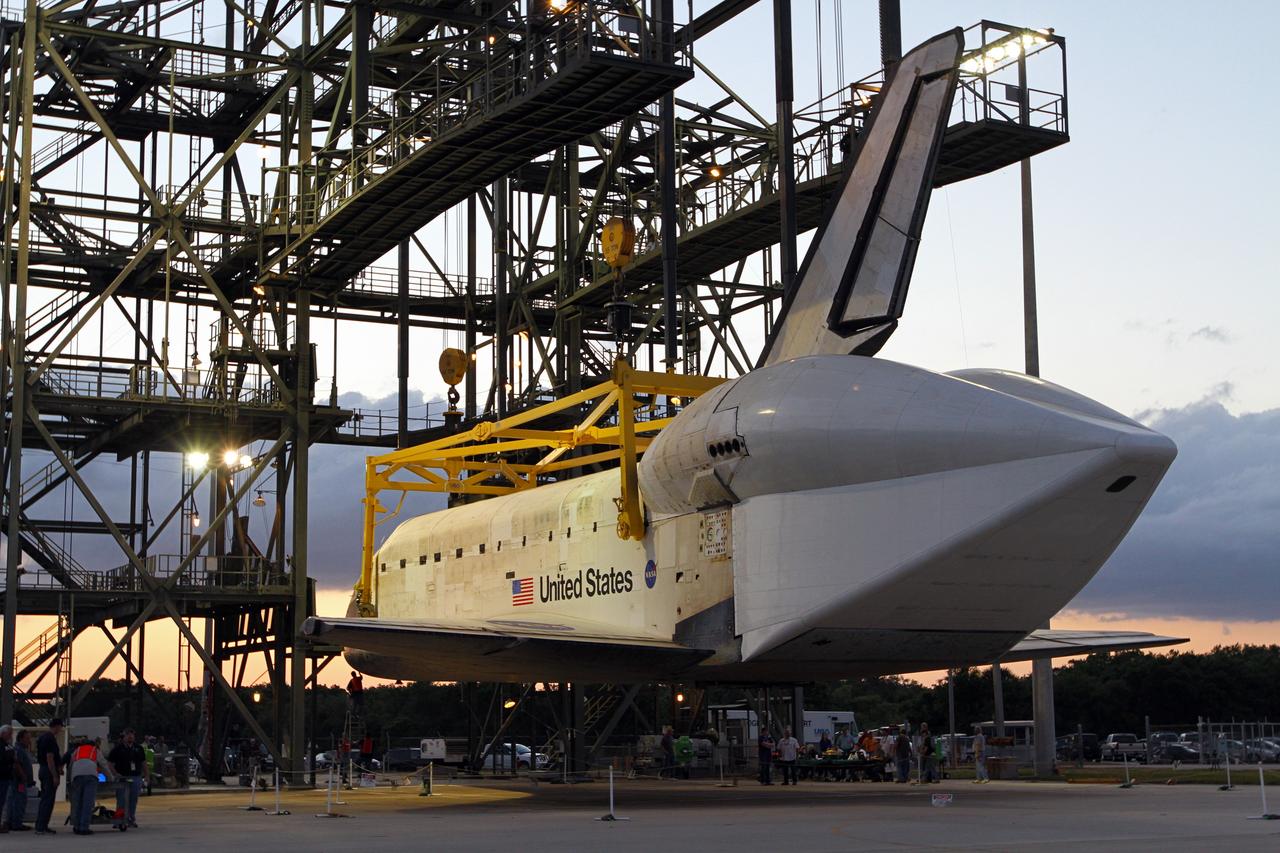
CAPE CANAVERAL, Fla. – As the sun comes up over the Shuttle Landing Facility at NASA’s Kennedy Space Center in Florida, space shuttle Discovery is suspended above the ground at the mate-demate device during operations to place it on top of a Shuttle Carrier Aircraft. A tail cone has been installed over Discovery’s three replica shuttle main engines to reduce aerodynamic drag and turbulence during the ferry flight. The device, known as the MDD, is a large gantry-like steel structure used to hoist a shuttle off the ground and position it onto the back of the aircraft, or SCA. The SCA is a Boeing 747 jet, originally manufactured for commercial use, which was modified by NASA to transport the shuttles between destinations on Earth. The SCA designated NASA 905 is assigned to the remaining ferry missions, delivering the shuttles to their permanent public display sites. NASA 905 is scheduled to ferry Discovery to the Washington Dulles International Airport in Virginia on April 17, after which the shuttle will be placed on display in the Smithsonian's National Air and Space Museum Steven F. Udvar-Hazy Center. For more information on the SCA, visit http://www.nasa.gov/centers/dryden/news/FactSheets/FS-013-DFRC.html. For more information on shuttle transition and retirement activities, visit http://www.nasa.gov/transition. Photo credit: NASA/Kim Shiflett
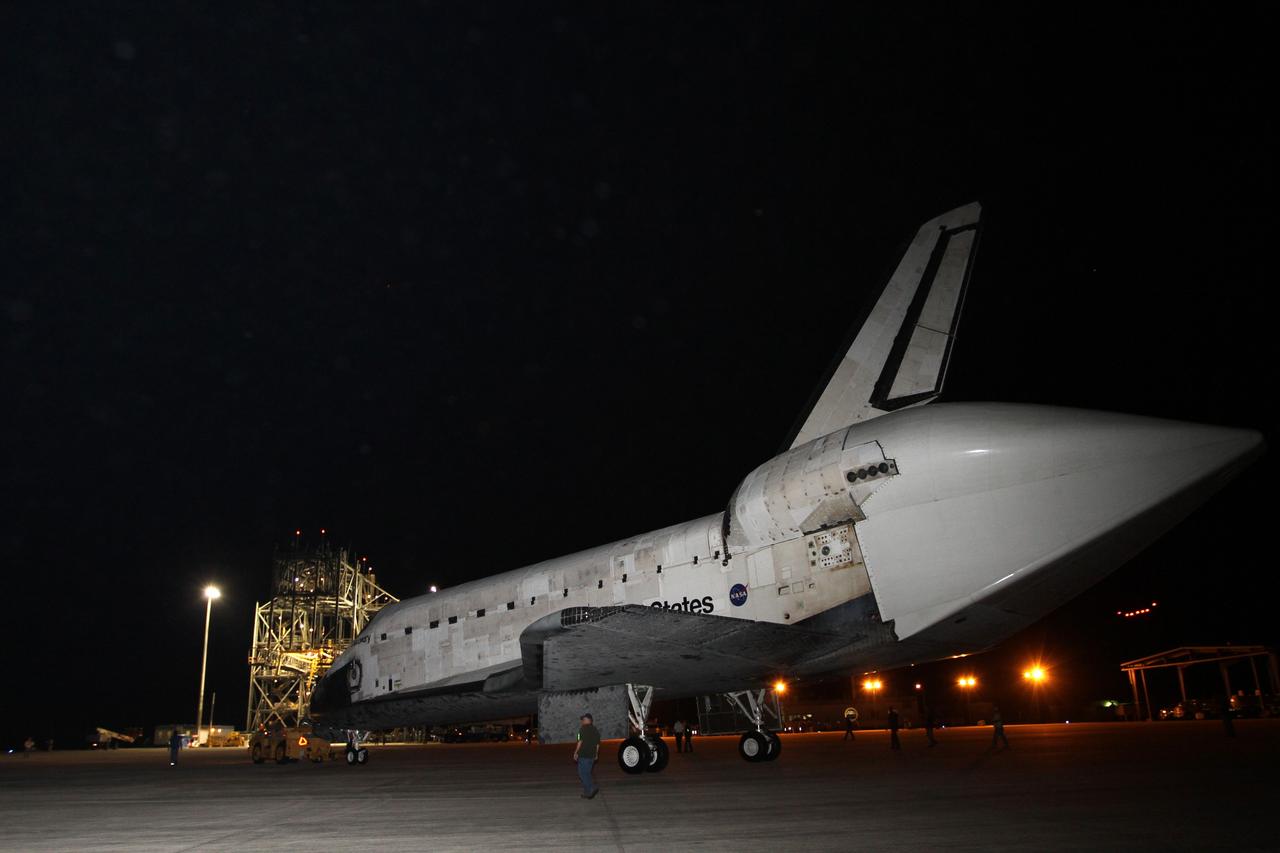
CAPE CANAVERAL, Fla. – Space shuttle Discovery approaches the mate-demate device, or MDD, at the Shuttle Landing Facility at NASA’s Kennedy Space Center in Florida. A tail cone has been installed over its three replica shuttle main engines to reduce aerodynamic drag and turbulence during its upcoming ferry flight. The MDD is a large gantry-like steel structure used to hoist a shuttle off the ground and position it onto the back of a Shuttle Carrier Aircraft, or SCA. The SCA is a Boeing 747 jet, originally manufactured for commercial use, which was modified by NASA to transport the shuttles between destinations on Earth. The SCA designated NASA 905 is assigned to the remaining ferry missions, delivering the shuttles to their permanent public display sites. Discovery’s new home will be the Smithsonian's National Air and Space Museum Steven F. Udvar-Hazy Center in Chantilly, Va. For more information on the SCA, visit http://www.nasa.gov/centers/dryden/news/FactSheets/FS-013-DFRC.html. For more information on shuttle transition and retirement activities, visit http://www.nasa.gov/transition. Photo credit: NASA/Kim Shiflett
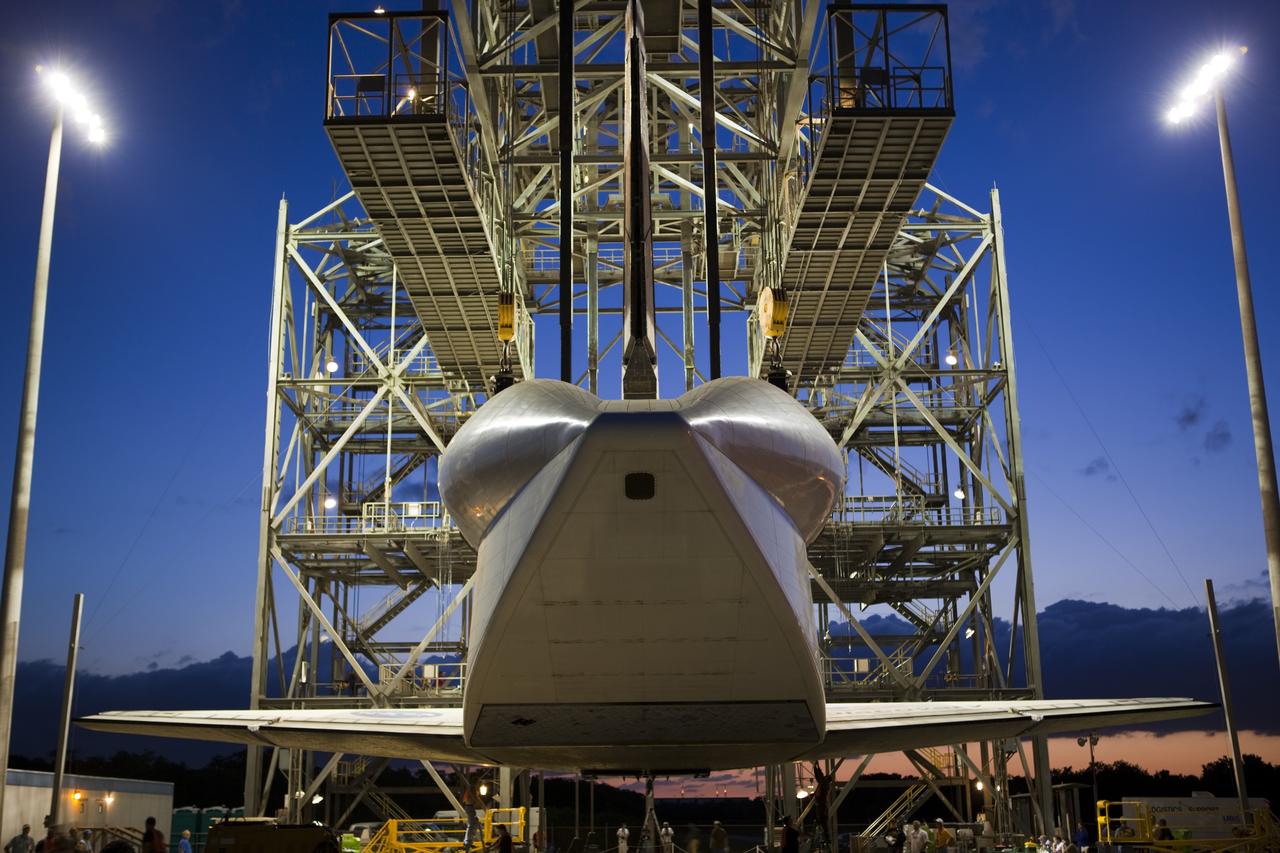
CAPE CANAVERAL, Fla. – Before daybreak at the Shuttle Landing Facility at NASA’s Kennedy Space Center in Florida, operations are under way at the mate-demate device to lift space shuttle Discovery on top of a Shuttle Carrier Aircraft. A tail cone has been installed over Discovery’s three replica shuttle main engines to reduce aerodynamic drag and turbulence during the ferry flight. The device, known as the MDD, is a large gantry-like steel structure used to hoist a shuttle off the ground and position it onto the back of the aircraft, or SCA. The SCA is a Boeing 747 jet, originally manufactured for commercial use, which was modified by NASA to transport the shuttles between destinations on Earth. The SCA designated NASA 905 is assigned to the remaining ferry missions, delivering the shuttles to their permanent public display sites. NASA 905 is scheduled to ferry Discovery to the Washington Dulles International Airport in Virginia on April 17, after which the shuttle will be placed on display in the Smithsonian's National Air and Space Museum Steven F. Udvar-Hazy Center. For more information on the SCA, visit http://www.nasa.gov/centers/dryden/news/FactSheets/FS-013-DFRC.html. For more information on shuttle transition and retirement activities, visit http://www.nasa.gov/transition. Photo credit: NASA/Dimitri Gerondidakis

CAPE CANAVERAL, Fla. – Space shuttle Discovery approaches the mate-demate device, or MDD, at the Shuttle Landing Facility at NASA’s Kennedy Space Center in Florida. A tail cone has been installed over its three replica shuttle main engines to reduce aerodynamic drag and turbulence during its upcoming ferry flight. The MDD is a large gantry-like steel structure used to hoist a shuttle off the ground and position it onto the back of a Shuttle Carrier Aircraft, or SCA. The SCA is a Boeing 747 jet, originally manufactured for commercial use, which was modified by NASA to transport the shuttles between destinations on Earth. The SCA designated NASA 905 is assigned to the remaining ferry missions, delivering the shuttles to their permanent public display sites. Discovery’s new home will be the Smithsonian's National Air and Space Museum Steven F. Udvar-Hazy Center in Chantilly, Va. For more information on the SCA, visit http://www.nasa.gov/centers/dryden/news/FactSheets/FS-013-DFRC.html. For more information on shuttle transition and retirement activities, visit http://www.nasa.gov/transition. Photo credit: NASA/Jim Grossmann
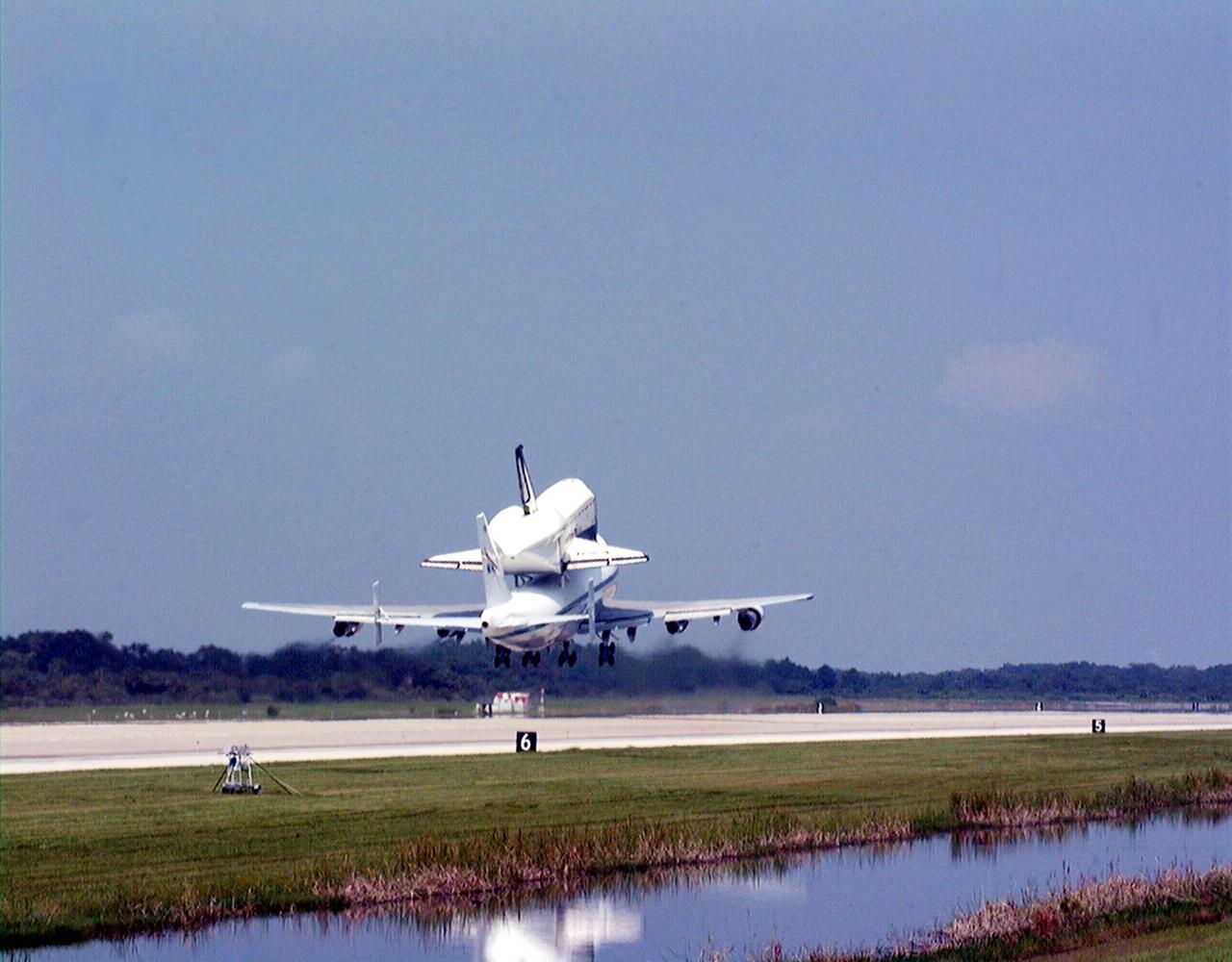
KENNEDY SPACE CENTER, FLA. -- At the Shuttle Landing Facility at Kennedy Space Center, the orbiter Columbia takes off into a clear sky on the back of a Boeing 747 Shuttle Carrier Aircraft on a ferry flight to Palmdale, Calif. On the rear of the orbiter can be seen the tail cone, a fairing that is installed over the aft fuselage of the orbiter to decrease aerodynamic drag and buffet when the Shuttle Carrier Aircraft is transporting the orbiter cross-country. It is 36 feet long, 25 feet wide, and 22 feet high. Columbia, the oldest of four orbiters in NASA's fleet, will undergo extensive inspections and modifications in Boeing's Orbiter Assembly Facility during a nine-month orbiter maintenance down period (OMDP), the second in its history. Orbiters are periodically removed from flight operations for an OMDP. Columbia's first was in 1994. Along with more than 100 modifications on the vehicle, Columbia will be the second orbiter to be outfitted with the multifunctional electronic display system, or "glass cockpit." Columbia is expected to return to KSC in July 2000

CAPE CANAVERAL, Fla. – Space shuttle Discovery nears the mate-demate device, or MDD, at the Shuttle Landing Facility at NASA’s Kennedy Space Center in Florida. A tail cone has been installed over its three replica shuttle main engines to reduce aerodynamic drag and turbulence during its upcoming ferry flight. The MDD is a large gantry-like steel structure used to hoist a shuttle off the ground and position it onto the back of a Shuttle Carrier Aircraft, or SCA. The SCA is a Boeing 747 jet, originally manufactured for commercial use, which was modified by NASA to transport the shuttles between destinations on Earth. The SCA designated NASA 905 is assigned to the remaining ferry missions, delivering the shuttles to their permanent public display sites. Discovery’s new home will be the Smithsonian's National Air and Space Museum Steven F. Udvar-Hazy Center in Chantilly, Va. For more information on the SCA, visit http://www.nasa.gov/centers/dryden/news/FactSheets/FS-013-DFRC.html. For more information on shuttle transition and retirement activities, visit http://www.nasa.gov/transition. Photo credit: NASA/Kim Shiflett
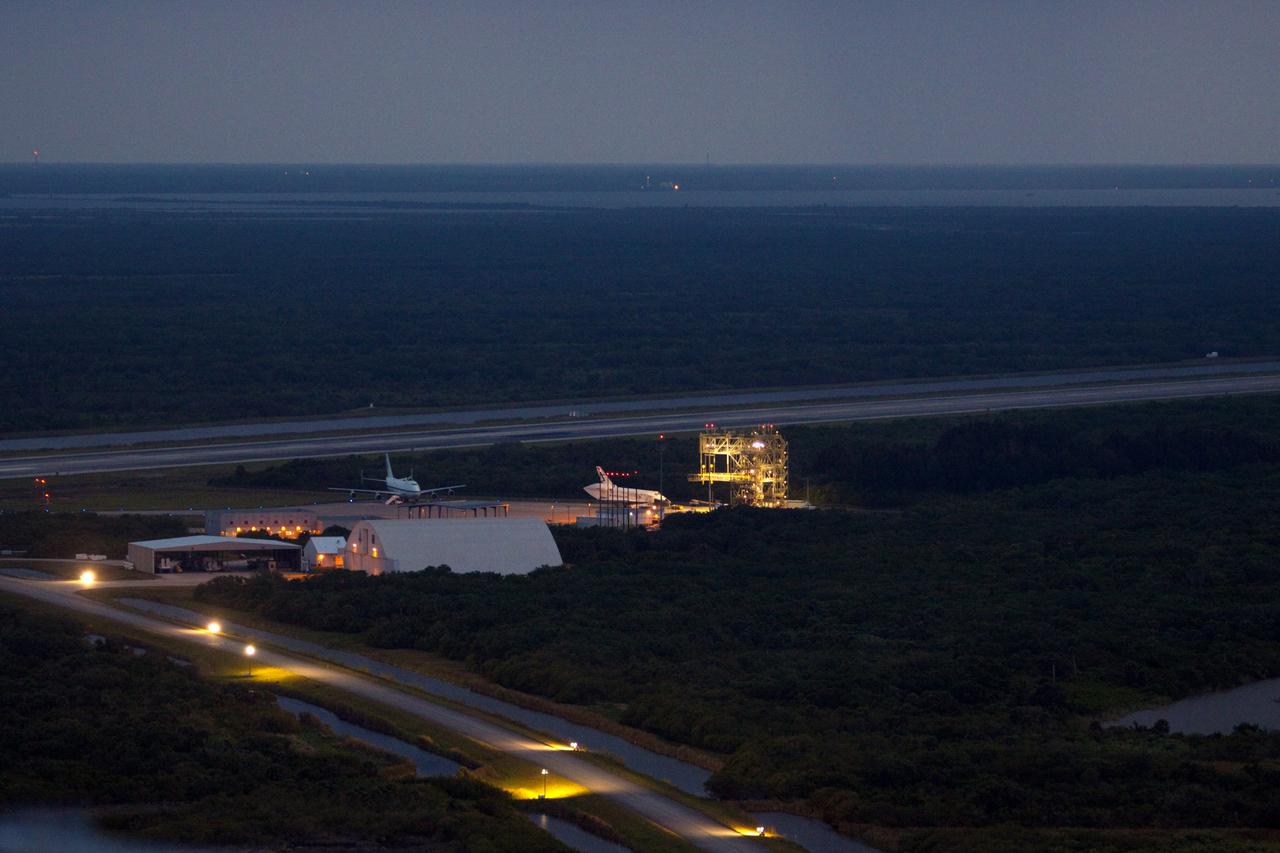
CAPE CANAVERAL, Fla. – At the Shuttle Landing Facility at NASA’s Kennedy Space Center in Florida, space shuttle Discovery rolls past a Shuttle Carrier Aircraft, or SCA, toward the mate-demate device, or MDD. A tail cone has been installed over its three replica shuttle main engines to reduce aerodynamic drag and turbulence during its upcoming ferry flight. The MDD is a large gantry-like steel structure used to hoist a shuttle off the ground and position it onto the back of an SCA. The SCA is a Boeing 747 jet, originally manufactured for commercial use, which was modified by NASA to transport the shuttles between destinations on Earth. The SCA designated NASA 905 is assigned to the remaining ferry missions, delivering the shuttles to their permanent public display sites. NASA 905 is scheduled to ferry Discovery to the Washington Dulles International Airport in Virginia on April 17, after which the shuttle will be placed on display in the Smithsonian's National Air and Space Museum Steven F. Udvar-Hazy Center. For more information on the SCA, visit http://www.nasa.gov/centers/dryden/news/FactSheets/FS-013-DFRC.html. For more information on shuttle transition and retirement activities, visit http://www.nasa.gov/transition. Photo credit: NASA/Jim Grossmann

KENNEDY SPACE CENTER, FLA. -- At the Shuttle Landing Facility at Kennedy Space Center, the orbiter Columbia takes to the sky on the back of a Boeing 747 Shuttle Carrier Aircraft on a ferry flight to Palmdale, Calif. On the rear of the orbiter can be seen the tail cone, a fairing that is installed over the aft fuselage of the orbiter to decrease aerodynamic drag and buffet when the Shuttle Carrier Aircraft is transporting the orbiter cross-country. It is 36 feet long, 25 feet wide, and 22 feet high. Columbia, the oldest of four orbiters in NASA's fleet, will undergo extensive inspections and modifications in Boeing's Orbiter Assembly Facility during a nine-month orbiter maintenance down period (OMDP), the second in its history. Orbiters are periodically removed from flight operations for an OMDP. Columbia's first was in 1994. Along with more than 100 modifications on the vehicle, Columbia will be the second orbiter to be outfitted with the multifunctional electronic display system, or "glass cockpit." Columbia is expected to return to KSC in July 2000
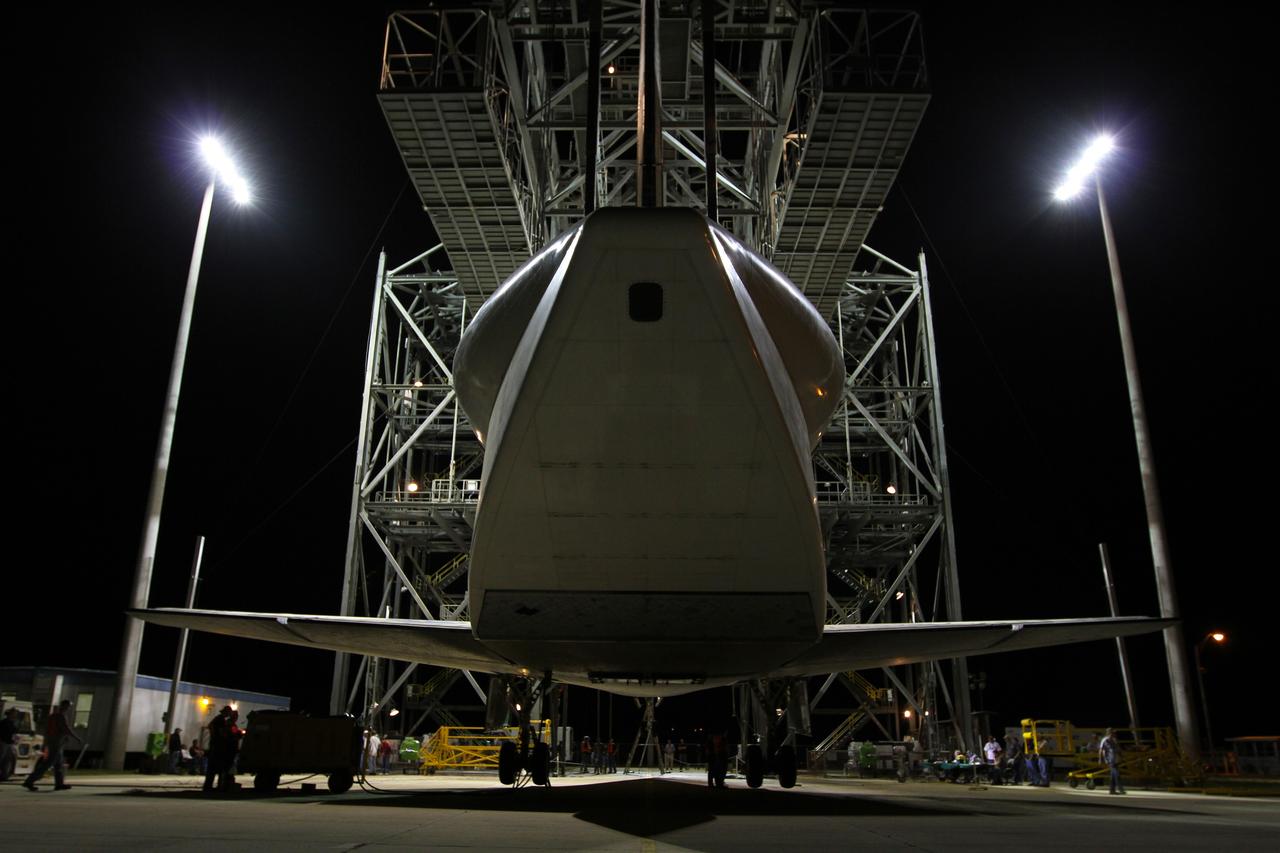
CAPE CANAVERAL, Fla. – Before daybreak at the Shuttle Landing Facility at NASA’s Kennedy Space Center in Florida, space shuttle Discovery hovers above the ground at the mate-demate device. Operations are under way to position Discovery on top of a Shuttle Carrier Aircraft in preparation for its departure from Kennedy on Tuesday. A tail cone has been installed over Discovery’s three replica shuttle main engines to reduce aerodynamic drag and turbulence during the ferry flight. The device, known as the MDD, is a large gantry-like steel structure used to hoist a shuttle off the ground and position it onto the back of the aircraft, or SCA. The SCA is a Boeing 747 jet, originally manufactured for commercial use, which was modified by NASA to transport the shuttles between destinations on Earth. The SCA designated NASA 905 is assigned to the remaining ferry missions, delivering the shuttles to their permanent public display sites. NASA 905 is scheduled to ferry Discovery to the Washington Dulles International Airport in Virginia on April 17, after which the shuttle will be placed on display in the Smithsonian's National Air and Space Museum Steven F. Udvar-Hazy Center. For more information on the SCA, visit http://www.nasa.gov/centers/dryden/news/FactSheets/FS-013-DFRC.html. For more information on shuttle transition and retirement activities, visit http://www.nasa.gov/transition. Photo credit: NASA/Kim Shiflett

CAPE CANAVERAL, Fla. – Before sunrise at the Shuttle Landing Facility at NASA’s Kennedy Space Center in Florida, lights on the mate-demate device reveal space shuttle Discovery suspended above the ground. Operations are under way to place Discovery on top of a Shuttle Carrier Aircraft in preparation for its departure from Kennedy on Tuesday. A tail cone has been installed over Discovery’s three replica shuttle main engines to reduce aerodynamic drag and turbulence during the ferry flight. The device, known as the MDD, is a large gantry-like steel structure used to hoist a shuttle off the ground and position it onto the back of the aircraft, or SCA. The SCA is a Boeing 747 jet, originally manufactured for commercial use, which was modified by NASA to transport the shuttles between destinations on Earth. The SCA designated NASA 905 is assigned to the remaining ferry missions, delivering the shuttles to their permanent public display sites. NASA 905 is scheduled to ferry Discovery to the Washington Dulles International Airport in Virginia on April 17, after which the shuttle will be placed on display in the Smithsonian's National Air and Space Museum Steven F. Udvar-Hazy Center. For more information on the SCA, visit http://www.nasa.gov/centers/dryden/news/FactSheets/FS-013-DFRC.html. For more information on shuttle transition and retirement activities, visit http://www.nasa.gov/transition. Photo credit: NASA/Kim Shiflett
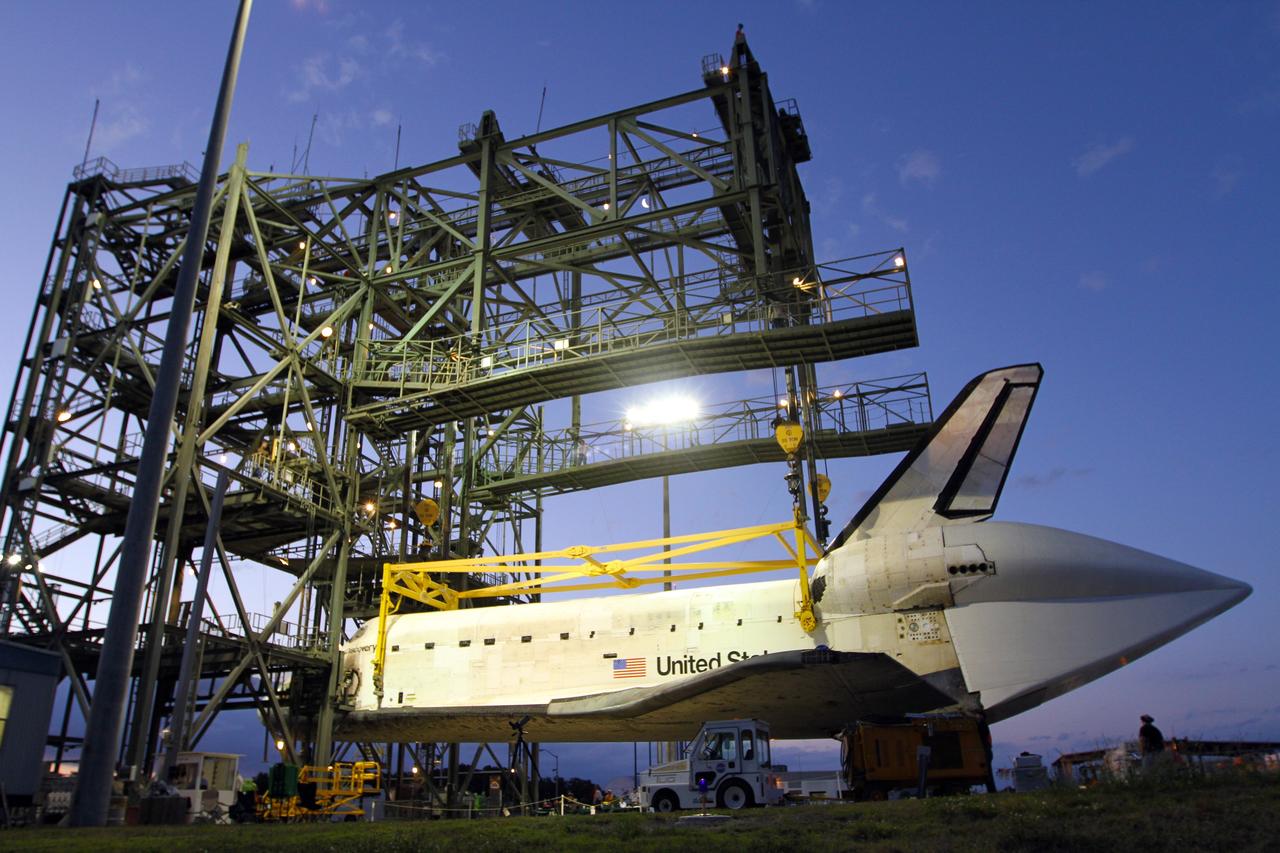
CAPE CANAVERAL, Fla. – As the sun rises over the Shuttle Landing Facility at NASA’s Kennedy Space Center in Florida, operations are under way at the mate-demate device to lift space shuttle Discovery on top of a Shuttle Carrier Aircraft in preparation for its departure from Kennedy on Tuesday. A tail cone has been installed over Discovery’s three replica shuttle main engines to reduce aerodynamic drag and turbulence during the ferry flight. The device, known as the MDD, is a large gantry-like steel structure used to hoist a shuttle off the ground and position it onto the back of the aircraft, or SCA. The SCA is a Boeing 747 jet, originally manufactured for commercial use, which was modified by NASA to transport the shuttles between destinations on Earth. The SCA designated NASA 905 is assigned to the remaining ferry missions, delivering the shuttles to their permanent public display sites. NASA 905 is scheduled to ferry Discovery to the Washington Dulles International Airport in Virginia on April 17, after which the shuttle will be placed on display in the Smithsonian's National Air and Space Museum Steven F. Udvar-Hazy Center. For more information on the SCA, visit http://www.nasa.gov/centers/dryden/news/FactSheets/FS-013-DFRC.html. For more information on shuttle transition and retirement activities, visit http://www.nasa.gov/transition. Photo credit: NASA/Kim Shiflett
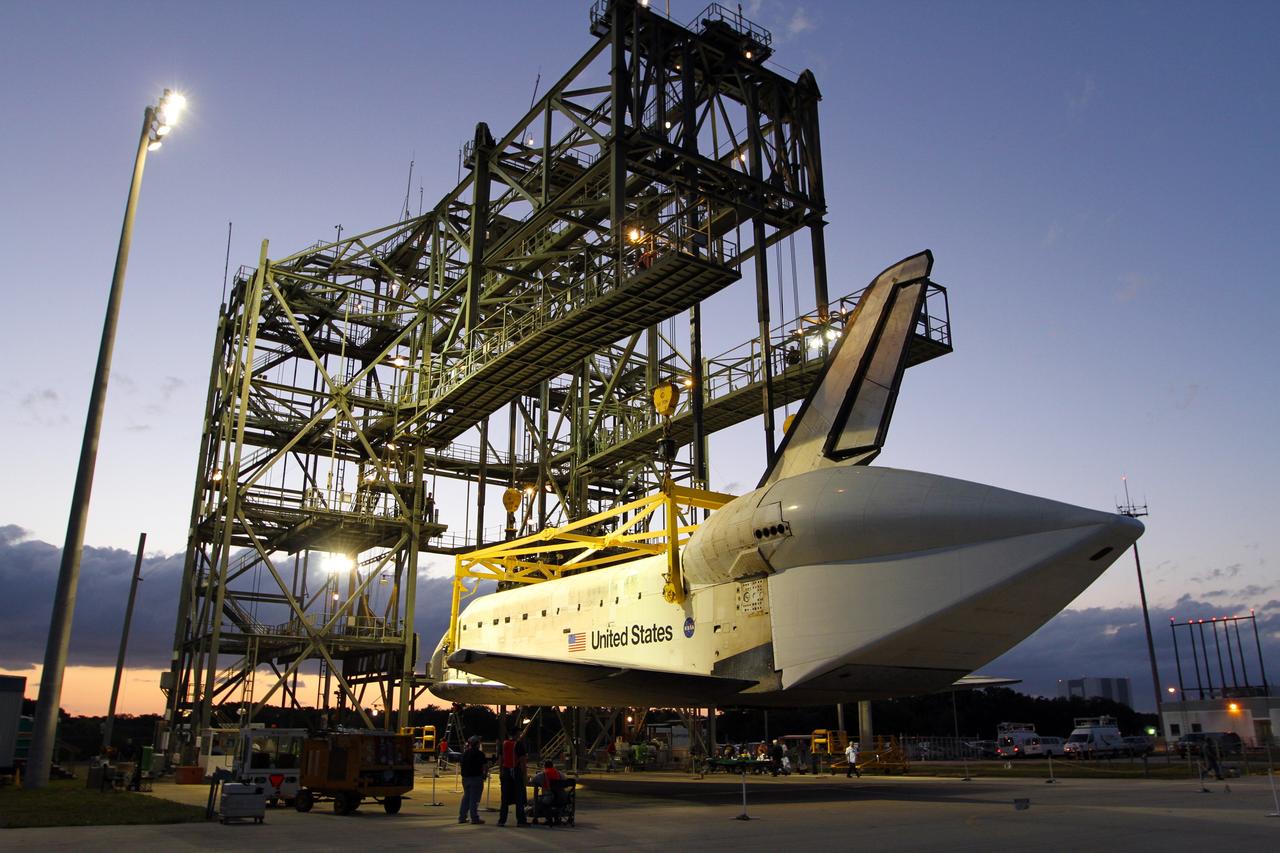
CAPE CANAVERAL, Fla. – As the sun rises over the Shuttle Landing Facility at NASA’s Kennedy Space Center in Florida, operations are under way at the mate-demate device to lift space shuttle Discovery on top of a Shuttle Carrier Aircraft in preparation for its departure from Kennedy on Tuesday. A tail cone has been installed over Discovery’s three replica shuttle main engines to reduce aerodynamic drag and turbulence during the ferry flight. The device, known as the MDD, is a large gantry-like steel structure used to hoist a shuttle off the ground and position it onto the back of the aircraft, or SCA. The SCA is a Boeing 747 jet, originally manufactured for commercial use, which was modified by NASA to transport the shuttles between destinations on Earth. The SCA designated NASA 905 is assigned to the remaining ferry missions, delivering the shuttles to their permanent public display sites. NASA 905 is scheduled to ferry Discovery to the Washington Dulles International Airport in Virginia on April 17, after which the shuttle will be placed on display in the Smithsonian's National Air and Space Museum Steven F. Udvar-Hazy Center. For more information on the SCA, visit http://www.nasa.gov/centers/dryden/news/FactSheets/FS-013-DFRC.html. For more information on shuttle transition and retirement activities, visit http://www.nasa.gov/transition. Photo credit: NASA/Kim Shiflett
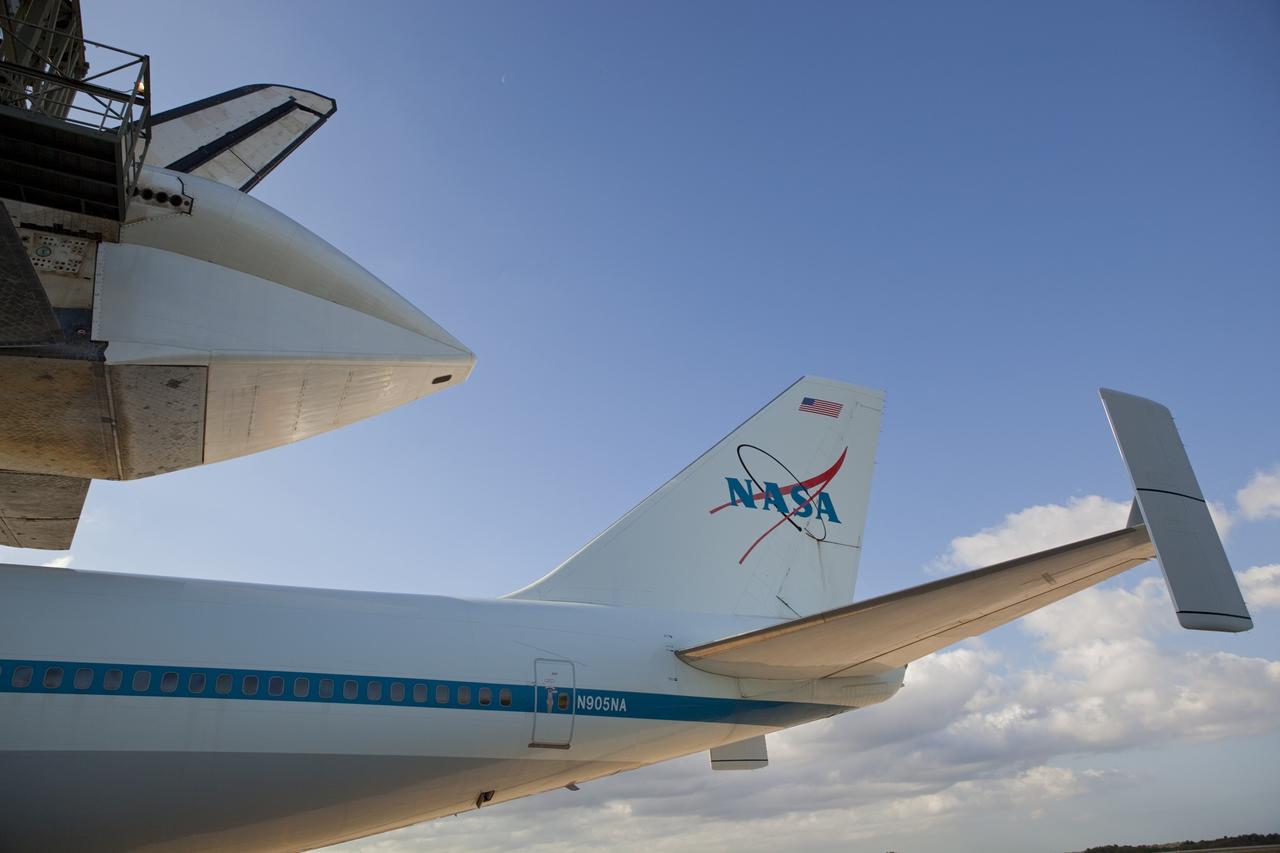
CAPE CANAVERAL, Fla. – At the Shuttle Landing Facility at NASA’s Kennedy Space Center in Florida, the tail cone on space shuttle Discovery and the tail of the Shuttle Carrier Aircraft are aligned in the mate-demate device as mating operations get under way. The tail cone has been installed over Discovery’s three replica shuttle main engines to reduce aerodynamic drag and turbulence during the ferry flight. The device, known as the MDD, is a large gantry-like steel structure used to hoist a shuttle off the ground and position it onto the back of the aircraft, or SCA. The SCA is a Boeing 747 jet, originally manufactured for commercial use, which was modified by NASA to transport the shuttles between destinations on Earth. This SCA, designated NASA 905, is assigned to the remaining ferry missions, delivering the shuttles to their permanent public display sites. NASA 905 is scheduled to ferry Discovery to the Washington Dulles International Airport in Virginia on April 17, after which the shuttle will be placed on display in the Smithsonian's National Air and Space Museum Steven F. Udvar-Hazy Center. For more information on the SCA, visit http://www.nasa.gov/centers/dryden/news/FactSheets/FS-013-DFRC.html. For more information on shuttle transition and retirement activities, visit http://www.nasa.gov/transition. Photo credit: NASA/Dimitri Gerondidakis
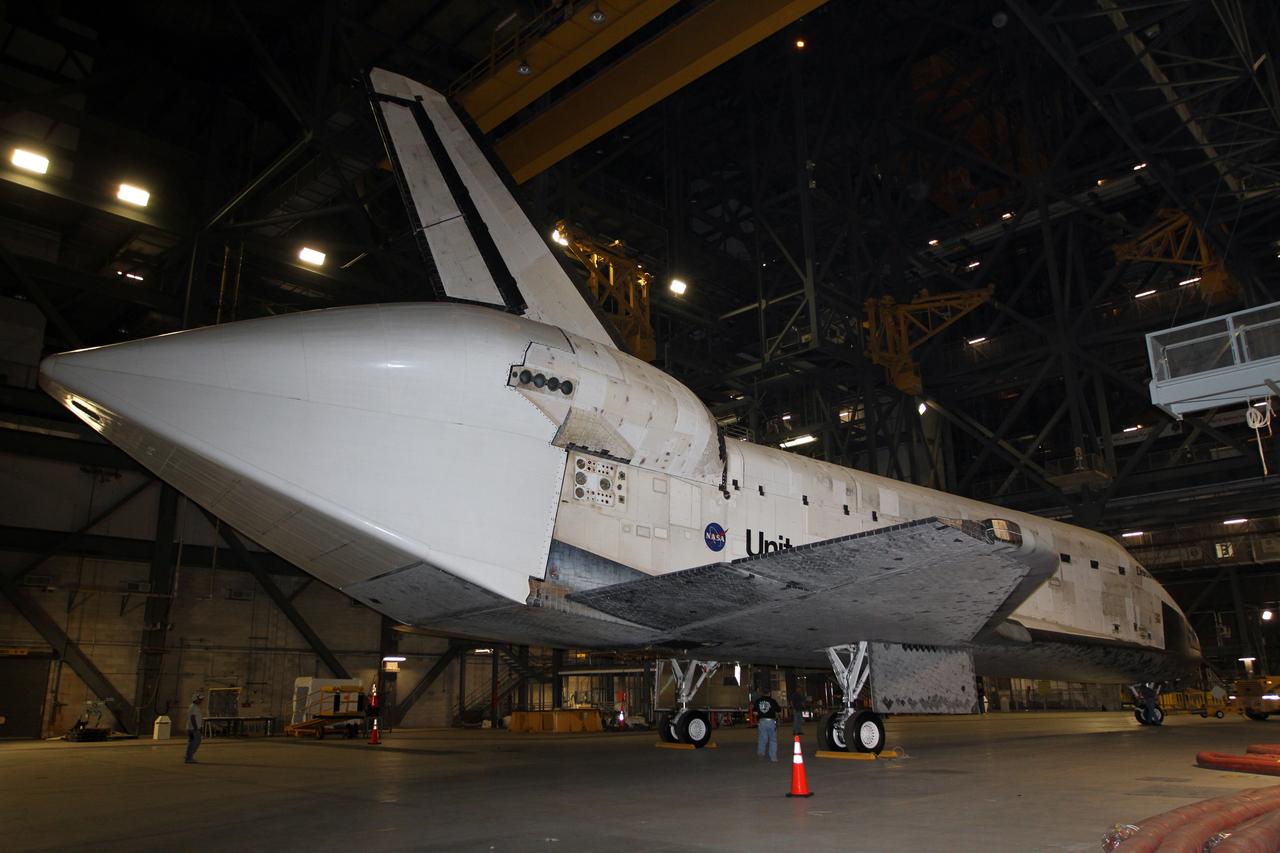
CAPE CANAVERAL, Fla. – Preparations to tow space shuttle Discovery from the Vehicle Assembly Building, or VAB, to the Shuttle Landing Facility, or SLF, are under way at NASA’s Kennedy Space Center in Florida. A tail cone has been installed over its three replica shuttle main engines to reduce aerodynamic drag and turbulence during its upcoming ferry flight. Discovery was in storage in the VAB’s high bay 4 awaiting departure from Kennedy’s Launch Complex 39 area for the final time. At the SLF, Discovery will be hoisted onto a Shuttle Carrier Aircraft, or SCA, with the aid of a mate-demate device. The SCA, a modified Boeing 747 jet airliner, is scheduled to transport Discovery to the Washington Dulles International Airport in Virginia on April 17, after which the shuttle will be placed on permanent public display in the Smithsonian's National Air and Space Museum Steven F. Udvar-Hazy Center. For more information on shuttle transition and retirement activities, visit http://www.nasa.gov/transition. Photo credit: NASA/Kim Shiflett
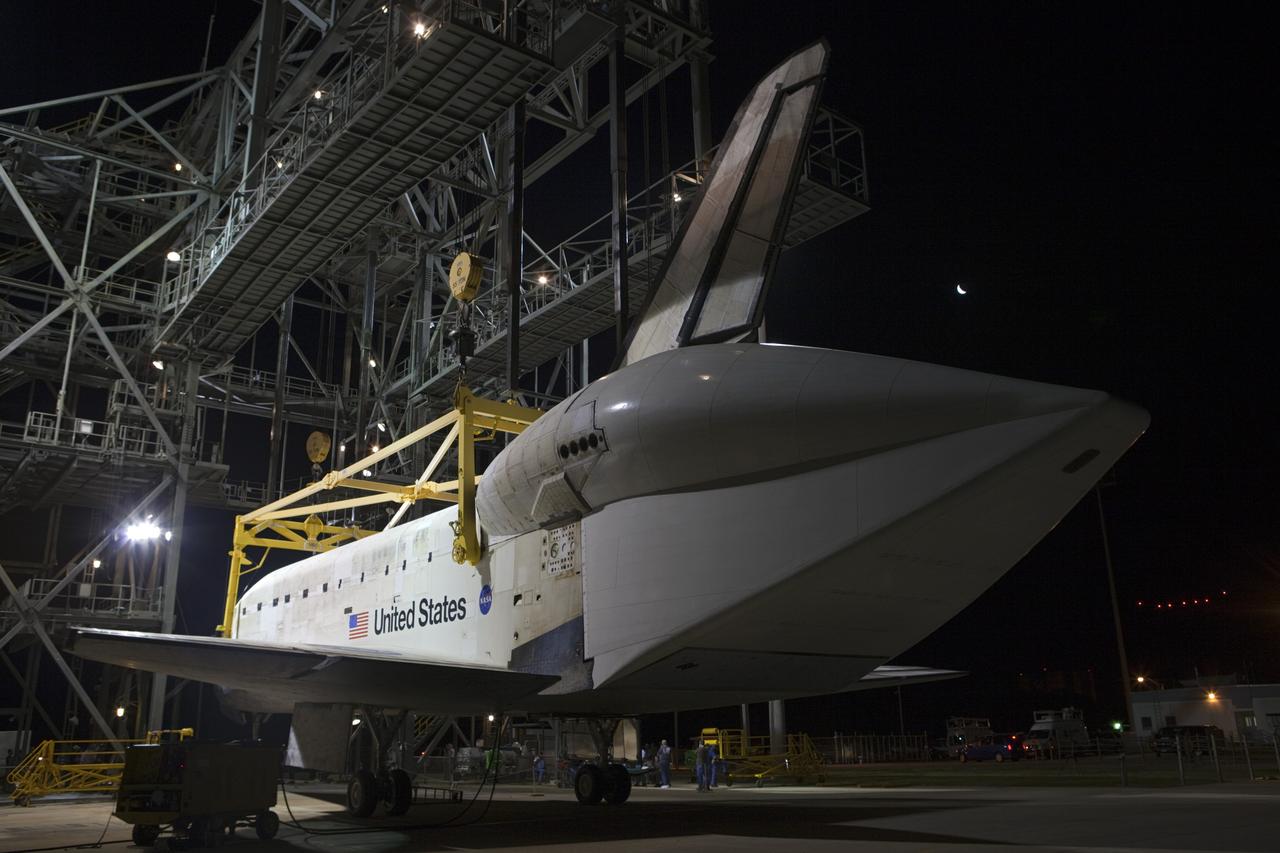
CAPE CANAVERAL, Fla. – Before daybreak at the Shuttle Landing Facility at NASA’s Kennedy Space Center in Florida, a crane on the mate-demate device prepares to lift space shuttle Discovery from the ground. Operations are under way to position Discovery on top of a Shuttle Carrier Aircraft in preparation for its departure from Kennedy on Tuesday. A tail cone has been installed over Discovery’s three replica shuttle main engines to reduce aerodynamic drag and turbulence during the ferry flight. The device, known as the MDD, is a large gantry-like steel structure used to hoist a shuttle off the ground and position it onto the back of the aircraft, or SCA. The SCA is a Boeing 747 jet, originally manufactured for commercial use, which was modified by NASA to transport the shuttles between destinations on Earth. The SCA designated NASA 905 is assigned to the remaining ferry missions, delivering the shuttles to their permanent public display sites. NASA 905 is scheduled to ferry Discovery to the Washington Dulles International Airport in Virginia on April 17, after which the shuttle will be placed on display in the Smithsonian's National Air and Space Museum Steven F. Udvar-Hazy Center. For more information on the SCA, visit http://www.nasa.gov/centers/dryden/news/FactSheets/FS-013-DFRC.html. For more information on shuttle transition and retirement activities, visit http://www.nasa.gov/transition. Photo credit: NASA/Dimitri Gerondidakis
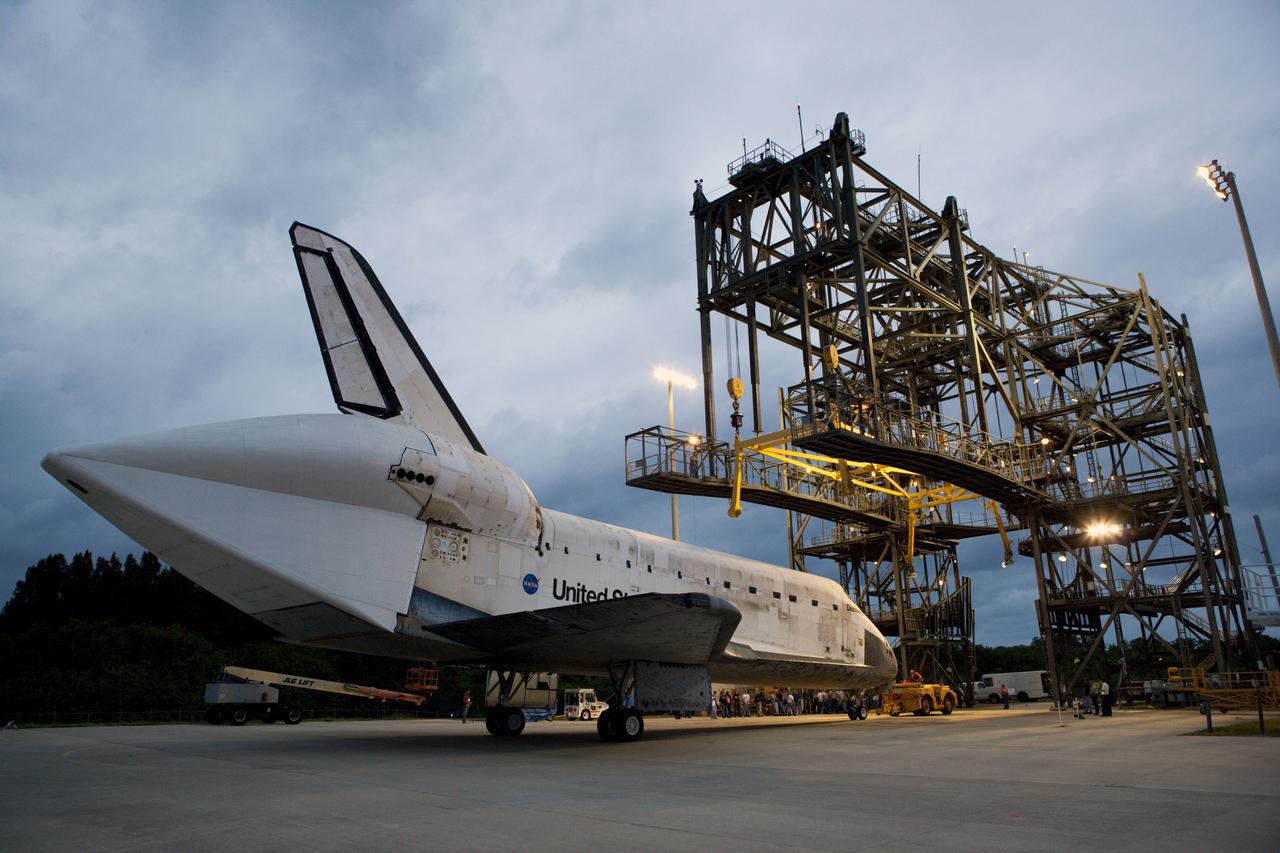
CAPE CANAVERAL, Fla. – Space shuttle Discovery rolls into position beside the mate-demate device, or MDD, at the Shuttle Landing Facility, or SLF, at NASA’s Kennedy Space Center in Florida. A tail cone has been installed over its three replica shuttle main engines to reduce aerodynamic drag and turbulence during its upcoming ferry flight. The MDD is a large gantry-like steel structure used to hoist a shuttle off the ground and position it onto the back of a Shuttle Carrier Aircraft, or SCA. The SCA is a Boeing 747 jet, originally manufactured for commercial use, which was modified by NASA to transport the shuttles between destinations on Earth. The SCA designated NASA 905 is assigned to the remaining ferry missions, delivering the shuttles to their permanent public display sites. Discovery’s new home will be the Smithsonian's National Air and Space Museum Steven F. Udvar-Hazy Center in Chantilly, Va. For more information on the SCA, visit http://www.nasa.gov/centers/dryden/news/FactSheets/FS-013-DFRC.html. For more information on shuttle transition and retirement activities, visit http://www.nasa.gov/transition. Photo credit: NASA/Dimitri Gerondidakis
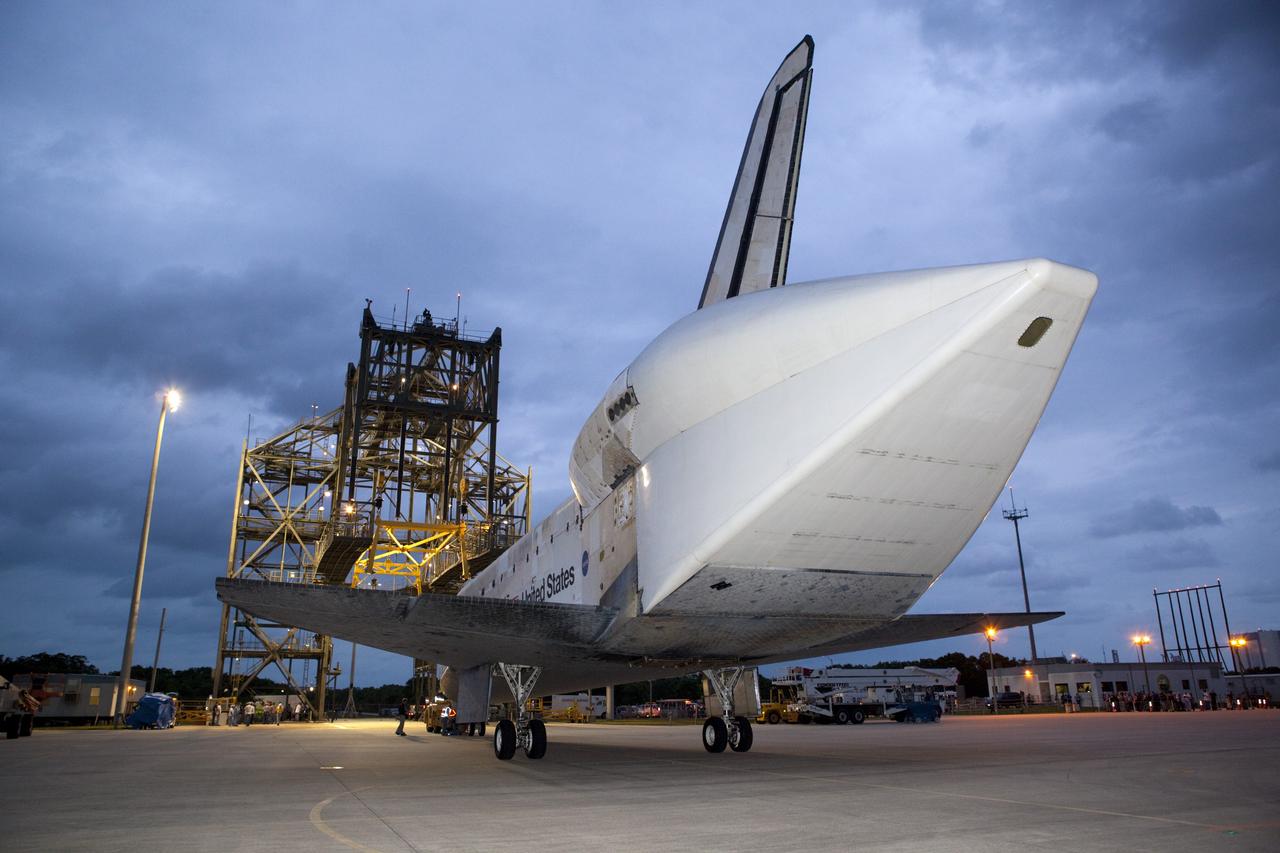
CAPE CANAVERAL, Fla. – Space shuttle Discovery rolls into position beside the mate-demate device, or MDD, at the Shuttle Landing Facility, or SLF, at NASA’s Kennedy Space Center in Florida. A tail cone has been installed over its three replica shuttle main engines to reduce aerodynamic drag and turbulence during its upcoming ferry flight. The MDD is a large gantry-like steel structure used to hoist a shuttle off the ground and position it onto the back of a Shuttle Carrier Aircraft, or SCA. The SCA is a Boeing 747 jet, originally manufactured for commercial use, which was modified by NASA to transport the shuttles between destinations on Earth. The SCA designated NASA 905 is assigned to the remaining ferry missions, delivering the shuttles to their permanent public display sites. Discovery’s new home will be the Smithsonian's National Air and Space Museum Steven F. Udvar-Hazy Center in Chantilly, Va. For more information on the SCA, visit http://www.nasa.gov/centers/dryden/news/FactSheets/FS-013-DFRC.html. For more information on shuttle transition and retirement activities, visit http://www.nasa.gov/transition. Photo credit: NASA/Dimitri Gerondidakis
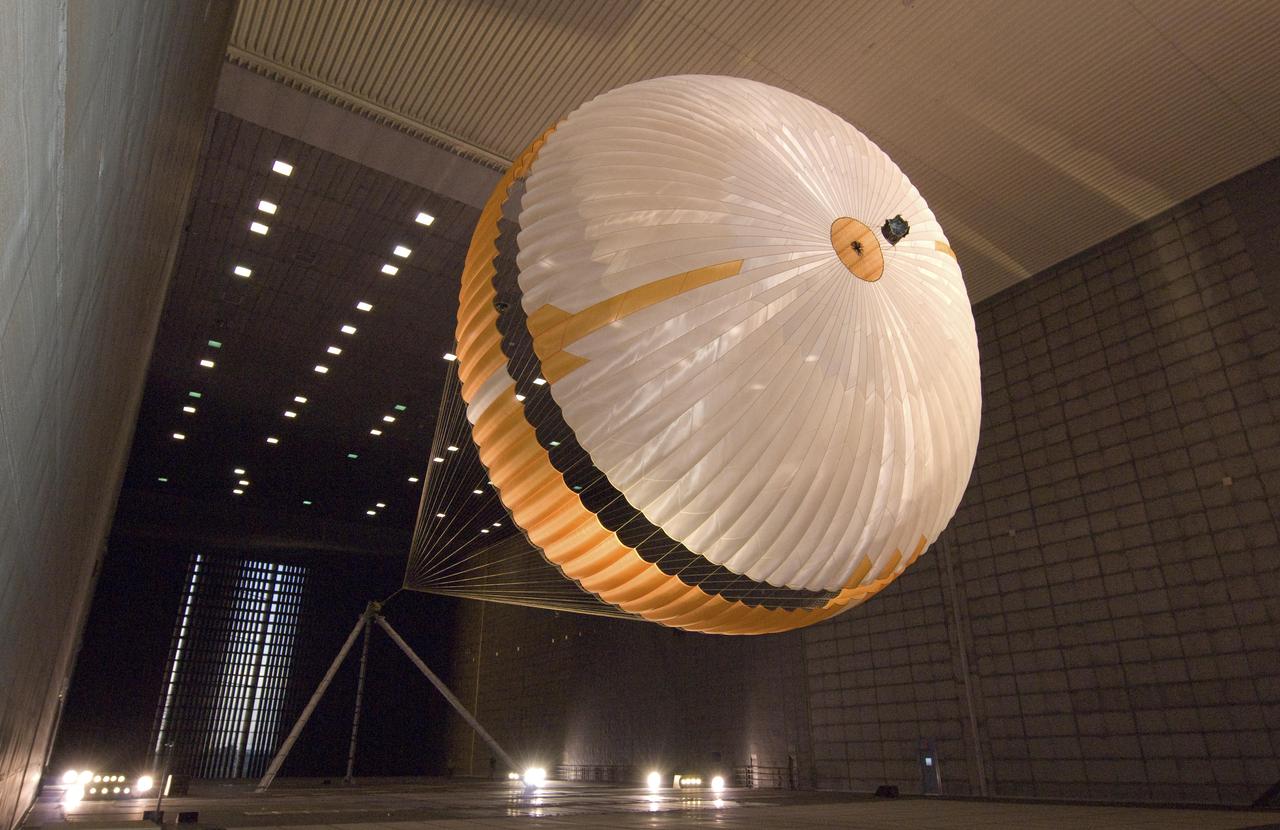
The parachute for NASA next mission to Mars passed flight-qualification testing in March and April 2009 inside the world largest wind tunnel, at NASA Ames Research Center, Moffett Field, Calif. NASA's Mars Science Laboratory mission, to be launched in 2011 and land on Mars in 2012, will use the largest parachute ever built to fly on an extraterrestrial mission. This image shows a duplicate qualification-test parachute inflated in an 80-mile-per-hour (36-meter-per-second) wind inside the test facility. The parachute uses a configuration called disk-gap-band. It has 80 suspension lines, measures more than 50 meters (165 feet) in length, and opens to a diameter of nearly 16 meters (51 feet). Most of the orange and white fabric is nylon, though a small disk of heavier polyester is used near the vent in the apex of the canopy due to higher stresses there. It is designed to survive deployment at Mach 2.2 in the Martian atmosphere, where it will generate up to 65,000 pounds of drag force. The wind tunnel is 24 meters (80 feet) tall and 37 meters (120 feet) wide, big enough to house a Boeing 737. It is part of the National Full-Scale Aerodynamics Complex, operated by the Arnold Engineering Development Center of the U.S. Air Force. http://photojournal.jpl.nasa.gov/catalog/PIA11995
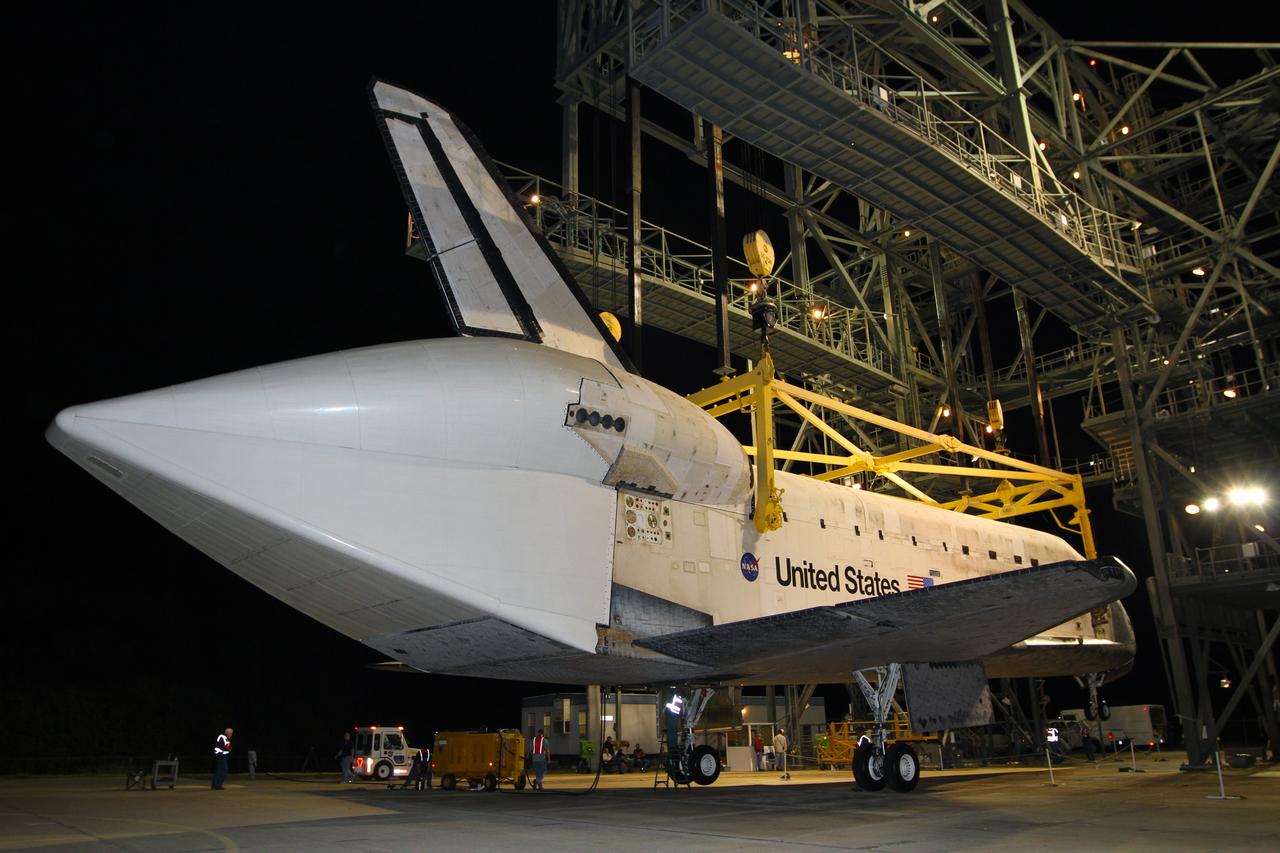
CAPE CANAVERAL, Fla. – Before daybreak at the Shuttle Landing Facility at NASA’s Kennedy Space Center in Florida, a crane on the mate-demate device lifts space shuttle Discovery from the ground. Operations are under way to position Discovery on top of a Shuttle Carrier Aircraft in preparation for its departure from Kennedy on Tuesday. A tail cone has been installed over Discovery’s three replica shuttle main engines to reduce aerodynamic drag and turbulence during the ferry flight. The device, known as the MDD, is a large gantry-like steel structure used to hoist a shuttle off the ground and position it onto the back of the aircraft, or SCA. The SCA is a Boeing 747 jet, originally manufactured for commercial use, which was modified by NASA to transport the shuttles between destinations on Earth. The SCA designated NASA 905 is assigned to the remaining ferry missions, delivering the shuttles to their permanent public display sites. NASA 905 is scheduled to ferry Discovery to the Washington Dulles International Airport in Virginia on April 17, after which the shuttle will be placed on display in the Smithsonian's National Air and Space Museum Steven F. Udvar-Hazy Center. For more information on the SCA, visit http://www.nasa.gov/centers/dryden/news/FactSheets/FS-013-DFRC.html. For more information on shuttle transition and retirement activities, visit http://www.nasa.gov/transition. Photo credit: NASA/Kim Shiflett
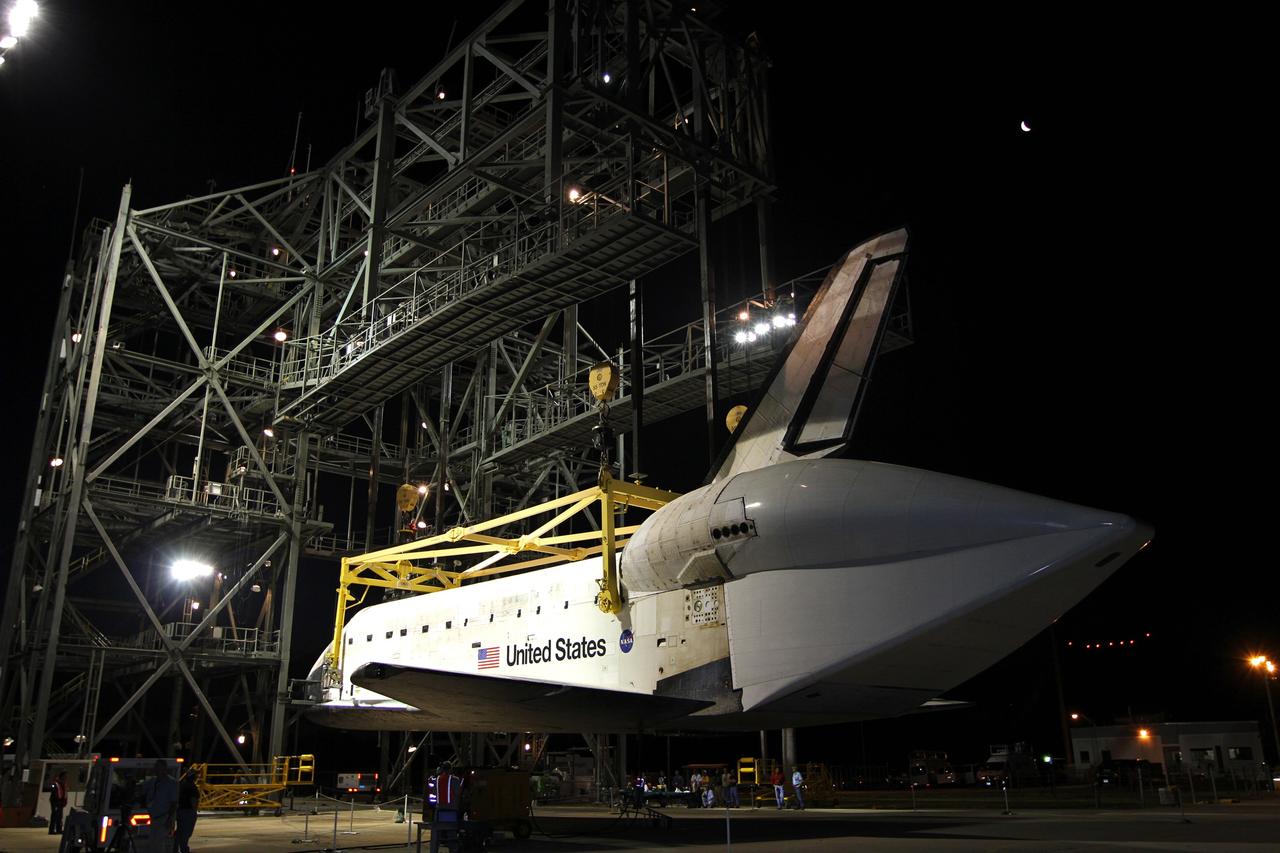
CAPE CANAVERAL, Fla. – Before sunrise at the Shuttle Landing Facility at NASA’s Kennedy Space Center in Florida, space shuttle Discovery is lifted into the mate-demate device by a crane hooked to the yellow sling. Operations have resumed to place Discovery on top of a Shuttle Carrier Aircraft in preparation for its departure from Kennedy on Tuesday. A tail cone has been installed over Discovery’s three replica shuttle main engines to reduce aerodynamic drag and turbulence during the ferry flight. The device, known as the MDD, is a large gantry-like steel structure used to hoist a shuttle off the ground and position it onto the back of the aircraft, or SCA. The SCA is a Boeing 747 jet, originally manufactured for commercial use, which was modified by NASA to transport the shuttles between destinations on Earth. The SCA designated NASA 905 is assigned to the remaining ferry missions, delivering the shuttles to their permanent public display sites. NASA 905 is scheduled to ferry Discovery to the Washington Dulles International Airport in Virginia on April 17, after which the shuttle will be placed on display in the Smithsonian's National Air and Space Museum Steven F. Udvar-Hazy Center. For more information on the SCA, visit http://www.nasa.gov/centers/dryden/news/FactSheets/FS-013-DFRC.html. For more information on shuttle transition and retirement activities, visit http://www.nasa.gov/transition. Photo credit: NASA/Kim Shiflett

KENNEDY SPACE CENTER, FLA. -- Aboard a transporter, the orbiter Columbia moves past the Boeing 747 Shuttle Carrier Aircraft (SCA) at the Shuttle Landing Facility. There the orbiter will be mated to the SCA, with the help of a Mate-Demate Device, for a ferry flight to Palmdale, Calif. On the rear of the orbiter is the tail cone, a fairing that is installed over the aft fuselage of the orbiter to decrease aerodynamic drag and buffet when the Shuttle Carrier Aircraft is transporting the orbiter cross-country. It is 36 feet long, 25 feet wide, and 22 feet high. Columbia, the oldest of four orbiters in NASA's fleet, will undergo extensive inspections and modifications in Boeing's Orbiter Assembly Facility during a nine-month orbiter maintenance down period (OMDP), the second in its history. Orbiters are periodically removed from flight operations for an OMDP. Columbia's first was in 1994. Along with more than 100 modifications on the vehicle, Columbia will be the second orbiter to be outfitted with the multifunctional electronic display system, or "glass cockpit." Columbia is expected to return to KSC in July 2000
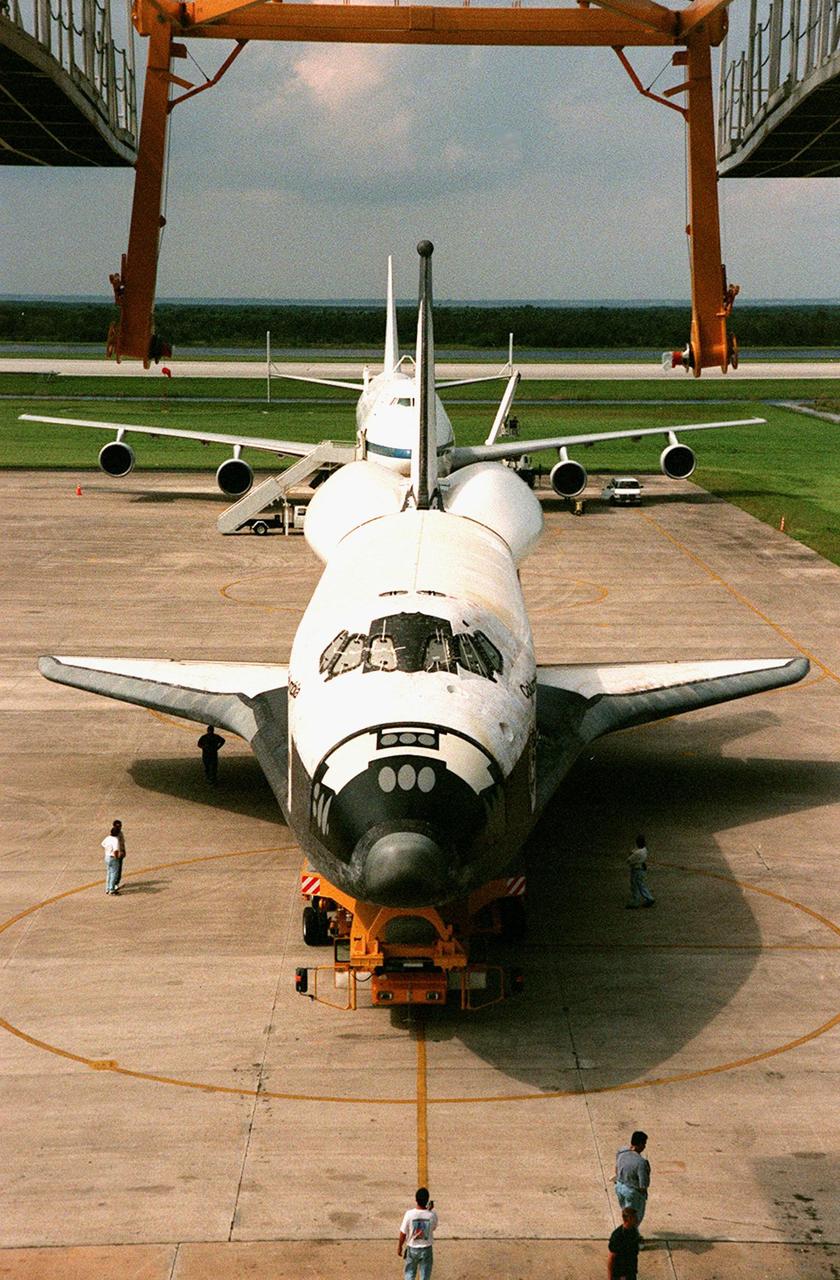
KENNEDY SPACE CENTER, FLA. -- The orbiter Columbia (foreground) moves under the Mate-Demate Device at KSC's Shuttle Landing Facility (SLF). The crane seen above it will lift the orbiter so that the Boeing 747 Shuttle Carrier Aircraft (SCA) in the background can move underneath Columbia, which will then be attached to the back of the SCA for a ferry flight to Palmdale, Calif. On the rear of the orbiter is the tail cone, a fairing that is installed over the aft fuselage of the orbiter to decrease aerodynamic drag and buffet when the Shuttle Carrier Aircraft is transporting the orbiter cross-country. It is 36 feet long, 25 feet wide, and 22 feet high. Columbia, the oldest of four orbiters in NASA's fleet, will undergo extensive inspections and modifications in Boeing's Orbiter Assembly Facility during a nine-month orbiter maintenance down period (OMDP), the second in its history. Orbiters are periodically removed from flight operations for an OMDP. Columbia's first was in 1994. Along with more than 100 modifications on the vehicle, Columbia will be the second orbiter to be outfitted with the multifunctional electronic display system, or "glass cockpit." Columbia is expected to return to KSC in July 2000
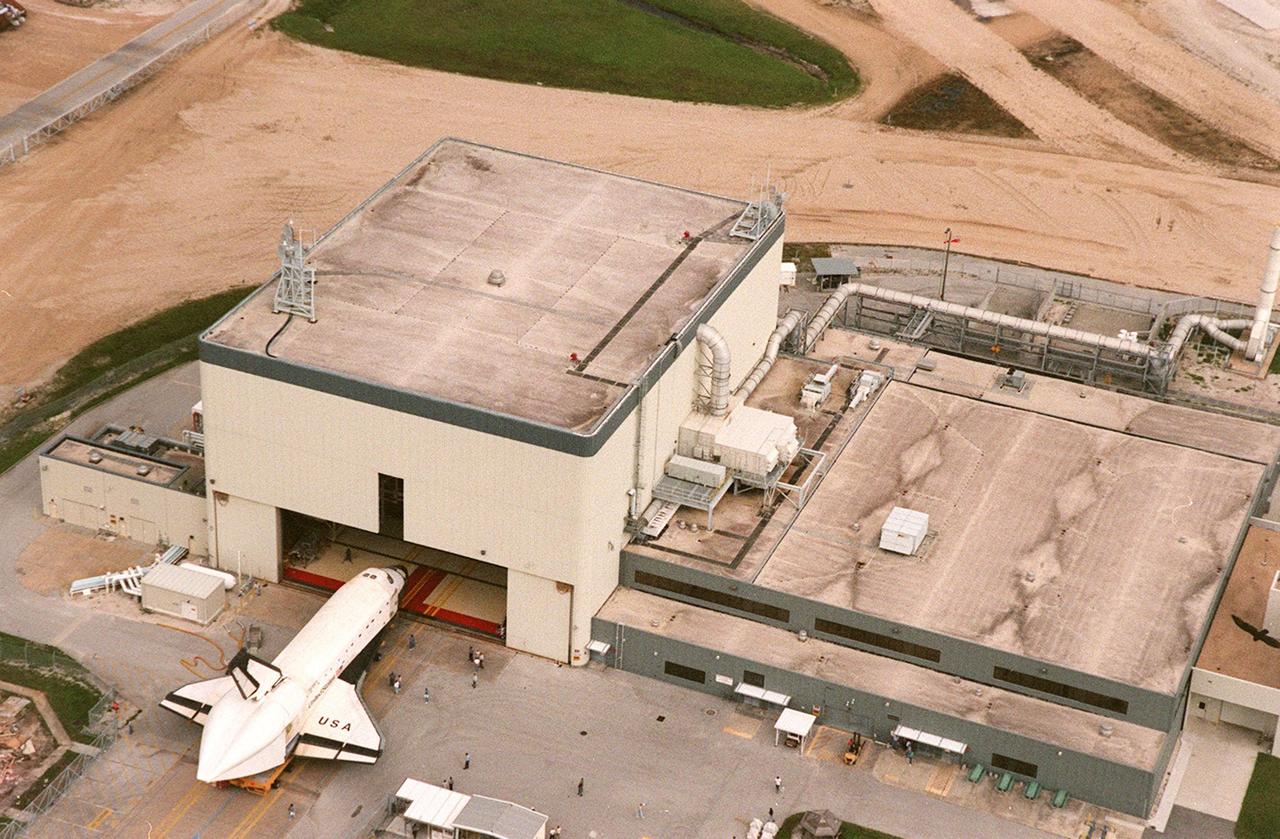
KENNEDY SPACE CENTER, FLA. -- The orbiter Columbia rolls out of KSC's Orbiter Processing Facility bay 3, bound for the Shuttle Landing Facility's (SLF) Mate-Demate Device. At the SLF the orbiter is to be mated to the Boeing 747 Shuttle Carrier Aircraft for a ferry flight to Palmdale, Calif. On the rear of the orbiter can be seen the tail cone, a fairing that is installed over the aft fuselage of the orbiter to decrease aerodynamic drag and buffet when the Shuttle Carrier Aircraft is transporting the orbiter cross-country. It is 36 feet long, 25 feet wide, and 22 feet high. Columbia, the oldest of four orbiters in NASA's fleet, will undergo extensive inspections and modifications in Boeing's Orbiter Assembly Facility during a nine-month orbiter maintenance down period (OMDP), the second in its history. Orbiters are periodically removed from flight operations for an OMDP. Columbia's first was in 1994. Along with more than 100 modifications on the vehicle, Columbia will be the second orbiter to be outfitted with the multifunctional electronic display system, or "glass cockpit." Columbia is expected to return to KSC in July 2000
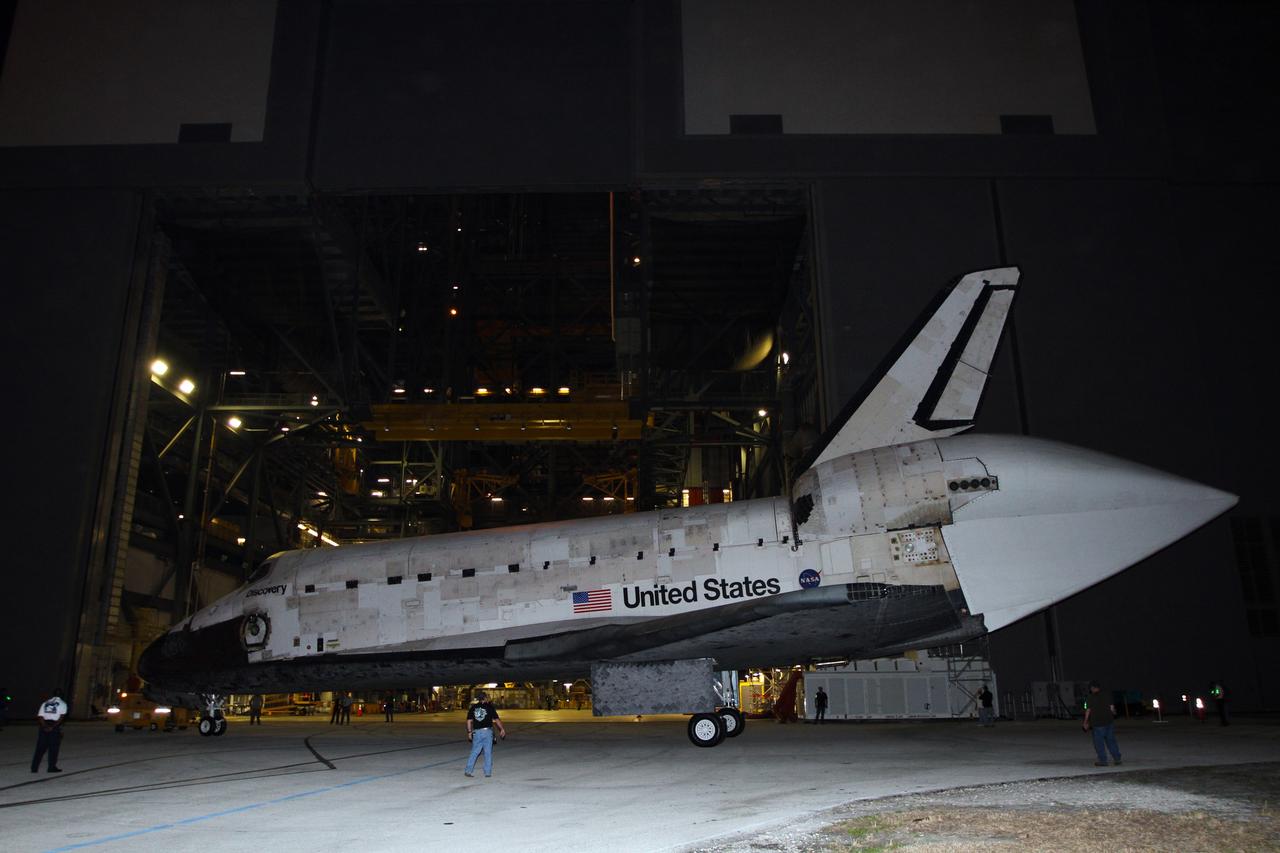
CAPE CANAVERAL, Fla. – Space shuttle Discovery completes a three-point turnaround outside the Vehicle Assembly Building, or VAB, at NASA’s Kennedy Space Center in Florida, for its trip to the Shuttle Landing Facility, or SLF. Its move got under way at 5 a.m. EDT. A tail cone has been installed over its three replica shuttle main engines to reduce aerodynamic drag and turbulence during its upcoming ferry flight. Discovery was in storage in the VAB’s high bay 4 awaiting departure from Kennedy’s Launch Complex 39 area for the final time. At the SLF, Discovery will be hoisted onto a Shuttle Carrier Aircraft, or SCA, with the aid of a mate-demate device. The SCA, a modified Boeing 747 jet airliner, is scheduled to transport Discovery to the Washington Dulles International Airport in Virginia on April 17, after which the shuttle will be placed on permanent public display in the Smithsonian's National Air and Space Museum Steven F. Udvar-Hazy Center. For more information on shuttle transition and retirement activities, visit http://www.nasa.gov/transition. Photo credit: NASA/Kim Shiflett
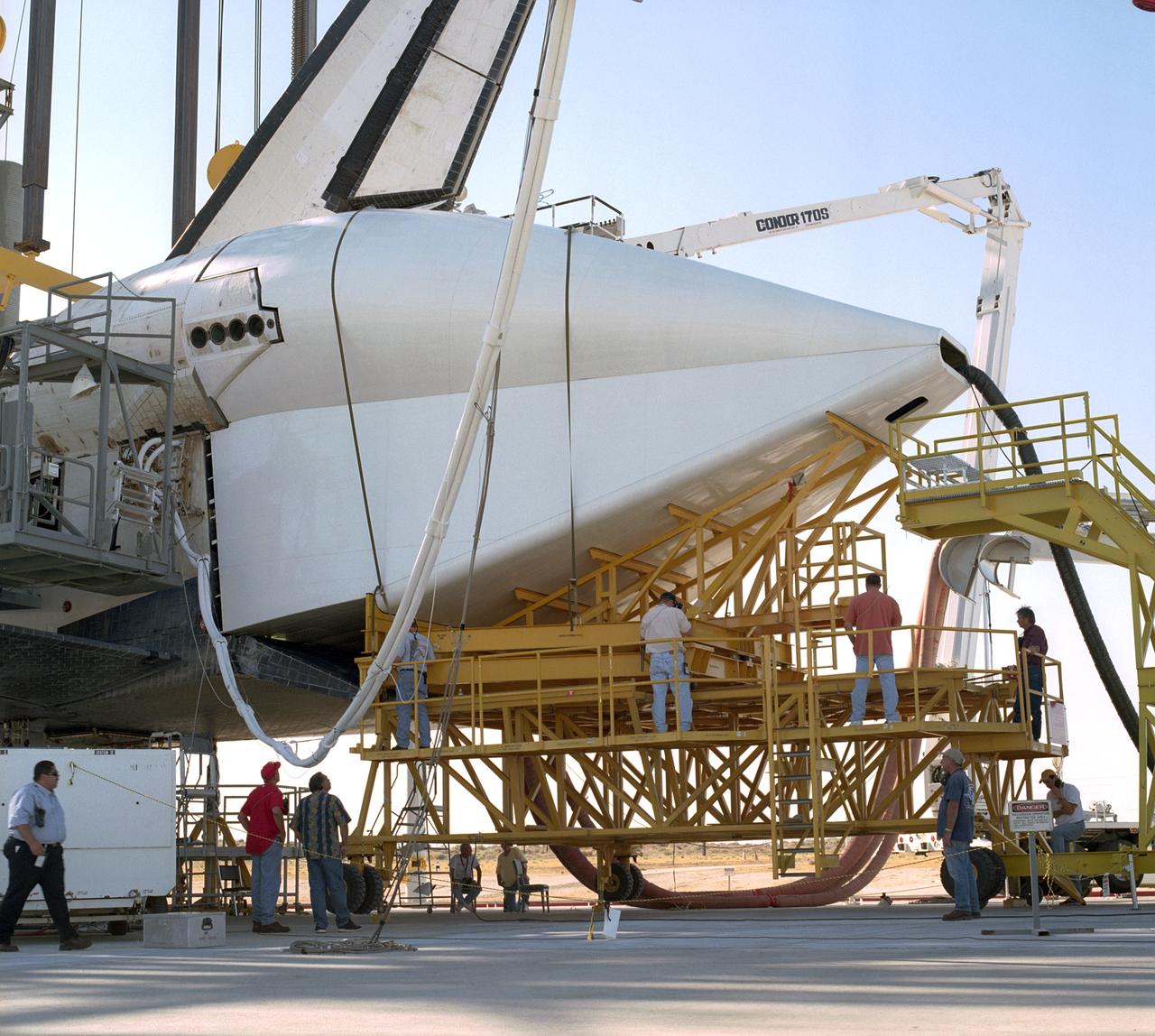
Technicians attach the tail cone, which helps reduce aerodynamic drag and turbulence during its ferry flight, to the Space Shuttle Discovery in preparation for its return to NASA's Kennedy Space Center in Florida. After the tail-cone is installed, Discovery will be mounted on NASA's modified Boeing 747 Shuttle Carrier Aircraft, or SCA, for the return flight. Space Shuttle Discovery landed safely at NASA's Dryden Flight Research Center at Edwards Air Force Base in California at 5:11:22 a.m. PDT, August 9, 2005, following the very successful 14-day STS-114 return to flight mission. During their two weeks in space, Commander Eileen Collins and her six crewmates tested out new safety procedures and delivered supplies and equipment the International Space Station. Discovery spent two weeks in space, where the crew demonstrated new methods to inspect and repair the Shuttle in orbit. The crew also delivered supplies, outfitted and performed maintenance on the International Space Station. A number of these tasks were conducted during three spacewalks. In an unprecedented event, spacewalkers were called upon to remove protruding gap fillers from the heat shield on Discovery's underbelly. In other spacewalk activities, astronauts installed an external platform onto the Station's Quest Airlock and replaced one of the orbital outpost's Control Moment Gyroscopes. Inside the Station, the STS-114 crew conducted joint operations with the Expedition 11 crew. They unloaded fresh supplies from the Shuttle and the Raffaello Multi-Purpose Logistics Module. Before Discovery undocked, the crews filled Raffeallo with unneeded items and returned to Shuttle payload bay. Discovery launched on July 26 and spent almost 14 days on orbit.
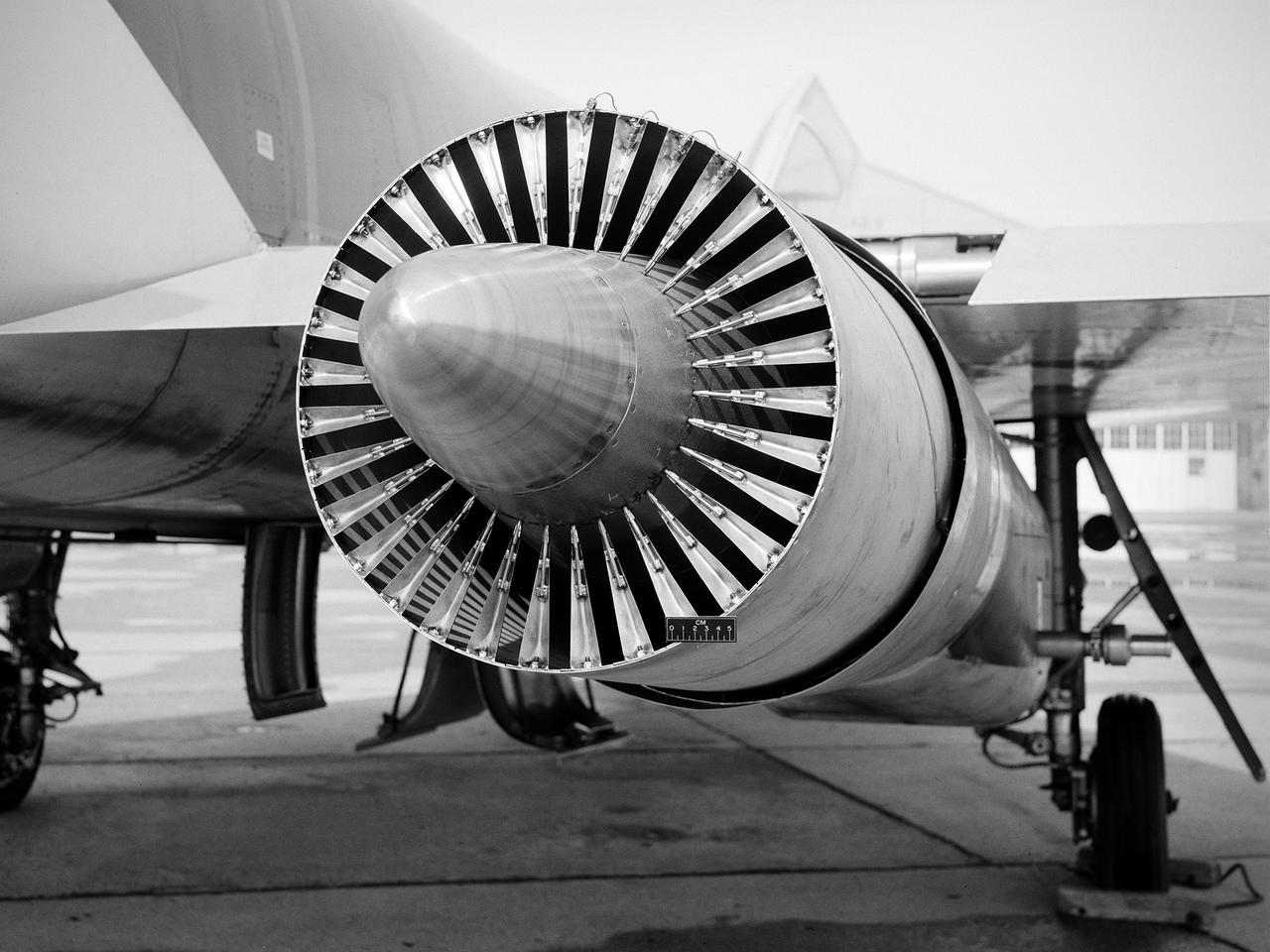
National Aeronautics and Space Administration (NASA) Convair F-106B Delta Dart with a 32-spoke nozzle installed on its General Electric J85 test engine. Lewis acquired a Delta Dart fighter in 1966 to study the components for propulsion systems that could be applied to supersonic transport aircraft at transonic speeds. The F-106B was modified with two General Electric J85-13 engines under its wings to study these components. The original test plan was expanded to include the study of boattail drag, noise reduction, and inlets. From February to July 1971 the modified F-106B was used to study different ejector nozzles. Researchers conducted both acoustic and aerodynamic tests on the ground and in flight. Several models were created to test different suppression methods. NASA Lewis’ conical nozzle was used as the baseline configuration. Flightline and sideline microphones were set up on the ground. The F-106B would idle its own engine and buzz the recording station from an altitude of 300 feet at Mach 0.4 with the test engines firing. Researchers found that the suppression of the perceived noise level was usually lower during flight than the researchers had statistically predicted. The 64 and 32-spoke nozzles performed well in actual flight, but the others nozzles tended to negatively affect the engine’s performance. Different speeds or angles- -of-attack sometimes changed the noise levels. In the end, no general conclusions could be applied to all the nozzles.
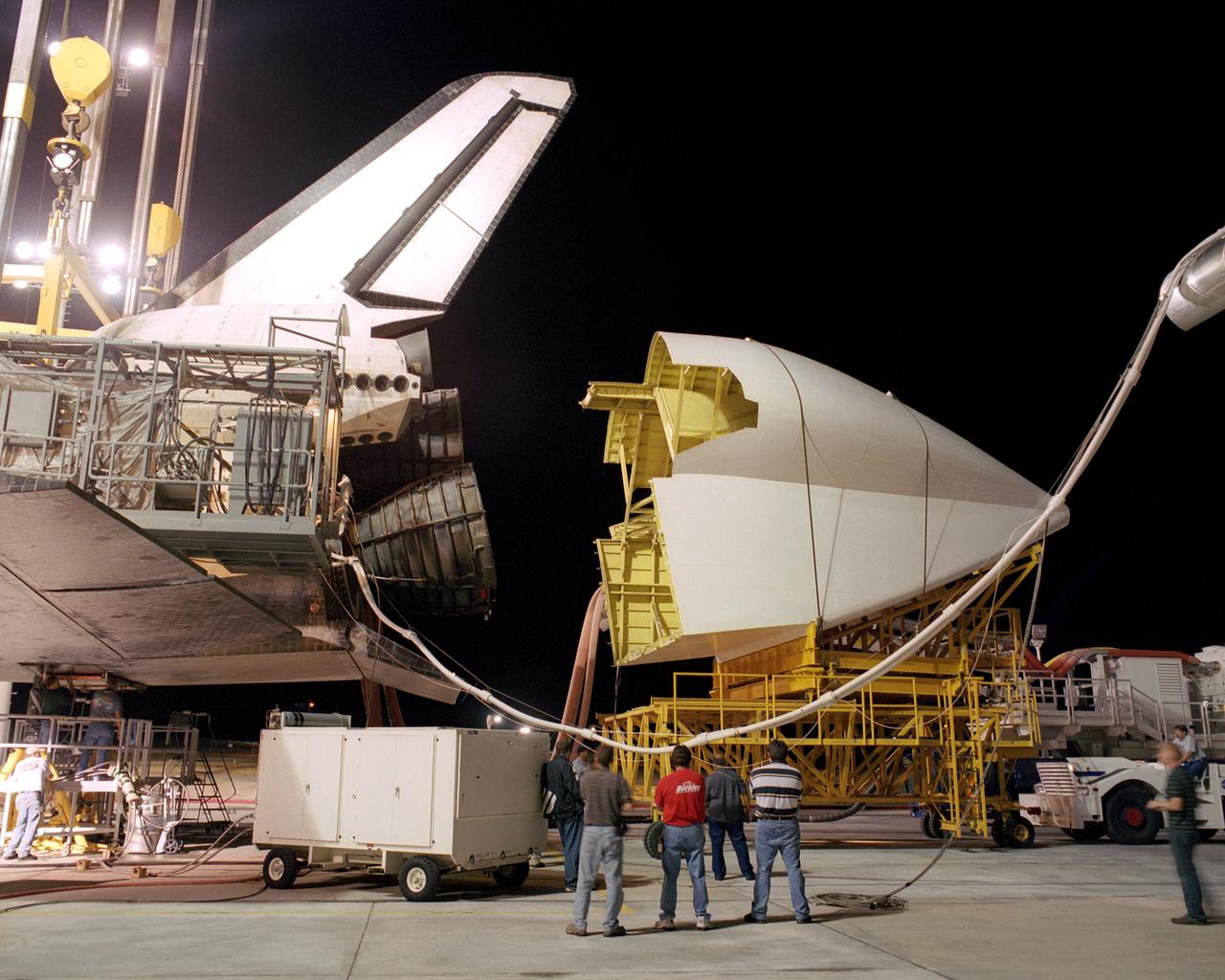
Workers position the tail cone on the Space Shuttle Discovery in preparation for its return to NASA's Kennedy Space Center in Florida. After the tail-cone is installed, Discovery will be mounted on NASA's modified Boeing 747 Shuttle Carrier Aircraft, or SCA, for the return flight. The tail cone is a fitting that helps reduce aerodynamic drag and turbulence during its ferry flight. Space Shuttle Discovery landed safely at NASA's Dryden Flight Research Center at Edwards Air Force Base in California at 5:11:22 a.m. PDT, August 9, 2005, following the very successful 14-day STS-114 return to flight mission. During their two weeks in space, Commander Eileen Collins and her six crewmates tested out new safety procedures and delivered supplies and equipment the International Space Station. Discovery spent two weeks in space, where the crew demonstrated new methods to inspect and repair the Shuttle in orbit. The crew also delivered supplies, outfitted and performed maintenance on the International Space Station. A number of these tasks were conducted during three spacewalks. In an unprecedented event, spacewalkers were called upon to remove protruding gap fillers from the heat shield on Discovery's underbelly. In other spacewalk activities, astronauts installed an external platform onto the Station's Quest Airlock and replaced one of the orbital outpost's Control Moment Gyroscopes. Inside the Station, the STS-114 crew conducted joint operations with the Expedition 11 crew. They unloaded fresh supplies from the Shuttle and the Raffaello Multi-Purpose Logistics Module. Before Discovery undocked, the crews filled Raffeallo with unneeded items and returned to Shuttle payload bay. Discovery launched on July 26 and spent almost 14 days on orbit.