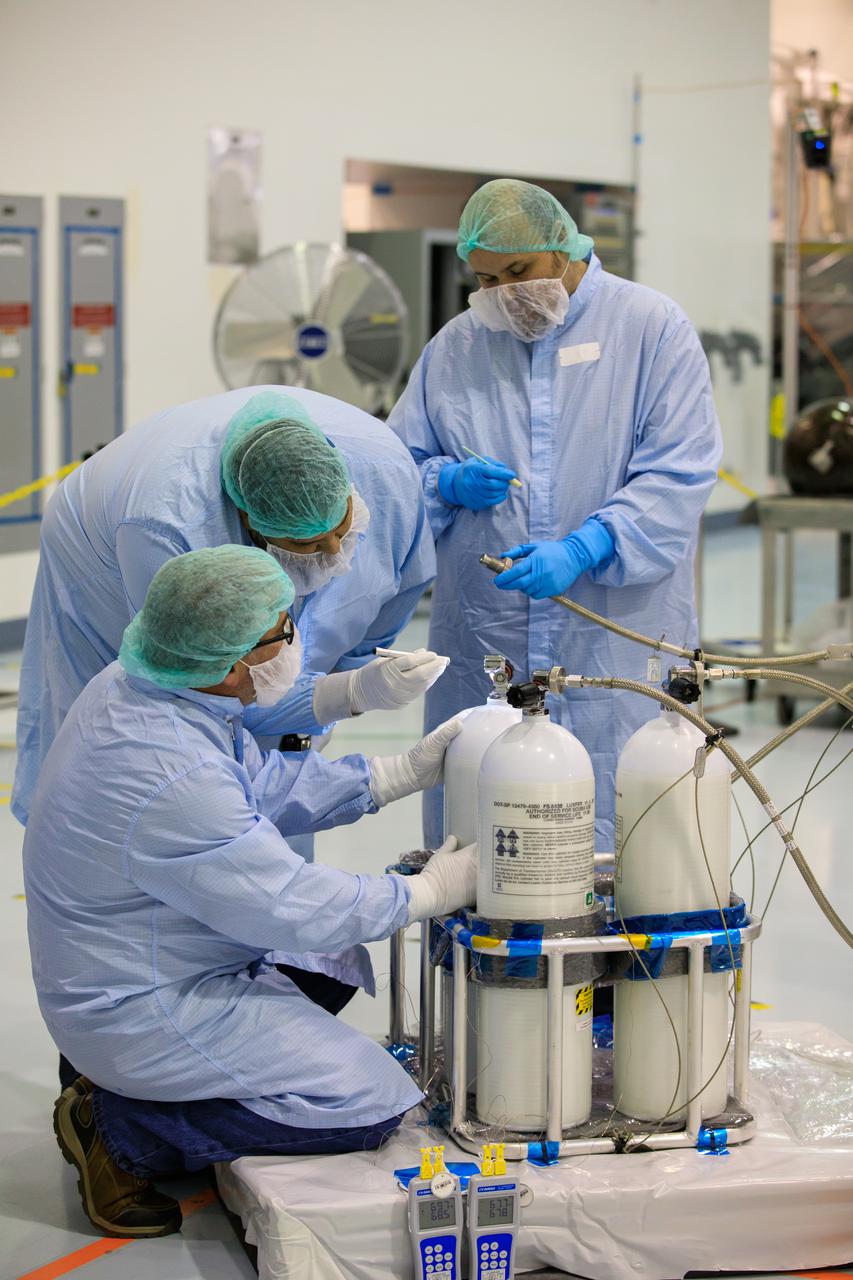
Inside the Space Station Processing Facility at NASA’s Kennedy Space Center in Florida on June 25, 2021, commercial off-the-shelf air tanks – normally used by divers – are filled with breathing air for use on the International Space Station. Using expendable air tanks for this purpose increases the efficiency of supplying air to the orbital laboratory. It also will supplement the reusable Nitrogen Oxygen Recharge System (NORS) tanks that NASA currently uses.
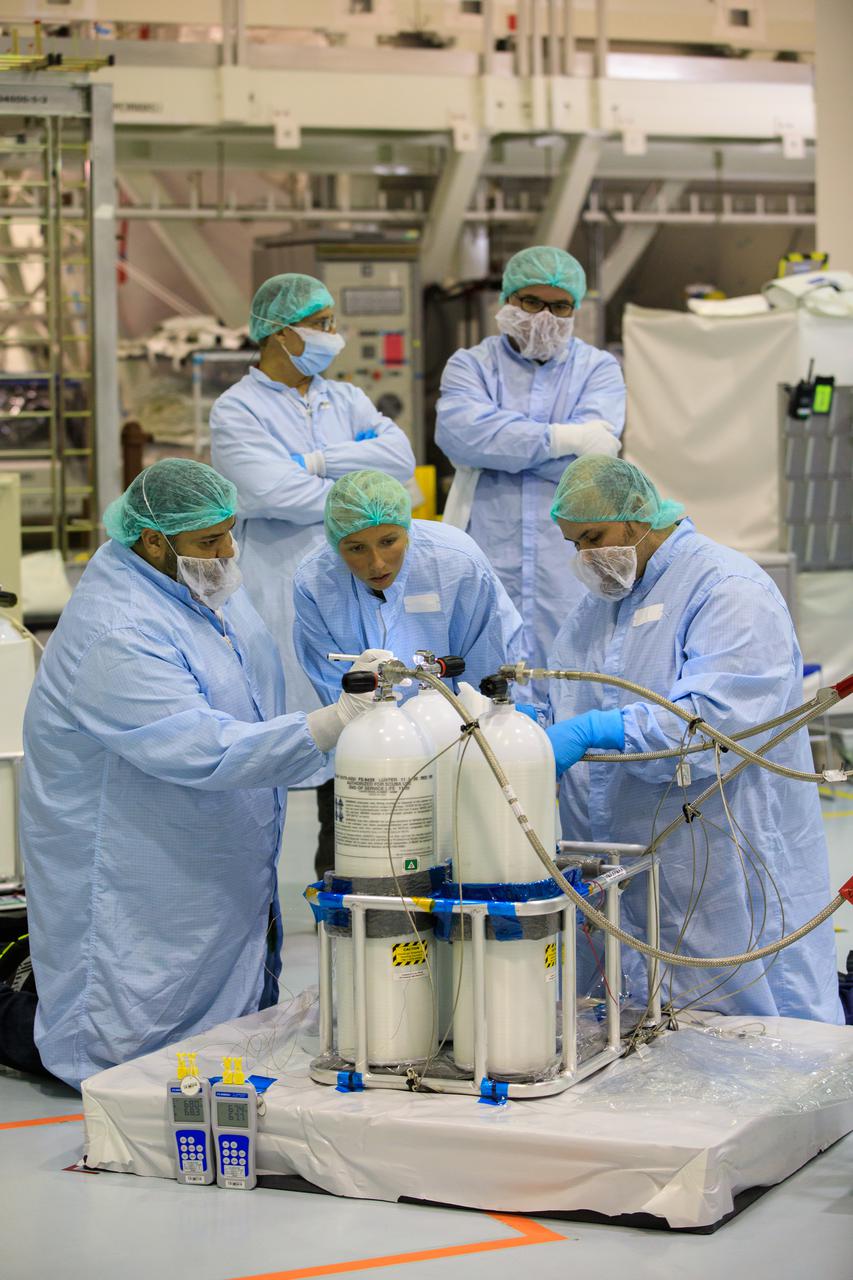
Inside the Space Station Processing Facility at NASA’s Kennedy Space Center in Florida on June 25, 2021, commercial off-the-shelf air tanks – normally used by divers – are filled with breathing air for use on the International Space Station. Using expendable air tanks for this purpose increases the efficiency of supplying air to the orbital laboratory. It also will supplement the reusable Nitrogen Oxygen Recharge System (NORS) tanks that NASA currently uses.
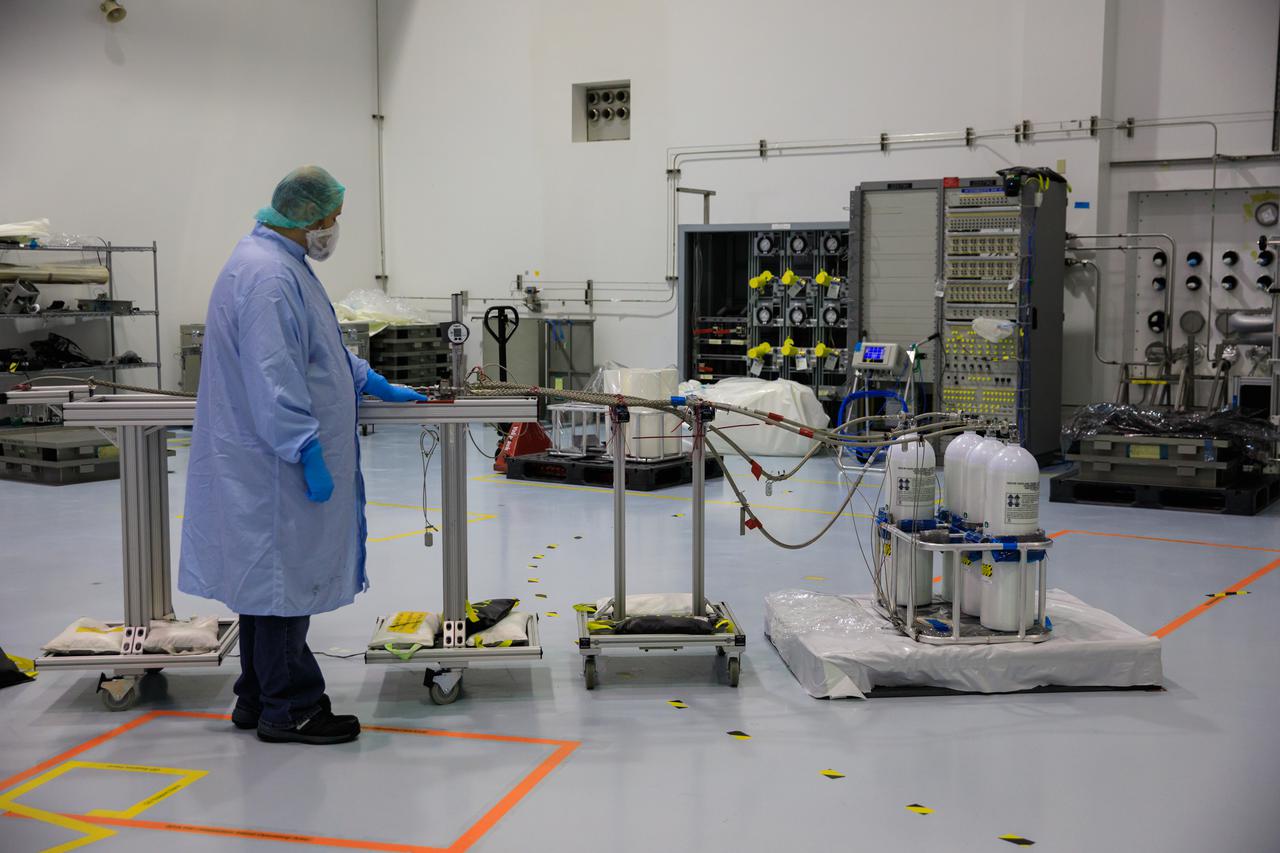
Inside the Space Station Processing Facility at NASA’s Kennedy Space Center in Florida on June 25, 2021, commercial off-the-shelf air tanks – normally used by divers – are filled with breathing air for use on the International Space Station. Using expendable air tanks for this purpose increases the efficiency of supplying air to the orbital laboratory. It also will supplement the reusable Nitrogen Oxygen Recharge System (NORS) tanks that NASA currently uses.
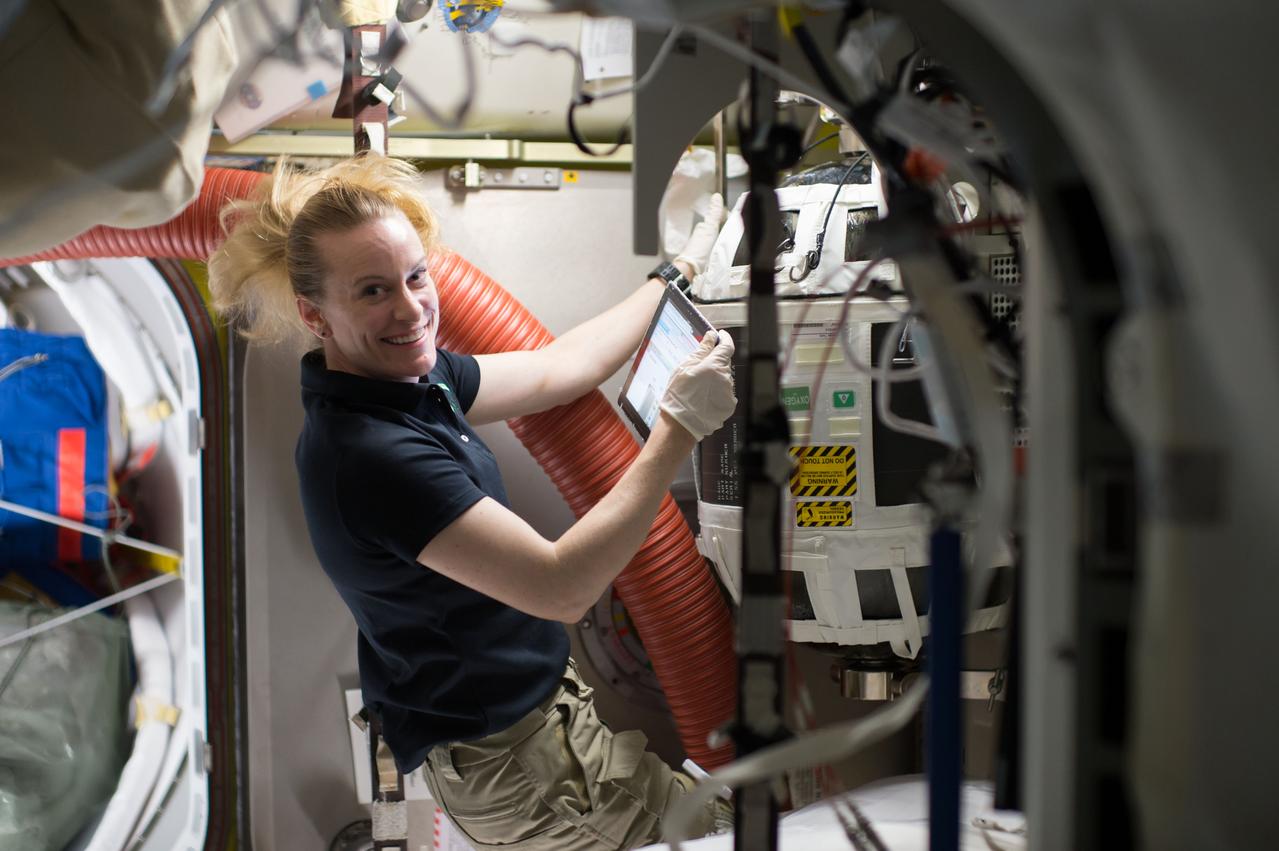
iss049e002733 (09/14/2016) --- Expedition 49 crew member and NASA astronaut Kate Rubins works with a Nitrogen/Oxygen Recharge System (NORS) tank aboard the International Space Station. The tanks are designed to be plugged into the station's existing air supply network to refill the crew’s breathable air supply. Each tank is pressurized up to 10,000 pounds per square inch to giving the station an atmosphere of nitrogen and oxygen like that of Earth, the system provides the pure oxygen astronauts breathe before beginning a spacewalk. The gases also are used in the station's ammonia-based cooling system and for other secondary uses.
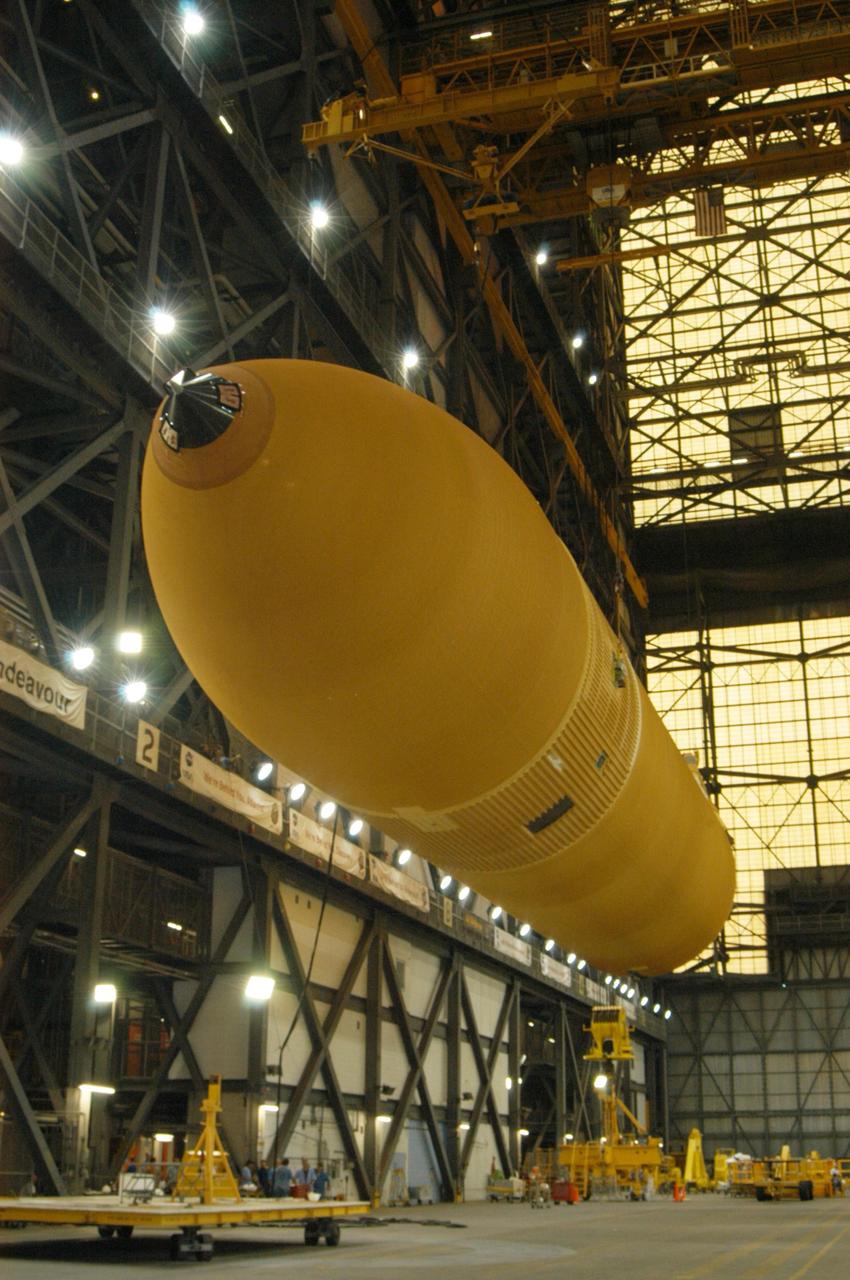
KENNEDY SPACE CENTER, FLA. - In NASA's Vehicle Assembly Building, the redesigned external fuel tank that will launch Space Shuttle Atlantis on the next shuttle mission, STS-115, is suspended above the transfer aisle where it will be raised to a vertical position. Once it is raised, the tank will be moved into a checkout cell for further work. The tank, designated ET-118, will fly with many major safety changes, including the removal of the protuberance air load ramps. Photo credit: NASA/George Shelton

KENNEDY SPACE CENTER, FLA. - In the transfer aisle of NASA's Vehicle Assembly Building, the redesigned external fuel tank that will launch Space Shuttle Atlantis on the next shuttle mission, STS-115, is raised to a vertical position. The tank will next be moved into a checkout cell for further work. Designated ET-118, the tank will fly with many major safety changes, including the removal of the protuberance air load ramps. Photo credit: NASA/George Shelton
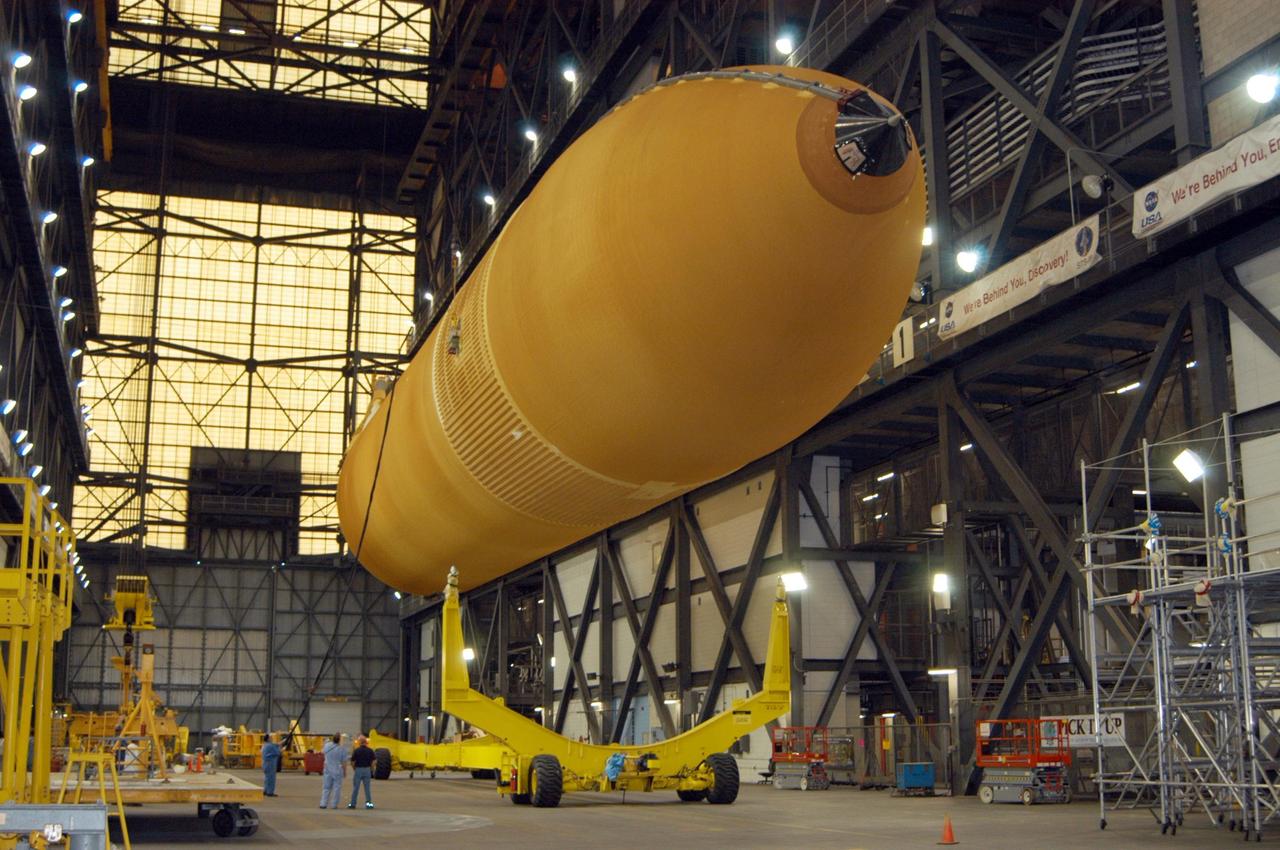
KENNEDY SPACE CENTER, FLA. - In the transfer aisle of NASA's Vehicle Assembly Building, the redesigned external fuel tank that will launch Space Shuttle Atlantis on the next shuttle mission, STS-115, is lifted off its transporter and will be raised to a vertical position. Once it is raised, the tank will be moved into a checkout cell for further work. The tank, designated ET-118, will fly with many major safety changes, including the removal of the protuberance air load ramps. Photo credit: NASA/George Shelton
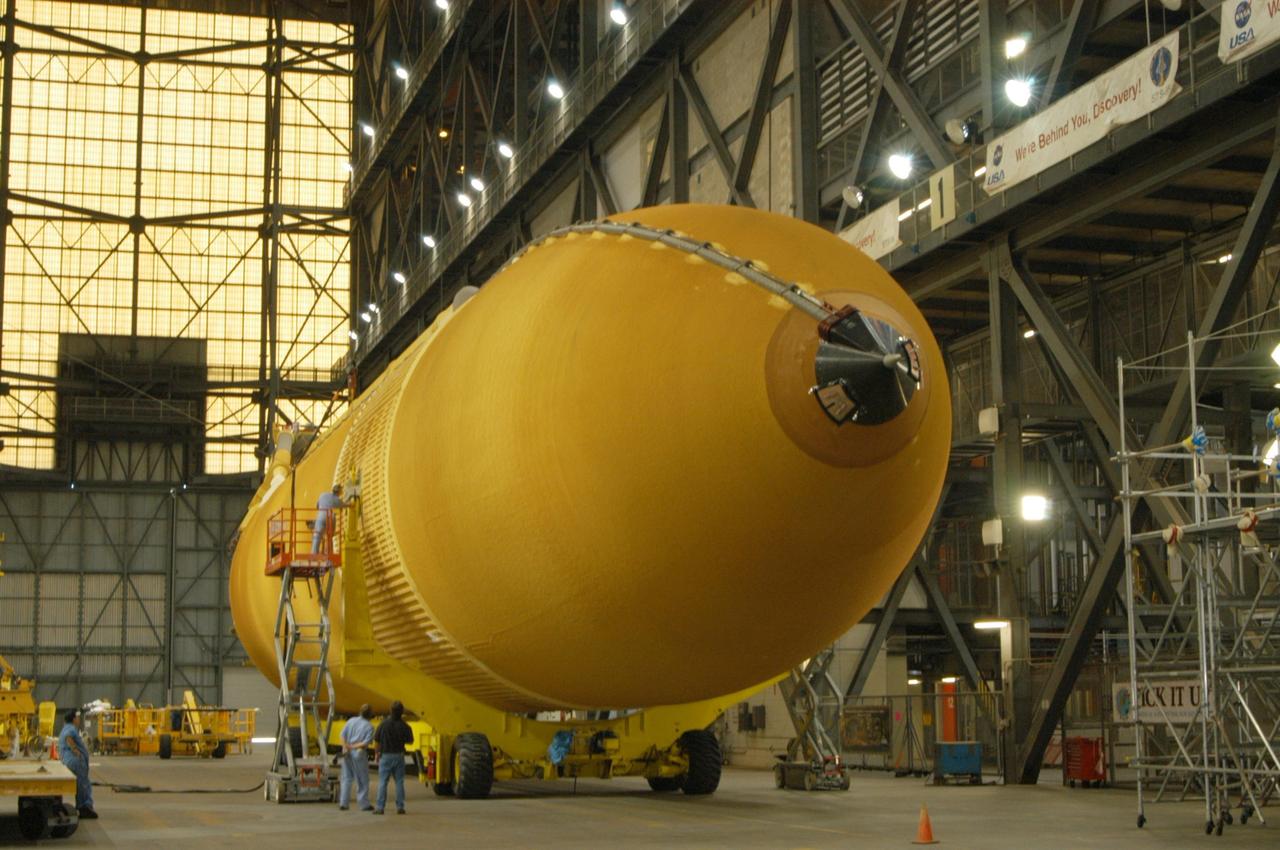
KENNEDY SPACE CENTER, FLA. - In the transfer aisle of NASA's Vehicle Assembly Building, the redesigned external fuel tank that will launch Space Shuttle Atlantis on the next shuttle mission, STS-115, is prepared to be raised to a vertical position. Once it is raised, the tank will be moved into a checkout cell for further work. The tank, designated ET-118, will fly with many major safety changes, including the removal of the protuberance air load ramps. Photo credit: NASA/George Shelton
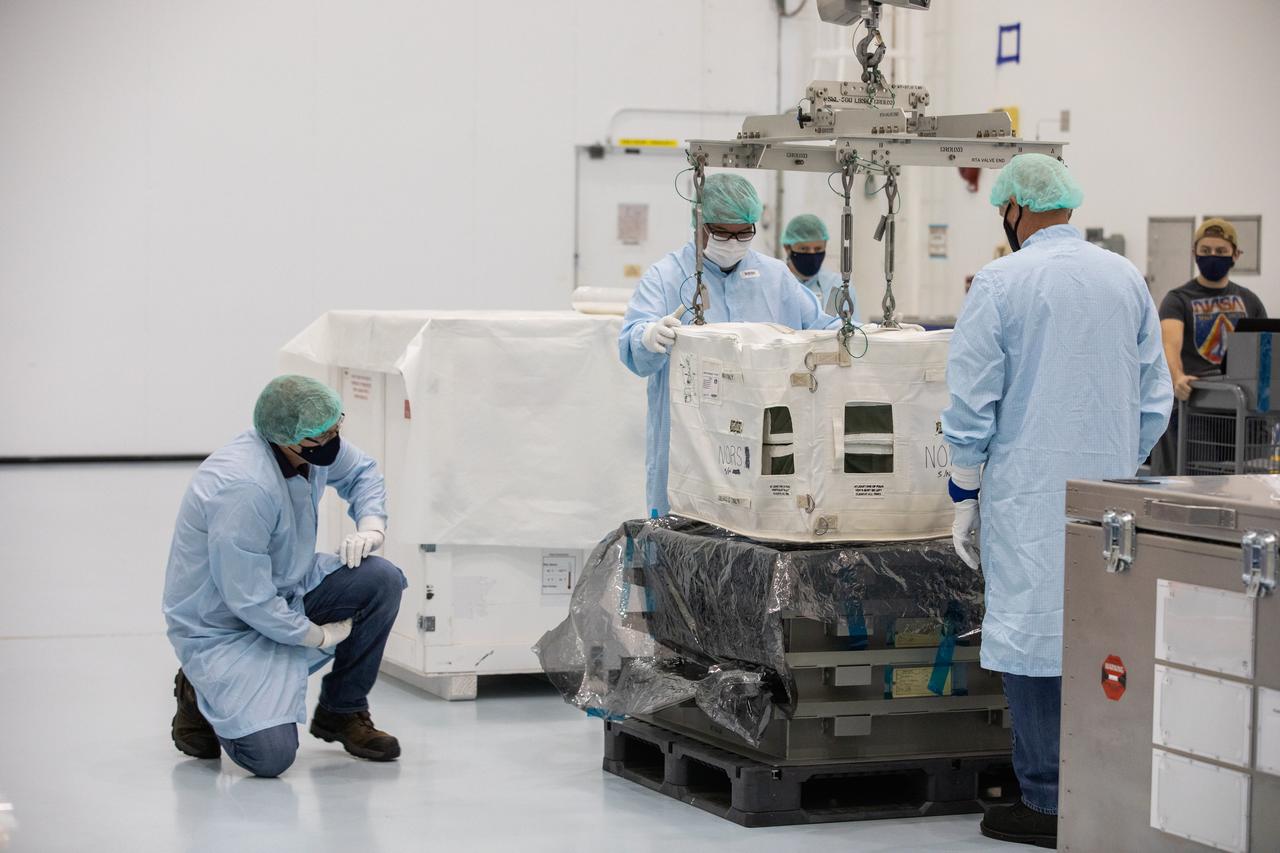
Technicians unpack and inspect a Nitrogen/Oxygen Recharge System (NORS) tank inside the Space Station Processing Facility high bay at NASA’s Kennedy Space Center in Florida on July 16, 2020. The NORS tanks and their support fixtures are designed to connect to the International Space Station’s existing air supply network to refill the previous generation of tanks installed during construction of the space station. These reusable tanks measure 3 feet long and 21 inches in diameter, and weigh about 200 pounds when filled. Once onboard, the tanks will be used to fill the oxygen and nitrogen tanks that supply the needed gases to the space station’s airlock for spacewalks. They could also be used to replenish the atmosphere inside the station. The NORS tanks will launch to the station later in the year on a commercial resupply mission.
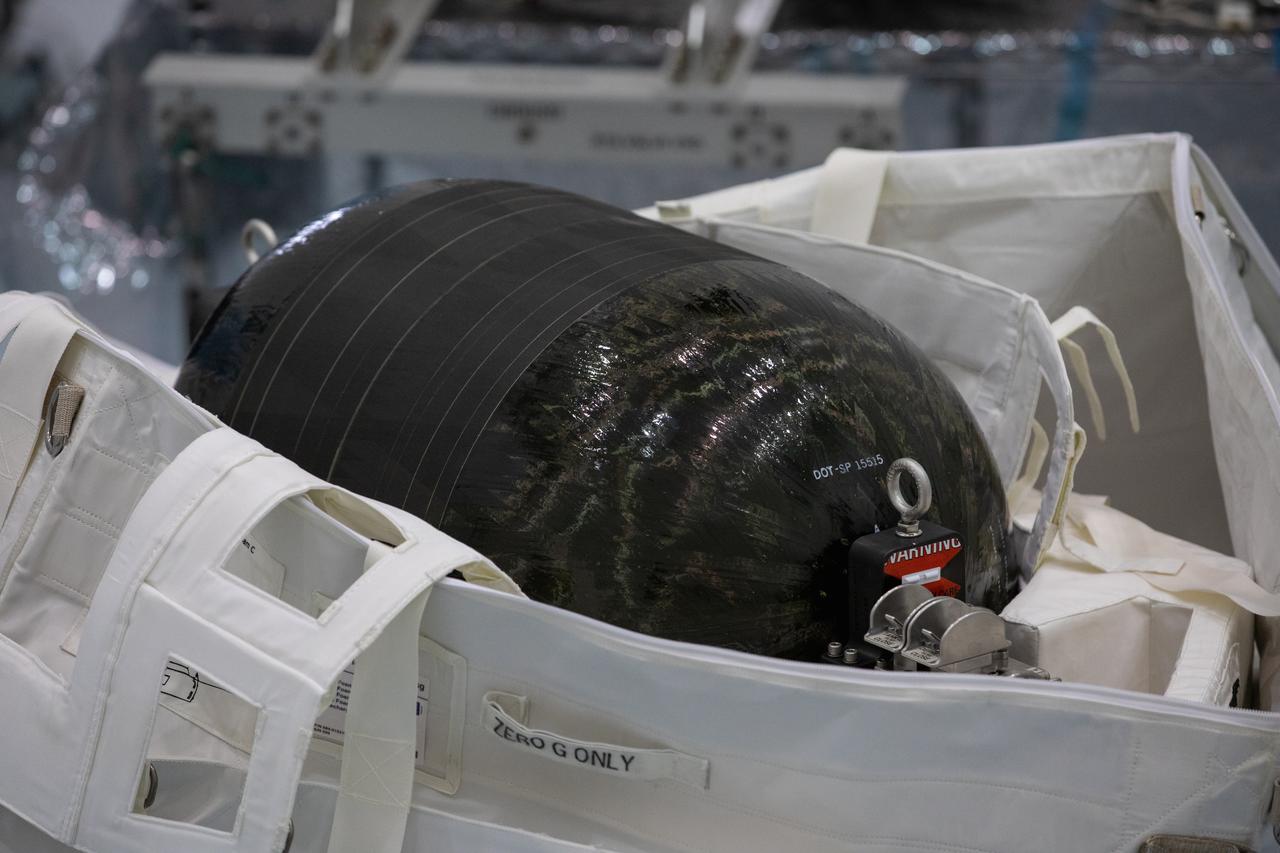
A Nitrogen/Oxygen Recharge System (NORS) tank is unpacked and readied for inspection inside the Space Station Processing Facility high bay at NASA’s Kennedy Space Center in Florida on July 16, 2020. The NORS tanks and their support fixtures are designed to connect to the International Space Station’s existing air supply network to refill the previous generation of tanks installed during construction of the space station. These reusable tanks measure 3 feet long and 21 inches in diameter, and weigh about 200 pounds when filled. Once onboard, the tanks will be used to fill the oxygen and nitrogen tanks that supply the needed gases to the space station’s airlock for spacewalks. They could also be used to replenish the atmosphere inside the station. The NORS tanks will launch to the station later in the year on a commercial resupply mission.
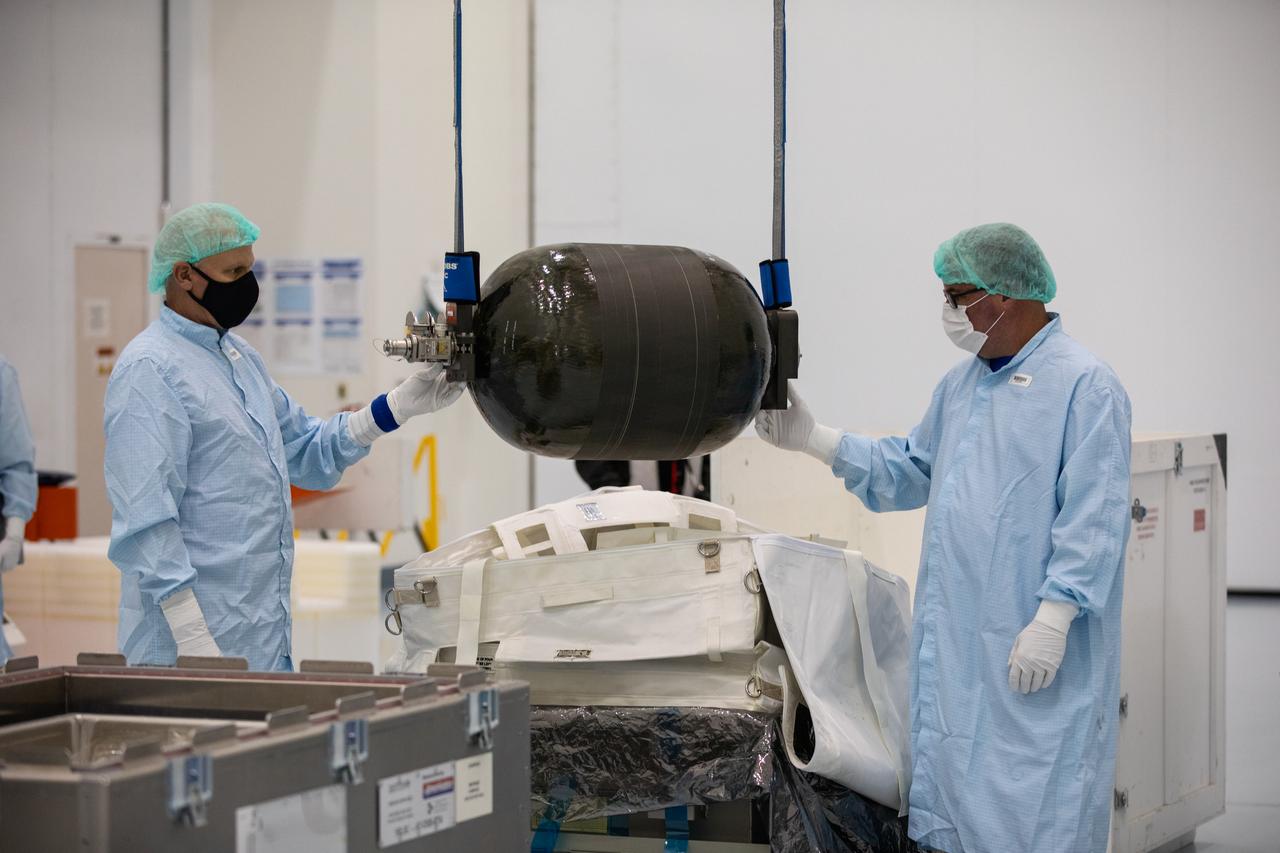
Technicians unpack and inspect a Nitrogen/Oxygen Recharge System (NORS) tank inside the Space Station Processing Facility high bay at NASA’s Kennedy Space Center in Florida on July 16, 2020. The NORS tanks and their support fixtures are designed to connect to the International Space Station’s existing air supply network to refill the previous generation of tanks installed during construction of the space station. These reusable tanks measure 3 feet long and 21 inches in diameter, and weigh about 200 pounds when filled. Once onboard, the tanks will be used to fill the oxygen and nitrogen tanks that supply the needed gases to the space station’s airlock for spacewalks. They could also be used to replenish the atmosphere inside the station. The NORS tanks will launch to the station later in the year on a commercial resupply mission.
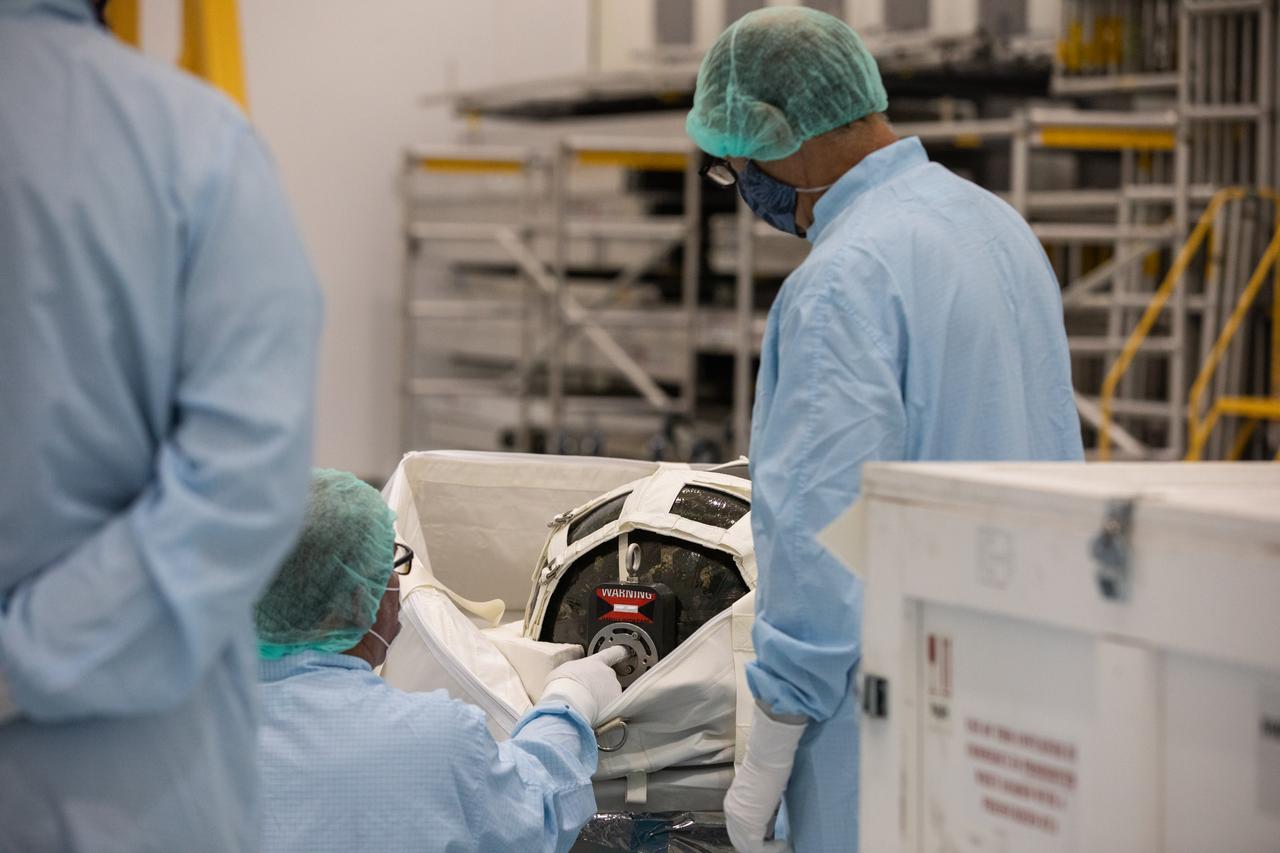
Technicians unpack and inspect a Nitrogen/Oxygen Recharge System (NORS) tank inside the Space Station Processing Facility high bay at NASA’s Kennedy Space Center in Florida on July 16, 2020. The NORS tanks and their support fixtures are designed to connect to the International Space Station’s existing air supply network to refill the previous generation of tanks installed during construction of the space station. These reusable tanks measure 3 feet long and 21 inches in diameter, and weigh about 200 pounds when filled. Once onboard, the tanks will be used to fill the oxygen and nitrogen tanks that supply the needed gases to the space station’s airlock for spacewalks. They could also be used to replenish the atmosphere inside the station. The NORS tanks will launch to the station later in the year on a commercial resupply mission.
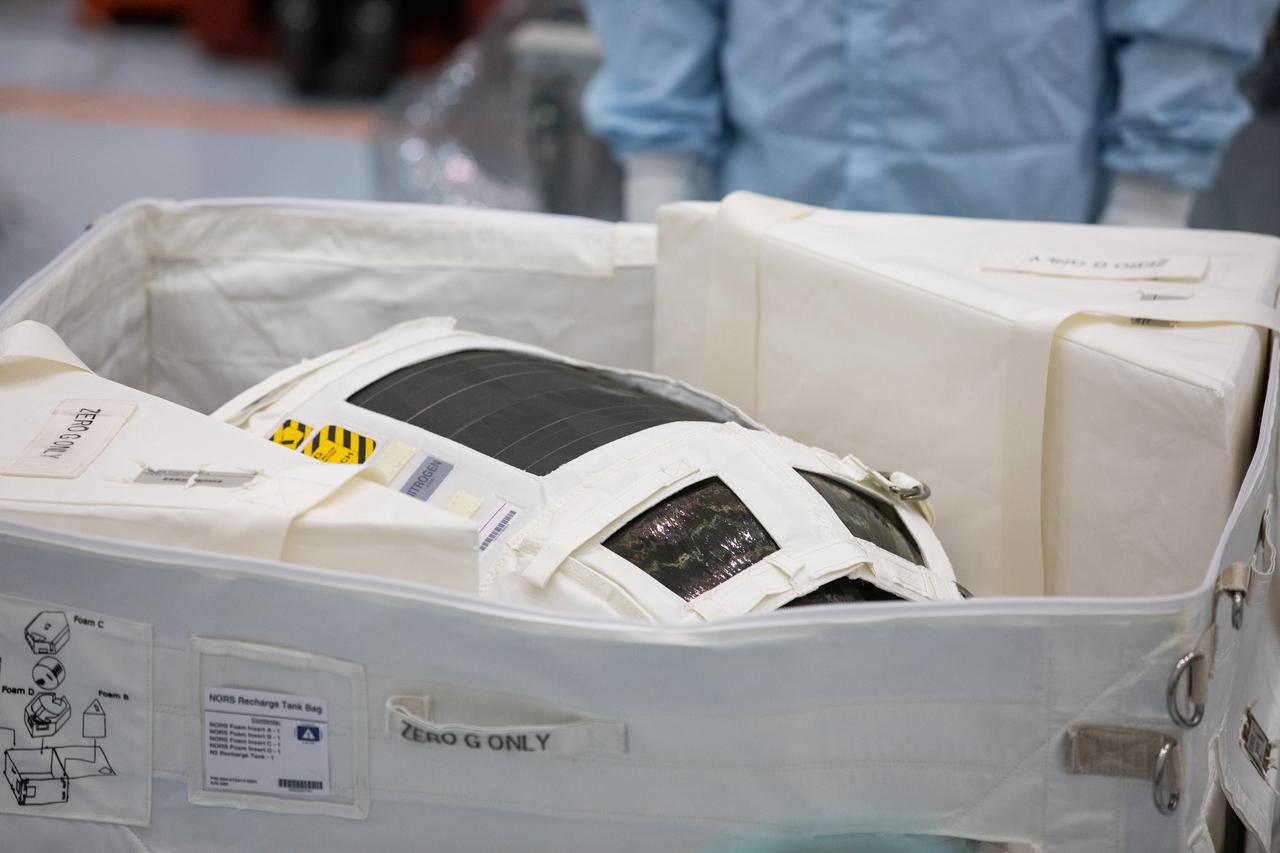
A Nitrogen/Oxygen Recharge System (NORS) tank is unpacked and readied for inspection inside the Space Station Processing Facility high bay at NASA’s Kennedy Space Center in Florida on July 16, 2020. The NORS tanks and their support fixtures are designed to connect to the International Space Station’s existing air supply network to refill the previous generation of tanks installed during construction of the space station. These reusable tanks measure 3 feet long and 21 inches in diameter, and weigh about 200 pounds when filled. Once onboard, the tanks will be used to fill the oxygen and nitrogen tanks that supply the needed gases to the space station’s airlock for spacewalks. They could also be used to replenish the atmosphere inside the station. The NORS tanks will launch to the station later in the year on a commercial resupply mission.

A technicians inspects a Nitrogen/Oxygen Recharge System (NORS) tank inside the Space Station Processing Facility high bay at NASA’s Kennedy Space Center in Florida on July 16, 2020. The NORS tanks and their support fixtures are designed to connect to the International Space Station’s existing air supply network to refill the previous generation of tanks installed during construction of the space station. These reusable tanks measure 3 feet long and 21 inches in diameter, and weigh about 200 pounds when filled. Once onboard, the tanks will be used to fill the oxygen and nitrogen tanks that supply the needed gases to the space station’s airlock for spacewalks. They could also be used to replenish the atmosphere inside the station. The NORS tanks will launch to the station later in the year on a commercial resupply mission.
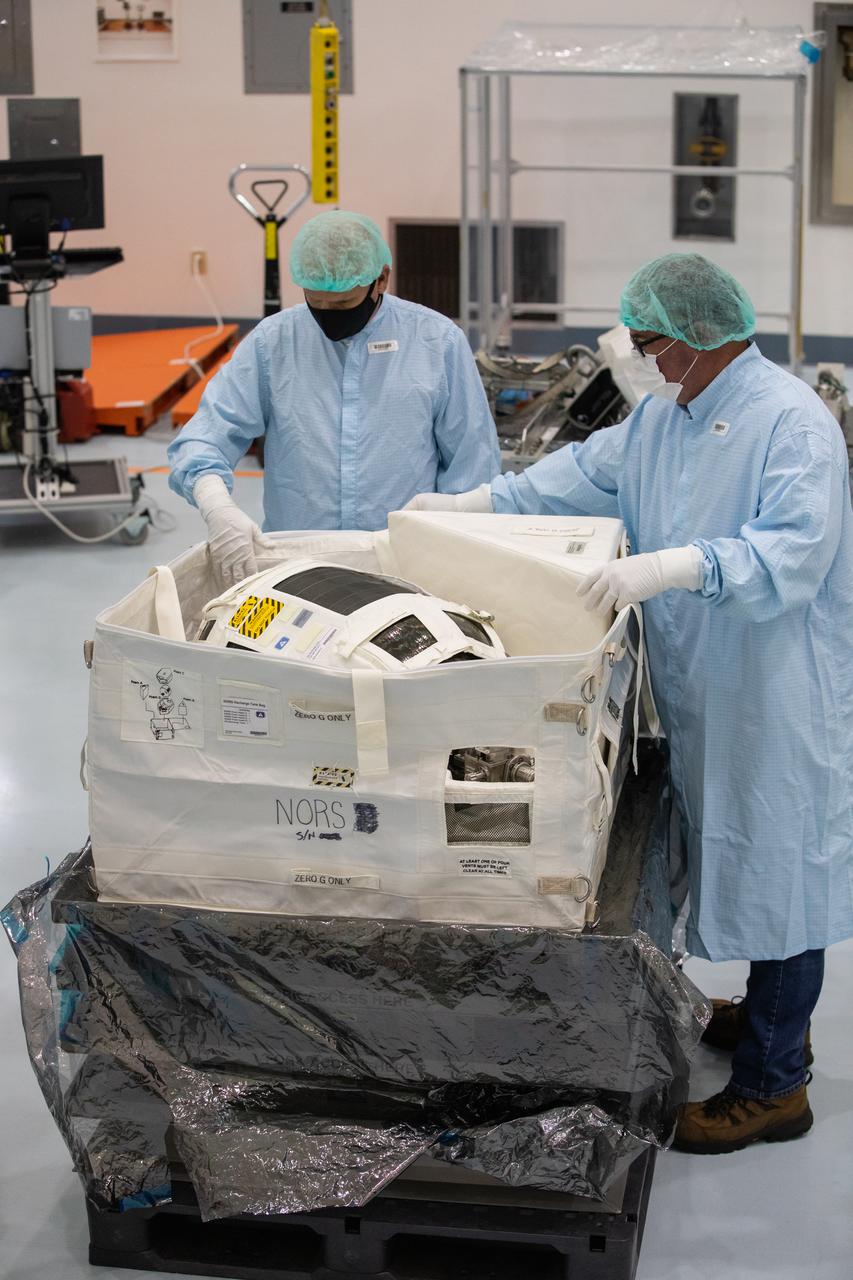
Technicians unpack and inspect a Nitrogen/Oxygen Recharge System (NORS) tank inside the Space Station Processing Facility high bay at NASA’s Kennedy Space Center in Florida on July 16, 2020. The NORS tanks and their support fixtures are designed to connect to the International Space Station’s existing air supply network to refill the previous generation of tanks installed during construction of the space station. These reusable tanks measure 3 feet long and 21 inches in diameter, and weigh about 200 pounds when filled. Once onboard, the tanks will be used to fill the oxygen and nitrogen tanks that supply the needed gases to the space station’s airlock for spacewalks. They could also be used to replenish the atmosphere inside the station. The NORS tanks will launch to the station later in the year on a commercial resupply mission.
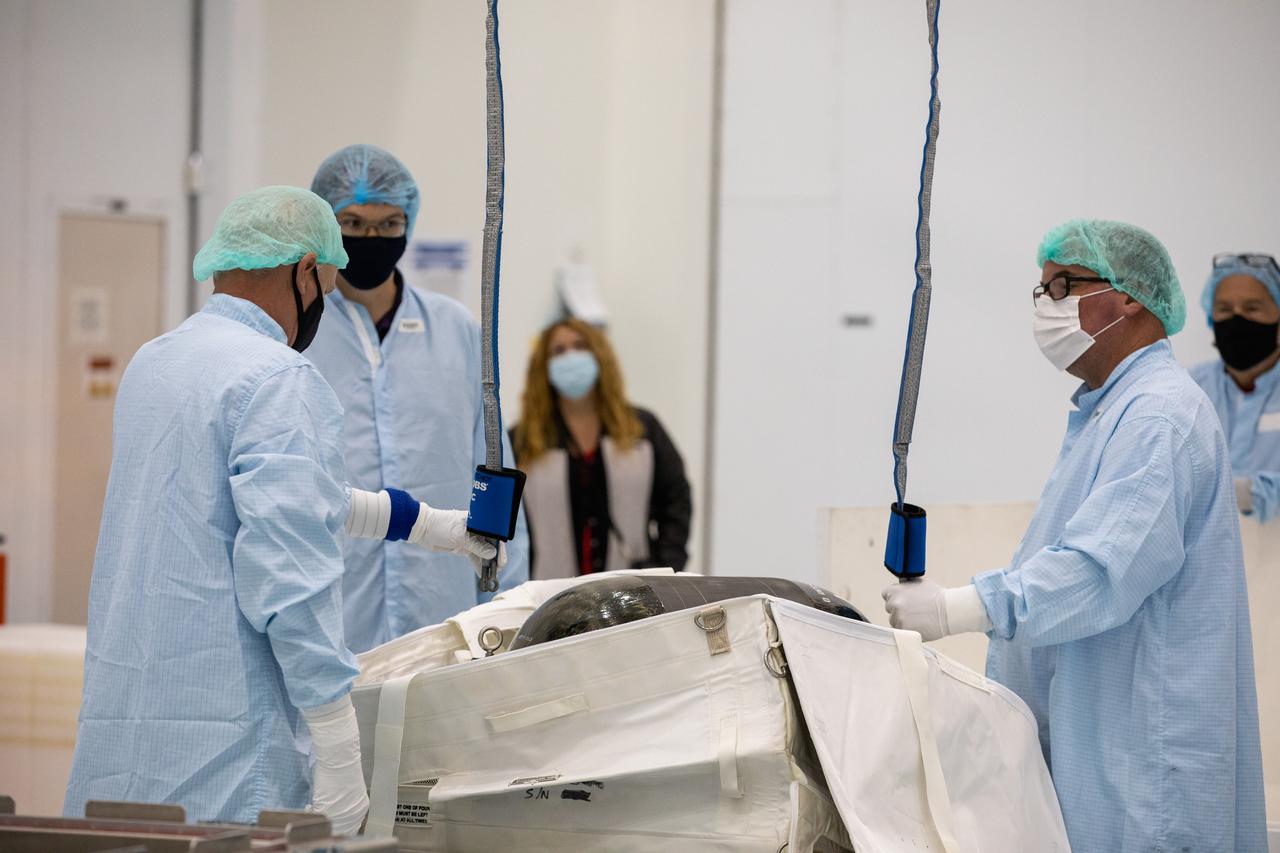
Technicians prepare to unpack and inspect a Nitrogen/Oxygen Recharge System (NORS) tank inside the Space Station Processing Facility high bay at NASA’s Kennedy Space Center in Florida on July 16, 2020. The NORS tanks and their support fixtures are designed to connect to the International Space Station’s existing air supply network to refill the previous generation of tanks installed during construction of the space station. These reusable tanks measure 3 feet long and 21 inches in diameter, and weigh about 200 pounds when filled. Once onboard, the tanks will be used to fill the oxygen and nitrogen tanks that supply the needed gases to the space station’s airlock for spacewalks. They could also be used to replenish the atmosphere inside the station. The NORS tanks will launch to the station later in the year on a commercial resupply mission.
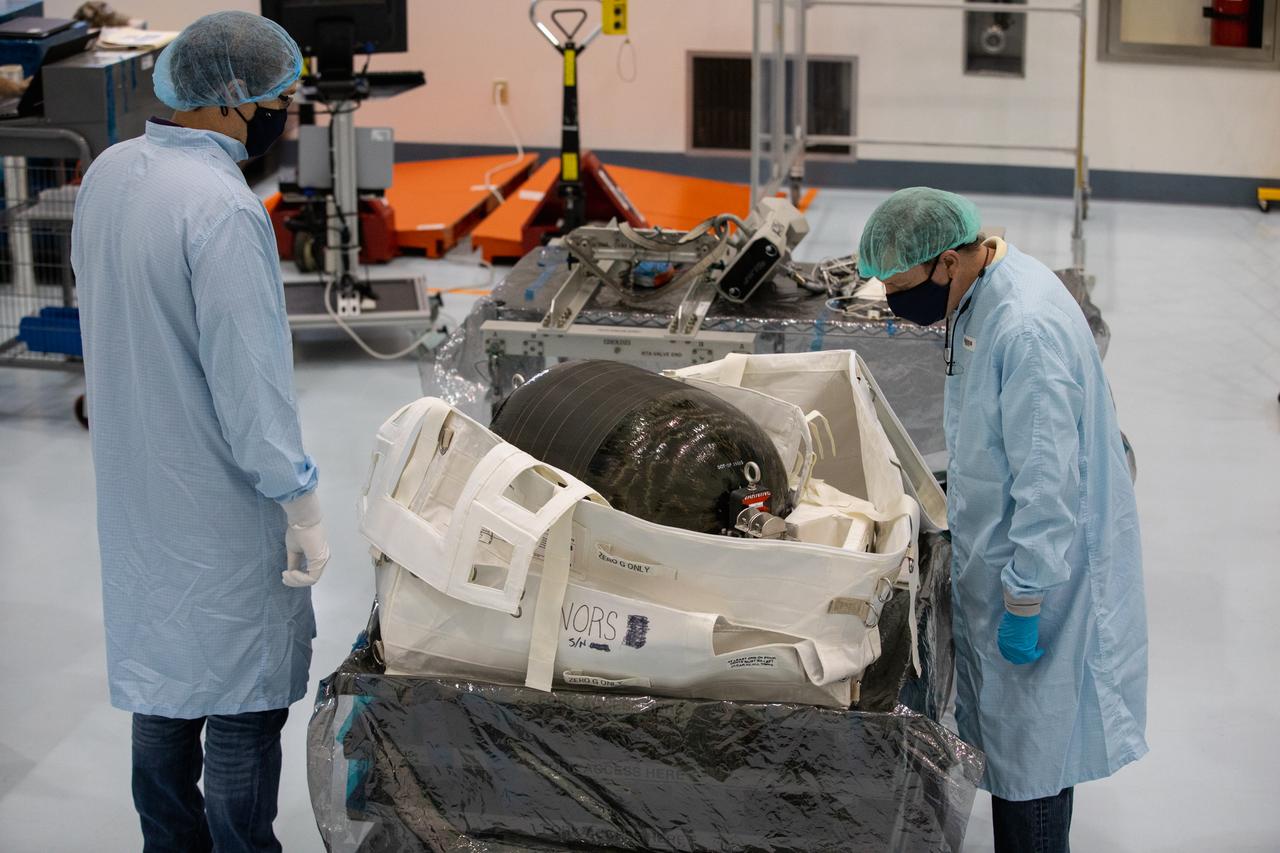
Technicians unpack and inspect a Nitrogen/Oxygen Recharge System (NORS) tank inside the Space Station Processing Facility high bay at NASA’s Kennedy Space Center in Florida on July 16, 2020. The NORS tanks and their support fixtures are designed to connect to the International Space Station’s existing air supply network to refill the previous generation of tanks installed during construction of the space station. These reusable tanks measure 3 feet long and 21 inches in diameter, and weigh about 200 pounds when filled. Once onboard, the tanks will be used to fill the oxygen and nitrogen tanks that supply the needed gases to the space station’s airlock for spacewalks. They could also be used to replenish the atmosphere inside the station. The NORS tanks will launch to the station later in the year on a commercial resupply mission.
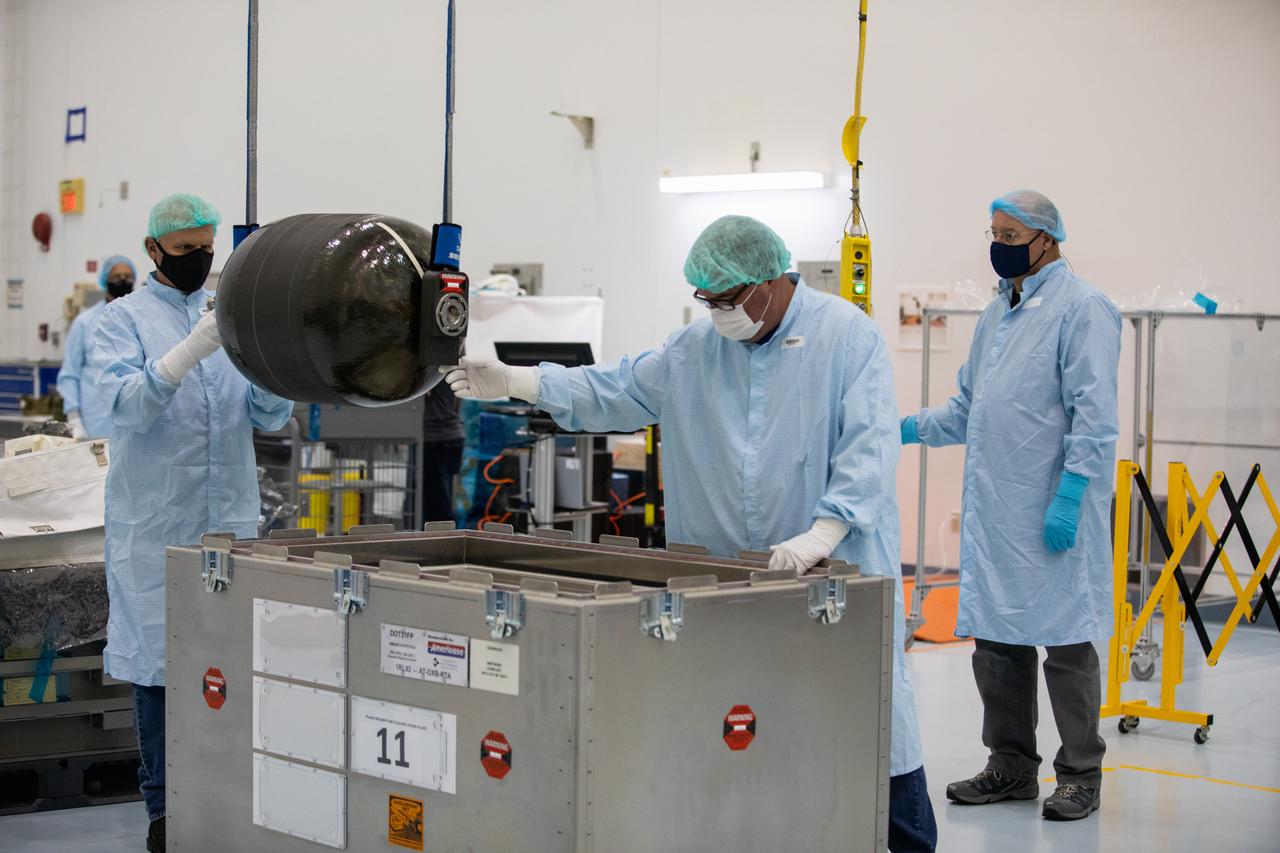
Technicians unpack and inspect a Nitrogen/Oxygen Recharge System (NORS) tank inside the Space Station Processing Facility high bay at NASA’s Kennedy Space Center in Florida on July 16, 2020. The NORS tanks and their support fixtures are designed to connect to the International Space Station’s existing air supply network to refill the previous generation of tanks installed during construction of the space station. These reusable tanks measure 3 feet long and 21 inches in diameter, and weigh about 200 pounds when filled. Once onboard, the tanks will be used to fill the oxygen and nitrogen tanks that supply the needed gases to the space station’s airlock for spacewalks. They could also be used to replenish the atmosphere inside the station. The NORS tanks will launch to the station later in the year on a commercial resupply mission.
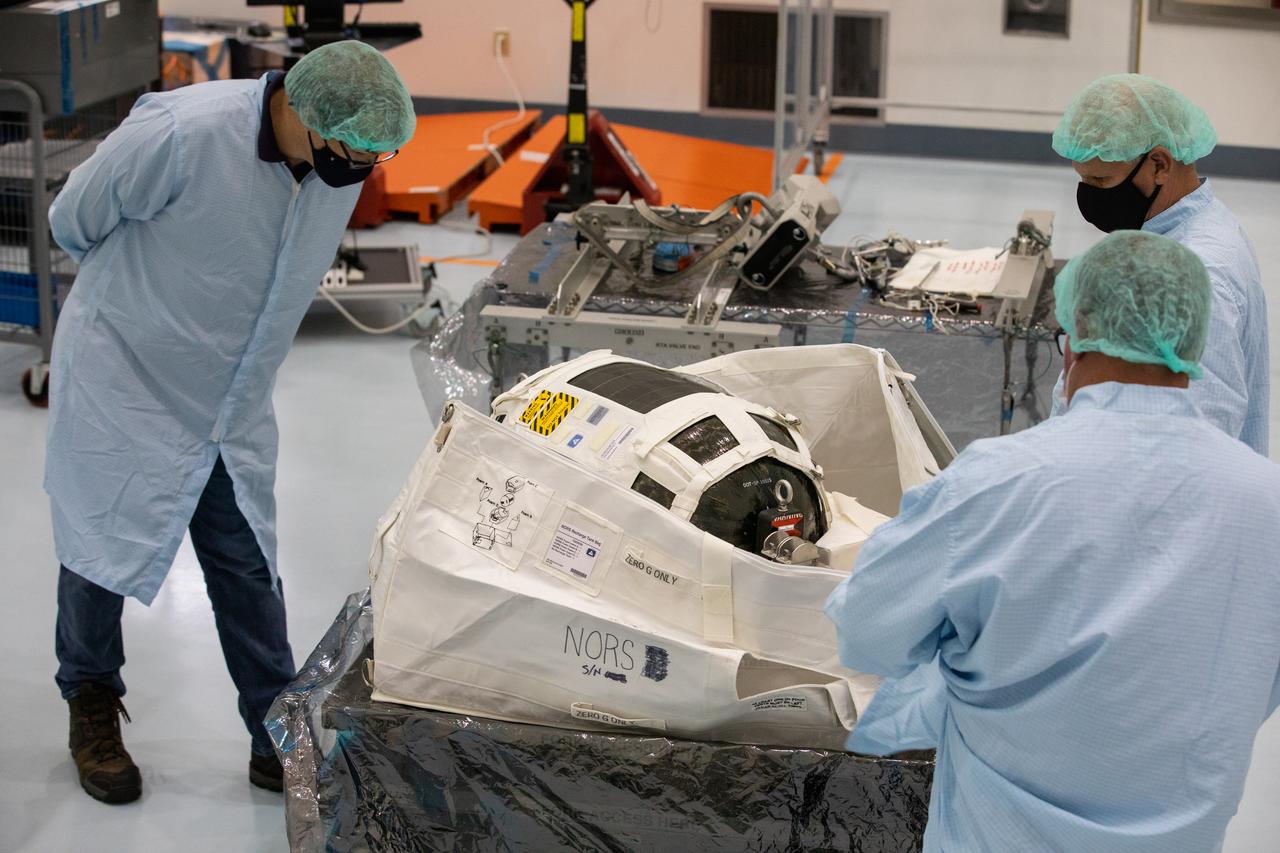
Technicians unpack and inspect a Nitrogen/Oxygen Recharge System (NORS) tank inside the Space Station Processing Facility high bay at NASA’s Kennedy Space Center in Florida on July 16, 2020. The NORS tanks and their support fixtures are designed to connect to the International Space Station’s existing air supply network to refill the previous generation of tanks installed during construction of the space station. These reusable tanks measure 3 feet long and 21 inches in diameter, and weigh about 200 pounds when filled. Once onboard, the tanks will be used to fill the oxygen and nitrogen tanks that supply the needed gases to the space station’s airlock for spacewalks. They could also be used to replenish the atmosphere inside the station. The NORS tanks will launch to the station later in the year on a commercial resupply mission.

A Nitrogen/Oxygen Recharge System (NORS) tank is unpacked and readied for inspection inside the Space Station Processing Facility high bay at NASA’s Kennedy Space Center in Florida on July 16, 2020. The NORS tanks and their support fixtures are designed to connect to the International Space Station’s existing air supply network to refill the previous generation of tanks installed during construction of the space station. These reusable tanks measure 3 feet long and 21 inches in diameter, and weigh about 200 pounds when filled. Once onboard, the tanks will be used to fill the oxygen and nitrogen tanks that supply the needed gases to the space station’s airlock for spacewalks. They could also be used to replenish the atmosphere inside the station. The NORS tanks will launch to the station later in the year on a commercial resupply mission.
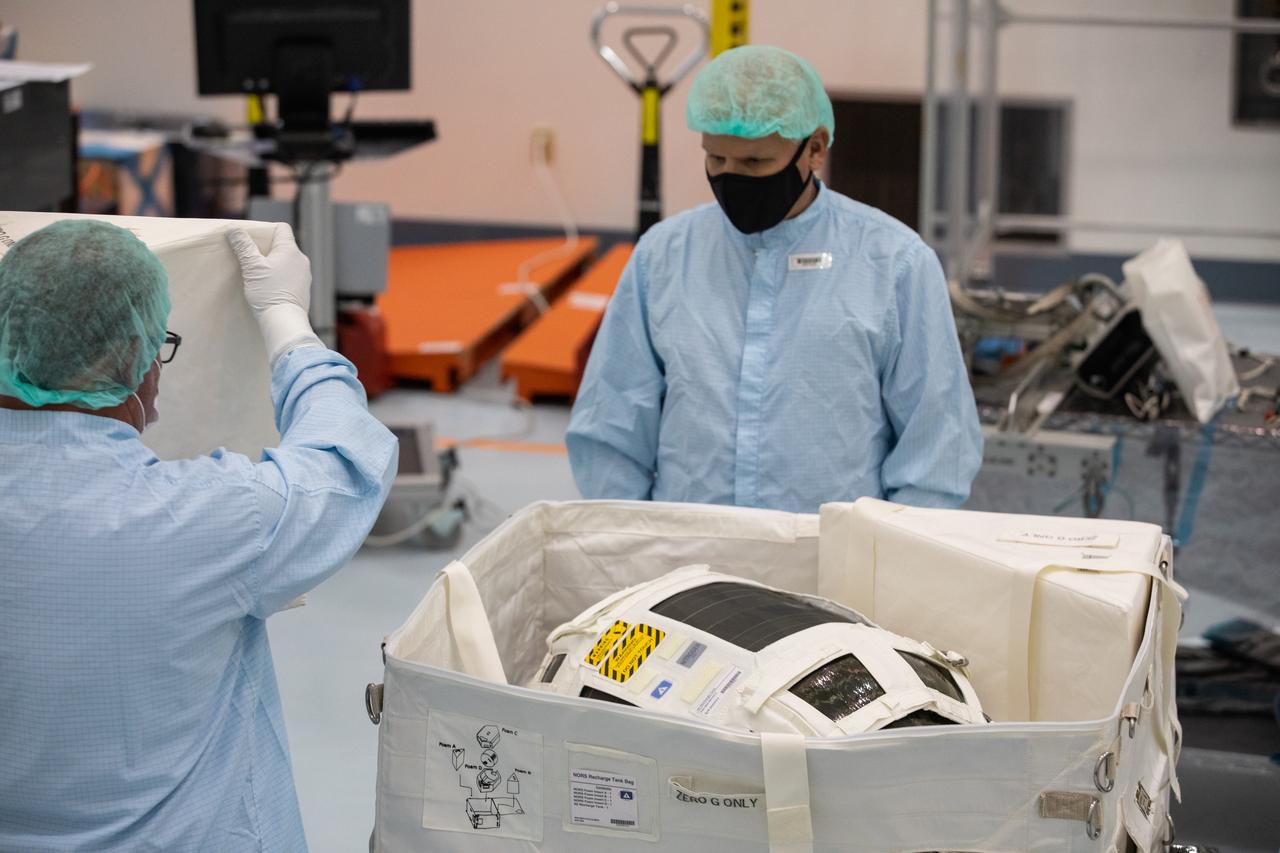
Technicians unpack and inspect a Nitrogen/Oxygen Recharge System (NORS) tank inside the Space Station Processing Facility high bay at NASA’s Kennedy Space Center in Florida on July 16, 2020. The NORS tanks and their support fixtures are designed to connect to the International Space Station’s existing air supply network to refill the previous generation of tanks installed during construction of the space station. These reusable tanks measure 3 feet long and 21 inches in diameter, and weigh about 200 pounds when filled. Once onboard, the tanks will be used to fill the oxygen and nitrogen tanks that supply the needed gases to the space station’s airlock for spacewalks. They could also be used to replenish the atmosphere inside the station. The NORS tanks will launch to the station later in the year on a commercial resupply mission.
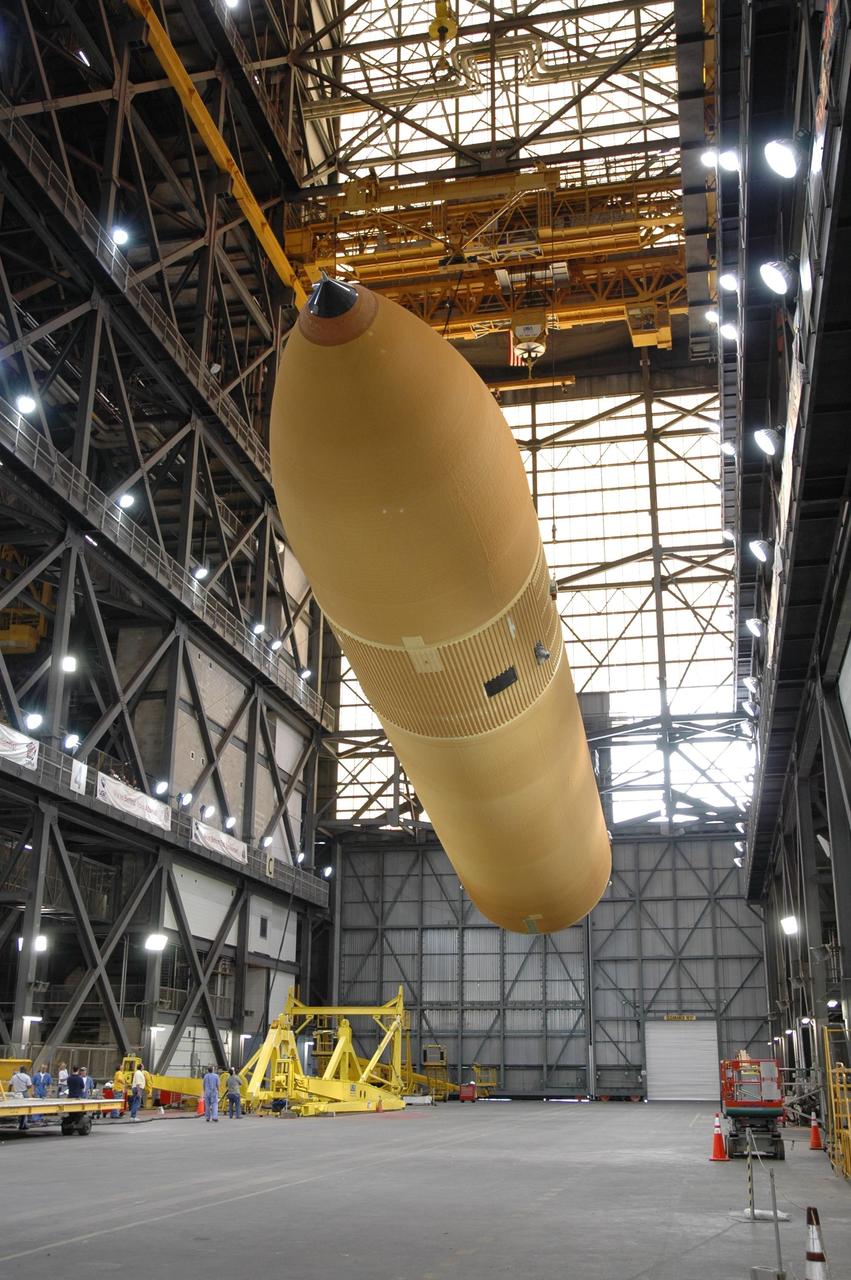
KENNEDY SPACE CENTER, FLA. - In the Vehicle Assembly Building, a crane begins raising the head of external tank No. 118 so that the tank is suspended vertically. The tank will be lifted into high bay 3 for mating with solid rocket boosters stacked there. The tank is designated to fly on mission STS-115 with Atlantis. It will fly with many major safety changes, including the removal of the protuberance air load ramps. The mission will deliver the second port truss segment, the P3/P4 Truss, to attach to the first port truss segment, the P1 Truss, as well as deploy solar array set 2A and 4A. Launch of Space Shuttle Atlantis is scheduled for late August. Photo credit: NASA/Jim Grossmann
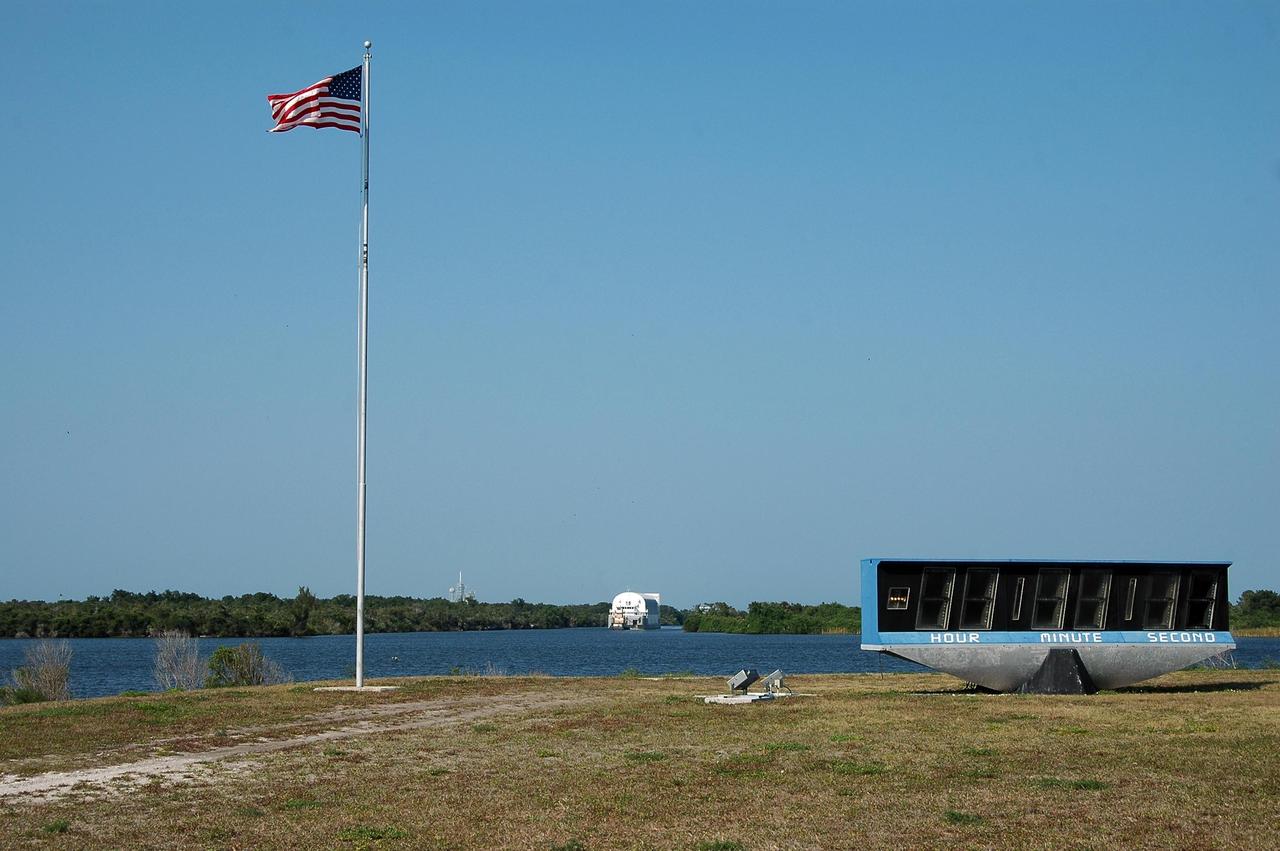
KENNEDY SPACE CENTER, FLA. - Viewed from the NASA News Center, a tug boat in the background maneuvers the Pegasus barge into the turn basin at the Launch Complex 39 Area. The barge holds the redesigned external fuel tank, designated ET-118, that will launch Space Shuttle Atlantis on the next shuttle mission, STS-115. The tank was shipped from the Michoud Assembly Facility in New Orleans. After off-loading, the tank will be moved into the Vehicle Assembly Building and lifted into a checkout cell for further work. The tank will fly with many major safety changes, including the removal of the protuberance air load ramps. Photo credit: NASA/Kim Shiflett
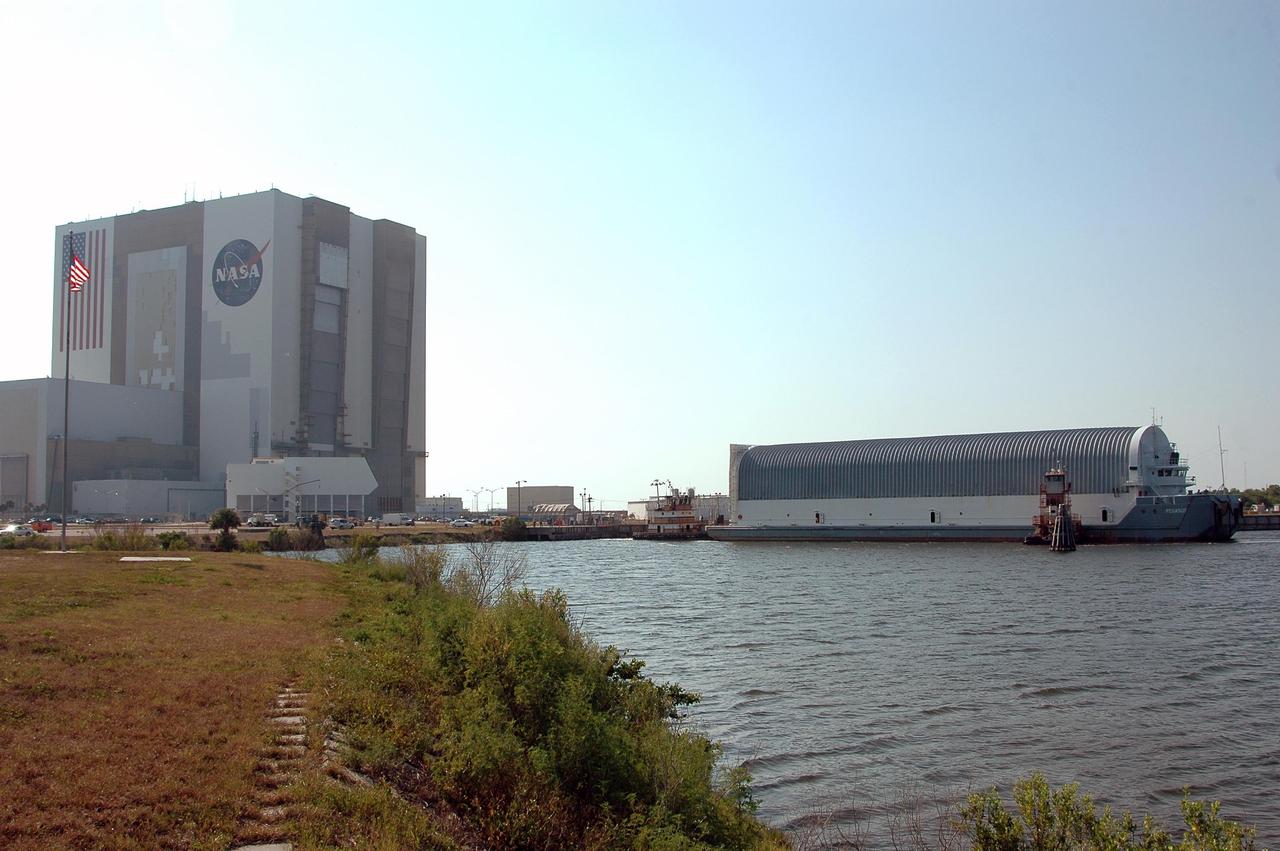
KENNEDY SPACE CENTER, FLA. - Tug boats maneuver the Pegasus barge next to the dock in the turn basin at the Launch Complex 39 Area. The barge holds the redesigned external fuel tank, designated ET-118, that will launch Space Shuttle Atlantis on the next shuttle mission, STS-115. The tank was shipped from the Michoud Assembly Facility in New Orleans. After off-loading, the tank will be moved into the Vehicle Assembly Building and lifted into a checkout cell for further work. The tank will fly with many major safety changes, including the removal of the protuberance air load ramps. Photo credit: NASA/Kim Shiflett
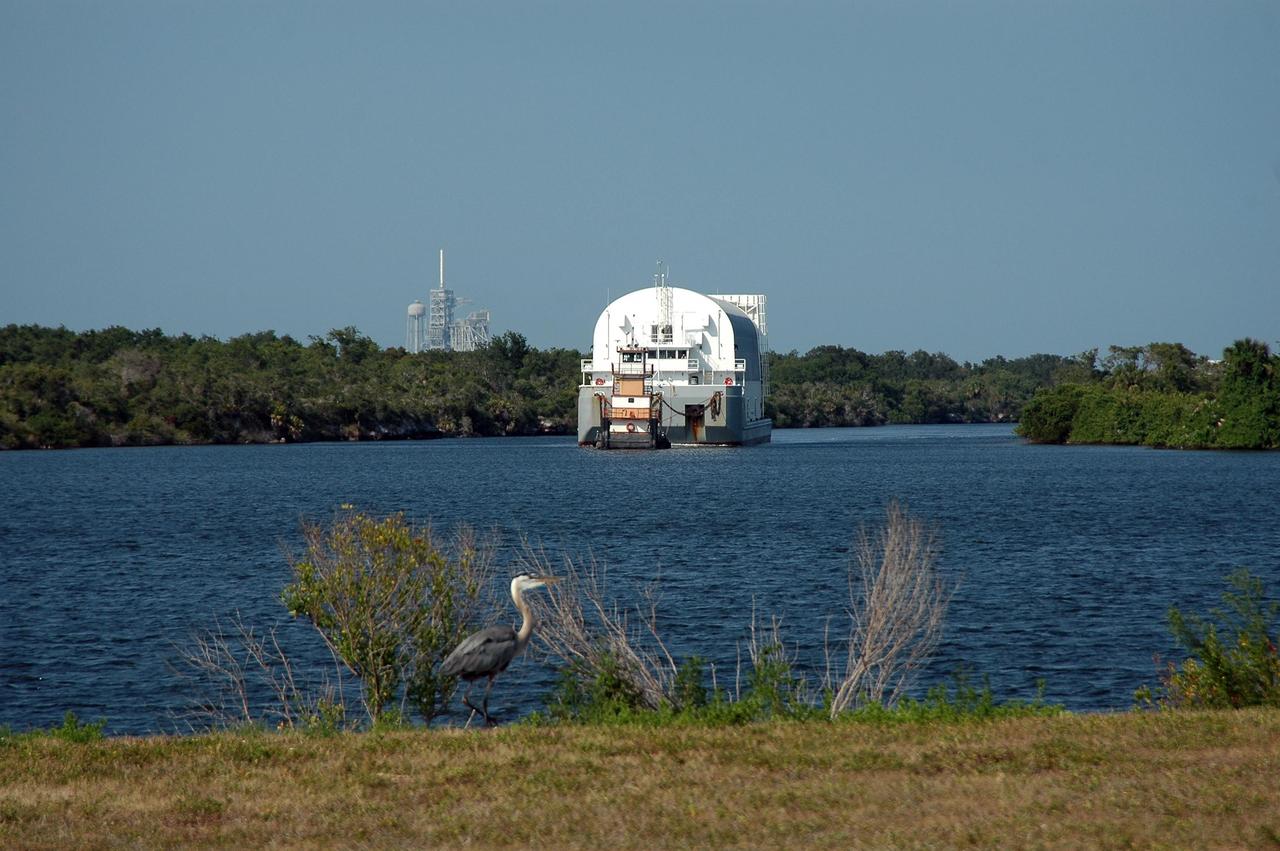
KENNEDY SPACE CENTER, FLA. - A Great Blue Heron on the near bank has a front row perch for the arrival of the Pegasus barge being towed into the turn basin at the Launch Complex 39 Area. The barge holds the redesigned external fuel tank, designated ET-118, that will launch Space Shuttle Atlantis on the next shuttle mission, STS-115. The tank was shipped from the Michoud Assembly Facility in New Orleans. After off-loading, the tank will be moved into the Vehicle Assembly Building and lifted into a checkout cell for further work. The tank will fly with many major safety changes, including the removal of the protuberance air load ramps. Photo credit: NASA/Kim Shiflett
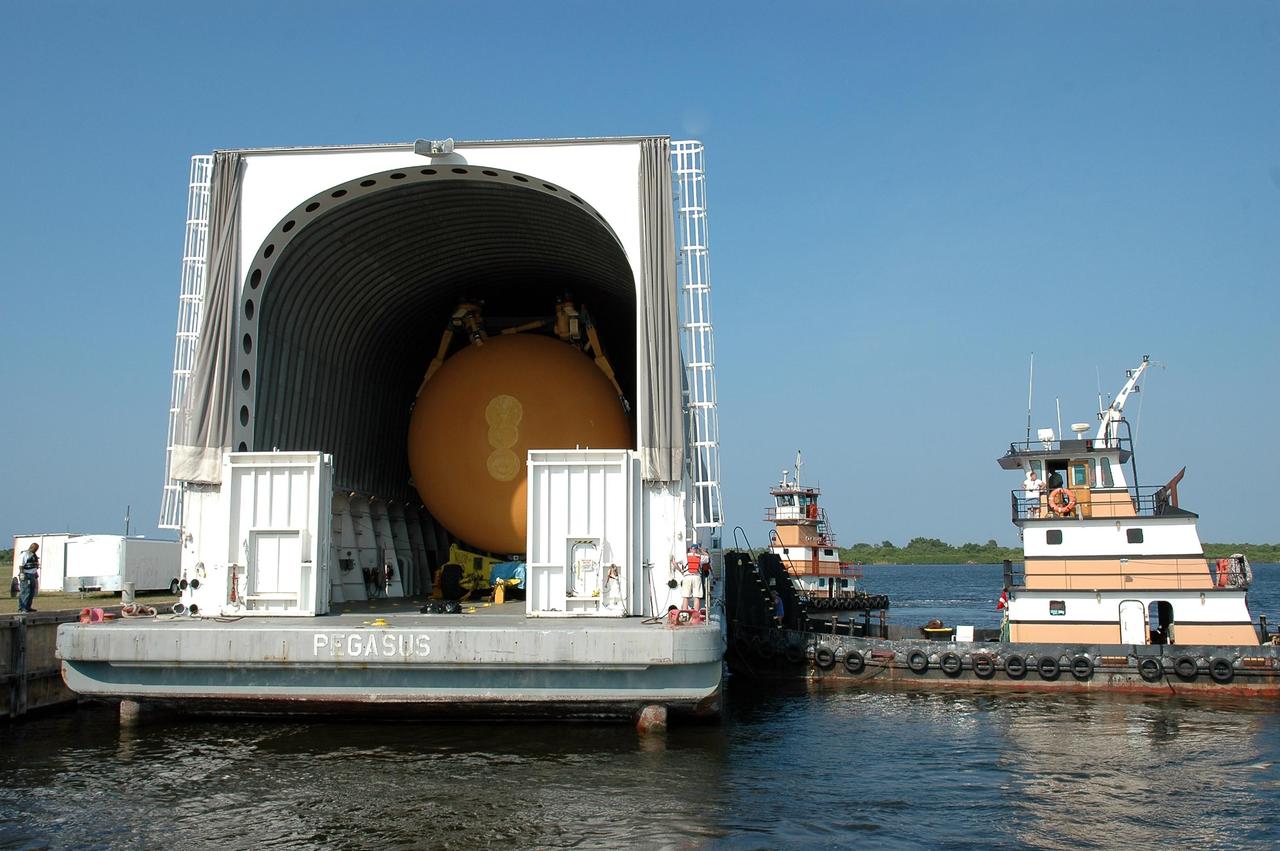
KENNEDY SPACE CENTER, FLA. - Tug boats maneuver the Pegasus barge next to the dock in the turn basin at the Launch Complex 39 Area. The barge holds the redesigned external fuel tank, seen inside, that will launch Space Shuttle Atlantis on the next shuttle mission, STS-115. The tank, designated ET-118, was shipped from the Michoud Assembly Facility in New Orleans. After off-loading, the tank will be moved into the Vehicle Assembly Building and lifted into a checkout cell for further work. The tank will fly with many major safety changes, including the removal of the protuberance air load ramps. Photo credit: NASA/Kim Shiflett
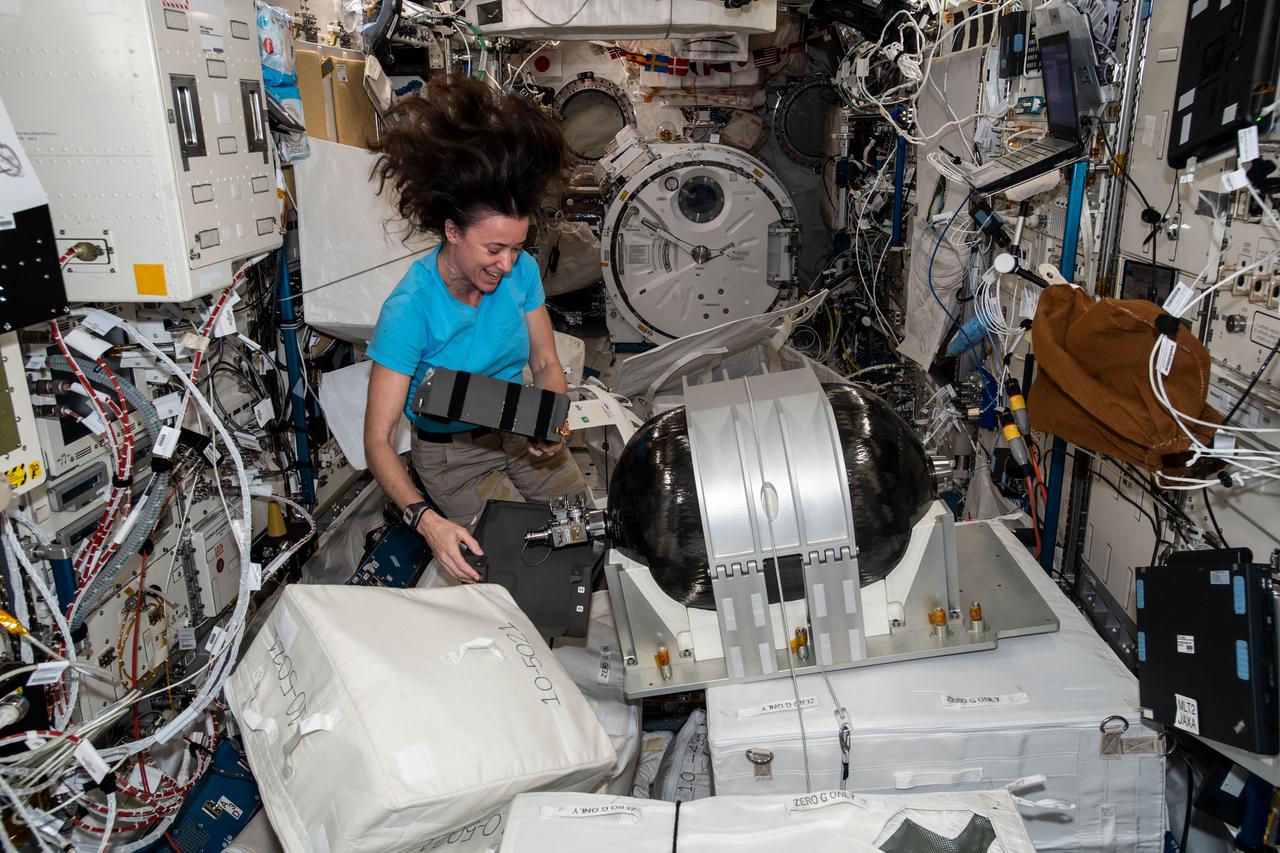
iss065e291100 (Aug. 24, 2021) --- NASA astronaut and Expedition 65 Flight Engineer Megan McArthur assembles an Emergency Air Supply (EAS) tank inside the International Space Station's Kibo laboratory module.
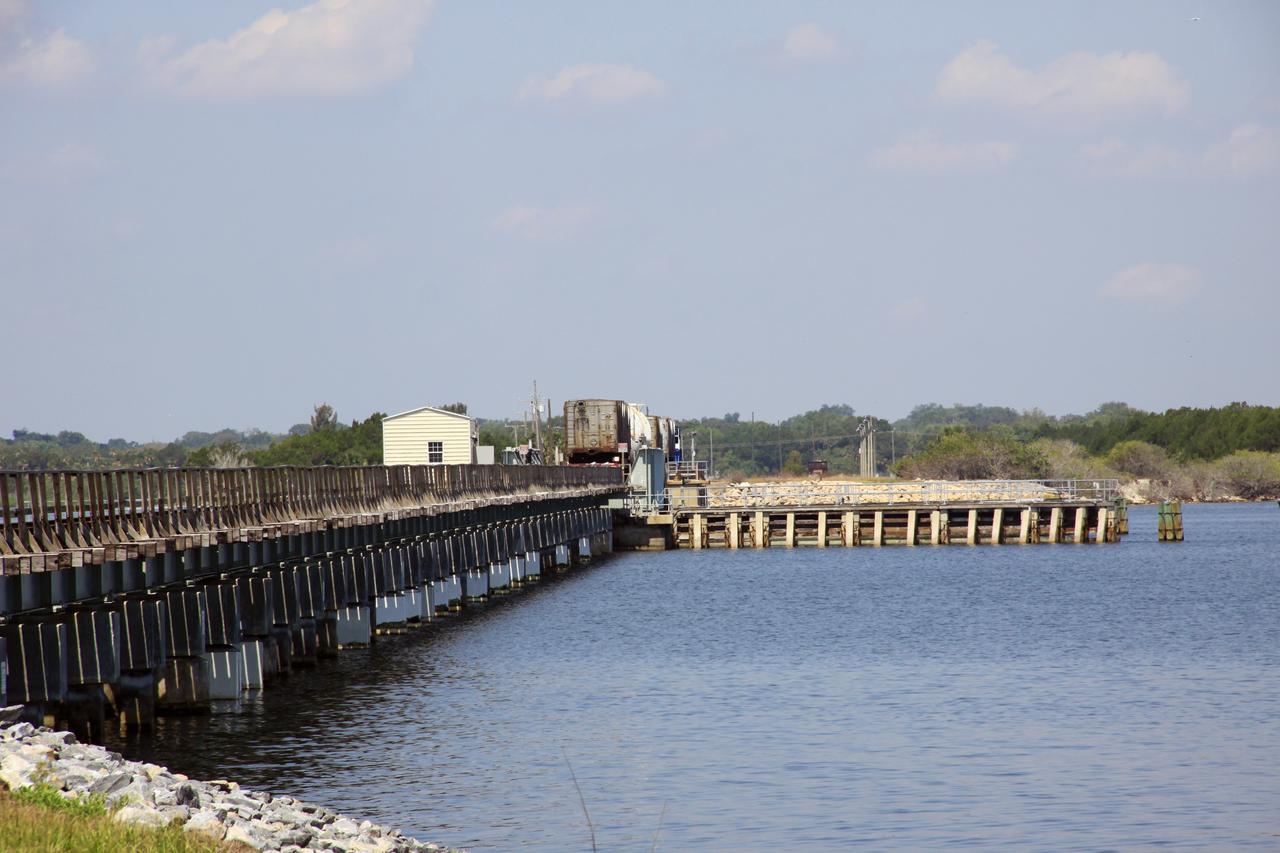
CAPE CANAVERAL, Fla. – A NASA Railroad train has crossed the Indian River on the railroad’s Jay Jay Railroad Bridge north of Launch Complex 39 at NASA’s Kennedy Space Center in Florida. The train is on its way to the Florida East Coast Railway interchange in Titusville, Fla., where the train’s helium tank cars, a liquid oxygen tank car, and a liquid hydrogen dewar or tank car will be transferred for delivery to the SpaceX engine test complex outside McGregor, Texas. The railroad cars were needed in support of the Space Shuttle Program but currently are not in use by NASA following the completion of the program in 2011. Originally, the tankers belonged to the U.S. Bureau of Mines. At the peak of the shuttle program, there were approximately 30 cars in the fleet. About half the cars were returned to the bureau as launch activity diminished. Five tank cars are being loaned to SpaceX and repurposed to support their engine tests in Texas. Eight cars previously were shipped to California on loan to support the SpaceX Falcon 9 rocket launches from Space Launch Complex-4 on Vandenberg Air Force Base. SpaceX already has three helium tank cars previously used for the shuttle program at Space Launch Complex-40 on Cape Canaveral Air Force Station in Florida. For more information, visit http://www.nasa.gov/spacex. Photo credit: NASA/Jim Grossmann
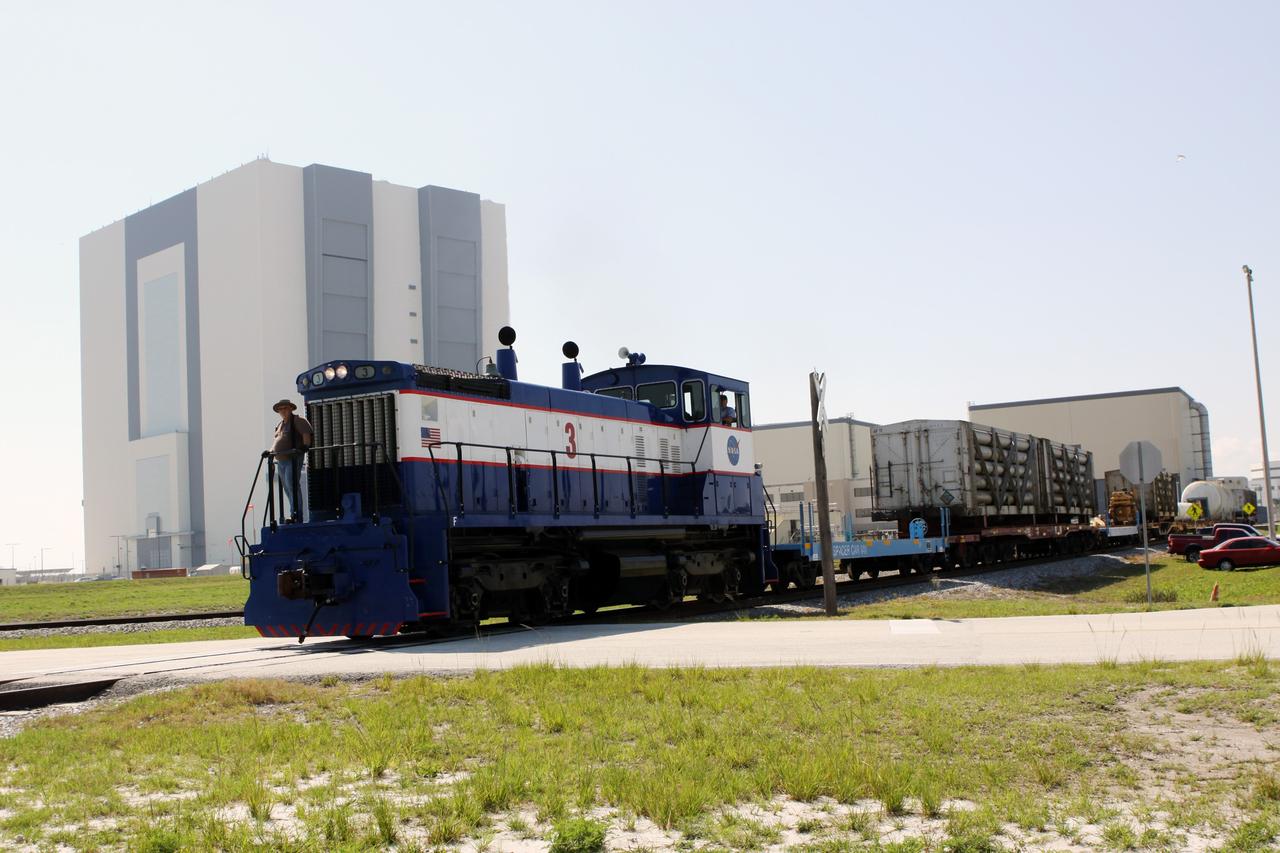
CAPE CANAVERAL, Fla. – A NASA Railroad train passes in front of the 525-foot-tall Vehicle Assembly Building, left, and the twin bays of the Orbiter Processing Facility, right, at NASA’s Kennedy Space Center in Florida. The train is on its way to the Florida East Coast Railway interchange in Titusville, Fla., where the train’s helium tank cars, a liquid oxygen tank car, and a liquid hydrogen dewar or tank car will be transferred for delivery to the SpaceX engine test complex outside McGregor, Texas. The railroad cars were needed in support of the Space Shuttle Program but currently are not in use by NASA following the completion of the program in 2011. Originally, the tankers belonged to the U.S. Bureau of Mines. At the peak of the shuttle program, there were approximately 30 cars in the fleet. About half the cars were returned to the bureau as launch activity diminished. Five tank cars are being loaned to SpaceX and repurposed to support their engine tests in Texas. Eight cars previously were shipped to California on loan to support the SpaceX Falcon 9 rocket launches from Space Launch Complex-4 on Vandenberg Air Force Base. SpaceX already has three helium tank cars previously used for the shuttle program at Space Launch Complex-40 on Cape Canaveral Air Force Station in Florida. For more information, visit http://www.nasa.gov/spacex. Photo credit: NASA/Jim Grossmann
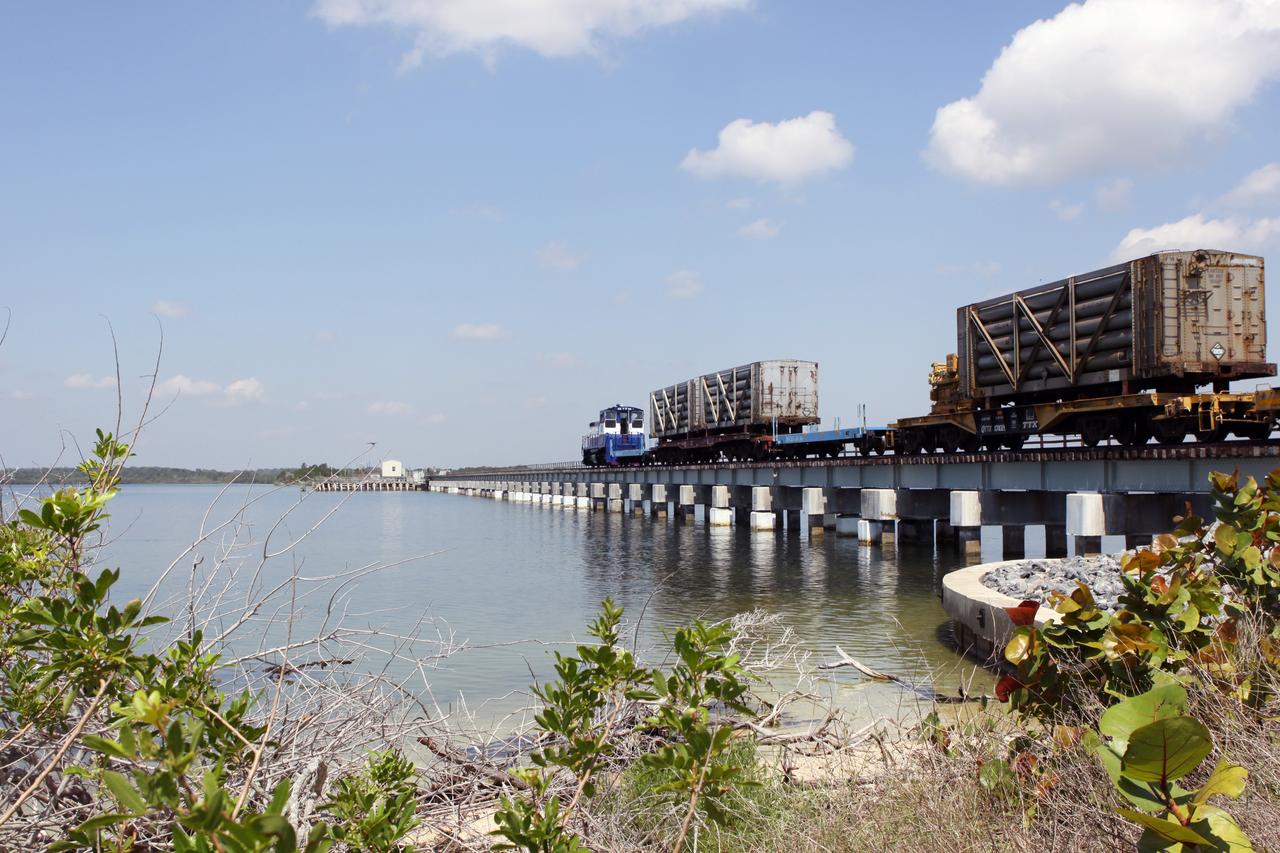
CAPE CANAVERAL, Fla. – A NASA Railroad train crosses the railroad’s Jay Jay Railroad Bridge north of Launch Complex 39 at NASA’s Kennedy Space Center in Florida. The train is on its way to the Florida East Coast Railway interchange in Titusville, Fla., where the train’s helium tank cars, a liquid oxygen tank car, and a liquid hydrogen dewar or tank car will be transferred for delivery to the SpaceX engine test complex outside McGregor, Texas. The railroad cars were needed in support of the Space Shuttle Program but currently are not in use by NASA following the completion of the program in 2011. Originally, the tankers belonged to the U.S. Bureau of Mines. At the peak of the shuttle program, there were approximately 30 cars in the fleet. About half the cars were returned to the bureau as launch activity diminished. Five tank cars are being loaned to SpaceX and repurposed to support their engine tests in Texas. Eight cars previously were shipped to California on loan to support the SpaceX Falcon 9 rocket launches from Space Launch Complex-4 on Vandenberg Air Force Base. SpaceX already has three helium tank cars previously used for the shuttle program at Space Launch Complex-40 on Cape Canaveral Air Force Station in Florida. For more information, visit http://www.nasa.gov/spacex. Photo credit: NASA/Jim Grossmann
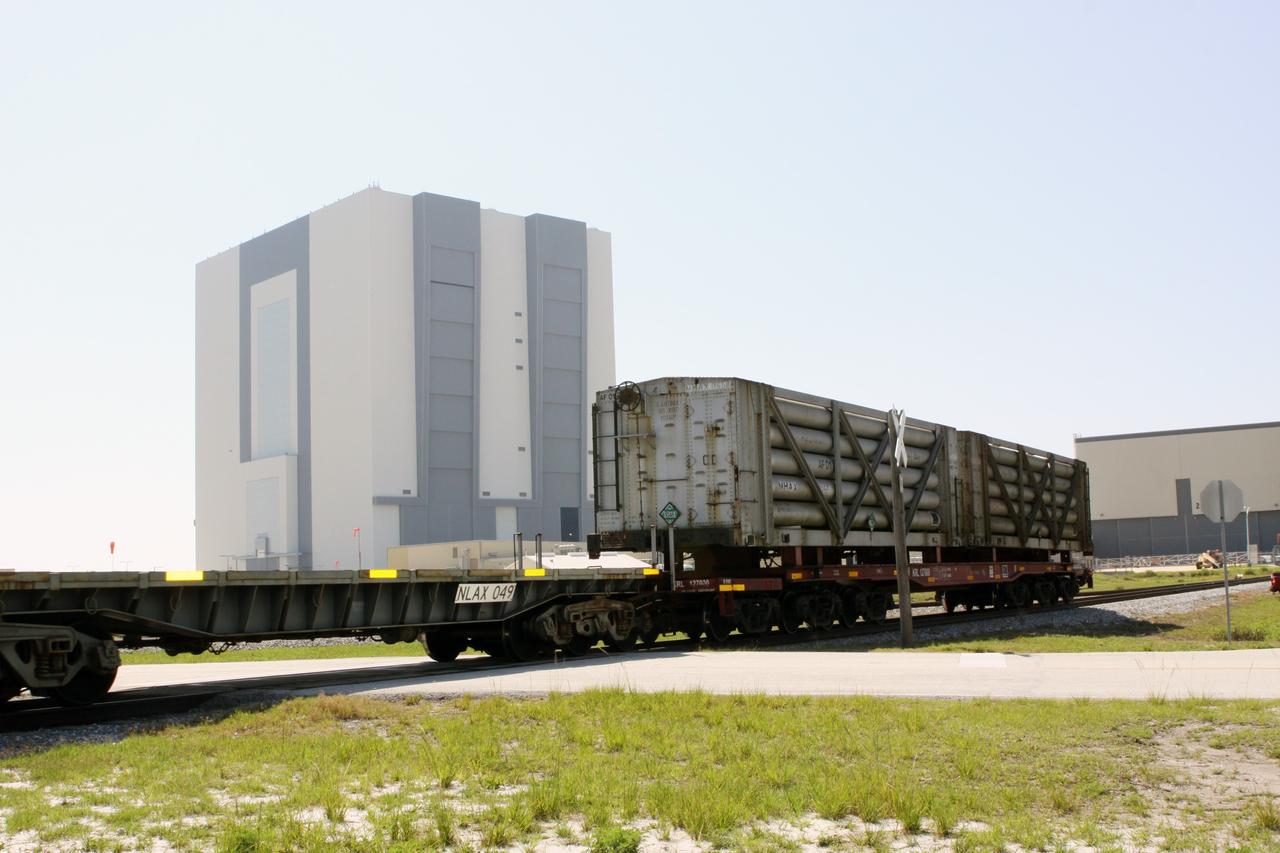
CAPE CANAVERAL, Fla. – A NASA Railroad train passes in front of the 525-foot-tall Vehicle Assembly Building at NASA’s Kennedy Space Center in Florida. At the far right is the Orbiter Processing Facility. The train is on its way to the Florida East Coast Railway interchange in Titusville, Fla., where the train’s helium tank cars, a liquid oxygen tank car, and a liquid hydrogen dewar or tank car will be transferred for delivery to the SpaceX engine test complex outside McGregor, Texas. The railroad cars were needed in support of the Space Shuttle Program but currently are not in use by NASA following the completion of the program in 2011. Originally, the tankers belonged to the U.S. Bureau of Mines. At the peak of the shuttle program, there were approximately 30 cars in the fleet. About half the cars were returned to the bureau as launch activity diminished. Five tank cars are being loaned to SpaceX and repurposed to support their engine tests in Texas. Eight cars previously were shipped to California on loan to support the SpaceX Falcon 9 rocket launches from Space Launch Complex-4 on Vandenberg Air Force Base. SpaceX already has three helium tank cars previously used for the shuttle program at Space Launch Complex-40 on Cape Canaveral Air Force Station in Florida. For more information, visit http://www.nasa.gov/spacex. Photo credit: NASA/Jim Grossmann
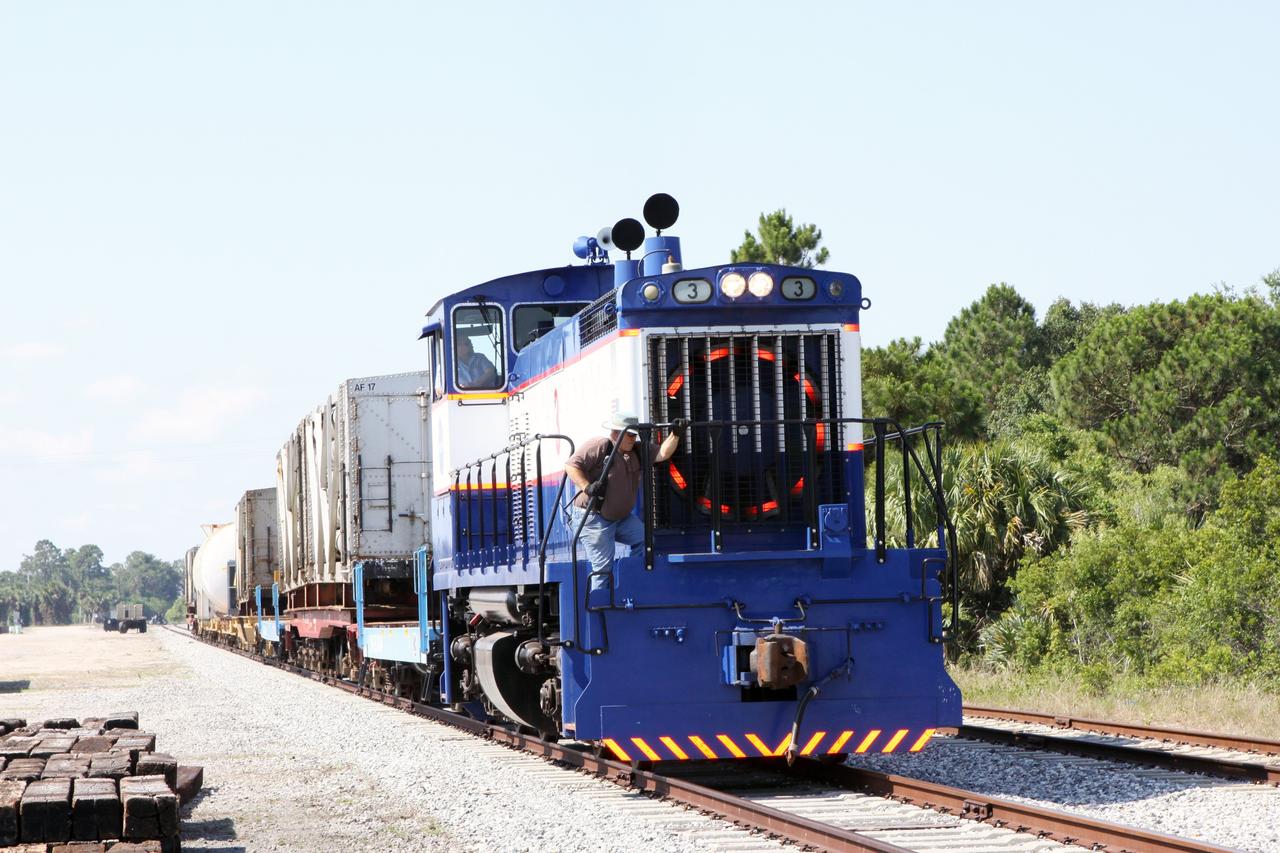
CAPE CANAVERAL, Fla. – Engineers board a NASA Railroad train in preparation for its departure from the NASA Railroad Yard at NASA’s Kennedy Space Center in Florida. The train is headed for the Florida East Coast Railway interchange in Titusville, Fla., where the train’s helium tank cars, a liquid oxygen tank car, and a liquid hydrogen dewar or tank car will be transferred for delivery to the SpaceX engine test complex outside McGregor, Texas. The railroad cars were needed in support of the Space Shuttle Program but currently are not in use by NASA following the completion of the program in 2011. Originally, the tankers belonged to the U.S. Bureau of Mines. At the peak of the shuttle program, there were approximately 30 cars in the fleet. About half the cars were returned to the bureau as launch activity diminished. Five tank cars are being loaned to SpaceX and repurposed to support their engine tests in Texas. Eight cars previously were shipped to California on loan to support the SpaceX Falcon 9 rocket launches from Space Launch Complex-4 on Vandenberg Air Force Base. SpaceX already has three helium tank cars previously used for the shuttle program at Space Launch Complex-40 on Cape Canaveral Air Force Station in Florida. For more information, visit http://www.nasa.gov/spacex. Photo credit: NASA/Jim Grossmann
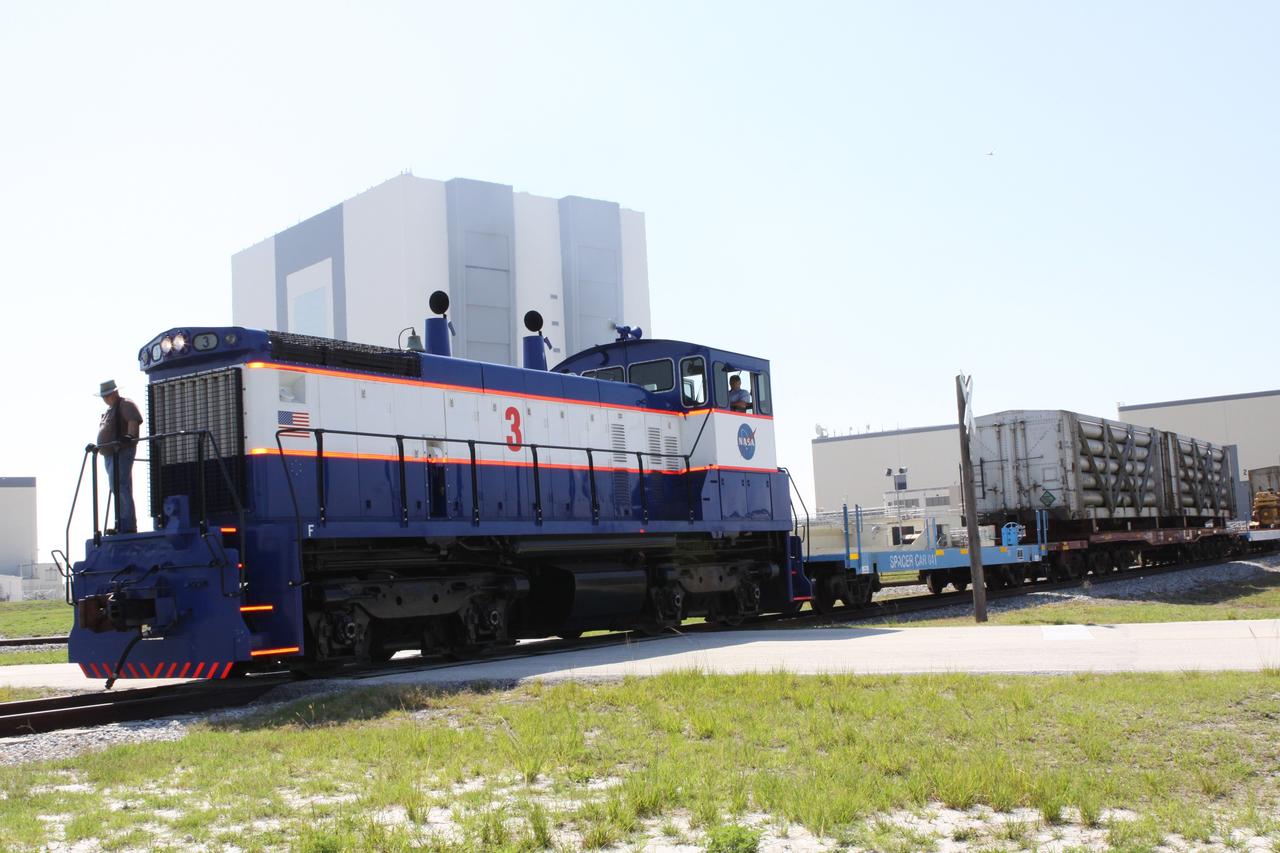
CAPE CANAVERAL, Fla. – A NASA Railroad train passes in front of the 525-foot-tall Vehicle Assembly Building, left, and the twin bays of the Orbiter Processing Facility, right, at NASA’s Kennedy Space Center in Florida. The train is on its way to the Florida East Coast Railway interchange in Titusville, Fla., where the train’s helium tank cars, a liquid oxygen tank car, and a liquid hydrogen dewar or tank car will be transferred for delivery to the SpaceX engine test complex outside McGregor, Texas. The railroad cars were needed in support of the Space Shuttle Program but currently are not in use by NASA following the completion of the program in 2011. Originally, the tankers belonged to the U.S. Bureau of Mines. At the peak of the shuttle program, there were approximately 30 cars in the fleet. About half the cars were returned to the bureau as launch activity diminished. Five tank cars are being loaned to SpaceX and repurposed to support their engine tests in Texas. Eight cars previously were shipped to California on loan to support the SpaceX Falcon 9 rocket launches from Space Launch Complex-4 on Vandenberg Air Force Base. SpaceX already has three helium tank cars previously used for the shuttle program at Space Launch Complex-40 on Cape Canaveral Air Force Station in Florida. For more information, visit http://www.nasa.gov/spacex. Photo credit: NASA/Jim Grossmann
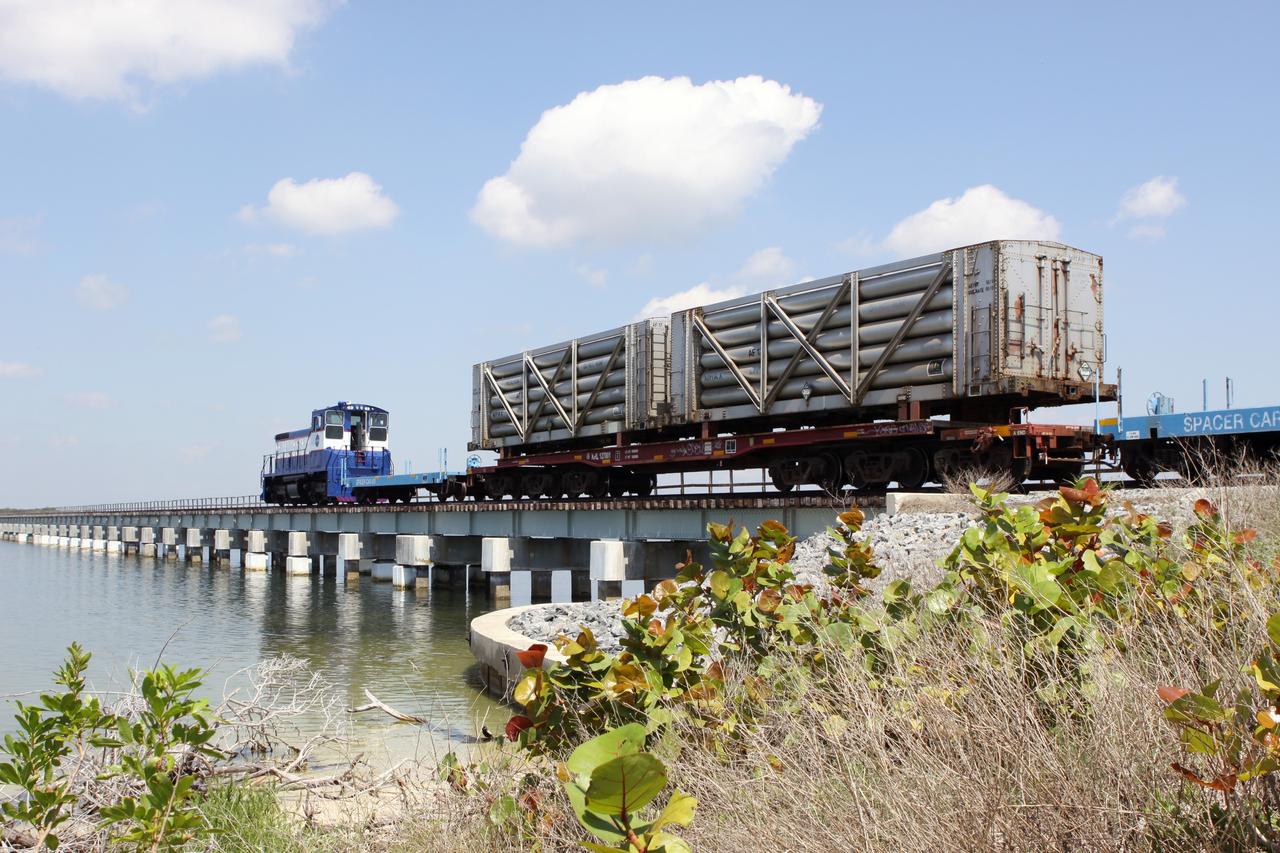
CAPE CANAVERAL, Fla. – A NASA Railroad train crosses the railroad’s Jay Jay Railroad Bridge north of Launch Complex 39 at NASA’s Kennedy Space Center in Florida. The train is on its way to the Florida East Coast Railway interchange in Titusville, Fla., where the train’s helium tank cars, a liquid oxygen tank car, and a liquid hydrogen dewar or tank car will be transferred for delivery to the SpaceX engine test complex outside McGregor, Texas. The railroad cars were needed in support of the Space Shuttle Program but currently are not in use by NASA following the completion of the program in 2011. Originally, the tankers belonged to the U.S. Bureau of Mines. At the peak of the shuttle program, there were approximately 30 cars in the fleet. About half the cars were returned to the bureau as launch activity diminished. Five tank cars are being loaned to SpaceX and repurposed to support their engine tests in Texas. Eight cars previously were shipped to California on loan to support the SpaceX Falcon 9 rocket launches from Space Launch Complex-4 on Vandenberg Air Force Base. SpaceX already has three helium tank cars previously used for the shuttle program at Space Launch Complex-40 on Cape Canaveral Air Force Station in Florida. For more information, visit http://www.nasa.gov/spacex. Photo credit: NASA/Jim Grossmann
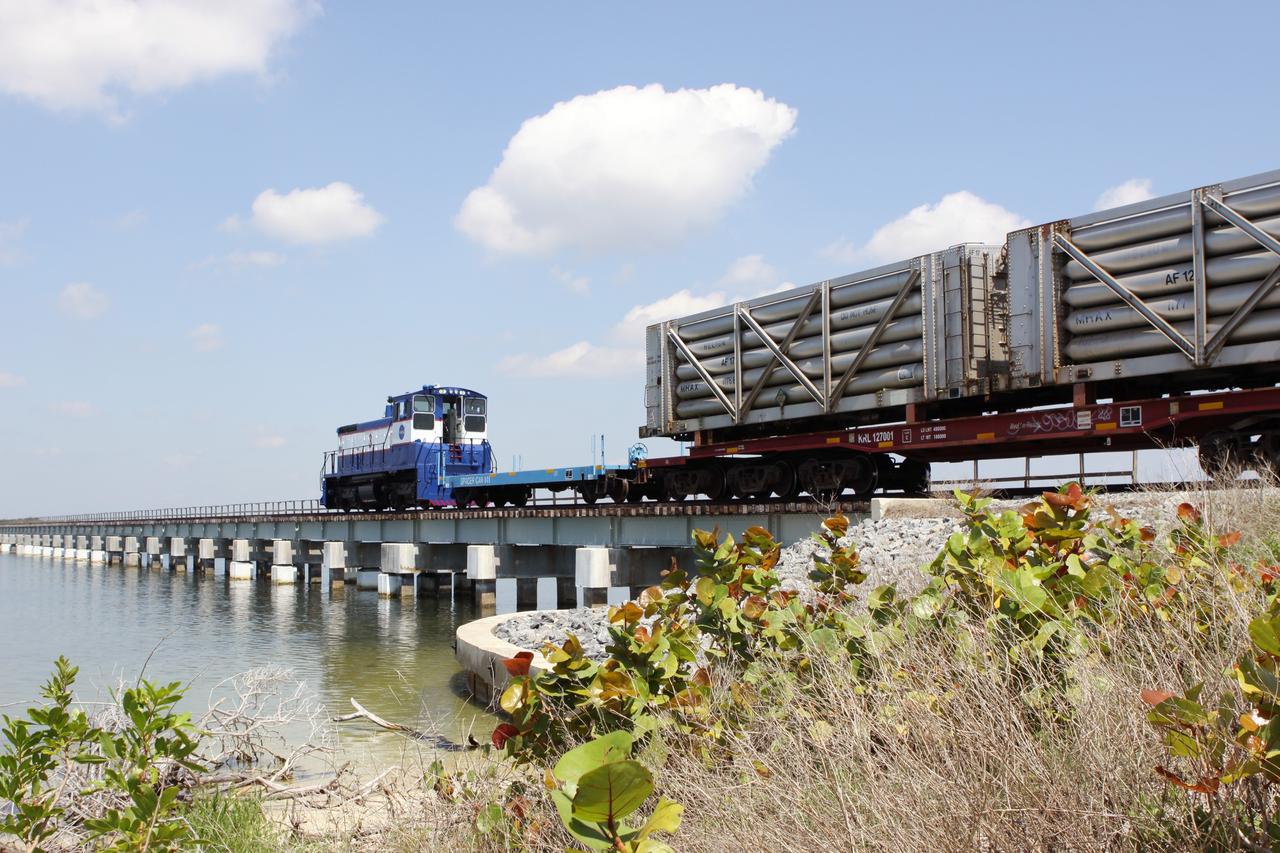
CAPE CANAVERAL, Fla. – A NASA Railroad train crosses the railroad’s Jay Jay Railroad Bridge north of Launch Complex 39 at NASA’s Kennedy Space Center in Florida. The train is on its way to the Florida East Coast Railway interchange in Titusville, Fla., where the train’s helium tank cars, a liquid oxygen tank car, and a liquid hydrogen dewar or tank car will be transferred for delivery to the SpaceX engine test complex outside McGregor, Texas. The railroad cars were needed in support of the Space Shuttle Program but currently are not in use by NASA following the completion of the program in 2011. Originally, the tankers belonged to the U.S. Bureau of Mines. At the peak of the shuttle program, there were approximately 30 cars in the fleet. About half the cars were returned to the bureau as launch activity diminished. Five tank cars are being loaned to SpaceX and repurposed to support their engine tests in Texas. Eight cars previously were shipped to California on loan to support the SpaceX Falcon 9 rocket launches from Space Launch Complex-4 on Vandenberg Air Force Base. SpaceX already has three helium tank cars previously used for the shuttle program at Space Launch Complex-40 on Cape Canaveral Air Force Station in Florida. For more information, visit http://www.nasa.gov/spacex. Photo credit: NASA/Jim Grossmann
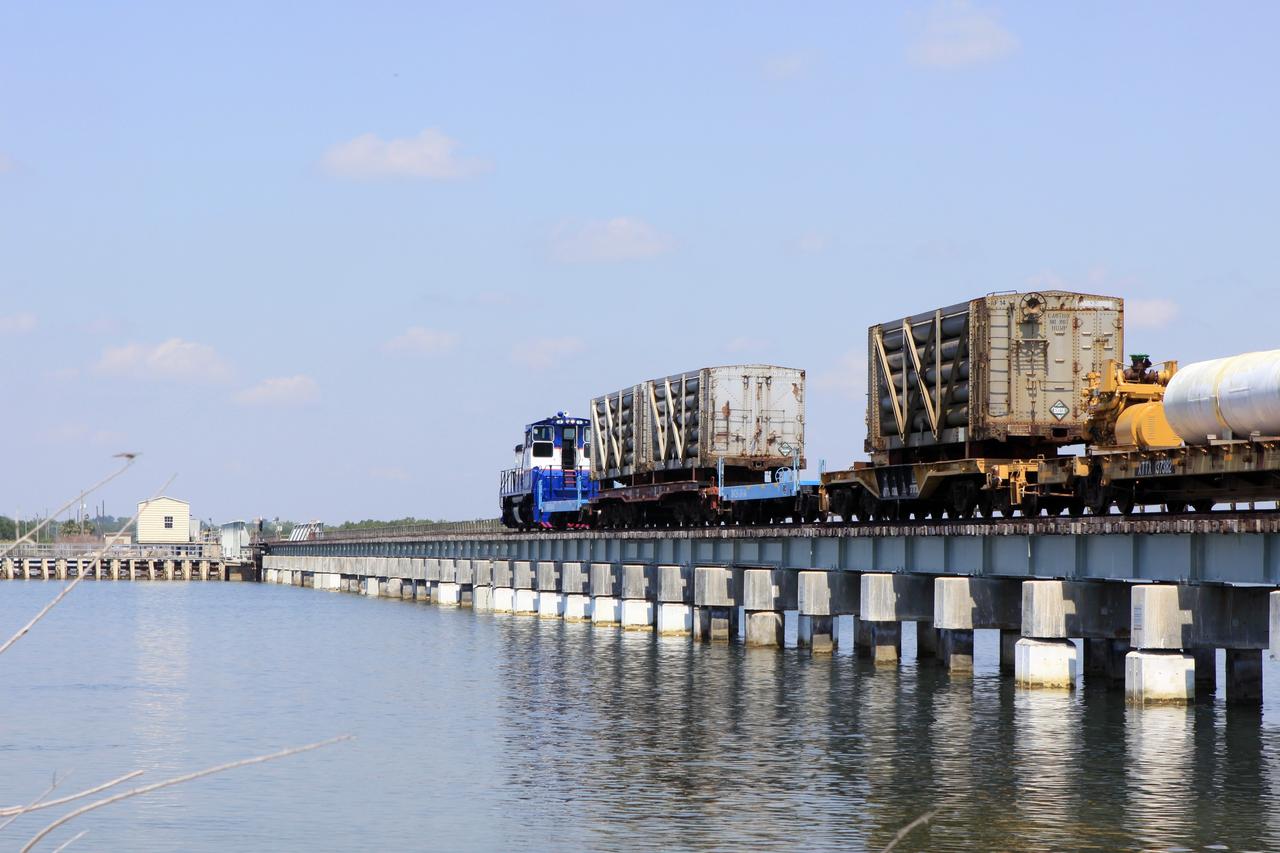
CAPE CANAVERAL, Fla. – A NASA Railroad train crosses the railroad’s Jay Jay Railroad Bridge north of Launch Complex 39 at NASA’s Kennedy Space Center in Florida. The train is on its way to the Florida East Coast Railway interchange in Titusville, Fla., where the train’s helium tank cars, a liquid oxygen tank car, and a liquid hydrogen dewar or tank car will be transferred for delivery to the SpaceX engine test complex outside McGregor, Texas. The railroad cars were needed in support of the Space Shuttle Program but currently are not in use by NASA following the completion of the program in 2011. Originally, the tankers belonged to the U.S. Bureau of Mines. At the peak of the shuttle program, there were approximately 30 cars in the fleet. About half the cars were returned to the bureau as launch activity diminished. Five tank cars are being loaned to SpaceX and repurposed to support their engine tests in Texas. Eight cars previously were shipped to California on loan to support the SpaceX Falcon 9 rocket launches from Space Launch Complex-4 on Vandenberg Air Force Base. SpaceX already has three helium tank cars previously used for the shuttle program at Space Launch Complex-40 on Cape Canaveral Air Force Station in Florida. For more information, visit http://www.nasa.gov/spacex. Photo credit: NASA/Jim Grossmann
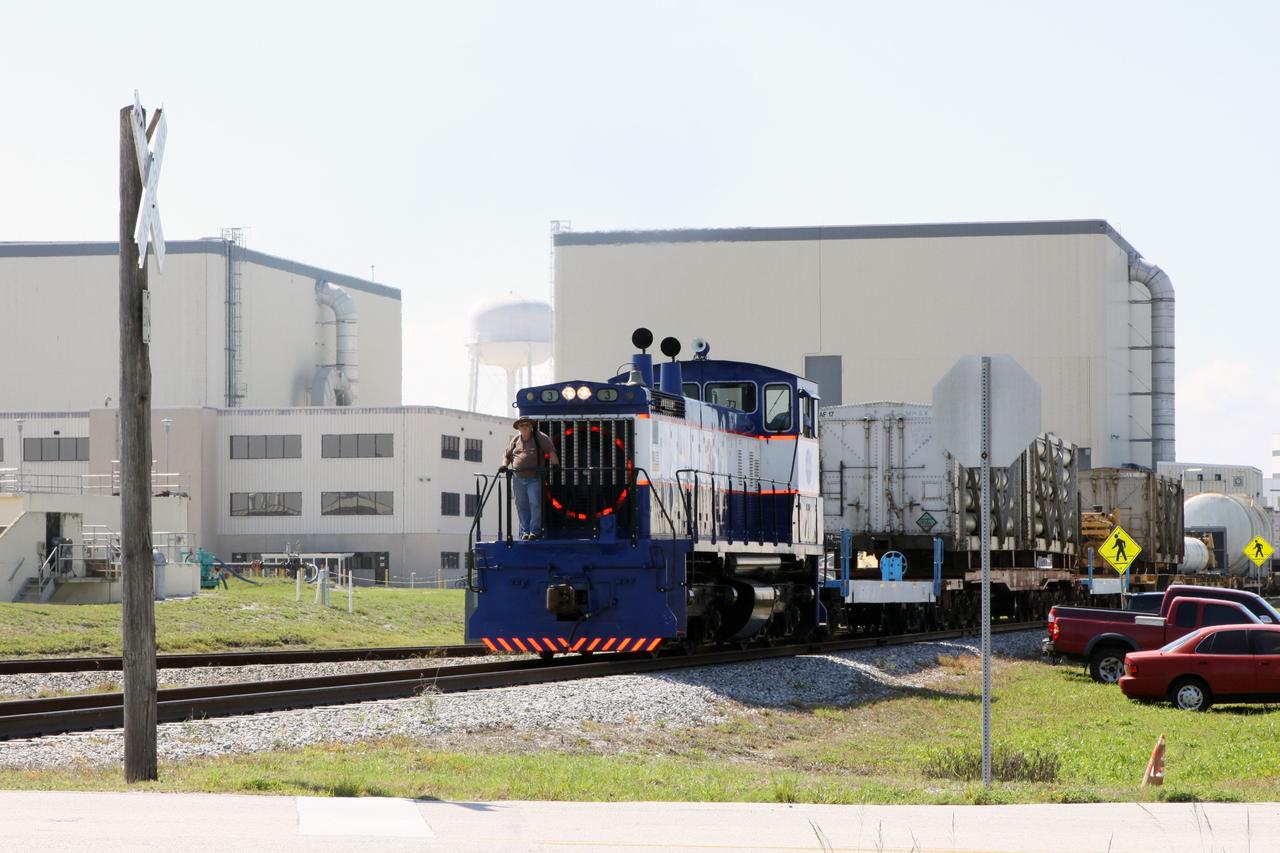
CAPE CANAVERAL, Fla. – A NASA Railroad train passes in front of the twin bays of the Orbiter Processing Facility at NASA’s Kennedy Space Center in Florida. The train is on its way to the Florida East Coast Railway interchange in Titusville, Fla., where the train’s helium tank cars, a liquid oxygen tank car, and a liquid hydrogen dewar or tank car will be transferred for delivery to the SpaceX engine test complex outside McGregor, Texas. The railroad cars were needed in support of the Space Shuttle Program but currently are not in use by NASA following the completion of the program in 2011. Originally, the tankers belonged to the U.S. Bureau of Mines. At the peak of the shuttle program, there were approximately 30 cars in the fleet. About half the cars were returned to the bureau as launch activity diminished. Five tank cars are being loaned to SpaceX and repurposed to support their engine tests in Texas. Eight cars previously were shipped to California on loan to support the SpaceX Falcon 9 rocket launches from Space Launch Complex-4 on Vandenberg Air Force Base. SpaceX already has three helium tank cars previously used for the shuttle program at Space Launch Complex-40 on Cape Canaveral Air Force Station in Florida. For more information, visit http://www.nasa.gov/spacex. Photo credit: NASA/Jim Grossmann
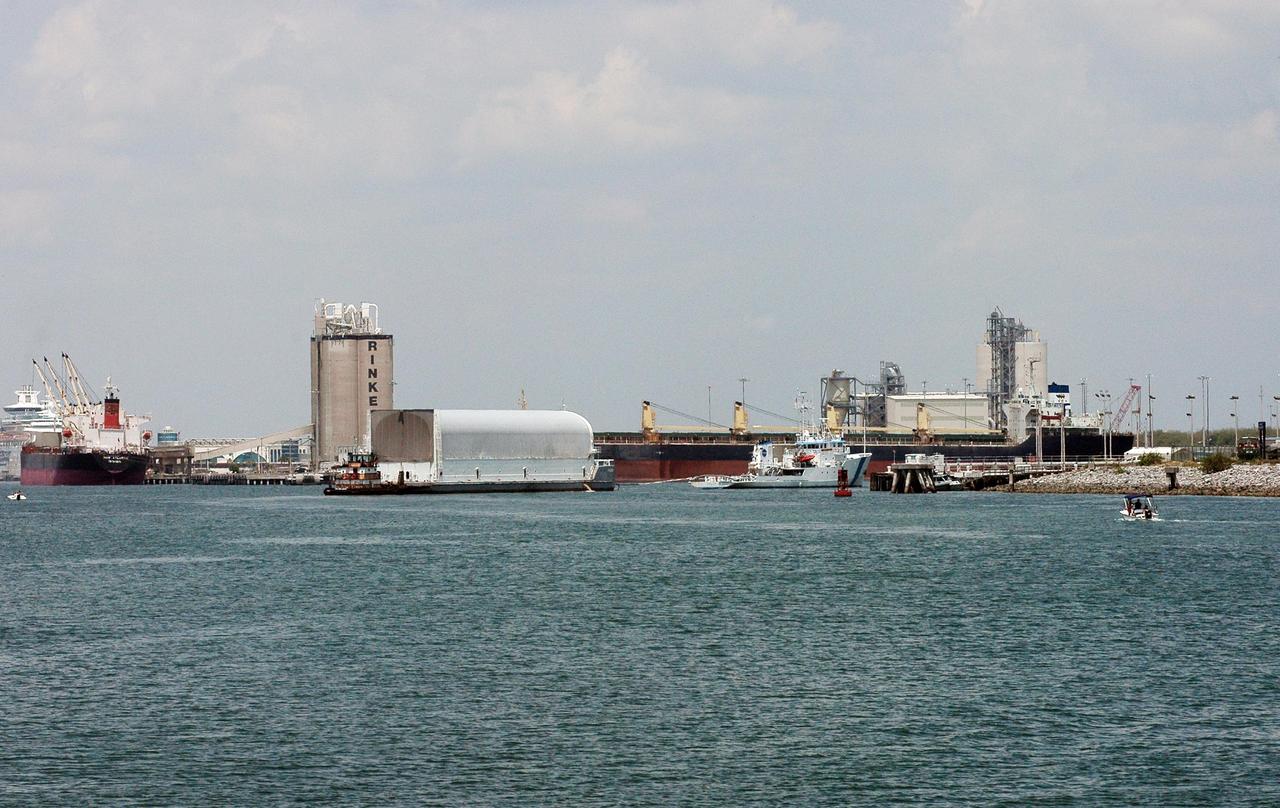
KENNEDY SPACE CENTER, FLA. - The Liberty Star tows the Pegasus barge to Port Canaveral, the last leg of its journey from the Michoud Assembly Facility in New Orleans to Kennedy Space Center. The barge carries the redesigned external fuel tank that will launch Space Shuttle Atlantis on the next shuttle mission, STS-115. A tugboat will continue the journey upriver to the Turn Basin where, after off-loading, the tank will be moved into the Vehicle Assembly Building and lifted into a checkout cell for further work. The tank, designated ET-118, will fly with many major safety changes, including the removal of the protuberance air load ramps. Photo credit: NASA/Jack Pfaller
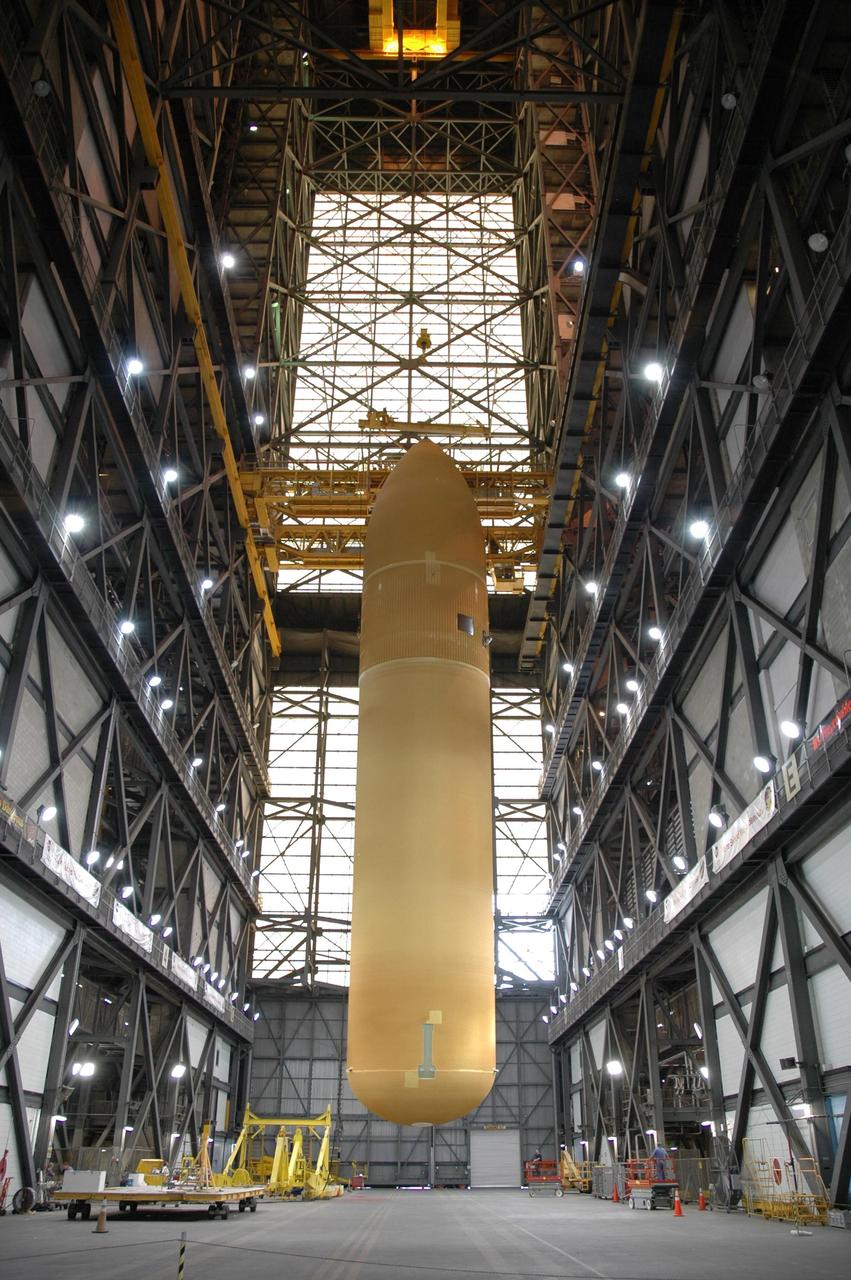
KENNEDY SPACE CENTER, FLA. - In the Vehicle Assembly Building, external tank No. 118 is suspended vertically above the transfer aisle. The tank will be lifted into high bay 3for mating with solid rocket boosters stacked there. The tank is designated to fly on mission STS-115 with Atlantis. It will fly with many major safety changes, including the removal of the protuberance air load ramps. The mission will deliver the second port truss segment, the P3/P4 Truss, to attach to the first port truss segment, the P1 Truss, as well as deploy solar array set 2A and 4A. Launch of Space Shuttle Atlantis is scheduled for late August. Photo credit: NASA/Jim Grossmann
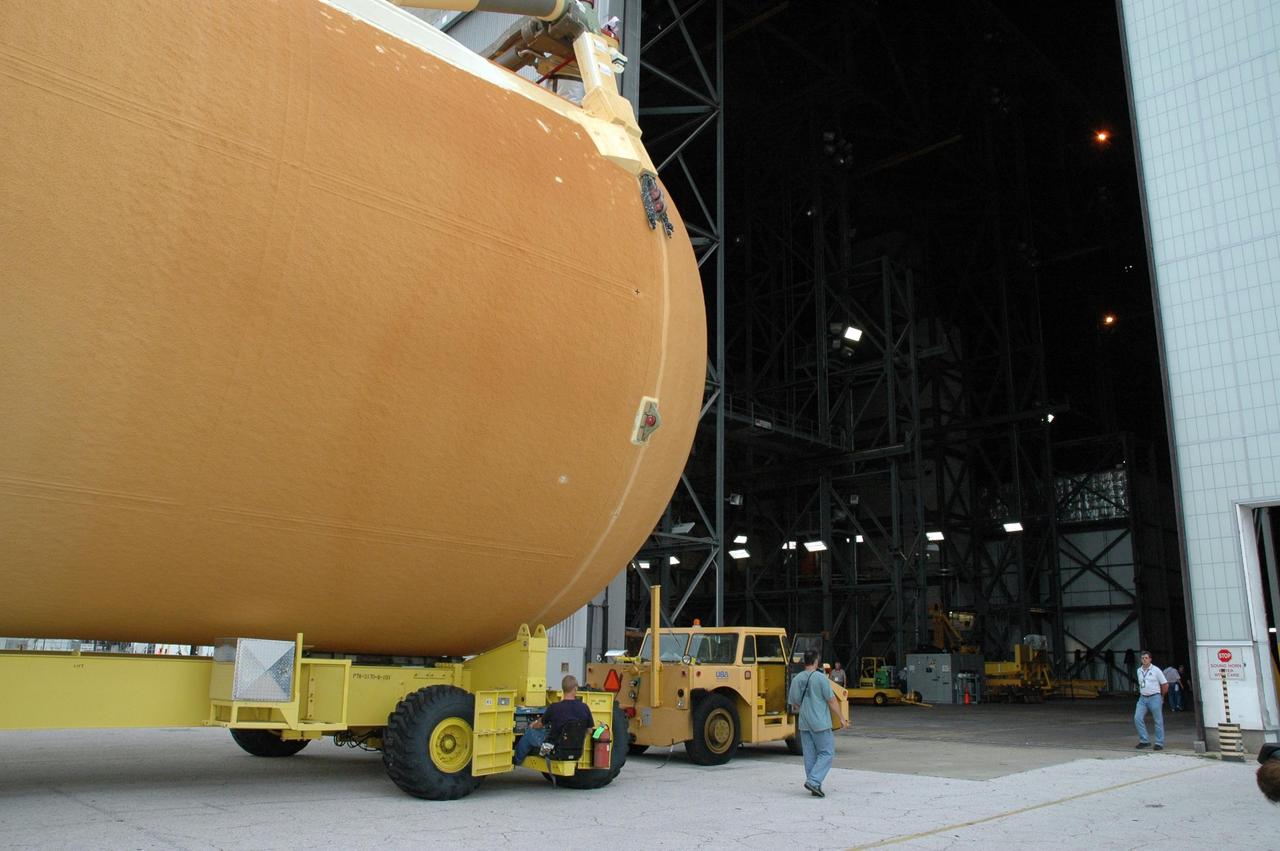
KENNEDY SPACE CENTER, FLA. - External tank No. 123 heads into the open doorway of the Vehicle Assembly Building. Once inside the VAB, the tank will be lifted into a checkout cell for further work. Shipped from NASA's Michoud Assembly Facility in New Orleans aboard the Pegasus barge, the tank has undergone major safety changes, including removal of the protuberance air load ramps. It is designated to launch Space Shuttle Discovery on mission STS-116 in December. Mission STS-116 will deliver the P5 truss segment, a SPACEHAB module and other key components to the International Space Station. Launch is currently scheduled no earlier than Dec. 14. Photo credit: NASA/Jack Pfaller
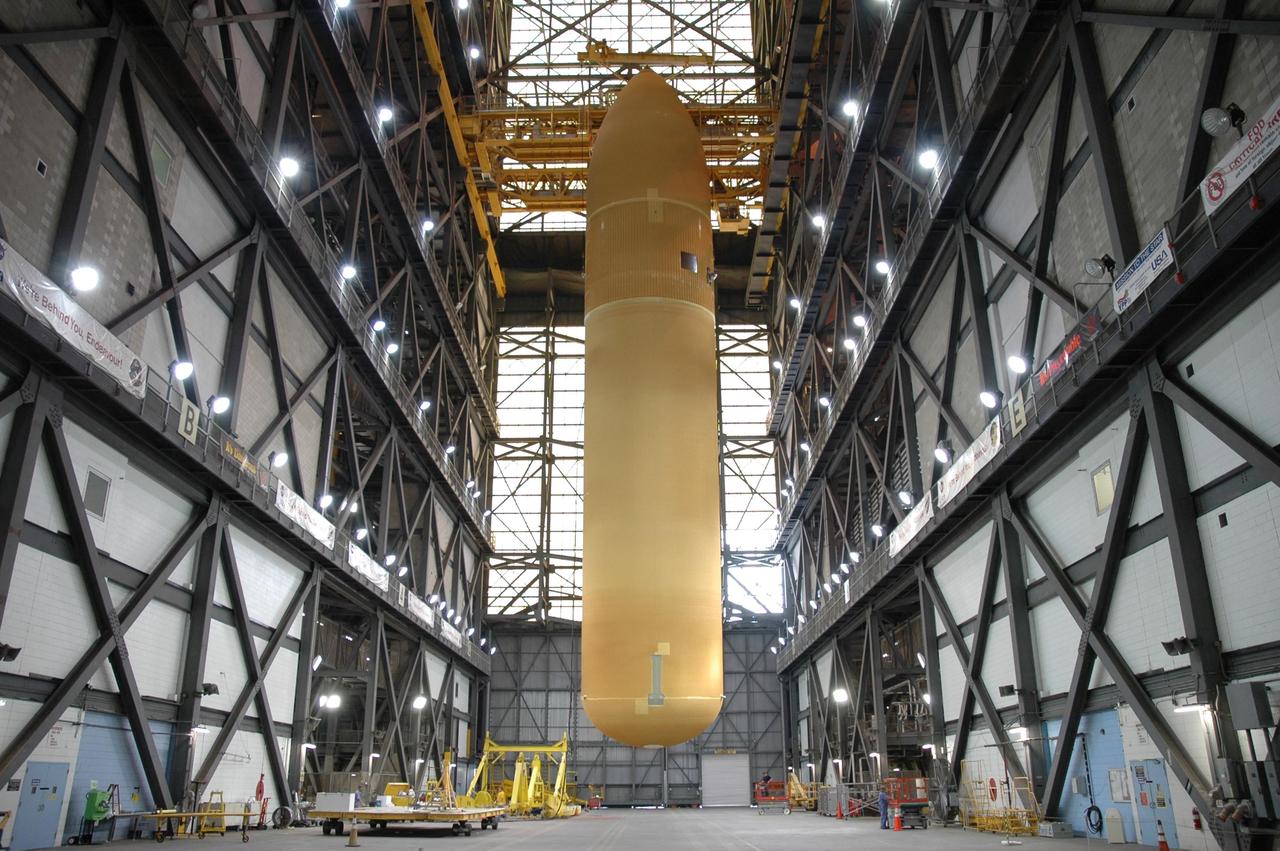
KENNEDY SPACE CENTER, FLA. - In the Vehicle Assembly Building, external tank No. 118 is suspended vertically above the transfer aisle. The tank will be lifted into high bay 3 for mating with solid rocket boosters stacked there. The tank is designated to fly on mission STS-115 with Atlantis. It will fly with many major safety changes, including the removal of the protuberance air load ramps. The mission will deliver the second port truss segment, the P3/P4 Truss, to attach to the first port truss segment, the P1 Truss, as well as deploy solar array set 2A and 4A. Launch of Space Shuttle Atlantis is scheduled for late August. Photo credit: NASA/Jim Grossmann
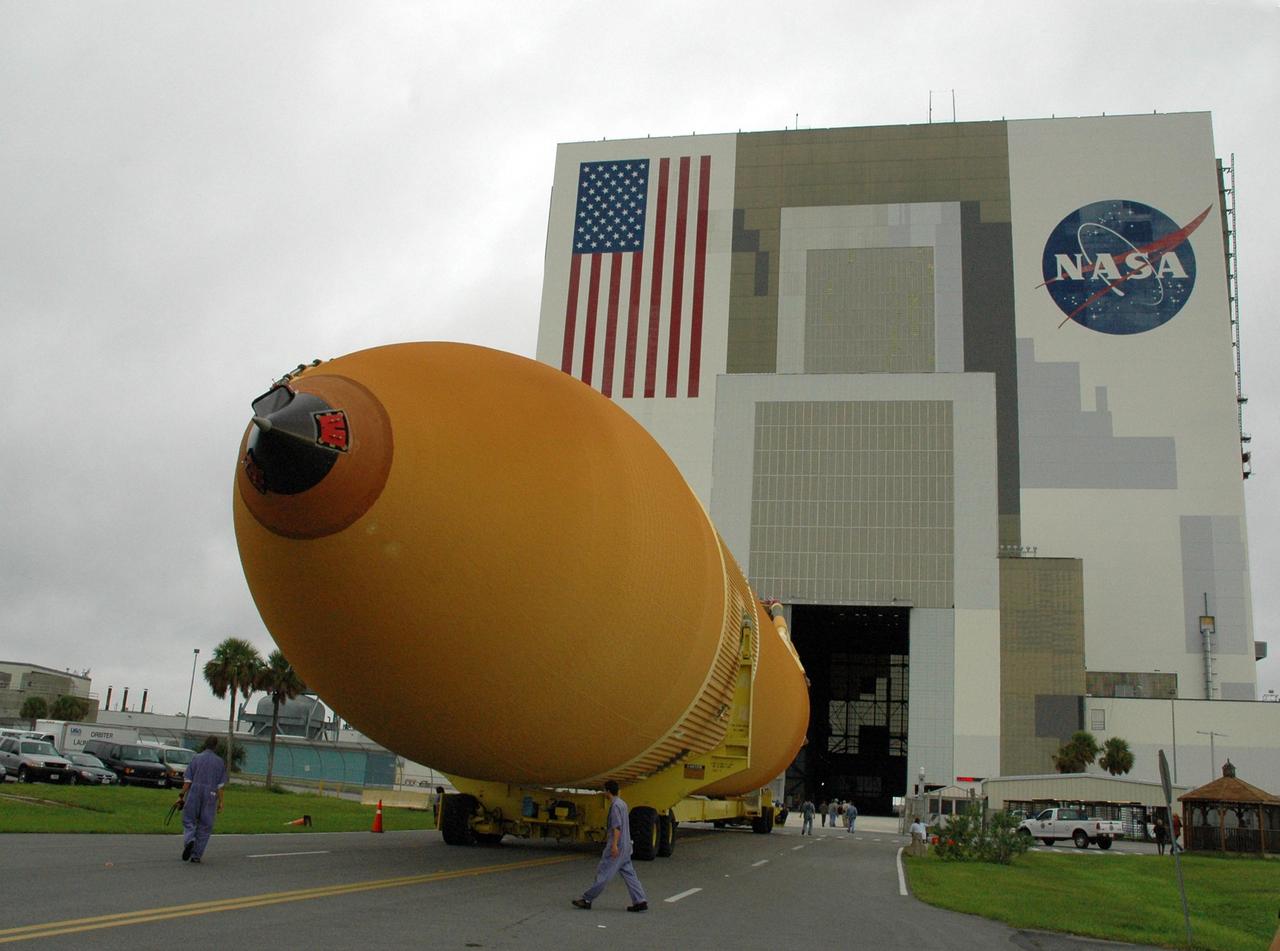
KENNEDY SPACE CENTER, FLA. - External tank No. 123 heads toward the open doorway of the Vehicle Assembly Building. Once inside the VAB, the tank will be lifted into a checkout cell for further work. Shipped from NASA's Michoud Assembly Facility in New Orleans aboard the Pegasus barge, the tank has undergone major safety changes, including removal of the protuberance air load ramps. It is designated to launch Space Shuttle Discovery on mission STS-116 in December. Mission STS-116 will deliver the P5 truss segment, a SPACEHAB module and other key components to the International Space Station. Launch is currently scheduled no earlier than Dec. 14. Photo credit: NASA/Jack Pfaller
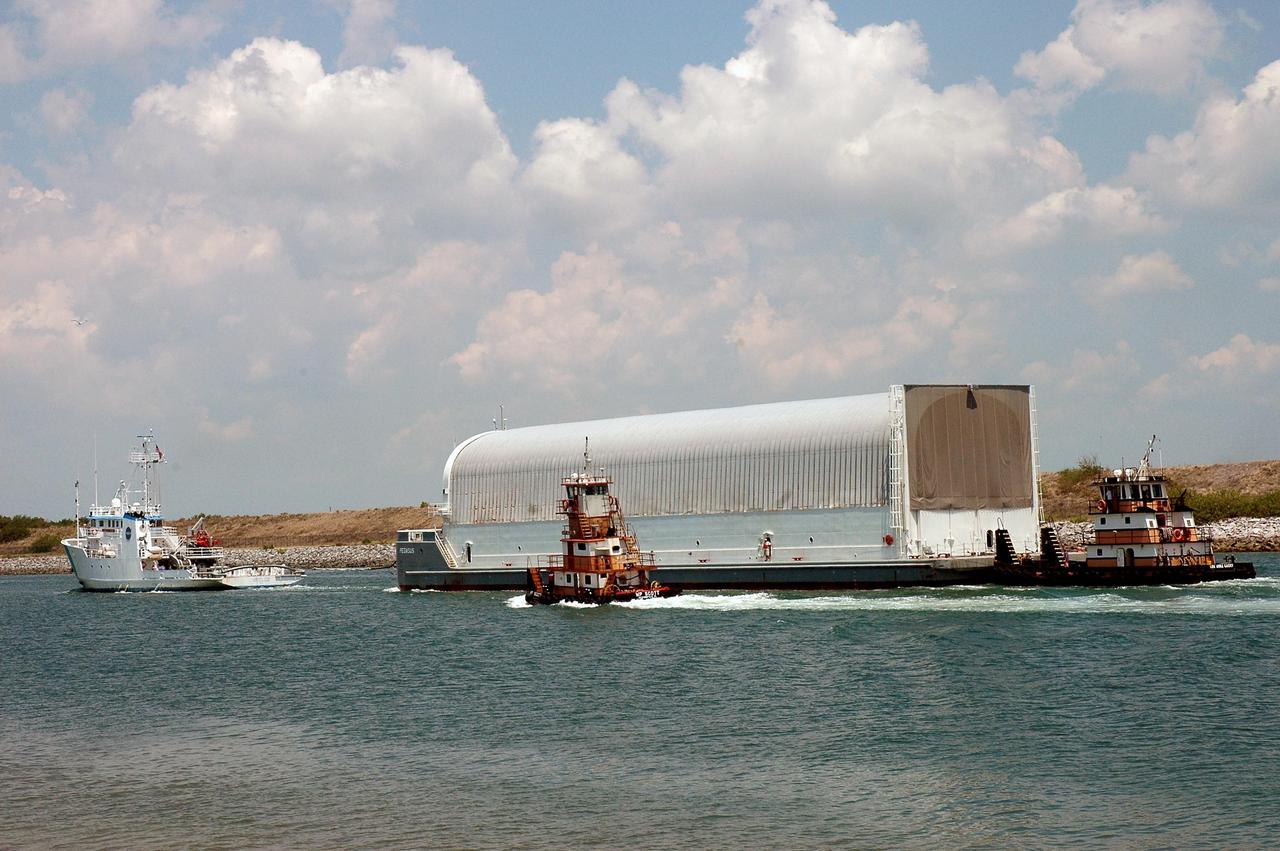
KENNEDY SPACE CENTER, FLA. - The Liberty Star (left) tows the Pegasus barge through Port Canaveral, the last leg of its journey from the Michoud Assembly Facility in New Orleans to Kennedy Space Center. The barge carries the redesigned external fuel tank that will launch Space Shuttle Atlantis on the next shuttle mission, STS-115. A tugboat will continue the journey upriver to the Turn Basin where, after off-loading, the tank will be moved into the Vehicle Assembly Building and lifted into a checkout cell for further work. The tank, designated ET-118, will fly with many major safety changes, including the removal of the protuberance air load ramps. Photo credit: NASA/Jack Pfaller
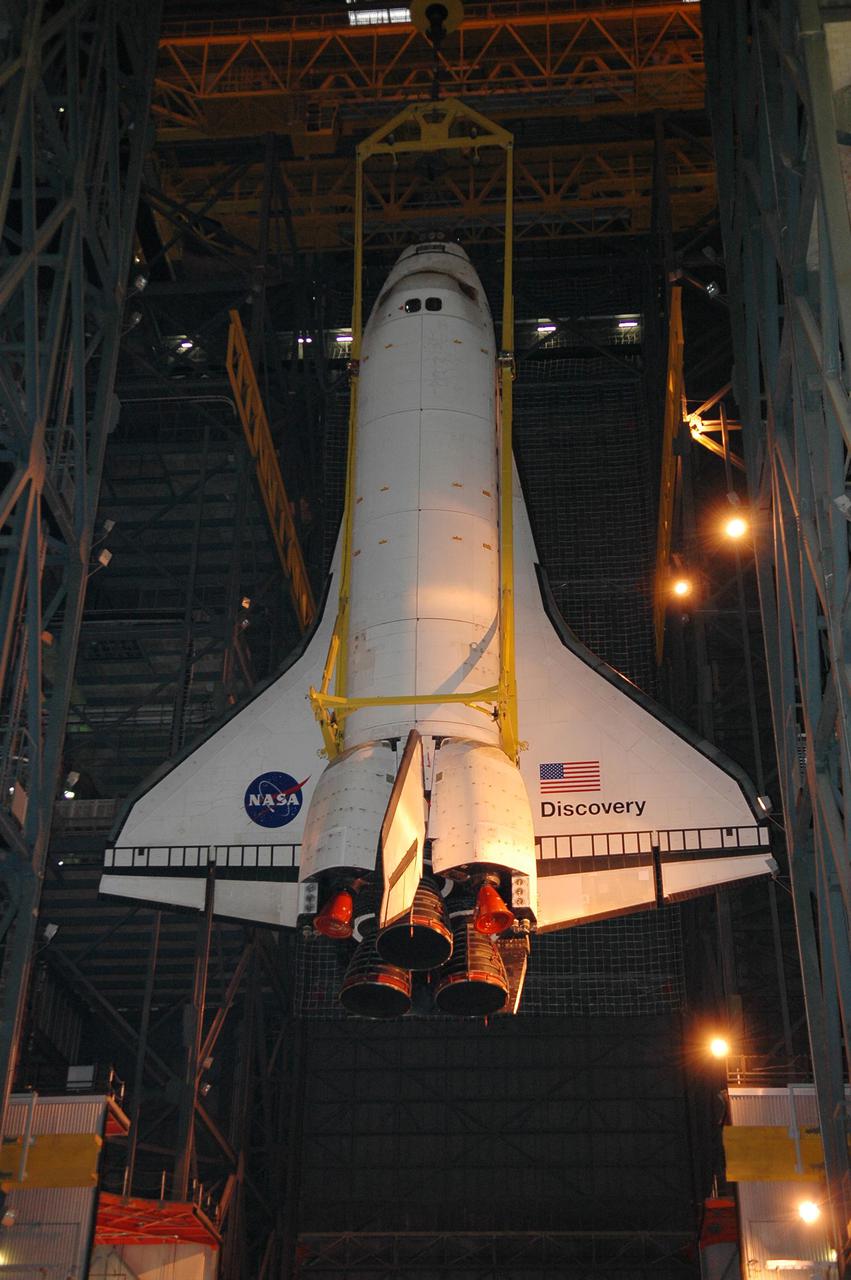
KENNEDY SPACE CENTER, FLA. - In high bay 1 of the Vehicle Assembly Building at NASA’s Kennedy Space Center, the 122-foot-long orbiter Discovery is suspended in mid-air after being lifted away from the 154-foot-high External Tank and Solid Rocket Boosters. After demating from its External Tank (ET), the orbiter will be placed on a transporter in the transfer aisle and moved to high bay 3 for remating with another tank, ET-121. Discovery is expected to be rolled back to the launch pad in mid-June for Return to Flight mission STS-114. The launch window extends from July 13 to July 31.
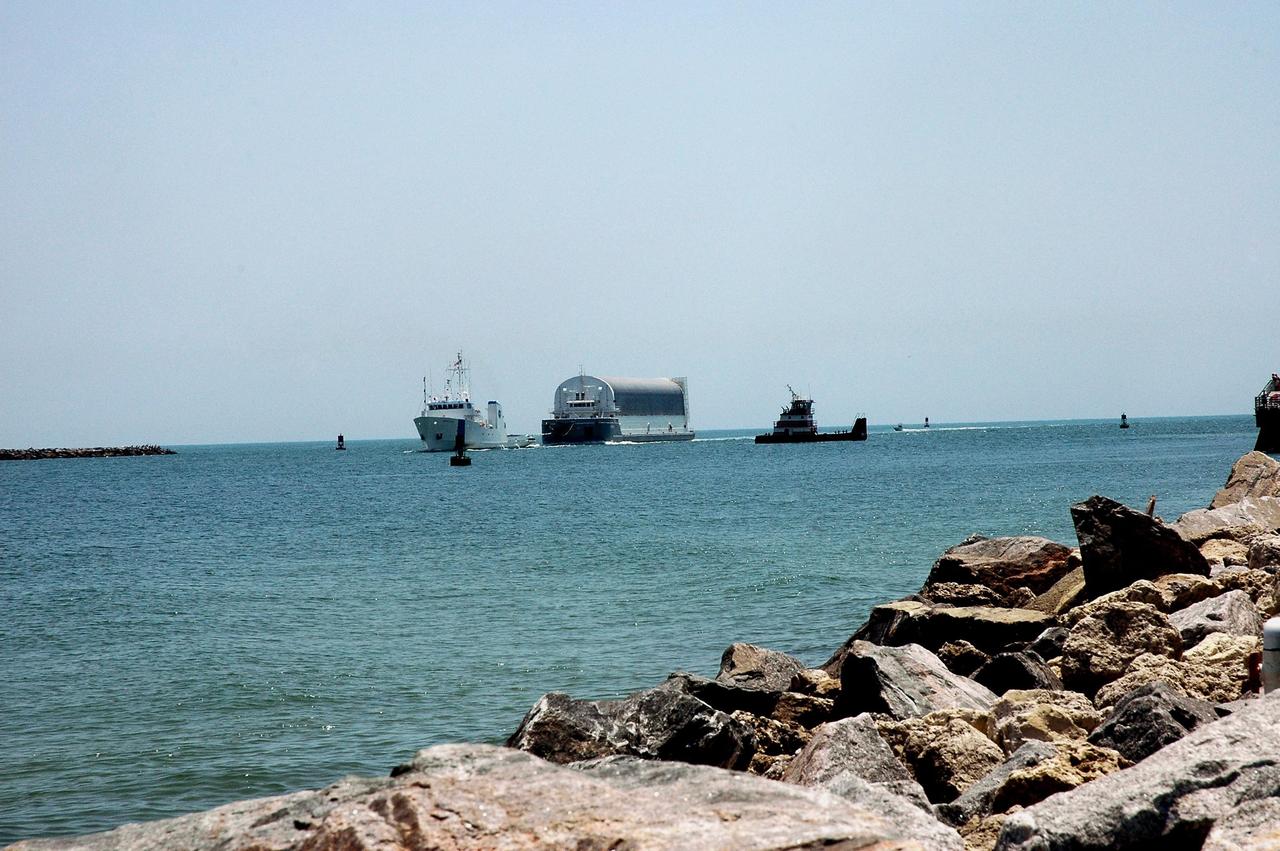
KENNEDY SPACE CENTER, FLA. - The Liberty Star (left) tows the Pegasus barge through Port Canaveral, the last leg of its journey from the Michoud Assembly Facility in New Orleans to Kennedy Space Center. The barge carries the redesigned external fuel tank that will launch Space Shuttle Atlantis on the next shuttle mission, STS-115. A tugboat will continue the journey upriver to the Turn Basin where, after off-loading, the tank will be moved into the Vehicle Assembly Building and lifted into a checkout cell for further work. The tank, designated ET-118, will fly with many major safety changes, including the removal of the protuberance air load ramps. Photo credit: NASA/Jack Pfaller
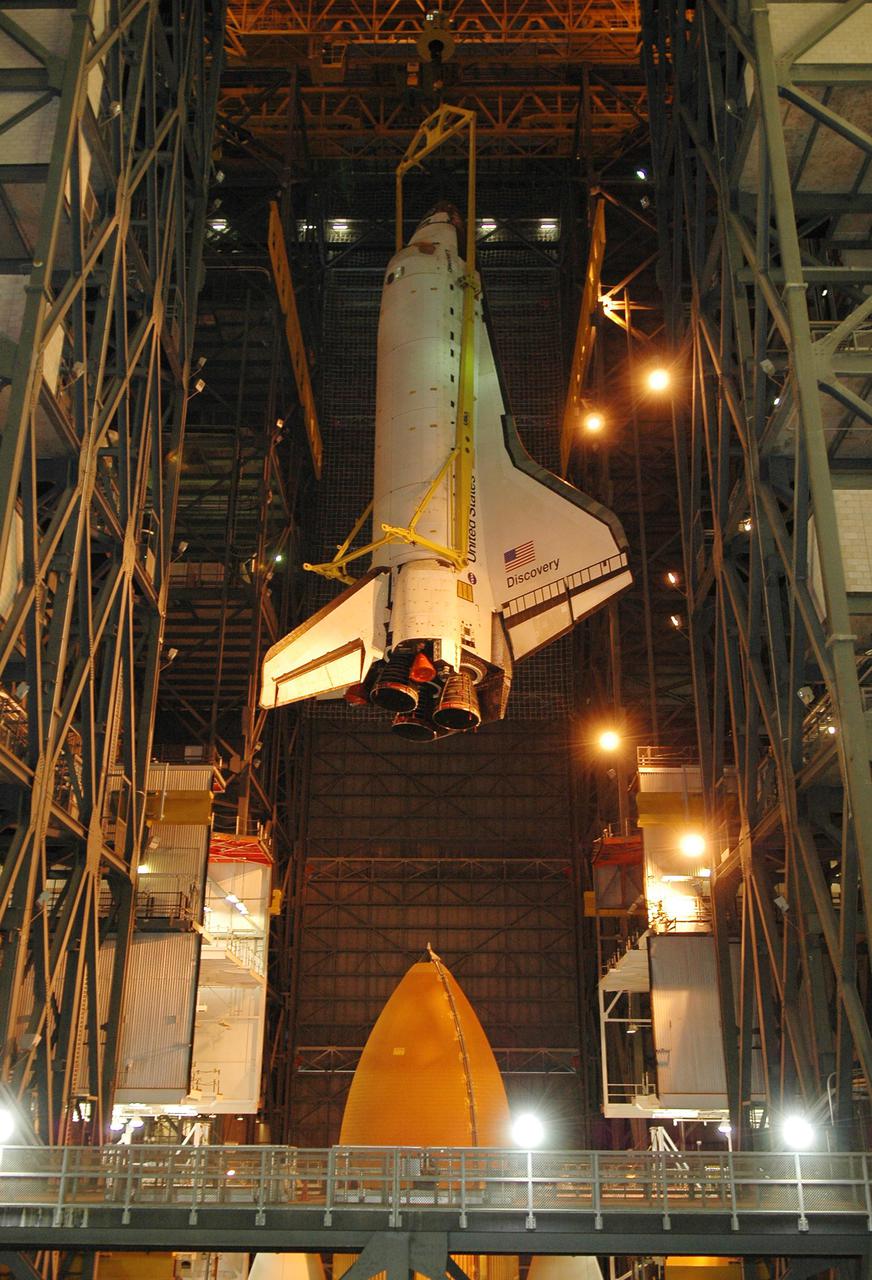
KENNEDY SPACE CENTER, FLA. - In high bay 1 of the Vehicle Assembly Building at NASA’s Kennedy Space Center, the 122-foot-long orbiter Discovery is suspended in mid-air after being lifted away from the 154-foot-high External Tank (below) and Solid Rocket Boosters. After demating from its External Tank (ET), the orbiter will be placed on a transporter in the transfer aisle and moved to high bay 3 for remating with another tank, ET-121. Discovery is expected to be rolled back to the launch pad in mid-June for Return to Flight mission STS-114. The launch window extends from July 13 to July 31.
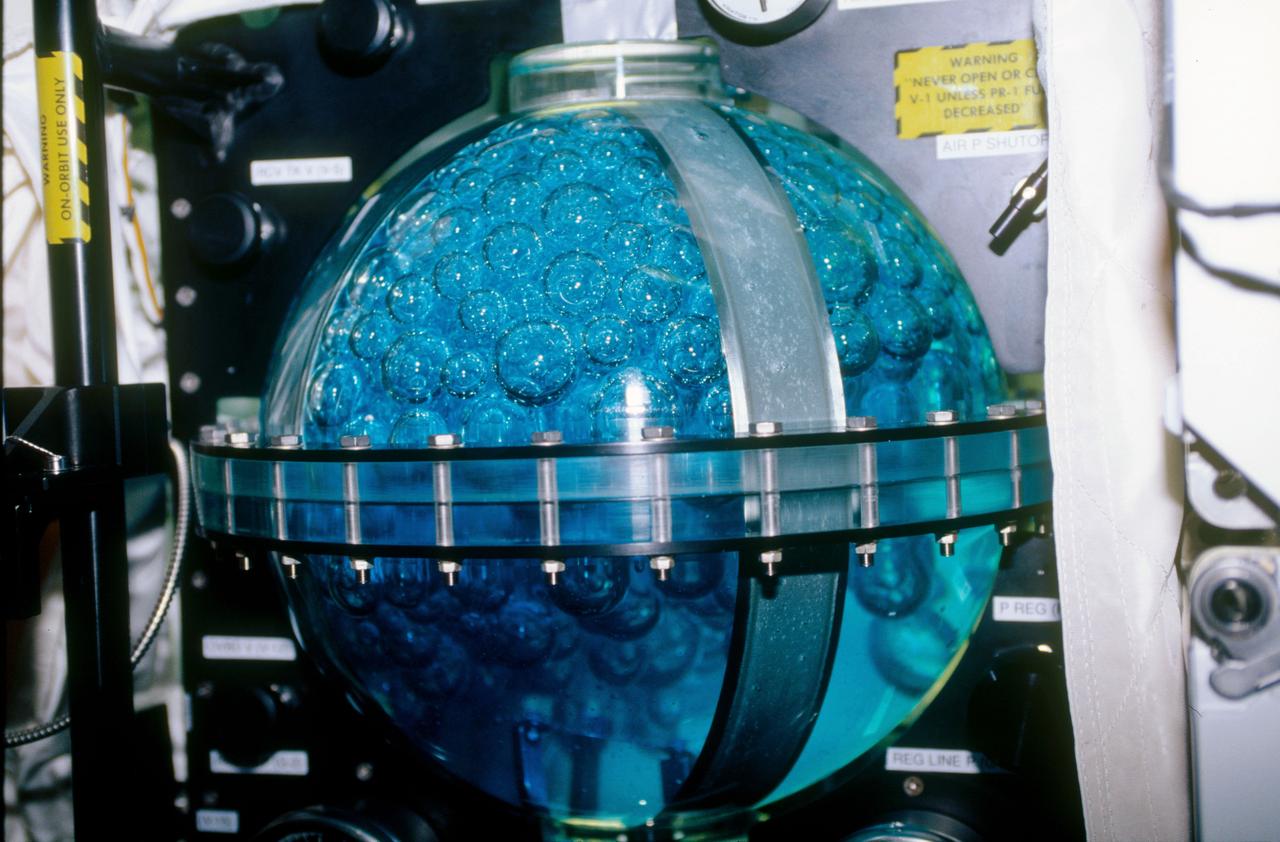
STS053-09-019 (2 - 9 Dec 1992) --- A medium close-up view of part of the Fluid Acquisition and Resupply Equipment (FARE) onboard the Space Shuttle Discovery. Featured in the mid-deck FARE setup is fluid activity in one of two 12.5-inch spherical tanks made of transparent acrylic. Pictured is the receiver tank. The other tank, out of frame below, is for supplying fluids. The purpose of FARE is to investigate the dynamics of fluid transfer in microgravity and develop methods for transferring vapor-free propellants and other liquids that must be replenished in long-term space systems like satellites, Extended-Duration Orbiters (EDO), and Space Station Freedom. Eight times over an eight-hour test period, the mission specialists conducted the FARE experiment. A sequence of manual valve operations caused pressurized air from the bottles to force fluids from the supply tank to the receiver tank and back again to the supply tank. Baffles in the receiver tank controlled fluid motion during transfer, a fine-mesh screen filtered vapor from the fluid, and the overboard vent removed vapor from the receiver tank as the liquid rose. FARE is managed by NASA's Marshall Space Flight Center (MSFC) in Alabama. The basic equipment was developed by Martin Marietta for the Storable Fluid Management Demonstration. Susan L. Driscoll is the principal investigator.
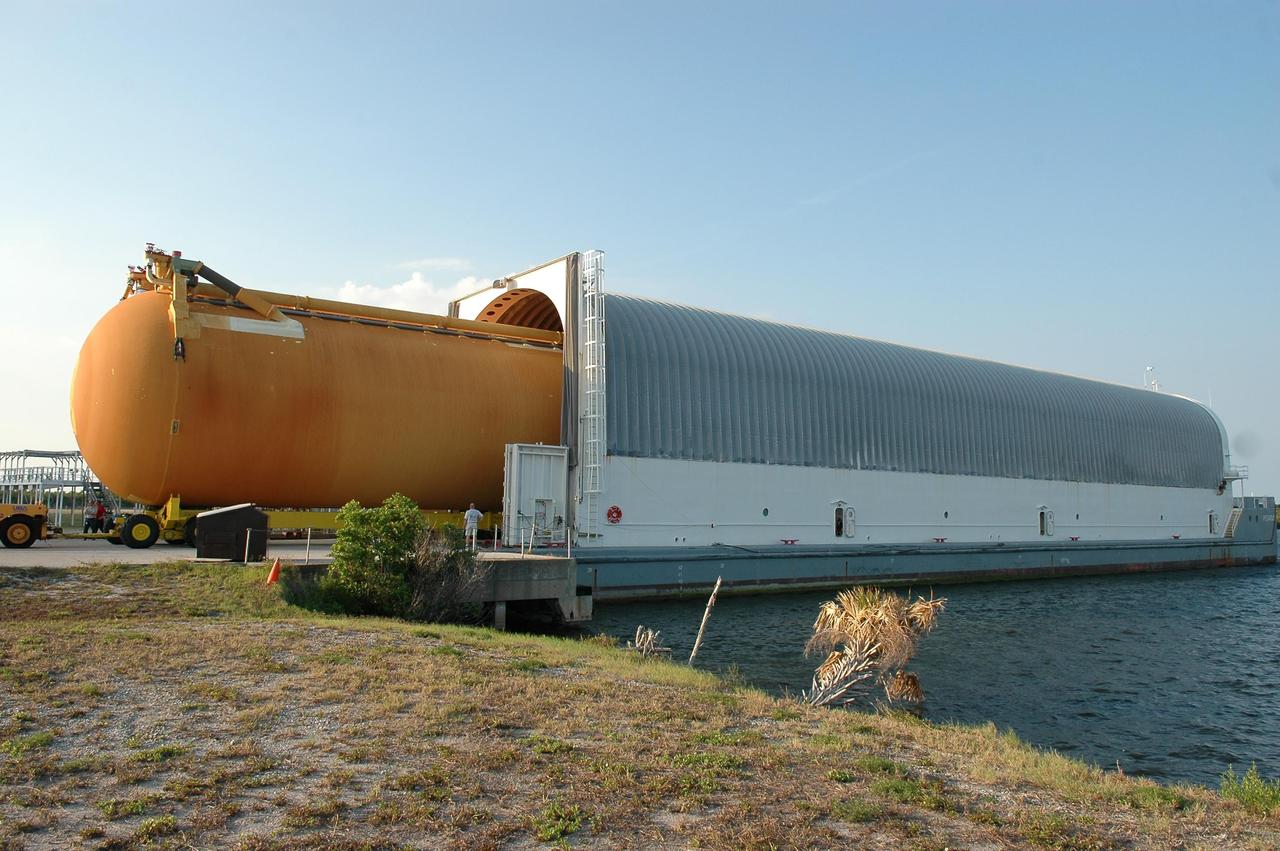
KENNEDY SPACE CENTER, FLA. - The redesigned external fuel tank, designated ET-118, that will launch Space Shuttle Atlantis on mission STS-115 is offloaded from the Pegasus barge that carried it from the Michoud Assembly Facility in New Orleans. The tank will be moved into the Vehicle Assembly Building and lifted into a checkout cell for further work. It will fly with many major safety changes, including the removal of the protuberance air load ramps. Photo credit: NASA/Kim Shiflett
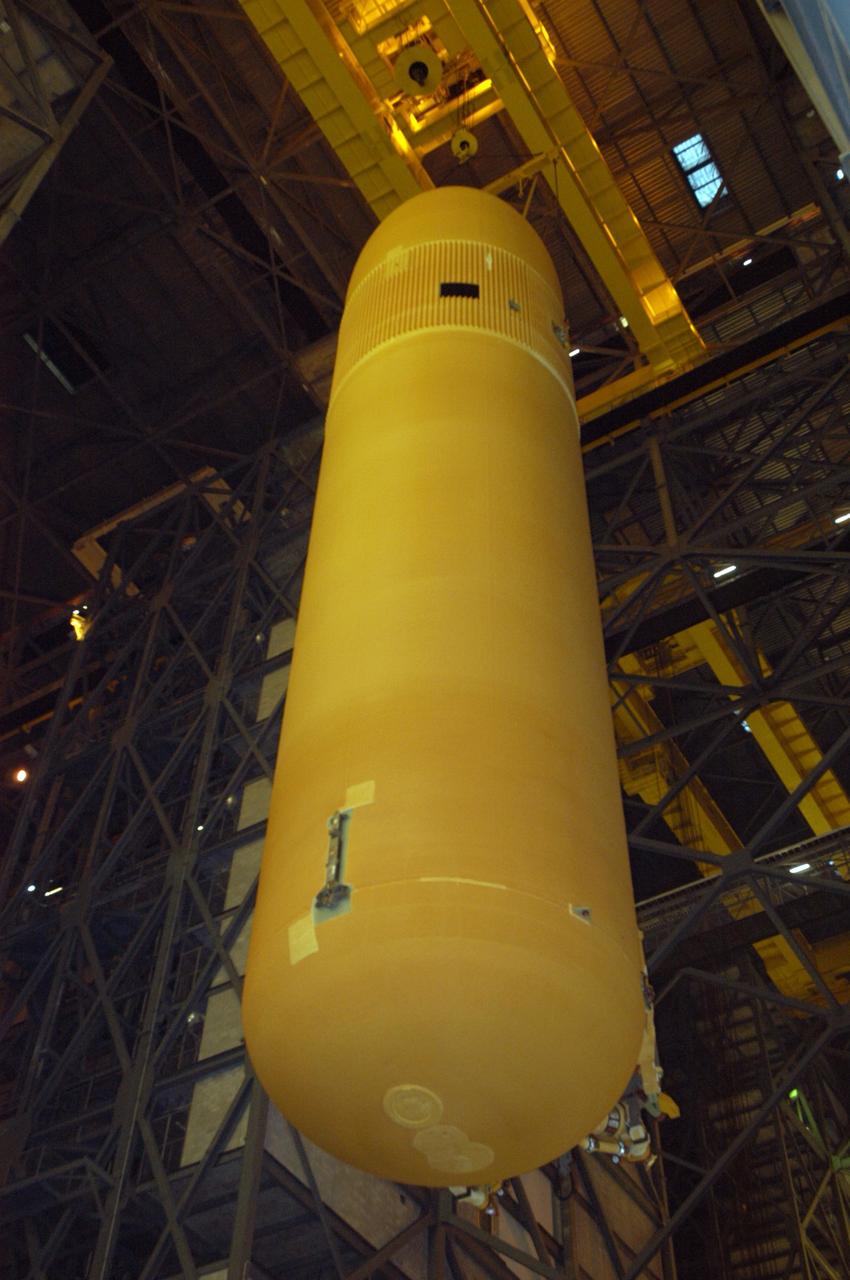
KENNEDY SPACE CENTER, FLA. - In NASA's Vehicle Assembly Building, the redesigned external fuel tank that will launch Space Shuttle Atlantis on the next shuttle mission, STS-115, is lifted toward the upper levels for transfer into a checkout cell for further work. Designated ET-118, the tank will fly with many major safety changes, including the removal of the protuberance air load ramps. Photo credit: NASA/George Shelton
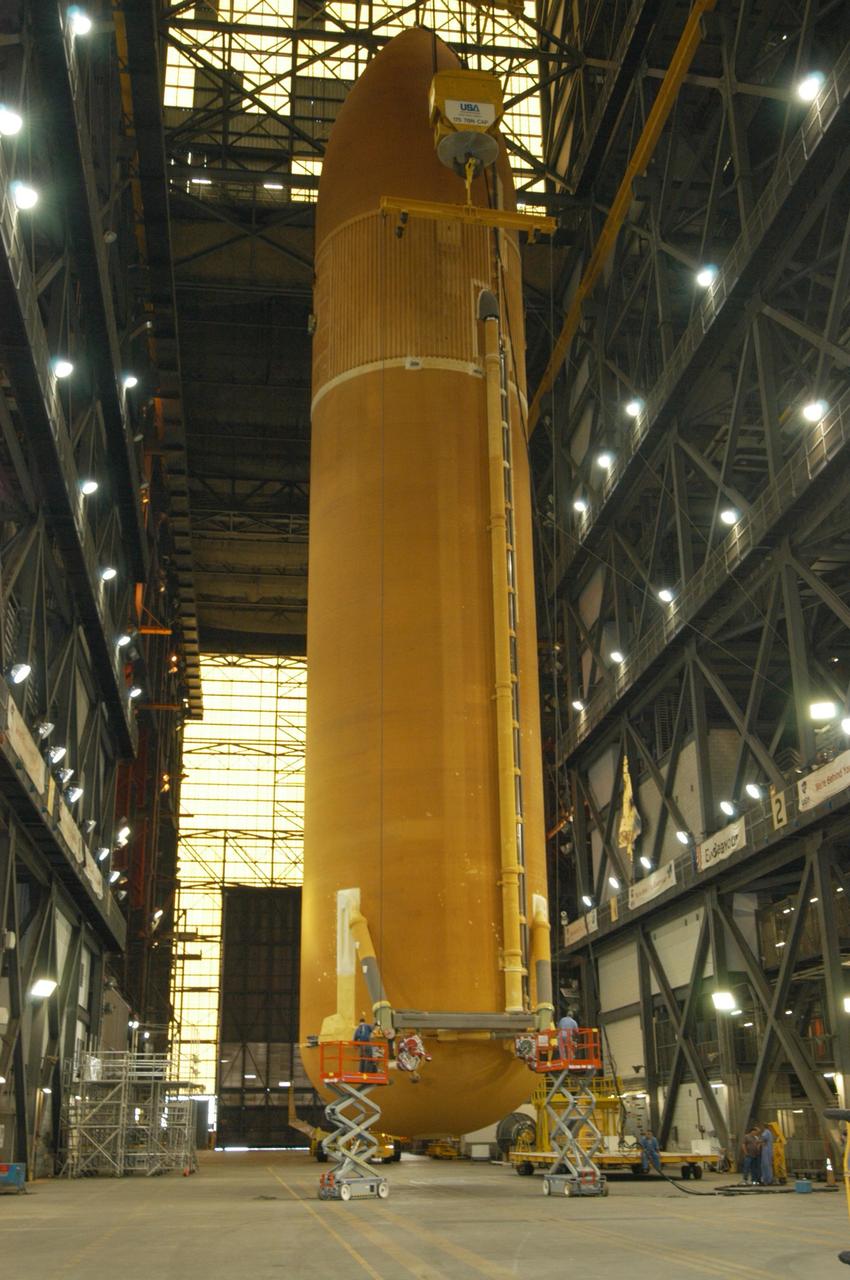
KENNEDY SPACE CENTER, FLA. - In the transfer aisle of NASA's Vehicle Assembly Building, the redesigned external fuel tank that will launch Space Shuttle Atlantis on the next shuttle mission, STS-115, is ready to be lifted into the upper levels for transfer into a checkout cell for further work. Designated ET-118, the tank will fly with many major safety changes, including the removal of the protuberance air load ramps. Photo credit: NASA/George Shelton
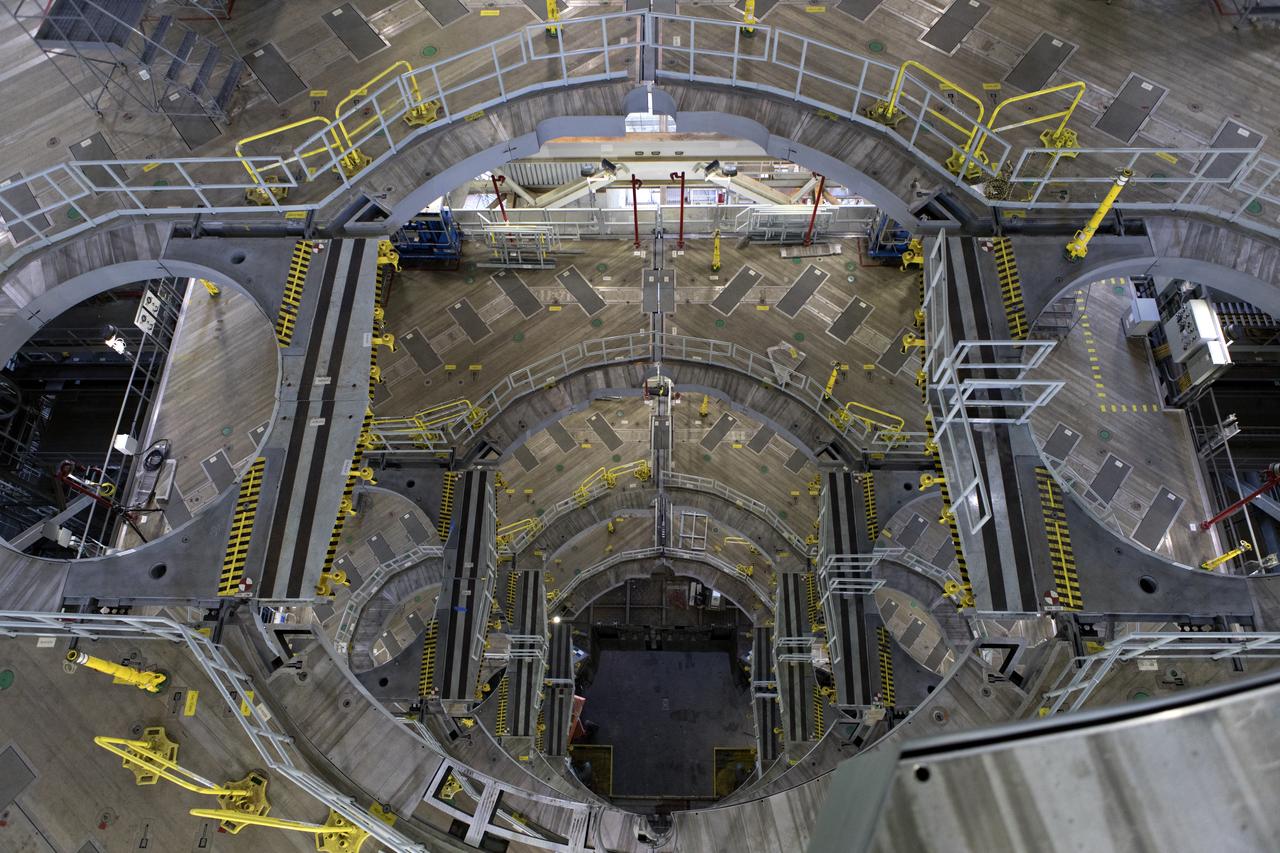
A view of the new work platforms in High Bay 3 of the Vehicle Assembly Building on Feb. 22, 2019, at NASA’s Kennedy Space Center in Florida. Preparations are underway to perform an initial swing test of the Core Stage Inter-tank Umbilical (CSITU) on the mobile launcher. The CSITU is a swing-arm umbilical that will connect to the Space Launch System core stage inter-tank. It will provide conditioned air, pressurized gases and power and data connection to the core stage. Exploration Ground Systems at Kennedy is conducting the swing test.

KENNEDY SPACE CENTER, FLA. - In NASA's Vehicle Assembly Building, the suspended external fuel tank that will launch Space Shuttle Atlantis on the next shuttle mission, STS-115, is moved into a checkout cell where it will undergo further work. Designated ET-118, the tank will fly with many major safety changes, including the removal of the protuberance air load ramps. Photo credit: NASA/George Shelton
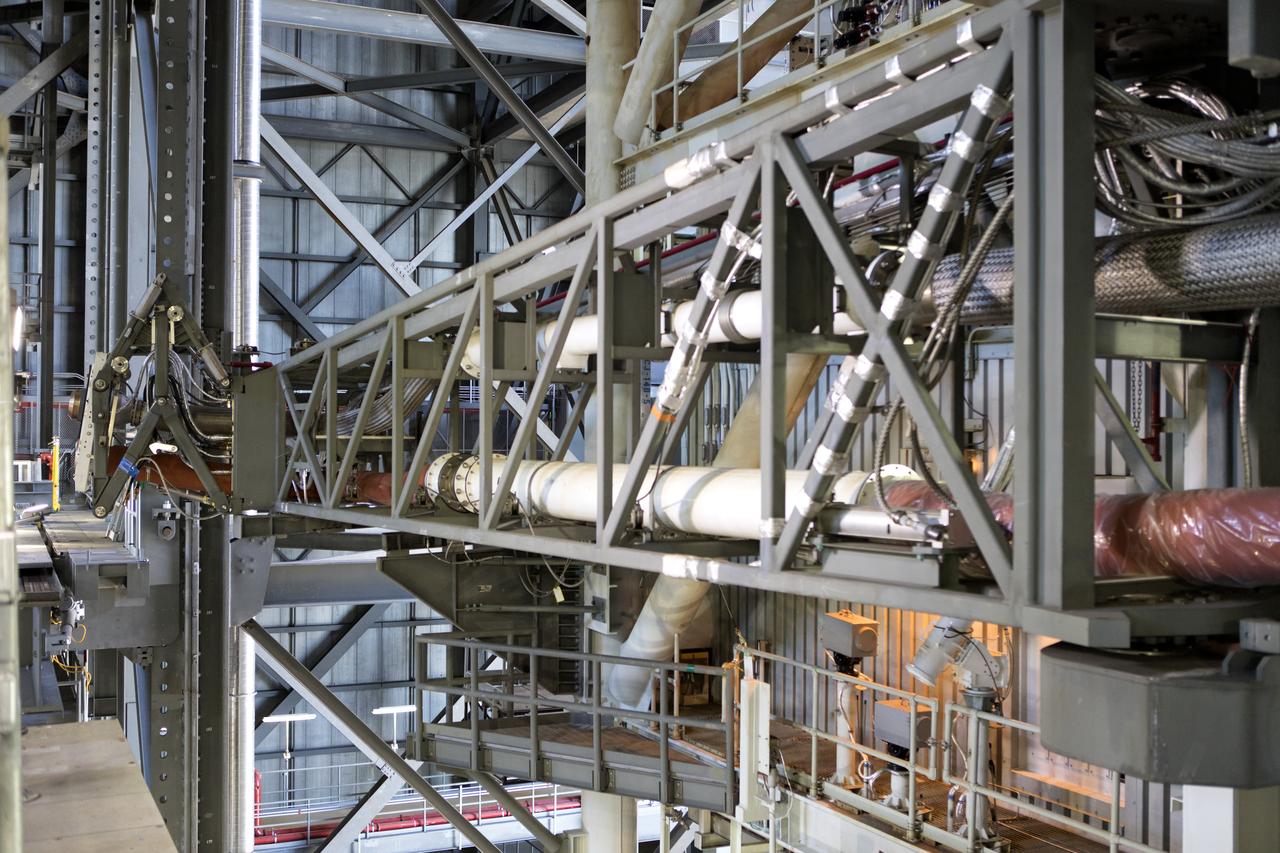
Preparations are underway to perform a preliminary swing test of the Core Stage Inter-tank Umbilical (CSITU) on the mobile launcher in High Bay 3 of the Vehicle Assembly Building on Feb. 22, 2019, at NASA's Kennedy Space Center in Florida. The CSITU is a swing-arm umbilical that will connect to the Space Launch System core stage inter-tank. It will provide conditioned air, pressurized gases and power and data connection to the core stage. The Exploration Ground Systems Program is overseeing installation of the umbilicals.
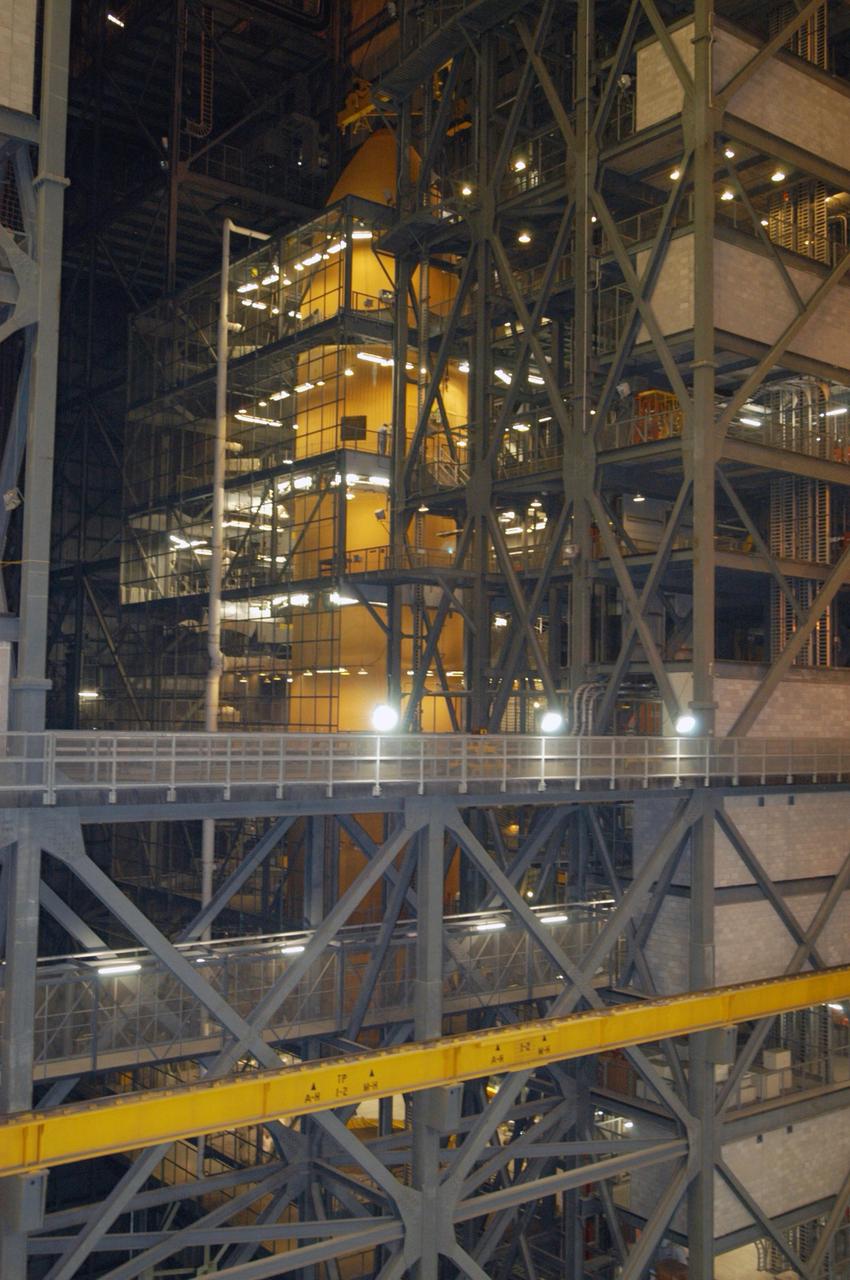
KENNEDY SPACE CENTER, FLA. - In NASA's Vehicle Assembly Building, the redesigned external fuel tank that will launch Space Shuttle Atlantis on the next shuttle mission, STS-115, is lowered into the checkout cell where it will undergo further work. Designated ET-118, the tank will fly with many major safety changes, including the removal of the protuberance air load ramps. Photo credit: NASA/George Shelton
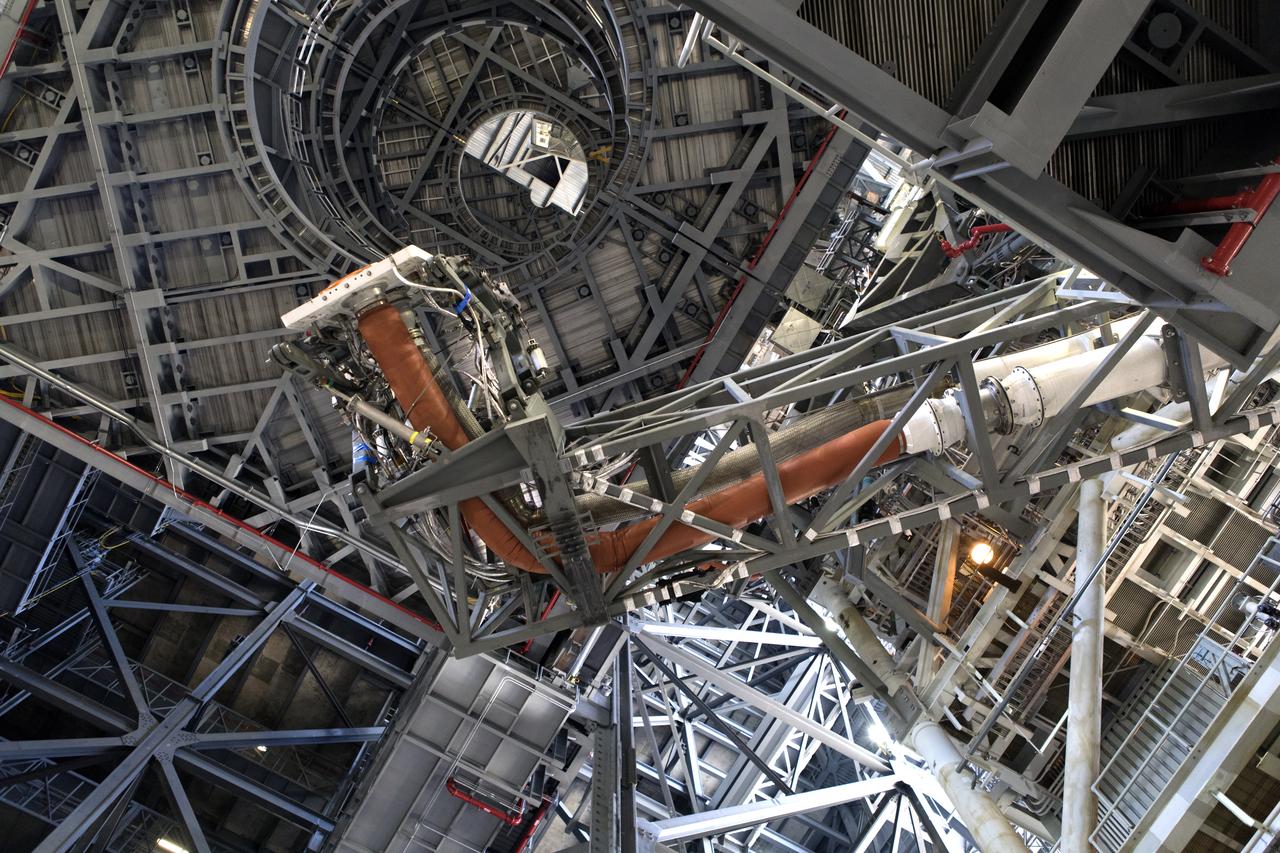
In this view looking up in High Bay 3 of the Vehicle Assembly Building at NASA’s Kennedy Space Center in Florida, a preliminary swing test is being performed on the Core Stage Inter-tank Umbilical (CSITU) on Feb. 22, 2019. The CSITU is a swing-arm umbilical that will connect to the Space Launch System core stage inter-tank. It will provide conditioned air, pressurized gases and power and data connection to the core stage. Exploration Ground Systems at Kennedy is conducting the swing test.
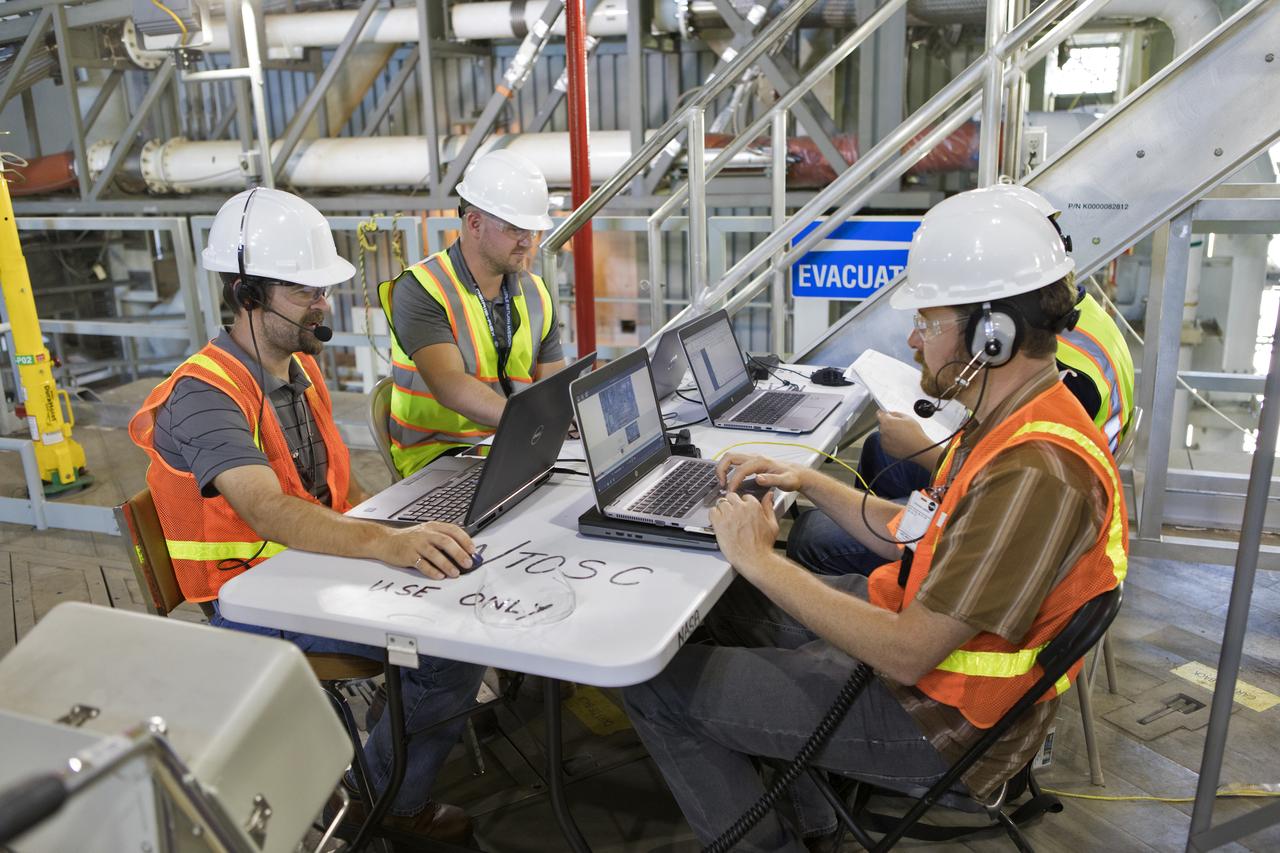
Technicians and engineers with Jacobs on the Test and Operations Support Contract, prepare for a swing test of the Core Stage Inter-tank Umbilical (CSITU) on the mobile launcher in High Bay 3 of the Vehicle Assembly Building on Feb. 22, 2019, at NASA's Kennedy Space Center in Florida. The CSITU is a swing-arm umbilical that will connect to the Space Launch System core stage inter-tank. It will provide conditioned air, pressurized gases and power and data connection to the core stage. Exploration Ground Systems at Kennedy is conducting the swing test.
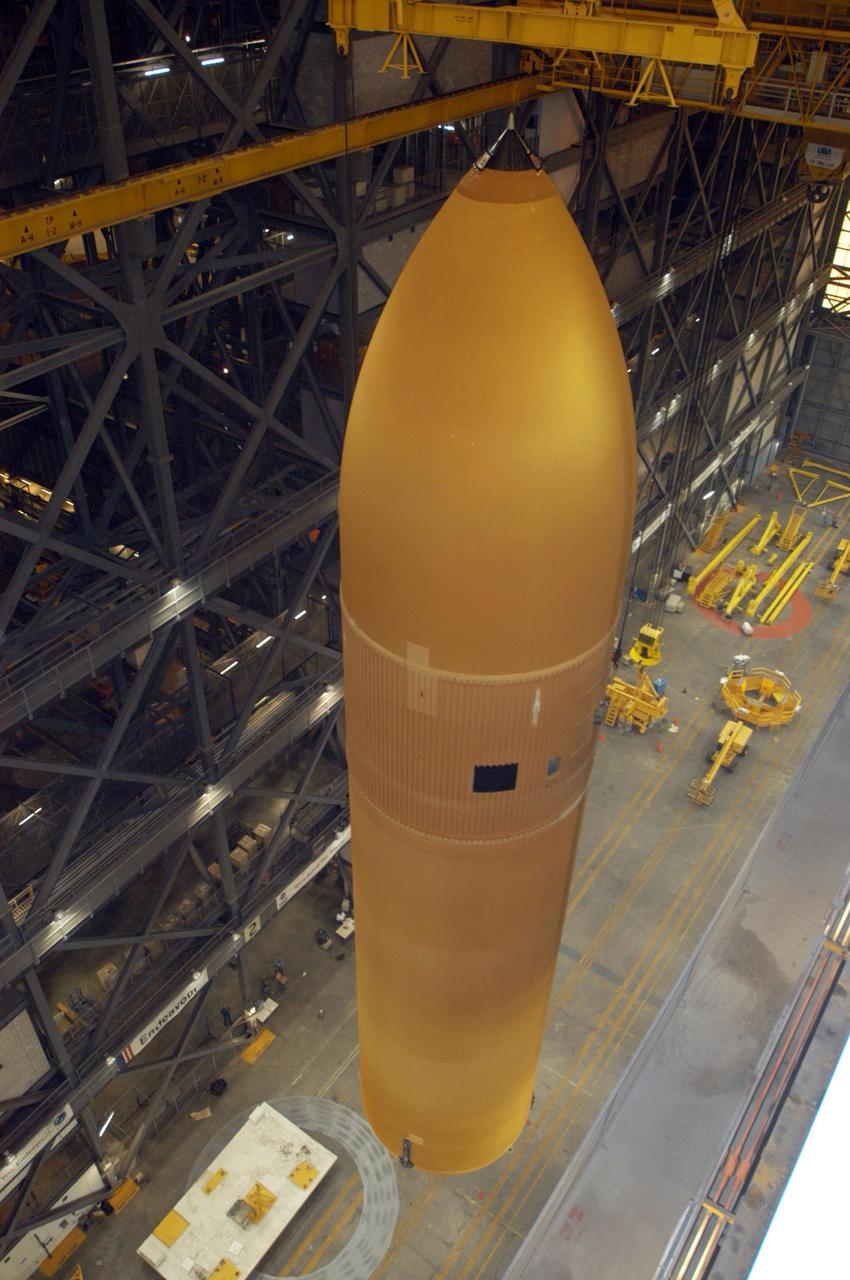
KENNEDY SPACE CENTER, FLA. - Seen from an upper level of NASA's Vehicle Assembly Building, the redesigned external fuel tank that will launch Space Shuttle Atlantis on the next shuttle mission, STS-115, is lifted for transfer into a checkout cell for further work. Designated ET-118, the tank will fly with many major safety changes, including the removal of the protuberance air load ramps. Photo credit: NASA/George Shelton

KENNEDY SPACE CENTER, FLA. - The redesigned external fuel tank, designated ET-118, that will launch Space Shuttle Atlantis on mission, STS-115 begins moving out of the Pegasus barge that carried it from the Michoud Assembly Facility in New Orleans. The tank will be moved into the Vehicle Assembly Building and lifted into a checkout cell for further work. It will fly with many major safety changes, including the removal of the protuberance air load ramps. Photo credit: NASA/Kim Shiflett
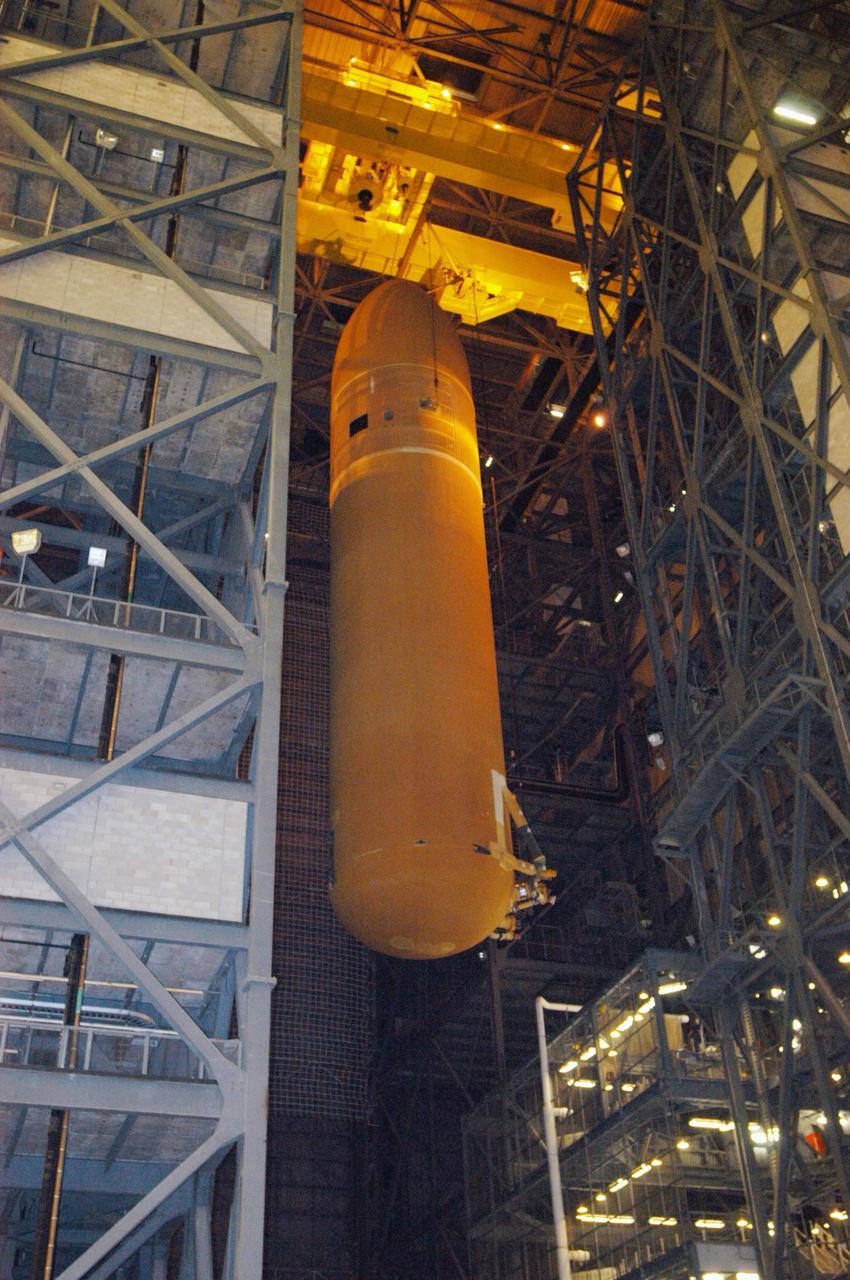
KENNEDY SPACE CENTER, FLA. - In NASA's Vehicle Assembly Building, the suspended external fuel tank that will launch Space Shuttle Atlantis on the next shuttle mission, STS-115, is moved toward the checkout cell where it will undergo further work. Designated ET-118, the tank will fly with many major safety changes, including the removal of the protuberance air load ramps. Photo credit: NASA/George Shelton
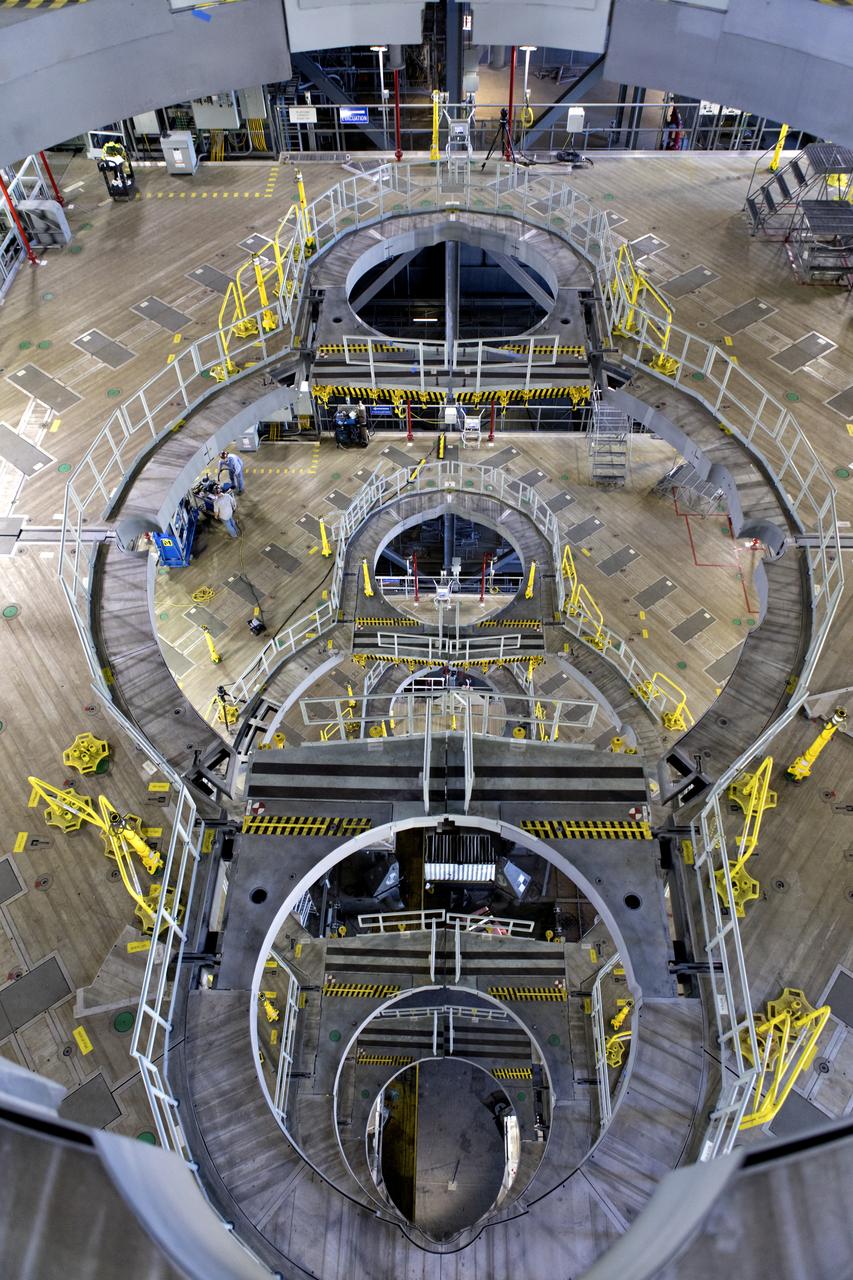
A view from above of new work platforms in High Bay 3 of the Vehicle Assembly Building on Feb. 22, 2019, at NASA’s Kennedy Space Center in Florida. Preparations are underway to perform an initial swing test of the Core Stage Inter-tank Umbilical (CSITU) on the mobile launcher. The CSITU is a swing-arm umbilical that will connect to the Space Launch System core stage inter-tank. It will provide conditioned air, pressurized gases and power and data connection to the core stage. Exploration Ground Systems at Kennedy is conducting the swing test.
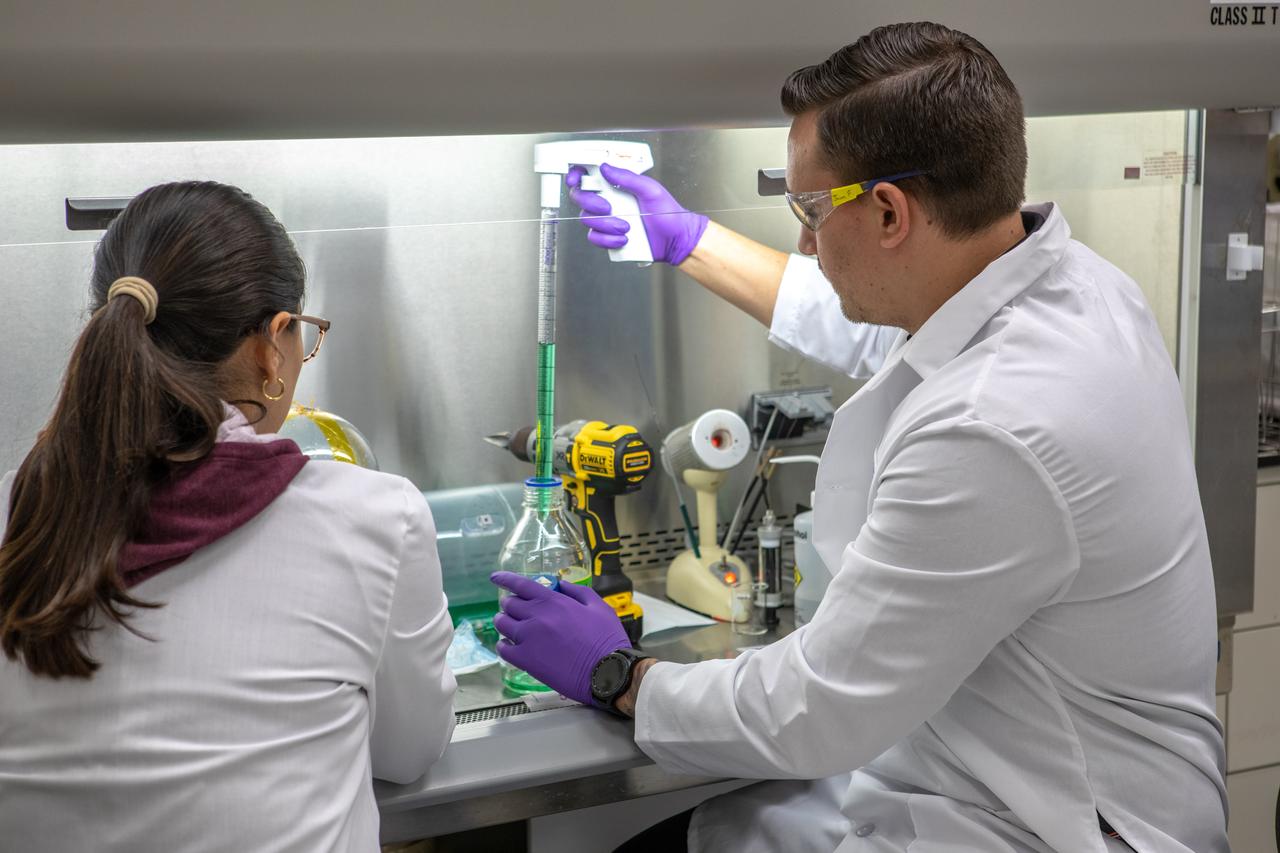
Kennedy Space Center’s Carolina Franco, Ph.D., left, and Jason Fischer collect samples from a water tank, filled with green dye, for a biological study in the Florida spaceport’s Neil Armstrong Operations and Checkout Building on Nov. 13, 2019. Two tanks have recently returned to Kennedy after spending the last five years on the International Space Station for an experiment to study slosh, or the movement of water, in a zero-gravity environment to help engineers predict the movement of propellant in rocket tanks. Kennedy’s Air and Water Revitalization lab is studying the water tanks to determine if there is, or was, any microbial growth within them. The results will help NASA determine whether clean water can be stored in space for long-duration missions, an essential component to keeping astronauts safe and healthy as the agency prepares for missions to the Moon and beyond to Mars.

Kennedy Space Center’s Jason Fischer collects samples from a water tank, filled with green dye, for a biological study in the Florida spaceport’s Neil Armstrong Operations and Checkout Building on Nov. 13, 2019. Two tanks have recently returned to Kennedy after spending the last five years on the International Space Station for an experiment to study slosh, or the movement of water, in a zero-gravity environment to help engineers predict the movement of propellant in rocket tanks. Kennedy’s Air and Water Revitalization lab is studying the water tanks to determine if there is, or was, any microbial growth within them. The results will help NASA determine whether clean water can be stored in space for long-duration missions, an essential component to keeping astronauts safe and healthy as the agency prepares for missions to the Moon and beyond to Mars.
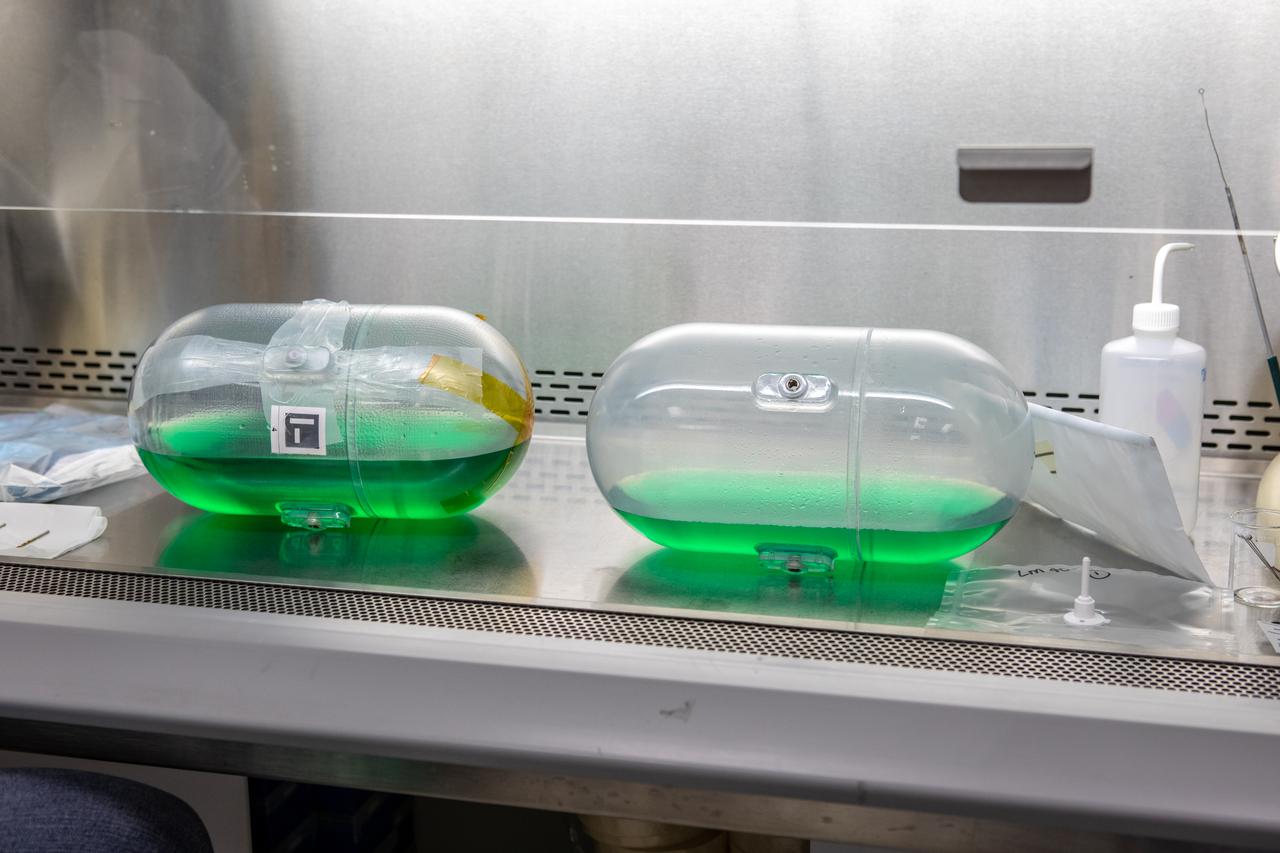
Researchers from NASA’s Kennedy Space Center Air and Water Revitalization lab are studying two tanks, containing water with green dye, inside the Neil Armstrong Operations and Checkout Building in Florida on Nov. 13, 2019. The tanks have recently returned to Kennedy after remaining on the International Space Station for the past five years, originally sent to space to study slosh – the movement of water – in a zero-gravity environment to help engineers predict the movement of propellant in rocket tanks. With the slosh experiment now concluded, the tanks are being examined to determine if there is, or was, any microbial growth within them. The results will help NASA determine whether clean water can be stored in space for long-duration missions, an essential component to keeping astronauts safe and healthy as the agency prepares for missions to the Moon and beyond to Mars.
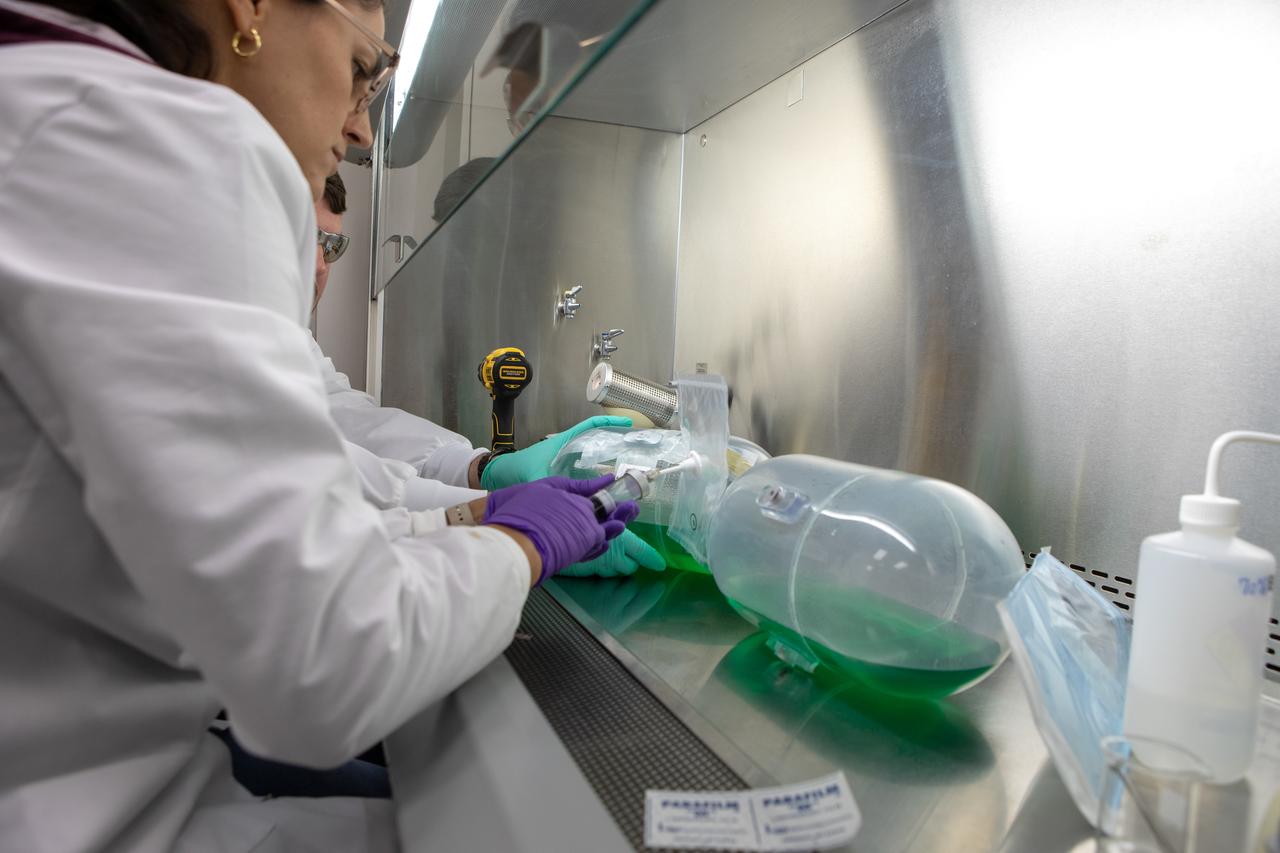
Kennedy Space Center’s Carolina Franco, Ph.D., collects samples from a water tank, filled with green dye, for a biological study in the Florida spaceport’s Neil Armstrong Operations and Checkout Building on Nov. 13, 2019. Two tanks have recently returned to Kennedy after spending the last five years on the International Space Station for an experiment to study slosh, or the movement of water, in a zero-gravity environment to help engineers predict the movement of propellant in rocket tanks. With the slosh experiment now concluded, Kennedy’s Air and Water Revitalization lab is studying the water tanks to determine if there is, or was, any microbial growth within them. The results will help NASA determine whether clean water can be stored in space for long-duration missions, an essential component to keeping astronauts safe and healthy as the agency prepares for missions to the Moon and beyond to Mars.
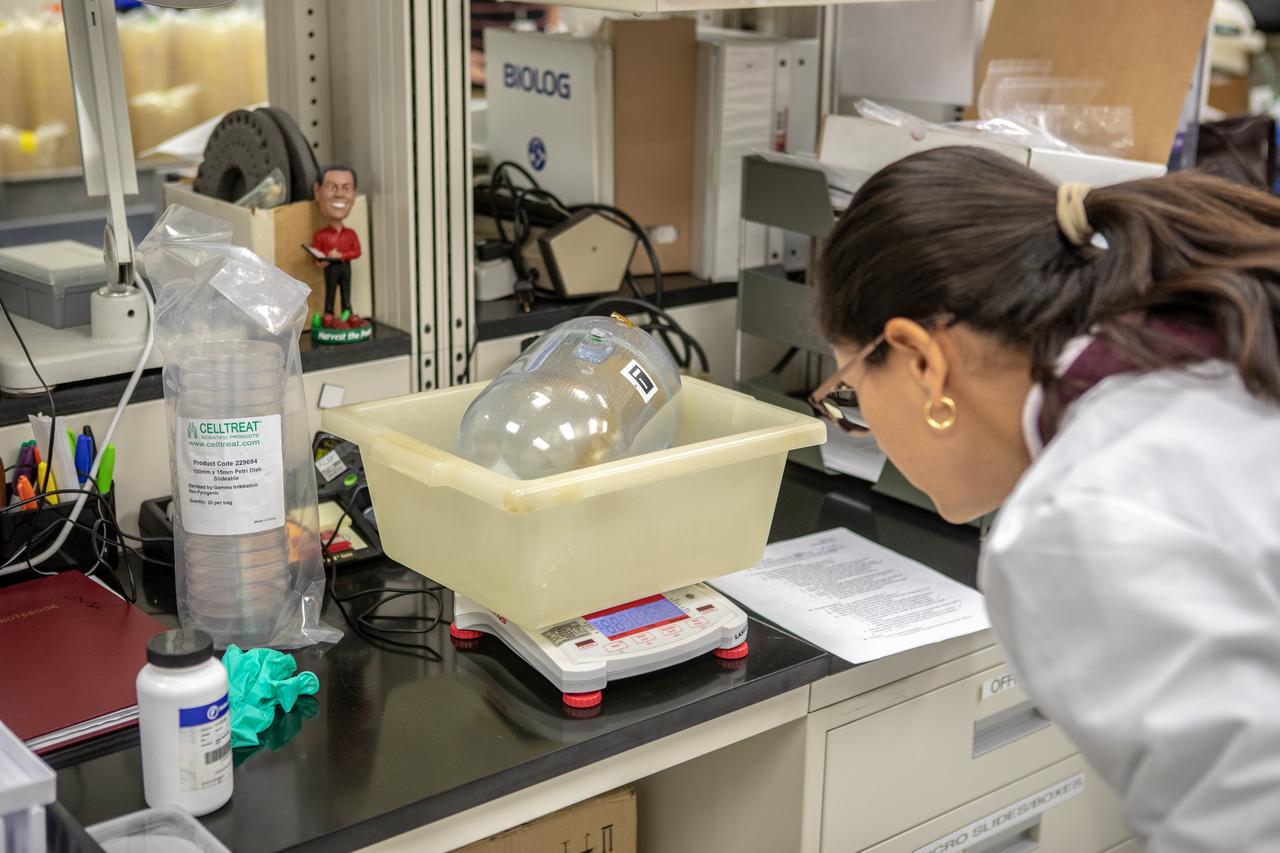
Kennedy Space Center’s Carolina Franco, Ph.D., weighs one of the water tanks, recently returned to the center after remaining on the International Space Station for the past five years, in the Florida spaceport’s Neil Armstrong Operations and Checkout Building on Nov. 13, 2019. Two tanks containing water were first sent to the orbiting laboratory in 2014 to study slosh, or the movement of water, in a zero-gravity environment to help engineers predict the movement of propellant in rocket tanks. Kennedy’s Air and Water Revitalization lab is studying the water tanks to determine if there is, or was, any microbial growth within them. The results will help NASA determine whether clean water can be stored in space for long-duration missions, an essential component to keeping astronauts safe and healthy as the agency prepares for missions to the Moon and beyond to Mars.
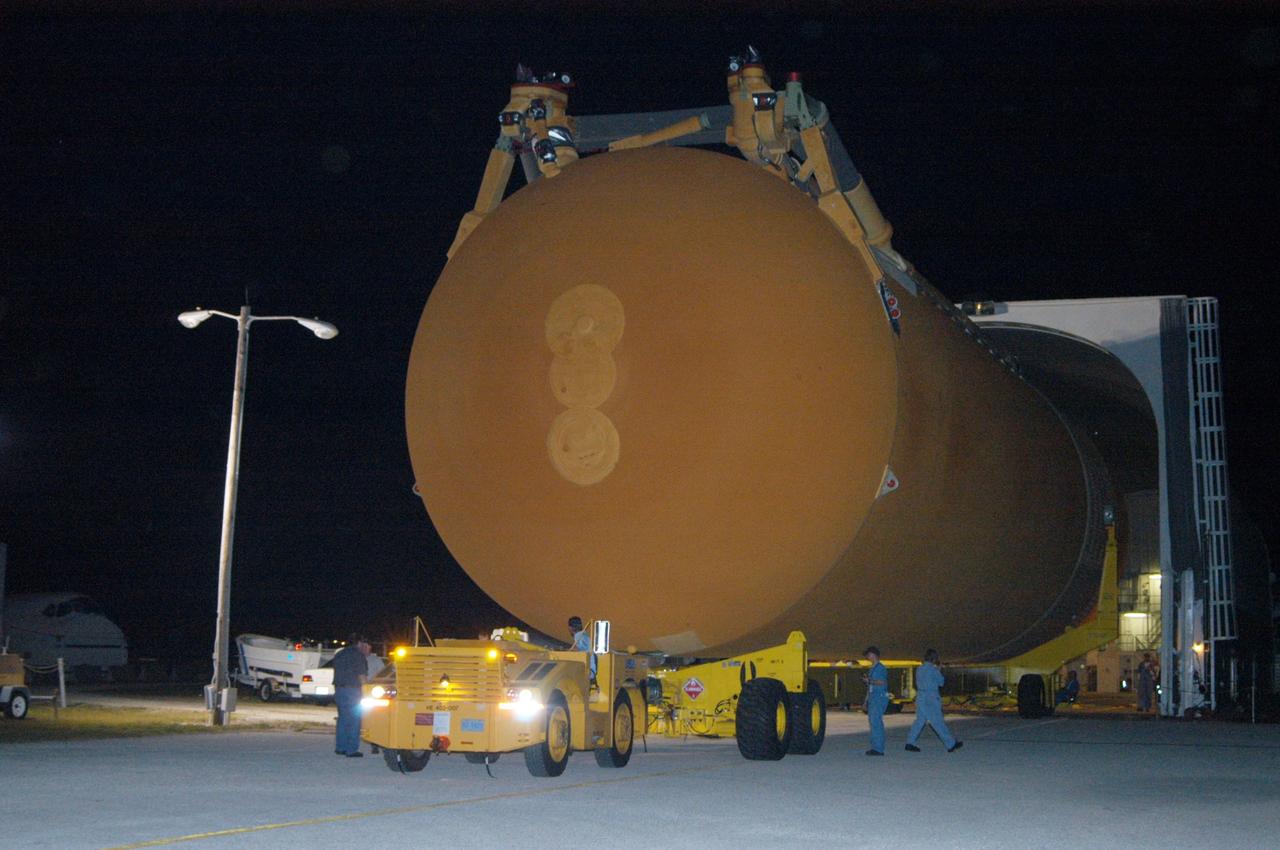
KENNEDY SPACE CENTER, FLA. - A tow vehicle is connected to the transporter supporting the redesigned external fuel tank that will launch Space Shuttle Discovery on the next shuttle mission, STS-121. The Pegasus barge delivered the tank from the Michoud Assembly Facility in New Orleans to NASA Kennedy Space Center's Launch Complex 39 turn basin. After off-loading, the tank will be moved to the Vehicle Assembly Building and lifted into a checkout cell for further work. The tank, designated ET-119, will fly with many major safety changes, including the removal of the protuberance air load ramps. A large piece of foam from a ramp came off during the last shuttle launch in July 2005. The ramps were removed to eliminate a potential source of damaging debris to the space shuttle. The next launch of Discovery is scheduled for May 2006.
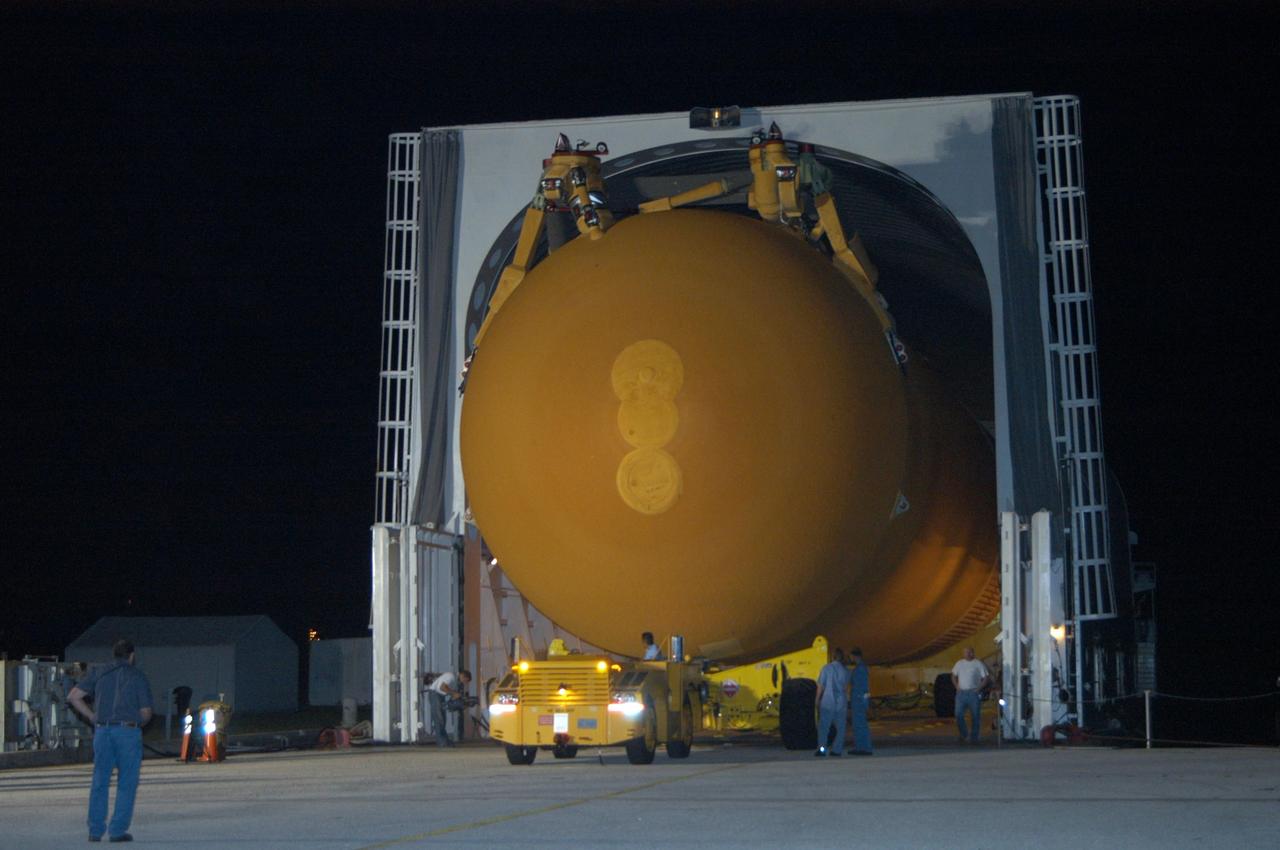
KENNEDY SPACE CENTER, FLA. - Off-loading of the redesigned external fuel tank that will launch Space Shuttle Discovery on the next shuttle mission, STS-121, begins in the Launch Complex 39 turn basin. The Pegasus barge delivered the tank from the Michoud Assembly Facility in New Orleans to NASA's Kennedy Space Center. After off-loading, the tank will be moved into the Vehicle Assembly Building and lifted into a checkout cell for further work. The tank, designated ET-119, will fly with many major safety changes, including the removal of the protuberance air load ramps. A large piece of foam from a ramp came off during the last shuttle launch in July 2005. The ramps were removed to eliminate a potential source of damaging debris to the space shuttle. The next launch of Discovery is scheduled for May 2006.

A Kennedy Space Center employee collects samples from a water tank, filled with green dye, for a biological study in the Florida spaceport’s Neil Armstrong Operations and Checkout Building on Nov. 13, 2019. Two tanks have recently returned to Kennedy after spending the last five years on the International Space Station for an experiment to study slosh, or the movement of water, in a zero-gravity environment to help engineers predict the movement of propellant in rocket tanks. With the slosh experiment now concluded, Kennedy’s Air and Water Revitalization lab is studying the water tanks to determine if there is, or was, any microbial growth within them. The results will help NASA determine whether clean water can be stored in space for long-duration missions, an essential component to keeping astronauts safe and healthy as the agency prepares for missions to the Moon and beyond to Mars.
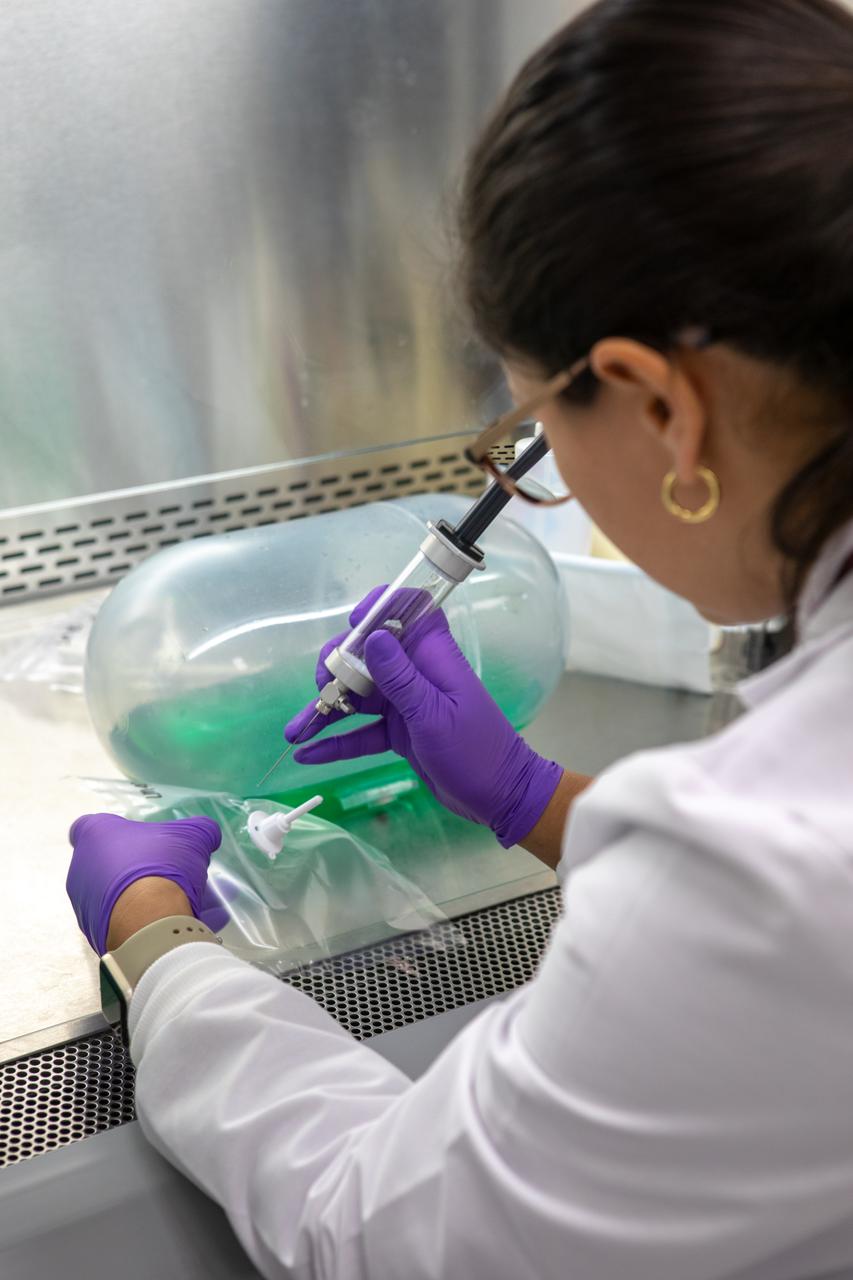
Kennedy Space Center’s Carolina Franco, Ph.D., collects samples from a water tank, filled with green dye, for a biological study in the Florida spaceport’s Neil Armstrong Operations and Checkout Building on Nov. 13, 2019. Two tanks have recently returned to Kennedy after spending the last five years on the International Space Station for an experiment to study slosh, or the movement of water, in a zero-gravity environment to help engineers predict the movement of propellant in rocket tanks. With the slosh experiment now concluded, Kennedy’s Air and Water Revitalization lab is studying the water tanks to determine if there is, or was, any microbial growth within them. The results will help NASA determine whether clean water can be stored in space for long-duration missions, an essential component to keeping astronauts safe and healthy as the agency prepares for missions to the Moon and beyond to Mars.
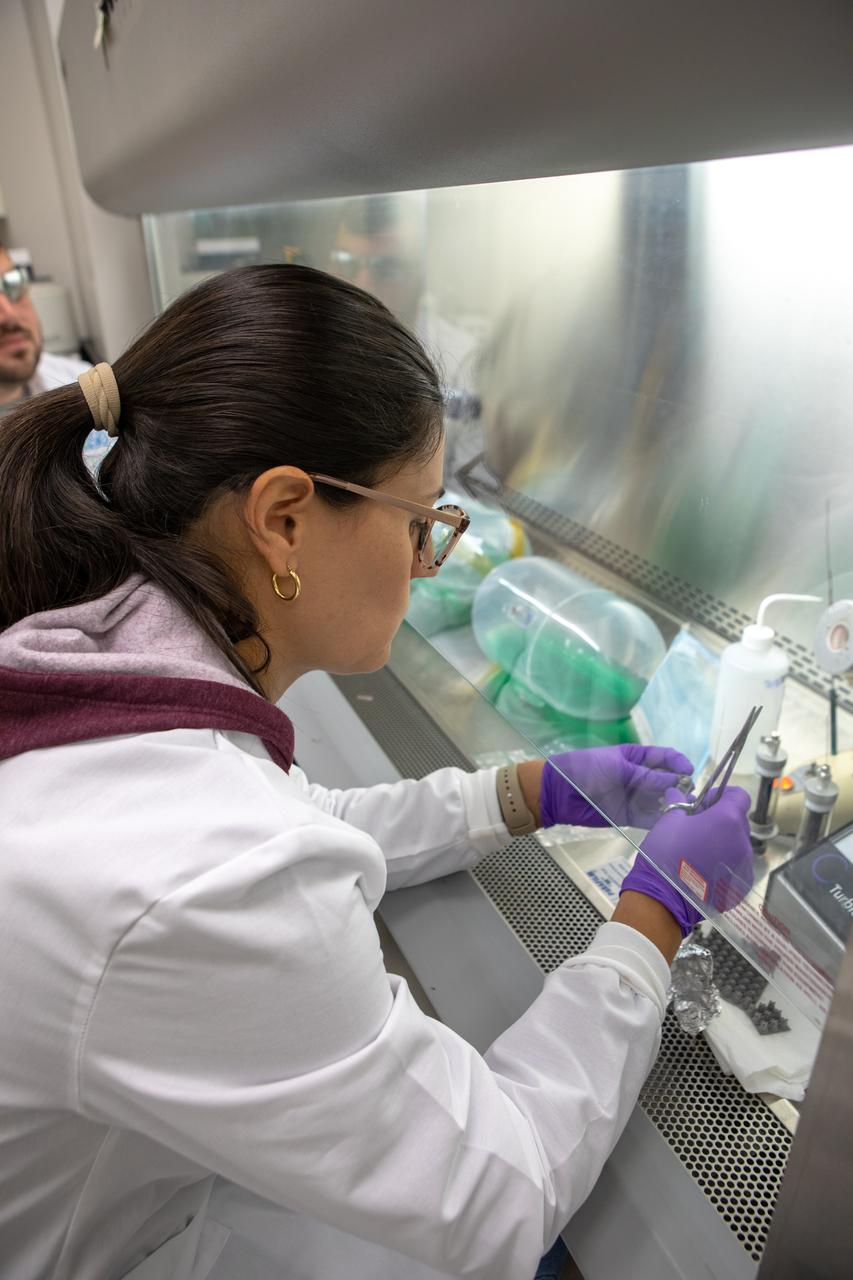
Kennedy Space Center’s Carolina Franco, Ph.D., conducts a biological study on two tanks of water, filled with green dye, in the Florida spaceport’s Neil Armstrong Operations and Checkout Building on Nov. 13, 2019. The tanks have recently returned to Kennedy after spending the last five years on the International Space Station for an experiment to study slosh, or the movement of water, in a zero-gravity environment to help engineers predict the movement of propellant in rocket tanks. Kennedy’s Air and Water Revitalization lab is studying the water tanks to determine if there is, or was, any microbial growth within them. The results will help NASA determine whether clean water can be stored in space for long-duration missions, an essential component to keeping astronauts safe and healthy as the agency prepares for missions to the Moon and beyond to Mars.
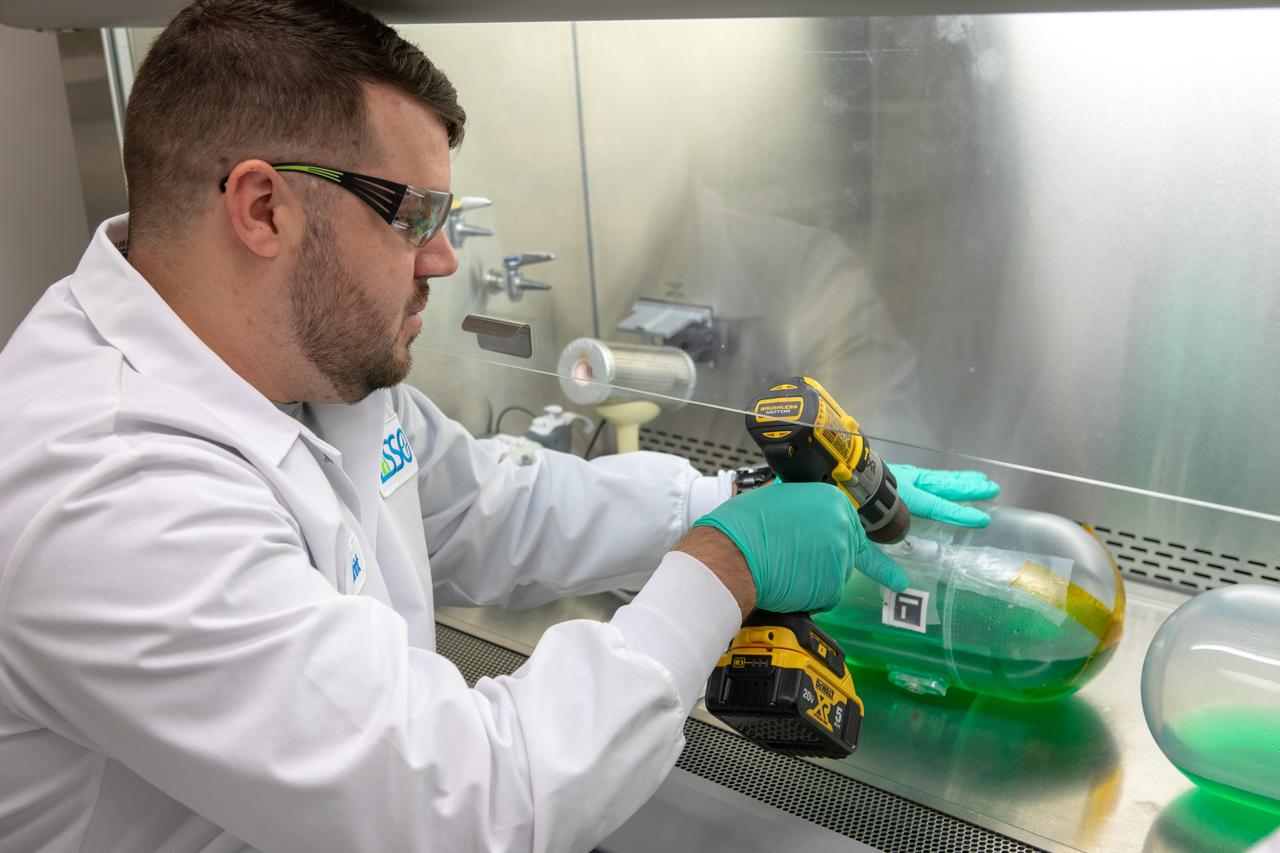
Kennedy Space Center’s Brint Bauer drills into a water tank, filled with green dye, in the Florida spaceport’s Neil Armstrong Operations and Checkout Building on Nov. 13, 2019. Two tanks have recently returned to Kennedy after spending the last five years on the International Space Station for an experiment to study slosh, or the movement of water, in a zero-gravity environment to help engineers predict the movement of propellant in rocket tanks. With the slosh experiment now concluded, Kennedy’s Air and Water Revitalization lab is studying the water tanks to determine if there is, or was, any microbial growth within them. The results will help NASA determine whether clean water can be stored in space for long-duration missions, an essential component to keeping astronauts safe and healthy as the agency prepares for missions to the Moon and beyond to Mars.
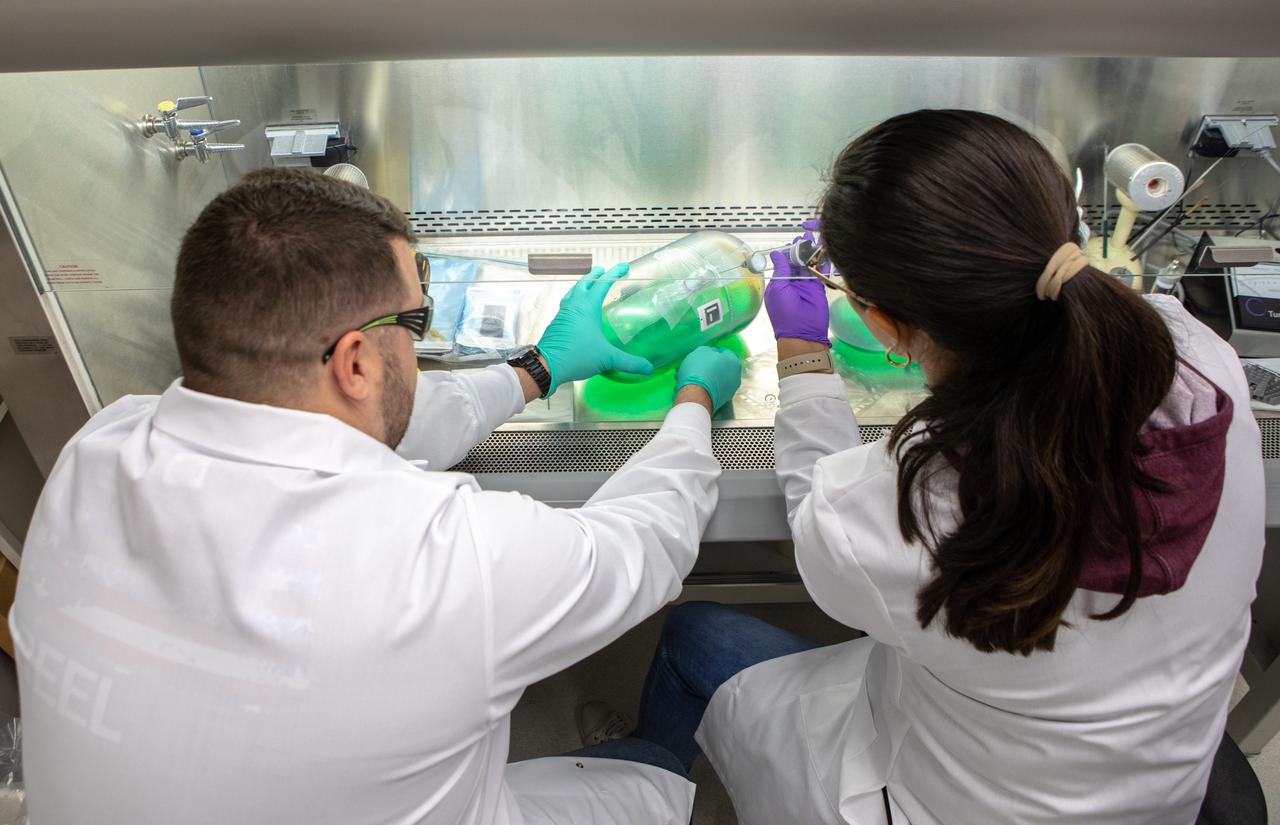
Kennedy Space Center’s Brint Bauer, left, and Carolina Franco, Ph.D., collect samples from a water tank, filled with green dye, for a biological study in the Florida spaceport’s Neil Armstrong Operations and Checkout Building on Nov. 13, 2019. Two tanks have recently returned to Kennedy after spending the last five years on the International Space Station for an experiment to study slosh, or the movement of water, in a zero-gravity environment to help engineers predict the movement of propellant in rocket tanks. Kennedy’s Air and Water Revitalization lab is studying the water tanks to determine if there is, or was, any microbial growth within them. The results will help NASA determine whether clean water can be stored in space for long-duration missions, an essential component to keeping astronauts safe and healthy as the agency prepares for missions to the Moon and beyond to Mars.
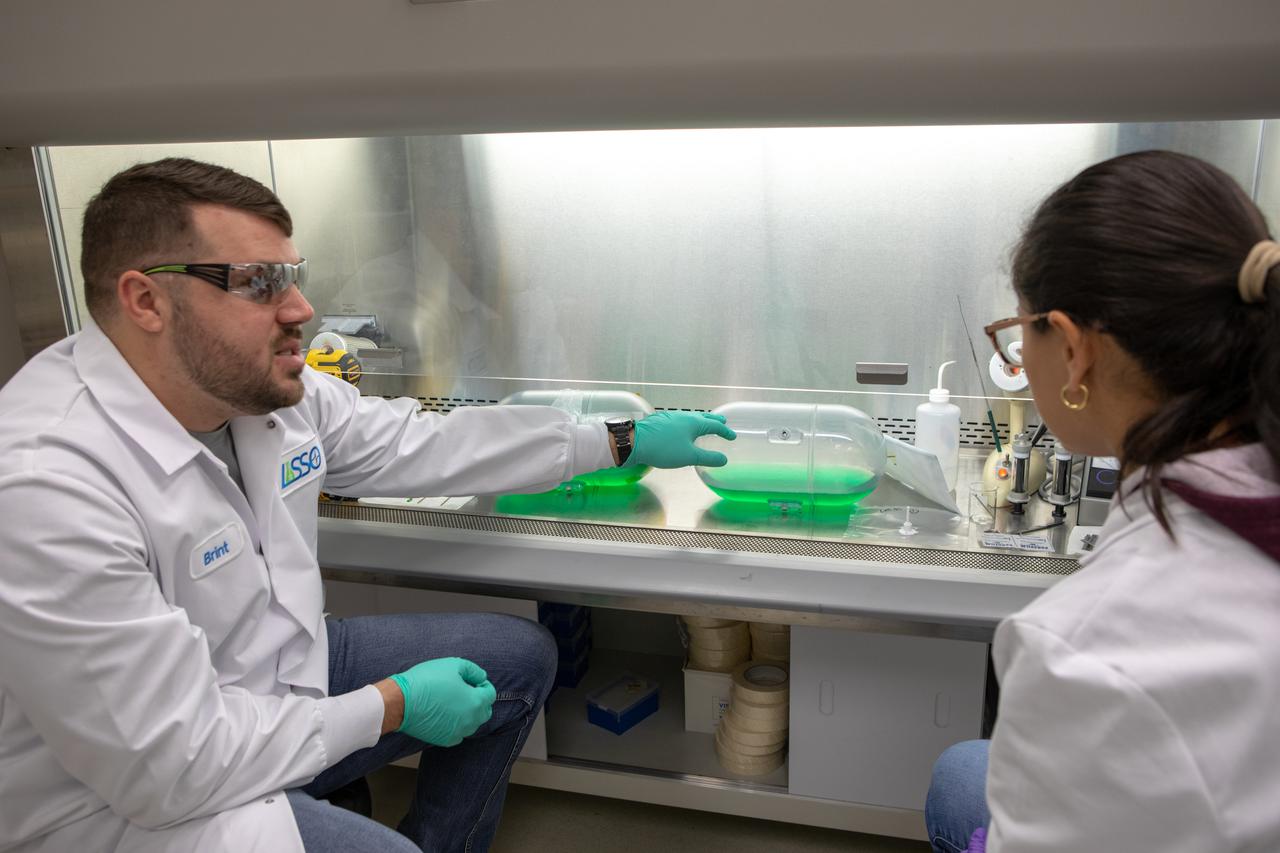
Kennedy Space Center’s Brint Bauer, left, and Carolina Franco, Ph.D., conduct a biological study on two tanks of water, filled with green dye, in the Florida spaceport’s Neil Armstrong Operations and Checkout Building on Nov. 13, 2019. The tanks have recently returned to Kennedy after spending the last five years on the International Space Station for an experiment to study slosh, or the movement of water, in a zero-gravity environment to help engineers predict the movement of propellant in rocket tanks. Kennedy’s Air and Water Revitalization lab is studying the water tanks to determine if there is, or was, any microbial growth within them. The results will help NASA determine whether clean water can be stored in space for long-duration missions, an essential component to keeping astronauts safe and healthy as the agency prepares for missions to the Moon and beyond to Mars.
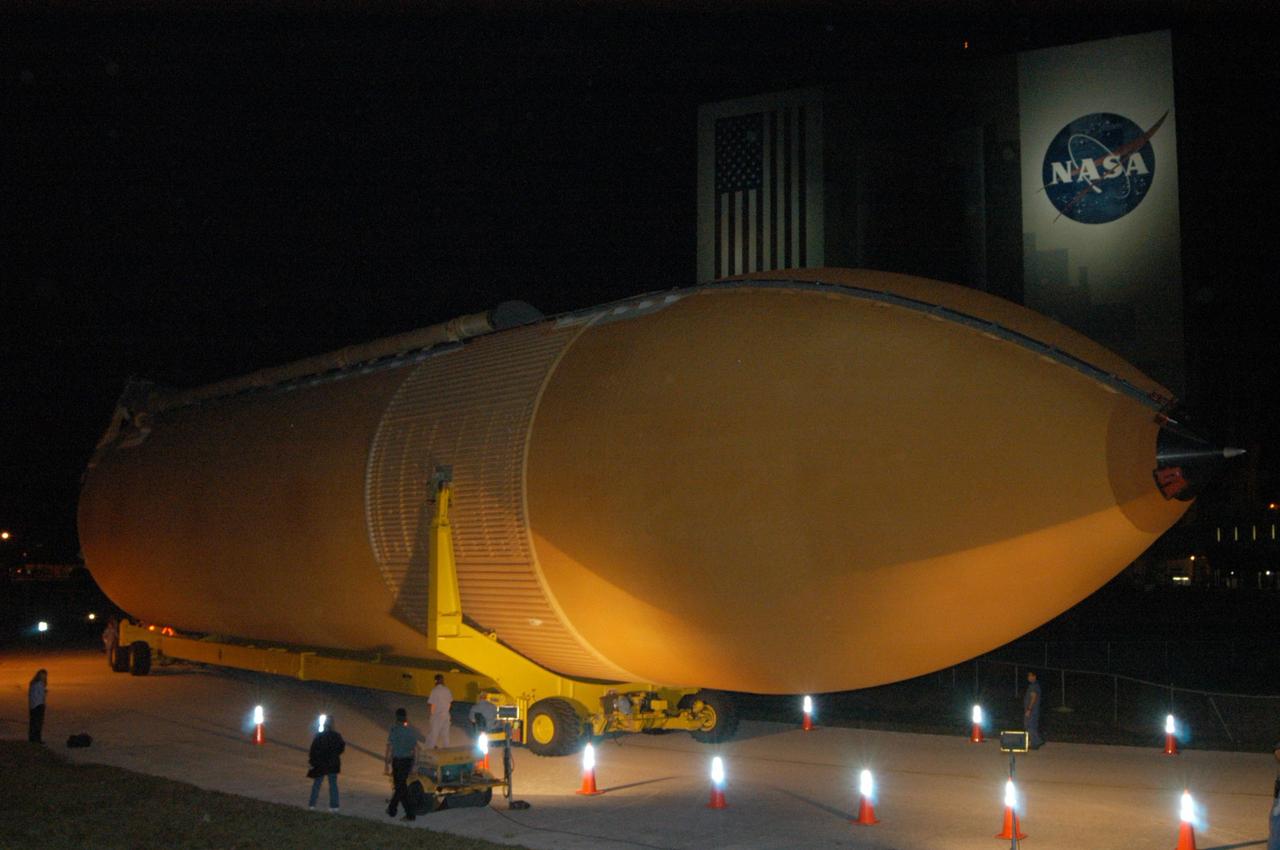
KENNEDY SPACE CENTER, FLA. - Technicians monitor the redesigned external fuel tank that will launch Space Shuttle Discovery on the next shuttle mission, STS-121, as it is moved to the Vehicle Assembly Building in the background. The Pegasus barge delivered the tank from the Michoud Assembly Facility in New Orleans to NASA's Kennedy Space Center. Once in the VAB, the tank will be lifted into a checkout cell for further work. The tank, designated ET-119, will fly with many major safety changes, including the removal of the protuberance air load ramps. A large piece of foam from a ramp came off during the last shuttle launch in July 2005. The ramps were removed to eliminate a potential source of damaging debris to the space shuttle. The next launch of Discovery is scheduled for May 2006.

KENNEDY SPACE CENTER, FLA. - The redesigned external fuel tank that will launch Space Shuttle Discovery on the next shuttle mission, STS-121, is towed from the Launch Complex 39 turn basin to the Vehicle Assembly Building. The Pegasus barge delivered the tank from the Michoud Assembly Facility in New Orleans to NASA's Kennedy Space Center. After the tank is moved into the VAB, it will be lifted into a checkout cell for further work. The tank, designated ET-119, will fly with many major safety changes, including the removal of the protuberance air load ramps. A large piece of foam from a ramp came off during the last shuttle launch in July 2005. The ramps were removed to eliminate a potential source of damaging debris to the space shuttle. The next launch of Discovery is scheduled for May 2006.
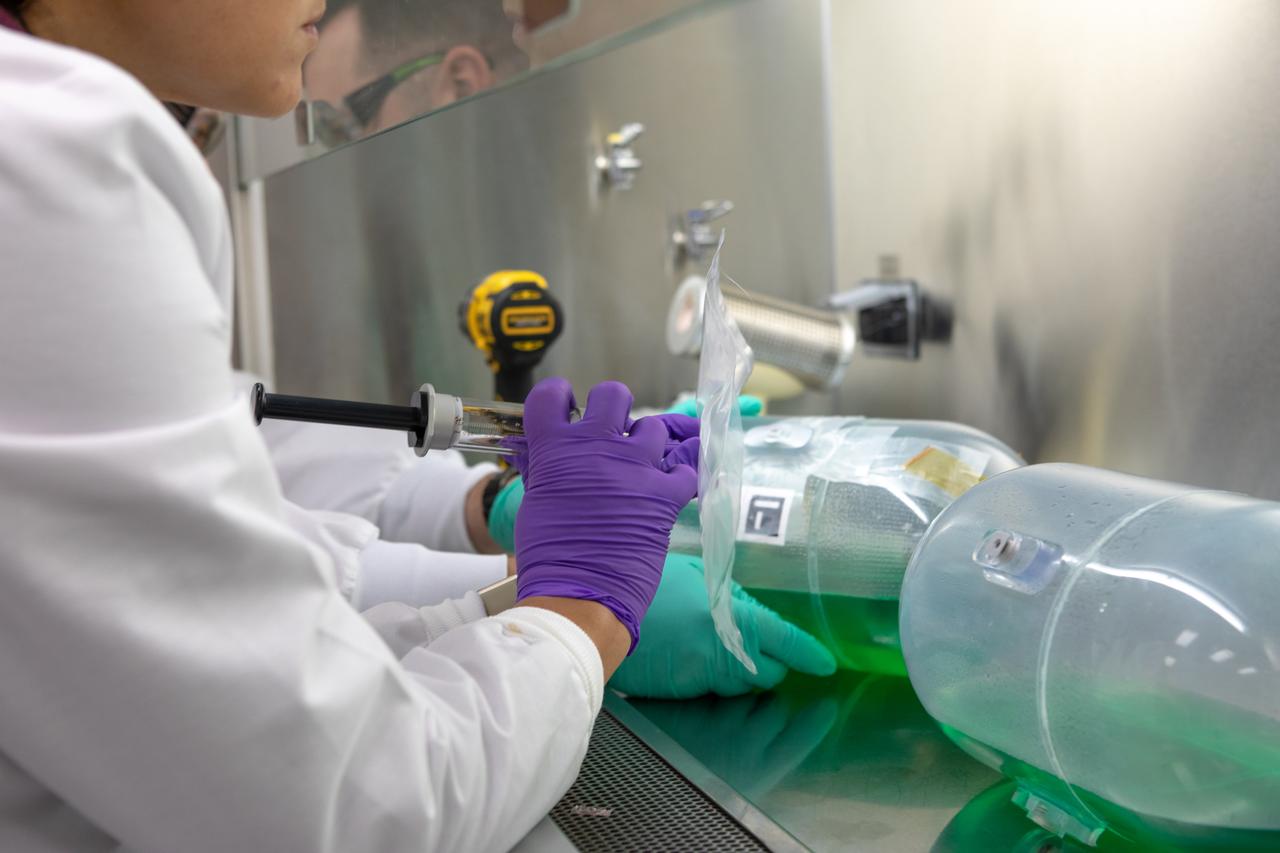
A Kennedy Space Center employee collects samples from a water tank, filled with green dye, for a biological study in the Florida spaceport’s Neil Armstrong Operations and Checkout Building on Nov. 13, 2019. Two tanks have recently returned to Kennedy after spending the last five years on the International Space Station for an experiment to study slosh, or the movement of water, in a zero-gravity environment to help engineers predict the movement of propellant in rocket tanks. With the slosh experiment now concluded, Kennedy’s Air and Water Revitalization lab is studying the water tanks to determine if there is, or was, any microbial growth within them. The results will help NASA determine whether clean water can be stored in space for long-duration missions, an essential component to keeping astronauts safe and healthy as the agency prepares for missions to the Moon and beyond to Mars.
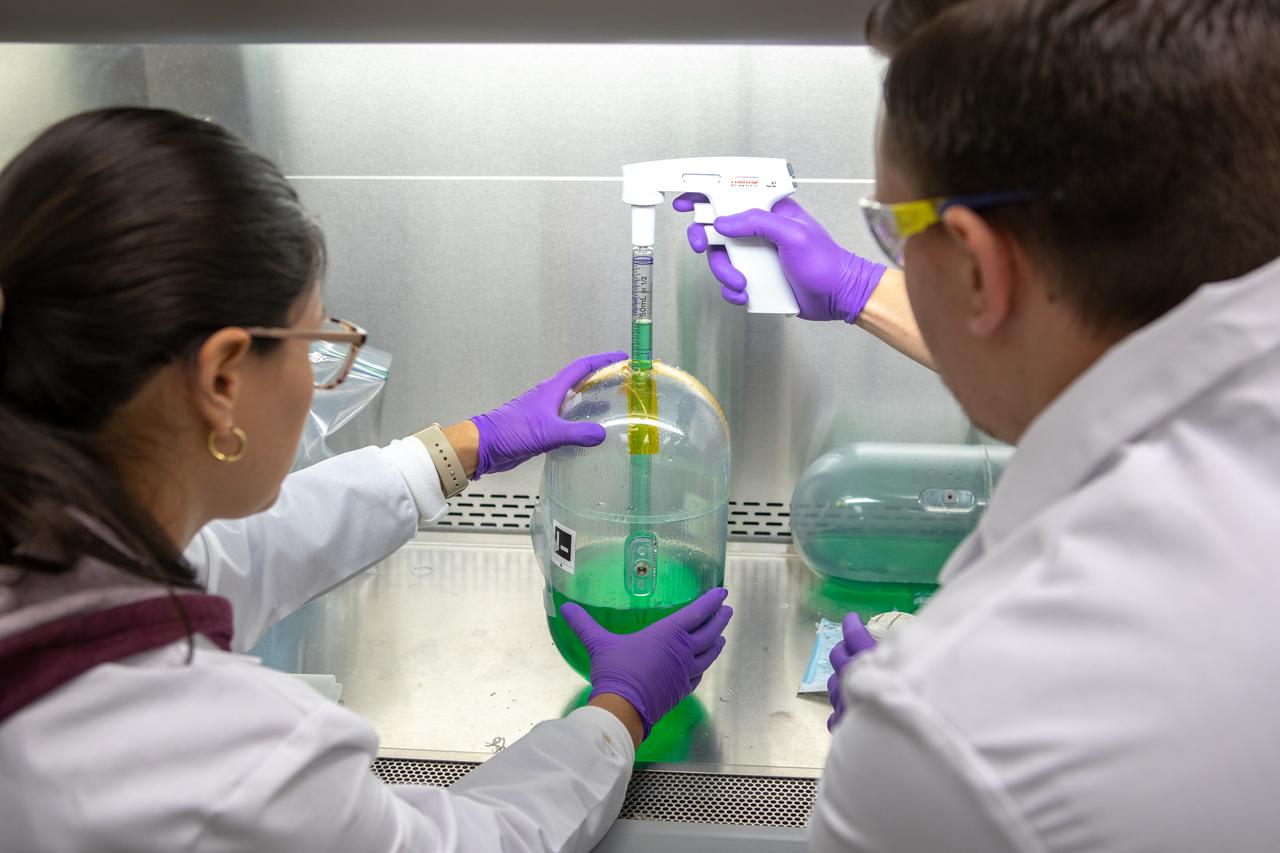
Kennedy Space Center’s Carolina Franco, Ph.D., left, and Jason Fischer collect samples from a water tank, filled with green dye, for a biological study in the Florida spaceport’s Neil Armstrong Operations and Checkout Building on Nov. 13, 2019. Two tanks have recently returned to Kennedy after spending the last five years on the International Space Station for an experiment to study slosh, or the movement of water, in a zero-gravity environment to help engineers predict the movement of propellant in rocket tanks. Kennedy’s Air and Water Revitalization lab is studying the water tanks to determine if there is, or was, any microbial growth within them. The results will help NASA determine whether clean water can be stored in space for long-duration missions, an essential component to keeping astronauts safe and healthy as the agency prepares for missions to the Moon and beyond to Mars.
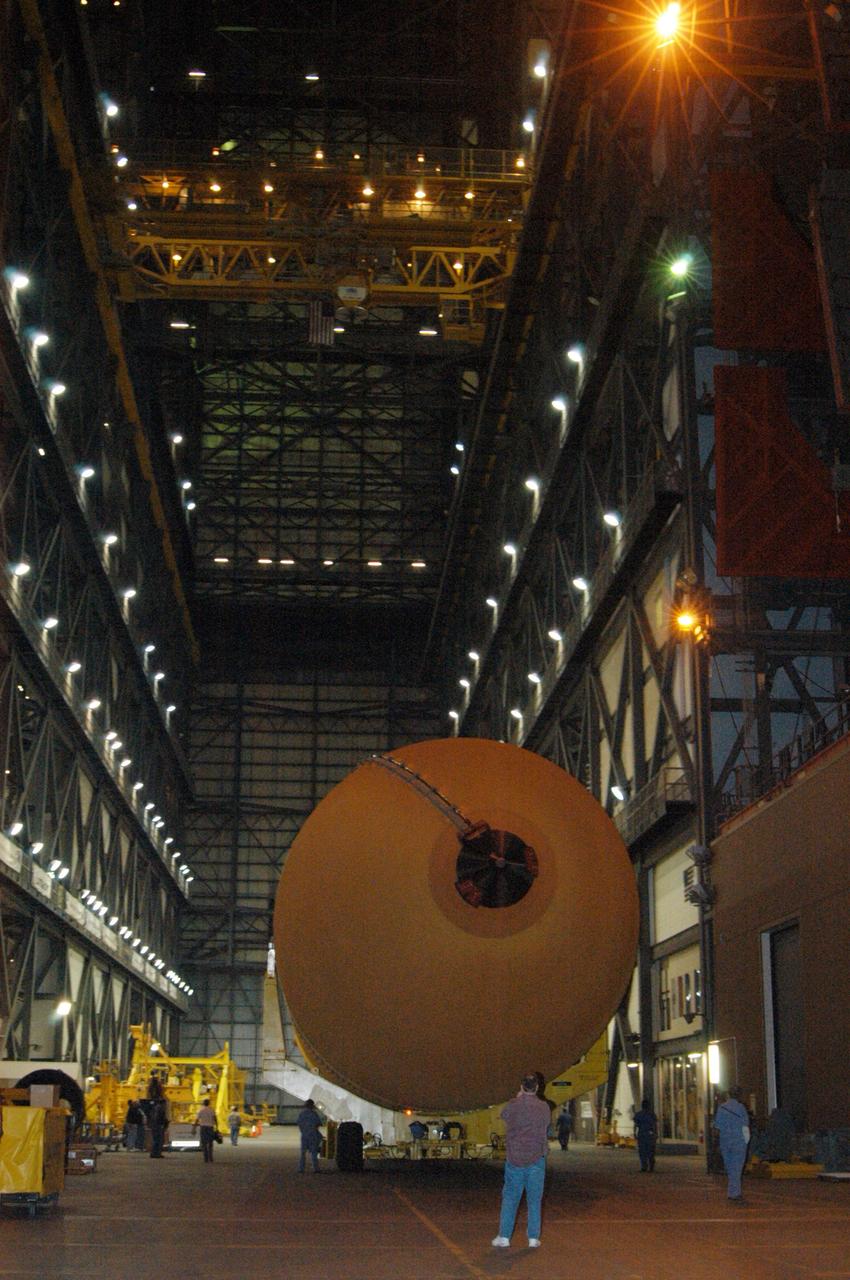
KENNEDY SPACE CENTER, FLA. - The redesigned external fuel tank that will launch Space Shuttle Discovery on the next shuttle mission, STS-121, arrives safely in the transfer aisle of the Vehicle Assembly Building. The Pegasus barge delivered the tank from the Michoud Assembly Facility in New Orleans to NASA's Kennedy Space Center. Next, the tank will be lifted into a checkout cell for further work. The tank, designated ET-119, will fly with many major safety changes, including the removal of the protuberance air load ramps. A large piece of foam from a ramp came off during the last shuttle launch in July 2005. The ramps were removed to eliminate a potential source of damaging debris to the space shuttle. The next launch of Discovery is scheduled for May 2006.
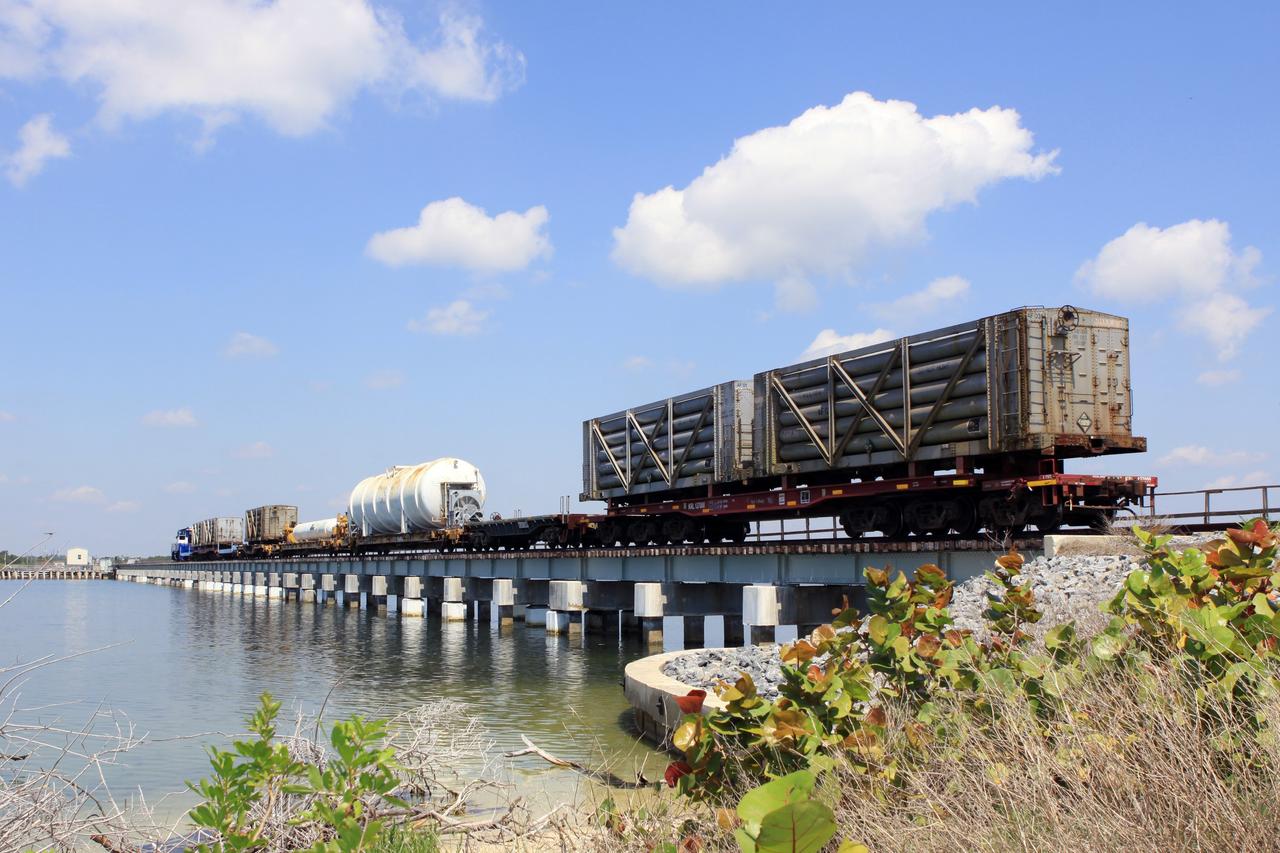
CAPE CANAVERAL, Fla. – A NASA Railroad train crosses the railroad’s Jay Jay Railroad Bridge north of Launch Complex 39 at NASA’s Kennedy Space Center in Florida. The train is on its way to the Florida East Coast Railway interchange in Titusville, Fla., where the train’s helium tank cars, a liquid oxygen tank car, and a liquid hydrogen dewar or tank car will be transferred for delivery to the SpaceX engine test complex outside McGregor, Texas. The helium tank cars are positioned in the front and rear of the train. The long, thin tank car in the middle was used for liquid hydrogen, followed by a much larger tank car used for liquid oxygen. The railroad cars were needed in support of the Space Shuttle Program but currently are not in use by NASA following the completion of the program in 2011. Originally, the tankers belonged to the U.S. Bureau of Mines. At the peak of the shuttle program, there were approximately 30 cars in the fleet. About half the cars were returned to the bureau as launch activity diminished. Five tank cars are being loaned to SpaceX and repurposed to support their engine tests in Texas. Eight cars previously were shipped to California on loan to support the SpaceX Falcon 9 rocket launches from Space Launch Complex-4 on Vandenberg Air Force Base. SpaceX already has three helium tank cars previously used for the shuttle program at Space Launch Complex-40 on Cape Canaveral Air Force Station in Florida. For more information, visit http://www.nasa.gov/spacex. Photo credit: NASA/Jim Grossmann
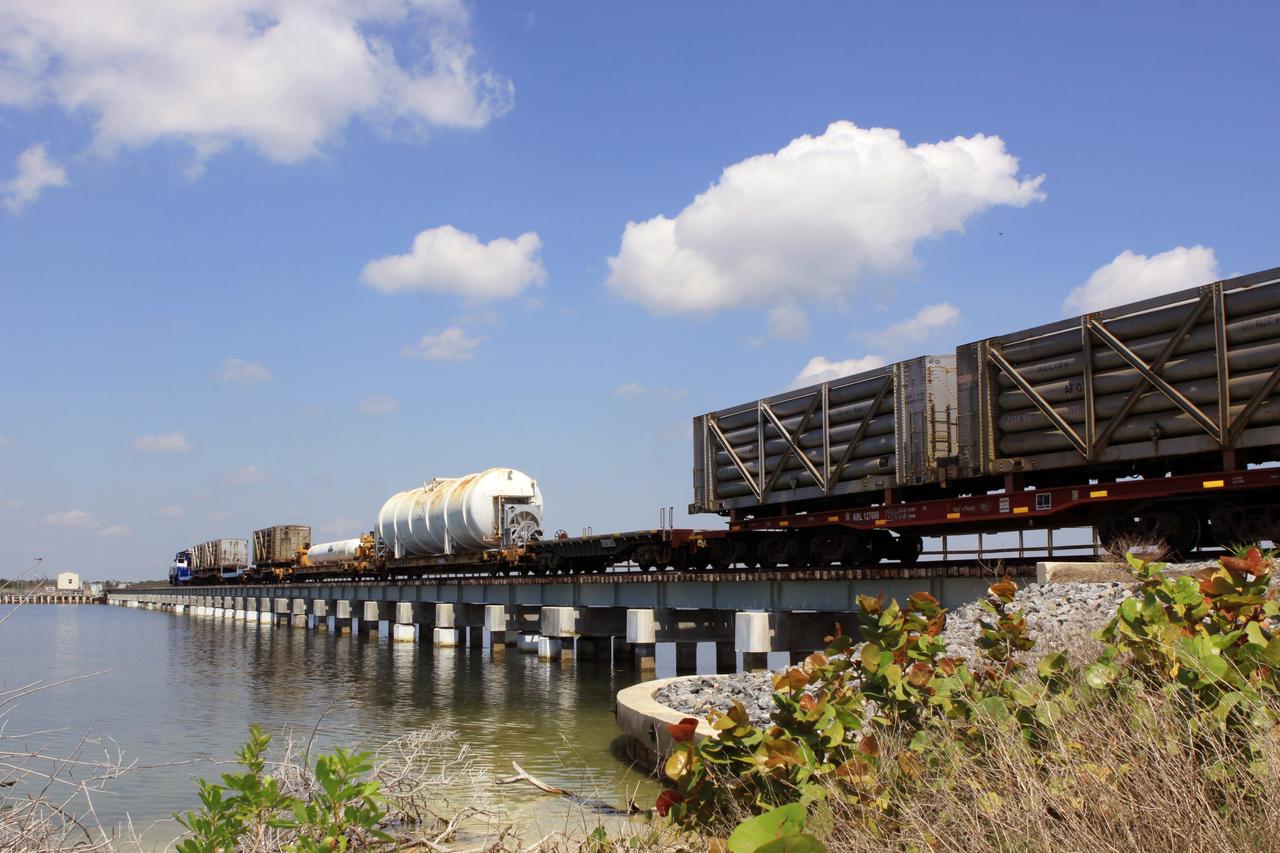
CAPE CANAVERAL, Fla. – A NASA Railroad train crosses the railroad’s Jay Jay Railroad Bridge north of Launch Complex 39 at NASA’s Kennedy Space Center in Florida. The train is on its way to the Florida East Coast Railway interchange in Titusville, Fla., where the train’s helium tank cars, a liquid oxygen tank car, and a liquid hydrogen dewar or tank car will be transferred for delivery to the SpaceX engine test complex outside McGregor, Texas. The helium tank cars are positioned in the front and rear of the train. The long, thin tank car in the middle was used for liquid hydrogen, followed by a much larger tank car used for liquid oxygen. The railroad cars were needed in support of the Space Shuttle Program but currently are not in use by NASA following the completion of the program in 2011. Originally, the tankers belonged to the U.S. Bureau of Mines. At the peak of the shuttle program, there were approximately 30 cars in the fleet. About half the cars were returned to the bureau as launch activity diminished. Five tank cars are being loaned to SpaceX and repurposed to support their engine tests in Texas. Eight cars previously were shipped to California on loan to support the SpaceX Falcon 9 rocket launches from Space Launch Complex-4 on Vandenberg Air Force Base. SpaceX already has three helium tank cars previously used for the shuttle program at Space Launch Complex-40 on Cape Canaveral Air Force Station in Florida. For more information, visit http://www.nasa.gov/spacex. Photo credit: NASA/Jim Grossmann
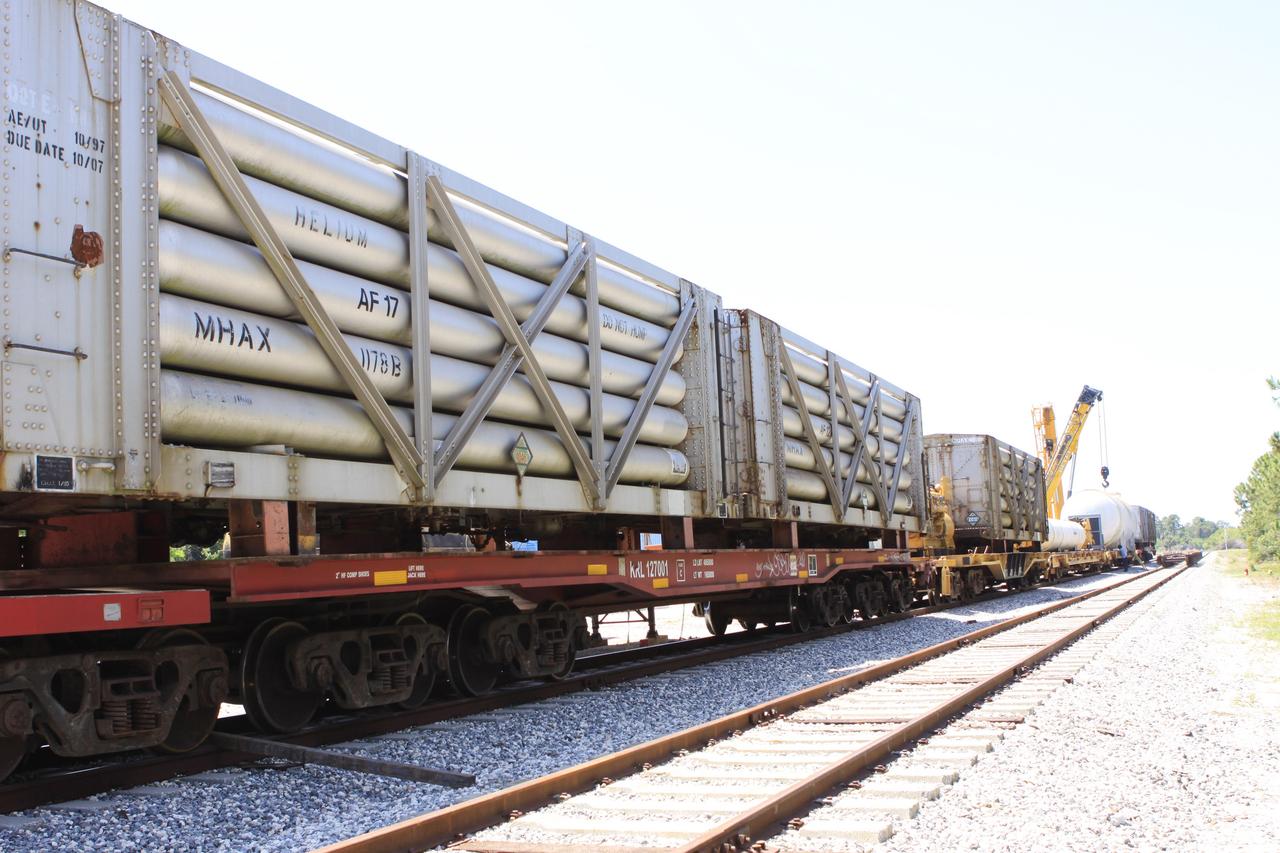
CAPE CANAVERAL, Fla. – At the NASA Railroad yard at Kennedy Space Center in Florida, helium tank cars have been removed from their trucks and loaded onto flat cars in preparation for a journey to the Florida East Coast Railway interchange in Titusville, Fla., where the train’s tank cars will be transferred for delivery to the SpaceX engine test complex outside McGregor, Texas. The railroad cars were needed in support of the Space Shuttle Program but currently are not in use by NASA following the completion of the program in 2011. Originally, the tankers belonged to the U.S. Bureau of Mines. At the peak of the shuttle program, there were approximately 30 cars in the fleet. About half the cars were returned to the bureau as launch activity diminished. Five tank cars are being loaned to SpaceX and repurposed to support their engine tests in Texas. Eight cars previously were shipped to California on loan to support the SpaceX Falcon 9 rocket launches from Space Launch Complex-4 on Vandenberg Air Force Base. SpaceX already has three helium tank cars previously used for the shuttle program at Space Launch Complex-40 on Cape Canaveral Air Force Station in Florida. For more information, visit http://www.nasa.gov/spacex. Photo credit: NASA/Jim Grossmann
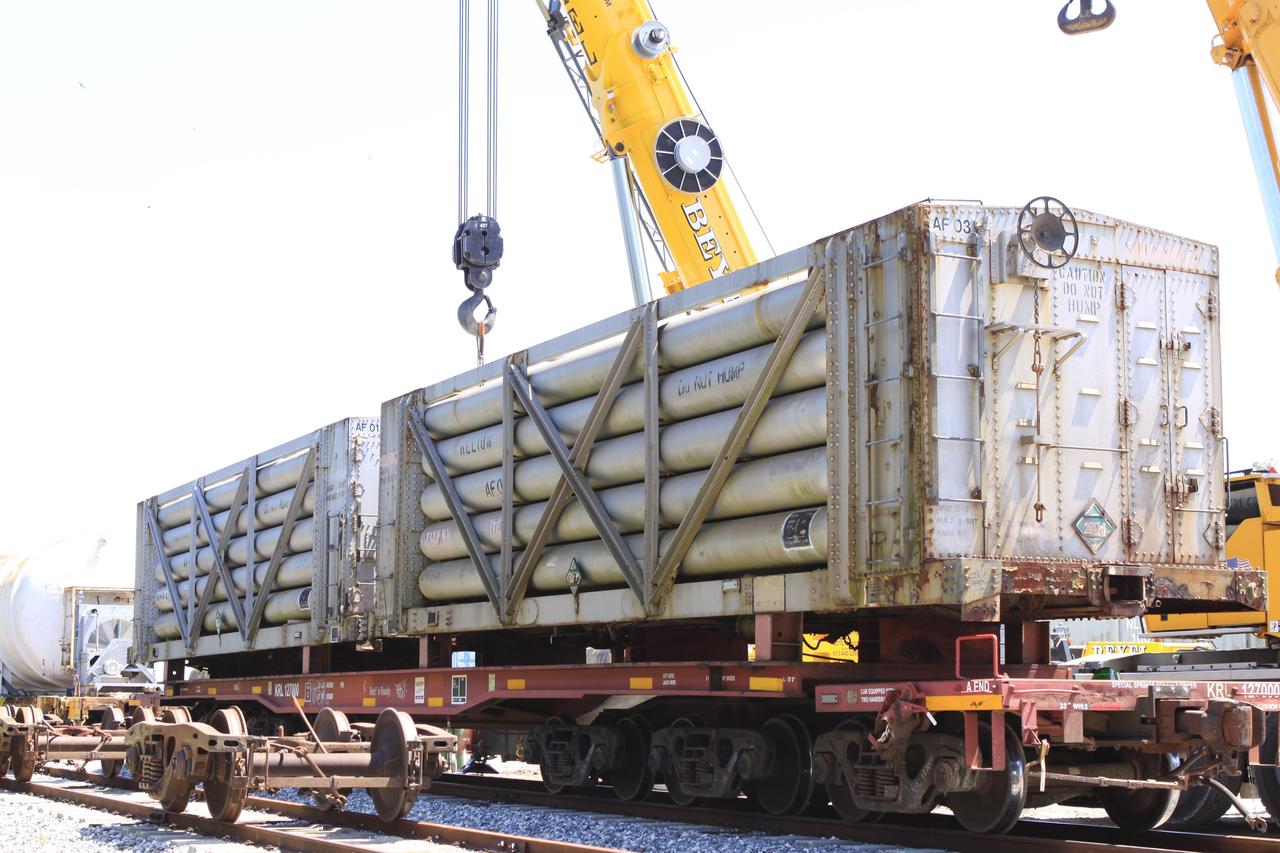
CAPE CANAVERAL, Fla. – At the NASA Railroad yard at Kennedy Space Center in Florida, cranes are enlisted to lift helium tank cars from their trucks onto flat cars in preparation for a journey to the Florida East Coast Railway interchange in Titusville, Fla., where the train’s tank cars will be transferred for delivery to the SpaceX engine test complex outside McGregor, Texas. The yard is located in Kennedy’s Launch Complex 39 near the 525-foot-tall Vehicle Assembly Building, in the background. The railroad cars were needed in support of the Space Shuttle Program but currently are not in use by NASA following the completion of the program in 2011. Originally, the tankers belonged to the U.S. Bureau of Mines. At the peak of the shuttle program, there were approximately 30 cars in the fleet. About half the cars were returned to the bureau as launch activity diminished. Five tank cars are being loaned to SpaceX and repurposed to support their engine tests in Texas. Eight cars previously were shipped to California on loan to support the SpaceX Falcon 9 rocket launches from Space Launch Complex-4 on Vandenberg Air Force Base. SpaceX already has three helium tank cars previously used for the shuttle program at Space Launch Complex-40 on Cape Canaveral Air Force Station in Florida. For more information, visit http://www.nasa.gov/spacex. Photo credit: NASA/Jim Grossmann
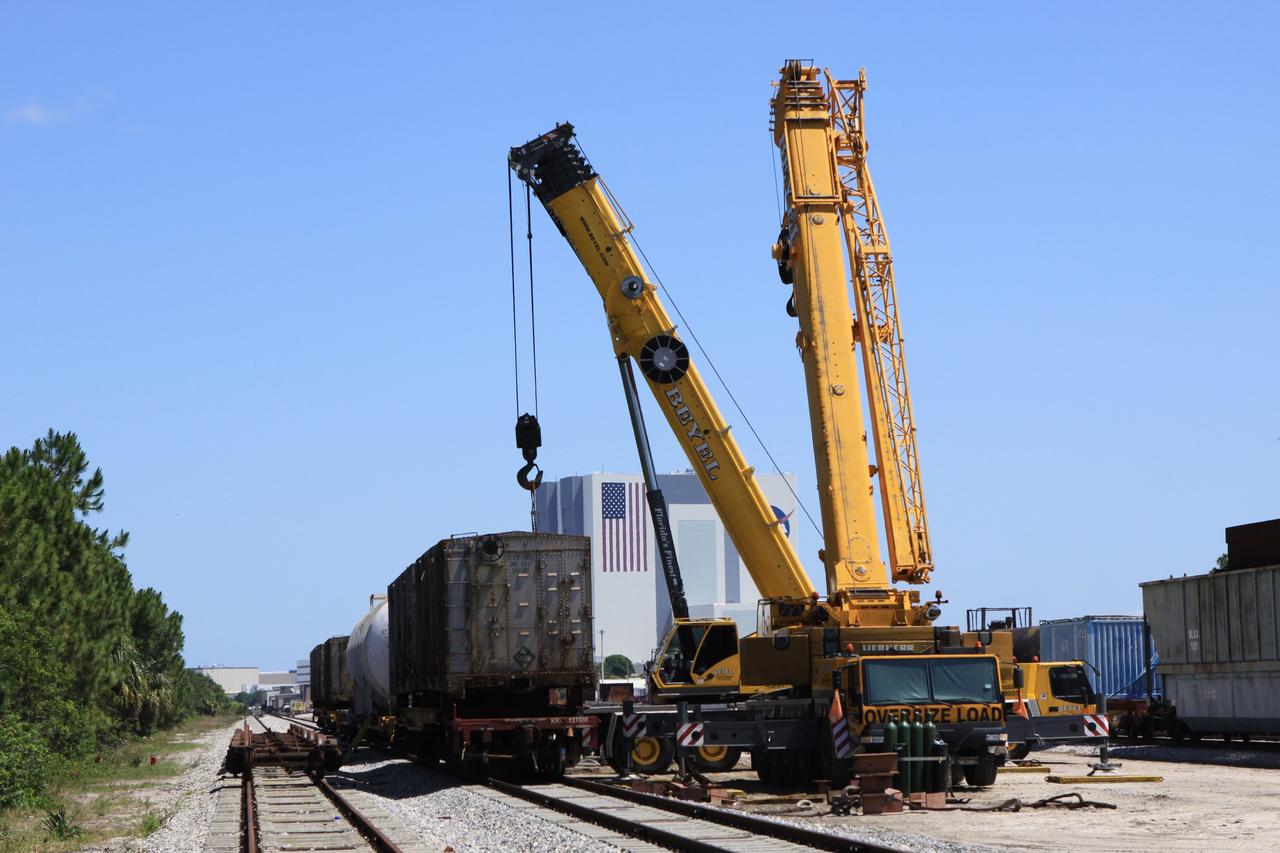
CAPE CANAVERAL, Fla. – At the NASA Railroad yard at Kennedy Space Center in Florida, helium tank cars are lifted from their trucks onto flat cars in preparation for a journey to the Florida East Coast Railway interchange in Titusville, Fla., where the train’s tank cars will be transferred for delivery to the SpaceX engine test complex outside McGregor, Texas. The railroad cars were needed in support of the Space Shuttle Program but currently are not in use by NASA following the completion of the program in 2011. Originally, the tankers belonged to the U.S. Bureau of Mines. At the peak of the shuttle program, there were approximately 30 cars in the fleet. About half the cars were returned to the bureau as launch activity diminished. Five tank cars are being loaned to SpaceX and repurposed to support their engine tests in Texas. Eight cars previously were shipped to California on loan to support the SpaceX Falcon 9 rocket launches from Space Launch Complex-4 on Vandenberg Air Force Base. SpaceX already has three helium tank cars previously used for the shuttle program at Space Launch Complex-40 on Cape Canaveral Air Force Station in Florida. For more information, visit http://www.nasa.gov/spacex. Photo credit: NASA/Jim Grossmann
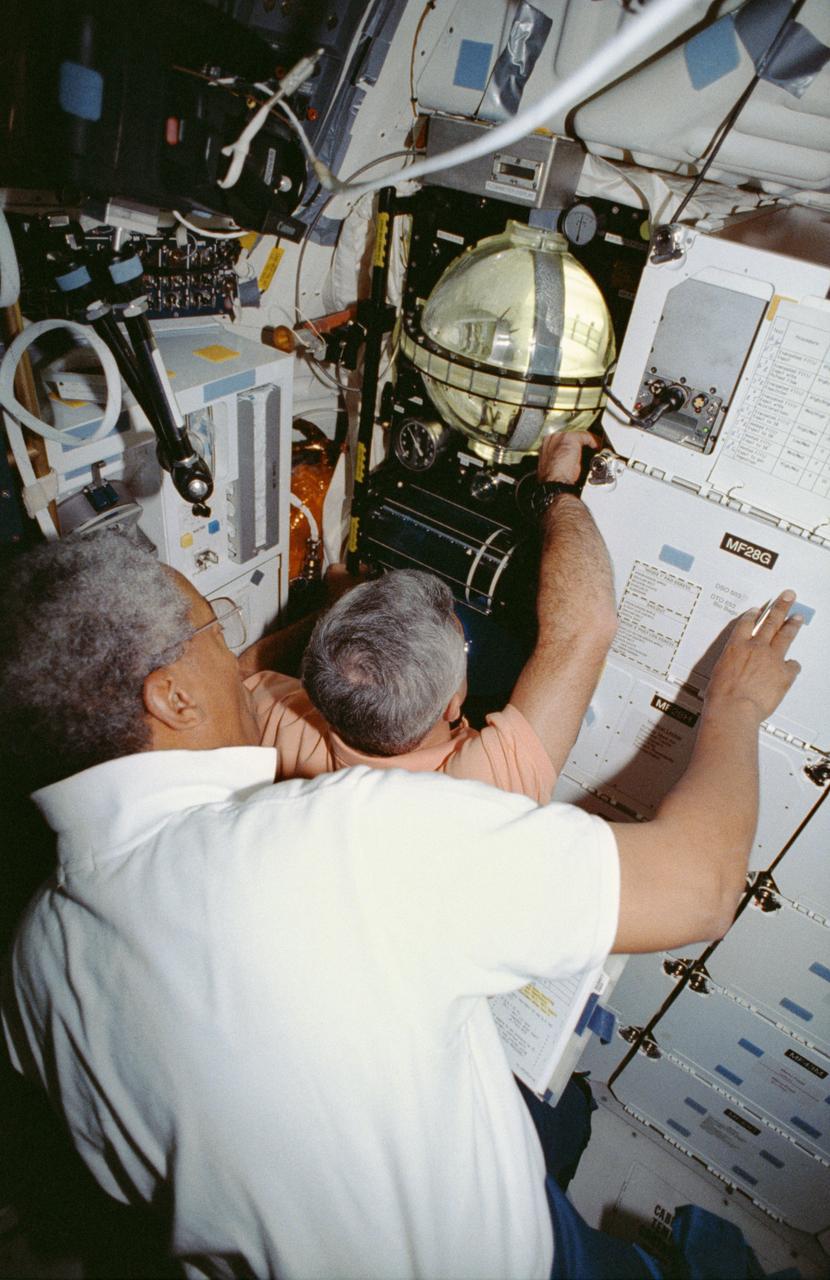
STS053-04-018 (2-9 Dec 1992) --- Astronauts Guion S. Bluford (left) and Michael R. U. (Rich) Clifford monitor the Fluid Acquisition and Resupply Equipment (FARE) onboard the Space Shuttle Discovery. Clearly visible in the mid-deck FARE setup is one of two 12.5-inch spherical tanks made of transparent acrylic, one to supply and one to receive fluids. The purpose of FARE is to investigate the dynamics of fluid transfer in microgravity and develop methods for transferring vapor-free propellants and other liquids that must be replenished in long-term space systems like satellites, Extended-Duration Orbiters (EDO), and Space Station Freedom. Eight times over an eight-hour test period, the mission specialists conducted the FARE experiment. A sequence of manual valve operations caused pressurized air from the bottles to force fluids from the supply tank to the receiver tank and back again to the supply tank. Baffles in the receiver tank controlled fluid motion during transfer, a fine-mesh screen filtered vapor from the fluid, and the overboard vent removed vapor from the receiver tank as the liquid rose. FARE is managed by NASA's Marshall Space Flight Center (MSFC) in Alabama. The basic equipment was developed by Martin Marietta for the Storable Fluid Management Demonstration. Susan L. Driscoll is the principal investigator.
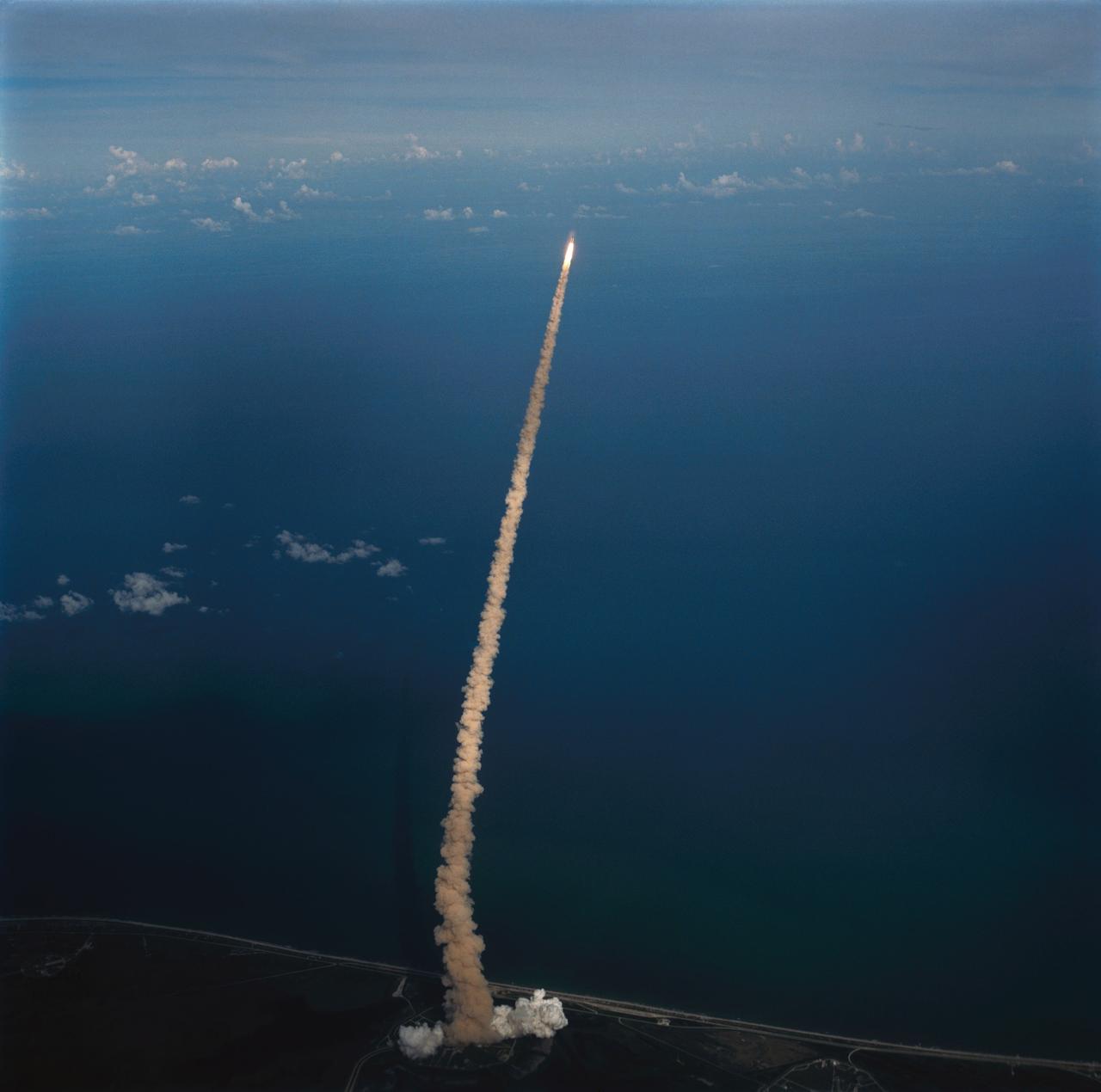
51F-S-038 (29 July 1985) ---An air-to-air view of the Space Shuttle orbiter Challenger, its two solid rocket boosters and external fuel tank moments after launch from Pad 39A at Kennedy Space Center (KSC). Astronaut John W. Young, veteran of two Shuttle flights and four other NASA missions, took the photograph with a handheld camera while piloting the Shuttle training aircraft. Launch occured at 5:00:00:423 p.m. (EDT), July 29, 1985.

The Ultra 500 Series golf balls, introduced in 1995 by Wilson Sporting Goods Company, has 500 dimples arranged in a pattern of 60 spherical triangles. The design employs NASA's aerodynamics technology analysis of air loads of the tank and Shuttle orbiter that was performed under the Space Shuttle External Tank program. According to Wilson, this technology provides "the most symmetrical ball surface available, sustaining initial velocity longer and producing the most stable ball flight for unmatched accuracy and distance." The dimples are in three sizes, shapes and depths mathematically positioned for the best effect. The selection of dimples and their placement optimizes the interaction of opposing forces of lift and drag. Large dimples reduce air drag, enhance lift, and maintain spin for distance. Small dimples prevent excessive lift that destabilizes the ball flight and the medium size dimples blend the other two.
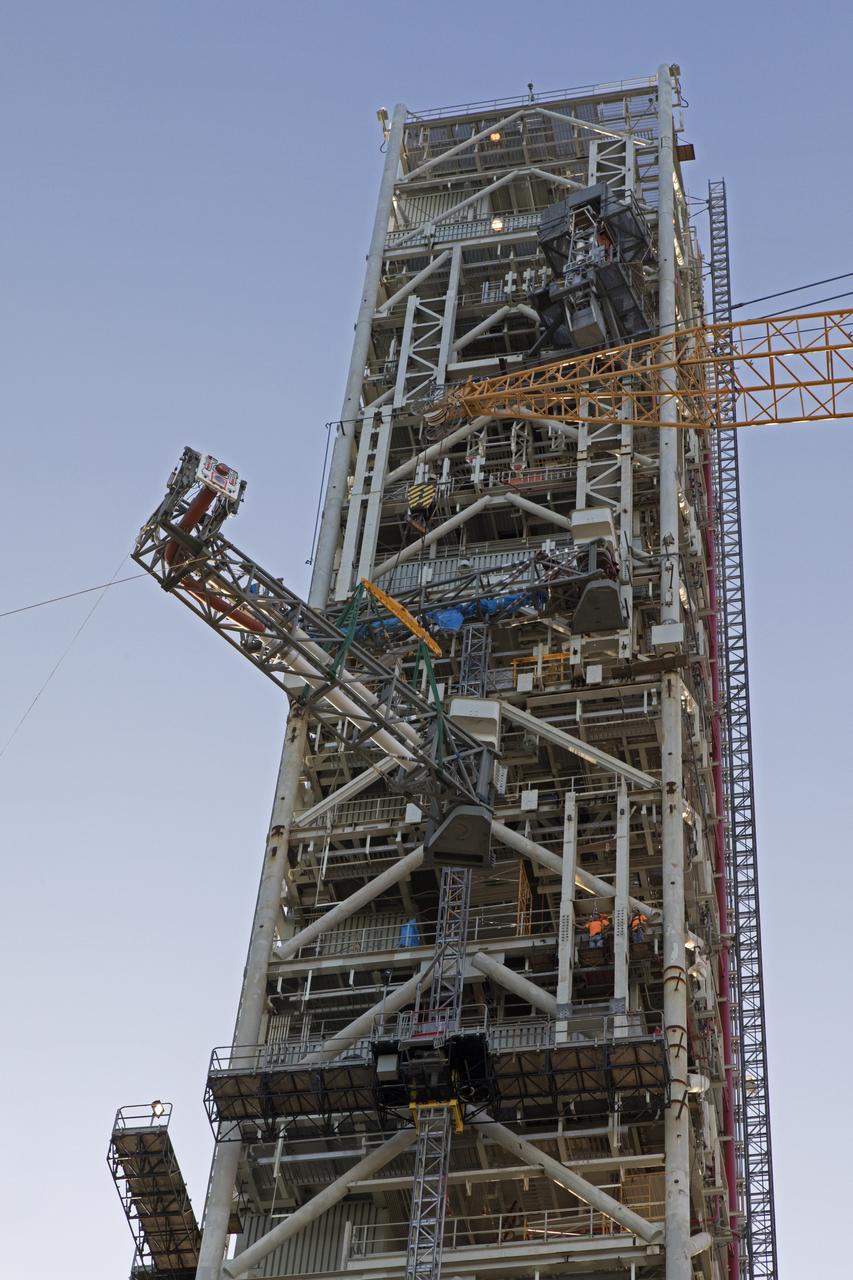
A heavy-lift crane moves the Core Stage Inter-tank Umbilical (CSITU) up to about the 140-foot level of the mobile launcher (ML) tower at NASA's Kennedy Space Center in Florida. The CSITU is moved into place for a fit check of the attachment hardware. The umbilical will be lowered down and installed permanently on the ML at a later date. The CSITU is a swing-arm umbilical that will connect to the Space Launch System core stage inter-tank. It will provide conditioned air, pressurized gases and power and data connection to the core stage. The Ground Systems Development and Operations Program is overseeing installation of the umbilicals.
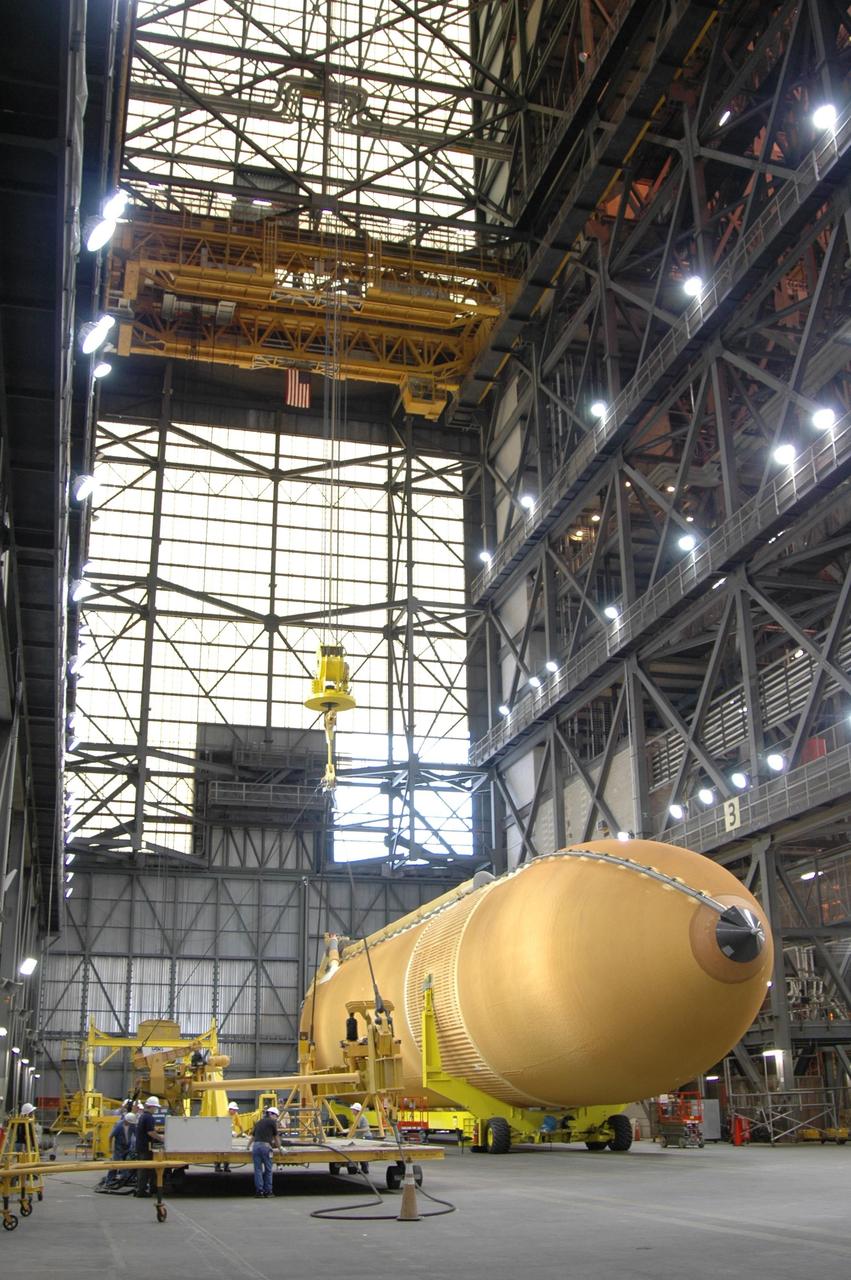
KENNEDY SPACE CENTER, FLA. - External tank No. 118 waits in the Vehicle Assembly Building for a crane to be attached that will raise it to vertical and lifted into high bay 3 for mating with solid rocket boosters stacked there. The tank is designated to fly on mission STS-115 with Atlantis. It will fly with many major safety changes, including the removal of the protuberance air load ramps. The mission will deliver the second port truss segment, the P3/P4 Truss, to attach to the first port truss segment, the P1 Truss, as well as deploy solar array set 2A and 4A. Launch of Space Shuttle Atlantis is scheduled for late August. Photo credit: NASA/Jim Grossmann
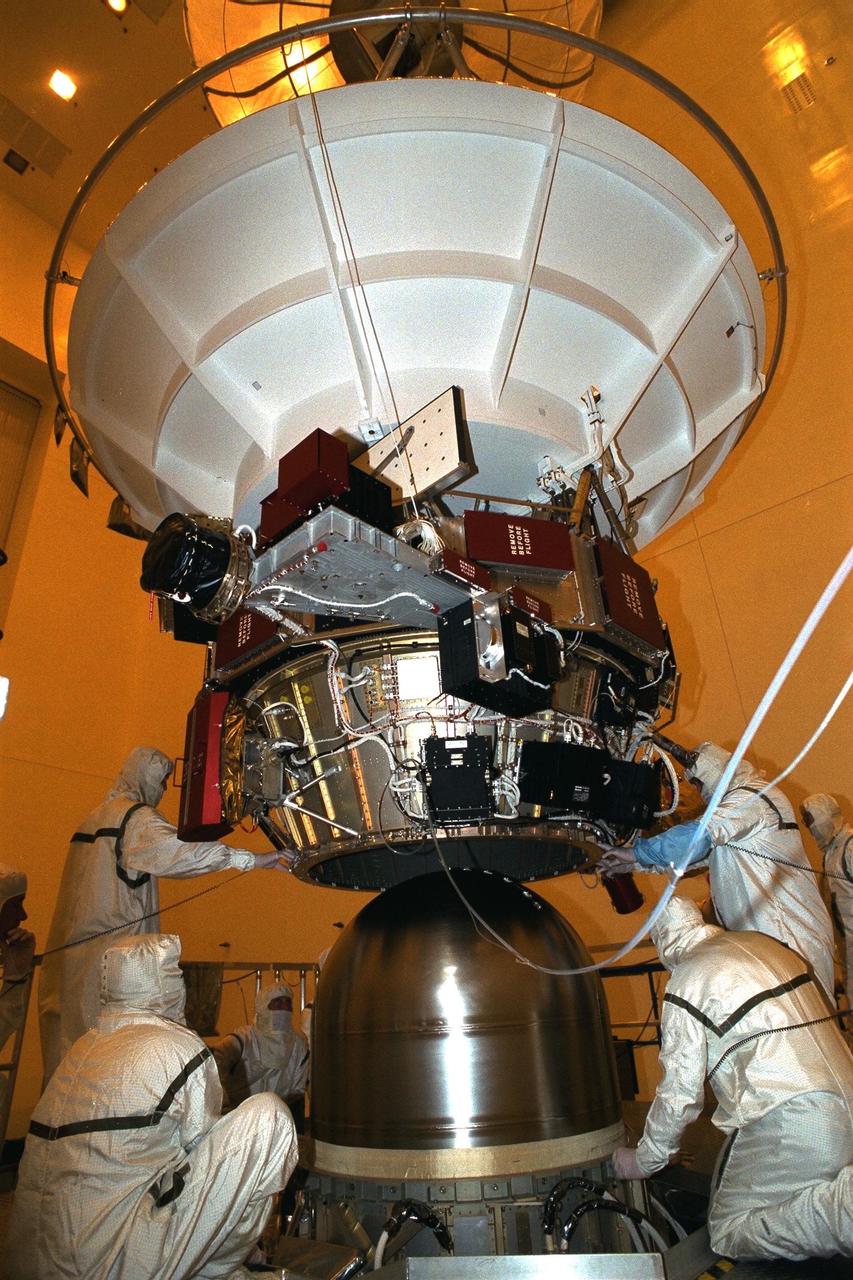
Technicians from the Jet Propulsion Laboratory (JPL) lower the upper equipment module over a propellant tank in the Payload Hazardous Servicing Facility at KSC in July prior to installation on the Cassini orbiter. A four-year, close-up study of the Saturnian system, the Cassini mission is scheduled for launch from Cape Canaveral Air Station in October 1997. The propellant tank will assist with guidance of the orbiter and power during the spacecraft’s voyage and in-orbit periods. It will take seven years for the spacecraft to reach Saturn. Scientific instruments carried aboard the spacecraft will study Saturn’s atmosphere, magnetic field, rings, and several moons. JPL is managing the Cassini project for NASA
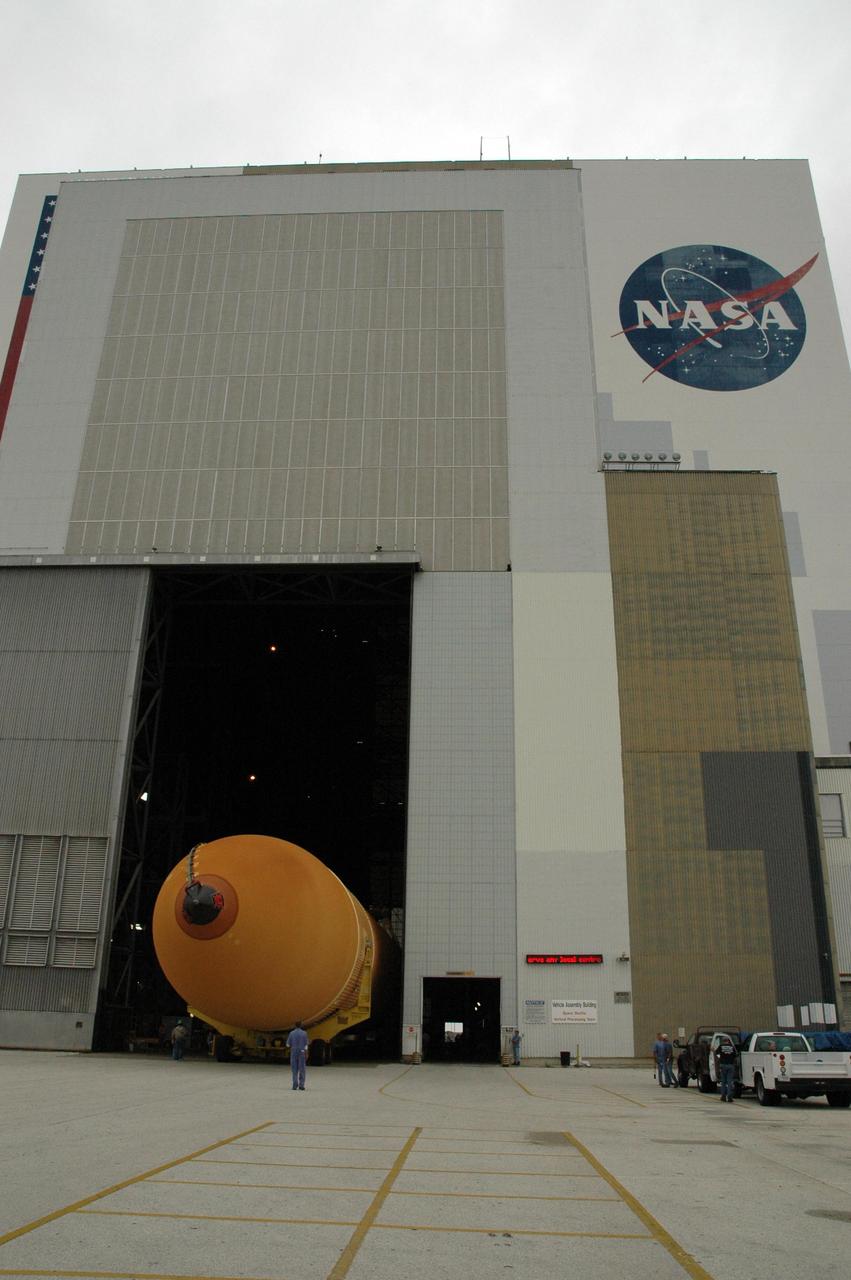
KENNEDY SPACE CENTER, FLA. - External tank No. 123 moves into the Vehicle Assembly Building where it will be lifted into a checkout cell for further work. Shipped from NASA's Michoud Assembly Facility in New Orleans aboard the Pegasus barge, the tank has undergone major safety changes, including removal of the protuberance air load ramps. It is designated to launch Space Shuttle Discovery on mission STS-116 in December. Mission STS-116 will deliver the P5 truss segment, a SPACEHAB module and other key components to the International Space Station. Launch is currently scheduled no earlier than Dec. 14. Photo credit: NASA/Jack Pfaller
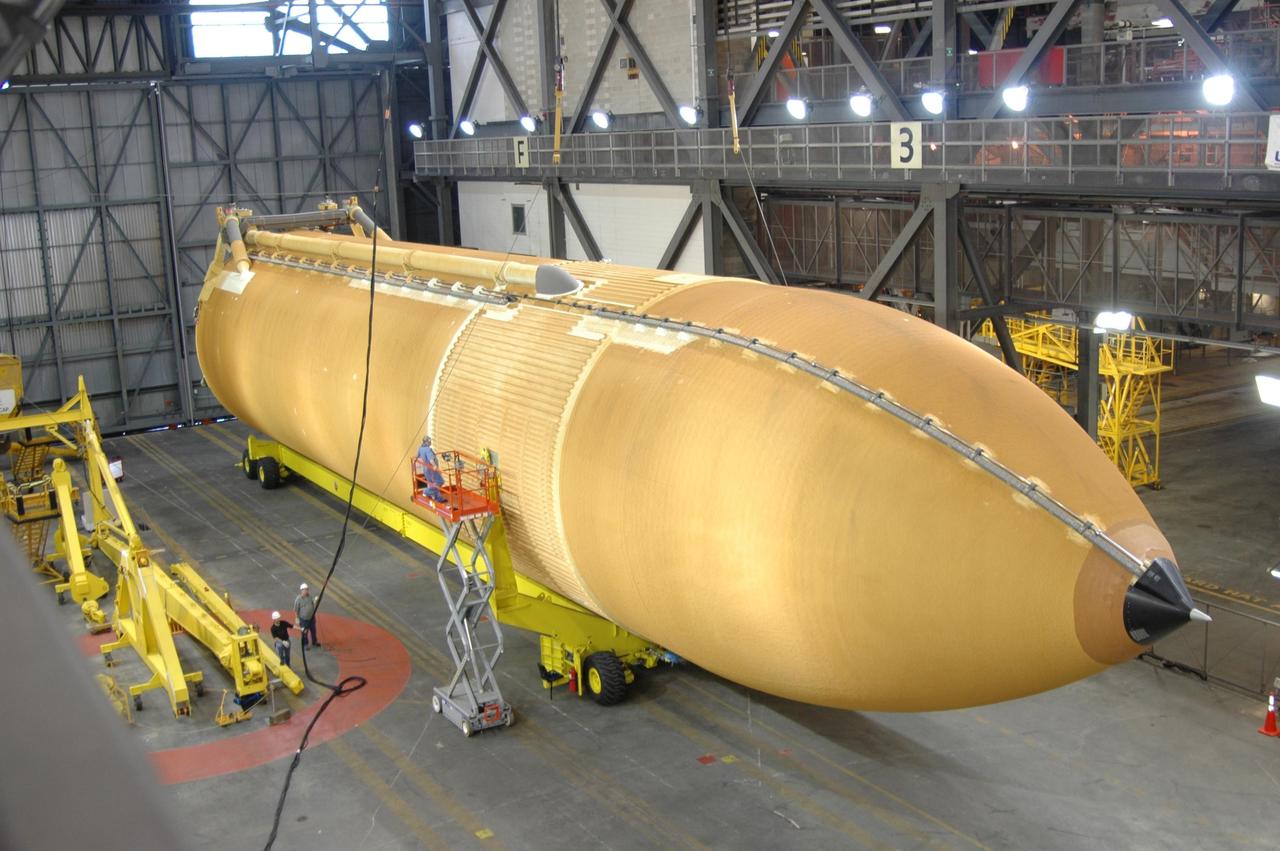
KENNEDY SPACE CENTER, FLA. - Workers in the Vehicle Assembly Building attach a crane to external tank No. 118 in order to raise it vertical and lift it into high bay 3 for mating with solid rocket boosters stacked there. The tank is designated to fly on mission STS-115 with Atlantis. It will fly with many major safety changes, including the removal of the protuberance air load ramps. The mission will deliver the second port truss segment, the P3/P4 Truss, to attach to the first port truss segment, the P1 Truss, as well as deploy solar array set 2A and 4A. Launch of Space Shuttle Atlantis is scheduled for late August. Photo credit: NASA/Jim Grossmann
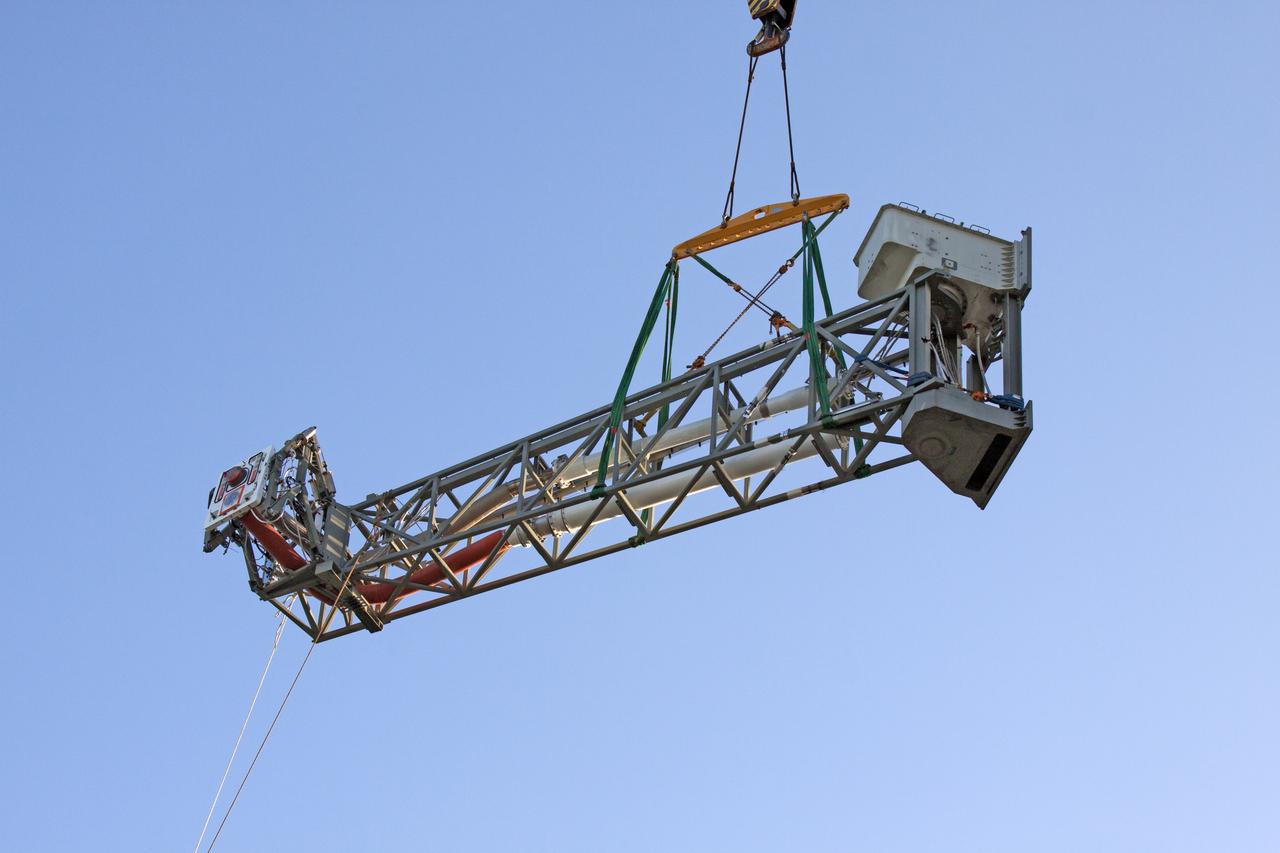
Seeming to hang in midair, the Core Stage Inter-tank Umbilical (CSITU) is lifted by crane and rigging up to about the 140-foot level of the mobile launcher (ML) tower at NASA's Kennedy Space Center in Florida. The CSITU will be moved into place for a fit check of the attachment hardware. The umbilical will be lowered down and installed permanently on the ML at a later date. The CSITU is a swing-arm umbilical that will connect to the Space Launch System core stage inter-tank. It will provide conditioned air, pressurized gases and power and data connection to the core stage. The Ground Systems Development and Operations Program is overseeing installation of the umbilicals.

A heavy-lift crane and rigging are used to lift the Core Stage Inter-tank Umbilical (CSITU) up to about the 140-foot level of the mobile launcher (ML) tower at NASA's Kennedy Space Center in Florida. The CSITU will be moved into place for a fit check of the attachment hardware. The umbilical will be lowered down and installed permanently on the ML at a later date. The CSITU is a swing-arm umbilical that will connect to the Space Launch System core stage inter-tank. It will provide conditioned air, pressurized gases and power and data connection to the core stage. The Ground Systems Development and Operations Program is overseeing installation of the umbilicals.
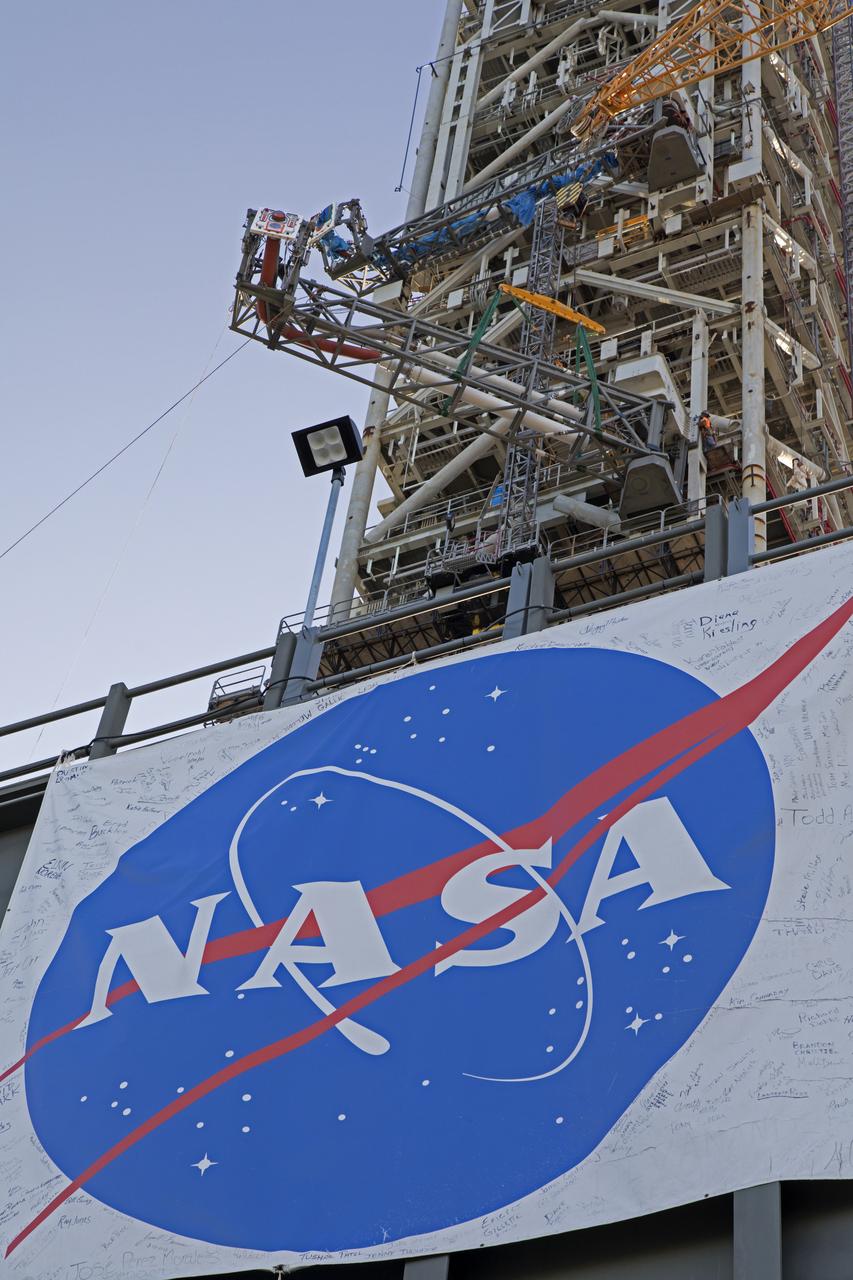
A heavy-lift crane moves the Core Stage Inter-tank Umbilical (CSITU) up to about the 140-foot level of the mobile launcher (ML) tower at NASA's Kennedy Space Center in Florida. The CSITU is moved into place for a fit check of the attachment hardware. The umbilical will be lowered down and installed permanently on the ML at a later date. The CSITU is a swing-arm umbilical that will connect to the Space Launch System core stage inter-tank. It will provide conditioned air, pressurized gases and power and data connection to the core stage. The Ground Systems Development and Operations Program is overseeing installation of the umbilicals.
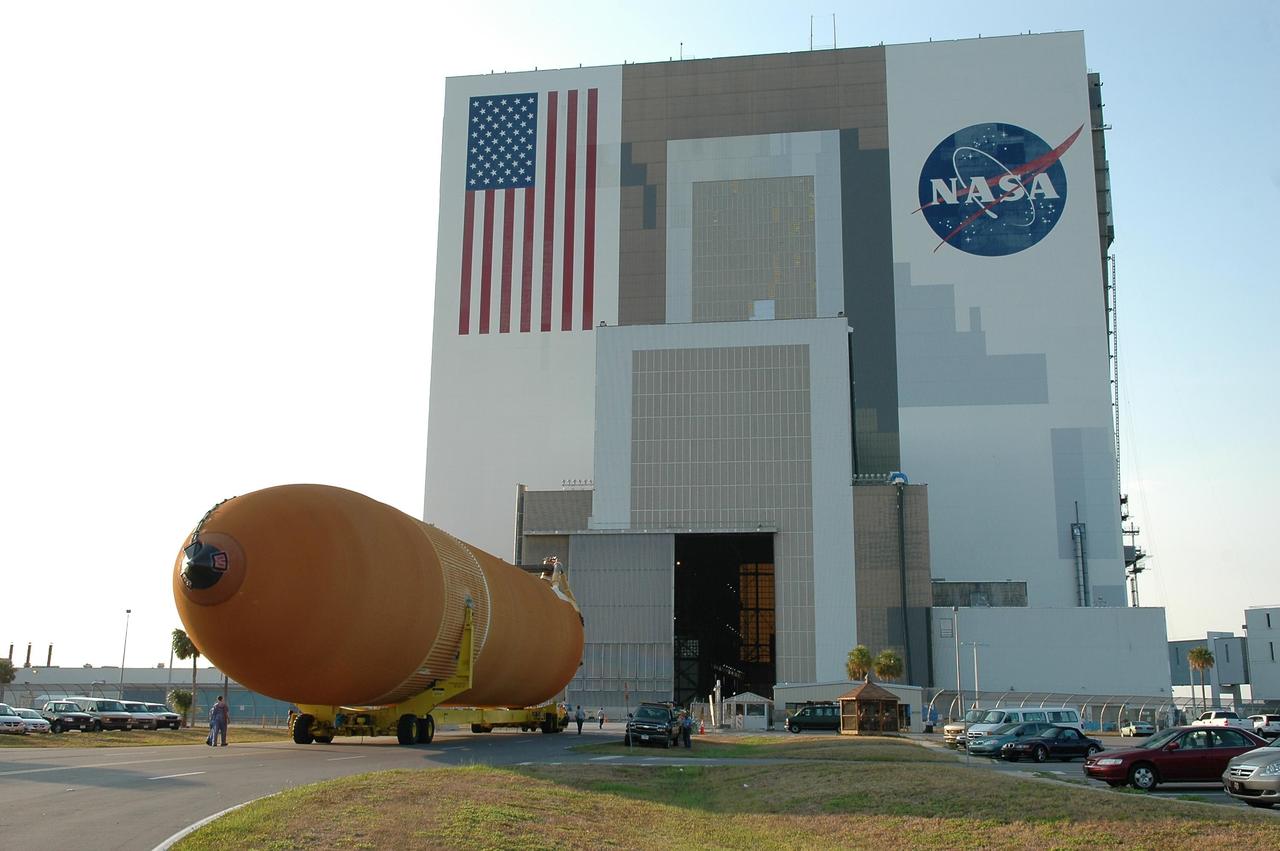
KENNEDY SPACE CENTER, FLA. - The redesigned external fuel tank, designated ET-118, rolls toward the open door of the Vehicle Assembly Building. Inside, it will be lifted into a checkout cell for further work . The tank arrived at KSC aboard the Pegasus barge after a journey from the Michoud Assembly Facility in New Orleans. ET-118, which will fly with many major safety changes, including the removal of the protuberance air load ramps, will launch Space Shuttle Atlantis on the next space shuttle mission, STS-115. Photo credit: NASA/Kim Shiflett
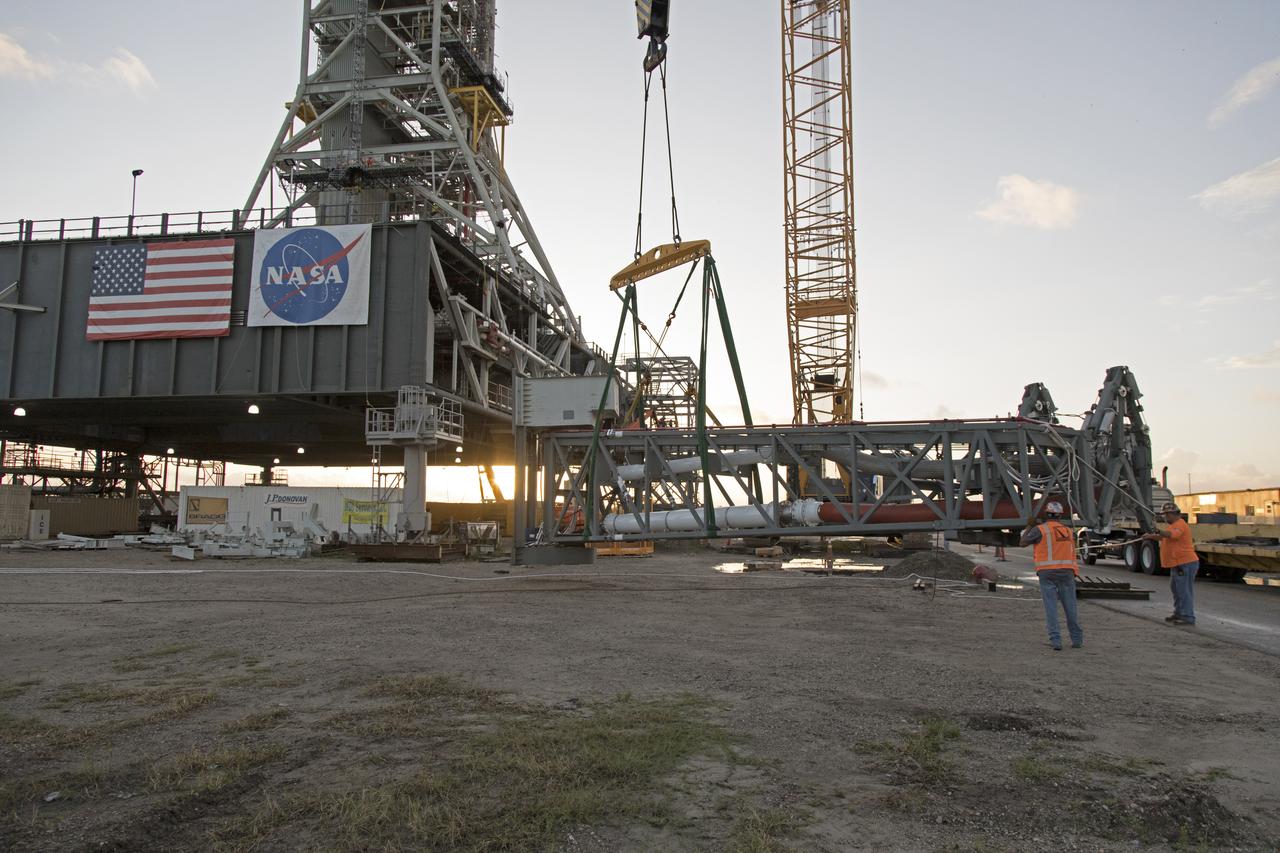
A heavy-lift crane has been attached to the Core Stage Inter-tank Umbilical (CSITU) to lift it up from a flatbed truck near the Vehicle Assembly Building at NASA's Kennedy Space Center in Florida. The CSITU will be lifted up to about the 140-foot level of the mobile launcher (ML) tower for a fit check of the attachment hardware. It will be lowered down and installed permanently on the ML at a later date. The CSITU is a swing-arm umbilical that will connect to the Space Launch System core stage inter-tank. It will provide conditioned air, pressurized gases and power and data connection to the core stage. The Ground Systems Development and Operations Program is overseeing installation of the umbilicals.
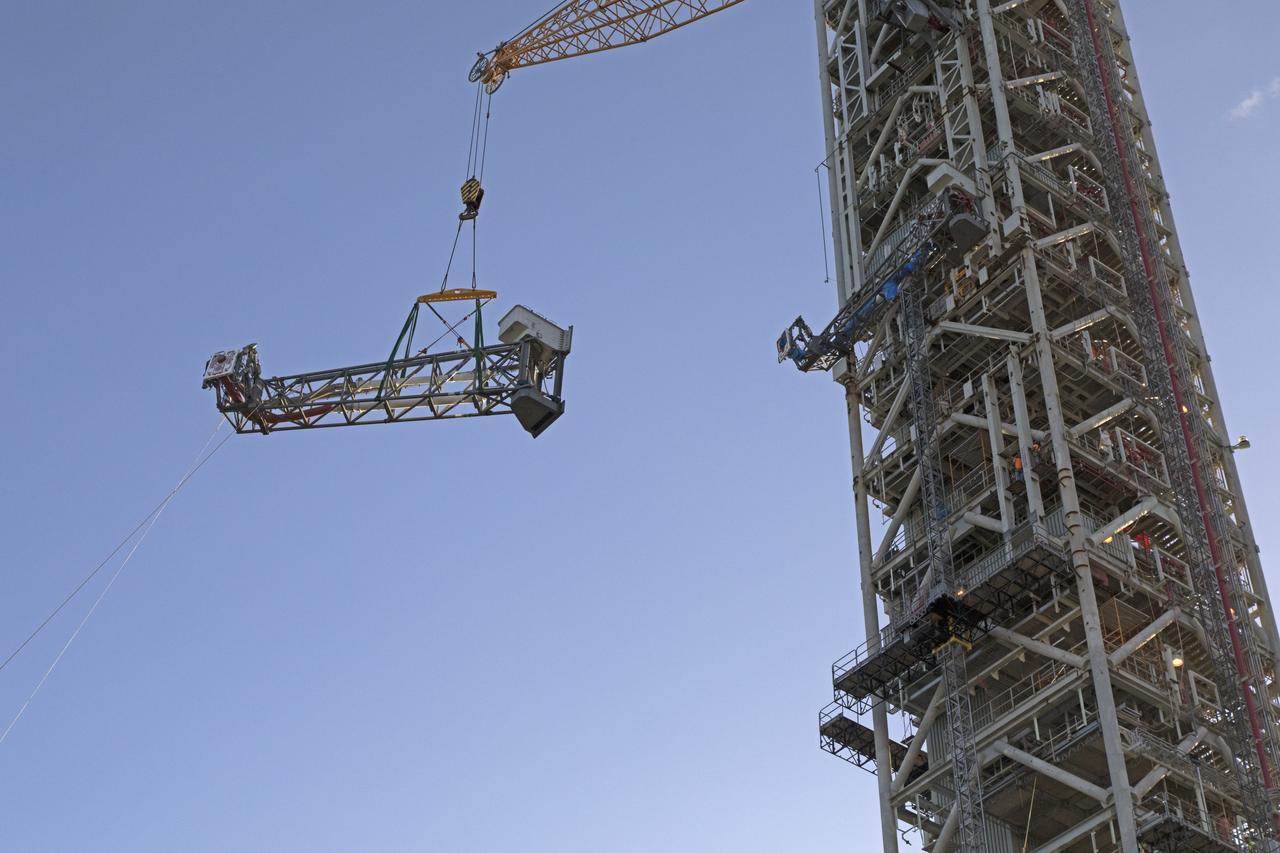
A heavy-lift crane and rigging are used to lift the Core Stage Inter-tank Umbilical (CSITU) up to about the 140-foot level of the mobile launcher (ML) tower at NASA's Kennedy Space Center in Florida. The CSITU will be moved into place for a fit check of the attachment hardware. The umbilical will be lowered down and installed permanently on the ML at a later date. The CSITU is a swing-arm umbilical that will connect to the Space Launch System core stage inter-tank. It will provide conditioned air, pressurized gases and power and data connection to the core stage. The Ground Systems Development and Operations Program is overseeing installation of the umbilicals.
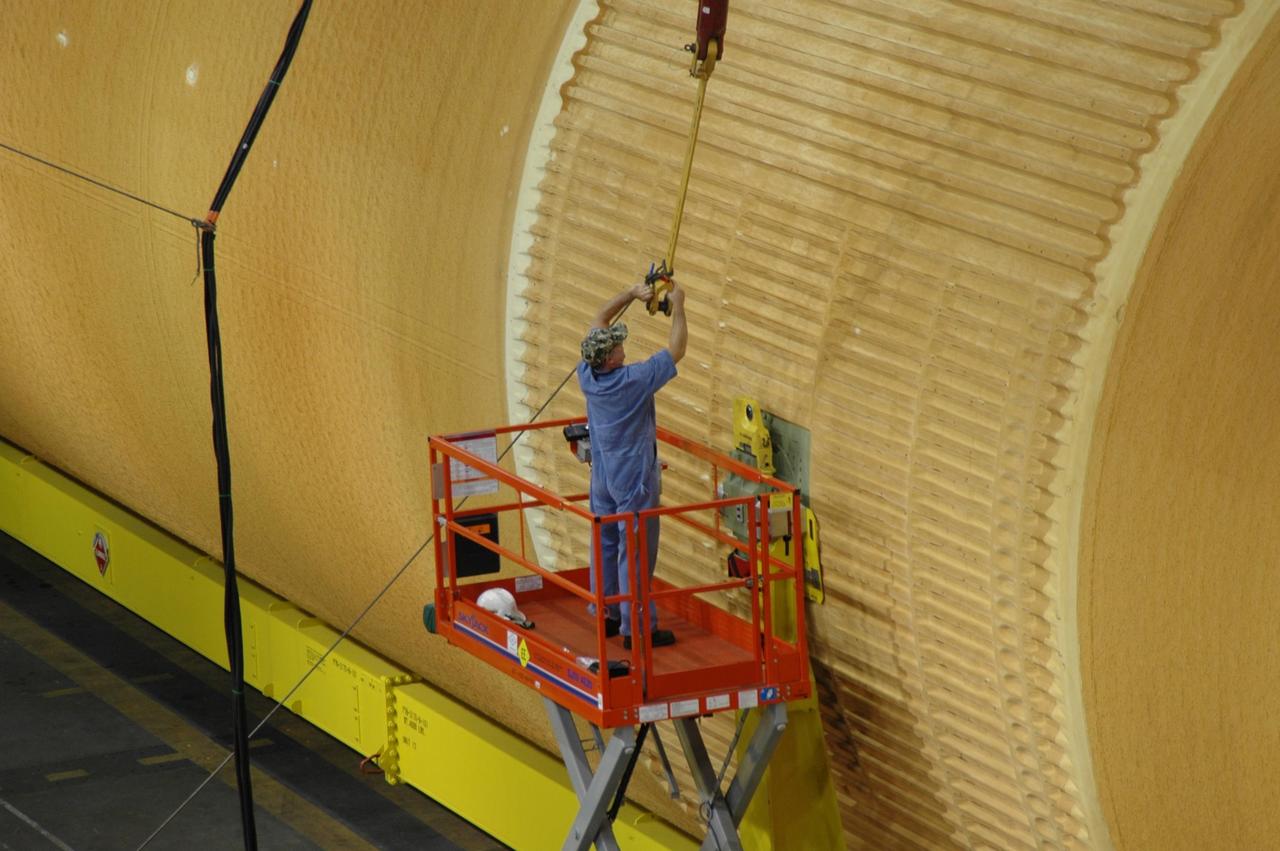
KENNEDY SPACE CENTER, FLA. - A worker in the Vehicle Assembly Building attaches a crane to external tank No. 118 in order to raise it vertical and lift it into high bay 3 for mating with solid rocket boosters stacked there. The tank is designated to fly on mission STS-115 with Atlantis. It will fly with many major safety changes, including the removal of the protuberance air load ramps. The mission will deliver the second port truss segment, the P3/P4 Truss, to attach to the first port truss segment, the P1 Truss, as well as deploy solar array set 2A and 4A. Launch of Space Shuttle Atlantis is scheduled for late August. Photo credit: NASA/Jim Grossmann
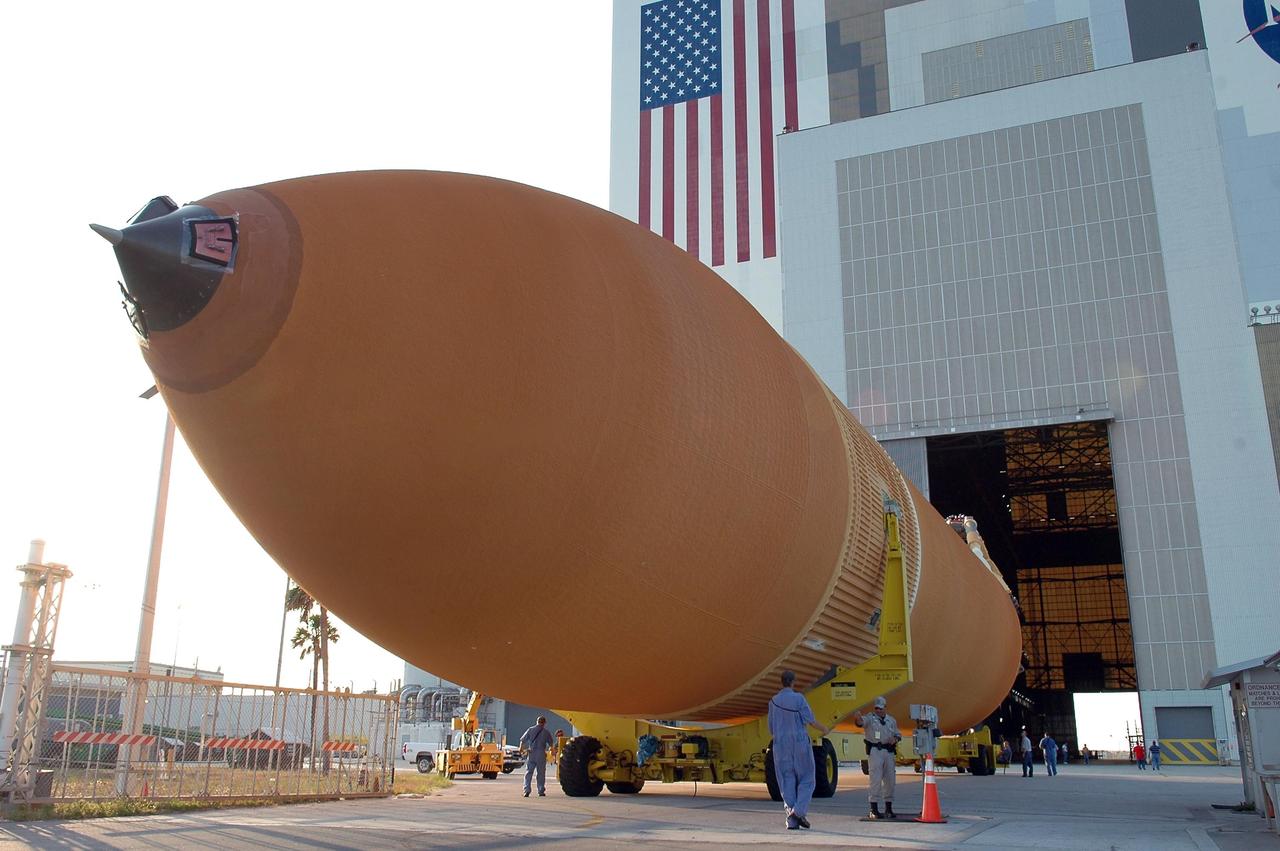
KENNEDY SPACE CENTER, FLA. - The redesigned external fuel tank, designated ET-118, rolls into the open door of the Vehicle Assembly Building. Inside, it will be lifted into a checkout cell for further work . The tank arrived at KSC aboard the Pegasus barge after a journey from the Michoud Assembly Facility in New Orleans. ET-118, which will fly with many major safety changes, including the removal of the protuberance air load ramps, will launch Space Shuttle Atlantis on the next space shuttle mission, STS-115. Photo credit: NASA/Kim Shiflett
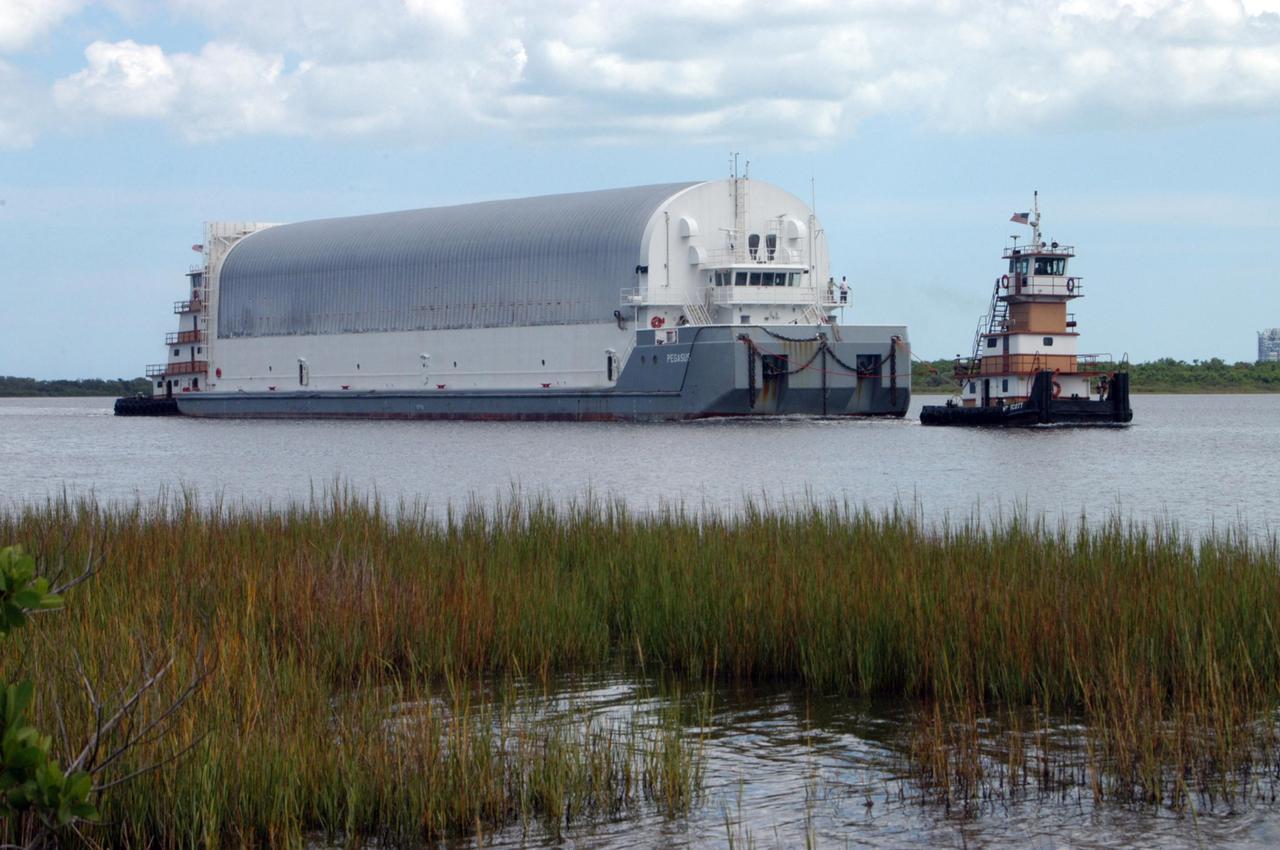
KENNEDY SPACE CENTER, FLA. - The Pegasus barge is towed toward the turn basin dock in the Launch Complex 39 Area at NASA's Kennedy Space Center. Onboard the barge is the external tank No. 123, designated to launch Space Shuttle Discovery on mission STS-116 in December. The tank, which was shipped from NASA's Michoud Assembly Facility in New Orleans, has undergone major safety changes, including removal of the protuberance air load ramps. Mission STS-116 will deliver the P5 truss segment, a SPACEHAB module and other key components to the International Space Station. Launch is currently scheduled no earlier than Dec. 14. Photo credit: NASA/George Shelton