Advanced Air Mobility will connect both urban dwellers and rural residents by adding a new way to travel by air. As shown in this concept art, passengers could travel from rural areas into the city quicker than by car to board a commercial airliner, access medical care or to purchase goods.
Advanced Air Mobility Makes Travel More Accessible
Several projects supporting NASA's Advanced Air Mobility, or AAM mission, are working on different elements to help make AAM a reality. The team is researching how the addition of AAM could cut traffic commutes, make travel more sustainable, and make road trips shorter. With the addition of AAM, we would be using another dimension in the sky for travel below traditional aircraft and above cars, buses, or trains below.
Advanced Air Mobility Aims to Shorten Travel Time
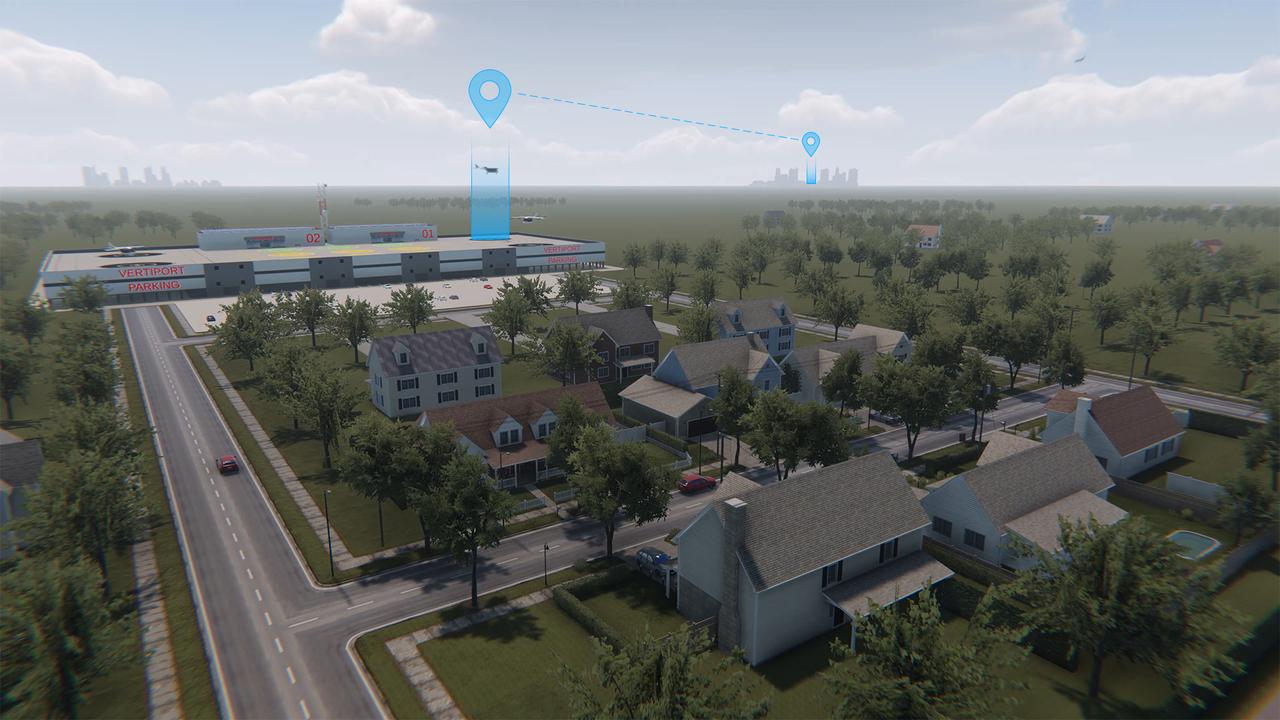
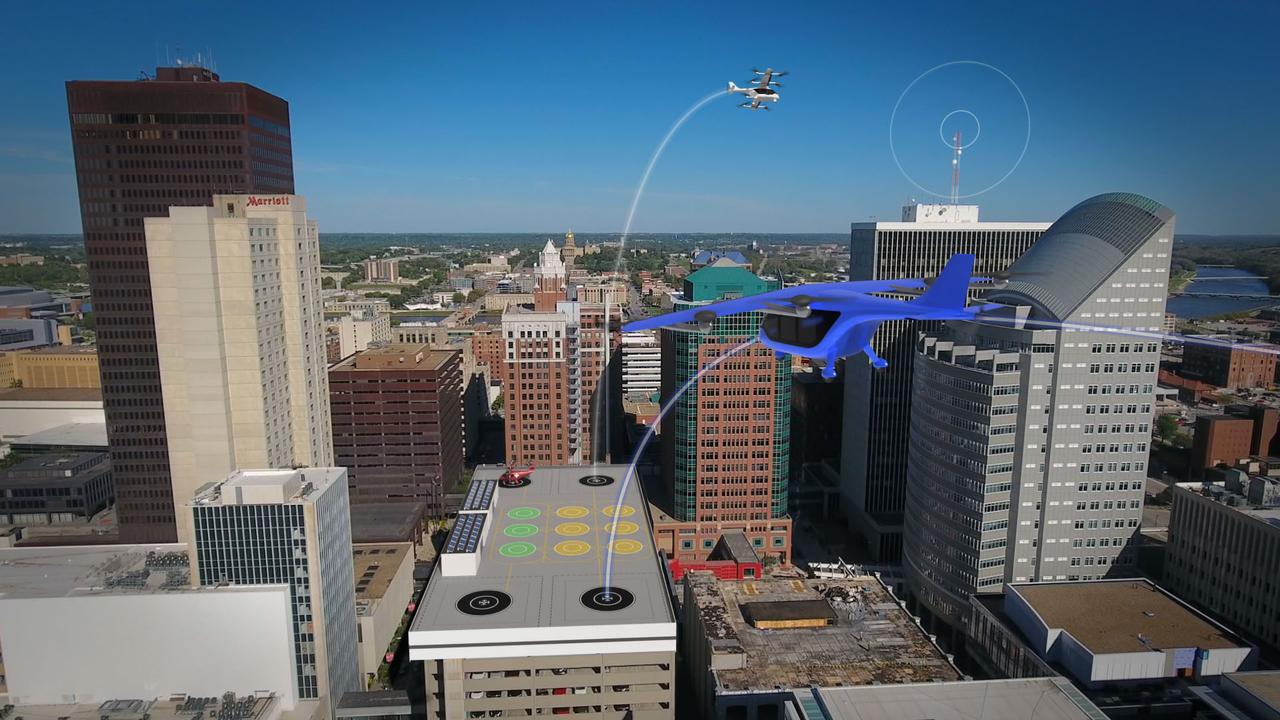
An idea for a future air taxi hovers over a municipal vertiport in this NASA illustration. Experts from NASA’s Advanced Air Mobility mission have signed agreements with four states and one city to host a series of workshops that will help local governments prepare their transportation plans to include this new form of air travel.
vertiport_CU_rev3
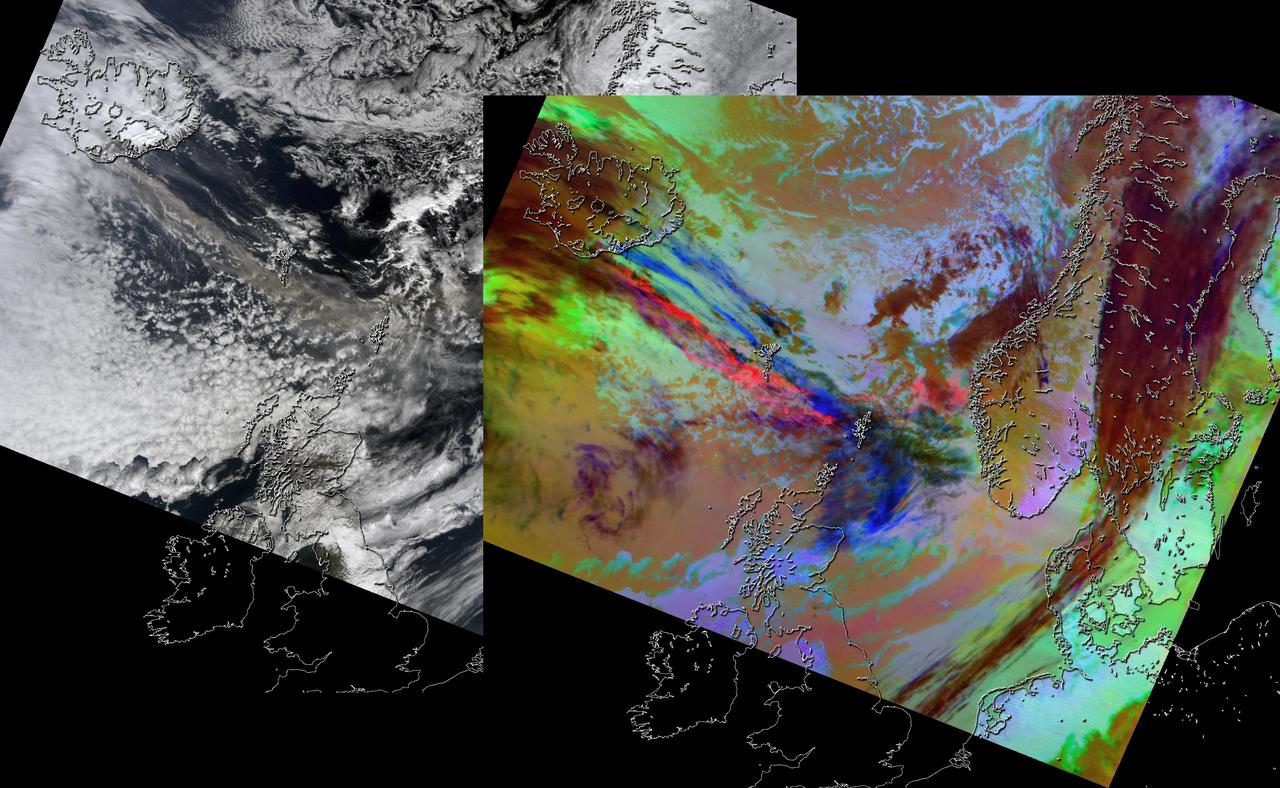
On April 15, 2010, NASA Terra spacecraft captured these images of the ongoing eruption of Iceland Eyjafjallajökull Volcano, which continues to spew ash into the atmosphere and impact air travel worldwide.
NASA Satellite Images Provide Insights Into Iceland Volcanic Plume
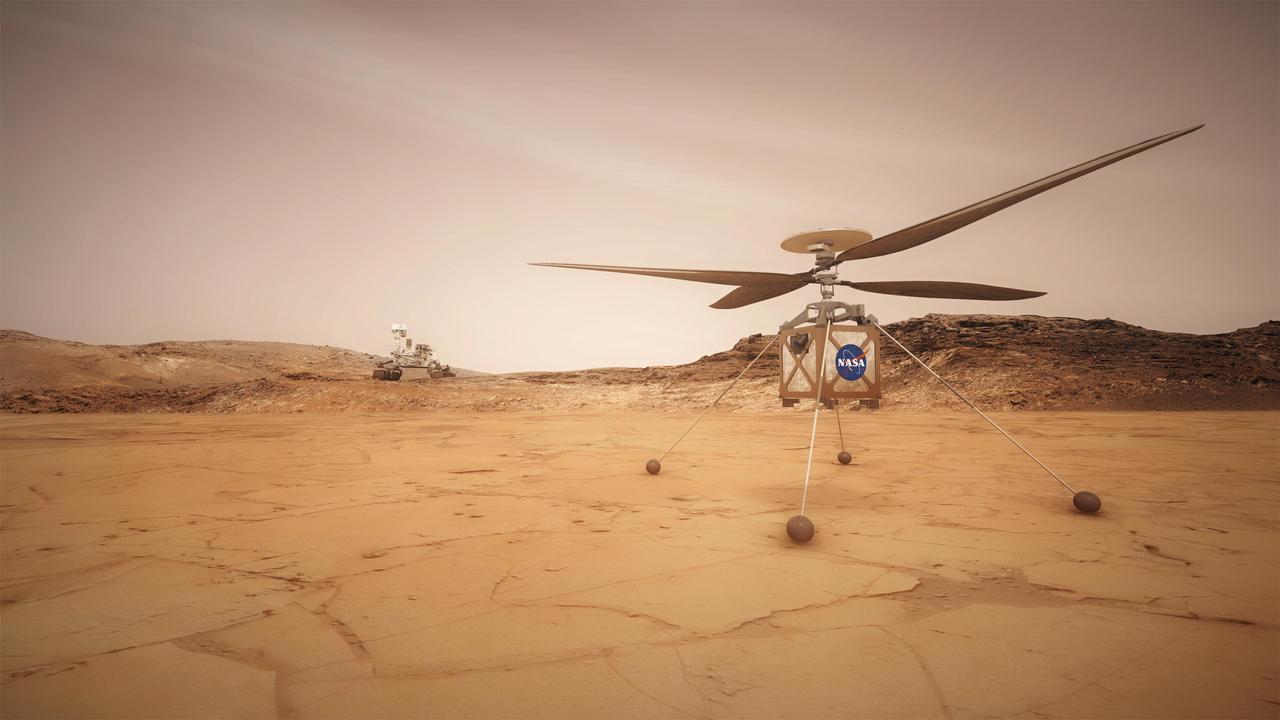
This artist concept shows the Mars Helicopter, a small, autonomous rotorcraft, which will travel with NASA's Mars 2020 rover mission, currently scheduled to launch in July 2020, to demonstrate the viability and potential of heavier-than-air vehicles on the Red Planet.  https://photojournal.jpl.nasa.gov/catalog/PIA22460
Mars Helicopter (Artist's Concept)
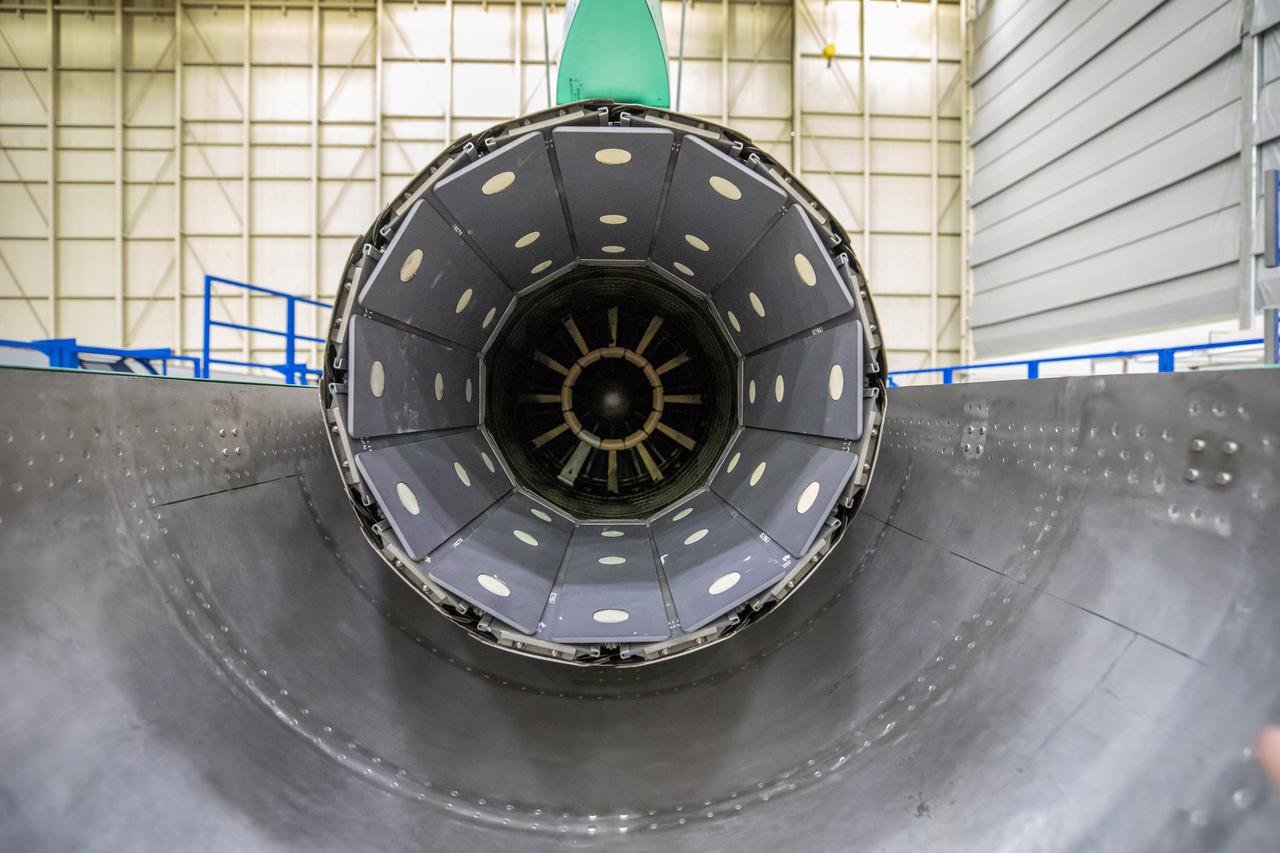
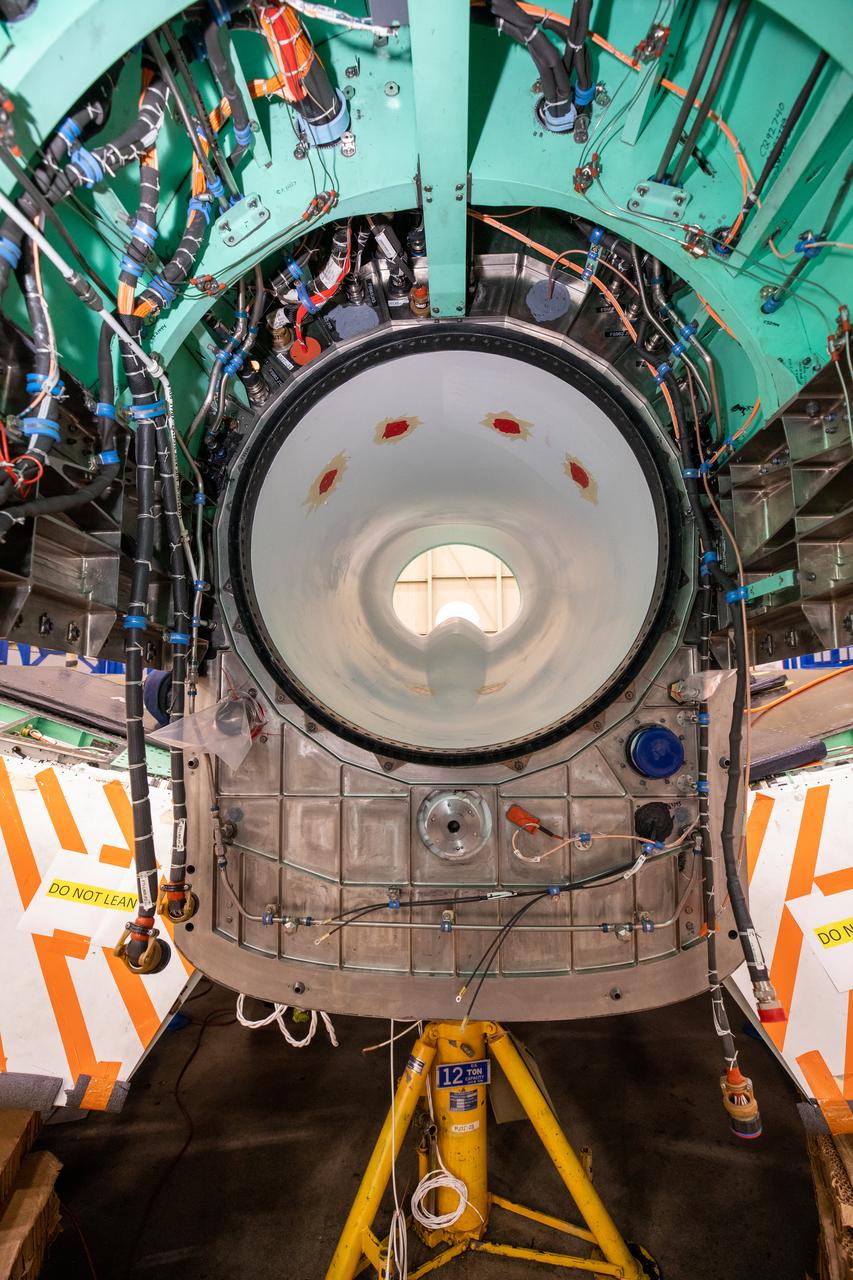
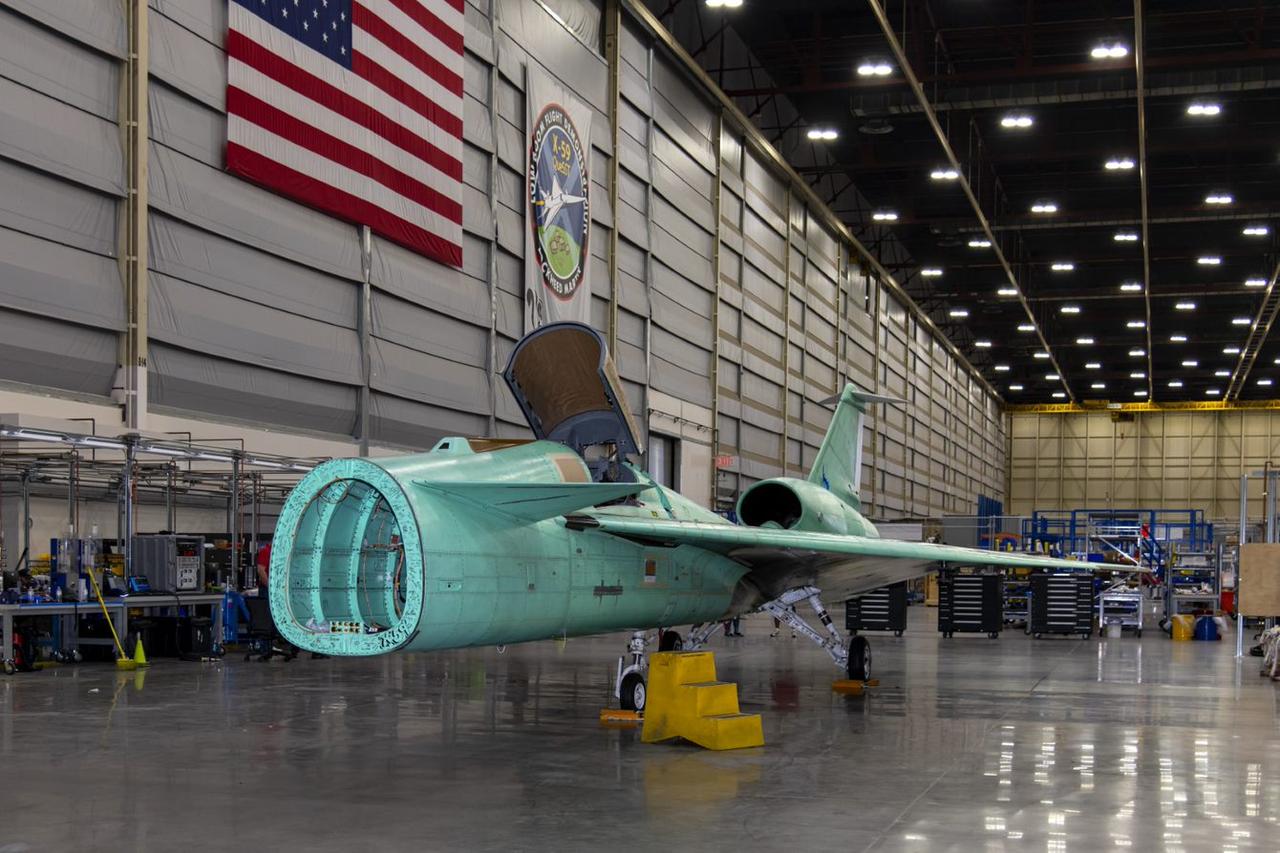
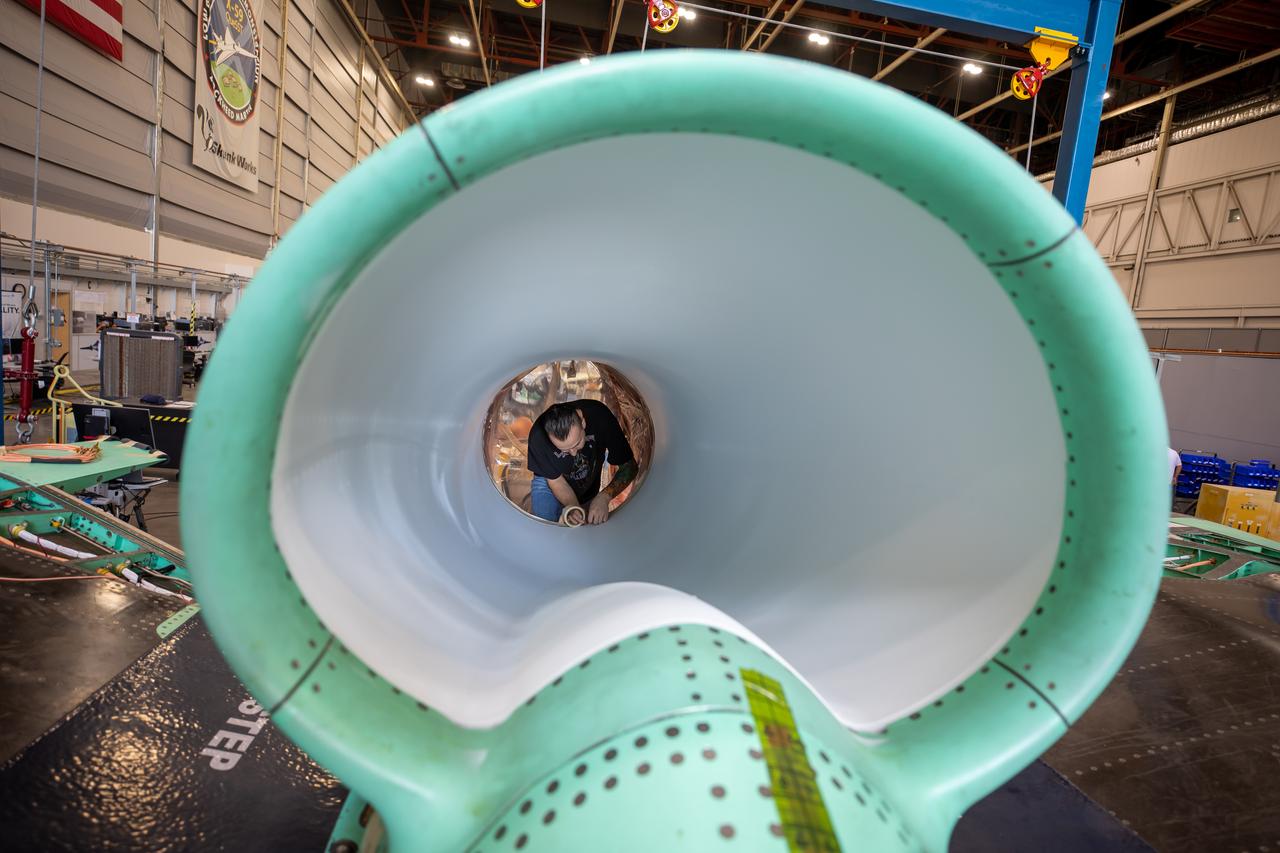
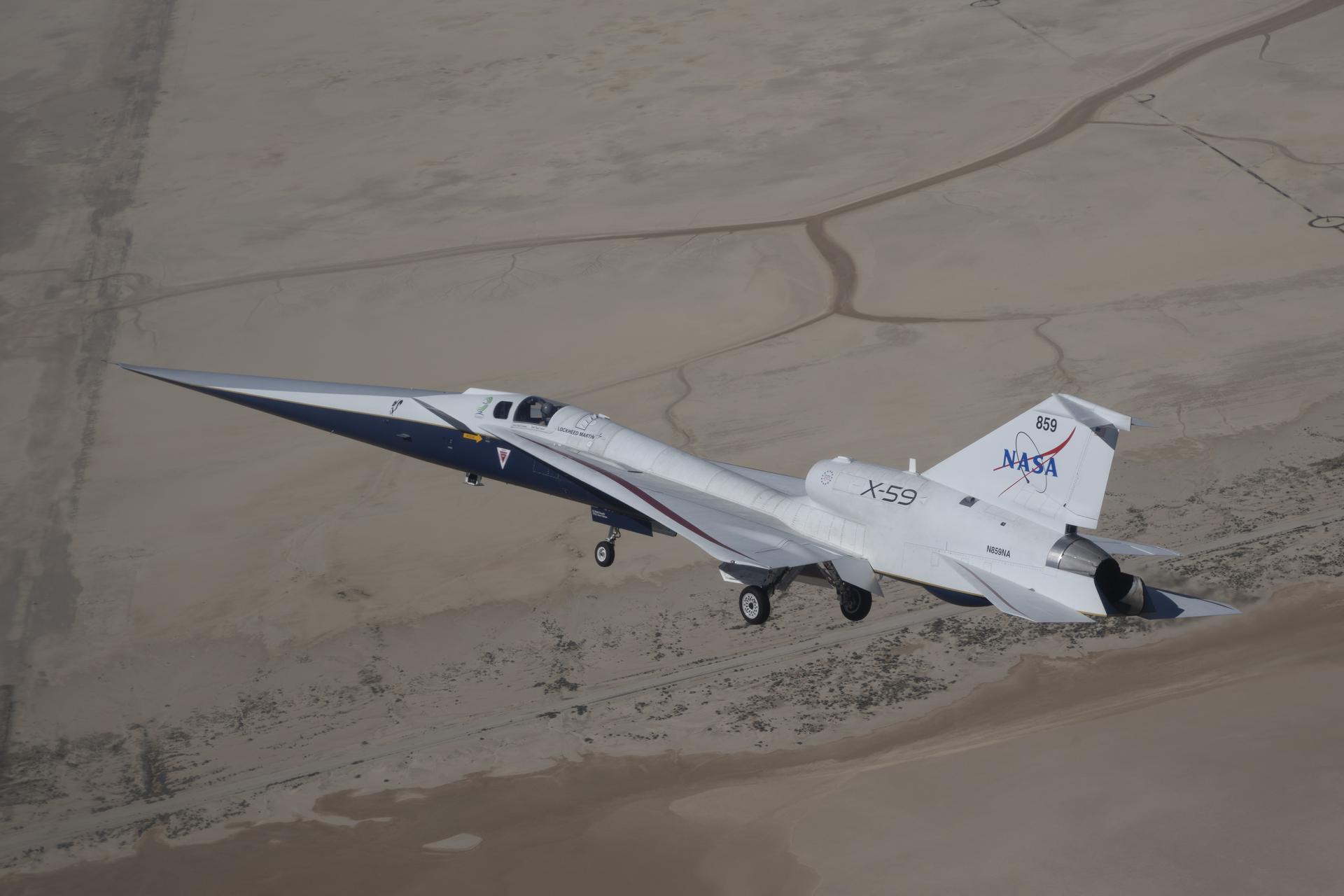
A look at the X-59’s engine nozzle, where the thrust -the force that moves the aircraft- will exit.  Once complete, the X-59 is designed to fly supersonic while reducing the loud sonic boom. The Quesst mission could help change the rules for commercial supersonic air travel over land.
Engine Nozzle of NASA’s X-59
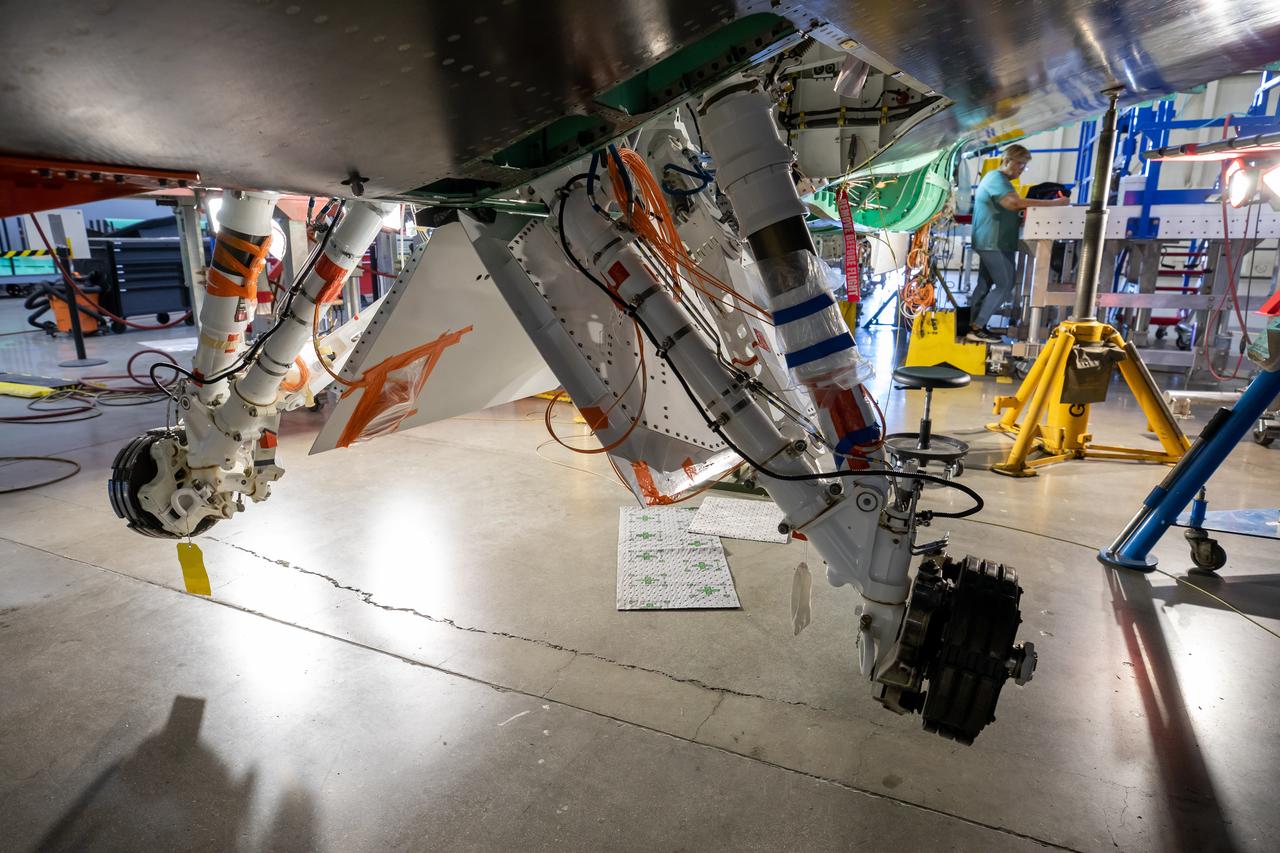
The Quesst team has repurposed the landing gear from an F-16 Fighting Falcon aircraft and is working on adjusting the fit onto the X-59 airplane. This is part of NASA’s Quesst mission which plans to help enable commercial supersonic air travel over land.
Landing Gear, XVS Camera and Updates
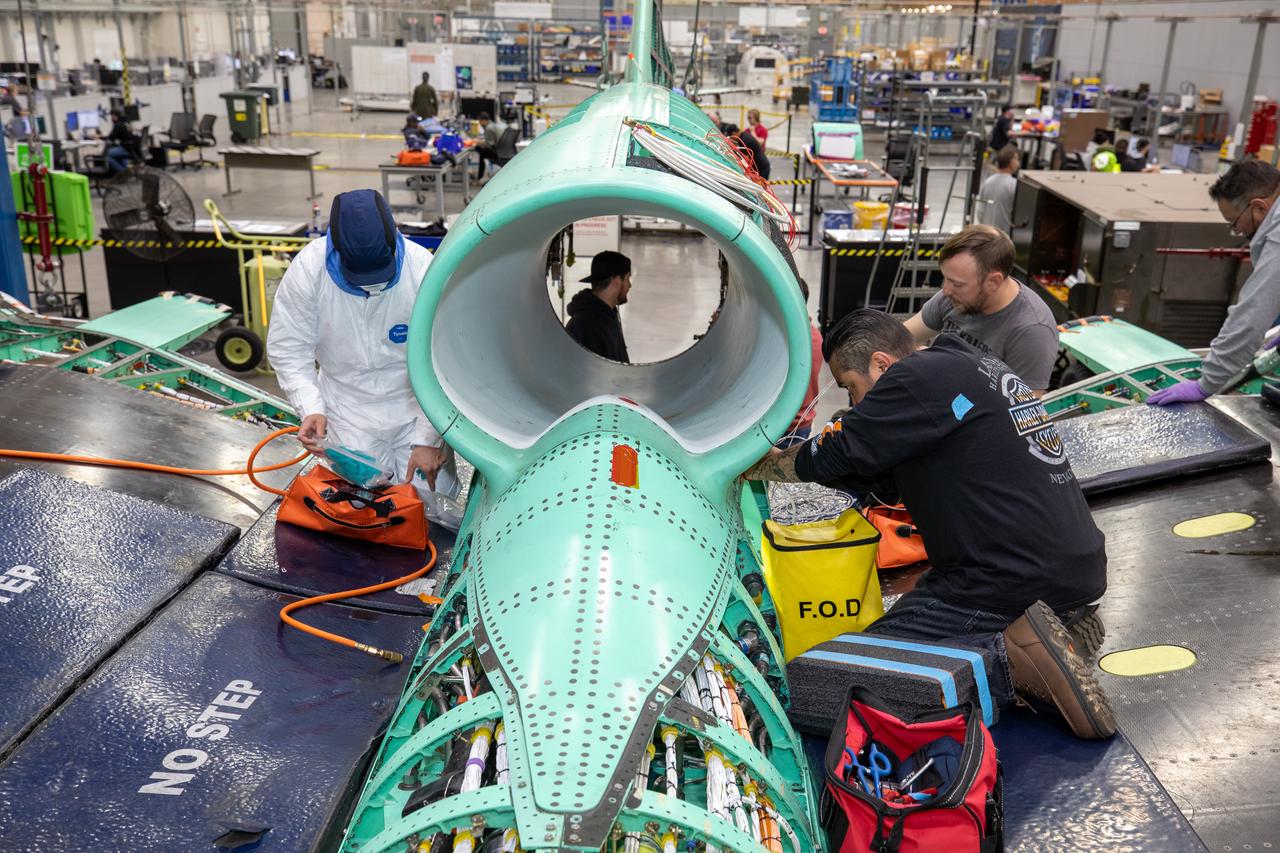
The X-59 team working on the aircraft’s wiring around the engine inlet prior to the engine being installed.  Once complete, the X-59 is designed to fly supersonic while reducing the loud sonic boom. The Quesst mission could help change the rules for commercial supersonic air travel over land.
Quesst Mission | X-59 Engine Inlet
The Advanced Space Transportation Group takes the future of space travel far into the 21st Century. Pictured is an artist's concept of a third generation Reusable Launch Vehicle (RLV). Projected for the year 2025, this third generation RLV will introduce an era of space travel not unlike air travel today.
Advanced Concept
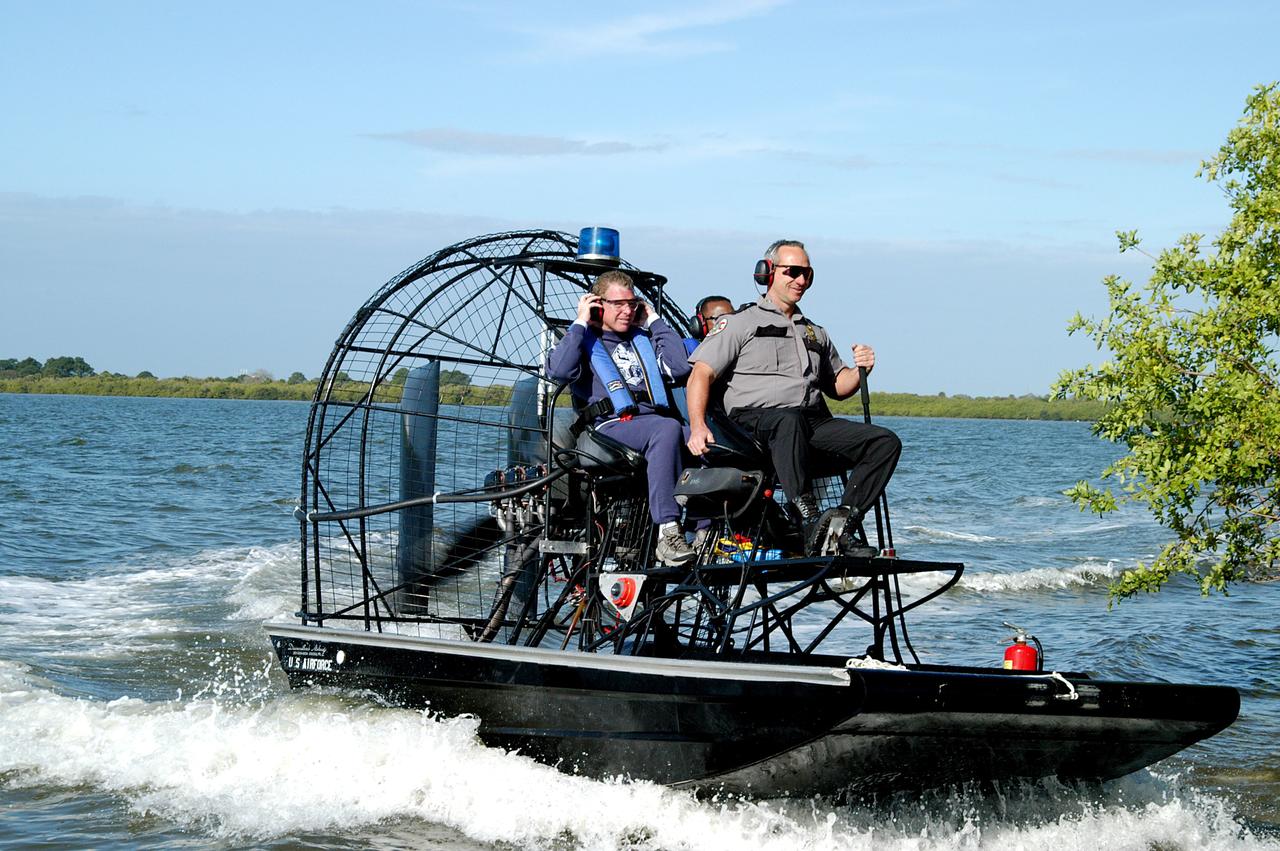
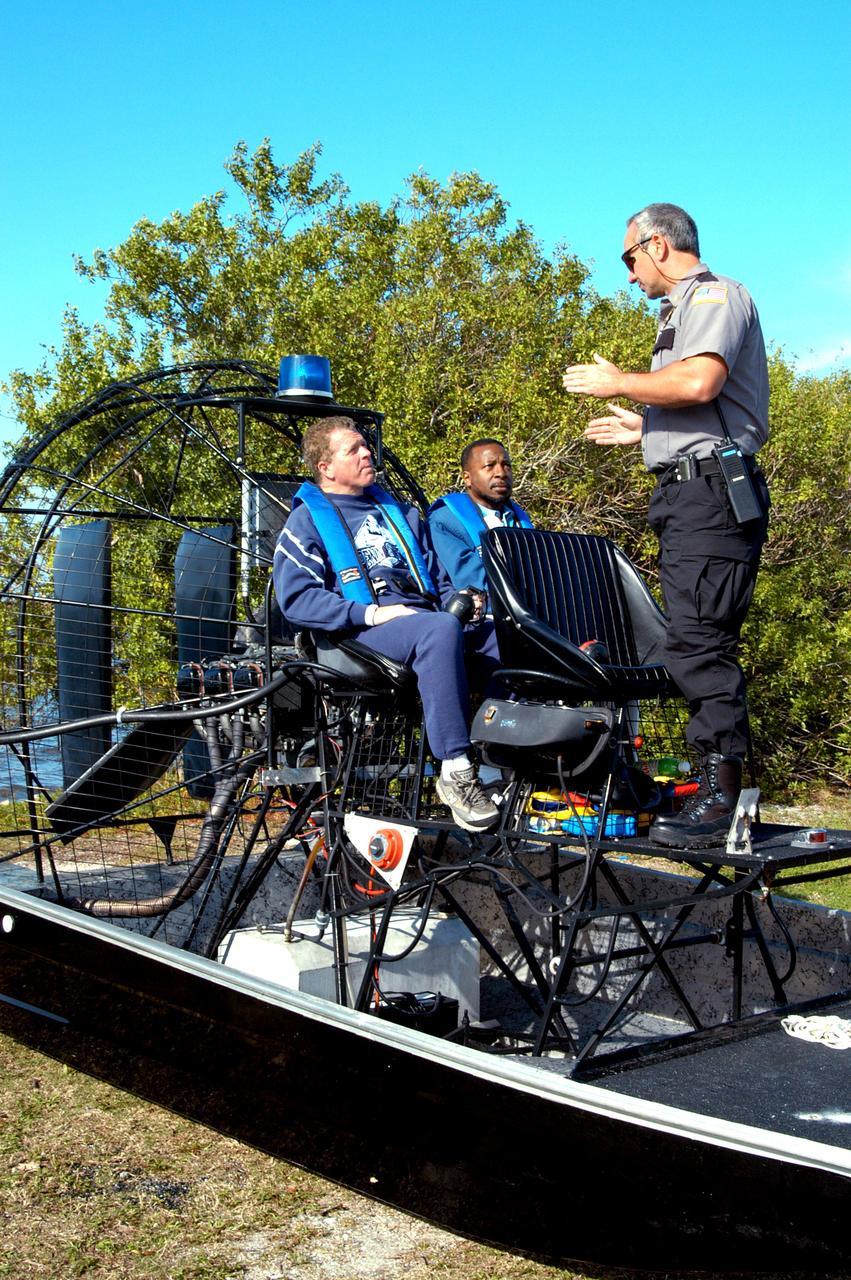
KENNEDY SPACE CENTER, FLA. - Congressman Tom Feeney (left) and Deputy Director Woodrow Whitlow Jr. take an air boat ride around Kennedy Space Center.  During January and February, Congressman Feeney traveled the entire coastline of Florida’s 24th District, and concluded his walks March 1 in Brevard County.  On his walks, he met with constituents and community leaders to discuss legislative issues that will be addressed by the 108th Congress. Feeney ended his beach walk at the KSC Visitor Complex main entrance.
KENNEDY SPACE CENTER, FLA. - Congressman Tom Feeney (left) and Deputy Director Woodrow Whitlow Jr. take an air boat ride around Kennedy Space Center. During January and February, Congressman Feeney traveled the entire coastline of Florida’s 24th District, and concluded his walks March 1 in Brevard County. On his walks, he met with constituents and community leaders to discuss legislative issues that will be addressed by the 108th Congress. Feeney ended his beach walk at the KSC Visitor Complex main entrance.
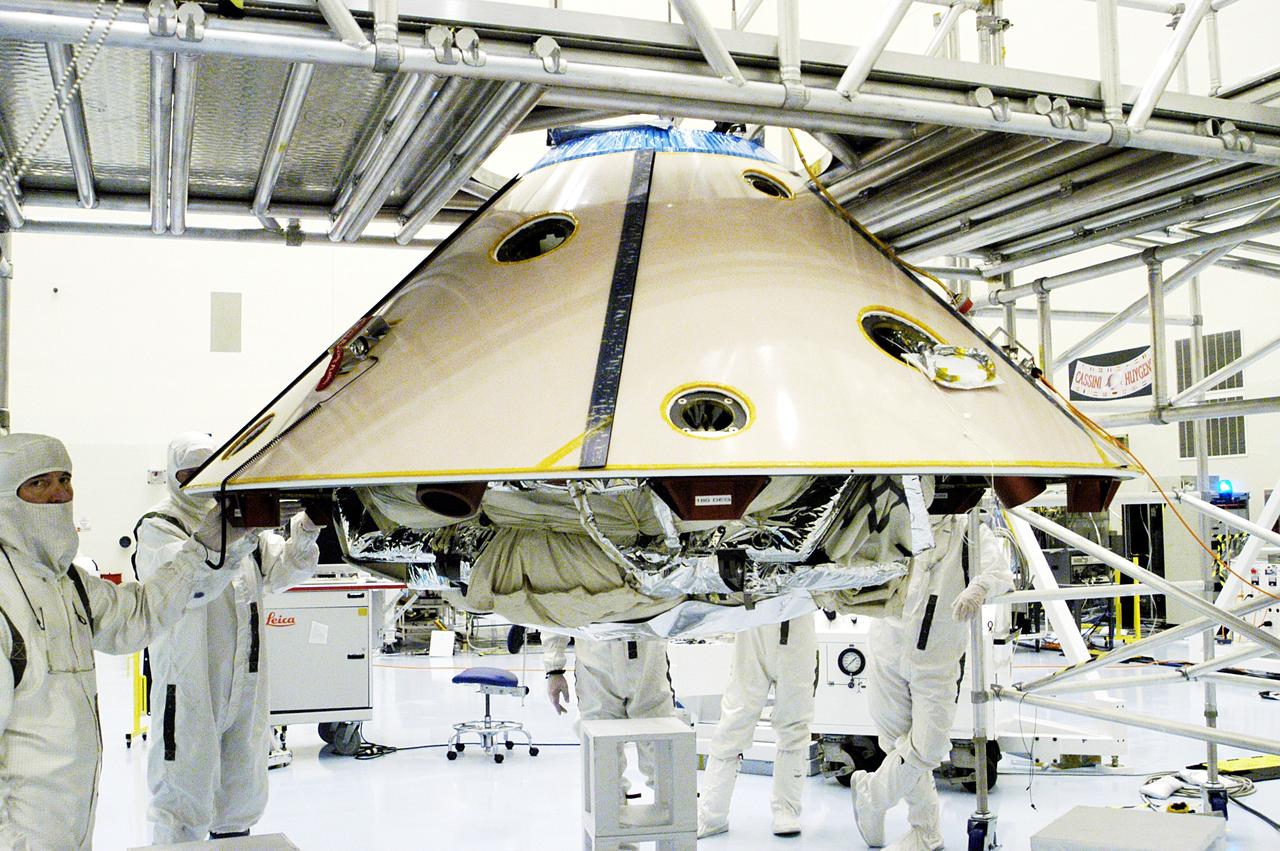
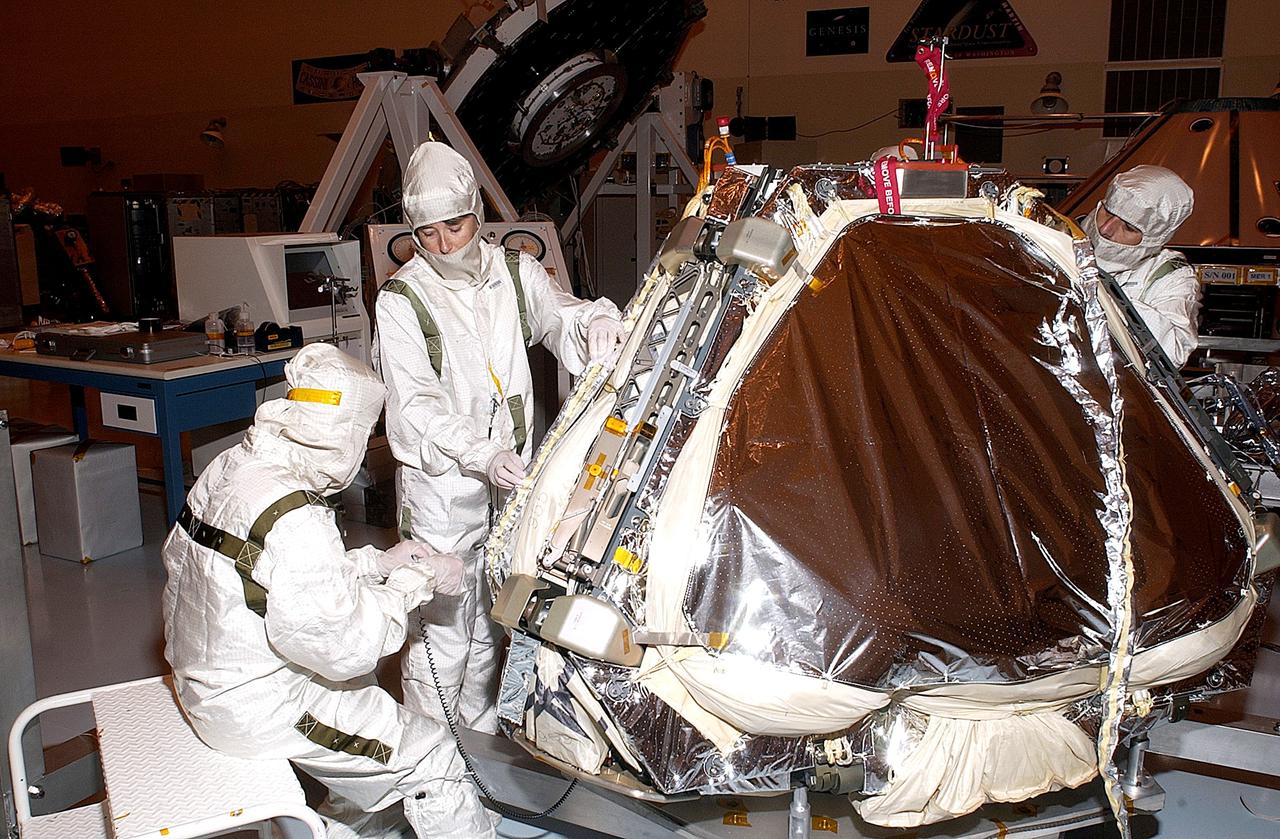
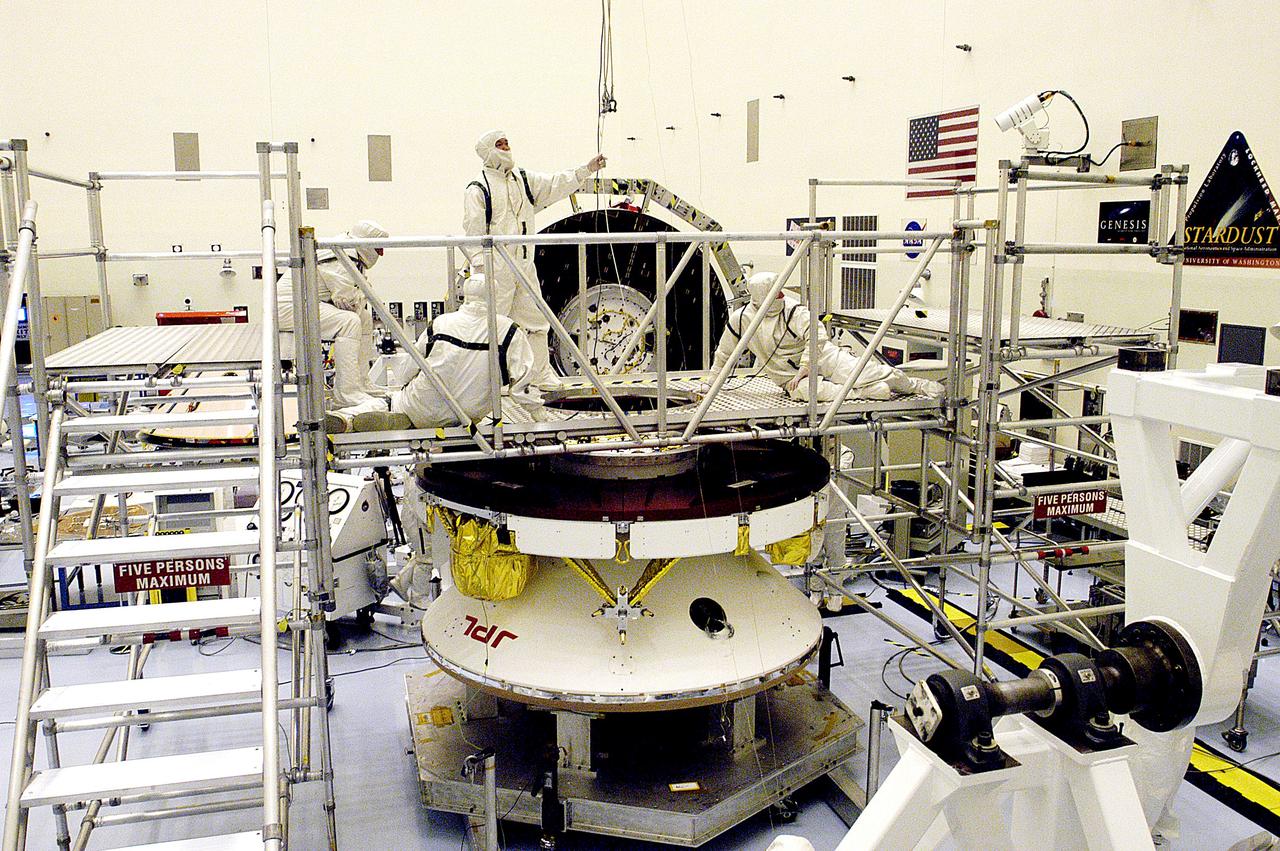
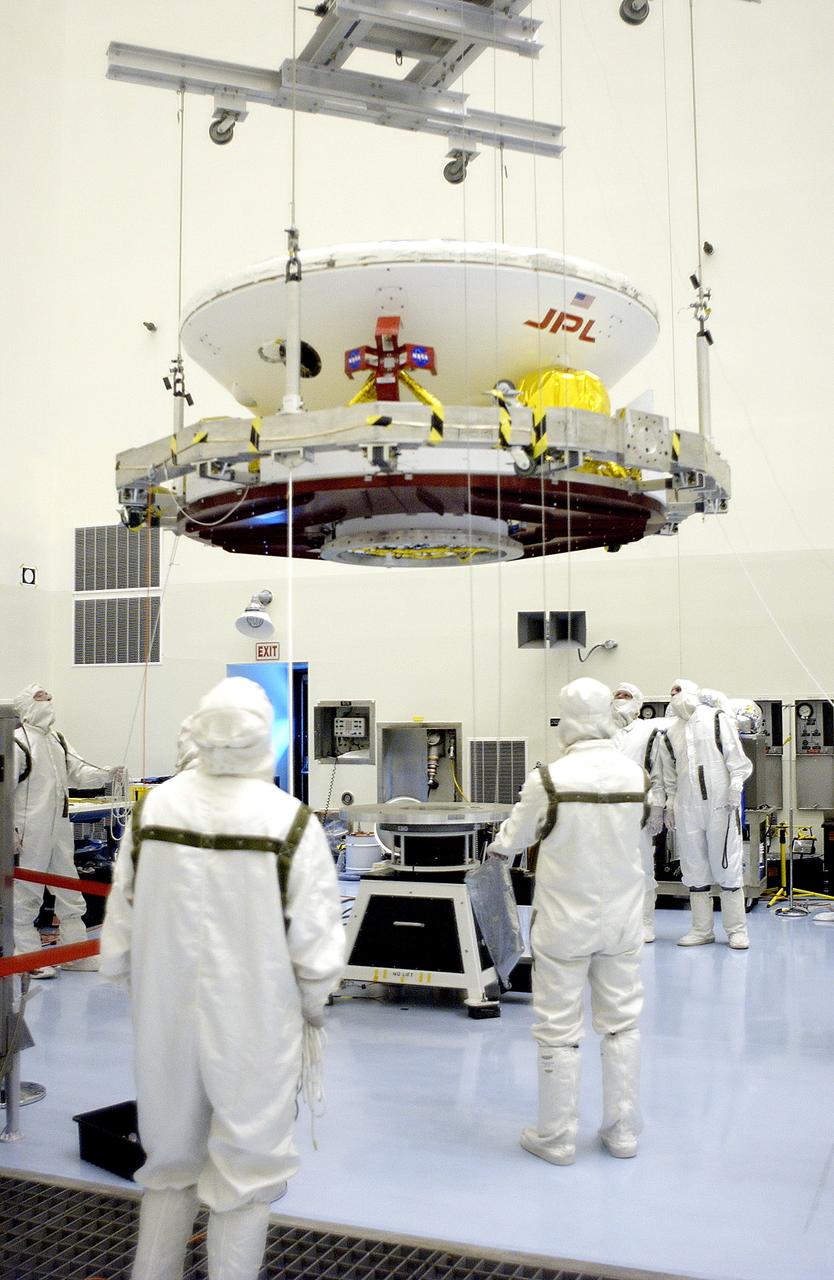
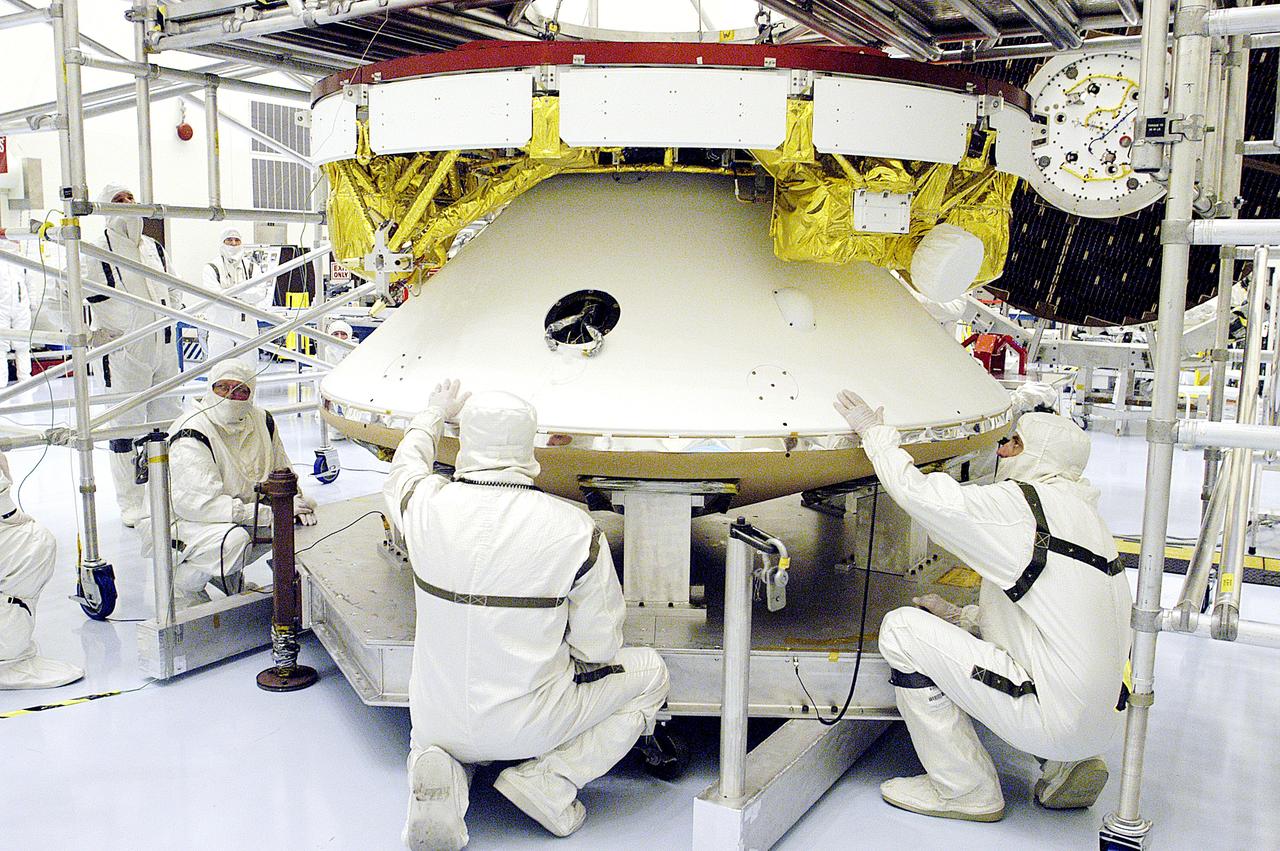
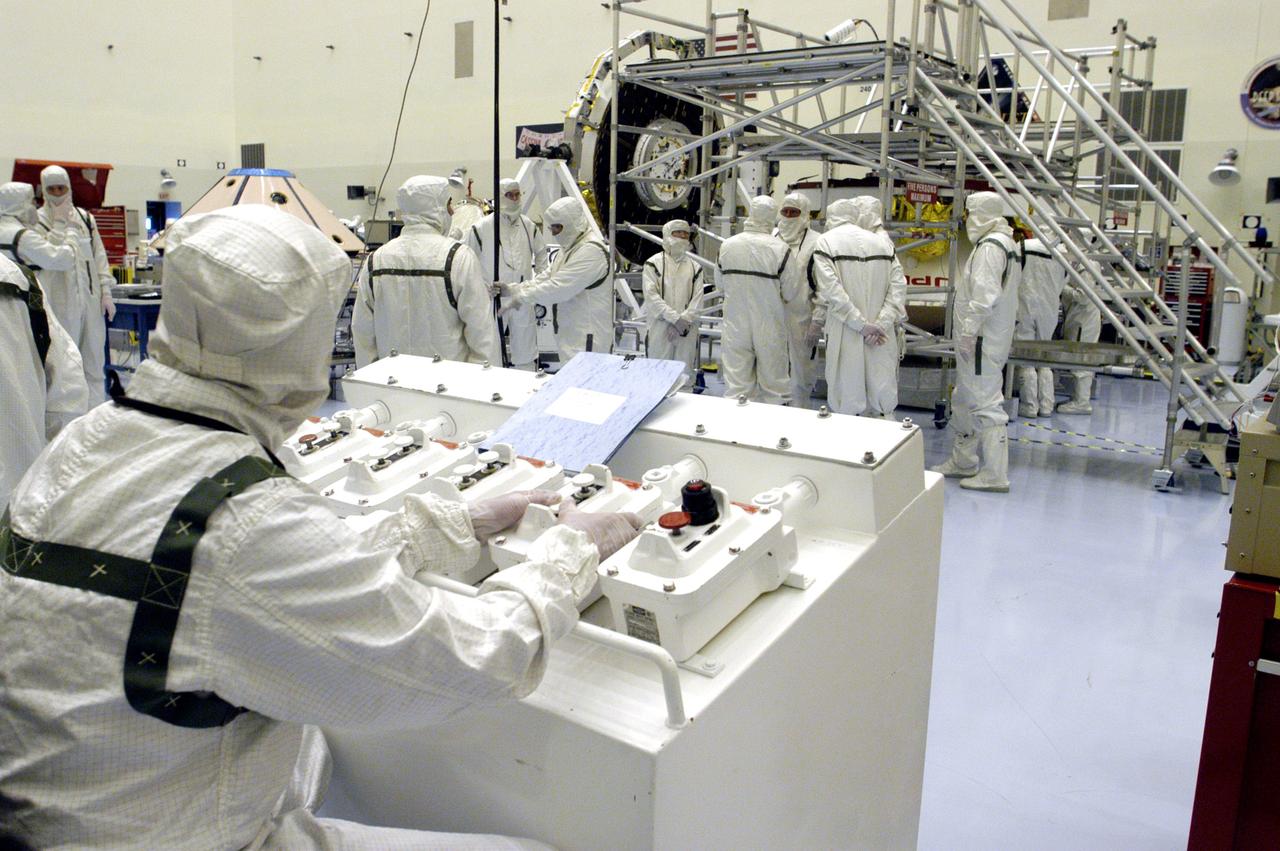
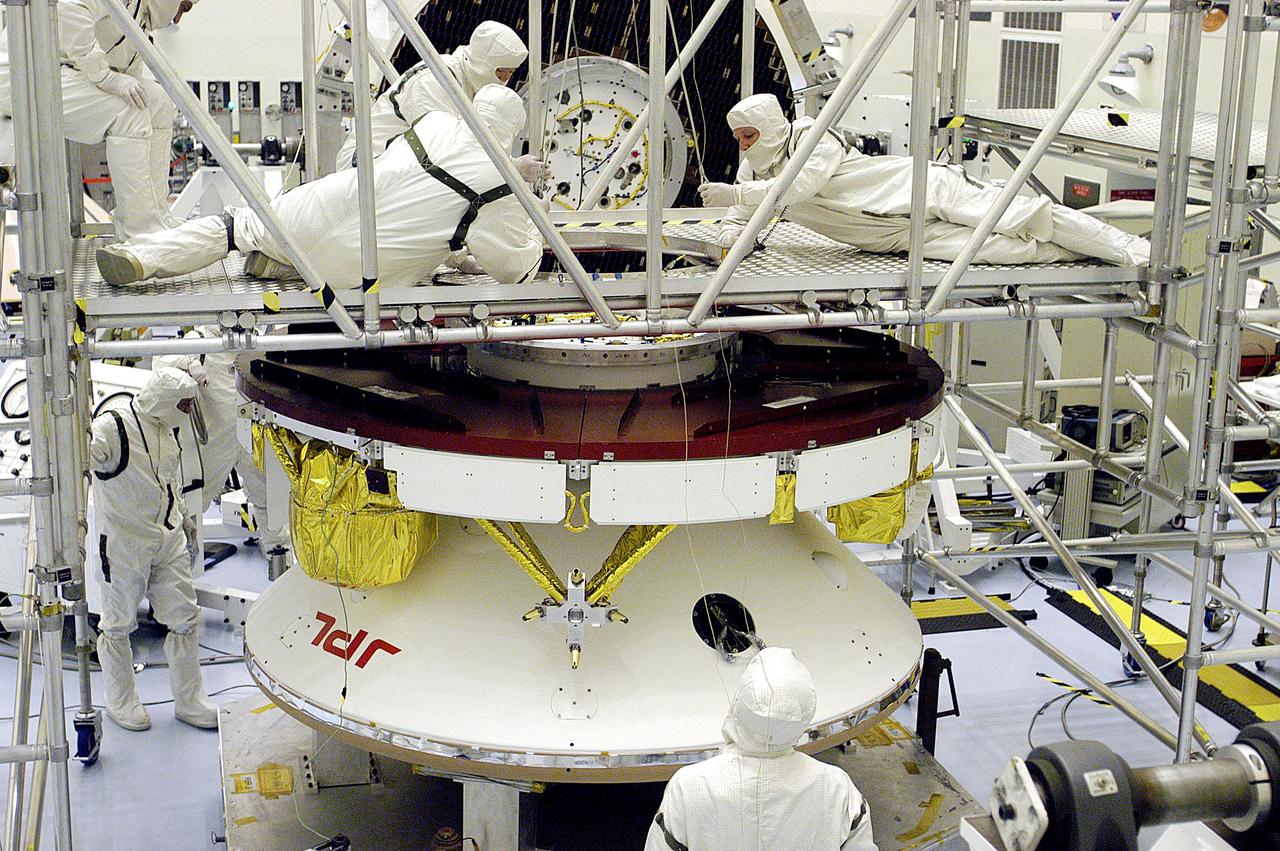
KENNEDY SPACE CENTER, FLA. - Workers walk with the suspended backshell/ Mars Exploration Rover 1 (MER-1) as it travels across the floor of the Payload Hazardous Servicing Facility.  The backshell will be attached to the lower heat shield.  NASA's twin Mars Exploration Rovers are designed to study the history of water on Mars. These robotic geologists are equipped with a robotic arm, a drilling tool, three spectrometers, and four pairs of cameras that allow them to have a human-like, 3D view of the terrain. Each rover could travel as far as 100 meters in one day to act as Mars scientists' eyes and hands, exploring an environment where humans can't yet go.  MER-1 is scheduled to launch June 25 as MER-B aboard a Delta II rocket from Cape Canaveral Air Force Station.
KENNEDY SPACE CENTER, FLA. - Workers walk with the suspended backshell/ Mars Exploration Rover 1 (MER-1) as it travels across the floor of the Payload Hazardous Servicing Facility. The backshell will be attached to the lower heat shield. NASA's twin Mars Exploration Rovers are designed to study the history of water on Mars. These robotic geologists are equipped with a robotic arm, a drilling tool, three spectrometers, and four pairs of cameras that allow them to have a human-like, 3D view of the terrain. Each rover could travel as far as 100 meters in one day to act as Mars scientists' eyes and hands, exploring an environment where humans can't yet go. MER-1 is scheduled to launch June 25 as MER-B aboard a Delta II rocket from Cape Canaveral Air Force Station.
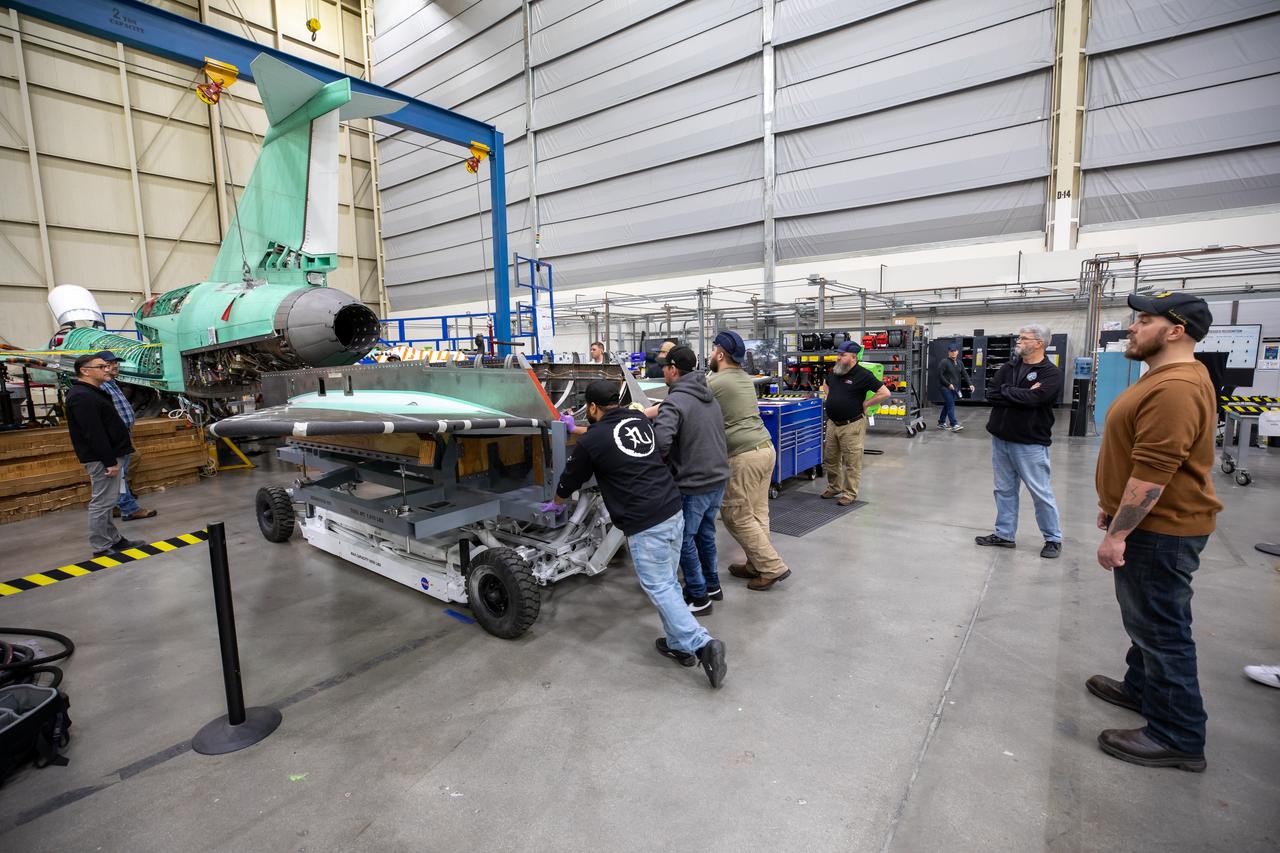
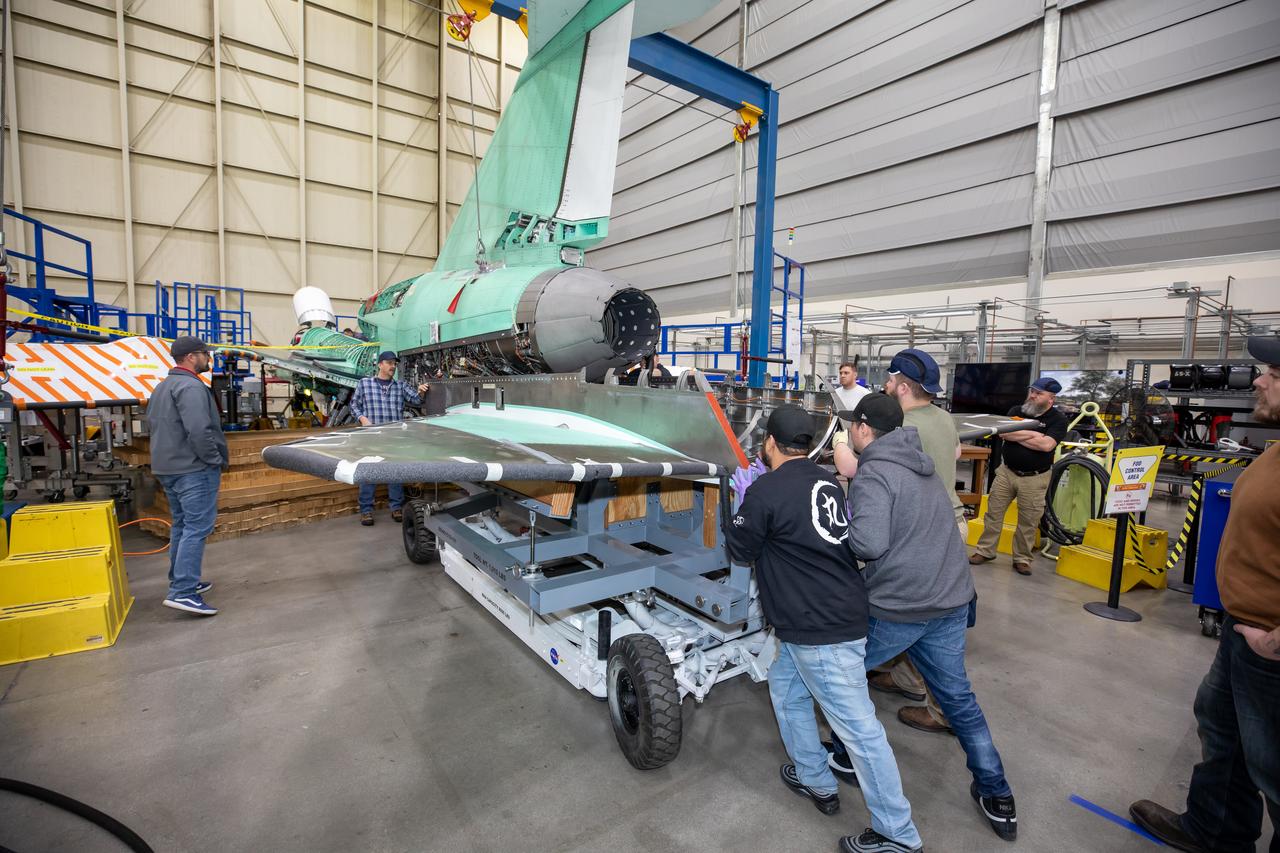
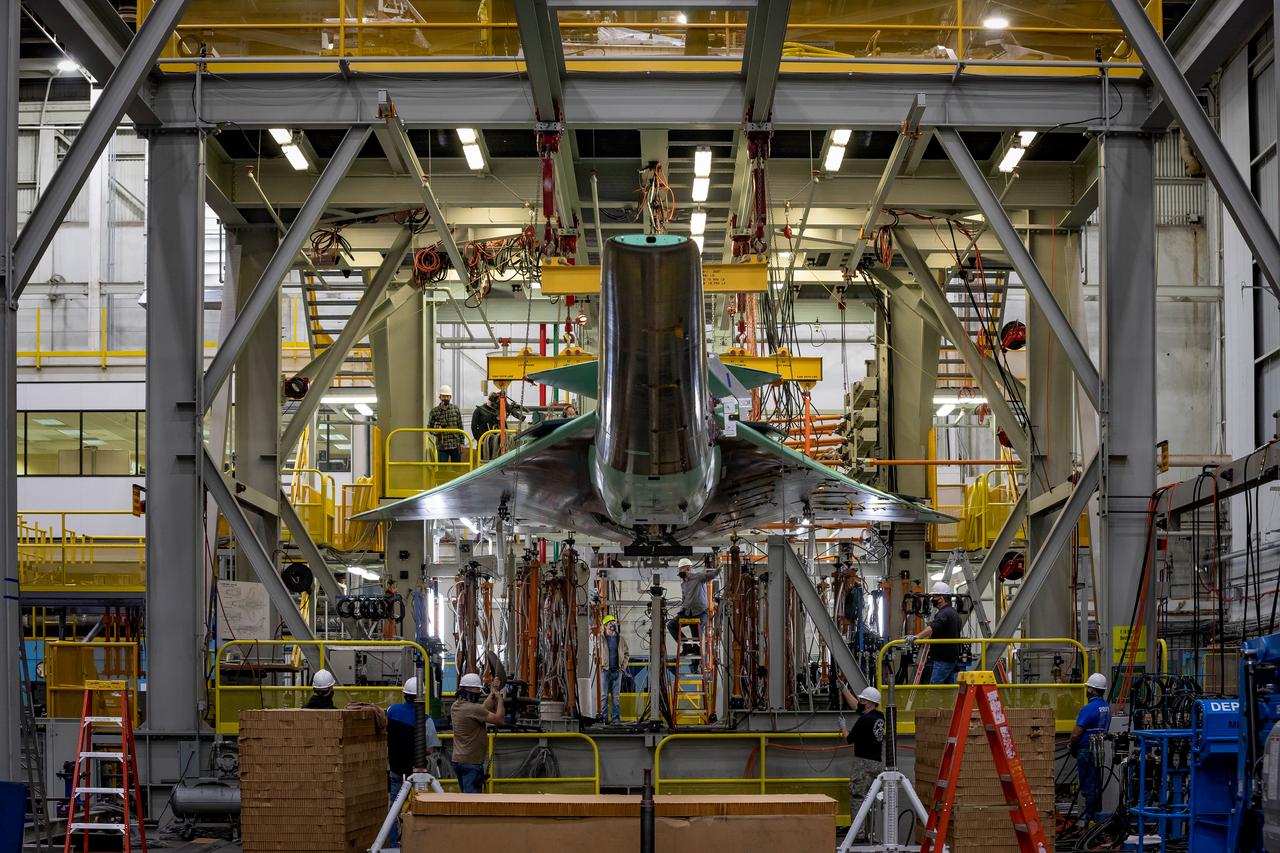
The X-59 team at Lockheed Martin Skunk Works in Palmdale, California, load the lower empennage - the tail section - into place. The surfaces used to control the tilt of the airplane are called stabilators and are connected to the lower empennage. The X-59 is the centerpiece of NASA’s Quesst mission, which could help enable commercial supersonic air travel over land.
Lower Empennage Test Fit Install
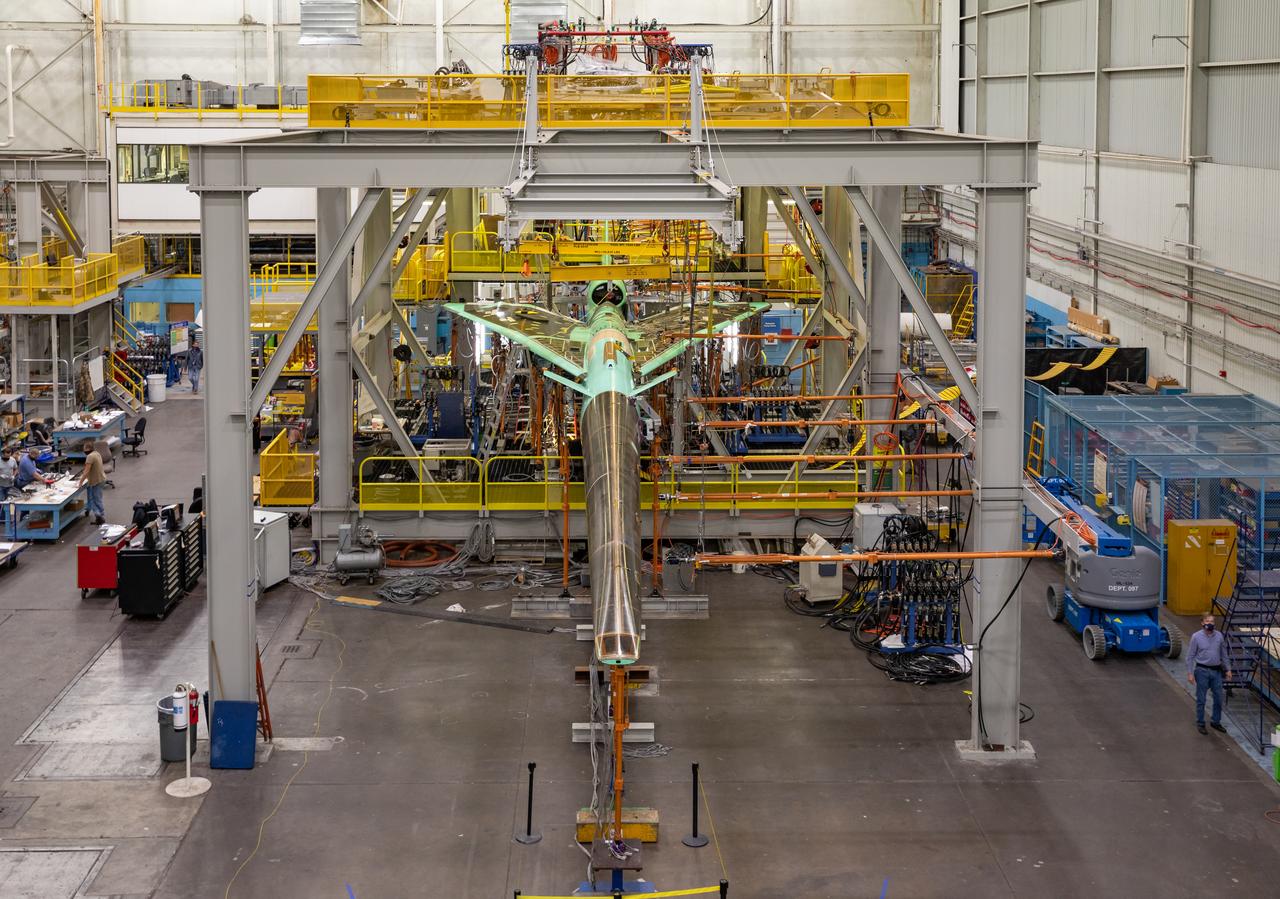
NASA’s X-59 undergoes a structural stress test at Lockheed Martin’s facility at Fort Worth, Texas. The X-59 is a one-of-a-kind airplane designed to fly at supersonic speeds without making a startling sonic boom sound for the communities below. This is part of NASA’s Quesst mission, which plans to help enable supersonic air travel over land.
X-59 - Various Angles in Test Fixture
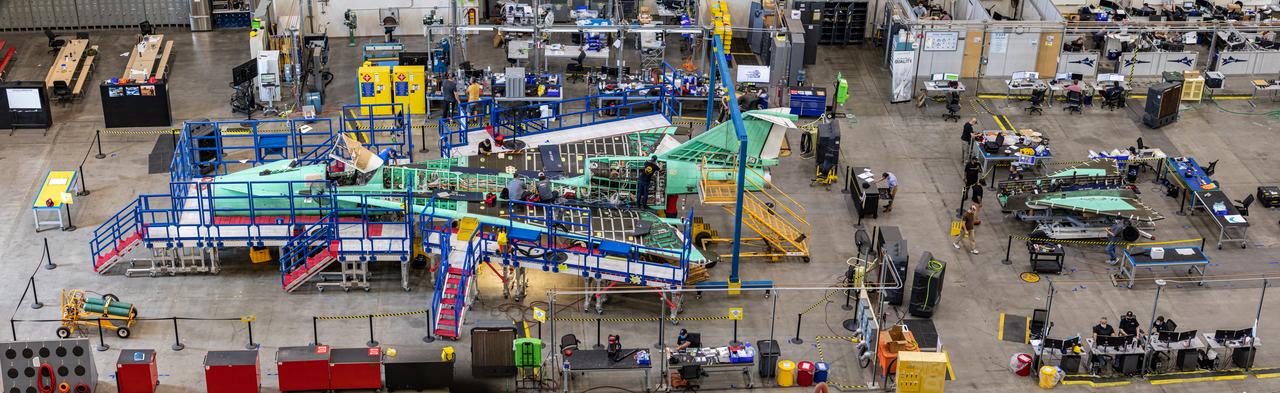
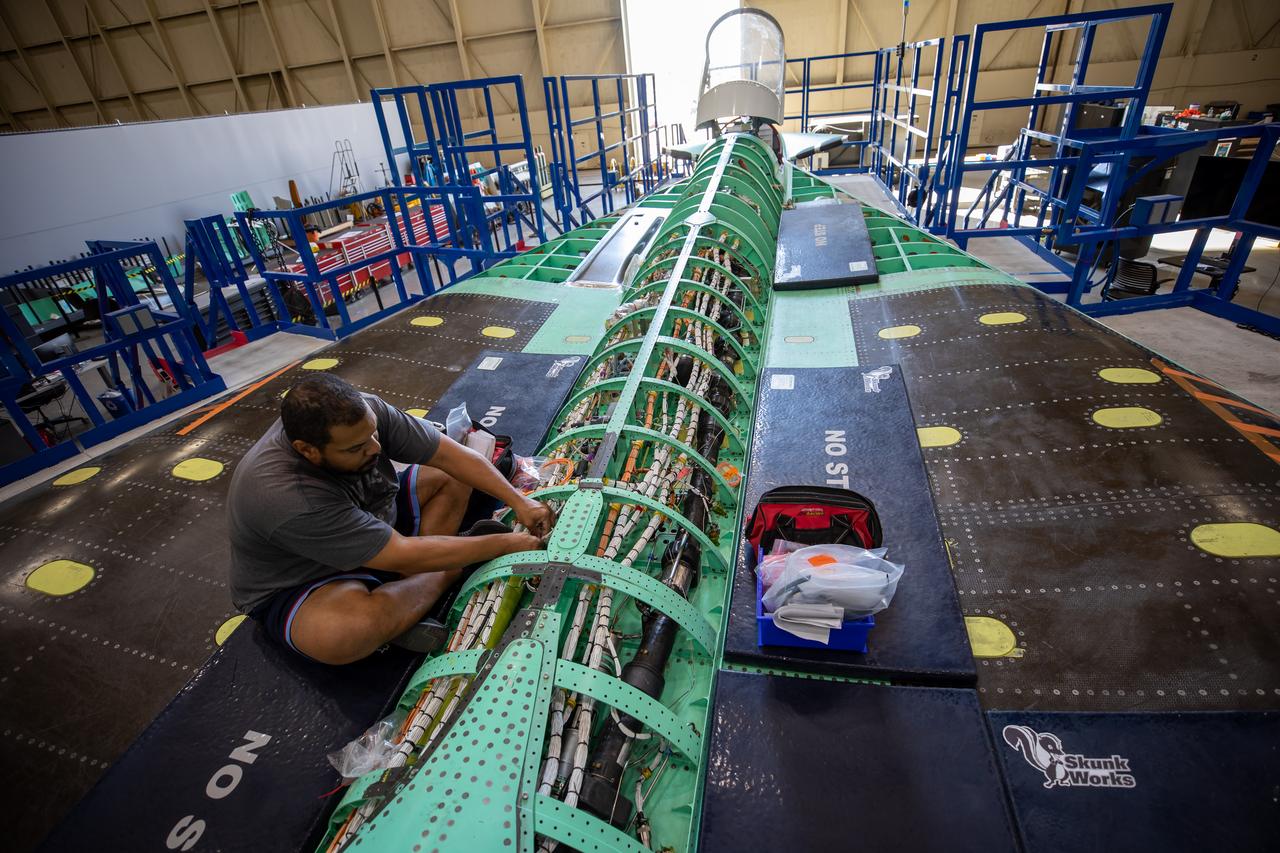
This overhead view of the X-59 shows the aircraft at Lockheed Martin Skunk Works in Palmdale, California. During the assembly of this experimental aircraft, the team often has to remove components to effectively and safely assemble other sections of the aircraft. In this image, the nose is not attached and the horizontal stabilators are shown behind the tail. The X-59 is the centerpiece of NASA’s Quesst mission which plans to produce data that will help enable commercial supersonic air travel over land.
FTIS Sensors and From Above
Here is an overhead view of the X-59 aircraft (left) prior to the installation of the General Electric F414 engine (center, located under the blue cover). After the engine is installed, the lower empennage (right), the last remaining major aircraft component, will be installed in preparation for integrated system checkouts. The X-59 is the centerpiece of the Quesst mission which plans to help enable commercial supersonic air travel over land.
From Above With Nose Installed
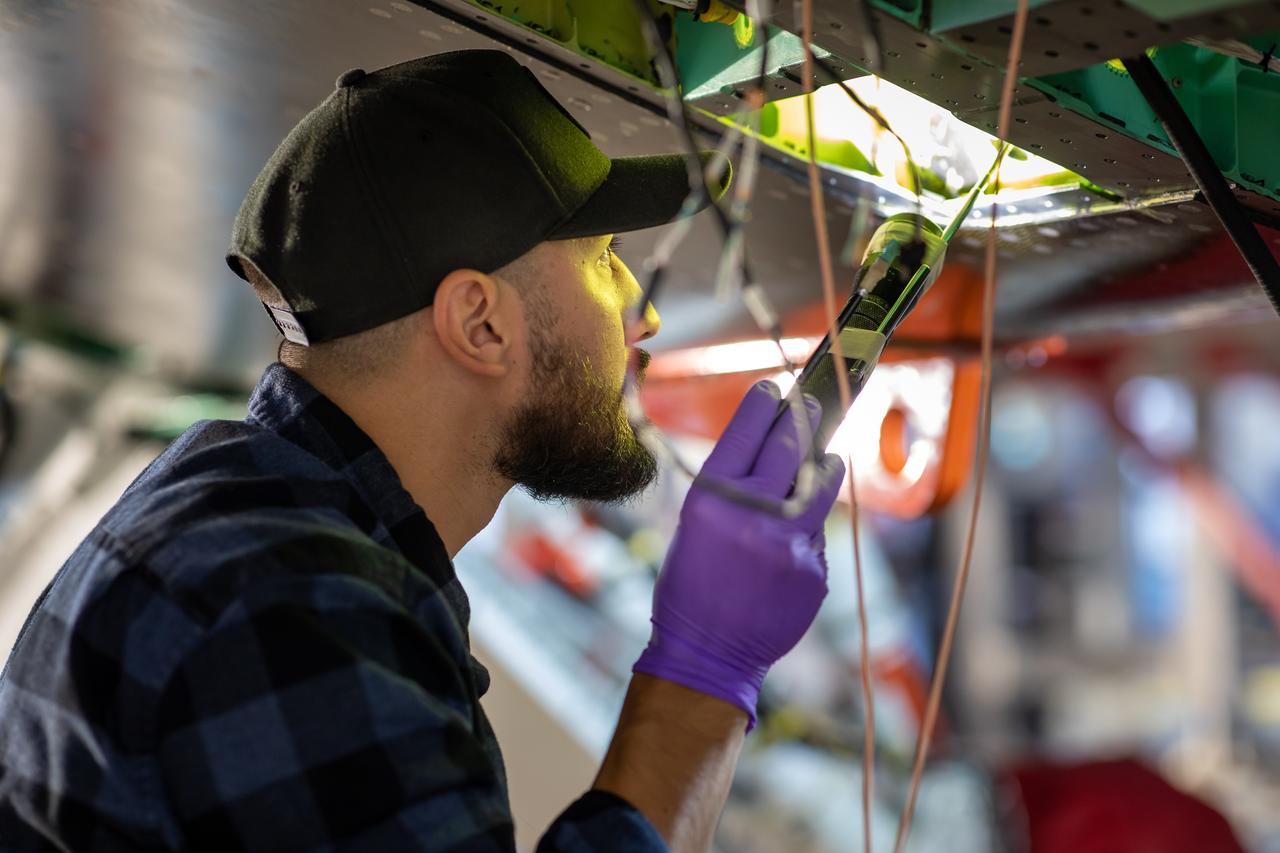
A Lockheed Martin Skunk Works technician inspects some of the wiring and sensors on the X-59 aircraft in preparation for the first power-on system checkouts.  Once complete, the X-59 aircraft will demonstrate the ability to fly supersonic while reducing the loud sonic boom to a quiet sonic thump and help enable commercial supersonic air travel over land. This aircraft is the centerpiece of NASA’s Quesst mission.
First Power-On SCO
NASA’s X-59 undergoes a structural stress test at Lockheed Martin’s facility at Fort Worth, Texas. The X-59 is a one-of-a-kind airplane designed to fly at supersonic speeds without making a startling sonic boom sound for the communities below. This is part of NASA’s Quesst mission, which plans to help enable supersonic air travel over land.
X-59 - Various Angles in Test Fixture
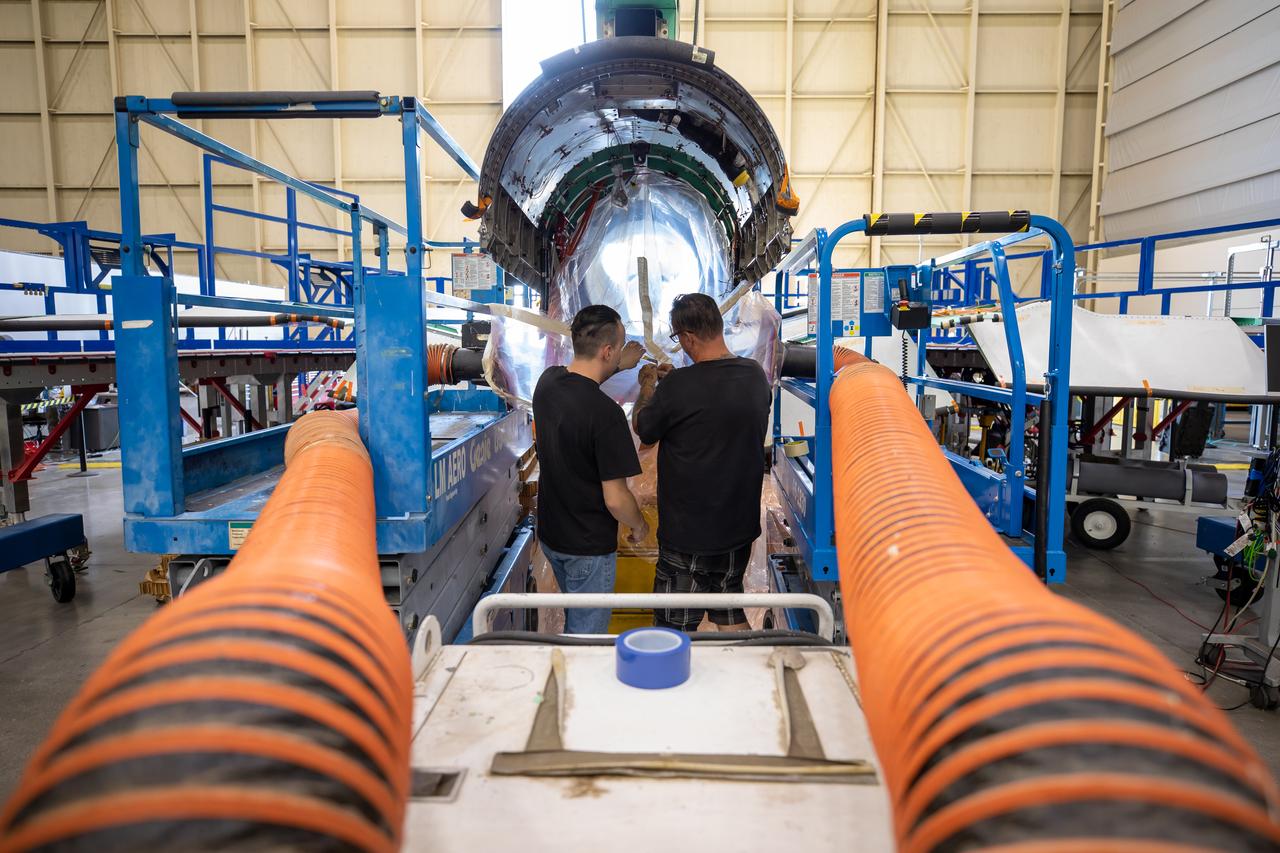
This image shows the extensive ventilation system that has been placed adjacent to the X-59 during the recent painting of the aircraft’s engine inlet. Once the aircraft build and ground testing are complete, the X-59 airplane will begin flight testing, working towards demonstrating the ability to fly supersonic while reducing the loud sonic boom to a quiet sonic thump and help enable commercial supersonic air travel over land.
LRC-2022-H1_P_X-59-41
This is an up-close view of the X-59’s engine inlet  –  fresh after being painted. The 13-foot F414-GE-100 engine will be placed inside the inlet bringing the X-59 aircraft one step closer to completion. Once fully assembled, the X-59 aircraft will begin flight operations, working toward demonstration of the ability to fly supersonic while reducing the loud sonic boom to a quiet sonic thump, helping to enable commercial supersonic air travel over land.
LRC-2022-H1_P_X-59-42
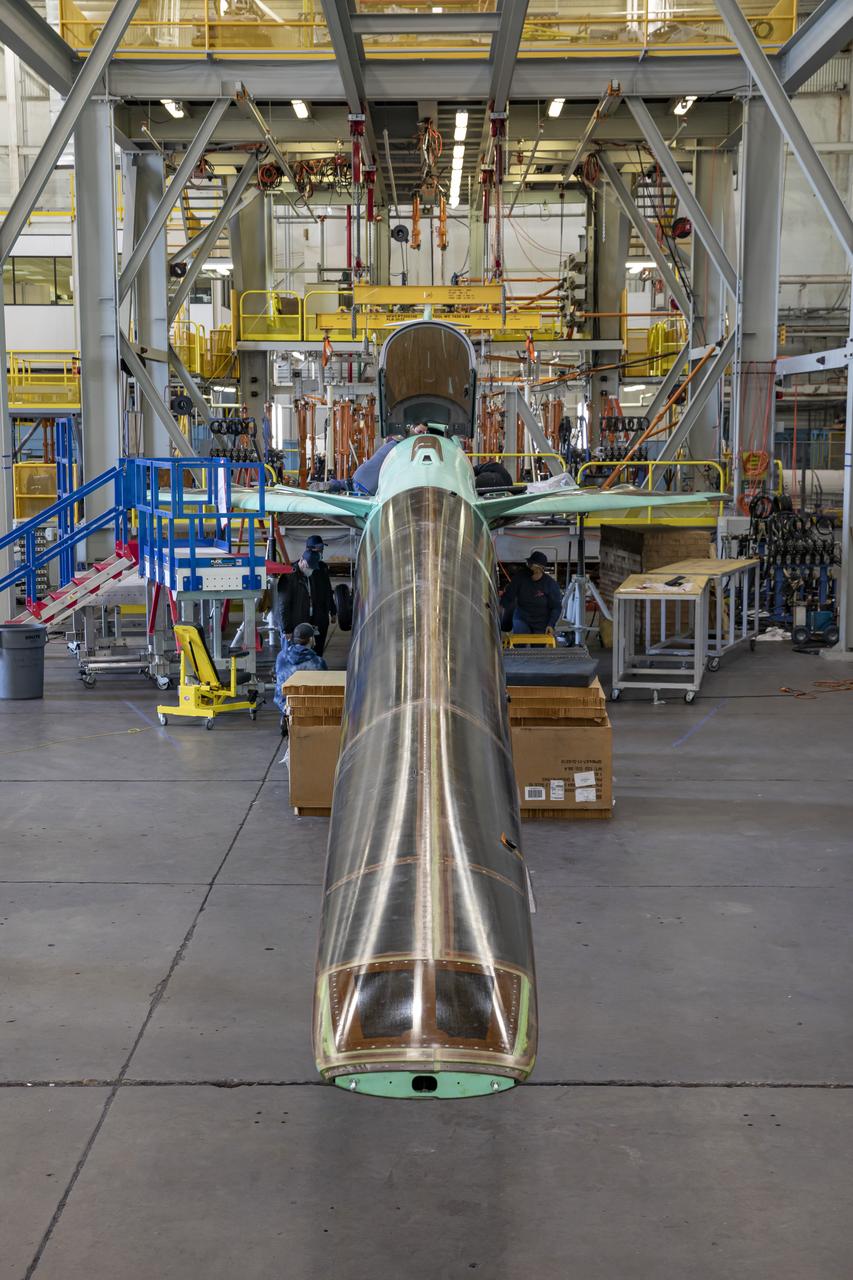
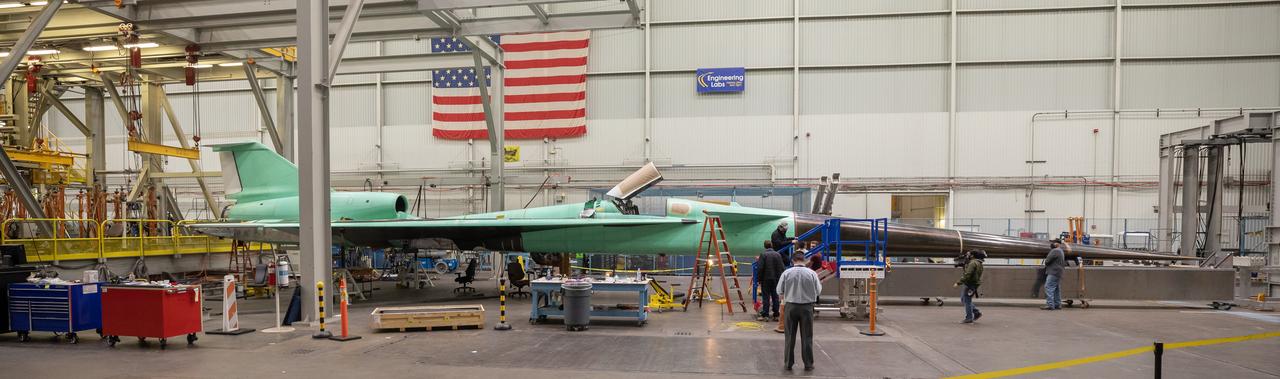
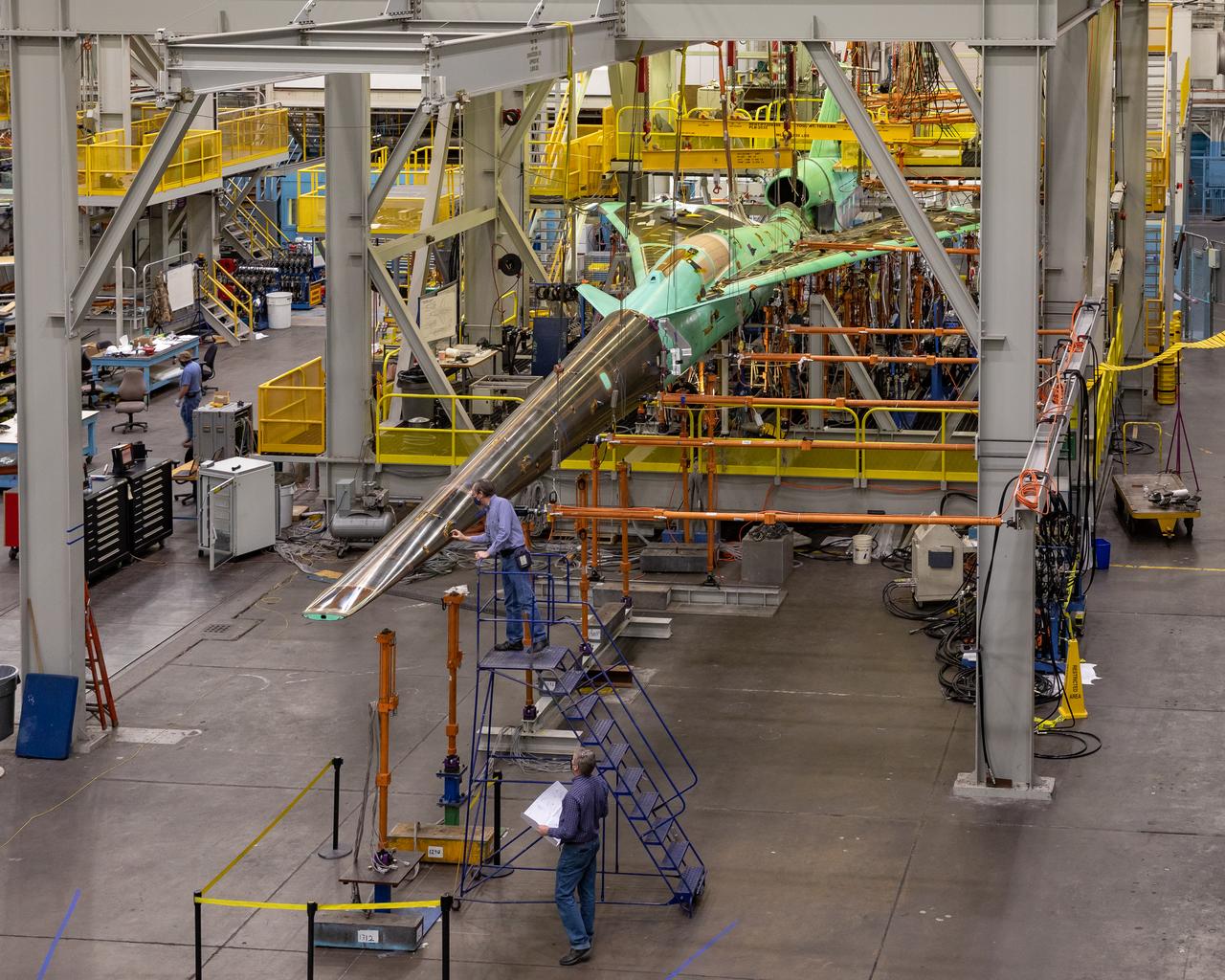
A panoramic view of NASA’s X-59 in Fort Worth, Texas to undergo structural and fuel testing.  The X-59’s nose makes up one third of the aircraft, at 38-feet in length. The X-59 is a one-of-a-kind airplane designed to fly at supersonic speeds without making a startling sonic boom sound for the communities below. This is part of NASA’s Quesst mission which plans to help enable supersonic air travel over land.
SEG 230 Nose Attachement
The X-59 team at Lockheed Martin Skunk Works in Palmdale, California, load the lower empennage - the tail section - into place. The surfaces used to control the tilt of the airplane are called stabilators and are connected to the lower empennage.  The X-59 is the centerpiece of NASA’s Quesst mission, which could help enable commercial supersonic air travel over land.
Lower Empennage Test Fit Install
Technicians perform landing gear checkout testing at Lockheed Martin Skunk Works in Palmdale, California. These tests make sure that all the parts of X-59’s landing gear and doors are working in the correct order.  The X-59 is the centerpiece of NASA’s Quesst mission, which could help enable commercial supersonic air travel over land.
Checkout Tests of X-59 Landing Gear
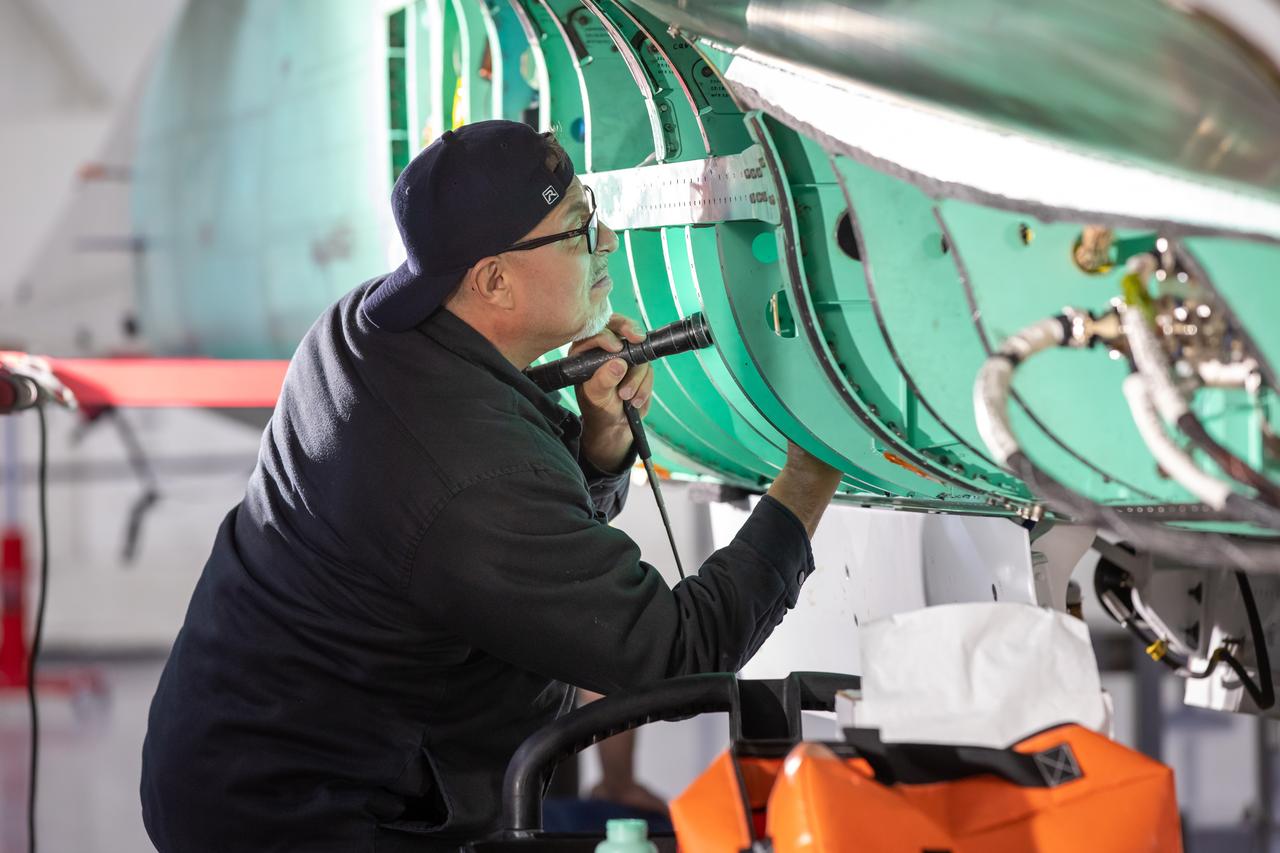
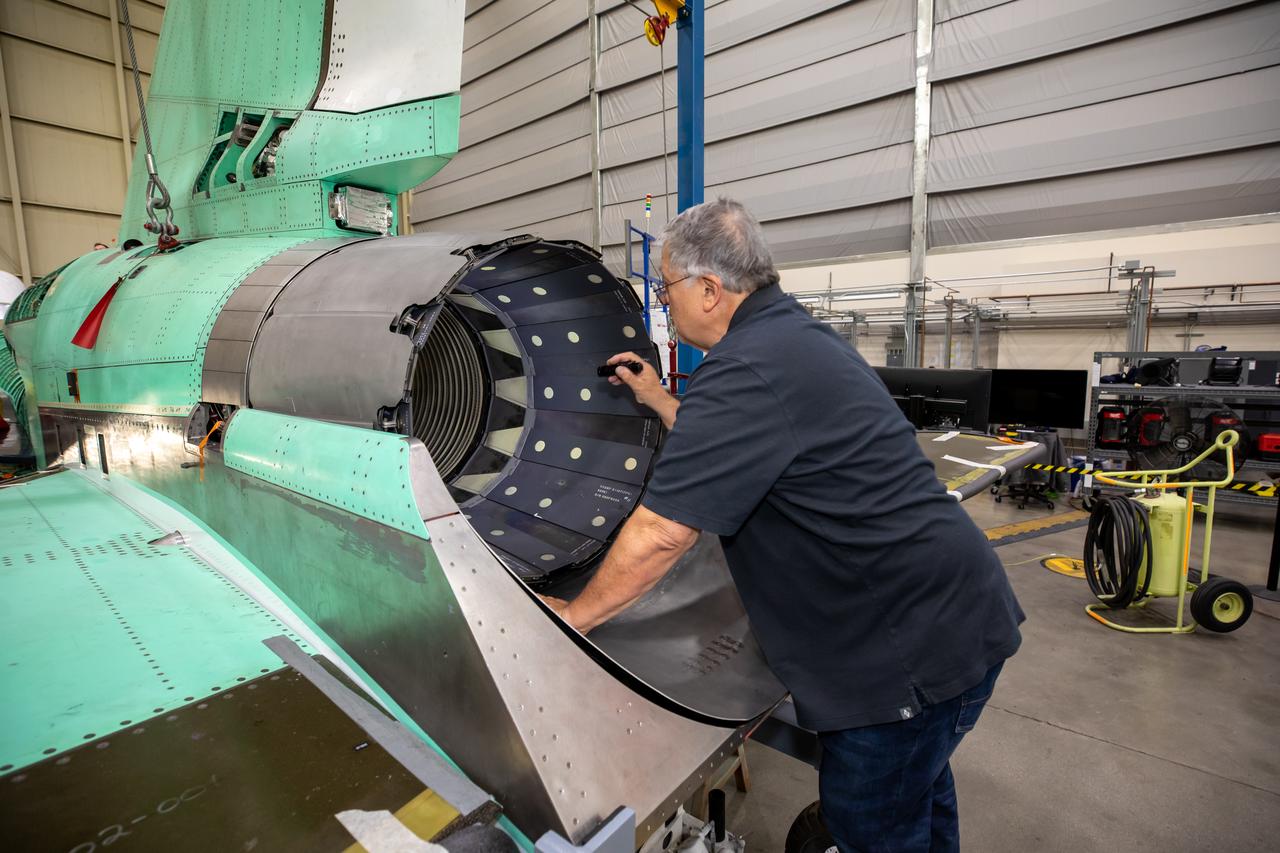
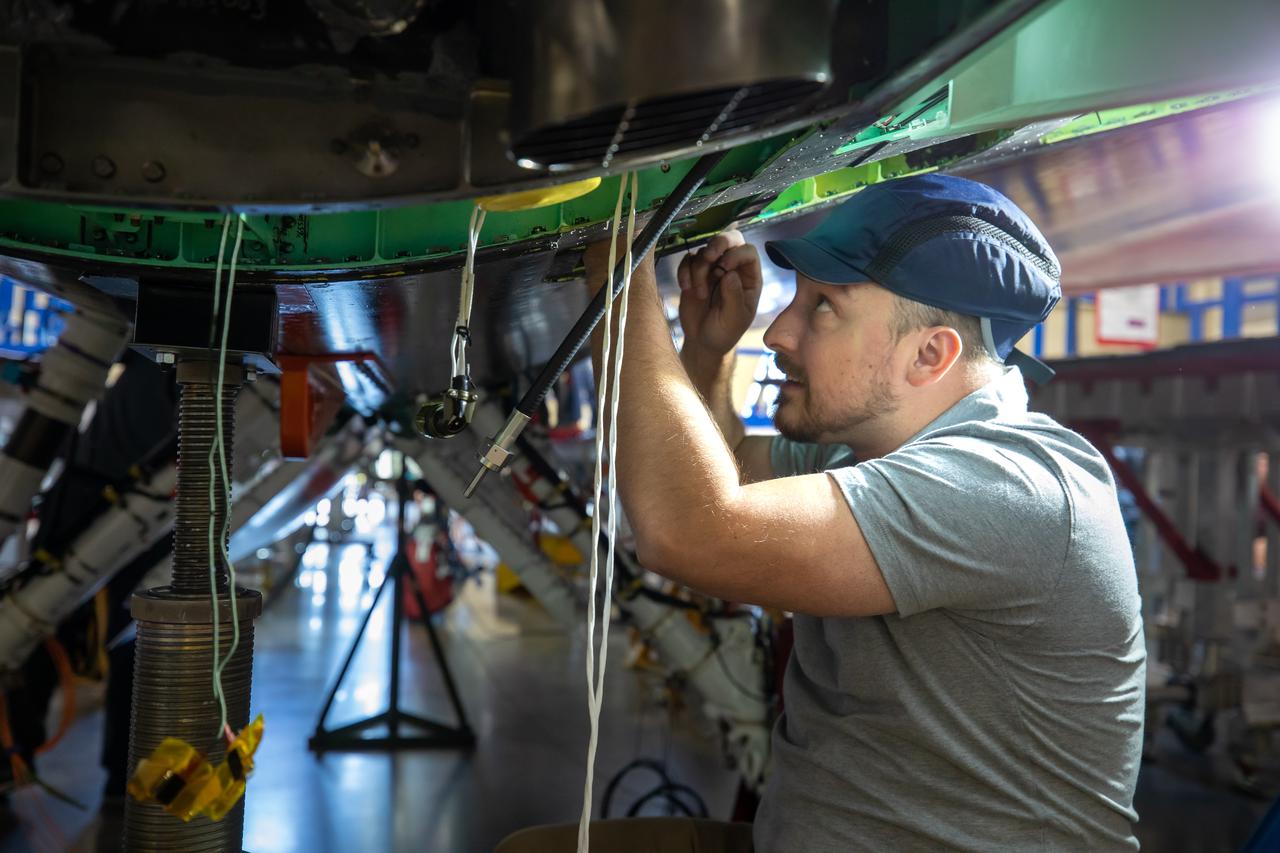
A quality inspector inspects the GE F-414 engine nozzle after installation at Lockheed Martin’s Skunk Works facility in Palmdale, California. Once the aircraft and ground testing are complete, the X-59 will undergo flight testing, which will demonstrate the plane’s ability to fly supersonic - faster than the speed of sound - while reducing the loud sonic boom. This could enable commercial supersonic air travel over land.
Quality Inspection of NASA’s X-59 Engine
A Lockheed Martin technician works to complete wiring on the X-59 aircraft in preparation for the power-on system checkouts.  Once complete, the X-59 aircraft will demonstrate the ability to fly supersonic while reducing the loud sonic boom to a quiet sonic thump and help enable commercial supersonic air travel over land. This aircraft is the centerpiece of NASA’s Quesst mission.
LRC-2022-H1_P_X-59-43
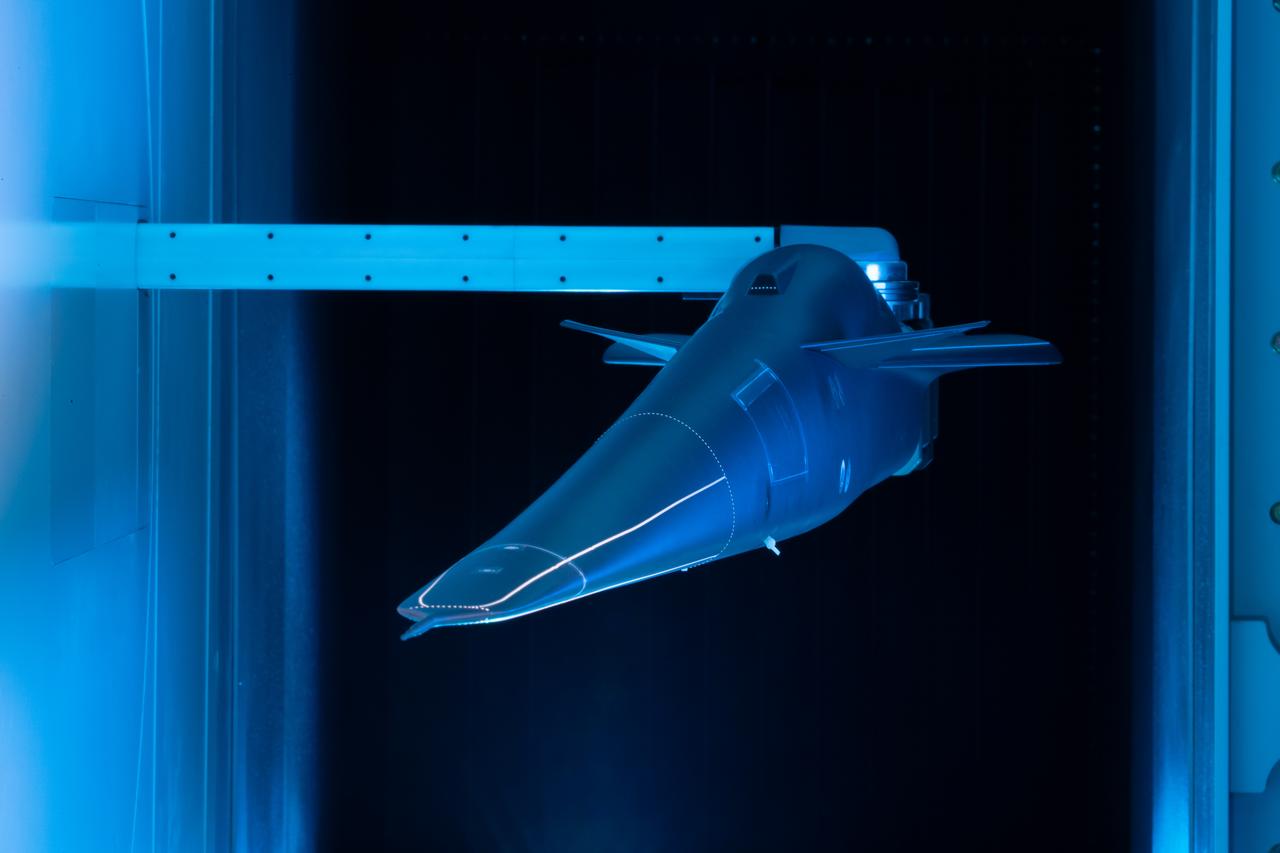
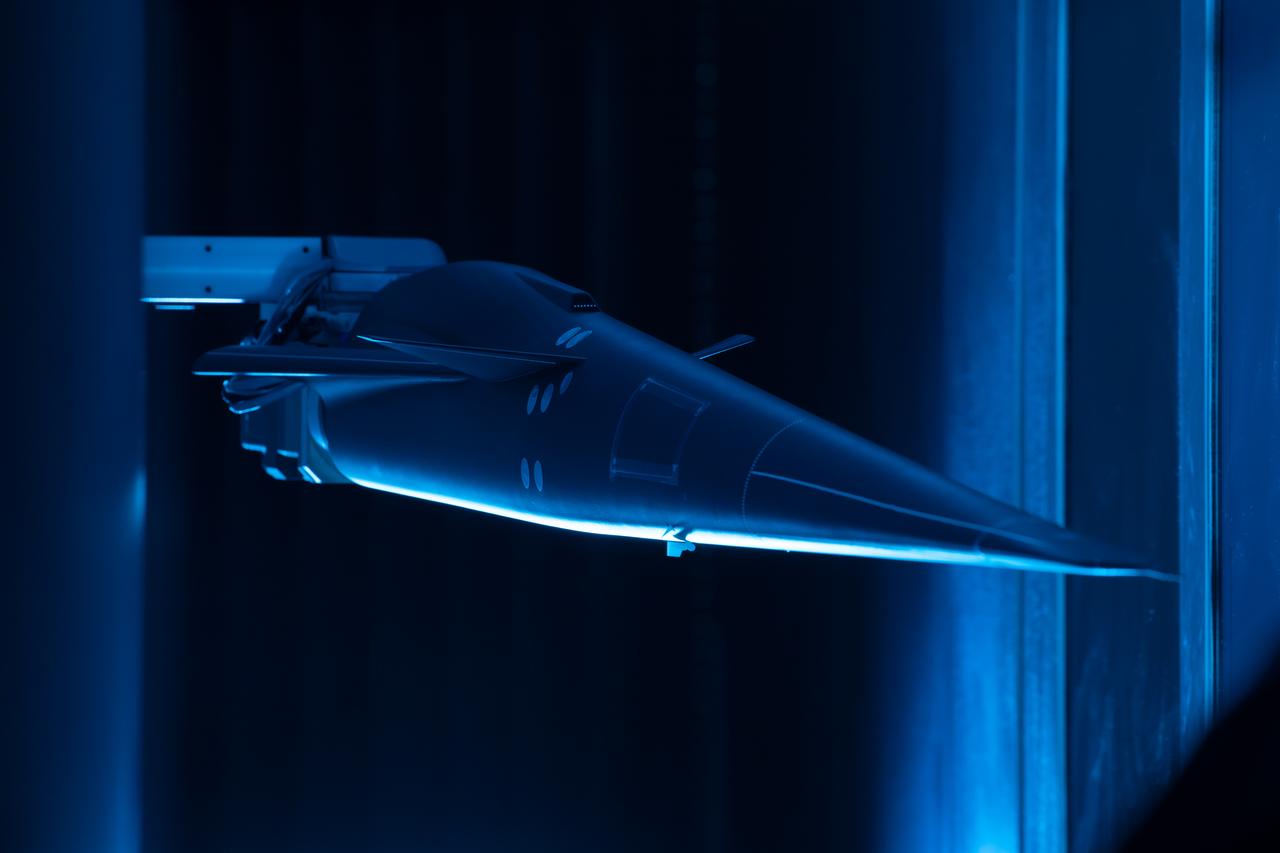
Event: Forebody and Nose - Windtunnel Testing A model of the X-59 forebody is shown in the Lockheed Martin Skunk Works’ wind tunnel in Palmdale, California. These tests gave the team measurements of wind flow angle around the aircraft’s nose and confirmed computer predictions made using computational fluid dynamics (CFD) software tools. The data will be fed into the aircraft flight control system to tell the pilot the aircraft’s altitude, speed and angle. This is part of NASA’s Quesst mission which plans to help enable supersonic air travel over land.
Forebody and Nose - Windtunnel Testing
NASA’s X-59 is lowered into the test fixture as it prepares to undergo structural stress tests at  Lockheed Martin in Fort Worth, Texas. The X-59 is a one-of-a-kind airplane designed to fly at supersonic speeds without making a startling sonic boom sound for the communities below. This is part of NASA’s Quesst mission which plans to help  enable supersonic air travel over land.
Test Fixture Installation
NASA’s X-59 undergoes a structural stress test at Lockheed Martin’s facility  in Fort Worth, Texas. The X-59’s nose makes up one third of the aircraft, at 38-feet in length. The X-59 is a one-of-a-kind airplane designed to fly at supersonic speeds without making a startling sonic boom sound for the communities below. This is part of NASA’s Quesst mission, which plans to help  enable supersonic air travel over land
X-59 - Various Angles in Test Fixture
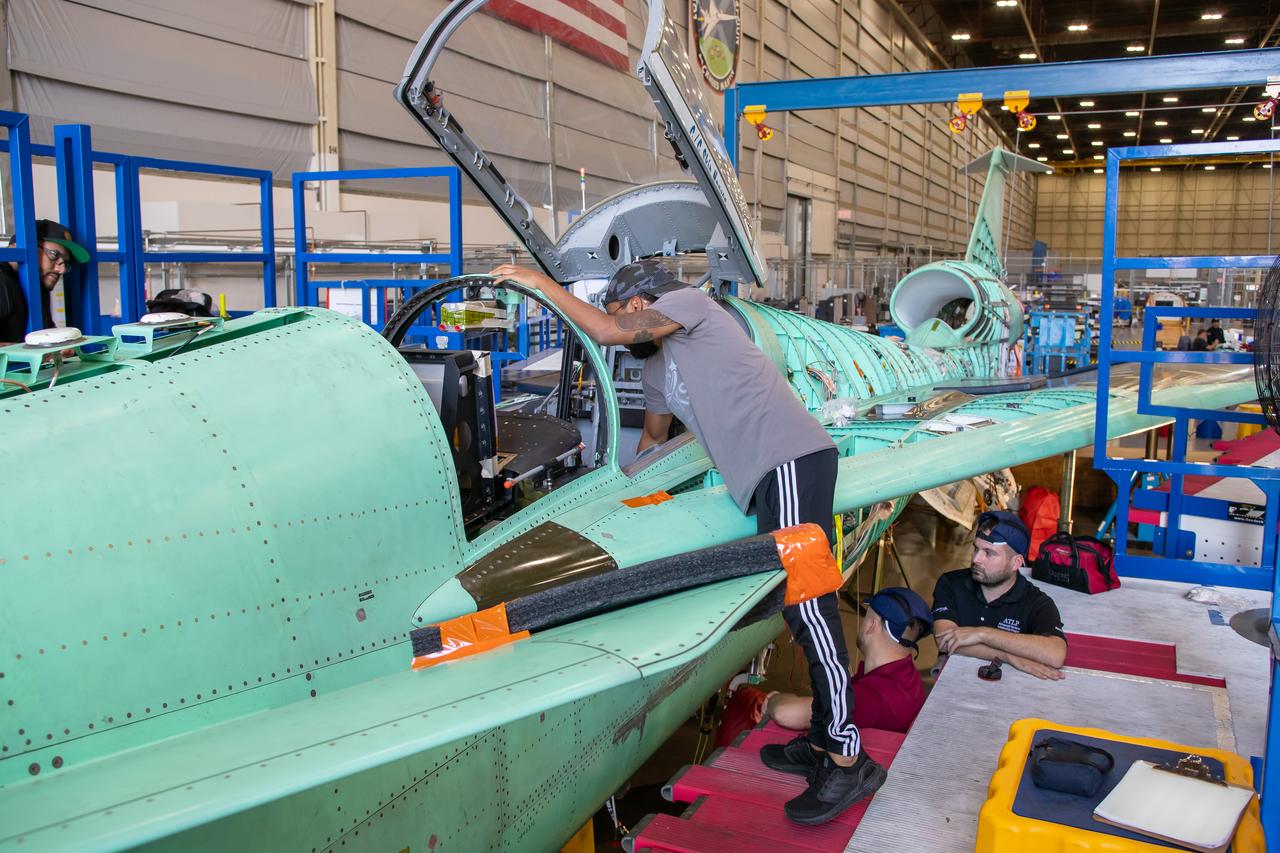
A Lockheed Martin Skunk Works technician works to complete wiring on the X-59 aircraft in preparation for the power-on system checkouts.  Once complete, the X-59 aircraft will demonstrate the ability to fly supersonic while reducing the loud sonic boom to a quiet sonic thump and help enable commercial supersonic air travel over land. This aircraft is the centerpiece of NASA’s Quesst mission.
Cockpit Lights SCO - Right Tomahawk Skin
This overhead view of the X-59 shows the aircraft at Lockheed Martin Skunk Works in Palmdale, California. During the assembly of this experimental aircraft, the team often has to remove components to effectively and safely assemble other sections of the aircraft. In this image, the nose is not attached and the horizontal stabilators are shown behind the tail. The X-59 is the centerpiece of NASA’s Quesst mission which plans to produce data that will help enable commercial supersonic air travel over land.
FTIS Sensors and From Above
The upper empennage, or tail section of the plane, and engine bay is surrounded by a blue gantry that is used to assist with ground installation and removal of the X-59’s lower empennage and engine. Once fully assembled, the X-59 aircraft will demonstrate the ability to fly supersonic while reducing the loud sonic boom to a quiet sonic thump and help enable commercial supersonic air travel over land. This aircraft is the centerpiece of NASA’s Quesst mission.
LRC-2022-H1_P_X-59-45
The X-59 arrives home in Palmdale, California after completing important structural and fuel tests at the Lockheed Martin facility in Ft. Worth, Texas. The nose, which is not installed in this image, was removed prior to the transport home and arrived separately to the facility. This is part of NASA’s Quesst mission which plans to help enable supersonic air travel over land.
LRC-2022-H1_P_X-59-1
NASA’s X-59 undergoes a structural stress test at a Lockheed Martin facility in Fort Worth, Texas. The X-59’s nose makes up one third of the aircraft, at 38-feet in length. The X-59 is a one-of-a-kind airplane designed to fly at supersonic speeds without making aa startling sonic boom sound for the communities below. This is part of NASA’s Quesst mission which plans to help enable supersonic air travel over land
Document X-59 in FW and testing
A quality inspector checks NASA’s X-59 aircraft during the construction phase. The X-59 was built in Lockheed Martin’s Skunk Works facility in Palmdale, California.  Once the aircraft and ground testing are complete, the X-59 will undergo flight testing, which will demonstrate the plane’s ability to fly supersonic - faster than the speed of sound - while reducing the loud sonic boom. This could enable commercial supersonic air travel over land.
Quality Inspection on X-59
Event: Forebody and Nose - Windtunnel Testing A model of the X-59 forebody is shown in the Lockheed Martin Skunk Works’ wind tunnel in Palmdale, California. These tests gave the team measurements of wind flow angle around the aircraft’s nose and confirmed computer predictions made using computational fluid dynamics (CFD) software tools. The data will be fed into the aircraft flight control system to tell the pilot the aircraft’s altitude, speed and angle. This is part of NASA’s Quesst mission which plans to help enable supersonic air travel over land.
Forebody and Nose - Windtunnel Testing
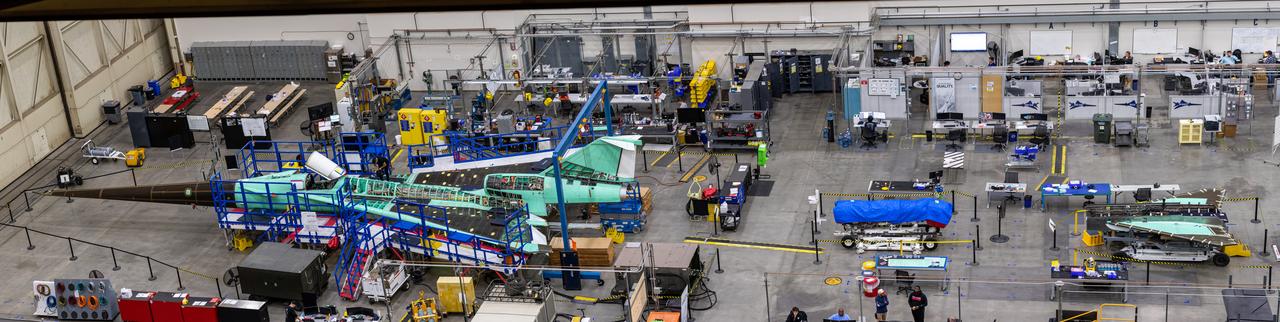
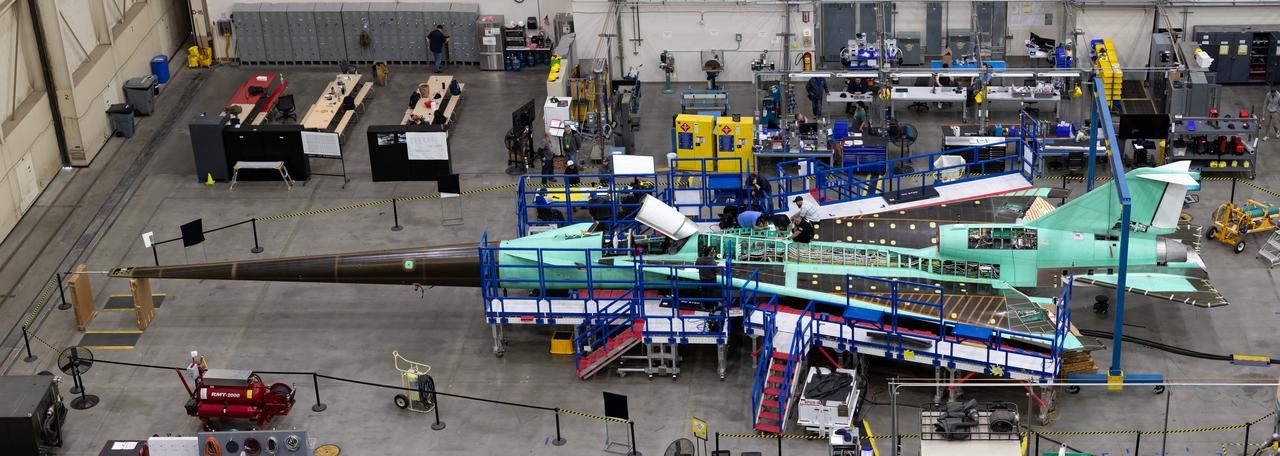
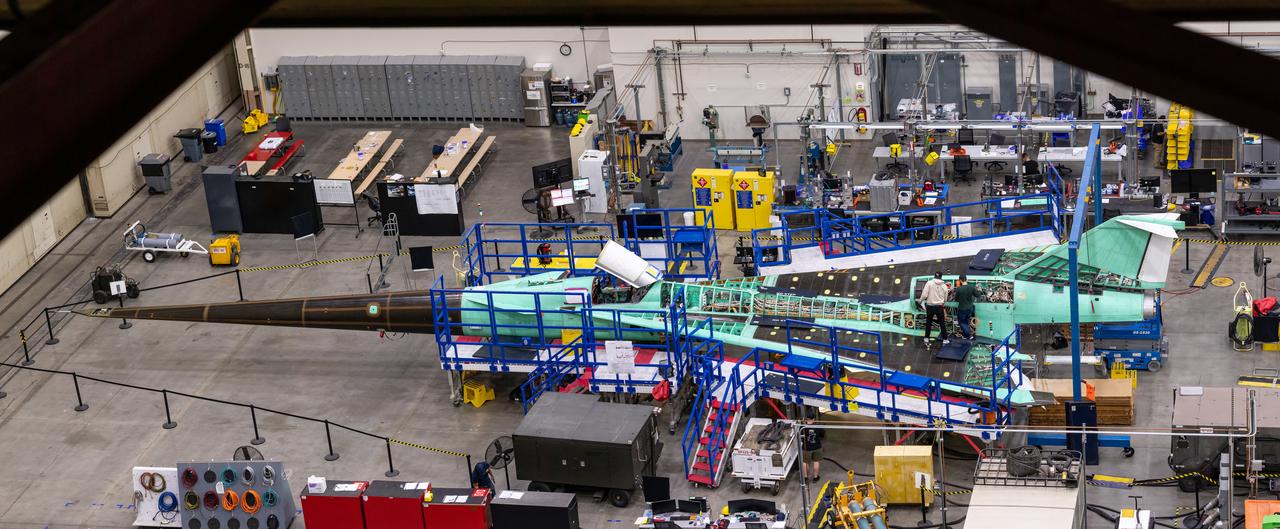
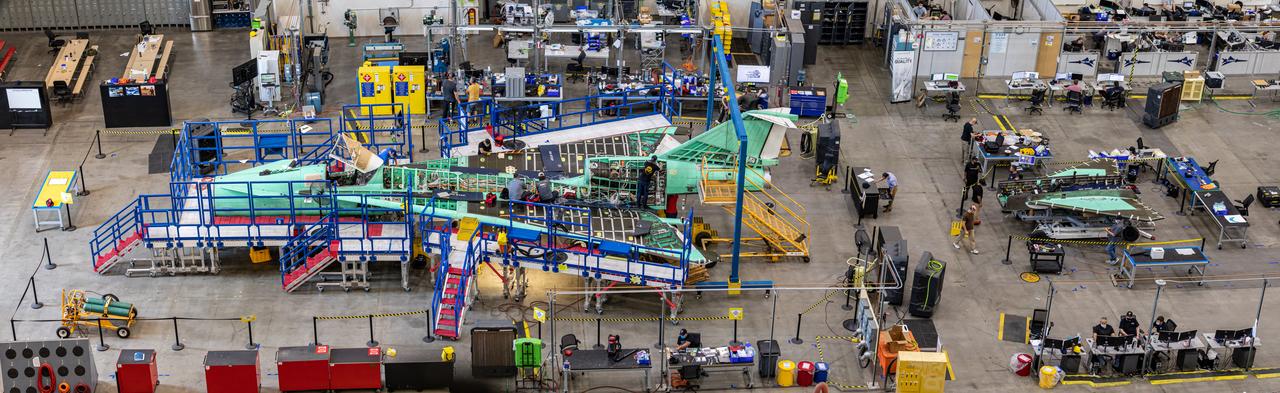
An overhead view of the X-59 during assembly in spring 2023. Assembly took place at Lockheed Martin’s Skunk Works facility in Palmdale, California.  Once complete, the X-59 is designed to fly supersonic while reducing the loud sonic boom. The Quesst mission could help change the rules for commercial supersonic air travel over land.
Overhead Image of NASA’s X-59 in Construction
A Lockheed Martin Skunk Works technician inspects some of the wiring and sensors on the X-59 aircraft in preparation for the first power-on system checkouts.  Once complete, the X-59 aircraft will demonstrate the ability to fly supersonic while reducing the loud sonic boom to a quiet sonic thump and help enable commercial supersonic air travel over land. This aircraft is the centerpiece of NASA’s Quesst mission.
LRC-2022-H1_P_X-59-48
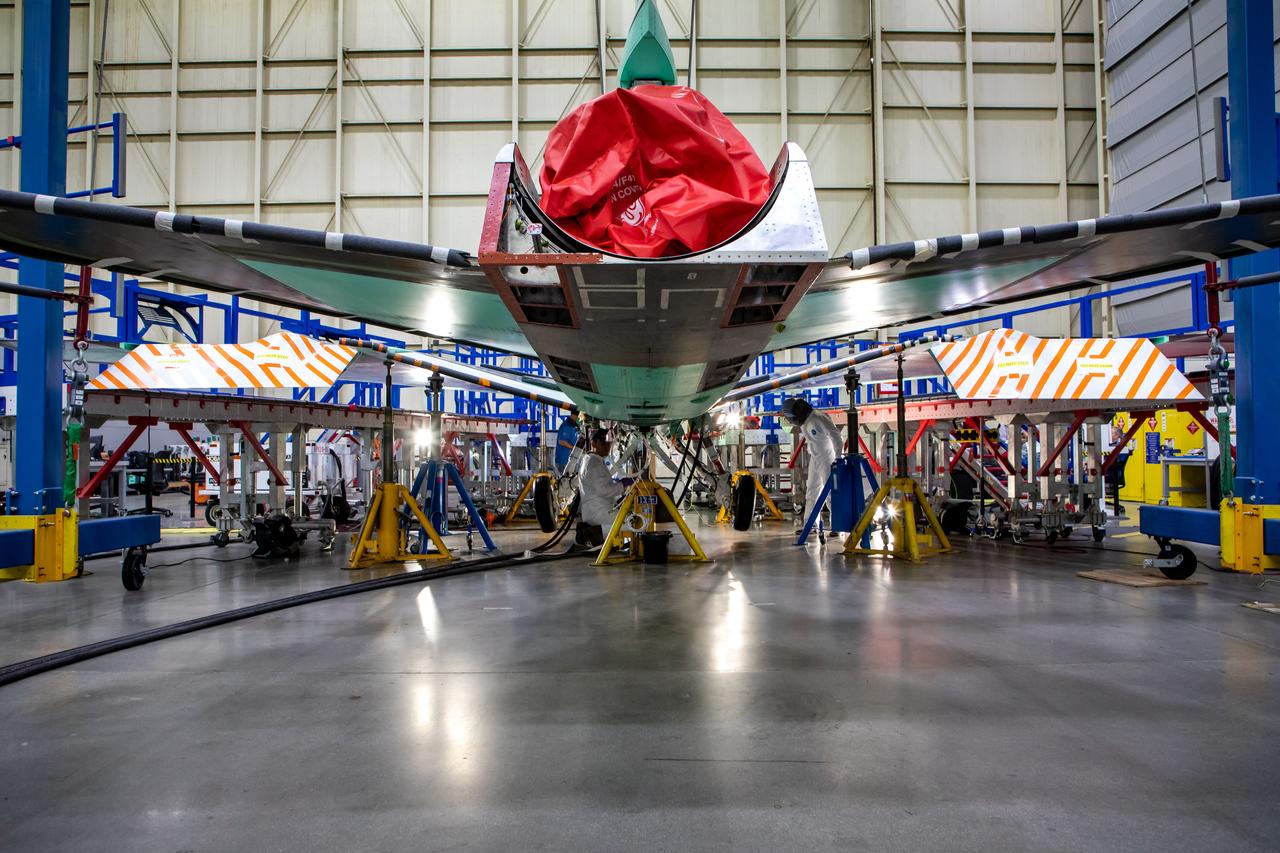
 Here is an image of the X-59’s 13-foot General Electric F414 engine as the team prepares for a fit check. Making sure components, like the aircraft’s hydraulic lines, which help control functions like brakes or landing gear, and wiring of the engine, fit properly is essential to the aircraft’s safety.  Once complete, the X-59 aircraft will demonstrate the ability to fly supersonic while reducing the loud sonic boom to a quiet sonic thump and help enable commercial supersonic air travel over land.
Engine Test Fit Install
This is an overhead view of the X-59 aircraft at Lockheed Martin Skunk Works in Palmdale, California. The nose was installed, and the plane awaits engine installation. Technicians continue to wire the aircraft as the team preforms several system checkouts to ensure the safety of the aircraft. The X-59 aircraft will demonstrate the ability to fly supersonic while reducing the loud sonic boom to a quiet sonic thump and help enable commercial supersonic air travel over land.
From Above With Nose Installed
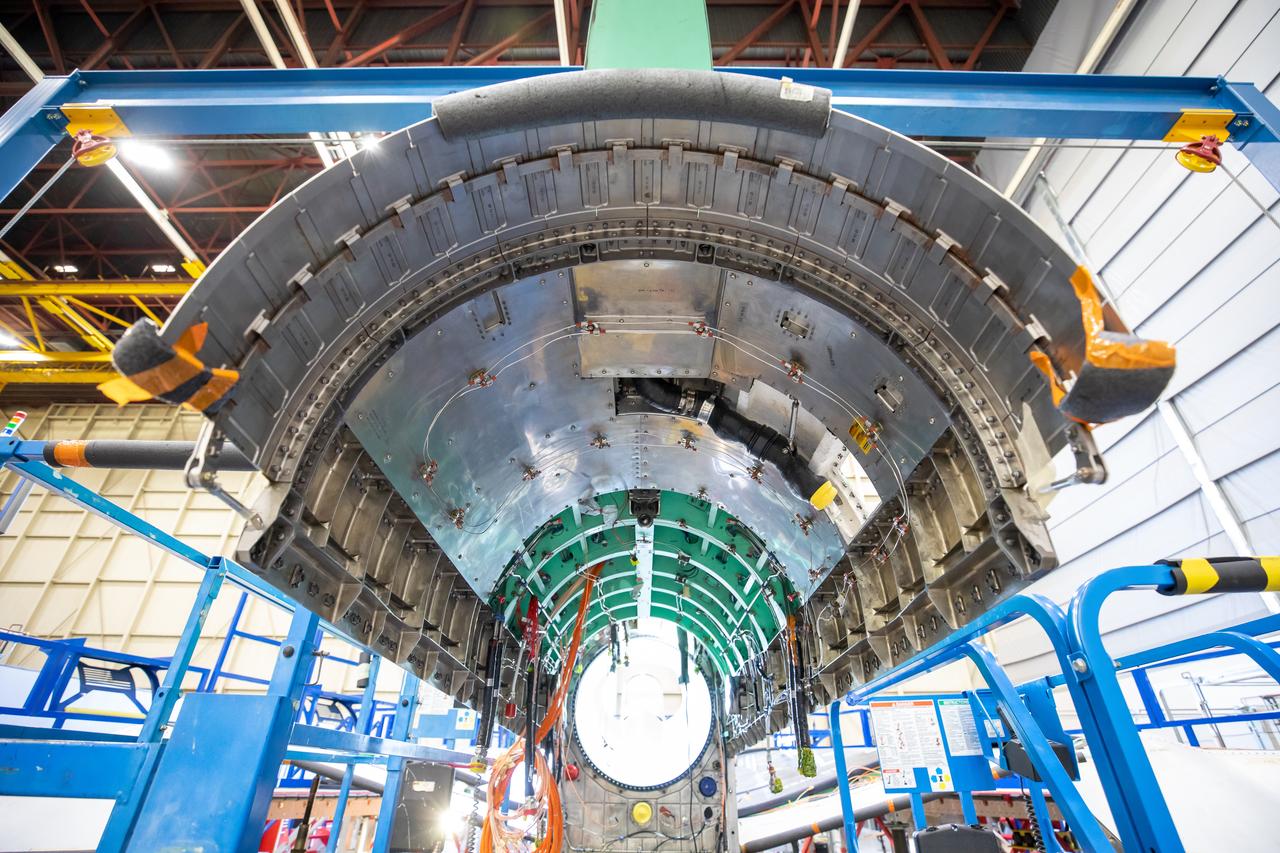
This image shows the X-59’s engine inlet from the aft view, which is the rear of the airplane, looking forward. Once the aircraft and ground testing are complete, the X-59 will undergo flight testing, which will demonstrate the plane’s ability to fly supersonic - faster than the speed of sound - while reducing the loud sonic boom. This could enable commercial supersonic air travel over land again.
Quesst Mission | X-59 Engine Inlet
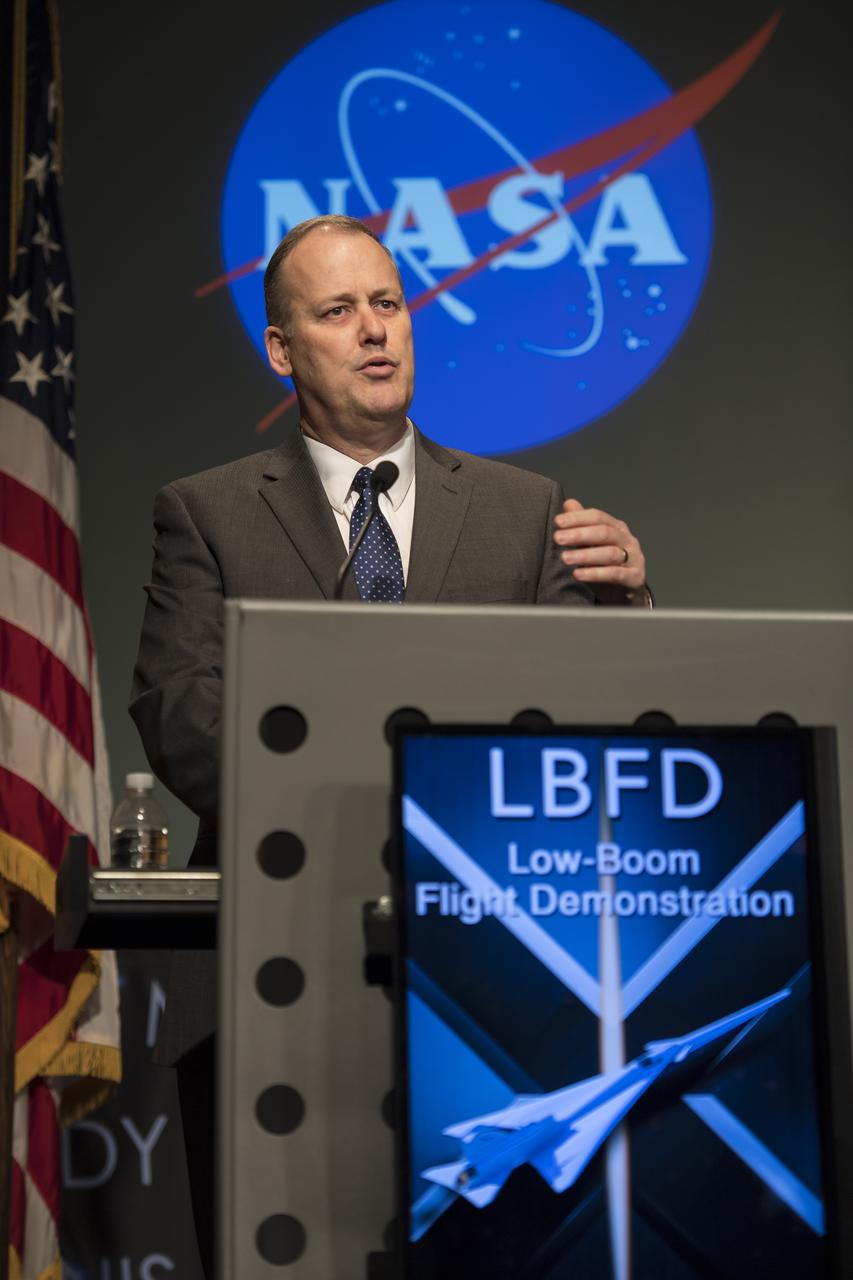
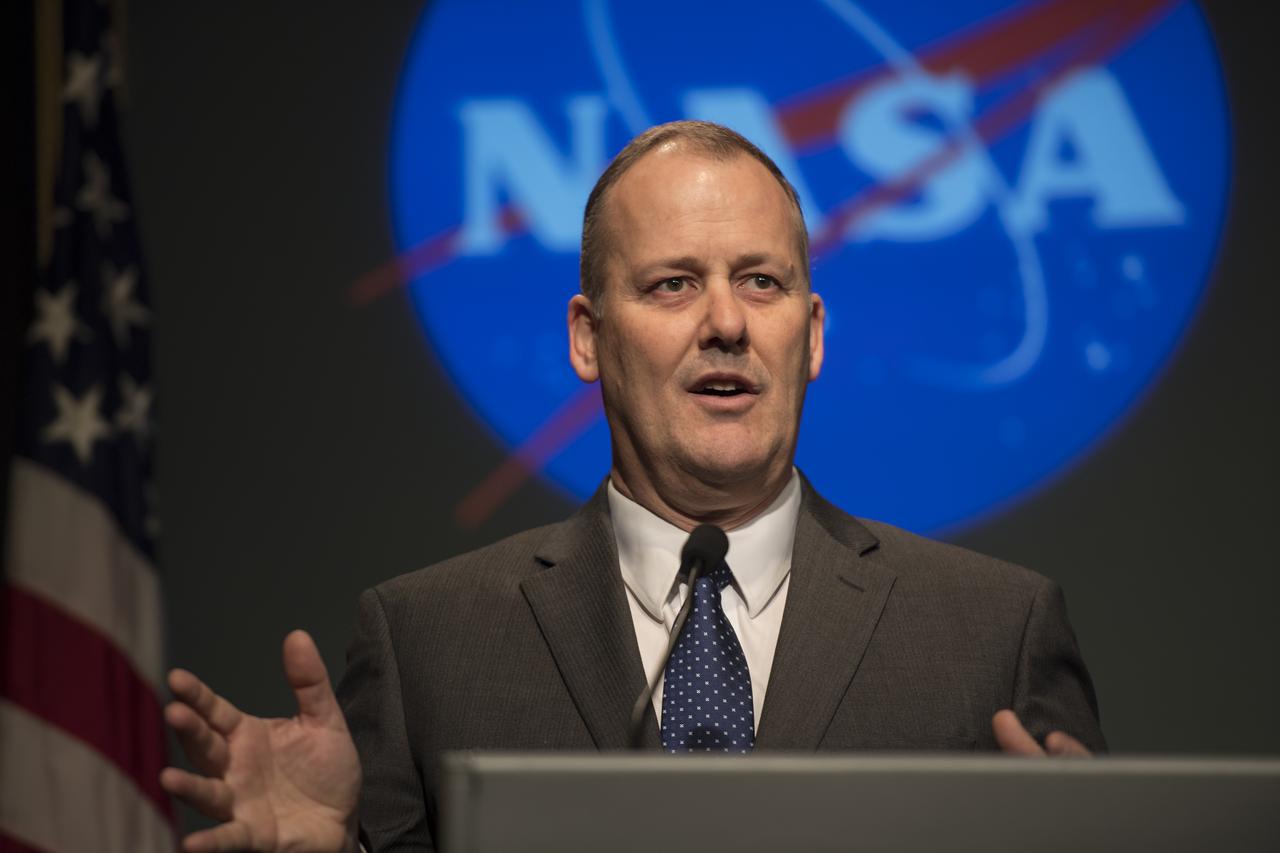
Dave Richardson, director, Air Vehicle Design and Technologies, Lockheed Martin Skunk Works, speaks after the announcement that Lockheed Martin won the contract to develop the first X-plane at a briefing, Tuesday, April 3, 2018 at NASA Headquarters in Washington. This new experimental aircraft will cut cross country travel times in half by flying faster than the speed of sound without creating a sonic boom, enabling travel from New York to Los Angeles in two hours. Photo Credit: (NASA/Aubrey Gemignani)
Low Boom Flight Demonstrator Briefing
Dave Richardson, director, Air Vehicle Design and Technologies, Lockheed Martin Skunk Works, speaks after the announcement that Lockheed Martin won the contract to develop the first X-plane at a briefing, Tuesday, April 3, 2018 at NASA Headquarters in Washington. This new experimental aircraft will cut cross country travel times in half by flying faster than the speed of sound without creating a sonic boom, enabling travel from New York to Los Angeles in two hours. Photo Credit: (NASA/Aubrey Gemignani)
Low Boom Flight Demonstrator Briefing
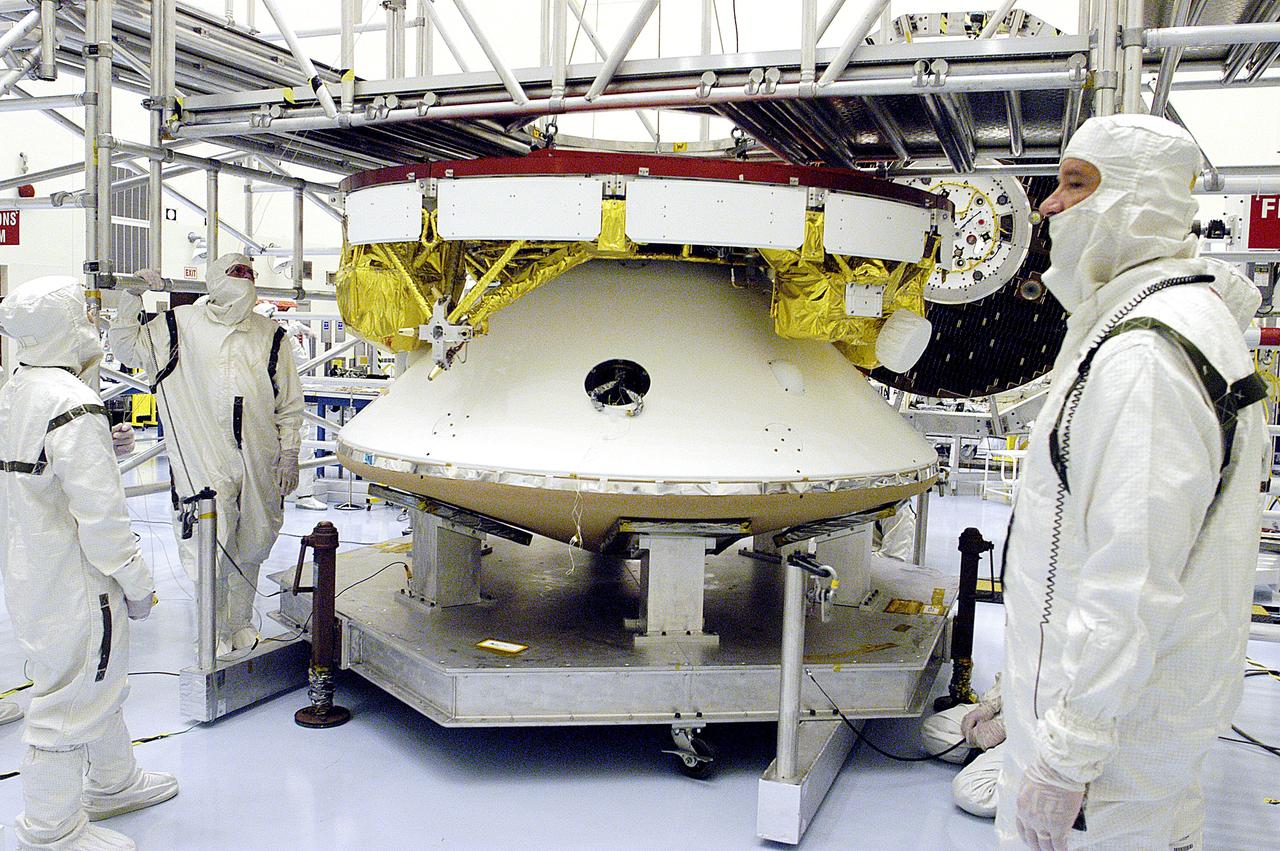
KENNEDY SPACE CENTER, FLA. - On Mars Exploration Rover 1 (MER-1) , air bags are installed on the lander.  The airbags will inflate to cushion the landing of the spacecraft on the surface of Mars.  When it stops bouncing and rolling, the airbags will deflate and retract, the petals will open to bring the lander to an upright position, and the rover will be exposed.  NASA's twin Mars Exploration Rovers are designed to study the history of water on Mars. These robotic geologists are equipped with a robotic arm, a drilling tool, three spectrometers, and four pairs of cameras that allow them to have a human-like, 3D view of the terrain. Each rover could travel as far as 100 meters in one day to act as Mars scientists' eyes and hands, exploring an environment where humans can't yet go.  MER-1 is scheduled to launch June 25 as MER-B aboard a Delta II rocket from Cape Canaveral Air Force Station.
KENNEDY SPACE CENTER, FLA. - On Mars Exploration Rover 1 (MER-1) , air bags are installed on the lander. The airbags will inflate to cushion the landing of the spacecraft on the surface of Mars. When it stops bouncing and rolling, the airbags will deflate and retract, the petals will open to bring the lander to an upright position, and the rover will be exposed. NASA's twin Mars Exploration Rovers are designed to study the history of water on Mars. These robotic geologists are equipped with a robotic arm, a drilling tool, three spectrometers, and four pairs of cameras that allow them to have a human-like, 3D view of the terrain. Each rover could travel as far as 100 meters in one day to act as Mars scientists' eyes and hands, exploring an environment where humans can't yet go. MER-1 is scheduled to launch June 25 as MER-B aboard a Delta II rocket from Cape Canaveral Air Force Station.
KENNEDY SPACE CENTER, FLA. -  The Mars Exploration Rover 1 (MER-1) is seen after installation of the air bags on the outside of the lander.  The airbags will inflate to cushion the landing of the spacecraft on the surface of Mars.  When it stops bouncing and rolling, the airbags will deflate and retract, the petals will open to bring the lander to an upright position, and the rover will be exposed.  NASA's twin Mars Exploration Rovers are designed to study the history of water on Mars. These robotic geologists are equipped with a robotic arm, a drilling tool, three spectrometers, and four pairs of cameras that allow them to have a human-like, 3D view of the terrain. Each rover could travel as far as 100 meters in one day to act as Mars scientists' eyes and hands, exploring an environment where humans can't yet go.  MER-1 is scheduled to launch June 25 as MER-B aboard a Delta II rocket from Cape Canaveral Air Force Station.
KENNEDY SPACE CENTER, FLA. - The Mars Exploration Rover 1 (MER-1) is seen after installation of the air bags on the outside of the lander. The airbags will inflate to cushion the landing of the spacecraft on the surface of Mars. When it stops bouncing and rolling, the airbags will deflate and retract, the petals will open to bring the lander to an upright position, and the rover will be exposed. NASA's twin Mars Exploration Rovers are designed to study the history of water on Mars. These robotic geologists are equipped with a robotic arm, a drilling tool, three spectrometers, and four pairs of cameras that allow them to have a human-like, 3D view of the terrain. Each rover could travel as far as 100 meters in one day to act as Mars scientists' eyes and hands, exploring an environment where humans can't yet go. MER-1 is scheduled to launch June 25 as MER-B aboard a Delta II rocket from Cape Canaveral Air Force Station.
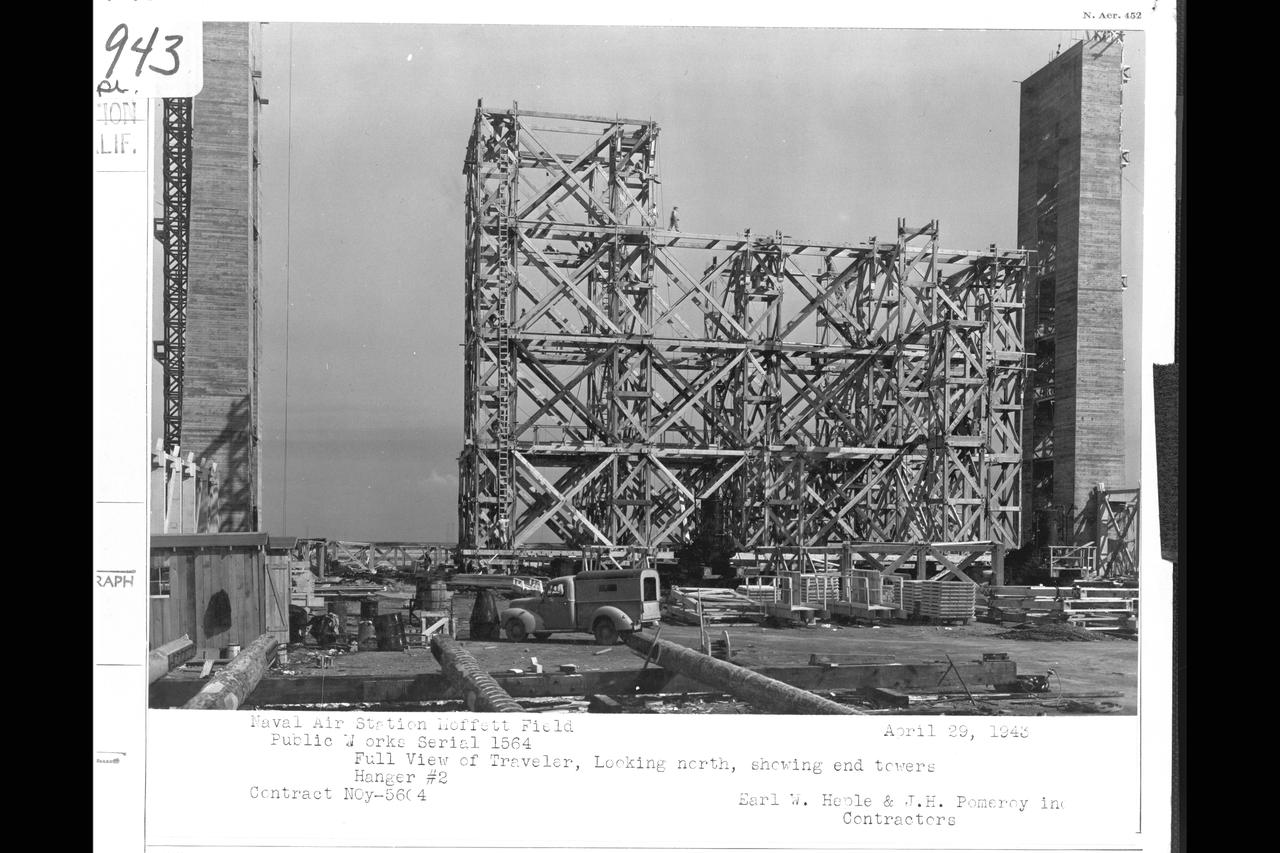
Navy Naval Air Station Moffett Field Public works Serial 1514 - Contract NOy-5604, Earl W. Heple & J.H. Pomeroy contractors NAS Moffett Field: full view of Traveler, looking north, showing end towers Hangar 2
ARC-1943-A93-0074-3
KENNEDY SPACE CENTER, FLA. - Workers in the Payload Hazardous Servicing Facility prepare the Mars Exploration Rover 2 (MER-2) for a weight and center of gravity determination.  NASA's twin Mars Exploration Rovers are designed to study the history of water on Mars. These robotic geologists are equipped with a robotic arm, a drilling tool, three spectrometers, and four pairs of cameras that allow them to have a human-like, 3D view of the terrain. Each rover could travel as far as 100 meters in one day to act as Mars scientists' eyes and hands, exploring an environment where humans can't yet go.  Launch of MER-2 is scheduled for June 5 from Cape Canaveral Air Force Station.
KENNEDY SPACE CENTER, FLA. - Workers in the Payload Hazardous Servicing Facility prepare the Mars Exploration Rover 2 (MER-2) for a weight and center of gravity determination. NASA's twin Mars Exploration Rovers are designed to study the history of water on Mars. These robotic geologists are equipped with a robotic arm, a drilling tool, three spectrometers, and four pairs of cameras that allow them to have a human-like, 3D view of the terrain. Each rover could travel as far as 100 meters in one day to act as Mars scientists' eyes and hands, exploring an environment where humans can't yet go. Launch of MER-2 is scheduled for June 5 from Cape Canaveral Air Force Station.
KENNEDY SPACE CENTER, FLA. - The Mars Exploration Rover 2 (MER-2) undergoes a weight and center of gravity determination in the Payload Hazardous Servicing Facility.  NASA's twin Mars Exploration Rovers are designed to study the history of water on Mars. These robotic geologists are equipped with a robotic arm, a drilling tool, three spectrometers, and four pairs of cameras that allow them to have a human-like, 3D view of the terrain. Each rover could travel as far as 100 meters in one day to act as Mars scientists' eyes and hands, exploring an environment where humans can't yet go.  Launch of MER-2 is scheduled for June 5 from Cape Canaveral Air Force Station.
KENNEDY SPACE CENTER, FLA. - The Mars Exploration Rover 2 (MER-2) undergoes a weight and center of gravity determination in the Payload Hazardous Servicing Facility. NASA's twin Mars Exploration Rovers are designed to study the history of water on Mars. These robotic geologists are equipped with a robotic arm, a drilling tool, three spectrometers, and four pairs of cameras that allow them to have a human-like, 3D view of the terrain. Each rover could travel as far as 100 meters in one day to act as Mars scientists' eyes and hands, exploring an environment where humans can't yet go. Launch of MER-2 is scheduled for June 5 from Cape Canaveral Air Force Station.
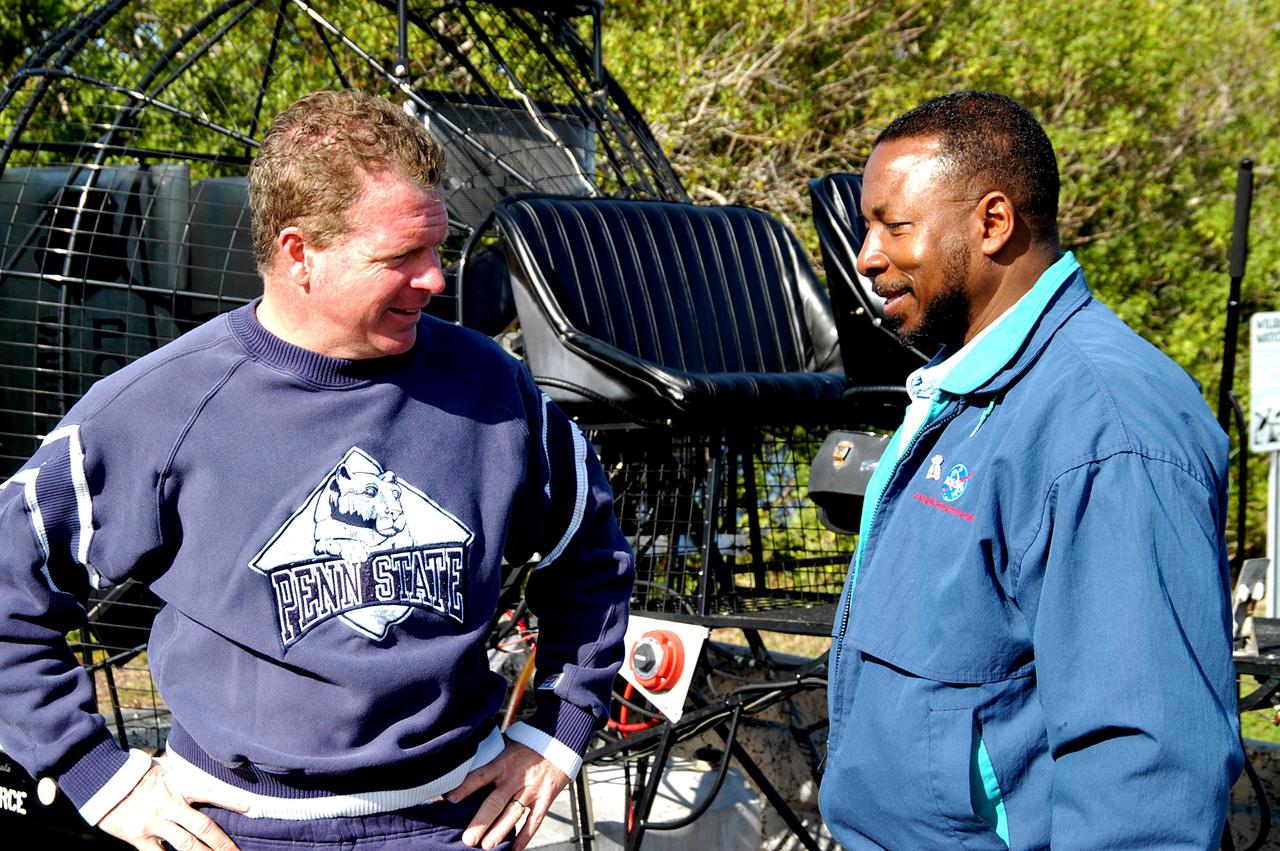
KENNEDY SPACE CENTER, FLA. - Congressman Tom Feeney (left) and Deputy Director Woodrow Whitlow Jr. talk on the ground after completing an air boat ride around Kennedy Space Center.  During January and February, Congressman Feeney traveled the entire coastline of Florida’s 24th District, and concluded his walks March 1 in Brevard County.  On his walks, he met with constituents and community leaders to discuss legislative issues that will be addressed by the 108th Congress.  Feeney ended his beach walk at the KSC Visitor Complex main entrance.
KENNEDY SPACE CENTER, FLA. - Congressman Tom Feeney (left) and Deputy Director Woodrow Whitlow Jr. talk on the ground after completing an air boat ride around Kennedy Space Center. During January and February, Congressman Feeney traveled the entire coastline of Florida’s 24th District, and concluded his walks March 1 in Brevard County. On his walks, he met with constituents and community leaders to discuss legislative issues that will be addressed by the 108th Congress. Feeney ended his beach walk at the KSC Visitor Complex main entrance.
KENNEDY SPACE CENTER, FLA. - In the Payload Hazardous Servicing Facility, the Mars Exploration Rover 2 (MER-2) is moved to a spin table.  NASA’s twin Mars Exploration Rovers are designed to study the history of water on Mars. These robotic geologists are equipped with a robotic arm, a drilling tool, three spectrometers, and four pairs of cameras that allow them to have a human-like, 3D view of the terrain. Each rover could travel as far as 100 meters in one day to act as Mars scientists' eyes and hands, exploring an environment where humans can’t yet go.  The MER-2 is scheduled to launch June 5 from Launch Pad 17-A, Cape Canaveral Air Force Station.
KENNEDY SPACE CENTER, FLA. - In the Payload Hazardous Servicing Facility, the Mars Exploration Rover 2 (MER-2) is moved to a spin table. NASA’s twin Mars Exploration Rovers are designed to study the history of water on Mars. These robotic geologists are equipped with a robotic arm, a drilling tool, three spectrometers, and four pairs of cameras that allow them to have a human-like, 3D view of the terrain. Each rover could travel as far as 100 meters in one day to act as Mars scientists' eyes and hands, exploring an environment where humans can’t yet go. The MER-2 is scheduled to launch June 5 from Launch Pad 17-A, Cape Canaveral Air Force Station.
KENNEDY SPACE CENTER, FLA. - Before going on an air boat ride around Kennedy Space Center, Congressman Tom Feeney and Deputy Director Woodrow Whitlow Jr. are briefed about the trip. During January and February, Congressman Feeney traveled the entire coastline of Florida’s 24th District, and concluded his walks March 1 in Brevard County.  On his walks, he met with constituents and community leaders to discuss legislative issues that will be addressed by the 108th Congress.  Feeney ended his beach walk at the KSC Visitor Complex main entrance.
KENNEDY SPACE CENTER, FLA. - Before going on an air boat ride around Kennedy Space Center, Congressman Tom Feeney and Deputy Director Woodrow Whitlow Jr. are briefed about the trip. During January and February, Congressman Feeney traveled the entire coastline of Florida’s 24th District, and concluded his walks March 1 in Brevard County. On his walks, he met with constituents and community leaders to discuss legislative issues that will be addressed by the 108th Congress. Feeney ended his beach walk at the KSC Visitor Complex main entrance.
KENNEDY SPACE CENTER, FLA. -  The Mars Exploration Rover 2 (MER-2) undergoes a weight and center of gravity determination in the Payload Hazardous Servicing Facility.  NASA's twin Mars Exploration Rovers are designed to study the history of water on Mars. These robotic geologists are equipped with a robotic arm, a drilling tool, three spectrometers, and four pairs of cameras that allow them to have a human-like, 3D view of the terrain. Each rover could travel as far as 100 meters in one day to act as Mars scientists' eyes and hands, exploring an environment where humans can't yet go.  Launch of MER-2 is scheduled for June 5 from Cape Canaveral Air Force Station.
KENNEDY SPACE CENTER, FLA. - The Mars Exploration Rover 2 (MER-2) undergoes a weight and center of gravity determination in the Payload Hazardous Servicing Facility. NASA's twin Mars Exploration Rovers are designed to study the history of water on Mars. These robotic geologists are equipped with a robotic arm, a drilling tool, three spectrometers, and four pairs of cameras that allow them to have a human-like, 3D view of the terrain. Each rover could travel as far as 100 meters in one day to act as Mars scientists' eyes and hands, exploring an environment where humans can't yet go. Launch of MER-2 is scheduled for June 5 from Cape Canaveral Air Force Station.
KENNEDY SPACE CENTER, FLA. - Workers in the Payload Hazardous Servicing Facility prepare the Mars Exploration Rover 2 (MER-2) for a weight and center of gravity determination.  NASA's twin Mars Exploration Rovers are designed to study the history of water on Mars. These robotic geologists are equipped with a robotic arm, a drilling tool, three spectrometers, and four pairs of cameras that allow them to have a human-like, 3D view of the terrain. Each rover could travel as far as 100 meters in one day to act as Mars scientists' eyes and hands, exploring an environment where humans can't yet go.  Launch of MER-2 is scheduled for June 5 from Cape Canaveral Air Force Station.
KENNEDY SPACE CENTER, FLA. - Workers in the Payload Hazardous Servicing Facility prepare the Mars Exploration Rover 2 (MER-2) for a weight and center of gravity determination. NASA's twin Mars Exploration Rovers are designed to study the history of water on Mars. These robotic geologists are equipped with a robotic arm, a drilling tool, three spectrometers, and four pairs of cameras that allow them to have a human-like, 3D view of the terrain. Each rover could travel as far as 100 meters in one day to act as Mars scientists' eyes and hands, exploring an environment where humans can't yet go. Launch of MER-2 is scheduled for June 5 from Cape Canaveral Air Force Station.
KENNEDY SPACE CENTER, FLA. - Workers in the Payload Hazardous Servicing Facility are preparing to determine weight and center of gravity for the Mars Exploration Rover 2 (MER-2).  NASA's twin Mars Exploration Rovers are designed to study the history of water on Mars. These robotic geologists are equipped with a robotic arm, a drilling tool, three spectrometers, and four pairs of cameras that allow them to have a human-like, 3D view of the terrain. Each rover could travel as far as 100 meters in one day to act as Mars scientists' eyes and hands, exploring an environment where humans can't yet go.  Launch of MER-2 is scheduled for June 5 from Cape Canaveral Air Force Station.
KENNEDY SPACE CENTER, FLA. - Workers in the Payload Hazardous Servicing Facility are preparing to determine weight and center of gravity for the Mars Exploration Rover 2 (MER-2). NASA's twin Mars Exploration Rovers are designed to study the history of water on Mars. These robotic geologists are equipped with a robotic arm, a drilling tool, three spectrometers, and four pairs of cameras that allow them to have a human-like, 3D view of the terrain. Each rover could travel as far as 100 meters in one day to act as Mars scientists' eyes and hands, exploring an environment where humans can't yet go. Launch of MER-2 is scheduled for June 5 from Cape Canaveral Air Force Station.
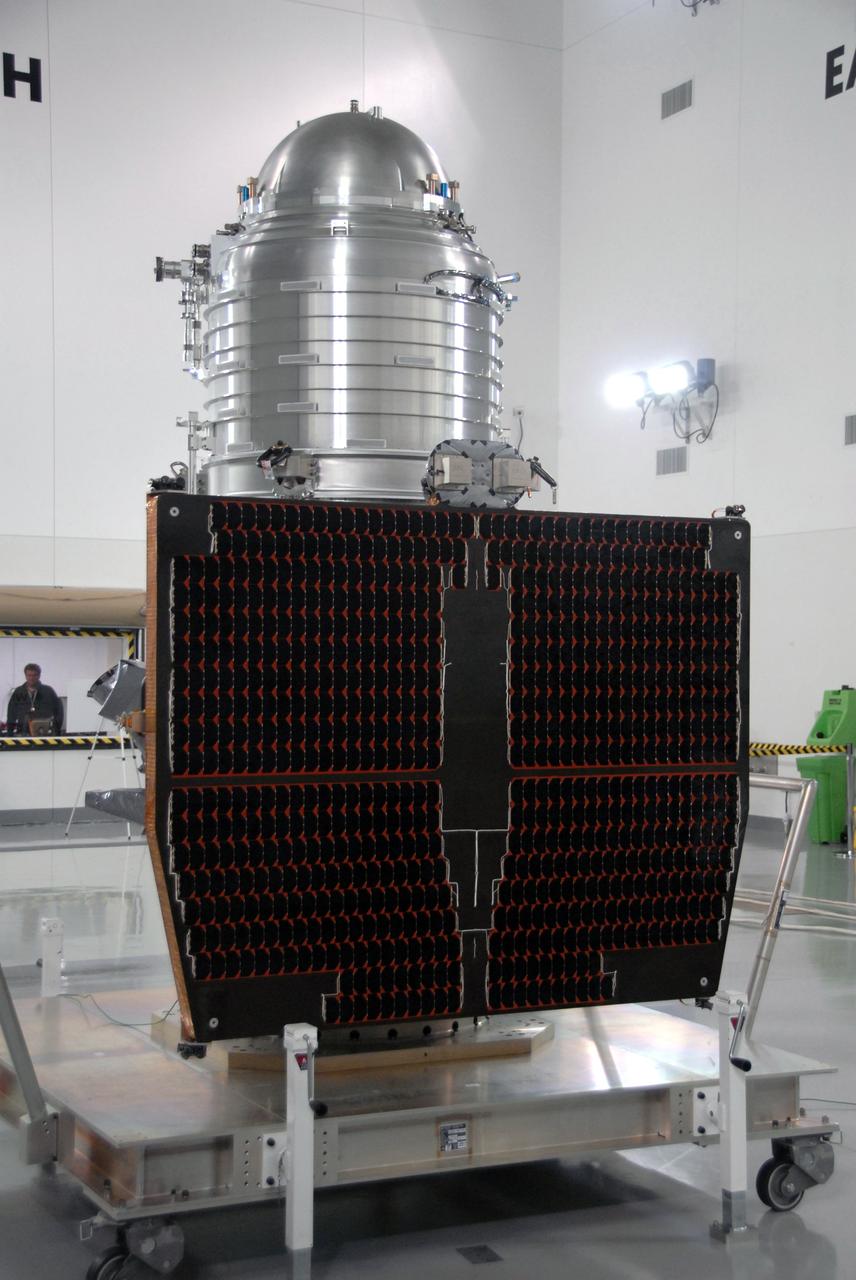
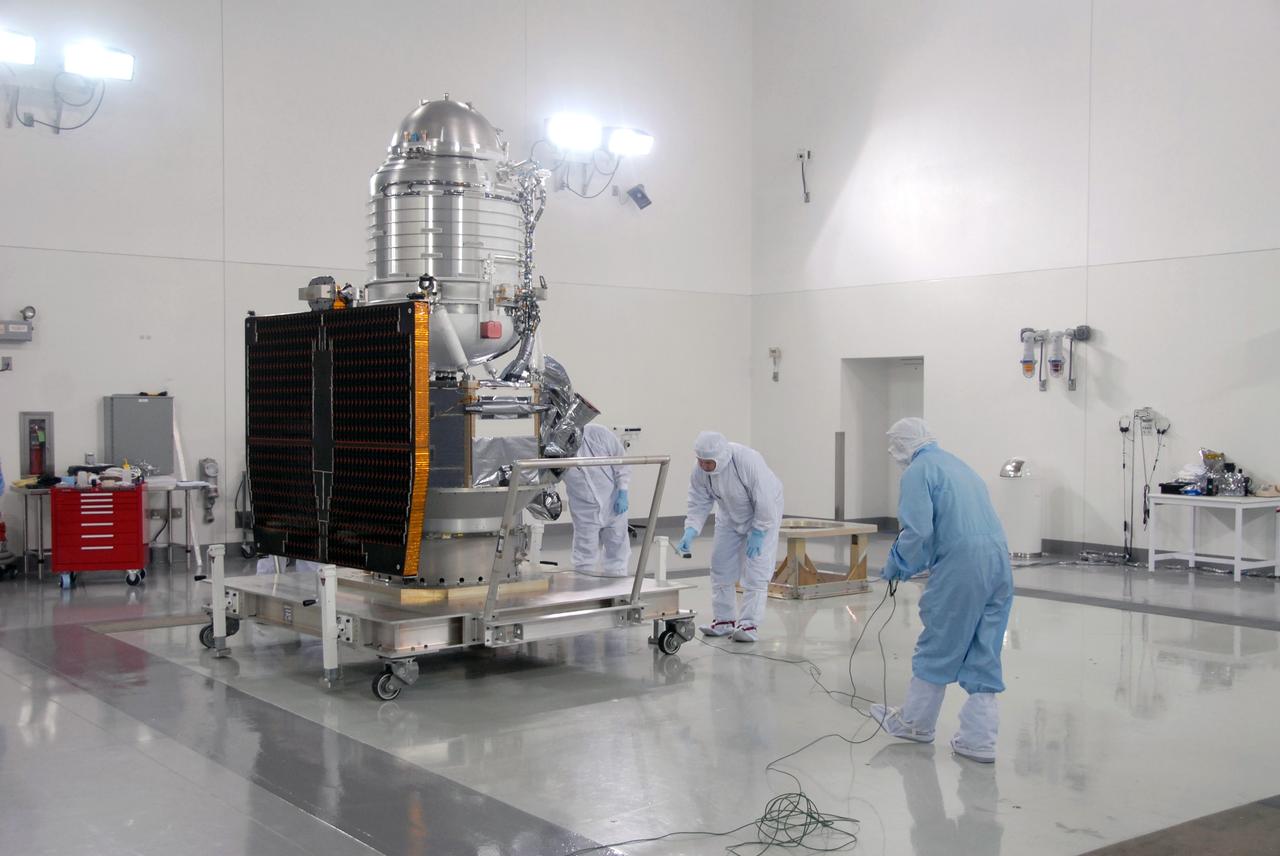
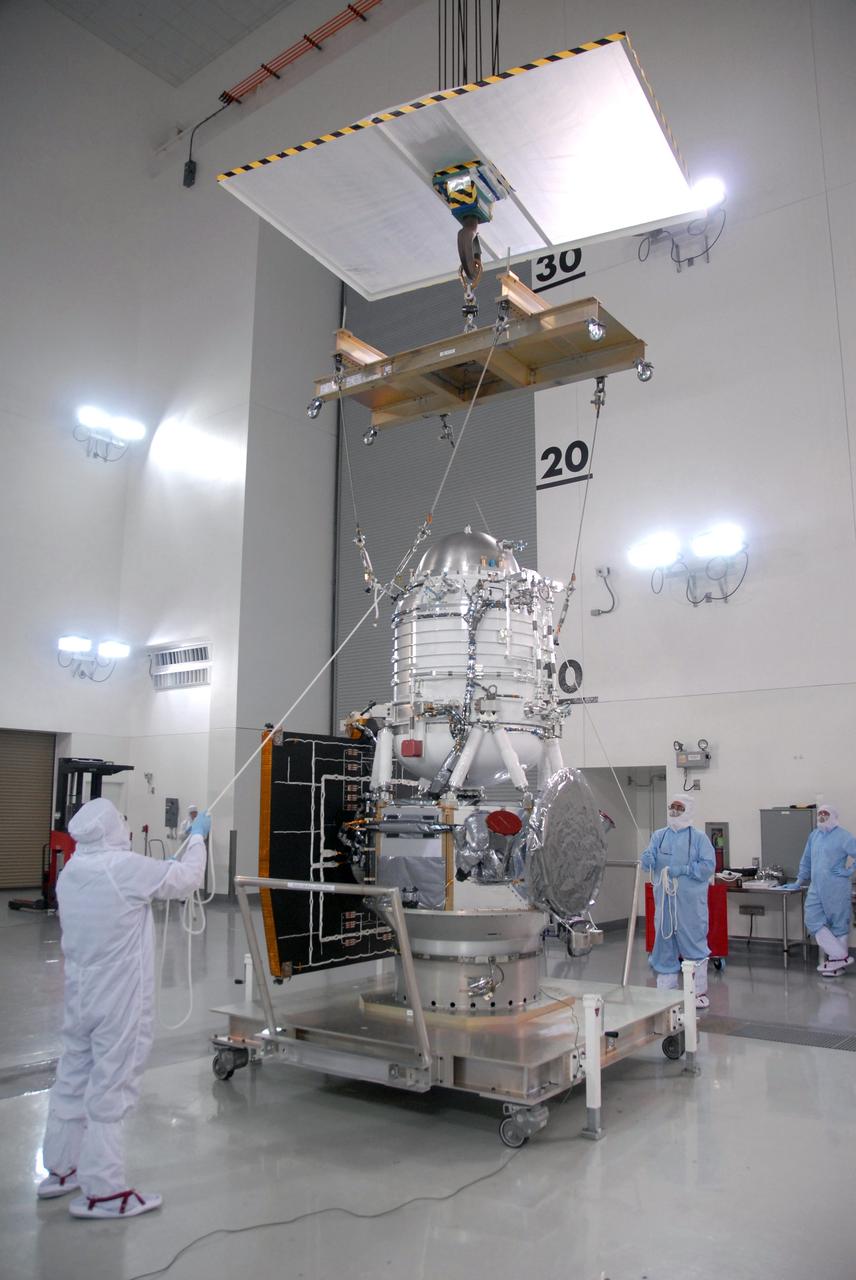
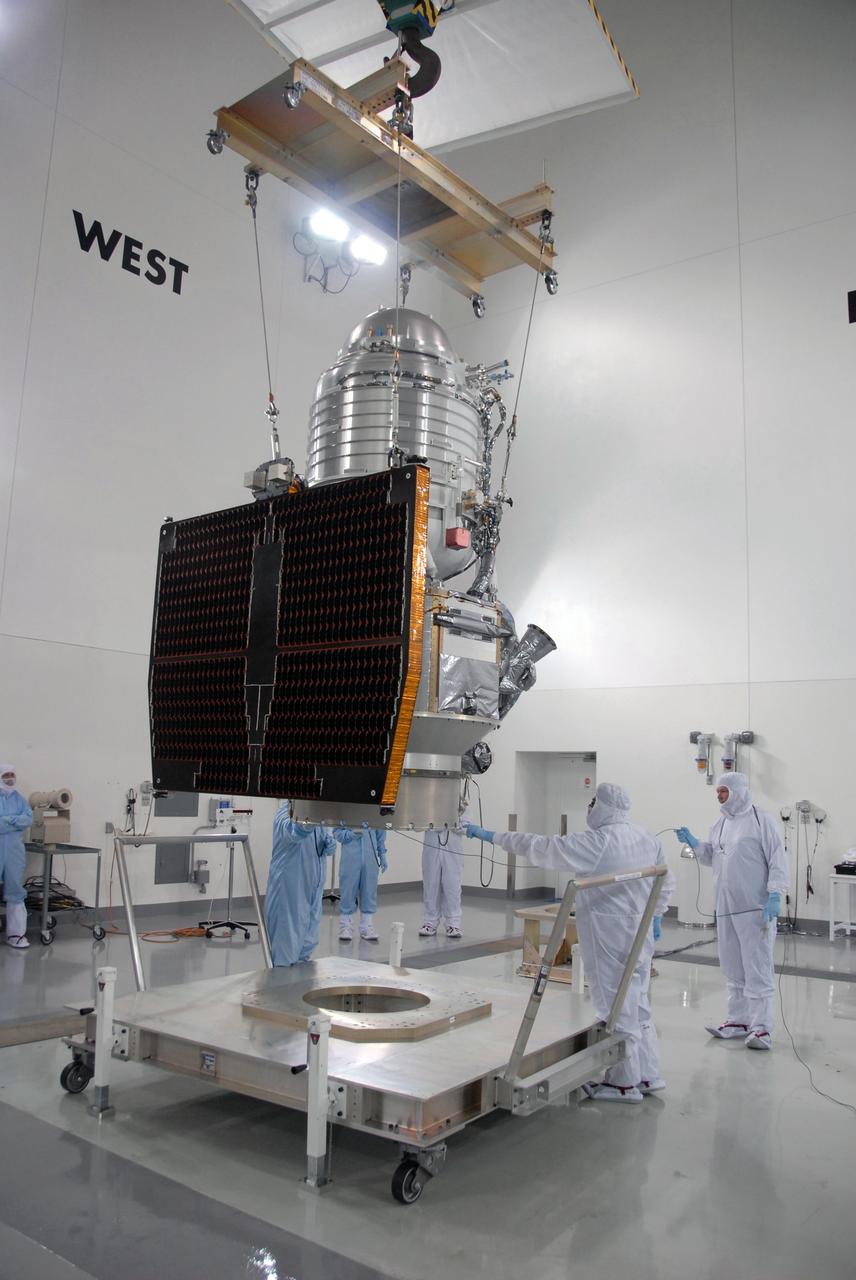
VANDENBERG AIR FORCE BASE, Calif. -- At Vandenberg Air Force Base's Astrotech processing facility in California, workers prepare to move NASA's Wide-field Infrared Survey Explorer, or WISE, spacecraft from the travel dolly to a work stand. The satellite will survey the entire sky at infrared wavelengths, creating a cosmic clearinghouse of hundreds of millions of objects,  which will be catalogued, providing a vast storehouse of knowledge about the solar system, the Milky Way, and the universe. Launch is scheduled no earlier than Dec. 10.  Photo credit: NASA/Moore, VAFB
KSC-2009-4752
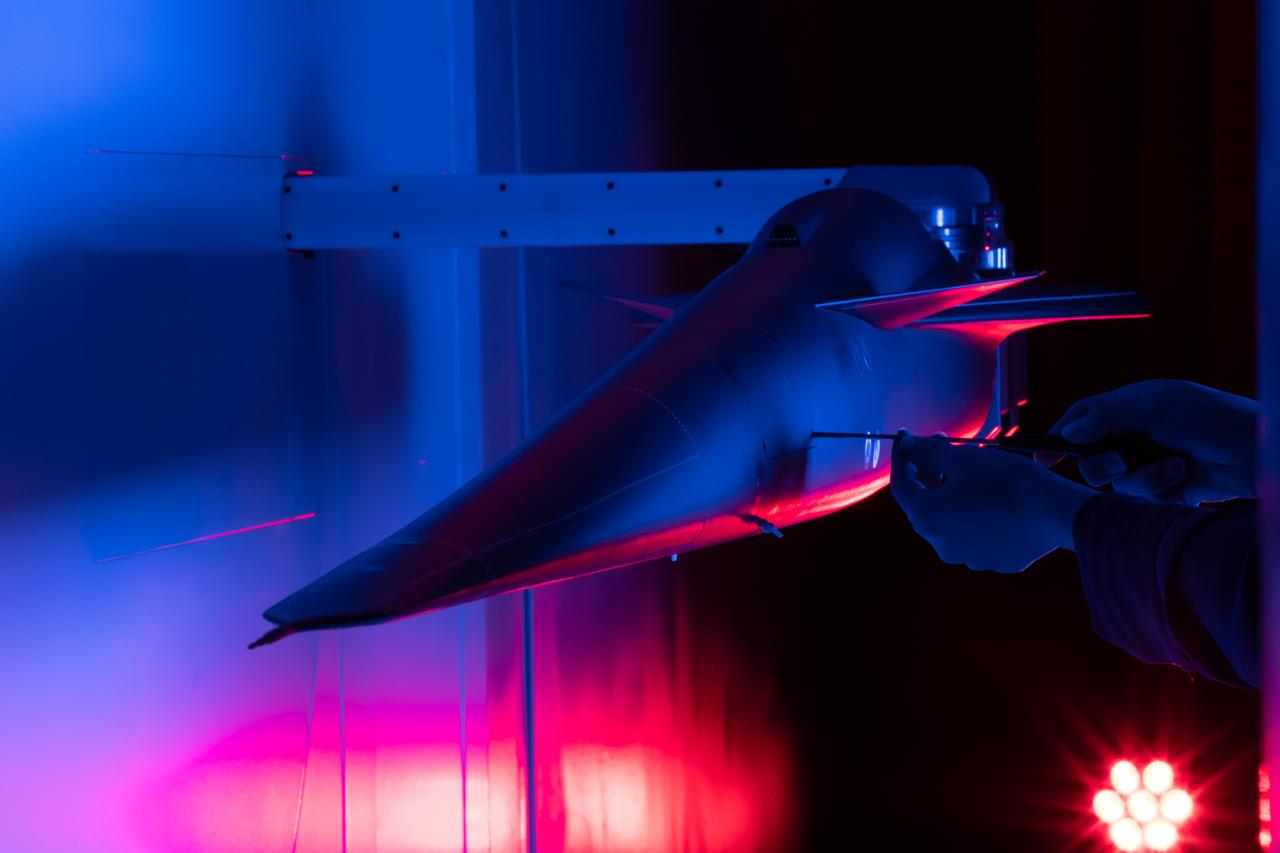
Event: Forebody and Nose - Windtunnel Testing A technician works on the X-59 model during testing in the low-speed wind tunnel at Lockheed Martin Skunk Works in Palmdale, California. These tests gave the team measurements of wind flow angle around the aircraft’s nose and confirmed computer predictions made using computational fluid dynamics (CFD) software tools. The data will be fed into the aircraft flight control system to tell the pilot the aircraft’s altitude, speed, and angle. This is part of NASA’s Quesst mission which plans to help enable supersonic air travel over land.
Forebody and Nose - Windtunnel Testing
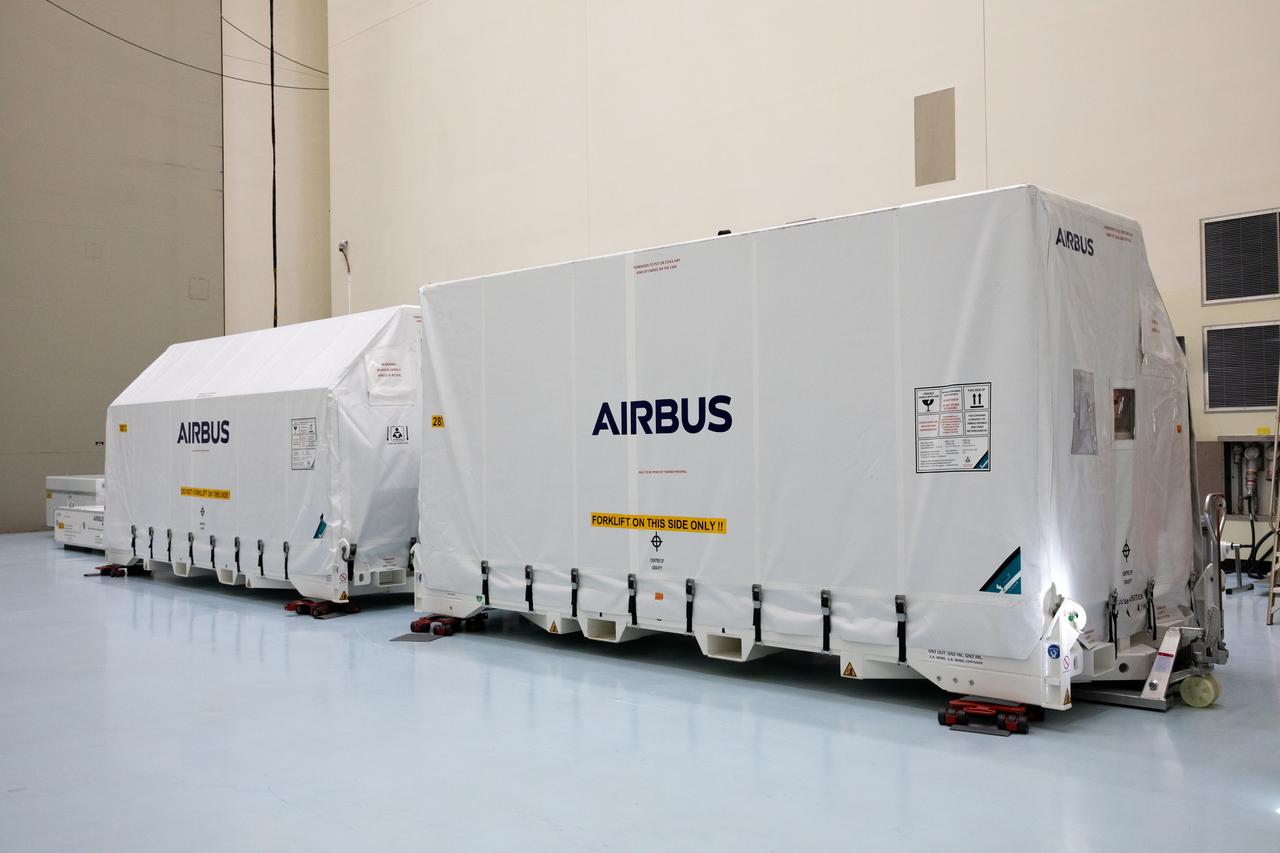
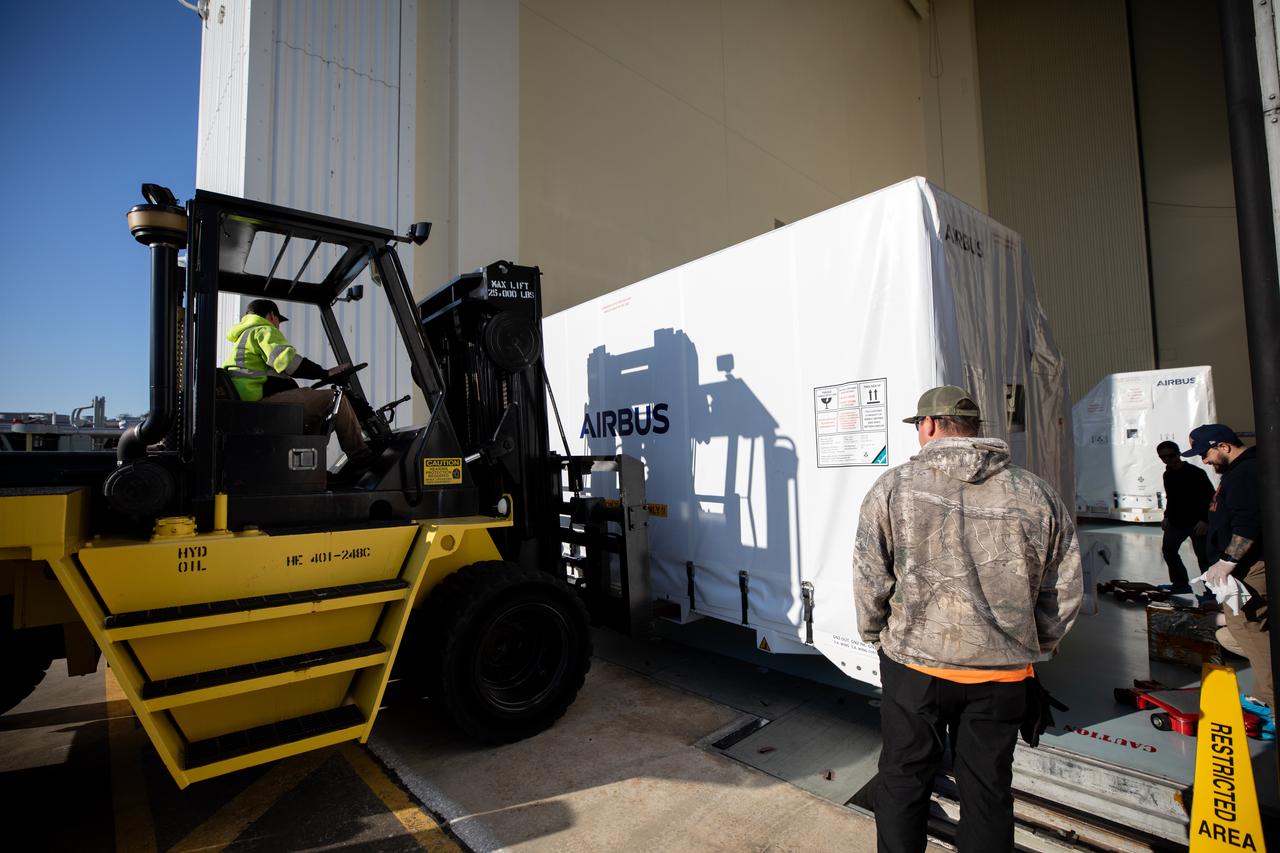
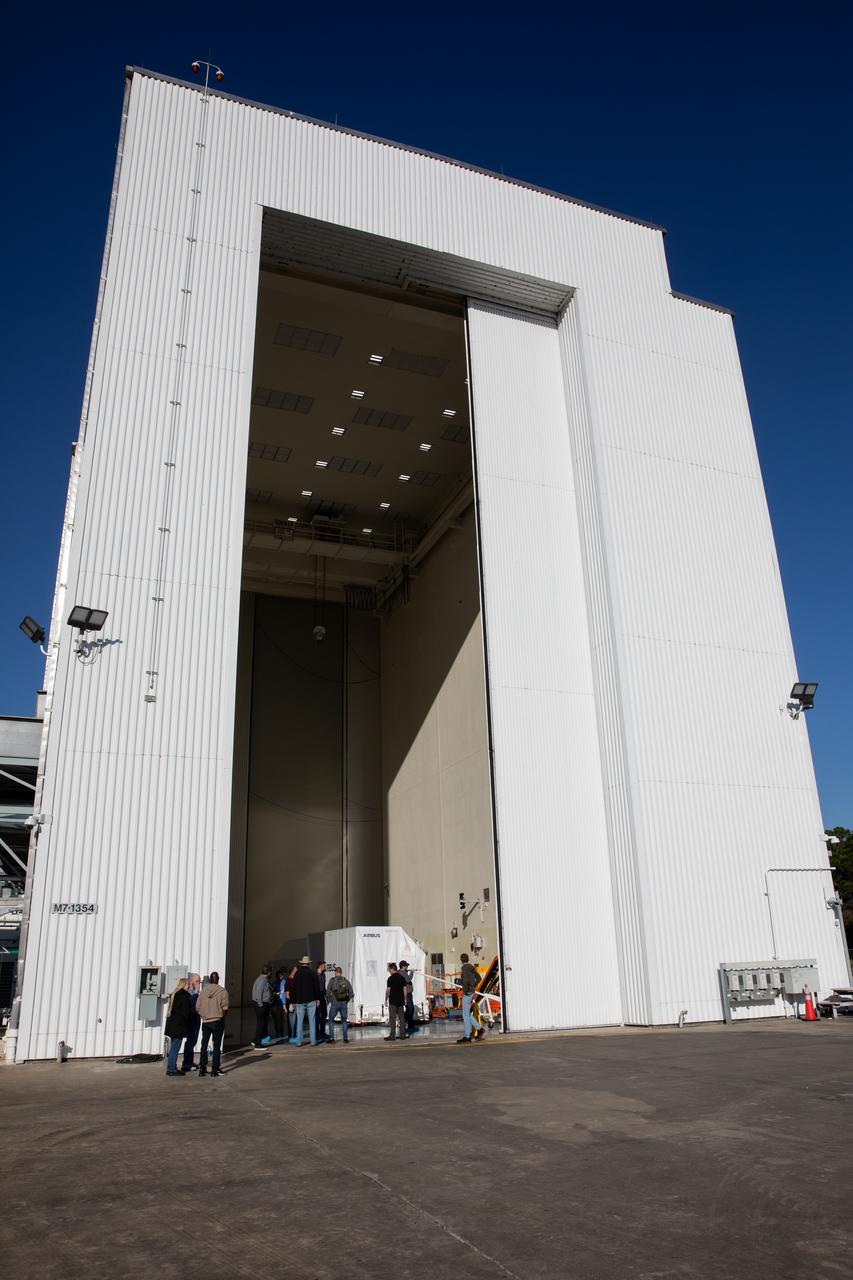
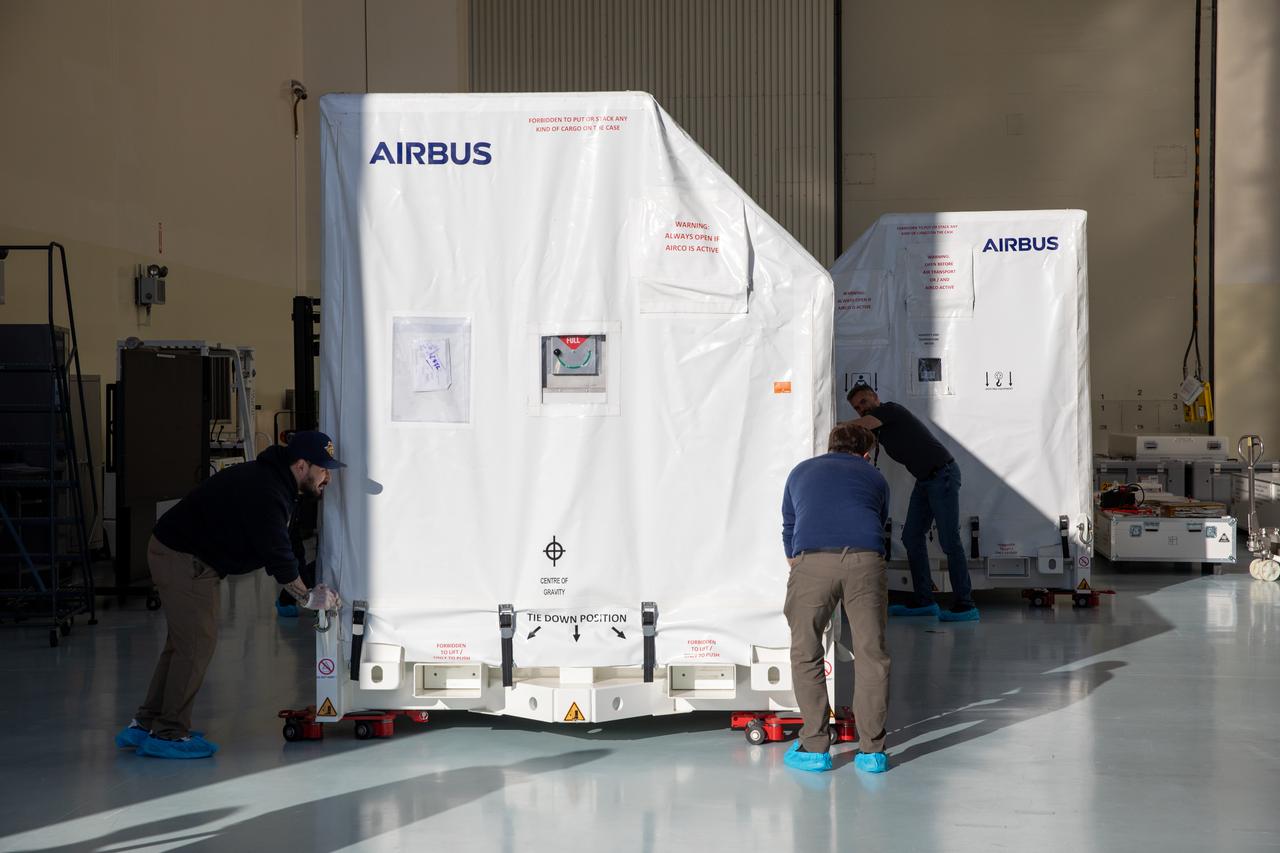
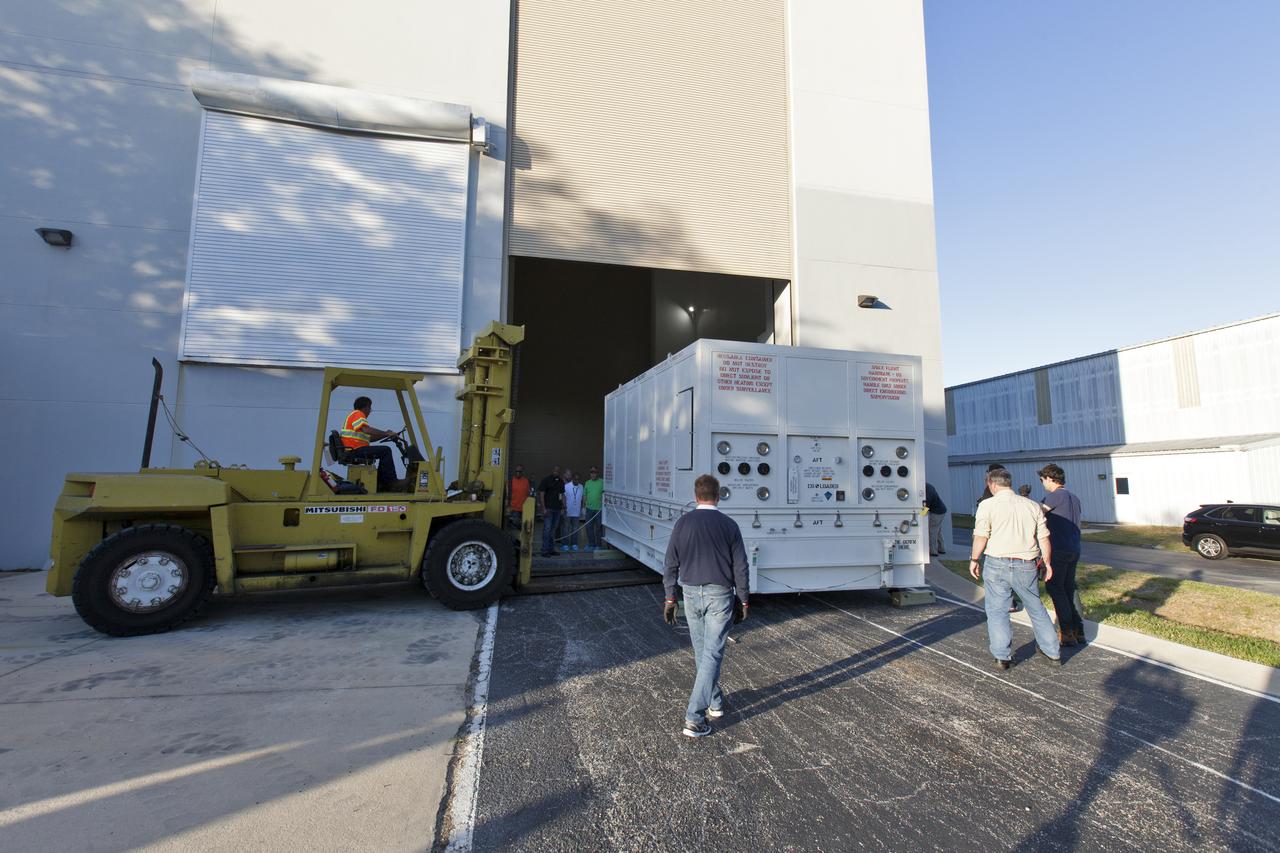
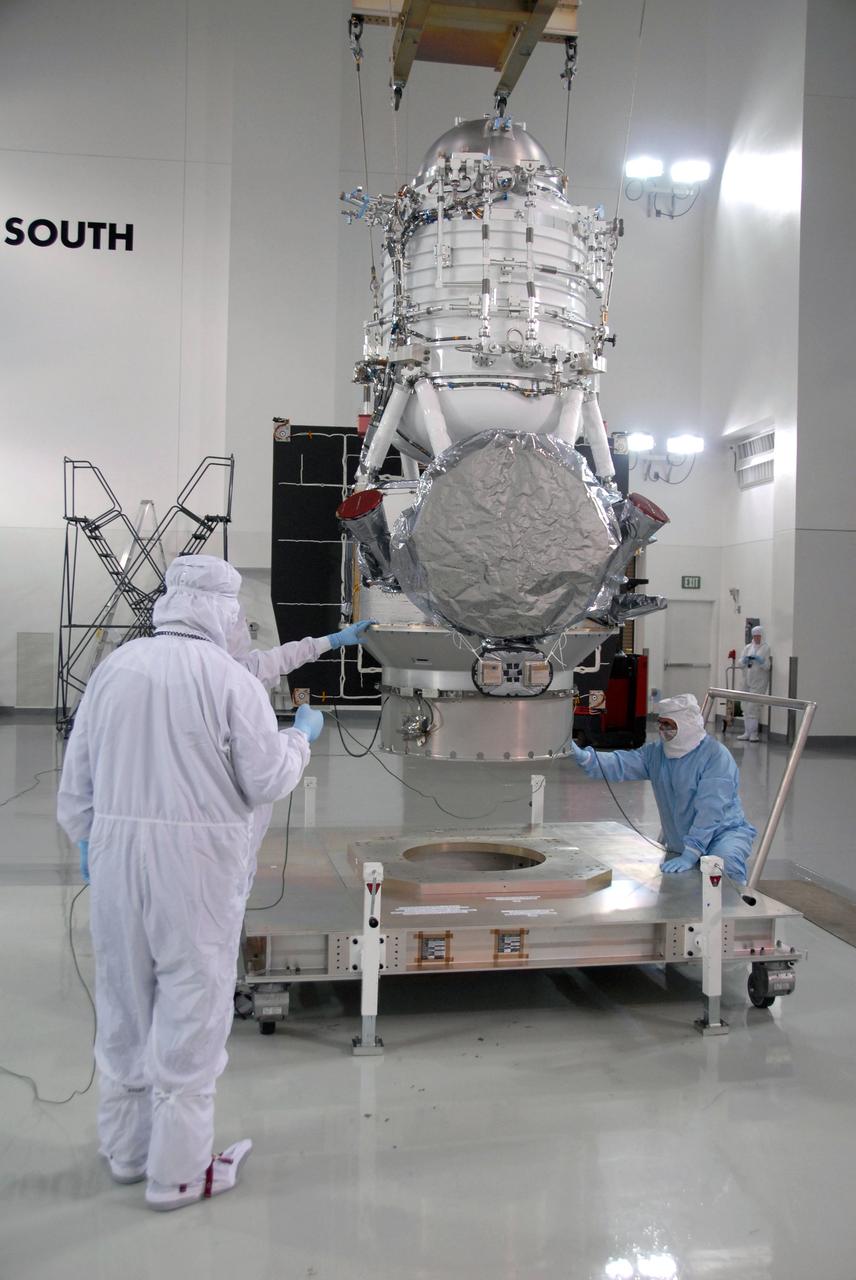
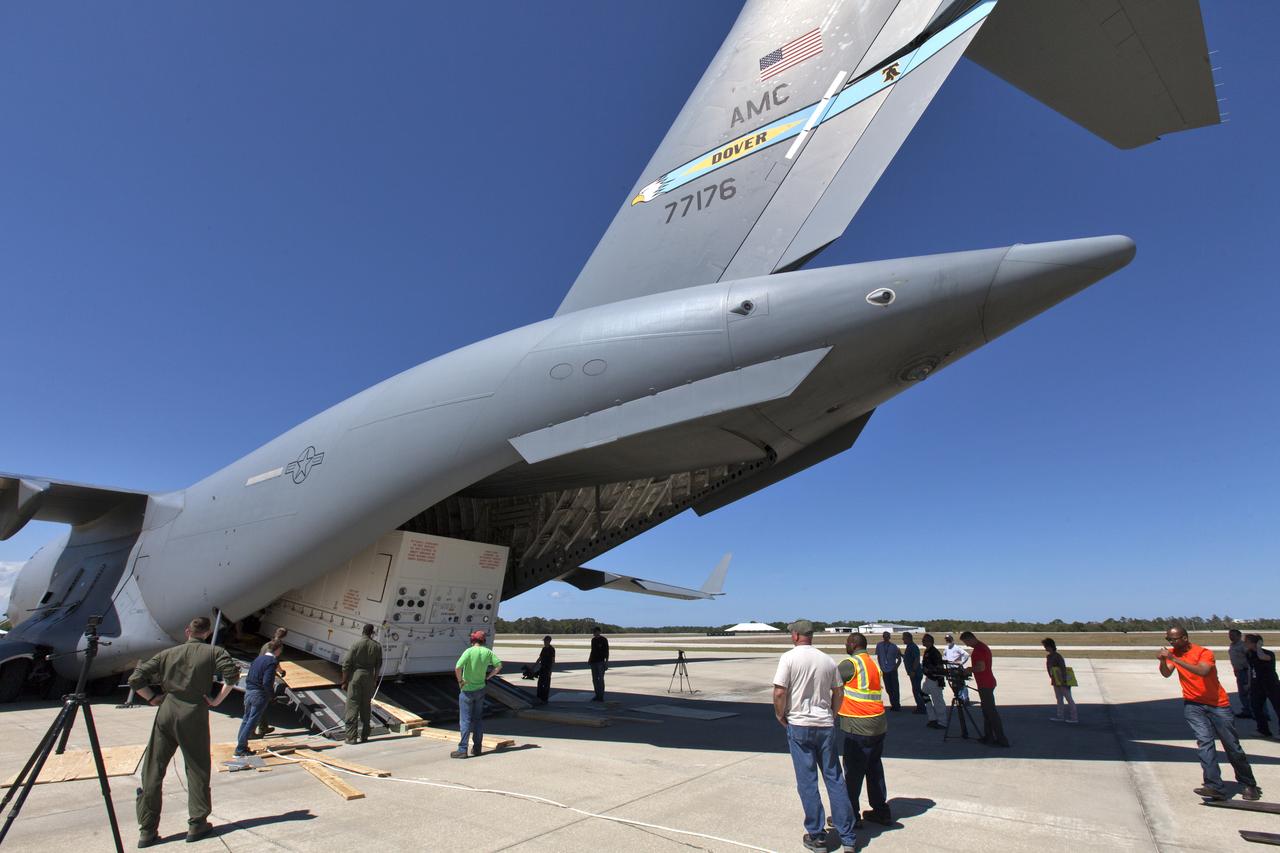
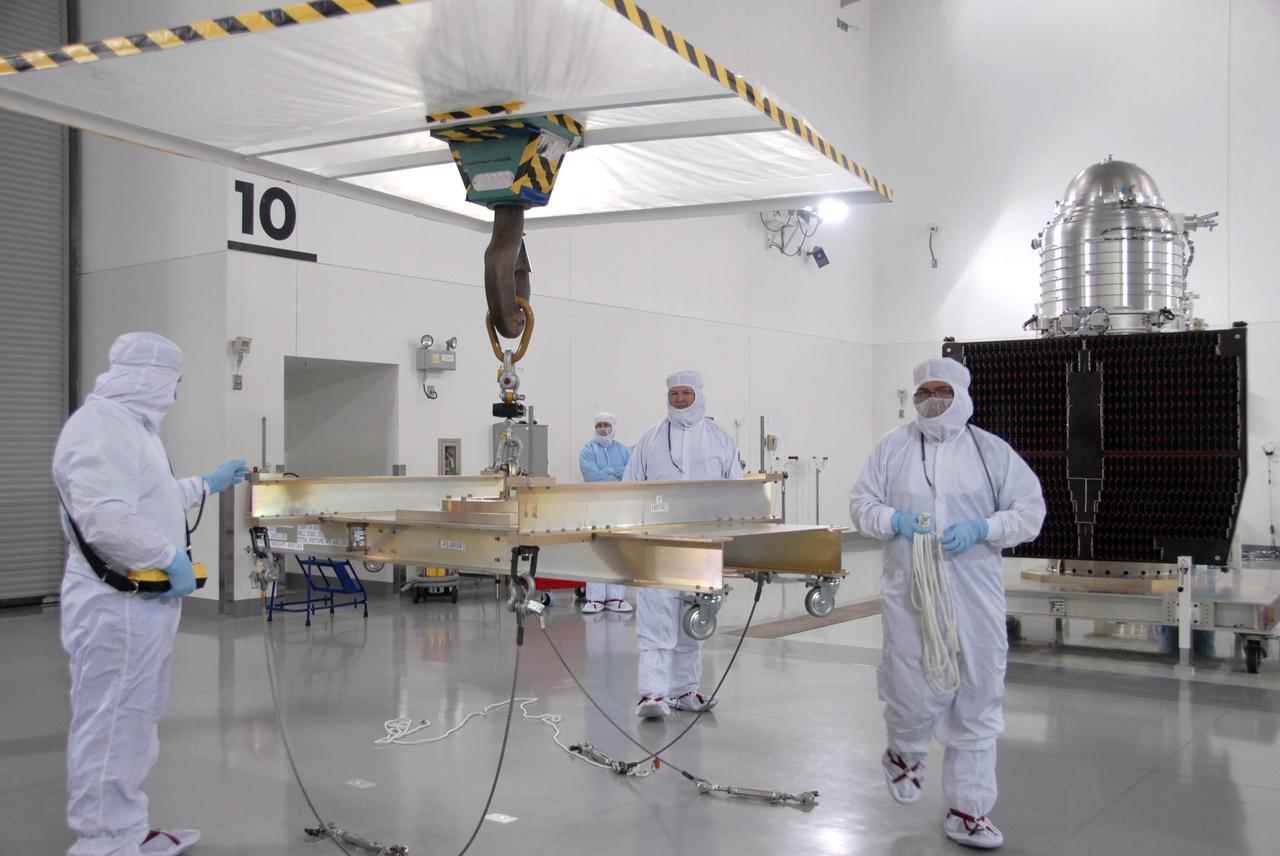
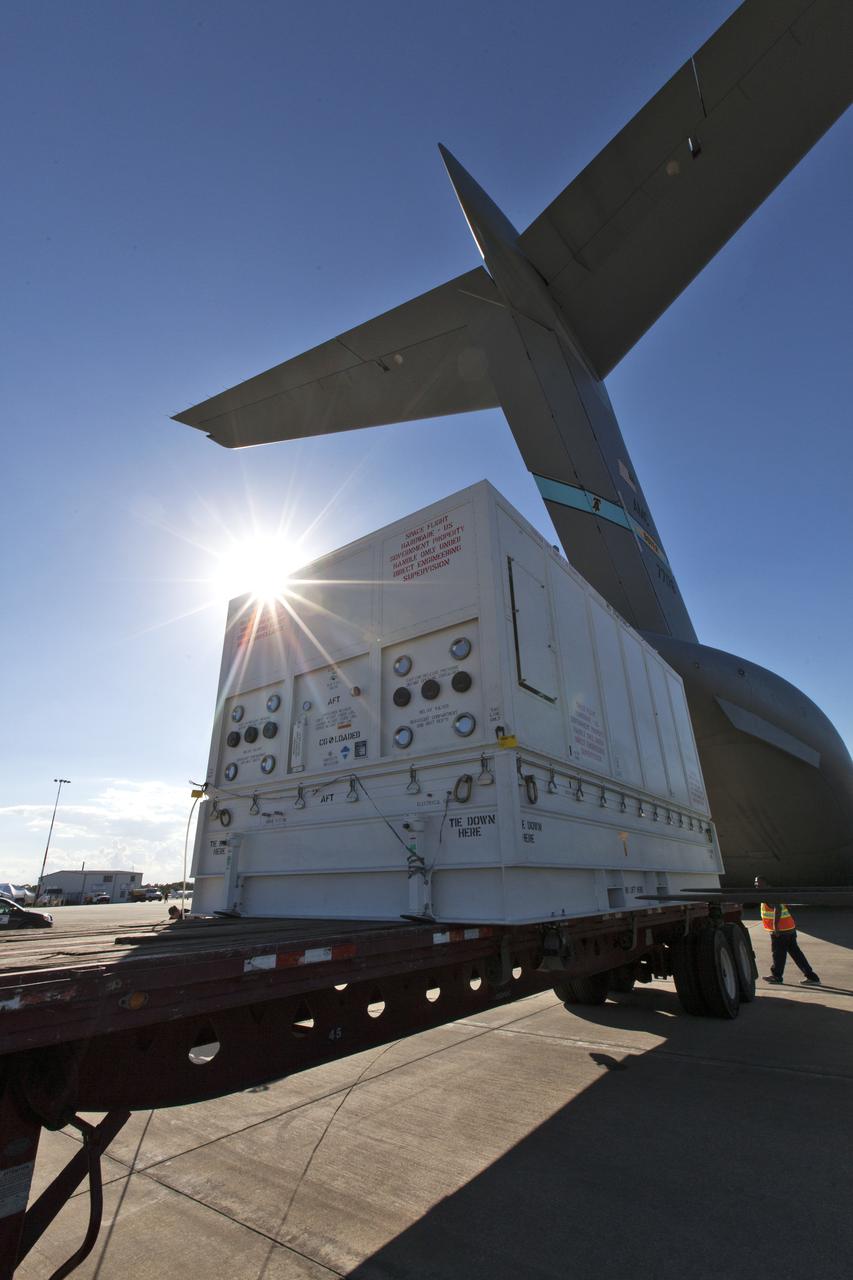
The transport carrier containing the five-panel solar arrays for NASA’s Europa Clipper spacecraft arrives at the Payload Hazardous Servicing Facility at the agency’s Kennedy Space Center in Florida on Wednesday, Feb. 21, 2024. The solar array travelled by air from Leiden, Netherlands, where Airbus workers assembled them over the last year, and then put on a barge to travel to the Port of Miami in Florida and loaded onto a semi-truck to be driven to Kennedy. The solar arrays will attach to the spacecraft to power it for the 1.8-billion-mile journey to study Jupiter’s icy moon, Europa. Launch on a SpaceX Falcon Heavy rocket is no earlier than October 2024.
NASA’s Europa Clipper Solar Array Arrival at Kennedy Space Center
The transport carrier containing the five-panel solar arrays for NASA’s Europa Clipper spacecraft arrives at the Payload Hazardous Servicing Facility at the agency’s Kennedy Space Center in Florida on Wednesday, Feb. 21, 2024. The solar array travelled by air from Leiden, Netherlands, where Airbus workers assembled them over the last year, and then put on a barge to travel to the Port of Miami in Florida and loaded onto a semi-truck to be driven to Kennedy. The solar arrays will attach to the spacecraft to power it for the 1.8-billion-mile journey to study Jupiter’s icy moon, Europa. Launch on a SpaceX Falcon Heavy rocket is no earlier than October 2024.
NASA’s Europa Clipper Solar Array Arrival at Kennedy Space Center
The transport carrier containing the five-panel solar arrays for NASA’s Europa Clipper spacecraft arrives at the Payload Hazardous Servicing Facility at the agency’s Kennedy Space Center in Florida on Wednesday, Feb. 21, 2024. The solar array travelled by air from Leiden, Netherlands, where Airbus workers assembled them over the last year, and then put on a barge to travel to the Port of Miami in Florida and loaded onto a semi-truck to be driven to Kennedy. The solar arrays will attach to the spacecraft to power it for the 1.8-billion-mile journey to study Jupiter’s icy moon, Europa. Launch on a SpaceX Falcon Heavy rocket is no earlier than October 2024.
NASA’s Europa Clipper Solar Array Arrival at Kennedy Space Center
The transport carrier containing the five-panel solar arrays for NASA’s Europa Clipper spacecraft arrives at the Payload Hazardous Servicing Facility at the agency’s Kennedy Space Center in Florida on Wednesday, Feb. 21, 2024. The solar array travelled by air from Leiden, Netherlands, where Airbus workers assembled them over the last year, and then put on a barge to travel to the Port of Miami in Florida and loaded onto a semi-truck to be driven to Kennedy. The solar arrays will attach to the spacecraft to power it for the 1.8-billion-mile journey to study Jupiter’s icy moon, Europa. Launch on a SpaceX Falcon Heavy rocket is no earlier than October 2024.
NASA’s Europa Clipper Solar Array Arrival at Kennedy Space Center
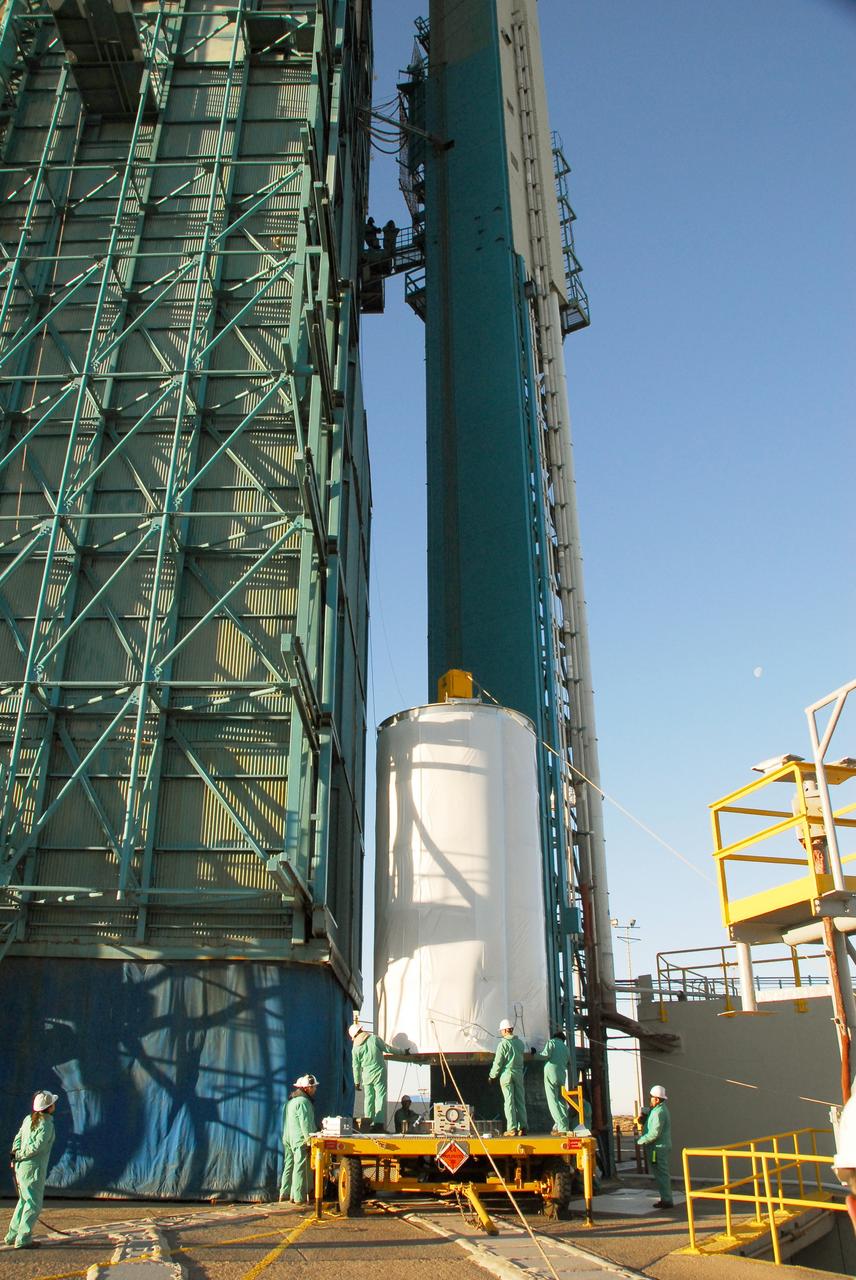
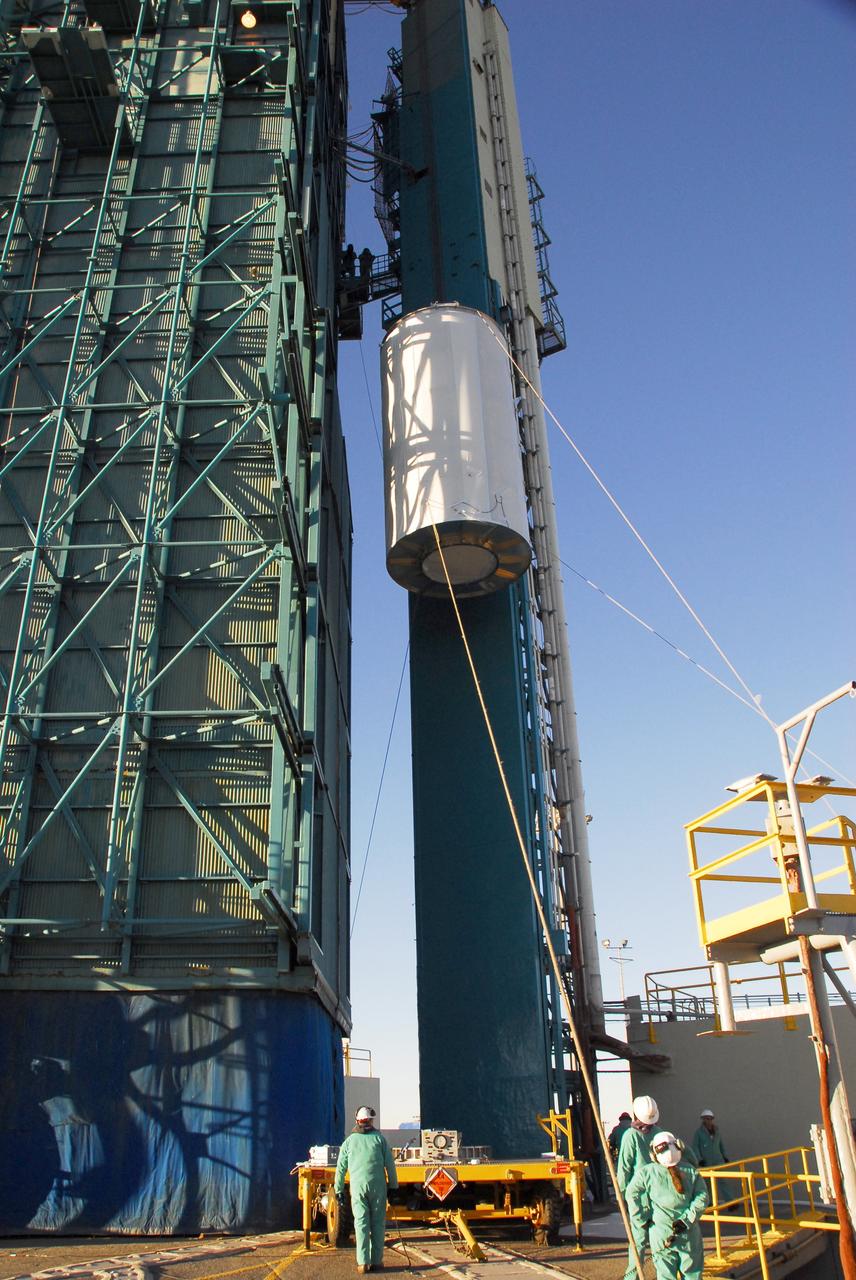
VANDENBERG AIR FORCE BASE, Calif. --   The NOAA-N Prime satellite, enclosed in a canister for travel, is lifted alongside the mobile service tower on Space Launch Complex 2 at Vandenberg Air Force Base in California.  In the tower, the satellite will be encapsulated and installed on the launch vehicle, a Delta II rocket.    NOAA-N Prime is the latest polar-orbiting operational environmental weather satellite developed by NASA for the National Oceanic and Atmospheric Administration.  The satellite is scheduled to launch Feb. 4 aboard a Delta II rocket from Vandenberg Air Force Base.    Photo credit: NASA/Mark Mackley, VAFB
KSC-2009-1491
VANDENBERG AIR FORCE BASE, Calif. --   The NOAA-N Prime satellite, enclosed in a canister for travel, is lifted alongside the mobile service tower on Space Launch Complex 2 at Vandenberg Air Force Base in California.  In the tower, the satellite will be encapsulated and installed on the launch vehicle, a Delta II rocket.   NOAA-N Prime is the latest polar-orbiting operational environmental weather satellite developed by NASA for the National Oceanic and Atmospheric Administration.  The satellite is scheduled to launch Feb. 4 aboard a Delta II rocket from Vandenberg Air Force Base.    Photo credit: NASA/Mark Mackley, VAFB
KSC-2009-1490
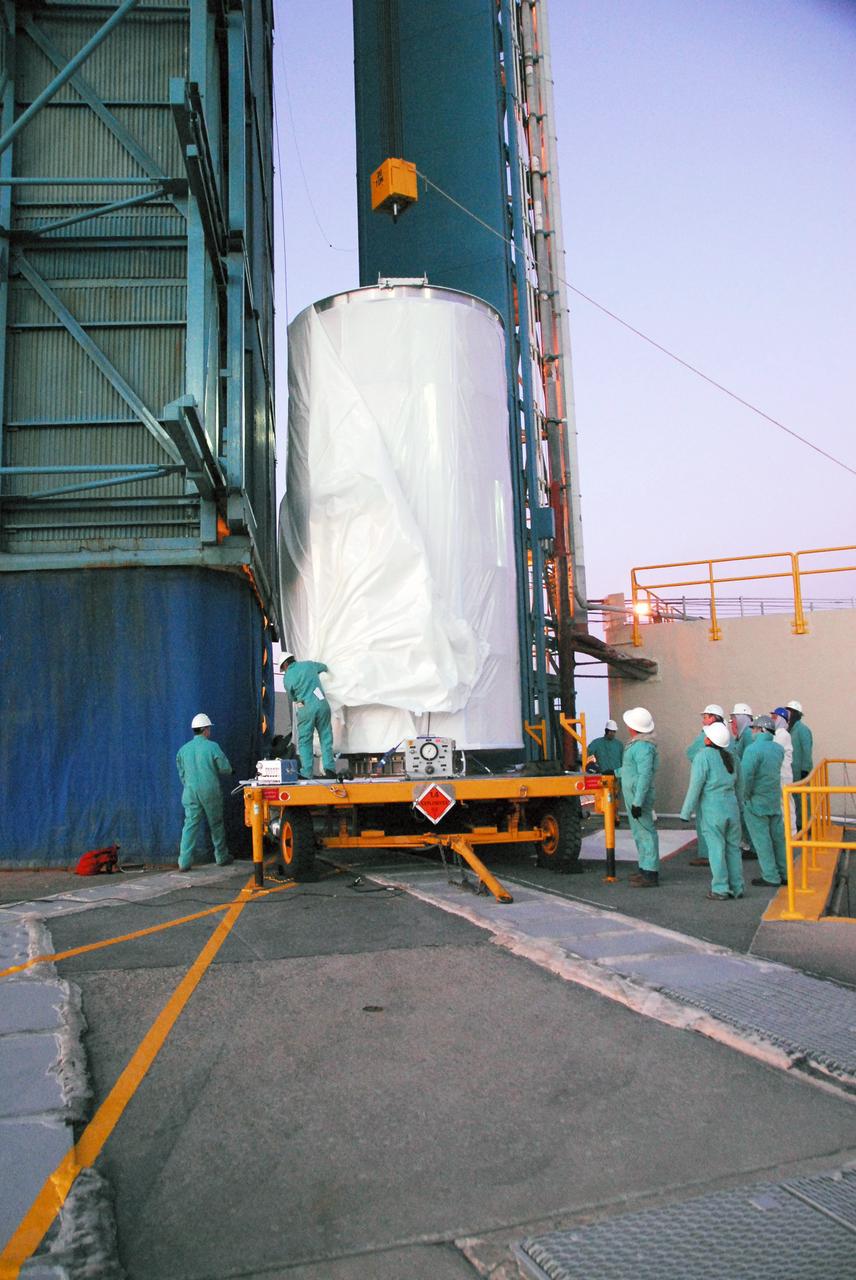
VANDENBERG AIR FORCE BASE, Calif. --  The NOAA-N Prime satellite, enclosed in a canister for travel, is prepared for its lift into the mobile service tower on Space Launch Complex 2 at Vandenberg Air Force Base in California.  In the tower, the satellite will be encapsulated and installed on the launch vehicle, a Delta II rocket.  NOAA-N Prime is the latest polar-orbiting operational environmental weather satellite developed by NASA for the National Oceanic and Atmospheric Administration.  The satellite is scheduled to launch Feb. 4 aboard a Delta II rocket from Vandenberg Air Force Base.    Photo credit: NASA/Mark Mackley, VAFB
KSC-2009-1489
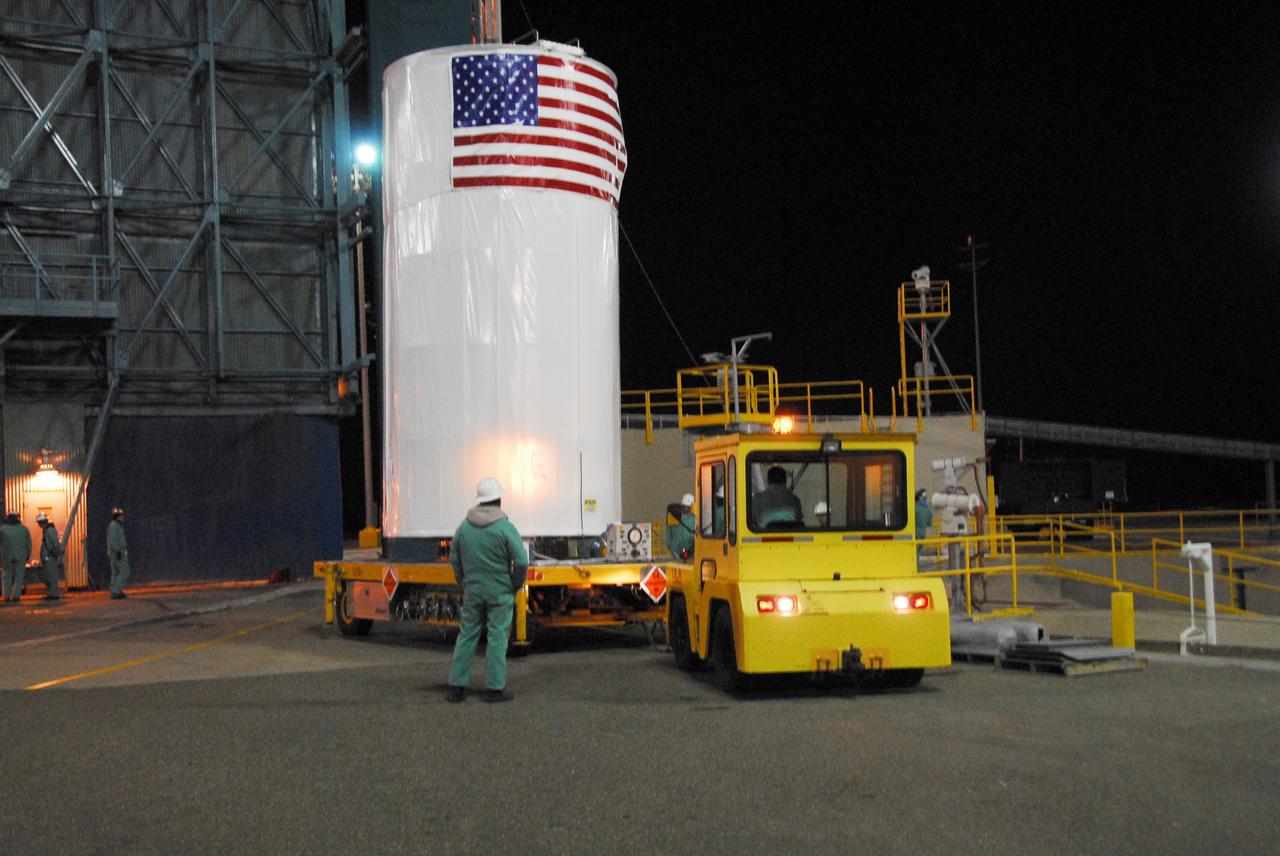
VANDENBERG AIR FORCE BASE, Calif. --   The NOAA-N Prime satellite, enclosed in a canister for travel, arrives on Space Launch Complex 2 at Vandenberg Air Force Base in California.  The container will be lifted into the mobile service tower for encapsulation and installation on the launch vehicle, a Delta II rocket.  NOAA-N Prime is the latest polar-orbiting operational environmental weather satellite developed by NASA for the National Oceanic and Atmospheric Administration.  The satellite is scheduled to launch Feb. 4 aboard a Delta II rocket from Vandenberg Air Force Base.    Photo credit: NASA/Mark Mackley, VAFB
KSC-2009-1488
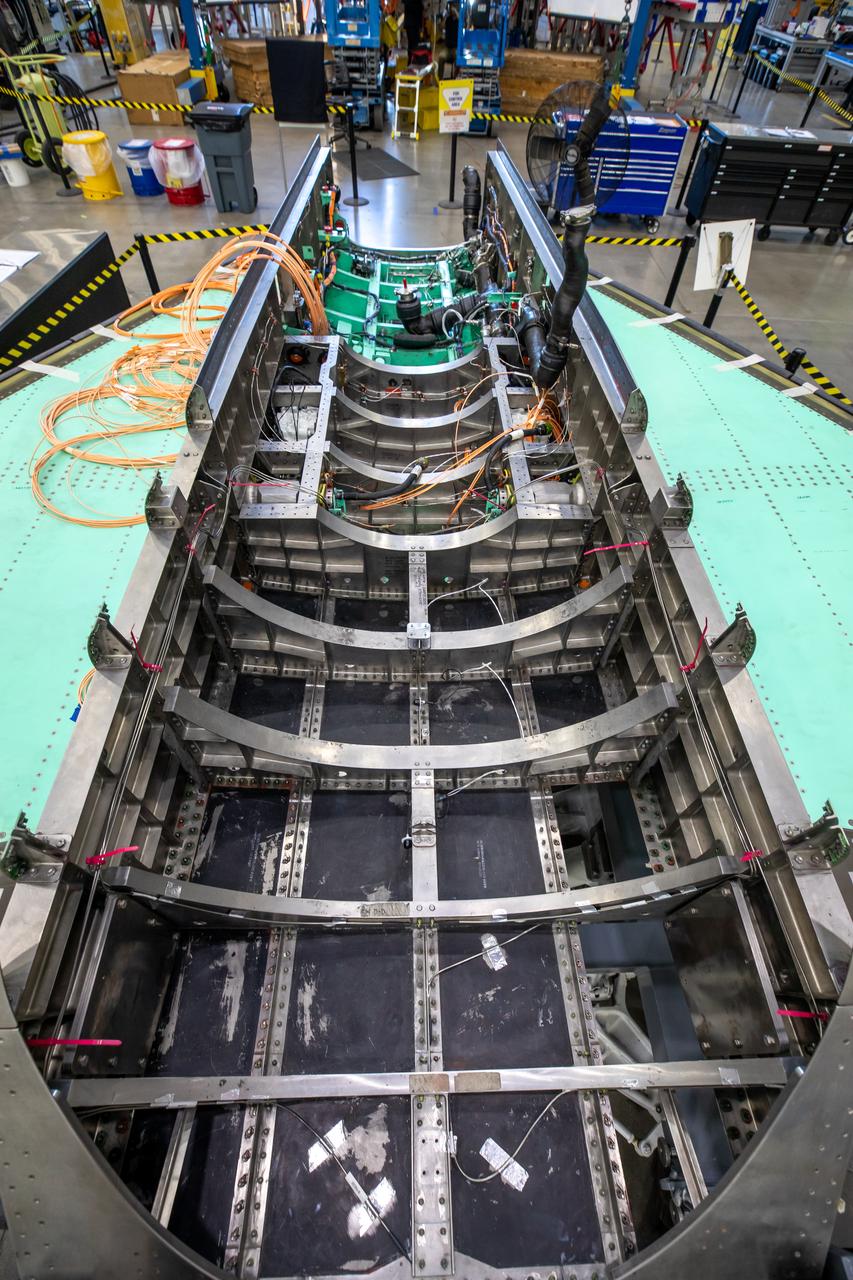
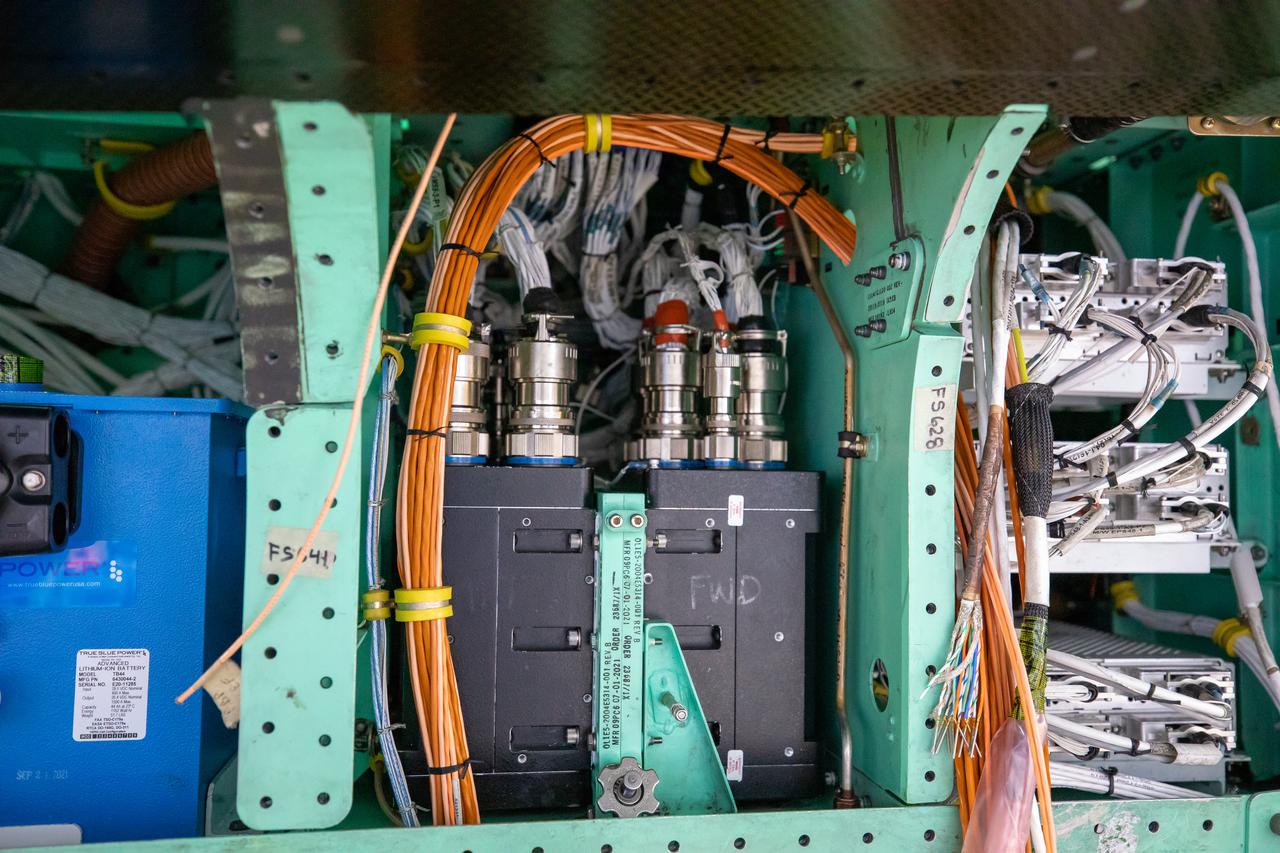
This is a closeup view of the inner workings of the X-59 aircraft. Visible are one the plane’s three lithium-ion batteries (blue box), electrical power system and other wiring components including the vehicle management systems computers (two black boxes) and the white wirings which assist in providing the power that is needed for the aircraft to function in flight.  All of these components are essential to maintaining and monitoring the X-59 once it takes to the skies.  The X-59 is the centerpiece of the Quesst mission which plans to help enable commercial supersonic air travel over land.
LRC-2022-H1_P_X-59-44-1
This image shows the X-59 aircraft’s lower empennage structure, or tail section of the plane, that was installed. The stabilators, the outer surfaces also seen in the photo, attach to the lower empennage and are used to help regulate the aircraft pitch which controls the up and down movement of the motion of the plane. The 13-foot engine will pack 22,000 pounds of propulsion and energy and power the X-plane to its planned cruising speed of Mach 1.4. Once complete, the X-59 aircraft will demonstrate the ability to fly supersonic while reducing the loud sonic boom to a quiet sonic thump and help enable commercial supersonic air travel over land. This aircraft is the centerpiece of NASA’s Quesst mission.
LRC-2022-H1_P_X-59-46
VANDENBERG AIR FORCE BASE, Calif. -- At Vandenberg Air Force Base's Astrotech processing facility in California, workers maneuver the overhead crane that will lift NASA's Wide-field Infrared Survey Explorer, or WISE, spacecraft from the travel dolly to a work stand. The satellite will survey the entire sky at infrared wavelengths, creating a cosmic clearinghouse of hundreds of millions of objects,  which will be catalogued, providing a vast storehouse of knowledge about the solar system, the Milky Way, and the universe. Launch is scheduled no earlier than Dec. 10.  Photo credit: NASA/Moore, VAFB
KSC-2009-4754
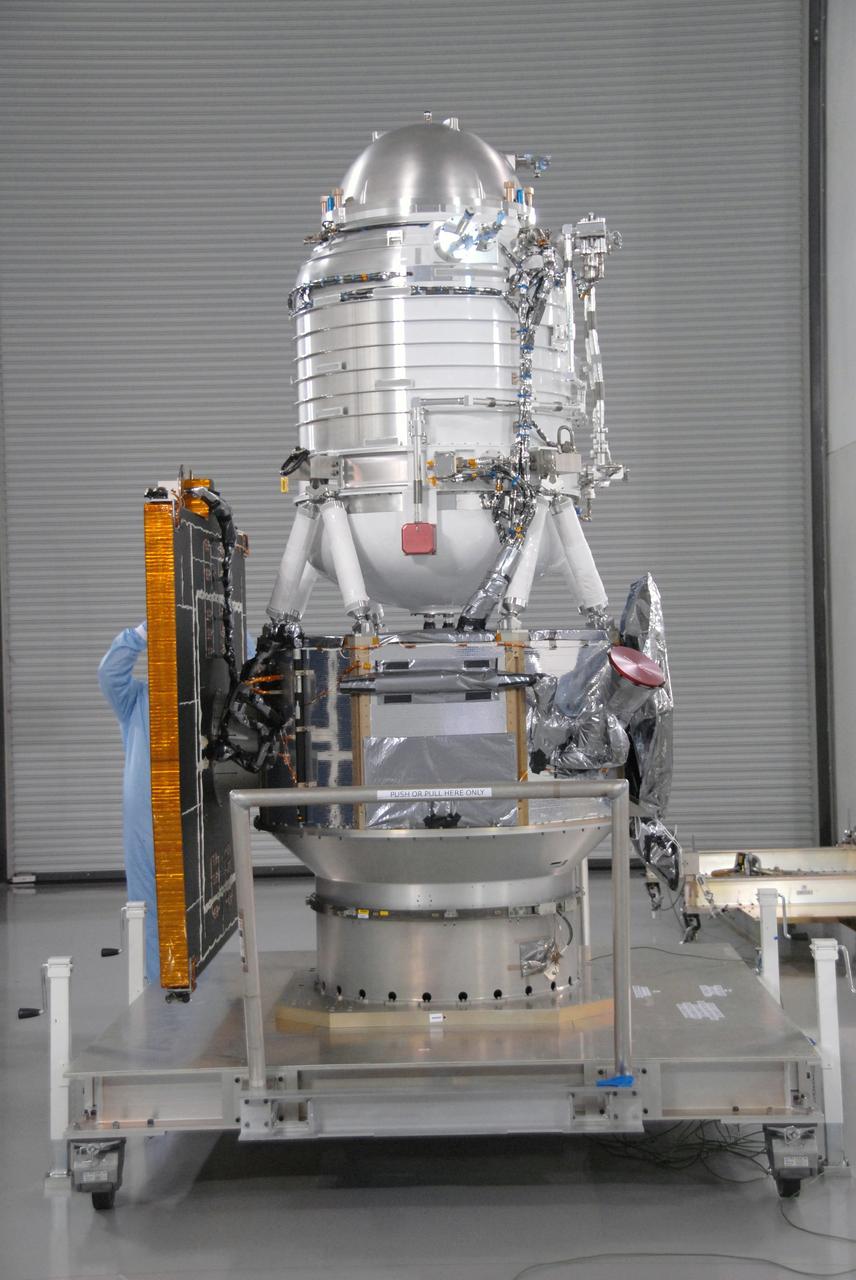
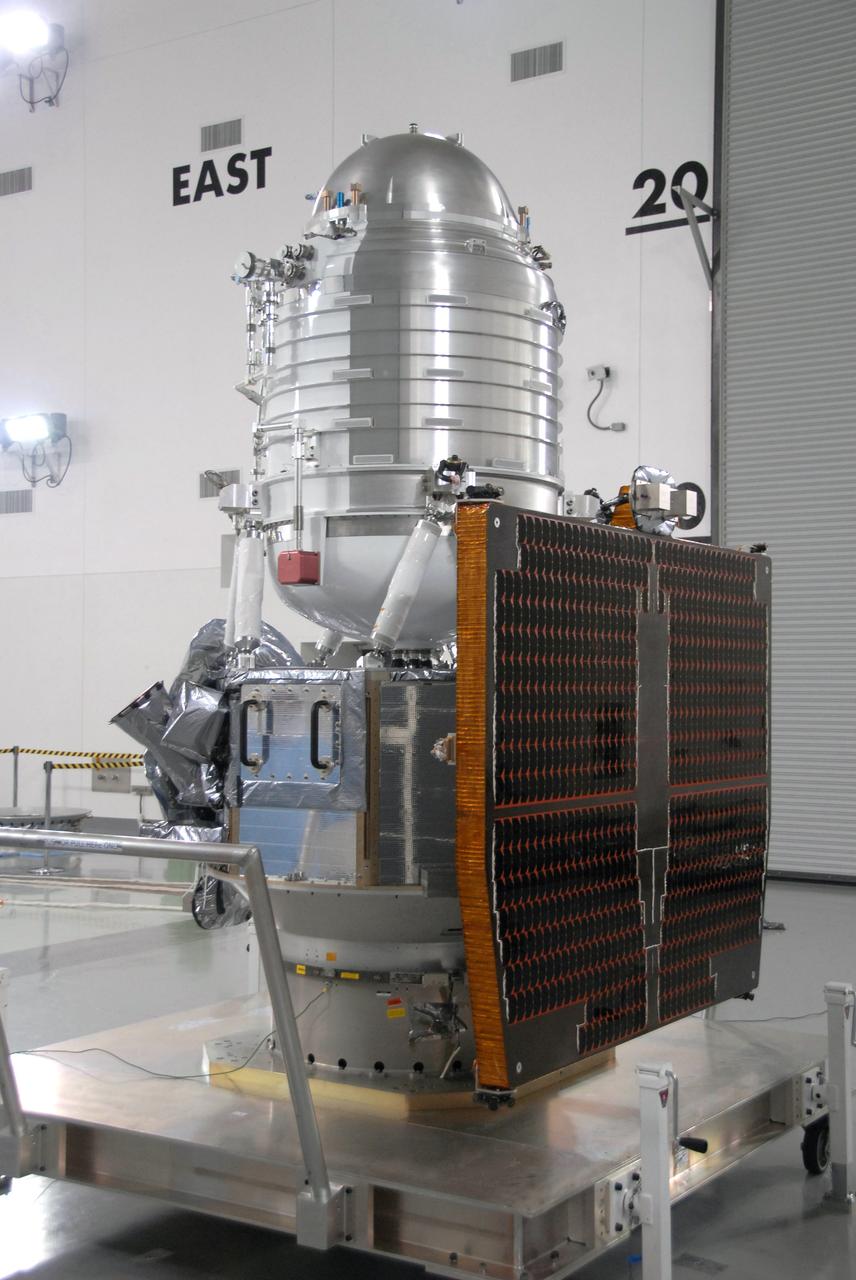
VANDENBERG AIR FORCE BASE, Calif. --At Vandenberg Air Force Base's Astrotech processing facility in California, the fixed panel solar panel is seen on NASA's Wide-field Infrared Survey Explorer, or WISE, spacecraft.  WISE will be moved from the travel dolly it's on to a work stand.  The satellite will survey the entire sky at infrared wavelengths, creating a cosmic clearinghouse of hundreds of millions of objects,  which will be catalogued, providing a vast storehouse of knowledge about the solar system, the Milky Way, and the universe. Launch is scheduled no earlier than Dec. 10.  Photo credit: NASA/Moore, VAFB
KSC-2009-4750
Workers monitor NOAA’s Deep Space Climate Observatory spacecraft, or DSCOVR, wrapped in plastic and secured onto a portable work stand, as it travels between the airlock of Building 2 to the high bay of Building 1 at the Astrotech payload processing facility in Titusville, Florida, near Kennedy Space Center. DSCOVR is a partnership between NOAA, NASA and the U.S. Air Force. DSCOVR will maintain the nation's real-time solar wind monitoring capabilities which are critical to the accuracy and lead time of NOAA's space weather alerts and forecasts. Launch is currently scheduled for January 2015 aboard a SpaceX Falcon 9 v 1.1 launch vehicle from Cape Canaveral Air Force Station, Florida.
DSCOVR Spacecraft Arrival, Offload, & Unpacking
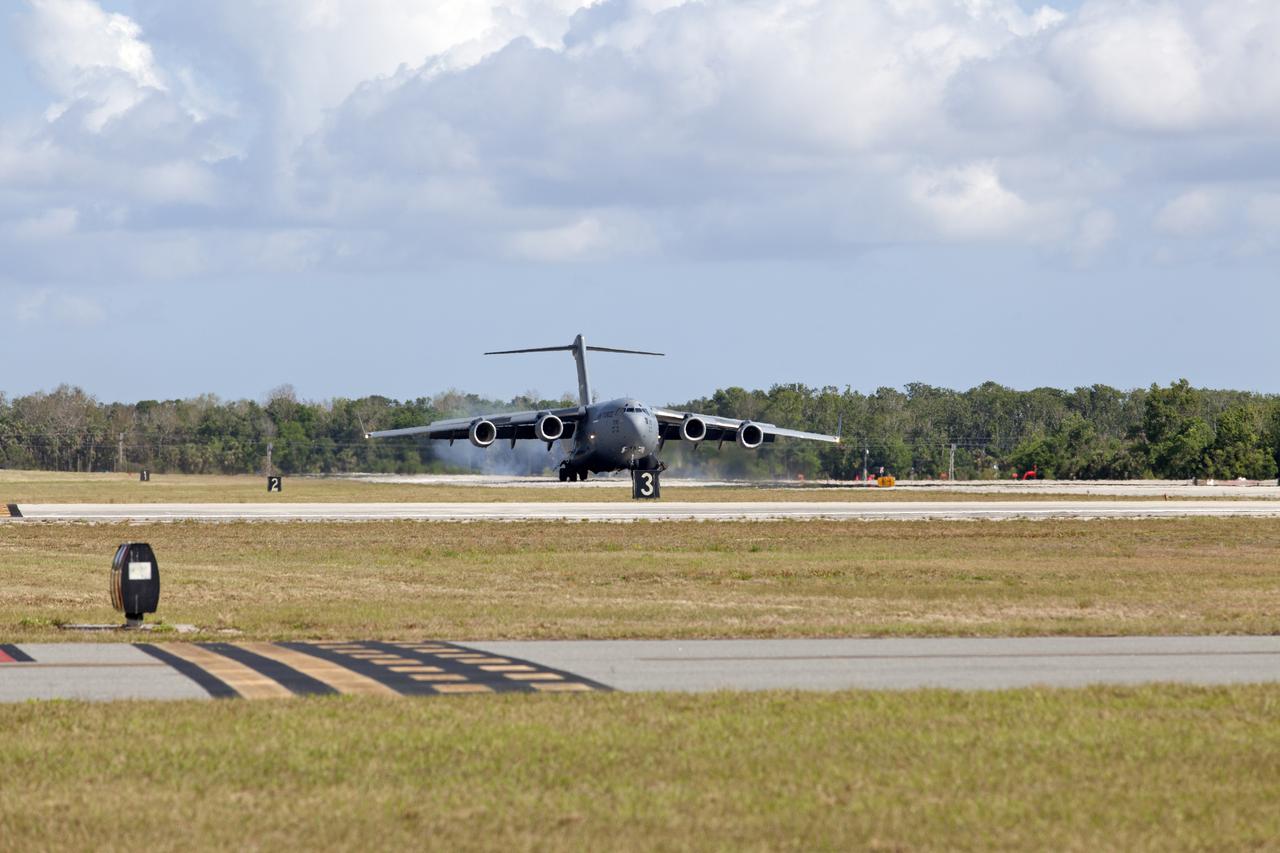
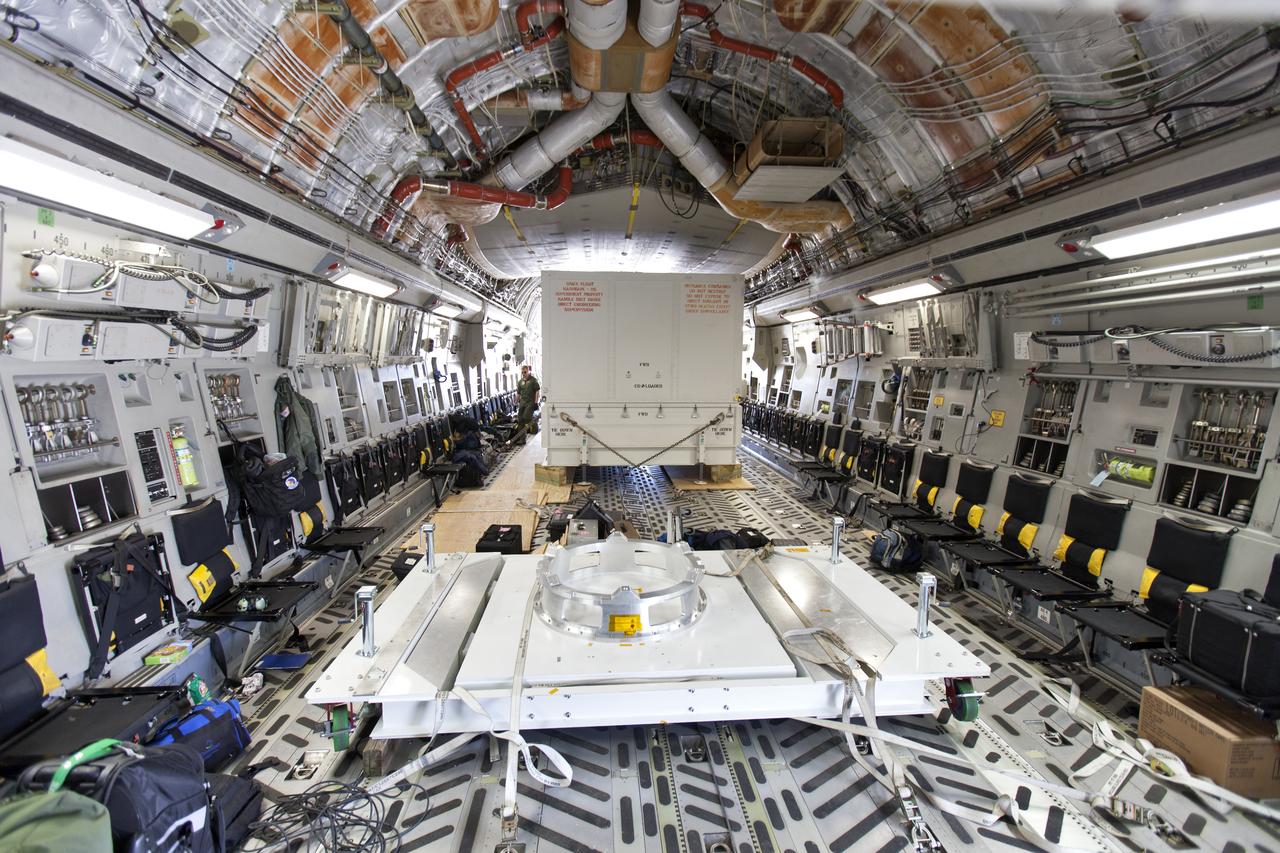
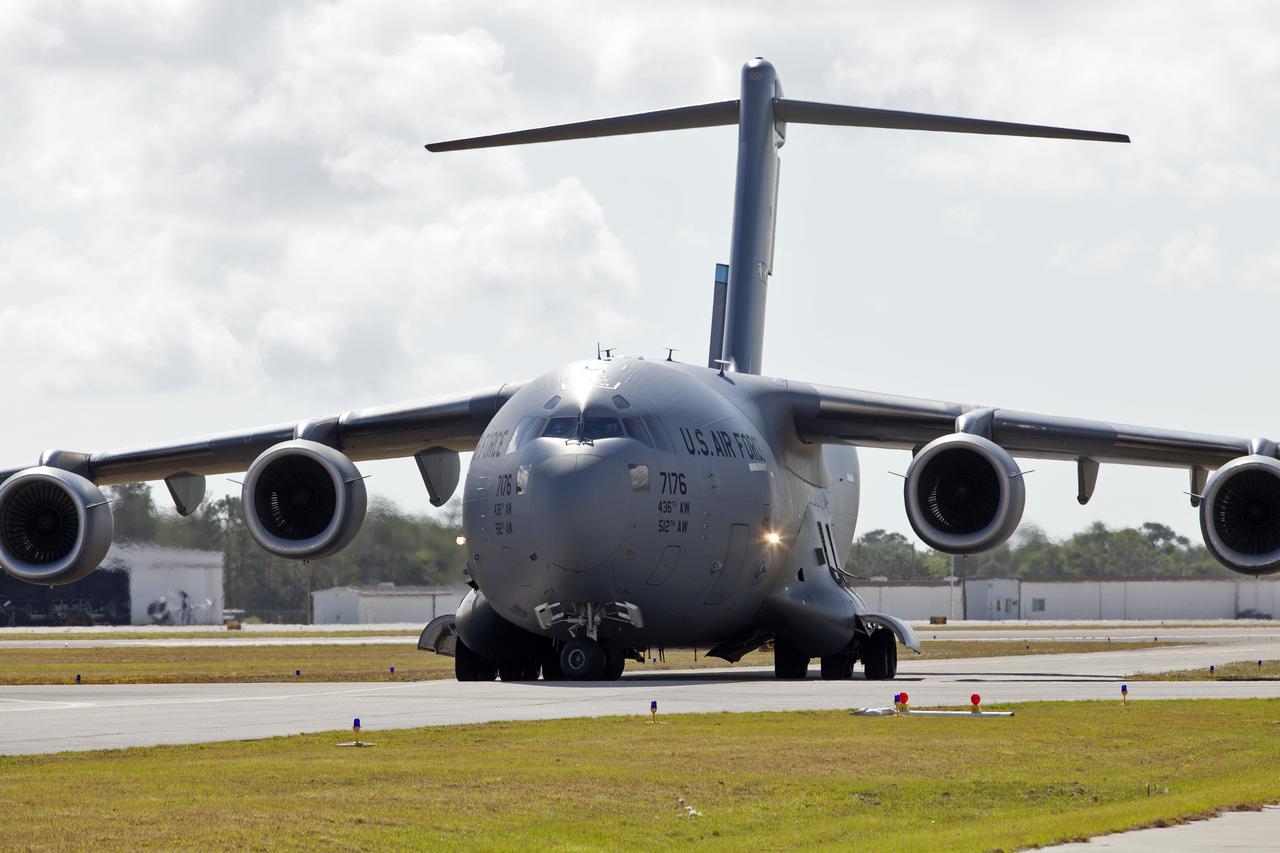
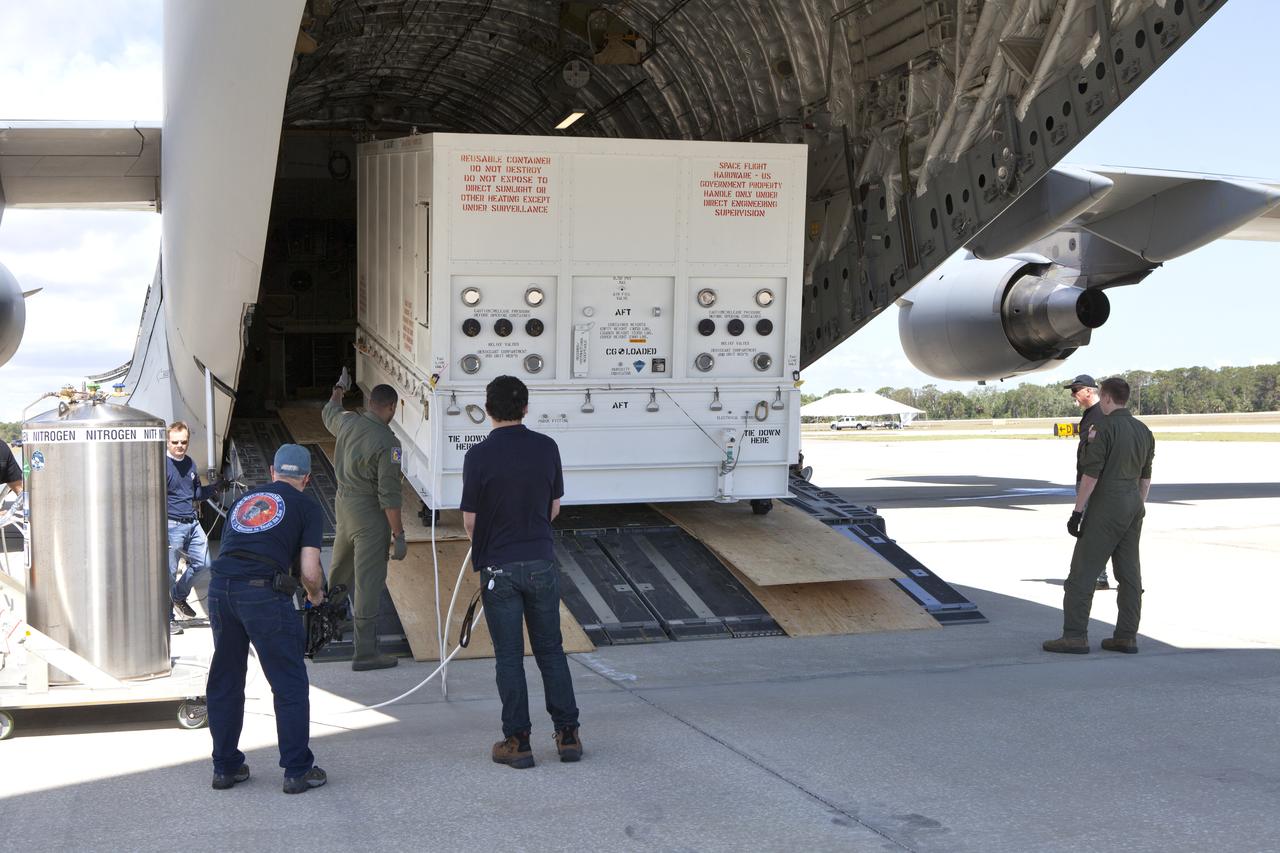
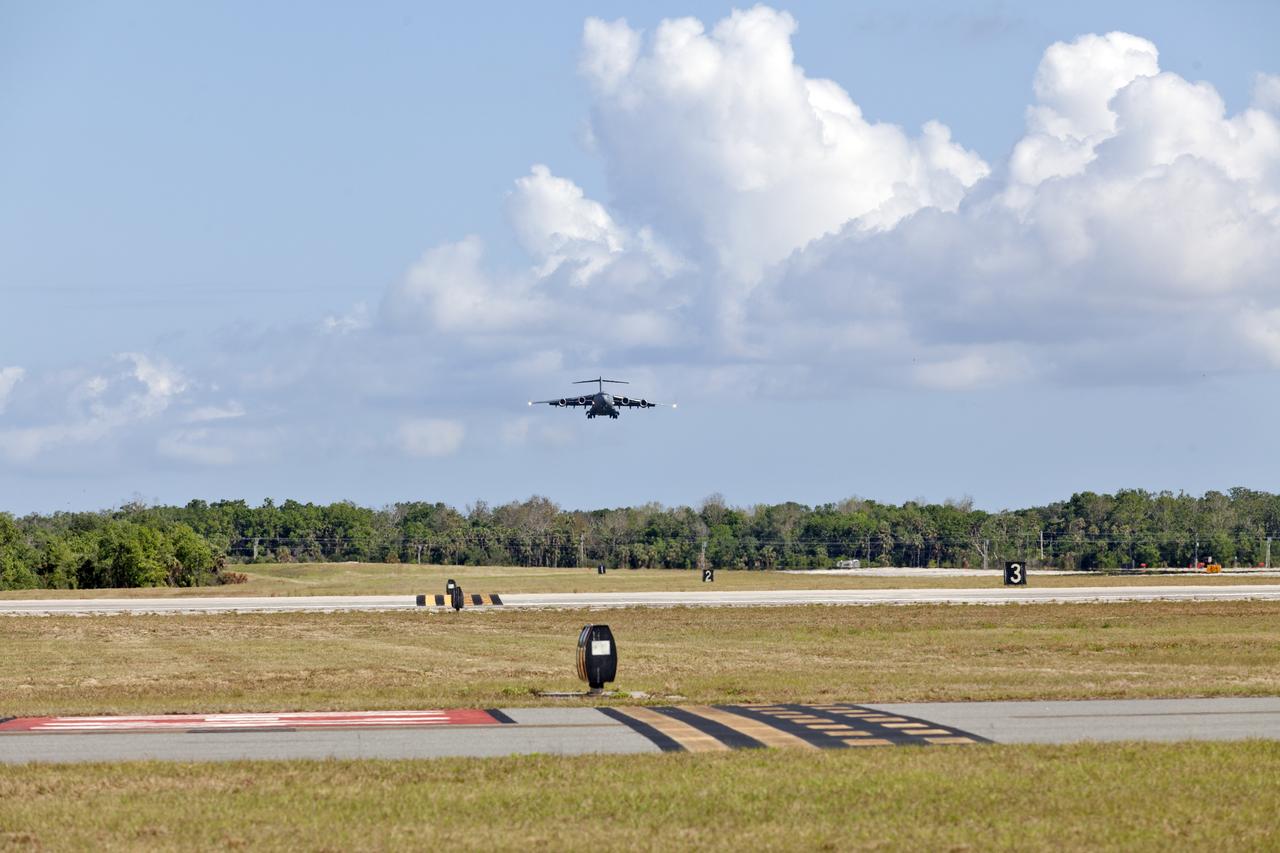
A U.S. Air Force C-5 transport aircraft touches down at Space Coast Regional Airport in Titusville, Florida, with NASA's Parker Solar Probe spacecraft aboard. The spacecraft will be offloaded and transported to the Astrotech processing facility near the agency's Kennedy Space Center. The Parker Solar Probe will launch on a United Launch Alliance Delta IV Heavy rocket from Space Launch Complex 37 at Cape Canaveral Air Force Station in Florida in July 2018. The mission will perform the closest-ever observations of a star when it travels through the Sun's atmosphere, called the corona. The probe will rely on measurements and imaging to revolutionize our understanding of the corona and the Sun-Earth connection.
Parker Solar Probe Spacecraft Arrival, Offload and Transport
NASA's Parker Solar Probe, secured in its shipping container, is offloaded from a U.S. Air Force C-5 transport aircraft at Space Coast Regional Airport in Titusville, Florida. The spacecraft will be transported to the Astrotech processing facility near the agency's Kennedy Space Center. The Parker Solar Probe will launch on a United Launch Alliance Delta IV Heavy rocket from Space Launch Complex 37 at Cape Canaveral Air Force Station in Florida in July 2018. The mission will perform the closest-ever observations of a star when it travels through the Sun's atmosphere, called the corona. The probe will rely on measurements and imaging to revolutionize our understanding of the corona and the Sun-Earth connection.
Parker Solar Probe Spacecraft Arrival, Offload and Transport
NASA's Parker Solar Probe, secured in its shipping container, has been offloaded from a U.S. Air Force C-5 transport aircraft at Space Coast Regional Airport in Titusville, Florida. The spacecraft will be transported to the Astrotech processing facility near the agency's Kennedy Space Center. The Parker Solar Probe will launch on a United Launch Alliance Delta IV Heavy rocket from Space Launch Complex 37 at Cape Canaveral Air Force Station in Florida in July 2018. The mission will perform the closest-ever observations of a star when it travels through the Sun's atmosphere, called the corona. The probe will rely on measurements and imaging to revolutionize our understanding of the corona and the Sun-Earth connection.
Parker Solar Probe Spacecraft Arrival, Offload and Transport
VANDENBERG AIR FORCE BASE, Calif. -- At Vandenberg Air Force Base's Astrotech processing facility in California, workers check NASA's Wide-field Infrared Survey Explorer, or WISE, spacecraft as it is lifted from its travel dolly.  WISE will be moved to a work stand. The satellite will survey the entire sky at infrared wavelengths, creating a cosmic clearinghouse of hundreds of millions of objects,  which will be catalogued, providing a vast storehouse of knowledge about the solar system, the Milky Way, and the universe. Launch is scheduled no earlier than Dec. 10.  Photo credit: NASA/Moore, VAFB
KSC-2009-4757
VANDENBERG AIR FORCE BASE, Calif. -- At Vandenberg Air Force Base's Astrotech processing facility in California, workers prepare NASA's Wide-field Infrared Survey Explorer, or WISE, spacecraft for its move from the travel dolly to a work stand. The satellite will survey the entire sky at infrared wavelengths, creating a cosmic clearinghouse of hundreds of millions of objects,  which will be catalogued, providing a vast storehouse of knowledge about the solar system, the Milky Way, and the universe. Launch is scheduled no earlier than Dec. 10.  Photo credit: NASA/Moore, VAFB
KSC-2009-4753
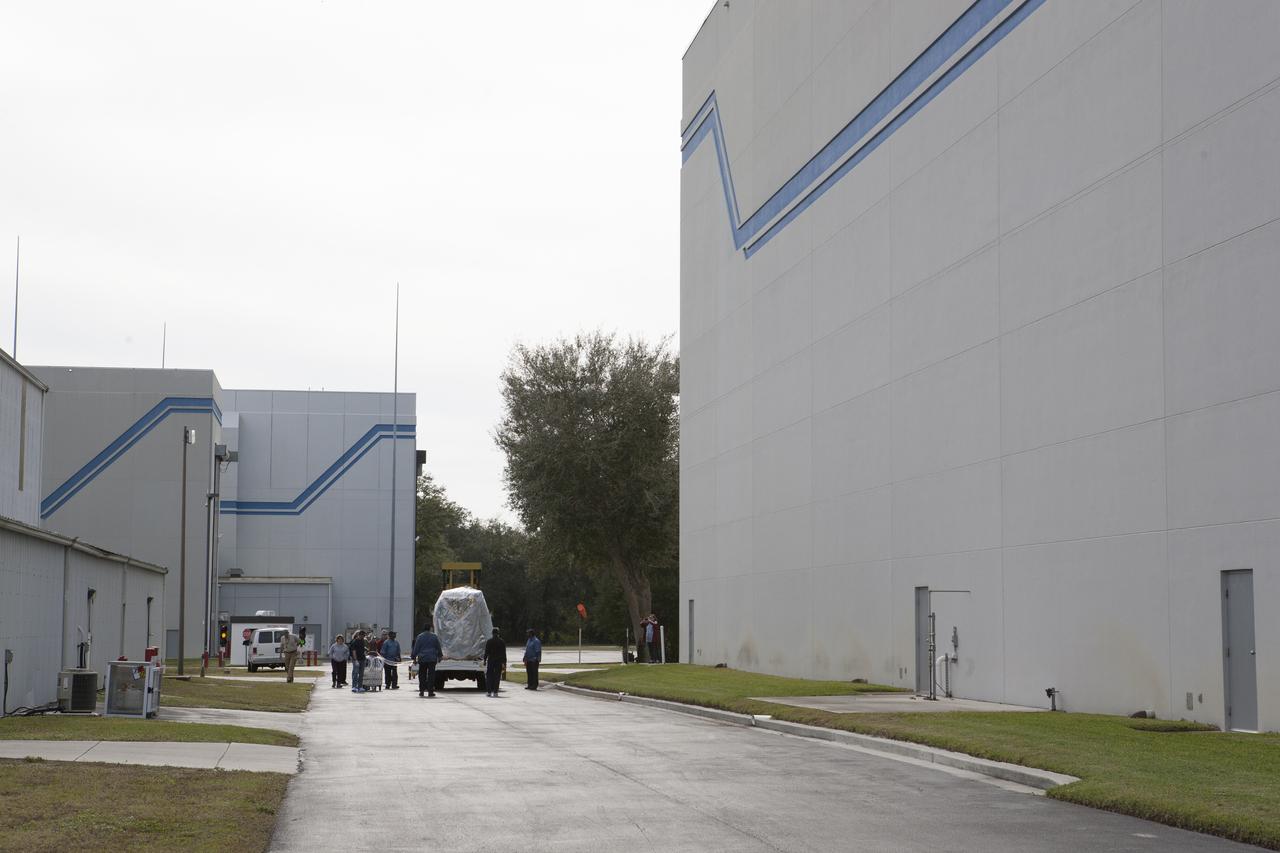
NASA's Parker Solar Probe, secured in its shipping container, arrives at the Astrotech processing facility near the agency's Kennedy Space Center in Florida. The spacecraft arrived aboard a U.S. Air Force C-5 transport aircraft at Space Coast Regional Airport in Titusville, Florida. The Parker Solar Probe will launch on a United Launch Alliance Delta IV Heavy rocket from Space Launch Complex 37 at Cape Canaveral Air Force Station in Florida in July 2018. The mission will perform the closest-ever observations of a star when it travels through the Sun's atmosphere, called the corona. The probe will rely on measurements and imaging to revolutionize our understanding of the corona and the Sun-Earth connection.
Parker Solar Probe Spacecraft Arrival, Offload and Transport
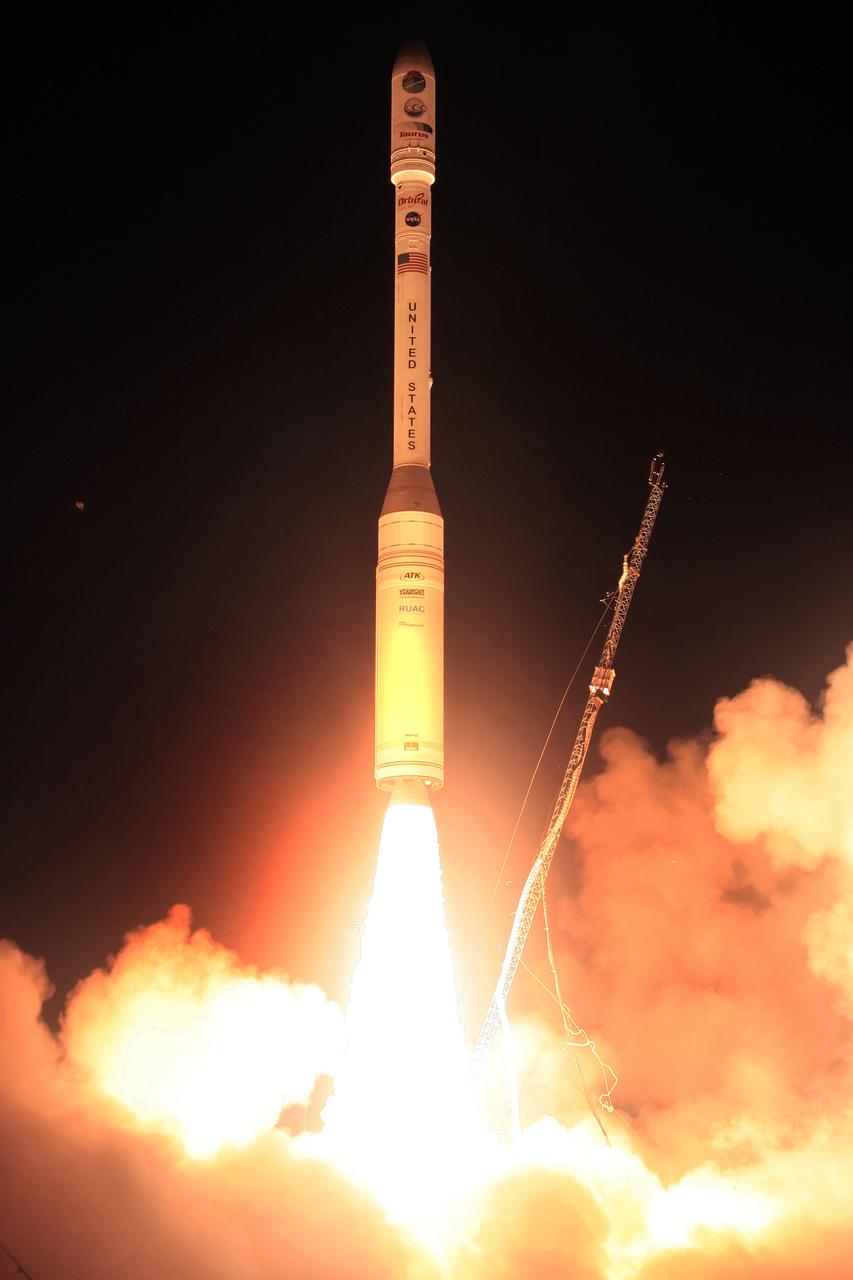
VANDENBERG AIR FORCE BASE, Calif. --  NASA’s Orbiting Carbon Observatory and its Taurus booster lift off Feb. 24 from Vandenberg Air Force Base in California at 4:55 a.m. EST. A contingency was declared a few minutes later and the satellite failed to reach orbit after liftoff.  Preliminary indications are that the fairing on the Taurus XL launch vehicle failed to separate. The fairing is a clamshell structure that encapsulates the satellite as it travels through the atmosphere. A Mishap Investigation Board is being set up to determine the cause of the launch failure.  Photo courtesy of Orbital Sciences
KSC-2009-1827
A U.S. Air Force C-5 transport aircraft arrives at Space Coast Regional Airport in Titusville, Florida, with NASA's Parker Solar Probe spacecraft aboard. The spacecraft will be offloaded and transported to the Astrotech processing facility near the agency's Kennedy Space Center. The Parker Solar Probe will launch on a United Launch Alliance Delta IV Heavy rocket from Space Launch Complex 37 at Cape Canaveral Air Force Station in Florida in July 2018. The mission will perform the closest-ever observations of a star when it travels through the Sun's atmosphere, called the corona. The probe will rely on measurements and imaging to revolutionize our understanding of the corona and the Sun-Earth connection.
Parker Solar Probe Spacecraft Arrival, Offload and Transport
VANDENBERG AIR FORCE BASE, Calif. -- At Vandenberg Air Force Base's Astrotech processing facility in California, an overhead crane is being used to lift NASA's Wide-field Infrared Survey Explorer, or WISE, spacecraft from its travel dolly to a work stand. The satellite will survey the entire sky at infrared wavelengths, creating a cosmic clearinghouse of hundreds of millions of objects,  which will be catalogued, providing a vast storehouse of knowledge about the solar system, the Milky Way, and the universe. Launch is scheduled no earlier than Dec. 10.  Photo credit: NASA/Moore, VAFB
KSC-2009-4755
VANDENBERG AIR FORCE BASE, Calif. -- At Vandenberg Air Force Base's Astrotech processing facility in California, workers check NASA's Wide-field Infrared Survey Explorer, or WISE, spacecraft as it is lifted from its travel dolly.  WISE will be moved to a work stand. The satellite will survey the entire sky at infrared wavelengths, creating a cosmic clearinghouse of hundreds of millions of objects,  which will be catalogued, providing a vast storehouse of knowledge about the solar system, the Milky Way, and the universe. Launch is scheduled no earlier than Dec. 10.  Photo credit: NASA/Moore, VAFB
KSC-2009-4756
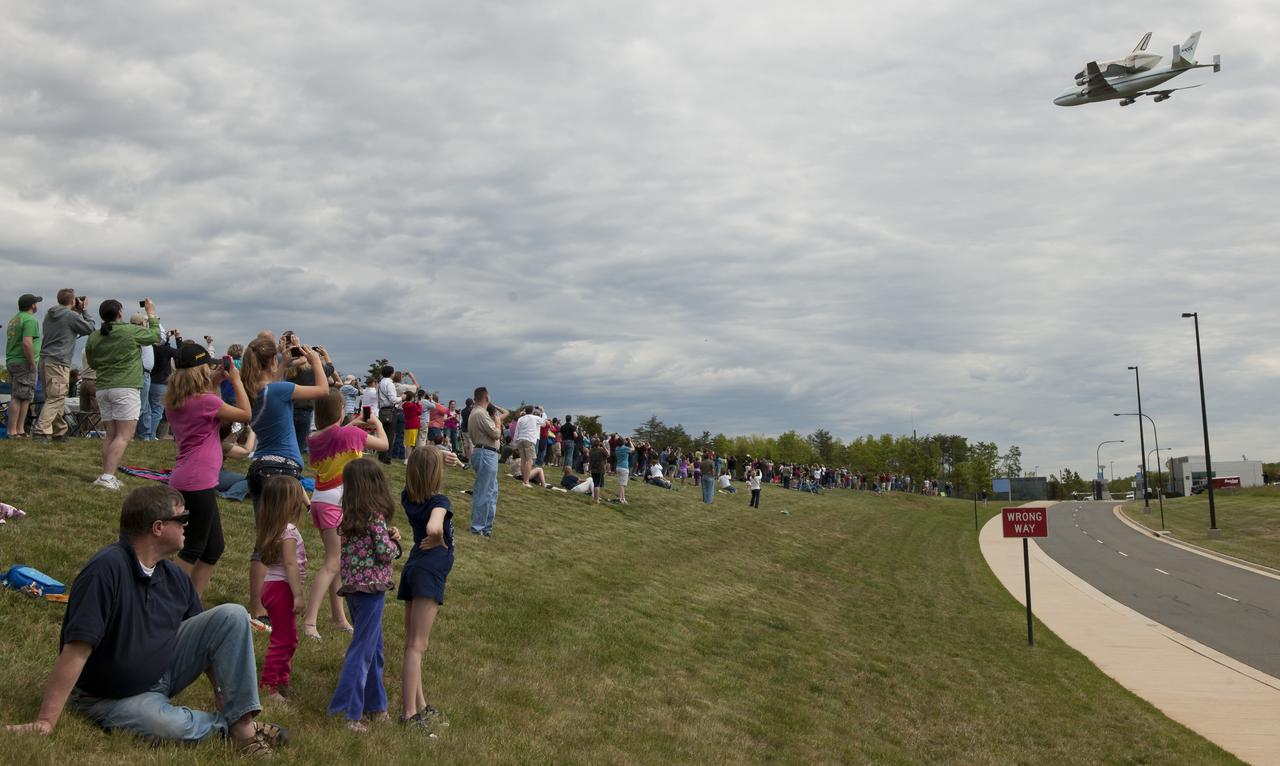
Spectators watch as space shuttle Discovery, mounted atop a NASA 747 Shuttle Carrier Aircraft (SCA) flies over the National Air and Space Museum’s Steven F. Udvar-Hazy Center, Tuesday, April 17, 2012, in Chantilly, Va. Discovery, the first orbiter retired from NASA’s shuttle fleet, completed 39 missions, spent 365 days in space, orbited the Earth 5,830 times, and traveled 148,221,675 miles. NASA will transfer Discovery to the National Air and Space Museum to begin its new mission to commemorate past achievements in space and to educate and inspire future generations of explorers. Photo Credit: (NASA/Carla Cioffi)
Space Shuttle Discovery Fly-Over
NASA's Parker Solar Probe, secured in its shipping container, is offloaded from a U.S. Air Force C-5 transport aircraft at Space Coast Regional Airport in Titusville, Florida. The spacecraft will be transported to the Astrotech processing facility near the agency's Kennedy Space Center. The Parker Solar Probe will launch on a United Launch Alliance Delta IV Heavy rocket from Space Launch Complex 37 at Cape Canaveral Air Force Station in Florida in July 2018. The mission will perform the closest-ever observations of a star when it travels through the Sun's atmosphere, called the corona. The probe will rely on measurements and imaging to revolutionize our understanding of the corona and the Sun-Earth connection.
Parker Solar Probe Spacecraft Arrival, Offload and Transport
Jarod Ondas (left), of Virginia, and his brother Austin, watch as space shuttle Discovery approaches the National Air and Space Museum’s Steven F. Udvar-Hazy Center for its fly-over, Tuesday, April 17, 2012, in Chantilly, Va.  Discovery, the first orbiter retired from NASA’s shuttle fleet, completed 39 missions, spent 365 days in space, orbited the Earth 5,830 times, and traveled 148,221,675 miles.  NASA will transfer Discovery to the National Air and Space Museum to begin its new mission to commemorate past achievements in space and to educate and inspire future generations of explorers.  Photo Credit: (NASA/Carla Cioffi)
Space Shuttle Discovery Fly-Over
Space shuttle Discovery is rolled toward the transfer ceremony at the Steven F. Udvar-Hazy Center Thursday, April 19, 2012 in Chantilly, Va.  Discovery will be permanently housed at the Udvar-Hazy Center, part of the Smithsonian Institution’s Air and Space Museum. Discovery, the first orbiter retired from NASA’s shuttle fleet, completed 39 missions, spent 365 days in space, orbited the Earth 5,830 times, and traveled 148,221,675 miles. NASA will transfer Discovery to the National Air and Space Museum to begin its new mission to commemorate past achievements in space and to educate and inspire future generations of explorers. Photo Credit: (NASA/Carla Cioffi)

Shuttle Discovery Arrives at Udvar-Hazy
VANDENBERG AIR FORCE BASE, Calif. -- At Vandenberg Air Force Base's Astrotech processing facility in California, NASA's Wide-field Infrared Survey Explorer, or WISE, spacecraft is revealed after the protective cover was removed.  WISE will be moved from the travel dolly it's on to a work stand. The satellite will survey the entire sky at infrared wavelengths, creating a cosmic clearinghouse of hundreds of millions of objects,  which will be catalogued, providing a vast storehouse of knowledge about the solar system, the Milky Way, and the universe. Launch is scheduled no earlier than Dec. 10.  Photo credit: NASA/Moore, VAFB
KSC-2009-4749
NASA's Parker Solar Probe, secured in its shipping container, arrives aboard a U.S. Air Force C-5 transport aircraft at Space Coast Regional Airport in Titusville, Florida. The spacecraft will be offloaded and transported to the Astrotech processing facility near the agency's Kennedy Space Center. The Parker Solar Probe will launch on a United Launch Alliance Delta IV Heavy rocket from Space Launch Complex 37 at Cape Canaveral Air Force Station in Florida in July 2018. The mission will perform the closest-ever observations of a star when it travels through the Sun's atmosphere, called the corona. The probe will rely on measurements and imaging to revolutionize our understanding of the corona and the Sun-Earth connection.
Parker Solar Probe Spacecraft Arrival, Offload and Transport
A U.S. Air Force C-5 transport aircraft approaches the runway for landing at Space Coast Regional Airport in Titusville, Florida, with NASA's Parker Solar Probe spacecraft aboard. The spacecraft will be offloaded and transported to the Astrotech processing facility near the agency's Kennedy Space Center. The Parker Solar Probe will launch on a United Launch Alliance Delta IV Heavy rocket from Space Launch Complex 37 at Cape Canaveral Air Force Station in Florida in July 2018. The mission will perform the closest-ever observations of a star when it travels through the Sun's atmosphere, called the corona. The probe will rely on measurements and imaging to revolutionize our understanding of the corona and the Sun-Earth connection.
Parker Solar Probe Spacecraft Arrival, Offload and Transport
A U.S. Air Force C-5 transport aircraft arrives at Space Coast Regional Airport in Titusville, Florida, with NASA's Parker Solar Probe spacecraft aboard. The spacecraft will be offloaded and transported to the Astrotech processing facility near the agency's Kennedy Space Center. The Parker Solar Probe will launch on a United Launch Alliance Delta IV Heavy rocket from Space Launch Complex 37 at Cape Canaveral Air Force Station in Florida in July 2018. The mission will perform the closest-ever observations of a star when it travels through the Sun's atmosphere, called the corona. The probe will rely on measurements and imaging to revolutionize our understanding of the corona and the Sun-Earth connection.
Parker Solar Probe Spacecraft Arrival, Offload and Transport
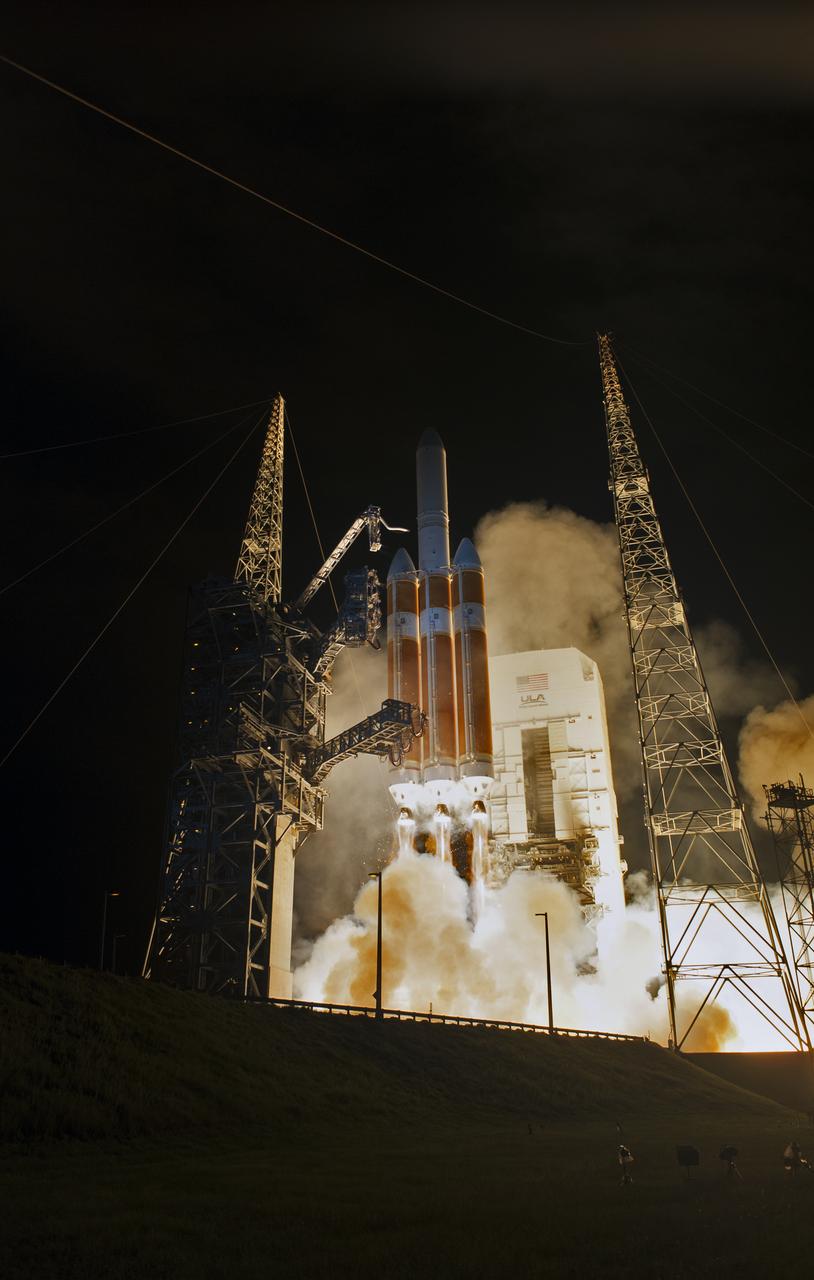
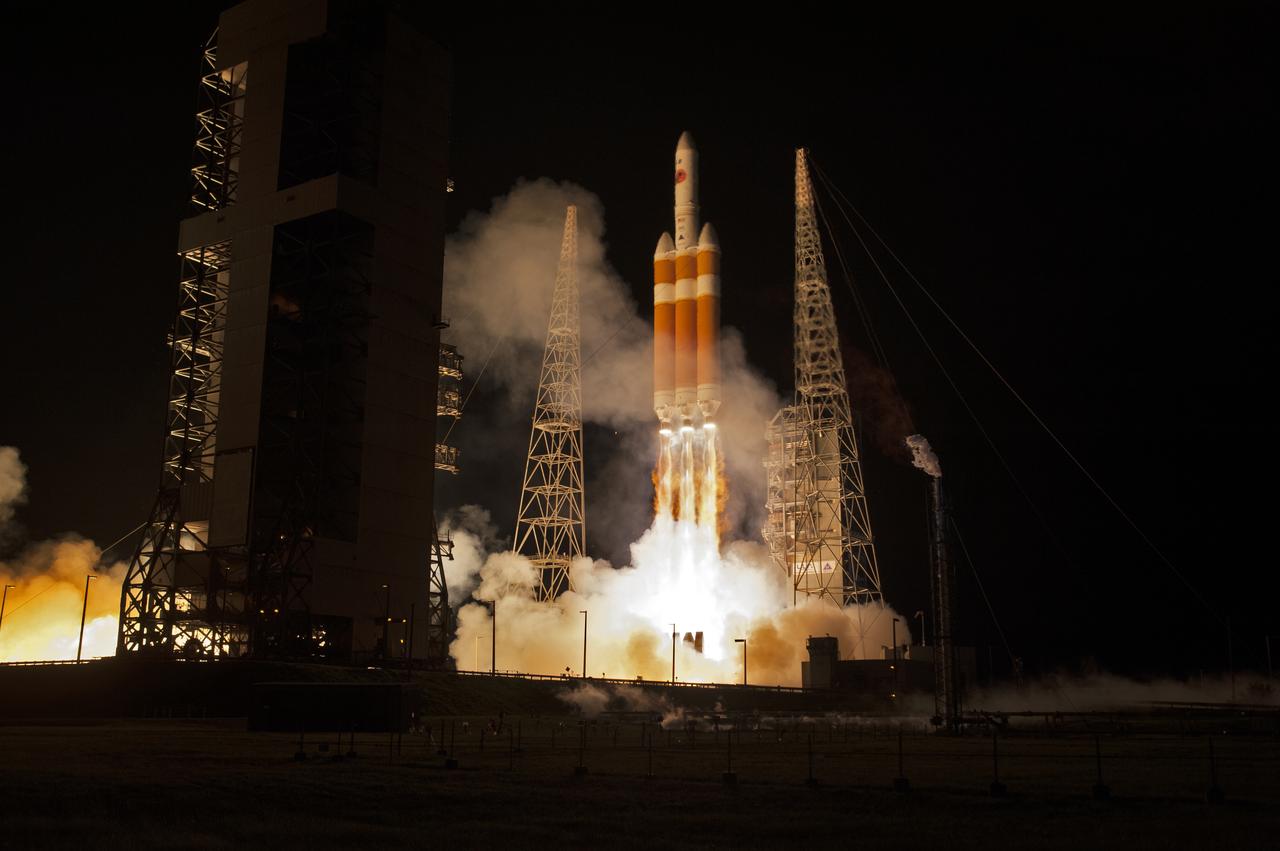
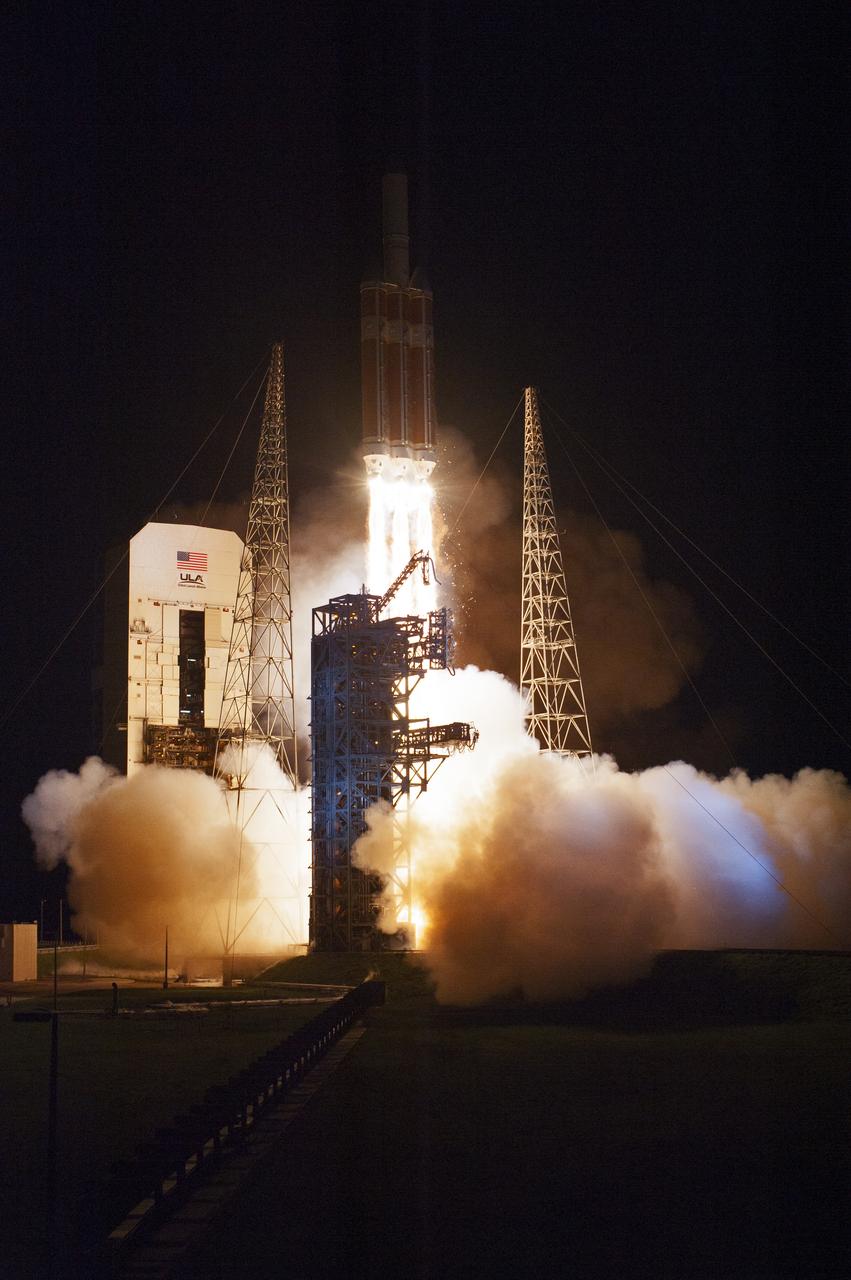
At Cape Canaveral Air Force Station’s Space Launch Complex 37, the United Launch Alliance Delta IV Heavy rocket with NASA's Parker Solar Probe, lifts off at 3:31 a.m. EDT on Sunday, Aug. 12, 2018. The spacecraft was built by Applied Physics Laboratory of Johns Hopkins University in Laurel, Maryland. The mission will perform the closest-ever observations of a star when it travels through the Sun's atmosphere, called the corona. The probe will rely on measurements and imaging to revolutionize our understanding of the corona and the Sun-Earth connection.
Parker Solar Probe Liftoff
At Cape Canaveral Air Force Station’s Space Launch Complex 37, the United Launch Alliance Delta IV Heavy rocket with NASA's Parker Solar Probe, lifts off at 3:31 a.m. EDT on Sunday, Aug. 12, 2018. The spacecraft was built by Applied Physics Laboratory of Johns Hopkins University in Laurel, Maryland. The mission will perform the closest-ever observations of a star when it travels through the Sun's atmosphere, called the corona. The probe will rely on measurements and imaging to revolutionize our understanding of the corona and the Sun-Earth connection.
Parker Solar Probe Liftoff
At Cape Canaveral Air Force Station's Space Launch Complex 37, the United Launch Alliance Delta IV Heavy rocket with NASA's Parker Solar Probe, lifts off at 3:31 a.m. EDT on Sunday, Aug. 12, 2018. The spacecraft was built by Applied Physics Laboratory of Johns Hopkins University in Laurel, Maryland. The mission will perform the closest-ever observations of a star when it travels through the Sun's atmosphere, called the corona. The probe will rely on measurements and imaging to revolutionize our understanding of the corona and the Sun-Earth connection.
Parker Solar Probe Liftoff
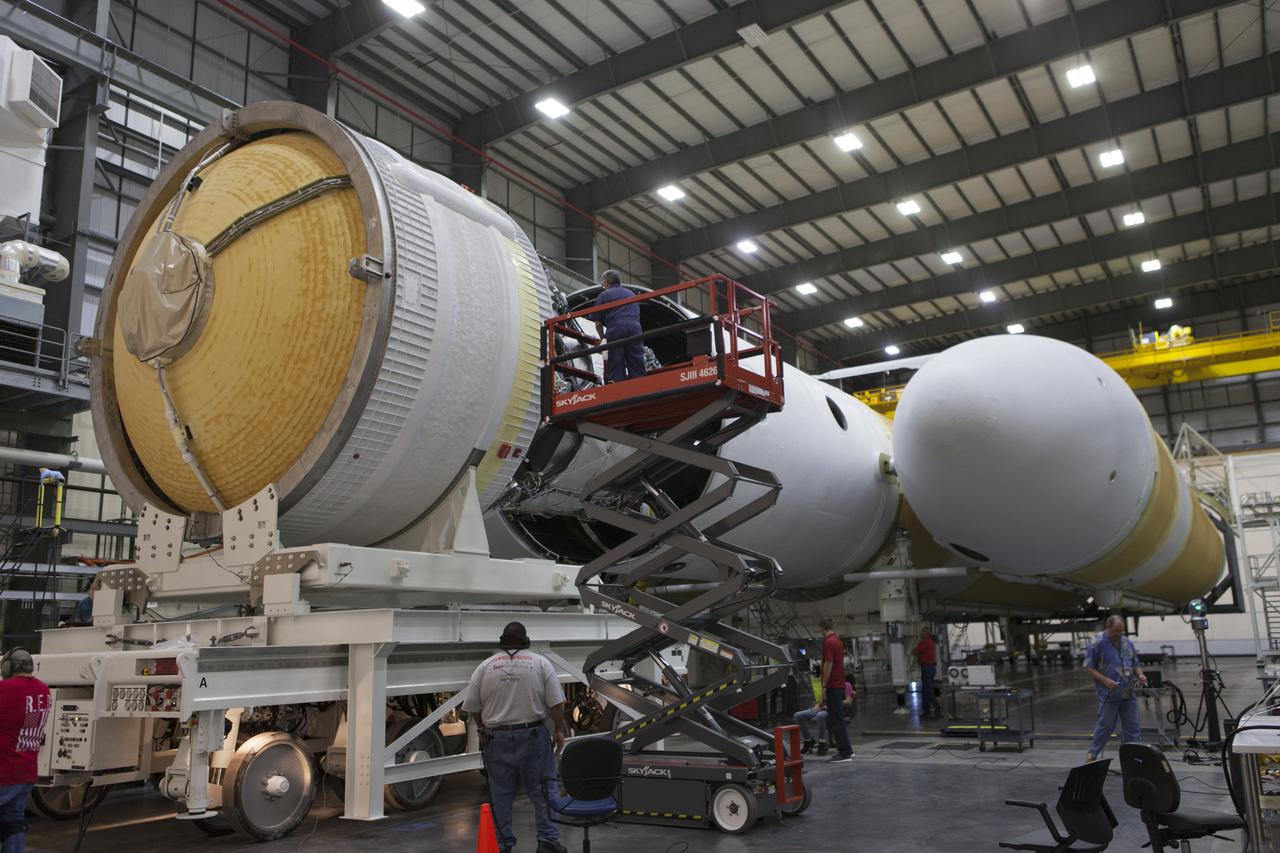
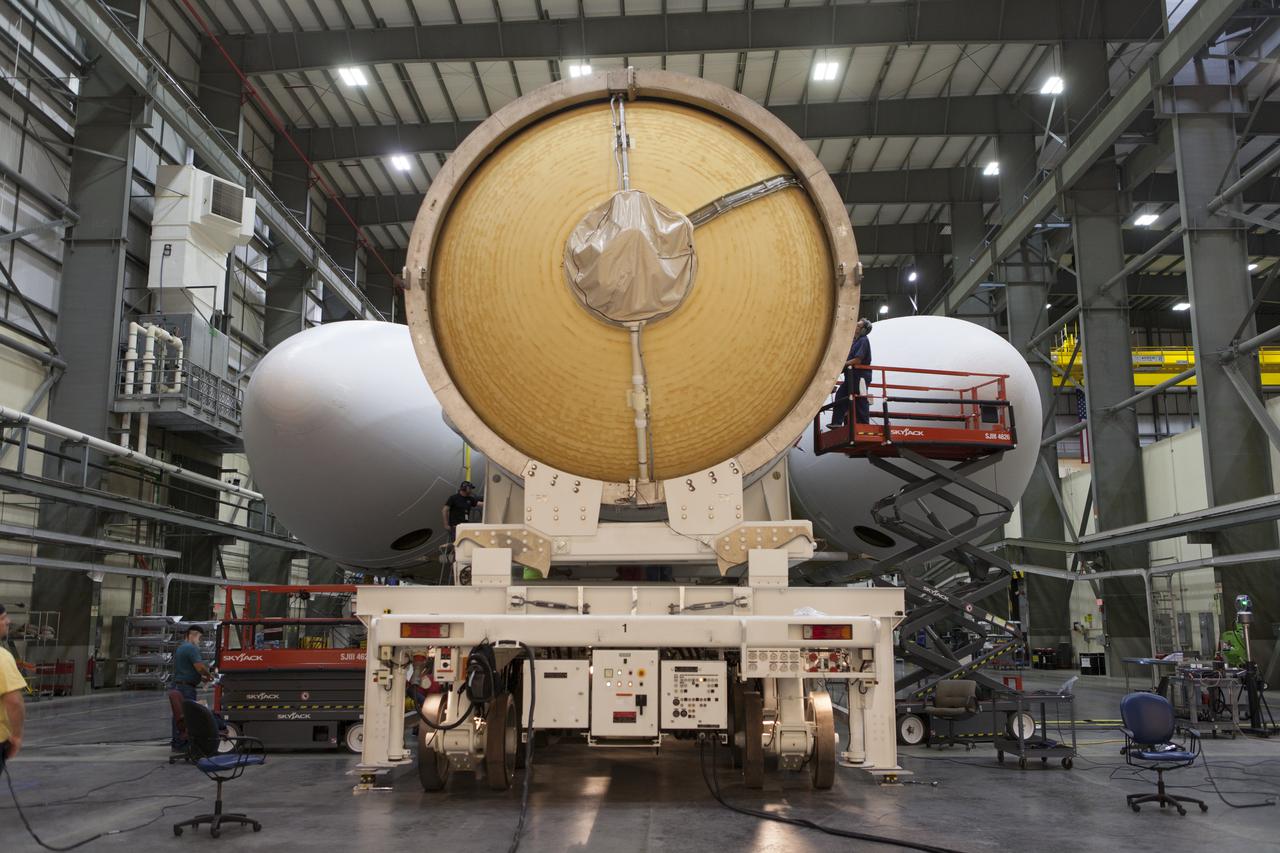
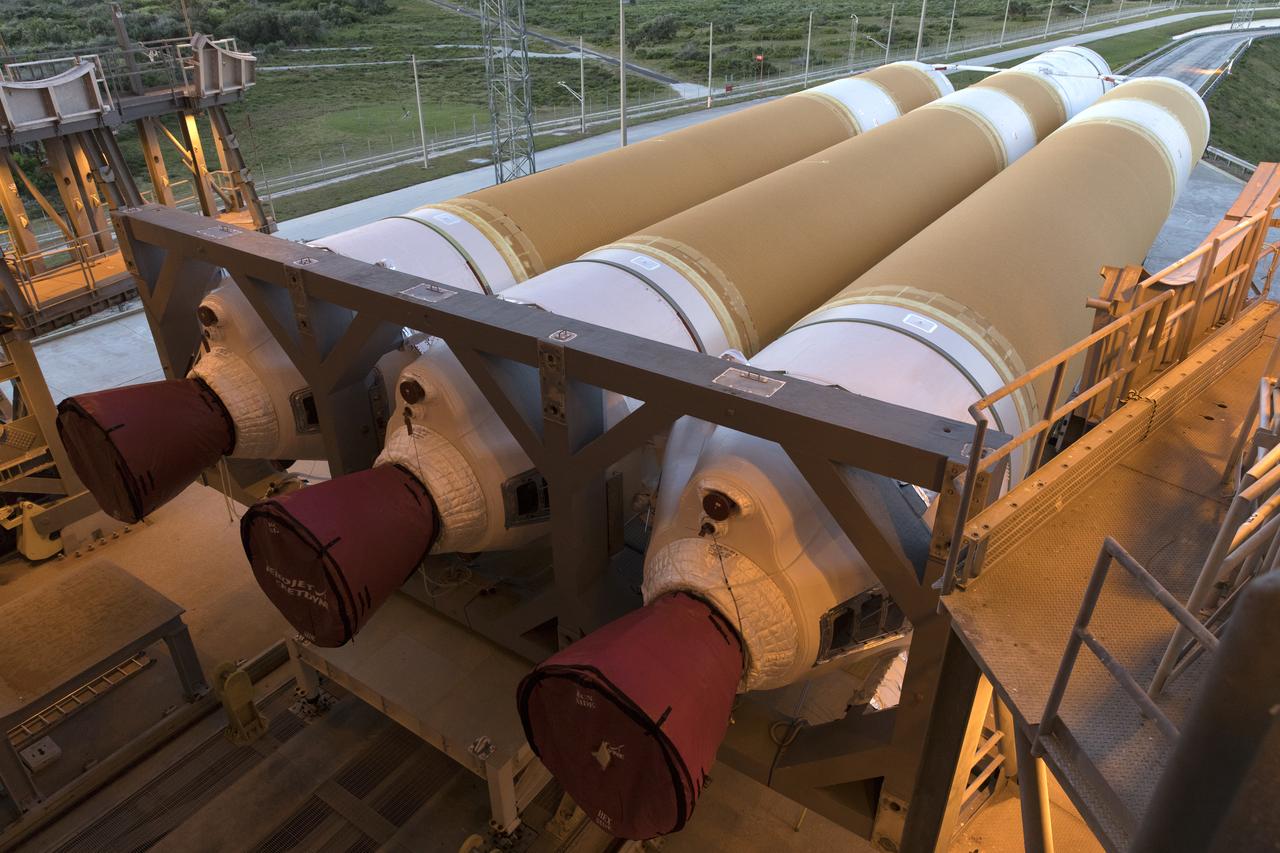
The first stage of a United Launch Alliance Delta IV Heavy rocket is prepared to be lifted vertical at the Vertical Integration Facility near Space Launch Complex 37 at Cape Canaveral Air Force Station in Florida. The Delta IV Heavy will launch NASA's upcoming Parker Solar Probe mission in July 2018. The mission will perform the closest-ever observations of a star when it travels through the Sun's atmosphere, called the corona. The probe will rely on measurements and imaging to revolutionize our understanding of the corona and the Sun-Earth connection.
Parker Solar Probe Delta IV Heavy LVOS
On Friday, Aug. 10, 2018, at Cape Canaveral Air Force Station in Florida, the United Launch Alliance Delta IV Heavy rocket stands ready to boost NASA's Parker Solar Probe on a mission to study the Sun following rollback of the Mobile Service Tower gantry at Space Launch Complex 37. Parker Solar Probe will perform the closest-ever observations of a star when it travels through the Sun's atmosphere, called the corona. The probe will rely on measurements and imaging to revolutionize our understanding of the corona and the Sun-Earth connection.
Parker Solar Probe Rollback for Launch
One of three microphone arrays positioned strategically along the ground at Edwards Air Force Base, California, sits ready to collect sound signatures from sonic booms created by a NASA F/A-18 during the SonicBAT flight series. The arrays collected the sound signatures of booms that had traveled through atmospheric turbulence before reaching the ground.
NASA Test Flights Examine Effect of Atmospheric Turbulence on Sonic Booms
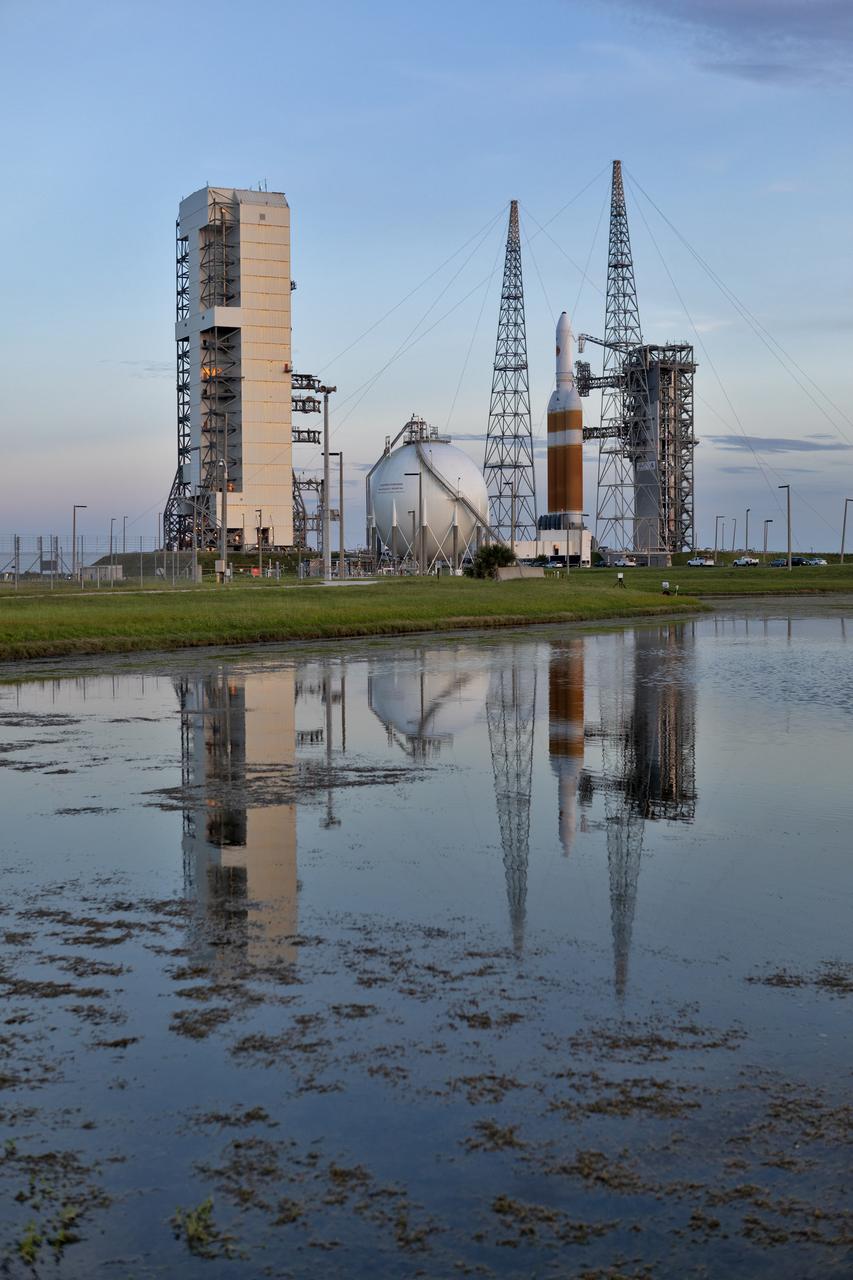
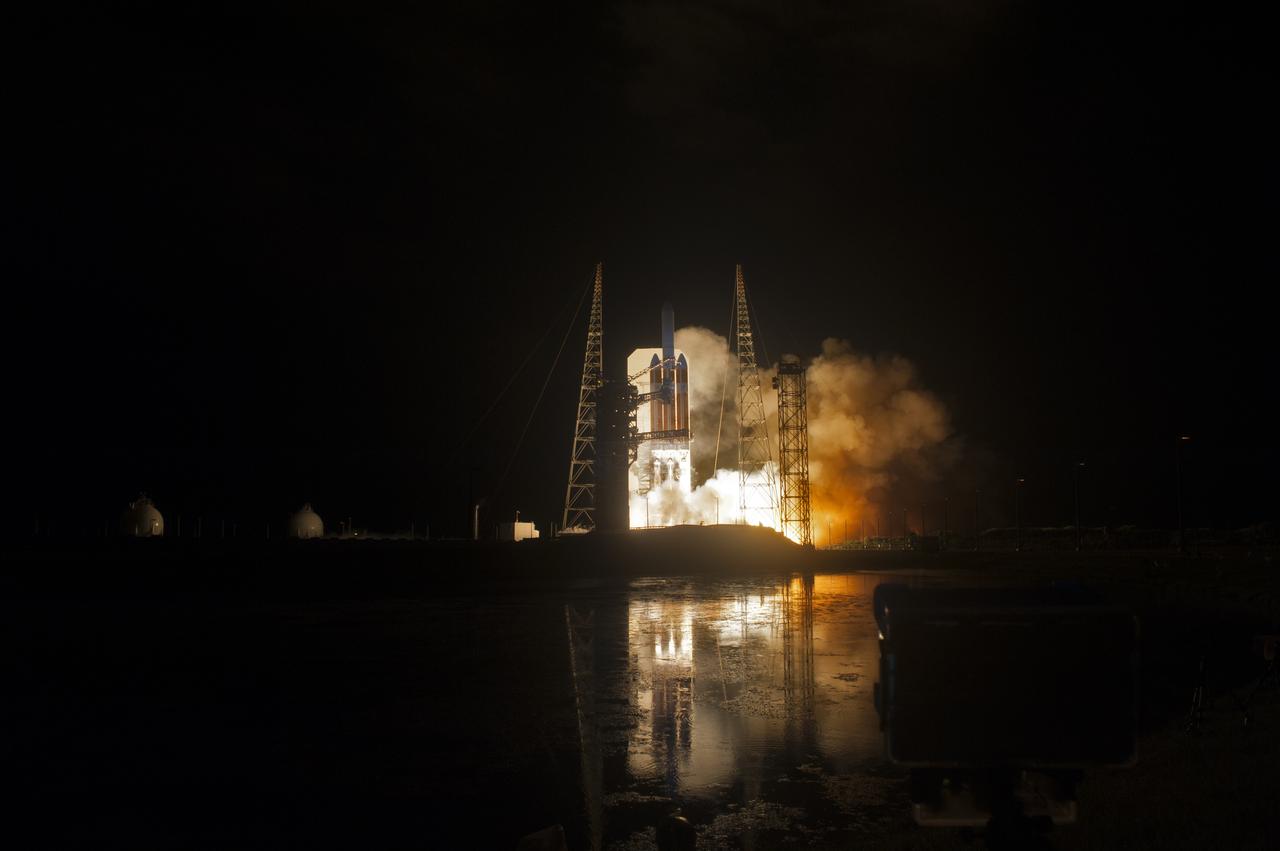
On Friday, Aug. 10, 2018, at Cape Canaveral Air Force Station in Florida, the United Launch Alliance Delta IV Heavy rocket that will boost NASA's Parker Solar Probe is reflected in a nearby pond during rollback of the Mobile Service Tower gantry at Space Launch Complex 37. Parker Solar Probe will perform the closest-ever observations of a star when it travels through the Sun's atmosphere, called the corona. The probe will rely on measurements and imaging to revolutionize our understanding of the corona and the Sun-Earth connection.
Parker Solar Probe Rollback for Launch
Encapsulated in its payload fairing, NASA's Parker Solar Probe is prepared to be lifted for mating to a United Launch Alliance Delta IV Heavy rocket at Cape Canaveral Air Force Station's Space Launch Complex 37 on Tuesday, July 31, 2018. The Parker Solar Probe is being prepared for a mission to perform the closest-ever observations of a star when it travels through the Sun's atmosphere, called the corona. The probe will rely on measurements and imaging to revolutionize our understanding of the corona and the Sun-Earth connection.
Parker Solar Probe Lift and Mate to Booster
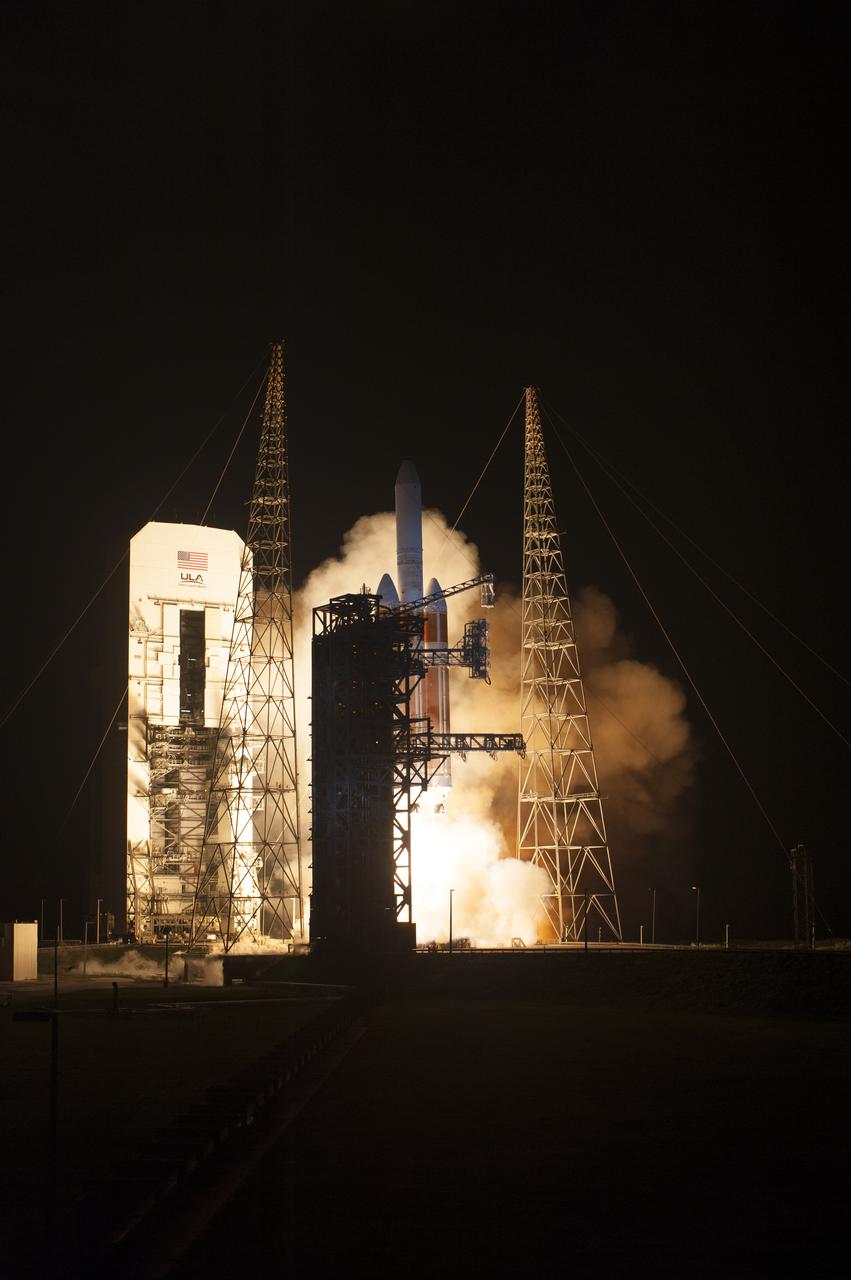
At Cape Canaveral Air Force Station's Space Launch Complex 37, the United Launch Alliance Delta IV Heavy rocket with NASA's Parker Solar Probe, lifts off at 3:31 a.m. EDT on Sunday, Aug. 12, 2018. The spacecraft was built by Applied Physics Laboratory of Johns Hopkins University in Laurel, Maryland. The mission will perform the closest-ever observations of a star when it travels through the Sun's atmosphere, called the corona. The probe will rely on measurements and imaging to revolutionize our understanding of the corona and the Sun-Earth connection.
Parker Solar Probe Liftoff
At Cape Canaveral Air Force Station's Space Launch Complex 37, the United Launch Alliance Delta IV Heavy rocket with NASA's Parker Solar Probe, lifts off at 3:31 a.m. EDT on Sunday, Aug. 12, 2018. The spacecraft was built by Applied Physics Laboratory of Johns Hopkins University in Laurel, Maryland. The mission will perform the closest-ever observations of a star when it travels through the Sun's atmosphere, called the corona. The probe will rely on measurements and imaging to revolutionize our understanding of the corona and the Sun-Earth connection.
Parker Solar Probe Liftoff
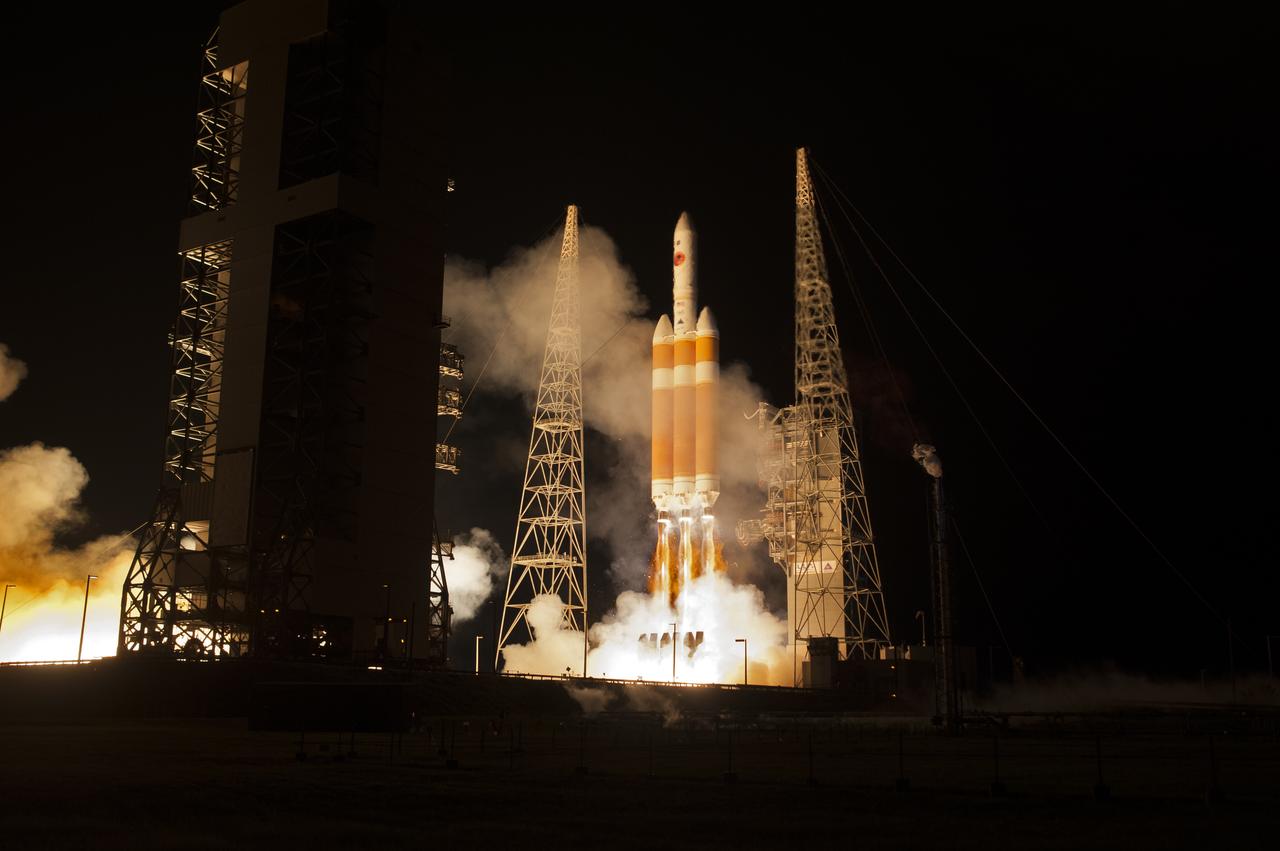
At Cape Canaveral Air Force Station’s Space Launch Complex 37, the United Launch Alliance Delta IV Heavy rocket with NASA's Parker Solar Probe, lifts off at 3:31 a.m. EDT on Sunday, Aug. 12, 2018. The spacecraft was built by Applied Physics Laboratory of Johns Hopkins University in Laurel, Maryland. The mission will perform the closest-ever observations of a star when it travels through the Sun's atmosphere, called the corona. The probe will rely on measurements and imaging to revolutionize our understanding of the corona and the Sun-Earth connection.
Parker Solar Probe Liftoff
The United Launch Alliance Delta IV Heavy rocket that will launch NASA’s Parker Solar Probe on a mission to study to Sun is seen as the Mobile Service Tower gantry at Space Launch Complex 37 rolls back on Friday, Aug. 10, 2018, at Cape Canaveral Air Force Station in Florida. Parker Solar Probe will perform the closest-ever observations of a star when it travels through the Sun's atmosphere, called the corona. The probe will rely on measurements and imaging to revolutionize our understanding of the corona and the Sun-Earth connection.
Parker Solar Probe Rollback for Launch
At Cape Canaveral Air Force Station's Space Launch Complex 37, the United Launch Alliance Delta IV Heavy rocket with NASA's Parker Solar Probe, lifts off at 3:31 a.m. EDT on Sunday, Aug. 12, 2018. The spacecraft was built by Applied Physics Laboratory of Johns Hopkins University in Laurel, Maryland. The mission will perform the closest-ever observations of a star when it travels through the Sun's atmosphere, called the corona. The probe will rely on measurements and imaging to revolutionize our understanding of the corona and the Sun-Earth connection.
Parker Solar Probe Liftoff
At Cape Canaveral Air Force Station's Space Launch Complex 37, the United Launch Alliance Delta IV Heavy rocket with NASA's Parker Solar Probe, lifts off at 3:31 a.m. EDT on Sunday, Aug. 12, 2018. The spacecraft was built by Applied Physics Laboratory of Johns Hopkins University in Laurel, Maryland. The mission will perform the closest-ever observations of a star when it travels through the Sun's atmosphere, called the corona. The probe will rely on measurements and imaging to revolutionize our understanding of the corona and the Sun-Earth connection.
Parker Solar Probe Liftoff
At Cape Canaveral Air Force Station’s Space Launch Complex 37, the United Launch Alliance Delta IV Heavy rocket with NASA's Parker Solar Probe, lifts off at 3:31 a.m. EDT on Sunday, Aug. 12, 2018. The spacecraft was built by Applied Physics Laboratory of Johns Hopkins University in Laurel, Maryland. The mission will perform the closest-ever observations of a star when it travels through the Sun's atmosphere, called the corona. The probe will rely on measurements and imaging to revolutionize our understanding of the corona and the Sun-Earth connection.
Parker Solar Probe Liftoff