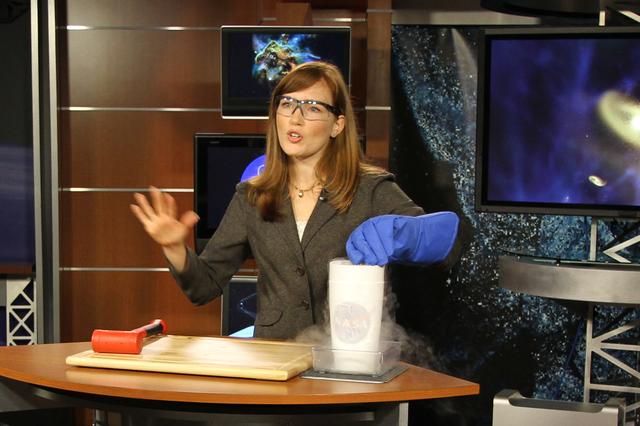
Amber Straughn talks about the extreme temperatures the Webb telescope must withstand in space.

NASA Deputy Project Scientist For Communications Amber Straughn speaks about the history of the Hubble Space Telescope during an event titled “Beyond the Deep Field: Hubble’s Legacy and the Future of Cosmic Observation,” Thursday, June 4, 2026, at the Mary W. Jackson NASA Headquarters building in Washington. Photo Credit: (NASA/Keegan Barber)
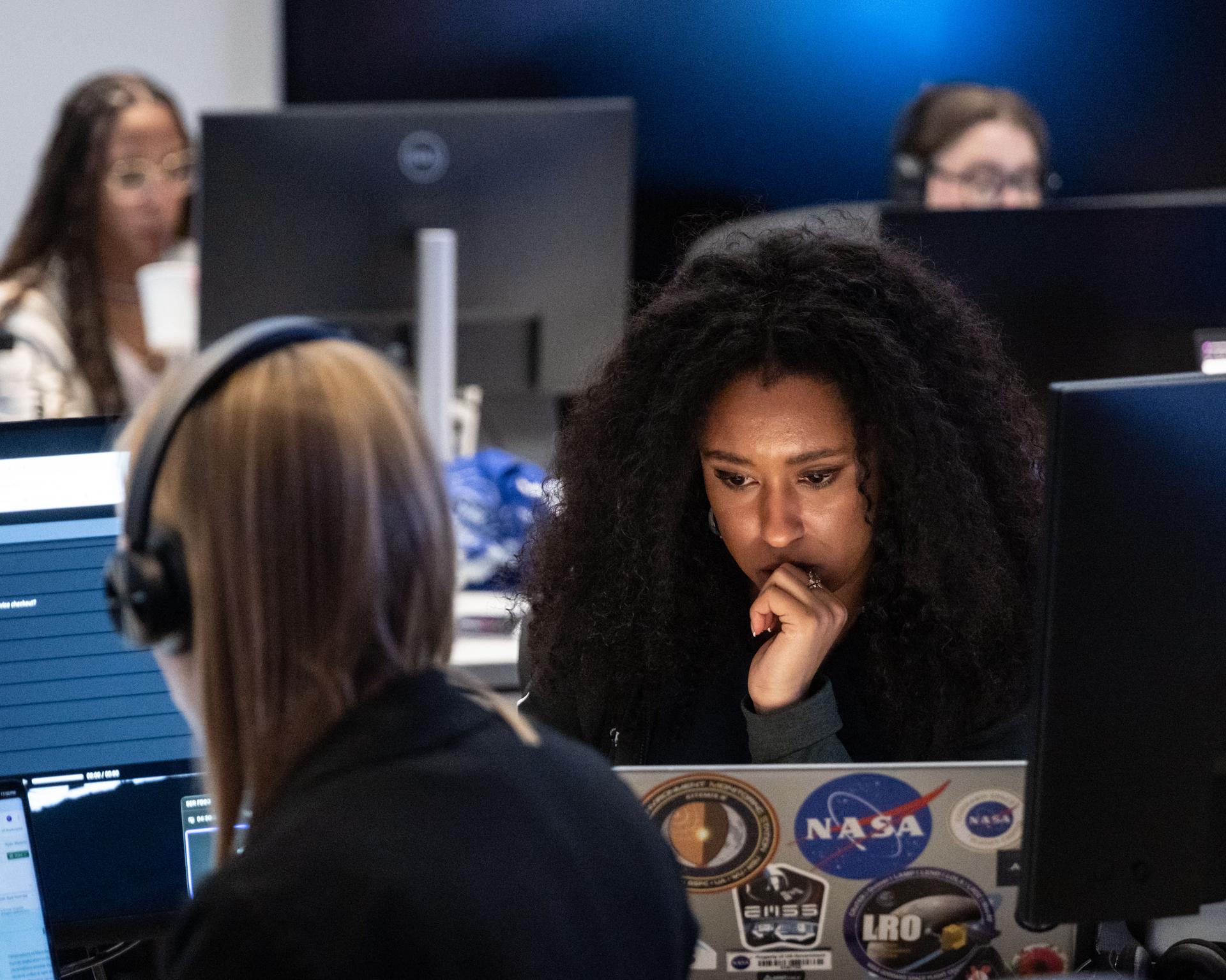
Artemis II lunar science team member, Amber Turner, works on the lunar targeting plan for the astronauts' several-hour flyby of the Moon, scheduled for April 6. As they pass the Moon, the crew will apply geology skills learned in the classroom and in Moon-like environments on Earth to photograph and describe features including impact craters, ancient lava flows, and surface cracks and ridges formed as the Moon slowly changed over time. They will note differences in color, brightness, and texture, which provide clues that help scientists understand what the surface is made of and how it formed. Credits: NASA/Bill Stafford

NASA Deputy Project Scientist For Communications Amber Straughn, right, speaks about the history of the Hubble Space Telescope during an event titled “Beyond the Deep Field: Hubble’s Legacy and the Future of Cosmic Observation,” Thursday, June 4, 2026, at the Mary W. Jackson NASA Headquarters building in Washington. Photo Credit: (NASA/Keegan Barber)
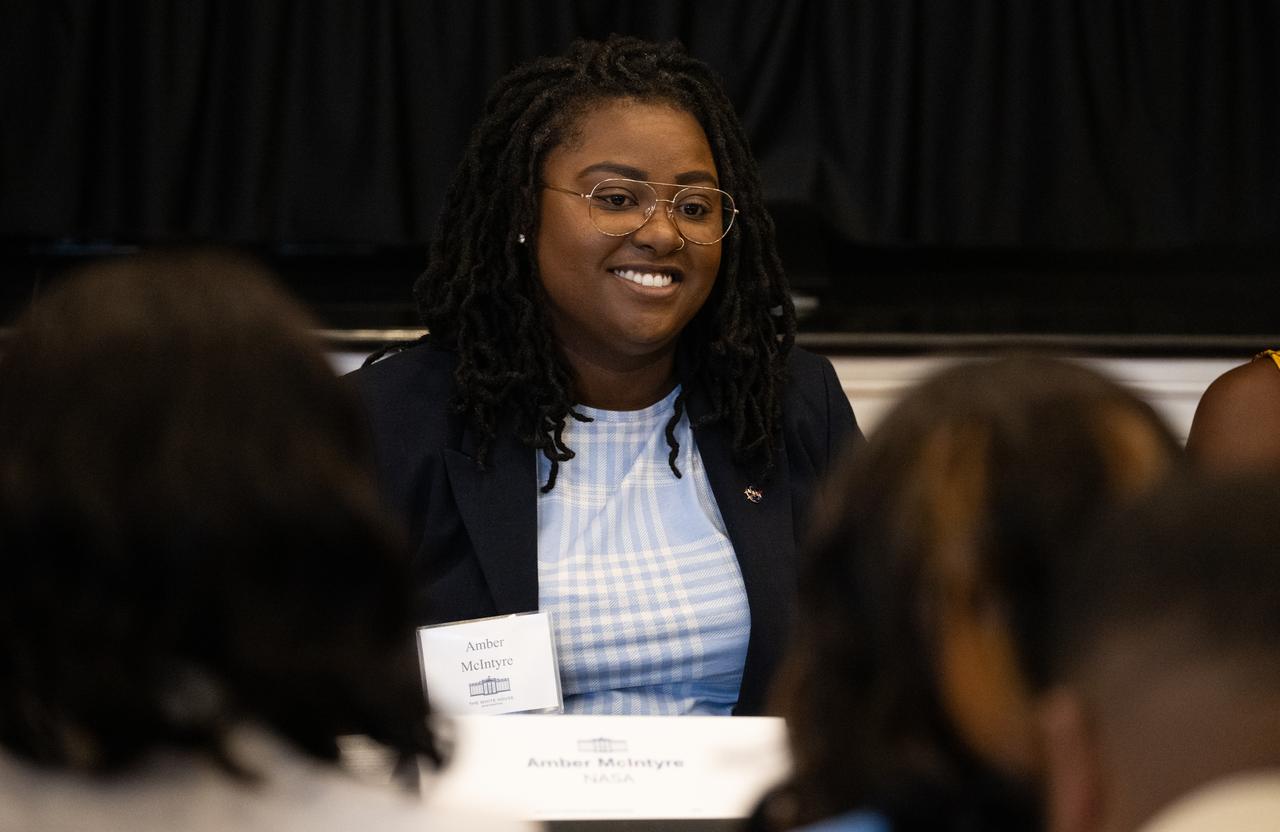
Amber McIntyre, Interagency and International Relations Advisor at NASA, is seen during a panel discussion with Kim Macharia, Executive Director at Space Prize, Ronald Gamble, a theoretical astrophysicist at NASA’s Goddard Space Flight Center, and Zephanii Eisenstat, Space and Social Justice Advocate at the NAACP, during an Artemis Generation Roundtable for Black Space Week, Tuesday, June 20, 2023, at the Eisenhower Executive Office Building in Washington. As part of Black Space Week, the National Space Council and NASA collaborated with Black In Astro to host students for a discussion on the future of space exploration and equity. Photo Credit: (NASA/Joel Kowsky)
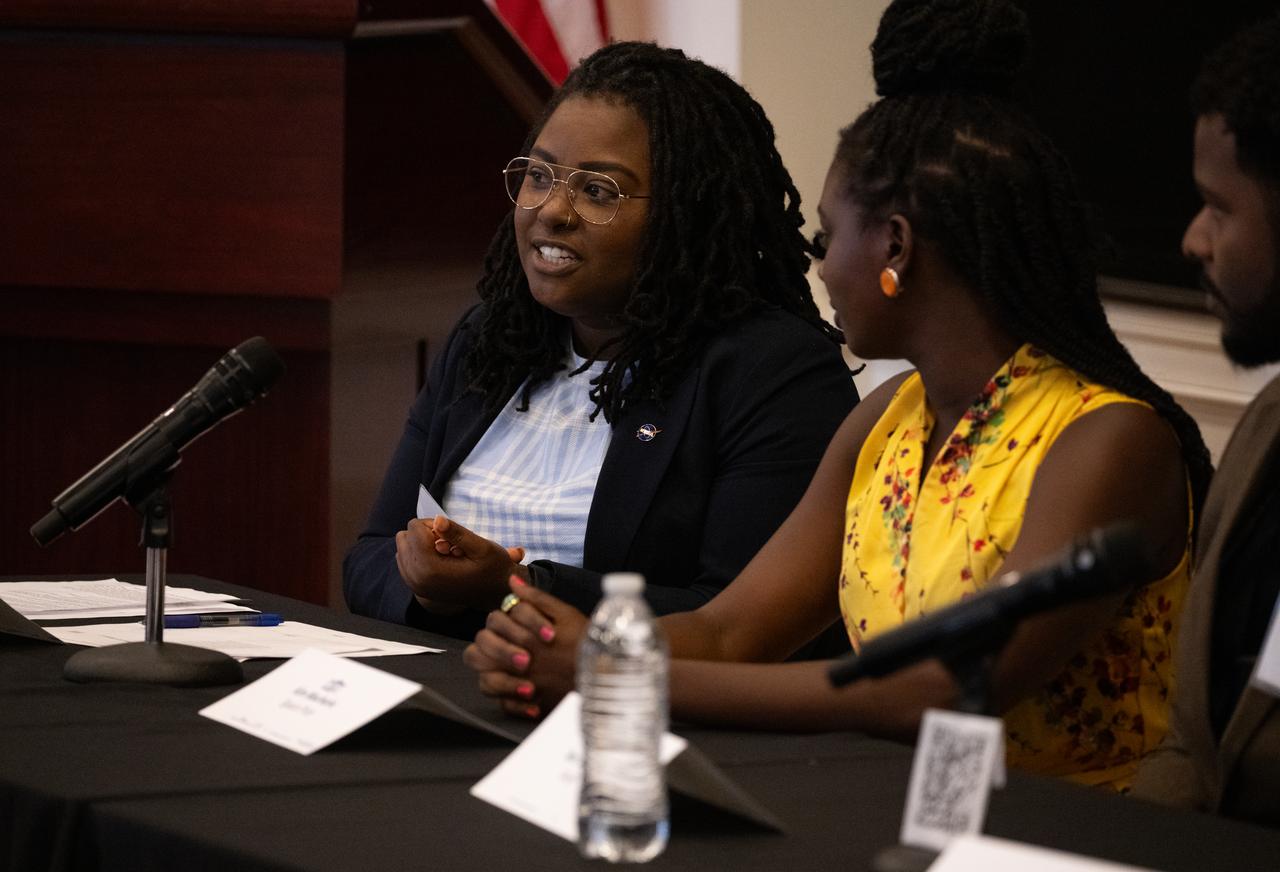
Amber McIntyre, Interagency and International Relations Advisor at NASA, speaks during a panel discussion with Kim Macharia, Executive Director at Space Prize, Ronald Gamble, a theoretical astrophysicist at NASA’s Goddard Space Flight Center, and Zephanii Eisenstat, Space and Social Justice Advocate at the NAACP, during an Artemis Generation Roundtable for Black Space Week, Tuesday, June 20, 2023, at the Eisenhower Executive Office Building in Washington. As part of Black Space Week, the National Space Council and NASA collaborated with Black In Astro to host students for a discussion on the future of space exploration and equity. Photo Credit: (NASA/Joel Kowsky)

NASA Deputy Project Scientist For Communications Amber Straughn, right, speaks about the history of the Hubble Space Telescope during an event titled “Beyond the Deep Field: Hubble’s Legacy and the Future of Cosmic Observation,” Thursday, June 4, 2026, at the Mary W. Jackson NASA Headquarters building in Washington. Photo Credit: (NASA/Keegan Barber)
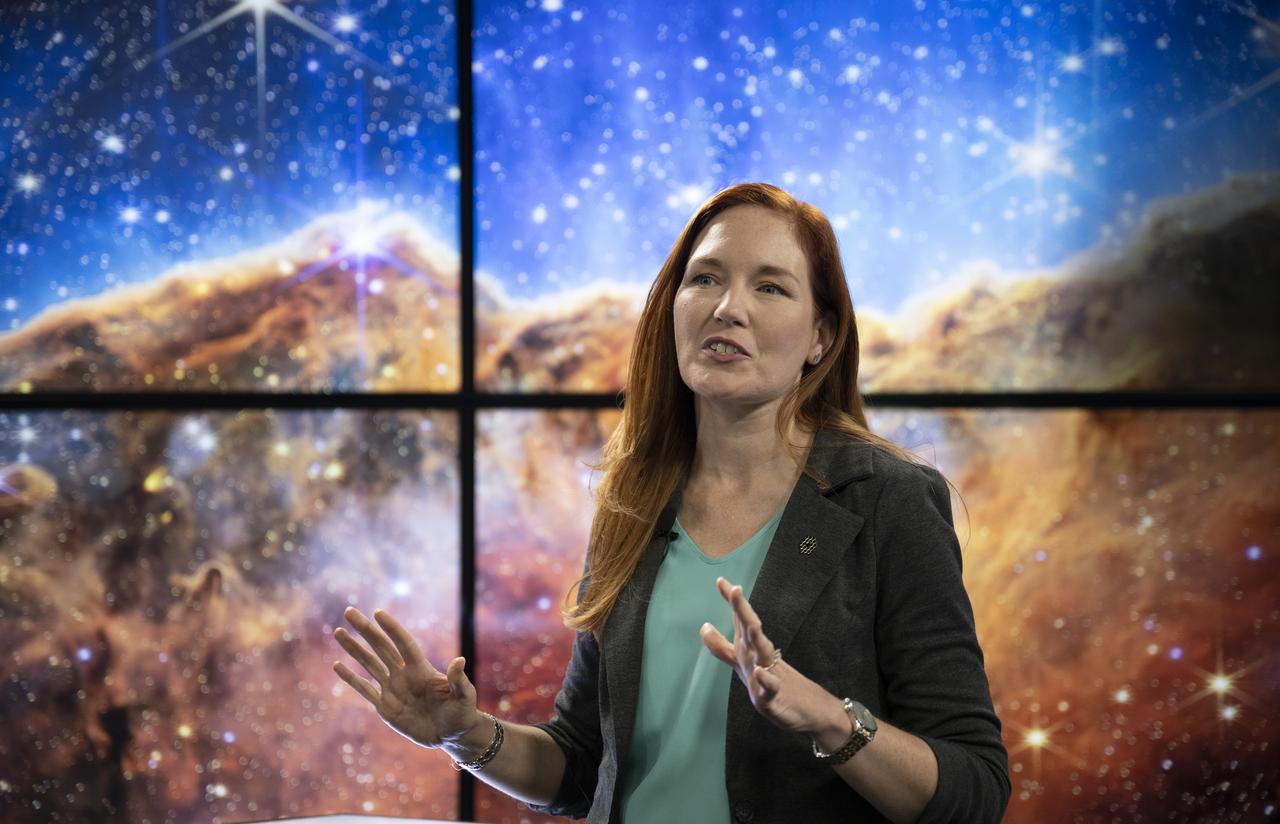
NASA James Webb Space Telescope Deputy Project Scientist for Communications Amber Straughn speaks about the infrared image of the star-forming region called NGC 3324 in the Carina Nebula as it is shown on a screen during a broadcast releasing the telescope’s first full-color images, Tuesday, July 12, 2022, at NASA’s Goddard Space Flight Center in Greenbelt, Md. The first full-color images and spectroscopic data from the James Webb Space Telescope, a partnership with ESA (European Space Agency) and the Canadian Space Agency (CSA), are a demonstration of the power of Webb as the telescope begins its science mission to unfold the infrared universe. Photo Credit: (NASA/Bill Ingalls)
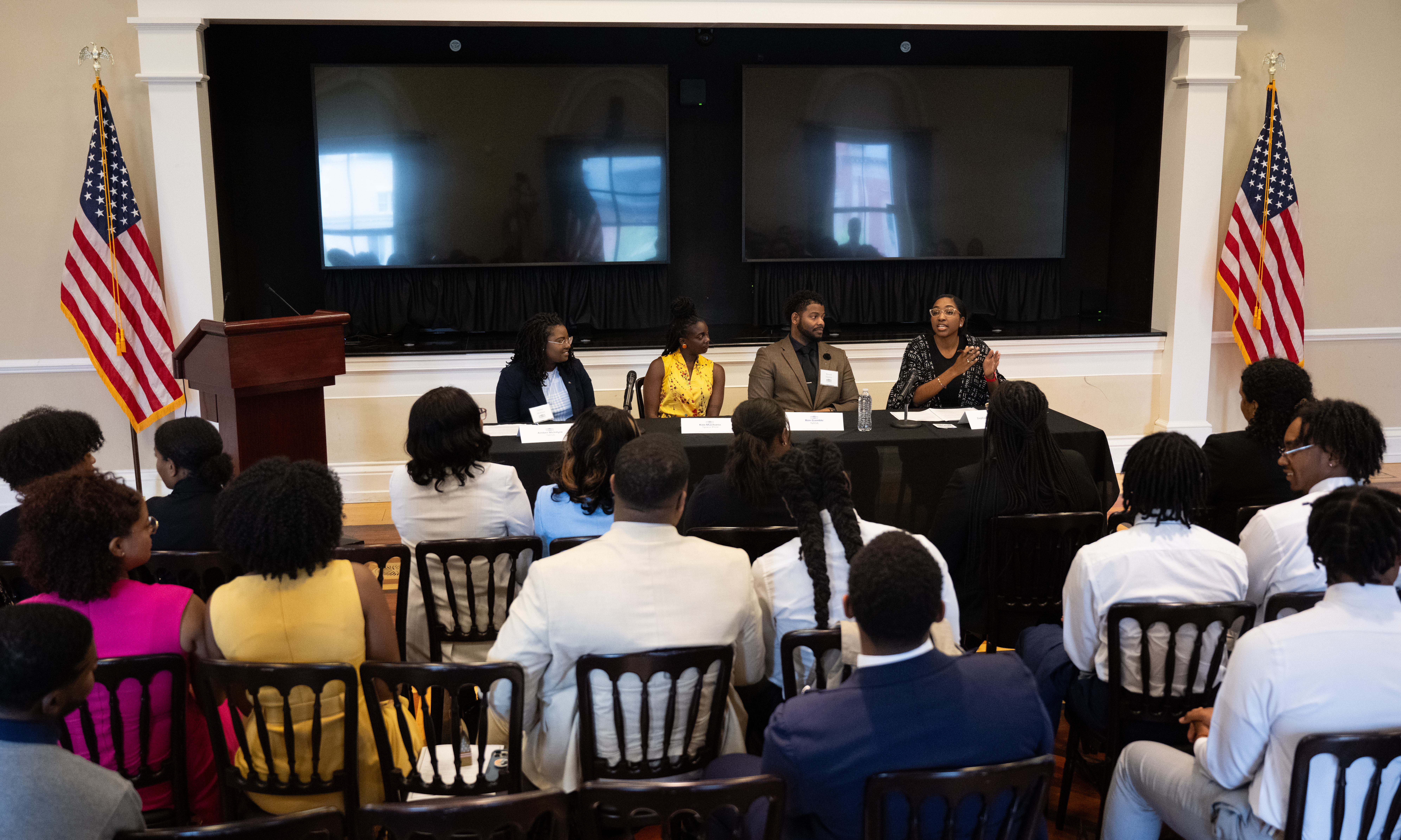
Amber McIntyre, Interagency and International Relations Advisor at NASA, left, moderates a panel discussion with Kim Macharia, Executive Director at Space Prize, second from left, Ronald Gamble, a theoretical astrophysicist at NASA’s Goddard Space Flight Center, second from right, and Zephanii Eisenstat, Space and Social Justice Advocate at the NAACP, right, during an Artemis Generation Roundtable for Black Space Week, Tuesday, June 20, 2023, at the Eisenhower Executive Office Building in Washington. As part of Black Space Week, the National Space Council and NASA collaborated with Black In Astro to host students for a discussion on the future of space exploration and equity. Photo Credit: (NASA/Joel Kowsky)
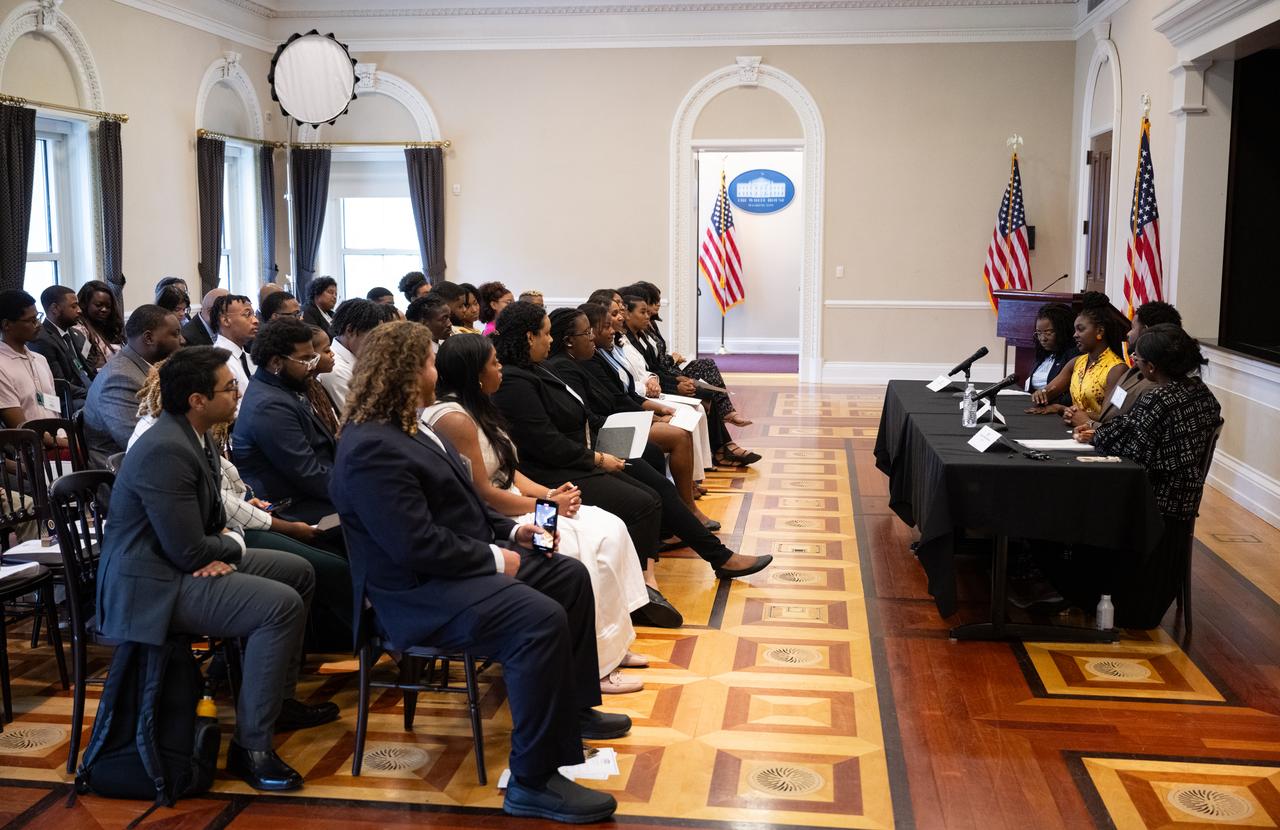
Amber McIntyre, Interagency and International Relations Advisor at NASA, left, moderates a panel discussion with Kim Macharia, Executive Director at Space Prize, second from left, Ronald Gamble, a theoretical astrophysicist at NASA’s Goddard Space Flight Center, second from right, and Zephanii Eisenstat, Space and Social Justice Advocate at the NAACP, right, during an Artemis Generation Roundtable for Black Space Week, Tuesday, June 20, 2023, at the Eisenhower Executive Office Building in Washington. As part of Black Space Week, the National Space Council and NASA collaborated with Black In Astro to host students for a discussion on the future of space exploration and equity. Photo Credit: (NASA/Joel Kowsky)
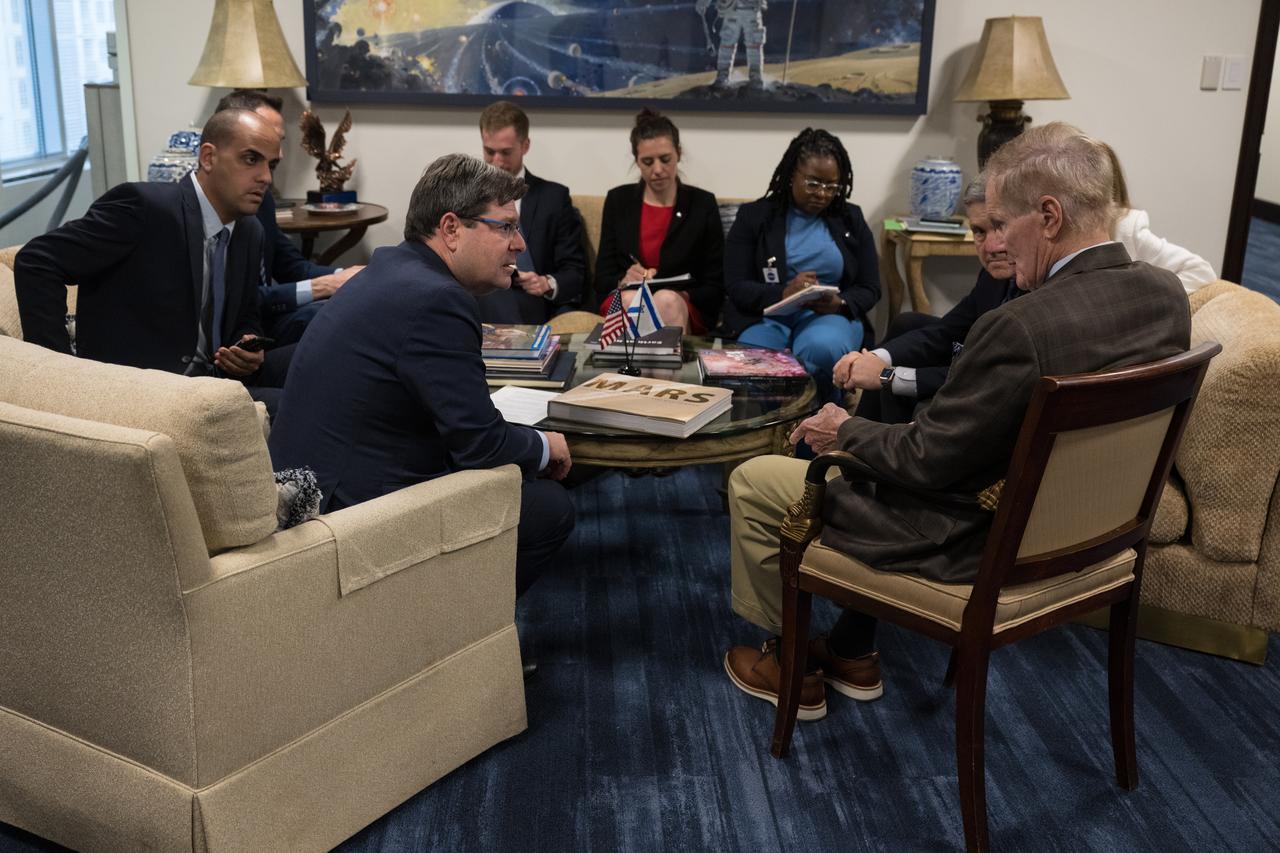
NASA Administrator Bill Nelson, right, and Associate Administrator Bob Cabana, second from right, meet with, from left to right, Israel’s Minister of Innovation, Science, and Technology, Ofir Akunis, Israel’s Deputy Director General, Omer Shechter, Israel’s Chief of Staff, Asaf Magen, Chief of Staff, Ambassador of Israel to the United States, Evan Charney, NASA Office of International and Interagency Relations, Rebecca Levy, NASA Office of International and Interagency Relations, Amber McIntyre, and NASA Associate Administrator, Office of International and Interagency Relations, Karen Feldstein, Monday, March 27, 2023 at the Mary W. Jackson NASA Headquarters building in Washington DC. Photo Credit: (NASA/Aubrey Gemignani)

Former Space Telescope Science Institute (STScI) Hubble news director Ray Villard, introduces panelists, from left to right, former NASA Senior Project Scientist Dave Leckrone, NASA Hubble Operations Project Scientist Ken Carpenter, NASA Hubble Senior Project Scientist Jennifer Wiseman, STScl head of the Hubble Space Telescope mission office Julia Roman-Duval, and NASA Deputy Project Scientist For Communications Amber Straughn during an event titled “Beyond the Deep Field: Hubble’s Legacy and the Future of Cosmic Observation,” Thursday, June 4, 2026, at the Mary W. Jackson NASA Headquarters building in Washington. Photo Credit: (NASA/Keegan Barber)
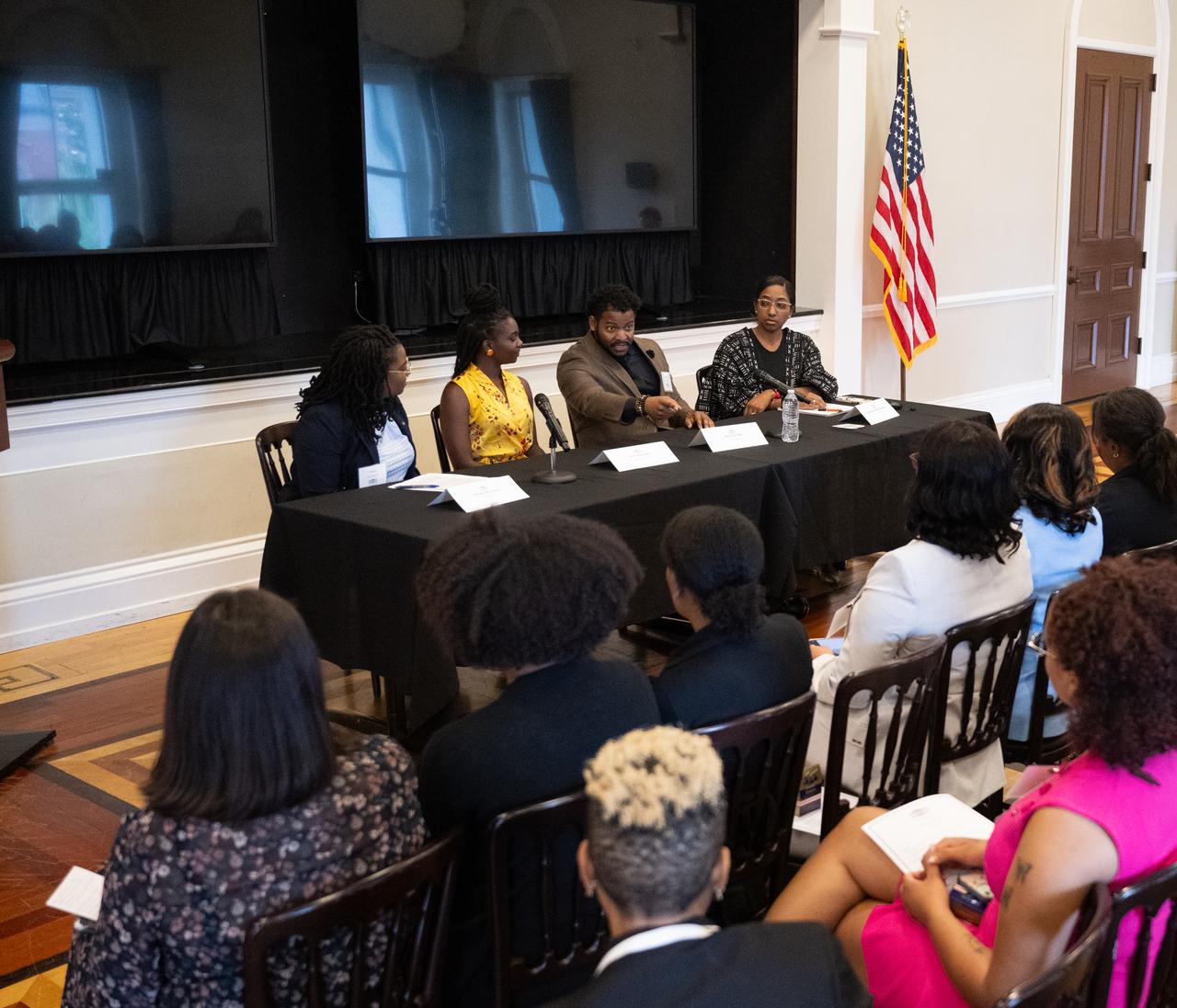
Amber McIntyre, Interagency and International Relations Advisor at NASA, left, moderates a panel discussion with Kim Macharia, Executive Director at Space Prize, second from left, Ronald Gamble, a theoretical astrophysicist at NASA’s Goddard Space Flight Center, second from right, and Zephanii Eisenstat, Space and Social Justice Advocate at the NAACP, right, during an Artemis Generation Roundtable for Black Space Week, Tuesday, June 20, 2023, at the Eisenhower Executive Office Building in Washington. As part of Black Space Week, the National Space Council and NASA collaborated with Black In Astro to host students for a discussion on the future of space exploration and equity. Photo Credit: (NASA/Joel Kowsky)
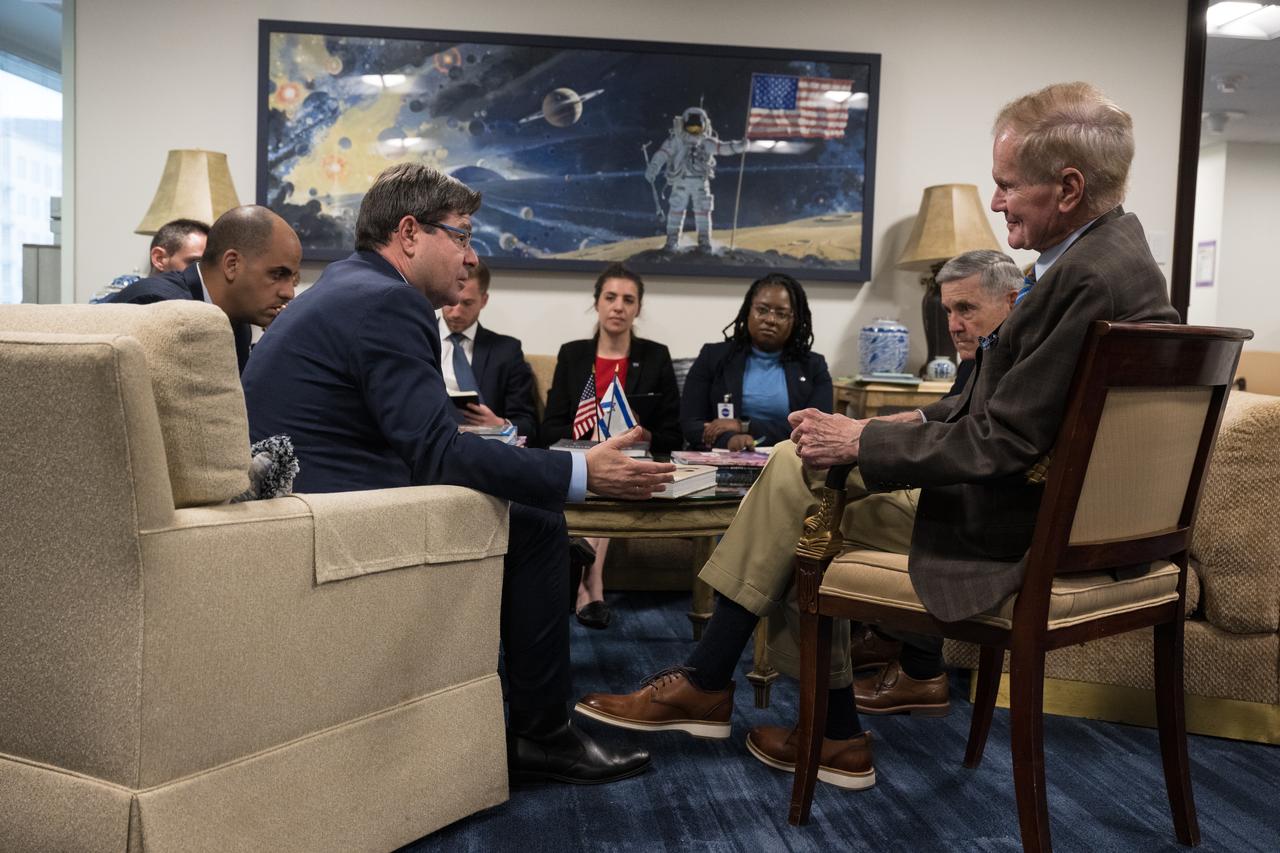
NASA Administrator Bill Nelson, right, and Associate Administrator Bob Cabana, second from right, meet with, from left to right, Israel’s Minister of Innovation, Science, and Technology, Ofir Akunis, Israel’s Deputy Director General, Omer Shechter, Israel’s Chief of Staff, Asaf Magen, Chief of Staff, Ambassador of Israel to the United States, Evan Charney, NASA Office of International and Interagency Relations, Rebecca Levy, NASA Office of International and Interagency Relations, Amber McIntyre, and NASA Associate Administrator, Office of International and Interagency Relations, Karen Feldstein, Monday, March 27, 2023 at the Mary W. Jackson NASA Headquarters building in Washington DC. Photo Credit: (NASA/Aubrey Gemignani)

Amber Jacobson, press secretary to NASA’s Deputy Administrator, left, moderates a discussion of key takeaways with Sandra Connelly, deputy associate administrator for NASA’s Science Mission Directorate, second from left, Lori Glaze, acting deputy associate administrator for NASA’s Exploration Systems Development Mission Directorate, Robyn Gatens, director of the International Space Station at NASA Headquarters, and Carrie Olsen, manager of the Next Gen STEM project for NASA’s Office of STEM Engagement, at the conclusion of NASA’s LEO Microgravity Strategy Industry and Academia Workshop, Friday, Sept. 13, 2024, at Convene in Washington. NASA’s LEO Microgravity Strategy effort aims to develop and document an objectives-based approach toward the next generation of human presence in low Earth orbit to advance microgravity science, technology, and exploration. Photo Credit: (NASA/Joel Kowsky)
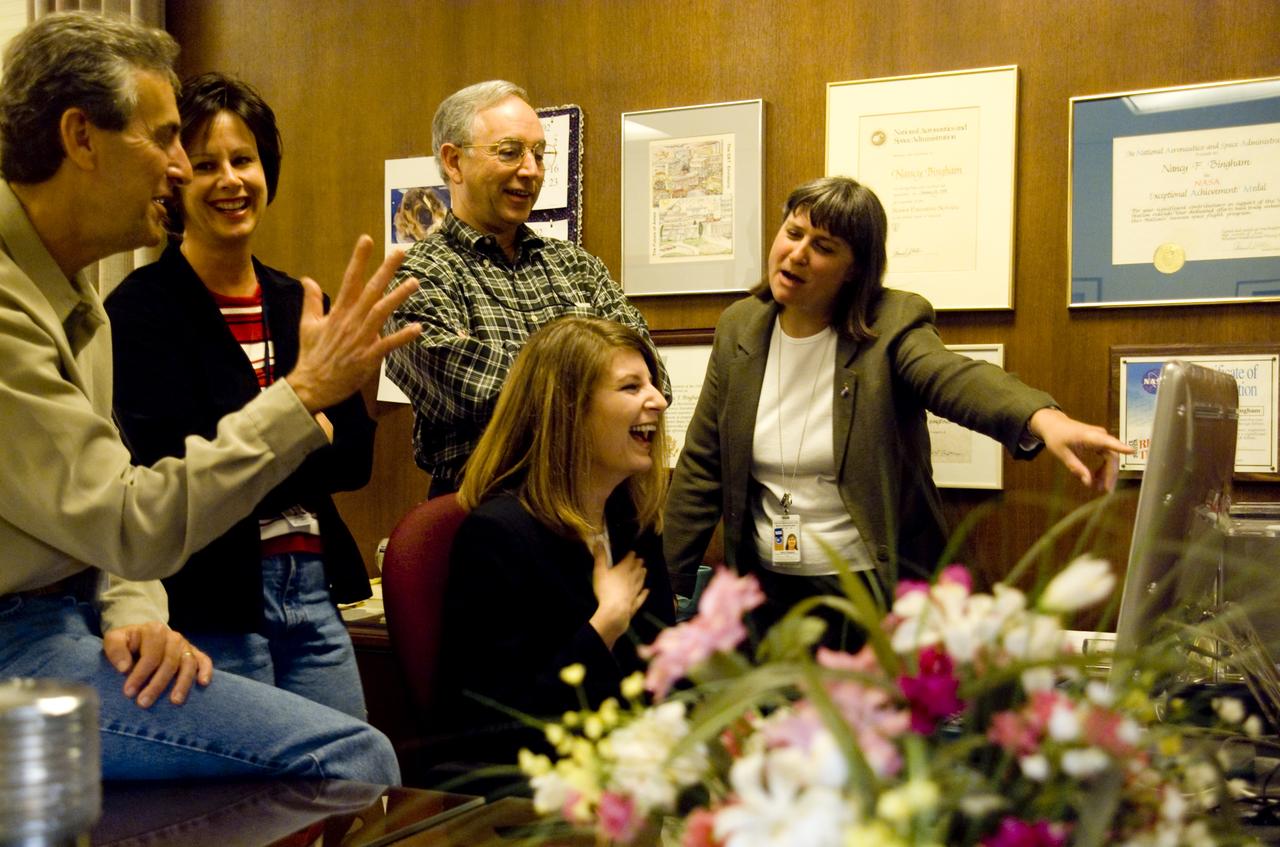
L-R; Tom Moyles , Joan Salute, Bill Berry and Nancy Bingham FMP - WebTADS training lead by Amber Sutton (seated)

NASA James Webb Space Telescope Deputy Project Scientist for Communications Amber Straughn, right, answers a question from a member of the media alongside Principal Investigator for the Canadian Near-Infrared Imager and Slitless Spectrograph at the University of Montreal René Doyon during a briefing following the release of the first full-color images from NASA’s James Webb Space Telescope, Tuesday, July 12, 2022, at NASA’s Goddard Space Flight Center in Greenbelt, Md. The first full-color images and spectroscopic data from the James Webb Space Telescope, a partnership with ESA (European Space Agency) and the Canadian Space Agency (CSA), are a demonstration of the power of Webb as the telescope begins its science mission to unfold the infrared universe. Photo Credit: (NASA/Bill Ingalls)
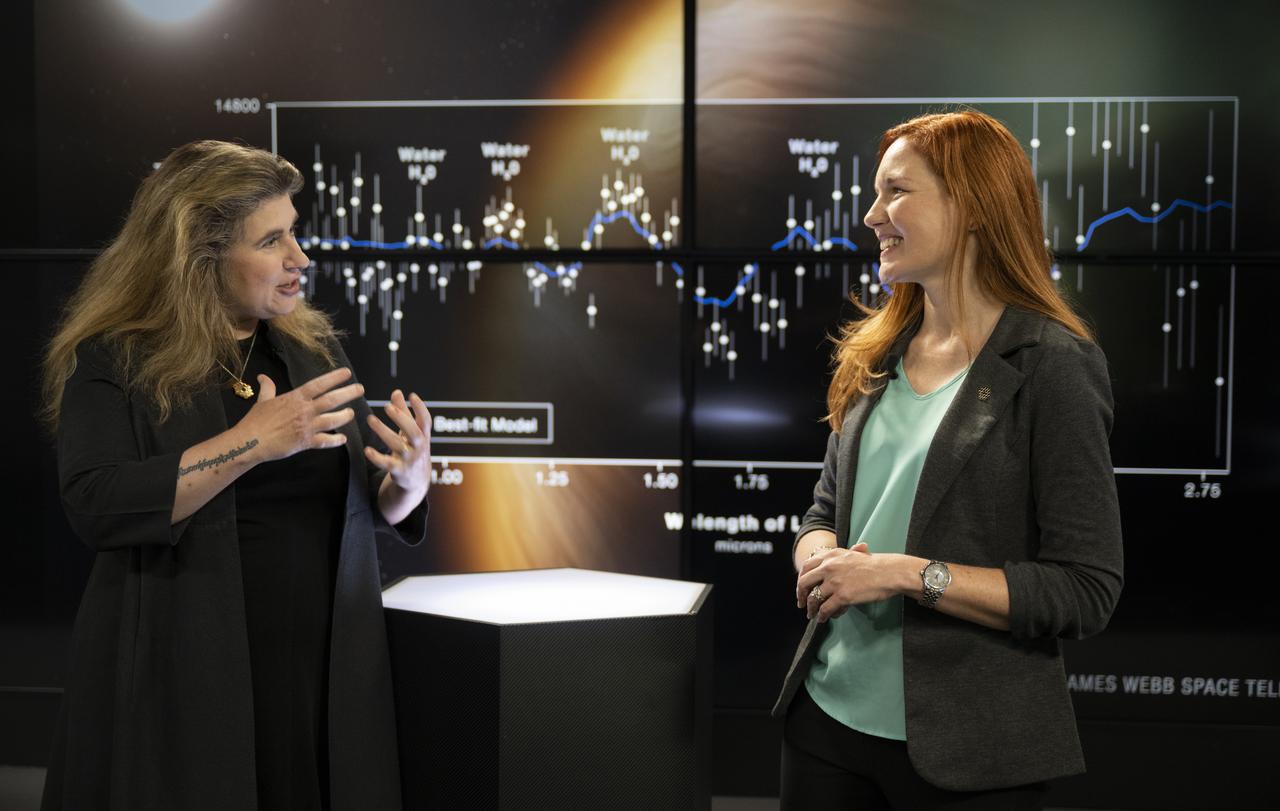
Assistant Director of Science at NASA's Goddard Space Flight Center Michelle Thaller, left, speaks with NASA James Webb Space Telescope Deputy Project Scientist for Communications Amber Straughn during a broadcast releasing the telescope’s first full-color images, Tuesday, July 12, 2022, at NASA’s Goddard Space Flight Center in Greenbelt, Md. The first full-color images and spectroscopic data from the James Webb Space Telescope, a partnership with ESA (European Space Agency) and the Canadian Space Agency (CSA), are a demonstration of the power of Webb as the telescope begins its science mission to unfold the infrared universe. Photo Credit: (NASA/Bill Ingalls)
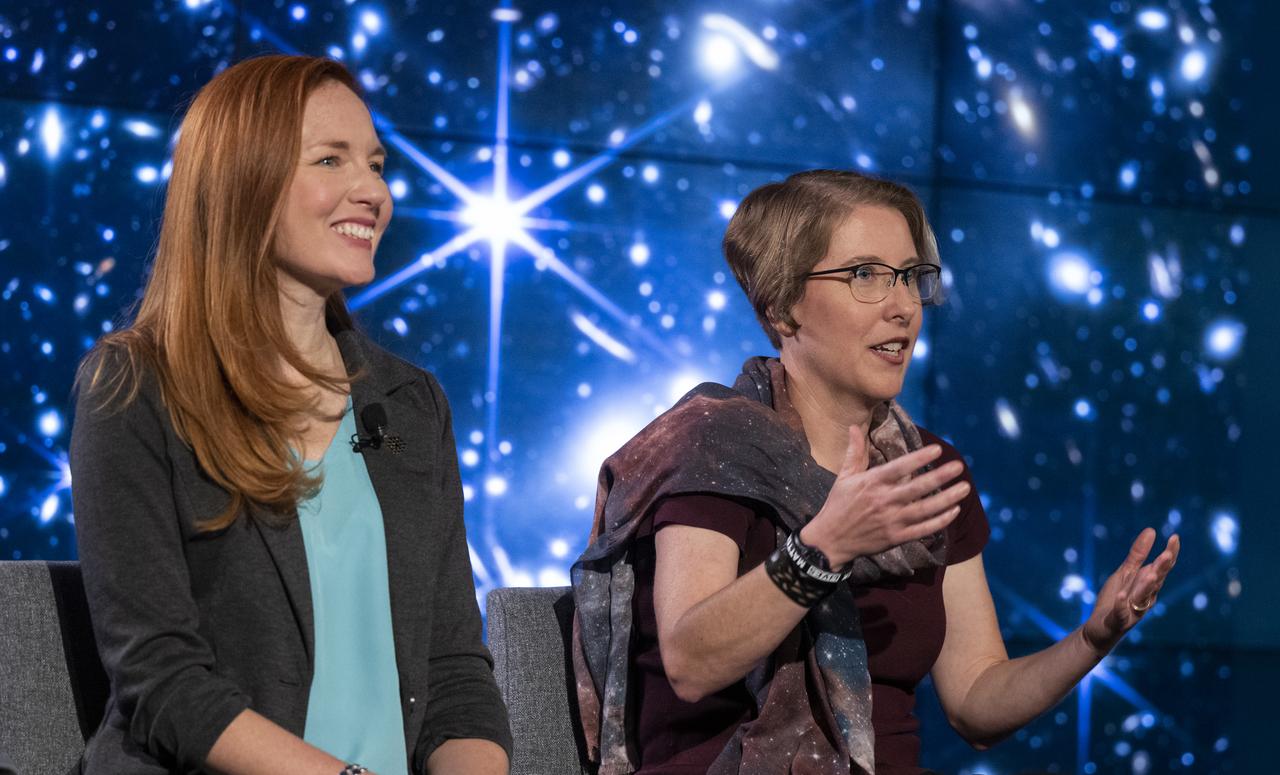
NASA James Webb Space Telescope Operations Project Scientist Jane Rigby, left, answers a question from a member of the media alongside NASA James Webb Space Telescope Deputy Project Scientist for Communications Amber Straughn during a briefing following the release of the first full-color images from NASA’s James Webb Space Telescope, Tuesday, July 12, 2022, at NASA’s Goddard Space Flight Center in Greenbelt, Md. The first full-color images and spectroscopic data from the James Webb Space Telescope, a partnership with ESA (European Space Agency) and the Canadian Space Agency (CSA), are a demonstration of the power of Webb as the telescope begins its science mission to unfold the infrared universe. Photo Credit: (NASA/Bill Ingalls)
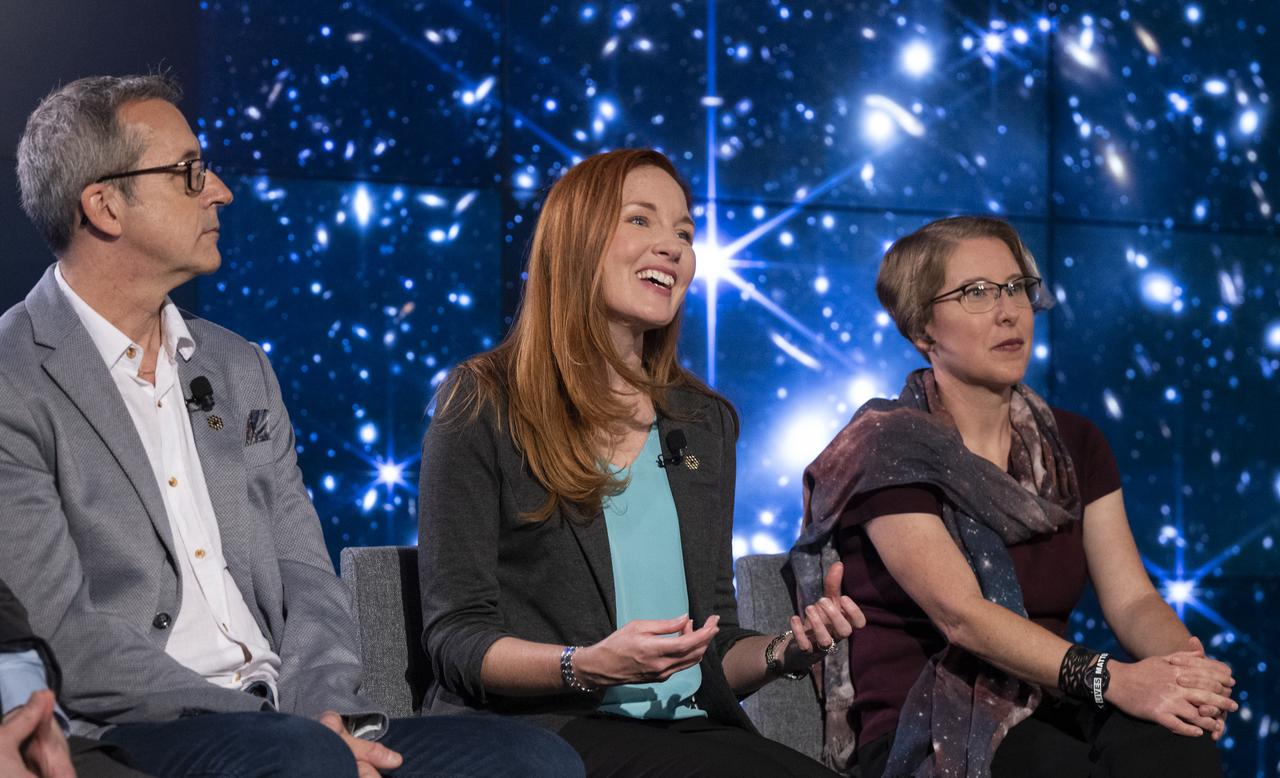
NASA James Webb Space Telescope Deputy Project Scientist for Communications Amber Straughn, center, answers a question from a member of the media alongside Principal Investigator for the Canadian Near-Infrared Imager and Slitless Spectrograph at the University of Montreal René Doyon, left, and NASA James Webb Space Telescope Operations Project Scientist Jane Rigby, right, during a briefing following the release of the first full-color images from NASA’s James Webb Space Telescope, Tuesday, July 12, 2022, at NASA’s Goddard Space Flight Center in Greenbelt, Md. The first full-color images and spectroscopic data from the James Webb Space Telescope, a partnership with ESA (European Space Agency) and the Canadian Space Agency (CSA), are a demonstration of the power of Webb as the telescope begins its science mission to unfold the infrared universe. Photo Credit: (NASA/Bill Ingalls)
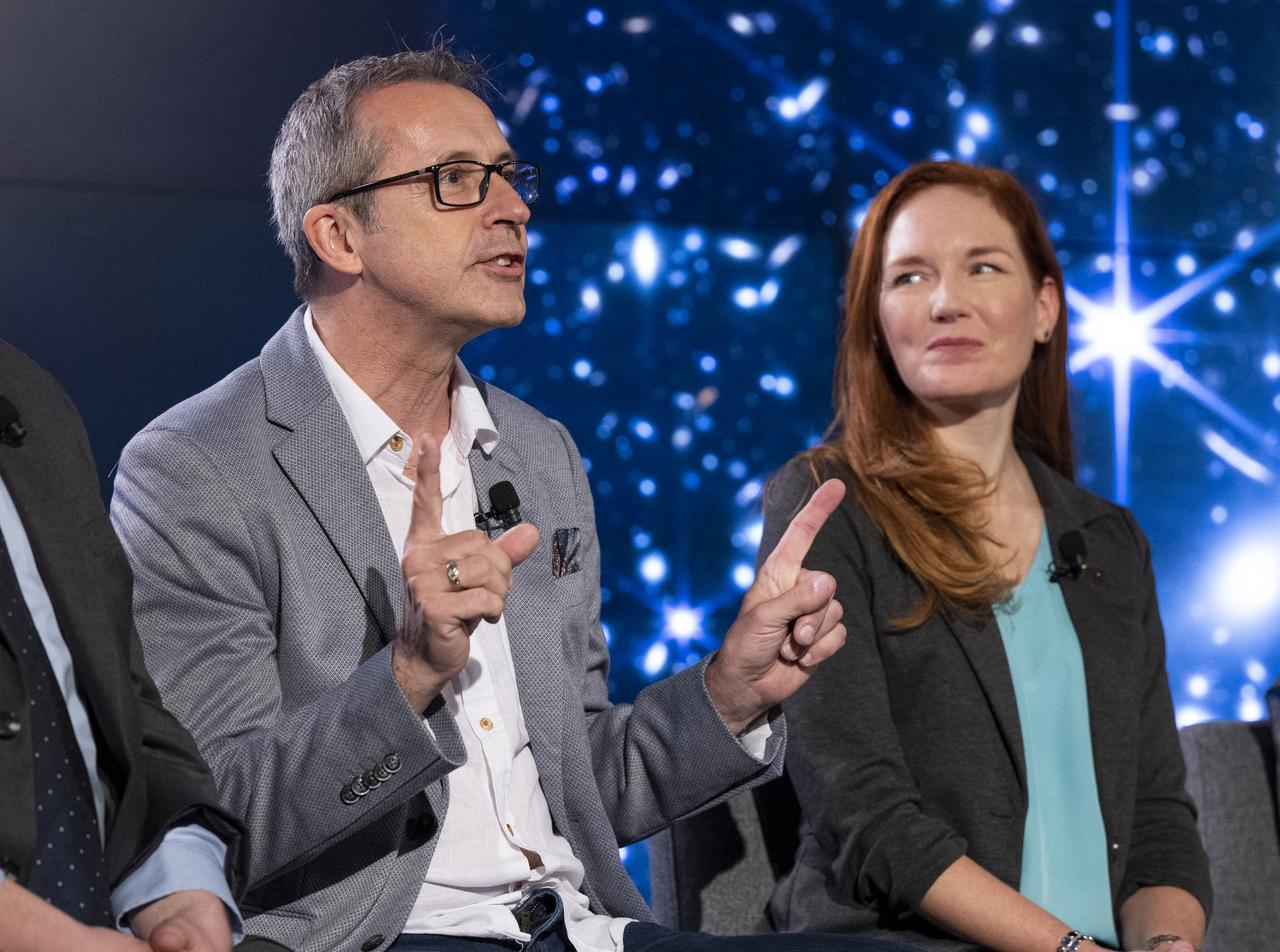
Principal Investigator for the Canadian Near-Infrared Imager and Slitless Spectrograph at the University of Montreal René Doyon, left, answers a question from a member of the media alongside NASA James Webb Space Telescope Deputy Project Scientist for Communications Amber Straughn during a briefing following the release of the first full-color images from NASA’s James Webb Space Telescope, Tuesday, July 12, 2022, at NASA’s Goddard Space Flight Center in Greenbelt, Md. The first full-color images and spectroscopic data from the James Webb Space Telescope, a partnership with ESA (European Space Agency) and the Canadian Space Agency (CSA), are a demonstration of the power of Webb as the telescope begins its science mission to unfold the infrared universe. Photo Credit: (NASA/Bill Ingalls)

iss062e081621 (March 4, 2020) --- The amber hue hovering just above the Earth's limb is the atmospheric glow with the Milky Way's stars sparkling in the background. This long-duration photograph was taken from the International Space Station at an altitude of 262 miles above Kazakhstan.

iss073e1047080 (Nov. 2, 2025) --- Palermo, Italy—a 2,700-year-old city on the Sicilian coast of the Tyrrhenian Sea—is pictured at approximately 10:12 p.m. local time from the International Space Station as it orbited 260 miles above the Mediterranean Sea. The city’s lights reveal a transition from older, amber-hued sodium-vapor lamps in the historic center to cooler, white LED lighting in the surrounding suburbs.
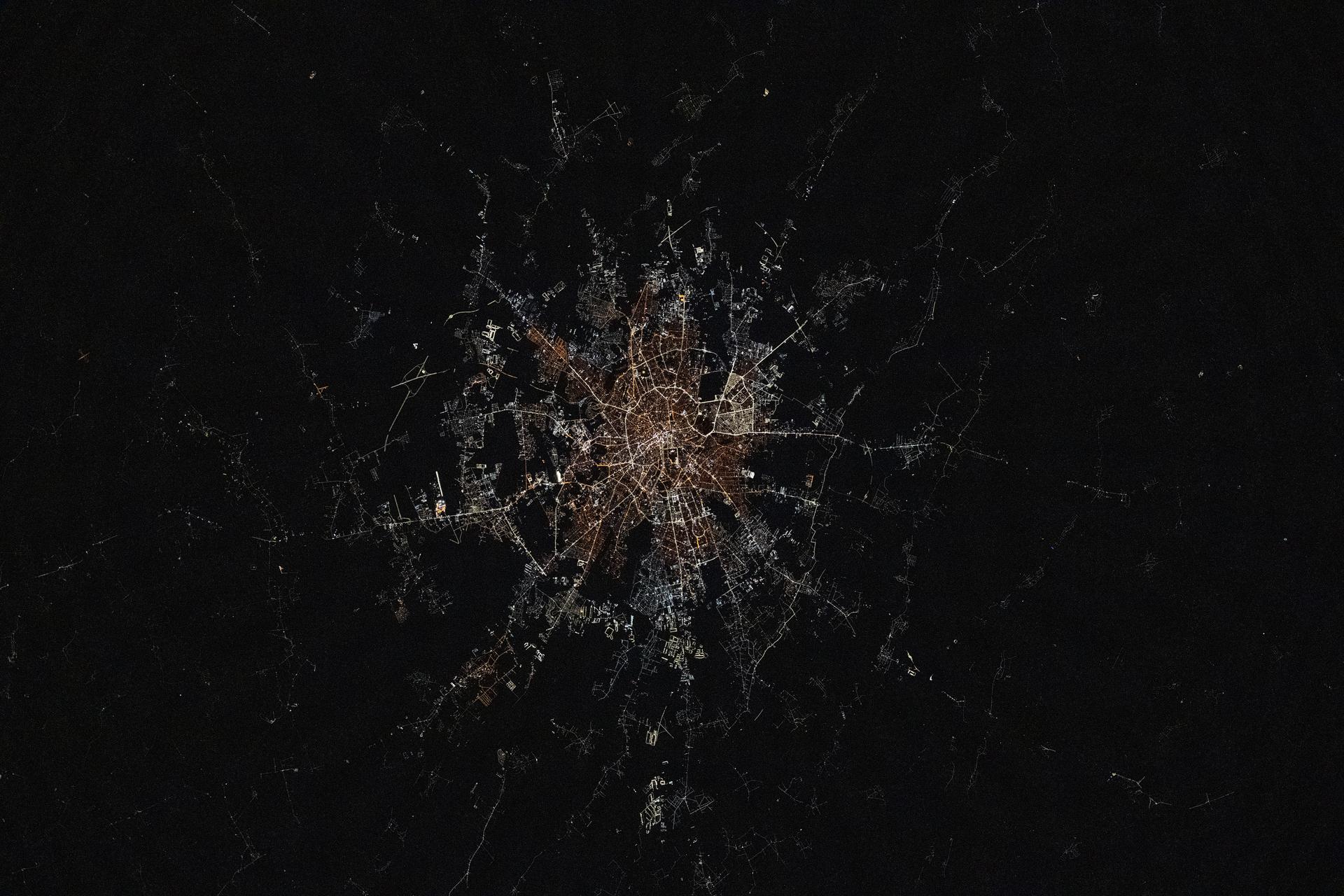
iss073e1047246 (Nov. 2, 2025) --- Bucharest, Romania—the nation's capital with a metropolitan population of about 1.78 million—transitions from older, amber-hued sodium-vapor lights in its city center to modern, white cooler LED lighting in its outskirts and suburbs. This photograph was taken from the International Space Station as it orbited 261 miles above Eastern Europe at approximately 11:15 p.m. local time.
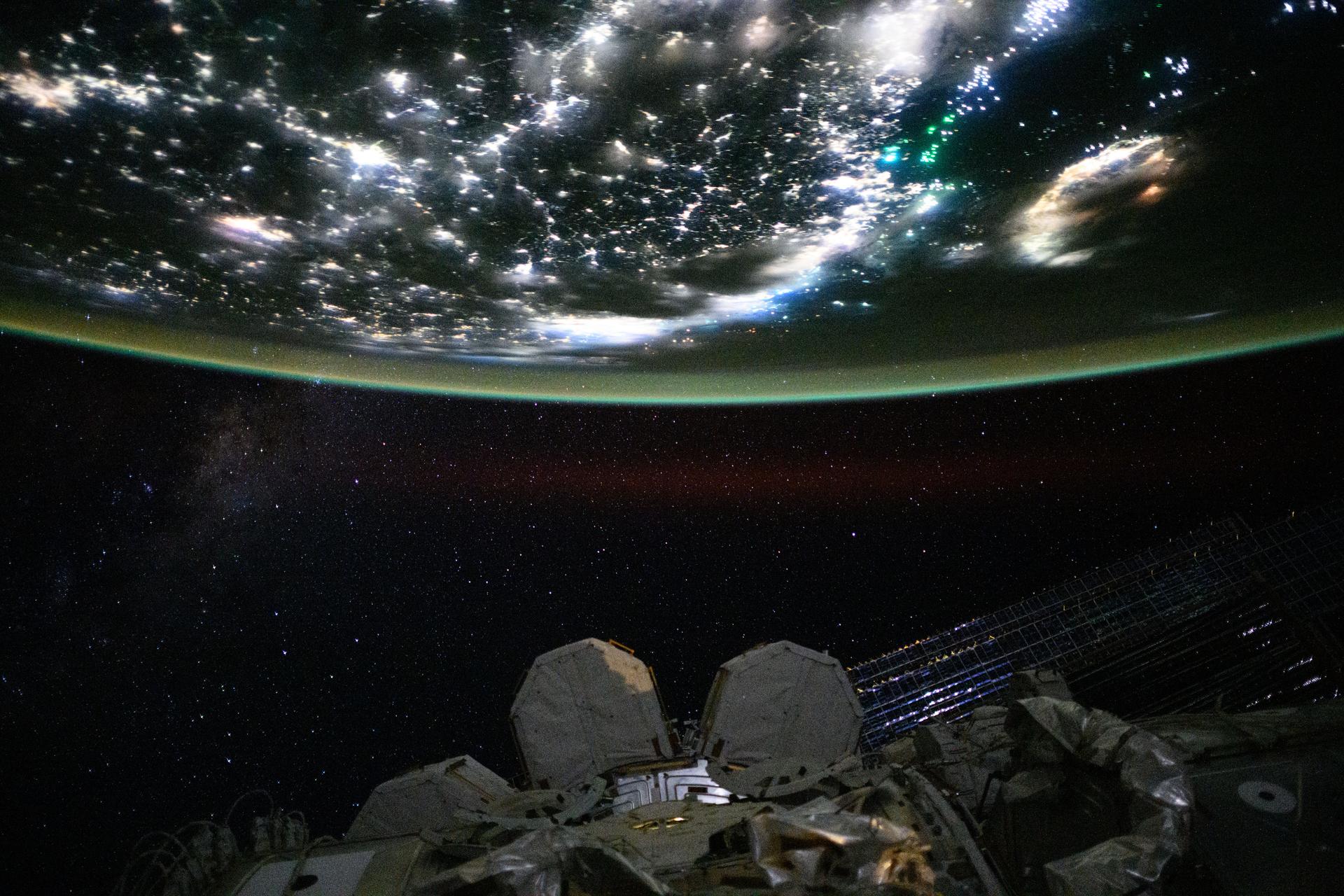
iss073e0848542 (Sept. 17, 2025) --- Green fishing boat lights lure squid, mackerel, and amberjack in the Taiwan Strait near China’s coast, glowing with white LED city lights from Fuzhou to Shenzhen. In contrast, Taiwan’s coast (right) from Taipei to Kaohsiung glows amber from sodium streetlights. The International Space Station captured this view from 261 miles above the East China Sea at 11:55 p.m. local time.

iss074e0043931 (Jan. 3, 2026) --- Yerevan, Armenia, and its modernized bright LED city lights contrast with the older amber high-pressure sodium lights of Iğdır, Türkiye (left), in this photograph from the International Space Station as it orbited 262 miles above Earth at approximately 11:12 p.m. local time. Credit: JAXA/Kimiya Yui

iss073e1047210 (Nov. 2, 2025) --- Thessaloniki, Greece—a 2,300-year-old port city on the Thermaic Gulf with a metropolitan population of about 815,000—is pictured at approximately 11:14 p.m. local time from the International Space Station as it orbited 263 miles above the Greek Peninsula. Its city lights transition from older, amber-hued sodium-vapor lights in its city center to modern, white cooler LED lighting in its outskirts and suburbs.

iss074e0043930 (Jan. 3, 2026) --- The amber high-pressure sodium lights of Erciş, Türkiye (top), along with its suburbs and villages, dot the landscape surrounding Lake Van in the nation’s Eastern Anatolia Region. The International Space Station was orbiting 262 miles above Earth at approximately 10:12 p.m. local time when this photograph was taken. Credit: JAXA/Kimiya Yui

iss074e0556324 (May 3, 2026) --- This oblique view of Moscow, Russia, was photographed at approximately 1:56 a.m. local time from the International Space Station as it soared 263 miles above Europe into an orbital sunrise. Moscow’s sodium‑vapor streetlights create an amber hue, revealing the city’s web‑like structure in this nighttime view. Credit: NASA/Chris Williams
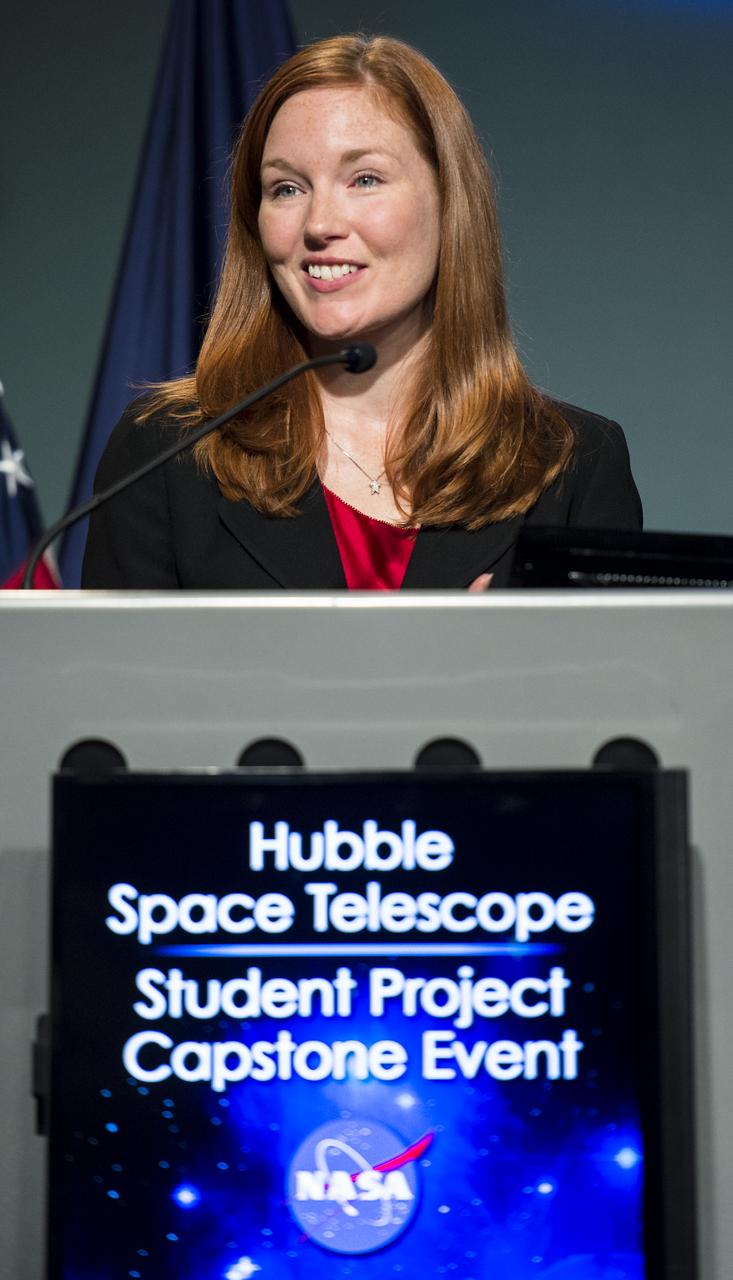
Dr. Amber Straughn, Lead Scientist for James Webb Space Telescope Education & Public Outreach at NASA's Goddard Space Flight Center, speaks to students from Mapletown Jr/Sr High School and Margaret Bell Middle School during the NASA Hubble Space Telescope (HST) Research Project Capstone Event in the James E. Webb Auditorium at NASA Headquarters on Monday, May 5, 2014 Photo Credit: (NASA/Joel Kowsky)

iss074e0043921 (Jan. 3, 2026) --- The amber high-pressure sodium lights of Van, Türkiye (center), along with its suburbs and villages, dot the southeast coast of Lake Van in the nation’s Eastern Anatolia Region. The International Space Station was orbiting 262 miles above Earth at approximately 10:12 p.m. local time when this photograph was taken. Credit: JAXA/Kimiya Yui

iss074e0556317 (May 3, 2026) --- This oblique view of Moscow, Russia, was photographed at approximately 1:56 a.m. local time from the International Space Station as it soared 263 miles above Europe into an orbital sunrise. Moscow’s sodium‑vapor streetlights create an amber hue, revealing the city’s web‑like structure in this nighttime view. Credit: NASA/Chris Williams
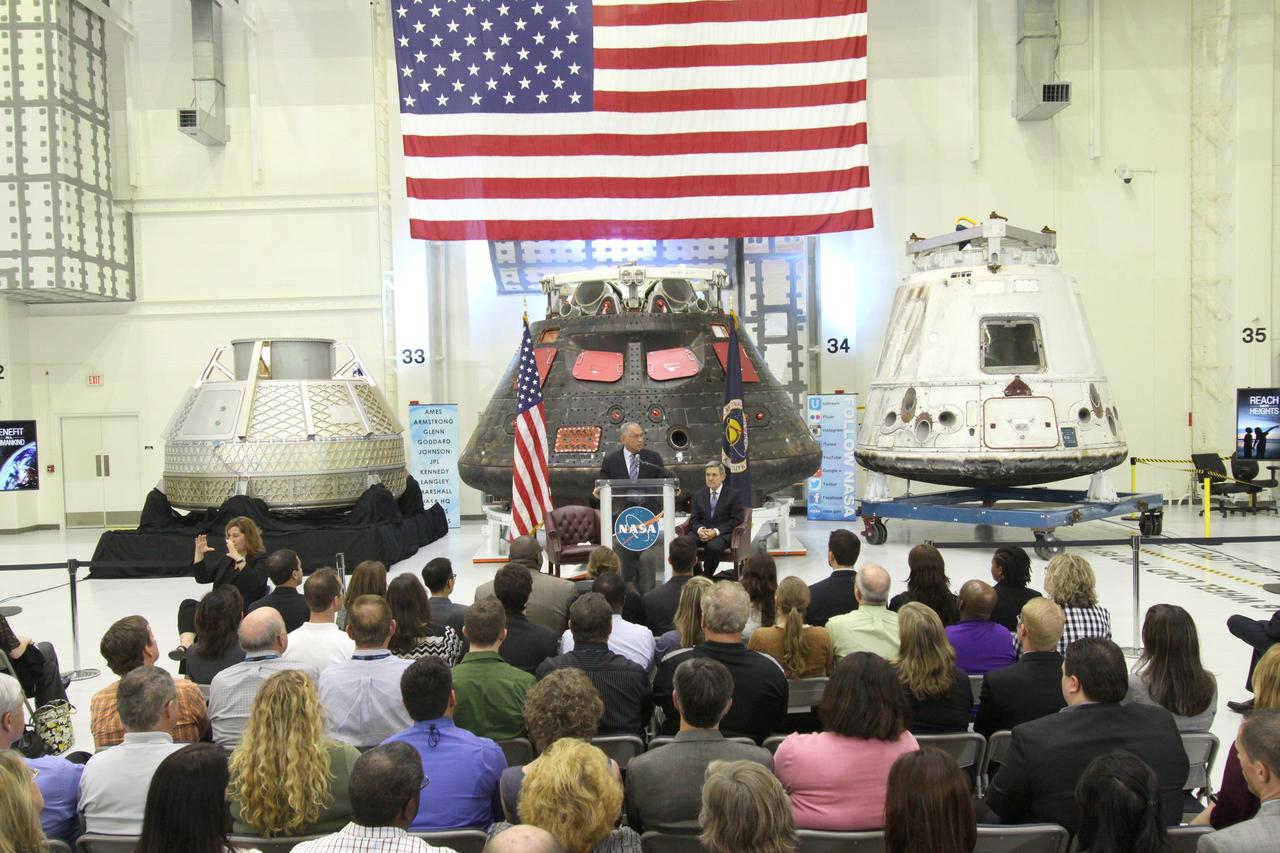
CAPE CANAVERAL, Fla. – In the Neil Armstrong Operations and Checkout Building high bay at NASA's Kennedy Space Center in Florida, NASA Administrator Charlie Bolden delivers a “state of the agency” address at NASA's televised fiscal year 2016 budget rollout event. Kennedy Space Center Director Bob Cabana, seated, made the opening remarks. Representatives from the Kennedy workforce, news media and social media were in attendance. NASA's Orion, SpaceX Dragon and Boeing CST-100 spacecraft, all destined to play a role in NASA’s overall exploration objectives, were on display. For information on NASA's budget, visit http://www.nasa.gov/budget. Photo credit: NASA/Amber Watson

Zephanii Eisenstat, Space and Social Justice Advocate at the NAACP, speaks during a panel discussion moderated by Amber McIntyre, Interagency and International Relations Advisor at NASA with Kim Macharia, Executive Director at Space Prize, and Ronald Gamble, a theoretical astrophysicist at NASA’s Goddard Space Flight Center, during an Artemis Generation Roundtable for Black Space Week, Tuesday, June 20, 2023, at the Eisenhower Executive Office Building in Washington. As part of Black Space Week, the National Space Council and NASA collaborated with Black In Astro to host students for a discussion on the future of space exploration and equity. Photo Credit: (NASA/Joel Kowsky)
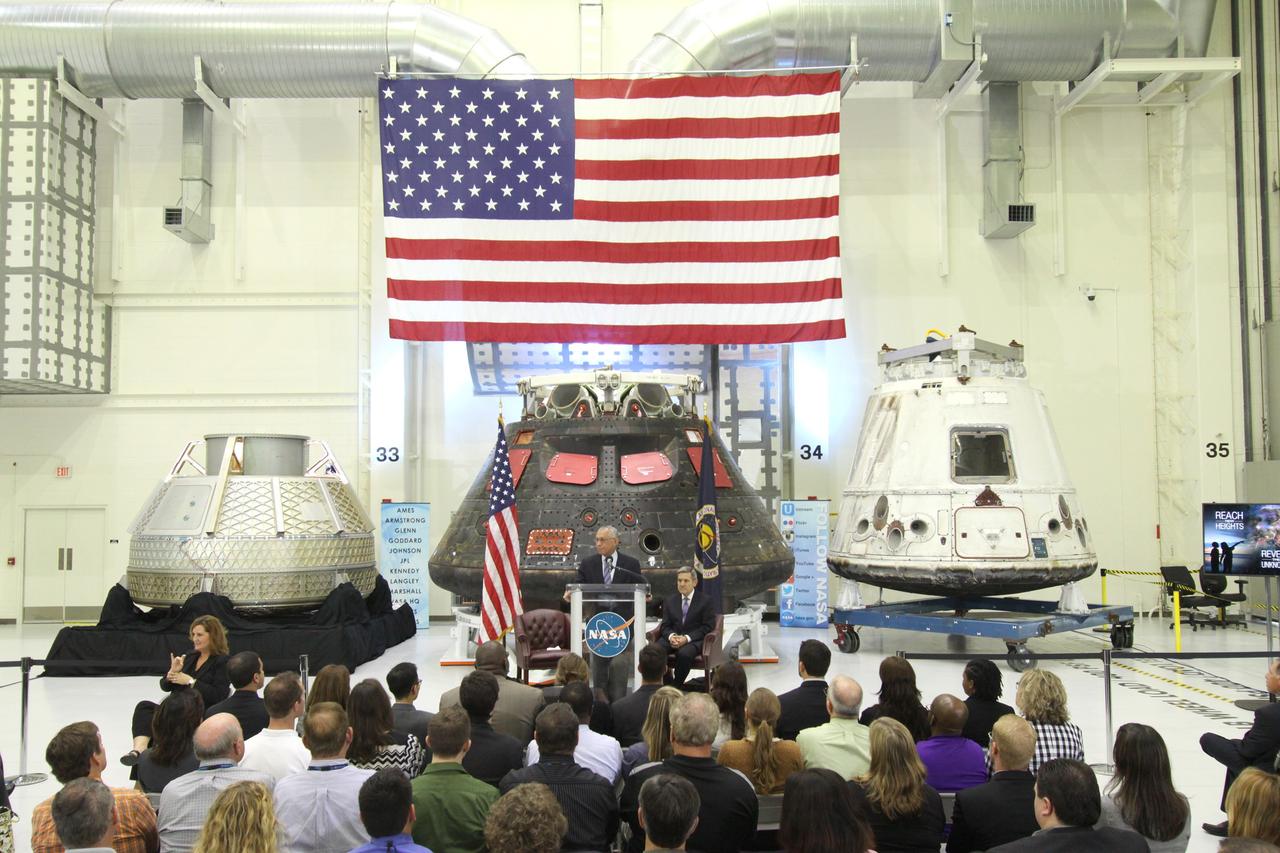
CAPE CANAVERAL, Fla. – In the Neil Armstrong Operations and Checkout Building high bay at NASA's Kennedy Space Center in Florida, NASA Administrator Charlie Bolden delivers a “state of the agency” address at NASA's televised fiscal year 2016 budget rollout event. Kennedy Space Center Director Bob Cabana, seated, made the opening remarks. Representatives from the Kennedy workforce, news media and social media were in attendance. NASA's Orion, SpaceX Dragon and Boeing CST-100 spacecraft, all destined to play a role in NASA’s overall exploration objectives, were on display. For information on NASA's budget, visit http://www.nasa.gov/budget. Photo credit: NASA/Amber Watson
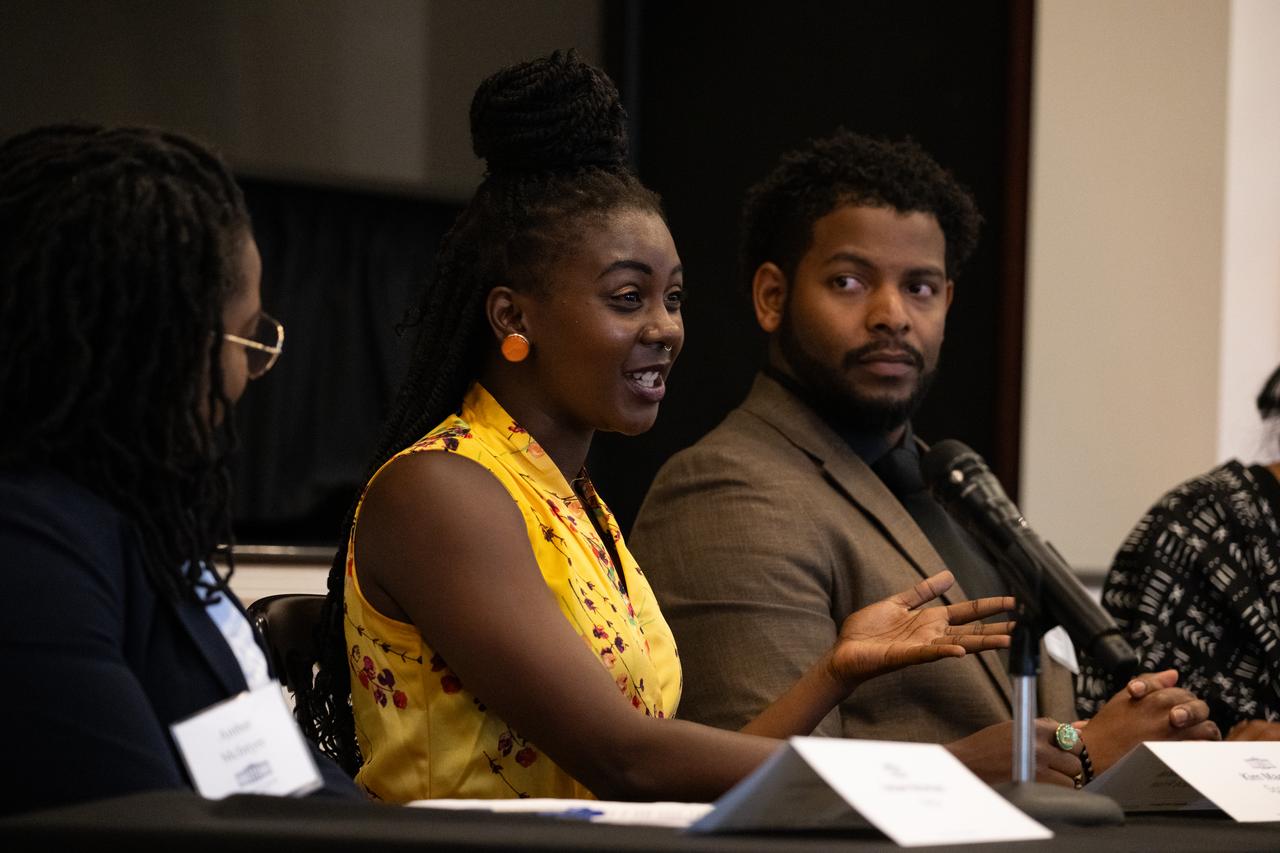
Kim Macharia, Executive Director at Space Prize, speaks during a panel discussion moderated by Amber McIntyre, Interagency and International Relations Advisor at NASA with Ronald Gamble, a theoretical astrophysicist at NASA’s Goddard Space Flight Center, and Zephanii Eisenstat, Space and Social Justice Advocate at the NAACP, during an Artemis Generation Roundtable for Black Space Week, Tuesday, June 20, 2023, at the Eisenhower Executive Office Building in Washington. As part of Black Space Week, the National Space Council and NASA collaborated with Black In Astro to host students for a discussion on the future of space exploration and equity. Photo Credit: (NASA/Joel Kowsky)
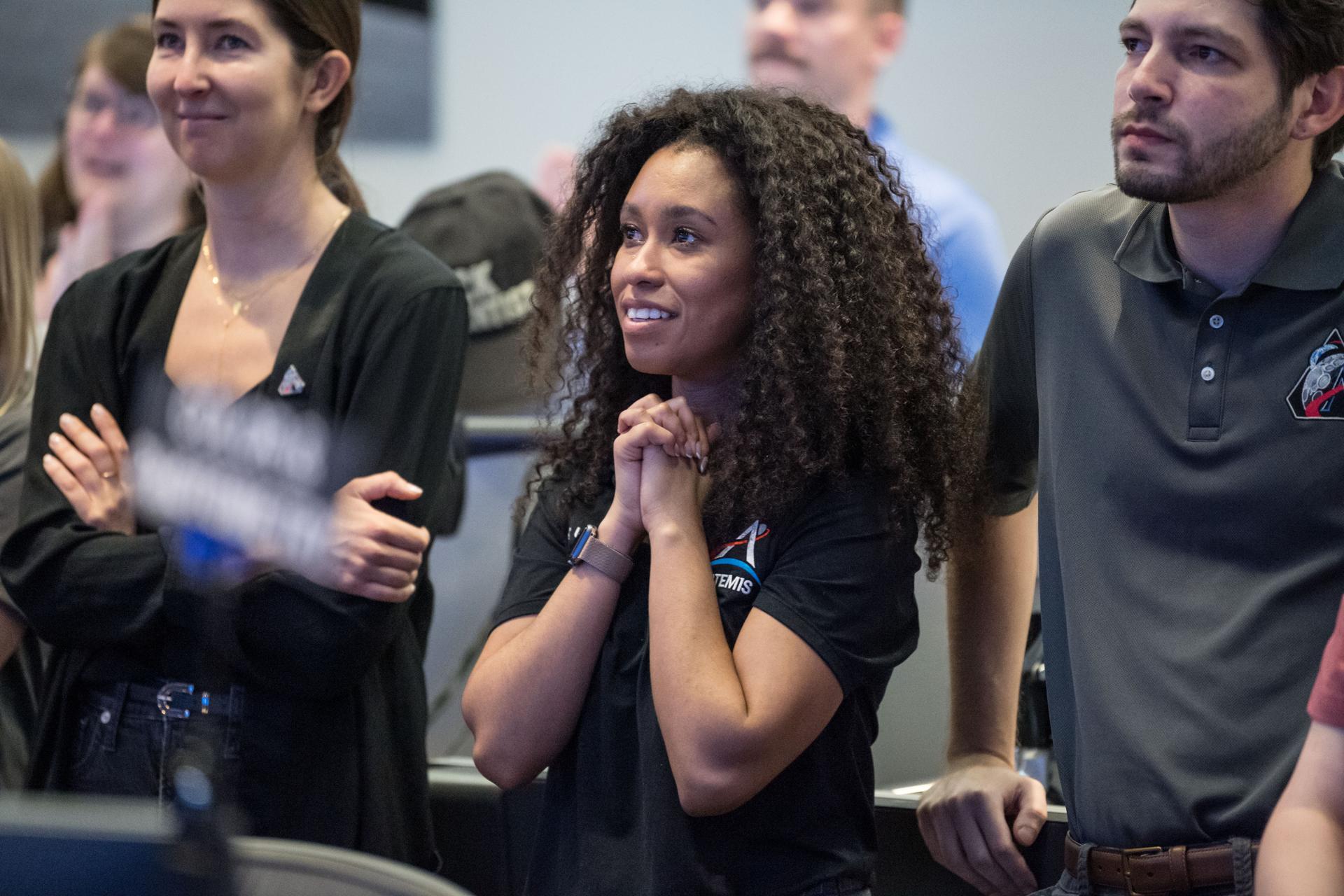
Members of the Artemis lunar science team, from left, Ariel Deutsch, Amber Turner, and Wilfredo Garcia-Lopez, watch the Artemis II launch from the Science Evaluation Room (SER) in Mission Control at Johnson Space Center in Houston. The SER supports lunar science and planetary observations for the Artemis science officer in the mission’s main flight control room. Built specifically for Artemis missions with these science priorities in mind, the SER is equipped to support rapid data interpretation, collaborative analysis, real-time decision making, and seamless coordination between the science and operations teams. Credits: NASA/Mark Sowa.
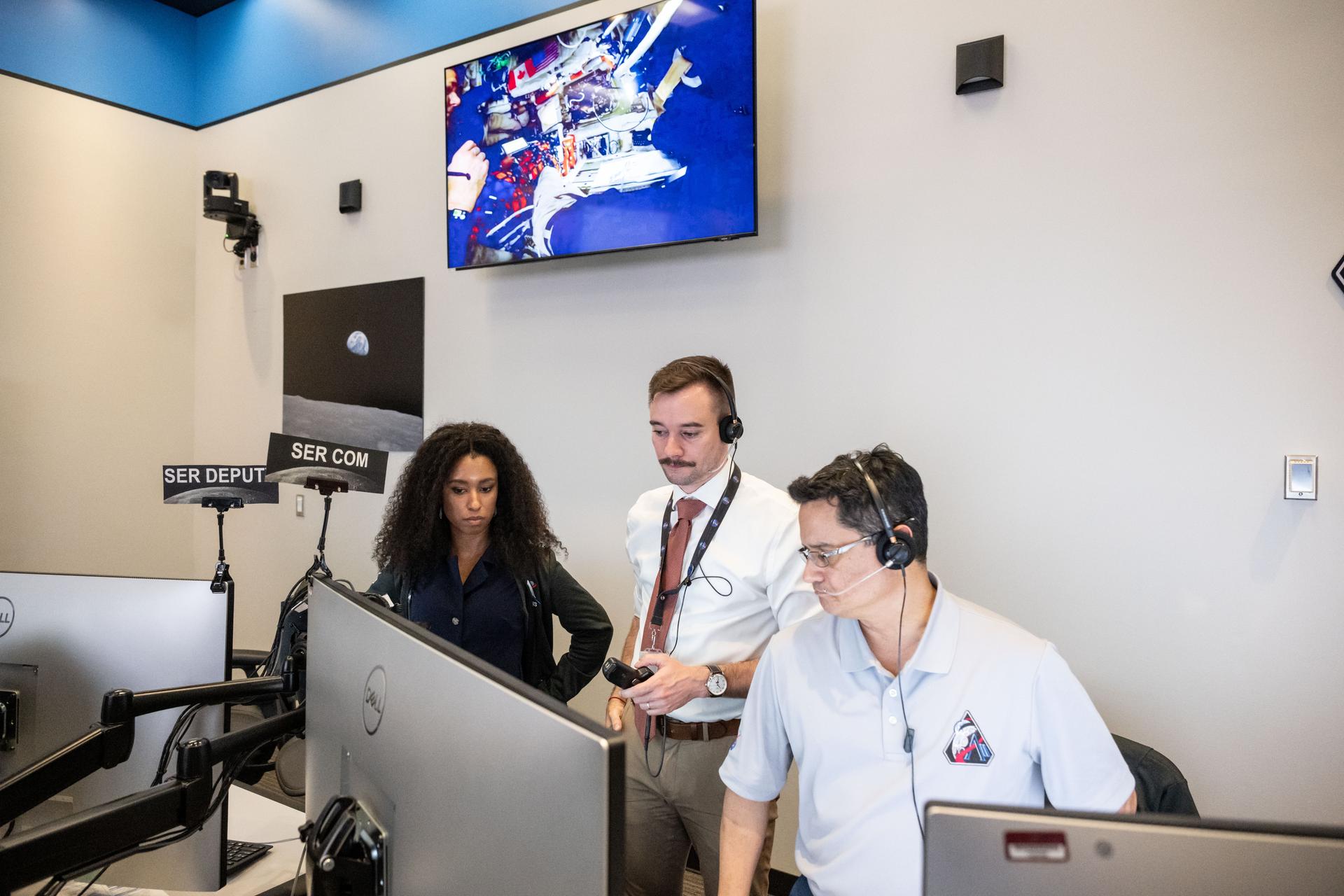
Artemis II lunar science team members, from left, Amber Turner, Jacob Richardson, Jose Hurtado, discuss the team's progress on the lunar targeting plan for the astronauts' six-hour flyby of the Moon, scheduled for April 6. As they pass the Moon, the crew will apply geology skills learned in the classroom and in Moon-like environments on Earth to photograph and describe features including impact craters, ancient lava flows, and surface cracks and ridges formed as the Moon slowly changed over time. They will note differences in color, brightness, and texture, which provide clues that help scientists understand what the surface is made of and how it formed. Credits: NASA/Bill Stafford
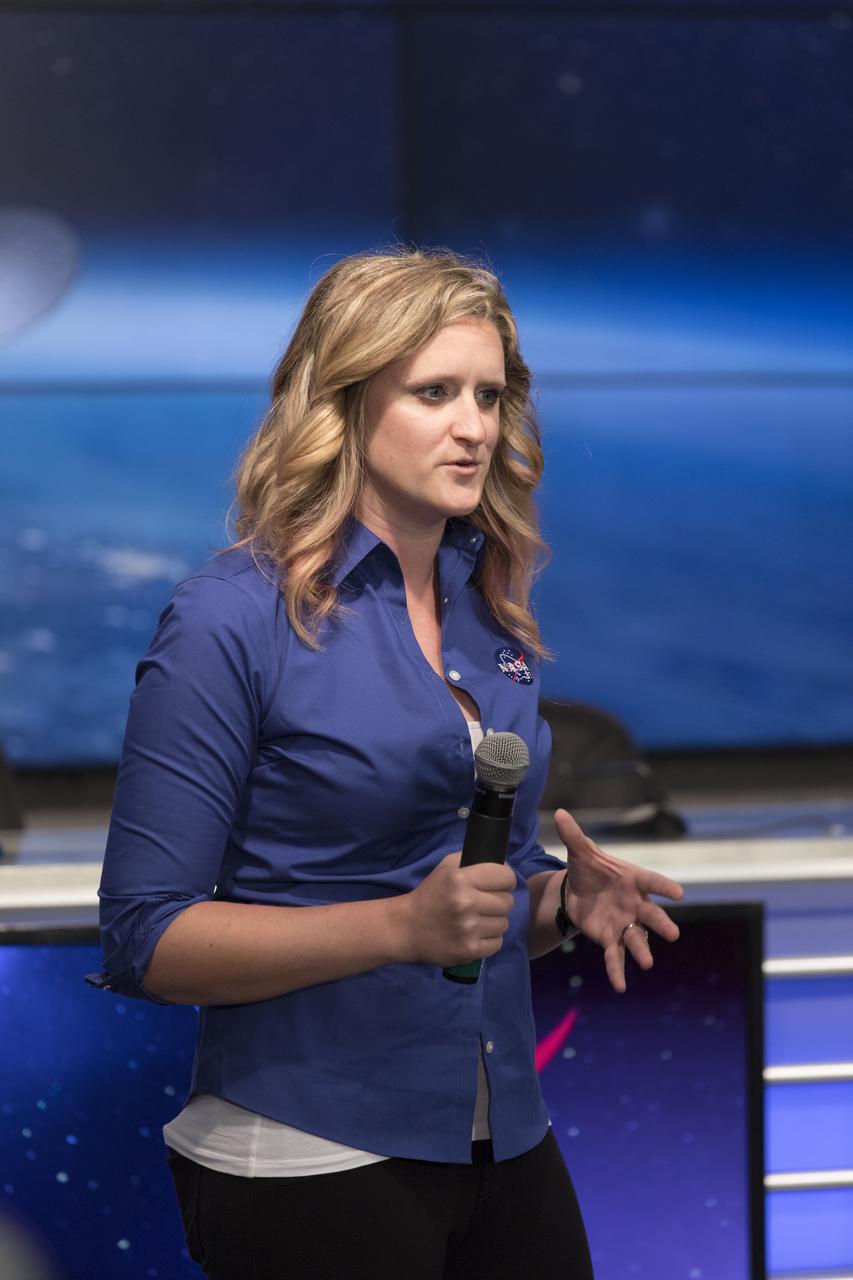
Amber Jacobson of the NASA TDRS Social Media Team speaks to members of social media in the Kennedy Space Center’s Press Site auditorium. The briefing focused on preparations to launch NASA's Tracking and Data Relay Satellite, TDRS-M. The latest spacecraft destined for the agency's constellation of communications satellites, TDRS-M will allow nearly continuous contact with orbiting spacecraft ranging from the International Space Station and Hubble Space Telescope to the array of scientific observatories. Liftoff atop a United Launch Alliance Atlas V rocket is scheduled to take place from Space Launch Complex 41 at Cape Canaveral Air Force Station at 8:03 a.m. EDT Aug. 18.
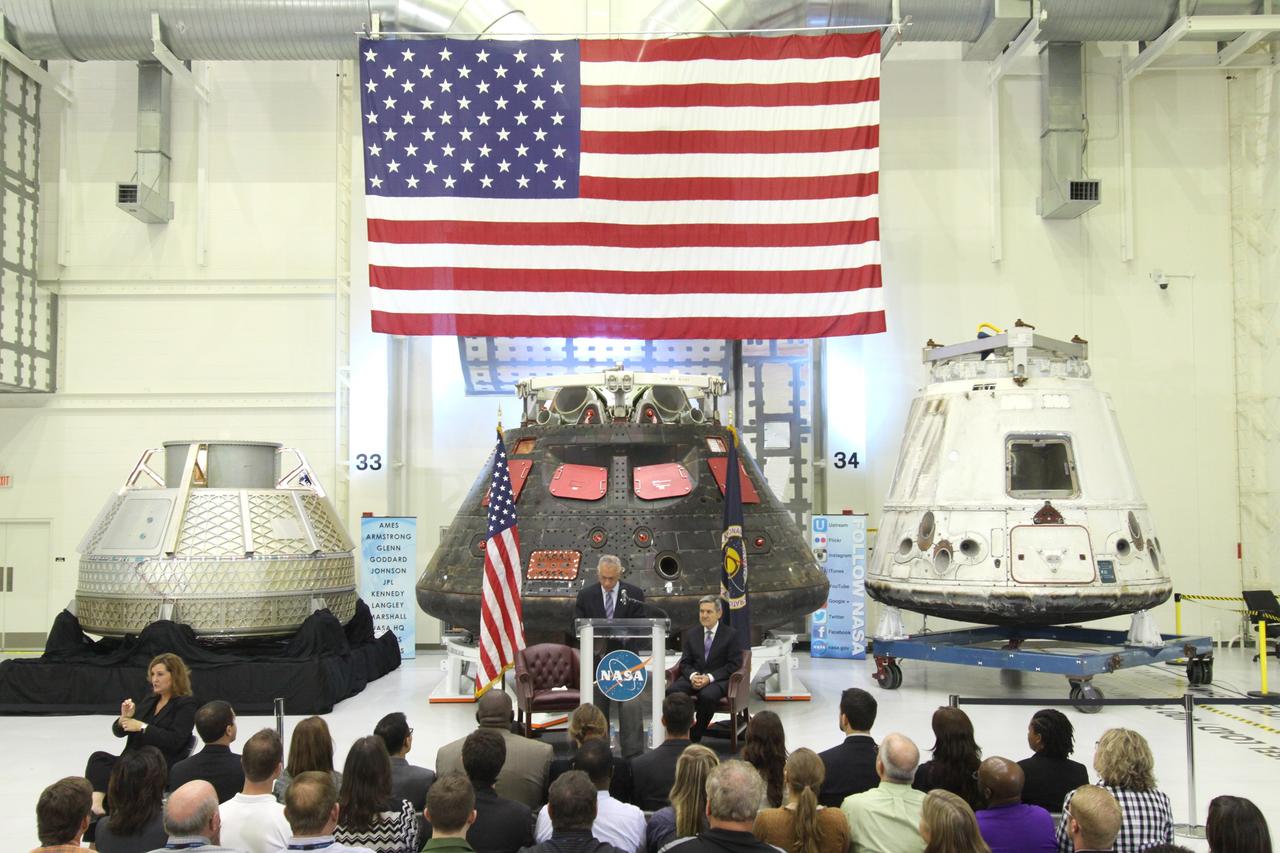
CAPE CANAVERAL, Fla. – In the Neil Armstrong Operations and Checkout Building high bay at NASA's Kennedy Space Center in Florida, NASA Administrator Charlie Bolden delivers a “state of the agency” address at NASA's televised fiscal year 2016 budget rollout event with Kennedy Space Center Director Bob Cabana looking on, at right. Representatives from the Kennedy workforce, news media and social media were in attendance. NASA's Orion, SpaceX Dragon and Boeing CST-100 spacecraft, all destined to play a role in NASA’s overall exploration objectives, were on display. For information on NASA's budget, visit http://www.nasa.gov/budget. Photo credit: NASA/Amber Watson
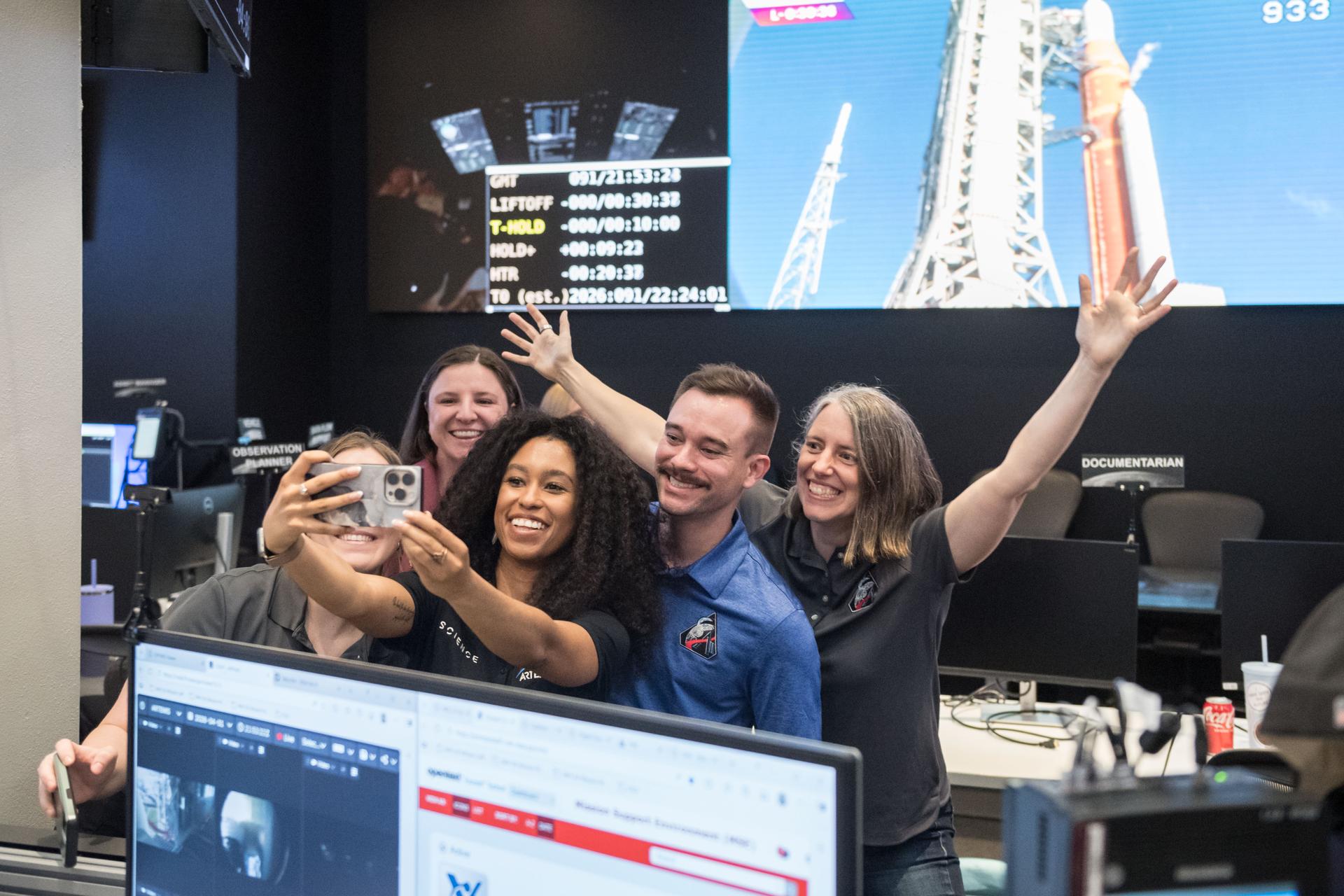
Members of the Artemis lunar science team, from left, Sara Schmidt, Megan Borel, Amber Turner, Jacob Richardson, and Juliane Gross pose for a selfie with the Artemis II launch broadcast on the screen behind them in the Science Evaluation Room (SER) in Mission Control at NASA's Johnson Space Center in Houston. The SER supports lunar science and planetary observations for the Artemis science officer in the mission’s main flight control room. Built specifically for Artemis missions with these science priorities in mind, the SER is equipped to support rapid data interpretation, collaborative analysis, real-time decision making, and seamless coordination between the science and operations teams. Credits: NASA/Mark Sowa.

iss074e0043697 (Jan. 3, 2026) --- Egypt’s Cairo metropolitan area, with a population of about 22 million, is split by the Nile River and sits at the southern edge of the Nile Delta. At its center, Cairo and its major urban districts have undergone lighting upgrades, replacing older lamps with LED fixtures that emit bright white light. In contrast, Cairo’s suburban areas still use high-pressure sodium (HPS) lamps, which produce a warm amber glow. The International Space Station was orbiting 260 miles above Earth at approximately 9:09 p.m. local time when this photograph was taken. Credit: JAXA/Kimiya Yui
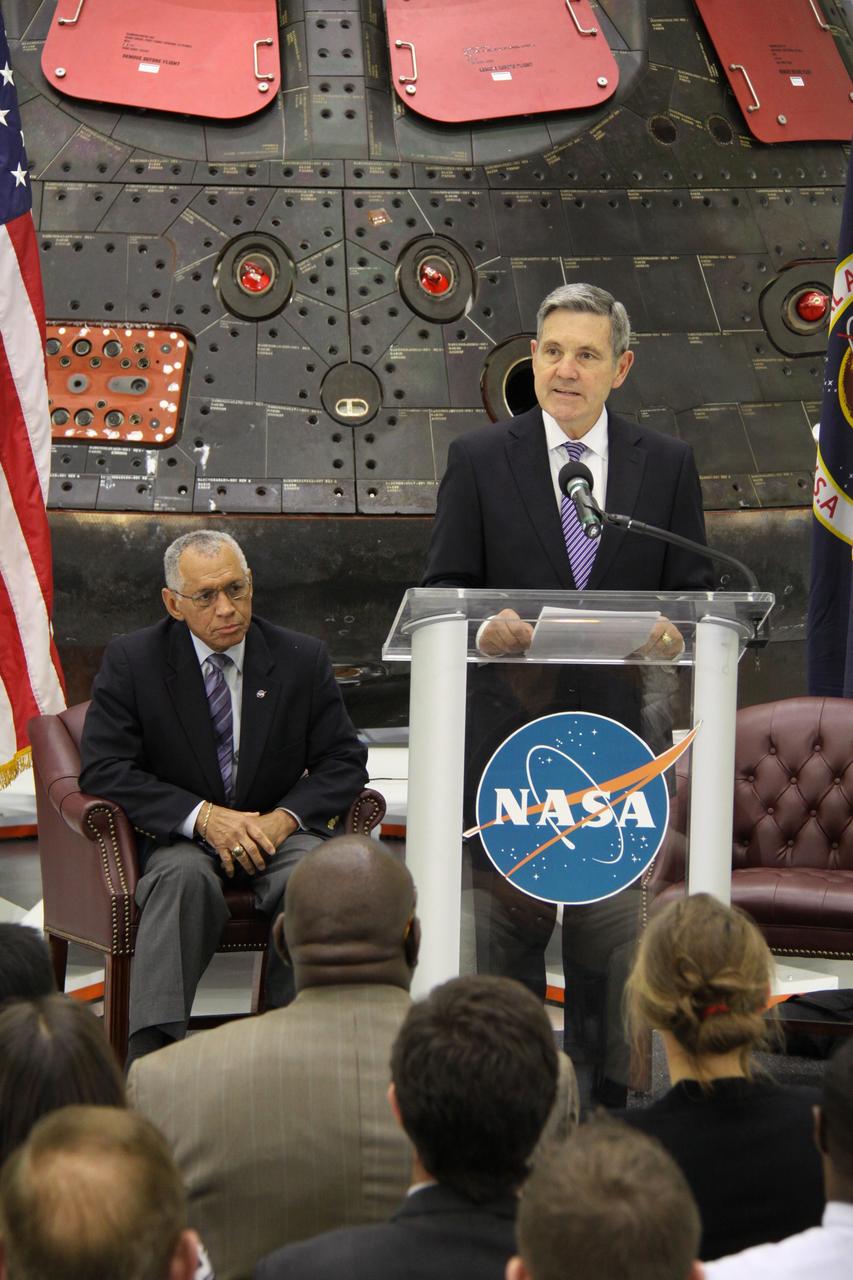
CAPE CANAVERAL, Fla. – In the Neil Armstrong Operations and Checkout Building high bay at NASA's Kennedy Space Center in Florida, Kennedy Space Center Director Bob Cabana introduces NASA Administrator Charlie Bolden, at left, who will deliver a “state of the agency” address at NASA's televised fiscal year 2016 budget rollout event. Representatives from the Kennedy workforce, news media and social media were in attendance. NASA's Orion, SpaceX Dragon and Boeing CST-100 spacecraft, all destined to play a role in NASA’s overall exploration objectives, were on display. For information on NASA's budget, visit http://www.nasa.gov/budget. Photo credit: NASA/Amber Watson

CAPE CANAVERAL, Fla. – In the Neil Armstrong Operations and Checkout Building high bay at NASA's Kennedy Space Center in Florida, NASA Administrator Charlie Bolden, left, and Kennedy Space Center Director Bob Cabana answer questions from the news media during NASA's televised fiscal year 2016 budget rollout event. NASA's Orion, SpaceX Dragon and Boeing CST-100 spacecraft, all destined to play a role in NASA’s overall exploration objectives, were on display. For information on NASA's budget, visit http://www.nasa.gov/budget. Photo credit: NASA/Amber Watson

iss074e0790404 (July 1, 2026) --- Cairo, Egypt, and its surrounding metropolitan area—with a population of about 22 million—is split by the Nile River and sits at the base of the Nile Delta. Cairo’s major urban districts (center) use newer LED fixtures that emit bright white light, while the suburban areas (top and bottom) use older high‑pressure sodium (HPS) lamps that produce a warm amber glow. The International Space Station was orbiting 262 miles above Earth at approximately 11:05 p.m. local time when this photograph was taken. Credit: NASA
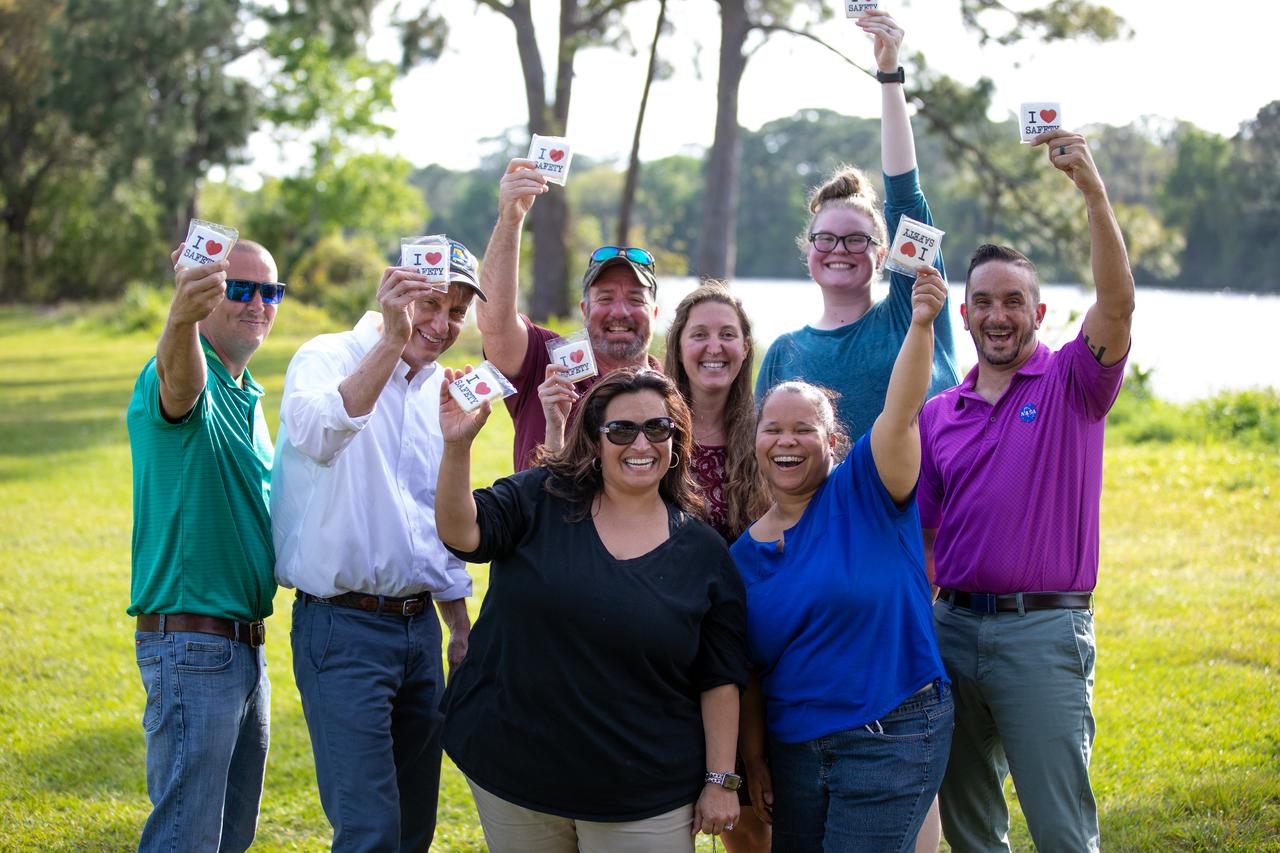
NASA Kennedy Space Center employees are photographed during a Safety and Health Days celebration at the Florida spaceport’s KARS Park II on March 5, 2020. Front row from left are Michele Richtmeyer and Heidi Harden, and back row from left are Phil Falk, Chris Berg, Marcus Chancery, Amber Philman-Blair, Larrin Moody and Dustin Cammack. Taking place March 2 through March 6, Safety and Health Days provides Kennedy employees with a variety of presentations to attend – all of which focus on how to maintain a safe and healthy workforce. The celebration on March 5 took place at the spaceport’s KARS Park II and was open for all employees to attend.
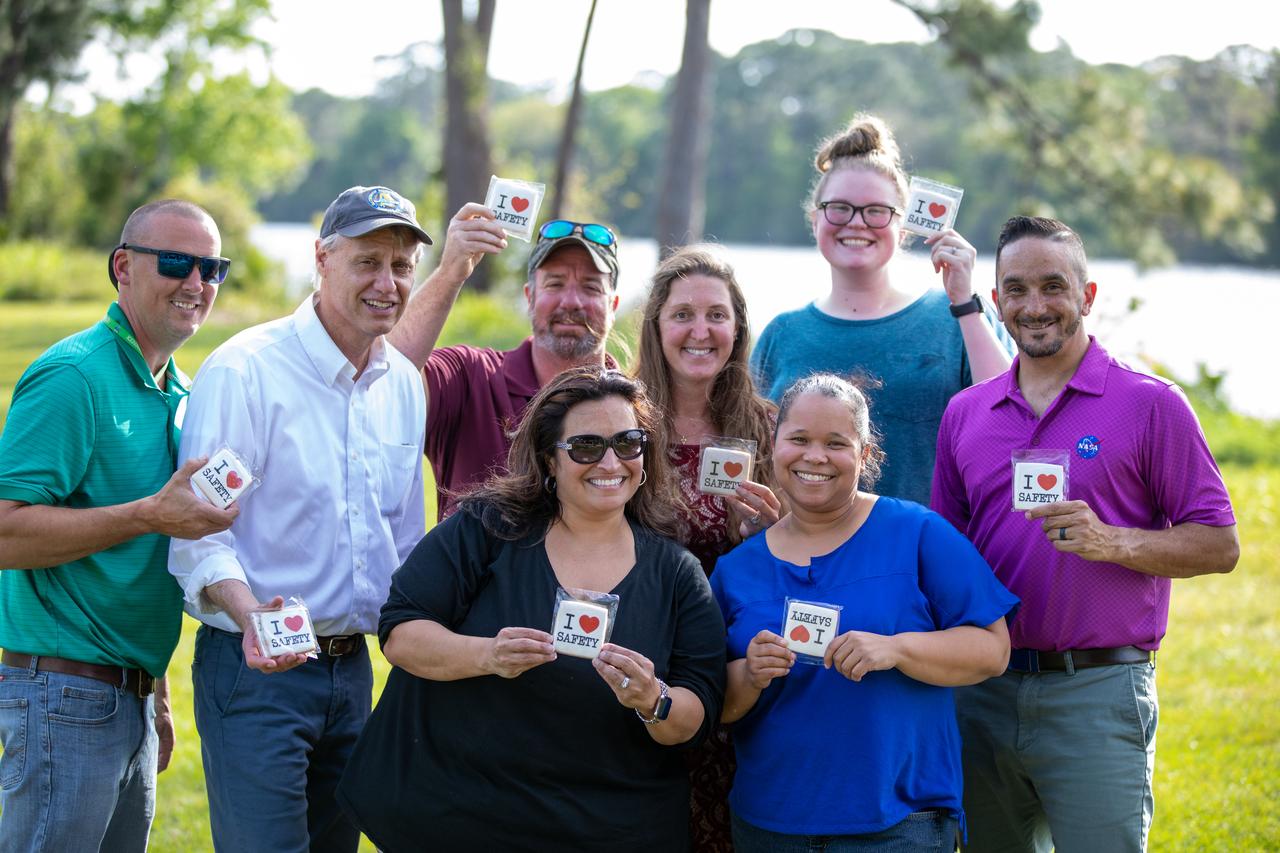
NASA Kennedy Space Center employees are photographed during a Safety and Health Days celebration at the Florida spaceport’s KARS Park II on March 5, 2020. Front row from left are Michele Richtmeyer and Heidi Harden, and back row from left are Phil Falk, Chris Berg, Marcus Chancery, Amber Philman-Blair, Larrin Moody and Dustin Cammack. Taking place March 2 through March 6, Safety and Health Days provides Kennedy employees with a variety of presentations to attend – all of which focus on how to maintain a safe and healthy workforce. The celebration on March 5 took place at the spaceport’s KARS Park II and was open for all employees to attend.

Kennedy Space Center Director Janet Petro, fourth from right, poses with other center leaders and support staff during the 2022 Center Director’s Holiday Coffee on Dec. 7, 2022, at NASA’s Kennedy Space Center in Florida. From left are Deputy Director Kelvin Manning; Kennedy Space Center employees Michael Haddad, Maggi Dutczak, and Cindy Rymer; Associate Director Technical Burt Summerfield; Associate Director Operations Jennifer Kunz; Petro; Kennedy employees Heidi Culp, Amber Chieffe, and Amanda Hayes. The annual holiday event is an opportunity for Kennedy employees and NASA retirees to exchange holiday greetings with center leaders and fellow support staff.

iss074e0043738 (Jan. 3, 2026) --- Egypt's Greater Cairo area, with a population of over 22 million and comprised of over a dozen cities, is split by the Nile River at the base of Nile Delta. In an unusual lighting pattern, the older districts of Cairo and Giza shine brightly with modern white lights, while the newer developments of New Cairo City on the left and El Sheikh Zayed City on the right appear in amber tones. The International Space Station was orbiting 261 miles above the Mediterranean Sea at approximately 9:09 p.m. local time when this photograph was taken. Credit: JAXA/Kimiya Yui
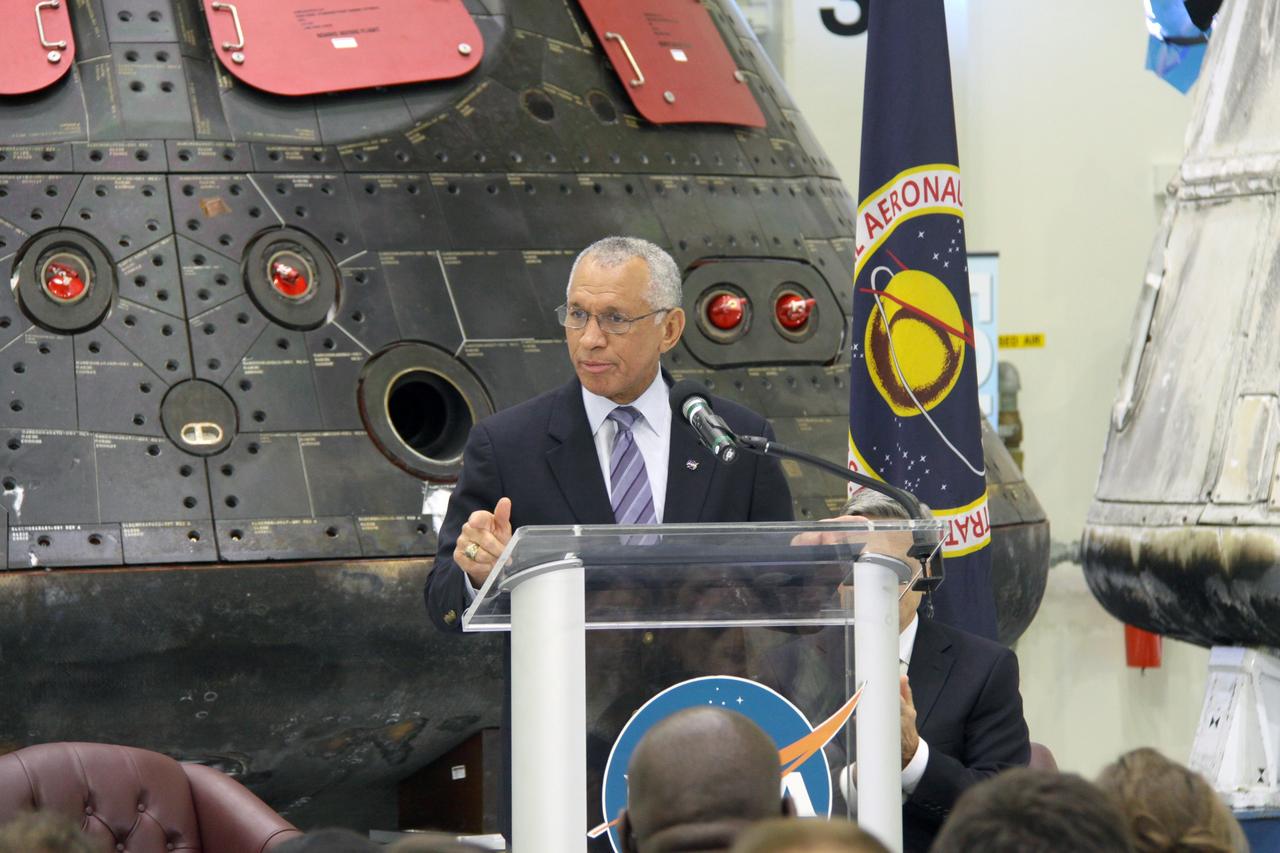
CAPE CANAVERAL, Fla. – In the Neil Armstrong Operations and Checkout Building high bay at NASA's Kennedy Space Center in Florida, NASA Administrator Charlie Bolden delivers a “state of the agency” address at NASA's televised fiscal year 2016 budget rollout event. Representatives from the Kennedy workforce, news media and social media were in attendance. NASA's Orion, SpaceX Dragon and Boeing CST-100 spacecraft, all destined to play a role in NASA’s overall exploration objectives, were on display. For information on NASA's budget, visit http://www.nasa.gov/budget. Photo credit: NASA/Amber Watson
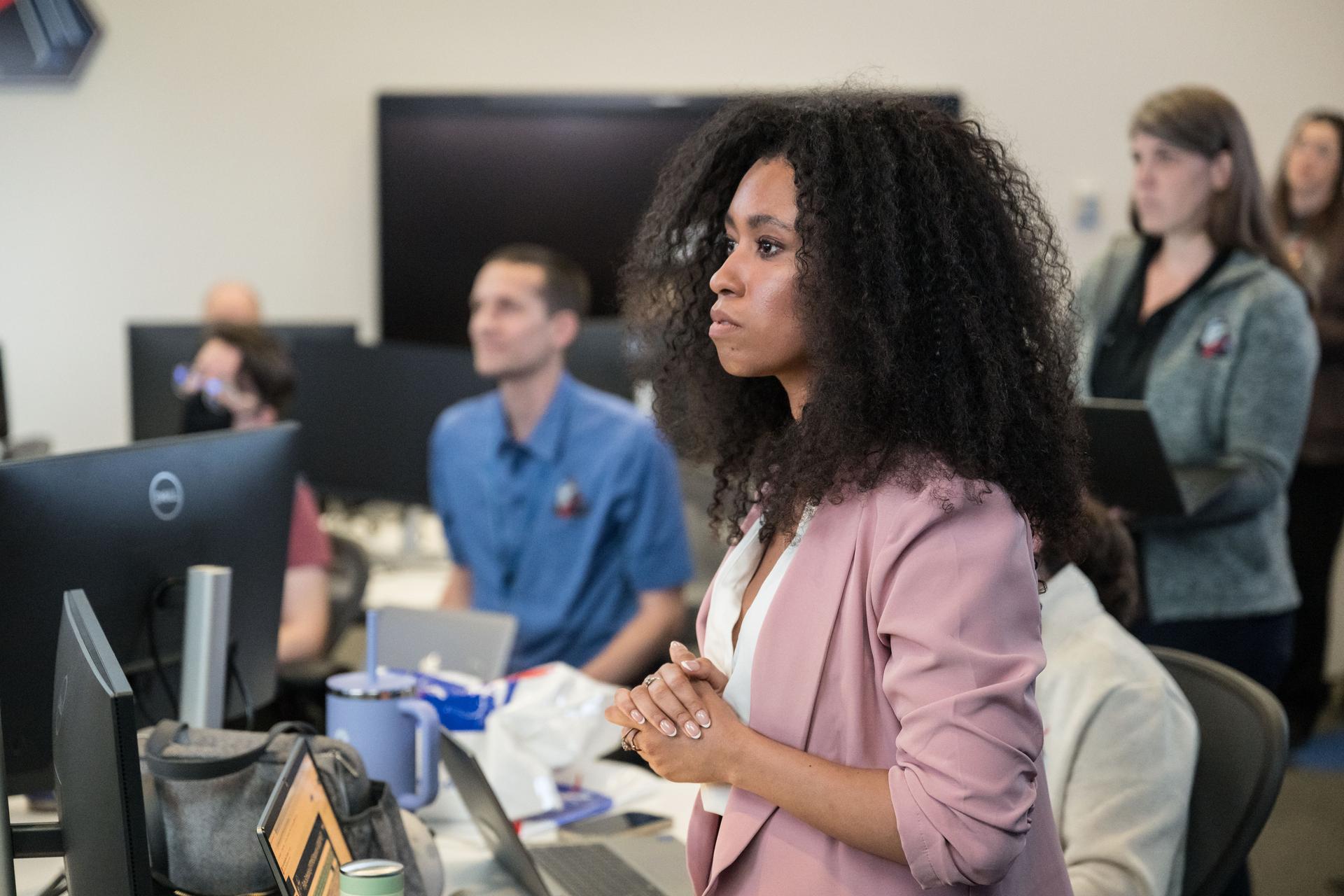
Artemis II lunar science team member, foreground, Amber Turner, and David Hollibaugh-Baker, and Cherie Achilles, background, participate in the team’s analysis of crew observations during the lunar flyby on April 6, 2026. The team worked in the Science Evaluation Room (SER) in Mission Control at NASA’s Johnson Space Center in Houston. Built specifically for Artemis missions with these science priorities in mind, the SER is equipped to support rapid data interpretation, collaborative analysis, real-time decision making, and seamless coordination between the science and operations teams. Credits: NASA/ Robert Markowitz
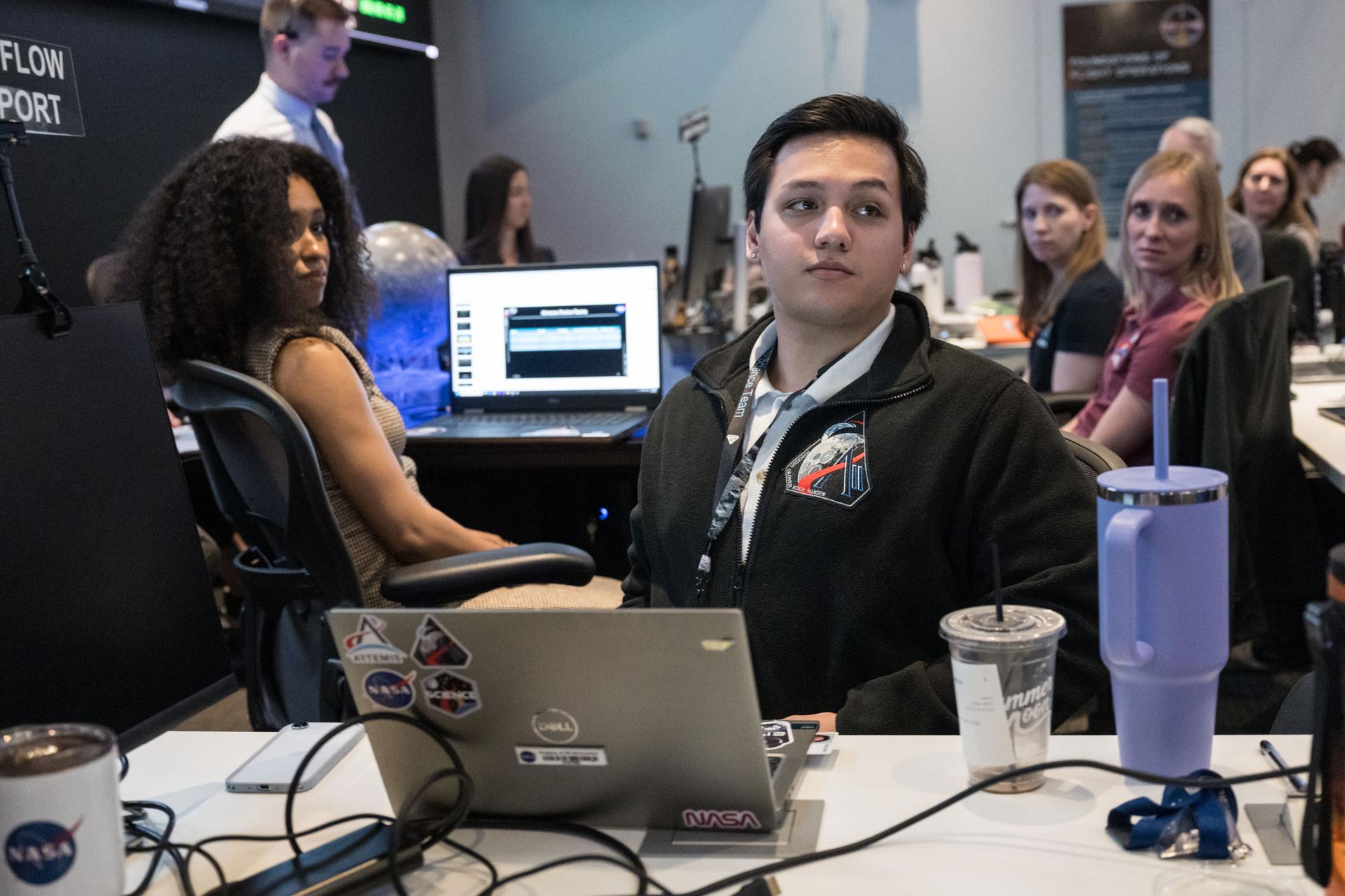
Artemis II lunar science team members, in the foreground from left: Amber Turner and Jared Ralleta in the center. Standing up behind Turner is Jacob Richardson, and sitting behind and to the right, of Ralleta, are Ryan Watkins in the front, and Debra Needham behind her. The SER supports the Artemis science officer in the mission’s main flight control room. Built specifically for Artemis missions with these science priorities in mind, the SER is equipped to support rapid data interpretation, collaborative analysis, real-time decision making, and seamless coordination between the science and operations teams. Credits: NASA/Luna Posadas Nava

KENNEDY SPACE CENTER, FLA. -- Framed by amber clouds of smoke, Space Shuttle Endeavour rises above Launch Pad 39A as it lifts on time at 6:36 p.m. EDT on mission STS-118. The mission is the 22nd shuttle flight to the International Space Station. It will continue space station construction by delivering a third starboard truss segment, S5, and other payloads such as the SPACEHAB module and the external stowage platform 3. The 11-day mission may be extended to as many as 14 depending on the test of the Station-to-Shuttle Power Transfer System that will allow the docked shuttle to draw electrical power from the station and extend its visits to the orbiting lab. NASA/Ken Thornsley
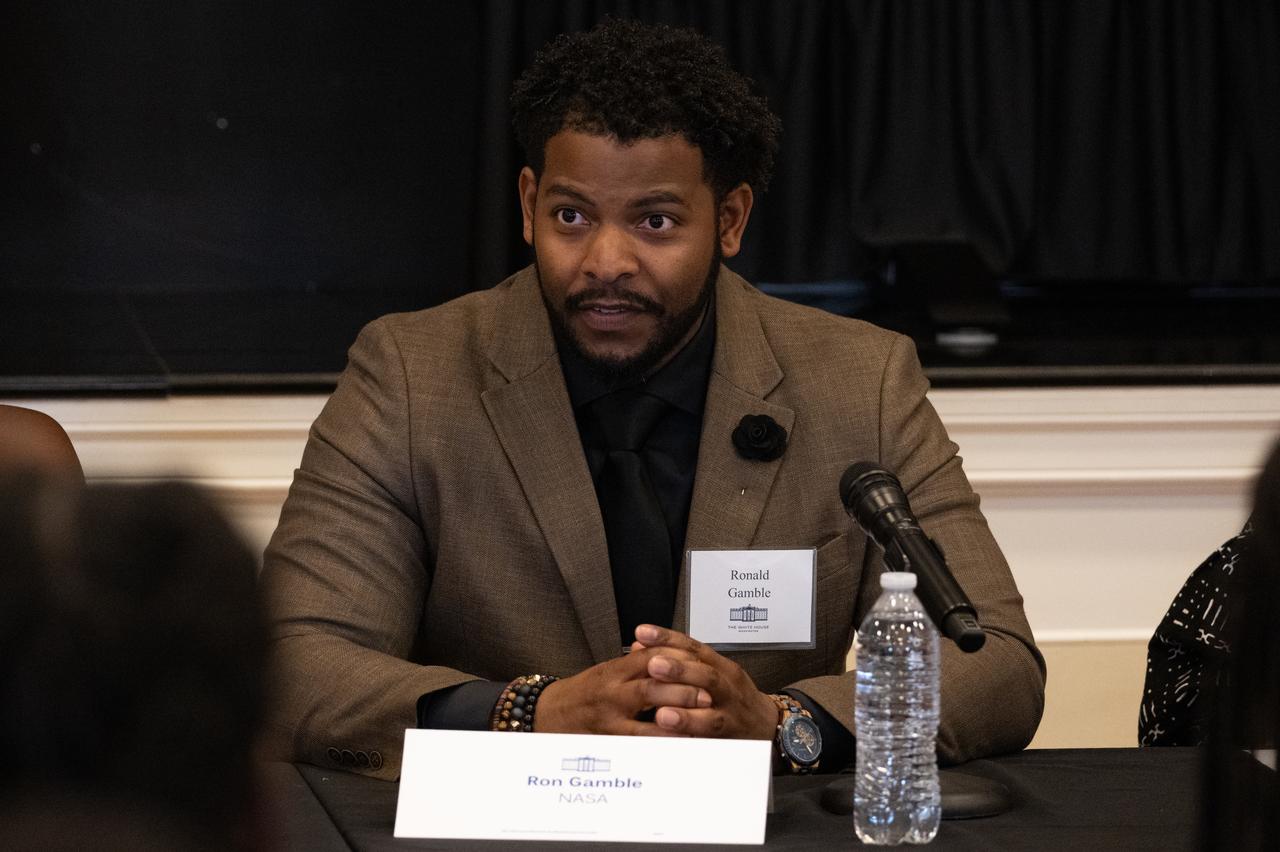
Ronald Gamble, a theoretical astrophysicist at NASA’s Goddard Space Flight Center, speaks during a panel discussion moderated by Amber McIntyre, Interagency and International Relations Advisor at NASA with Kim Macharia, Executive Director at Space Prize, and Zephanii Eisenstat, Space and Social Justice Advocate at the NAACP, during an Artemis Generation Roundtable for Black Space Week, Tuesday, June 20, 2023, at the Eisenhower Executive Office Building in Washington. As part of Black Space Week, the National Space Council and NASA collaborated with Black In Astro to host students for a discussion on the future of space exploration and equity. Photo Credit: (NASA/Joel Kowsky)
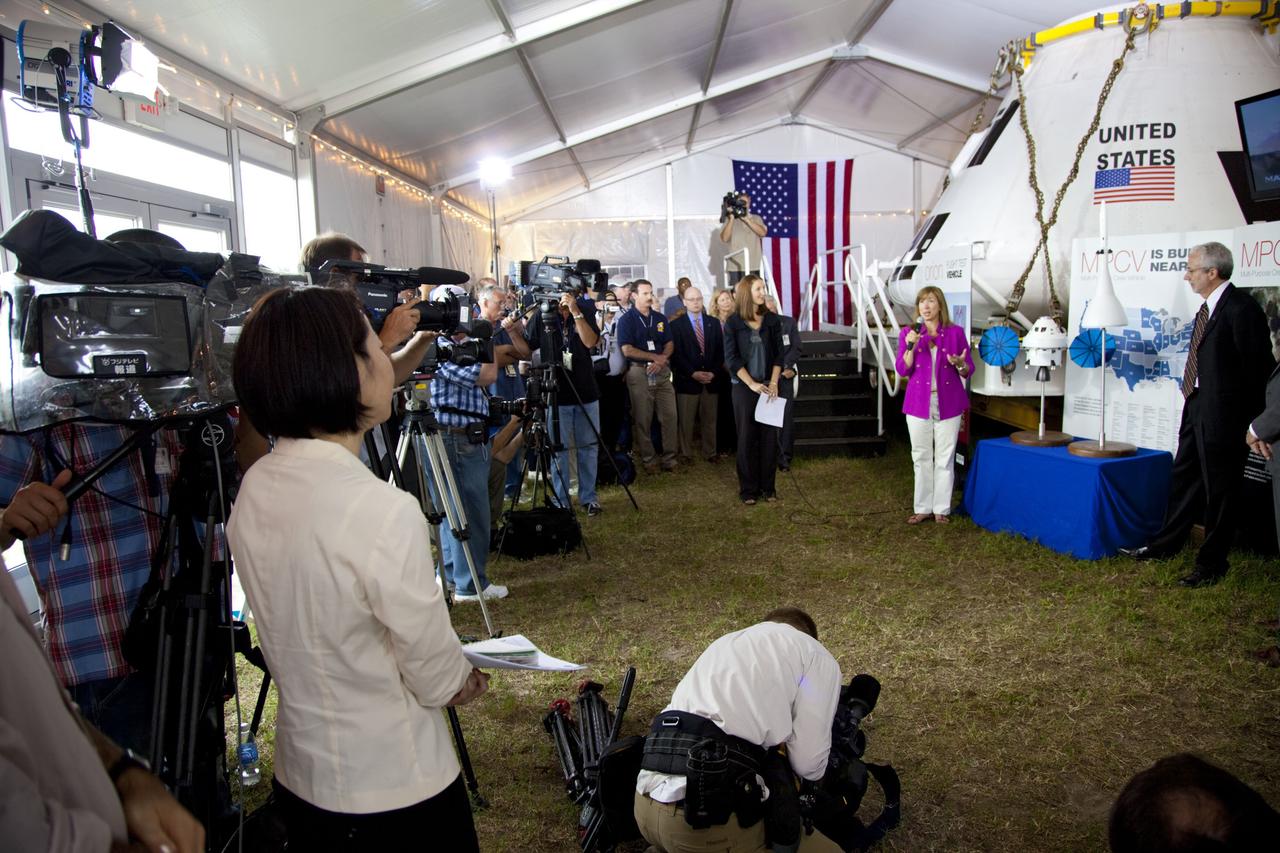
CAPE CANAVERAL, Fla. -- A media event was held on the grounds near the Press Site at NASA's Kennedy Space Center in Florida where a Multi-Purpose Crew Vehicle (MPCV) is on display. The MPCV is based on the Orion design requirements for traveling beyond low Earth orbit and will serve as the exploration vehicle that will carry the crew to space, provide emergency abort capability, sustain the crew during the space travel, and provide safe re-entry from deep space return velocities. Seen here is Public Affairs Officer Amber Philman (center), Lori Garver, NASA deputy administrator and Mark Geyer, Multi-Purpose Crew Vehicle program manager speaking to media during a question-and-answer session. Photo credit: NASA/Frankie Martin

SAN DIEGO, Calif. -- At Naval Base San Diego in California, NASA's Orion spacecraft is being offloaded from the well deck of the USS Anchorage. Orion has been secured in its crew module recovery cradle and will be prepared for return to Kennedy Space Center in Florida. After lifting off at 7:05 a.m. EST on Dec. 5 atop a Delta IV Heavy rocket from Space Launch Complex 37 at Cape Canaveral Air Force Station in Florida, Orion completed a two-orbit, four-and-a-half hour mission to test systems critical to crew safety, including the launch abort system, the heat shield and the parachute system. NASA, the U.S. Navy and Lockheed Martin coordinated efforts to recover Orion after splashdown in the Pacific Ocean. The Ground Systems Development and Operations Program led the recovery efforts. For more information, visit www.nasa.gov/orion Photo credit: NASA/Amber Philman
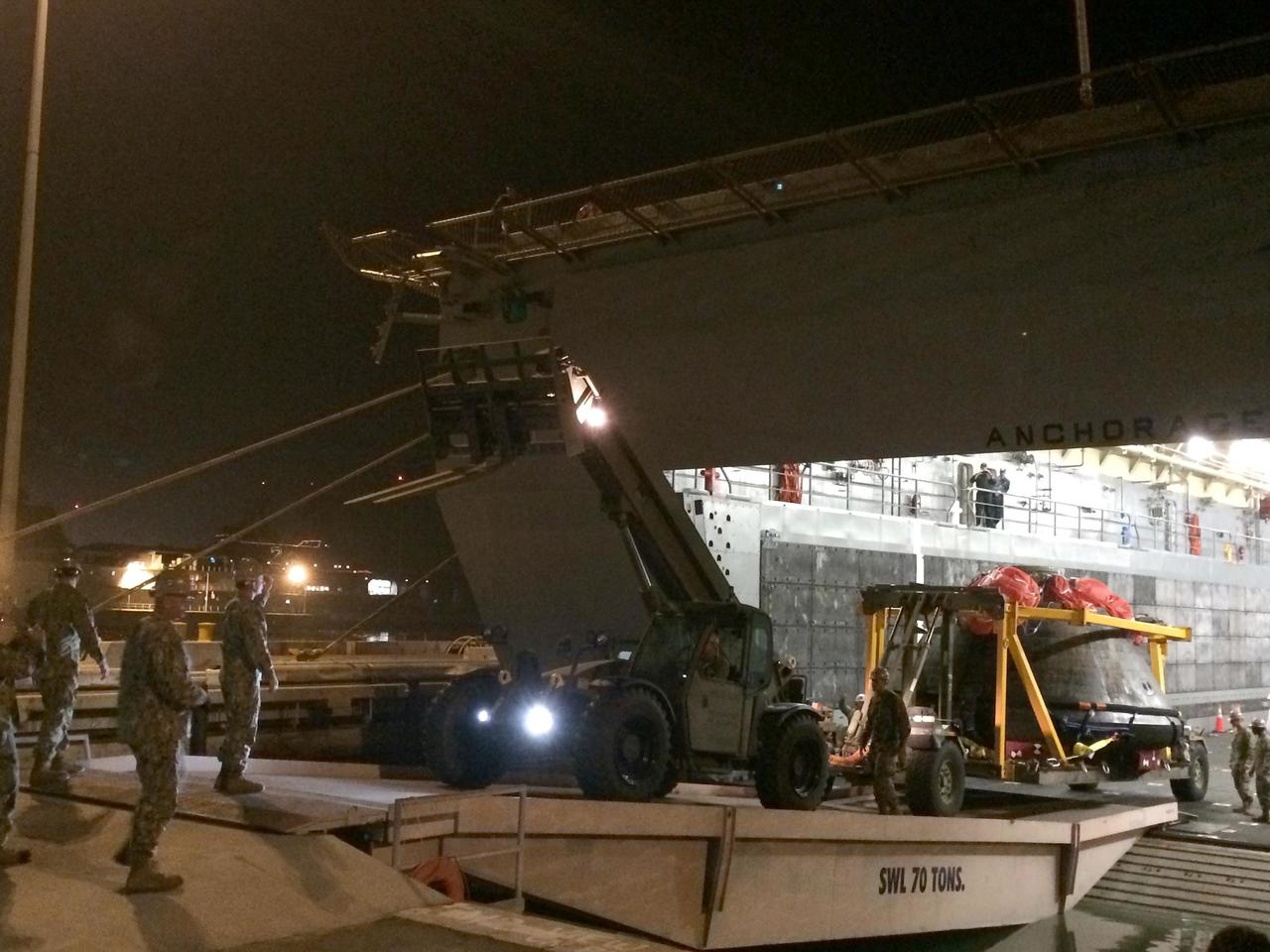
SAN DIEGO, Calif. -- At Naval Base San Diego in California, NASA's Orion spacecraft is being offloaded from the well deck of the USS Anchorage. Orion has been secured in its crew module recovery cradle and will be prepared for return to Kennedy Space Center in Florida. After lifting off at 7:05 a.m. EST on Dec. 5 atop a Delta IV Heavy rocket from Space Launch Complex 37 at Cape Canaveral Air Force Station in Florida, Orion completed a two-orbit, four-and-a-half hour mission to test systems critical to crew safety, including the launch abort system, the heat shield and the parachute system. NASA, the U.S. Navy and Lockheed Martin coordinated efforts to recover Orion after splashdown in the Pacific Ocean. The Ground Systems Development and Operations Program led the recovery efforts. For more information, visit www.nasa.gov/orion Photo credit: NASA/Amber Philman
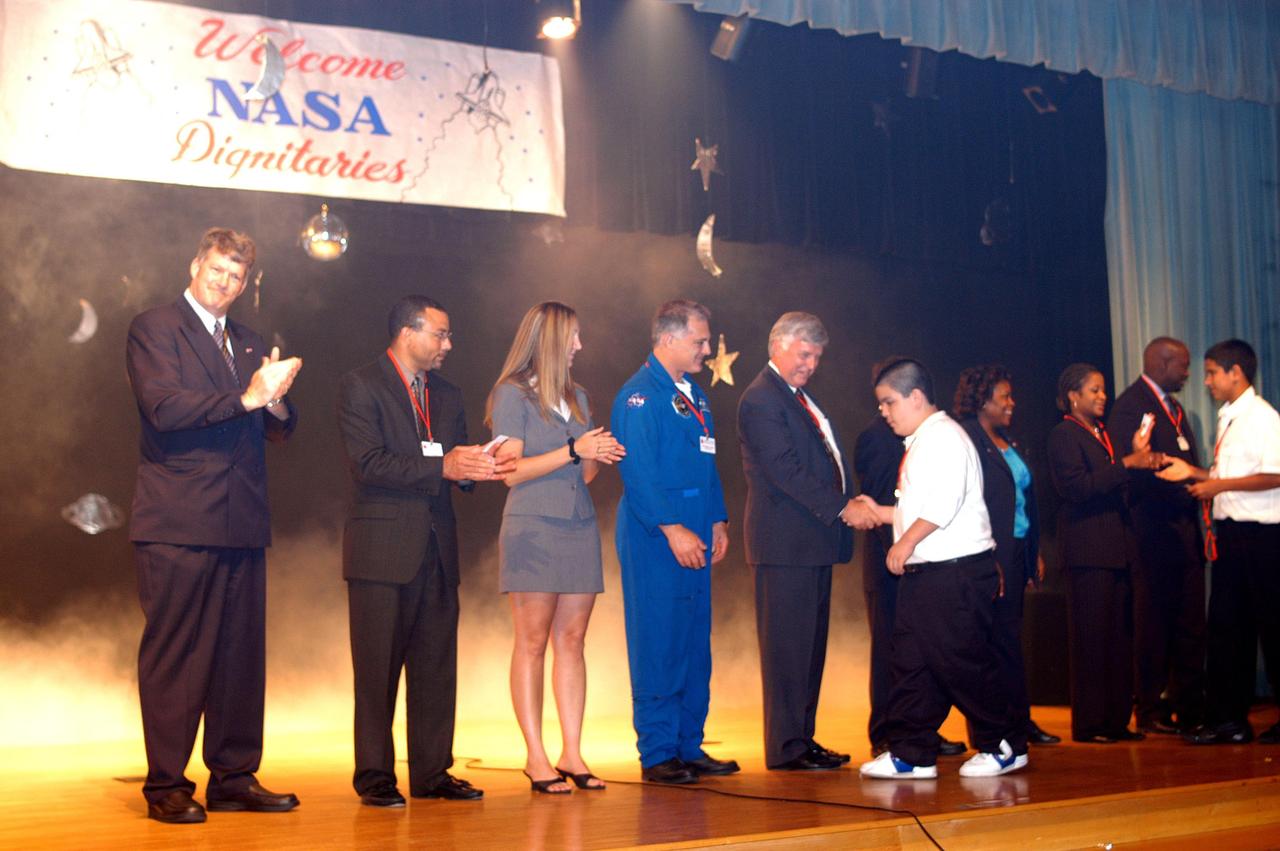
KENNEDY SPACE CENTER, FLA. -- During a visit to Howard A. Doolin Middle School, Miami, Fla., Center Director Jim Kennedy (shaking hands, center) and other NASA and KSC representatives are greeted by students on stage. With Kennedy on stage are (left to right), Jim Gerard, Aerospace Education Services Program (AESP) representative; Steve Lewis, assistant to Kennedy; Amber Marek, with KSC External Relations; David Wolf, astronaut; Kennedy; Les Gold, AESP representative; Burdette Brown; and Patricia Leonard and Clarence Bostic, Education Programs and University Research Division. Doolin Middle School is one of 100 to take part in the NASA Explorer Schools program. Kennedy is talking with students, the next generation of explorers, about our destiny as explorers, NASA’s stepping stone approach to exploring Earth, the Moon, Mars and beyond, how space impacts our lives, and how people and machines rely on each other in space.
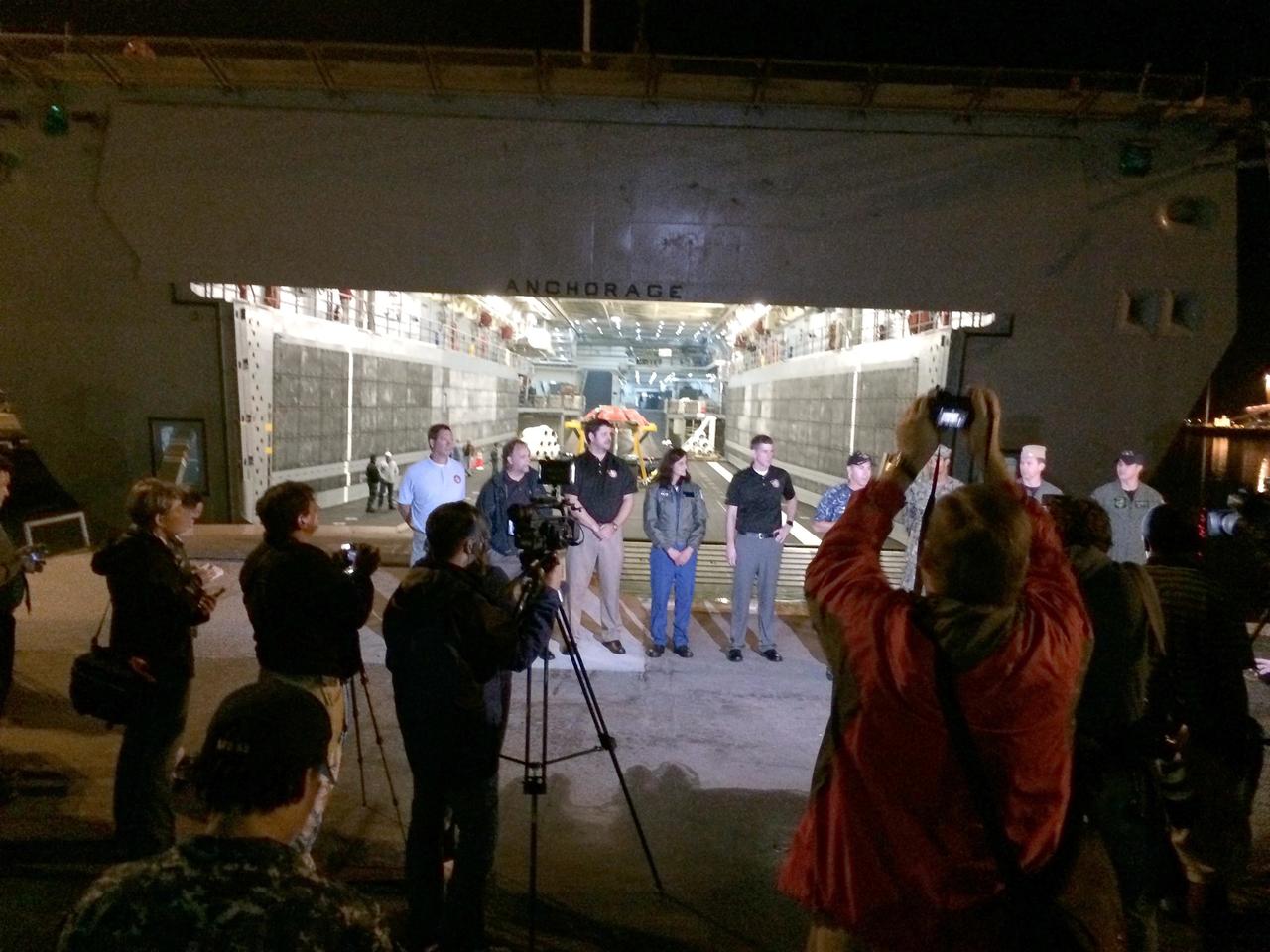
SAN DIEGO, Calif. -- At Naval Base San Diego in California, members of the news media view NASA's Orion spacecraft in the well deck of the USS Anchorage before it is offloaded and prepared for return to Kennedy Space Center in Florida. Speaking to the media are NASA and U.S. Navy officials. After lifting off at 7:05 a.m. EST on Dec. 5 atop a Delta IV Heavy rocket from Space Launch Complex 37 at Cape Canaveral Air Force Station in Florida, Orion completed a two-orbit, four-and-a-half hour mission to test systems critical to crew safety, including the launch abort system, the heat shield and the parachute system. NASA, the U.S. Navy and Lockheed Martin coordinated efforts to recover Orion after splashdown in the Pacific Ocean. The GSDO Program led the recovery efforts. For more information, visit www.nasa.gov/orion Photo credit: NASA/Amber Philman

SAN DIEGO, Calif. -- At Naval Base San Diego in California, NASA's Orion spacecraft is being offloaded from the well deck of the USS Anchorage. Orion has been secured in its crew module recovery cradle and will be prepared for return to Kennedy Space Center in Florida. After lifting off at 7:05 a.m. EST on Dec. 5 atop a Delta IV Heavy rocket from Space Launch Complex 37 at Cape Canaveral Air Force Station in Florida, Orion completed a two-orbit, four-and-a-half hour mission to test systems critical to crew safety, including the launch abort system, the heat shield and the parachute system. NASA, the U.S. Navy and Lockheed Martin coordinated efforts to recover Orion after splashdown in the Pacific Ocean. The Ground Systems Development and Operations Program is led the recovery efforts. For more information, visit www.nasa.gov/orion Photo credit: NASA/Amber Philman
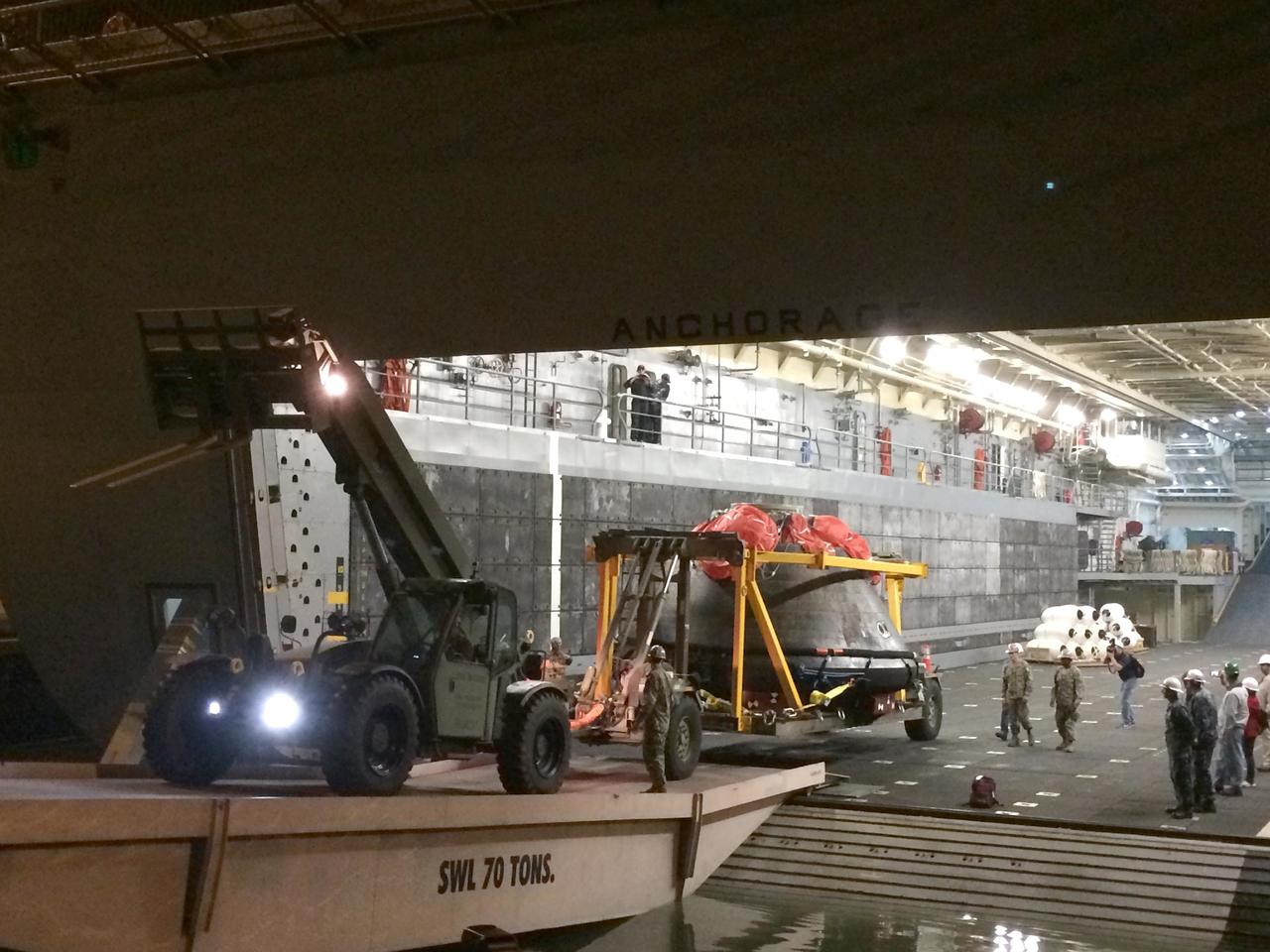
SAN DIEGO, Calif. -- At Naval Base San Diego in California, NASA's Orion spacecraft is being offloaded from the well deck of the USS Anchorage. Orion has been secured in its crew module recovery cradle and will be prepared for return to Kennedy Space Center in Florida. After lifting off at 7:05 a.m. EST on Dec. 5 atop a Delta IV Heavy rocket from Space Launch Complex 37 at Cape Canaveral Air Force Station in Florida, Orion completed a two-orbit, four-and-a-half hour mission to test systems critical to crew safety, including the launch abort system, the heat shield and the parachute system. NASA, the U.S. Navy and Lockheed Martin coordinated efforts to recover Orion after splashdown in the Pacific Ocean. The Ground Systems Development and Operations Program led the recovery efforts. For more information, visit www.nasa.gov/orion Photo credit: NASA/Amber Philman

Amber Allen, a program analyst in the Launch Services Program, speaks to attendees at NASA's Business Opportunities Expo 2018, on Oct. 23, inside Cruise Terminal 6 at Port Canaveral in Florida. The 28th Business Opportunities Expo featured more than 200 businesses, large and small, and government exhibitors from throughout the Space Coast and the nation. The Business Opportunities Expo is facilitated by Kennedy's Small Business Programs Office and Prime Contractor Board, along with the U.S. Air Force 45th Space Wing and Canaveral Port Authority. Vendors from a variety of product and service areas, such as computer technology, engineering services, communication equipment and services, and construction and safety products, to name a few, were at the expo. Representatives from the 45th Space Wing, Kennedy prime contractors, NASA and many more agencies and organizations were on hand to provide information and answer questions.
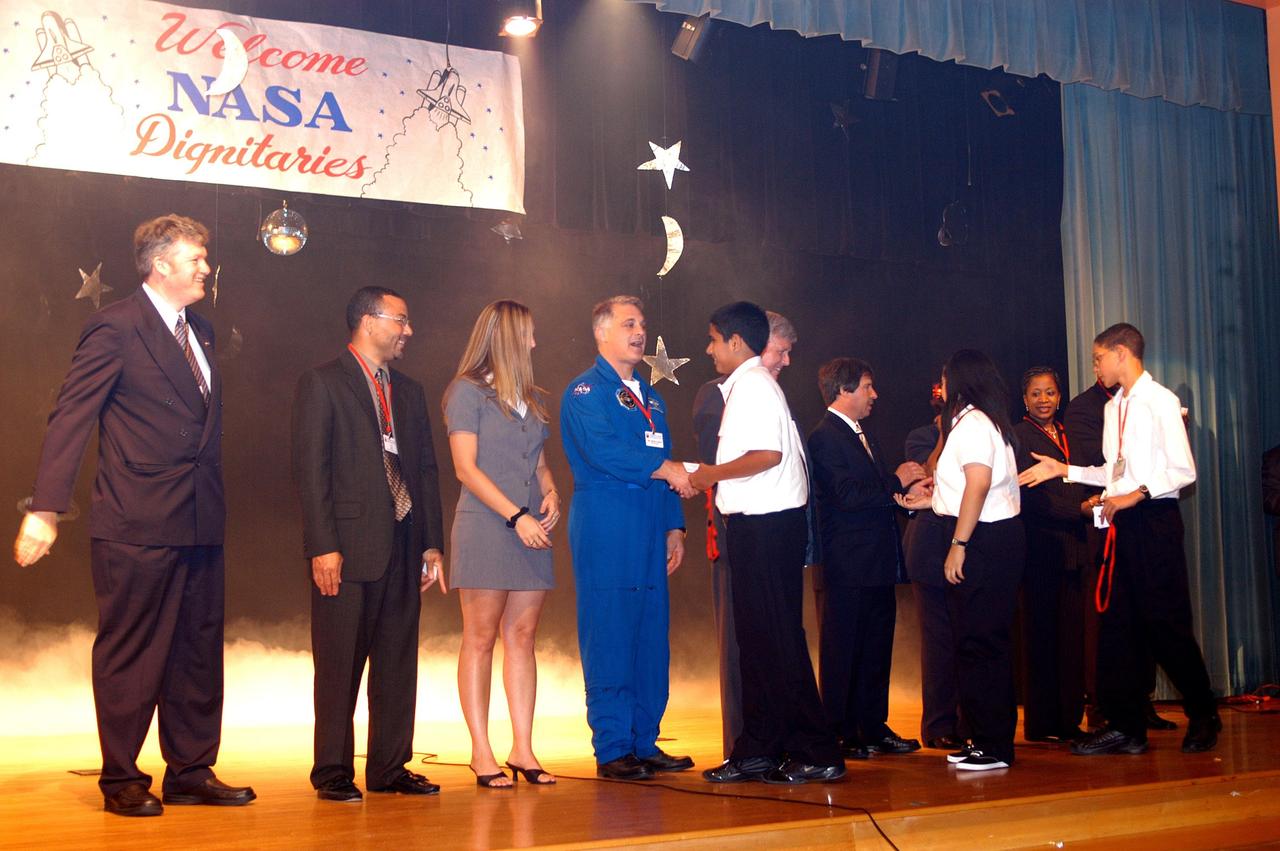
KENNEDY SPACE CENTER, FLA. -- During a visit to Howard A. Doolin Middle School, Miami, Fla., Center Director Jim Kennedy and other NASA and KSC representatives are greeted by students on stage. From left to right, are Jim Gerard, Aerospace Education Services Program (AESP) representative; Steve Lewis, assistant to Kennedy; Amber Marek, with KSC External Relations; David Wolf, astronaut; Kennedy; Les Gold, AESP representative; Burdette Brown; and Patricia Leonard and Clarence Bostic, Education Programs and University Research Division. Doolin Middle School is one of 100 to take part in the NASA Explorer Schools program. Kennedy is talking with students, the next generation of explorers, about our destiny as explorers, NASA’s stepping stone approach to exploring Earth, the Moon, Mars and beyond, how space impacts our lives, and how people and machines rely on each other in space.
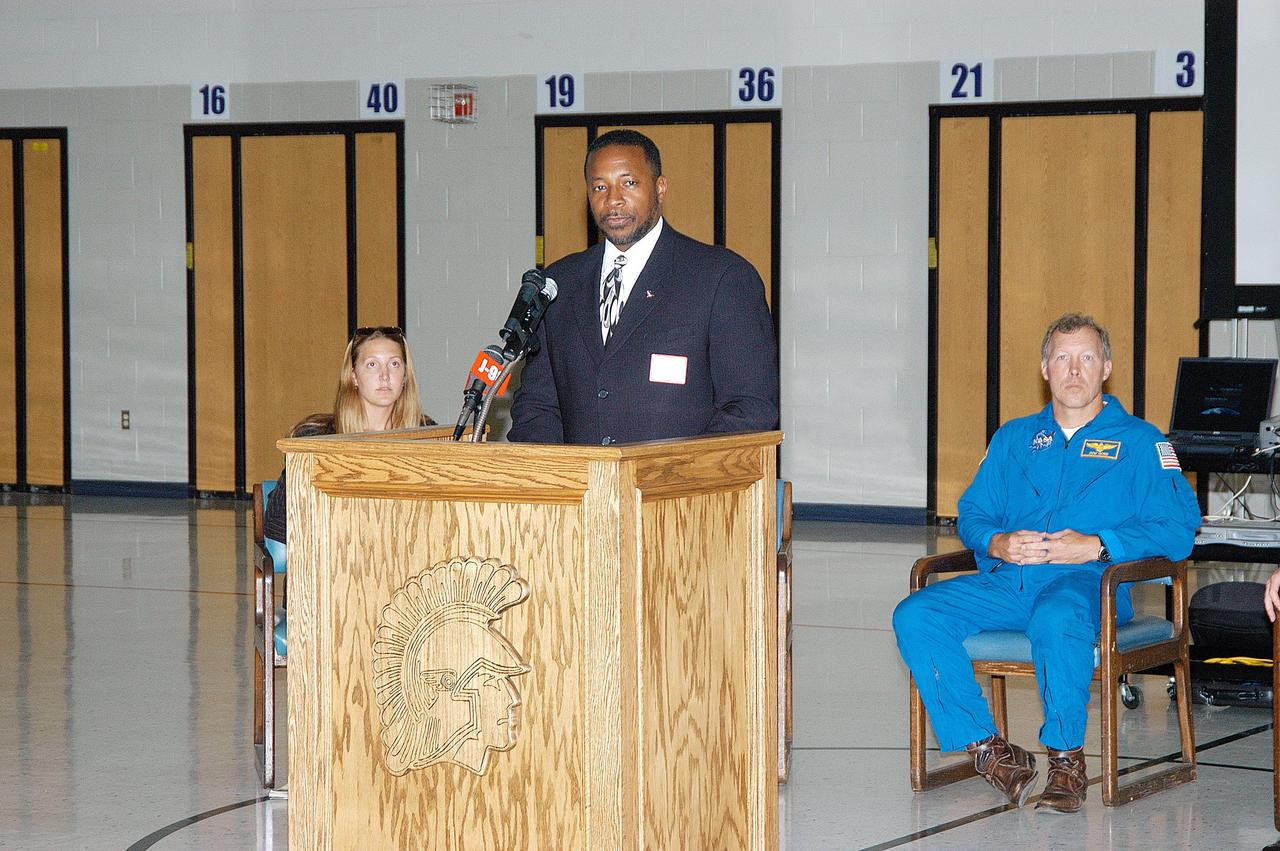
KENNEDY SPACE CENTER, FLA. -- At the podium, KSC Deputy Director Dr. Woodrow Whitlow talks to students in the gymnasium at Trojan Intermediate School in Potosi, Mo. At left is Amber Marek, with the NASA News Center; at right is astronaut Dom Gorie. Students from three area schools — Potosi High School, John Evans Middle School and Trojan — are on a team taking part in NASA’s Explorer Schools program. Whitlow and Gorie are visiting the school to share America’s new vision for space exploration with the next generation of explorers. They are talking with students about our destiny as explorers, NASA’s stepping stone approach to exploring Earth, the Moon, Mars and beyond, how space impacts our lives, and how people and machines rely on each other in space.
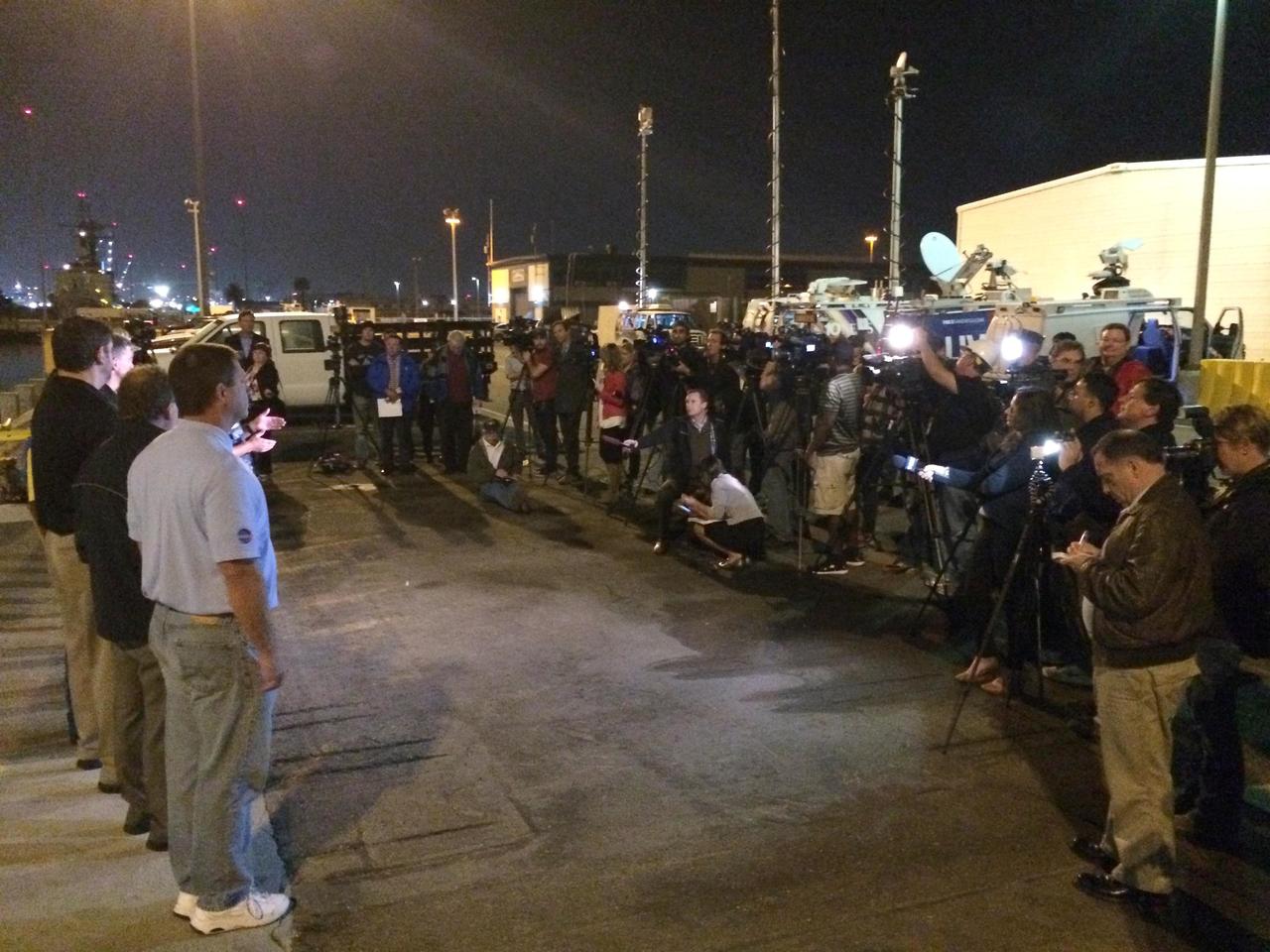
SAN DIEGO, Calif. -- At Naval Base San Diego in California, members of the news media wait to view NASA's Orion spacecraft in the well deck of the USS Anchorage before it is offloaded and prepared for return to Kennedy Space Center in Florida. After lifting off at 7:05 a.m. EST on Dec. 5, atop a Delta IV Heavy rocket from Space Launch Complex 37 at Cape Canaveral Air Force Station in Florida, Orion completed a two-orbit, four-and-a-half hour mission to test systems critical to crew safety, including the launch abort system, the heat shield and the parachute system. NASA, the U.S. Navy and Lockheed Martin coordinated efforts to recover Orion after splashdown in the Pacific Ocean. The Ground Systems Development and Operations Program led the recovery efforts. For more information, visit www.nasa.gov/orion Photo credit: NASA/Amber Philman
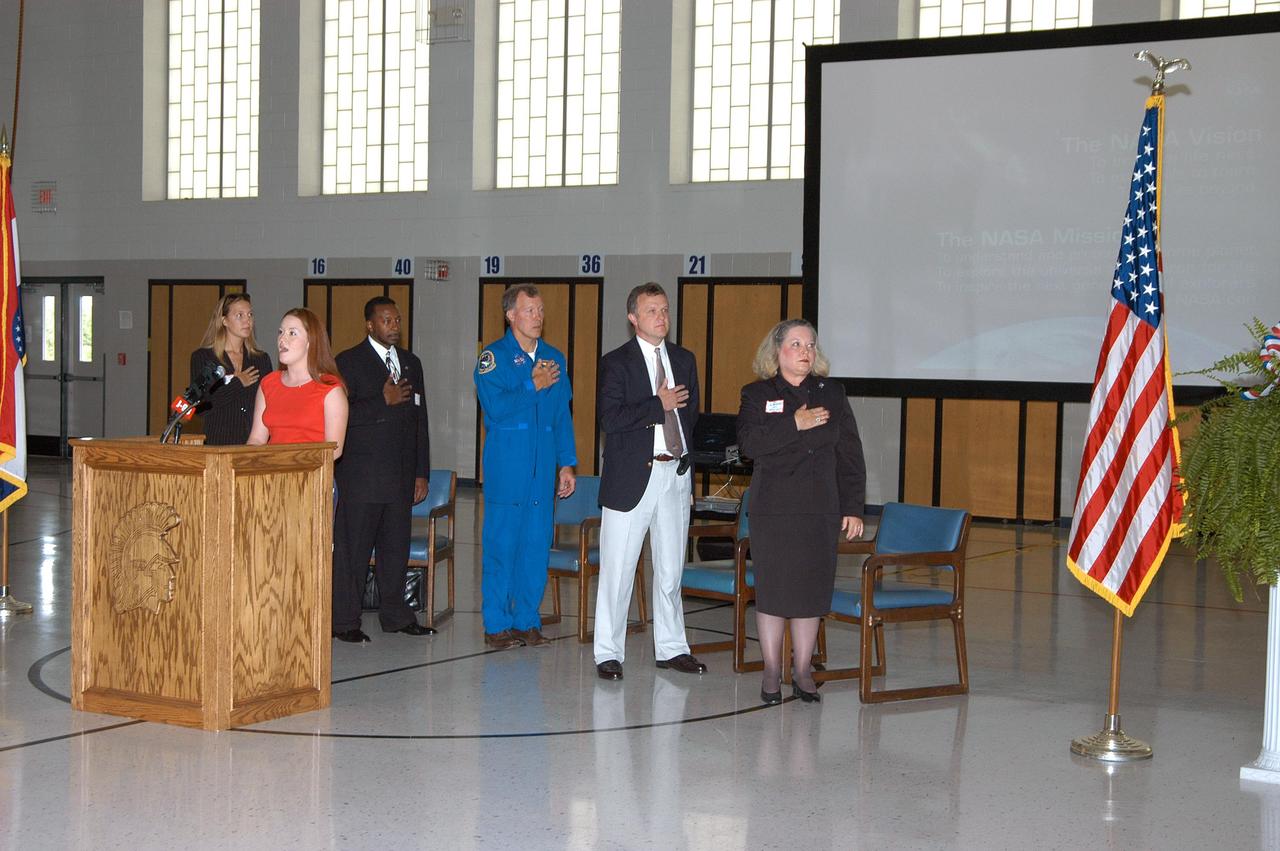
KENNEDY SPACE CENTER, FLA. -- Prior to a presentation at Trojan Intermediate School in Potosi, Mo., Amber Marek, KSC Deputy Director Dr. Woodrow Whitlow, astronaut Dom Gorie, Superintendent of Schools Randy Davis and Principal Jo Peukert salute the American flag. Students from three area schools— Potosi High School, John Evans Middle School and Trojan — are on a team taking part in NASA’s Explorer Schools program. Whitlow and Gorie are visiting the school to share America’s new vision for space exploration with the next generation of explorers. They are talking with students about our destiny as explorers, NASA’s stepping stone approach to exploring Earth, the Moon, Mars and beyond, how space impacts our lives, and how people and machines rely on each other in space.
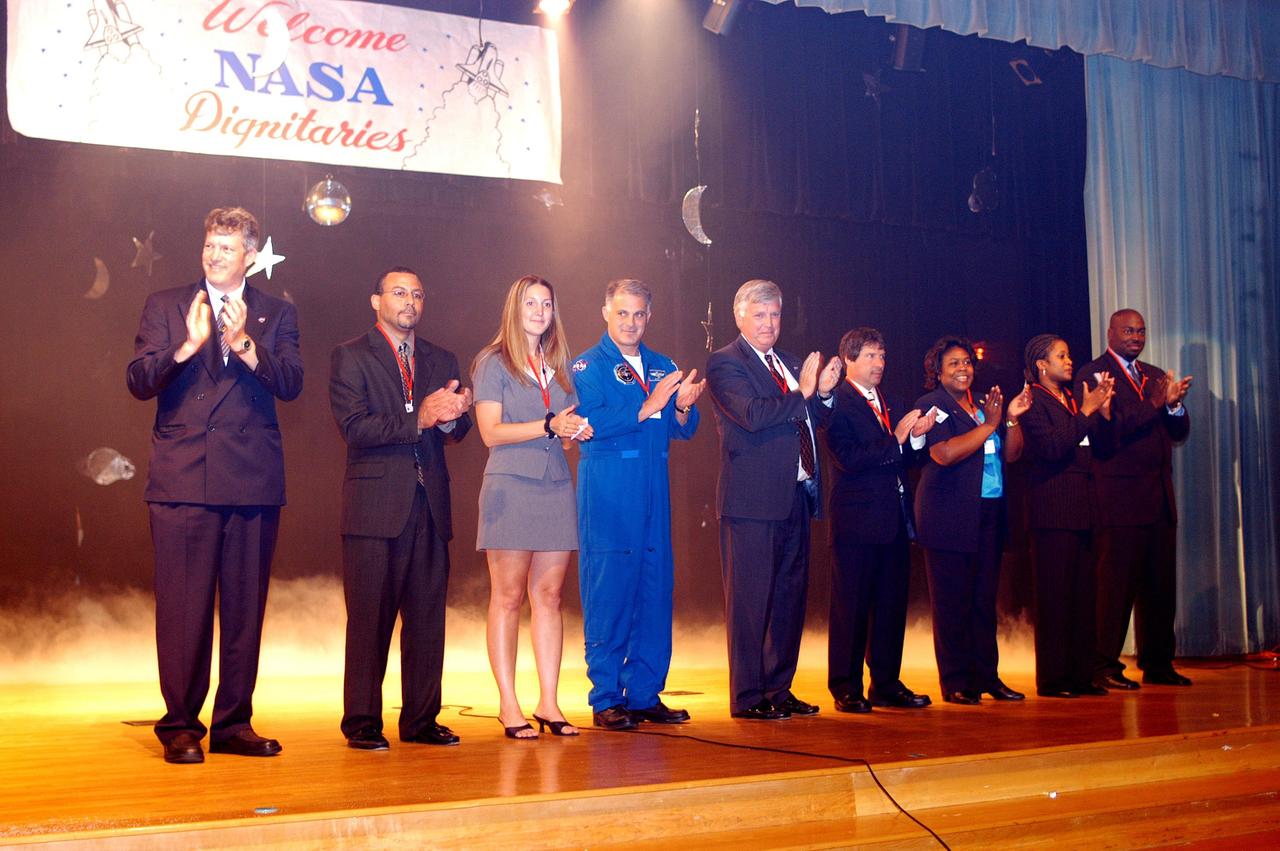
KENNEDY SPACE CENTER, FLA. -- During a visit to Howard A. Doolin Middle School, Miami, Fla., Center Director Jim Kennedy and other NASA and KSC representatives applaud faculty and students from the stage. From left to right are Jim Gerard, Aerospace Education Services Program (AESP) representative; Steve Lewis, assistant to Kennedy; Amber Marek, with KSC External Relations; David Wolf, astronaut; Kennedy; Les Gold, AESP representative; Burdette Brown; and Patricia Leonard and Clarence Bostic, Education Programs and University Research Division. Doolin Middle School is one of 100 to take part in the NASA Explorer Schools program. Kennedy is talking with students, the next generation of explorers, about our destiny as explorers, NASA’s stepping stone approach to exploring Earth, the Moon, Mars and beyond, how space impacts our lives, and how people and machines rely on each other in space.
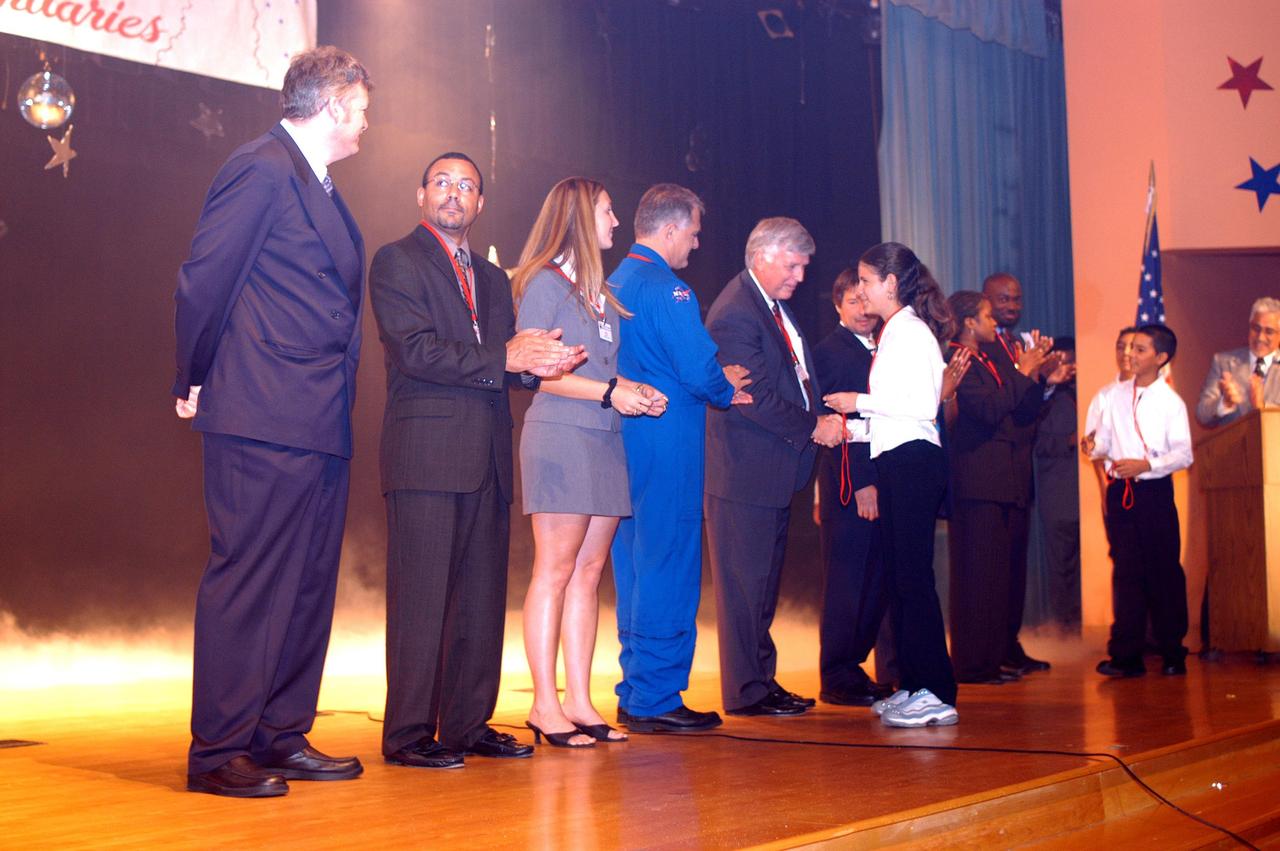
KENNEDY SPACE CENTER, FLA. -- During a visit to Howard A. Doolin Middle School, Miami, Fla., Center Director Jim Kennedy and other NASA and KSC representatives are greeted by students on stage. From left to right are Jim Gerard, Aerospace Education Services Program representative; Steve Lewis, assistant to Kennedy; Amber Marek, with KSC External Relations; David Wolf, astronaut; Kennedy; Les Gold, AESP representative; Burdette Brown; and Patricia Leonard and Clarence Bostic, Education Programs and University Research Division. Doolin Middle School is one of 100 to take part in the NASA Explorer Schools program. Kennedy is talking with students, the next generation of explorers, about our destiny as explorers, NASA’s stepping stone approach to exploring Earth, the Moon, Mars and beyond, how space impacts our lives, and how people and machines rely on each other in space.
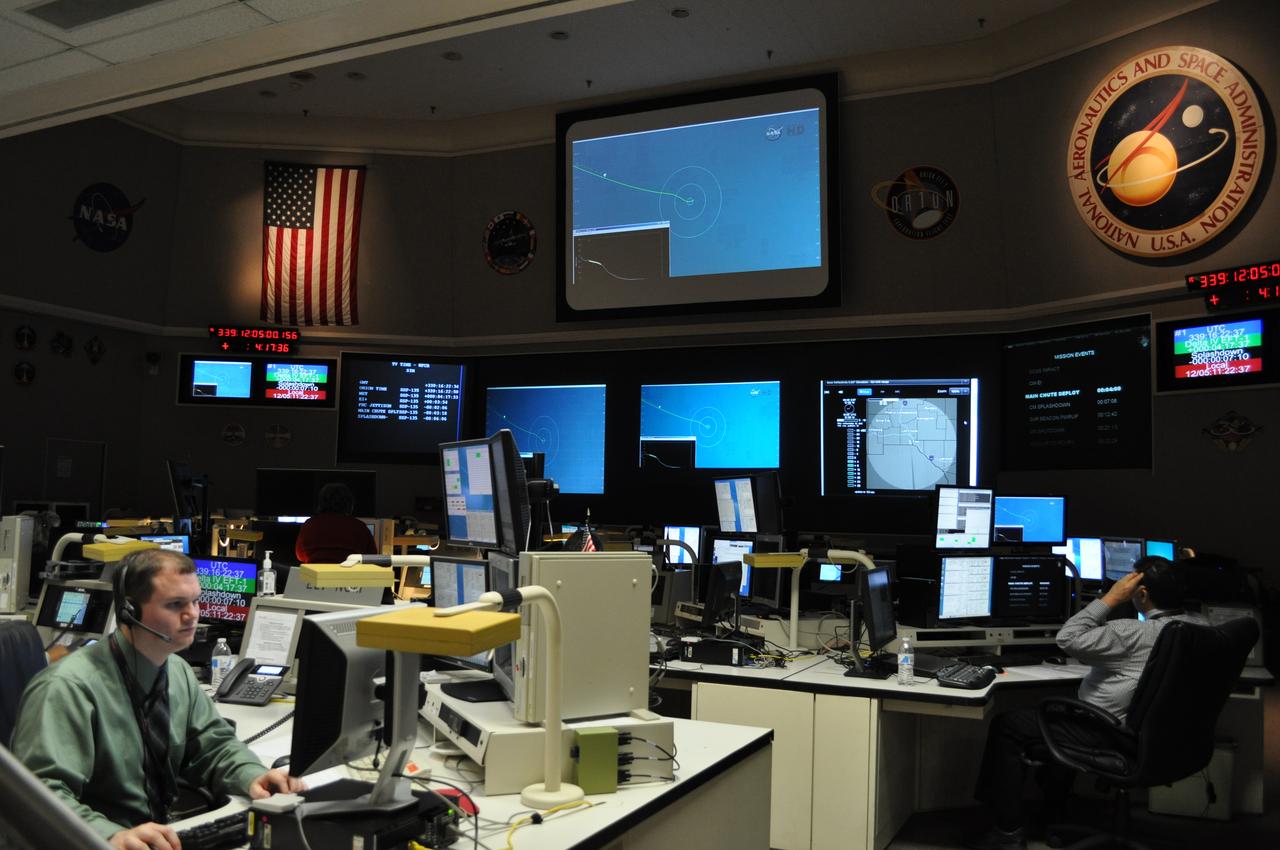
NASA's Goddard Space Flight Center in Greenbelt, Maryland, played a critical role in the test flight of the #Orion spacecraft on Dec. 5, 2014. Goddard's Networks Integration Center, pictured here, coordinated the communications support for both the Orion vehicle and the Delta IV rocket, ensuring complete communications coverage through NASA's Space Network and Tracking and Data Relay Satellite. The Orion spacecraft lifted off from Cape Canaveral Air Force Station's Space Launch Complex 37 in Florida at 7:05 a.m. EST. The Orion capsule splashed down about four and a half hours later, at 11:29 a.m. EST, about 600 miles off the coast of San Diego, California. While no humans were aboard Orion for this test flight, in the future, Orion will allow humans to travel deeper in to space than ever before, including an asteroid and Mars. Credit: NASA/Goddard/Amber Jacobson Credit: NASA/Goddard/Amber Jacobson <b><a href="http://www.nasa.gov/audience/formedia/features/MP_Photo_Guidelines.html" rel="nofollow">NASA image use policy.</a></b> <b><a href="http://www.nasa.gov/centers/goddard/home/index.html" rel="nofollow">NASA Goddard Space Flight Center</a></b> enables NASA’s mission through four scientific endeavors: Earth Science, Heliophysics, Solar System Exploration, and Astrophysics. Goddard plays a leading role in NASA’s accomplishments by contributing compelling scientific knowledge to advance the Agency’s mission. <b>Follow us on <a href="http://twitter.com/NASAGoddardPix" rel="nofollow">Twitter</a></b> <b>Like us on <a href="http://www.facebook.com/pages/Greenbelt-MD/NASA-Goddard/395013845897?ref=tsd" rel="nofollow">Facebook</a></b> <b>Find us on <a href="http://instagram.com/nasagoddard?vm=grid" rel="nofollow">Instagram</a></b>
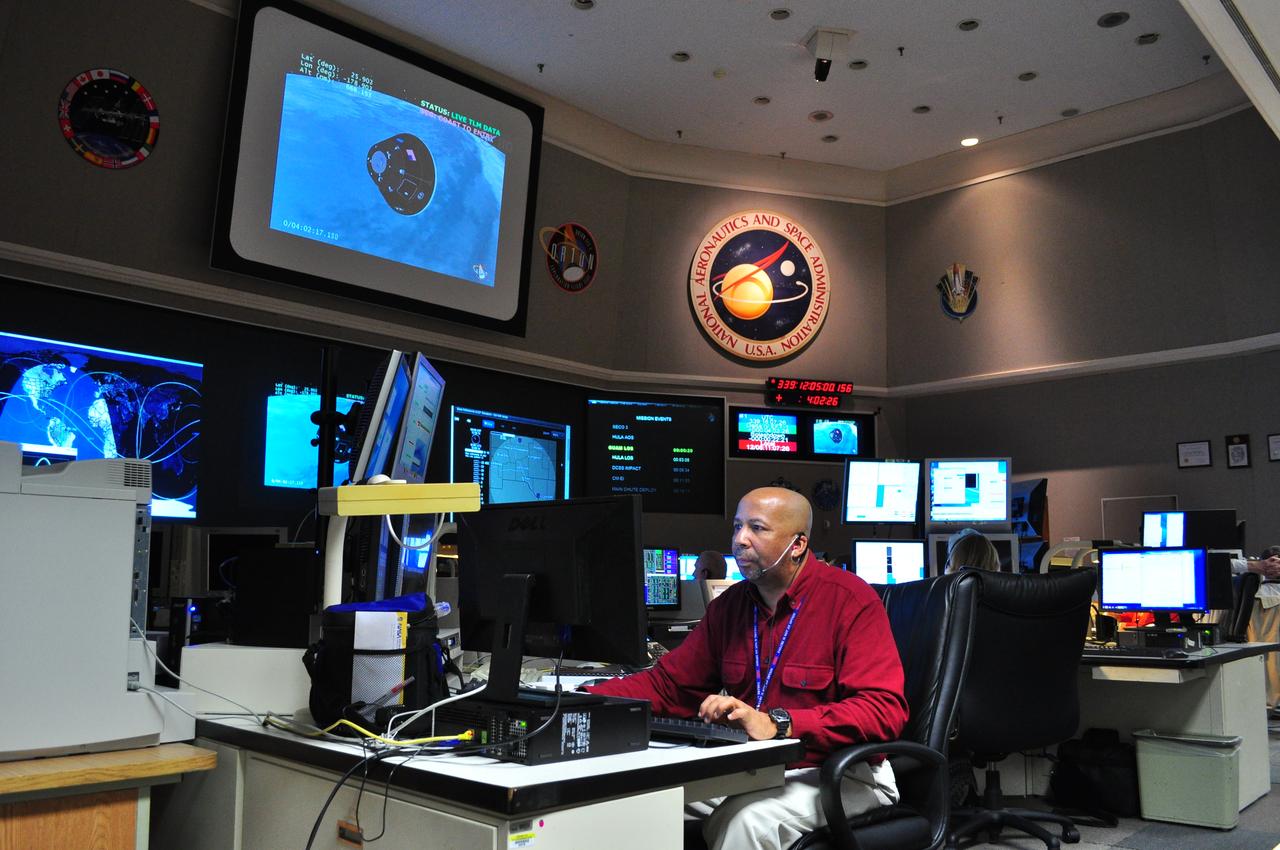
NASA's Goddard Space Flight Center in Greenbelt, Maryland, played a critical role in the test flight of the #Orion spacecraft on Dec. 5, 2014. Goddard's Networks Integration Center, pictured here, coordinated the communications support for both the Orion vehicle and the Delta IV rocket, ensuring complete communications coverage through NASA's Space Network and Tracking and Data Relay Satellite. The Orion spacecraft lifted off from Cape Canaveral Air Force Station's Space Launch Complex 37 in Florida at 7:05 a.m. EST. The Orion capsule splashed down about four and a half hours later, at 11:29 a.m. EST, about 600 miles off the coast of San Diego, California. While no humans were aboard Orion for this test flight, in the future, Orion will allow humans to travel deeper in to space than ever before, including an asteroid and Mars. Credit: NASA/Goddard/Amber Jacobson Credit: NASA/Goddard/Amber Jacobson <b><a href="http://www.nasa.gov/audience/formedia/features/MP_Photo_Guidelines.html" rel="nofollow">NASA image use policy.</a></b> <b><a href="http://www.nasa.gov/centers/goddard/home/index.html" rel="nofollow">NASA Goddard Space Flight Center</a></b> enables NASA’s mission through four scientific endeavors: Earth Science, Heliophysics, Solar System Exploration, and Astrophysics. Goddard plays a leading role in NASA’s accomplishments by contributing compelling scientific knowledge to advance the Agency’s mission. <b>Follow us on <a href="http://twitter.com/NASAGoddardPix" rel="nofollow">Twitter</a></b> <b>Like us on <a href="http://www.facebook.com/pages/Greenbelt-MD/NASA-Goddard/395013845897?ref=tsd" rel="nofollow">Facebook</a></b> <b>Find us on <a href="http://instagram.com/nasagoddard?vm=grid" rel="nofollow">Instagram</a></b>
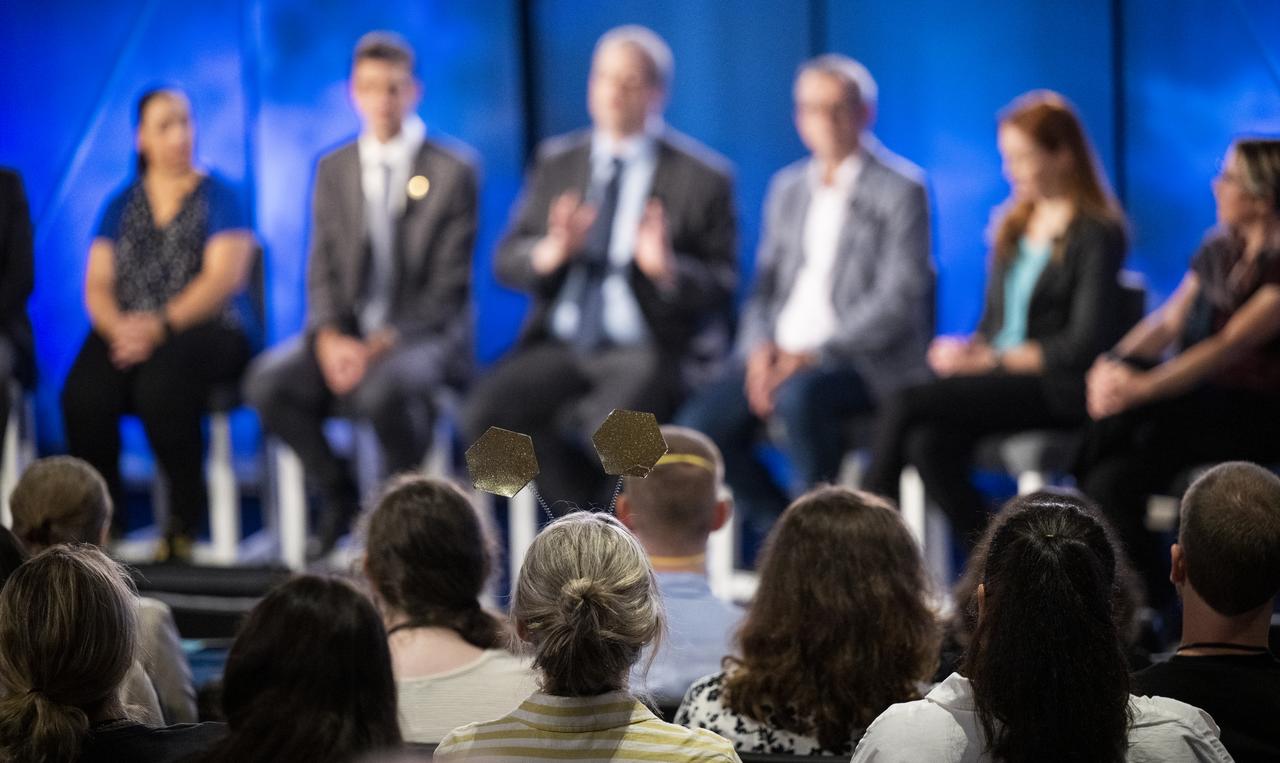
A NASA Social attendee is seen wearing a headband featuring Webb mirrors during a briefing with NASA Public Affairs Officer Alise Fisher, left, NASA James Webb Space Telescope Program Scientist and Astrophysics Division Chief Scientist Eric Smith, second from left, NASA James Webb Space Telescope Deputy Project Scientist for Exoplanet Science Knicole Colón, third from left, NASA James Webb Space Telescope Project Scientist at ESA (European Space Agency) Christopher Evans, fourth from left, NASA James Webb Space Telescope project scietntist, Space Telescope Science Institute, Klaus Pontoppidan, fourth from right, Principal Investigator for the Canadian Near-Infrared Imager and Slitless Spectrograph at the University of Montreal René Doyon, third from right, NASA James Webb Space Telescope Deputy Project Scientist for Communications Amber Straughn, second from right, and NASA James Webb Space Telescope Operations Project Scientist Jane Rigby, right, following the release of the first full-color images from NASA’s James Webb Space Telescope, Tuesday, July 12, 2022, at NASA’s Goddard Space Flight Center in Greenbelt, Md. The first full-color images and spectroscopic data from the James Webb Space Telescope, a partnership with ESA (European Space Agency) and the Canadian Space Agency (CSA), are a demonstration of the power of Webb as the telescope begins its science mission to unfold the infrared universe. Photo Credit: (NASA/Bill Ingalls)
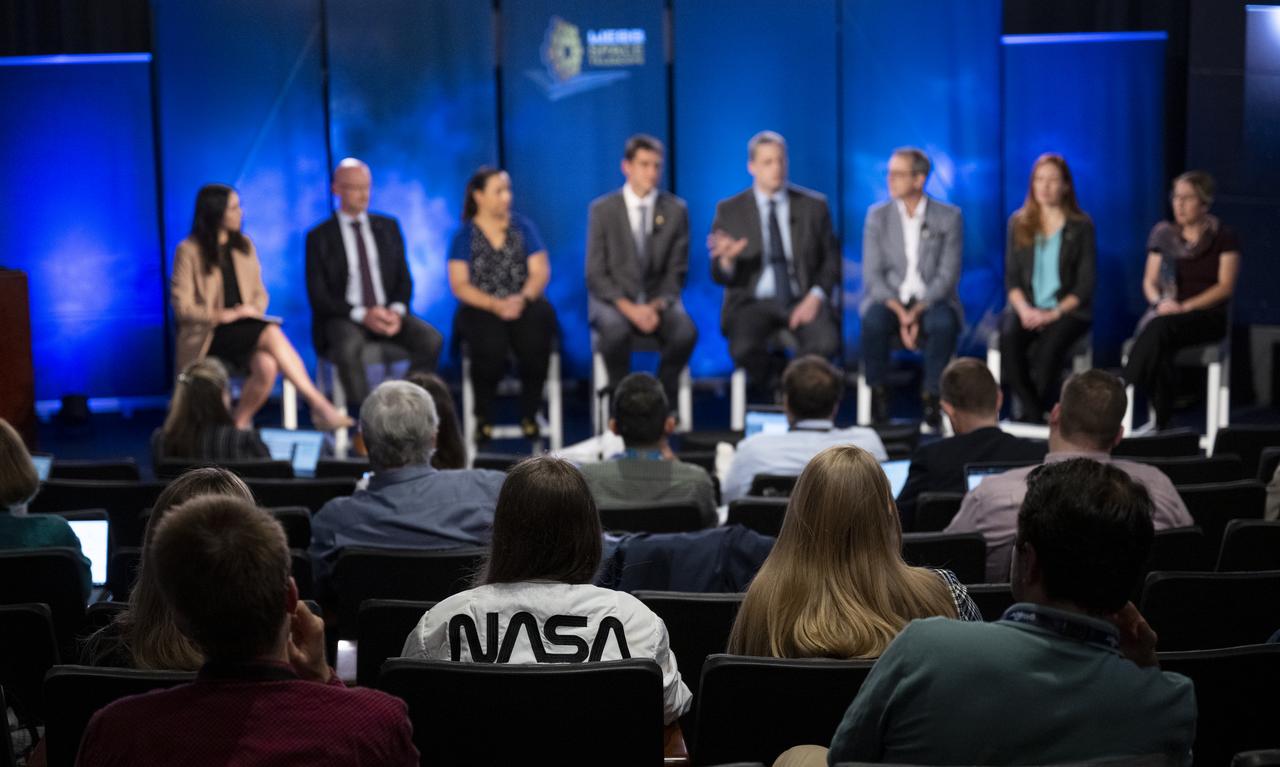
A NASA social attendees and members of the media are seen during a briefing with NASA Public Affairs Officer Alise Fisher, left, NASA James Webb Space Telescope Program Scientist and Astrophysics Division Chief Scientist Eric Smith, second from left, NASA James Webb Space Telescope Deputy Project Scientist for Exoplanet Science Knicole Colón, third from left, NASA James Webb Space Telescope Project Scientist at ESA (European Space Agency) Christopher Evans, fourth from left, NASA James Webb Space Telescope project scietntist, Space Telescope Science Institute, Klaus Pontoppidan, fourth from right, Principal Investigator for the Canadian Near-Infrared Imager and Slitless Spectrograph at the University of Montreal René Doyon, third from right, NASA James Webb Space Telescope Deputy Project Scientist for Communications Amber Straughn, second from right, and NASA James Webb Space Telescope Operations Project Scientist Jane Rigby, right, following the release of the first full-color images from NASA’s James Webb Space Telescope, Tuesday, July 12, 2022, at NASA’s Goddard Space Flight Center in Greenbelt, Md. The first full-color images and spectroscopic data from the James Webb Space Telescope, a partnership with ESA (European Space Agency) and the Canadian Space Agency (CSA), are a demonstration of the power of Webb as the telescope begins its science mission to unfold the infrared universe. Photo Credit: (NASA/Bill Ingalls)
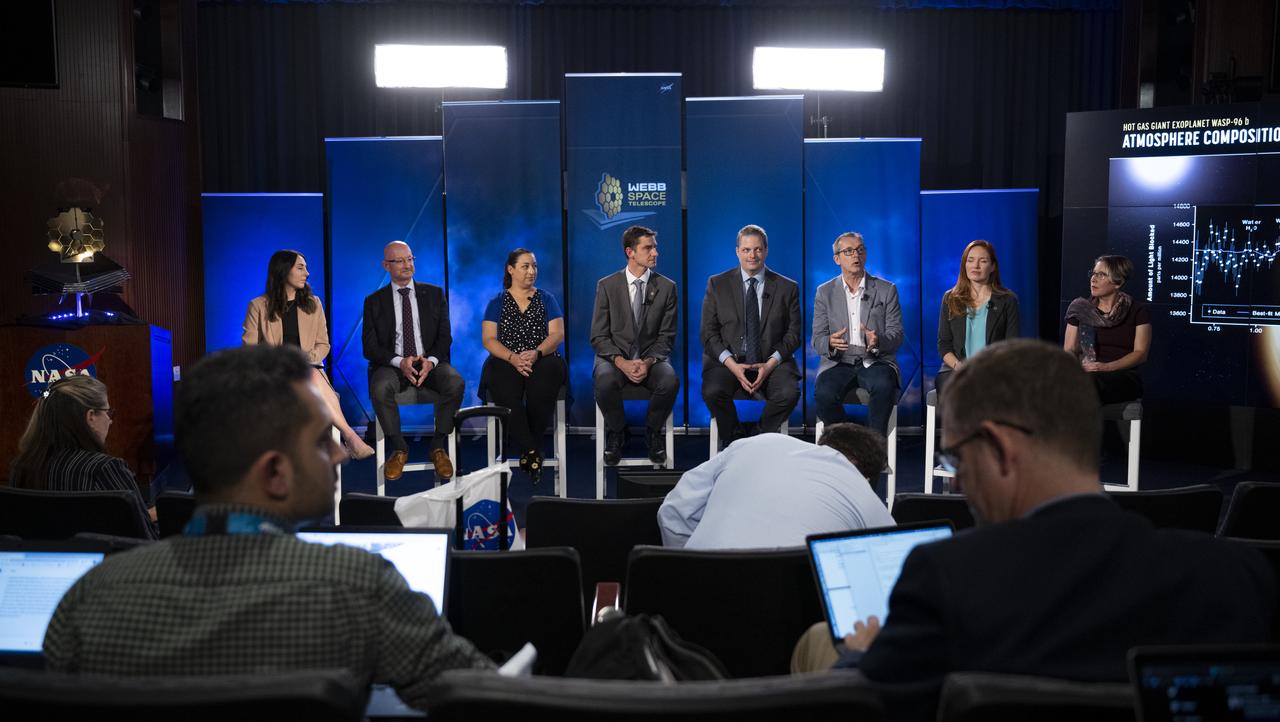
NASA Public Affairs Officer Alise Fisher, left, NASA James Webb Space Telescope Program Scientist and Astrophysics Division Chief Scientist Eric Smith, second from left, NASA James Webb Space Telescope Deputy Project Scientist for Exoplanet Science Knicole Colón, third from left, NASA James Webb Space Telescope Project Scientist at ESA (European Space Agency) Christopher Evans, fourth from left, NASA James Webb Space Telescope Project Scientist, Space Telescope Science Institute, Klaus Pontoppidan, fourth from right, Principal Investigator for the Canadian Near-Infrared Imager and Slitless Spectrograph at the University of Montreal René Doyon, third from right, NASA James Webb Space Telescope Deputy Project Scientist for Communications Amber Straughn, second from right, and NASA James Webb Space Telescope Operations Project Scientist Jane Rigby, right, during a briefing following the release of the first full-color images from NASA’s James Webb Space Telescope, Tuesday, July 12, 2022, at NASA’s Goddard Space Flight Center in Greenbelt, Md. The first full-color images and spectroscopic data from the James Webb Space Telescope, a partnership with ESA (European Space Agency) and the Canadian Space Agency (CSA), are a demonstration of the power of Webb as the telescope begins its science mission to unfold the infrared universe. Photo Credit: (NASA/Bill Ingalls)
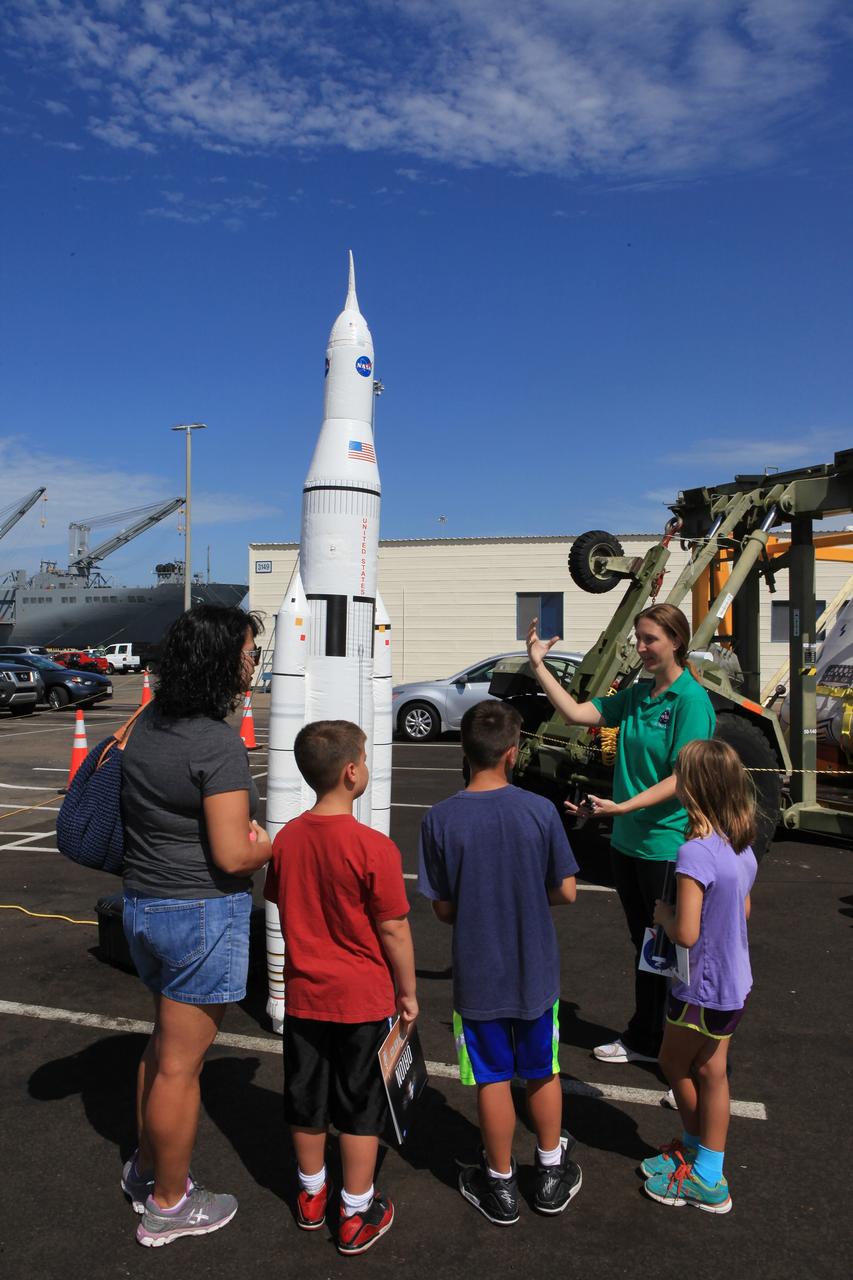
SAN DIEGO, Calif. – At the U.S. Naval Base San Diego in California, NASA Public Affairs Officer Amber Philman describes the Space Launch System and Orion spacecraft to visitors during an outreach event at the naval base. The USS Anchorage is being prepared for the Orion Underway Recovery Test 2. The Orion boilerplate test vehicle and other hardware will be loaded into the well deck of the ship and head out to sea in the Pacific Ocean off the coast of San Diego. NASA, Lockheed Martin and the U.S. Navy will conduct the test to prepare for recovery of the Orion crew module, forward bay cover and parachutes on its return from a deep space mission. The underway recovery test will allow the teams to demonstrate and evaluate the recovery processes, procedures, new support hardware and personnel in open waters. The Ground Systems Development and Operations Program will conduct the underway recovery tests. Orion is the exploration spacecraft designed to carry astronauts to destinations not yet explored by humans, including an asteroid and Mars. It will have emergency abort capability, sustain the crew during space travel and provide safe re-entry from deep space return velocities. The first unpiloted test flight of the Orion is scheduled to launch in 2014 atop a Delta IV rocket and in 2017 on NASA’s Space Launch System rocket. For more information, visit http://www.nasa.gov/orion. Photo credit: NASA/Kim Shiflett
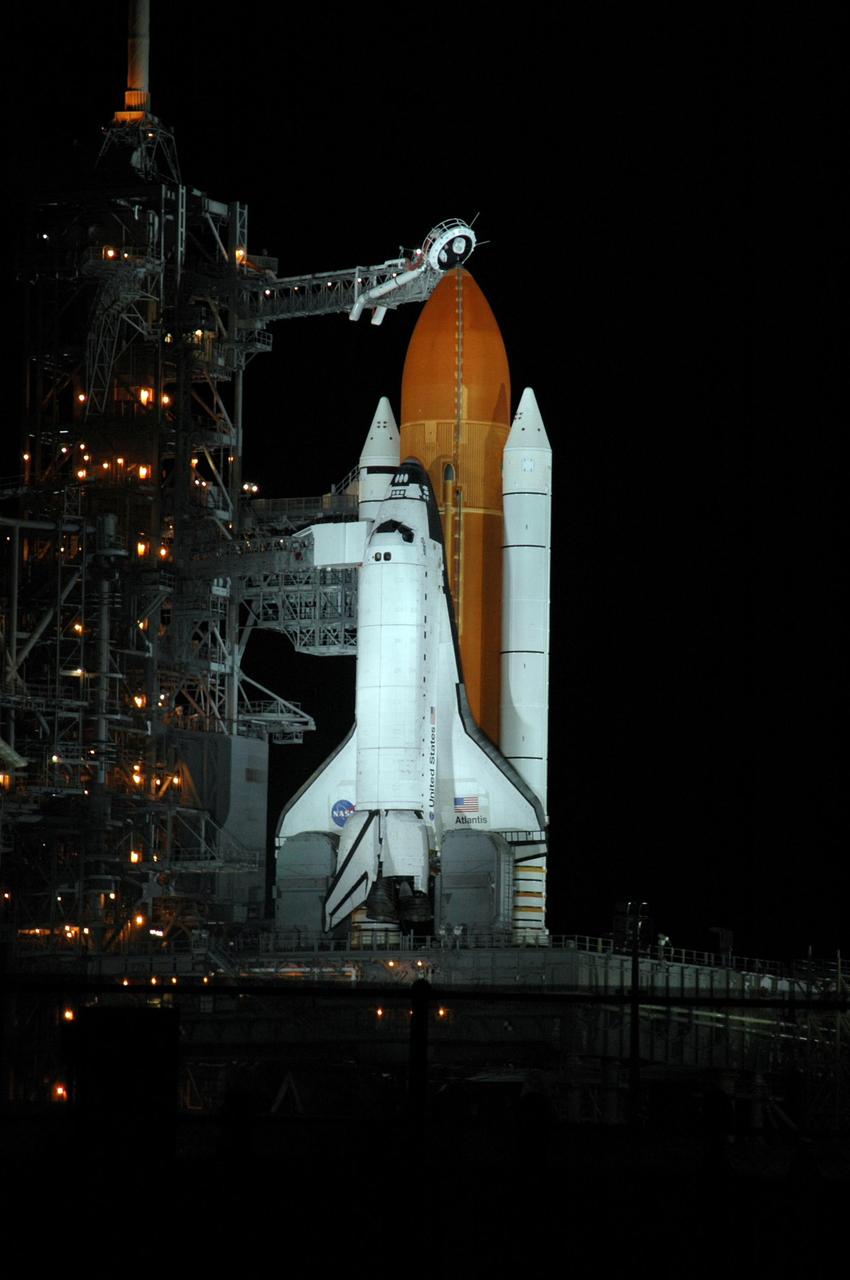
KENNEDY SPACE CENTER, FLA. - Space Shuttle Atlantis is illuminated on Launch Pad 39B, while amber lights on the fixed service structure give a surreal appearance. Seen above the golden external tank is the vent hood (known as the "beanie cap") at the end of the gaseous oxygen vent arm. Vapors are created as the liquid oxygen in the external tank boil off. The hood vents the gaseous oxygen vapors away from the space shuttle vehicle. Lower down, and next to Atlantis, is the White Room at the end of the orbiter access arm. The White Room provides entry into the orbiter through the hatch. Atlantis was originally scheduled to launch on Aug. 27, but a scrub was called by mission managers due to a concern with fuel cell 1. Atlantis is scheduled to lift off at 11:41 a.m. EDT Sept. 8. During the STS-115 mission, Atlantis' astronauts will deliver and install the 17.5-ton, bus-sized P3/P4 integrated truss segment on the station. The girder-like truss includes a set of giant solar arrays, batteries and associated electronics and will provide one-fourth of the total power-generation capability for the completed station. This mission is the 116th space shuttle flight, the 27th flight for orbiter Atlantis, and the 19th U.S. flight to the ISS. STS-115 is scheduled to last 11 days with a planned landing at KSC. Photo credit: NASA/Ken Thornsley
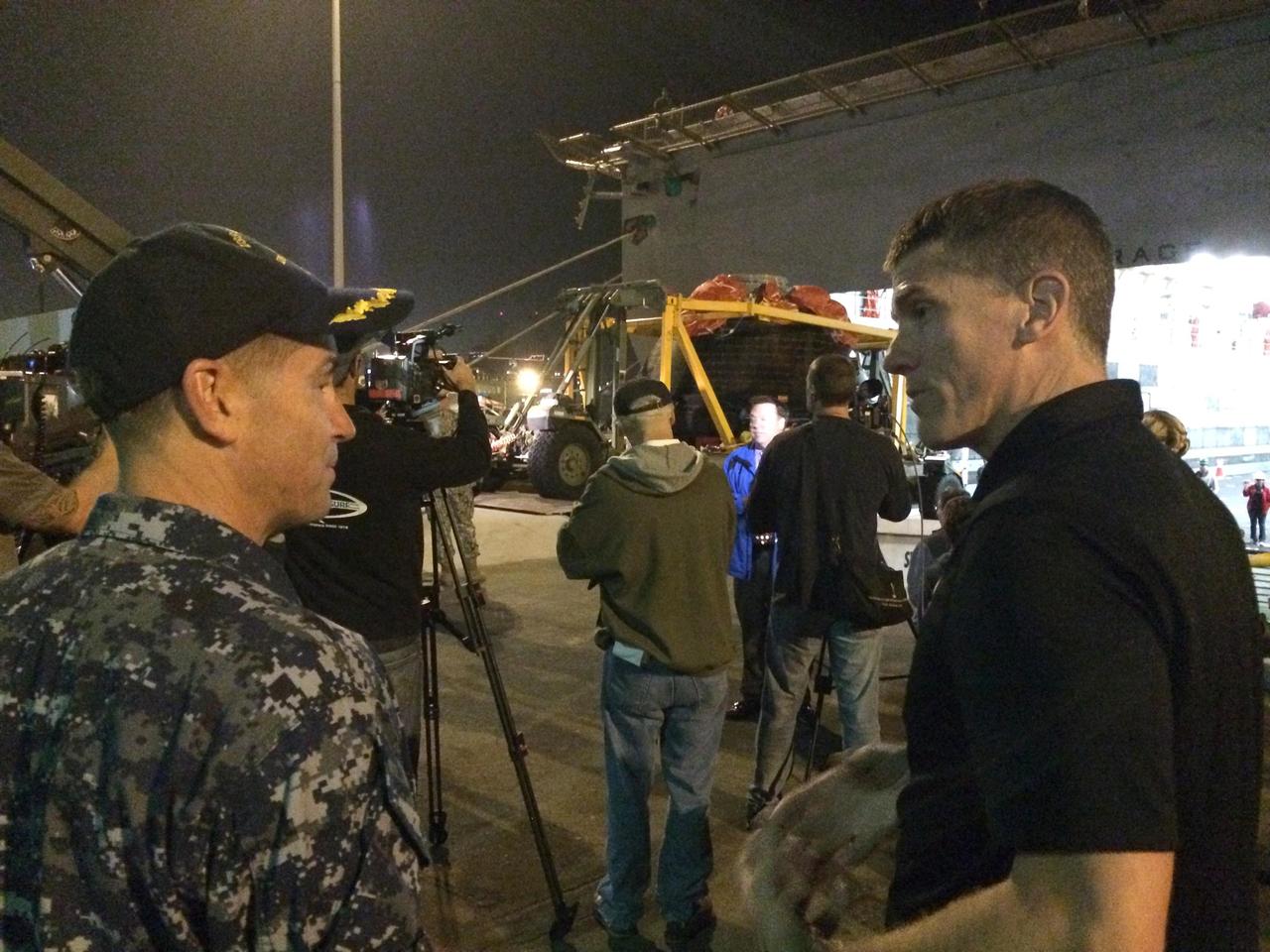
SAN DIEGO, Calif. -- At Naval Base San Diego in California, NASA Recovery Director Jeremy Graeber, right, talks to the commanding officer of the USS Anchorage as members of the news media prepare for viewing of NASA's Orion spacecraft being offloaded from the well deck of the ship. Orion has been secured in its crew module recovery cradle and will be prepared for return to Kennedy Space Center in Florida. After lifting off at 7:05 a.m. EST on Dec. 5 atop a Delta IV Heavy rocket from Space Launch Complex 37 at Cape Canaveral Air Force Station in Florida, Orion completed a two-orbit, four-and-a-half hour mission to test systems critical to crew safety, including the launch abort system, the heat shield and the parachute system. NASA, the U.S. Navy and Lockheed Martin coordinated efforts to recover Orion after splashdown in the Pacific Ocean. The Ground Systems Development and Operations Program is led the recovery efforts. For more information, visit www.nasa.gov/orion Photo credit: NASA/Amber Philman
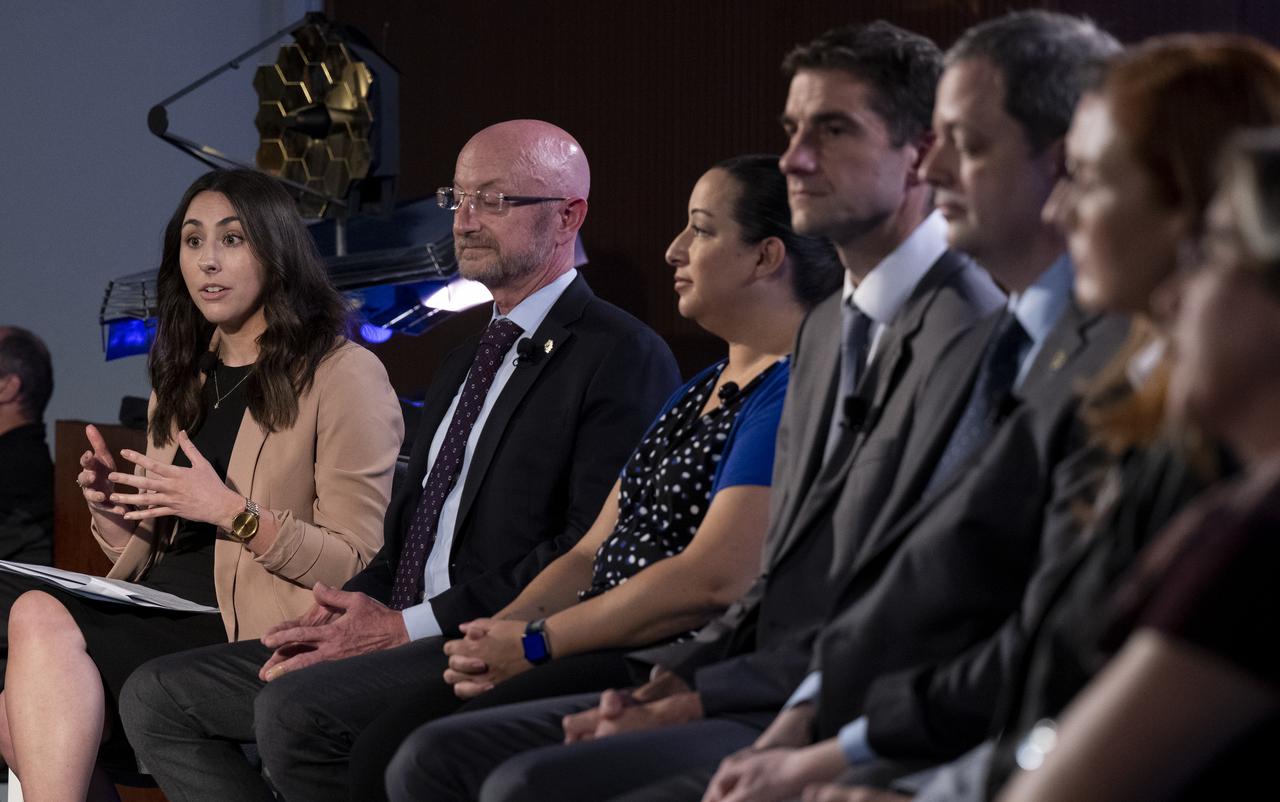
NASA Public Affairs Officer Alise Fisher, left, moderates a briefing with NASA James Webb Space Telescope Program Scientist and Astrophysics Division Chief Scientist Eric Smith, NASA James Webb Space Telescope Deputy Project Scientist for Exoplanet Science Knicole Colón, NASA James Webb Space Telescope Project Scientist at ESA (European Space Agency) Christopher Evans, NASA James Webb Space Telescope project scietntist, Space Telescope Science Institute, Klaus Pontoppidan, Principal Investigator for the Canadian Near-Infrared Imager and Slitless Spectrograph at the University of Montreal René Doyon, NASA James Webb Space Telescope Deputy Project Scientist for Communications Amber Straughn, and NASA James Webb Space Telescope Operations Project Scientist Jane Rigby following the release of the first full-color images from NASA’s James Webb Space Telescope, Tuesday, July 12, 2022, at NASA’s Goddard Space Flight Center in Greenbelt, Md. The first full-color images and spectroscopic data from the James Webb Space Telescope, a partnership with ESA (European Space Agency) and the Canadian Space Agency (CSA), are a demonstration of the power of Webb as the telescope begins its science mission to unfold the infrared universe. Photo Credit: (NASA/Bill Ingalls)
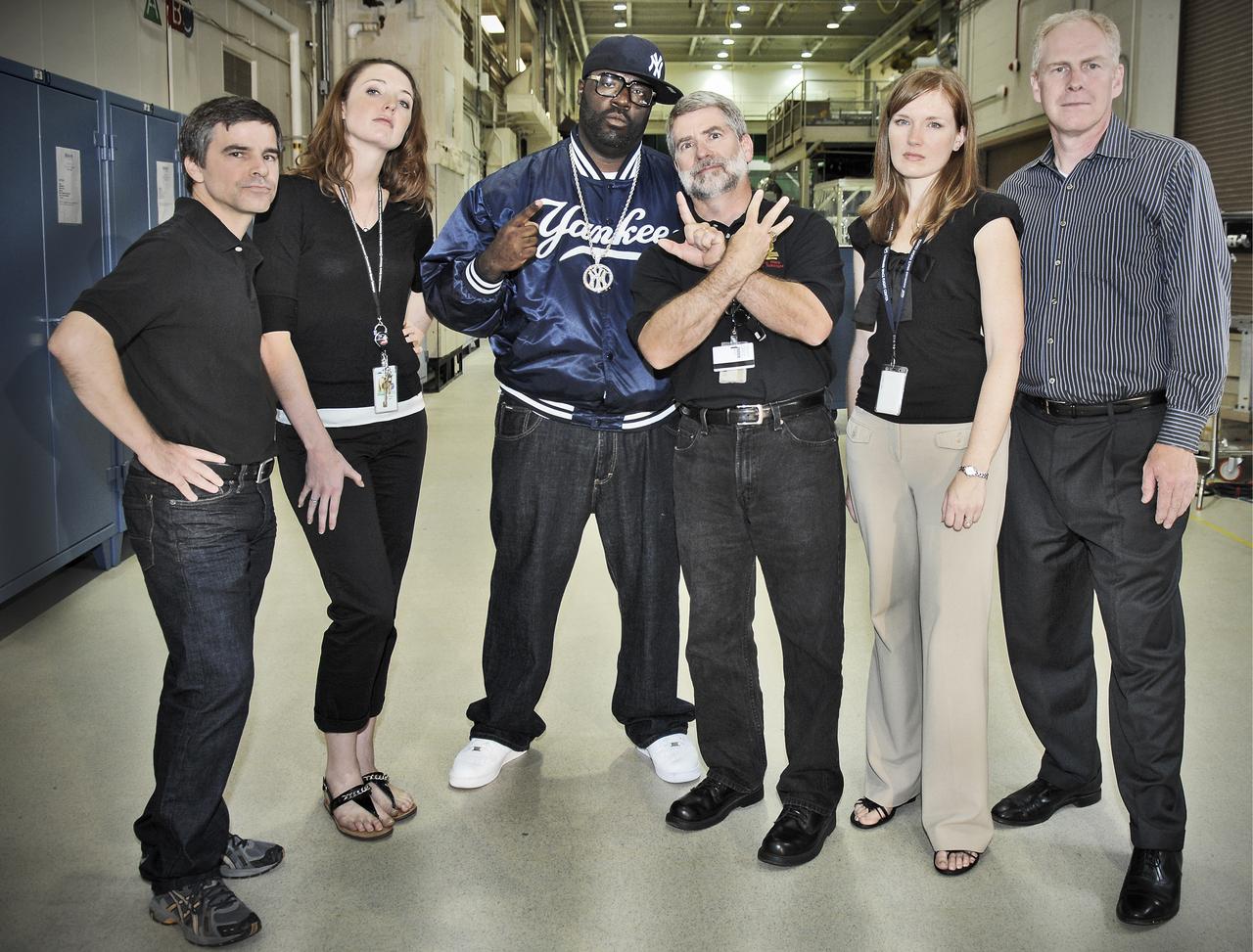
Fans of 'Late Night with Jimmy Fallon' know the setup: A guy in a Yankees jacket shows off Hubble images and shouts to the audience that, 'Hubble gotchu!' Monday night's episode showcased footage shot right here at Goddard Space Flight Center. Left to Right: Phil Driggers, Katie Lilly, Milky J “Hubble Gotchu”, Mike Menzel, Amber Straughn, Ray Lundquist. Read more about Milky J's visit here: <a href="http://geeked.gsfc.nasa.gov/?p=2066" rel="nofollow">geeked.gsfc.nasa.gov/?p=2066</a> <b><a href="http://www.nasa.gov/centers/goddard/home/index.html" rel="nofollow">NASA Goddard Space Flight Center</a></b> is home to the nation's largest organization of combined scientists, engineers and technologists that build spacecraft, instruments and new technology to study the Earth, the sun, our solar system, and the universe. <b>Follow us on <a href="http://twitter.com/NASA_GoddardPix" rel="nofollow">Twitter</a></b> <b>Join us on <a href="http://www.facebook.com/pages/Greenbelt-MD/NASA-Goddard/395013845897?ref=tsd" rel="nofollow">Facebook</a><b></b></b> Credit: NASA/Goddard Space Flight Center/Chris Gun
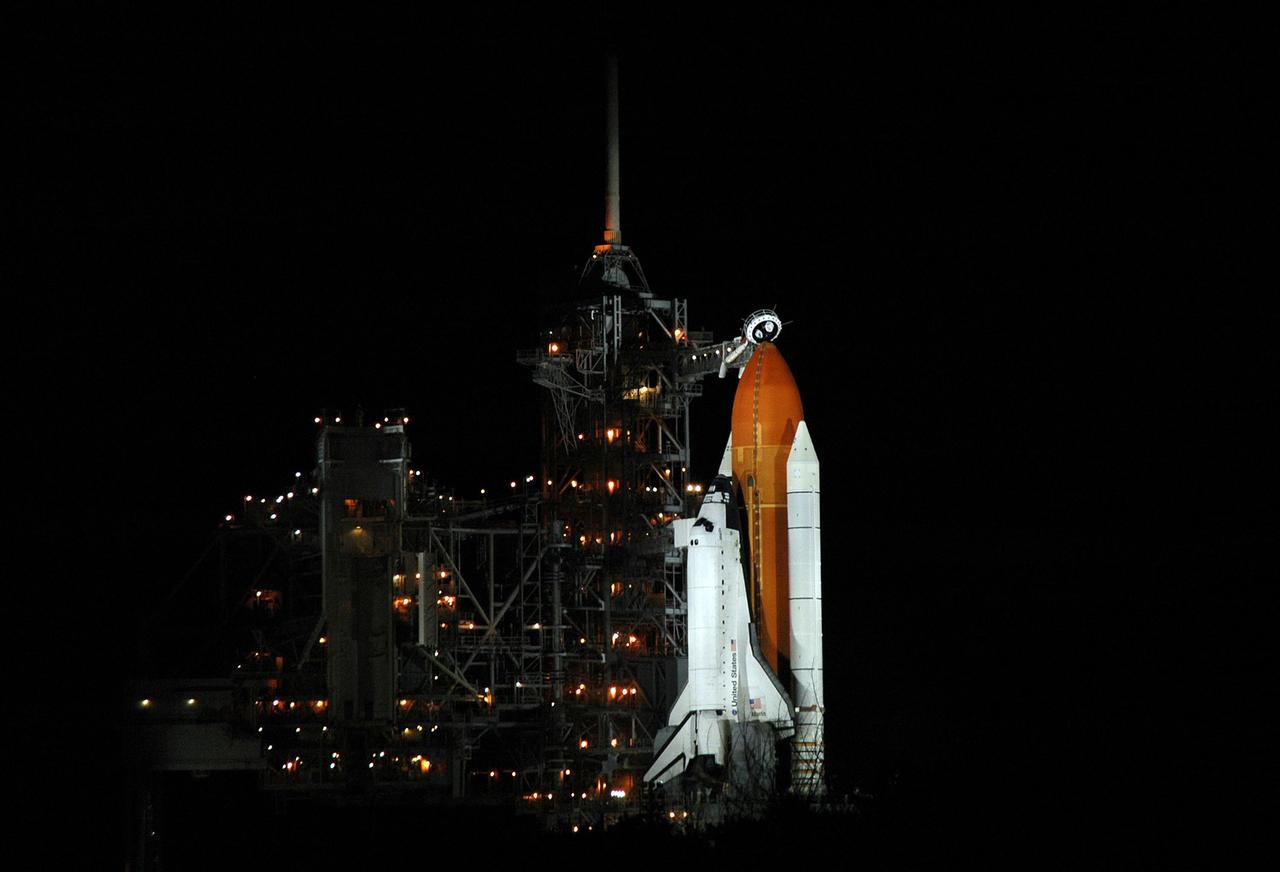
KENNEDY SPACE CENTER, FLA. - Space Shuttle Atlantis is illuminated on Launch Pad 39B, surrounded by amber lights on the rotating and fixed service structures. Seen above the golden external tank is the vent hood (known as the "beanie cap") at the end of the gaseous oxygen vent arm. Vapors are created as the liquid oxygen in the external tank boil off. The hood vents the gaseous oxygen vapors away from the space shuttle vehicle. Atlantis was originally scheduled to launch on Aug. 27, but a scrub was called by mission managers due to a concern with fuel cell 1. Atlantis is scheduled to lift off at 11:41 a.m. EDT Sept. 8. During the STS-115 mission, Atlantis' astronauts will deliver and install the 17.5-ton, bus-sized P3/P4 integrated truss segment on the station. The girder-like truss includes a set of giant solar arrays, batteries and associated electronics and will provide one-fourth of the total power-generation capability for the completed station. This mission is the 116th space shuttle flight, the 27th flight for orbiter Atlantis, and the 19th U.S. flight to the ISS. STS-115 is scheduled to last 11 days with a planned landing at KSC. Photo credit: NASA/Ken Thornsley
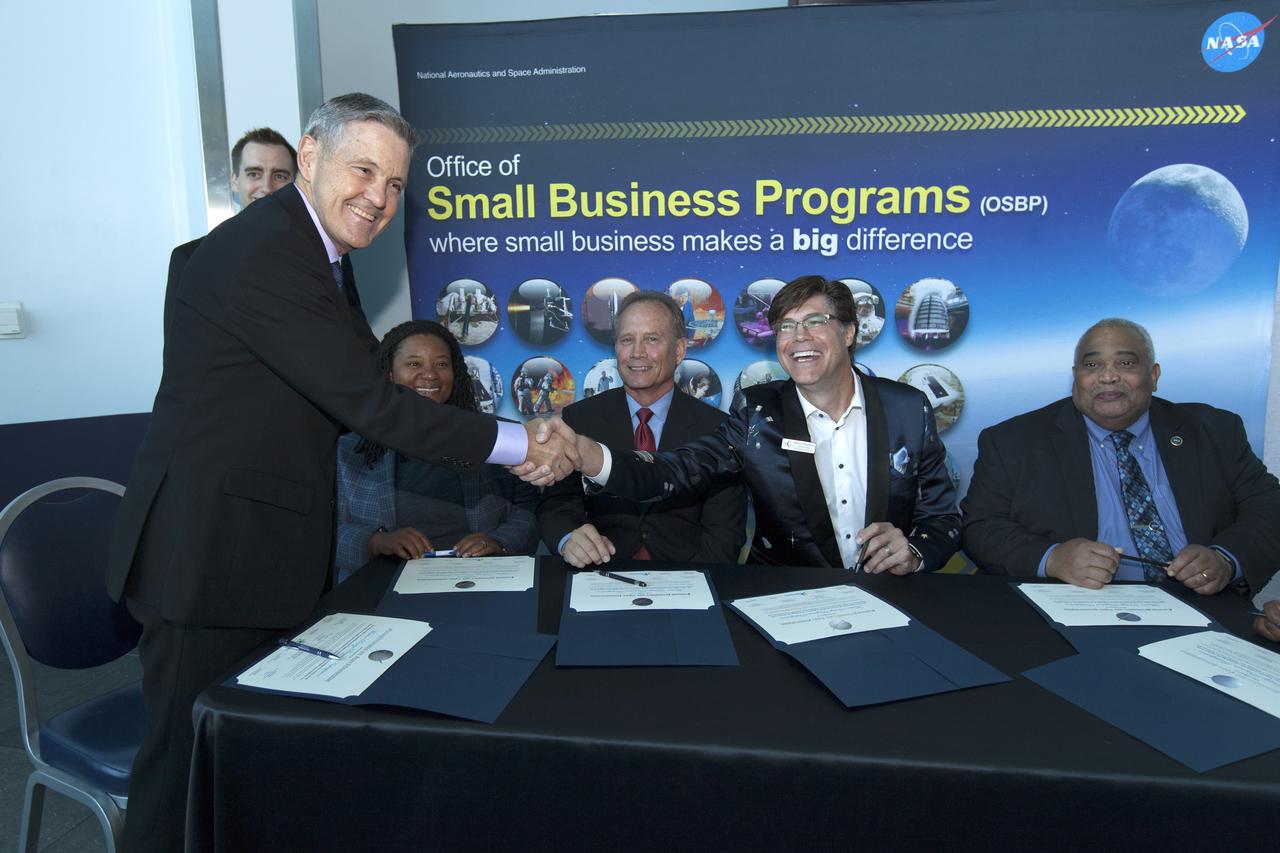
NASA Kennedy Space Center Director Bob Cabana, standing, shakes hands with Barry Hamilton, CEO and Founder of Red Canyon Software Inc., during the signing of a Mentor-Protégé Agreement on Oct. 23, 2018, at the NASA Business Opportunities Expo 2018 inside Cruise Terminal 6 at Port Canaveral in Florida. Seated, from left are Amber Allen, program analyst in the Launch Services Program; Steve Owens, deputy program manager with a.i. solutions Inc., a contractor at Kennedy; and Glenn Delgado, associate administrator, NASA Office of Small Business Programs. a.i. solutions will serve as the mentor to protégé Red Canyon Software. The 28th Business Opportunities Expo featured more than 200 businesses, large and small, and government exhibitors from throughout the Space Coast and the nation. The Business Opportunities Expo is facilitated by Kennedy's Small Business Programs Office and Prime Contractor Board, along with the U.S. Air Force 45th Space Wing and Canaveral Port Authority. Vendors from a variety of product and service areas, such as computer technology, engineering services, communication equipment and services, and construction and safety products, to name a few, were at the expo. Representatives from the 45th Space Wing, Kennedy prime contractors, NASA and many more agencies and organizations were on hand to provide information and answer questions.

NASA Hubble Operations Project Scientist Ken Carpenter, third from left, speaks about the history of the Hubble Space Telescope during an event titled “Beyond the Deep Field: Hubble’s Legacy and the Future of Cosmic Observation,” Thursday, June 4, 2026, at the Mary W. Jackson NASA Headquarters building in Washington. Photo Credit: (NASA/Keegan Barber)

Former NASA Senior Project Scientist Dave Leckrone speaks about the history of the Hubble Space Telescope during an event titled “Beyond the Deep Field: Hubble’s Legacy and the Future of Cosmic Observation,” Thursday, June 4, 2026, at the Mary W. Jackson NASA Headquarters building in Washington. Photo Credit: (NASA/Keegan Barber)

Space Telescope Science Institute (STScI) head of the Hubble Space Telescope mission office Julia Roman-Duval, second from right, speaks about the history of the Hubble Space Telescope during an event titled “Beyond the Deep Field: Hubble’s Legacy and the Future of Cosmic Observation,” Thursday, June 4, 2026, at the Mary W. Jackson NASA Headquarters building in Washington. Photo Credit: (NASA/Keegan Barber)

NASA Hubble Senior Project Scientist Jennifer Wiseman, third from right, speaks about the history of the Hubble Space Telescope during an event titled “Beyond the Deep Field: Hubble’s Legacy and the Future of Cosmic Observation,” Thursday, June 4, 2026, at the Mary W. Jackson NASA Headquarters building in Washington. Photo Credit: (NASA/Keegan Barber)
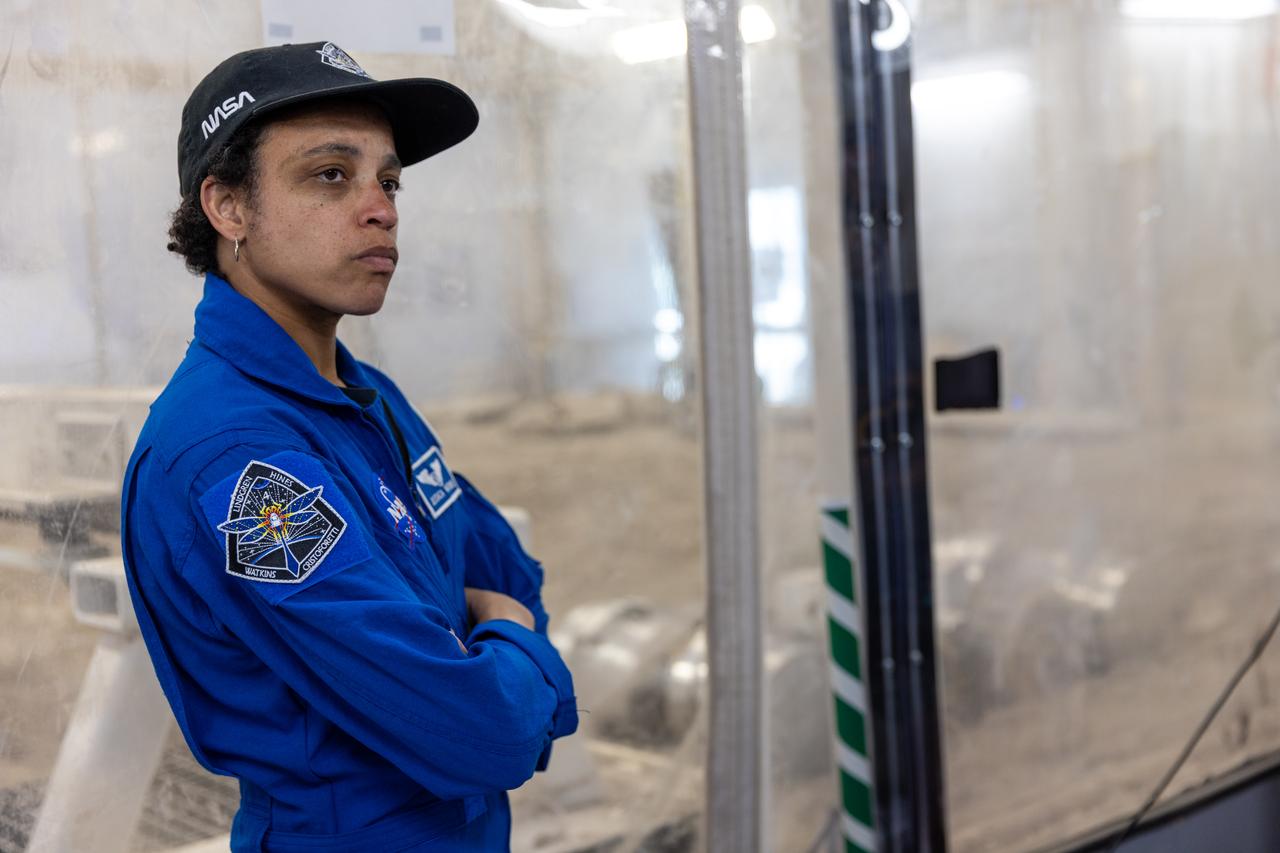
NASA astronaut Jessica Watkins visits the Granular Mechanics and Regolith Operations Laboratory inside Swamp Works at Kennedy Space Center in Florida on Wednesday, Aug. 27, 2025, to view some of the evolving technologies in development that astronauts may use to explore the Moon’s surface, prepare it for sustainable outposts, and to handle the dust that is collected during moonwalks.
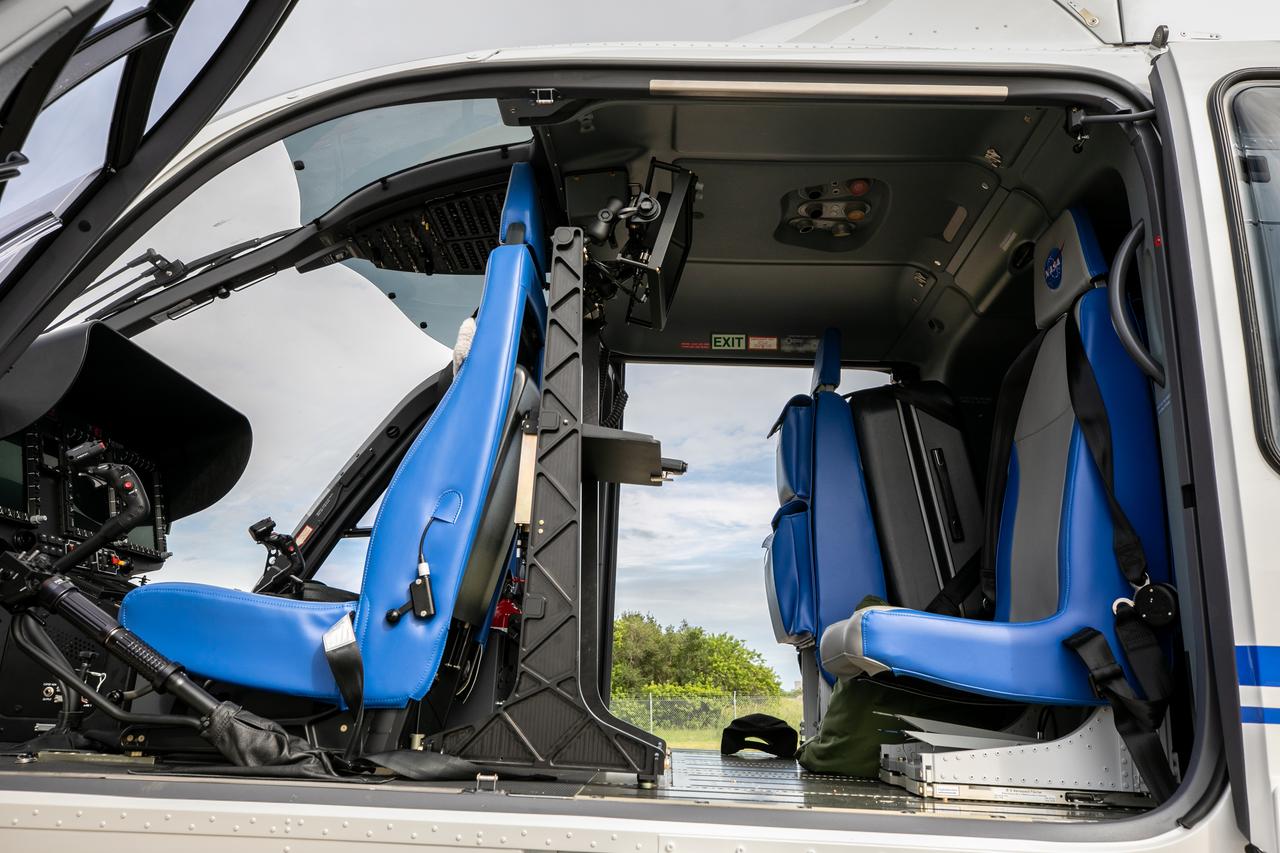
The interior of a new Airbus H135 (T3) helicopter is displayed after arriving at the Launch and Landing Facility runway at NASA’s Kennedy Space Center in Florida on Sept. 30, 2020. A second H135 helicopter also was delivered on Sept. 30, and a third is expected to arrive in early 2021. The three H135 helicopters will replace the Bell Huey 2 security aircraft in service now, maintained by Kennedy’s Flight Operations team. These new helicopters provide a number of technological and safety advantages over the Hueys, such as more lifting power, greater stability in the air, and expanded medical capabilities. The team expects to fully transition to flying the two H135s later this year, and once the third arrives, the fleet’s upgrade will be complete.

An Artemis launch team member participates in the Artemis III terminal countdown simulation on Thursday, May 7, 2026, inside Firing Room 1 of the Rocco A. Petrone Launch Control Center at NASA’s Kennedy Space Center in Florida. This marked the first simulation the launch team performed ahead of Artemis III.
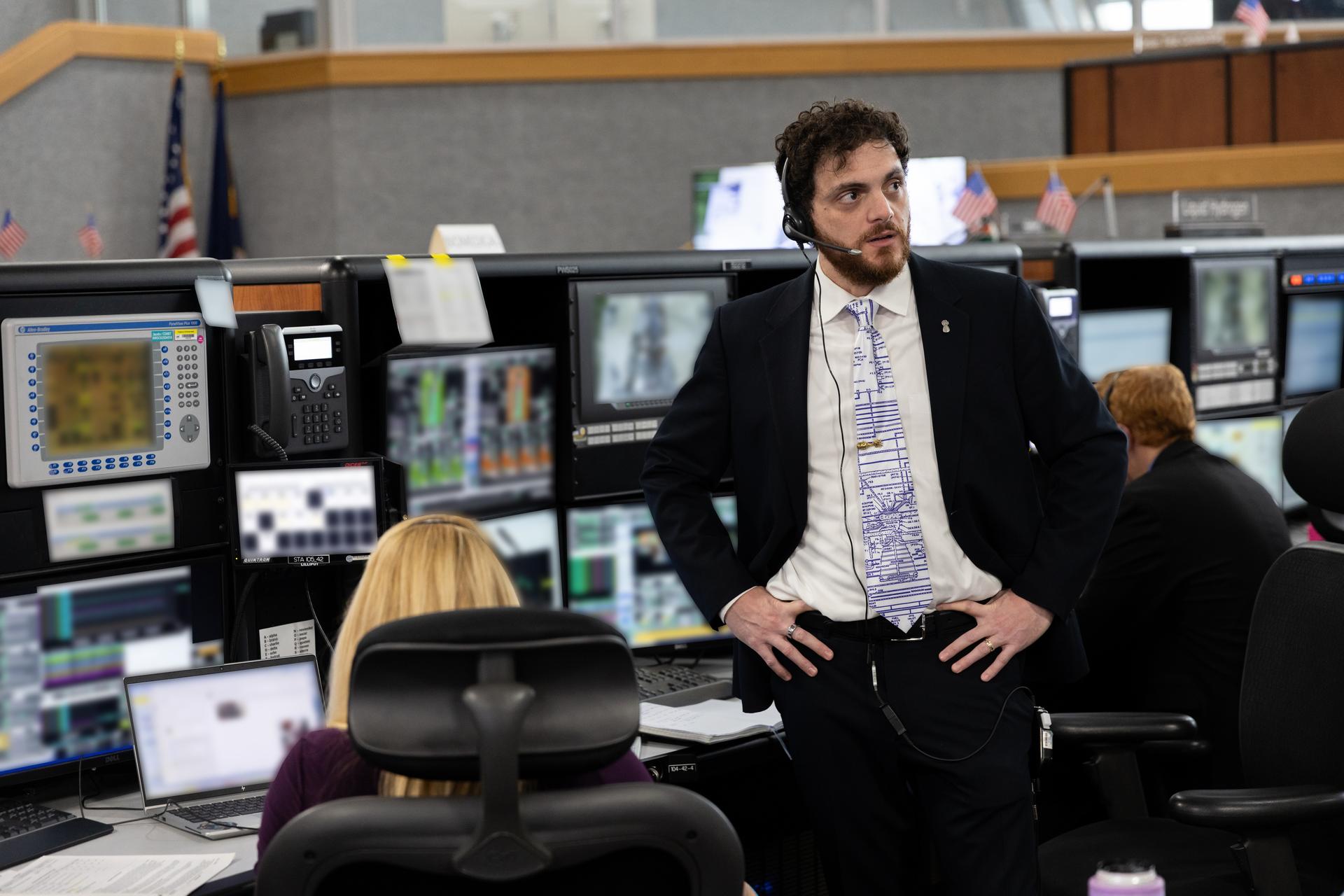
Kevin Todaro, Artemis launch team member, participates in the Artemis II terminal count simulation on Wednesday, Jan. 14, 2026, inside Firing Room 1 of the Rocco A. Petrone Launch Control Center at NASA’s Kennedy Space Center in Florida. The terminal count simulation conducted by NASA’s Exploration Ground Systems team runs through the final five hours of launch countdown, include terminal count - the remaining 10 minutes of the countdown - for NASA’s Artemis II test flight which will take Commander Reid Wiseman, Pilot Victor Glover, and Mission Specialist Christina Koch from NASA, and Mission Specialist Jeremy Hansen from the CSA (Canadian Space Agency), around the Moon and back to Earth no later than no later than April 2026 from Launch Complex 39B at NASA Kennedy.
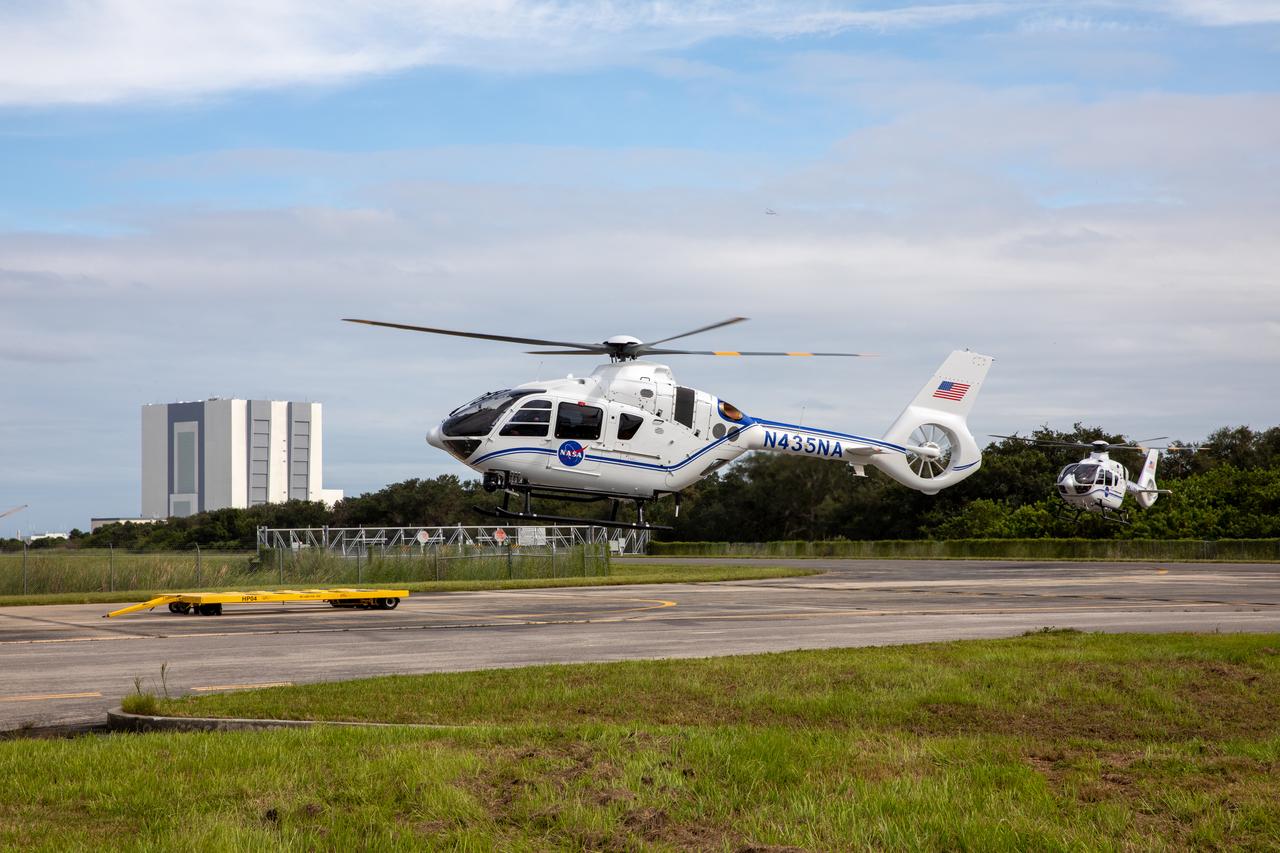
Two new Airbus H135 (T3) helicopters arrive at the Launch and Landing Facility runway at NASA’s Kennedy Space Center in Florida on Sept. 30, 2020. The H135 helicopters will replace the Bell Huey 2 security aircraft in service now, maintained by Kennedy’s Flight Operations team. These new helicopters provide a number of technological and safety advantages over the Hueys, such as more lifting power, greater stability in the air, and expanded medical capabilities. The team expects to fully transition to flying the two H135s later this year. A third is expected to arrive in early 2021, and with its arrival, will complete the fleet’s upgrade.
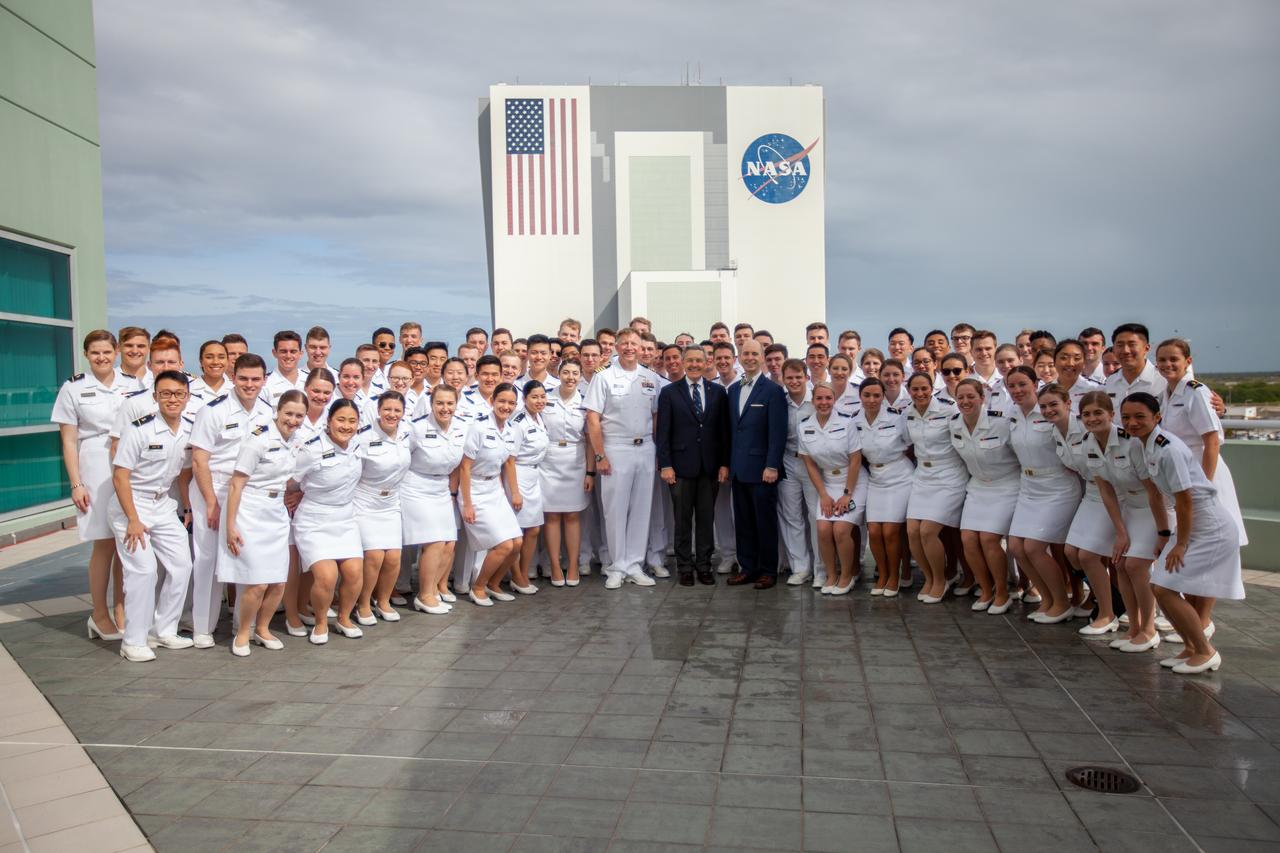
At center, from left to right, Captain Ben Shupp, commanding officer, Naval Ordnance Test Unit; Bob Cabana, Kennedy Space Center director; and Dr. Aaron Smith, director and chairman, Musical Activities Department, United States Naval Academy; pose with the U.S. Naval Academy Glee Club with the Florida spaceport’s Vehicle Assembly Building in the background on March 10, 2020. The highly acclaimed Glee Club, which performed for Kennedy employees, has achieved prominence as one of America’s premier choral ensembles.
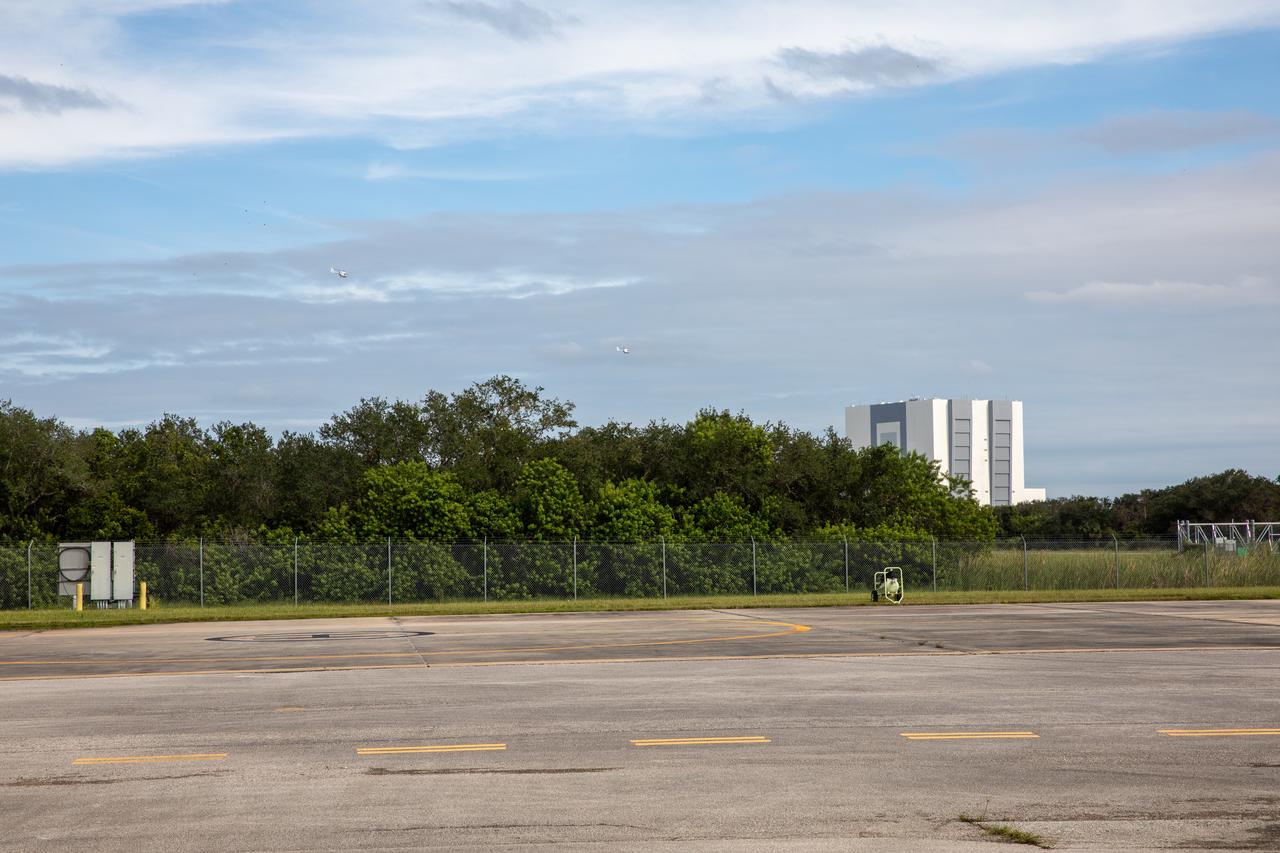
Two new Airbus H135 (T3) helicopters can be seen in the distance, arriving at the Launch and Landing Facility runway at NASA’s Kennedy Space Center in Florida on Sept. 30, 2020. The H135 helicopters will replace the Bell Huey 2 security aircraft in service now, maintained by Kennedy’s Flight Operations team. These new helicopters provide a number of technological and safety advantages over the Hueys, such as more lifting power, greater stability in the air, and expanded medical capabilities. The team expects to fully transition to flying the two H135s later this year. A third is expected to arrive in early 2021, and with its arrival, will complete the fleet’s upgrade.
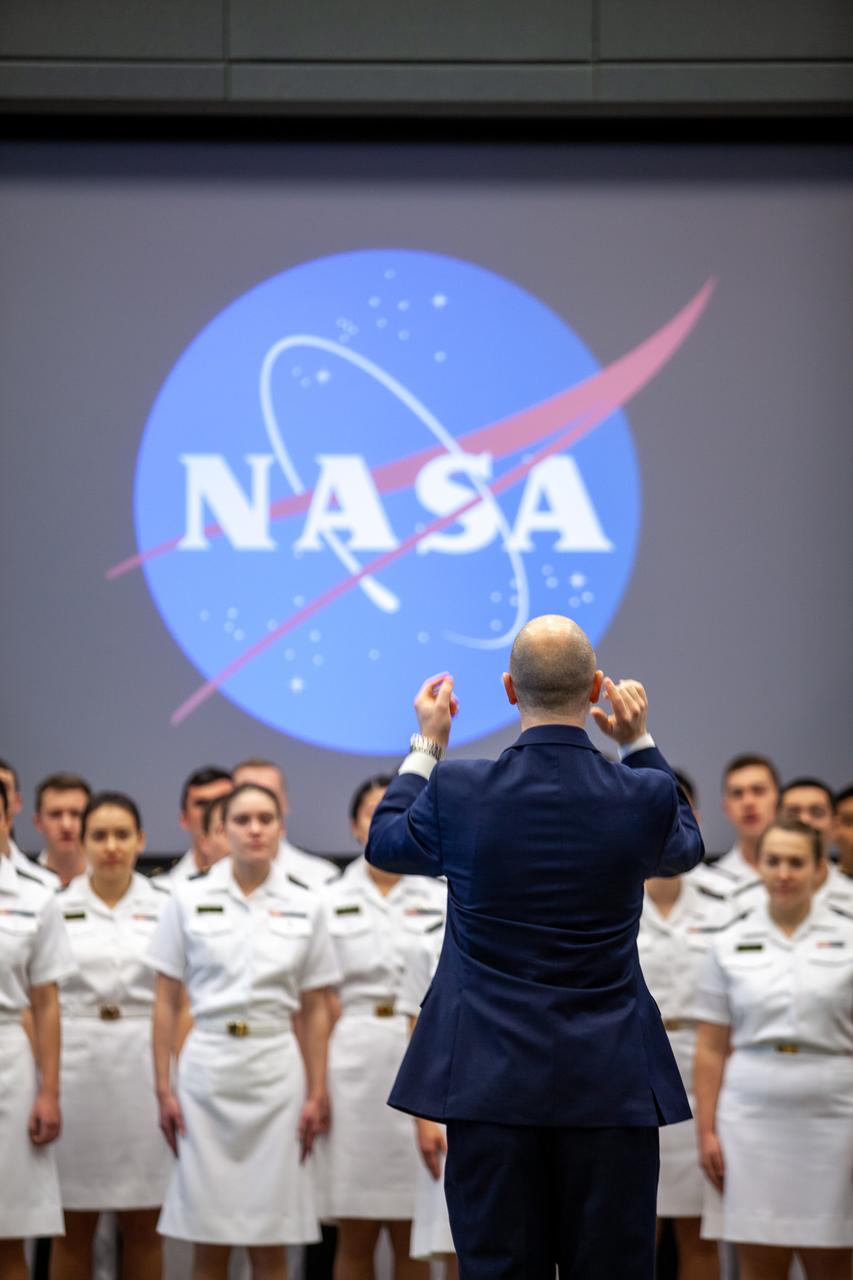
The United States Naval Academy Glee Club performs for Kennedy Space Center employees at the Florida spaceport on March 10, 2020. As part of the celebration, Kennedy Director Bob Cabana discussed the deep historical ties between NASA and the U.S. Navy. The highly acclaimed Glee Club has achieved prominence as one of America’s premier choral ensembles, performing throughout the nation each year.
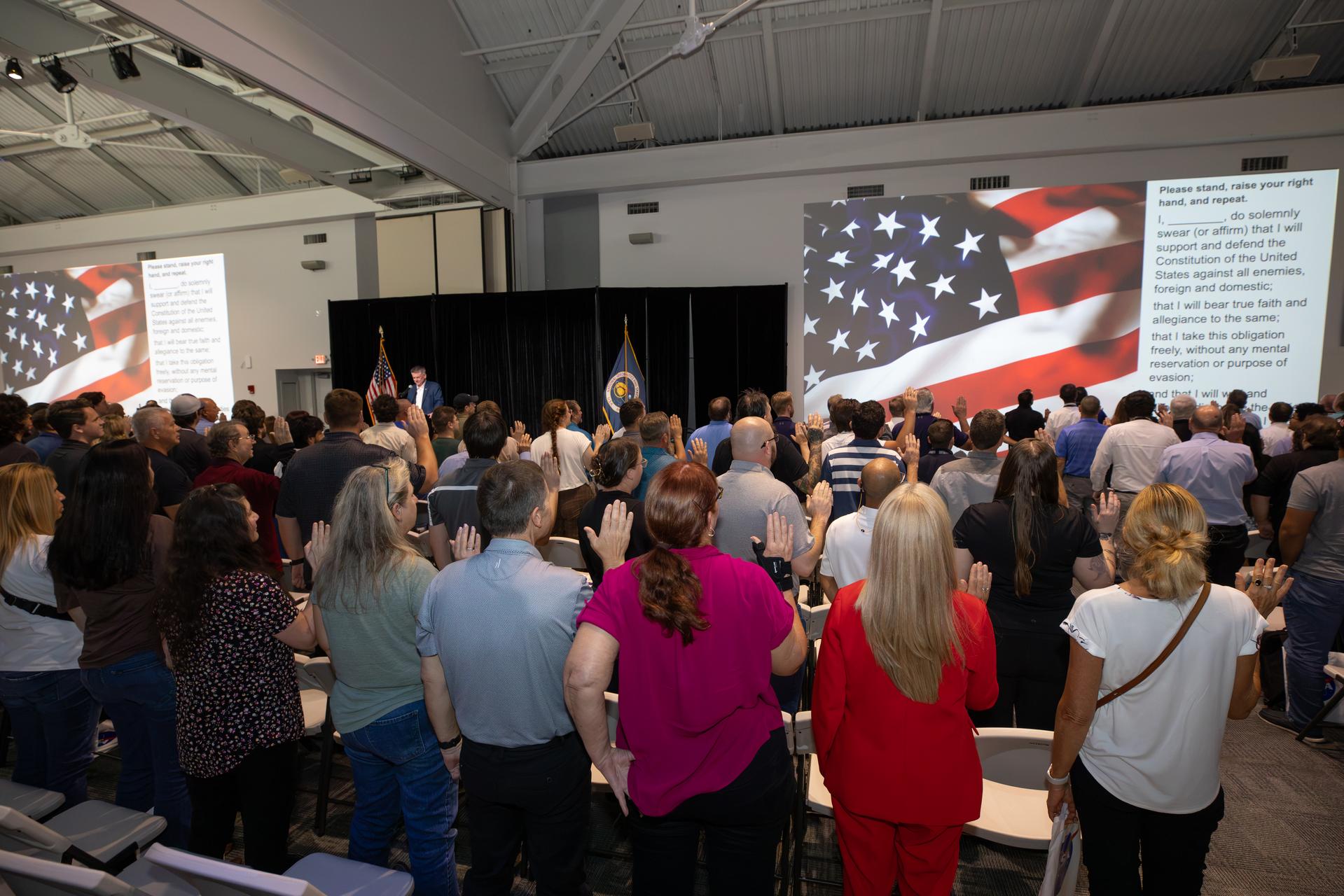
NASA’s Kennedy Space Center Director Brian Hughes (at podium) conducts a swearing-in ceremony for NASA’s latest civil servants on Monday, Aug. 24, 2026, inside the Astronauts Memorial Foundation’s Center for Space Education at the Kennedy Space Center Visitor Complex in Florida. The ceremony featured the swearing-in of employees formerly from the Consolidated Operations, Management, Engineering, and Test (COMET) contract, as well as outside hires, as part of the administrator’s workforce directive to restore technical core competencies within the civil servants ranks.

NASA’s Pegasus barge carrying a weather cover for the Artemis III SLS (Space Launch System) rocket core stage, arrives Sunday, June 21, 2026, at the Launch Complex 39 turn basin at the agency’s Kennedy Space Center in Florida. The cover will protect the stage’s thermal systems while SLS sits atop the mobile launcher at Launch Pad 39B in its short stack configuration. NASA will send four Artemis astronauts on increasingly difficult missions to explore more of the Moon for scientific discovery, economic benefits, establish an enduring human presence on the lunar surface, and to build on our foundation for the first crewed missions to Mars.
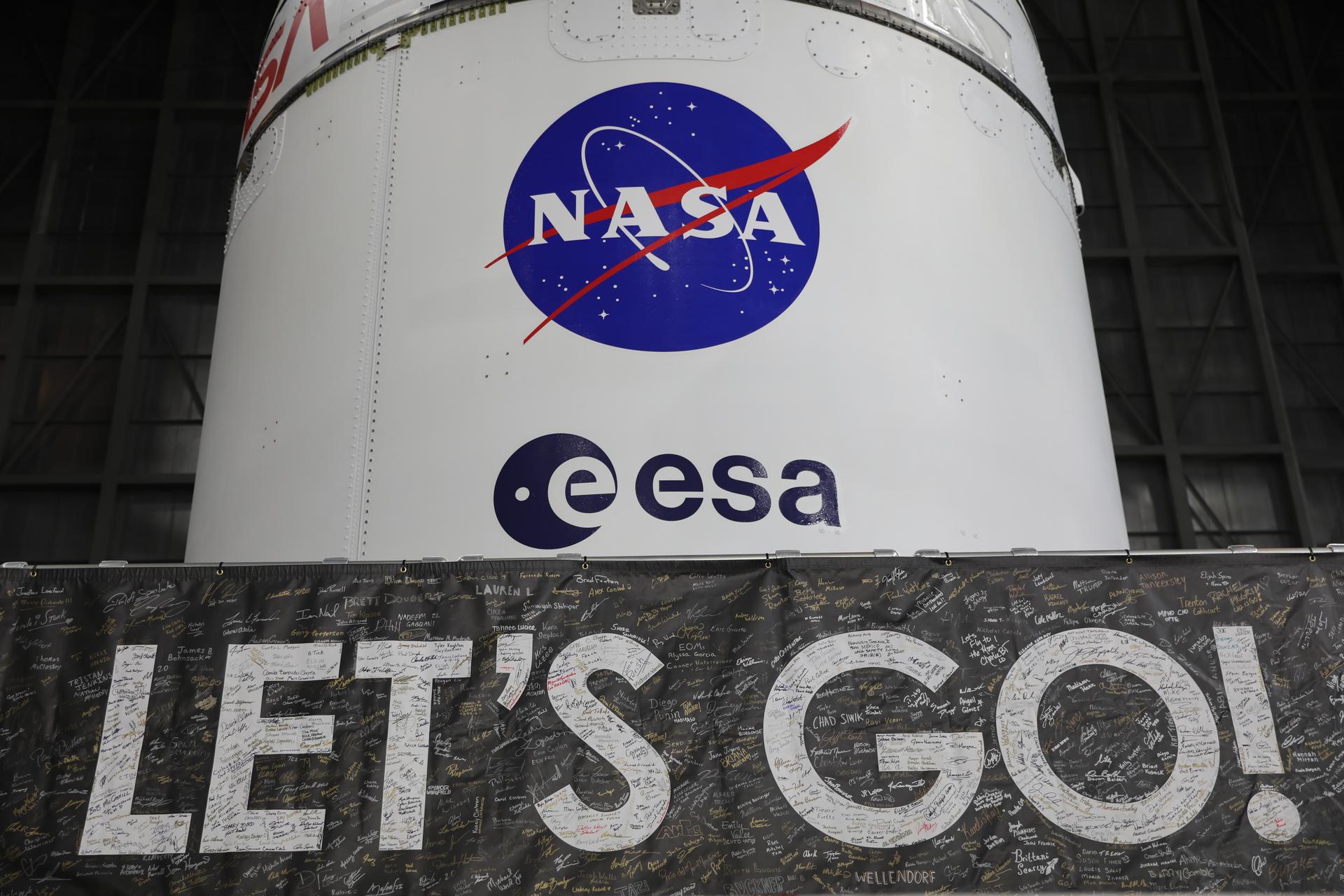
Technicians with NASA’s Exploration Ground Systems team prepare for integration to attach the agency’s Orion spacecraft on top of the SLS (Space Launch System) rocket in High Bay 3 of the Vehicle Assembly Building at NASA’s Kennedy Space Center in Florida on Friday, Oct. 17, 2025, for the agency’s Artemis II mission. Set to launch in 2026, the spacecraft will carry NASA astronauts Reid Wiseman, Victor Glover, Christina Koch, and CSA (Canadian Space Agency) astronaut Jeremy Hansen on a 10-day mission around the Moon and back. Once stacked, teams will begin conducting a series of verification tests ahead of rolling out to Launch Complex 39B for the wet dress rehearsal at NASA Kennedy.
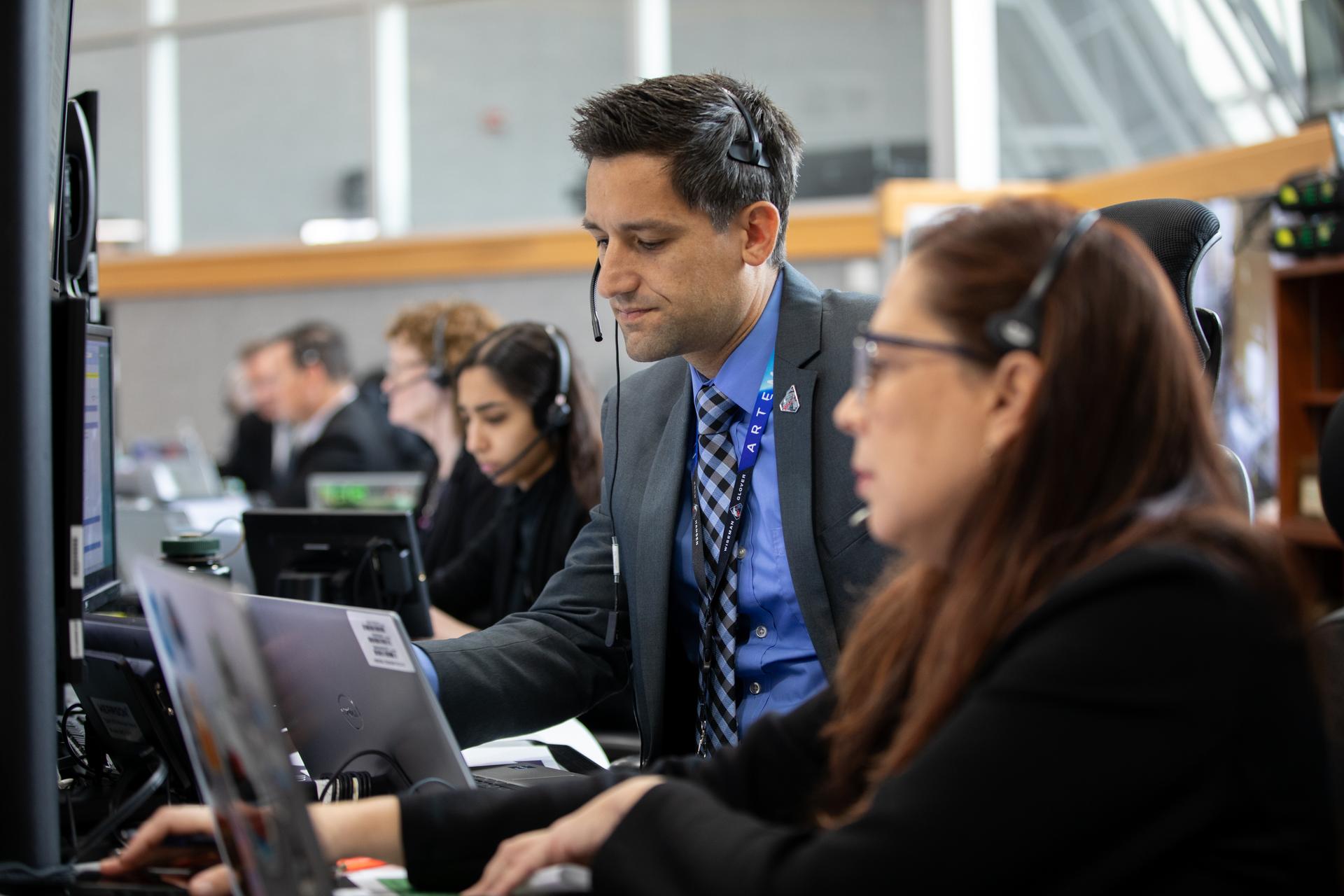
From left, Dan Florez, NASA test director, and Lili Villarreal, Artemis II landing and recovery director, participate in the Artemis II terminal count simulation on Wednesday, Jan. 14, 2026, inside Firing Room 1 of the Rocco A. Petrone Launch Control Center at NASA’s Kennedy Space Center in Florida. The terminal count simulation conducted by NASA’s Exploration Ground Systems team runs through the final five hours of launch countdown, include terminal count - the remaining 10 minutes of the countdown - for NASA’s Artemis II test flight which will take Commander Reid Wiseman, Pilot Victor Glover, and Mission Specialist Christina Koch from NASA, and Mission Specialist Jeremy Hansen from the CSA (Canadian Space Agency), around the Moon and back to Earth no later than no later than April 2026 from Launch Complex 39B at NASA Kennedy.

NASA’s Pegasus barge arrives at the Launch Complex 39 turn basin at the agency’s Kennedy Space Center in Florida carrying NASA’s Nancy Grace Roman Space Telescope on Sunday, June 21, 2026. Teams will offload and transport the observatory to the spaceport’s Payload Hazardous Servicing Facility where it will undergo processing ahead of launch, targeted no earlier than Sunday, Aug. 30, 2026. Named for NASA’s first chief astronomer and “mother of the Hubble Space Telescope,” Roman will offer a field of view over 100 times larger than Hubble’s to study up to a billion galaxies, directly image exoplanets and planet‑forming disks, and address fundamental questions about dark energy, exoplanets, and infrared astrophysics.
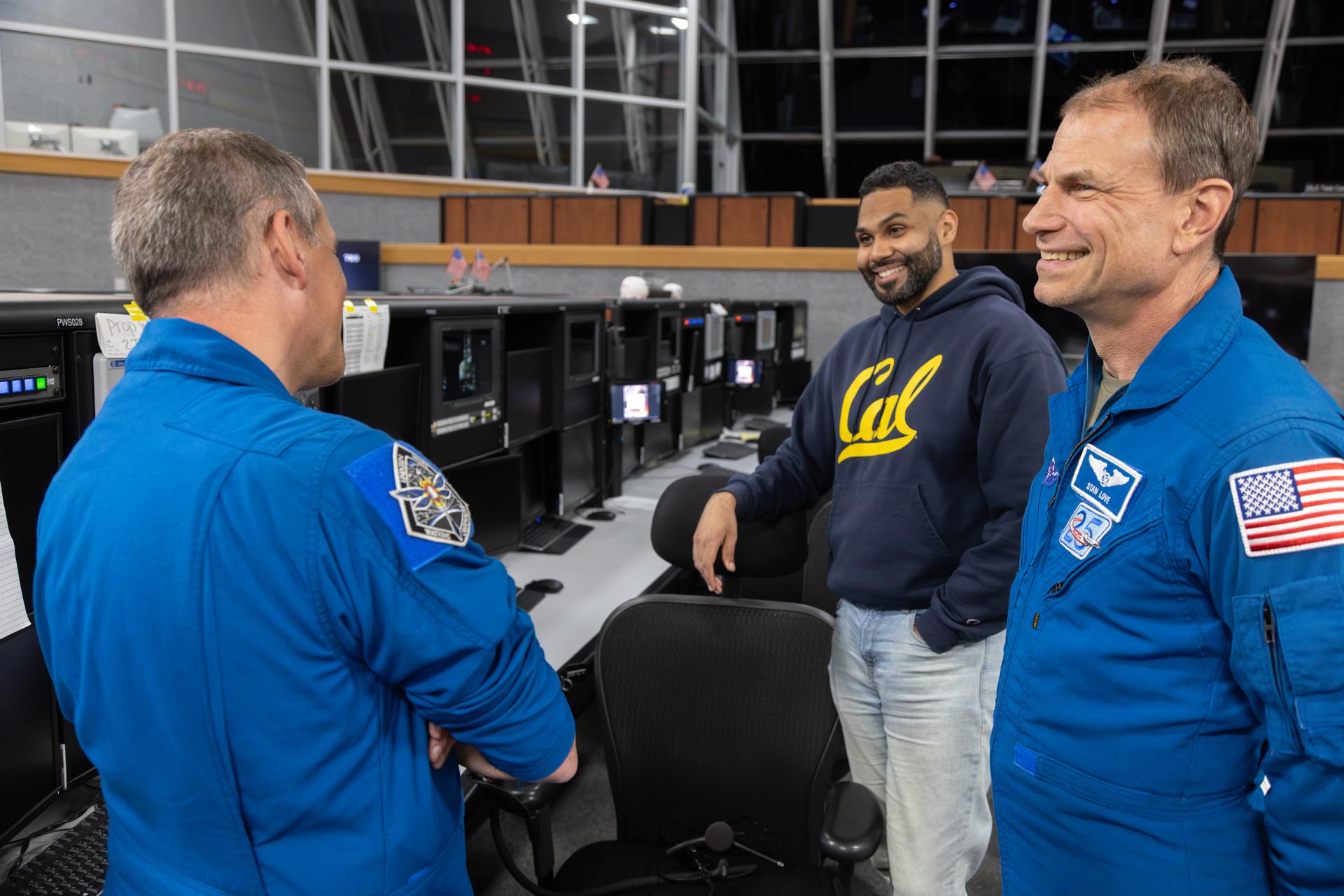
From left, NASA astronauts Bob Hines and Stan Love talk with Mike Guzman, Artemis launch team member, inside Firing Room 1 of the Rocco A. Petrone Launch Control Center during the Artemis II rollout of the SLS (Space Launch System) rocket and Orion spacecraft from the Vehicle Assembly Building to Launch Complex 39B at NASA’s Kennedy Space Center in Florida on Friday, March, 20, 2026. The Artemis II test flight will take Commander Reid Wiseman, Pilot Victor Glover, and Mission Specialist Christina Koch from NASA, and Mission Specialist Jeremy Hansen from the CSA (Canadian Space Agency), around the Moon and back to Earth with launch opportunities beginning in April 2026.

NASA Associate Administrator Amit Kshatriya participates in the Artemis II Flight Readiness Review with NASA leadership on Wednesday, March 11, 2026, at NASA’s Kennedy Space Center in Florida. The review is an assessment of the readiness of NASA’s SLS (Space Launch System) rocket and Orion spacecraft to support the Artemis II test flight as four astronauts journey around the Moon and return to Earth.
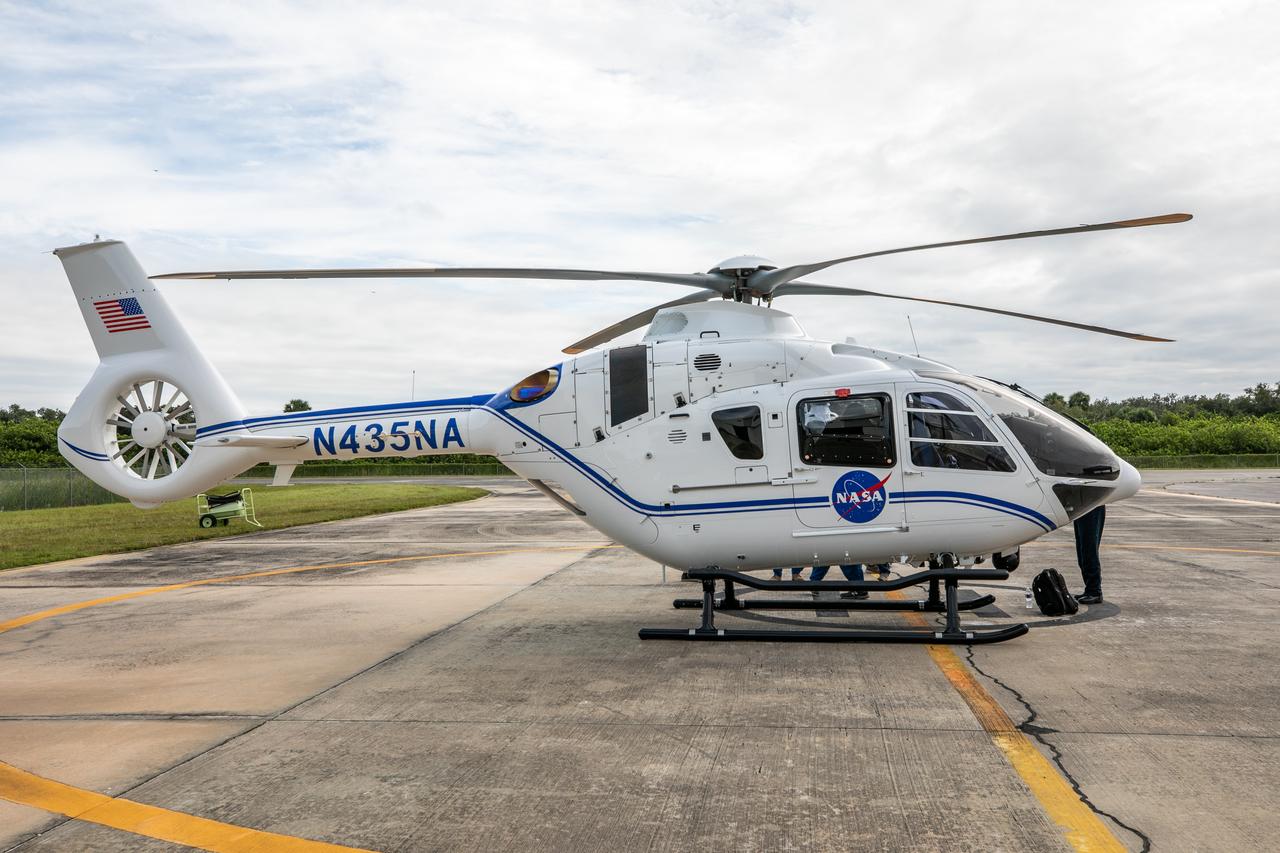
A new Airbus H135 (T3) helicopter arrives at the Launch and Landing Facility runway at NASA’s Kennedy Space Center in Florida on Sept. 30, 2020. A second H135 helicopter also was delivered on Sept. 30, and a third is expected to arrive in early 2021. The three H135 helicopters will replace the Bell Huey 2 security aircraft in service now, maintained by Kennedy’s Flight Operations team. These new helicopters provide a number of technological and safety advantages over the Hueys, such as more lifting power, greater stability in the air, and expanded medical capabilities. The team expects to fully transition to flying the two H135s later this year, and once the third arrives, the fleet’s upgrade will be complete.