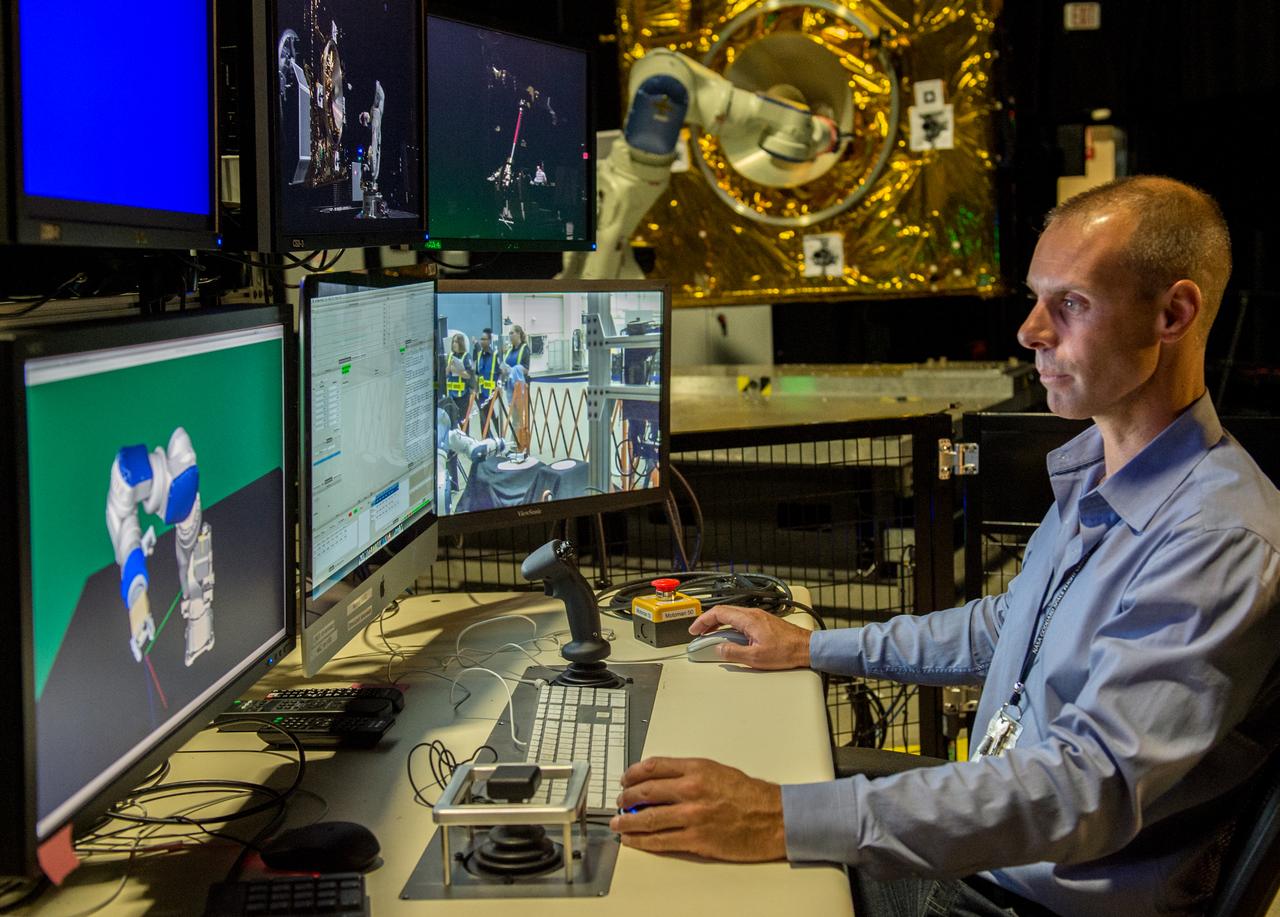
Buildings 7 & 29. Explore@NASAGoddard celebrates the 25th anniversary of the launch of the Hubble Space Telescope. All areas of Goddard’s research – Earth science, heliophysics, planetary science, astrophysics, and engineering and technology – will be presented, as each discipline plays a critical part in NASA's ongoing journey to reach new heights.
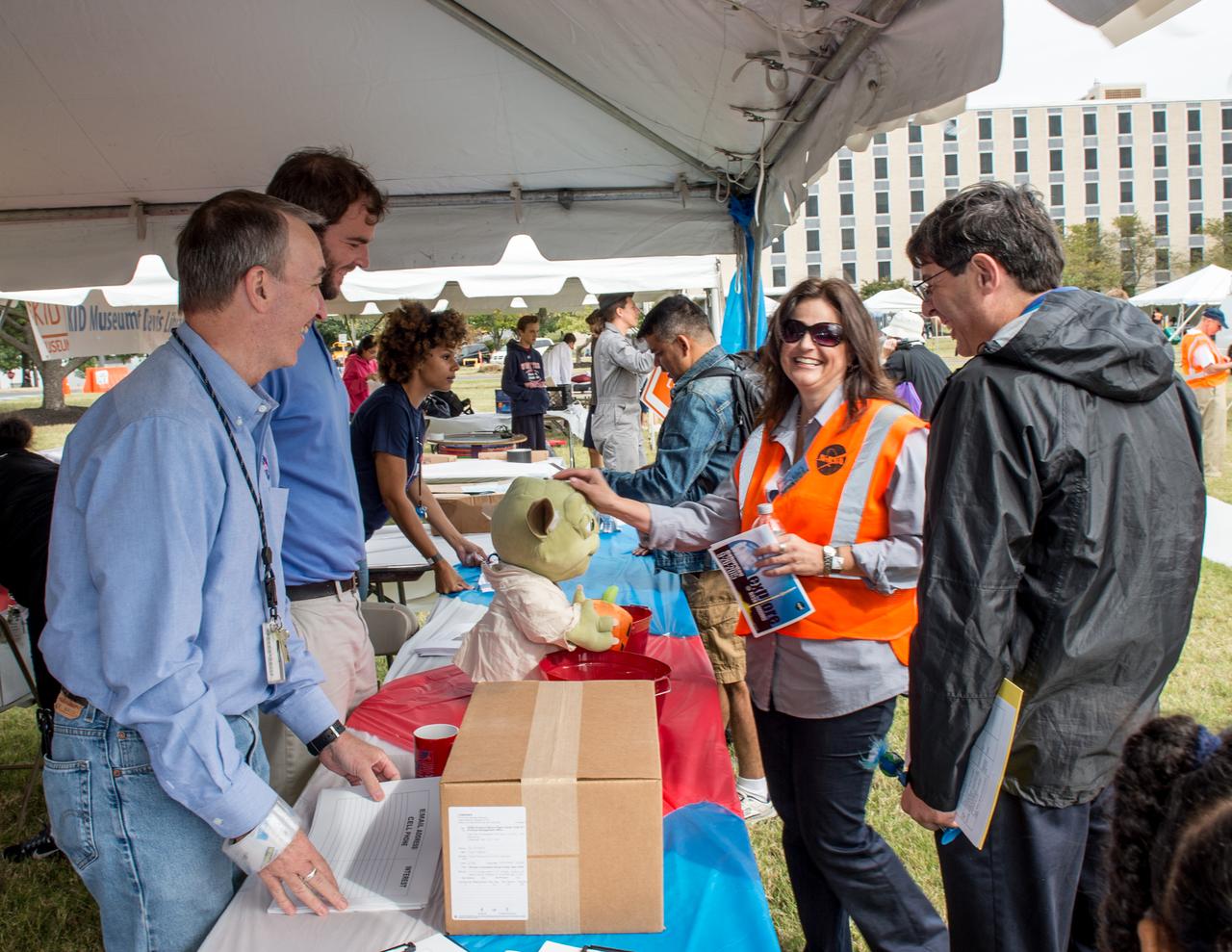
Center Director Chris Scolese visits displays at Explore@NASAGoddard celebrates the 25th anniversary of the launch of the Hubble Space Telescope. All areas of Goddard’s research – Earth science, heliophysics, planetary science, astrophysics, and engineering and technology – will be presented, as each discipline plays a critical part in NASA's ongoing journey to reach new heights.
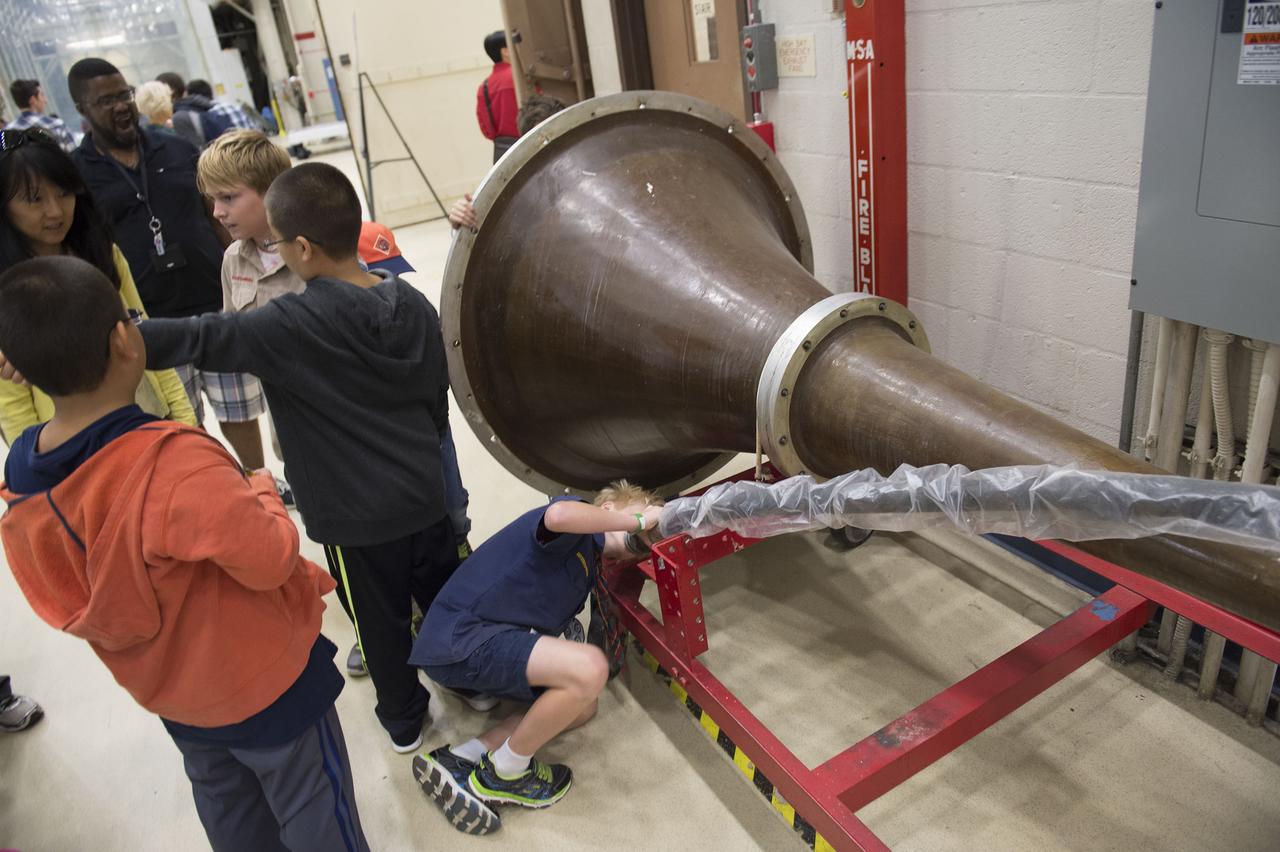
Buildings 7 & 29. Explore@NASAGoddard celebrates the 25th anniversary of the launch of the Hubble Space Telescope. All areas of Goddard’s research – Earth science, heliophysics, planetary science, astrophysics, and engineering and technology – will be presented, as each discipline plays a critical part in NASA's ongoing journey to reach new heights.
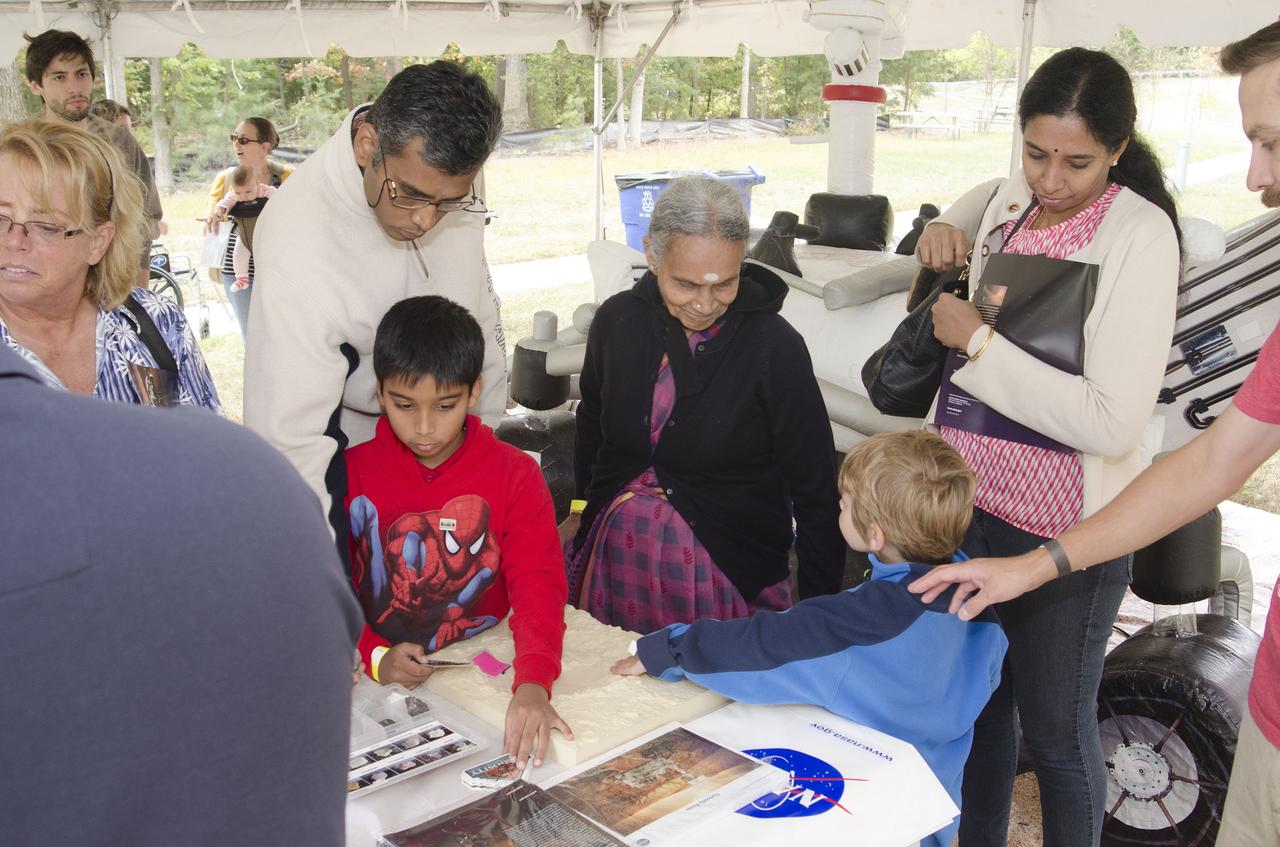
Explore@NASAGoddard celebrates the 25th anniversary of the launch of the Hubble Space Telescope. All areas of Goddard’s research – Earth science, heliophysics, planetary science, astrophysics, and engineering and technology – will be presented, as each discipline plays a critical part in NASA's ongoing journey to reach new heights.
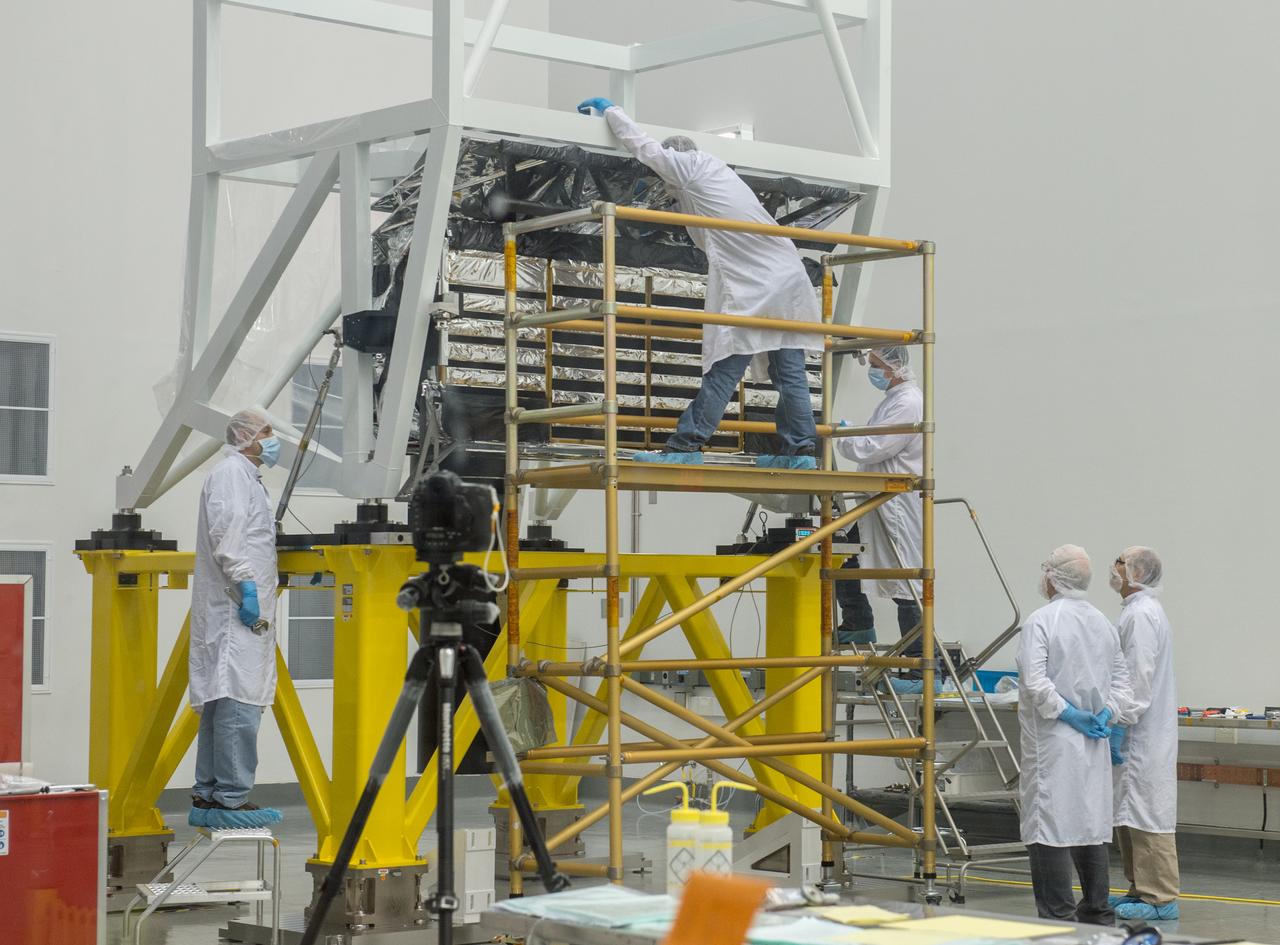
Buildings 7 & 29. Explore@NASAGoddard celebrates the 25th anniversary of the launch of the Hubble Space Telescope. All areas of Goddard’s research – Earth science, heliophysics, planetary science, astrophysics, and engineering and technology – will be presented, as each discipline plays a critical part in NASA's ongoing journey to reach new heights.
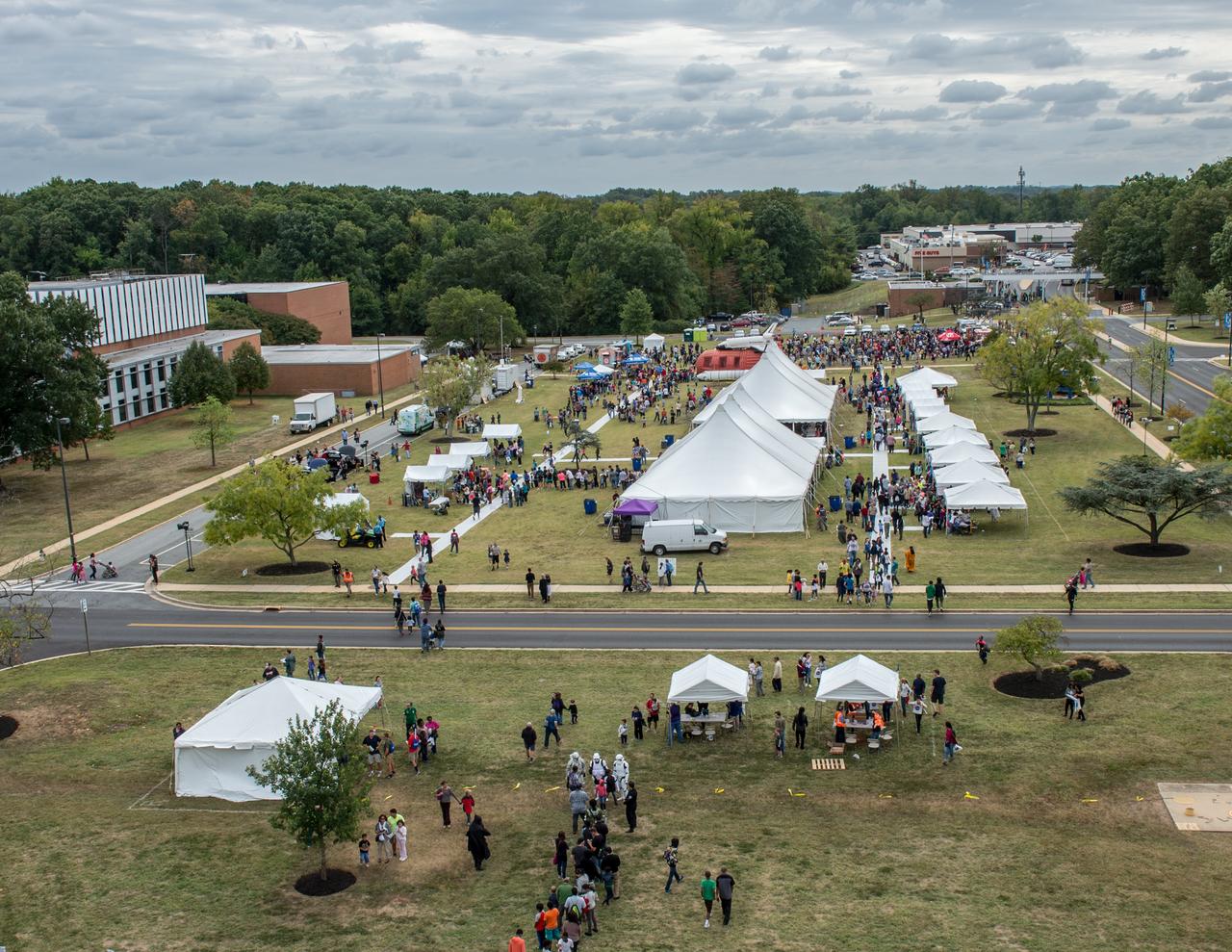
Explore@NASAGoddard celebrates the 25th anniversary of the launch of the Hubble Space Telescope. All areas of Goddard’s research – Earth science, heliophysics, planetary science, astrophysics, and engineering and technology – will be presented, as each discipline plays a critical part in NASA's ongoing journey to reach new heights.
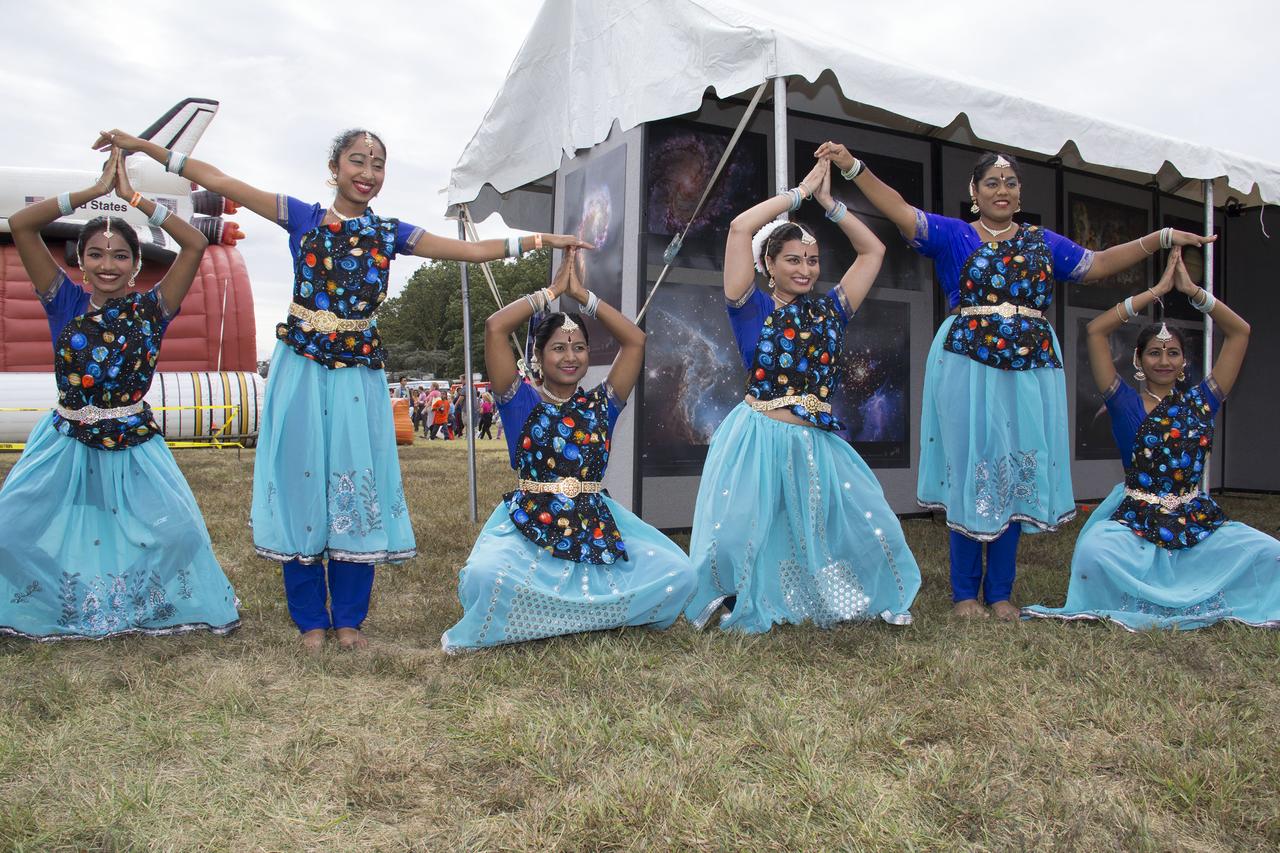
Explore@NASAGoddard celebrates the 25th anniversary of the launch of the Hubble Space Telescope. All areas of Goddard’s research – Earth science, heliophysics, planetary science, astrophysics, and engineering and technology – will be presented, as each discipline plays a critical part in NASA's ongoing journey to reach new heights.
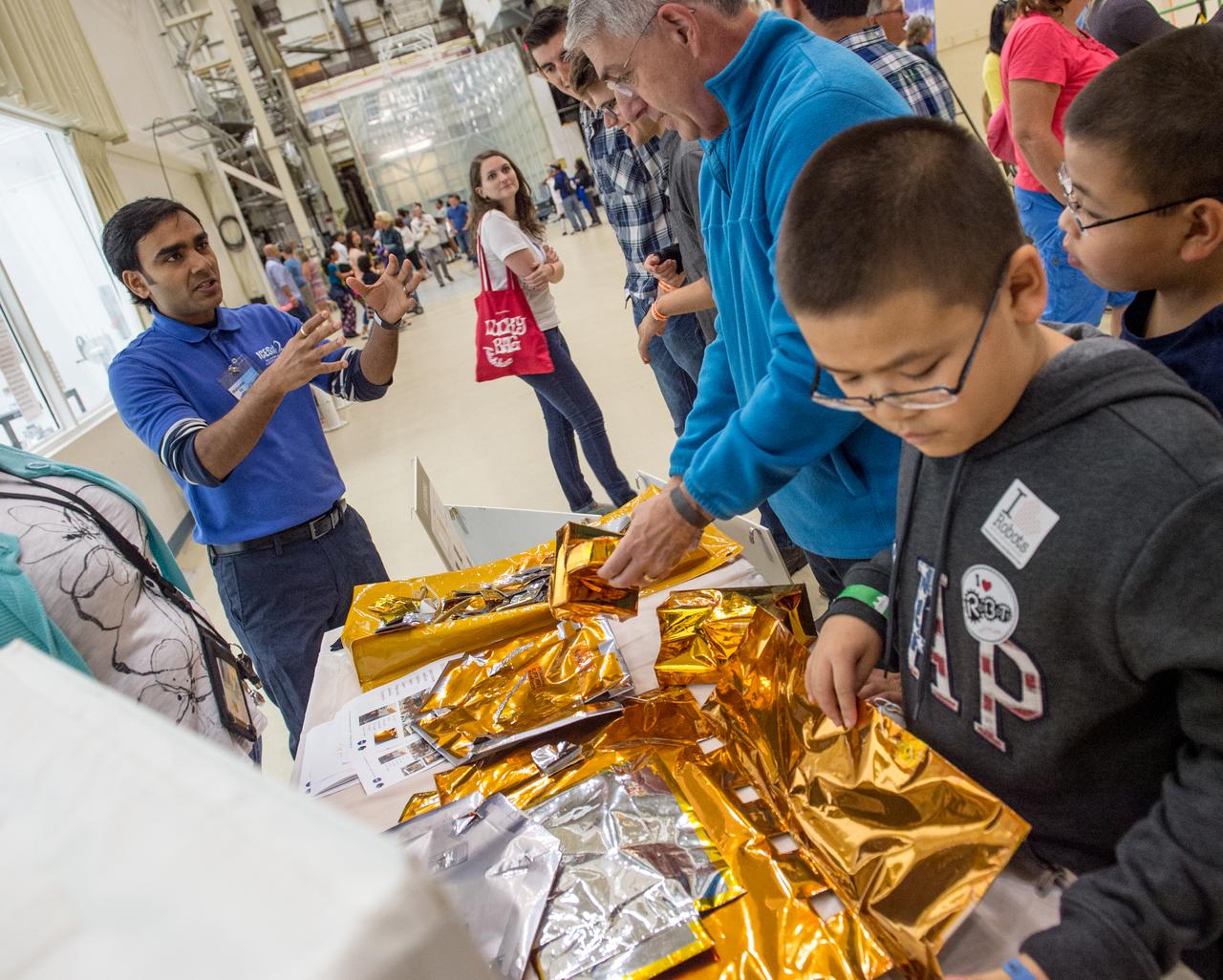
Buildings 7 & 29. Explore@NASAGoddard celebrates the 25th anniversary of the launch of the Hubble Space Telescope. All areas of Goddard’s research – Earth science, heliophysics, planetary science, astrophysics, and engineering and technology – will be presented, as each discipline plays a critical part in NASA's ongoing journey to reach new heights.
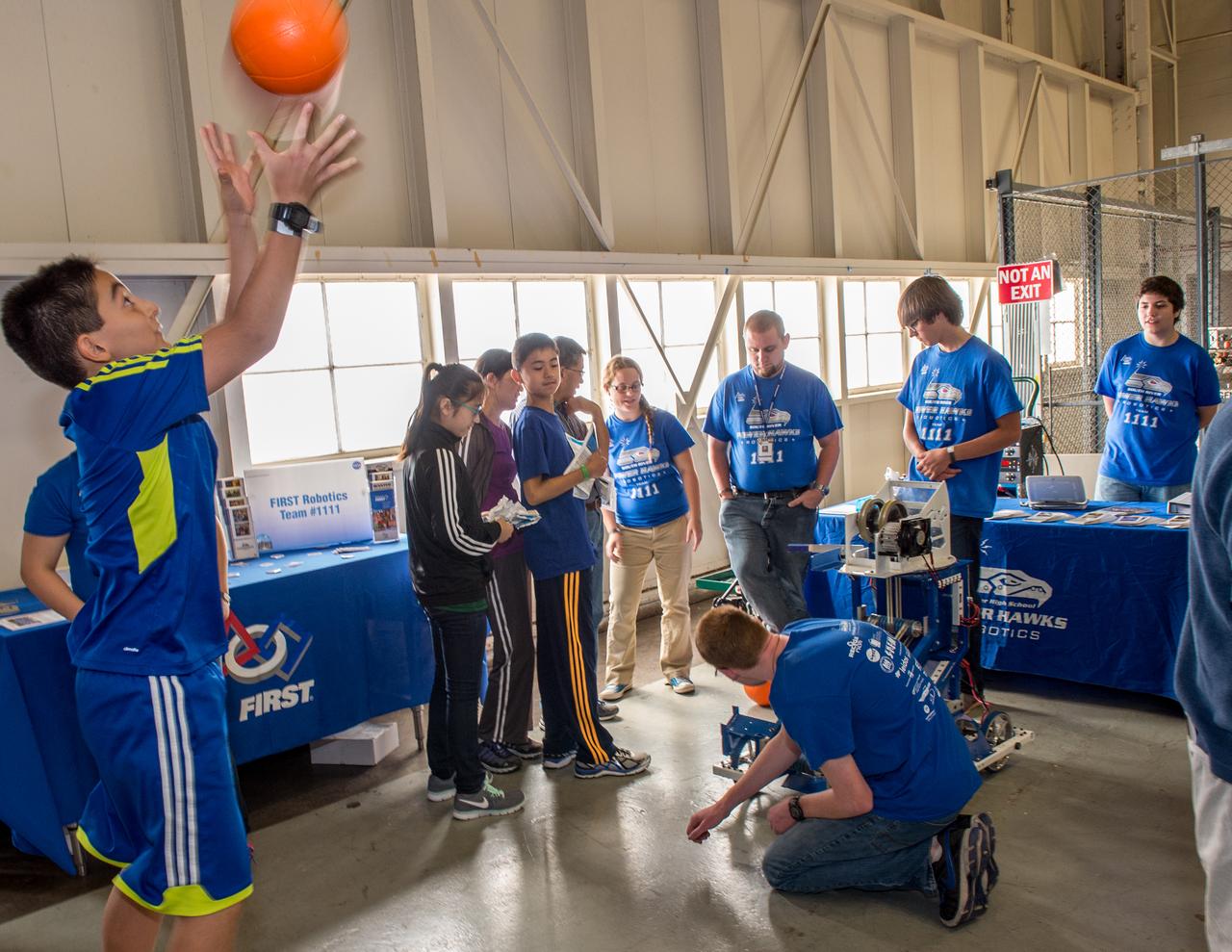
Building 5 Manufacturing Branch. Explore@NASAGoddard celebrates the 25th anniversary of the launch of the Hubble Space Telescope. All areas of Goddard’s research – Earth science, heliophysics, planetary science, astrophysics, and engineering and technology – will be presented, as each discipline plays a critical part in NASA's ongoing journey to reach new heights.
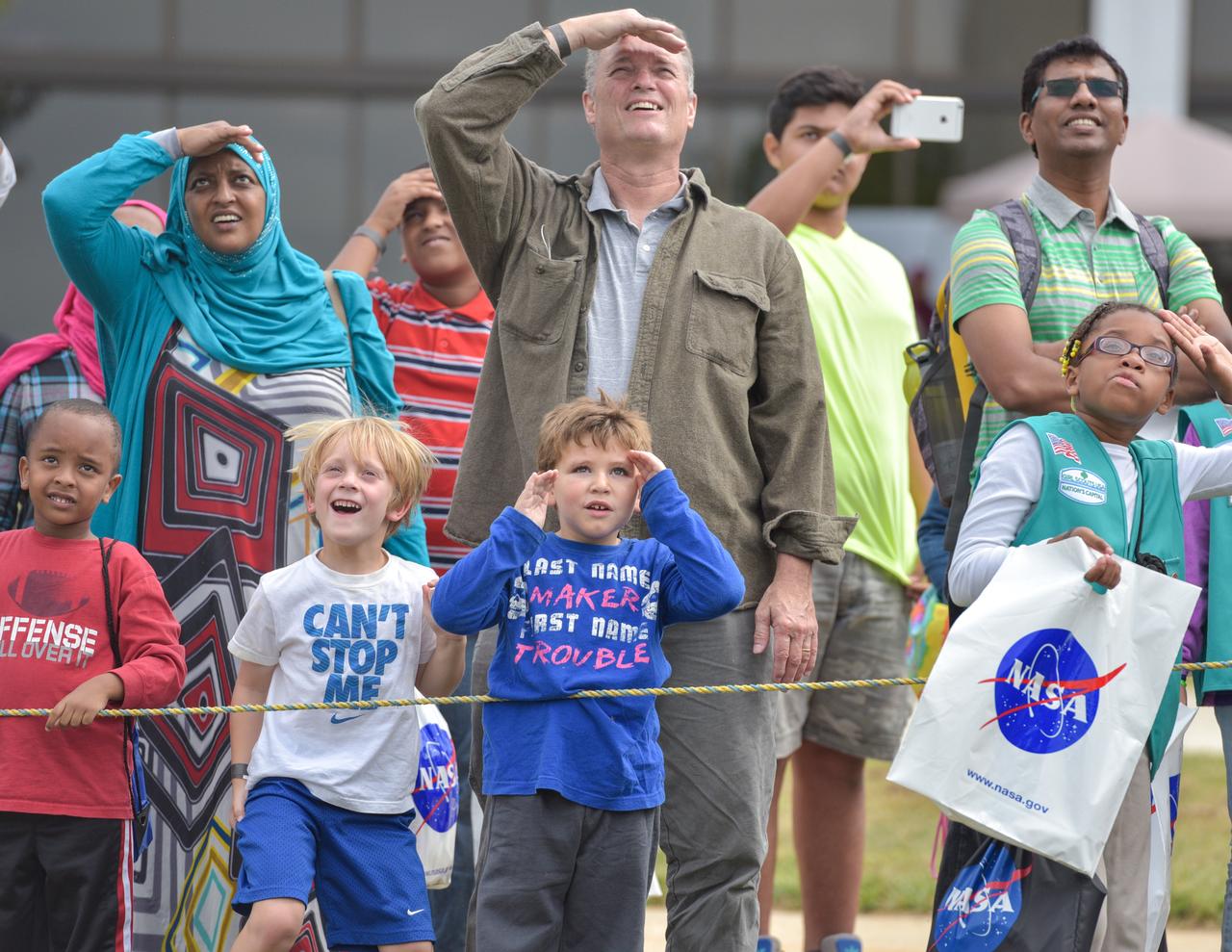
Explore@NASAGoddard celebrates the 25th anniversary of the launch of the Hubble Space Telescope. All areas of Goddard’s research – Earth science, heliophysics, planetary science, astrophysics, and engineering and technology – will be presented, as each discipline plays a critical part in NASA's ongoing journey to reach new heights.
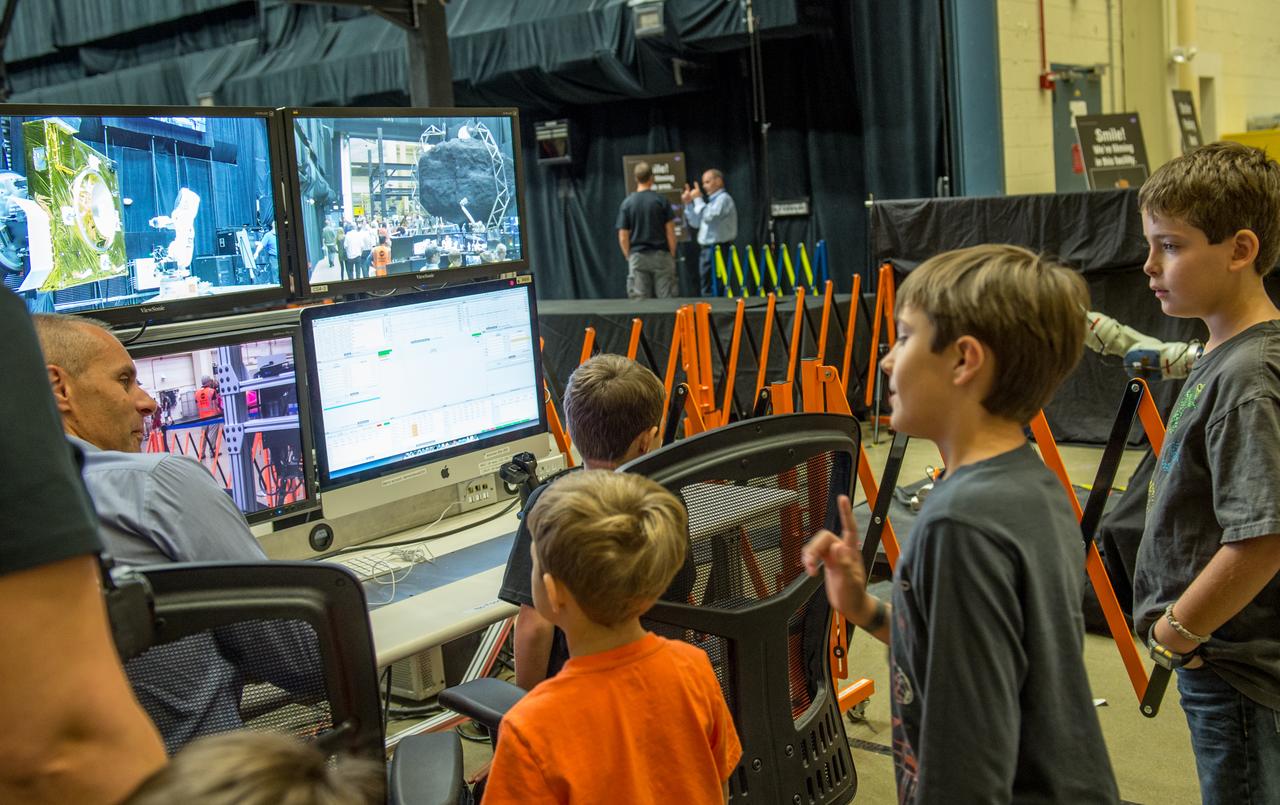
Buildings 7 & 29. Explore@NASAGoddard celebrates the 25th anniversary of the launch of the Hubble Space Telescope. All areas of Goddard’s research – Earth science, heliophysics, planetary science, astrophysics, and engineering and technology – will be presented, as each discipline plays a critical part in NASA's ongoing journey to reach new heights.
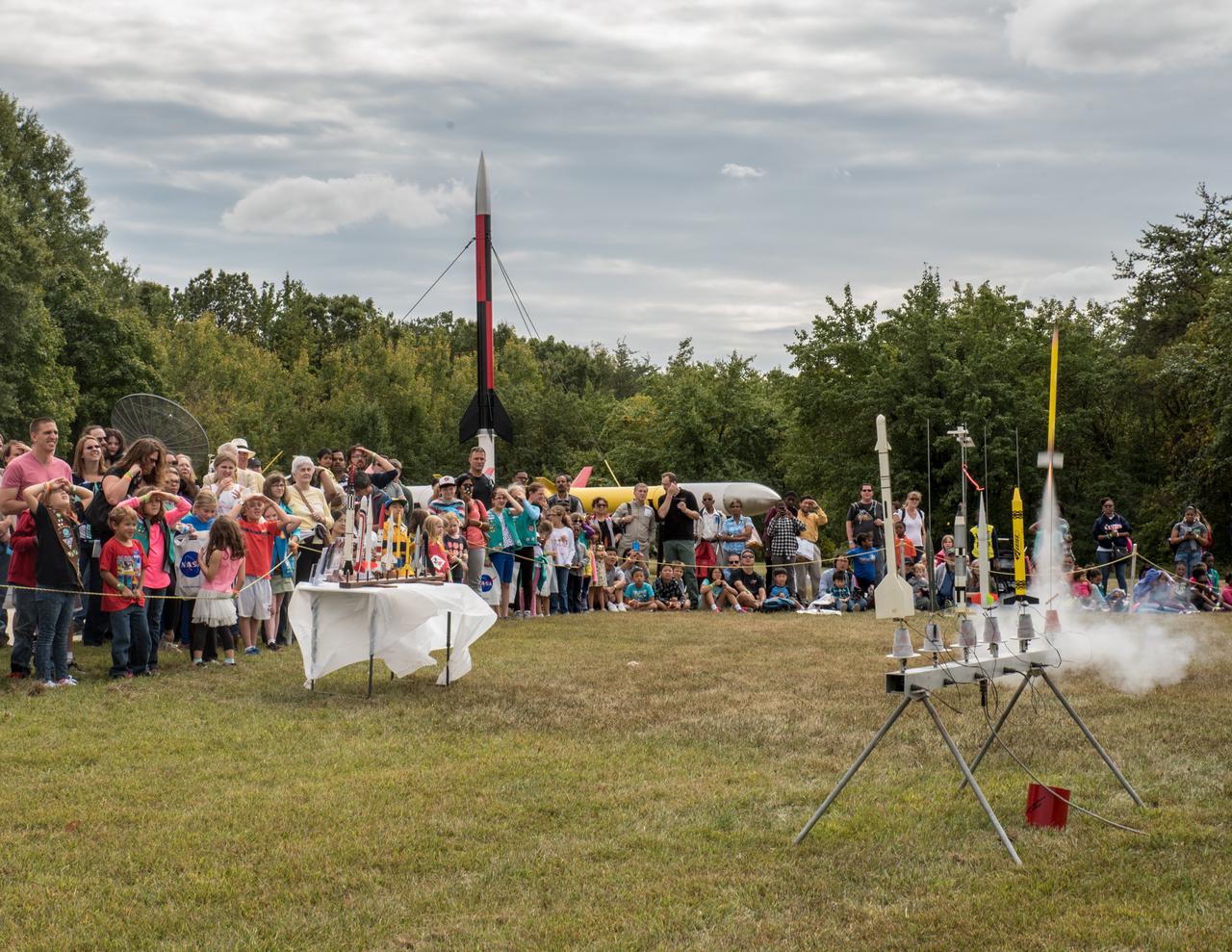
Explore@NASAGoddard celebrates the 25th anniversary of the launch of the Hubble Space Telescope. All areas of Goddard’s research – Earth science, heliophysics, planetary science, astrophysics, and engineering and technology – will be presented, as each discipline plays a critical part in NASA's ongoing journey to reach new heights.
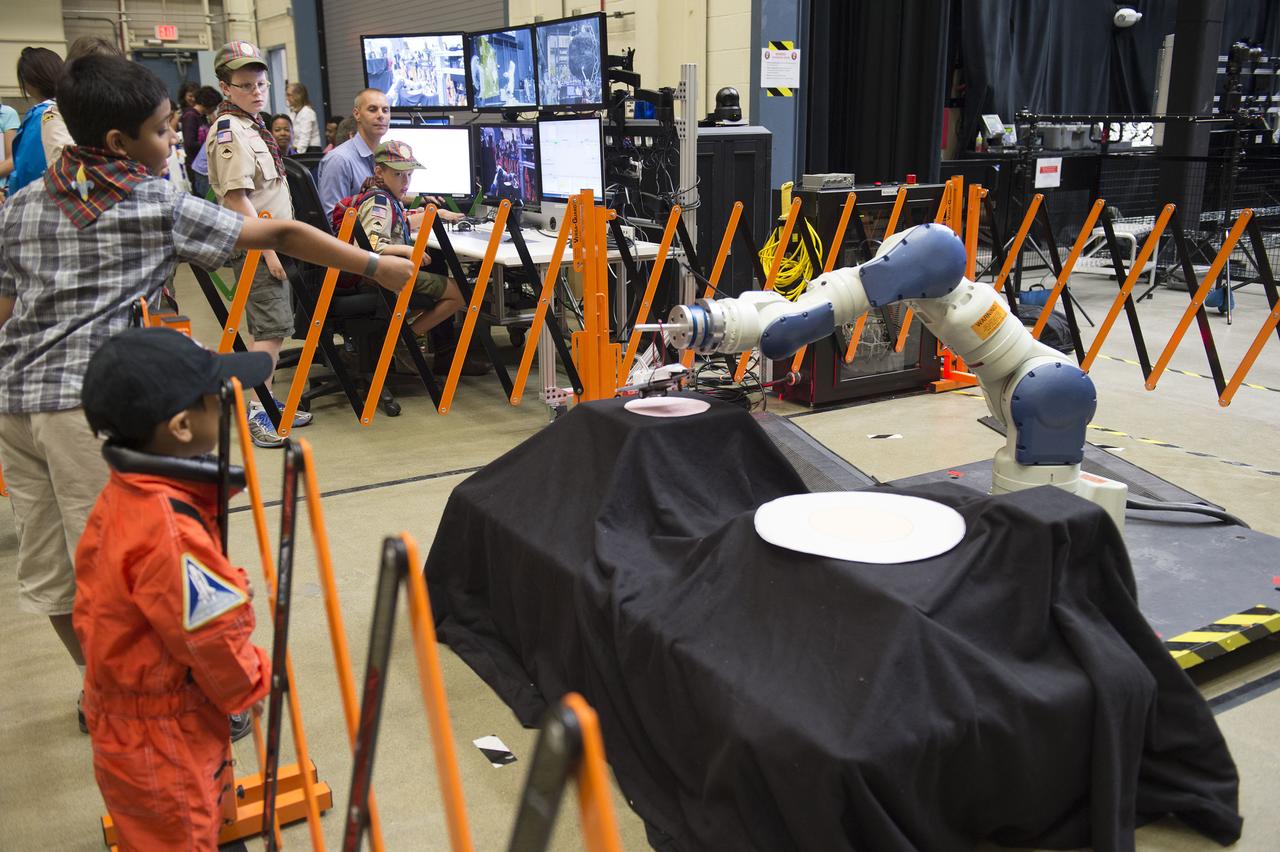
Buildings 7 & 29. Explore@NASAGoddard celebrates the 25th anniversary of the launch of the Hubble Space Telescope. All areas of Goddard’s research – Earth science, heliophysics, planetary science, astrophysics, and engineering and technology – will be presented, as each discipline plays a critical part in NASA's ongoing journey to reach new heights.
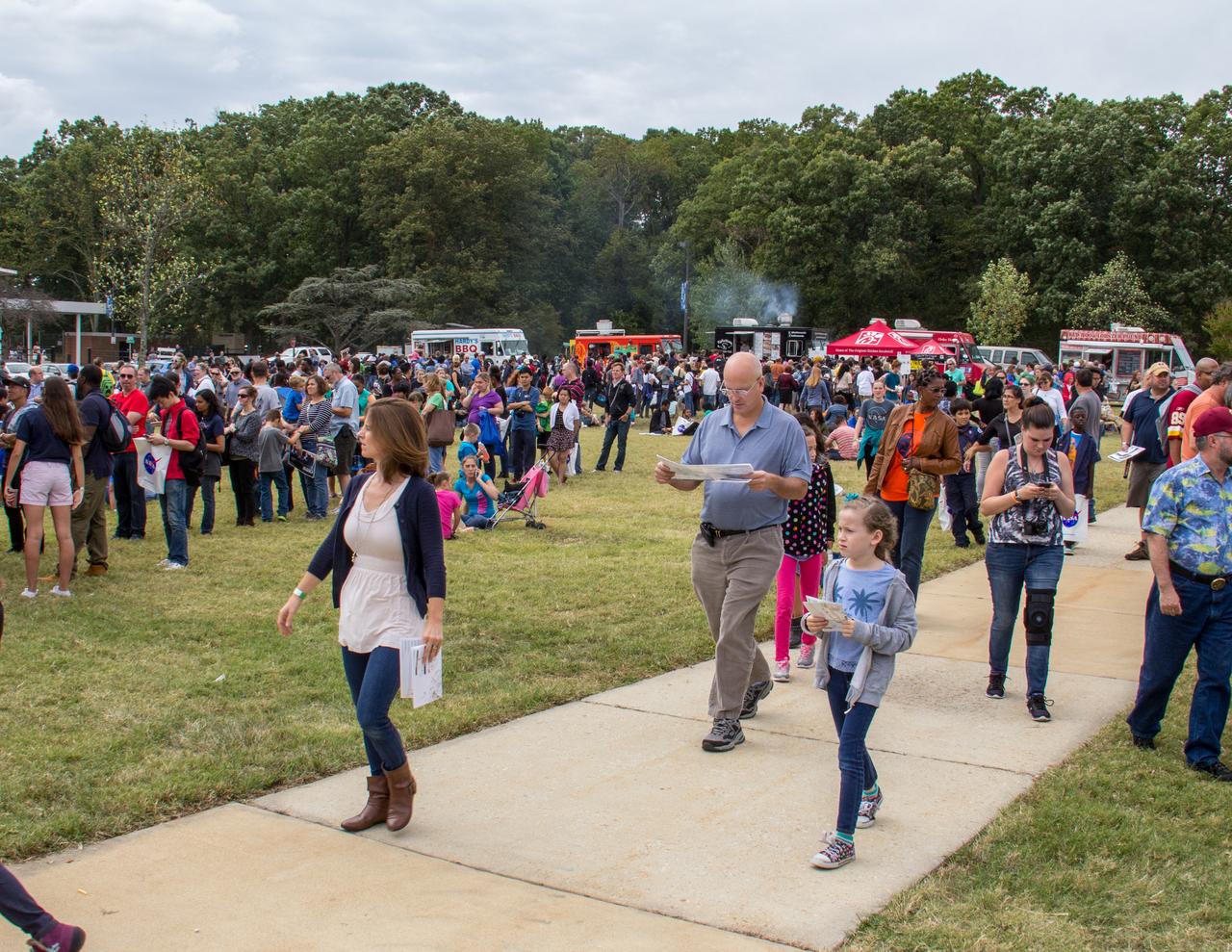
Explore@NASAGoddard celebrates the 25th anniversary of the launch of the Hubble Space Telescope. All areas of Goddard’s research – Earth science, heliophysics, planetary science, astrophysics, and engineering and technology – will be presented, as each discipline plays a critical part in NASA's ongoing journey to reach new heights.
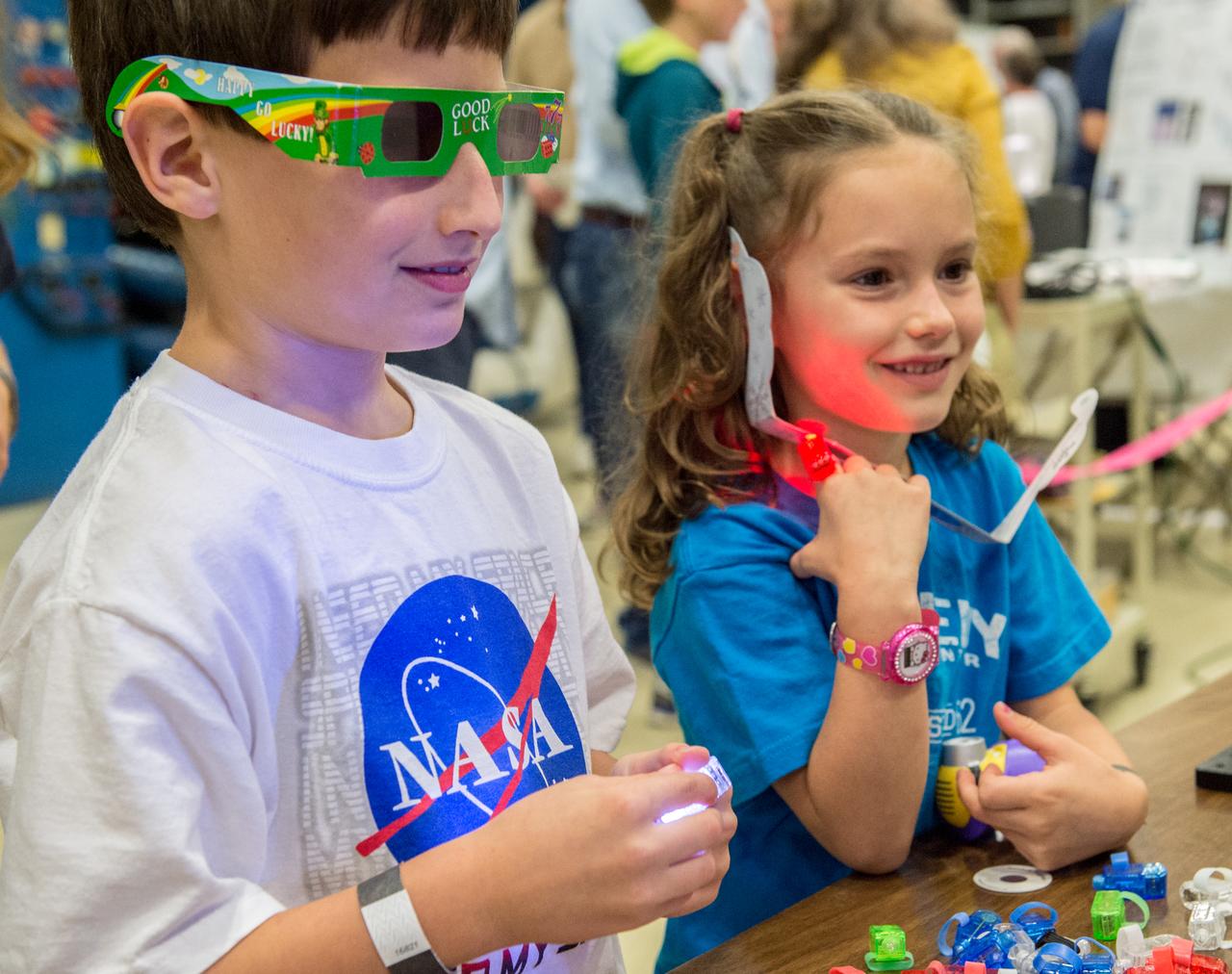
Buildings 7 & 29. Explore@NASAGoddard celebrates the 25th anniversary of the launch of the Hubble Space Telescope. All areas of Goddard’s research – Earth science, heliophysics, planetary science, astrophysics, and engineering and technology – will be presented, as each discipline plays a critical part in NASA's ongoing journey to reach new heights.
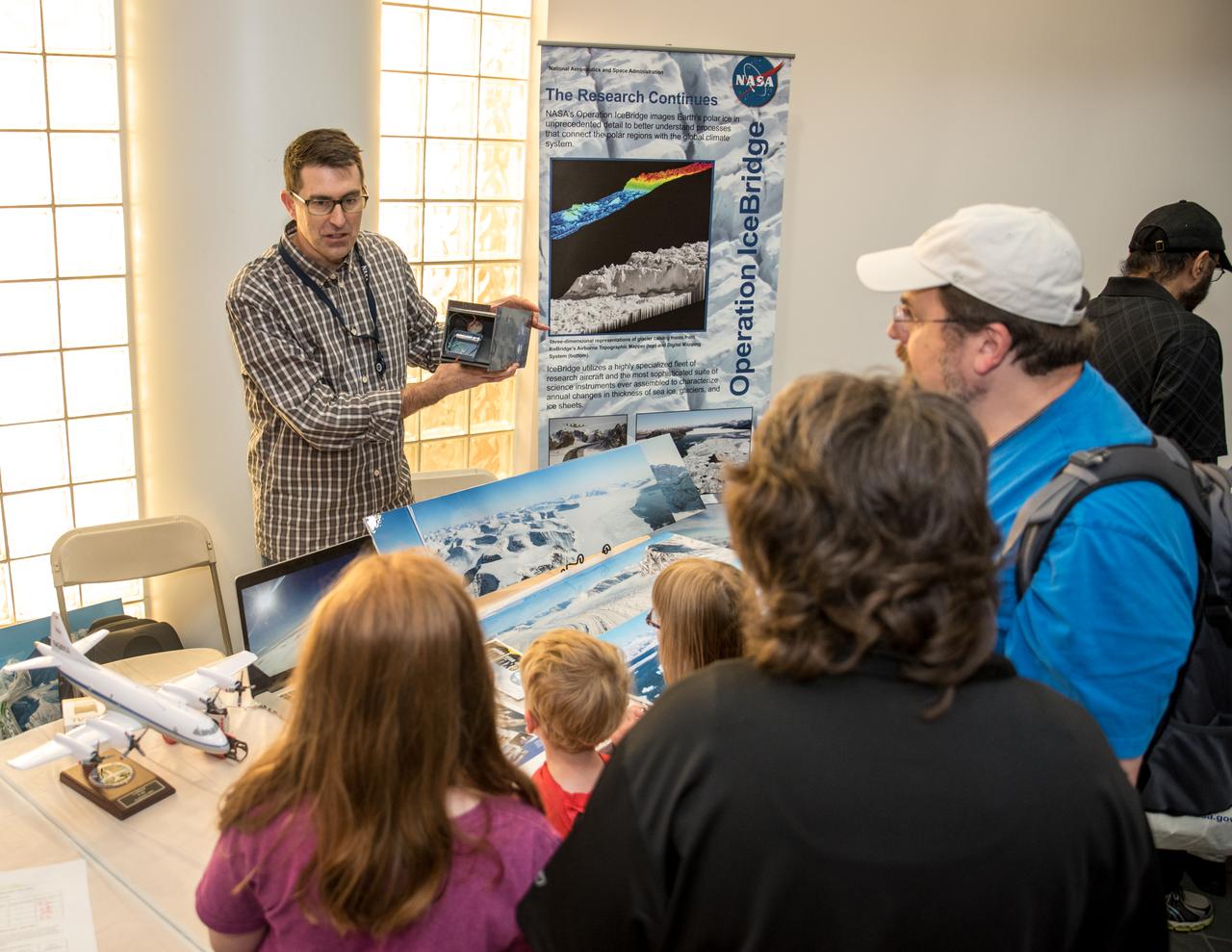
Explore@NASAGoddard celebrates the 25th anniversary of the launch of the Hubble Space Telescope. All areas of Goddard’s research – Earth science, heliophysics, planetary science, astrophysics, and engineering and technology – will be presented, as each discipline plays a critical part in NASA's ongoing journey to reach new heights.
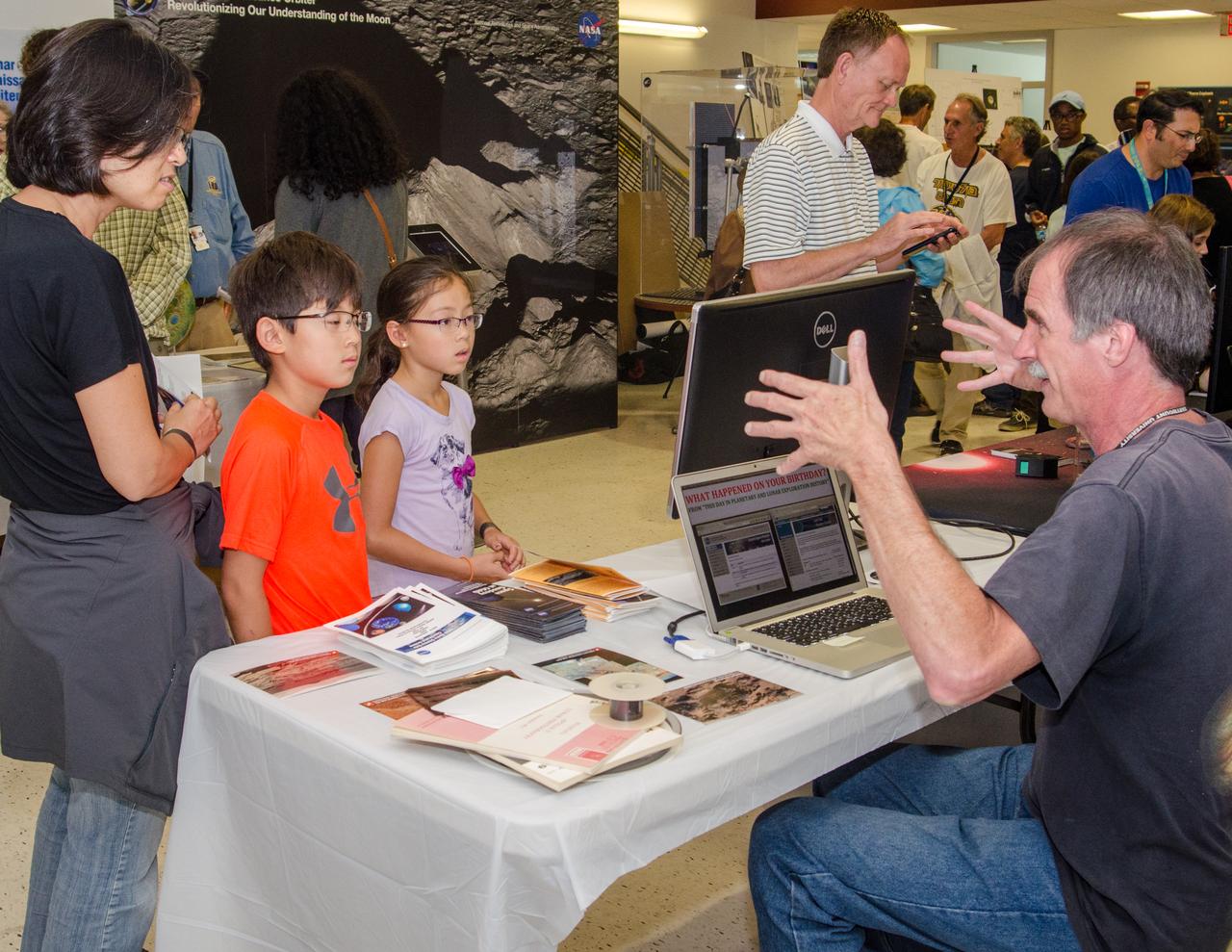
Explore@NASAGoddard celebrates the 25th anniversary of the launch of the Hubble Space Telescope. All areas of Goddard’s research – Earth science, heliophysics, planetary science, astrophysics, and engineering and technology – will be presented, as each discipline plays a critical part in NASA's ongoing journey to reach new heights.
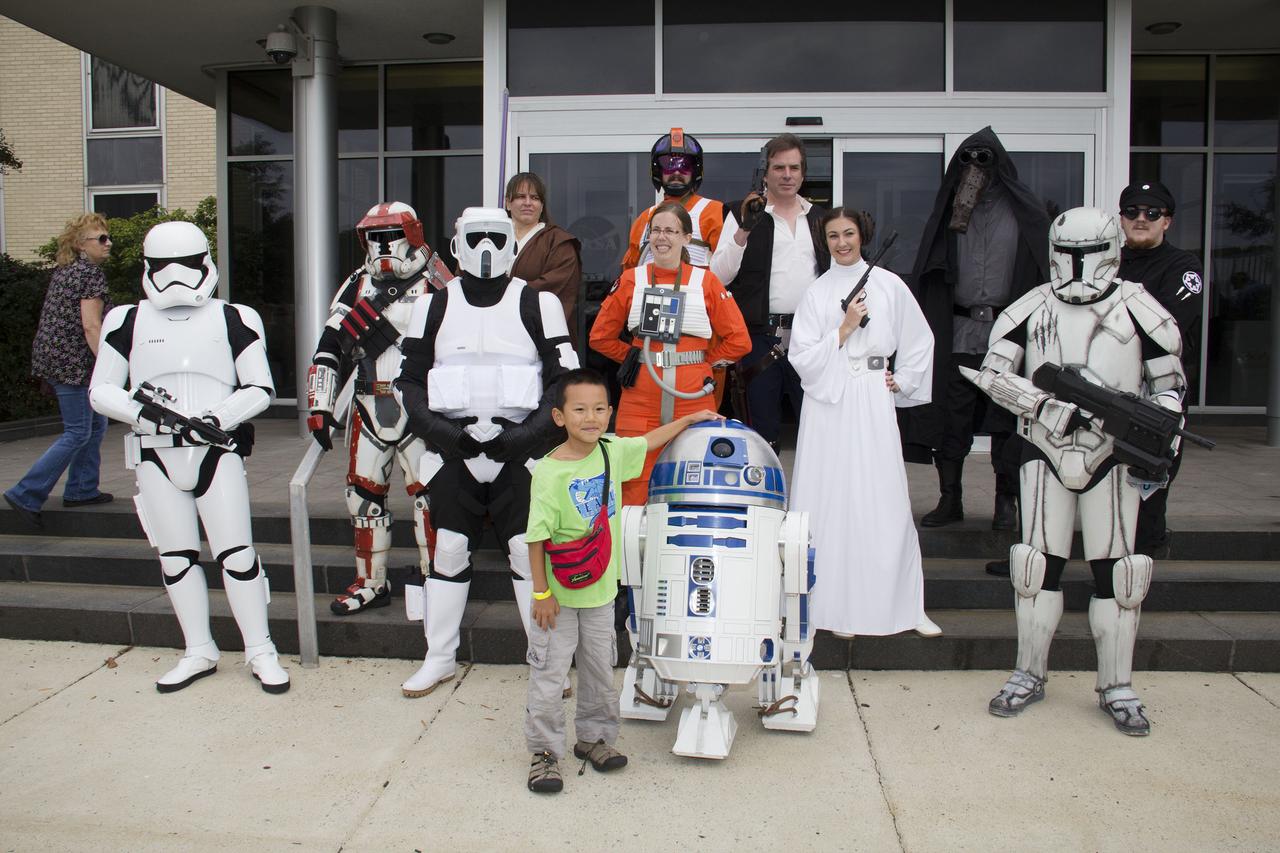
Explore@NASAGoddard celebrates the 25th anniversary of the launch of the Hubble Space Telescope. All areas of Goddard’s research – Earth science, heliophysics, planetary science, astrophysics, and engineering and technology – will be presented, as each discipline plays a critical part in NASA's ongoing journey to reach new heights.
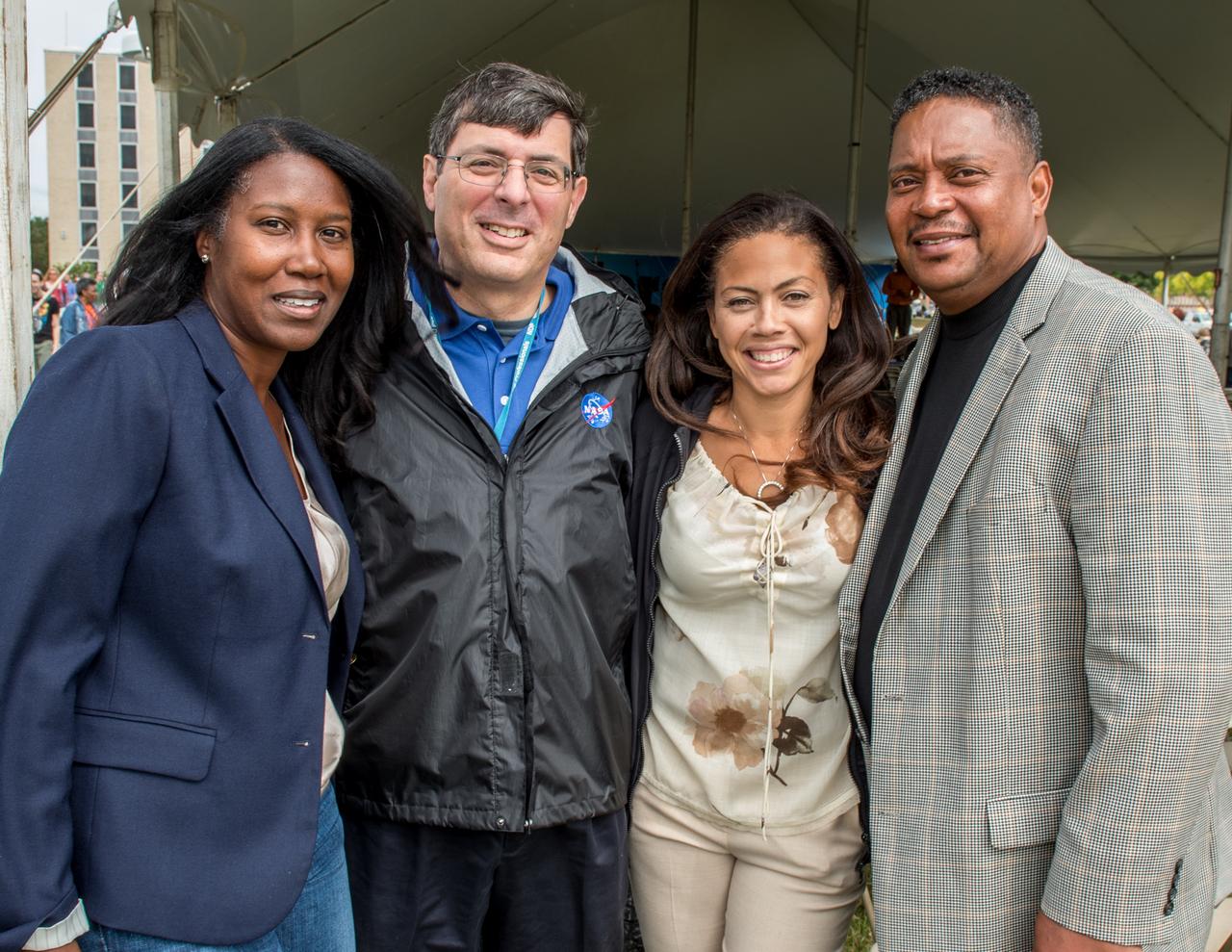
Center Director Chris Scolese with Sobe Restaurant owners Tony and Josette Simpson and Nichelle Schoultz. Explore@NASAGoddard celebrates the 25th anniversary of the launch of the Hubble Space Telescope. All areas of Goddard’s research – Earth science, heliophysics, planetary science, astrophysics, and engineering and technology – will be presented, as each discipline plays a critical part in NASA's ongoing journey to reach new heights.
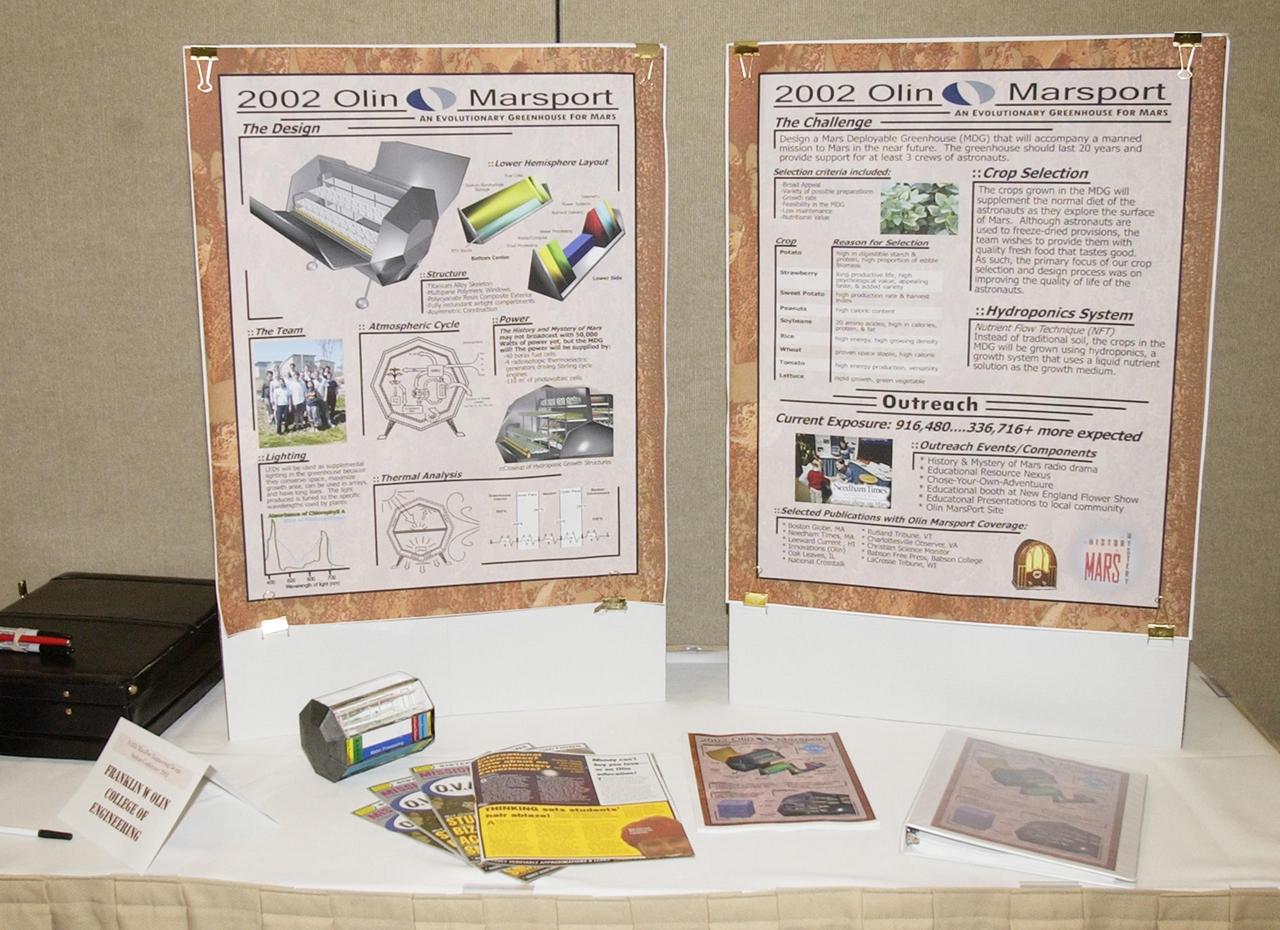
KENNEDY SPACE CENTER, FLA. -- A presentation by Franklin W. Olin College of Engineering is on display at the KSC Visitor Complex for this year's NASA MarsPort Engineering Design Student Competition 2002 conference. Participants are presenting papers on engineering trade studies to design optimal configurations for a MarsPort Deployable Greenhouse for operation on the surface of Mars. Judges in the competition were from KSC, Dynamac Corporation and Florida Institute of Technology. The winning team's innovative ideas will be used by NASA to evaluate and study other engineering trade concepts
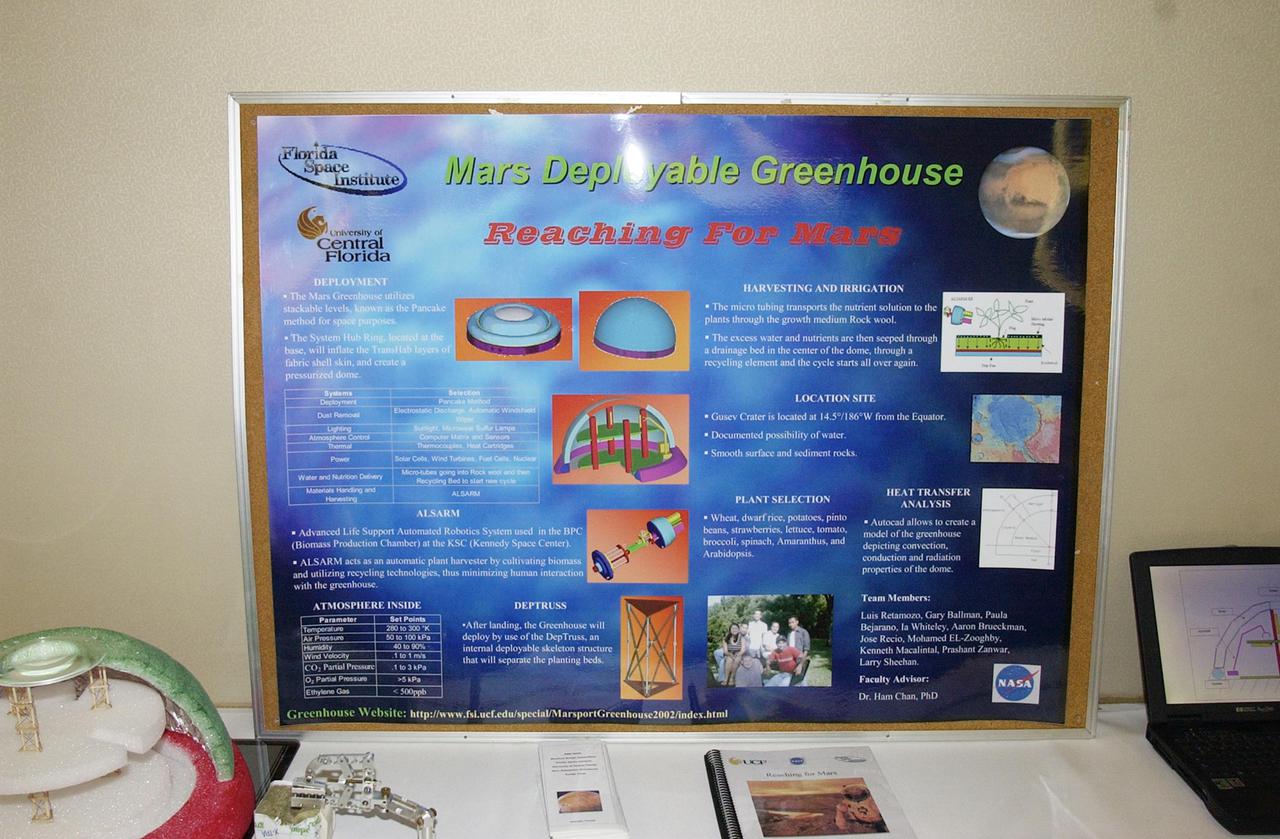
KENNEDY SPACE CENTER, FLA. -- A presentation by the University of Central Florida is on display at the KSC Visitor Complex for this year's NASA MarsPort Engineering Design Student Competition 2002 conference. Participants are presenting papers on engineering trade studies to design optimal configurations for a MarsPort Deployable Greenhouse for operation on the surface of Mars. Judges in the competition were from KSC, Dynamac Corporation and Florida Institute of Technology. The winning team's innovative ideas will be used by NASA to evaluate and study other engineering trade concepts.
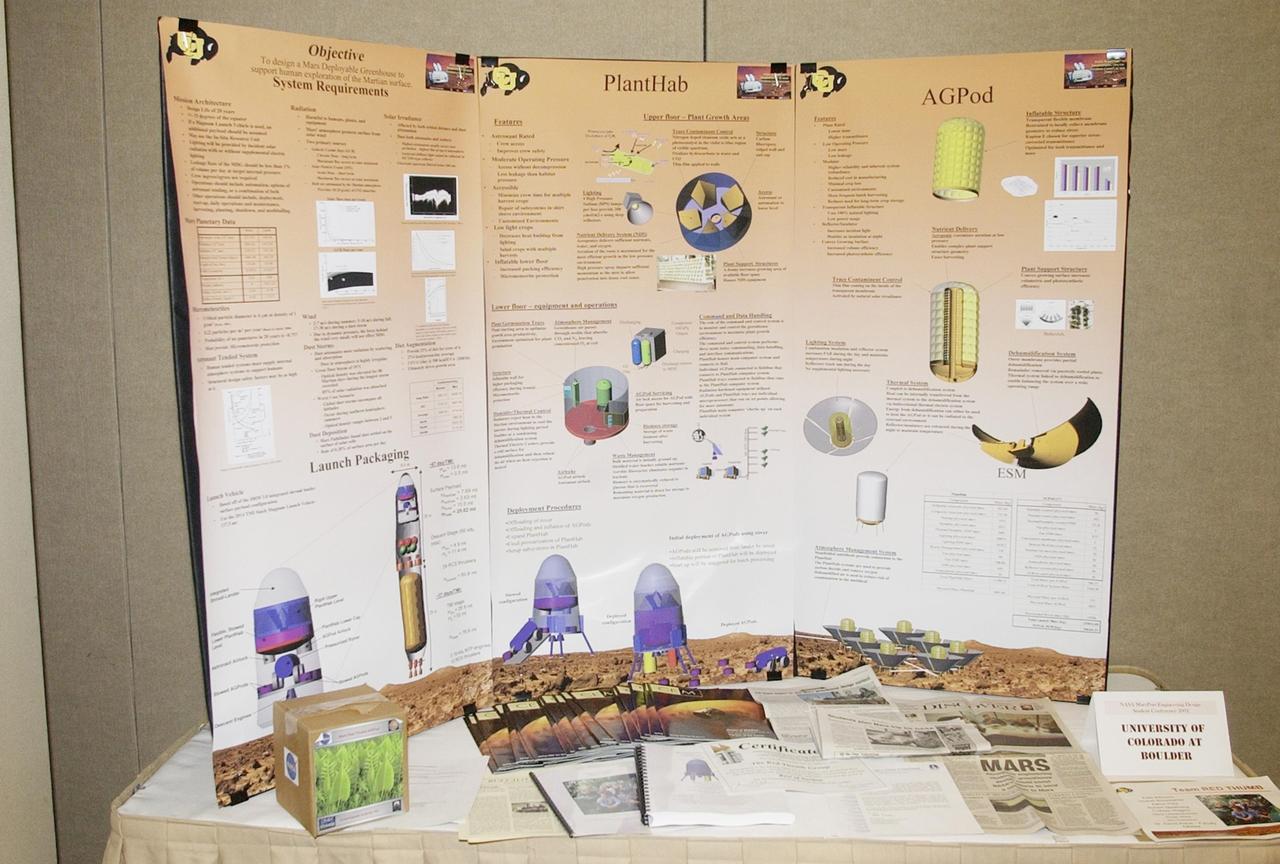
KENNEDY SPACE CENTER, FLA. -- During this year's NASA MarsPort Engineering Design Student Competition 2002 conference, the University of Colorado at Boulder presents this display. Participants are presenting papers on engineering trade studies to design optimal configurations for a MarsPort Deployable Greenhouse for operation on the surface of Mars. Judges in the competition were from KSC, Dynamac Corporation and Florida Institute of Technology. The winning team's innovative ideas will be used by NASA to evaluate and study other engineering trade concepts.
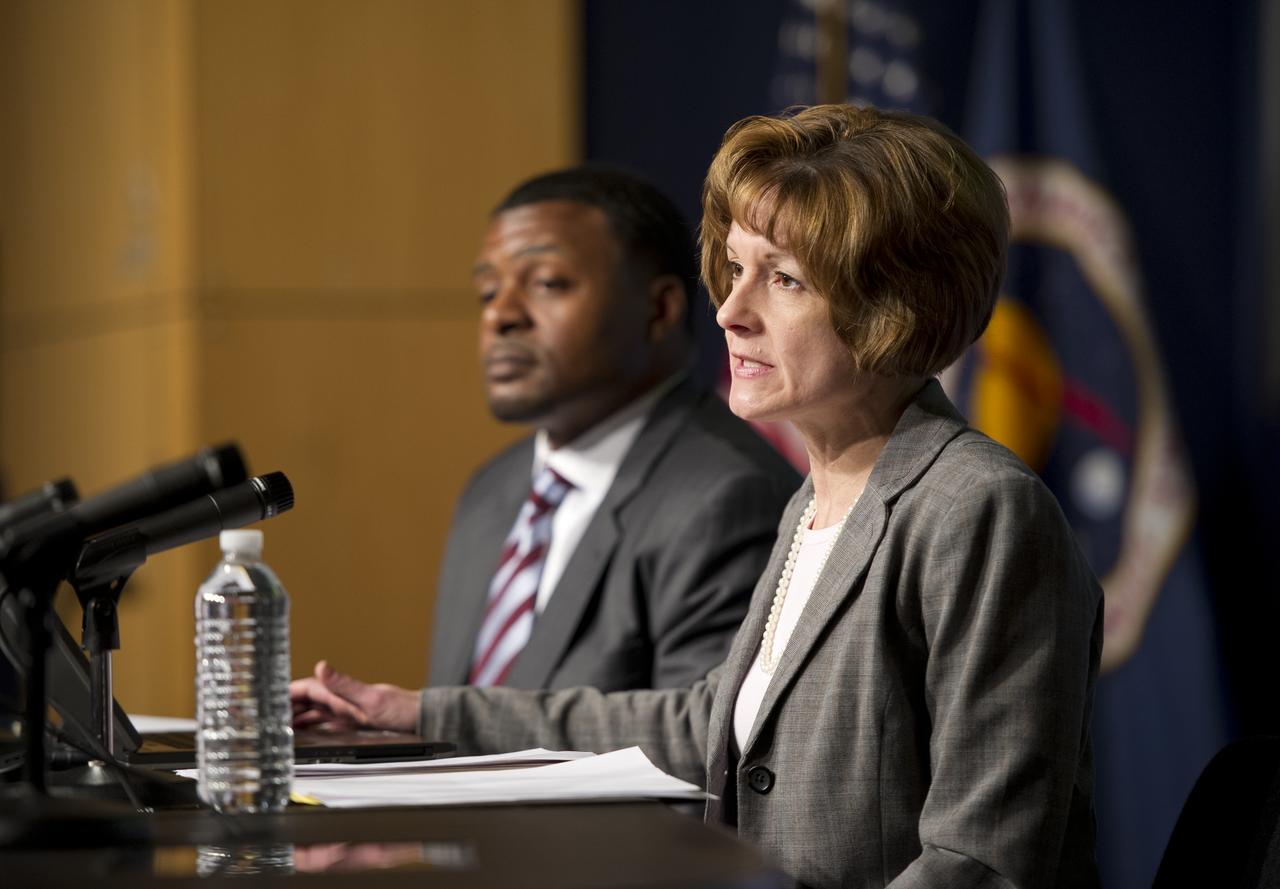
Christine Keller, Director of Research, APLU (Association of Public and Land-grant Universities) presents STEM initiative report findings at the Symposium on Supporting Underrepresented Minority Males in Science, Technology, Engineering and Mathematics (STEM), Tuesday, February 28, 2012 at NASA Headquarters in Washington. Photo Credit: (NASA/Carla Cioffi)
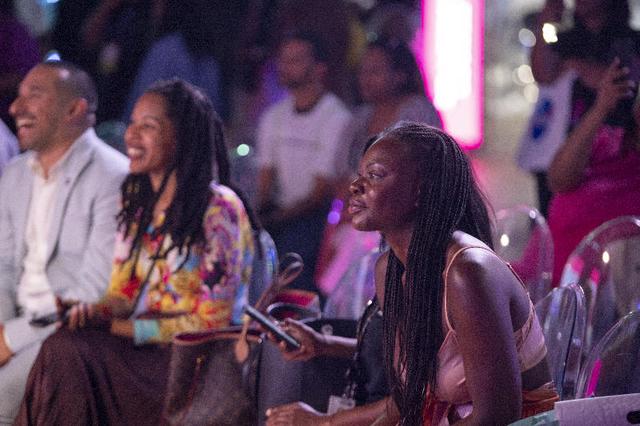
The audience for a Take Up Space (Literally) presentation at the 30th annual ESSENCE Fest in New Orleans on July 5 listens to a conversation with NASA representatives about Black women in the aerospace industry and diversity in science, technology, engineering, and mathematics (STEM).
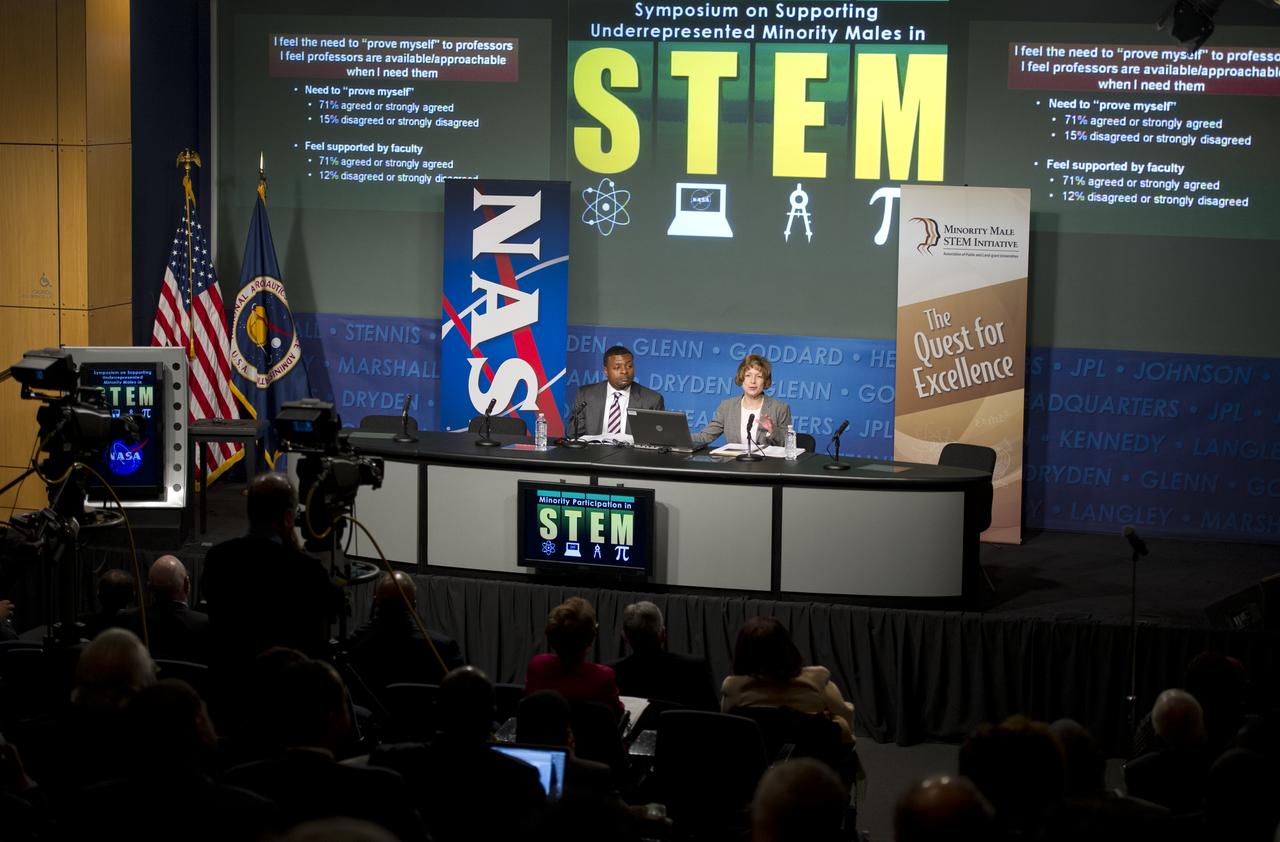
Christine Keller, right, Director of Research, APLU (Association of Public and Land-grant Universities) presents STEM initiative report findings at the Symposium on Supporting Underrepresented Minority Males in Science, Technology, Engineering and Mathematics (STEM), Tuesday, February 28, 2012 at NASA Headquarters in Washington. Photo Credit: (NASA/Carla Cioffi)
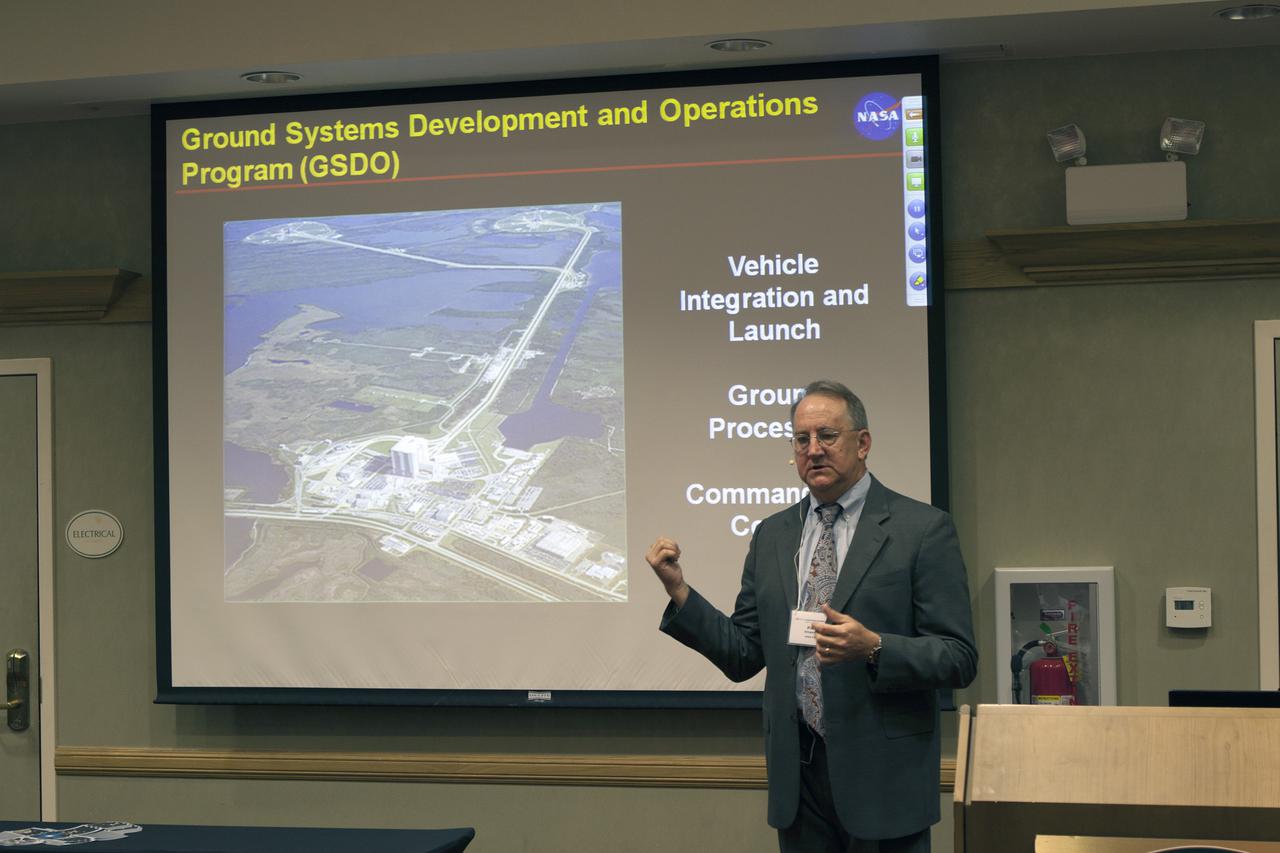
CAPE CANAVERAL, Fla. – At the Courtyard by Marriott hotel in Cocoa Beach, Fla., Pat Simpkins, director of Engineering and Technology at Kennedy Space Center talks to participants in the room and those participating online during the Third International Workshop on Lunar Superconductor Applications. The workshop included presentations from several engineers and researchers at Kennedy Space Center. The three-day workshop included presentations from speakers throughout the country and focused on Lunar in-situ resource utilization, NASA’s Lunar Ice Prospector called RESOLVE, CubeSats, cryogenic storage and many other topics related to lunar exploration. Photo credit: NASA_Jim Grossmann
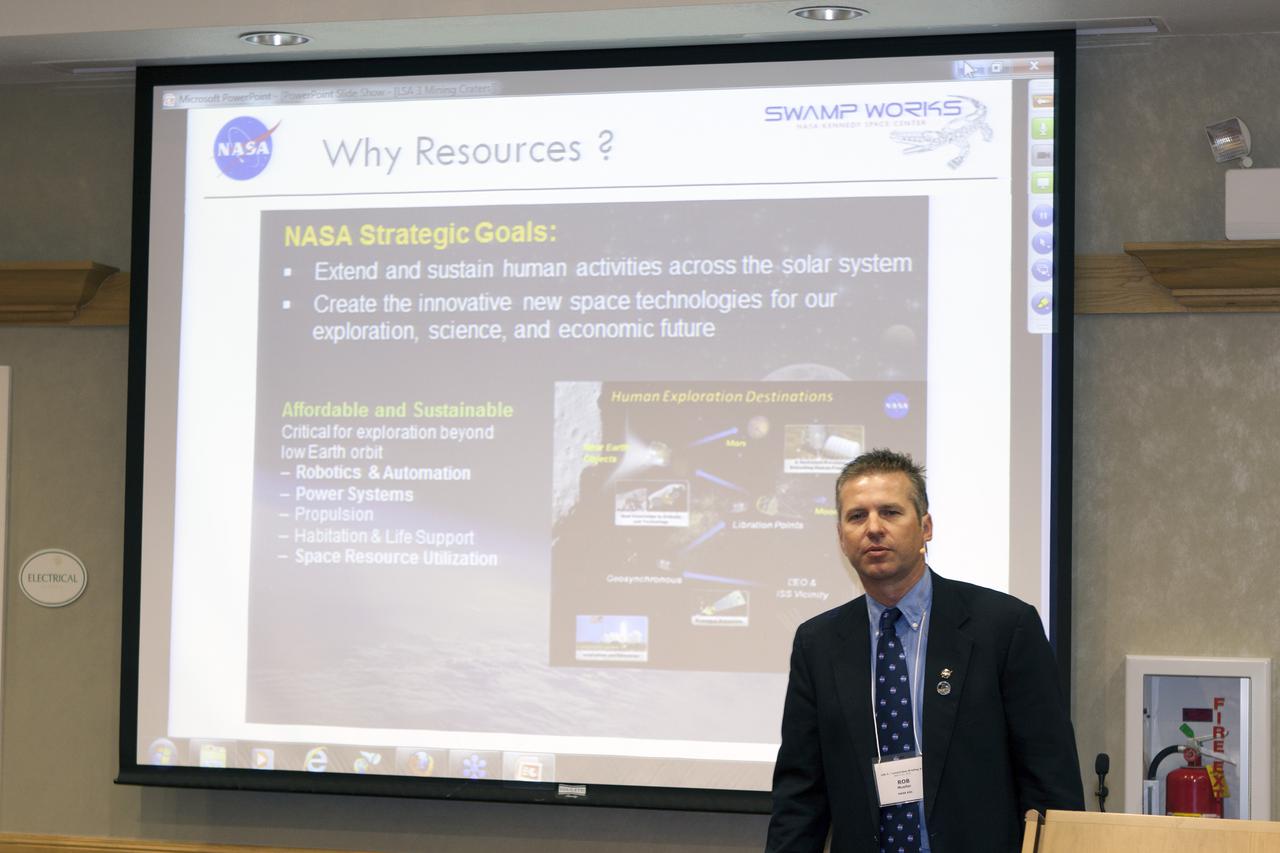
CAPE CANAVERAL, Fla. – At the Courtyard by Marriott hotel in Cocoa Beach, Fla., Rob Mueller, senior technologist in the Surface Systems Office of the Engineering and Technology Directorate at Kennedy Space Center, talks to participants in the room and those participating online during the Third International Workshop on Lunar Superconductor Applications. The workshop included presentations from several engineers and researchers at Kennedy Space Center. The three-day workshop included presentations from speakers throughout the country and focused on Lunar in-situ resource utilization, NASA’s Lunar Ice Prospector called RESOLVE, CubeSats, cryogenic storage and many other topics related to lunar exploration. Photo credit: NASA_Jim Grossmann
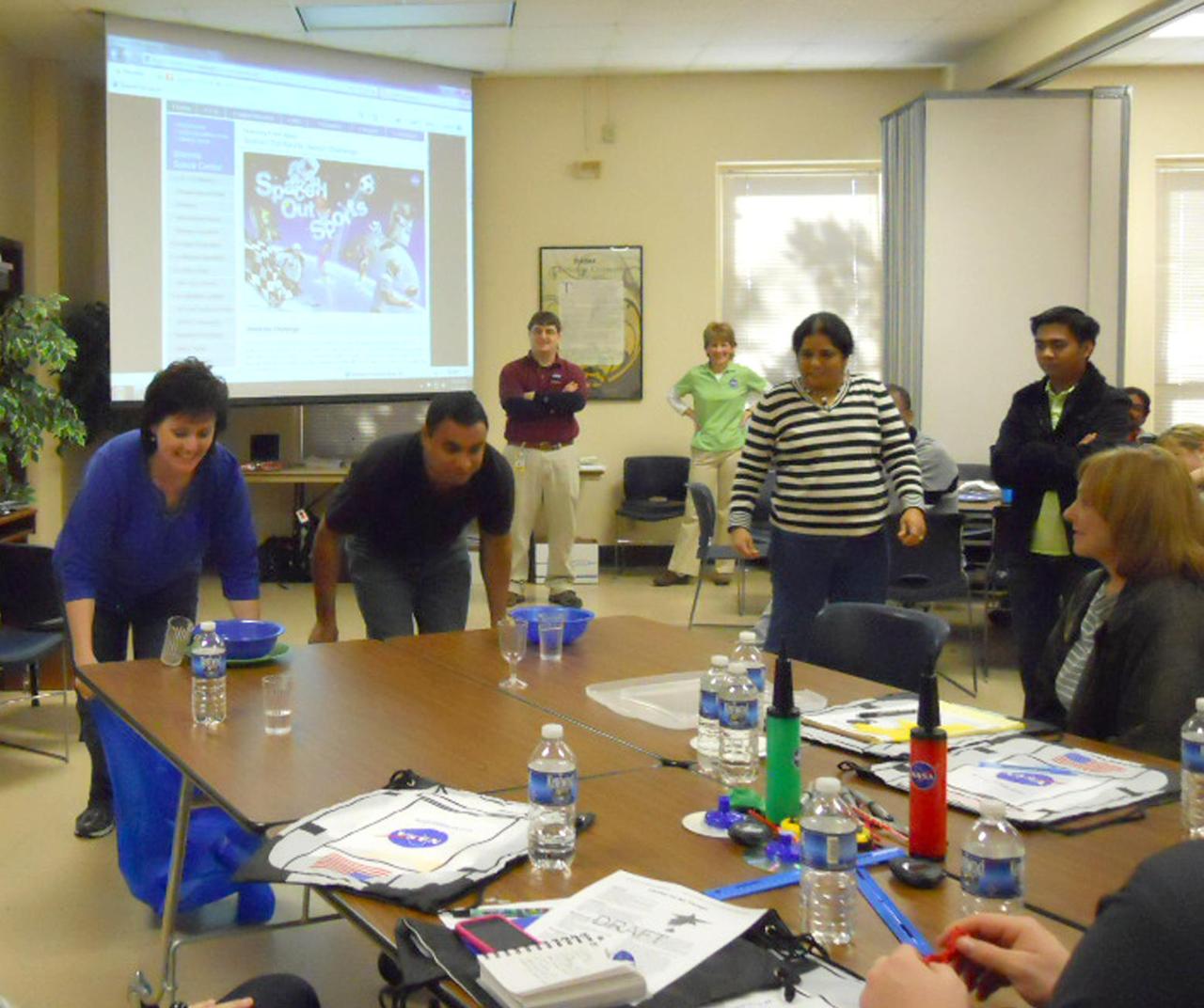
Middle school teachers from across Louisiana participate in a hands-on activity during a professional development workshop at Louisiana State University in Baton Rouge on Jan. 22, 2011. Fifty-five teachers participated in the workshop, which was hosted by the Stennis Education Office. During the workshop, Stennis specialists presented hands-on, problem-based learning and technology-based activities teachers can use in their classrooms to promote interest in areas of science, technology, engineering and mathematics.
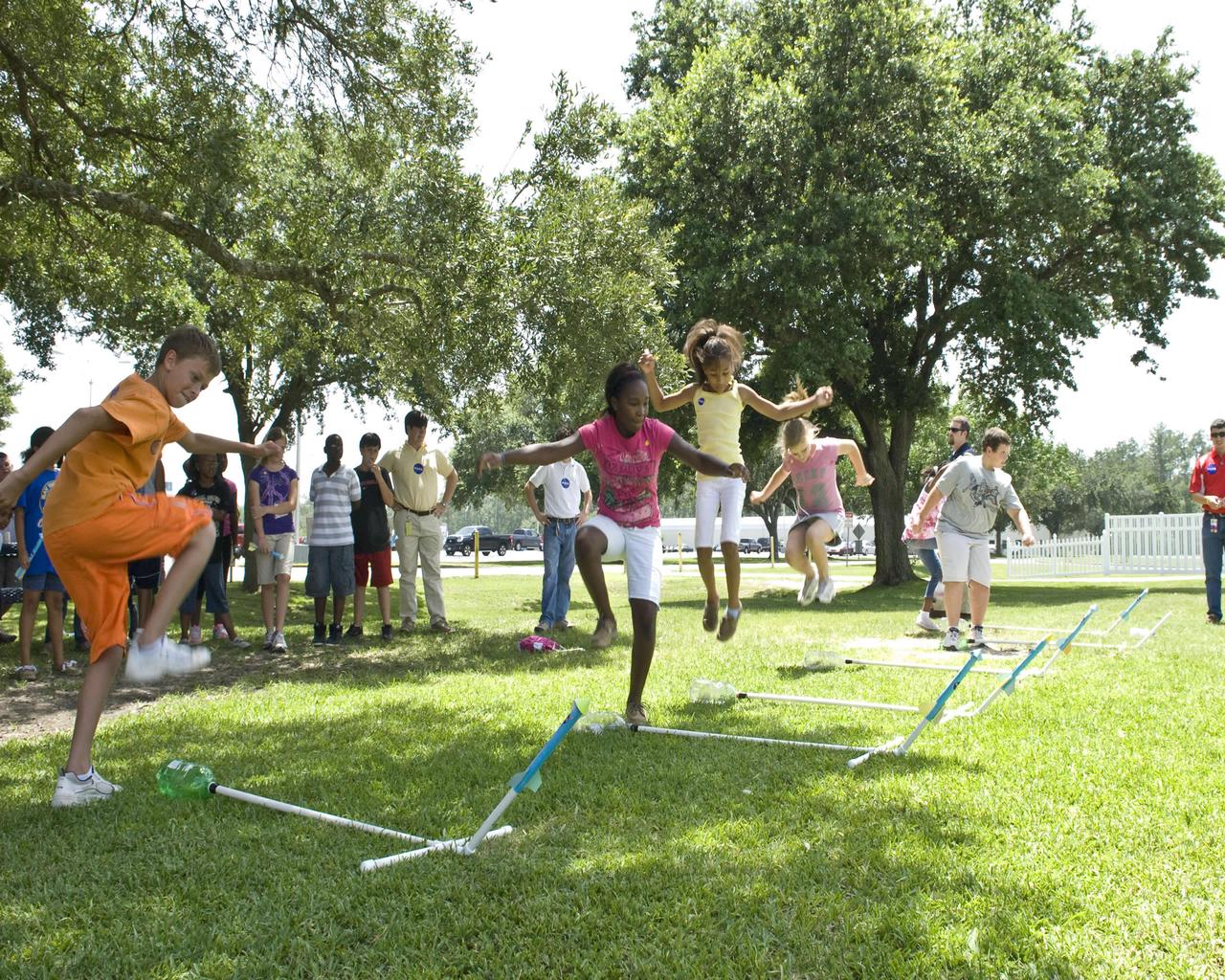
Young visitors to NASA's John C. Stennis Space Center prepare to launch 'stomp rockets' during STEM-Ulate to Innovate activities at the facility July 13. The NASA Foundations of Influence, Relationships, Success and Teamwork (FIRST) Team sponsored STEM-Ulate to Innovate for more than 100 children ages 9-11. Children from area Boys & Girls Clubs participated in hands-on activities, presentations and demonstrations by professional engineers, all designed to promote the relevance of science, technology, engineering and mathematics (STEM).
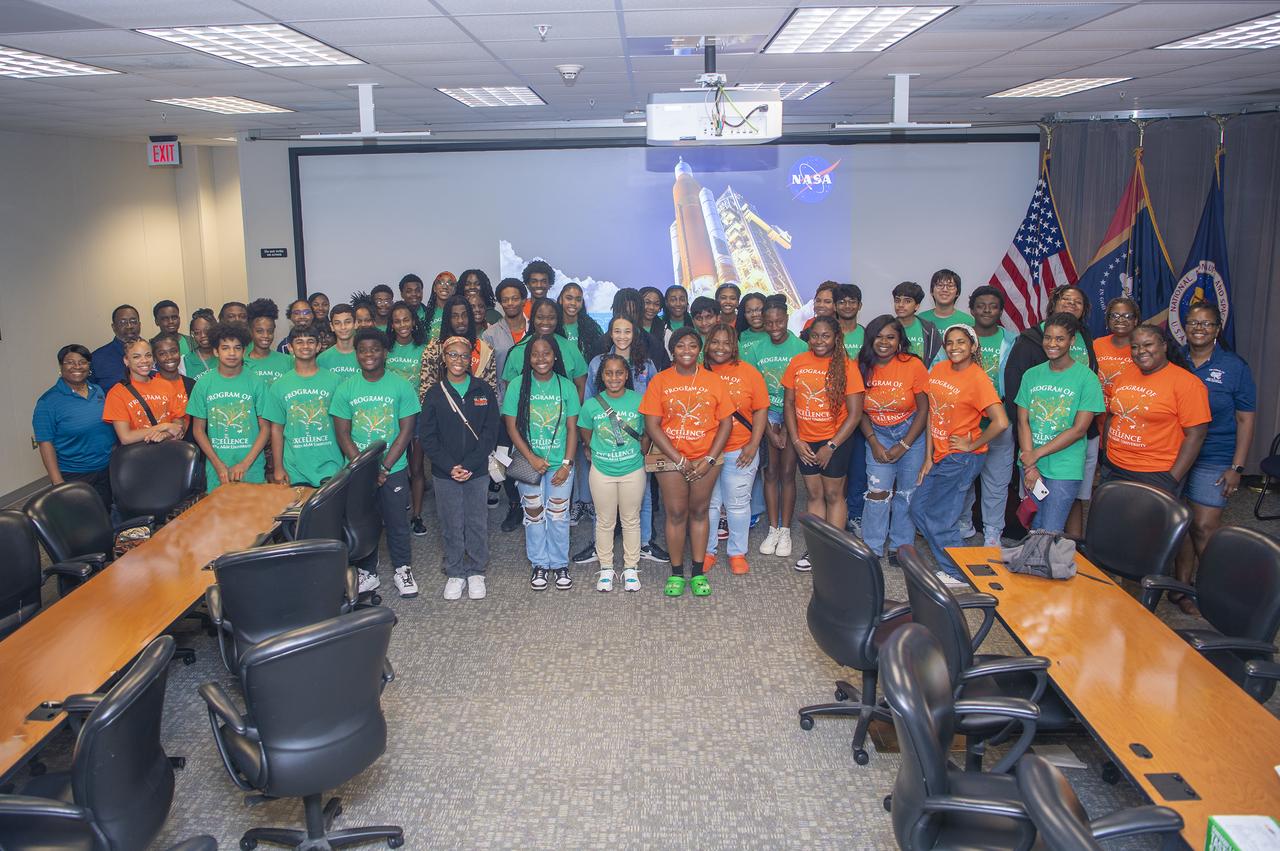
Members of the Florida A&M University Program of Excellence in STEM attend a presentation June 21 during a visit to NASA’s Stennis Space Center. The NASA Office of STEM Engagement provided information on grants and student activities during the presentation about NASA Stennis and the work conducted at the unique federal city. The group also visited the Thad Cochran Test Stand and Relativity Space test complex during a site tour. The Program of Excellence in STEM summer academy aims to enhance student knowledge of opportunities in the fields of science, technology, engineering, and mathematics.
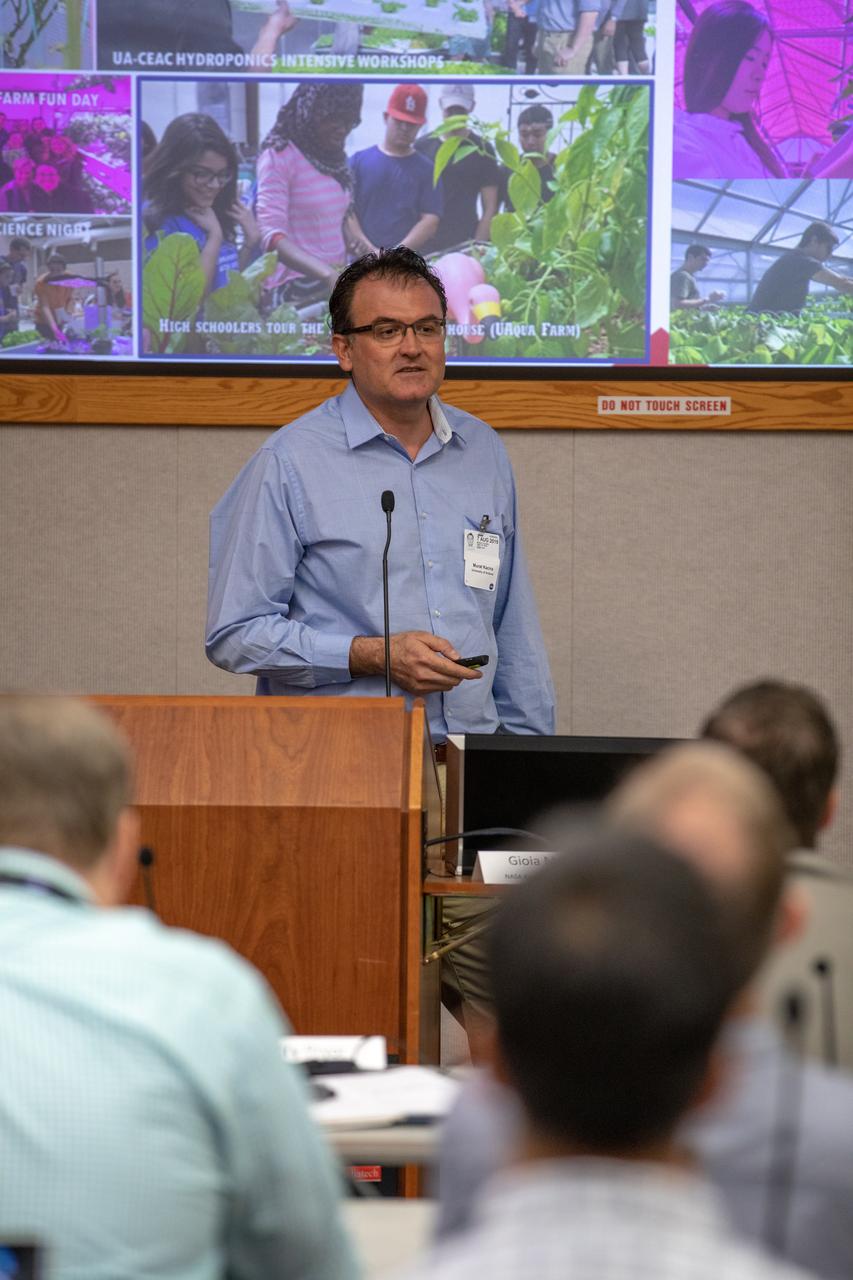
The Exploration Research and Technology Programs at NASA’s Kennedy Space Center in Florida hosted a two-day workshop, Aug. 6 and 7, 2019, focusing on robotics and automation in space crop production. Participants from around the world and members of NASA, industry, academia and other government agencies met to share their knowledge to enable a common goal of sustaining human operations on the Moon, in deep space and eventually on Mars. Keynote speakers and representatives from different organizations presented data gleaned from their research.. Murat Kacira, a professor in the Department of Agricultural and Biosystems Engineering and director of the Controlled Environment Agriculture Program at the University of Arizona presents to workshop attendees on Aug. 6.
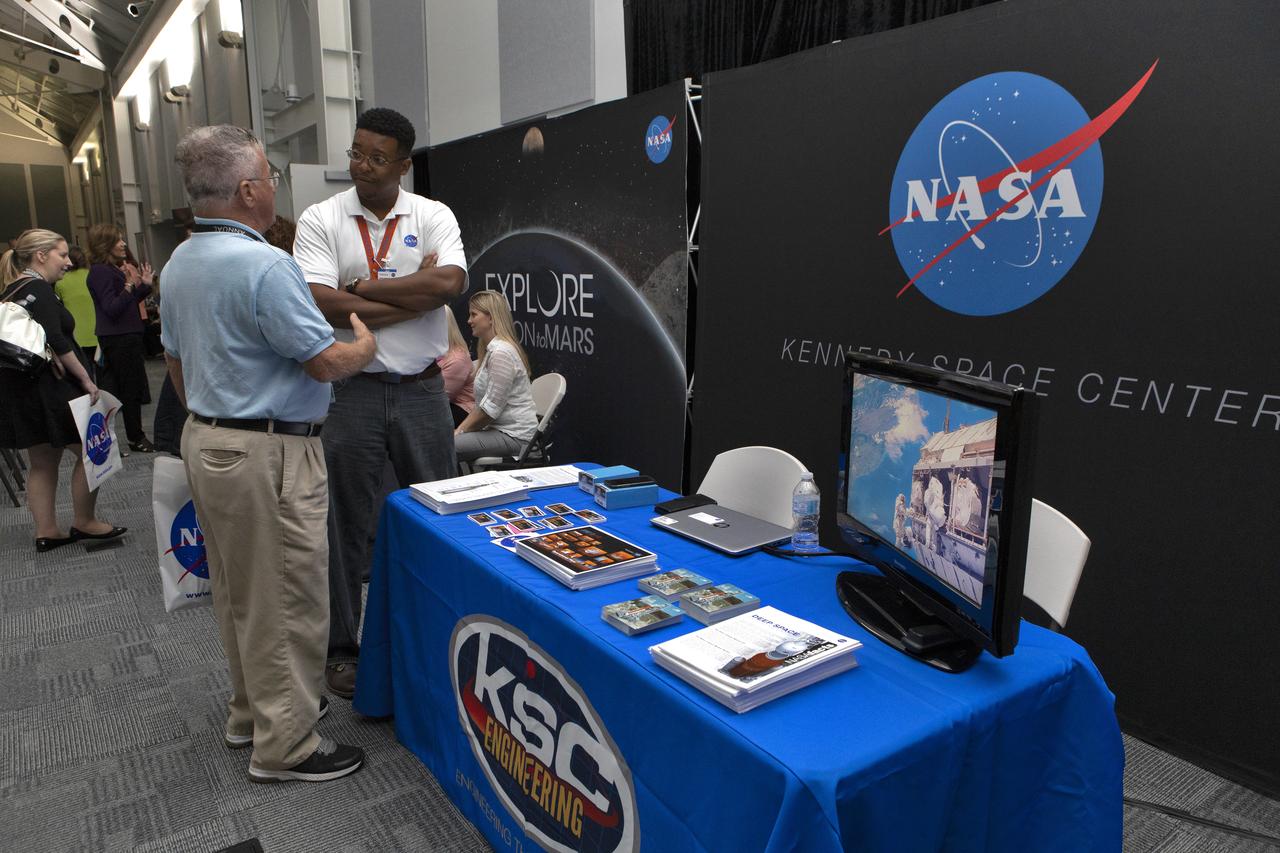
A guest visits with a representative from the Engineering Directorate during NASA Kennedy Space Center Director Bob Cabana’s update to community leaders, business executives, partners, educators and government leaders March 29, 2019, at the Kennedy Space Center Visitor Complex in Florida. Cabana’s presentation covered recent accomplishments and future plans for Kennedy-led programs, including the Commercial Crew Program, Exploration Ground Systems, Launch Services Program, Exploration Research and Technology, and Center Planning and Development. After the presentation, guests had the opportunity to ask questions and visit displays from the programs and some of the commercial partners.
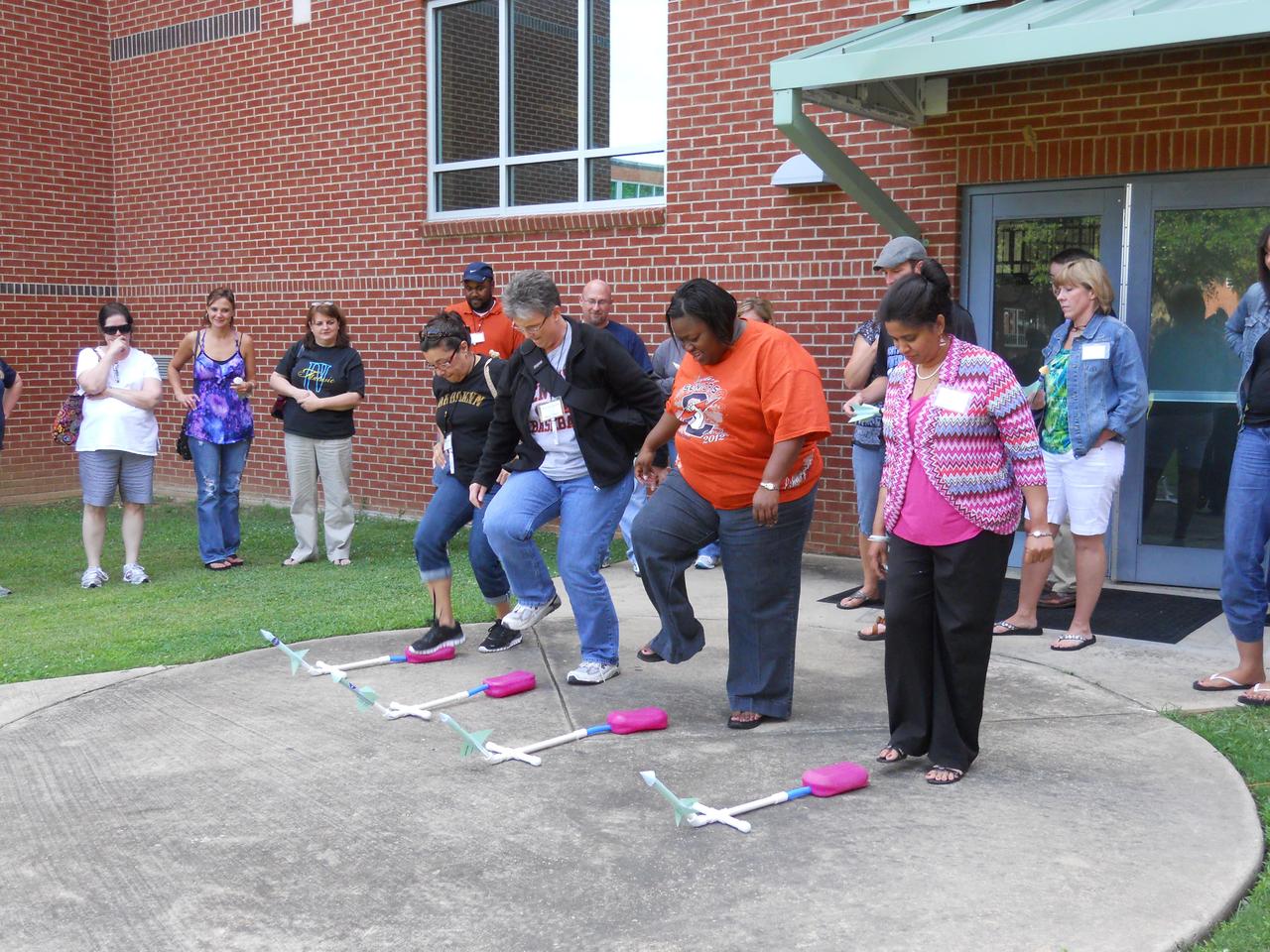
Mississippi educators participated in a variety of hands-on activities, including rocketry, robotics, and NASA's BEST (Beginning Engineering, Science, and Technology) during a pair of during a pair of professional development workshops conducted by Stennis Space Center educators in June. On June 14, Stennis educators presented workshops to 96 kindergarten-through-12th-grade science teachers and eight Jackson State University faculty, as part of JSU's Project MAST (Mississippi Academy for Science Teaching) Project. On June 21, educators presented workshops in Starkville to 43 fourth-through-eighth-grade science teachers as part of Mississippi State University's Advancing Teachers of Middle School Science initiative.
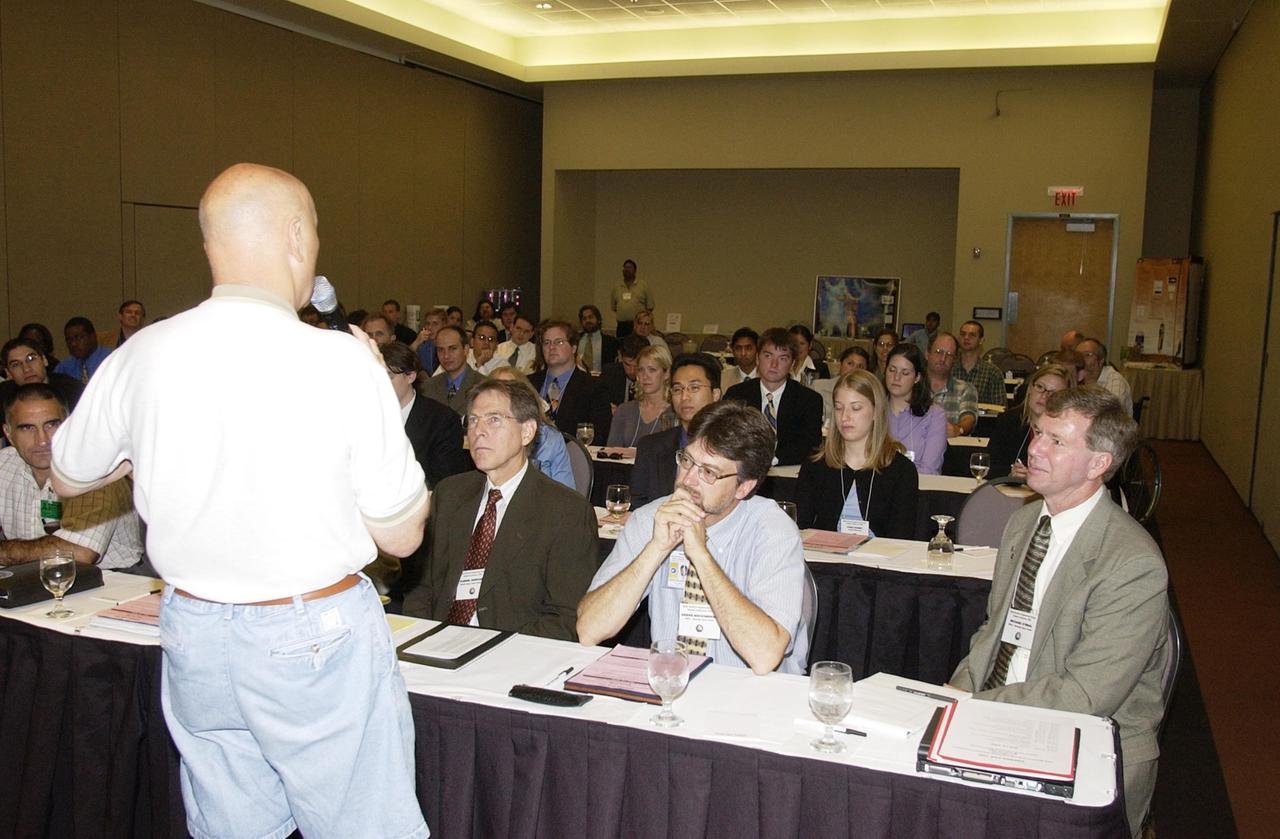
KENNEDY SPACE CENTER, FLA. -- Former astronaut Story Musgrave speaks to students and faculty from across the nation gathered at the KSC Visitor Complex for this year's NASA MarsPort Engineering Design Student Competition 2002 conference. The participants are presenting papers on engineering trade studies to design optimal configurations for a MarsPort Deployable Greenhouse for operation on the surface of Mars. Judges in the competition were from KSC, Dynamac Corporation and Florida Institute of Technology. The winning team's innovative ideas will be used by NASA to evaluate and study other engineering trade concepts. Featured at the opening ceremony were Dr. Sam Durrance, FSGC director and former astronaut, and Dr. Gary Stutte, plant scientist, Dynamac Corporation.
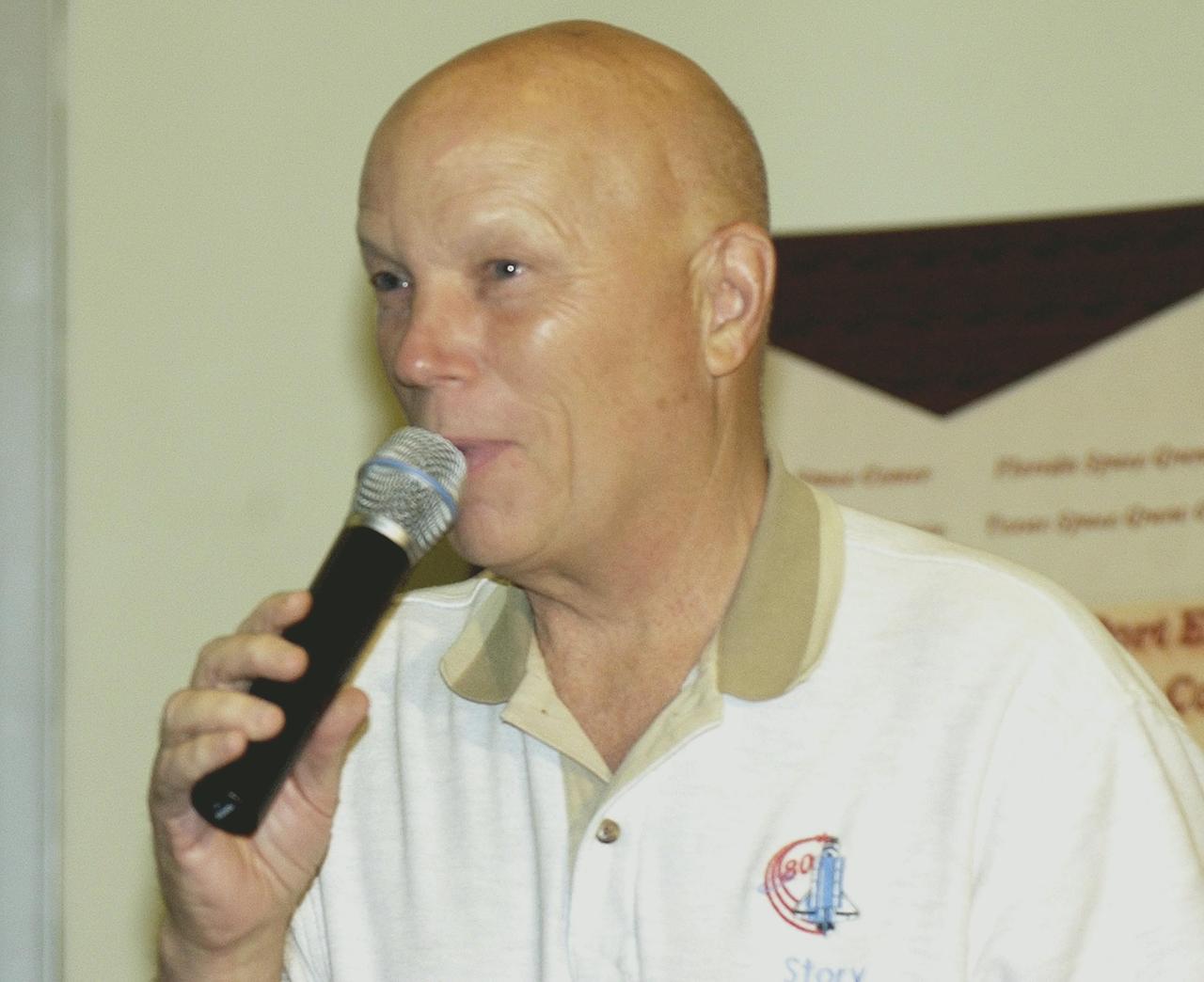
KENNEDY SPACE CENTER, FLA. -- Former astronaut Story Musgrave speaks to students and faculty from across the nation gathered at the KSC Visitor Complex for this year's NASA MarsPort Engineering Design Student Competition 2002 conference. The participants are presenting papers on engineering trade studies to design optimal configurations for a MarsPort Deployable Greenhouse for operation on the surface of Mars. Judges in the competition were from KSC, Dynamac Corporation and Florida Institute of Technology. The winning team's innovative ideas will be used by NASA to evaluate and study other engineering trade concepts. Featured at the opening ceremony were Dr. Sam Durrance, FSGC director and former astronaut, and Dr. Gary Stutte, plant scientist, Dynamac Corporation.
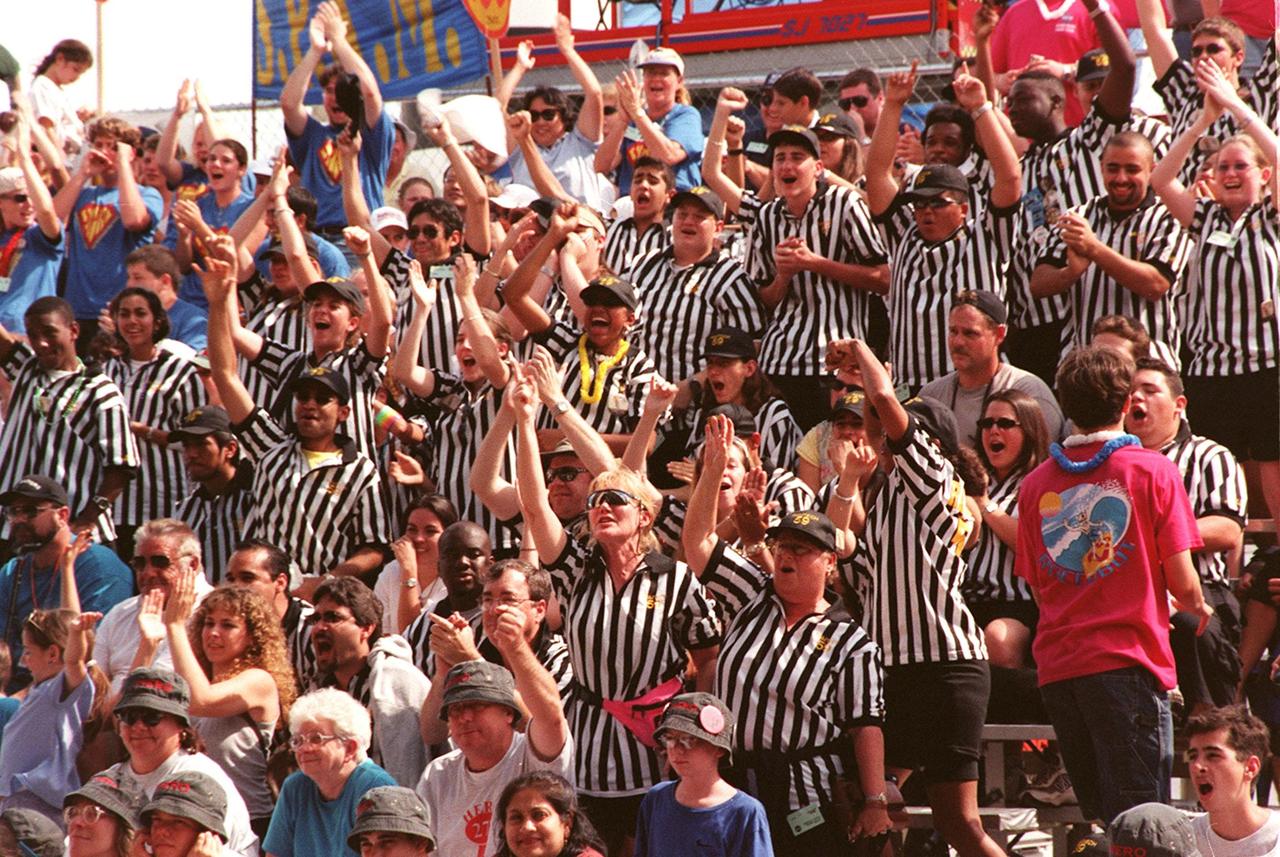
The crowd filling the bleachers cheer and applaud during the closing presentations of the FIRST (For Inspiration and Recognition of Science and Technology) Southeast Regional competition held at the KSC Visitor Complex. Teams of high school students from all over the country tested the limits of their imagination using robots they designed, with the support of business and engineering professionals and corporate sponsors, to compete in a technological battle against other schools' robots. Of the 30 high school teams competing at the Southeast Regional event, 16 were Florida teams co-sponsored by NASA and KSC contractors. Local high schools participating are Astronaut, Bayside, Cocoa Beach, Eau Gallie, Melbourne, Melbourne Central Catholic, Palm Bay, Rockledge, Satellite, and Titusville
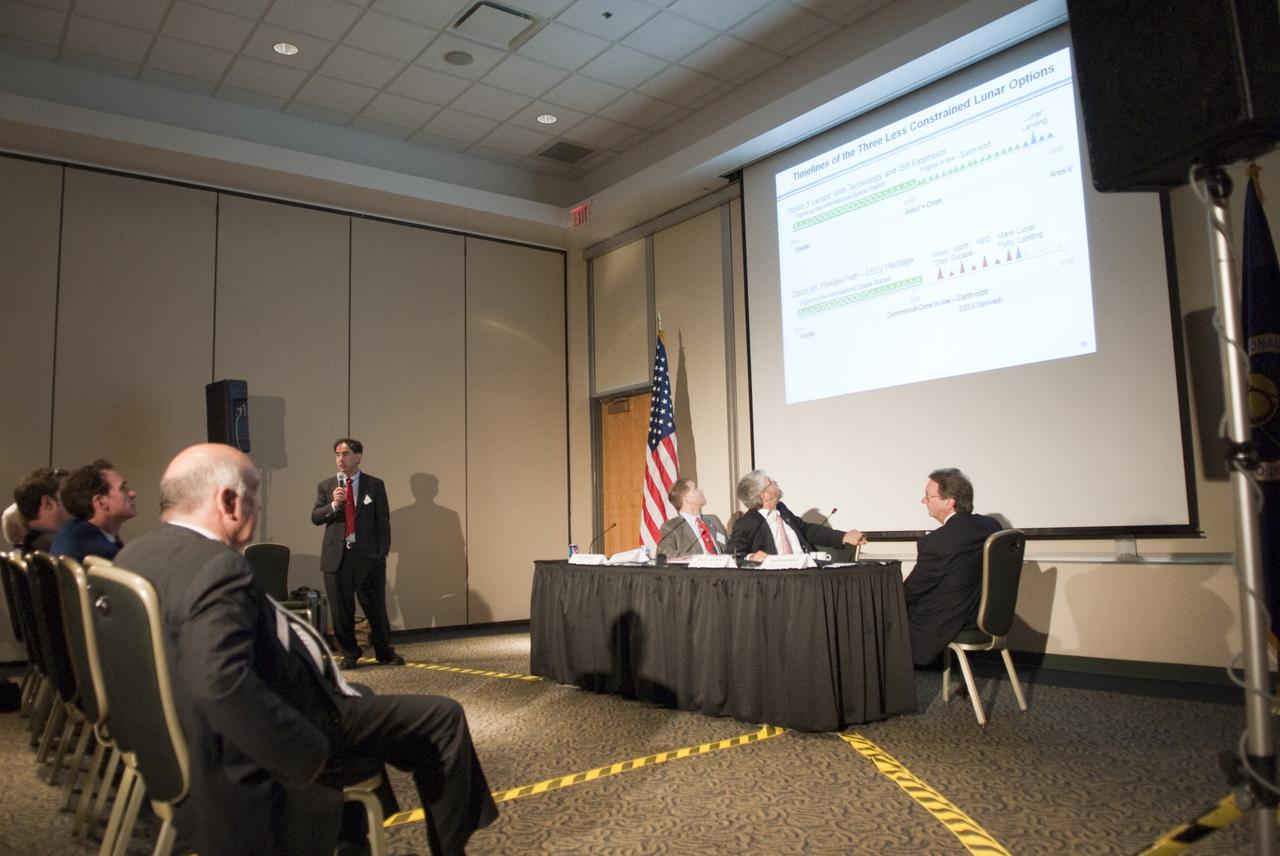
CAPE CANAVERAL, Fla. - In the Atlas_Redstone Room of the Debus Center at NASA's Kennedy Space Center Visitor Complex in Florida, Dr. Edward F. Crawley, Ford professor of engineering at MIT gives his presentation at the 'Expanding our Reach into the Solar System' break-out session, part of the Conference on the American Space Program for the 21st Century. The panel, moderated by John Holdren, assistant to the President for science and technology and director of the White House Office of Science and Technology Policy (center), included Crawley, Scott Hubbard, former director of NASA's Ames Research Center (right) and NASA Astronaut John Grunsfeld. Photo credit: NASA_Jim Grossmann
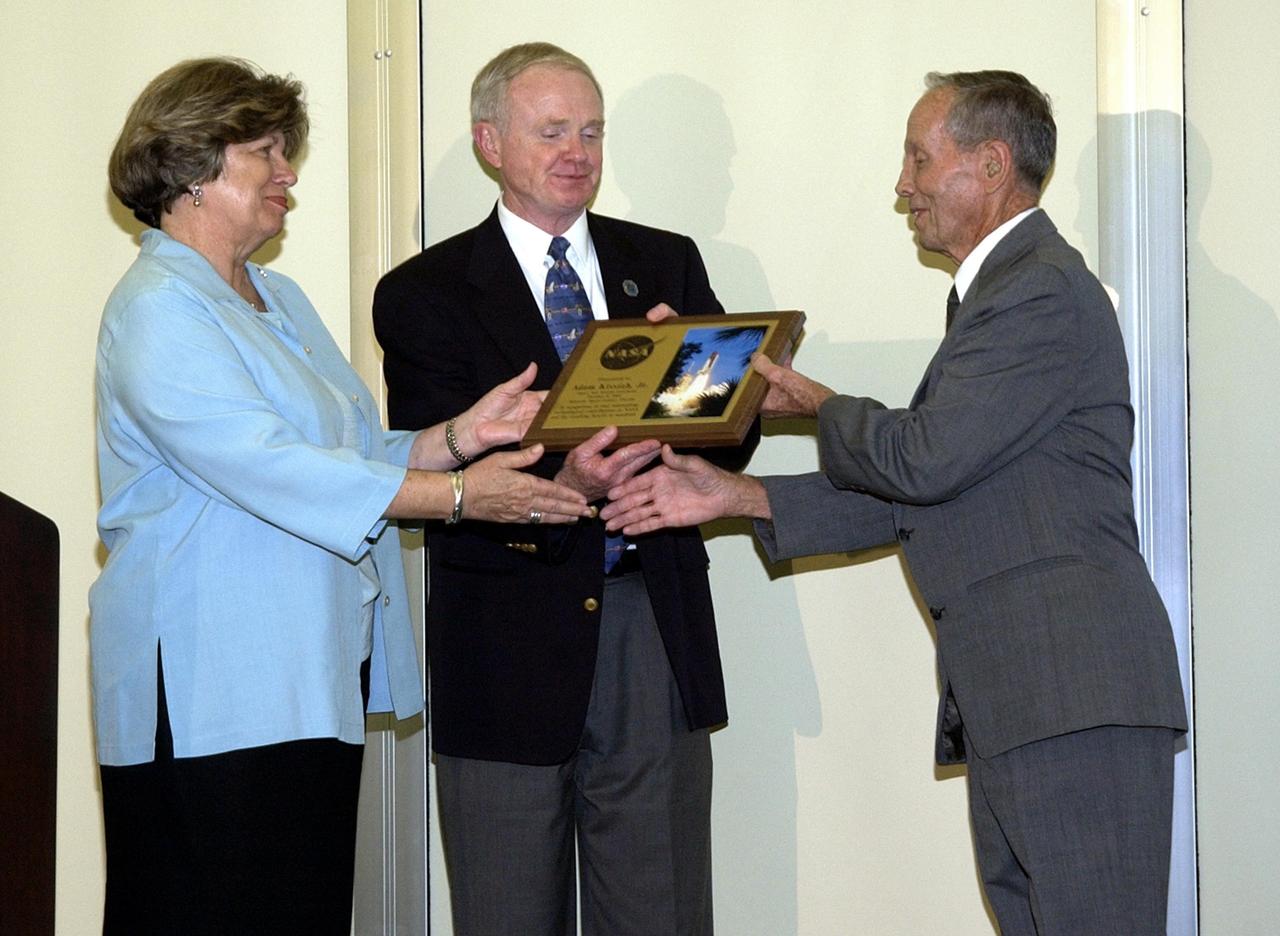
KENNEDY SPACE CENTER, FLA. - Adam Kissiah (right), a retired NASA-KSC engineer and inventor of a cochlear implant, receives an exceptional category NASA Space Act Award for his 25-year-old technology breakthrough during a technology awards luncheon held at the KSC Visitor Complex Debus Center. Presenting the award are, from left, Acting Deputy Center Director JoAnn Morgan, Center Director Roy Bridges, and Kissiah. The award included a monetary award and a certificate signed by the NASA Administrator. Space Act Awards provide official recognition and grant equitable monetary awards for inventions and scientific and technical contributions that have helped achieve NASA's aeronautical and space goals.
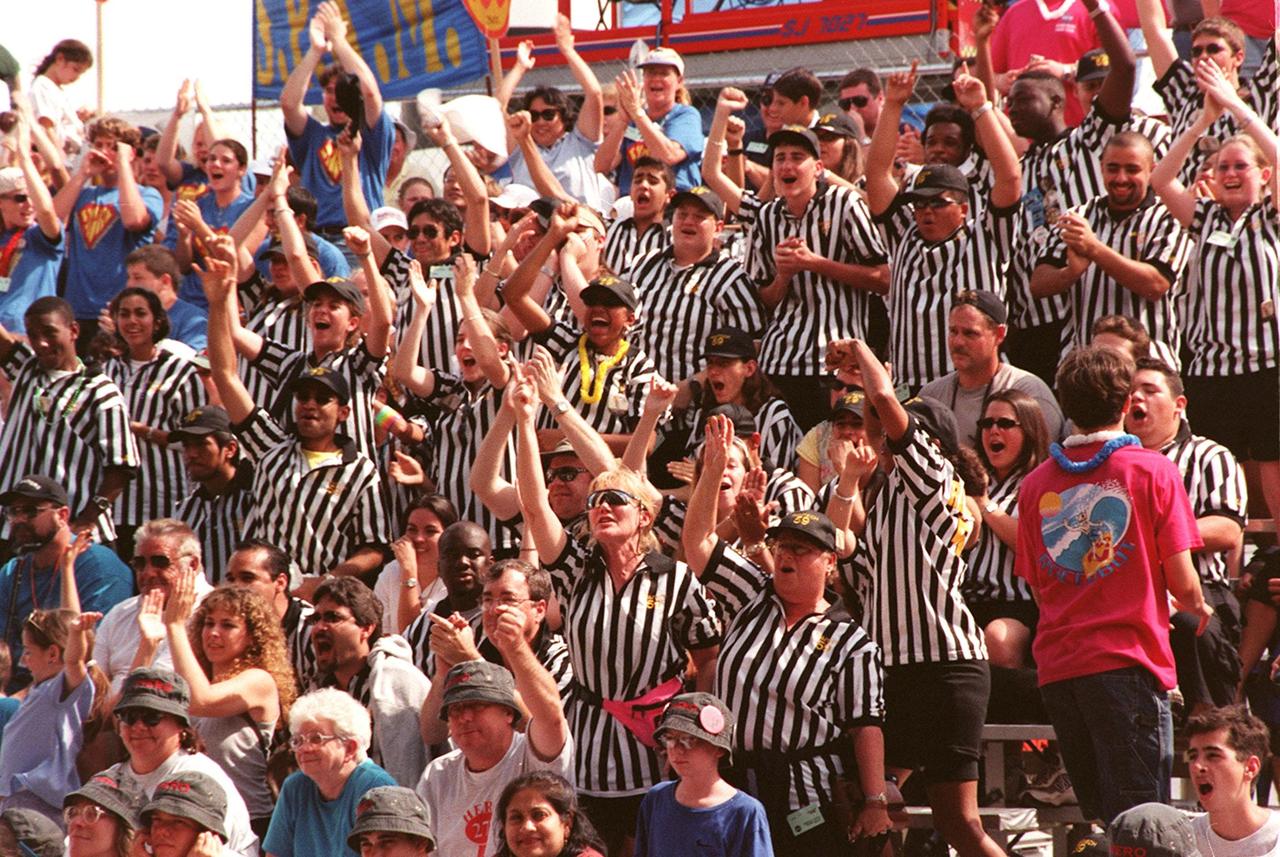
The crowd filling the bleachers cheer and applaud during the closing presentations of the FIRST (For Inspiration and Recognition of Science and Technology) Southeast Regional competition held at the KSC Visitor Complex. Teams of high school students from all over the country tested the limits of their imagination using robots they designed, with the support of business and engineering professionals and corporate sponsors, to compete in a technological battle against other schools' robots. Of the 30 high school teams competing at the Southeast Regional event, 16 were Florida teams co-sponsored by NASA and KSC contractors. Local high schools participating are Astronaut, Bayside, Cocoa Beach, Eau Gallie, Melbourne, Melbourne Central Catholic, Palm Bay, Rockledge, Satellite, and Titusville
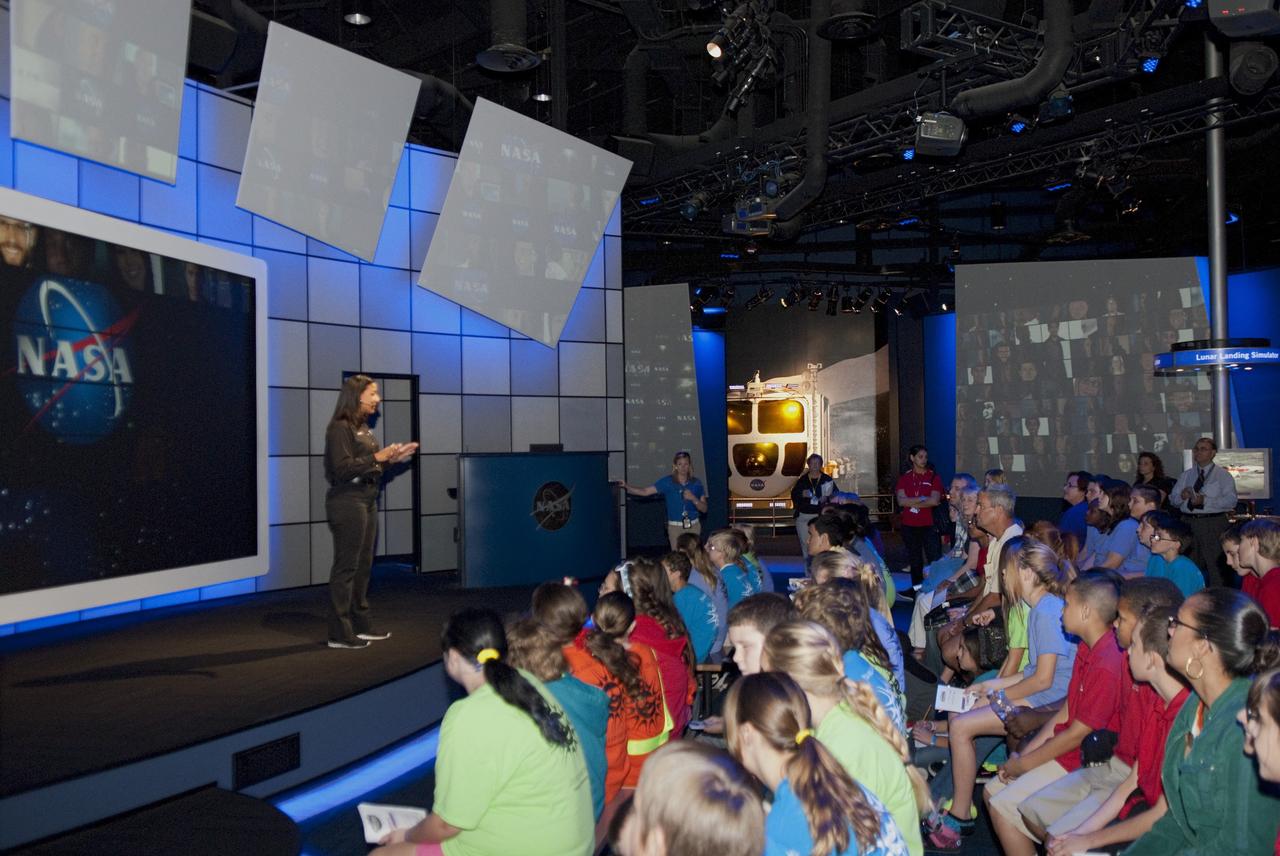
CAPE CANAVERAL, Fla. – At the Kennedy Space Center Visitor Complex in Florida sixth-grade students listen to a science presentation on NASA programs. Between Nov. 26 and Dec. 7, 2012, about 5,300 sixth-graders in Brevard County, Florida were bused to Kennedy's Visitor Complex for Brevard Space Week, an educational program designed to encourage interest in science, technology, engineering and mathematics STEM careers. Photo credit: NASA/Tim Jacobs
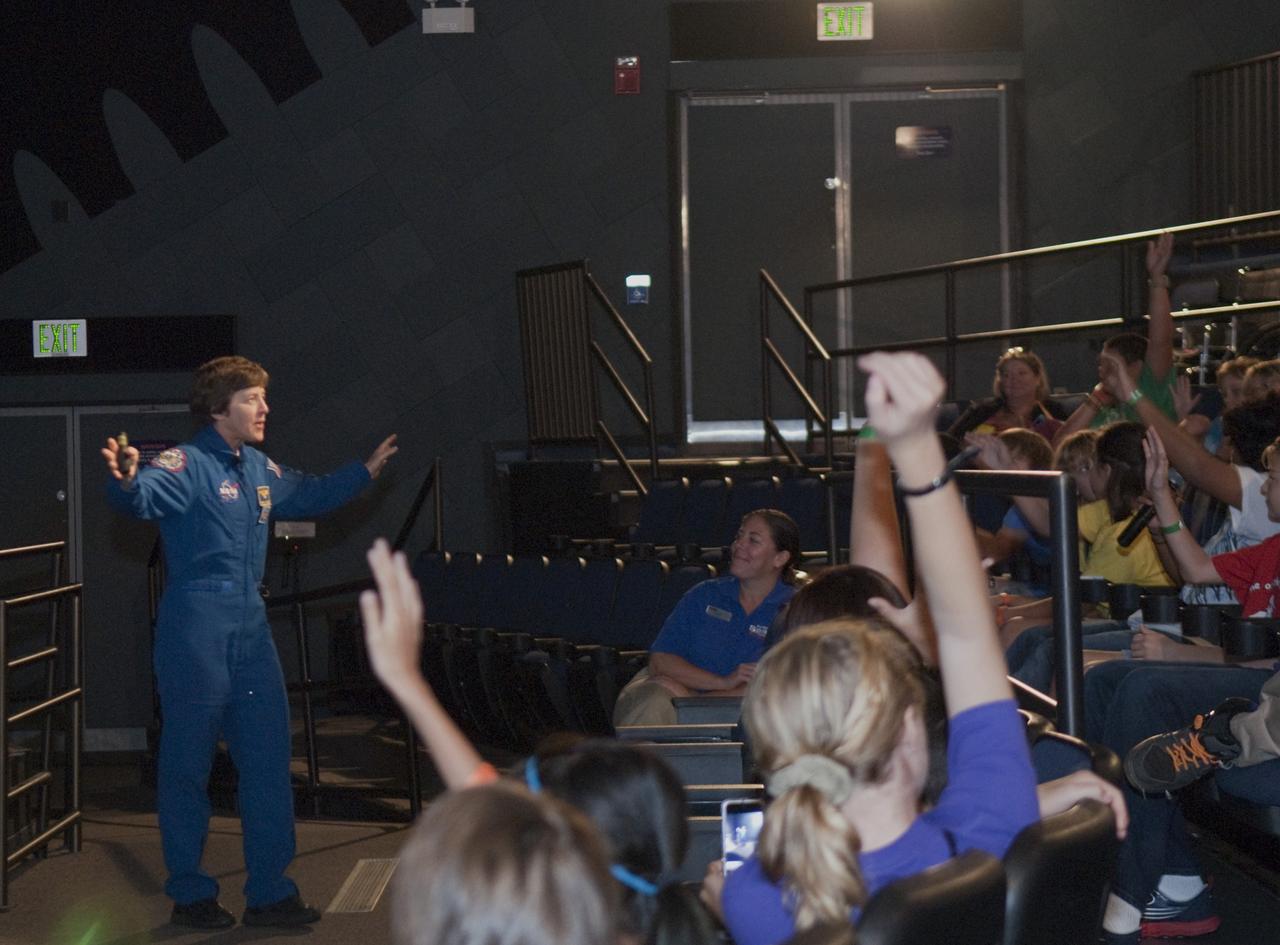
CAPE CANAVERAL, Fla. – At the Kennedy Space Center Visitor Complex in Florida sixth-grade students listen to a presentation by former NASA astronaut Wendy Lawrence. Between Nov. 26 and Dec. 7, 2012, about 5,300 sixth-graders in Brevard County, Florida were bused to Kennedy's Visitor Complex for Brevard Space Week, an educational program designed to encourage interest in science, technology, engineering and mathematics STEM careers. Photo credit: NASA/Tim Jacobs
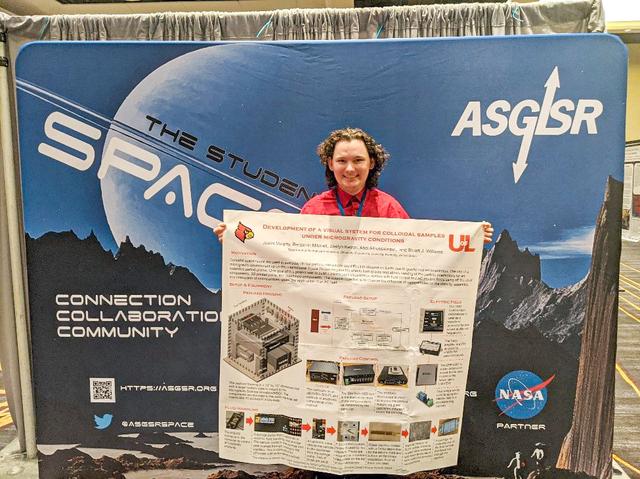
jsc2024e016255 (2/6/2024) --- Justin Murphy is an undergraduate Mechanical Engineering student (graduated May 2023) who has worked on the “Nano Halo” project and gave a poster presentation of his payload at ASGSR 2022 in Houston, Texas. The Nano Particle Haloing Suspension project tests controlled assembly of nanoparticles that could have applications in an enhanced solar cell generation technology known as quantum-dot solar synthesis. Image courtesy of the University of Louisville.
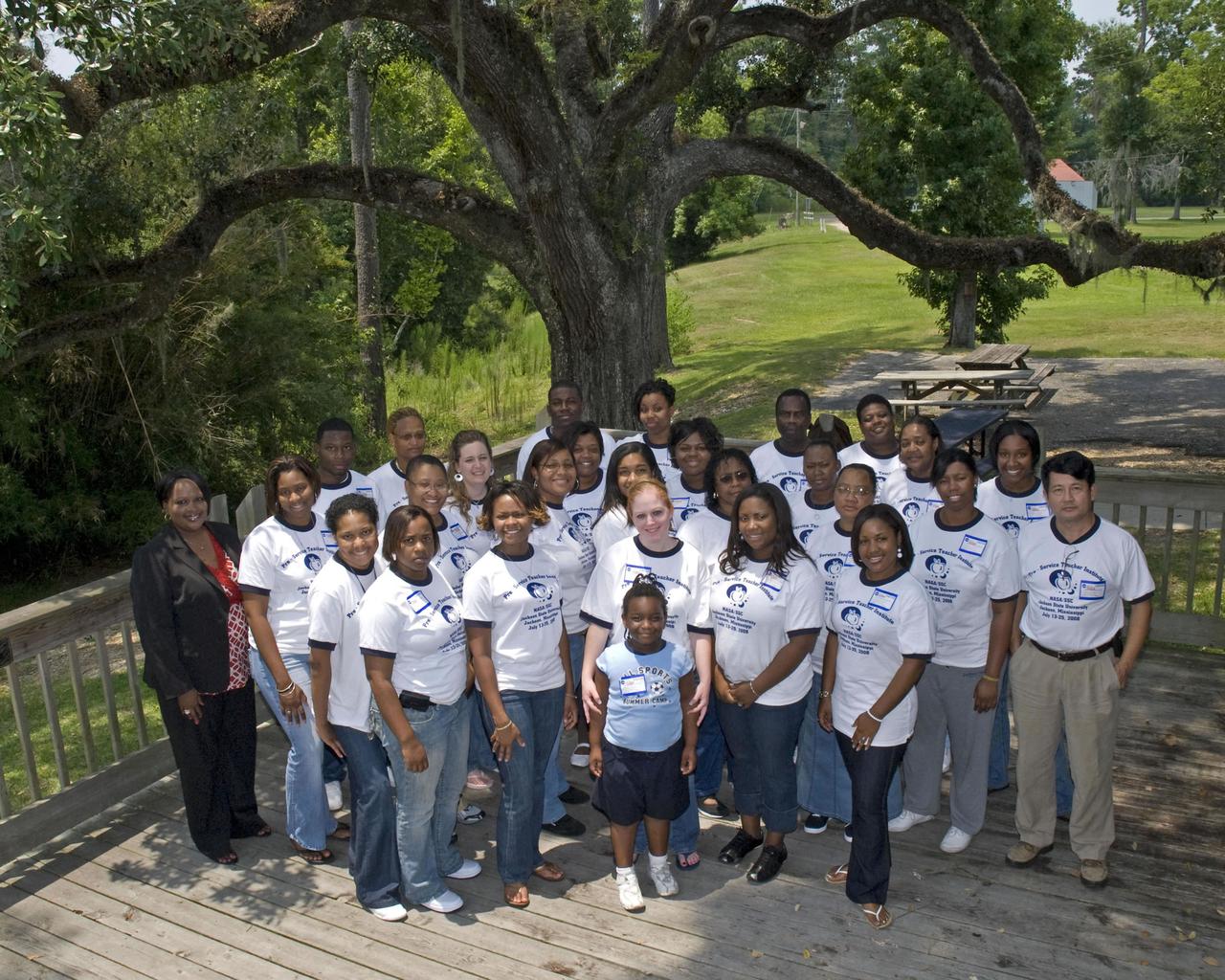
The Pre-Service Teachers Institute sponsored by Jackson (Miss.) State University participated in an agencywide Hubble Space Telescope workshop at Stennis Space Center on July 18. Twenty-five JSU junior education majors participated in the workshop, a site tour and educational presentations by Karma Snyder of the NASA SSC Engineering & Safety Center and Anne Peek of the NASA SSC Deputy Science & Technology Division.
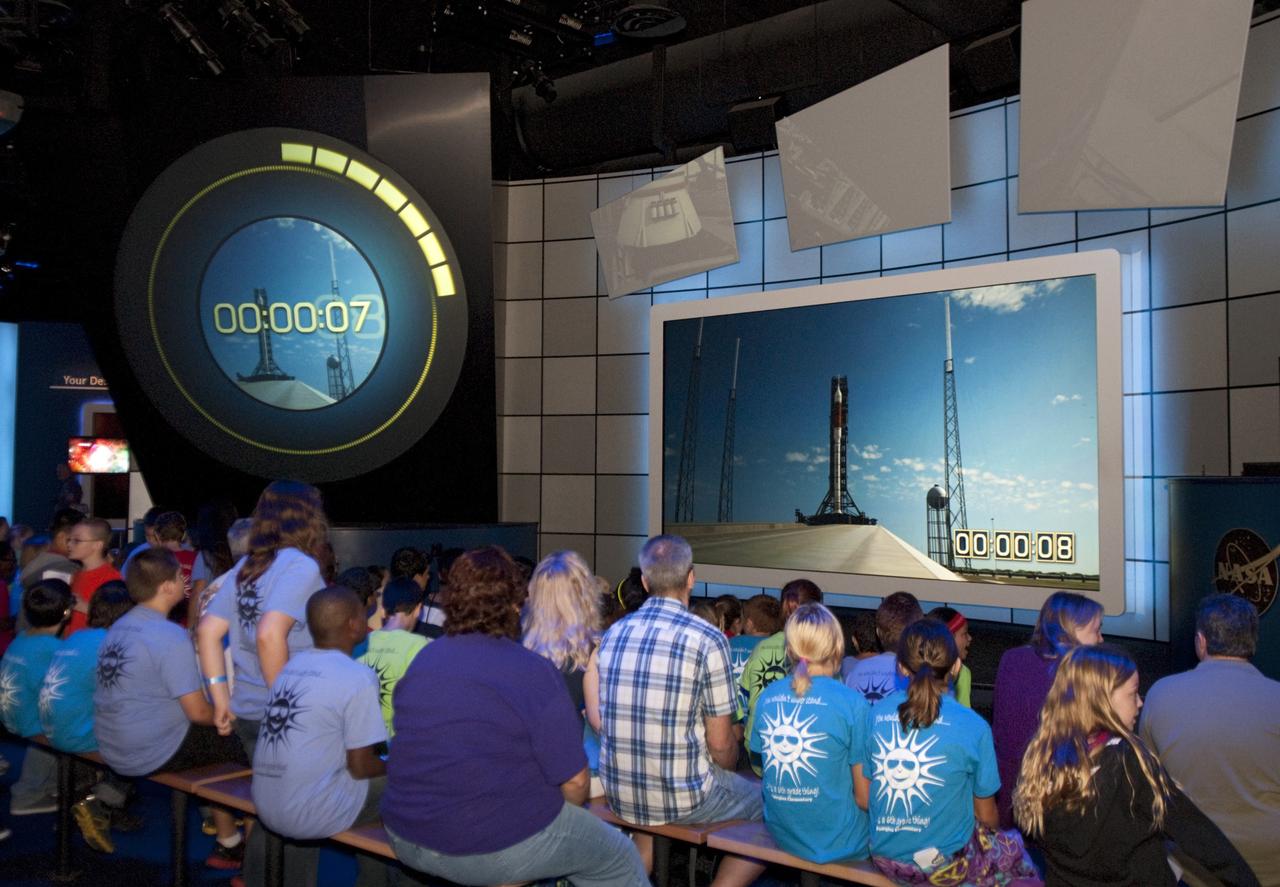
CAPE CANAVERAL, Fla. – At the Kennedy Space Center Visitor Complex in Florida sixth-grade students watch a video presentation about a future rocket launch. Between Nov. 26 and Dec. 7, 2012, about 5,300 sixth-graders in Brevard County, Florida were bused to Kennedy's Visitor Complex for Brevard Space Week, an educational program designed to encourage interest in science, technology, engineering and mathematics STEM careers. Photo credit: NASA/Tim Jacobs
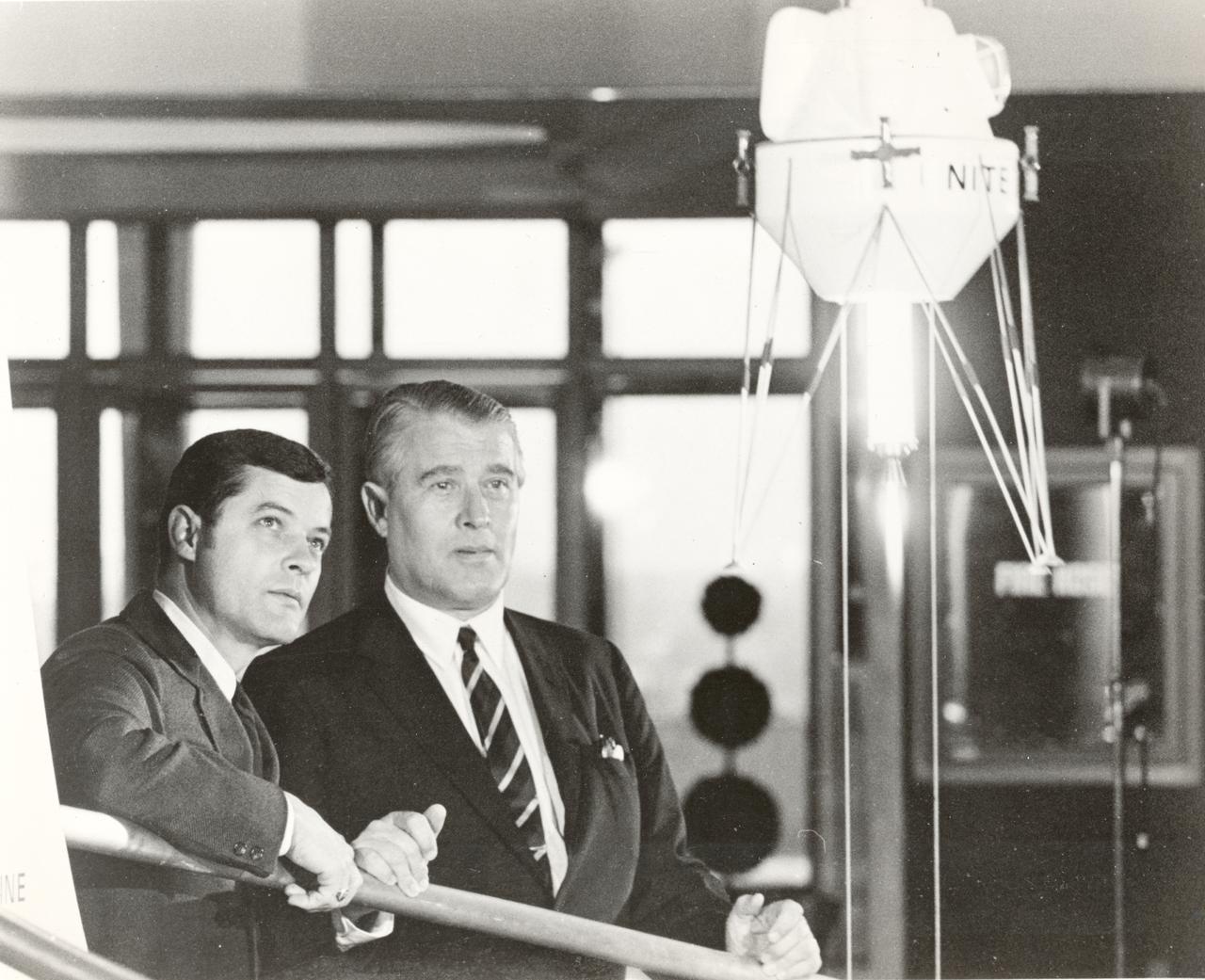
Edward O. Buckbee, the first Director of the Alabama Space Science Center (left), and Dr. Wernher von Braun (right) view a demonstration of a simulated spacecraft which uses an actual hybrid rocket engine for liftoff, hover, and landing. The display was presented to the Alabama Space Science Center, later renamed the U.S. Space and Rocket Center, by United Technology Center, a division of United Aircraft.
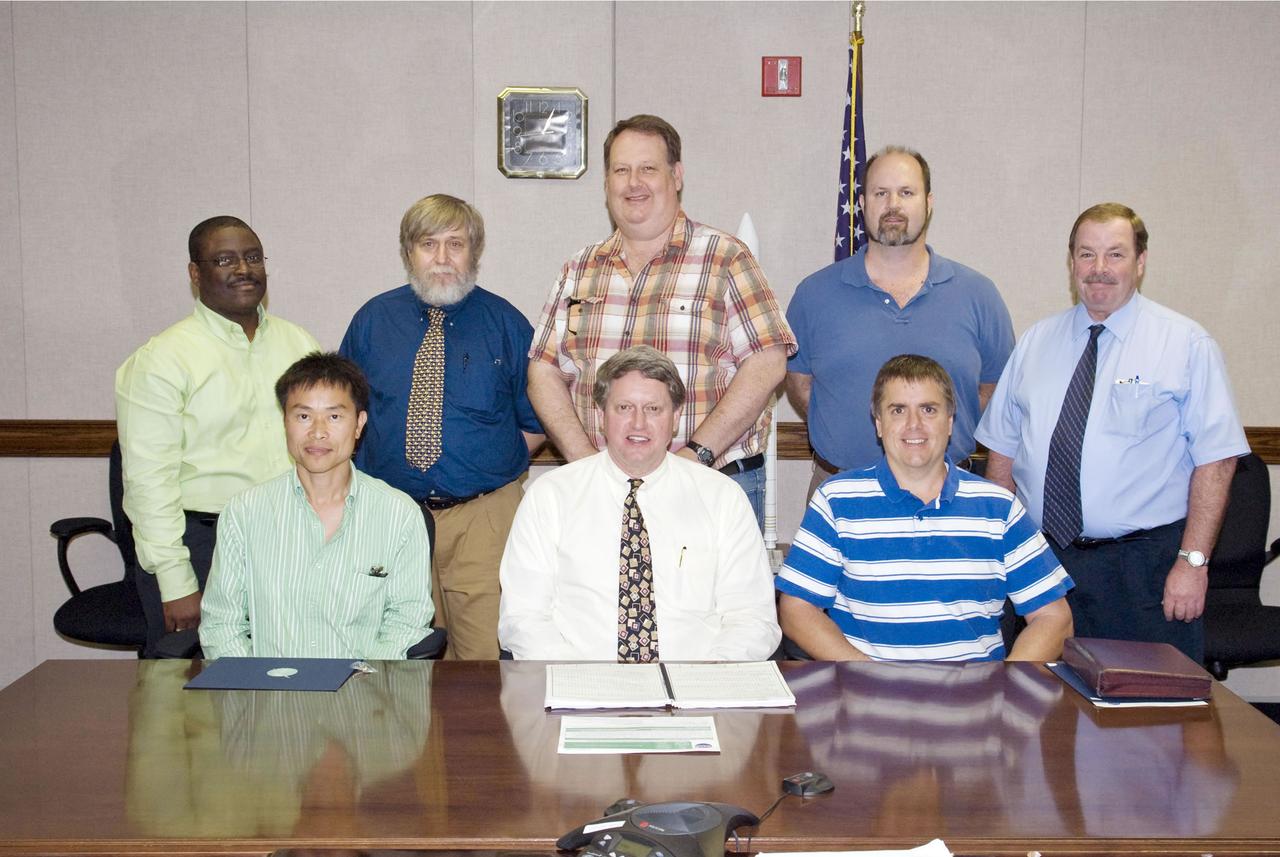
The NASA Engineering & Safety Center recently presented its Group Achievement Award to a Stennis team in recognition of technical excellence in evaluating the operational anomalies and reliability improvements associated with the space shuttle engine cut-off system. Stennis employees receiving the award were: (standing, l to r) Freddie Douglas (NASA), George Drouant (Jacobs Technology Inc.), Fred Abell (Jacobs), Robert Drackett (Jacobs) and Mike Smiles (NASA); (seated, l to r): Binh Nguyen (Jacobs), Stennis Director Gene Goldman and Joseph Lacker (NASA). Phillip Hebert of NASA is not pictured.
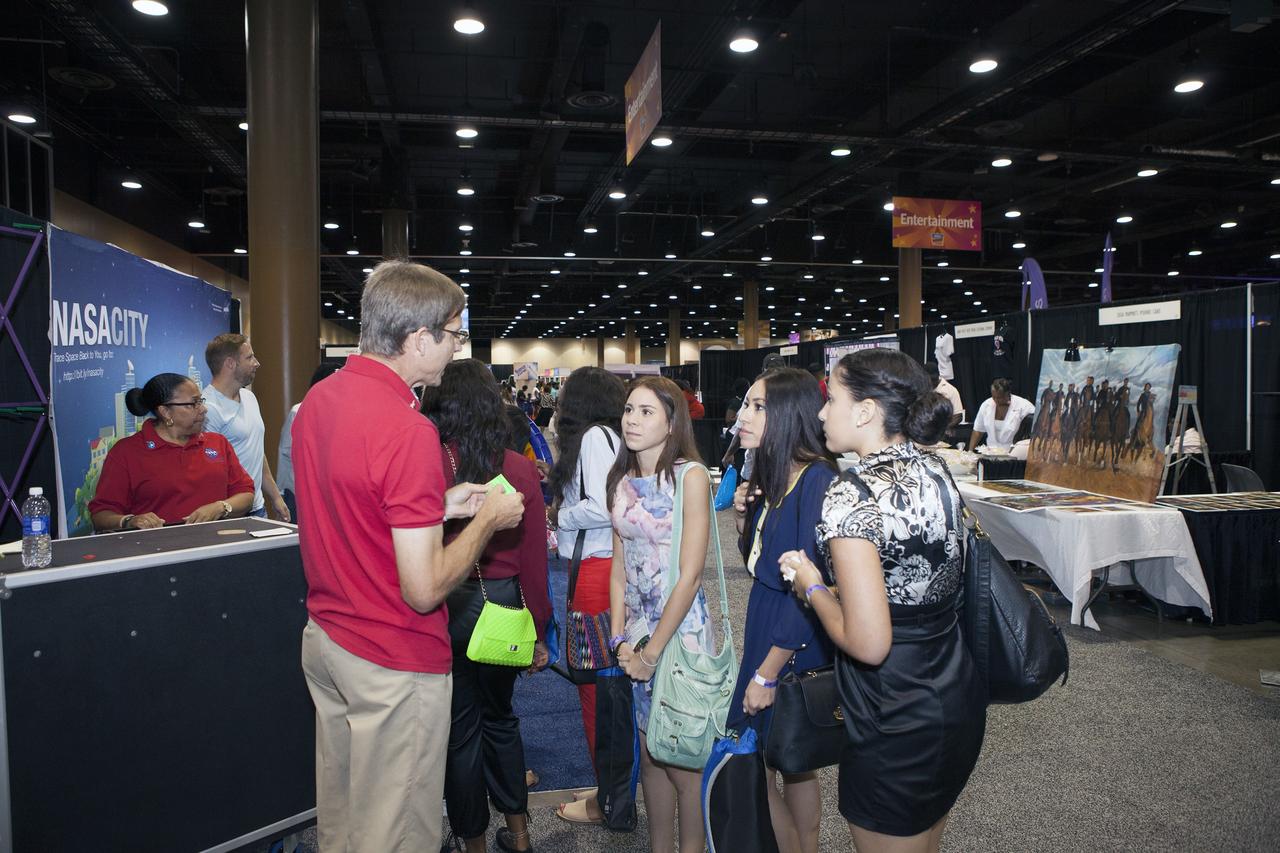
KISSIMMEE, Fla. – Guests at the Tom Joyner Family Reunion participate in "Learn and Spin Challenge," an opportunity to answer questions related to science, technology, engineering and math. Robert Smith asks a question as part of NASA’s educational theme during the five-day event. Behind Smith, to the left, is Debbie Houston who also supported the "Learn and Spin Challenge." The Tom Joyner Family Reunion is designed to present uplifting programs, entertainment and information about growing, diverse communities. An annual event of the nationally-syndicated Tom Joyner Morning Show, the many exhibits included NASA's participation focusing on encouraging young people to consider studies and careers in STEM -- science, technology, engineering and math. NASA's Education Division promoted the benefits of math and scientific learning along with career opportunities offered by the space agency. The activities took place at the Gaylord Palms Resort in Kissimmee, Florida, during the Labor Day weekend. Photo credit: NASA/Daniel Casper
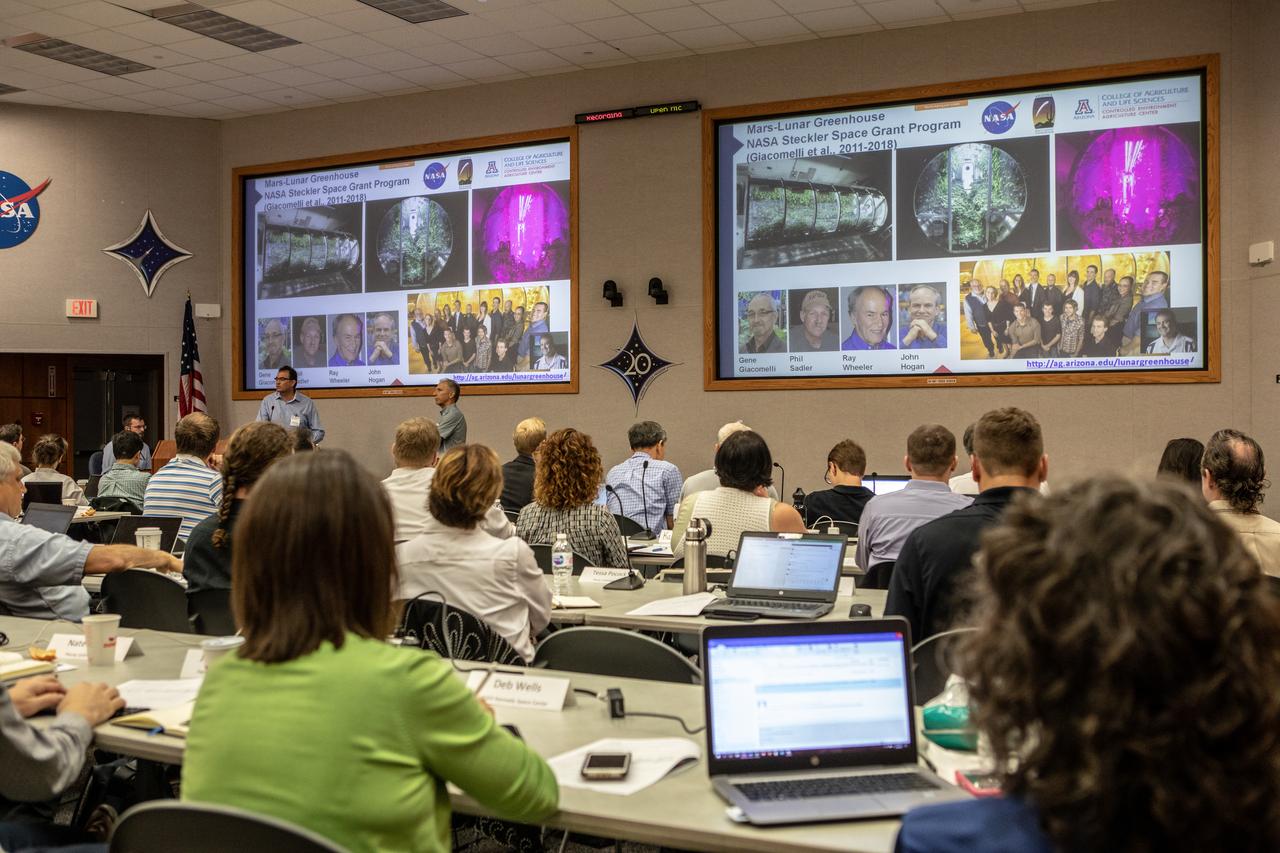
The Exploration Research and Technology Programs at NASA’s Kennedy Space Center in Florida hosted a two-day workshop, Aug. 6 and 7, 2019, focusing on robotics and automation in space crop production. Participants from around the world and members of NASA, industry, academia and other government agencies met to share their knowledge to enable a common goal of sustaining human operations on the Moon, in deep space and eventually on Mars. Keynote speakers and representatives from different organizations presented data gleaned from their research. Murat Kacira, left, a professor in the Department of Agricultural and Biosystems Engineering and director of the Controlled Environment Agriculture Program at the University of Arizona, and Barry Pryor, a professor with the School of Plant Sciences, also at the University of Arizona, present to workshop attendees on Aug. 6.
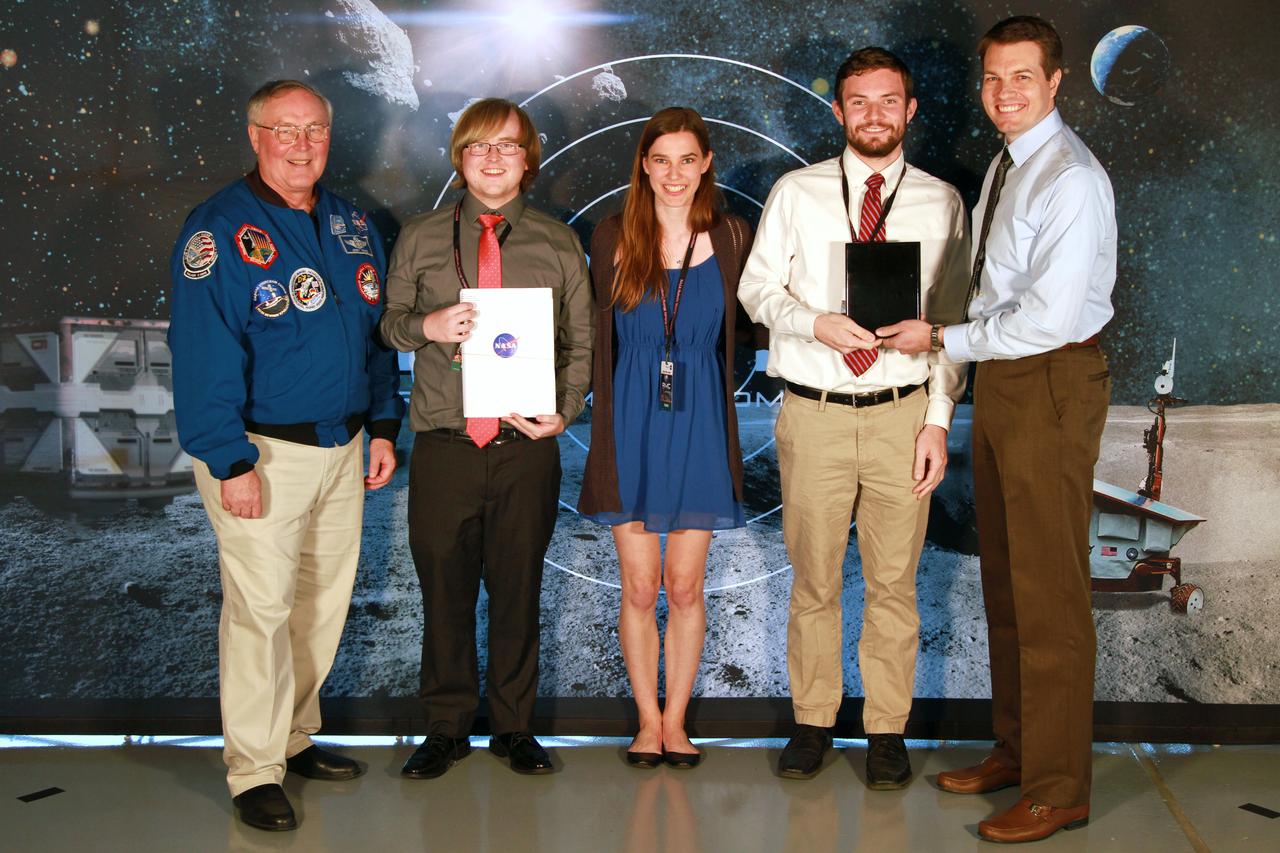
NASA's 9th Annual Robotic Mining Competition concludes with an awards ceremony May 18, 2018, at the Apollo/Saturn V Center at the Kennedy Space Center Visitor Complex in Florida. The University of Alabama Team Astrobotics received third place in the Slide Presentation and Demonstration award category. At left is retired NASA astronaut Jerry Ross. At right is Daniel Hull, lead presentation judge. More than 40 student teams from colleges and universities around the U.S. participated in the competition, May 14-18, by using their mining robots to dig in a supersized sandbox filled with BP-1, or simulated lunar soil, gravel and rocks, and participate in other competition requirements. The Robotic Mining Competition is a NASA Human Exploration and Operations Mission Directorate project designed to encourage students in science, technology, engineering and math, or STEM fields. The project provides a competitive environment to foster innovative ideas and solutions that could be used on NASA's deep space missions.
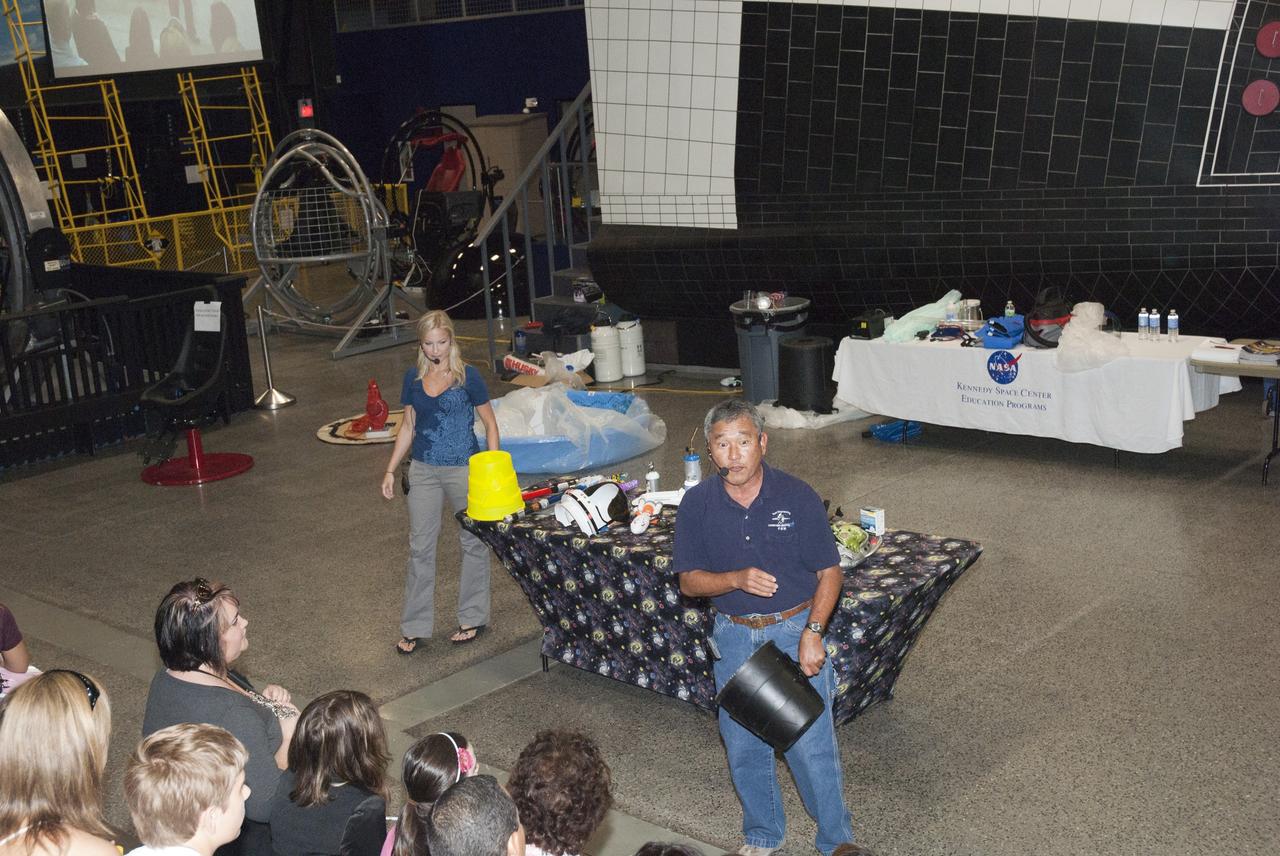
CAPE CANAVERAL, Fla. -- At the Astronaut Hall of Fame near the Kennedy Space Center Visitor Complex in Florida, fifth- through eighth-grade students and their parents listen to a presentation about the theory of flight during the last NASA family education night event. Other activities included "gee-whiz" presentations, astronaut appearances, a hovercraft, vortex cannon and alternative fuel vehicles, which promote science, technology, engineering and mathematics (STEM) education. The event is part of NASA's Summer of Innovation initiative to provide interactive learning experiences to middle school students nationwide during the summer months. The program is a cornerstone of the Educate to Innovate campaign announced by President Barack Obama in November 2009. Photo credit: NASA/Charisse Nahser
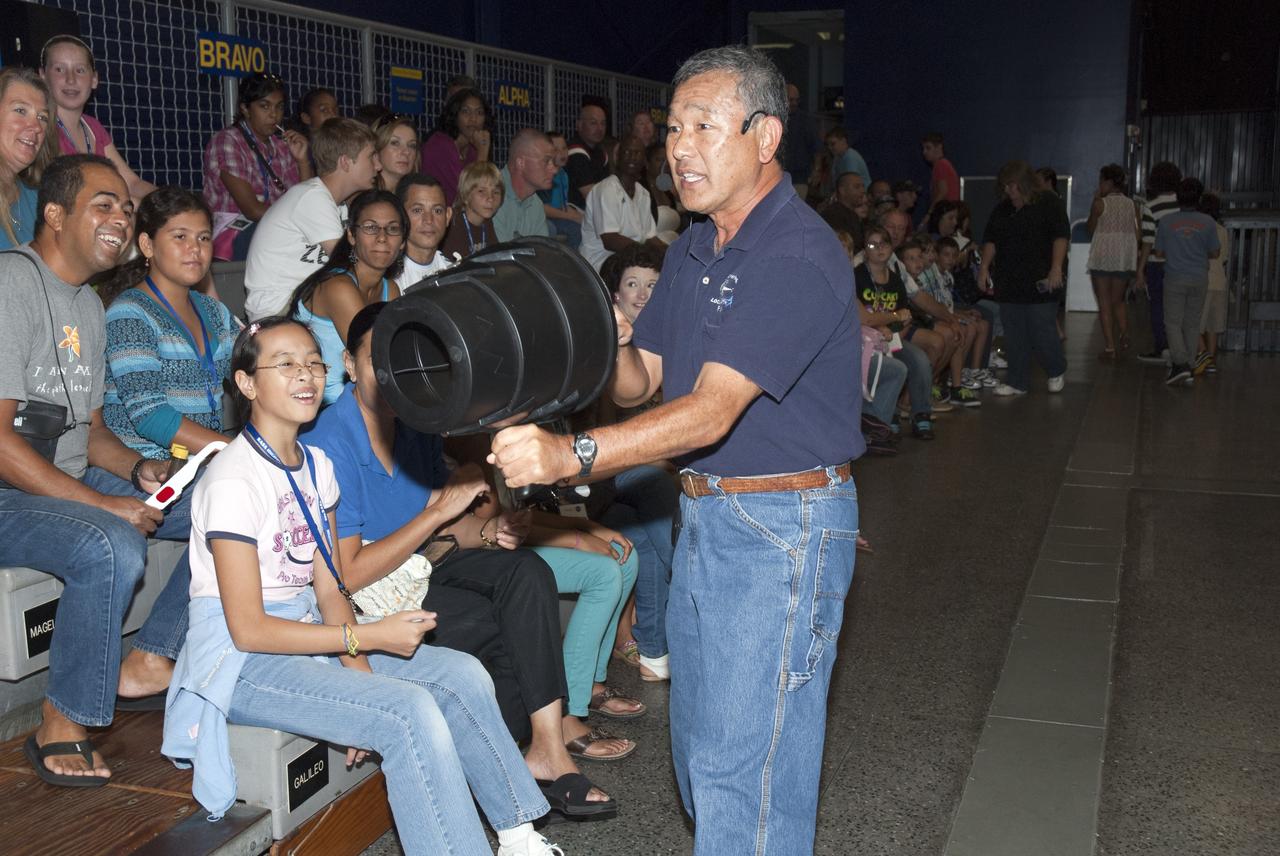
CAPE CANAVERAL, Fla. -- At the Astronaut Hall of Fame near the Kennedy Space Center Visitor Complex in Florida, fifth- through eighth-grade students and their parents participate in a vortex cannon experiment during the last NASA family education night event. Other activities included "gee-whiz" presentations, astronaut appearances, a hovercraft and alternative fuel vehicles, which promote science, technology, engineering and mathematics (STEM) education. The event is part of NASA's Summer of Innovation initiative to provide interactive learning experiences to middle school students nationwide during the summer months. The program is a cornerstone of the Educate to Innovate campaign announced by President Barack Obama in November 2009. Photo credit: NASA/Charisse Nahser
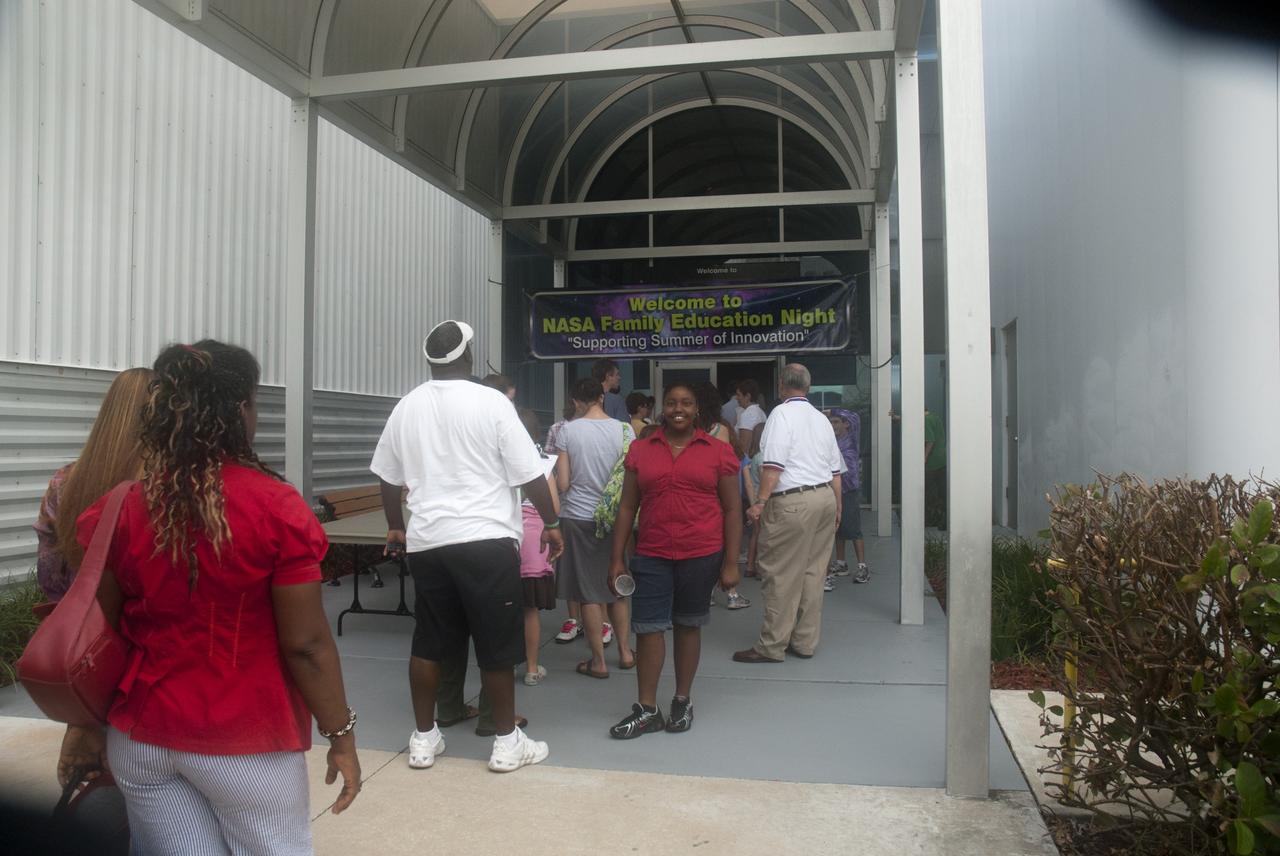
CAPE CANAVERAL, Fla. -- Fifth- through eighth-grade students and their parents enter the Astronaut Hall of Fame near the Kennedy Space Center Visitor Complex in Florida for the last NASA family education night event. Inside, they participated in science, technology, engineering and mathematics (STEM) activities, such as "gee-whiz" presentations, astronaut appearances, a hovercraft, vortex cannon and alternative fuel vehicles. The event is part of NASA's Summer of Innovation initiative to provide interactive learning experiences to middle school students nationwide during the summer months. The program is a cornerstone of the Educate to Innovate campaign announced by President Barack Obama in November 2009. Photo credit: NASA/Charisse Nahser
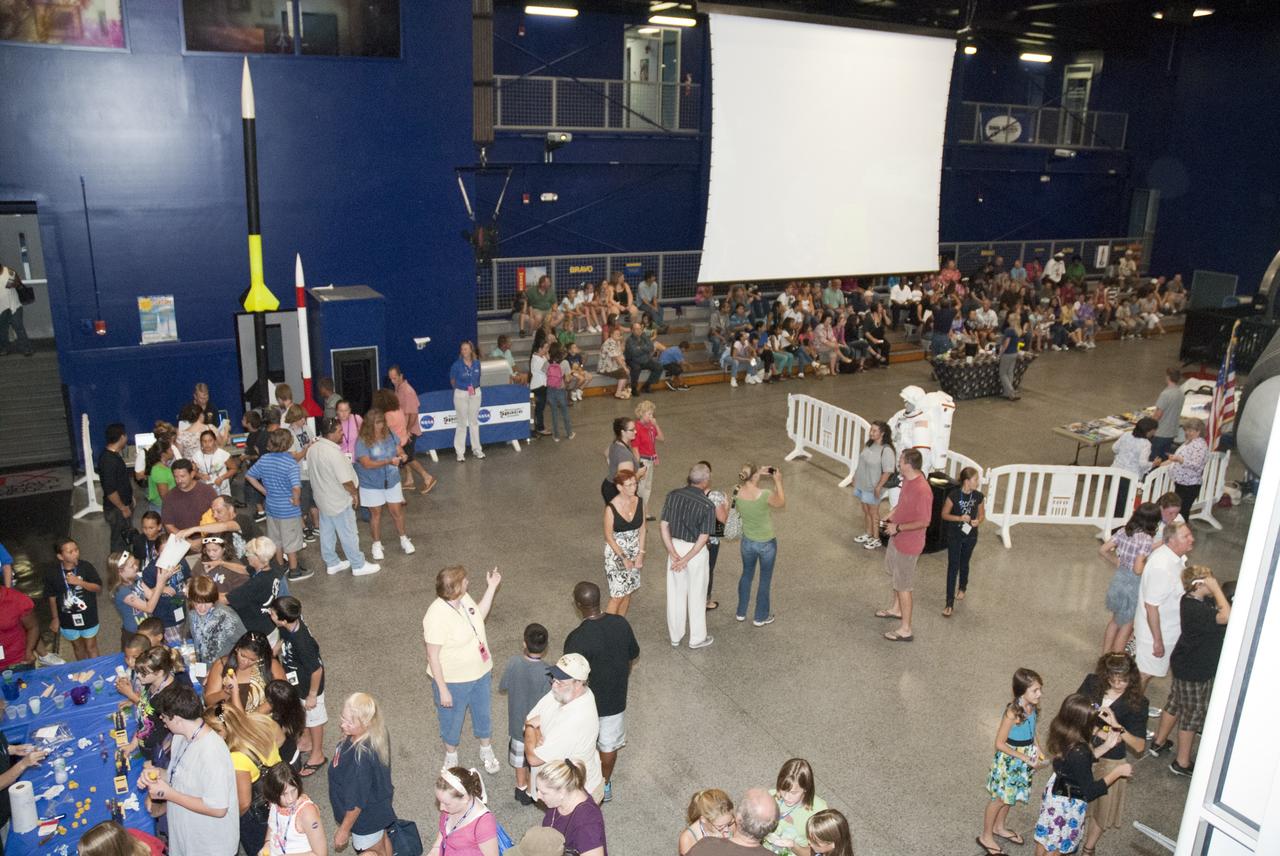
CAPE CANAVERAL, Fla. -- At the Astronaut Hall of Fame near the Kennedy Space Center Visitor Complex in Florida, fifth- through eighth-grade students and their parents participate in the last NASA family education night event. Activities included "gee-whiz" presentations, astronaut appearances, a hovercraft, vortex cannon and alternative fuel vehicles, which promote science, technology, engineering and mathematics (STEM) education. The event is part of NASA's Summer of Innovation initiative to provide interactive learning experiences to middle school students nationwide during the summer months. The program is a cornerstone of the Educate to Innovate campaign announced by President Barack Obama in November 2009. Photo credit: NASA/Charisse Nahser
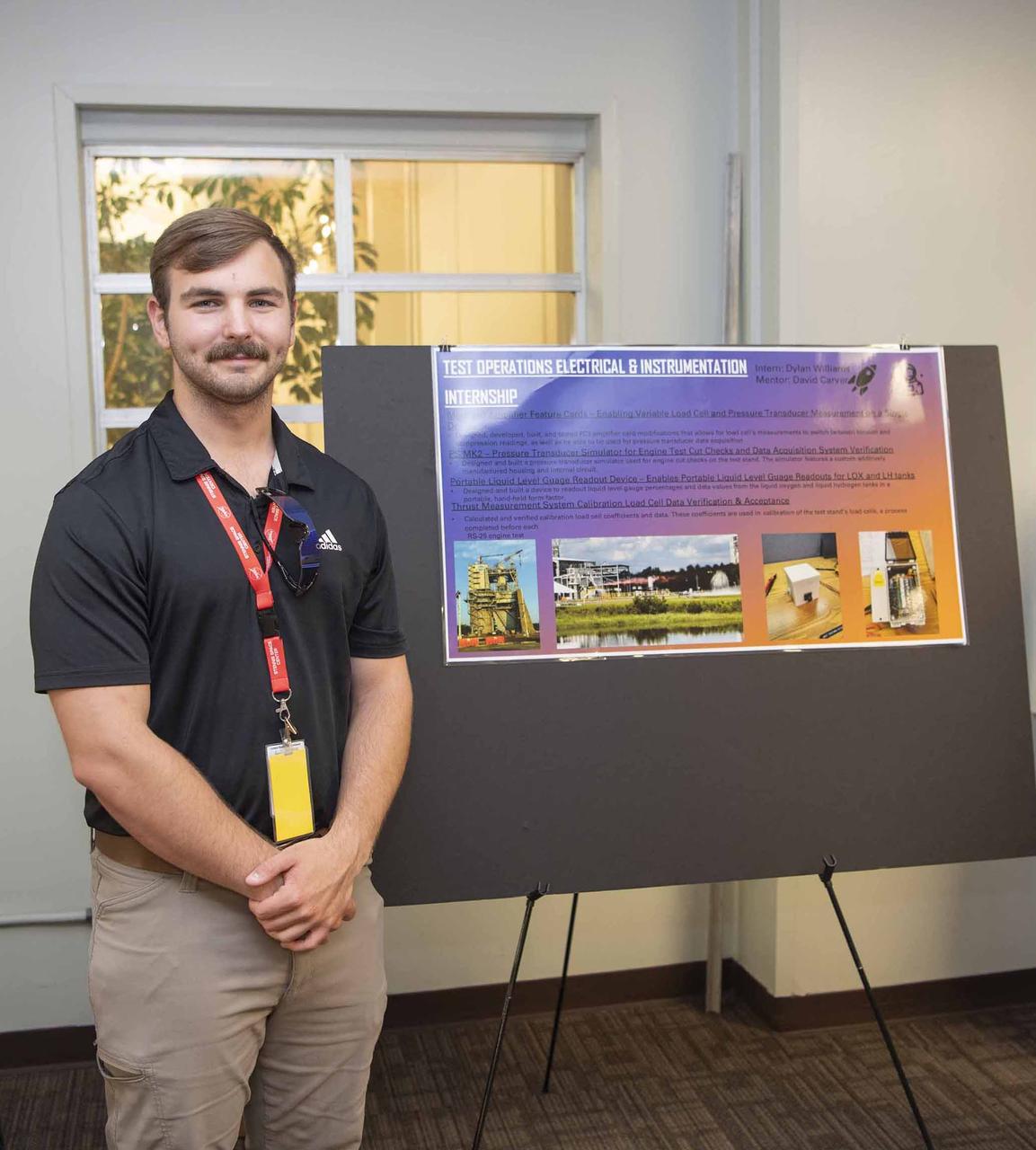
NASA Stennis summer intern Dylan Williams is shown with his presentation highlighting work with test operations during an Aug. 7 event hosted by the Office of STEM Engagement. Williams, a student at Meridian Community College in Meridian, Mississippi, worked with the NASA Stennis Engineering and Test Directorate. The poster symposium highlighted research topics, including propulsion test operations, lunar robotics, autonomous systems, STEM education, and more. NASA’s Office of STEM Engagement paid internships allow high school and college-level students to contribute to the agency’s mission to advance science, technology, aeronautics, and space exploration.
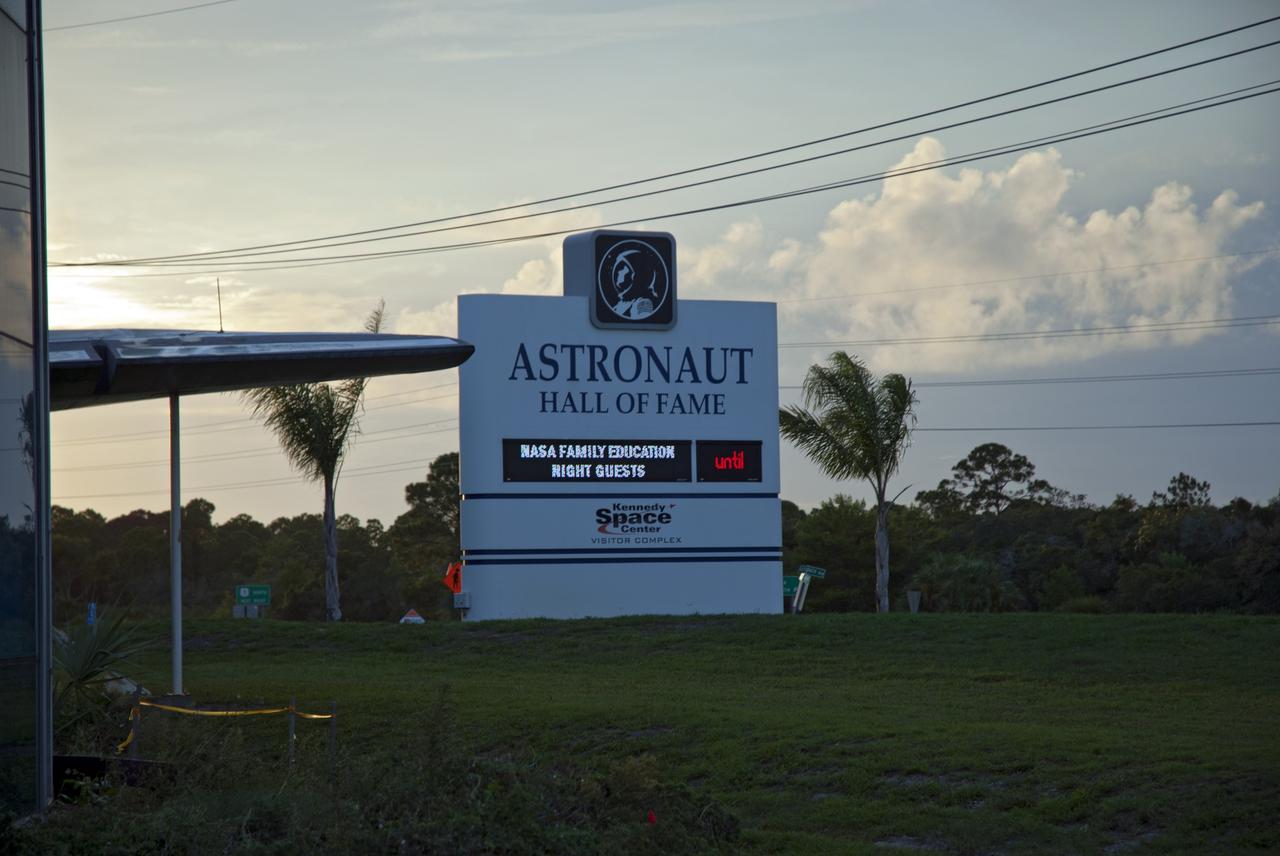
CAPE CANAVERAL, Fla. -- A sign welcomes fifth- through eighth-grade students and their parents to the last NASA family education night event at the Astronaut Hall of Fame near the Kennedy Space Center Visitor Complex in Florida. Activities included "gee-whiz" presentations, astronaut appearances, a hovercraft, vortex cannon and alternative fuel vehicles, which promote science, technology, engineering and mathematics (STEM) education. The event is part of NASA's Summer of Innovation initiative to provide interactive learning experiences to middle school students nationwide during the summer months. The program is a cornerstone of the Educate to Innovate campaign announced by President Barack Obama in November 2009. Photo credit: NASA/Charisse Nahser
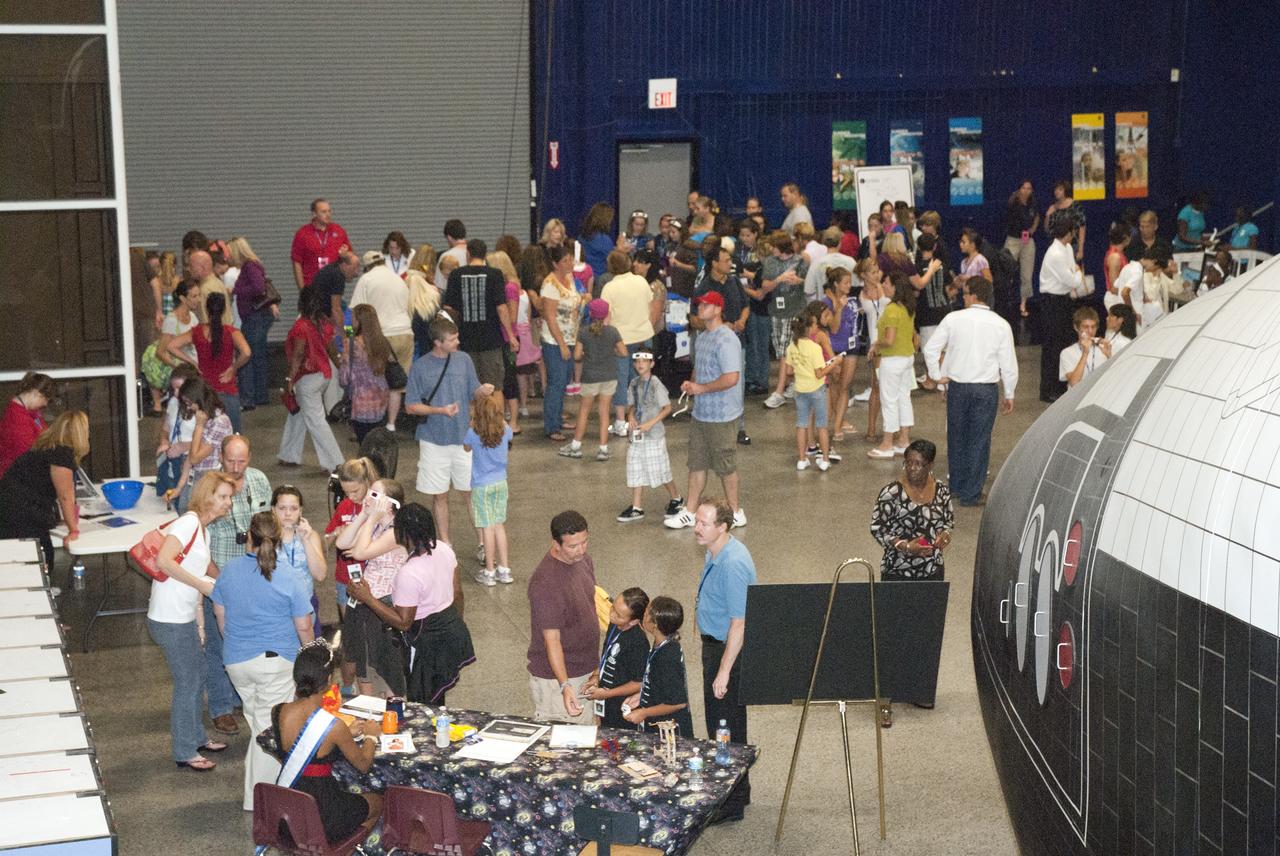
CAPE CANAVERAL, Fla. -- At the Astronaut Hall of Fame near the Kennedy Space Center Visitor Complex in Florida, fifth- through eighth-grade students and their parents participate in the last NASA family education night event. Activities included "gee-whiz" presentations, astronaut appearances, a hovercraft, vortex cannon and alternative fuel vehicles, which promote science, technology, engineering and mathematics (STEM) education. The event is part of NASA's Summer of Innovation initiative to provide interactive learning experiences to middle school students nationwide during the summer months. The program is a cornerstone of the Educate to Innovate campaign announced by President Barack Obama in November 2009. Photo credit: NASA/Charisse Nahser
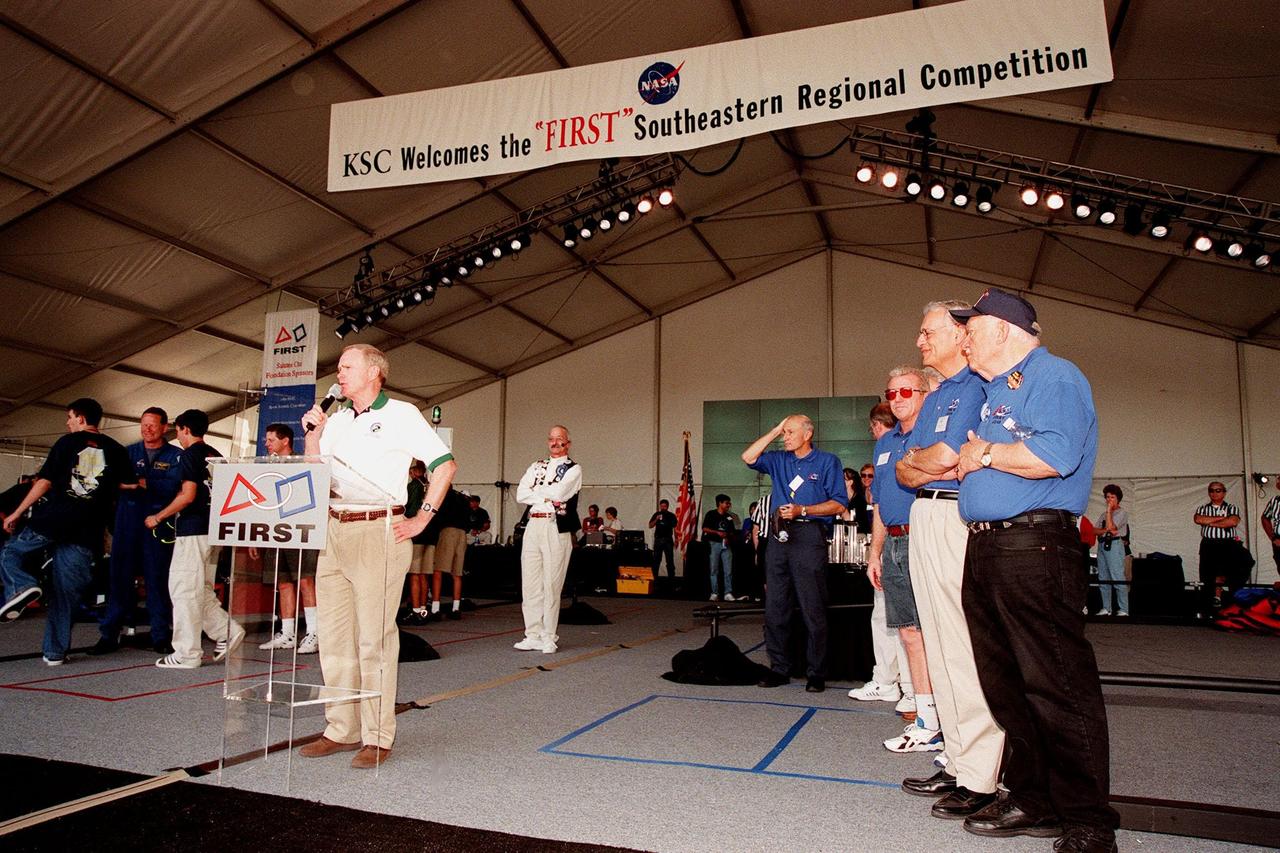
At the award ceremony for the 1999 FIRST Southeastern Regional robotic competition held at KSC, Center Director Roy Bridges addresses the teams, encouraging them to continue their interest in engineering. Directly behind him (left) are Woody Flowers, national advisor to FIRST, and (right) former KSC Director of Shuttle Processing Robert Sieck, who served as one of the judges. At the far left, students gather around astronaut David Brown, who was present during the two days of matches. At right are other judges, including Deputy Director for Launch and Payload Processing Loren Shriver (third from right). FIRST is a nonprofit organization, For Inspiration and Recognition of Science and Technology, that sponsors the event pitting gladiator robots against each other in an athletic-style competition. The FIRST robotics competition is designed to provide students with a hands-on, inside look at engineering and other professional careers, pairing high school students with engineer mentors and corporations. The regional event comprised 27 teams. Along with the championship award, which went to high school teams in Miami and San German, Puerto Rico, 15 other awards were presented
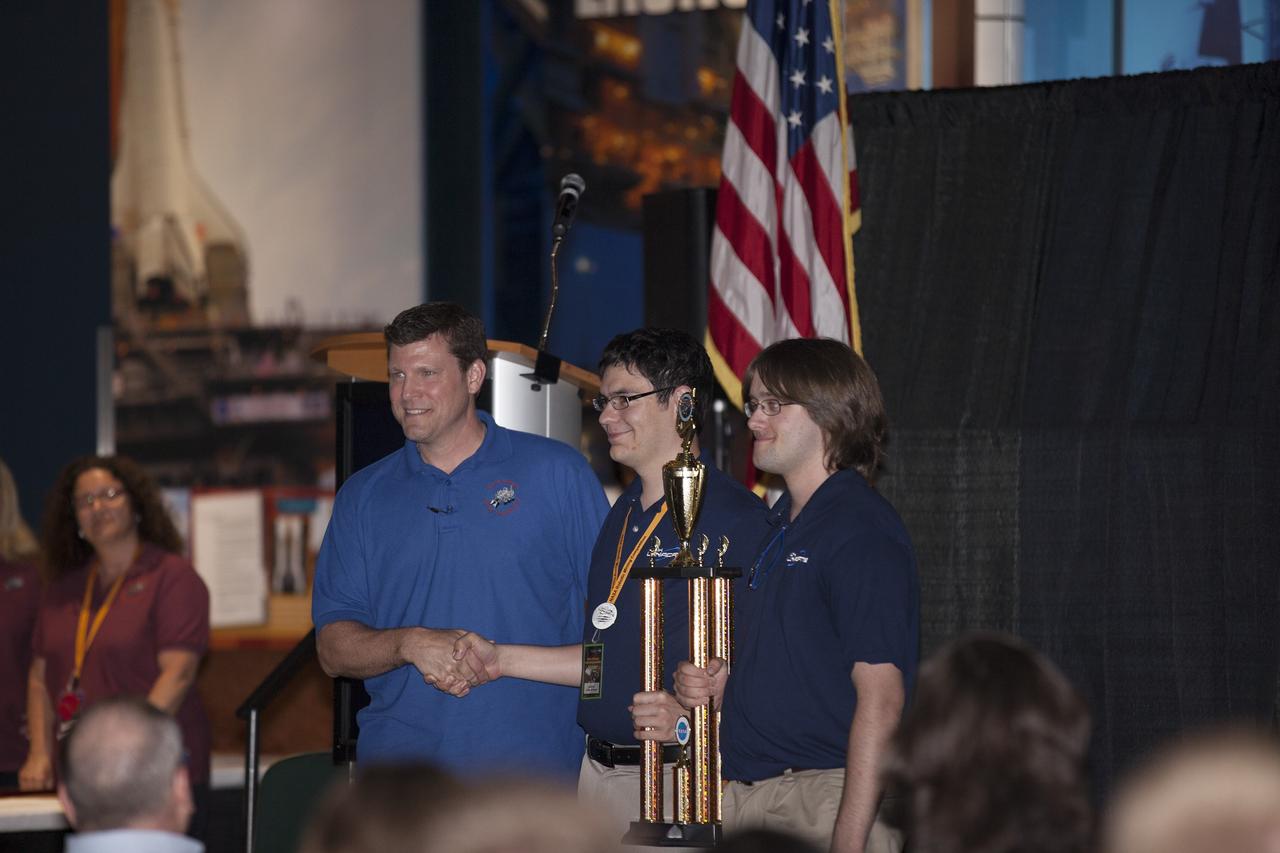
CAPE CANAVERAL, Fla. -- Kennedy Space Center engineer Marc Seibert presents the Communication Award to the University of New Hampshire team members during NASA's 2014 Robotic Mining Competition award ceremony inside the Space Shuttle Atlantis attraction at the Kennedy Space Center Visitor Complex in Florida. The team moved 10 kilograms of simulated Martian soil with its robot while using the least amount of communication power. More than 35 teams from colleges and universities around the U.S. designed and built remote-controlled robots for the mining competition. The competition is a NASA Human Exploration and Operations Mission Directorate project designed to engage and retain students in science, technology, engineering and mathematics, or STEM, fields by expanding opportunities for student research and design. Teams use their remote-controlled robotics to maneuver and dig in a supersized sandbox filled with a crushed material that has characteristics similar to Martian soil. The objective of the challenge is to see which team’s robot can collect and move the most regolith within a specified amount of time. The competition includes on-site mining, writing a systems engineering paper, performing outreach projects for K-12 students, slide presentation and demonstrations, and team spirit. For more information, visit www.nasa.gov/nasarmc. Photo credit: NASA/Kim Shiflett
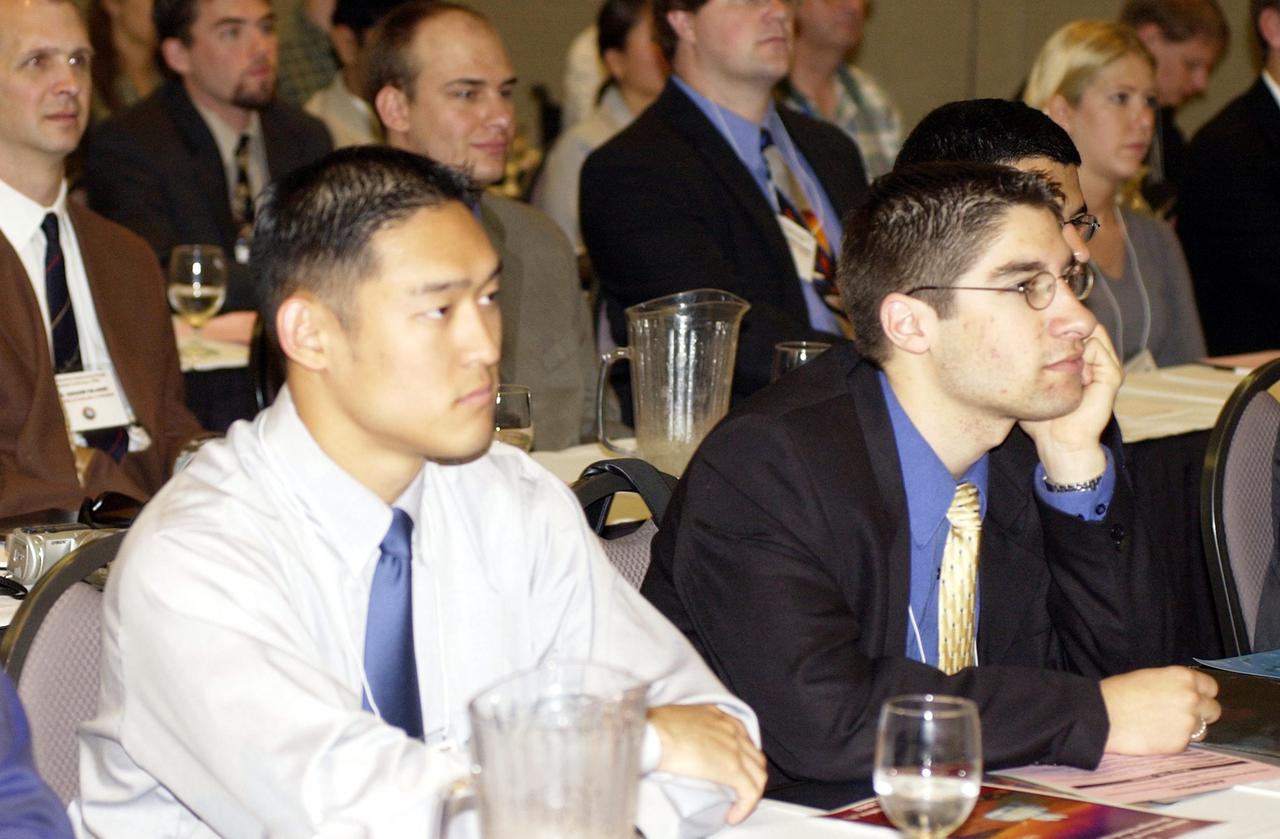
KENNEDY SPACE CENTER, FLA. -- Students listen to remarks at the opening of this year's NASA MarsPort Engineering Design Student Competition 2002 conference at the KSC Visitor Complex, organized by the Florida Space Grant Consortium. Students and faculty from the nation's universities converged at Kennedy for the MarsPort Competition, presenting papers on engineering trade studies to design optimal configurations for a MarsPort Deployable Greenhouse for operation on the surface of Mars. Judges in the competition were from KSC, Dynamac Corporation and Florida Institute of Technology. The winning team's innovative ideas will be used by NASA to evaluate and study other engineering trade concepts. Also featured at the opening ceremony were Dr. Sam Durrance, FSGC director and former astronaut, and Dr. Gary Stutte, plant scientist, Dynamac Corporation.
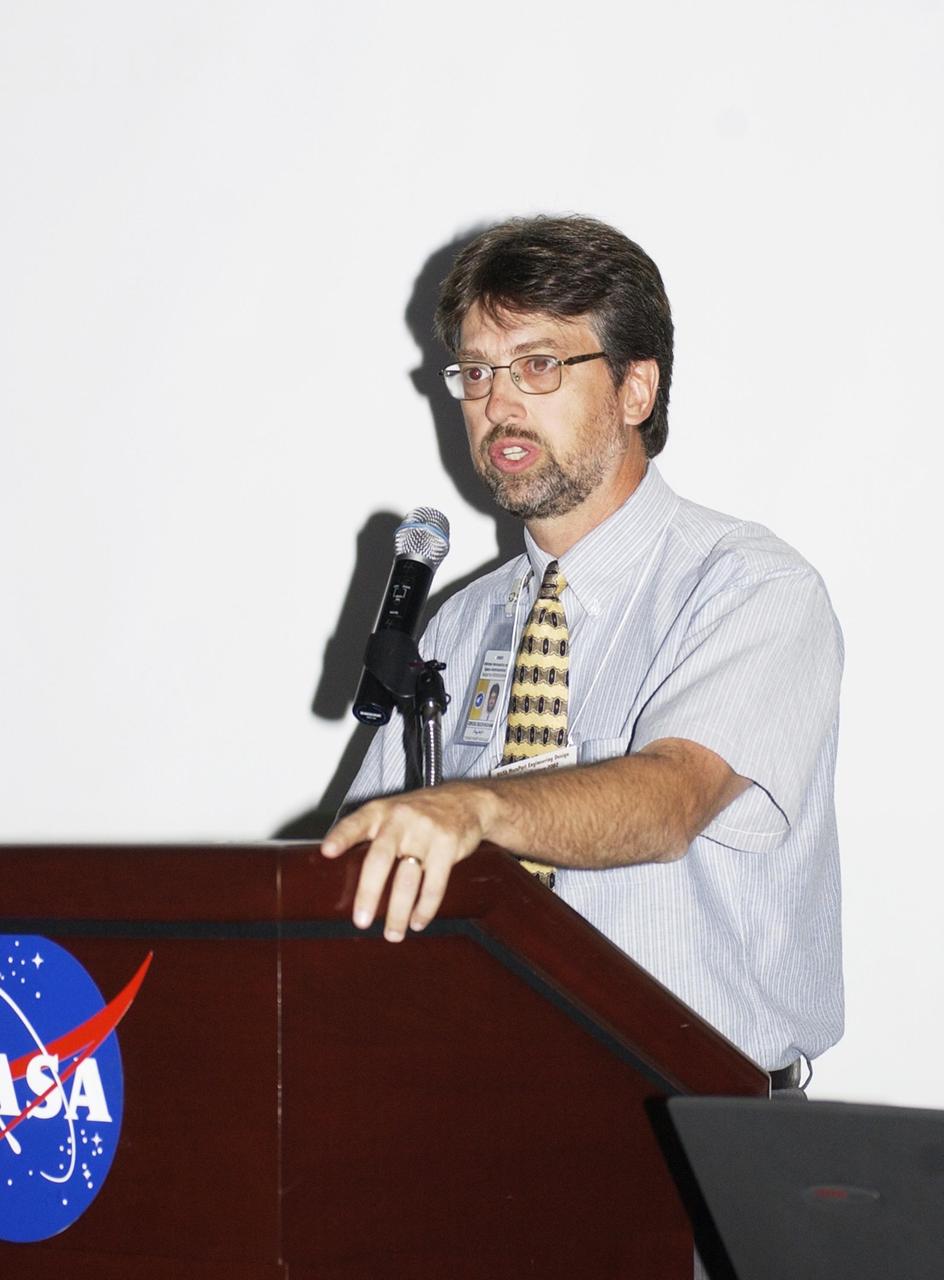
KENNEDY SPACE CENTER, FLA. -- Gregg Buckingham, with KSC's Center for Space Education, addresses participants in this year's NASA MarsPort Engineering Design Student Competition 2002 conference at the KSC Visitor Complex, organized by the Florida Space Grant Consortium. Students and faculty from the nation's universities converged at Kennedy for the MarsPort Competition, presenting papers on engineering trade studies to design optimal configurations for a MarsPort Deployable Greenhouse for operation on the surface of Mars. Judges in the competition were from KSC, Dynamac Corporation and Florida Institute of Technology. The winning team's innovative ideas will be used by NASA to evaluate and study other engineering trade concepts. Also featured at the opening ceremony were Dr. Sam Durrance, FSGC director and former astronaut, and Dr. Gary Stutte, plant scientist, Dynamac Corporation.
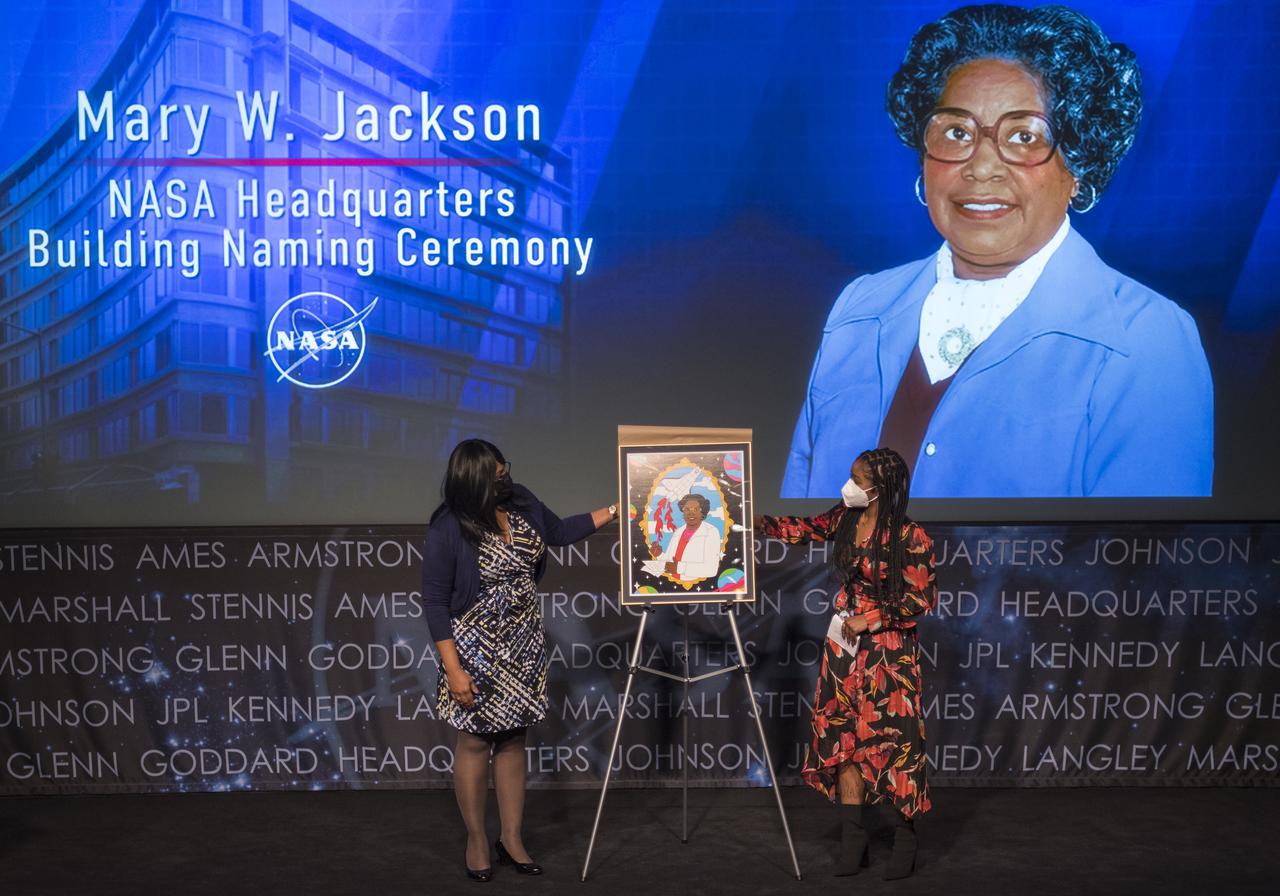
Artist Tenbeete Solomon, also known as Trap Bob, right, presents her artwork honoring Mary W. Jackson to Wanda Jackson, granddaughter of Mary W. Jackson, left, during a ceremony officially naming the NASA Headquarters building in honor of Mary W. Jackson, Friday, Feb. 26, 2021, at NASA Headquarters in Washington, DC. Mary W. Jackson, the first African American female engineer at NASA, began her career with the agency in the segregated West Area Computing Unit of NASA’s Langley Research Center in Hampton, Virginia. The mathematician and aerospace engineer went on to lead programs influencing the hiring and promotion of women in NASA's science, technology, engineering, and mathematics careers. In 2019, she posthumously received the Congressional Gold Medal. Photo Credit: (NASA/Joel Kowsky)
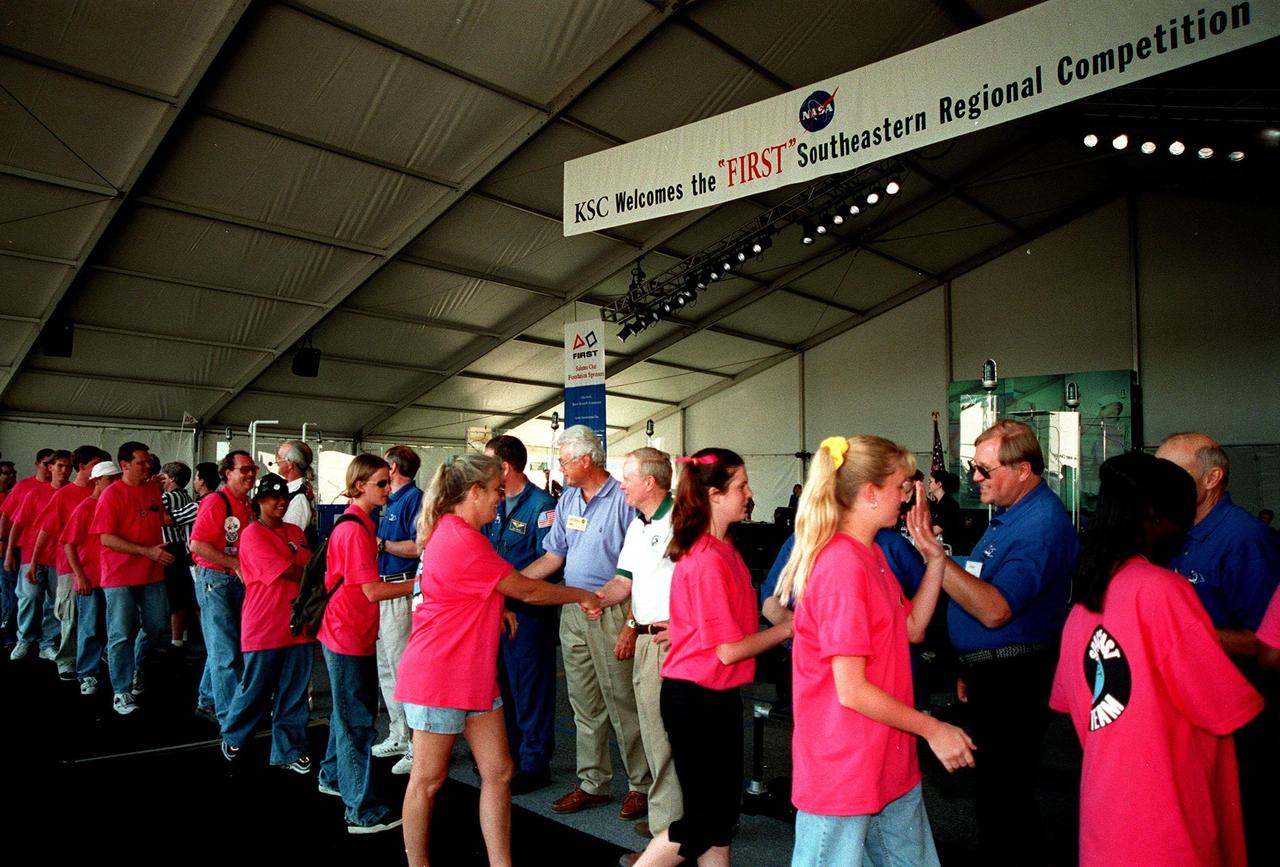
At the award ceremony for the 1999 FIRST Southeastern Regional robotic competition held at KSC, the Space Coast FIRST Team walks past the greeting line. In the middle, shaking hands with the team, are KSC's Director of Engineering Development Sterling Walker (left) and Center Director Roy Bridges (right). The Space Coast Team included Rockledge, Cocoa Beach and Merritt Island High Schools. FIRST is a nonprofit organization, For Inspiration and Recognition of Science and Technology, that sponsors the event pitting gladiator robots against each other in an athletic-style competition. The FIRST robotics competition is designed to provide students with a hands-on, inside look at engineering and other professional careers, pairing high school students with engineer mentors and corporations. The regional event comprised 27 teams. Along with the championship award, which went to high school teams from Miami and San German, Puerto Rico, 15 other awards were presented
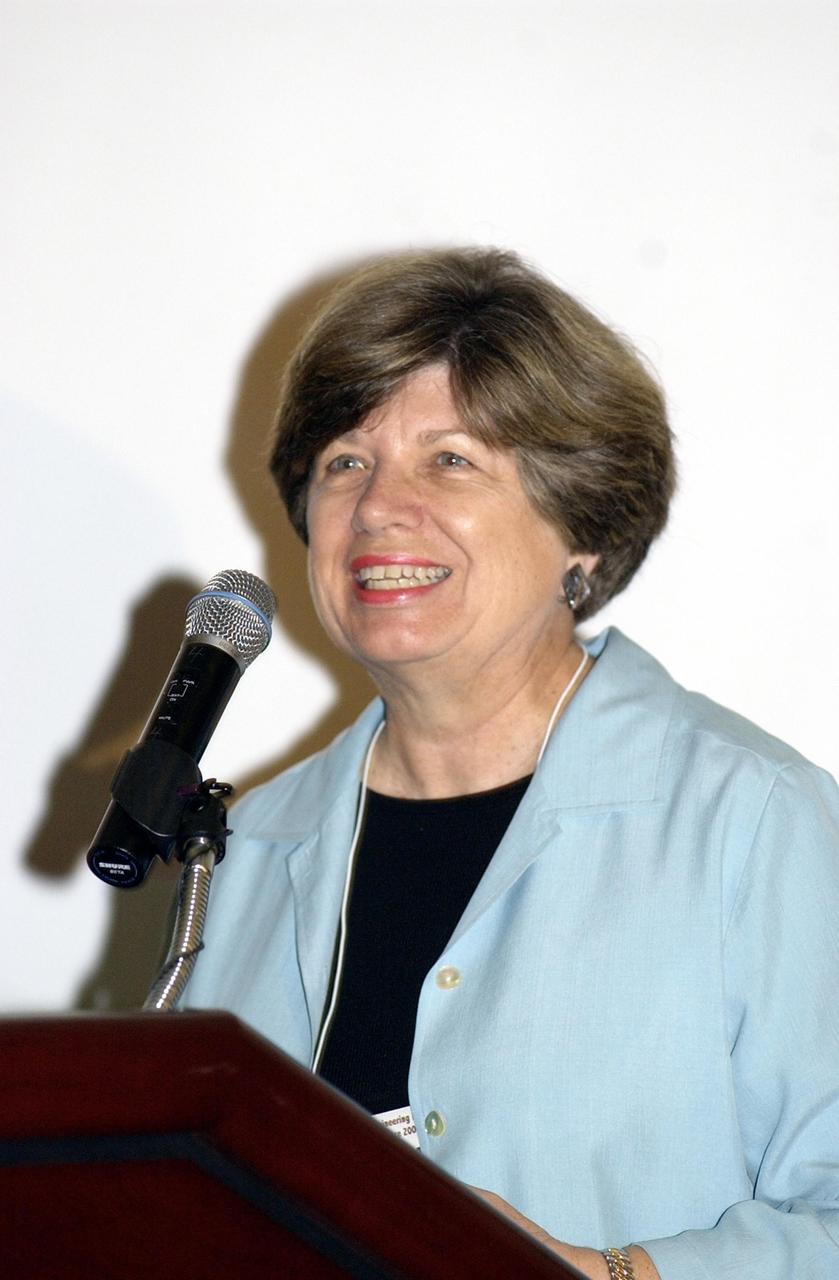
KENNEDY SPACE CENTER, FLA. -- JoAnn H. Morgan, director of External Relations and Business Development at KSC, welcomes participants in this year's NASA MarsPort Engineering Design Student Competition 2002 conference at the KSC Visitor Complex, organized by the Florida Space Grant Consortium. Students and faculty from the nation's universities converged at Kennedy for the MarsPort Competition, presenting papers on engineering trade studies to design optimal configurations for a MarsPort Deployable Greenhouse for operation on the surface of Mars. Judges in the competition were from KSC, Dynamac Corporation and Florida Institute of Technology. The winning team's innovative ideas will be used by NASA to evaluate and study other engineering trade concepts. Also featured at the opening ceremony were Dr. Sam Durrance, FSGC director and former astronaut, and Dr. Gary Stutte, plant scientist, Dynamac Corporation.
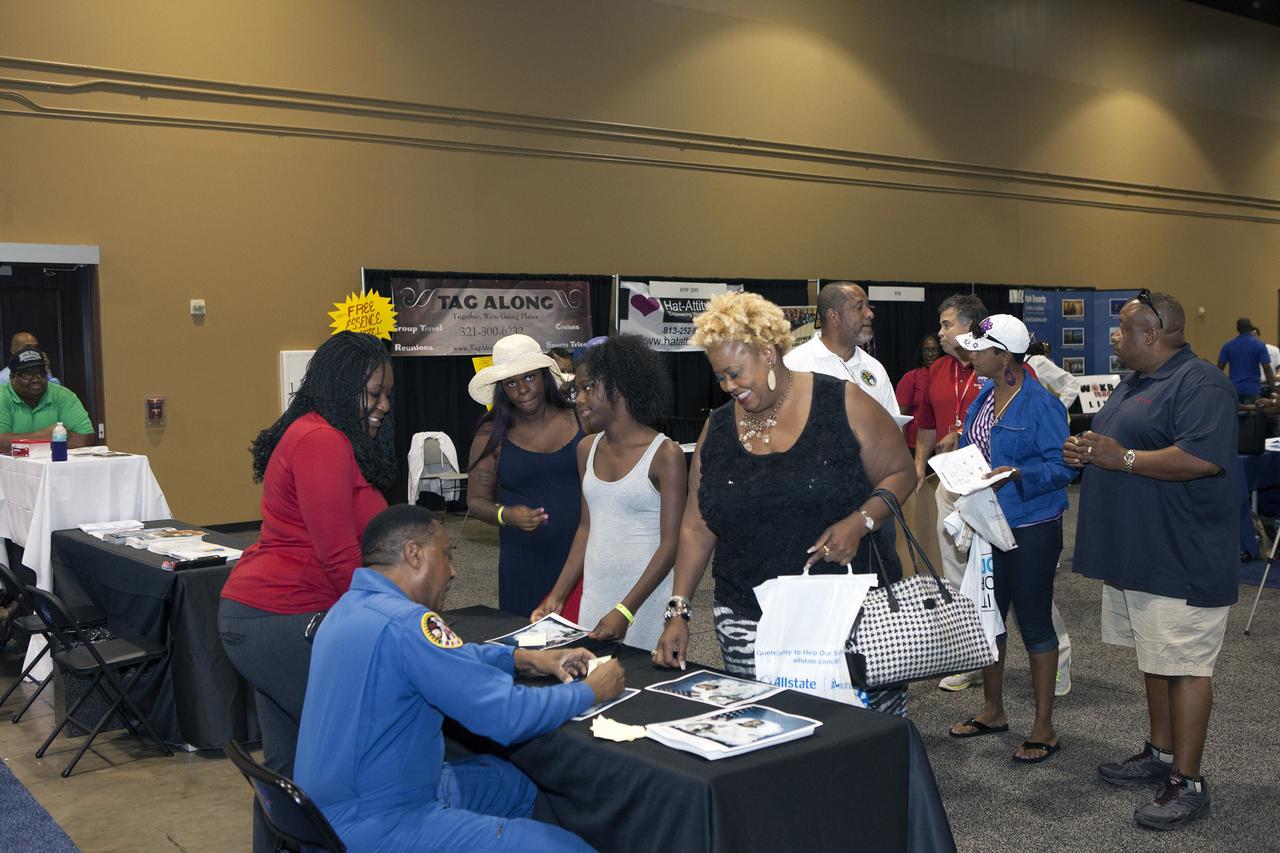
KISSIMMEE, Fla. – Former NASA astronaut Winston Scott signed autographs and posed for pictures with guests at the agency exhibit during the Tom Joyner Family Reunion. Now a senior vice president at the Florida Institute of Technology, he said that he likes to emphasize to young people how important a good education is in preparation for the future. The Tom Joyner Family Reunion is designed to present uplifting programs, entertainment and information about growing, diverse communities. An annual event of the nationally-syndicated Tom Joyner Morning Show, the many exhibits included NASA's participation focusing on encouraging young people to consider studies and careers in STEM -- science, technology, engineering and math. NASA's Education Division promoted the benefits of math and scientific learning along with career opportunities offered by the space agency. The activities took place at the Gaylord Palms Resort in Kissimmee, Florida, during the Labor Day weekend. Photo credit: NASA/Daniel Casper
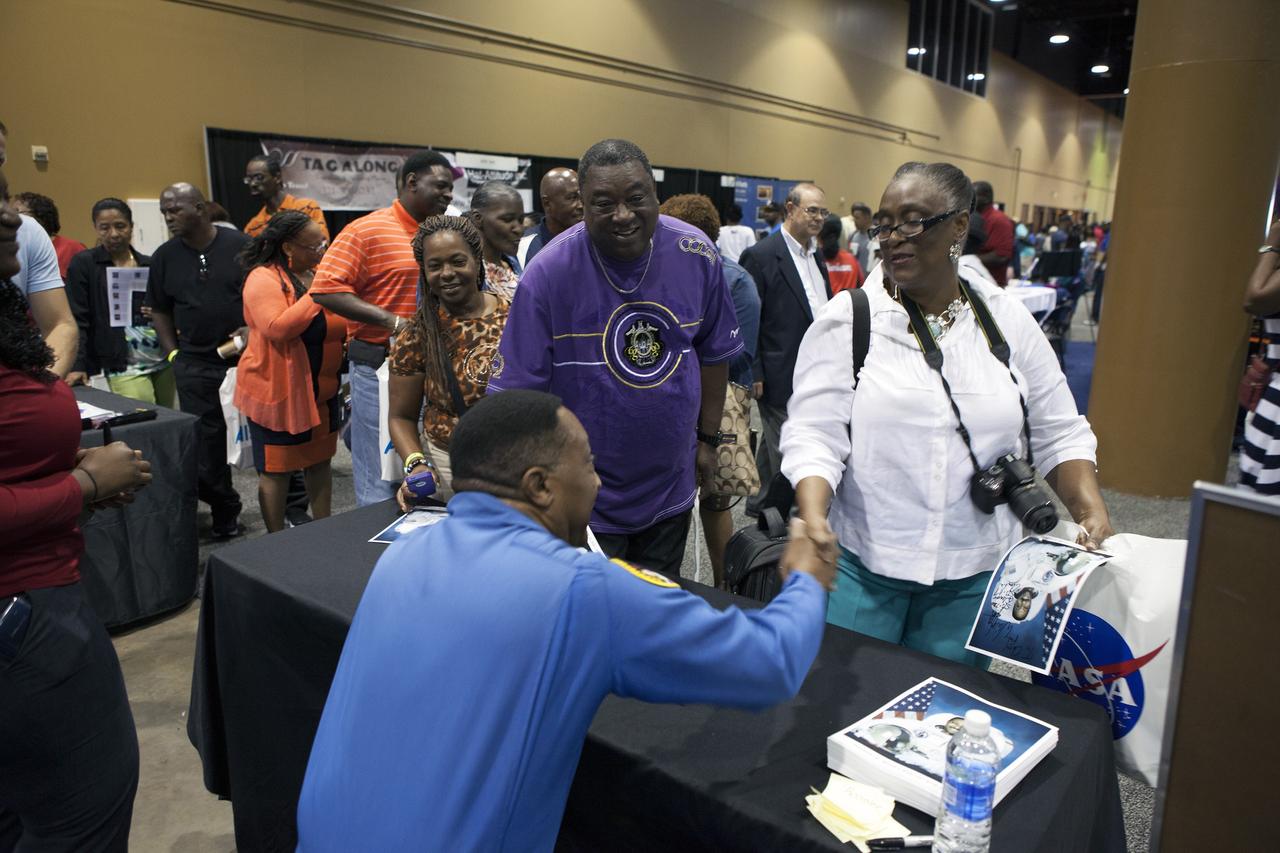
KISSIMMEE, Fla. – Former NASA astronaut Winston Scott signed autographs and posed for pictures with guests at the agency exhibit during the Tom Joyner Family Reunion. Now a senior vice president at the Florida Institute of Technology, he said that he likes to emphasize to young people how important a good education is in preparation for the future. The Tom Joyner Family Reunion is designed to present uplifting programs, entertainment and information about growing, diverse communities. An annual event of the nationally-syndicated Tom Joyner Morning Show, the many exhibits included NASA's participation focusing on encouraging young people to consider studies and careers in STEM -- science, technology, engineering and math. NASA's Education Division promoted the benefits of math and scientific learning along with career opportunities offered by the space agency. The activities took place at the Gaylord Palms Resort in Kissimmee, Florida, during the Labor Day weekend. Photo credit: NASA/Daniel Casper
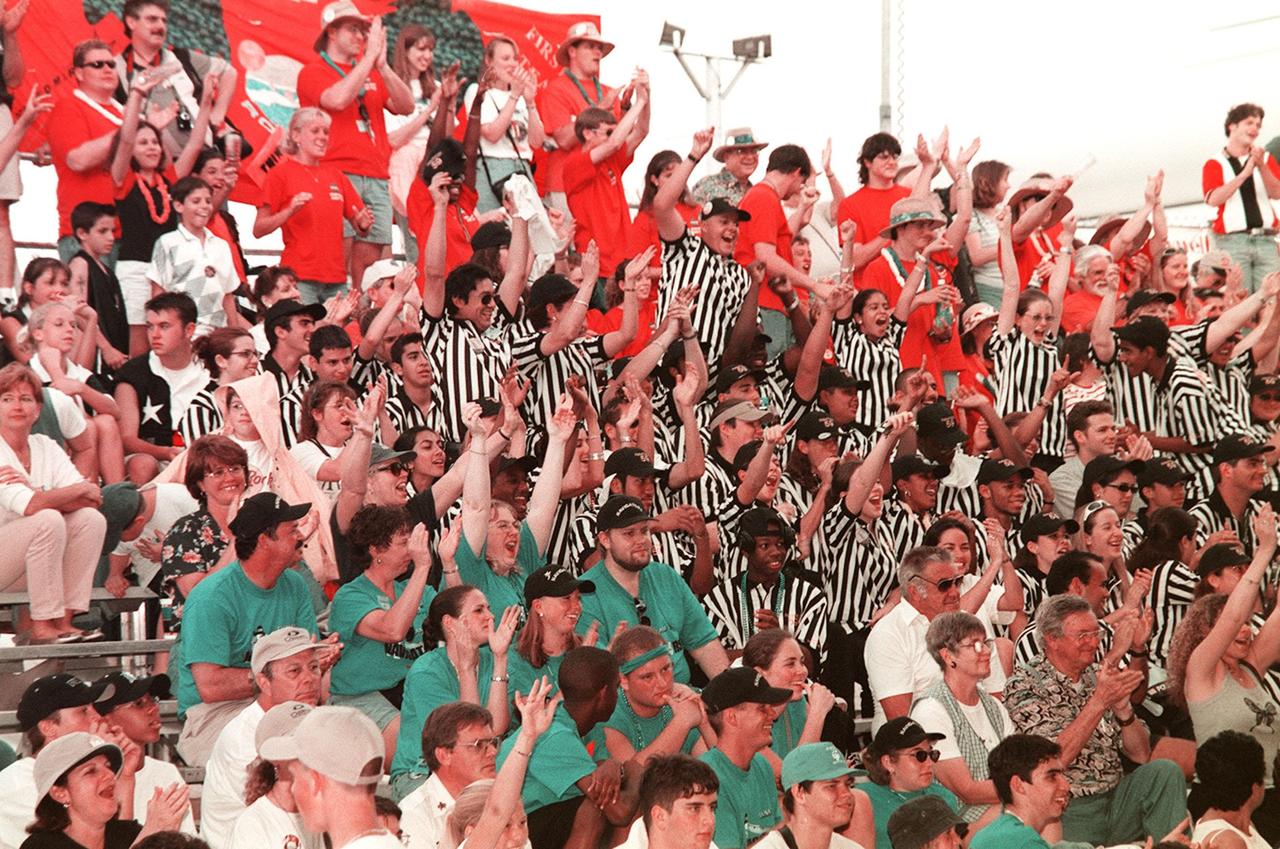
Crowds of students, friends and family fill the bleachers to cheer and applaud during the closing presentations of the FIRST (For Inspiration and Recognition of Science and Technology) Southeast Regional competition held at the KSC Visitor Complex. Teams of high school students from all over the country tested the limits of their imagination using robots they designed, with the support of business and engineering professionals and corporate sponsors, to compete in a technological battle against other schools' robots. Of the 30 high school teams competing at the Southeast Regional event, 16 were Florida teams co-sponsored by NASA and KSC contractors. Local high schools participating are Astronaut, Bayside, Cocoa Beach, Eau Gallie, Melbourne, Melbourne Central Catholic, Palm Bay, Rockledge, Satellite, and Titusville
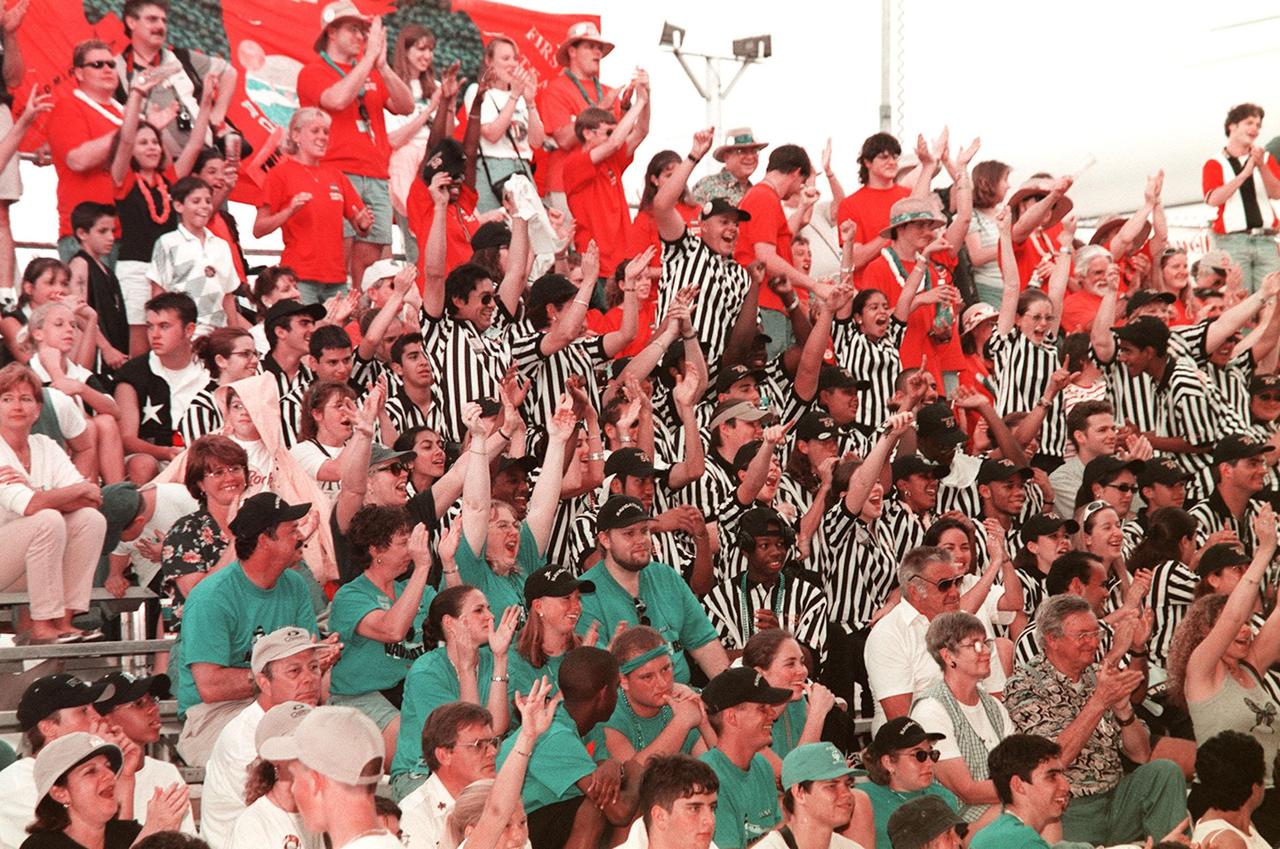
Crowds of students, friends and family fill the bleachers to cheer and applaud during the closing presentations of the FIRST (For Inspiration and Recognition of Science and Technology) Southeast Regional competition held at the KSC Visitor Complex. Teams of high school students from all over the country tested the limits of their imagination using robots they designed, with the support of business and engineering professionals and corporate sponsors, to compete in a technological battle against other schools' robots. Of the 30 high school teams competing at the Southeast Regional event, 16 were Florida teams co-sponsored by NASA and KSC contractors. Local high schools participating are Astronaut, Bayside, Cocoa Beach, Eau Gallie, Melbourne, Melbourne Central Catholic, Palm Bay, Rockledge, Satellite, and Titusville
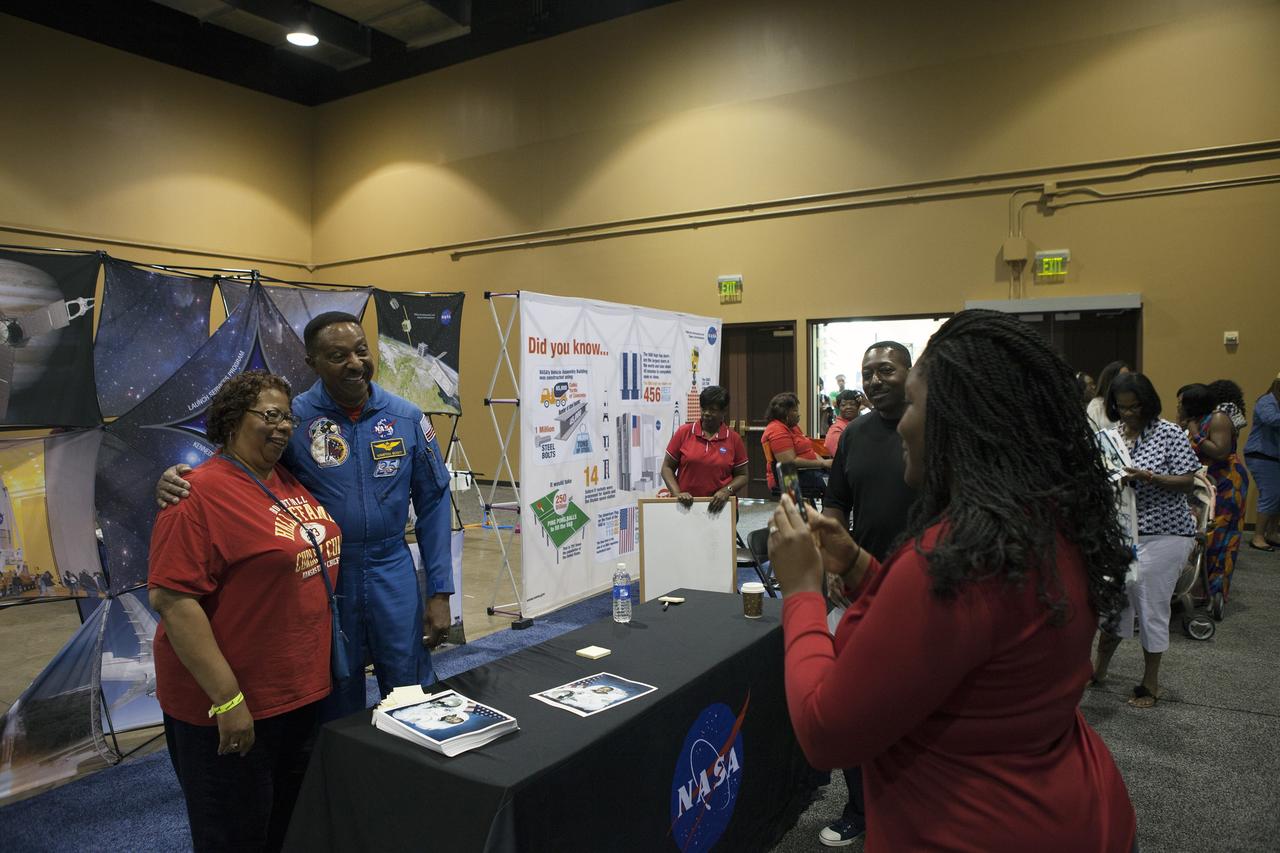
KISSIMMEE, Fla. – Former NASA astronaut Winston Scott signed autographs and posed for pictures with guests at the agency exhibit during the Tom Joyner Family Reunion. Now a senior vice president at the Florida Institute of Technology, he said that he likes to emphasize to young people how important a good education is in preparation for the future. The Tom Joyner Family Reunion is designed to present uplifting programs, entertainment and information about growing, diverse communities. An annual event of the nationally-syndicated Tom Joyner Morning Show, the many exhibits included NASA's participation focusing on encouraging young people to consider studies and careers in STEM -- science, technology, engineering and math. NASA's Education Division promoted the benefits of math and scientific learning along with career opportunities offered by the space agency. The activities took place at the Gaylord Palms Resort in Kissimmee, Florida, during the Labor Day weekend. Photo credit: NASA/Daniel Casper
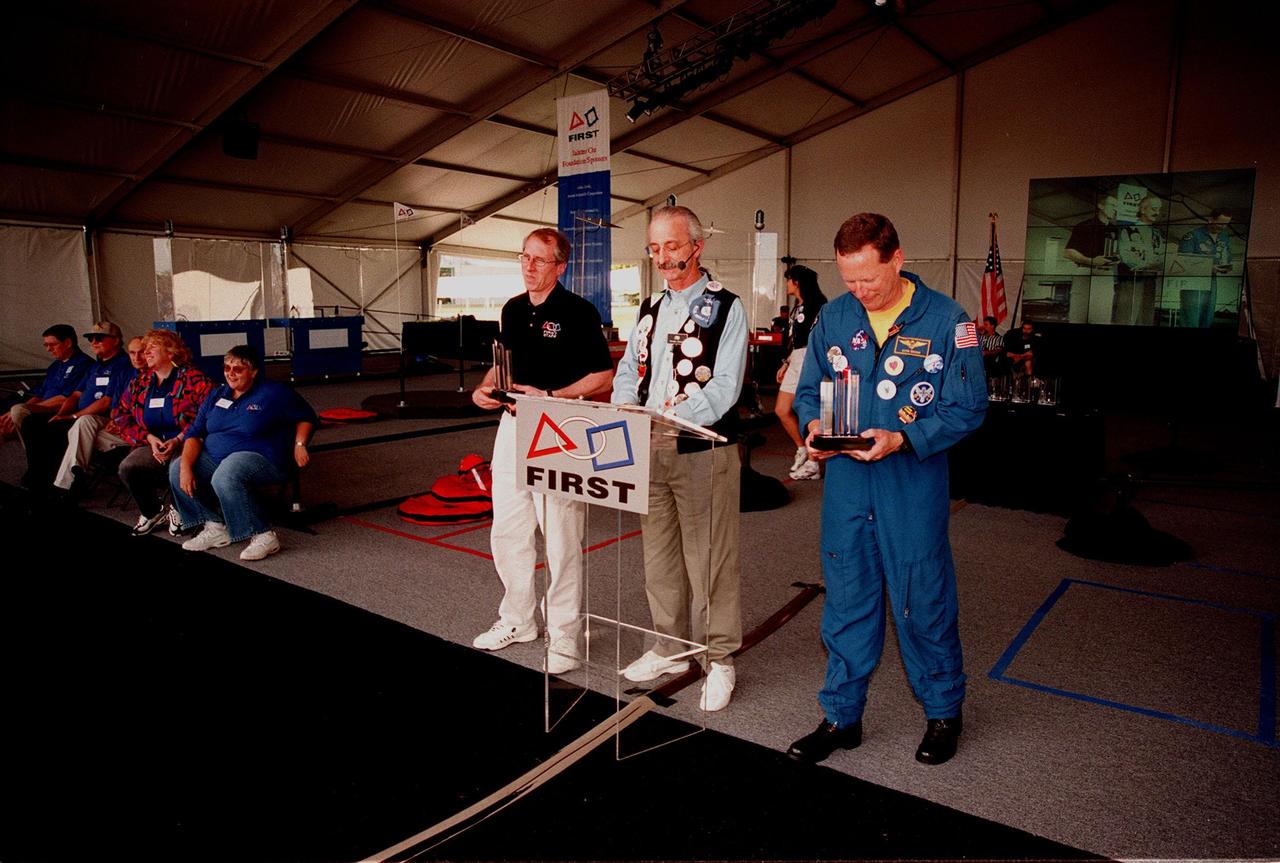
Kicking off the award ceremony at the 1999 FIRST Southeastern Regional robotic competition held at KSC are David Brown, Executive Director of FIRST; Woody Flowers, national advisor for FIRST; and astronaut David Brown. FIRST is a nonprofit organization, For Inspiration and Recognition of Science and Technology, that sponsors the event pitting gladiator robots against each other in an athletic-style competition. The FIRST robotics competition is designed to provide students with a hands-on, inside look at engineering and other professional careers, pairing high school students with engineer mentors and corporations. The regional event comprised 27 teams. Along with the championship award, which went to high school teams in Miami and San German, Puerto Rico, 15 other awards were presented
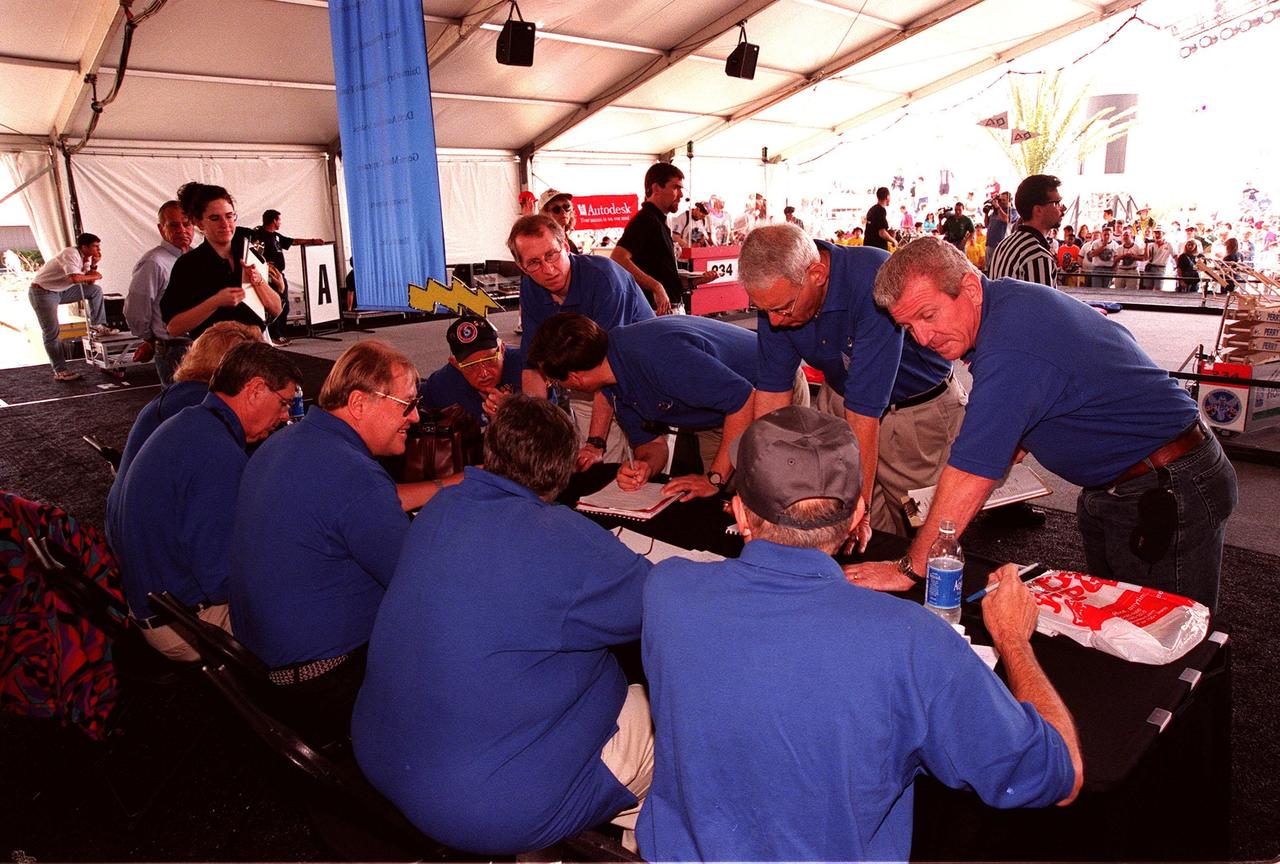
At the 1999 FIRST Southeastern Regional robotic competition held at KSC, judges compare notes about a match. Serving as judges are Deputy Director for Launch and Payload Processing Loren Shriver (above right) and former KSC Director of Shuttle Processing Robert Sieck (below, with back to camera). FIRST is a nonprofit organization, For Inspiration and Recognition of Science and Technology, that sponsors the event pitting gladiator robots against each other in an athletic-style competition. The FIRST robotics competition is designed to provide students with a hands-on, inside look at engineering and other professional careers, pairing high school students with engineer mentors and corporations. The regional event comprised 27 teams. Along with the championship award, which went to high school teams in Miami and San German, Puerto Rico, 15 other awards were presented
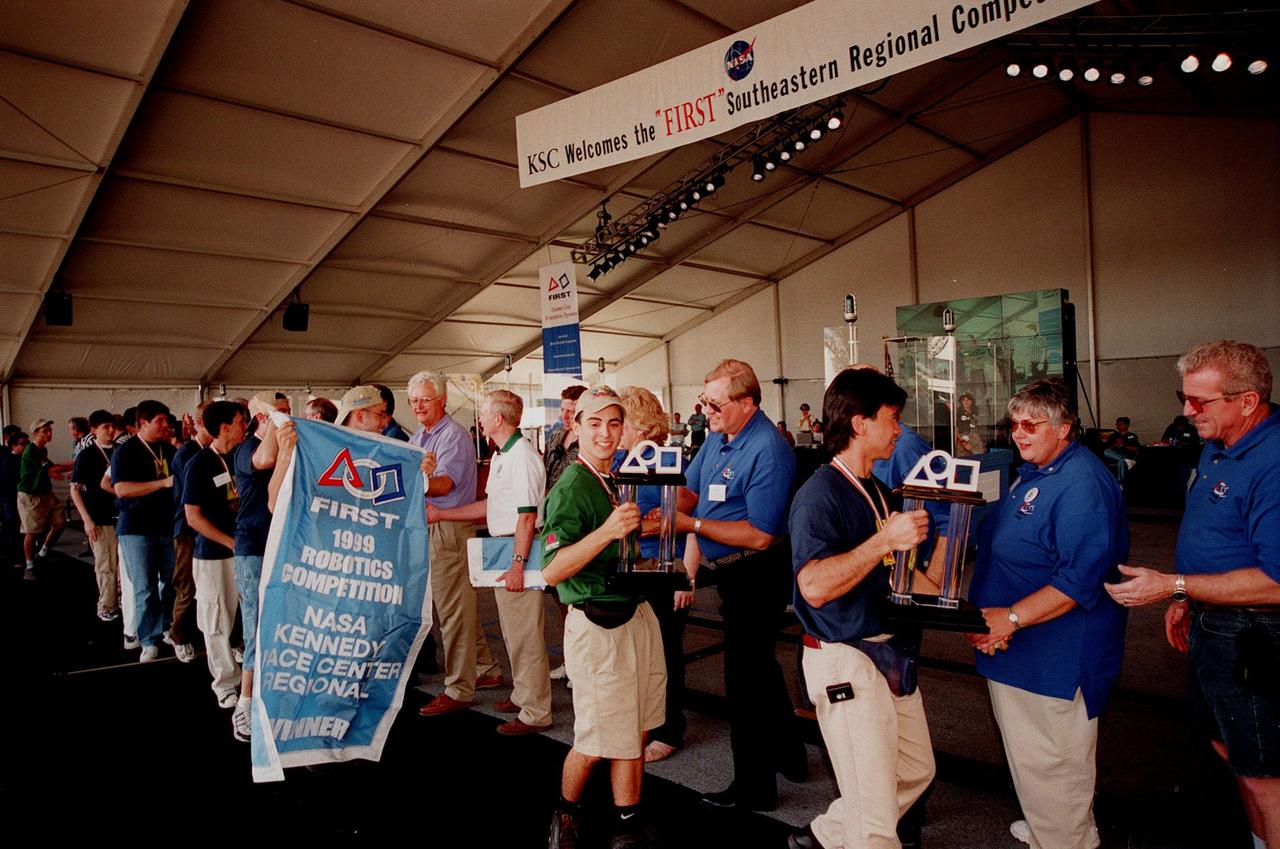
At the award ceremony for the 1999 FIRST Southeastern Regional robotic competition held at KSC, the winning teams from Miami and San German, Puerto Rico, parade with their trophies and championship flag by the line of judges and officials. In the middle of the line is Center Director Roy Bridges. At the far right is Deputy Director for Launch and Payload Processing Loren Shriver, who served as one of the judges for the competition. FIRST is a nonprofit organization, For Inspiration and Recognition of Science and Technology, that sponsors the event pitting gladiator robots against each other in an athletic-style competition. The FIRST robotics competition is designed to provide students with a hands-on, inside look at engineering and other professional careers, pairing high school students with engineer mentors and corporations. The regional event comprised 27 teams. Along with the championship award, 15 other awards were presented
At the award ceremony for the 1999 FIRST Southeastern Regional robotic competition held at KSC, one of the winning teams, from Ocoee, Fla., is greeted by (left to right) astronaut David Brown, Deputy Director for Launch and Payload Processing Loren Shriver, Center Director Roy Bridges, and two unidentified judges. FIRST is a nonprofit organization, For Inspiration and Recognition of Science and Technology, that sponsors the event pitting gladiator robots against each other in an athletic-style competition. The FIRST robotics competition is designed to provide students with a hands-on, inside look at engineering and other professional careers, pairing high school students with engineer mentors and corporations. The regional event comprised 27 teams. Along with the championship award, which went to high school teams from Miami and San German, Puerto Rico, 15 other awards were presented
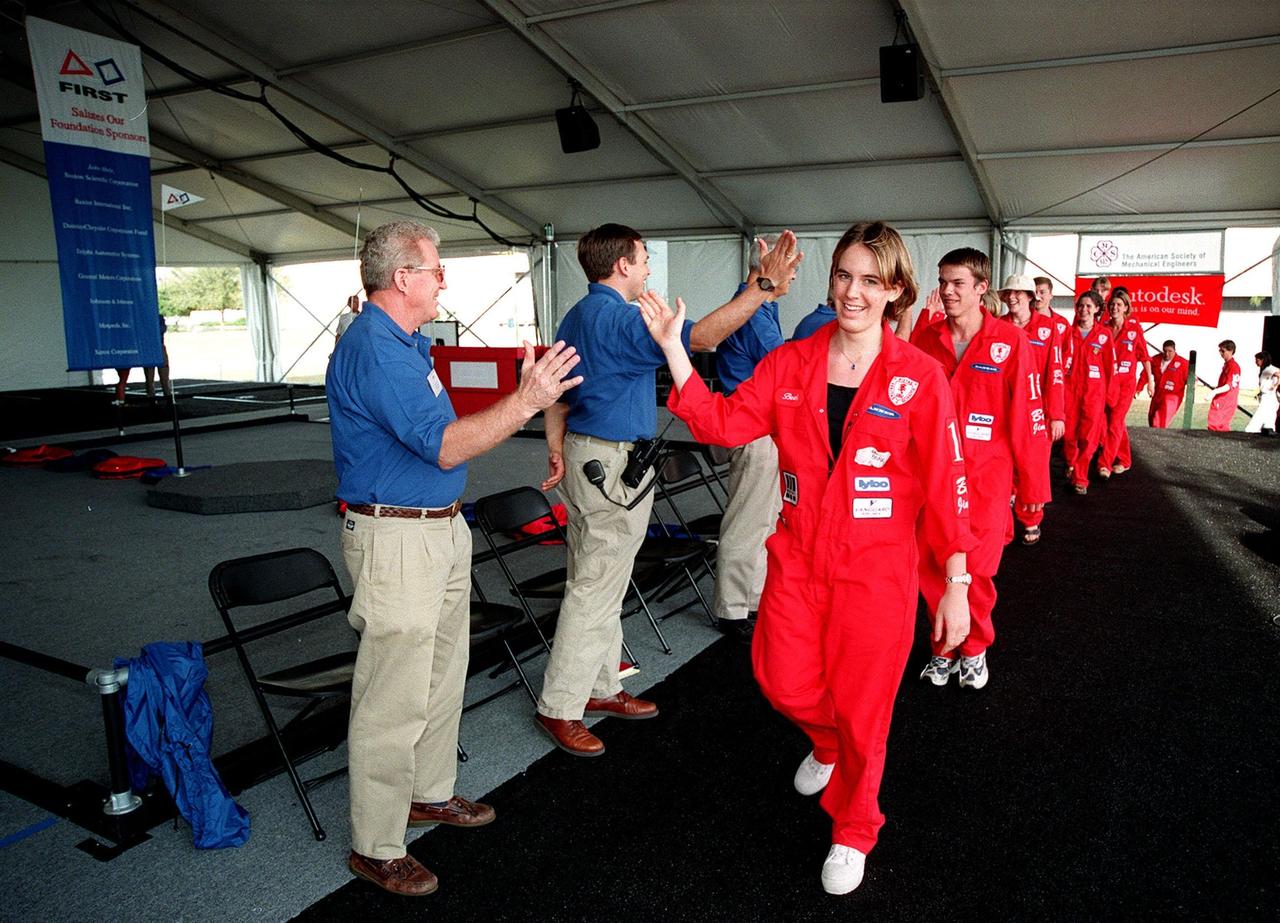
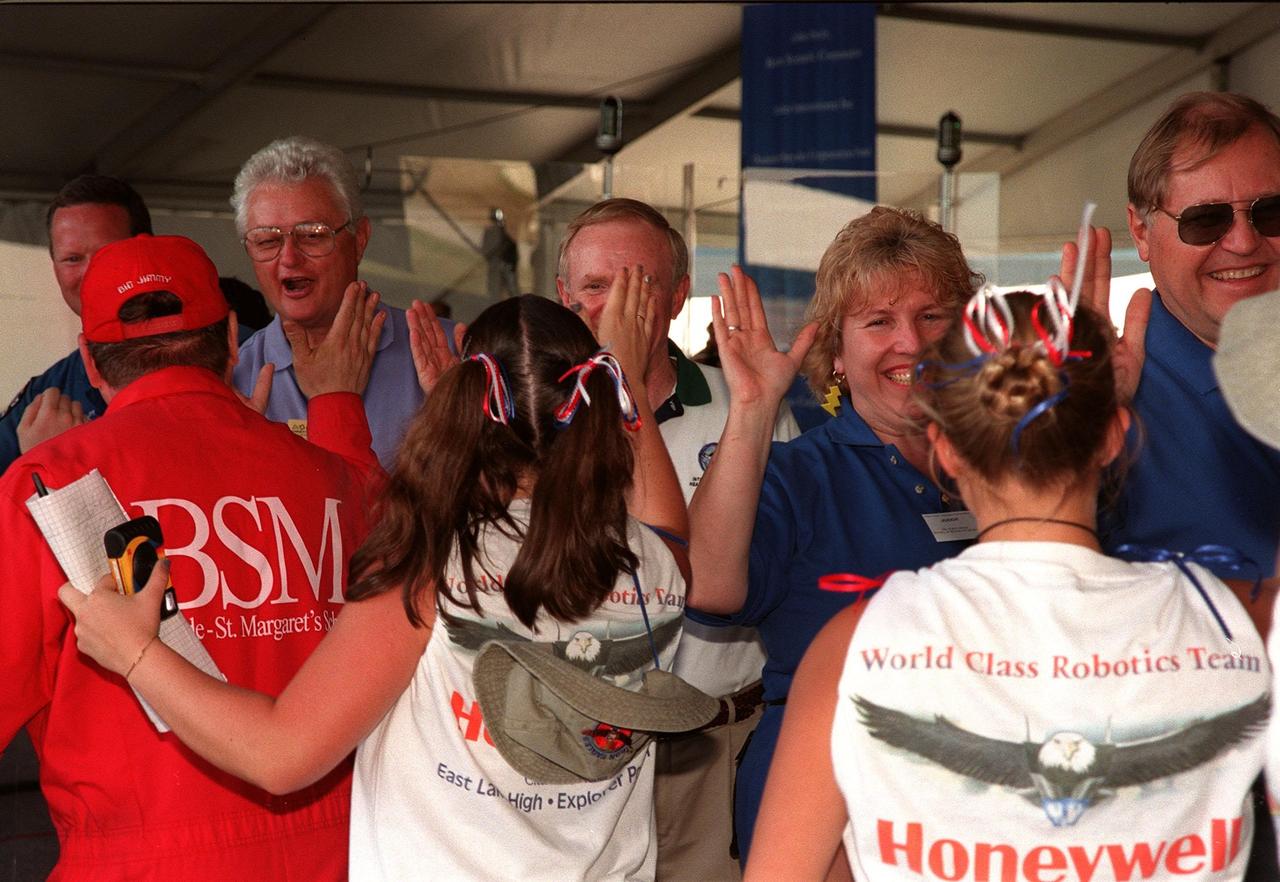
At the start of the award ceremony at the 1999 FIRST Southeastern Regional robotic competition held at KSC, judges, including Deputy Director for Launch and Payload Processing Loren Shriver (left), give "high fives" to a winning team from Minnesota as they enter. FIRST is a nonprofit organization, For Inspiration and Recognition of Science and Technology, that sponsors the event pitting gladiator robots against each other in an athletic-style competition. The FIRST robotics competition is designed to provide students with a hands-on, inside look at engineering and other professional careers, pairing high school students with engineer mentors and corporations. The regional event comprised 27 teams. Along with the championship award, which went to high school teams in Miami and San German, Puerto Rico, 15 other awards were presented
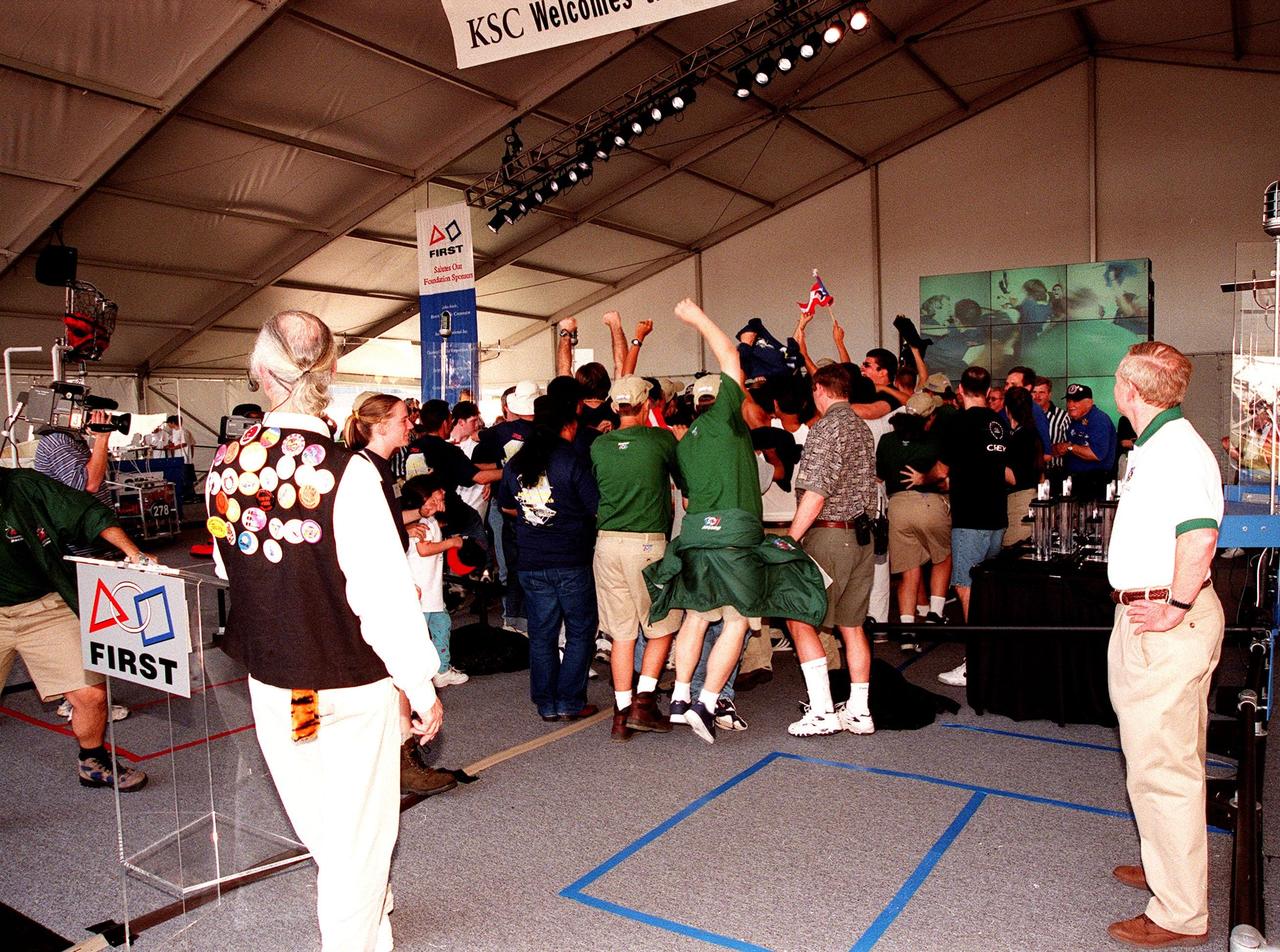
At the award ceremony for the 1999 FIRST Southeastern Regional robotic competition held at KSC, the winning teams, from Miami and San German, Puerto Rico, jump for joy and wave a flag. In the foreground, at left, are Woody Flowers, national advisor to FIRST, and at right, Roy Bridges, KSC director. FIRST is a nonprofit organization, For Inspiration and Recognition of Science and Technology, that sponsors the event pitting gladiator robots against each other in an athletic-style competition. The FIRST robotics competition is designed to provide students with a hands-on, inside look at engineering and other professional careers, pairing high school students with engineer mentors and corporations. The regional event comprised 27 teams. Along with the championship award, 15 other awards were presented
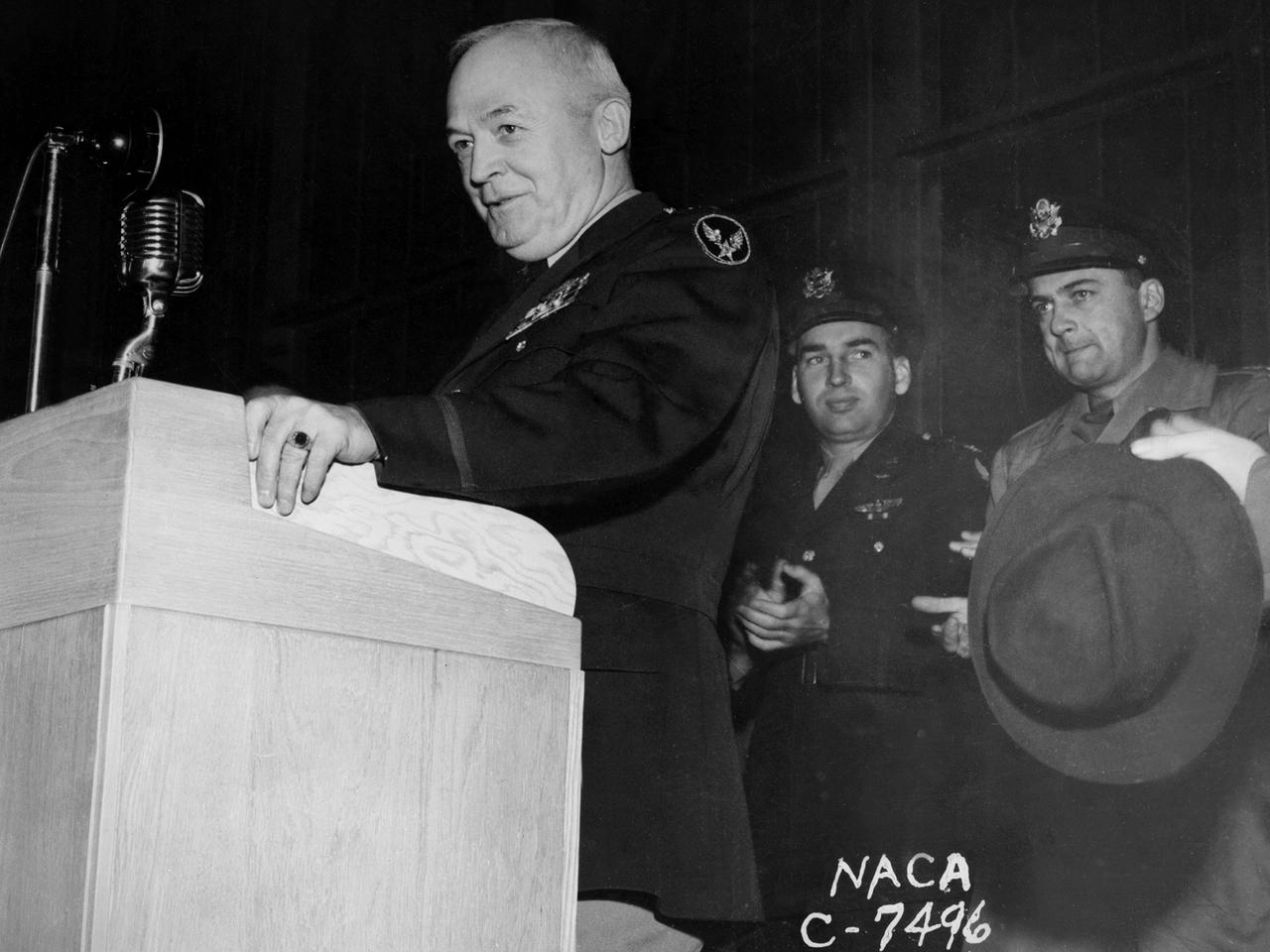
General Henry “Hap” Arnold, Commander of the US Army Air Forces during World War II, addresses the staff at the National Advisory Committee for Aeronautics (NACA) Aircraft Engine Research Laboratory on November 9, 1944. Arnold told the employees assembled in the hangar, “You’ve got a dual task. You’ve got a job ahead of you to keep the army and the navy air forces equipped with the finest equipment that you can for this war. You also have the job of looking forward into the future and starting now those developments, those experiments, that are going to keep us in our present situation—ahead of the world in the air. And that is quite a large order, and I leave it right in your laps.” Arnold served on the NACA’s Executive Committee in Washington from 1938 to 1944 and had been a strong advocate for the creation of the new engine research facility in Cleveland. Arnold believed in continual research and development. He pressed the nation’s aviation leaders to pursue the new jet engine technology, while simultaneously pushing to increase the performance of the nation’s largest piston engine for the B–29 Superfortress program. The general’s hectic wartime agenda limited his visit to the Cleveland laboratory to just a few hours, but he toured several of the NACA’s new test facilities including the Static Jet Propulsion Laboratory, the Icing Research Tunnel, and a B–24 Liberator in the hangar.
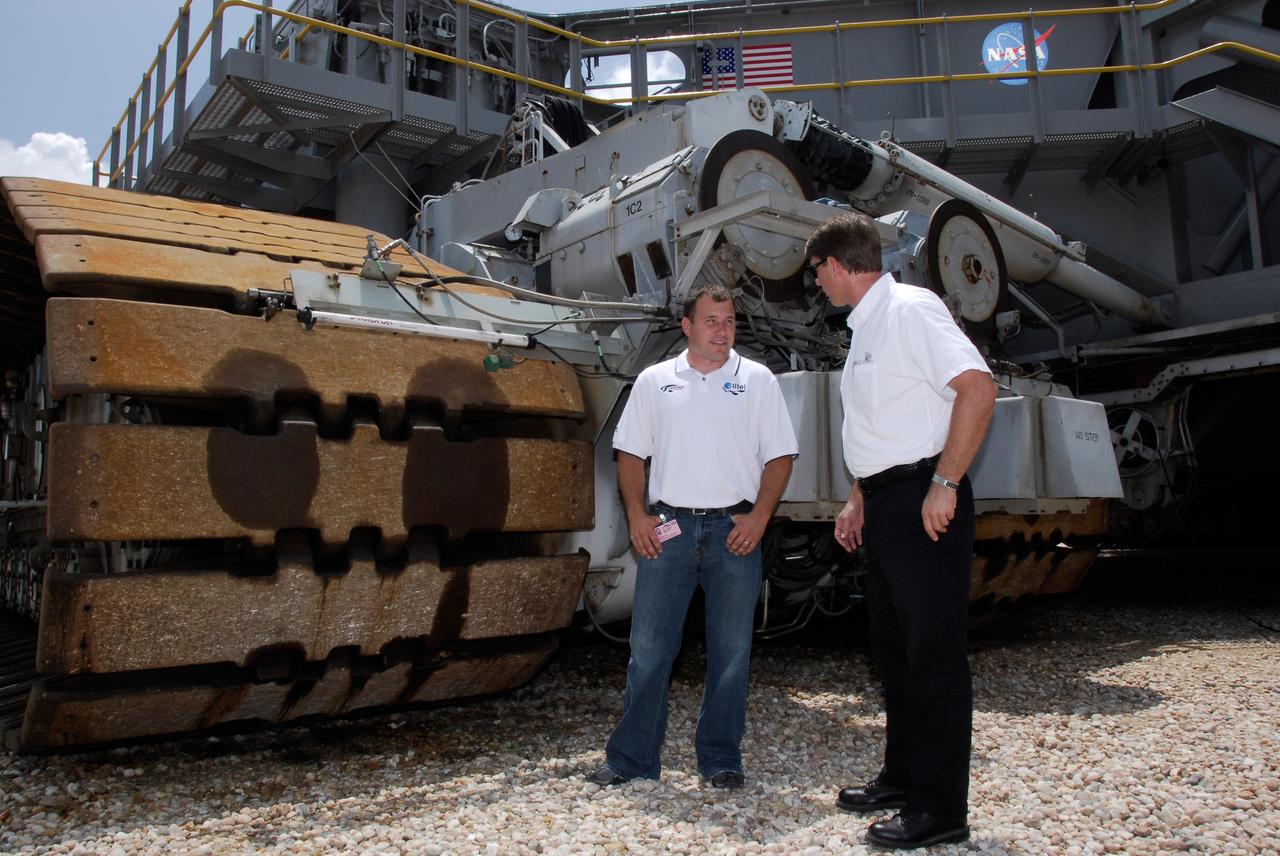
CAPE CANAVERAL, Fla. – 2008 Daytona 500 winner Ryan Newman learns more from Gordon Coffey, NASA systems engineer, about the crawler-transporter behind him. Standing 20 feet tall, the crawler weighs 5.5 million pounds unloaded. It has 16 traction motors of 375 hp each and only travels 2 mph unloaded. Newman is visiting Kennedy in honor of NASA's 50th anniversary and the 50th running of NASCAR's Daytona 500 in February. NASA presented Newman two green racing flags that were flown last February aboard space shuttle Atlantis' STS-122 mission to the International Space Station. One flag was given to Newman, the second was presented to Daytona 500 Experience General Manager Kim Isemann. A third flag that was flown will be kept by NASA for public display. The connection between NASA and Daytona's International Speedway extends beyond their close proximity to one another. During recent years, technology developed for the space program has found many uses on Earth, including helping NASCAR drivers stay safe and increase performance. Photo credit: NASA/Kim Shiflett
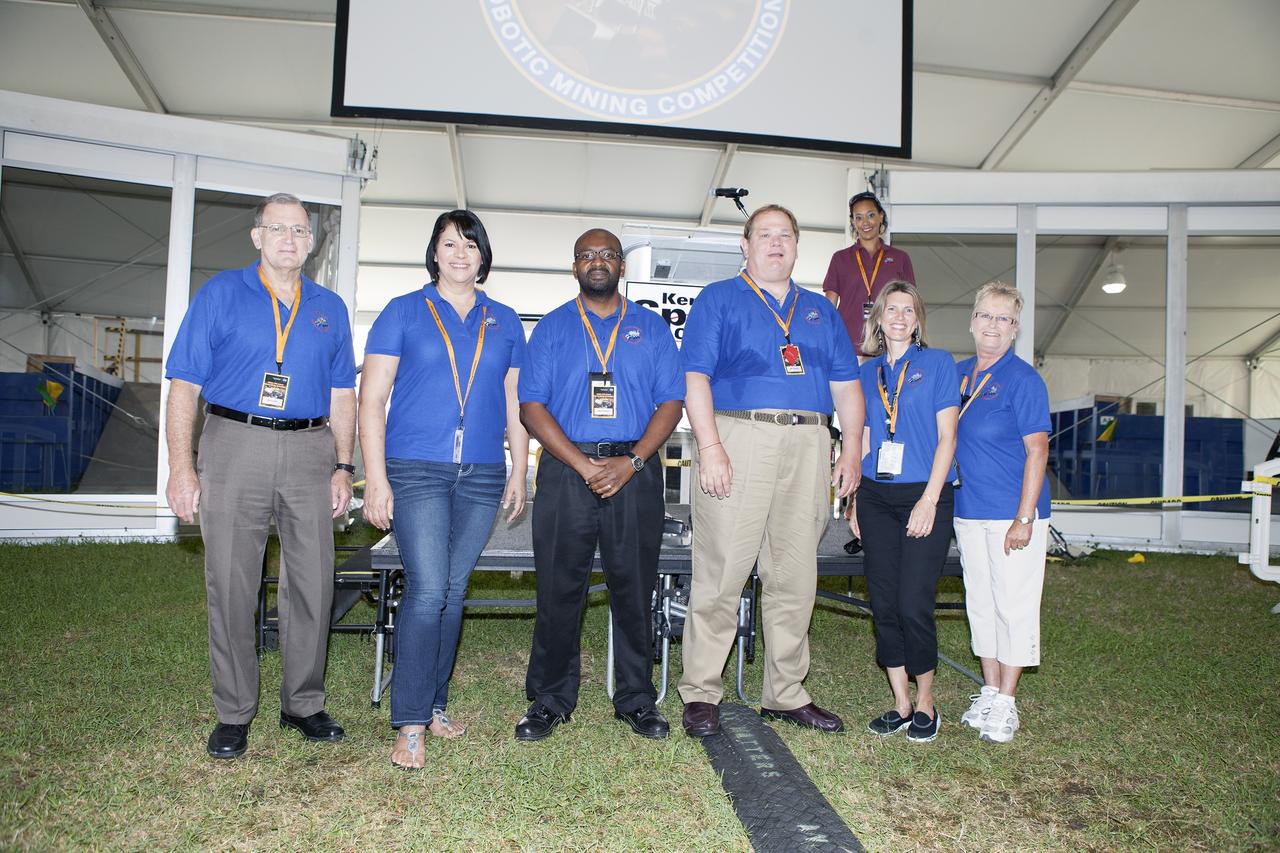
CAPE CANAVERAL, Fla. – The presentation and team spirit judges for NASA's 2014 Robotics Mining Competition are introduced during the opening ceremony at the Kennedy Space Center Visitor Complex in Florida. Second from left, is Teresa Martinez, lead presentation judge from Kennedy's Education Office. At far right, is Beth Smith, lead team spirit judge from Kennedy's Education Office. Behind them on the podium is Kimberley Land, event emcee from NASA's Ames Research Center in Moffett Field, California. More than 35 teams from around the U.S. have designed and built remote-controlled robots for the mining competition. The competition is a NASA Human Exploration and Operations Mission Directorate project designed to engage and retain students in science, technology, engineering and mathematics, or STEM, fields by expanding opportunities for student research and design. Teams use their remote-controlled robotics to maneuver and dig in a supersized sandbox filled with a crushed material that has characteristics similar to Martian soil. The objective of the challenge is to see which team’s robot can collect and move the most regolith within a specified amount of time. For more information, visit www.nasa.gov/nasarmc. Photo credit: NASA/Frankie Martin
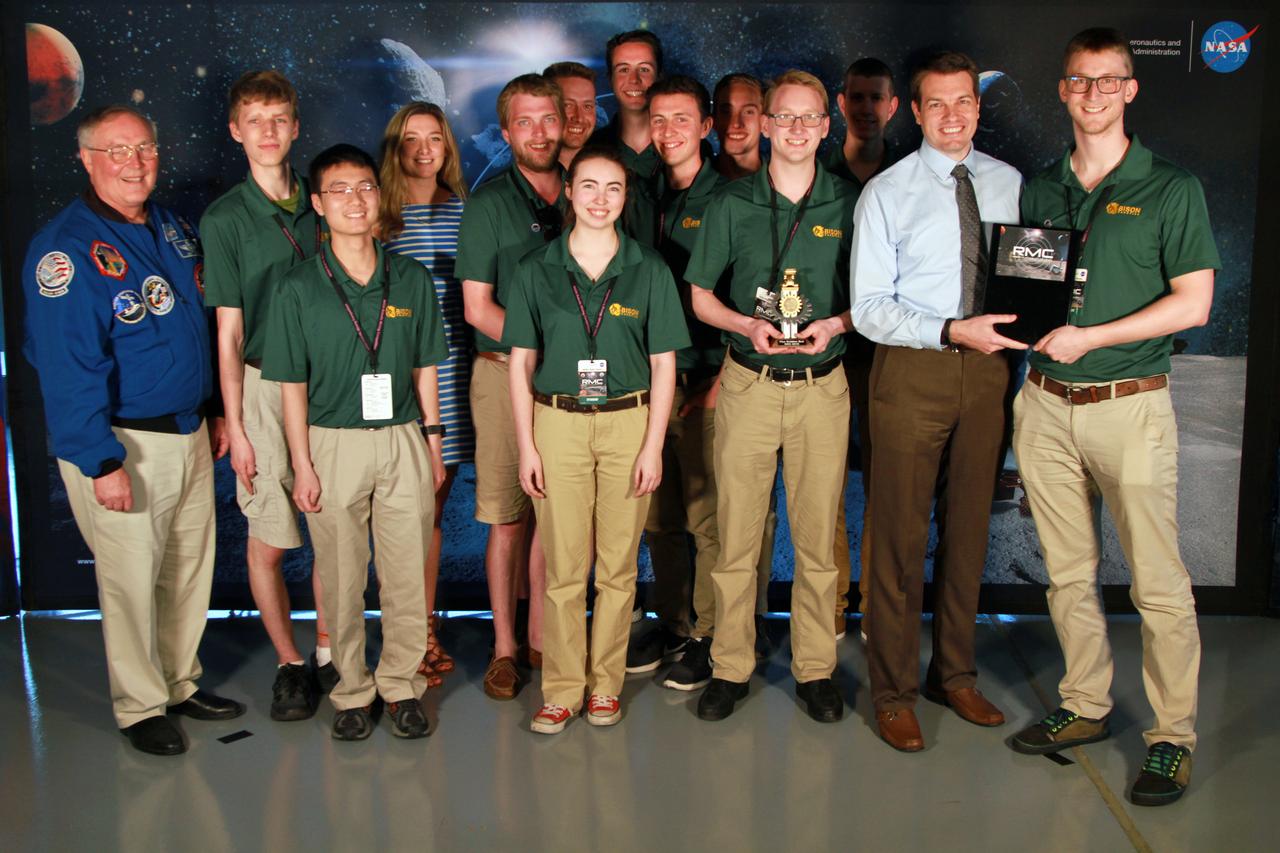
NASA's 9th Annual Robotic Mining Competition concludes with an awards ceremony May 18, 2018, at the Apollo/Saturn V Center at the Kennedy Space Center Visitor Complex in Florida. The team from North Dakota University in collaboration with James Madison University received first place in the Slide Presentation and Demonstration award category. At left is retired NASA astronaut Jerry Ross. At right is Daniel Hull, lead presentation judge. More than 40 student teams from colleges and universities around the U.S. participated in the competition, May 14-18, by using their mining robots to dig in a supersized sandbox filled with BP-1, or simulated lunar soil, gravel and rocks, and participate in other competition requirements. The Robotic Mining Competition is a NASA Human Exploration and Operations Mission Directorate project designed to encourage students in science, technology, engineering and math, or STEM fields. The project provides a competitive environment to foster innovative ideas and solutions that could be used on NASA's deep space missions.
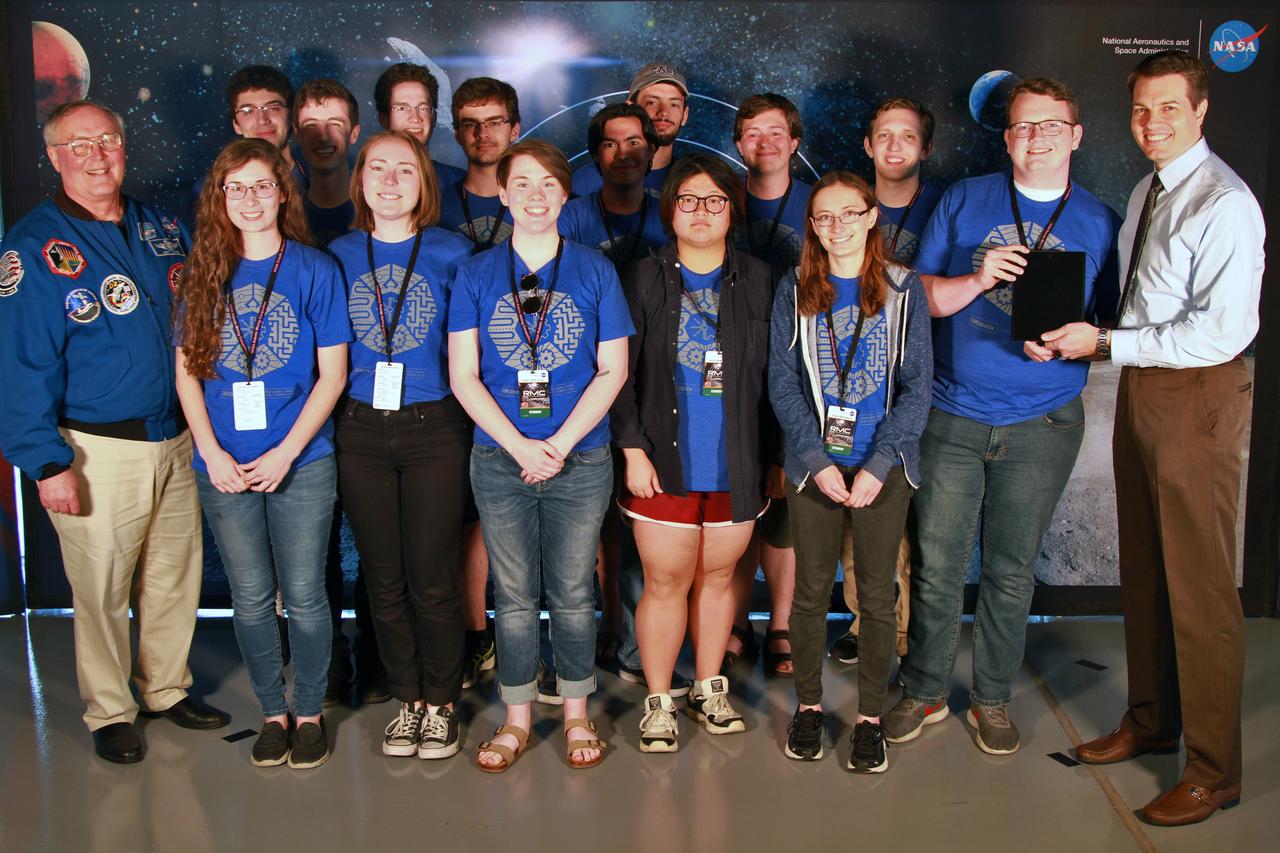
NASA's 9th Annual Robotic Mining Competition concludes with an awards ceremony May 18, 2018, at the Apollo/Saturn V Center at the Kennedy Space Center Visitor Complex in Florida. The team from Case Western Reserve University received third place in the Slide Presentation and Demonstration award category. At left is retired NASA astronaut Jerry Ross. At right is Daniel Hull, lead presentation judge. More than 40 student teams from colleges and universities around the U.S. participated in the competition, May 14-18, by using their mining robots to dig in a supersized sandbox filled with BP-1, or simulated lunar soil, gravel and rocks, and participate in other competition requirements. The Robotic Mining Competition is a NASA Human Exploration and Operations Mission Directorate project designed to encourage students in science, technology, engineering and math, or STEM fields. The project provides a competitive environment to foster innovative ideas and solutions that could be used on NASA's deep space missions.
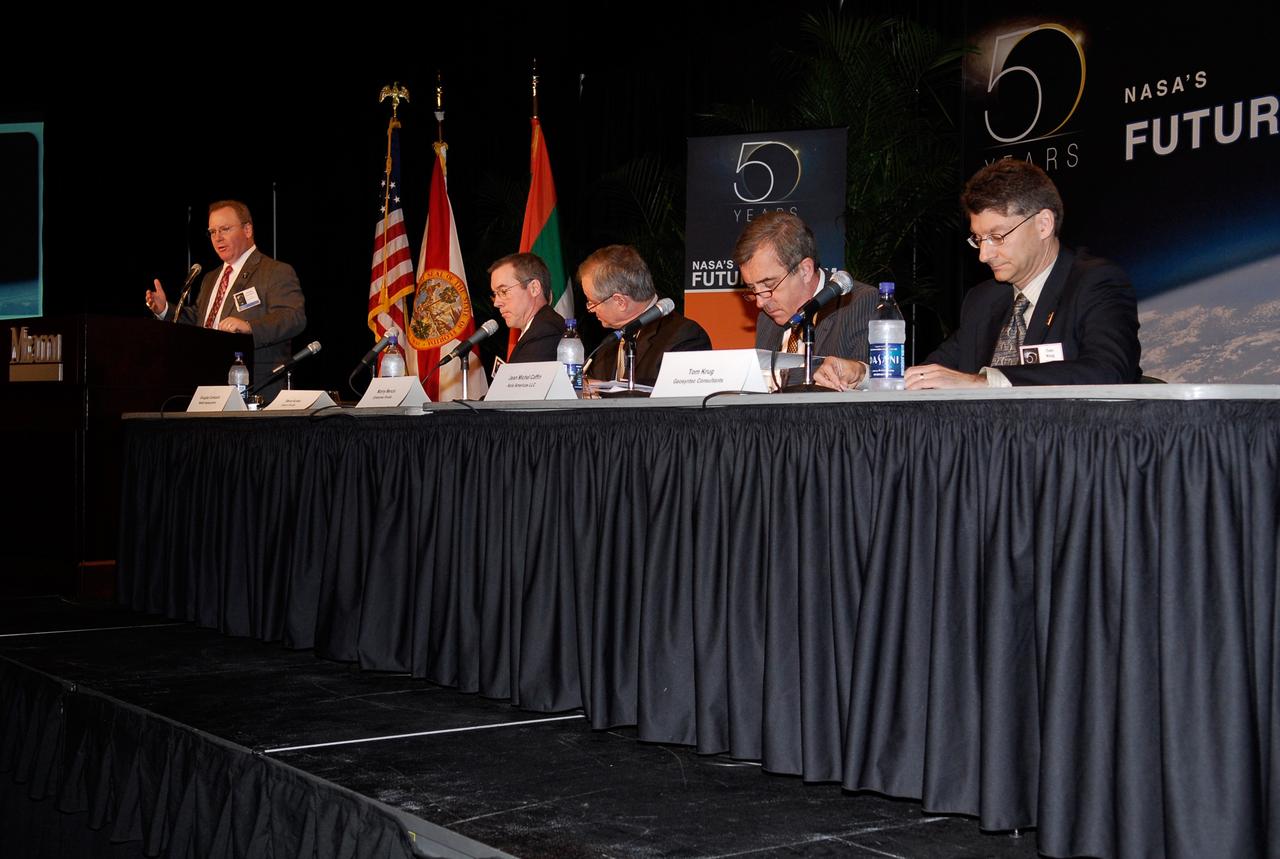
CAPE CANAVERAL, Fla. -- From the podium, Douglas Comstock, director of NASA's Innovative Partnership Program, moderates a panel presenting the topic “Unleashing the Power of Technology and Creativity” during NASA’s Future Forum in Miami. Others on the panel are (left to right), Steve Kohler, president and CEO of Space Florida; Manny Mencia Sr., vice president for international trade and business development of Enterprise Florida; Jean Michel Caffin, managing partner of Axis Americas and Beacon Council Executive Cabinet; and Tom Krug, associate and senior engineer with Geosyntec Consultants. The forum focused on how space exploration benefits Florida's economy. The event, which included presentations and panels, was held at the University of Miami's BankUnited Center. Among those participating were NASA Deputy Administrator Shana Dale, astronaut Carl Walz, director of the Advanced Capabilities Division in NASA's Exploration Systems Mission Directorate, and Russell Romanella, director, International Space Station and Spacecraft Processing. Photo credit: NASA/Kim Shiflett
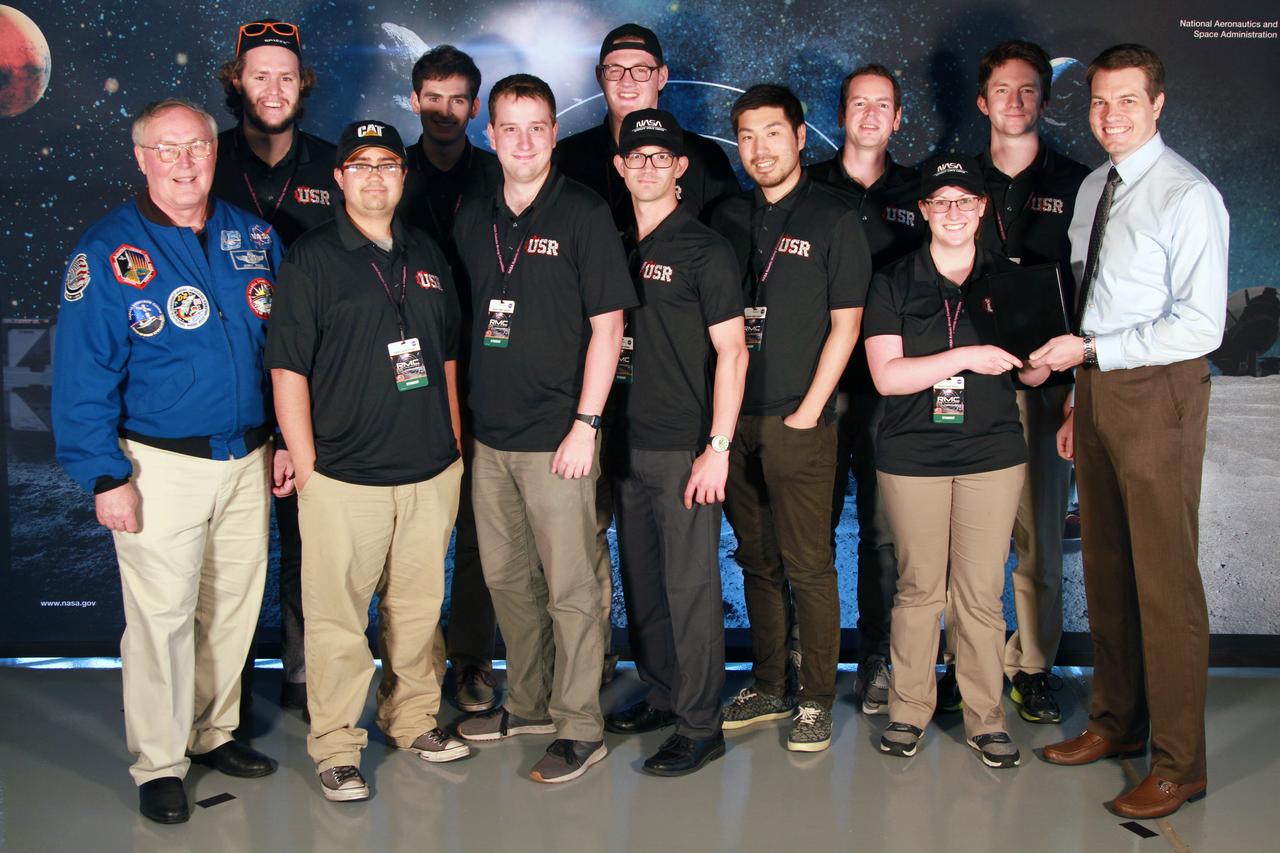
NASA's 9th Annual Robotic Mining Competition concludes with an awards ceremony May 18, 2018, at the Apollo/Saturn V Center at the Kennedy Space Center Visitor Complex in Florida. The Utah Student Robotics team from The University of Utah received second place in the Slide Presentation and Demonstration award category. At left is retired NASA astronaut Jerry Ross. At right is Daniel Hull, lead presentation judge. More than 40 student teams from colleges and universities around the U.S. participated in the competition, May 14-18, by using their mining robots to dig in a supersized sandbox filled with BP-1, or simulated lunar soil, gravel and rocks, and participate in other competition requirements. The Robotic Mining Competition is a NASA Human Exploration and Operations Mission Directorate project designed to encourage students in science, technology, engineering and math, or STEM fields. The project provides a competitive environment to foster innovative ideas and solutions that could be used on NASA's deep space missions.
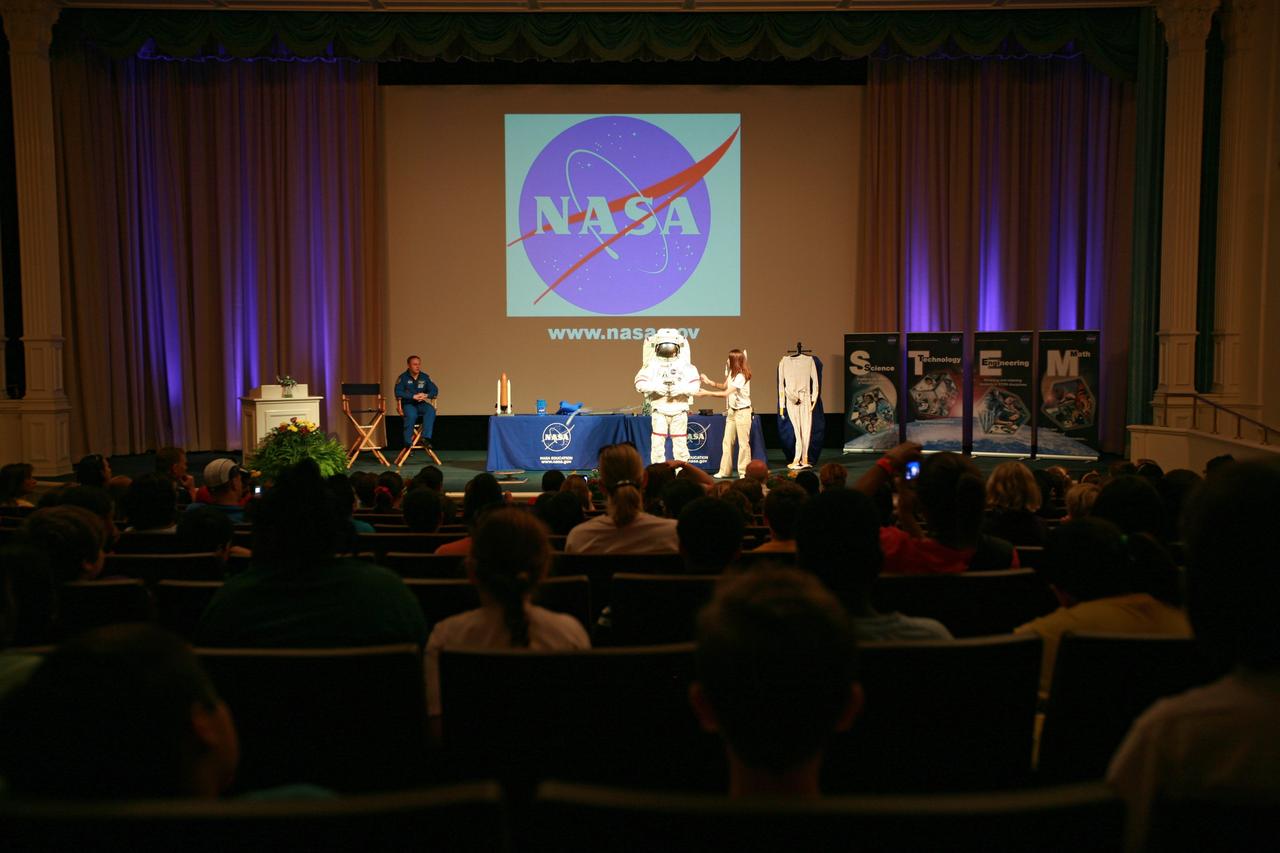
CAPE CANAVERAL, Fla. – At Walt Disney World's Magic Kingdom in Orlando, Fla., NASA astronaut Mike Fincke observes as Veronica Franco of NASA's Education Office at Kennedy Space Center explains the intricacies of a space suit to students and teachers attending an educational presentation, part of the festivities to welcome toy space ranger Buzz Lightyear home from space. Fincke was commander of the International Space Station from October 2008 to April 2009. The 12-inch-tall action figure spent more than 15 months aboard the International Space Station and returned to Earth aboard space shuttle Discovery on Sept. 11 with the STS-128 crew. Lightyear's space adventure, a collaboration between NASA and Disney Parks, is intended to share the excitement of space exploration with students around the world and encourage them to pursue studies in science, technology, engineering and mathematics. For additional information, visit http://www.nasa.gov/buzzoniss. Photo credit: NASA/Dimitri Gerondidakis
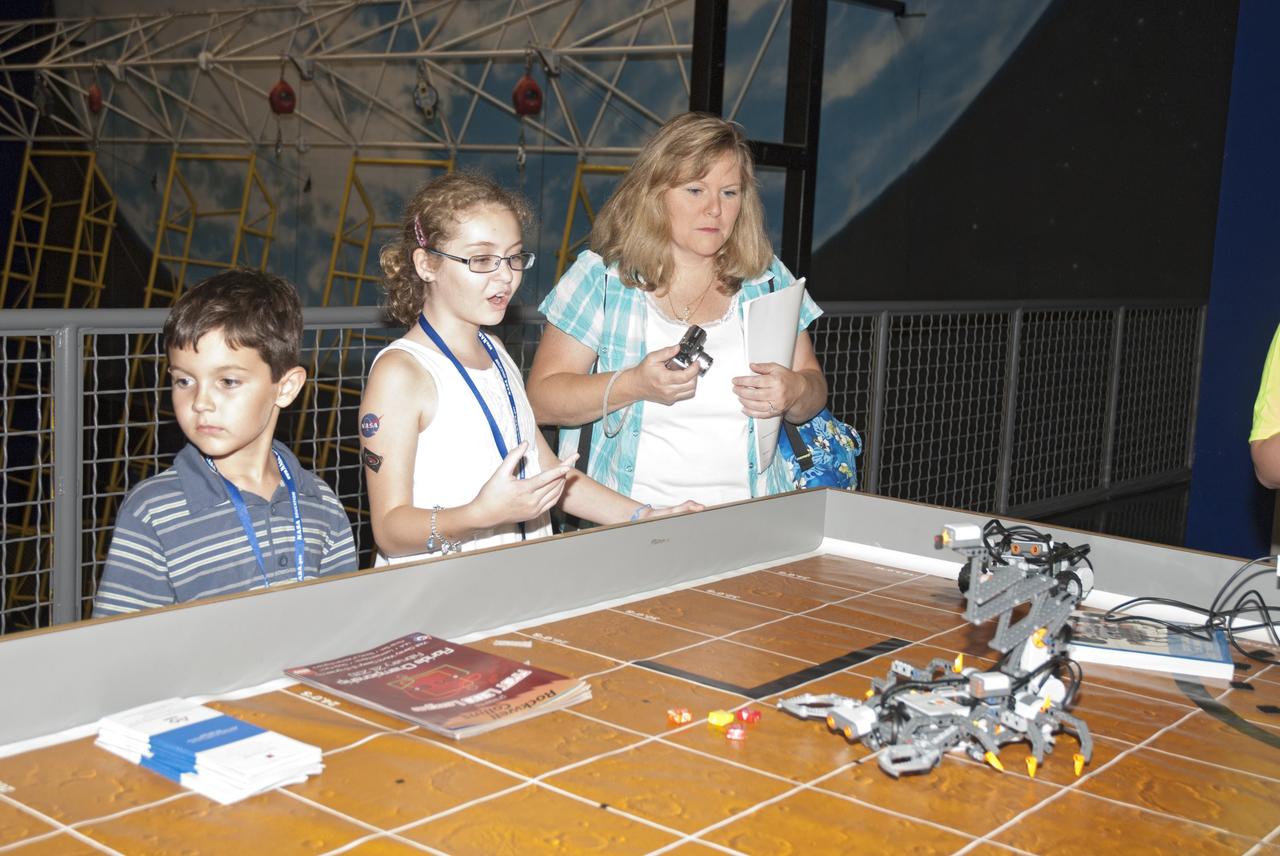
CAPE CANAVERAL, Fla. -- At the Astronaut Hall of Fame near the Kennedy Space Center Visitor Complex in Florida, fifth- through eighth-grade students and their parents participate in a Lego robotics demonstration during the last NASA family education night event. Other activities included "gee-whiz" presentations, astronaut appearances, a hovercraft, vortex cannon and alternative fuel vehicles, which promote science, technology, engineering and mathematics (STEM) education. The event is part of NASA's Summer of Innovation initiative to provide interactive learning experiences to middle school students nationwide during the summer months. The program is a cornerstone of the Educate to Innovate campaign announced by President Barack Obama in November 2009. Photo credit: NASA/Charisse Nahser
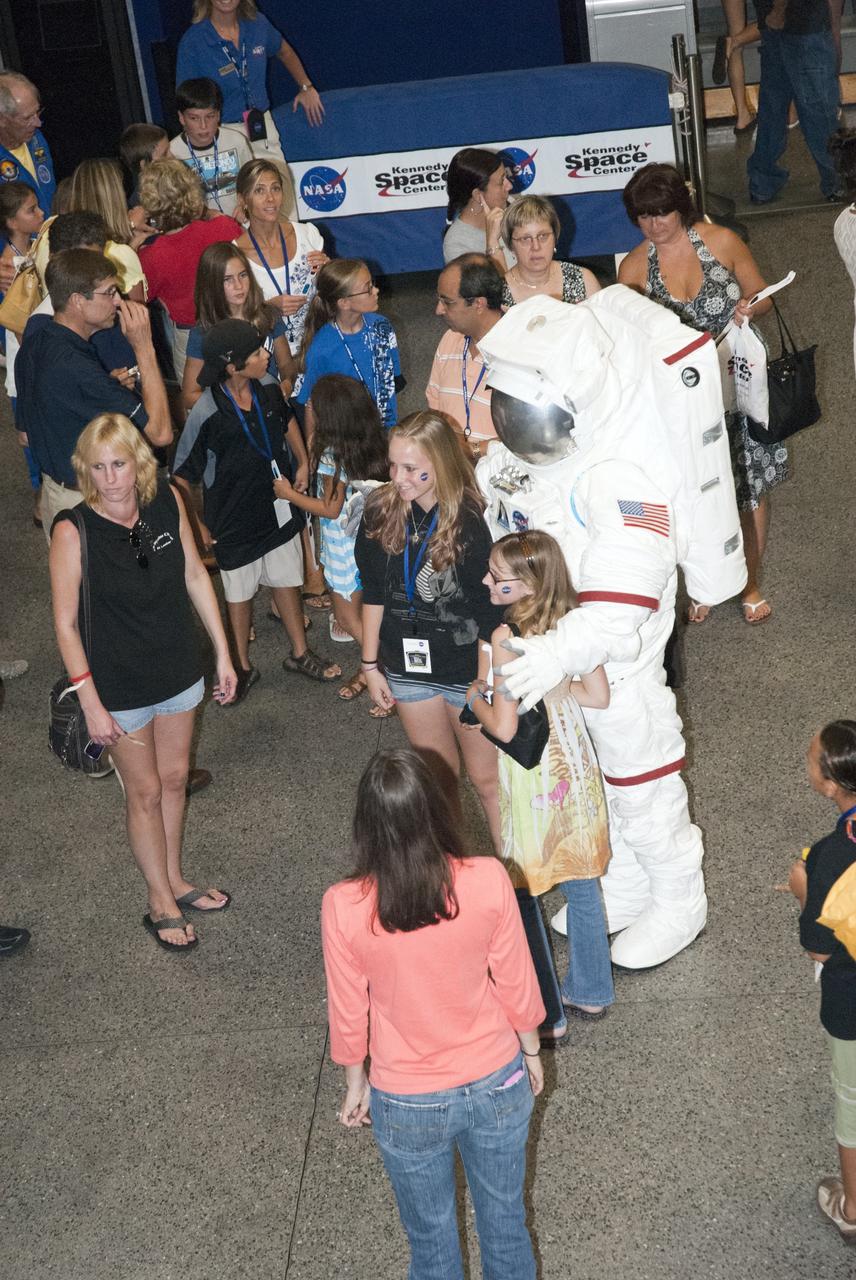
CAPE CANAVERAL, Fla. -- At the Astronaut Hall of Fame near the Kennedy Space Center Visitor Complex in Florida, fifth- through eighth-grade students and their parents meet a space person during the last NASA family education night event. Other activities included "gee-whiz" presentations, astronaut appearances, a hovercraft, vortex cannon and alternative fuel vehicles, which promote science, technology, engineering and mathematics (STEM) education. The event is part of NASA's Summer of Innovation initiative to provide interactive learning experiences to middle school students nationwide during the summer months. The program is a cornerstone of the Educate to Innovate campaign announced by President Barack Obama in November 2009. Photo credit: NASA/Charisse Nahser
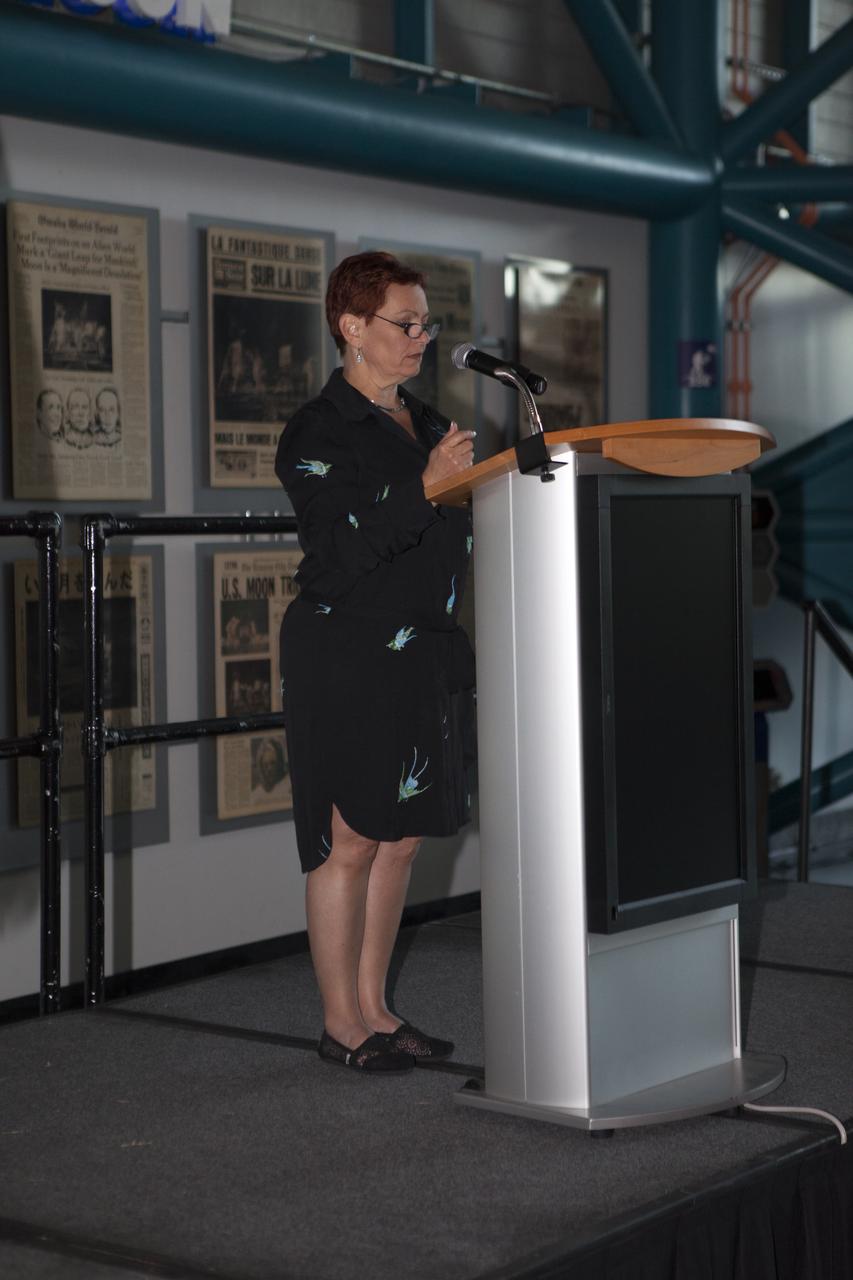
Inside the Apollo-Saturn V Center at the Kennedy Space Center Visitor Complex in Florida, Lisa May, with Murphian Systems, presents the Judges Innovation Award during the award ceremony for NASA's 8th Annual Robotic Mining Competition. More than 40 student teams from colleges and universities around the U.S. used their uniquely-designed mining robots to dig in a supersized sandbox filled with BP-1, or simulated Martian soil, and participated in other competition requirements, May 22-26, at the visitor complex. The Robotic Mining Competition is a NASA Human Exploration and Operations Mission Directorate project designed to encourage students in science, technology, engineering and math, or STEM fields. The project provides a competitive environment to foster innovative ideas and solutions that could be used on NASA's Journey to Mars.
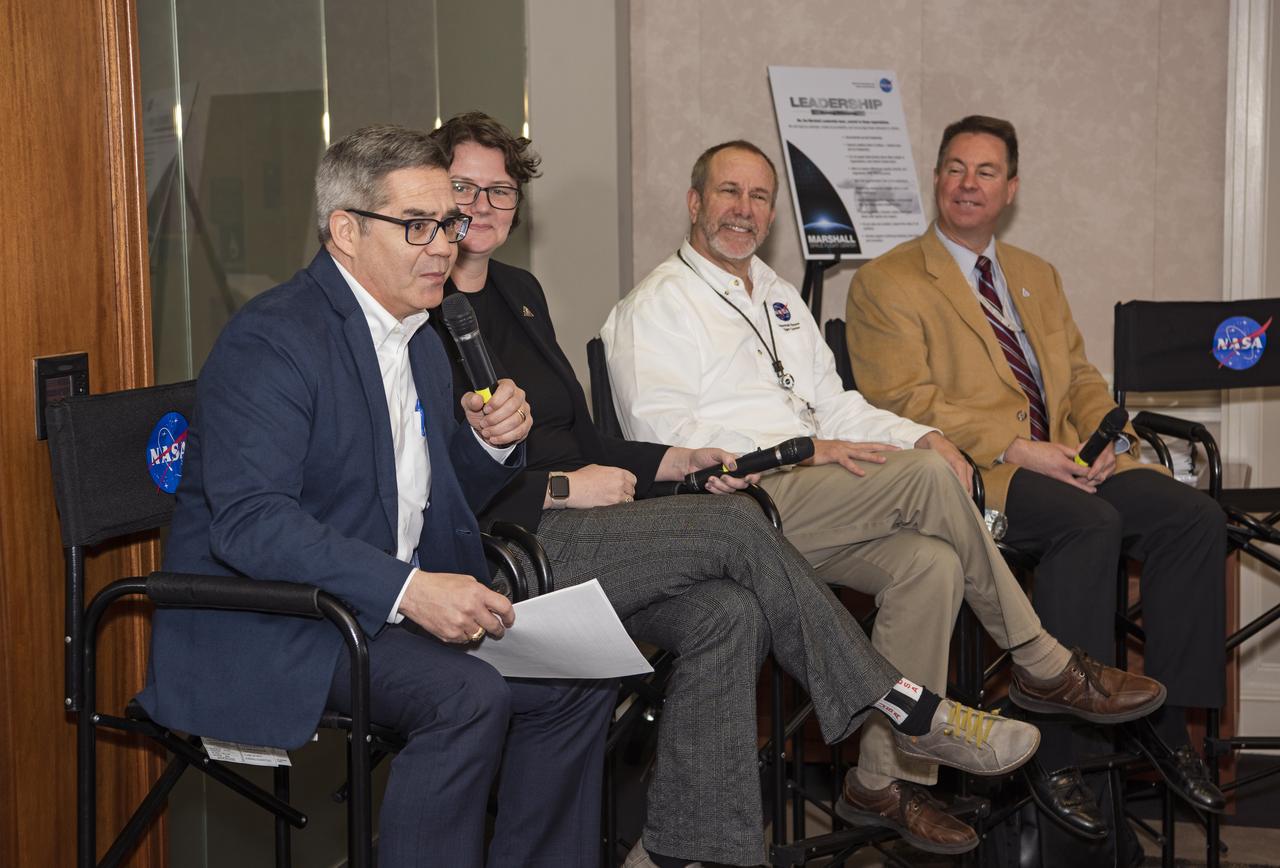
Sam Ortega, left, manager of the Partnerships Office at NASA’s Marshall Space Flight Center, moderates an Artemis Program panel featuring, second from left, Renee Weber, Marshall chief scientist; David Beaman, manager of Marshall’s Systems Engineering & Integration Office; and Don Krupp, associate program manager for the Human Landing System Program, during Universities of the Tennessee Valley Corridor activities Feb. 27 at Marshall. Leadership staff from eight universities and 10 junior colleges in Alabama, Tennessee and Kentucky also heard presentations on Office of STEM Engagement opportunities, partnership opportunities, Marshall’s Technology Transfer Office, the NASA software catalog and Marshall’s Advanced Concepts Office. The group toured several Marshall facilities to learn more about center capabilities.
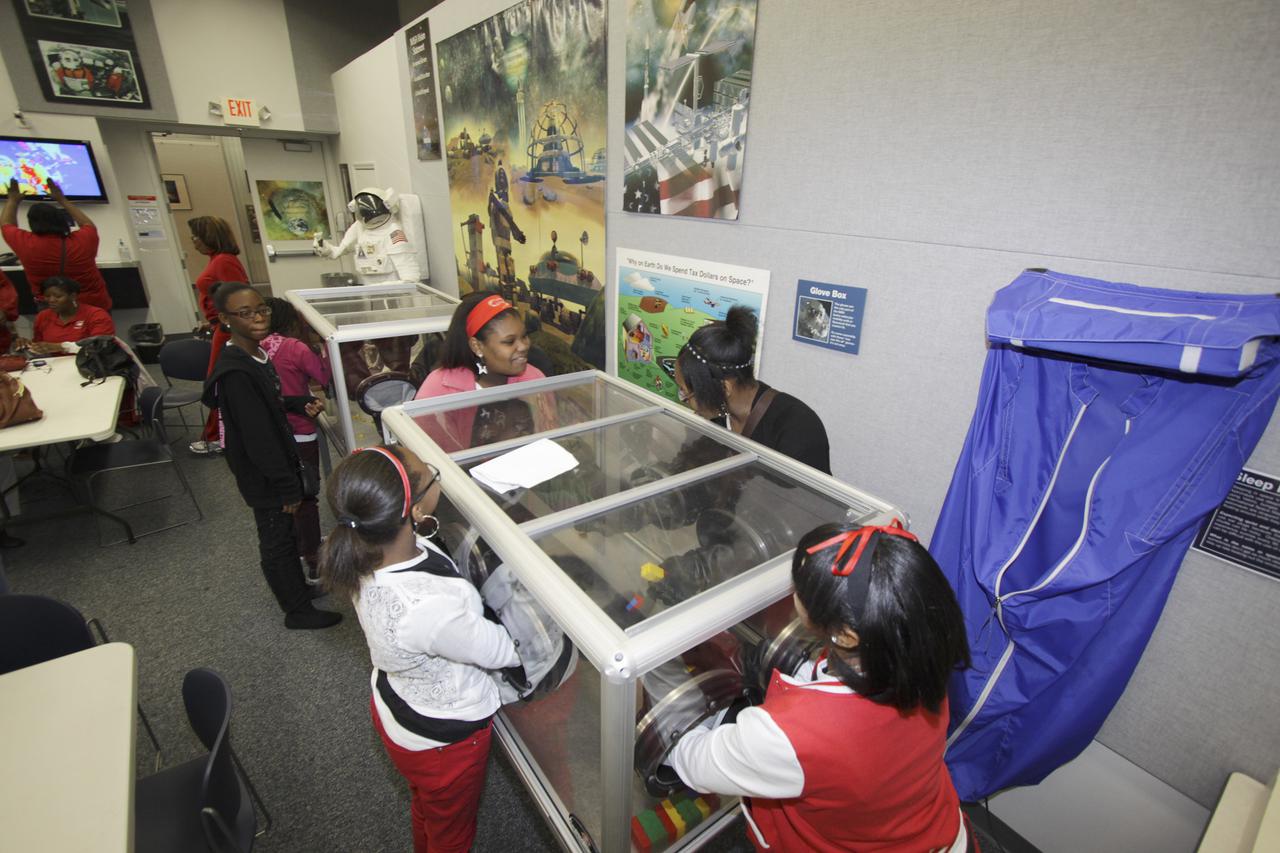
CAPE CANAVERAL, Fla. – Middle and High school students from Florida's Putnam and Volusia counties use a glove box practice working with materials with protected hands during a science demonstration at the NASA's Center for Space at the Kennedy Space Center. The 11 to 18-year-old students are part of Delta Academy and Delta GEMS, an African American women’s mentoring program affiliated with Delta Sigma Theta. The sorority uses their collective efforts to promote academic excellence, provide scholarships and support underserved students. As a part of the science program, the young scholars participated in a presentation by professional women who work at Kennedy discussing career choices and encouraging interest in science, technology, engineering and mathematics STEM careers. Photo credit: NASA_Jim Grossmann
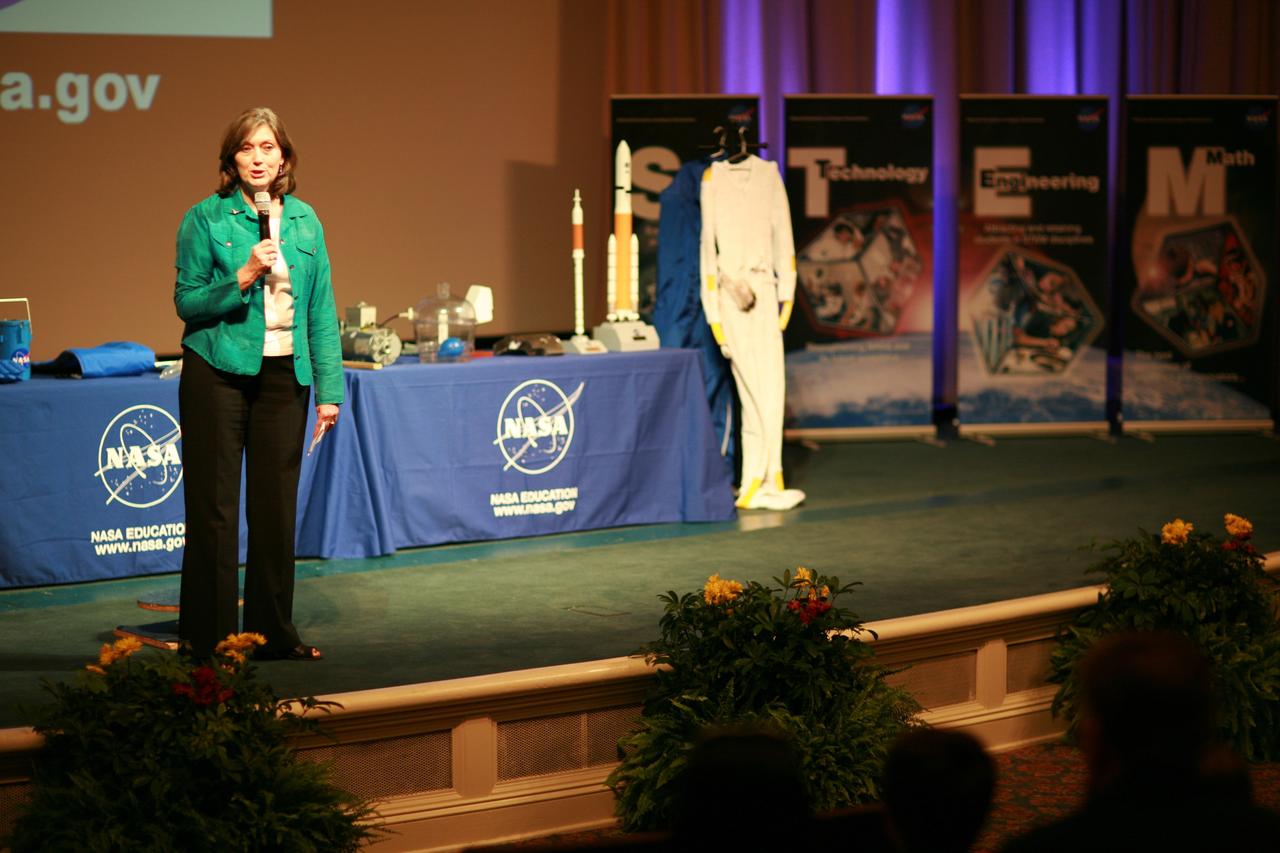
CAPE CANAVERAL, Fla. – At Walt Disney World's Magic Kingdom in Orlando, Fla., NASA’s Assistant Administrator for Education Joyce Winterton addresses students and teachers attending an educational presentation, part of the festivities to welcome toy space ranger Buzz Lightyear home from space. The 12-inch-tall action figure spent more than 15 months aboard the International Space Station and returned to Earth aboard space shuttle Discovery on Sept. 11 with the STS-128 crew. Lightyear's space adventure, a collaboration between NASA and Disney Parks, is intended to share the excitement of space exploration with students around the world and encourage them to pursue studies in science, technology, engineering and mathematics. For additional information, visit http://www.nasa.gov/buzzoniss. Photo credit: NASA/Dimitri Gerondidakis
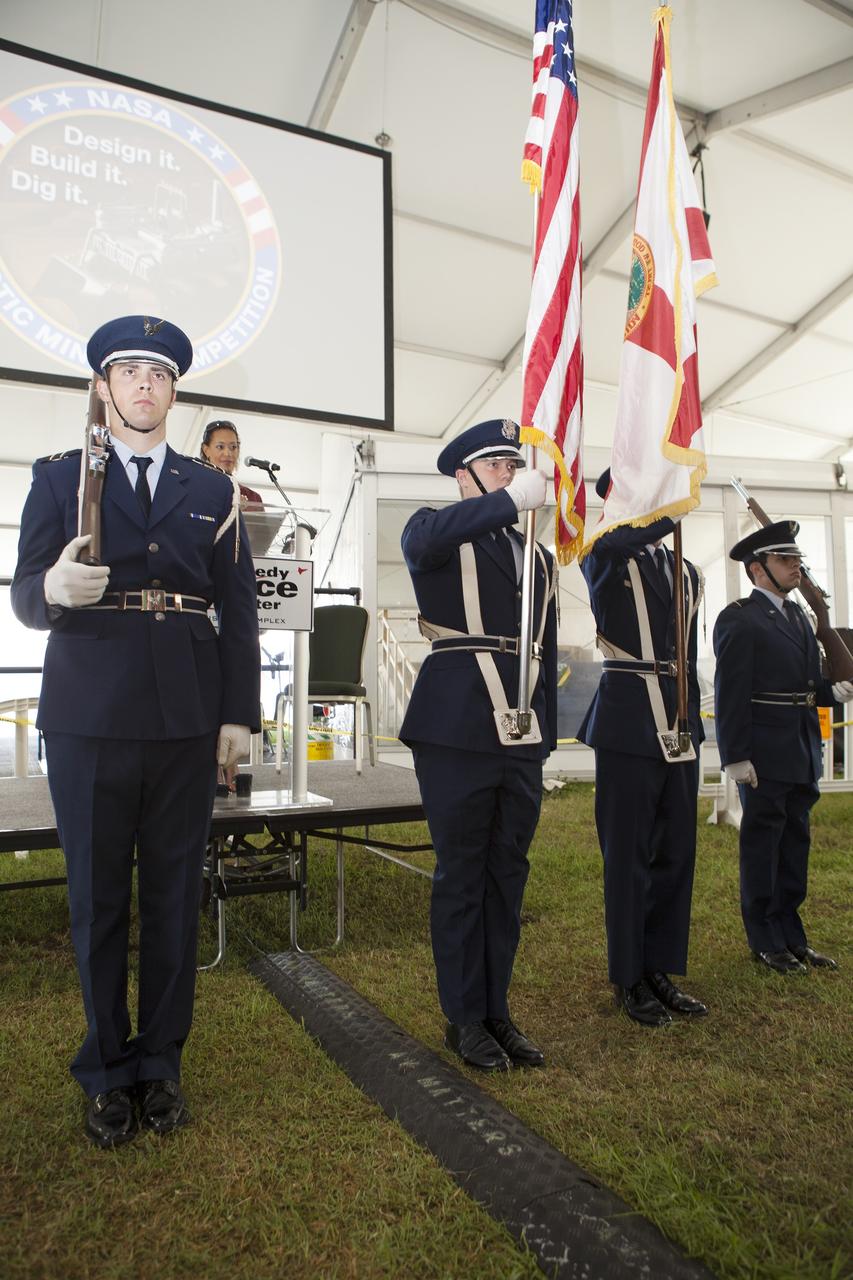
CAPE CANAVERAL, Fla. – Members of the West Virginia University color guard stand at attention during presentation of the U.S. Flag at the opening ceremony of NASA’s 2014 Robotics Mining Competition at the Kennedy Space Center Visitor Complex in Florida. More than 35 teams from around the U.S. have designed and built remote-controlled robots for the mining competition. The competition is a NASA Human Exploration and Operations Mission Directorate project designed to engage and retain students in science, technology, engineering and mathematics, or STEM, fields by expanding opportunities for student research and design. Teams use their remote-controlled robotics to maneuver and dig in a supersized sandbox filled with a crushed material that has characteristics similar to Martian soil. The objective of the challenge is to see which team’s robot can collect and move the most regolith within a specified amount of time. For more information, visit www.nasa.gov/nasarmc. Photo credit: NASA/Frankie Martin
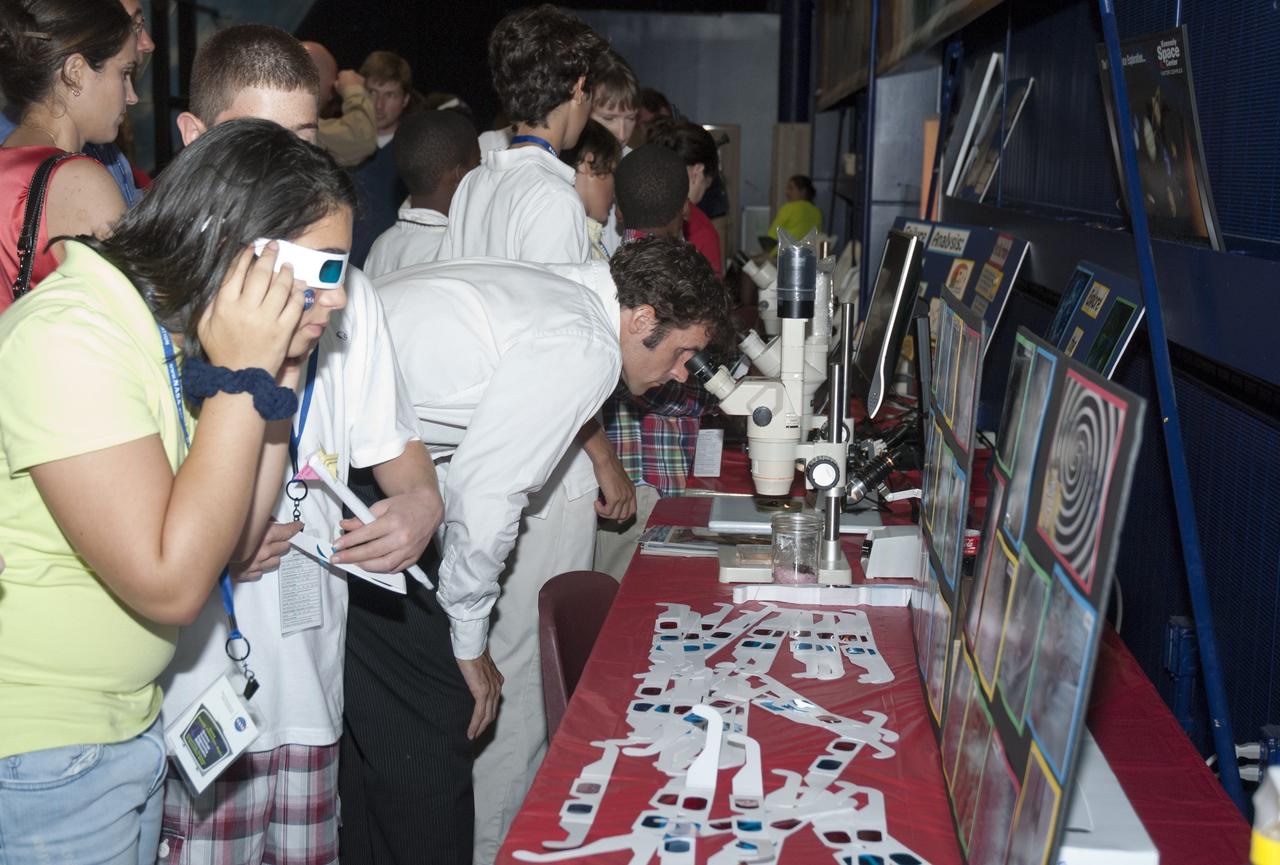
CAPE CANAVERAL, Fla. -- At the Astronaut Hall of Fame near the Kennedy Space Center Visitor Complex in Florida, fifth- through eighth-grade students and their parents participate in the Materials Science Laboratory exhibit by using stereomicroscopes and viewing 3-D scanning electron microscope images during the last NASA family education night event. Other activities included "gee-whiz" presentations, astronaut appearances, a hovercraft, vortex cannon and alternative fuel vehicles, which promote science, technology, engineering and mathematics (STEM) education. The event is part of NASA's Summer of Innovation initiative to provide interactive learning experiences to middle school students nationwide during the summer months. The program is a cornerstone of the Educate to Innovate campaign announced by President Barack Obama in November 2009. Photo credit: NASA/Charisse Nahser
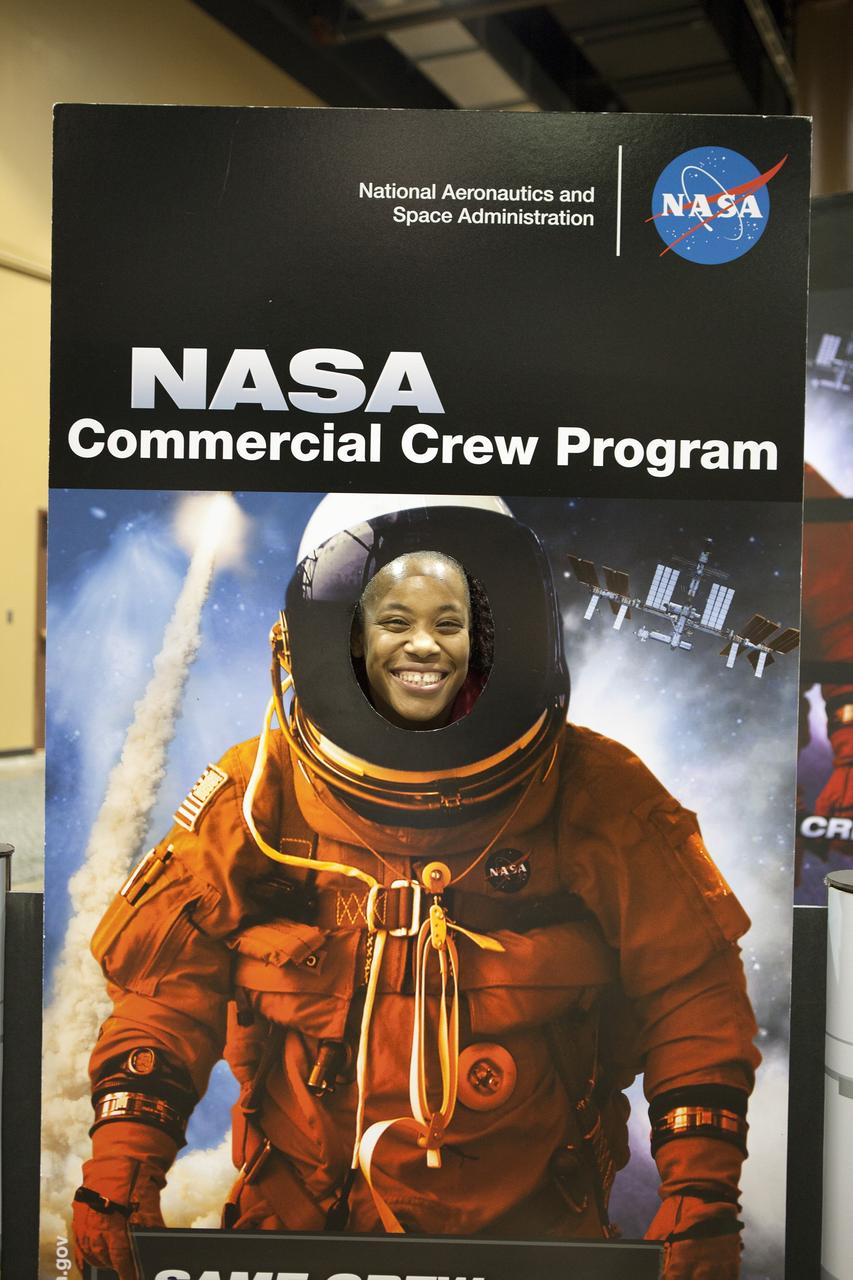
KISSIMMEE, Fla. – A guest at the Tom Joyner Family Reunion is photographed with a Commercial Crew Program exhibit during the five-day event. Thousands of visitors spoke with agency representatives who explained the agency’s efforts with CCP, the International Space Station, Ground Systems Development and Operations Program, as well as the Launch Services Program. The Tom Joyner Family Reunion is designed to present uplifting programs, entertainment and information about growing, diverse communities. An annual event of the nationally-syndicated Tom Joyner Morning Show, the many exhibits included NASA's participation focusing on encouraging young people to consider studies and careers in STEM -- science, technology, engineering and math. NASA's Education Division promoted the benefits of math and scientific learning along with career opportunities offered by the space agency. The activities took place at the Gaylord Palms Resort in Kissimmee, Florida, during the Labor Day weekend. Photo credit: NASA/Daniel Casper
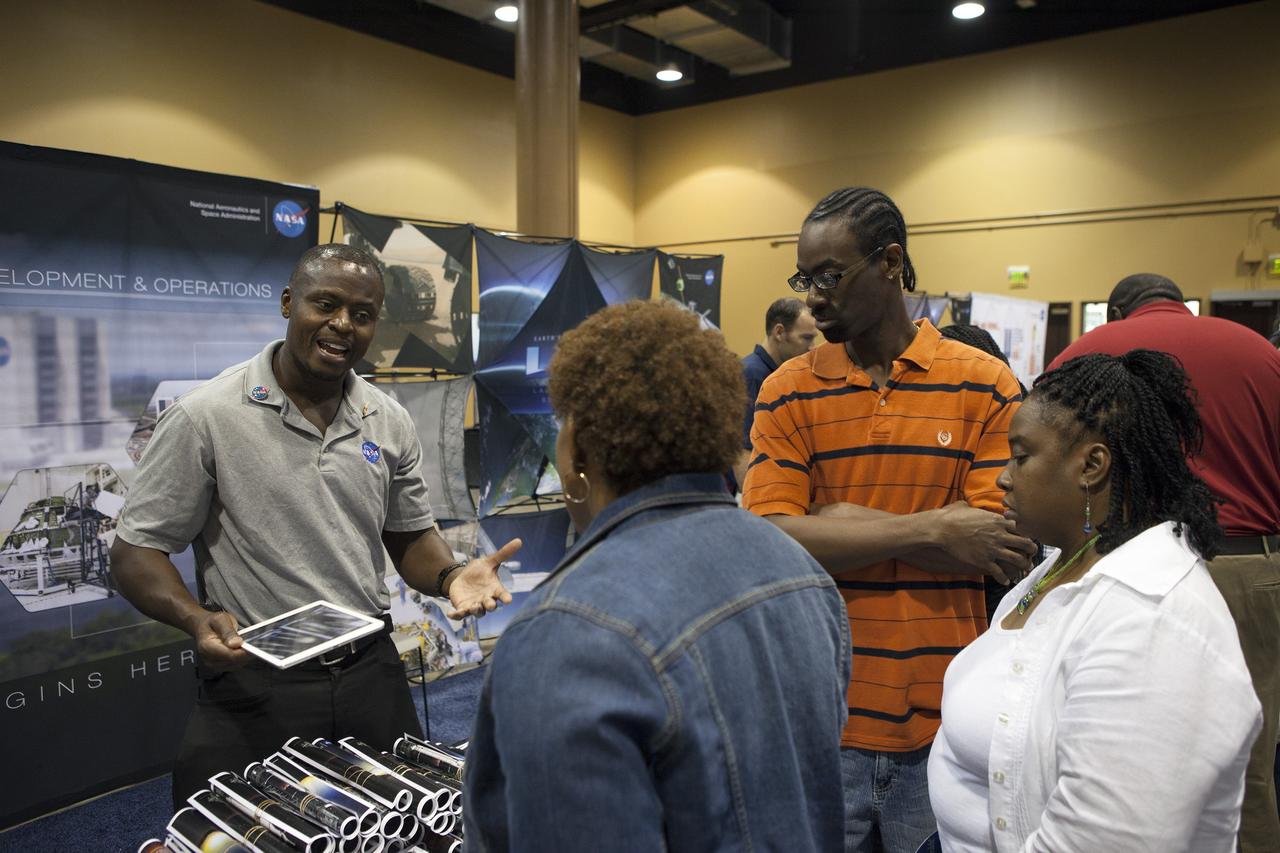
KISSIMMEE, Fla. – Yves Lamothe of the NASA Technical Management Branch of Ground Systems Development and Operations Program speaks with guests at the Tom Joyner Family Reunion about ongoing work to convert the Kennedy Space Center into a 21st century spaceport. The Tom Joyner Family Reunion is designed to present uplifting programs, entertainment and information about growing, diverse communities. An annual event of the nationally-syndicated Tom Joyner Morning Show, the many exhibits included NASA's participation focusing on encouraging young people to consider studies and careers in STEM -- science, technology, engineering and math. NASA's Education Division promoted the benefits of math and scientific learning along with career opportunities offered by the space agency. The activities took place at the Gaylord Palms Resort in Kissimmee, Florida, during the Labor Day weekend. Photo credit: NASA/Daniel Casper
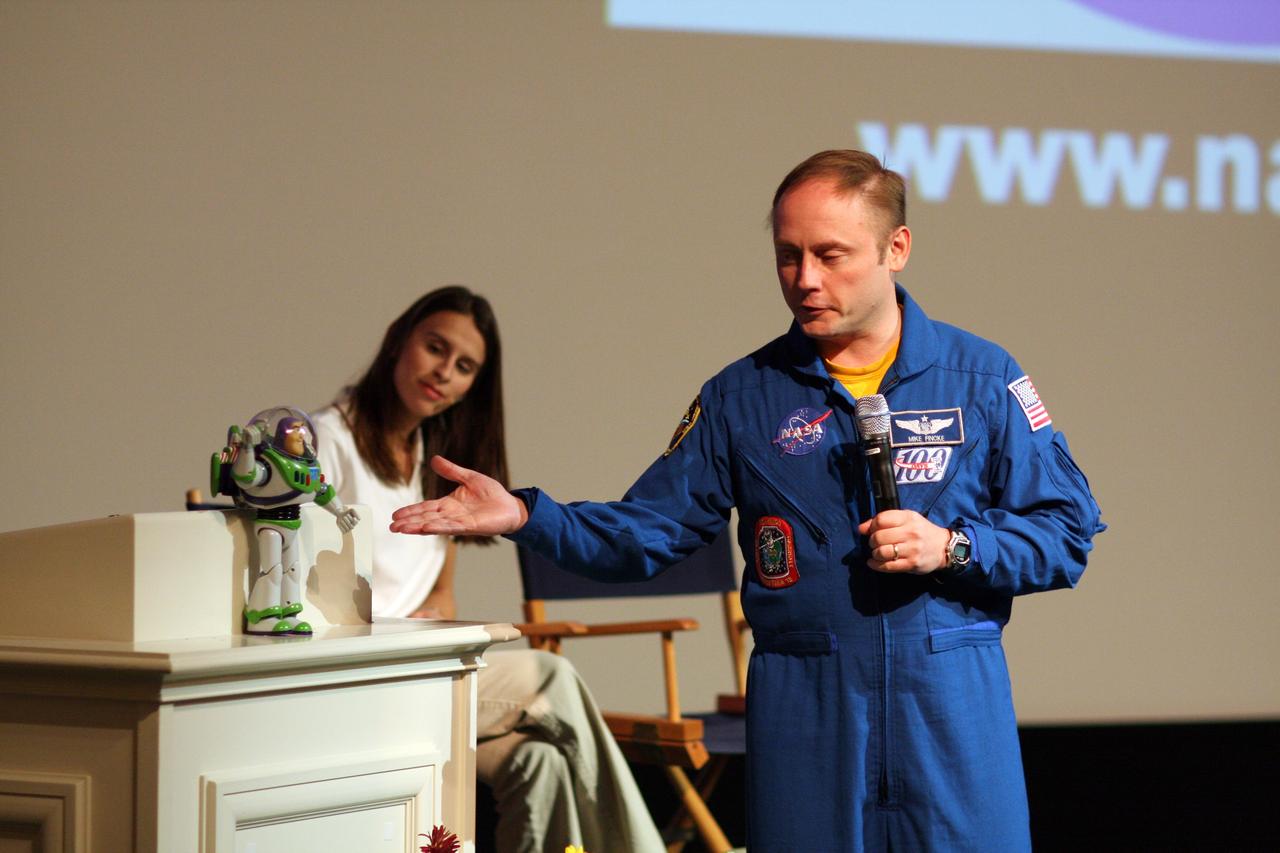
CAPE CANAVERAL, Fla. – At Walt Disney World's Magic Kingdom in Orlando, Fla., NASA astronaut Mike Fincke introduces toy space ranger Buzz Lightyear to students and teachers attending an education presentation, as Veronica Franco of NASA's Education Office at Kennedy Space Center looks on. The event is part of the festivities to welcome Lightyear home from space. Fincke was commander of the International Space Station from October 2008 to April 2009. The 12-inch-tall action figure spent more than 15 months aboard the International Space Station and returned to Earth aboard space shuttle Discovery on Sept. 11 with the STS-128 crew. Lightyear's space adventure, a collaboration between NASA and Disney Parks, is intended to share the excitement of space exploration with students around the world and encourage them to pursue studies in science, technology, engineering and mathematics. For additional information, visit http://www.nasa.gov/buzzoniss. Photo credit: NASA/Dimitri Gerondidakis
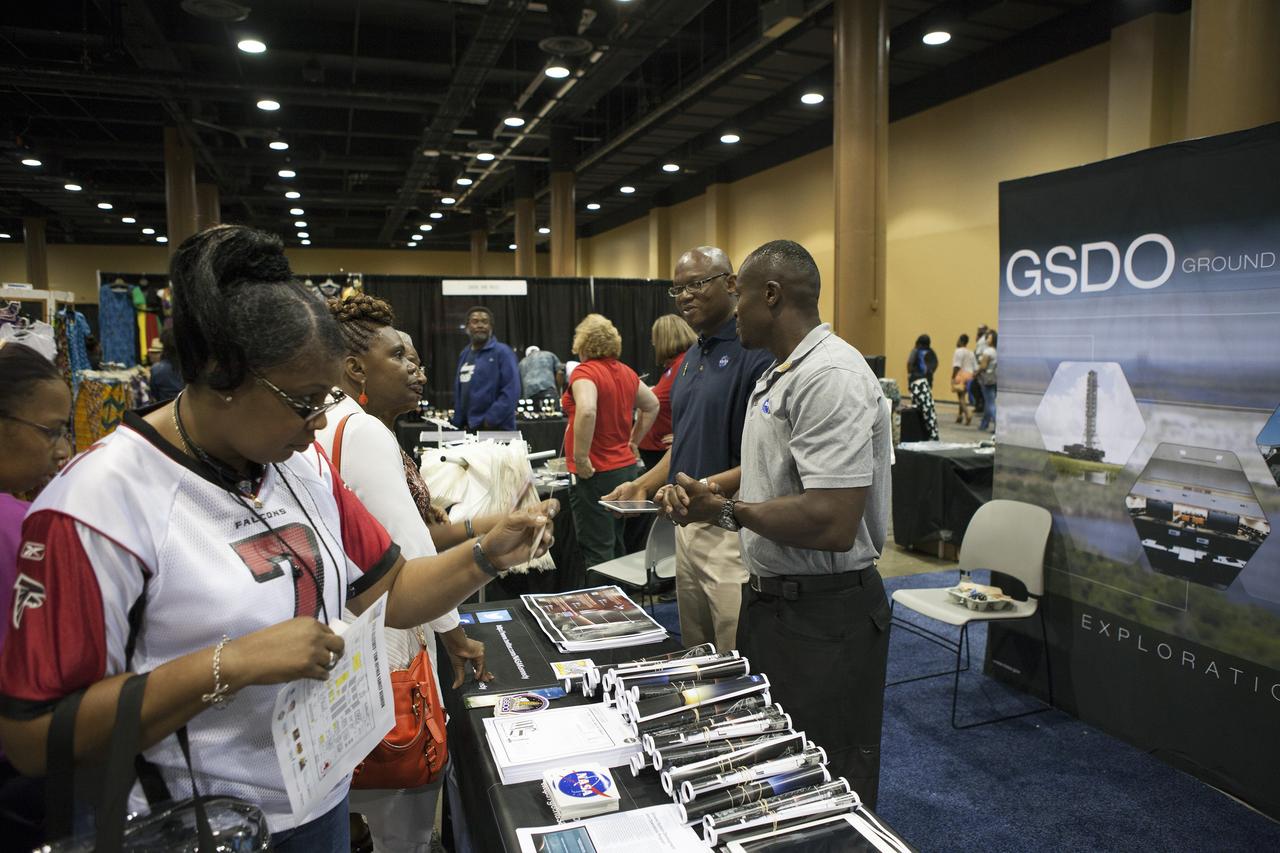
KISSIMMEE, Fla. – During the Tom Joyner Family Reunion, Ken Fullwood of Booz-Allen-Hamilton, left, and Yves Lamothe of the NASA Technical Management Branch of the Ground Systems Development and Operations Program talk to guests about ongoing work to convert the Kennedy Space Center into a 21st century spaceport. The Tom Joyner Family Reunion is designed to present uplifting programs, entertainment and information about growing, diverse communities. An annual event of the nationally-syndicated Tom Joyner Morning Show, the many exhibits included NASA's participation focusing on encouraging young people to consider studies and careers in STEM -- science, technology, engineering and math. NASA's Education Division promoted the benefits of math and scientific learning along with career opportunities offered by the space agency. The activities took place at the Gaylord Palms Resort in Kissimmee, Florida, during the Labor Day weekend. Photo credit: NASA/Daniel Casper
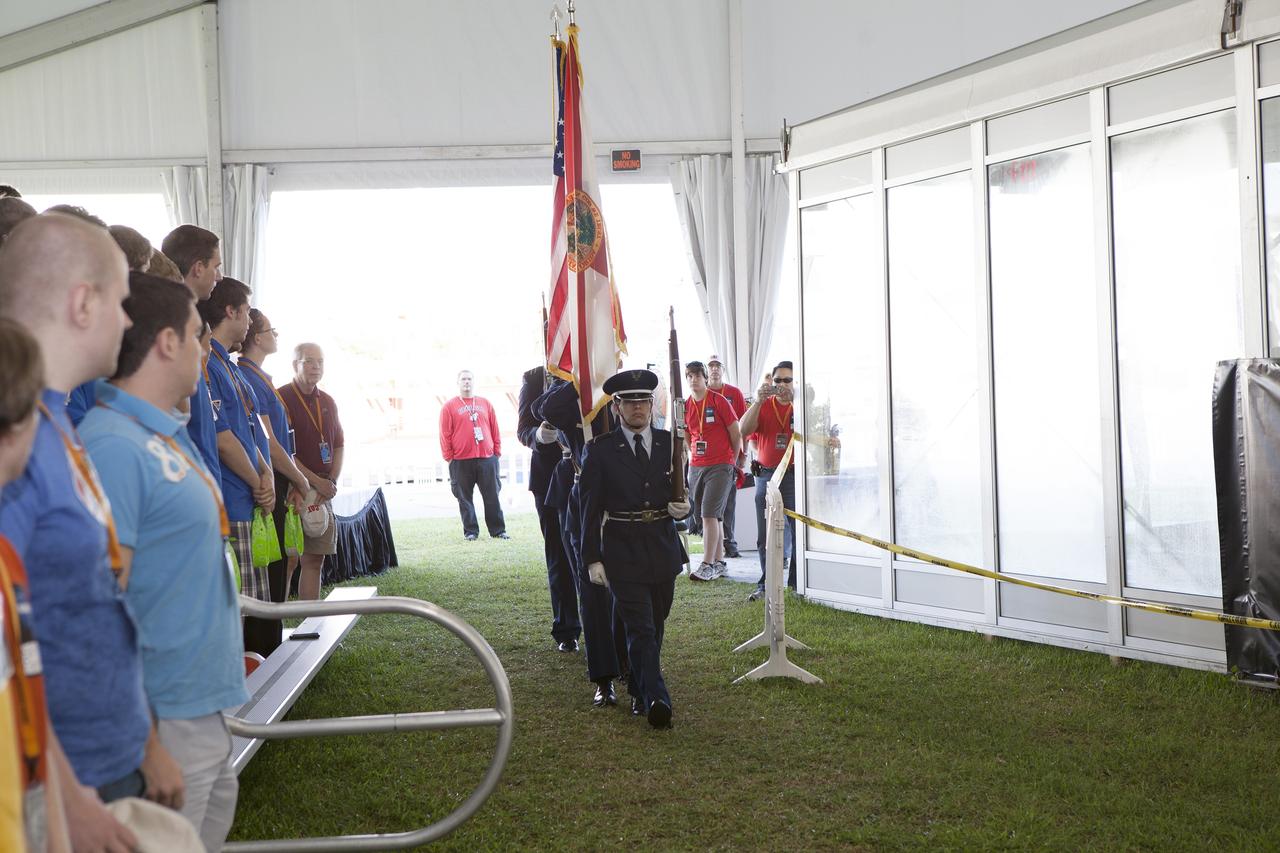
CAPE CANAVERAL, Fla. – Members of the West Virginia University color guard present the U.S. Flag during the opening ceremony of NASA’s 2014 Robotics Mining Competition at the Kennedy Space Center Visitor Complex in Florida. More than 35 teams from around the U.S. have designed and built remote-controlled robots for the mining competition. The competition is a NASA Human Exploration and Operations Mission Directorate project designed to engage and retain students in science, technology, engineering and mathematics, or STEM, fields by expanding opportunities for student research and design. Teams use their remote-controlled robotics to maneuver and dig in a supersized sandbox filled with a crushed material that has characteristics similar to Martian soil. The objective of the challenge is to see which team’s robot can collect and move the most regolith within a specified amount of time. For more information, visit www.nasa.gov/nasarmc. Photo credit: NASA/Frankie Martin
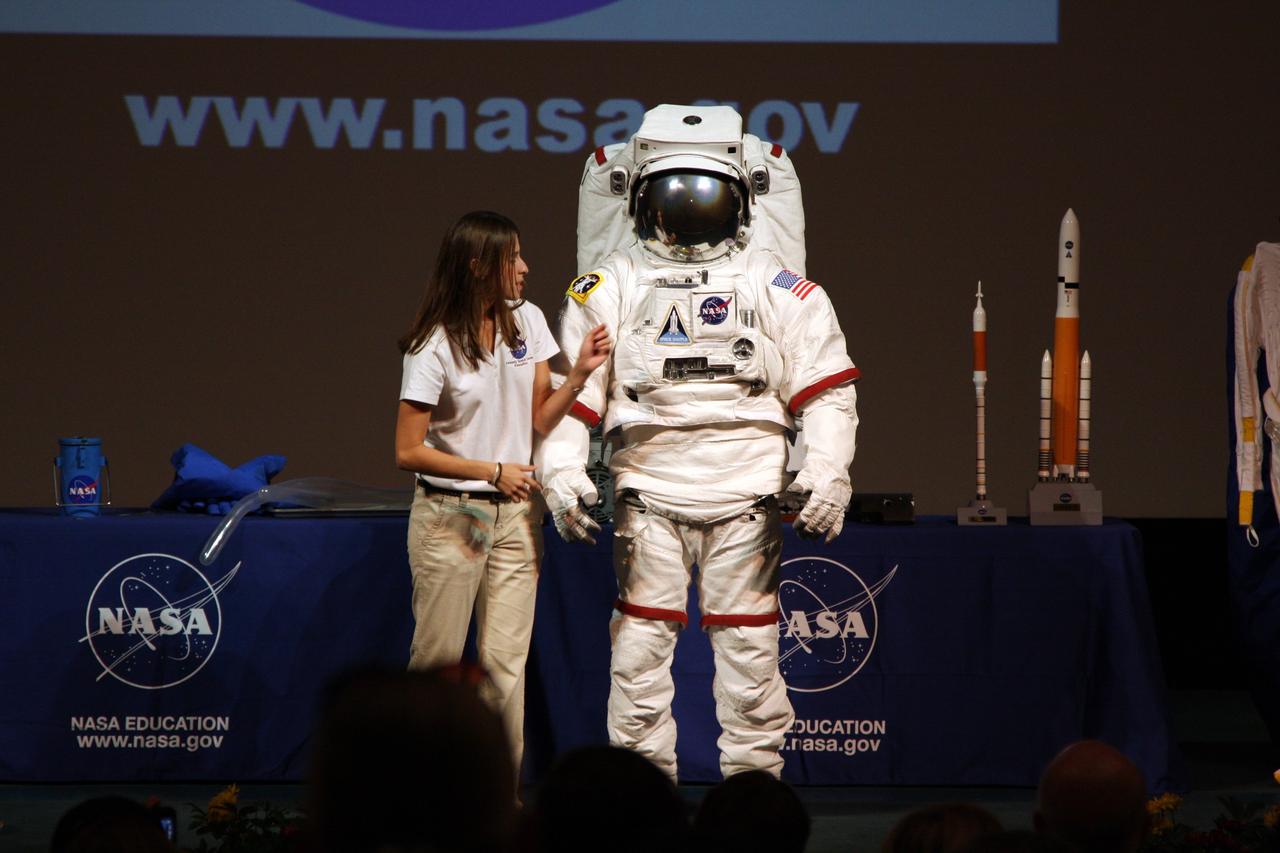
CAPE CANAVERAL, Fla. – At Walt Disney World's Magic Kingdom in Orlando, Fla., Veronica Franco of NASA's Education Office at Kennedy Space Center explains the intricacies of a space suit to students and teachers attending an educational presentation, part of the festivities to welcome toy space ranger Buzz Lightyear home from space. The 12-inch-tall action figure spent more than 15 months aboard the International Space Station and returned to Earth aboard space shuttle Discovery on Sept. 11 with the STS-128 crew. Lightyear's space adventure, a collaboration between NASA and Disney Parks, is intended to share the excitement of space exploration with students around the world and encourage them to pursue studies in science, technology, engineering and mathematics. For additional information, visit http://www.nasa.gov/buzzoniss. Photo credit: NASA/Dimitri Gerondidakis
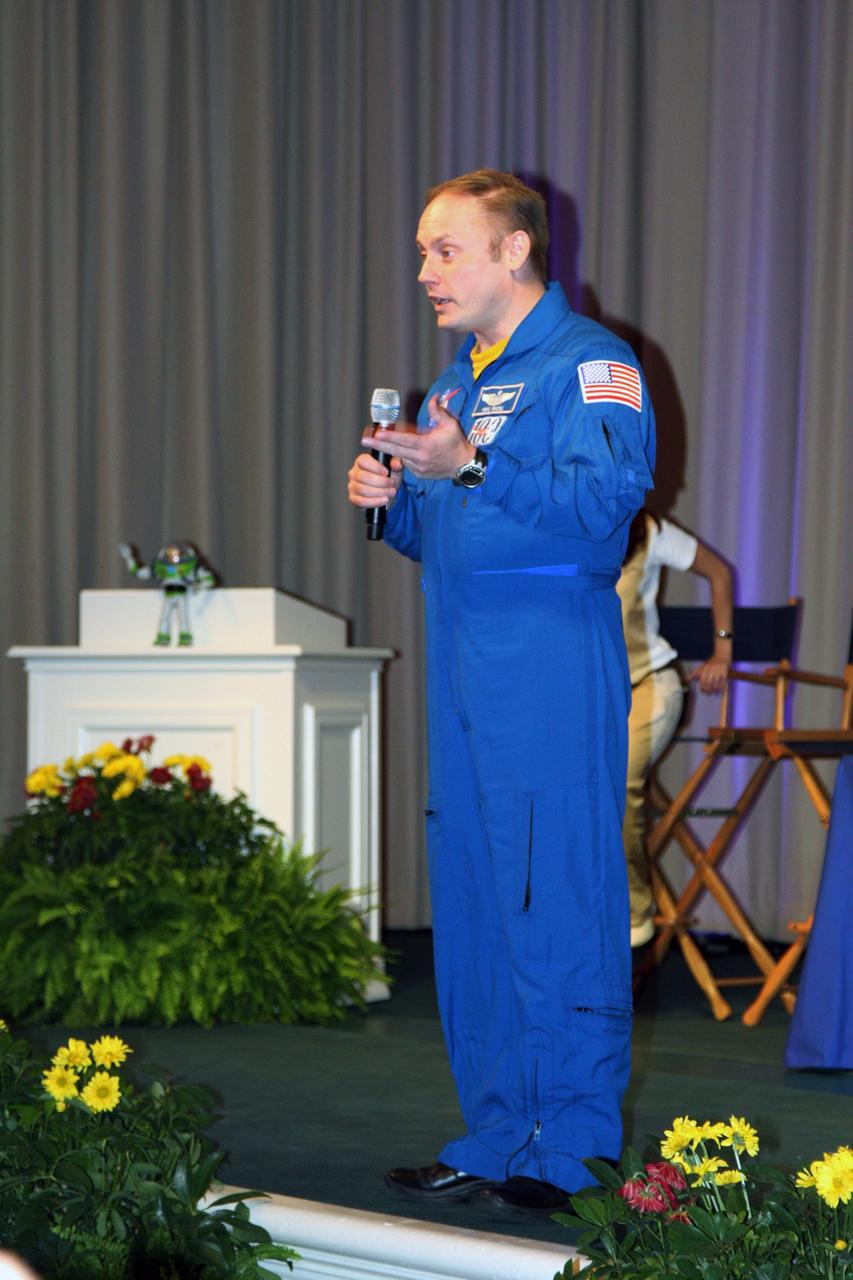
CAPE CANAVERAL, Fla. – At Walt Disney World's Magic Kingdom in Orlando, Fla., NASA astronaut Mike Fincke relates his experiences in space to students and teachers attending an education presentation, part of the festivities to welcome toy space ranger Buzz Lightyear home from space. Fincke was commander of the International Space Station from October 2008 to April 2009. The 12-inch-tall action figure spent more than 15 months aboard the International Space Station and returned to Earth aboard space shuttle Discovery on Sept. 11 with the STS-128 crew. Lightyear's space adventure, a collaboration between NASA and Disney Parks, is intended to share the excitement of space exploration with students around the world and encourage them to pursue studies in science, technology, engineering and mathematics. For additional information, visit http://www.nasa.gov/buzzoniss. Photo credit: NASA/Dimitri Gerondidakis
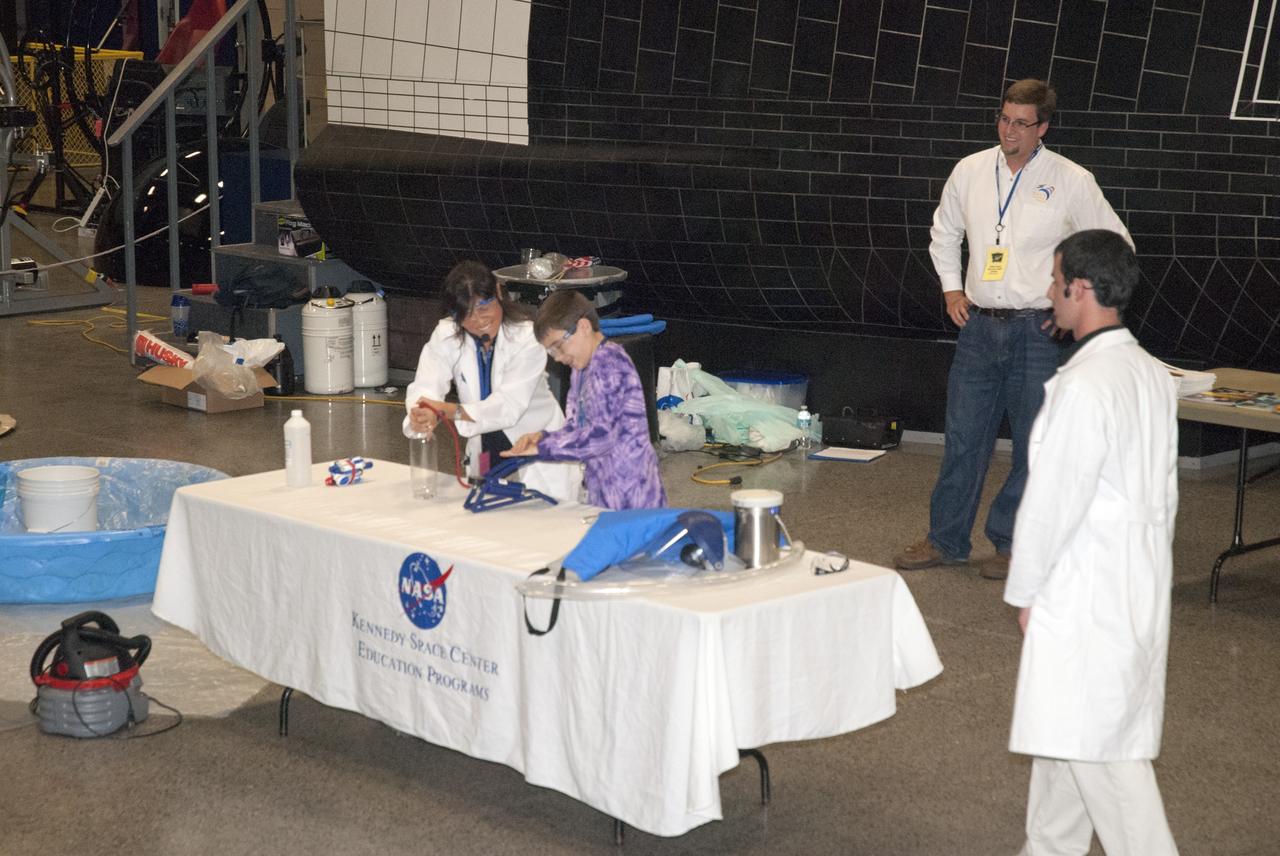
CAPE CANAVERAL, Fla. -- At the Astronaut Hall of Fame near the Kennedy Space Center Visitor Complex in Florida, a student participates in a "cloud-in-a-bottle" demonstration during the last NASA family education night event. Activities for fifth- through eighth-grade students and their parents included "gee-whiz" presentations, astronaut appearances, a hovercraft, vortex cannon and alternative fuel vehicles, which promote science, technology, engineering and mathematics (STEM) education. The event is part of NASA's Summer of Innovation initiative to provide interactive learning experiences to middle school students nationwide during the summer months. The program is a cornerstone of the Educate to Innovate campaign announced by President Barack Obama in November 2009. Photo credit: NASA/Charisse Nahser
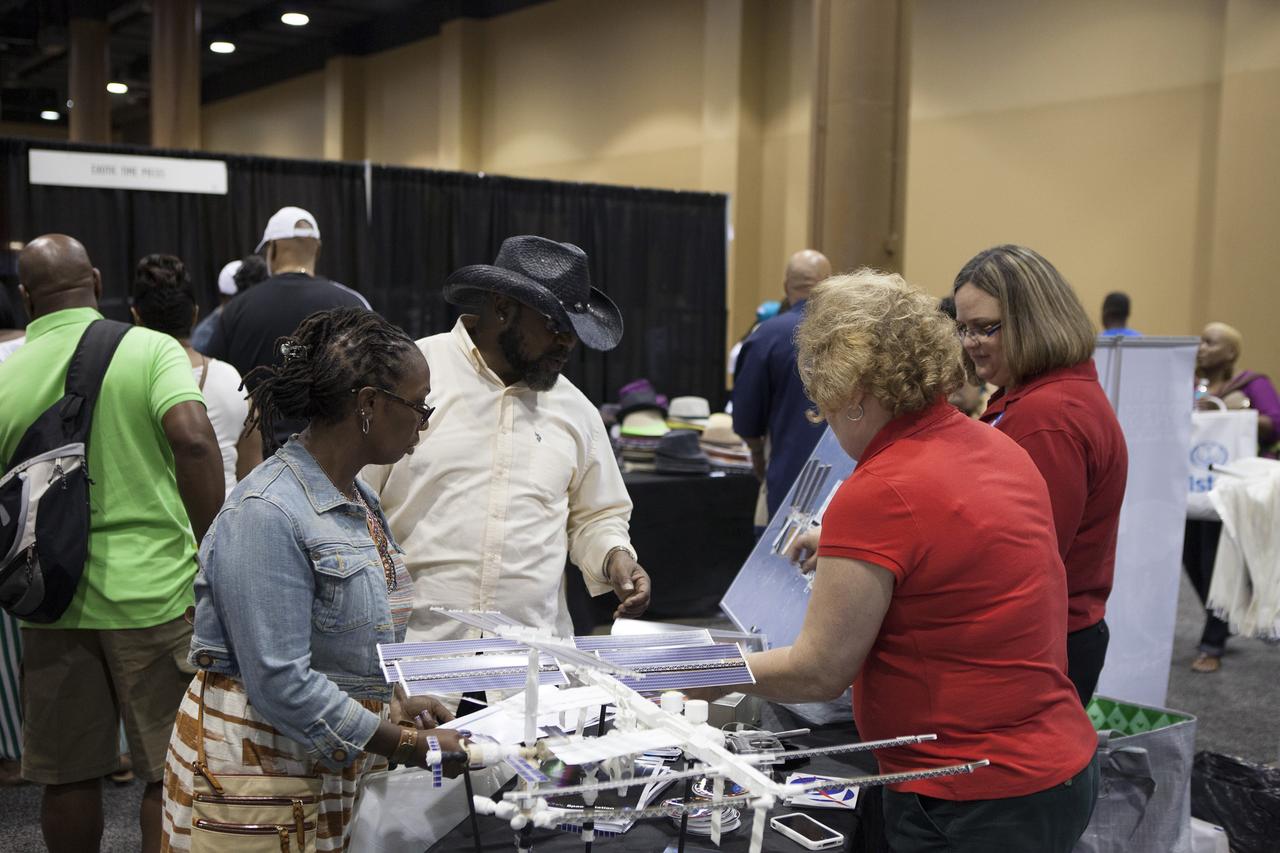
KISSIMMEE, Fla. – Guests at the Tom Joyner Family Reunion learn about NASA activities during the five-day event. Thousands of visitors spoke with agency representatives who explained the NASA’s efforts with the International Space Station, Commercial Crew Program, Ground Systems Development and Operations Program, as well as the Launch Services Program. The Tom Joyner Family Reunion is designed to present uplifting programs, entertainment and information about growing, diverse communities. An annual event of the nationally-syndicated Tom Joyner Morning Show, the many exhibits included NASA's participation focusing on encouraging young people to consider studies and careers in STEM -- science, technology, engineering and math. NASA's Education Division promoted the benefits of math and scientific learning along with career opportunities offered by the space agency. The activities took place at the Gaylord Palms Resort in Kissimmee, Florida, during the Labor Day weekend. Photo credit: NASA/Daniel Casper
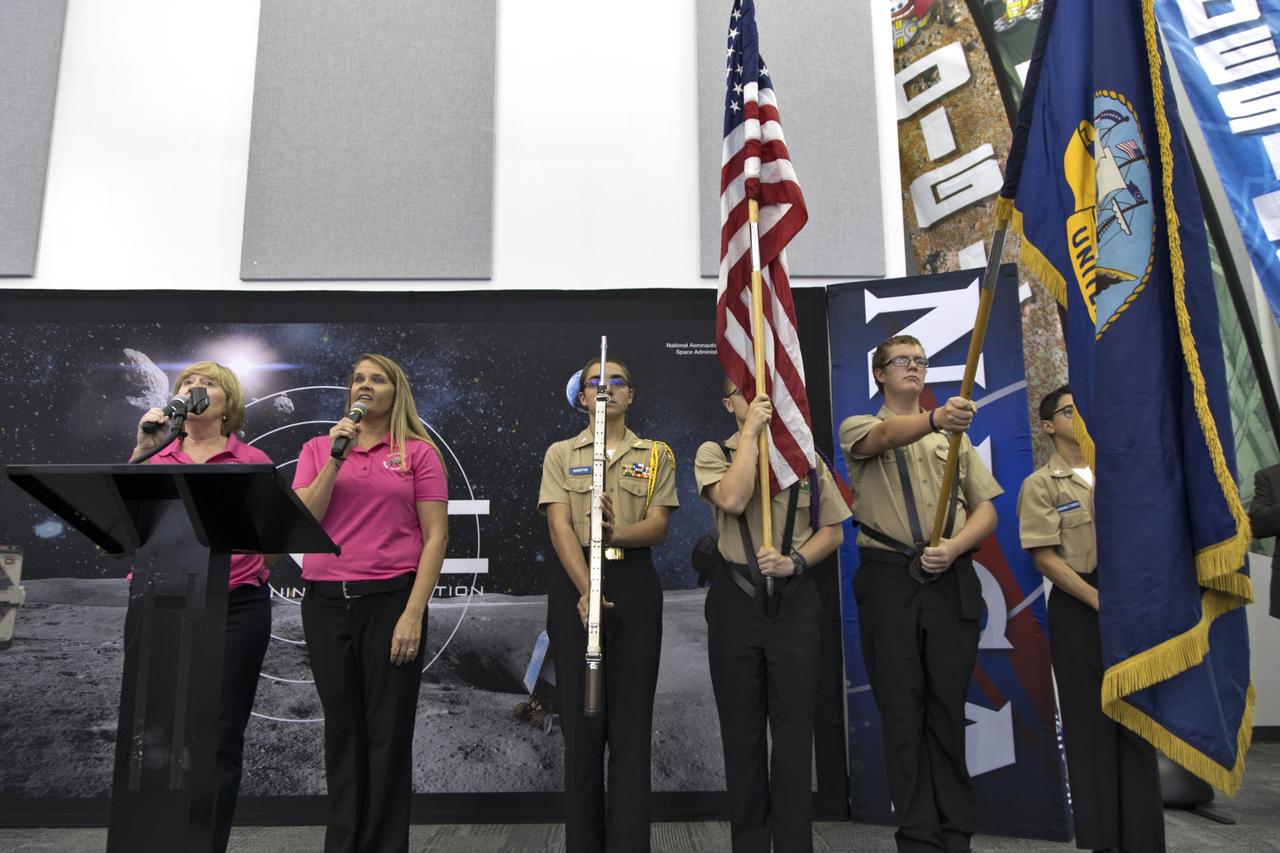
A flag presentation and singing of the National Anthem are part of the opening ceremony of NASA's 9th Robotic Mining Competition, May 15, in the RobotPits in the Educator Resource Center at Kennedy Space Center Visitor Complex in Florida. More than 40 student teams from colleges and universities around the U.S. will use their uniquely designed mining robots to dig in a supersized sandbox filled with BP-1, or simulated Lunar soil, gravel and rocks, and participate in other competition requirements. The Robotic Mining Competition is a NASA Human Exploration and Operations Mission Directorate project designed to encourage students in science, technology, engineering and math, or STEM fields. The project provides a competitive environment to foster innovative ideas and solutions that could be used on NASA's deep space missions.