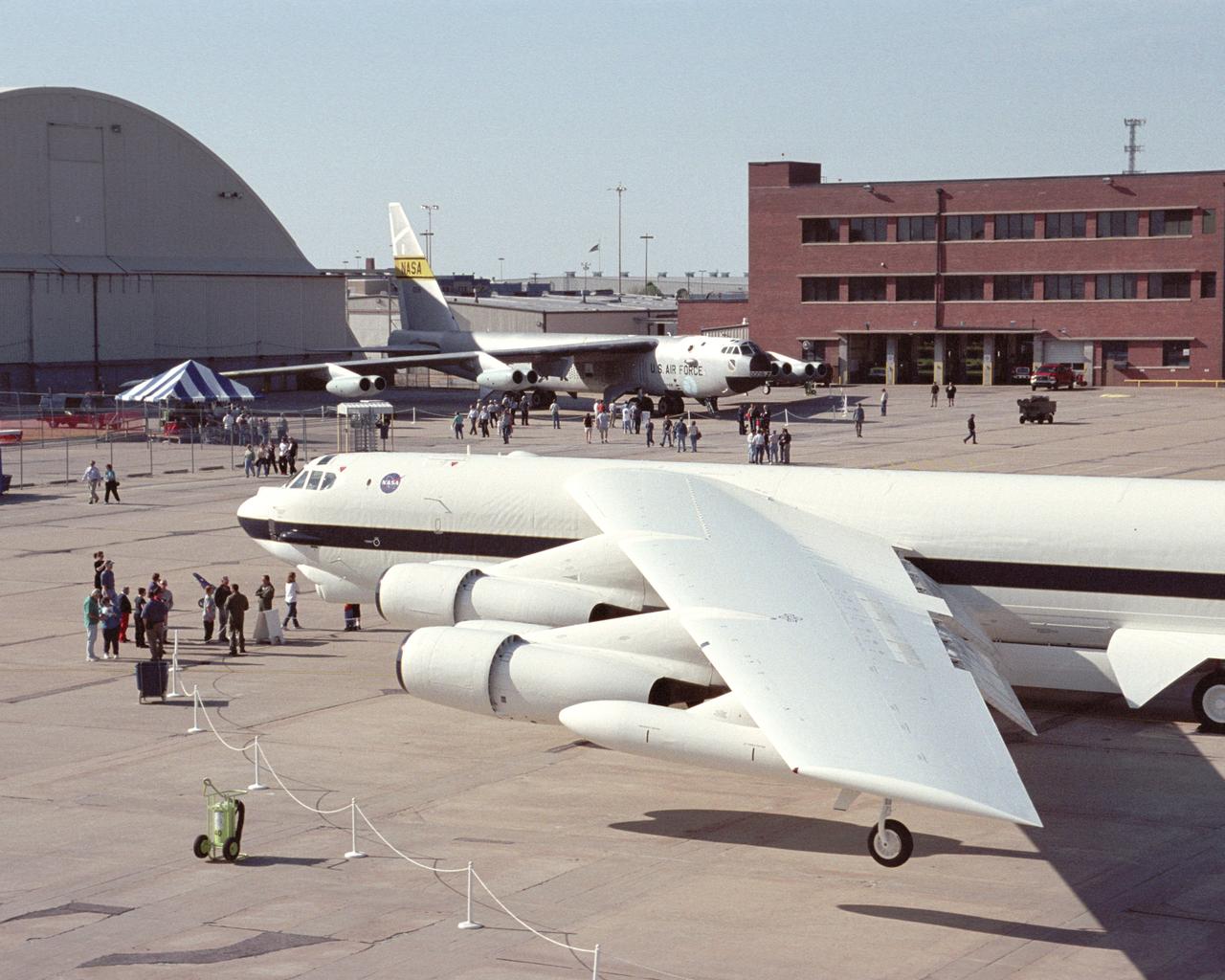
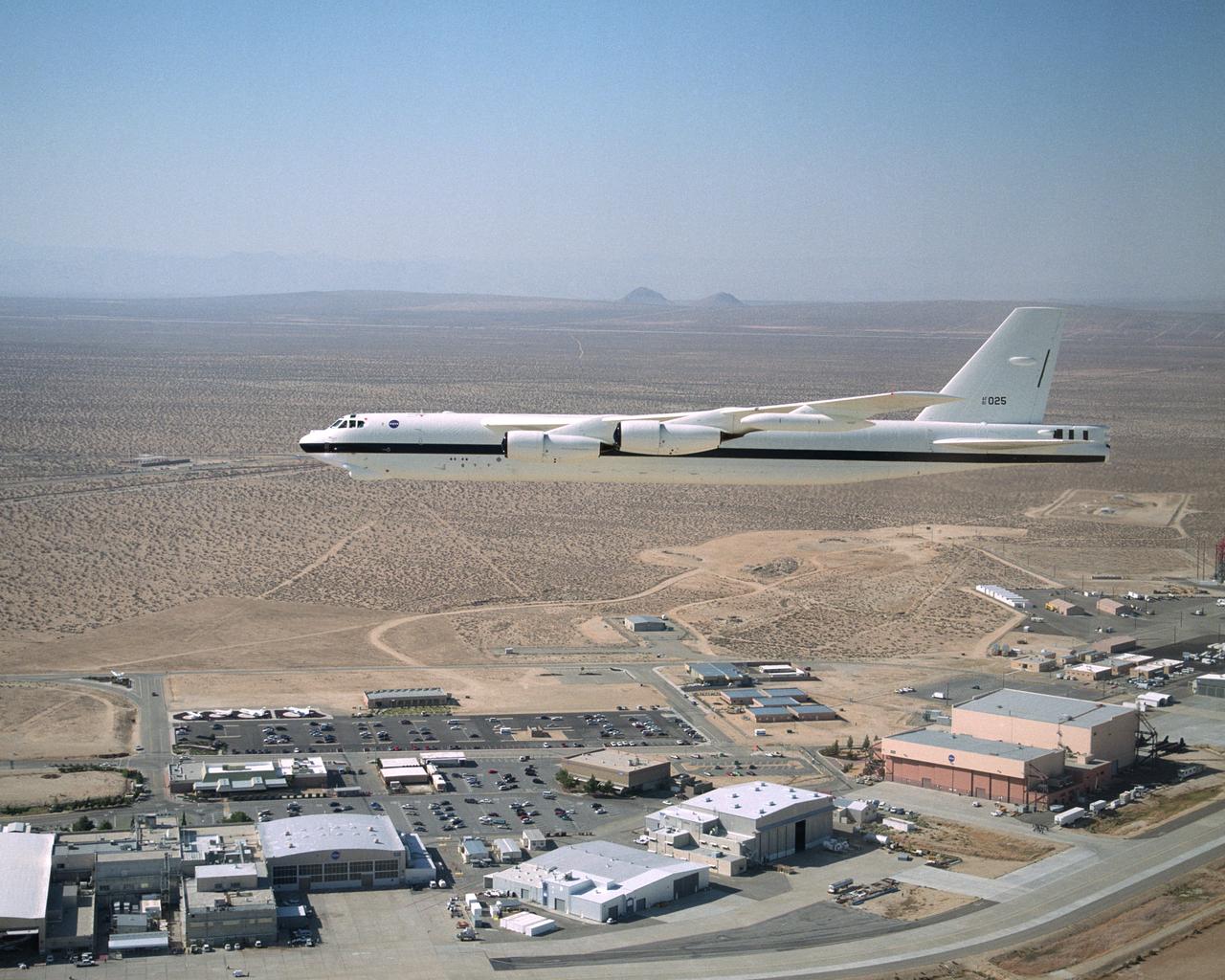
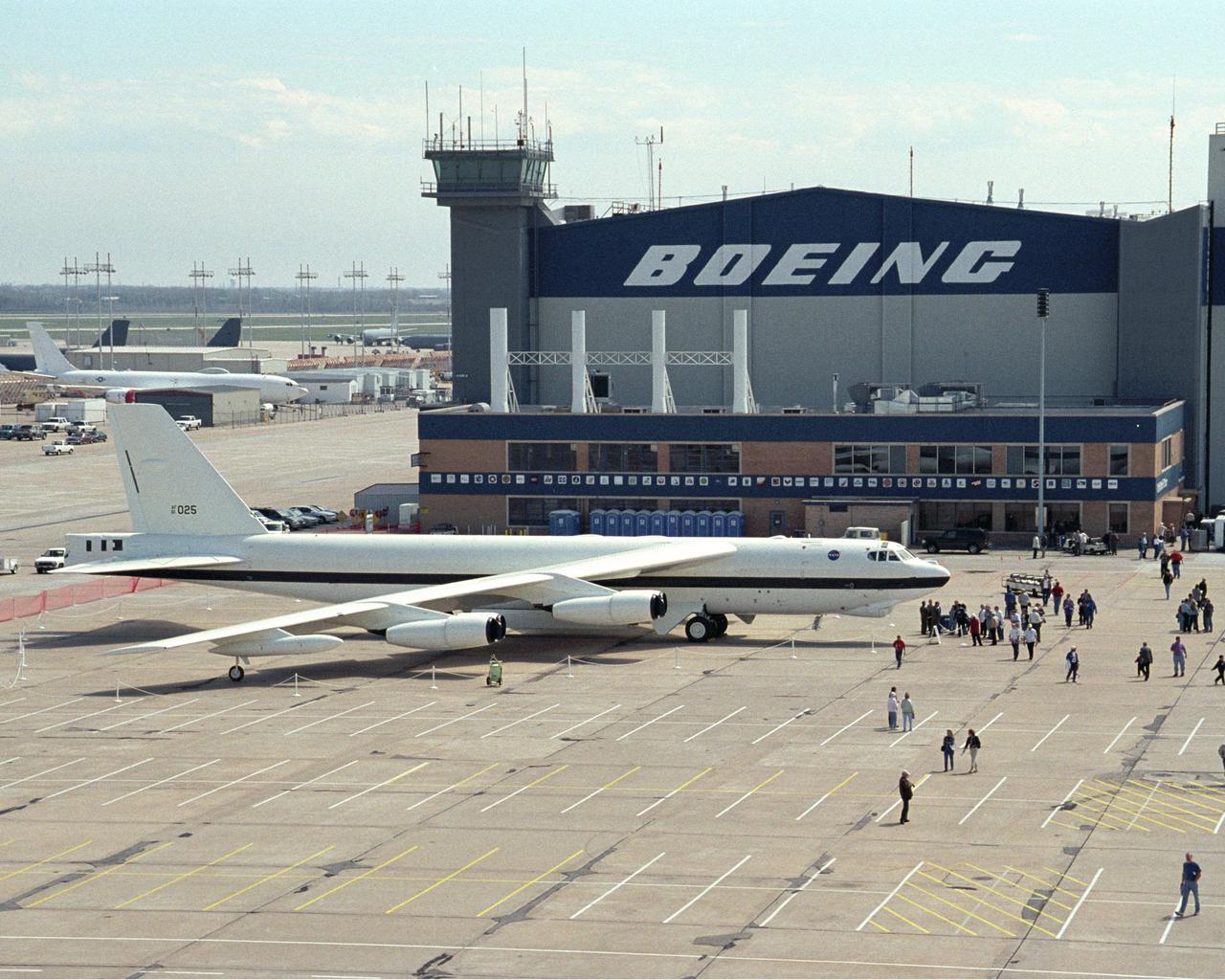
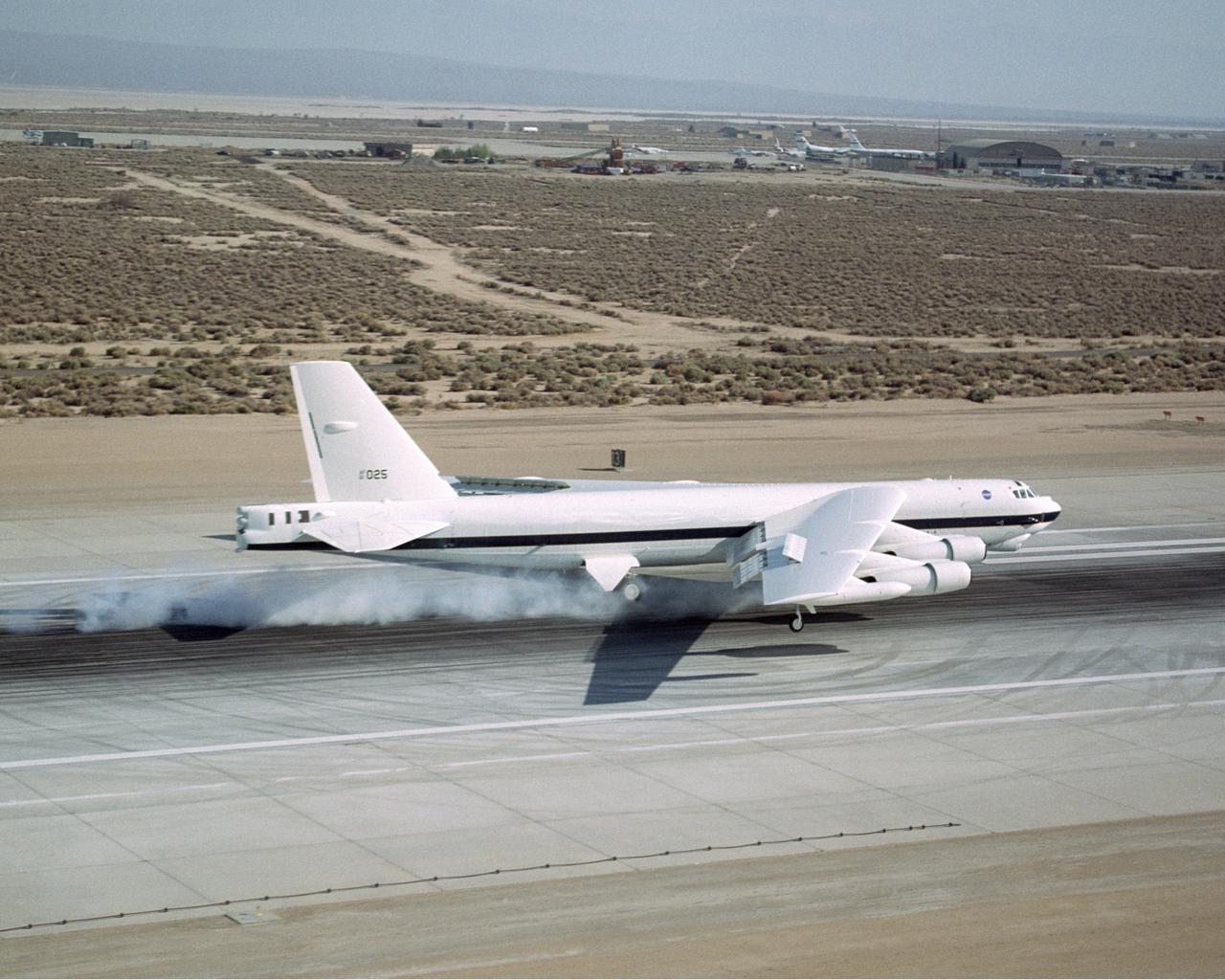
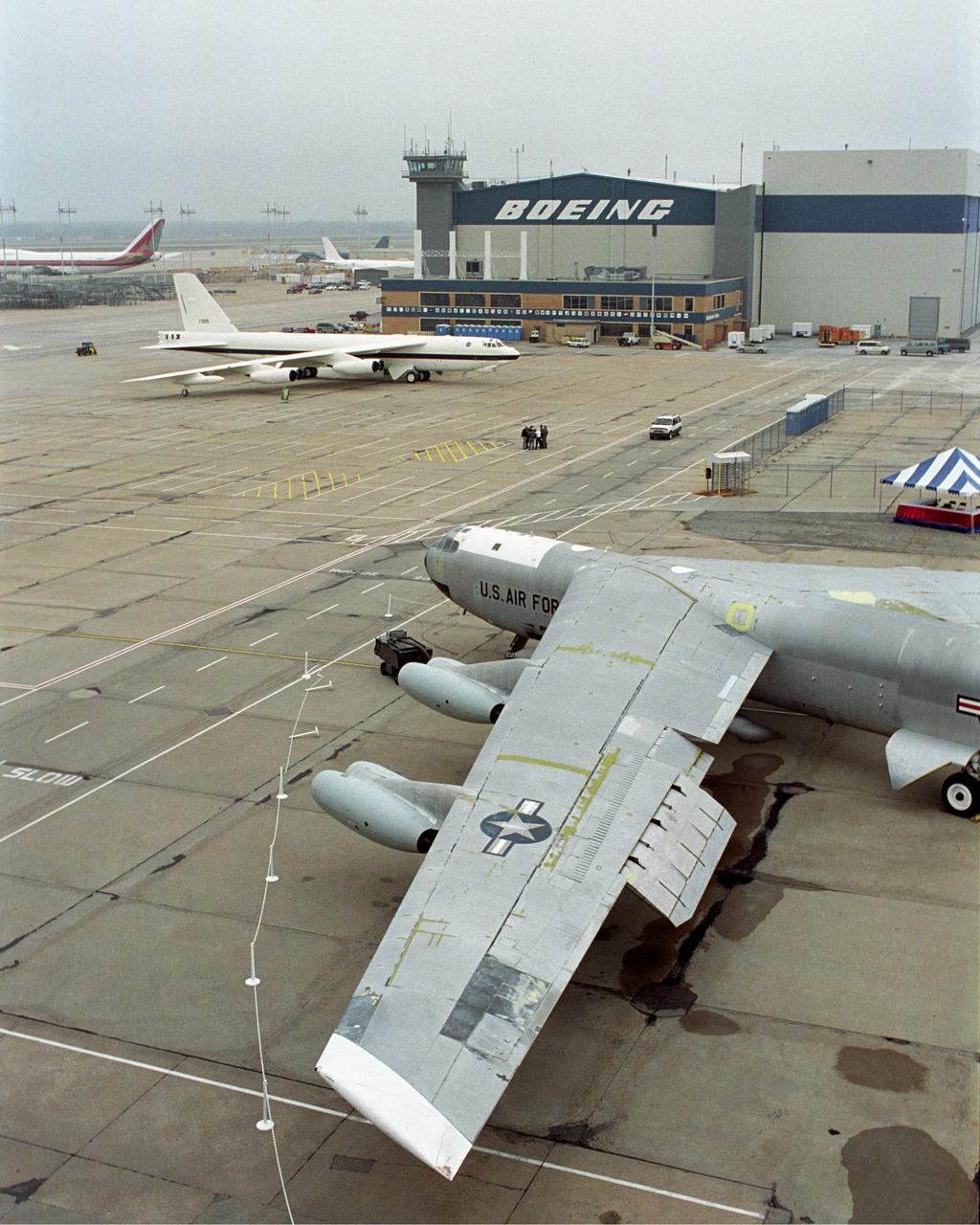
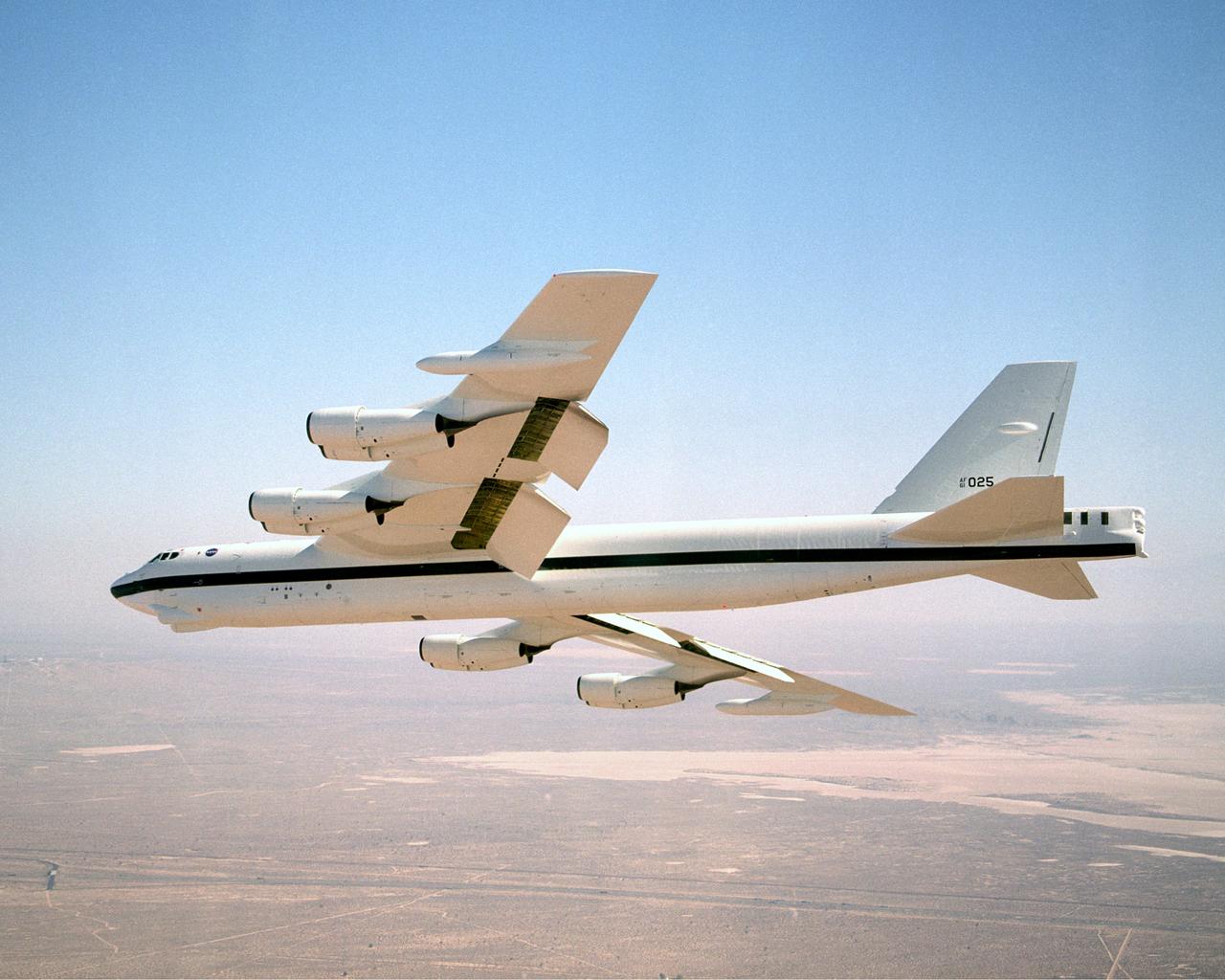
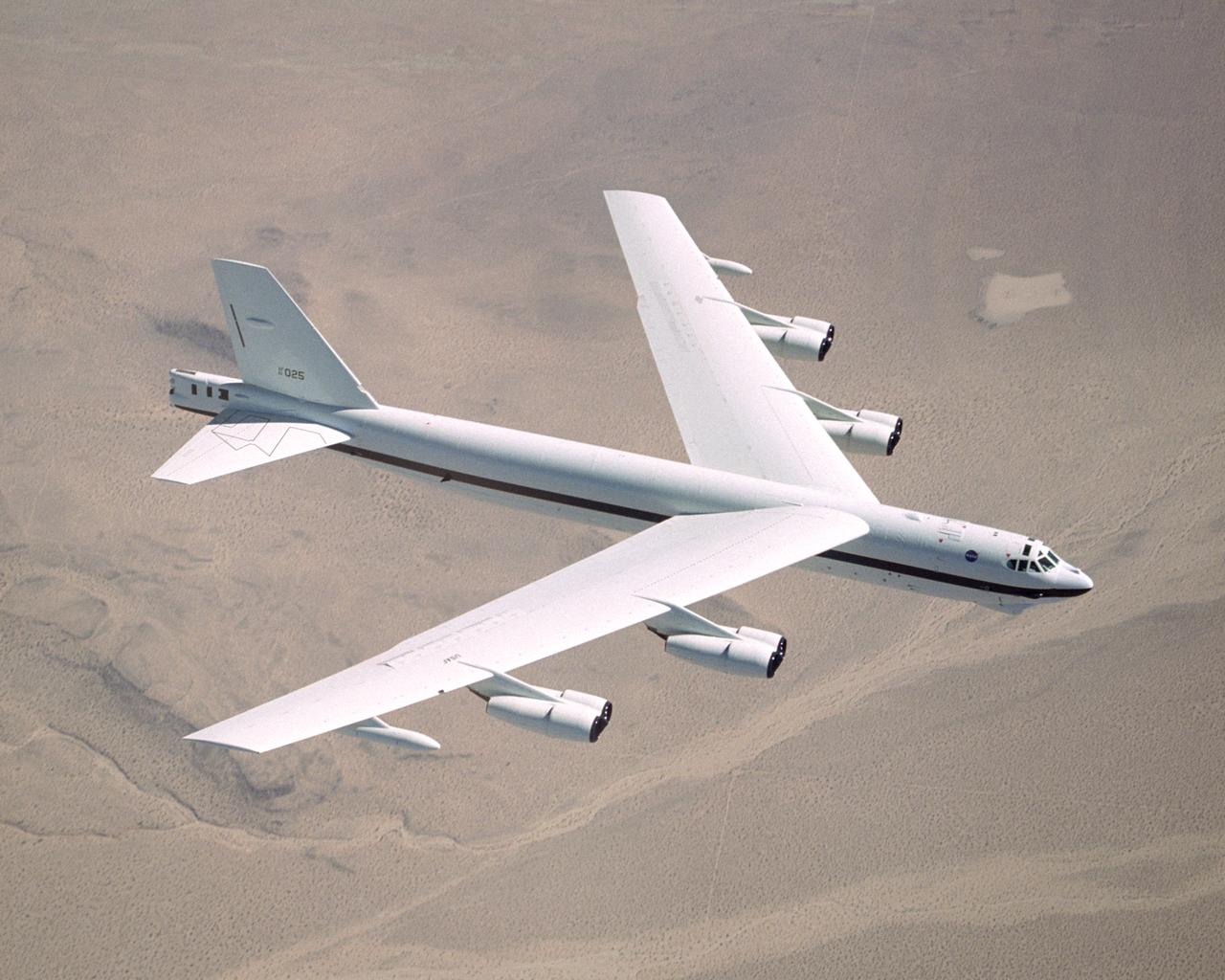
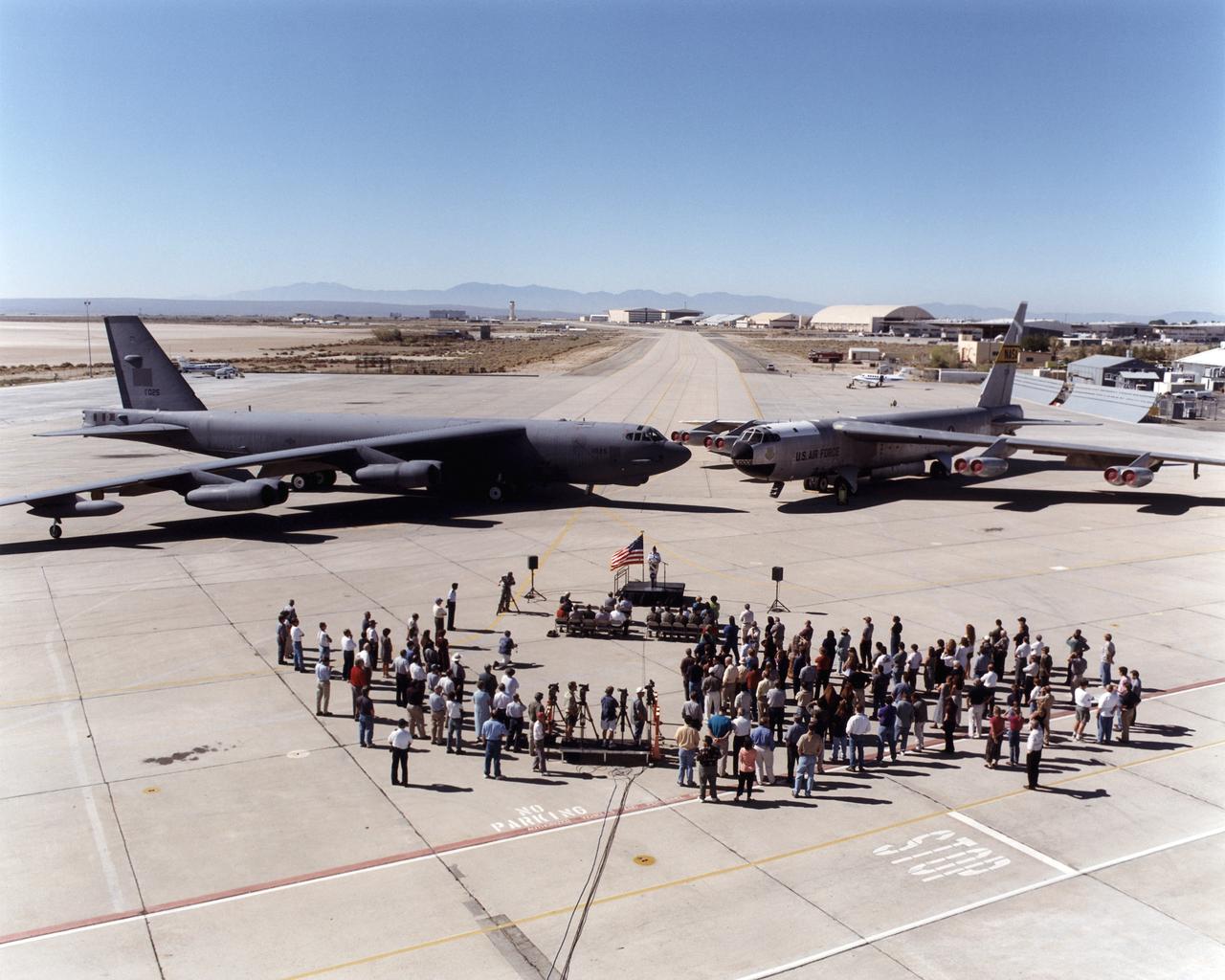
A newly arrived B-52H is seen here alongside NASA Dryden's venerable B-52 "B" model during its arrival ceremony on August 1, 2001.
EC01-0223-1
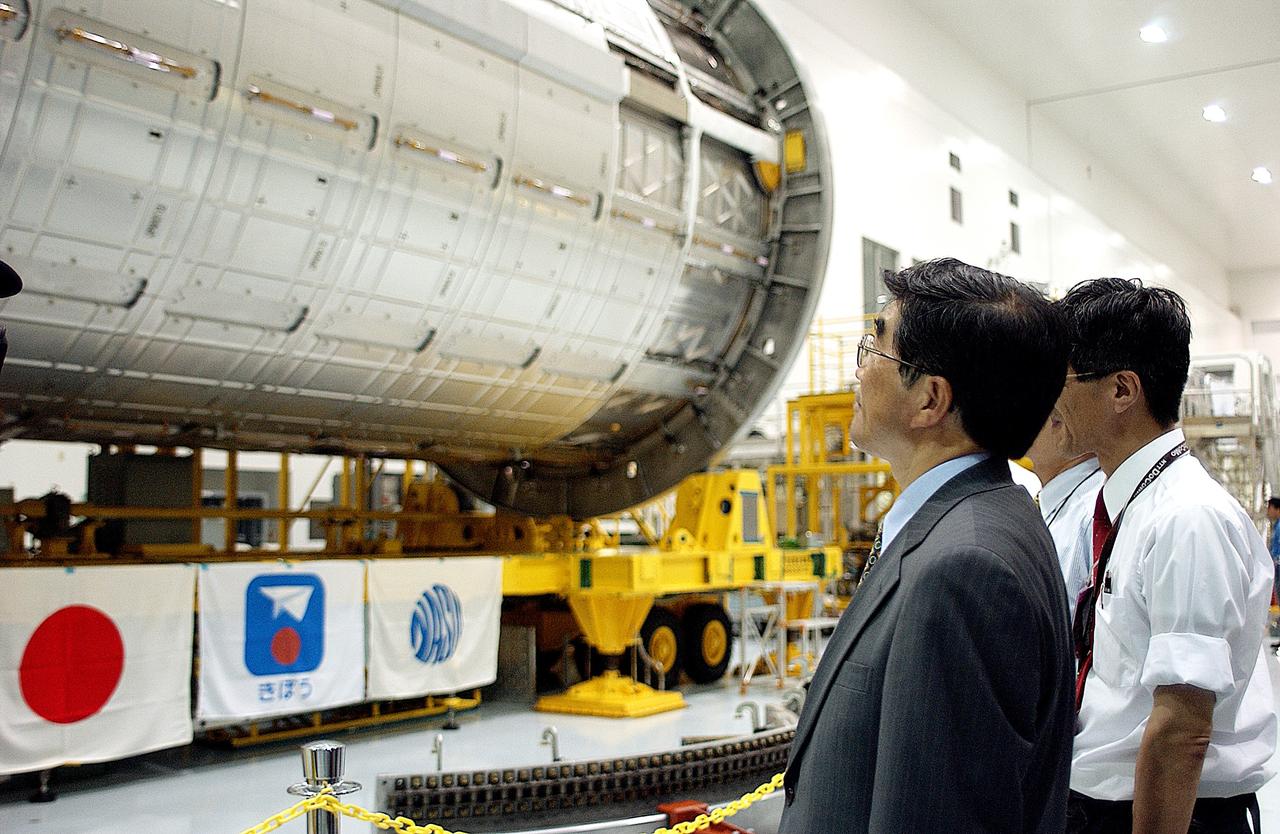
KENNEDY SPACE CENTER, FLA. -  In the Space Station Processing Facility, Executive Director of NASDA Koji Yamamoto (right) looks at the newly arrived Japanese Experiment Module (JEM)/pressurized module.  Mr. Yamamoto is at KSC for a welcome ceremony involving the arrival of JEM.
KENNEDY SPACE CENTER, FLA. - In the Space Station Processing Facility, Executive Director of NASDA Koji Yamamoto (right) looks at the newly arrived Japanese Experiment Module (JEM)/pressurized module. Mr. Yamamoto is at KSC for a welcome ceremony involving the arrival of JEM.
KENNEDY SPACE CENTER, FLA. -  In the Space Station Processing Facility, Executive Director of NASDA Koji Yamamoto (left) looks at the newly arrived Japanese Experiment Module (JEM)/pressurized module.  Mr. Yamamoto is at KSC for a welcome ceremony involving the arrival of JEM.
KENNEDY SPACE CENTER, FLA. - In the Space Station Processing Facility, Executive Director of NASDA Koji Yamamoto (left) looks at the newly arrived Japanese Experiment Module (JEM)/pressurized module. Mr. Yamamoto is at KSC for a welcome ceremony involving the arrival of JEM.
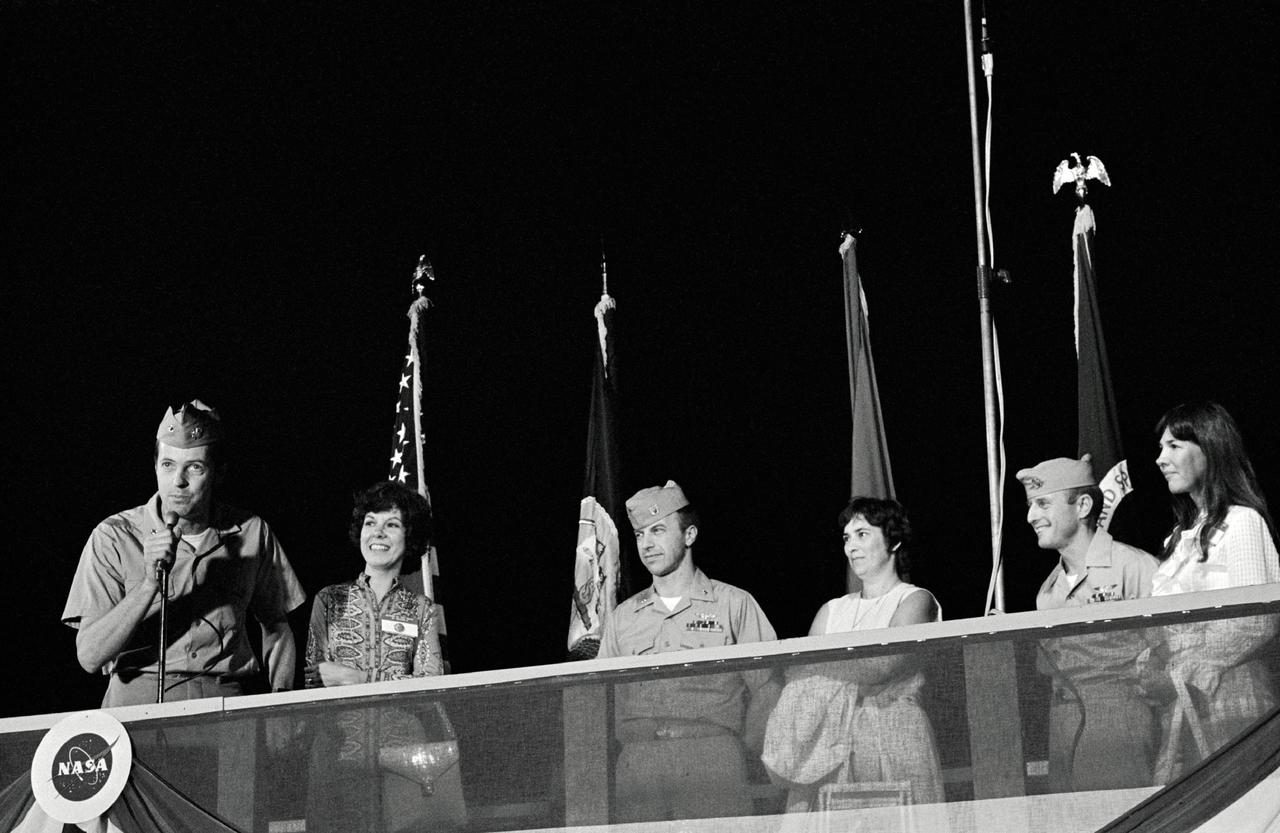
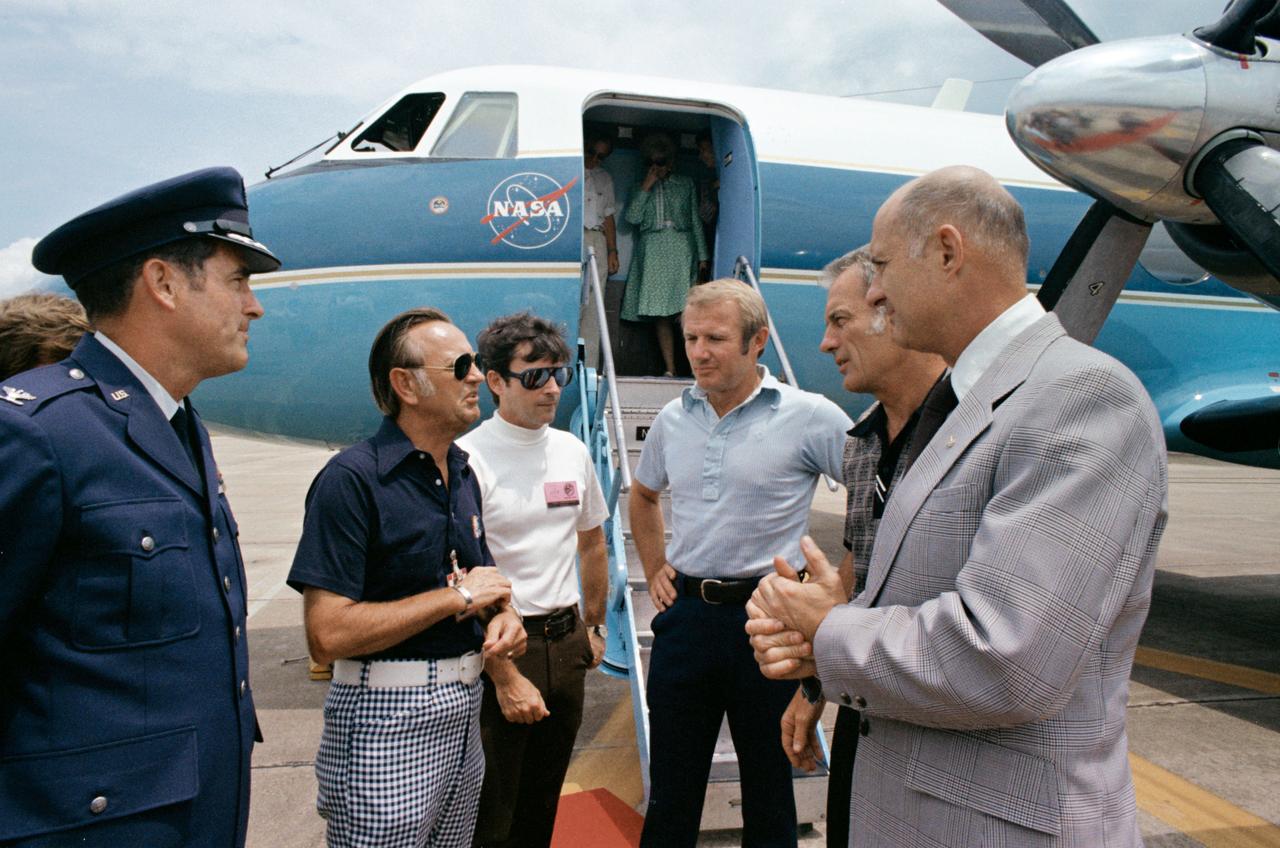
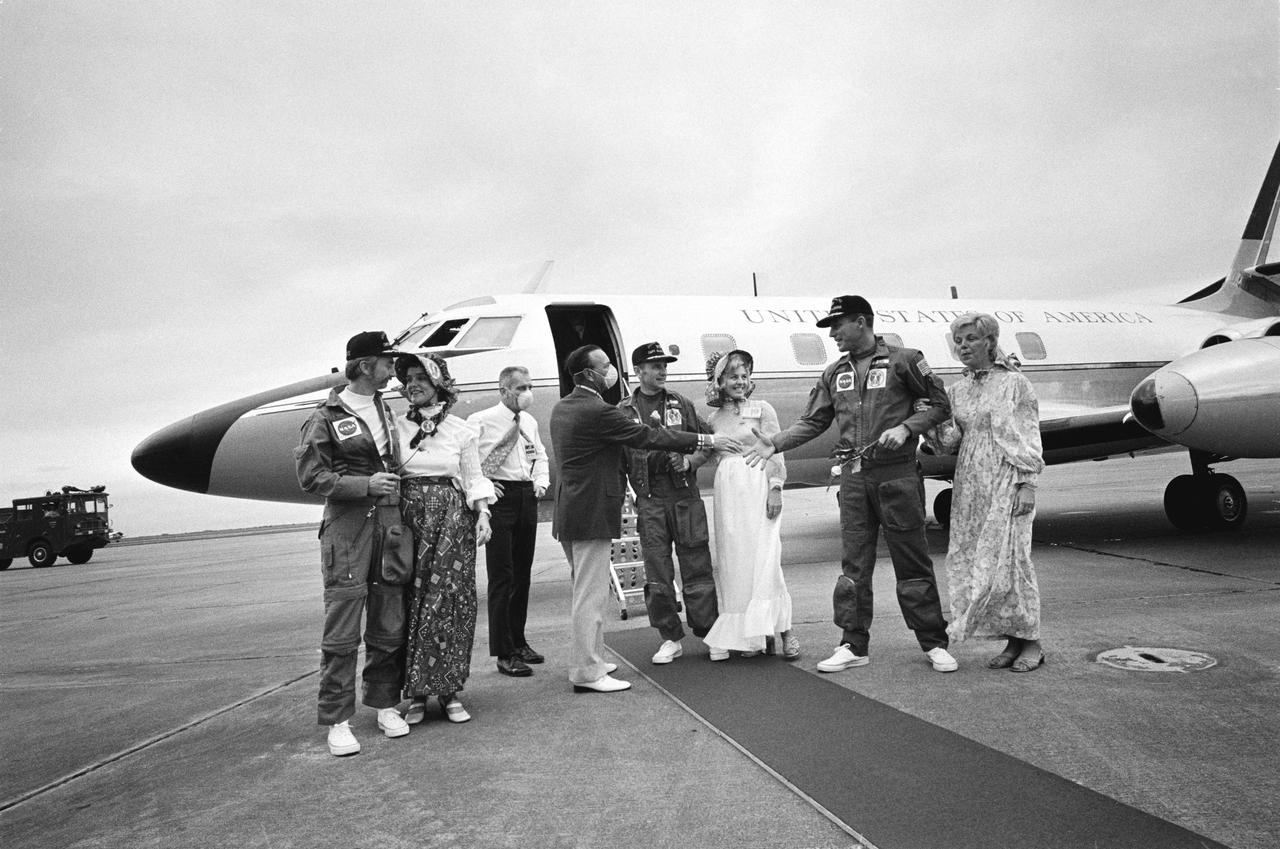
S73-28818 (24 June 1973) --- Scientist-astronaut Joseph P. Kerwin, science pilot for the Skylab 2 mission, speaks to a crowd at Ellington Air Force Base during welcome home ceremonies for the crew. Astronaut Paul J. Weitz, pilot, is at center; and astronaut Charles Conrad Jr., crew commander, is at right. The wives, standing by their husbands, are (left to right) Shirley Kerwin, Suzanne Weitz and Jane Conrad. Photo credit: NASA
SLYLAB (SL)-2 - "WELCOME HOME CEREMONIES" - ELLINGTON AFB (EAFB), TX
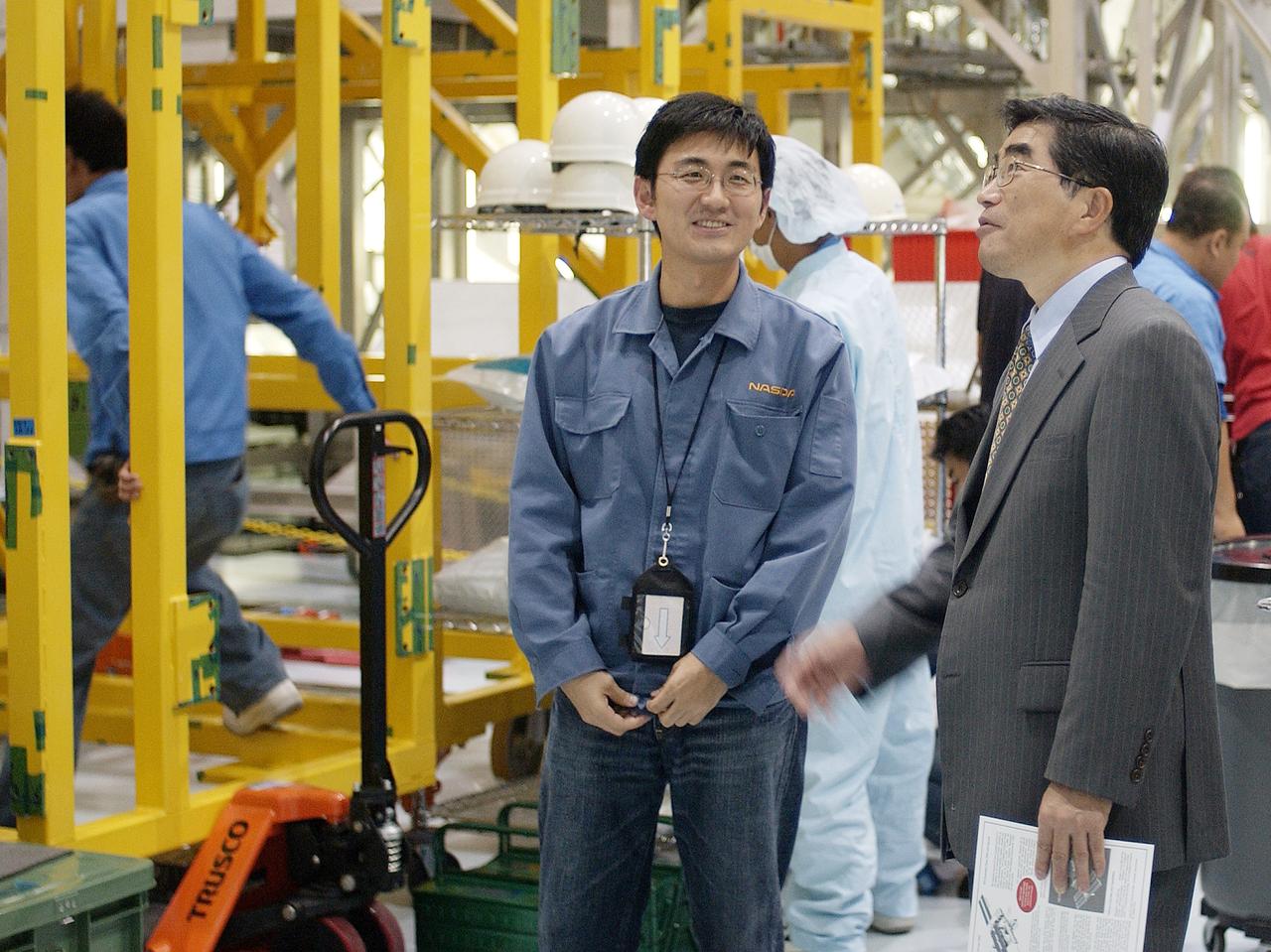
KENNEDY SPACE CENTER, FLA. -  In the Space Station Processing Facility, Executive Director of NASDA Koji Yamamoto (center) joins others for a tour.  Mr. Yamamoto is at KSC for a welcome ceremony involving the arrival of the newest Space Station module, the Japanese Experiment Module/pressurized module.
KENNEDY SPACE CENTER, FLA. - In the Space Station Processing Facility, Executive Director of NASDA Koji Yamamoto (center) joins others for a tour. Mr. Yamamoto is at KSC for a welcome ceremony involving the arrival of the newest Space Station module, the Japanese Experiment Module/pressurized module.
KENNEDY SPACE CENTER, FLA. -  In the Space Station Processing Facility, Executive Director of NASDA Koji Yamamoto (center) joins others for a tour.  Mr. Yamamoto is at KSC for a welcome ceremony involving the arrival of the newest Space Station module, the Japanese Experiment Module/pressurized module.
KENNEDY SPACE CENTER, FLA. - In the Space Station Processing Facility, Executive Director of NASDA Koji Yamamoto (center) joins others for a tour. Mr. Yamamoto is at KSC for a welcome ceremony involving the arrival of the newest Space Station module, the Japanese Experiment Module/pressurized module.
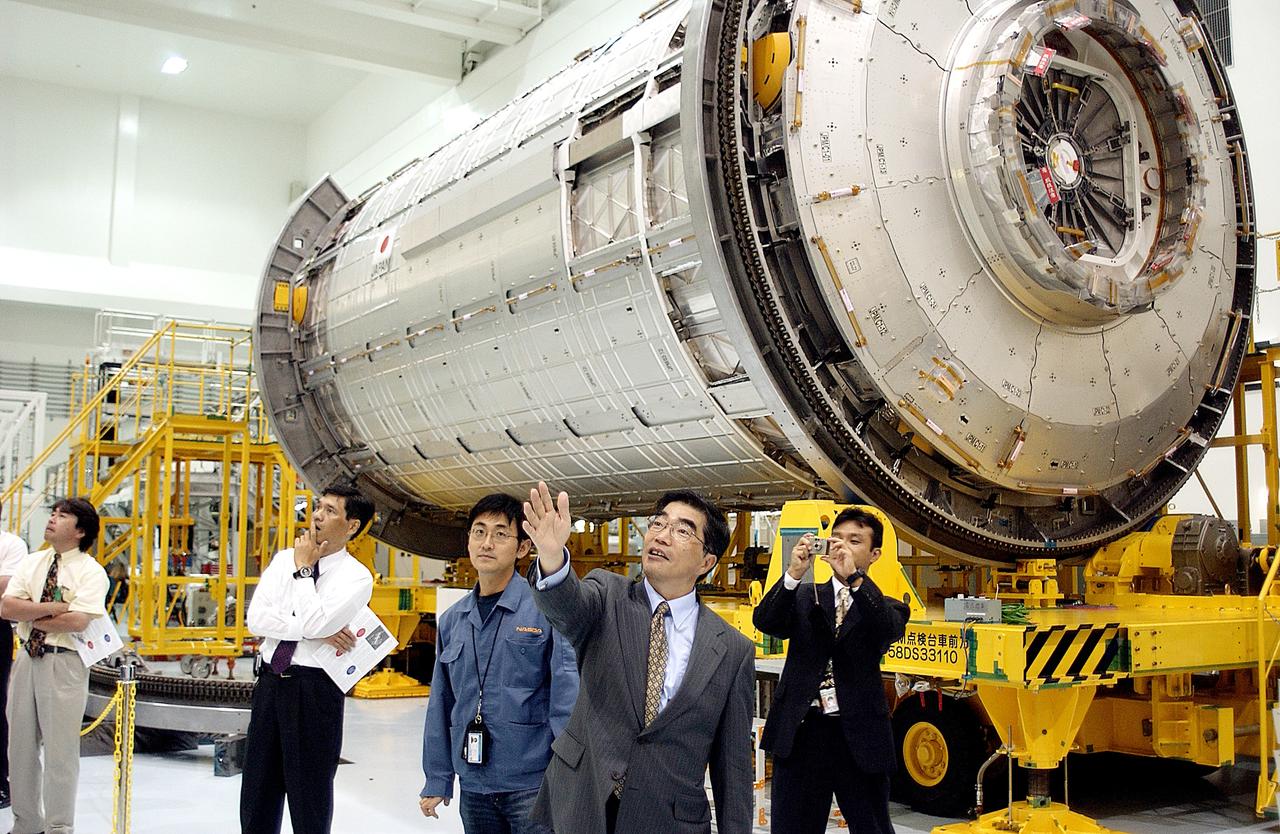
KENNEDY SPACE CENTER, FLA. -  In the Space Station Processing Facility, Executive Director of NASDA Koji Yamamoto points to other Space Station elements.  Behind him is the Japanese Experiment Module (JEM)/pressurized module.  Mr. Yamamoto is at KSC for a welcome ceremony involving the arrival of JEM.
KENNEDY SPACE CENTER, FLA. - In the Space Station Processing Facility, Executive Director of NASDA Koji Yamamoto points to other Space Station elements. Behind him is the Japanese Experiment Module (JEM)/pressurized module. Mr. Yamamoto is at KSC for a welcome ceremony involving the arrival of JEM.
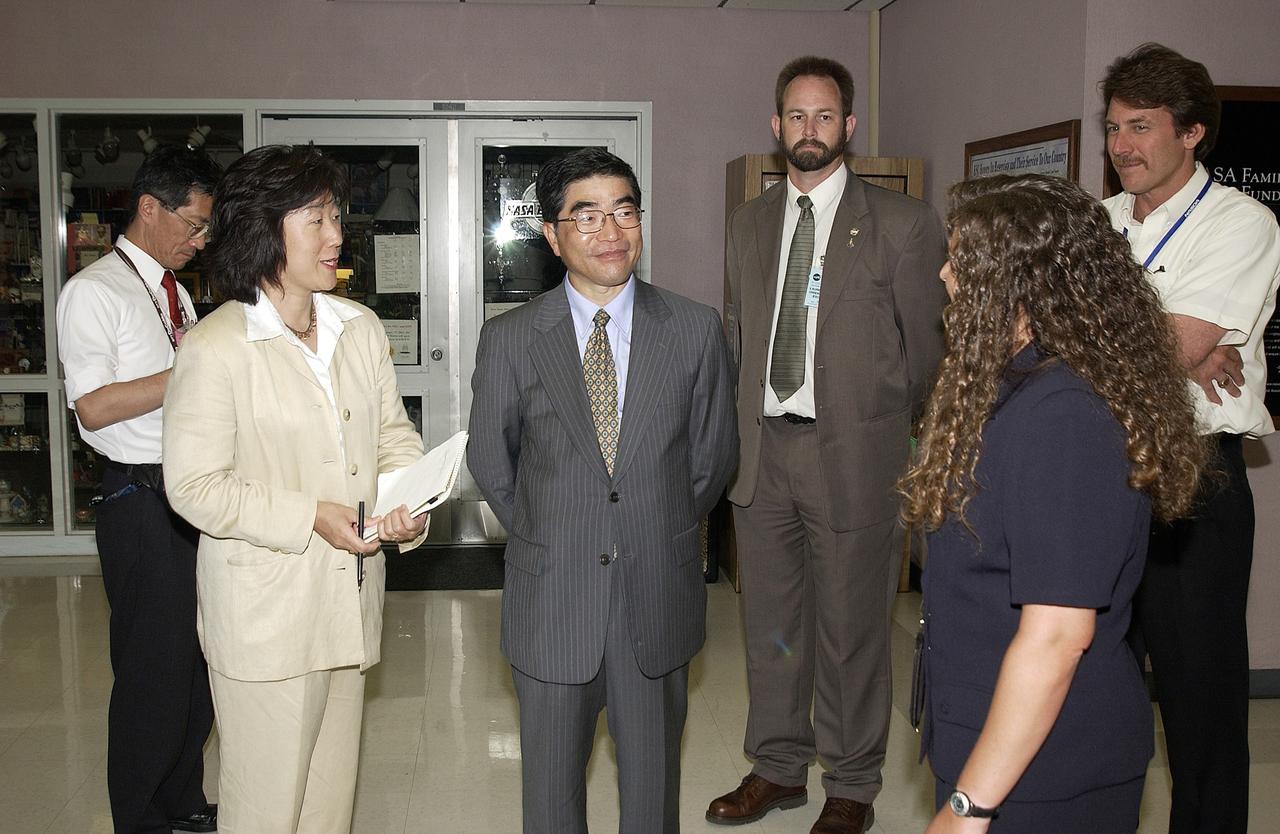
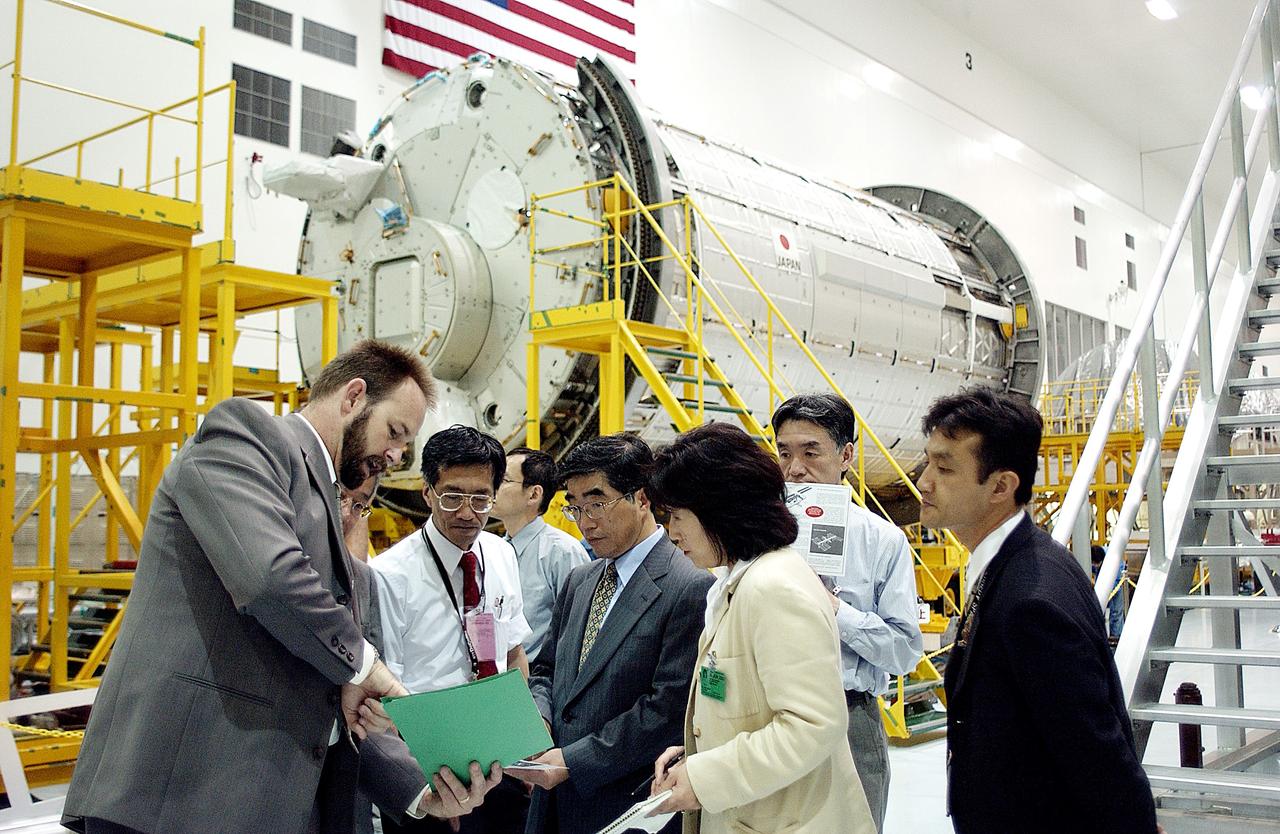
KENNEDY SPACE CENTER, FLA. -  In the Space Station Processing Facility, Executive Director of NASDA Koji Yamamoto (center) gets information about the facility while on a tour of KSC.  Behind the group is the Japanese Experiment Module (JEM)/pressurized module.  Mr. Yamamoto is at KSC for a welcome ceremony involving the arrival of JEM.
KENNEDY SPACE CENTER, FLA. - In the Space Station Processing Facility, Executive Director of NASDA Koji Yamamoto (center) gets information about the facility while on a tour of KSC. Behind the group is the Japanese Experiment Module (JEM)/pressurized module. Mr. Yamamoto is at KSC for a welcome ceremony involving the arrival of JEM.
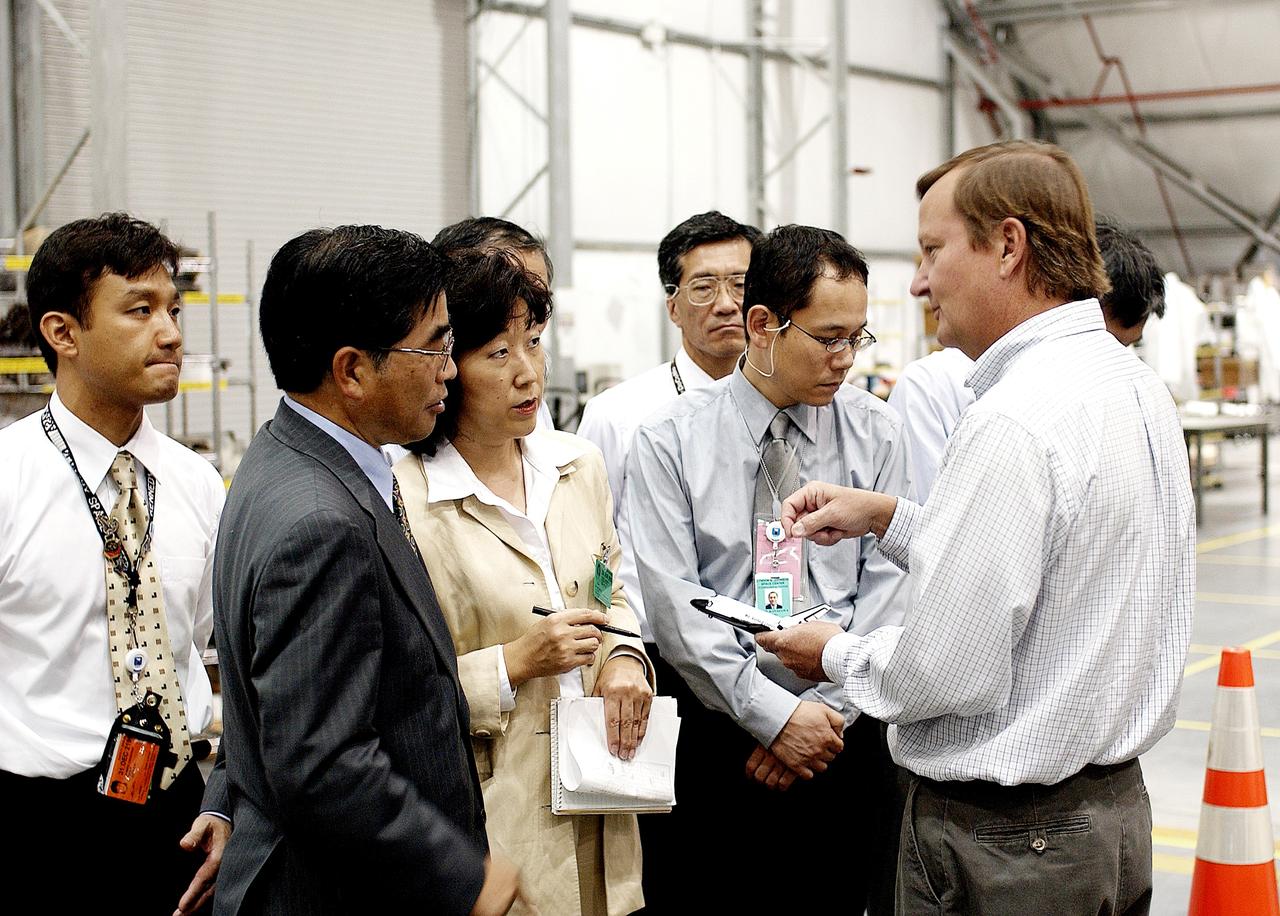
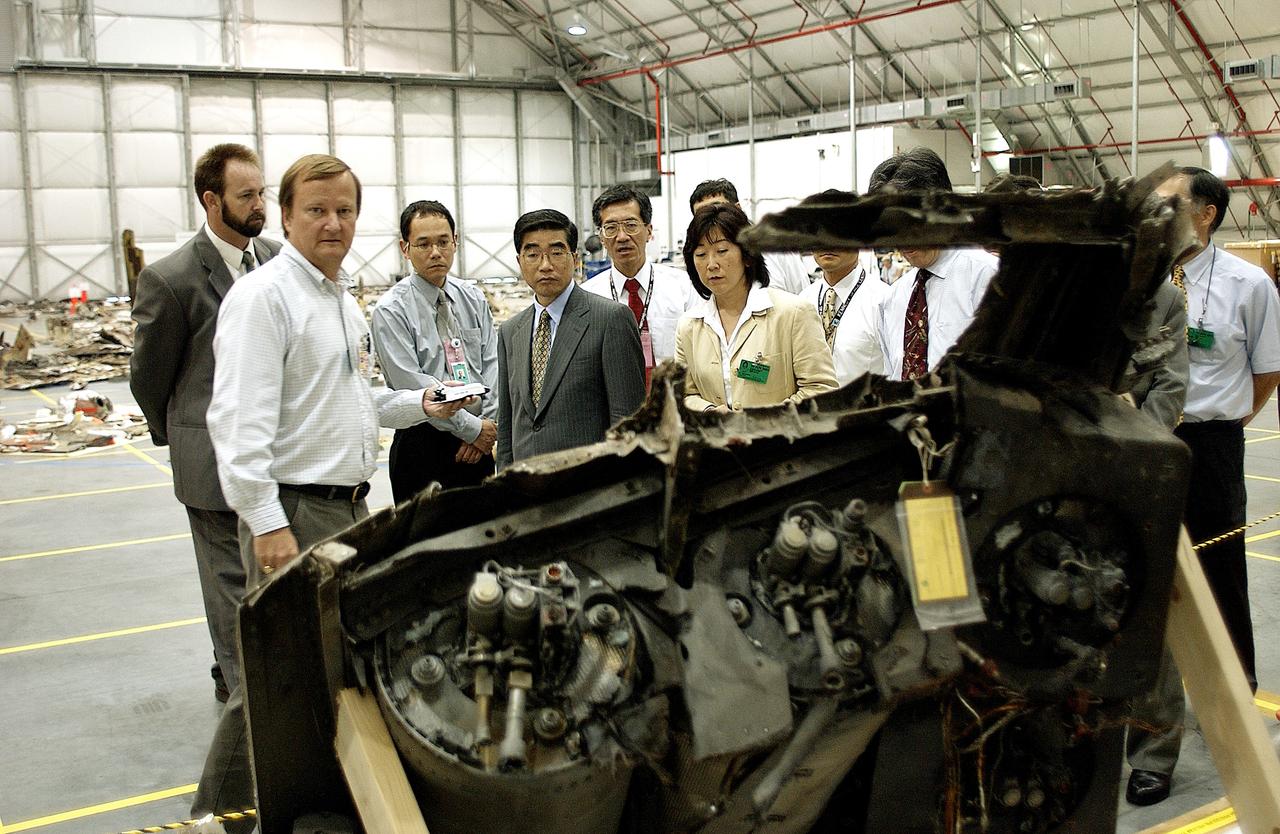
KENNEDY SPACE CENTER, FLA. -  Shuttle Launch Director Mike Leinbach (left) accompanies Executive Director of NASDA Koji Yamamoto (third from left) and others visiting the Columbia Debris Hangar.  Mr. Yamamoto is at KSC for a welcome ceremony involving the arrival of the newest Space Station module, the Japanese Experiment Module/pressurized module.
KENNEDY SPACE CENTER, FLA. - Shuttle Launch Director Mike Leinbach (left) accompanies Executive Director of NASDA Koji Yamamoto (third from left) and others visiting the Columbia Debris Hangar. Mr. Yamamoto is at KSC for a welcome ceremony involving the arrival of the newest Space Station module, the Japanese Experiment Module/pressurized module.
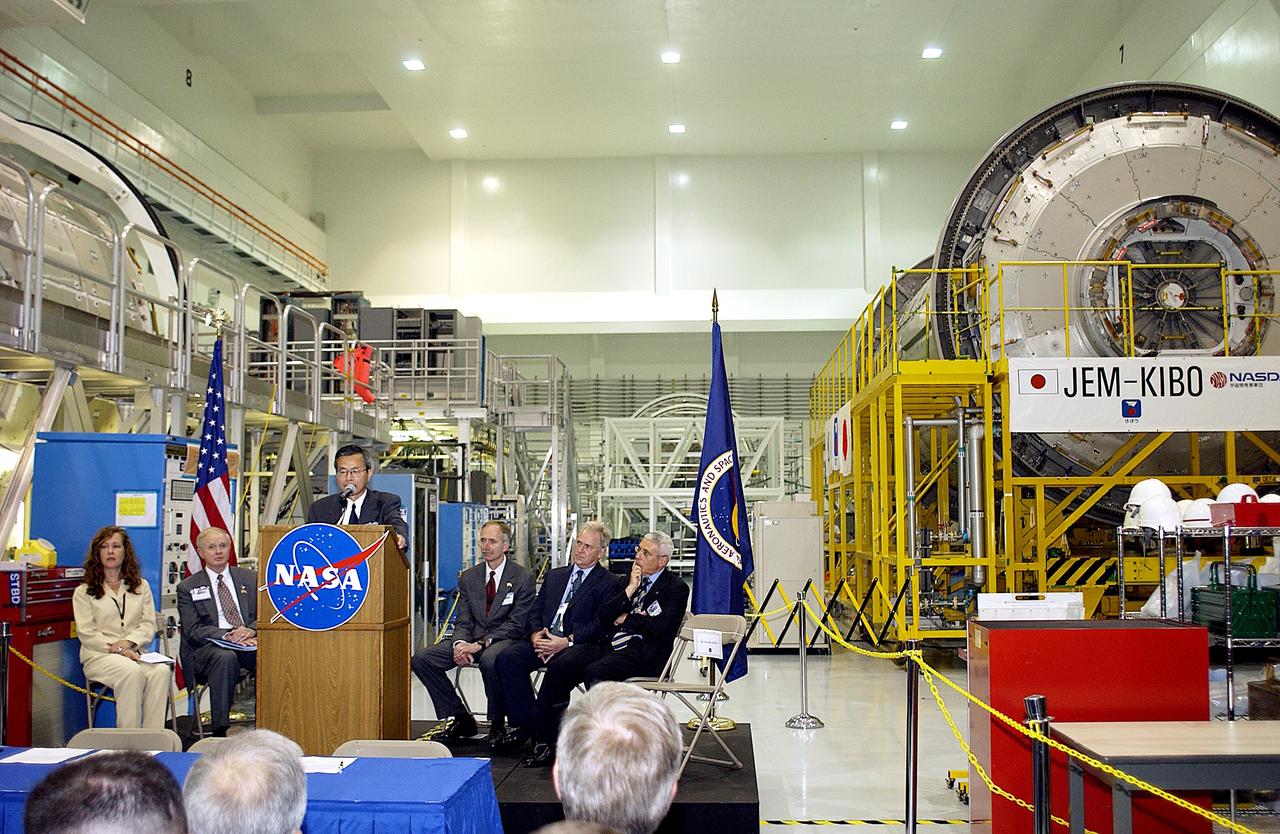
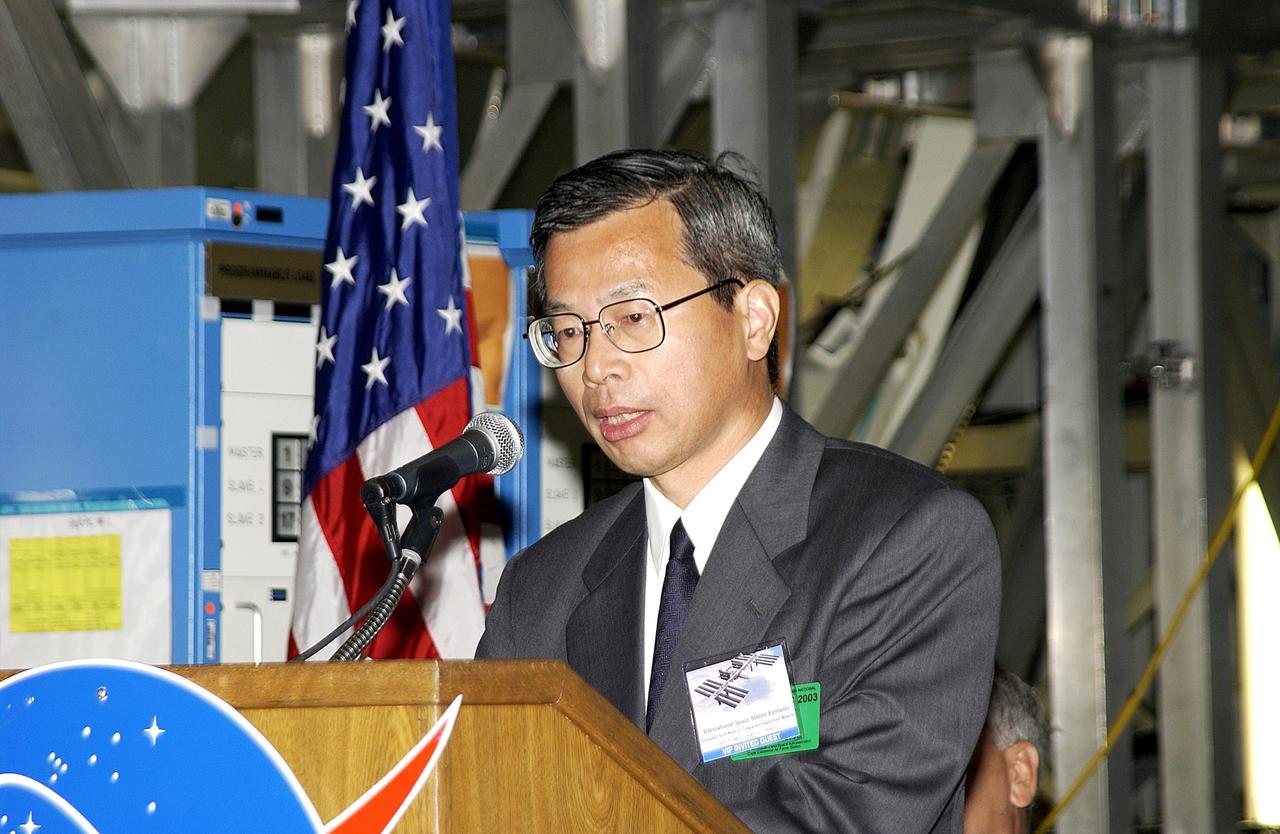
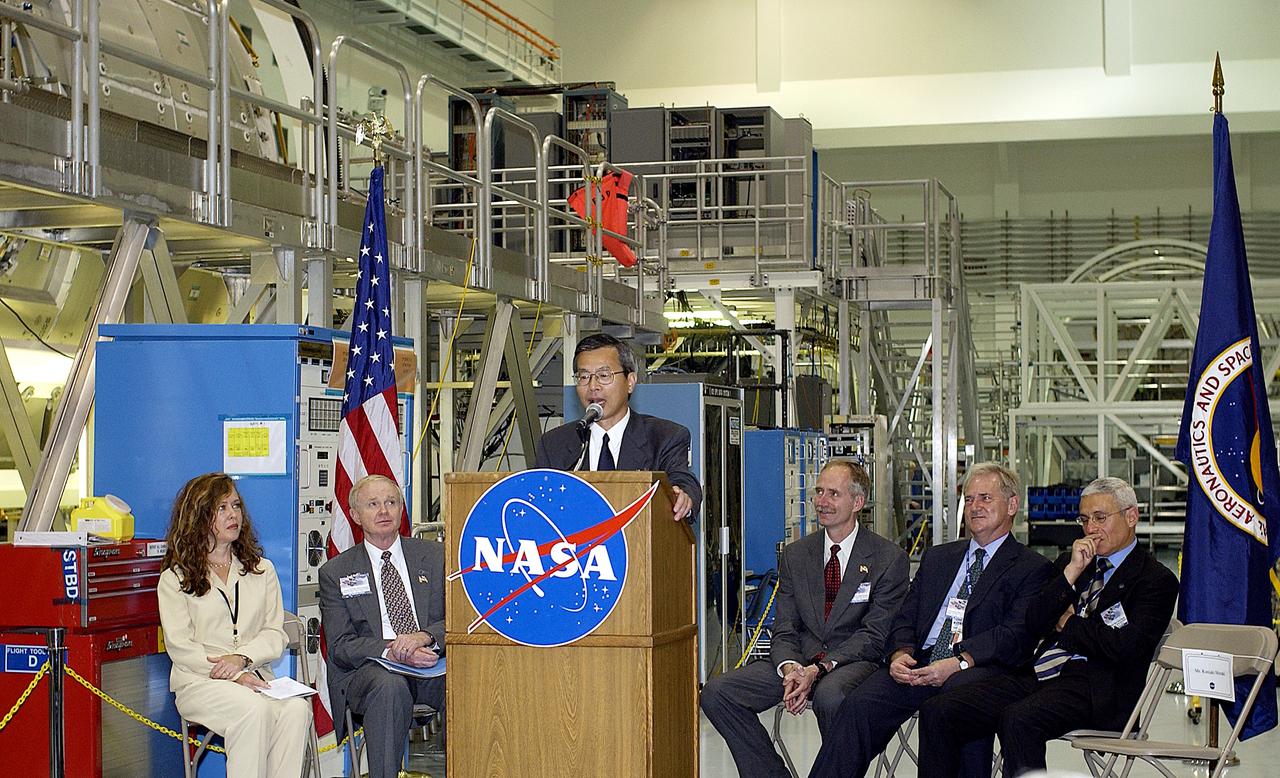
KENNEDY SPACE CENTER, FLA. - Kuniaki Shiraki, JEM Project manager, National Aerospace and Development Agency of Japan,  speaks to guests and the media gathered in the Space Station Processing Facility at a ceremony highlighting the arrival of two major components of the International Space Station.  NASA's Node 2, built by the European Space Agency (ESA) in Italy, arrived at KSC on June 1. It will be the next pressurized module installed on the Station. The pressurized module (above right)  of the Japanese Experiment Module (JEM),  named "Kibo" (Hope), arrived at KSC on June 4. It is Japan's primary contribution to the Station. The ceremony held today included the official transfer of ownership signing of Node 2 between the ESA and NASA.. Emceed by Lisa Malone (far left), deputy director of External Relations and Business Development at KSC, the ceremony also included these speakers: Center Director Roy Bridges Jr. (second from left); NASA’s Michael C. Kostelnik, deputy associate administrator for International Space Station and Shuttle Programs and William Gerstenmaier, International Space Station Program manager ; Alan Thirkettle, International Space Station Program manager for Node 2, ESA; and Andrea Lorenzoni, International Space Station Program manager for Node 2, Italian Space Agency.
KENNEDY SPACE CENTER, FLA. - Kuniaki Shiraki, JEM Project manager, National Aerospace and Development Agency of Japan, speaks to guests and the media gathered in the Space Station Processing Facility at a ceremony highlighting the arrival of two major components of the International Space Station. NASA's Node 2, built by the European Space Agency (ESA) in Italy, arrived at KSC on June 1. It will be the next pressurized module installed on the Station. The pressurized module (above right) of the Japanese Experiment Module (JEM), named "Kibo" (Hope), arrived at KSC on June 4. It is Japan's primary contribution to the Station. The ceremony held today included the official transfer of ownership signing of Node 2 between the ESA and NASA.. Emceed by Lisa Malone (far left), deputy director of External Relations and Business Development at KSC, the ceremony also included these speakers: Center Director Roy Bridges Jr. (second from left); NASA’s Michael C. Kostelnik, deputy associate administrator for International Space Station and Shuttle Programs and William Gerstenmaier, International Space Station Program manager ; Alan Thirkettle, International Space Station Program manager for Node 2, ESA; and Andrea Lorenzoni, International Space Station Program manager for Node 2, Italian Space Agency.
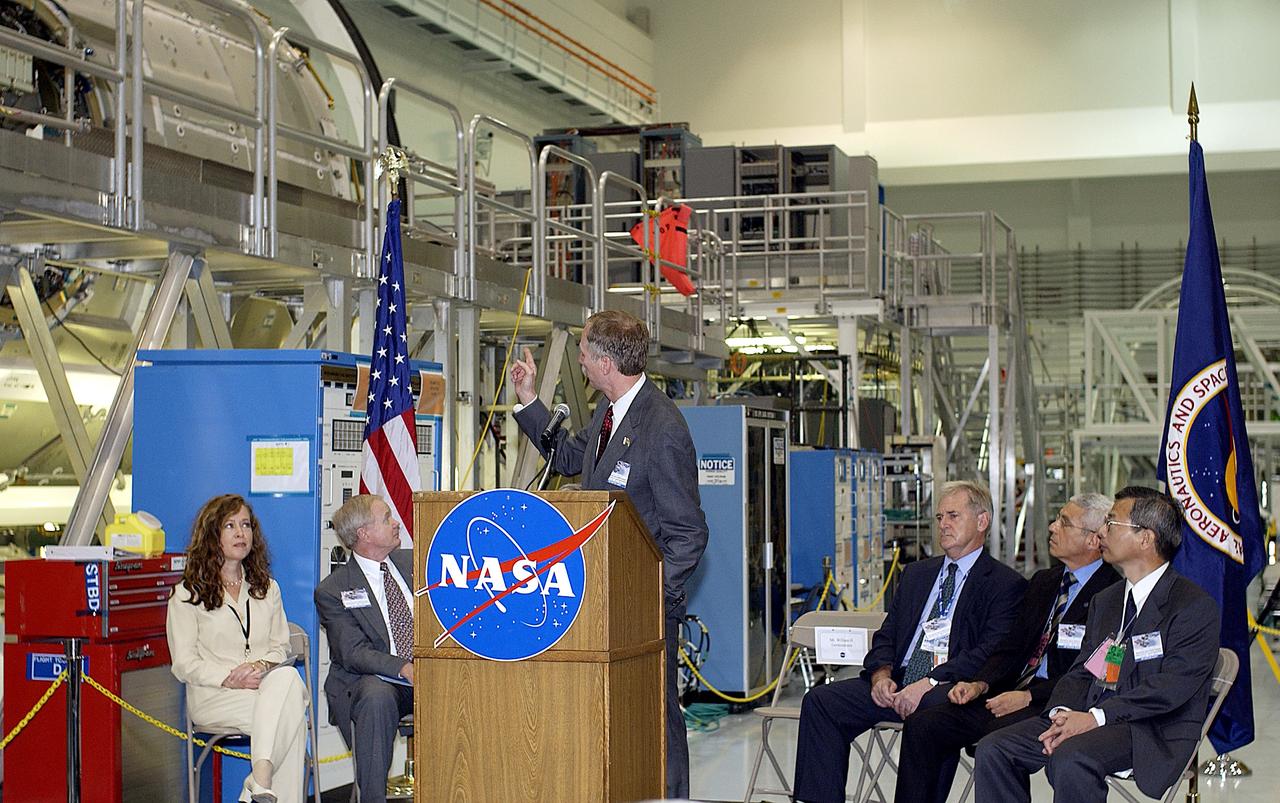
KENNEDY SPACE CENTER, FLA. -   At a ceremony highlighting the arrival of two major components of the International Space Station, William Gerstenmaier, International Space Station Program manager, points to one of the components as he speaks to guests and the media gathered in the Space Station Processing Facility.  NASA's Node 2, built by the European Space Agency (ESA) in Italy, arrived at KSC on June 1. It will be the next pressurized module installed on the Station. The pressurized module of the Japanese Experiment Module (JEM), named "Kibo" (Hope), arrived at KSC on June 4. It is Japan's primary contribution to the Station. The ceremony held today included the official transfer of ownership signing of Node 2 between the ESA and NASA.. Emceed by Lisa Malone, deputy director of External Relations and Business Development at KSC, the ceremony also included these speakers: Center Director Roy Bridges Jr.; NASA’s Michael C. Kostelnik, deputy associate administrator for International Space Station and Shuttle Programs; Alan Thirkettle, International Space Station Program manager for Node 2, ESA; Andrea Lorenzoni, International Space Station Program manager for Node 2, Italian Space Agency; and Kuniaki Shiraki, JEM Project manager, National Aerospace and Development Agency of Japan.
KENNEDY SPACE CENTER, FLA. - At a ceremony highlighting the arrival of two major components of the International Space Station, William Gerstenmaier, International Space Station Program manager, points to one of the components as he speaks to guests and the media gathered in the Space Station Processing Facility. NASA's Node 2, built by the European Space Agency (ESA) in Italy, arrived at KSC on June 1. It will be the next pressurized module installed on the Station. The pressurized module of the Japanese Experiment Module (JEM), named "Kibo" (Hope), arrived at KSC on June 4. It is Japan's primary contribution to the Station. The ceremony held today included the official transfer of ownership signing of Node 2 between the ESA and NASA.. Emceed by Lisa Malone, deputy director of External Relations and Business Development at KSC, the ceremony also included these speakers: Center Director Roy Bridges Jr.; NASA’s Michael C. Kostelnik, deputy associate administrator for International Space Station and Shuttle Programs; Alan Thirkettle, International Space Station Program manager for Node 2, ESA; Andrea Lorenzoni, International Space Station Program manager for Node 2, Italian Space Agency; and Kuniaki Shiraki, JEM Project manager, National Aerospace and Development Agency of Japan.
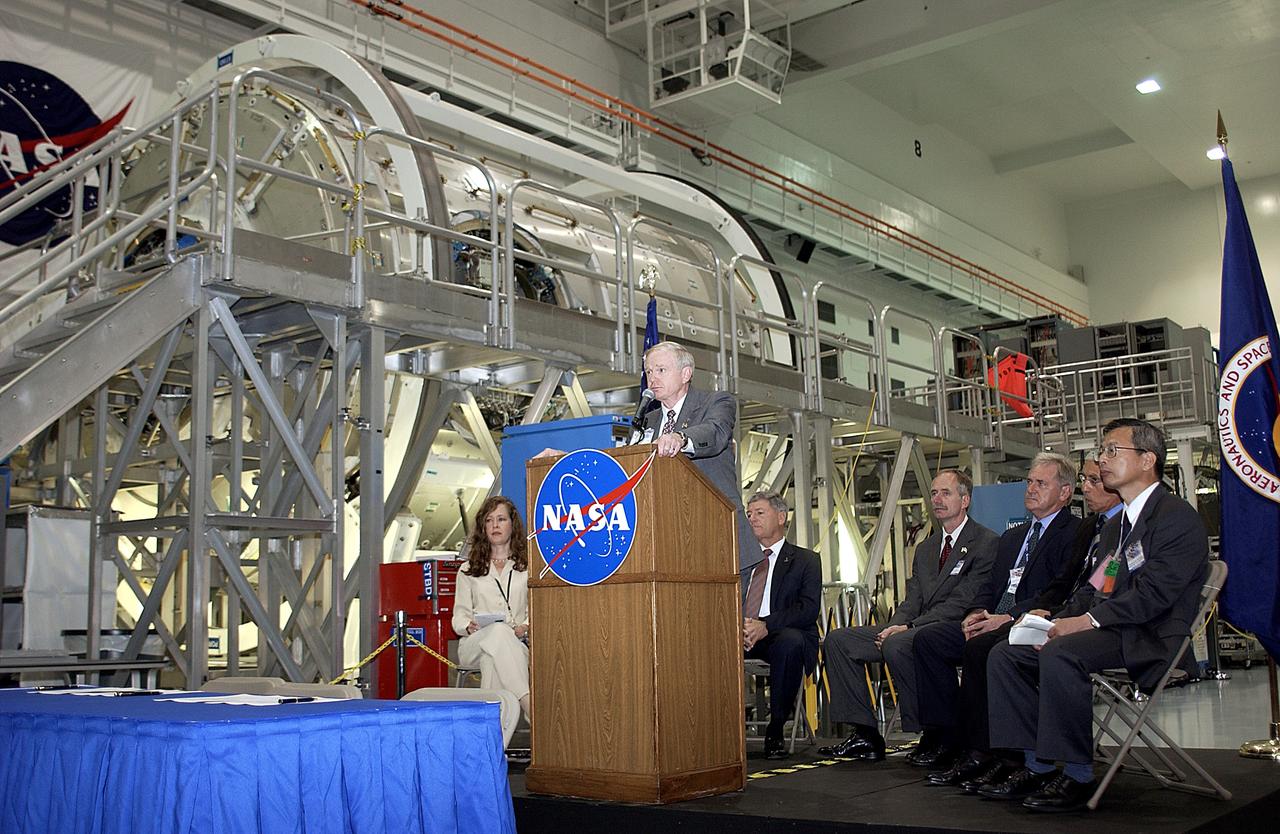
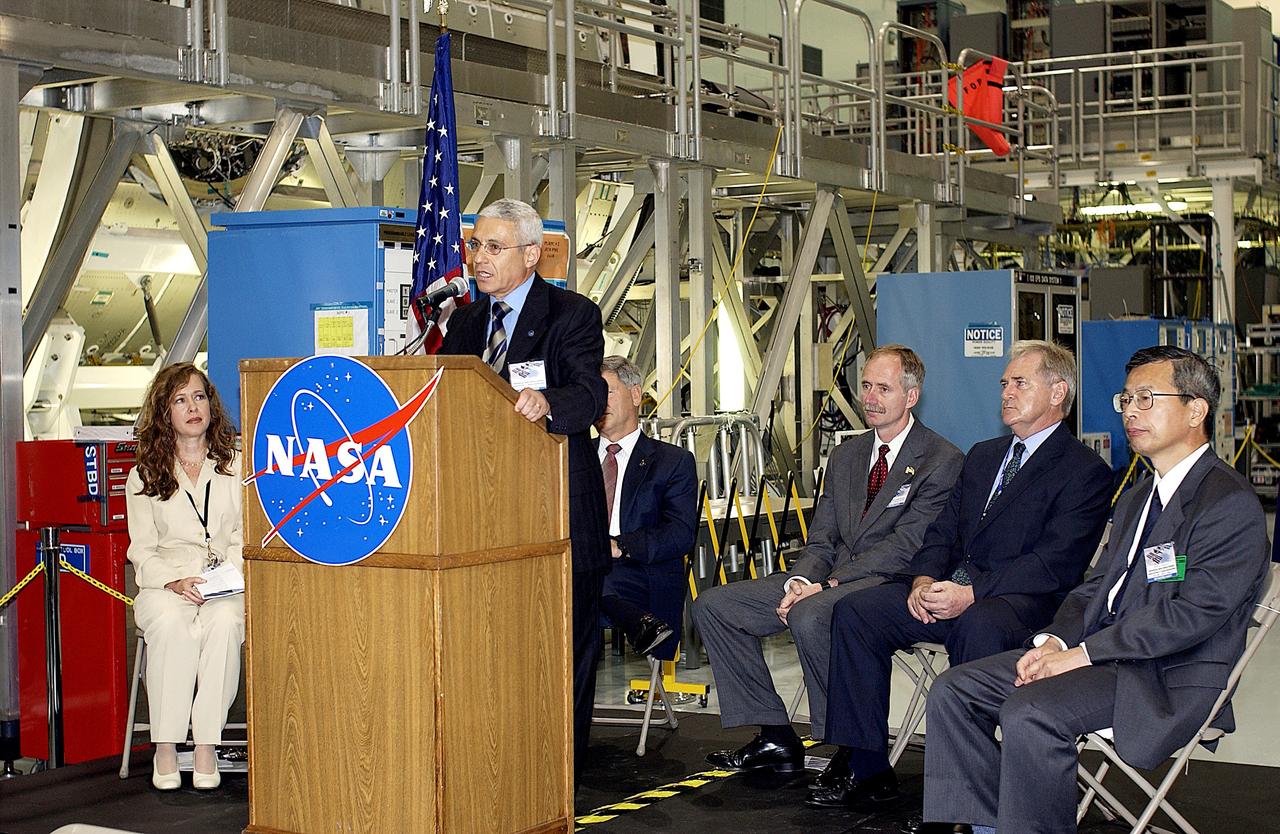
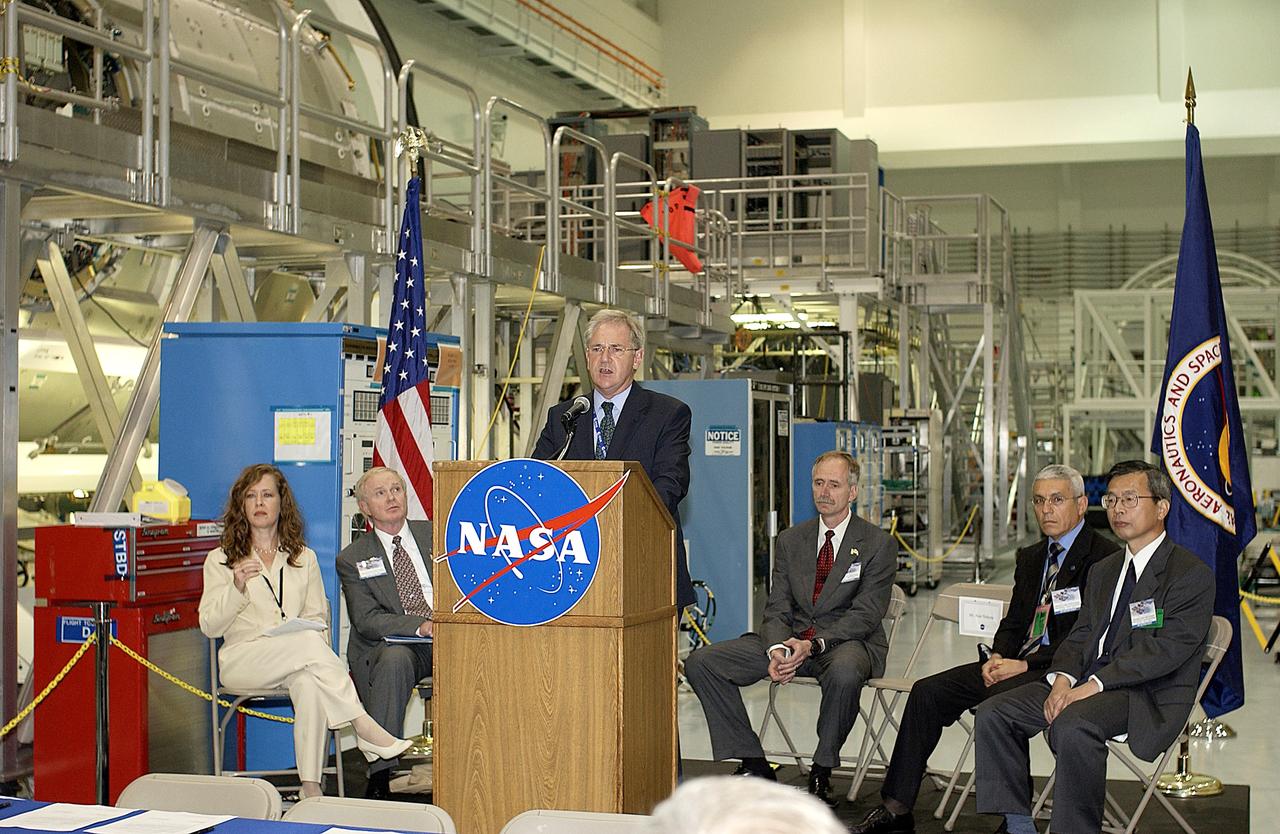
KENNEDY SPACE CENTER, FLA. -  Center Director Roy Bridges Jr. speaks to the media and guests gathered in the Space Station Processing Facility for a ceremony to highlight the arrival of two major components of the International Space Station.  NASA's Node 2, built by the European Space Agency (ESA) in Italy arrived at KSC on June 1. It will be the next pressurized module installed on the Station. The pressurized module of the Japanese Experiment Module (JEM), named "Kibo" (Hope) arrived at KSC on June 4. It is Japan's primary contribution to the Station. The ceremony held today included the official transfer of ownership signing of Node 2 between the ESA and NASA.. Emceed by Lisa Malone (left),  deputy director of External Relations and Business Development at KSC, the ceremony also included these speakers: NASA's Michael C. Kostelnik, deputy associate administrator for International Space Station and Shuttle Programs, and William Gerstenmaier, International Space Station Program manager; Alan Thirkettle, International Space Station Program manager for Node 2, ESA; Andrea Lorenzoni, International Space Station Program manager for Node 2, Italian Space Agency; Kuniaki Shiraki, JEM Project manager, National Aerospace and Development Agency of Japan.
KENNEDY SPACE CENTER, FLA. - Center Director Roy Bridges Jr. speaks to the media and guests gathered in the Space Station Processing Facility for a ceremony to highlight the arrival of two major components of the International Space Station. NASA's Node 2, built by the European Space Agency (ESA) in Italy arrived at KSC on June 1. It will be the next pressurized module installed on the Station. The pressurized module of the Japanese Experiment Module (JEM), named "Kibo" (Hope) arrived at KSC on June 4. It is Japan's primary contribution to the Station. The ceremony held today included the official transfer of ownership signing of Node 2 between the ESA and NASA.. Emceed by Lisa Malone (left), deputy director of External Relations and Business Development at KSC, the ceremony also included these speakers: NASA's Michael C. Kostelnik, deputy associate administrator for International Space Station and Shuttle Programs, and William Gerstenmaier, International Space Station Program manager; Alan Thirkettle, International Space Station Program manager for Node 2, ESA; Andrea Lorenzoni, International Space Station Program manager for Node 2, Italian Space Agency; Kuniaki Shiraki, JEM Project manager, National Aerospace and Development Agency of Japan.
KENNEDY SPACE CENTER, FLA. -  Kuniaki Shiraki, JEM Project manager, National Aerospace and Development Agency of Japan,  speaks to guests and the media gathered in the Space Station Processing Facility at a ceremony highlighting the arrival of two major components of the International Space Station.  NASA's Node 2, built by the European Space Agency (ESA) in Italy, arrived at KSC on June 1. It will be the next pressurized module installed on the Station. The pressurized module of the Japanese Experiment Module (JEM), named "Kibo" (Hope), arrived at KSC on June 4. It is Japan's primary contribution to the Station. The ceremony held today included the official transfer of ownership signing of Node 2 between the ESA and NASA.. Emceed by Lisa Malone, deputy director of External Relations and Business Development at KSC, the ceremony also included these speakers: Center Director Roy Bridges Jr.; NASA’s Michael C. Kostelnik, deputy associate administrator for International Space Station and Shuttle Programs and William Gerstenmaier, International Space Station Program manager ; Alan Thirkettle, International Space Station Program manager for Node 2, ESA; and Andrea Lorenzoni, International Space Station Program manager for Node 2, Italian Space Agency.
KENNEDY SPACE CENTER, FLA. - Kuniaki Shiraki, JEM Project manager, National Aerospace and Development Agency of Japan, speaks to guests and the media gathered in the Space Station Processing Facility at a ceremony highlighting the arrival of two major components of the International Space Station. NASA's Node 2, built by the European Space Agency (ESA) in Italy, arrived at KSC on June 1. It will be the next pressurized module installed on the Station. The pressurized module of the Japanese Experiment Module (JEM), named "Kibo" (Hope), arrived at KSC on June 4. It is Japan's primary contribution to the Station. The ceremony held today included the official transfer of ownership signing of Node 2 between the ESA and NASA.. Emceed by Lisa Malone, deputy director of External Relations and Business Development at KSC, the ceremony also included these speakers: Center Director Roy Bridges Jr.; NASA’s Michael C. Kostelnik, deputy associate administrator for International Space Station and Shuttle Programs and William Gerstenmaier, International Space Station Program manager ; Alan Thirkettle, International Space Station Program manager for Node 2, ESA; and Andrea Lorenzoni, International Space Station Program manager for Node 2, Italian Space Agency.
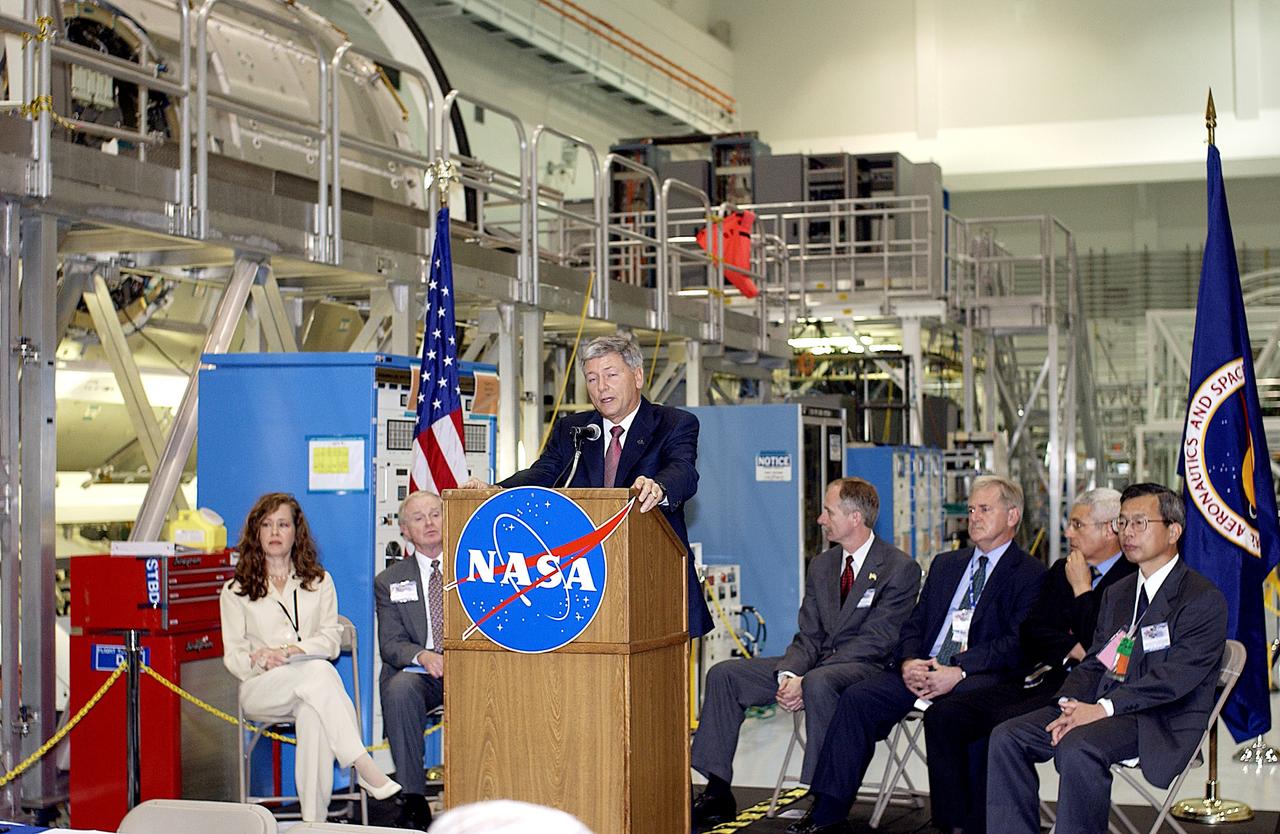
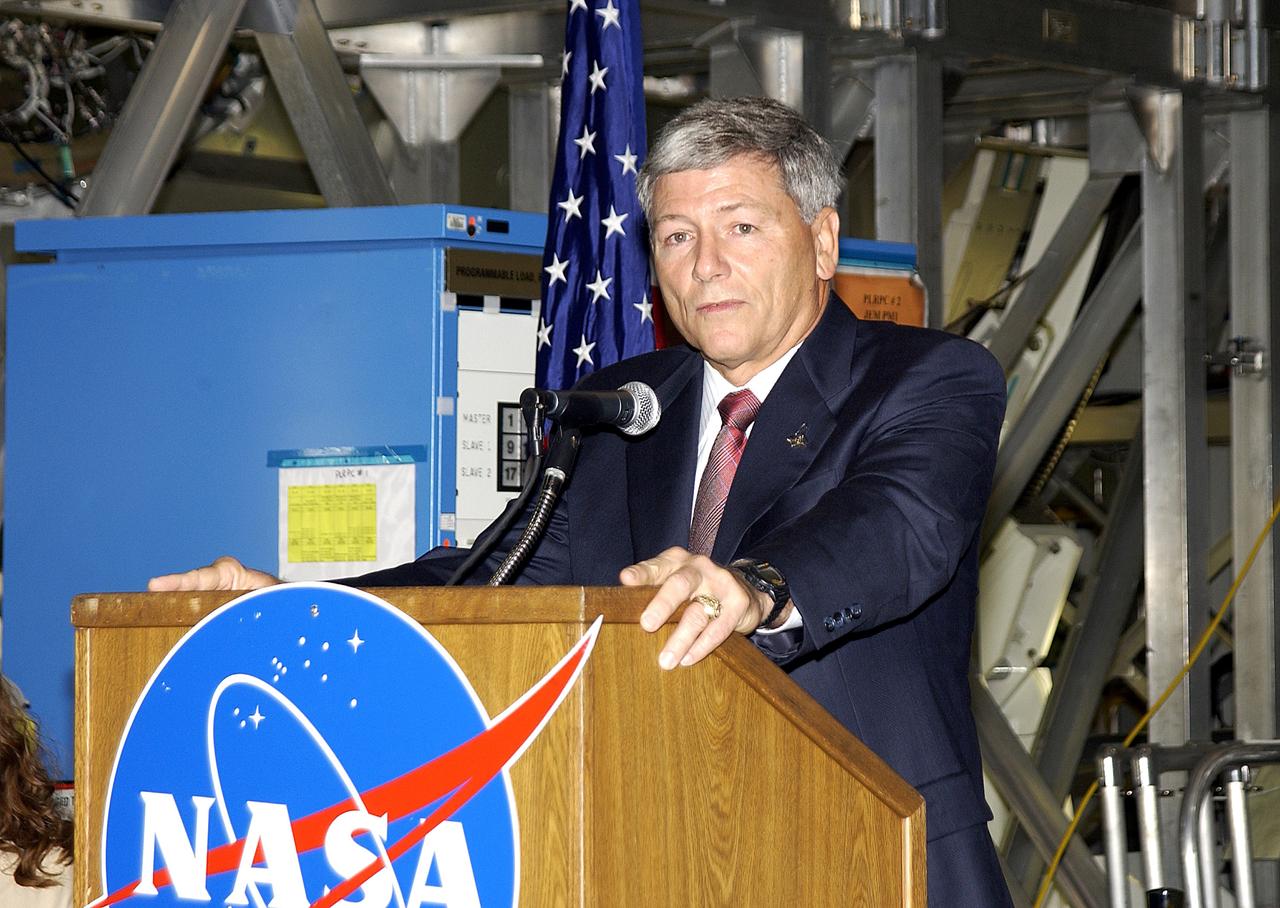
KENNEDY SPACE CENTER, FLA. -  NASA's Michael C. Kostelnik, deputy associate administrator for International Space Station and Shuttle Programs, speaks to guests and the media gathered in the Space Station Processing Facility for a ceremony to highlight the arrival of two major components of the International Space Station.  NASA's Node 2, built by the European Space Agency (ESA) in Italy arrived at KSC on June 1. It will be the next pressurized module installed on the Station. The pressurized module of the Japanese Experiment Module (JEM), named "Kibo" (Hope) arrived at KSC on June 4. It is Japan's primary contribution to the Station. The ceremony held today included the official transfer of ownership signing of Node 2 between the ESA and NASA.. Emceed by Lisa Malone (far left),  deputy director of External Relations and Business Development at KSC, the ceremony also included these speakers: Center Director Roy Bridges Jr. (second from left); William Gerstenmaier, International Space Station Program manager; Alan Thirkettle, International Space Station Program manager for Node 2, ESA; Andrea Lorenzoni, International Space Station Program manager for Node 2, Italian Space Agency; and Kuniaki Shiraki, JEM Project manager, National Aerospace and Development Agency of Japan.
KENNEDY SPACE CENTER, FLA. - NASA's Michael C. Kostelnik, deputy associate administrator for International Space Station and Shuttle Programs, speaks to guests and the media gathered in the Space Station Processing Facility for a ceremony to highlight the arrival of two major components of the International Space Station. NASA's Node 2, built by the European Space Agency (ESA) in Italy arrived at KSC on June 1. It will be the next pressurized module installed on the Station. The pressurized module of the Japanese Experiment Module (JEM), named "Kibo" (Hope) arrived at KSC on June 4. It is Japan's primary contribution to the Station. The ceremony held today included the official transfer of ownership signing of Node 2 between the ESA and NASA.. Emceed by Lisa Malone (far left), deputy director of External Relations and Business Development at KSC, the ceremony also included these speakers: Center Director Roy Bridges Jr. (second from left); William Gerstenmaier, International Space Station Program manager; Alan Thirkettle, International Space Station Program manager for Node 2, ESA; Andrea Lorenzoni, International Space Station Program manager for Node 2, Italian Space Agency; and Kuniaki Shiraki, JEM Project manager, National Aerospace and Development Agency of Japan.
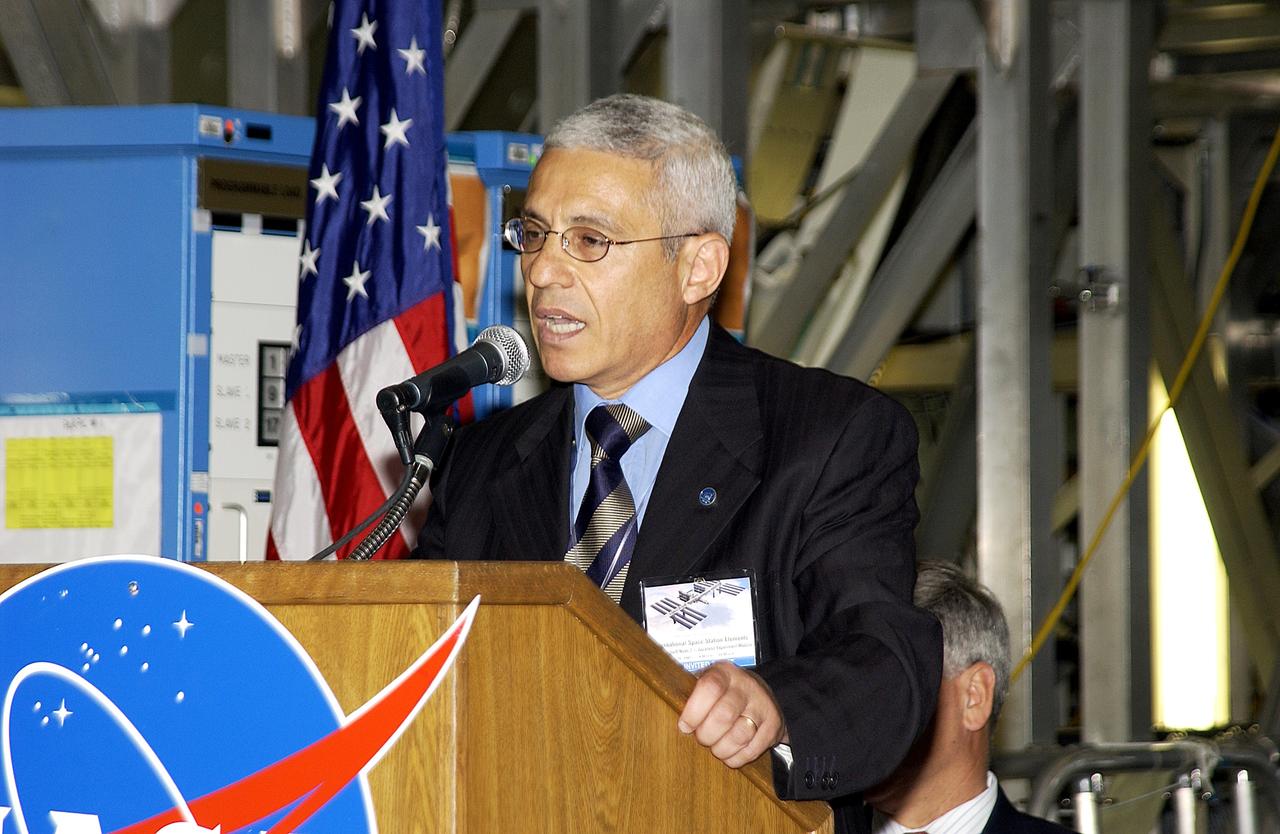
KENNEDY SPACE CENTER, FLA. -   Andrea Lorenzoni, International Space Station Program manager for Node 2, Italian Space Agency, speaks to guests and the media gathered in the Space Station Processing Facility at a ceremony highlighting the arrival of two major components of the International Space Station.  NASA's Node 2, built by the European Space Agency (ESA) in Italy, arrived at KSC on June 1. It will be the next pressurized module installed on the Station. The pressurized module of the Japanese Experiment Module (JEM), named "Kibo" (Hope), arrived at KSC on June 4. It is Japan's primary contribution to the Station. The ceremony held today included the official transfer of ownership signing of Node 2 between the ESA and NASA.. Emceed by Lisa Malone (far left), deputy director of External Relations and Business Development at KSC, the ceremony also included these speakers: Center Director Roy Bridges Jr.; NASA’s Michael C. Kostelnik, deputy associate administrator for International Space Station and Shuttle Programs, and William Gerstenmaier, International Space Station Program manager ; Alan Thirkettle, International Space Station Program manager for Node 2, ESA; and Kuniaki Shiraki, JEM Project manager, National Aerospace and Development Agency of Japan.
KENNEDY SPACE CENTER, FLA. - Andrea Lorenzoni, International Space Station Program manager for Node 2, Italian Space Agency, speaks to guests and the media gathered in the Space Station Processing Facility at a ceremony highlighting the arrival of two major components of the International Space Station. NASA's Node 2, built by the European Space Agency (ESA) in Italy, arrived at KSC on June 1. It will be the next pressurized module installed on the Station. The pressurized module of the Japanese Experiment Module (JEM), named "Kibo" (Hope), arrived at KSC on June 4. It is Japan's primary contribution to the Station. The ceremony held today included the official transfer of ownership signing of Node 2 between the ESA and NASA.. Emceed by Lisa Malone (far left), deputy director of External Relations and Business Development at KSC, the ceremony also included these speakers: Center Director Roy Bridges Jr.; NASA’s Michael C. Kostelnik, deputy associate administrator for International Space Station and Shuttle Programs, and William Gerstenmaier, International Space Station Program manager ; Alan Thirkettle, International Space Station Program manager for Node 2, ESA; and Kuniaki Shiraki, JEM Project manager, National Aerospace and Development Agency of Japan.
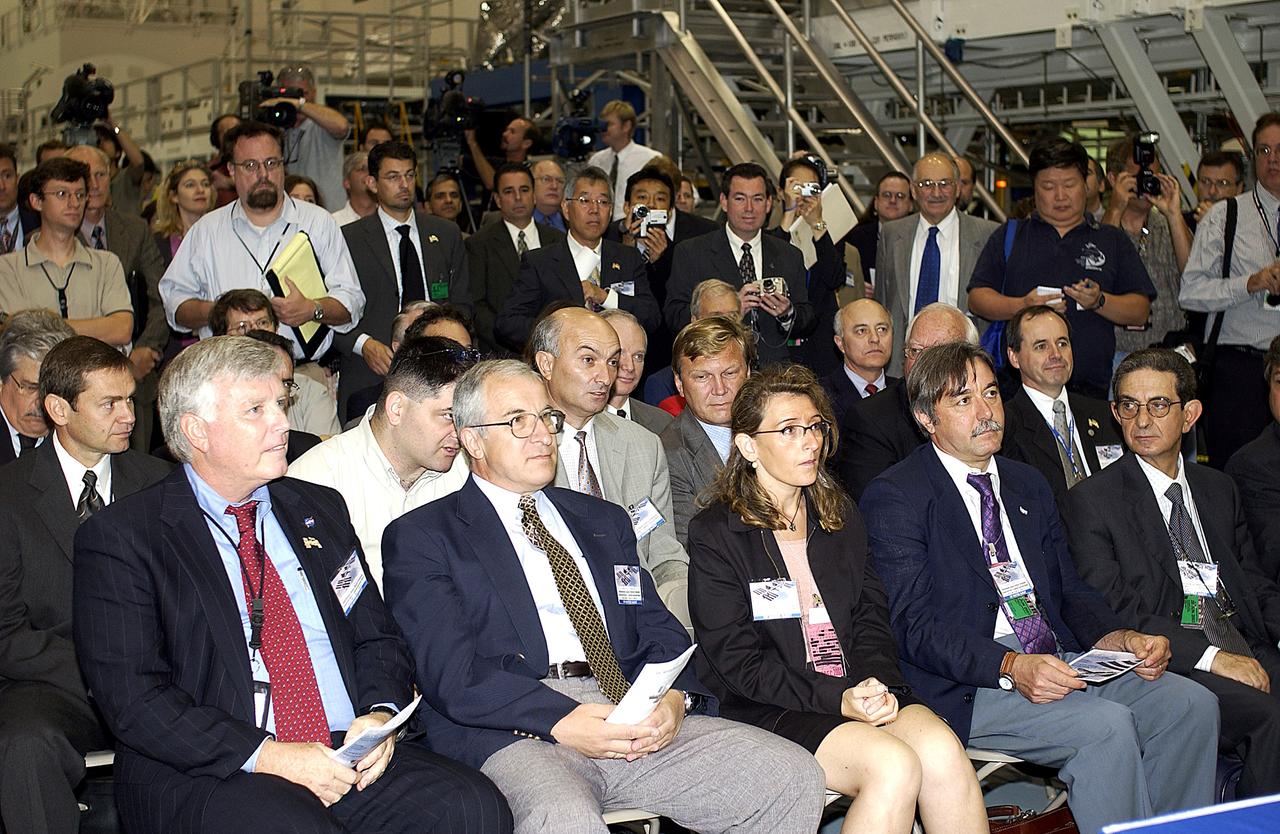
KENNEDY SPACE CENTER, FLA. -  In the Space Station Processing Facility, media and guests listen intently to remarks during a ceremony to highlight the arrival of two major components of the International Space Station.  NASA's Node 2, built by the European Space Agency (ESA) in Italy arrived at KSC on June 1. It will be the next pressurized module installed on the Station. The pressurized module of the Japanese Experiment Module (JEM), named "Kibo" (Hope) arrived at KSC on June 4. It is Japan's primary contribution to the Station. The ceremony held today included the official transfer of ownership signing of Node 2 between the ESA and NASA.. Emceed by Lisa Malone,  deputy director of External Relations and Business Development at KSC, the ceremony included these speakers: KSC Director Roy Bridges Jr.; NASA's Michael C. Kostelnik, deputy associate administrator for International Space Station and Shuttle Programs, and William Gerstenmaier, International Space Station Program manager; Alan Thirkettle, International Space Station Program manager for Node 2, ESA; Andrea Lorenzoni, International Space Station Program manager for Node 2, Italian Space Agency; Kuniaki Shiraki, JEM Project manager, National Aerospace and Development Agency of Japan.
KENNEDY SPACE CENTER, FLA. - In the Space Station Processing Facility, media and guests listen intently to remarks during a ceremony to highlight the arrival of two major components of the International Space Station. NASA's Node 2, built by the European Space Agency (ESA) in Italy arrived at KSC on June 1. It will be the next pressurized module installed on the Station. The pressurized module of the Japanese Experiment Module (JEM), named "Kibo" (Hope) arrived at KSC on June 4. It is Japan's primary contribution to the Station. The ceremony held today included the official transfer of ownership signing of Node 2 between the ESA and NASA.. Emceed by Lisa Malone, deputy director of External Relations and Business Development at KSC, the ceremony included these speakers: KSC Director Roy Bridges Jr.; NASA's Michael C. Kostelnik, deputy associate administrator for International Space Station and Shuttle Programs, and William Gerstenmaier, International Space Station Program manager; Alan Thirkettle, International Space Station Program manager for Node 2, ESA; Andrea Lorenzoni, International Space Station Program manager for Node 2, Italian Space Agency; Kuniaki Shiraki, JEM Project manager, National Aerospace and Development Agency of Japan.
KENNEDY SPACE CENTER, FLA. -  Kuniaki Shiraki, JEM Project manager, National Aerospace and Development Agency of Japan,  speaks to guests and the media gathered in the Space Station Processing Facility at a ceremony highlighting the arrival of two major components of the International Space Station.  NASA's Node 2, built by the European Space Agency (ESA) in Italy, arrived at KSC on June 1. It will be the next pressurized module installed on the Station. The pressurized module of the Japanese Experiment Module (JEM), named "Kibo" (Hope), arrived at KSC on June 4. It is Japan's primary contribution to the Station. The ceremony held today included the official transfer of ownership signing of Node 2 between the ESA and NASA.. Emceed by Lisa Malone (far left), deputy director of External Relations and Business Development at KSC, the ceremony also included these speakers: Center Director Roy Bridges Jr. (second from left); NASA’s Michael C. Kostelnik, deputy associate administrator for International Space Station and Shuttle Programs and William Gerstenmaier, International Space Station Program manager; Alan Thirkettle, International Space Station Program manager for Node 2, ESA; and Andrea Lorenzoni, International Space Station Program manager for Node 2, Italian Space Agency.
KENNEDY SPACE CENTER, FLA. - Kuniaki Shiraki, JEM Project manager, National Aerospace and Development Agency of Japan, speaks to guests and the media gathered in the Space Station Processing Facility at a ceremony highlighting the arrival of two major components of the International Space Station. NASA's Node 2, built by the European Space Agency (ESA) in Italy, arrived at KSC on June 1. It will be the next pressurized module installed on the Station. The pressurized module of the Japanese Experiment Module (JEM), named "Kibo" (Hope), arrived at KSC on June 4. It is Japan's primary contribution to the Station. The ceremony held today included the official transfer of ownership signing of Node 2 between the ESA and NASA.. Emceed by Lisa Malone (far left), deputy director of External Relations and Business Development at KSC, the ceremony also included these speakers: Center Director Roy Bridges Jr. (second from left); NASA’s Michael C. Kostelnik, deputy associate administrator for International Space Station and Shuttle Programs and William Gerstenmaier, International Space Station Program manager; Alan Thirkettle, International Space Station Program manager for Node 2, ESA; and Andrea Lorenzoni, International Space Station Program manager for Node 2, Italian Space Agency.
KENNEDY SPACE CENTER, FLA. -  Center Director Roy Bridges Jr. speaks to the media and guests gathered in the Space Station Processing Facility for a ceremony to highlight the arrival of two major components of the International Space Station.  NASA's Node 2, built by the European Space Agency (ESA) in Italy arrived at KSC on June 1. It will be the next pressurized module installed on the Station. The pressurized module of the Japanese Experiment Module (JEM), named "Kibo" (Hope) arrived at KSC on June 4. It is Japan's primary contribution to the Station. The ceremony held today included the official transfer of ownership signing of Node 2 between the ESA and NASA.. Emceed by Lisa Malone (left) ,  deputy director of External Relations and Business Development at KSC, the ceremony also included these speakers: NASA's Michael C. Kostelnik, deputy associate administrator for International Space Station and Shuttle Programs, and William Gerstenmaier, International Space Station Program manager; Alan Thirkettle, International Space Station Program manager for Node 2, ESA; Andrea Lorenzoni, International Space Station Program manager for Node 2, Italian Space Agency; Kuniaki Shiraki, JEM Project manager, National Aerospace and Development Agency of Japan.
KENNEDY SPACE CENTER, FLA. - Center Director Roy Bridges Jr. speaks to the media and guests gathered in the Space Station Processing Facility for a ceremony to highlight the arrival of two major components of the International Space Station. NASA's Node 2, built by the European Space Agency (ESA) in Italy arrived at KSC on June 1. It will be the next pressurized module installed on the Station. The pressurized module of the Japanese Experiment Module (JEM), named "Kibo" (Hope) arrived at KSC on June 4. It is Japan's primary contribution to the Station. The ceremony held today included the official transfer of ownership signing of Node 2 between the ESA and NASA.. Emceed by Lisa Malone (left) , deputy director of External Relations and Business Development at KSC, the ceremony also included these speakers: NASA's Michael C. Kostelnik, deputy associate administrator for International Space Station and Shuttle Programs, and William Gerstenmaier, International Space Station Program manager; Alan Thirkettle, International Space Station Program manager for Node 2, ESA; Andrea Lorenzoni, International Space Station Program manager for Node 2, Italian Space Agency; Kuniaki Shiraki, JEM Project manager, National Aerospace and Development Agency of Japan.
KENNEDY SPACE CENTER, FLA. -   NASA’s Michael C. Kostelnik, deputy associate administrator for International Space Station and Shuttle Programs, speaks to guests and the media gathered in the Space Station Processing Facility for a ceremony to highlight the arrival of two major components of the International Space Station.  NASA's Node 2, built by the European Space Agency (ESA) in Italy arrived at KSC on June 1. It will be the next pressurized module installed on the Station. The pressurized module of the Japanese Experiment Module (JEM), named "Kibo" (Hope) arrived at KSC on June 4. It is Japan's primary contribution to the Station. The ceremony held today included the official transfer of ownership signing of Node 2 between the ESA and NASA.. Emceed by Lisa Malone, deputy director of External Relations and Business Development at KSC, the ceremony also included these speakers: Center Director Roy Bridges Jr.; William Gerstenmaier, International Space Station Program manager; Alan Thirkettle, International Space Station Program manager for Node 2, ESA; Andrea Lorenzoni, International Space Station Program manager for Node 2, Italian Space Agency; and Kuniaki Shiraki, JEM Project manager, National Aerospace and Development Agency of Japan.
KENNEDY SPACE CENTER, FLA. - NASA’s Michael C. Kostelnik, deputy associate administrator for International Space Station and Shuttle Programs, speaks to guests and the media gathered in the Space Station Processing Facility for a ceremony to highlight the arrival of two major components of the International Space Station. NASA's Node 2, built by the European Space Agency (ESA) in Italy arrived at KSC on June 1. It will be the next pressurized module installed on the Station. The pressurized module of the Japanese Experiment Module (JEM), named "Kibo" (Hope) arrived at KSC on June 4. It is Japan's primary contribution to the Station. The ceremony held today included the official transfer of ownership signing of Node 2 between the ESA and NASA.. Emceed by Lisa Malone, deputy director of External Relations and Business Development at KSC, the ceremony also included these speakers: Center Director Roy Bridges Jr.; William Gerstenmaier, International Space Station Program manager; Alan Thirkettle, International Space Station Program manager for Node 2, ESA; Andrea Lorenzoni, International Space Station Program manager for Node 2, Italian Space Agency; and Kuniaki Shiraki, JEM Project manager, National Aerospace and Development Agency of Japan.
KENNEDY SPACE CENTER, FLA. -   Alan Thirkettle, International Space Station Program manager for Node 2, European Space Agency (ESA), speaks to guests and the media gathered in the Space Station Processing Facility at a ceremony highlighting the arrival of two major components of the International Space Station.  NASA's Node 2, built by ESA in Italy, arrived at KSC on June 1. It will be the next pressurized module installed on the Station. The pressurized module of the Japanese Experiment Module (JEM), named "Kibo" (Hope), arrived at KSC on June 4. It is Japan's primary contribution to the Station. The ceremony held today included the official transfer of ownership signing of Node 2 between the ESA and NASA.. Emceed by Lisa Malone, deputy director of External Relations and Business Development at KSC, the ceremony also included these speakers: Center Director Roy Bridges Jr.; NASA’s Michael C. Kostelnik, deputy associate administrator for International Space Station and Shuttle Programs and William Gerstenmaier, International Space Station Program manager; Andrea Lorenzoni, International Space Station Program manager for Node 2, Italian Space Agency; and Kuniaki Shiraki, JEM Project manager, National Aerospace and Development Agency of Japan.
KENNEDY SPACE CENTER, FLA. - Alan Thirkettle, International Space Station Program manager for Node 2, European Space Agency (ESA), speaks to guests and the media gathered in the Space Station Processing Facility at a ceremony highlighting the arrival of two major components of the International Space Station. NASA's Node 2, built by ESA in Italy, arrived at KSC on June 1. It will be the next pressurized module installed on the Station. The pressurized module of the Japanese Experiment Module (JEM), named "Kibo" (Hope), arrived at KSC on June 4. It is Japan's primary contribution to the Station. The ceremony held today included the official transfer of ownership signing of Node 2 between the ESA and NASA.. Emceed by Lisa Malone, deputy director of External Relations and Business Development at KSC, the ceremony also included these speakers: Center Director Roy Bridges Jr.; NASA’s Michael C. Kostelnik, deputy associate administrator for International Space Station and Shuttle Programs and William Gerstenmaier, International Space Station Program manager; Andrea Lorenzoni, International Space Station Program manager for Node 2, Italian Space Agency; and Kuniaki Shiraki, JEM Project manager, National Aerospace and Development Agency of Japan.
KENNEDY SPACE CENTER, FLA. -  Andrea Lorenzoni, International Space Station Program manager for Node 2, Italian Space Agency, speaks to guests and the media gathered in the Space Station Processing Facility at a ceremony highlighting the arrival of two major components of the International Space Station.  NASA's Node 2, built by the European Space Agency (ESA) in Italy, arrived at KSC on June 1. It will be the next pressurized module installed on the Station. The pressurized module of the Japanese Experiment Module (JEM), named "Kibo" (Hope), arrived at KSC on June 4. It is Japan's primary contribution to the Station. The ceremony held today included the official transfer of ownership signing of Node 2 between the ESA and NASA.. Emceed by Lisa Malone, deputy director of External Relations and Business Development at KSC, the ceremony also included these speakers: Center Director Roy Bridges Jr.; NASA’s Michael C. Kostelnik, deputy associate administrator for International Space Station and Shuttle Programs and William Gerstenmaier, International Space Station Program manager; Alan Thirkettle, International Space Station Program manager for Node 2, ESA; and Kuniaki Shiraki, JEM Project manager, National Aerospace and Development Agency of Japan.
KENNEDY SPACE CENTER, FLA. - Andrea Lorenzoni, International Space Station Program manager for Node 2, Italian Space Agency, speaks to guests and the media gathered in the Space Station Processing Facility at a ceremony highlighting the arrival of two major components of the International Space Station. NASA's Node 2, built by the European Space Agency (ESA) in Italy, arrived at KSC on June 1. It will be the next pressurized module installed on the Station. The pressurized module of the Japanese Experiment Module (JEM), named "Kibo" (Hope), arrived at KSC on June 4. It is Japan's primary contribution to the Station. The ceremony held today included the official transfer of ownership signing of Node 2 between the ESA and NASA.. Emceed by Lisa Malone, deputy director of External Relations and Business Development at KSC, the ceremony also included these speakers: Center Director Roy Bridges Jr.; NASA’s Michael C. Kostelnik, deputy associate administrator for International Space Station and Shuttle Programs and William Gerstenmaier, International Space Station Program manager; Alan Thirkettle, International Space Station Program manager for Node 2, ESA; and Kuniaki Shiraki, JEM Project manager, National Aerospace and Development Agency of Japan.
KENNEDY SPACE CENTER, FLA. -   Alan Thirkettle, International Space Station Program manager for Node 2, European Space Agency (ESA), speaks to guests and the media gathered in the Space Station Processing Facility at a ceremony highlighting the arrival of two major components of the International Space Station.  NASA's Node 2, built by the European Space Agency (ESA) in Italy, arrived at KSC on June 1. It will be the next pressurized module installed on the Station. The pressurized module of the Japanese Experiment Module (JEM), named "Kibo" (Hope), arrived at KSC on June 4. It is Japan's primary contribution to the Station. The ceremony held today included the official transfer of ownership signing of Node 2 between the ESA and NASA.. Emceed by Lisa Malone, deputy director of External Relations and Business Development at KSC, the ceremony also included these speakers: Center Director Roy Bridges Jr.; NASA’s Michael C. Kostelnik, deputy associate administrator for International Space Station and Shuttle Programs and William Gerstenmaier, International Space Station Program manager; Andrea Lorenzoni, International Space Station Program manager for Node 2, Italian Space Agency; and Kuniaki Shiraki, JEM Project manager, National Aerospace and Development Agency of Japan.
KENNEDY SPACE CENTER, FLA. - Alan Thirkettle, International Space Station Program manager for Node 2, European Space Agency (ESA), speaks to guests and the media gathered in the Space Station Processing Facility at a ceremony highlighting the arrival of two major components of the International Space Station. NASA's Node 2, built by the European Space Agency (ESA) in Italy, arrived at KSC on June 1. It will be the next pressurized module installed on the Station. The pressurized module of the Japanese Experiment Module (JEM), named "Kibo" (Hope), arrived at KSC on June 4. It is Japan's primary contribution to the Station. The ceremony held today included the official transfer of ownership signing of Node 2 between the ESA and NASA.. Emceed by Lisa Malone, deputy director of External Relations and Business Development at KSC, the ceremony also included these speakers: Center Director Roy Bridges Jr.; NASA’s Michael C. Kostelnik, deputy associate administrator for International Space Station and Shuttle Programs and William Gerstenmaier, International Space Station Program manager; Andrea Lorenzoni, International Space Station Program manager for Node 2, Italian Space Agency; and Kuniaki Shiraki, JEM Project manager, National Aerospace and Development Agency of Japan.
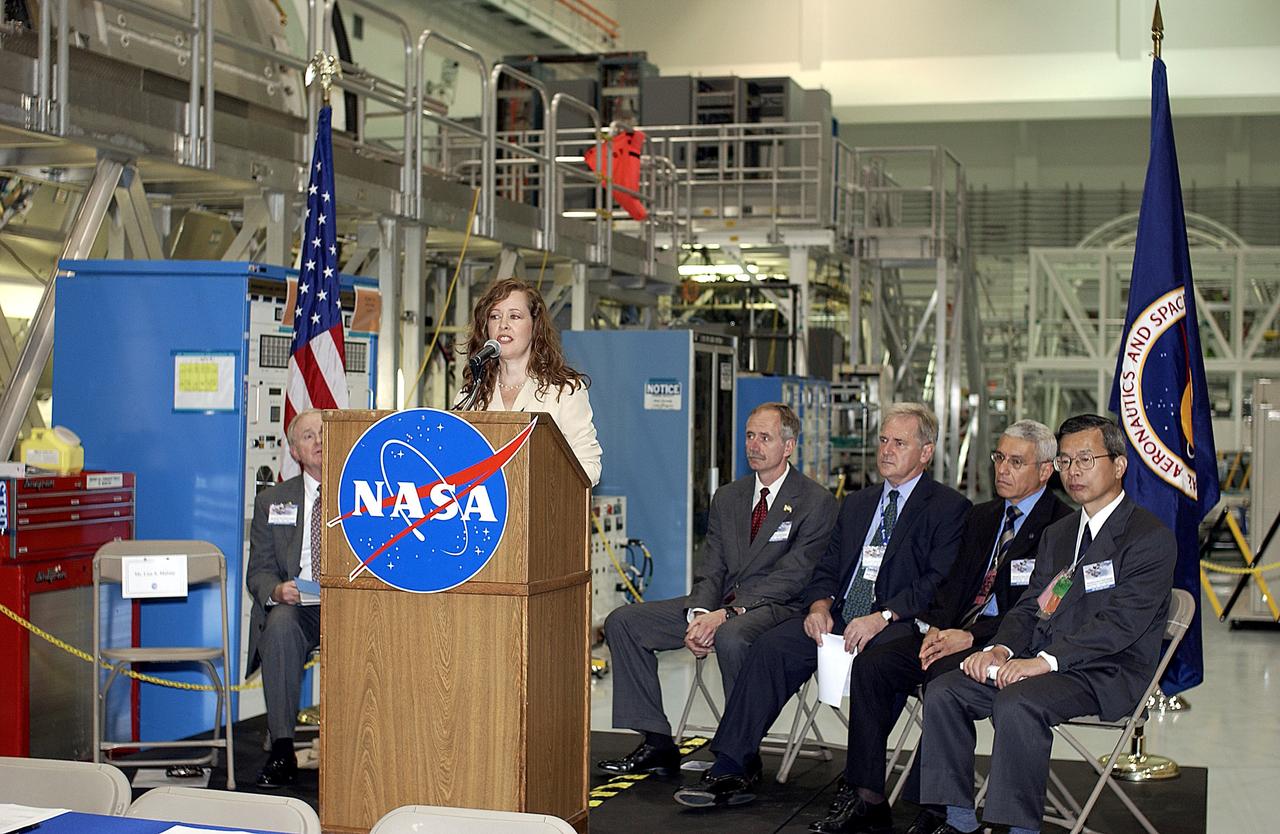
KENNEDY SPACE CENTER, FLA. -   Lisa Malone, deputy director of External Relations and Business Development at KSC, emcees a ceremony in the Space Station Processing Facility to highlight the arrival of two major components of the International Space Station.  NASA's Node 2, built by the European Space Agency (ESA) in Italy arrived at KSC on June 1. It will be the next pressurized module installed on the Station. The pressurized module of the Japanese Experiment Module (JEM), named "Kibo" (Hope) arrived at KSC on June 4. It is Japan's primary contribution to the Station. The ceremony held today included the official transfer of ownership signing of Node 2 between the ESA and NASA..  Speakers at the ceremony included KSC Director Roy Bridges Jr.; NASA's Michael C. Kostelnik, deputy associate administrator for International Space Station and Shuttle Programs, and William Gerstenmaier, International Space Station Program manager; Alan Thirkettle, International Space Station Program manager for Node 2, ESA; Andrea Lorenzoni, International Space Station Program manager for Node 2, Italian Space Agency; Kuniaki Shiraki, JEM Project manager, National Aerospace and Development Agency of Japan.
KENNEDY SPACE CENTER, FLA. - Lisa Malone, deputy director of External Relations and Business Development at KSC, emcees a ceremony in the Space Station Processing Facility to highlight the arrival of two major components of the International Space Station. NASA's Node 2, built by the European Space Agency (ESA) in Italy arrived at KSC on June 1. It will be the next pressurized module installed on the Station. The pressurized module of the Japanese Experiment Module (JEM), named "Kibo" (Hope) arrived at KSC on June 4. It is Japan's primary contribution to the Station. The ceremony held today included the official transfer of ownership signing of Node 2 between the ESA and NASA.. Speakers at the ceremony included KSC Director Roy Bridges Jr.; NASA's Michael C. Kostelnik, deputy associate administrator for International Space Station and Shuttle Programs, and William Gerstenmaier, International Space Station Program manager; Alan Thirkettle, International Space Station Program manager for Node 2, ESA; Andrea Lorenzoni, International Space Station Program manager for Node 2, Italian Space Agency; Kuniaki Shiraki, JEM Project manager, National Aerospace and Development Agency of Japan.
KENNEDY SPACE CENTER, FLA. -   NASA's Michael C. Kostelnik, deputy associate administrator for International Space Station and Shuttle Programs, speaks to guests and the media gathered in the Space Station Processing Facility for a ceremony to highlight the arrival of two major components of the International Space Station.  NASA's Node 2, built by the European Space Agency (ESA) in Italy arrived at KSC on June 1. It will be the next pressurized module installed on the Station. The pressurized module of the Japanese Experiment Module (JEM), named "Kibo" (Hope) arrived at KSC on June 4. It is Japan's primary contribution to the Station. The ceremony held today included the official transfer of ownership signing of Node 2 between the ESA and NASA.. Emceed by Lisa Malone (far left),  deputy director of External Relations and Business Development at KSC, the ceremony also included these speakers: Center Director Roy Bridges Jr. (second from left); William Gerstenmaier, International Space Station Program manager; Alan Thirkettle, International Space Station Program manager for Node 2, ESA; Andrea Lorenzoni, International Space Station Program manager for Node 2, Italian Space Agency; and Kuniaki Shiraki, JEM Project manager, National Aerospace and Development Agency of Japan.
KENNEDY SPACE CENTER, FLA. - NASA's Michael C. Kostelnik, deputy associate administrator for International Space Station and Shuttle Programs, speaks to guests and the media gathered in the Space Station Processing Facility for a ceremony to highlight the arrival of two major components of the International Space Station. NASA's Node 2, built by the European Space Agency (ESA) in Italy arrived at KSC on June 1. It will be the next pressurized module installed on the Station. The pressurized module of the Japanese Experiment Module (JEM), named "Kibo" (Hope) arrived at KSC on June 4. It is Japan's primary contribution to the Station. The ceremony held today included the official transfer of ownership signing of Node 2 between the ESA and NASA.. Emceed by Lisa Malone (far left), deputy director of External Relations and Business Development at KSC, the ceremony also included these speakers: Center Director Roy Bridges Jr. (second from left); William Gerstenmaier, International Space Station Program manager; Alan Thirkettle, International Space Station Program manager for Node 2, ESA; Andrea Lorenzoni, International Space Station Program manager for Node 2, Italian Space Agency; and Kuniaki Shiraki, JEM Project manager, National Aerospace and Development Agency of Japan.
KENNEDY SPACE CENTER, FLA. -  Center Director Roy Bridges Jr. speaks to the media and guests gathered in the Space Station Processing Facility for a ceremony to highlight the arrival of two major components of the International Space Station.  NASA's Node 2, built by the European Space Agency (ESA) in Italy arrived at KSC on June 1. It will be the next pressurized module installed on the Station. The pressurized module of the Japanese Experiment Module (JEM), named "Kibo" (Hope) arrived at KSC on June 4. It is Japan's primary contribution to the Station. The ceremony held today included the official transfer of ownership signing of Node 2 between the ESA and NASA.. Emceed by Lisa Malone (far left),  deputy director of External Relations and Business Development at KSC, the ceremony also included these speakers: NASA's Michael C. Kostelnik, deputy associate administrator for International Space Station and Shuttle Programs, and William Gerstenmaier, International Space Station Program manager; Alan Thirkettle, International Space Station Program manager for Node 2, ESA; Andrea Lorenzoni, International Space Station Program manager for Node 2, Italian Space Agency; Kuniaki Shiraki, JEM Project manager, National Aerospace and Development Agency of Japan.
KENNEDY SPACE CENTER, FLA. - Center Director Roy Bridges Jr. speaks to the media and guests gathered in the Space Station Processing Facility for a ceremony to highlight the arrival of two major components of the International Space Station. NASA's Node 2, built by the European Space Agency (ESA) in Italy arrived at KSC on June 1. It will be the next pressurized module installed on the Station. The pressurized module of the Japanese Experiment Module (JEM), named "Kibo" (Hope) arrived at KSC on June 4. It is Japan's primary contribution to the Station. The ceremony held today included the official transfer of ownership signing of Node 2 between the ESA and NASA.. Emceed by Lisa Malone (far left), deputy director of External Relations and Business Development at KSC, the ceremony also included these speakers: NASA's Michael C. Kostelnik, deputy associate administrator for International Space Station and Shuttle Programs, and William Gerstenmaier, International Space Station Program manager; Alan Thirkettle, International Space Station Program manager for Node 2, ESA; Andrea Lorenzoni, International Space Station Program manager for Node 2, Italian Space Agency; Kuniaki Shiraki, JEM Project manager, National Aerospace and Development Agency of Japan.
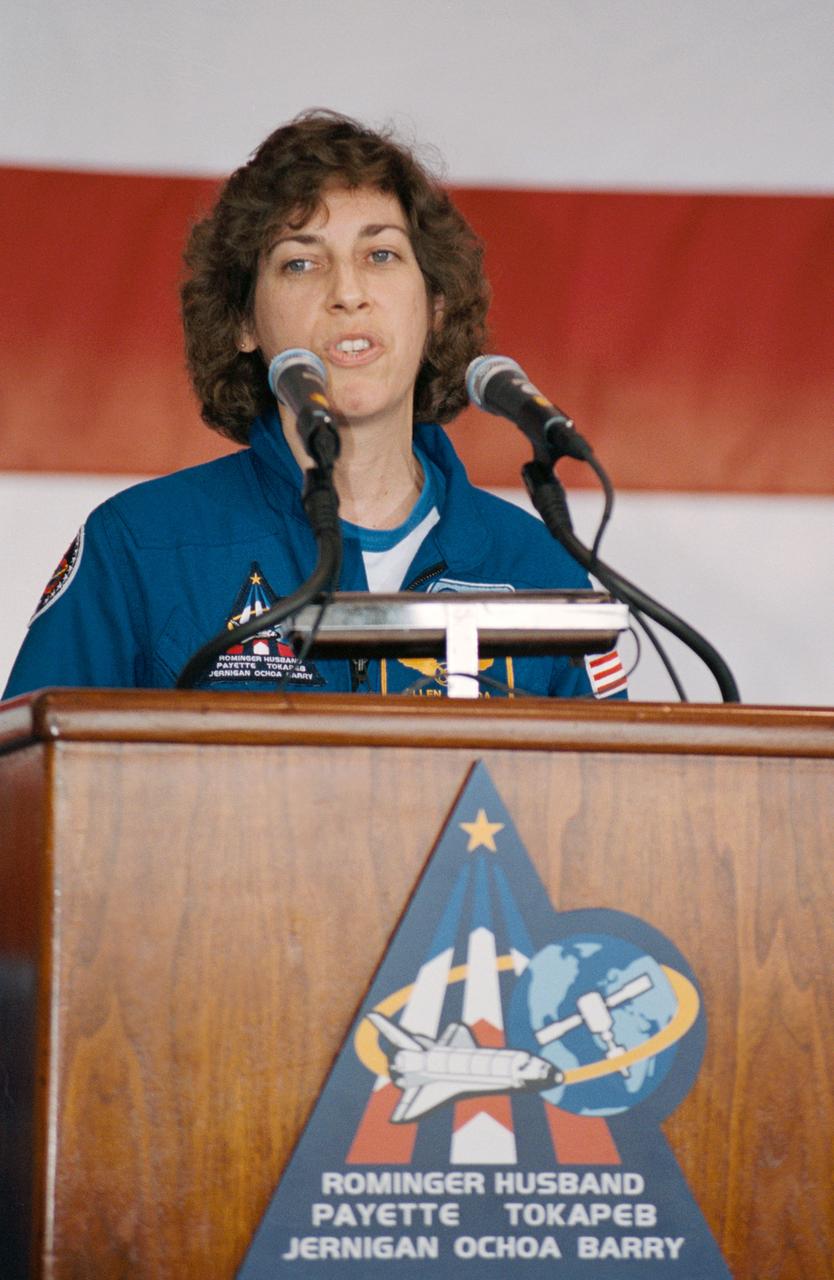
S99-05972 (7 June 1999) --- Astronaut Ellen Ochoa, mission specialist, speaks  to crowd on hand at welcome ceremonies  following crew arrival at Ellington Field.
STS-96 crew return ceremony at Ellington Field, June 7, 1999
KENNEDY SPACE CENTER, FLA. - At a ceremony highlighting the arrival of two major components of the International Space Station, Node 2 and the Japanese Experiment Module (JEM), ownership of Node 2 was officially transferred between the European Space Agency (ESA) and NASA.  Shaking hands after the signing are (left) Andrea Lorenzoni, International Space Station Program manager for Node 2, Italian Space Agency, and (right) NASA’s Michael C. Kostelnik (right), deputy associate administrator for International Space Station and Shuttle Programs.  Also part of the signing is (center) Alan Thirkettle (center), International Space Station Program manager for Node 2, European Space Agency.  NASA's Node 2, built by ESA in Italy, arrived at KSC on June 1. It will be the next pressurized module installed on the Station. The pressurized module of the Japanese Experiment Module (JEM),  named "Kibo" (Hope), arrived at KSC on June 4. It is Japan's primary contribution to the Station. Emceed by Lisa Malone (background, left),  deputy director of External Relations and Business Development at KSC, the ceremony also included these speakers: Center Director Roy Bridges Jr.; NASA’s William Gerstenmaier, International Space Station Program manager; and Kuniaki Shiraki, JEM Project manager, National Aerospace and Development Agency of Japan.
KENNEDY SPACE CENTER, FLA. - At a ceremony highlighting the arrival of two major components of the International Space Station, Node 2 and the Japanese Experiment Module (JEM), ownership of Node 2 was officially transferred between the European Space Agency (ESA) and NASA. Shaking hands after the signing are (left) Andrea Lorenzoni, International Space Station Program manager for Node 2, Italian Space Agency, and (right) NASA’s Michael C. Kostelnik (right), deputy associate administrator for International Space Station and Shuttle Programs. Also part of the signing is (center) Alan Thirkettle (center), International Space Station Program manager for Node 2, European Space Agency. NASA's Node 2, built by ESA in Italy, arrived at KSC on June 1. It will be the next pressurized module installed on the Station. The pressurized module of the Japanese Experiment Module (JEM), named "Kibo" (Hope), arrived at KSC on June 4. It is Japan's primary contribution to the Station. Emceed by Lisa Malone (background, left), deputy director of External Relations and Business Development at KSC, the ceremony also included these speakers: Center Director Roy Bridges Jr.; NASA’s William Gerstenmaier, International Space Station Program manager; and Kuniaki Shiraki, JEM Project manager, National Aerospace and Development Agency of Japan.
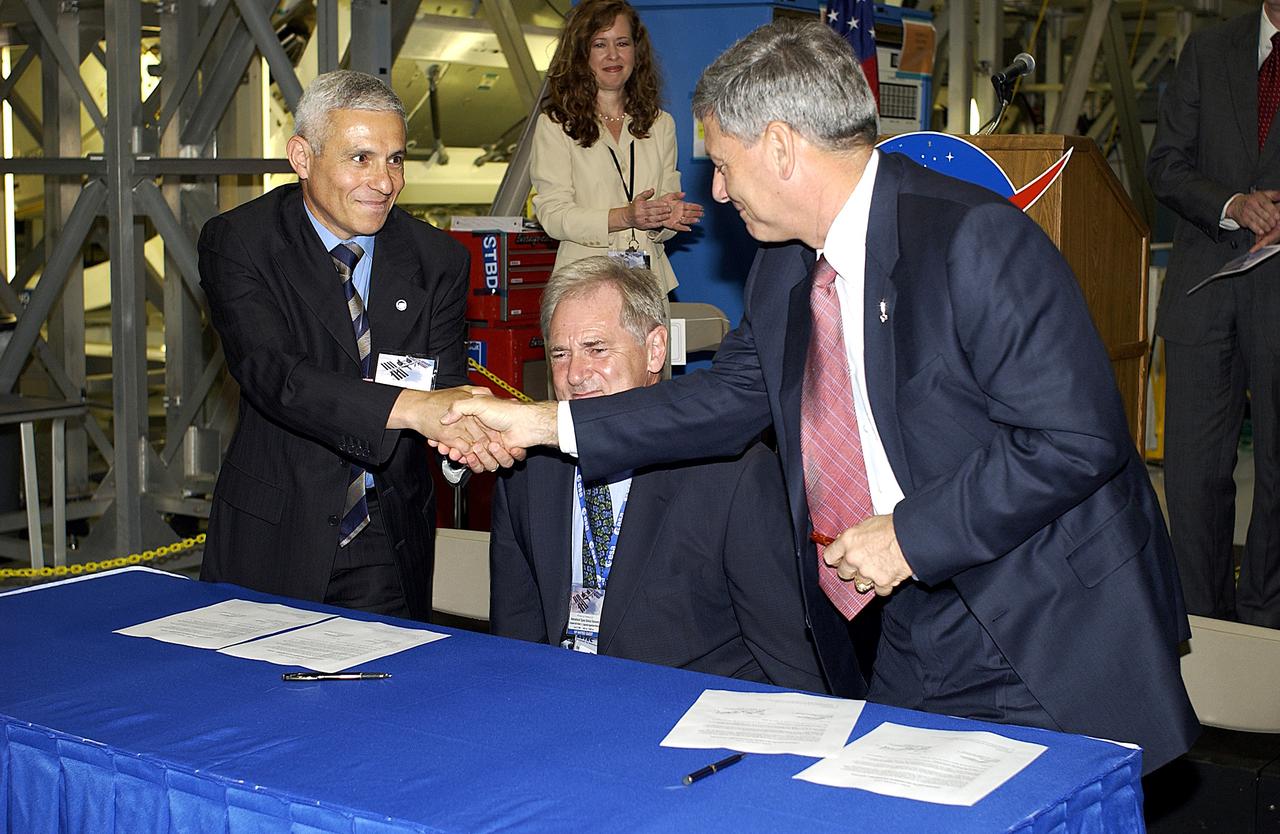
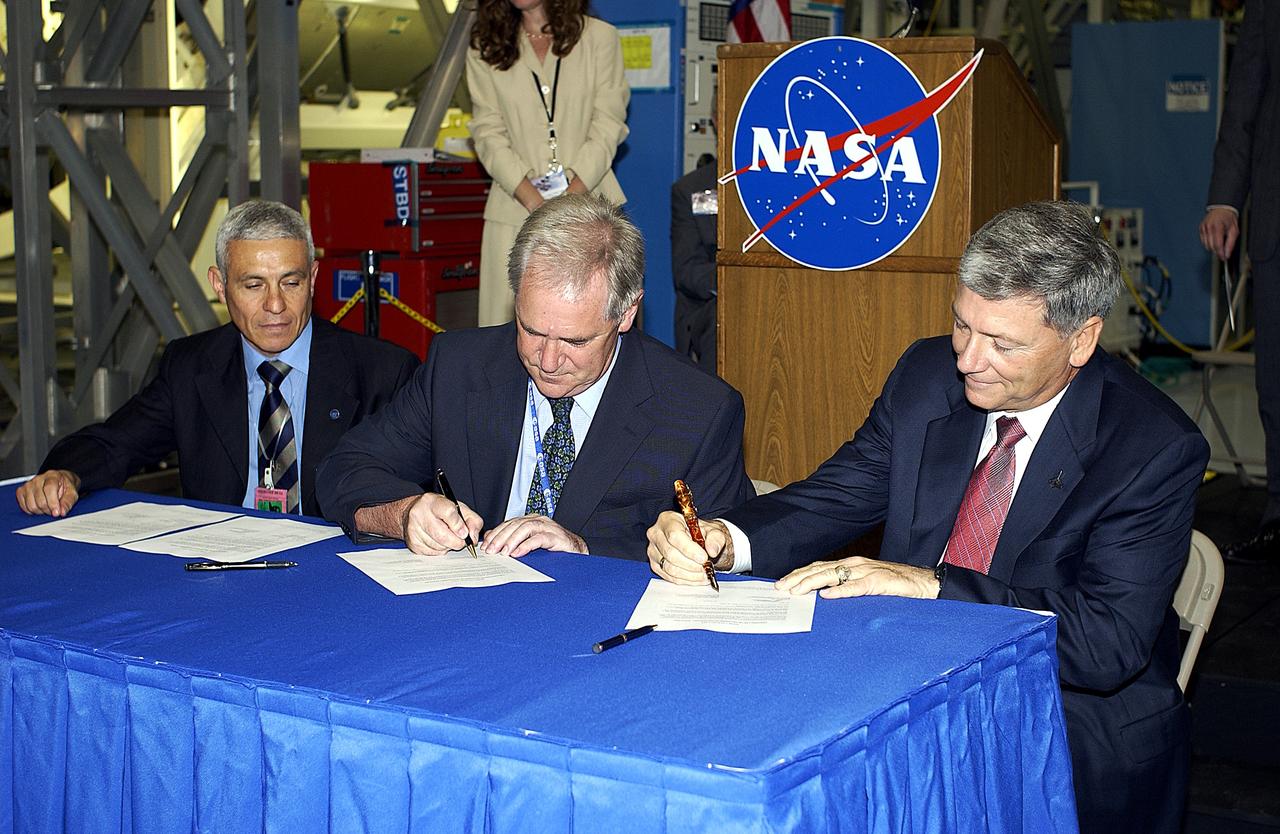
KENNEDY SPACE CENTER, FLA. - Andrea Lorenzoni, International Space Station Program manager for Node 2, Italian Space Agency; Alan Thirkettle, International Space Station Program manager for Node 2, European Space Agency (ESA); and NASA’s Michael C. Kostelnik, deputy associate administrator for International Space Station and Shuttle Programs, sign documents officially transferring ownership of Node 2 between the ESA and NASA. The signing was part of a  ceremony highlighting the arrival of two major components of the International Space Station.  NASA's Node 2, built by the European Space Agency (ESA) in Italy, arrived at KSC on June 1. It will be the next pressurized module installed on the Station. The pressurized module (above right) of the Japanese Experiment Module (JEM),  named "Kibo" (Hope), arrived at KSC on June 4. It is Japan's primary contribution to the Station. Emceed by Lisa Malone (far left), deputy director of External Relations and Business Development at KSC, the ceremony also included these speakers: Center Director Roy Bridges Jr.; NASA’s William Gerstenmaier, International Space Station Program manager; and Kuniaki Shiraki, JEM Project manager, National Aerospace and Development Agency of Japan.
KENNEDY SPACE CENTER, FLA. - Andrea Lorenzoni, International Space Station Program manager for Node 2, Italian Space Agency; Alan Thirkettle, International Space Station Program manager for Node 2, European Space Agency (ESA); and NASA’s Michael C. Kostelnik, deputy associate administrator for International Space Station and Shuttle Programs, sign documents officially transferring ownership of Node 2 between the ESA and NASA. The signing was part of a ceremony highlighting the arrival of two major components of the International Space Station. NASA's Node 2, built by the European Space Agency (ESA) in Italy, arrived at KSC on June 1. It will be the next pressurized module installed on the Station. The pressurized module (above right) of the Japanese Experiment Module (JEM), named "Kibo" (Hope), arrived at KSC on June 4. It is Japan's primary contribution to the Station. Emceed by Lisa Malone (far left), deputy director of External Relations and Business Development at KSC, the ceremony also included these speakers: Center Director Roy Bridges Jr.; NASA’s William Gerstenmaier, International Space Station Program manager; and Kuniaki Shiraki, JEM Project manager, National Aerospace and Development Agency of Japan.
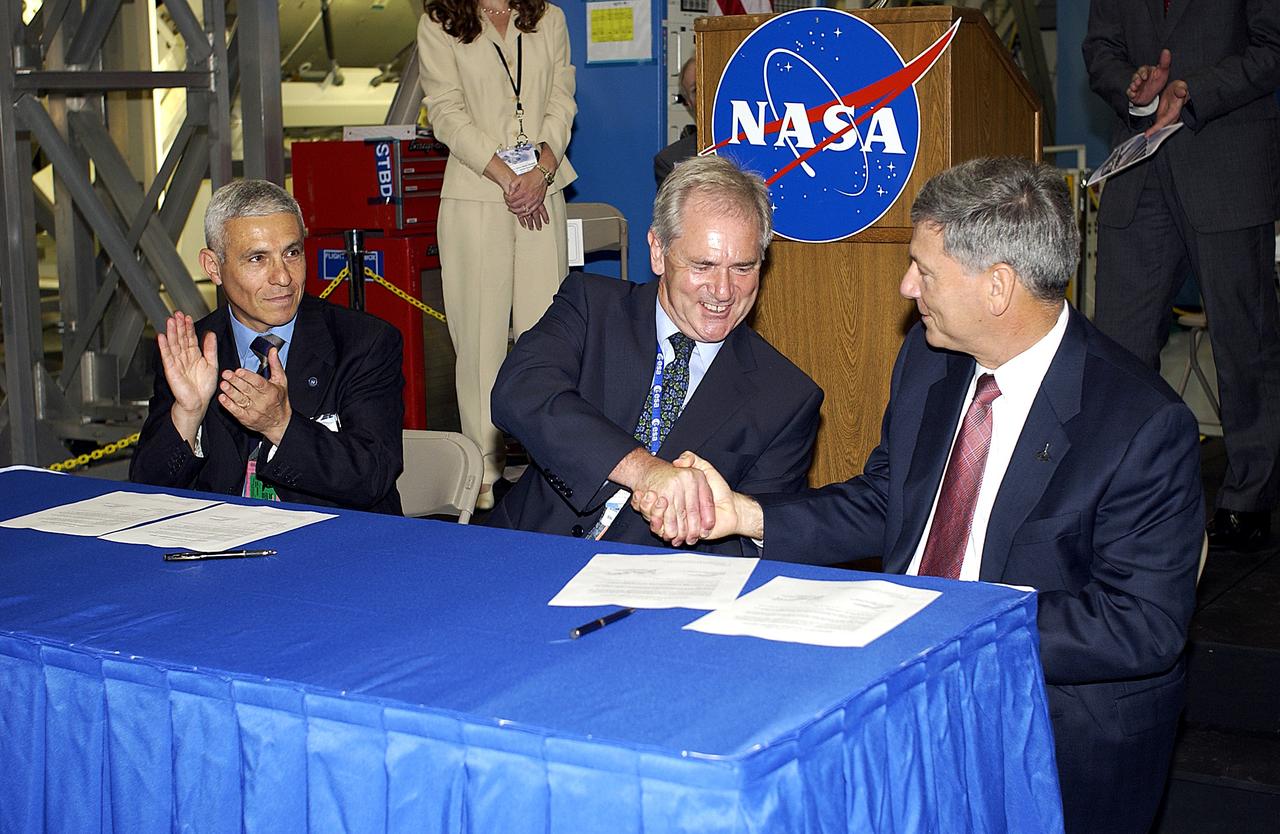
KENNEDY SPACE CENTER, FLA. - At a ceremony highlighting the arrival of two major components of the International Space Station, Node 2 and the Japanese Experiment Module (JEM), ownership of Node 2 was officially transferred between the European Space Agency (ESA) and NASA.  Shaking hands after the signing are Alan Thirkettle (center), International Space Station Program manager for Node 2, ESA; and NASA’s Michael C. Kostelnik (right), deputy associate administrator for International Space Station and Shuttle Programs.  At left, also part of the signing, is Andrea Lorenzoni (left), International Space Station Program manager for Node 2, Italian Space Agency.  NASA's Node 2, built by ESA in Italy, arrived at KSC on June 1. It will be the next pressurized module installed on the Station. The pressurized module of the Japanese Experiment Module (JEM),  named "Kibo" (Hope), arrived at KSC on June 4. It is Japan's primary contribution to the Station. Emceed by Lisa Malone, deputy director of External Relations and Business Development at KSC, the ceremony also included these speakers: Center Director Roy Bridges Jr.; NASA’s William Gerstenmaier, International Space Station Program manager; and Kuniaki Shiraki, JEM Project manager, National Aerospace and Development Agency of Japan.
KENNEDY SPACE CENTER, FLA. - At a ceremony highlighting the arrival of two major components of the International Space Station, Node 2 and the Japanese Experiment Module (JEM), ownership of Node 2 was officially transferred between the European Space Agency (ESA) and NASA. Shaking hands after the signing are Alan Thirkettle (center), International Space Station Program manager for Node 2, ESA; and NASA’s Michael C. Kostelnik (right), deputy associate administrator for International Space Station and Shuttle Programs. At left, also part of the signing, is Andrea Lorenzoni (left), International Space Station Program manager for Node 2, Italian Space Agency. NASA's Node 2, built by ESA in Italy, arrived at KSC on June 1. It will be the next pressurized module installed on the Station. The pressurized module of the Japanese Experiment Module (JEM), named "Kibo" (Hope), arrived at KSC on June 4. It is Japan's primary contribution to the Station. Emceed by Lisa Malone, deputy director of External Relations and Business Development at KSC, the ceremony also included these speakers: Center Director Roy Bridges Jr.; NASA’s William Gerstenmaier, International Space Station Program manager; and Kuniaki Shiraki, JEM Project manager, National Aerospace and Development Agency of Japan.
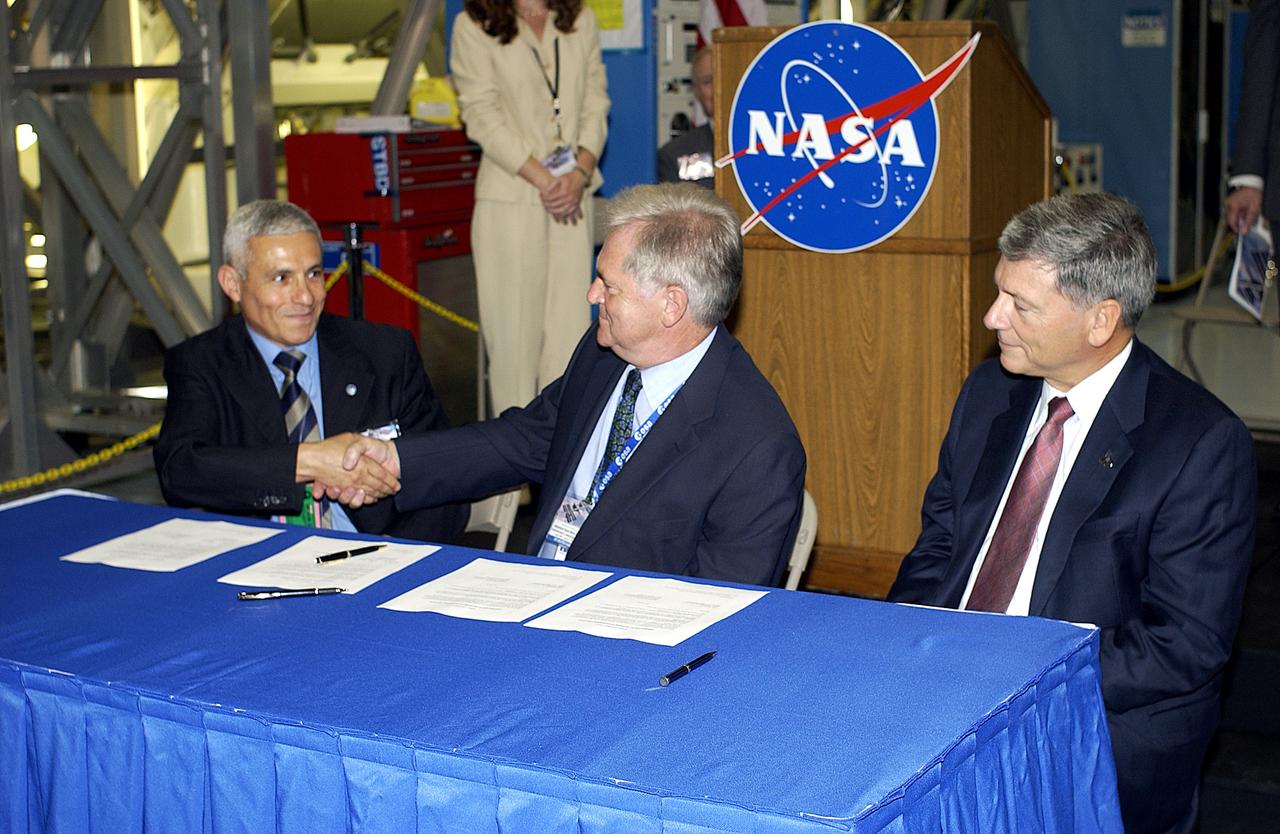
KENNEDY SPACE CENTER, FLA. - At ceremony highlighting the arrival of two major components of the International Space Station, Node 2 and the Japanese Experiment Module (JEM), ownership of Node 2 was officially transferred between the European Space Agency and NASA.  Shaking hands after the signing are Andrea Lorenzoni, International Space Station Program manager for Node 2, Italian Space Agency; and Alan Thirkettle, International Space Station Program manager for Node 2, European Space Agency (ESA).  At right is NASA’s Michael C. Kostelnik, deputy associate administrator for International Space Station and Shuttle Programs.  NASA's Node 2, built by ESA in Italy, arrived at KSC on June 1. It will be the next pressurized module installed on the Station. The pressurized module of the Japanese Experiment Module (JEM),  named "Kibo" (Hope), arrived at KSC on June 4. It is Japan's primary contribution to the Station. Emceed by Lisa Malone, deputy director of External Relations and Business Development at KSC, the ceremony also included these speakers: Center Director Roy Bridges Jr.; NASA’s William Gerstenmaier, International Space Station Program manager; and Kuniaki Shiraki, JEM Project manager, National Aerospace and Development Agency of Japan.
KENNEDY SPACE CENTER, FLA. - At ceremony highlighting the arrival of two major components of the International Space Station, Node 2 and the Japanese Experiment Module (JEM), ownership of Node 2 was officially transferred between the European Space Agency and NASA. Shaking hands after the signing are Andrea Lorenzoni, International Space Station Program manager for Node 2, Italian Space Agency; and Alan Thirkettle, International Space Station Program manager for Node 2, European Space Agency (ESA). At right is NASA’s Michael C. Kostelnik, deputy associate administrator for International Space Station and Shuttle Programs. NASA's Node 2, built by ESA in Italy, arrived at KSC on June 1. It will be the next pressurized module installed on the Station. The pressurized module of the Japanese Experiment Module (JEM), named "Kibo" (Hope), arrived at KSC on June 4. It is Japan's primary contribution to the Station. Emceed by Lisa Malone, deputy director of External Relations and Business Development at KSC, the ceremony also included these speakers: Center Director Roy Bridges Jr.; NASA’s William Gerstenmaier, International Space Station Program manager; and Kuniaki Shiraki, JEM Project manager, National Aerospace and Development Agency of Japan.
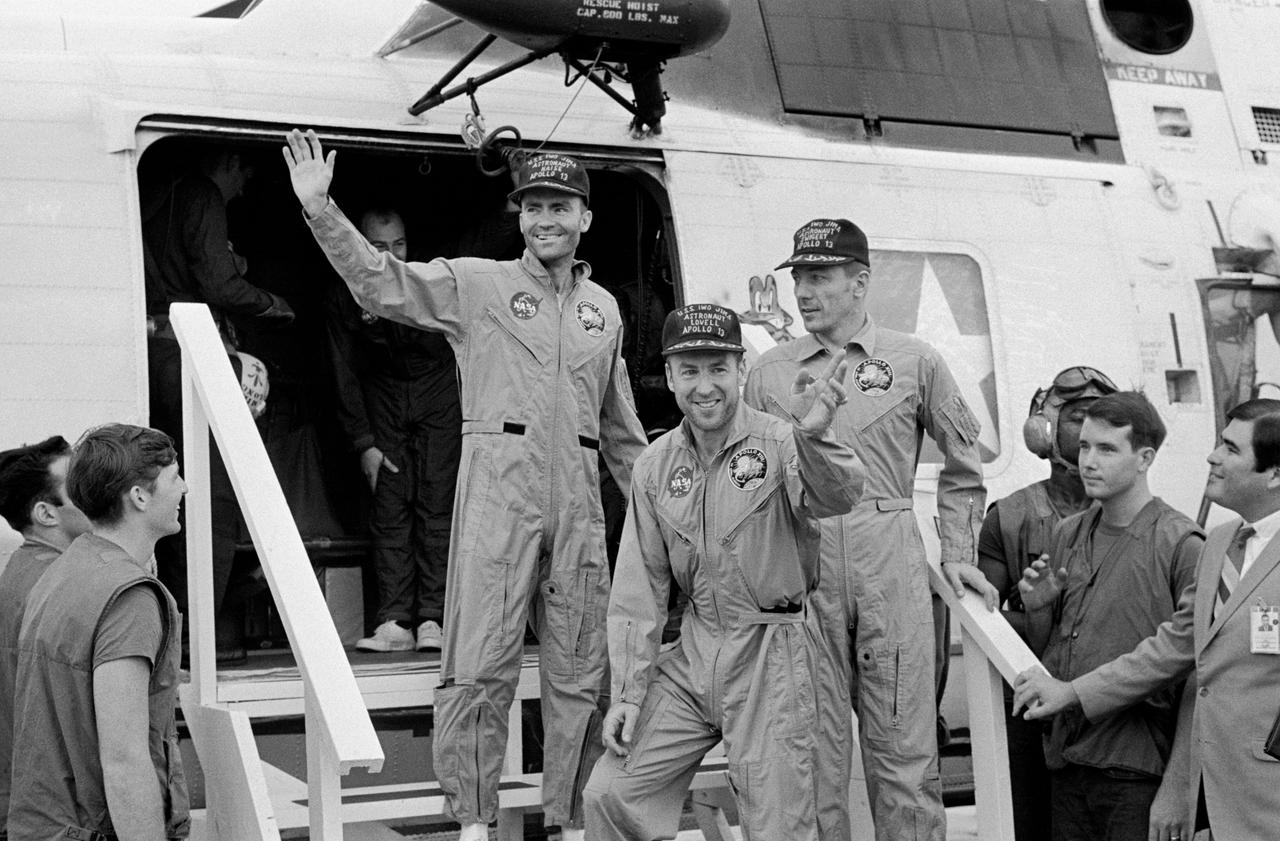
S70-35614 (17 April 1970) --- The crewmembers of the Apollo 13 mission, step aboard the USS Iwo Jima, prime recovery ship for the mission, following splashdown and recovery operations in the South Pacific Ocean. Exiting the helicopter which made the pick-up some four miles from the Iwo Jima are (from left) astronauts Fred W. Haise Jr., lunar module pilot; James A. Lovell Jr., commander; and John L. Swigert Jr., command module pilot.  The crippled Apollo 13 spacecraft splashed down at 12:07:44 p.m. (CST), April 17, 1970.
Apollo 13 crew arrive on prime recovery ship U.S.S. Iwo Jima
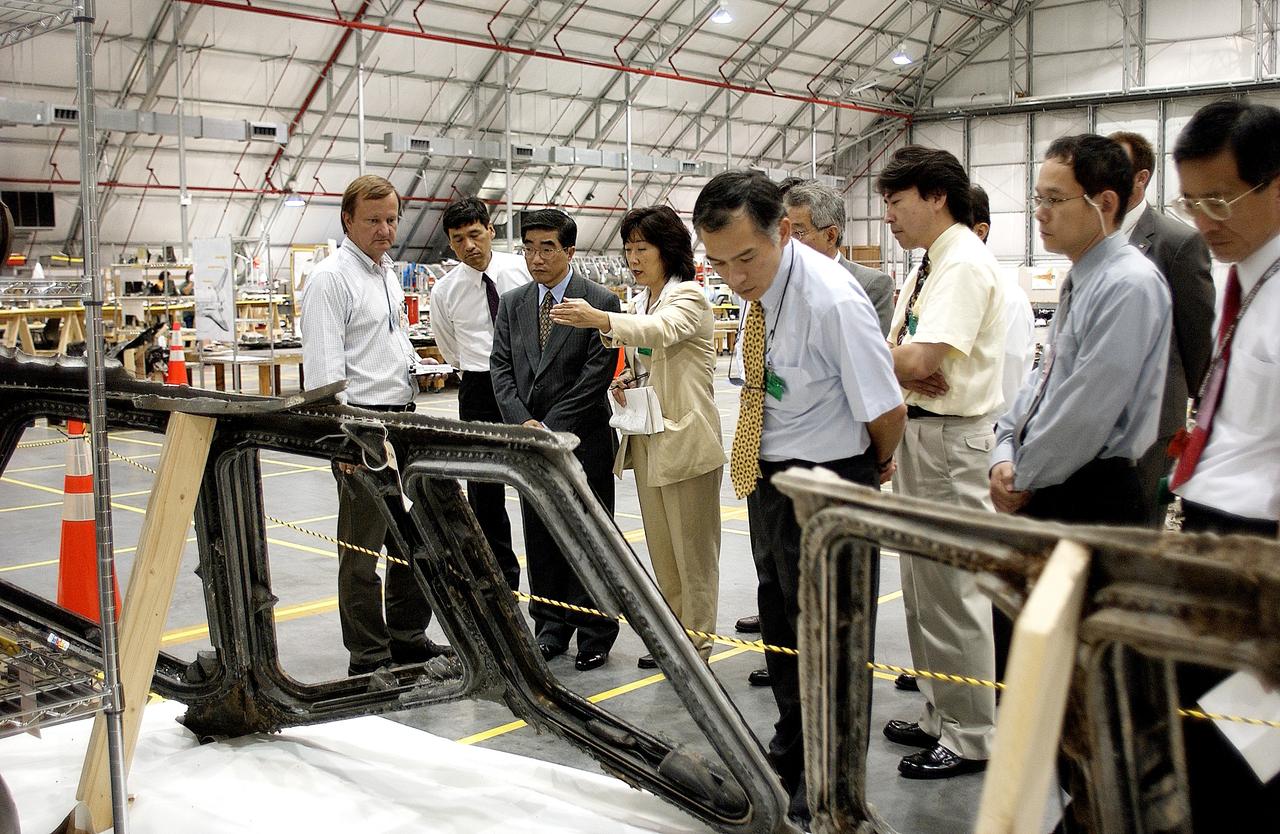
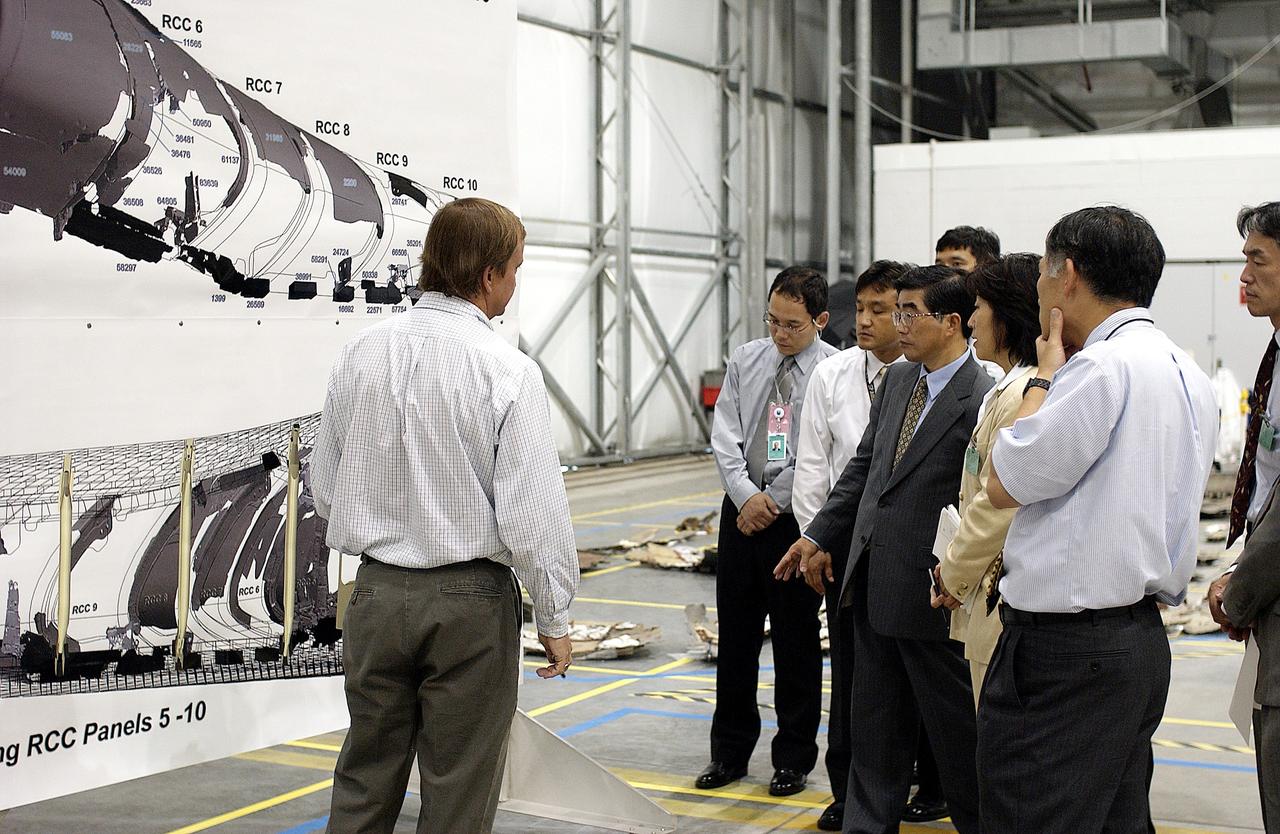
KENNEDY SPACE CENTER, FLA. -    Shuttle Launch Director Mike Leinbach (left) explains recovery and reconstruction efforts of Columbia to the Executive Director of NASDA Koji Yamamoto (second from left) and others visiting the Columbia Debris Hangar.   Mr. Yamamoto is at KSC for a welcome ceremony involving the arrival of the newest Space Station module, the Japanese Experiment Module/pressurized module.
KENNEDY SPACE CENTER, FLA. - Shuttle Launch Director Mike Leinbach (left) explains recovery and reconstruction efforts of Columbia to the Executive Director of NASDA Koji Yamamoto (second from left) and others visiting the Columbia Debris Hangar. Mr. Yamamoto is at KSC for a welcome ceremony involving the arrival of the newest Space Station module, the Japanese Experiment Module/pressurized module.
KENNEDY SPACE CENTER, FLA. -   Shuttle Launch Director Mike Leinbach (right) explains recovery and reconstruction efforts of Columbia to the Executive Director of NASDA Koji Yamamoto (second from left) and others visiting the Columbia Debris Hangar.   Mr. Yamamoto is at KSC for a welcome ceremony involving the arrival of the newest Space Station module, the Japanese Experiment Module/pressurized module.
KENNEDY SPACE CENTER, FLA. - Shuttle Launch Director Mike Leinbach (right) explains recovery and reconstruction efforts of Columbia to the Executive Director of NASDA Koji Yamamoto (second from left) and others visiting the Columbia Debris Hangar. Mr. Yamamoto is at KSC for a welcome ceremony involving the arrival of the newest Space Station module, the Japanese Experiment Module/pressurized module.
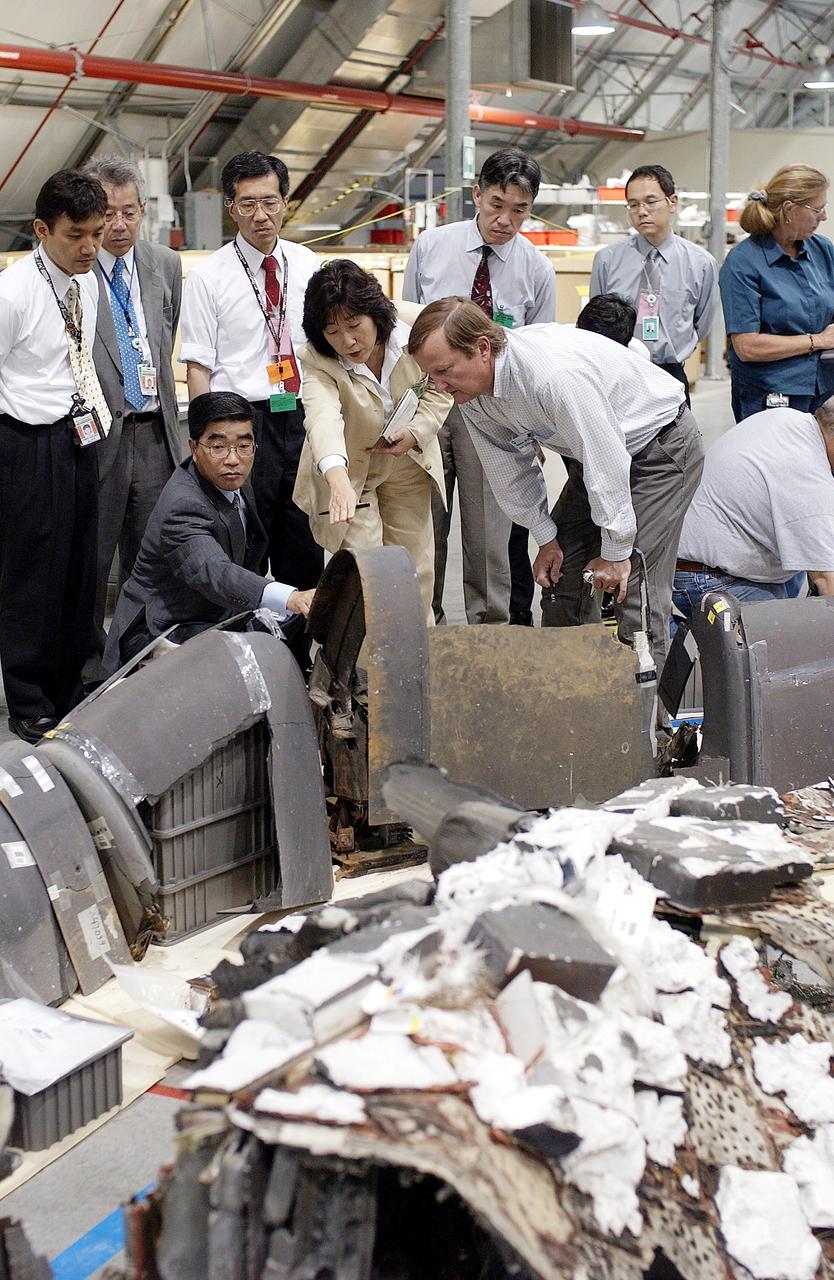
KENNEDY SPACE CENTER, FLA. -  On a KSC visit, Executive Director of NASDA Koji Yamamoto (kneeling, left) reaches out to a piece of Columbia debris in the Columbia Debris Hangar.  At right is Shuttle Launch Director Mike Leinbach, who is explaining recovery and reconstruction efforts.  Mr. Yamamoto is at KSC for a welcome ceremony involving the arrival of the newest Space Station module, the Japanese Experiment Module/pressurized module.
KENNEDY SPACE CENTER, FLA. - On a KSC visit, Executive Director of NASDA Koji Yamamoto (kneeling, left) reaches out to a piece of Columbia debris in the Columbia Debris Hangar. At right is Shuttle Launch Director Mike Leinbach, who is explaining recovery and reconstruction efforts. Mr. Yamamoto is at KSC for a welcome ceremony involving the arrival of the newest Space Station module, the Japanese Experiment Module/pressurized module.
KENNEDY SPACE CENTER, FLA. -  Shuttle Launch Director Mike Leinbach (right) explains recovery and reconstruction efforts of Columbia to the Executive Director of NASDA Koji Yamamoto (center, foreground) and others visiting the Columbia Debris Hangar.   Mr. Yamamoto is at KSC for a welcome ceremony involving the arrival of the newest Space Station module, the Japanese Experiment Module/pressurized module.
KENNEDY SPACE CENTER, FLA. - Shuttle Launch Director Mike Leinbach (right) explains recovery and reconstruction efforts of Columbia to the Executive Director of NASDA Koji Yamamoto (center, foreground) and others visiting the Columbia Debris Hangar. Mr. Yamamoto is at KSC for a welcome ceremony involving the arrival of the newest Space Station module, the Japanese Experiment Module/pressurized module.
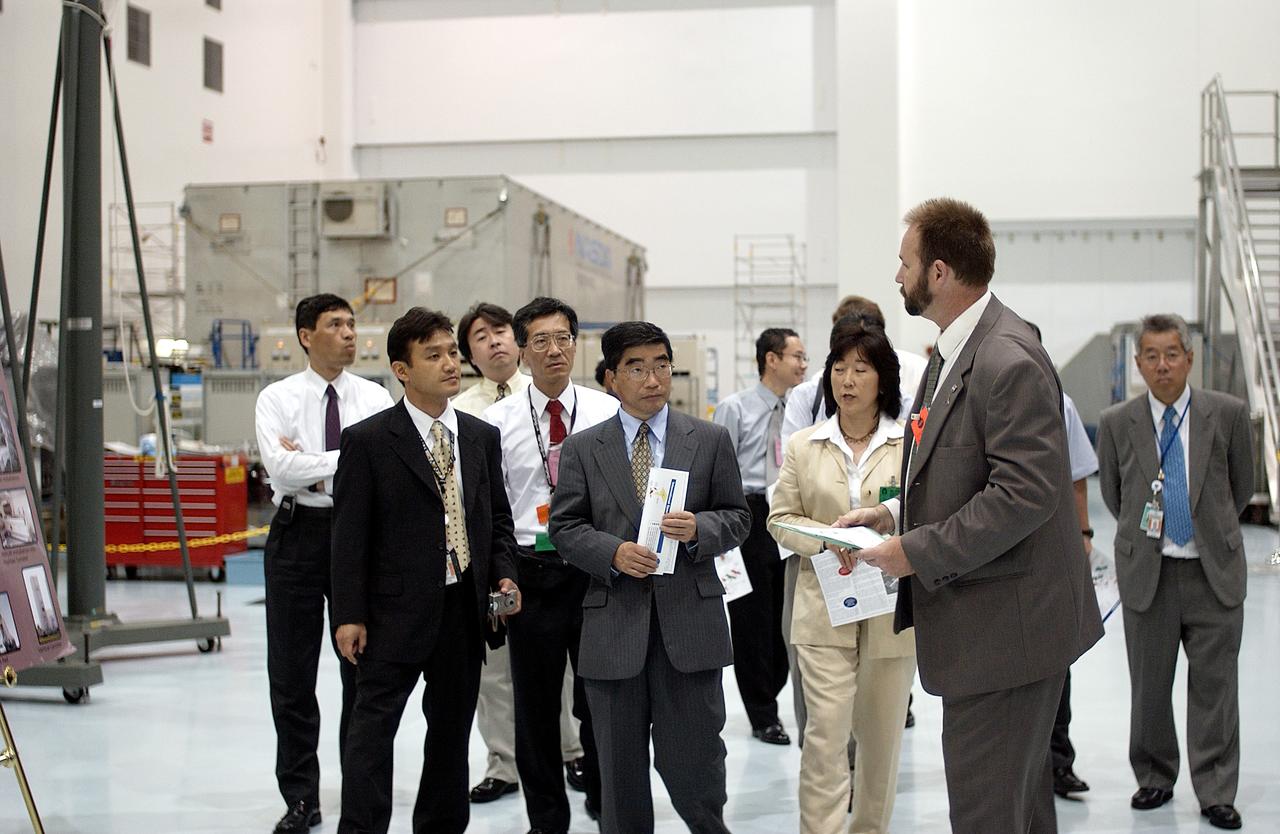
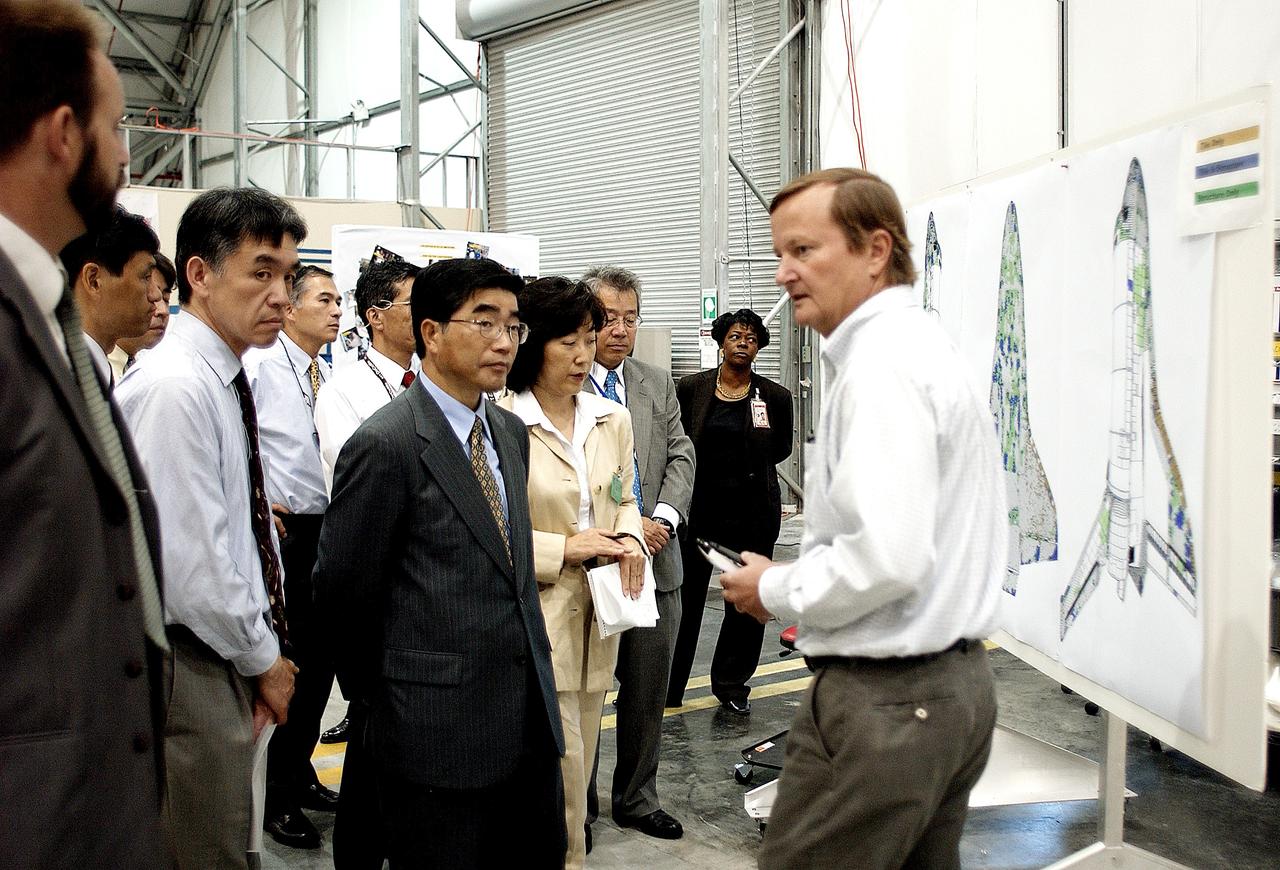
KENNEDY SPACE CENTER, FLA. -  Shuttle Launch Director Mike Leinbach (second from left) accompanies Executive Director of NASDA Koji Yamamoto (fourth from left) and others visiting the Columbia Debris Hangar.  Mr. Yamamoto is at KSC for a welcome ceremony involving the arrival of the newest Space Station module, the Japanese Experiment Module/pressurized module.
KENNEDY SPACE CENTER, FLA. - Shuttle Launch Director Mike Leinbach (second from left) accompanies Executive Director of NASDA Koji Yamamoto (fourth from left) and others visiting the Columbia Debris Hangar. Mr. Yamamoto is at KSC for a welcome ceremony involving the arrival of the newest Space Station module, the Japanese Experiment Module/pressurized module.
KENNEDY SPACE CENTER, FLA. -  Executive Director of NASDA Koji Yamamoto (left) is welcomed to KSC by Center Director Roy Bridges Jr. (right).  On the table between them is the logo of the new Japan Aerospace Exploration Agency, a merger of three Japanese aeronautical and space agencies effective Oct.1, 2003.  Mr. Yamamoto is at KSC for a welcome ceremony involving the arrival of the newest Space Station module, the Japanese Experiment Module/pressurized module.  His visit includes a tour of the Columbia Debris Hangar.
KENNEDY SPACE CENTER, FLA. - Executive Director of NASDA Koji Yamamoto (left) is welcomed to KSC by Center Director Roy Bridges Jr. (right). On the table between them is the logo of the new Japan Aerospace Exploration Agency, a merger of three Japanese aeronautical and space agencies effective Oct.1, 2003. Mr. Yamamoto is at KSC for a welcome ceremony involving the arrival of the newest Space Station module, the Japanese Experiment Module/pressurized module. His visit includes a tour of the Columbia Debris Hangar.
KENNEDY SPACE CENTER, FLA. -  Shuttle Launch Director Mike Leinbach (second from left) explains recovery and reconstruction efforts of Columbia to the Executive Director of NASDA Koji Yamamoto (fourth from left) and others visiting the Columbia Debris Hangar.   Mr. Yamamoto is at KSC for a welcome ceremony involving the arrival of the newest Space Station module, the Japanese Experiment Module/pressurized module.
KENNEDY SPACE CENTER, FLA. - Shuttle Launch Director Mike Leinbach (second from left) explains recovery and reconstruction efforts of Columbia to the Executive Director of NASDA Koji Yamamoto (fourth from left) and others visiting the Columbia Debris Hangar. Mr. Yamamoto is at KSC for a welcome ceremony involving the arrival of the newest Space Station module, the Japanese Experiment Module/pressurized module.
KENNEDY SPACE CENTER, FLA. -  Shuttle Launch Director Mike Leinbach (right) explains recovery and reconstruction efforts of Columbia to the Executive Director of NASDA Koji Yamamoto (third from left) and others visiting the Columbia Debris Hangar.   Mr. Yamamoto is at KSC for a welcome ceremony involving the arrival of the newest Space Station module, the Japanese Experiment Module/pressurized module.
KENNEDY SPACE CENTER, FLA. - Shuttle Launch Director Mike Leinbach (right) explains recovery and reconstruction efforts of Columbia to the Executive Director of NASDA Koji Yamamoto (third from left) and others visiting the Columbia Debris Hangar. Mr. Yamamoto is at KSC for a welcome ceremony involving the arrival of the newest Space Station module, the Japanese Experiment Module/pressurized module.
KENNEDY SPACE CENTER, FLA. -  Executive Director of NASDA Koji Yamamoto (left) is welcomed to KSC by Center Director Roy Bridges Jr. (right).  Mr. Yamamoto is at KSC for a welcome ceremony involving the arrival of the newest Space Station module, the Japanese Experiment Module/pressurized module.  His visit includes a tour of the Columbia Debris Hangar.
KENNEDY SPACE CENTER, FLA. - Executive Director of NASDA Koji Yamamoto (left) is welcomed to KSC by Center Director Roy Bridges Jr. (right). Mr. Yamamoto is at KSC for a welcome ceremony involving the arrival of the newest Space Station module, the Japanese Experiment Module/pressurized module. His visit includes a tour of the Columbia Debris Hangar.
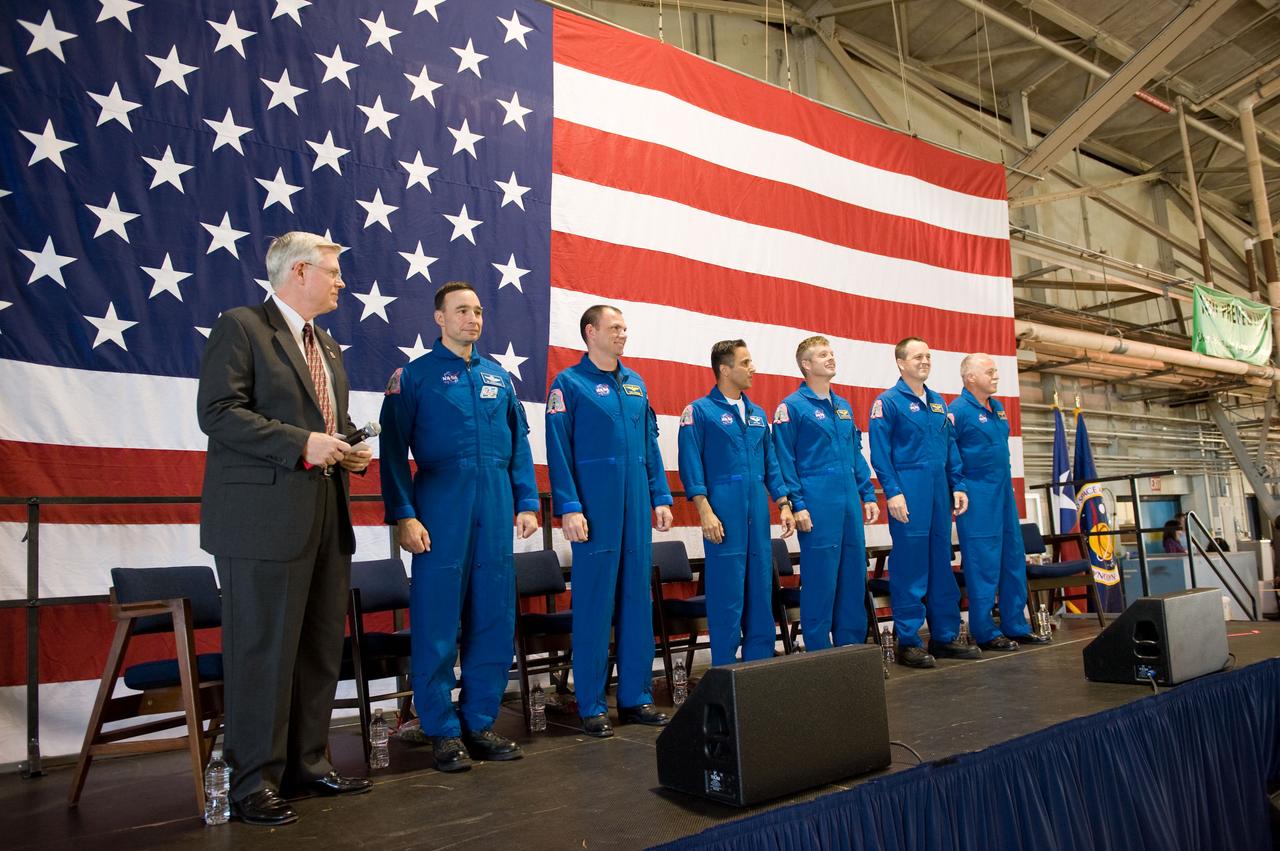
PHOTO DATE: 03-29-09   LOCATION: Ellington - Hangar 990 SUBJECT: STS-119 crew return ceremony. Photograph s of crew arriving, overall views, individual views of each astronaut, other special speakers, interaction with crowd, signing autographs. PHOTOGRAPHER:  Devin Boldt
STS-119 Crew Return Ceremony to Ellington Field
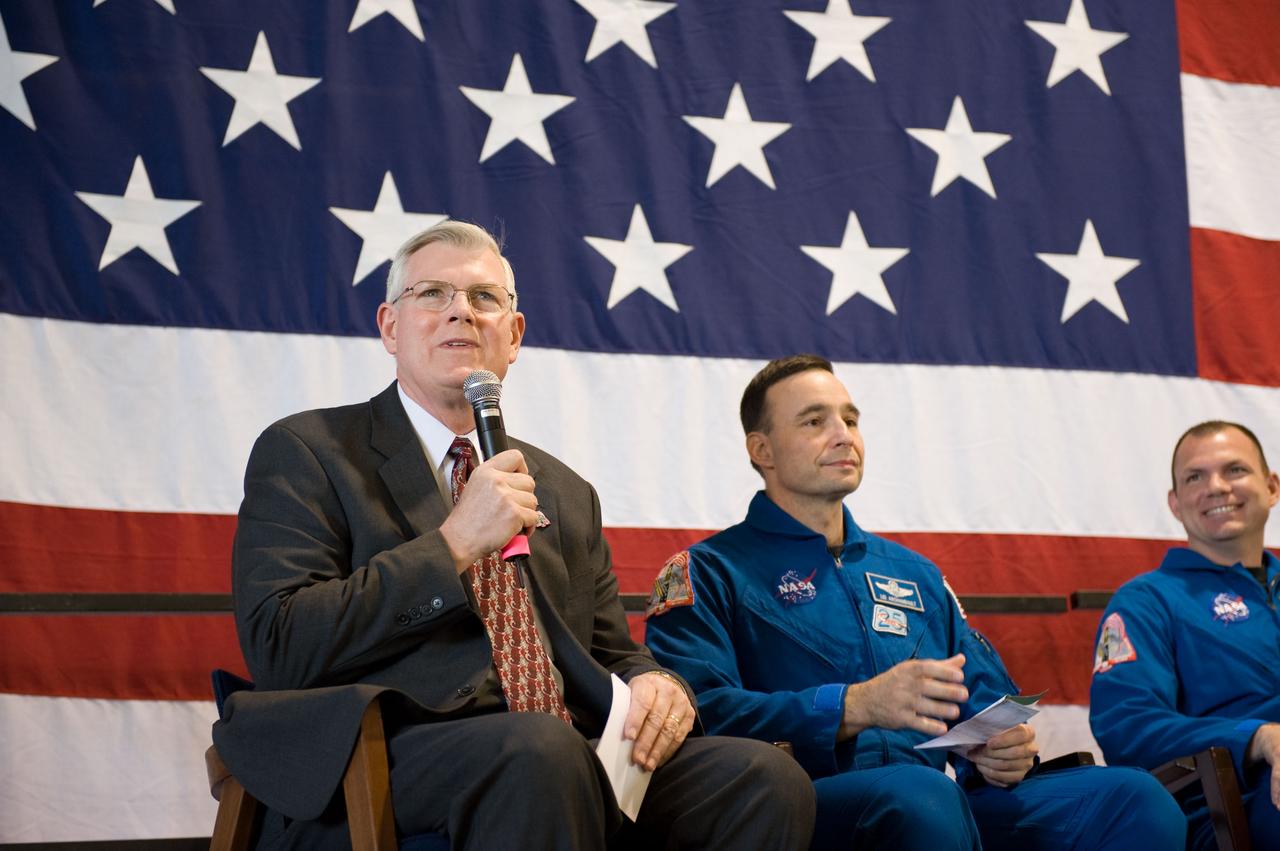
PHOTO DATE: 03-29-09   LOCATION: Ellington - Hangar 990 SUBJECT: STS-119 crew return ceremony. Photograph s of crew arriving, overall views, individual views of each astronaut, other special speakers, interaction with crowd, signing autographs. PHOTOGRAPHER:  Devin Boldt
STS-119 Crew Return Ceremony to Ellington Field
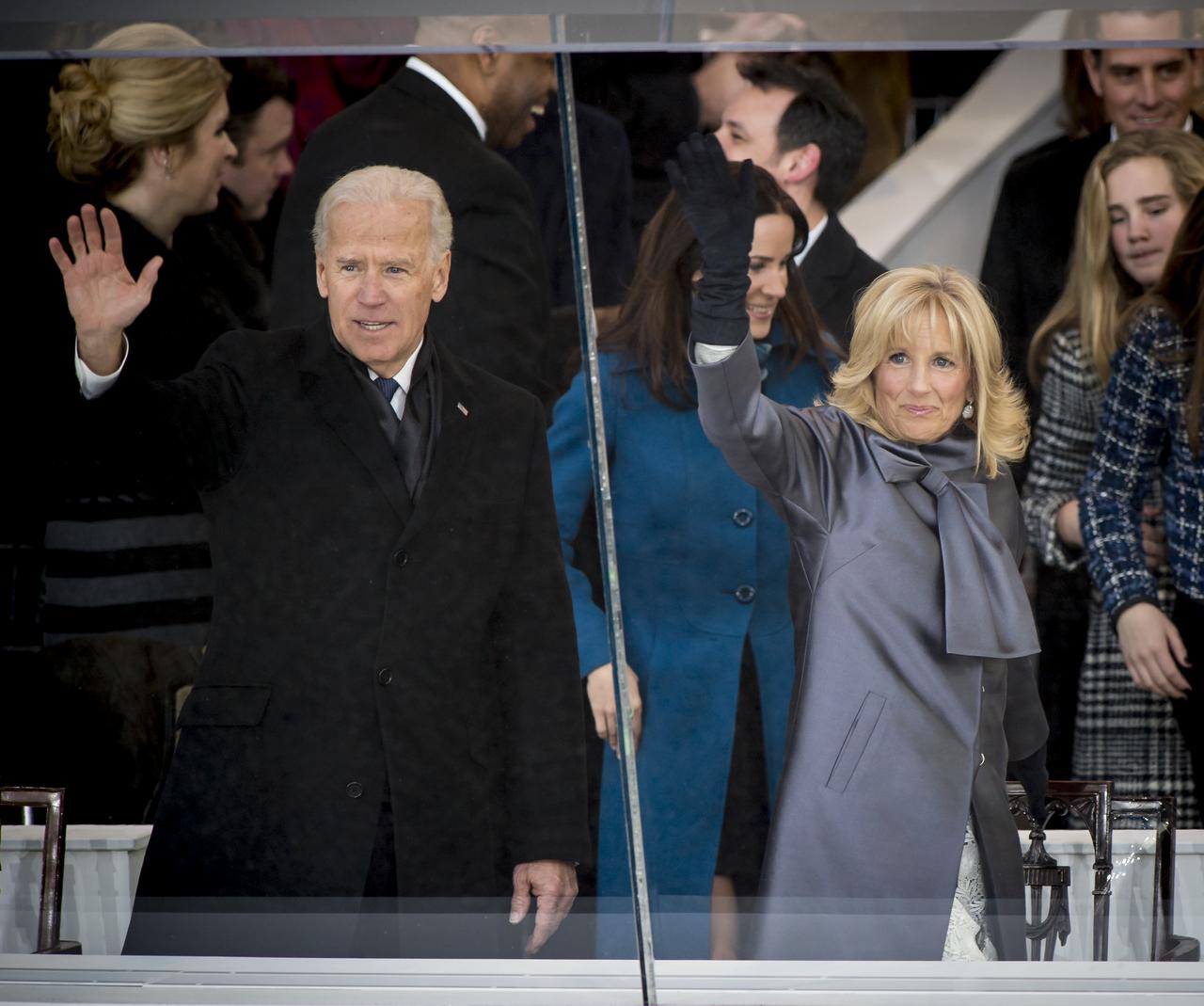
Vice President Joe Biden and his wife Jill wave as they arrive in the reviewing stand for the inaugural parade, Monday, Jan. 21, 2013, in Washington. President Barack Obama and Biden had their ceremonial swearing-in earlier in the day. Photo Credit: (NASA/Bill Ingalls)
2013 Inaugural Parade
PHOTO DATE: 03-29-09   LOCATION: Ellington - Hangar 990 SUBJECT: STS-119 crew return ceremony. Photograph s of crew arriving, overall views, individual views of each astronaut, other special speakers, interaction with crowd, signing autographs. PHOTOGRAPHER:  Devin Boldt
STS-119 Crew Return Ceremony to Ellington Field
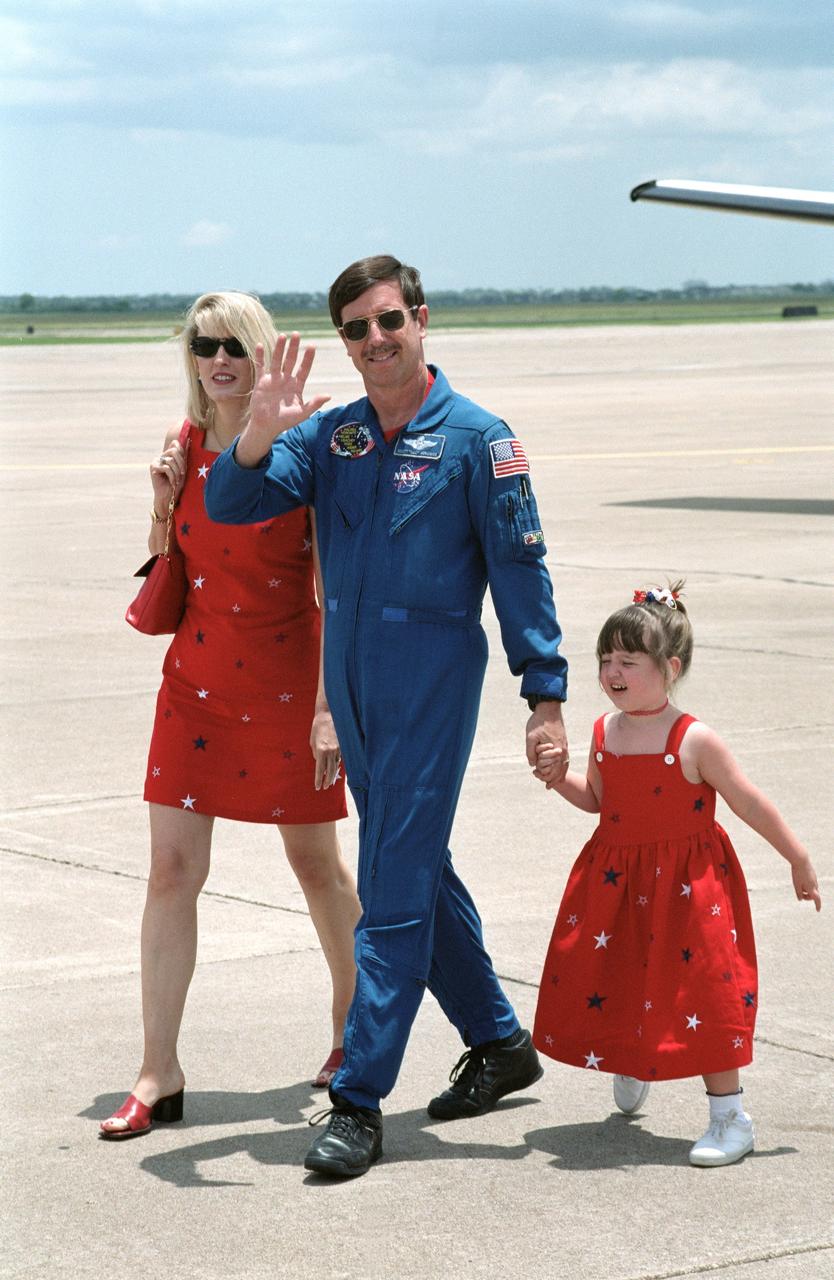
JSC2000-04594 (30 May 2000) --- Astronaut Scott J. Horowitz, pilot,  reunites with wife Lisa Marie and young daughter following the STS-101 crew  return.  A welcome-home ceremony followed the arrival of the six astronauts and one cosmonaut at Ellington Field on the day after the  landing of the Space Shuttle Atlantis in  Florida.
STS-101 crew return at Ellington Field
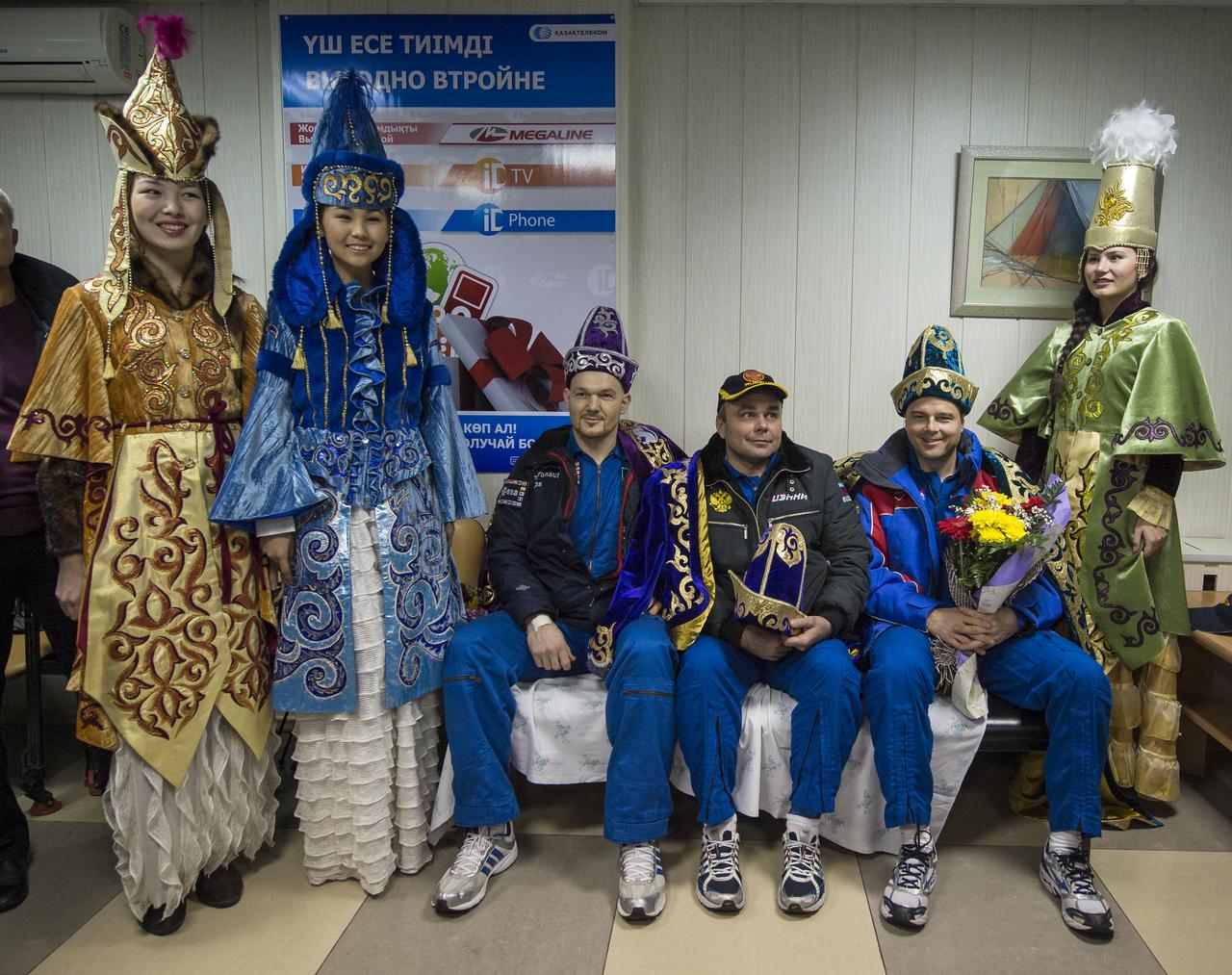
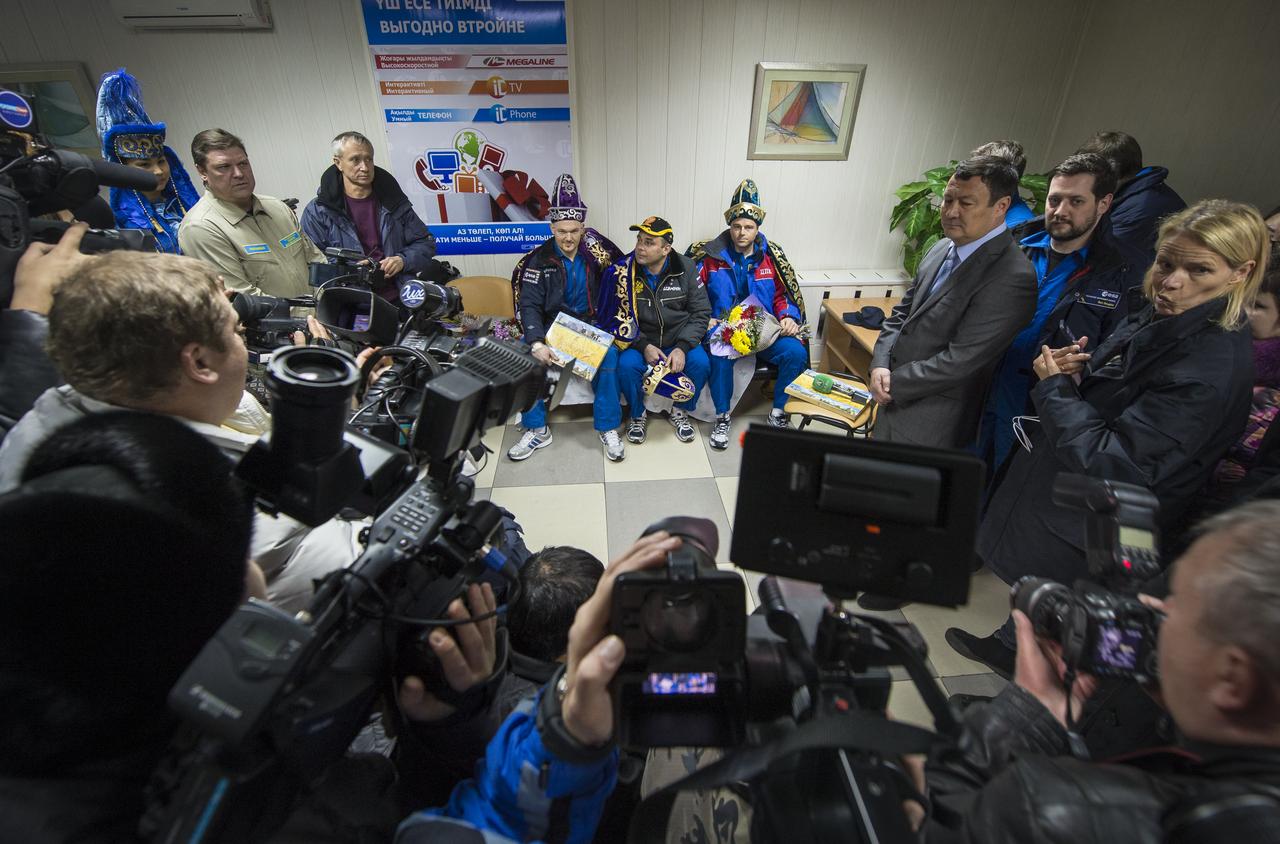
Expedition 41 light Engineer Alexander Gerst of the European Space Agency (ESA), seated left, Commander Max Suraev of the Russian Federal Space Agency (Roscosmos), center, and NASA Flight Engineer Reid Wiseman, pose for a photograph with women in kazakh ceremonial dress during a welcome ceremony at the Kustanay Airport shortly after they arrived there via helicopter from their Soyuz landing site in a remote area near the town of Arkalyk, Kazakhstan on Monday, Nov. 10, 2014. Suraev, Wiseman and Gerst returned to Earth after more than five months onboard the International Space Station where they served as members of the Expedition 40 and 41 crews. Photo Credit: (NASA/Bill Ingalls)
Expedition 41 Soyuz TMA-13M Landing
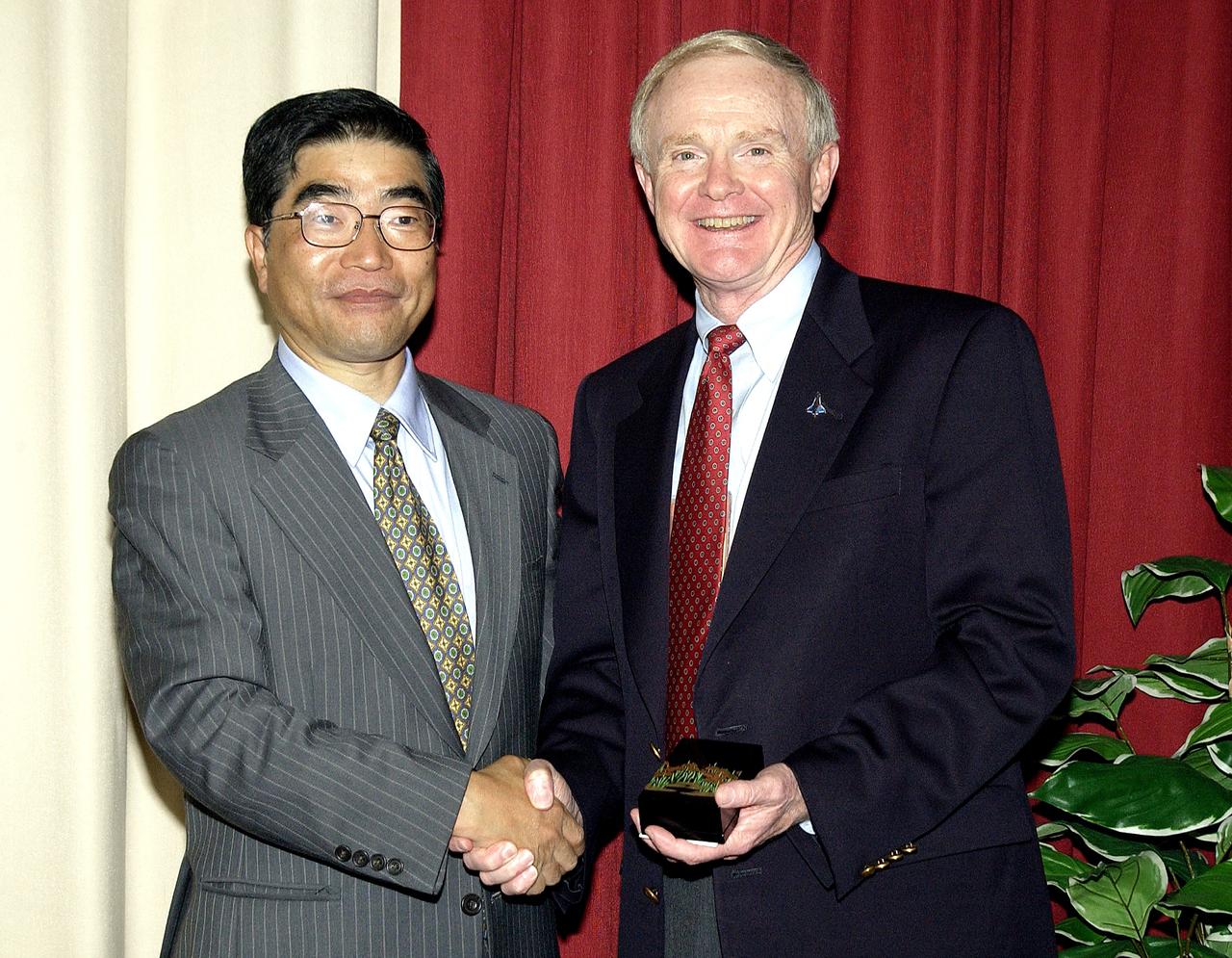
KENNEDY SPACE CENTER, FLA. -  Executive Director of NASDA Koji Yamamoto (left) and Center Director Roy Bridges Jr. (right) exchange mementos during Mr. Yamamoto’s visit to KSC.  Mr. Bridges also holds the logo of the new Japan Aerospace Exploration Agency, a merger of three Japanese aeronautical and space agencies effective Oct.1, 2003.  Mr. Yamamoto is at KSC for a welcome ceremony involving the arrival of the newest Space Station module, the Japanese Experiment Module/pressurized module.  His visit includes a tour of the Columbia Debris Hangar.
KENNEDY SPACE CENTER, FLA. - Executive Director of NASDA Koji Yamamoto (left) and Center Director Roy Bridges Jr. (right) exchange mementos during Mr. Yamamoto’s visit to KSC. Mr. Bridges also holds the logo of the new Japan Aerospace Exploration Agency, a merger of three Japanese aeronautical and space agencies effective Oct.1, 2003. Mr. Yamamoto is at KSC for a welcome ceremony involving the arrival of the newest Space Station module, the Japanese Experiment Module/pressurized module. His visit includes a tour of the Columbia Debris Hangar.
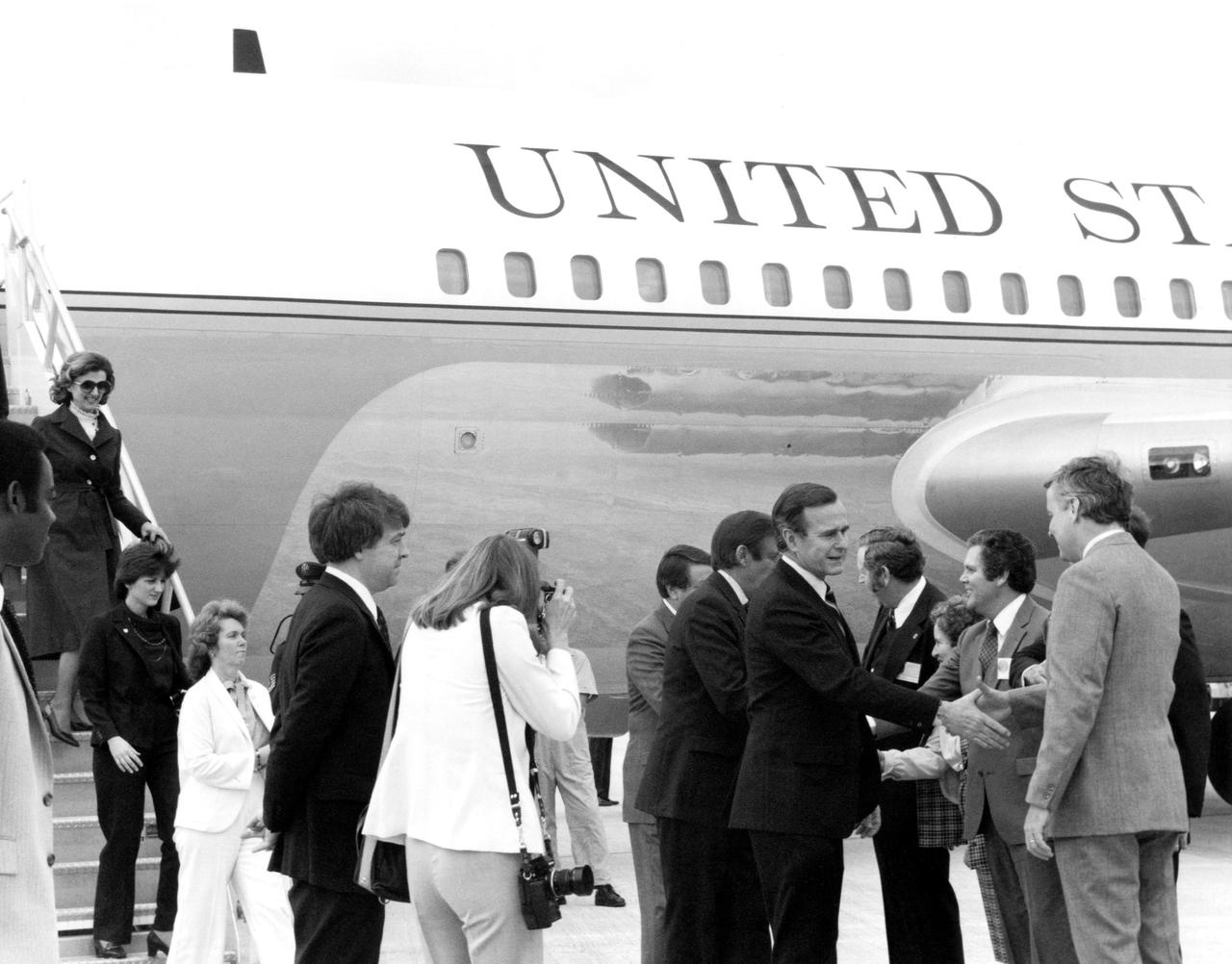
KENNEDY SPACE CENTER, FLA. -- Vice President George H.W. Bush, center left, is welcomed to KSC's Shuttle Landing facility.  At the Center for the Spacelab Arrival Ceremony, the vice president is greeted by, from left, Center Director Richard G. Smith; Mrs. Smith; U.S.  Rep. Ronnie Flippo, D-Ala.; an Robert Allnut, director of external affairs for NASA Headquarters.  In the welcoming party but not pictured was U.S. Rep. Bill Nelson, D-Fla.
KSC-82p-84
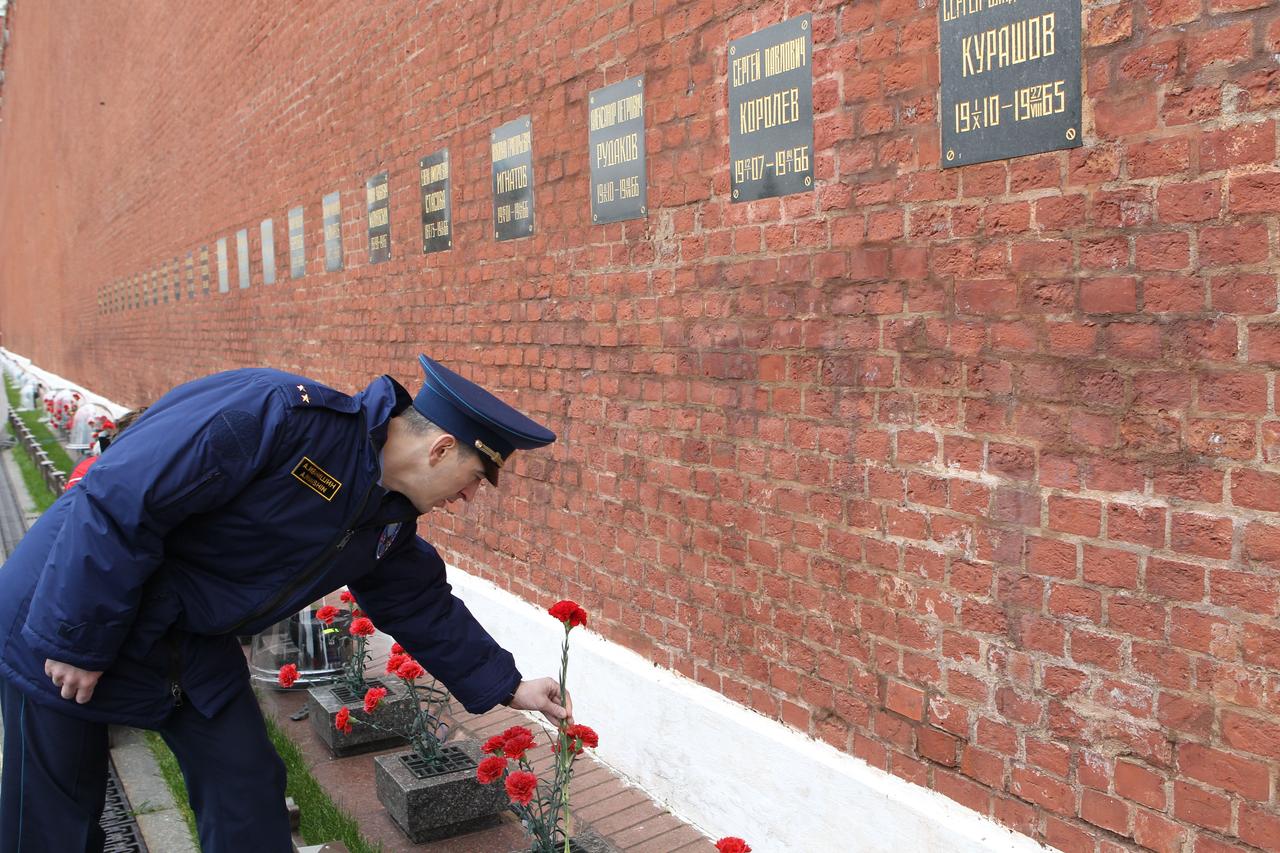
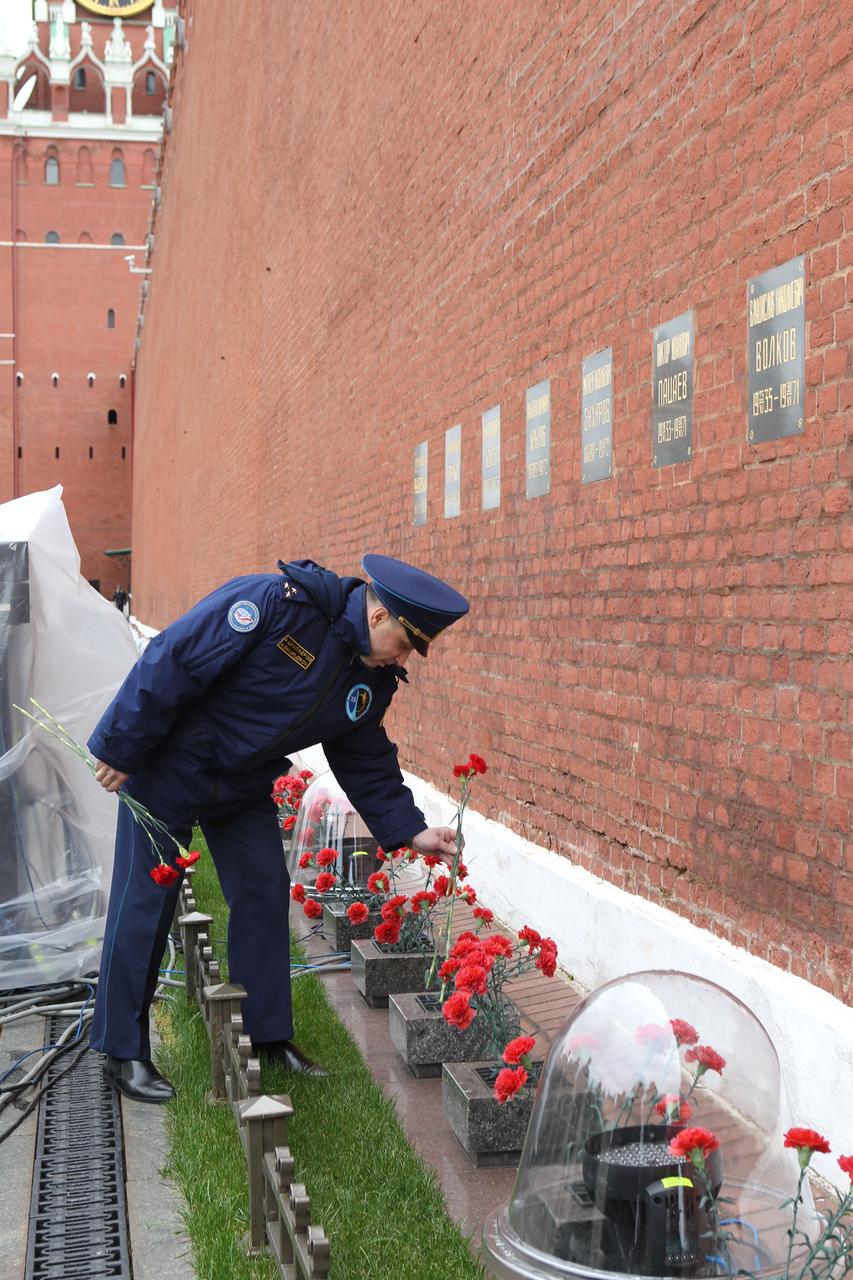
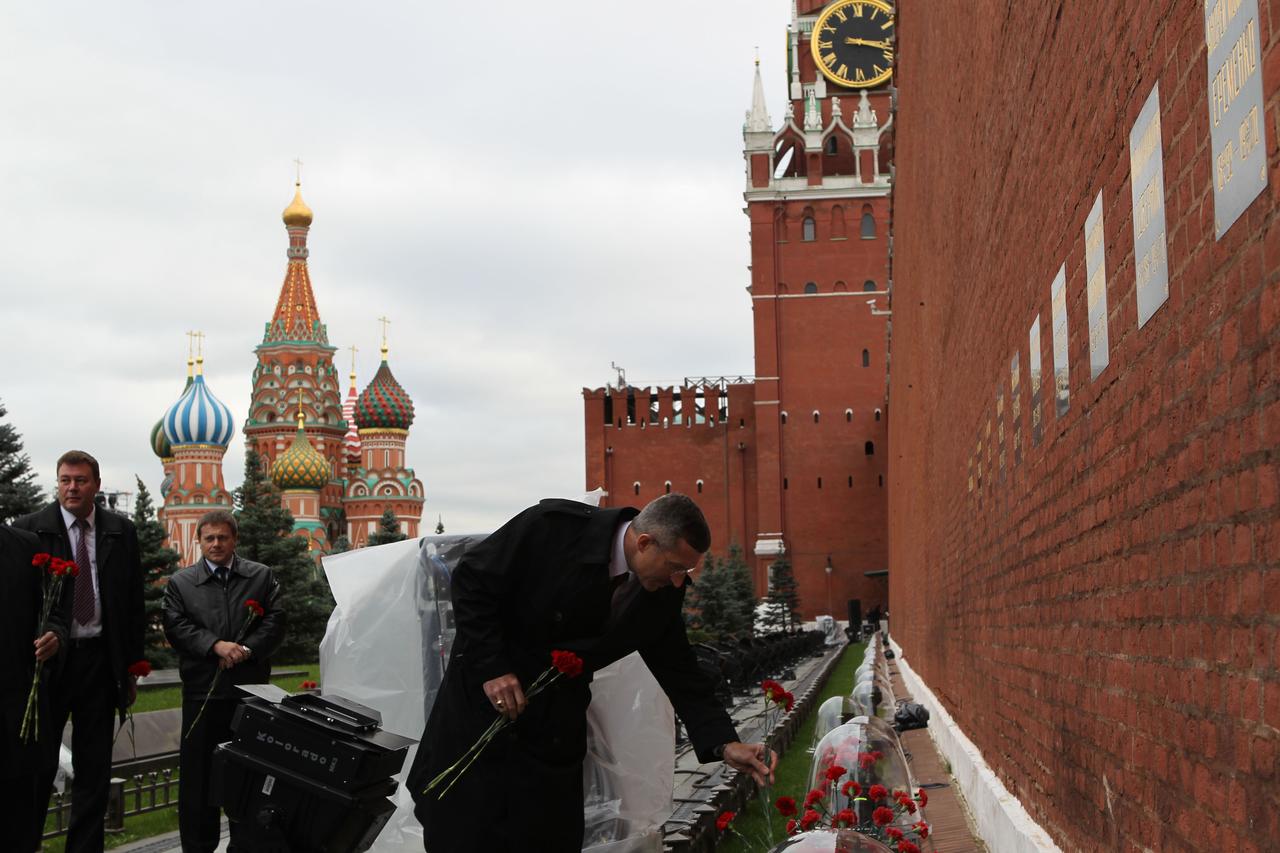
At the Kremlin Wall in Moscow, Expedition 30 Flight Engineer Anatoly Ivanishin laid flowers October 24, 2011 in a traditional ceremony during the tour of Red Square he and his crewmates conducted prior to their launch to the International Space Station November 14 on the Soyuz TMA-22 spacecraft from the Baikonur Cosmodrome in Kazakhstan. Ivanishin, Expedition Commander Dan Burbank of NASA and Soyuz Commander Anton Shkaplerov will arrive in Baikonur October 31 for final pre-launch preparations.  Credit: NASA
jsc2011e203165
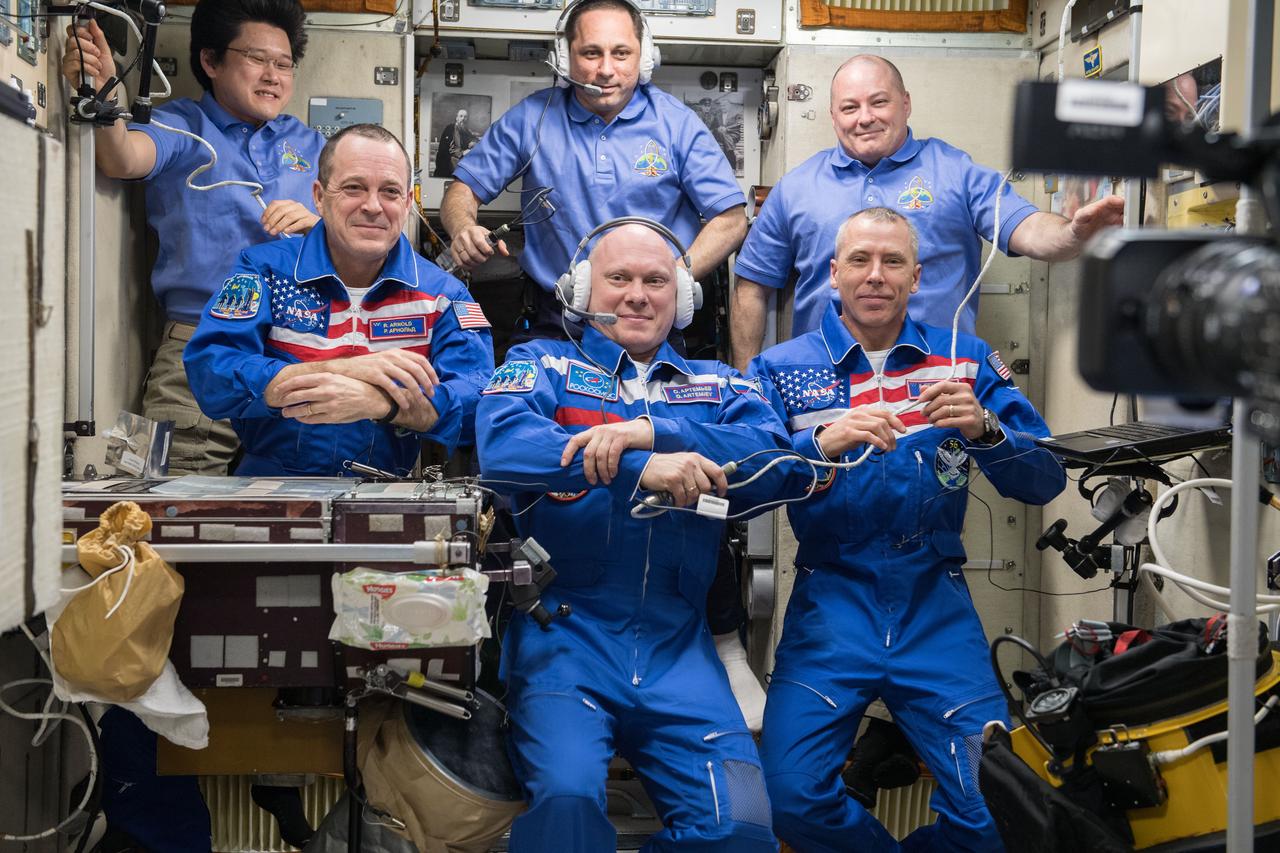
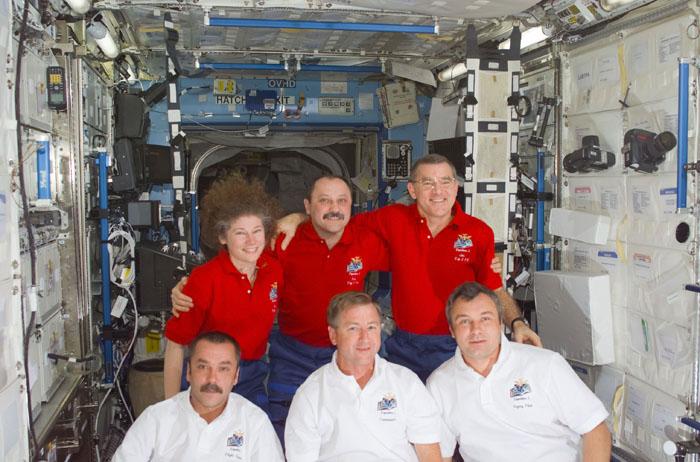
iss055e004863 (March 23, 2018) --- The newly-expanded Expedition 55 crew gathers inside the Zvezda service module with its three newest crew members in the front row for a welcoming ceremony shortly after they arrived March 23, 2018. In front from left are Flight Engineers Ricky Arnold, Oleg Artemyev and Drew Feustel. In the back from left are Flight Engineer Norishige Kanai, Commander Anton Shkaplerov and Flight Engineer Scott Tingle.
iss055e004863
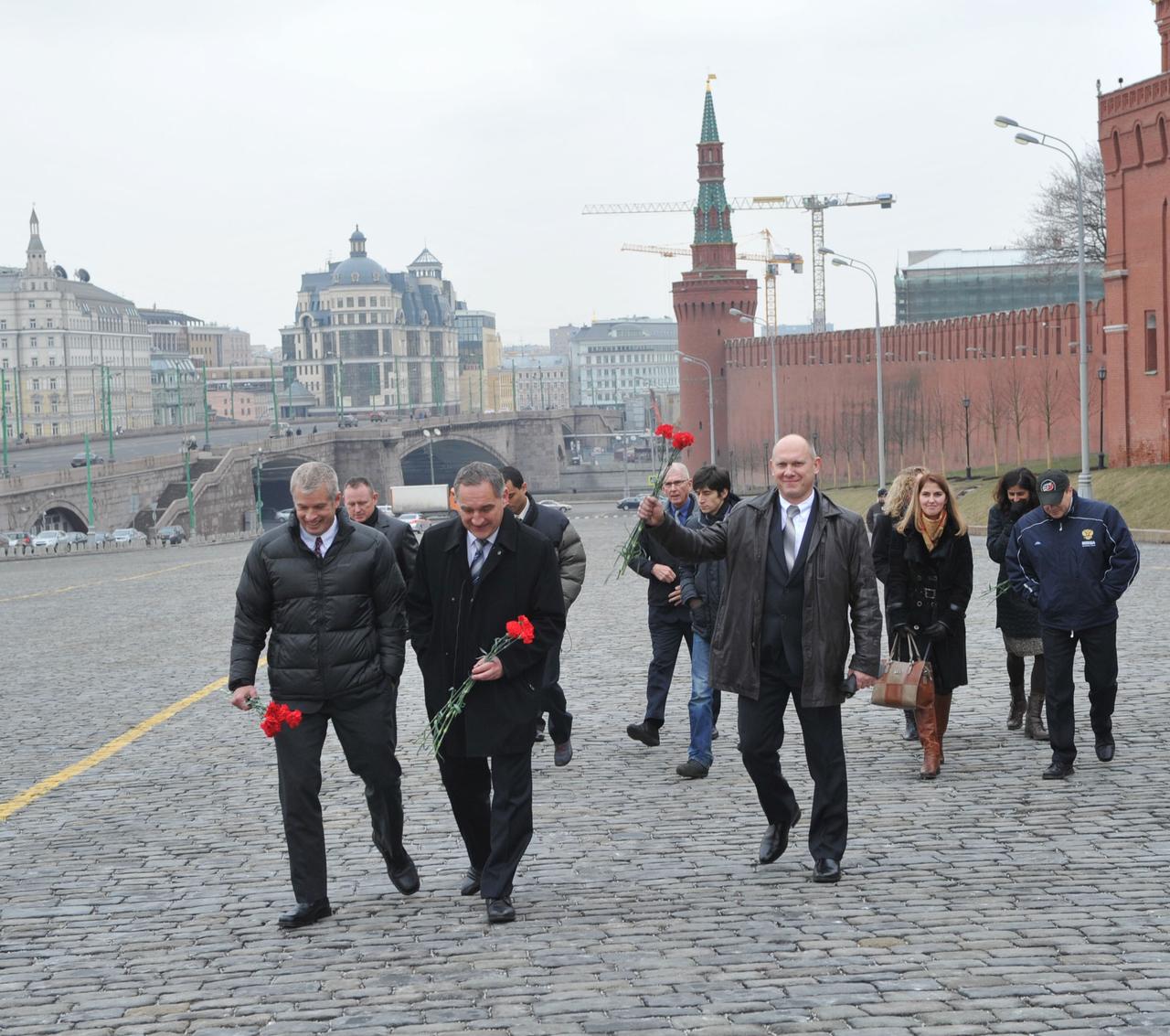
Expedition 39/40 Flight Engineer Steve Swanson of NASA (front, left), Alexander Samokutyaev of Roscosmos (front, center) and Oleg Artemyev (front, right) arrive at Red Square in Moscow by the Kremlin March 6 for the ceremonial laying of flowers at the Kremlin Wall in tribute to Russian space icons who are interred there. Swanson, Skvortsov and Artemyev are preparing for their launch to the International Space Station from the Baikonur Cosmodrome in Kazakhstan March 26, Kazakh time, in their Soyuz TMA-12M spacecraft for a six-month mission.  NASA/Stephanie Stoll
jsc2014e024976
At the Kremlin Wall in Moscow, Expedition 30 Soyuz Commander Anton Shkaplerov laid flowers October 24, 2011 in a traditional ceremony during the tour of Red Square he and his crewmates conducted prior to their launch to the International Space Station November 14 on the Soyuz TMA-22 spacecraft from the Baikonur Cosmodrome in Kazakhstan. Shkaplerov, Expedition Commander Dan Burbank of NASA and Anatoly Ivanishin will arrive in Baikonur October 31 for final pre-launch preparations.  Credit: NASA
jsc2011e203163
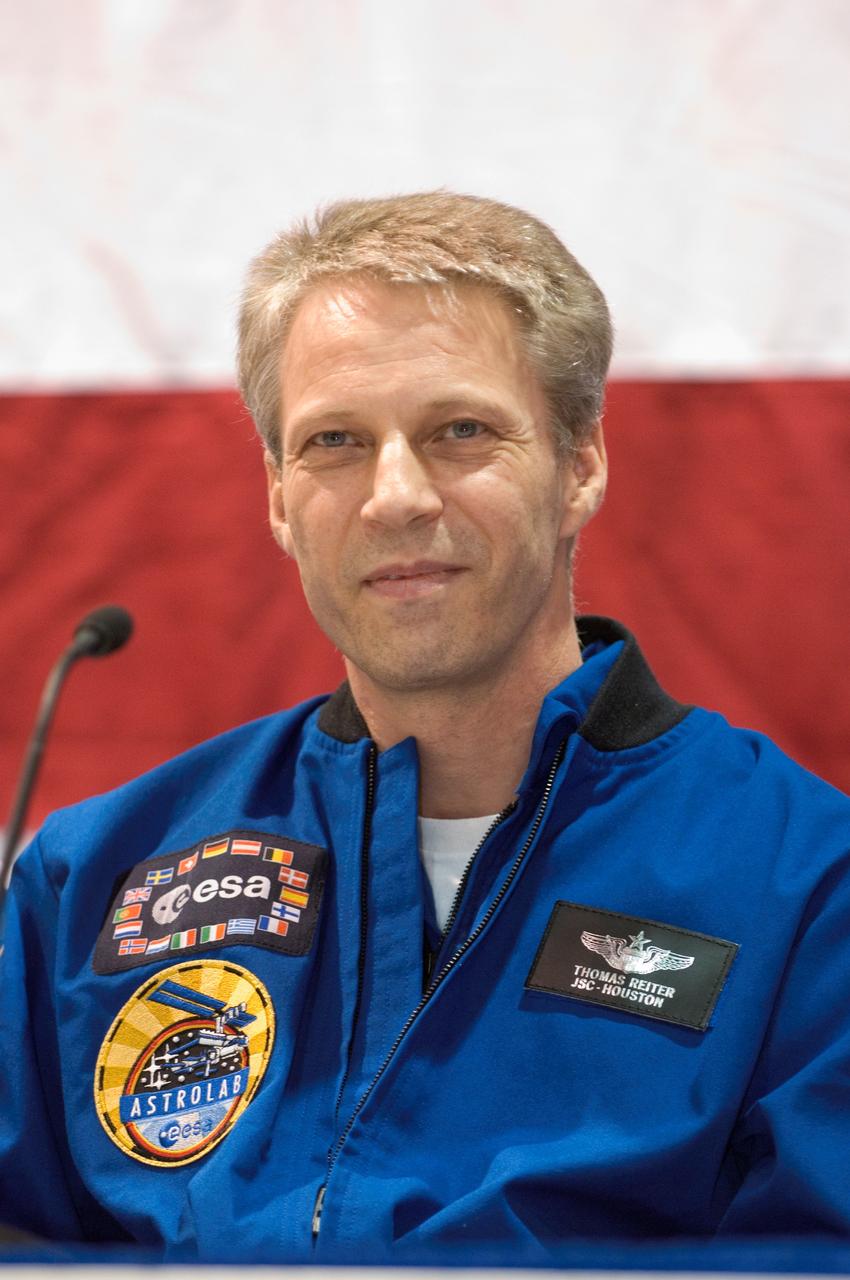
JSC2006-E-54869 (23 Dec. 2006) --- European Space Agency astronaut Thomas Reiter, STS-116 mission specialist, speaks to a crowd of well-wishers at the STS-116 crew return ceremony on the afternoon of Dec. 23 at Ellington Field. Reiter didn't launch with the STS-116 crew, as he had already been onboard the International  Space Station for several months when Discovery arrived to link up with it on Dec. 11. Reiter and all six of his crewmates briefly addressed the crowd.
STS-116 Crew and ESA astronaut Thomas Reiter during Crew Return Ceremony
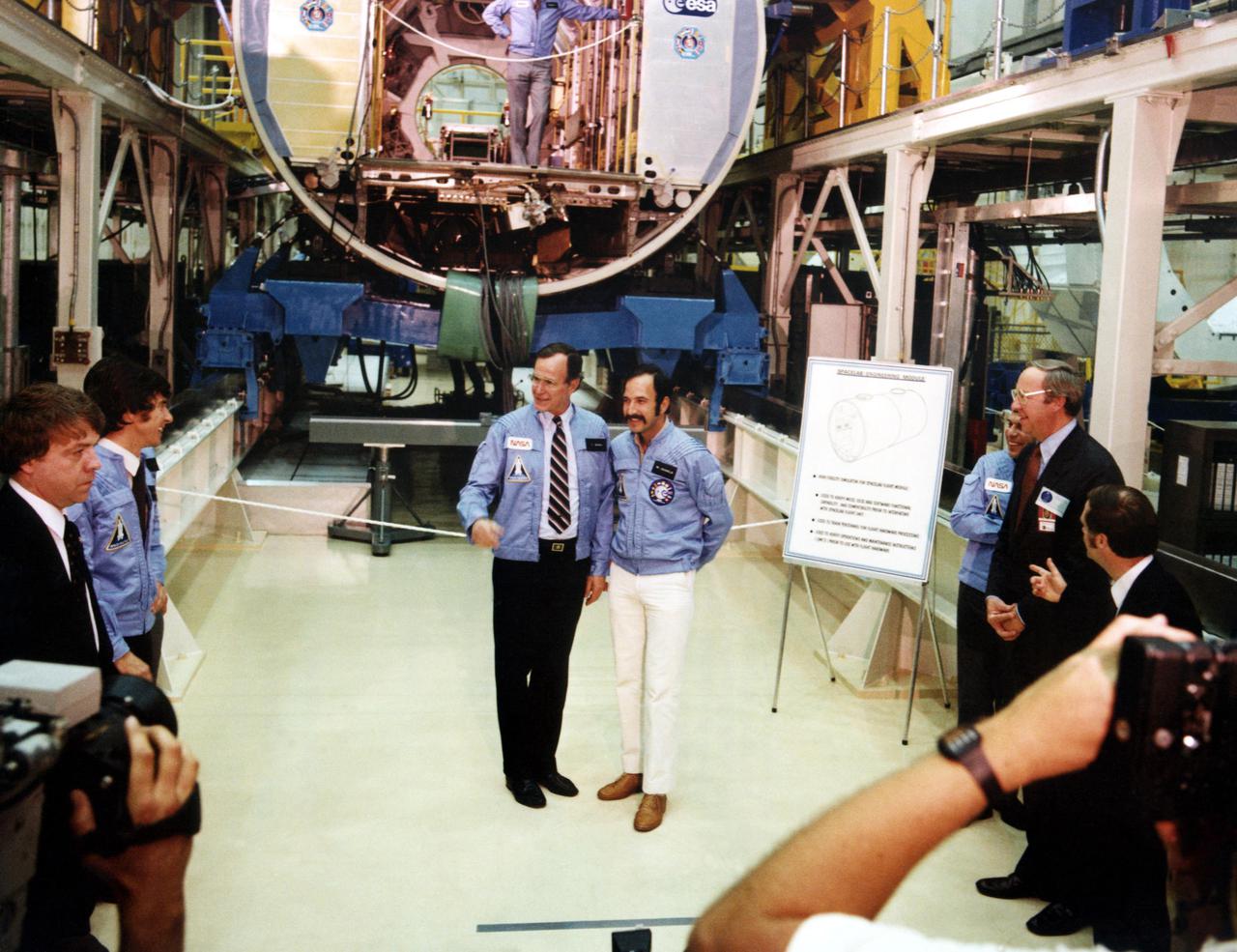
KENNEDY SPACE CENTER, FLA. -- Vice President George F. Bush, center left, is pictured with Payload Specialist Wubbo Ockels of the Netherlands during the Spacelab Arrival Ceremony.  Second from left is Payload Specialist Ulf Merbold, Germany.  At far right are James McCulls, chief, Special Services Branch, NASA Headquarters; and James C. Harrington, director, Spacelab Program, NASA.  Overhead, astronaut Owen K. Garriott, U.S.A., stands in the Spacelab Engineering Module.
KSC-82pc-130
At the Kremlin Wall in Moscow, Expedition 30 Commander Dan Burbank of NASA laid flowers October 24, 2011 in a traditional ceremony during the tour of Red Square he and his crewmates conducted prior to their launch to the International Space Station November 14 on the Soyuz TMA-22 spacecraft from the Baikonur Cosmodrome in Kazakhstan. Burbank, Soyuz Commander Anton Shkaplerov and Anatoly Ivanishin will arrive in Baikonur October 31 for final pre-launch preparations.  Credit: NASA
jsc2011e203164
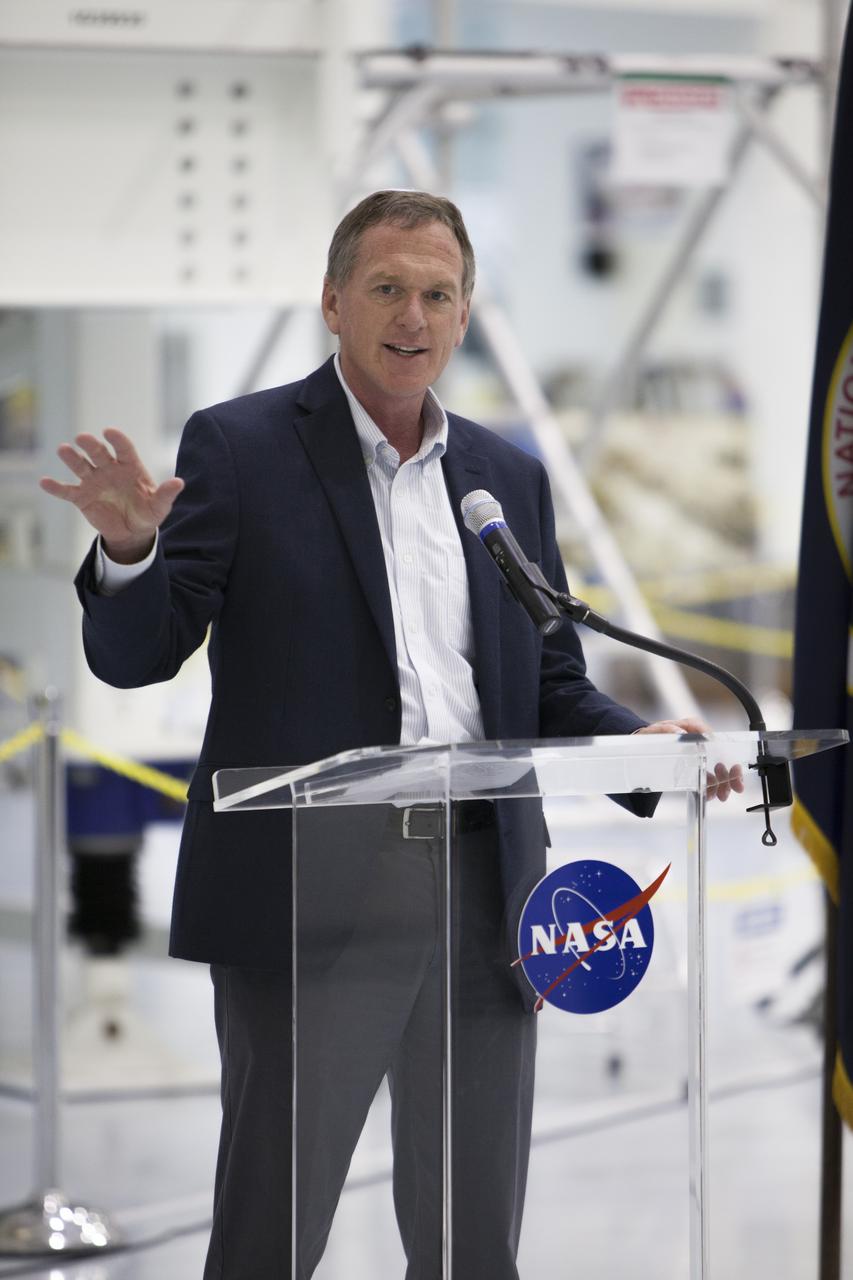
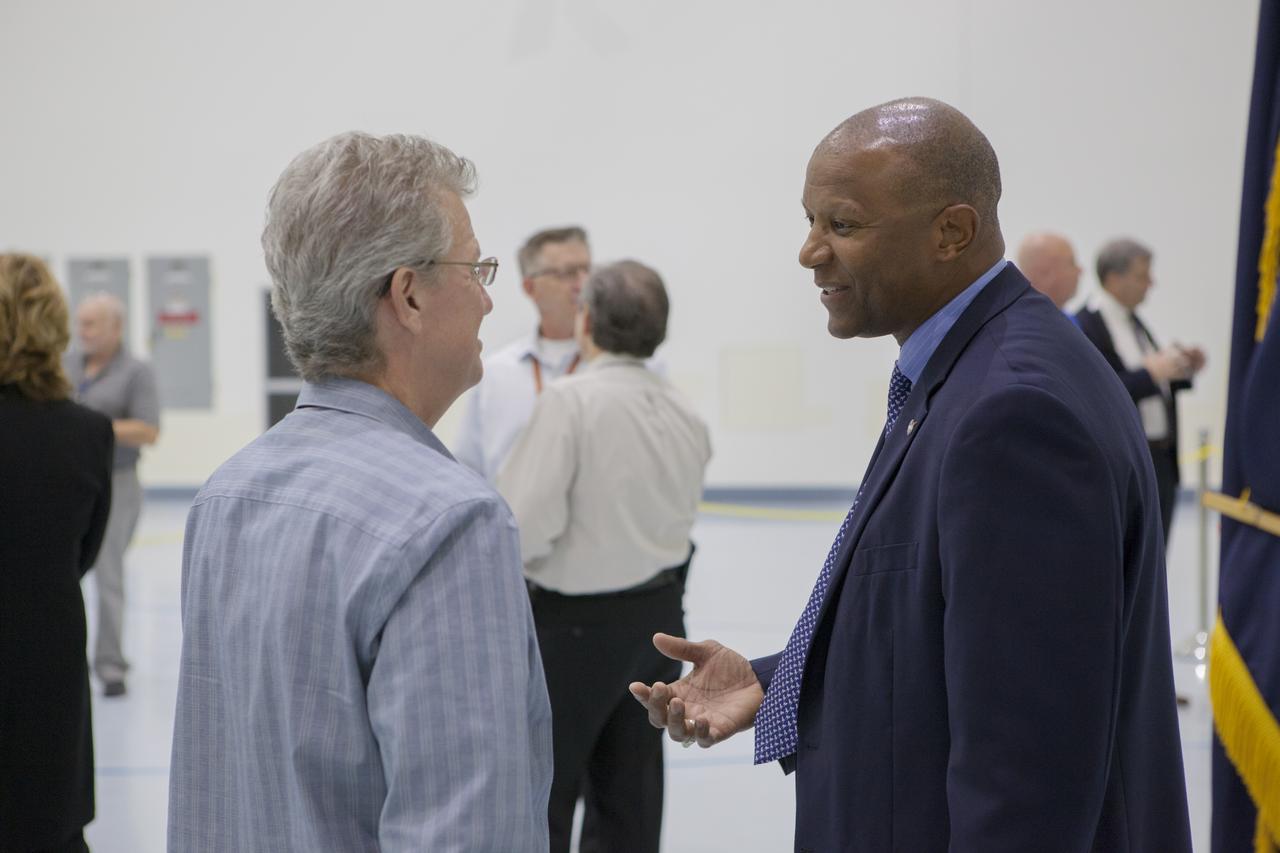
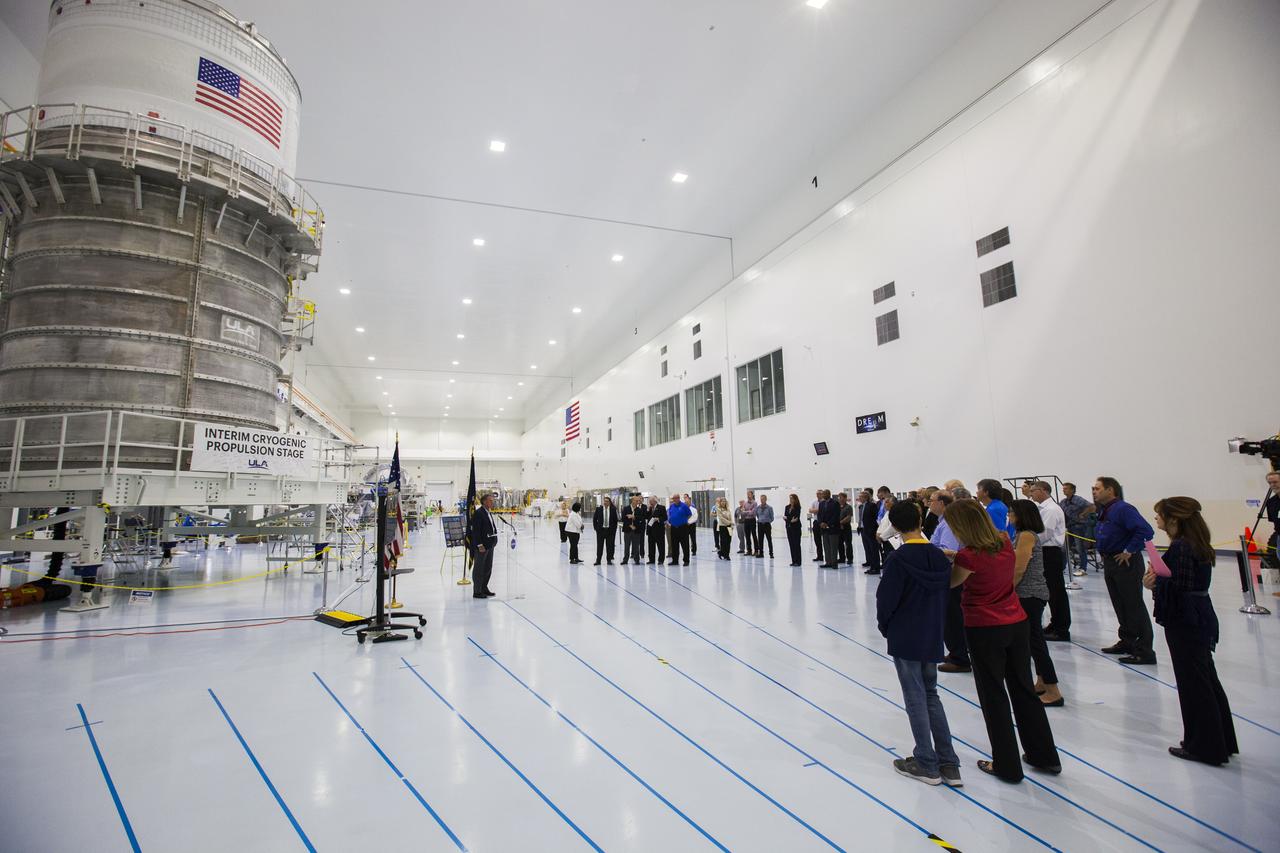
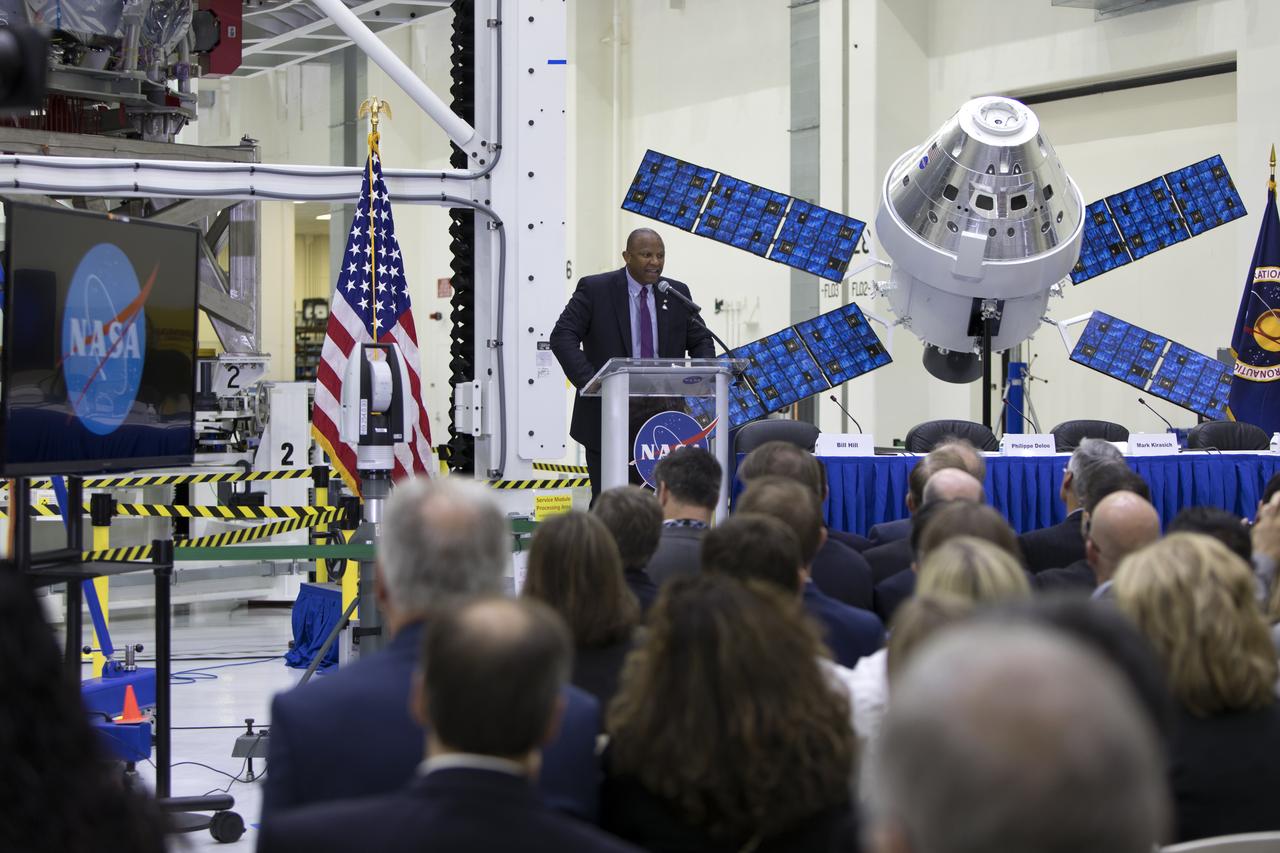
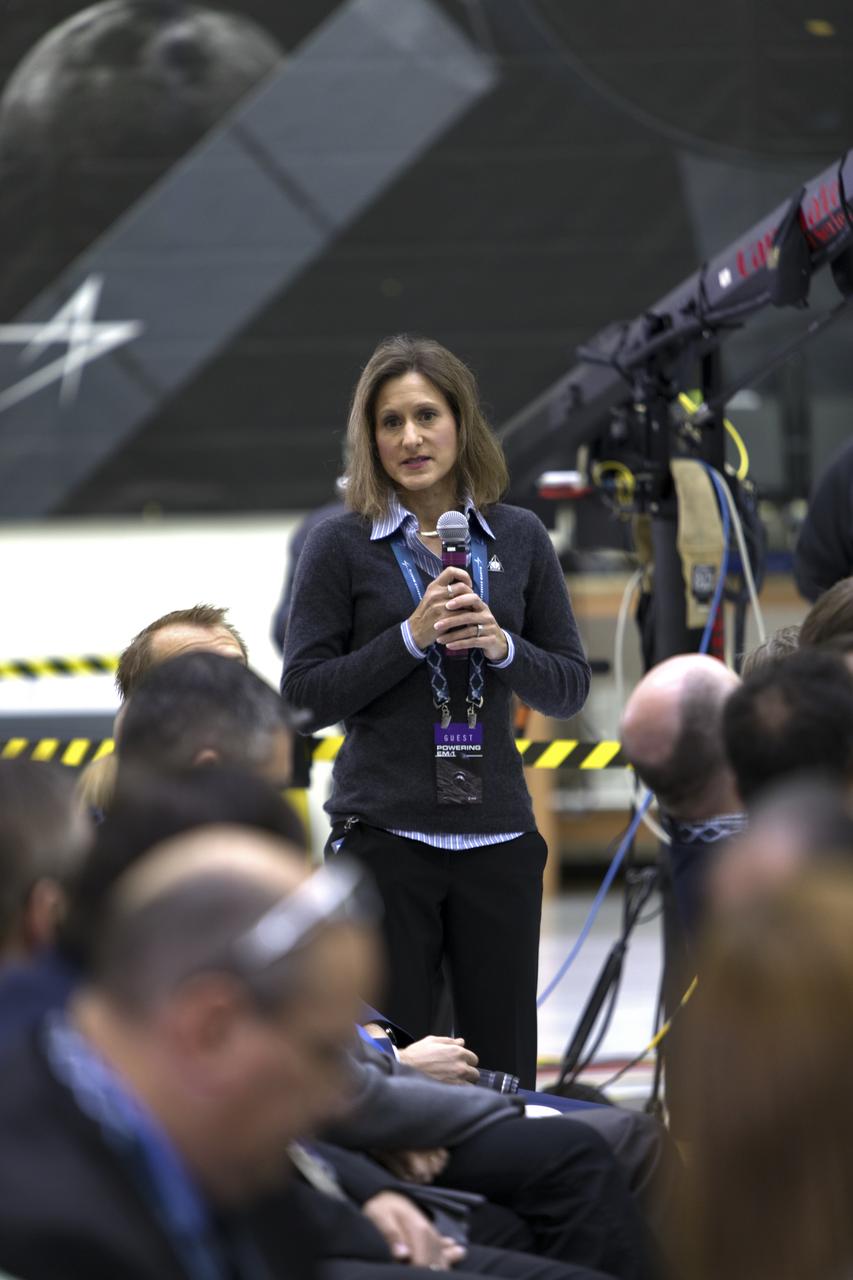
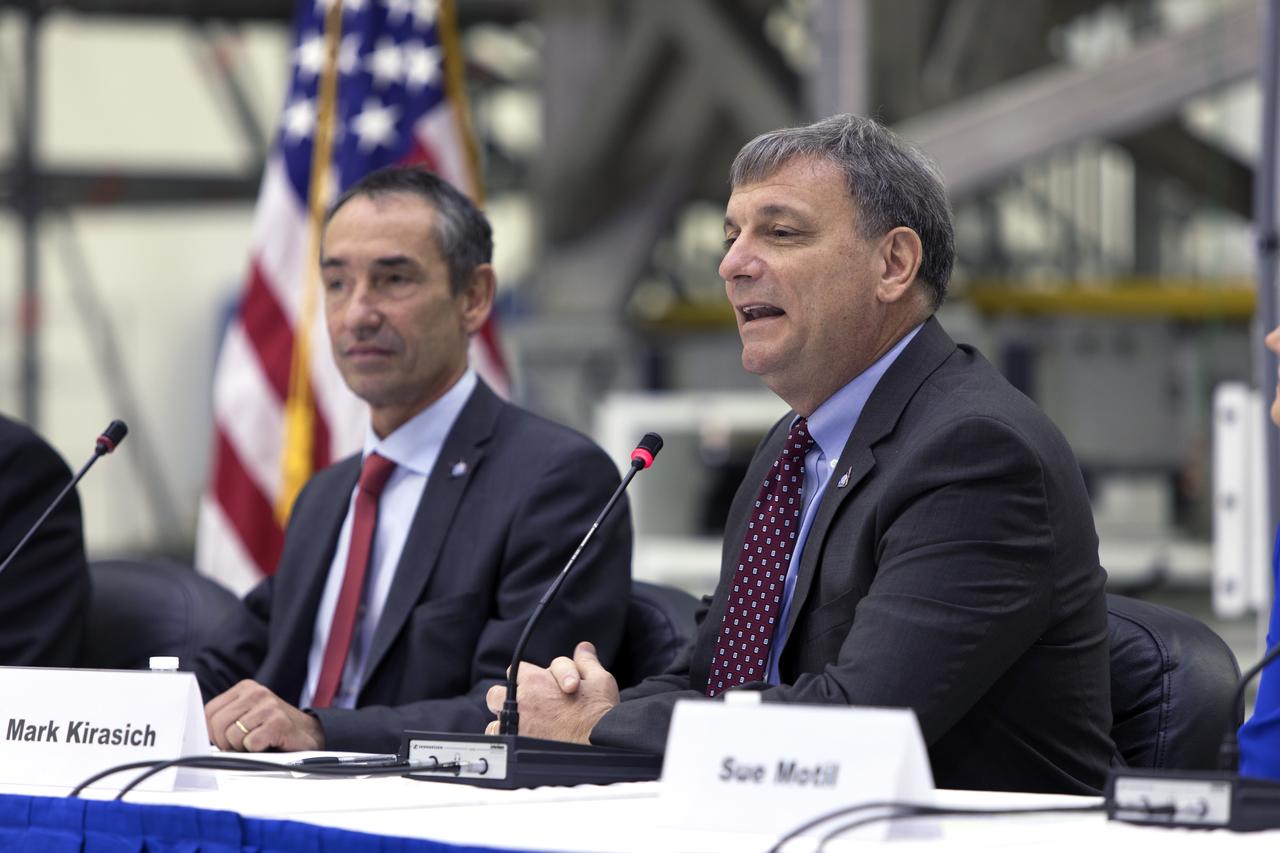
Mike Bolger, Ground Systems Development and Operations Program manager at NASA's Kennedy Space Center, speaks to guests during a ceremony in the high bay of the Space Station Processing Facility. The event marked the milestone of the Space Launch System rocket's Interim Cryogenic Propulsion Stage (ICPS) being turned over from NASA's Spacecraft/Payload Integration and Evolution organization to the spaceport's Ground Systems Development and Operations directorate. The ICPS is the first integrated piece of flight hardware to arrive in preparation for the uncrewed Exploration Mission-1.
ICPS Turnover GSDO Employee Event
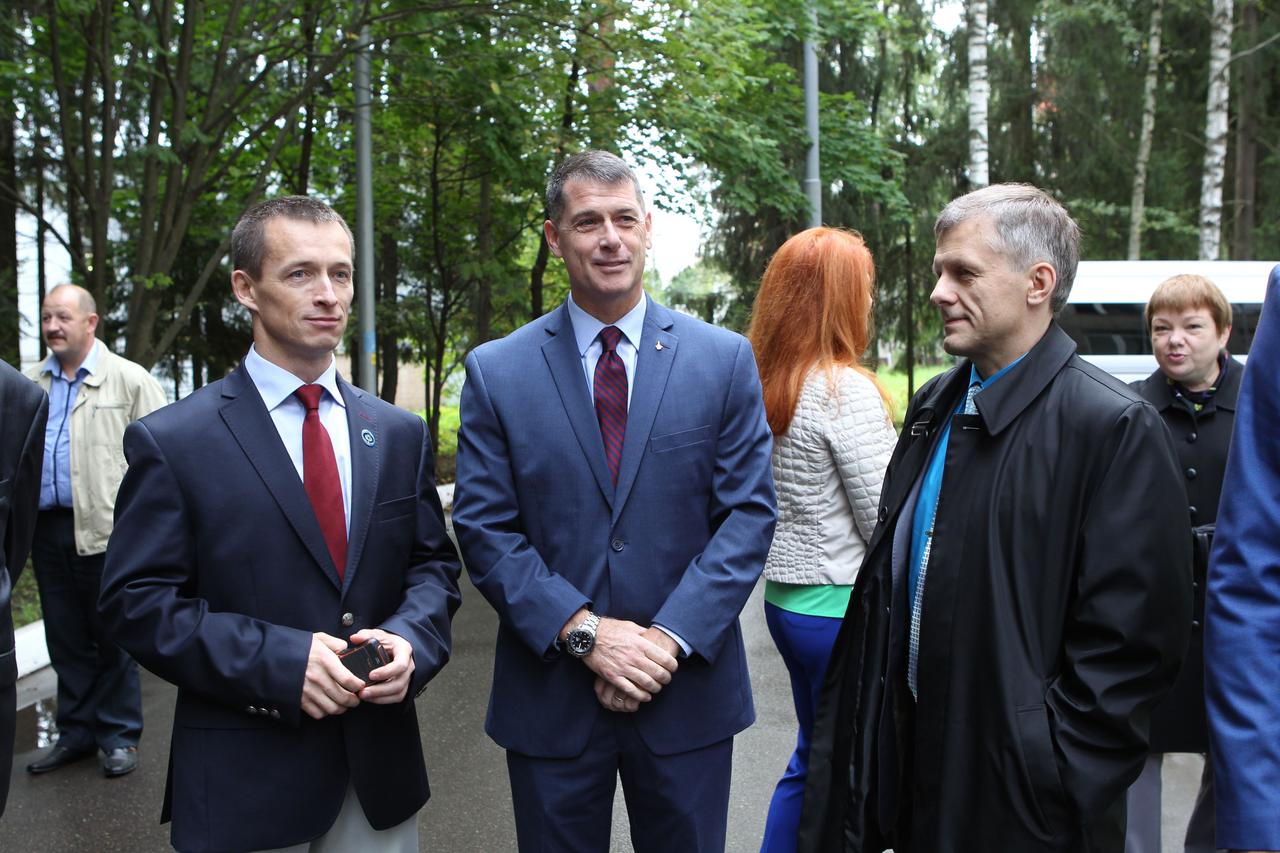
At the Gagarin Cosmonaut Training Center in Star City, Russia, Expedition 49 crewmembers Sergey Ryzhikov of Roscosmos (left), Shane Kimbrough of NASA (center) and Andrey Borisenko of Roscosmos (right) arrive for a breakfast ceremony Sept. 8 before departing for a flight to the launch site at the Baikonur Cosmodrome in Kazakhstan, where they will launch on Sept. 24, Kazakh time on the Soyuz MS-02 spacecraft for a five-month mission on the International Space Station.  NASA/Stephanie Stoll
jsc2016e109727
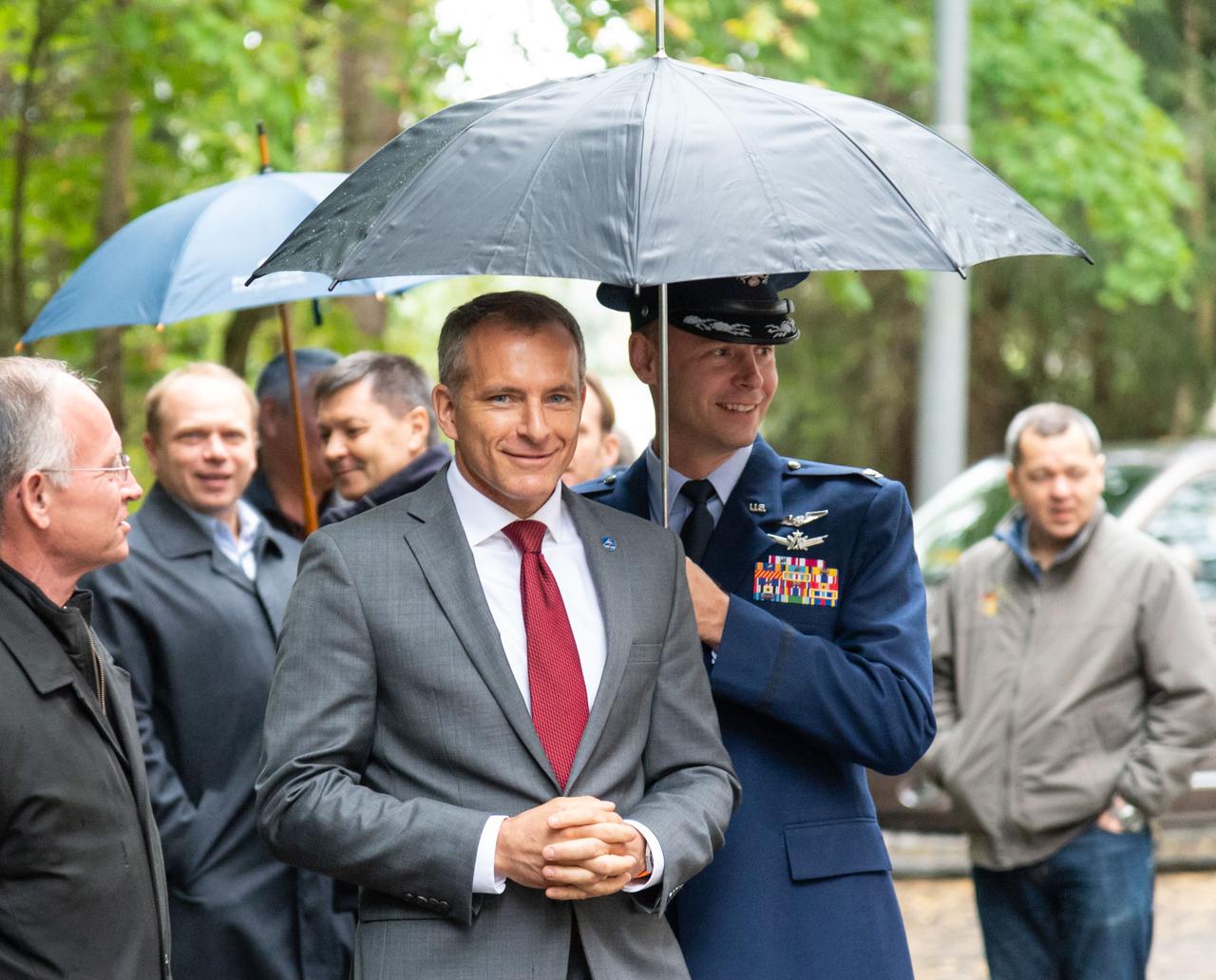
At the Gagarin Cosmonaut Training Center in Star City, Russia, Expedition 57 backup crewmember David Saint-Jacques of the Canadian Space Agency arrives for departure ceremonies Sept. 25, shielded from the rain by prime crewmember Nick Hague of NASA. Hague and Alexey Ovchinin of Roscosmos will launch Oct. 11 from the Baikonur Cosmodrome in Kazakhstan on the Soyuz MS-10 spacecraft for a six-month mission on the International Space Station...NASA/Elizabeth Weissinger.
jsc2018e084303
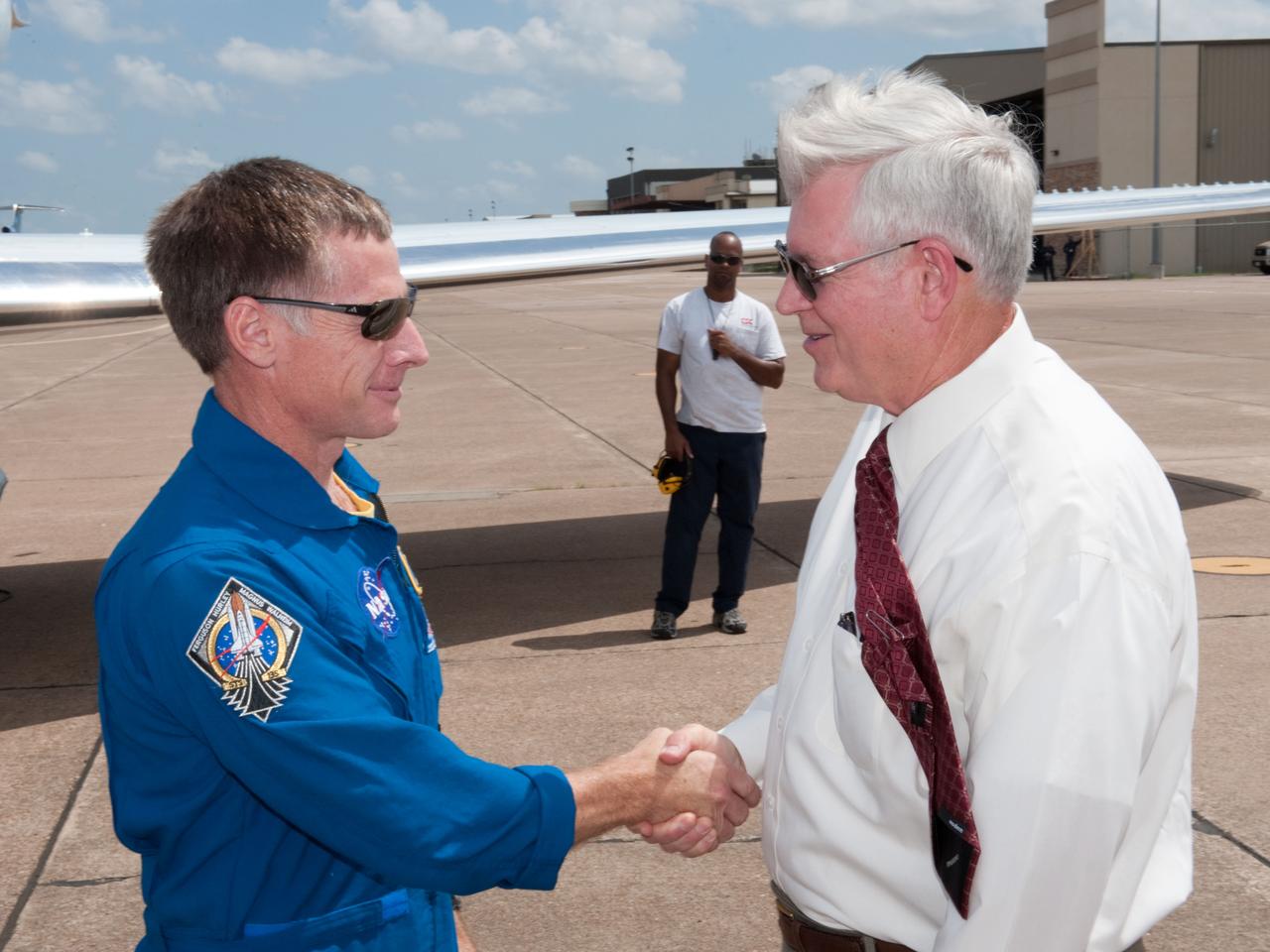
JSC2011-E-070263 (22 July 2011) --- NASA's Johnson Space Center (JSC) director Michael L. Coats (right) greets NASA astronaut Chris Ferguson, STS-135 commander, shortly after he and three other crew members arrived at Ellington Field near JSC. Awaiting them was a large crowd on hand in nearby Hangar 990 to welcome them home to Houston during a return ceremony for the final mission for the Space Shuttle Program. Photo credit: NASA
STS-135 Crew Return
KENNEDY SPACE CENTER, FLA. - Alan Thirkettle (center), International Space Station Program manager for Node 2, European Space Agency (ESA); and NASA’s Michael C. Kostelnik (right), deputy associate administrator for International Space Station and Shuttle Programs, sign documents officially transferring ownership of Node 2 between the ESA and NASA.  At left, also part of the signing, is Andrea Lorenzoni (left), International Space Station Program manager for Node 2, Italian Space Agency.  NASA's Node 2, built by ESA in Italy, arrived at KSC on June 1. It will be the next pressurized module installed on the Station. The pressurized module of the Japanese Experiment Module (JEM),  named "Kibo" (Hope), arrived at KSC on June 4. It is Japan's primary contribution to the Station. Emceed by Lisa Malone, deputy director of External Relations and Business Development at KSC, the ceremony also included these speakers: Center Director Roy Bridges Jr.; NASA’s William Gerstenmaier, International Space Station Program manager; and Kuniaki Shiraki, JEM Project manager, National Aerospace and Development Agency of Japan.
KENNEDY SPACE CENTER, FLA. - Alan Thirkettle (center), International Space Station Program manager for Node 2, European Space Agency (ESA); and NASA’s Michael C. Kostelnik (right), deputy associate administrator for International Space Station and Shuttle Programs, sign documents officially transferring ownership of Node 2 between the ESA and NASA. At left, also part of the signing, is Andrea Lorenzoni (left), International Space Station Program manager for Node 2, Italian Space Agency. NASA's Node 2, built by ESA in Italy, arrived at KSC on June 1. It will be the next pressurized module installed on the Station. The pressurized module of the Japanese Experiment Module (JEM), named "Kibo" (Hope), arrived at KSC on June 4. It is Japan's primary contribution to the Station. Emceed by Lisa Malone, deputy director of External Relations and Business Development at KSC, the ceremony also included these speakers: Center Director Roy Bridges Jr.; NASA’s William Gerstenmaier, International Space Station Program manager; and Kuniaki Shiraki, JEM Project manager, National Aerospace and Development Agency of Japan.
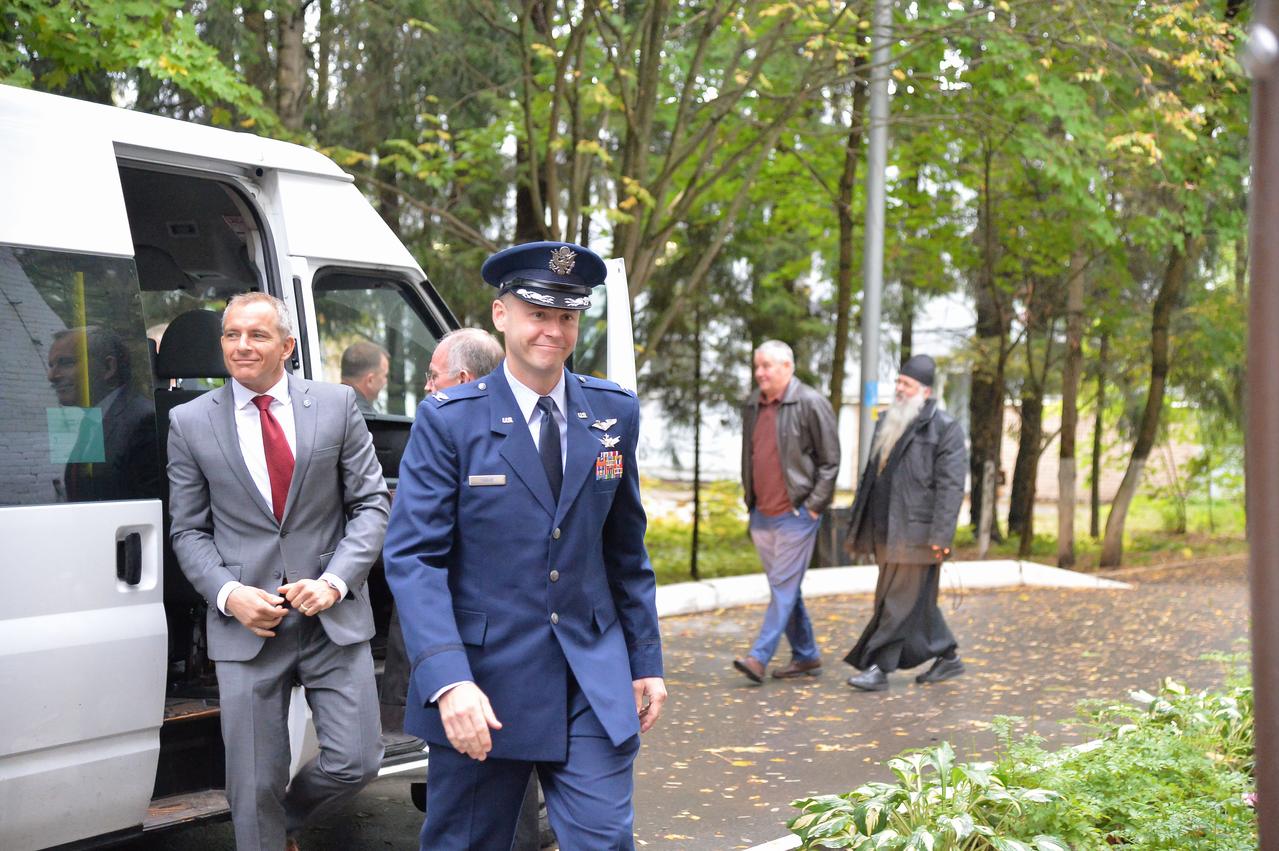
At the Gagarin Cosmonaut Training Center in Star City, Russia, Expedition 57 prime crewmember Nick Hague of NASA (foreground) arrives for crew departure ceremonies Sept. 25 before he and his crewmates left for their launch site in Baikonur, Kazakhstan for final pre-launch training. Following Hague out of their van is backup crewmember David Saint-Jacques of the Canadian Space Agency. Hague and Alexey Ovchinin of Roscosmos will launch Oct. 11 from the Baikonur Cosmodrome in Kazakhstan on the Soyuz MS-10 spacecraft for a six-month mission on the International Space Station...NASA/Sarah Volkman.
jsc2018e084307
Expedition 41 light Engineer Alexander Gerst of the European Space Agency (ESA), seated left, Commander Max Suraev of the Russian Federal Space Agency (Roscosmos), center, and NASA Flight Engineer Reid Wiseman, participate in a welcome ceremony and press conference at the Kustanay Airport shortly after arriving there via helicopter from their Soyuz landing site in a remote area near the town of Arkalyk, Kazakhstan on Monday, Nov. 10, 2014. Suraev, Wiseman and Gerst returned to Earth after more than five months onboard the International Space Station where they served as members of the Expedition 40 and 41 crews. Photo Credit: (NASA/Bill Ingalls)
Expedition 41 Soyuz TMA-13M Landing
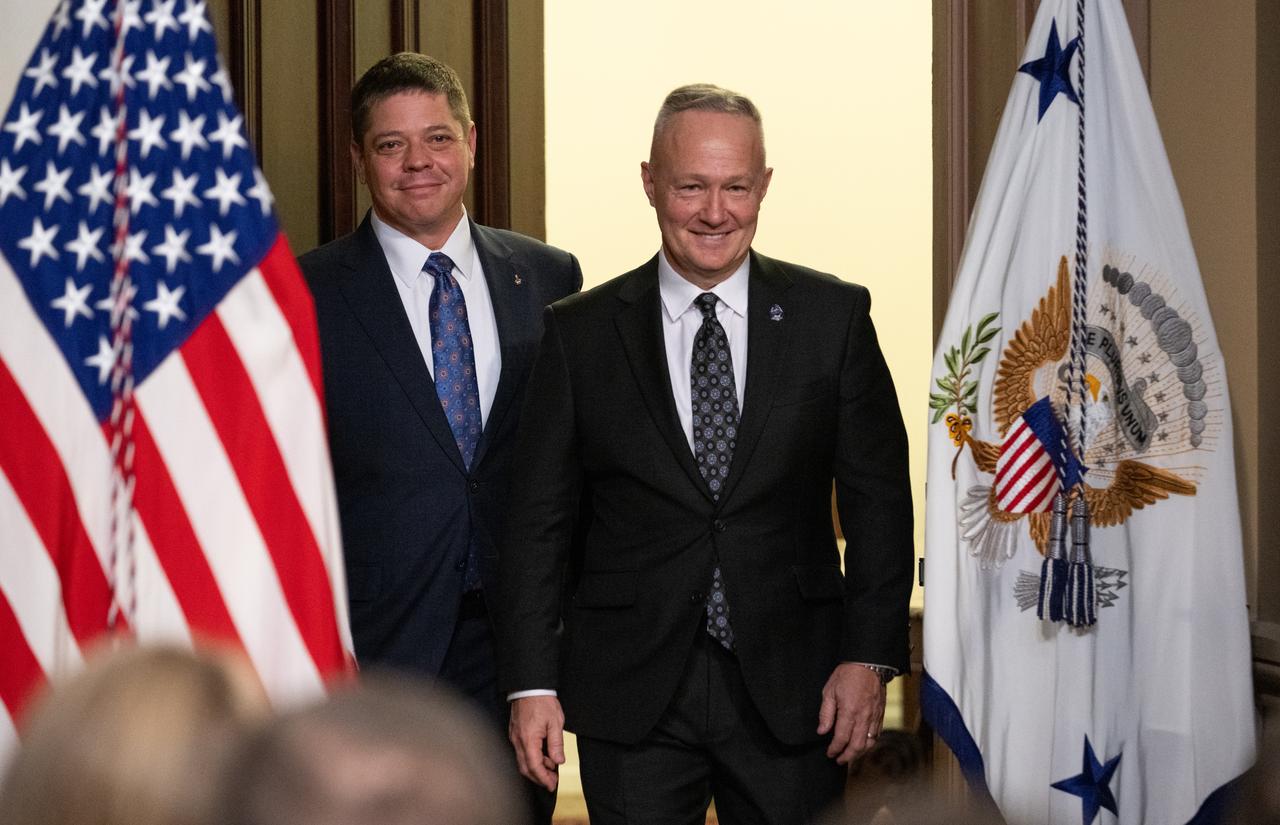
Former NASA astronauts Robert Behnken and Douglas Hurley are seen as they arrive prior to being awarded the Congressional Space Medal of Honor by Vice President Kamala Harris during a ceremony in the Indian Treaty Room of the Eisenhower Executive Office Building, Tuesday, Jan. 31, 2023, in Washington. Former astronauts Behnken and Hurley were awarded the Congressional Space Medal of Honor for their bravery in NASA’s SpaceX Demonstration Mission-2 to the International Space Station in 2020, the first crewed flight as part of the agency’s Commercial Crew Program. Photo Credit: (NASA/Joel Kowsky)
Congressional Space Medal of Honor Ceremony
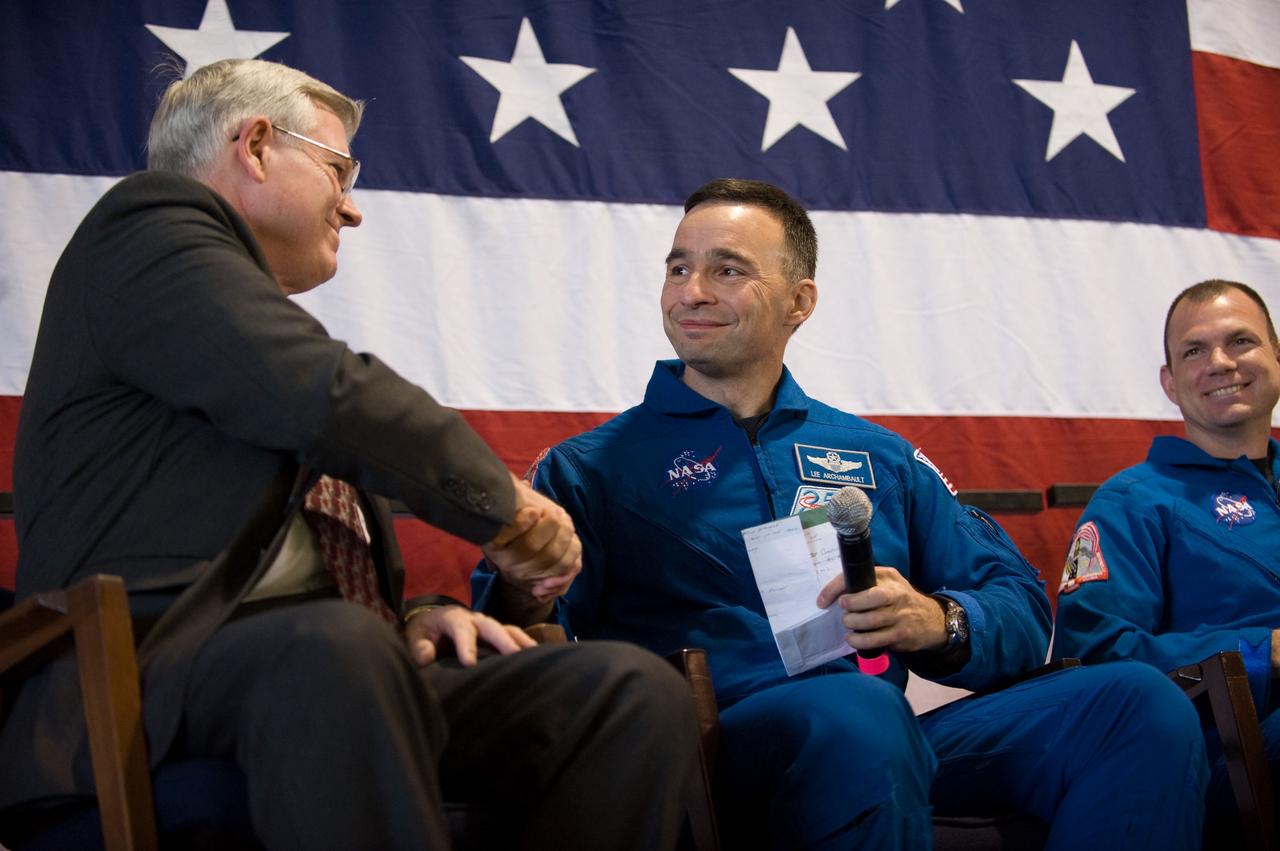
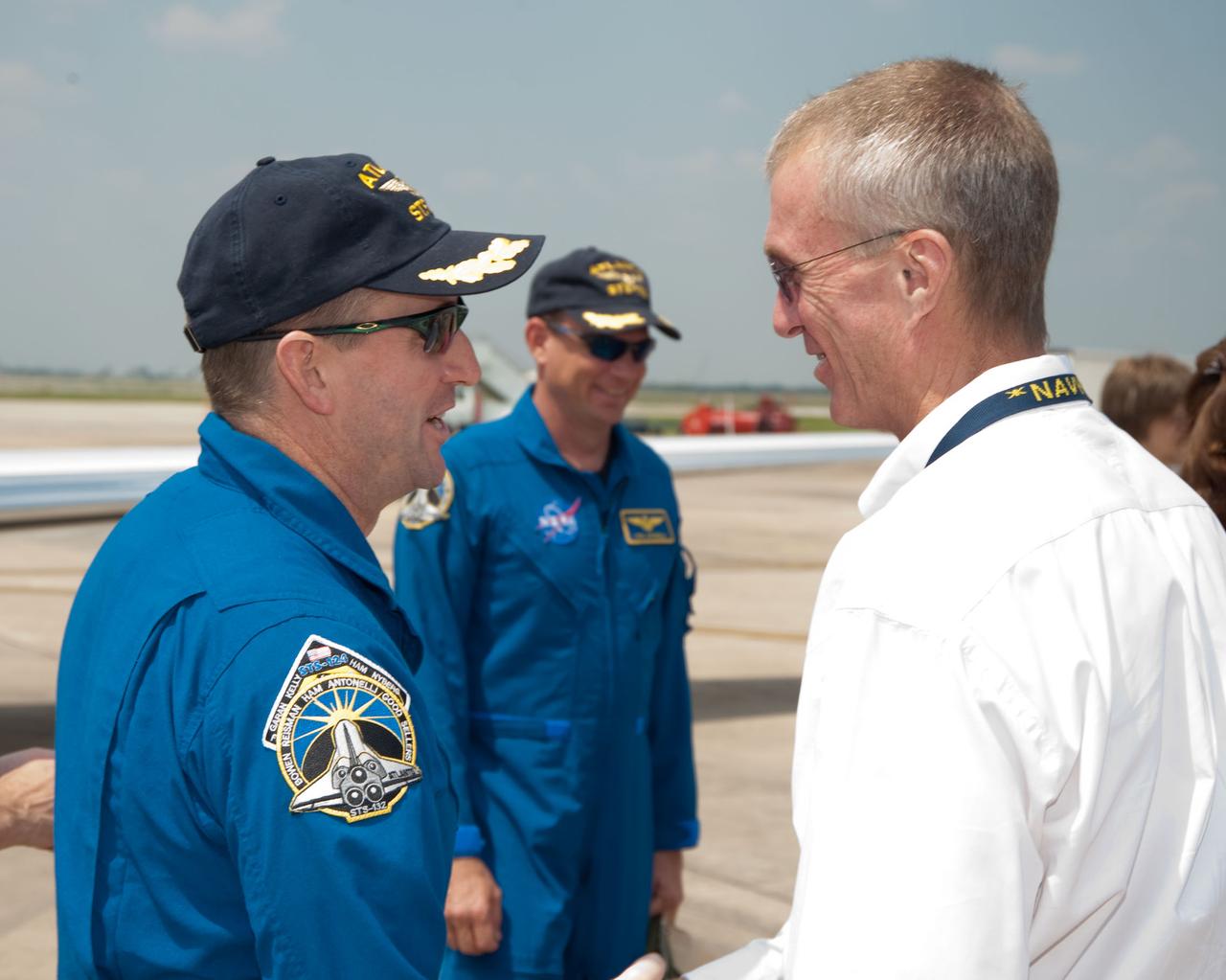
JSC2010-E-089667 (27 May 2010) ---  Brent Jett (right),  Johnson Space Center?s director of flight crew operations,  greets NASA astronaut Ken Ham, STS-132 mission commander, shortly after he and five other crew members arrived at Ellington Field. NASA astronaut Tony Antonelli, pilot, is in the background.  Awaiting them was a large crowd on hand in nearby Hangar 276 to welcome them home to Houston during a return ceremony for space shuttle Atlantis' final scheduled mission.   Photo credit: NASA or National Aeronautics and Space Administration
STS-132 crew return ceremony at Ellington Field - Hangar 276
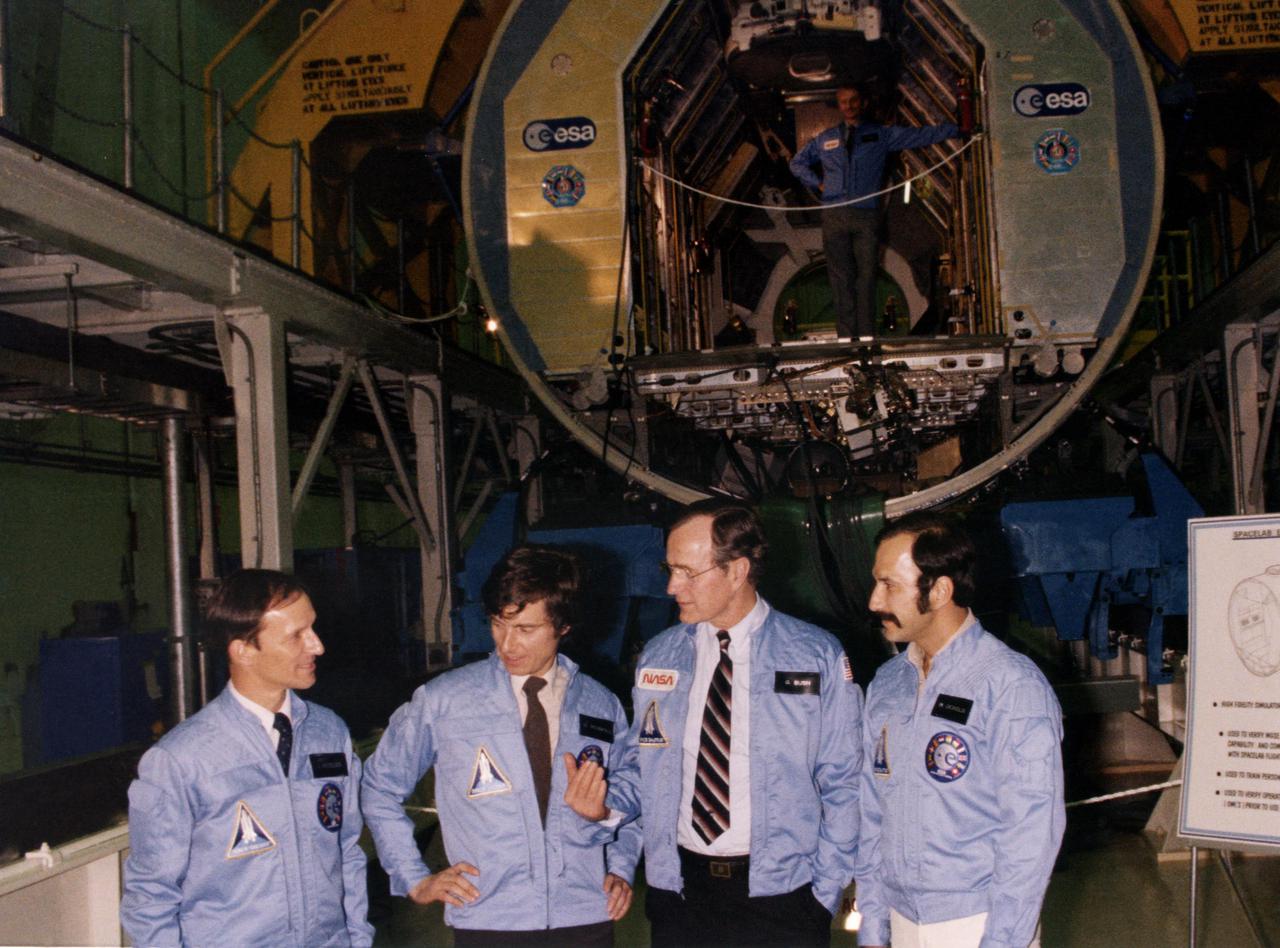
KENNEDY SPACE CENTER, FLA. -- Vice President George H.W. Bush, third from left, is pictured with the Spacelab engineering module at the Spacelab Arrival Ceremony in the Operations and Checkout Building as he visits with, from left, astronaut Claude Nicollier, European Space Agency, and payload specialists Ulf Marbod, West Germany, and Wubbo Ockels, the Netherlands.  Overhead, in the module, is Owen K. Garriott, U.S. astronaut.  The European-built Spacelab, designed to provide a shirt-sleeve environment for scientists working in Earth orbit, is scheduled to fly its first mission in the payload bay of the Space Shuttle in 1983.
KSC-82pc-115
Kennedy Space Center Associate Director Kelvin Manning, right, speaks with a guest during a ceremony  marking NASA's Spacecraft/Payload Integration and Evolution (SPIE) organization formally turning over processing of the Space Launch System (SLS) rocket's Interim Cryogenic Propulsion Stage (ICPS) to the center's Ground Systems Development and Operations (GSDO) Directorate. The ICPS is the first integrated piece of flight hardware to arrive in preparation for the uncrewed Exploration Mission-1. With the Orion attached, the ICPS sits atop the SLS rocket and will provide the spacecraft with the additional thrust needed to travel tens of thousands of miles beyond the Moon.
ICPS Turnover GSDO Employee Event
In the Space Station Processing Facility at NASA's Kennedy Space Center in Florida, a ceremony is underway marking the agency's Spacecraft/Payload Integration and Evolution (SPIE) organization formally turning over processing of the Space Launch System (SLS) rocket's Interim Cryogenic Propulsion Stage (ICPS), to the center's Ground Systems Development and Operations (GSDO) Directorate. The ICPS is seen on the left in its shipping container and is the first integrated piece of flight hardware to arrive in preparation for the uncrewed Exploration Mission-1. With the Orion attached, the ICPS sits atop the SLS rocket and will provide the spacecraft with the additional thrust needed to travel tens of thousands of miles beyond the Moon.
ICPS Turnover GSDO Employee Event
The H-IIA No. 23 rocket that will carry the GPM Core Observatory into space arrived at Tanegashima Space Center on Jan. 20, 2014. The rocket has two stages, an lower first stage that, with the help of two solid rocket boosters gets them off the ground, and an upper second stage that lights up a few minutes after launch to boost the satellite the rest of the way to orbit. The launch services provider, Mitsubishi Heavy Industries (MHI), immediately began assembling the rocket. On Jan. 22, the GPM team in Tanegashima was invited to participate in a blessing ceremony for the rocket. Lynette Marbley, the Instruments Chief Safety and Mission Assurance Officer for GPM, represented the NASA team.
blessing ceremony for the rocket
KENNEDY SPACE CENTER, FLA.  --  After a welcoming ceremony for the Experiment Logistics Module Pressurized Section of the Japanese Experiment Module, STS-123 Commander Dominic Gorie talks to the media.  Earlier, NASA and Japanese Space Agency (JAXA) officials welcomed the arrival of the logistics module, which will be delivered to the space station on mission STS-123. The module will serve as an on-orbit storage area for materials, tools and supplies. It can hold up to eight experiment racks and will attach to the top of another larger pressurized module.  Photo credit: NASA/George Shelton
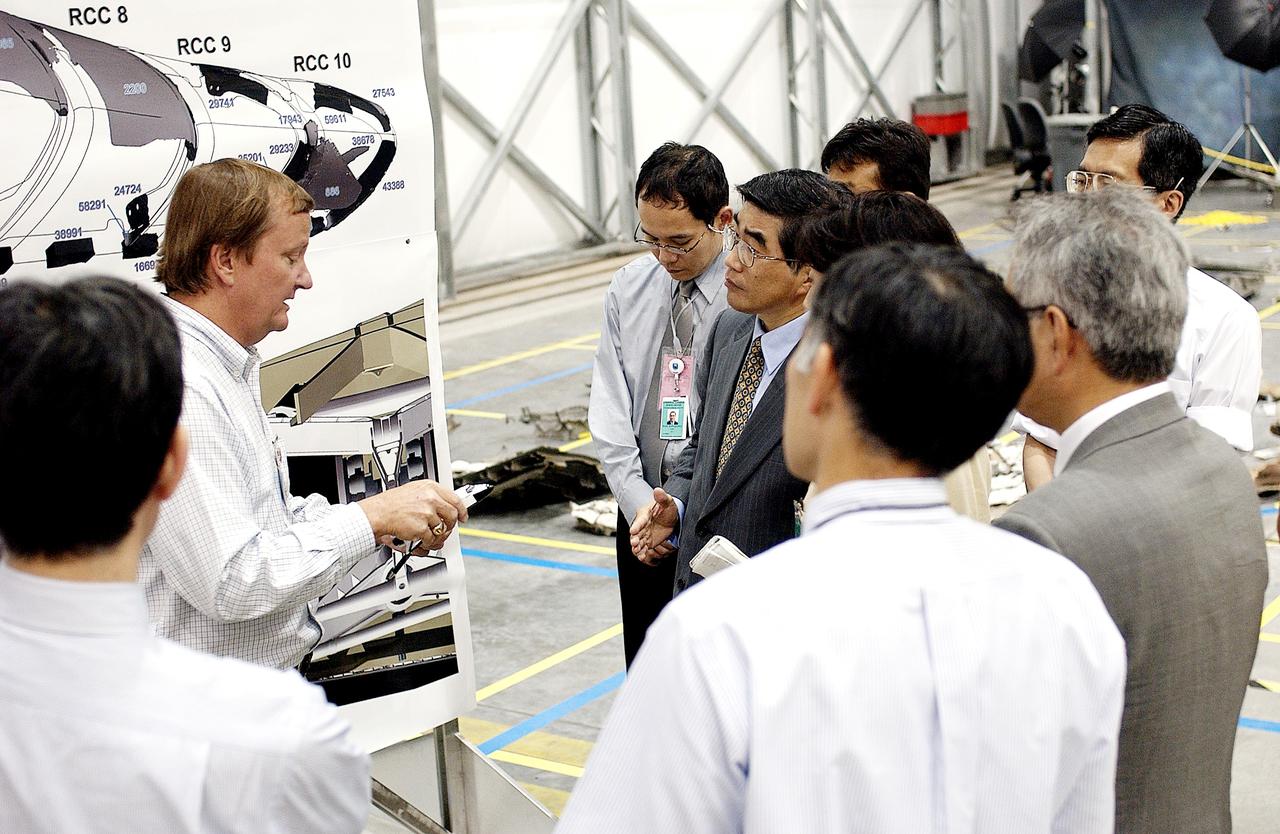
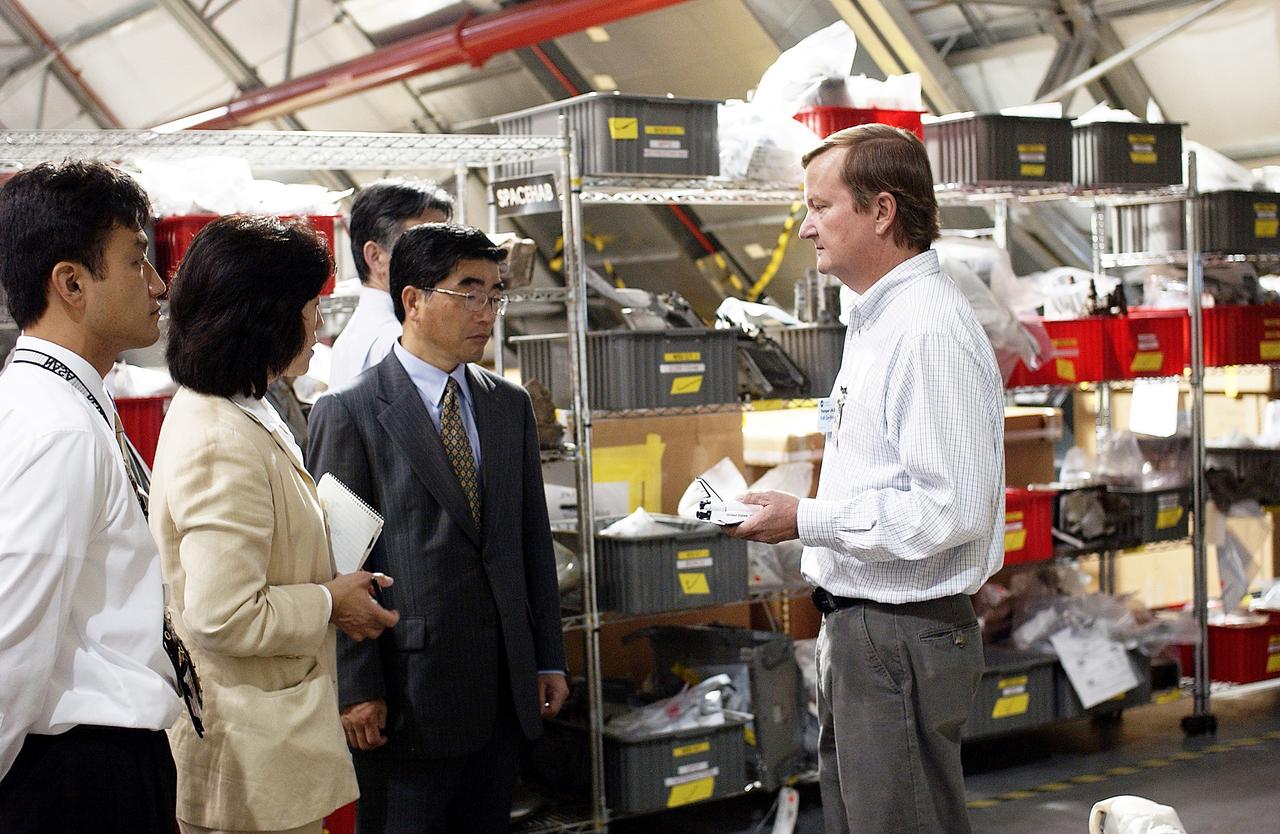
KSC-07pd0901
Kennedy Space Center Associate Director Kelvin Manning speaks to guests at NASA's "Powering Exploration Mission-1" ceremony in the high bay of the Neil Armstrong Operations and Checkout Building at the center on Nov. 16, 2018. The event was held to mark a major milestone, the arrival of the European Service Module (ESM) for Orion's Exploration Mission-1. The service module, built by the European Space Agency, will supply the main propulsion system and power to the Orion spacecraft during EM-1, a mission to the Moon. The ESM also will house air and water for astronauts on future missions. EM-1 will be an uncrewed flight test that will provide a foundation for human deep space exploration to destinations beyond Earth orbit. EM-1 will be the first integrated test of NASA's Space Launch System, Orion and the ground systems at Kennedy.
Powering Exploration Mission-1
During a "Powering Exploration Mission-1" ceremony in the Neil Armstrong Operations and Checkout Building high bay at NASA's Kennedy Space Center on Nov. 16, 2018, Amy Marasia, Orion Crew Module assembly lead for Exploration Mission-1 (EM-1), explains the next steps in processing Orion and the European Service Module (ESM). The event was held to mark a major milestone, the arrival of the European Service Module for Orion's Exploration Mission-1. The service module, built by the European Space Agency, will supply the main propulsion system and power to the Orion spacecraft during EM-1, a mission to the Moon. The ESM also will house air and water for astronauts on future missions. EM-1 will be an uncrewed flight test that will provide a foundation for human deep space exploration to destinations beyond Earth orbit. EM-1 will be the first integrated test of NASA's Space Launch System, Orion and the ground systems at Kennedy.
Powering Exploration Mission-1
At the Gagarin Cosmonaut Training Center in Star City, Russia, Expedition 38/39 Flight Engineer Koichi Wakata of the Japan Aerospace Exploration Agency (left), Soyuz Commander Mikhail Tyurin (center) and NASA Flight Engineer Rick Mastracchio (right) pose for pictures with a model of the Olympic torch following a crew news conference October 22, 2013. The trio will launch Nov. 7, Kazakh time from the Baikonur Cosmodrome in Kazakhstan on the Soyuz TMA-11M spacecraft for the start of a six-month mission on the International Space Station. Launching with them will be one of the Olympic torches used in the Olympic relay that will culminate with the torch’s arrival at the opening ceremonies of the 2014 Winter Olympics in Sochi, Russia next February.  NASA/Stephanie Stoll
jsc2013e090724
S75-30109 (10 Aug. 1975) --- Dr. Christopher C. Kraft Jr. (second from left), JSC Director, chats with the three ASTP crewmen on the runway at Ellington Air Force Base after their arrival home from the Pacific recovery area.  The six men are, left to right, Col. Donald Robinson, EAFB commander; Dr. Kraft; astronaut John W. Young, Chief of the Astronaut Office at JSC; astronaut Vance D. Brand, command module pilot of the crew; astronaut Donald K. Slayton, docking module pilot of the crew; and astronaut Thomas P. Stafford, crew commander.  This picture was taken prior to the official welcoming ceremonies. The crewmen?s wives are still aboard the plane. Medical treatment in Hawaii delayed the return of the crew to JSC.  They suffered a pulmonary irritation from inhalation of a toxic gas minutes before splashdown on July 24, 1975.
Recovery - Apollo-Soyuz Test Project (ASTP) - Ellington AFB (EAFB), TX
STS105-E-5334 (17 August 2001) --- The Expedition Two (back row) and Expedition Three crews participate in a press conference in the U.S. Laboratory.  In less than 48 hours, the Expedition Two crew will hold the final handover ceremony with the newly arrived Expedition Three crew. The Expedition Two crewmembers are, from left to right, Susan J. Helms, flight engineer, cosmonaut Yury V. Usachev, mission commander, and James S. Voss, flight engineer. The Expedition Three crewmembers are, from left to right, cosmonaut Mikhail Tyurin, flight engineer, Frank L. Culbertson, Jr., mission commander, and cosmonaut Vladimir N. Dezhurov, flight engineer. This image was taken with a digital still camera.
Expeditions Two and Three group crew portrait in ISS U.S. Laboratory/Destiny
During a "Powering Exploration Mission-1" ceremony in the Neil Armstrong Operations and Checkout Building high bay at NASA's Kennedy Space Center on Nov. 16, 2018, Phillippe Deloo, left, European Service Module program manager at the European Space Agency (ESA); and Mark Kirasich, Orion Program manager at the agency's Johnson Space Center in Houston, answer questions. The event was held to mark a major milestone, the arrival of the European Service Module (ESM) for Orion's Exploration Mission-1. The service module, built by the European Space Agency, will supply the main propulsion system and power to the Orion spacecraft during EM-1, a mission to the Moon. The ESM also will house air and water for astronauts on future missions. EM-1 will be an uncrewed flight test that will provide a foundation for human deep space exploration to destinations beyond Earth orbit. EM-1 will be the first integrated test of NASA's Space Launch System, Orion and the ground systems at Kennedy.
Powering Exploration Mission-1
At the Gagarin Cosmonaut Training Center in Star City, Russia, Expedition 38/39 Soyuz Commander Mikhail Tyurin (right) hoists a model of the Olympic torch during a crew news conference October 22, 2013. Tyurin, NASA Flight Engineer Rick Mastracchio (center) and Flight Engineer Koichi Wakata of the Japan Aerospace Exploration Agency (left) will launch Nov. 7, Kazakh time from the Baikonur Cosmodrome in Kazakhstan on the Soyuz TMA-11M spacecraft for the start of a six-month mission on the International Space Station. Launching with them will be one of the Olympic torches used in the Olympic relay that will culminate with the torch’s arrival at the opening ceremonies of the 2014 Winter Olympics in Sochi, Russia next February.  NASA/Stephanie Stoll
jsc2013e090723
S73-34615 (27 Sept. 1973) --- Dr. Christopher C. Kraft Jr., center, shakes hands with astronaut Jack R. Lousma, Skylab 3 pilot, during welcome ceremonies following crew arrival at Ellington Air Force Base. The crewmen greet their wives after spending 59.5 days in the Skylab space station cluster in Earth orbit. From left to right are scientist-astronaut Owen K. Garriot, science pilot; Mrs. Garriott; Dr. Donald K. Slayton, Director of Flight Crew Operations at JSC; Dr. Kraft; astronaut Alan L. Bean, commander; Mrs. Bean; and the Lousmas. The group stands in front of the VC-140 (Jet Star) which flew the crewmen from San Diego to Ellington Air Force Base. Photo credit: NASA
Skylab (SL)-3 Crewmembers - Greeting - Return - Ellington AFB (EAFB), TX
CAPE CANAVERAL, Fla. -- At NASA's Kennedy Space Center Visitor Complex, Center Director Bob Cabana stands at the base of the Astronaut Memorial Mirror awaiting the arrival of James Loftus, director of the Miami-Dade Police Department who will present to him the U.S. Honor Flag.              The flag is presented to NASA to be prepared to fly aboard space shuttle Atlantis on the Space Shuttle Program's final mission, STS-135. The U.S. Honor Flag has been flown nationwide, at Ground Zero and throughout the world to honor heroes who have lost their lives while serving their community and country, including police officers, firefighters, members of the Armed Forces and astronauts. More than 100 honor guard members traveled to the Space Coast to take part in the ceremony. After the flag returns to Earth, it will continue as a traveling memorial. Photo credit: NASA/Kim Shiflett
KSC-2011-4025
During a "Powering Exploration Mission-1" ceremony in the Neil Armstrong Operations and Checkout Building high bay at NASA's Kennedy Space Center on Nov. 16, 2018, Mark Kirasich, left, Orion Program manager at the agency's Johnson Space Center in Houston; and Sue Motil, Orion European Service Module integration manager at the agency's Glenn Research Center, answer questions. The event was held to mark a major milestone, the arrival of the European Service Module (ESM) for Orion's Exploration Mission-1. The service module, built by the European Space Agency, will supply the main propulsion system and power to the Orion spacecraft during EM-1, a mission to the Moon. The ESM also will house air and water for astronauts on future missions. EM-1 will be an uncrewed flight test that will provide a foundation for human deep space exploration to destinations beyond Earth orbit. EM-1 will be the first integrated test of NASA's Space Launch System, Orion and the ground systems at Kennedy.
Powering Exploration Mission-1
At the Gagarin Cosmonaut Training Center in Star City, Russia, Expedition 38/39 Flight Engineer Rick Mastracchio of NASA (center) holds a model of the Olympic torch during a crew news conference October 22, 2013. Mastracchio, Flight Engineer Koichi Wakata of the Japan Aerospace Exploration Agency (left) and Soyuz Commander Mikhail Tyurin (right) will launch Nov. 7, Kazakh time from the Baikonur Cosmodrome in Kazakhstan on the Soyuz TMA-11M spacecraft for the start of a six-month mission on the International Space Station. Launching with them will be one of the Olympic torches used in the Olympic relay that will culminate with the torch’s arrival at the opening ceremonies of the 2014 Winter Olympics in Sochi, Russia next February.  NASA/Stephanie Stoll
jsc2013e090722
CAPE CANAVERAL, Fla. – Space shuttle Atlantis arrives at its new home, the Kennedy Space Center Visitor Complex in Florida. Atlantis completed its 10-mile journey from Kennedy's Vehicle Assembly Building with stops during the day for a transfer ceremony in Kennedy's Industrial Area and public viewing in Space Florida's Exploration Park.    As part of transition and retirement of the Space Shuttle Program, Atlantis will be displayed in a new exhibit hall at the visitor complex beginning in the summer of 2013. Over the course of its 26-year career, Atlantis traveled 125,935,769 miles, completing 33 missions during 307 days in space. For more information, visit http://www.nasa.gov/transition.  Photo credit: NASA/Jim Grossmann
KSC-2012-6102
NASA's new white B-52H, shared ramp space with the veteran NASA B-52B mother ship in Wichita, Kansas, April 12, 2002 during the 50th anniversary of the B-52 aircraft.
EC02-0080-93
B-52H over Dryden Flight Research Center
EC02-0083-2
NASA's new white B-52H, destined to join a veteran B-52B mother ship at NASA's Dryden Flight Research Center, was exhibited at the Boeing plant in Wichita, Kansas, April 12, 2002 during the 50th anniversary commemoration of the B-52 series of aircraft.
EC02-0080-63
B-52H over Dryden Flight Research Center
EC02-0083-1
NASA's veteran silver B-52B, foreground, joined the new B-52H in NASA markings for a ceremony in Wichita, Kansas, April 12, 2002, marking the 50th anniversary of the B-52 aircraft
EC02-0080-38
NASA Dryden's B-52H in flight
EC02-0083-3
NASA Dryden's B-52H in flight.
EC02-0083-12
Kennedy Space Center Associate Director Kelvin Manning, far left, moderates questions to NASA and European Space Agency (ESA) senior managers during the "Powering Exploration Mission-1" ceremony in the high bay of the Neil Armstrong Operations and Checkout Building at the center on Nov. 16, 2016. From left, are Bill Hill, deputy associate administrator for Exploration Systems Development; Phillippe Deloo, European Service Module program manager at ESA; Mark Kirasich, Orion Program manager at the agency's Johnson Space Center in Houston; Sue Motil, Orion European Service Module integration manager at the agency's Glenn Research Center; and Jan Worner, ESA director general. The event was held to mark a major milestone, the arrival of the European Service Module (ESM) for Orion's Exploration Mission-1. The service module, built by the European Space Agency, will supply the main propulsion system and power to the Orion spacecraft during EM-1, a mission to the Moon. The ESM also will house air and water for astronauts on future missions. EM-1 will be an uncrewed flight test that will provide a foundation for human deep space exploration to destinations beyond Earth orbit. EM-1 will be the first integrated test of NASA's Space Launch System, Orion and the ground systems at Kennedy.
Powering Exploration Mission-1
Addison Rothrock, the National Advisory Committee for Aeronautics’s (NACA) Assistant Director of Research, speaks at the groundbreaking ceremony for the Lewis Flight Propulsion Laboratory’s new test reactor at Plum Brook Station. This dedication event was held almost exactly one year after the NACA announced that it would build its $4.5 million nuclear reactor on 500 acres of the army’s 9000-acre Plum Brook Ordnance Works. The site was located in Sandusky, Ohio, approximately 60 miles west of the NACA Lewis laboratory in Cleveland. Lewis Director Raymond Sharp is seated to the left of Rothrock, Congressman Albert Baumhart and NACA Secretary John Victory are to the right. Many government and local officials were on hand for the press conference and ensuing luncheon.    In the wake of World War II the military, the Atomic Energy Commission, and the NACA became interested in the use of atomic energy for propulsion and power. A Nuclear Division was established at NACA Lewis in the early 1950s. The division’s request for a 60-megawatt research reactor was approved in 1955. The semi-remote Plum Brook location was selected over 17 other possible sites.    Construction of the Plum Brook Reactor Facility lasted five years. By the time of its first trial runs in 1961 the aircraft nuclear propulsion program had been cancelled. The space age had arrived, however, and the reactor would be used to study materials for a nuclear powered rocket.
Groundbreaking Ceremony at the NACA's Plum Brook Station
NASA and European Space Agency (ESA) senior managers answer questions during a "Powering Exploration Mission-1" ceremony in the Neil Armstrong Operations and Checkout Building high bay at NASA's Kennedy Space Center on Nov. 16, 2018. From left, are Bill Hill, deputy associate administrator for Exploration Systems Development; Phillippe Deloo, European Service Module program manager at ESA; Mark Kirasich, Orion Program manager at the agency's Johnson Space Center in Houston; Sue Motil, Orion European Service Module integration manager at the agency's Glenn Research Center; and Jan Worner, ESA director general. The event was held to mark a major milestone, the arrival of the European Service Module (ESM) for Orion's Exploration Mission-1. The service module, built by the European Space Agency, will supply the main propulsion system and power to the Orion spacecraft during EM-1, a mission to the Moon. The ESM also will house air and water for astronauts on future missions. EM-1 will be an uncrewed flight test that will provide a foundation for human deep space exploration to destinations beyond Earth orbit. EM-1 will be the first integrated test of NASA's Space Launch System, Orion and the ground systems at Kennedy.
Powering Exploration Mission-1