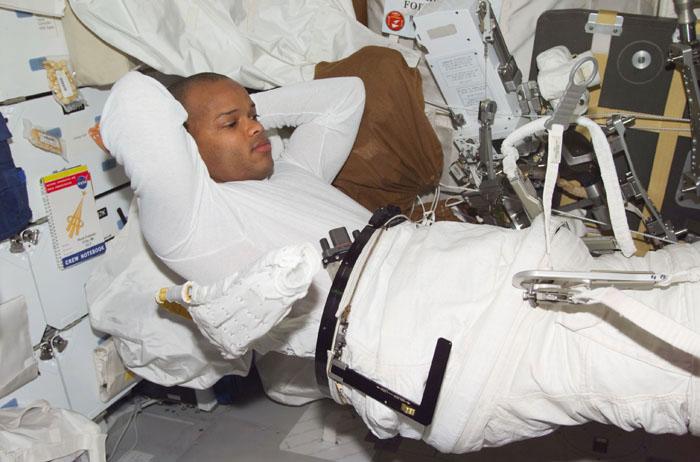
SS98-E-5214 (14 February 2001) --- Astronaut Robert L. Curbeam, STS-98 mission specialist, dons his extravehicular mobility unit (EMU) for the final of three space walks he shared with astonaut Thomas D. Jones on mission 5a. The scene was recorded with a digital still camera.
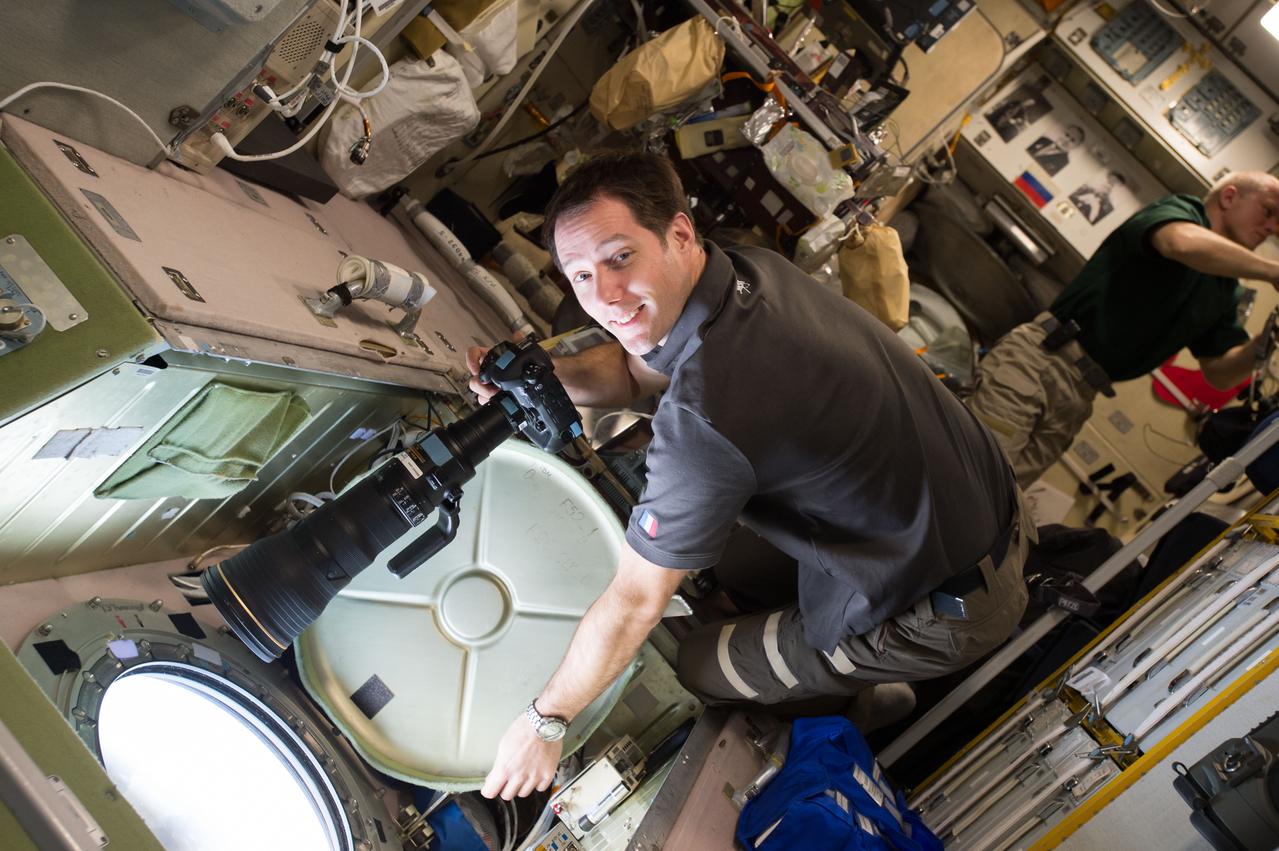
iss050e020100 (12/28/2016) --- European Space Agency (ESA) astonaut Thomas Pesquet preparing to take Crew Earth Observations (CEO) photos from the Service Module (SM) window. Cosmonaut Oleg Novitskiy is visible in the background. CEO imagery provides researchers on Earth with key data to understand the planet from the perspective of the ISS. Crew members have been photographing Earth from space since the early Mercury missions beginning in 1961. The images taken from the ISS ensure this record remains unbroken.
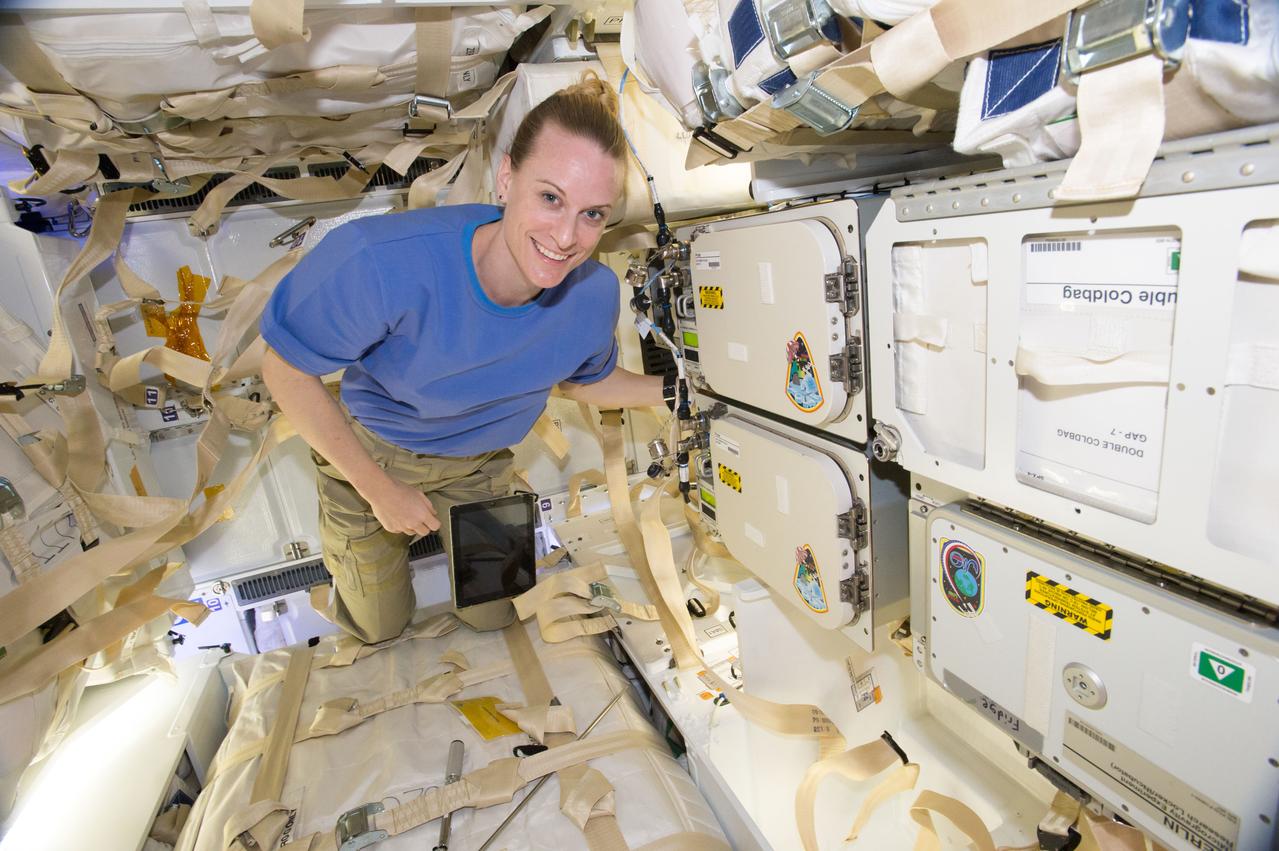
iss048e065818 (8/24/2016) --- NASA astonaut Kate Rubins poses for a photo next to Polar Facilities 2 and 4 installed in the SpaceX Dragon Commercial Resupply Services-9 (CRS-9) spacecraft for return to Earth. Polar is a Cold Stowage managed facility that provides transport and storage of science samples at cryogenic temperatures (-80ºC) to and from the International Space Station (ISS).
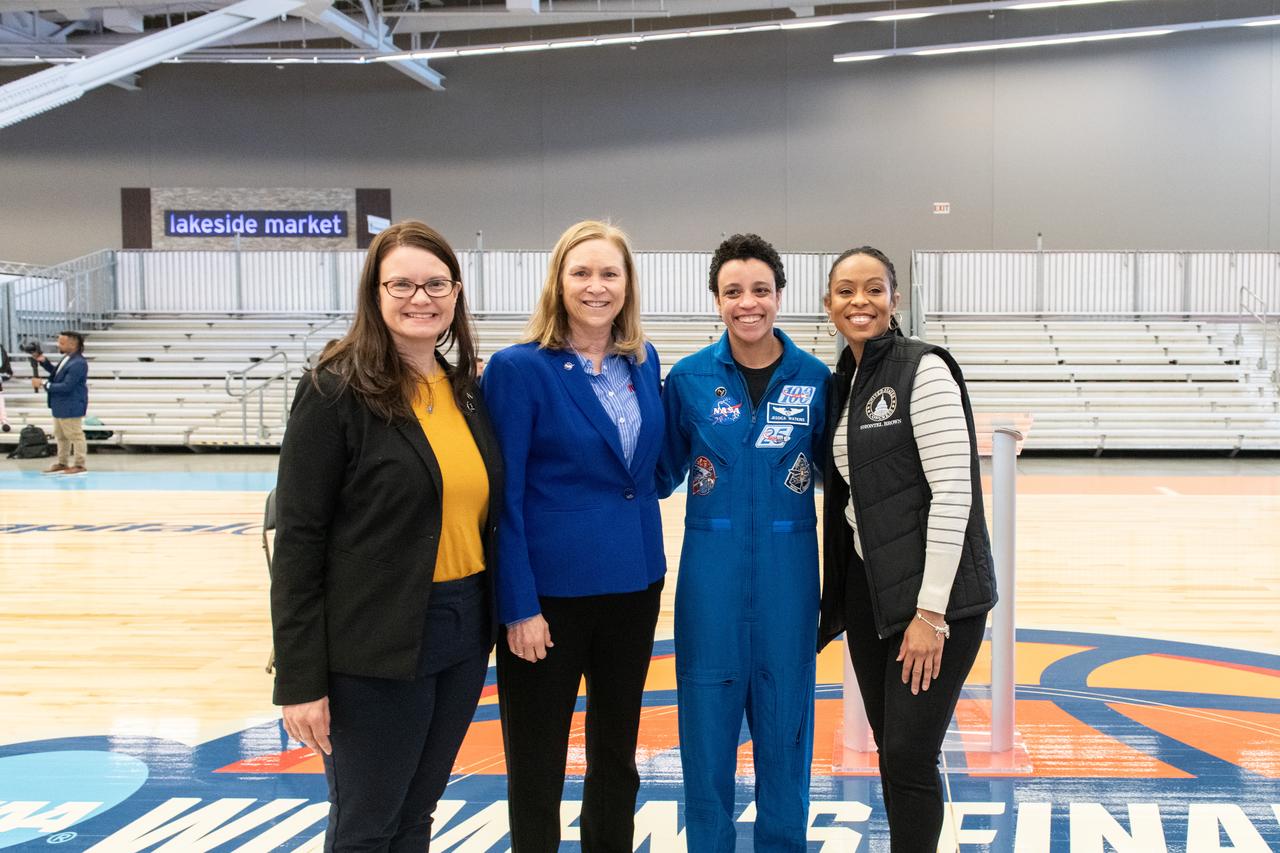
Astrophysicist Dr. Kelly Korreck, Kennedy Space Center Director Janet Petro, Astonaut Jessica Watkins and Representative Shontel Brown pose for a photo at the Read to the Final Four Event in Cleveland Ohio on April 5th 2024. A total solar eclipse swept across a narrow portion of the North American continent from Mexico’s Pacific coast to the Atlantic coast of Newfoundland, Canada. A partial solar eclipse was visible across the entire North American continent along with parts of Central America and Europe.
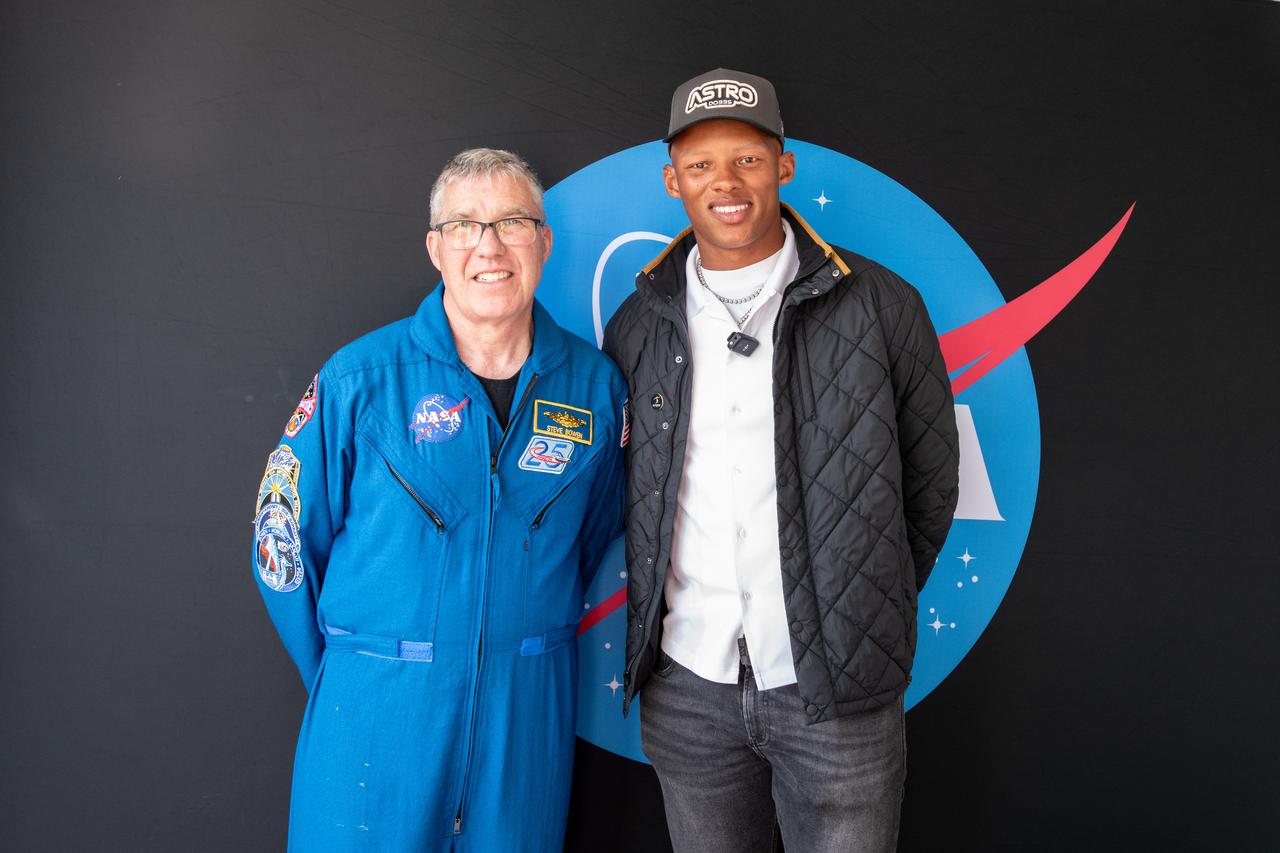
Astonaut Stephen Bowen and Josh Dobbs pose for a photo together at Total Eclipse fest. They both participated in meet and greets with the community. This free, outdoor, family-friendly science and arts festival will feature free concerts, performances, speakers, and hands-on science activities with community partners. A total solar eclipse swept across a narrow portion of the North American continent from Mexico’s Pacific coast to the Atlantic coast of Newfoundland, Canada. A partial solar eclipse was visible across the entire North American continent along with parts of Central America and Europe.
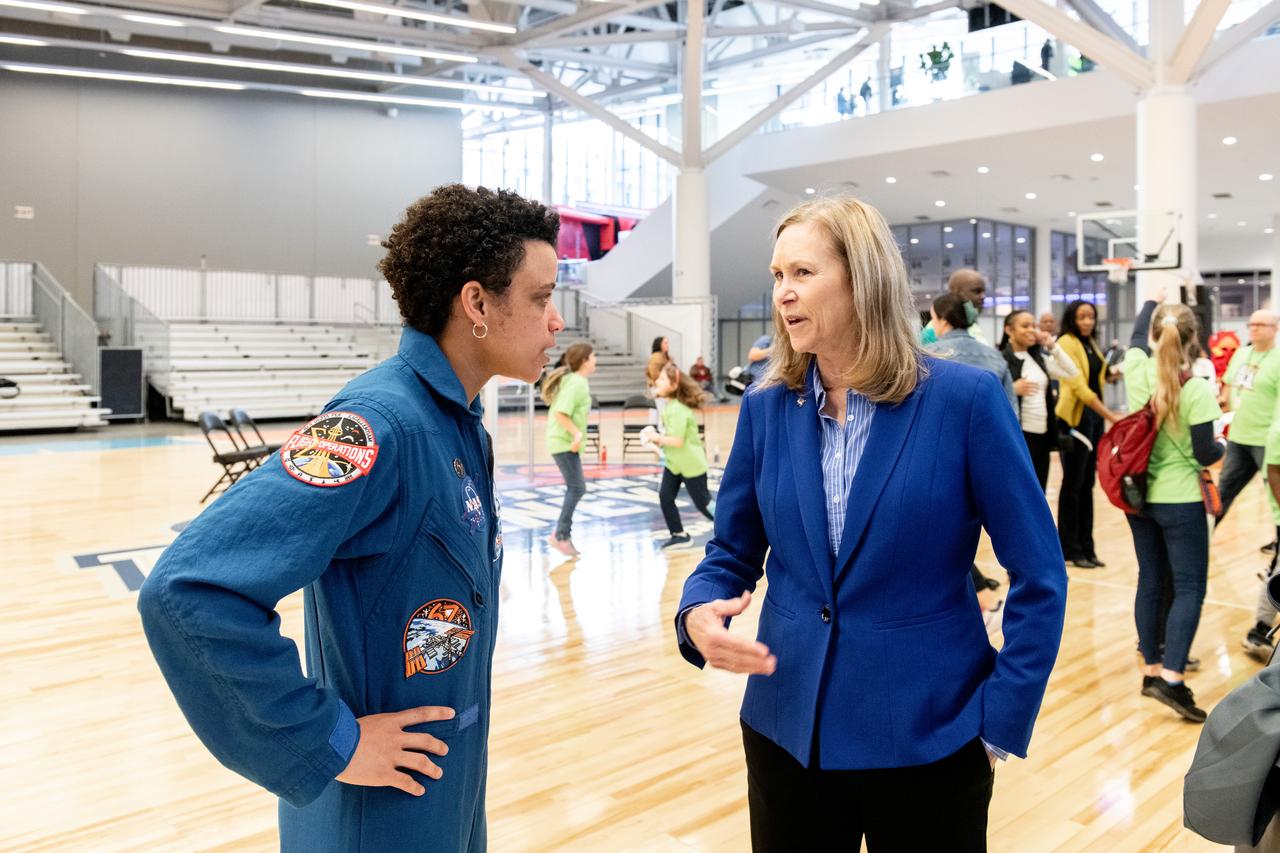
Kennedy Space Center Director Janet Petro and Astonaut Jessica Watkins at the Read to the Final Four Event in Cleveland, Ohio on April 5, 2024. Read to the Final Four event is where the NCAA, Women’s Final Four and the Cleveland Local Organizing Committee have teamed up to help third graders across the state develop their abilities as part of a nine-week program designed to leave a lasting impact on students throughout Ohio. From January to April 2024, local elementary students are encouraged to track their reading minutes leading up to the Women’s Final Four. Participating students and leading classrooms will receive awards at Tourney Town to celebrate their

NASA astronaut Andre Douglas collects soil samples during the first in a series of four simulated moonwalks in the San Francisco Volcanic Field in Norther Arizona on May 13, 2024. Credit: NASA/Josh Valcarcel
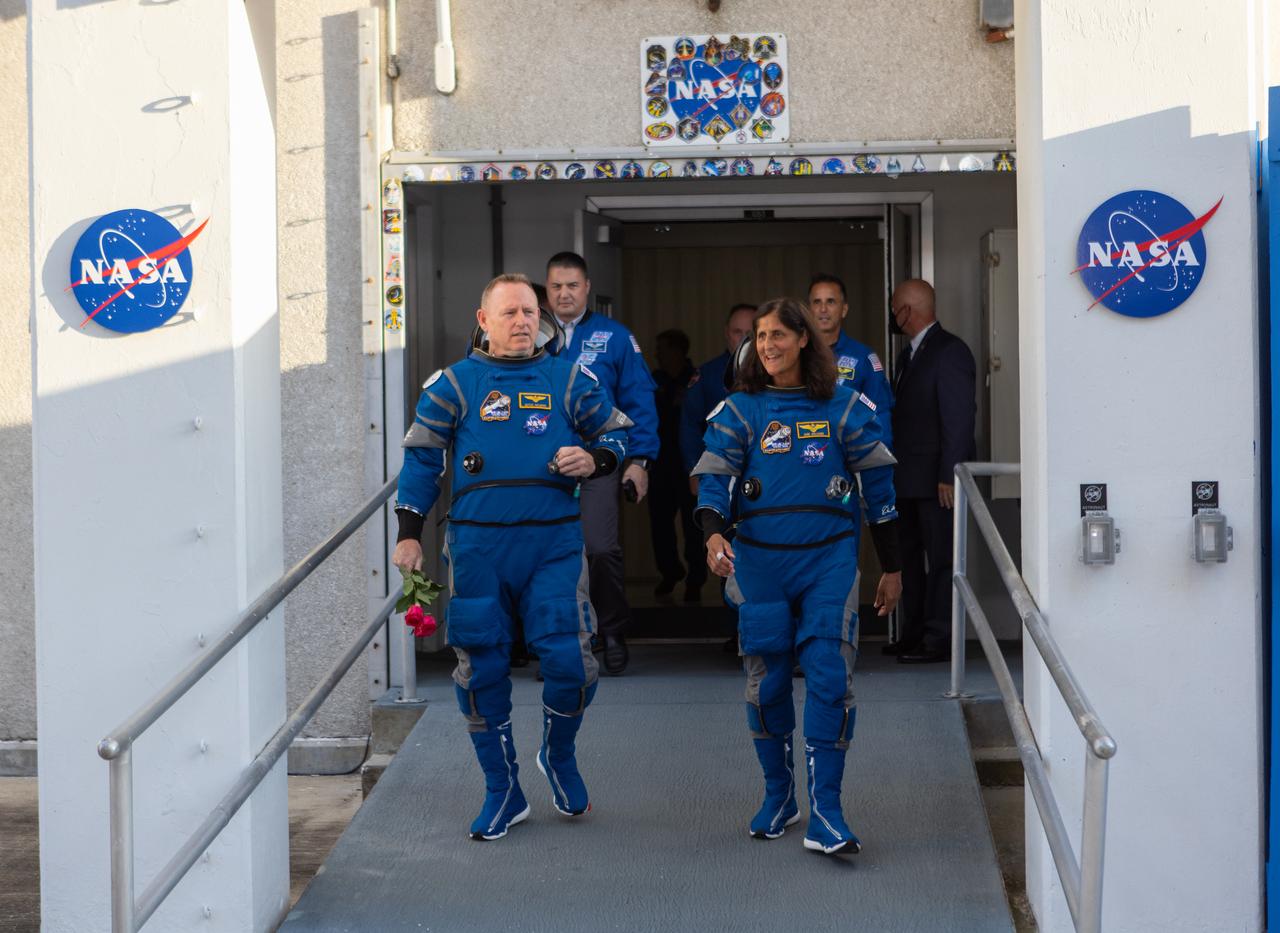
During the first launch attempt of NASA’s Boeing Crew Flight Test, NASA astronauts Butch Wilmore and Suni Williams walk out of the Neil A. Armstrong Operations and Checkout Building on Monday, May 6, 2024, at the agency’s Kennedy Space Center in Florida. As part of the agency’s Commercial Crew Program, the first crewed launch to the International Space Station aboard Boeing’s Starliner spacecraft atop a United Launch Alliance Atlas V rocket from Space Launch Complex-41 at nearby Cape Canaveral Space Force Station was targeted for 10:34 p.m. ET but scrubbed for the day.
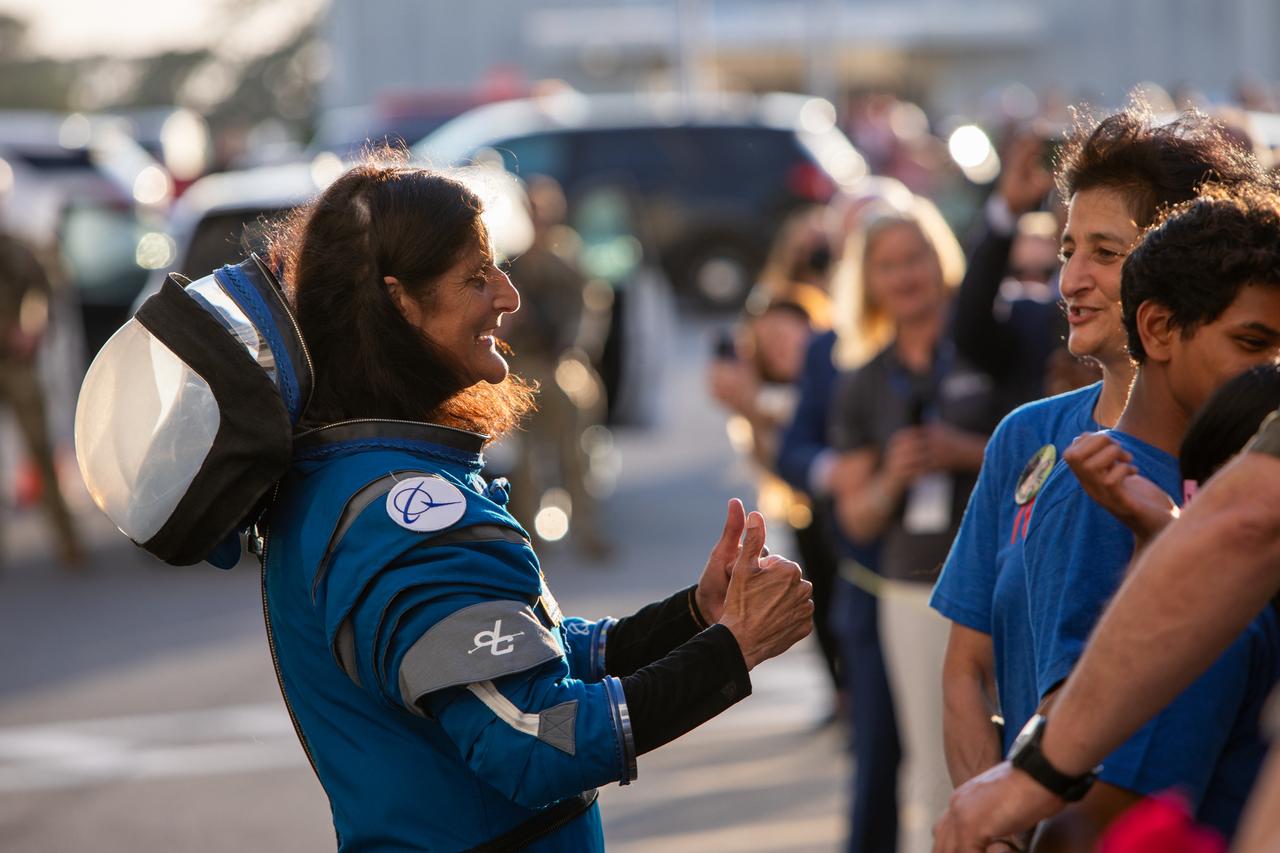
During the first launch attempt of NASA’s Boeing Crew Flight Test, NASA astronaut Suni Williams says goodbye to friends and family upon exiting the Neil A. Armstrong Operations and Checkout Building at NASA’s Kennedy Space Center in Florida on Monday, May 6, 2024. As part of the agency’s Commercial Crew Program, the first crewed launch to the International Space Station aboard Boeing’s Starliner spacecraft atop a United Launch Alliance Atlas V rocket from Space Launch Complex-41 at nearby Cape Canaveral Space Force Station was targeted for 10:34 p.m. ET but scrubbed for the day.
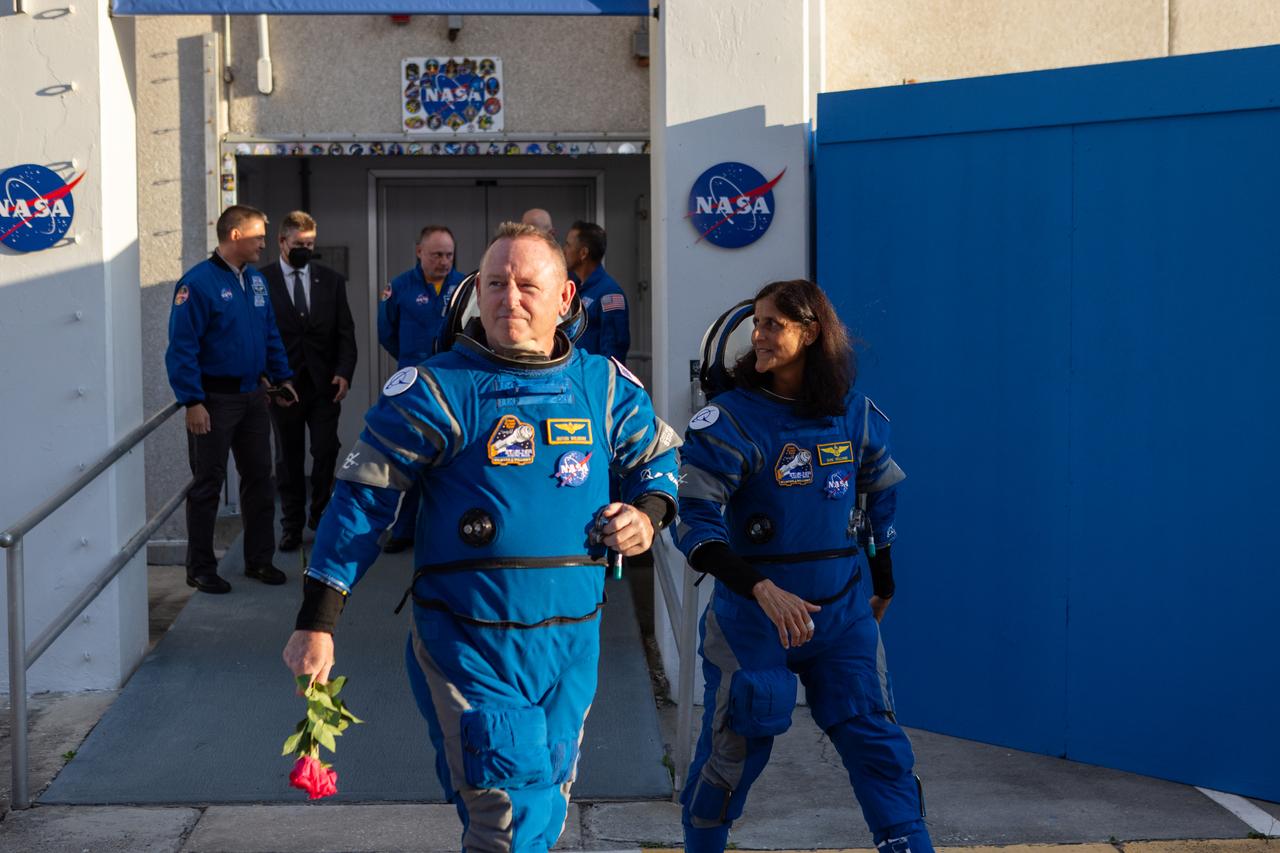
During the first launch attempt of NASA’s Boeing Crew Flight Test, NASA astronauts Butch Wilmore and Suni Williams walk out of the Neil A. Armstrong Operations and Checkout Building on Monday, May 6, 2024, at the agency’s Kennedy Space Center in Florida. As part of the agency’s Commercial Crew Program, the first crewed launch to the International Space Station aboard Boeing’s Starliner spacecraft atop a United Launch Alliance Atlas V rocket from Space Launch Complex-41 at nearby Cape Canaveral Space Force Station was targeted for 10:34 p.m. ET but scrubbed for the day.
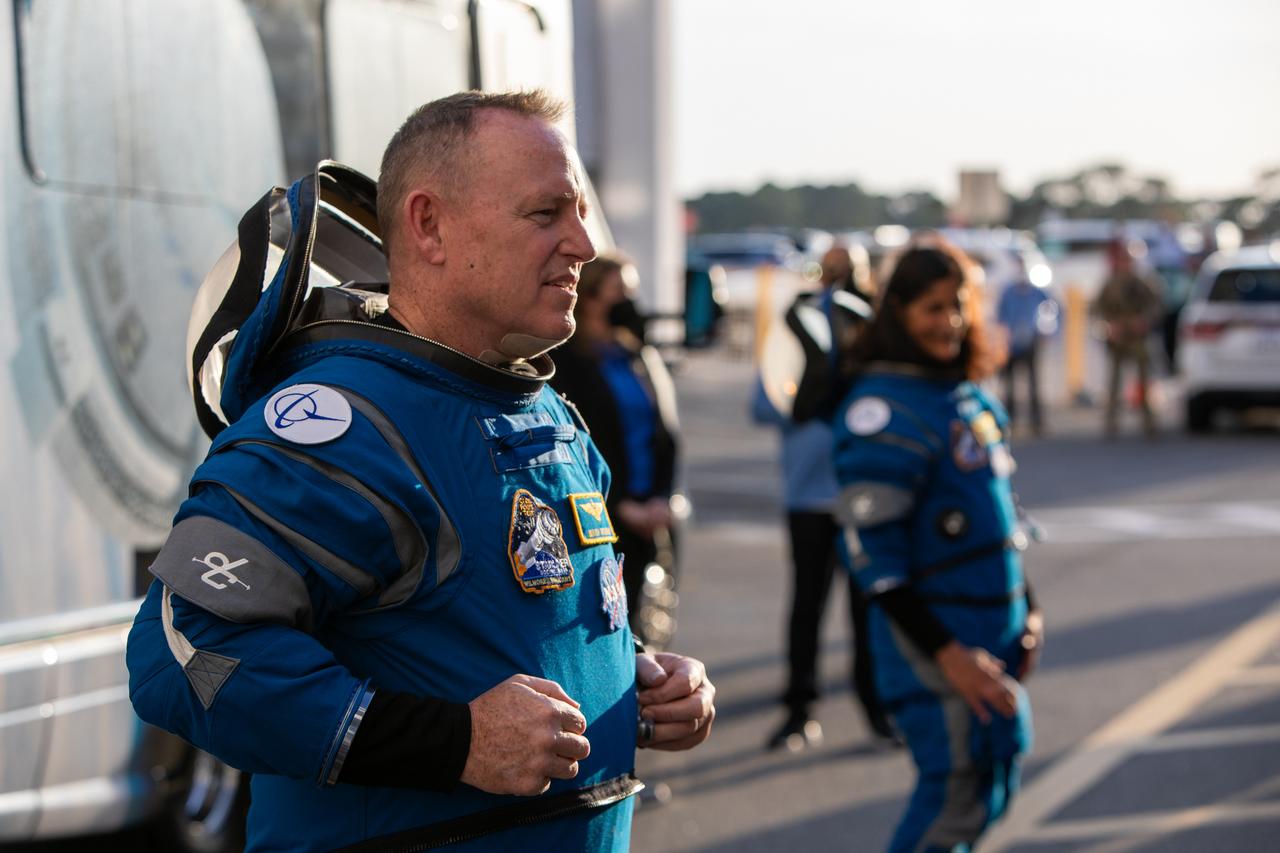
During the first launch attempt of NASA’s Boeing Crew Flight Test, NASA astronaut Butch Wilmore says goodbye to friends and family upon exiting the Neil A. Armstrong Operations and Checkout Building at NASA’s Kennedy Space Center in Florida on Monday, May 6, 2024. As part of the agency’s Commercial Crew Program, the first crewed launch to the International Space Station aboard Boeing’s Starliner spacecraft atop a United Launch Alliance Atlas V rocket from Space Launch Complex-41 at nearby Cape Canaveral Space Force Station was targeted for 10:34 p.m. ET but scrubbed for the day.
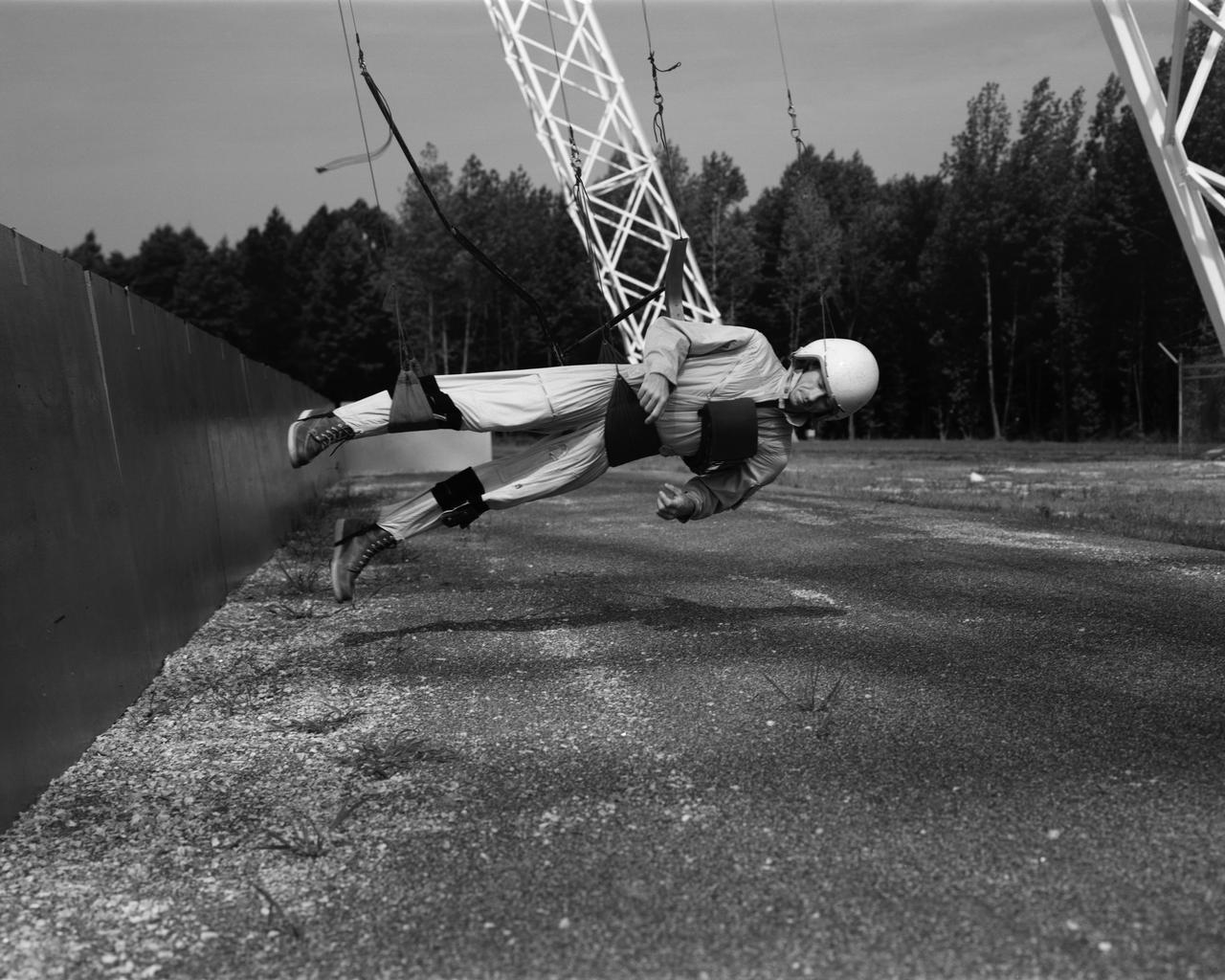
Astronaut Walt Cunningham on the Reduced Gravity Walking Simulator located at the Lunar Landing Facility. The purpose of this simulator was to study the subject while walking, jumping or running. Researchers conducted studies of various factors such as fatigue limit, energy expenditure, and speed of locomotion. A.W. Vigil described the purpose of the simulator in his paper "Discussion of Existing and Planned Simulators for Space Research," "When the astronauts land on the moon they will be in an unfamiliar environment involving, particularly, a gravitational field only one-sixth as strong as on earth. A novel method of simulating lunar gravity has been developed and is supported by a puppet-type suspension system at the end of a long pendulum. A floor is provided at the proper angle so that one-sixth of the subject's weight is supported by the floor with the remainder being supported by the suspension system. This simulator allows almost complete freedom in vertical translation and pitch and is considered to be a very realistic simulation of the lunar walking problem. For this problem this simulator suffers only slightly from the restrictions in lateral movement it puts on the test subject. This is not considered a strong disadvantage for ordinary walking problems since most of the motions do, in fact, occur in the vertical plane. However, this simulation technique would be severely restrictive if applied to the study of the extra-vehicular locomotion problem, for example, because in this situation complete six degrees of freedom are rather necessary. This technique, in effect, automatically introduces a two-axis attitude stabilization system into the problem. The technique could, however, be used in preliminary studies of extra-vehicular locomotion where, for example, it might be assumed that one axis of the attitude control system on the astronaut maneuvering unit may have failed." -- Published in James R. Hansen, Spaceflight Revolution: NASA Langley Research Center From Sputnik to Apollo, (Washington: NASA, 1995), p. 377; A.W. Vigil, "Discussion of Existing and Planned Simulators for Space Research," Paper presented at Conference on the Role of Simulation in Space Technology," Blacksburg, VA, August 17-21, 1964.
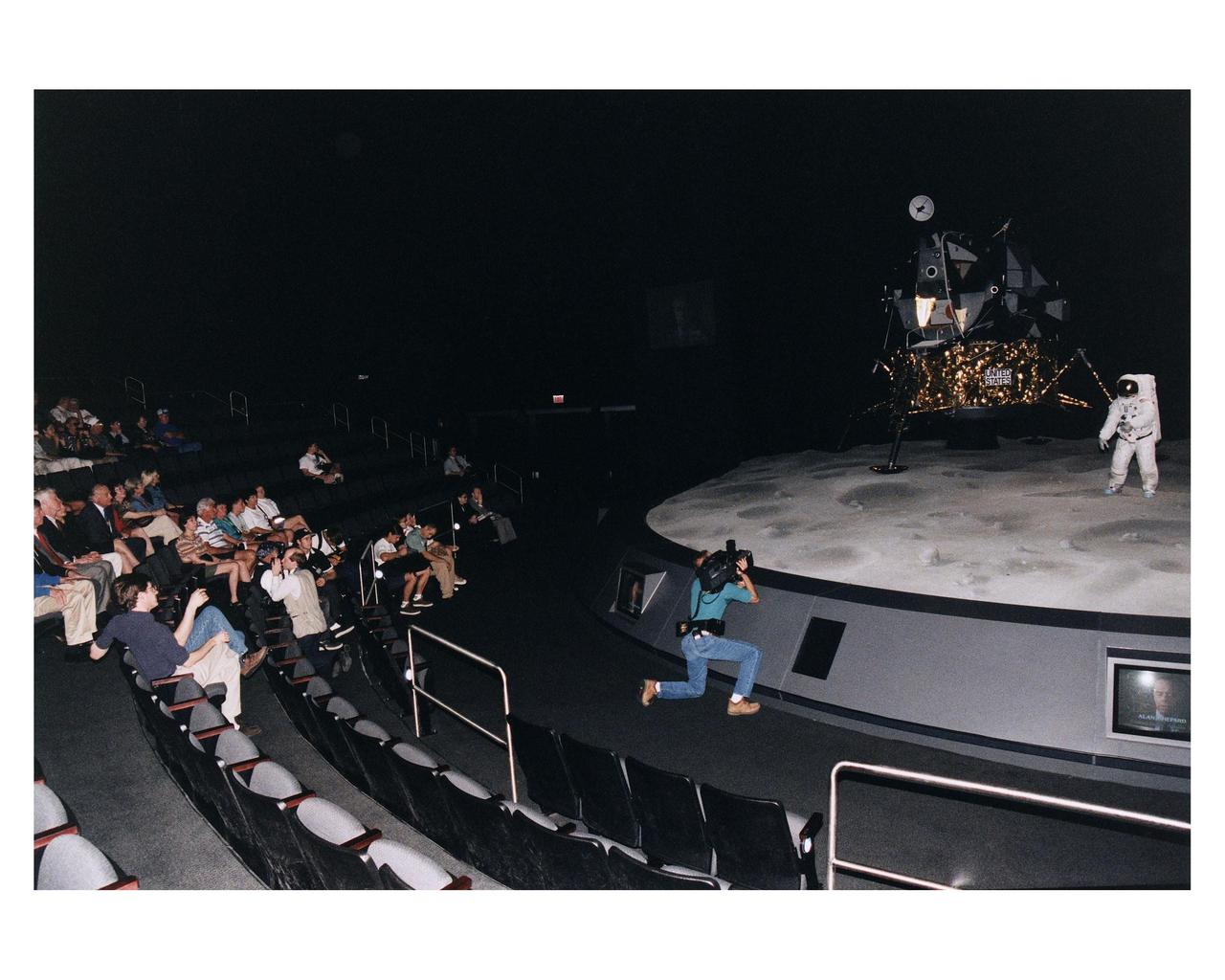
KENNEDY SPACE CENTER, FLA. -- Some of the former Apollo program astronauts observe a Lunar Module and Moon mockup during a tour the new Apollo/Saturn V Center (ASVC) at KSC prior to the gala grand opening ceremony for the facility that was held Jan. 8, 1997. The astronauts were invited to participate in the event, which also featured NASA Administrator Dan Goldin and KSC Director Jay Honeycutt. Some of the visiting astonauts were (from left): Apollo 10 Lunar Module Pilot and Apollo 17 Commander Eugene A. Cernan; Apollo 9 Lunar Module Pilot Russell L. Schweikart; Apollo 10 Command Module Pilot and Apollo 16 Commander John W. Young; Apollo 10 Commander Thomas P. Stafford; and Apollo 11 Lunar Module Pilot Edwin E. "Buzz" Aldrin, Jr. The ASVC also features several other Apollo program spacecraft components, multimedia presentations and a simulated Apollo/Saturn V liftoff. The facility will be a part of the KSC bus tour that embarks from the KSC Visitor Center