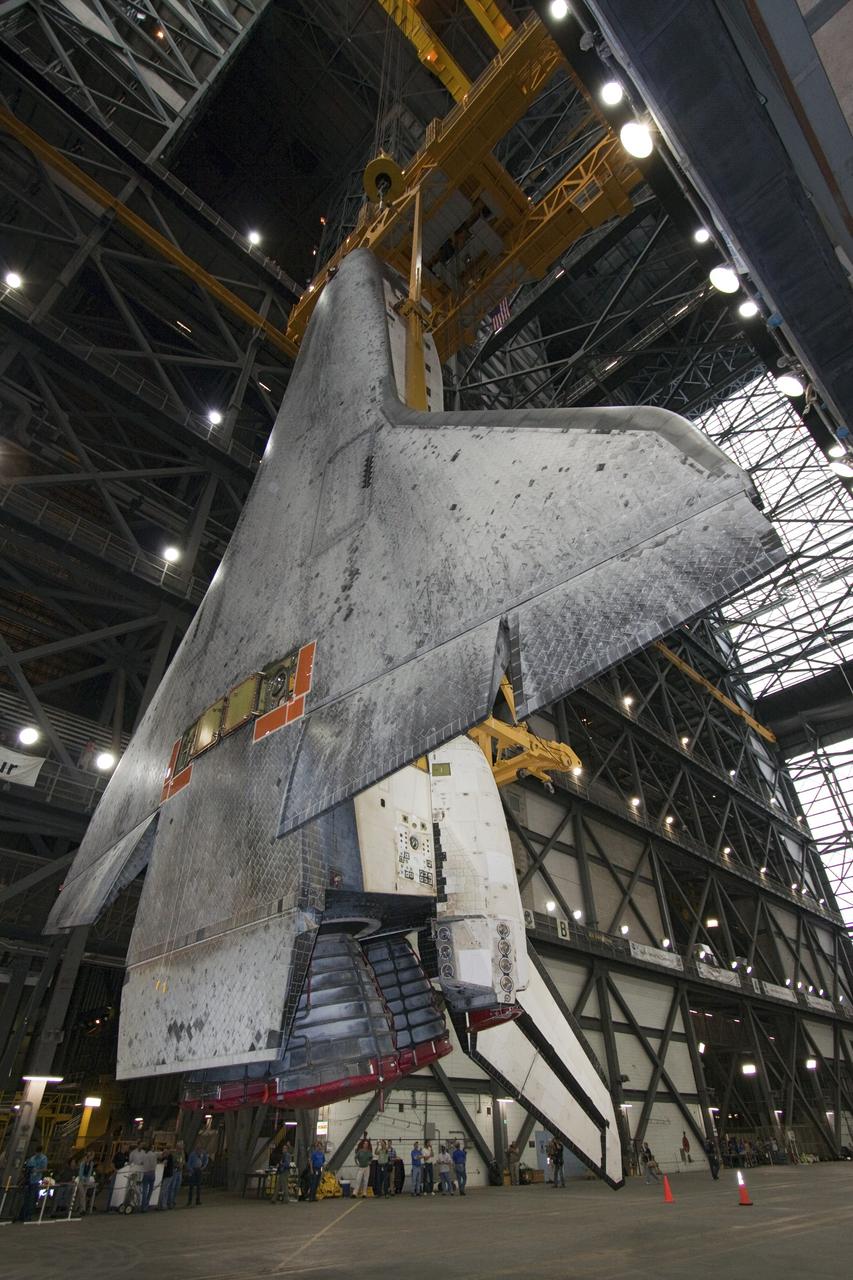
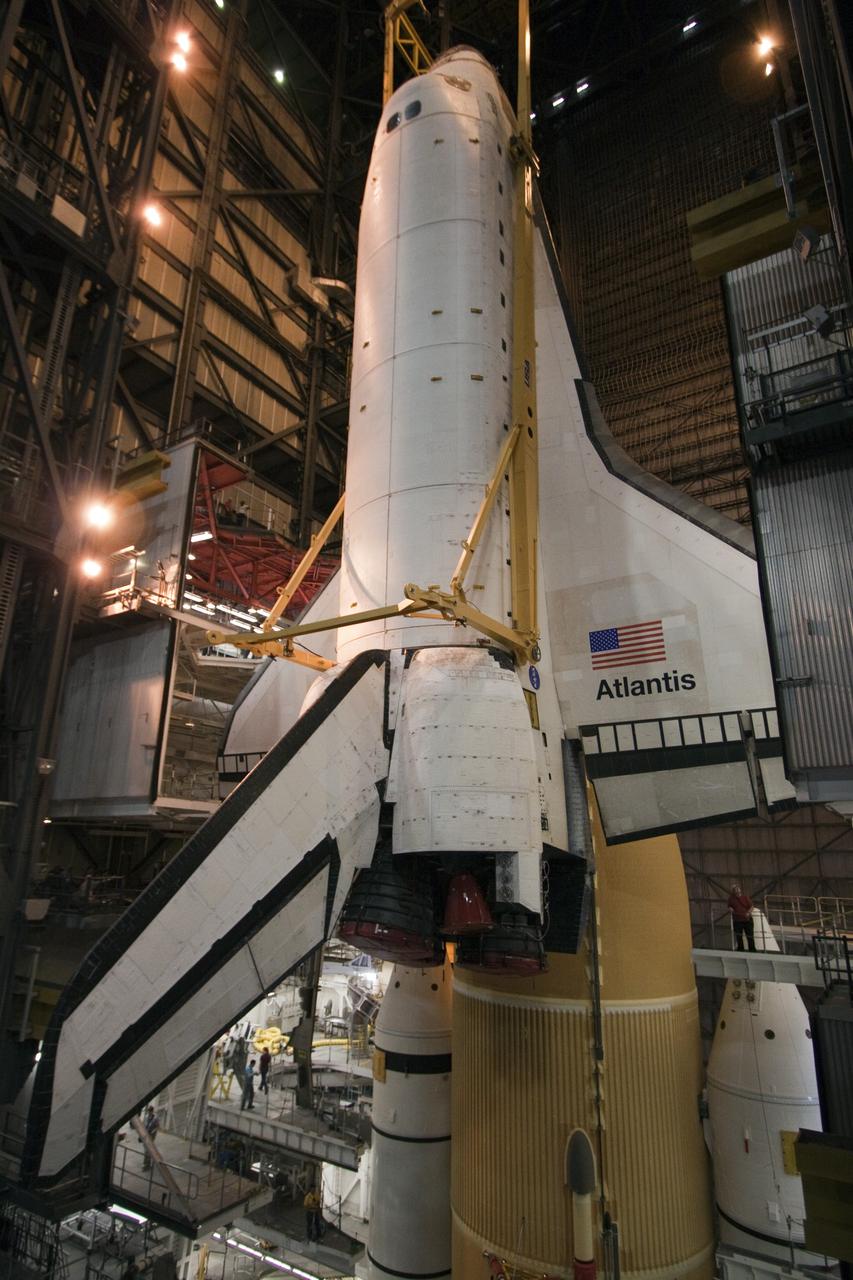
CAPE CANAVERAL, Fla. -- In Vehicle Assembly Building at NASA's Kennedy Space Center in Florida, an overhead crane slowly lifts shuttle Atlantis into a vertical position above the transfer aisle. The spacecraft will be moved to a high bay where it will be attached to its external fuel tank and solid rocket boosters already on the mobile launcher platform. Commander Chris Ferguson, Pilot Doug Hurley and Mission Specialists Sandra Magnus and Rex Walheim are expected to launch in mid-July, taking with them the Raffaello multi-purpose logistics module packed with supplies, logistics and spare parts. The STS-135 mission also will fly a system to investigate the potential for robotically refueling existing spacecraft and return a failed ammonia pump module to help NASA better understand the failure mechanism and improve pump designs for future systems. STS-135 will be the 33rd flight of Atlantis, the 37th shuttle mission to the space station, and the 135th and final mission of NASA's Space Shuttle Program. For more information visit, www.nasa.gov/mission_pages/shuttle/shuttlemissions/sts135/index.html. Photo credit: NASA/Jack Pfaller
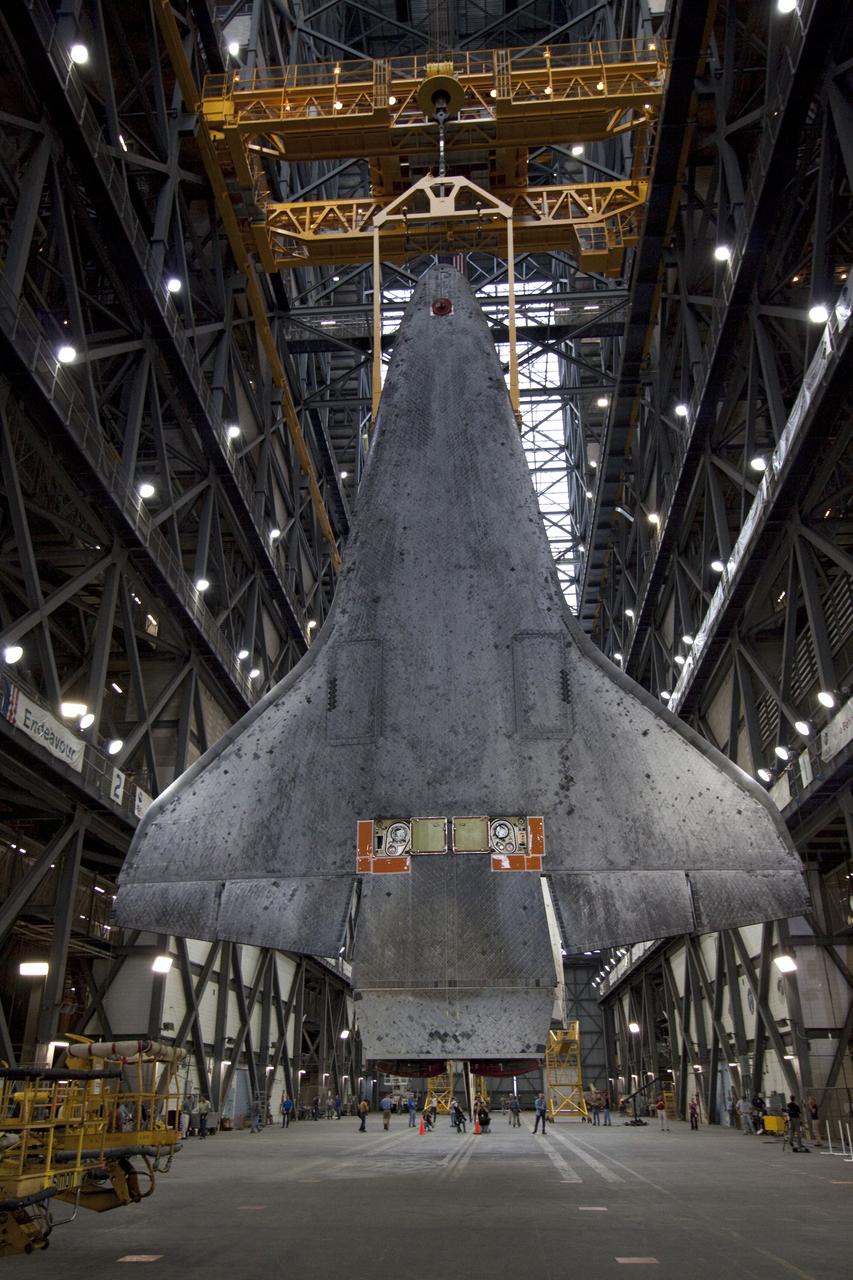
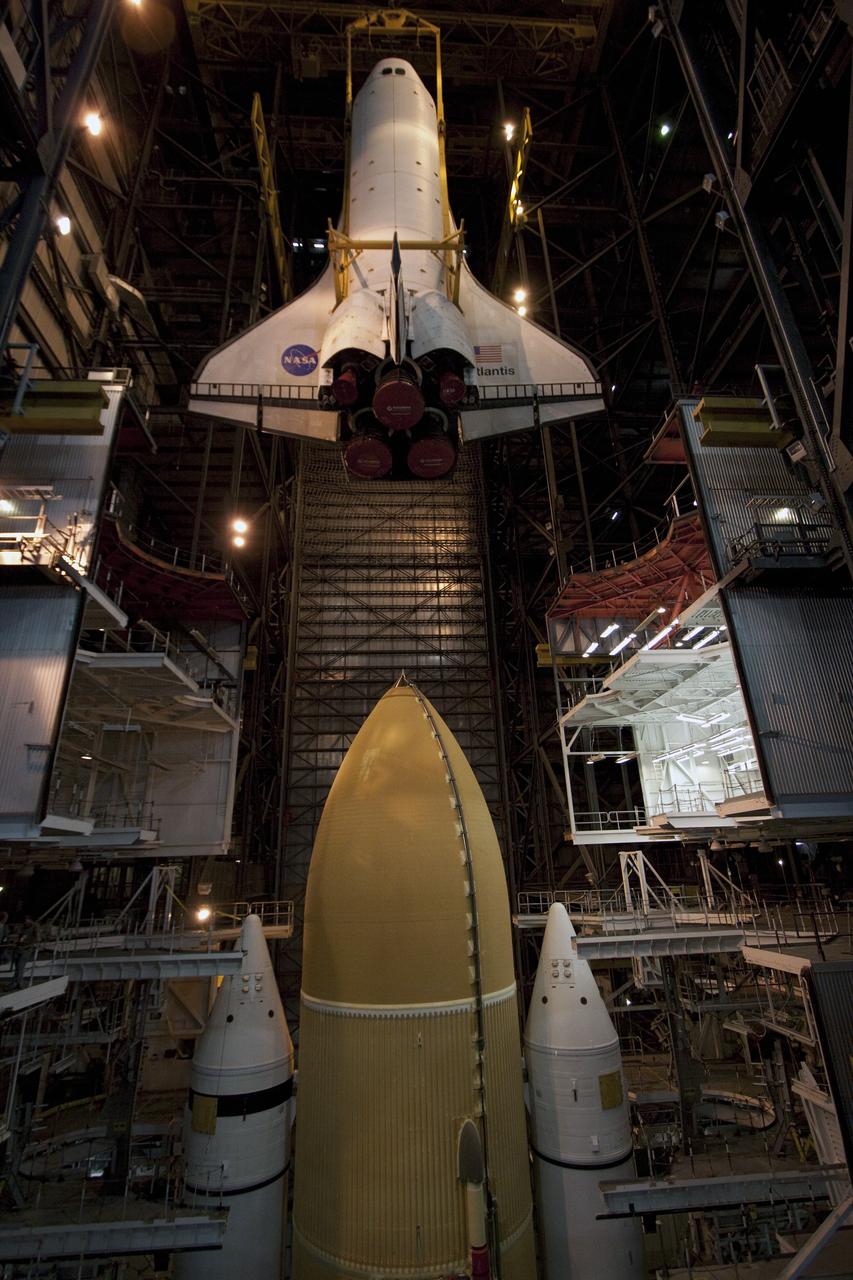
CAPE CANAVERAL, Fla. -- In Vehicle Assembly Building at NASA's Kennedy Space Center in Florida, an overhead crane suspends shuttle Atlantis above the transfer aisle. The spacecraft will be moved into a high bay where it will be lowered and attached to its external fuel tank and solid rocket boosters already on the mobile launcher platform. Commander Chris Ferguson, Pilot Doug Hurley and Mission Specialists Sandra Magnus and Rex Walheim are expected to launch in mid-July, taking with them the Raffaello multi-purpose logistics module packed with supplies, logistics and spare parts. The STS-135 mission also will fly a system to investigate the potential for robotically refueling existing spacecraft and return a failed ammonia pump module to help NASA better understand the failure mechanism and improve pump designs for future systems. STS-135 will be the 33rd flight of Atlantis, the 37th shuttle mission to the space station, and the 135th and final mission of NASA's Space Shuttle Program. For more information visit, www.nasa.gov/mission_pages/shuttle/shuttlemissions/sts135/index.html. Photo credit: NASA/Jack Pfaller
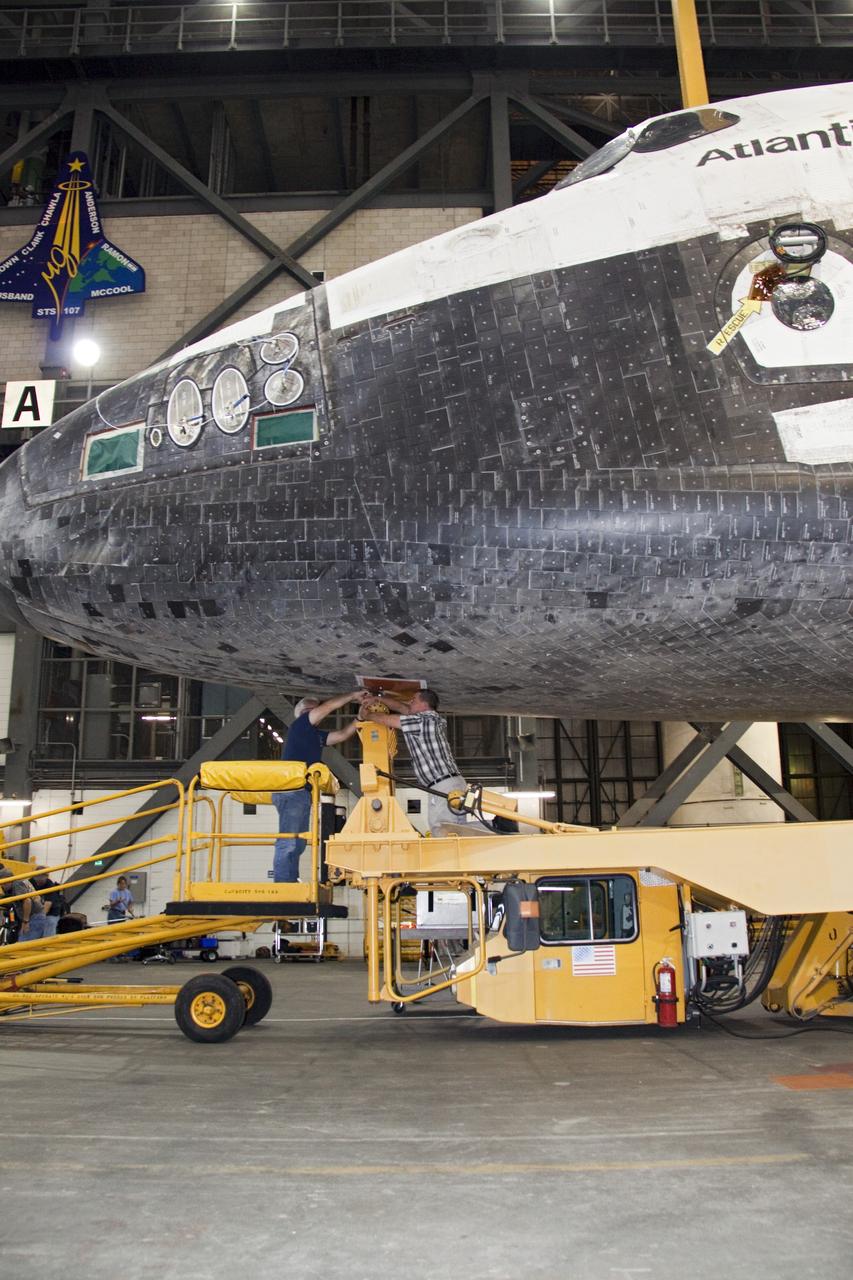
CAPE CANAVERAL, Fla. -- In the Vehicle Assembly Building at NASA's Kennedy Space Center in Florida, workers disconnect the transporter from shuttle Atlantis. An overhead crane then will lift the spacecraft into a high bay where it will be attached to its external fuel tank and solid rocket boosters already on the mobile launcher platform. Commander Chris Ferguson, Pilot Doug Hurley and Mission Specialists Sandra Magnus and Rex Walheim are expected to launch in mid-July, taking with them the Raffaello multi-purpose logistics module packed with supplies, logistics and spare parts. The STS-135 mission also will fly a system to investigate the potential for robotically refueling existing spacecraft and return a failed ammonia pump module to help NASA better understand the failure mechanism and improve pump designs for future systems. STS-135 will be the 33rd flight of Atlantis, the 37th shuttle mission to the space station, and the 135th and final mission of NASA's Space Shuttle Program. For more information visit, www.nasa.gov/mission_pages/shuttle/shuttlemissions/sts135/index.html. Photo credit: NASA/Jack Pfaller
CAPE CANAVERAL, Fla. -- In Vehicle Assembly Building at NASA's Kennedy Space Center in Florida, an overhead crane suspends shuttle Atlantis above the transfer aisle. The spacecraft will be moved into a high bay where it will be lowered and attached to its external fuel tank and solid rocket boosters already on the mobile launcher platform. Commander Chris Ferguson, Pilot Doug Hurley and Mission Specialists Sandra Magnus and Rex Walheim are expected to launch in mid-July, taking with them the Raffaello multi-purpose logistics module packed with supplies, logistics and spare parts. The STS-135 mission also will fly a system to investigate the potential for robotically refueling existing spacecraft and return a failed ammonia pump module to help NASA better understand the failure mechanism and improve pump designs for future systems. STS-135 will be the 33rd flight of Atlantis, the 37th shuttle mission to the space station, and the 135th and final mission of NASA's Space Shuttle Program. For more information visit, www.nasa.gov/mission_pages/shuttle/shuttlemissions/sts135/index.html. Photo credit: NASA/Jack Pfaller
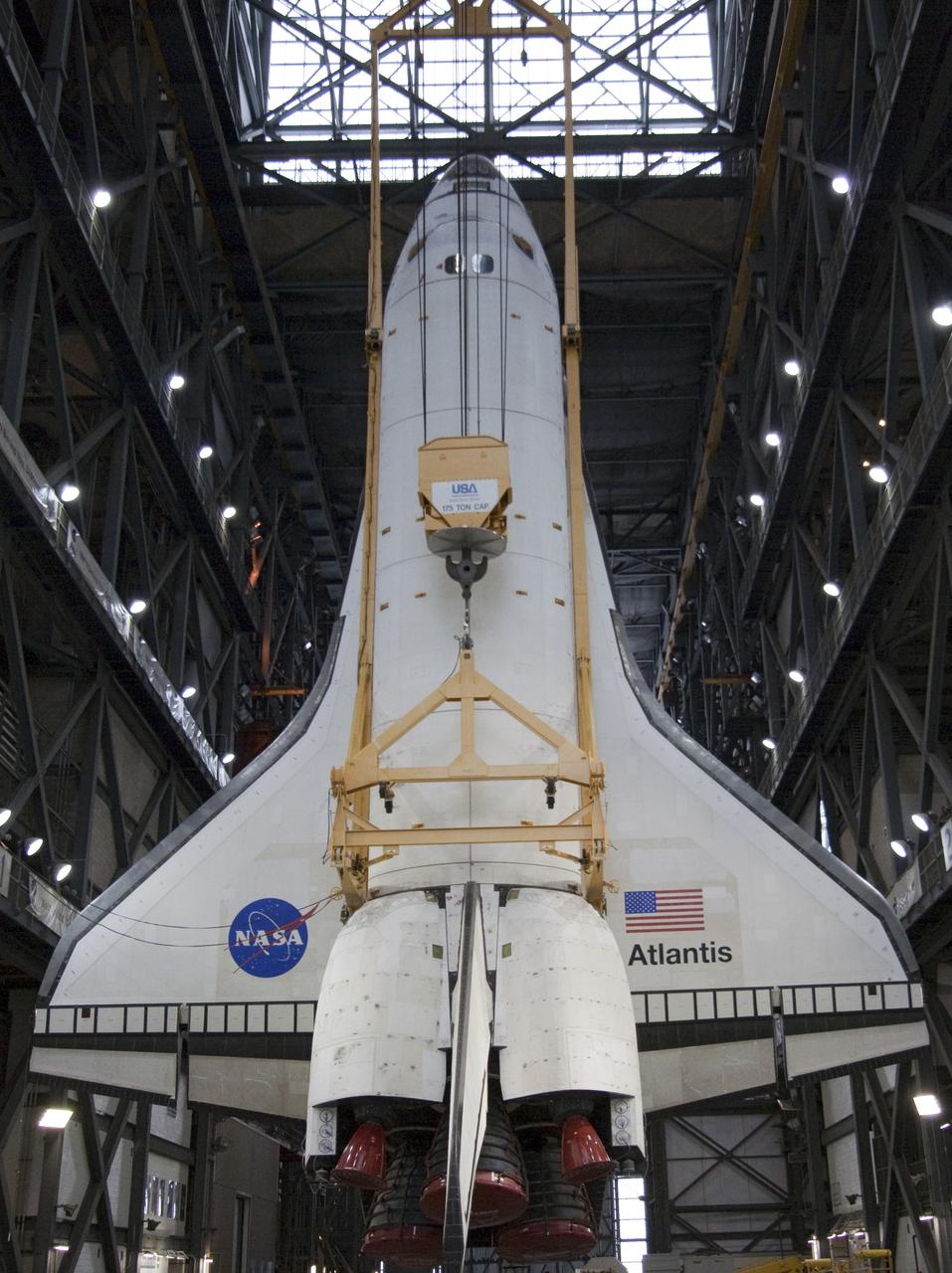
CAPE CANAVERAL, Fla. -- In Vehicle Assembly Building at NASA's Kennedy Space Center in Florida, an overhead crane suspends shuttle Atlantis above the transfer aisle. The spacecraft will be moved into a high bay where it will be lowered and attached to its external fuel tank and solid rocket boosters already on the mobile launcher platform. Commander Chris Ferguson, Pilot Doug Hurley and Mission Specialists Sandra Magnus and Rex Walheim are expected to launch in mid-July, taking with them the Raffaello multi-purpose logistics module packed with supplies, logistics and spare parts. The STS-135 mission also will fly a system to investigate the potential for robotically refueling existing spacecraft and return a failed ammonia pump module to help NASA better understand the failure mechanism and improve pump designs for future systems. STS-135 will be the 33rd flight of Atlantis, the 37th shuttle mission to the space station, and the 135th and final mission of NASA's Space Shuttle Program. For more information visit, www.nasa.gov/mission_pages/shuttle/shuttlemissions/sts135/index.html. Photo credit: NASA/Jack Pfaller
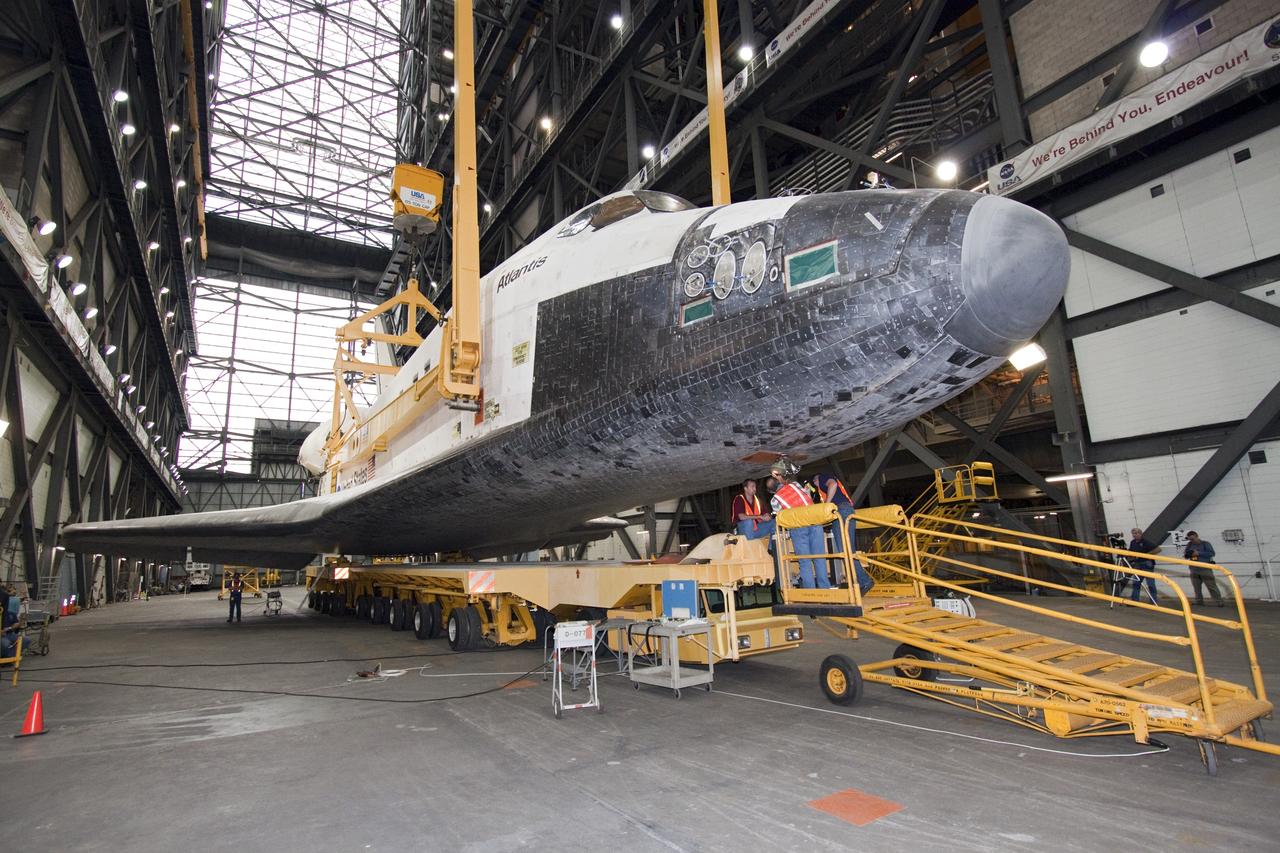
CAPE CANAVERAL, Fla. -- In the Vehicle Assembly Building at NASA's Kennedy Space Center in Florida, workers disconnect the transporter from shuttle Atlantis. An overhead crane then will lift the spacecraft into a high bay where it will be attached to its external fuel tank and solid rocket boosters already on the mobile launcher platform. Commander Chris Ferguson, Pilot Doug Hurley and Mission Specialists Sandra Magnus and Rex Walheim are expected to launch in mid-July, taking with them the Raffaello multi-purpose logistics module packed with supplies, logistics and spare parts. The STS-135 mission also will fly a system to investigate the potential for robotically refueling existing spacecraft and return a failed ammonia pump module to help NASA better understand the failure mechanism and improve pump designs for future systems. STS-135 will be the 33rd flight of Atlantis, the 37th shuttle mission to the space station, and the 135th and final mission of NASA's Space Shuttle Program. For more information visit, www.nasa.gov/mission_pages/shuttle/shuttlemissions/sts135/index.html. Photo credit: NASA/Jack Pfaller
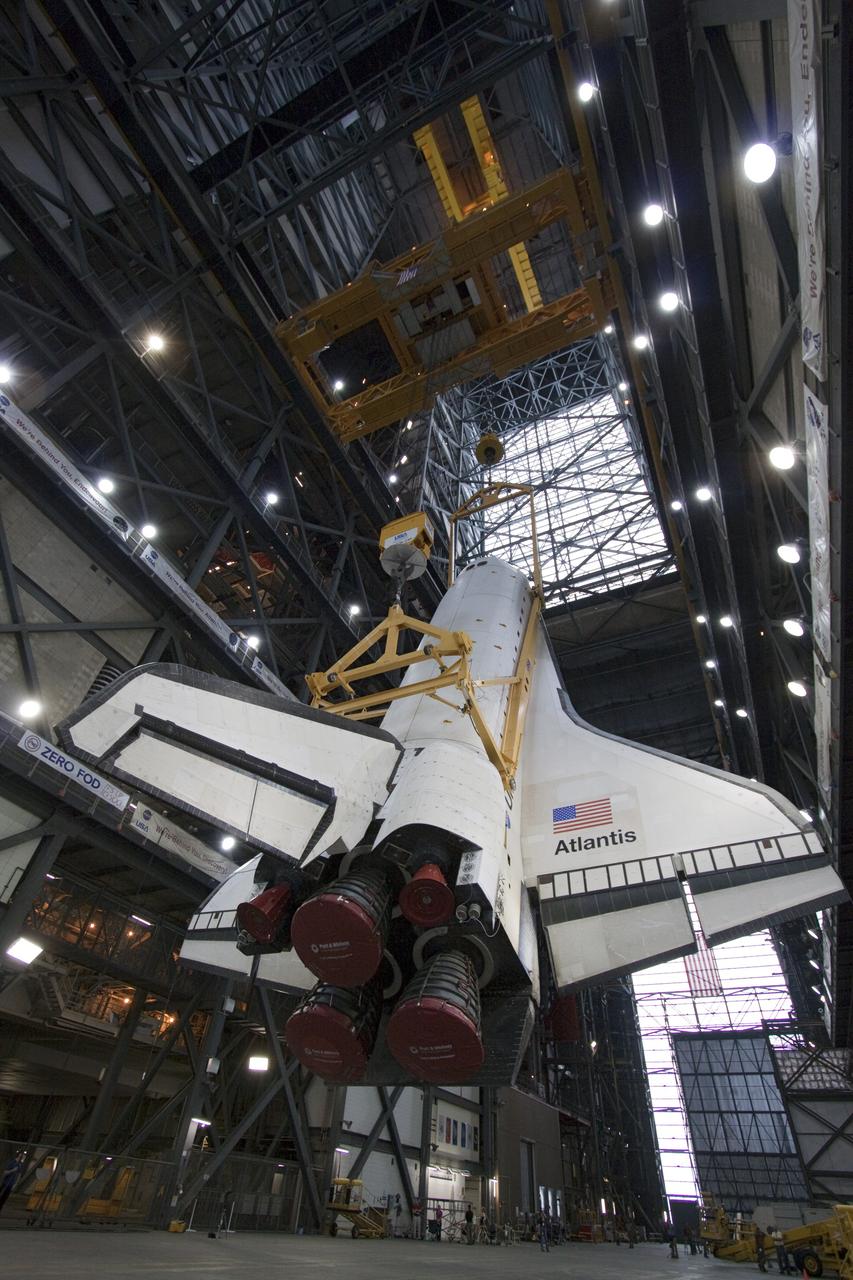
CAPE CANAVERAL, Fla. -- In Vehicle Assembly Building at NASA's Kennedy Space Center in Florida, an overhead crane slowly lifts shuttle Atlantis into a vertical position above the transfer aisle. The spacecraft will be moved to a high bay where it will be attached to its external fuel tank and solid rocket boosters already on the mobile launcher platform. Commander Chris Ferguson, Pilot Doug Hurley and Mission Specialists Sandra Magnus and Rex Walheim are expected to launch in mid-July, taking with them the Raffaello multi-purpose logistics module packed with supplies, logistics and spare parts. The STS-135 mission also will fly a system to investigate the potential for robotically refueling existing spacecraft and return a failed ammonia pump module to help NASA better understand the failure mechanism and improve pump designs for future systems. STS-135 will be the 33rd flight of Atlantis, the 37th shuttle mission to the space station, and the 135th and final mission of NASA's Space Shuttle Program. For more information visit, www.nasa.gov/mission_pages/shuttle/shuttlemissions/sts135/index.html. Photo credit: NASA/Jack Pfaller
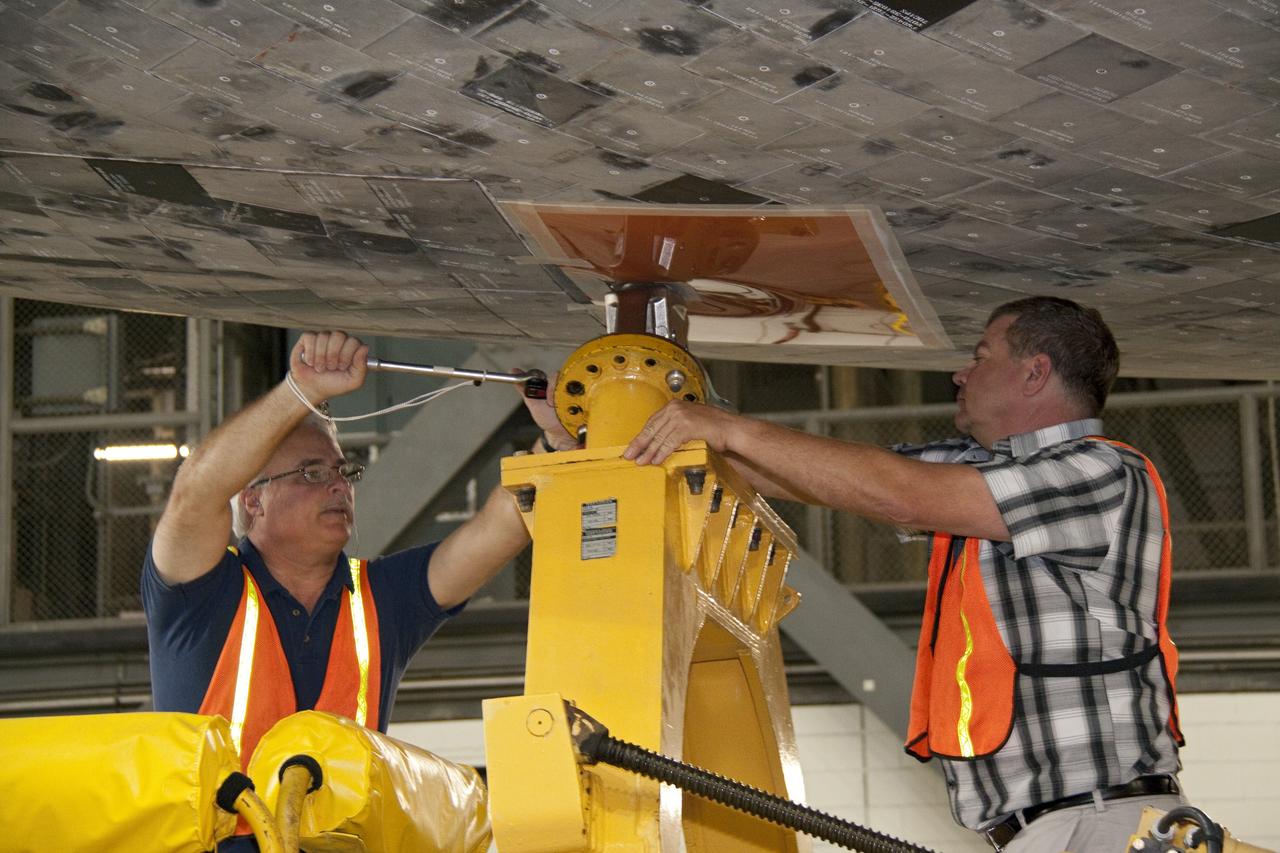
CAPE CANAVERAL, Fla. -- In the Vehicle Assembly Building at NASA's Kennedy Space Center in Florida, workers disconnect the transporter from shuttle Atlantis. An overhead crane then will lift the spacecraft into a high bay where it will be attached to its external fuel tank and solid rocket boosters already on the mobile launcher platform. Commander Chris Ferguson, Pilot Doug Hurley and Mission Specialists Sandra Magnus and Rex Walheim are expected to launch in mid-July, taking with them the Raffaello multi-purpose logistics module packed with supplies, logistics and spare parts. The STS-135 mission also will fly a system to investigate the potential for robotically refueling existing spacecraft and return a failed ammonia pump module to help NASA better understand the failure mechanism and improve pump designs for future systems. STS-135 will be the 33rd flight of Atlantis, the 37th shuttle mission to the space station, and the 135th and final mission of NASA's Space Shuttle Program. For more information visit, www.nasa.gov/mission_pages/shuttle/shuttlemissions/sts135/index.html. Photo credit: NASA/Jack Pfaller

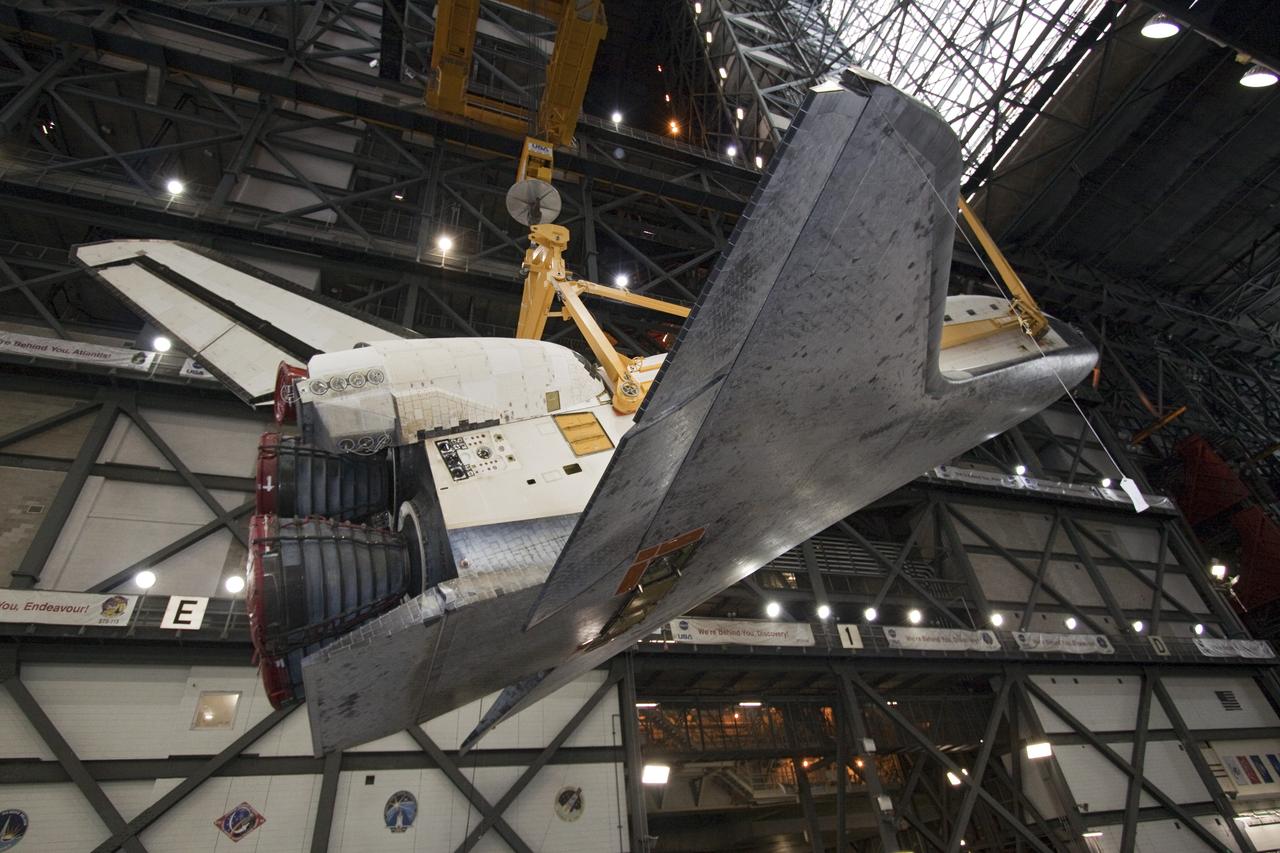
CAPE CANAVERAL, Fla. -- In the Vehicle Assembly Building at NASA's Kennedy Space Center in Florida, shuttle Atlantis is suspended above the transfer aisle. The spacecraft will be positioned vertically in a high bay where it will be attached to its external fuel tank and solid rocket boosters already on the mobile launcher platform. Commander Chris Ferguson, Pilot Doug Hurley and Mission Specialists Sandra Magnus and Rex Walheim are expected to launch in mid-July, taking with them the Raffaello multi-purpose logistics module packed with supplies, logistics and spare parts. The STS-135 mission also will fly a system to investigate the potential for robotically refueling existing spacecraft and return a failed ammonia pump module to help NASA better understand the failure mechanism and improve pump designs for future systems. STS-135 will be the 33rd flight of Atlantis, the 37th shuttle mission to the space station, and the 135th and final mission of NASA's Space Shuttle Program. For more information visit, www.nasa.gov/mission_pages/shuttle/shuttlemissions/sts135/index.html. Photo credit: NASA/Jack Pfaller

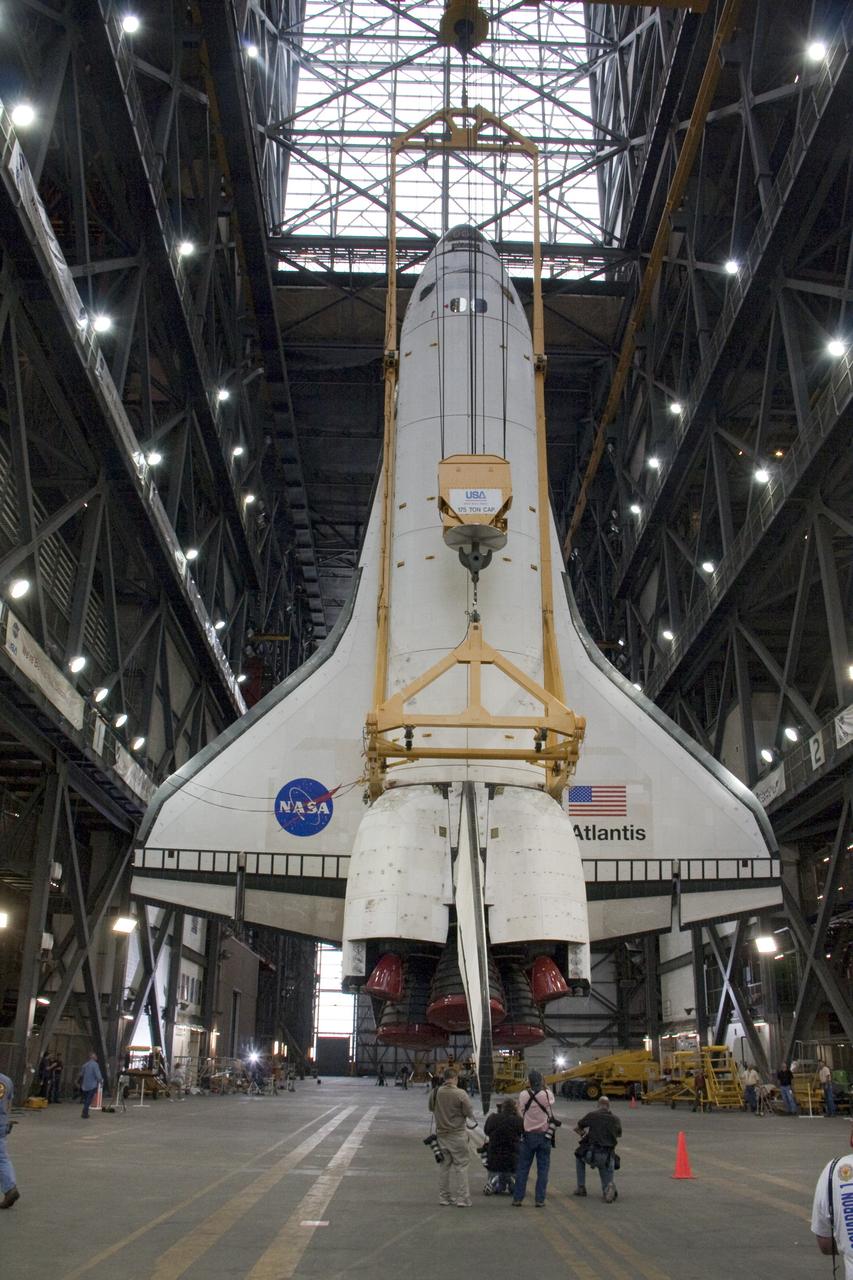
CAPE CANAVERAL, Fla. -- In Vehicle Assembly Building at NASA's Kennedy Space Center in Florida, an overhead crane slowly lifts shuttle Atlantis off its transporter. The spacecraft then will be positioned vertically in a high bay where it will be attached to its external fuel tank and solid rocket boosters already on the mobile launcher platform. Commander Chris Ferguson, Pilot Doug Hurley and Mission Specialists Sandra Magnus and Rex Walheim are expected to launch in mid-July, taking with them the Raffaello multi-purpose logistics module packed with supplies, logistics and spare parts. The STS-135 mission also will fly a system to investigate the potential for robotically refueling existing spacecraft and return a failed ammonia pump module to help NASA better understand the failure mechanism and improve pump designs for future systems. STS-135 will be the 33rd flight of Atlantis, the 37th shuttle mission to the space station, and the 135th and final mission of NASA's Space Shuttle Program. For more information visit, www.nasa.gov/mission_pages/shuttle/shuttlemissions/sts135/index.html. Photo credit: NASA/Jack Pfaller
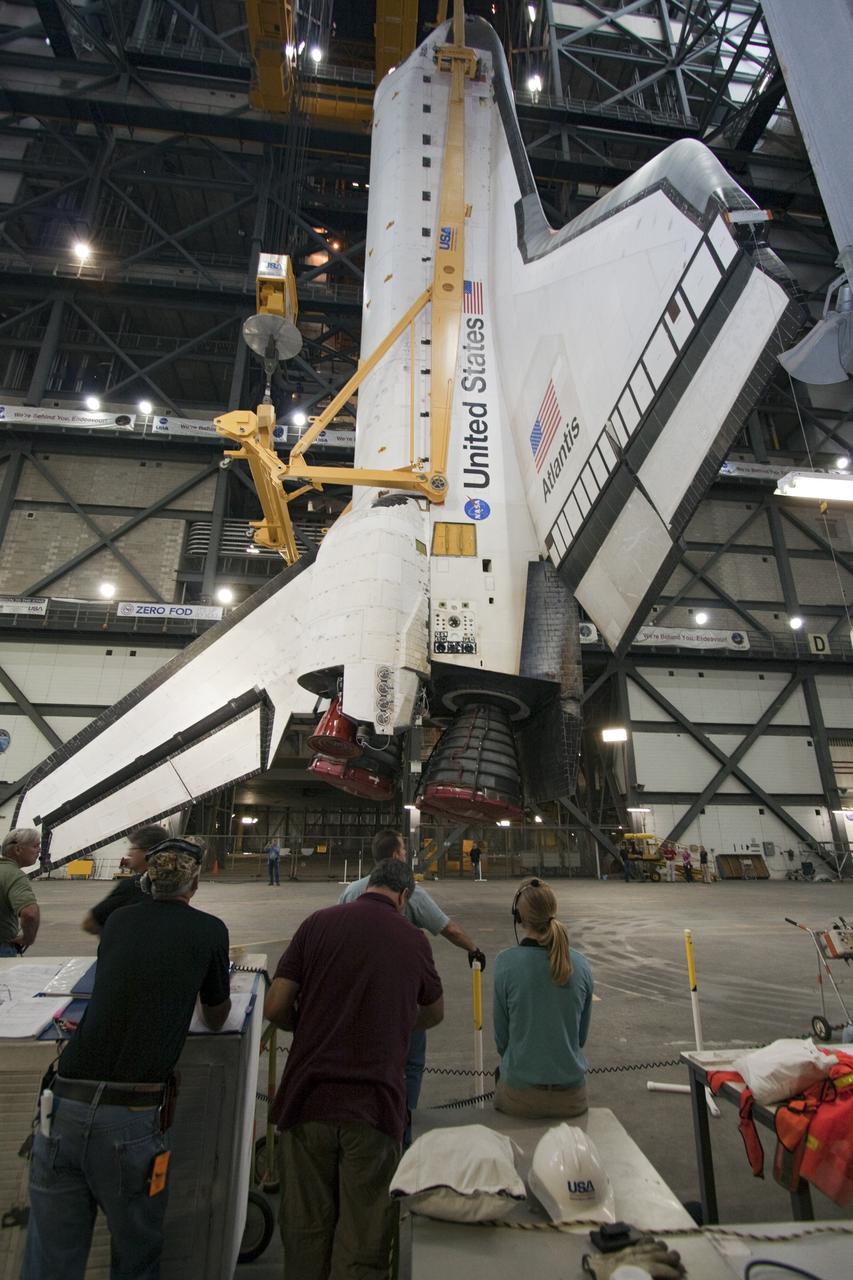
CAPE CANAVERAL, Fla. -- In Vehicle Assembly Building at NASA's Kennedy Space Center in Florida, an overhead crane slowly lifts shuttle Atlantis into a vertical position above the transfer aisle. The spacecraft will be moved to a high bay where it will be attached to its external fuel tank and solid rocket boosters already on the mobile launcher platform. Commander Chris Ferguson, Pilot Doug Hurley and Mission Specialists Sandra Magnus and Rex Walheim are expected to launch in mid-July, taking with them the Raffaello multi-purpose logistics module packed with supplies, logistics and spare parts. The STS-135 mission also will fly a system to investigate the potential for robotically refueling existing spacecraft and return a failed ammonia pump module to help NASA better understand the failure mechanism and improve pump designs for future systems. STS-135 will be the 33rd flight of Atlantis, the 37th shuttle mission to the space station, and the 135th and final mission of NASA's Space Shuttle Program. For more information visit, www.nasa.gov/mission_pages/shuttle/shuttlemissions/sts135/index.html. Photo credit: NASA/Jack Pfaller

CAPE CANAVERAL, Fla. -- In Vehicle Assembly Building at NASA's Kennedy Space Center in Florida, an overhead crane slowly lifts shuttle Atlantis into a vertical position above the transfer aisle. The spacecraft will be moved to a high bay where it will be attached to its external fuel tank and solid rocket boosters already on the mobile launcher platform. Commander Chris Ferguson, Pilot Doug Hurley and Mission Specialists Sandra Magnus and Rex Walheim are expected to launch in mid-July, taking with them the Raffaello multi-purpose logistics module packed with supplies, logistics and spare parts. The STS-135 mission also will fly a system to investigate the potential for robotically refueling existing spacecraft and return a failed ammonia pump module to help NASA better understand the failure mechanism and improve pump designs for future systems. STS-135 will be the 33rd flight of Atlantis, the 37th shuttle mission to the space station, and the 135th and final mission of NASA's Space Shuttle Program. For more information visit, www.nasa.gov/mission_pages/shuttle/shuttlemissions/sts135/index.html. Photo credit: NASA/Jack Pfaller
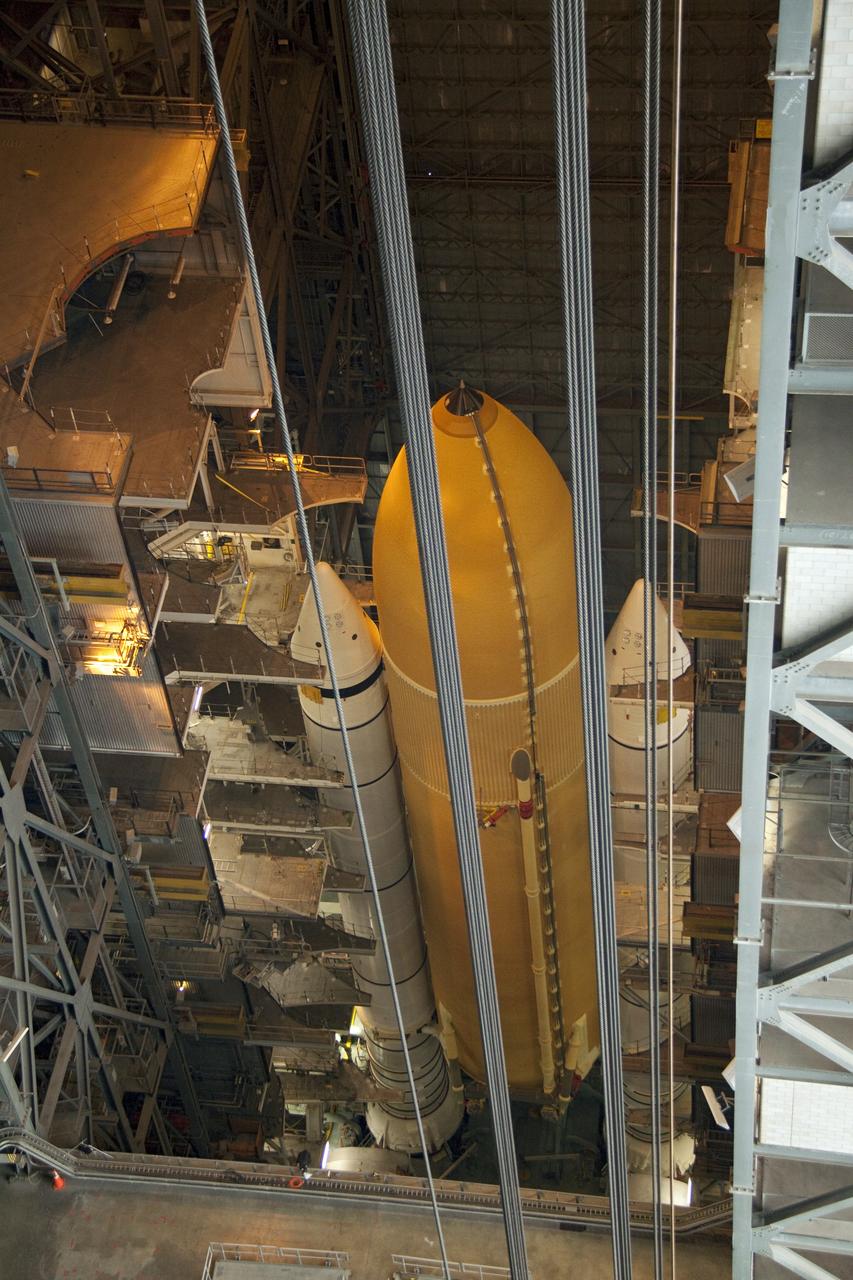
CAPE CANAVERAL, Fla. -- This overhead view in the Vehicle Assembly Building at NASA's Kennedy Space Center in Florida shows the STS-135 external fuel tank and solid rocket boosters already installed on the mobile launcher platform waiting for shuttle Atlantis to make the stack complete. Commander Chris Ferguson, Pilot Doug Hurley and Mission Specialists Sandra Magnus and Rex Walheim are expected to launch in mid-July, taking with them the Raffaello multi-purpose logistics module packed with supplies, logistics and spare parts. The STS-135 mission also will fly a system to investigate the potential for robotically refueling existing spacecraft and return a failed ammonia pump module to help NASA better understand the failure mechanism and improve pump designs for future systems. STS-135 will be the 33rd flight of Atlantis, the 37th shuttle mission to the space station, and the 135th and final mission of NASA's Space Shuttle Program. For more information visit, www.nasa.gov/mission_pages/shuttle/shuttlemissions/sts135/index.html. Photo credit: NASA/Jack Pfaller
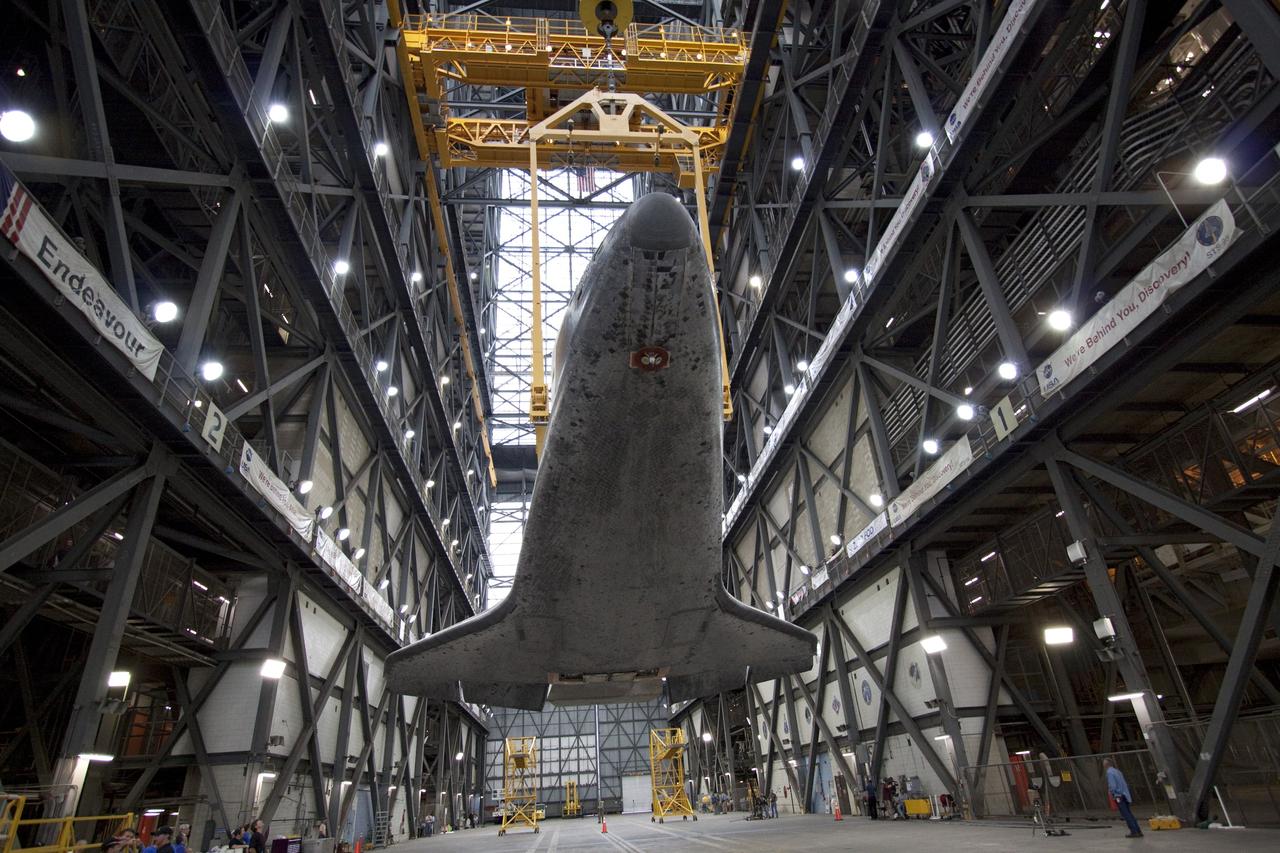
CAPE CANAVERAL, Fla. -- In Vehicle Assembly Building at NASA's Kennedy Space Center in Florida, an overhead crane suspends shuttle Atlantis above the transfer aisle. The spacecraft will be moved into a high bay where it will be lowered and attached to its external fuel tank and solid rocket boosters already on the mobile launcher platform. Commander Chris Ferguson, Pilot Doug Hurley and Mission Specialists Sandra Magnus and Rex Walheim are expected to launch in mid-July, taking with them the Raffaello multi-purpose logistics module packed with supplies, logistics and spare parts. The STS-135 mission also will fly a system to investigate the potential for robotically refueling existing spacecraft and return a failed ammonia pump module to help NASA better understand the failure mechanism and improve pump designs for future systems. STS-135 will be the 33rd flight of Atlantis, the 37th shuttle mission to the space station, and the 135th and final mission of NASA's Space Shuttle Program. For more information visit, www.nasa.gov/mission_pages/shuttle/shuttlemissions/sts135/index.html. Photo credit: NASA/Jack Pfaller
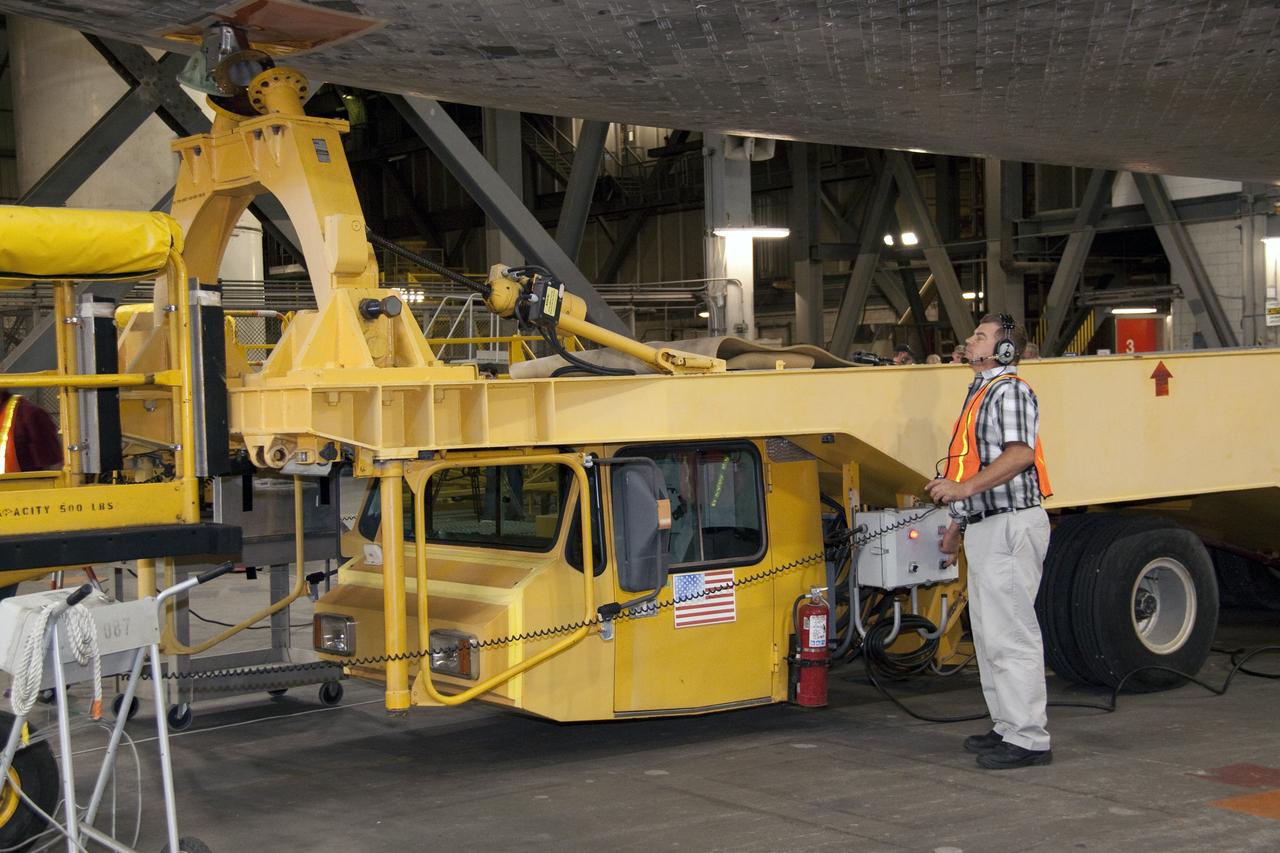
CAPE CANAVERAL, Fla. -- In the Vehicle Assembly Building at NASA's Kennedy Space Center in Florida, workers disconnect the transporter from shuttle Atlantis. An overhead crane then will lift the spacecraft into a high bay where it will be attached to its external fuel tank and solid rocket boosters already on the mobile launcher platform. Commander Chris Ferguson, Pilot Doug Hurley and Mission Specialists Sandra Magnus and Rex Walheim are expected to launch in mid-July, taking with them the Raffaello multi-purpose logistics module packed with supplies, logistics and spare parts. The STS-135 mission also will fly a system to investigate the potential for robotically refueling existing spacecraft and return a failed ammonia pump module to help NASA better understand the failure mechanism and improve pump designs for future systems. STS-135 will be the 33rd flight of Atlantis, the 37th shuttle mission to the space station, and the 135th and final mission of NASA's Space Shuttle Program. For more information visit, www.nasa.gov/mission_pages/shuttle/shuttlemissions/sts135/index.html. Photo credit: NASA/Jack Pfaller

CAPE CANAVERAL, Fla. -- In Vehicle Assembly Building at NASA's Kennedy Space Center in Florida, media photograph shuttle Atlantis as an overhead crane slowly lifts it off its transporter. The spacecraft will be positioned vertically in a high bay where it will be attached to its external fuel tank and solid rocket boosters already on the mobile launcher platform. Commander Chris Ferguson, Pilot Doug Hurley and Mission Specialists Sandra Magnus and Rex Walheim are expected to launch in mid-July, taking with them the Raffaello multi-purpose logistics module packed with supplies, logistics and spare parts. The STS-135 mission also will fly a system to investigate the potential for robotically refueling existing spacecraft and return a failed ammonia pump module to help NASA better understand the failure mechanism and improve pump designs for future systems. STS-135 will be the 33rd flight of Atlantis, the 37th shuttle mission to the space station, and the 135th and final mission of NASA's Space Shuttle Program. For more information visit, www.nasa.gov/mission_pages/shuttle/shuttlemissions/sts135/index.html. Photo credit: NASA/Jack Pfaller
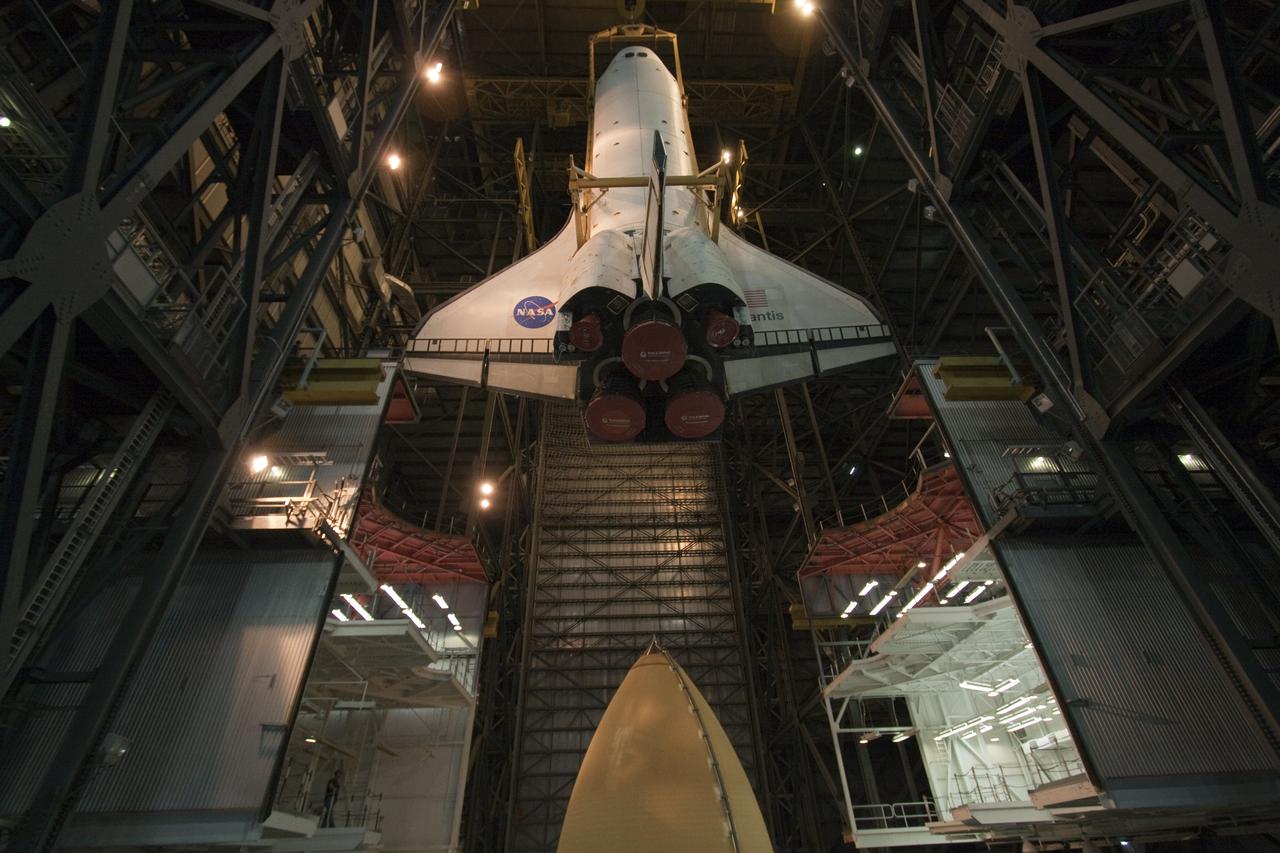
CAPE CANAVERAL, Fla. -- In the Vehicle Assembly Building at NASA's Kennedy Space Center in Florida, shuttle Atlantis is lowered by an overhead crane into a high bay where it will be attached to its external fuel tank and solid rocket boosters already on the mobile launcher platform. Commander Chris Ferguson, Pilot Doug Hurley and Mission Specialists Sandra Magnus and Rex Walheim are expected to launch in mid-July, taking with them the Raffaello multi-purpose logistics module packed with supplies, logistics and spare parts. The STS-135 mission also will fly a system to investigate the potential for robotically refueling existing spacecraft and return a failed ammonia pump module to help NASA better understand the failure mechanism and improve pump designs for future systems. STS-135 will be the 33rd flight of Atlantis, the 37th shuttle mission to the space station, and the 135th and final mission of NASA's Space Shuttle Program. For more information visit, www.nasa.gov/mission_pages/shuttle/shuttlemissions/sts135/index.html. Photo credit: NASA/Troy Cryder
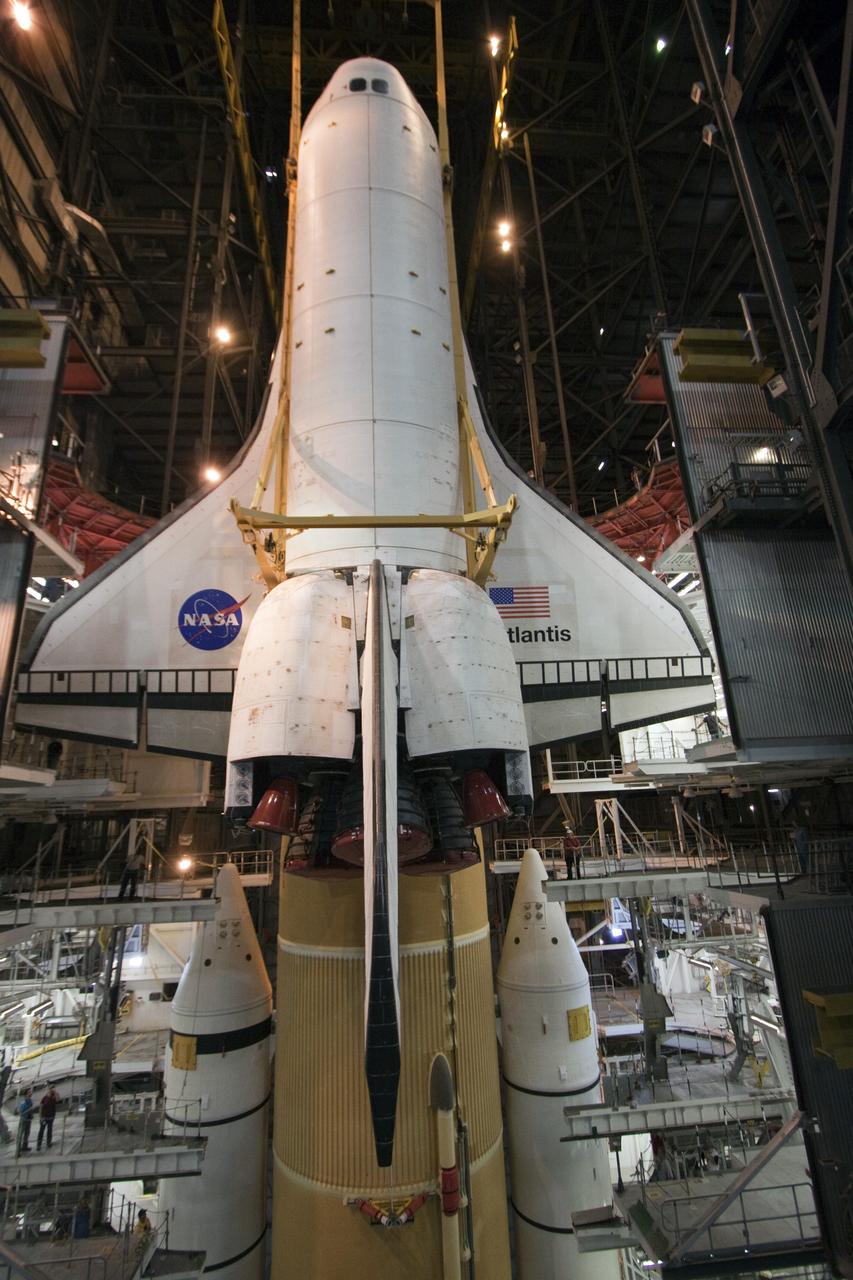
CAPE CANAVERAL, Fla. -- In the Vehicle Assembly Building at NASA's Kennedy Space Center in Florida, shuttle Atlantis is lowered by an overhead crane into a high bay where it will be attached to its external fuel tank and solid rocket boosters already on the mobile launcher platform. Commander Chris Ferguson, Pilot Doug Hurley and Mission Specialists Sandra Magnus and Rex Walheim are expected to launch in mid-July, taking with them the Raffaello multi-purpose logistics module packed with supplies, logistics and spare parts. The STS-135 mission also will fly a system to investigate the potential for robotically refueling existing spacecraft and return a failed ammonia pump module to help NASA better understand the failure mechanism and improve pump designs for future systems. STS-135 will be the 33rd flight of Atlantis, the 37th shuttle mission to the space station, and the 135th and final mission of NASA's Space Shuttle Program. For more information visit, www.nasa.gov/mission_pages/shuttle/shuttlemissions/sts135/index.html. Photo credit: NASA/Troy Cryder
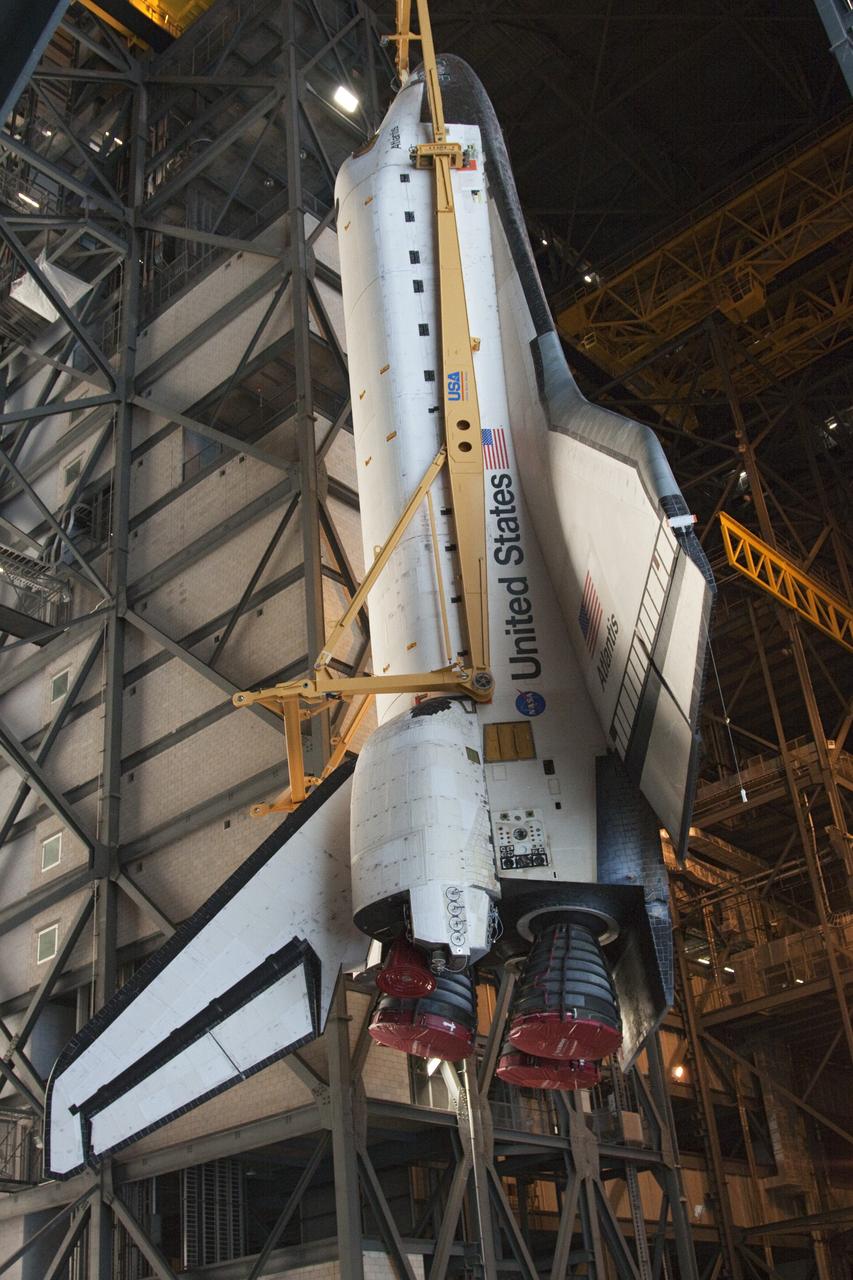
CAPE CANAVERAL, Fla. -- In the Vehicle Assembly Building at NASA's Kennedy Space Center in Florida, shuttle Atlantis is lifted by an overhead crane and moved into a high bay where it will be attached to its external fuel tank and solid rocket boosters already on the mobile launcher platform. Commander Chris Ferguson, Pilot Doug Hurley and Mission Specialists Sandra Magnus and Rex Walheim are expected to launch in mid-July, taking with them the Raffaello multi-purpose logistics module packed with supplies, logistics and spare parts. The STS-135 mission also will fly a system to investigate the potential for robotically refueling existing spacecraft and return a failed ammonia pump module to help NASA better understand the failure mechanism and improve pump designs for future systems. STS-135 will be the 33rd flight of Atlantis, the 37th shuttle mission to the space station, and the 135th and final mission of NASA's Space Shuttle Program. For more information visit, www.nasa.gov/mission_pages/shuttle/shuttlemissions/sts135/index.html. Photo credit: NASA/Troy Cryder
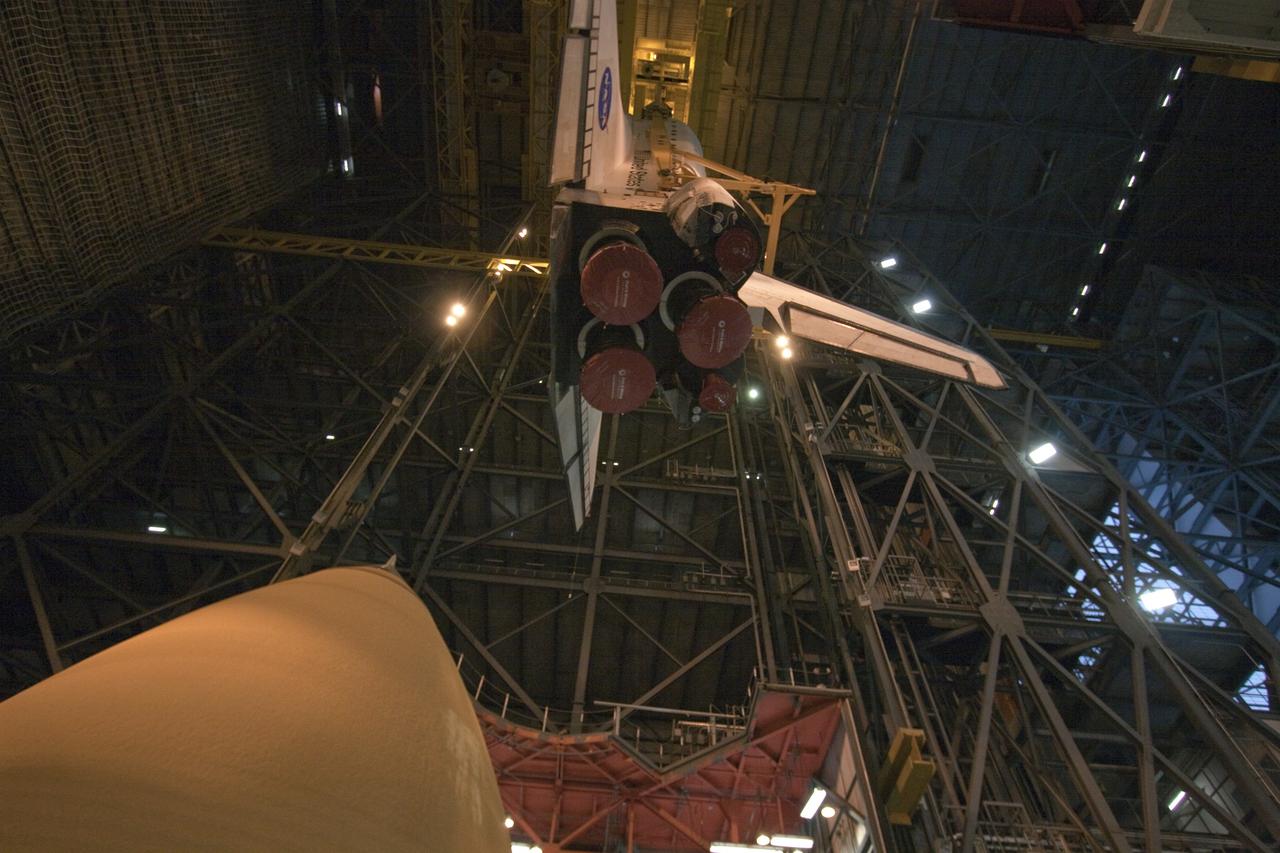
CAPE CANAVERAL, Fla. -- In the Vehicle Assembly Building at NASA's Kennedy Space Center in Florida, shuttle Atlantis is lowered by an overhead crane into a high bay where it will be attached to its external fuel tank and solid rocket boosters already on the mobile launcher platform. Commander Chris Ferguson, Pilot Doug Hurley and Mission Specialists Sandra Magnus and Rex Walheim are expected to launch in mid-July, taking with them the Raffaello multi-purpose logistics module packed with supplies, logistics and spare parts. The STS-135 mission also will fly a system to investigate the potential for robotically refueling existing spacecraft and return a failed ammonia pump module to help NASA better understand the failure mechanism and improve pump designs for future systems. STS-135 will be the 33rd flight of Atlantis, the 37th shuttle mission to the space station, and the 135th and final mission of NASA's Space Shuttle Program. For more information visit, www.nasa.gov/mission_pages/shuttle/shuttlemissions/sts135/index.html. Photo credit: NASA/Troy Cryder
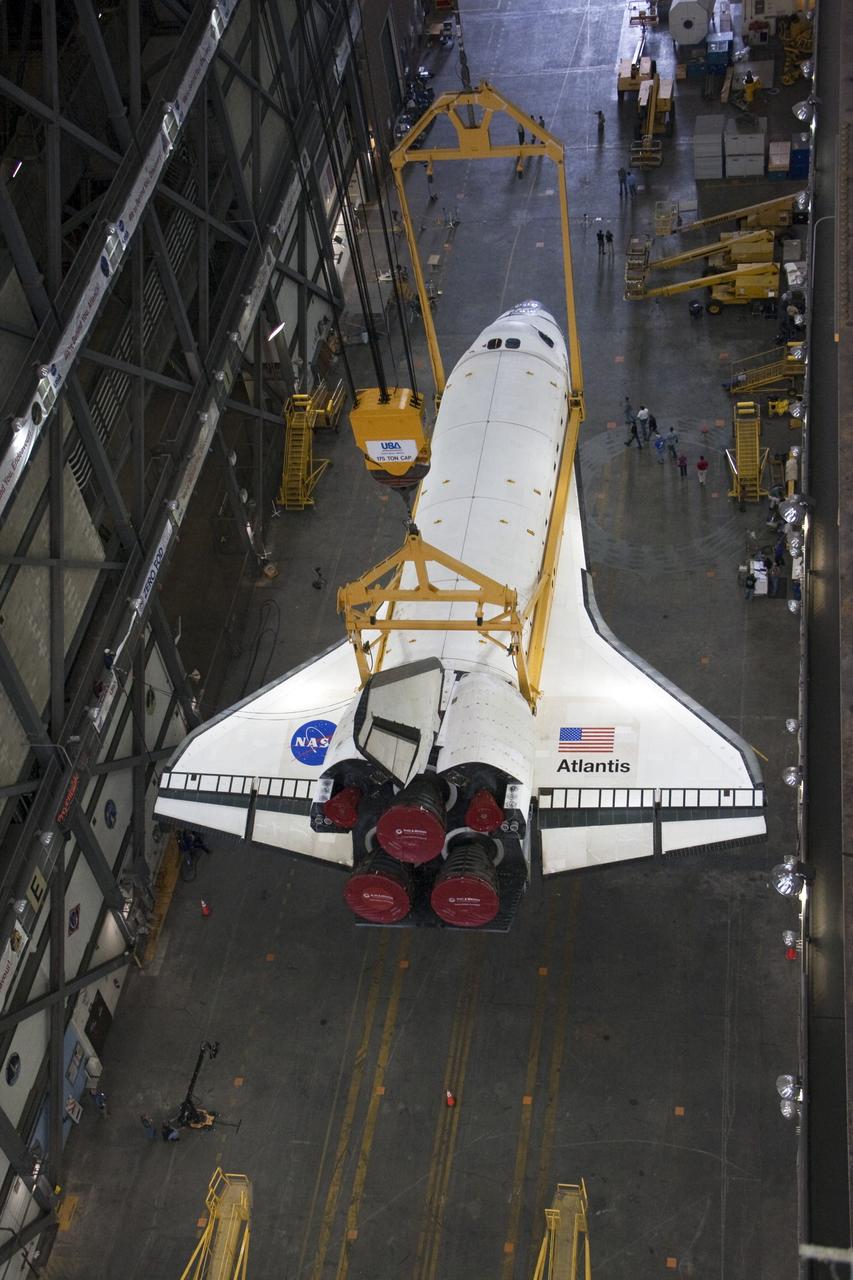
CAPE CANAVERAL, Fla. -- In the Vehicle Assembly Building at NASA's Kennedy Space Center in Florida, shuttle Atlantis is ready to be lifted by an overhead crane and moved into a high bay where it will be attached to its external fuel tank and solid rocket boosters already on the mobile launcher platform. Commander Chris Ferguson, Pilot Doug Hurley and Mission Specialists Sandra Magnus and Rex Walheim are expected to launch in mid-July, taking with them the Raffaello multi-purpose logistics module packed with supplies, logistics and spare parts. The STS-135 mission also will fly a system to investigate the potential for robotically refueling existing spacecraft and return a failed ammonia pump module to help NASA better understand the failure mechanism and improve pump designs for future systems. STS-135 will be the 33rd flight of Atlantis, the 37th shuttle mission to the space station, and the 135th and final mission of NASA's Space Shuttle Program. For more information visit, www.nasa.gov/mission_pages/shuttle/shuttlemissions/sts135/index.html. Photo credit: NASA/Ken Thornsley
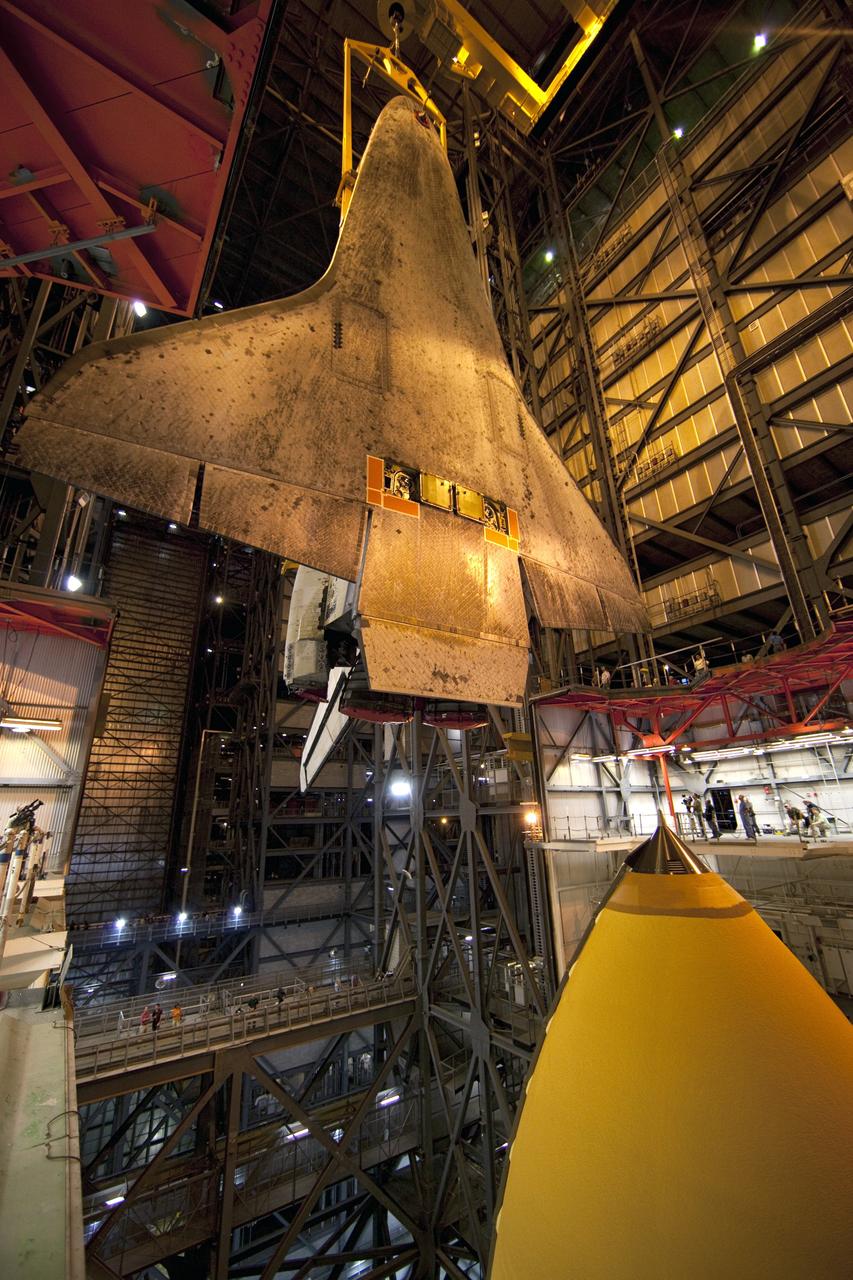
CAPE CANAVERAL, Fla. -- In the Vehicle Assembly Building at NASA's Kennedy Space Center in Florida, shuttle Atlantis is lowered toward the mobile launcher platform where it will be joined with its external fuel tank and solid rocket boosters. Commander Chris Ferguson, Pilot Doug Hurley and Mission Specialists Sandra Magnus and Rex Walheim are expected to launch in mid-July, taking with them the Raffaello multi-purpose logistics module packed with supplies, logistics and spare parts. The STS-135 mission also will fly a system to investigate the potential for robotically refueling existing spacecraft and return a failed ammonia pump module to help NASA better understand the failure mechanism and improve pump designs for future systems. STS-135 will be the 33rd flight of Atlantis, the 37th shuttle mission to the space station, and the 135th and final mission of NASA's Space Shuttle Program. For more information visit, www.nasa.gov/mission_pages/shuttle/shuttlemissions/sts135/index.html. Photo credit: NASA/Dimitri Gerondidakis
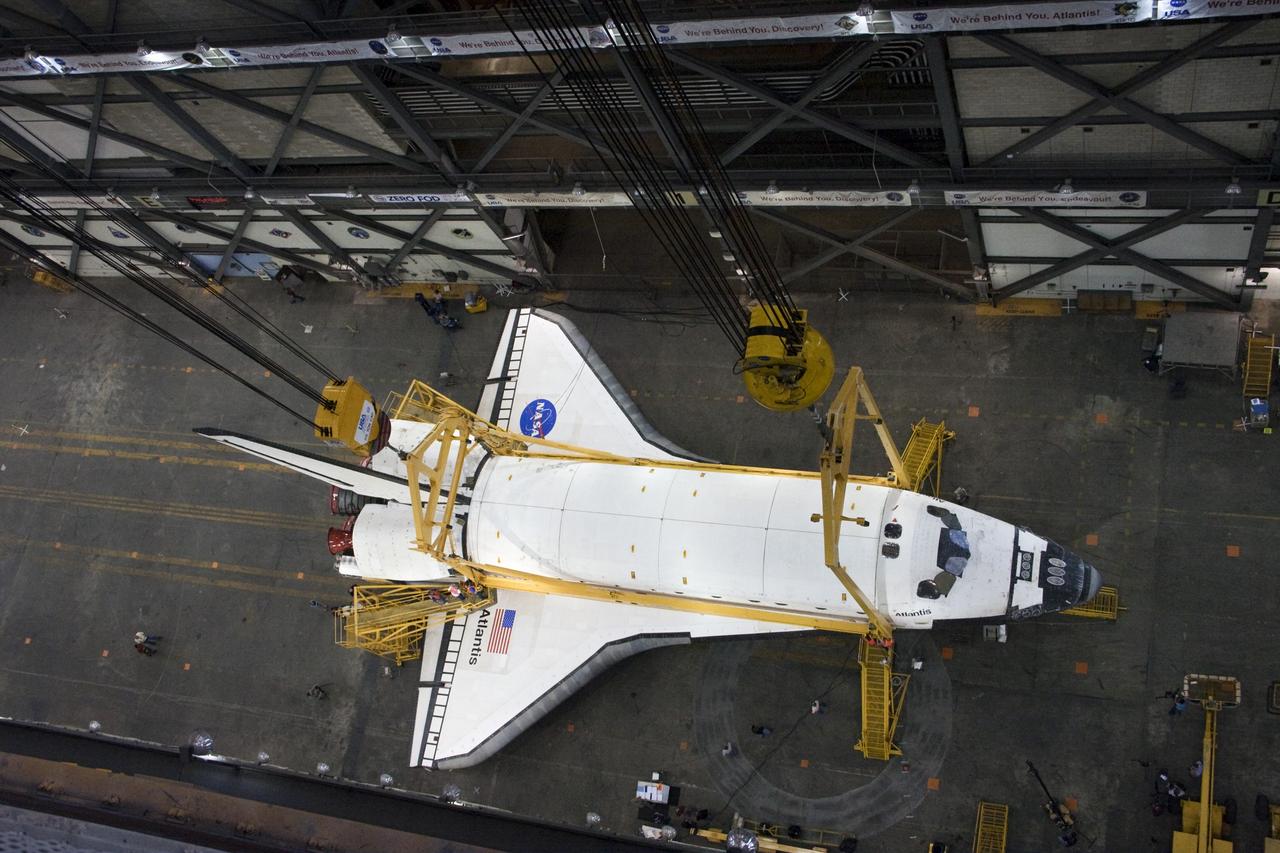
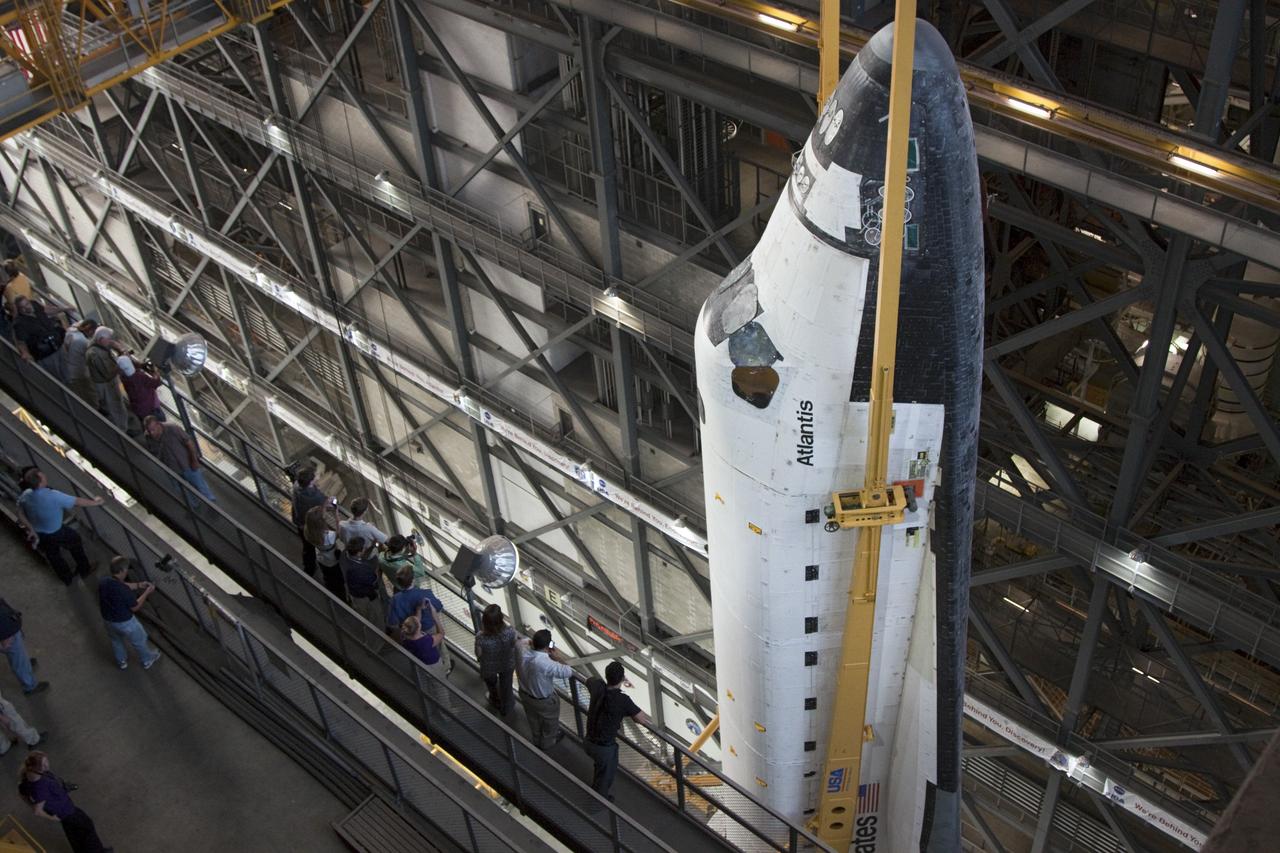
CAPE CANAVERAL, Fla. -- This overhead view photographed in the Vehicle Assembly Building at NASA's Kennedy Space Center in Florida, shows workers attaching a crane to shuttle Atlantis. The crane will lift the spacecraft into a high bay where it will be attached to the waiting external fuel tank and solid rocket boosters, which are already on the mobile launcher platform. Commander Chris Ferguson, Pilot Doug Hurley and Mission Specialists Sandra Magnus and Rex Walheim are targeted to launch in early July, taking with them the Raffaello multi-purpose logistics module packed with supplies, logistics and spare parts. The STS-135 mission also will fly a system to investigate the potential for robotically refueling existing spacecraft and return a failed ammonia pump module to help NASA better understand the failure mechanism and improve pump designs for future systems. STS-135 will be the 33rd flight of Atlantis, the 37th shuttle mission to the space station, and the 135th and final mission of NASA's Space Shuttle Program. For more information visit, www.nasa.gov/mission_pages/shuttle/shuttlemissions/sts135/index.html. Photo credit: NASA/Ken Thornsley
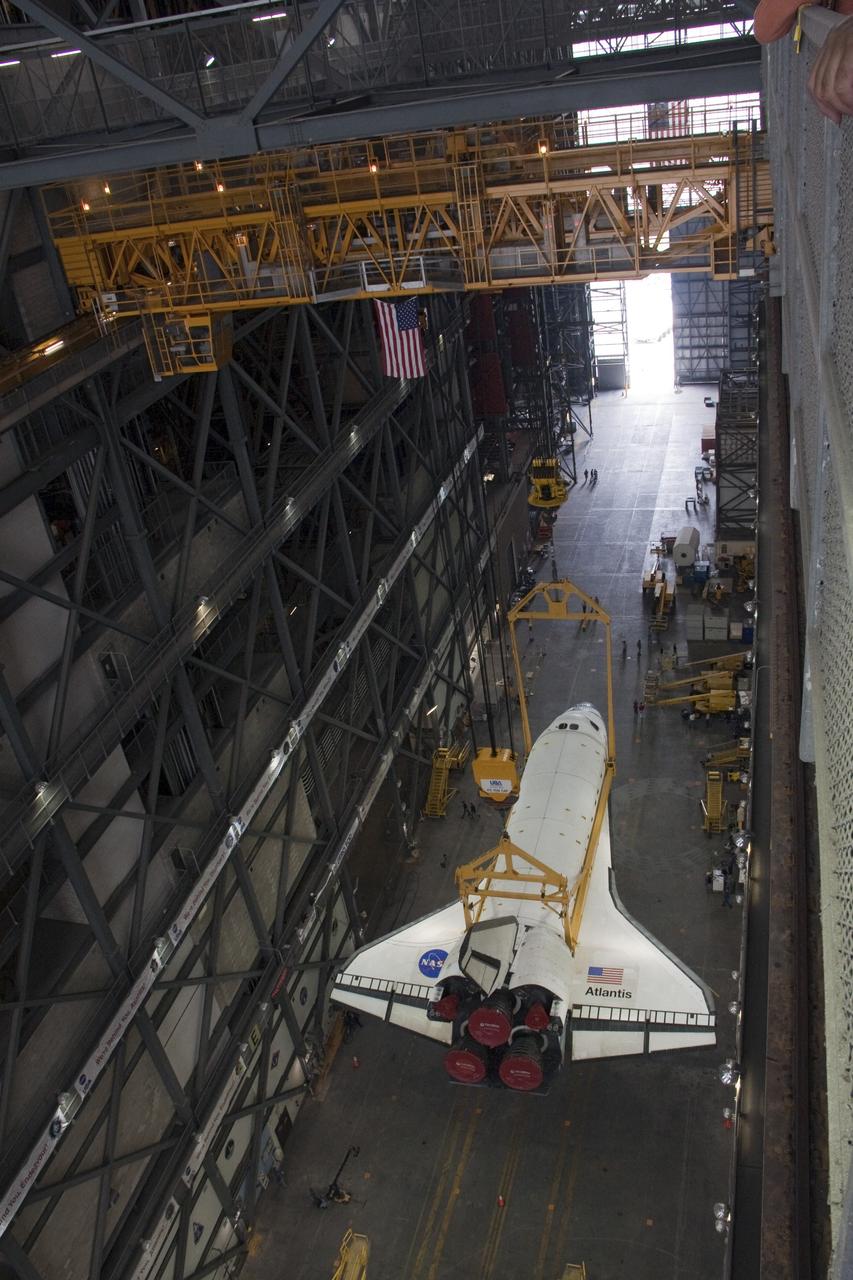
CAPE CANAVERAL, Fla. -- In the Vehicle Assembly Building at NASA's Kennedy Space Center in Florida, shuttle Atlantis is suspended over the transfer aisle by an overhead crane. Atlantis then will be lifted vertically and moved into a high bay where it will be attached to its external fuel tank and solid rocket boosters already on the mobile launcher platform. Commander Chris Ferguson, Pilot Doug Hurley and Mission Specialists Sandra Magnus and Rex Walheim are expected to launch in mid-July, taking with them the Raffaello multi-purpose logistics module packed with supplies, logistics and spare parts. The STS-135 mission also will fly a system to investigate the potential for robotically refueling existing spacecraft and return a failed ammonia pump module to help NASA better understand the failure mechanism and improve pump designs for future systems. STS-135 will be the 33rd flight of Atlantis, the 37th shuttle mission to the space station, and the 135th and final mission of NASA's Space Shuttle Program. For more information visit, www.nasa.gov/mission_pages/shuttle/shuttlemissions/sts135/index.html. Photo credit: NASA/Ken Thornsley
CAPE CANAVERAL, Fla. -- In the Vehicle Assembly Building at NASA's Kennedy Space Center in Florida, shuttle Atlantis is lowered by an overhead crane into a high bay where it will be attached to its external fuel tank and solid rocket boosters already on the mobile launcher platform. Commander Chris Ferguson, Pilot Doug Hurley and Mission Specialists Sandra Magnus and Rex Walheim are expected to launch in mid-July, taking with them the Raffaello multi-purpose logistics module packed with supplies, logistics and spare parts. The STS-135 mission also will fly a system to investigate the potential for robotically refueling existing spacecraft and return a failed ammonia pump module to help NASA better understand the failure mechanism and improve pump designs for future systems. STS-135 will be the 33rd flight of Atlantis, the 37th shuttle mission to the space station, and the 135th and final mission of NASA's Space Shuttle Program. For more information visit, www.nasa.gov/mission_pages/shuttle/shuttlemissions/sts135/index.html. Photo credit: NASA/Troy Cryder
CAPE CANAVERAL, Fla. -- In the Vehicle Assembly Building at NASA's Kennedy Space Center in Florida, shuttle Atlantis is lowered by an overhead crane into a high bay where it will be attached to its external fuel tank and solid rocket boosters already on the mobile launcher platform. Commander Chris Ferguson, Pilot Doug Hurley and Mission Specialists Sandra Magnus and Rex Walheim are expected to launch in mid-July, taking with them the Raffaello multi-purpose logistics module packed with supplies, logistics and spare parts. The STS-135 mission also will fly a system to investigate the potential for robotically refueling existing spacecraft and return a failed ammonia pump module to help NASA better understand the failure mechanism and improve pump designs for future systems. STS-135 will be the 33rd flight of Atlantis, the 37th shuttle mission to the space station, and the 135th and final mission of NASA's Space Shuttle Program. For more information visit, www.nasa.gov/mission_pages/shuttle/shuttlemissions/sts135/index.html. Photo credit: NASA/Troy Cryder
CAPE CANAVERAL, Fla. -- In Vehicle Assembly Building at NASA's Kennedy Space Center in Florida, an overhead crane suspends shuttle Atlantis above the transfer aisle. The spacecraft then will be moved into a high bay where it will be lowered and attached to its external fuel tank and solid rocket boosters already on the mobile launcher platform. Commander Chris Ferguson, Pilot Doug Hurley and Mission Specialists Sandra Magnus and Rex Walheim are expected to launch in mid-July, taking with them the Raffaello multi-purpose logistics module packed with supplies, logistics and spare parts. The STS-135 mission also will fly a system to investigate the potential for robotically refueling existing spacecraft and return a failed ammonia pump module to help NASA better understand the failure mechanism and improve pump designs for future systems. STS-135 will be the 33rd flight of Atlantis, the 37th shuttle mission to the space station, and the 135th and final mission of NASA's Space Shuttle Program. For more information visit, www.nasa.gov/mission_pages/shuttle/shuttlemissions/sts135/index.html. Photo credit: NASA/Ken Thornsley
CAPE CANAVERAL, Fla. -- In the Vehicle Assembly Building at NASA's Kennedy Space Center in Florida, shuttle Atlantis is lifted by an overhead crane and moved into a high bay where it will be attached to its external fuel tank and solid rocket boosters already on the mobile launcher platform. Commander Chris Ferguson, Pilot Doug Hurley and Mission Specialists Sandra Magnus and Rex Walheim are expected to launch in mid-July, taking with them the Raffaello multi-purpose logistics module packed with supplies, logistics and spare parts. The STS-135 mission also will fly a system to investigate the potential for robotically refueling existing spacecraft and return a failed ammonia pump module to help NASA better understand the failure mechanism and improve pump designs for future systems. STS-135 will be the 33rd flight of Atlantis, the 37th shuttle mission to the space station, and the 135th and final mission of NASA's Space Shuttle Program. For more information visit, www.nasa.gov/mission_pages/shuttle/shuttlemissions/sts135/index.html. Photo credit: NASA/Troy Cryder
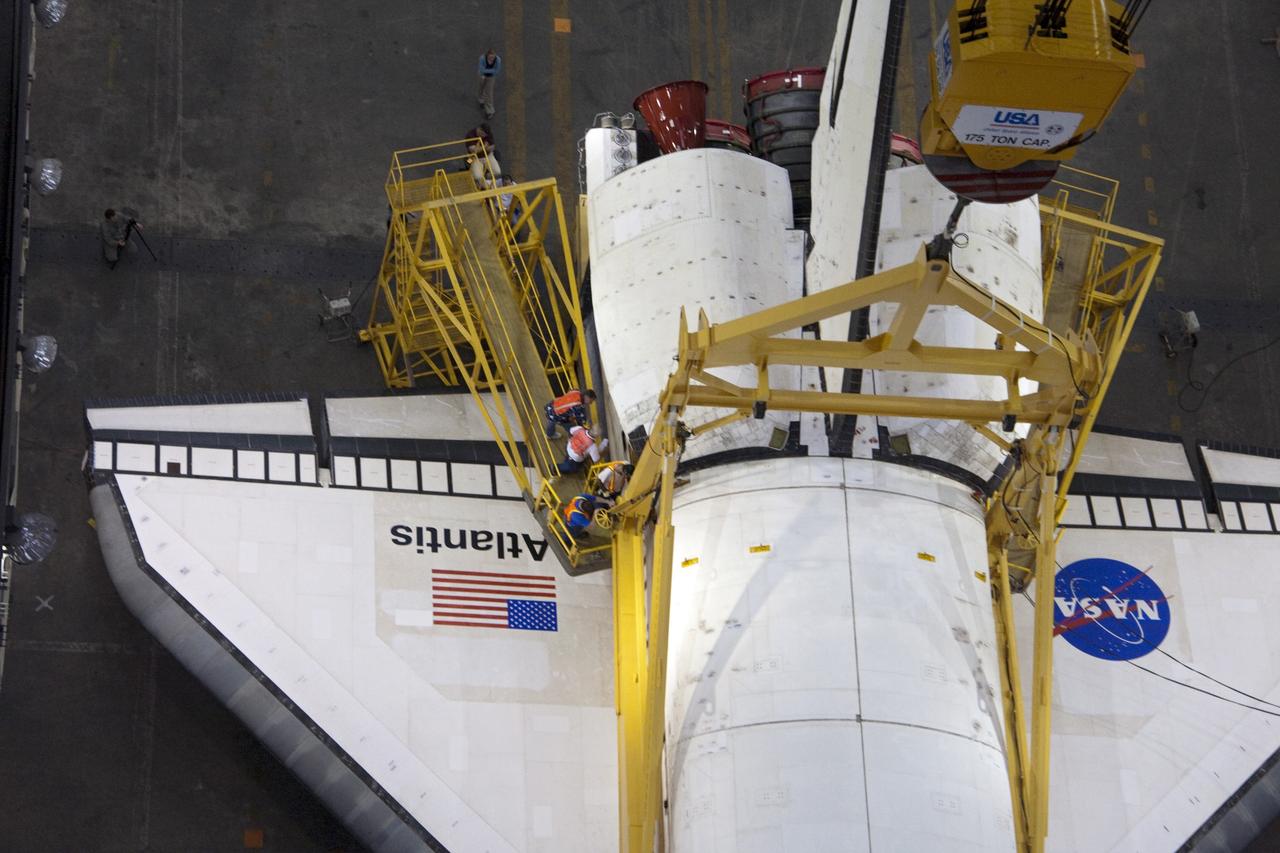
CAPE CANAVERAL, Fla. -- This overhead view photographed in the Vehicle Assembly Building at NASA's Kennedy Space Center in Florida, shows workers attaching a crane to shuttle Atlantis. The crane will lift the spacecraft into a high bay where it will be attached to the waiting external fuel tank and solid rocket boosters, which are already on the mobile launcher platform. Commander Chris Ferguson, Pilot Doug Hurley and Mission Specialists Sandra Magnus and Rex Walheim are targeted to launch in early July, taking with them the Raffaello multi-purpose logistics module packed with supplies, logistics and spare parts. The STS-135 mission also will fly a system to investigate the potential for robotically refueling existing spacecraft and return a failed ammonia pump module to help NASA better understand the failure mechanism and improve pump designs for future systems. STS-135 will be the 33rd flight of Atlantis, the 37th shuttle mission to the space station, and the 135th and final mission of NASA's Space Shuttle Program. For more information visit, www.nasa.gov/mission_pages/shuttle/shuttlemissions/sts135/index.html. Photo credit: NASA/Ken Thornsley
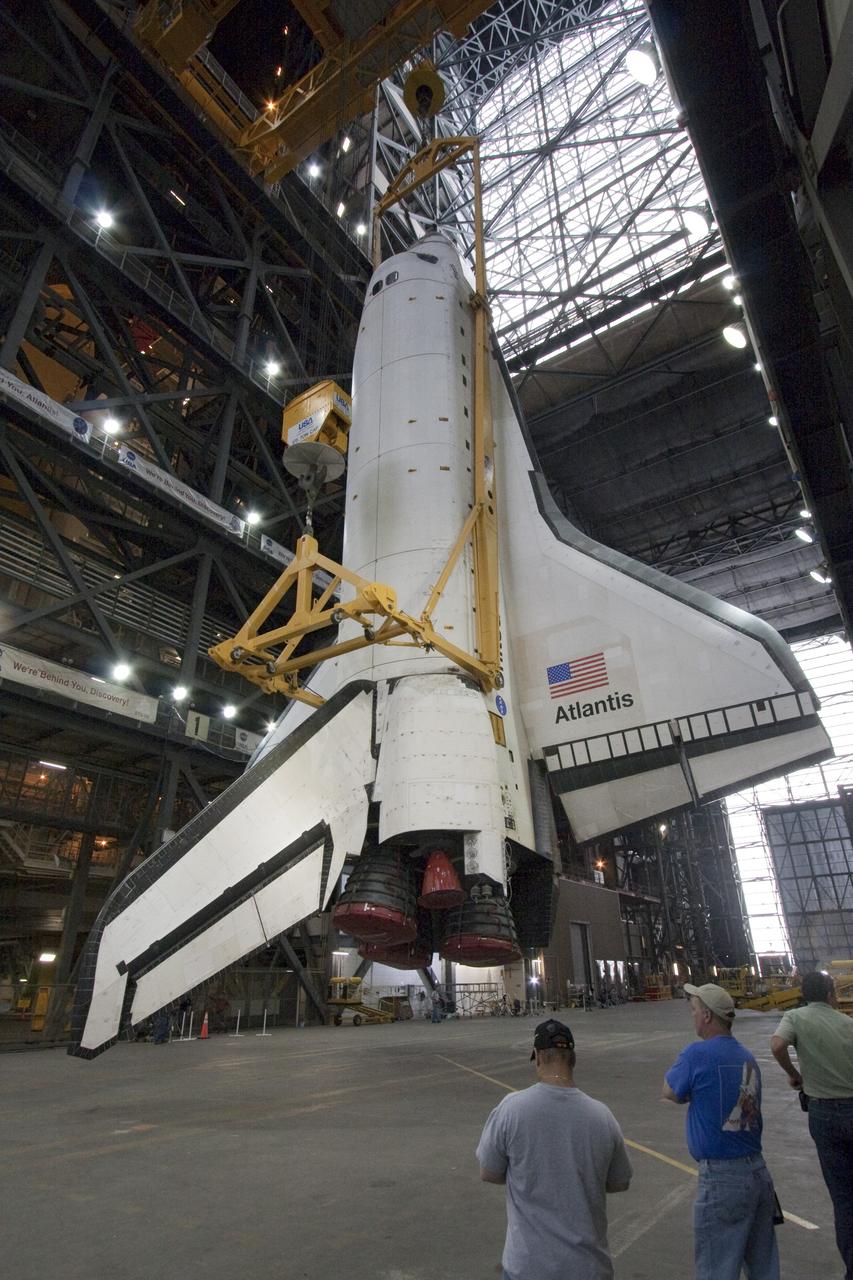
CAPE CANAVERAL, Fla. -- In Vehicle Assembly Building at NASA's Kennedy Space Center in Florida, an overhead crane suspends shuttle Atlantis above the transfer aisle. The spacecraft then will be moved into a high bay where it will be lowered and attached to its external fuel tank and solid rocket boosters already on the mobile launcher platform. Commander Chris Ferguson, Pilot Doug Hurley and Mission Specialists Sandra Magnus and Rex Walheim are expected to launch in mid-July, taking with them the Raffaello multi-purpose logistics module packed with supplies, logistics and spare parts. The STS-135 mission also will fly a system to investigate the potential for robotically refueling existing spacecraft and return a failed ammonia pump module to help NASA better understand the failure mechanism and improve pump designs for future systems. STS-135 will be the 33rd flight of Atlantis, the 37th shuttle mission to the space station, and the 135th and final mission of NASA's Space Shuttle Program. For more information visit, www.nasa.gov/mission_pages/shuttle/shuttlemissions/sts135/index.html. Photo credit: NASA/Ken Thornsley
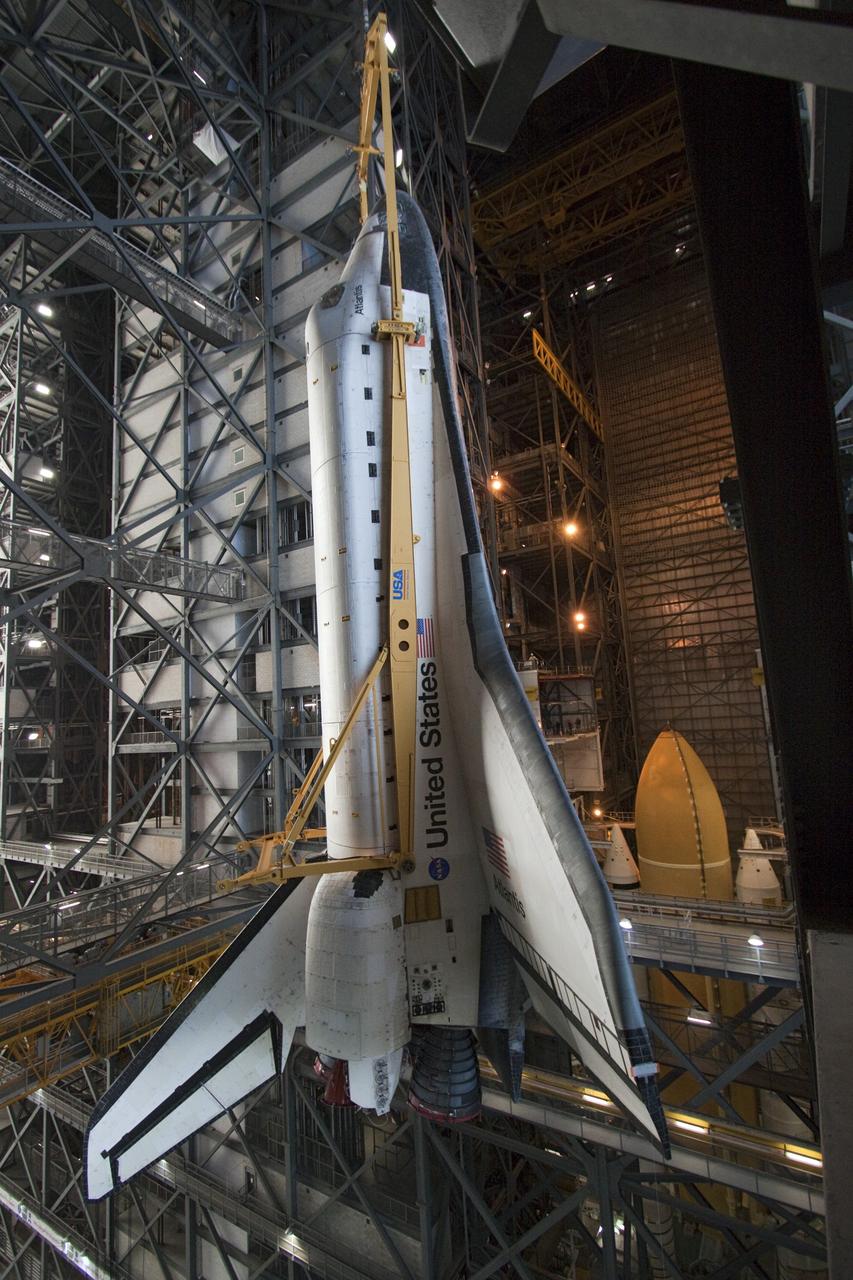
CAPE CANAVERAL, Fla. -- In the Vehicle Assembly Building at NASA's Kennedy Space Center in Florida, shuttle Atlantis is lifted by an overhead crane and moved into a high bay where it will be attached to its external fuel tank and solid rocket boosters already on the mobile launcher platform. Commander Chris Ferguson, Pilot Doug Hurley and Mission Specialists Sandra Magnus and Rex Walheim are expected to launch in mid-July, taking with them the Raffaello multi-purpose logistics module packed with supplies, logistics and spare parts. The STS-135 mission also will fly a system to investigate the potential for robotically refueling existing spacecraft and return a failed ammonia pump module to help NASA better understand the failure mechanism and improve pump designs for future systems. STS-135 will be the 33rd flight of Atlantis, the 37th shuttle mission to the space station, and the 135th and final mission of NASA's Space Shuttle Program. For more information visit, www.nasa.gov/mission_pages/shuttle/shuttlemissions/sts135/index.html. Photo credit: NASA/Troy Cryder
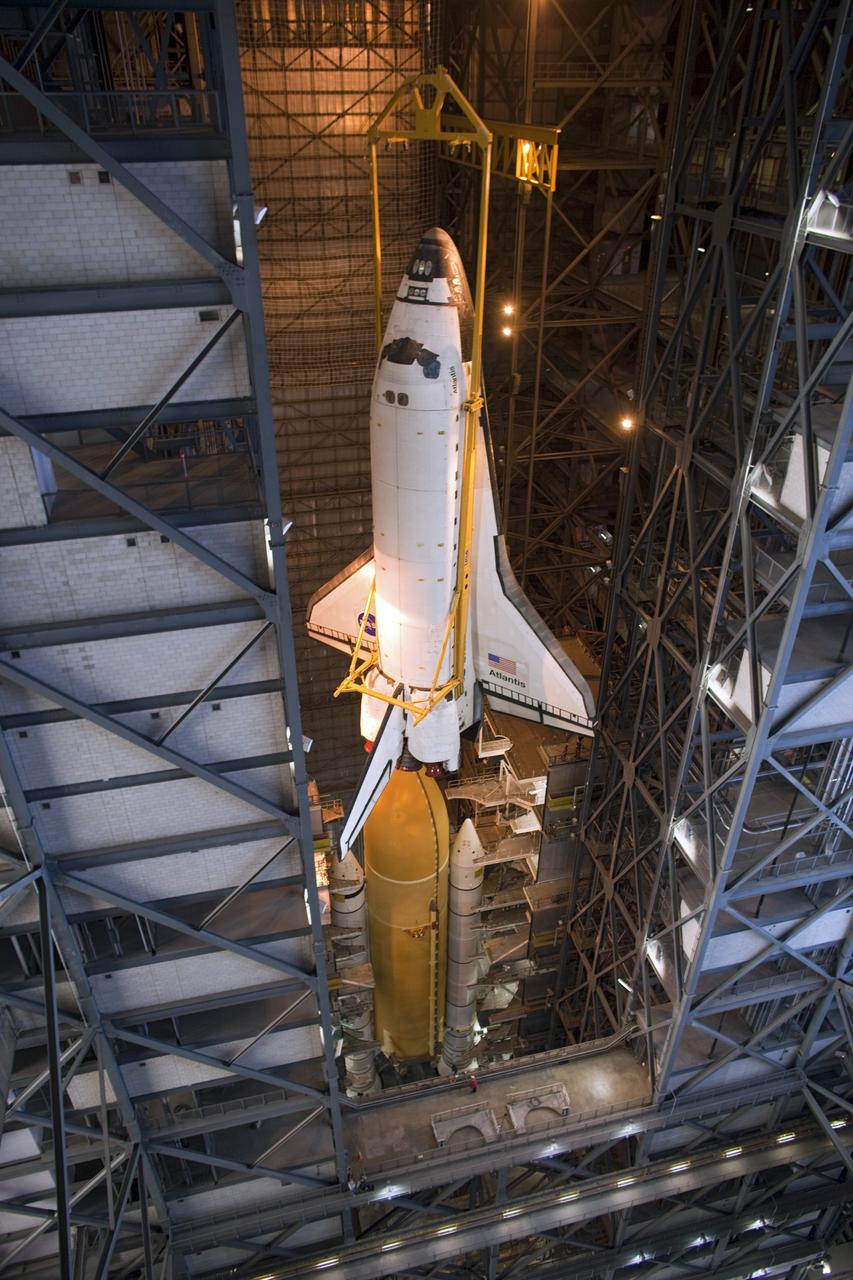
CAPE CANAVERAL, Fla. -- In the Vehicle Assembly Building at NASA's Kennedy Space Center in Florida, shuttle Atlantis is lowered by an overhead crane into a high bay where it will be attached to its external fuel tank and solid rocket boosters which are already on the mobile launcher platform. Commander Chris Ferguson, Pilot Doug Hurley and Mission Specialists Sandra Magnus and Rex Walheim are expected to launch in mid-July, taking with them the Raffaello multi-purpose logistics module packed with supplies, logistics and spare parts. The STS-135 mission also will fly a system to investigate the potential for robotically refueling existing spacecraft and return a failed ammonia pump module to help NASA better understand the failure mechanism and improve pump designs for future systems. STS-135 will be the 33rd flight of Atlantis, the 37th shuttle mission to the space station, and the 135th and final mission of NASA's Space Shuttle Program. For more information visit, www.nasa.gov/mission_pages/shuttle/shuttlemissions/sts135/index.html. Photo credit: NASA/Dimitri Gerondidakis
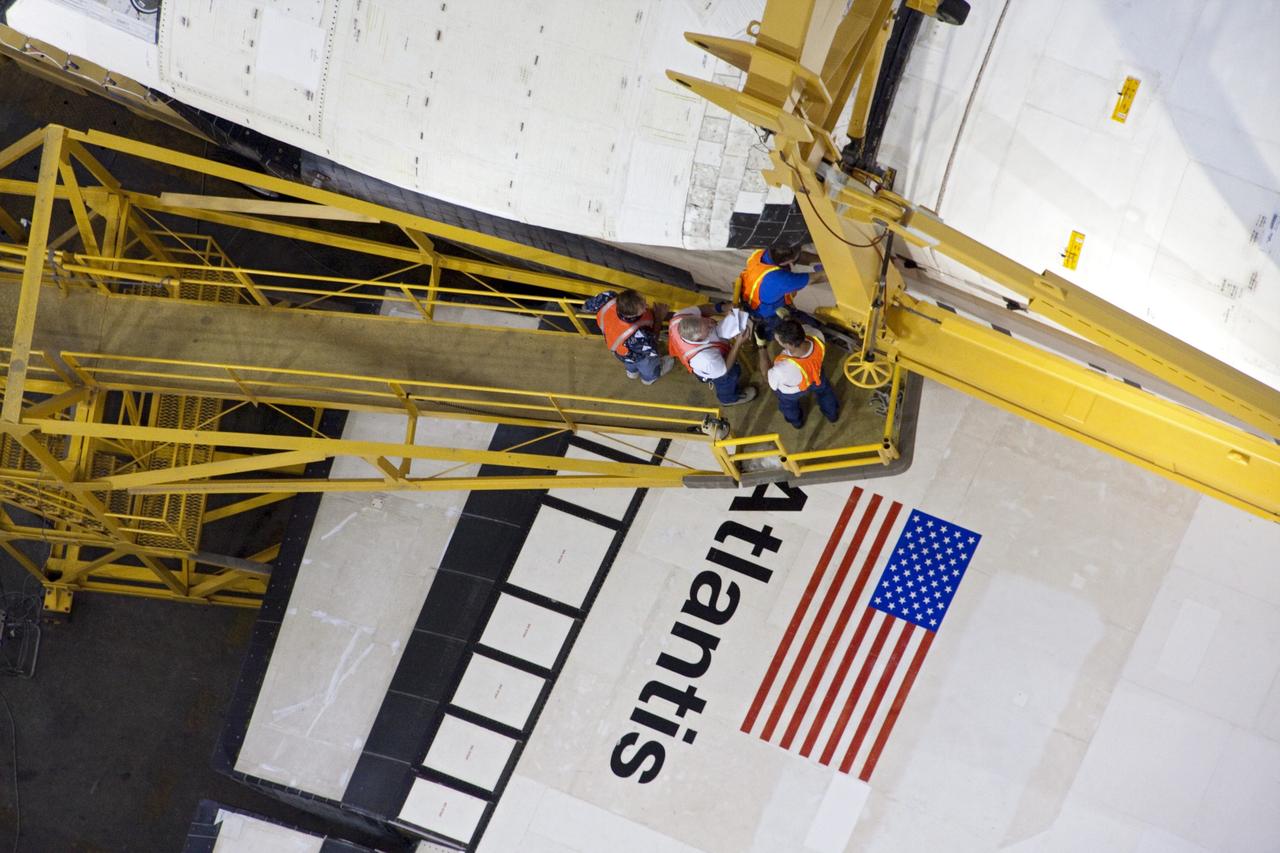
CAPE CANAVERAL, Fla. -- This overhead view photographed in the Vehicle Assembly Building at NASA's Kennedy Space Center in Florida, shows workers attaching a crane to shuttle Atlantis. The crane will lift the spacecraft into a high bay where it will be attached to the waiting external fuel tank and solid rocket boosters, which are already on the mobile launcher platform. Commander Chris Ferguson, Pilot Doug Hurley and Mission Specialists Sandra Magnus and Rex Walheim are targeted to launch in early July, taking with them the Raffaello multi-purpose logistics module packed with supplies, logistics and spare parts. The STS-135 mission also will fly a system to investigate the potential for robotically refueling existing spacecraft and return a failed ammonia pump module to help NASA better understand the failure mechanism and improve pump designs for future systems. STS-135 will be the 33rd flight of Atlantis, the 37th shuttle mission to the space station, and the 135th and final mission of NASA's Space Shuttle Program. For more information visit, www.nasa.gov/mission_pages/shuttle/shuttlemissions/sts135/index.html. Photo credit: NASA/Ken Thornsley
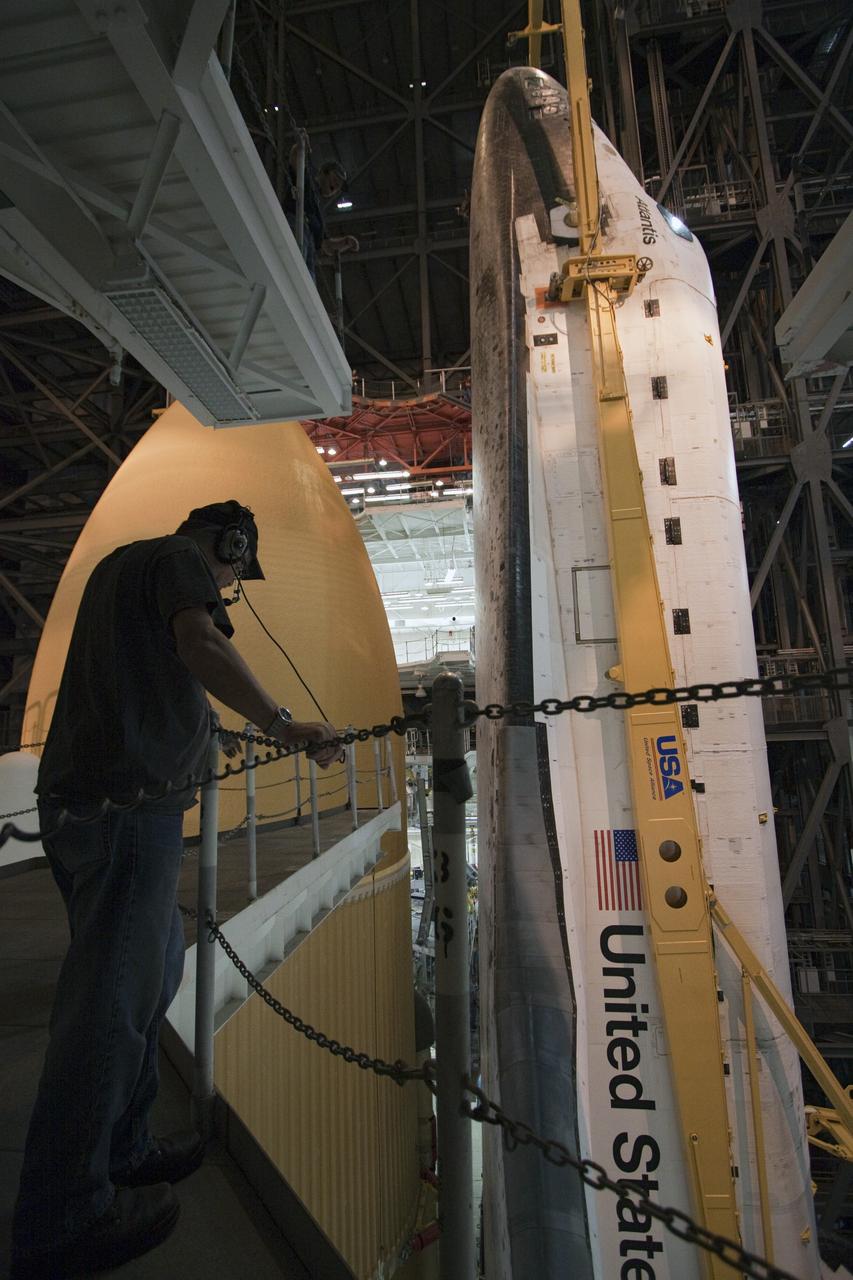
CAPE CANAVERAL, Fla. -- In the Vehicle Assembly Building at NASA's Kennedy Space Center in Florida, a worker monitors the progress of shuttle Atlantis as it is lowered onto the mobile launcher platform where it will be joined with its external fuel tank and solid rocket boosters. Commander Chris Ferguson, Pilot Doug Hurley and Mission Specialists Sandra Magnus and Rex Walheim are expected to launch in mid-July, taking with them the Raffaello multi-purpose logistics module packed with supplies, logistics and spare parts. The STS-135 mission also will fly a system to investigate the potential for robotically refueling existing spacecraft and return a failed ammonia pump module to help NASA better understand the failure mechanism and improve pump designs for future systems. STS-135 will be the 33rd flight of Atlantis, the 37th shuttle mission to the space station, and the 135th and final mission of NASA's Space Shuttle Program. For more information visit, www.nasa.gov/mission_pages/shuttle/shuttlemissions/sts135/index.html. Photo credit: NASA/Troy Cryder
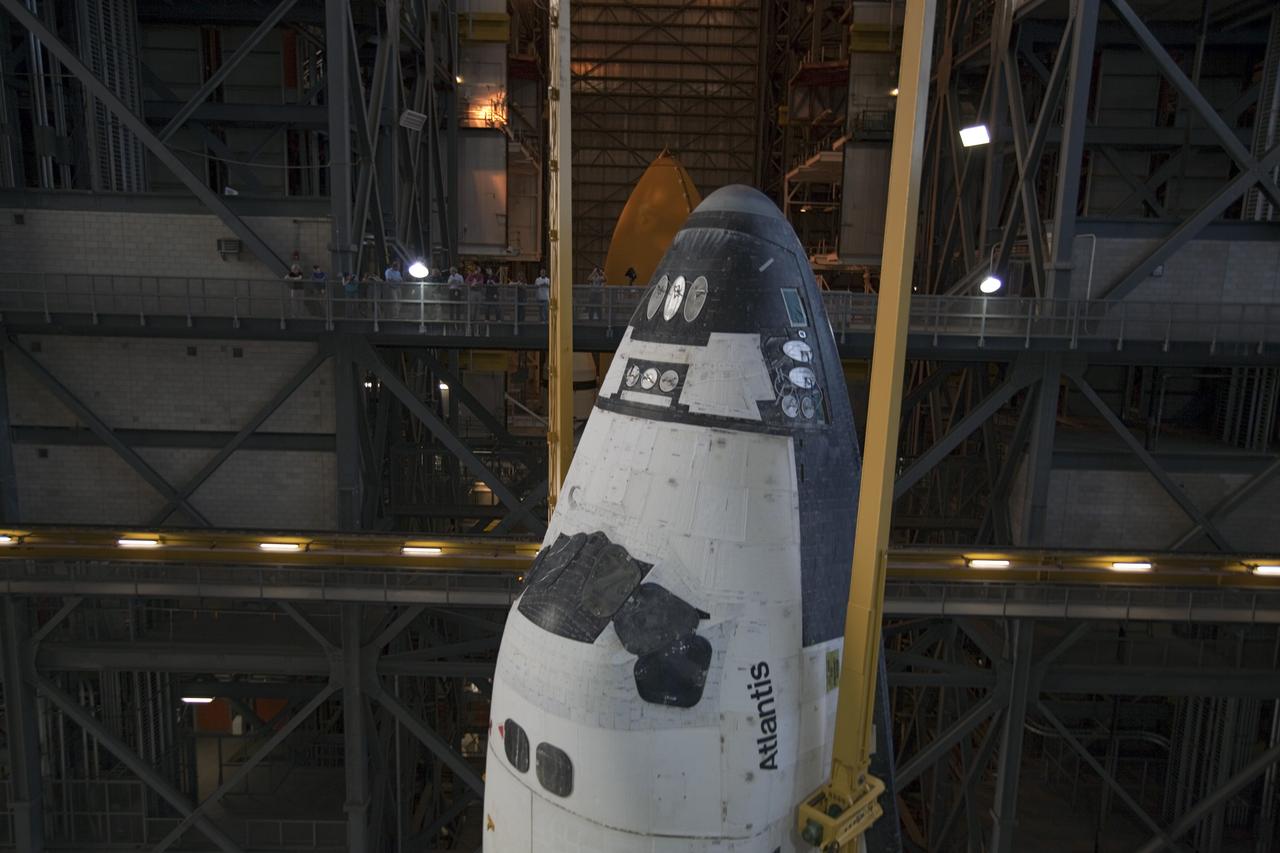
CAPE CANAVERAL, Fla. -- In the Vehicle Assembly Building at NASA's Kennedy Space Center in Florida, shuttle Atlantis is lifted by an overhead crane and moved into a high bay where it will be attached to its external fuel tank and solid rocket boosters which are already on the mobile launcher platform. Commander Chris Ferguson, Pilot Doug Hurley and Mission Specialists Sandra Magnus and Rex Walheim are expected to launch in mid-July, taking with them the Raffaello multi-purpose logistics module packed with supplies, logistics and spare parts. The STS-135 mission also will fly a system to investigate the potential for robotically refueling existing spacecraft and return a failed ammonia pump module to help NASA better understand the failure mechanism and improve pump designs for future systems. STS-135 will be the 33rd flight of Atlantis, the 37th shuttle mission to the space station, and the 135th and final mission of NASA's Space Shuttle Program. For more information visit, www.nasa.gov/mission_pages/shuttle/shuttlemissions/sts135/index.html. Photo credit: NASA/Dimitri Gerondidakis
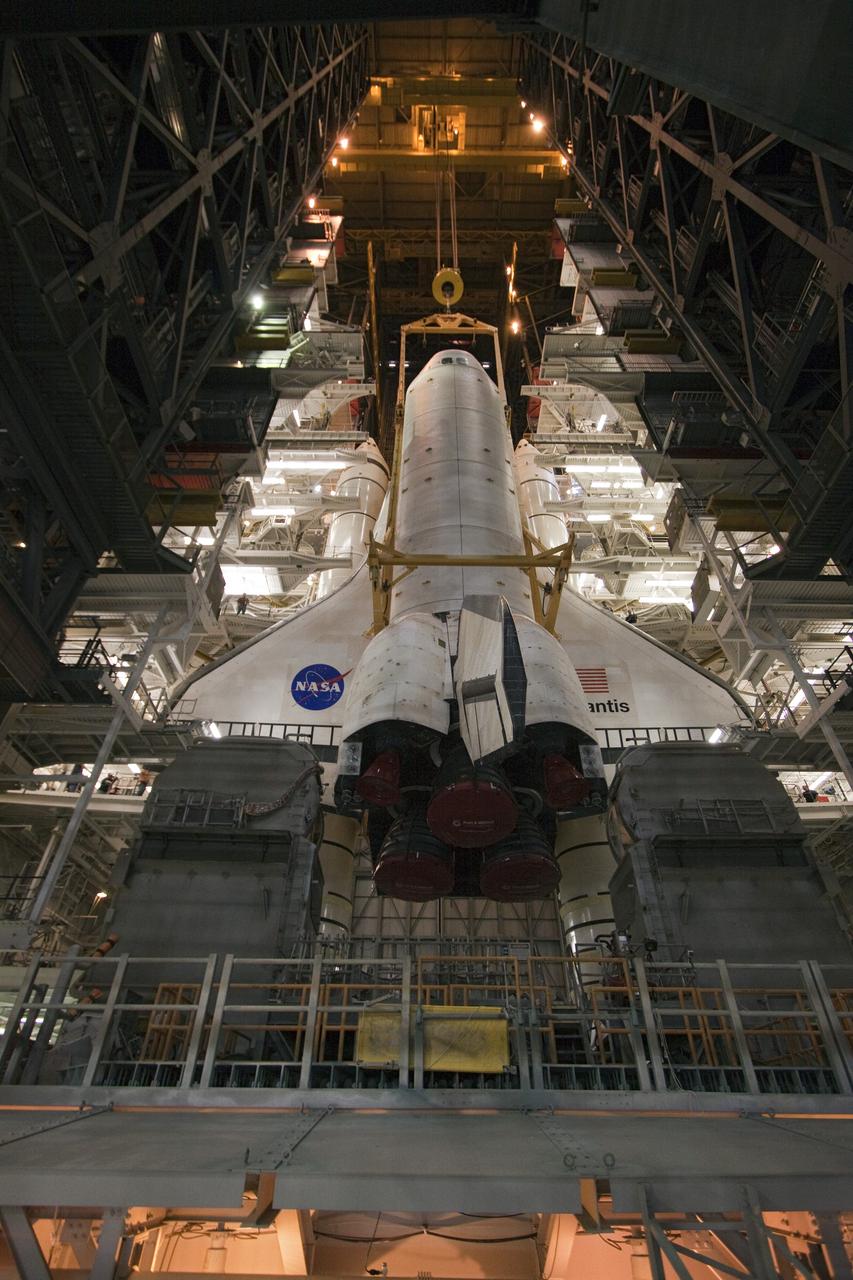
CAPE CANAVERAL, Fla. -- In the Vehicle Assembly Building at NASA's Kennedy Space Center in Florida, shuttle Atlantis is lowered onto the mobile launcher platform where it will be joined with its external fuel tank and solid rocket boosters. Commander Chris Ferguson, Pilot Doug Hurley and Mission Specialists Sandra Magnus and Rex Walheim are expected to launch in mid-July, taking with them the Raffaello multi-purpose logistics module packed with supplies, logistics and spare parts. The STS-135 mission also will fly a system to investigate the potential for robotically refueling existing spacecraft and return a failed ammonia pump module to help NASA better understand the failure mechanism and improve pump designs for future systems. STS-135 will be the 33rd flight of Atlantis, the 37th shuttle mission to the space station, and the 135th and final mission of NASA's Space Shuttle Program. For more information visit, www.nasa.gov/mission_pages/shuttle/shuttlemissions/sts135/index.html. Photo credit: NASA/Troy Cryder

CAPE CANAVERAL, Fla. -- This overhead view photographed in the Vehicle Assembly Building at NASA's Kennedy Space Center in Florida, shows workers attaching a crane to shuttle Atlantis. The crane will lift the spacecraft into a high bay where it will be attached to the waiting external fuel tank and solid rocket boosters, which are already on the mobile launcher platform. Commander Chris Ferguson, Pilot Doug Hurley and Mission Specialists Sandra Magnus and Rex Walheim are targeted to launch in early July, taking with them the Raffaello multi-purpose logistics module packed with supplies, logistics and spare parts. The STS-135 mission also will fly a system to investigate the potential for robotically refueling existing spacecraft and return a failed ammonia pump module to help NASA better understand the failure mechanism and improve pump designs for future systems. STS-135 will be the 33rd flight of Atlantis, the 37th shuttle mission to the space station, and the 135th and final mission of NASA's Space Shuttle Program. For more information visit, www.nasa.gov/mission_pages/shuttle/shuttlemissions/sts135/index.html. Photo credit: NASA/Ken Thornsley
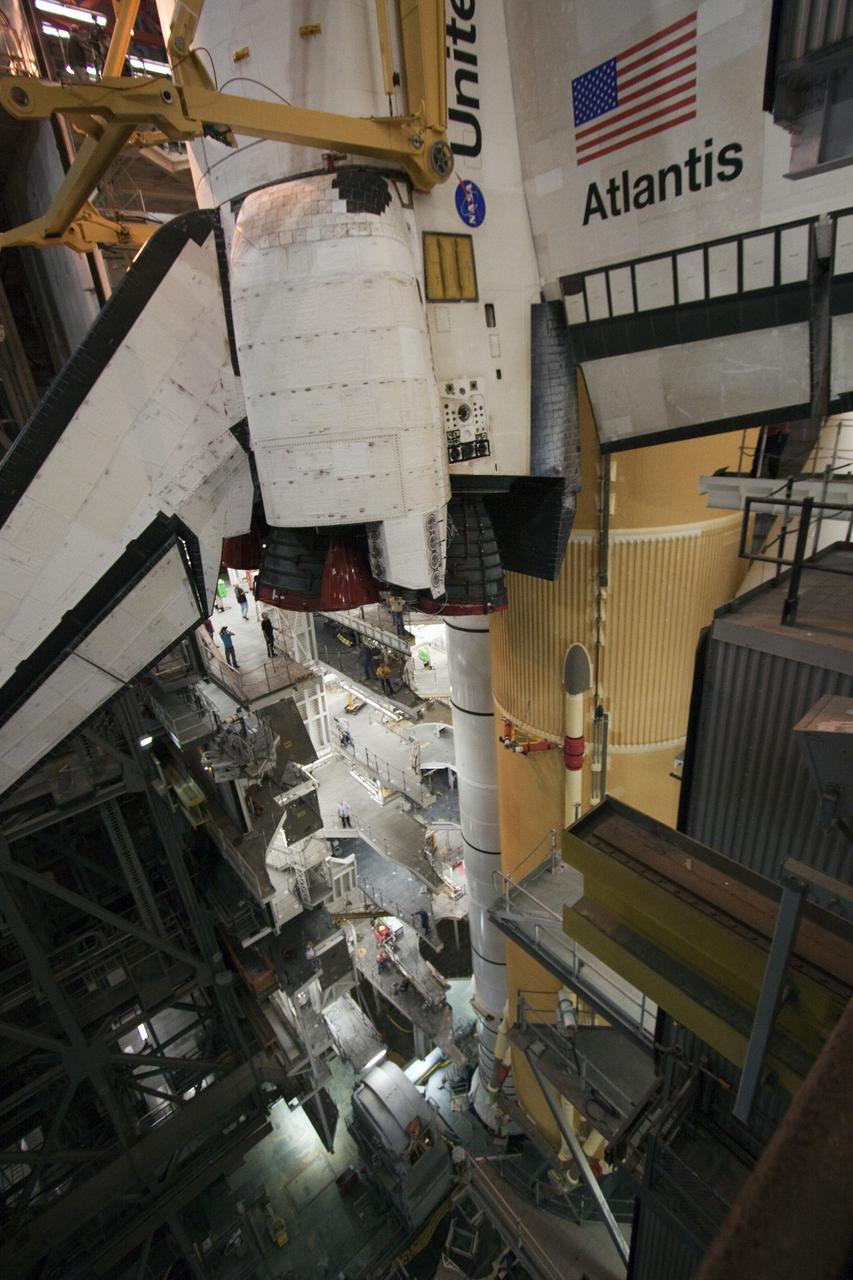
CAPE CANAVERAL, Fla. -- In the Vehicle Assembly Building at NASA's Kennedy Space Center in Florida, shuttle Atlantis is lowered by an overhead crane into a high bay where it will be attached to its external fuel tank and solid rocket boosters already on the mobile launcher platform. Commander Chris Ferguson, Pilot Doug Hurley and Mission Specialists Sandra Magnus and Rex Walheim are expected to launch in mid-July, taking with them the Raffaello multi-purpose logistics module packed with supplies, logistics and spare parts. The STS-135 mission also will fly a system to investigate the potential for robotically refueling existing spacecraft and return a failed ammonia pump module to help NASA better understand the failure mechanism and improve pump designs for future systems. STS-135 will be the 33rd flight of Atlantis, the 37th shuttle mission to the space station, and the 135th and final mission of NASA's Space Shuttle Program. For more information visit, www.nasa.gov/mission_pages/shuttle/shuttlemissions/sts135/index.html. Photo credit: NASA/Troy Cryder
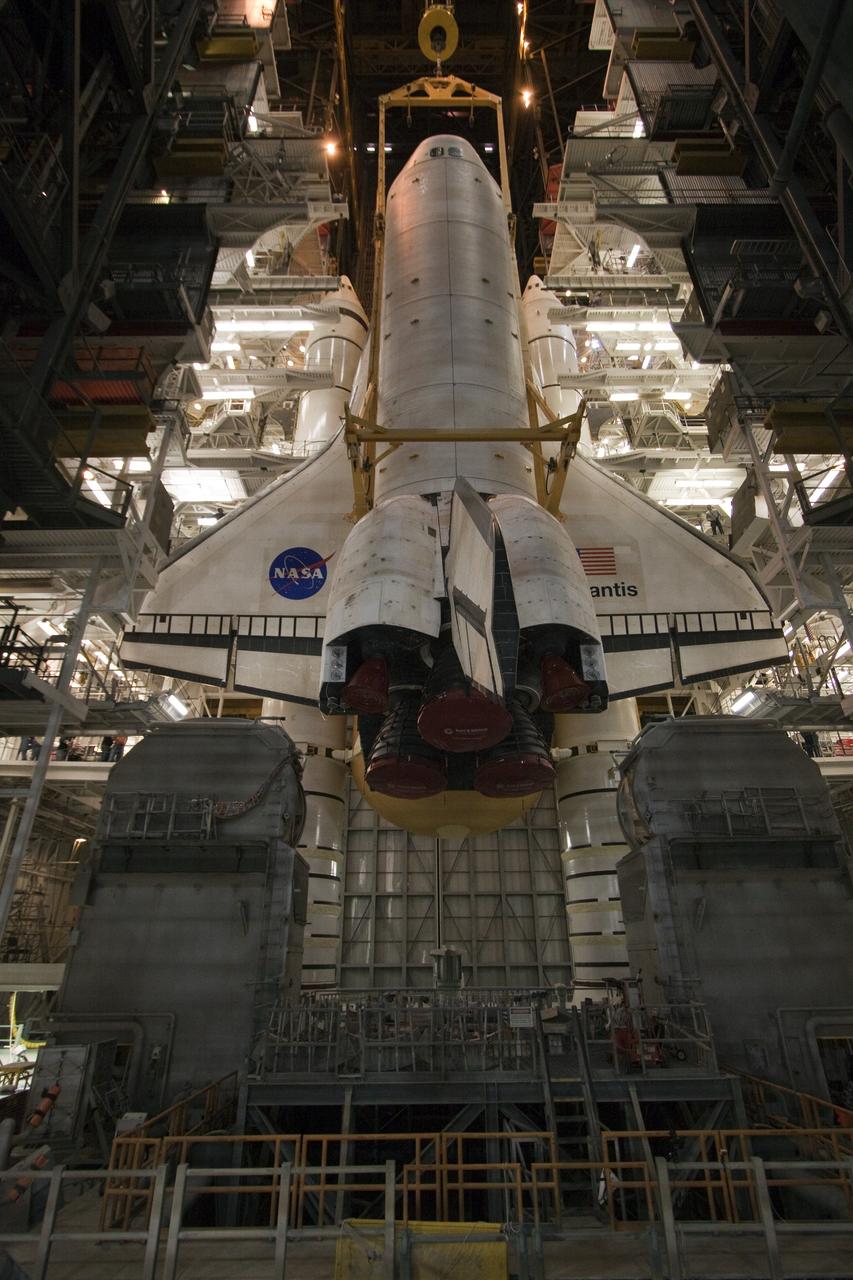
CAPE CANAVERAL, Fla. -- In the Vehicle Assembly Building at NASA's Kennedy Space Center in Florida, shuttle Atlantis is lowered onto the mobile launcher platform where it will be joined with its external fuel tank and solid rocket boosters. Commander Chris Ferguson, Pilot Doug Hurley and Mission Specialists Sandra Magnus and Rex Walheim are expected to launch in mid-July, taking with them the Raffaello multi-purpose logistics module packed with supplies, logistics and spare parts. The STS-135 mission also will fly a system to investigate the potential for robotically refueling existing spacecraft and return a failed ammonia pump module to help NASA better understand the failure mechanism and improve pump designs for future systems. STS-135 will be the 33rd flight of Atlantis, the 37th shuttle mission to the space station, and the 135th and final mission of NASA's Space Shuttle Program. For more information visit, www.nasa.gov/mission_pages/shuttle/shuttlemissions/sts135/index.html. Photo credit: NASA/Troy Cryder

CAPE CANAVERAL, Fla. -- In the Vehicle Assembly Building at NASA's Kennedy Space Center in Florida, shuttle Atlantis is suspended over the transfer aisle by an overhead crane. Atlantis then will be lifted vertically and moved into a high bay where it will be attached to its external fuel tank and solid rocket boosters already on the mobile launcher platform. Commander Chris Ferguson, Pilot Doug Hurley and Mission Specialists Sandra Magnus and Rex Walheim are expected to launch in mid-July, taking with them the Raffaello multi-purpose logistics module packed with supplies, logistics and spare parts. The STS-135 mission also will fly a system to investigate the potential for robotically refueling existing spacecraft and return a failed ammonia pump module to help NASA better understand the failure mechanism and improve pump designs for future systems. STS-135 will be the 33rd flight of Atlantis, the 37th shuttle mission to the space station, and the 135th and final mission of NASA's Space Shuttle Program. For more information visit, www.nasa.gov/mission_pages/shuttle/shuttlemissions/sts135/index.html. Photo credit: NASA/Ken Thornsley
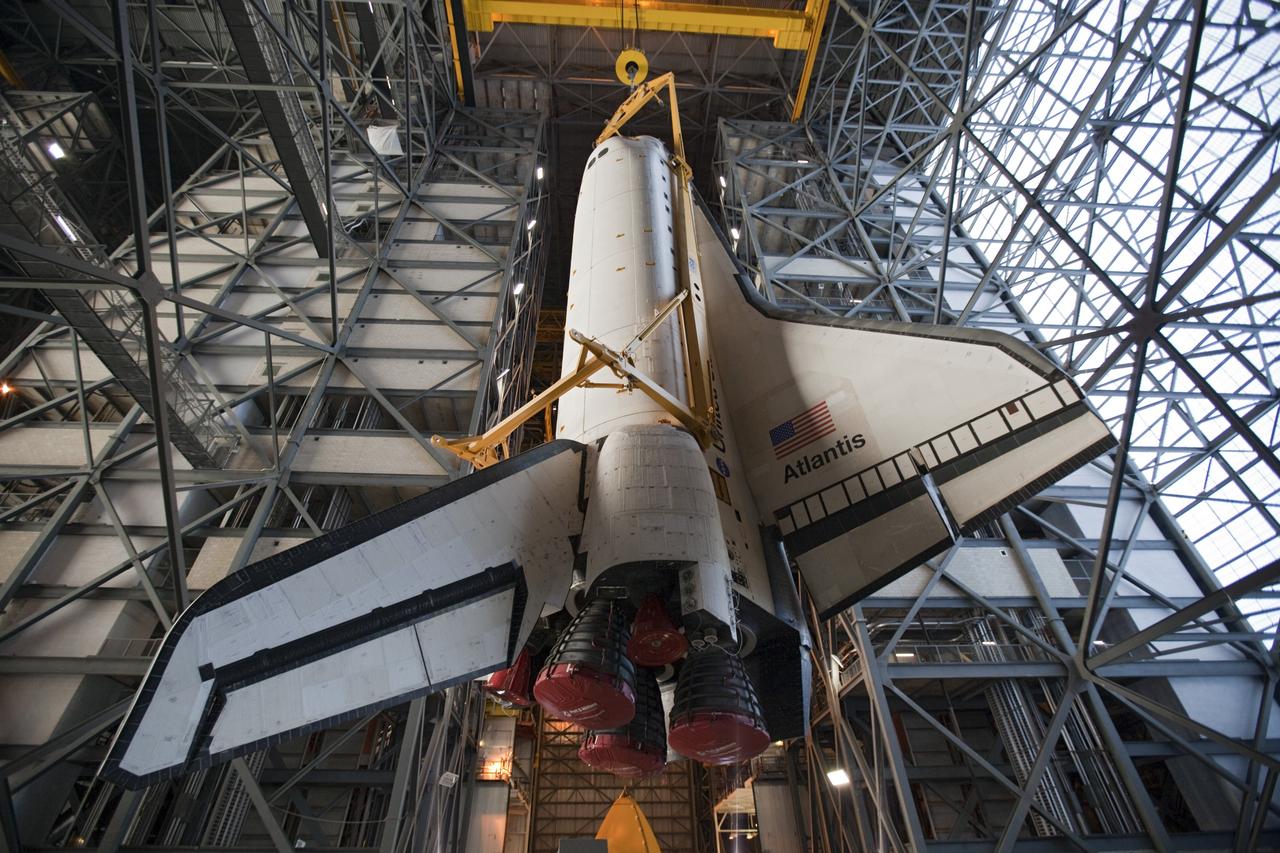
CAPE CANAVERAL, Fla. -- In the Vehicle Assembly Building at NASA's Kennedy Space Center in Florida, shuttle Atlantis is lifted by an overhead crane and moved into a high bay where it will be attached to its external fuel tank and solid rocket boosters which are already on the mobile launcher platform. Commander Chris Ferguson, Pilot Doug Hurley and Mission Specialists Sandra Magnus and Rex Walheim are expected to launch in mid-July, taking with them the Raffaello multi-purpose logistics module packed with supplies, logistics and spare parts. The STS-135 mission also will fly a system to investigate the potential for robotically refueling existing spacecraft and return a failed ammonia pump module to help NASA better understand the failure mechanism and improve pump designs for future systems. STS-135 will be the 33rd flight of Atlantis, the 37th shuttle mission to the space station, and the 135th and final mission of NASA's Space Shuttle Program. For more information visit, www.nasa.gov/mission_pages/shuttle/shuttlemissions/sts135/index.html. Photo credit: NASA/Dimitri Gerondidakis
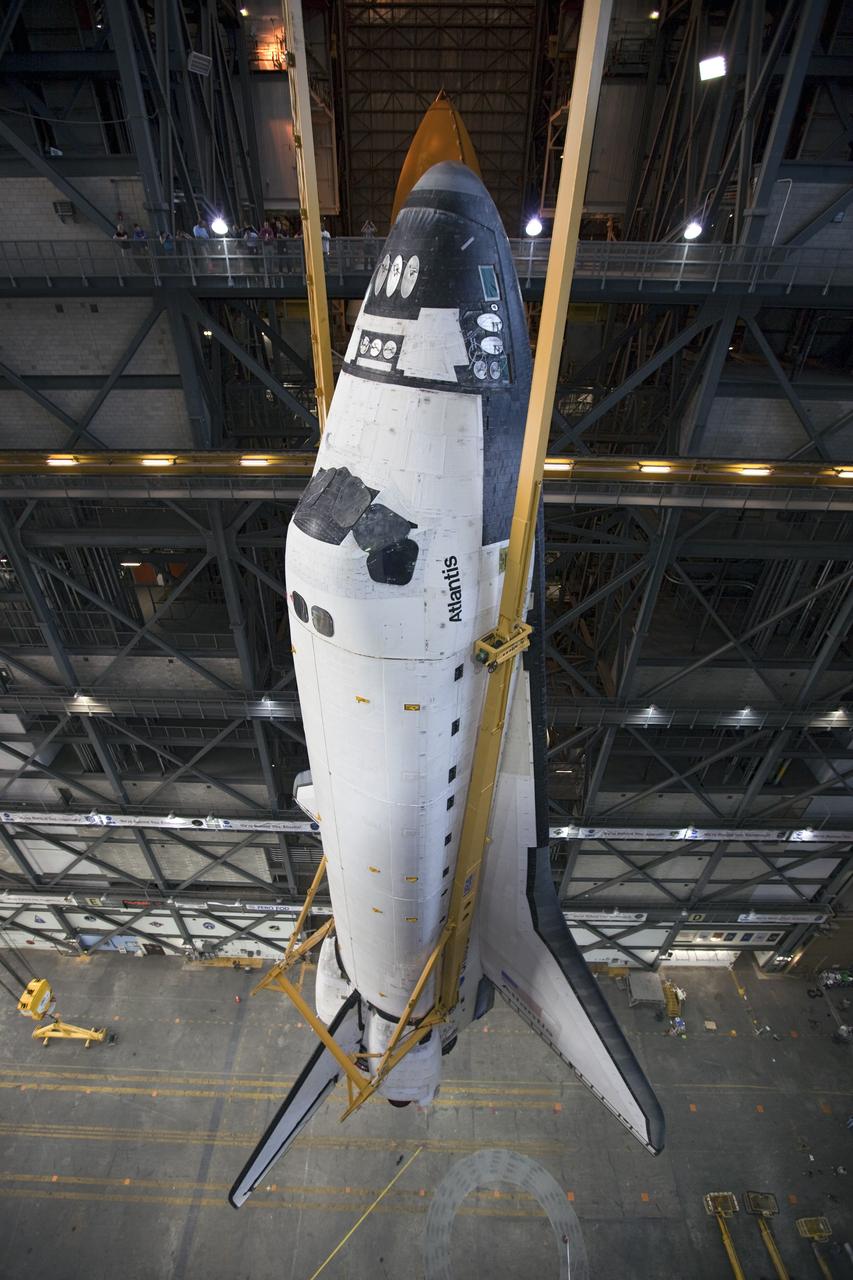
CAPE CANAVERAL, Fla. -- In the Vehicle Assembly Building at NASA's Kennedy Space Center in Florida, shuttle Atlantis is lifted by an overhead crane and moved into a high bay where it will be attached to its external fuel tank and solid rocket boosters which are already on the mobile launcher platform. Commander Chris Ferguson, Pilot Doug Hurley and Mission Specialists Sandra Magnus and Rex Walheim are expected to launch in mid-July, taking with them the Raffaello multi-purpose logistics module packed with supplies, logistics and spare parts. The STS-135 mission also will fly a system to investigate the potential for robotically refueling existing spacecraft and return a failed ammonia pump module to help NASA better understand the failure mechanism and improve pump designs for future systems. STS-135 will be the 33rd flight of Atlantis, the 37th shuttle mission to the space station, and the 135th and final mission of NASA's Space Shuttle Program. For more information visit, www.nasa.gov/mission_pages/shuttle/shuttlemissions/sts135/index.html. Photo credit: NASA/Dimitri Gerondidakis
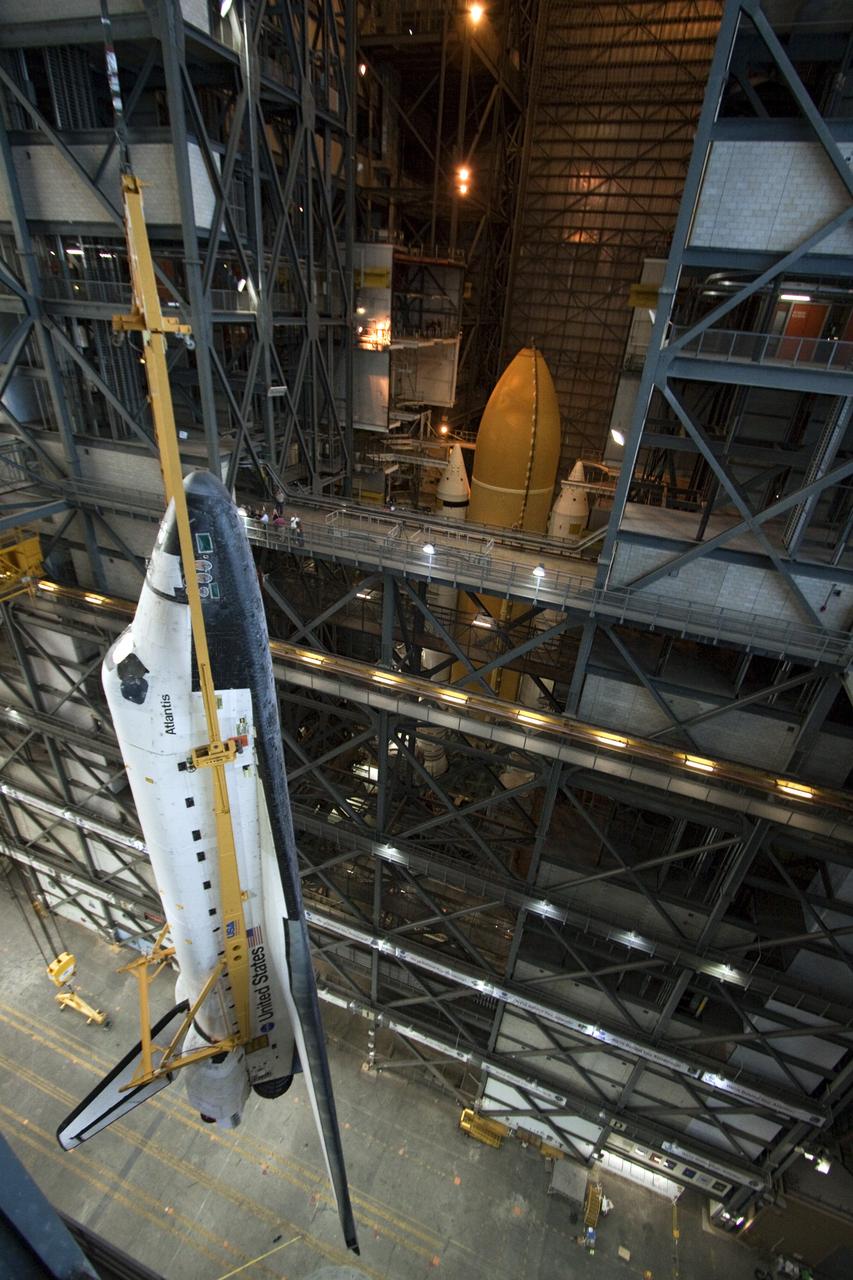
CAPE CANAVERAL, Fla. -- In the Vehicle Assembly Building at NASA's Kennedy Space Center in Florida, shuttle Atlantis is lifted by an overhead crane and moved into a high bay where it will be attached to its external fuel tank and solid rocket boosters already on the mobile launcher platform. Commander Chris Ferguson, Pilot Doug Hurley and Mission Specialists Sandra Magnus and Rex Walheim are expected to launch in mid-July, taking with them the Raffaello multi-purpose logistics module packed with supplies, logistics and spare parts. The STS-135 mission also will fly a system to investigate the potential for robotically refueling existing spacecraft and return a failed ammonia pump module to help NASA better understand the failure mechanism and improve pump designs for future systems. STS-135 will be the 33rd flight of Atlantis, the 37th shuttle mission to the space station, and the 135th and final mission of NASA's Space Shuttle Program. For more information visit, www.nasa.gov/mission_pages/shuttle/shuttlemissions/sts135/index.html. Photo credit: NASA/Troy Cryder
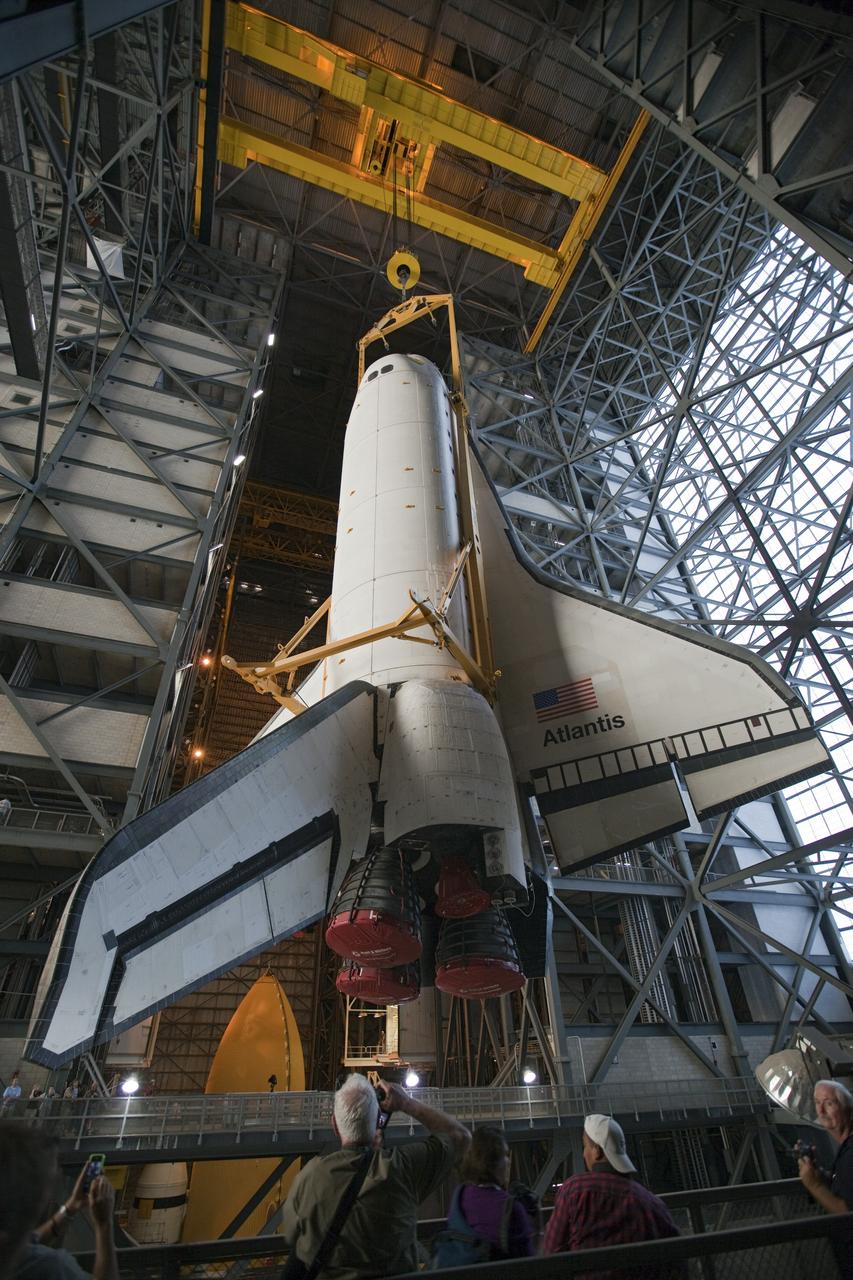
CAPE CANAVERAL, Fla. -- In the Vehicle Assembly Building at NASA's Kennedy Space Center in Florida, shuttle Atlantis is lifted by an overhead crane and moved into a high bay where it will be attached to its external fuel tank and solid rocket boosters which are already on the mobile launcher platform. Commander Chris Ferguson, Pilot Doug Hurley and Mission Specialists Sandra Magnus and Rex Walheim are expected to launch in mid-July, taking with them the Raffaello multi-purpose logistics module packed with supplies, logistics and spare parts. The STS-135 mission also will fly a system to investigate the potential for robotically refueling existing spacecraft and return a failed ammonia pump module to help NASA better understand the failure mechanism and improve pump designs for future systems. STS-135 will be the 33rd flight of Atlantis, the 37th shuttle mission to the space station, and the 135th and final mission of NASA's Space Shuttle Program. For more information visit, www.nasa.gov/mission_pages/shuttle/shuttlemissions/sts135/index.html. Photo credit: NASA/Dimitri Gerondidakis
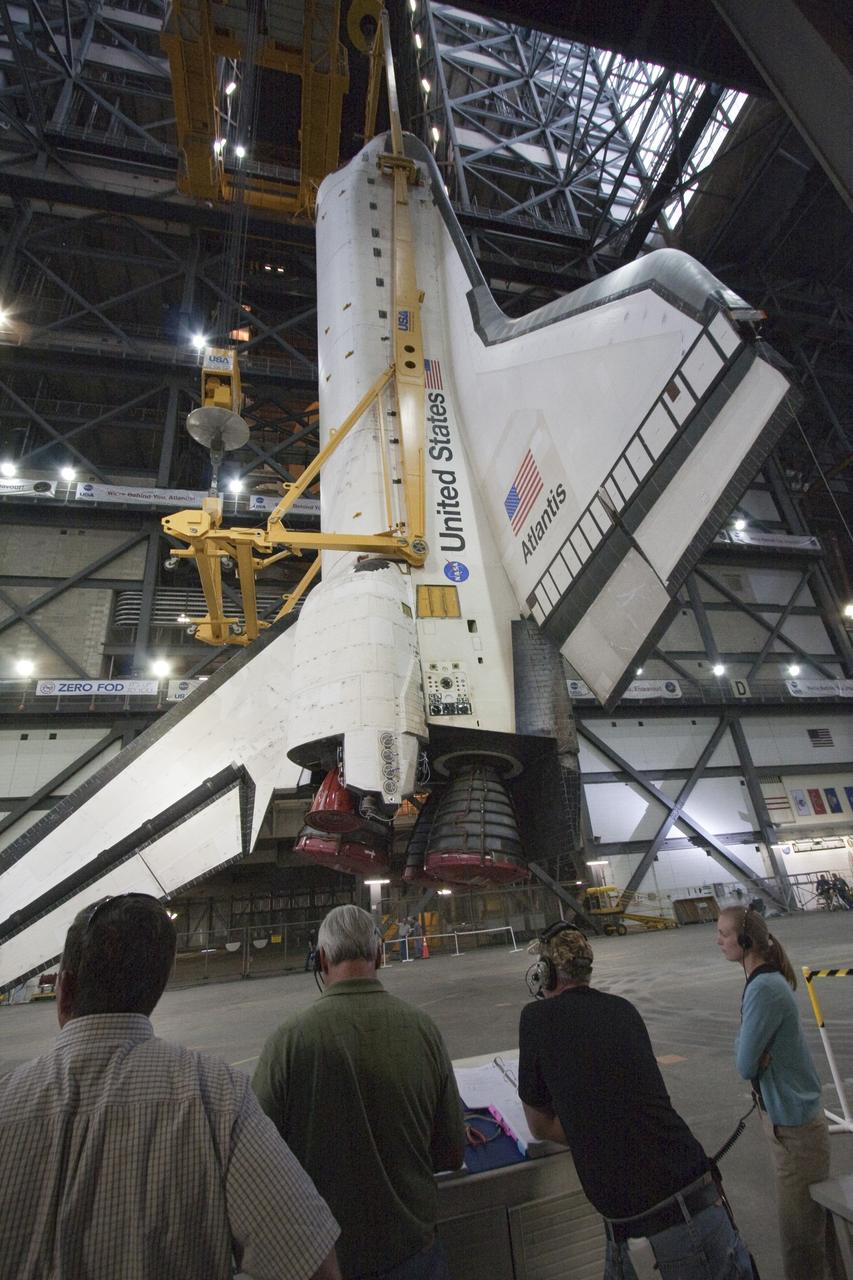
CAPE CANAVERAL, Fla. -- In Vehicle Assembly Building at NASA's Kennedy Space Center in Florida, an overhead crane suspends shuttle Atlantis above the transfer aisle. The spacecraft then will be moved into a high bay where it will be lowered and attached to its external fuel tank and solid rocket boosters already on the mobile launcher platform. Commander Chris Ferguson, Pilot Doug Hurley and Mission Specialists Sandra Magnus and Rex Walheim are expected to launch in mid-July, taking with them the Raffaello multi-purpose logistics module packed with supplies, logistics and spare parts. The STS-135 mission also will fly a system to investigate the potential for robotically refueling existing spacecraft and return a failed ammonia pump module to help NASA better understand the failure mechanism and improve pump designs for future systems. STS-135 will be the 33rd flight of Atlantis, the 37th shuttle mission to the space station, and the 135th and final mission of NASA's Space Shuttle Program. For more information visit, www.nasa.gov/mission_pages/shuttle/shuttlemissions/sts135/index.html. Photo credit: NASA/Ken Thornsley
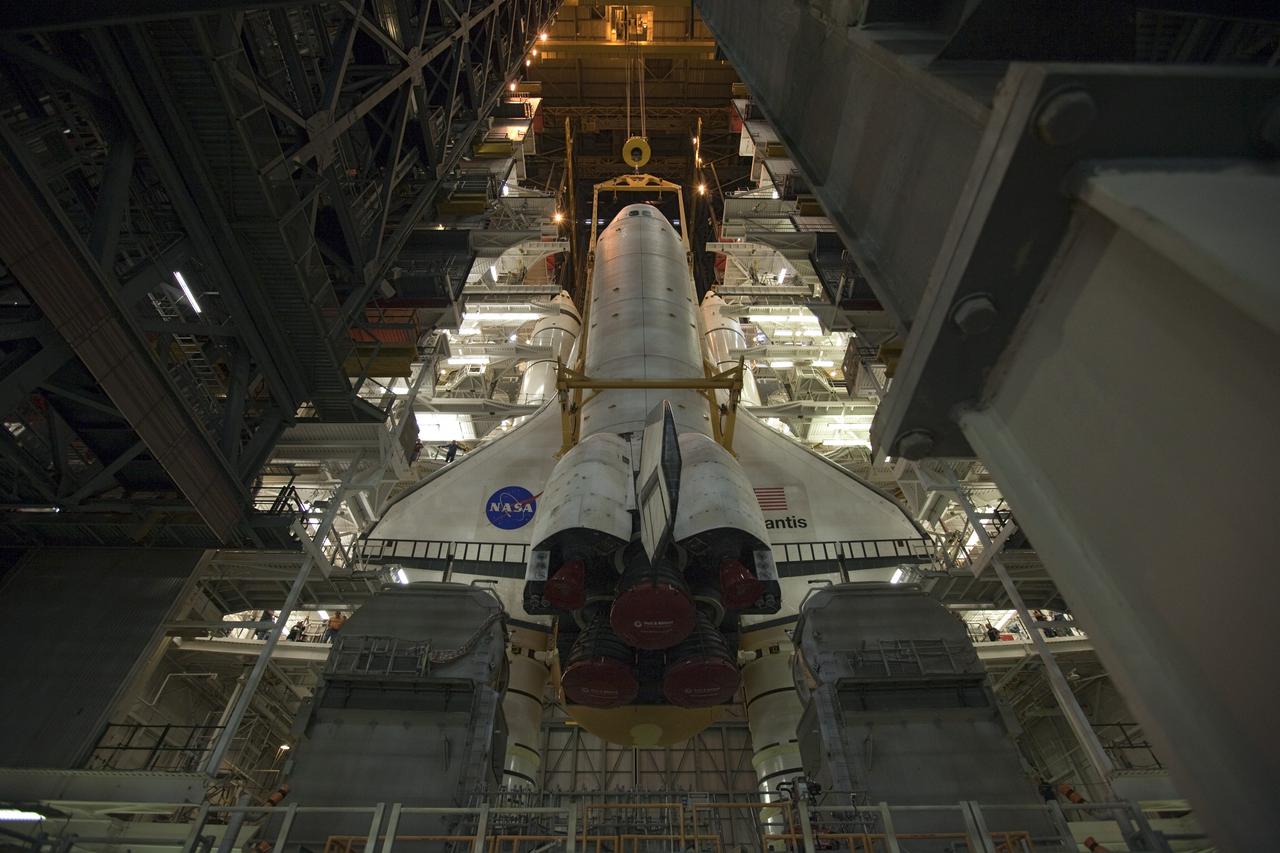
CAPE CANAVERAL, Fla. -- In the Vehicle Assembly Building at NASA's Kennedy Space Center in Florida, shuttle Atlantis is lowered toward the mobile launcher platform where it will be joined with its external fuel tank and solid rocket boosters. Commander Chris Ferguson, Pilot Doug Hurley and Mission Specialists Sandra Magnus and Rex Walheim are expected to launch in mid-July, taking with them the Raffaello multi-purpose logistics module packed with supplies, logistics and spare parts. The STS-135 mission also will fly a system to investigate the potential for robotically refueling existing spacecraft and return a failed ammonia pump module to help NASA better understand the failure mechanism and improve pump designs for future systems. STS-135 will be the 33rd flight of Atlantis, the 37th shuttle mission to the space station, and the 135th and final mission of NASA's Space Shuttle Program. For more information visit, www.nasa.gov/mission_pages/shuttle/shuttlemissions/sts135/index.html. Photo credit: NASA/Dimitri Gerondidakis
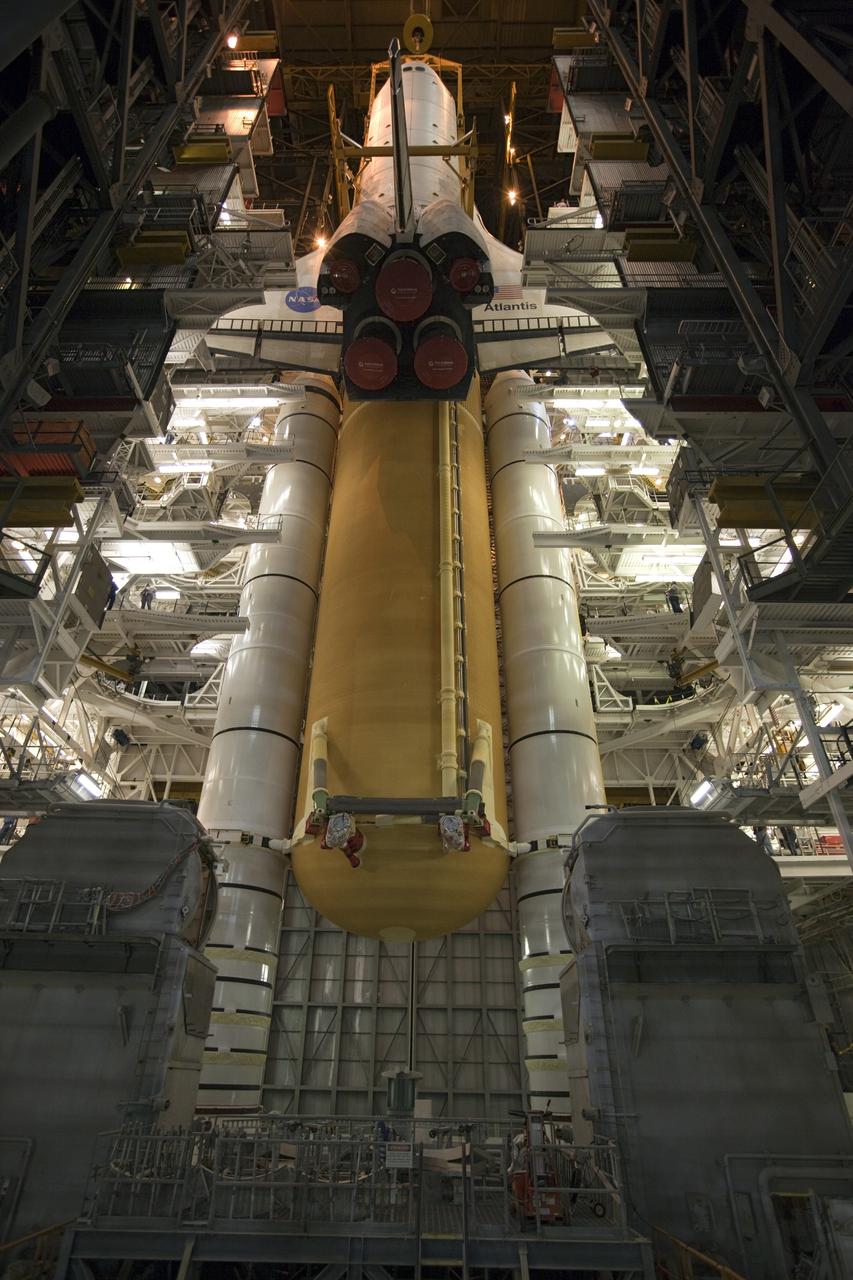
CAPE CANAVERAL, Fla. -- In the Vehicle Assembly Building at NASA's Kennedy Space Center in Florida, shuttle Atlantis is lowered toward the mobile launcher platform where it will be joined with its external fuel tank and solid rocket boosters. Commander Chris Ferguson, Pilot Doug Hurley and Mission Specialists Sandra Magnus and Rex Walheim are expected to launch in mid-July, taking with them the Raffaello multi-purpose logistics module packed with supplies, logistics and spare parts. The STS-135 mission also will fly a system to investigate the potential for robotically refueling existing spacecraft and return a failed ammonia pump module to help NASA better understand the failure mechanism and improve pump designs for future systems. STS-135 will be the 33rd flight of Atlantis, the 37th shuttle mission to the space station, and the 135th and final mission of NASA's Space Shuttle Program. For more information visit, www.nasa.gov/mission_pages/shuttle/shuttlemissions/sts135/index.html. Photo credit: NASA/Dimitri Gerondidakis

CAPE CANAVERAL, Fla. -- In the Vehicle Assembly Building at NASA's Kennedy Space Center in Florida, shuttle Atlantis is lifted by an overhead crane and moved into a high bay where it will be attached to its external fuel tank and solid rocket boosters already on the mobile launcher platform. Commander Chris Ferguson, Pilot Doug Hurley and Mission Specialists Sandra Magnus and Rex Walheim are expected to launch in mid-July, taking with them the Raffaello multi-purpose logistics module packed with supplies, logistics and spare parts. The STS-135 mission also will fly a system to investigate the potential for robotically refueling existing spacecraft and return a failed ammonia pump module to help NASA better understand the failure mechanism and improve pump designs for future systems. STS-135 will be the 33rd flight of Atlantis, the 37th shuttle mission to the space station, and the 135th and final mission of NASA's Space Shuttle Program. For more information visit, www.nasa.gov/mission_pages/shuttle/shuttlemissions/sts135/index.html. Photo credit: NASA/Troy Cryder
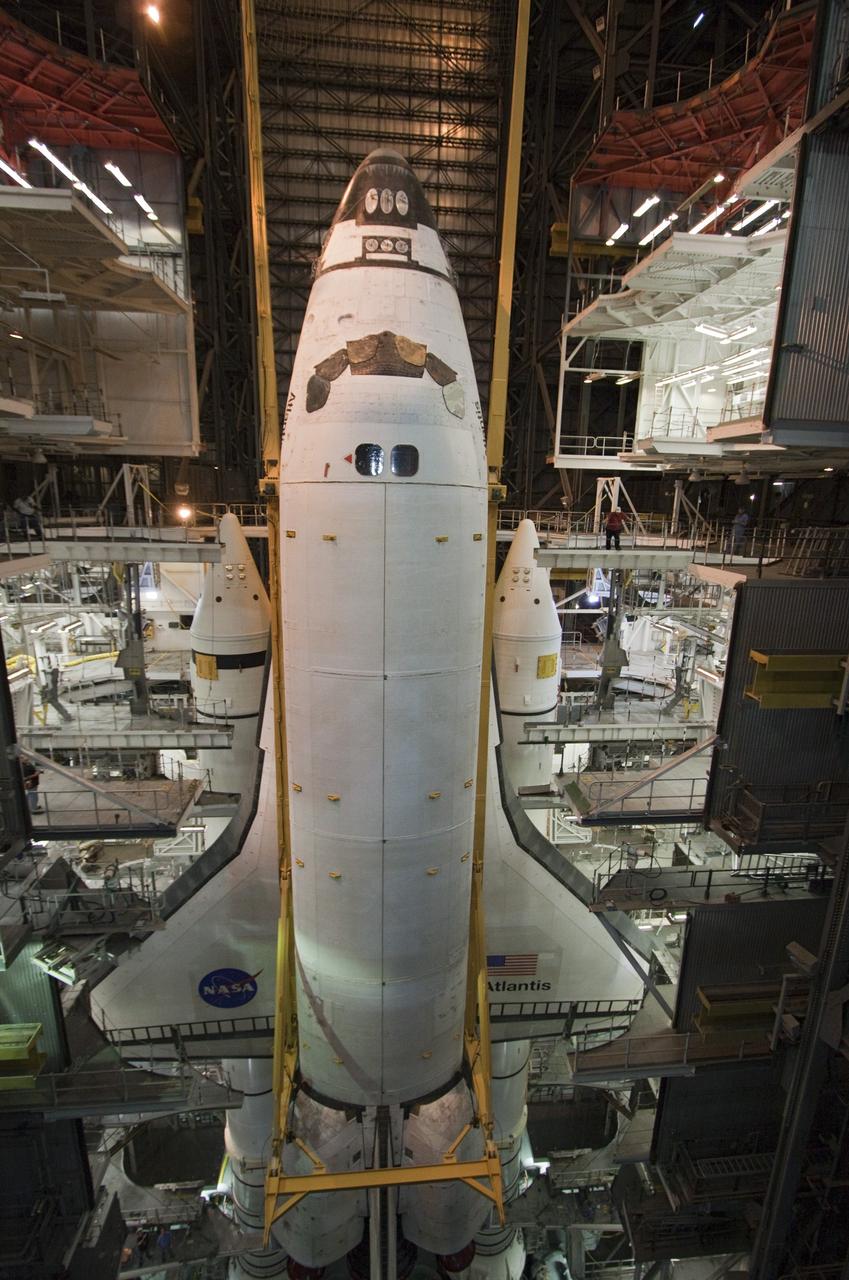
CAPE CANAVERAL, Fla. -- In the Vehicle Assembly Building at NASA's Kennedy Space Center in Florida, shuttle Atlantis is lowered onto the mobile launcher platform where it will be joined with its external fuel tank and solid rocket boosters. Commander Chris Ferguson, Pilot Doug Hurley and Mission Specialists Sandra Magnus and Rex Walheim are expected to launch in mid-July, taking with them the Raffaello multi-purpose logistics module packed with supplies, logistics and spare parts. The STS-135 mission also will fly a system to investigate the potential for robotically refueling existing spacecraft and return a failed ammonia pump module to help NASA better understand the failure mechanism and improve pump designs for future systems. STS-135 will be the 33rd flight of Atlantis, the 37th shuttle mission to the space station, and the 135th and final mission of NASA's Space Shuttle Program. For more information visit, www.nasa.gov/mission_pages/shuttle/shuttlemissions/sts135/index.html. Photo credit: NASA/Troy Cryder
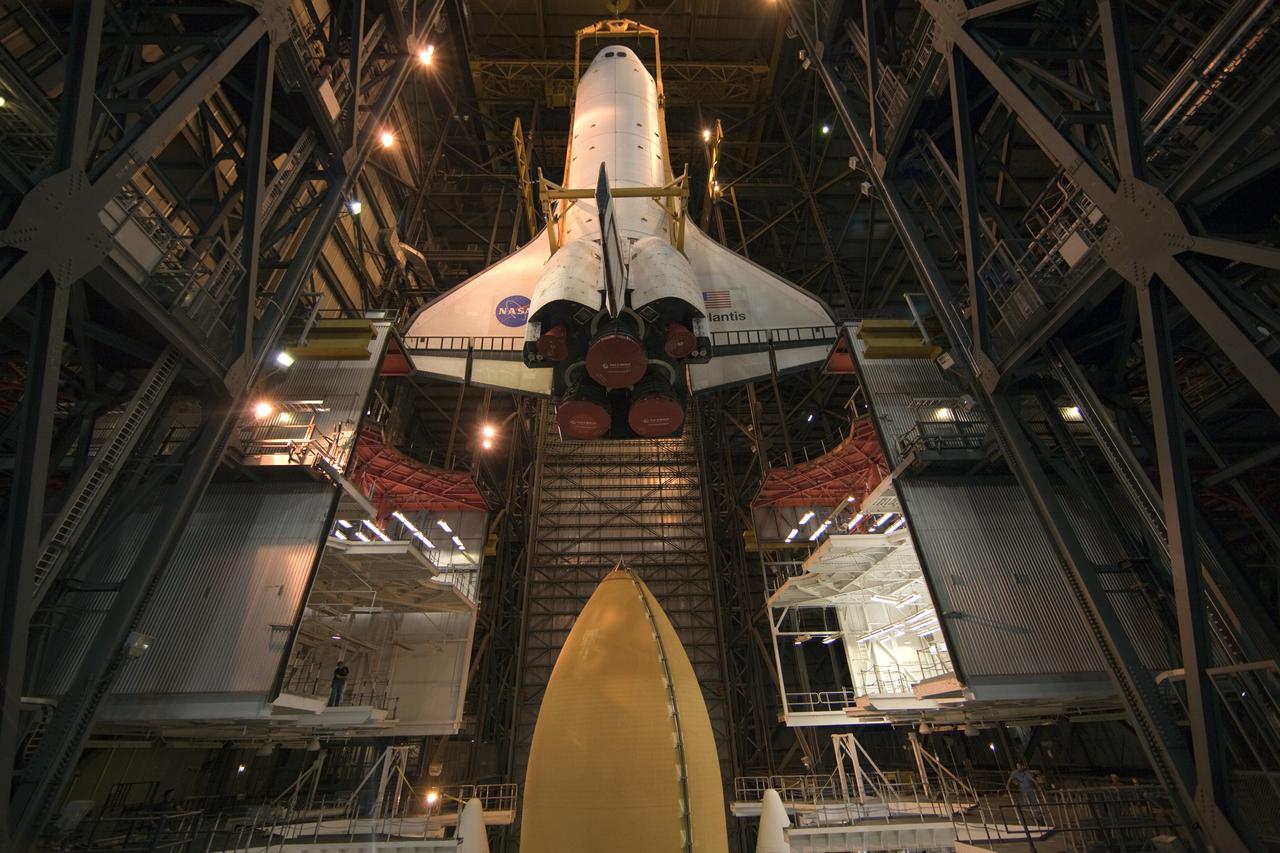
CAPE CANAVERAL, Fla. -- In the Vehicle Assembly Building at NASA's Kennedy Space Center in Florida, shuttle Atlantis is lowered toward the mobile launcher platform where it will be joined with its external fuel tank and solid rocket boosters. Commander Chris Ferguson, Pilot Doug Hurley and Mission Specialists Sandra Magnus and Rex Walheim are expected to launch in mid-July, taking with them the Raffaello multi-purpose logistics module packed with supplies, logistics and spare parts. The STS-135 mission also will fly a system to investigate the potential for robotically refueling existing spacecraft and return a failed ammonia pump module to help NASA better understand the failure mechanism and improve pump designs for future systems. STS-135 will be the 33rd flight of Atlantis, the 37th shuttle mission to the space station, and the 135th and final mission of NASA's Space Shuttle Program. For more information visit, www.nasa.gov/mission_pages/shuttle/shuttlemissions/sts135/index.html. Photo credit: NASA/Dimitri Gerondidakis
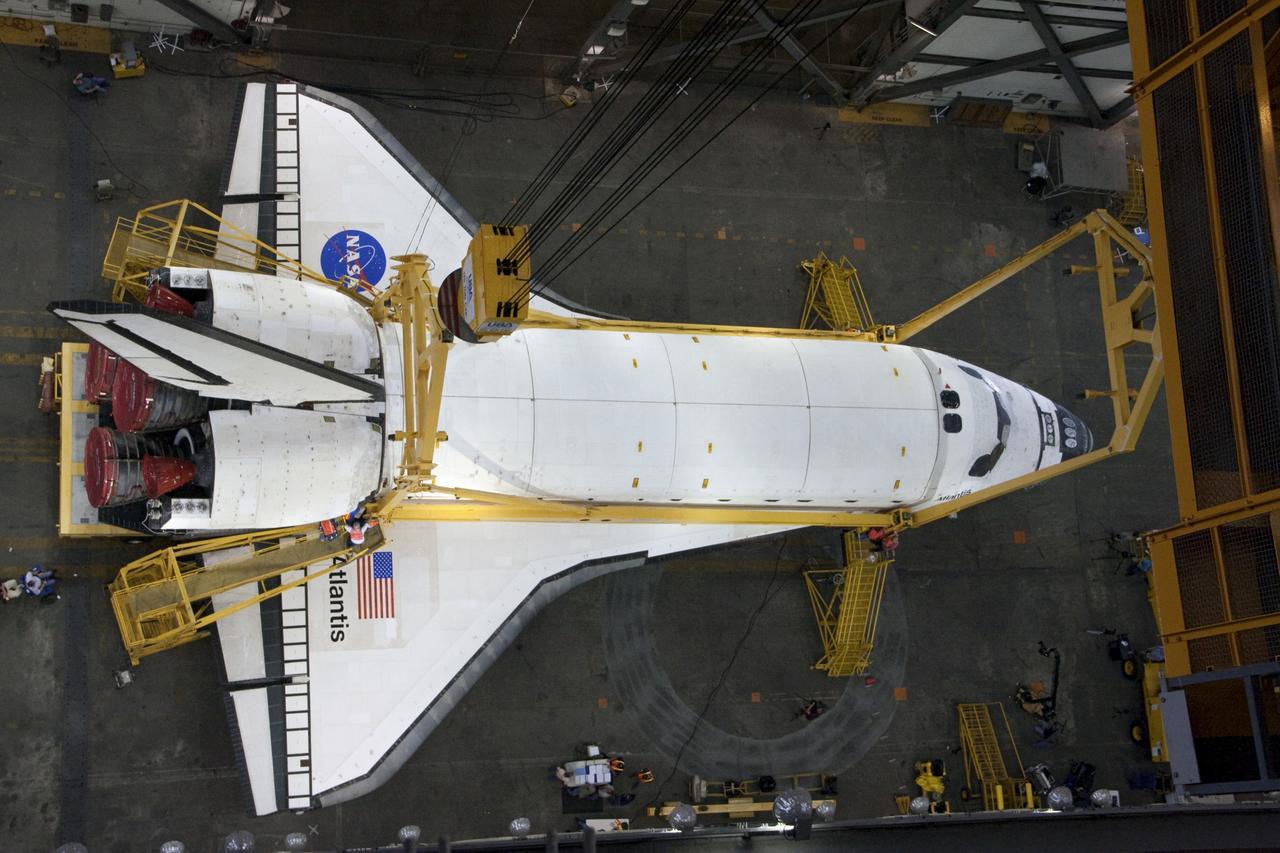
CAPE CANAVERAL, Fla. -- This overhead view photographed in the Vehicle Assembly Building at NASA's Kennedy Space Center in Florida, shows workers attaching a crane to shuttle Atlantis. The crane will lift the spacecraft into a high bay where it will be attached to the waiting external fuel tank and solid rocket boosters, which are already on the mobile launcher platform. Commander Chris Ferguson, Pilot Doug Hurley and Mission Specialists Sandra Magnus and Rex Walheim are targeted to launch in early July, taking with them the Raffaello multi-purpose logistics module packed with supplies, logistics and spare parts. The STS-135 mission also will fly a system to investigate the potential for robotically refueling existing spacecraft and return a failed ammonia pump module to help NASA better understand the failure mechanism and improve pump designs for future systems. STS-135 will be the 33rd flight of Atlantis, the 37th shuttle mission to the space station, and the 135th and final mission of NASA's Space Shuttle Program. For more information visit, www.nasa.gov/mission_pages/shuttle/shuttlemissions/sts135/index.html. Photo credit: NASA/Ken Thornsley
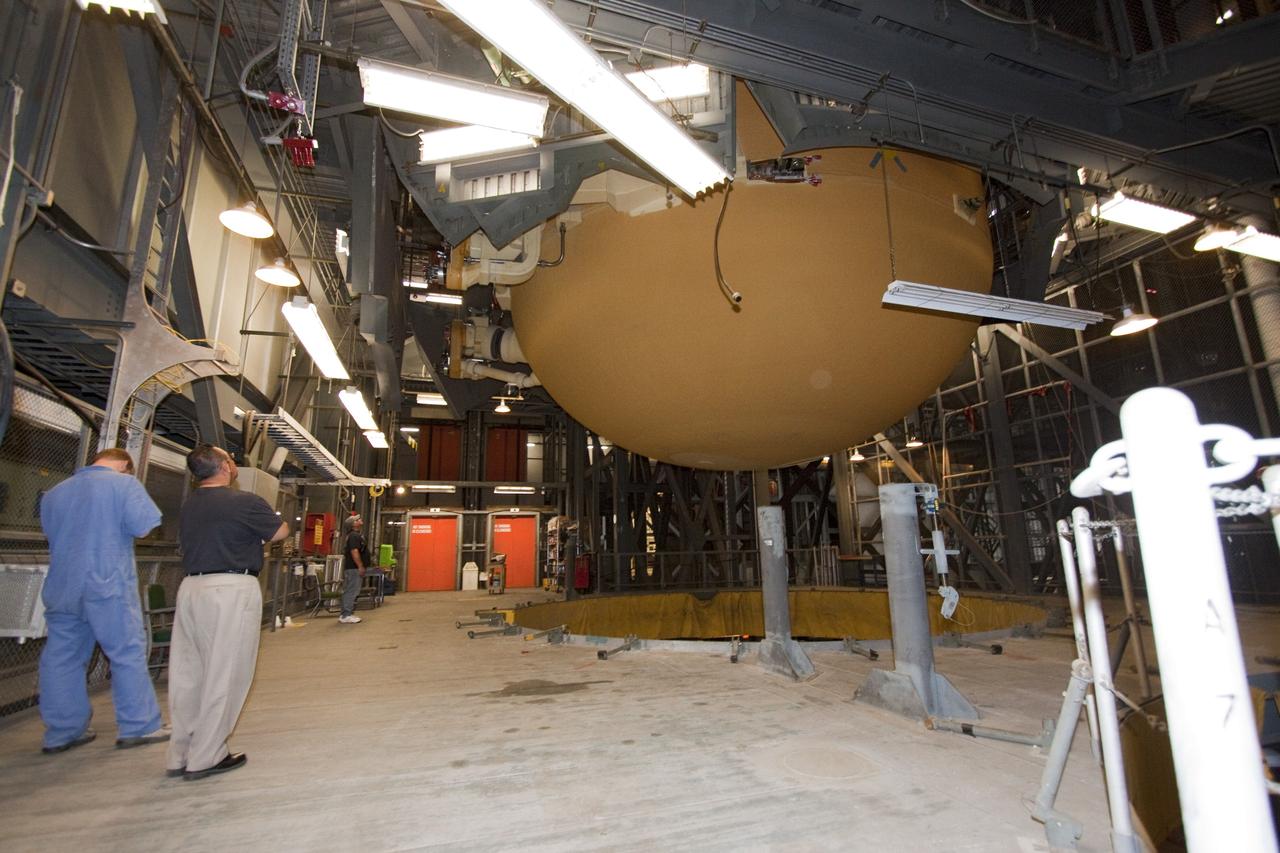
CAPE CANAVERAL, Fla. - In the Vehicle Assembly Building (VAB) at NASA's Kennedy Space Center in Florida, workers monitor the progress of external fuel tank, ET-138, for space shuttle Atlantis' STS-135 mission, as it is lifted from its test cell for transfer to high bay-1 for joining with the twin solid rocket boosters on the mobile launcher platform. Shuttle Atlantis' move, or "rollover," from Orbiter Processing Facility-1 to the VAB is targeted for May 10. Once there it will be mated with the external tank and boosters. Atlantis and its crew of four will deliver the Raffaello multipurpose logistics module packed with supplies and spare parts to the International Space Station. STS-135 is targeted to launch June 28, and will be the last spaceflight for the Space Shuttle Program. Photo credit: NASA/Jack Pfaller

CAPE CANAVERAL, Fla. - In the Vehicle Assembly Building (VAB) at NASA's Kennedy Space Center in Florida, external fuel tank, ET-138, for space shuttle Atlantis' STS-135 mission, is lifted from its test cell for transfer to high bay-1 for joining with the twin solid rocket boosters on the mobile launcher platform. Shuttle Atlantis' move, or "rollover," from Orbiter Processing Facility-1 to the VAB is targeted for May 10. Once there it will be mated with the external tank and boosters. Atlantis and its crew of four will deliver the Raffaello multipurpose logistics module packed with supplies and spare parts to the International Space Station. STS-135 is targeted to launch June 28, and will be the last spaceflight for the Space Shuttle Program. Photo credit: NASA/Jack Pfaller

CAPE CANAVERAL, Fla. - In the Vehicle Assembly Building (VAB) at NASA's Kennedy Space Center in Florida, external fuel tank, ET-138, for space shuttle Atlantis' STS-135 mission, is lifted from its test cell for transfer to high bay-1 for joining with the twin solid rocket boosters on the mobile launcher platform. Shuttle Atlantis' move, or "rollover," from Orbiter Processing Facility-1 to the VAB is targeted for May 10. Once there it will be mated with the external tank and boosters. Atlantis and its crew of four will deliver the Raffaello multipurpose logistics module packed with supplies and spare parts to the International Space Station. STS-135 is targeted to launch June 28, and will be the last spaceflight for the Space Shuttle Program. Photo credit: NASA/Jack Pfaller