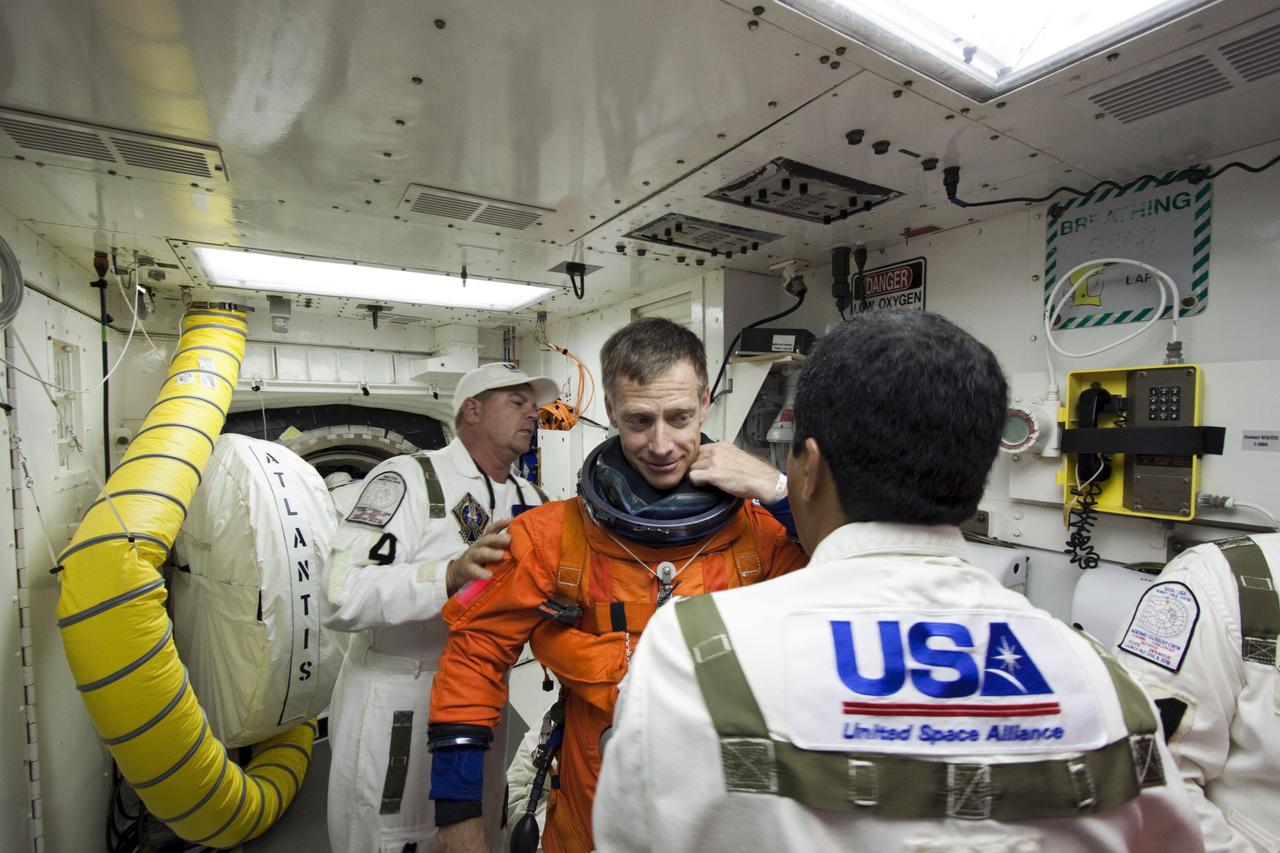
CAPE CANAVERAL, Fla. -- In the White Room at Launch Pad 39A at NASA's Kennedy Space Center in Florida, STS-135 Commander Chris Ferguson prepares to board space shuttle Atlantis through the crew hatch in the background. Members of the Closeout Crew, in white uniforms, are there to assist astronauts with their launch-and-entry suits and the boarding process. The STS-135 crew members are at the pad to participate in a launch countdown simulation exercise. As part of the Terminal Countdown Demonstration Test (TCDT), the crew members are strapped into their seats on Atlantis to practice the steps that will be taken on launch day. Shuttle Atlantis and its crew are targeted to lift off July 8, taking with them the Raffaello multi-purpose logistics module packed with supplies and spare parts to the International Space Station. The STS-135 mission also will fly a system to investigate the potential for robotically refueling existing satellites and return a failed ammonia pump module to help NASA better understand the failure mechanism and improve pump designs for future systems. STS-135 will be the 33rd flight of Atlantis, the 37th shuttle mission to the space station, and the 135th and final mission of NASA's Space Shuttle Program. For more information visit, www.nasa.gov/mission_pages/shuttle/shuttlemissions/sts135/index.html. Photo credit: NASA/Jim Grossmann
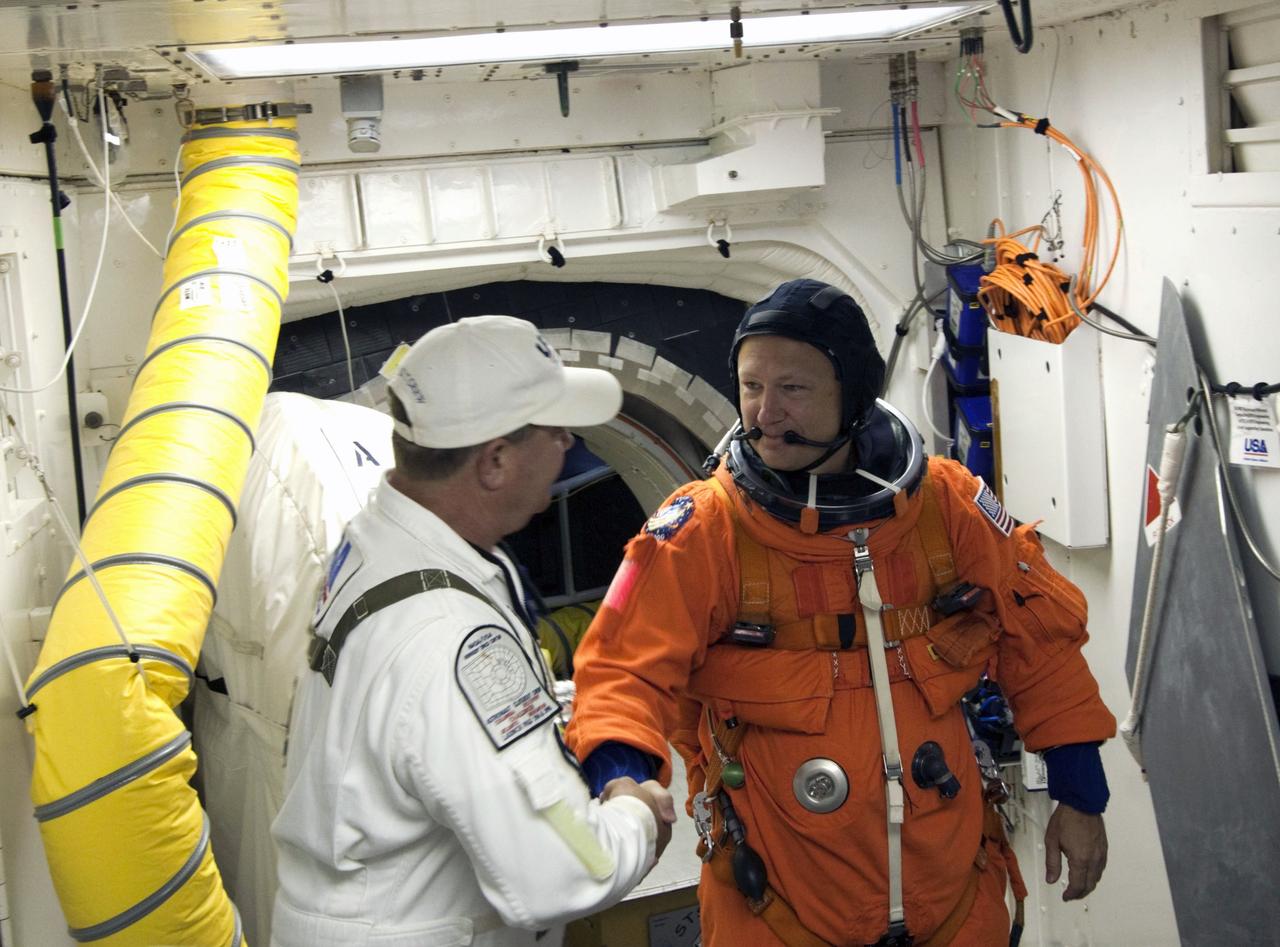
CAPE CANAVERAL, Fla. -- In the White Room at Launch Pad 39A at NASA's Kennedy Space Center in Florida, STS-135 Pilot Doug Hurley thanks Closeout Crew member Rene Arriens for his assistance as he prepares to board space shuttle Atlantis through the crew hatch in the background. Members of the Closeout Crew, in white uniforms, are there to assist astronauts with their launch-and-entry suits and the boarding process. The STS-135 crew members are at the pad to participate in a launch countdown simulation exercise. As part of the Terminal Countdown Demonstration Test (TCDT), the crew members are strapped into their seats on Atlantis to practice the steps that will be taken on launch day. Shuttle Atlantis and its crew are targeted to lift off July 8, taking with them the Raffaello multi-purpose logistics module packed with supplies and spare parts to the International Space Station. The STS-135 mission also will fly a system to investigate the potential for robotically refueling existing satellites and return a failed ammonia pump module to help NASA better understand the failure mechanism and improve pump designs for future systems. STS-135 will be the 33rd flight of Atlantis, the 37th shuttle mission to the space station, and the 135th and final mission of NASA's Space Shuttle Program. For more information visit, www.nasa.gov/mission_pages/shuttle/shuttlemissions/sts135/index.html. Photo credit: NASA/Jim Grossmann
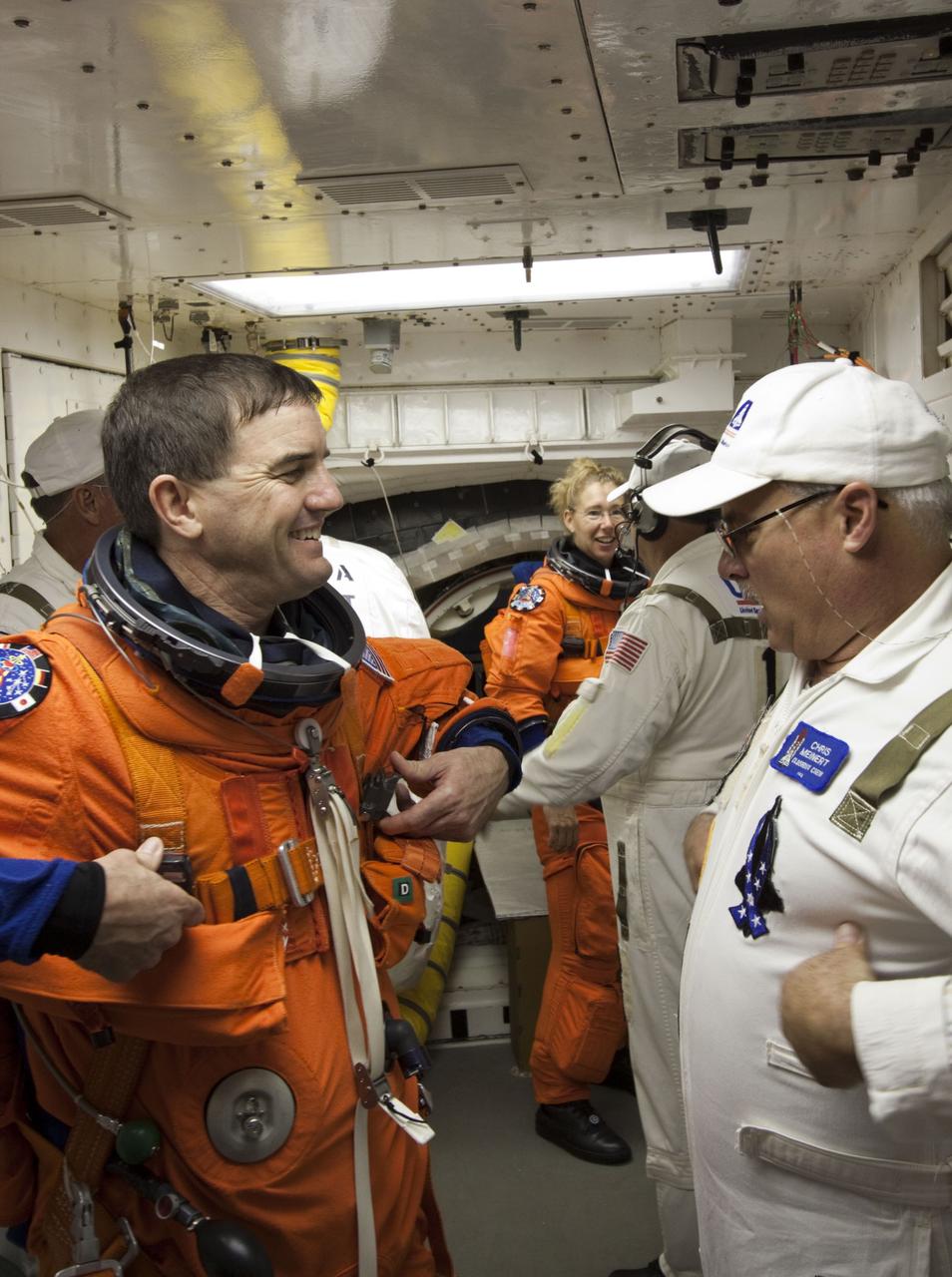
CAPE CANAVERAL, Fla. -- In the White Room at Launch Pad 39A at NASA's Kennedy Space Center in Florida, STS-135 Mission Specialist Rex Walheim prepares to board space shuttle Atlantis through the crew hatch in the background. Members of the Closeout Crew, in white uniforms, are there to assist astronauts with their launch-and-entry suits and the boarding process. Seen in the background is Mission Specialist Sandy Magnus speaking with a Closeout Crew member. The STS-135 crew is at the pad to participate in a launch countdown simulation exercise. As part of the Terminal Countdown Demonstration Test (TCDT), the crew members are strapped into their seats on Atlantis to practice the steps that will be taken on launch day. Shuttle Atlantis and its crew are targeted to lift off July 8, taking with them the Raffaello multi-purpose logistics module packed with supplies and spare parts to the International Space Station. The STS-135 mission also will fly a system to investigate the potential for robotically refueling existing satellites and return a failed ammonia pump module to help NASA better understand the failure mechanism and improve pump designs for future systems. STS-135 will be the 33rd flight of Atlantis, the 37th shuttle mission to the space station, and the 135th and final mission of NASA's Space Shuttle Program. For more information visit, www.nasa.gov/mission_pages/shuttle/shuttlemissions/sts135/index.html. Photo credit: NASA/Jim Grossmann
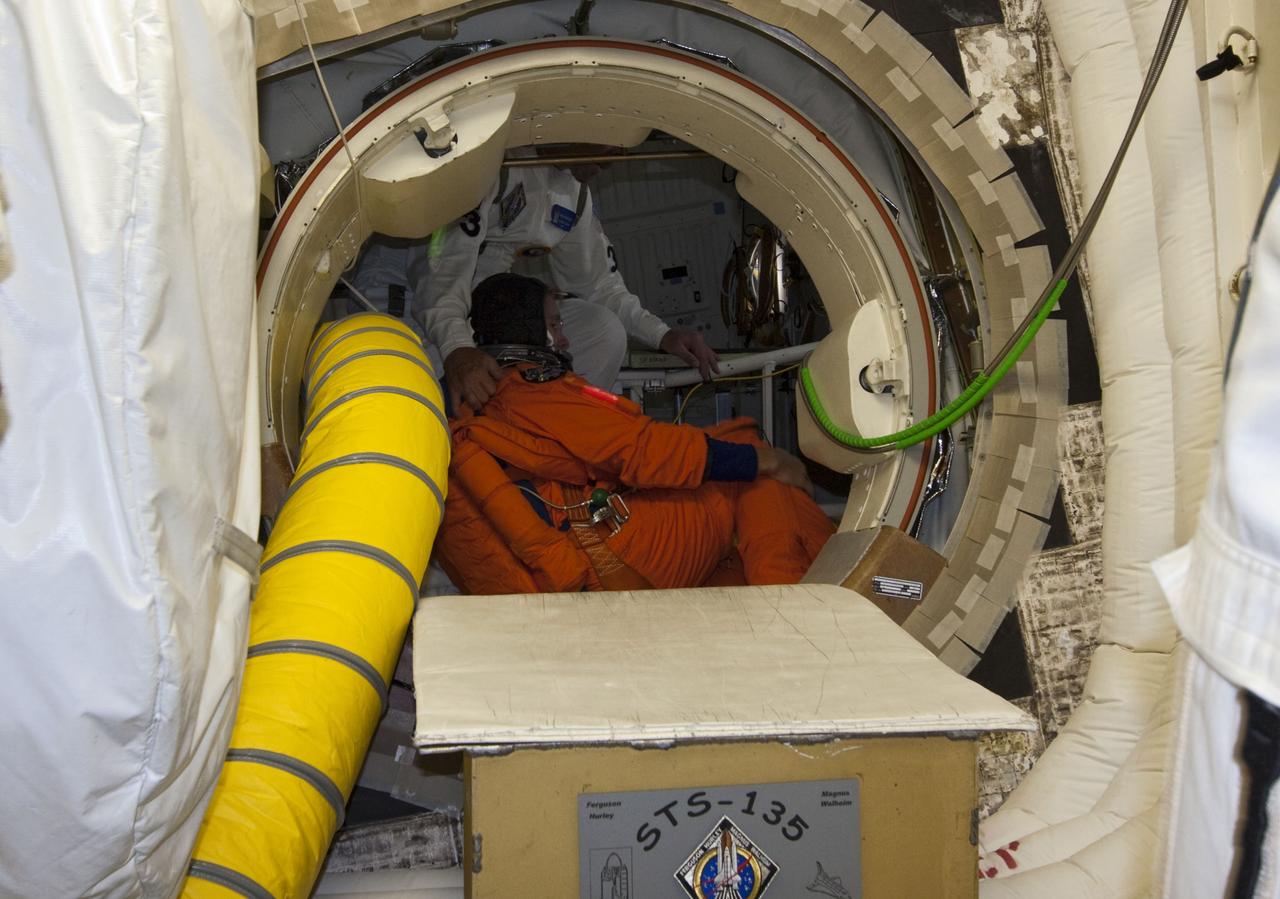
CAPE CANAVERAL, Fla. -- In the White Room at Launch Pad 39A at NASA's Kennedy Space Center in Florida, STS-135 Mission Specialist Sandy Magnus gets assistance boarding space shuttle Atlantis through the crew hatch. Members of the Closeout Crew, in white uniforms, are there to assist astronauts with their launch-and-entry suits and the boarding process. The STS-135 crew members are at the pad to participate in a launch countdown simulation exercise. As part of the Terminal Countdown Demonstration Test (TCDT), the crew members are strapped into their seats on Atlantis to practice the steps that will be taken on launch day. Shuttle Atlantis and its crew are targeted to lift off July 8, taking with them the Raffaello multi-purpose logistics module packed with supplies and spare parts to the International Space Station. The STS-135 mission also will fly a system to investigate the potential for robotically refueling existing satellites and return a failed ammonia pump module to help NASA better understand the failure mechanism and improve pump designs for future systems. STS-135 will be the 33rd flight of Atlantis, the 37th shuttle mission to the space station, and the 135th and final mission of NASA's Space Shuttle Program. For more information visit, www.nasa.gov/mission_pages/shuttle/shuttlemissions/sts135/index.html. Photo credit: NASA/Jim Grossmann
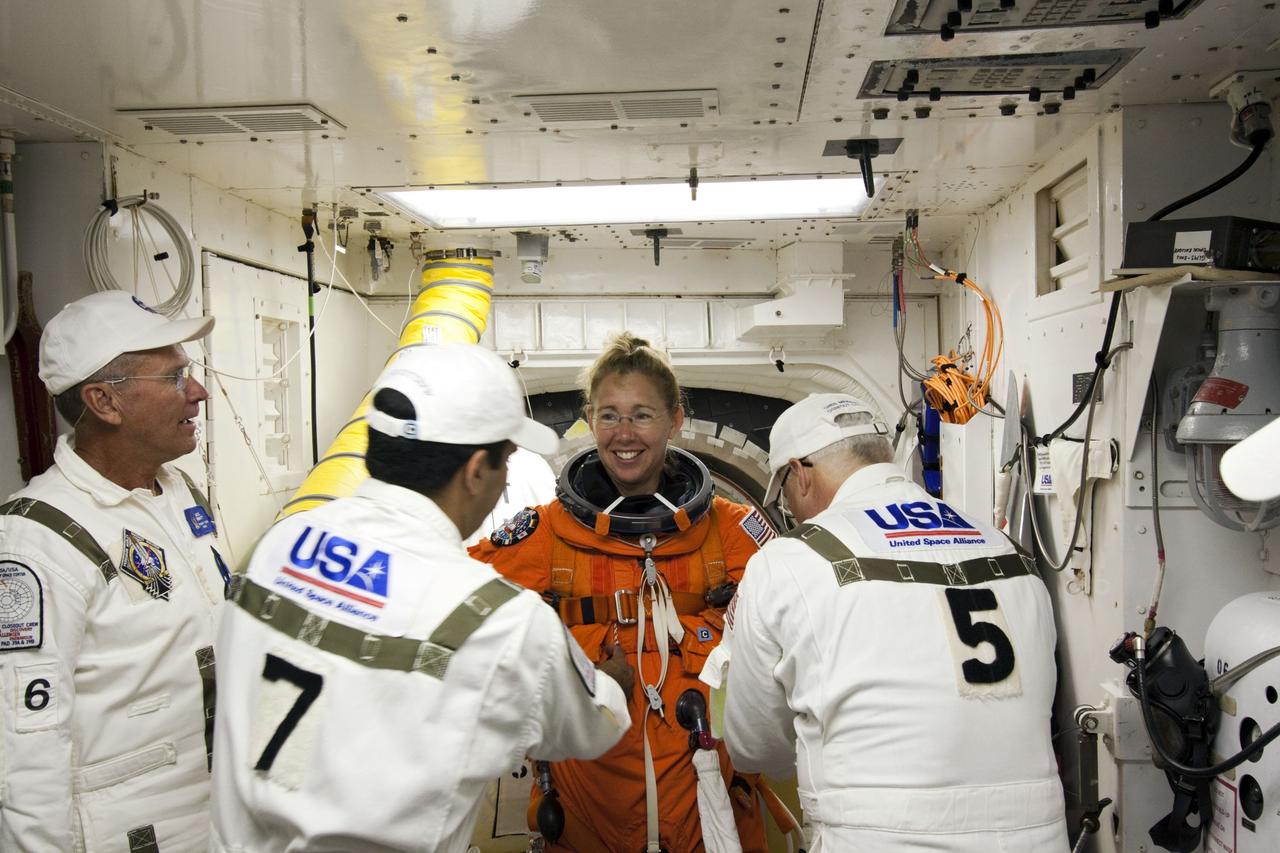
CAPE CANAVERAL, Fla. -- In the White Room at Launch Pad 39A at NASA's Kennedy Space Center in Florida, STS-135 Mission Specialist Sandy Magnus prepares to board space shuttle Atlantis through the crew hatch in the background. Members of the Closeout Crew, in white uniforms, are there to assist astronauts with their launch-and-entry suits and the boarding process. The STS-135 crew members are at the pad to participate in a launch countdown simulation exercise. As part of the Terminal Countdown Demonstration Test (TCDT), the crew members are strapped into their seats on Atlantis to practice the steps that will be taken on launch day. Shuttle Atlantis and its crew are targeted to lift off July 8, taking with them the Raffaello multi-purpose logistics module packed with supplies and spare parts to the International Space Station. The STS-135 mission also will fly a system to investigate the potential for robotically refueling existing satellites and return a failed ammonia pump module to help NASA better understand the failure mechanism and improve pump designs for future systems. STS-135 will be the 33rd flight of Atlantis, the 37th shuttle mission to the space station, and the 135th and final mission of NASA's Space Shuttle Program. For more information visit, www.nasa.gov/mission_pages/shuttle/shuttlemissions/sts135/index.html. Photo credit: NASA/Jim Grossmann
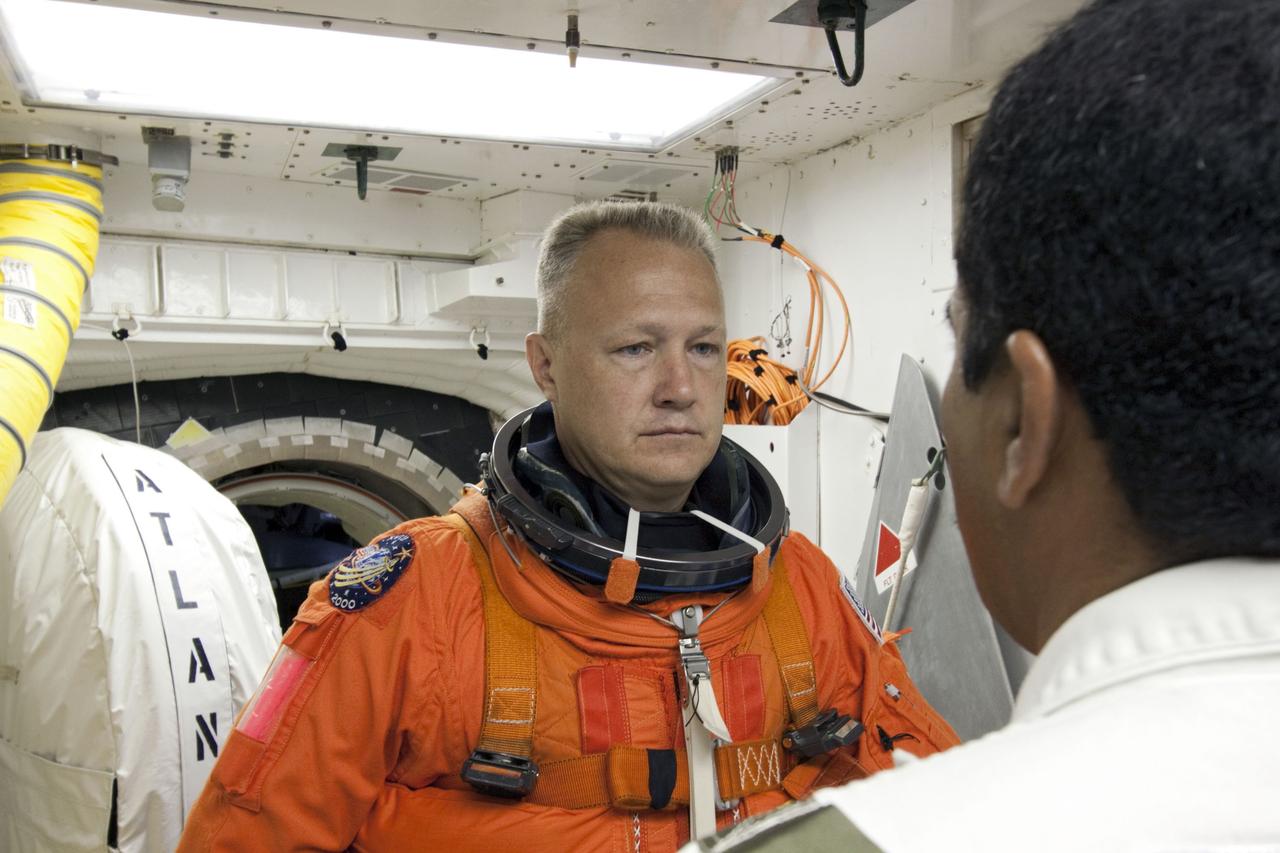
CAPE CANAVERAL, Fla. -- In the White Room at Launch Pad 39A at NASA's Kennedy Space Center in Florida, STS-135 Pilot Doug Hurley prepares to board space shuttle Atlantis through the crew hatch in the background. Members of the Closeout Crew, in white uniforms, are there to assist astronauts with their launch-and-entry suits and the boarding process. The STS-135 crew members are at the pad to participate in a launch countdown simulation exercise. As part of the Terminal Countdown Demonstration Test (TCDT), the crew members are strapped into their seats on Atlantis to practice the steps that will be taken on launch day. Shuttle Atlantis and its crew are targeted to lift off July 8, taking with them the Raffaello multi-purpose logistics module packed with supplies and spare parts to the International Space Station. The STS-135 mission also will fly a system to investigate the potential for robotically refueling existing satellites and return a failed ammonia pump module to help NASA better understand the failure mechanism and improve pump designs for future systems. STS-135 will be the 33rd flight of Atlantis, the 37th shuttle mission to the space station, and the 135th and final mission of NASA's Space Shuttle Program. For more information visit, www.nasa.gov/mission_pages/shuttle/shuttlemissions/sts135/index.html. Photo credit: NASA/Jim Grossmann
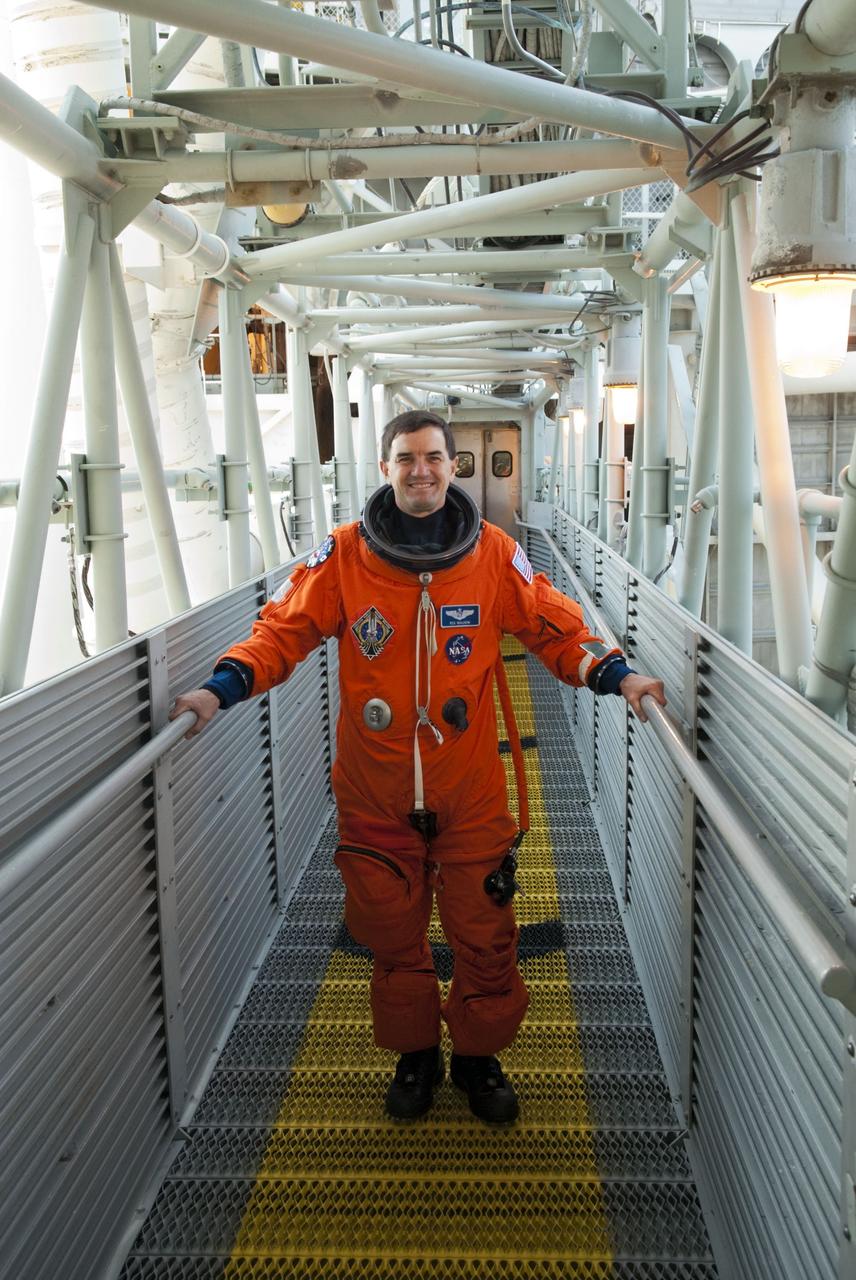
CAPE CANAVERAL, Fla. -- STS-135 Mission Specialist Rex Walheim stands on the walkway to the White Room which provides entry to space shuttle Atlantis' crew compartment on Launch Pad 39A at NASA's Kennedy Space Center in Florida. Atlantis' crew members are at the pad to participate in a launch countdown simulation exercise. As part of the Terminal Countdown Demonstration Test (TCDT), the crew members are strapped into their seats on Atlantis to practice the steps that will be taken on launch day. Shuttle Atlantis and its crew are targeted to lift off July 8, taking with them the Raffaello multi-purpose logistics module packed with supplies and spare parts to the International Space Station. The STS-135 mission also will fly a system to investigate the potential for robotically refueling existing satellites and return a failed ammonia pump module to help NASA better understand the failure mechanism and improve pump designs for future systems. STS-135 will be the 33rd flight of Atlantis, the 37th shuttle mission to the space station, and the 135th and final mission of NASA's Space Shuttle Program. For more information visit, www.nasa.gov/mission_pages/shuttle/shuttlemissions/sts135/index.html. Photo credit: NASA/Jim Grossmann
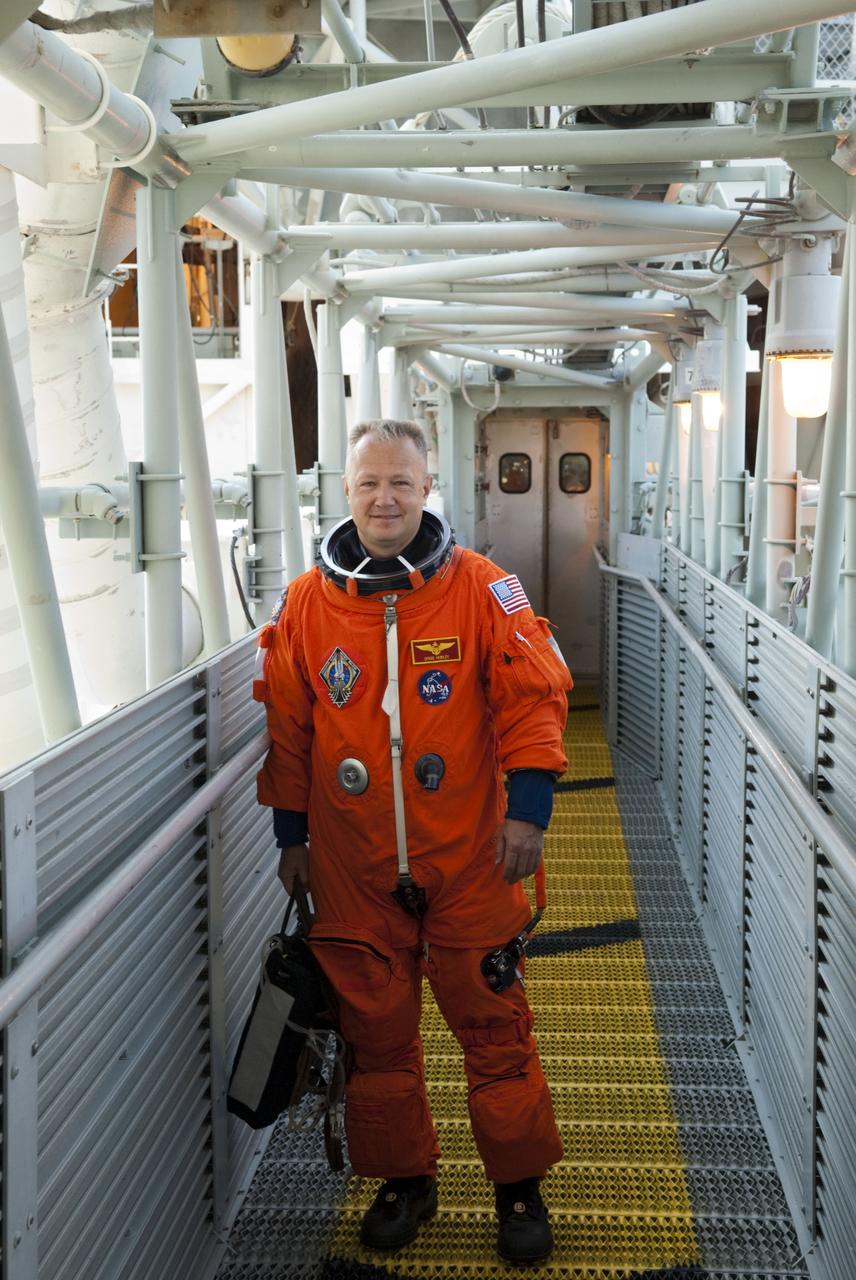
CAPE CANAVERAL, Fla. -- STS-135 Pilot Doug Hurley stands on the walkway to the White Room which provides entry to space shuttle Atlantis' crew compartment on Launch Pad 39A at NASA's Kennedy Space Center in Florida. Atlantis' crew members are at the pad to participate in a launch countdown simulation exercise. As part of the Terminal Countdown Demonstration Test (TCDT), the crew members are strapped into their seats on Atlantis to practice the steps that will be taken on launch day. Shuttle Atlantis and its crew are targeted to lift off July 8, taking with them the Raffaello multi-purpose logistics module packed with supplies and spare parts to the International Space Station. The STS-135 mission also will fly a system to investigate the potential for robotically refueling existing satellites and return a failed ammonia pump module to help NASA better understand the failure mechanism and improve pump designs for future systems. STS-135 will be the 33rd flight of Atlantis, the 37th shuttle mission to the space station, and the 135th and final mission of NASA's Space Shuttle Program. For more information visit, www.nasa.gov/mission_pages/shuttle/shuttlemissions/sts135/index.html. Photo credit: NASA/Jim Grossmann
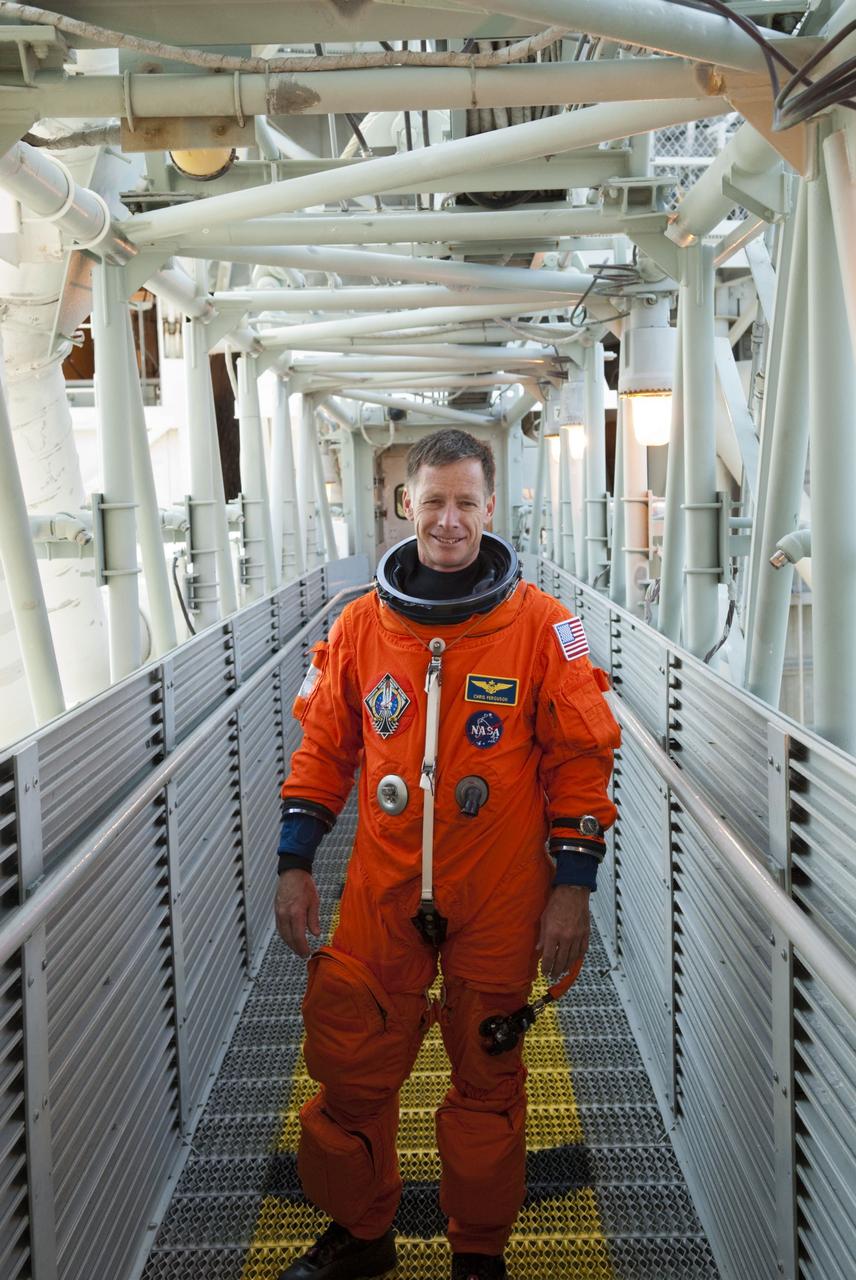
CAPE CANAVERAL, Fla. -- STS-135 Commander Chris Ferguson stands on the walkway to the White Room which provides entry to space shuttle Atlantis' crew compartment on Launch Pad 39A at NASA's Kennedy Space Center in Florida. Atlantis' crew members are at the pad to participate in a launch countdown simulation exercise. As part of the Terminal Countdown Demonstration Test (TCDT), the crew members are strapped into their seats on Atlantis to practice the steps that will be taken on launch day. Shuttle Atlantis and its crew are targeted to lift off July 8, taking with them the Raffaello multi-purpose logistics module packed with supplies and spare parts to the International Space Station. The STS-135 mission also will fly a system to investigate the potential for robotically refueling existing satellites and return a failed ammonia pump module to help NASA better understand the failure mechanism and improve pump designs for future systems. STS-135 will be the 33rd flight of Atlantis, the 37th shuttle mission to the space station, and the 135th and final mission of NASA's Space Shuttle Program. For more information visit, www.nasa.gov/mission_pages/shuttle/shuttlemissions/sts135/index.html. Photo credit: NASA/Jim Grossmann
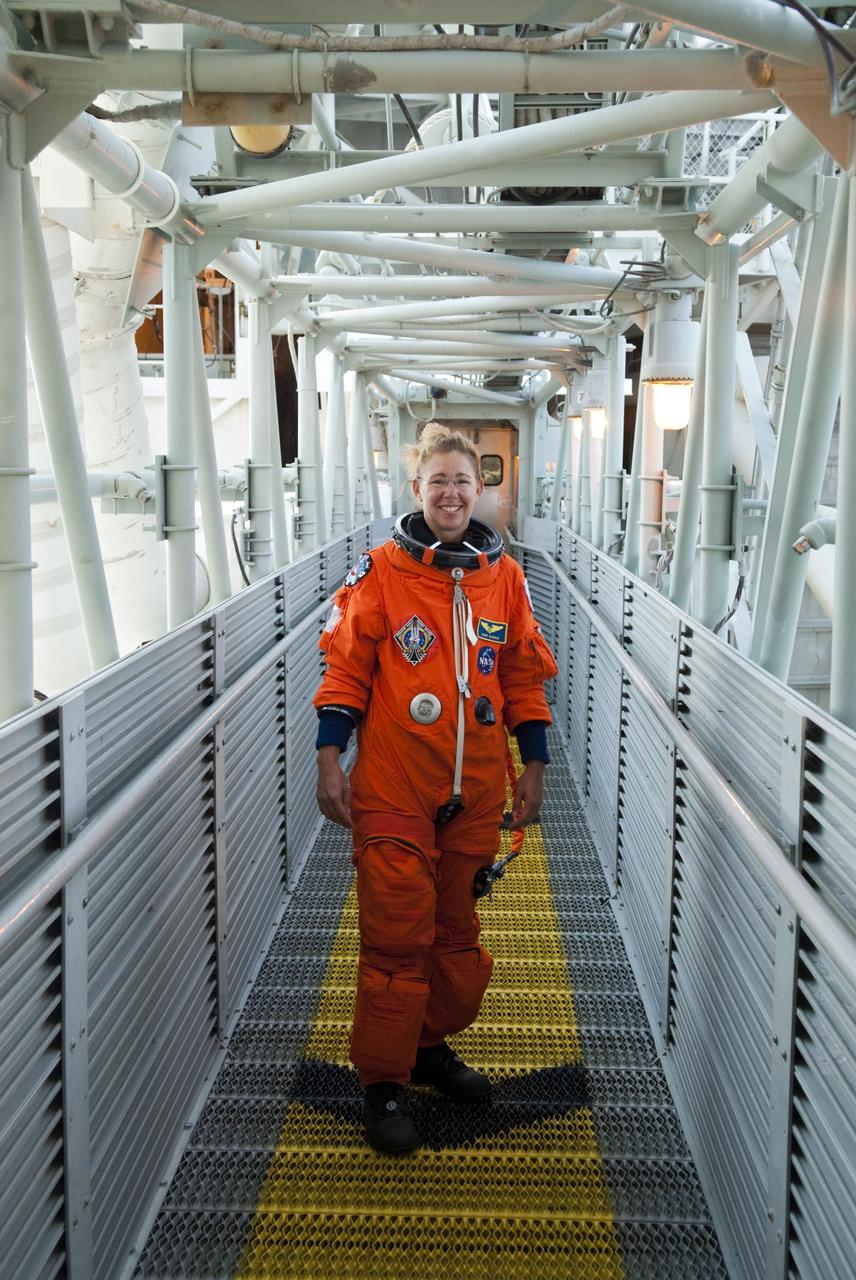
CAPE CANAVERAL, Fla. -- STS-135 Mission Specialist Sandy Magnus stands on the walkway to the White Room which provides entry to space shuttle Atlantis' crew compartment on Launch Pad 39A at NASA's Kennedy Space Center in Florida. Atlantis' crew members are at the pad to participate in a launch countdown simulation exercise. As part of the Terminal Countdown Demonstration Test (TCDT), the crew members are strapped into their seats on Atlantis to practice the steps that will be taken on launch day. Shuttle Atlantis and its crew are targeted to lift off July 8, taking with them the Raffaello multi-purpose logistics module packed with supplies and spare parts to the International Space Station. The STS-135 mission also will fly a system to investigate the potential for robotically refueling existing satellites and return a failed ammonia pump module to help NASA better understand the failure mechanism and improve pump designs for future systems. STS-135 will be the 33rd flight of Atlantis, the 37th shuttle mission to the space station, and the 135th and final mission of NASA's Space Shuttle Program. For more information visit, www.nasa.gov/mission_pages/shuttle/shuttlemissions/sts135/index.html. Photo credit: NASA/Jim Grossmann
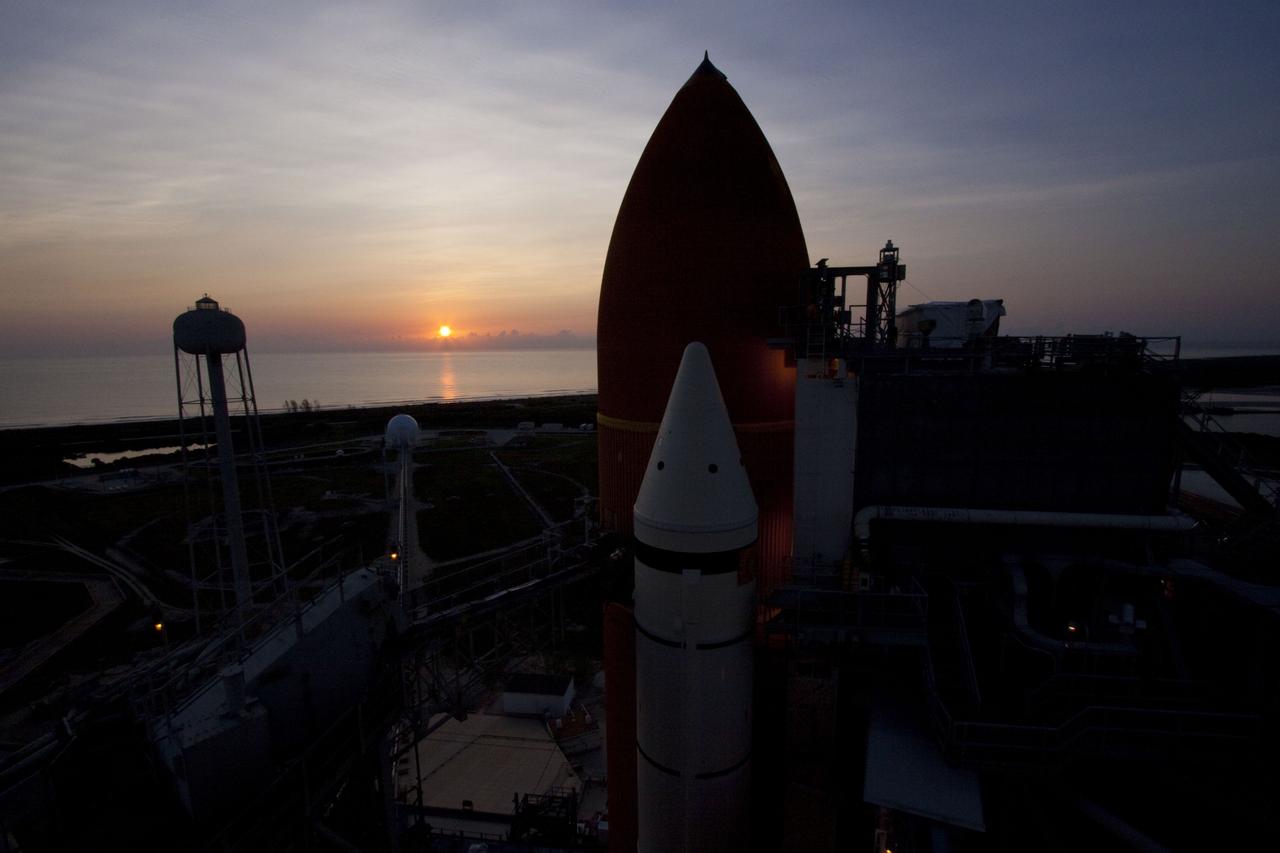
CAPE CANAVERAL, Fla. -- The sun rises over the Atlantic Ocean silhouetting space shuttle Atlantis' external fuel tank and solid rocket boosters on Launch Pad 39A at NASA's Kennedy Space Center in Florida. The STS-135 crew members will be at the pad to participate in a launch countdown simulation exercise. As part of the Terminal Countdown Demonstration Test (TCDT), the crew members are strapped into their seats on Atlantis to practice the steps that will be taken on launch day. Shuttle Atlantis and its crew are targeted to lift off July 8, taking with them the Raffaello multi-purpose logistics module packed with supplies and spare parts to the International Space Station. The STS-135 mission also will fly a system to investigate the potential for robotically refueling existing satellites and return a failed ammonia pump module to help NASA better understand the failure mechanism and improve pump designs for future systems. STS-135 will be the 33rd flight of Atlantis, the 37th shuttle mission to the space station, and the 135th and final mission of NASA's Space Shuttle Program. For more information visit, www.nasa.gov/mission_pages/shuttle/shuttlemissions/sts135/index.html. Photo credit: NASA/Jim Grossmann
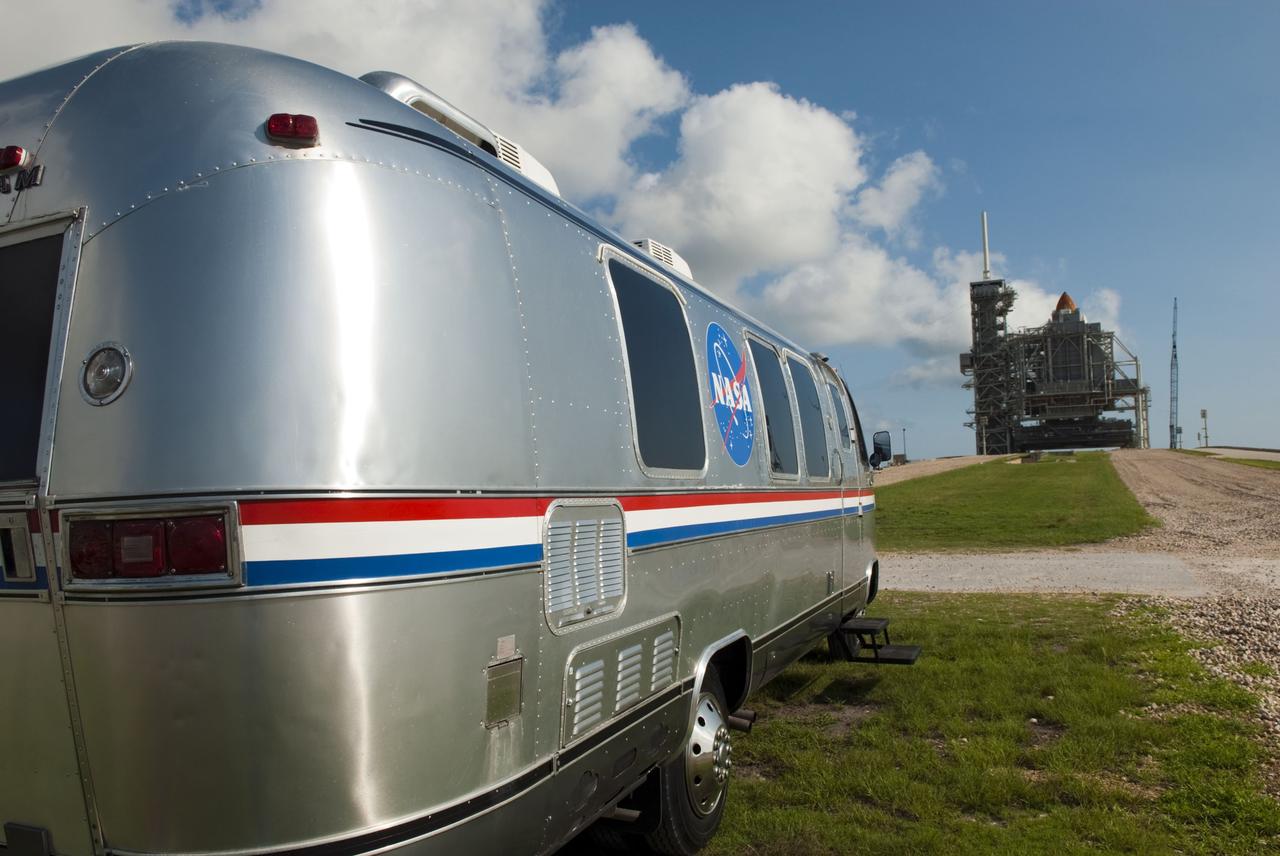
CAPE CANAVERAL, Fla. -- NASA's silver Astrovan is parked below Launch Pad 39A at NASA's Kennedy Space Center in Florida after delivering space shuttle Atlantis' STS-135 crew members to the pad to participate in a launch countdown simulation exercise. The Astrovan will return the astronauts to the Operations and Checkout Building at the end of their training. As part of the Terminal Countdown Demonstration Test (TCDT), the crew members are strapped into their seats on Atlantis to practice the steps that will be taken on launch day. Shuttle Atlantis and its crew are targeted to lift off July 8, taking with them the Raffaello multi-purpose logistics module packed with supplies and spare parts to the International Space Station. The STS-135 mission also will fly a system to investigate the potential for robotically refueling existing satellites and return a failed ammonia pump module to help NASA better understand the failure mechanism and improve pump designs for future systems. STS-135 will be the 33rd flight of Atlantis, the 37th shuttle mission to the space station, and the 135th and final mission of NASA's Space Shuttle Program. For more information visit, www.nasa.gov/mission_pages/shuttle/shuttlemissions/sts135/index.html. Photo credit: NASA/Jim Grossmann
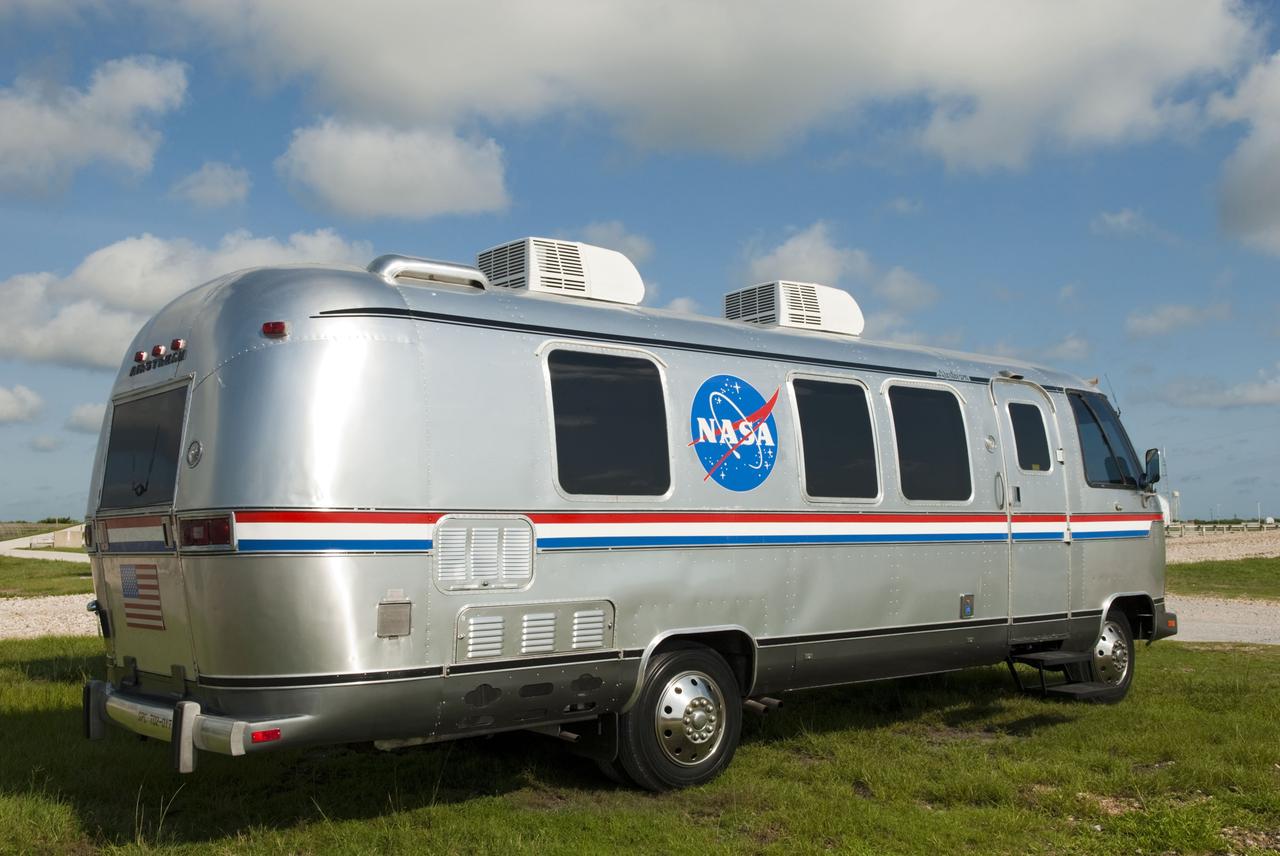
CAPE CANAVERAL, Fla. -- NASA's silver Astrovan is parked below Launch Pad 39A at NASA's Kennedy Space Center in Florida after delivering space shuttle Atlantis' STS-135 crew members to the pad to participate in a launch countdown simulation exercise. The Astrovan will return the astronauts to the Operations and Checkout Building at the end of their training. As part of the Terminal Countdown Demonstration Test (TCDT), the crew members are strapped into their seats on Atlantis to practice the steps that will be taken on launch day. Shuttle Atlantis and its crew are targeted to lift off July 8, taking with them the Raffaello multi-purpose logistics module packed with supplies and spare parts to the International Space Station. The STS-135 mission also will fly a system to investigate the potential for robotically refueling existing satellites and return a failed ammonia pump module to help NASA better understand the failure mechanism and improve pump designs for future systems. STS-135 will be the 33rd flight of Atlantis, the 37th shuttle mission to the space station, and the 135th and final mission of NASA's Space Shuttle Program. For more information visit, www.nasa.gov/mission_pages/shuttle/shuttlemissions/sts135/index.html. Photo credit: NASA/Jim Grossmann
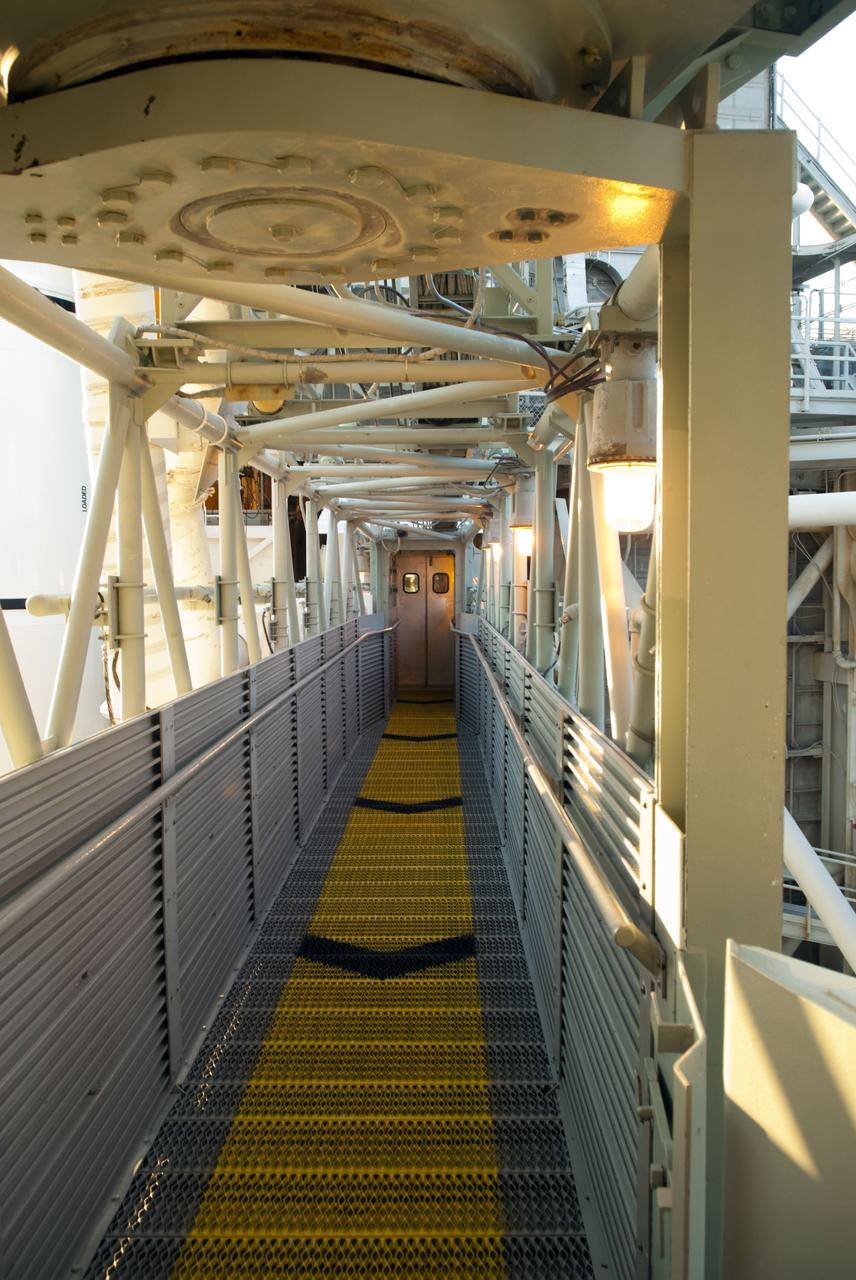
CAPE CANAVERAL, Fla. -- The doors to the White Room which provides entry to space shuttle Atlantis' crew compartment is seen here at the end of the access arm walkway on Launch Pad 39A at NASA's Kennedy Space Center in Florida. The STS-135 crew members will be at the pad to participate in a launch countdown simulation exercise. As part of the Terminal Countdown Demonstration Test (TCDT), the crew members are strapped into their seats on Atlantis to practice the steps that will be taken on launch day. Shuttle Atlantis and its crew are targeted to lift off July 8, taking with them the Raffaello multi-purpose logistics module packed with supplies and spare parts to the International Space Station. The STS-135 mission also will fly a system to investigate the potential for robotically refueling existing satellites and return a failed ammonia pump module to help NASA better understand the failure mechanism and improve pump designs for future systems. STS-135 will be the 33rd flight of Atlantis, the 37th shuttle mission to the space station, and the 135th and final mission of NASA's Space Shuttle Program. For more information visit, www.nasa.gov/mission_pages/shuttle/shuttlemissions/sts135/index.html. Photo credit: NASA/Jim Grossmann
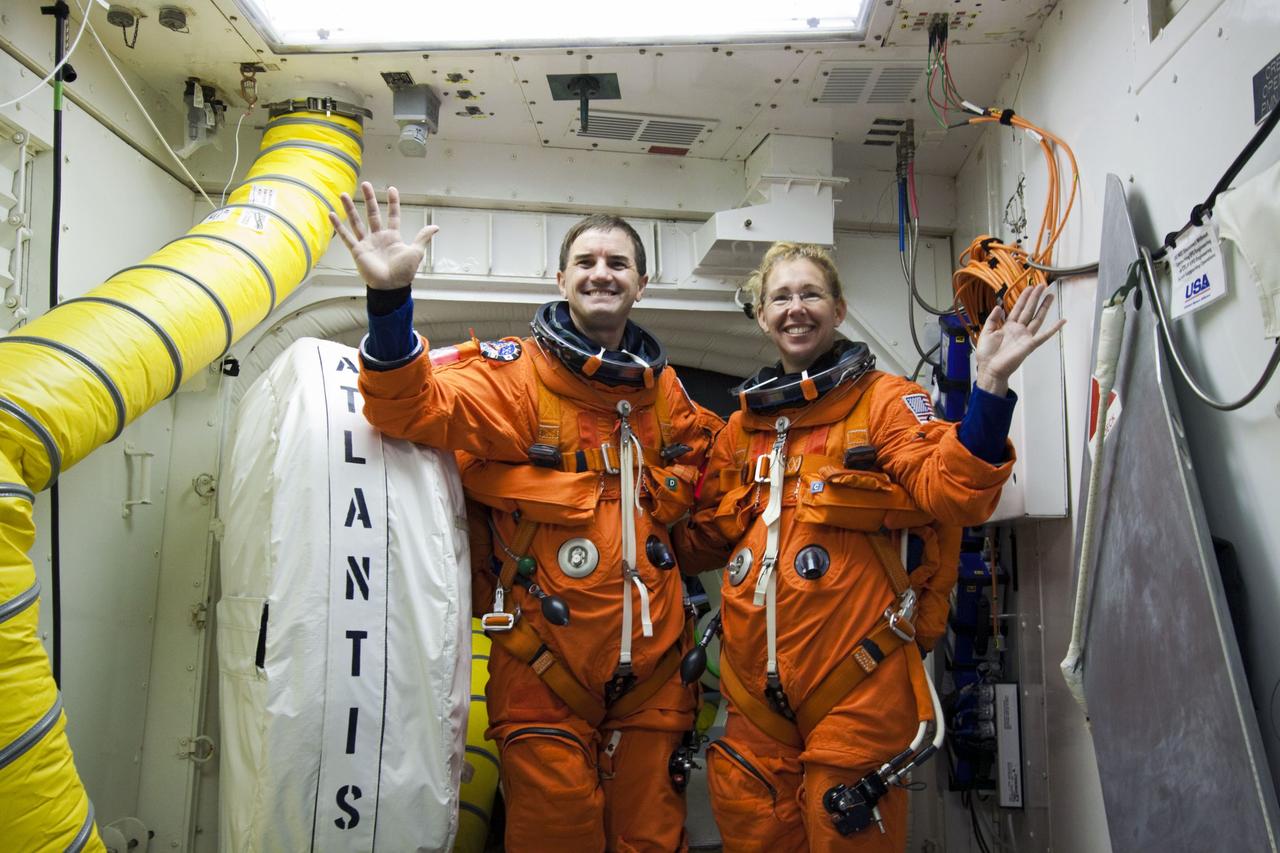
CAPE CANAVERAL, Fla. -- In the White Room at Launch Pad 39A at NASA's Kennedy Space Center in Florida, STS-135 Mission Specialists Rex Walheim and Sandy Magnus pause for a photo before boarding space shuttle Atlantis through the crew hatch in the background. The astronauts are at the pad to participate in a launch countdown simulation exercise. As part of the Terminal Countdown Demonstration Test (TCDT), the crew members are strapped into their seats on Atlantis to practice the steps that will be taken on launch day. Shuttle Atlantis and its crew are targeted to lift off July 8, taking with them the Raffaello multi-purpose logistics module packed with supplies and spare parts to the International Space Station. The STS-135 mission also will fly a system to investigate the potential for robotically refueling existing satellites and return a failed ammonia pump module to help NASA better understand the failure mechanism and improve pump designs for future systems. STS-135 will be the 33rd flight of Atlantis, the 37th shuttle mission to the space station, and the 135th and final mission of NASA's Space Shuttle Program. For more information visit, www.nasa.gov/mission_pages/shuttle/shuttlemissions/sts135/index.html. Photo credit: NASA/Jim Grossmann
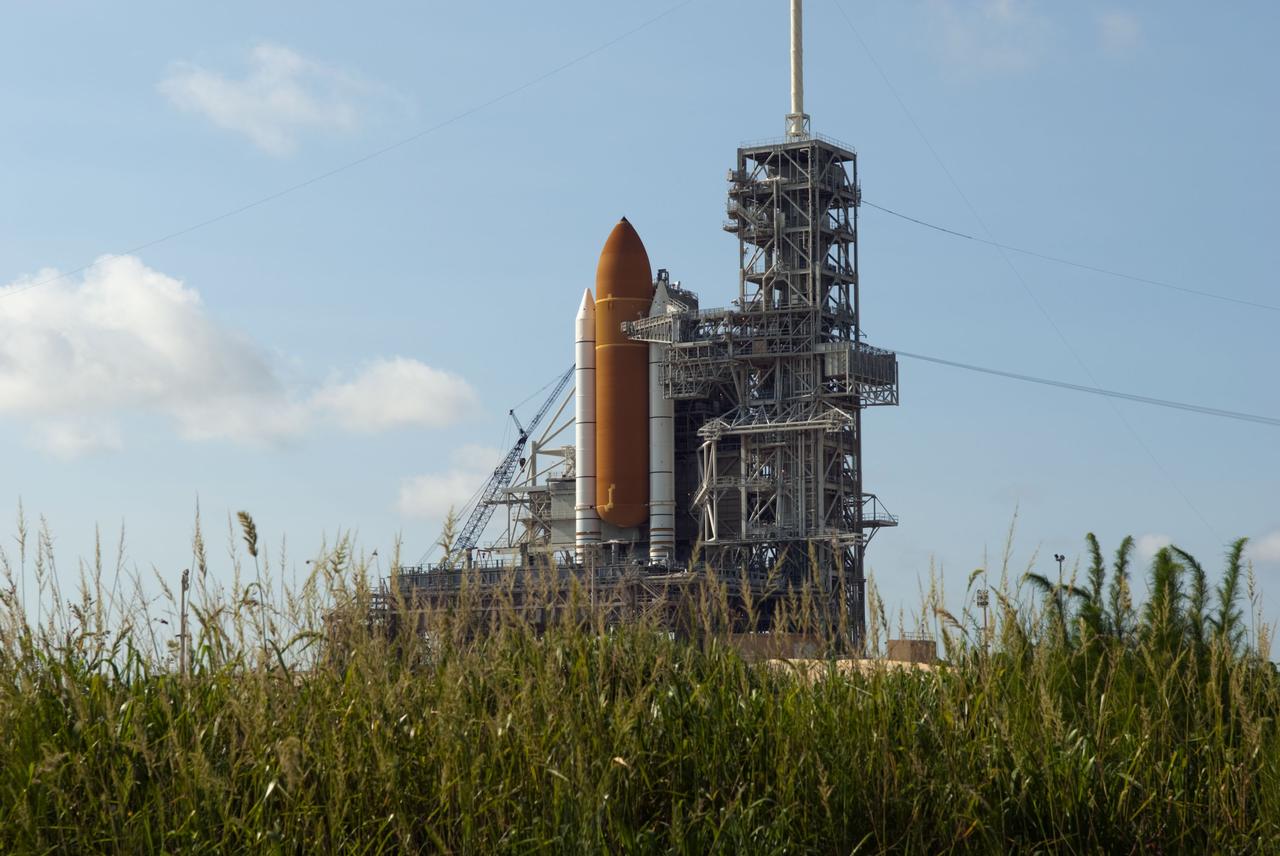
CAPE CANAVERAL, Fla. -- At Launch Pad 39A at NASA's Kennedy Space Center in Florida, space shuttle Atlantis stands majestically on its mobile launcher platform while the STS-135 crew members are at the pad to participate in a launch countdown simulation exercise. As part of the Terminal Countdown Demonstration Test (TCDT), the crew members are strapped into their seats on Atlantis to practice the steps that will be taken on launch day. Shuttle Atlantis and its crew are targeted to lift off July 8, taking with them the Raffaello multi-purpose logistics module packed with supplies and spare parts to the International Space Station. The STS-135 mission also will fly a system to investigate the potential for robotically refueling existing satellites and return a failed ammonia pump module to help NASA better understand the failure mechanism and improve pump designs for future systems. STS-135 will be the 33rd flight of Atlantis, the 37th shuttle mission to the space station, and the 135th and final mission of NASA's Space Shuttle Program. For more information visit, www.nasa.gov/mission_pages/shuttle/shuttlemissions/sts135/index.html. Photo credit: NASA/Jim Grossmann
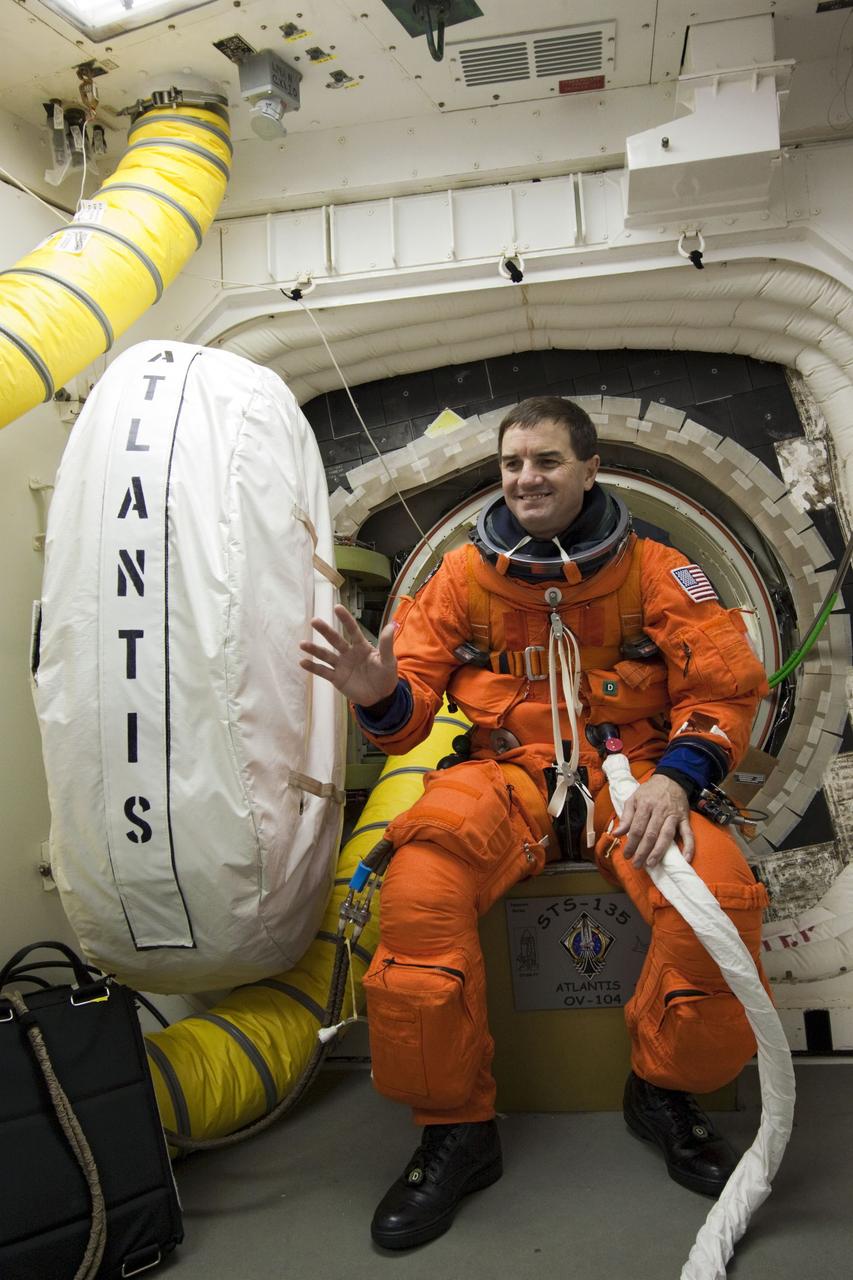
CAPE CANAVERAL, Fla. -- In the White Room at Launch Pad 39A at NASA's Kennedy Space Center in Florida, STS-135 Mission Specialist Rex Walheim pauses for a photo before boarding space shuttle Atlantis through the crew hatch in the background. The astronauts are at the pad to participate in a launch countdown simulation exercise. As part of the Terminal Countdown Demonstration Test (TCDT), the crew members are strapped into their seats on Atlantis to practice the steps that will be taken on launch day. Shuttle Atlantis and its crew are targeted to lift off July 8, taking with them the Raffaello multi-purpose logistics module packed with supplies and spare parts to the International Space Station. The STS-135 mission also will fly a system to investigate the potential for robotically refueling existing satellites and return a failed ammonia pump module to help NASA better understand the failure mechanism and improve pump designs for future systems. STS-135 will be the 33rd flight of Atlantis, the 37th shuttle mission to the space station, and the 135th and final mission of NASA's Space Shuttle Program. For more information visit, www.nasa.gov/mission_pages/shuttle/shuttlemissions/sts135/index.html. Photo credit: NASA/Jim Grossmann
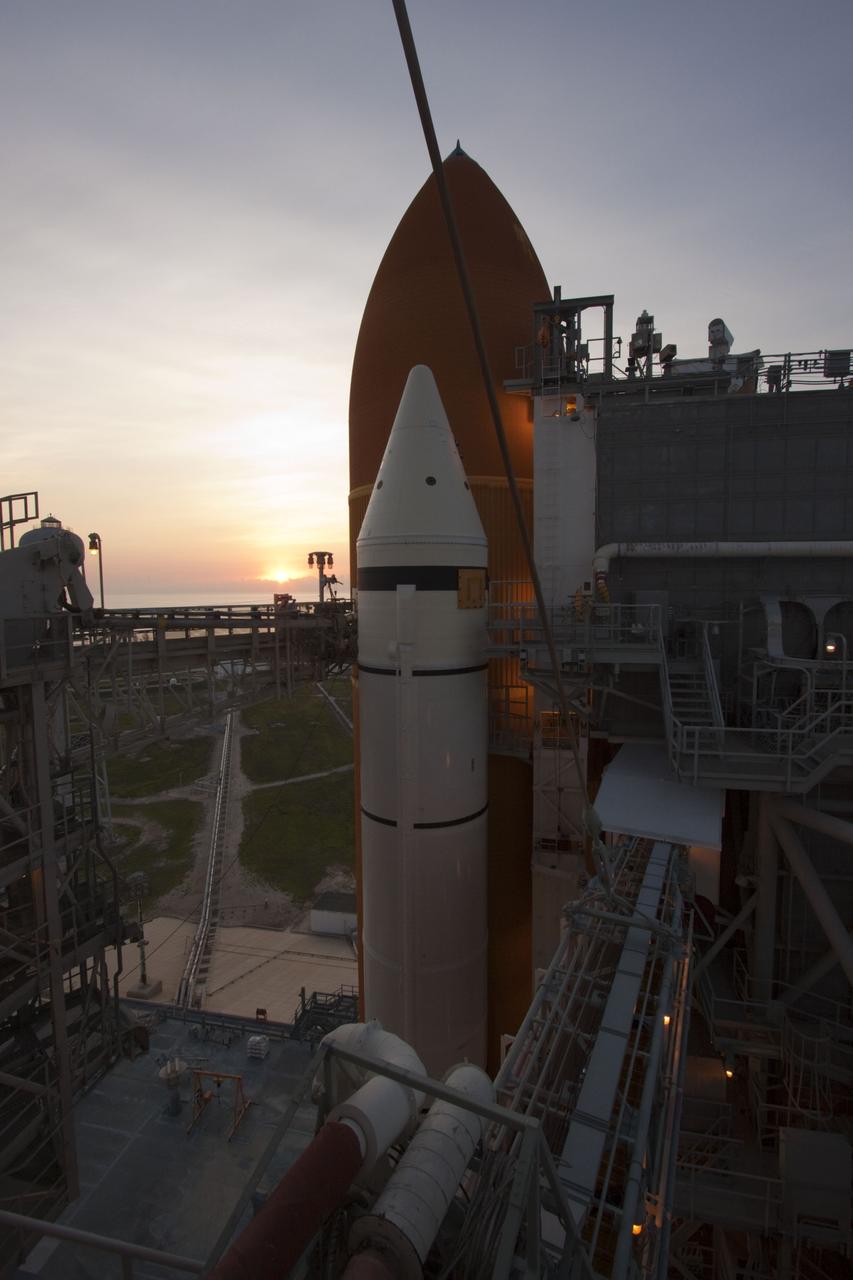
CAPE CANAVERAL, Fla. -- The sun rises over the Atlantic Ocean silhouetting space shuttle Atlantis' external fuel tank and solid rocket boosters on Launch Pad 39A at NASA's Kennedy Space Center in Florida. The STS-135 crew members will be at the pad to participate in a launch countdown simulation exercise. As part of the Terminal Countdown Demonstration Test (TCDT), the crew members are strapped into their seats on Atlantis to practice the steps that will be taken on launch day. Shuttle Atlantis and its crew are targeted to lift off July 8, taking with them the Raffaello multi-purpose logistics module packed with supplies and spare parts to the International Space Station. The STS-135 mission also will fly a system to investigate the potential for robotically refueling existing satellites and return a failed ammonia pump module to help NASA better understand the failure mechanism and improve pump designs for future systems. STS-135 will be the 33rd flight of Atlantis, the 37th shuttle mission to the space station, and the 135th and final mission of NASA's Space Shuttle Program. For more information visit, www.nasa.gov/mission_pages/shuttle/shuttlemissions/sts135/index.html. Photo credit: NASA/Jim Grossmann
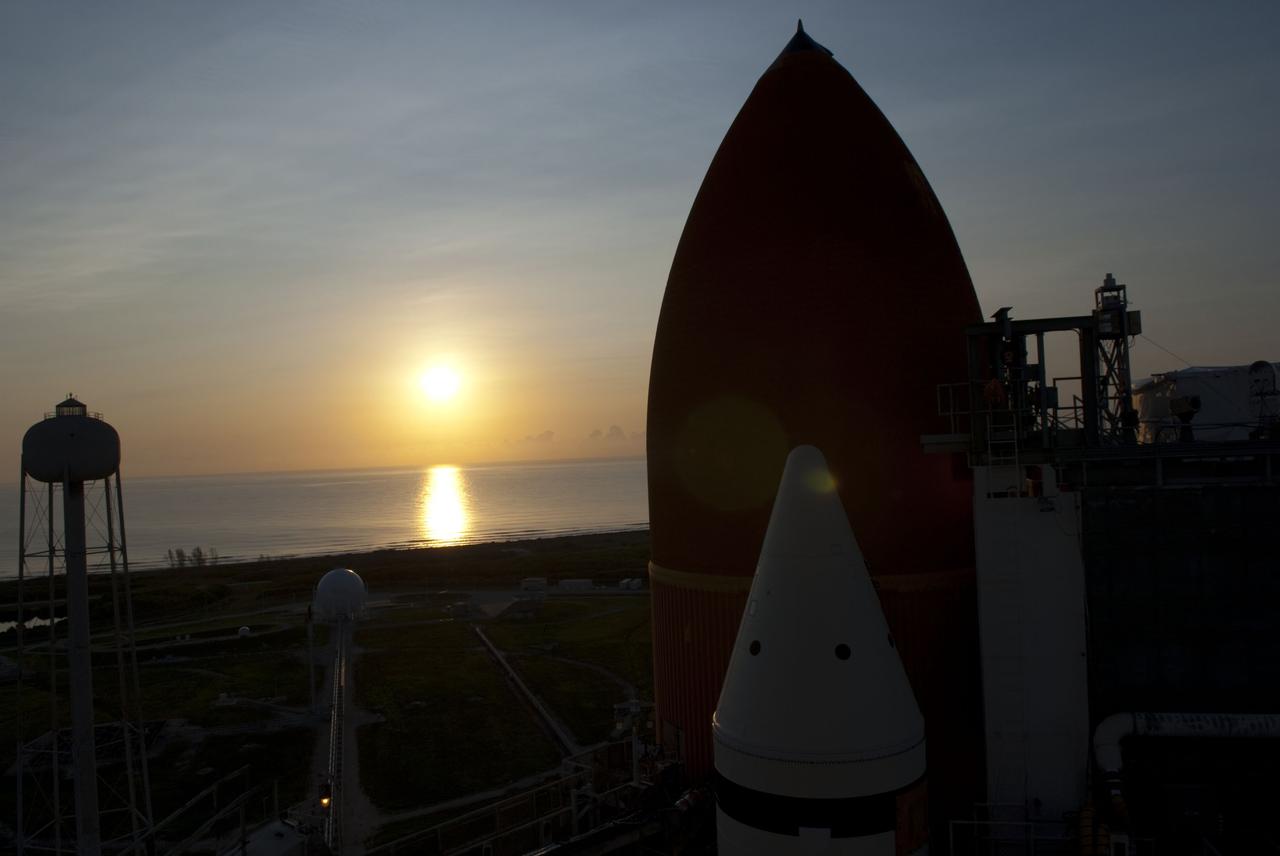
CAPE CANAVERAL, Fla. -- The sun rises over the Atlantic Ocean silhouetting space shuttle Atlantis' external fuel tank and solid rocket boosters on Launch Pad 39A at NASA's Kennedy Space Center in Florida. The STS-135 crew members will be at the pad to participate in a launch countdown simulation exercise. As part of the Terminal Countdown Demonstration Test (TCDT), the crew members are strapped into their seats on Atlantis to practice the steps that will be taken on launch day. Shuttle Atlantis and its crew are targeted to lift off July 8, taking with them the Raffaello multi-purpose logistics module packed with supplies and spare parts to the International Space Station. The STS-135 mission also will fly a system to investigate the potential for robotically refueling existing satellites and return a failed ammonia pump module to help NASA better understand the failure mechanism and improve pump designs for future systems. STS-135 will be the 33rd flight of Atlantis, the 37th shuttle mission to the space station, and the 135th and final mission of NASA's Space Shuttle Program. For more information visit, www.nasa.gov/mission_pages/shuttle/shuttlemissions/sts135/index.html. Photo credit: NASA/Jim Grossmann

CAPE CANAVERAL, Fla. -- At Launch Pad 39A at NASA's Kennedy Space Center in Florida, Closeout Crew members Randy Bresnik (front) and Rene Arriens prepare space shuttle Atlantis for the arrival of the STS-135 crew members who will be at the pad to participate in a launch countdown simulation exercise. The exercise is part of the Terminal Countdown Demonstration Test (TCDT) and related training. Atlantis and its crew are targeted to lift off July 8, taking with them the Raffaello multi-purpose logistics module packed with supplies and spare parts to the International Space Station. The STS-135 mission also will fly a system to investigate the potential for robotically refueling existing satellites and return a failed ammonia pump module to help NASA better understand the failure mechanism and improve pump designs for future systems. STS-135 will be the 33rd flight of Atlantis, the 37th shuttle mission to the space station, and the 135th and final mission of NASA's Space Shuttle Program. For more information visit, www.nasa.gov/mission_pages/shuttle/shuttlemissions/sts135/index.html. Photo credit: NASA/Kim Shiflett
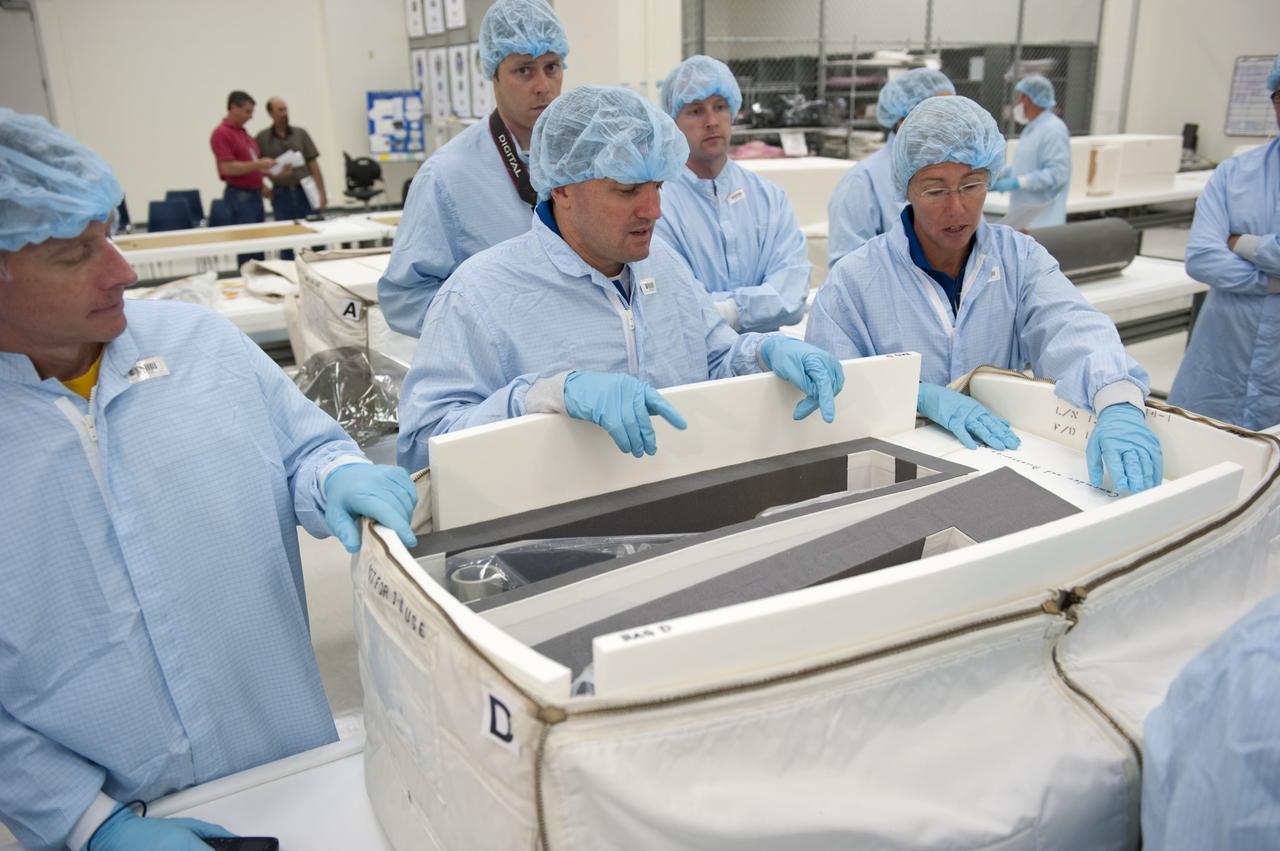
CAPE CANAVERAL, Fla. -- During the bench review of systems and hardware in the Space Station Processing Facility at NASA's Kennedy Space Center in Florida, space shuttle Atlantis' STS-135 crew members get a close look at some of the equipment they'll use in space. The astronauts dressed in clean-room attire, known as "bunny suits" are (from right to left) Mission Specialists Sandy Magnus and Rex Walheim and Commander Chris Ferguson. The review is part of the Terminal Countdown Demonstration Test (TCDT) and related training. Atlantis and its crew are targeted to lift off July 8, taking with them the Raffaello multi-purpose logistics module packed with supplies and spare parts to the International Space Station. The STS-135 mission also will fly a system to investigate the potential for robotically refueling existing satellites and return a failed ammonia pump module to help NASA better understand the failure mechanism and improve pump designs for future systems. STS-135 will be the 33rd flight of Atlantis, the 37th shuttle mission to the space station, and the 135th and final mission of NASA's Space Shuttle Program. For more information visit, www.nasa.gov/mission_pages/shuttle/shuttlemissions/sts135/index.html. Photo credit: NASA/Kim Shiflett
CAPE CANAVERAL, Fla. -- Seen from Launch Pad 39A at NASA's Kennedy Space Center in Florida is the silver Astrovan transporting the STS-135 crew members to the pad to participate in a launch countdown simulation exercise. As part of the Terminal Countdown Demonstration Test (TCDT), the crew members are strapped into their seats on Atlantis to practice the steps that will be taken on launch day. Shuttle Atlantis and its crew are targeted to lift off July 8, taking with them the Raffaello multi-purpose logistics module packed with supplies and spare parts to the International Space Station. The STS-135 mission also will fly a system to investigate the potential for robotically refueling existing satellites and return a failed ammonia pump module to help NASA better understand the failure mechanism and improve pump designs for future systems. STS-135 will be the 33rd flight of Atlantis, the 37th shuttle mission to the space station, and the 135th and final mission of NASA's Space Shuttle Program. For more information visit, www.nasa.gov/mission_pages/shuttle/shuttlemissions/sts135/index.html. Photo credit: NASA/Jim Grossmann
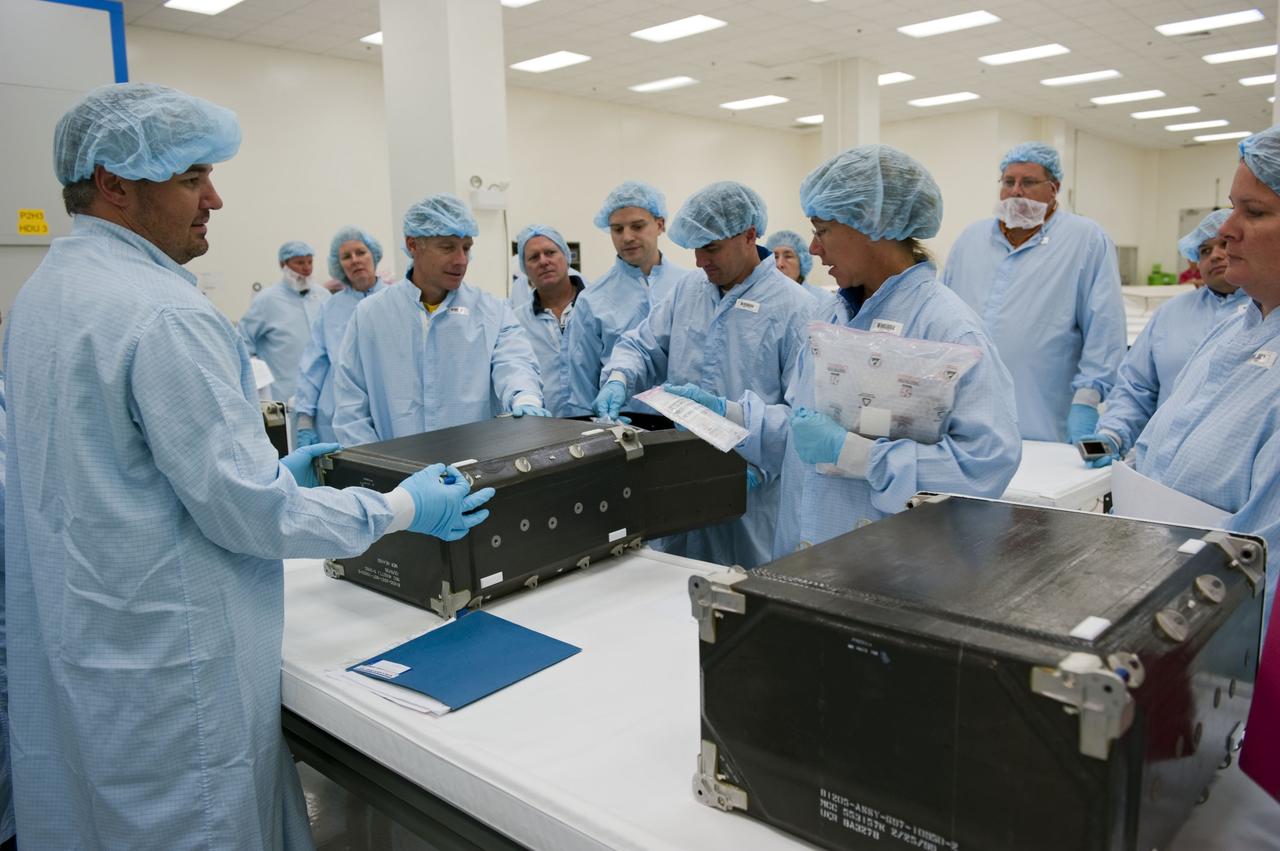
CAPE CANAVERAL, Fla. -- During the bench review of systems and hardware in the Space Station Processing Facility at NASA's Kennedy Space Center in Florida, space shuttle Atlantis' STS-135 crew members get a close look at some of the equipment they'll use in space. The astronauts dressed in clean-room attire, known as "bunny suits" are Mission Specialists Sandy Magnus (right) and Rex Walheim and Commander Chris Ferguson. The review is part of the Terminal Countdown Demonstration Test (TCDT) and related training. Atlantis and its crew are targeted to lift off July 8, taking with them the Raffaello multi-purpose logistics module packed with supplies and spare parts to the International Space Station. The STS-135 mission also will fly a system to investigate the potential for robotically refueling existing satellites and return a failed ammonia pump module to help NASA better understand the failure mechanism and improve pump designs for future systems. STS-135 will be the 33rd flight of Atlantis, the 37th shuttle mission to the space station, and the 135th and final mission of NASA's Space Shuttle Program. For more information visit, www.nasa.gov/mission_pages/shuttle/shuttlemissions/sts135/index.html. Photo credit: NASA/Kim Shiflett
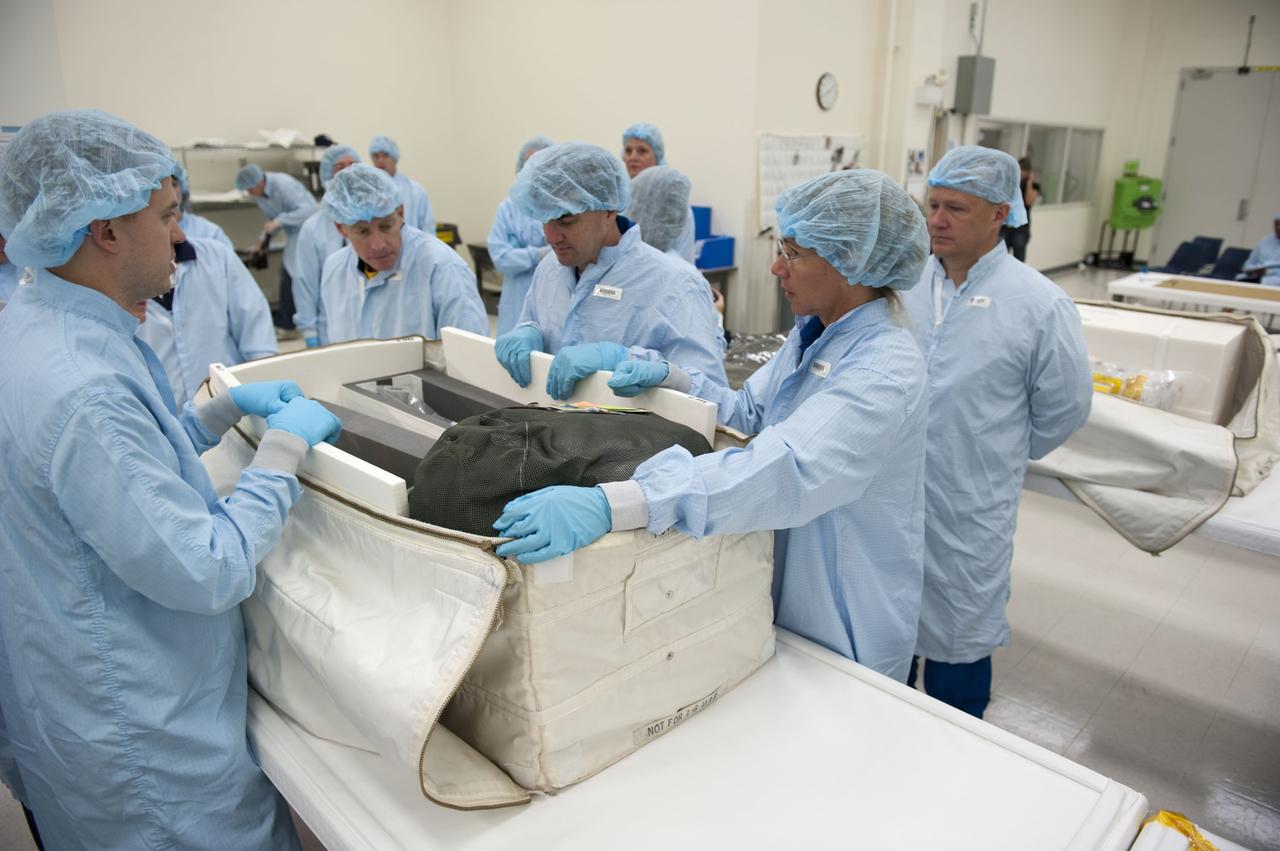
CAPE CANAVERAL, Fla. -- During the bench review of systems and hardware in the Space Station Processing Facility at NASA's Kennedy Space Center in Florida, space shuttle Atlantis' STS-135 crew members get a close look at some of the equipment they'll use in space. The astronauts dressed in clean-room attire, known as "bunny suits" are (from right to left) Mission Specialist Sandy Magnus, Pilot Doug Hurley, Mission Specialist Rex Walheim and Commander Chris Ferguson. The review is part of the Terminal Countdown Demonstration Test (TCDT) and related training. Atlantis and its crew are targeted to lift off July 8, taking with them the Raffaello multi-purpose logistics module packed with supplies and spare parts to the International Space Station. The STS-135 mission also will fly a system to investigate the potential for robotically refueling existing satellites and return a failed ammonia pump module to help NASA better understand the failure mechanism and improve pump designs for future systems. STS-135 will be the 33rd flight of Atlantis, the 37th shuttle mission to the space station, and the 135th and final mission of NASA's Space Shuttle Program. For more information visit, www.nasa.gov/mission_pages/shuttle/shuttlemissions/sts135/index.html. Photo credit: NASA/Kim Shiflett
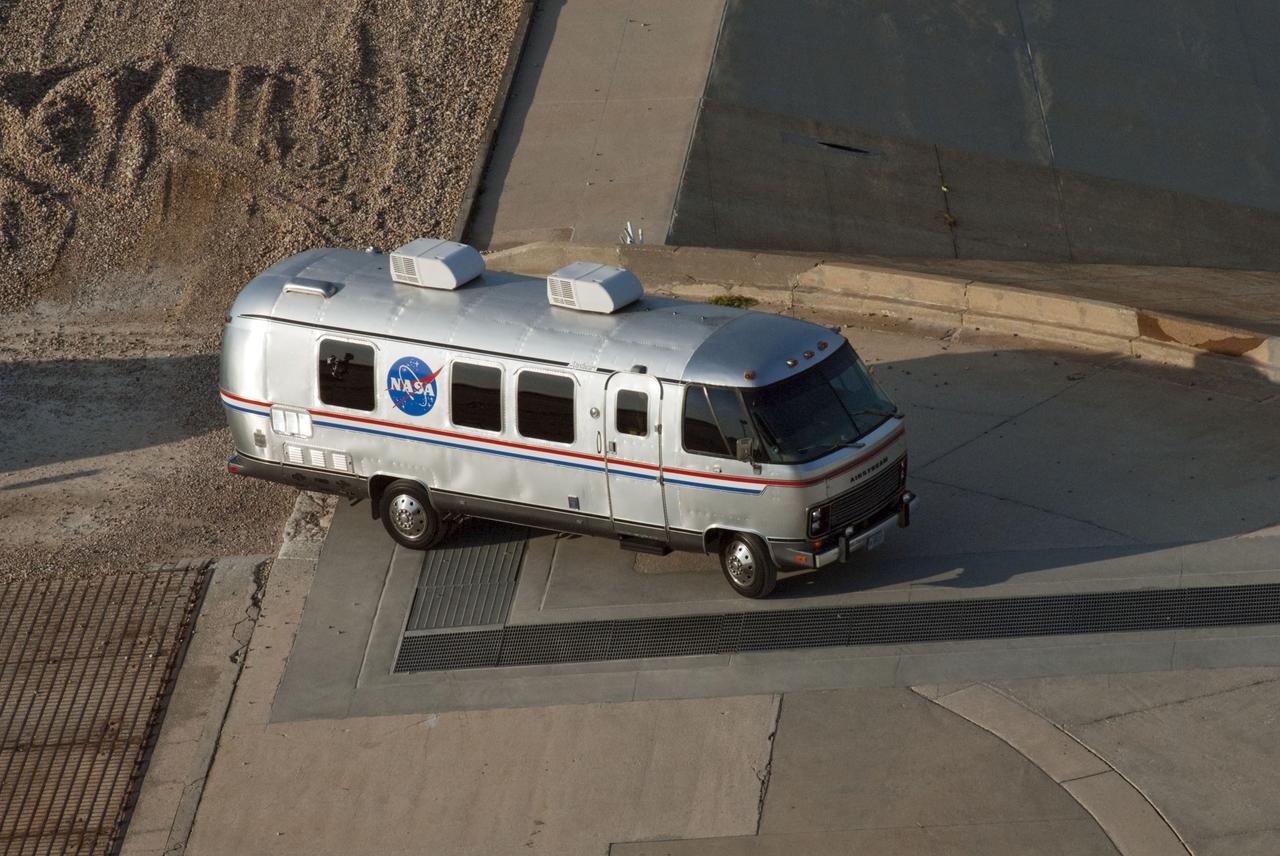
CAPE CANAVERAL, Fla. -- Seen from an upper level of Launch Pad 39A at NASA's Kennedy Space Center in Florida is the arrival of the silver Astrovan transporting the STS-135 crew members to the pad to participate in a launch countdown simulation exercise. As part of the Terminal Countdown Demonstration Test (TCDT), the crew members are strapped into their seats on Atlantis to practice the steps that will be taken on launch day. Shuttle Atlantis and its crew are targeted to lift off July 8, taking with them the Raffaello multi-purpose logistics module packed with supplies and spare parts to the International Space Station. The STS-135 mission also will fly a system to investigate the potential for robotically refueling existing satellites and return a failed ammonia pump module to help NASA better understand the failure mechanism and improve pump designs for future systems. STS-135 will be the 33rd flight of Atlantis, the 37th shuttle mission to the space station, and the 135th and final mission of NASA's Space Shuttle Program. For more information visit, www.nasa.gov/mission_pages/shuttle/shuttlemissions/sts135/index.html. Photo credit: NASA/Jim Grossmann
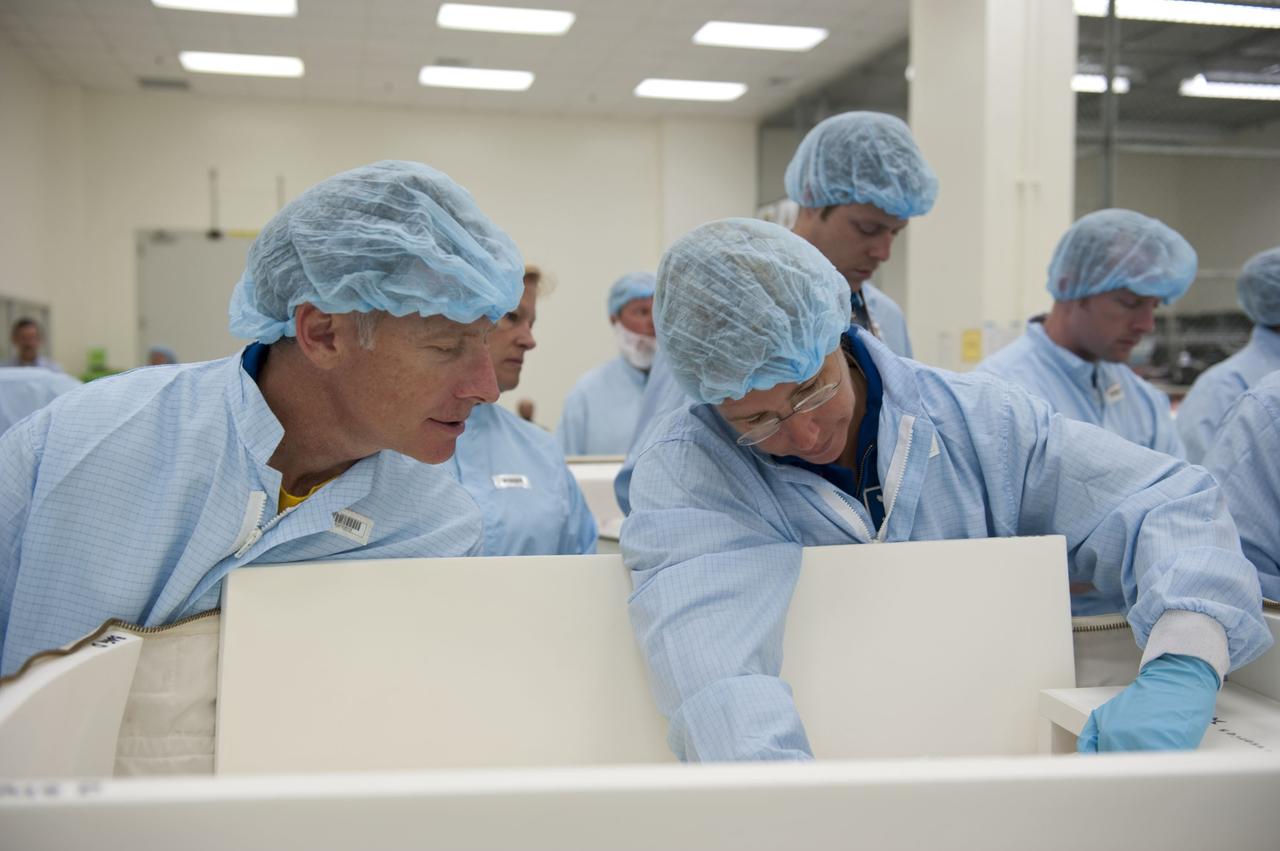
CAPE CANAVERAL, Fla. -- During the bench review of systems and hardware in the Space Station Processing Facility at NASA's Kennedy Space Center in Florida, space shuttle Atlantis' STS-135 crew members get a close look at some of the equipment they'll use in space. The astronauts dressed in clean-room attire, known as "bunny suits" are Commander Chris Ferguson (left) and Mission Specialist Sandy Magnus. The review is part of the Terminal Countdown Demonstration Test (TCDT) and related training. Atlantis and its crew are targeted to lift off July 8, taking with them the Raffaello multi-purpose logistics module packed with supplies and spare parts to the International Space Station. The STS-135 mission also will fly a system to investigate the potential for robotically refueling existing satellites and return a failed ammonia pump module to help NASA better understand the failure mechanism and improve pump designs for future systems. STS-135 will be the 33rd flight of Atlantis, the 37th shuttle mission to the space station, and the 135th and final mission of NASA's Space Shuttle Program. For more information visit, www.nasa.gov/mission_pages/shuttle/shuttlemissions/sts135/index.html. Photo credit: NASA/Kim Shiflett
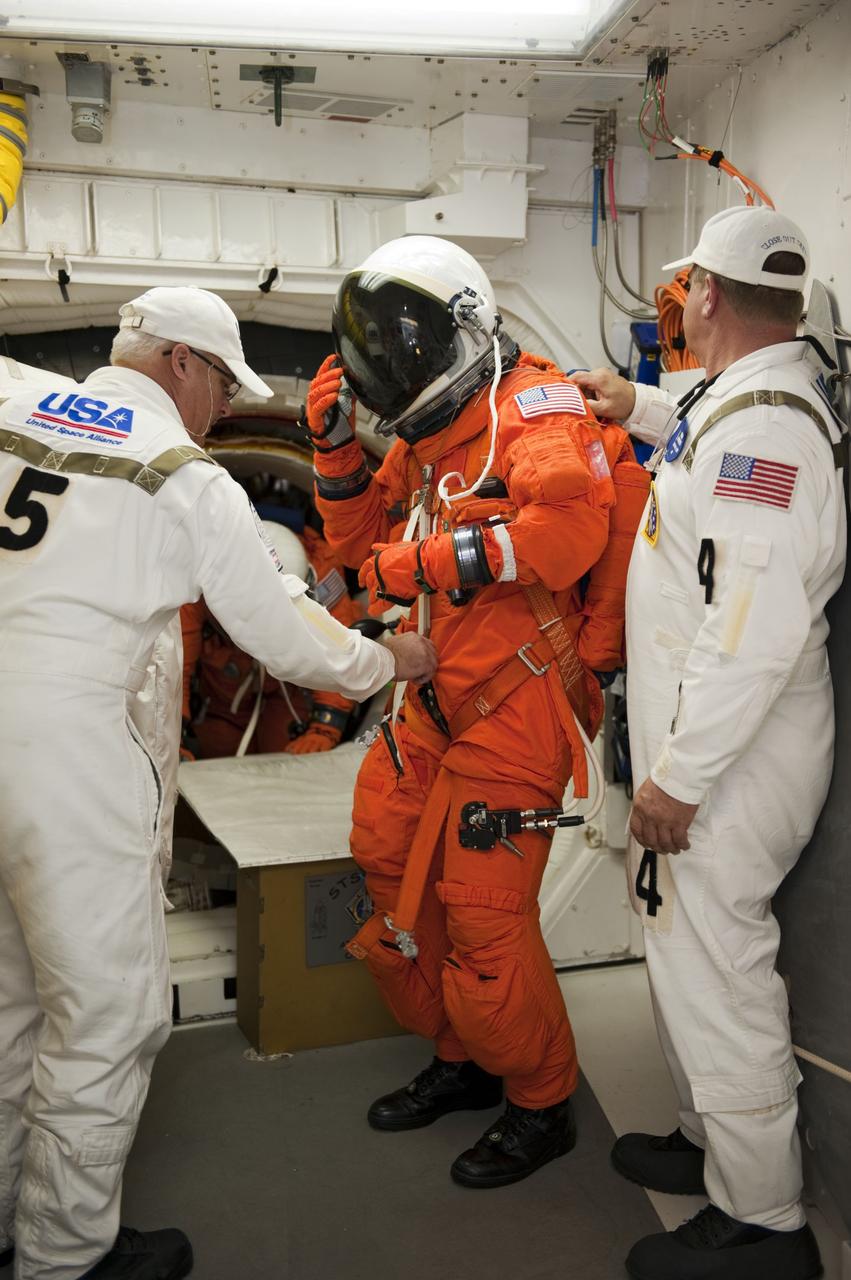
CAPE CANAVERAL, Fla. -- During simulated pad emergency exit training on Launch Pad 39A at NASA's Kennedy Space Center in Florida, STS-135 crew members, assisted by the Closeout Crew, make their way out of space shuttle Atlantis into the White Room toward slidewire baskets that would take them to a safe bunker below the pad in the unlikely event of an emergency. The exercise is part of the Terminal Countdown Demonstration Test (TCDT) and related training. Atlantis and its crew are targeted to lift off July 8, taking with them the Raffaello multi-purpose logistics module packed with supplies and spare parts to the International Space Station. The STS-135 mission also will fly a system to investigate the potential for robotically refueling existing satellites and return a failed ammonia pump module to help NASA better understand the failure mechanism and improve pump designs for future systems. STS-135 will be the 33rd flight of Atlantis, the 37th shuttle mission to the space station, and the 135th and final mission of NASA's Space Shuttle Program. For more information visit, www.nasa.gov/mission_pages/shuttle/shuttlemissions/sts135/index.html. Photo credit: NASA/Kim Shiflett
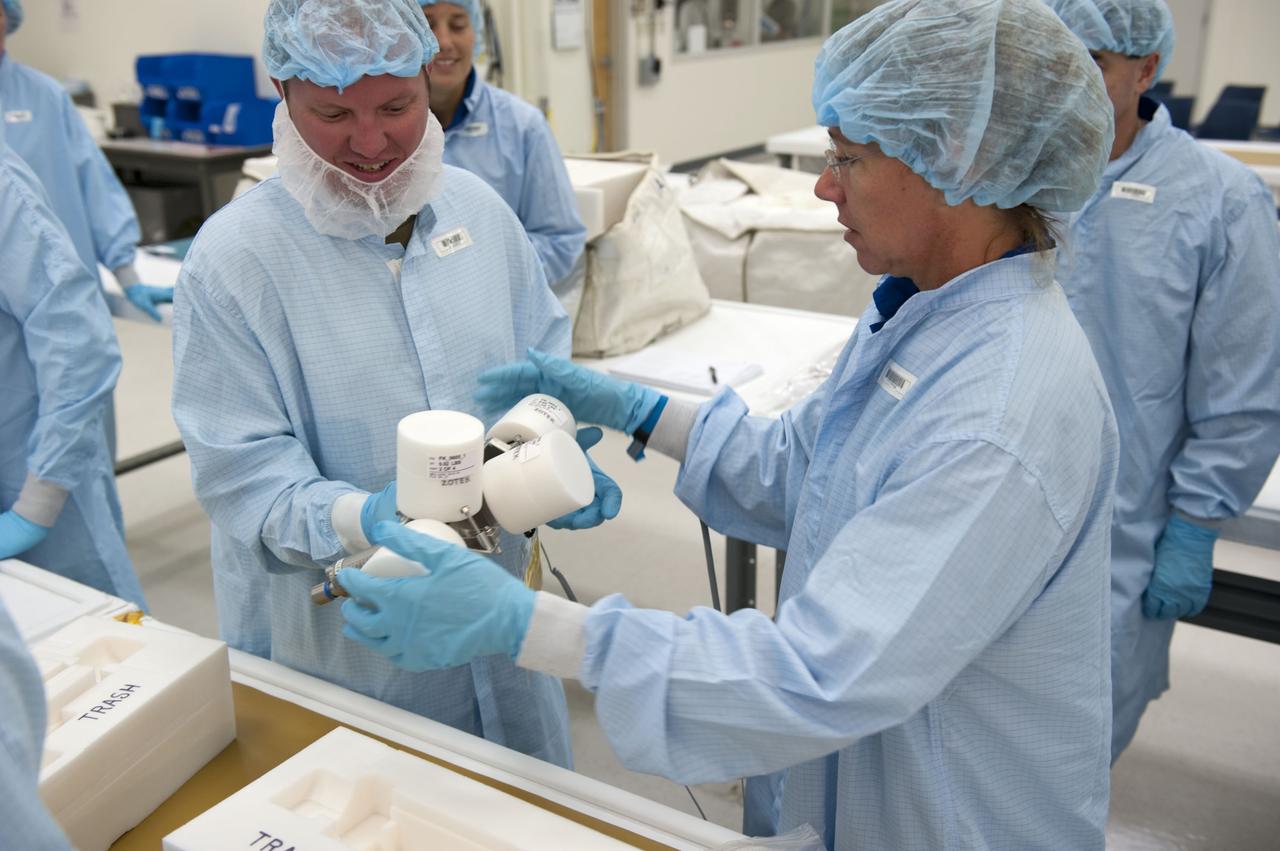
CAPE CANAVERAL, Fla. -- During the bench review of systems and hardware in the Space Station Processing Facility at NASA's Kennedy Space Center in Florida, space shuttle Atlantis' STS-135 crew members get a close look at some of the equipment they'll use in space. Here, Mission Specialist Sandy Magnus is shown a piece of hardware being prepared for the mission. The review is part of the Terminal Countdown Demonstration Test (TCDT) and related training. Atlantis and its crew are targeted to lift off July 8, taking with them the Raffaello multi-purpose logistics module packed with supplies and spare parts to the International Space Station. The STS-135 mission also will fly a system to investigate the potential for robotically refueling existing satellites and return a failed ammonia pump module to help NASA better understand the failure mechanism and improve pump designs for future systems. STS-135 will be the 33rd flight of Atlantis, the 37th shuttle mission to the space station, and the 135th and final mission of NASA's Space Shuttle Program. For more information visit, www.nasa.gov/mission_pages/shuttle/shuttlemissions/sts135/index.html. Photo credit: NASA/Kim Shiflett
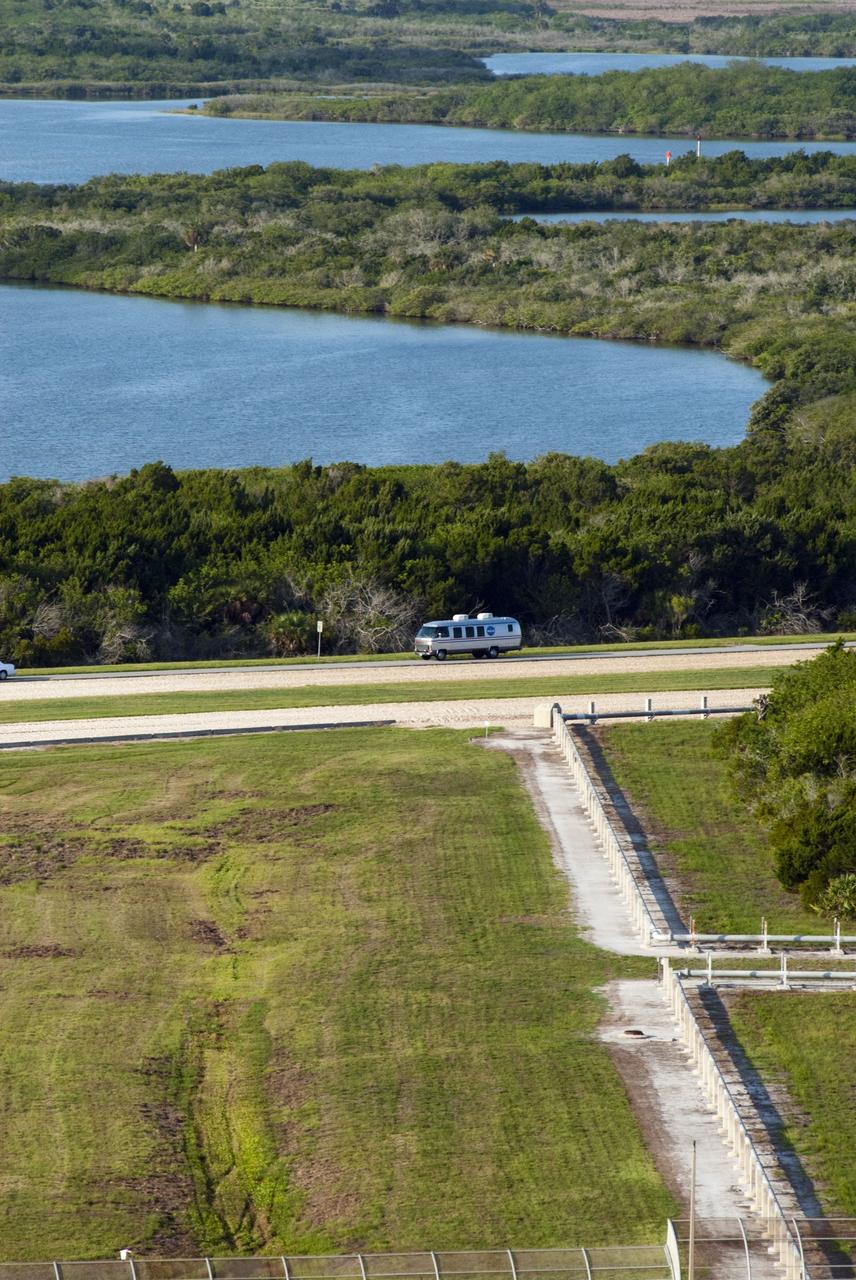
CAPE CANAVERAL, Fla. -- Seen from Launch Pad 39A at NASA's Kennedy Space Center in Florida is the silver Astrovan transporting the STS-135 crew members to the pad to participate in a launch countdown simulation exercise. As part of the Terminal Countdown Demonstration Test (TCDT), the crew members are strapped into their seats on Atlantis to practice the steps that will be taken on launch day. Shuttle Atlantis and its crew are targeted to lift off July 8, taking with them the Raffaello multi-purpose logistics module packed with supplies and spare parts to the International Space Station. The STS-135 mission also will fly a system to investigate the potential for robotically refueling existing satellites and return a failed ammonia pump module to help NASA better understand the failure mechanism and improve pump designs for future systems. STS-135 will be the 33rd flight of Atlantis, the 37th shuttle mission to the space station, and the 135th and final mission of NASA's Space Shuttle Program. For more information visit, www.nasa.gov/mission_pages/shuttle/shuttlemissions/sts135/index.html. Photo credit: NASA/Jim Grossmann
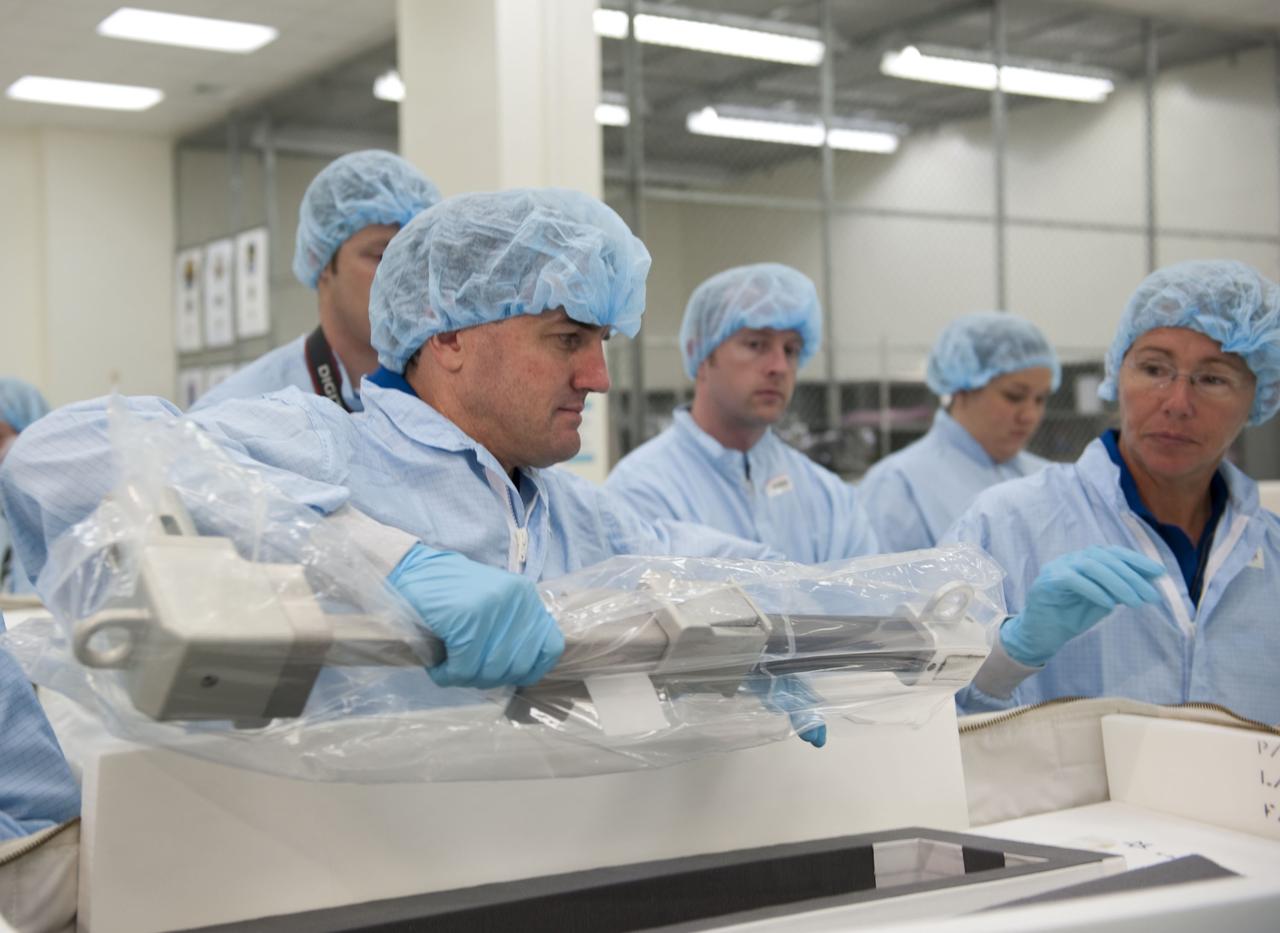
CAPE CANAVERAL, Fla. -- During the bench review of systems and hardware in the Space Station Processing Facility at NASA's Kennedy Space Center in Florida, space shuttle Atlantis' STS-135 crew members get a close look at some of the equipment they'll use in space. The astronauts dressed in clean-room attire, known as "bunny suits" are Mission Specialists Rex Walheim (left) and Sandy Magnus. The review is part of the Terminal Countdown Demonstration Test (TCDT) and related training. Atlantis and its crew are targeted to lift off July 8, taking with them the Raffaello multi-purpose logistics module packed with supplies and spare parts to the International Space Station. The STS-135 mission also will fly a system to investigate the potential for robotically refueling existing satellites and return a failed ammonia pump module to help NASA better understand the failure mechanism and improve pump designs for future systems. STS-135 will be the 33rd flight of Atlantis, the 37th shuttle mission to the space station, and the 135th and final mission of NASA's Space Shuttle Program. For more information visit, www.nasa.gov/mission_pages/shuttle/shuttlemissions/sts135/index.html. Photo credit: NASA/Kim Shiflett
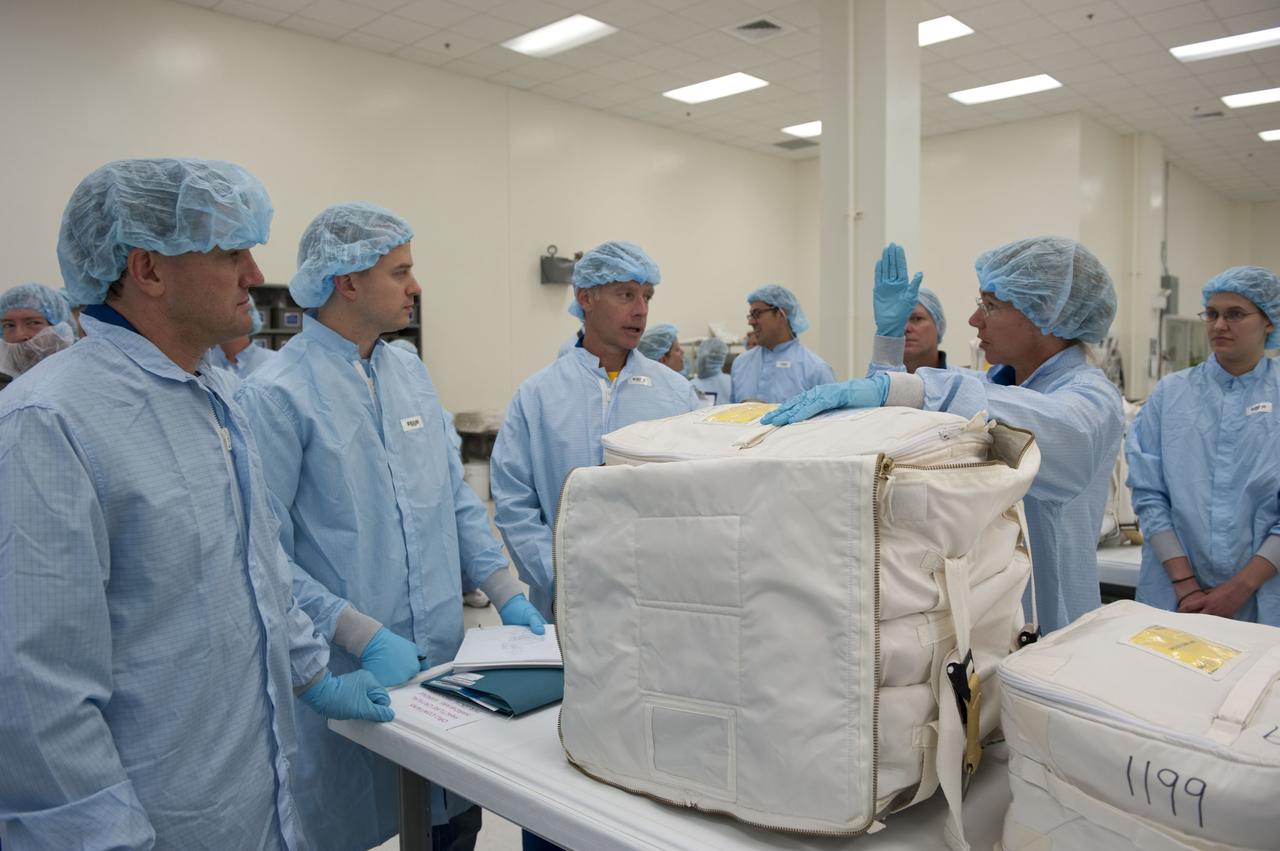
CAPE CANAVERAL, Fla. -- During the bench review of systems and hardware in the Space Station Processing Facility at NASA's Kennedy Space Center in Florida, space shuttle Atlantis' STS-135 crew members get a close look at some of the equipment they'll use in space. The astronauts dressed in clean-room attire, known as "bunny suits" are Mission Specialist Rex Walheim (left), a technician, Commander Chris Ferguson and Mission Specialist Sandy Magnus. The review is part of the Terminal Countdown Demonstration Test (TCDT) and related training. Atlantis and its crew are targeted to lift off July 8, taking with them the Raffaello multi-purpose logistics module packed with supplies and spare parts to the International Space Station. The STS-135 mission also will fly a system to investigate the potential for robotically refueling existing satellites and return a failed ammonia pump module to help NASA better understand the failure mechanism and improve pump designs for future systems. STS-135 will be the 33rd flight of Atlantis, the 37th shuttle mission to the space station, and the 135th and final mission of NASA's Space Shuttle Program. For more information visit, www.nasa.gov/mission_pages/shuttle/shuttlemissions/sts135/index.html. Photo credit: NASA/Kim Shiflett
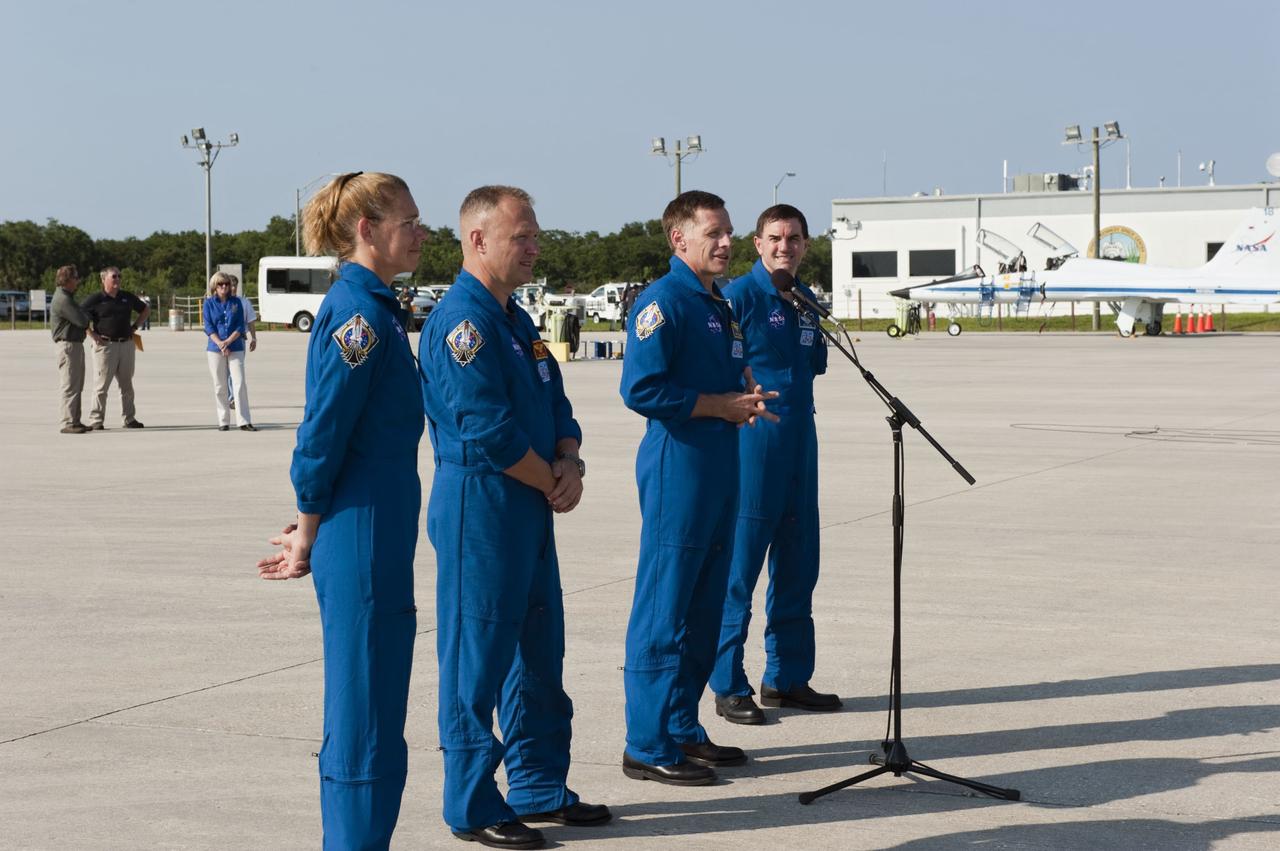
CAPE CANAVERAL, Fla. -- Space shuttle Atlantis' STS-135 crew address the media on the Shuttle Landing Facility at NASA's Kennedy Space Center in Florida. From left are Mission Specialist Sandy Magnus, Pilot Doug Hurley, Commander Chris Ferguson and Mission Specialist Rex Walheim. While at Kennedy, Atlantis' crew will participate in a launch countdown dress rehearsal called the Terminal Countdown Demonstration Test (TCDT) and related training in preparation for the upcoming STS-135 mission. The STS-135 crew members are targeted to lift off on July 8, taking with them the Raffaello multi-purpose logistics module packed with supplies, logistics and spare parts to the International Space Station. The STS-135 mission also will fly a system to investigate the potential for robotically refueling existing satellites and return a failed ammonia pump module to help NASA better understand the failure mechanism and improve pump designs for future systems. STS-135 will be the 33rd flight of Atlantis, the 37th shuttle mission to the space station, and the 135th and final mission of NASA's Space Shuttle Program. For more information visit, www.nasa.gov/mission_pages/shuttle/shuttlemissions/sts135/index.html. Photo credit: NASA/Kim Shiflett
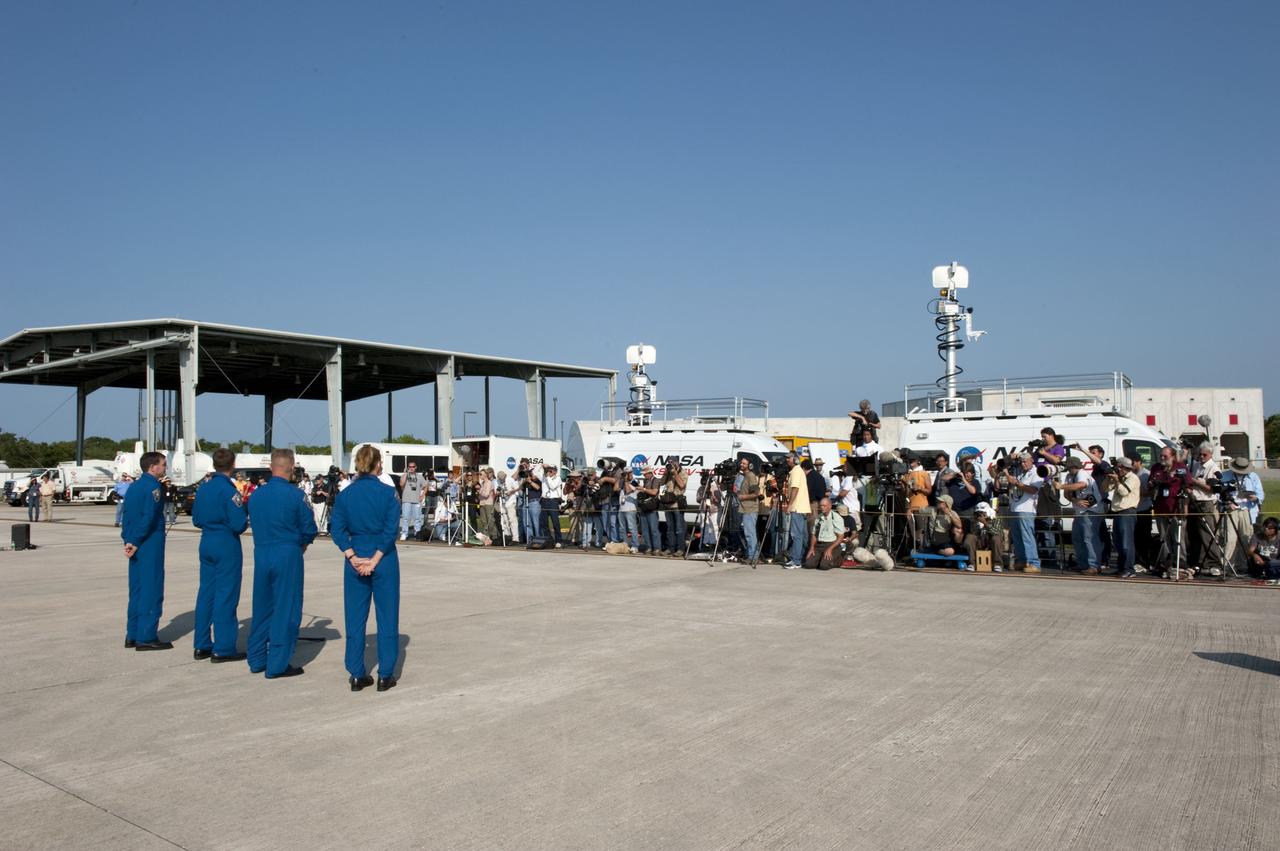
CAPE CANAVERAL, Fla. -- Space shuttle Atlantis' STS-135 crew members address the media on the Shuttle Landing Facility at NASA's Kennedy Space Center in Florida. While at Kennedy, Atlantis' crew will participate in a launch countdown dress rehearsal called the Terminal Countdown Demonstration Test (TCDT) and related training in preparation for the upcoming STS-135 mission. Atlantis and its crew are targeted to lift off on July 8, taking with them the Raffaello multi-purpose logistics module packed with supplies, logistics and spare parts to the International Space Station. The STS-135 mission also will fly a system to investigate the potential for robotically refueling existing satellites and return a failed ammonia pump module to help NASA better understand the failure mechanism and improve pump designs for future systems. STS-135 will be the 33rd flight of Atlantis, the 37th shuttle mission to the space station, and the 135th and final mission of NASA's Space Shuttle Program. For more information visit, www.nasa.gov/mission_pages/shuttle/shuttlemissions/sts135/index.html. Photo credit: NASA/Kim Shiflett
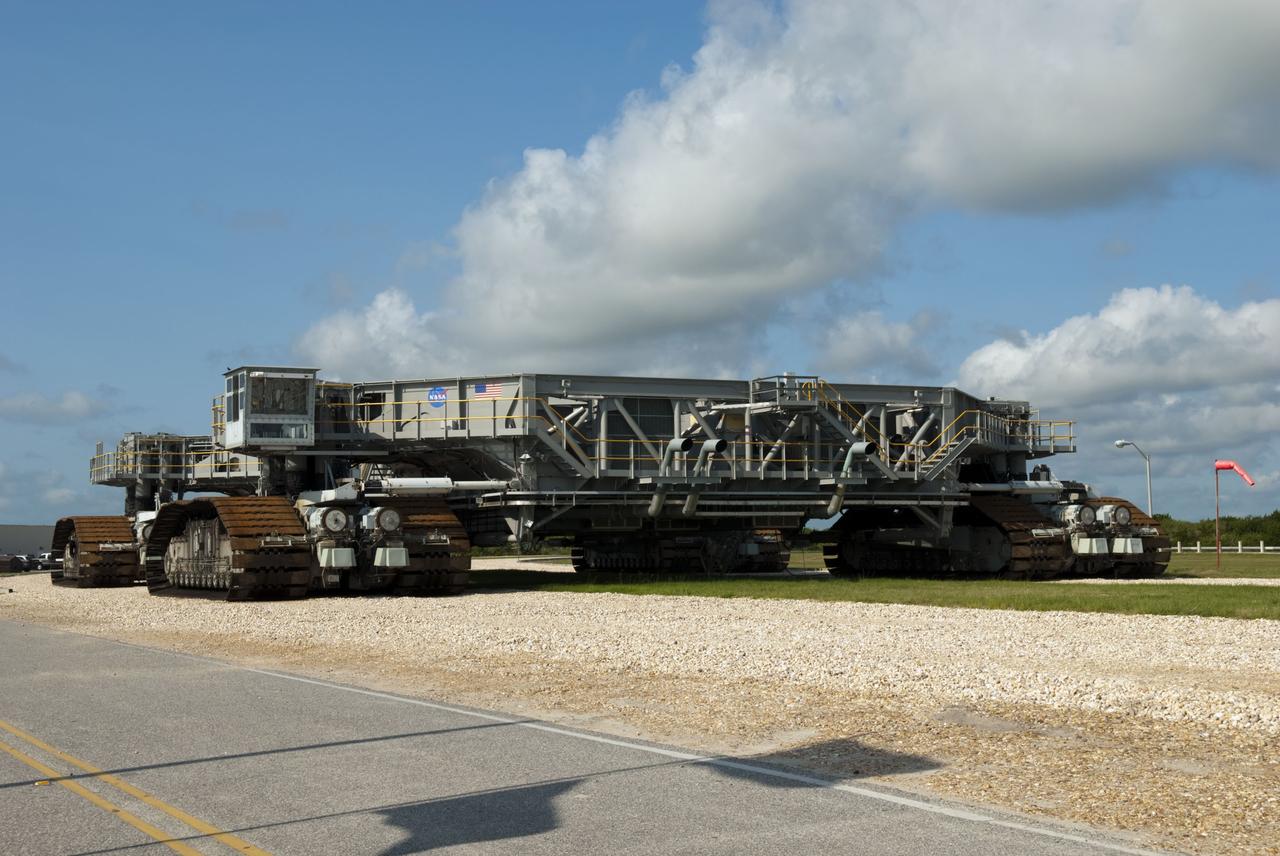
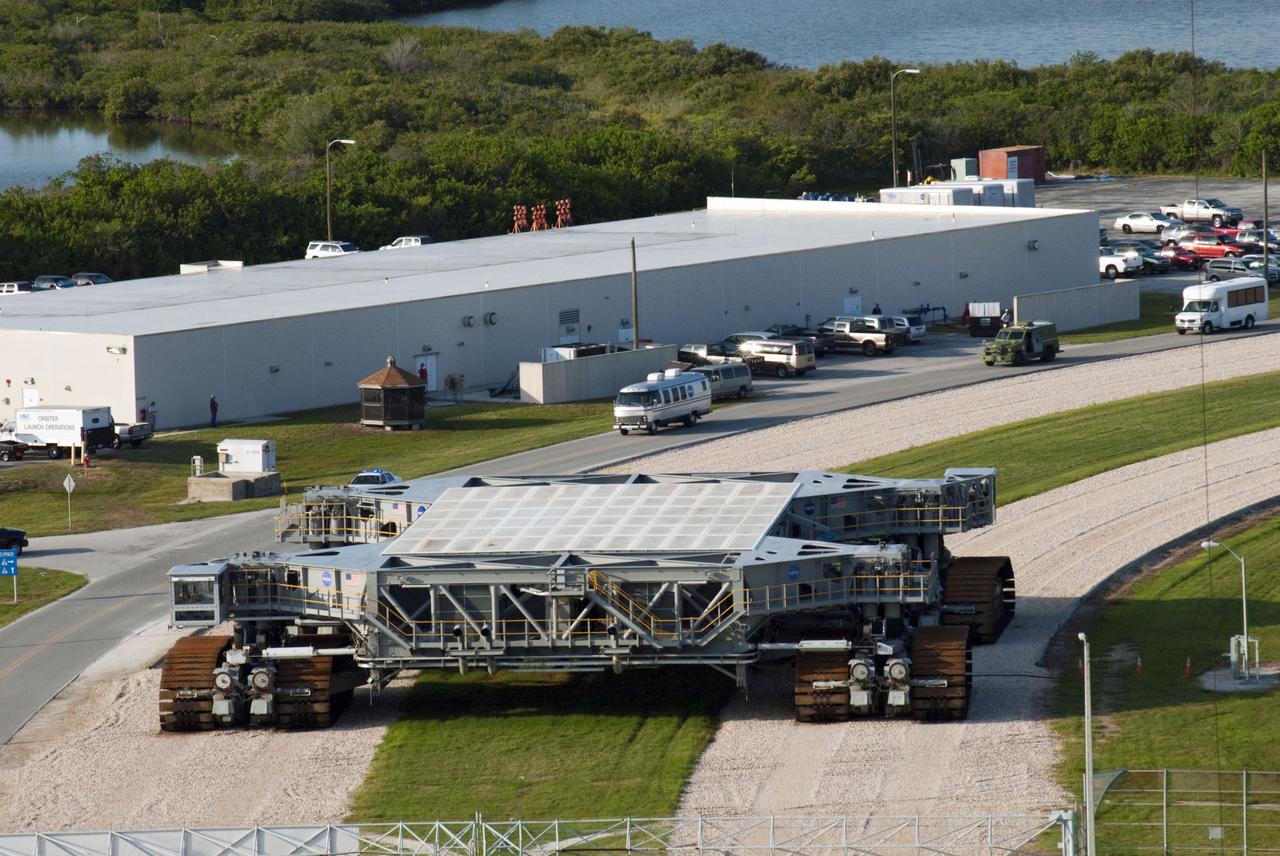
CAPE CANAVERAL, Fla. -- The massive crawler-transporter that carried space shuttle Atlantis to Launch Pad 39A at NASA's Kennedy Space Center in Florida sits serenely on the crawlerway once its transport duties were completed. Meanwhile, Atlantis' crew members are at the pad to participate in a launch countdown simulation exercise. As part of the Terminal Countdown Demonstration Test (TCDT), the crew members are strapped into their seats on Atlantis to practice the steps that will be taken on launch day. Shuttle Atlantis and its crew are targeted to lift off July 8, taking with them the Raffaello multi-purpose logistics module packed with supplies and spare parts to the International Space Station. The STS-135 mission also will fly a system to investigate the potential for robotically refueling existing satellites and return a failed ammonia pump module to help NASA better understand the failure mechanism and improve pump designs for future systems. STS-135 will be the 33rd flight of Atlantis, the 37th shuttle mission to the space station, and the 135th and final mission of NASA's Space Shuttle Program. For more information visit, www.nasa.gov/mission_pages/shuttle/shuttlemissions/sts135/index.html. Photo credit: NASA/Jim Grossmann
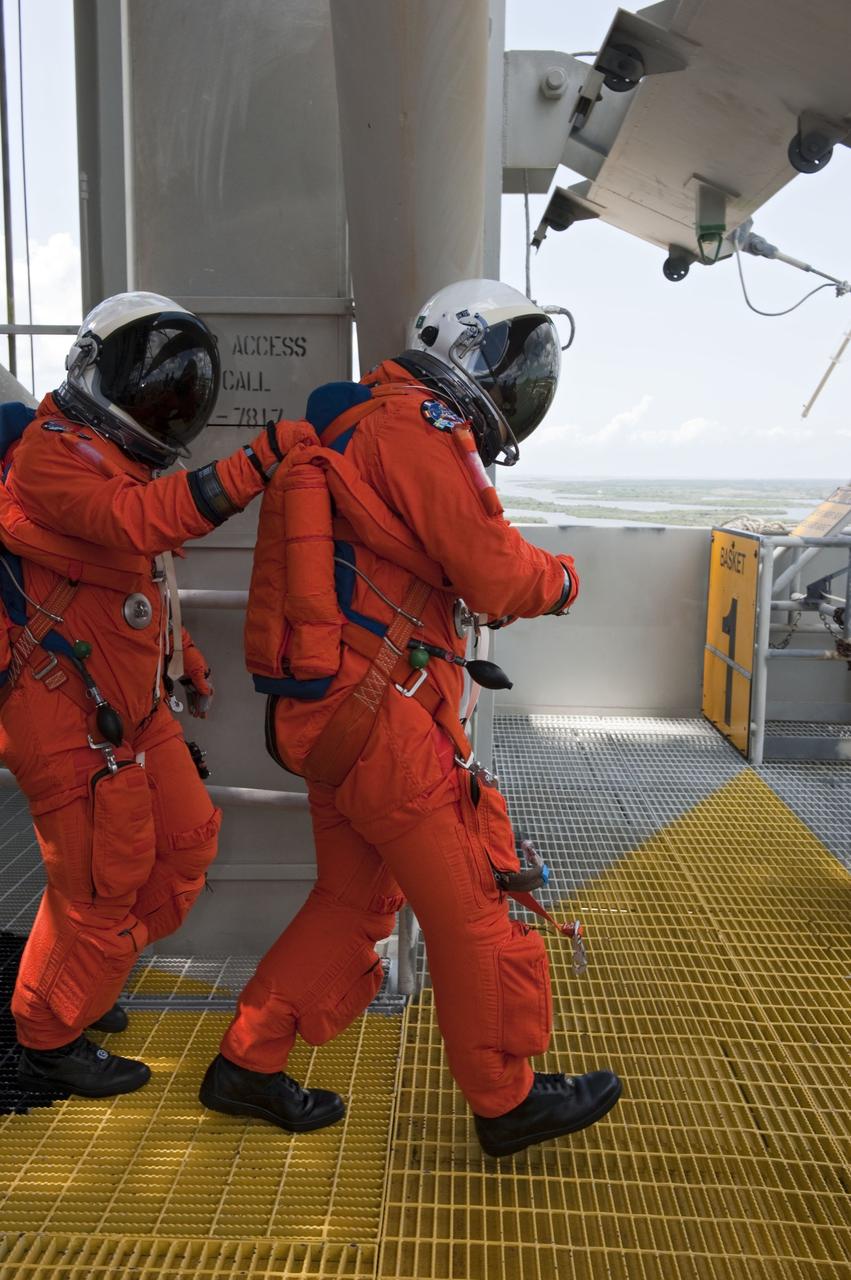
CAPE CANAVERAL, Fla. -- During simulated pad emergency exit training on Launch Pad 39A at NASA's Kennedy Space Center in Florida, the STS-135 crew members make their way toward slidewire baskets that would take them to a safe bunker below the pad in the unlikely event of an emergency. The exercise is part of the Terminal Countdown Demonstration Test (TCDT) and related training. Atlantis and its crew are targeted to lift off July 8, taking with them the Raffaello multi-purpose logistics module packed with supplies and spare parts to the International Space Station. The STS-135 mission also will fly a system to investigate the potential for robotically refueling existing satellites and return a failed ammonia pump module to help NASA better understand the failure mechanism and improve pump designs for future systems. STS-135 will be the 33rd flight of Atlantis, the 37th shuttle mission to the space station, and the 135th and final mission of NASA's Space Shuttle Program. For more information visit, www.nasa.gov/mission_pages/shuttle/shuttlemissions/sts135/index.html. Photo credit: NASA/Kim Shiflett
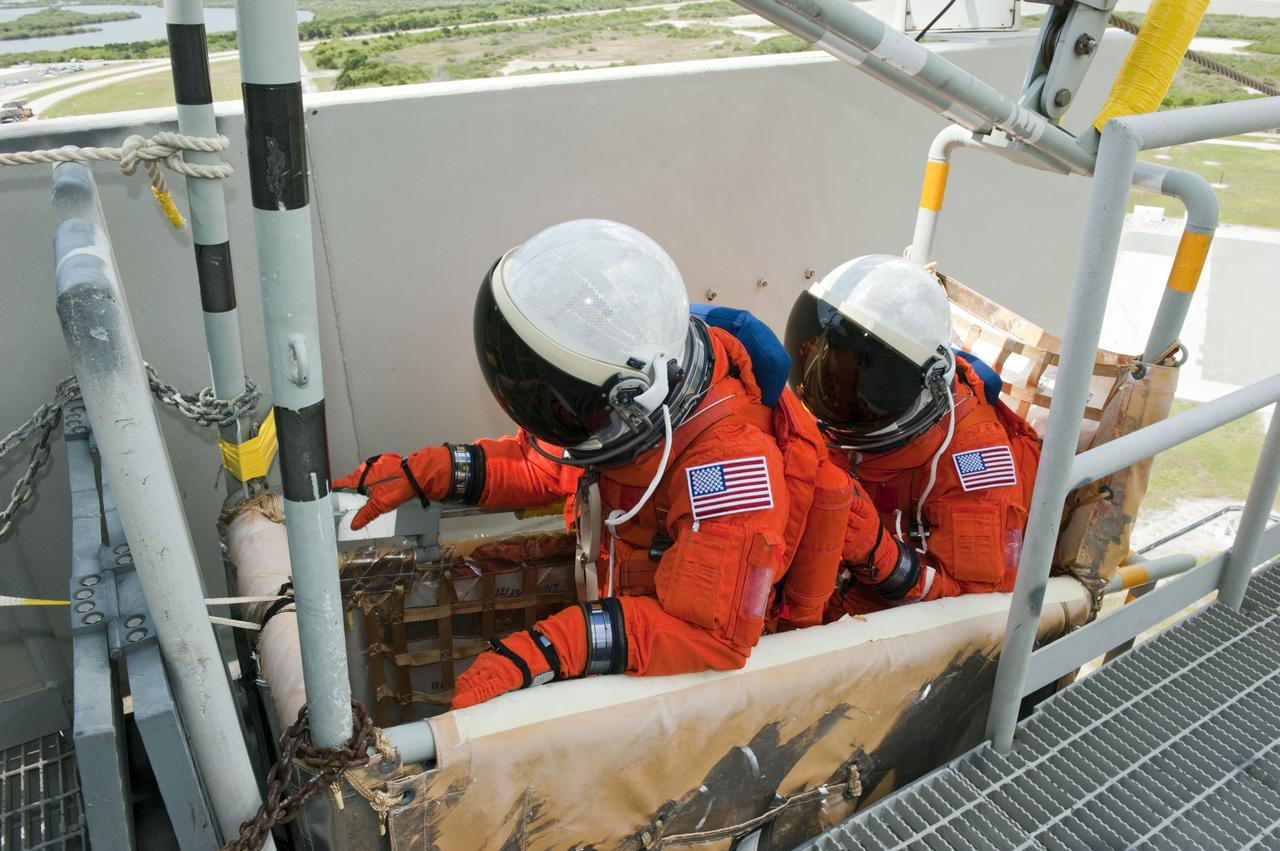
CAPE CANAVERAL, Fla. -- During simulated pad emergency exit training on Launch Pad 39A at NASA's Kennedy Space Center in Florida, STS-135 Mission Specialists Sandy Magnus (left) and Rex Walheim position themselves in a slidewire basket that would take them to a safe bunker below the pad in the unlikely event of an emergency. The exercise is part of the Terminal Countdown Demonstration Test (TCDT) and related training. Atlantis and its crew are targeted to lift off July 8, taking with them the Raffaello multi-purpose logistics module packed with supplies and spare parts to the International Space Station. The STS-135 mission also will fly a system to investigate the potential for robotically refueling existing satellites and return a failed ammonia pump module to help NASA better understand the failure mechanism and improve pump designs for future systems. STS-135 will be the 33rd flight of Atlantis, the 37th shuttle mission to the space station, and the 135th and final mission of NASA's Space Shuttle Program. For more information visit, www.nasa.gov/mission_pages/shuttle/shuttlemissions/sts135/index.html. Photo credit: NASA/Kim Shiflett
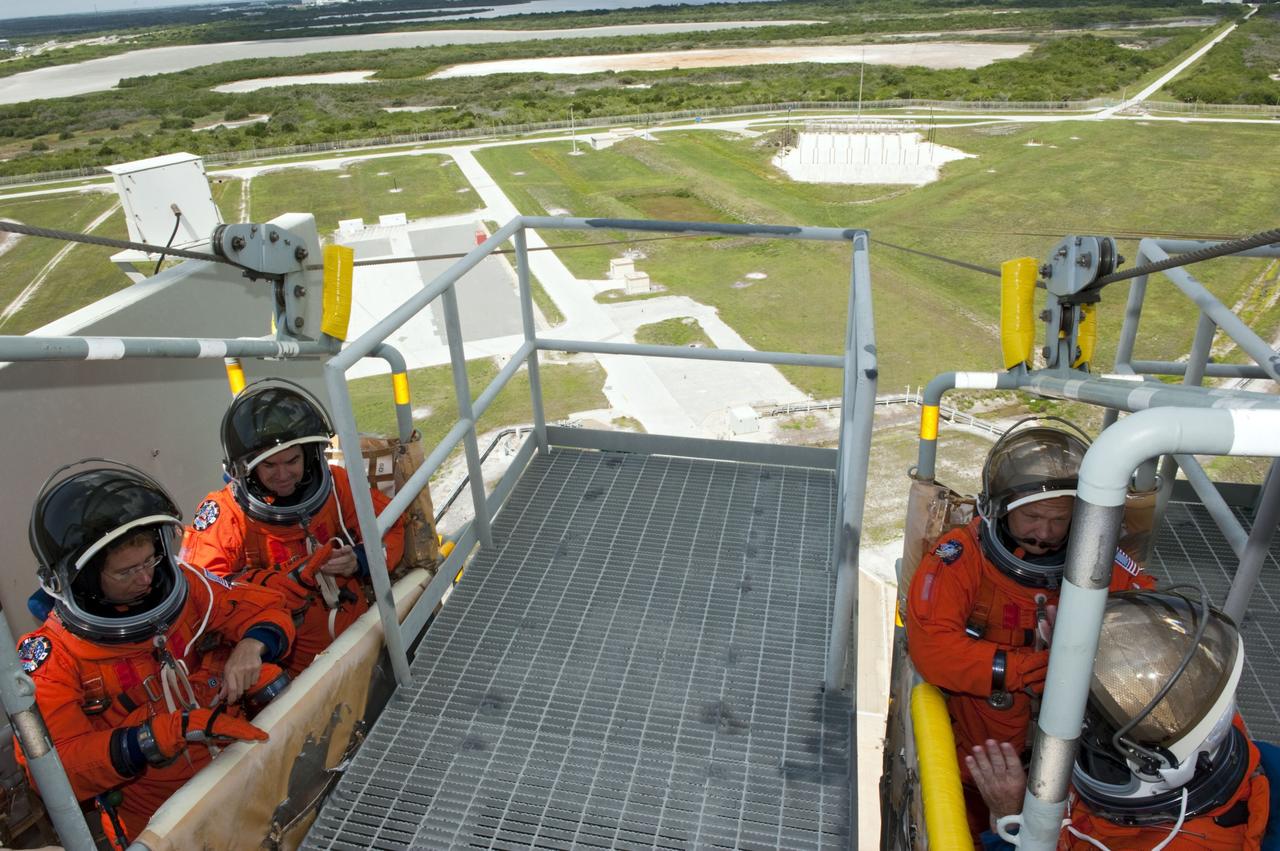
CAPE CANAVERAL, Fla. -- During simulated pad emergency exit training on Launch Pad 39A at NASA's Kennedy Space Center in Florida, STS-135 Commander Chris Ferguson (obscured) and Pilot Doug Hurley (right basket) and Mission Specialists Sandy Magnus and Rex Walheim (left basket) position themselves in slidewire baskets that would take them to a safe bunker below the pad in the unlikely event of an emergency. The exercise is part of the Terminal Countdown Demonstration Test (TCDT) and related training. Atlantis and its crew are targeted to lift off July 8, taking with them the Raffaello multi-purpose logistics module packed with supplies and spare parts to the International Space Station. The STS-135 mission also will fly a system to investigate the potential for robotically refueling existing satellites and return a failed ammonia pump module to help NASA better understand the failure mechanism and improve pump designs for future systems. STS-135 will be the 33rd flight of Atlantis, the 37th shuttle mission to the space station, and the 135th and final mission of NASA's Space Shuttle Program. For more information visit, www.nasa.gov/mission_pages/shuttle/shuttlemissions/sts135/index.html. Photo credit: NASA/Kim Shiflett
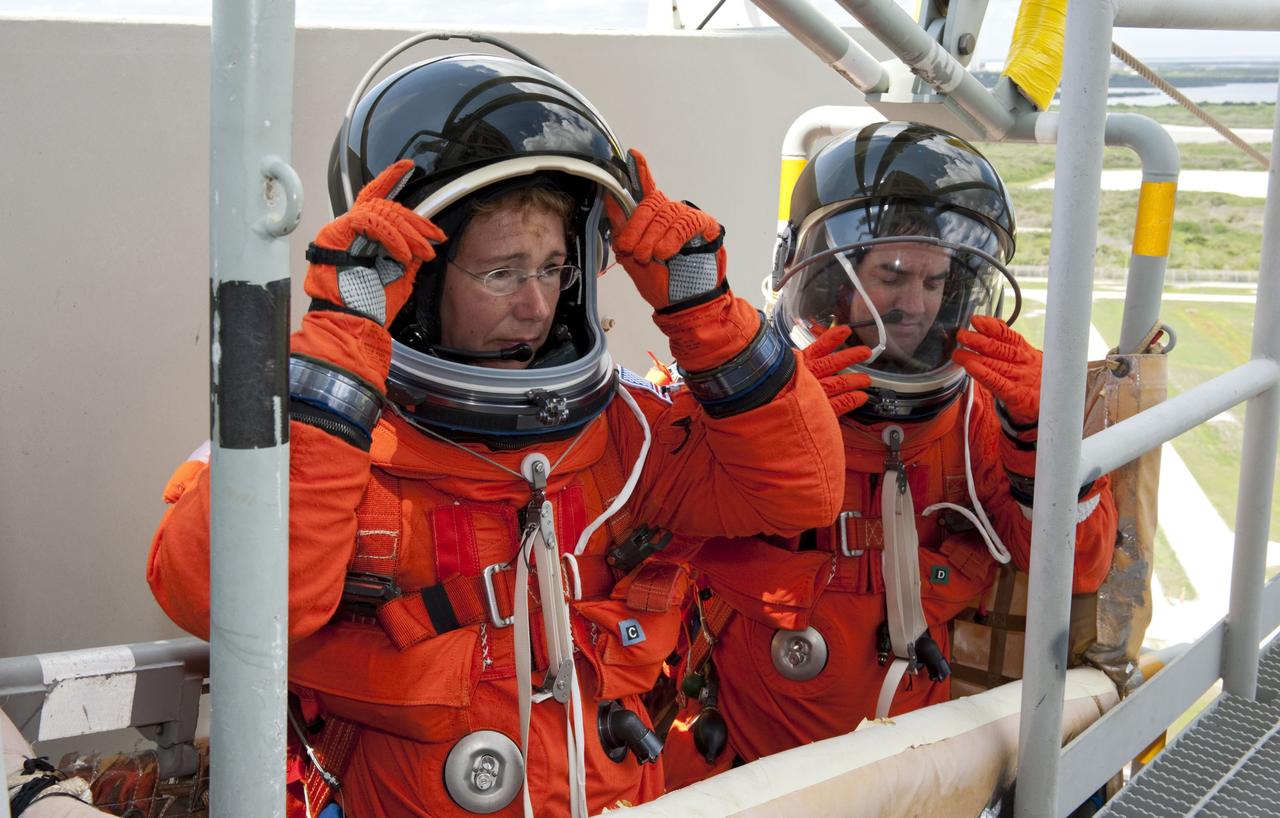
CAPE CANAVERAL, Fla. -- During simulated pad emergency exit training on Launch Pad 39A at NASA's Kennedy Space Center in Florida, STS-135 Mission Specialists Sandy Magnus (left) and Rex Walheim position themselves in a slidewire basket that would take them to a safe bunker below the pad in the unlikely event of an emergency. The exercise is part of the Terminal Countdown Demonstration Test (TCDT) and related training. Atlantis and its crew are targeted to lift off July 8, taking with them the Raffaello multi-purpose logistics module packed with supplies and spare parts to the International Space Station. The STS-135 mission also will fly a system to investigate the potential for robotically refueling existing satellites and return a failed ammonia pump module to help NASA better understand the failure mechanism and improve pump designs for future systems. STS-135 will be the 33rd flight of Atlantis, the 37th shuttle mission to the space station, and the 135th and final mission of NASA's Space Shuttle Program. For more information visit, www.nasa.gov/mission_pages/shuttle/shuttlemissions/sts135/index.html. Photo credit: NASA/Kim Shiflett
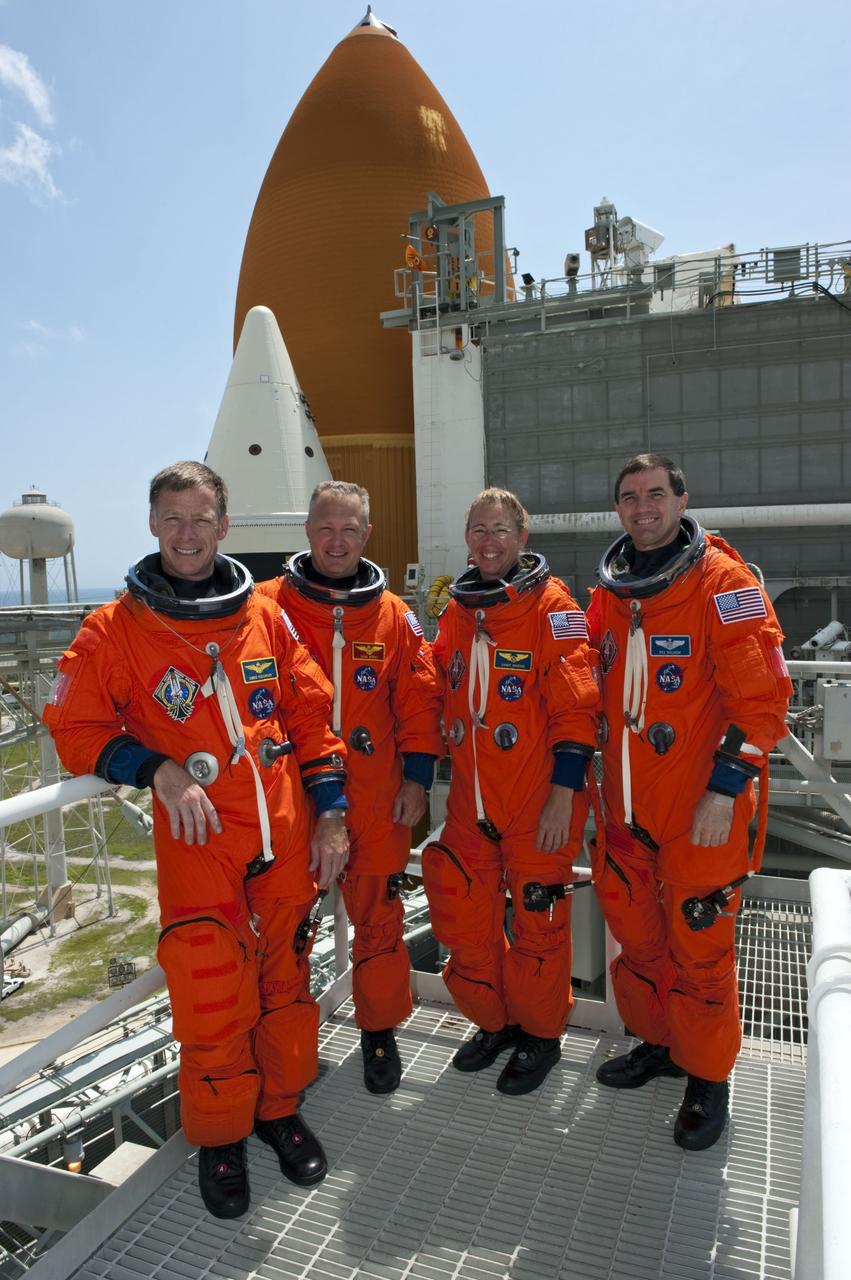
CAPE CANAVERAL, Fla. -- After completing simulated pad emergency exit training on Launch Pad 39A at NASA's Kennedy Space Center in Florida, the STS-135 crew members pause for a photo. From left are Commander Chris Ferguson, Pilot Doug Hurley, Mission Specialists Sandy Magnus and Rex Walheim. The exercise is part of the Terminal Countdown Demonstration Test (TCDT) and related training. Atlantis and its crew are targeted to lift off July 8, taking with them the Raffaello multi-purpose logistics module packed with supplies and spare parts to the International Space Station. The STS-135 mission also will fly a system to investigate the potential for robotically refueling existing satellites and return a failed ammonia pump module to help NASA better understand the failure mechanism and improve pump designs for future systems. STS-135 will be the 33rd flight of Atlantis, the 37th shuttle mission to the space station, and the 135th and final mission of NASA's Space Shuttle Program. For more information visit, www.nasa.gov/mission_pages/shuttle/shuttlemissions/sts135/index.html. Photo credit: NASA/Kim Shiflett
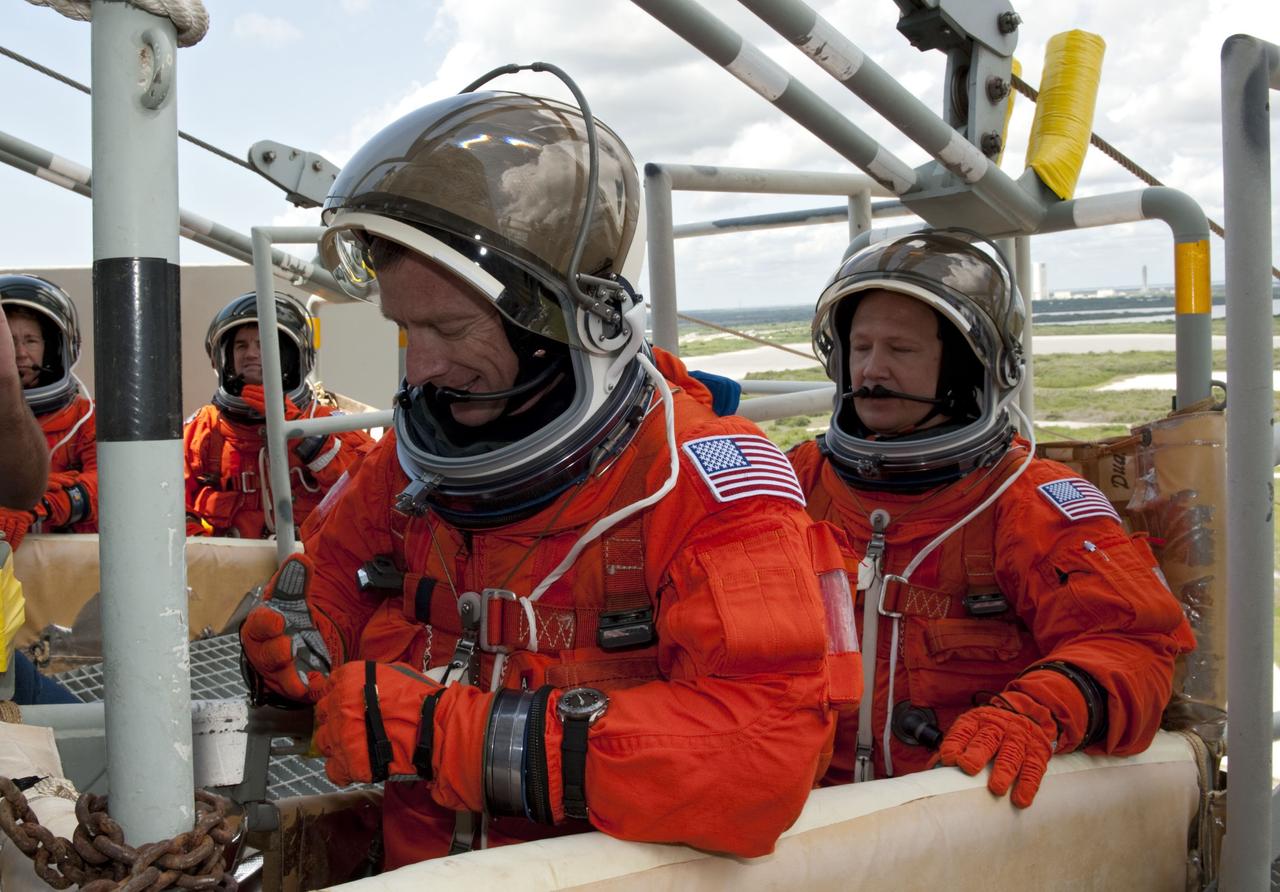
CAPE CANAVERAL, Fla. -- During simulated pad emergency exit training on Launch Pad 39A at NASA's Kennedy Space Center in Florida, STS-135 Commander Chris Ferguson (left) and Pilot Doug Hurley position themselves in a slidewire basket that would take them to a safe bunker below the pad in the unlikely event of an emergency. The exercise is part of the Terminal Countdown Demonstration Test (TCDT) and related training. Atlantis and its crew are targeted to lift off July 8, taking with them the Raffaello multi-purpose logistics module packed with supplies and spare parts to the International Space Station. The STS-135 mission also will fly a system to investigate the potential for robotically refueling existing satellites and return a failed ammonia pump module to help NASA better understand the failure mechanism and improve pump designs for future systems. STS-135 will be the 33rd flight of Atlantis, the 37th shuttle mission to the space station, and the 135th and final mission of NASA's Space Shuttle Program. For more information visit, www.nasa.gov/mission_pages/shuttle/shuttlemissions/sts135/index.html. Photo credit: NASA/Kim Shiflett
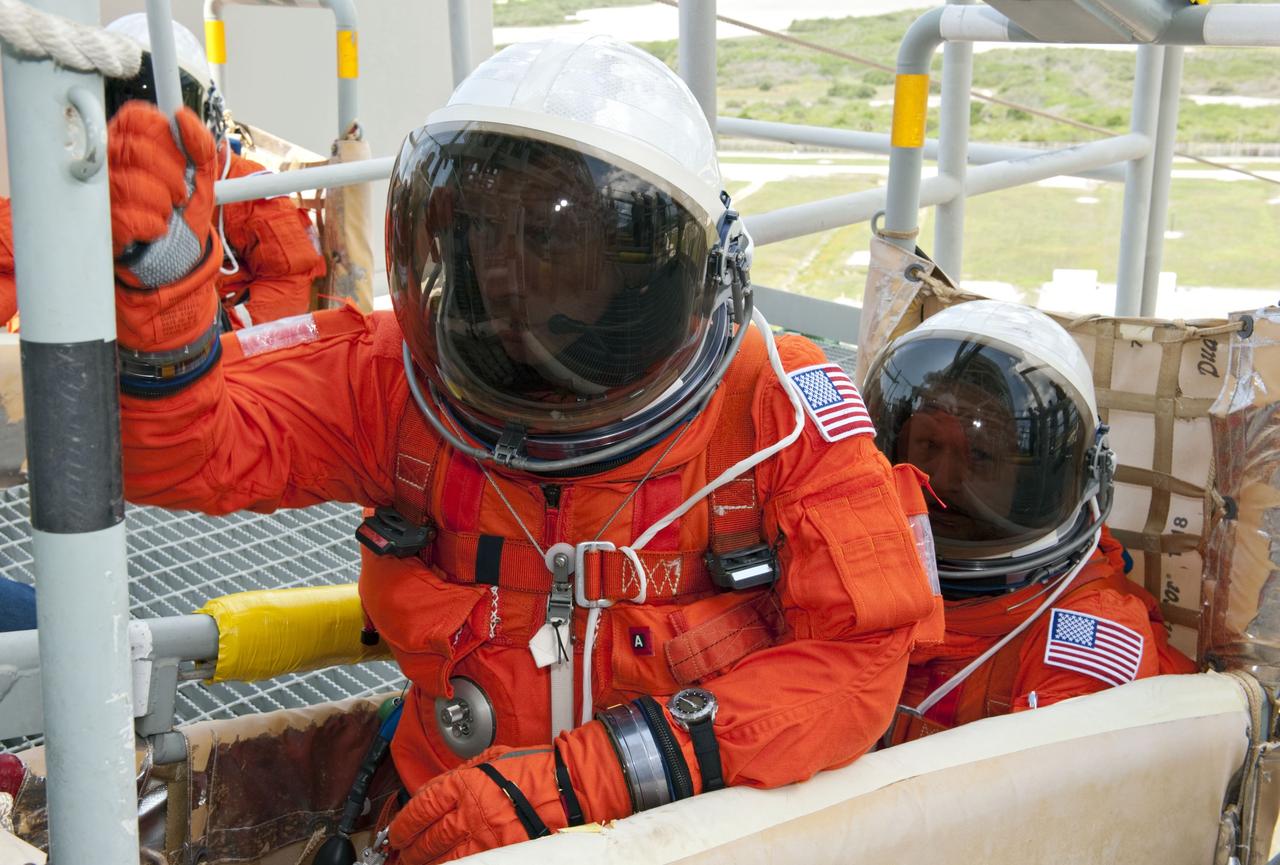
CAPE CANAVERAL, Fla. -- During simulated pad emergency exit training on Launch Pad 39A at NASA's Kennedy Space Center in Florida, STS-135 Commander Chris Ferguson (left) and Pilot Doug Hurley position themselves in a slidewire basket that would take them to a safe bunker below the pad in the unlikely event of an emergency. The exercise is part of the Terminal Countdown Demonstration Test (TCDT) and related training. Atlantis and its crew are targeted to lift off July 8, taking with them the Raffaello multi-purpose logistics module packed with supplies and spare parts to the International Space Station. The STS-135 mission also will fly a system to investigate the potential for robotically refueling existing satellites and return a failed ammonia pump module to help NASA better understand the failure mechanism and improve pump designs for future systems. STS-135 will be the 33rd flight of Atlantis, the 37th shuttle mission to the space station, and the 135th and final mission of NASA's Space Shuttle Program. For more information visit, www.nasa.gov/mission_pages/shuttle/shuttlemissions/sts135/index.html. Photo credit: NASA/Kim Shiflett
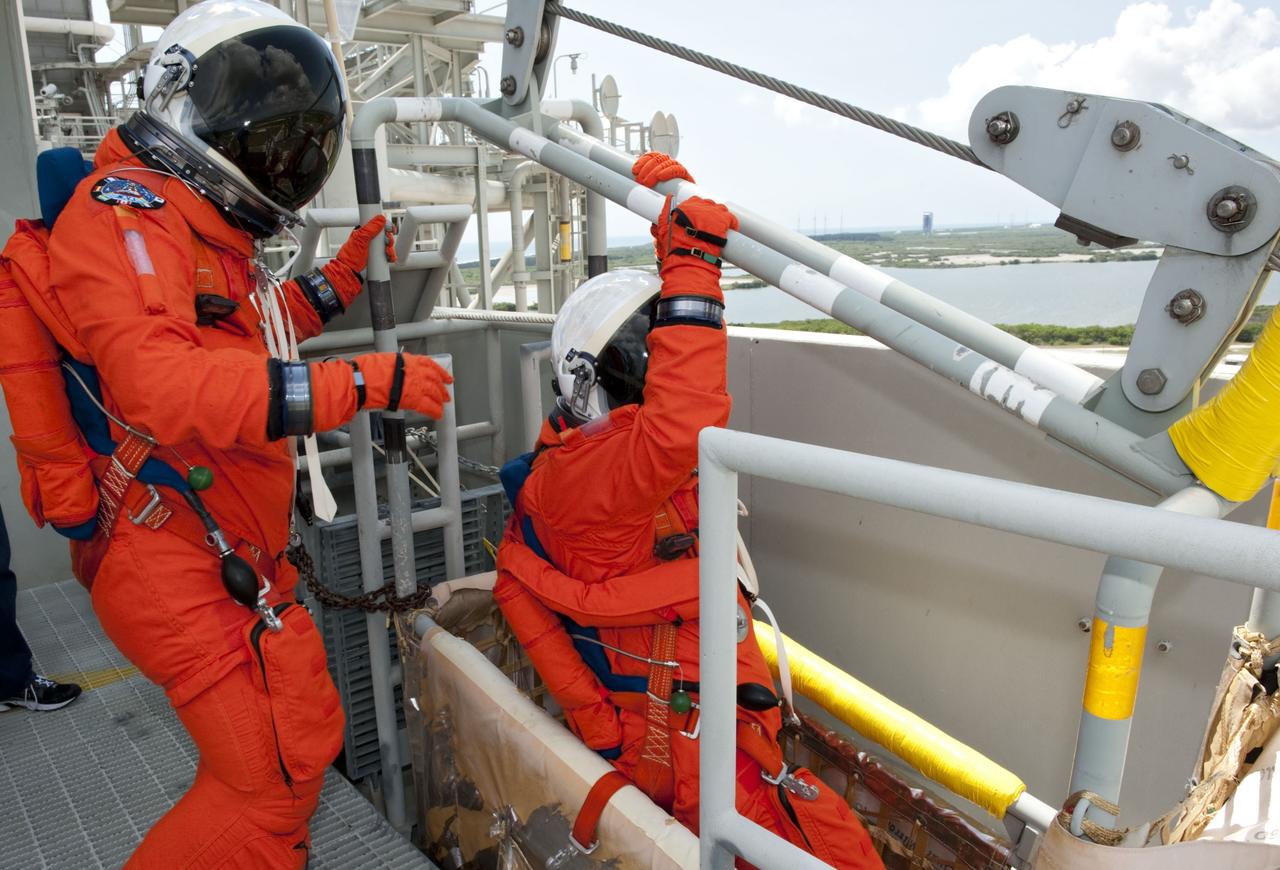
CAPE CANAVERAL, Fla. -- During simulated pad emergency exit training on Launch Pad 39A at NASA's Kennedy Space Center in Florida, the STS-135 crew members hop into a slidewire basket that would take them to a safe bunker below the pad in the unlikely event of an emergency. The exercise is part of the Terminal Countdown Demonstration Test (TCDT) and related training. Atlantis and its crew are targeted to lift off July 8, taking with them the Raffaello multi-purpose logistics module packed with supplies and spare parts to the International Space Station. The STS-135 mission also will fly a system to investigate the potential for robotically refueling existing satellites and return a failed ammonia pump module to help NASA better understand the failure mechanism and improve pump designs for future systems. STS-135 will be the 33rd flight of Atlantis, the 37th shuttle mission to the space station, and the 135th and final mission of NASA's Space Shuttle Program. For more information visit, www.nasa.gov/mission_pages/shuttle/shuttlemissions/sts135/index.html. Photo credit: NASA/Kim Shiflett
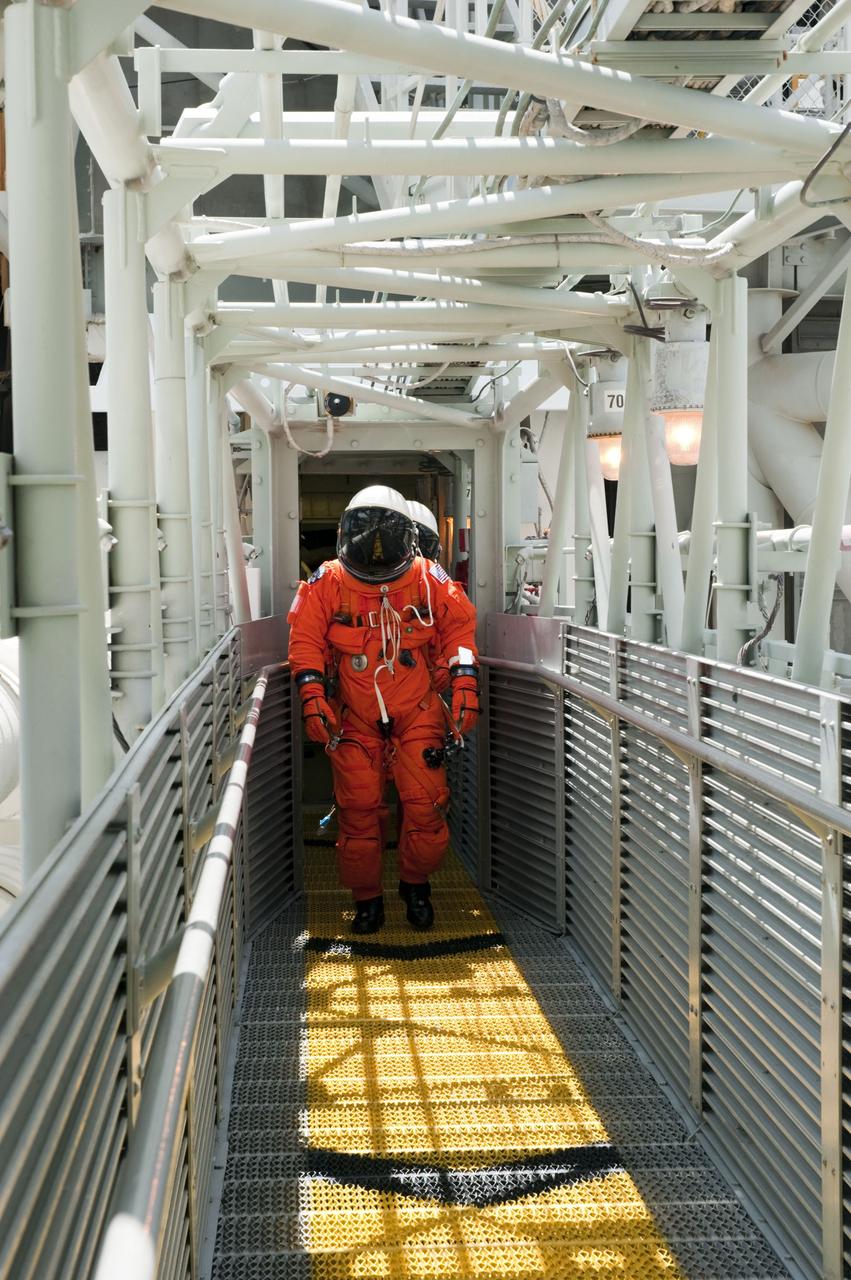
CAPE CANAVERAL, Fla. -- During simulated pad emergency exit training on Launch Pad 39A at NASA's Kennedy Space Center in Florida, the STS-135 crew members make their way out of the White Room toward slidewire baskets that would take them to a safe bunker below the pad in the unlikely event of an emergency. The exercise is part of the Terminal Countdown Demonstration Test (TCDT) and related training. Atlantis and its crew are targeted to lift off July 8, taking with them the Raffaello multi-purpose logistics module packed with supplies and spare parts to the International Space Station. The STS-135 mission also will fly a system to investigate the potential for robotically refueling existing satellites and return a failed ammonia pump module to help NASA better understand the failure mechanism and improve pump designs for future systems. STS-135 will be the 33rd flight of Atlantis, the 37th shuttle mission to the space station, and the 135th and final mission of NASA's Space Shuttle Program. For more information visit, www.nasa.gov/mission_pages/shuttle/shuttlemissions/sts135/index.html. Photo credit: NASA/Kim Shiflett

CAPE CANAVERAL, Fla. -- During simulated pad emergency exit training on Launch Pad 39A at NASA's Kennedy Space Center in Florida, STS-135 Pilot Doug Hurley (front) and Commander Chris Ferguson make their way to the slidewire baskets that would take them to a safe bunker below the pad in the unlikely event of an emergency. The exercise is part of the Terminal Countdown Demonstration Test (TCDT) and related training. Atlantis and its crew are targeted to lift off July 8, taking with them the Raffaello multi-purpose logistics module packed with supplies and spare parts to the International Space Station. The STS-135 mission also will fly a system to investigate the potential for robotically refueling existing satellites and return a failed ammonia pump module to help NASA better understand the failure mechanism and improve pump designs for future systems. STS-135 will be the 33rd flight of Atlantis, the 37th shuttle mission to the space station, and the 135th and final mission of NASA's Space Shuttle Program. For more information visit, www.nasa.gov/mission_pages/shuttle/shuttlemissions/sts135/index.html. Photo credit: NASA/Kim Shiflett
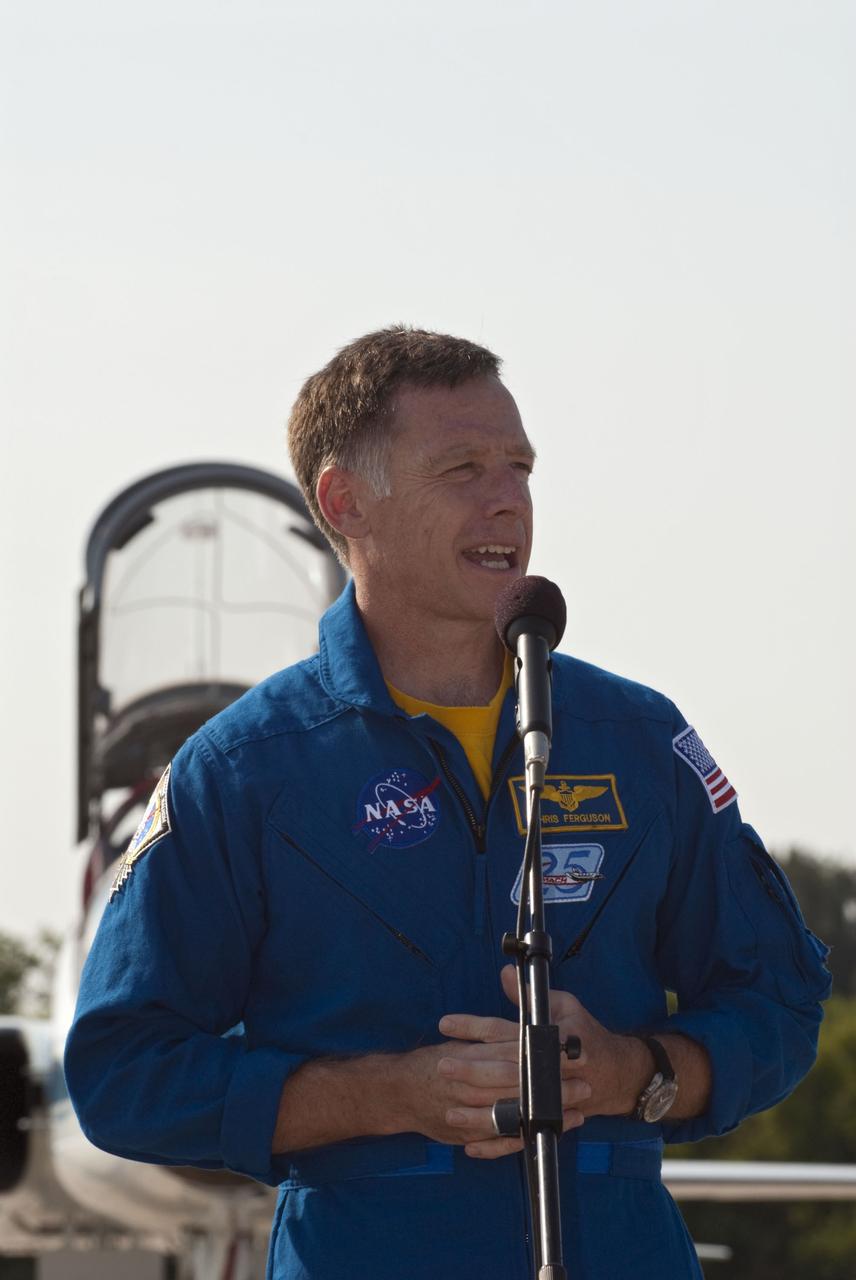
CAPE CANAVERAL, Fla. -- At the Shuttle Landing Facility at NASA's Kennedy Space Center in Florida, STS-135 Commander Chris Ferguson speaks to media. Space shuttle Atlantis' crew arrived at Kennedy at about 5:30 p.m. EDT to participate in a launch countdown dress rehearsal called the Terminal Countdown Demonstration Test (TCDT) and related training in preparation for the upcoming STS-135 mission. The STS-135 crew is targeted to lift off July 8, taking with them the Raffaello multi-purpose logistics module packed with supplies, logistics and spare parts to the International Space Station. The STS-135 mission also will fly a system to investigate the potential for robotically refueling existing satellites and return a failed ammonia pump module to help NASA better understand the failure mechanism and improve pump designs for future systems. STS-135 will be the 33rd flight of Atlantis, the 37th shuttle mission to the space station, and the 135th and final mission of NASA's Space Shuttle Program. For more information visit, www.nasa.gov/mission_pages/shuttle/shuttlemissions/sts135/index.html. Photo credit: NASA/Kim Shiflett
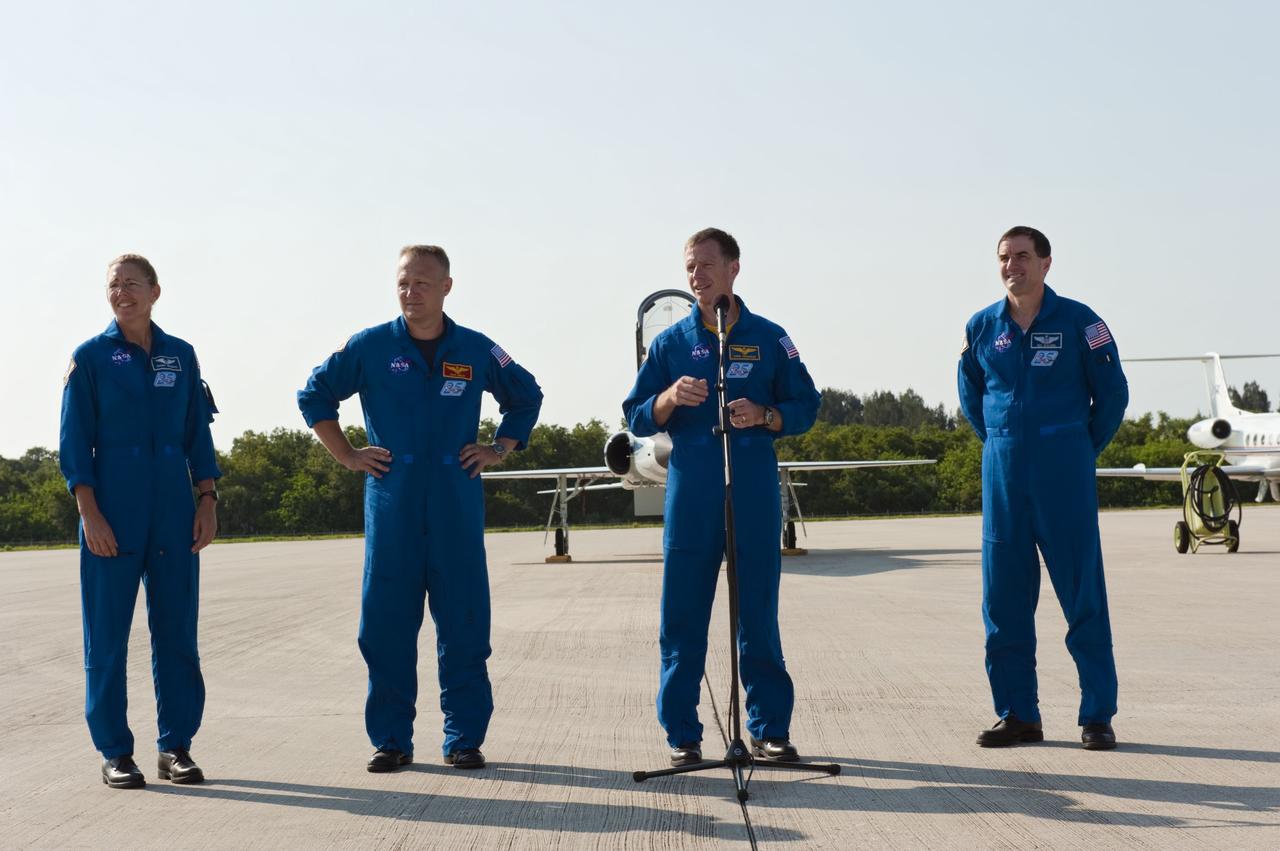
CAPE CANAVERAL, Fla. -- Space shuttle Atlantis' STS-135 crew members address the media on the Shuttle Landing Facility at NASA's Kennedy Space Center in Florida. From left are Mission Specialist Sandy Magnus, Pilot Doug Hurley, Commander Chris Ferguson and Mission Specialist Rex Walheim. The crew arrived at Kennedy at about 5:30 p.m. EDT to participate in a launch countdown dress rehearsal called the Terminal Countdown Demonstration Test (TCDT) and related training in preparation for the upcoming STS-135 mission. Atlantis and its crew are targeted to lift off July 8, taking with them the Raffaello multi-purpose logistics module packed with supplies and spare parts to the International Space Station. The STS-135 mission also will fly a system to investigate the potential for robotically refueling existing satellites and return a failed ammonia pump module to help NASA better understand the failure mechanism and improve pump designs for future systems. STS-135 will be the 33rd flight of Atlantis, the 37th shuttle mission to the International Space Station, and the 135th and final mission of NASA's Space Shuttle Program. For more information visit, www.nasa.gov/mission_pages/shuttle/shuttlemissions/sts135/index.html. Photo credit: NASA/Kim Shiflett
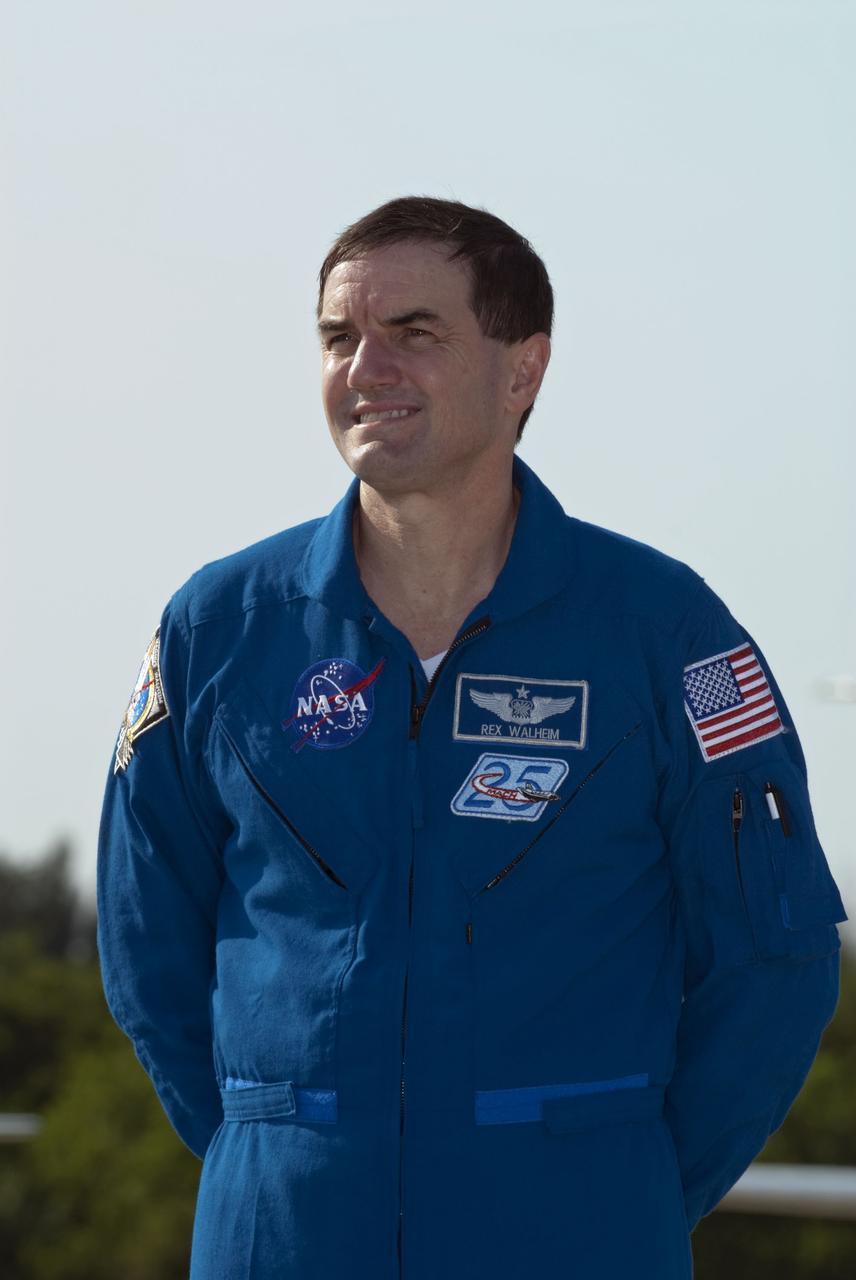
CAPE CANAVERAL, Fla. -- At the Shuttle Landing Facility at NASA's Kennedy Space Center in Florida, STS-135 Mission Specialist Rex Walheim pauses for a photo. The space shuttle Atlantis crew members arrived at Kennedy at about 5:30 p.m. EDT to participate in a launch countdown dress rehearsal called the Terminal Countdown Demonstration Test (TCDT) and related training in preparation for the upcoming STS-135 mission. Atlantis and its crew is targeted to lift off July 8, taking with them the Raffaello multi-purpose logistics module packed with supplies, logistics and spare parts to the International Space Station. The STS-135 mission also will fly a system to investigate the potential for robotically refueling existing satellites and return a failed ammonia pump module to help NASA better understand the failure mechanism and improve pump designs for future systems. STS-135 will be the 33rd flight of Atlantis, the 37th shuttle mission to the space station, and the 135th and final mission of NASA's Space Shuttle Program. For more information visit, www.nasa.gov/mission_pages/shuttle/shuttlemissions/sts135/index.html. Photo credit: NASA/Kim Shiflett
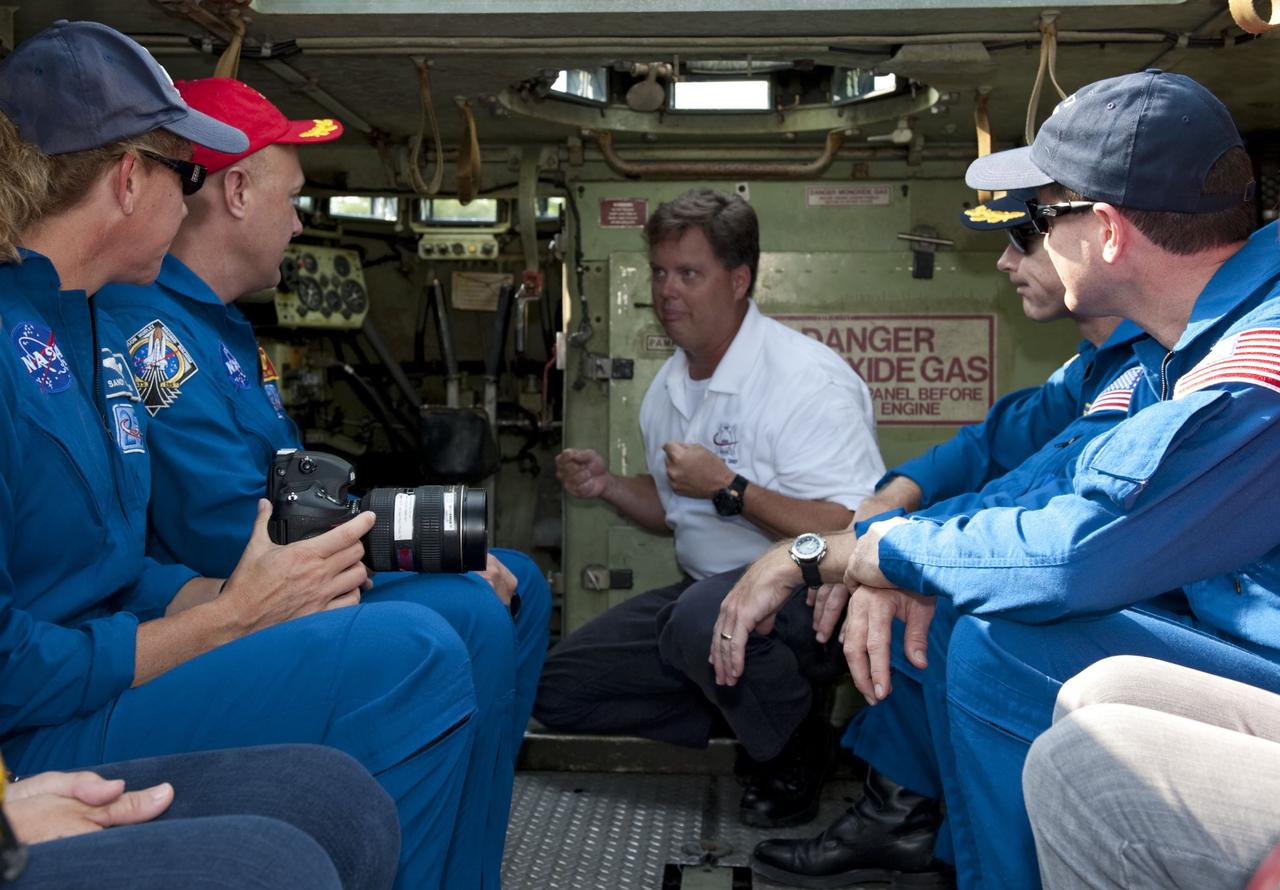
CAPE CANAVERAL, Fla. -- Battalion Chief David Seymour instructs space shuttle Atlantis' STS-135 crew members as they participate in M113 armored personnel carrier training at NASA's Kennedy Space Center in Florida. From left are Mission Specialist Sandy Magnus, Pilot Doug Hurley, Commander Chris Ferguson (partially obscured) and Mission Specialist Rex Walheim. An M113 is kept at the foot of the launch pad in case an emergency exit from the launch pad is needed and every shuttle crew is trained on driving the vehicle before launch. The STS-135 crew is at Kennedy to participate in a launch countdown dress rehearsal called the Terminal Countdown Demonstration Test (TCDT) and related training. Atlantis and its crew are targeted to lift off July 8, taking with them the Raffaello multi-purpose logistics module packed with supplies and spare parts to the International Space Station. The STS-135 mission also will fly a system to investigate the potential for robotically refueling existing satellites and return a failed ammonia pump module to help NASA better understand the failure mechanism and improve pump designs for future systems. STS-135 will be the 33rd flight of Atlantis, the 37th shuttle mission to the space station, and the 135th and final mission of NASA's Space Shuttle Program. For more information visit, www.nasa.gov/mission_pages/shuttle/shuttlemissions/sts135/index.html. Photo credit: NASA/Kim Shiflett
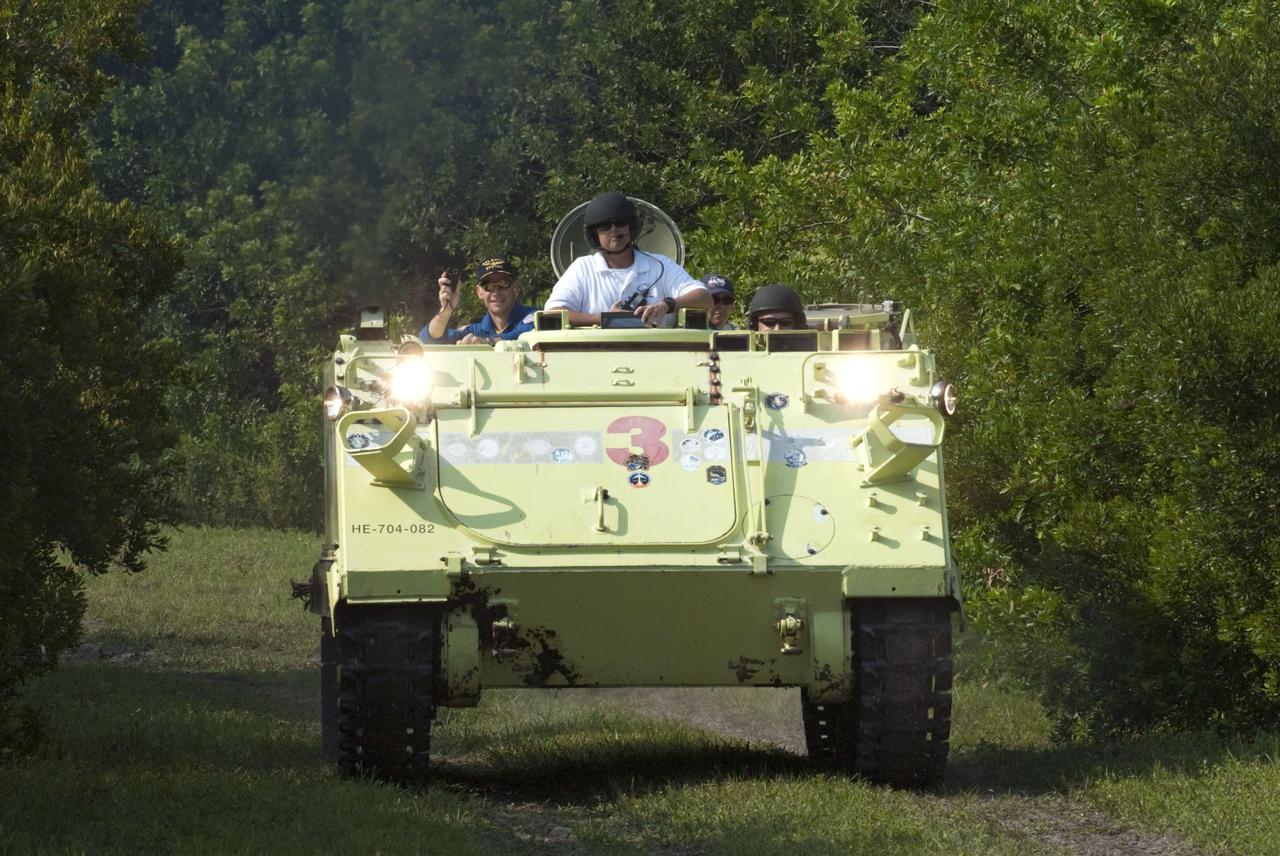
CAPE CANAVERAL, Fla. -- Battalion Chief David Seymour provides supervision while space shuttle Atlantis' STS-135 crew members participate in M113 armored personnel carrier training at NASA's Kennedy Space Center in Florida. Driving the M113 is Pilot Doug Hurley; seated are Mission Specialist Sandy Magnus (background right) and Commander Chris Ferguson. An M113 is kept at the foot of the launch pad in case an emergency exit from the launch pad is needed and every shuttle crew is trained on driving the vehicle before launch. The STS-135 crew is at Kennedy to participate in a launch countdown dress rehearsal called the Terminal Countdown Demonstration Test (TCDT) and related training. Atlantis and its crew are targeted to lift off July 8, taking with them the Raffaello multi-purpose logistics module packed with supplies and spare parts to the International Space Station. The STS-135 mission also will fly a system to investigate the potential for robotically refueling existing satellites and return a failed ammonia pump module to help NASA better understand the failure mechanism and improve pump designs for future systems. STS-135 will be the 33rd flight of Atlantis, the 37th shuttle mission to the space station, and the 135th and final mission of NASA's Space Shuttle Program. For more information visit, www.nasa.gov/mission_pages/shuttle/shuttlemissions/sts135/index.html. Photo credit: NASA/Kim Shiflett
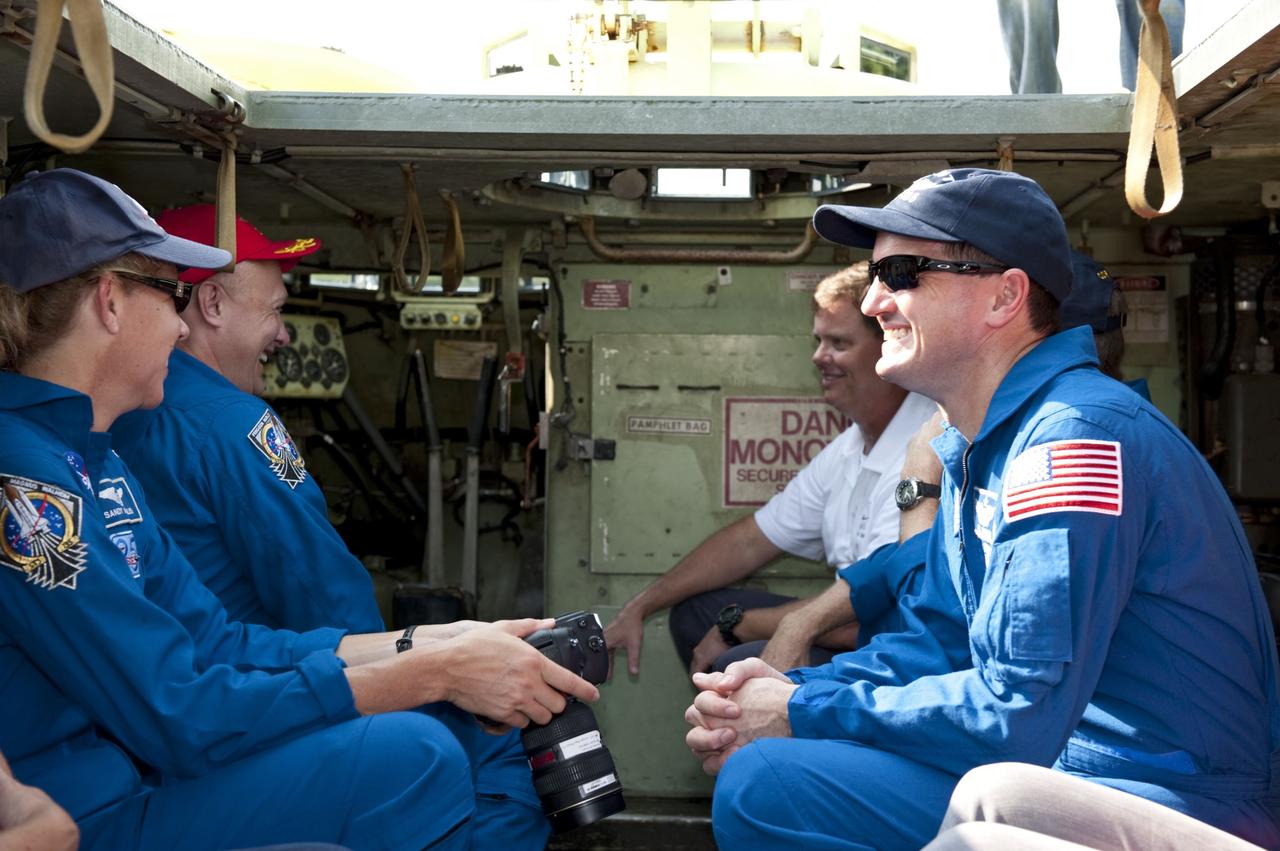
CAPE CANAVERAL, Fla. -- Battalion Chief David Seymour and space shuttle Atlantis' STS-135 crew members enjoy a light moment as they participate in M113 armored personnel carrier training at NASA's Kennedy Space Center in Florida. From left are Mission Specialist Sandy Magnus, Pilot Doug Hurley, Commander Chris Ferguson (obscured) and Mission Specialist Rex Walheim. An M113 is kept at the foot of the launch pad in case an emergency exit from the launch pad is needed and every shuttle crew is trained on driving the vehicle before launch. The STS-135 crew is at Kennedy to participate in a launch countdown dress rehearsal called the Terminal Countdown Demonstration Test (TCDT) and related training. Atlantis and its crew are targeted to lift off July 8, taking with them the Raffaello multi-purpose logistics module packed with supplies and spare parts to the International Space Station. The STS-135 mission also will fly a system to investigate the potential for robotically refueling existing satellites and return a failed ammonia pump module to help NASA better understand the failure mechanism and improve pump designs for future systems. STS-135 will be the 33rd flight of Atlantis, the 37th shuttle mission to the space station, and the 135th and final mission of NASA's Space Shuttle Program. For more information visit, www.nasa.gov/mission_pages/shuttle/shuttlemissions/sts135/index.html. Photo credit: NASA/Kim Shiflett
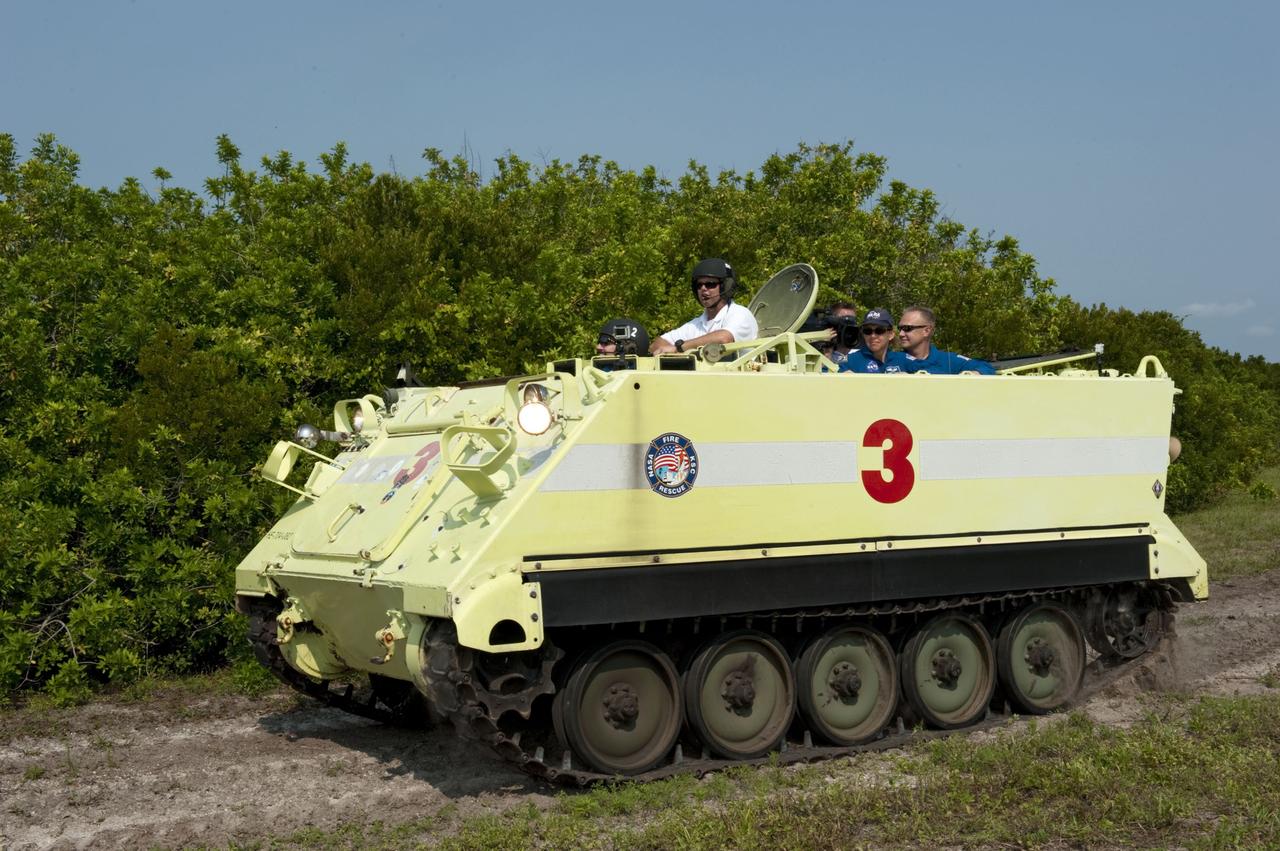
CAPE CANAVERAL, Fla. -- Battalion Chief David Seymour provides supervision while space shuttle Atlantis' STS-135 crew members participate in M113 armored personnel carrier training at NASA's Kennedy Space Center in Florida. An M113 is kept at the foot of the launch pad in case an emergency exit from the launch pad is needed and every shuttle crew is trained on driving the vehicle before launch. The STS-135 crew is at Kennedy to participate in a launch countdown dress rehearsal called the Terminal Countdown Demonstration Test (TCDT) and related training. Atlantis and its crew are targeted to lift off July 8, taking with them the Raffaello multi-purpose logistics module packed with supplies and spare parts to the International Space Station. The STS-135 mission also will fly a system to investigate the potential for robotically refueling existing satellites and return a failed ammonia pump module to help NASA better understand the failure mechanism and improve pump designs for future systems. STS-135 will be the 33rd flight of Atlantis, the 37th shuttle mission to the space station, and the 135th and final mission of NASA's Space Shuttle Program. For more information visit, www.nasa.gov/mission_pages/shuttle/shuttlemissions/sts135/index.html. Photo credit: NASA/Kim Shiflett
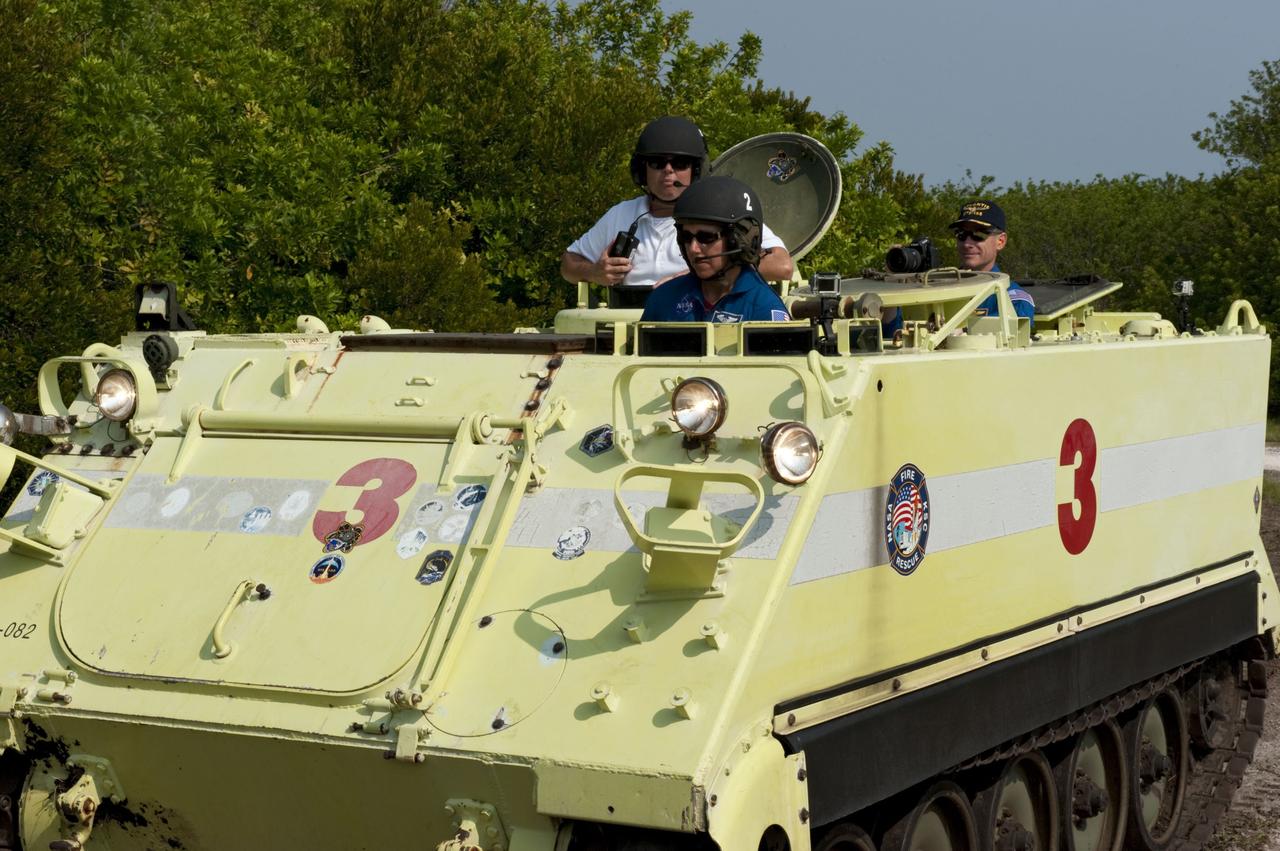
CAPE CANAVERAL, Fla. -- Battalion Chief David Seymour provides supervision while space shuttle Atlantis' STS-135 crew members participate in M113 armored personnel carrier training at NASA's Kennedy Space Center in Florida. Driving the M113 is Mission Specialist Sandy Magnus while Commander Chris Ferguson looks on. An M113 is kept at the foot of the launch pad in case an emergency exit from the launch pad is needed and every shuttle crew is trained on driving the vehicle before launch. The STS-135 crew is at Kennedy to participate in a launch countdown dress rehearsal called the Terminal Countdown Demonstration Test (TCDT) and related training. Atlantis and its crew are targeted to lift off July 8, taking with them the Raffaello multi-purpose logistics module packed with supplies and spare parts to the International Space Station. The STS-135 mission also will fly a system to investigate the potential for robotically refueling existing satellites and return a failed ammonia pump module to help NASA better understand the failure mechanism and improve pump designs for future systems. STS-135 will be the 33rd flight of Atlantis, the 37th shuttle mission to the space station, and the 135th and final mission of NASA's Space Shuttle Program. For more information visit, www.nasa.gov/mission_pages/shuttle/shuttlemissions/sts135/index.html. Photo credit: NASA/Kim Shiflett
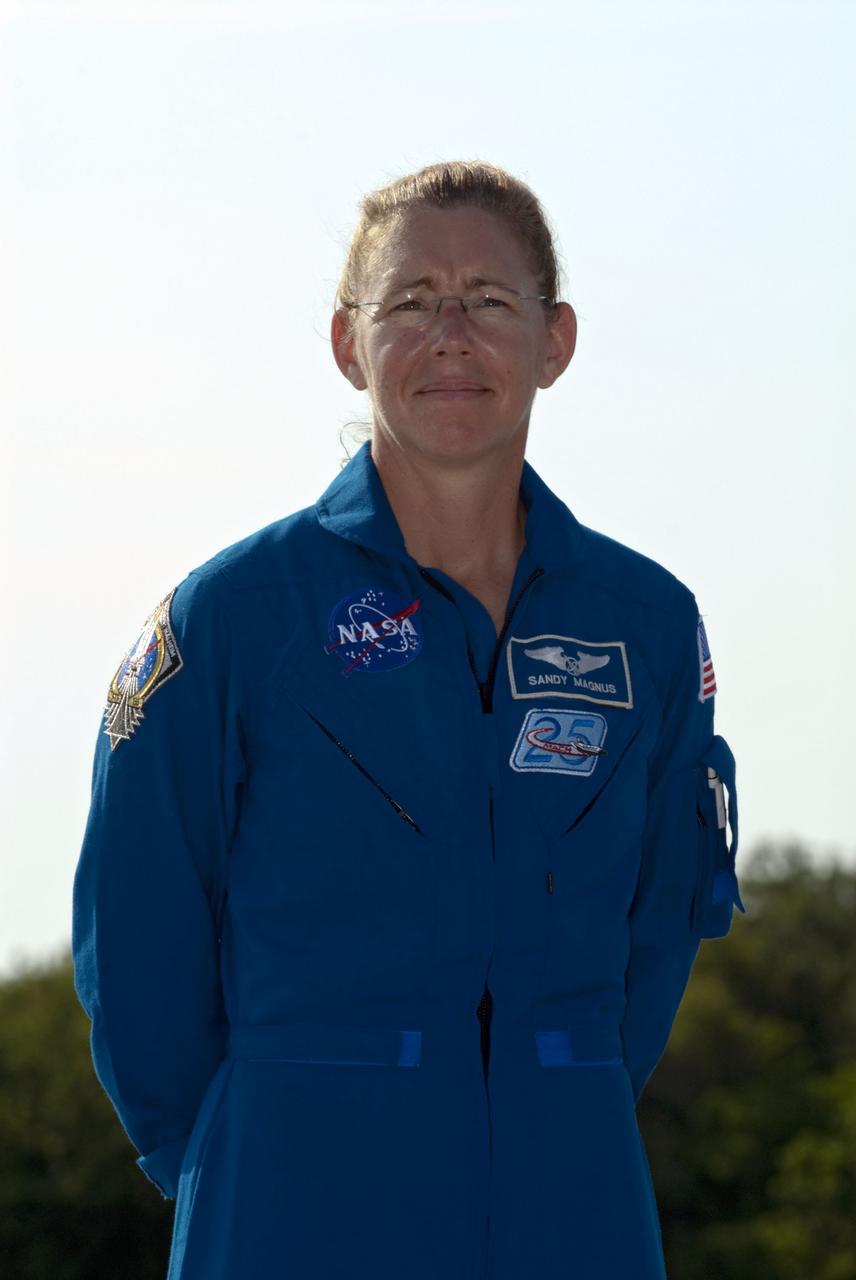
CAPE CANAVERAL, Fla. -- At the Shuttle Landing Facility at NASA's Kennedy Space Center in Florida, STS-135 Mission Specialist Sandy Magnus pauses for a photo. The space shuttle Atlantis crew arrived at Kennedy at about 5:30 p.m. EDT to participate in a launch countdown dress rehearsal called the Terminal Countdown Demonstration Test (TCDT) and related training in preparation for the upcoming STS-135 mission. Atlantis and its crew is targeted to lift off on July 8, taking with them the Raffaello multi-purpose logistics module packed with supplies and spare parts to the International Space Station. The STS-135 mission also will fly a system to investigate the potential for robotically refueling existing satellites and return a failed ammonia pump module to help NASA better understand the failure mechanism and improve pump designs for future systems. STS-135 will be the 33rd flight of Atlantis, the 37th shuttle mission to the space station, and the 135th and final mission of NASA's Space Shuttle Program. For more information visit, www.nasa.gov/mission_pages/shuttle/shuttlemissions/sts135/index.html. Photo credit: NASA/Kim Shiflett
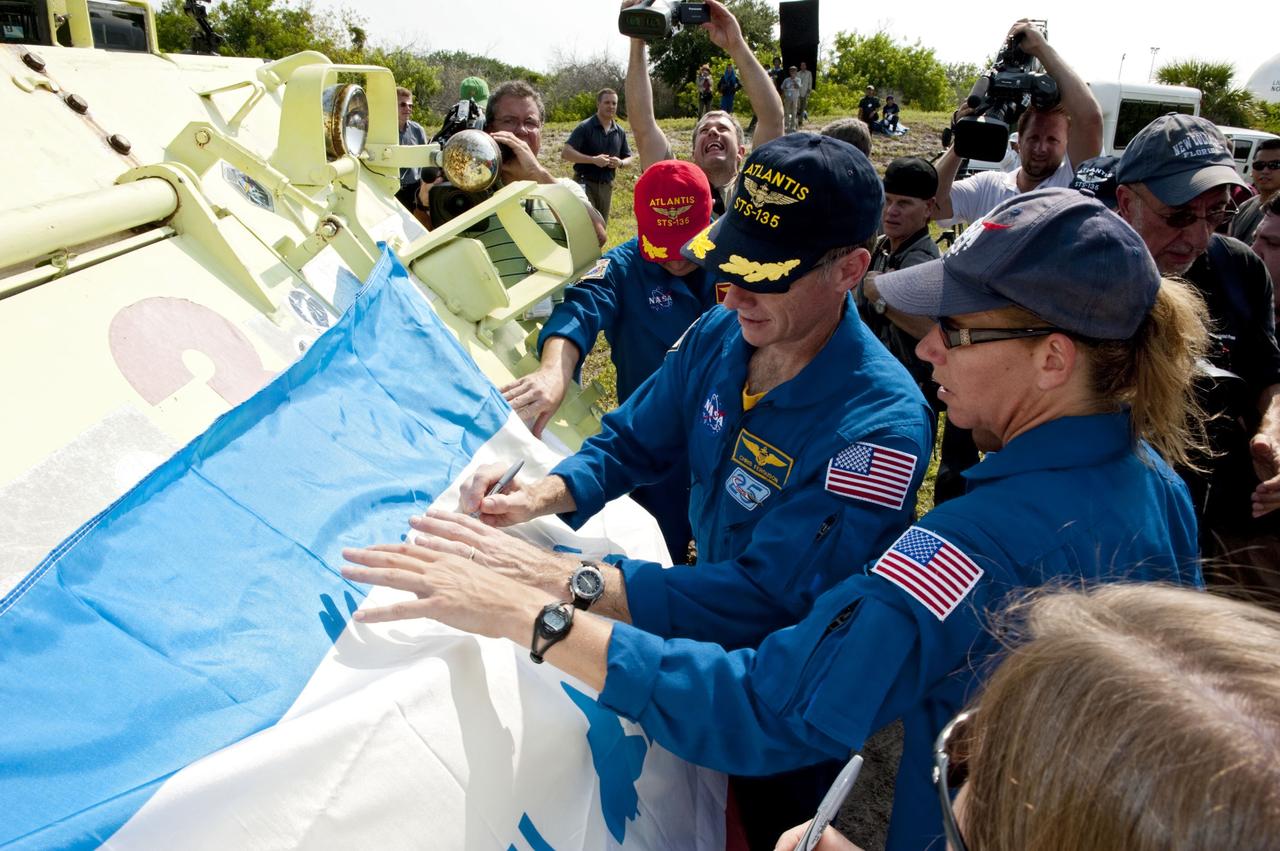
CAPE CANAVERAL, Fla. -- The STS-135 crew sign their names to an Atlantis flag at the conclusion of their M113 armored personnel carrier training at NASA's Kennedy Space Center in Florida. Seen here are Mission Specialist Sandy Magnus (right) and Commander Chris Ferguson. An M113 is kept at the foot of the launch pad in case an emergency exit from the launch pad is needed and every shuttle crew is trained on driving the vehicle before launch. The STS-135 crew is at Kennedy to participate in a launch countdown dress rehearsal called the Terminal Countdown Demonstration Test (TCDT) and related training. Atlantis and its crew are targeted to lift off July 8, taking with them the Raffaello multi-purpose logistics module packed with supplies and spare parts to the International Space Station. The STS-135 mission also will fly a system to investigate the potential for robotically refueling existing satellites and return a failed ammonia pump module to help NASA better understand the failure mechanism and improve pump designs for future systems. STS-135 will be the 33rd flight of Atlantis, the 37th shuttle mission to the space station, and the 135th and final mission of NASA's Space Shuttle Program. For more information visit, www.nasa.gov/mission_pages/shuttle/shuttlemissions/sts135/index.html. Photo credit: NASA/Kim Shiflett
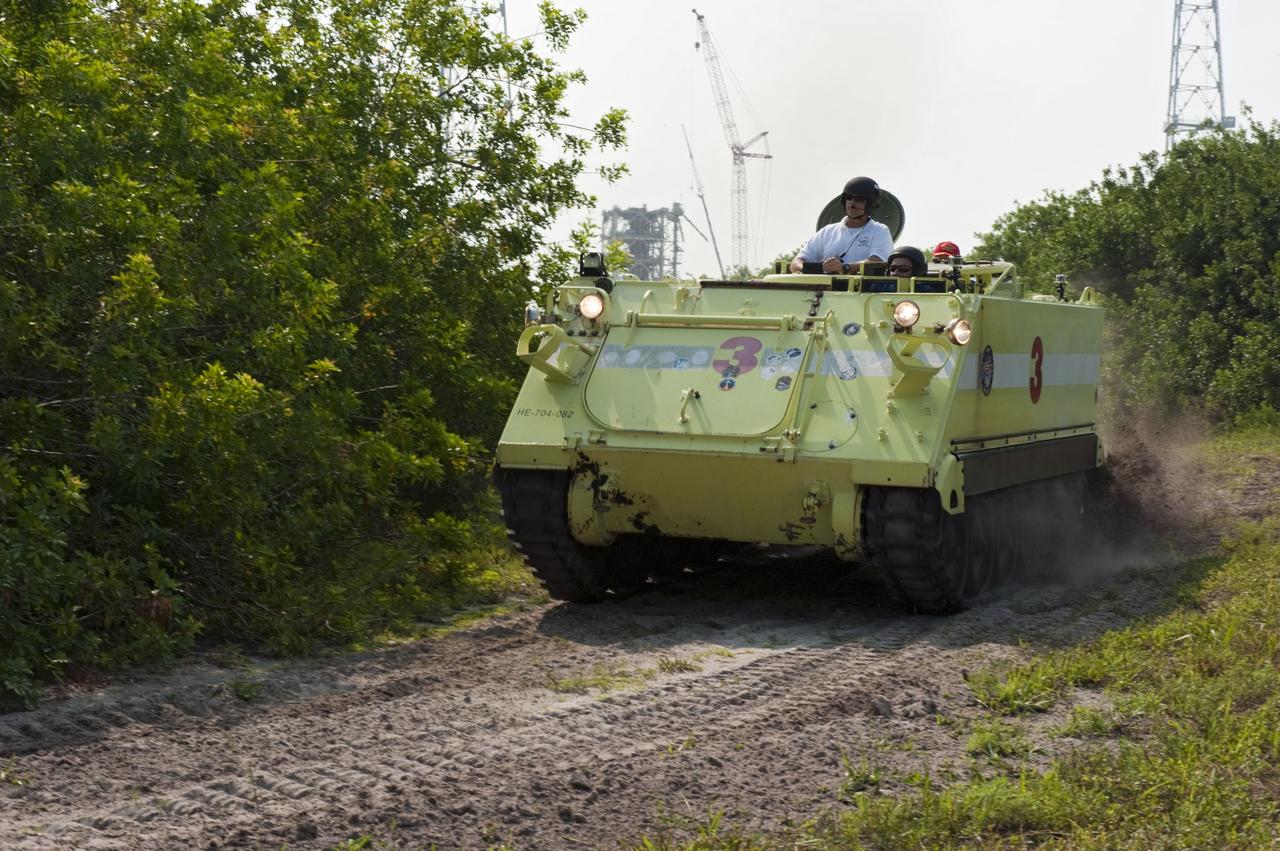
CAPE CANAVERAL, Fla. -- Battalion Chief David Seymour provides supervision while space shuttle Atlantis' STS-135 crew members participate in M113 armored personnel carrier training at NASA's Kennedy Space Center in Florida. Driving the M113 is Mission Specialist Sandy Magnus while Pilot Doug Hurley looks on. An M113 is kept at the foot of the launch pad in case an emergency exit from the launch pad is needed and every shuttle crew is trained on driving the vehicle before launch. The STS-135 crew is at Kennedy to participate in a launch countdown dress rehearsal called the Terminal Countdown Demonstration Test (TCDT) and related training. Atlantis and its crew are targeted to lift off July 8, taking with them the Raffaello multi-purpose logistics module packed with supplies and spare parts to the International Space Station. The STS-135 mission also will fly a system to investigate the potential for robotically refueling existing satellites and return a failed ammonia pump module to help NASA better understand the failure mechanism and improve pump designs for future systems. STS-135 will be the 33rd flight of Atlantis, the 37th shuttle mission to the space station, and the 135th and final mission of NASA's Space Shuttle Program. For more information visit, www.nasa.gov/mission_pages/shuttle/shuttlemissions/sts135/index.html. Photo credit: NASA/Kim Shiflett
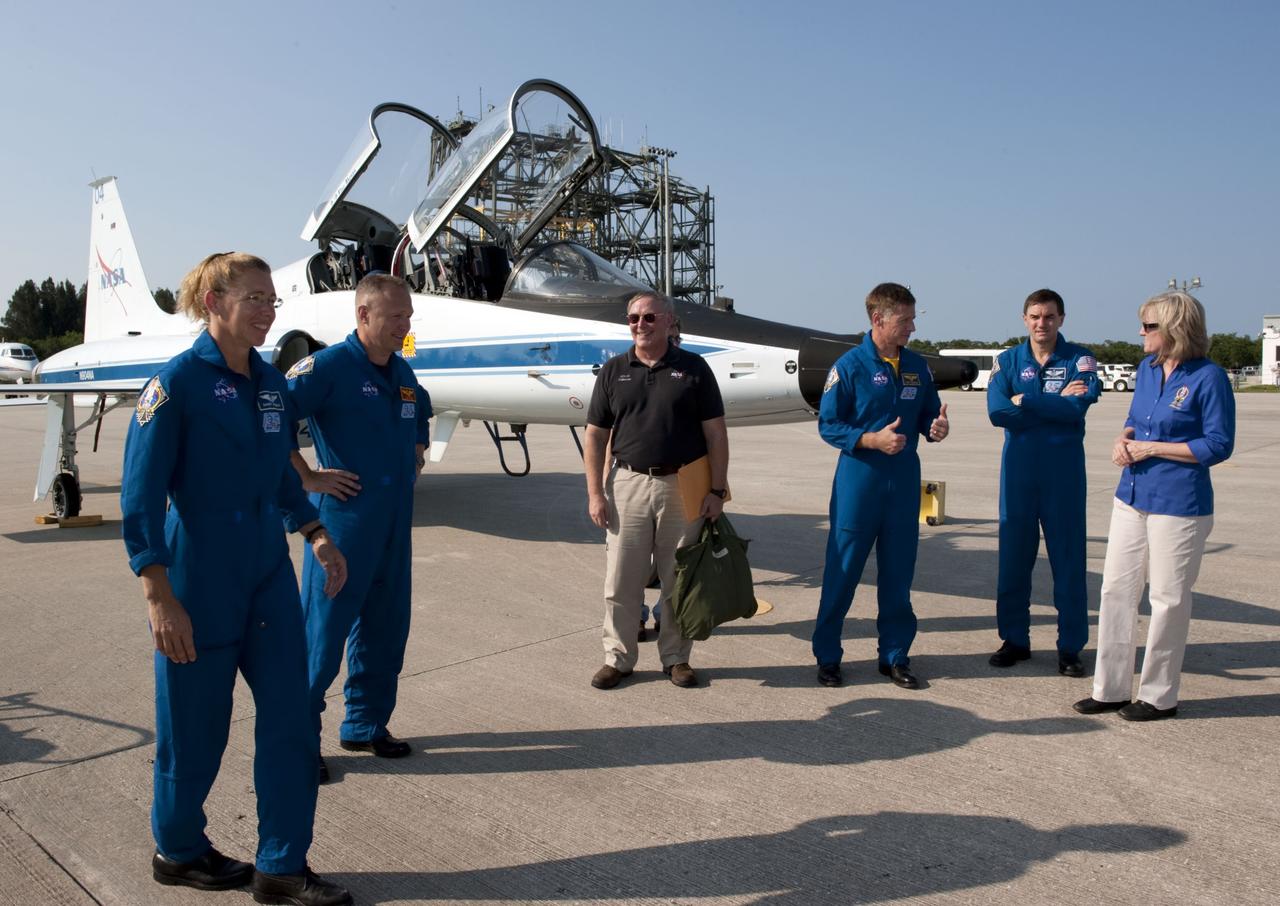
CAPE CANAVERAL, Fla. -- At the Shuttle Landing Facility at NASA's Kennedy Space Center in Florida, NASA Astronaut Jerry Ross (center) and space shuttle Atlantis' NASA Flow Director, Angie Brewer (right) are on hand greet the STS-135 crew. From left are Mission Specialist Sandy Magnus, Pilot Doug Hurley, Commander Chris Ferguson and Mission Specialist Rex Walheim. The crew arrived at Kennedy at about 5:30 p.m. EDT to participate in a launch countdown dress rehearsal called the Terminal Countdown Demonstration Test (TCDT) and related training in preparation for the upcoming STS-135 mission. Atlantis and its crew are targeted to lift off July 8, taking with them the Raffaello multi-purpose logistics module packed with supplies and spare parts to the International Space Station. The STS-135 mission also will fly a system to investigate the potential for robotically refueling existing satellites and return a failed ammonia pump module to help NASA better understand the failure mechanism and improve pump designs for future systems. STS-135 will be the 33rd flight of Atlantis, the 37th shuttle mission to the International Space Station, and the 135th and final mission of NASA's Space Shuttle Program. For more information visit, www.nasa.gov/mission_pages/shuttle/shuttlemissions/sts135/index.html. Photo credit: NASA/Kim Shiflett
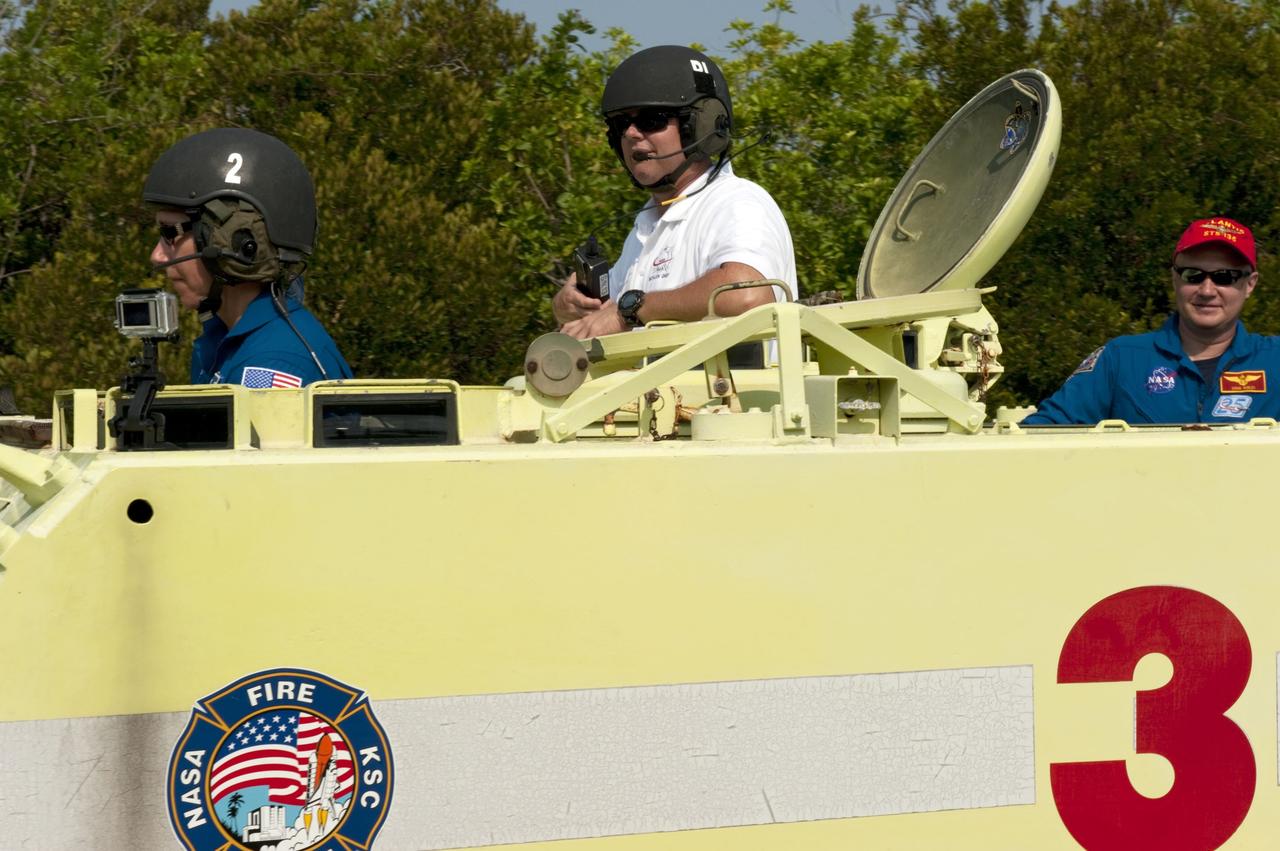
CAPE CANAVERAL, Fla. -- Battalion Chief David Seymour provides supervision while space shuttle Atlantis' STS-135 crew members participate in M113 armored personnel carrier training at NASA's Kennedy Space Center in Florida. Driving the M113 is Mission Specialist Sandy Magnus while Pilot Doug Hurley looks on. An M113 is kept at the foot of the launch pad in case an emergency exit from the launch pad is needed and every shuttle crew is trained on driving the vehicle before launch. The STS-135 crew is at Kennedy to participate in a launch countdown dress rehearsal called the Terminal Countdown Demonstration Test (TCDT) and related training. Atlantis and its crew are targeted to lift off July 8, taking with them the Raffaello multi-purpose logistics module packed with supplies and spare parts to the International Space Station. The STS-135 mission also will fly a system to investigate the potential for robotically refueling existing satellites and return a failed ammonia pump module to help NASA better understand the failure mechanism and improve pump designs for future systems. STS-135 will be the 33rd flight of Atlantis, the 37th shuttle mission to the space station, and the 135th and final mission of NASA's Space Shuttle Program. For more information visit, www.nasa.gov/mission_pages/shuttle/shuttlemissions/sts135/index.html. Photo credit: NASA/Kim Shiflett
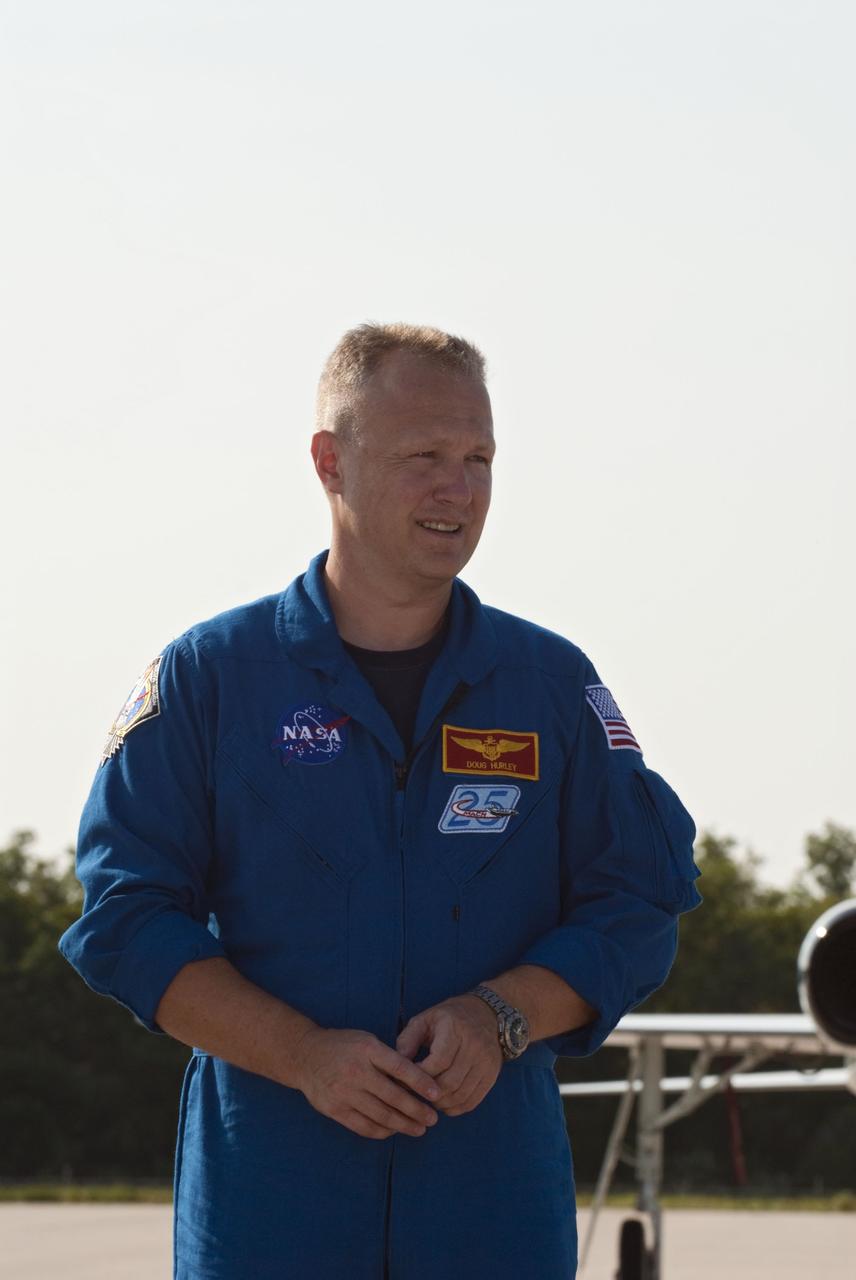
CAPE CANAVERAL, Fla. -- At the Shuttle Landing Facility at NASA's Kennedy Space Center in Florida, STS-135 Pilot Doug Hurley pauses for a photo. The space shuttle Atlantis crew arrived at Kennedy at about 5:30 p.m. EDT to participate in a launch countdown dress rehearsal called the Terminal Countdown Demonstration Test (TCDT) and related training in preparation for the upcoming STS-135 mission. Atlantis and its crew is targeted to lift off on July 8, taking with them the Raffaello multi-purpose logistics module packed with supplies and spare parts to the International Space Station. The STS-135 mission also will fly a system to investigate the potential for robotically refueling existing satellites and return a failed ammonia pump module to help NASA better understand the failure mechanism and improve pump designs for future systems. STS-135 will be the 33rd flight of Atlantis, the 37th shuttle mission to the space station, and the 135th and final mission of NASA's Space Shuttle Program. For more information visit, www.nasa.gov/mission_pages/shuttle/shuttlemissions/sts135/index.html. Photo credit: NASA/Kim Shiflett
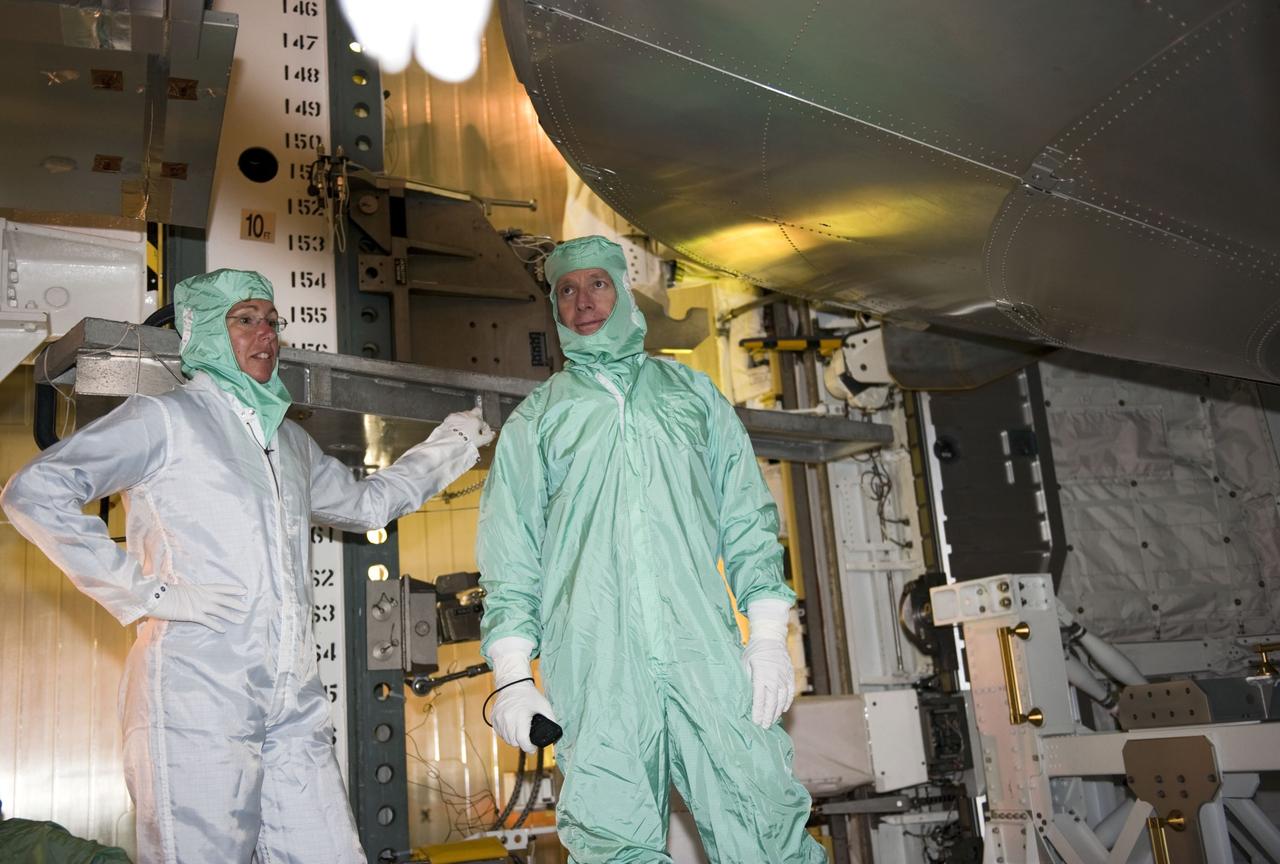
CAPE CANAVERAL, Fla. -- At Launch Pad 39A at NASA's Kennedy Space Center in Florida, space shuttle Atlantis' STS-135 crew members take part in a payload bay walkdown to check out the cargo secured in Atlantis' bay. Seen here are Mission Specialist Sandy Magnus (left) and Commander Chris Ferguson. The astronauts are at Kennedy to participate in a launch countdown dress rehearsal called the Terminal Countdown Demonstration Test (TCDT) and related training. Atlantis and its crew are targeted to lift off July 8, taking with them the Raffaello multi-purpose logistics module packed with supplies and spare parts to the International Space Station. The STS-135 mission also will fly a system to investigate the potential for robotically refueling existing satellites and return a failed ammonia pump module to help NASA better understand the failure mechanism and improve pump designs for future systems. STS-135 will be the 33rd flight of Atlantis, the 37th shuttle mission to the space station, and the 135th and final mission of NASA's Space Shuttle Program. For more information visit, www.nasa.gov/mission_pages/shuttle/shuttlemissions/sts135/index.html. Photo credit: NASA/Kim Shiflett
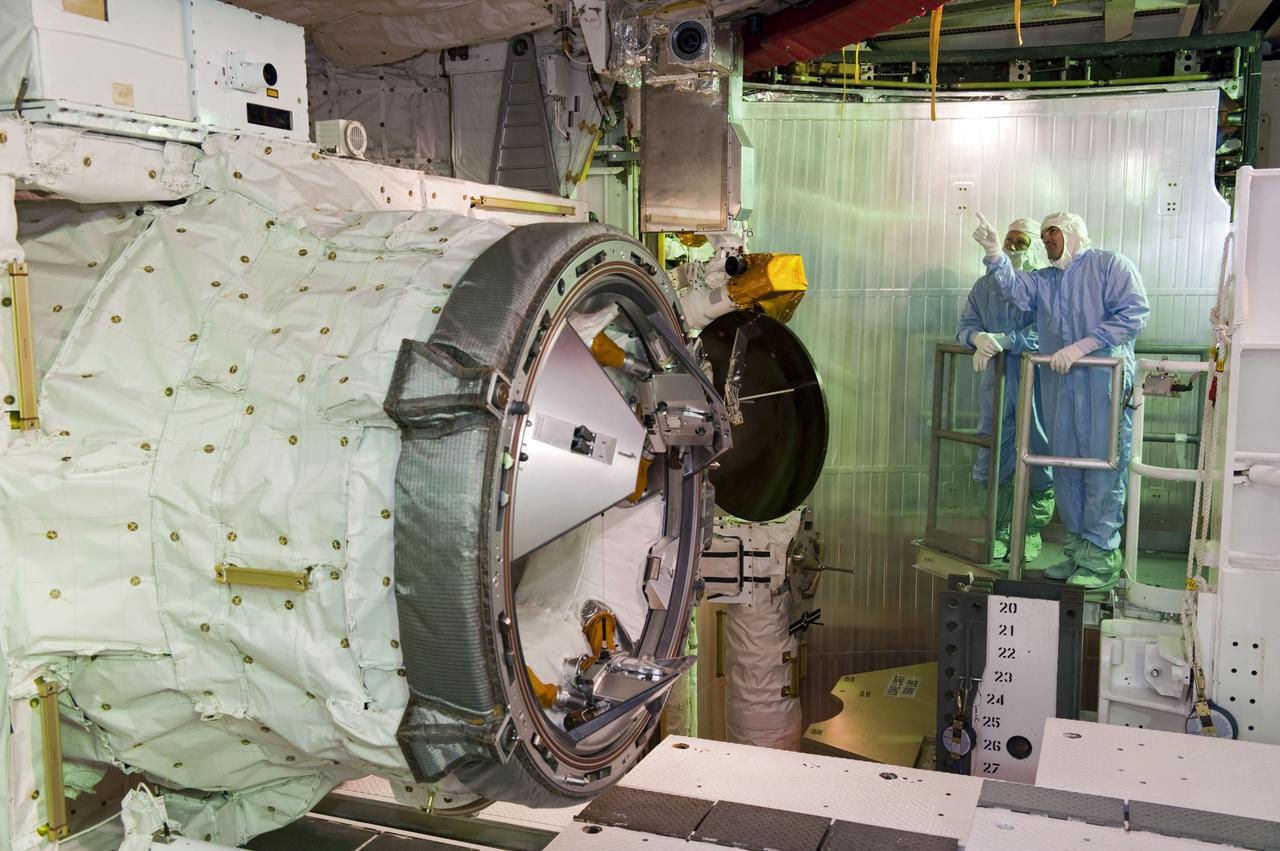
CAPE CANAVERAL, Fla. -- At Launch Pad 39A at NASA's Kennedy Space Center in Florida, space shuttle Atlantis' STS-135 crew members take part in a payload bay walkdown to check out the cargo secured in Atlantis' bay. Seen here inspecting the airlock are Pilot Doug Hurley (left) and Mission Specialist Rex Walheim. The astronauts are at Kennedy to participate in a launch countdown dress rehearsal called the Terminal Countdown Demonstration Test (TCDT) and related training. Atlantis and its crew are targeted to lift off July 8, taking with them the Raffaello multi-purpose logistics module packed with supplies and spare parts to the International Space Station. The STS-135 mission also will fly a system to investigate the potential for robotically refueling existing satellites and return a failed ammonia pump module to help NASA better understand the failure mechanism and improve pump designs for future systems. STS-135 will be the 33rd flight of Atlantis, the 37th shuttle mission to the space station, and the 135th and final mission of NASA's Space Shuttle Program. For more information visit, www.nasa.gov/mission_pages/shuttle/shuttlemissions/sts135/index.html. Photo credit: NASA/Kim Shiflett
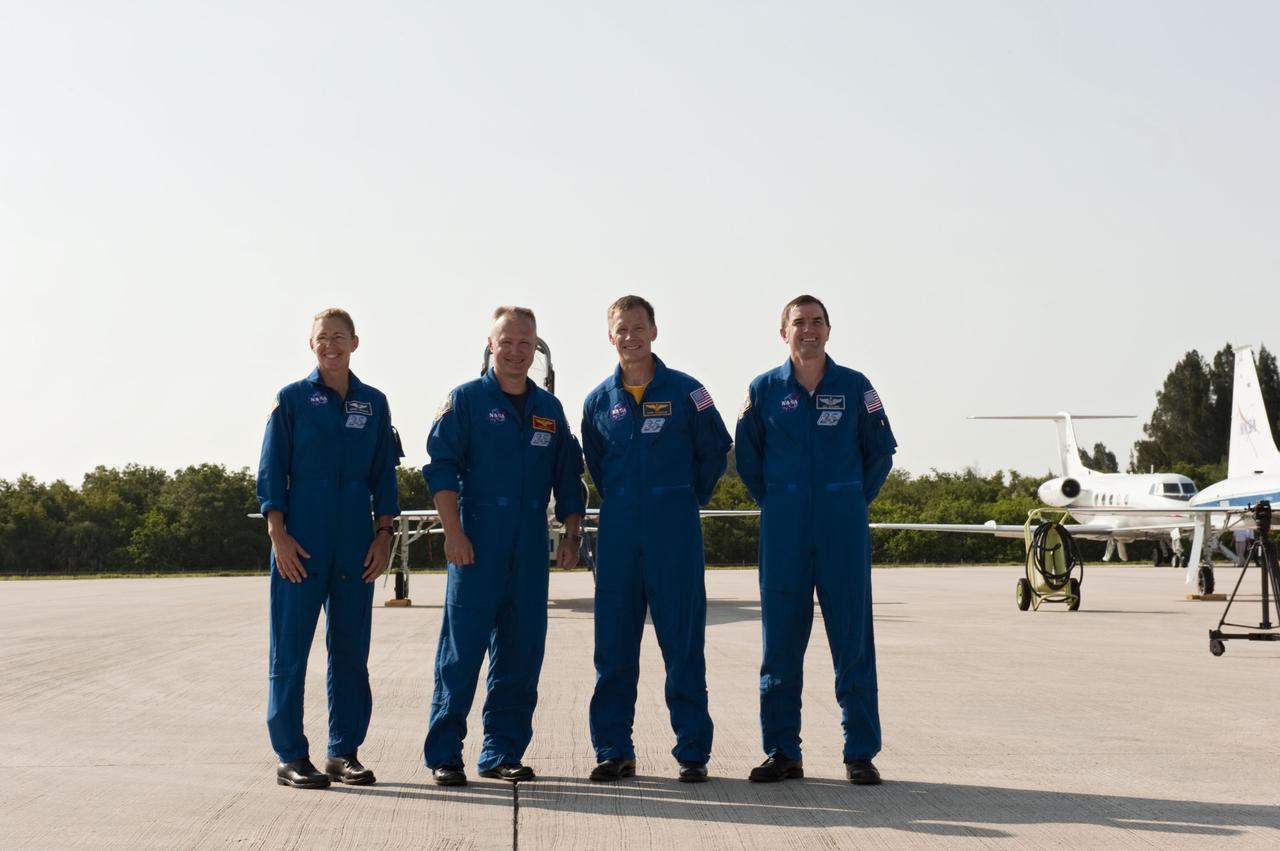
CAPE CANAVERAL, Fla. -- Space shuttle Atlantis' STS-135 crew members pose for a group photo on the Shuttle Landing Facility at NASA's Kennedy Space Center in Florida. From left are Mission Specialist Sandy Magnus, Pilot Doug Hurley, Commander Chris Ferguson and Mission Specialist Rex Walheim. The crew arrived at Kennedy at about 5:30 p.m. EDT to participate in a launch countdown dress rehearsal called the Terminal Countdown Demonstration Test (TCDT) and related training in preparation for the upcoming STS-135 mission. Targeted to lift off July 8, the Atlantis crew will deliver the Raffaello multi-purpose logistics module packed with supplies and spare parts to the International Space Station. Atlantis also will fly a system to investigate the potential for robotically refueling existing satellites and return a failed ammonia pump module to help NASA better understand the failure mechanism and improve pump designs for future systems. STS-135 will be the 33rd flight of Atlantis, the 37th shuttle mission to the station, and the 135th and final mission of NASA's Space Shuttle Program. For more information visit, www.nasa.gov/mission_pages/shuttle/shuttlemissions/sts135/index.html. Photo credit: NASA/Kim Shiflett
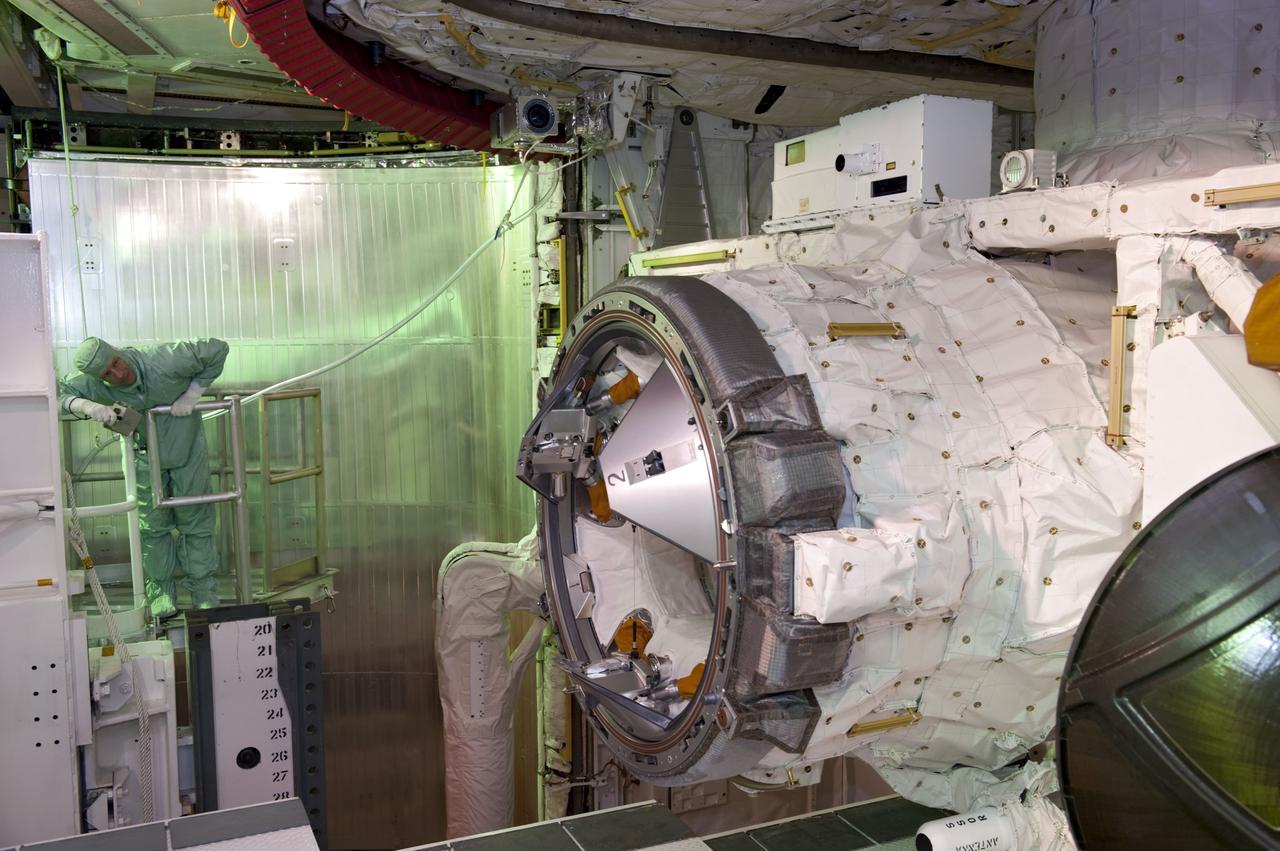
CAPE CANAVERAL, Fla. -- At Launch Pad 39A at NASA's Kennedy Space Center in Florida, space shuttle Atlantis' STS-135 crew members take part in a payload bay walkdown to check out the cargo secured in Atlantis' bay. Seen here inspecting the airlock is Commander Chris Ferguson. The astronauts are at Kennedy to participate in a launch countdown dress rehearsal called the Terminal Countdown Demonstration Test (TCDT) and related training. Atlantis and its crew are targeted to lift off July 8, taking with them the Raffaello multi-purpose logistics module packed with supplies and spare parts to the International Space Station. The STS-135 mission also will fly a system to investigate the potential for robotically refueling existing satellites and return a failed ammonia pump module to help NASA better understand the failure mechanism and improve pump designs for future systems. STS-135 will be the 33rd flight of Atlantis, the 37th shuttle mission to the space station, and the 135th and final mission of NASA's Space Shuttle Program. For more information visit, www.nasa.gov/mission_pages/shuttle/shuttlemissions/sts135/index.html. Photo credit: NASA/Kim Shiflett
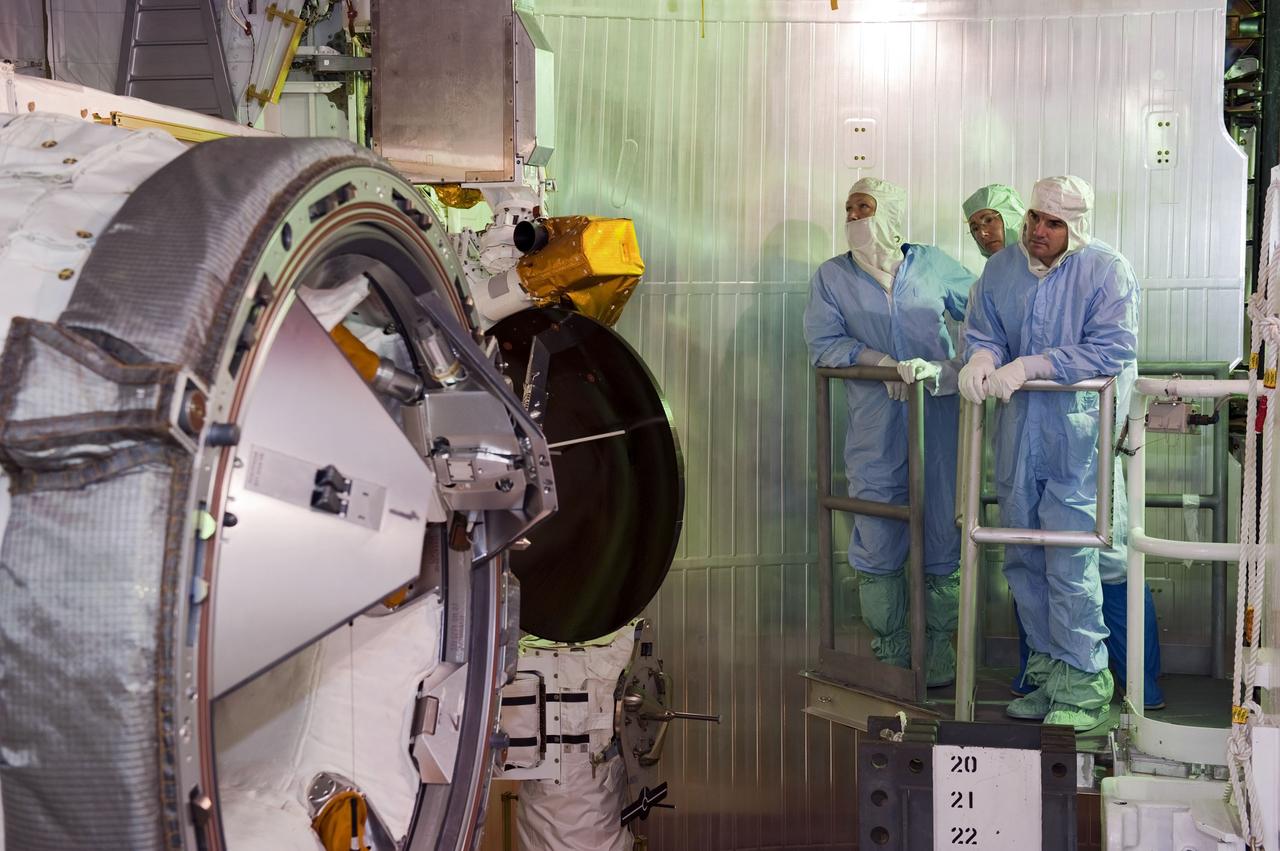
CAPE CANAVERAL, Fla. -- At Launch Pad 39A at NASA's Kennedy Space Center in Florida, space shuttle Atlantis' STS-135 crew members take part in a payload bay walkdown to check out the cargo secured in Atlantis' bay. Seen here inspecting the airlock are Pilot Doug Hurley (left), and Mission Specialists Sandy Magnus and Rex Walheim. The astronauts are at Kennedy to participate in a launch countdown dress rehearsal called the Terminal Countdown Demonstration Test (TCDT) and related training. Atlantis and its crew are targeted to lift off July 8, taking with them the Raffaello multi-purpose logistics module packed with supplies and spare parts to the International Space Station. The STS-135 mission also will fly a system to investigate the potential for robotically refueling existing satellites and return a failed ammonia pump module to help NASA better understand the failure mechanism and improve pump designs for future systems. STS-135 will be the 33rd flight of Atlantis, the 37th shuttle mission to the space station, and the 135th and final mission of NASA's Space Shuttle Program. For more information visit, www.nasa.gov/mission_pages/shuttle/shuttlemissions/sts135/index.html. Photo credit: NASA/Kim Shiflett
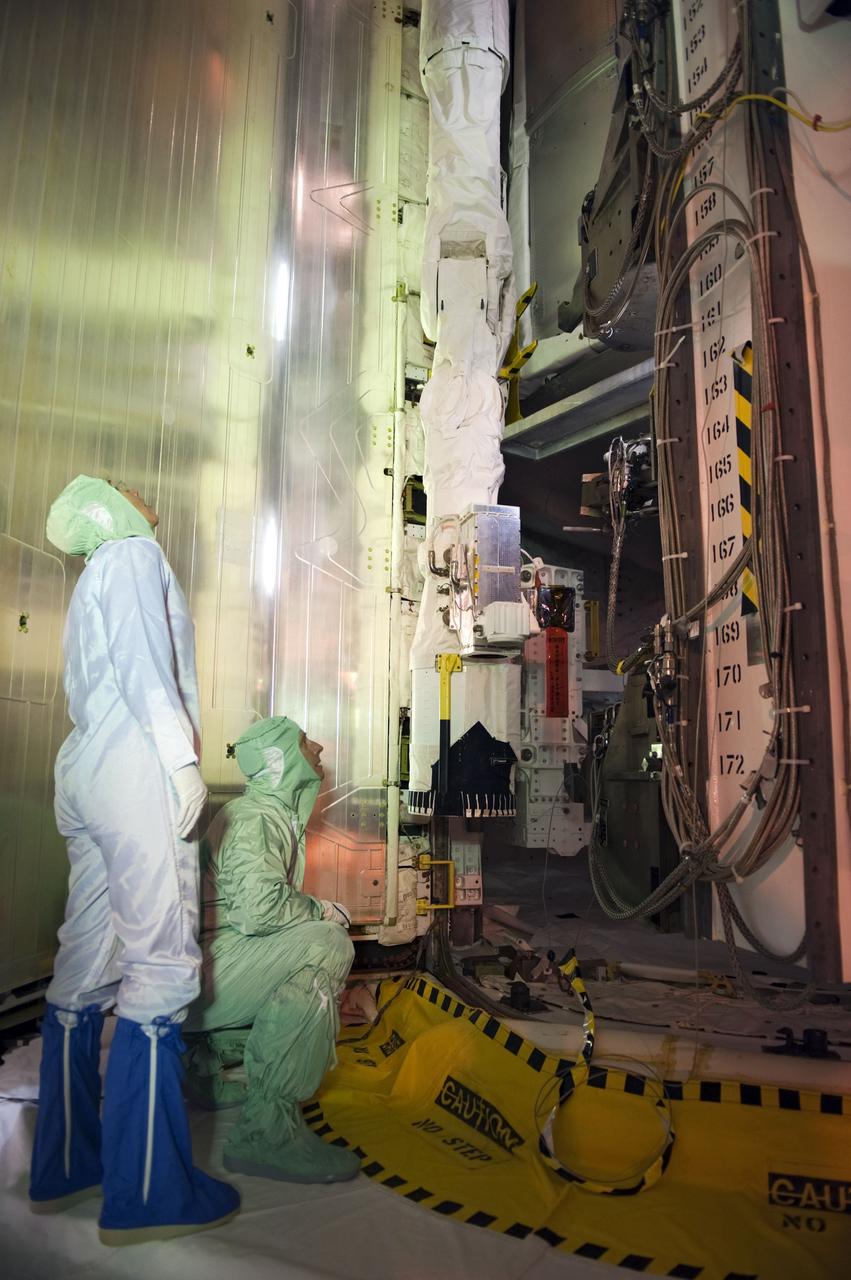
CAPE CANAVERAL, Fla. -- At Launch Pad 39A at NASA's Kennedy Space Center in Florida, space shuttle Atlantis' STS-135 crew members take part in a payload bay walkdown to check out the cargo secured in Atlantis' bay. Seen here are Mission Specialist Sandy Magnus (left) and Commander Chris Ferguson. The astronauts are at Kennedy to participate in a launch countdown dress rehearsal called the Terminal Countdown Demonstration Test (TCDT) and related training. Atlantis and its crew are targeted to lift off July 8, taking with them the Raffaello multi-purpose logistics module packed with supplies and spare parts to the International Space Station. The STS-135 mission also will fly a system to investigate the potential for robotically refueling existing satellites and return a failed ammonia pump module to help NASA better understand the failure mechanism and improve pump designs for future systems. STS-135 will be the 33rd flight of Atlantis, the 37th shuttle mission to the space station, and the 135th and final mission of NASA's Space Shuttle Program. For more information visit, www.nasa.gov/mission_pages/shuttle/shuttlemissions/sts135/index.html. Photo credit: NASA/Kim Shiflett
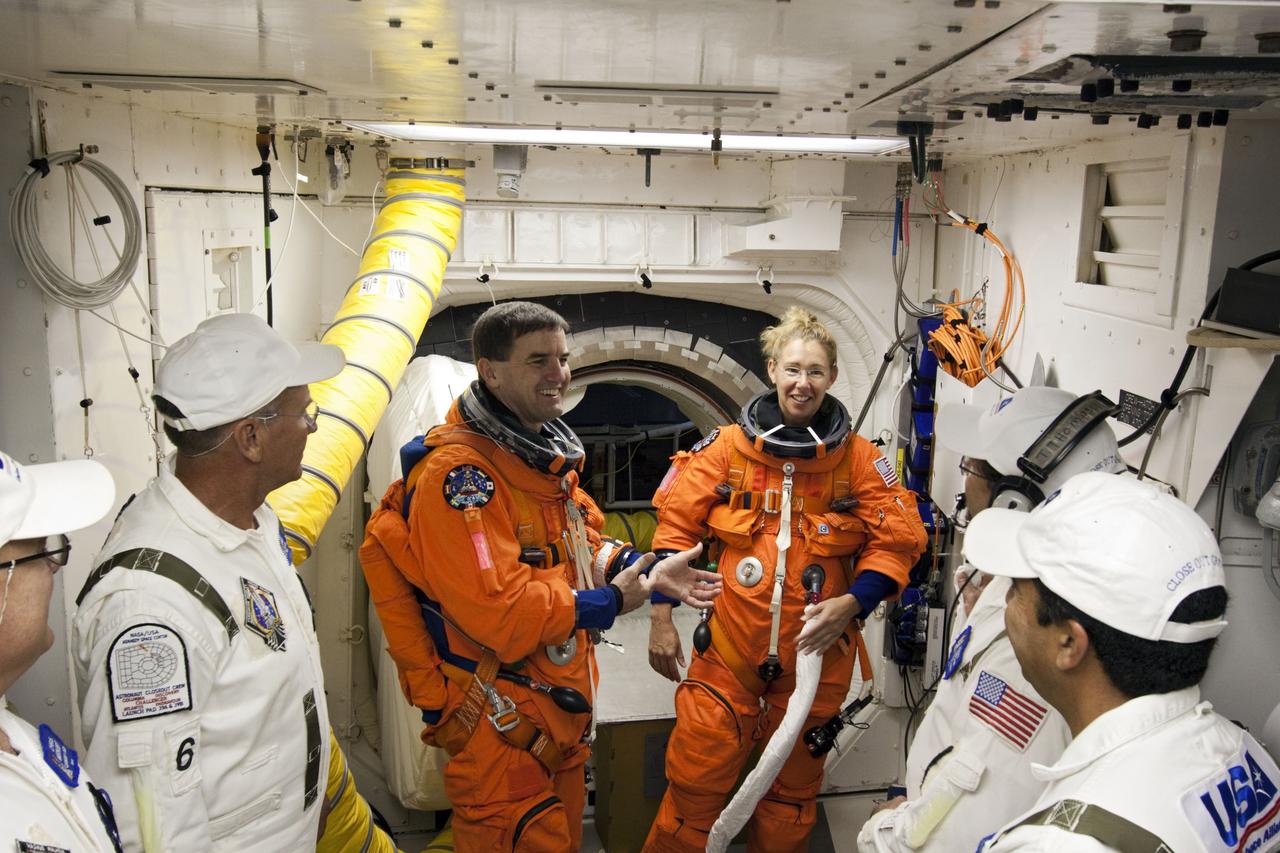
CAPE CANAVERAL, Fla. -- In the White Room at Launch Pad 39A at NASA's Kennedy Space Center in Florida, STS-135 Mission Specialists Rex Walheim and Sandy Magnus enjoy a light moment with the Closeout Crew before boarding space shuttle Atlantis through the crew hatch in the background. Members of the Closeout Crew, in white uniforms, are there to assist astronauts with their launch-and-entry suits and the boarding process. Seen in the background is Mission Specialist Sandy Magnus speaking with a Closeout Crew member. The STS-135 crew is at the pad to participate in a launch countdown simulation exercise. As part of the Terminal Countdown Demonstration Test (TCDT), the crew members are strapped into their seats on Atlantis to practice the steps that will be taken on launch day. Shuttle Atlantis and its crew are targeted to lift off July 8, taking with them the Raffaello multi-purpose logistics module packed with supplies and spare parts to the International Space Station. The STS-135 mission also will fly a system to investigate the potential for robotically refueling existing satellites and return a failed ammonia pump module to help NASA better understand the failure mechanism and improve pump designs for future systems. STS-135 will be the 33rd flight of Atlantis, the 37th shuttle mission to the space station, and the 135th and final mission of NASA's Space Shuttle Program. For more information visit, www.nasa.gov/mission_pages/shuttle/shuttlemissions/sts135/index.html. Photo credit: NASA/Jim Grossmann
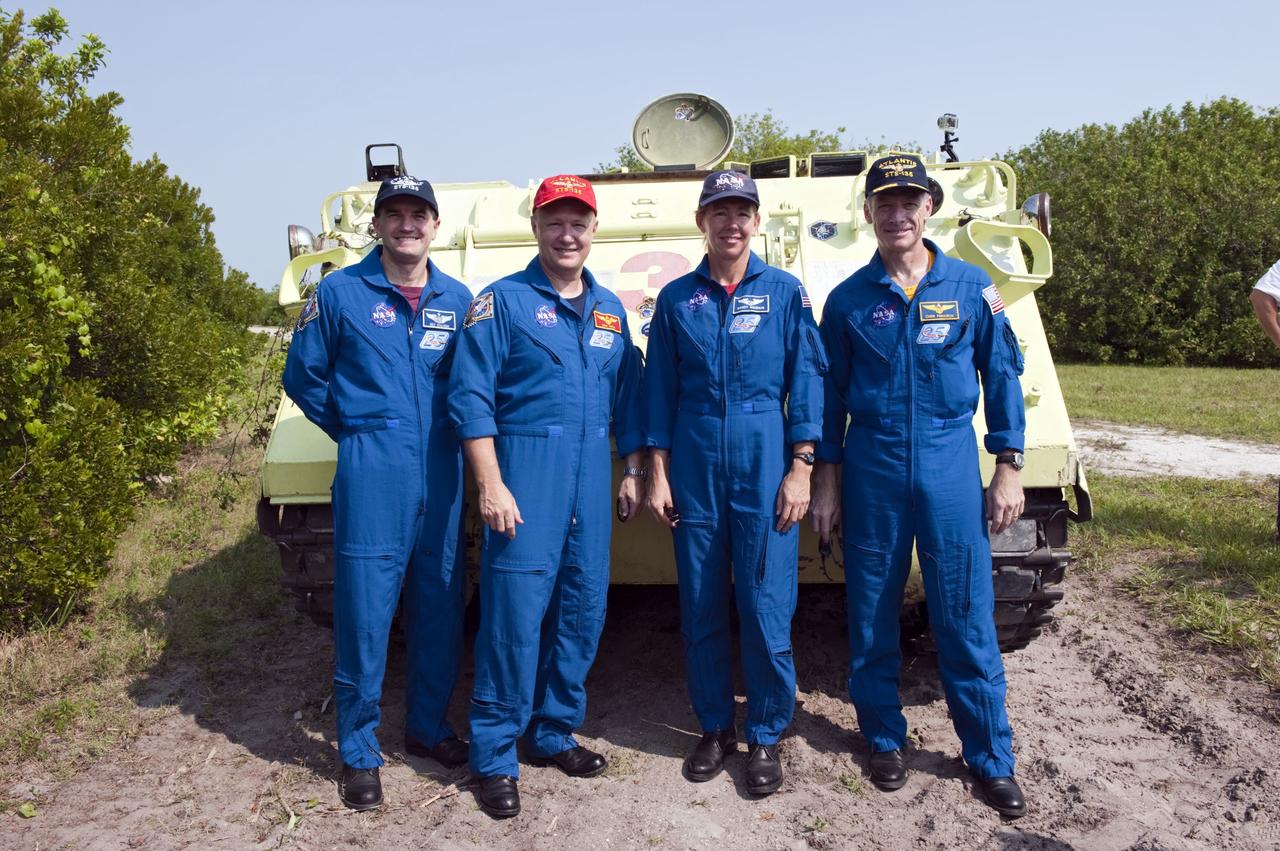
CAPE CANAVERAL, Fla. -- The STS-135 crew pause for a photo at the conclusion of their M113 armored personnel carrier training at NASA's Kennedy Space Center in Florida. Seen here are Mission Specialist Rex Walheim (left), Pilot Doug Hurley, Mission Specialist Sandy Magnus and Commander Chris Ferguson. An M113 is kept at the foot of the launch pad in case an emergency exit from the launch pad is needed and every shuttle crew is trained on driving the vehicle before launch. The STS-135 crew is at Kennedy to participate in a launch countdown dress rehearsal called the Terminal Countdown Demonstration Test (TCDT) and related training. Atlantis and its crew are targeted to lift off July 8, taking with them the Raffaello multi-purpose logistics module packed with supplies and spare parts to the International Space Station. The STS-135 mission also will fly a system to investigate the potential for robotically refueling existing satellites and return a failed ammonia pump module to help NASA better understand the failure mechanism and improve pump designs for future systems. STS-135 will be the 33rd flight of Atlantis, the 37th shuttle mission to the space station, and the 135th and final mission of NASA's Space Shuttle Program. For more information visit, www.nasa.gov/mission_pages/shuttle/shuttlemissions/sts135/index.html. Photo credit: NASA/Kim Shiflett
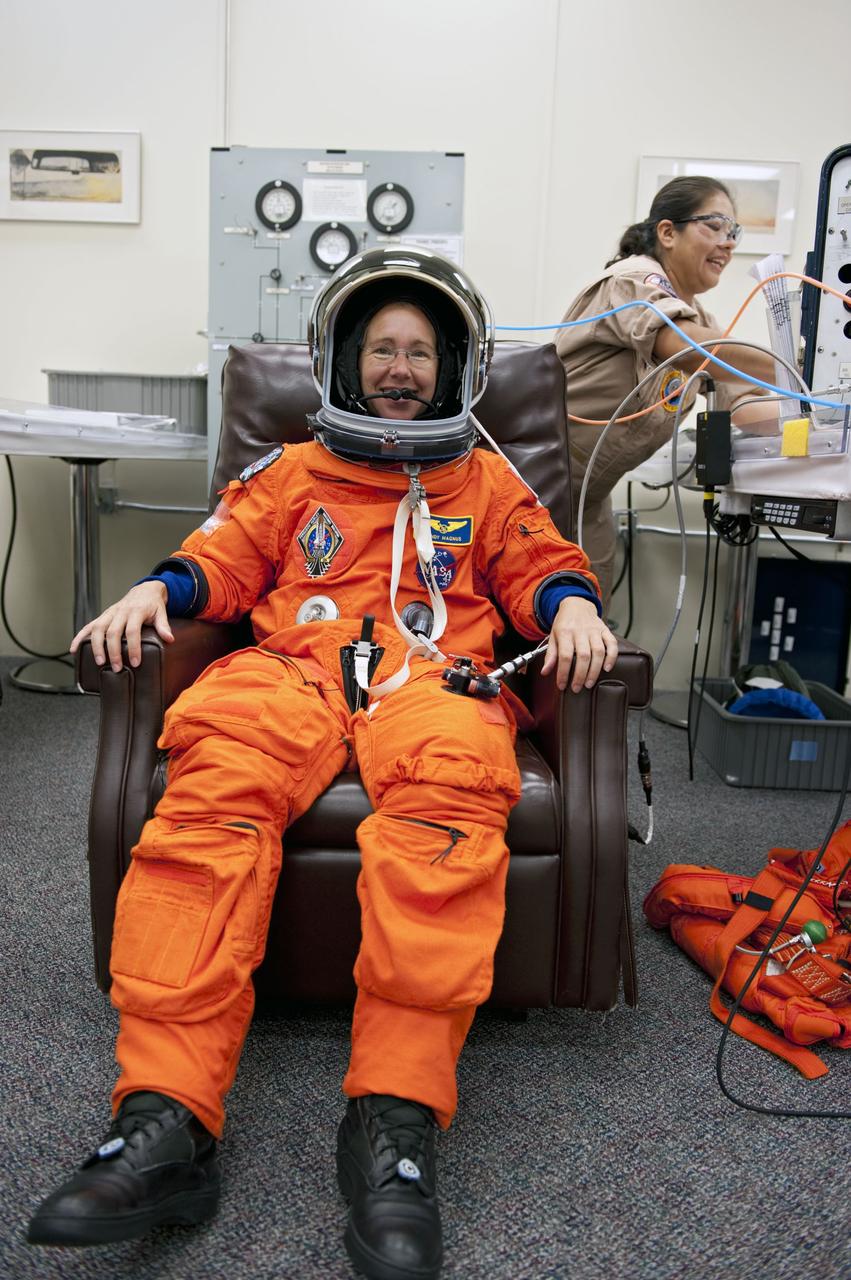
CAPE CANAVERAL, Fla. -- In the Operations and Checkout Building at NASA's Kennedy Space Center in Florida, Mission Specialist Sandy Magnus has her launch and landing suit checked by suit technician Cathy Cruz (background right). The STS-135 crew is at Kennedy to participate in a launch countdown dress rehearsal called the Terminal Countdown Demonstration Test (TCDT) and related training in preparation for the upcoming STS-135 mission. Atlantis and its crew are targeted to lift off July 8, taking with them the Raffaello multi-purpose logistics module packed with supplies and spare parts to the International Space Station. The STS-135 mission also will fly a system to investigate the potential for robotically refueling existing satellites and return a failed ammonia pump module to help NASA better understand the failure mechanism and improve pump designs for future systems. STS-135 will be the 33rd flight of Atlantis, the 37th shuttle mission to the space station, and the 135th and final mission of NASA's Space Shuttle Program. For more information visit, www.nasa.gov/mission_pages/shuttle/shuttlemissions/sts135/index.html. Photo credit: NASA/Kim Shiflett
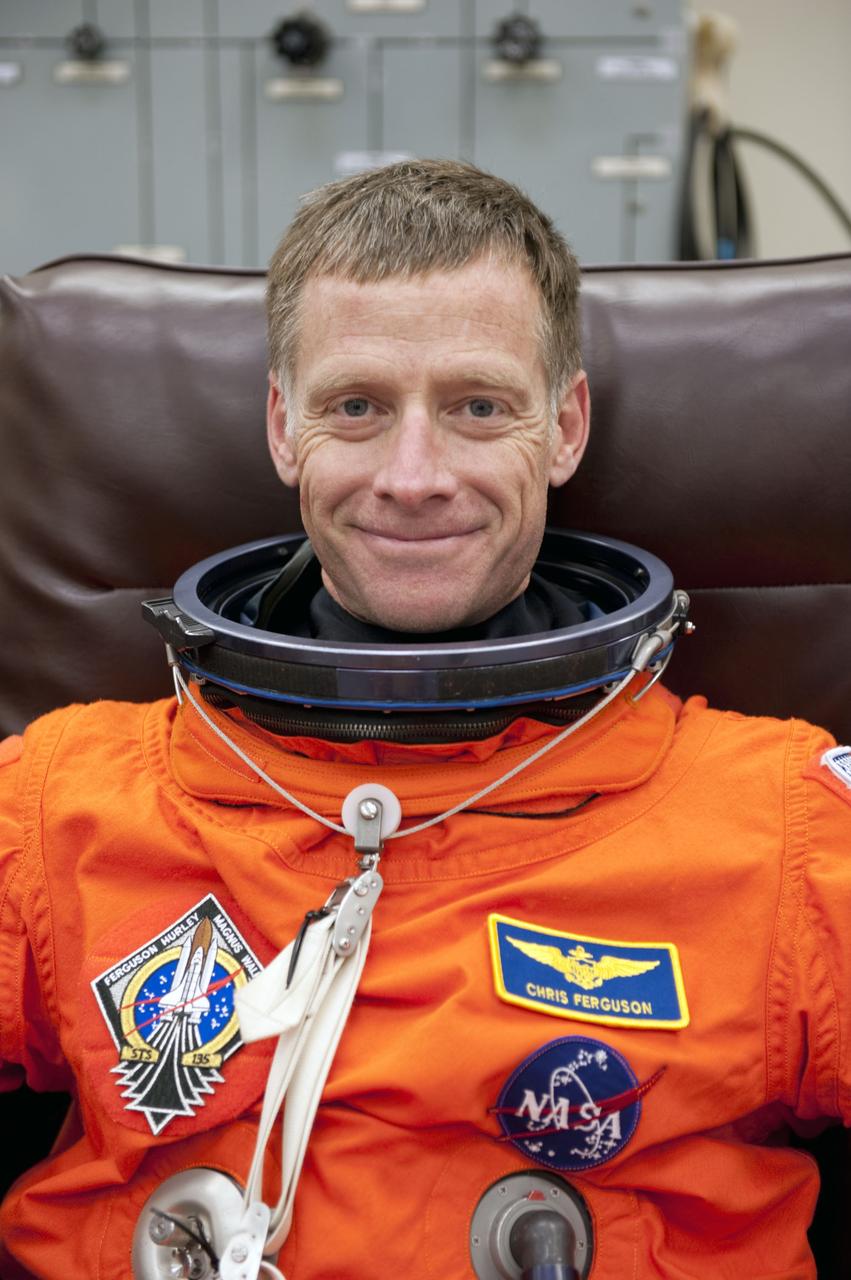
CAPE CANAVERAL, Fla. -- In the Operations and Checkout Building at NASA's Kennedy Space Center in Florida, Commander Chris Ferguson checks the fit of his launch and landing suit. The STS-135 crew is at Kennedy to participate in a launch countdown dress rehearsal called the Terminal Countdown Demonstration Test (TCDT) and related training in preparation for the upcoming STS-135 mission. Atlantis and its crew are targeted to lift off July 8, taking with them the Raffaello multi-purpose logistics module packed with supplies and spare parts to the International Space Station. The STS-135 mission also will fly a system to investigate the potential for robotically refueling existing satellites and return a failed ammonia pump module to help NASA better understand the failure mechanism and improve pump designs for future systems. STS-135 will be the 33rd flight of Atlantis, the 37th shuttle mission to the space station, and the 135th and final mission of NASA's Space Shuttle Program. For more information visit, www.nasa.gov/mission_pages/shuttle/shuttlemissions/sts135/index.html. Photo credit: NASA/Kim Shiflett
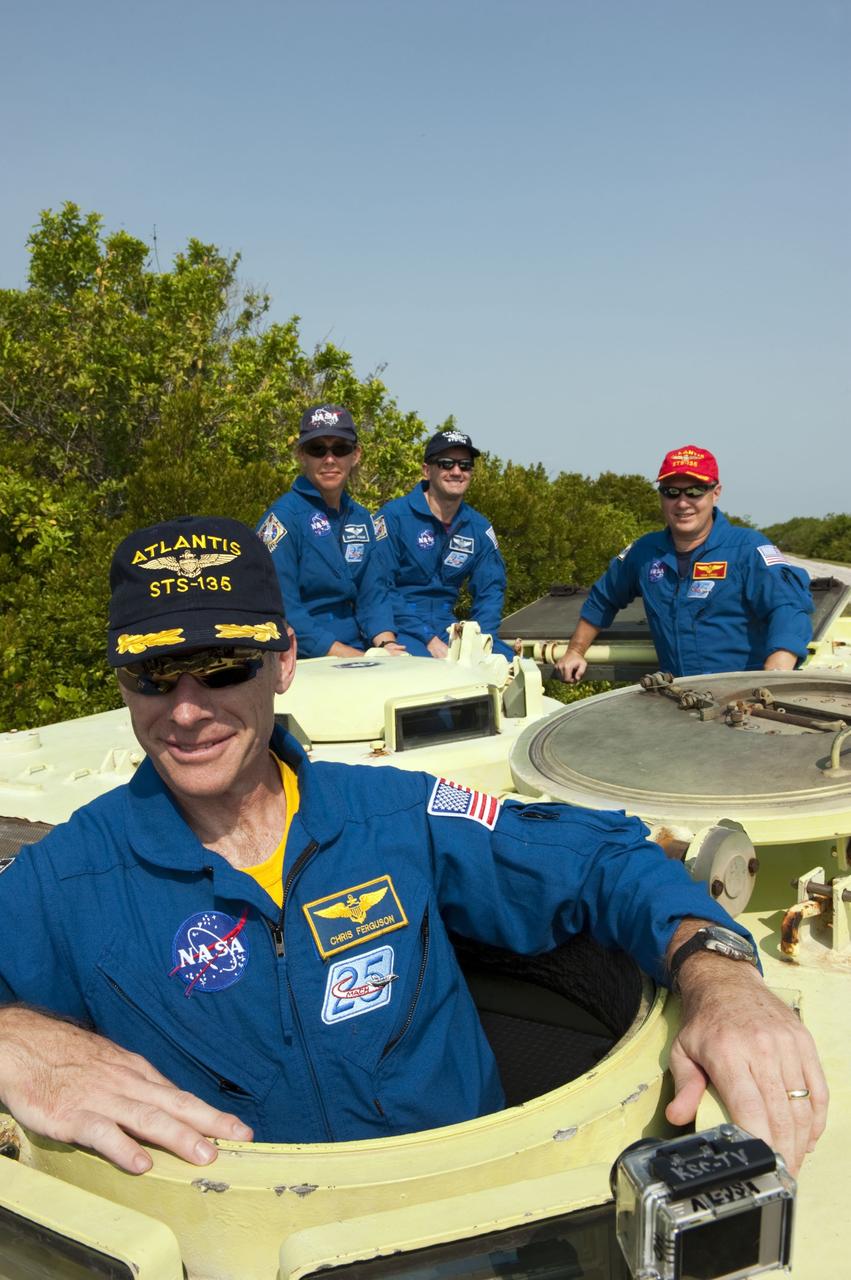
CAPE CANAVERAL, Fla. -- The STS-135 crew pause for a photo during their M113 armored personnel carrier training at NASA's Kennedy Space Center in Florida. Seen here are Commander Chris Ferguson (front), Mission Specialists Sandy Magnus, Rex Walheim and Pilot Doug Hurley (red cap). An M113 is kept at the foot of the launch pad in case an emergency exit from the launch pad is needed and every shuttle crew is trained on driving the vehicle before launch. The STS-135 crew is at Kennedy to participate in a launch countdown dress rehearsal called the Terminal Countdown Demonstration Test (TCDT) and related training. Atlantis and its crew are targeted to lift off July 8, taking with them the Raffaello multi-purpose logistics module packed with supplies and spare parts to the International Space Station. The STS-135 mission also will fly a system to investigate the potential for robotically refueling existing satellites and return a failed ammonia pump module to help NASA better understand the failure mechanism and improve pump designs for future systems. STS-135 will be the 33rd flight of Atlantis, the 37th shuttle mission to the space station, and the 135th and final mission of NASA's Space Shuttle Program. For more information visit, www.nasa.gov/mission_pages/shuttle/shuttlemissions/sts135/index.html. Photo credit: NASA/Kim Shiflett
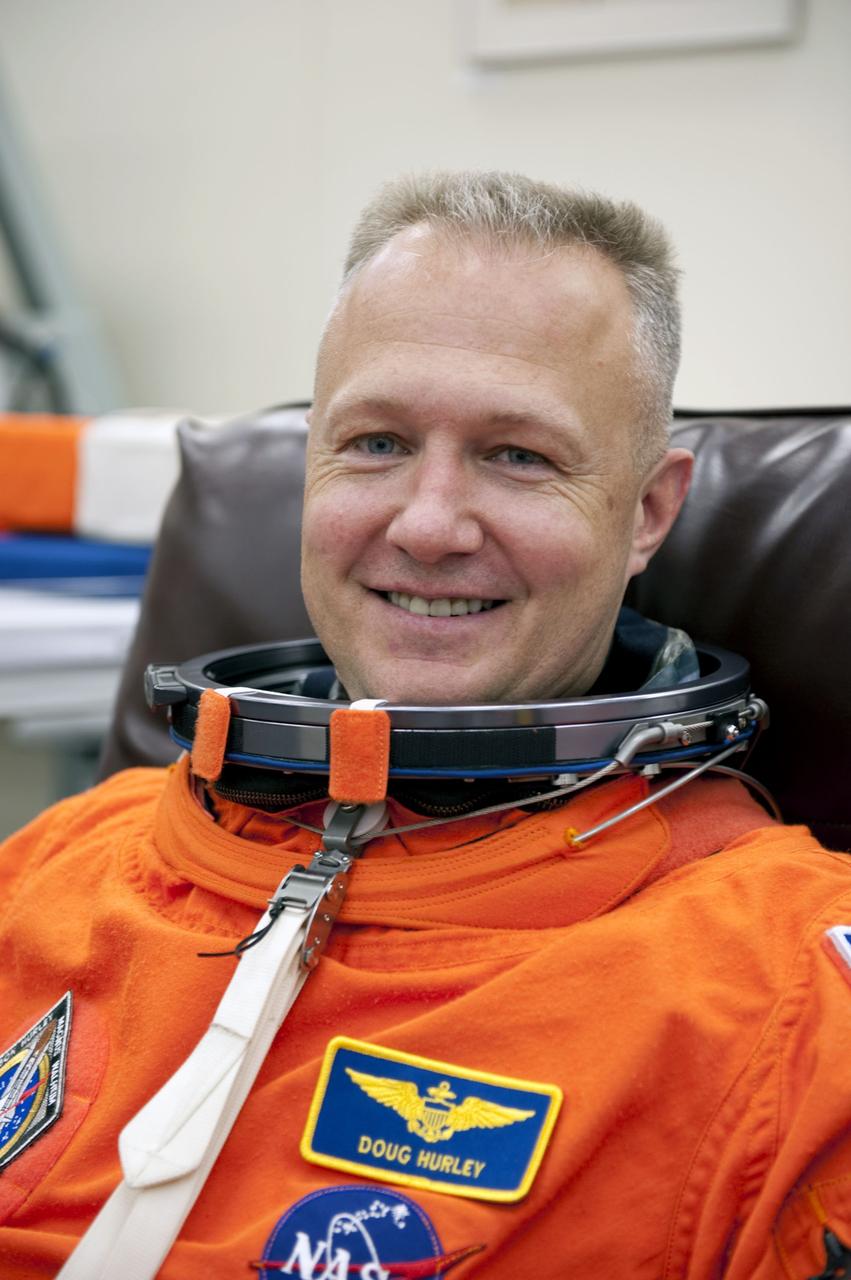
CAPE CANAVERAL, Fla. -- In the Operations and Checkout Building at NASA's Kennedy Space Center in Florida, Pilot Doug Hurley checks the fit of his launch and landing suit. The STS-135 crew is at Kennedy to participate in a launch countdown dress rehearsal called the Terminal Countdown Demonstration Test (TCDT) and related training in preparation for the upcoming STS-135 mission. Atlantis and its crew are targeted to lift off July 8, taking with them the Raffaello multi-purpose logistics module packed with supplies and spare parts to the International Space Station. The STS-135 mission also will fly a system to investigate the potential for robotically refueling existing satellites and return a failed ammonia pump module to help NASA better understand the failure mechanism and improve pump designs for future systems. STS-135 will be the 33rd flight of Atlantis, the 37th shuttle mission to the space station, and the 135th and final mission of NASA's Space Shuttle Program. For more information visit, www.nasa.gov/mission_pages/shuttle/shuttlemissions/sts135/index.html. Photo credit: NASA/Kim Shiflett
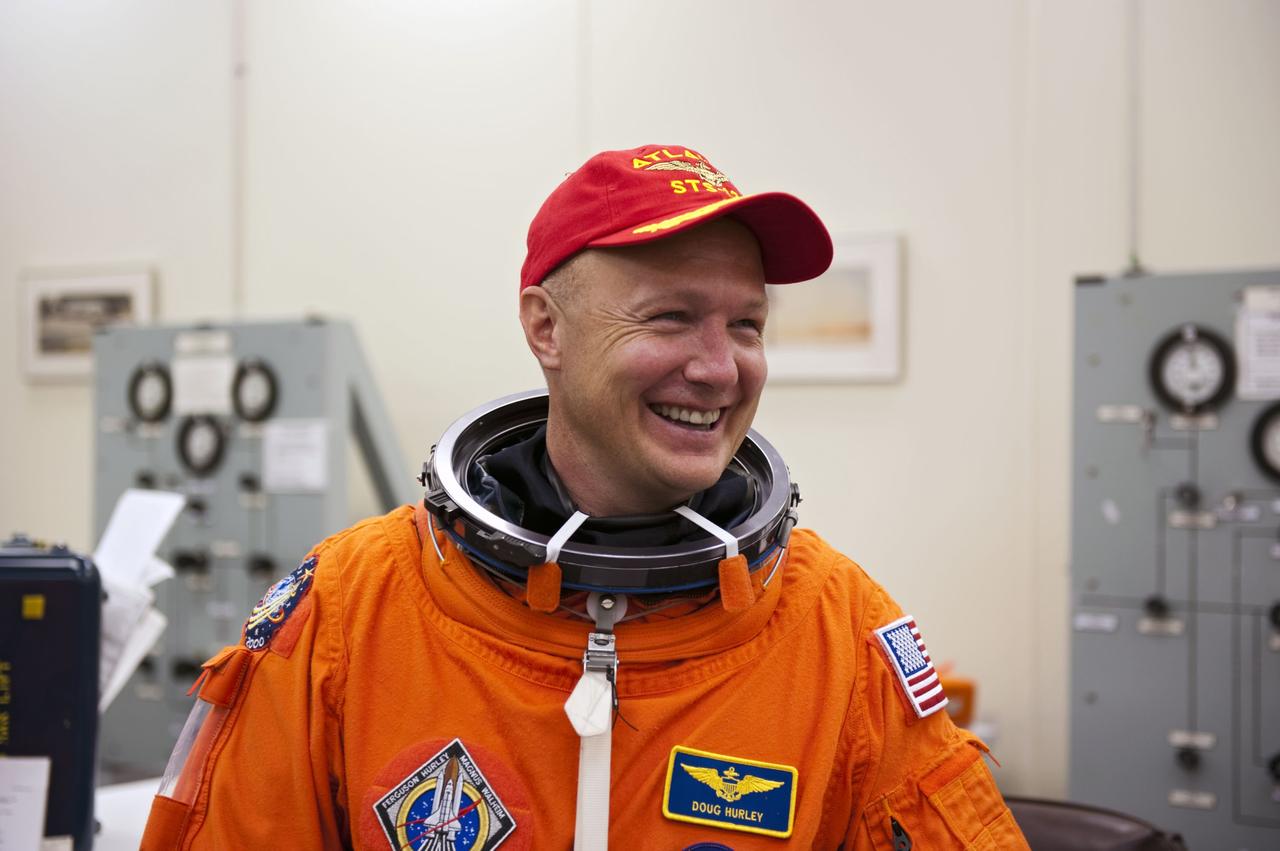
CAPE CANAVERAL, Fla. -- In the Operations and Checkout Building at NASA's Kennedy Space Center in Florida, Pilot Doug Hurley pauses for a photo after donning his launch and landing suit. The STS-135 crew is at Kennedy to participate in a launch countdown dress rehearsal called the Terminal Countdown Demonstration Test (TCDT) and related training in preparation for the upcoming STS-135 mission. Atlantis and its crew are targeted to lift off July 8, taking with them the Raffaello multi-purpose logistics module packed with supplies and spare parts to the International Space Station. The STS-135 mission also will fly a system to investigate the potential for robotically refueling existing satellites and return a failed ammonia pump module to help NASA better understand the failure mechanism and improve pump designs for future systems. STS-135 will be the 33rd flight of Atlantis, the 37th shuttle mission to the space station, and the 135th and final mission of NASA's Space Shuttle Program. For more information visit, www.nasa.gov/mission_pages/shuttle/shuttlemissions/sts135/index.html. Photo credit: NASA/Kim Shiflett

CAPE CANAVERAL, Fla. -- In the Operations and Checkout Building at NASA's Kennedy Space Center in Florida, Mission Specialist Sandy Magnus checks the fit of her launch and landing suit. The STS-135 crew is at Kennedy to participate in a launch countdown dress rehearsal called the Terminal Countdown Demonstration Test (TCDT) and related training in preparation for the upcoming STS-135 mission. Atlantis and its crew are targeted to lift off July 8, taking with them the Raffaello multi-purpose logistics module packed with supplies and spare parts to the International Space Station. The STS-135 mission also will fly a system to investigate the potential for robotically refueling existing satellites and return a failed ammonia pump module to help NASA better understand the failure mechanism and improve pump designs for future systems. STS-135 will be the 33rd flight of Atlantis, the 37th shuttle mission to the space station, and the 135th and final mission of NASA's Space Shuttle Program. For more information visit, www.nasa.gov/mission_pages/shuttle/shuttlemissions/sts135/index.html. Photo credit: NASA/Kim Shiflett
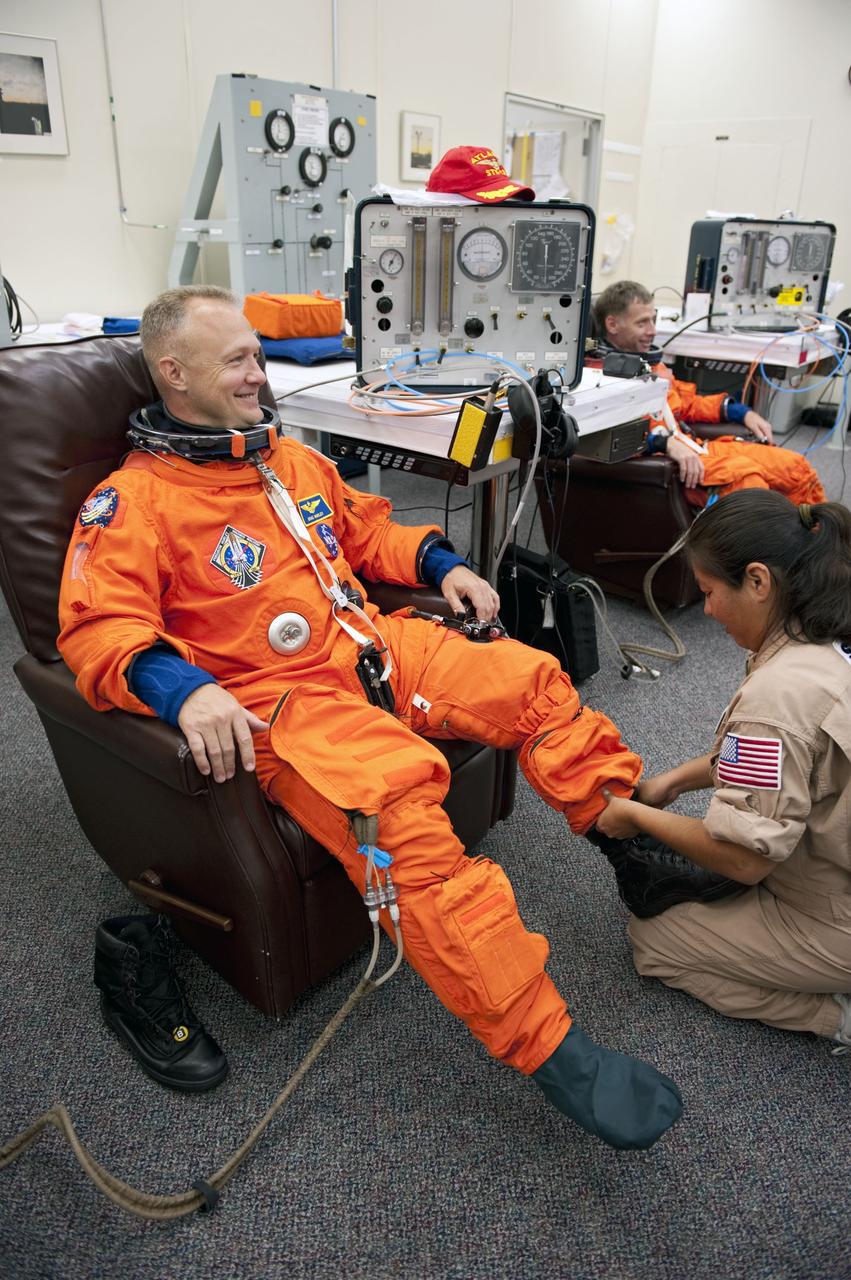
CAPE CANAVERAL, Fla. -- In the Operations and Checkout Building at NASA's Kennedy Space Center in Florida, Pilot Doug Hurley has his launch and landing suit checked by suit technician Cathy Cruz. The STS-135 crew is at Kennedy to participate in a launch countdown dress rehearsal called the Terminal Countdown Demonstration Test (TCDT) and related training in preparation for the upcoming STS-135 mission. Atlantis and its crew are targeted to lift off July 8, taking with them the Raffaello multi-purpose logistics module packed with supplies and spare parts to the International Space Station. The STS-135 mission also will fly a system to investigate the potential for robotically refueling existing satellites and return a failed ammonia pump module to help NASA better understand the failure mechanism and improve pump designs for future systems. STS-135 will be the 33rd flight of Atlantis, the 37th shuttle mission to the space station, and the 135th and final mission of NASA's Space Shuttle Program. For more information visit, www.nasa.gov/mission_pages/shuttle/shuttlemissions/sts135/index.html. Photo credit: NASA/Kim Shiflett
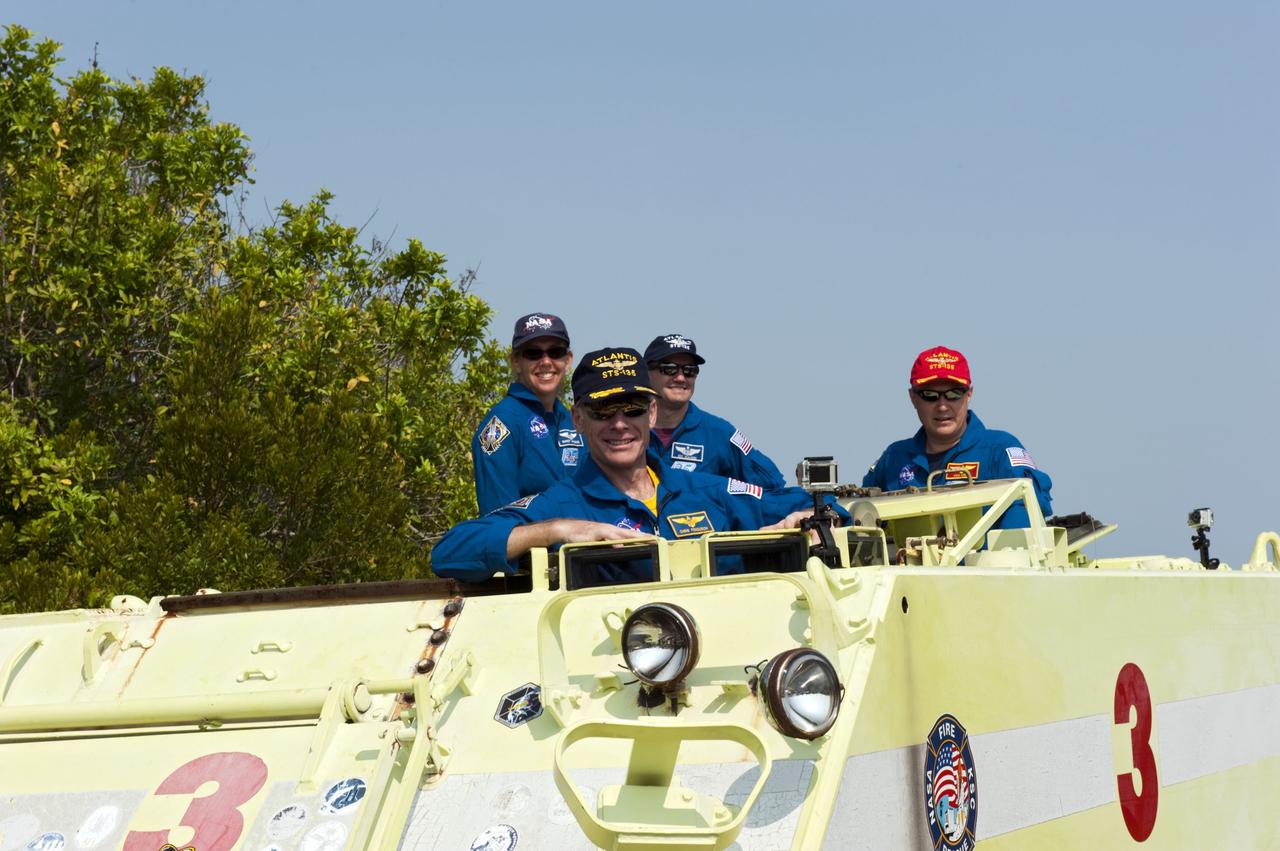
CAPE CANAVERAL, Fla. -- The STS-135 crew pause for a photo during their M113 armored personnel carrier training at NASA's Kennedy Space Center in Florida. Seen here are Commander Chris Ferguson (front), Mission Specialists Sandy Magnus, Rex Walheim and Pilot Doug Hurley (red cap). An M113 is kept at the foot of the launch pad in case an emergency exit from the launch pad is needed and every shuttle crew is trained on driving the vehicle before launch. The STS-135 crew is at Kennedy to participate in a launch countdown dress rehearsal called the Terminal Countdown Demonstration Test (TCDT) and related training. Atlantis and its crew are targeted to lift off July 8, taking with them the Raffaello multi-purpose logistics module packed with supplies and spare parts to the International Space Station. The STS-135 mission also will fly a system to investigate the potential for robotically refueling existing satellites and return a failed ammonia pump module to help NASA better understand the failure mechanism and improve pump designs for future systems. STS-135 will be the 33rd flight of Atlantis, the 37th shuttle mission to the space station, and the 135th and final mission of NASA's Space Shuttle Program. For more information visit, www.nasa.gov/mission_pages/shuttle/shuttlemissions/sts135/index.html. Photo credit: NASA/Kim Shiflett
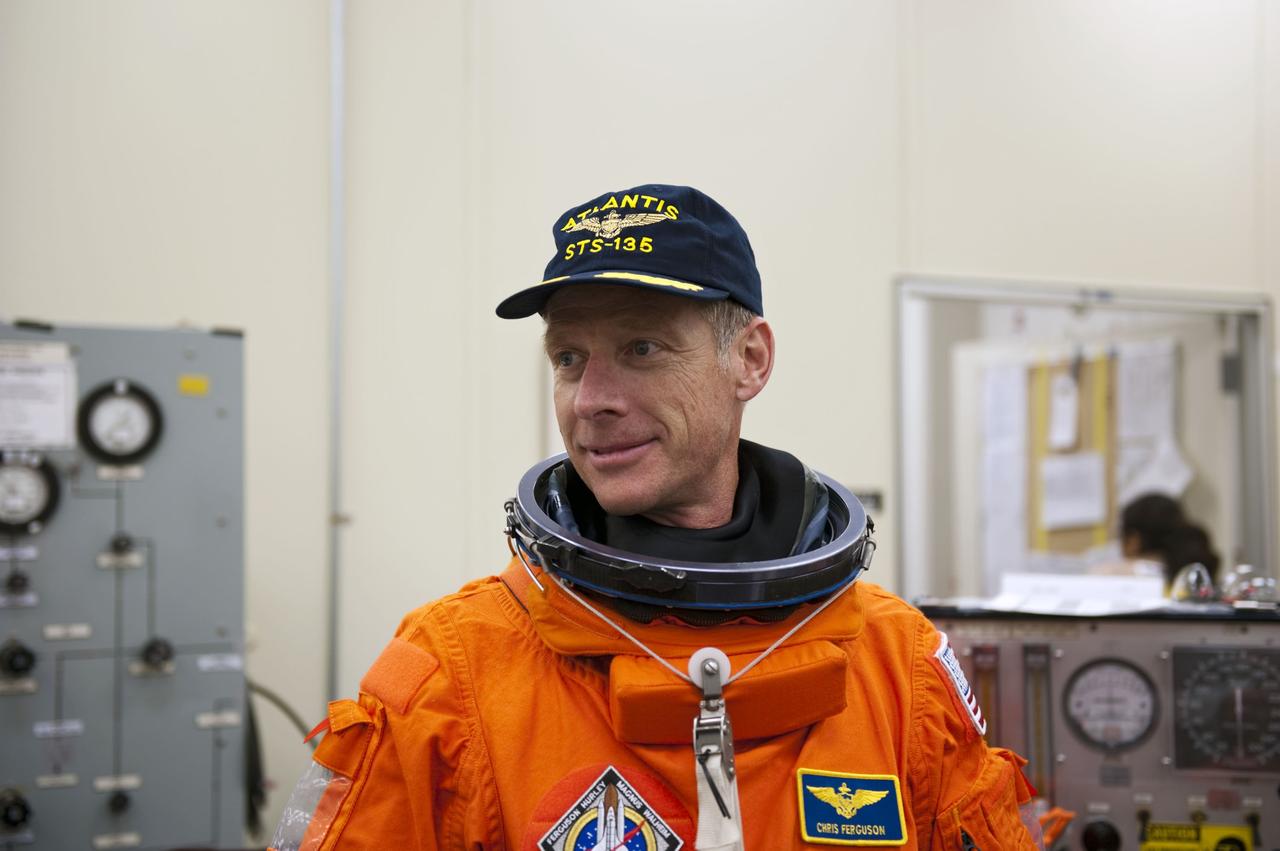
CAPE CANAVERAL, Fla. -- In the Operations and Checkout Building at NASA's Kennedy Space Center in Florida, Commander Chris Ferguson pauses for a photo after donning his launch and landing suit. The STS-135 crew is at Kennedy to participate in a launch countdown dress rehearsal called the Terminal Countdown Demonstration Test (TCDT) and related training in preparation for the upcoming STS-135 mission. Atlantis and its crew are targeted to lift off July 8, taking with them the Raffaello multi-purpose logistics module packed with supplies and spare parts to the International Space Station. The STS-135 mission also will fly a system to investigate the potential for robotically refueling existing satellites and return a failed ammonia pump module to help NASA better understand the failure mechanism and improve pump designs for future systems. STS-135 will be the 33rd flight of Atlantis, the 37th shuttle mission to the space station, and the 135th and final mission of NASA's Space Shuttle Program. For more information visit, www.nasa.gov/mission_pages/shuttle/shuttlemissions/sts135/index.html. Photo credit: NASA/Kim Shiflett

CAPE CANAVERAL, Fla. -- In the Operations and Checkout Building at NASA's Kennedy Space Center in Florida, suit technician Drew Billingsley prepares the orange launch and landing suits for the STS-135 crew members. The crew is at Kennedy to participate in a launch countdown dress rehearsal called the Terminal Countdown Demonstration Test (TCDT) and related training in preparation for the upcoming STS-135 mission. Atlantis and its crew are targeted to lift off July 8, taking with them the Raffaello multi-purpose logistics module packed with supplies and spare parts to the International Space Station. The STS-135 mission also will fly a system to investigate the potential for robotically refueling existing satellites and return a failed ammonia pump module to help NASA better understand the failure mechanism and improve pump designs for future systems. STS-135 will be the 33rd flight of Atlantis, the 37th shuttle mission to the space station, and the 135th and final mission of NASA's Space Shuttle Program. For more information visit, www.nasa.gov/mission_pages/shuttle/shuttlemissions/sts135/index.html. Photo credit: NASA/Kim Shiflett
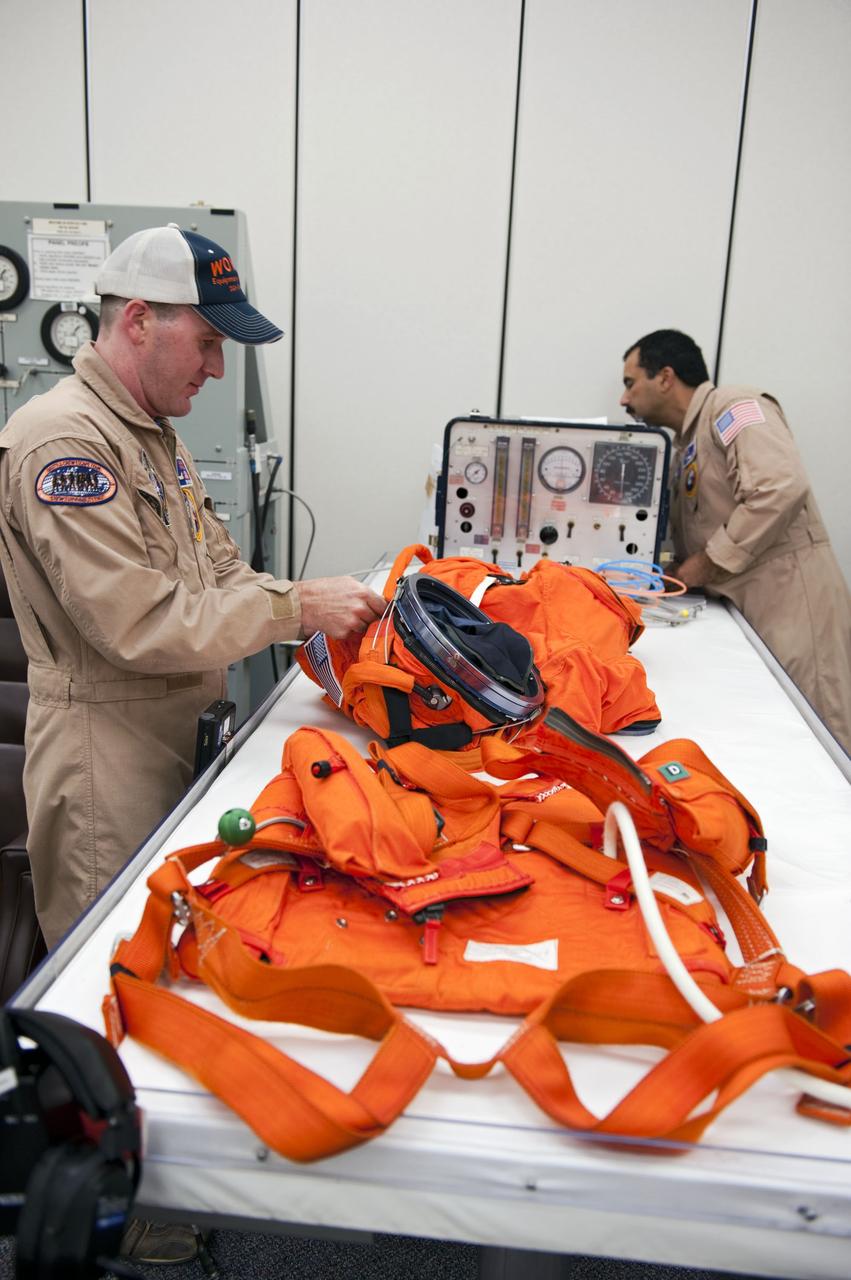
CAPE CANAVERAL, Fla. -- In the Operations and Checkout Building at NASA's Kennedy Space Center in Florida, suit technicians Jeremy Spruell (left) and Ray Cuevas prepare the orange launch and landing suits for the STS-135 crew members. The crew is at Kennedy to participate in a launch countdown dress rehearsal called the Terminal Countdown Demonstration Test (TCDT) and related training in preparation for the upcoming STS-135 mission. Atlantis and its crew are targeted to lift off July 8, taking with them the Raffaello multi-purpose logistics module packed with supplies and spare parts to the International Space Station. The STS-135 mission also will fly a system to investigate the potential for robotically refueling existing satellites and return a failed ammonia pump module to help NASA better understand the failure mechanism and improve pump designs for future systems. STS-135 will be the 33rd flight of Atlantis, the 37th shuttle mission to the space station, and the 135th and final mission of NASA's Space Shuttle Program. For more information visit, www.nasa.gov/mission_pages/shuttle/shuttlemissions/sts135/index.html. Photo credit: NASA/Kim Shiflett

CAPE CANAVERAL, Fla. -- In the Operations and Checkout Building at NASA's Kennedy Space Center in Florida, Mission Specialist Rex Walheim has his launch and landing suit checked by suit technician Andrew Denard. The STS-135 crew is at Kennedy to participate in a launch countdown dress rehearsal called the Terminal Countdown Demonstration Test (TCDT) and related training in preparation for the upcoming STS-135 mission. Atlantis and its crew are targeted to lift off July 8, taking with them the Raffaello multi-purpose logistics module packed with supplies and spare parts to the International Space Station. The STS-135 mission also will fly a system to investigate the potential for robotically refueling existing satellites and return a failed ammonia pump module to help NASA better understand the failure mechanism and improve pump designs for future systems. STS-135 will be the 33rd flight of Atlantis, the 37th shuttle mission to the space station, and the 135th and final mission of NASA's Space Shuttle Program. For more information visit, www.nasa.gov/mission_pages/shuttle/shuttlemissions/sts135/index.html. Photo credit: NASA/Kim Shiflett
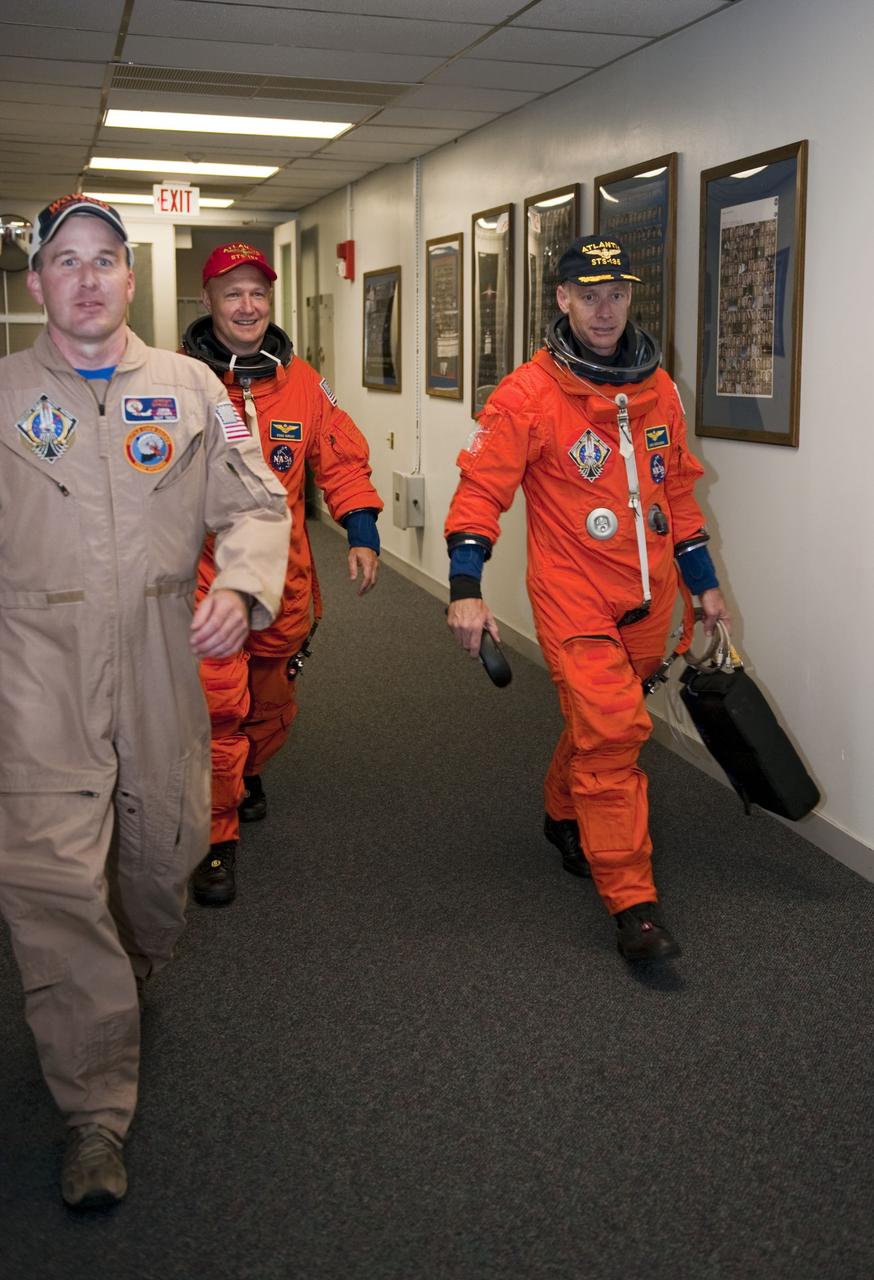
CAPE CANAVERAL, Fla. -- In the Operations and Checkout Building at NASA's Kennedy Space Center in Florida, Pilot Doug Hurley (center) and Commander Chris Ferguson are accompanied by suit technician Jeremy Spruell. Hurley and Ferguson are on their way to Kennedy's Shuttle Landing Facility to practice touch-and-go landing in the two Shuttle Training Aircrafts. The STS-135 crew is at Kennedy to participate in a launch countdown dress rehearsal called the Terminal Countdown Demonstration Test (TCDT) and related training in preparation for the upcoming STS-135 mission. Atlantis and its crew are targeted to lift off July 8, taking with them the Raffaello multi-purpose logistics module packed with supplies and spare parts to the International Space Station. The STS-135 mission also will fly a system to investigate the potential for robotically refueling existing satellites and return a failed ammonia pump module to help NASA better understand the failure mechanism and improve pump designs for future systems. STS-135 will be the 33rd flight of Atlantis, the 37th shuttle mission to the space station, and the 135th and final mission of NASA's Space Shuttle Program. For more information visit, www.nasa.gov/mission_pages/shuttle/shuttlemissions/sts135/index.html. Photo credit: NASA/Kim Shiflett
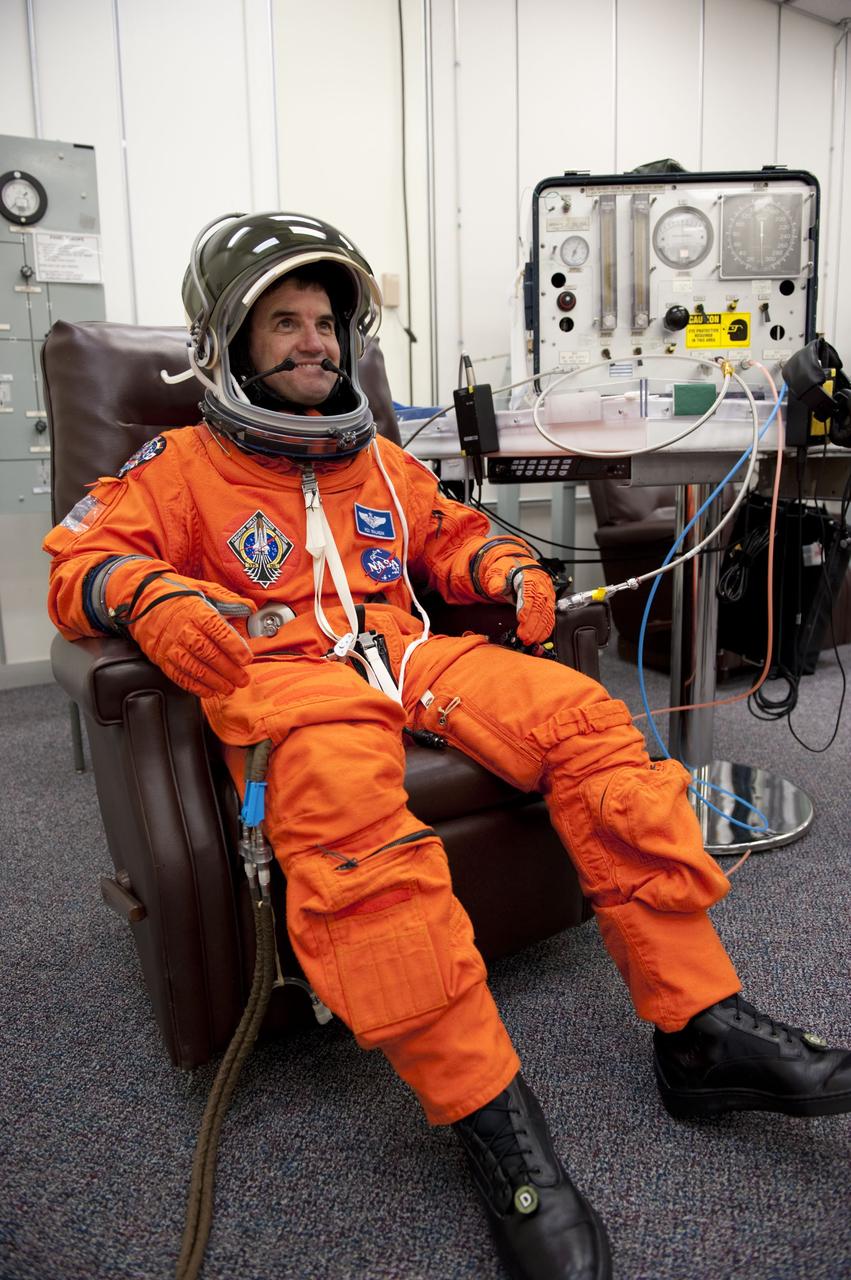
CAPE CANAVERAL, Fla. -- In the Operations and Checkout Building at NASA's Kennedy Space Center in Florida, Mission Specialist Rex Walheim checks the fit of his launch and landing suit, helmet and gloves. The STS-135 crew is at Kennedy to participate in a launch countdown dress rehearsal called the Terminal Countdown Demonstration Test (TCDT) and related training in preparation for the upcoming STS-135 mission. Atlantis and its crew are targeted to lift off July 8, taking with them the Raffaello multi-purpose logistics module packed with supplies and spare parts to the International Space Station. The STS-135 mission also will fly a system to investigate the potential for robotically refueling existing satellites and return a failed ammonia pump module to help NASA better understand the failure mechanism and improve pump designs for future systems. STS-135 will be the 33rd flight of Atlantis, the 37th shuttle mission to the space station, and the 135th and final mission of NASA's Space Shuttle Program. For more information visit, www.nasa.gov/mission_pages/shuttle/shuttlemissions/sts135/index.html. Photo credit: NASA/Kim Shiflett
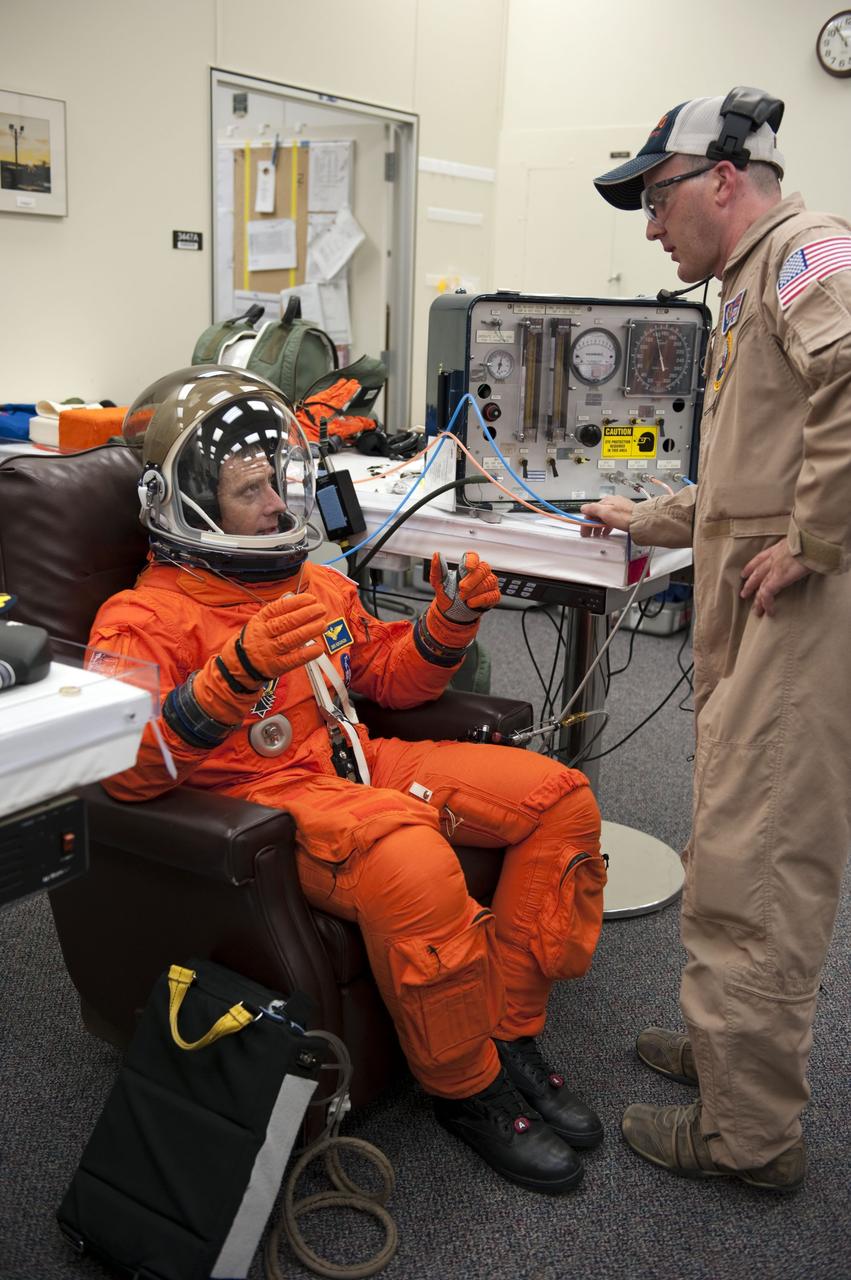
CAPE CANAVERAL, Fla. -- In the Operations and Checkout Building at NASA's Kennedy Space Center in Florida, Commander Chris Ferguson has his launch and landing suit checked by suit technician Jeremy Spruell. The STS-135 crew is at Kennedy to participate in a launch countdown dress rehearsal called the Terminal Countdown Demonstration Test (TCDT) and related training in preparation for the upcoming STS-135 mission. Atlantis and its crew are targeted to lift off July 8, taking with them the Raffaello multi-purpose logistics module packed with supplies and spare parts to the International Space Station. The STS-135 mission also will fly a system to investigate the potential for robotically refueling existing satellites and return a failed ammonia pump module to help NASA better understand the failure mechanism and improve pump designs for future systems. STS-135 will be the 33rd flight of Atlantis, the 37th shuttle mission to the space station, and the 135th and final mission of NASA's Space Shuttle Program. For more information visit, www.nasa.gov/mission_pages/shuttle/shuttlemissions/sts135/index.html. Photo credit: NASA/Kim Shiflett

CAPE CANAVERAL, Fla. -- In the Operations and Checkout Building at NASA's Kennedy Space Center in Florida, Mission Specialist Sandy Magnus checks the fit of her launch and landing suit and helmet. The STS-135 crew is at Kennedy to participate in a launch countdown dress rehearsal called the Terminal Countdown Demonstration Test (TCDT) and related training in preparation for the upcoming STS-135 mission. Atlantis and its crew are targeted to lift off July 8, taking with them the Raffaello multi-purpose logistics module packed with supplies and spare parts to the International Space Station. The STS-135 mission also will fly a system to investigate the potential for robotically refueling existing satellites and return a failed ammonia pump module to help NASA better understand the failure mechanism and improve pump designs for future systems. STS-135 will be the 33rd flight of Atlantis, the 37th shuttle mission to the space station, and the 135th and final mission of NASA's Space Shuttle Program. For more information visit, www.nasa.gov/mission_pages/shuttle/shuttlemissions/sts135/index.html. Photo credit: NASA/Kim Shiflett

CAPE CANAVERAL, Fla. -- In the Operations and Checkout Building at NASA's Kennedy Space Center in Florida, Mission Specialist Rex Walheim checks the fit of his launch and landing suit. The STS-135 crew is at Kennedy to participate in a launch countdown dress rehearsal called the Terminal Countdown Demonstration Test (TCDT) and related training in preparation for the upcoming STS-135 mission. Atlantis and its crew are targeted to lift off July 8, taking with them the Raffaello multi-purpose logistics module packed with supplies and spare parts to the International Space Station. The STS-135 mission also will fly a system to investigate the potential for robotically refueling existing satellites and return a failed ammonia pump module to help NASA better understand the failure mechanism and improve pump designs for future systems. STS-135 will be the 33rd flight of Atlantis, the 37th shuttle mission to the space station, and the 135th and final mission of NASA's Space Shuttle Program. For more information visit, www.nasa.gov/mission_pages/shuttle/shuttlemissions/sts135/index.html. Photo credit: NASA/Kim Shiflett
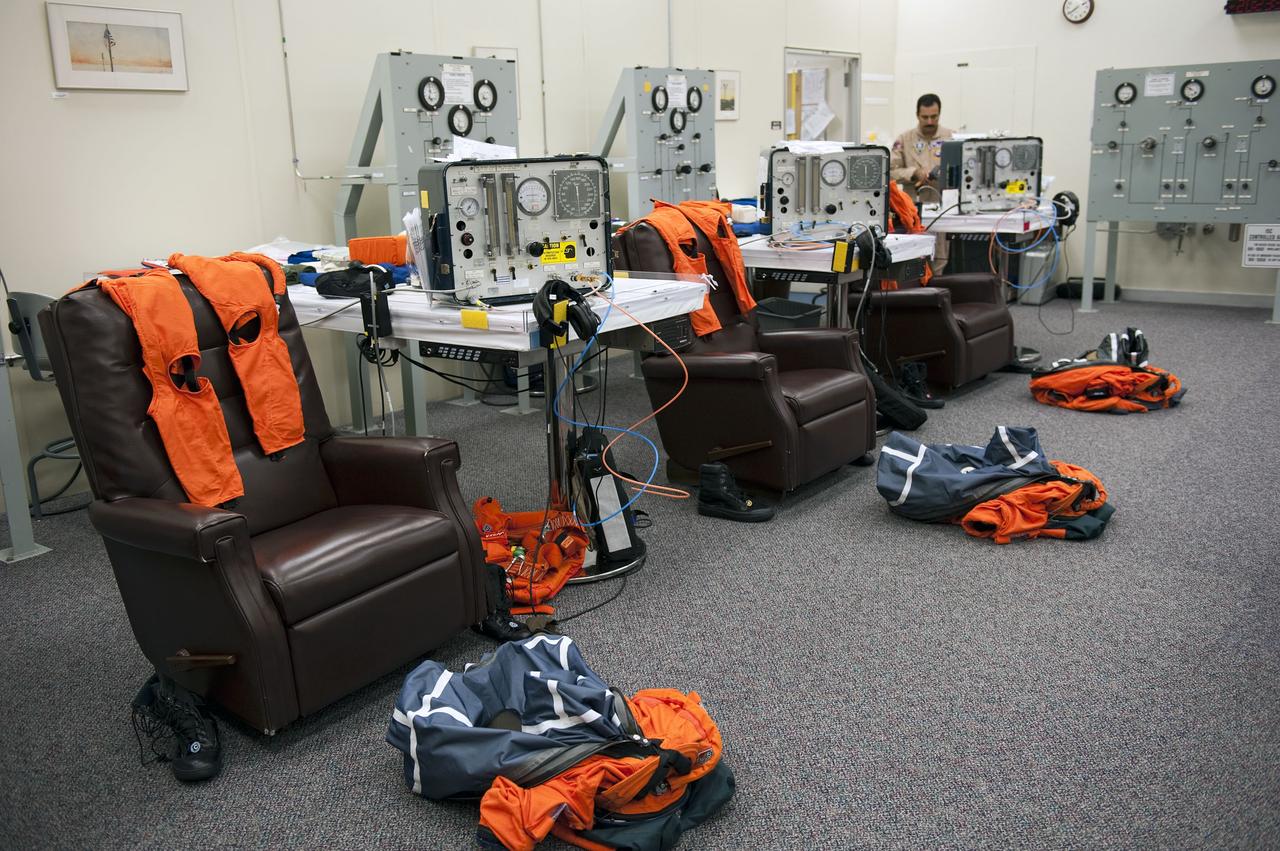
CAPE CANAVERAL, Fla. -- In the Operations and Checkout Building at NASA's Kennedy Space Center in Florida, suit technician Ray Cuevas prepares the orange launch and landing suits for the STS-135 crew members. The crew is at Kennedy to participate in a launch countdown dress rehearsal called the Terminal Countdown Demonstration Test (TCDT) and related training in preparation for the upcoming STS-135 mission. Atlantis and its crew are targeted to lift off July 8, taking with them the Raffaello multi-purpose logistics module packed with supplies and spare parts to the International Space Station. The STS-135 mission also will fly a system to investigate the potential for robotically refueling existing satellites and return a failed ammonia pump module to help NASA better understand the failure mechanism and improve pump designs for future systems. STS-135 will be the 33rd flight of Atlantis, the 37th shuttle mission to the space station, and the 135th and final mission of NASA's Space Shuttle Program. For more information visit, www.nasa.gov/mission_pages/shuttle/shuttlemissions/sts135/index.html. Photo credit: NASA/Kim Shiflett
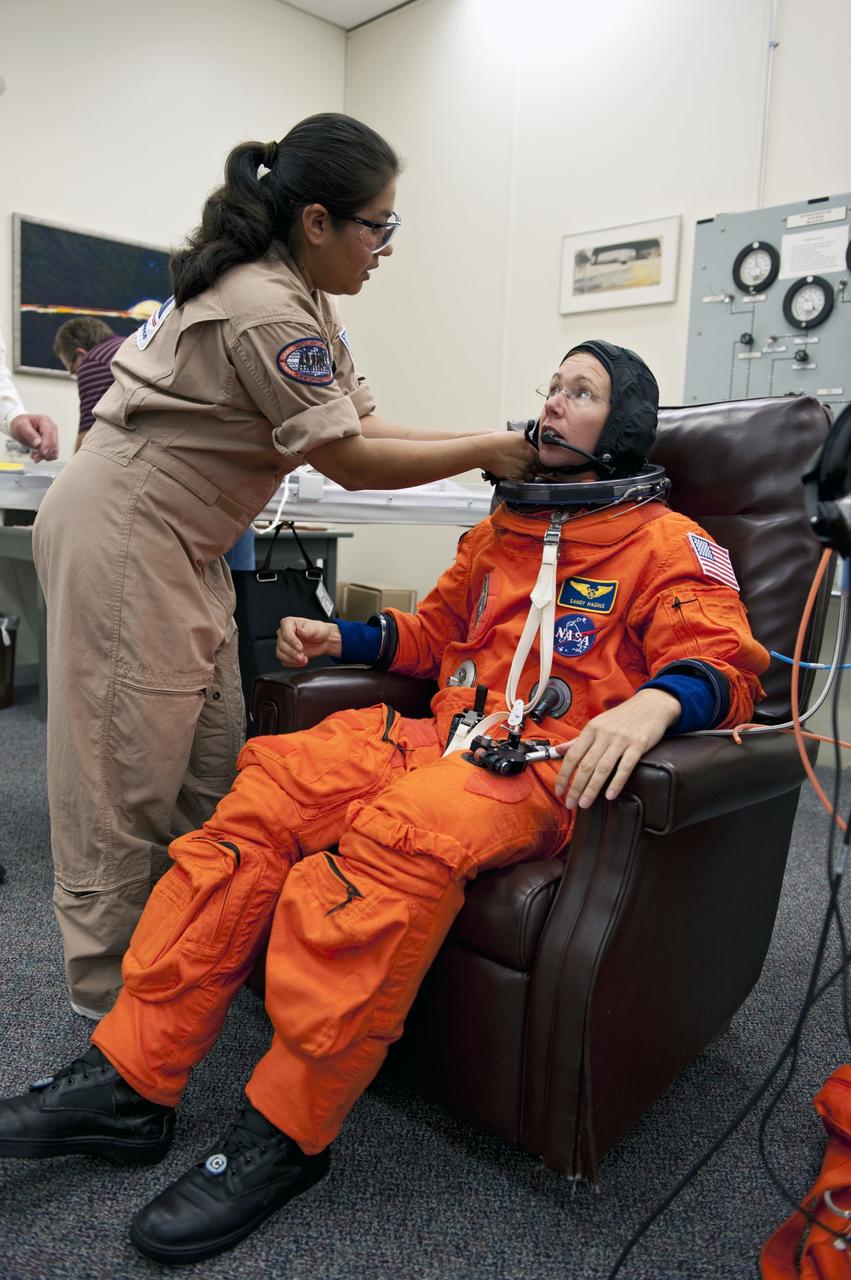
CAPE CANAVERAL, Fla. -- In the Operations and Checkout Building at NASA's Kennedy Space Center in Florida, Mission Specialist Sandy Magnus has her launch and landing suit checked by suit technician Cathy Cruz. The STS-135 crew is at Kennedy to participate in a launch countdown dress rehearsal called the Terminal Countdown Demonstration Test (TCDT) and related training in preparation for the upcoming STS-135 mission. Atlantis and its crew are targeted to lift off July 8, taking with them the Raffaello multi-purpose logistics module packed with supplies and spare parts to the International Space Station. The STS-135 mission also will fly a system to investigate the potential for robotically refueling existing satellites and return a failed ammonia pump module to help NASA better understand the failure mechanism and improve pump designs for future systems. STS-135 will be the 33rd flight of Atlantis, the 37th shuttle mission to the space station, and the 135th and final mission of NASA's Space Shuttle Program. For more information visit, www.nasa.gov/mission_pages/shuttle/shuttlemissions/sts135/index.html. Photo credit: NASA/Kim Shiflett
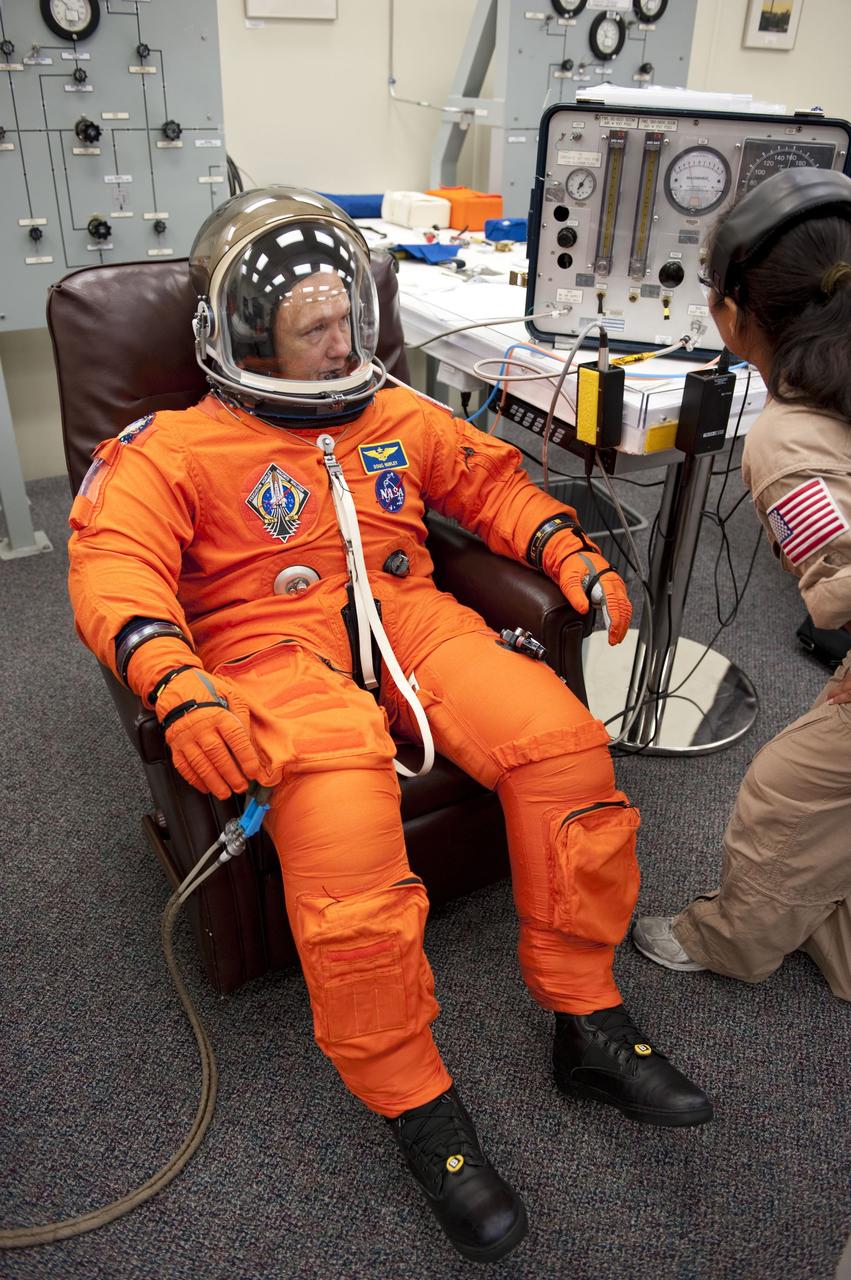
CAPE CANAVERAL, Fla. -- In the Operations and Checkout Building at NASA's Kennedy Space Center in Florida, Pilot Doug Hurley has his launch and landing suit checked by suit technician Cathy Cruz. The STS-135 crew is at Kennedy to participate in a launch countdown dress rehearsal called the Terminal Countdown Demonstration Test (TCDT) and related training in preparation for the upcoming STS-135 mission. Atlantis and its crew are targeted to lift off July 8, taking with them the Raffaello multi-purpose logistics module packed with supplies and spare parts to the International Space Station. The STS-135 mission also will fly a system to investigate the potential for robotically refueling existing satellites and return a failed ammonia pump module to help NASA better understand the failure mechanism and improve pump designs for future systems. STS-135 will be the 33rd flight of Atlantis, the 37th shuttle mission to the space station, and the 135th and final mission of NASA's Space Shuttle Program. For more information visit, www.nasa.gov/mission_pages/shuttle/shuttlemissions/sts135/index.html. Photo credit: NASA/Kim Shiflett
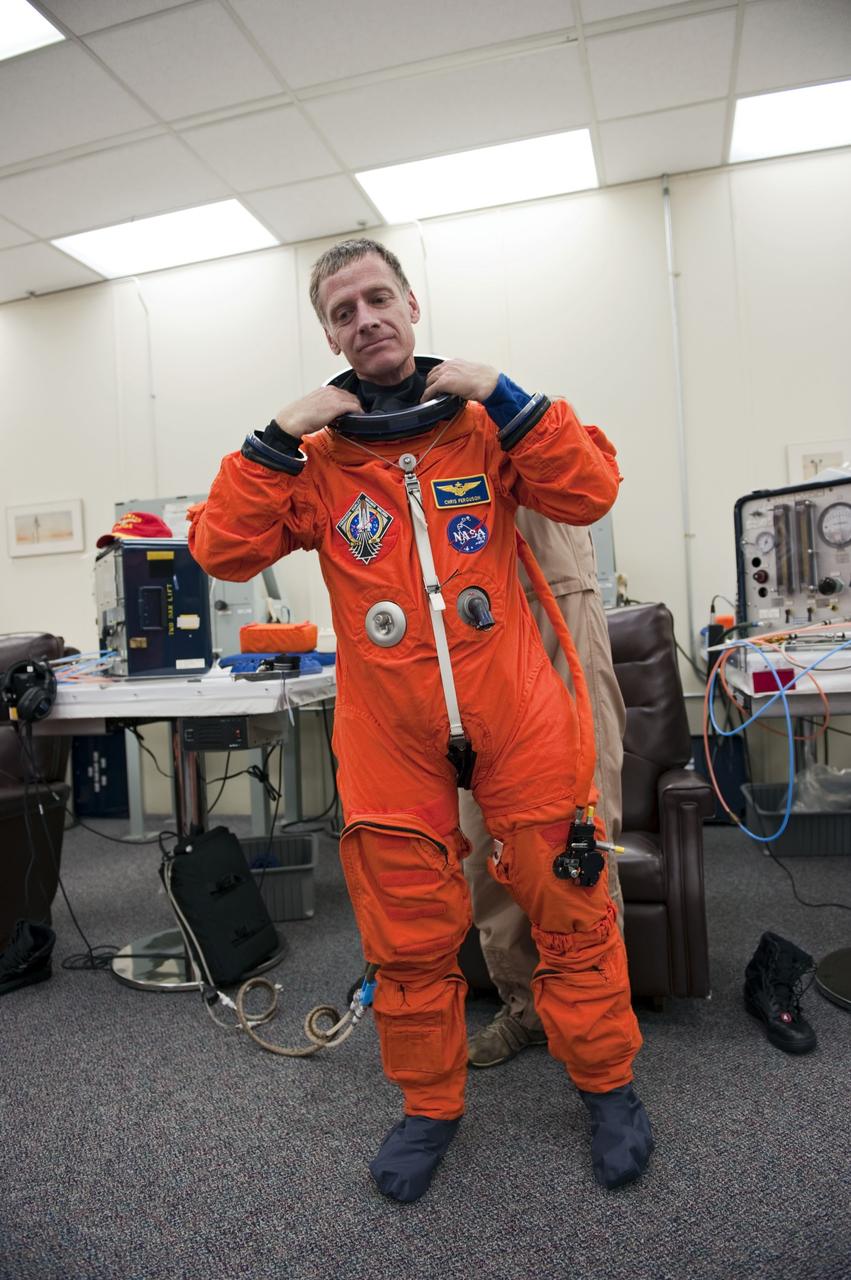
CAPE CANAVERAL, Fla. -- In the Operations and Checkout Building at NASA's Kennedy Space Center in Florida, Commander Chris Ferguson checks the fit of his launch and landing suit. The STS-135 crew is at Kennedy to participate in a launch countdown dress rehearsal called the Terminal Countdown Demonstration Test (TCDT) and related training in preparation for the upcoming STS-135 mission. Atlantis and its crew are targeted to lift off July 8, taking with them the Raffaello multi-purpose logistics module packed with supplies and spare parts to the International Space Station. The STS-135 mission also will fly a system to investigate the potential for robotically refueling existing satellites and return a failed ammonia pump module to help NASA better understand the failure mechanism and improve pump designs for future systems. STS-135 will be the 33rd flight of Atlantis, the 37th shuttle mission to the space station, and the 135th and final mission of NASA's Space Shuttle Program. For more information visit, www.nasa.gov/mission_pages/shuttle/shuttlemissions/sts135/index.html. Photo credit: NASA/Kim Shiflett
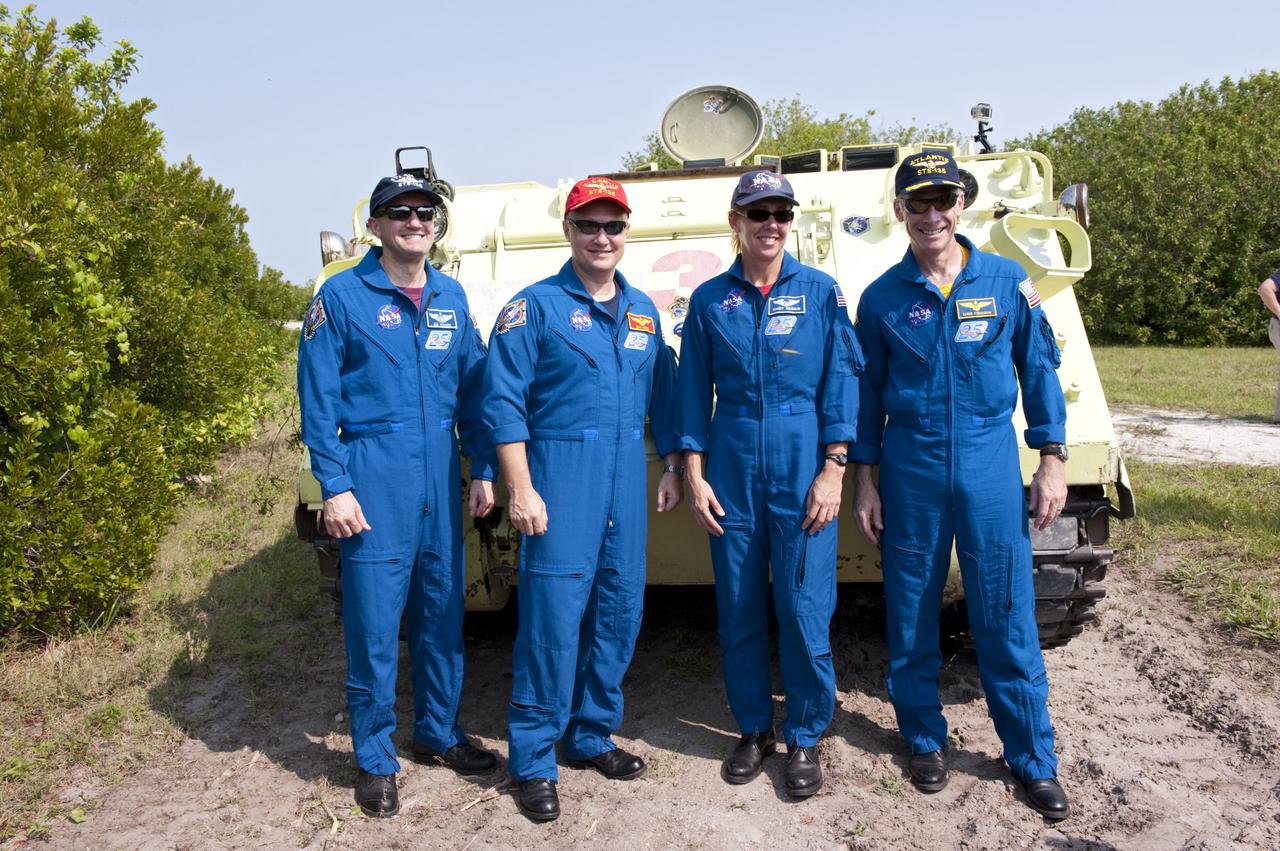
CAPE CANAVERAL, Fla. -- The STS-135 crew pause for a photo at the conclusion of their M113 armored personnel carrier training at NASA's Kennedy Space Center in Florida. Seen here are Mission Specialist Rex Walheim (left), Pilot Doug Hurley, Mission Specialist Sandy Magnus and Commander Chris Ferguson. An M113 is kept at the foot of the launch pad in case an emergency exit from the launch pad is needed and every shuttle crew is trained on driving the vehicle before launch. The STS-135 crew is at Kennedy to participate in a launch countdown dress rehearsal called the Terminal Countdown Demonstration Test (TCDT) and related training. Atlantis and its crew are targeted to lift off July 8, taking with them the Raffaello multi-purpose logistics module packed with supplies and spare parts to the International Space Station. The STS-135 mission also will fly a system to investigate the potential for robotically refueling existing satellites and return a failed ammonia pump module to help NASA better understand the failure mechanism and improve pump designs for future systems. STS-135 will be the 33rd flight of Atlantis, the 37th shuttle mission to the space station, and the 135th and final mission of NASA's Space Shuttle Program. For more information visit, www.nasa.gov/mission_pages/shuttle/shuttlemissions/sts135/index.html. Photo credit: NASA/Kim Shiflett
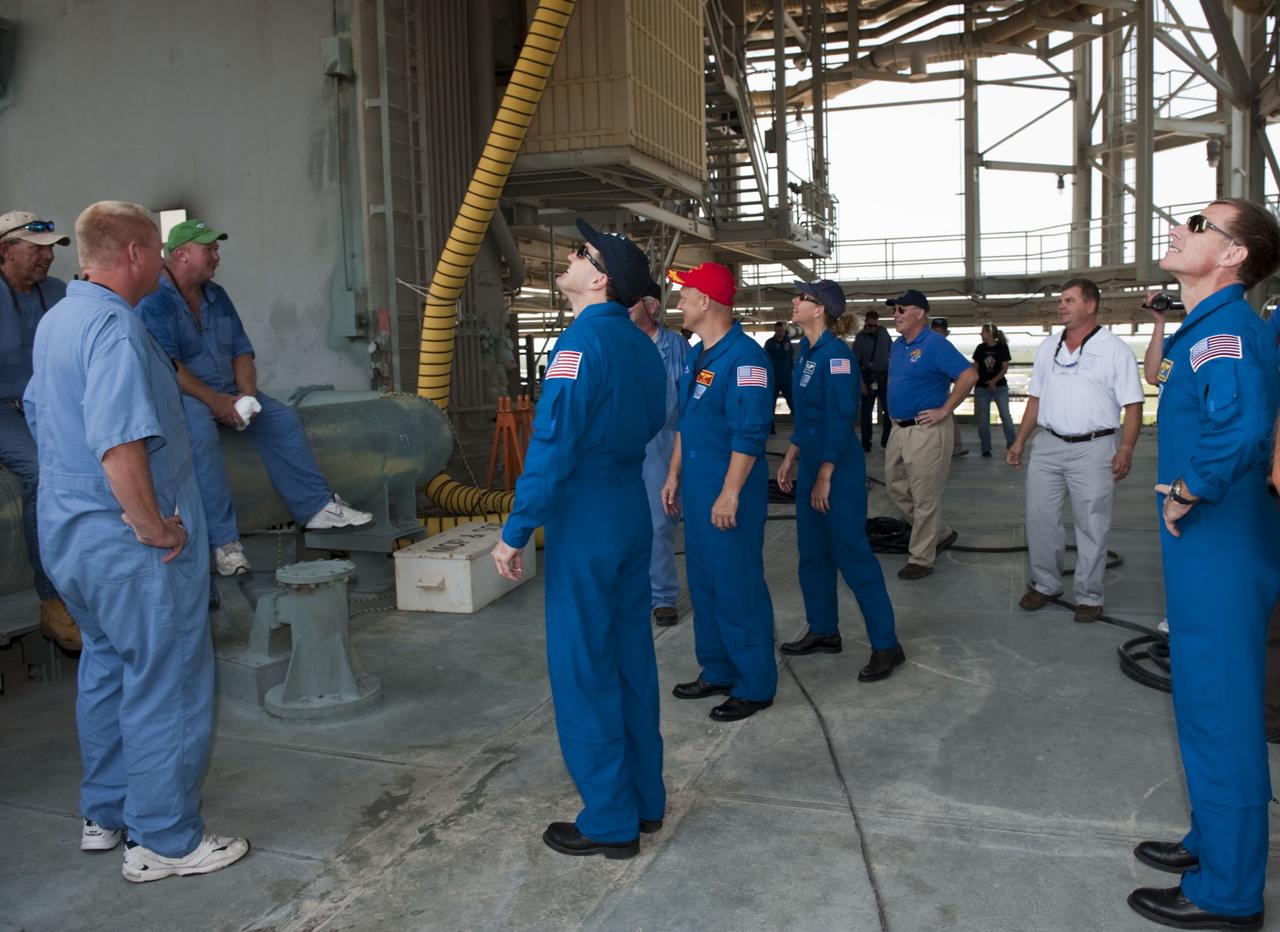
CAPE CANAVERAL, Fla. -- On Launch Pad 39A at NASA's Kennedy Space Center in Florida, space shuttle Atlantis' STS-135 crew members, become familiar with the pad structure as part of their emergency exit training. Seen here are Mission Specialist Rex Walheim (center), Pilot Doug Hurley, Mission Specialist Sandy Magnus and Commander Chris Ferguson (far right). The astronauts are at Kennedy to participate in a launch countdown dress rehearsal called the Terminal Countdown Demonstration Test (TCDT) and related training. Atlantis and its crew are targeted to lift off July 8, taking with them the Raffaello multi-purpose logistics module packed with supplies and spare parts to the International Space Station. The STS-135 mission also will fly a system to investigate the potential for robotically refueling existing satellites and return a failed ammonia pump module to help NASA better understand the failure mechanism and improve pump designs for future systems. STS-135 will be the 33rd flight of Atlantis, the 37th shuttle mission to the space station, and the 135th and final mission of NASA's Space Shuttle Program. For more information visit, www.nasa.gov/mission_pages/shuttle/shuttlemissions/sts135/index.html. Photo credit: NASA/Kim Shiflett
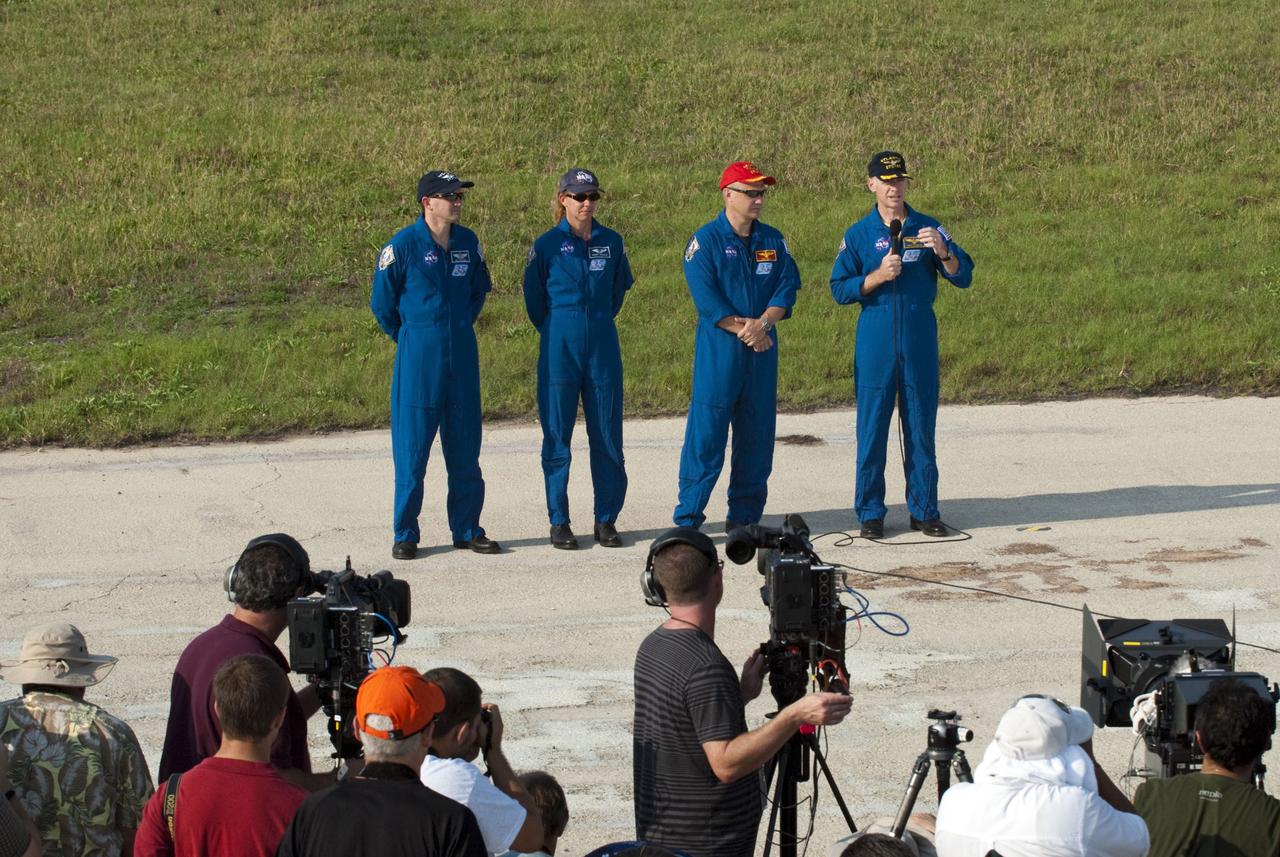
CAPE CANAVERAL, Fla. -- The STS-135 crew members gather at NASA Kennedy Space Center's Launch Pad 39A in Florida for a question-and-answer session with media. With the microphone in hand is Commander Chris Ferguson as Pilot Doug Hurley, Mission Specialists Sandy Magnus and Rex Walheim look on. Space shuttle Atlantis' astronauts are at Kennedy to participate in a launch countdown dress rehearsal called the Terminal Countdown Demonstration Test (TCDT) and related training. Atlantis and its crew are targeted to lift off July 8, taking with them the Raffaello multi-purpose logistics module packed with supplies and spare parts to the International Space Station. The STS-135 mission also will fly a system to investigate the potential for robotically refueling existing satellites and return a failed ammonia pump module to help NASA better understand the failure mechanism and improve pump designs for future systems. STS-135 will be the 33rd flight of Atlantis, the 37th shuttle mission to the space station, and the 135th and final mission of NASA's Space Shuttle Program. For more information visit, www.nasa.gov/mission_pages/shuttle/shuttlemissions/sts135/index.html. Photo credit: NASA/Kim Shiflett
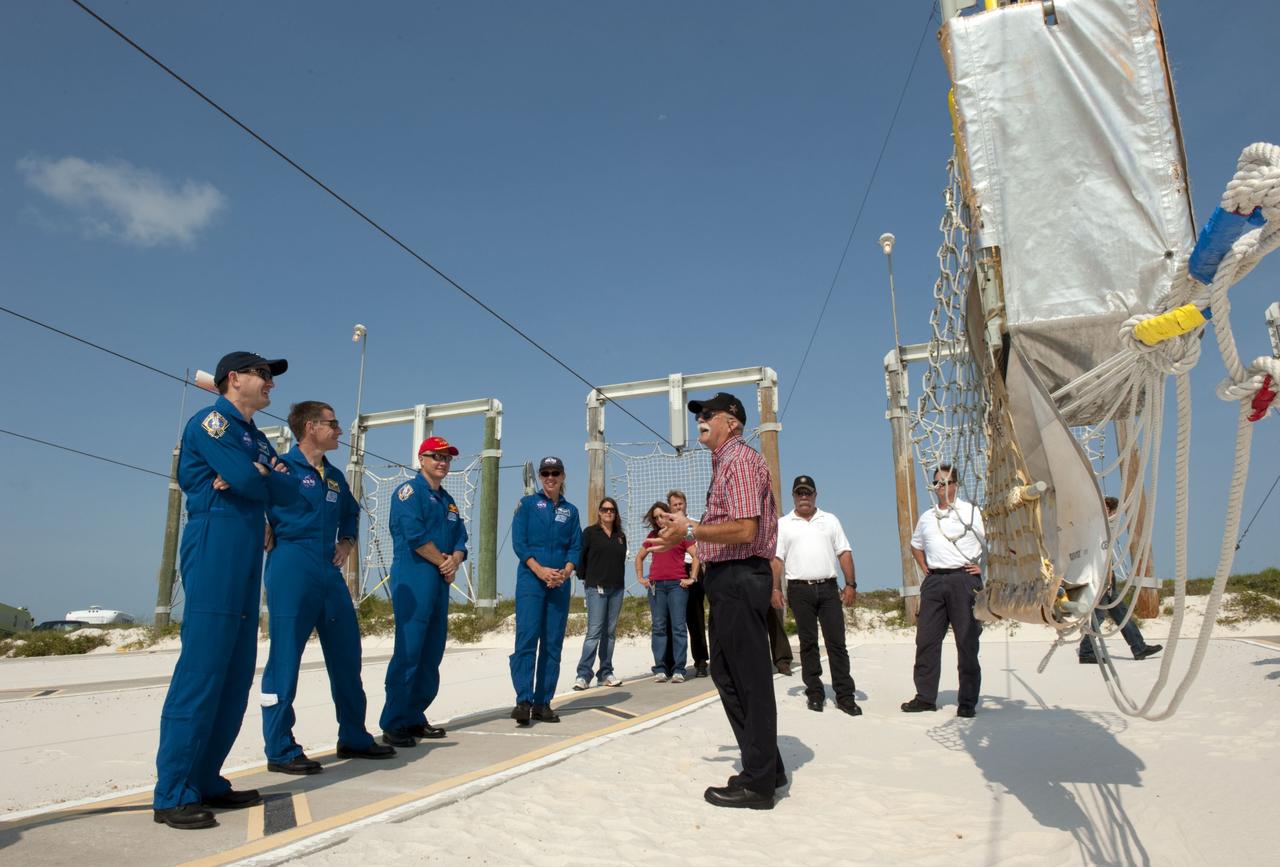
CAPE CANAVERAL, Fla. -- At Launch Pad 39A at NASA's Kennedy Space Center in Florida, members of space shuttle Atlantis' STS-135 crew receive instruction by the catch nets for the slidewire baskets at the base of the pad as part of the pad's emergency exit training. From left are Mission Specialist Rex Walheim, Commander Chris Ferguson, Pilot Doug Hurley and Mission Specialist Sandy Magnus. The astronauts are at Kennedy to participate in a launch countdown dress rehearsal called the Terminal Countdown Demonstration Test (TCDT) and related training. Atlantis and its crew are targeted to lift off July 8, taking with them the Raffaello multi-purpose logistics module packed with supplies and spare parts to the International Space Station. The STS-135 mission also will fly a system to investigate the potential for robotically refueling existing satellites and return a failed ammonia pump module to help NASA better understand the failure mechanism and improve pump designs for future systems. STS-135 will be the 33rd flight of Atlantis, the 37th shuttle mission to the space station, and the 135th and final mission of NASA's Space Shuttle Program. For more information visit, www.nasa.gov/mission_pages/shuttle/shuttlemissions/sts135/index.html. Photo credit: NASA/Kim Shiflett
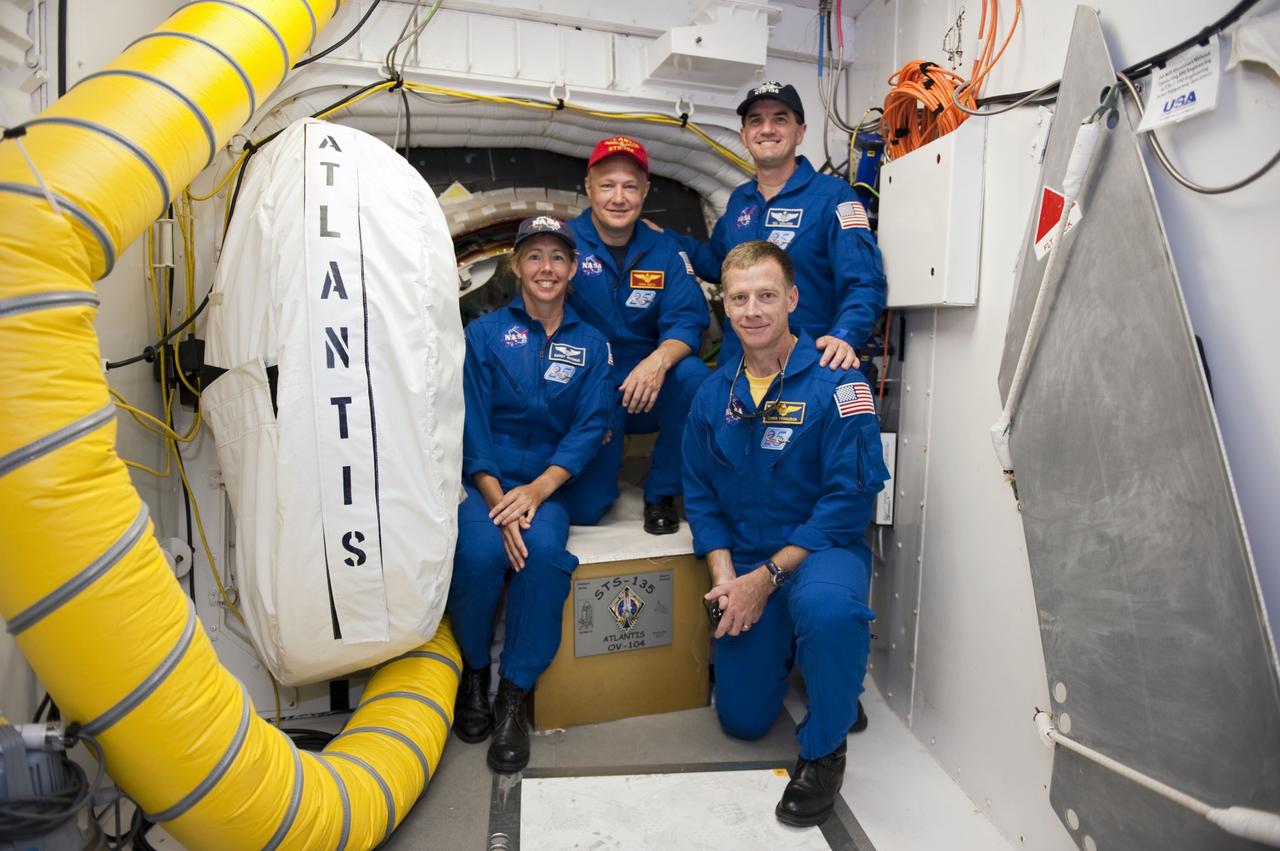
CAPE CANAVERAL, Fla. -- At Launch Pad 39A at NASA's Kennedy Space Center in Florida, the STS-135 crew pose for a group portrait in front of space shuttle Atlantis' hatch in the pad's White Room. From left are Mission Specialist Sandy Magnus, Pilot Doug Hurley, Mission Specialist Rex Walheim and Commander Chris Ferguson. An access arm supports the White Room that is in place against the shuttle which provides entry to the crew compartment. The astronauts are at Kennedy to participate in a launch countdown dress rehearsal called the Terminal Countdown Demonstration Test (TCDT) and related training. Atlantis and its crew are targeted to lift off July 8, taking with them the Raffaello multi-purpose logistics module packed with supplies and spare parts to the International Space Station. The STS-135 mission also will fly a system to investigate the potential for robotically refueling existing satellites and return a failed ammonia pump module to help NASA better understand the failure mechanism and improve pump designs for future systems. STS-135 will be the 33rd flight of Atlantis, the 37th shuttle mission to the space station, and the 135th and final mission of NASA's Space Shuttle Program. For more information visit, www.nasa.gov/mission_pages/shuttle/shuttlemissions/sts135/index.html. Photo credit: NASA/Kim Shiflett
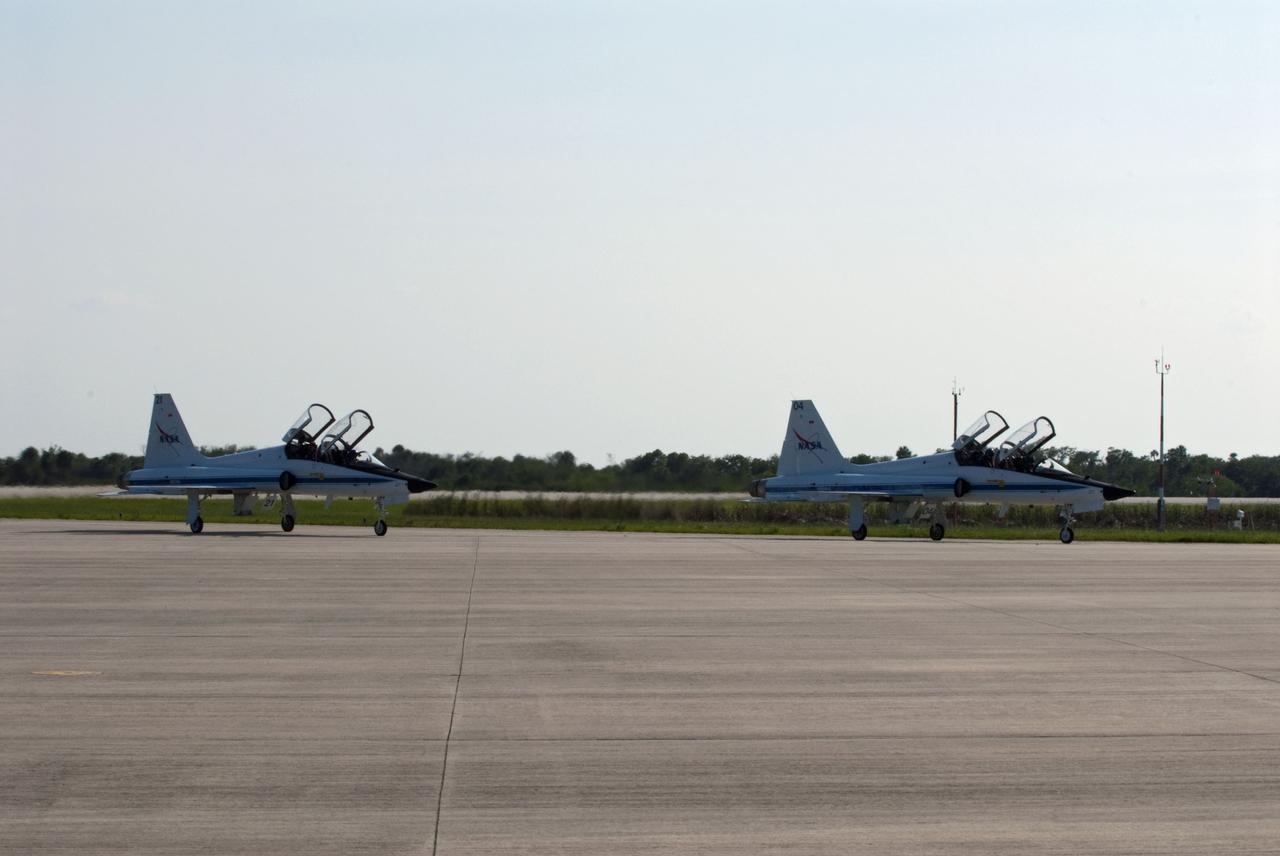
CAPE CANAVERAL, Fla. -- At the Shuttle Landing Facility at NASA's Kennedy Space Center in Florida, space shuttle Atlantis' crew members begin to arrive aboard their T-38 jets. The astronauts are at Kennedy to participate in a launch countdown dress rehearsal called the Terminal Countdown Demonstration Test (TCDT) and related training in preparation for the upcoming STS-135 mission. Atlantis and its crew are targeted to lift off July 8, delivering the Raffaello multi-purpose logistics module packed with supplies, logistics and spare parts to the International Space Station. The STS-135 mission also will fly a system to investigate the potential for robotically refueling existing satellites and return a failed ammonia pump module to help NASA better understand the failure mechanism and improve pump designs for future systems. STS-135 will be the 33rd flight of Atlantis, the 37th shuttle mission to the space station, and the 135th and final mission of NASA's Space Shuttle Program. For more information visit, www.nasa.gov/mission_pages/shuttle/shuttlemissions/sts135/index.html. Photo credit: NASA/Kim Shiflett
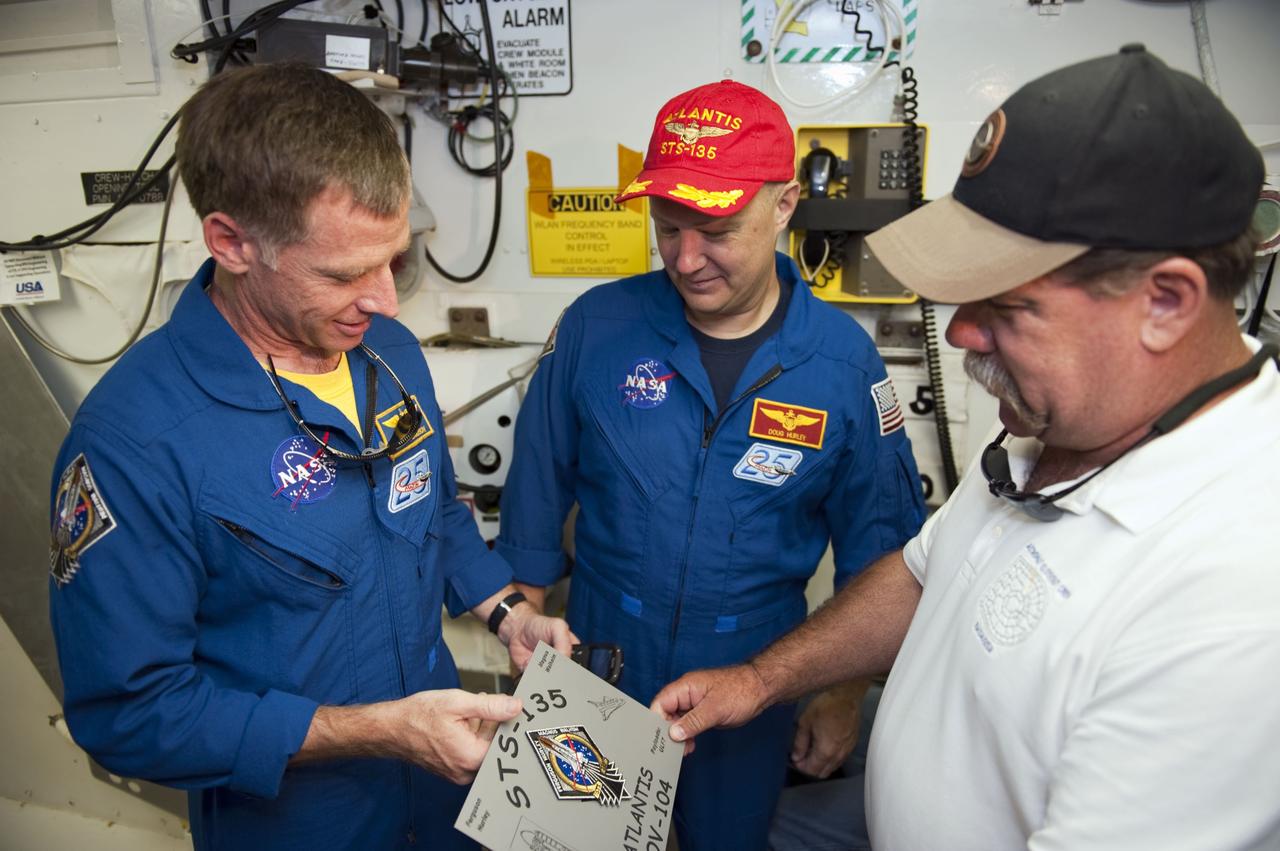
CAPE CANAVERAL, Fla. -- STS-135 Commander Chris Ferguson (left), Pilot Doug Hurley and Closeout Crew Lead Travis Tod Thompson with United Space Alliance, check out the plaque that will be placed in front of space shuttle Atlantis' hatch in the White Room at NASA Kennedy Space Center's Launch Pad 39A. An access arm supports the White Room that is in place against the shuttle which provides entry to the crew compartment. The astronauts are at Kennedy to participate in a launch countdown dress rehearsal called the Terminal Countdown Demonstration Test (TCDT) and related training. Atlantis and its crew are targeted to lift off July 8, taking with them the Raffaello multi-purpose logistics module packed with supplies and spare parts to the International Space Station. The STS-135 mission also will fly a system to investigate the potential for robotically refueling existing satellites and return a failed ammonia pump module to help NASA better understand the failure mechanism and improve pump designs for future systems. STS-135 will be the 33rd flight of Atlantis, the 37th shuttle mission to the space station, and the 135th and final mission of NASA's Space Shuttle Program. For more information visit, www.nasa.gov/mission_pages/shuttle/shuttlemissions/sts135/index.html. Photo credit: NASA/Kim Shiflett
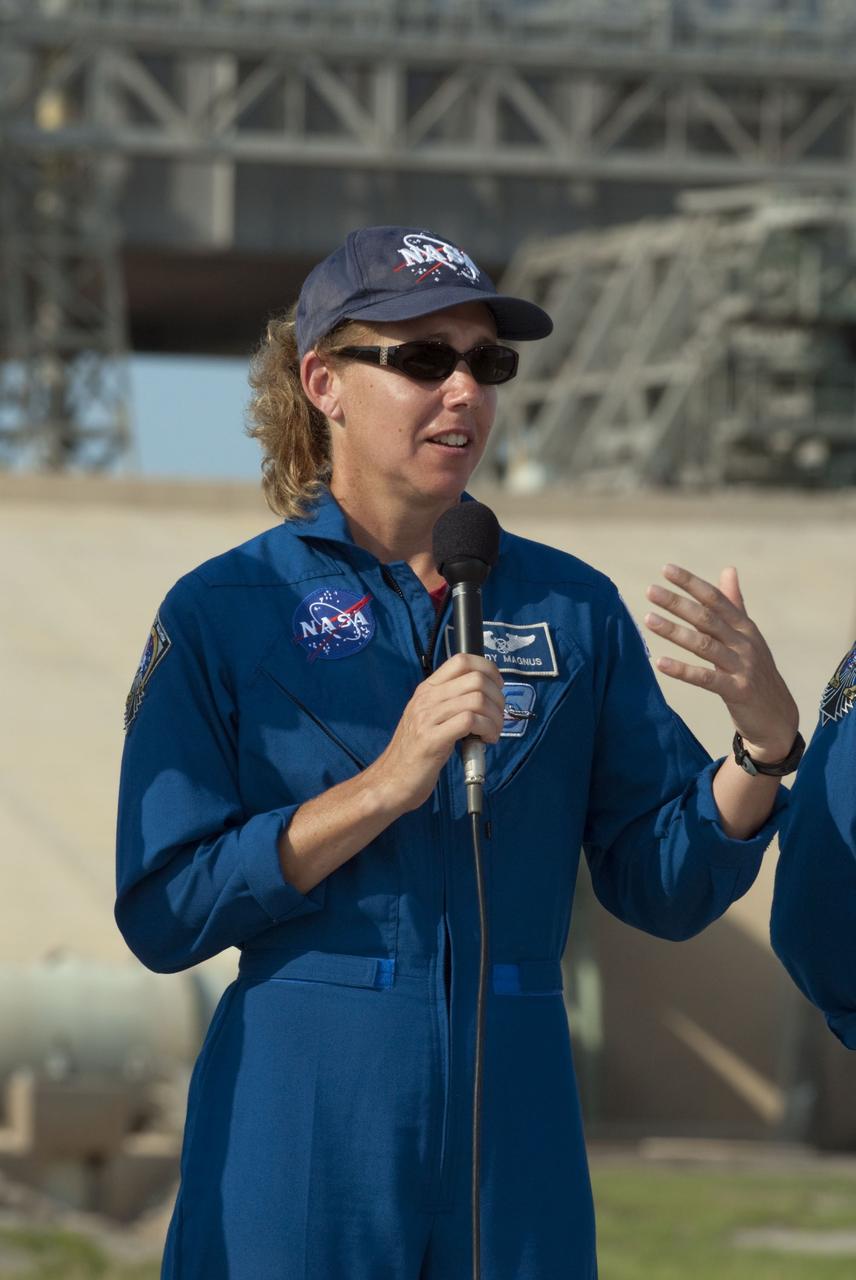
CAPE CANAVERAL, Fla. -- STS-135 Mission Specialist Sandy Magnus speaks to media during a question-and-answer session at NASA Kennedy Space Center's Launch Pad 39A in Florida. Space shuttle Atlantis' astronauts are at Kennedy to participate in a launch countdown dress rehearsal called the Terminal Countdown Demonstration Test (TCDT) and related training. Atlantis and its crew are targeted to lift off July 8, taking with them the Raffaello multi-purpose logistics module packed with supplies and spare parts to the International Space Station. The STS-135 mission also will fly a system to investigate the potential for robotically refueling existing satellites and return a failed ammonia pump module to help NASA better understand the failure mechanism and improve pump designs for future systems. STS-135 will be the 33rd flight of Atlantis, the 37th shuttle mission to the space station, and the 135th and final mission of NASA's Space Shuttle Program. For more information visit, www.nasa.gov/mission_pages/shuttle/shuttlemissions/sts135/index.html. Photo credit: NASA/Kim Shiflett
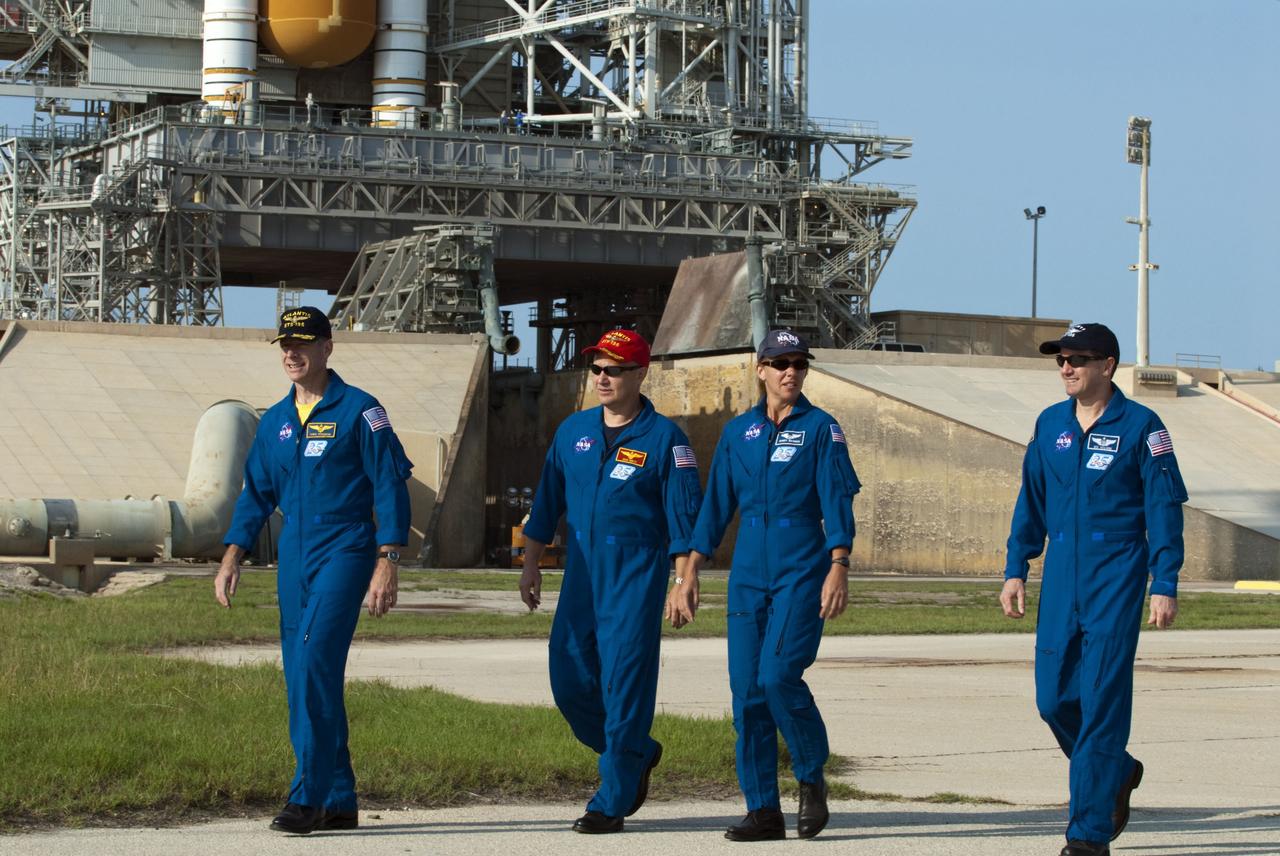
CAPE CANAVERAL, Fla. -- The STS-135 crew members gather at NASA Kennedy Space Center's Launch Pad 39A in Florida for a question-and-answer session with media. From left are Commander Chris Ferguson, Pilot Doug Hurley, Mission Specialists Sandy Magnus and Rex Walheim. Space shuttle Atlantis' astronauts are at Kennedy to participate in a launch countdown dress rehearsal called the Terminal Countdown Demonstration Test (TCDT) and related training. Atlantis and its crew are targeted to lift off July 8, taking with them the Raffaello multi-purpose logistics module packed with supplies and spare parts to the International Space Station. The STS-135 mission also will fly a system to investigate the potential for robotically refueling existing satellites and return a failed ammonia pump module to help NASA better understand the failure mechanism and improve pump designs for future systems. STS-135 will be the 33rd flight of Atlantis, the 37th shuttle mission to the space station, and the 135th and final mission of NASA's Space Shuttle Program. For more information visit, www.nasa.gov/mission_pages/shuttle/shuttlemissions/sts135/index.html. Photo credit: NASA/Kim Shiflett
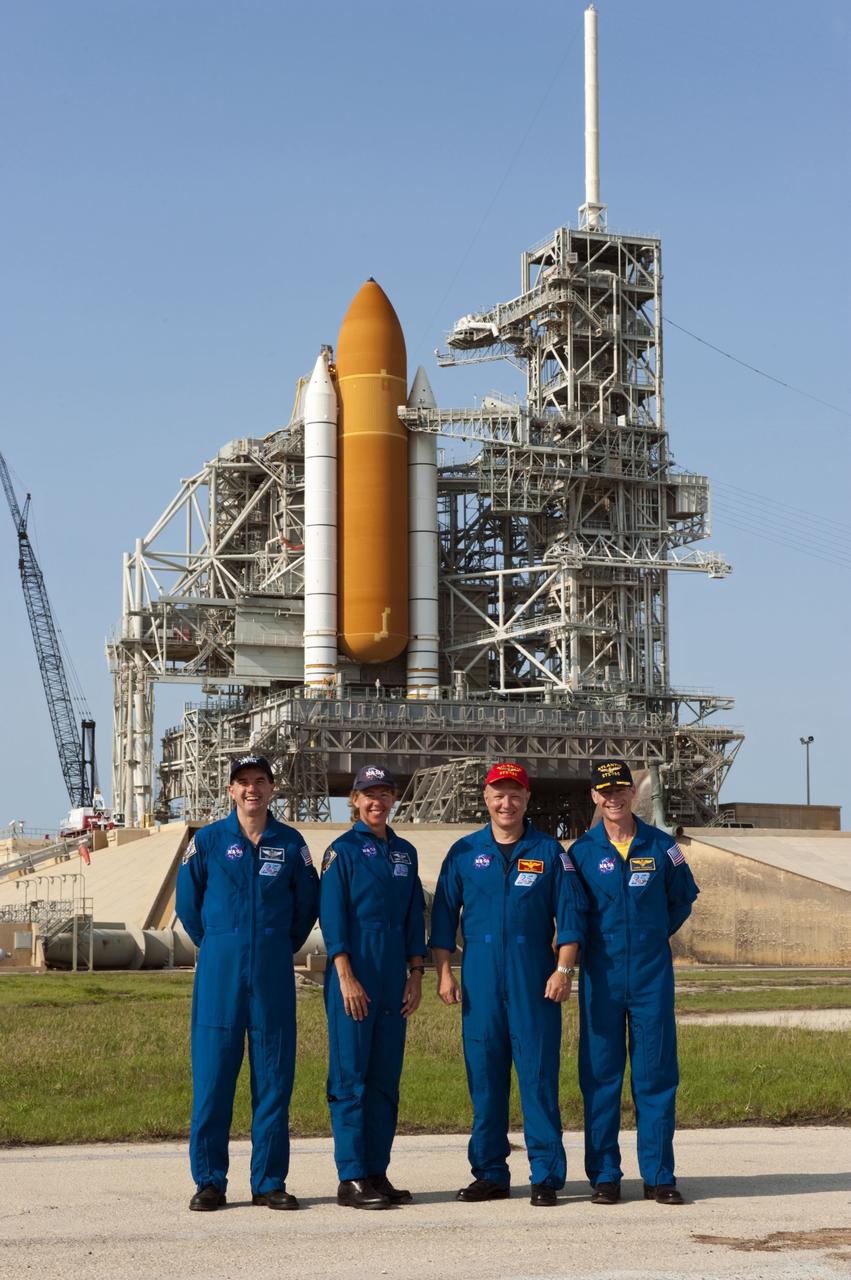
CAPE CANAVERAL, Fla. -- The STS-135 crew members stand for a photograph after a question-and-answer session with media at NASA Kennedy Space Center's Launch Pad 39A in Florida. From left are Mission Specialists Rex Walheim and Sandy Magnus; Pilot Doug Hurley and Commander Chris Ferguson. Space shuttle Atlantis' astronauts are at Kennedy to participate in a launch countdown dress rehearsal called the Terminal Countdown Demonstration Test (TCDT) and related training. Atlantis and its crew are targeted to lift off July 8, taking with them the Raffaello multi-purpose logistics module packed with supplies and spare parts to the International Space Station. The STS-135 mission also will fly a system to investigate the potential for robotically refueling existing satellites and return a failed ammonia pump module to help NASA better understand the failure mechanism and improve pump designs for future systems. STS-135 will be the 33rd flight of Atlantis, the 37th shuttle mission to the space station, and the 135th and final mission of NASA's Space Shuttle Program. For more information visit, www.nasa.gov/mission_pages/shuttle/shuttlemissions/sts135/index.html. Photo credit: NASA/Kim Shiflett
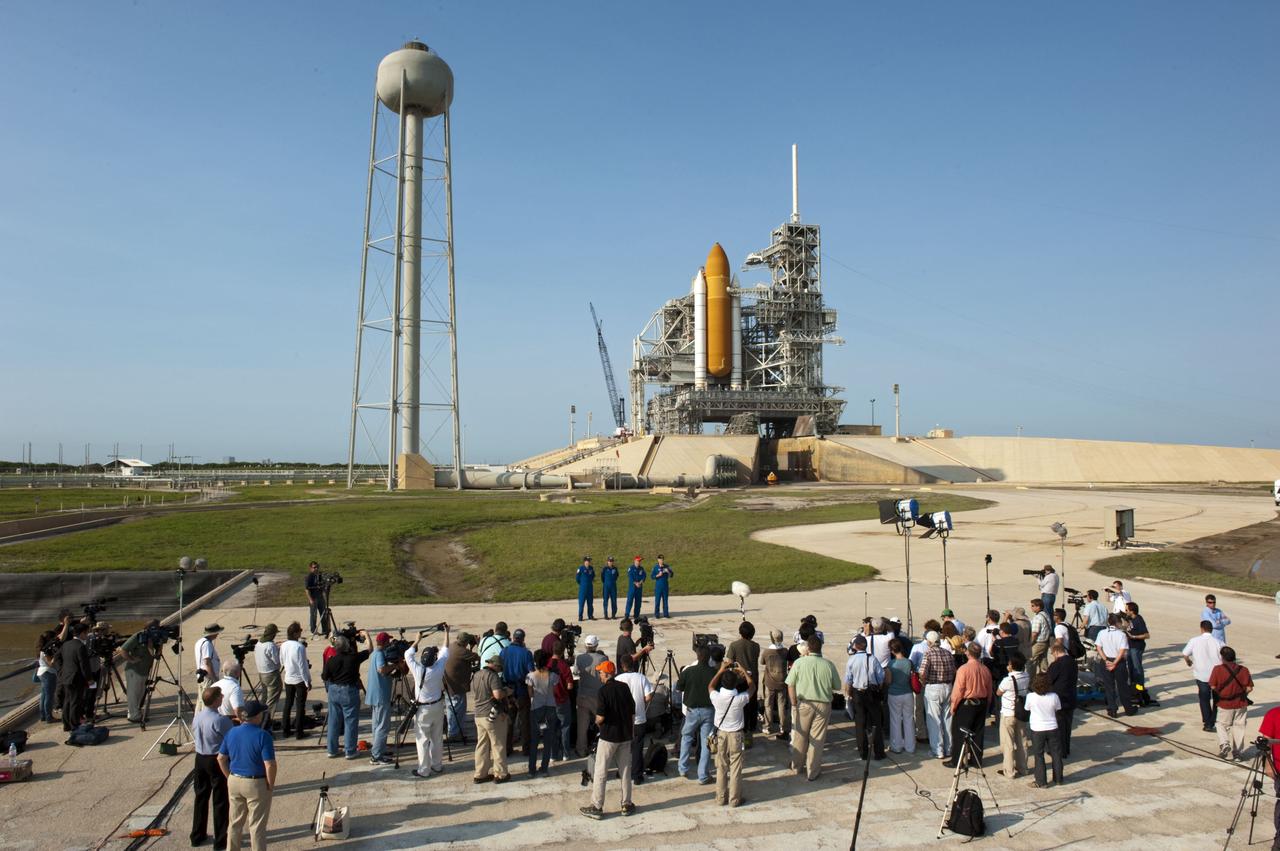
CAPE CANAVERAL, Fla. -- The STS-135 crew members gather at NASA Kennedy Space Center's Launch Pad 39A in Florida for a question-and-answer session with media. With the microphone in hand is Commander Chris Ferguson as Pilot Doug Hurley (red cap), Mission Specialists Sandy Magnus and Rex Walheim look on. Space shuttle Atlantis' astronauts are at Kennedy to participate in a launch countdown dress rehearsal called the Terminal Countdown Demonstration Test (TCDT) and related training. Atlantis and its crew are targeted to lift off July 8, taking with them the Raffaello multi-purpose logistics module packed with supplies and spare parts to the International Space Station. The STS-135 mission also will fly a system to investigate the potential for robotically refueling existing satellites and return a failed ammonia pump module to help NASA better understand the failure mechanism and improve pump designs for future systems. STS-135 will be the 33rd flight of Atlantis, the 37th shuttle mission to the space station, and the 135th and final mission of NASA's Space Shuttle Program. For more information visit, www.nasa.gov/mission_pages/shuttle/shuttlemissions/sts135/index.html. Photo credit: NASA/Kim Shiflett
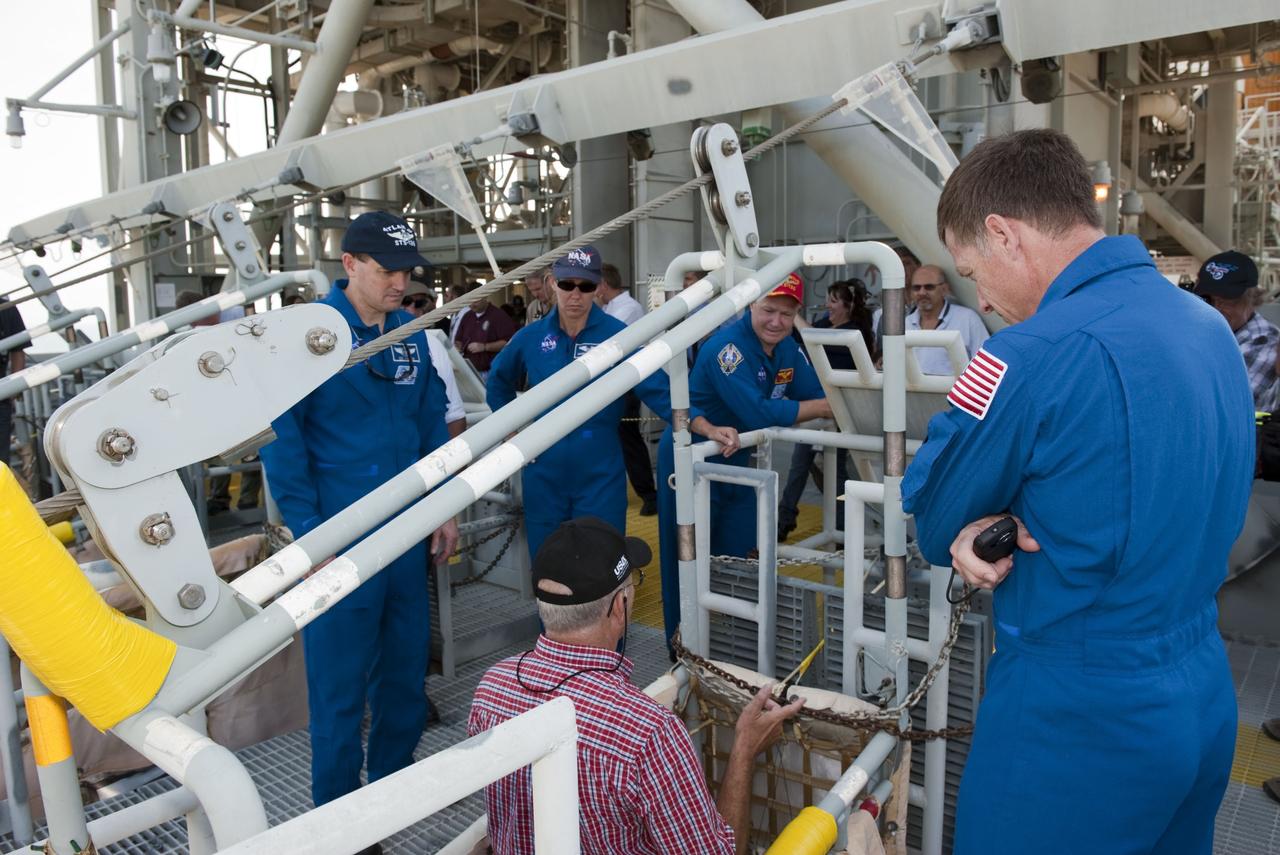
CAPE CANAVERAL, Fla. -- On Launch Pad 39A at NASA's Kennedy Space Center in Florida, space shuttle Atlantis' STS-135 crew members are instructed on the slidewire basket emergency exit system at the pad. From left are Mission Specialists Rex Walheim and Sandy Magnus, Pilot Doug Hurley and Commander Chris Ferguson. The astronauts are at Kennedy to participate in a launch countdown dress rehearsal called the Terminal Countdown Demonstration Test (TCDT) and related training. Atlantis and its crew are targeted to lift off July 8, taking with them the Raffaello multi-purpose logistics module packed with supplies and spare parts to the International Space Station. The STS-135 mission also will fly a system to investigate the potential for robotically refueling existing satellites and return a failed ammonia pump module to help NASA better understand the failure mechanism and improve pump designs for future systems. STS-135 will be the 33rd flight of Atlantis, the 37th shuttle mission to the space station, and the 135th and final mission of NASA's Space Shuttle Program. For more information visit, www.nasa.gov/mission_pages/shuttle/shuttlemissions/sts135/index.html. Photo credit: NASA/Kim Shiflett
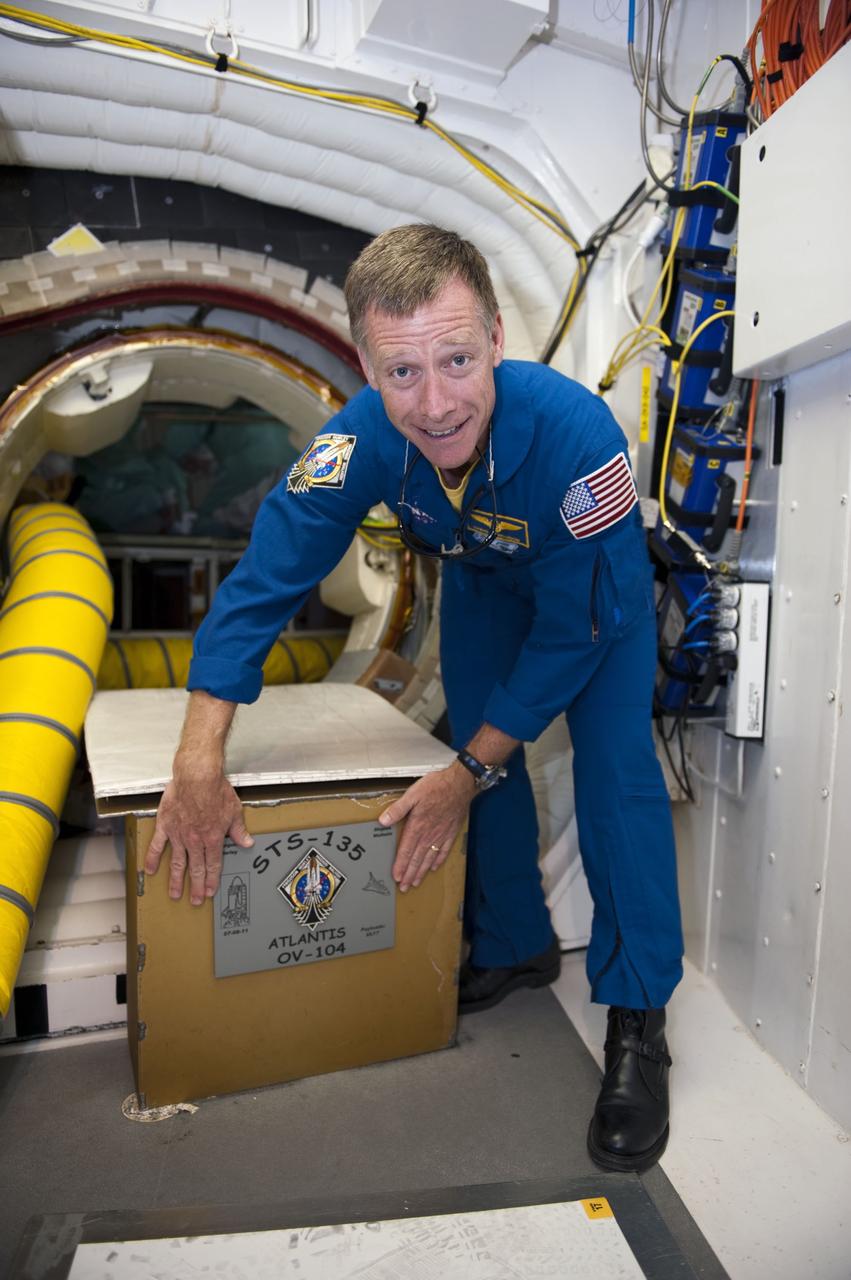
CAPE CANAVERAL, Fla. -- STS-135 Commander Chris Ferguson places a plaque in front of space shuttle Atlantis' hatch in the White Room at NASA Kennedy Space Center's Launch Pad 39A. An access arm supports the White Room that is in place against the shuttle which provides entry to the crew compartment. The astronauts are at Kennedy to participate in a launch countdown dress rehearsal called the Terminal Countdown Demonstration Test (TCDT) and related training. Atlantis and its crew are targeted to lift off July 8, taking with them the Raffaello multi-purpose logistics module packed with supplies and spare parts to the International Space Station. The STS-135 mission also will fly a system to investigate the potential for robotically refueling existing satellites and return a failed ammonia pump module to help NASA better understand the failure mechanism and improve pump designs for future systems. STS-135 will be the 33rd flight of Atlantis, the 37th shuttle mission to the space station, and the 135th and final mission of NASA's Space Shuttle Program. For more information visit, www.nasa.gov/mission_pages/shuttle/shuttlemissions/sts135/index.html. Photo credit: NASA/Kim Shiflett