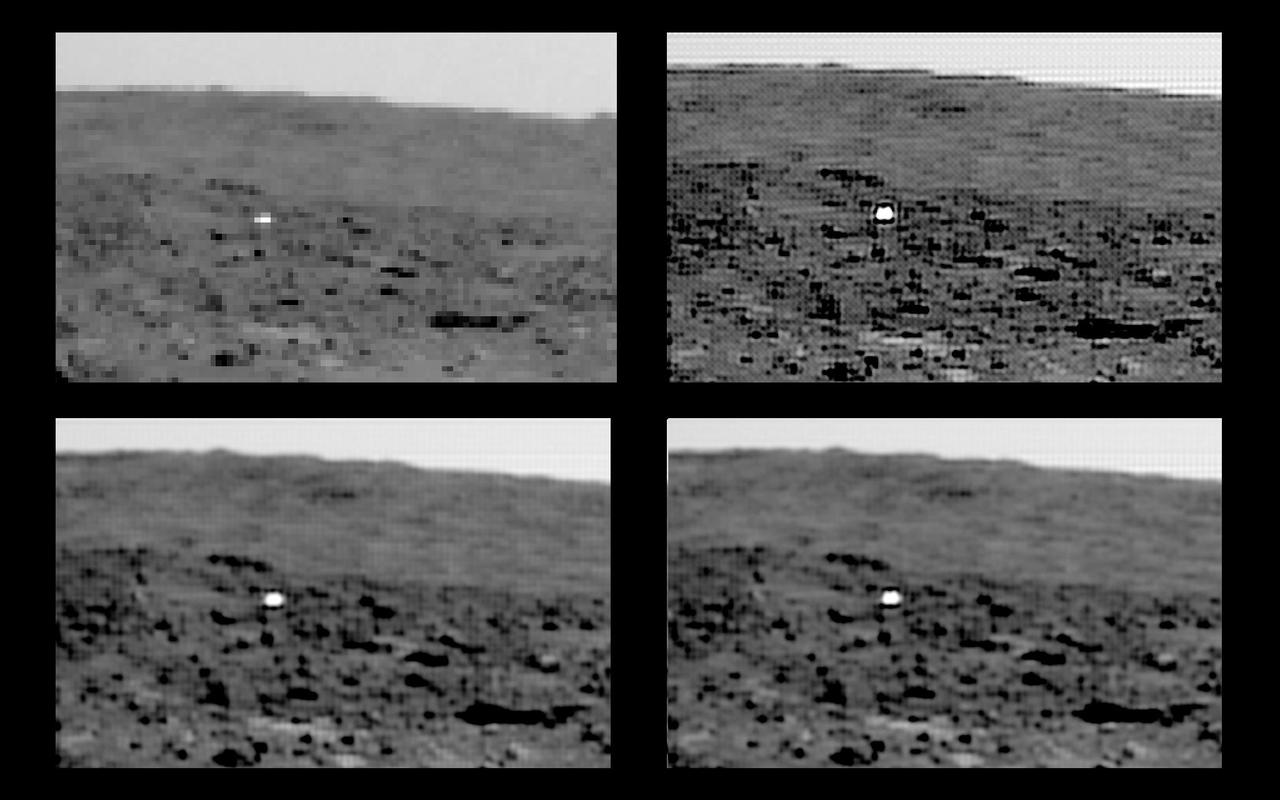
Backshell Located
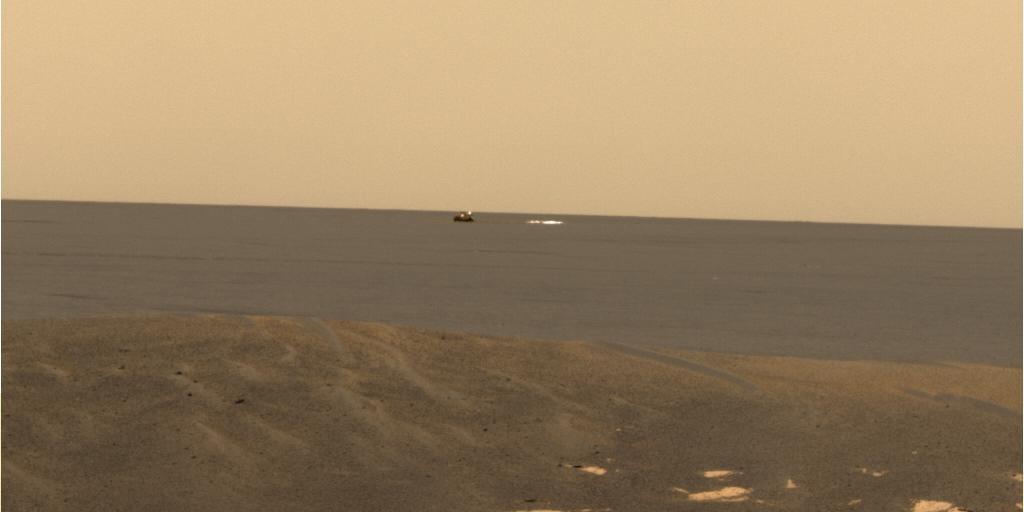
Opportunity Spies Its Backshell
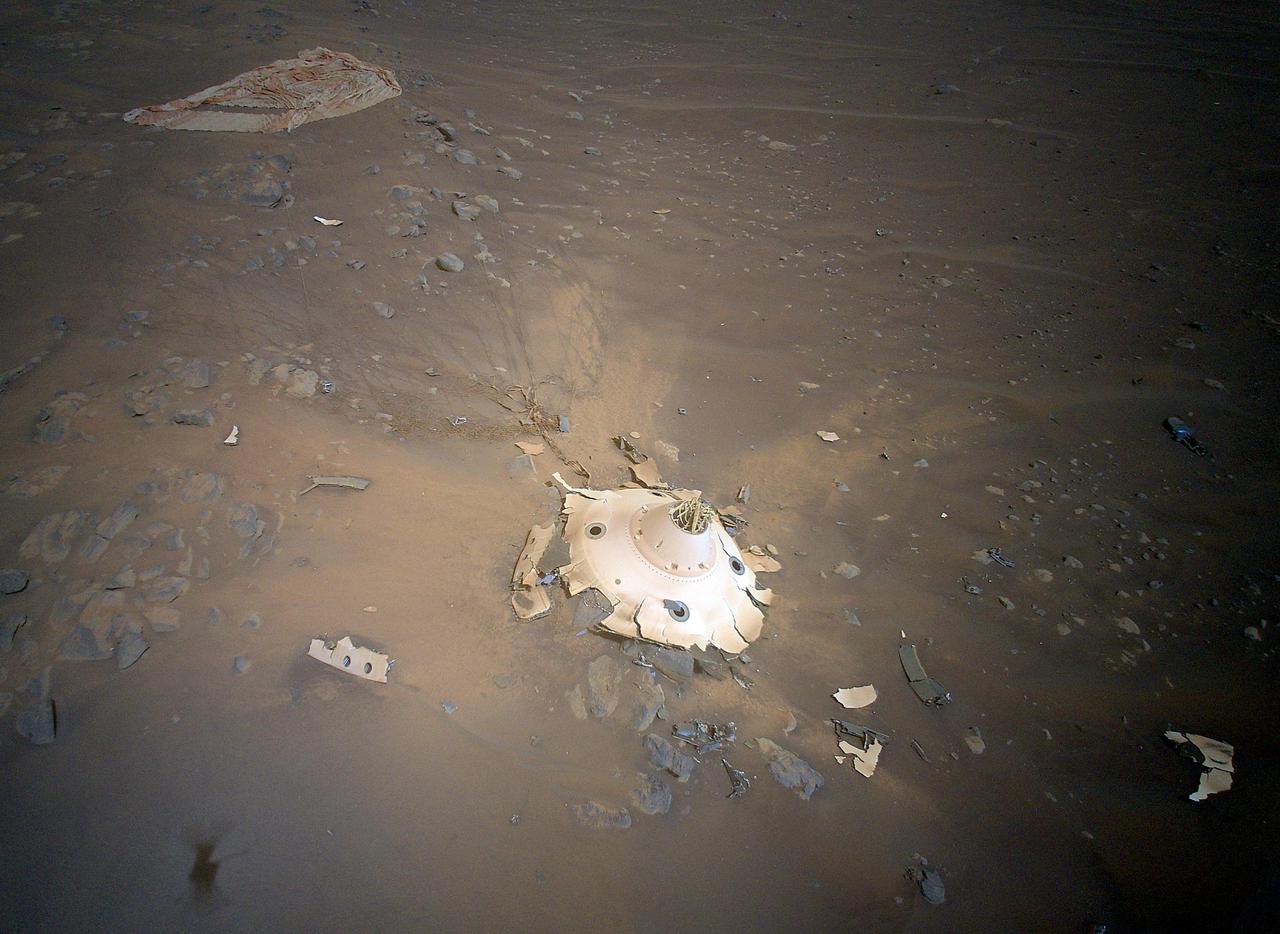
This image of Perseverance's backshell sitting upright on the surface of Jezero Crater was collected from an altitude of 26 feet (8 meters) by NASA's Ingenuity Mars Helicopter during its 26th flight at Mars on April 19, 2022. Engineers working on the Mars Sample Return program requested images be taken from an aerial perspective of the components because they may provide insight into the components' performance during the rover's entry, descent, and landing on Feb. 18, 2021. The tangle of cables seen streaming out from the top of the backshell, and coated with Martian dust on the surface, are high-strength suspension lines that connect the backshell to Perseverance's supersonic parachute (upper left). The backshell and parachute helped protect the rover in deep space and during its fiery descent toward the Martian surface. https://photojournal.jpl.nasa.gov/catalog/PIA25219
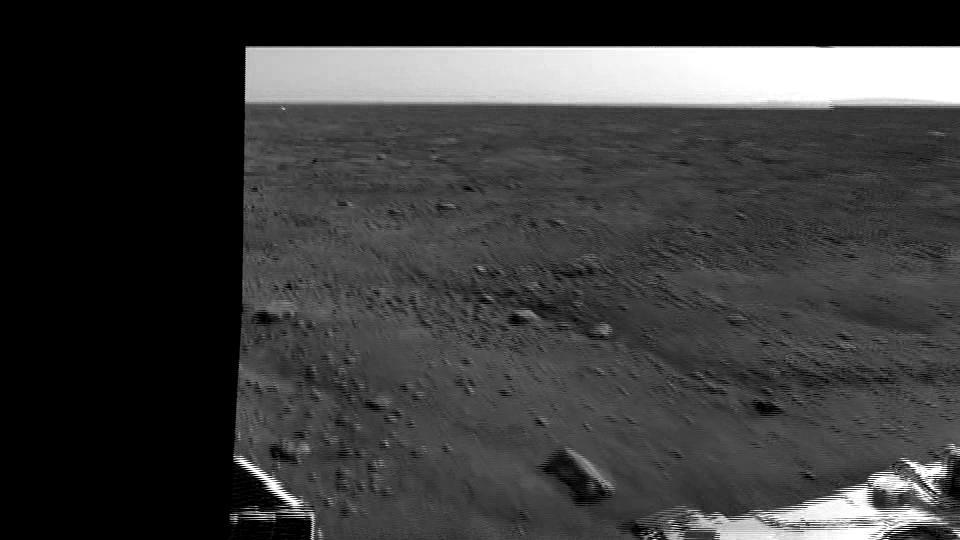
This image zooms in on the backshell and parachute, about 300 meters to the south of NASA Phoenix Mars Lander. In the distance, about 9 miles or 15 kilometers away, is a range of hills..
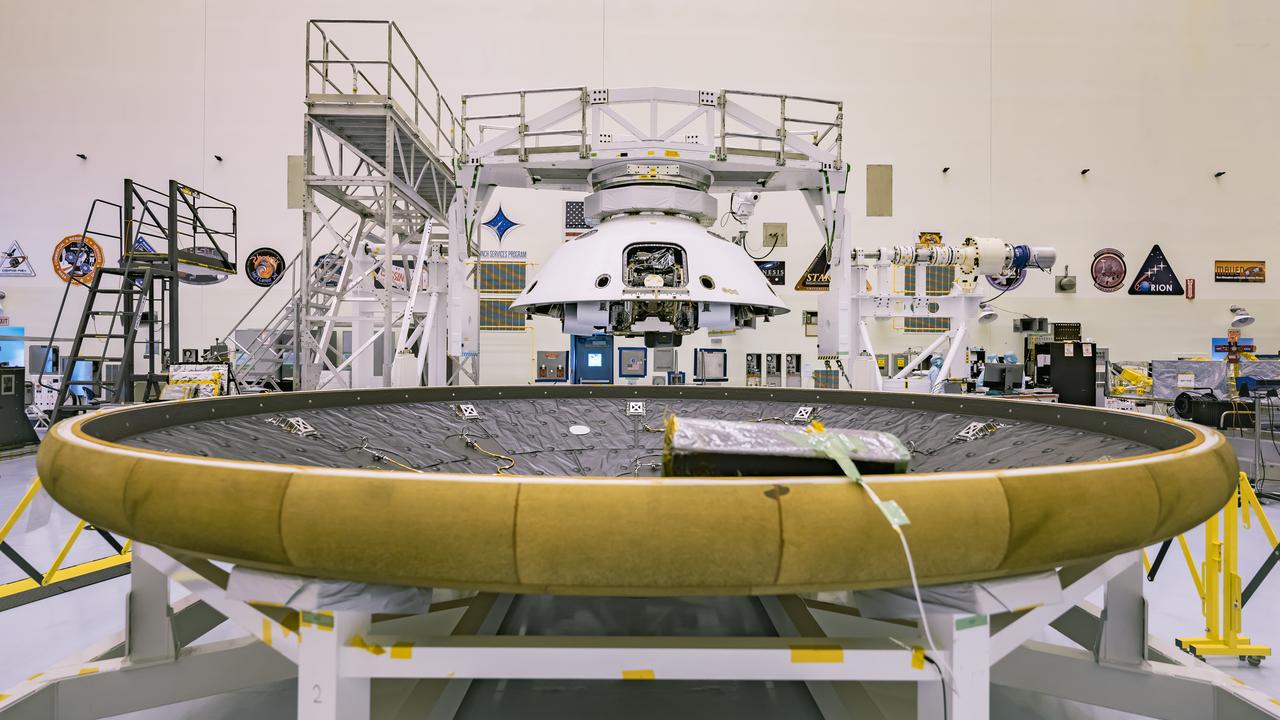
Inside the Payload Hazardous Servicing Facility at NASA’s Kennedy Space Center in Florida, the Backshell-Powered Descent Vehicle and Entry Vehicle assemblies are being prepared to be attached to the Mars Perseverance rover on May 5, 2020. The cone-shaped backshell contains the parachute, and along with the mission’s heat shield, provides protection for the rover and descent stage during Martian atmospheric entry. The Mars Perseverance rover is scheduled to launch in mid-July atop a United Launch Alliance Atlas V 541 rocket from Pad 41 at nearby Cape Canaveral Air Force Station. The rover is part of NASA’s Mars Exploration Program, a long-term effort of robotic exploration of the Red Planet. The rover will search for habitable conditions in the ancient past and signs of past microbial life on Mars. The Launch Services Program at Kennedy is responsible for launch management.
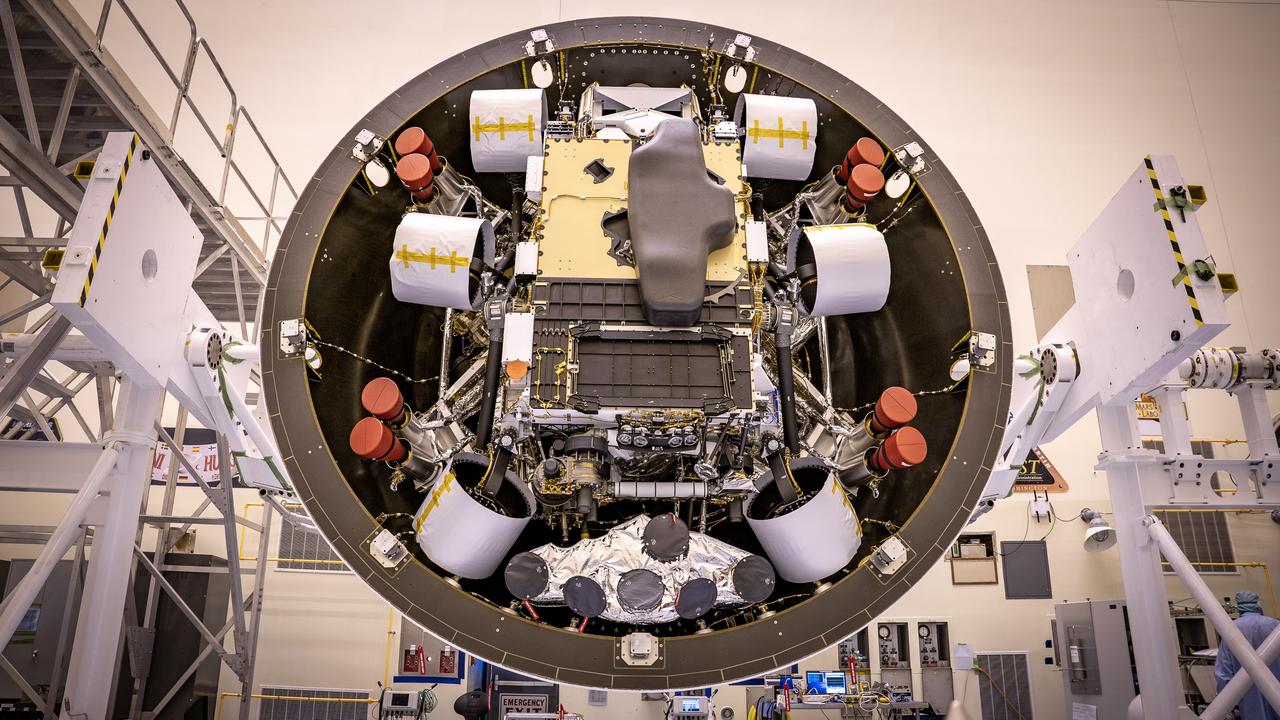
Inside the Payload Hazardous Servicing Facility at NASA’s Kennedy Space Center in Florida, the Backshell-Powered Descent Vehicle and Entry Vehicle assemblies are being prepared to be attached to the Mars Perseverance rover on May 4, 2020. The cone-shaped backshell contains the parachute, and along with the mission’s heat shield, provides protection for the rover and descent stage during Martian atmospheric entry. The Mars Perseverance rover is scheduled to launch in mid-July atop a United Launch Alliance Atlas V 541 rocket from Pad 41 at nearby Cape Canaveral Air Force Station. The rover is part of NASA’s Mars Exploration Program, a long-term effort of robotic exploration of the Red Planet. The rover will search for habitable conditions in the ancient past and signs of past microbial life on Mars. The Launch Services Program at Kennedy is responsible for launch management.
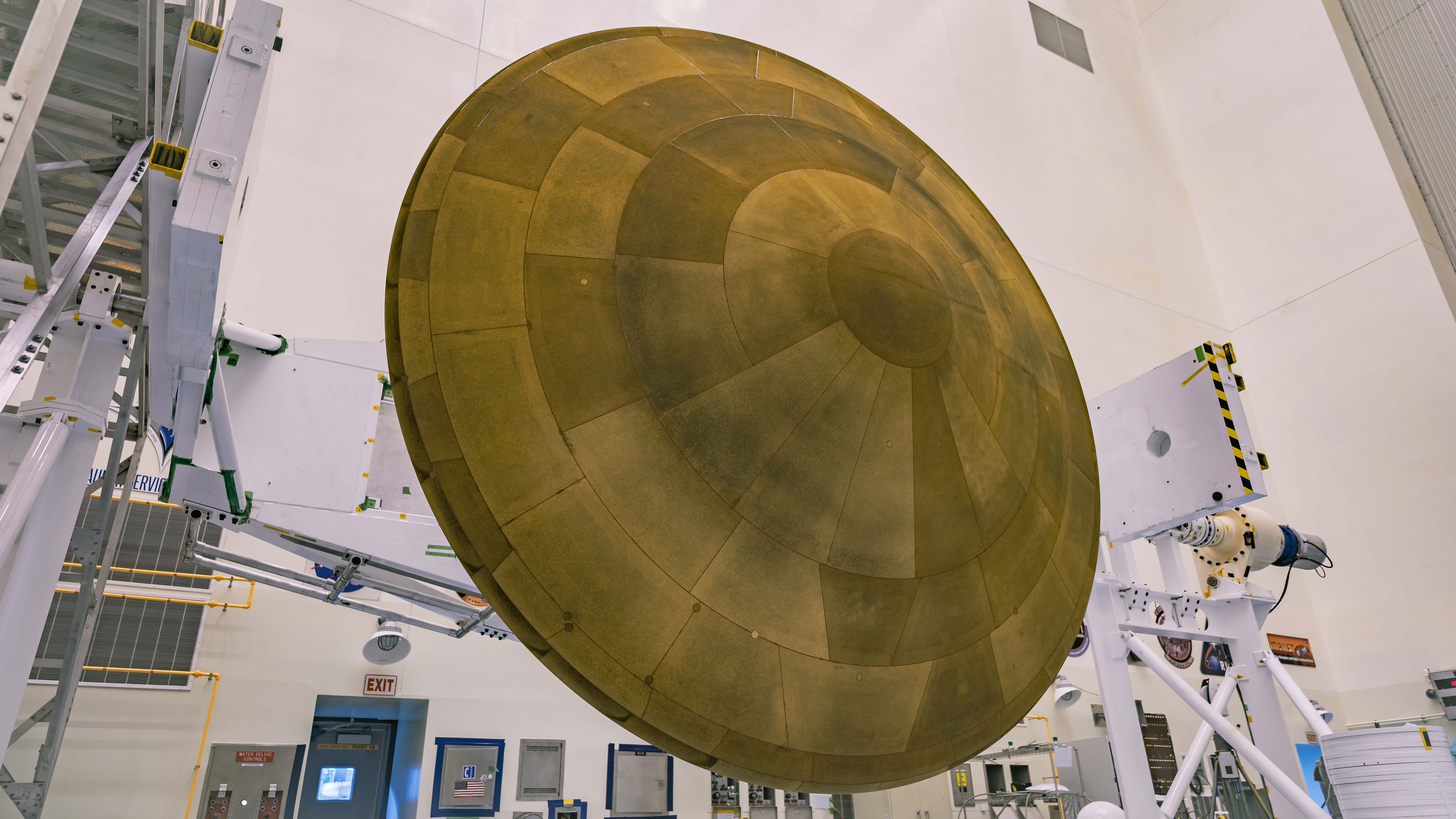
Inside the Payload Hazardous Servicing Facility at NASA’s Kennedy Space Center in Florida, the Backshell-Powered Descent Vehicle and Entry Vehicle assemblies are attached to the Mars Perseverance rover on May 6, 2020. The cone-shaped backshell contains the parachute, and along with the mission’s heat shield, provides protection for the rover and descent stage during Martian atmospheric entry. The Mars Perseverance rover is scheduled to launch in mid-July atop a United Launch Alliance Atlas V 541 rocket from Pad 41 at nearby Cape Canaveral Air Force Station. The rover is part of NASA’s Mars Exploration Program, a long-term effort of robotic exploration of the Red Planet. The rover will search for habitable conditions in the ancient past and signs of past microbial life on Mars. The Launch Services Program at Kennedy is responsible for launch management.
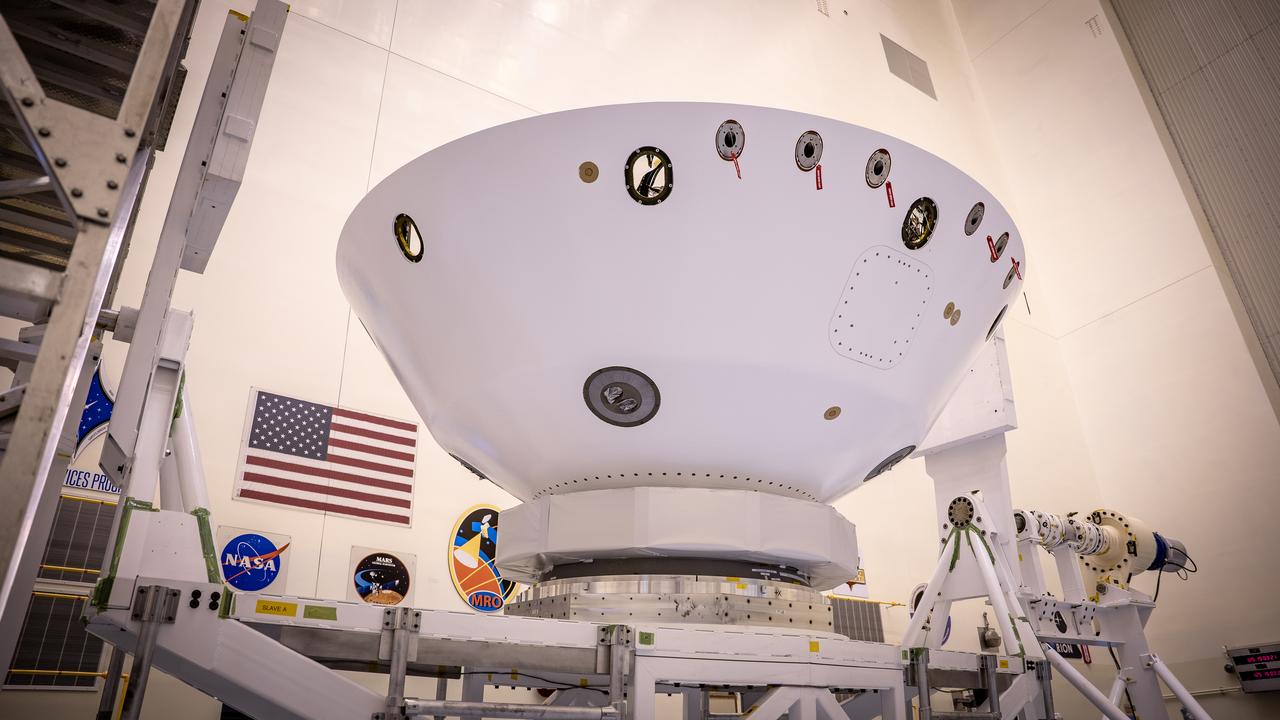
Inside the Payload Hazardous Servicing Facility at NASA’s Kennedy Space Center in Florida, the Mars Perseverance rover is rotated to prepare for the Backshell-Powered Descent Vehicle and Entry Vehicle assemblies to be attached on May 4, 2020. The cone-shaped backshell contains the parachute, and along with the mission’s heat shield, provides protection for the rover and descent stage during Martian atmospheric entry. The Mars Perseverance rover is scheduled to launch in mid-July atop a United Launch Alliance Atlas V 541 rocket from Pad 41 at nearby Cape Canaveral Air Force Station. The rover is part of NASA’s Mars Exploration Program, a long-term effort of robotic exploration of the Red Planet. The rover will search for habitable conditions in the ancient past and signs of past microbial life on Mars. The Launch Services Program at Kennedy is responsible for launch management.
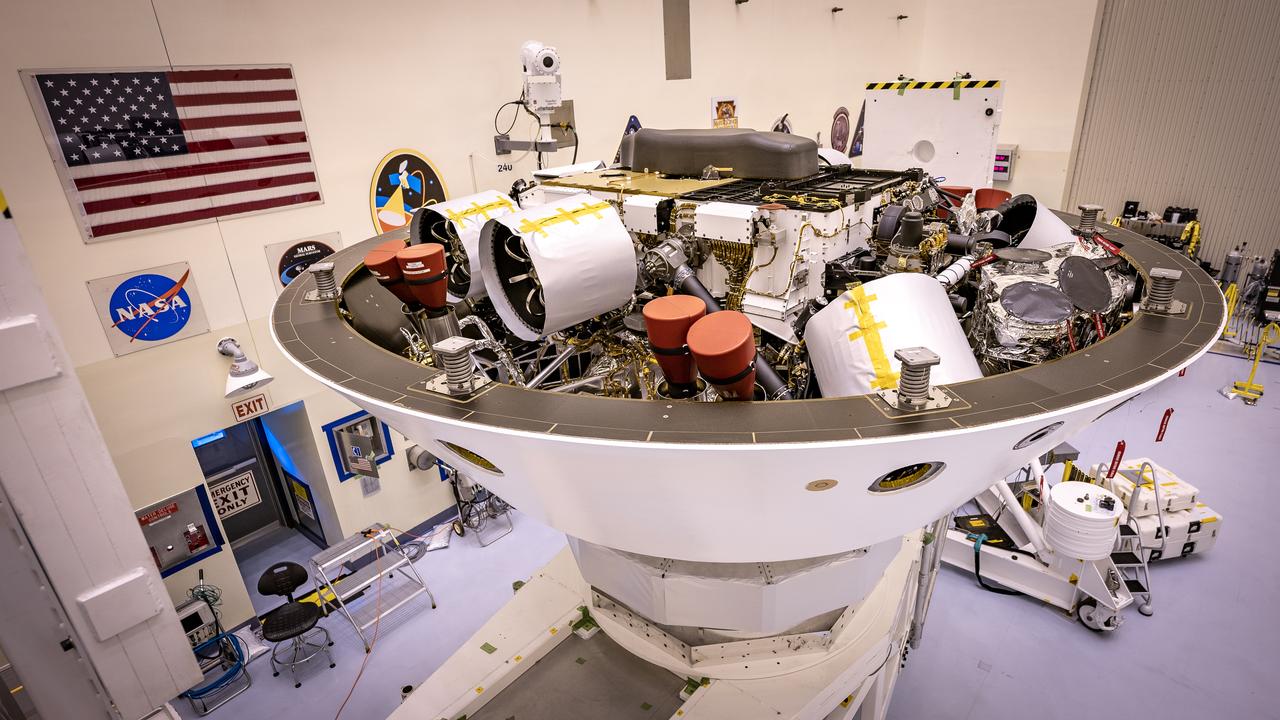
Inside the Payload Hazardous Servicing Facility at NASA’s Kennedy Space Center in Florida, the Mars Perseverance rover is rotated to prepare for the Backshell-Powered Descent Vehicle and Entry Vehicle assemblies to be attached on May 4, 2020. The cone-shaped backshell contains the parachute, and along with the mission’s heat shield, provides protection for the rover and descent stage during Martian atmospheric entry. The Mars Perseverance rover is scheduled to launch in mid-July atop a United Launch Alliance Atlas V 541 rocket from Pad 41 at nearby Cape Canaveral Air Force Station. The rover is part of NASA’s Mars Exploration Program, a long-term effort of robotic exploration of the Red Planet. The rover will search for habitable conditions in the ancient past and signs of past microbial life on Mars. The Launch Services Program at Kennedy is responsible for launch management.
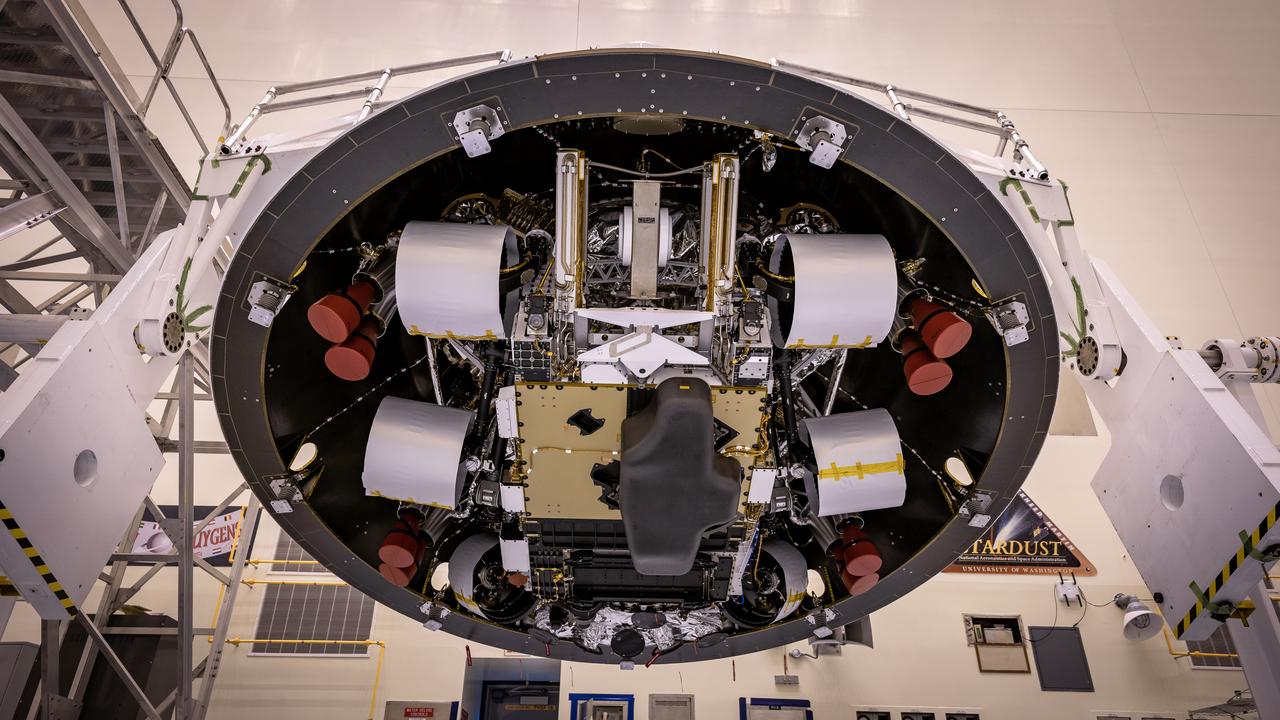
Inside the Payload Hazardous Servicing Facility at NASA’s Kennedy Space Center in Florida, the Backshell-Powered Descent Vehicle and Entry Vehicle assemblies are being prepared to be attached to the Mars Perseverance rover on May 4, 2020. The cone-shaped backshell contains the parachute, and along with the mission’s heat shield, provides protection for the rover and descent stage during Martian atmospheric entry. The Mars Perseverance rover is scheduled to launch in mid-July atop a United Launch Alliance Atlas V 541 rocket from Pad 41 at nearby Cape Canaveral Air Force Station. The rover is part of NASA’s Mars Exploration Program, a long-term effort of robotic exploration of the Red Planet. The rover will search for habitable conditions in the ancient past and signs of past microbial life on Mars. The Launch Services Program at Kennedy is responsible for launch management.
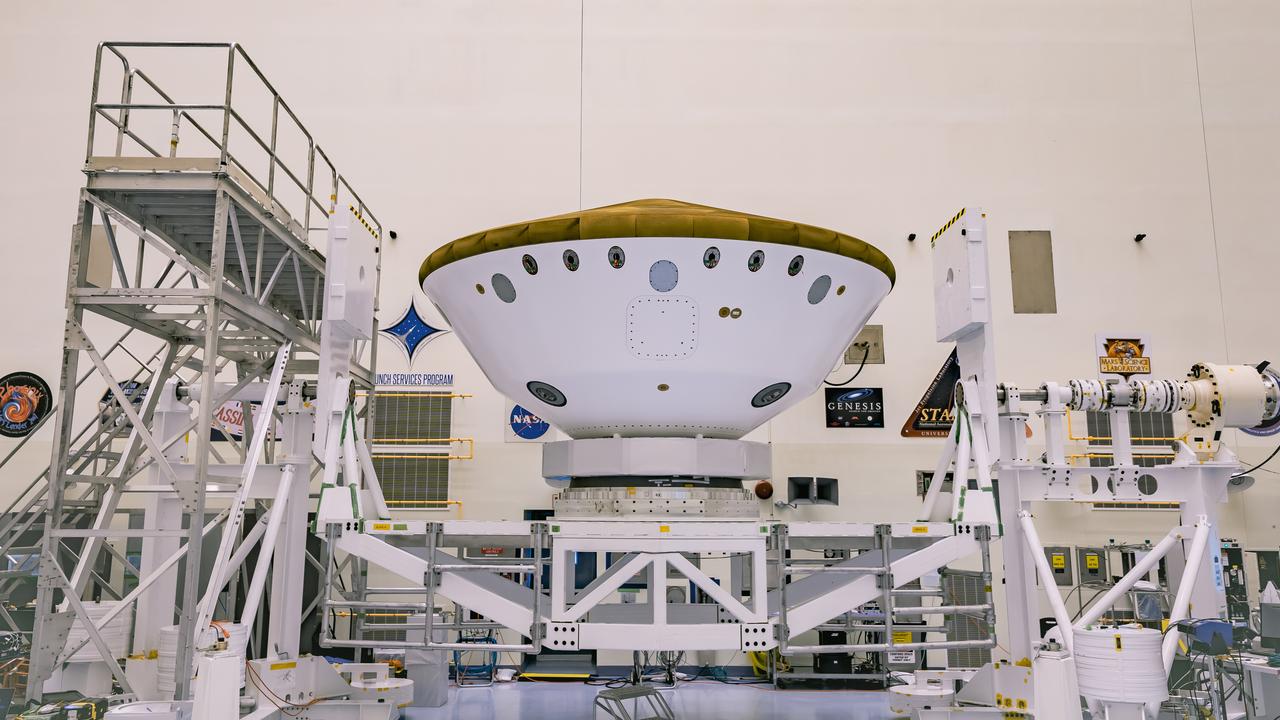
Inside the Payload Hazardous Servicing Facility at NASA’s Kennedy Space Center in Florida, the Backshell-Powered Descent Vehicle and Entry Vehicle assemblies are attached to the Mars Perseverance rover on May 6, 2020. The cone-shaped backshell contains the parachute, and along with the mission’s heat shield, provides protection for the rover and descent stage during Martian atmospheric entry. The Mars Perseverance rover is scheduled to launch in mid-July atop a United Launch Alliance Atlas V 541 rocket from Pad 41 at nearby Cape Canaveral Air Force Station. The rover is part of NASA’s Mars Exploration Program, a long-term effort of robotic exploration of the Red Planet. The rover will search for habitable conditions in the ancient past and signs of past microbial life on Mars. The Launch Services Program at Kennedy is responsible for launch management.
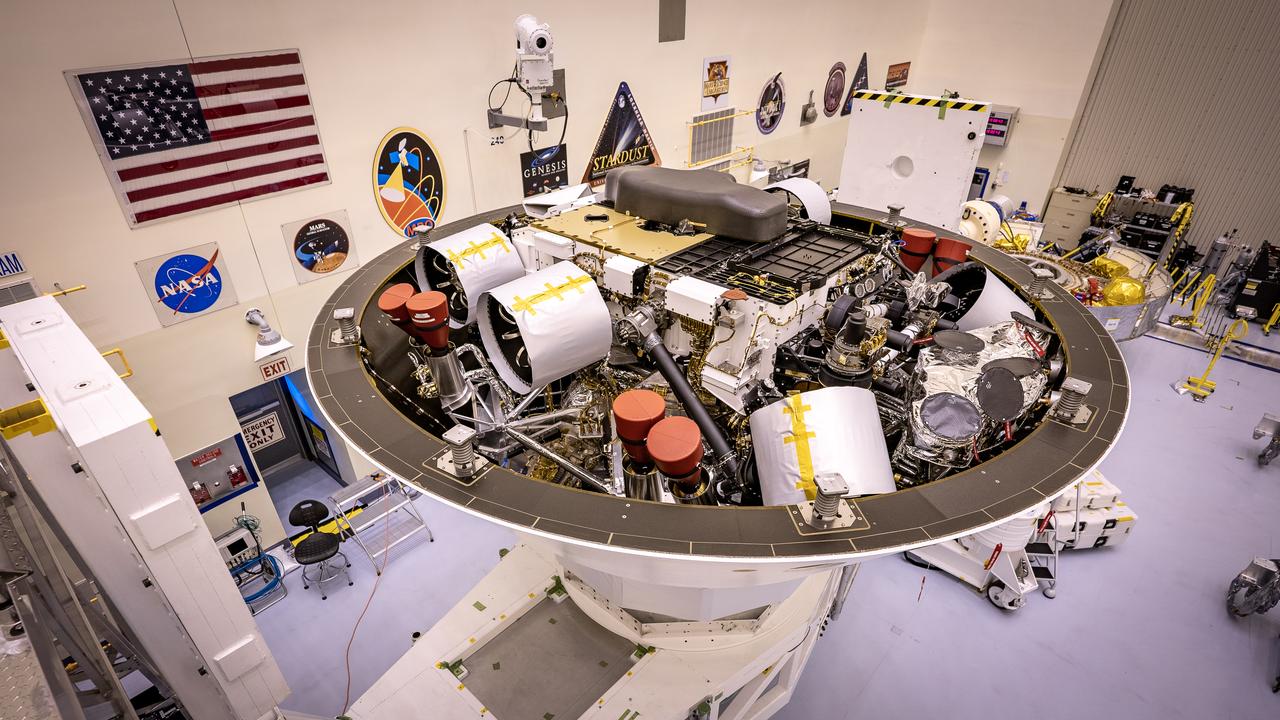
Inside the Payload Hazardous Servicing Facility at NASA’s Kennedy Space Center in Florida, the Mars Perseverance rover is rotated to prepare for the Backshell-Powered Descent Vehicle and Entry Vehicle assemblies to be attached on May 4, 2020. The cone-shaped backshell contains the parachute, and along with the mission’s heat shield, provides protection for the rover and descent stage during Martian atmospheric entry. The Mars Perseverance rover is scheduled to launch in mid-July atop a United Launch Alliance Atlas V 541 rocket from Pad 41 at nearby Cape Canaveral Air Force Station. The rover is part of NASA’s Mars Exploration Program, a long-term effort of robotic exploration of the Red Planet. The rover will search for habitable conditions in the ancient past and signs of past microbial life on Mars. The Launch Services Program at Kennedy is responsible for launch management.
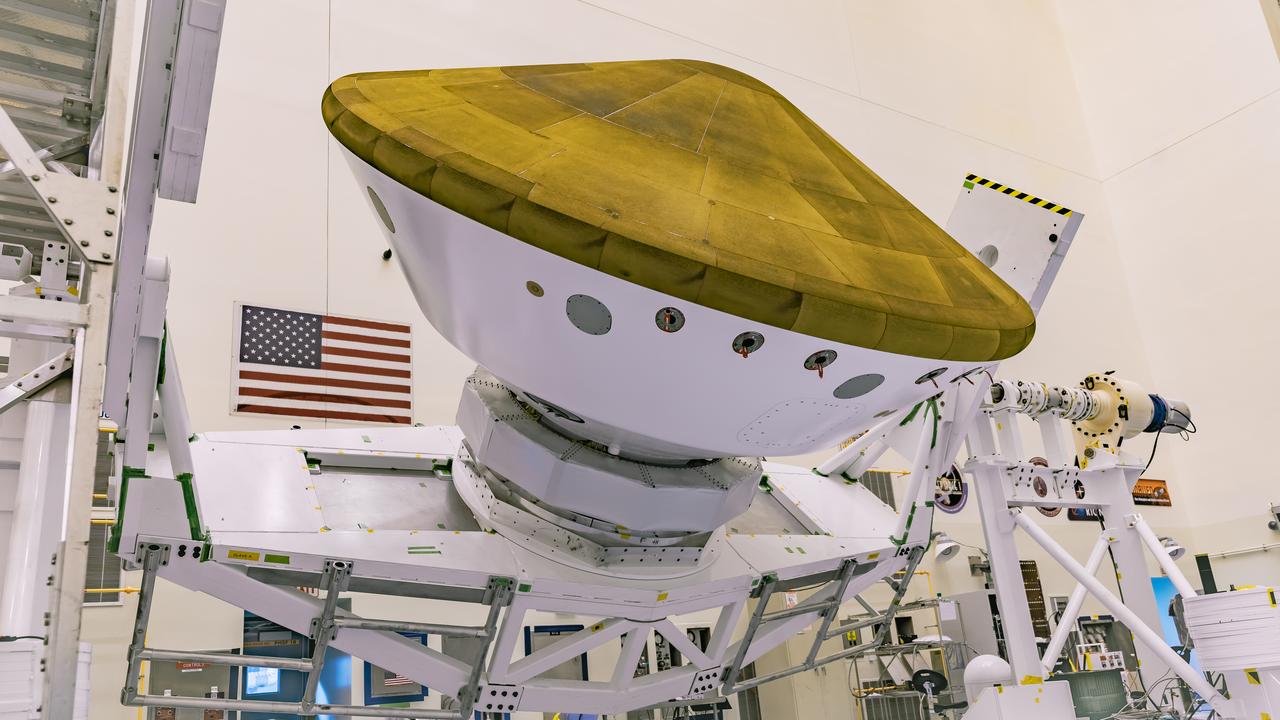
Inside the Payload Hazardous Servicing Facility at NASA’s Kennedy Space Center in Florida, the Backshell-Powered Descent Vehicle and Entry Vehicle assemblies are attached to the Mars Perseverance rover on May 6, 2020. The cone-shaped backshell contains the parachute, and along with the mission’s heat shield, provides protection for the rover and descent stage during Martian atmospheric entry. The Mars Perseverance rover is scheduled to launch in mid-July atop a United Launch Alliance Atlas V 541 rocket from Pad 41 at nearby Cape Canaveral Air Force Station. The rover is part of NASA’s Mars Exploration Program, a long-term effort of robotic exploration of the Red Planet. The rover will search for habitable conditions in the ancient past and signs of past microbial life on Mars. The Launch Services Program at Kennedy is responsible for launch management.
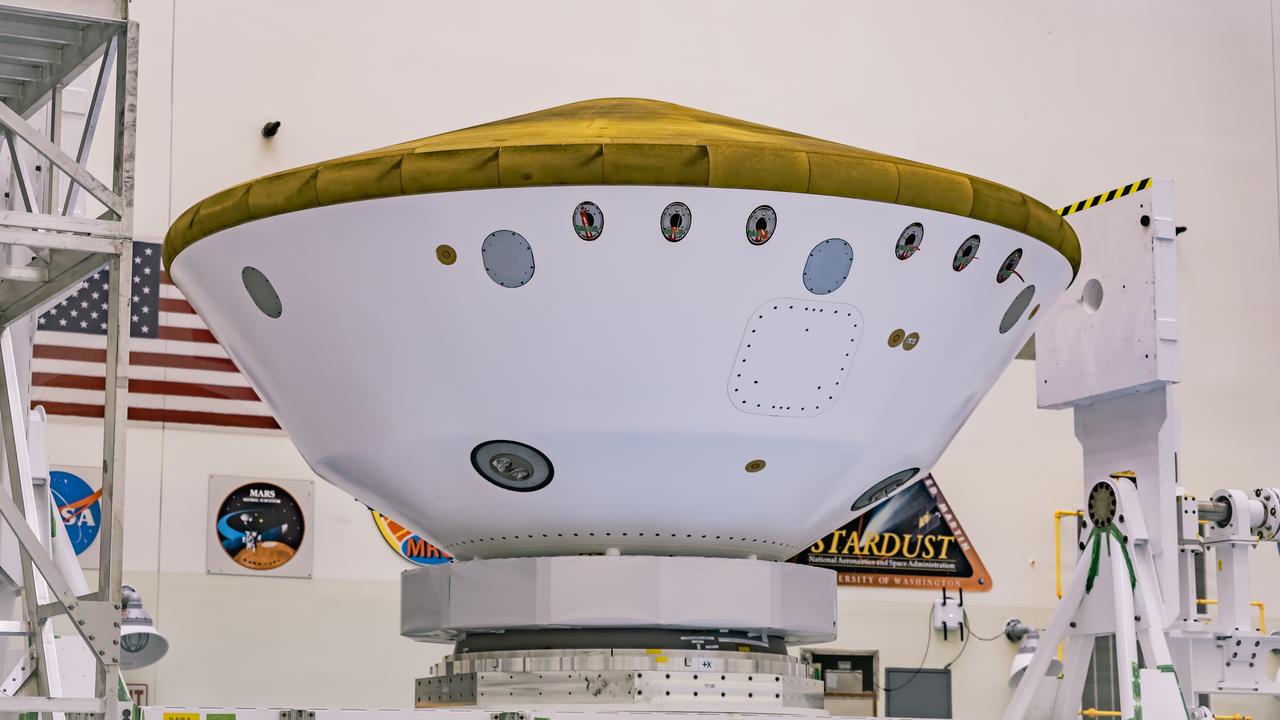
Inside the Payload Hazardous Servicing Facility at NASA’s Kennedy Space Center in Florida, the Backshell-Powered Descent Vehicle and Entry Vehicle assemblies are attached to the Mars Perseverance rover on May 6, 2020. The cone-shaped backshell contains the parachute, and along with the mission’s heat shield, provides protection for the rover and descent stage during Martian atmospheric entry. The Mars Perseverance rover is scheduled to launch in mid-July atop a United Launch Alliance Atlas V 541 rocket from Pad 41 at nearby Cape Canaveral Air Force Station. The rover is part of NASA’s Mars Exploration Program, a long-term effort of robotic exploration of the Red Planet. The rover will search for habitable conditions in the ancient past and signs of past microbial life on Mars. The Launch Services Program at Kennedy is responsible for launch management.
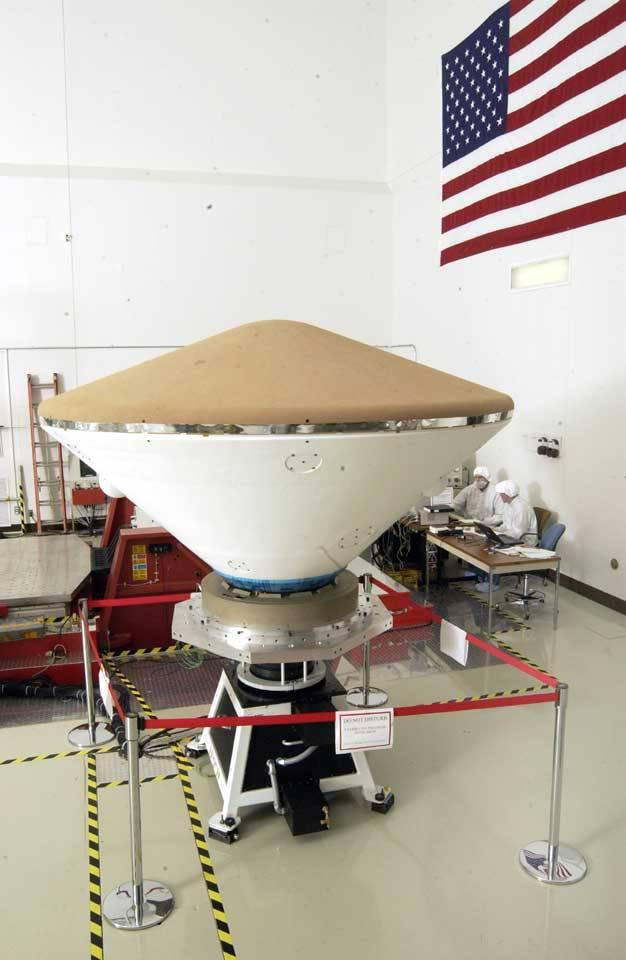
Mars Exploration Rover MER spacecraft. This image shows the aeroshell, which includes the backshell as well as the heatshield.
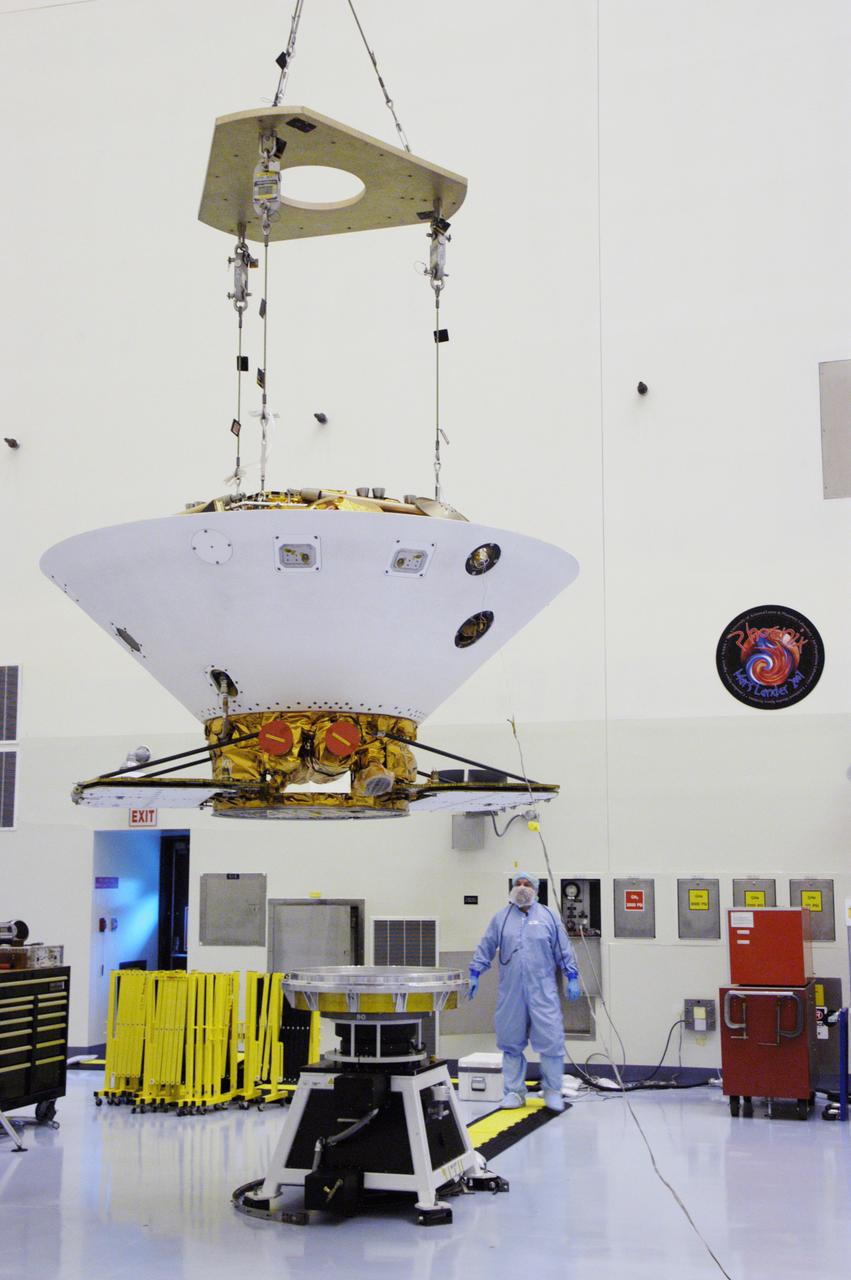
An overhead crane lowers the backshell with the Phoenix Mars Lander inside toward a spin table for spin testing in the Payload Hazardous Servicing Facility. The Phoenix mission is the first project in NASA's first openly competed program of Mars Scout missions. Phoenix will land in icy soils near the north polar permanent ice cap of Mars and explore the history of the water in these soils and any associated rocks, while monitoring polar climate. Landing is planned in May 2008 on arctic ground where a mission currently in orbit, Mars Odyssey, has detected high concentrations of ice just beneath the top layer of soil. It will serve as NASA's first exploration of a potential modern habitat on Mars and open the door to a renewed search for carbon-bearing compounds, last attempted with NASA’s Viking missions in the 1970s. A stereo color camera and a weather station will study the surrounding environment while the other instruments check excavated soil samples for water, organic chemicals and conditions that could indicate whether the site was ever hospitable to life. Microscopes can reveal features as small as one one-thousandth the width of a human hair. Launch of Phoenix aboard a Delta II rocket is targeted for Aug. 3 from Cape Canaveral Air Force Station in Florida.
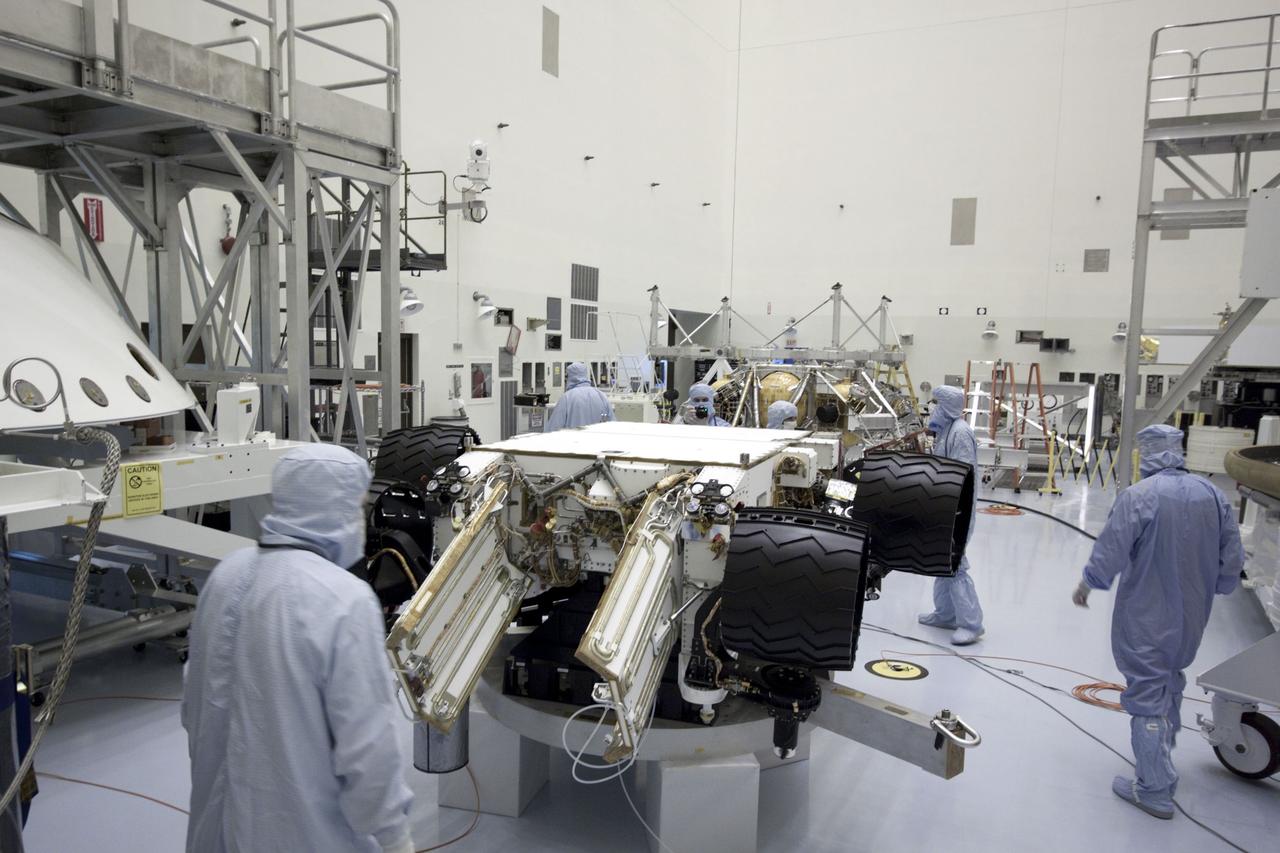
Cape Canaveral, Fla. -- At the Payload Hazardous Servicing Facility at NASA's Kennedy Space Center in Florida, NASA's Mars Science Laboratory (MSL) rover known as Curiosity, is secured on a work stand for processing. The spacecraft's backshell (left), which carries the parachute and several components used during later stages of entry, descent and landing, in addition is the rocket-powered descent stage (background), also is visible in the image. A United Launch Alliance Atlas V-541 configuration will be used to loft MSL into space. Curiosity’s 10 science instruments are designed to search for evidence on whether Mars has had environments favorable to microbial life, including chemical ingredients for life. The unique rover will use a laser to look inside rocks and release its gasses so that the rover’s spectrometer can analyze and send the data back to Earth. MSL is scheduled to launch from Cape Canaveral Air Force Station in Florida Nov. 25 with a window extending to Dec. 18 and arrival at Mars Aug. 2012. For more information, visit http://www.nasa.gov/msl. Photo credit: NASA/Jim Grossmann
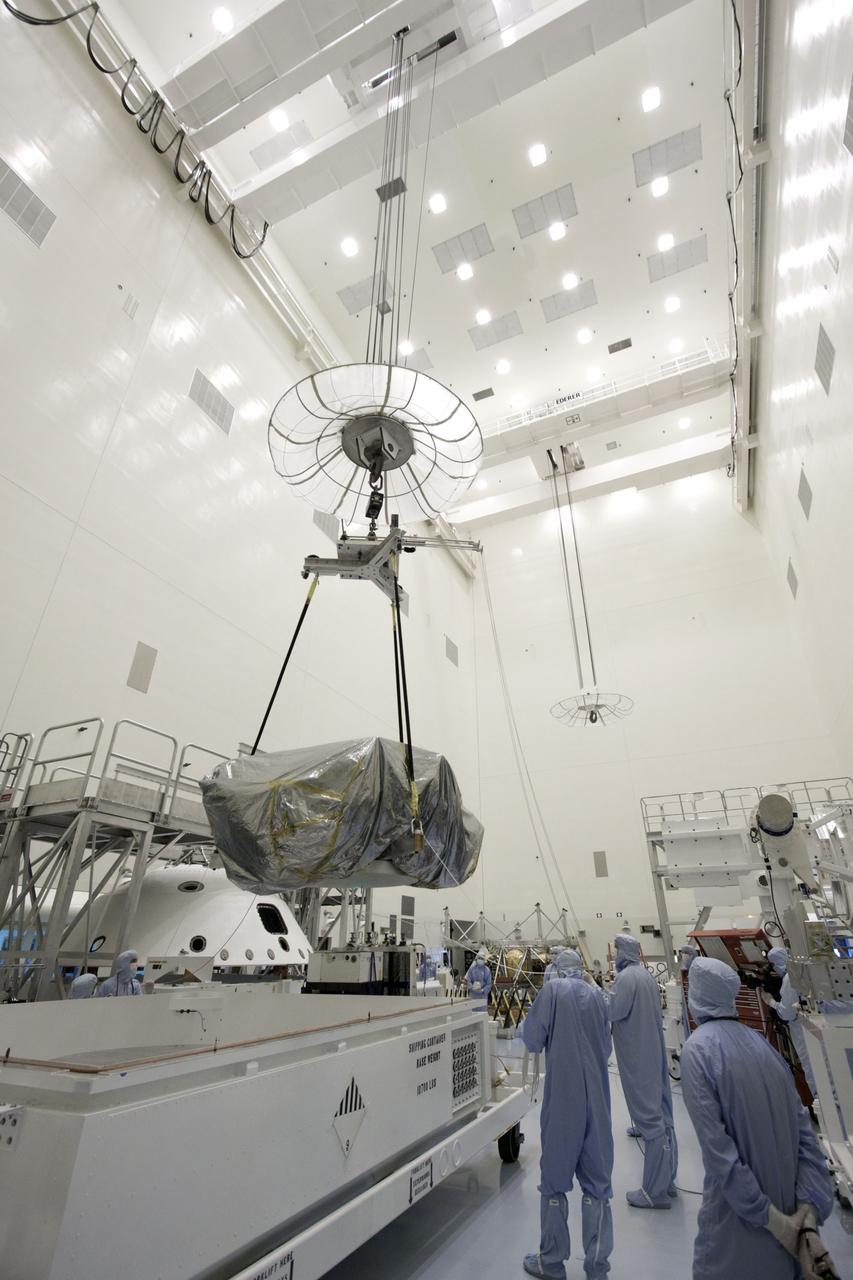
Cape Canaveral, Fla. -- At the Payload Hazardous Servicing Facility at NASA's Kennedy Space Center in Florida, technicians use an overhead crane to move NASA's Mars Science Laboratory (MSL) rover known as Curiosity, to a work stand. The spacecraft's backshell (left), which carries the parachute and several components used during later stages of entry, descent and landing, in addition is the rocket-powered descent stage (far background), also visible in the image. A United Launch Alliance Atlas V-541 configuration will be used to loft MSL into space. Curiosity’s 10 science instruments are designed to search for evidence on whether Mars has had environments favorable to microbial life, including chemical ingredients for life. The unique rover will use a laser to look inside rocks and release its gasses so that the rover’s spectrometer can analyze and send the data back to Earth. MSL is scheduled to launch from Cape Canaveral Air Force Station in Florida Nov. 25 with a window extending to Dec. 18 and arrival at Mars Aug. 2012. For more information, visit http://www.nasa.gov/msl. Photo credit: NASA/Jim Grossmann
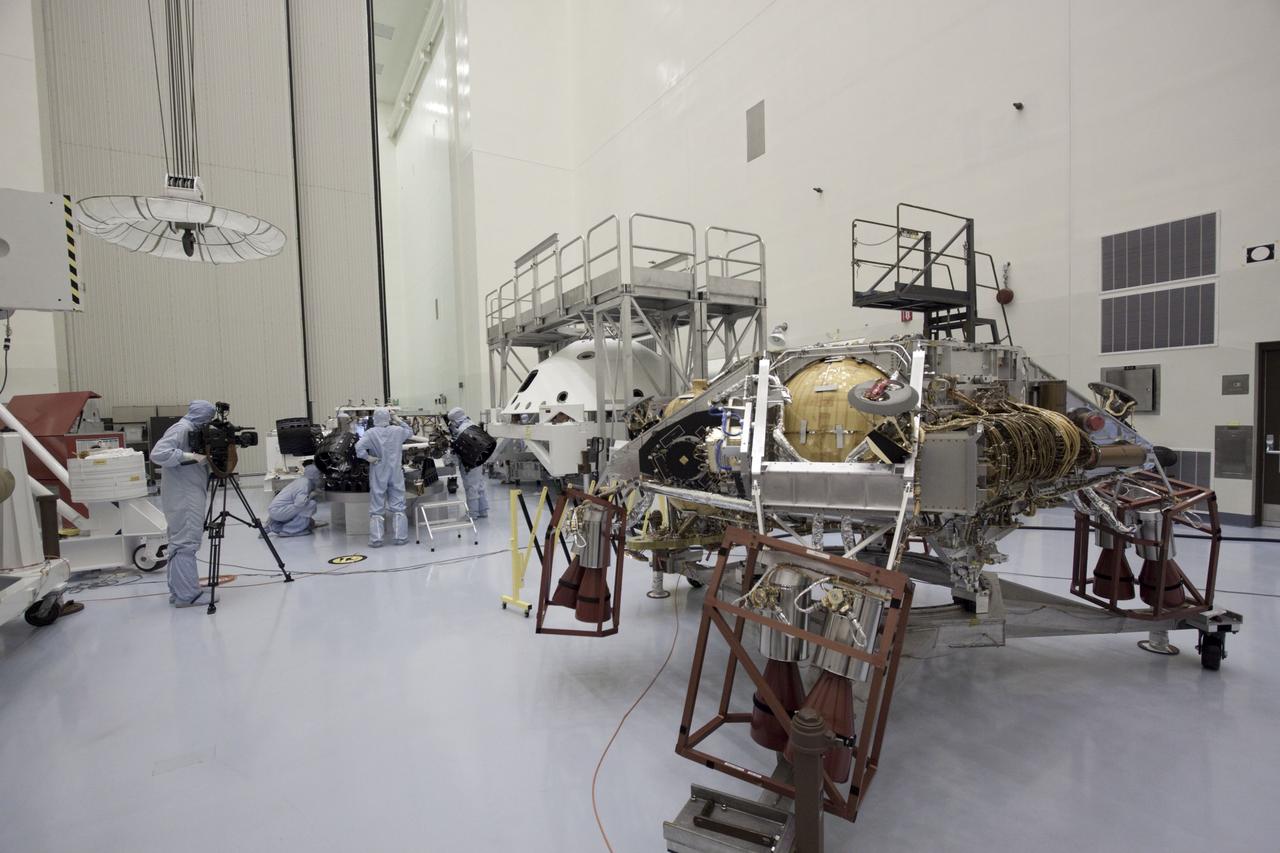
Cape Canaveral, Fla. -- At the Payload Hazardous Servicing Facility at NASA's Kennedy Space Center in Florida, NASA's Mars Science Laboratory (MSL) rover known as Curiosity, is secured on a work stand for processing (background left). The spacecraft's backshell (right), which carries the parachute and several components used during later stages of entry, descent and landing, in addition is the rocket-powered descent stage (foreground right), also visible in the image. A United Launch Alliance Atlas V-541 configuration will be used to loft MSL into space. Curiosity’s 10 science instruments are designed to search for evidence on whether Mars has had environments favorable to microbial life, including chemical ingredients for life. The unique rover will use a laser to look inside rocks and release its gasses so that the rover’s spectrometer can analyze and send the data back to Earth. MSL is scheduled to launch from Cape Canaveral Air Force Station in Florida Nov. 25 with a window extending to Dec. 18 and arrival at Mars Aug. 2012. For more information, visit http://www.nasa.gov/msl. Photo credit: NASA/Jim Grossmann
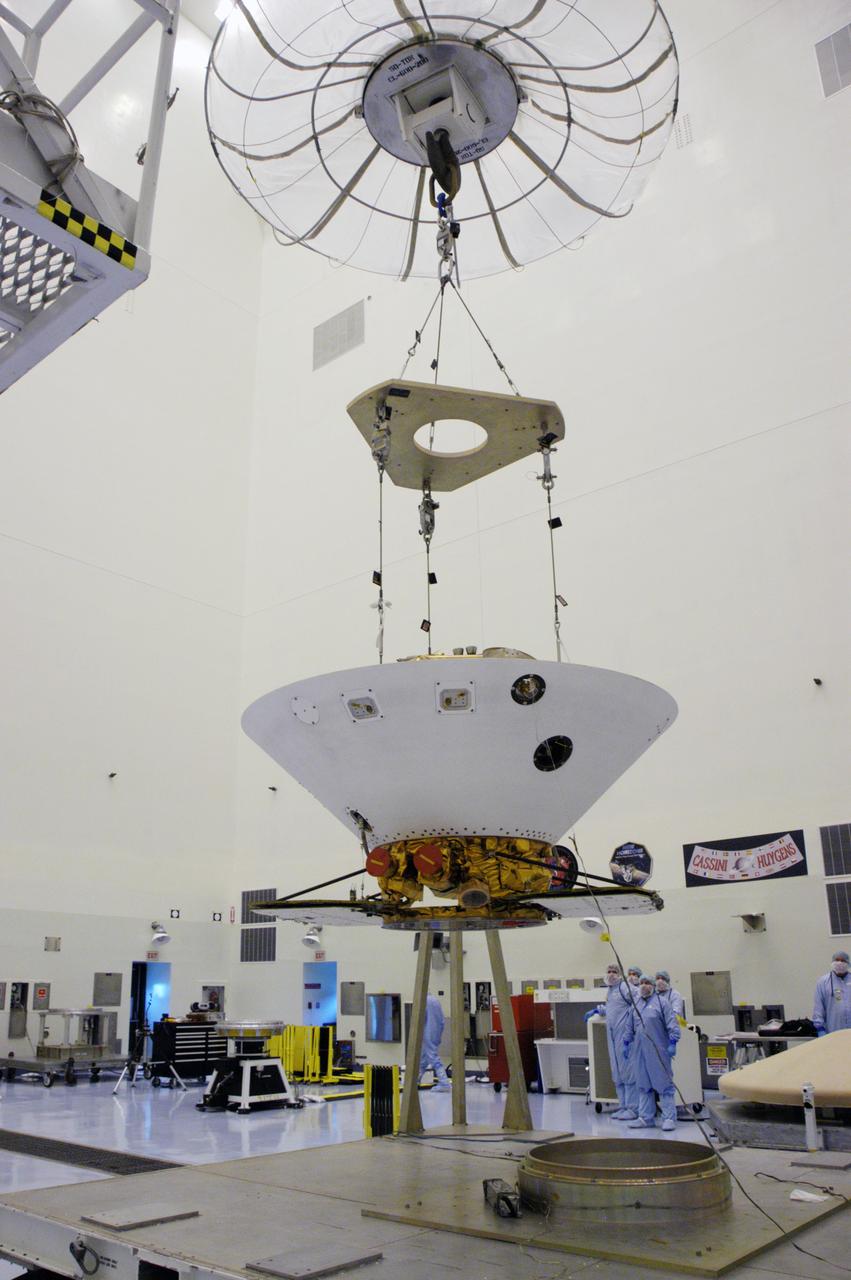
An overhead crane lifts the backshell with the Phoenix Mars Lander inside off its work stand in the Payload Hazardous Servicing Facility. The spacecraft is being moved to a spin table (back left) for spin testing. The Phoenix mission is the first project in NASA's first openly competed program of Mars Scout missions. Phoenix will land in icy soils near the north polar permanent ice cap of Mars and explore the history of the water in these soils and any associated rocks, while monitoring polar climate. Landing is planned in May 2008 on arctic ground where a mission currently in orbit, Mars Odyssey, has detected high concentrations of ice just beneath the top layer of soil. It will serve as NASA's first exploration of a potential modern habitat on Mars and open the door to a renewed search for carbon-bearing compounds, last attempted with NASA’s Viking missions in the 1970s. A stereo color camera and a weather station will study the surrounding environment while the other instruments check excavated soil samples for water, organic chemicals and conditions that could indicate whether the site was ever hospitable to life. Microscopes can reveal features as small as one one-thousandth the width of a human hair. Launch of Phoenix aboard a Delta II rocket is targeted for Aug. 3 from Cape Canaveral Air Force Station in Florida.
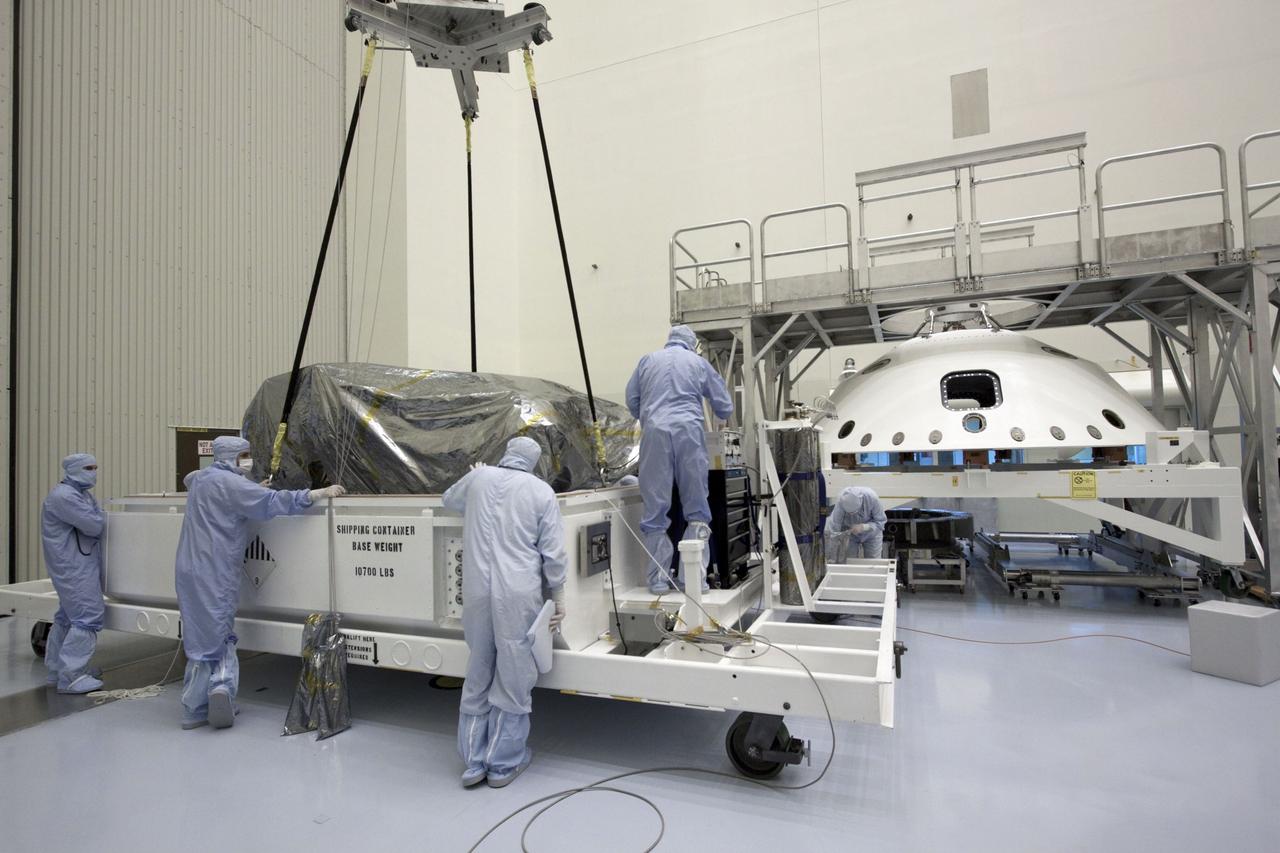
Cape Canaveral, Fla. -- At the Payload Hazardous Servicing Facility at NASA's Kennedy Space Center in Florida, technicians attach an overhead crane to NASA's Mars Science Laboratory (MSL) rover known as Curiosity, for its move to a work stand. The spacecraft's backshell (right), which carries the parachute and several components used during later stages of entry, descent and landing, also is visible in the image. A United Launch Alliance Atlas V-541 configuration will be used to loft MSL into space. Curiosity’s 10 science instruments are designed to search for evidence on whether Mars has had environments favorable to microbial life, including chemical ingredients for life. The unique rover will use a laser to look inside rocks and release its gasses so that the rover’s spectrometer can analyze and send the data back to Earth. MSL is scheduled to launch from Cape Canaveral Air Force Station in Florida Nov. 25 with a window extending to Dec. 18 and arrival at Mars Aug. 2012. For more information, visit http://www.nasa.gov/msl. Photo credit: NASA/Jim Grossmann
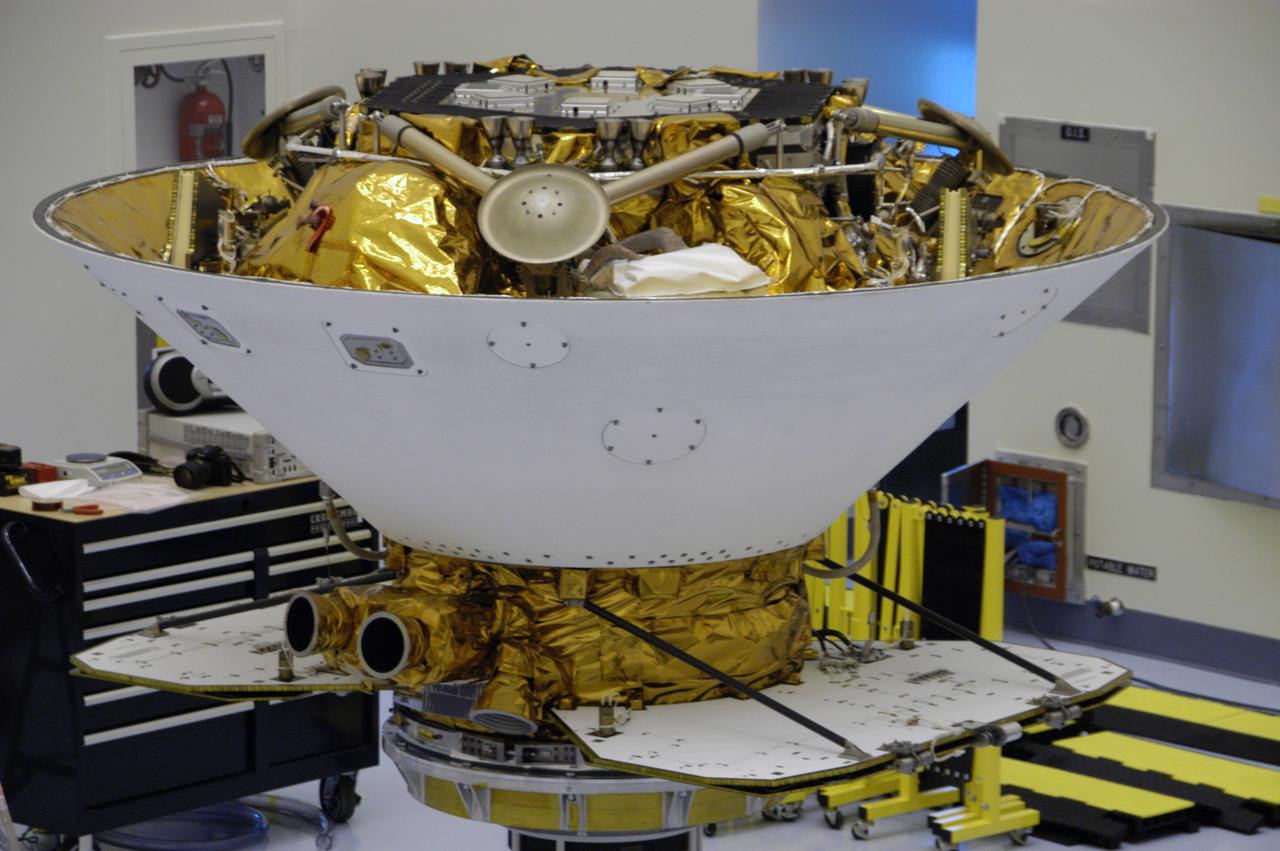
This closeup shows the Phoenix Mars Lander spacecraft nestled inside the backshell. The spacecraft is ready for spin testing on the spin table to which it is attached in the Payload Hazardous Servicing Facility. The Phoenix mission is the first project in NASA's first openly competed program of Mars Scout missions. Phoenix will land in icy soils near the north polar permanent ice cap of Mars and explore the history of the water in these soils and any associated rocks, while monitoring polar climate. Landing is planned in May 2008 on arctic ground where a mission currently in orbit, Mars Odyssey, has detected high concentrations of ice just beneath the top layer of soil. It will serve as NASA's first exploration of a potential modern habitat on Mars and open the door to a renewed search for carbon-bearing compounds, last attempted with NASA’s Viking missions in the 1970s. A stereo color camera and a weather station will study the surrounding environment while the other instruments check excavated soil samples for water, organic chemicals and conditions that could indicate whether the site was ever hospitable to life. Microscopes can reveal features as small as one one-thousandth the width of a human hair. Launch of Phoenix aboard a Delta II rocket is targeted for Aug. 3 from Cape Canaveral Air Force Station in Florida.
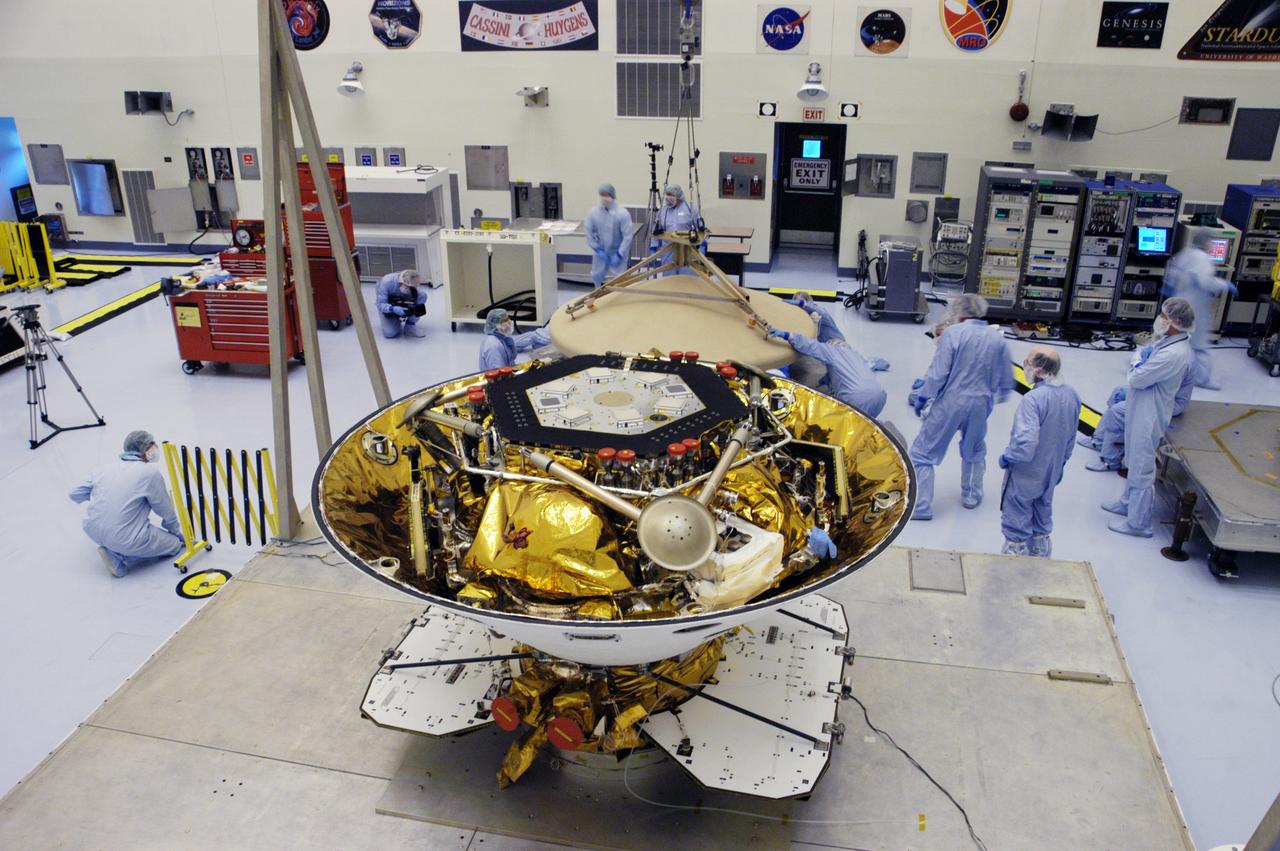
In the Payload Hazardous Servicing Facility, the Phoenix Mars Lander (foreground) can be seen inside the backshell. In the background, workers are helping place the heat shield, just removed from the Phoenix, onto a platform. The Phoenix mission is the first project in NASA's first openly competed program of Mars Scout missions. Phoenix will land in icy soils near the north polar permanent ice cap of Mars and explore the history of the water in these soils and any associated rocks, while monitoring polar climate. Landing is planned in May 2008 on arctic ground where a mission currently in orbit, Mars Odyssey, has detected high concentrations of ice just beneath the top layer of soil. It will serve as NASA's first exploration of a potential modern habitat on Mars and open the door to a renewed search for carbon-bearing compounds, last attempted with NASA’s Viking missions in the 1970s. A stereo color camera and a weather station will study the surrounding environment while the other instruments check excavated soil samples for water, organic chemicals and conditions that could indicate whether the site was ever hospitable to life. Microscopes can reveal features as small as one one-thousandth the width of a human hair. Launch of Phoenix aboard a Delta II rocket is targeted for Aug. 3 from Cape Canaveral Air Force Station in Florida.
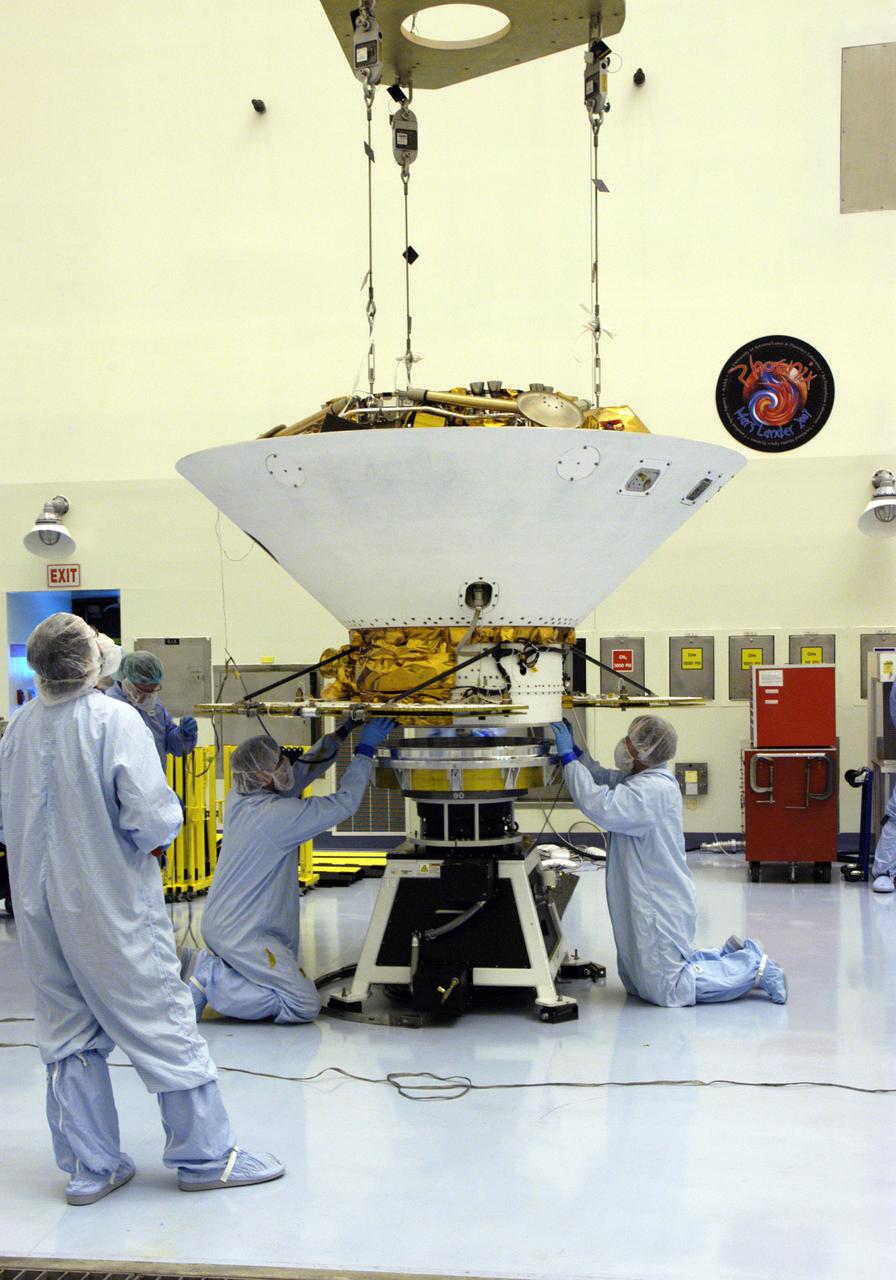
In the Payload Hazardous Servicing Facility, technicians secure the backshell with the Phoenix Mars Lander inside onto a spin table for spin testing. The Phoenix mission is the first project in NASA's first openly competed program of Mars Scout missions. Phoenix will land in icy soils near the north polar permanent ice cap of Mars and explore the history of the water in these soils and any associated rocks, while monitoring polar climate. Landing is planned in May 2008 on arctic ground where a mission currently in orbit, Mars Odyssey, has detected high concentrations of ice just beneath the top layer of soil. It will serve as NASA's first exploration of a potential modern habitat on Mars and open the door to a renewed search for carbon-bearing compounds, last attempted with NASA’s Viking missions in the 1970s. A stereo color camera and a weather station will study the surrounding environment while the other instruments check excavated soil samples for water, organic chemicals and conditions that could indicate whether the site was ever hospitable to life. Microscopes can reveal features as small as one one-thousandth the width of a human hair. Launch of Phoenix aboard a Delta II rocket is targeted for Aug. 3 from Cape Canaveral Air Force Station in Florida.
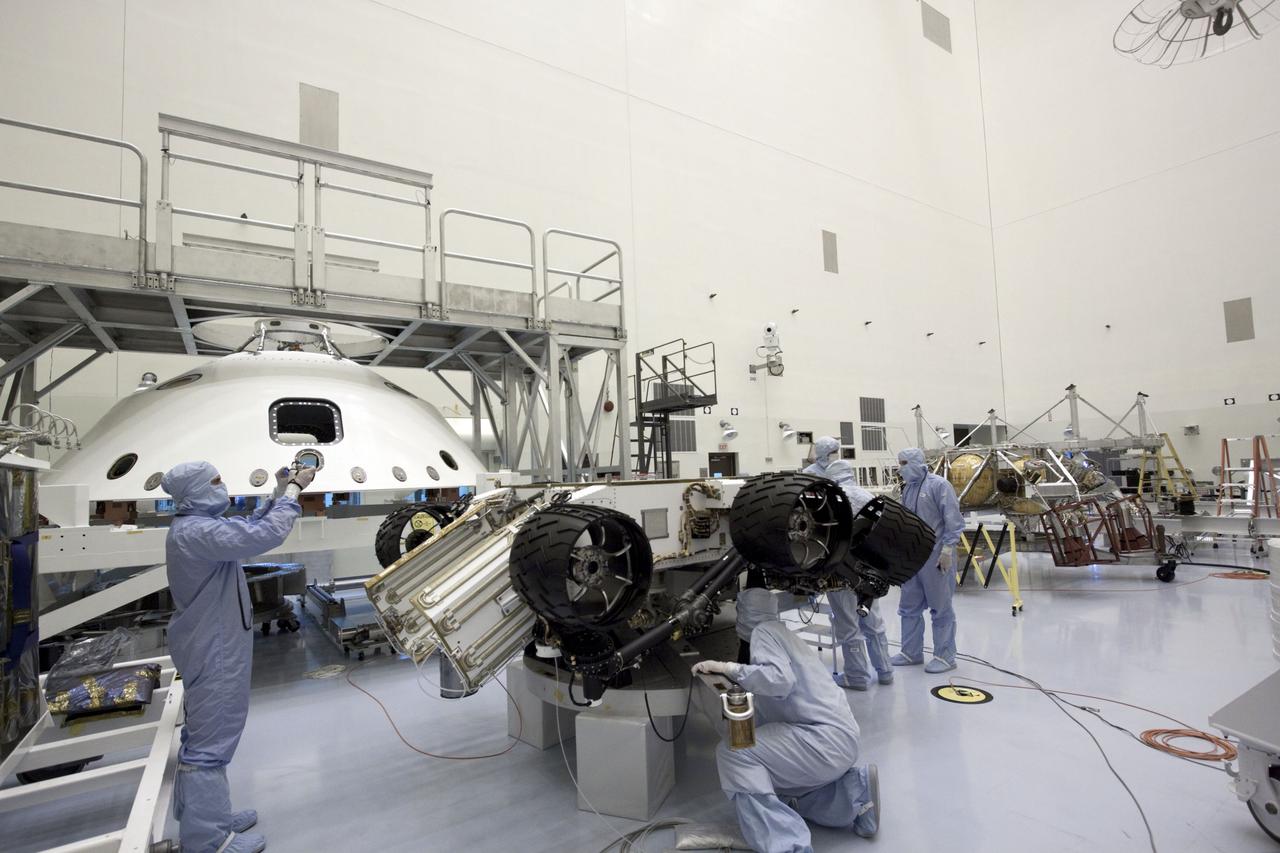
Cape Canaveral, Fla. -- At the Payload Hazardous Servicing Facility at NASA's Kennedy Space Center in Florida, NASA's Mars Science Laboratory (MSL) rover known as Curiosity, is secured on a work stand for processing. The spacecraft's backshell (left), which carries the parachute and several components used during later stages of entry, descent and landing, in addition is the rocket-powered descent stage (background right), also is visible in the image. A United Launch Alliance Atlas V-541 configuration will be used to loft MSL into space. Curiosity’s 10 science instruments are designed to search for evidence on whether Mars has had environments favorable to microbial life, including chemical ingredients for life. The unique rover will use a laser to look inside rocks and release its gasses so that the rover’s spectrometer can analyze and send the data back to Earth. MSL is scheduled to launch from Cape Canaveral Air Force Station in Florida Nov. 25 with a window extending to Dec. 18 and arrival at Mars Aug. 2012. For more information, visit http://www.nasa.gov/msl. Photo credit: NASA/Jim Grossmann
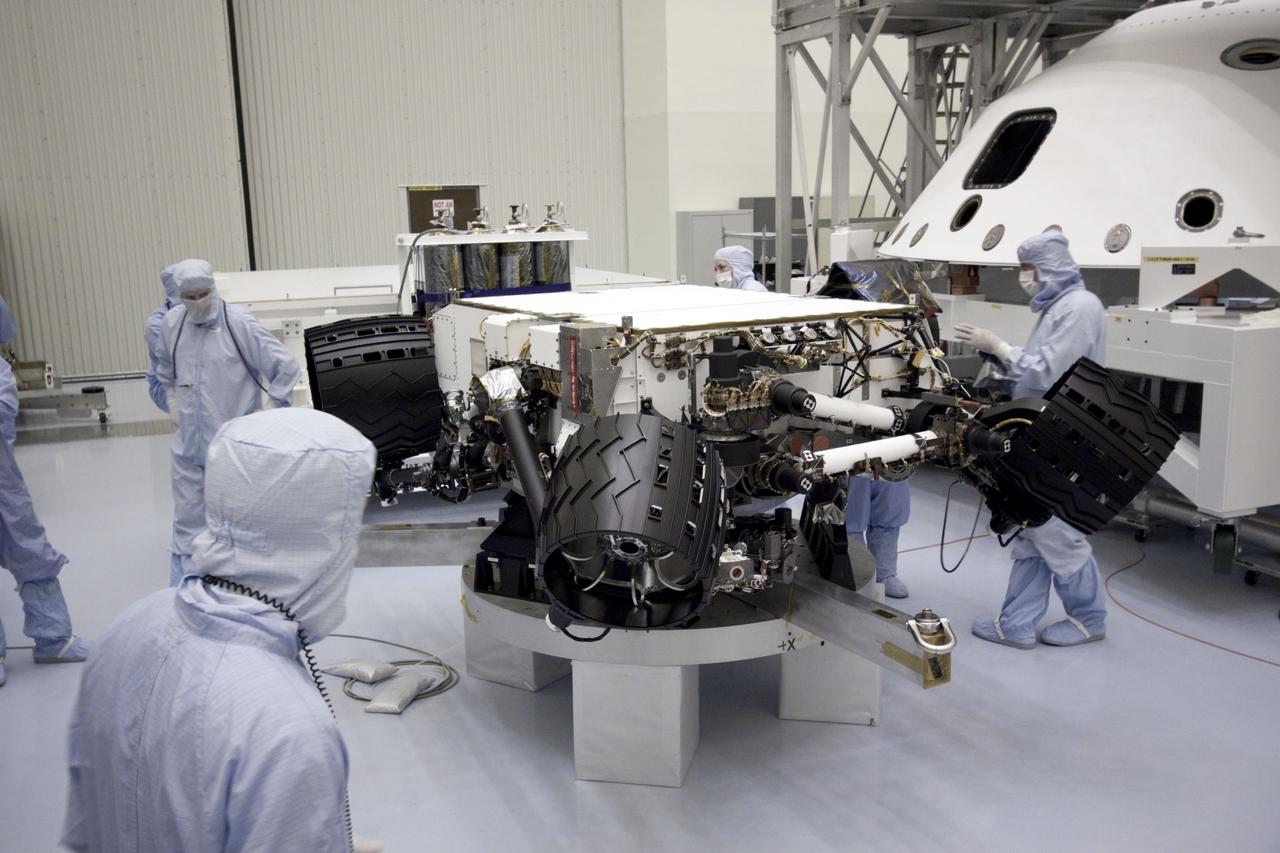
Cape Canaveral, Fla. -- At the Payload Hazardous Servicing Facility at NASA's Kennedy Space Center in Florida, technicians have removed the protective cover from NASA's Mars Science Laboratory (MSL) rover known as Curiosity, for processing and testing. The spacecraft's backshell (right), which carries the parachute and several components used during later stages of entry, descent and landing, also is visible in the image. A United Launch Alliance Atlas V-541 configuration will be used to loft MSL into space. Curiosity’s 10 science instruments are designed to search for evidence on whether Mars has had environments favorable to microbial life, including chemical ingredients for life. The unique rover will use a laser to look inside rocks and release its gasses so that the rover’s spectrometer can analyze and send the data back to Earth. MSL is scheduled to launch from Cape Canaveral Air Force Station in Florida Nov. 25 with a window extending to Dec. 18 and arrival at Mars Aug. 2012. For more information, visit http://www.nasa.gov/msl. Photo credit: NASA/Jim Grossmann
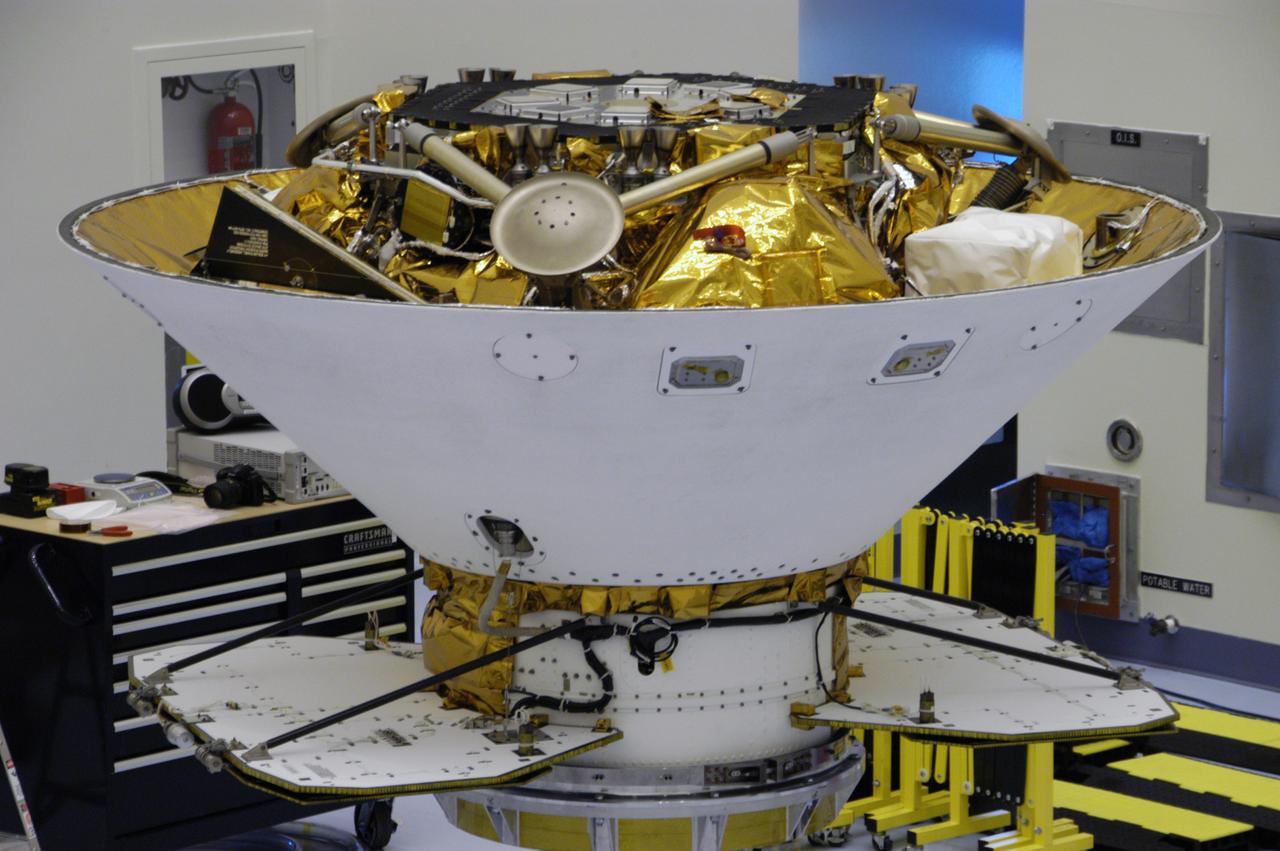
This closeup shows the Phoenix Mars Lander spacecraft nestled inside the backshell. The spacecraft will undergo spin testing on the spin table to which it is attached in the Payload Hazardous Servicing Facility. The Phoenix mission is the first project in NASA's first openly competed program of Mars Scout missions. Phoenix will land in icy soils near the north polar permanent ice cap of Mars and explore the history of the water in these soils and any associated rocks, while monitoring polar climate. Landing is planned in May 2008 on arctic ground where a mission currently in orbit, Mars Odyssey, has detected high concentrations of ice just beneath the top layer of soil. It will serve as NASA's first exploration of a potential modern habitat on Mars and open the door to a renewed search for carbon-bearing compounds, last attempted with NASA’s Viking missions in the 1970s. A stereo color camera and a weather station will study the surrounding environment while the other instruments check excavated soil samples for water, organic chemicals and conditions that could indicate whether the site was ever hospitable to life. Microscopes can reveal features as small as one one-thousandth the width of a human hair. Launch of Phoenix aboard a Delta II rocket is targeted for Aug. 3 from Cape Canaveral Air Force Station in Florida.
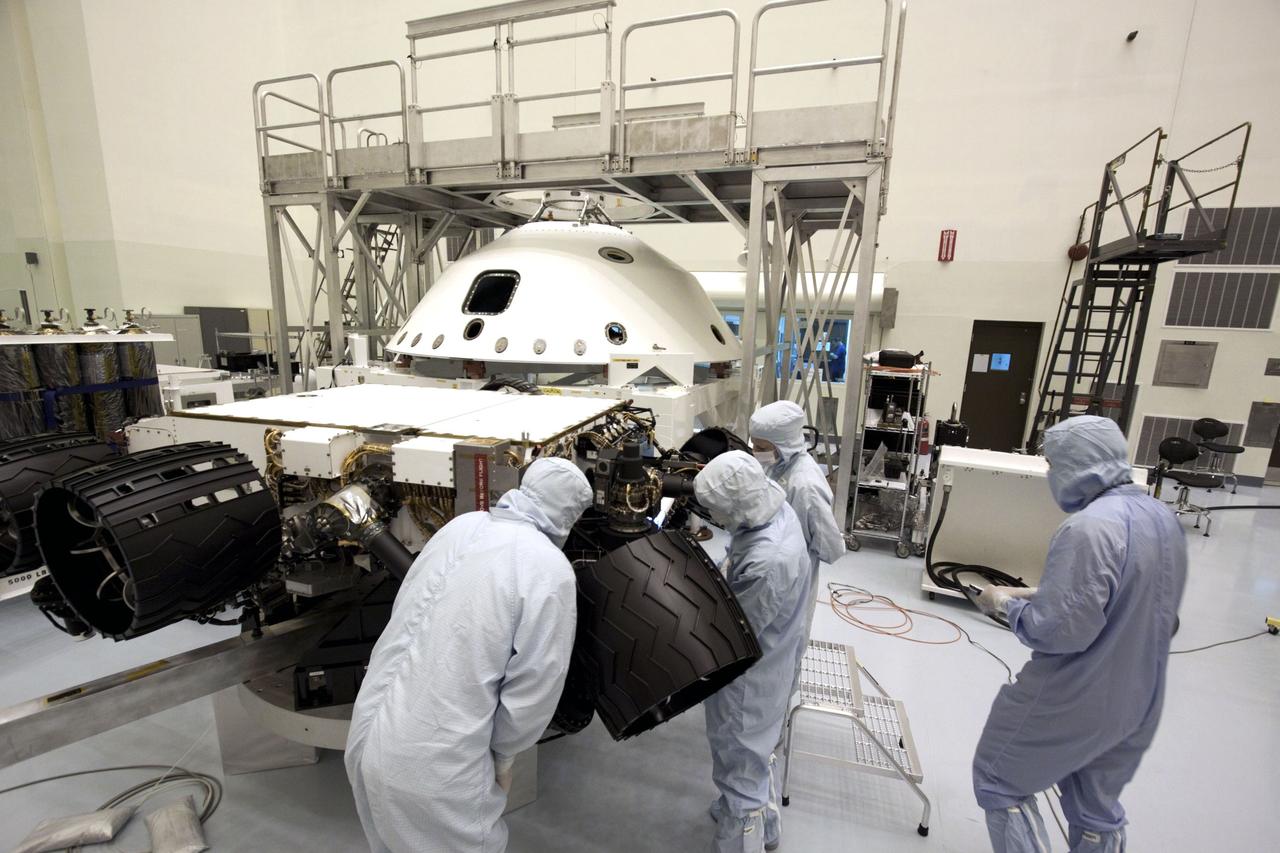
Cape Canaveral, Fla. -- At the Payload Hazardous Servicing Facility at NASA's Kennedy Space Center in Florida, technicians inspect NASA's Mars Science Laboratory (MSL) rover known as Curiosity, while it is secured on a work stand. The spacecraft's backshell (background), which carries the parachute and several components used during later stages of entry, descent and landing, also is visible in the image. A United Launch Alliance Atlas V-541 configuration will be used to loft MSL into space. Curiosity’s 10 science instruments are designed to search for evidence on whether Mars has had environments favorable to microbial life, including chemical ingredients for life. The unique rover will use a laser to look inside rocks and release its gasses so that the rover’s spectrometer can analyze and send the data back to Earth. MSL is scheduled to launch from Cape Canaveral Air Force Station in Florida Nov. 25 with a window extending to Dec. 18 and arrival at Mars Aug. 2012. For more information, visit http://www.nasa.gov/msl. Photo credit: NASA/Jim Grossmann
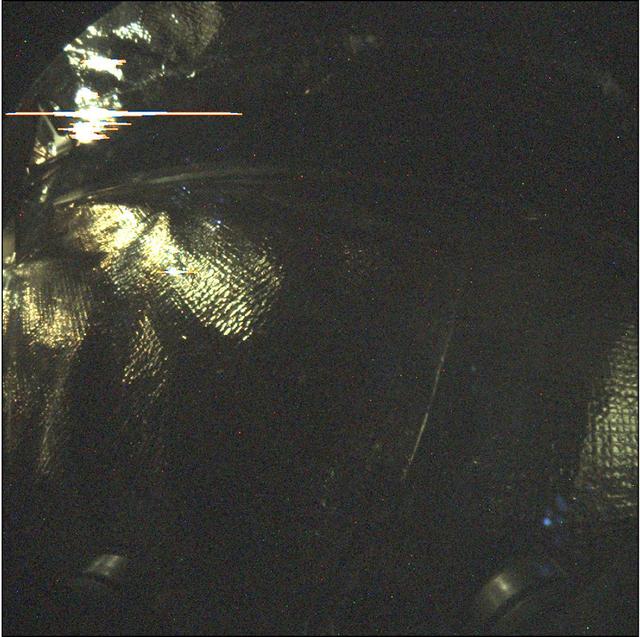
This long-exposure image (24 seconds) was taken by Instrument Context Camera (ICC) of NASA's InSight Mars lander. The image shows some of the interior features of the backshell that encapsulates the spacecraft. The backshell carries the parachute and several components used during later stages of entry, descent, and landing. Along with the heatshield, the backshell protects NASA's InSight Mars lander during its commute to and entry into the Martian atmosphere. The annotations in this image call out discernable components in the backshell -- the heatshield blanket, harness tie-downs, and cover bolts for the ICC. The heat shield blanket provides thermal protection from the hot and cold temperature swings encountered during cruise, and the high heat that will occur during Mars atmospheric entry. The tie-downs are used to secure harnesses (or other objects) so they do not move around inside the aeroshell while in flight. The ICC cover bolts secure a protective transparent window to the camera during cruise and entry, descent and landing. The cover is opened after landing and is not visible during surface operations. This image has been stretched to bring out details in the dimly lit scene. The illumination of the components on the inside of the backshell comes from sunlight entering around the edges of cutouts in the backshell to accommodate steering thrusters. An annotated image is available at https://photojournal.jpl.nasa.gov/catalog/PIA22647
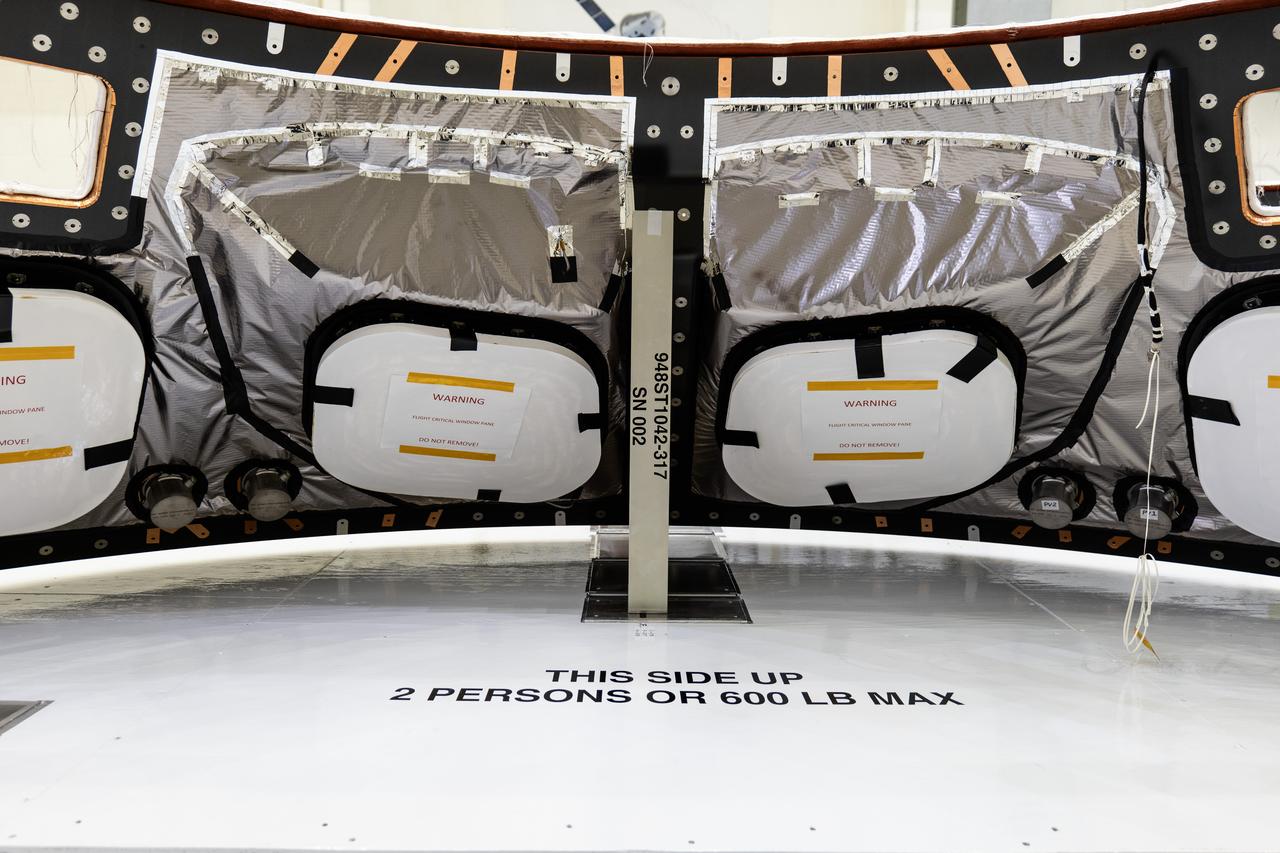
Back shell panels are visible on the Orion spacecraft for the Artemis II mission inside the Neil A. Armstrong Operations and Checkout Building high bay at NASA's Kennedy Space Center in Florida on Monday, Dec. 15, 2024. The back shell panels serve as the outer layer of the spacecraft and will protect it against the extreme temperatures of re-entry from deep space.
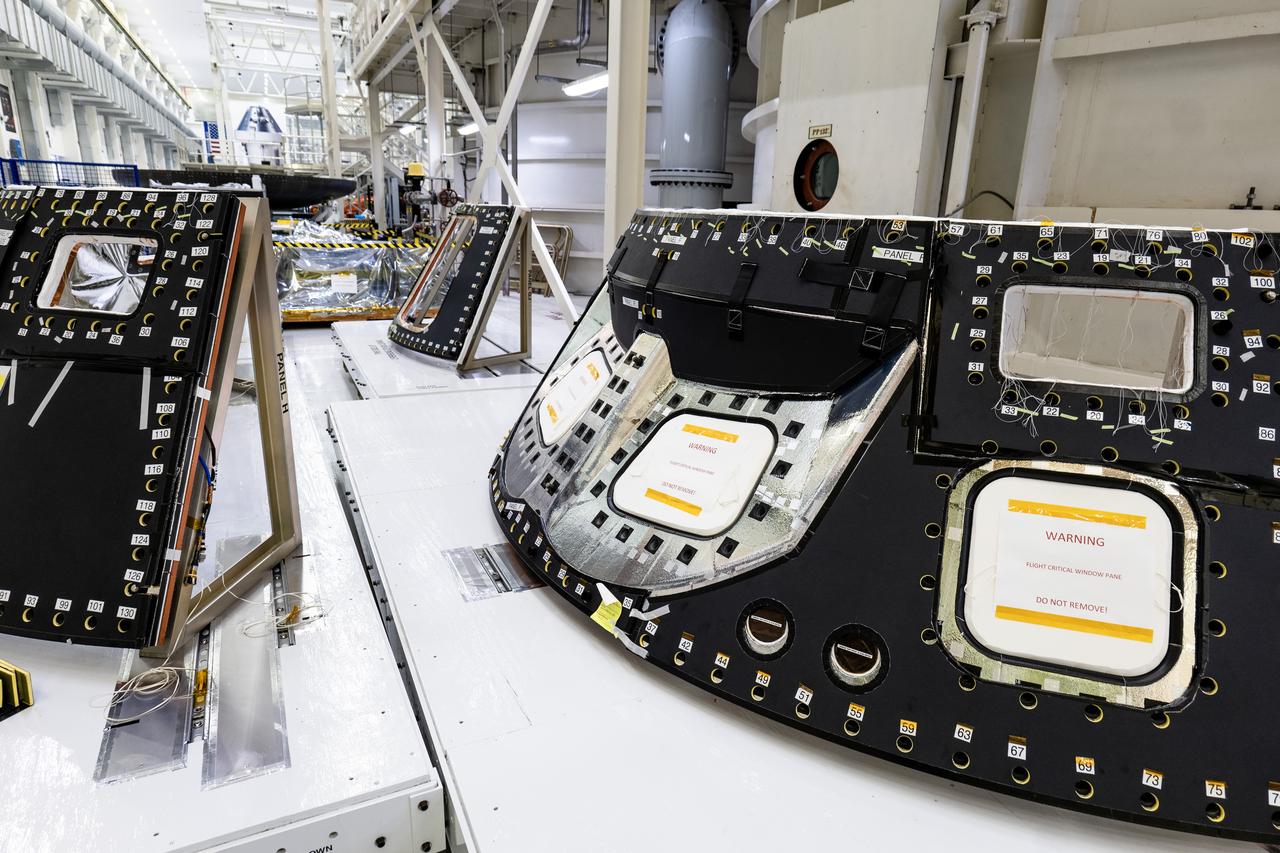
Visible in the foreground are back shell panels on the Orion spacecraft for the Artemis II mission inside the Neil A. Armstrong Operations and Checkout Building high bay at NASA's Kennedy Space Center in Florida on Monday, Dec. 15, 2024. The back shell panels serve as the outer layer of the spacecraft and will protect it against the extreme temperatures of re-entry from deep space. In the background are the heat shield for Orion’s Artemis IV mission secured on a work stand, as well as the Orion spacecraft for NASA’s Artemis II mission.
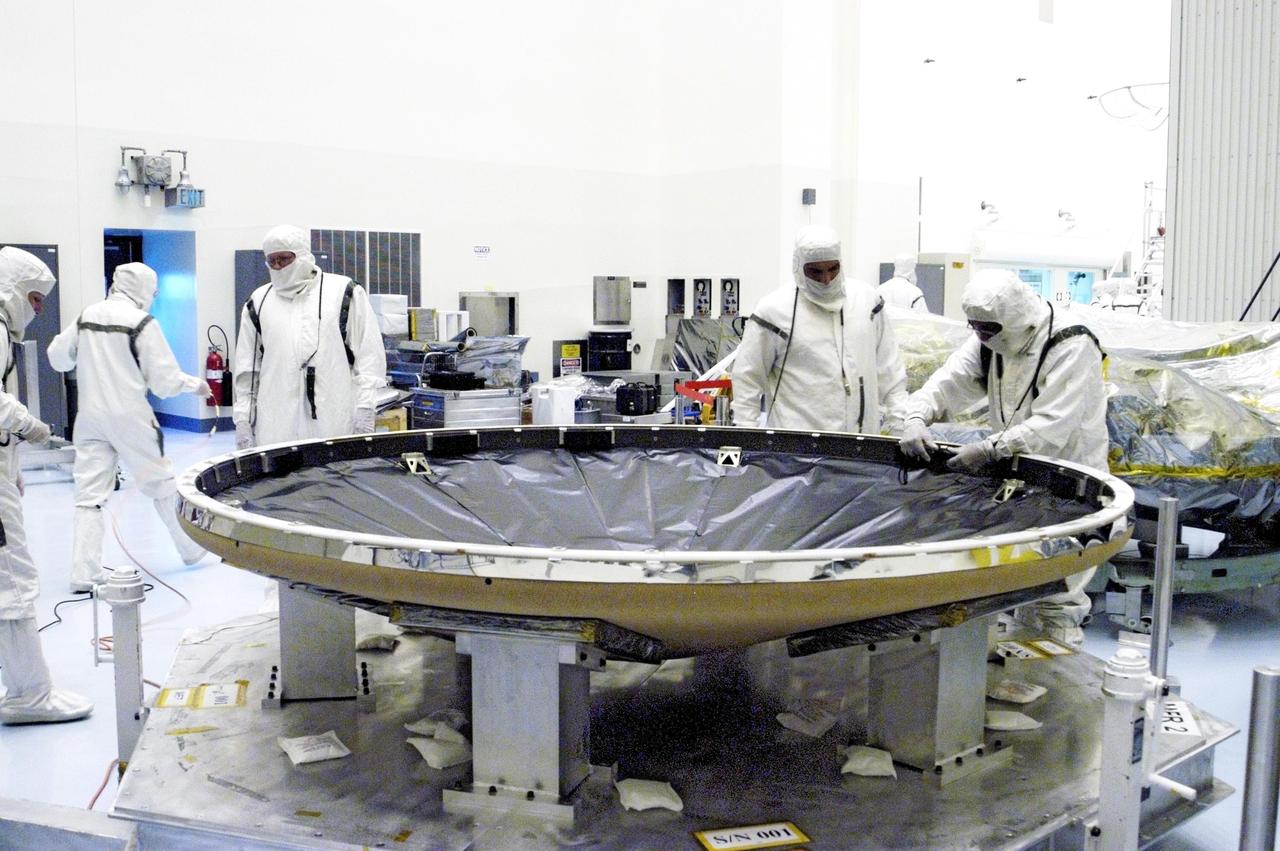
Workers in the Payload Hazardous Servicing Facility prepare the heat shield that will be attached to the backshell, surrounding Mars Exploration Rover 1 MER-1.
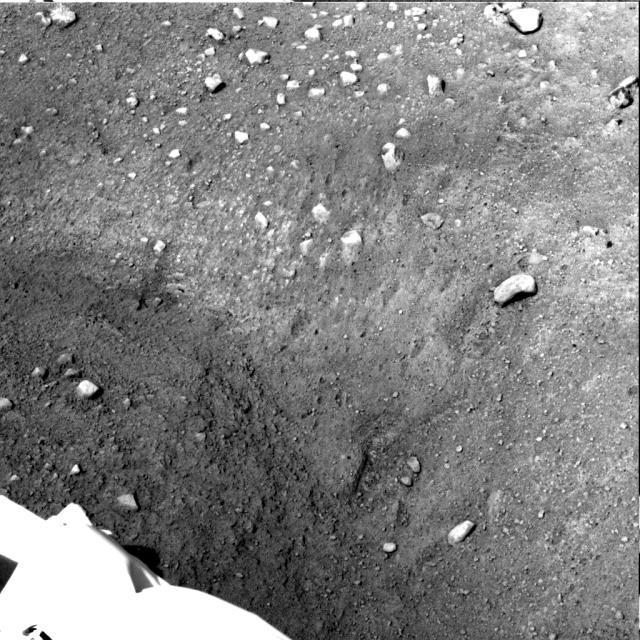
This from NASA Phoenix Mars Lander Stereo Surface Imager SSI camera shows Phoenix parachute, backshell, heatshield, and impact site.
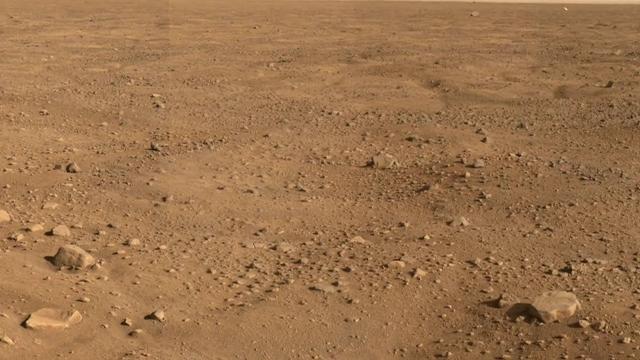
This panorama looks to the southeast and shows rocks casting shadows, polygons on the surface and as the image looks to the horizon, NASA Phoenix Mars Lander backshell gleams in the distance.
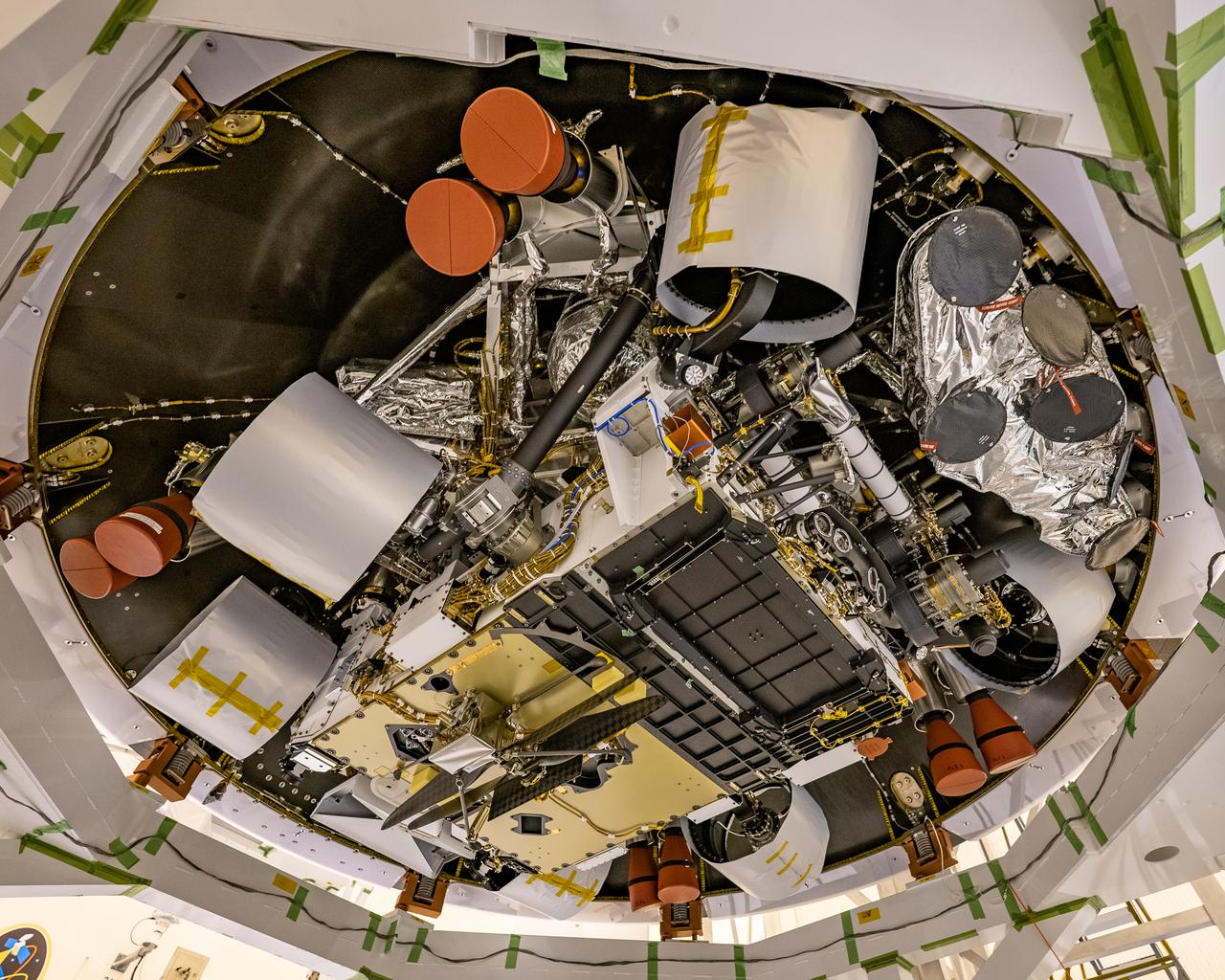
The aeroshell backshell for the Mars Perseverance rover is attached to the rocket-powered descent stage inside the Payload Hazardous Servicing Facility at NASA’s Kennedy Space Center in Florida on April 29, 2020. The aeroshell will encapsulate and protect Perseverance and its descent stage during their deep space journey to Mars and during descent through the Martian atmosphere. It will reach the Red Planet on Feb. 18, 2021. Launch, aboard a United Launch Alliance Atlas V 541 rocket, is targeted for summer 2020 from Cape Canaveral Air Force Station. NASA’s Launch Services Program based at Kennedy is managing the launch.
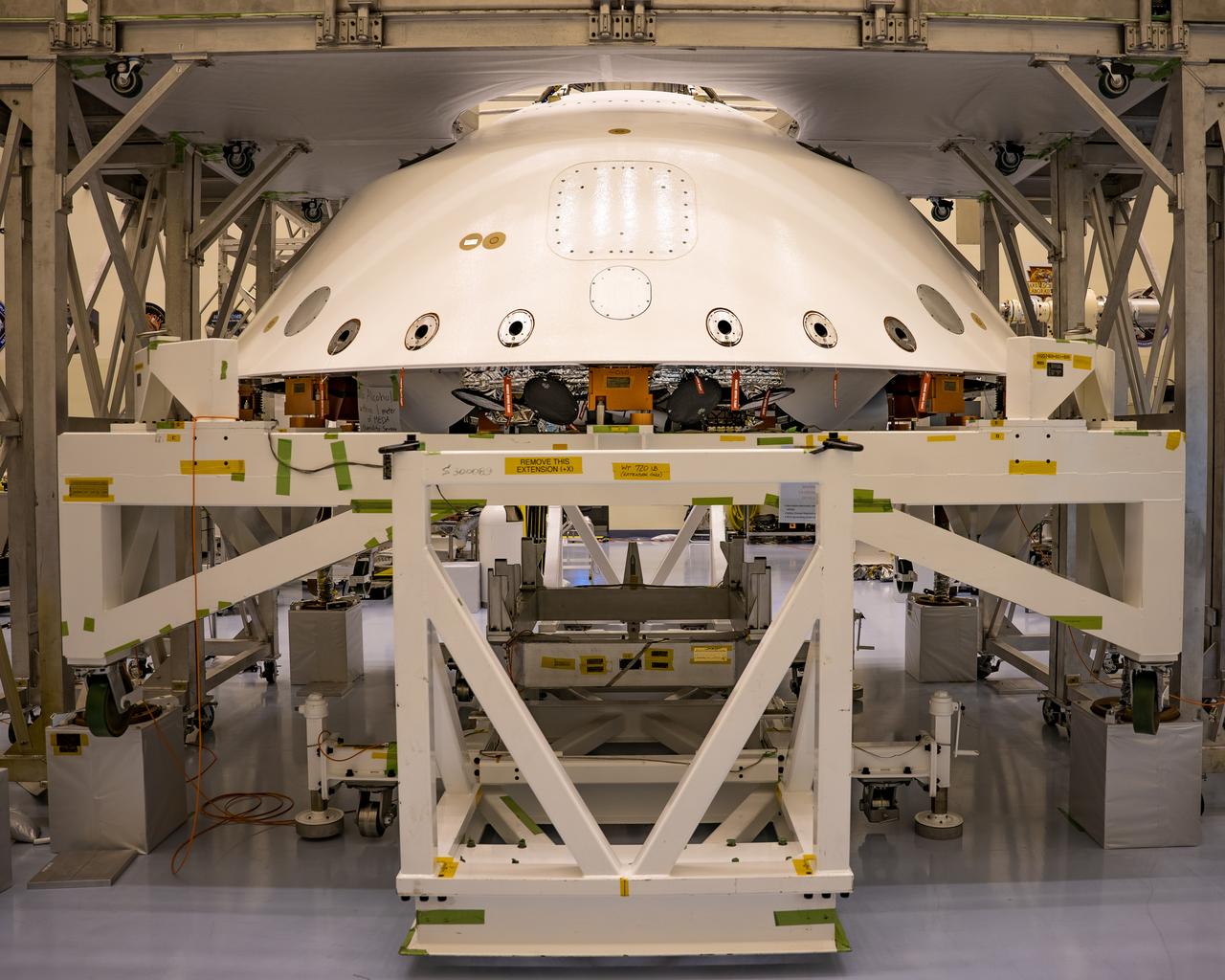
The aeroshell backshell for the Mars Perseverance rover is attached to the rocket-powered descent stage inside the Payload Hazardous Servicing Facility at NASA’s Kennedy Space Center in Florida on April 29, 2020. The aeroshell will encapsulate and protect Perseverance and its descent stage during their deep space journey to Mars and during descent through the Martian atmosphere. It will reach the Red Planet on Feb. 18, 2021. Launch, aboard a United Launch Alliance Atlas V 541 rocket, is targeted for summer 2020 from Cape Canaveral Air Force Station. NASA’s Launch Services Program based at Kennedy is managing the launch.
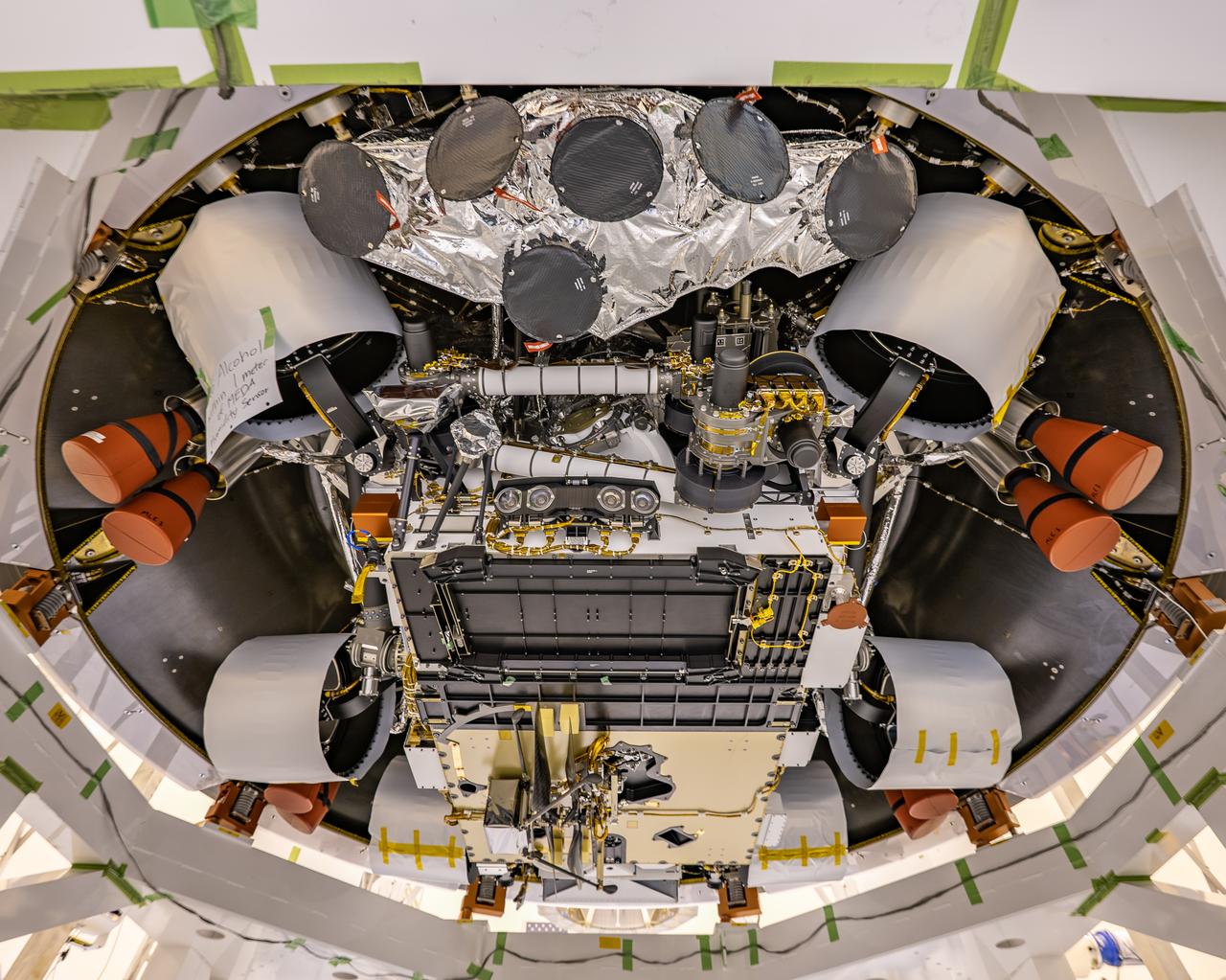
The aeroshell backshell for the Mars Perseverance rover is attached to the rocket-powered descent stage inside the Payload Hazardous Servicing Facility at NASA’s Kennedy Space Center in Florida on April 29, 2020. The aeroshell will encapsulate and protect Perseverance and its descent stage during their deep space journey to Mars and during descent through the Martian atmosphere. It will reach the Red Planet on Feb. 18, 2021. Launch, aboard a United Launch Alliance Atlas V 541 rocket, is targeted for summer 2020 from Cape Canaveral Air Force Station. NASA’s Launch Services Program based at Kennedy is managing the launch.
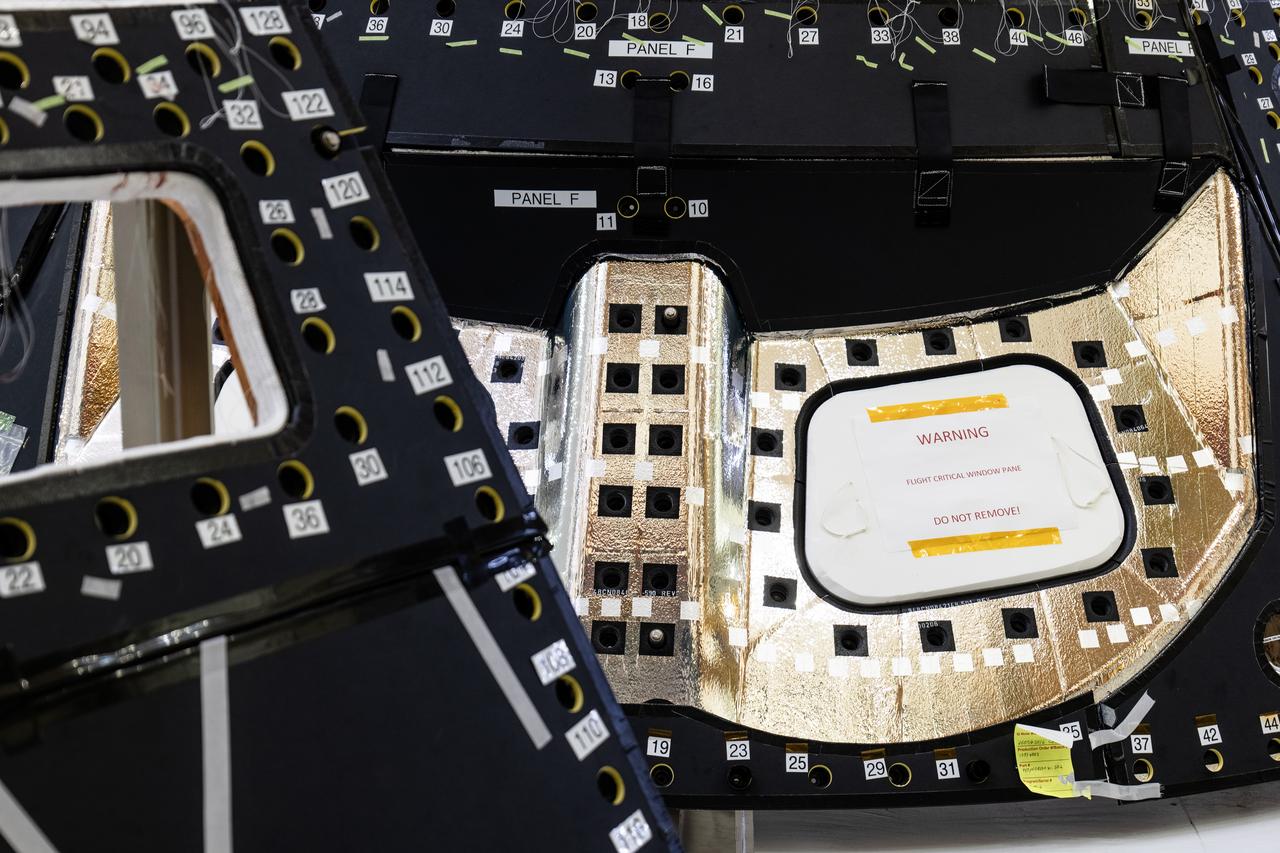
Back shell panels are visible on the Orion spacecraft for the Artemis IV mission inside the Neil A. Armstrong Operations and Checkout Building high bay at NASA's Kennedy Space Center in Florida on Monday, Dec. 15, 2024. The back shell panels serve as the outer layer of the spacecraft and will protect it against the extreme temperatures of re-entry from deep space.
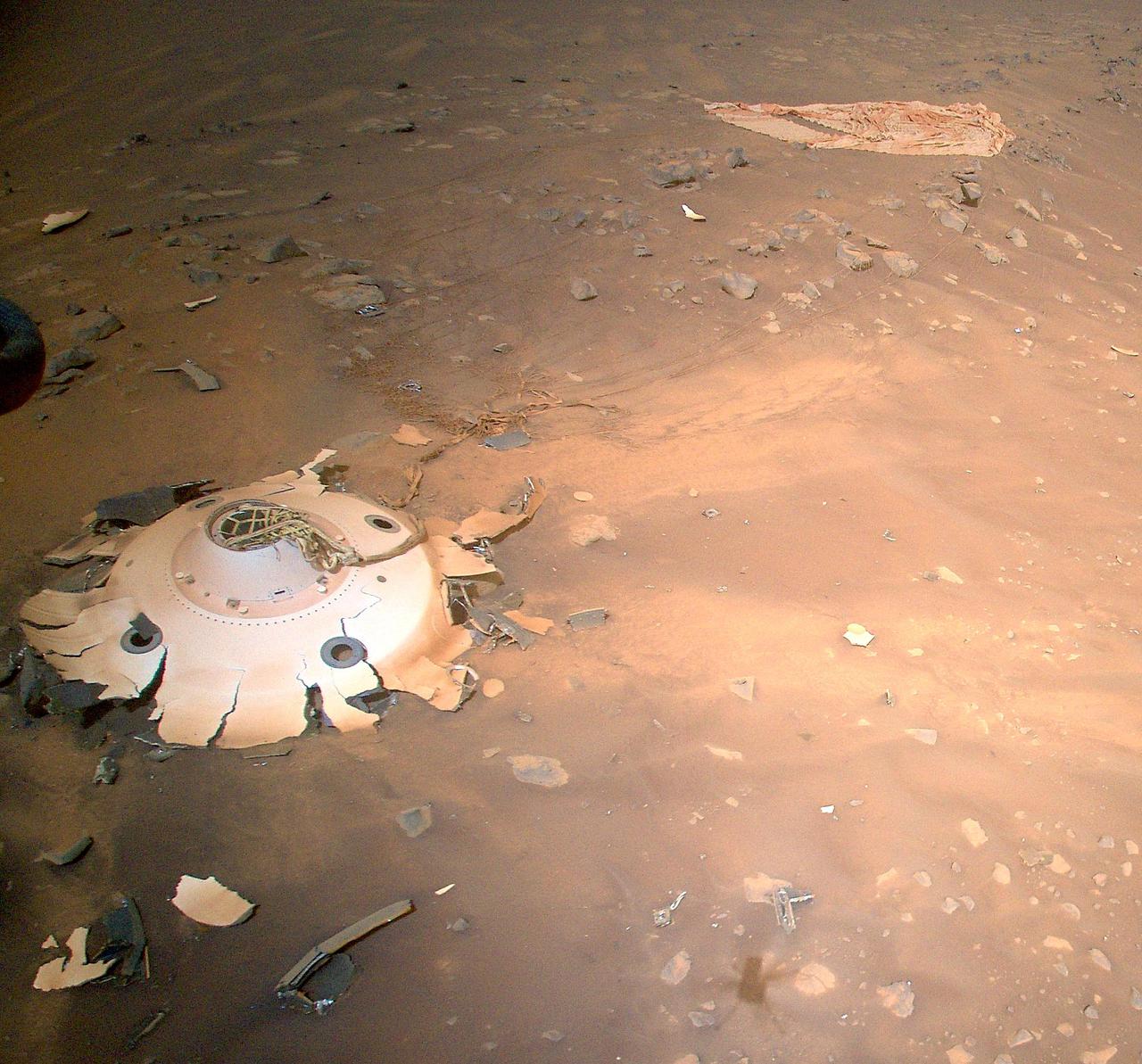
This image of Perseverance's backshell and parachute was collected from an altitude of 26 feet (8 meters) by the NASA's Ingenuity Mars Helicopter during its 26th flight on Mars on April 19, 2022. The parachute and cone-shaped backshell protected the rover during its fiery descent toward the Martian surface on Feb. 18, 2021. Engineers working on the Mars Sample Return program requested images be taken of the components from an aerial perspective because they may provide insight into the components' performance during the rover's entry, descent, and landing. https://photojournal.jpl.nasa.gov/catalog/PIA25217
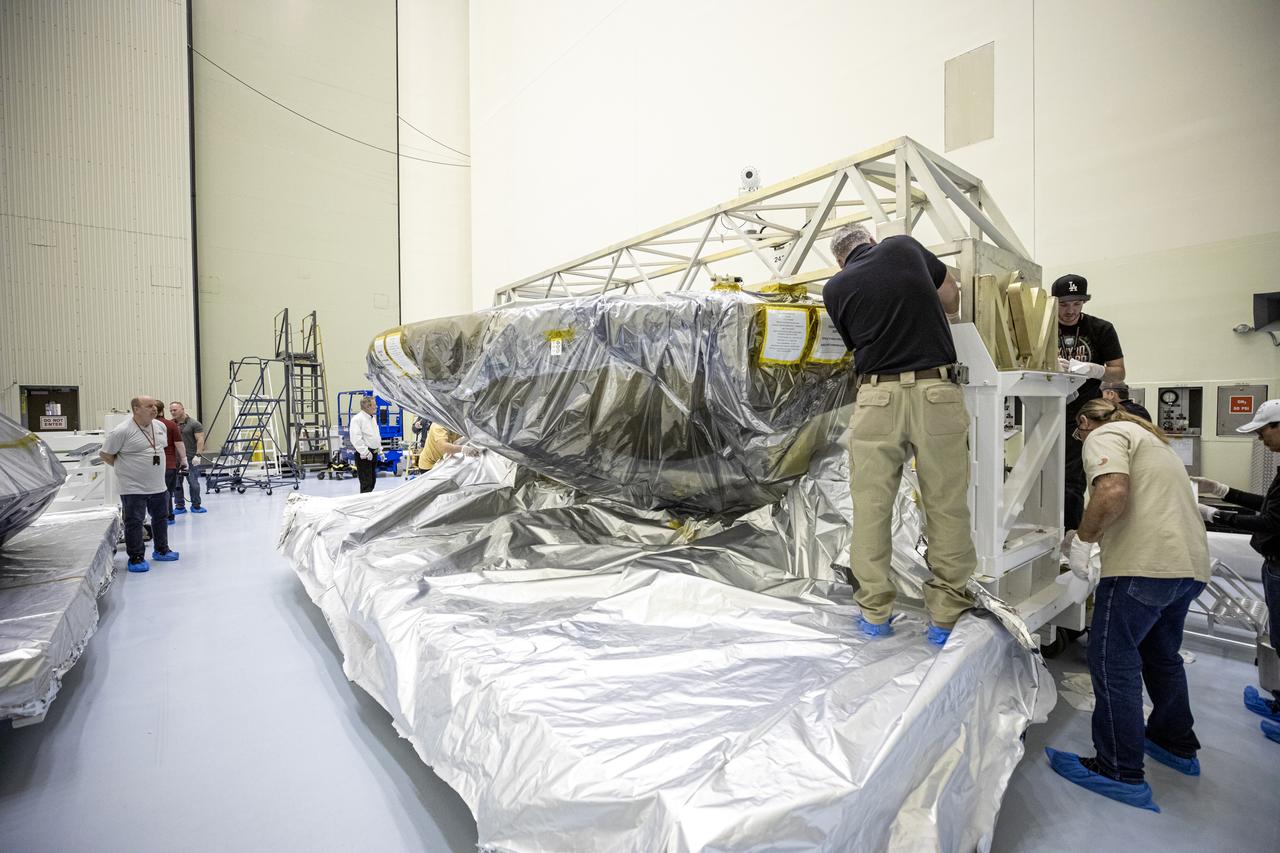
The heat shield and back shell for the Mars 2020 rover are unboxed inside the Payload Hazardous Servicing Facility at NASA’s Kennedy Space Center on Dec. 13, 2019. The two integral pieces of equipment, which were flown to the Florida spaceport from Lockheed Martin Space in Denver, Colorado, will protect the rover during its passage to Mars. The Mars 2020 rover is being manufactured at NASA’s Jet Propulsion Laboratory in California. When completed, the rover will be delivered to Kennedy in mid-February, 2020, with the mission scheduled to launch in the summer of 2020.
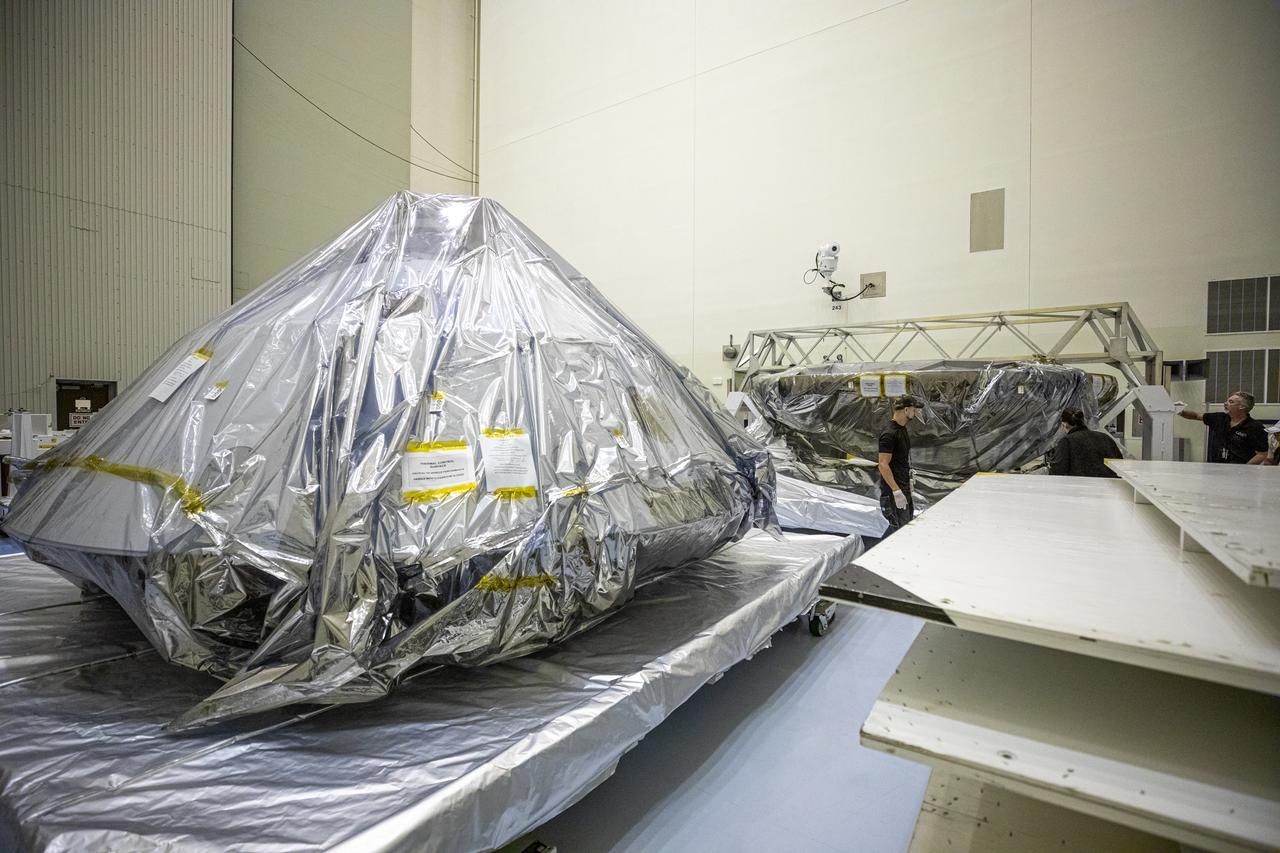
The heat shield and back shell for the Mars 2020 rover are unboxed inside the Payload Hazardous Servicing Facility at NASA’s Kennedy Space Center on Dec. 13, 2019. The two integral pieces of equipment, which were flown to the Florida spaceport from Lockheed Martin Space in Denver, Colorado, will protect the rover during its passage to Mars. The Mars 2020 rover is being manufactured at NASA’s Jet Propulsion Laboratory in California. When completed, the rover will be delivered to Kennedy in mid-February, 2020, with the mission scheduled to launch in the summer of 2020.
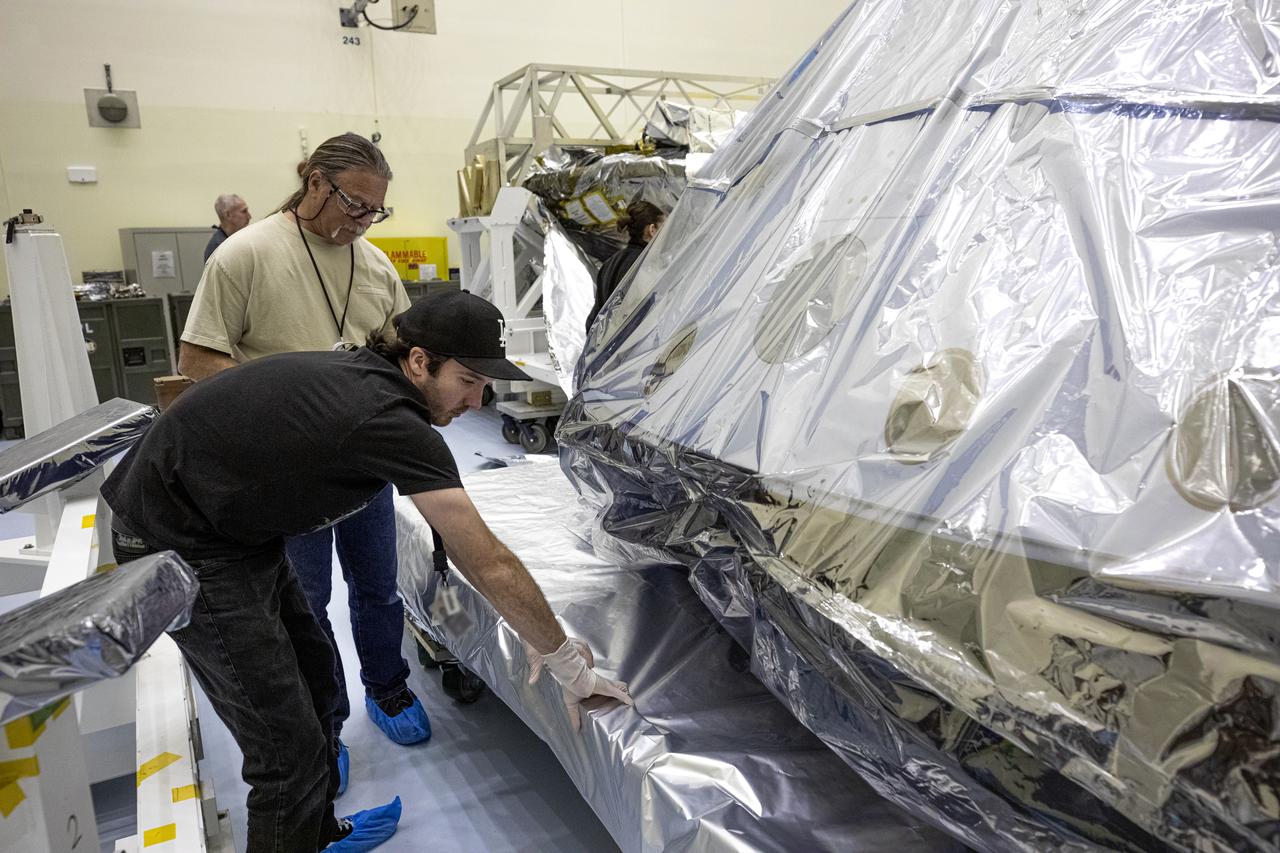
The heat shield and back shell for the Mars 2020 rover are unboxed inside the Payload Hazardous Servicing Facility at NASA’s Kennedy Space Center on Dec. 13, 2019. The two integral pieces of equipment, which were flown to the Florida spaceport from Lockheed Martin Space in Denver, Colorado, will protect the rover during its passage to Mars. The Mars 2020 rover is being manufactured at NASA’s Jet Propulsion Laboratory in California. When completed, the rover will be delivered to Kennedy in mid-February, 2020, with the mission scheduled to launch in the summer of 2020.
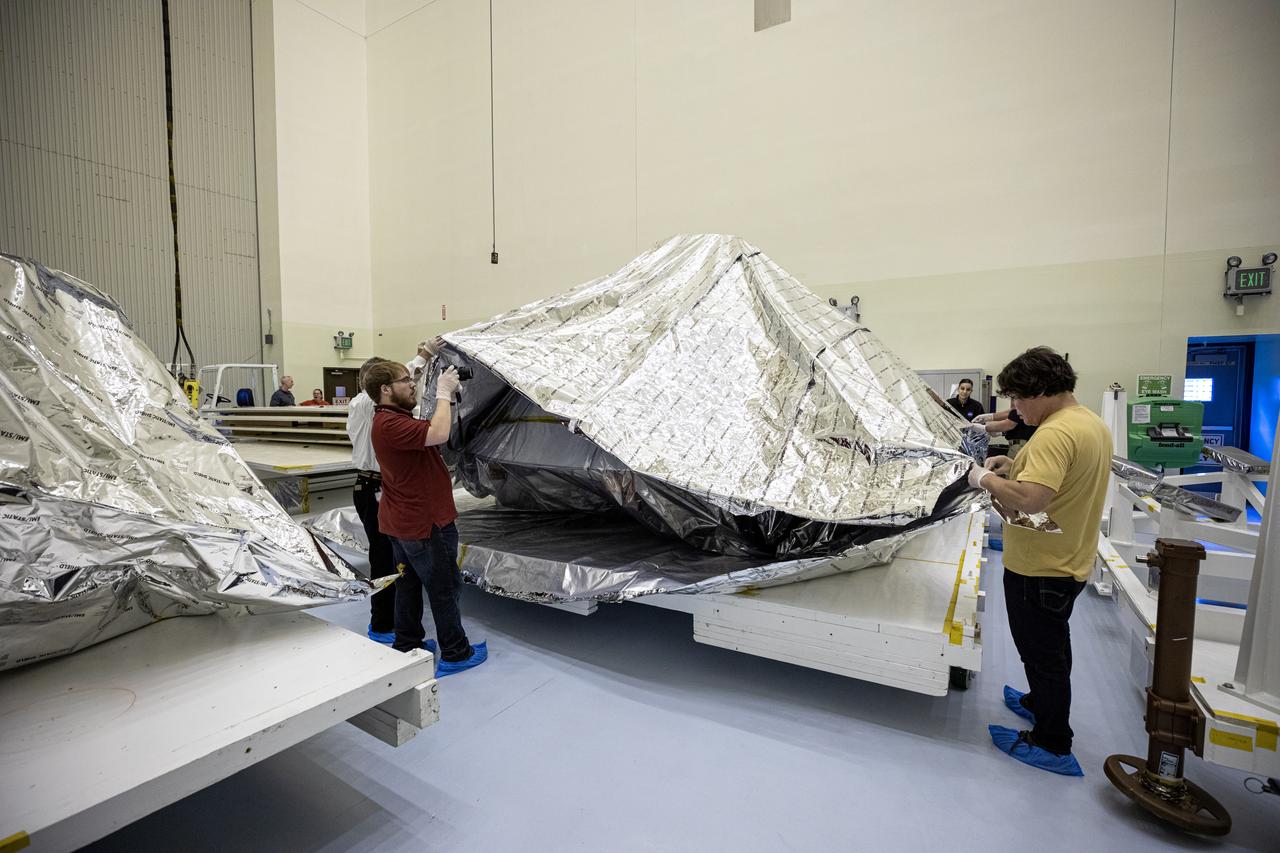
The heat shield and back shell for the Mars 2020 rover are unboxed inside the Payload Hazardous Servicing Facility at NASA’s Kennedy Space Center on Dec. 13, 2019. The two integral pieces of equipment, which were flown to the Florida spaceport from Lockheed Martin Space in Denver, Colorado, will protect the rover during its passage to Mars. The Mars 2020 rover is being manufactured at NASA’s Jet Propulsion Laboratory in California. When completed, the rover will be delivered to Kennedy in mid-February, 2020, with the mission scheduled to launch in the summer of 2020.
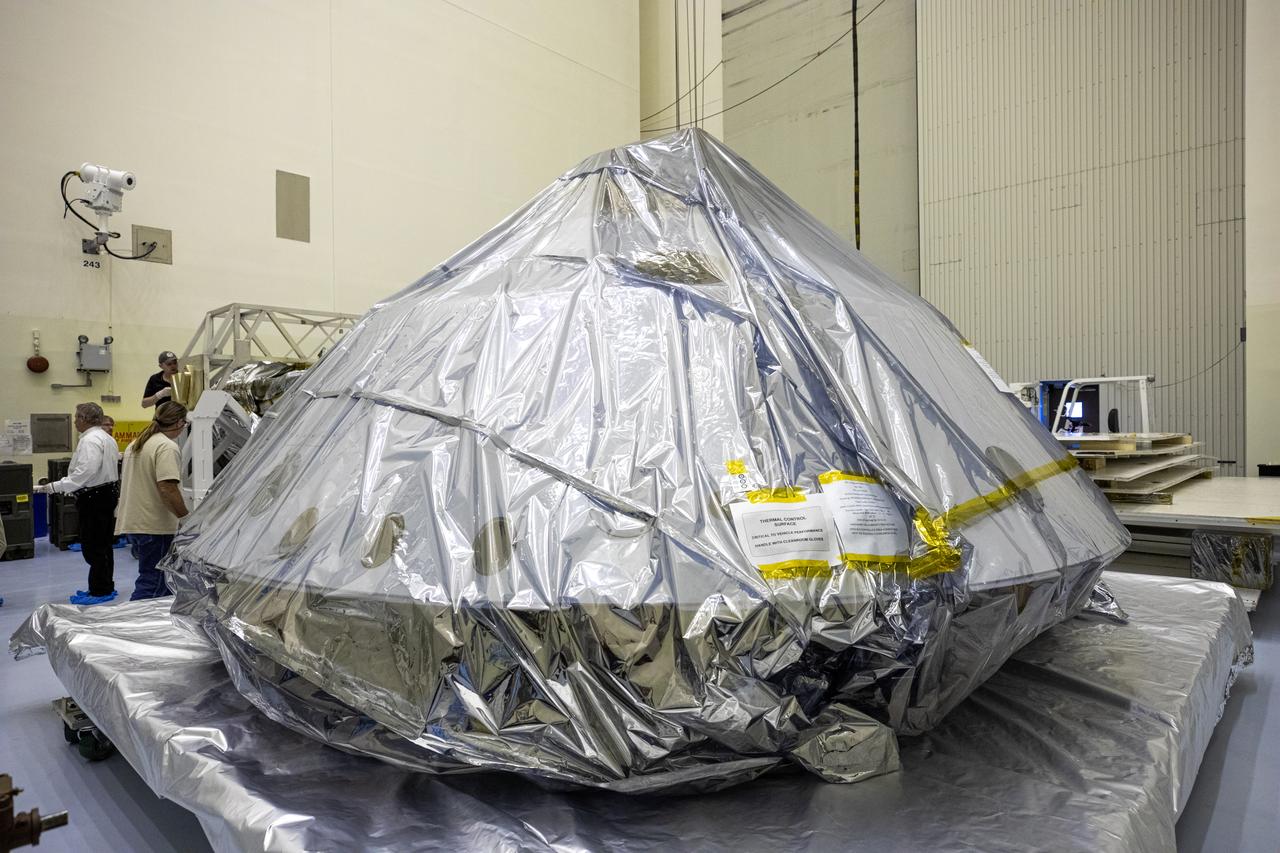
The heat shield and back shell for the Mars 2020 rover are unboxed inside the Payload Hazardous Servicing Facility at NASA’s Kennedy Space Center on Dec. 13, 2019. The two integral pieces of equipment, which were flown to the Florida spaceport from Lockheed Martin Space in Denver, Colorado, will protect the rover during its passage to Mars. The Mars 2020 rover is being manufactured at NASA’s Jet Propulsion Laboratory in California. When completed, the rover will be delivered to Kennedy in mid-February, 2020, with the mission scheduled to launch in the summer of 2020.
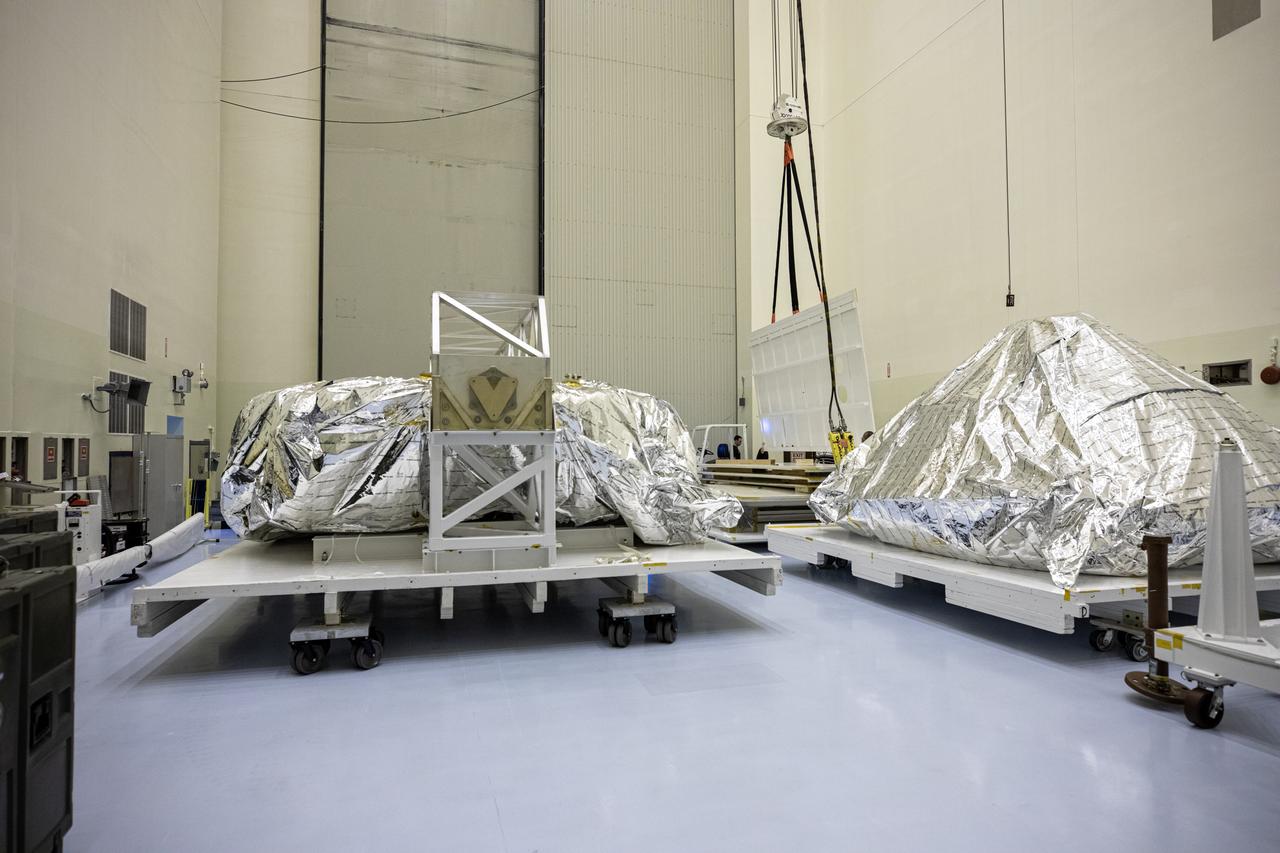
The heat shield and back shell for the Mars 2020 rover are unboxed inside the Payload Hazardous Servicing Facility at NASA’s Kennedy Space Center on Dec. 13, 2019. The two integral pieces of equipment, which were flown to the Florida spaceport from Lockheed Martin Space in Denver, Colorado, will protect the rover during its passage to Mars. The Mars 2020 rover is being manufactured at NASA’s Jet Propulsion Laboratory in California. When completed, the rover will be delivered to Kennedy in mid-February, 2020, with the mission scheduled to launch in the summer of 2020.
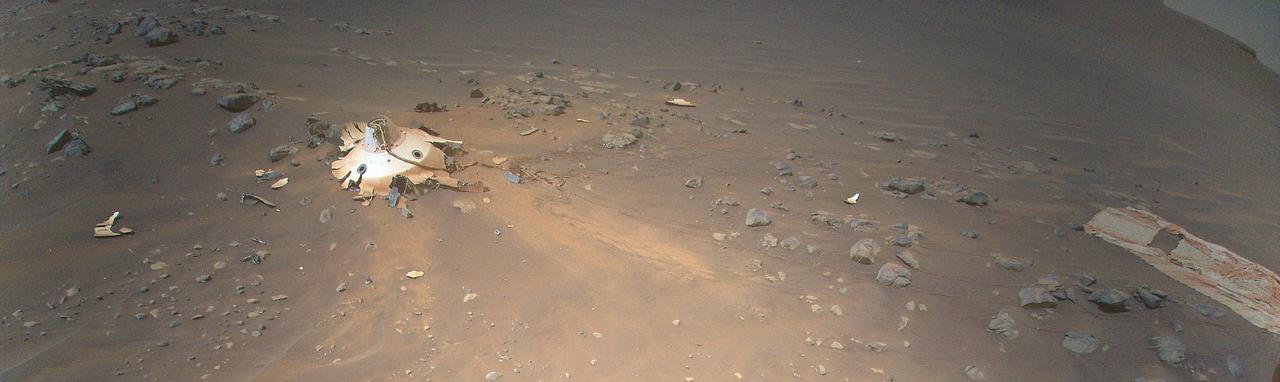
This image of Perseverance's backshell (left of center), supersonic parachute (far right), was collected from an altitude of 26 feet (8 meters) by NASA's Ingenuity Mars Helicopter during its 26th flight on Mars on April 19, 2022. During the Feb. 18, 2021, landing of Perseverance, the parachute and backshell were jettisoned at about 1.3 miles (2.1 km) altitude. The parachute and backshell continued to descend and impacted the ground at approximately 78 mph (126 kph). Engineers working on the Mars Sample Return program requested images be taken from an aerial perspective of the components because they may provide insight into the components' performance during the rover's entry, descent, and landing. The image has been cropped and processed from the original version. https://photojournal.jpl.nasa.gov/catalog/PIA25218
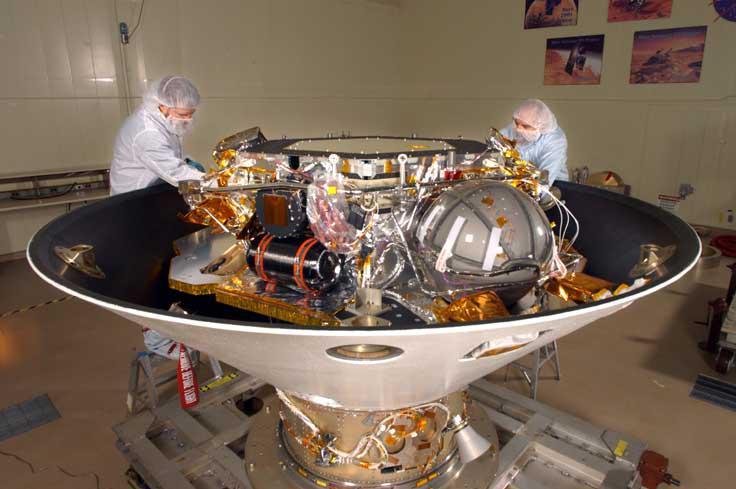
The Phoenix lander, housed in a 100,000-class clean room at Lockheed Martin Space Systems facilities near Denver, Colo. Shown here, the lander is contained inside the backshell portion of the aeroshell with the heat shield removed.
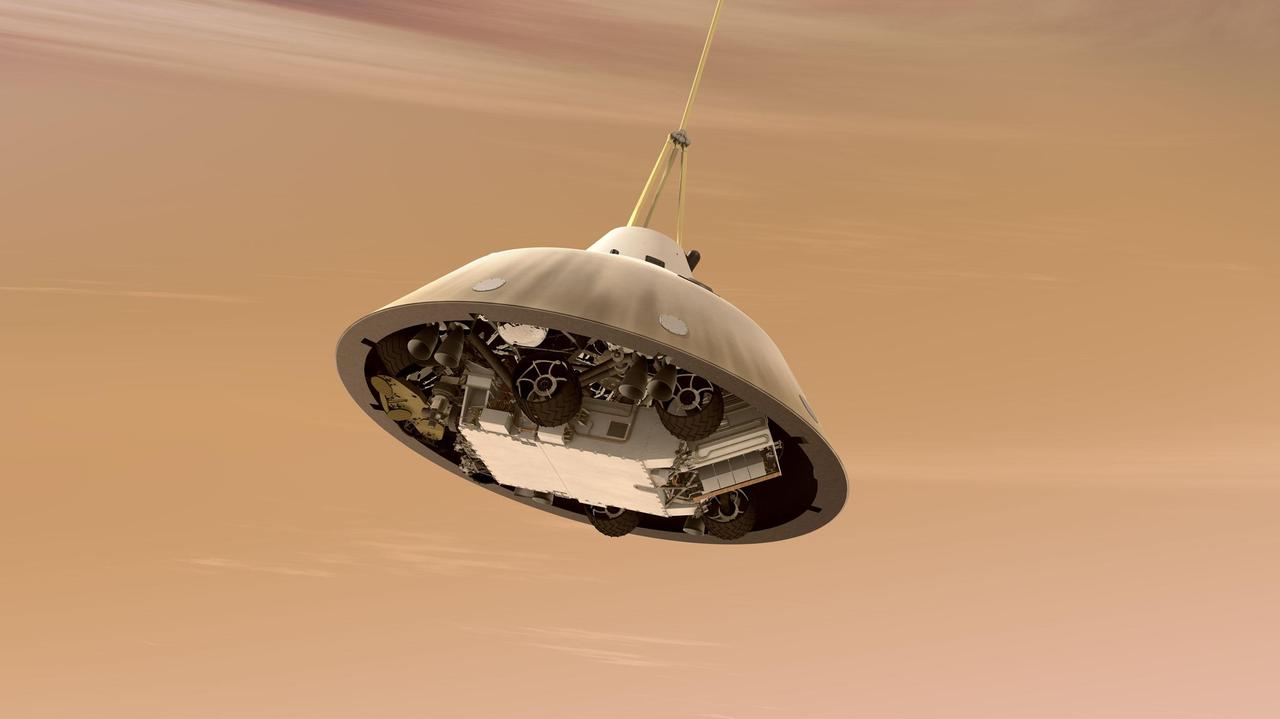
This artist concept shows NASA Curiosity rover tucked inside the Mars Science Laboratory spacecraft backshell while the spacecraft is descending on a parachute toward Mars. Here, the spacecraft heat shield has already been jettisoned.
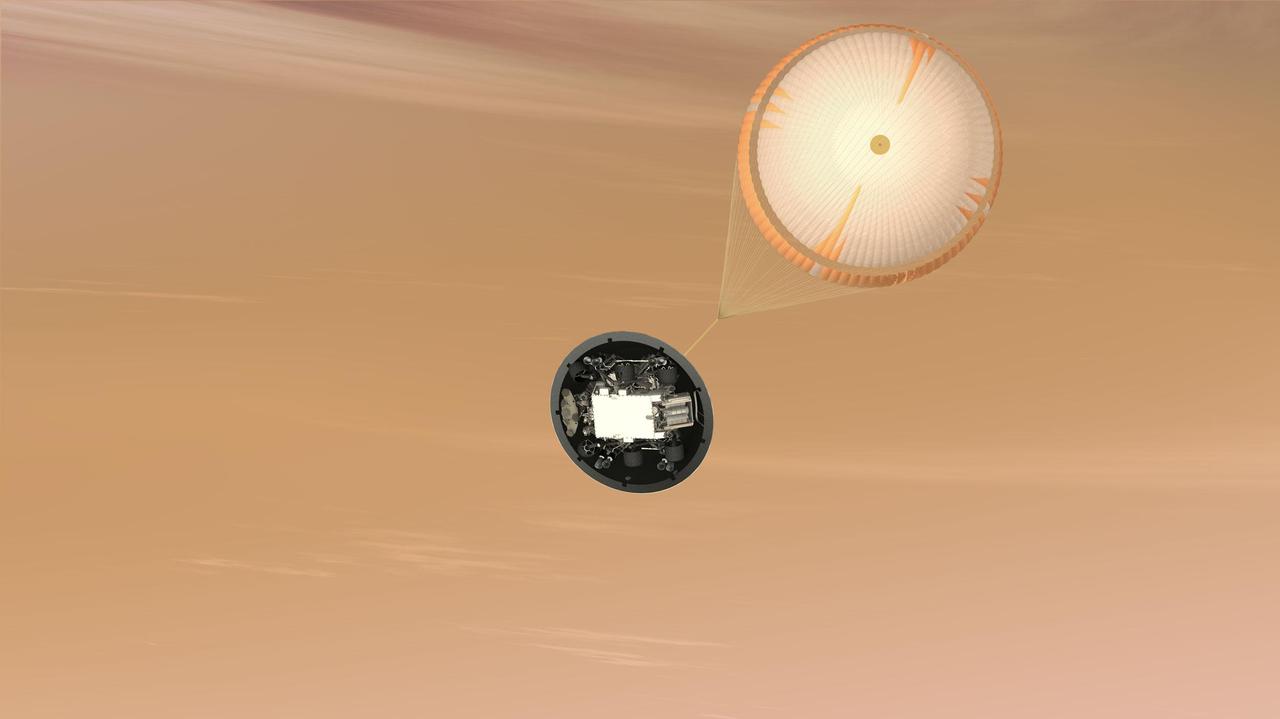
This artist concept is of NASA Mars Science Laboratory MSL Curiosity rover parachute system; the largest parachute ever built to fly on a planetary mission. The parachute is attached to the top of the backshell portion of the spacecraft aeroshell.
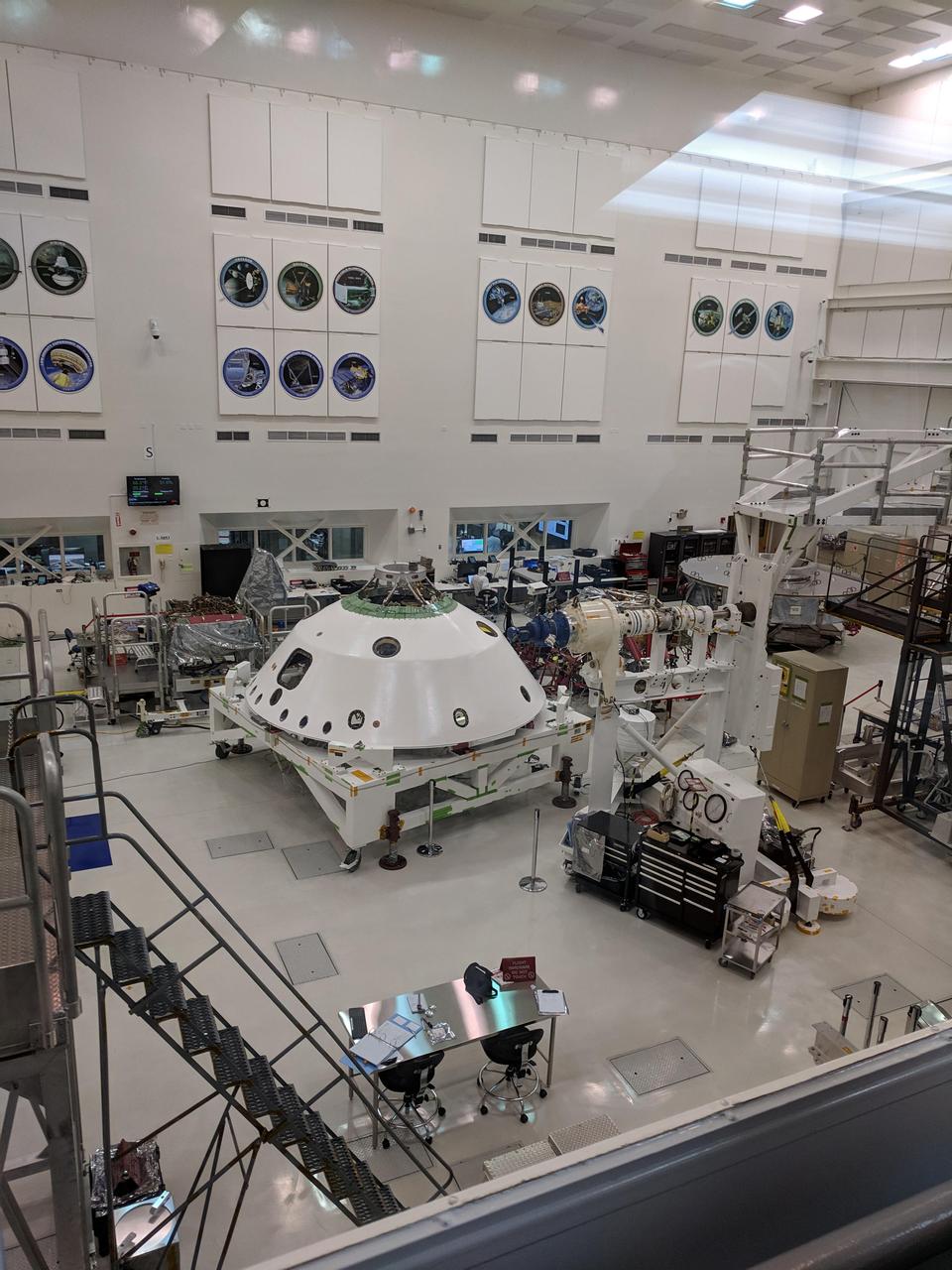
With the backshell that will help protect the Mars 2020 rover during its descent into the Martian atmosphere visible in the foreground, a technician on the project monitors the progress of Systems Test 1. Over two weeks in January 2019, 72 engineers and technicians assigned to the 2020 mission took over the High Bay 1 cleanroom in JPL's Spacecraft Assembly Facility to put the software and electrical systems aboard the mission's cruise, entry capsule, descent stage and rover through their paces. https://photojournal.jpl.nasa.gov/catalog/PIA22966
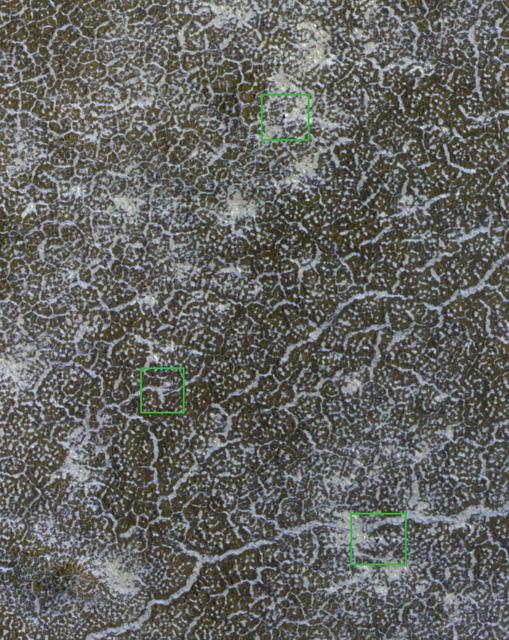
NASA Phoenix Mars Lander, its backshell and heatshield visible within this enhanced-color image of the Phoenix landing site taken on Jan. 6, 2010 by the High Resolution Imaging Science Experiment HiRISE camera on NASA Mars Reconnaissance Orbiter.
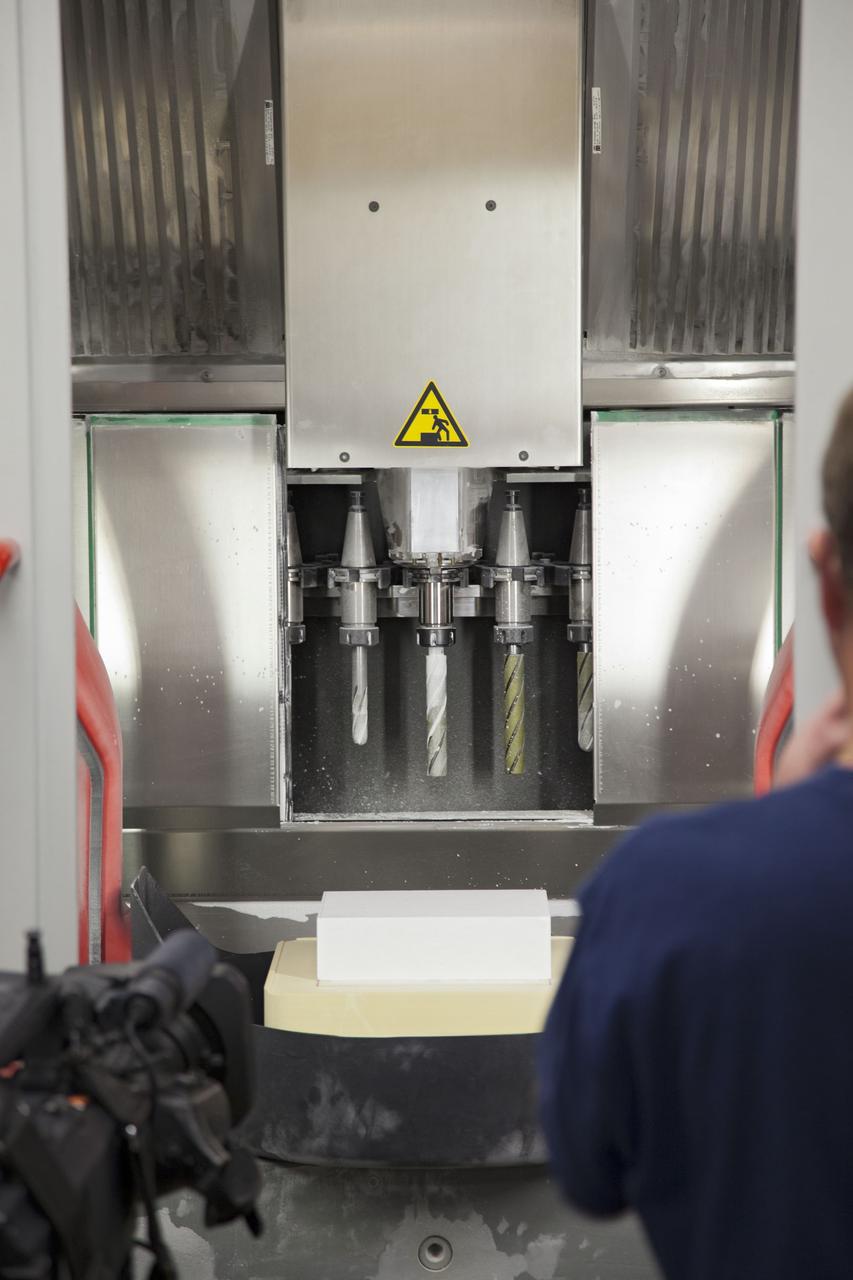
CAPE CANAVERAL, Fla. -- The heat shield tiles that will be installed to the backshell of the Orion Multi-Purpose Crew Vehicle's Exploration Flight Test EFT-1 capsule are manufactured inside the Thermal Protection System Facility at NASA's Kennedy Space Center in Florida. The insulation includes thermal barriers that are used around hatches, thrusters and other open areas of the backshell to protect the joints from heat. EFT-1 will be used during Orion's first test flight in space. For more information, visit www.nasa.gov/orion. Photo credit: Frankie Martin
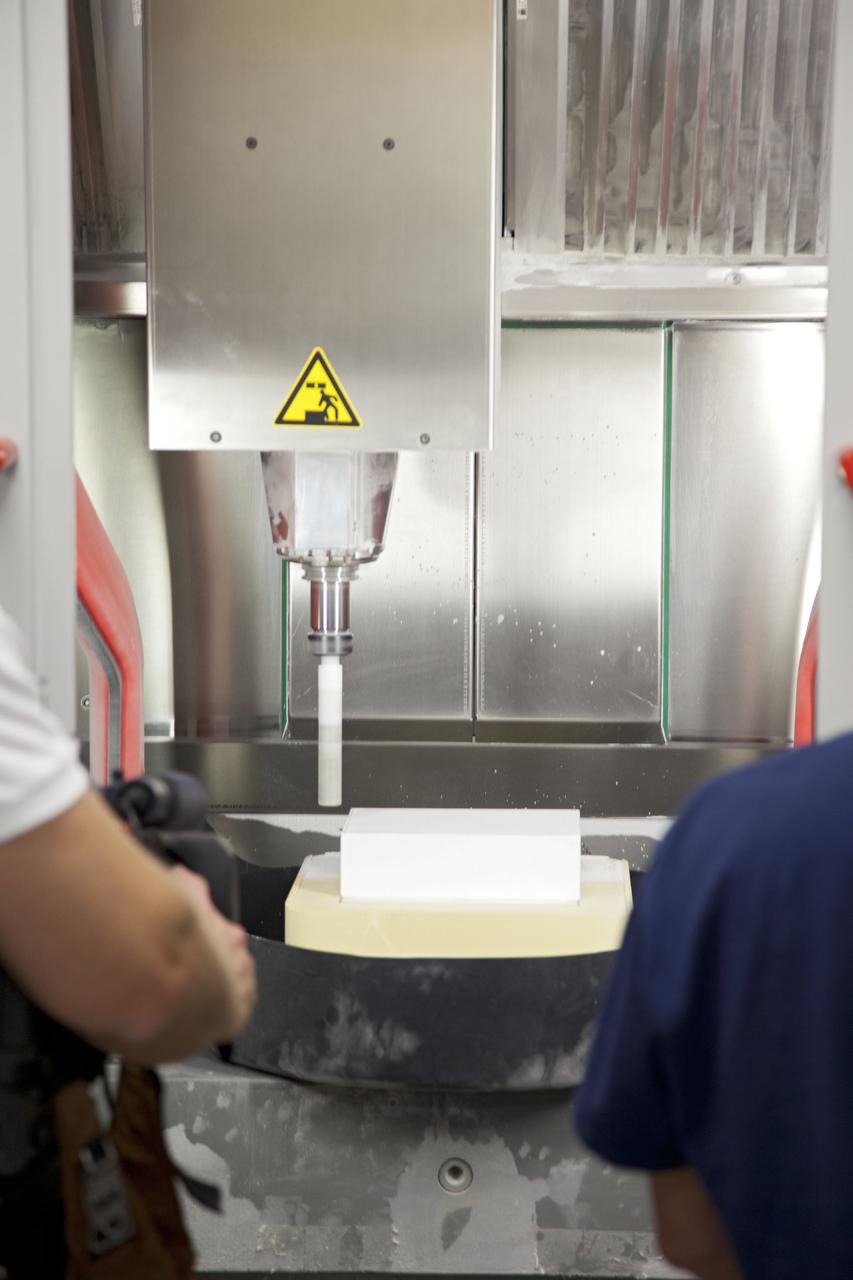
CAPE CANAVERAL, Fla. -- The heat shield tiles that will be installed to the backshell of the Orion Multi-Purpose Crew Vehicle's Exploration Flight Test EFT-1 capsule are manufactured inside the Thermal Protection System Facility at NASA's Kennedy Space Center in Florida. The insulation includes thermal barriers that are used around hatches, thrusters and other open areas of the backshell to protect the joints from heat. EFT-1 will be used during Orion's first test flight in space. For more information, visit www.nasa.gov/orion. Photo credit: Frankie Martin
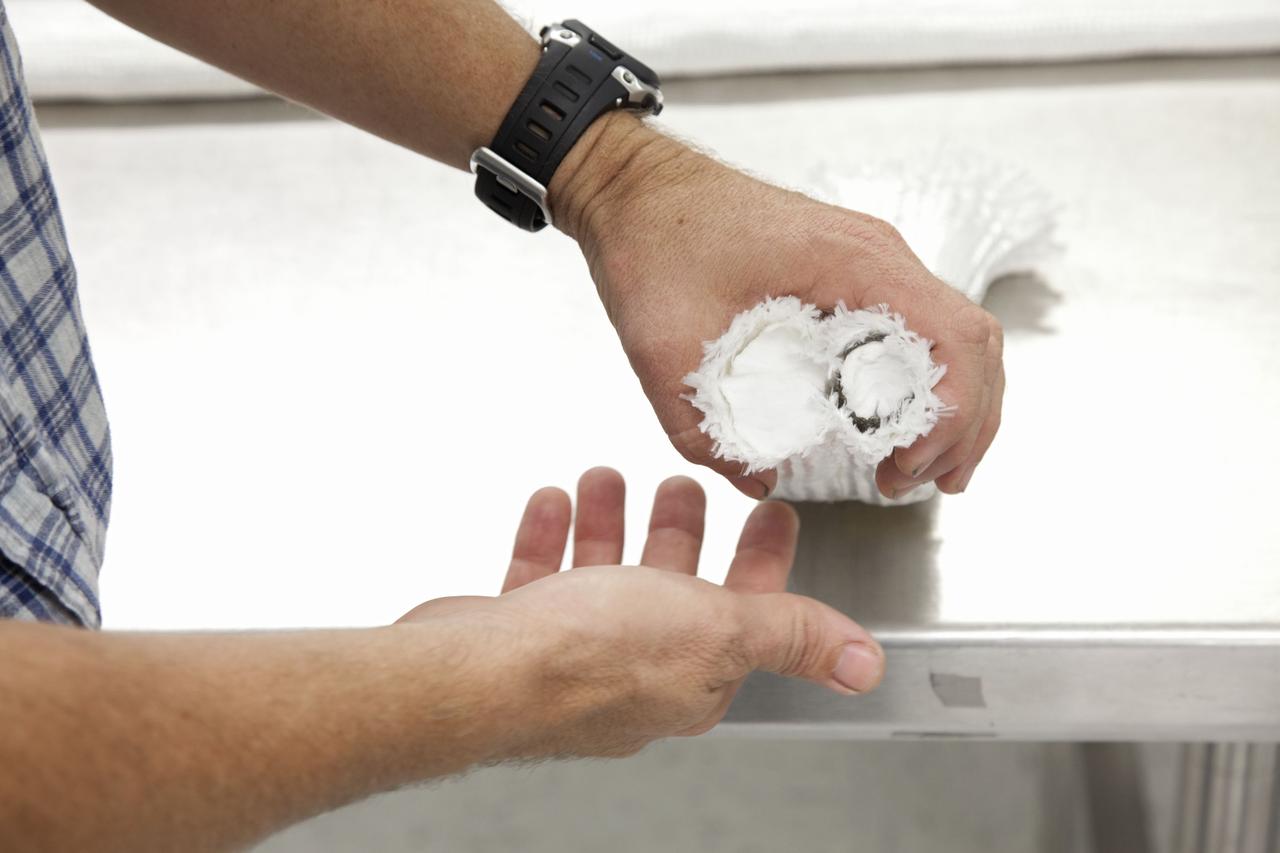
CAPE CANAVERAL, Fla. -- The heat shield tiles that will be installed to the backshell of the Orion Multi-Purpose Crew Vehicle's Exploration Flight Test EFT-1 capsule are manufactured inside the Thermal Protection System Facility at NASA's Kennedy Space Center in Florida. The insulation includes thermal barriers that are used around hatches, thrusters and other open areas of the backshell to protect the joints from heat. EFT-1 will be used during Orion's first test flight in space. For more information, visit www.nasa.gov/orion. Photo credit: Frankie Martin
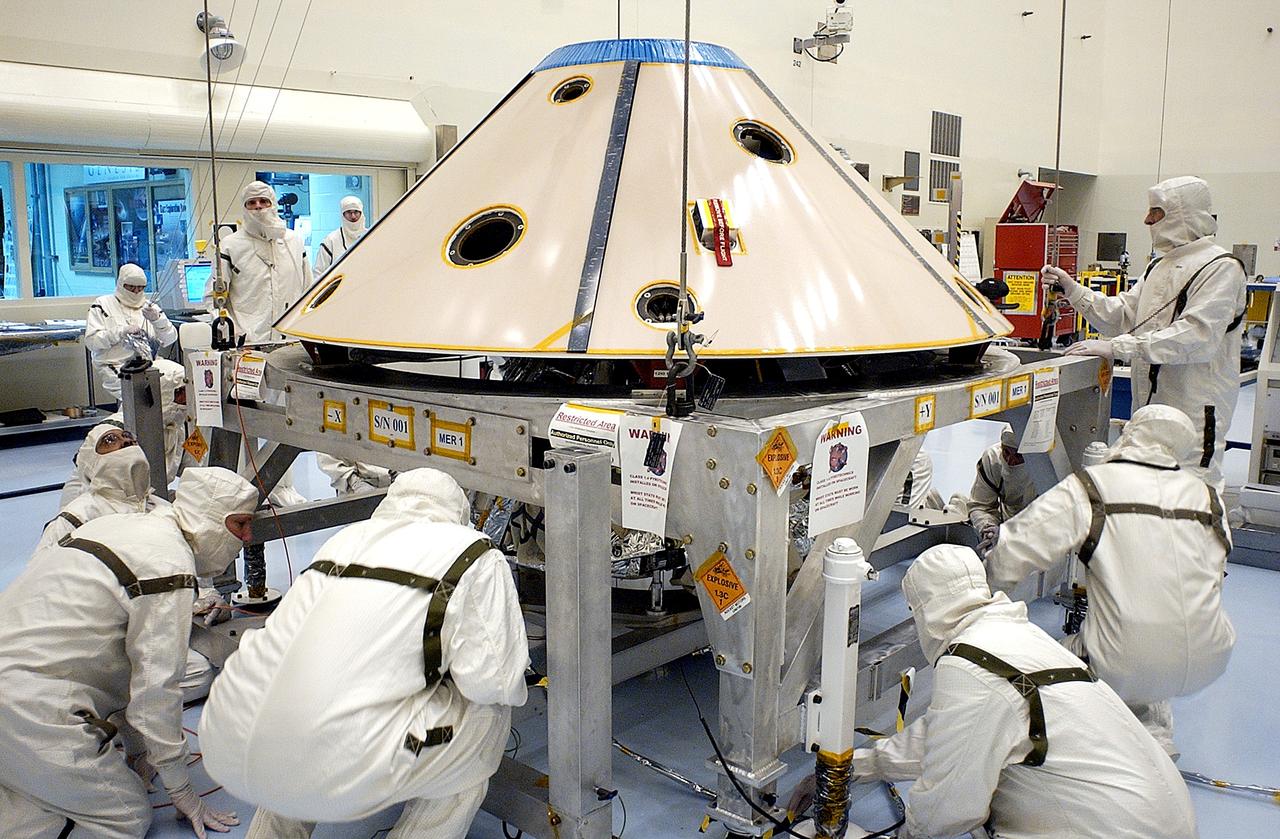
KENNEDY SPACE CENTER, FLA. - Workers in the Payload Hazardous Servicing Facility check the placement of the backshell over the Mars Exploration Rover 1 (MER-1). The backshell is a protective cover for the rover. NASA's twin Mars Exploration Rovers are designed to study the history of water on Mars. These robotic geologists are equipped with a robotic arm, a drilling tool, three spectrometers, and four pairs of cameras that allow them to have a human-like, 3D view of the terrain. Each rover could travel as far as 100 meters in one day to act as Mars scientists' eyes and hands, exploring an environment where humans can't yet go. MER-1 is scheduled to launch June 25 as MER-B aboard a Delta II rocket from Cape Canaveral Air Force Station.
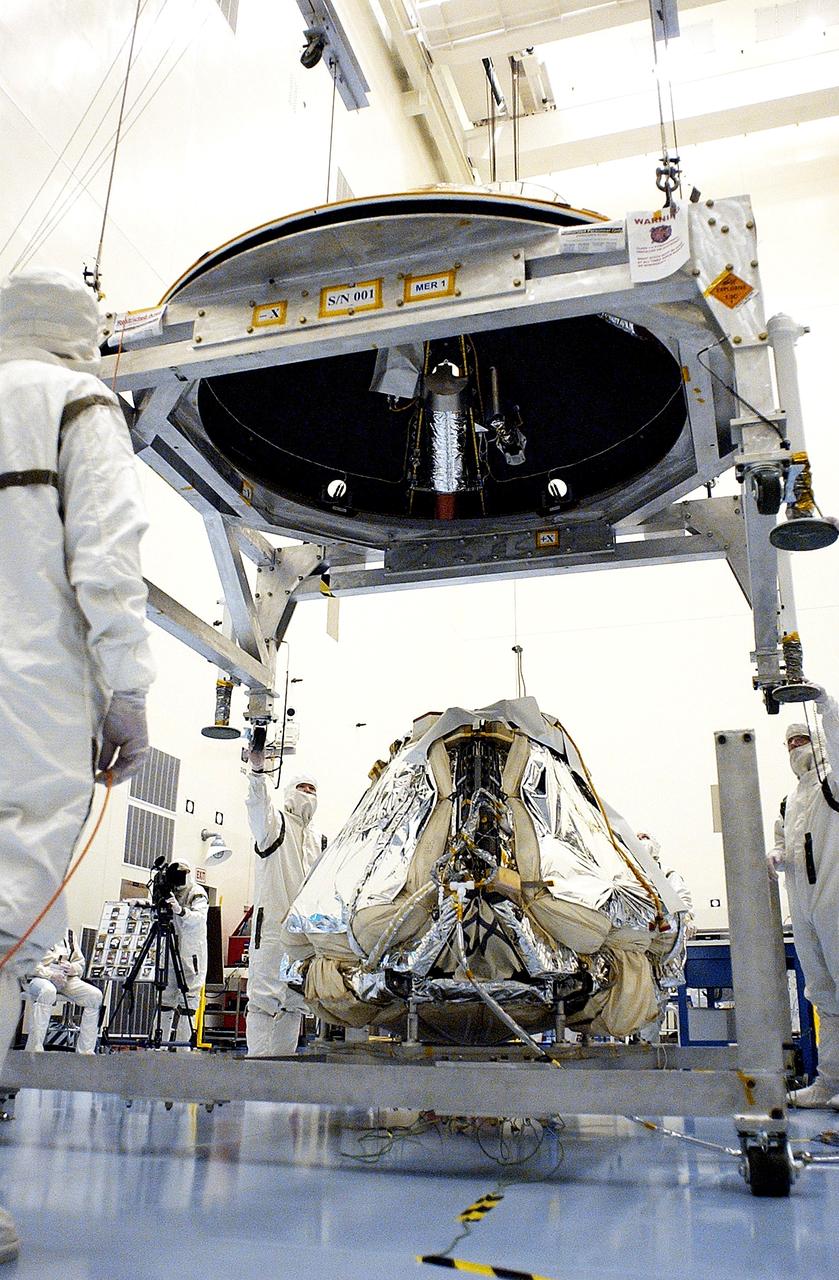
KENNEDY SPACE CENTER, FLA. - Workers in the Payload Hazardous Servicing Facility lower the backshell over the Mars Exploration Rover 1 (MER-1). The backshell is a protective cover for the rover. NASA's twin Mars Exploration Rovers are designed to study the history of water on Mars. These robotic geologists are equipped with a robotic arm, a drilling tool, three spectrometers, and four pairs of cameras that allow them to have a human-like, 3D view of the terrain. Each rover could travel as far as 100 meters in one day to act as Mars scientists' eyes and hands, exploring an environment where humans can't yet go. MER-1 is scheduled to launch June 25 as MER-B aboard a Delta II rocket from Cape Canaveral Air Force Station.
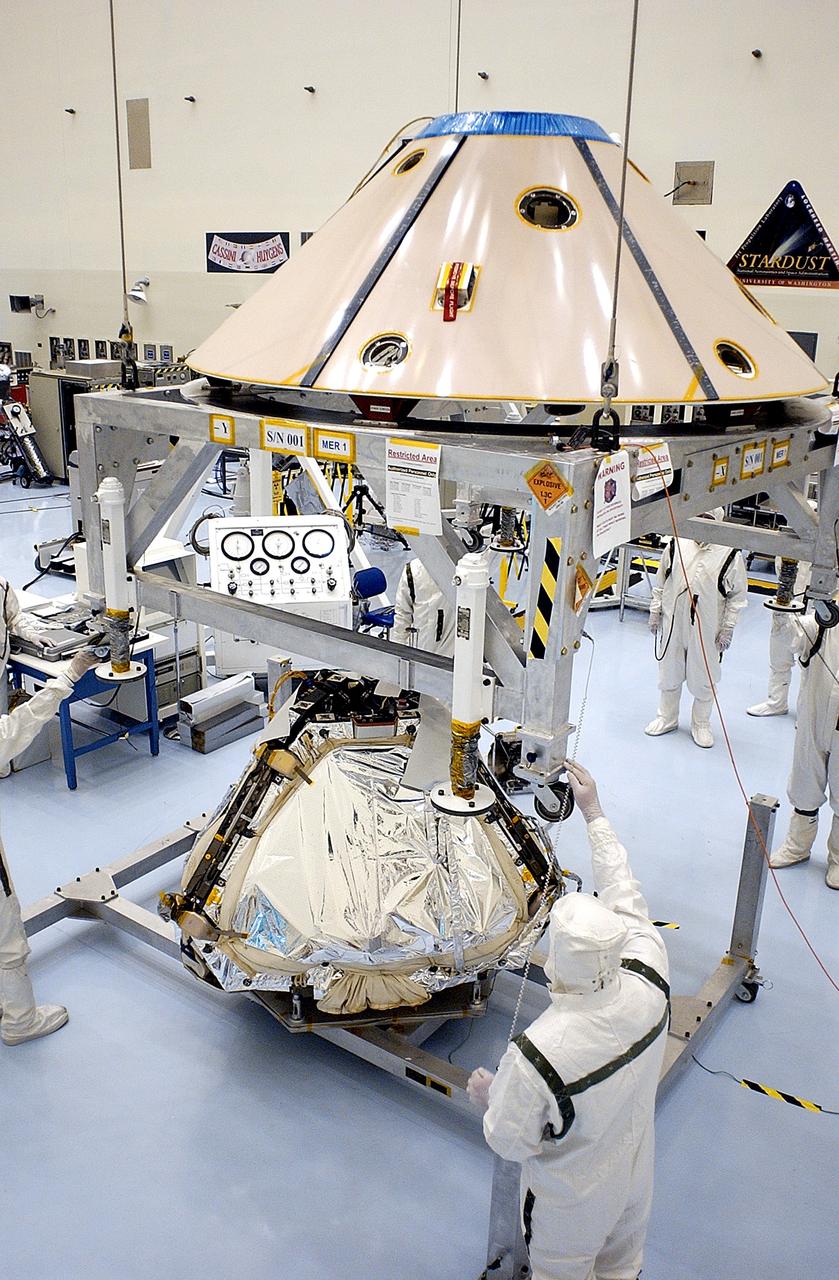
KENNEDY SPACE CENTER, FLA. - Workers in the Payload Hazardous Servicing Facility guide the backshell being lowered over the Mars Exploration Rover 1 (MER-1). The backshell is a protective cover for the rover. NASA's twin Mars Exploration Rovers are designed to study the history of water on Mars. These robotic geologists are equipped with a robotic arm, a drilling tool, three spectrometers, and four pairs of cameras that allow them to have a human-like, 3D view of the terrain. Each rover could travel as far as 100 meters in one day to act as Mars scientists' eyes and hands, exploring an environment where humans can't yet go. MER-1 is scheduled to launch June 25 as MER-B aboard a Delta II rocket from Cape Canaveral Air Force Station.
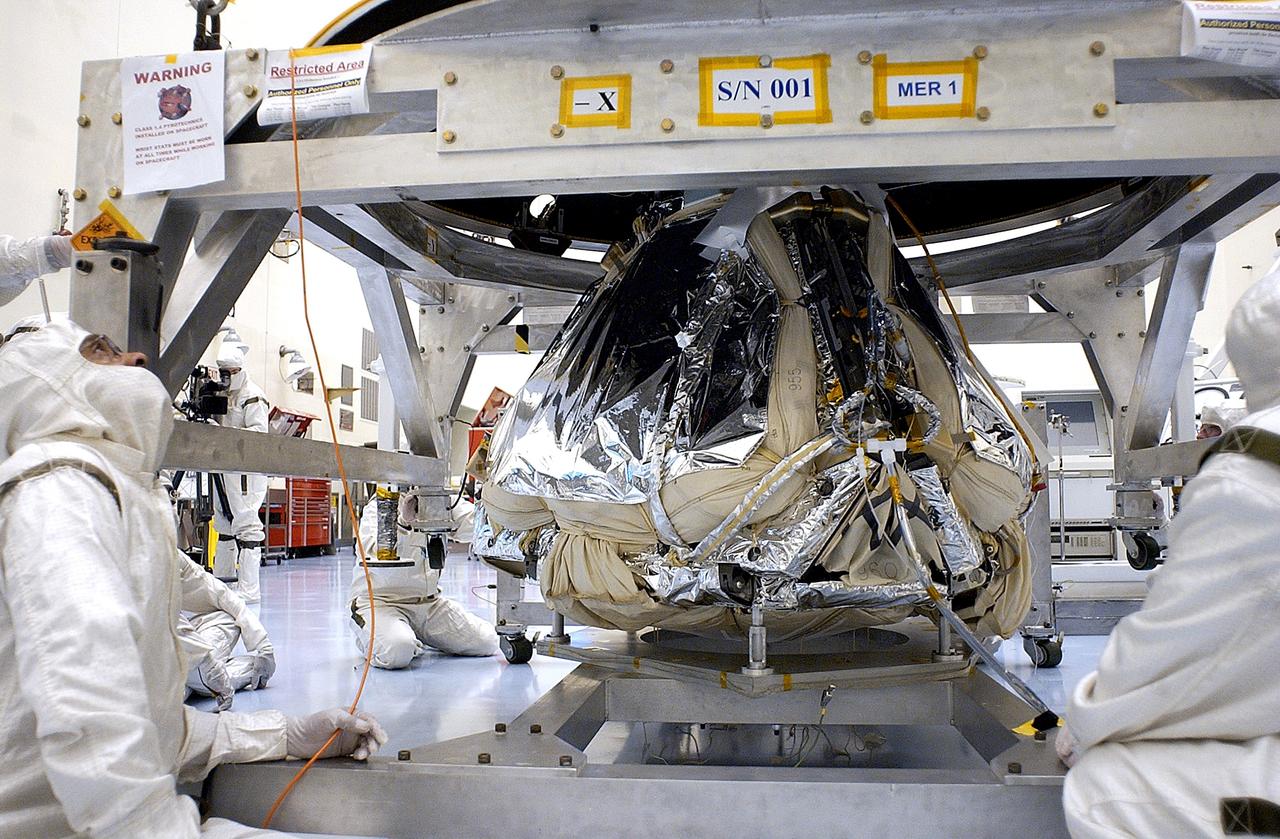
KENNEDY SPACE CENTER, FLA. - Workers in the Payload Hazardous Servicing Facility lower the backshell over the Mars Exploration Rover 1 (MER-1). The backshell is a protective cover for the rover. NASA's twin Mars Exploration Rovers are designed to study the history of water on Mars. These robotic geologists are equipped with a robotic arm, a drilling tool, three spectrometers, and four pairs of cameras that allow them to have a human-like, 3D view of the terrain. Each rover could travel as far as 100 meters in one day to act as Mars scientists' eyes and hands, exploring an environment where humans can't yet go. MER-1 is scheduled to launch June 25 as MER-B aboard a Delta II rocket from Cape Canaveral Air Force Station.
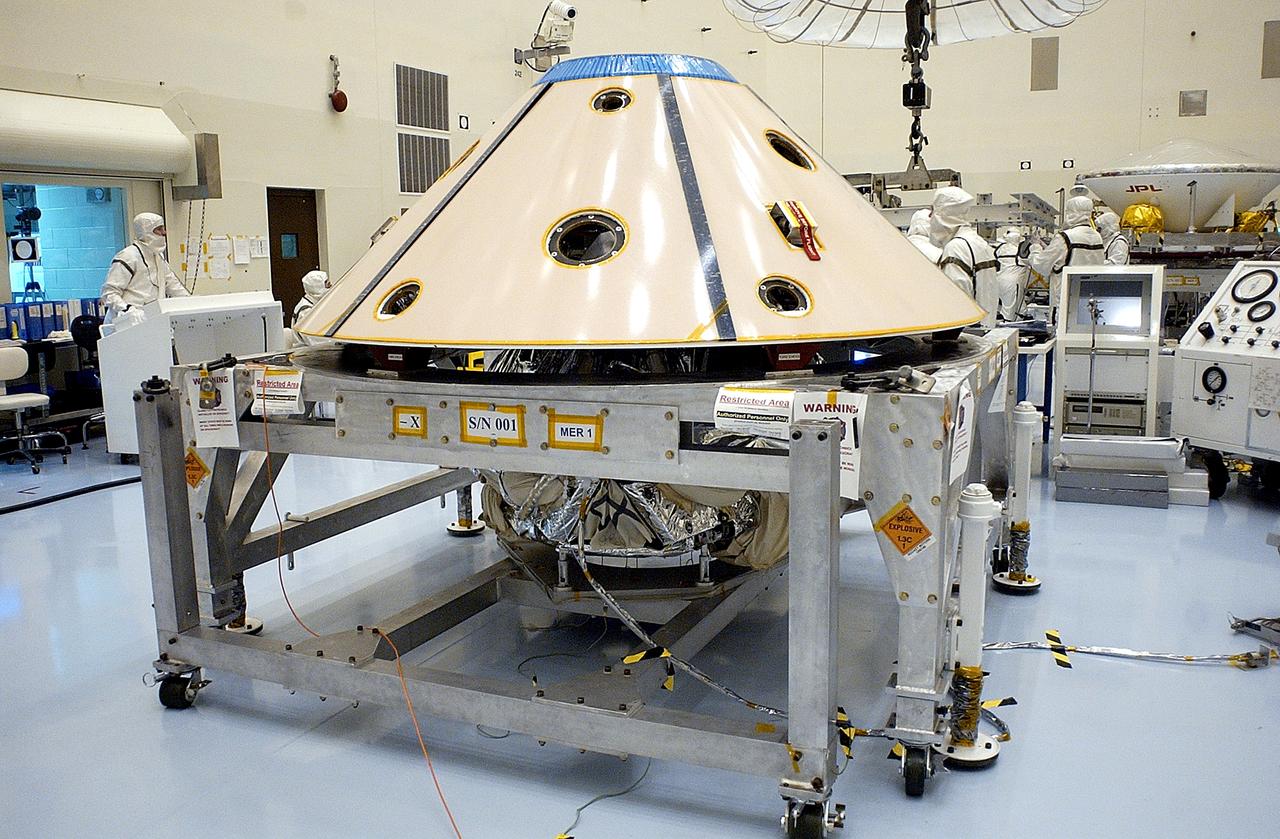
KENNEDY SPACE CENTER, FLA. - The backshell is in place over the Mars Exploration Rover 1 (MER-1). The backshell is a protective cover for the rover. NASA's twin Mars Exploration Rovers are designed to study the history of water on Mars. These robotic geologists are equipped with a robotic arm, a drilling tool, three spectrometers, and four pairs of cameras that allow them to have a human-like, 3D view of the terrain. Each rover could travel as far as 100 meters in one day to act as Mars scientists' eyes and hands, exploring an environment where humans can't yet go. MER-1 is scheduled to launch June 25 as MER-B aboard a Delta II rocket from Cape Canaveral Air Force Station.
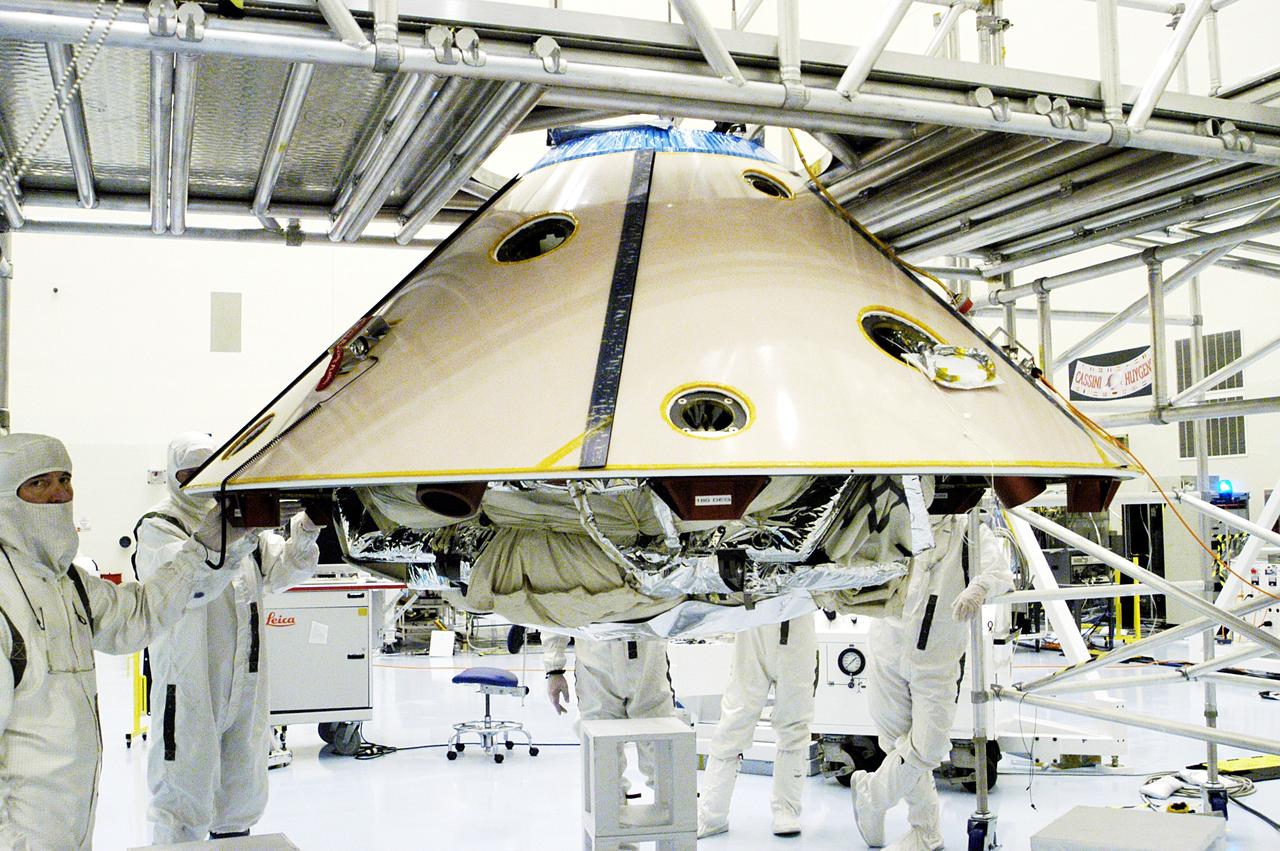
KENNEDY SPACE CENTER, FLA. - Workers walk with the suspended backshell/ Mars Exploration Rover 1 (MER-1) as it travels across the floor of the Payload Hazardous Servicing Facility. The backshell will be attached to the lower heat shield. NASA's twin Mars Exploration Rovers are designed to study the history of water on Mars. These robotic geologists are equipped with a robotic arm, a drilling tool, three spectrometers, and four pairs of cameras that allow them to have a human-like, 3D view of the terrain. Each rover could travel as far as 100 meters in one day to act as Mars scientists' eyes and hands, exploring an environment where humans can't yet go. MER-1 is scheduled to launch June 25 as MER-B aboard a Delta II rocket from Cape Canaveral Air Force Station.
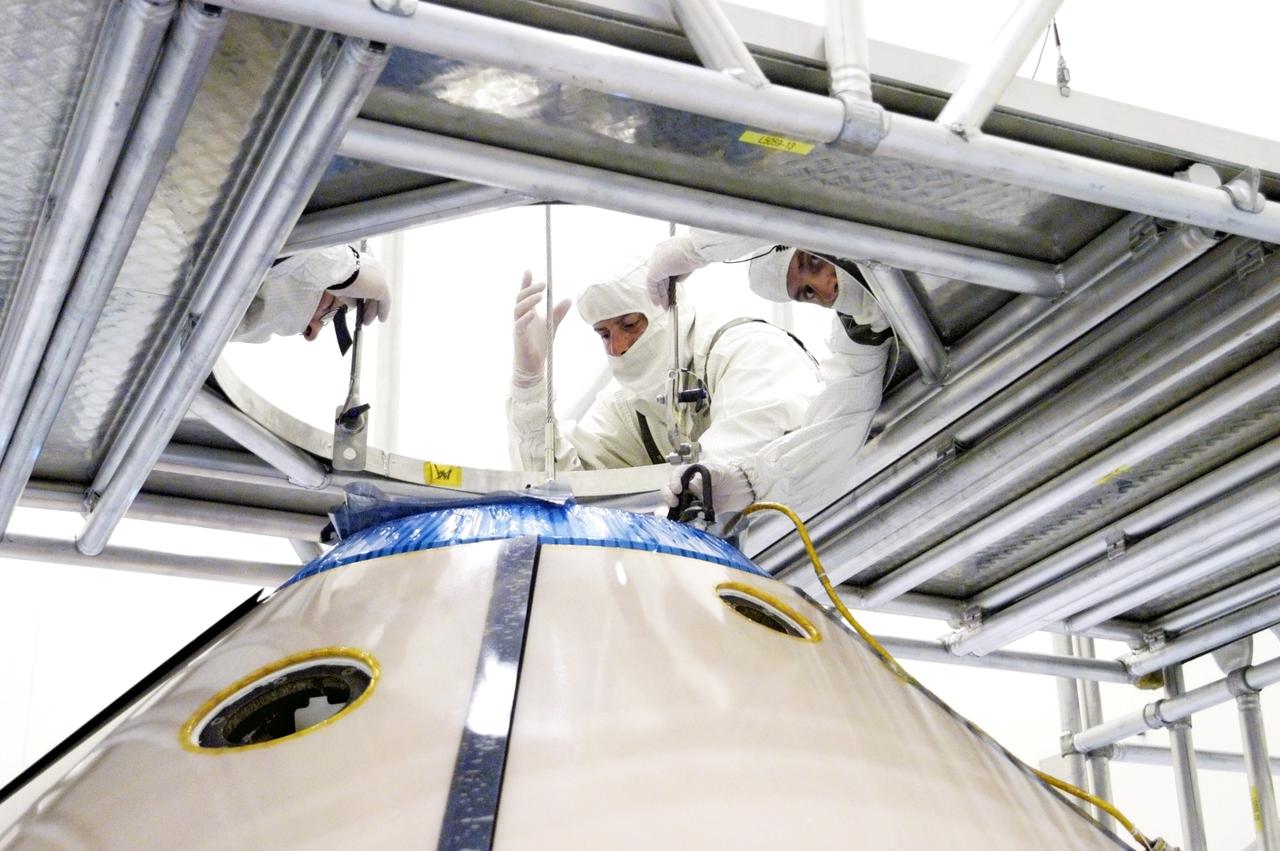
KENNEDY SPACE CENTER, FLA. - Workers attach an overhead crane to the Mars Exploration Rover 1 (MER-1) inside the upper backshell. The backshell will be moved and attached to the lower heat shield. NASA's twin Mars Exploration Rovers are designed to study the history of water on Mars. These robotic geologists are equipped with a robotic arm, a drilling tool, three spectrometers, and four pairs of cameras that allow them to have a human-like, 3D view of the terrain. Each rover could travel as far as 100 meters in one day to act as Mars scientists' eyes and hands, exploring an environment where humans can't yet go. MER-1 is scheduled to launch June 25 as MER-B aboard a Delta II rocket from Cape Canaveral Air Force Station.

KENNEDY SPACE CENTER, FLA. - In the Payload Hazardous Servicing Facility, workers move the heat shield (foreground) toward the upper backshell/ Mars Exploration Rover 1 (MER-1), in the background. The backshell and heat shield will be mated. NASA's twin Mars Exploration Rovers are designed to study the history of water on Mars. These robotic geologists are equipped with a robotic arm, a drilling tool, three spectrometers, and four pairs of cameras that allow them to have a human-like, 3D view of the terrain. Each rover could travel as far as 100 meters in one day to act as Mars scientists' eyes and hands, exploring an environment where humans can't yet go. MER-1 is scheduled to launch June 25 as MER-B aboard a Delta II rocket from Cape Canaveral Air Force Station.

KENNEDY SPACE CENTER, FLA. - An overhead crane is attached to the Mars Exploration Rover 1 (MER-1) inside the upper backshell. The backshell will be moved and attached to the lower heat shield. NASA's twin Mars Exploration Rovers are designed to study the history of water on Mars. These robotic geologists are equipped with a robotic arm, a drilling tool, three spectrometers, and four pairs of cameras that allow them to have a human-like, 3D view of the terrain. Each rover could travel as far as 100 meters in one day to act as Mars scientists' eyes and hands, exploring an environment where humans can't yet go. MER-1 is scheduled to launch June 25 as MER-B aboard a Delta II rocket from Cape Canaveral Air Force Station.
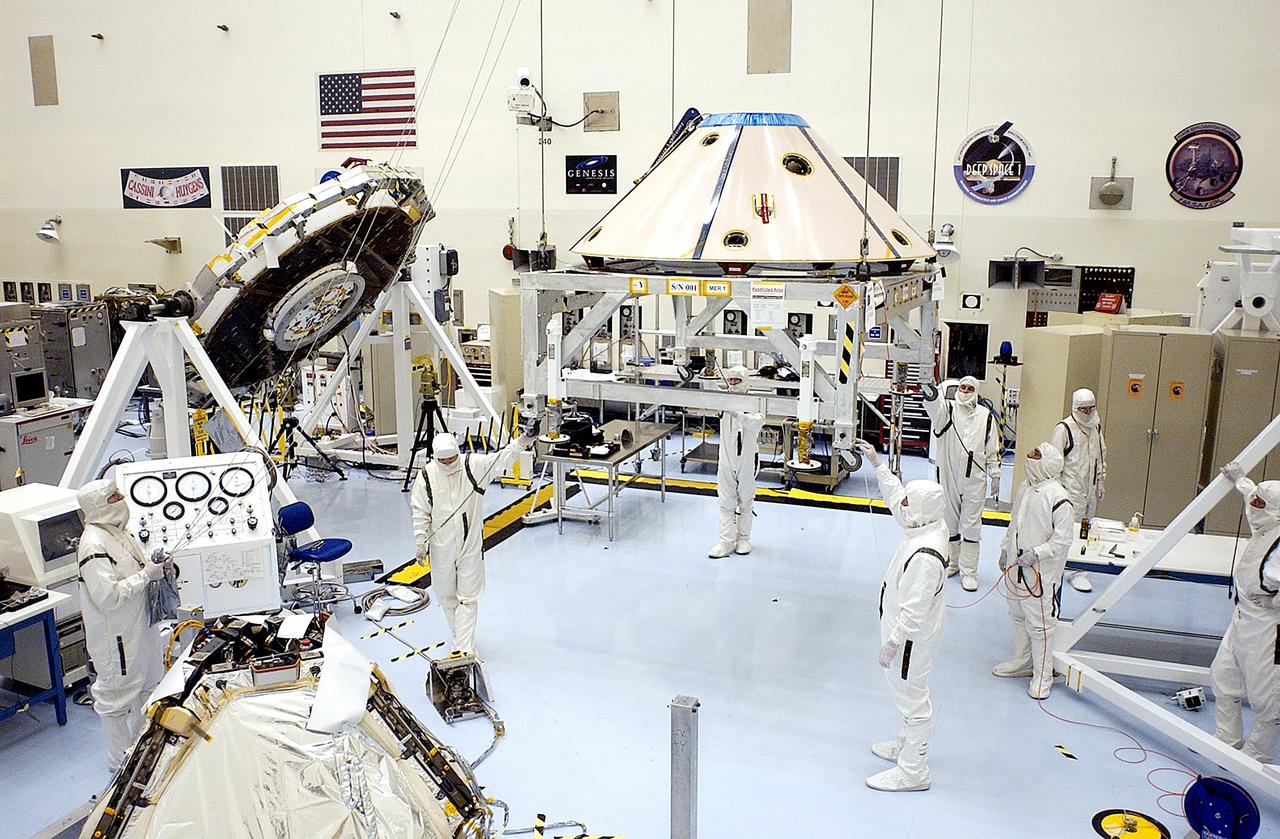
The backshell for the Mars Exploration Rover 1 (MER-1) is moved toward the rover (foreground, left). The backshell is a protective cover for the rover. NASA's twin Mars Exploration Rovers are designed to study the history of water on Mars. These robotic geologists are equipped with a robotic arm, a drilling tool, three spectrometers, and four pairs of cameras that allow them to have a human-like, 3D view of the terrain. Each rover could travel as far as 100 meters in one day to act as Mars scientists' eyes and hands, exploring an environment where humans can't yet go. MER-1 is scheduled to launch June 25 as MER-B aboard a Delta II rocket from Cape Canaveral Air Force Station.
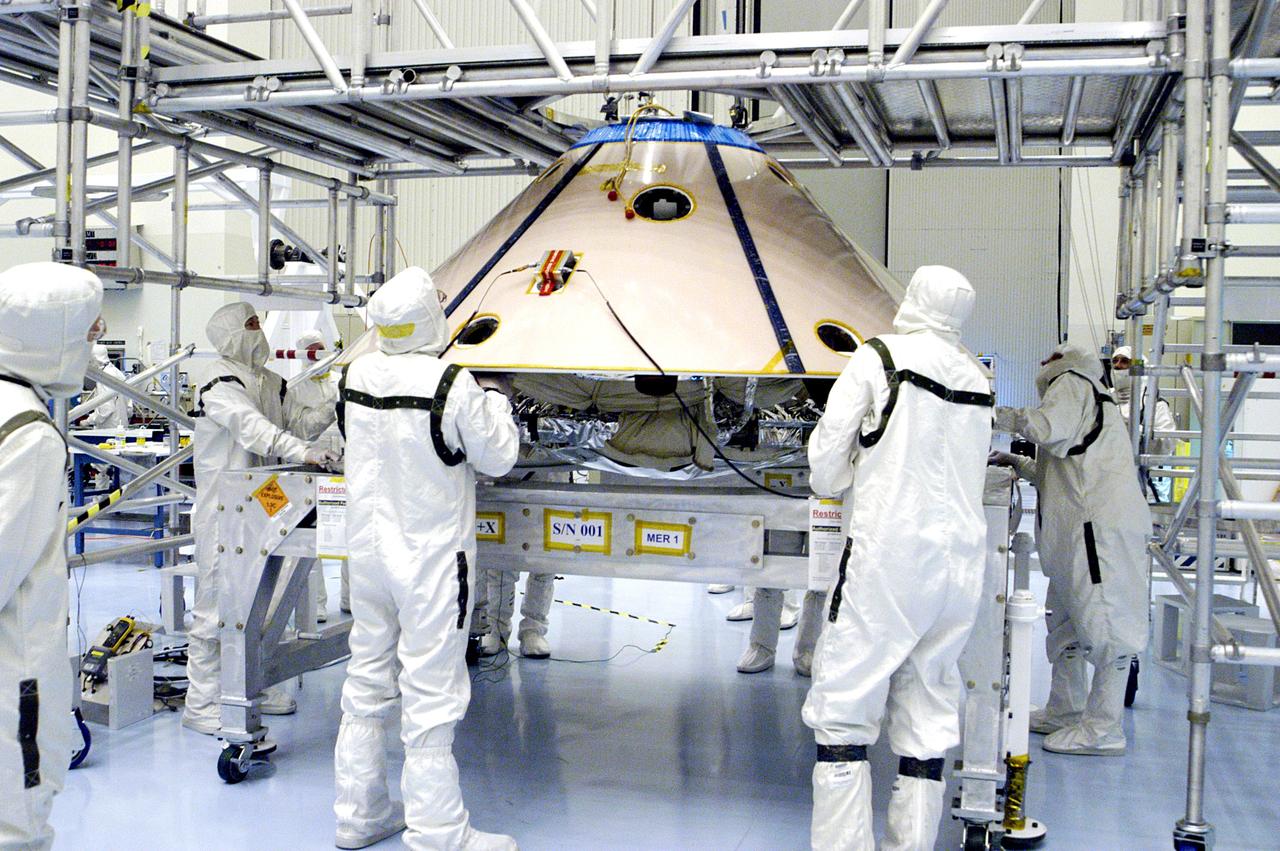
KENNEDY SPACE CENTER, FLA. - Workers watch as an overhead crane begins to lift the backshell with the Mars Exploration Rover 1 (MER-1) inside. The backshell will be moved and attached to the lower heat shield. NASA's twin Mars Exploration Rovers are designed to study the history of water on Mars. These robotic geologists are equipped with a robotic arm, a drilling tool, three spectrometers, and four pairs of cameras that allow them to have a human-like, 3D view of the terrain. Each rover could travel as far as 100 meters in one day to act as Mars scientists' eyes and hands, exploring an environment where humans can't yet go. MER-1 is scheduled to launch June 25 as MER-B aboard a Delta II rocket from Cape Canaveral Air Force Station.
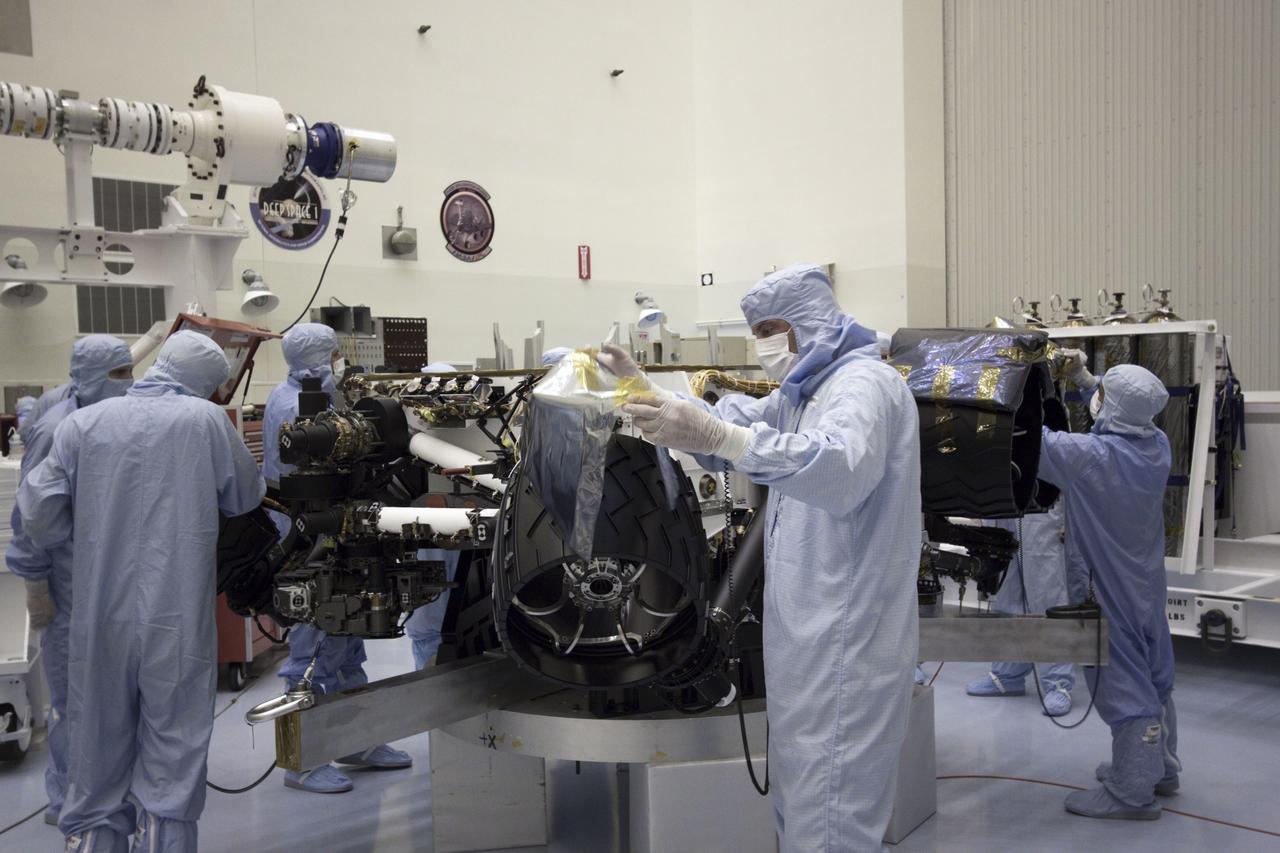
Cape Canaveral, Fla. -- At the Payload Hazardous Servicing Facility at NASA's Kennedy Space Center in Florida, technicians remove the protective cover from NASA's Mars Science Laboratory (MSL) rover known as Curiosity, before processing and testing. A United Launch Alliance Atlas V-541 configuration will be used to loft MSL into space. Curiosity’s 10 science instruments are designed to search for evidence on whether Mars has had environments favorable to microbial life, including chemical ingredients for life. The unique rover will use a laser to look inside rocks and release its gasses so that the rover’s spectrometer can analyze and send the data back to Earth. MSL is scheduled to launch from Cape Canaveral Air Force Station in Florida Nov. 25 with a window extending to Dec. 18 and arrival at Mars Aug. 2012. For more information, visit http://www.nasa.gov/msl. Photo credit: NASA/Jim Grossmann
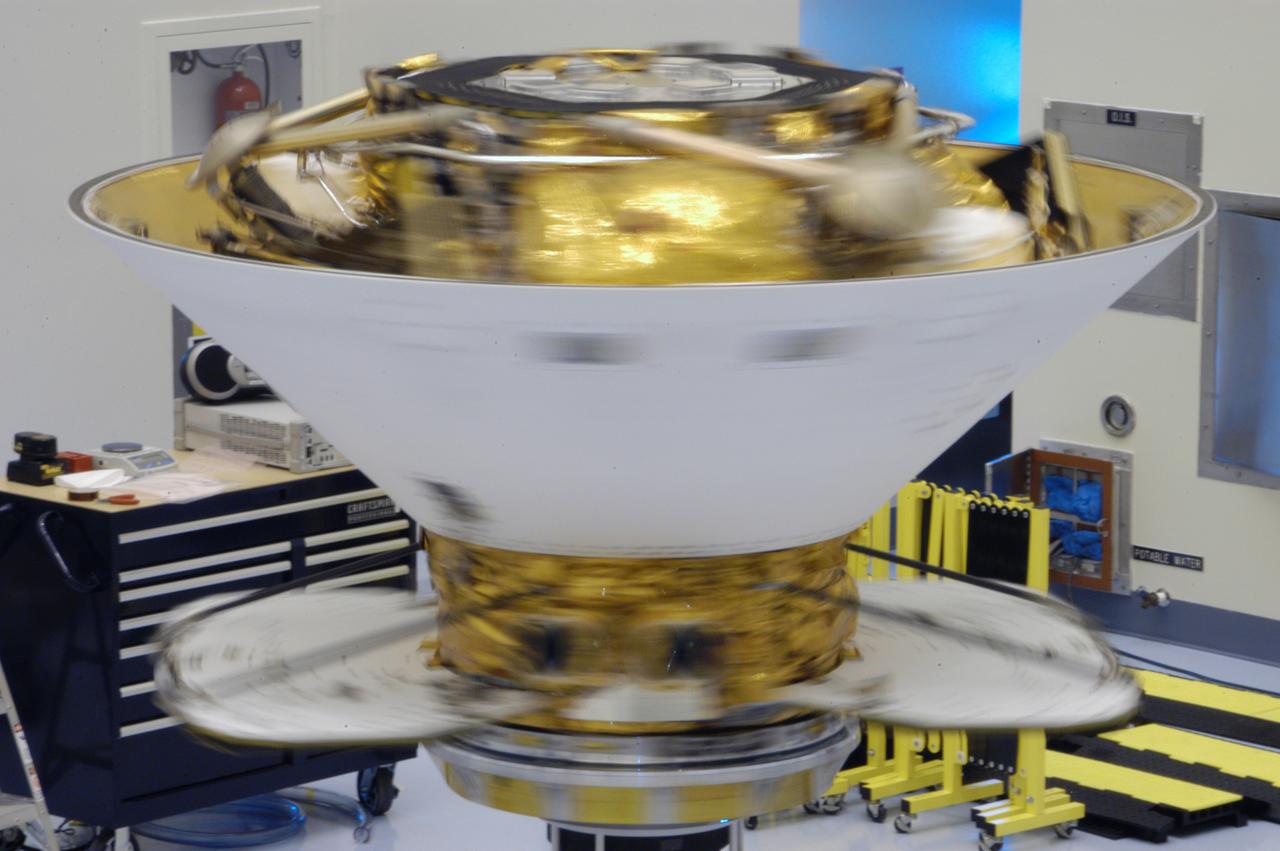
This closeup shows the spin test of the Phoenix Mars Lander in the Payload Hazardous Servicing Facility. The Phoenix mission is the first project in NASA's first openly competed program of Mars Scout missions. Phoenix will land in icy soils near the north polar permanent ice cap of Mars and explore the history of the water in these soils and any associated rocks, while monitoring polar climate. Landing is planned in May 2008 on arctic ground where a mission currently in orbit, Mars Odyssey, has detected high concentrations of ice just beneath the top layer of soil. It will serve as NASA's first exploration of a potential modern habitat on Mars and open the door to a renewed search for carbon-bearing compounds, last attempted with NASA’s Viking missions in the 1970s. A stereo color camera and a weather station will study the surrounding environment while the other instruments check excavated soil samples for water, organic chemicals and conditions that could indicate whether the site was ever hospitable to life. Microscopes can reveal features as small as one one-thousandth the width of a human hair. Launch of Phoenix aboard a Delta II rocket is targeted for Aug. 3 from Cape Canaveral Air Force Station in Florida.
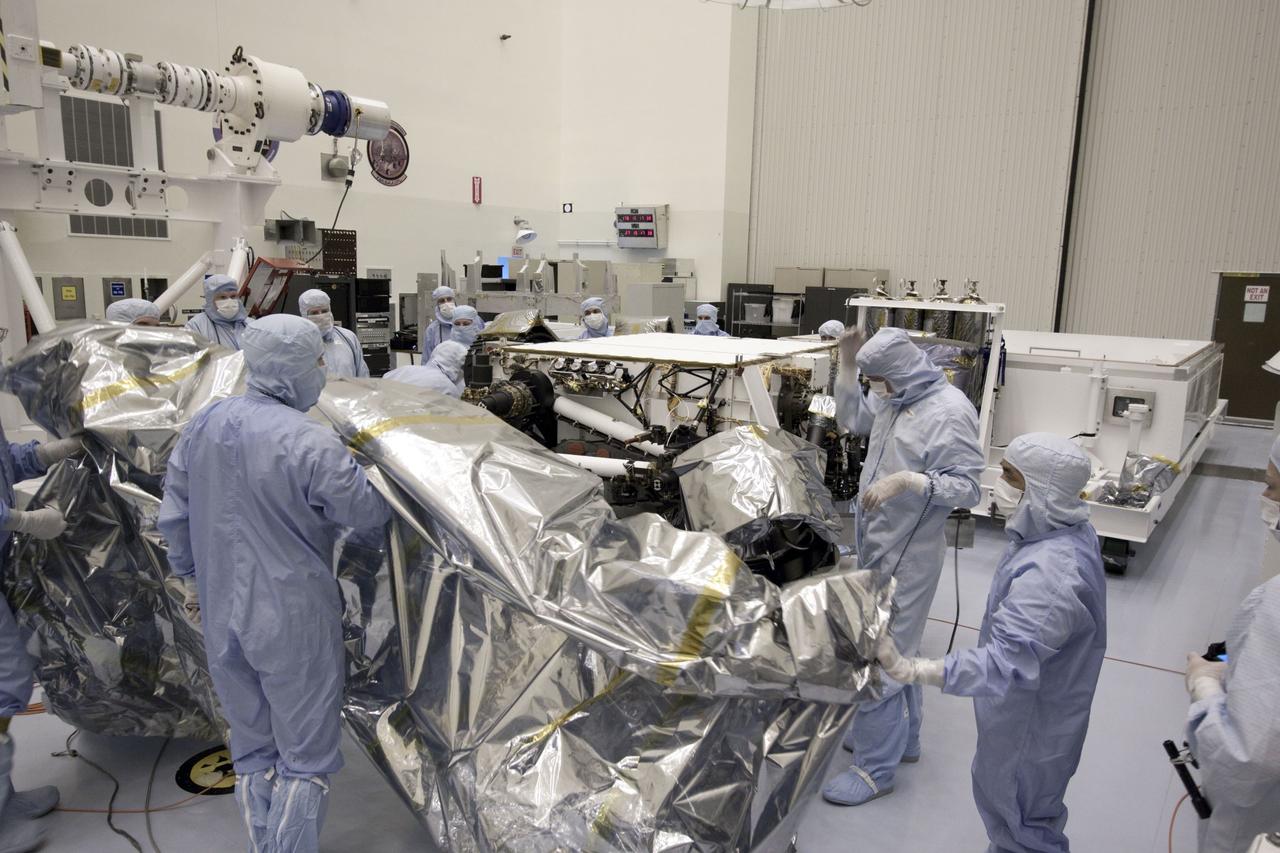
Cape Canaveral, Fla. -- At the Payload Hazardous Servicing Facility at NASA's Kennedy Space Center in Florida, technicians remove the protective cover from NASA's Mars Science Laboratory (MSL) rover known as Curiosity, before processing and testing. A United Launch Alliance Atlas V-541 configuration will be used to loft MSL into space. Curiosity’s 10 science instruments are designed to search for evidence on whether Mars has had environments favorable to microbial life, including chemical ingredients for life. The unique rover will use a laser to look inside rocks and release its gasses so that the rover’s spectrometer can analyze and send the data back to Earth. MSL is scheduled to launch from Cape Canaveral Air Force Station in Florida Nov. 25 with a window extending to Dec. 18 and arrival at Mars Aug. 2012. For more information, visit http://www.nasa.gov/msl. Photo credit: NASA/Jim Grossmann
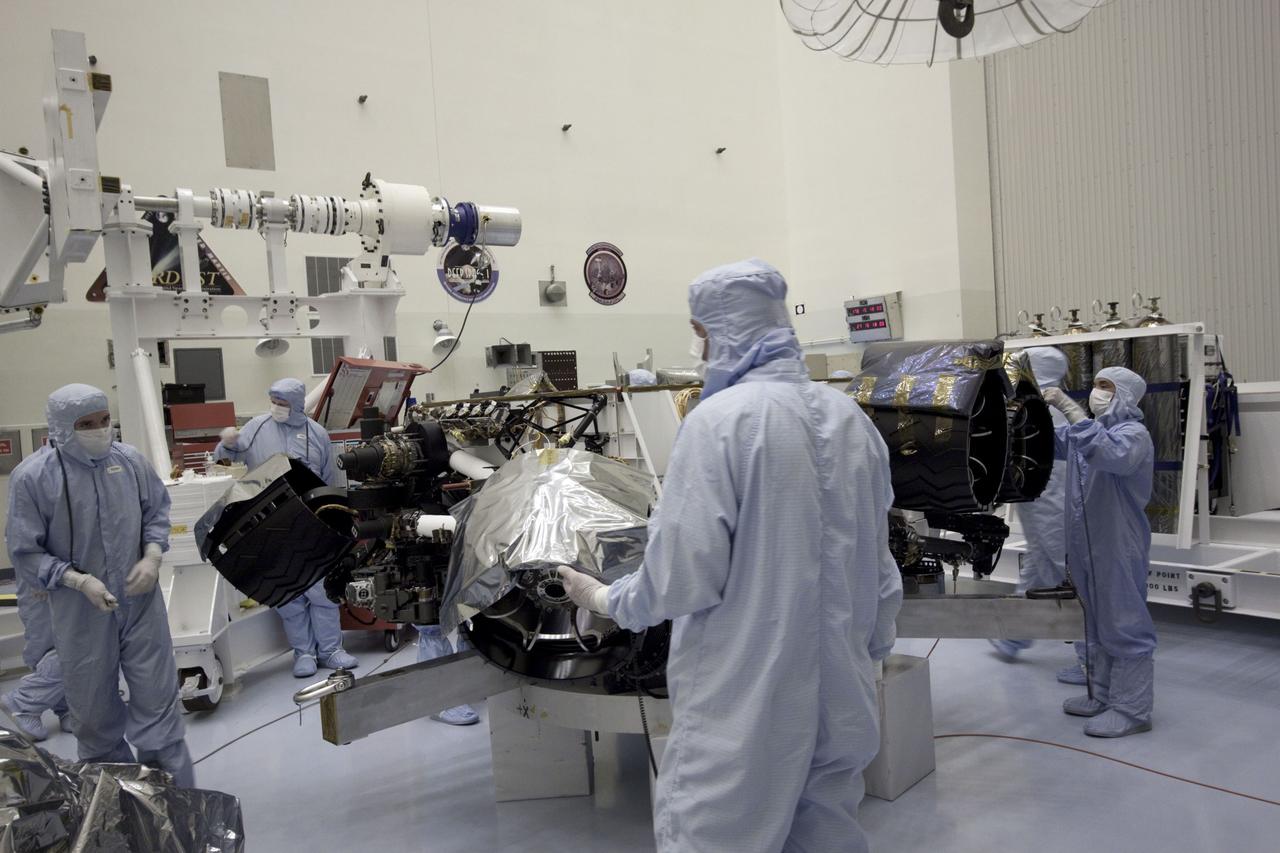
Cape Canaveral, Fla. -- At the Payload Hazardous Servicing Facility at NASA's Kennedy Space Center in Florida, technicians remove the protective cover from NASA's Mars Science Laboratory (MSL) rover known as Curiosity, before processing and testing. A United Launch Alliance Atlas V-541 configuration will be used to loft MSL into space. Curiosity’s 10 science instruments are designed to search for evidence on whether Mars has had environments favorable to microbial life, including chemical ingredients for life. The unique rover will use a laser to look inside rocks and release its gasses so that the rover’s spectrometer can analyze and send the data back to Earth. MSL is scheduled to launch from Cape Canaveral Air Force Station in Florida Nov. 25 with a window extending to Dec. 18 and arrival at Mars Aug. 2012. For more information, visit http://www.nasa.gov/msl. Photo credit: NASA/Jim Grossmann
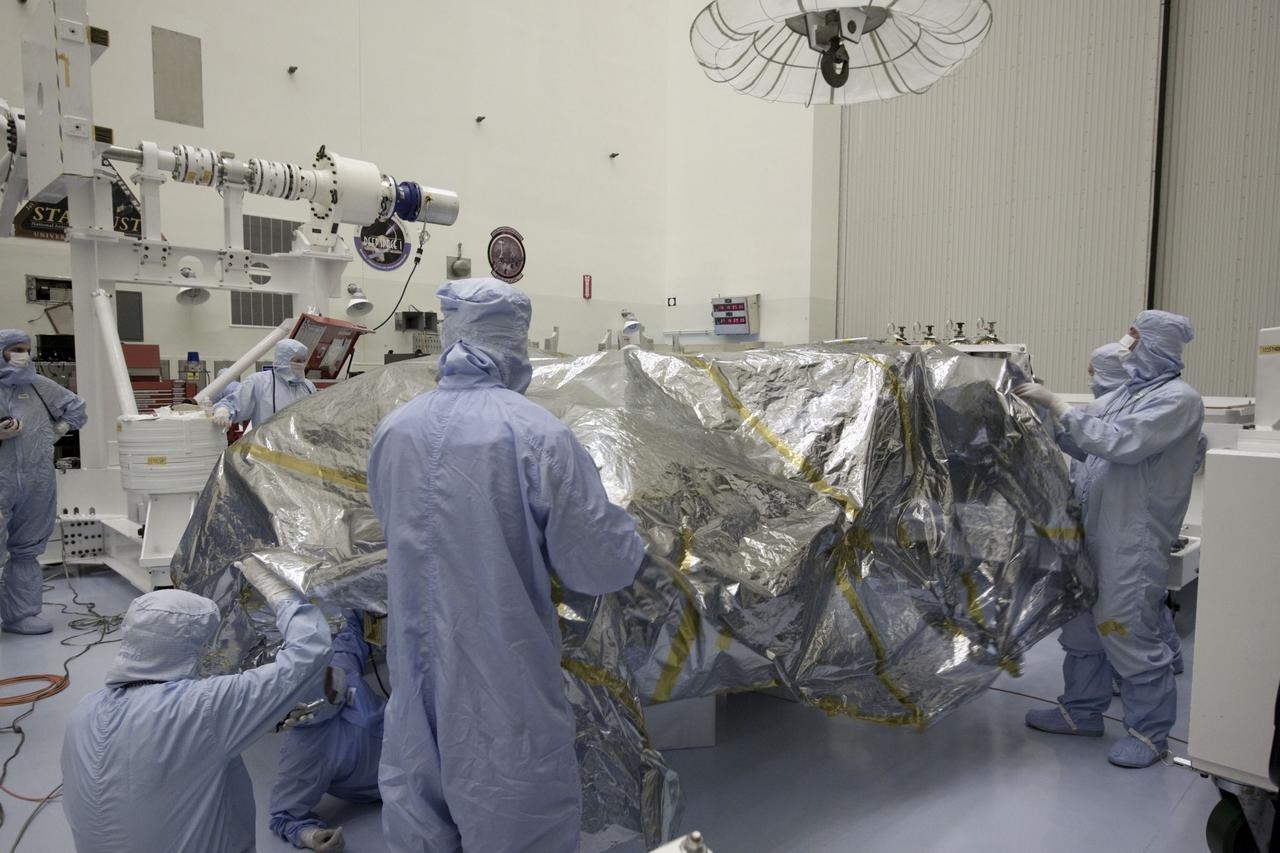
Cape Canaveral, Fla. -- At the Payload Hazardous Servicing Facility at NASA's Kennedy Space Center in Florida, technicians remove the protective cover from NASA's Mars Science Laboratory (MSL) rover known as Curiosity, before processing and testing. A United Launch Alliance Atlas V-541 configuration will be used to loft MSL into space. Curiosity’s 10 science instruments are designed to search for evidence on whether Mars has had environments favorable to microbial life, including chemical ingredients for life. The unique rover will use a laser to look inside rocks and release its gasses so that the rover’s spectrometer can analyze and send the data back to Earth. MSL is scheduled to launch from Cape Canaveral Air Force Station in Florida Nov. 25 with a window extending to Dec. 18 and arrival at Mars Aug. 2012. For more information, visit http://www.nasa.gov/msl. Photo credit: NASA/Jim Grossmann
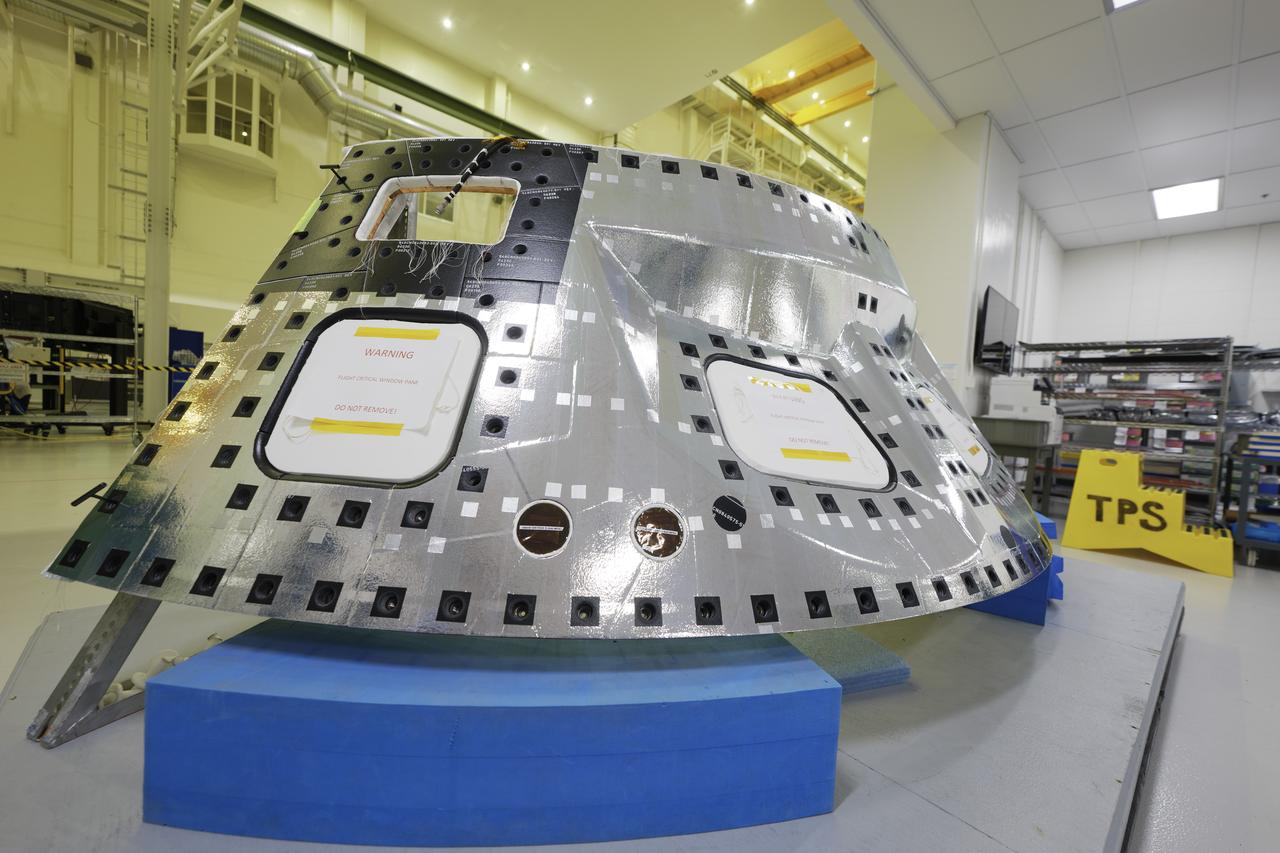
Inside the Operations and Checkout building at NASA's Kennedy Space Center in Florida on Thursday, Feb. 1, 2024, backshell panels and insulation for the Artemis II Orion spacecraft’s exterior are prepped for install. The spacecraft’s exterior will protect the Orion spacecraft and the astronauts inside from the harsh environments they will encounter on their mission.

This illustration depicts five major components of the Mars 2020 spacecraft. Top to bottom: cruise stage, backshell, descent stage, Perseverance rover and heat shield. The various components perform critical roles during the vehicle's cruise to Mars and its dramatic entry, descent, and landing. https://photojournal.jpl.nasa.gov/catalog/PIA24128
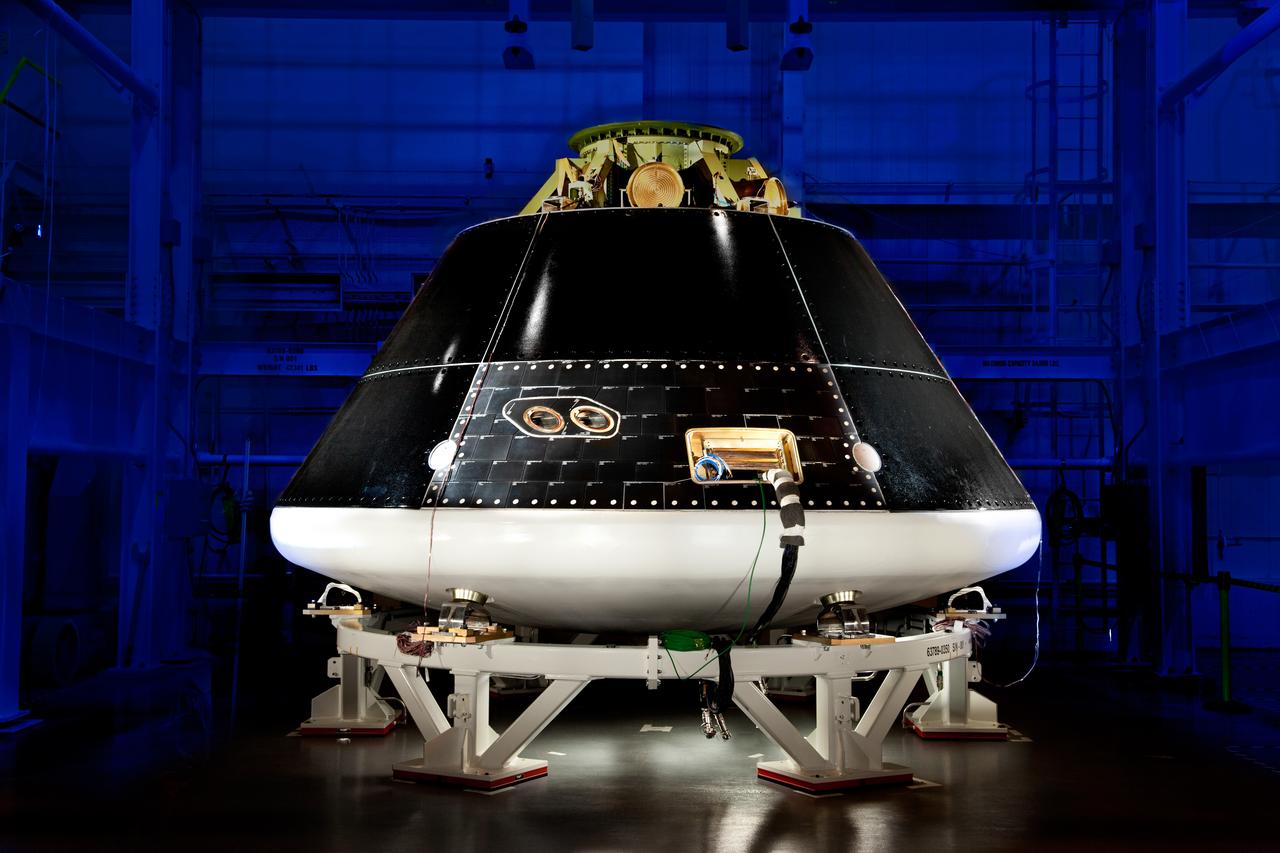
The Orion crew module ground test article sits in the Lockheed Martin Vertical Test Facility in Colorado on June 6, 2011. Work on the heat shield and thermal protection backshell of the test article was completed in preparation for environmental testing. Part of Batch image transfer from Flickr.

Inside the Operations and Checkout building at NASA's Kennedy Space Center in Florida on Thursday, Feb. 1, 2024, backshell panels and insulation for the Artemis II Orion spacecraft’s exterior are prepped for install. The spacecraft’s exterior will protect the Orion spacecraft and the astronauts inside from the harsh environments they will encounter on their mission.
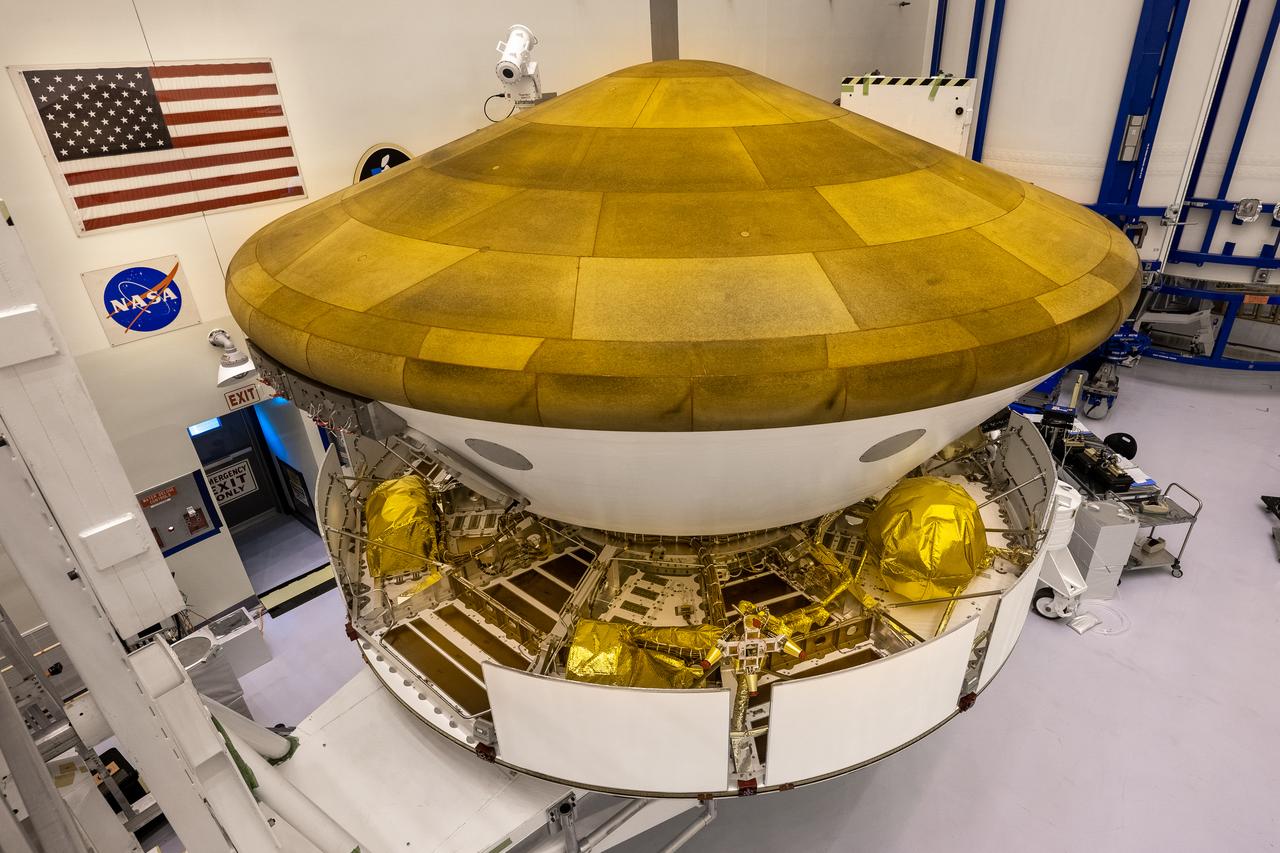
Inside the Payload Hazardous Servicing Facility at NASA’s Kennedy Space Center in Florida, the Backshell-Powered Descent Vehicle, in view, and Entry Vehicle assemblies are being attached to the Mars Perseverance rover on May 29, 2020. The cone-shaped backshell contains the parachute, and along with the mission’s heat shield, provides protection for the rover and descent stage during Martian atmospheric entry. The Mars Perseverance rover is scheduled to launch on July 20 atop a United Launch Alliance Atlas V 541 rocket from Pad 41 at nearby Cape Canaveral Air Force Station. The rover is part of NASA’s Mars Exploration Program, a long-term effort of robotic exploration of the Red Planet. The rover will search for habitable conditions in the ancient past and signs of past microbial life on Mars. The Launch Services Program at Kennedy is responsible for launch management.
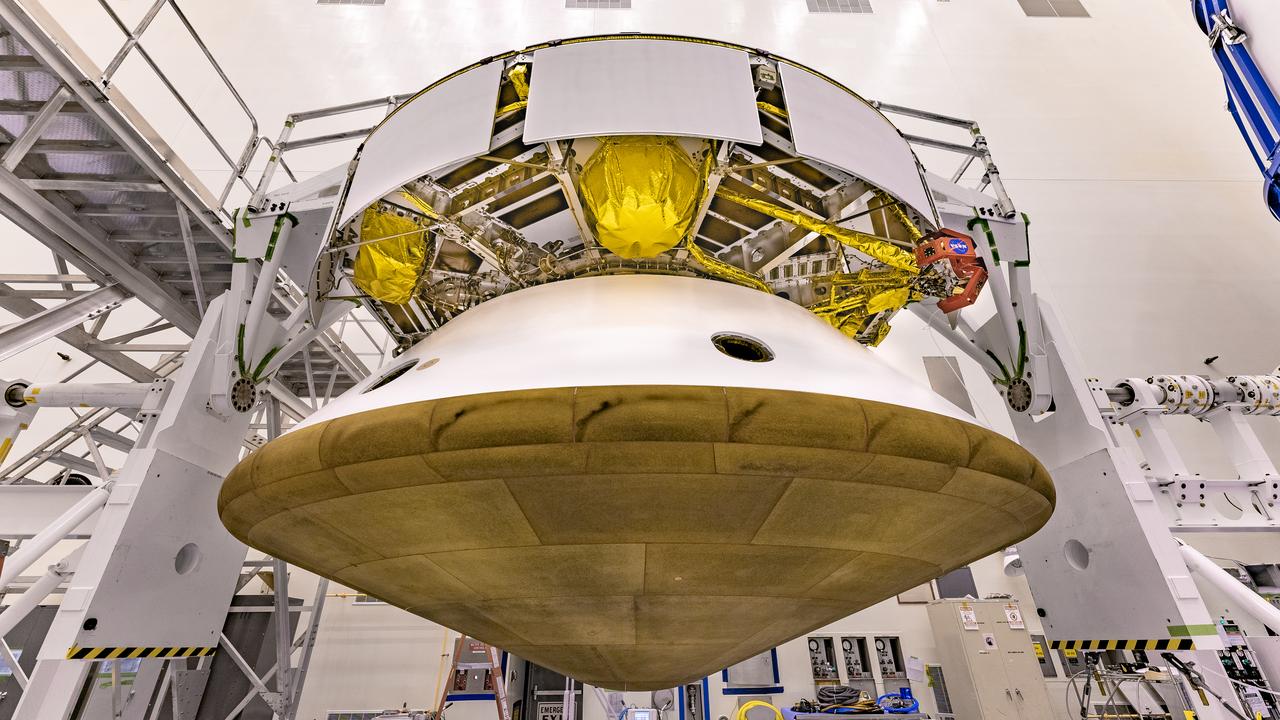
Inside the Payload Hazardous Servicing Facility at NASA’s Kennedy Space Center in Florida, the Backshell-Powered Descent Vehicle and Entry Vehicle assemblies are being attached to the Mars Perseverance rover on May 28, 2020. The cone-shaped backshell contains the parachute, and along with the mission’s heat shield, provides protection for the rover and descent stage during Martian atmospheric entry. The Mars Perseverance rover is scheduled to launch on July 20 atop a United Launch Alliance Atlas V 541 rocket from Pad 41 at nearby Cape Canaveral Air Force Station. The rover is part of NASA’s Mars Exploration Program, a long-term effort of robotic exploration of the Red Planet. The rover will search for habitable conditions in the ancient past and signs of past microbial life on Mars. The Launch Services Program at Kennedy is responsible for launch management.
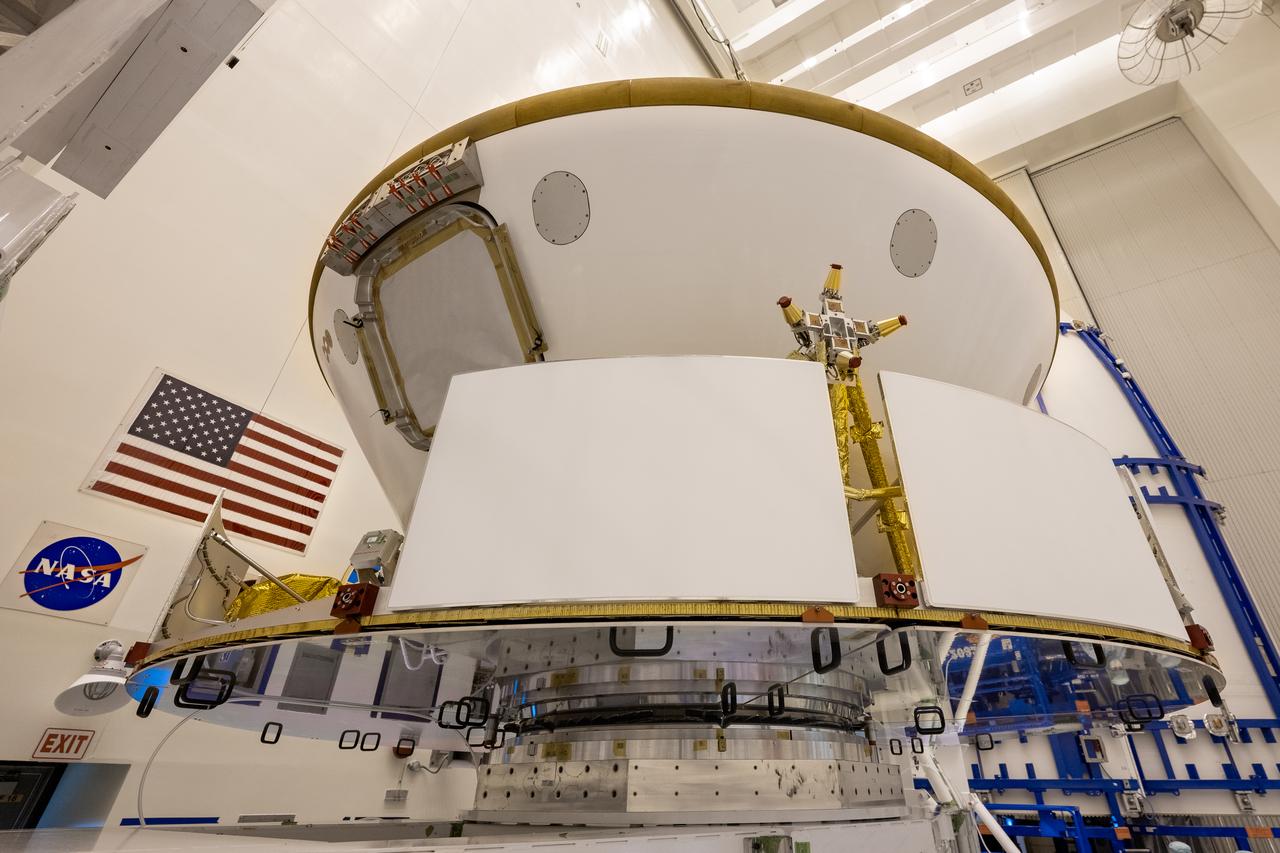
Inside the Payload Hazardous Servicing Facility at NASA’s Kennedy Space Center in Florida, the Backshell-Powered Descent Vehicle and Entry Vehicle assemblies are being attached to the Mars Perseverance rover on May 29, 2020. The cone-shaped backshell contains the parachute, and along with the mission’s heat shield, provides protection for the rover and descent stage during Martian atmospheric entry. The Mars Perseverance rover is scheduled to launch on July 20 atop a United Launch Alliance Atlas V 541 rocket from Pad 41 at nearby Cape Canaveral Air Force Station. The rover is part of NASA’s Mars Exploration Program, a long-term effort of robotic exploration of the Red Planet. The rover will search for habitable conditions in the ancient past and signs of past microbial life on Mars. The Launch Services Program at Kennedy is responsible for launch management.
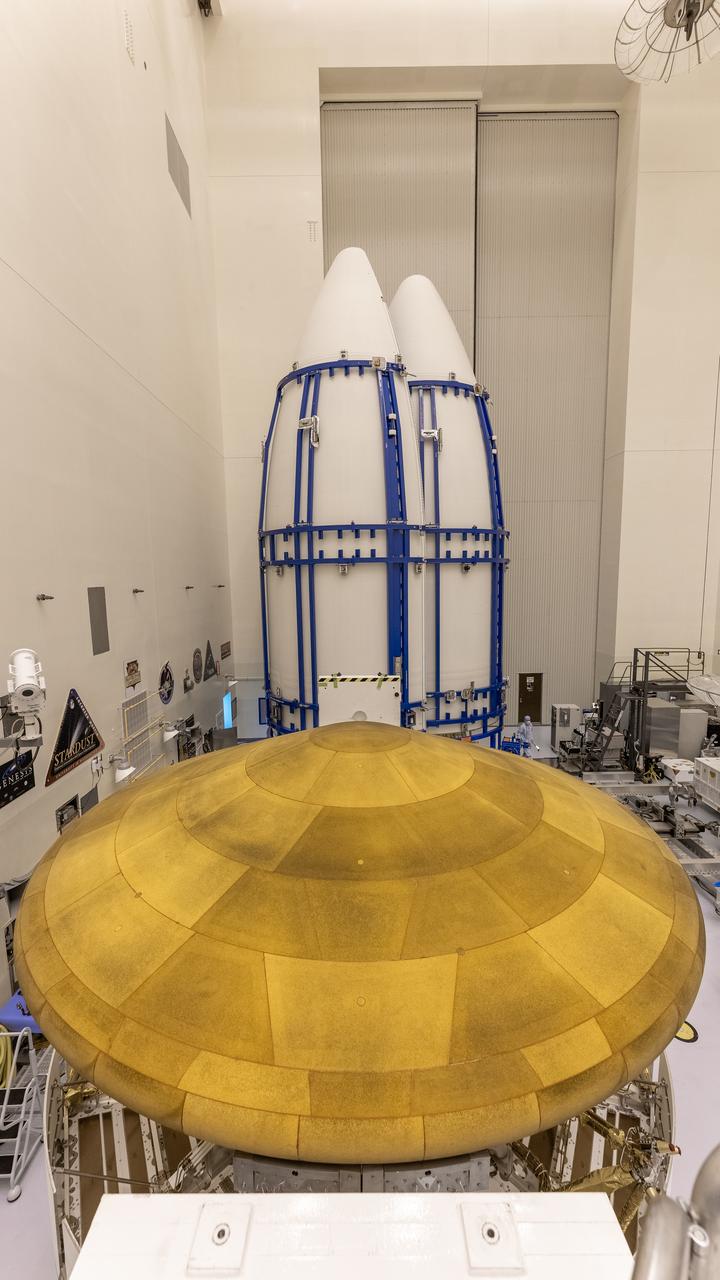
Inside the Payload Hazardous Servicing Facility at NASA’s Kennedy Space Center in Florida, the Backshell-Powered Descent Vehicle, in view, and Entry Vehicle assemblies are being attached to the Mars Perseverance rover on May 29, 2020. The cone-shaped backshell contains the parachute, and along with the mission’s heat shield, provides protection for the rover and descent stage during Martian atmospheric entry. The Mars Perseverance rover is scheduled to launch on July 20 atop a United Launch Alliance Atlas V 541 rocket from Pad 41 at nearby Cape Canaveral Air Force Station. The rover is part of NASA’s Mars Exploration Program, a long-term effort of robotic exploration of the Red Planet. The rover will search for habitable conditions in the ancient past and signs of past microbial life on Mars. The Launch Services Program at Kennedy is responsible for launch management.
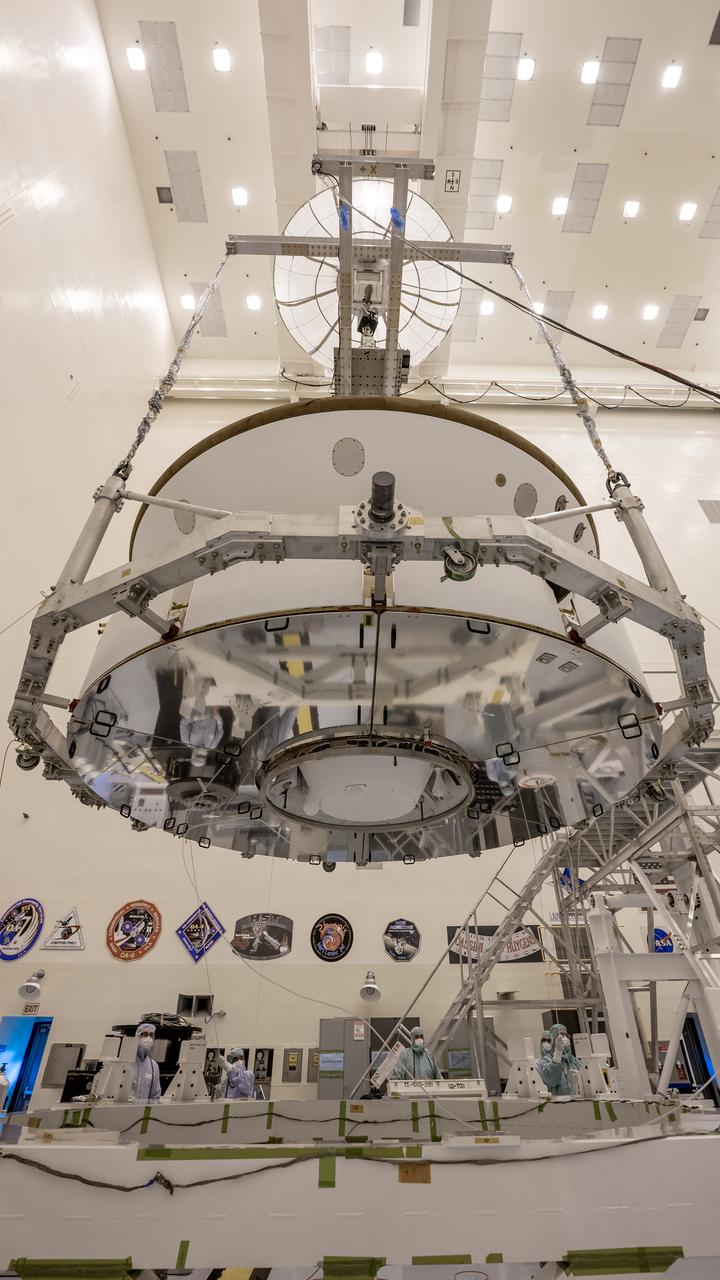
Inside the Payload Hazardous Servicing Facility at NASA’s Kennedy Space Center in Florida, the Mars Perseverance rover, with its Backshell-Powered Descent Vehicle and Entry Vehicle assemblies attached, is lifted by crane on May 29, 2020. The cone-shaped backshell contains the parachute, and along with the mission’s heat shield, provides protection for the rover and descent stage during Martian atmospheric entry. The Mars Perseverance rover is scheduled to launch on July 20 atop a United Launch Alliance Atlas V 541 rocket from Pad 41 at nearby Cape Canaveral Air Force Station. The rover is part of NASA’s Mars Exploration Program, a long-term effort of robotic exploration of the Red Planet. The rover will search for habitable conditions in the ancient past and signs of past microbial life on Mars. The Launch Services Program at Kennedy is responsible for launch management.
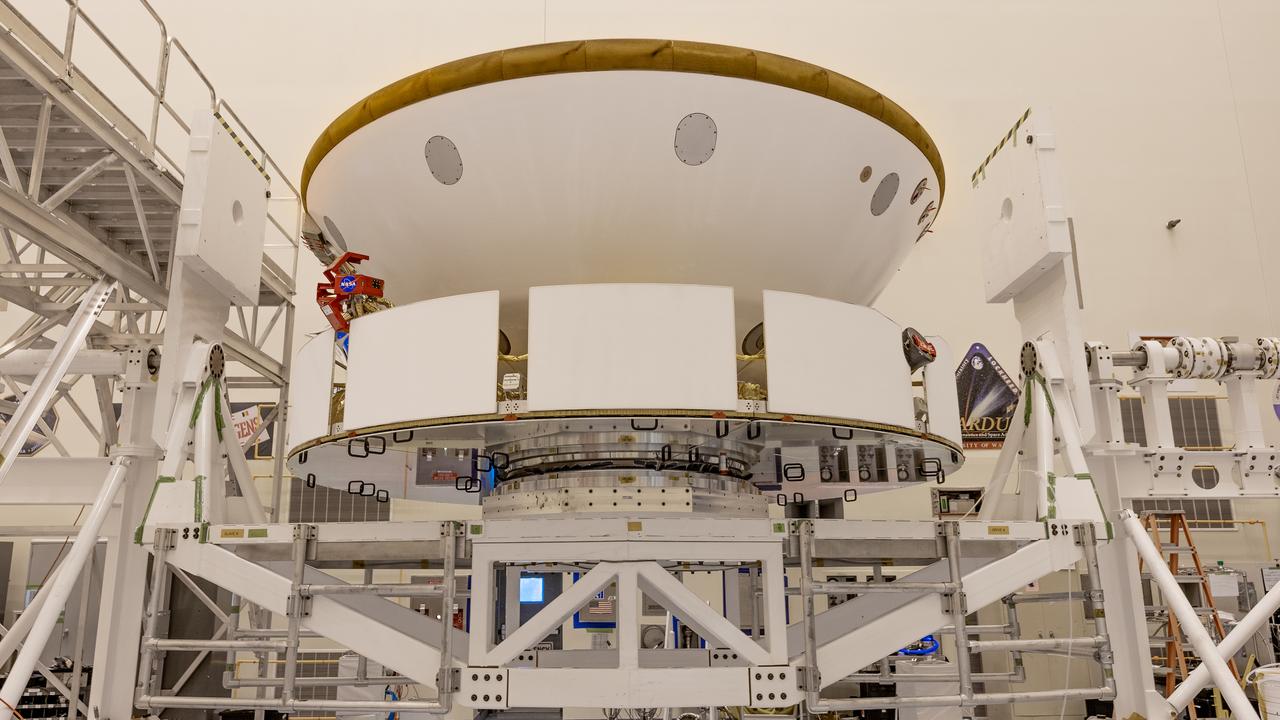
Inside the Payload Hazardous Servicing Facility at NASA’s Kennedy Space Center in Florida, the Backshell-Powered Descent Vehicle and Entry Vehicle assemblies are being attached to the Mars Perseverance rover on May 29, 2020. The cone-shaped backshell contains the parachute, and along with the mission’s heat shield, provides protection for the rover and descent stage during Martian atmospheric entry. The Mars Perseverance rover is scheduled to launch on July 20 atop a United Launch Alliance Atlas V 541 rocket from Pad 41 at nearby Cape Canaveral Air Force Station. The rover is part of NASA’s Mars Exploration Program, a long-term effort of robotic exploration of the Red Planet. The rover will search for habitable conditions in the ancient past and signs of past microbial life on Mars. The Launch Services Program at Kennedy is responsible for launch management.

Inside the Payload Hazardous Servicing Facility at NASA’s Kennedy Space Center in Florida, the Backshell-Powered Descent Vehicle and Entry Vehicle assemblies are being attached to the Mars Perseverance rover on May 28, 2020. The cone-shaped backshell contains the parachute, and along with the mission’s heat shield, provides protection for the rover and descent stage during Martian atmospheric entry. The Mars Perseverance rover is scheduled to launch on July 20 atop a United Launch Alliance Atlas V 541 rocket from Pad 41 at nearby Cape Canaveral Air Force Station. The rover is part of NASA’s Mars Exploration Program, a long-term effort of robotic exploration of the Red Planet. The rover will search for habitable conditions in the ancient past and signs of past microbial life on Mars. The Launch Services Program at Kennedy is responsible for launch management.
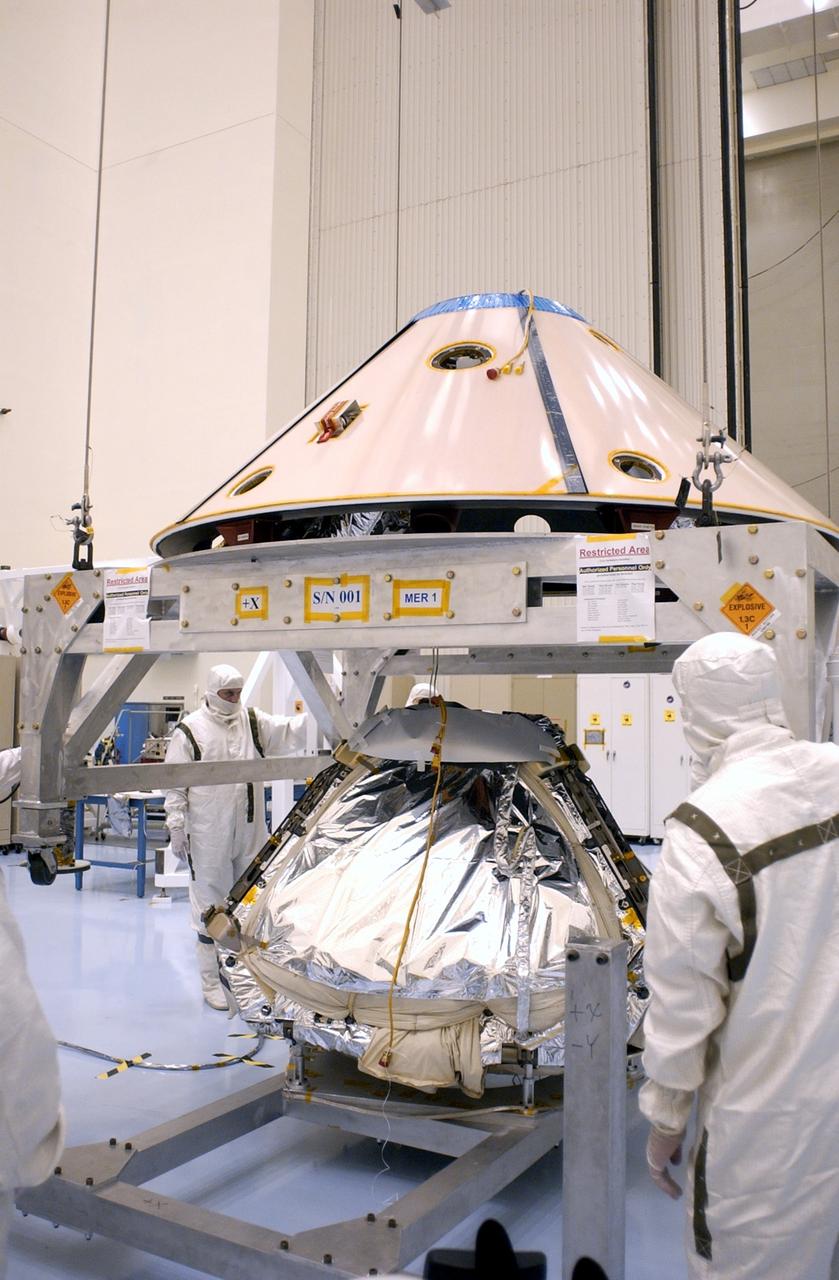
KENNEDY SPACE CENTER, FLA. - Workers in the Payload Hazardous Servicing Facility lower the backshell over the Mars Exploration Rover 1 (MER-1). The backshell is a protective cover for the rover. NASA's twin Mars Exploration Rovers are designed to study the history of water on Mars. These robotic geologists are equipped with a robotic arm, a drilling tool, three spectrometers, and four pairs of cameras that allow them to have a human-like, 3D view of the terrain. Each rover could travel as far as 100 meters in one day to act as Mars scientists' eyes and hands, exploring an environment where humans can't yet go. MER-1 is scheduled to launch June 25 as MER-B aboard a Delta II rocket from Cape Canaveral Air Force Station.
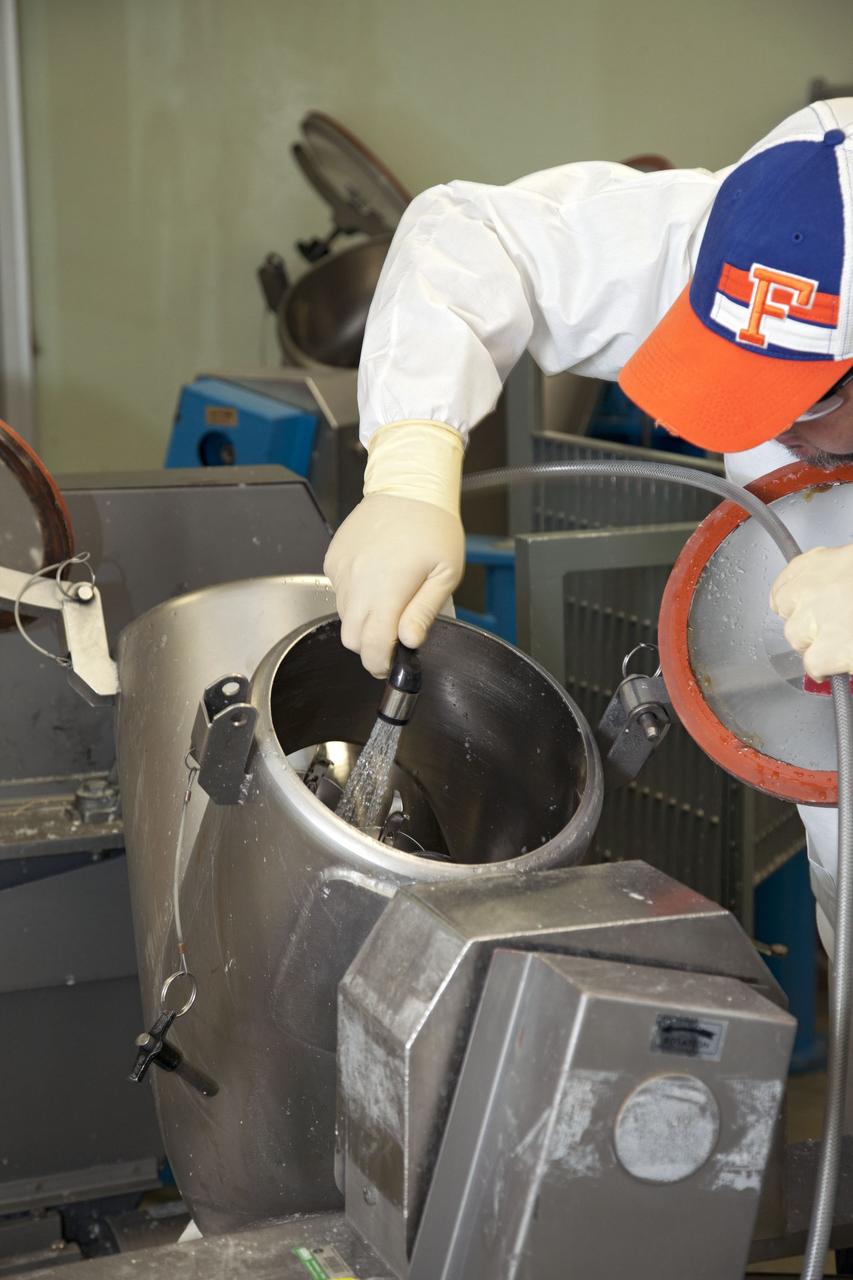
CAPE CANAVERAL, Fla. -- Chris Keeling, a United Space Alliance technician at NASA's Kennedy Space Center in Florida, manufactures the heat shield tiles that will be installed to the backshell of the Orion Multi-Purpose Crew Vehicle's Exploration Flight Test EFT-1 capsule. The work to manufacture and inspect the tiles is taking place in Kennedy's Thermal Protection System Facility. EFT-1 will be used during Orion's first test flight in space. For more information, visit www.nasa.gov/orion. Photo credit: Frankie Martin
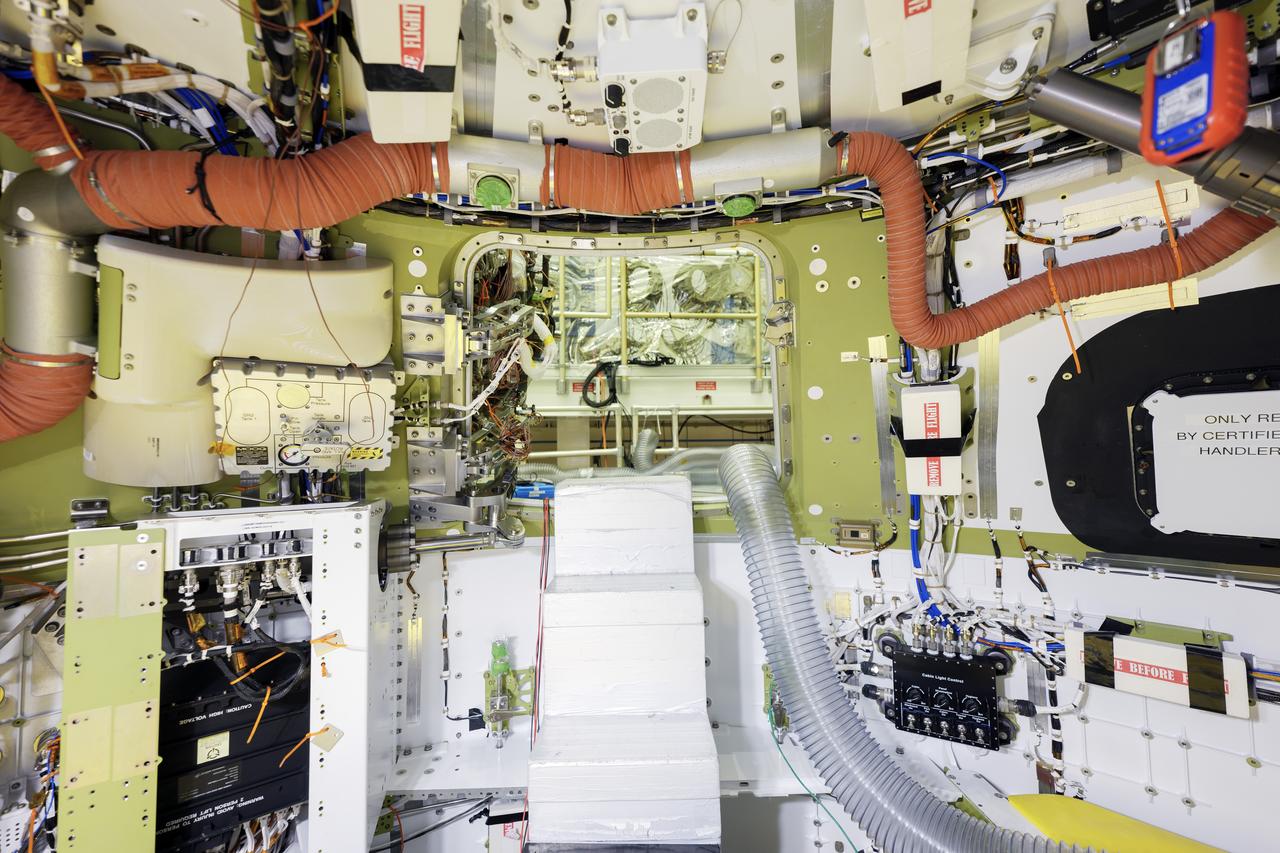
Teams inside the Operations and Checkout building at NASA’s Kennedy Space Center in Florida on Thursday, Feb. 1, 2024, work on the Orion spacecraft crew module that will carry the Artemis II astronauts on their 10-day journey around the Moon. Technicians are finalizing the crew cabin’s interior, and installing backshell panels and insulation on the spacecraft’s exterior that will protect Orion and the astronauts inside from the harsh environments they will encounter on their mission.
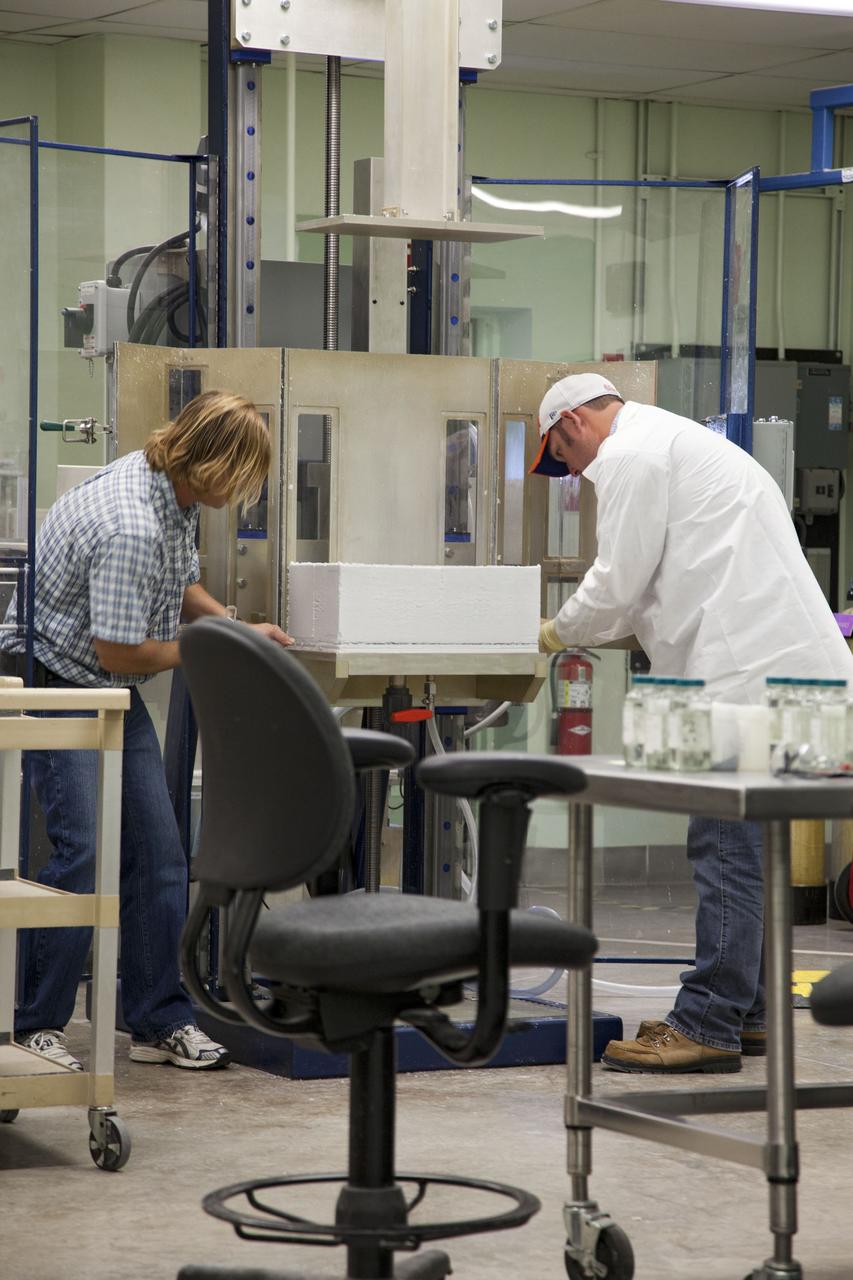
CAPE CANAVERAL, Fla. -- United Space Alliance workers, Tim Wright, left, and Chris Keeling, manufacture the heat shield tiles that will be installed to the backshell of the Orion Multi-Purpose Crew Vehicle's Exploration Flight Test EFT-1 capsule. The work to manufacture and inspect the tiles is taking place in the Thermal Protection System Facility at NASA's Kennedy Space Center in Florida. EFT-1 will be used during Orion's first test flight in space. For more information, visit www.nasa.gov/orion. Photo credit: Frankie Martin
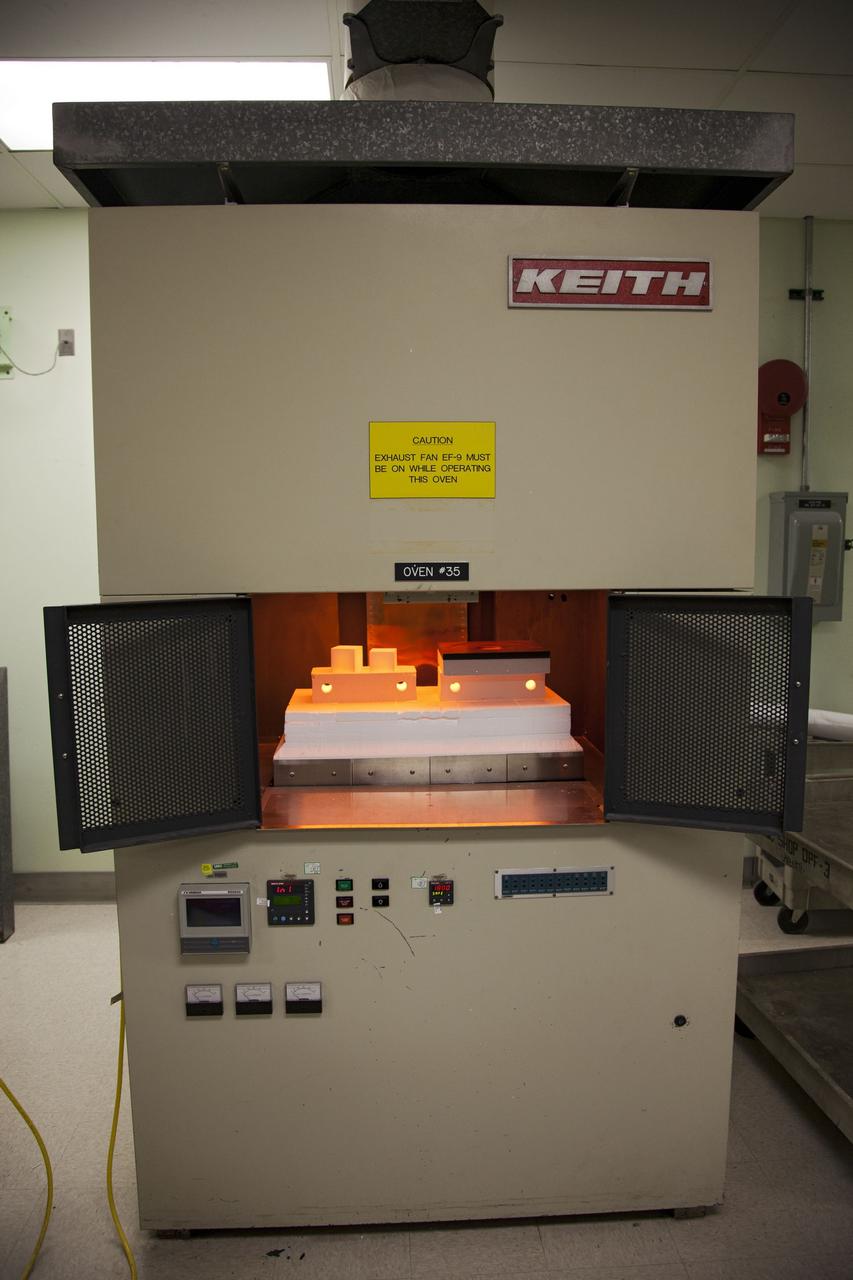
CAPE CANAVERAL, Fla. -- The heat shield tiles that will be installed to the backshell of the Orion Multi-Purpose Crew Vehicle's Exploration Flight Test EFT-1 capsule are in a Keith thermal automation oven in the Thermal Protection System Facility at NASA's Kennedy Space Center in Florida. Inside the oven, the tiles will be baked at 2,200 degrees F to cure their ceramic coating. EFT-1 will be used during Orion's first test flight in space. For more information, visit www.nasa.gov/orion. Photo credit: Frankie Martin
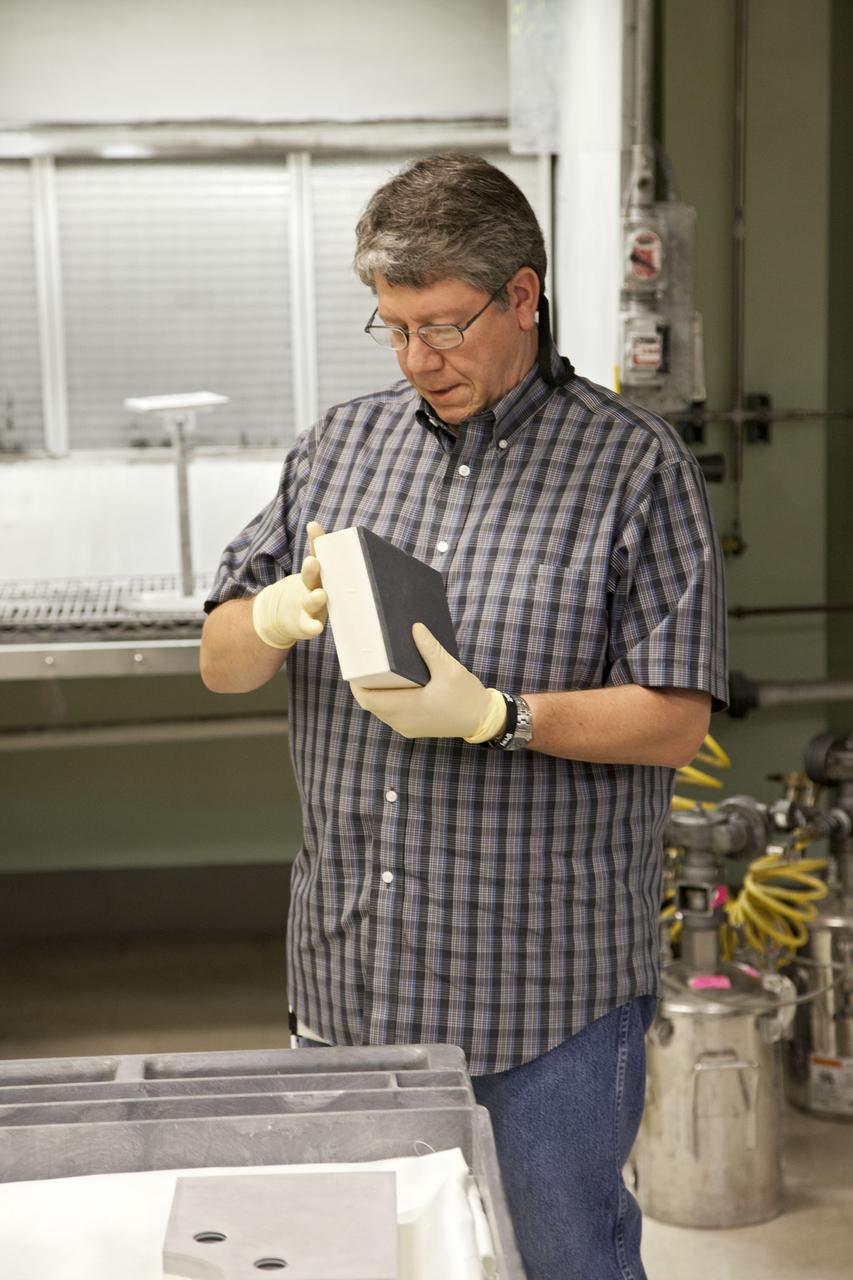
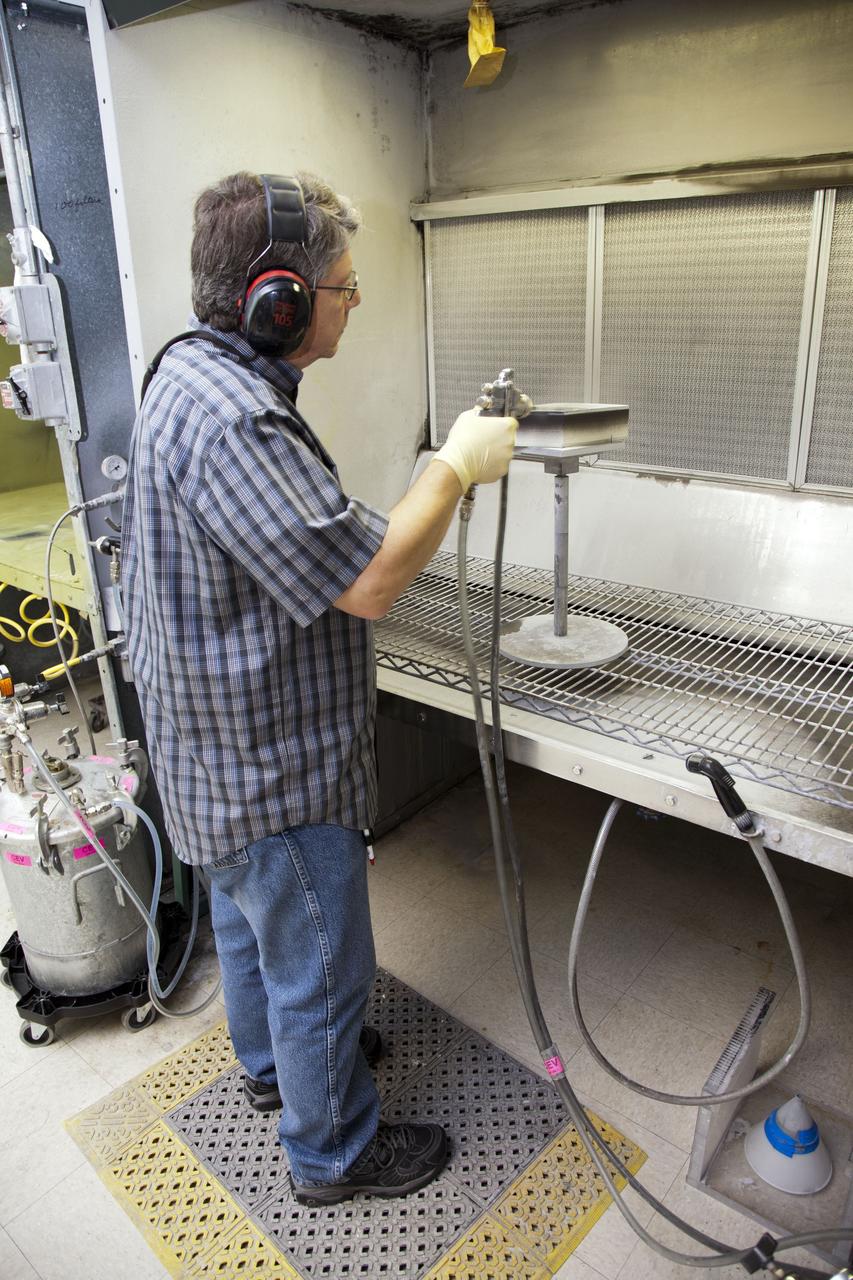
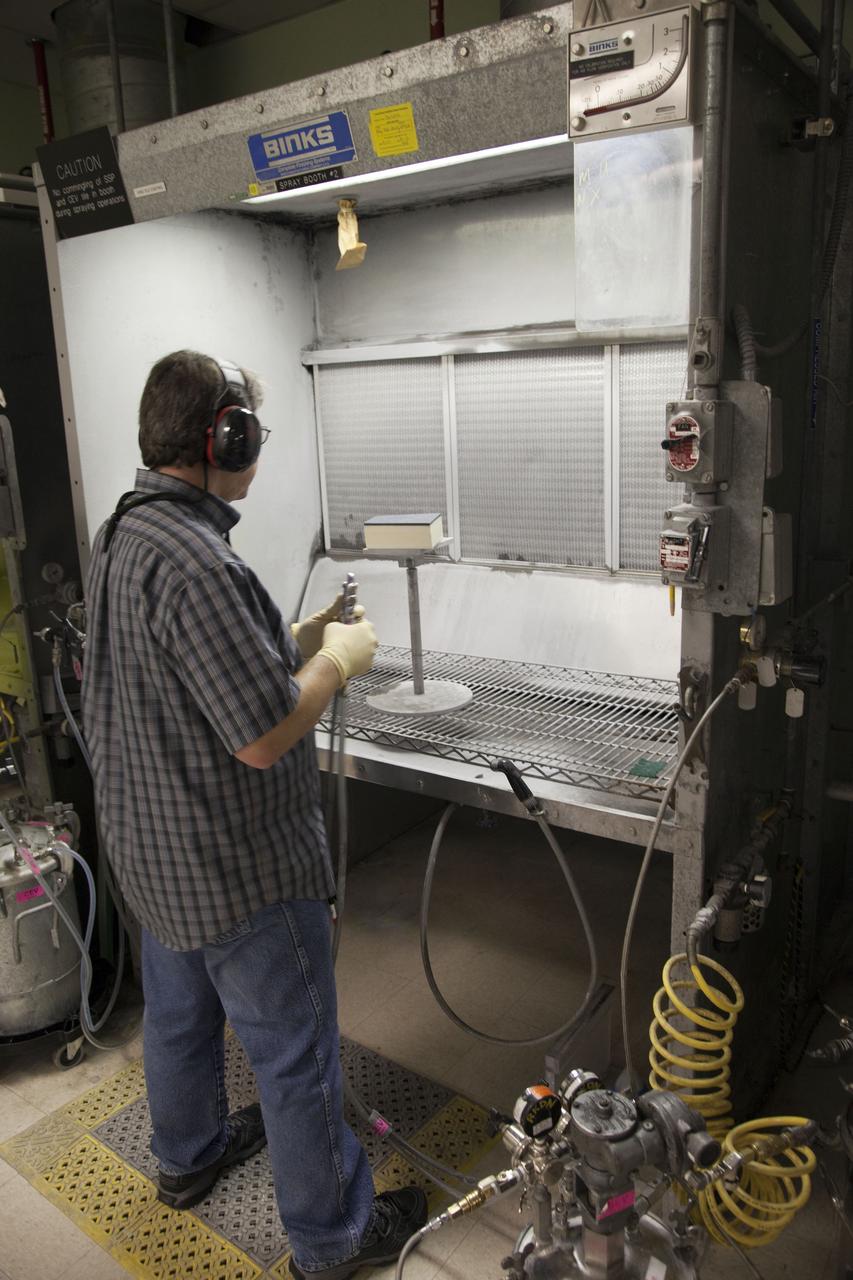
CAPE CANAVERAL, Fla. -- Frank Pelkey, a United Space Alliance technician at NASA's Kennedy Space Center in Florida, inspects a heat shield tile that will be installed to the backshell of the Orion Multi-Purpose Crew Vehicle's Exploration Flight Test EFT-1 capsule. The work to manufacture and inspect the tiles is taking place in Kennedy's Thermal Protection System Facility. EFT-1 will be used during Orion's first test flight in space. For more information, visit www.nasa.gov/orion. Photo credit: Frankie Martin
CAPE CANAVERAL, Fla. -- Frank Pelkey, a United Space Alliance technician at NASA's Kennedy Space Center in Florida, inspects a heat shield tile that will be installed to the backshell of the Orion Multi-Purpose Crew Vehicle's Exploration Flight Test EFT-1 capsule. The work to manufacture and inspect the tiles is taking place in Kennedy's Thermal Protection System Facility. EFT-1 will be used during Orion's first test flight in space. For more information, visit www.nasa.gov/orion. Photo credit: Frankie Martin
CAPE CANAVERAL, Fla. -- Frank Pelkey, a United Space Alliance technician at NASA's Kennedy Space Center in Florida, inspects a heat shield tile that will be installed to the backshell of the Orion Multi-Purpose Crew Vehicle's Exploration Flight Test EFT-1 capsule. The work to manufacture and inspect the tiles is taking place in Kennedy's Thermal Protection System Facility. EFT-1 will be used during Orion's first test flight in space. For more information, visit www.nasa.gov/orion. Photo credit: Frankie Martin
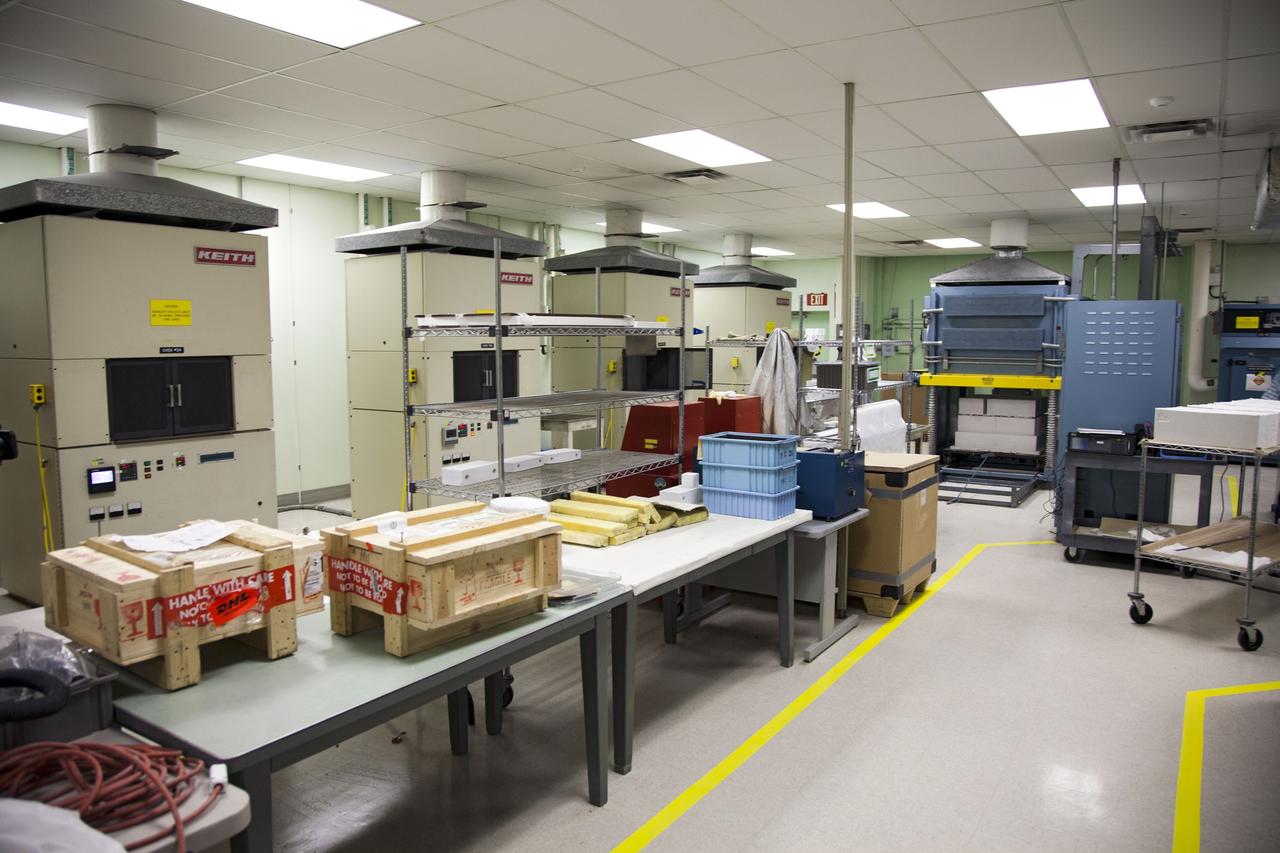
CAPE CANAVERAL, Fla. -- The heat shield tiles that will be installed to the backshell of the Orion Multi-Purpose Crew Vehicle's Exploration Flight Test EFT-1 capsule are being manufactured and inspected in NASA Kennedy Space Center's Thermal Protection System Facility. EFT-1 will be used during Orion's first test flight in space. For more information, visit www.nasa.gov/orion. Photo credit: Frankie Martin
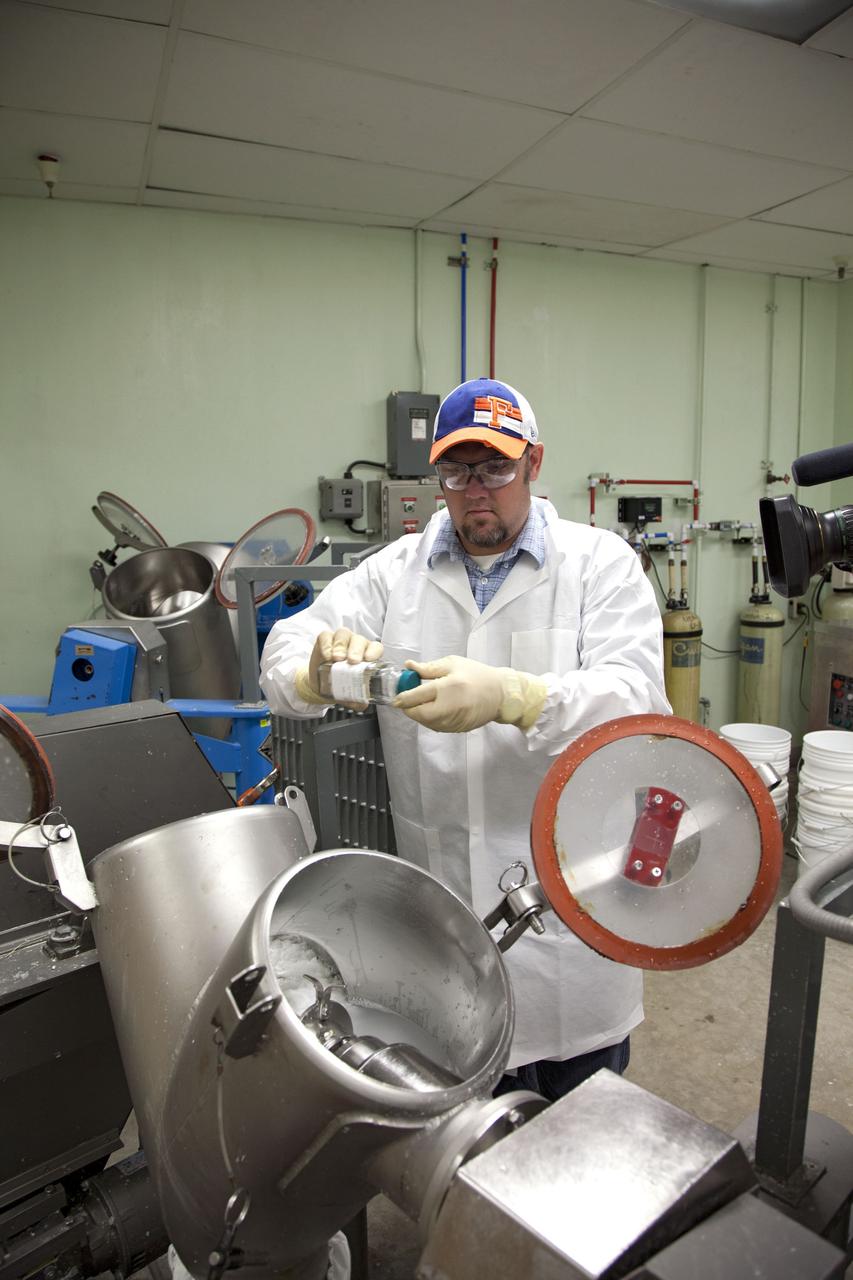
CAPE CANAVERAL, Fla. -- Chris Keeling, a United Space Alliance technician at NASA's Kennedy Space Center in Florida, manufactures the heat shield tiles that will be installed to the backshell of the Orion Multi-Purpose Crew Vehicle's Exploration Flight Test EFT-1 capsule. The work to manufacture and inspect the tiles is taking place in Kennedy's Thermal Protection System Facility. EFT-1 will be used during Orion's first test flight in space. For more information, visit www.nasa.gov/orion. Photo credit: Frankie Martin
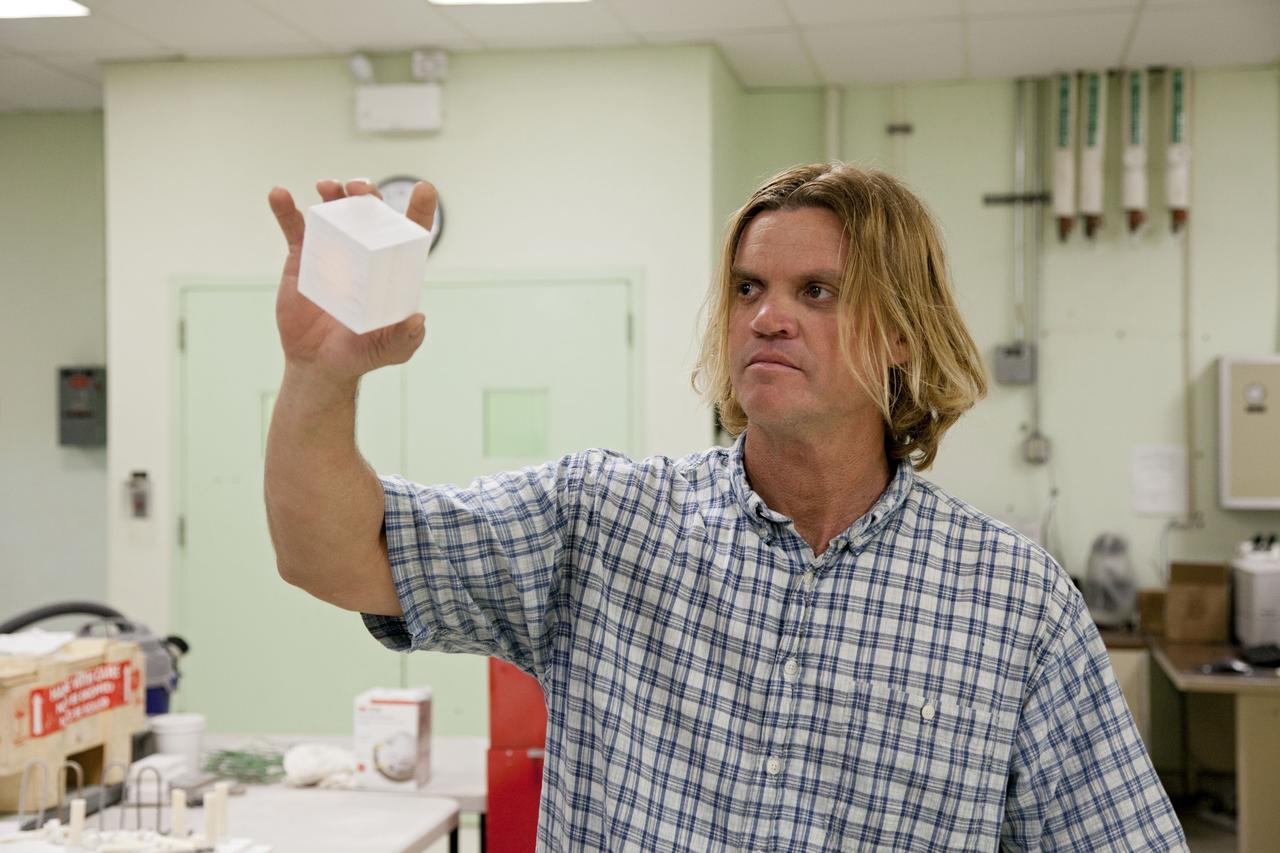
CAPE CANAVERAL, Fla. -- Tim Wright, a United Space Alliance engineering manager at NASA's Kennedy Space Center in Florida, explains the properties of the heat shield tiles that will be installed to the backshell of the Orion Multi-Purpose Crew Vehicle's Exploration Flight Test EFT-1 capsule. The work to manufacture and inspect the tiles is taking place in Kennedy's Thermal Protection System Facility. EFT-1 will be used during Orion's first test flight in space. For more information, visit www.nasa.gov/orion. Photo credit: Frankie Martin
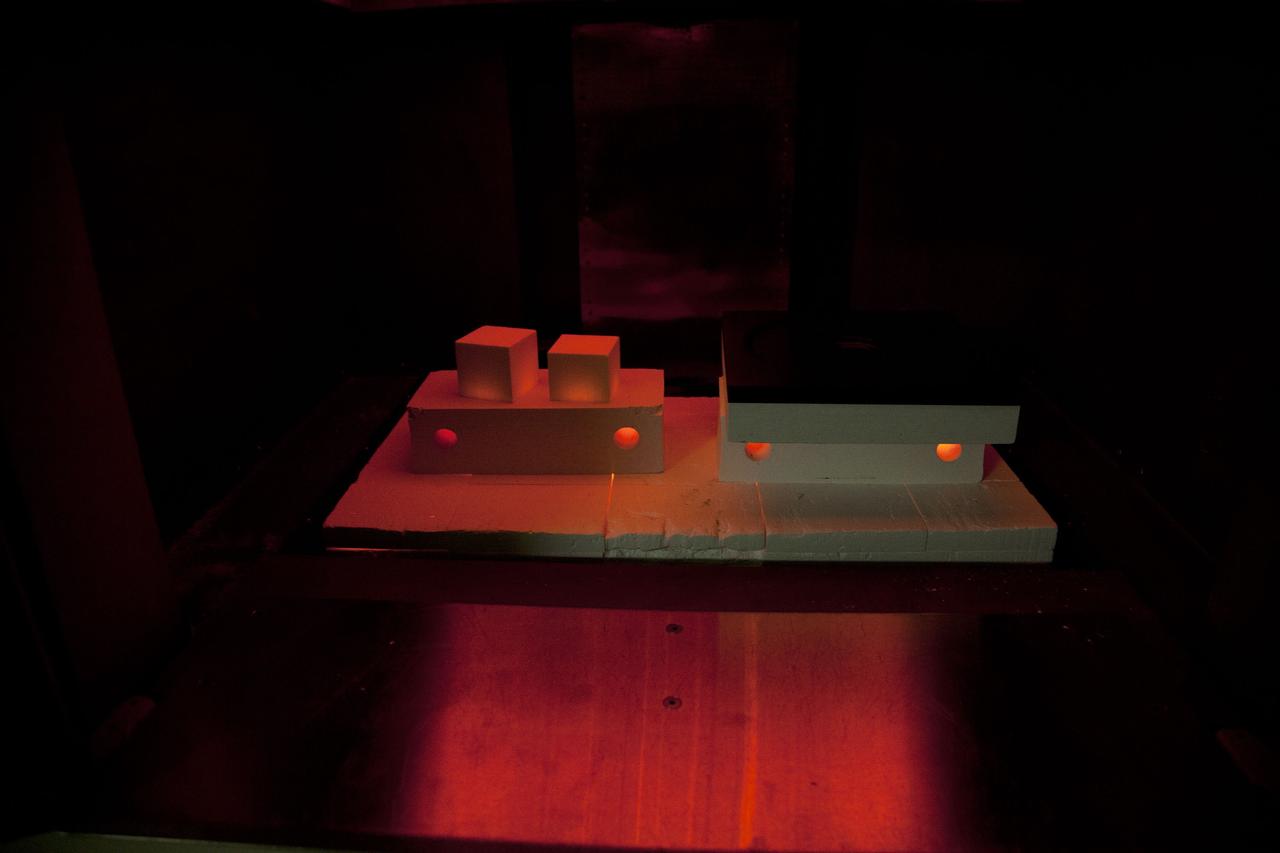
CAPE CANAVERAL, Fla. -- The heat shield tiles that will be installed to the backshell of the Orion Multi-Purpose Crew Vehicle's Exploration Flight Test EFT-1 capsule are in a Keith thermal automation oven in the Thermal Protection System Facility at NASA's Kennedy Space Center in Florida. Inside the oven, the tiles will be baked at 2,200 degrees F to cure their ceramic coating. EFT-1 will be used during Orion's first test flight in space. For more information, visit www.nasa.gov/orion. Photo credit: Frankie Martin
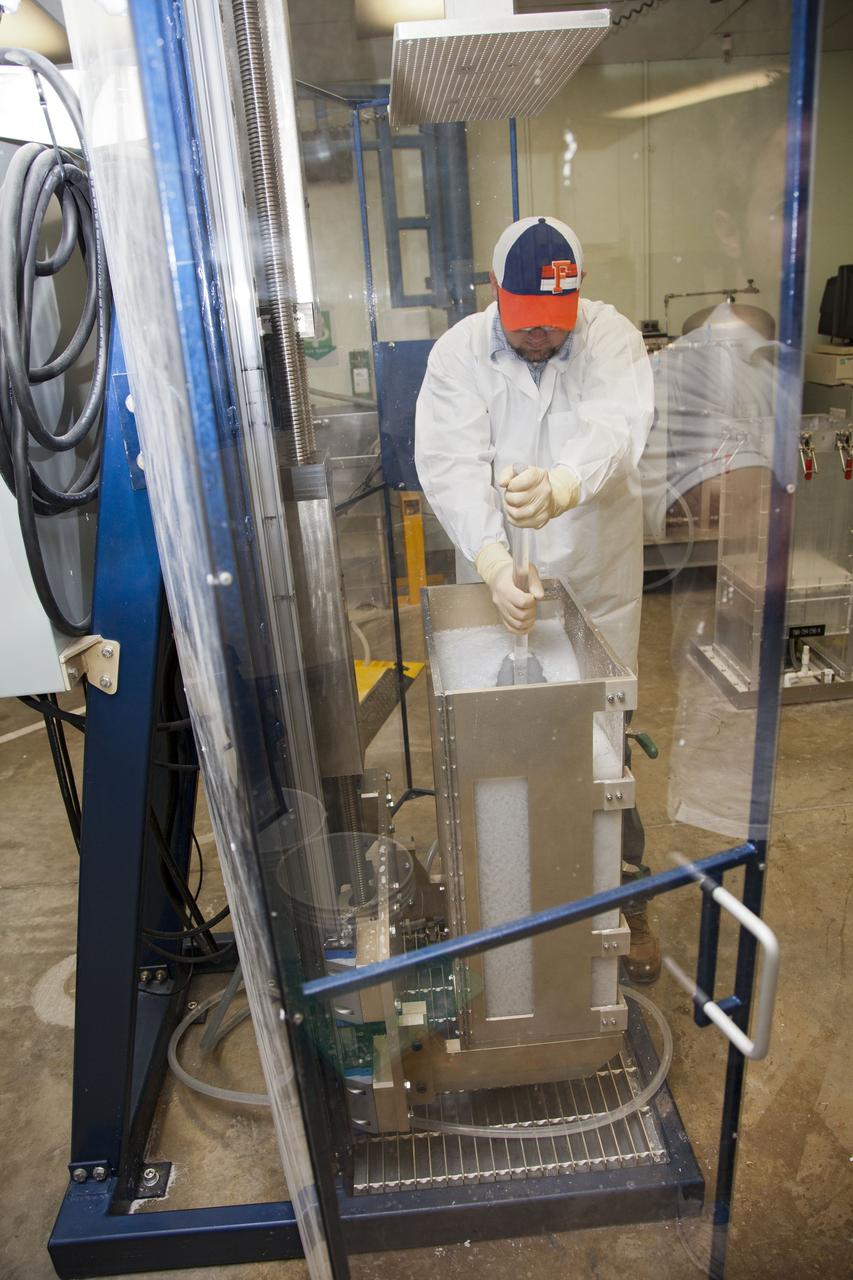
CAPE CANAVERAL, Fla. -- Chris Keeling, a United Space Alliance technician at NASA's Kennedy Space Center in Florida, manufactures the heat shield tiles that will be installed to the backshell of the Orion Multi-Purpose Crew Vehicle's Exploration Flight Test EFT-1 capsule. The work to manufacture and inspect the tiles is taking place in Kennedy's Thermal Protection System Facility. EFT-1 will be used during Orion's first test flight in space. For more information, visit www.nasa.gov/orion. Photo credit: Frankie Martin
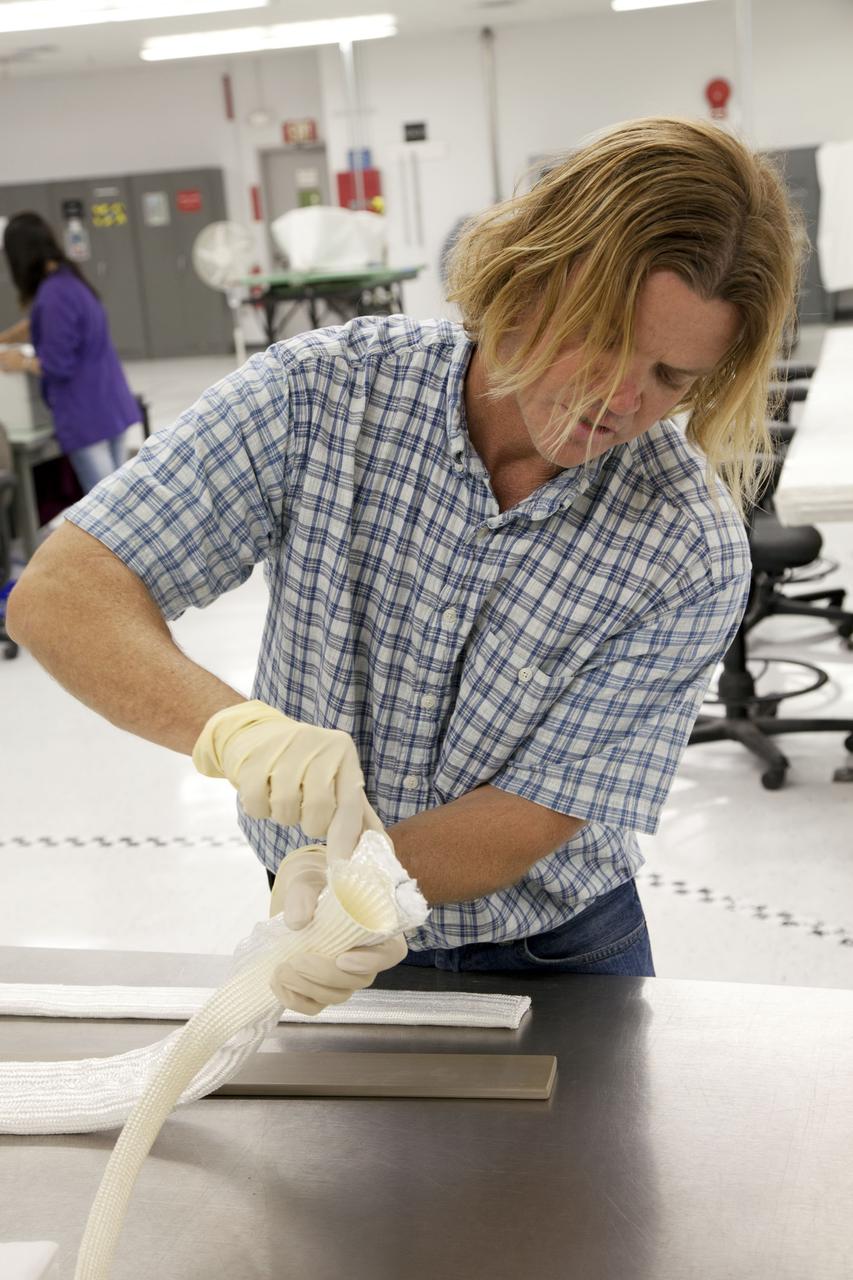
CAPE CANAVERAL, Fla. -- -- Tim Wright, a United Space Alliance engineering manager at NASA's Kennedy Space Center in Florida, explains the properties of the thermal barriers that will be installed to the backshell of the Orion Multi-Purpose Crew Vehicle's Exploration Flight Test EFT-1 capsule. The work to manufacture and inspect the tiles is taking place in Kennedy's Thermal Protection System Facility. EFT-1 will be used during Orion's first test flight in space. For more information, visit www.nasa.gov/orion. Photo credit: Frankie Martin

CAPE CANAVERAL, Fla. -- Chris Keeling, a United Space Alliance technician at NASA's Kennedy Space Center in Florida, manufactures the heat shield tiles that will be installed to the backshell of the Orion Multi-Purpose Crew Vehicle's Exploration Flight Test EFT-1 capsule. The work to manufacture and inspect the tiles is taking place in Kennedy's Thermal Protection System Facility. EFT-1 will be used during Orion's first test flight in space. For more information, visit www.nasa.gov/orion. Photo credit: Frankie Martin
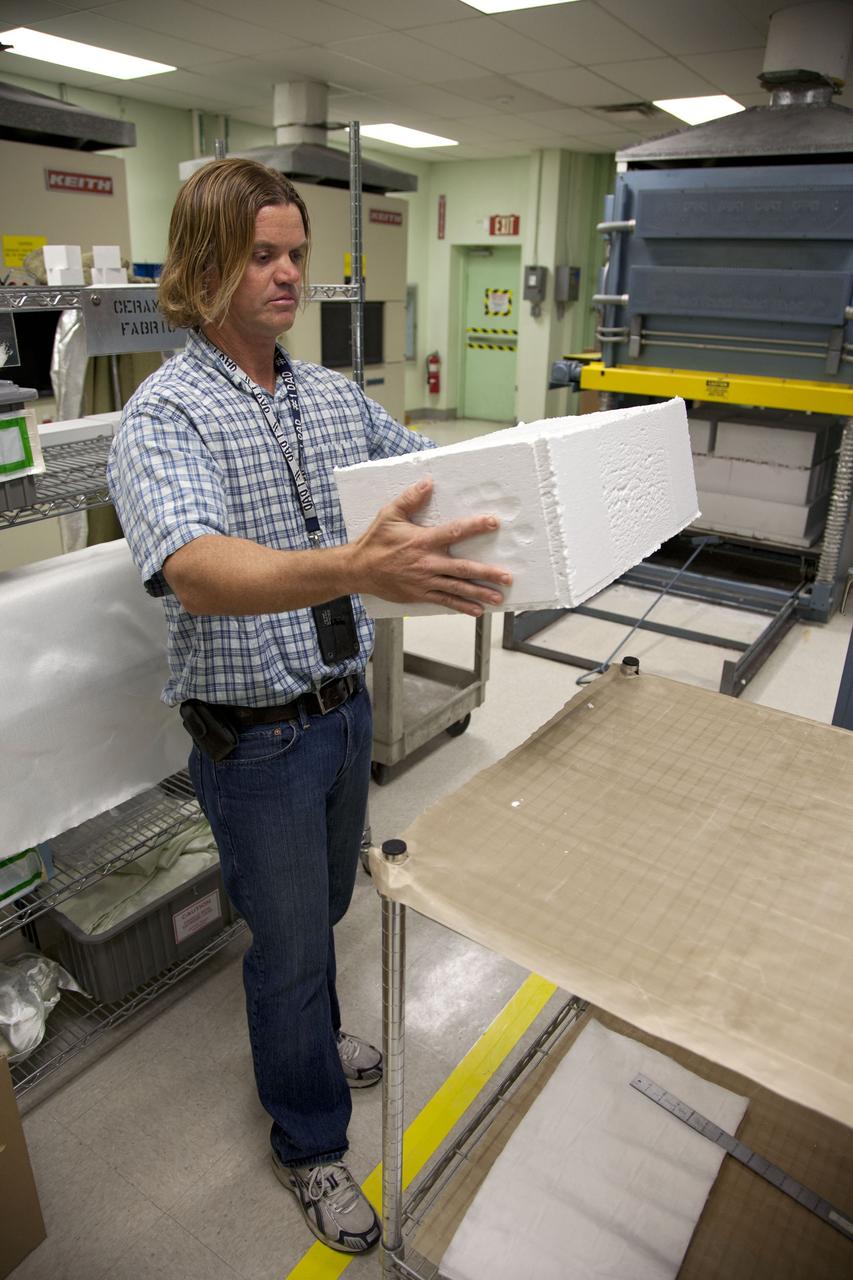
Tim Wright, a United Space Alliance engineering manager at NASA's Kennedy Space Center in Florida, unpacks the heat shield tiles that will be installed to the backshell of the Orion Multi-Purpose Crew Vehicle's Exploration Flight Test EFT-1 capsule. The tiles are being manufactured and inspected in Kennedy's Thermal Protection System Facility. The tiles will be baked at 2,200 degrees F to cure their ceramic coating. EFT-1 will be used during Orion's first test flight in space. For more information, visit www.nasa.gov/orion. Photo credit: Frankie Martin
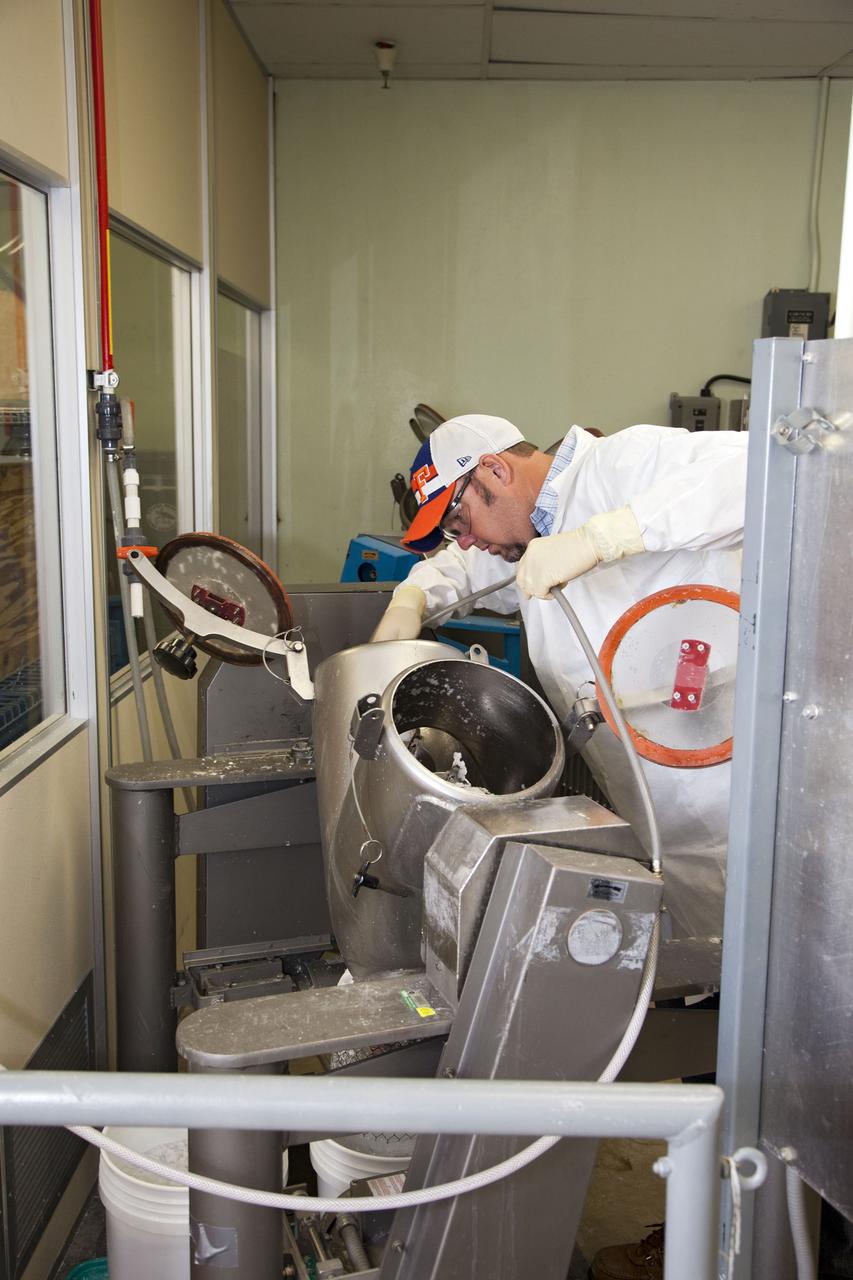
CAPE CANAVERAL, Fla. -- The heat shield tiles that will be installed to the backshell of the Orion Multi-Purpose Crew Vehicle's Exploration Flight Test EFT-1 capsule are being manufactured in the Thermal Protection System Facility at NASA's Kennedy Space Center in Florida. EFT-1 will be used during Orion's first test flight in space. For more information, visit www.nasa.gov/orion. Photo credit: Frankie Martin
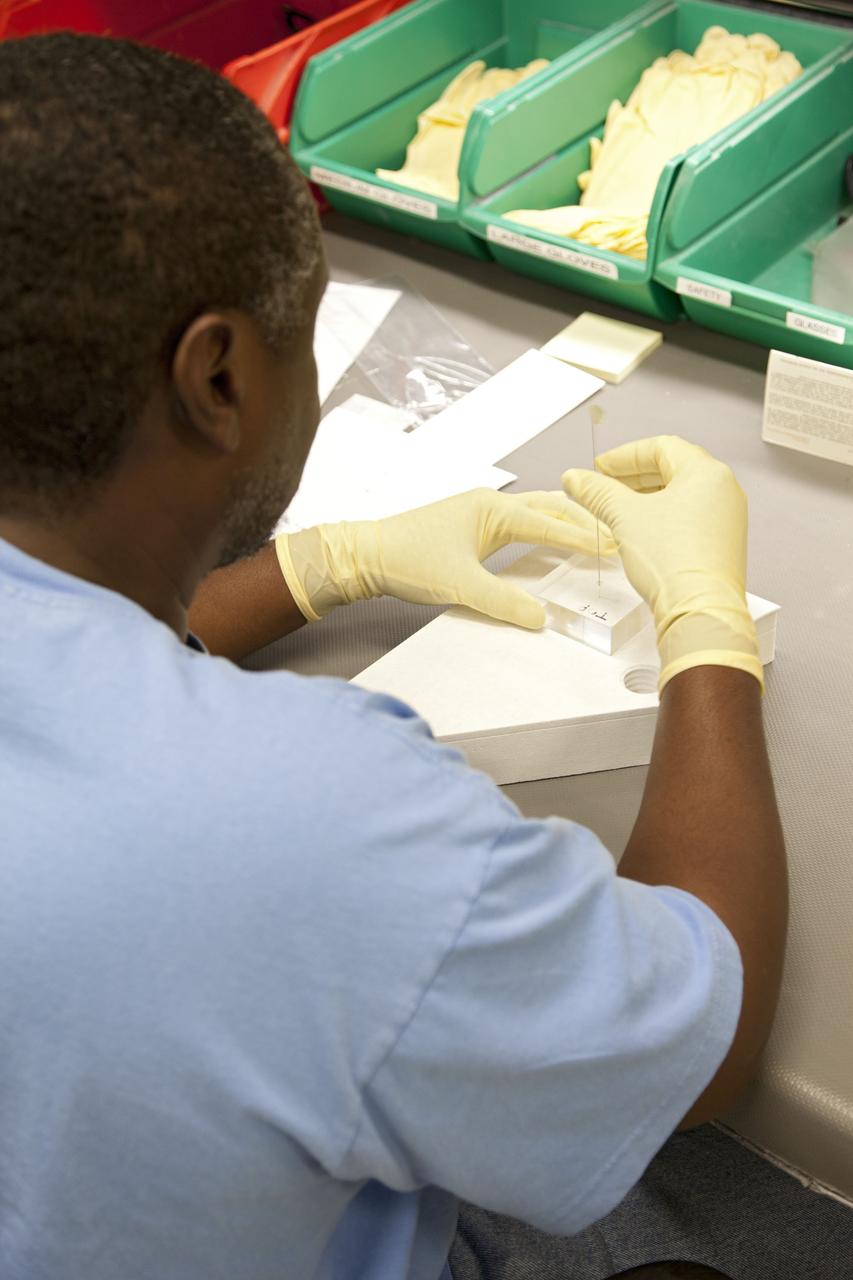
CAPE CANAVERAL, Fla. -- Damon Petty, a United Space Alliance technician at NASA's Kennedy Space Center in Florida, inspects a heat shield tile that will be installed to the backshell of the Orion Multi-Purpose Crew Vehicle's Exploration Flight Test EFT-1 capsule. The work to manufacture and inspect the tiles is taking place in Kennedy's Thermal Protection System Facility. EFT-1 will be used during Orion's first test flight in space. For more information, visit www.nasa.gov/orion. Photo credit: Frankie Martin
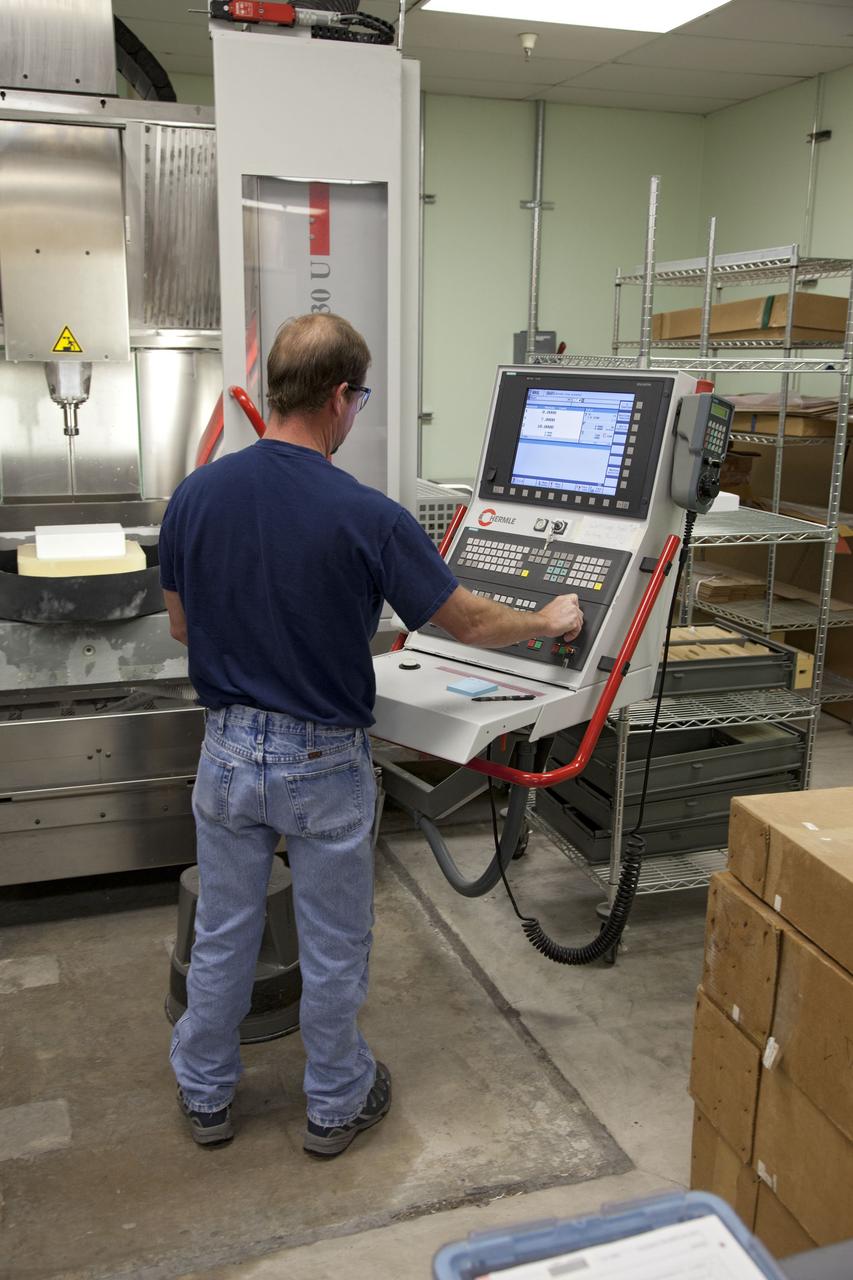
CAPE CANAVERAL, Fla. -- Jimmy Savastio, a United Space Alliance machinist at NASA's Kennedy Space Center in Florida, monitors the properties of a heat shield tile that will be installed to the backshell of the Orion Multi-Purpose Crew Vehicle's Exploration Flight Test EFT-1 capsule. The work to manufacture and inspect the tiles is taking place in Kennedy's Thermal Protection System Facility. EFT-1 will be used during Orion's first test flight in space. For more information, visit www.nasa.gov/orion. Photo credit: Frankie Martin