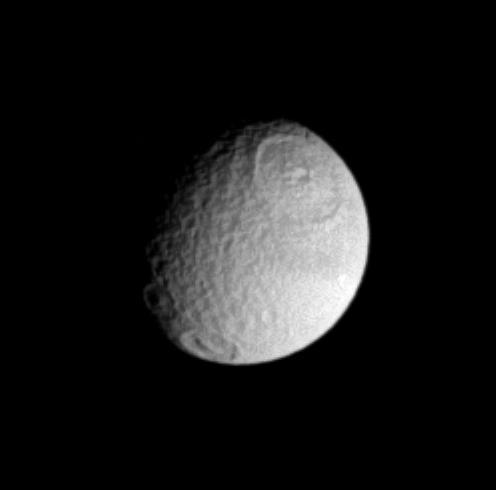
Big Bangs on Tethys
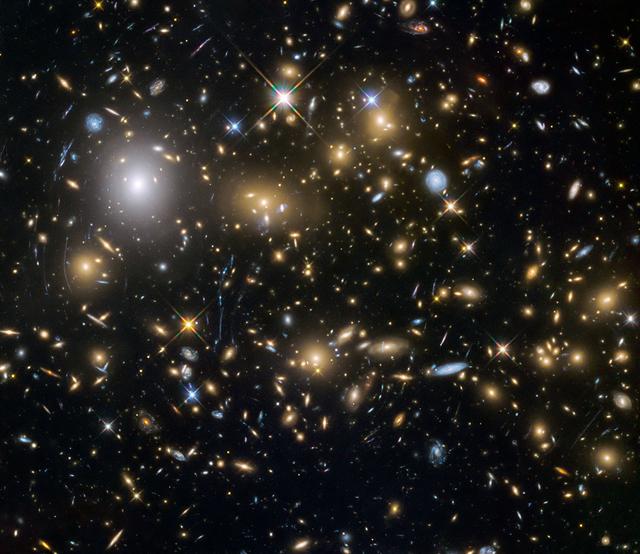
Observations by the NASA/ESA Hubble Space Telescope have taken advantage of gravitational lensing to reveal the largest sample of the faintest and earliest known galaxies in the universe. Some of these galaxies formed just 600 million years after the big bang and are fainter than any other galaxy yet uncovered by Hubble. The team has determined for the first time with some confidence that these small galaxies were vital to creating the universe that we see today. An international team of astronomers, led by Hakim Atek of the Ecole Polytechnique Fédérale de Lausanne, Switzerland, has discovered over 250 tiny galaxies that existed only 600-900 million years after the big bang— one of the largest samples of dwarf galaxies yet to be discovered at these epochs. The light from these galaxies took over 12 billion years to reach the telescope, allowing the astronomers to look back in time when the universe was still very young. Read more: <a href="http://www.nasa.gov/feature/goddard/hubble-spies-big-bang-frontiers" rel="nofollow">www.nasa.gov/feature/goddard/hubble-spies-big-bang-frontiers</a> Credit: NASA/ESA <b><a href="http://www.nasa.gov/audience/formedia/features/MP_Photo_Guidelines.html" rel="nofollow">NASA image use policy.</a></b> <b><a href="http://www.nasa.gov/centers/goddard/home/index.html" rel="nofollow">NASA Goddard Space Flight Center</a></b> enables NASA’s mission through four scientific endeavors: Earth Science, Heliophysics, Solar System Exploration, and Astrophysics. Goddard plays a leading role in NASA’s accomplishments by contributing compelling scientific knowledge to advance the Agency’s mission. <b>Follow us on <a href="http://twitter.com/NASAGoddardPix" rel="nofollow">Twitter</a></b> <b>Like us on <a href="http://www.facebook.com/pages/Greenbelt-MD/NASA-Goddard/395013845897?ref=tsd" rel="nofollow">Facebook</a></b> <b>Find us on <a href="http://instagrid.me/nasagoddard/?vm=grid" rel="nofollow">Instagram</a></b>
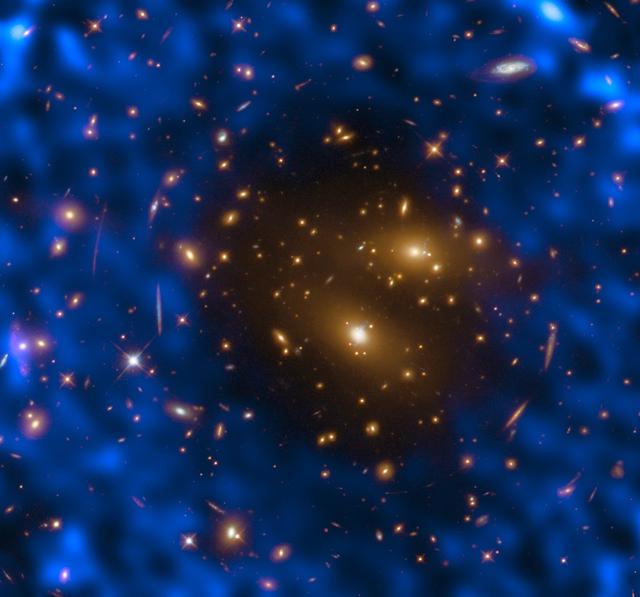
The events surrounding the Big Bang were so cataclysmic that they left an indelible imprint on the fabric of the cosmos. We can detect these scars today by observing the oldest light in the universe. As it was created nearly 14 billion years ago, this light — which exists now as weak microwave radiation and is thus named the cosmic microwave background (CMB) — permeates the entire cosmos, filling it with detectable photons. The CMB can be used to probe the cosmos via something known as the Sunyaev-Zel’dovich (SZ) effect, which was first observed over 30 years ago. We detect the CMB here on Earth when its constituent microwave photons travel to us through space. On their journey to us, they can pass through galaxy clusters that contain high-energy electrons. These electrons give the photons a tiny boost of energy. Detecting these boosted photons through our telescopes is challenging but important — they can help astronomers to understand some of the fundamental properties of the universe, such as the location and distribution of dense galaxy clusters. The NASA/ESA (European Space Agency) Hubble Space Telescope observed one of most massive known galaxy clusters, RX J1347.5–1145, seen in this Picture of the Week, as part of the Cluster Lensing And Supernova survey with Hubble (CLASH). This observation of the cluster, 5 billion light-years from Earth, helped the Atacama Large Millimeter/submillimeter Array (ALMA) in Chile to study the cosmic microwave background using the thermal Sunyaev-Zel’dovich effect. The observations made with ALMA are visible as the blue-purple hues. Image credit: ESA/Hubble & NASA, T. Kitayama (Toho University, Japan)/ESA/Hubble & NASA <b><a href="http://www.nasa.gov/audience/formedia/features/MP_Photo_Guidelines.html" rel="nofollow">NASA image use policy.</a></b> <b><a href="http://www.nasa.gov/centers/goddard/home/index.html" rel="nofollow">NASA Goddard Space Flight Center</a></b> enables NASA’s mission through four scientific endeavors: Earth Science, Heliophysics, Solar System Exploration, and Astrophysics. Goddard plays a leading role in NASA’s accomplishments by contributing compelling scientific knowledge to advance the Agency’s mission. <b>Follow us on <a href="http://twitter.com/NASAGoddardPix" rel="nofollow">Twitter</a></b> <b>Like us on <a href="http://www.facebook.com/pages/Greenbelt-MD/NASA-Goddard/395013845897?ref=tsd" rel="nofollow">Facebook</a></b> <b>Find us on <a href="http://instagrid.me/nasagoddard/?vm=grid" rel="nofollow">Instagram</a></b>

Every second a star somewhere out in the universe explodes as a supernova. But some extremely massive stars go out with a whimper instead of a bang. When they do, they can collapse under the crushing tug of gravity and vanish out of sight, only to leave behind a black hole. The doomed star N6946-BH1 was 25 times as massive as our sun. It began to brighten weakly in 2009. But, by 2015, it appeared to have winked out of existence. By a careful process of elimination, based on observations by the Large Binocular Telescope and NASA's Hubble and Spitzer space telescopes, researchers eventually concluded that the star must have become a black hole. This may be the fate for extremely massive stars in the universe. This illustration shows the final stages in the life of a supermassive star that fails to explode as a supernova, but instead implodes to form a black hole. https://photojournal.jpl.nasa.gov/catalog/PIA21466
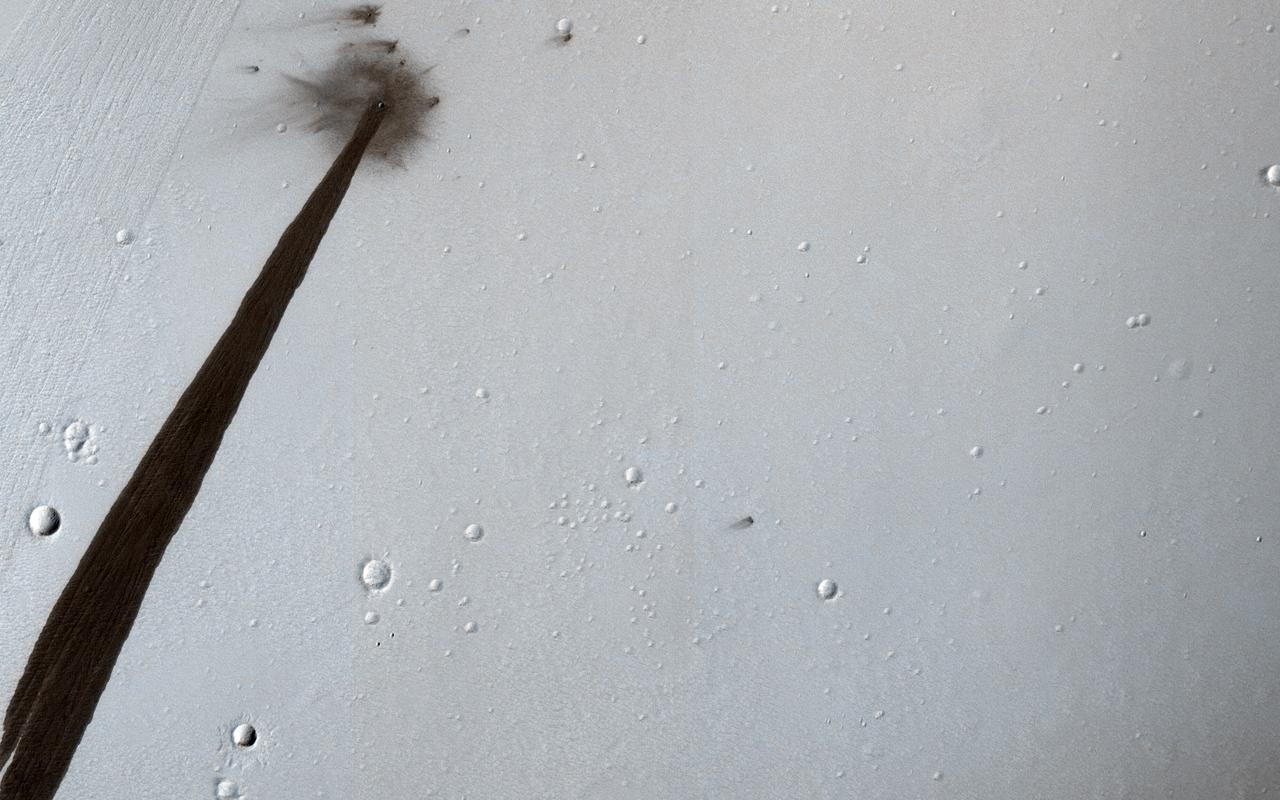
This HiRISE image from NASA's Mars Reconnaissance Orbiter (MRO) captures a new, dated (within about a decade) impact crater that triggered a slope streak. When the meteoroid hit the surface and exploded to make the crater, it also destabilized the slope and initiated this avalanche. The crater itself is only 5 meters across, but the streak it started is 1 kilometer long! Slope streaks are created when dry dust avalanches leave behind dark swaths on dusty Martian hills. The faded scar of an old avalanche is also visible to the side of the new dark streak. https://photojournal.jpl.nasa.gov/catalog/PIA22513
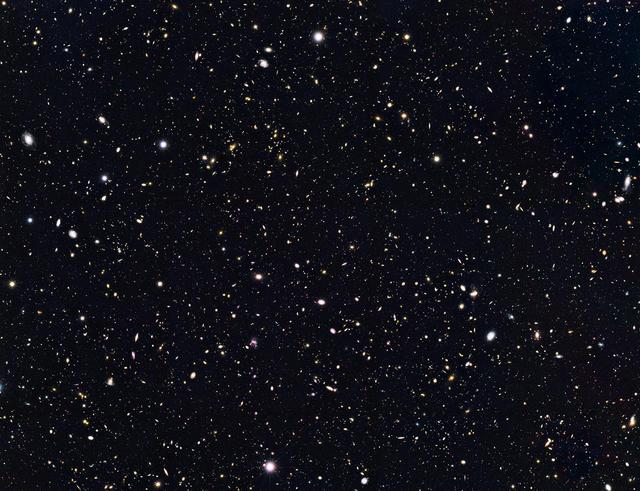
The view is a composite of images taken in visible and near-infrared light by NASA Hubble Space Telescope. Researchers have circled four unusually red objects that appear as they existed just 500 million years after the big bang.
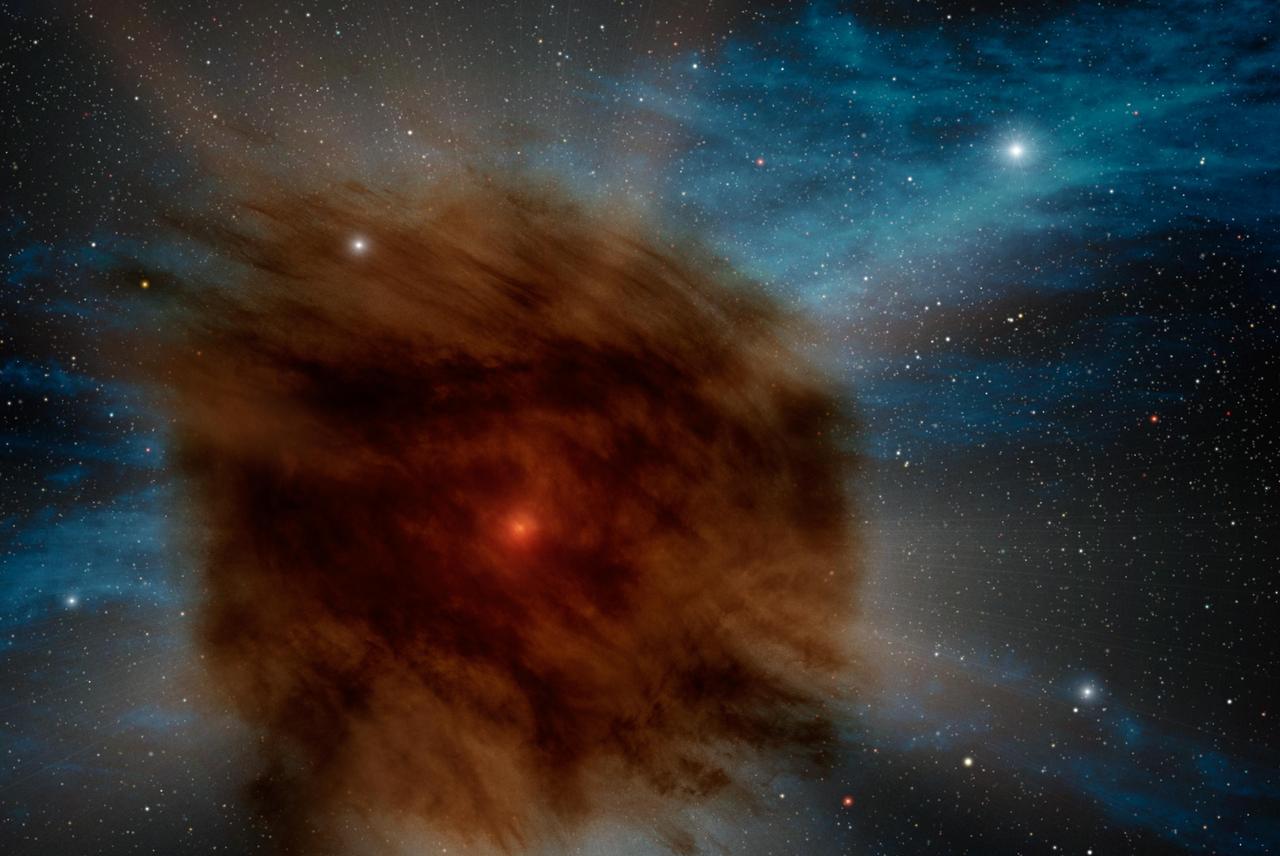
A giant star in a faraway galaxy recently ended its life with a dust-shrouded whimper instead of the more typical bang in this artist concept based on data from Spitzer Space Telescope.

This graphic illustrates the evolution of satellites designed to measure ancient light leftover from the big bang that created our universe 13.8 billion years ago; NASA COBE Explorer left and WMAP middle, and ESA Planck right.
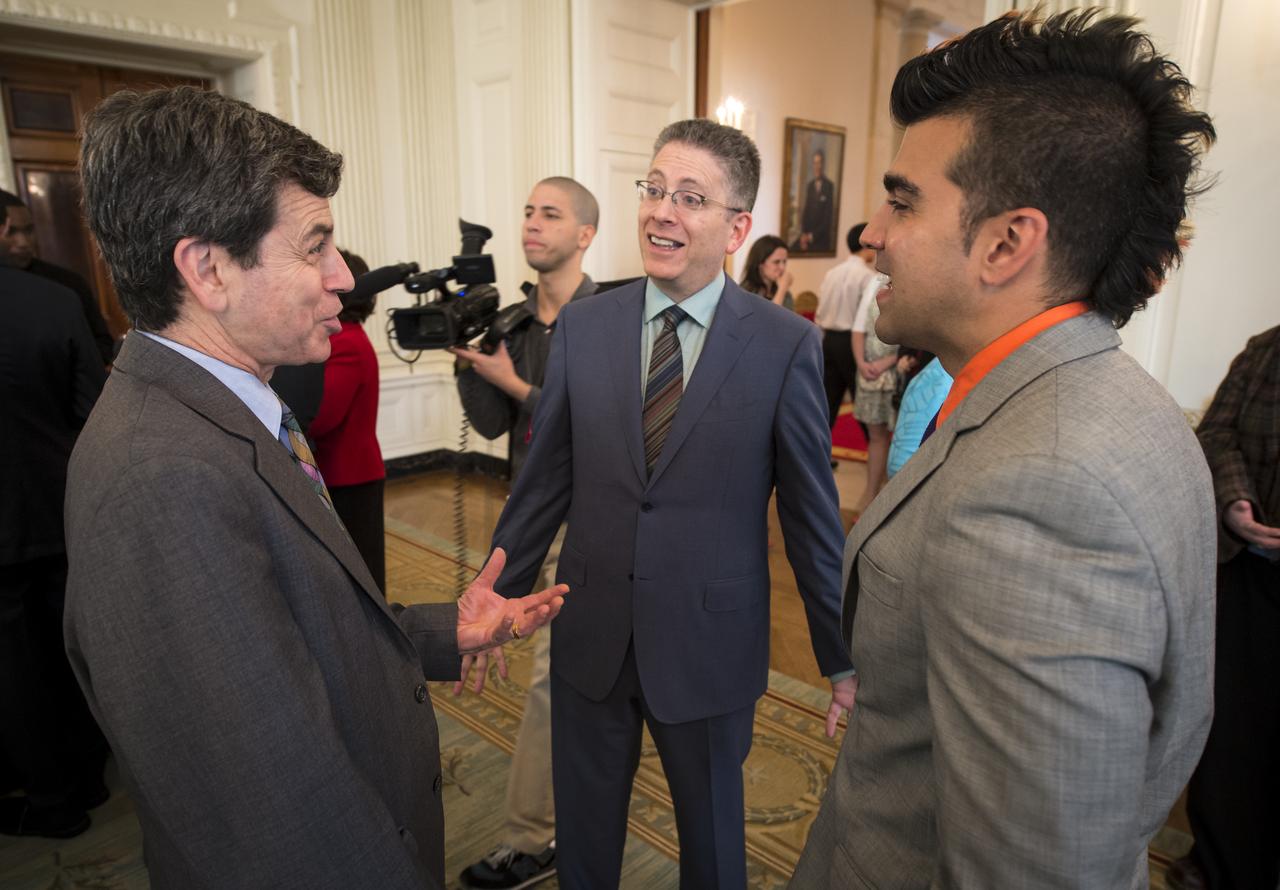
Director of Strategic Communications and Senior Science and Technology Policy Analyst, Office of Science and Technology Policy, Executive Office of the President, Rick Weiss, left, “Big Bang Theory” co-creator Bill Prady, center, and NASA Mars Curiosity Landing mission controller, Bobak "Mohawk Guy" Ferdowsi talk during the White House Science Fair held at the White House, April 22, 2013. The science fair celebrated student winners of a broad range of science, technology, engineering and math (STEM) competitions from across the country. Photo Credit: (NASA/Bill Ingalls)
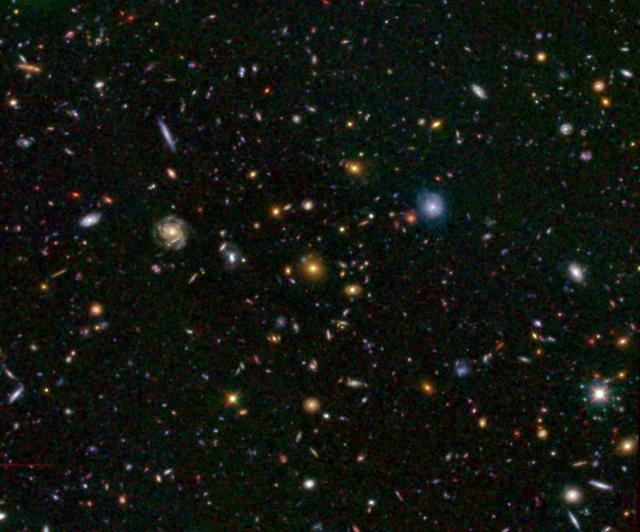
This image from NASA Hubble telescope shows one of the most distant galaxies known, called GN-108036, dating back to 750 million years after the Big Bang that created our universe. The galaxy light took 12.9 billion years to reach us.
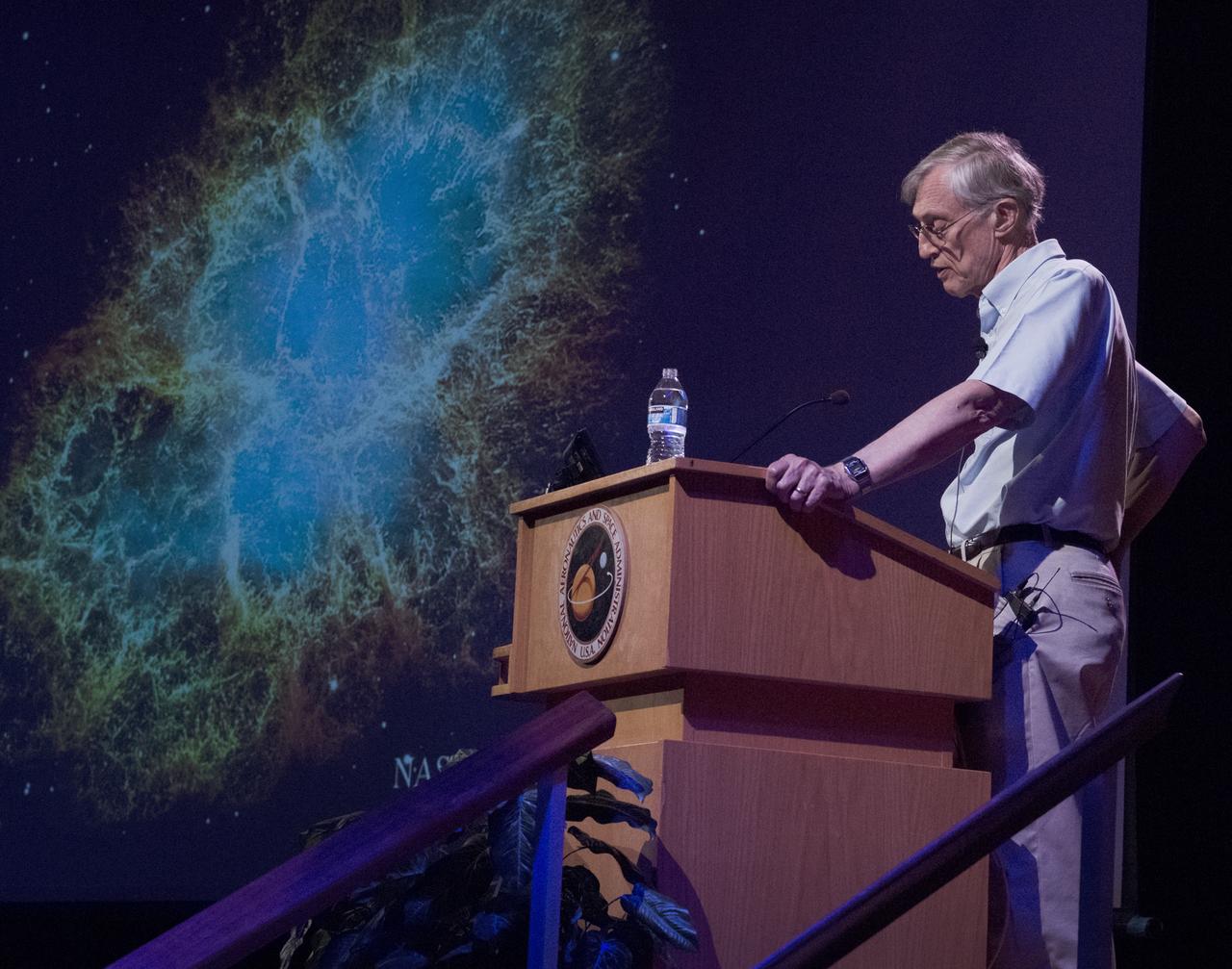
Dr. Mather speaks with interns on July 22, 2019 about the universe, COBE, HST and JWST projects He is the Nobel Prize Winner for Big Bang theory
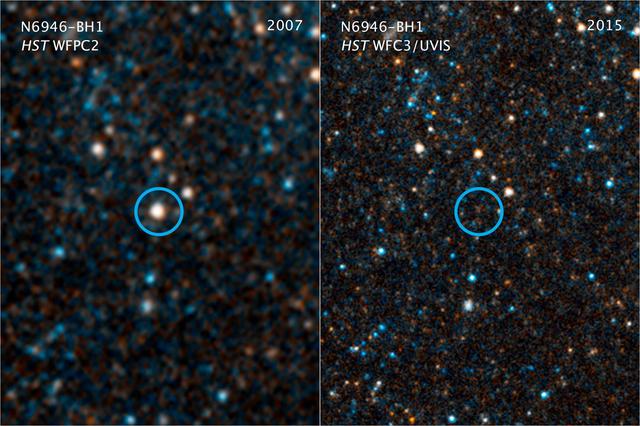
This pair of visible-light and near-infrared photos from NASA's Hubble Space Telescope shows the giant star N6946-BH1 before and after it vanished out of sight by imploding to form a black hole. The left image shows the star, which is 25 times the mass of our sun, as it looked in 2007. In 2009, the star shot up in brightness to become over 1 million times more luminous than our sun for several months. But then it seemed to vanish, as seen in the right panel image from 2015. A small amount of infrared light has been detected from where the star used to be. This radiation probably comes from debris falling onto a black hole. The black hole is located 22 million light-years away in the spiral galaxy NGC 6946. https://photojournal.jpl.nasa.gov/catalog/PIA21467
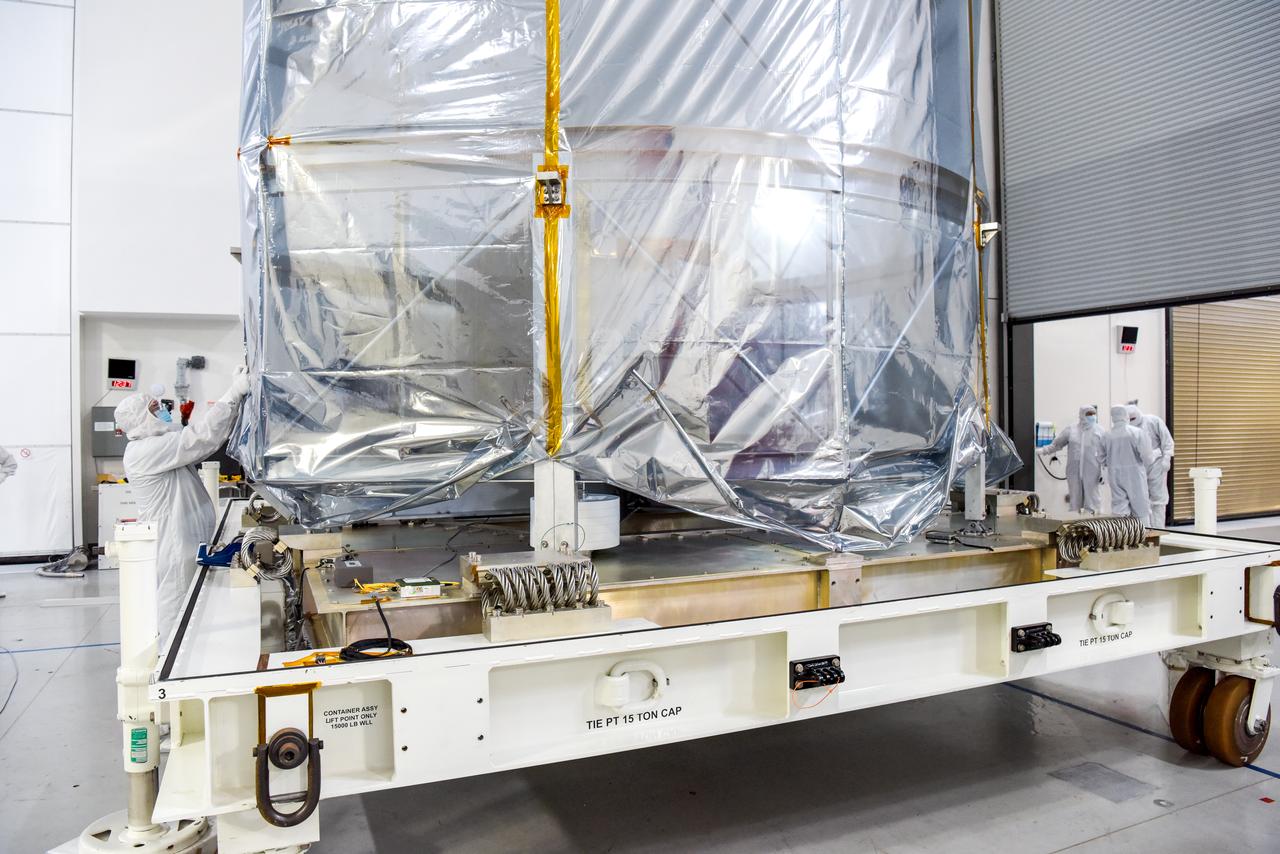
NASA’s SPHEREx (Spectro-Photometer for the History of the Universe, Epoch of Reionization and Ices Explorer) is uncrated for prelaunch processing at Vandenberg Space Force Base in California on Wednesday, Jan. 15, 2025. SPHEREx will enter a polar orbit around Earth and create a 3D map of the entire sky, gathering information about millions of galaxies for scientists to study what happened after the big bang, the history of galaxy evolution, and the origins of water in planetary systems in our galaxy. SPHEREx will launch aboard a SpaceX Falcon 9 rocket in late February 2025.

STS-132 astronaut Piers Sellers, left, and Dr. John Mather are seen with a replica of Mather's Nobel Prize, Tuesday, July 27, 2010, at the Smithsonian National Air and Space Museum in Washington. Sellers returned the replica that is in the museum's collection and was flown aboard STS-132 Atlantis. The prize was won by Mather and University of California, Berkeley researcher George Smoot in 2006 for their work using the Cosmic Background Explorer Satellite to understand the big-bang theory of the universe. Photo Credit: (NASA/Paul E. Alers)
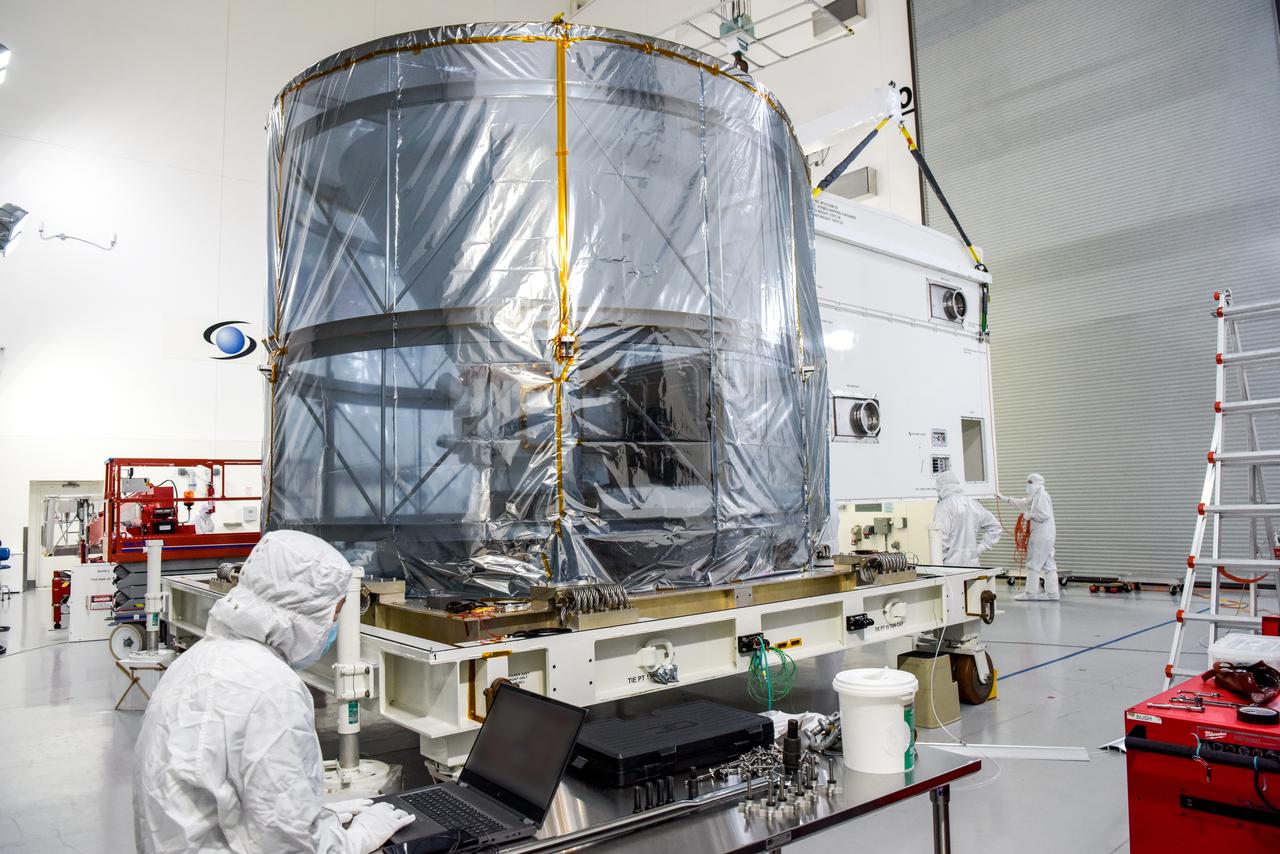
NASA’s SPHEREx (Spectro-Photometer for the History of the Universe, Epoch of Reionization and Ices Explorer) is uncrated for prelaunch processing at Vandenberg Space Force Base in California on Wednesday, Jan. 15, 2025. SPHEREx will enter a polar orbit around Earth and create a 3D map of the entire sky, gathering information about millions of galaxies for scientists to study what happened after the big bang, the history of galaxy evolution, and the origins of water in planetary systems in our galaxy. SPHEREx will launch aboard a SpaceX Falcon 9 rocket in late February 2025.
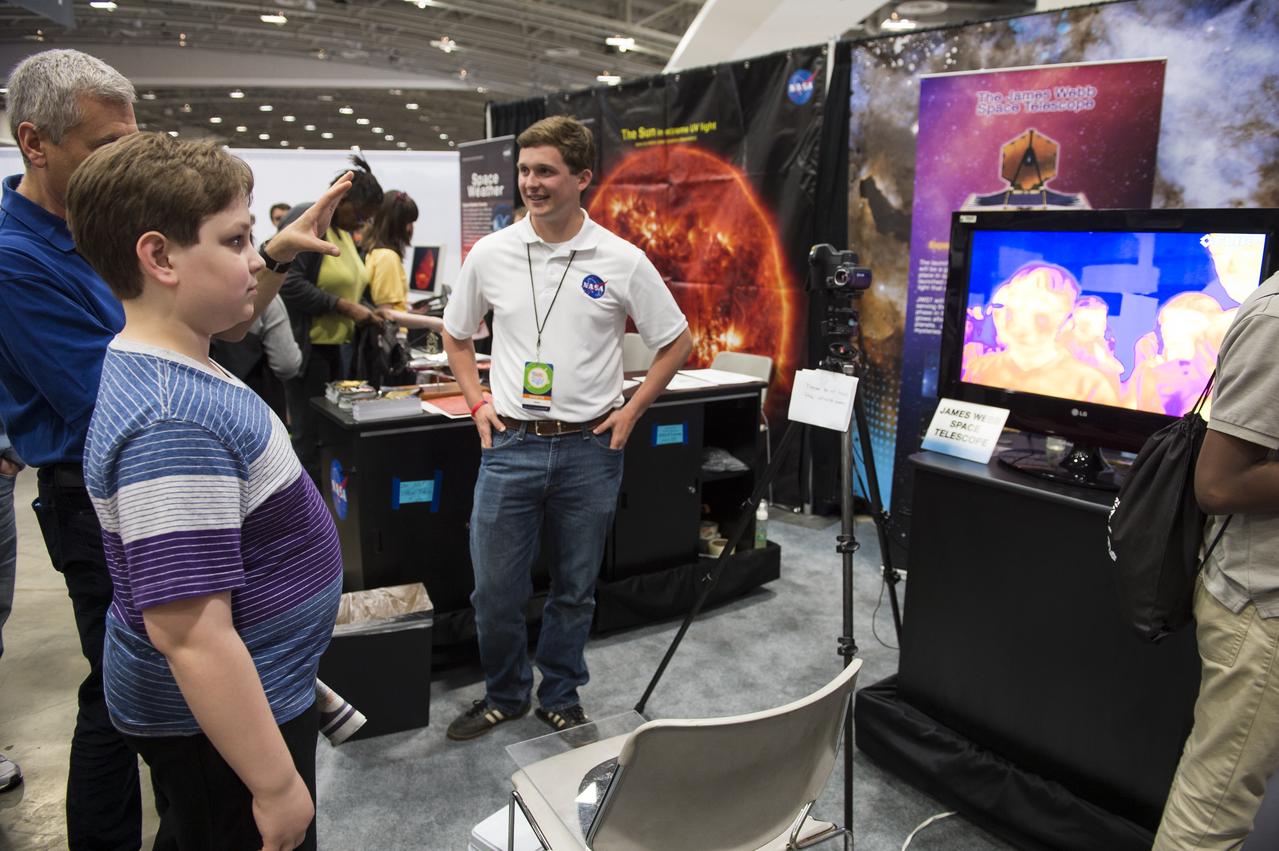
An attendee of the USA Science and Engineering Festival observes the infrared image of himself as a NASA Staff member describes the James Webb Space Telescope. It will be a large infrared telescope with a 6.5 meter primary mirror and will study every phase in the history of our Universe ranging from the Big Bang to the formation of our Solar System. The USA Science and Engineering Festival took place at the Washington Convention Center in Washington, DC on April 26 and 27, 2014. Photo Credit: (NASA/Aubrey Gemignani)
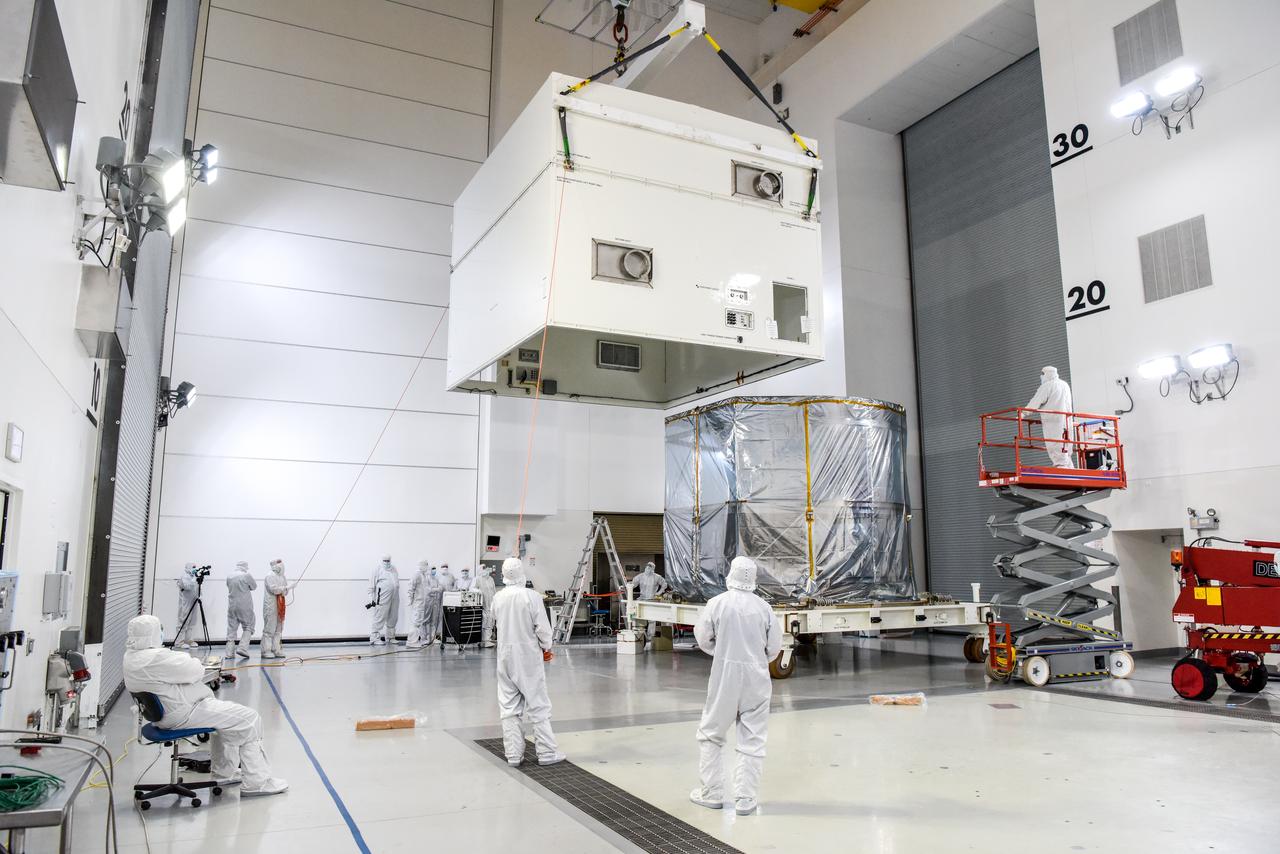
NASA’s SPHEREx (Spectro-Photometer for the History of the Universe, Epoch of Reionization and Ices Explorer) is uncrated for prelaunch processing at Vandenberg Space Force Base in California on Wednesday, Jan. 15, 2025. SPHEREx will enter a polar orbit around Earth and create a 3D map of the entire sky, gathering information about millions of galaxies for scientists to study what happened after the big bang, the history of galaxy evolution, and the origins of water in planetary systems in our galaxy. SPHEREx will launch aboard a SpaceX Falcon 9 rocket in late February 2025.
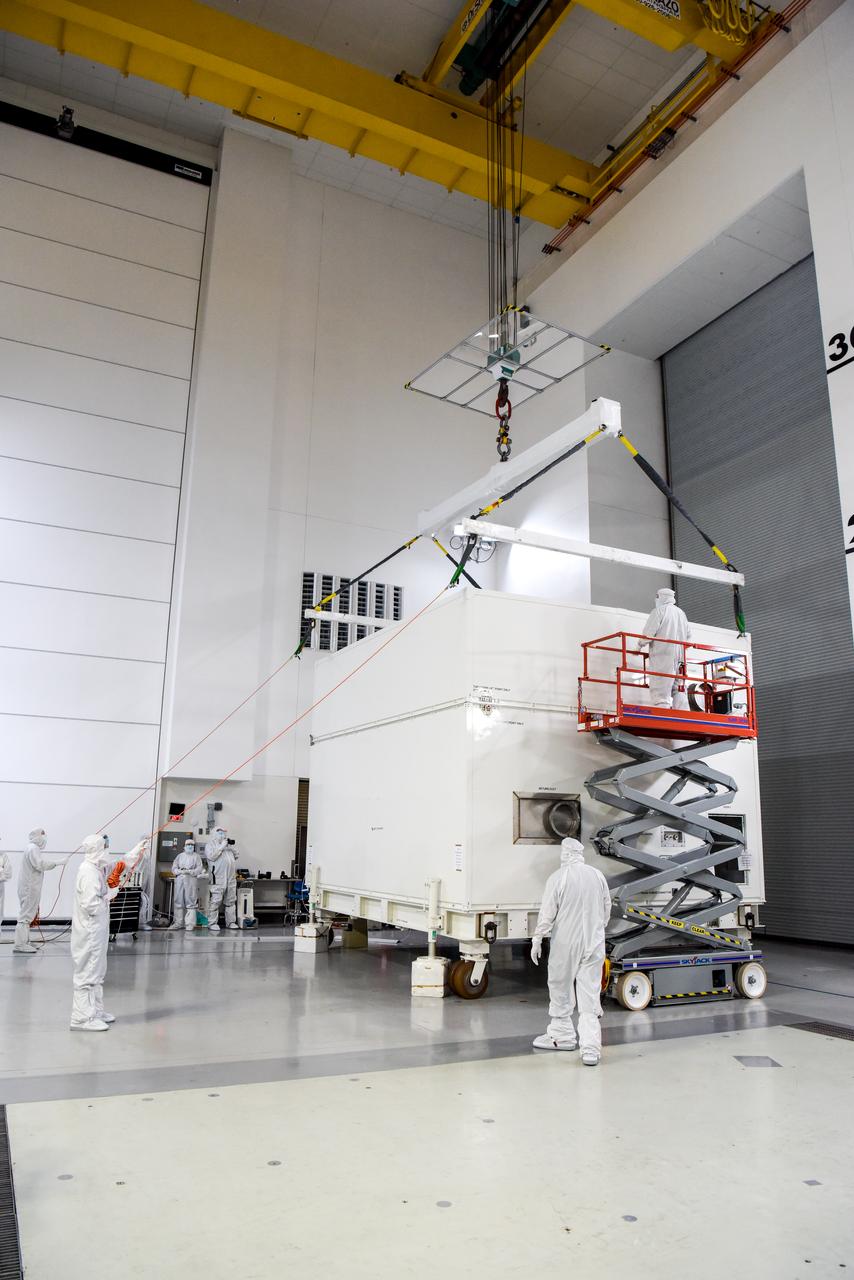
NASA’s SPHEREx (Spectro-Photometer for the History of the Universe, Epoch of Reionization and Ices Explorer) is uncrated for prelaunch processing at Vandenberg Space Force Base in California on Wednesday, Jan. 15, 2025. SPHEREx will enter a polar orbit around Earth and create a 3D map of the entire sky, gathering information about millions of galaxies for scientists to study what happened after the big bang, the history of galaxy evolution, and the origins of water in planetary systems in our galaxy. SPHEREx will launch aboard a SpaceX Falcon 9 rocket in late February 2025.

Attendees of the USA Science and Engineering Festival observe their infrared images as a NASA Staff member describes the James Webb Space Telescope. It will be a large infrared telescope with a 6.5 meter primary mirror and will study every phase in the history of our Universe ranging from the Big Bang to the formation of our Solar System. The USA Science and Engineering Festival took place at the Washington Convention Center in Washington, DC on April 26 and 27, 2014. Photo Credit: (NASA/Aubrey Gemignani)
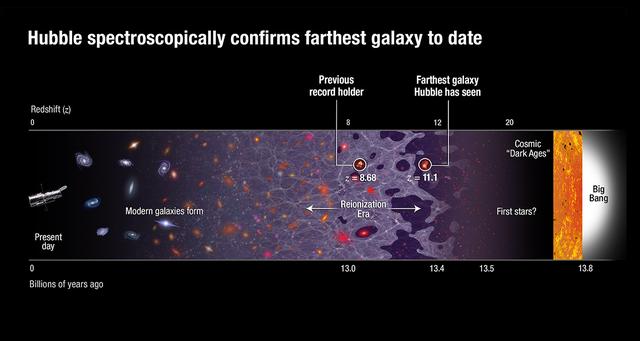
By pushing NASA’s Hubble Space Telescope to its limits, an international team of astronomers has shattered the cosmic distance record by measuring the farthest galaxy ever seen in the universe. This surprisingly bright infant galaxy, named GN-z11, is seen as it was 13.4 billion years in the past, just 400 million years after the Big Bang. GN-z11 is located in the direction of the constellation of Ursa Major. Read more: <a href="http://go.nasa.gov/1oSqHad" rel="nofollow">go.nasa.gov/1oSqHad</a>
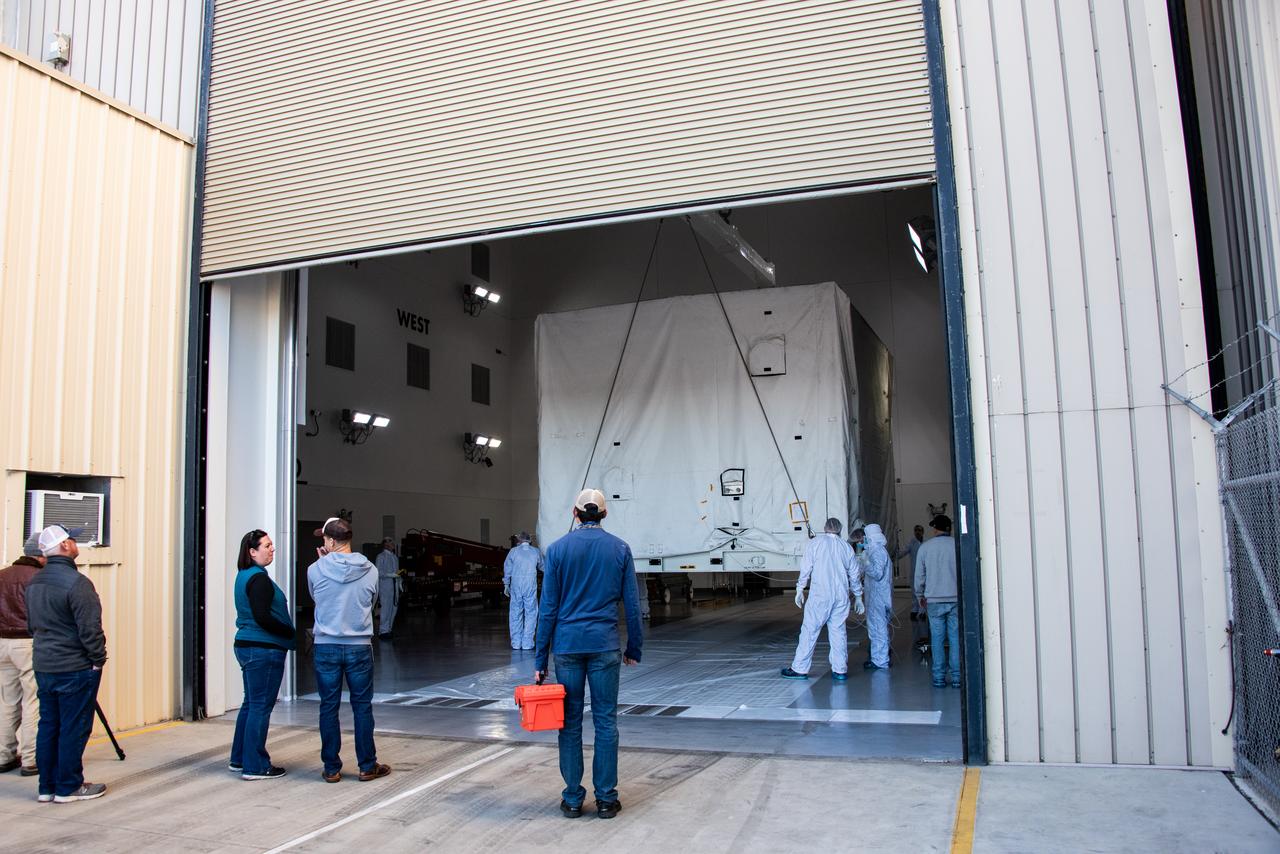
NASA’s SPHEREx (Spectro-Photometer for the History of the Universe, Epoch of Reionization and Ices Explorer), a space telescope, arrives at Vandenberg Space Force Base in California on Tuesday, Jan. 14, 2025. SPHEREx will enter a polar orbit around Earth and create a 3D map of the entire sky, gathering information about millions of galaxies for scientists to study what happened after the big bang, the history of galaxy evolution, and the origins of water in planetary systems in our galaxy. SPHEREx will launch aboard a SpaceX Falcon 9 rocket in late February 2025.

NASA Astrophycist Dr. John Mather speaks, Tuesday, July 27, 2010, at the Smithsonian National Air and Space Museum in Washington. Mather was speaking as part of a ceremony with STS-132 astronaut Piers Sellers who returned a replica of the Nobel Prize that is in the museum's collection and was flown aboard STS-132 Atlantis. The prize was won by Mather and University of California, Berkeley researcher George Smoot in 2006 for their work using the Cosmic Background Explorer Satellite to understand the big-bang theory of the universe.Photo Credit: (NASA/Paul E. Alers)
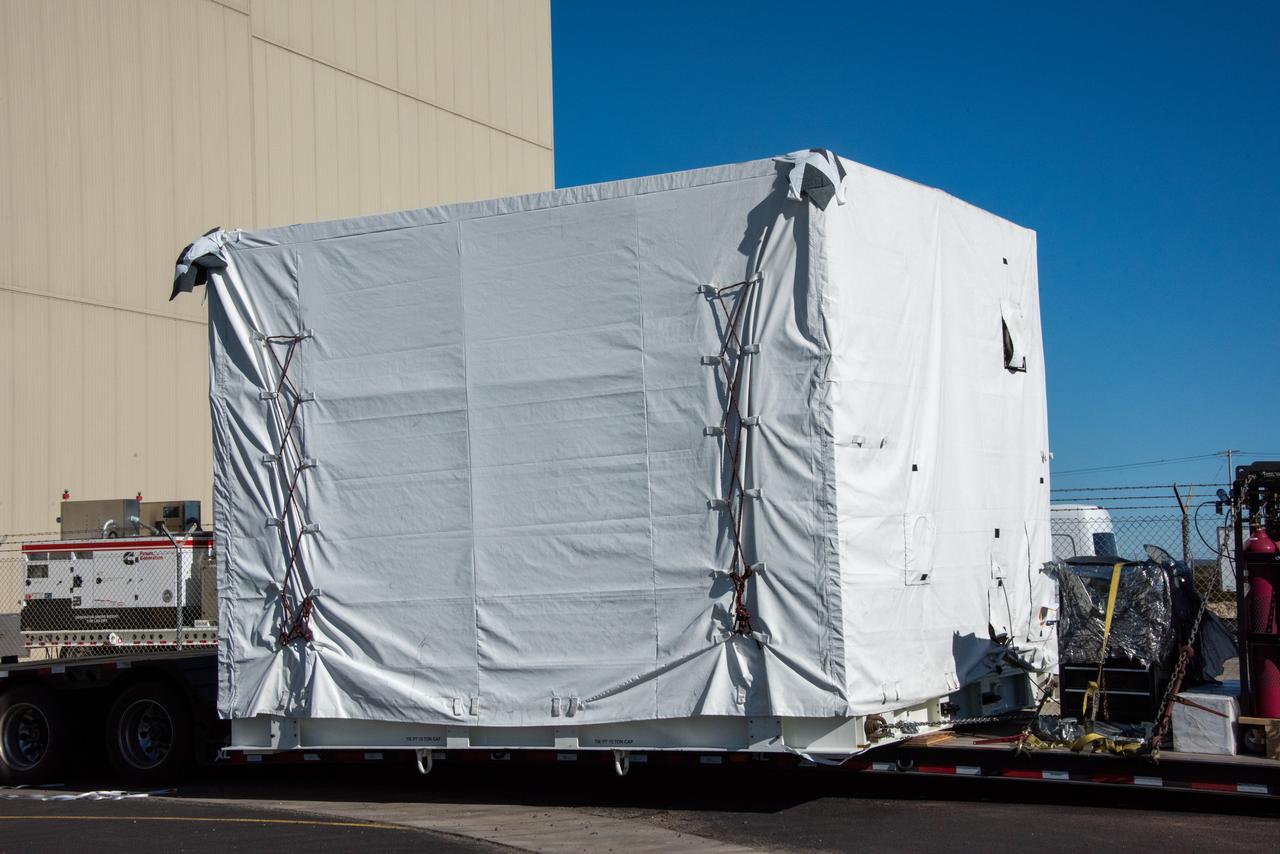
NASA’s SPHEREx (Spectro-Photometer for the History of the Universe, Epoch of Reionization and Ices Explorer), a space telescope, arrives at Vandenberg Space Force Base in California on Tuesday, Jan. 14, 2025. SPHEREx will enter a polar orbit around Earth and create a 3D map of the entire sky, gathering information about millions of galaxies for scientists to study what happened after the big bang, the history of galaxy evolution, and the origins of water in planetary systems in our galaxy. SPHEREx will launch aboard a SpaceX Falcon 9 rocket in late February 2025.

NASA’s SPHEREx (Spectro-Photometer for the History of the Universe, Epoch of Reionization and Ices Explorer), a space telescope, arrives at Vandenberg Space Force Base in California on Tuesday, Jan. 14, 2025. SPHEREx will enter a polar orbit around Earth and create a 3D map of the entire sky, gathering information about millions of galaxies for scientists to study what happened after the big bang, the history of galaxy evolution, and the origins of water in planetary systems in our galaxy. SPHEREx will launch aboard a SpaceX Falcon 9 rocket in late February 2025.
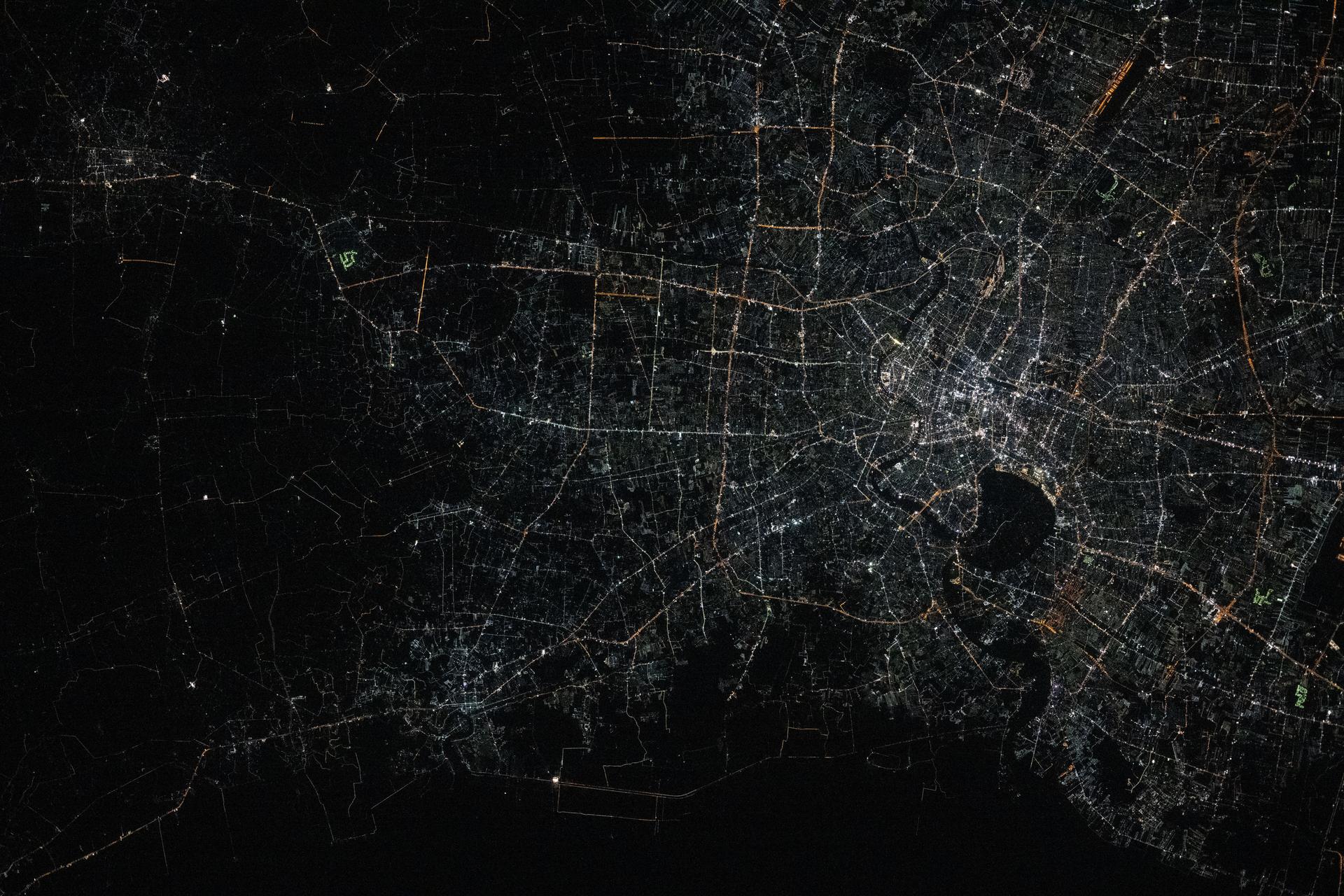
iss072e757257 (March 5, 2025) --- Bangkok, Thailand—with a metropolitan population of about 11.4 million and split by the Chao Phraya river—is pictured from the International Space Station at approximately 1:48 a.m. local time as it orbited 257 miles above the Southeast Asian nation. The dark area toward the center-right is part of the Phra Pradaeng District, a lush, green peninsula known as Bang Krachao. Preserved as an urban green space, it helps mitigate Bangkok’s pollution and urban density.
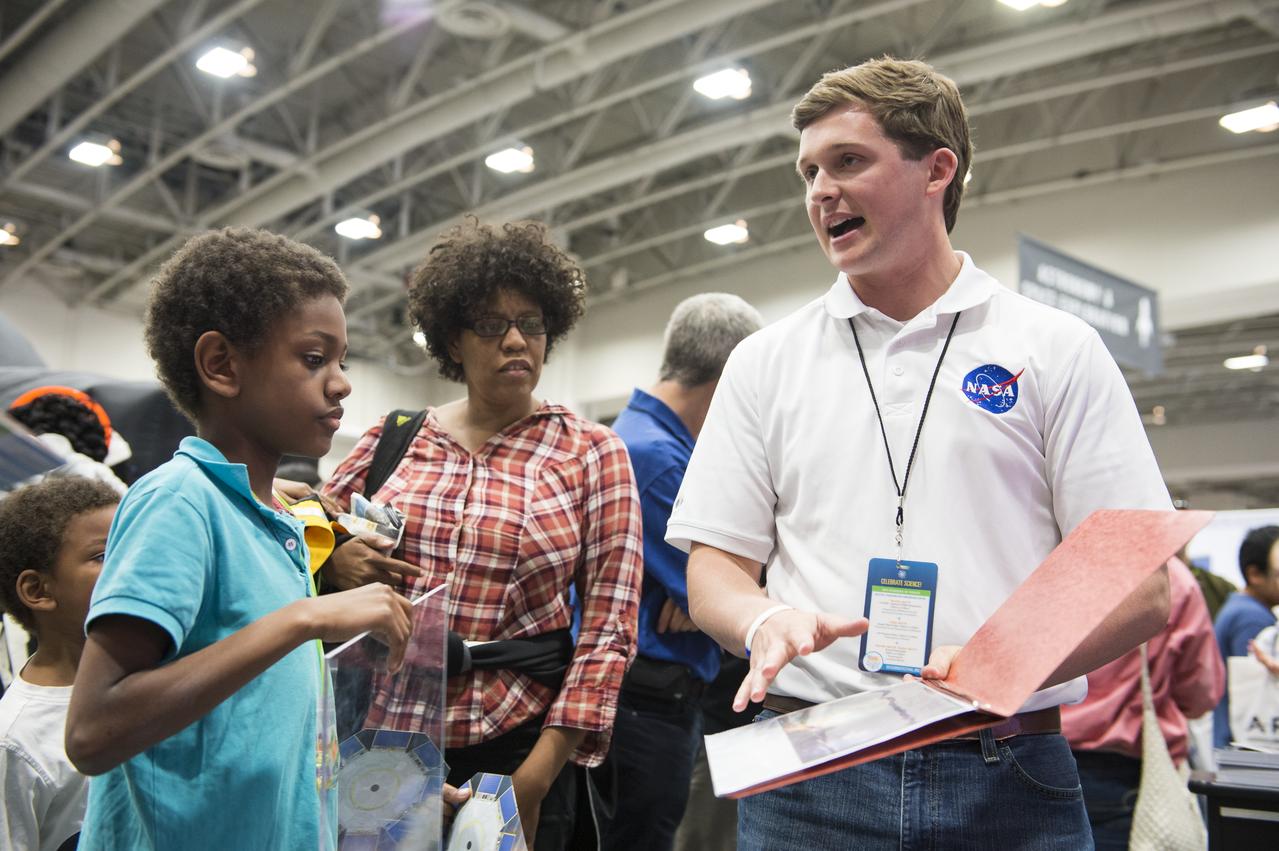
An attendee of the USA Science and Engineering Festival observes the infrared image of himself as a NASA staff member describes the James Webb Space Telescope. It will be a large infrared telescope with a 6.5 meter primary mirror and will study every phase in the history of our Universe ranging from the Big Bang to the formation of our Solar System. The USA Science and Engineering Festival took place at the Washington Convention Center in Washington, DC on April 26 and 27, 2014. Photo Credit: (NASA/Aubrey Gemignani)

An attendee of the USA Science and Engineering Festival examines how glass blocks some heat, altering the infrared image of himself. The James Webb Space Telescope will be a large infrared telescope with a 6.5 meter primary mirror and will study every phase in the history of our Universe ranging from the Big Bang to the formation of our Solar System. The USA Science and Engineering Festival took place at the Washington Convention Center in Washington, DC on April 26 and 27, 2014. Photo Credit: (NASA/Aubrey Gemignani)
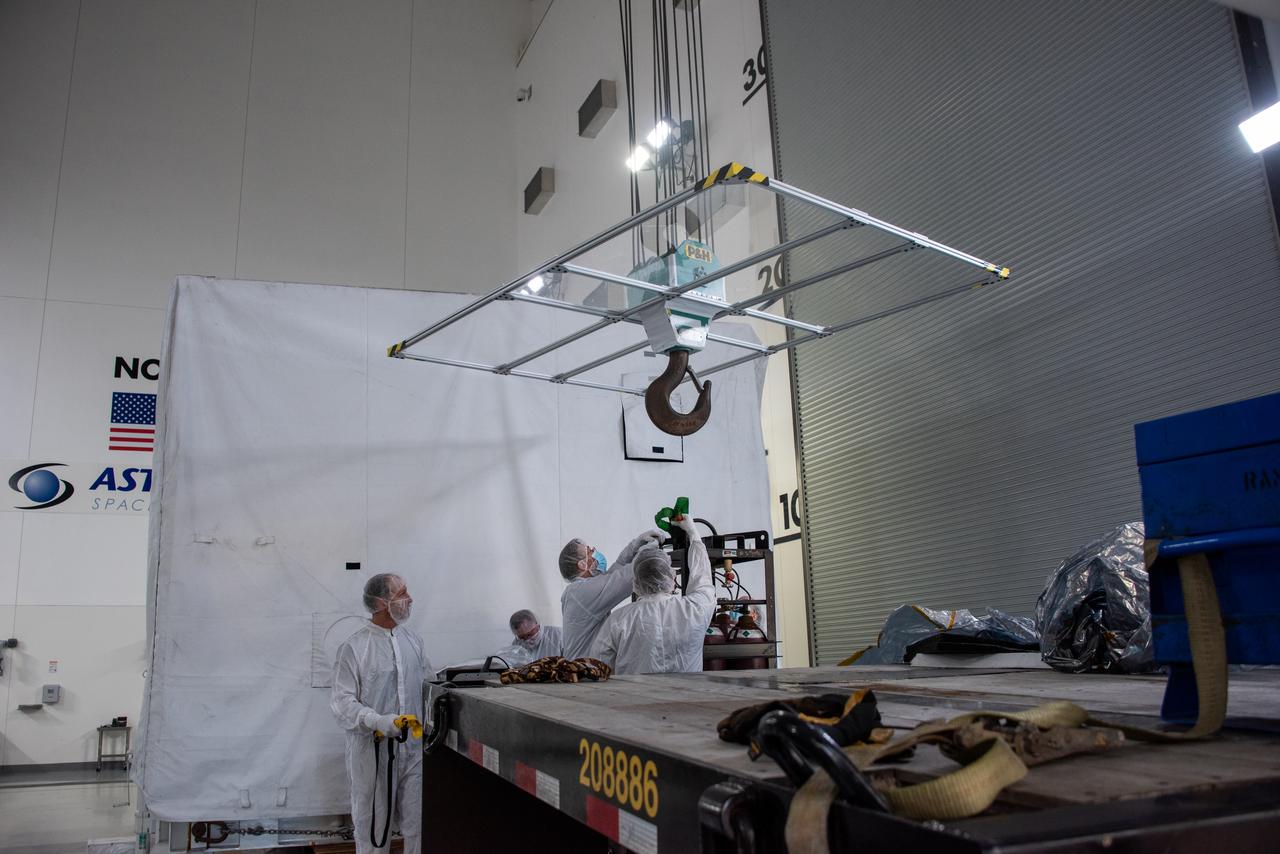
NASA’s SPHEREx (Spectro-Photometer for the History of the Universe, Epoch of Reionization and Ices Explorer), a space telescope, arrives at Vandenberg Space Force Base in California on Tuesday, Jan. 14, 2025. SPHEREx will enter a polar orbit around Earth and create a 3D map of the entire sky, gathering information about millions of galaxies for scientists to study what happened after the big bang, the history of galaxy evolution, and the origins of water in planetary systems in our galaxy. SPHEREx will launch aboard a SpaceX Falcon 9 rocket in late February 2025.
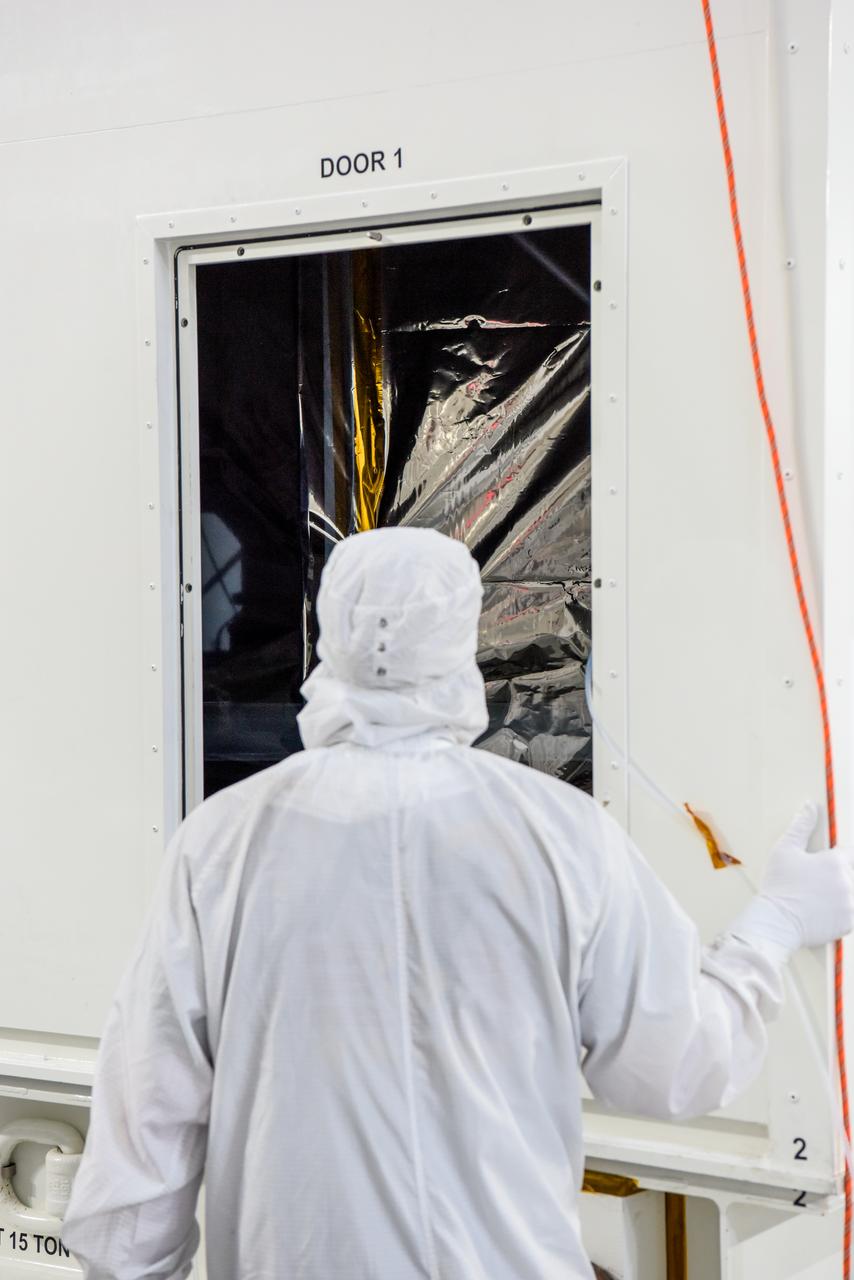
NASA’s SPHEREx (Spectro-Photometer for the History of the Universe, Epoch of Reionization and Ices Explorer) is uncrated for prelaunch processing at Vandenberg Space Force Base in California on Wednesday, Jan. 15, 2025. SPHEREx will enter a polar orbit around Earth and create a 3D map of the entire sky, gathering information about millions of galaxies for scientists to study what happened after the big bang, the history of galaxy evolution, and the origins of water in planetary systems in our galaxy. SPHEREx will launch aboard a SpaceX Falcon 9 rocket in late February 2025.

NASA's Hubble Space Telescope (HST) precisely measured the mass of the oldest known planet in our Milky Way Galaxy bringing closure to a decade of speculation. Scientists weren't sure if the object was a planet or a brown dwarf. Hubble's analysis shows that the object is 2.5 times the mass of Jupiter, confirming that it is indeed a planet. At an estimated age of 13 billion years, the planet is more than twice the age of Earth's 4.5 billion years. It formed around a young, sun-like star barely 1 million years after our universe's birth in the Big Bang. The ancient planet resides in an unlikely, rough neighborhood. It orbits a peculiar pair of burned-out stars in the crowded core cluster of more than 100,000 stars. Its very existence provides evidence that the first planets formed rapidly, within a billion years of the Big Bang, and leads astronomers to conclude that planets may be very abundant in our galaxy. This artist's concept depicts the planet with a view of a rich star filled sky.
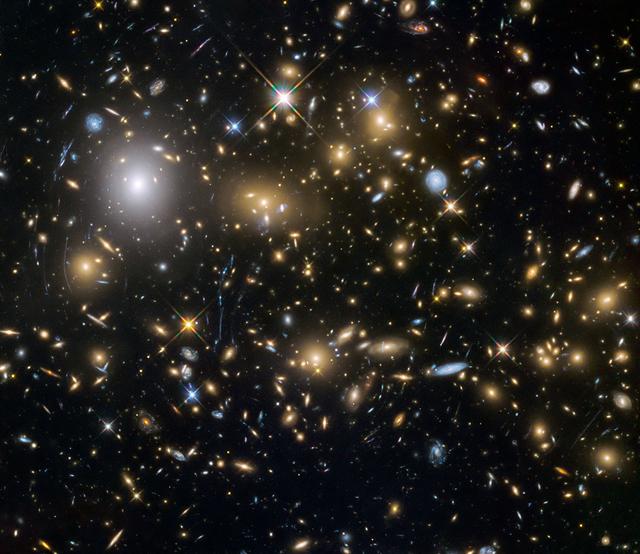
This image from the NASA/ESA Hubble Space Telescope shows the galaxy cluster MACSJ0717.5+3745. This is one of six being studied by the Hubble Frontier Fields programme, which together have produced the deepest images of gravitational lensing ever made. Due to the huge mass of the cluster it is bending the light of background objects, acting as a magnifying lens. It is one of the most massive galaxy clusters known, and it is also the largest known gravitational lens. Of all of the galaxy clusters known and measured, MACS J0717 lenses the largest area of the sky.

NASA's SPHEREx observatory is oriented in a horizontal position, revealing all three layers of photon shields as well as the telescope. This photo was taken at BAE Systems in Boulder, Colorado, in April 2024. Short for Spectro-Photometer for the History of the Universe, Epoch of Reionization and Ices Explorer, SPHEREx will create a map of the cosmos like no other. Using a technique called spectroscopy to image the entire sky in 102 wavelengths of infrared light, SPHEREx will gather information about the composition of and distance to millions of galaxies and stars. With this map, scientists will study what happened in the first fraction of a second after the big bang, how galaxies formed and evolved, and the origins of water in planetary systems in our galaxy. https://photojournal.jpl.nasa.gov/catalog/PIA26542
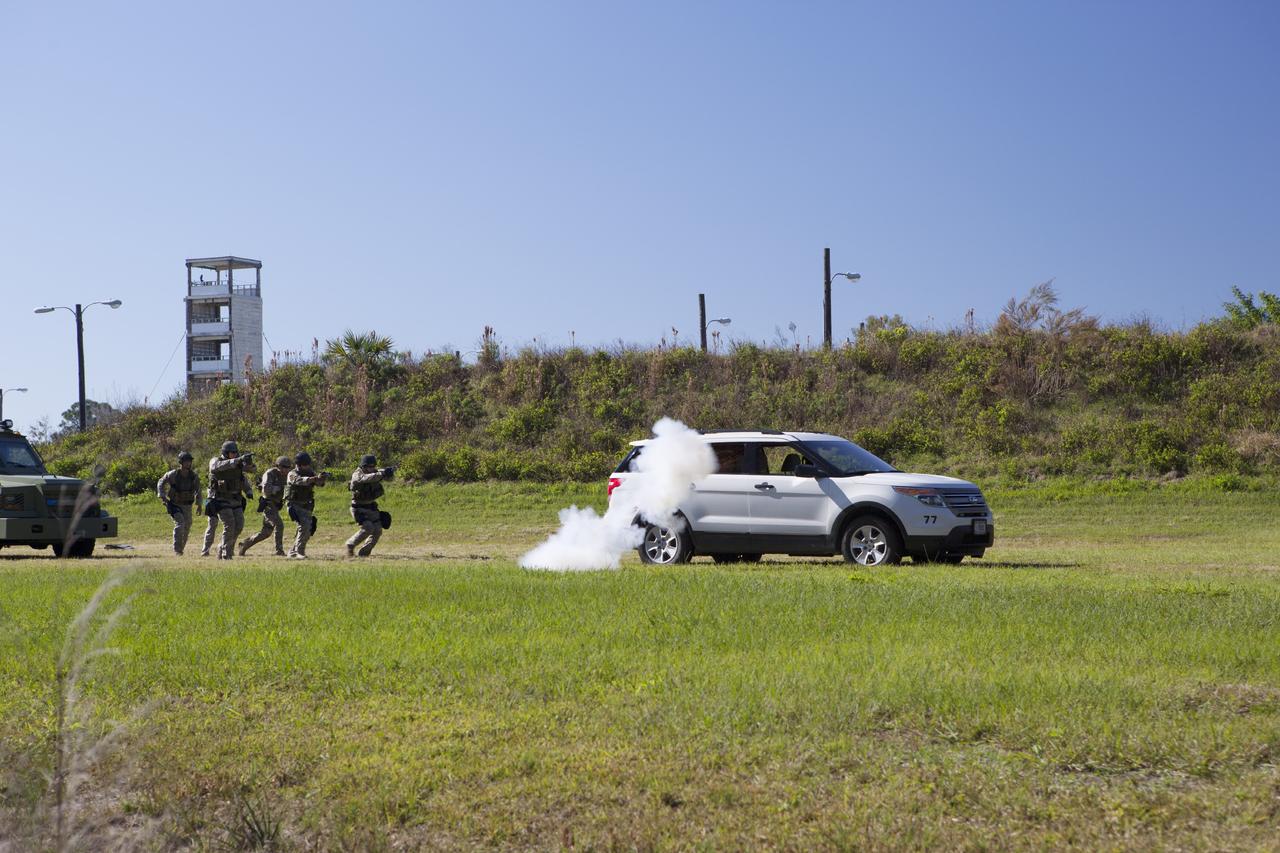
CAPE CANAVERAL, Fla. – At NASA’s Protective Services Training Academy at Kennedy Space Center in Florida, members of the Emergency Response Team, or ERT, participate in specialized training simulations which includes the use of flash bang diversionary devices. They are wearing full protective gear and carrying non-lethal firearms, for the training exercises in order to keep their skills current. Recently, eight members of the ERT competed in the 31st Annual SWAT Roundup International competition in Orlando, Fla., and received recognition by placing in the top five overall. In keeping with NASA’s commitment to safety and security of workforce and assets, the ERT is part of Kennedy’s security team and is trained to respond in the event of an emergency at the center. Photo credit: NASA/Dimitri Gerondidakis
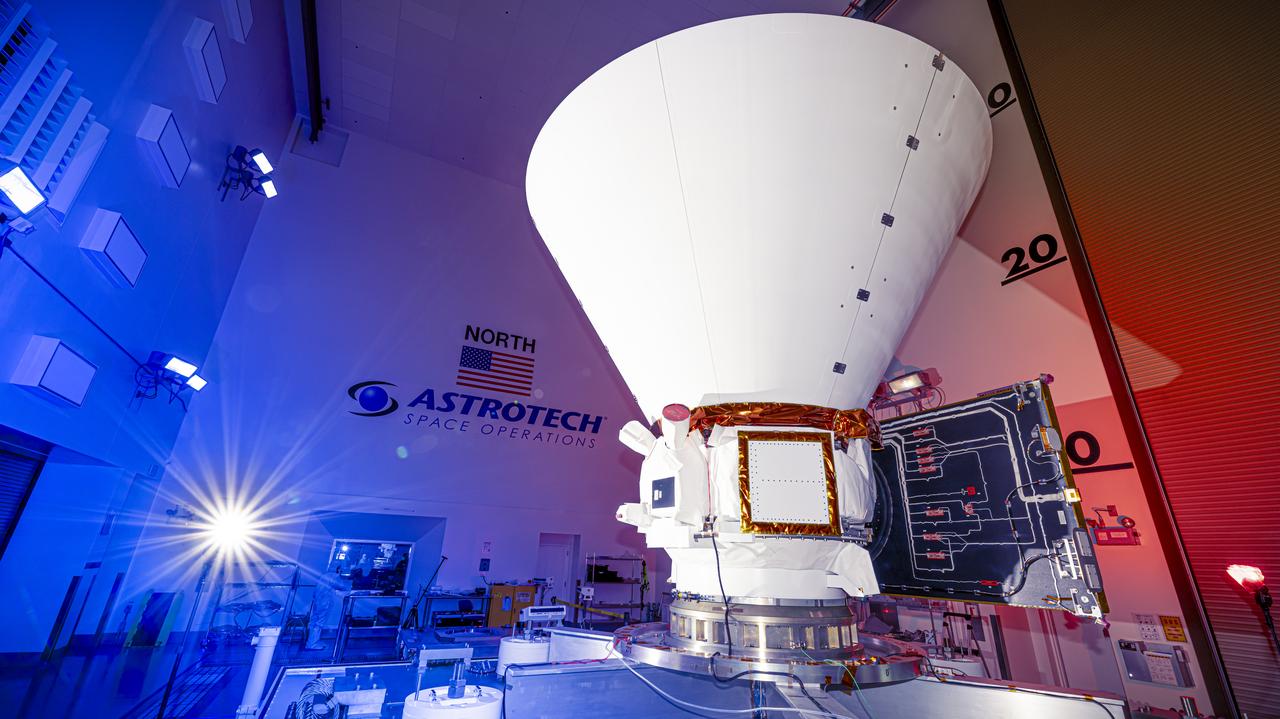
NASA’s SPHEREx (Spectro-Photometer for the History of the Universe, Epoch of Reionization and Ices Explorer), a space telescope, is situated on a work stand ahead of prelaunch operations at the Astrotech Processing Facility at Vandenberg Space Force Base in California on Thursday, Jan. 16, 2025. SPHEREx will enter a polar orbit around Earth and create a 3D map of the entire sky, gathering information about millions of galaxies for scientists to study what happened after the big bang, the history of galaxy evolution, and the origins of water in planetary systems in our galaxy. SPHEREx will launch aboard a SpaceX Falcon 9 rocket in late February 2025.
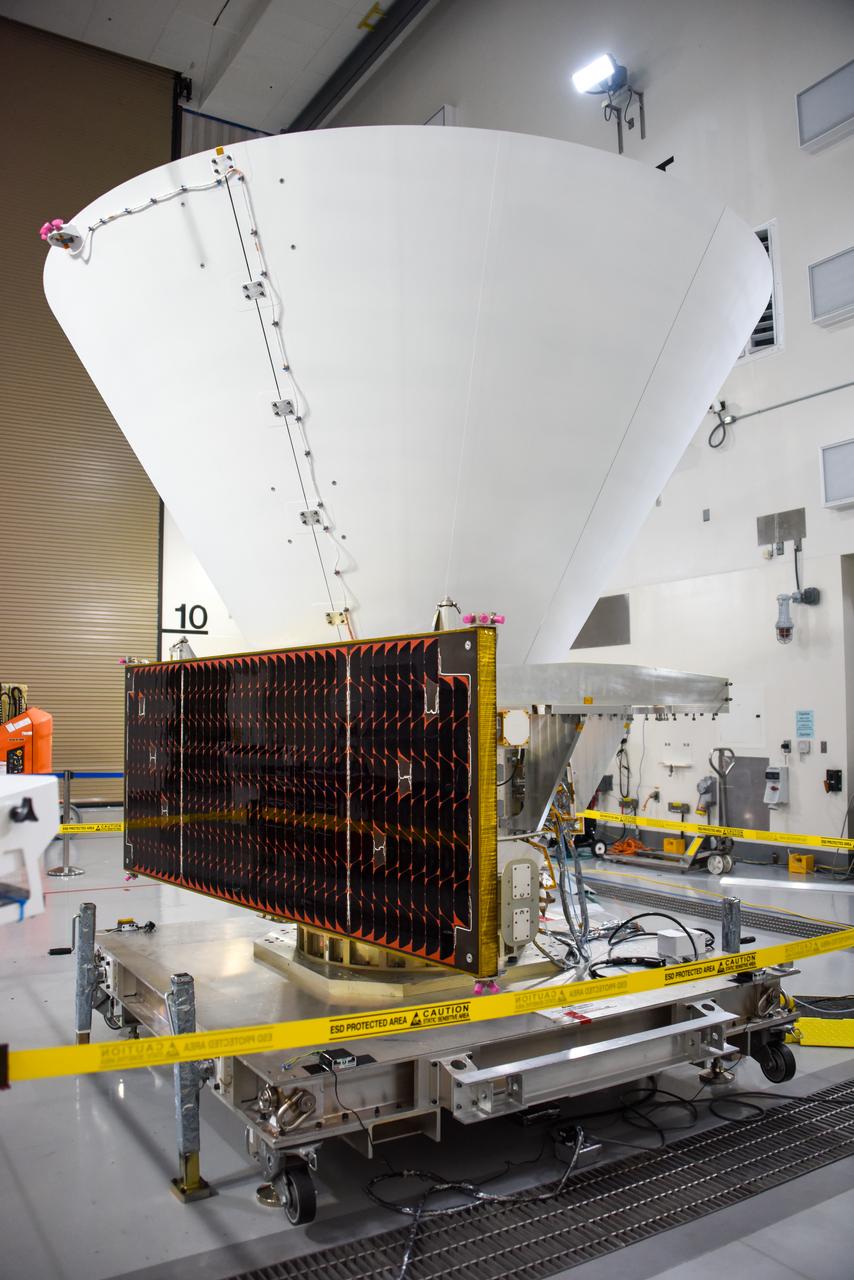
NASA’s SPHEREx (Spectro-Photometer for the History of the Universe, Epoch of Reionization and Ices Explorer), a space telescope, is situated on a work stand ahead of prelaunch operations at the Astrotech Processing Facility at Vandenberg Space Force Base in California on Friday, Jan. 17, 2025. SPHEREx will enter a polar orbit around Earth and create a 3D map of the entire sky, gathering information about millions of galaxies for scientists to study what happened after the big bang, the history of galaxy evolution, and the origins of water in planetary systems in our galaxy. SPHEREx will launch aboard a SpaceX Falcon 9 rocket in late February 2025.
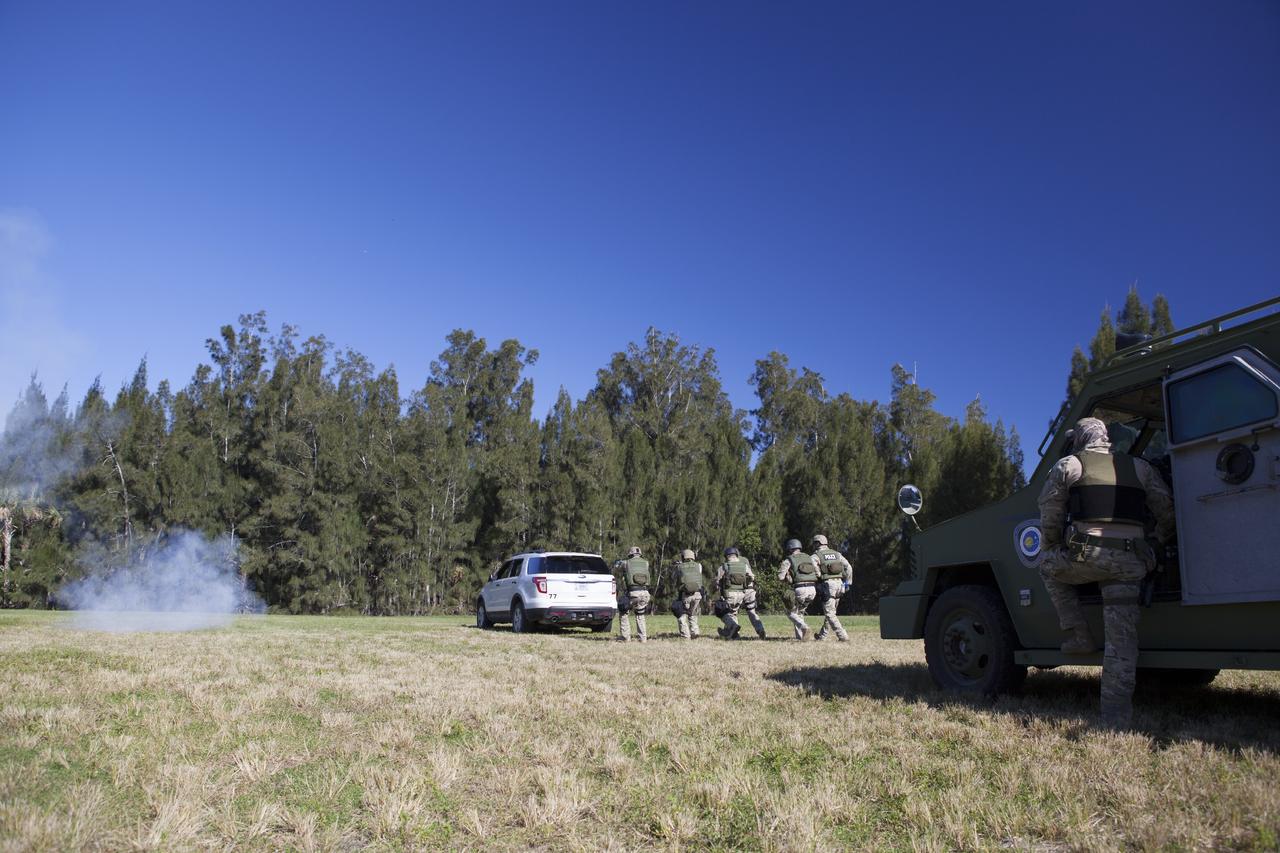
CAPE CANAVERAL, Fla. – At NASA’s Protective Services Training Academy at Kennedy Space Center in Florida, members of the Emergency Response Team, or ERT, participate in specialized training simulations which includes the use of flash bang diversionary devices. They are wearing full protective gear and carrying non-lethal firearms for the training exercises in order to keep their skills current. Recently, eight members of the ERT competed in the 31st Annual SWAT Roundup International competition in Orlando, Fla., and received recognition by placing in the top five overall. In keeping with NASA’s commitment to safety and security of workforce and assets, the ERT is part of Kennedy’s security team and is trained to respond in the event of an emergency at the center. Photo credit: NASA/Dimitri Gerondidakis
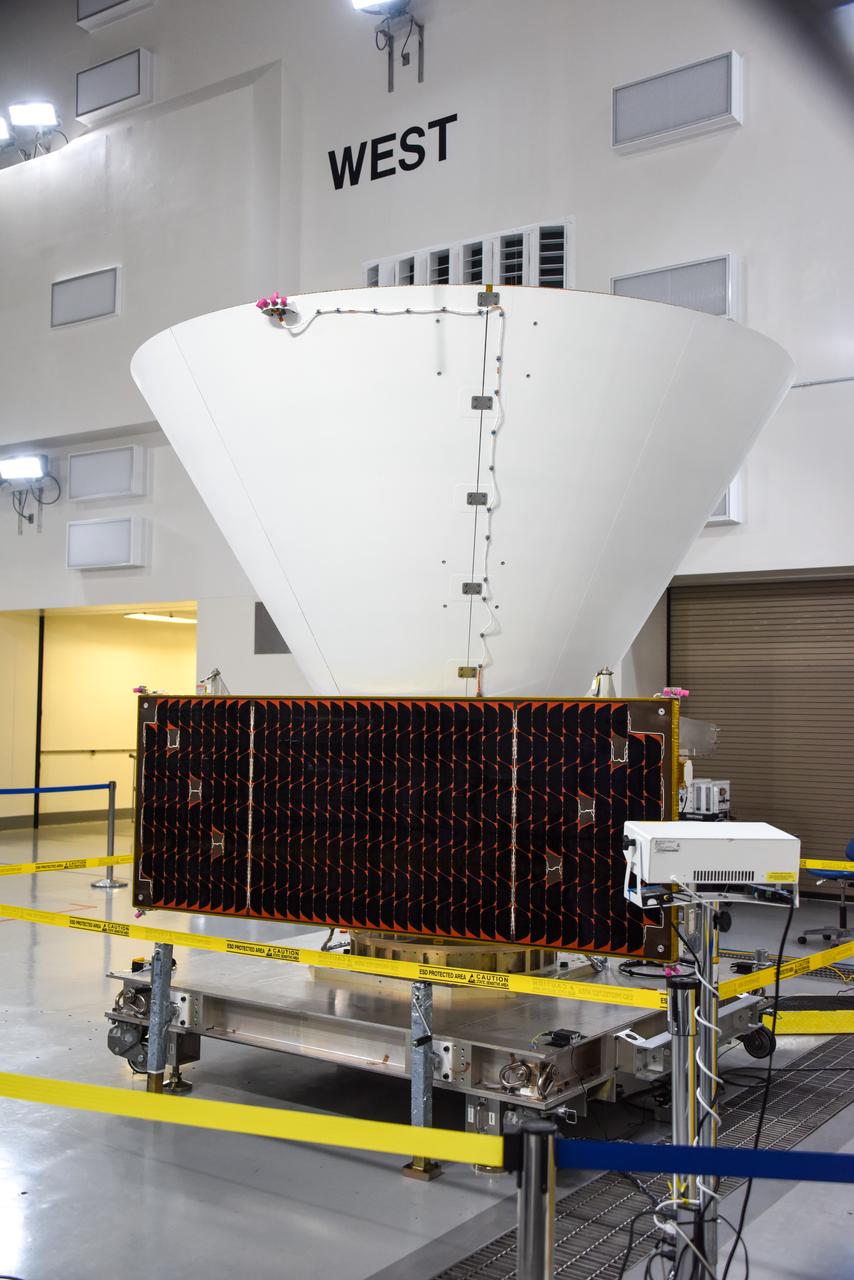
NASA’s SPHEREx (Spectro-Photometer for the History of the Universe, Epoch of Reionization and Ices Explorer), a space telescope, is situated on a work stand ahead of prelaunch operations at the Astrotech Processing Facility at Vandenberg Space Force Base in California on Friday, Jan. 17, 2025. SPHEREx will enter a polar orbit around Earth and create a 3D map of the entire sky, gathering information about millions of galaxies for scientists to study what happened after the big bang, the history of galaxy evolution, and the origins of water in planetary systems in our galaxy. SPHEREx will launch aboard a SpaceX Falcon 9 rocket in late February 2025.
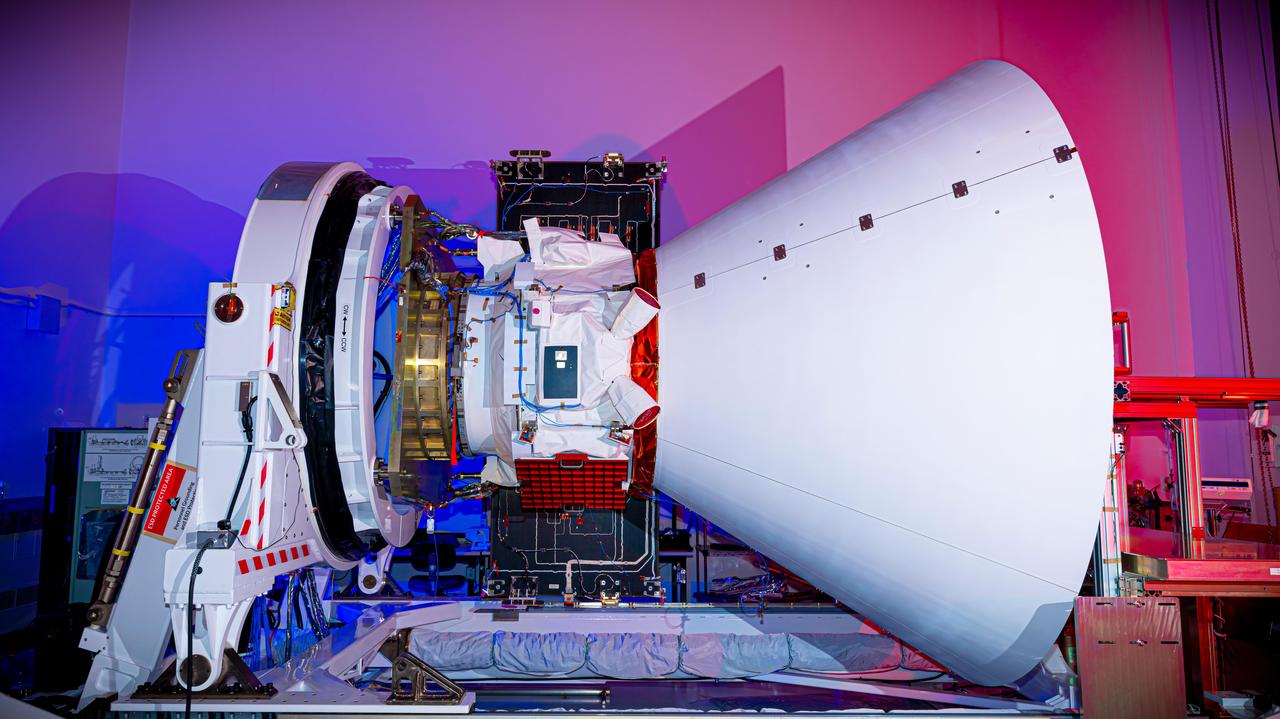
The SPHEREx observatory sits in a clean room after environmental testing at BAE Systems in Boulder, Colorado, in late 2024. Short for Spectro-Photometer for the History of the Universe, Epoch of Reionization and Ices Explorer, SPHEREx will create a map of the cosmos like no other. Using a technique called spectroscopy to image the entire sky in 102 wavelengths of infrared light, SPHEREx will gather information about the composition of and distance to millions of galaxies and stars. With this map, scientists will study what happened in the first fraction of a second after the big bang, how galaxies formed and evolved, and the origins of water in planetary systems in our galaxy. https://photojournal.jpl.nasa.gov/catalog/PIA26537
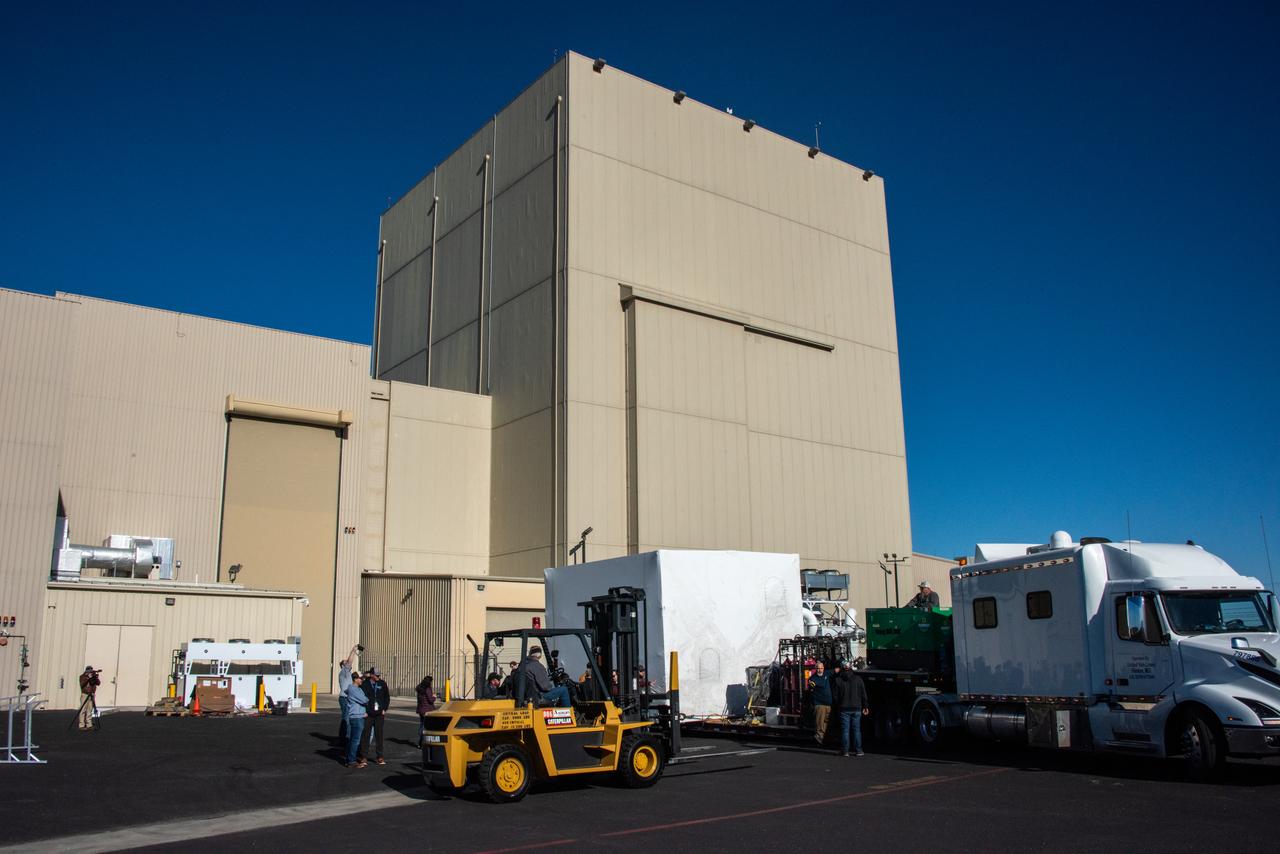
A transport truck carrying NASA’s SPHEREx (Spectro-Photometer for the History of the Universe, Epoch of Reionization and Ices Explorer), a space telescope, arrives at Vandenberg Space Force Base in California on Tuesday, Jan. 14, 2025. SPHEREx will enter a polar orbit around Earth and create a 3D map of the entire sky, gathering information about millions of galaxies for scientists to study what happened after the big bang, the history of galaxy evolution, and the origins of water in planetary systems in our galaxy. SPHEREx will launch aboard a SpaceX Falcon 9 rocket in late February 2025.
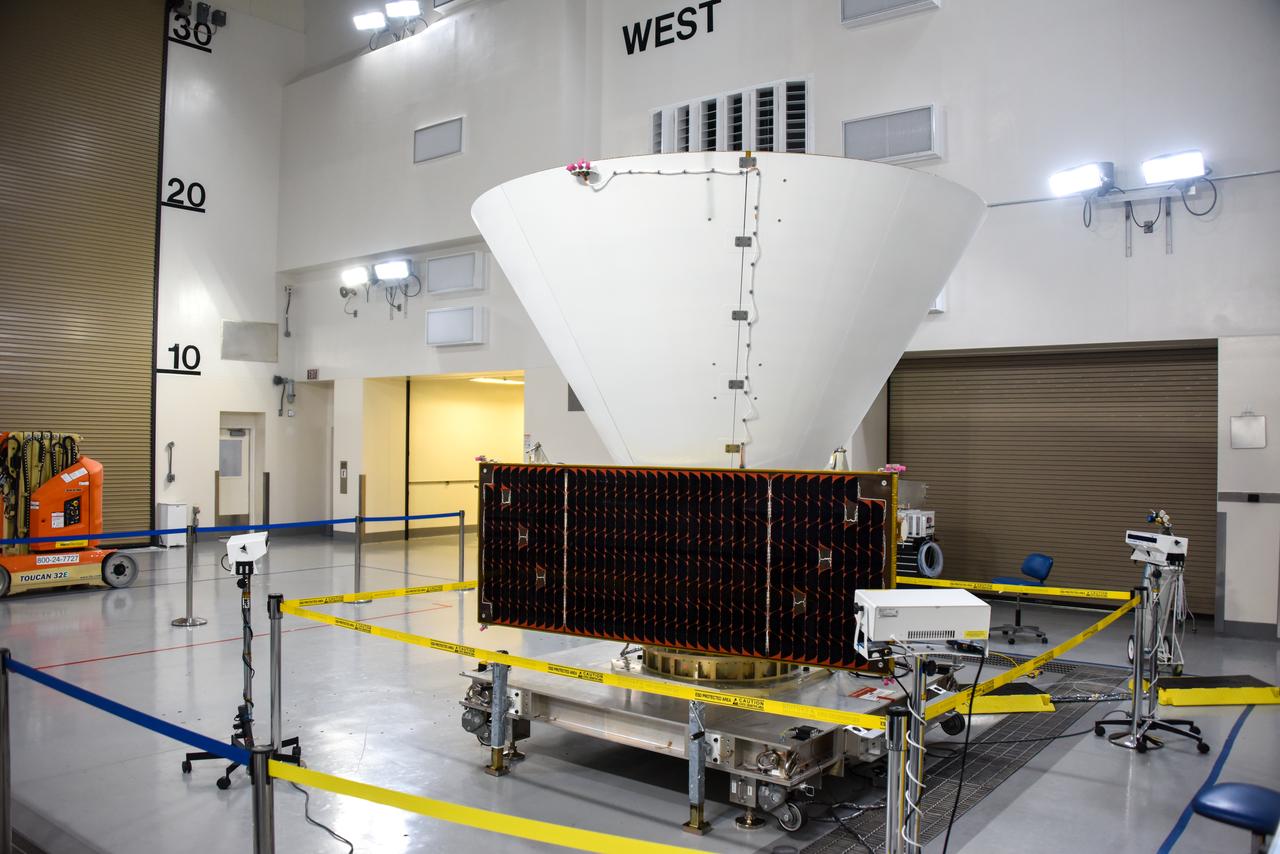
NASA’s SPHEREx (Spectro-Photometer for the History of the Universe, Epoch of Reionization and Ices Explorer), a space telescope, is situated on a work stand ahead of prelaunch operations at the Astrotech Processing Facility at Vandenberg Space Force Base in California on Friday, Jan. 17, 2025. SPHEREx will enter a polar orbit around Earth and create a 3D map of the entire sky, gathering information about millions of galaxies for scientists to study what happened after the big bang, the history of galaxy evolution, and the origins of water in planetary systems in our galaxy. SPHEREx will launch aboard a SpaceX Falcon 9 rocket in late February 2025.
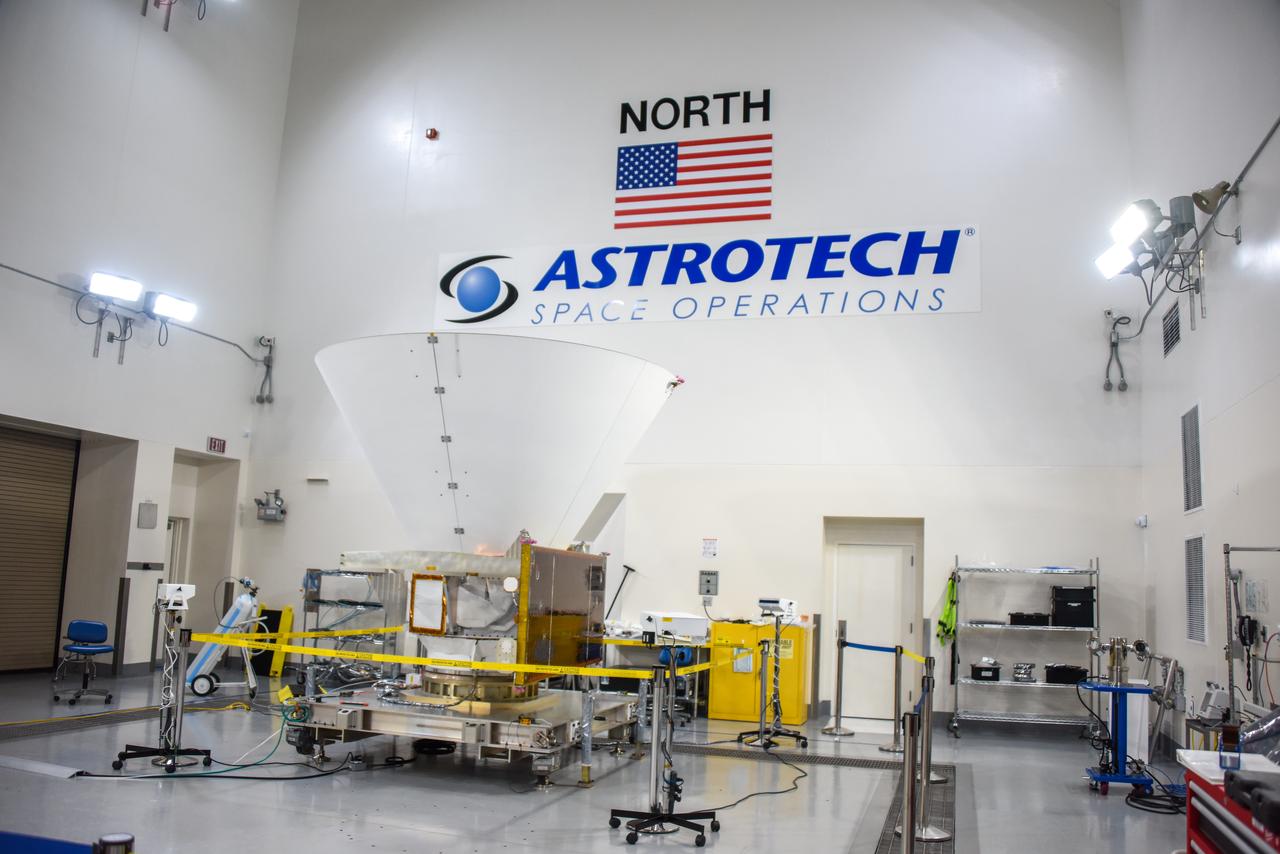
NASA’s SPHEREx (Spectro-Photometer for the History of the Universe, Epoch of Reionization and Ices Explorer), a space telescope, is situated on a work stand ahead of prelaunch operations at the Astrotech Processing Facility at Vandenberg Space Force Base in California on Friday, Jan. 17, 2025. SPHEREx will enter a polar orbit around Earth and create a 3D map of the entire sky, gathering information about millions of galaxies for scientists to study what happened after the big bang, the history of galaxy evolution, and the origins of water in planetary systems in our galaxy. SPHEREx will launch aboard a SpaceX Falcon 9 rocket in late February 2025.
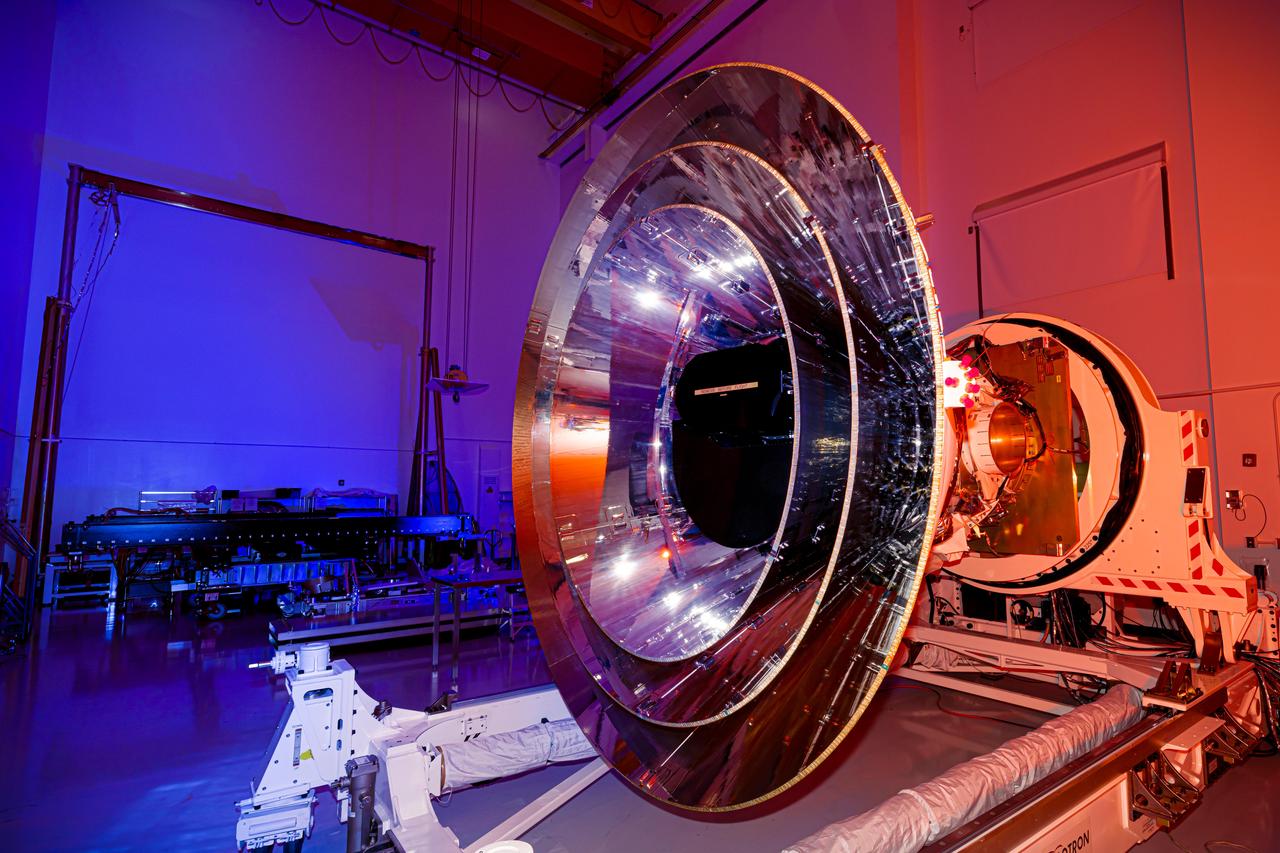
NASA's SPHEREx observatory undergoes integration and testing at BAE Systems in Boulder, Colorado, in April 2024. Short for Spectro-Photometer for the History of the Universe, Epoch of Reionization and Ices Explorer, SPHEREx will create a map of the cosmos like no other. Using a technique called spectroscopy to image the entire sky in 102 wavelengths of infrared light, SPHEREx will gather information about the composition of and distance to millions of galaxies and stars. With this map, scientists will study what happened in the first fraction of a second after the big bang, how galaxies formed and evolved, and the origins of water in planetary systems in our galaxy. https://photojournal.jpl.nasa.gov/catalog/PIA26538

NASA’s SPHEREx (Spectro-Photometer for the History of the Universe, Epoch of Reionization and Ices Explorer), a space telescope, is situated on a work stand ahead of prelaunch operations at the Astrotech Processing Facility at Vandenberg Space Force Base in California on Friday, Jan. 17, 2025. SPHEREx will enter a polar orbit around Earth and create a 3D map of the entire sky, gathering information about millions of galaxies for scientists to study what happened after the big bang, the history of galaxy evolution, and the origins of water in planetary systems in our galaxy. SPHEREx will launch aboard a SpaceX Falcon 9 rocket in late February 2025.
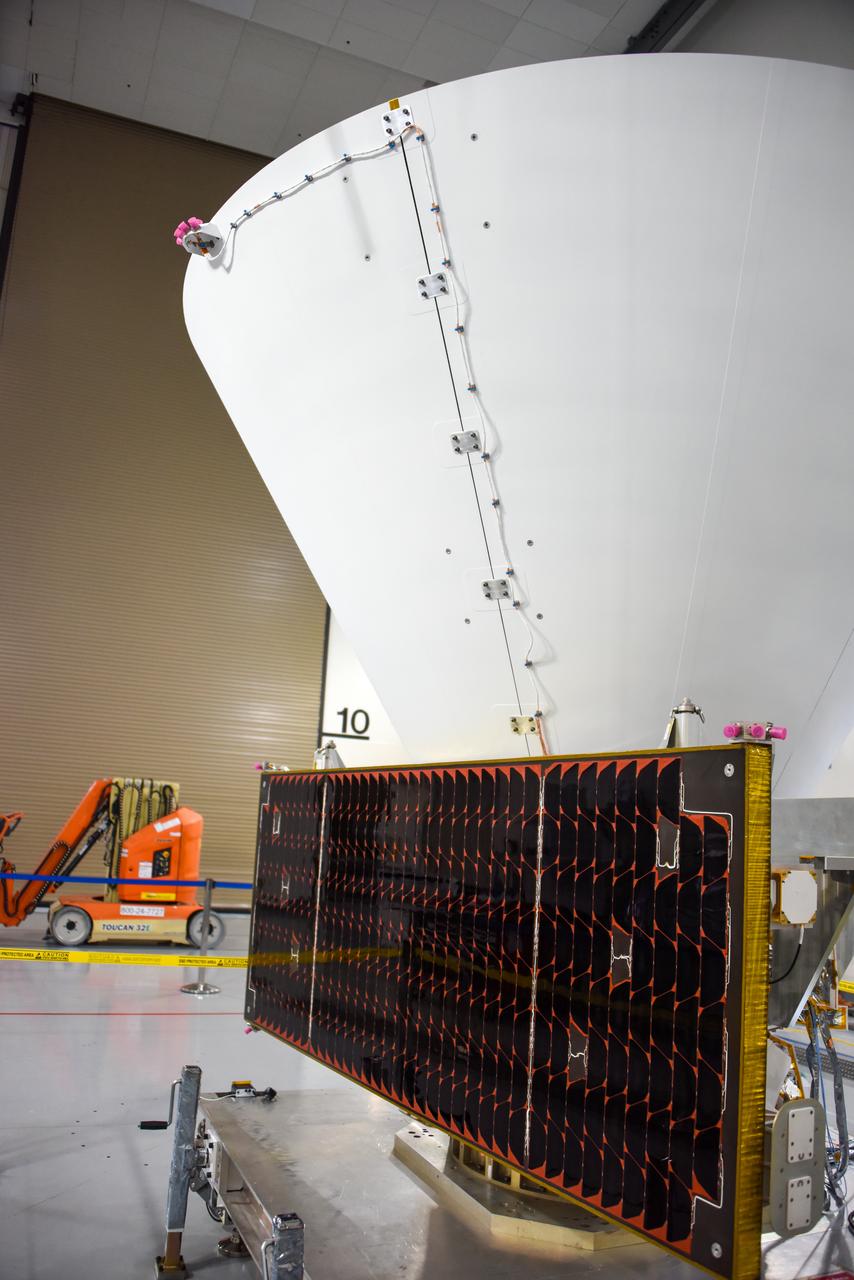
NASA’s SPHEREx (Spectro-Photometer for the History of the Universe, Epoch of Reionization and Ices Explorer), a space telescope, is situated on a work stand ahead of prelaunch operations at the Astrotech Processing Facility at Vandenberg Space Force Base in California on Friday, Jan. 17, 2025. SPHEREx will enter a polar orbit around Earth and create a 3D map of the entire sky, gathering information about millions of galaxies for scientists to study what happened after the big bang, the history of galaxy evolution, and the origins of water in planetary systems in our galaxy. SPHEREx will launch aboard a SpaceX Falcon 9 rocket in late February 2025.
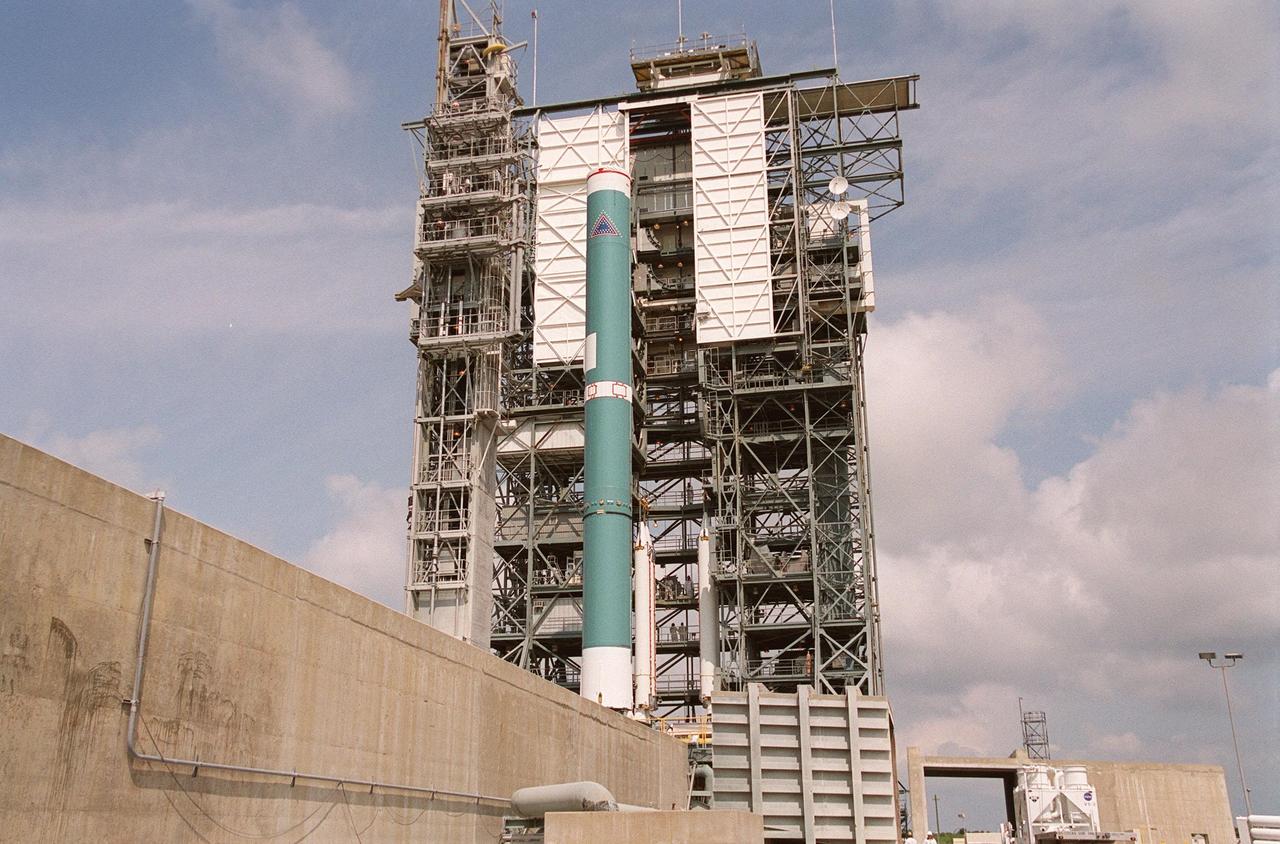
KENNEDY SPACE CENTER, FLA. -- On Launch Complex 17-B, Cape Canaveral Air Force Station, the Delta II rocket waits to be mated to four solid rocket boosters (behind the Delta). The rocket will launch the MAP instrument into a lunar-assisted trajectory to the Sun-Earth for a 27-month mission. The MAP mission will examine conditions in the early universe by measuring temperature differences in cosmic microwave background radiation, which is the radiant heat left over from the Big Bang. The properties of this radiation directly reflect conditions in the early universe. MAP is scheduled to launch June 30 at 3:46:46 p.m. EDT

NASA’s SPHEREx (Spectro-Photometer for the History of the Universe, Epoch of Reionization and Ices Explorer), a space telescope, is situated on a work stand ahead of prelaunch operations at the Astrotech Processing Facility at Vandenberg Space Force Base in California on Friday, Jan. 17, 2025. SPHEREx will enter a polar orbit around Earth and create a 3D map of the entire sky, gathering information about millions of galaxies for scientists to study what happened after the big bang, the history of galaxy evolution, and the origins of water in planetary systems in our galaxy. SPHEREx will launch aboard a SpaceX Falcon 9 rocket in late February 2025.
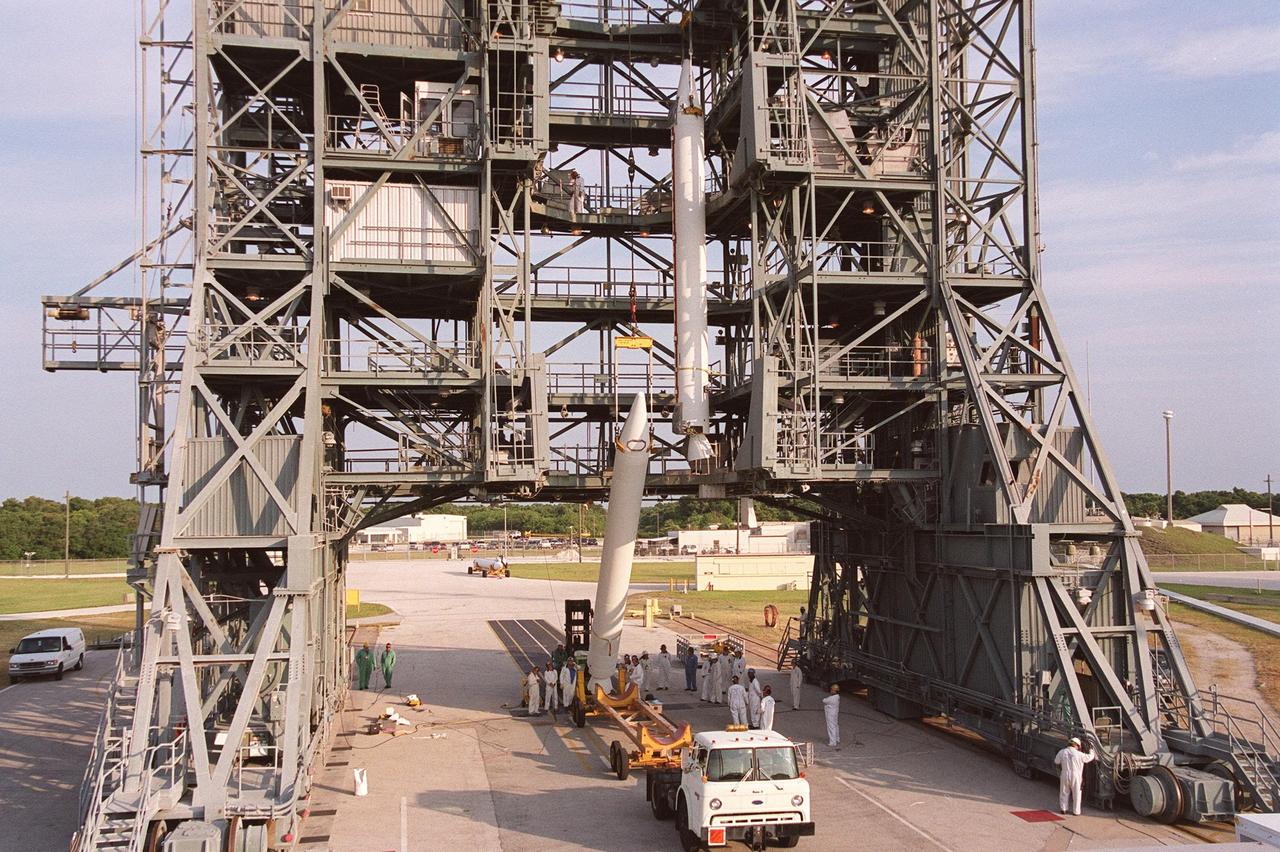
KENNEDY SPACE CENTER, FLA. -- A second solid rocket booster is lifted up the gantry at Launch Complex 17-B, Cape Canaveral Air Force Station. The SRBs will be mated to the Delta II rocket that will launch the MAP instrument into a lunar-assisted trajectory to the Sun-Earth for a 27-month mission. The MAP mission will examine conditions in the early universe by measuring temperature differences in cosmic microwave background radiation, which is the radiant heat left over from the Big Bang. The properties of this radiation directly reflect conditions in the early universe. MAP is scheduled to launch June 30 at 3:46:46 p.m. EDT
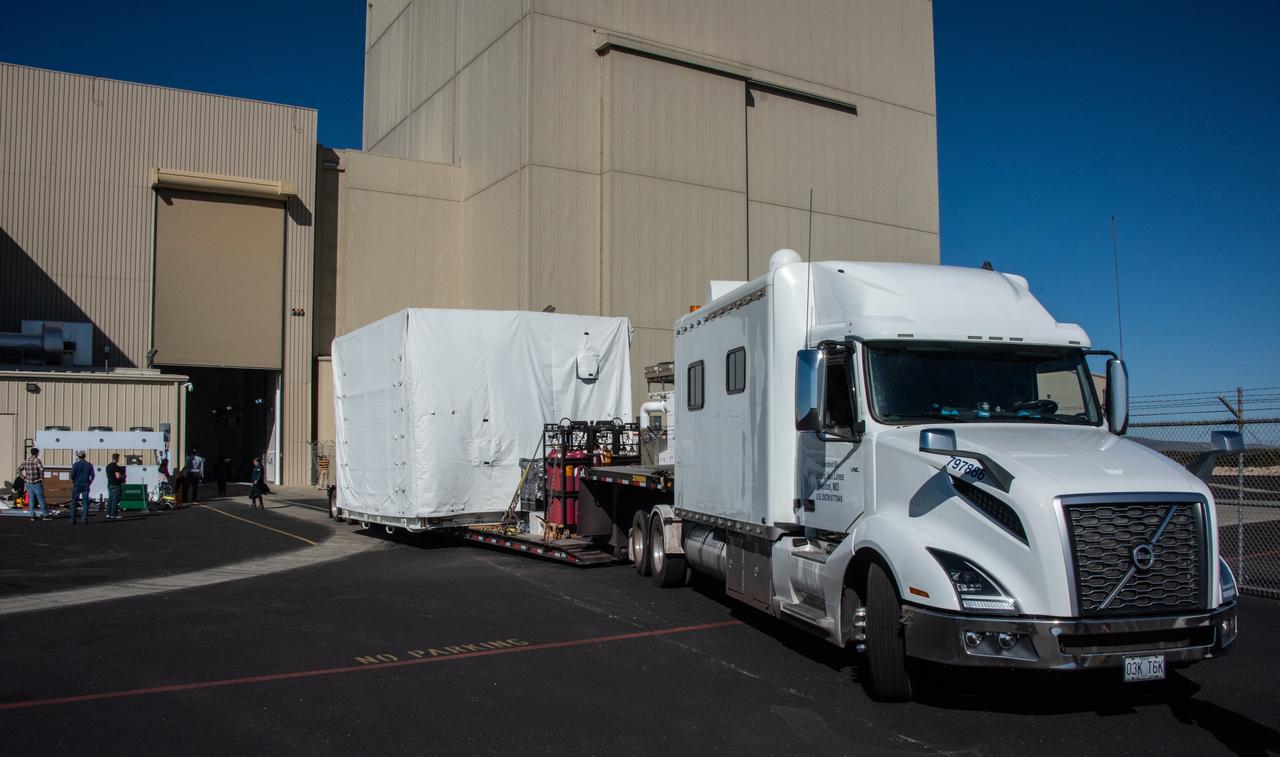
A transport truck carrying NASA’s SPHEREx (Spectro-Photometer for the History of the Universe, Epoch of Reionization and Ices Explorer), a space telescope, arrives at Vandenberg Space Force Base in California on Tuesday, Jan. 14, 2025. SPHEREx will enter a polar orbit around Earth and create a 3D map of the entire sky, gathering information about millions of galaxies for scientists to study what happened after the big bang, the history of galaxy evolution, and the origins of water in planetary systems in our galaxy. SPHEREx will launch aboard a SpaceX Falcon 9 rocket in late February 2025.
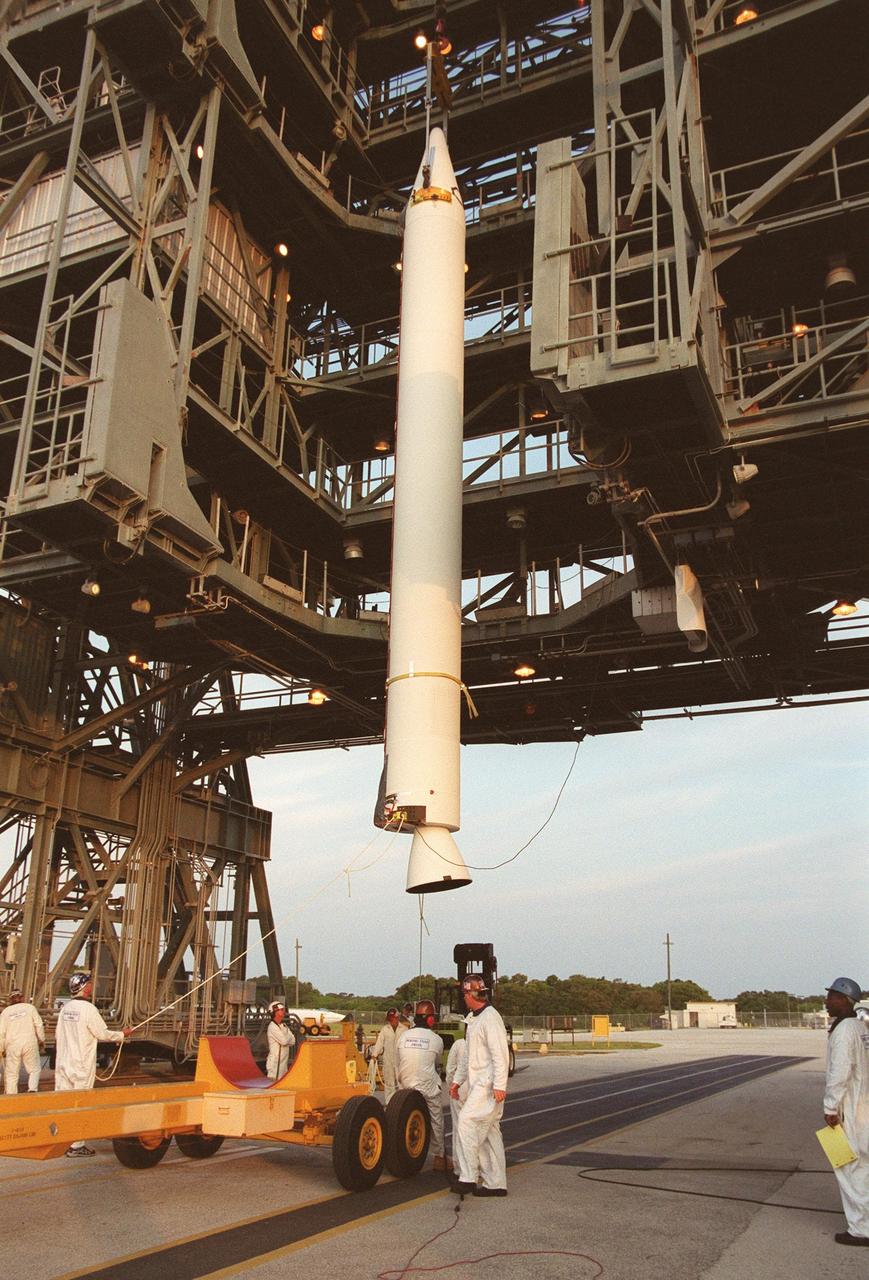
KENNEDY SPACE CENTER, FLA. -- A solid rocket booster is lifted up the gantry at Launch Complex 17-B, Cape Canaveral Air Force Station. The SRB will be mated to the Delta II rocket that will launch the MAP instrument into a lunar-assisted trajectory to the Sun-Earth for a 27-month mission. The MAP mission will examine conditions in the early universe by measuring temperature differences in cosmic microwave background radiation, which is the radiant heat left over from the Big Bang. The properties of this radiation directly reflect conditions in the early universe. MAP is scheduled to launch June 30 at 3:46:46 p.m. EDT
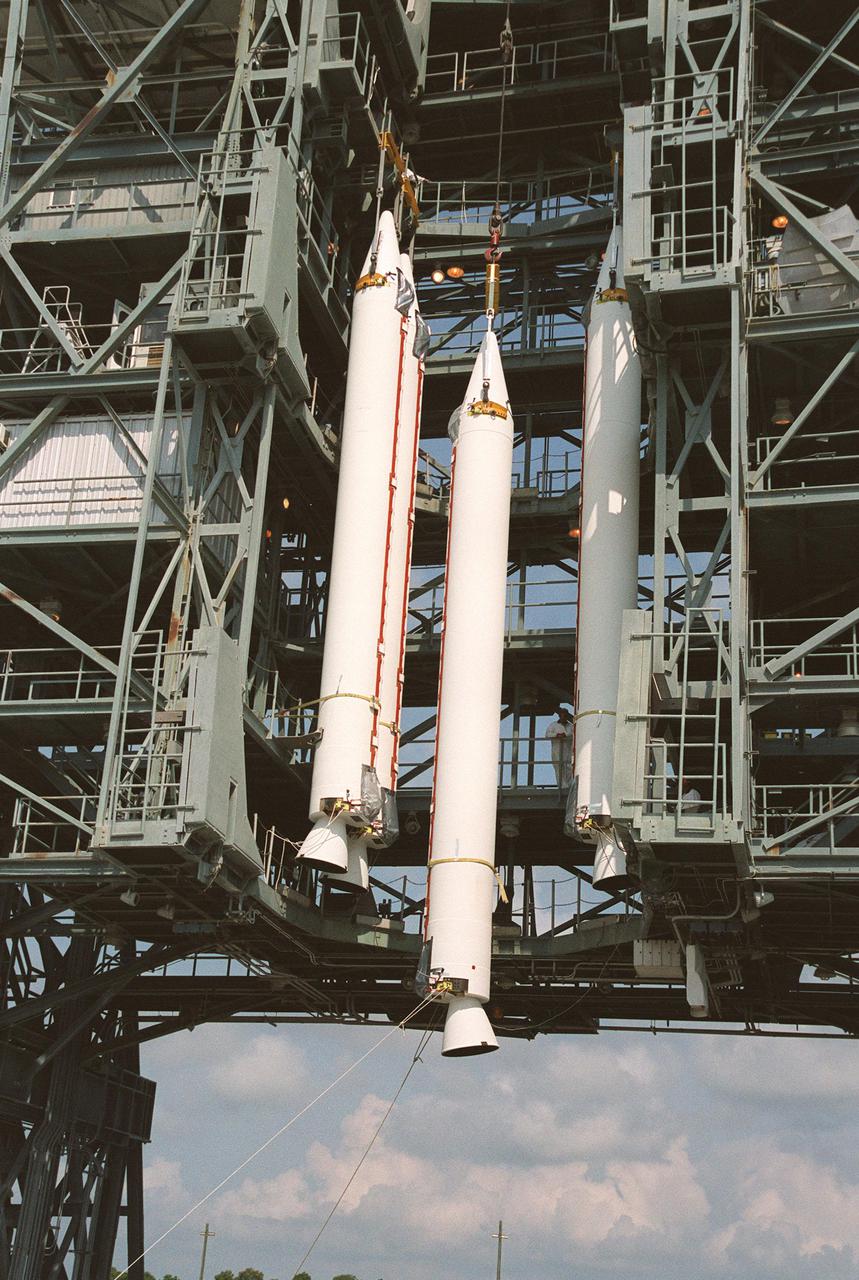
KENNEDY SPACE CENTER, FLA. -- Four solid rocket boosters are lifted up the gantry at Launch Complex 17-B, Cape Canaveral Air Force Station. The SRBs will be mated to the Delta II rocket that will launch the MAP instrument into a lunar-assisted trajectory to the Sun-Earth for a 27-month mission. The MAP mission will examine conditions in the early universe by measuring temperature differences in cosmic microwave background radiation, which is the radiant heat left over from the Big Bang. The properties of this radiation directly reflect conditions in the early universe. MAP is scheduled to launch June 30 at 3:46:46 p.m. EDT
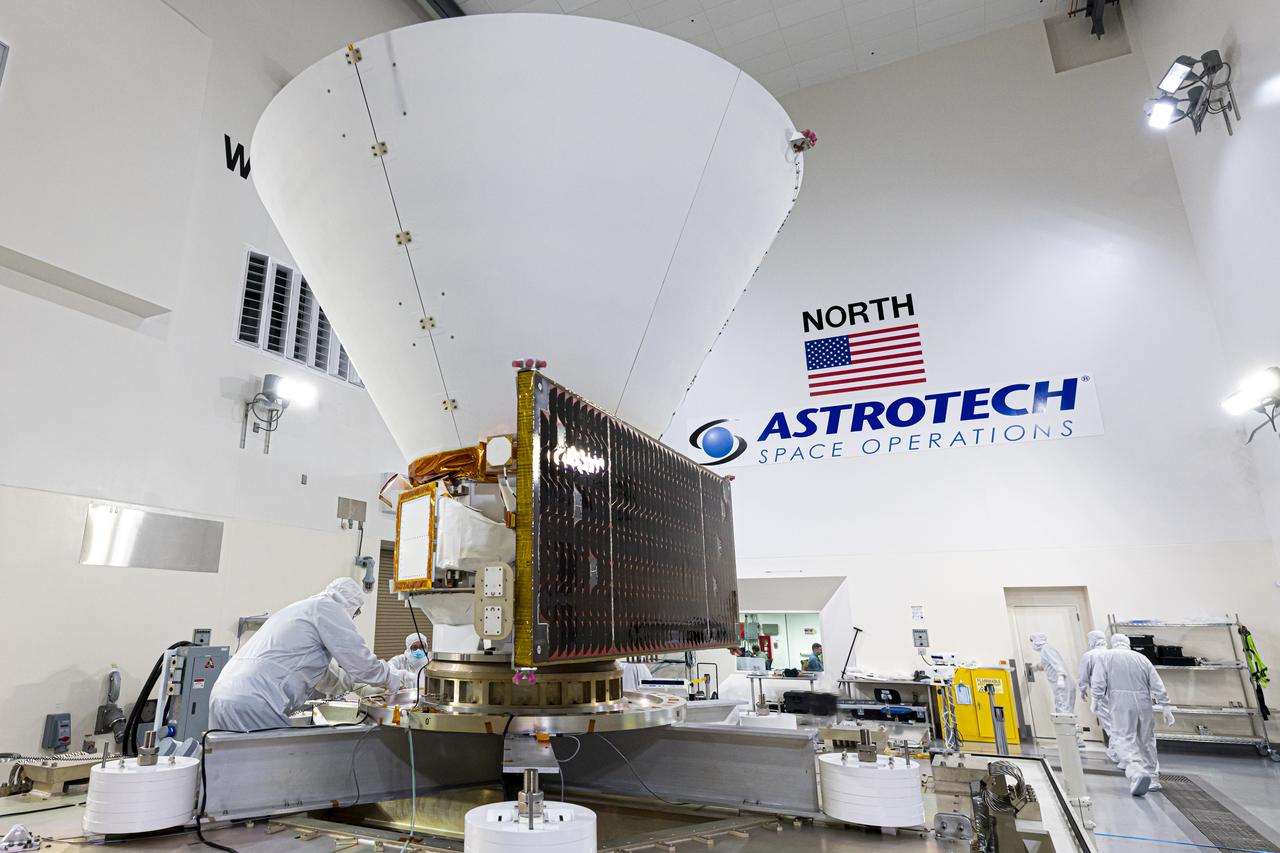
NASA’s SPHEREx (Spectro-Photometer for the History of the Universe, Epoch of Reionization and Ices Explorer), a space telescope, is situated on a work stand ahead of prelaunch operations at the Astrotech Processing Facility at Vandenberg Space Force Base in California on Thursday, Jan. 16, 2025. SPHEREx will enter a polar orbit around Earth and create a 3D map of the entire sky, gathering information about millions of galaxies for scientists to study what happened after the big bang, the history of galaxy evolution, and the origins of water in planetary systems in our galaxy. SPHEREx will launch aboard a SpaceX Falcon 9 rocket in late February 2025.
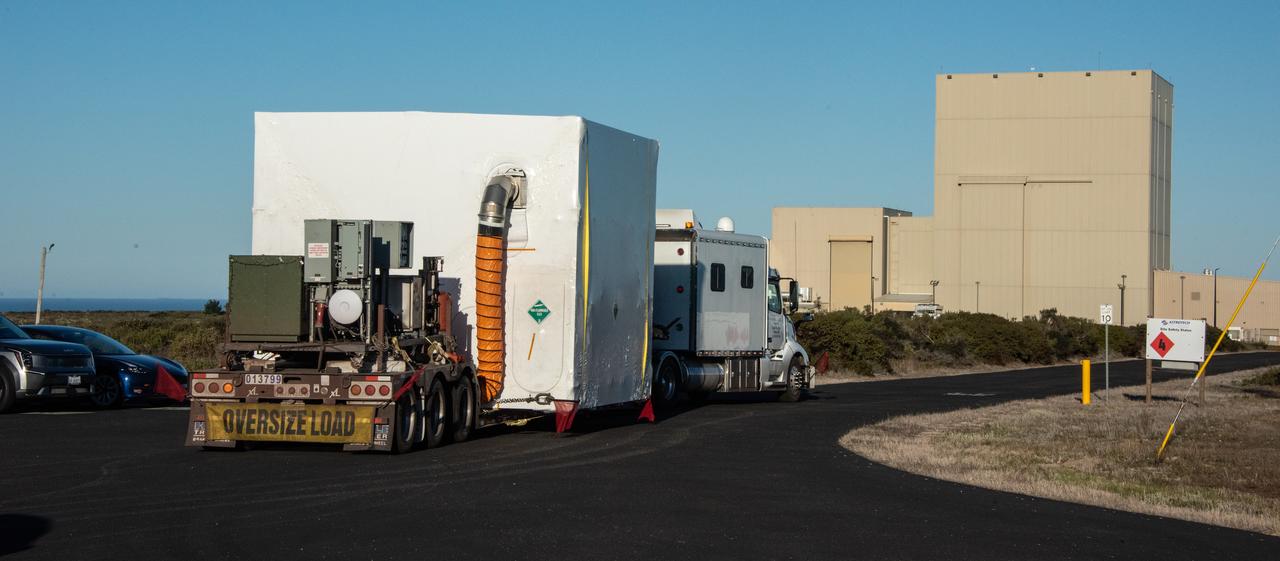
A transport truck carrying NASA’s SPHEREx (Spectro-Photometer for the History of the Universe, Epoch of Reionization and Ices Explorer), a space telescope, arrives at Vandenberg Space Force Base in California on Tuesday, Jan. 14, 2025. SPHEREx will enter a polar orbit around Earth and create a 3D map of the entire sky, gathering information about millions of galaxies for scientists to study what happened after the big bang, the history of galaxy evolution, and the origins of water in planetary systems in our galaxy. SPHEREx will launch aboard a SpaceX Falcon 9 rocket in late February 2025.
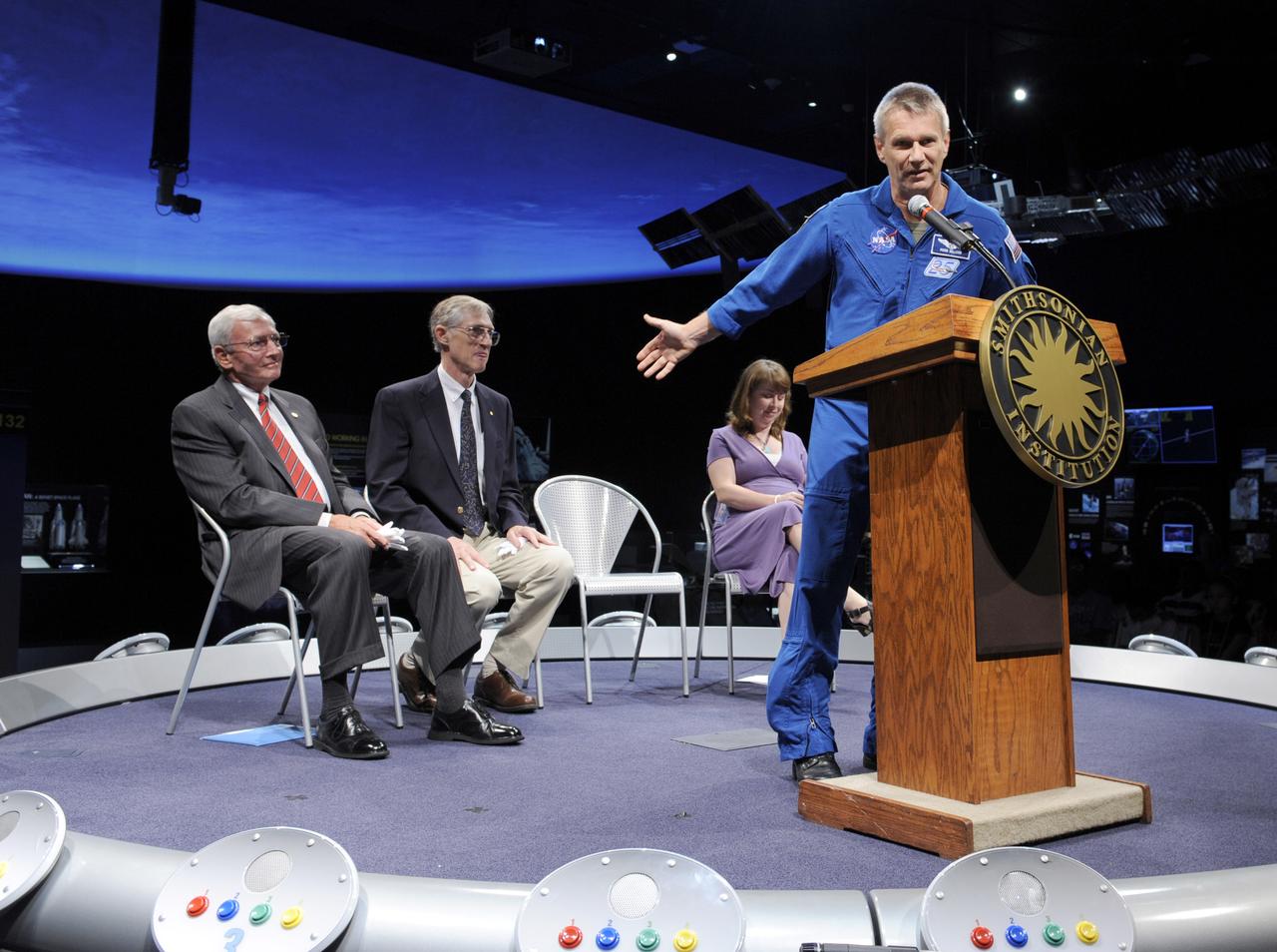
STS-132 astronaut Piers Sellers, at podium, acknowleges museum director Ret. Gen. John R. "Jack" Dailey, seated left, and NASA astrophycisist Dr. John Mather, center, during a presentation, Tuesday, July 27, 2010, at the Smithsonian National Air and Space Museum in Washington. Sellers returned a replica of the Nobel Prize that is in the museum's collection and was flown aboard STS-132 Atlantis. The prize was won by Mather and University of California, Berkeley researcher George Smoot in 2006 for their work using the Cosmic Background Explorer Satellite to understand the big-bang theory of the universe.Photo Credit: (NASA/Paul E. Alers)
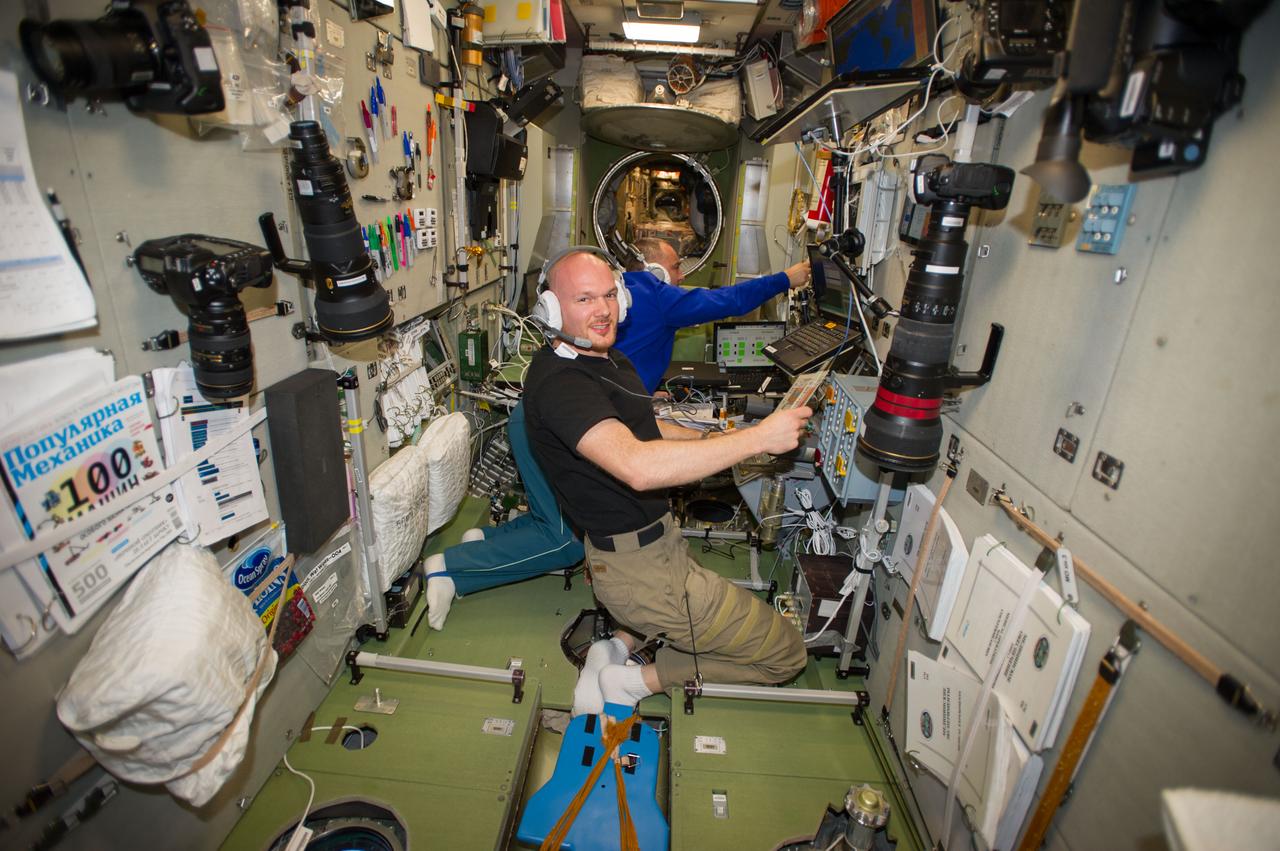
ISS040-E-089627 (7 Aug. 2014) --- In the International Space Station?s Zvezda Service Module, European Space Agency astronaut Alexander Gerst (foreground) and Russian cosmonaut Alexander Skvortsov, both Expedition 40 flight engineers, participate in a training session in preparation for the rendezvous and docking of ESA?s fifth and final Automated Transfer Vehicle (ATV-5). Nicknamed the ?Georges Lemaitre? in honor of the Belgian physicist and astronomer who first proposed the Big Bang theory, ATV-5 will deliver more than seven tons of scientific experiments, food and other supplies when it docks to the aft end of Zvezda on Aug. 12.
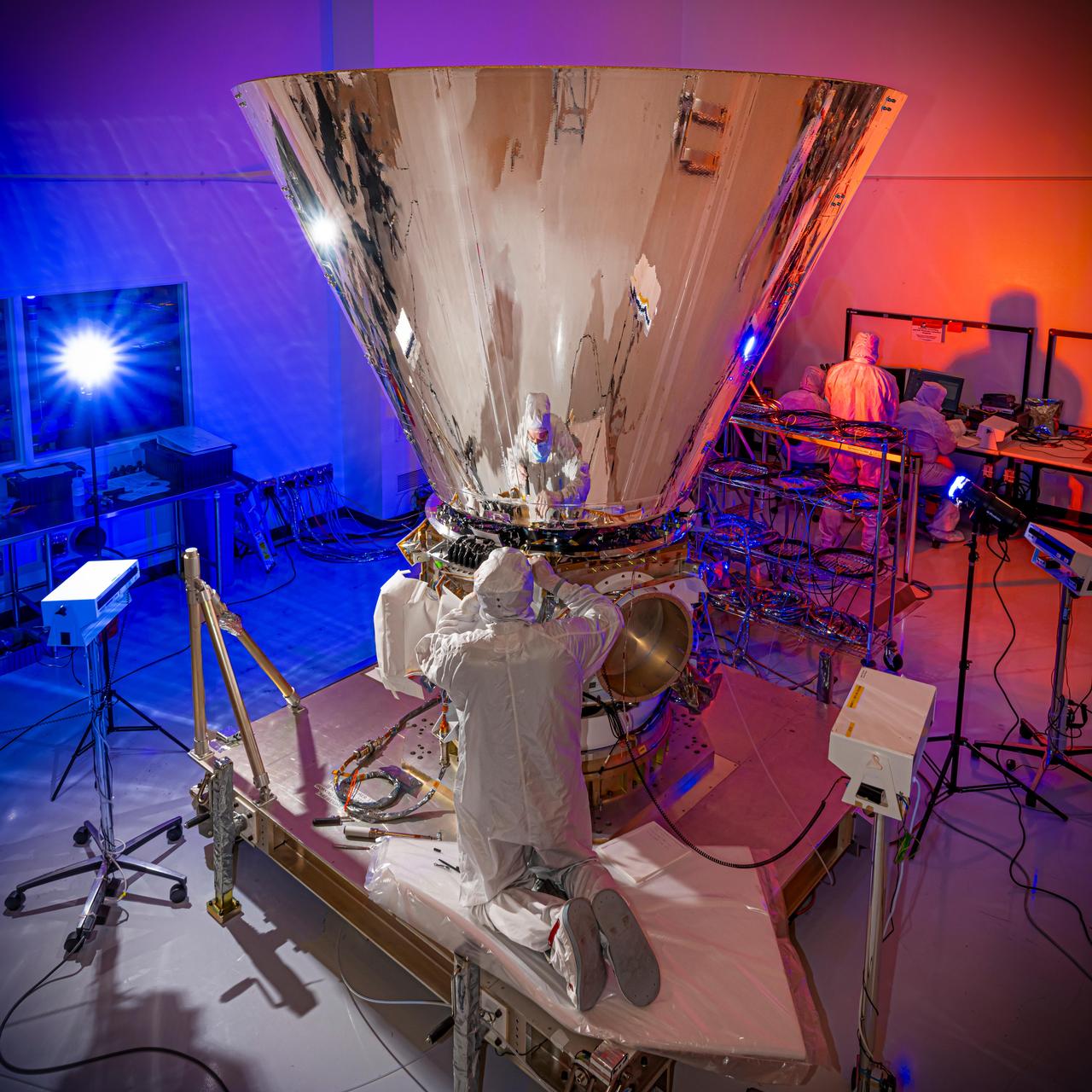
Final assembly of NASA's SPHEREx spacecraft is shown at BAE Systems in Boulder, Colorado, in March 2024. Short for Spectro-Photometer for the History of the Universe, Epoch of Reionization and Ices Explorer, SPHEREx will create a map of the cosmos like no other. Using a technique called spectroscopy to image the entire sky in 102 wavelengths of infrared light, SPHEREx will gather information about the composition of and distance to millions of galaxies and stars. With this map, scientists will study what happened in the first fraction of a second after the big bang, how galaxies formed and evolved, and the origins of water in planetary systems in our galaxy. https://photojournal.jpl.nasa.gov/catalog/PIA26543
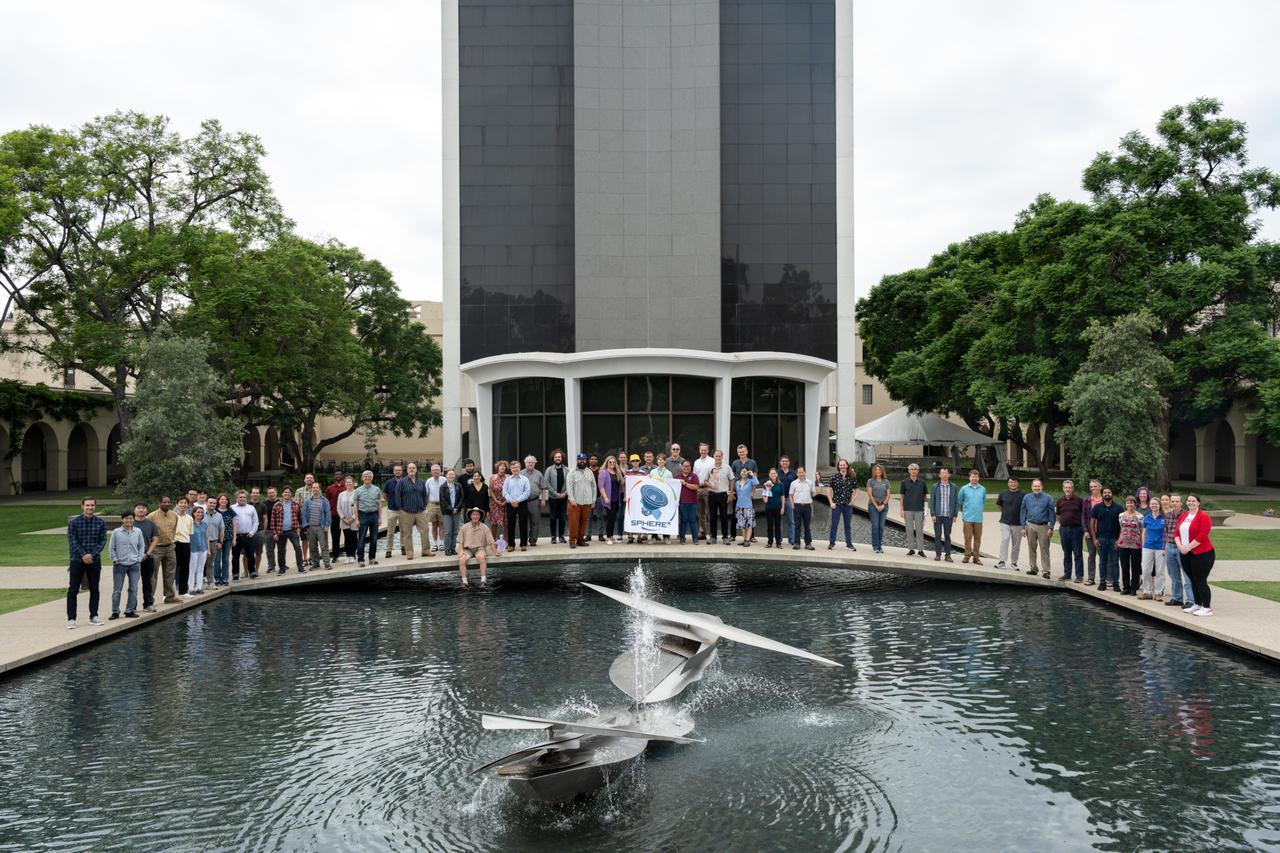
Members of the SPHEREx mission team pose for a photo on the campus of Caltech in Pasadena, California, in October 2023. Short for Spectro-Photometer for the History of the Universe, Epoch of Reionization and Ices Explorer, SPHEREx will create a map of the cosmos like no other. Using a technique called spectroscopy to image the entire sky in 102 wavelengths of infrared light, SPHEREx will gather information about the composition of and distance to millions of galaxies and stars. With this map, scientists will study what happened in the first fraction of a second after the big bang, how galaxies formed and evolved, and the origins of water in planetary systems in our galaxy. https://photojournal.jpl.nasa.gov/catalog/PIA26534
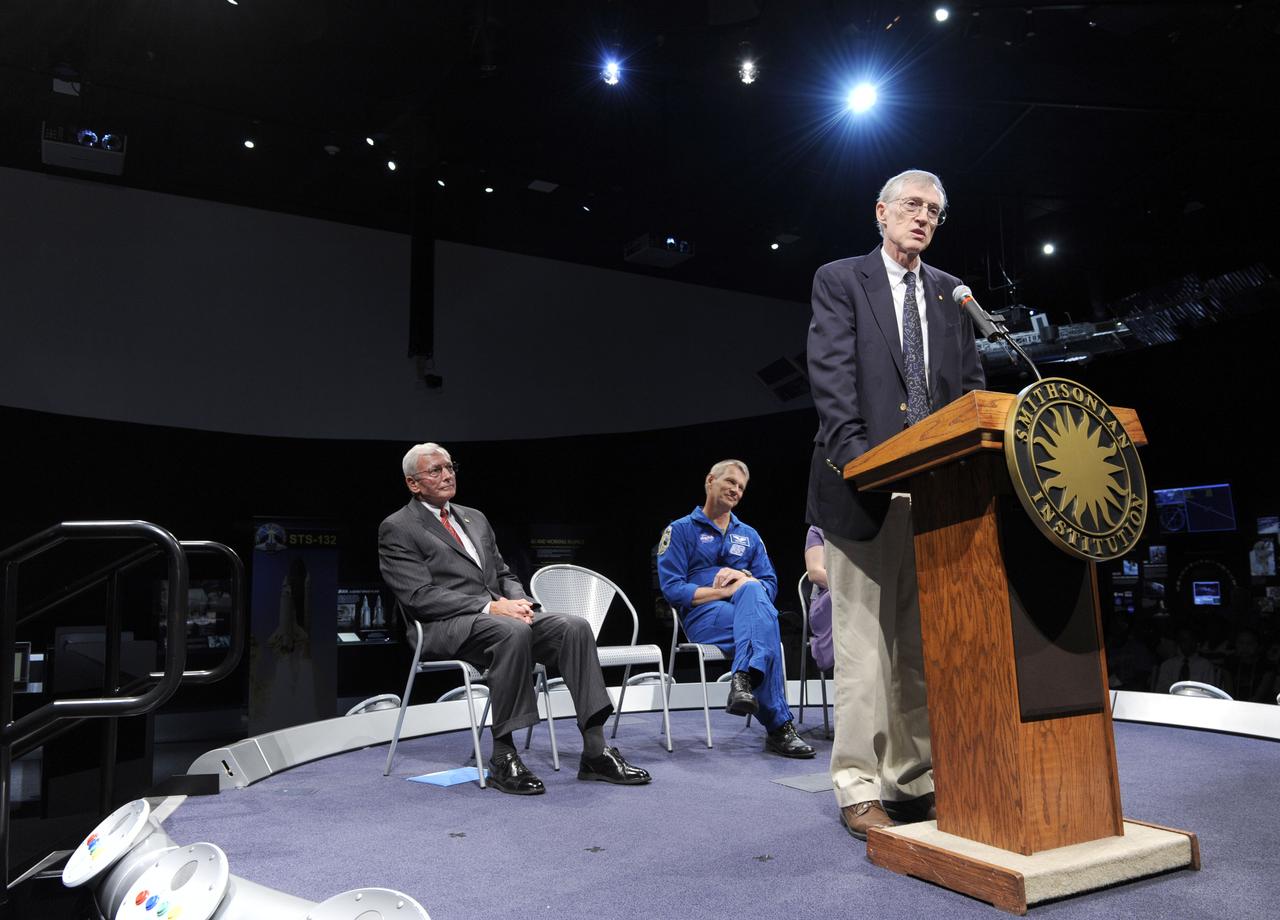
NASA Astrophycist Dr. John Mather, at podium, speaks Tuesday, July 27, 2010, at the Smithsonian National Air and Space Museum in Washington as museum director Gen. John R. "Jack" Dailey, U.S. Marine Corps ret. and STS-132 astronaut Piers Sellers look on. Sellers returned a replica of the Nobel Prize that is in the museum's collection and was flown aboard STS-132 Atlantis. The prize was won by Mather and University of California, Berkeley researcher George Smoot in 2006 for their work using the Cosmic Background Explorer Satellite to understand the big-bang theory of the universe.Photo Credit: (NASA/Paul E. Alers)
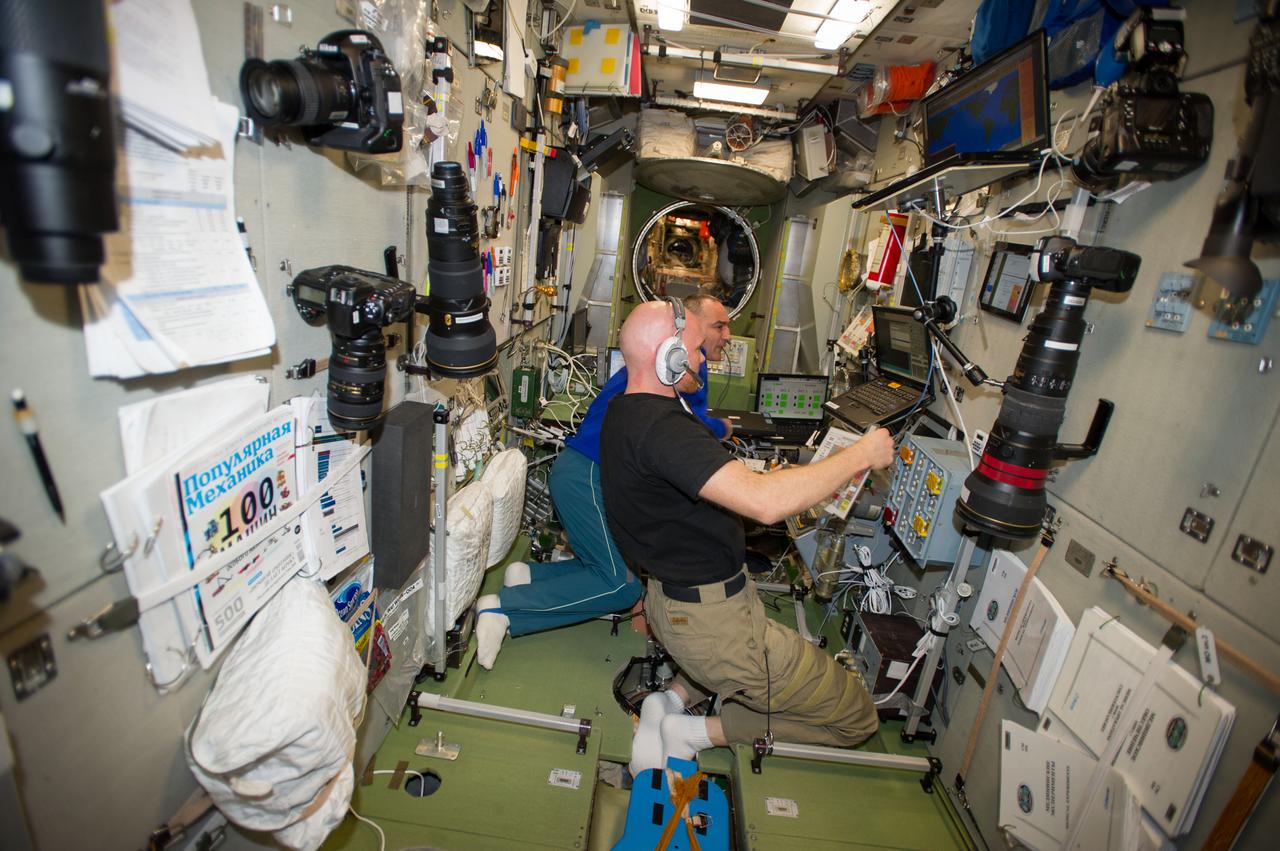
ISS040-E-089629 (7 Aug. 2014) --- In the International Space Station?s Zvezda Service Module, European Space Agency astronaut Alexander Gerst (foreground) and Russian cosmonaut Alexander Skvortsov, both Expedition 40 flight engineers, participate in a training session in preparation for the rendezvous and docking of ESA?s fifth and final Automated Transfer Vehicle (ATV-5). Nicknamed the ?Georges Lemaitre? in honor of the Belgian physicist and astronomer who first proposed the Big Bang theory, ATV-5 will deliver more than seven tons of scientific experiments, food and other supplies when it docks to the aft end of Zvezda on Aug. 12.
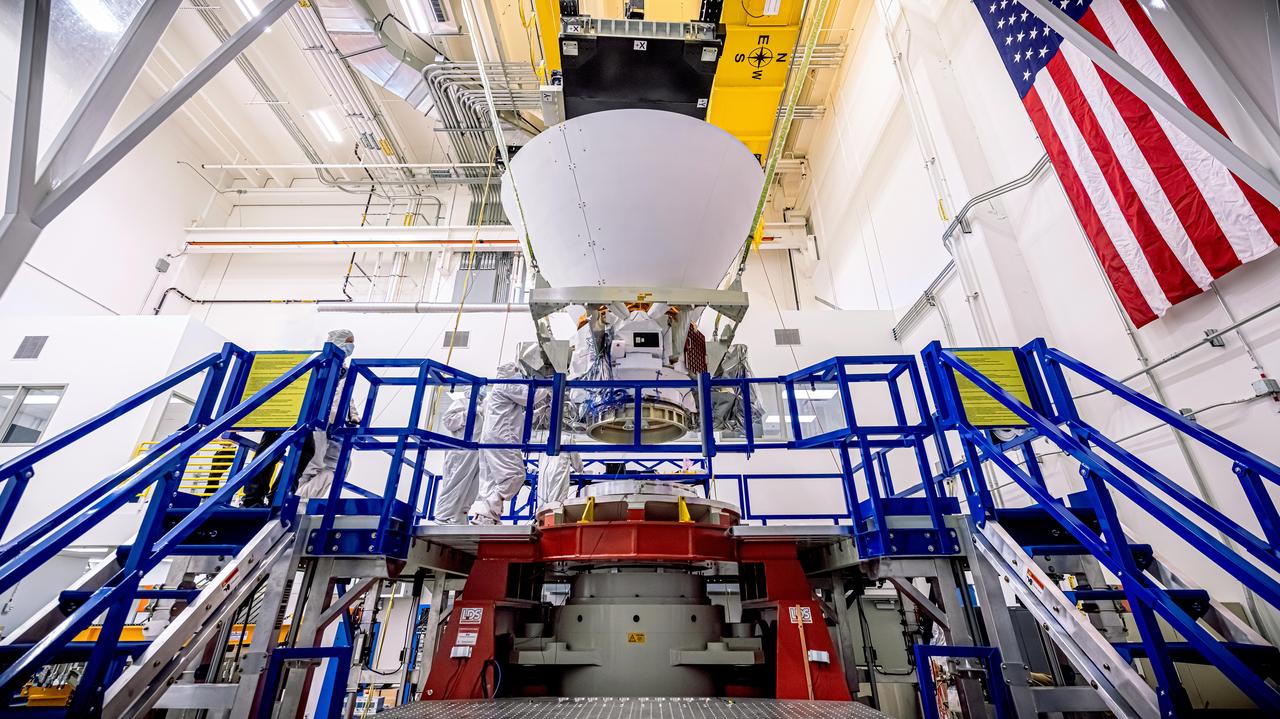
NASA's SPHEREx observatory is lifted and installed onto a vibration table in the Z-axis configuration at BAE Systems in Boulder, Colorado, in August 2024. In this test, the spacecraft is subjected to vibrations in all three axes separately. The test was successfully completed Aug. 16, 2024. Short for Spectro-Photometer for the History of the Universe, Epoch of Reionization and Ices Explorer, SPHEREx will create a map of the cosmos like no other. Using a technique called spectroscopy to image the entire sky in 102 wavelengths of infrared light, SPHEREx will gather information about the composition of and distance to millions of galaxies and stars. With this map, scientists will study what happened in the first fraction of a second after the big bang, how galaxies formed and evolved, and the origins of water in planetary systems in our galaxy. https://photojournal.jpl.nasa.gov/catalog/PIA26539
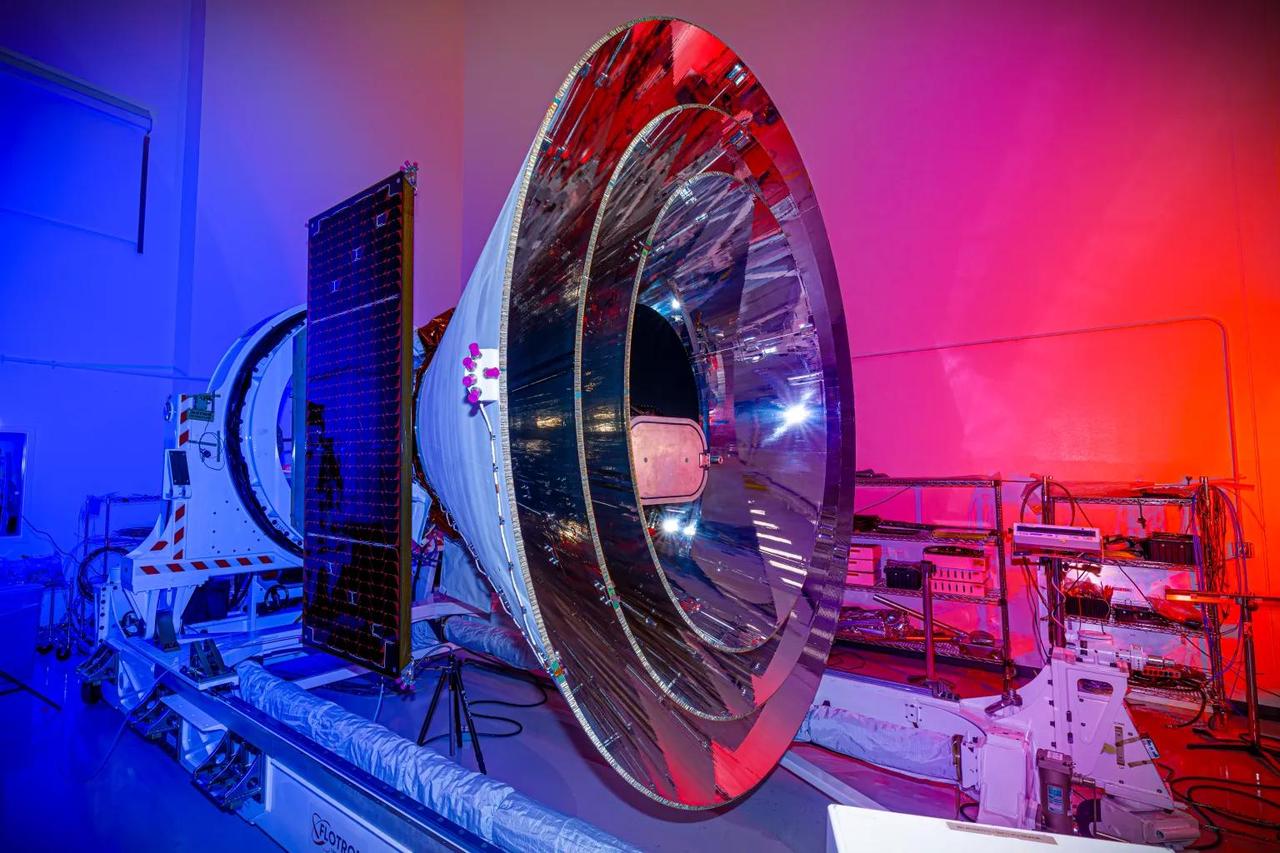
NASA's SPHEREx space observatory was photographed at BAE Systems in Boulder, Colorado, in November 2024 after completing environmental testing. The spacecraft's three concentric cones help direct heat and light away from the telescope and other components, keeping them cool. Short for Spectro-Photometer for the History of the Universe, Epoch of Reionization and Ices Explorer, SPHEREx will create a map of the cosmos like no other. Using a technique called spectroscopy to image the entire sky in 102 wavelengths of infrared light, SPHEREx will gather information about the composition of and distance to millions of galaxies and stars. With this map, scientists will study what happened in the first fraction of a second after the big bang, how galaxies formed and evolved, and the origins of water in planetary systems in our galaxy. https://photojournal.jpl.nasa.gov/catalog/PIA26536
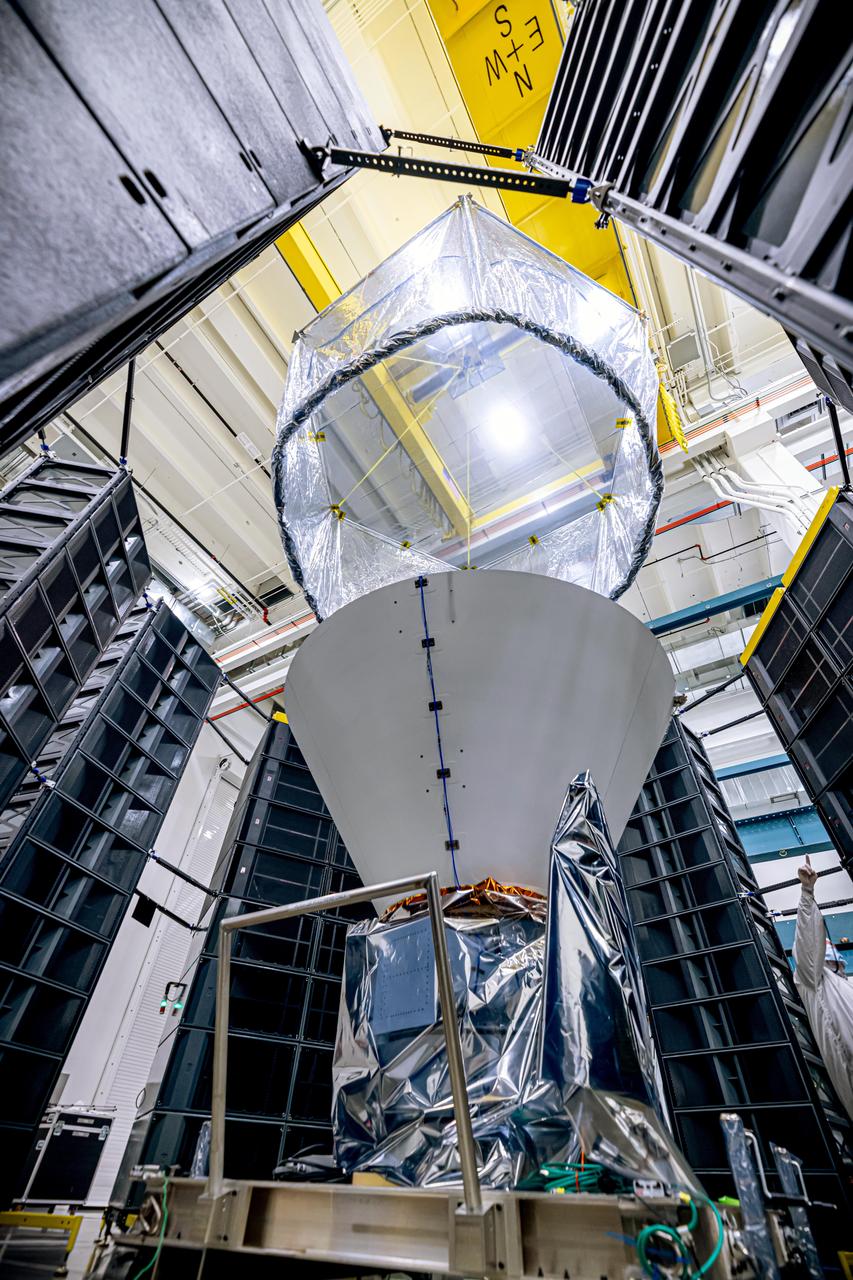
NASA's SPHEREx observatory is installed in the Fiesta Area at BAE Systems in Boulder, Colorado, in July 2024. The observatory is surrounded by speaker stacks used to perform acoustics testing, which subjects the spacecraft to the acoustics loads that it will experience during launch. Short for Spectro-Photometer for the History of the Universe, Epoch of Reionization and Ices Explorer, SPHEREx will create a map of the cosmos like no other. Using a technique called spectroscopy to image the entire sky in 102 wavelengths of infrared light, SPHEREx will gather information about the composition of and distance to millions of galaxies and stars. With this map, scientists will study what happened in the first fraction of a second after the big bang, how galaxies formed and evolved, and the origins of water in planetary systems in our galaxy. https://photojournal.jpl.nasa.gov/catalog/PIA26540
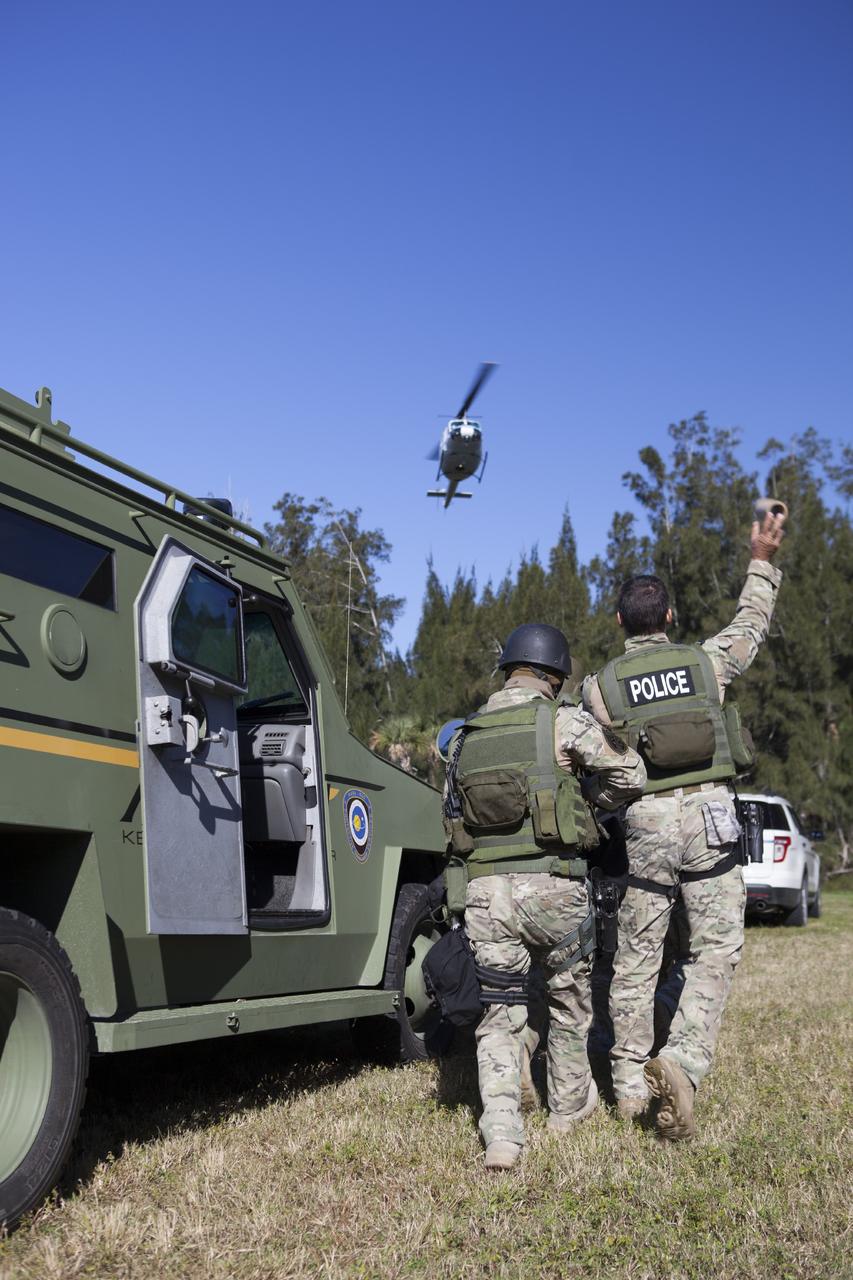
CAPE CANAVERAL, Fla. – At NASA’s Protective Services Training Academy at Kennedy Space Center in Florida, a member of the Emergency Response Team, or ERT, tosses a flash bang diversionary device during a specialized training simulation as a helicopter hovers above. The ERT members are wearing full protective gear and carrying non-lethal firearms for the training exercises in order to keep their skills current. Recently, eight members of the ERT competed in the 31st Annual SWAT Roundup International competition in Orlando, Fla., and received recognition by placing in the top five overall. In keeping with NASA’s commitment to safety and security of workforce and assets, the ERT is part of Kennedy’s security team and is trained to respond in the event of an emergency at the center. Photo credit: NASA/Dimitri Gerondidakis
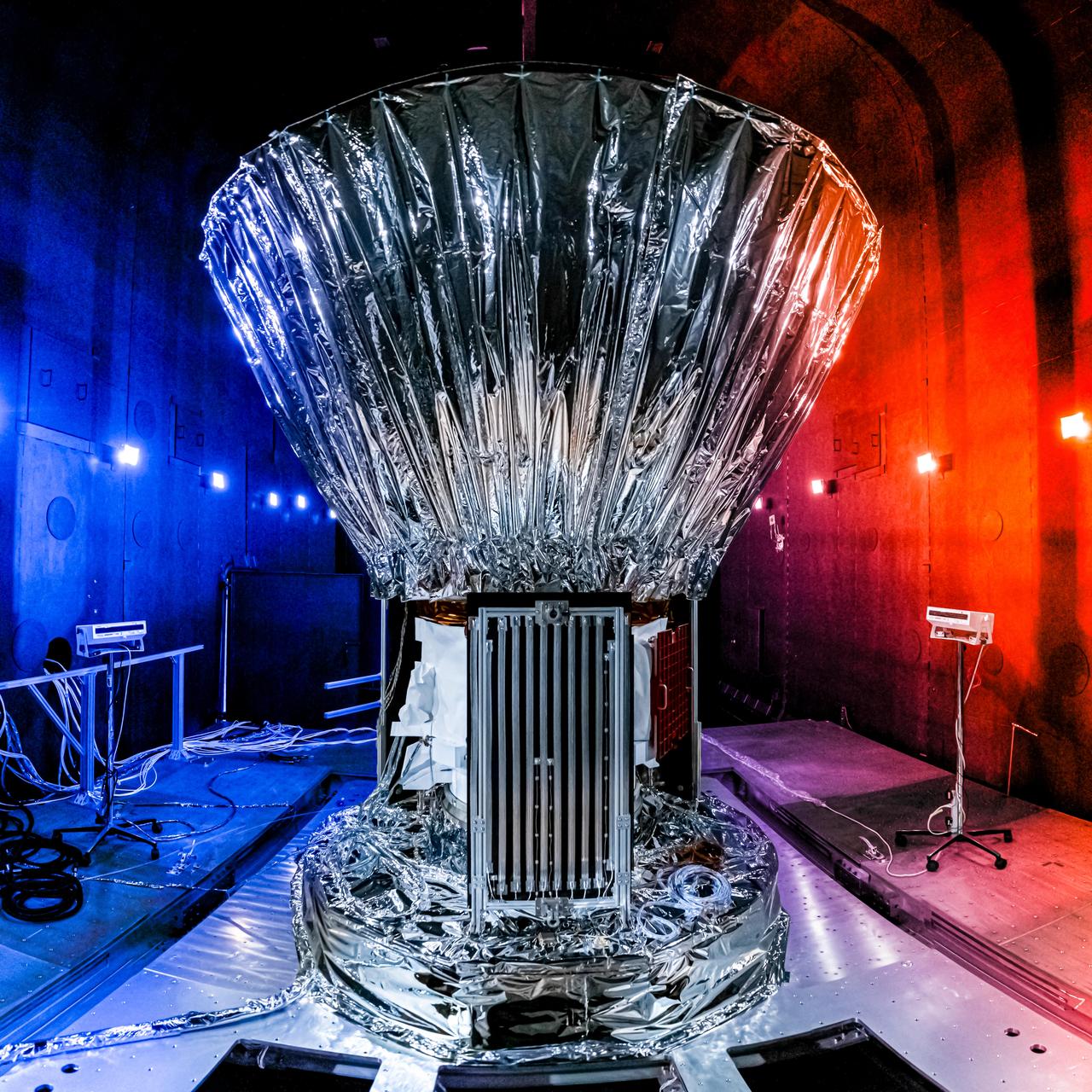
NASA's SPHEREx observatory is installed in the Titan Thermal Vacuum (TVAC) test Chamber at BAE Systems in Boulder, Colorado, in June 2024. As part of the test setup, the spacecraft and photon shield are covered in multilayer insulation and blankets and surrounded by ground support equipment. Short for Spectro-Photometer for the History of the Universe, Epoch of Reionization and Ices Explorer, SPHEREx will create a map of the cosmos like no other. Using a technique called spectroscopy to image the entire sky in 102 wavelengths of infrared light, SPHEREx will gather information about the composition of and distance to millions of galaxies and stars. With this map, scientists will study what happened in the first fraction of a second after the big bang, how galaxies formed and evolved, and the origins of water in planetary systems in our galaxy. https://photojournal.jpl.nasa.gov/catalog/PIA26541

NASA's SPHEREx mission will operate in low Earth orbit, detecting hundreds of millions of stars and galaxies and creating the first all-sky spectroscopic survey in the near-infrared. This artist's concept shows the spacecraft and its distinctive conical photon shields, which protect SPHEREx's telescope from infrared light and heat from the Sun and Earth. Short for Spectro-Photometer for the History of the Universe, Epoch of Reionization and Ices Explorer, SPHEREx will create a map of the cosmos like no other. Using a technique called spectroscopy to image the entire sky in 102 wavelengths of infrared light, SPHEREx will gather information about the composition of and distance to millions of galaxies and stars. With this map, scientists will study what happened in the first fraction of a second after the big bang, how galaxies formed and evolved, and the origins of water in planetary systems in our galaxy. https://photojournal.jpl.nasa.gov/catalog/PIA26531
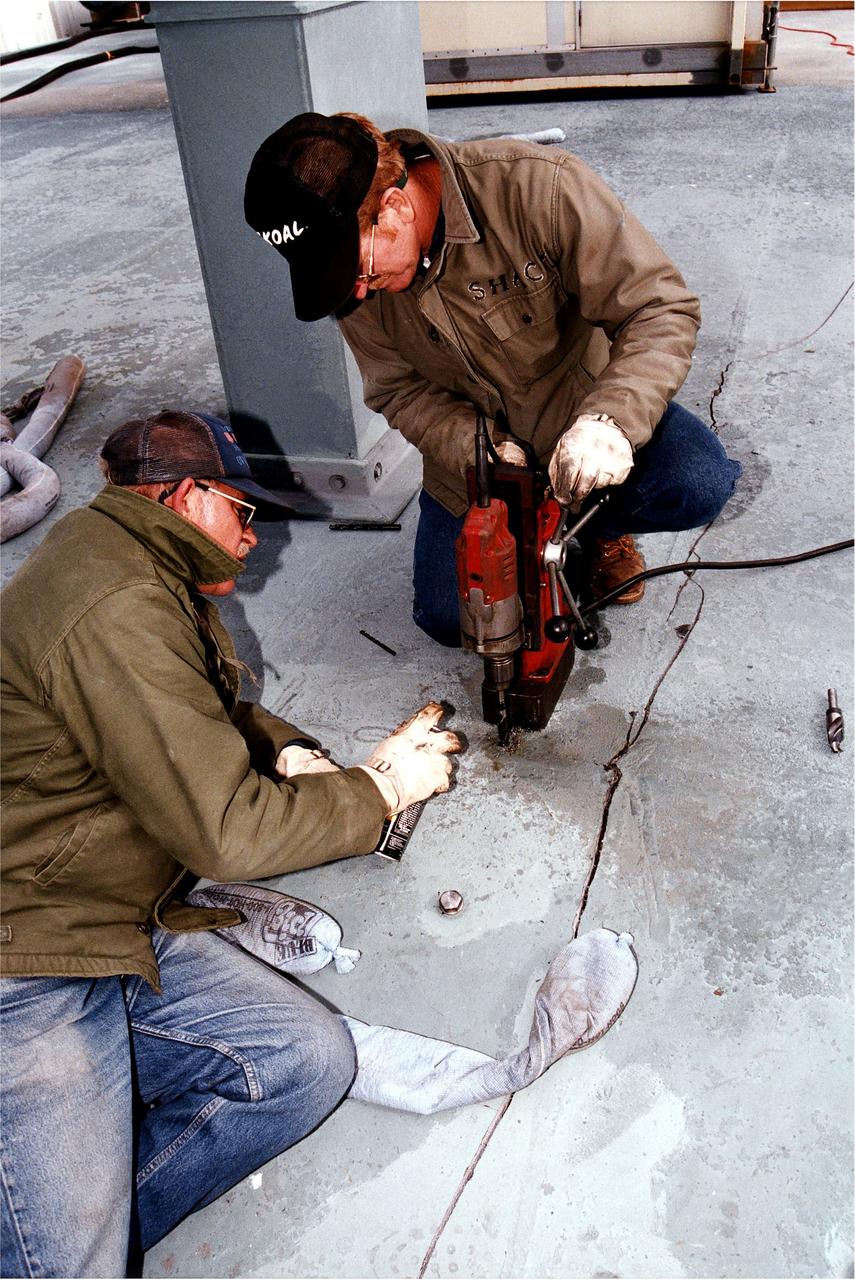
KENNEDY SPACE CENTER, FLA. - United Space Alliance (USA) workers J.D. Wise, left, and Robert Shackelford, with drill, try to stop an approximately 24-foot-long crack from getting any bigger on the Mobile Launcher Platform (MLP), which is holding the Space Shuttle Discovery en route to Launch Pad 39A for the STS-82 mission. Discovery was on its way out to the launch pad when engineers heard a loud bang and noticed that a crack had developed on the MLP. Rollout had begun shortly after 7 a.m. EST and was stopped at about 8:25 a.m. This Y-shaped crack is on the MLP surface and runs from near the left-hand solid rocket booster flame hole toward the near corner of the MLP. Rollout of Discovery resumed just past noon after structural engineers determined that the integrity of the MLP had not been compromised. Discovery is scheduled to lift off on the second Hubble Space Telescope servicing mission on Feb. 11.
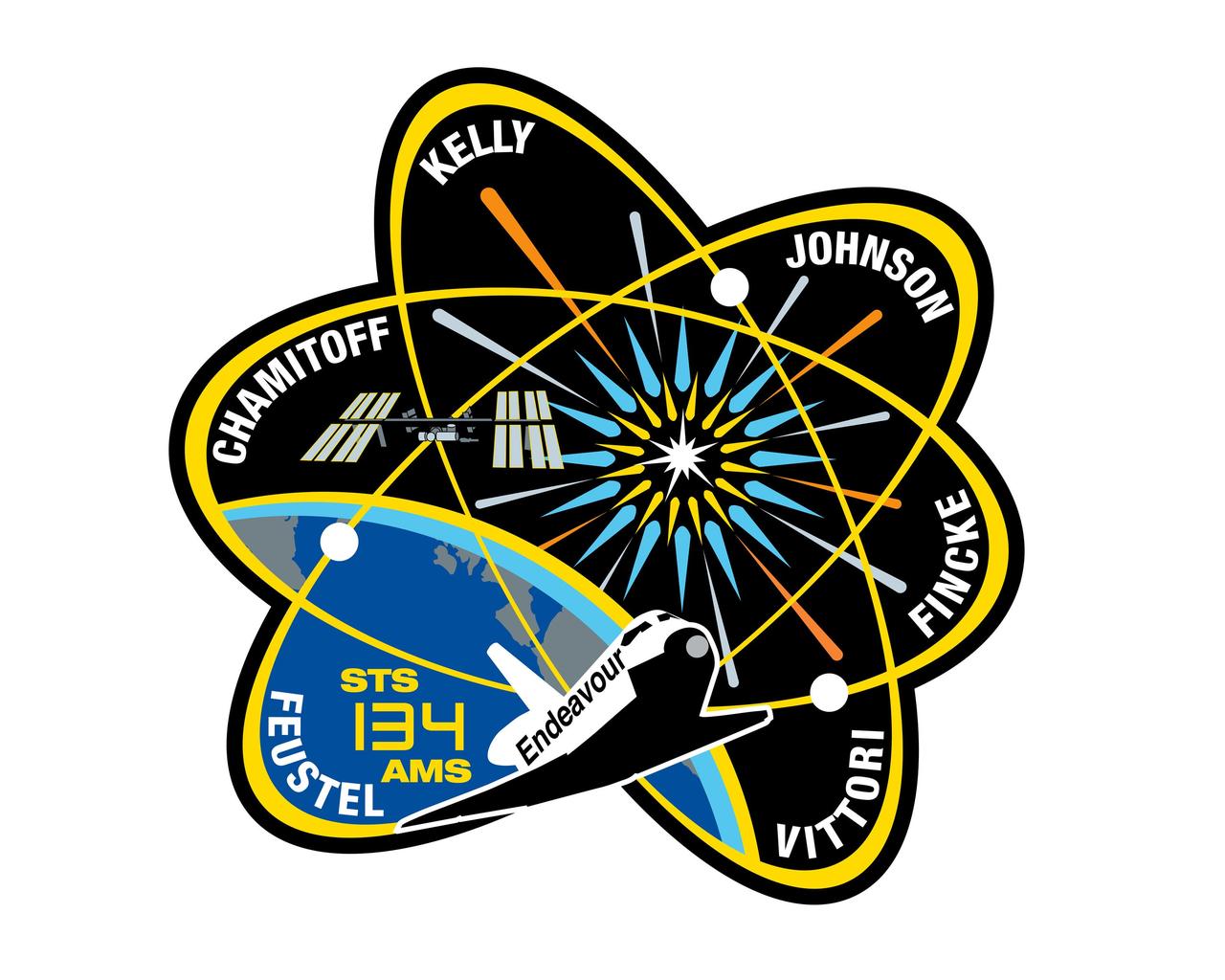
STS134-S-001 (March 2010) --- The design of the STS-134 crew patch highlights research on the International Space Station (ISS) focusing on the fundamental physics of the universe. On this mission, the crew of space shuttle Endeavour will install the Alpha Magnetic Spectrometer-2 (AMS) experiment -- a cosmic particle detector that utilizes the first-ever superconducting magnet to be flown in space. By studying sub-atomic particles in the background cosmic radiation, and searching for anti-matter and dark-matter, it will help scientists better understand the evolution and properties of our universe. The shape of the patch is inspired by the international atomic symbol, and represents the atom with orbiting electrons around the nucleus. The burst near the center refers to the big-bang theory and the origin of the universe. The shuttle Endeavour and ISS fly together into the sunrise over the limb of Earth, representing the dawn of a new age, understanding the nature of the universe. The NASA insignia design for shuttle flights is reserved for use by the astronauts and for other official use as the NASA administrator may authorize. Public availability has been approved only in the form of illustrations by the various news media. When and if there is any change in this policy, which we do not anticipate, it will be publicly announced.
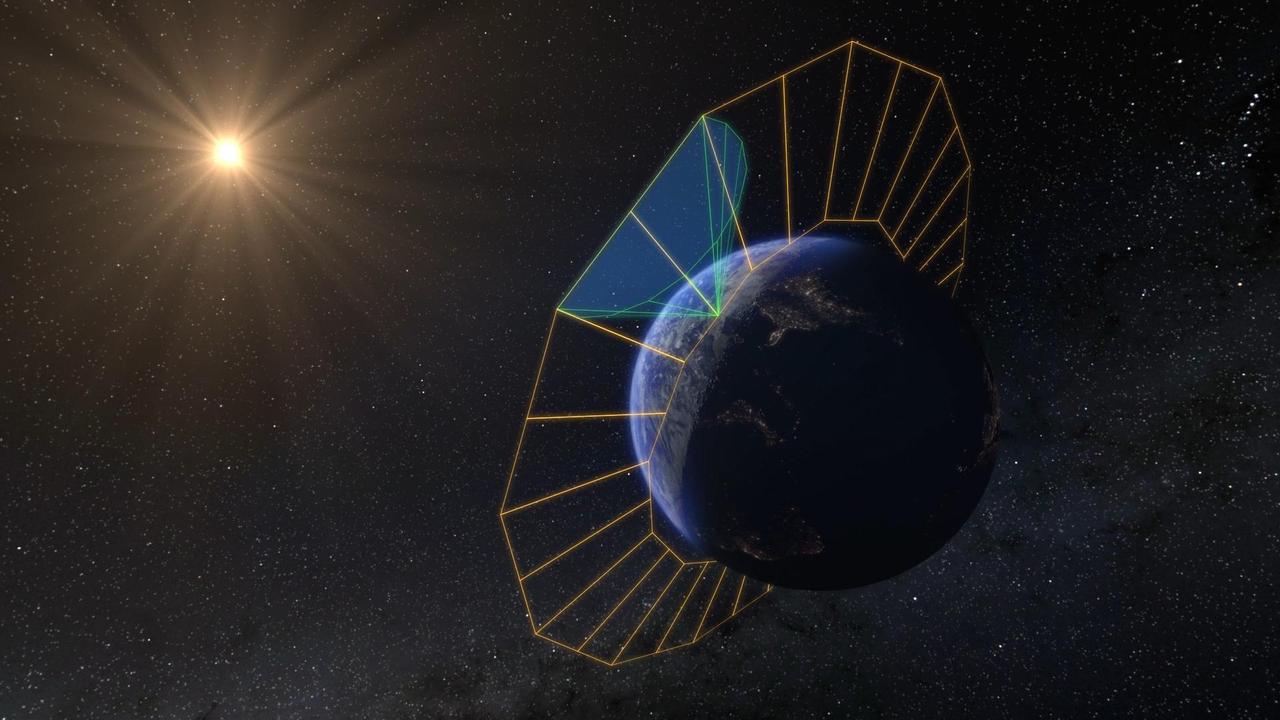
NASA's SPHEREx mission will create the first all-sky spectroscopic survey in the near-infrared, detecting hundreds of millions of stars and galaxies. To do this, the SPHEREx space telescope will look outward from low-Earth orbit, circling the planet along its day-night (or terminator) line. This artist's concept depicts the spacecraft's orbital plane in orange, and its field of view in green. Each of the telescope's orbits allows it to image a 360-degree strip of the celestial sky. As Earth's orbit around the Sun progresses, that strip slowly advances, enabling SPHEREx to complete four all-sky maps in two years. Short for Spectro-Photometer for the History of the Universe, Epoch of Reionization and Ices Explorer, SPHEREx will create a map of the cosmos like no other. Using a technique called spectroscopy to image the entire sky in 102 wavelengths of infrared light, SPHEREx will gather information about the composition of and distance to millions of galaxies and stars. With this map, scientists will study what happened in the first fraction of a second after the big bang, how galaxies formed and evolved, and the origins of water in planetary systems in our galaxy. https://photojournal.jpl.nasa.gov/catalog/PIA26532
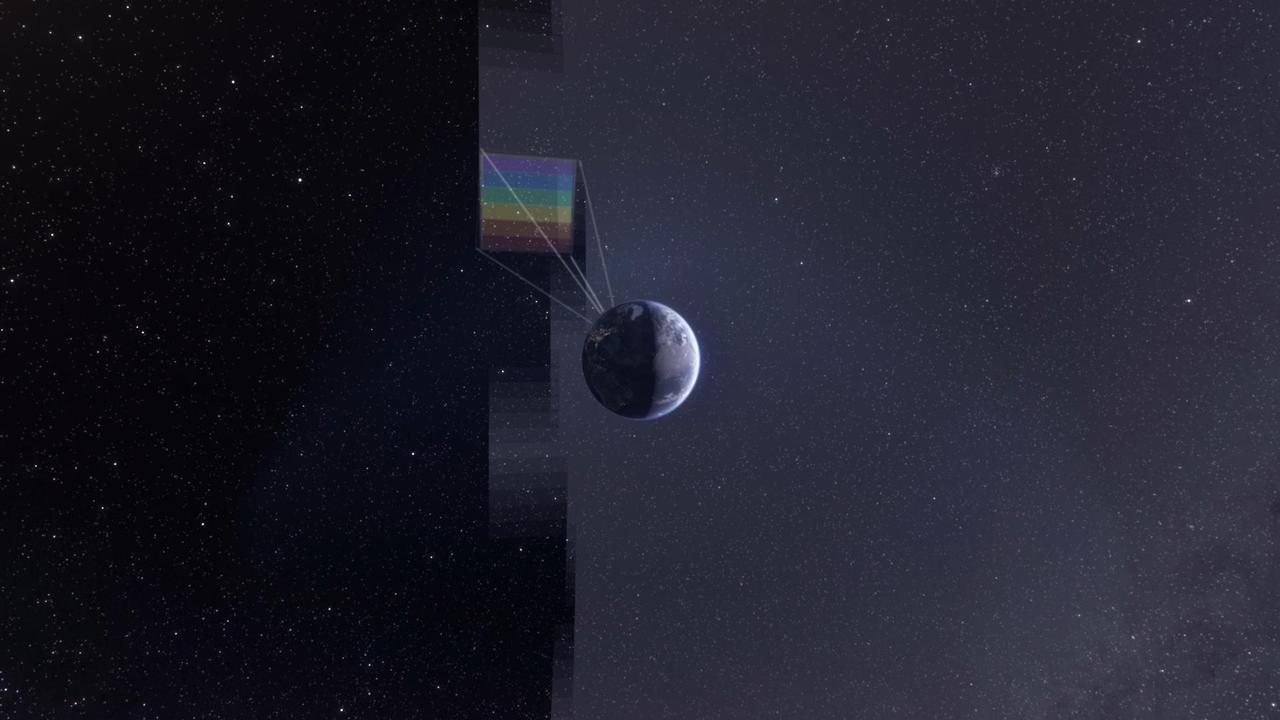
NASA's SPHEREx observatory will map the entire sky to help scientists answer big-picture questions about the origins of our universe, galaxies, and key ingredients for life in our galaxy, such as water. Operating from low Earth orbit, the telescope will sweep across the sky, taking about 600 exposures each day. Using a technique called spectroscopy, the observatory will image every section of the sky 102 times, each time using a different color filter that blocks all wavelengths except one. By combining those images, the mission will produce a map containing information about the composition of and distance to millions of stars and other objects in our galaxy and hundreds of millions of galaxies beyond. (See an animation of this process, depicted in a still artist's concept above, at spherex.caltech.edu/video/all-sky-survey.) Short for Spectro-Photometer for the History of the Universe, Epoch of Reionization and Ices Explorer, SPHEREx will help scientists study what happened in the first fraction of a second after the big bang, how galaxies formed and evolved, and the origins of water in planetary systems in our galaxy. https://photojournal.jpl.nasa.gov/catalog/PIA26533
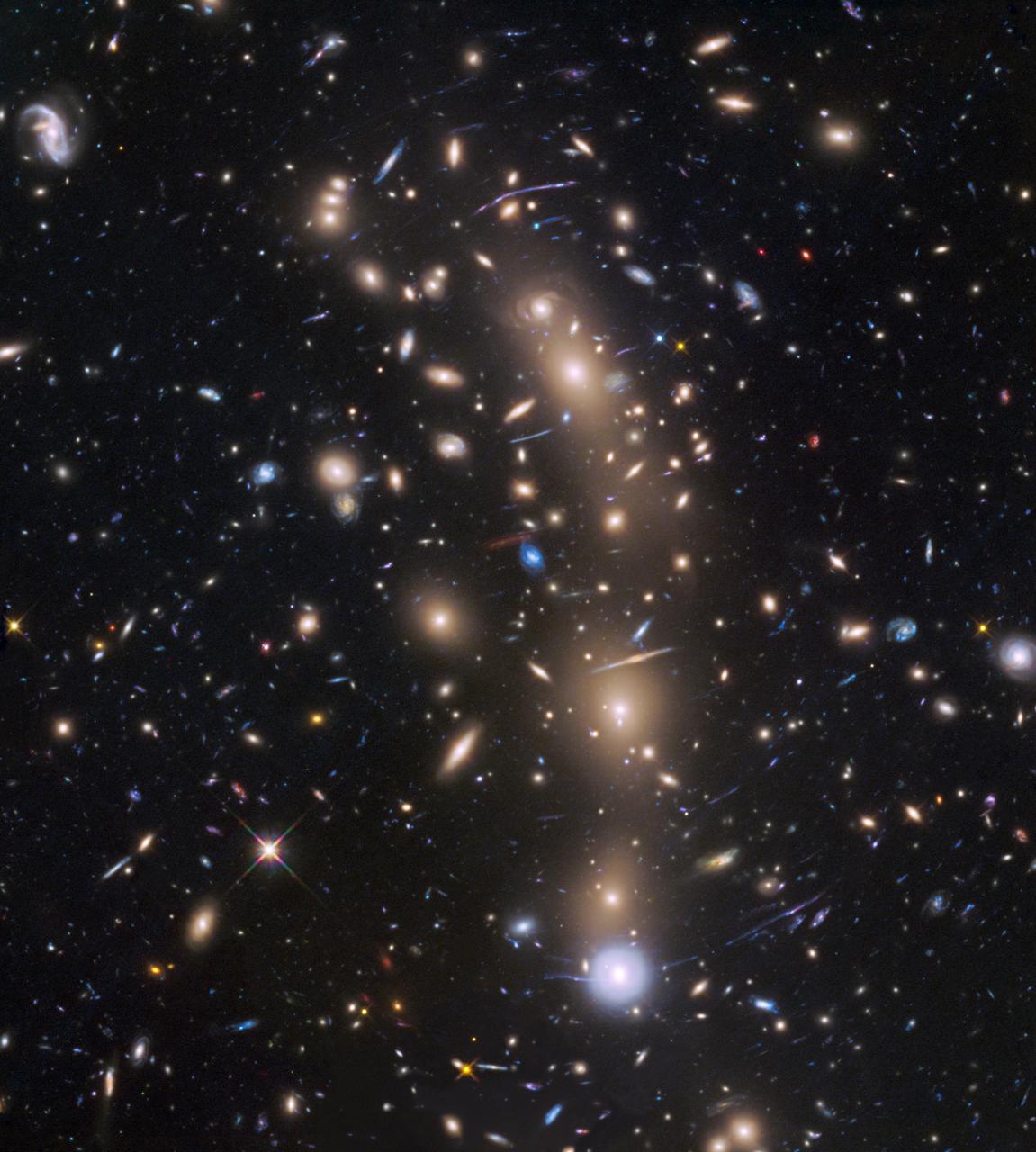
This is a Hubble Space Telescope view of a very massive cluster of galaxies, MACS J0416.1-2403, located roughly 4 billion light-years away and weighing as much as a million billion suns. The cluster's immense gravitational field magnifies the image of galaxies far behind it, in a phenomenon called gravitational lensing. The inset is an image of an extremely faint and distant galaxy that existed only 400 million years after the big bang. It was discovered by Hubble and NASA's Spitzer Space Telescope. The gravitational lens makes the galaxy appear 20 times brighter than normal. The galaxy is comparable in size to the Large Magellanic Cloud (LMC), a diminutive satellite galaxy of our Milky Way. It is rapidly making stars at a rate ten times faster than the LMC. This might be the growing core of what was to eventually evolve into a full-sized galaxy. The research team has nicknamed the object Tayna, which means "first-born" in Aymara, a language spoken in the Andes and Altiplano regions of South America. http://photojournal.jpl.nasa.gov/catalog/PIA20054
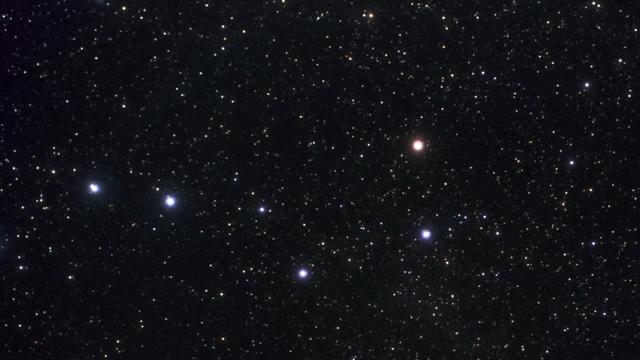
By pushing NASA’s Hubble Space Telescope to its limits, an international team of astronomers has shattered the cosmic distance record by measuring the farthest galaxy ever seen in the universe. This surprisingly bright infant galaxy, named GN-z11, is seen as it was 13.4 billion years in the past, just 400 million years after the Big Bang. GN-z11 is located in the direction of the constellation of Ursa Major. Read more: <a href="http://go.nasa.gov/1oSqHad" rel="nofollow">go.nasa.gov/1oSqHad</a> <b><a href="http://www.nasa.gov/audience/formedia/features/MP_Photo_Guidelines.html" rel="nofollow">NASA image use policy.</a></b> <b><a href="http://www.nasa.gov/centers/goddard/home/index.html" rel="nofollow">NASA Goddard Space Flight Center</a></b> enables NASA’s mission through four scientific endeavors: Earth Science, Heliophysics, Solar System Exploration, and Astrophysics. Goddard plays a leading role in NASA’s accomplishments by contributing compelling scientific knowledge to advance the Agency’s mission. <b>Follow us on <a href="http://twitter.com/NASAGoddardPix" rel="nofollow">Twitter</a></b> <b>Like us on <a href="http://www.facebook.com/pages/Greenbelt-MD/NASA-Goddard/395013845897?ref=tsd" rel="nofollow">Facebook</a></b> <b>Find us on <a href="http://instagrid.me/nasagoddard/?vm=grid" rel="nofollow">Instagram</a></b>

This deepest-ever view of the universe unveils myriad galaxies back to the begirning of time. Several hundred, never-before-seen, galaxies are visible in this view of the universe, called Hubble Deep Field (HDF). Besides the classical spiral and elliptical shaped galaxies, there is a bewildering variety of other galaxy shapes and colors that are important clues to understanding the evolution of the universe. Some of the galaxies may have formed less than one-billion years after the Big Bang. The image was assembled from many separate exposures with the Wide Field/Planetary Camera 2 (WF/PC2), for ten consecutive days between December 18, 1995 and December 28, 1995. This true-color view was assembled from separate images taken with blue, red, and infrared light. By combining these separate images into a single color picture, astronomers will be able to infer, at least statistically, the distance, age, and composition of galaxies in the field. Blue objects contain young stars and/or are relatively close, while redder objects contain older stellar populations and/or are farther away.
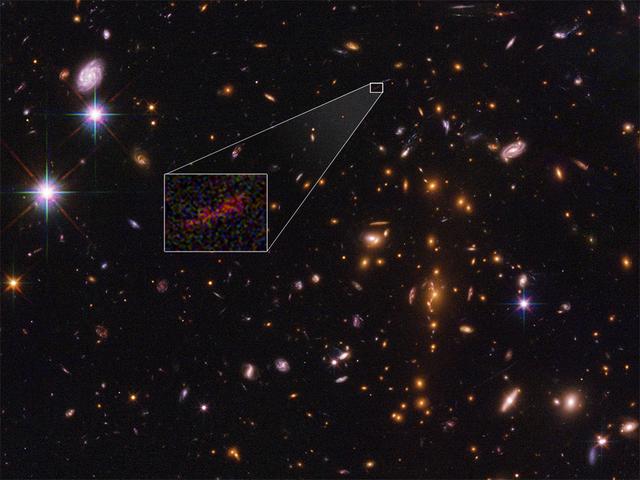
This Hubble Space Telescope image shows the farthest galaxy yet seen in an image that has been stretched and amplified by a phenomenon called gravitational lensing. The embryonic galaxy, named SPT0615-JD, existed when the universe was just 500 million years old. Though a few other primitive galaxies have been seen at this early epoch, they have essentially all looked like red dots, given their small size and tremendous distances. However, in this case, the gravitational field of a massive foreground galaxy cluster, called SPT-CL J0615-5746, not only amplified the light from the background galaxy but also smeared the image of it into an arc (about 2 arcseconds long). Image analysis shows that the galaxy weighs in at no more than 3 billion solar masses (roughly 1/100th the mass of our fully grown Milky Way galaxy). It is less than 2,500 light-years across, half the size of the Small Magellanic Cloud, a satellite galaxy of our Milky Way. The object is considered prototypical of young galaxies that emerged during the epoch shortly after the big bang. https://photojournal.jpl.nasa.gov/catalog/PIA22079
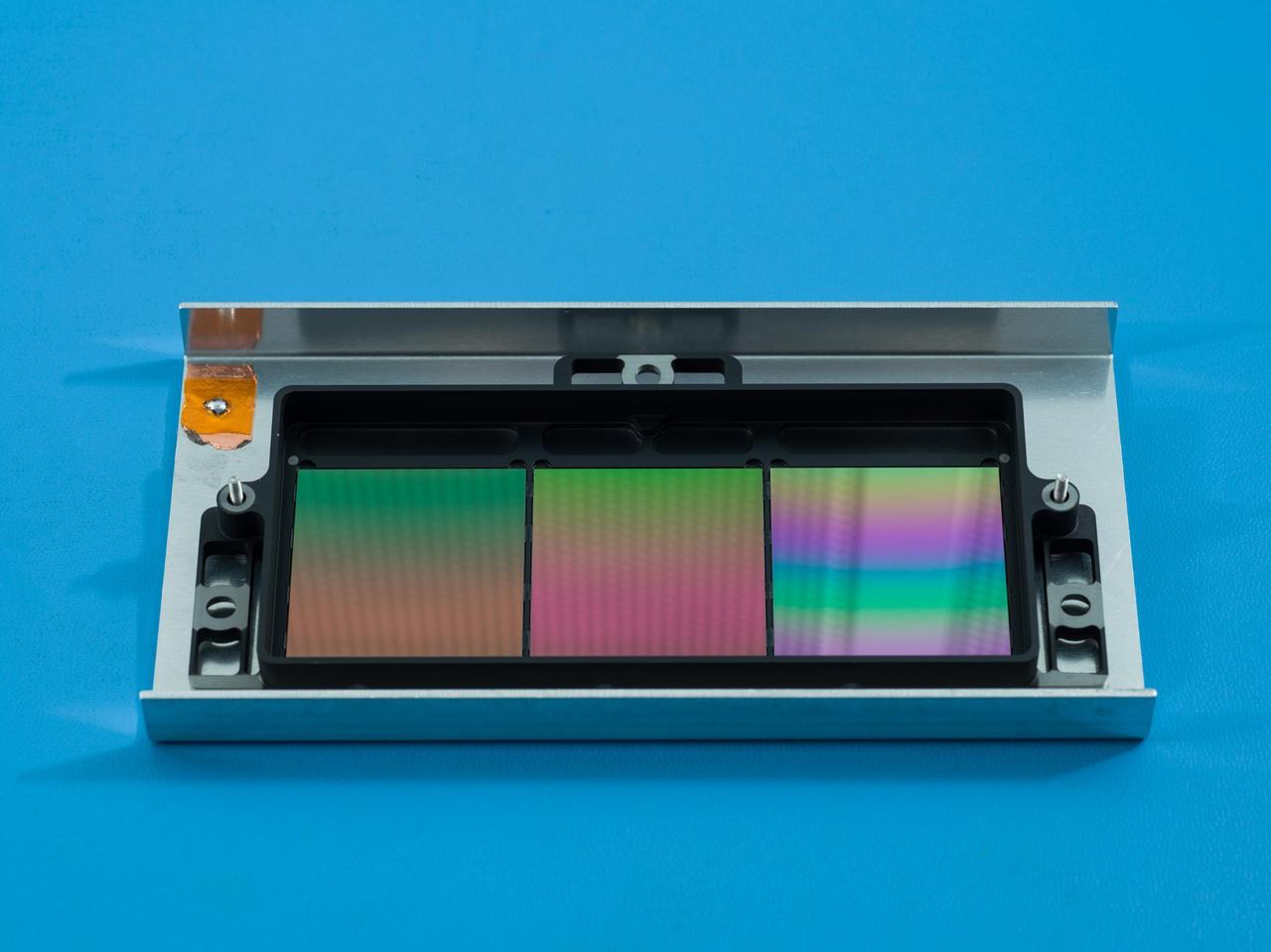
NASA's SPHEREx mission will use these filters to conduct spectroscopy, a technique that lets scientists measure individual wavelengths of light from a source, which can reveal information such as the chemical composition of the object or how far away it is. Each about the size of a cracker, the filters appear iridescent to the naked eye. The filters have multiple segments that block all but one specific wavelength of infrared light. Every object SPHEREx images will be observed by each segment, enabling scientists to see the specific infrared wavelengths emitted by every star or galaxy the telescope views. In total, SPHEREx can observe more than 100 distinct wavelengths. Short for Specto-Photometer for the History of the Universe, Epoch of Reionization and Ices Explorer, SPHEREx will create a map of the cosmos like no other, imaging the entire sky and gathering information about millions of galaxies. With this map, scientists will study what happened in the first fraction of a second after the big bang, the history of galaxy evolution, and the origins of water in planetary systems in our galaxy. https://photojournal.jpl.nasa.gov/catalog/PIA25788
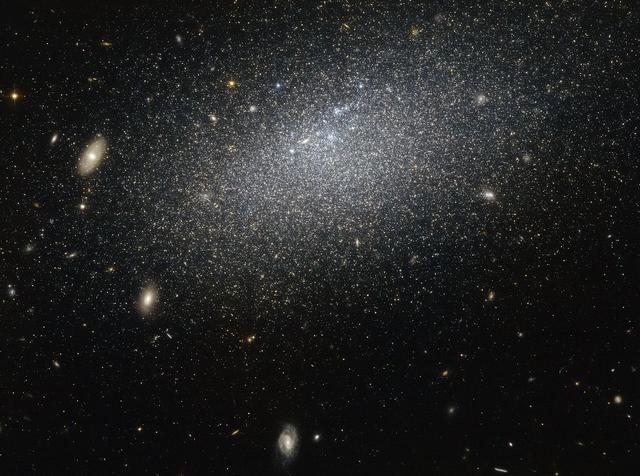
The drizzle of stars scattered across this image forms a galaxy known as UGC 4879. UGC 4879 is an irregular dwarf galaxy — as the name suggests, galaxies of this type are a little smaller and messier than their cosmic cousins, lacking the majestic swirl of a spiral or the coherence of an elliptical. This galaxy is also very isolated. There are about 2.3 million light years between UGC 4879 and its closest neighbour, Leo A, which is about the same distance as that between the Andromeda Galaxy and the Milky Way. This galaxy’s isolation means that it has not interacted with any surrounding galaxies, making it an ideal laboratory for studying star formation uncomplicated by interactions with other galaxies. Studies of UGC 4879 have revealed a significant amount of star formation in the first 4-billion-years after the Big Bang, followed by a strange nine-billion-year lull in star formation, ended 1-billion-years ago by a more recent reignition. The reason for this behaviour, however, remains mysterious, and the solitary galaxy continues to provide ample study material for astronomers looking to understand the complex mysteries of starbirth throughout the Universe.

Sara Susca, deputy payload manager and payload systems engineer for the NASA's SPHEREx mission, looks up at one of the spacecraft's photon shields at the agency's Jet Propulsion Laboratory in Southern California in October 2023. Short for Specto-Photometer for the History of the Universe, Epoch of Reionization and Ices Explorer, SPHEREx will create a map of the cosmos like no other, imaging the entire sky and gathering information about millions of galaxies. With this map, scientists will study what happened in the first fraction of a second after the big bang, the history of galaxy evolution, and the origins of water in planetary systems in our galaxy. Three concentric photon shields will surround the SPHEREx telescope to protect it from nearby light sources that could overwhelm its detectors. The shields will primarily block light from the Sun and the Earth. They also block heat; SPHEREx needs to be kept cold – below minus 350 degrees Fahrenheit (about minus 210 degrees Celsius). That's because SPHEREx detects infrared light, which is sometimes called heat radiation because it's emitted by anything warm. The heat from SPHEREx's own detectors could overwhelm their ability to image faint cosmic objects, so the spacecraft needs a way to cool the detectors down. The spacecraft stands almost 8.5 feet tall (2.6 meters) and stretches nearly 10.5 feet (3.2 meters) wide. https://photojournal.jpl.nasa.gov/catalog/PIA25784

Part of one of the protective photon shields for NASA's SPHEREx telescope are shown here being assembled at Applied Aerospace Structures in Stockton, California, in July 2023. Short for Specto-Photometer for the History of the Universe, Epoch of Reionization and Ices Explorer, SPHEREx will create a map of the cosmos like no other, imaging the entire sky and gathering information about millions of galaxies. With this map, scientists will study what happened in the first fraction of a second after the big bang, the history of galaxy evolution, and the origins of water in planetary systems in our galaxy. The three concentric photon shields will surround the SPHEREx telescope to protect it from nearby light sources that could overwhelm its detectors. The shields will primarily block light from the Sun and the Earth. They also block heat, because SPHEREx needs to be kept cold – below minus 350 degrees Fahrenheit (about minus 210 degrees Celsius). That's because SPHEREx detects infrared light, which is sometimes called heat radiation because it's emitted by anything warm. The heat from SPHEREx's own detectors could overwhelm their ability to detect faint cosmic objects if they aren't cooled down. https://photojournal.jpl.nasa.gov/catalog/PIA25785
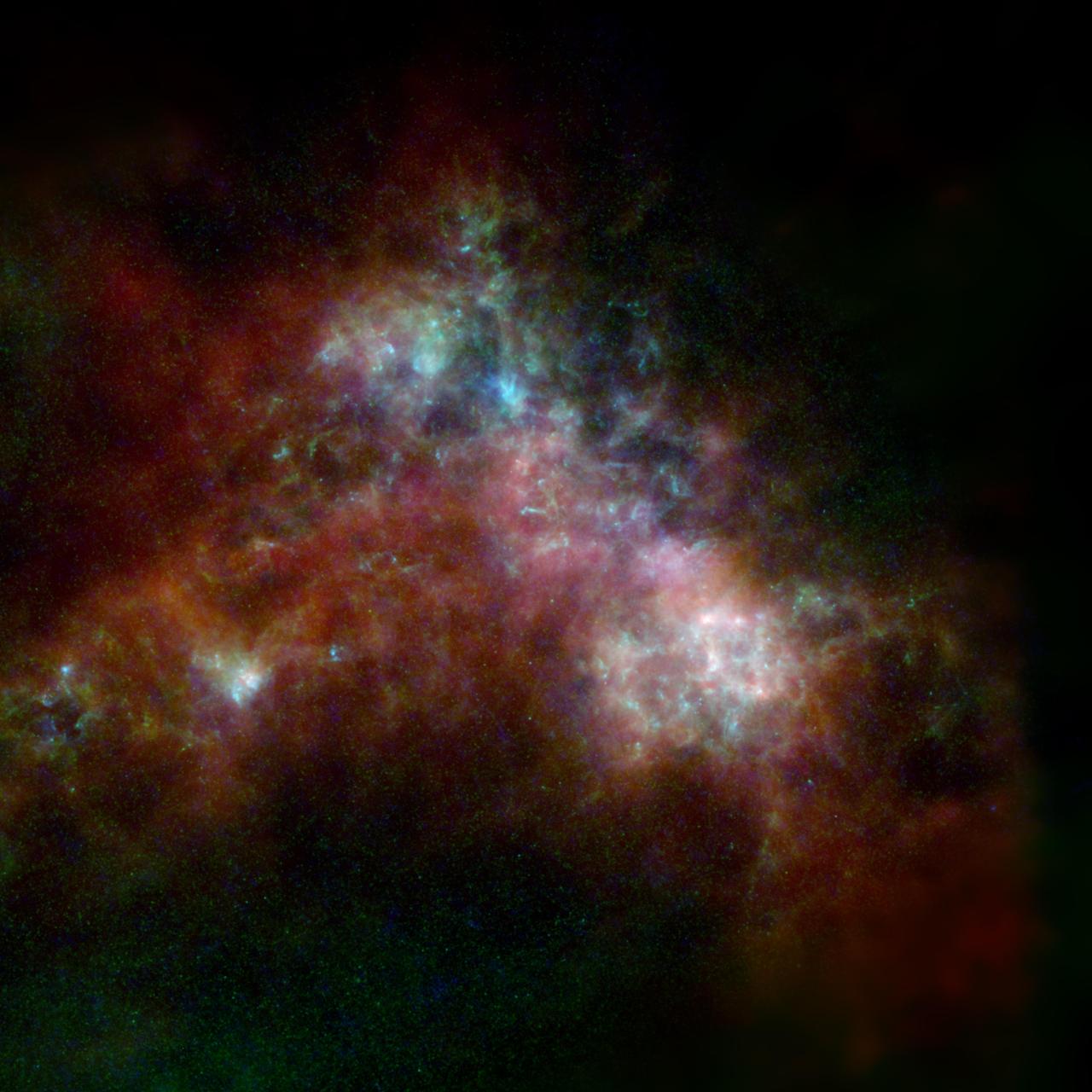
The Small Magellanic Cloud, shown here, is a dwarf galaxy orbiting the Milky Way. The image includes data from the ESA (European Space Agency) Herschel mission, supplemented with data from ESA's retired Planck observatory and two retired NASA missions: the Infrared Astronomical Satellite (IRAS) and Cosmic Background Explorer (COBE). Operated from 2009 to 2013, Herschel detected wavelengths of light in the far-infrared and microwave ranges, and was ideal for studying dust in nearby galaxies because it could capture small-scale structures in the dust clouds in high resolution. However, Herschel often couldn't detect light from diffuse dust clouds – especially in the outer regions of galaxies, where the gas and dust become sparse and thus fainter. As a result, the mission missed up to 30% of all the light given off by dust. Combining the Herschel observations with data from other observatories creates a more complete picture of the dust in the galaxy. In the image, red indicates hydrogen gas; green indicates cold dust; and warmer dust is shown in blue. Launched in 1983, IRAS was the first space telescope to detect infrared light, setting the stage for future observatories like NASA's Spitzer Space Telescope and James Webb Space Telescope. The Planck observatory, launched in 2009, and COBE, launched in 1989, both studied the cosmic microwave background, or light left over from the big bang. The hydrogen gas was detected using the Parkes Radio Telescope and the Australia Compact Telescope Array, located in Australia and managed by the Commonwealth Scientific and Industrial Research Organisation (CSIRO); and the NANTEN2 Observatory in the Atacama Desert in Chile. https://photojournal.jpl.nasa.gov/catalog/PIA25164
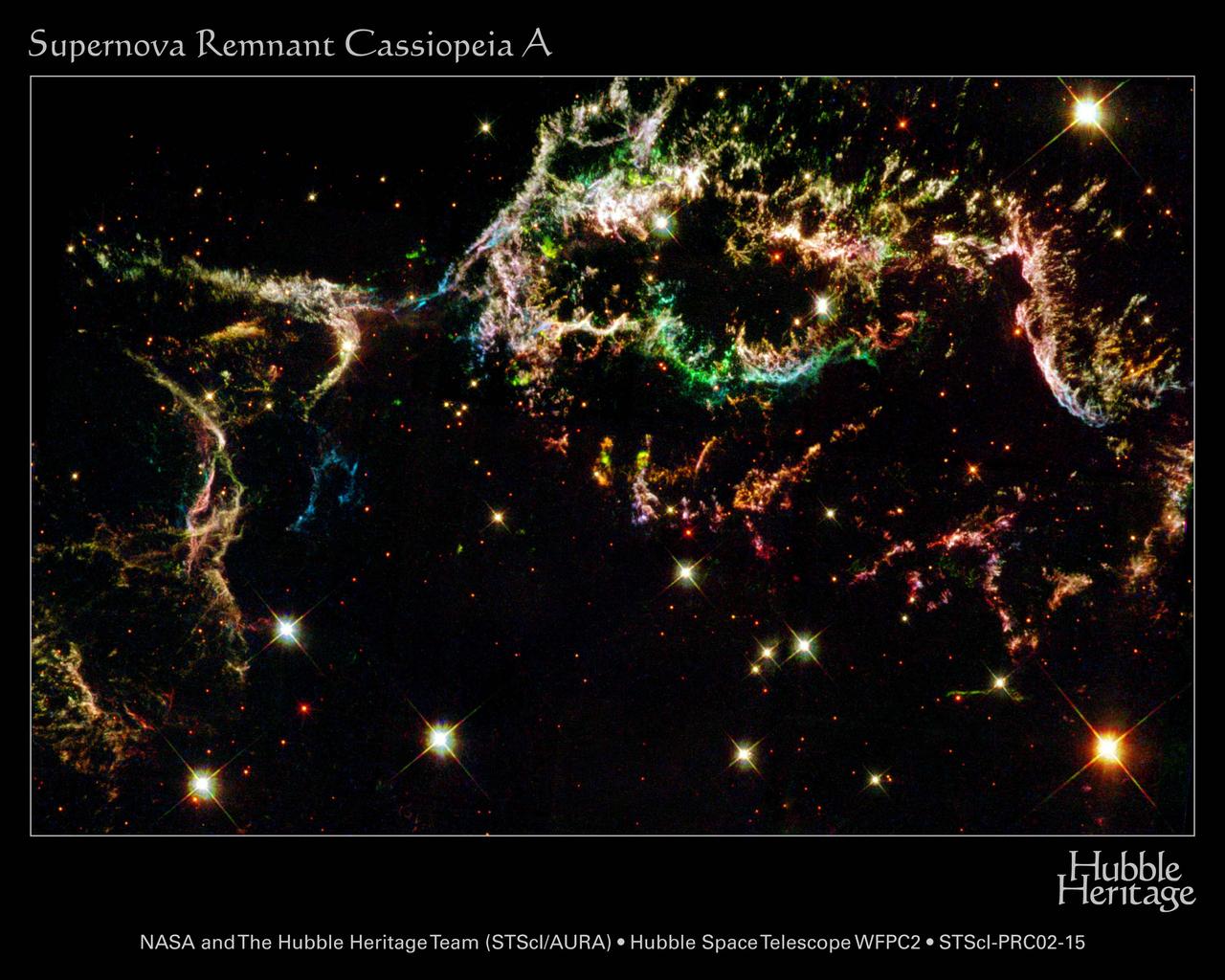
The colorful streamers that float across the sky in this photo taken by NASA's Hubble Space Telescope (HST) were created by the universe's biggest firecracker, the titanic supernova explosion of a massive star. The light from the exploding star reached Earth 320 years ago, nearly a century before the United States celebrated its birth with a bang. The dead star's shredded remains are called Cassiopeia A, or "Cas A" for short. Cas A is the youngest known supernova remnant in our Milky Way Galaxy and resides 10,000 light-years away in the constellation Cassiopeia, so the star actually blew up 10,000 years before the light reached Earth in the late 1600s. This HST image of Cas A shows for the first time that the debris is arranged into thousands of small, cooling knots of gas. This material eventually will be recycled into building new generations of stars and planets. Our own Sun and planets are constructed from the debris of supernovae that exploded billions of years ago. This photo shows the upper rim of the super nova remnant's expanding shell. Near the top of the image are dozens of tiny clumps of matter. Each small clump, originally just a small fragment of the star, is tens of times larger than the diameter of our solar system. The colors highlight parts of the debris where chemical elements are glowing. The dark blue fragments, for example, are richest in oxygen; the red material is rich in sulfur. The images were taken with the Wide Field and Planetary Camera 2 in January 2000 and January 2002. Image Credit: NASA and HST team (Stoics/AURA). Acknowledgment: R. Fesen (Darmouth) and J. Morse ( Univ. of Colorado).
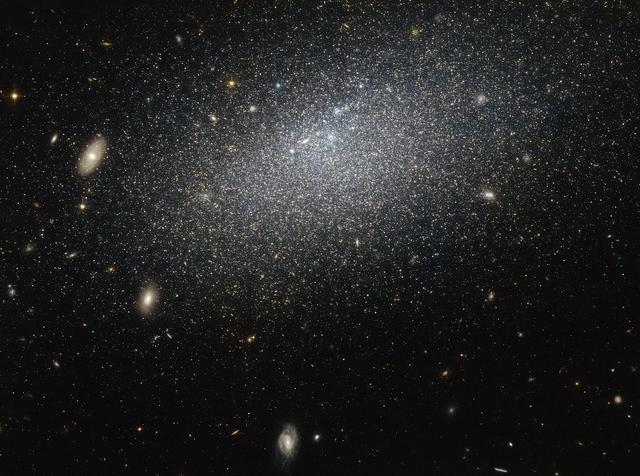
This irregular dwarf galaxy's closes neighbor is 2.3 million light years away, so yeah, we're calling it "isolated". The drizzle of stars scattered across this image forms a galaxy known as UGC 4879. UGC 4879 is an irregular dwarf galaxy — as the name suggests, galaxies of this type are a little smaller and messier than their cosmic cousins, lacking the majestic swirl of a spiral or the coherence of an elliptical. This galaxy is also very isolated. There are about 2.3 million light years between UGC 4879 and its closest neighbor, Leo A, which is about the same distance as that between the Andromeda Galaxy and the Milky Way. This galaxy’s isolation means that it has not interacted with any surrounding galaxies, making it an ideal laboratory for studying star formation uncomplicated by interactions with other galaxies. Studies of UGC 4879 have revealed a significant amount of star formation in the first 4 billion years after the Big Bang, followed by a strange 9-billion-year lull in star formation that ended 1 billion years ago by a more recent re-ignition. The reason for this behavior, however, remains mysterious, and the solitary galaxy continues to provide ample study material for astronomers looking to understand the complex mysteries of star birth throughout the universe. Image credit: NASA/ESA <b><a href="http://www.nasa.gov/audience/formedia/features/MP_Photo_Guidelines.html" rel="nofollow">NASA image use policy.</a></b> <b><a href="http://www.nasa.gov/centers/goddard/home/index.html" rel="nofollow">NASA Goddard Space Flight Center</a></b> enables NASA’s mission through four scientific endeavors: Earth Science, Heliophysics, Solar System Exploration, and Astrophysics. Goddard plays a leading role in NASA’s accomplishments by contributing compelling scientific knowledge to advance the Agency’s mission. <b>Follow us on <a href="http://twitter.com/NASAGoddardPix" rel="nofollow">Twitter</a></b> <b>Like us on <a href="http://www.facebook.com/pages/Greenbelt-MD/NASA-Goddard/395013845897?ref=tsd" rel="nofollow">Facebook</a></b> <b>Find us on <a href="http://instagrid.me/nasagoddard/?vm=grid" rel="nofollow">Instagram</a></b>

This image of the Andromeda galaxy, or M31, includes data from the ESA (European Space Agency) Herschel mission, supplemented with data from ESA's retired Planck observatory and two retired NASA missions: the Infrared Astronomical Satellite (IRAS) and Cosmic Background Explorer (COBE). Operated from 2009 to 2013, Herschel detected wavelengths of light in the far-infrared and microwave ranges, and was ideal for studying dust in nearby galaxies because it could capture small-scale structures in the dust clouds in high resolution. However, Herschel often couldn't detect light from diffuse dust clouds – especially in the outer regions of galaxies, where the gas and dust become sparse and thus fainter. As a result, the mission missed up to 30% of all the light given off by dust. Combining the Herschel observations with data from other observatories creates a more complete picture of the dust in the galaxy. In the image, red indicates hydrogen gas; green indicates cold dust; and warmer dust is shown in blue. Launched in 1983, IRAS was the first space telescope to detect infrared light, setting the stage for future observatories like NASA's Spitzer Space Telescope and James Webb Space Telescope. The Planck observatory, launched in 2009, and COBE, launched in 1989, both studied the cosmic microwave background, or light left over from the big bang. Red indicates hydrogen gas detected using the Green Bank Telescope in West Virginia, the Westerbork Synthesis Radio Telescope in the Netherlands, and the Institute for Radio Astronomy in the Millimeter Range 30-meter telescope in Spain. https://photojournal.jpl.nasa.gov/catalog/PIA25163
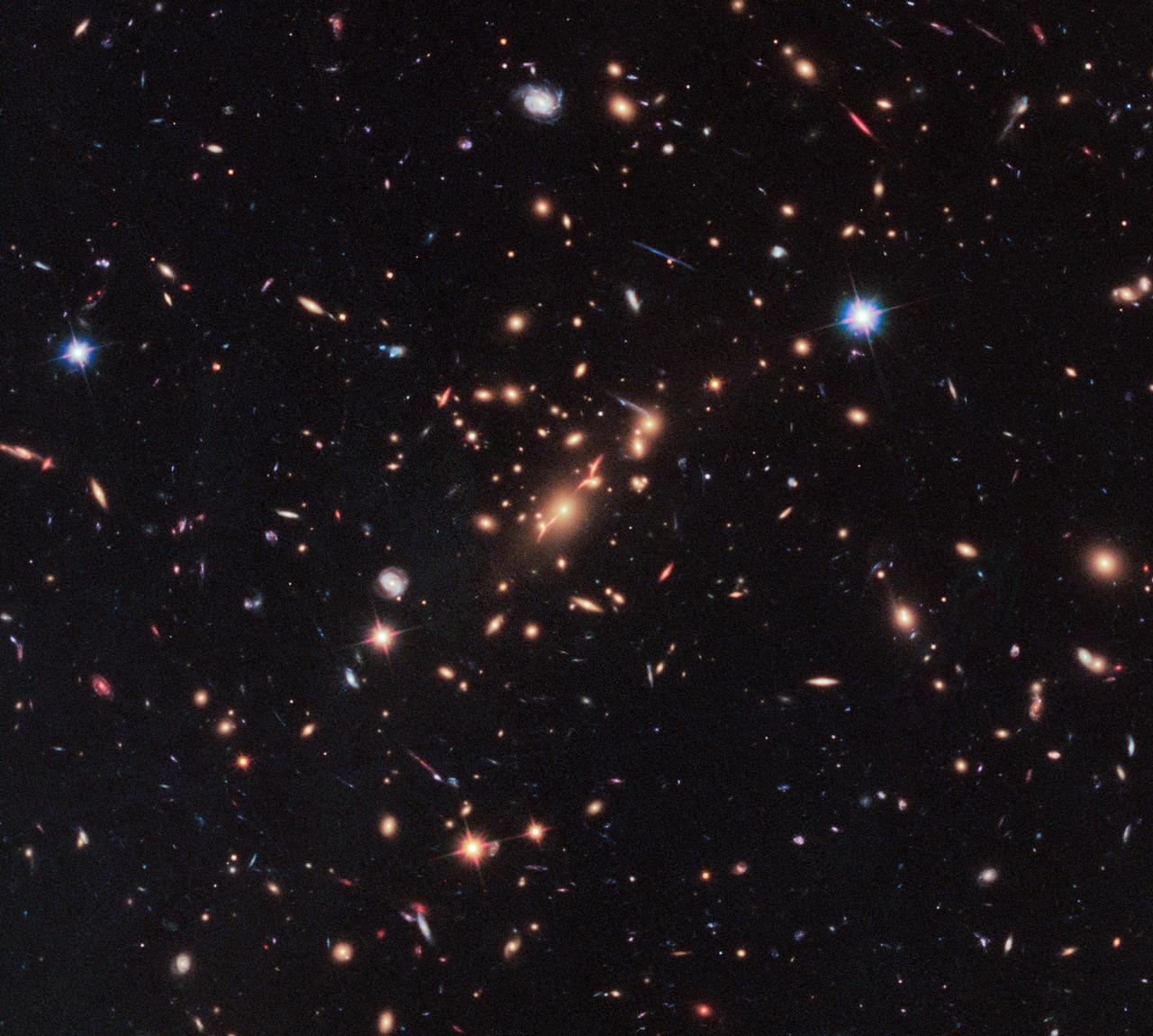
By combining the power of a "natural lens" in space with the capability of NASA's Hubble Space Telescope, astronomers made a surprising discovery—the first example of a compact yet massive, fast-spinning, disk-shaped galaxy that stopped making stars only a few billion years after the big bang. Finding such a galaxy early in the history of the universe challenges the current understanding of how massive galaxies form and evolve, say researchers. Read more: <a href="https://go.nasa.gov/2sWwKkc" rel="nofollow">go.nasa.gov/2sWwKkc</a> caption: Acting as a “natural telescope” in space, the gravity of the extremely massive foreground galaxy cluster MACS J2129-0741 magnifies, brightens, and distorts the far-distant background galaxy MACS2129-1, shown in the top box. The middle box is a blown-up view of the gravitationally lensed galaxy. In the bottom box is a reconstructed image, based on modeling that shows what the galaxy would look like if the galaxy cluster were not present. The galaxy appears red because it is so distant that its light is shifted into the red part of the spectrum. Credits: NASA, ESA, M. Postman (STScI), and the CLASH team <b><a href="http://www.nasa.gov/audience/formedia/features/MP_Photo_Guidelines.html" rel="nofollow">NASA image use policy.</a></b> <b><a href="http://www.nasa.gov/centers/goddard/home/index.html" rel="nofollow">NASA Goddard Space Flight Center</a></b> enables NASA’s mission through four scientific endeavors: Earth Science, Heliophysics, Solar System Exploration, and Astrophysics. Goddard plays a leading role in NASA’s accomplishments by contributing compelling scientific knowledge to advance the Agency’s mission. <b>Follow us on <a href="http://twitter.com/NASAGoddardPix" rel="nofollow">Twitter</a></b> <b>Like us on <a href="http://www.facebook.com/pages/Greenbelt-MD/NASA-Goddard/395013845897?ref=tsd" rel="nofollow">Facebook</a></b> <b>Find us on <a href="http://instagrid.me/nasagoddard/?vm=grid" rel="nofollow">Instagram</a></b>
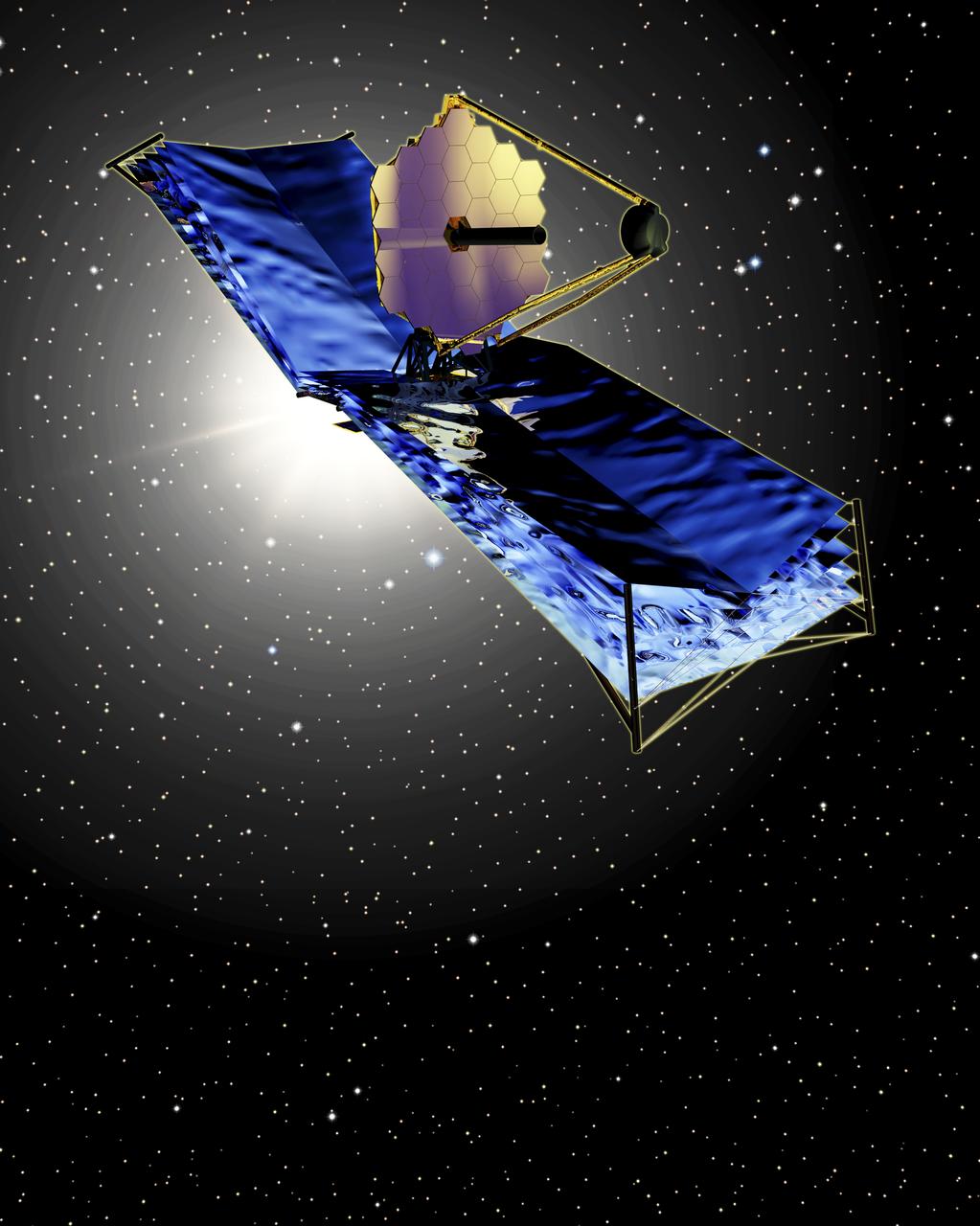
Pictured is the chosen artist's rendering of NASA's next generation space telescope, a successor to the Hubble Space Telescope, was named the James Webb Space Telescope (JWST) in honor of NASA's second administrator, James E. Webb. To further our understanding of the way our present universe formed following the the big bang, NASA is developing the JWST to observe the first stars and galaxies in the universe. This grand effort will help to answer the following fundamental questions: How galaxies form and evolve, how stars and planetary systems form and interact, how the universe builds up its present elemental/chemical composition, and what dark matter is. To see into the depths of space, the JWST is currently plarning to carry instruments that are sensitive to the infrared wavelengths of the electromagnetic spectrum. The new telescope will carry a near-infrared camera, a multi-object spectrometer, and a mid-infrared camera/spectrometer. The JWST is scheduled for launch in 2010 aboard an expendable launch vehicle. It will take about 3 months for the spacecraft to reach its destination, an orbit of 940,000 miles in space. Marshall Space Flight Center (MSFC) is supporting Goddard Space Flight Center (GSFC) in developing the JWST by creating an ultra-lightweight mirror for the telescope at MSFC's Space Optics Manufacturing Technology Center. GSFC, Greenbelt, Maryland, manages the JWST, and TRW will design and fabricate the observatory's primary mirror and spacecraft. The program has a number of industry, academic, and government partners, as well as the European Space Agency and the Canadian Space Agency. (Image: Courtesy of TRW)

NASA image release April 12, 2011 Astronomers have uncovered one of the youngest galaxies in the distant universe, with stars that formed 13.5 billion years ago, a mere 200 million years after the Big Bang. The finding addresses questions about when the first galaxies arose, and how the early universe evolved. NASA's Hubble Space Telescope was the first to spot the newfound galaxy. Detailed observations from the W.M. Keck Observatory on Mauna Kea in Hawaii revealed the observed light dates to when the universe was only 950 million years old; the universe formed about 13.7 billion years ago. Infrared data from both Hubble and NASA's Spitzer Space Telescope revealed the galaxy's stars are quite mature, having formed when the universe was just a toddler at 200 million years old. The galaxy's image is being magnified by the gravity of a massive cluster of galaxies (Abell 383) parked in front of it, making it appear 11 times brighter. This phenomenon is called gravitational lensing. Hubble imaged the lensing galaxy Abell 383 with the Wide Field Camera 3 and the Advanced Camera for Surveys in November 2010 through March 2011. Credit: NASA, ESA, J. Richard (Center for Astronomical Research/Observatory of Lyon, France), and J.-P. Kneib (Astrophysical Laboratory of Marseille, France) <b><a href="http://www.nasa.gov/centers/goddard/home/index.html" rel="nofollow">NASA Goddard Space Flight Center</a></b> enables NASA’s mission through four scientific endeavors: Earth Science, Heliophysics, Solar System Exploration, and Astrophysics. Goddard plays a leading role in NASA’s accomplishments by contributing compelling scientific knowledge to advance the Agency’s mission. <b>Follow us on <a href="http://twitter.com/NASA_GoddardPix" rel="nofollow">Twitter</a></b> <b>Join us on <a href="http://www.facebook.com/pages/Greenbelt-MD/NASA-Goddard/395013845897?ref=tsd" rel="nofollow">Facebook</a></b>
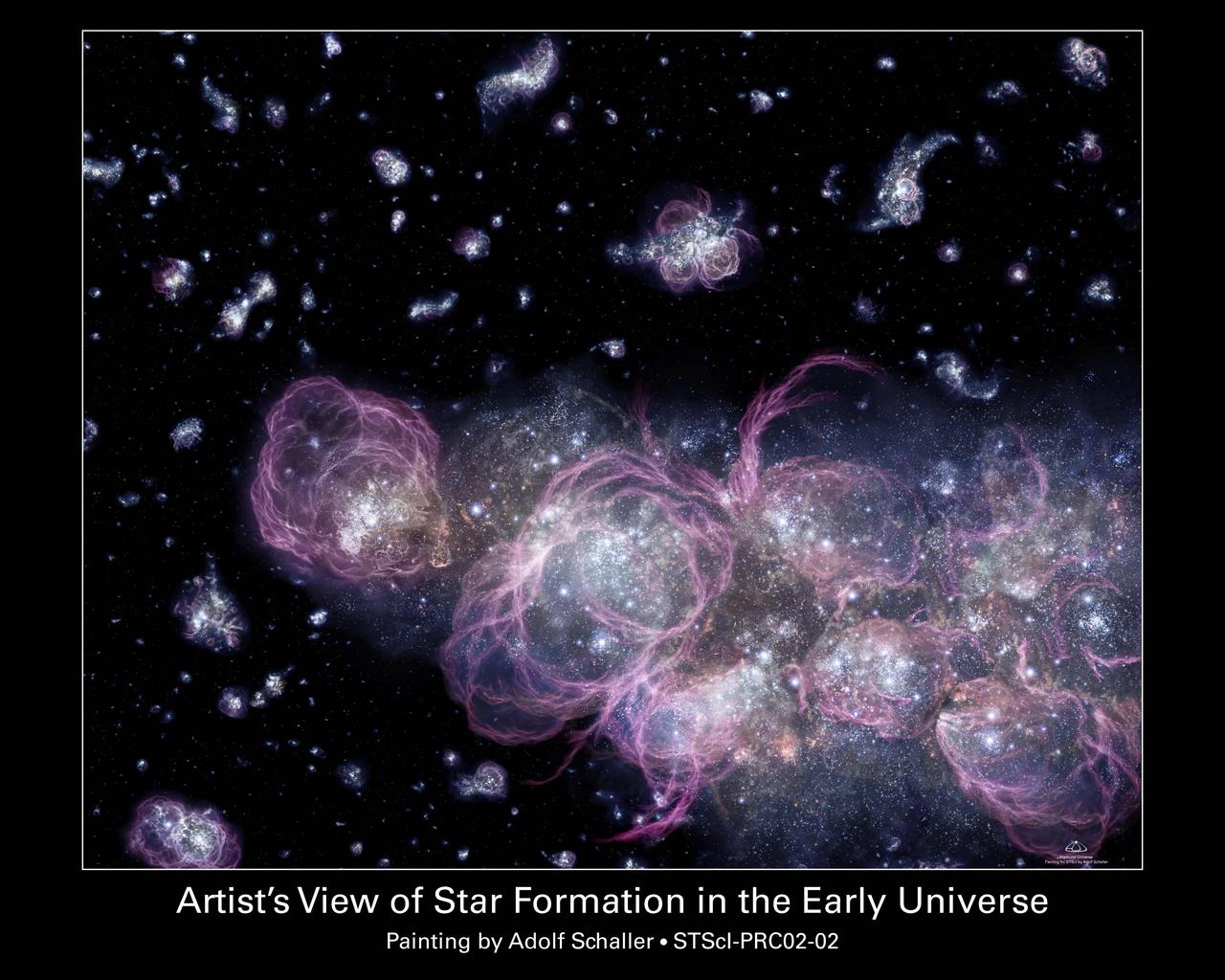
This is an artist's impression of how the very early universe (less than one billion years old) might have looked when it went through a voracious onset of star formation, converting primordial hydrogen into myriad stars at an unprecedented rate. The deepest views of the cosmos from the Hubble Space Telescope (HST) yield clues that the very first stars may have burst into the universe as brilliantly and spectacularly as a firework finale. Except in this case, the finale came first, long before Earth, the Sun ,and the Milky Way Galaxy formed. Studies of HST's deepest views of the heavens lead to the preliminary conclusion that the universe made a significant portion of its stars in a torrential firestorm of star birth, which abruptly lit up the pitch-dark heavens just a few hundred million years after the "big bang," the tremendous explosion that created the cosmos. Within the starburst galaxies, bright knots of hot blue stars come and go like bursting fireworks shells. Regions of new starbirth glow intensely red under torrent of ultraviolet radiation. The most massive stars self-detonate as supernovas, which explode across the sky like a string of firecrackers. A foreground starburst galaxy at lower right is sculpted with hot bubbles from supernova explosions and torrential stellar winds. Unlike today there is very little dust in these galaxies, because the heavier elements have not yet been cooked up through nucleosynthesis in stars. Recent analysis of HST deep sky images supports the theory that the first stars in the universe appeared in an abrupt eruption of star formation, rather than at a gradual pace. Science Credit: NASA and K. Lanzetta (SUNY). Artwork Credit: Adolf Schaller for STScI.
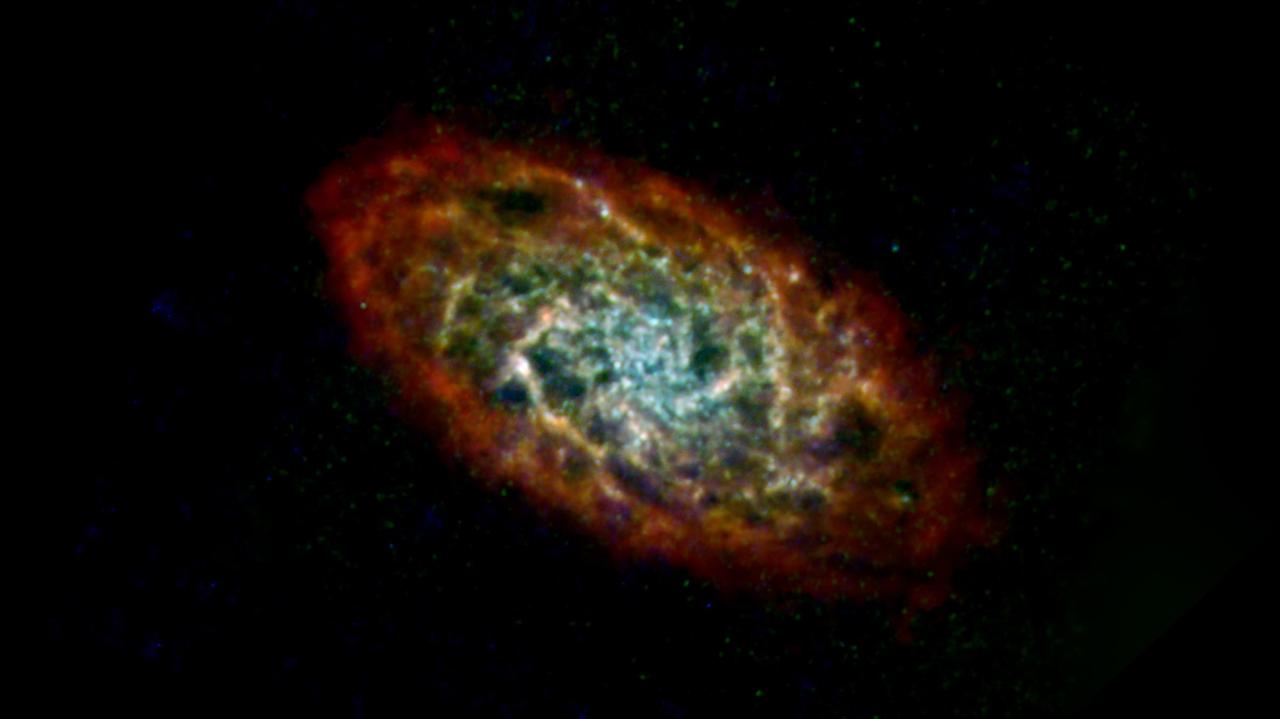
This image of the Triangulum galaxy, or M33, includes data from the ESA (European Space Agency) Herschel mission, supplemented with data from ESA's retired Planck observatory and two retired NASA missions: the Infrared Astronomical Satellite (IRAS) and Cosmic Background Explorer (COBE). Operated from 2009 to 2013, Herschel detected wavelengths of light in the far-infrared and microwave ranges, and was ideal for studying dust in nearby galaxies because it could capture small-scale structures in the dust clouds in high resolution. However, Herschel often couldn't detect light from diffuse dust clouds – especially in the outer regions of galaxies, where the gas and dust become sparse and thus fainter. As a result, the mission missed up to 30% of all the light given off by dust. Combining the Herschel observations with data from other observatories creates a more complete picture of the dust in the galaxy. In the image, red indicates hydrogen gas; green indicates cold dust; and warmer dust is shown in blue. Launched in 1983, IRAS was the first space telescope to detect infrared light, setting the stage for future observatories like NASA's Spitzer Space Telescope and James Webb Space Telescope. The Planck observatory, launched in 2009, and COBE, launched in 1989, both studied the cosmic microwave background, or light left over from the big bang. The hydrogen gas was detected using the Green Bank Telescope in West Virginia, the Karl G. Jansky Very Large Array in New Mexico, and the Institute for Radio Astronomy in the Millimeter Range 30-meter telescope in Spain. https://photojournal.jpl.nasa.gov/catalog/PIA25165
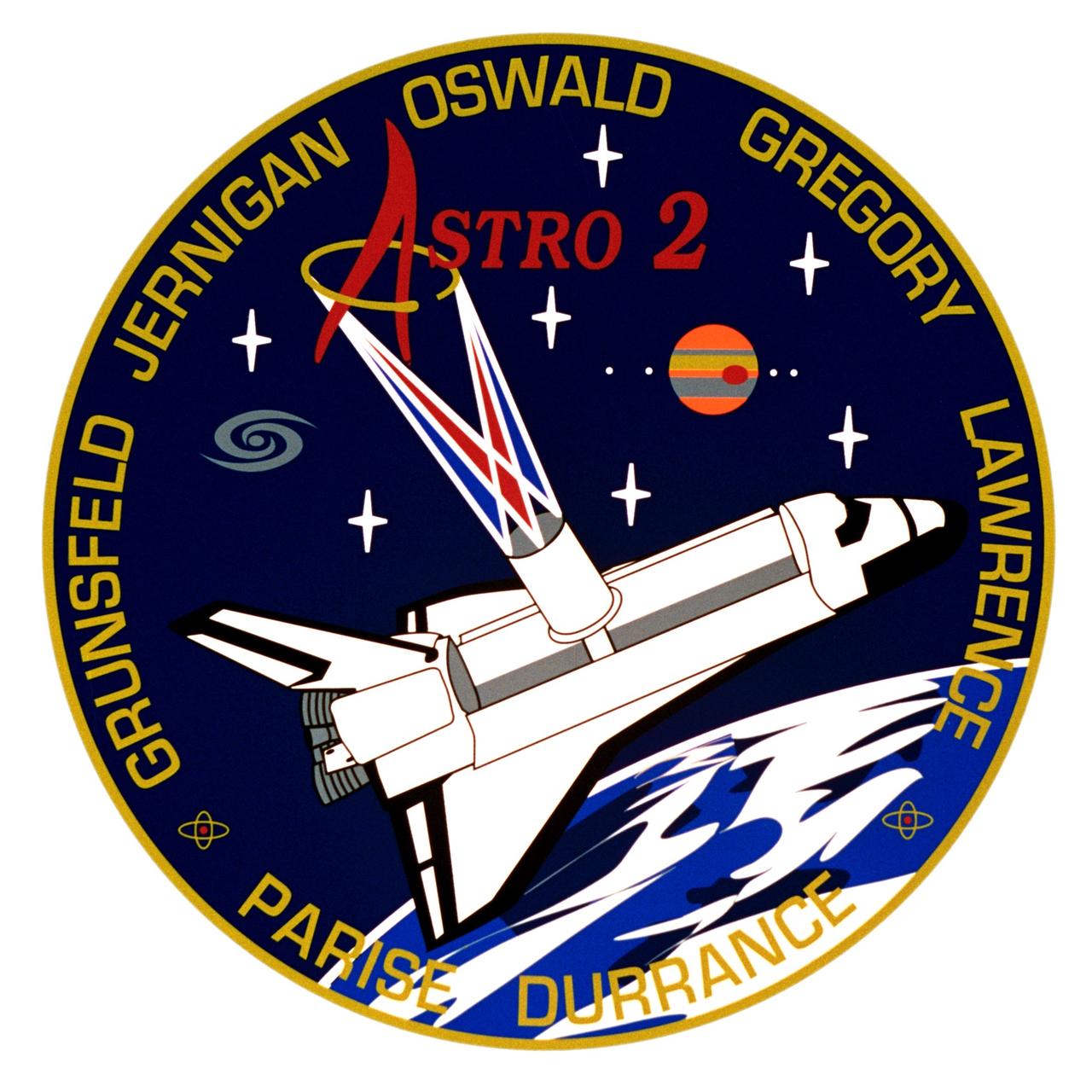
STS067-S-001 (October 1994) --- Observation and remote exploration of the Universe in the ultraviolet wavelengths of light are the focus of the STS-67/ASTRO-2 mission, as depicted in the crew patch designed by the crew members. The insignia shows the ASTRO-2 telescopes in the space shuttle Endeavour's payload bay, orbiting high above Earth's atmosphere. The three sets of rays, diverging from the telescope on the patch atop the Instrument Pointing System (IPS), correspond to the three ASTRO-2 telescopes -- the Hopkins Ultraviolet Telescope (HUT), the Ultraviolet Imaging Telescope (UIT), and the Wisconsin Ultraviolet Photo-Polarimeter Experiment (WUPPE). The telescopes are co-aligned to simultaneously view the same astronomical object, as shown by the convergence of rays on the NASA symbol. This symbol also represents the excellence of the union of the NASA teams and universality's in the exploration of the universe through astronomy. The celestial targets of ASTRO-2 include the observation of planets, stars and galaxies shown in the design. The two small atoms represent the search in the ultraviolet spectrum for the signature of primordial helium in intergalactic space left over from the Big Bang. The observations performed on ASTRO-2 will contribute to man's knowledge and understanding of the vast universe, from the planets in out system to the farthest reaches of space. The NASA insignia design for space shuttle flights is reserved for use by the astronauts and for other official use as the NASA Administrator may authorize. Public availability has been approved only in the forms of illustrations by the various news media. When and if there is any change in this policy, which is not anticipated, the change will be publicly announced. Photo credit: NASA

Amelia Quan, the mechanical integration lead for NASA's SPHEREx mission, is seen with a V-groove radiator, a piece of hardware that will help keep the space telescope cold, at the agency's Jet Propulsion Laboratory in Southern California in May 2023. Short for Specto-Photometer for the History of the Universe, Epoch of Reionization and Ices Explorer, SPHEREx will create a map of the cosmos like no other, imaging the entire sky and gathering information about millions of galaxies. With this map, scientists will study what happened in the first fraction of a second after the big bang, the history of galaxy evolution, and the origins of water in planetary systems in our galaxy. SPHEREx will detect infrared light, a range of wavelengths longer than the visible light human eyes can see. Infrared light is also sometimes called heat radiation because all warm objects emit it. Even the telescope itself can create infrared light, which would interfere with its detectors. So the telescope has to be kept cold – below minus 350 degrees Fahrenheit (about minus 210 degrees Celsius). The V-groove radiator consists of three conical mirrors, each like an upside-down umbrella, stacked atop one another. They sit below the photon shields, and each is composed of a series of wedges that redirect infrared light so it bounces through the gaps between the shields and out into space. This removes heat carried through the supports from the room temperature spacecraft bus that contains the spacecraft computer and electronics. https://photojournal.jpl.nasa.gov/catalog/PIA25786
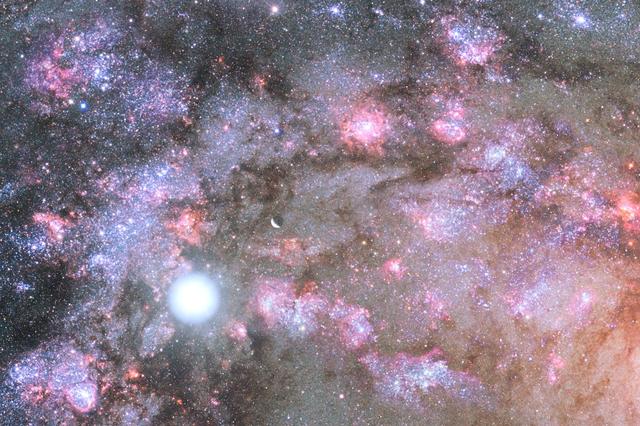
Astronomers have for the first time caught a glimpse of the earliest stages of massive galaxy construction. The building site, dubbed “Sparky,” is a dense galactic core blazing with the light of millions of newborn stars that are forming at a ferocious rate. The discovery was made possible through combined observations from NASA’s Hubble and Spitzer space telescopes, the W.M. Keck Observatory in Mauna Kea, Hawaii, and the European Space Agency's Herschel space observatory, in which NASA plays an important role. A fully developed elliptical galaxy is a gas-deficient gathering of ancient stars theorized to develop from the inside out, with a compact core marking its beginnings. Because the galactic core is so far away, the light of the forming galaxy that is observable from Earth was actually created 11 billion years ago, just 3 billion years after the Big Bang. Read more: <a href="http://1.usa.gov/1rAMSSr" rel="nofollow">1.usa.gov/1rAMSSr</a> Credit: NASA, Z. Levay, G. Bacon (STScI) <b><a href="http://www.nasa.gov/audience/formedia/features/MP_Photo_Guidelines.html" rel="nofollow">NASA image use policy.</a></b> <b><a href="http://www.nasa.gov/centers/goddard/home/index.html" rel="nofollow">NASA Goddard Space Flight Center</a></b> enables NASA’s mission through four scientific endeavors: Earth Science, Heliophysics, Solar System Exploration, and Astrophysics. Goddard plays a leading role in NASA’s accomplishments by contributing compelling scientific knowledge to advance the Agency’s mission. <b>Follow us on <a href="http://twitter.com/NASAGoddardPix" rel="nofollow">Twitter</a></b> <b>Like us on <a href="http://www.facebook.com/pages/Greenbelt-MD/NASA-Goddard/395013845897?ref=tsd" rel="nofollow">Facebook</a></b> <b>Find us on <a href="http://instagram.com/nasagoddard?vm=grid" rel="nofollow">Instagram</a></b>
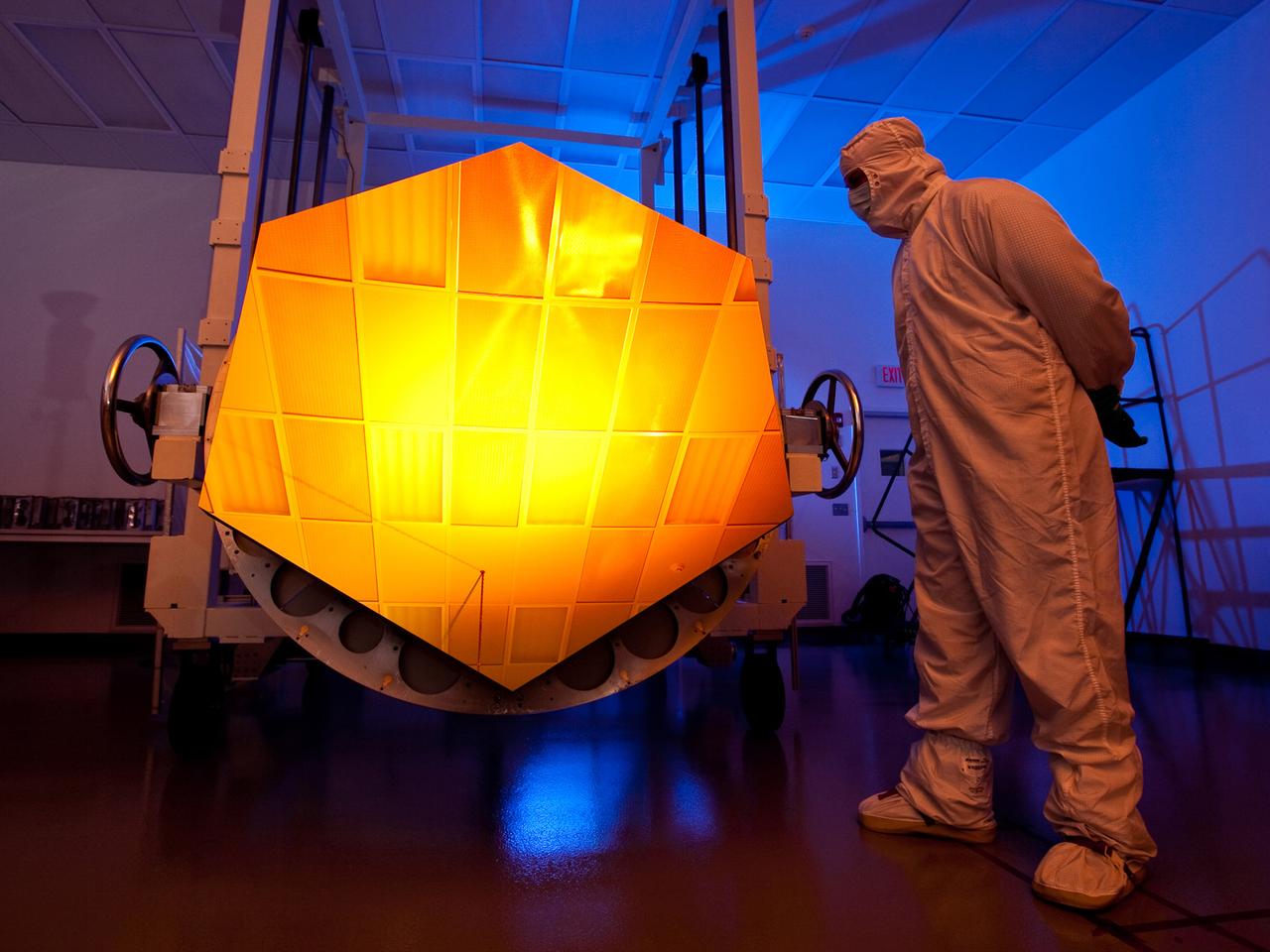
NASA image release December 9, 2010 Caption: The James Webb Space Telescope's Engineering Design Unit (EDU) primary mirror segment, coated with gold by Quantum Coating Incorporated. The actuator is located behind the mirror. Credit: Photo by Drew Noel NASA's James Webb Space Telescope is a wonder of modern engineering. As the planned successor to the Hubble Space telescope, even the smallest of parts on this giant observatory will play a critical role in its performance. A new video takes viewers behind the Webb's mirrors to investigate "actuators," one component that will help Webb focus on some of the earliest objects in the universe. The video called "Got Your Back" is part of an on-going video series about the Webb telescope called "Behind the Webb." It was produced at the Space Telescope Science Institute (STScI) in Baltimore, Md. and takes viewers behind the scenes with scientists and engineers who are creating the Webb telescope's components. During the 3 minute and 12 second video, STScI host Mary Estacion interviewed people involved in the project at Ball Aerospace in Boulder, Colo. and showed the actuators in action. The Webb telescope will study every phase in the history of our universe, ranging from the first luminous glows after the big bang, to the formation of solar systems capable of supporting life on planets like Earth, to the evolution of our own solar system. Measuring the light this distant light requires a primary mirror 6.5 meters (21 feet 4 inches) across – six times larger than the Hubble Space telescope’s mirror! Launching a mirror this large into space isn’t feasible. Instead, Webb engineers and scientists innovated a unique solution – building 18 mirrors that will act in unison as one large mirror. These mirrors are packaged together into three sections that fold up - much easier to fit inside a rocket. Each mirror is made from beryllium and weighs approximately 20 kilograms (46 pounds). Once in space, getting these mirrors to focus correctly on faraway galaxies is another challenge entirely. Actuators, or tiny mechanical motors, provide the answer to achieving a single perfect focus. The primary and secondary mirror segments are both moved by six actuators that are attached to the back of the mirrors. The primary segment has an additional actuator at the center of the mirror that adjusts its curvature. The third mirror segment remains stationary. Lee Feinberg, Webb Optical Telescope Element Manager at NASA's Goddard Space Flight Center in Greenbelt, Md. explained "Aligning the primary mirror segments as though they are a single large mirror means each mirror is aligned to 1/10,000th the thickness of a human hair. This alignment has to be done at 50 degrees above absolute zero! What's even more amazing is that the engineers and scientists working on the Webb telescope literally had to invent how to do this." With the actuators in place, Brad Shogrin, Webb Telescope Manager at Ball Aerospace, Boulder, Colo, details the next step: attaching the hexapod (meaning six-footed) assembly and radius of curvature subsystem (ROC). "Radius of curvature" refers to the distance to the center point of the curvature of the mirror. Feinberg added "To understand the concept in a more basic sense, if you change that radius of curvature, you change the mirror's focus." The "Behind the Webb" video series is available in HQ, large and small Quicktime formats, HD, Large and Small WMV formats, and HD, Large and Small Xvid formats. To see the actuators being attached to the back of a telescope mirror in this new "Behind the Webb" video, visit: <a href="http://webbtelescope.org/webb_telescope/behind_the_webb/7" rel="nofollow">webbtelescope.org/webb_telescope/behind_the_webb/7</a> For more information about Webb's mirrors, visit: <a href="http://www.jwst.nasa.gov/mirrors.html" rel="nofollow">www.jwst.nasa.gov/mirrors.html</a> For more information on the James Webb Space Telescope, visit: <a href="http://jwst.nasa.gov" rel="nofollow">jwst.nasa.gov</a> Rob Gutro NASA's Goddard Space Flight Center, Greenbelt, Md. <b><a href="http://www.nasa.gov/centers/goddard/home/index.html" rel="nofollow">NASA Goddard Space Flight Center</a></b> enables NASA’s mission through four scientific endeavors: Earth Science, Heliophysics, Solar System Exploration, and Astrophysics. Goddard plays a leading role in NASA’s accomplishments by contributing compelling scientific knowledge to advance the Agency’s mission. <b>Follow us on <a href="http://twitter.com/NASA_GoddardPix" rel="nofollow">Twitter</a></b> <b>Join us on <a href="http://www.facebook.com/pages/Greenbelt-MD/NASA-Goddard/395013845897?ref=tsd" rel="nofollow">Facebook</a></b>

Caption: A NASA Super Pressure Balloon with the COSI payload is ready for launch from McMurdo, Antarctica. Credit: NASA More info: NASA’s globetrotting Balloon Program Office is wrapping up its 2014-2015 Antarctic campaign while prepping for an around-the-world flight launching out of Wanaka, New Zealand, in March. After 16 days, 12 hours, and 56 minutes of flight, operators successfully conducted a planned flight termination of the Suborbital Polarimeter for Inflation Dust and the Epoch of Reionization (SPIDER) mission Saturday, Jan. 18, the final mission of the campaign. Other flights in the 2014-2015 Antarctic campaign included the Antarctic Impulsive Transient Antenna (ANITA-III) mission as well as the Compton Spectrometer and Imager (COSI) payload flown on the developmental Super Pressure Balloon (SPB). ANITA-III successfully wrapped up Jan. 9 after 22 days, 9 hours, and 14 minutes of flight. Flight controllers terminated the COSI flight 43 hours into the mission after detecting a small gas leak in the balloon. Crews are now working to recover all three instruments from different locations across the continent. The 6,480-pound SPIDER payload is stationary at a position about 290 miles from the United Kingdom’s Sky Blu Logistics Facility in Antarctica. The 4,601 pound ANITA-III payload, located about 100 miles from Australia’s Davis Station, and the 2,866 pound COSI payload, located about 340 miles from the United States McMurdo Station both had numerous key components recovered in the past few days. Beginning in late January, the Balloon Program Office will deploy a team to Wanaka, New Zealand, to begin preparations for an SPB flight, scheduled to launch in March. The Program Office seeks to fly the SPB more than 100 days, which would shatter the current flight duration record of 55 days, 1 hour, and 34 minutes for a large scientific balloon. “We’re looking forward to the New Zealand campaign and hopefully a history-making flight with the Super Pressure Balloon,” said Debbie Fairbrother, NASA’s Balloon Program Office Chief. Most scientific balloons see altitude variances based on temperature changes in the atmosphere at night and during the day. The SPB is capable of missions on the order of 100 days or more at constant float altitudes due to the pressurization of the balloon. “Stable, long-duration flights at near-space altitudes above more than 99 percent of the atmosphere are highly desirable in the science community, and we’re ready to deliver,” said Fairbrother. In addition to the SPB flight in March, the Balloon Program Office has 10 more balloon missions planned through September 2015 to include scheduled test flights of the Low-Density Supersonic Decelerator, which is testing new technologies for landing larger, heavier payloads on Mars. NASA’s Wallops Flight Facility manages the agency’s Scientific Balloon Program with 10 to 15 flights each year from launch sites worldwide. The balloons are massive in volume; the average-sized balloon could hold the volume of nearly 200 blimps. Previous work on balloons have contributed to confirming the Big Bang Theory. For more information on NASA’s Scientific Balloon Program, see: <a href="http://sites.wff.nasa.gov/code820/index.html" rel="nofollow">sites.wff.nasa.gov/code820/index.html</a> <b><a href="http://www.nasa.gov/audience/formedia/features/MP_Photo_Guidelines.html" rel="nofollow">NASA image use policy.</a></b> <b><a href="http://www.nasa.gov/centers/goddard/home/index.html" rel="nofollow">NASA Goddard Space Flight Center</a></b> enables NASA’s mission through four scientific endeavors: Earth Science, Heliophysics, Solar System Exploration, and Astrophysics. Goddard plays a leading role in NASA’s accomplishments by contributing compelling scientific knowledge to advance the Agency’s mission. <b>Follow us on <a href="http://twitter.com/NASAGoddardPix" rel="nofollow">Twitter</a></b> <b>Like us on <a href="http://www.facebook.com/pages/Greenbelt-MD/NASA-Goddard/395013845897?ref=tsd" rel="nofollow">Facebook</a></b> <b>Find us on <a href="http://instagram.com/nasagoddard?vm=grid" rel="nofollow">Instagram</a></b>
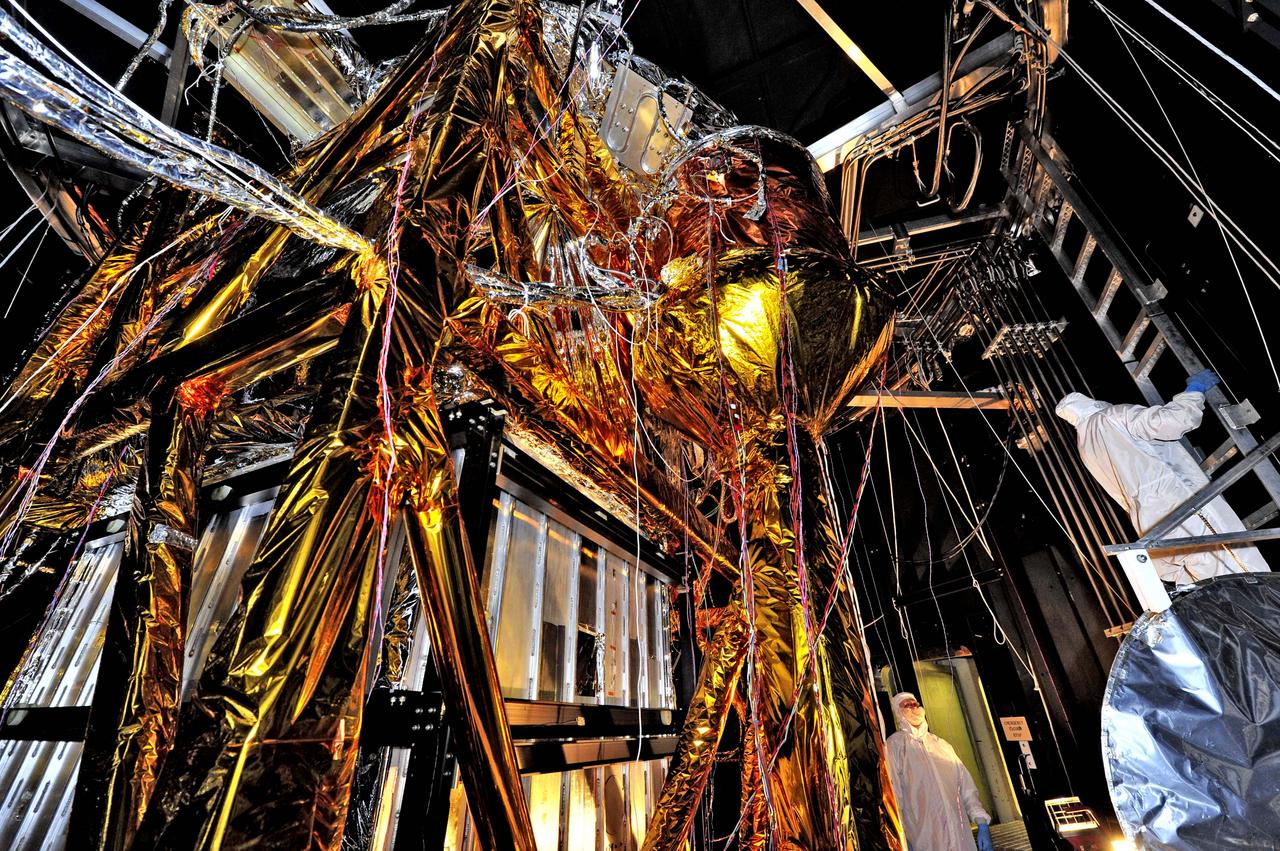
NASA image release August 23, 2012 What looks like a giant golden spider weaving a web of cables and cords, is actually ground support equipment, including the Optical Telescope Simulator (OSIM), for the James Webb Space Telescope. OSIM's job is to generate a beam of light just like the one that the real telescope optics will feed into the actual flight instruments. Because the real flight instruments will be used to test the real flight telescope, their alignment and performance first have to be verified by using the OSIM. Engineers are thoroughly checking out OSIM now in preparation for using it to test the flight science instruments later. This photo was taken from inside a large thermal-vacuum chamber called the Space Environment Simulator (SES), at NASA's Goddard Space Flight Center in Greenbelt, Md. Engineers have blanketed the structure of the OSIM with special insulating material to help control its temperature while it goes into the deep freeze testing that mimics the chill of space that Webb will ultimately experience in its operational orbit over 1 million miles from Earth. The golden-colored thermal blankets are made of aluminized kapton, a polymer film that remains stable over a wide range of temperatures. The structure that looks like a silver and black cube underneath the "spider" is a set of cold panels that surround OSIM's optics. During testing, OSIM's temperature will drop to 100 Kelvin (-280 F or -173 C) as liquid nitrogen flows through tubes welded to the chamber walls and through tubes along the silver panels surrounding OSIM's optics. These cold panels will keep the OSIM optics very cold, but the parts covered by the aluminized kapton blankets will stay warm. "Some blankets have silver facing out and gold facing in, or inverted, or silver on both sides, etc.," says Erin Wilson, a Goddard engineer. "Depending on which side of the blanket your hardware is looking at, the blankets can help it get colder or stay warmer, in an environmental test." Another reason for thermal blankets is to shield the cold OSIM optics from unwanted stray infrared light. When the OSIM is pointing its calibrated light beam at Webb's science instruments, engineers don't want any stray infrared light, such as "warm photons" from warm structures, leaking into the instruments' field of view. Too much of this stray light would raise the background too much for the instruments to "see" light from the OSIM—it would be like trying to photograph a lightning bug flying in front of car headlights. To get OSIM's optics cold, the inside of the chamber has to get cold, and to do that, all the air has to be pumped out to create a vacuum. Then liquid nitrogen has to be run though the plumbing along the inner walls of the chamber. Wilson notes that's why the blankets have to have vents in them: "That way, the air between all the layers can be evacuated as the chamber pressure drops, otherwise the blankets could pop," says Wilson. The most powerful space telescope ever built, Webb is the successor to NASA's Hubble Space Telescope. Webb's four instruments will reveal how the universe evolved from the Big Bang to the formation of our solar system. Webb is a joint project of NASA, the European Space Agency and the Canadian Space Agency. Credit: NASA/GSFC/Chris Gunn <b><a href="http://www.nasa.gov/audience/formedia/features/MP_Photo_Guidelines.html" rel="nofollow">NASA image use policy.</a></b> <b><a href="http://www.nasa.gov/centers/goddard/home/index.html" rel="nofollow">NASA Goddard Space Flight Center</a></b> enables NASA’s mission through four scientific endeavors: Earth Science, Heliophysics, Solar System Exploration, and Astrophysics. Goddard plays a leading role in NASA’s accomplishments by contributing compelling scientific knowledge to advance the Agency’s mission. <b>Follow us on <a href="http://twitter.com/NASA_GoddardPix" rel="nofollow">Twitter</a></b> <b>Like us on <a href="http://www.facebook.com/pages/Greenbelt-MD/NASA-Goddard/395013845897?ref=tsd" rel="nofollow">Facebook</a></b> <b>Find us on <a href="http://instagrid.me/nasagoddard/?vm=grid" rel="nofollow">Instagram</a></b>