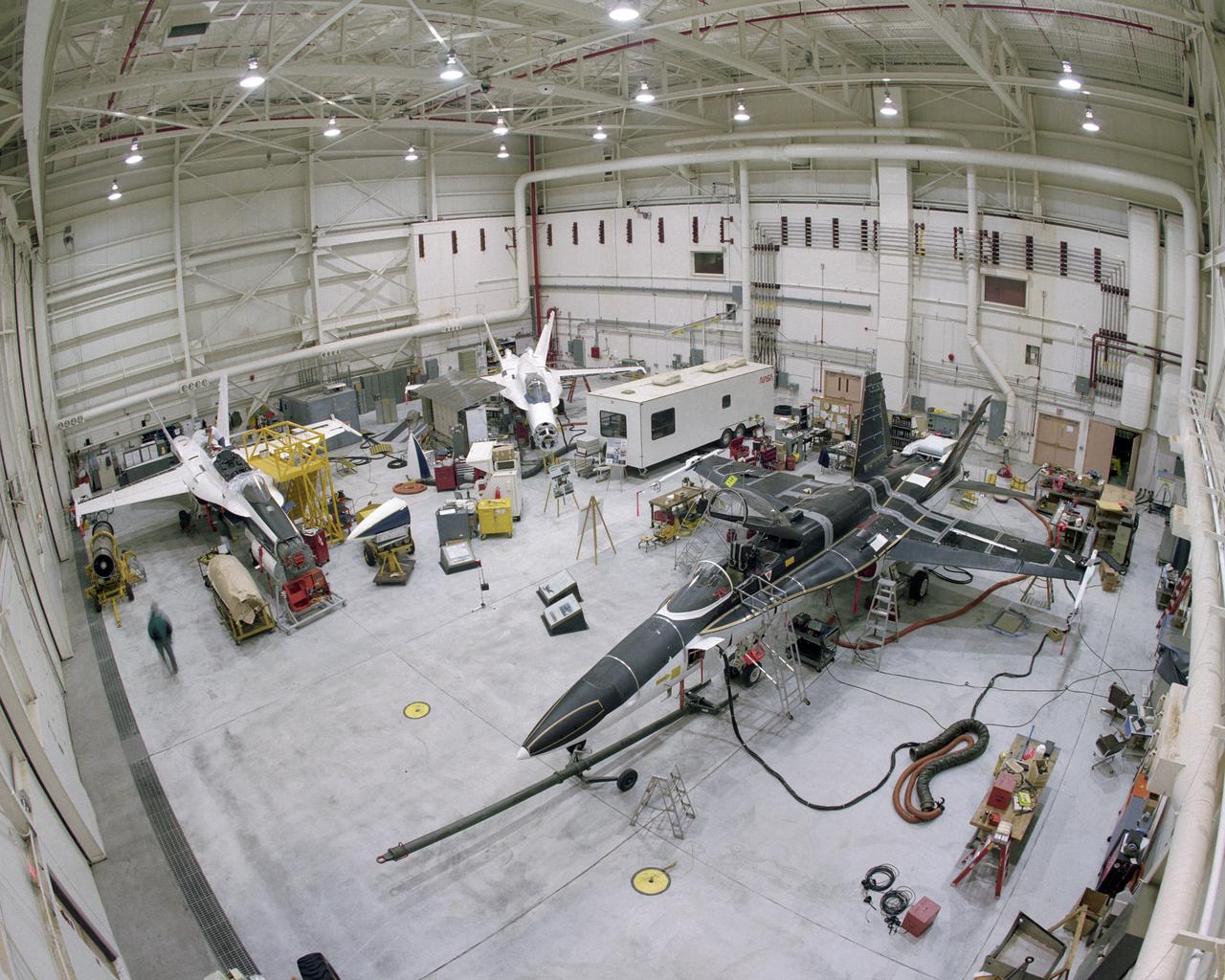
RAIF Hangar Bays 1 and 2. Three of NASA's F-18 aircraft can be seen in this photo. The SRA, or Systems Research Aircraft, is at the far left. In the middle is the F-18 Iron Bird, used for full-scale, hardware-in-the-loop simulations. On the right is the F-18 High Alpha Research Vehicle, or HARV.
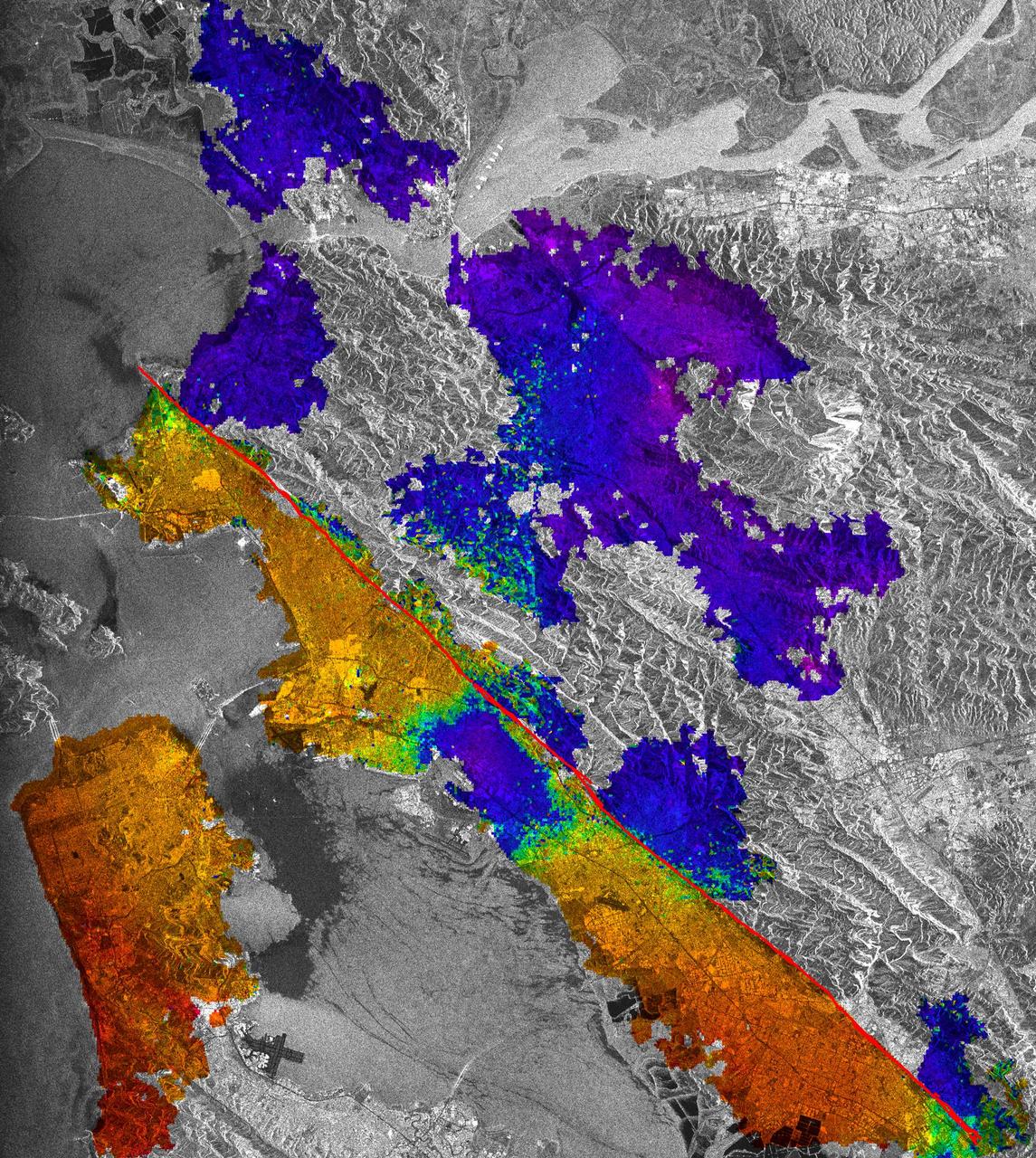
This image of California Hayward fault is an interferogram created using a pair of images taken by ESA ERS-1 and ERS-2 in June 1992 and September 1997 over the central San Francisco Bay in California.
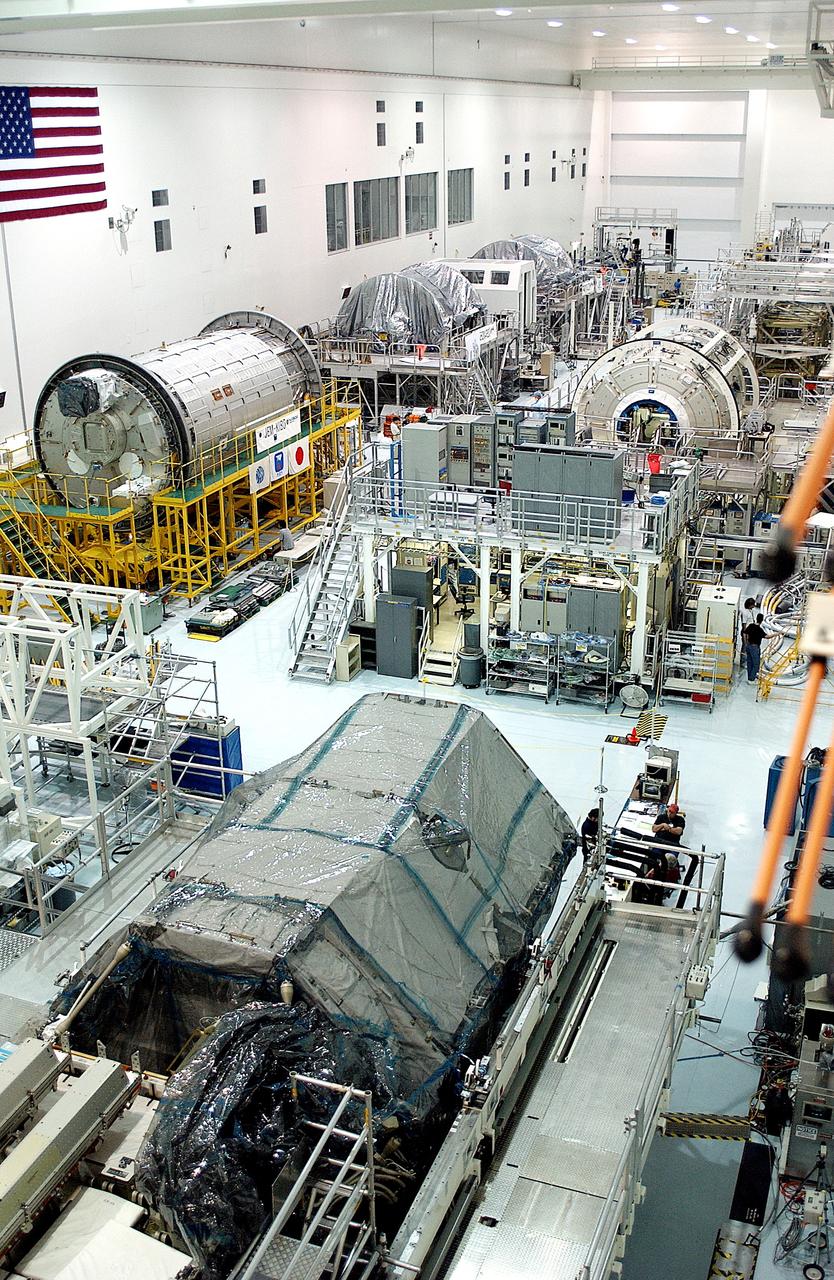
KENNEDY SPACE CENTER, FLA. - International Space Station elements being processed for launch on upcoming Space Shuttle flights, including the Japanese Experiment Module (JEM) pressurized module (Kibo or Hope) and the U.S. Node 2, line the walls of the high bay in the Space Station Processing Facility. NASA's Node 2, built by the European Space Agency (ESA) in Italy, arrived at KSC on June 1. It will be the next pressurized module installed on the Station. The JEM pressurized module arrived at KSC on June 4. It is Japan's primary contribution to the Station.
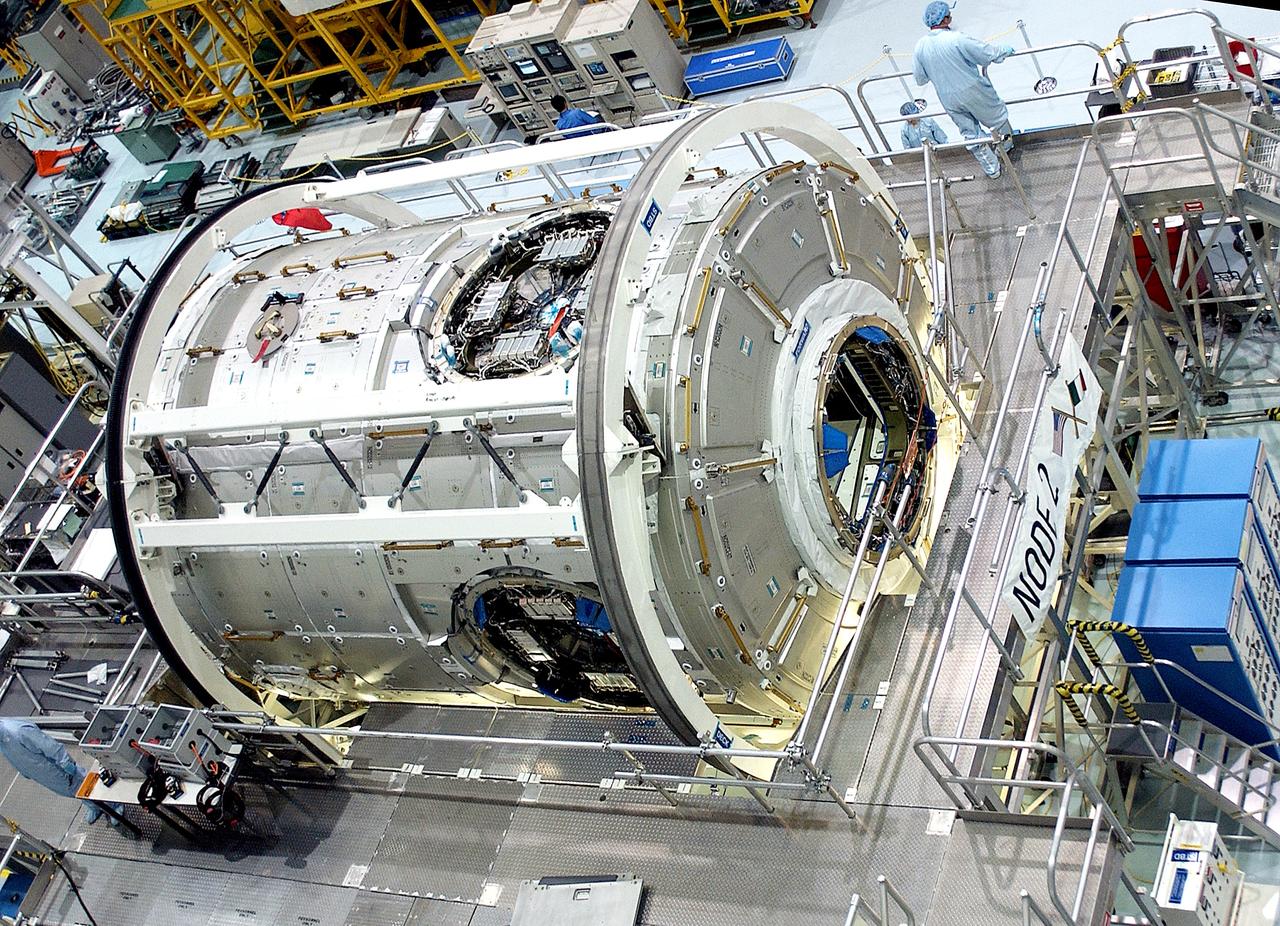
KENNEDY SPACE CENTER, FLA. - International Space Station elements being processed for launch on upcoming Space Shuttle flights, including the U.S. Node 2, line the walls of the high bay in the Space Station Processing Facility. NASA's Node 2, built by the European Space Agency (ESA) in Italy, arrived at KSC on June 1. It will be the next pressurized module installed on the Station.
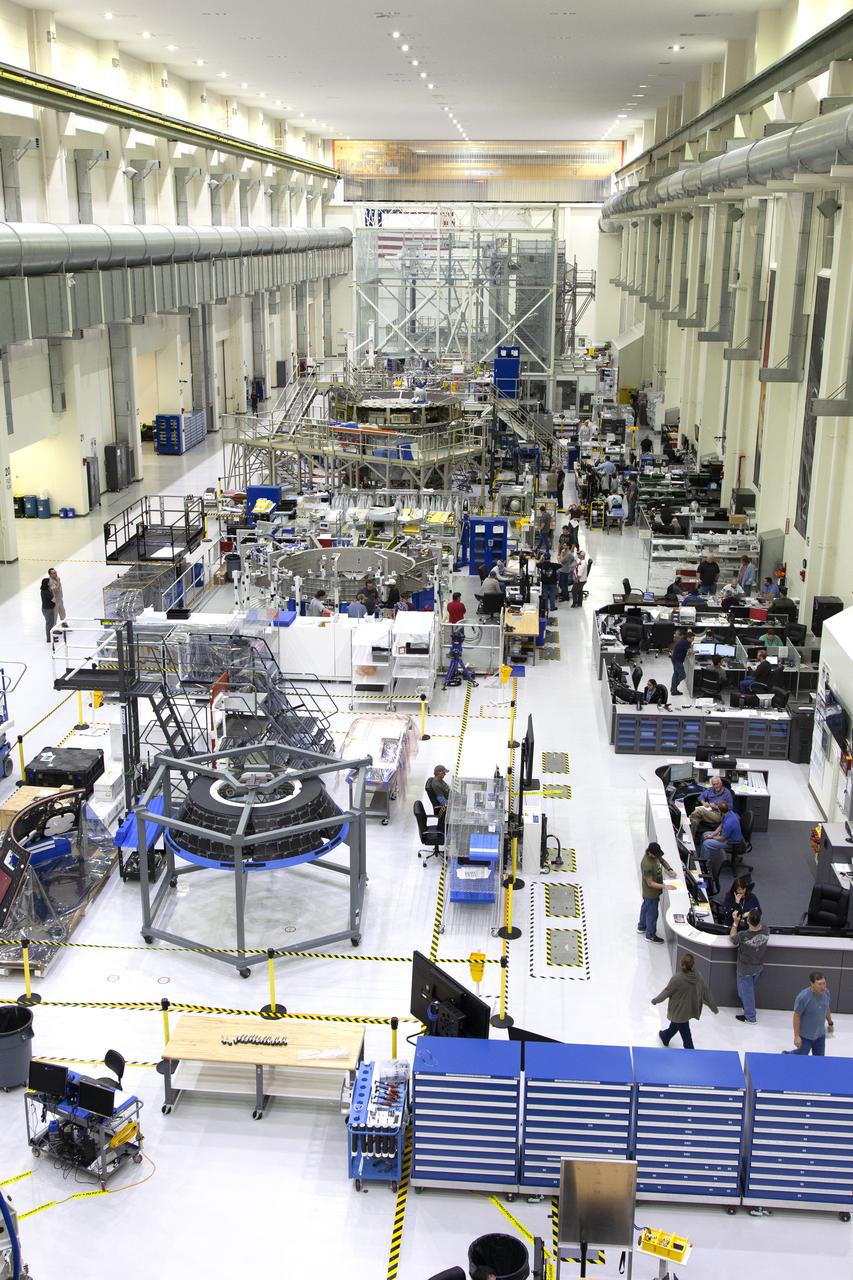
The Neil Armstrong Operations and Checkout Building high bay is filled with various pieces of flight hardware for Exploration Mission-1 (EM-1) and Exploration Mission-2 (EM-2) at NASA’s Kennedy Space Center in Florida. In this view taken on March 21, 2019, the forward bay cover for Orion (EM-1) is at far left in the foreground. Just to its right is the bay cover (EM-1). Behind these two pieces is the crew module adapter for EM-2. Further back, secured on a test stand is the European Service Module that will serve as the powerhouse for Orion. For EM-1, Orion will launch atop the Space Launch System rocket from Launch Pad 39B. The spacecraft will travel thousands of miles past the Moon on an approximately three-week test flight. Orion will return to Earth and splashdown in the Pacific Ocean off the coast of California, where it will be retrieved and returned to Kennedy.
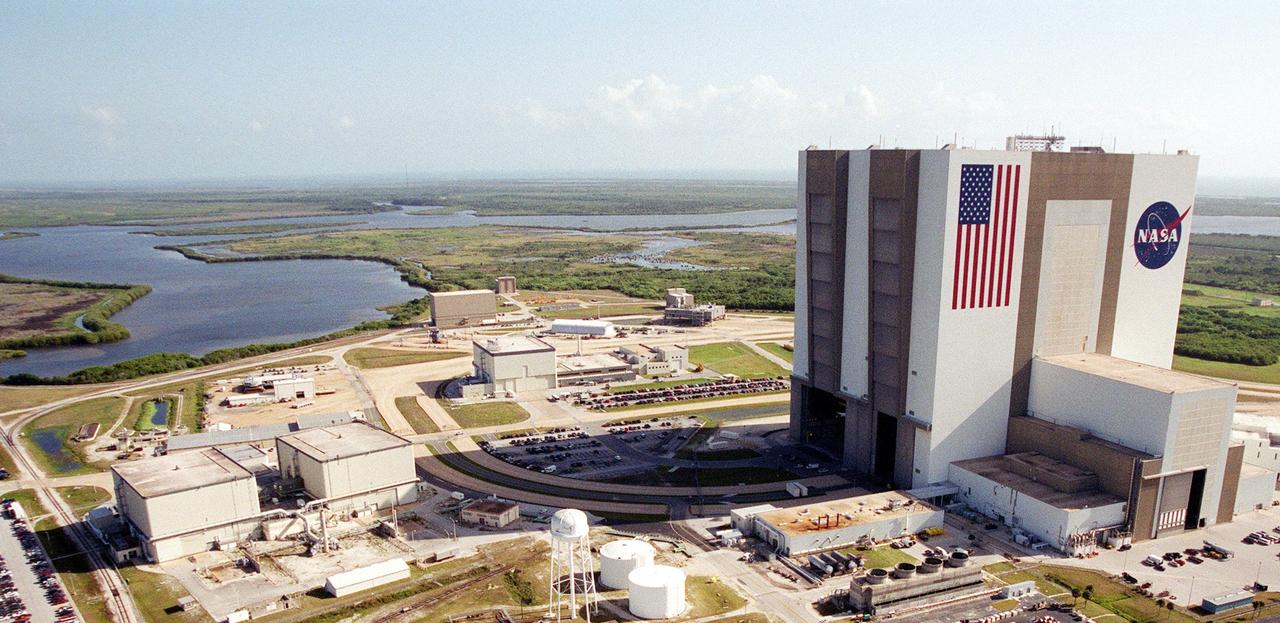
CAPE CANAVERAL, Fla. – An aerial view of Launch Complex 39 shows the south and west sides of the Vehicle Assembly Building. The curved roadway heading to the VAB leads to high bay 2, the Safe Haven facility constructed in 2000. Beyond it is the Orbiter Processing Facility, bays 1 and 2. The OPF bay 3 is farther still, closer to the VAB. Farther in the background are the waters of the Banana Creek in the Merritt Island National Wildlife Refuge. Photo credit: NASA
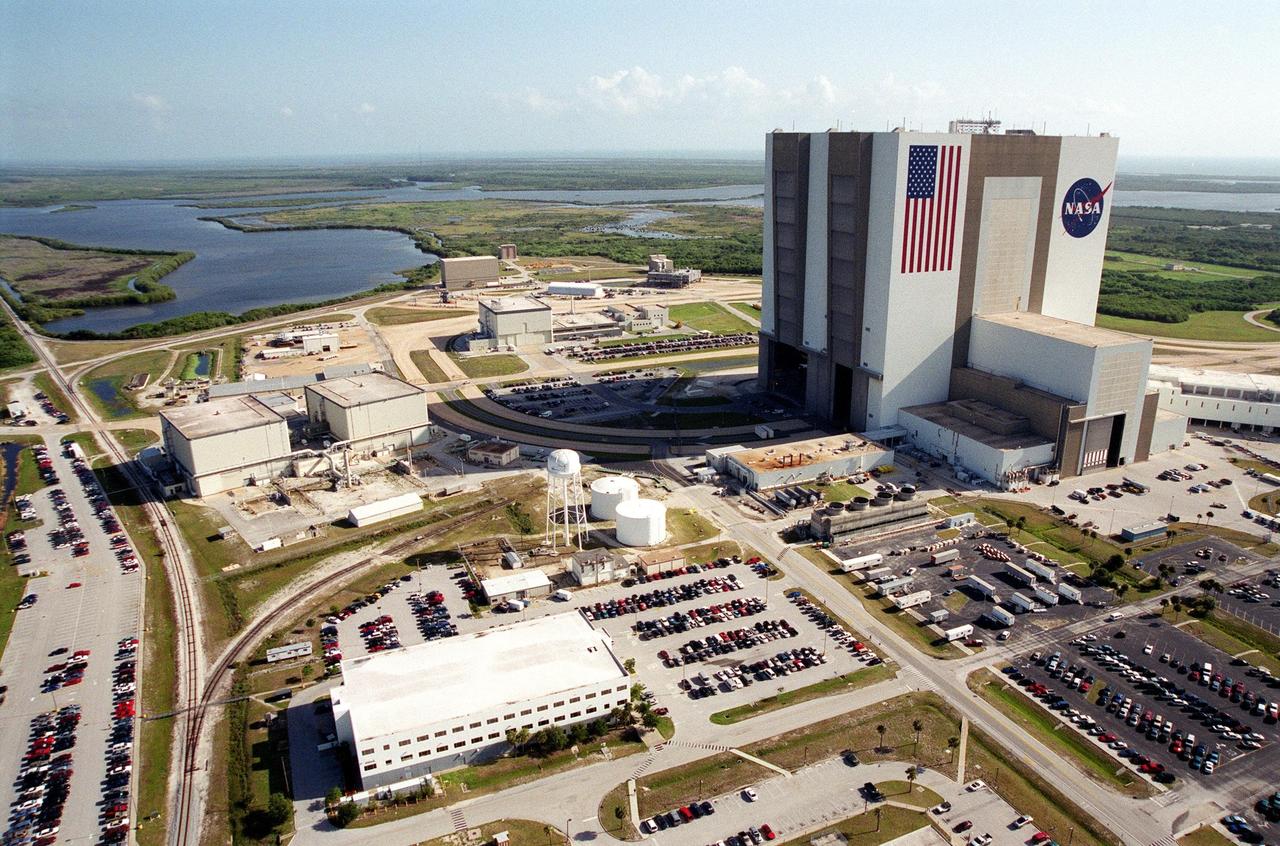
KENNEDY SPACE CENTER, Fla. -- An aerial view of Launch Complex 39 shows the south and west sides of the Vehicle Assembly Building. The curved roadway heading to the VAB leads to the high bay 2, the Safe Haven facility constructed in 2000. The white building in the foreground is the Processing Control Center. Beyond it is the Orbiter Processing Facility, bays 1 and 2. The OPF bay 3 is farther still, closer to the VAB. Farther in the background are the waters of Banana Creek in the Merritt Island National Wildlife Refuge
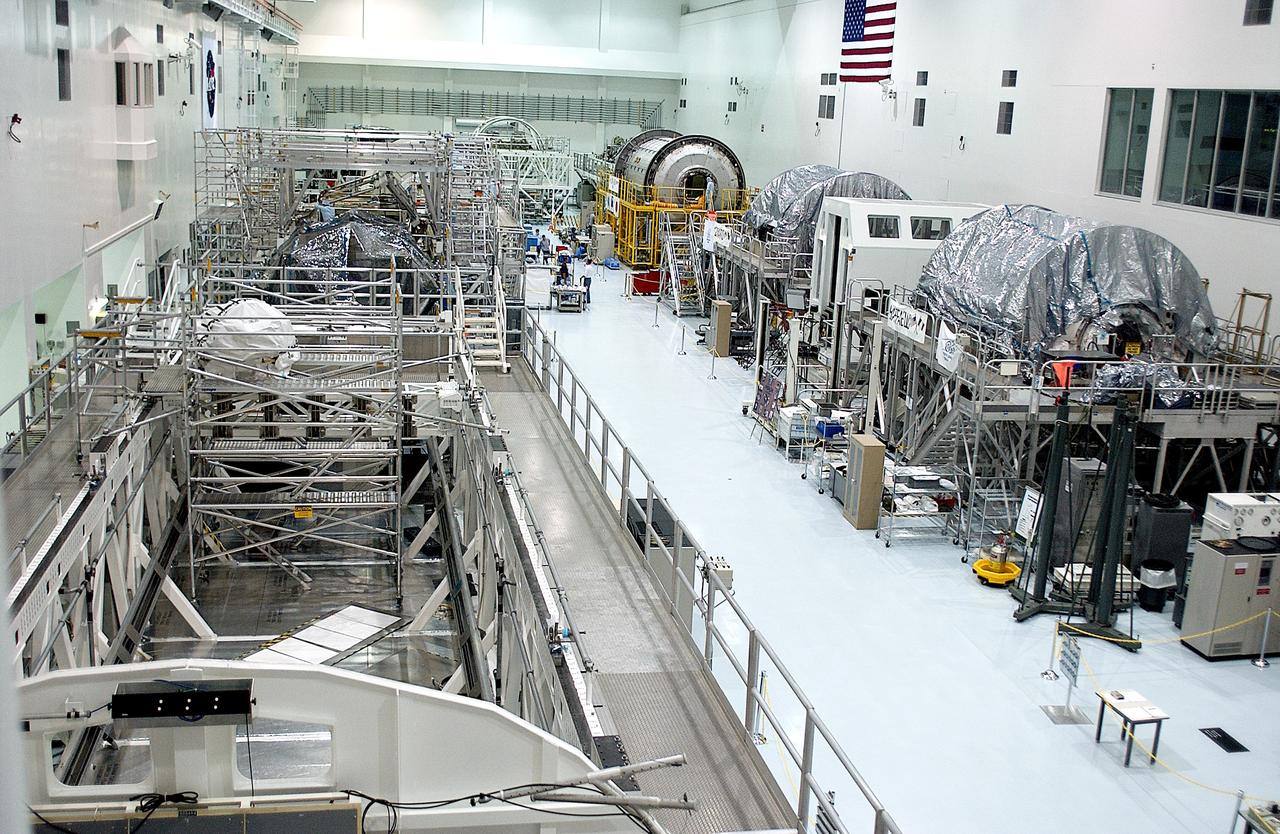
KENNEDY SPACE CENTER, FLA. - International Space Station elements being processed for launch on upcoming Space Shuttle flights line the walls of the high bay in the Space Station Processing Facility. NASA's Node 2, built by the European Space Agency (ESA) in Italy, arrived at KSC on June 1. It will be the next pressurized module installed on the Station. The pressurized module of the Japanese Experiment Module (JEM), named "Kibo" (Hope), arrived at KSC on June 4. It is Japan's primary contribution to the Station.
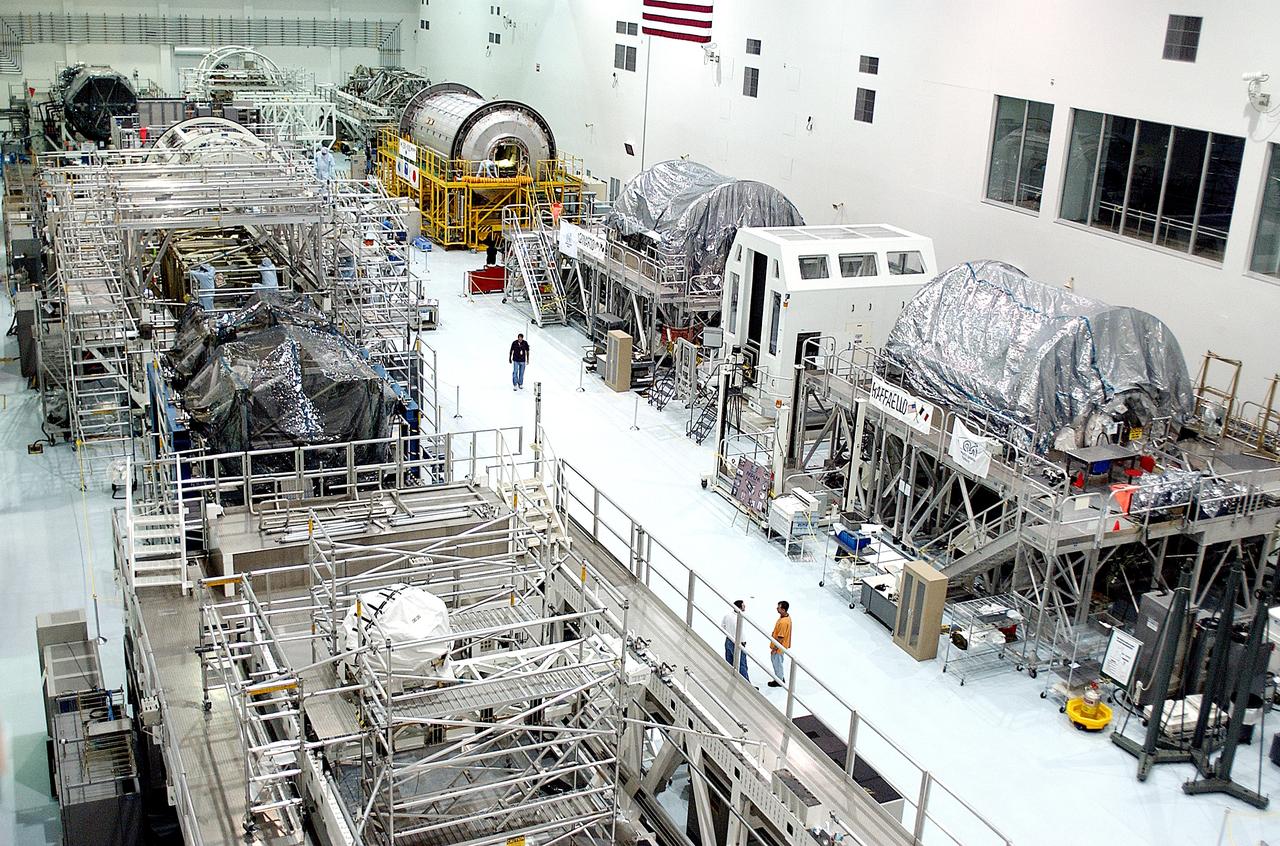
KENNEDY SPACE CENTER, FLA. - International Space Station elements being processed for launch on upcoming Space Shuttle flights line the walls of the high bay in the Space Station Processing Facility. NASA's Node 2, built by the European Space Agency (ESA) in Italy, arrived at KSC on June 1. It will be the next pressurized module installed on the Station. The pressurized module of the Japanese Experiment Module (JEM), named "Kibo" (Hope), arrived at KSC on June 4. It is Japan's primary contribution to the Station.
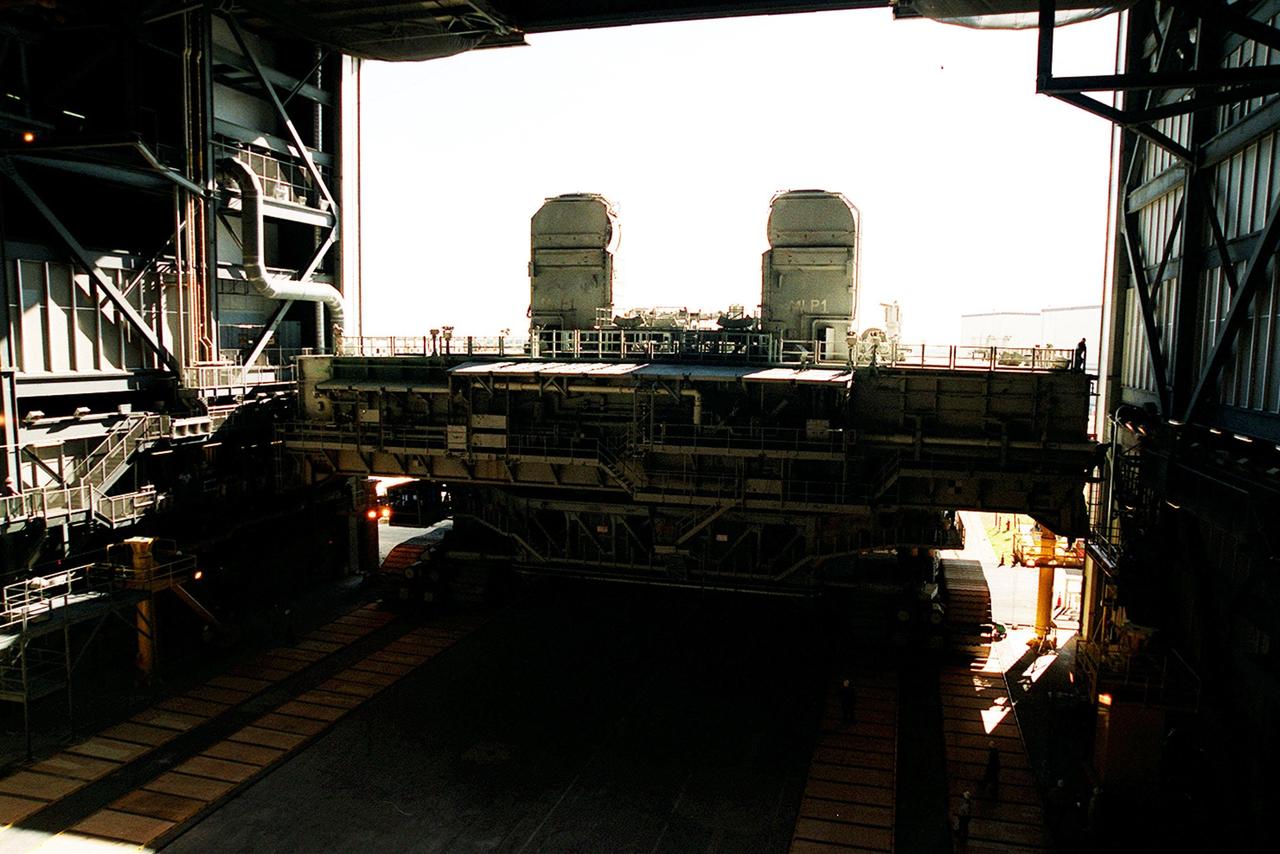
KENNEDY SPACE CENTER, FLA. -- From inside the VAB high bay 2, a mobile launcher platform atop a crawler transporter is viewed as it rolls through the doorway using the recently restored crawlerway. As part of the Safe Haven project, a once-buried portion of the crawlerway was restored to enable rollout of a Shuttle from high bay 2. The primary goal of the Safe Haven construction project was to strengthen readiness for hurricane season by expanding the VAB’s storage capacity. The new area, in high bay 2, will allow NASA to preassemble stacks and still have room in the VAB to pull a Shuttle back from the pad if severe weather threatens. Potential rollouts of the Space Shuttle to the launch pad from high bay 2 will involve making a turn around the north side of the VAB in contrast to the straight rollouts from high bays 1 and 3, on the east side of the VAB facing the launch pads
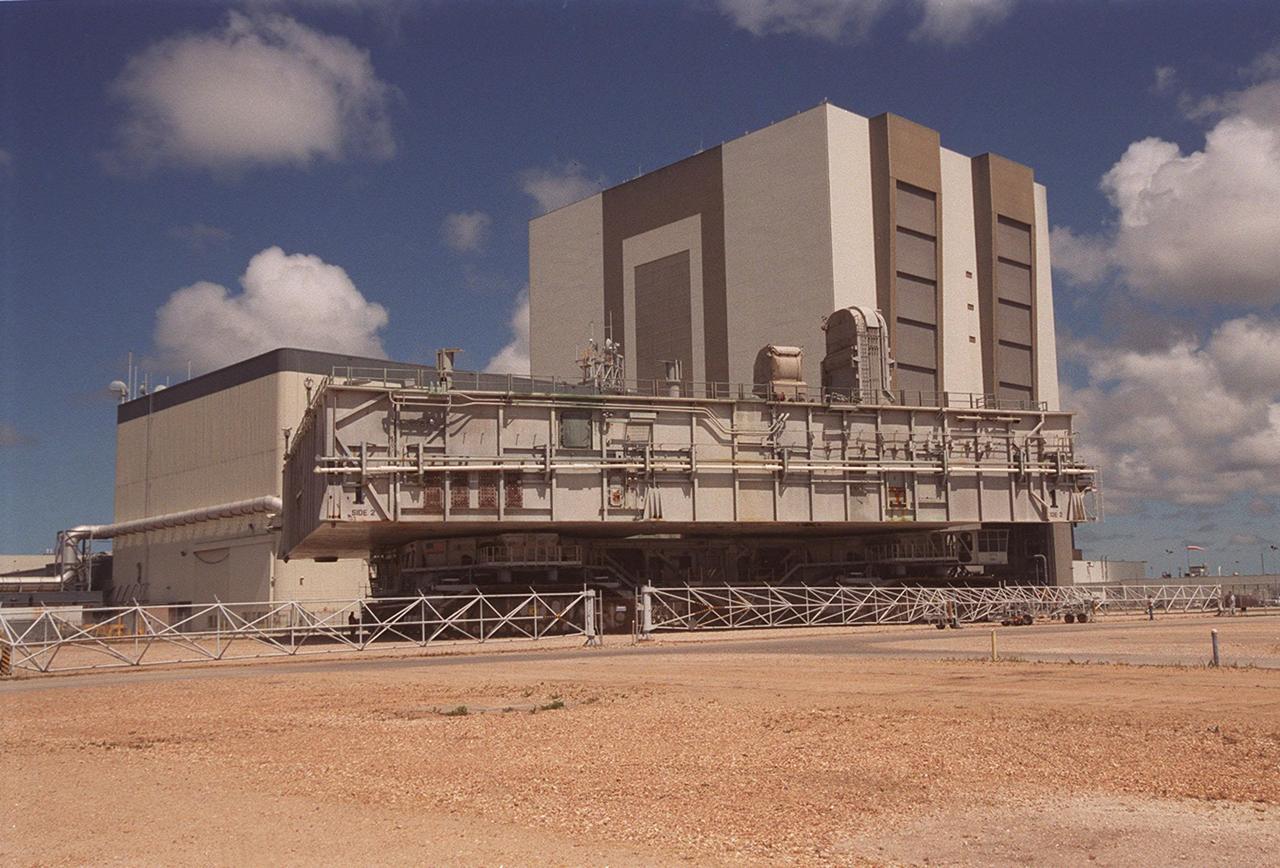
KENNEDY SPACE CENTER, FLA. -- A crawler-transporter with mobile launcher platform on top tests the buried portion of the Apollo-era crawlerway leading to the Vehicle Assembly Building (VAB) high bay 2 on the southwest side. The road was restored as part of KSC’s Safe Haven project. High bay 2 provides a third stacking area. The primary goal of the Safe Haven construction project was to strengthen readiness for hurricane season by expanding the VAB’s storage capacity. The new area, in high bay 2, will allow NASA to preassemble stacks and still have room in the VAB to pull a Shuttle back from the pad if severe weather threatens. Potential rollouts of the Space Shuttle to the launch pad from high bay 2 will involve making a turn around the north side of the VAB in contrast to the straight rollouts from high bays 1 and 3, on the east side of the VAB facing the launch pads

KENNEDY SPACE CENTER, FLA. -- On a portion of the once-buried crawlerway that was recently restored, a crawler-transporter with mobile launcher platform on top turns toward the Vehicle Assembly Building (VAB) high bay 2. The road was restored as part of KSC’s Safe Haven project. High bay 2 provides a third stacking area. The primary goal of the Safe Haven construction project was to strengthen readiness for hurricane season by expanding the VAB’s storage capacity. The new area, in high bay 2, will allow NASA to preassemble stacks and still have room in the VAB to pull a Shuttle back from the pad if severe weather threatens. Potential rollouts of the Space Shuttle to the launch pad from high bay 2 will involve making a turn around the north side of the VAB in contrast to the straight rollouts from high bays 1 and 3, on the east side of the VAB facing the launch pads
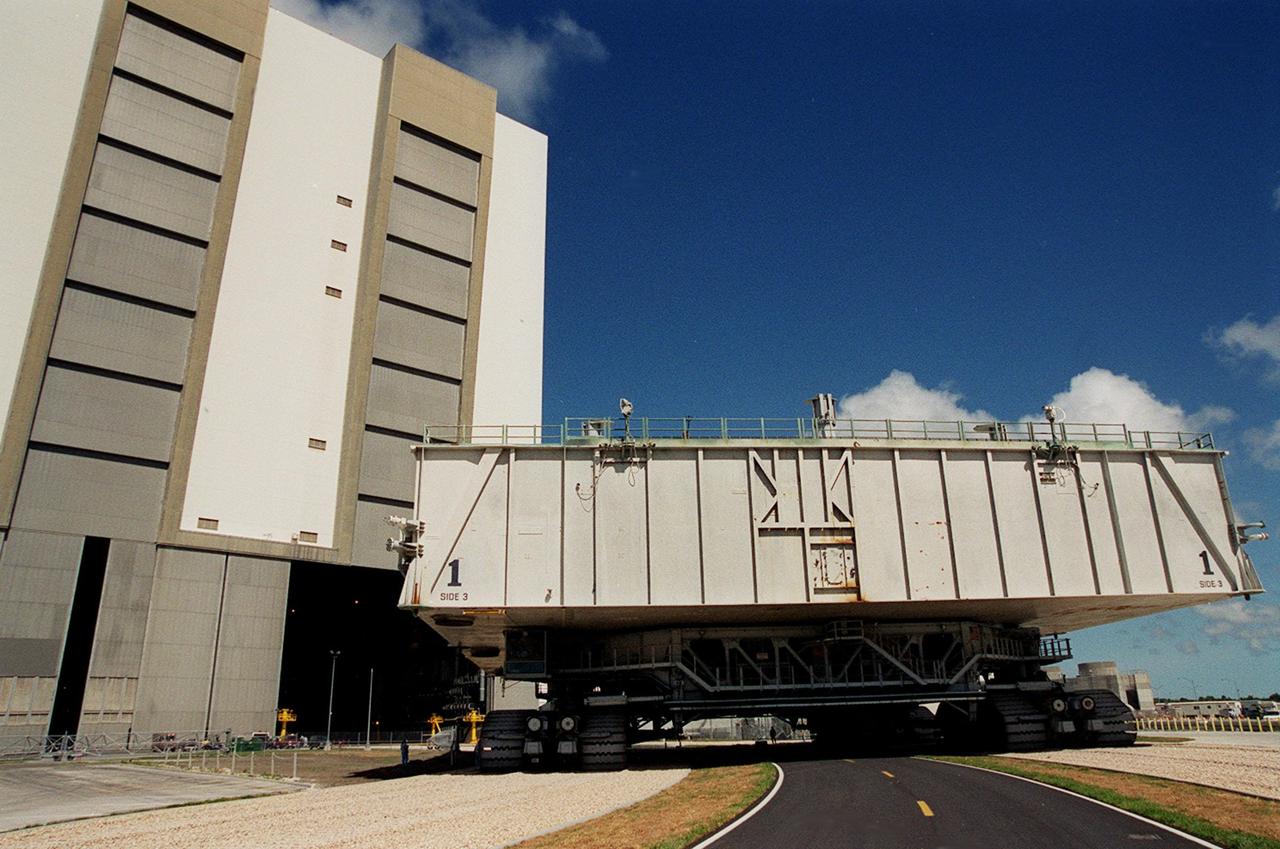
KENNEDY SPACE CENTER, FLA. -- On a portion of the once-buried crawlerway that was recently restored, a crawler-transporter with mobile launcher platform on top turns toward the Vehicle Assembly Building (VAB) high bay 2. The road was restored as part of KSC’s Safe Haven project. High bay 2 provides a third stacking area. The primary goal of the Safe Haven construction project was to strengthen readiness for hurricane season by expanding the VAB’s storage capacity. The new area, in high bay 2, will allow NASA to preassemble stacks and still have room in the VAB to pull a Shuttle back from the pad if severe weather threatens. Potential rollouts of the Space Shuttle to the launch pad from high bay 2 will involve making a turn around the north side of the VAB in contrast to the straight rollouts from high bays 1 and 3, on the east side of the VAB facing the launch pads
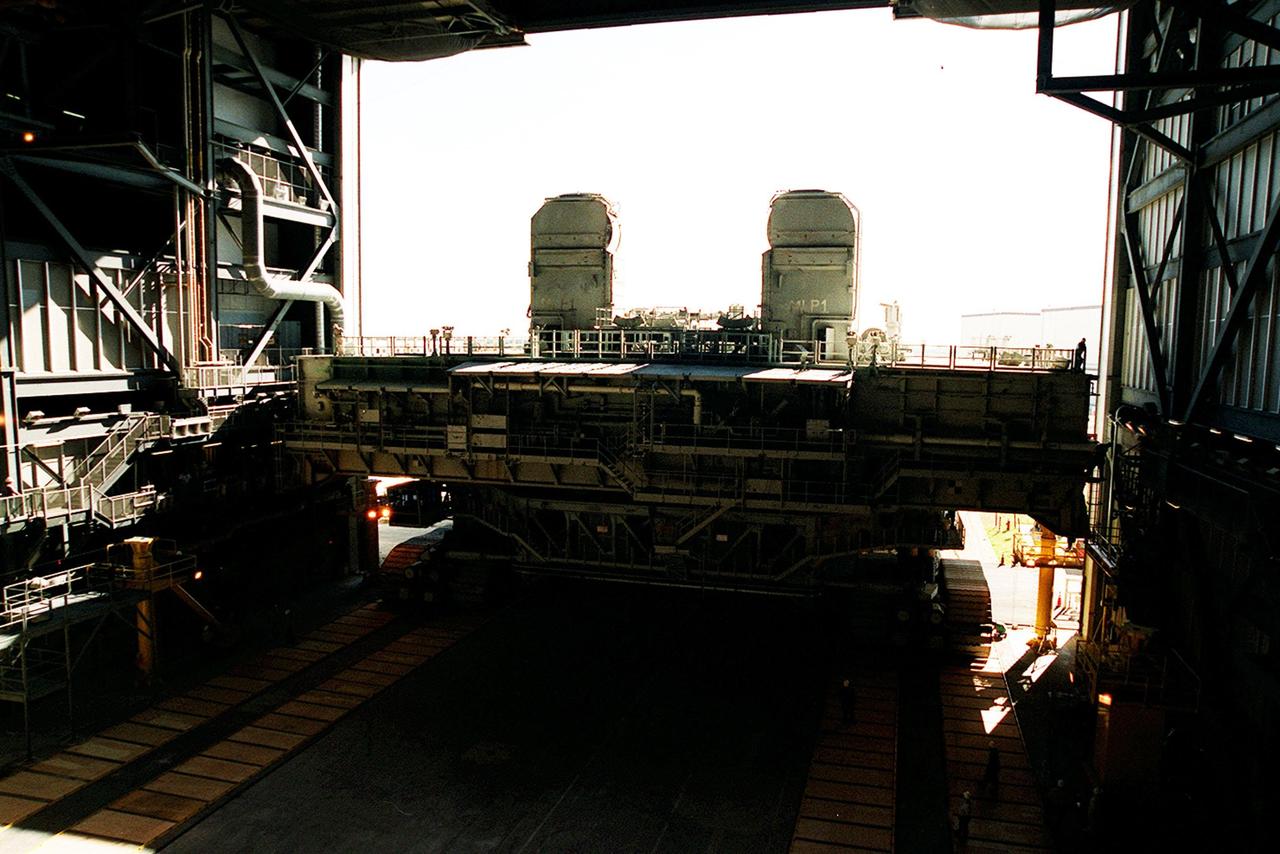
KENNEDY SPACE CENTER, FLA. -- From inside the VAB high bay 2, a mobile launcher platform atop a crawler transporter is viewed as it rolls through the doorway using the recently restored crawlerway. As part of the Safe Haven project, a once-buried portion of the crawlerway was restored to enable rollout of a Shuttle from high bay 2. The primary goal of the Safe Haven construction project was to strengthen readiness for hurricane season by expanding the VAB’s storage capacity. The new area, in high bay 2, will allow NASA to preassemble stacks and still have room in the VAB to pull a Shuttle back from the pad if severe weather threatens. Potential rollouts of the Space Shuttle to the launch pad from high bay 2 will involve making a turn around the north side of the VAB in contrast to the straight rollouts from high bays 1 and 3, on the east side of the VAB facing the launch pads
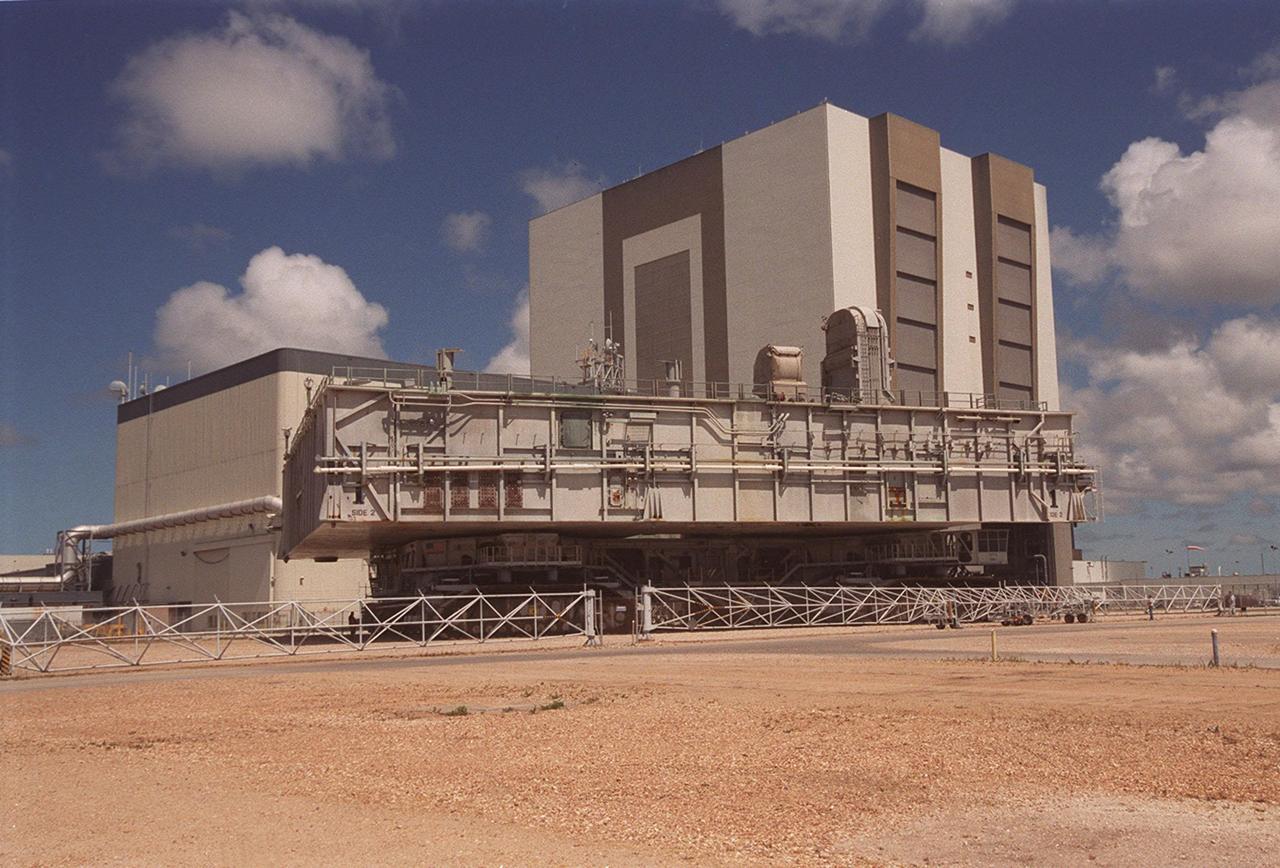
KENNEDY SPACE CENTER, FLA. -- A crawler-transporter with mobile launcher platform on top tests the buried portion of the Apollo-era crawlerway leading to the Vehicle Assembly Building (VAB) high bay 2 on the southwest side. The road was restored as part of KSC’s Safe Haven project. High bay 2 provides a third stacking area. The primary goal of the Safe Haven construction project was to strengthen readiness for hurricane season by expanding the VAB’s storage capacity. The new area, in high bay 2, will allow NASA to preassemble stacks and still have room in the VAB to pull a Shuttle back from the pad if severe weather threatens. Potential rollouts of the Space Shuttle to the launch pad from high bay 2 will involve making a turn around the north side of the VAB in contrast to the straight rollouts from high bays 1 and 3, on the east side of the VAB facing the launch pads
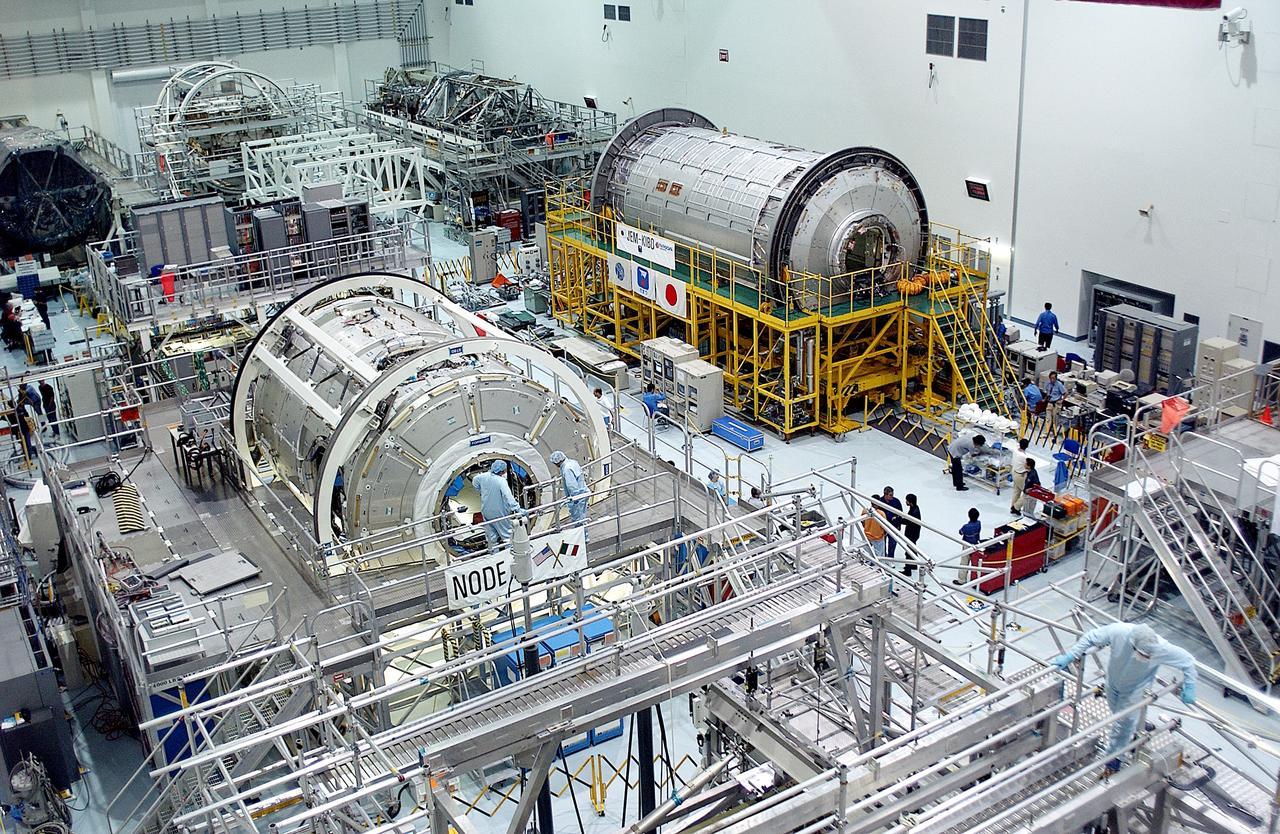
KENNEDY SPACE CENTER, FLA. - International Space Station elements being processed for launch on upcoming Space Shuttle flights, including the U.S. Node 2 and the Japanese Experiment Module (JEM) pressurized module, line the walls of the high bay in the Space Station Processing Facility. NASA's Node 2, built by the European Space Agency (ESA) in Italy, arrived at KSC on June 1. It will be the next pressurized module installed on the Station. The JEM pressurized module, named "Kibo" (Hope), arrived at KSC on June 4. It is Japan's primary contribution to the Station.
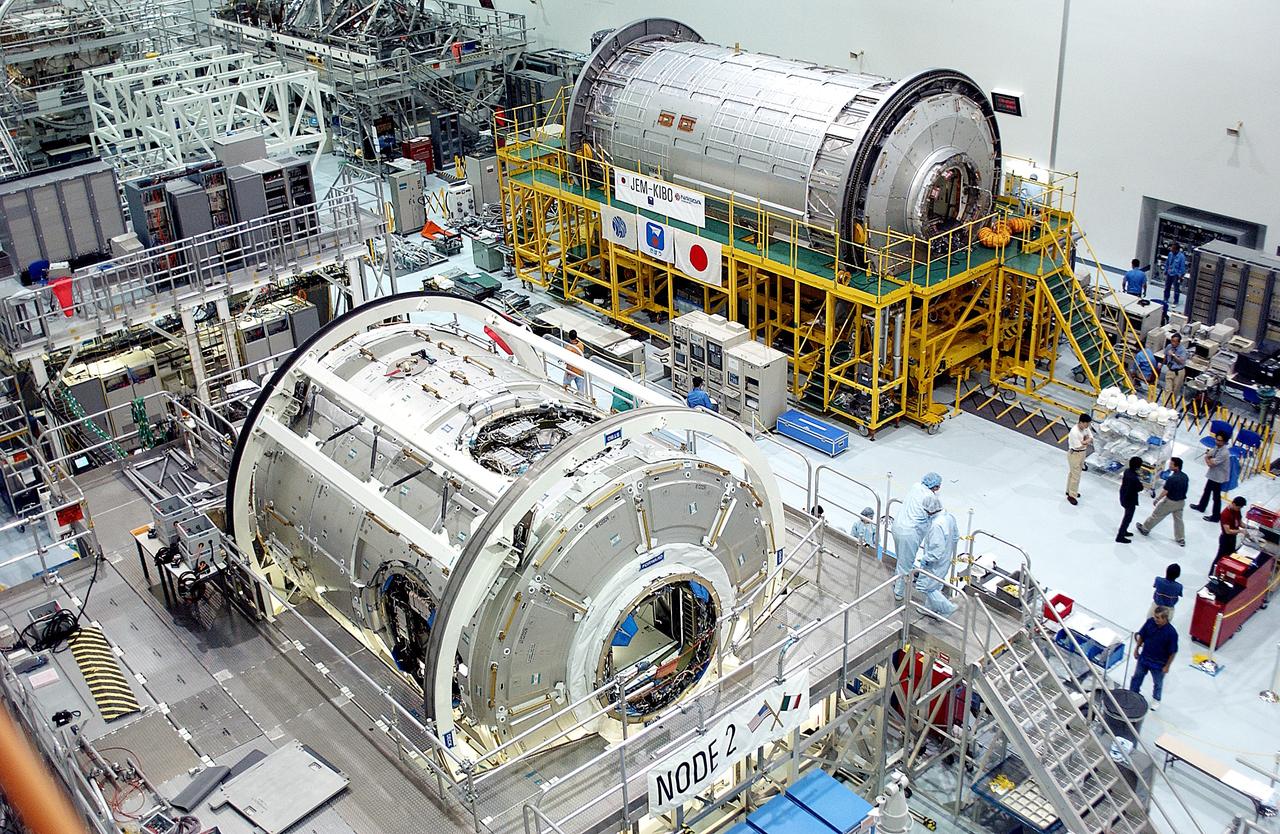
KENNEDY SPACE CENTER, FLA. - International Space Station elements being processed for launch on upcoming Space Shuttle flights, including the U.S. Node 2 and the Japanese Experiment Module (JEM) pressurized module, line the walls of the high bay in the Space Station Processing Facility. NASA's Node 2, built by the European Space Agency (ESA) in Italy, arrived at KSC on June 1. It will be the next pressurized module installed on the Station. The JEM pressurized module, named "Kibo" (Hope), arrived at KSC on June 4. It is Japan's primary contribution to the Station.
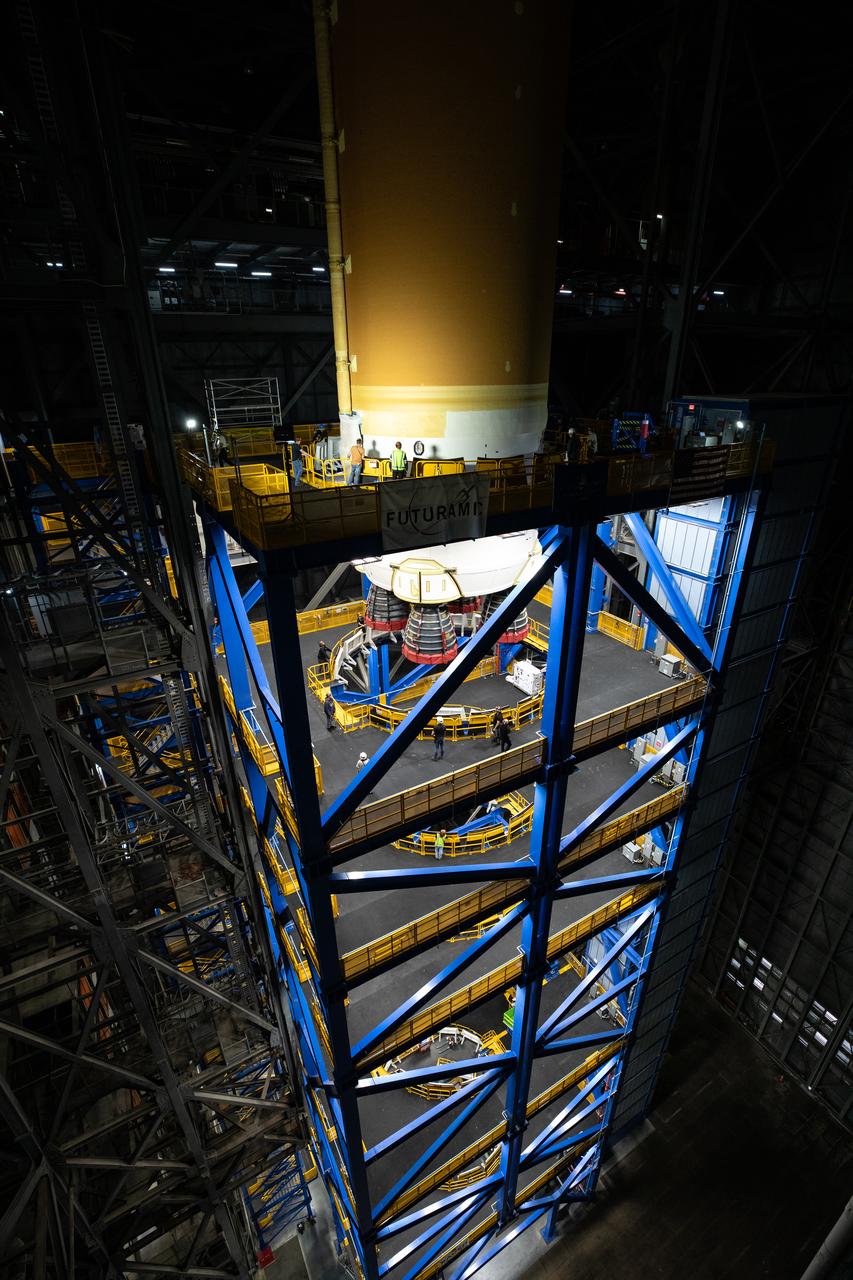
Teams with NASA’s Exploration Ground Systems transport lower the agency’s 212-foot-tall SLS (Space Launch System) core stage into High Bay 2 at the Vehicle Assembly Building at NASA’s Kennedy Space Center in Florida on Wednesday, Dec. 11, 2024. The one-of-a kind lifting beam is designed to lift the core stage from the transfer aisle to High Bay 2 where it will remain while teams stack the two solid rocket boosters on top of mobile launcher 1 for the SLS core stage. Boeing and their sub-contractor Futuramic refurbished High Bay 2 to increase efficiencies while processing core stages for Artemis II and beyond.

Teams with NASA’s Exploration Ground Systems transport lower the agency’s 212-foot-tall SLS (Space Launch System) core stage into High Bay 2 at the Vehicle Assembly Building at NASA’s Kennedy Space Center in Florida on Wednesday, Dec. 11, 2024. The one-of-a kind lifting beam is designed to lift the core stage from the transfer aisle to High Bay 2 where it will remain while teams stack the two solid rocket boosters on top of mobile launcher 1 for the SLS core stage. Boeing and their sub-contractor Futuramic refurbished High Bay 2 to increase efficiencies while processing core stages for Artemis II and beyond.
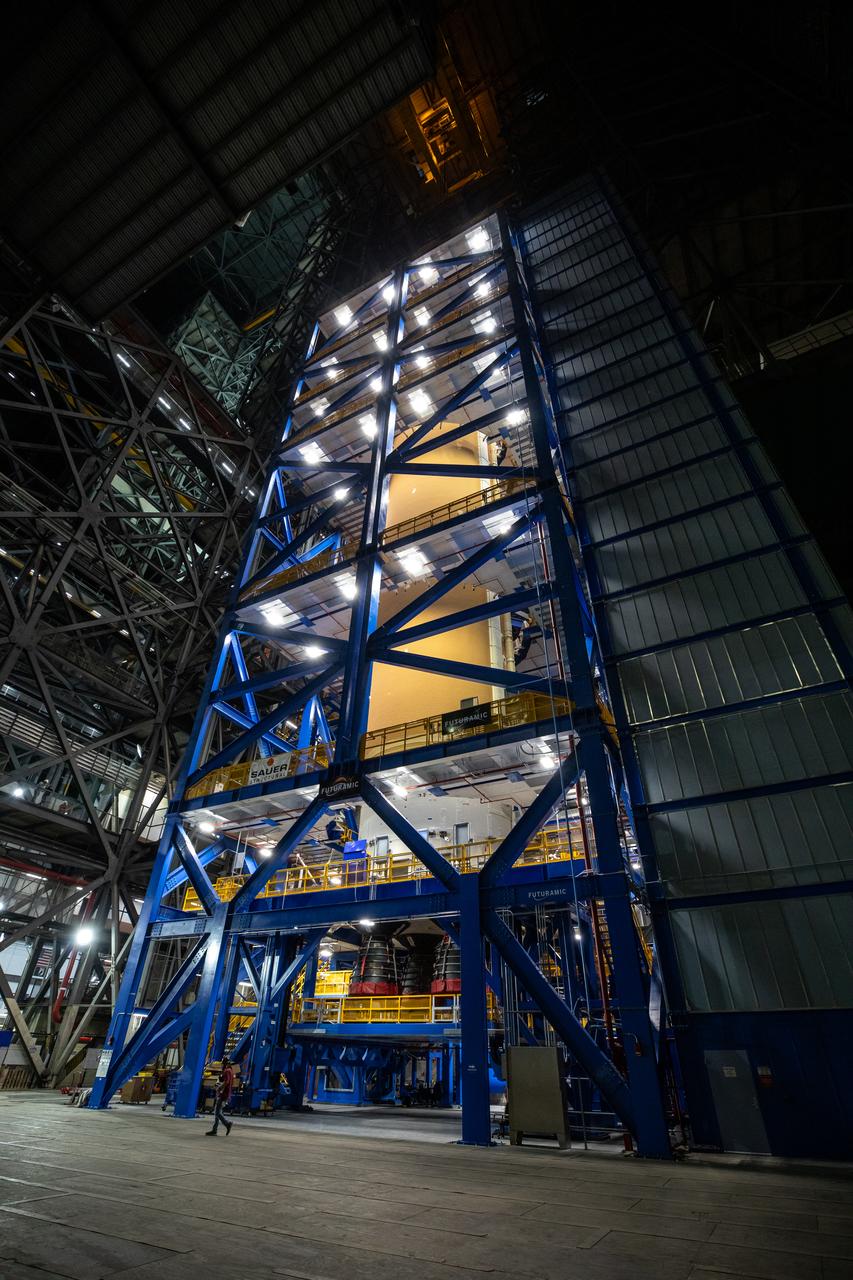
Teams with NASA’s Exploration Ground Systems transport lower the agency’s 212-foot-tall SLS (Space Launch System) core stage into High Bay 2 at the Vehicle Assembly Building at NASA’s Kennedy Space Center in Florida on Wednesday, Dec. 11, 2024. The one-of-a kind lifting beam is designed to lift the core stage from the transfer aisle to High Bay 2 where it will remain while teams stack the two solid rocket boosters on top of mobile launcher 1 for the SLS core stage. Boeing and their sub-contractor Futuramic refurbished High Bay 2 to increase efficiencies while processing core stages for Artemis II and beyond.
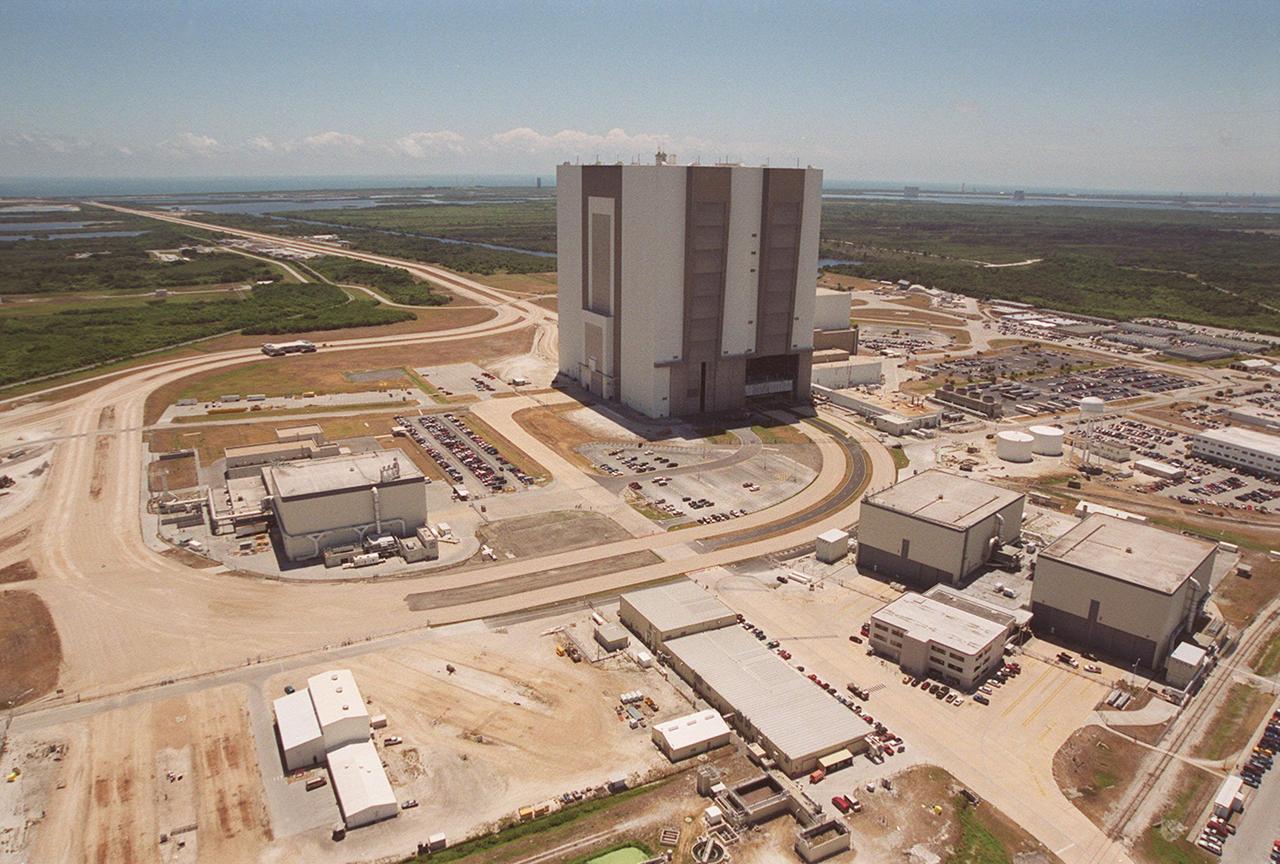
This aerial photo captures many of the facilities involved in Space Shuttle processing. At center is the Vehicle Assembly Building (VAB). The curved road is the newly restored crawlerway leading into the VAB high bay 2. The road restoration and high bay 2 are part of KSC's Safe Haven project, enabling the storage of orbiters during severe weather. The road circles around the Orbiter Processing Facility 3 (OPF-3) at left. OPF1 and OPF-2 are on the right below the curving road. East of the VAB, the crawlerway also extends from high bays 1 and 3 to the two Shuttle launch pads.
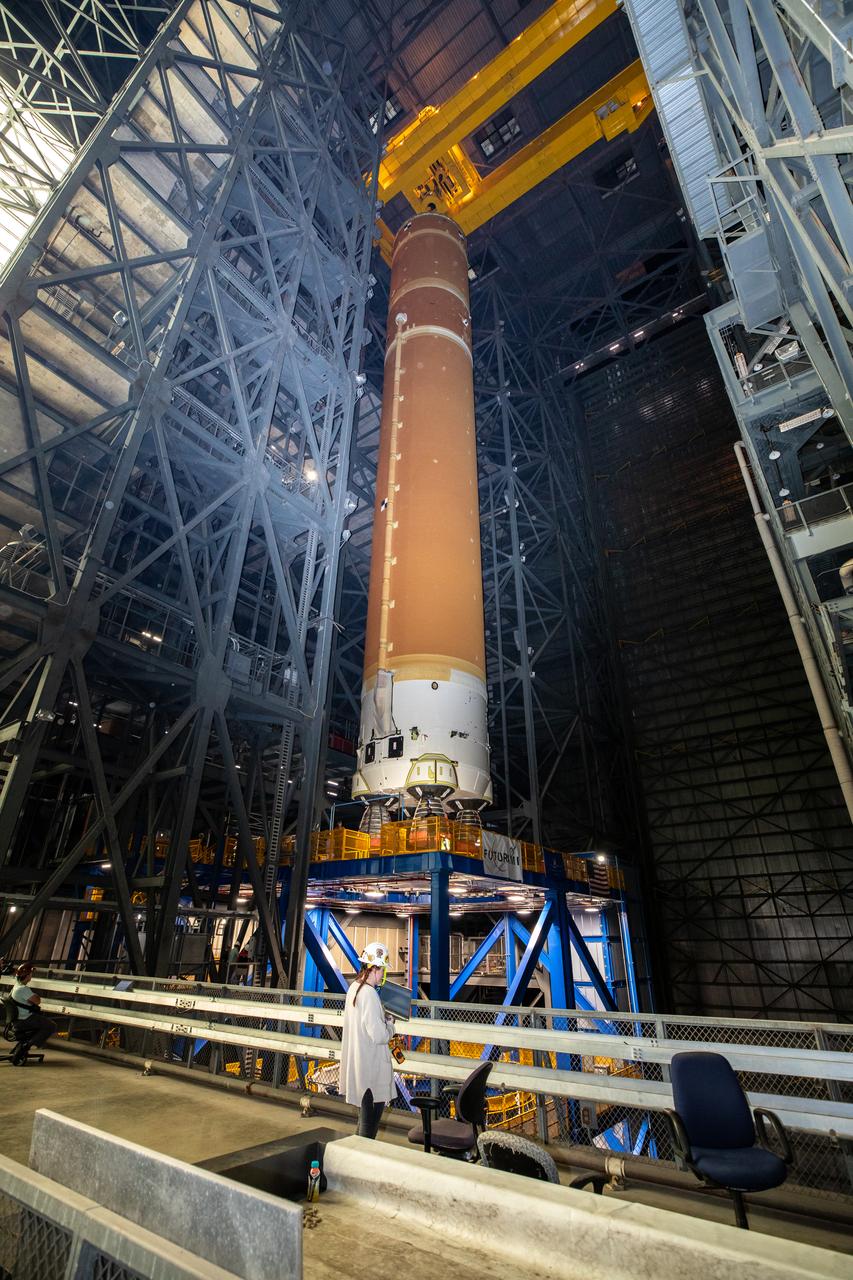
Teams with NASA’s Exploration Ground Systems transport lower the agency’s 212-foot-tall SLS (Space Launch System) core stage into High Bay 2 at the Vehicle Assembly Building at NASA’s Kennedy Space Center in Florida on Wednesday, Dec. 11, 2024. The one-of-a kind lifting beam is designed to lift the core stage from the transfer aisle to High Bay 2 where it will remain while teams stack the two solid rocket boosters on top of mobile launcher 1 for the SLS core stage. Boeing and their sub-contractor Futuramic refurbished High Bay 2 to increase efficiencies while processing core stages for Artemis II and beyond.
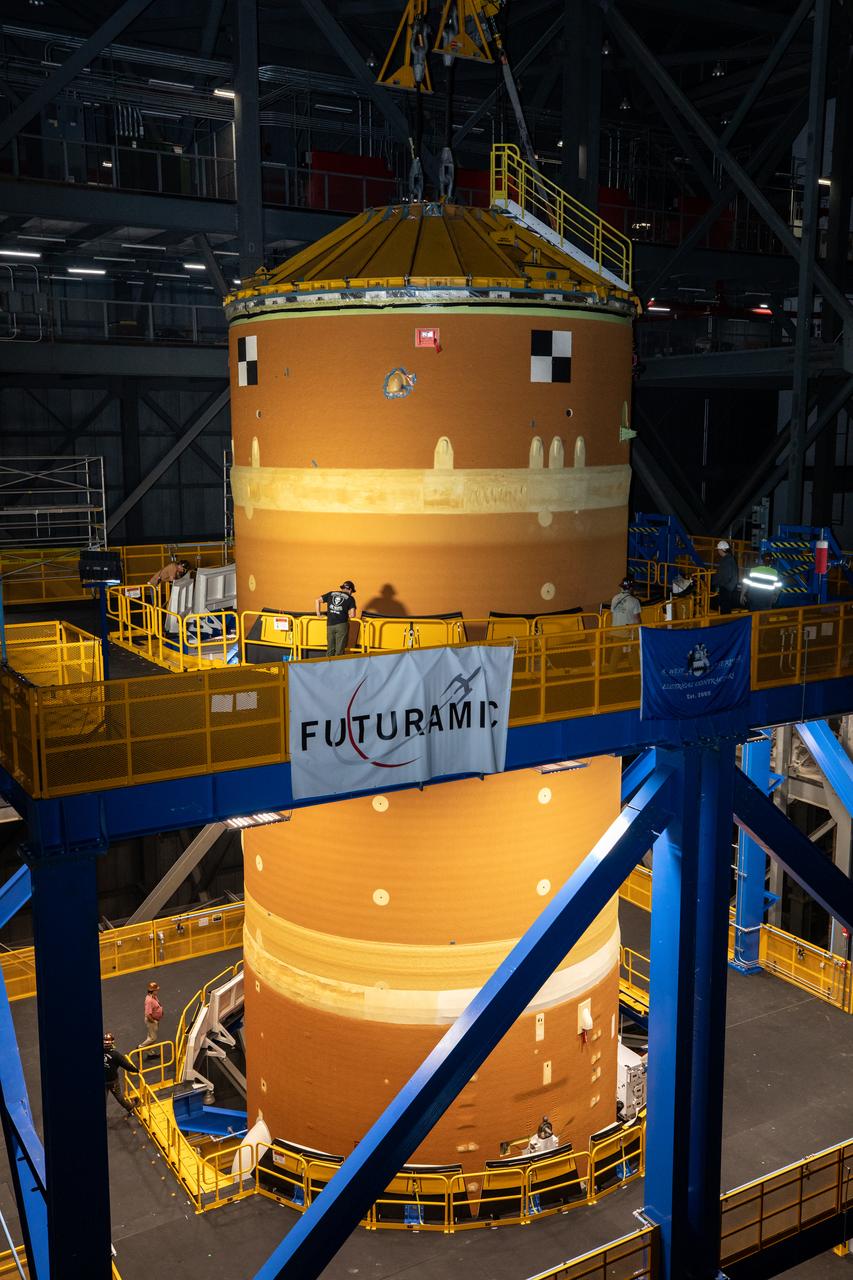
Teams with NASA’s Exploration Ground Systems transport lower the agency’s 212-foot-tall SLS (Space Launch System) core stage into High Bay 2 at the Vehicle Assembly Building at NASA’s Kennedy Space Center in Florida on Wednesday, Dec. 11, 2024. The one-of-a kind lifting beam is designed to lift the core stage from the transfer aisle to High Bay 2 where it will remain while teams stack the two solid rocket boosters on top of mobile launcher 1 for the SLS core stage. Boeing and their sub-contractor Futuramic refurbished High Bay 2 to increase efficiencies while processing core stages for Artemis II and beyond.
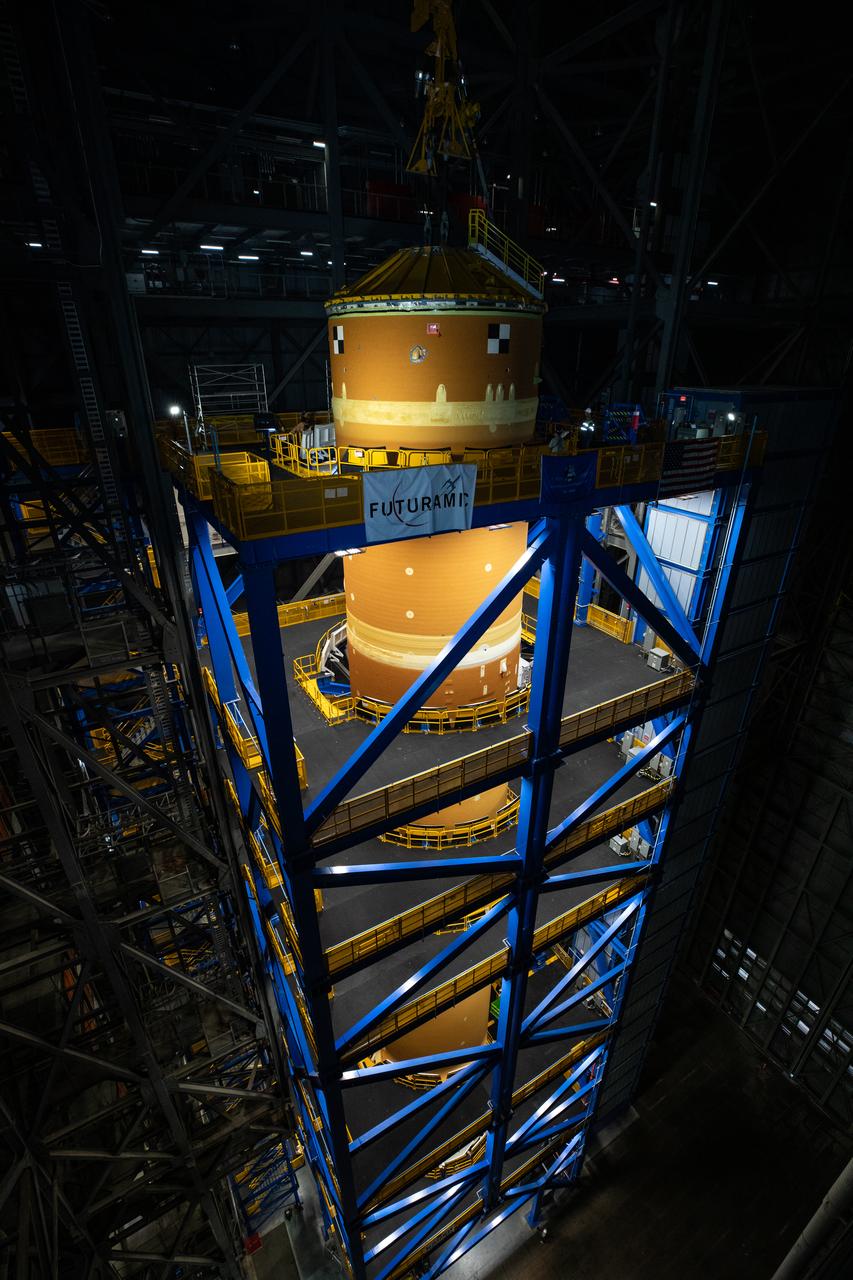
Teams with NASA’s Exploration Ground Systems transport lower the agency’s 212-foot-tall SLS (Space Launch System) core stage into High Bay 2 at the Vehicle Assembly Building at NASA’s Kennedy Space Center in Florida on Wednesday, Dec. 11, 2024. The one-of-a kind lifting beam is designed to lift the core stage from the transfer aisle to High Bay 2 where it will remain while teams stack the two solid rocket boosters on top of mobile launcher 1 for the SLS core stage. Boeing and their sub-contractor Futuramic refurbished High Bay 2 to increase efficiencies while processing core stages for Artemis II and beyond.
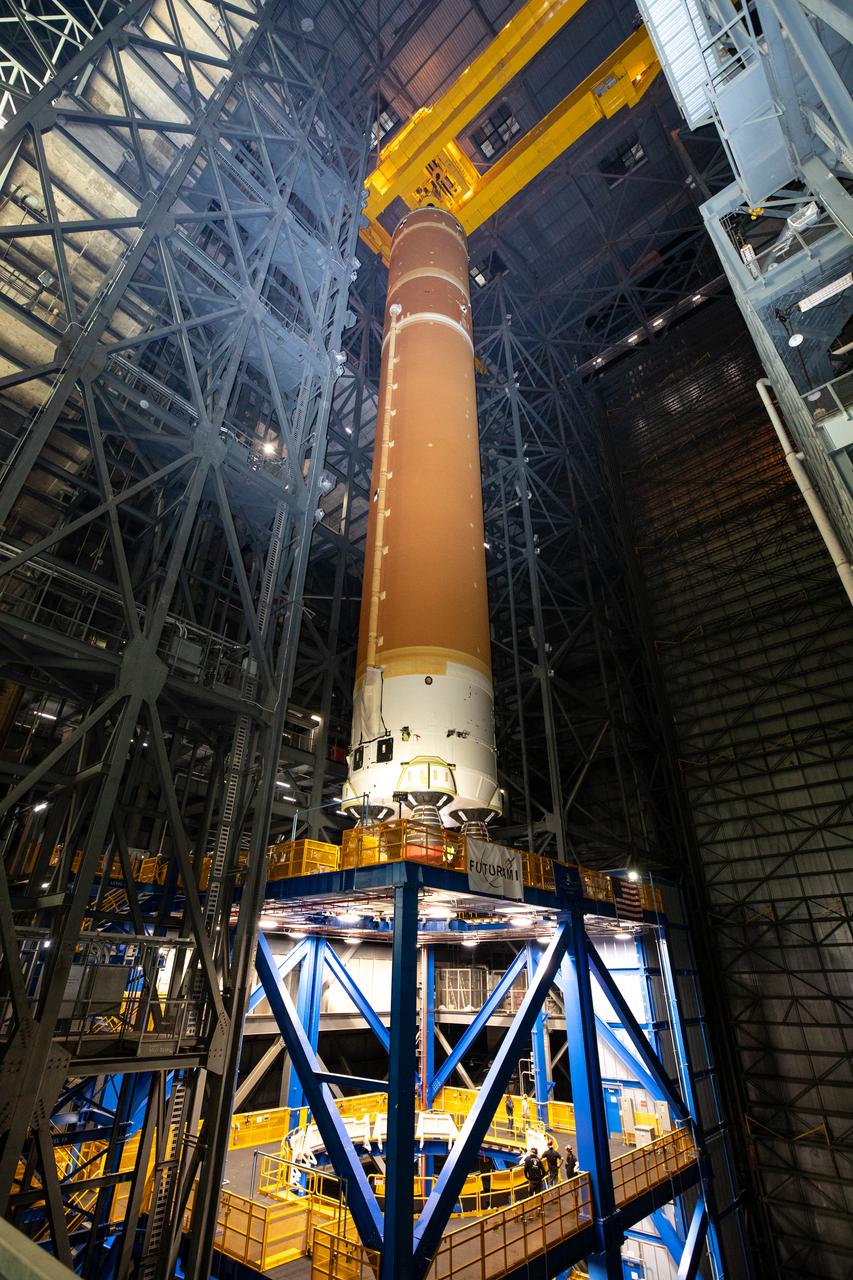
Teams with NASA’s Exploration Ground Systems transport lower the agency’s 212-foot-tall SLS (Space Launch System) core stage into High Bay 2 at the Vehicle Assembly Building at NASA’s Kennedy Space Center in Florida on Wednesday, Dec. 11, 2024. The one-of-a kind lifting beam is designed to lift the core stage from the transfer aisle to High Bay 2 where it will remain while teams stack the two solid rocket boosters on top of mobile launcher 1 for the SLS core stage. Boeing and their sub-contractor Futuramic refurbished High Bay 2 to increase efficiencies while processing core stages for Artemis II and beyond.
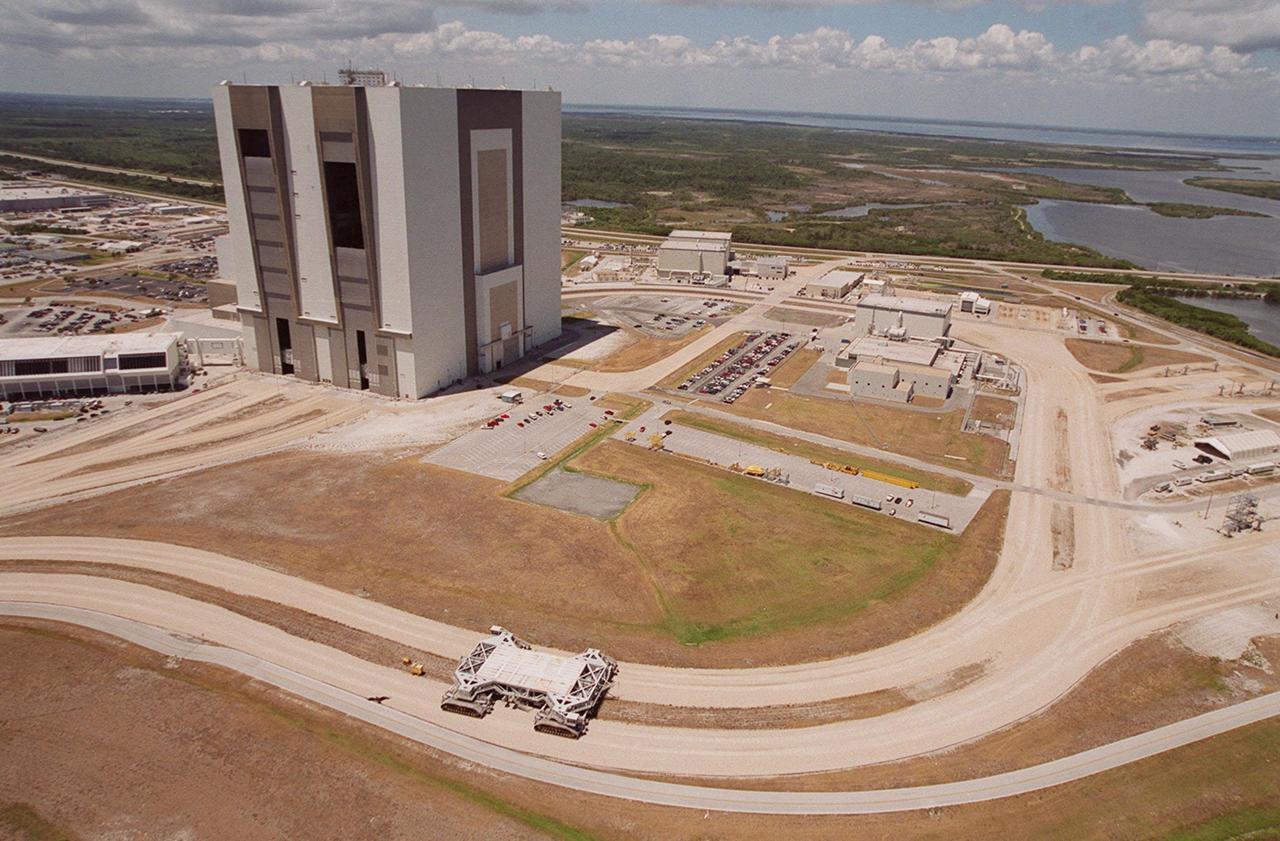
This aerial photo captures many of the facilities involved in Space Shuttle processing. At center is the Vehicle Assembly Building (VAB). The curved road in the foreground is the newly restored crawlerway leading into the VAB high bay 2. The road restoration and high bay 2 are part of KSC’s Safe Haven project, enabling the storage of orbiters during severe weather. The road circles around the Orbiter Processing Facility 3 (OPF-3) at right center. OPF1 and OPF-2 are just above the curving road. On the left of the VAB, the crawlerway also extends from high bays 1 and 3, past the Launch Control Center, out to the two Shuttle launch pads
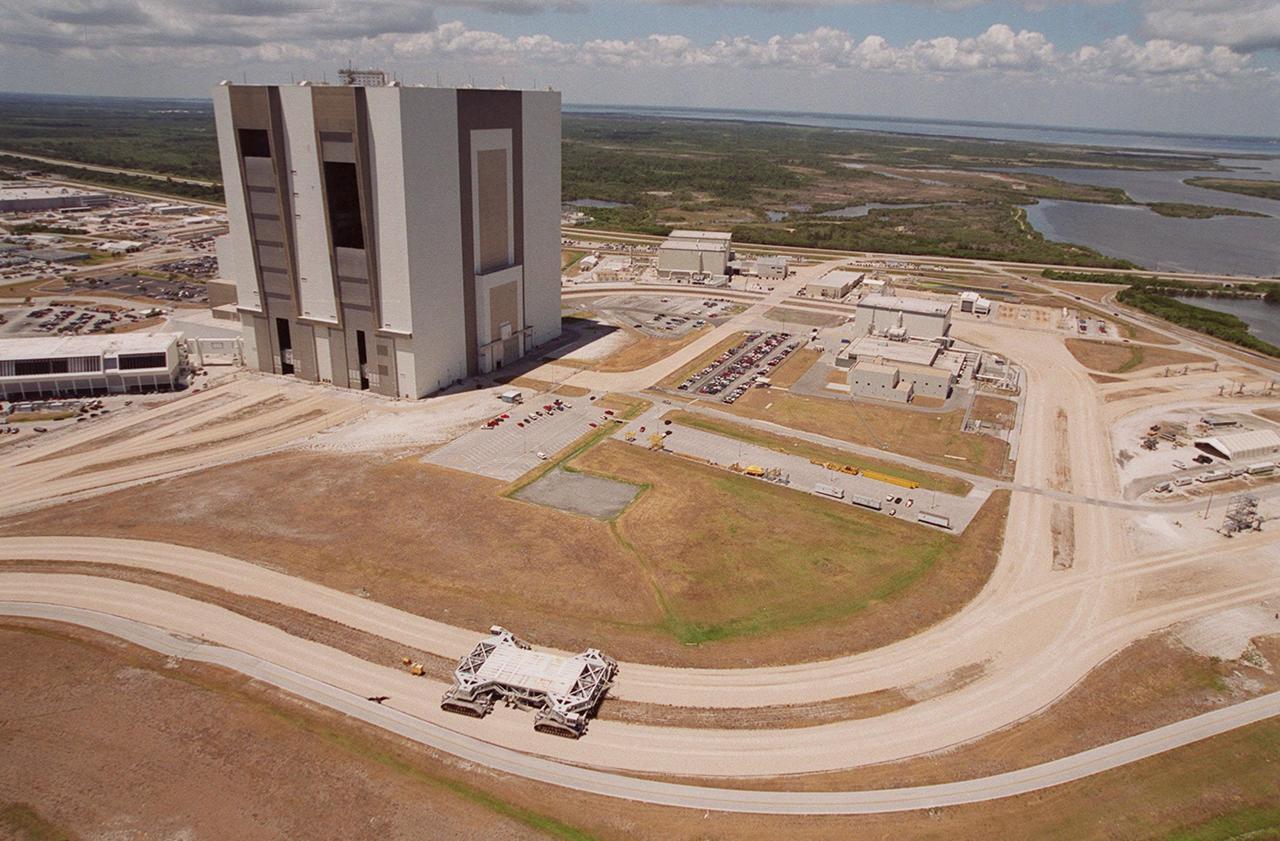
This aerial photo captures many of the facilities involved in Space Shuttle processing. At center is the Vehicle Assembly Building (VAB). The curved road in the foreground is the newly restored crawlerway leading into the VAB high bay 2. The road restoration and high bay 2 are part of KSC’s Safe Haven project, enabling the storage of orbiters during severe weather. The road circles around the Orbiter Processing Facility 3 (OPF-3) at right center. OPF1 and OPF-2 are just above the curving road. On the left of the VAB, the crawlerway also extends from high bays 1 and 3, past the Launch Control Center, out to the two Shuttle launch pads

CAPE CANAVERAL, Fla. -- This diagram of a space shuttle orbiter's avionics bay 5 shows the location of aft load control assembly-2 (ALCA-2) inside the bay. Space shuttle Endeavour was scheduled to launch on the STS-134 mission to the International Space Station on April 29, but that attempt was scrubbed to allow engineers to assess an issue associated with failed heaters on a fuel line for Endeavour's auxiliary power unit-1 (APU-1). STS-134 will be the final spaceflight for Endeavour. For more information, visit www.nasa.gov/mission_pages/shuttle/shuttlemissions/sts134/index.html. Image credit: NASA

During a practice run, crawler-transporter 2 (CT-2) is at the entrance to High Bay 2 of the Vehicle Assembly Building (VAB) at NASA’s Kennedy Space Center in Florida on May 1, 2019. CT-2 entered High Bay 2, and picked up the space shuttle-era mobile launch platform-3 (MLP-3). The VAB is getting its first commercial tenant. Northrop Grumman signed a Reimbursable Space Act Agreement with NASA for use of the facilities. The company will assemble and test its new OmegA rocket inside the massive facility’s High Bay 2. The company also will modify MLP-3 to serve as the launch vehicle’s assembly and launch platform. Northrop Grumman is developing the OmegA rocket, an intermediate/heavy-class launch vehicle, as part of a launch services agreement with the U.S. Air Force.
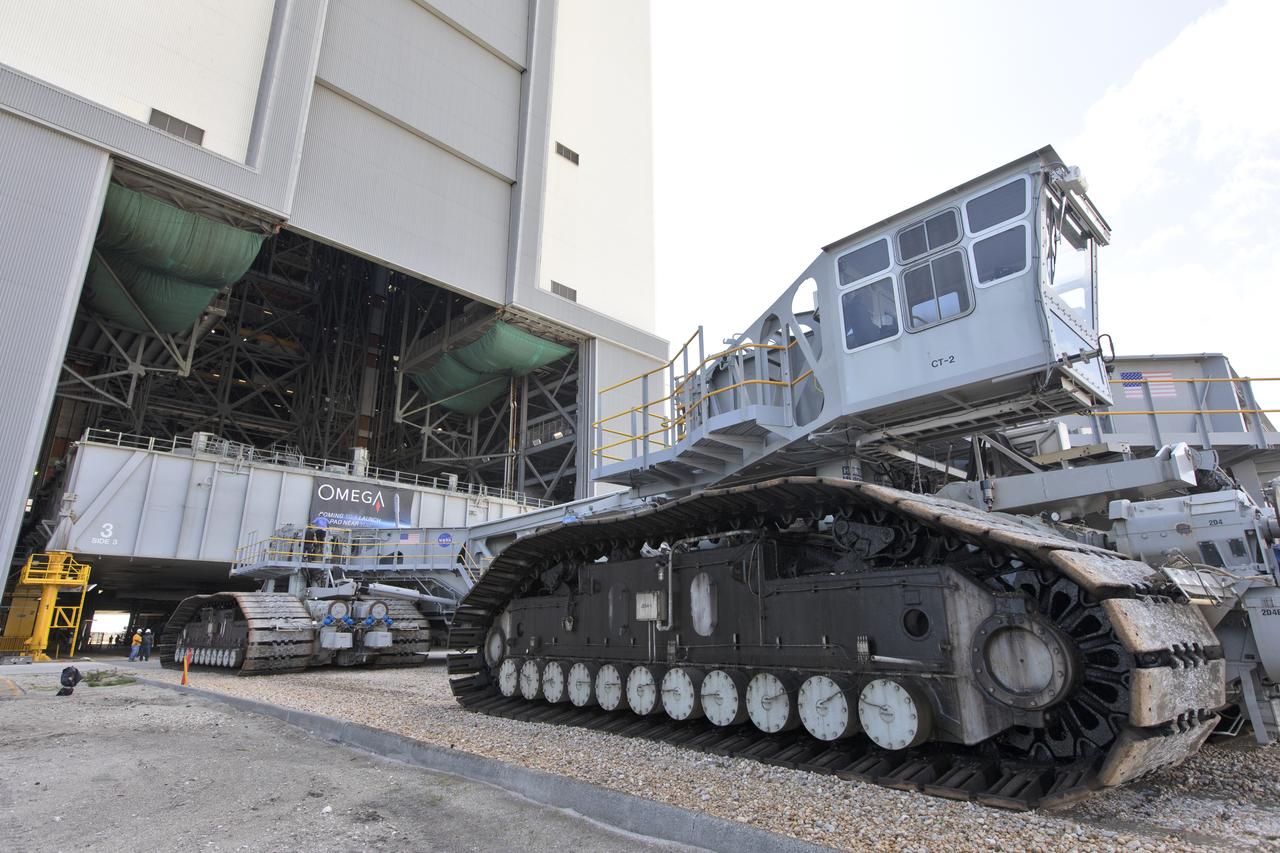
During a practice run, crawler-transporter 2 (CT-2) is at the entrance to High Bay 2 of the Vehicle Assembly Building (VAB) at NASA’s Kennedy Space Center in Florida on May 1, 2019. CT-2 entered High Bay 2, and picked up the space shuttle-era mobile launch platform-3 (MLP-3). The VAB is getting its first commercial tenant. Northrop Grumman signed a Reimbursable Space Act Agreement with NASA for use of the facilities. The company will assemble and test its new OmegA rocket inside the massive facility’s High Bay 2. The company also will modify MLP-3 to serve as the launch vehicle’s assembly and launch platform. Northrop Grumman is developing the OmegA rocket, an intermediate/heavy-class launch vehicle, as part of a launch services agreement with the U.S. Air Force.
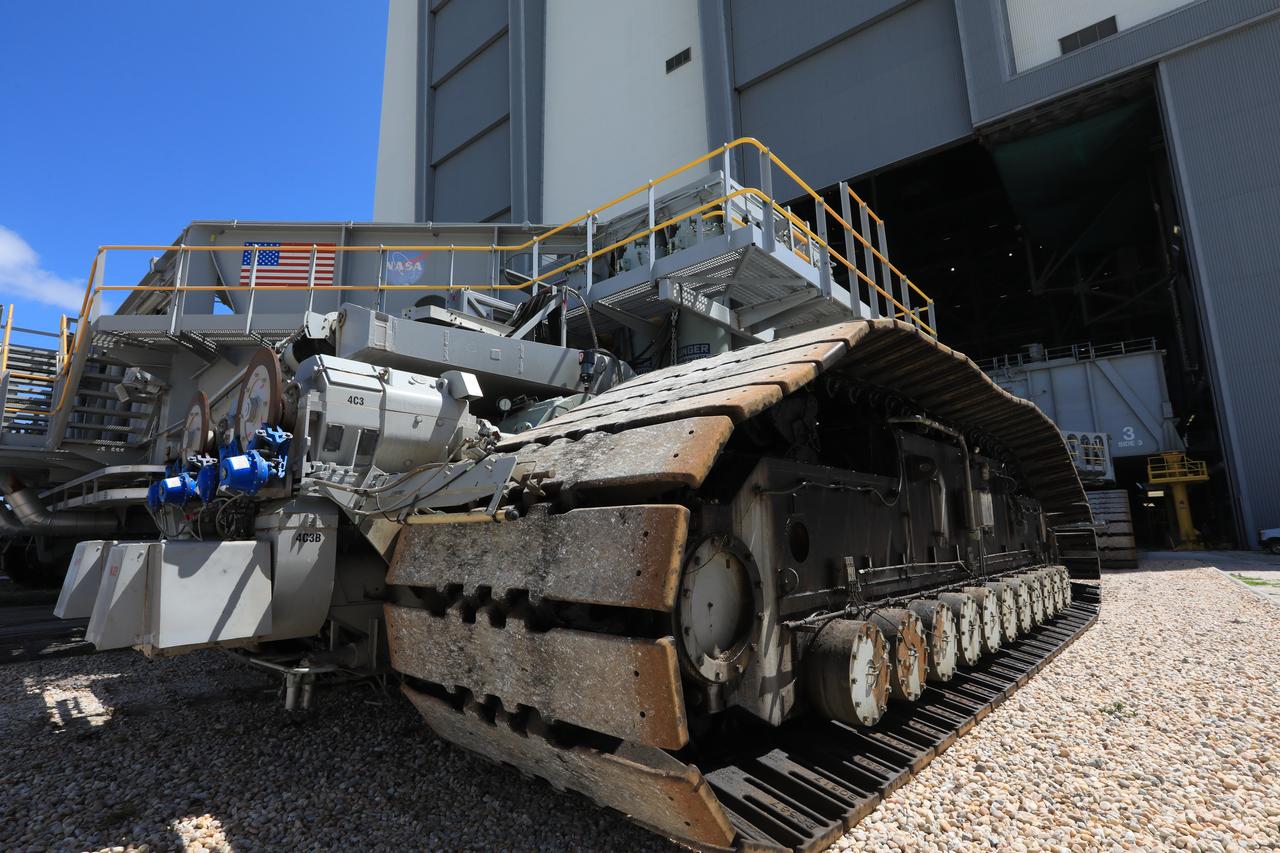
During a practice run, crawler-transporter 2 (CT-2) is at the entrance to High Bay 2 of the Vehicle Assembly Building (VAB) at NASA’s Kennedy Space Center in Florida on May 1, 2019. CT-2 entered High Bay 2, and picked up the space shuttle-era mobile launch platform-3 (MLP-3). The VAB is getting its first commercial tenant. Northrop Grumman signed a Reimbursable Space Act Agreement with NASA for use of the facilities. The company will assemble and test its new OmegA rocket inside the massive facility’s High Bay 2. The company also will modify MLP-3 to serve as the launch vehicle’s assembly and launch platform. Northrop Grumman is developing the OmegA rocket, an intermediate/heavy-class launch vehicle, as part of a launch services agreement with the U.S. Air Force.
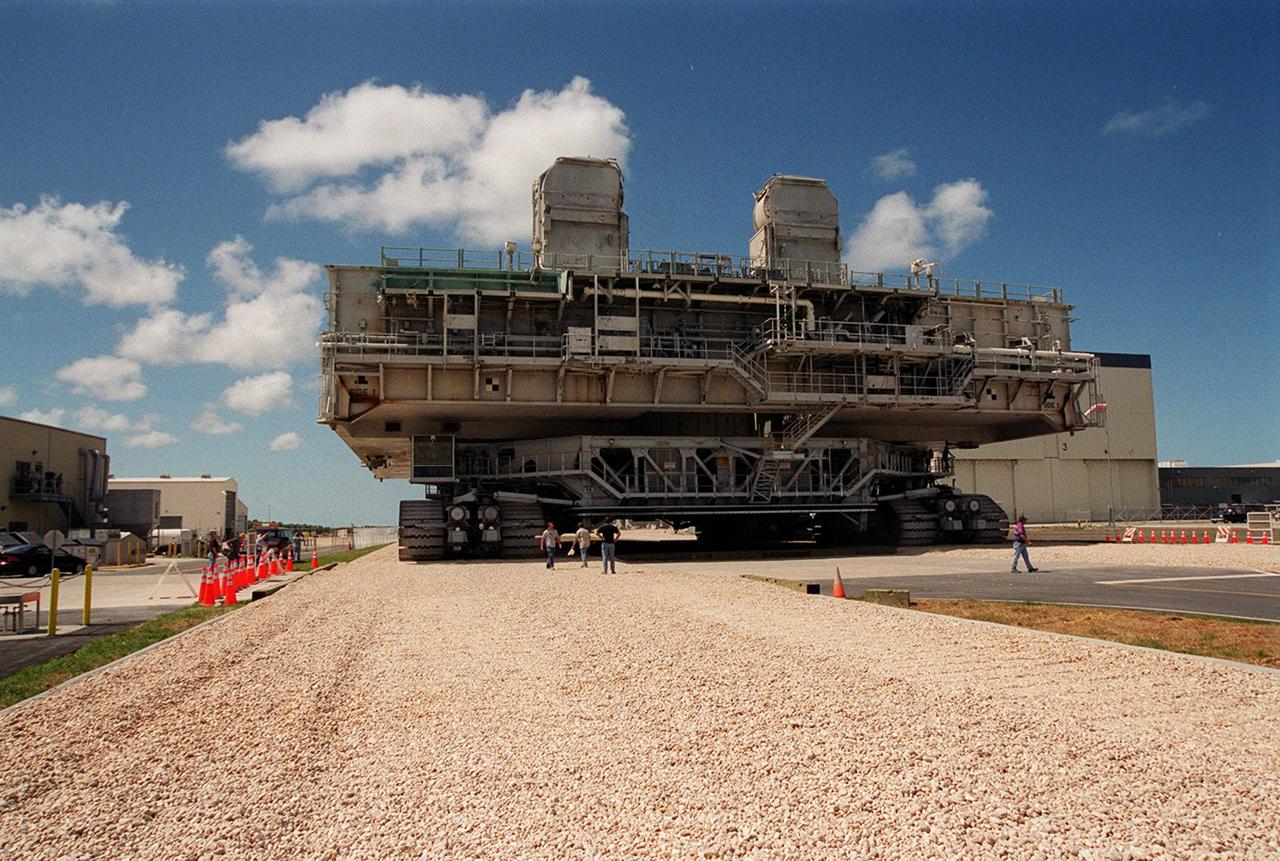
KENNEDY SPACE CENTER, FLA. -- A crawler-transporter with mobile launcher platform on top makes its way from the Orbiter Processing Facility along the once-buried portion of the Apollo-era crawlerway leading to the Vehicle Assembly Building (VAB) high bay. The road was restored as part of KSC’s Safe Haven project. High bay 2 provides a third stacking area.. The primary goal of the Safe Haven construction project was to strengthen readiness for hurricane season by expanding the VAB’s storage capacity. The new area, in high bay 2, will allow NASA to preassemble stacks and still have room in the VAB to pull a Shuttle back from the pad if severe weather threatens. Potential rollouts of the Space Shuttle to the launch pad from high bay 2 will involve making a turn around the north side of the VAB in contrast to the straight rollouts from high bays 1 and 3, on the east side of the VAB facing the launch pads
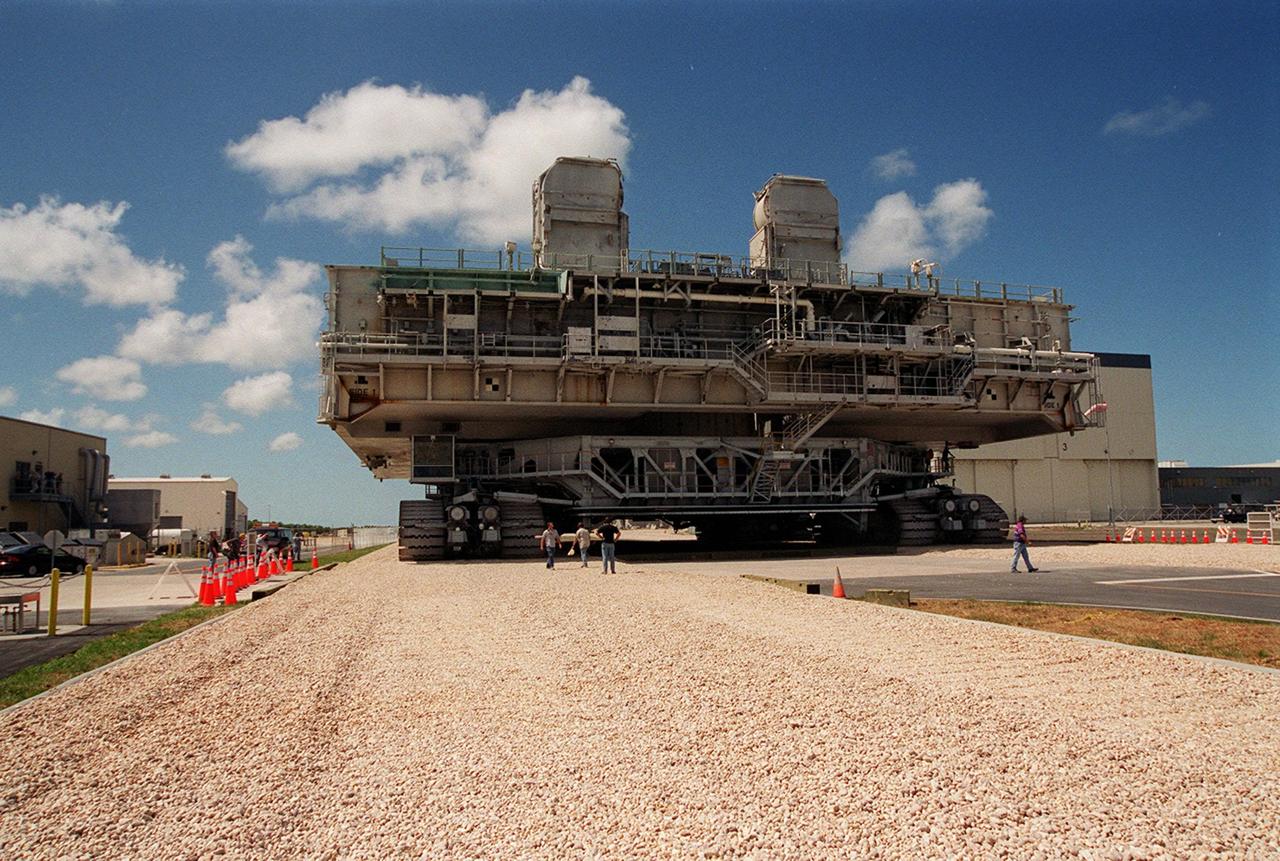
KENNEDY SPACE CENTER, FLA. -- A crawler-transporter with mobile launcher platform on top makes its way from the Orbiter Processing Facility along the once-buried portion of the Apollo-era crawlerway leading to the Vehicle Assembly Building (VAB) high bay. The road was restored as part of KSC’s Safe Haven project. High bay 2 provides a third stacking area.. The primary goal of the Safe Haven construction project was to strengthen readiness for hurricane season by expanding the VAB’s storage capacity. The new area, in high bay 2, will allow NASA to preassemble stacks and still have room in the VAB to pull a Shuttle back from the pad if severe weather threatens. Potential rollouts of the Space Shuttle to the launch pad from high bay 2 will involve making a turn around the north side of the VAB in contrast to the straight rollouts from high bays 1 and 3, on the east side of the VAB facing the launch pads
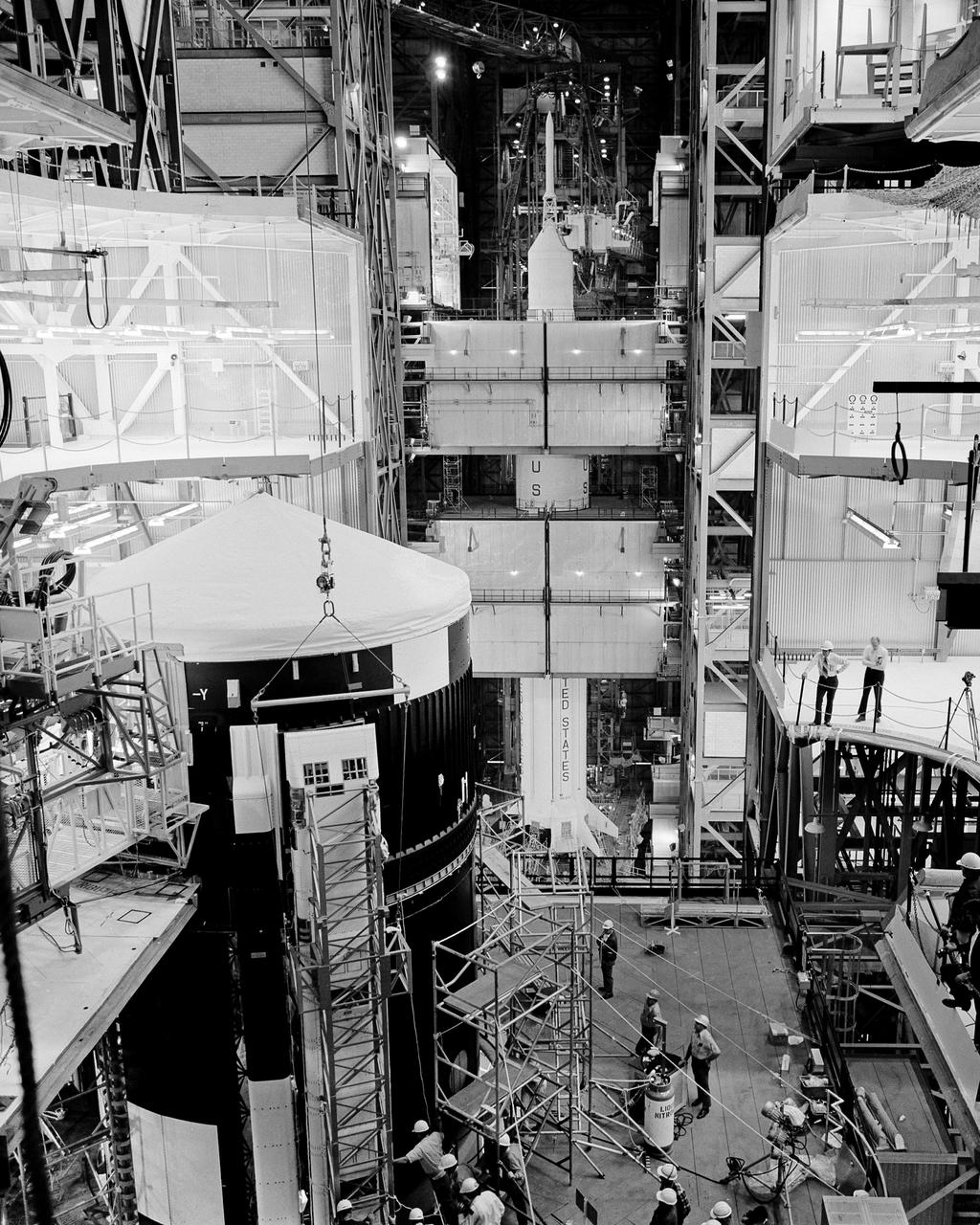
CAPE KENNEDY, Fla. -- At the Kennedy Space Center in Florida, one of Skylab 1's solar cell arrays is installed on the orbital space station in High Bay 2 of the Vehicle Assembly Building. Skylab 2 launch vehicle is in high bay 1, visible in the background. Each of the two solar cell arrays on the space station that will be deployed in orbit is designed to provide 10,500 watts of power. All power needed to operate the station and the Apollo Telescope mount will be taken from the arrays. Each array will have almost 1,177 square feet of surface area to turn sunlight into electrical power. Skylab 1 is schedule for launch April 30, 1973 and Skylab 2, carrying the astronauts Charles Conrad Jr., Dr. Joseph P. Kerwin and Paul J. Weitz to dock with the space station and enter it to live and work for 28 days, will be launched a day later. Photo Credit: NASA

Teams with NASA’s Exploration Ground Systems transport the agency’s 212-foot-tall SLS (Space Launch System) core stage into High Bay 2 at the Vehicle Assembly Building at NASA’s Kennedy Space Center in Florida on Wednesday, Dec. 11, 2024. The one-of-a kind lifting beam is designed to lift the core stage from the transfer aisle to High Bay 2 where it will remain while teams stack the two solid rocket boosters on top of mobile launcher 1 for the SLS core stage.
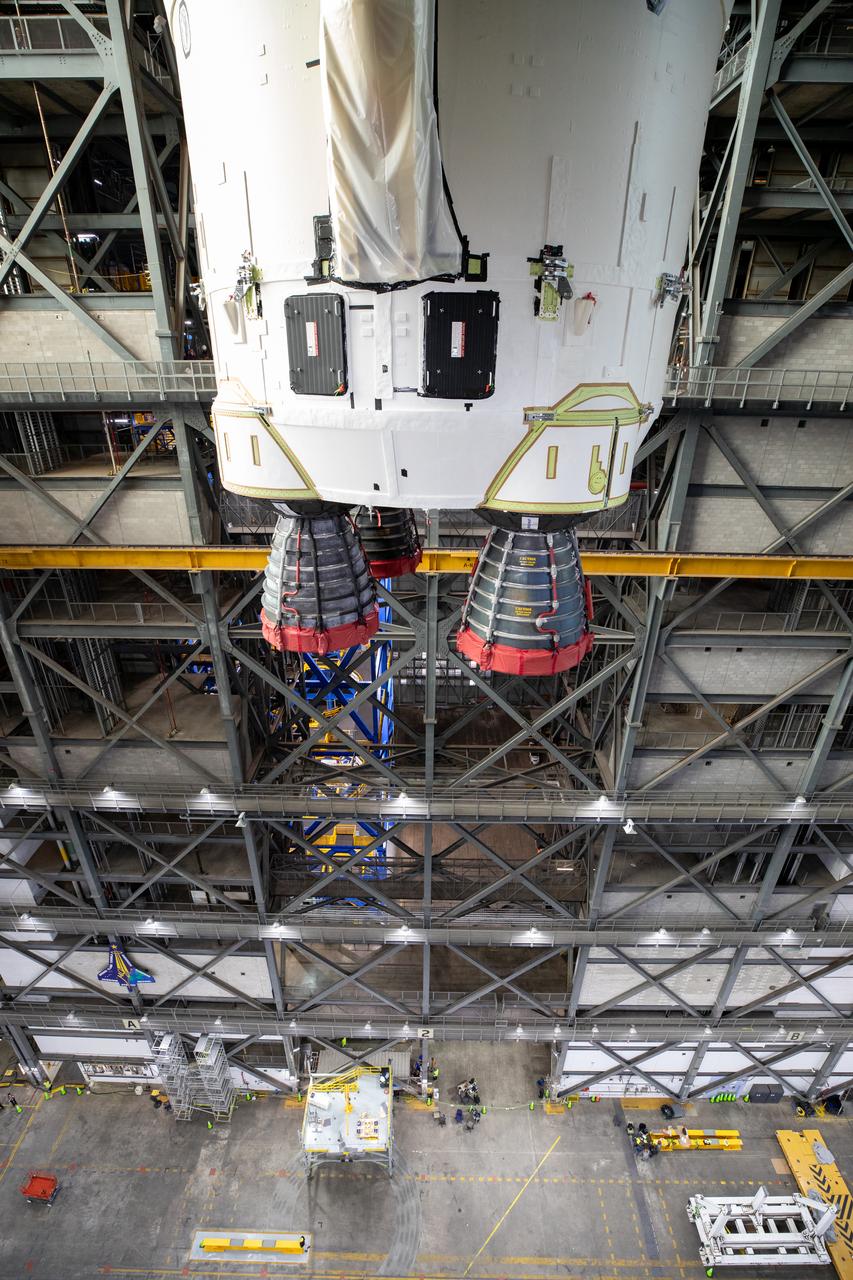
Teams with NASA’s Exploration Ground Systems transport the agency’s 212-foot-tall SLS (Space Launch System) core stage into High Bay 2 at the Vehicle Assembly Building at NASA’s Kennedy Space Center in Florida on Wednesday, Dec. 11, 2024. The one-of-a kind lifting beam is designed to lift the core stage from the transfer aisle to High Bay 2 where it will remain while teams stack the two solid rocket boosters on top of mobile launcher 1 for the SLS core stage.
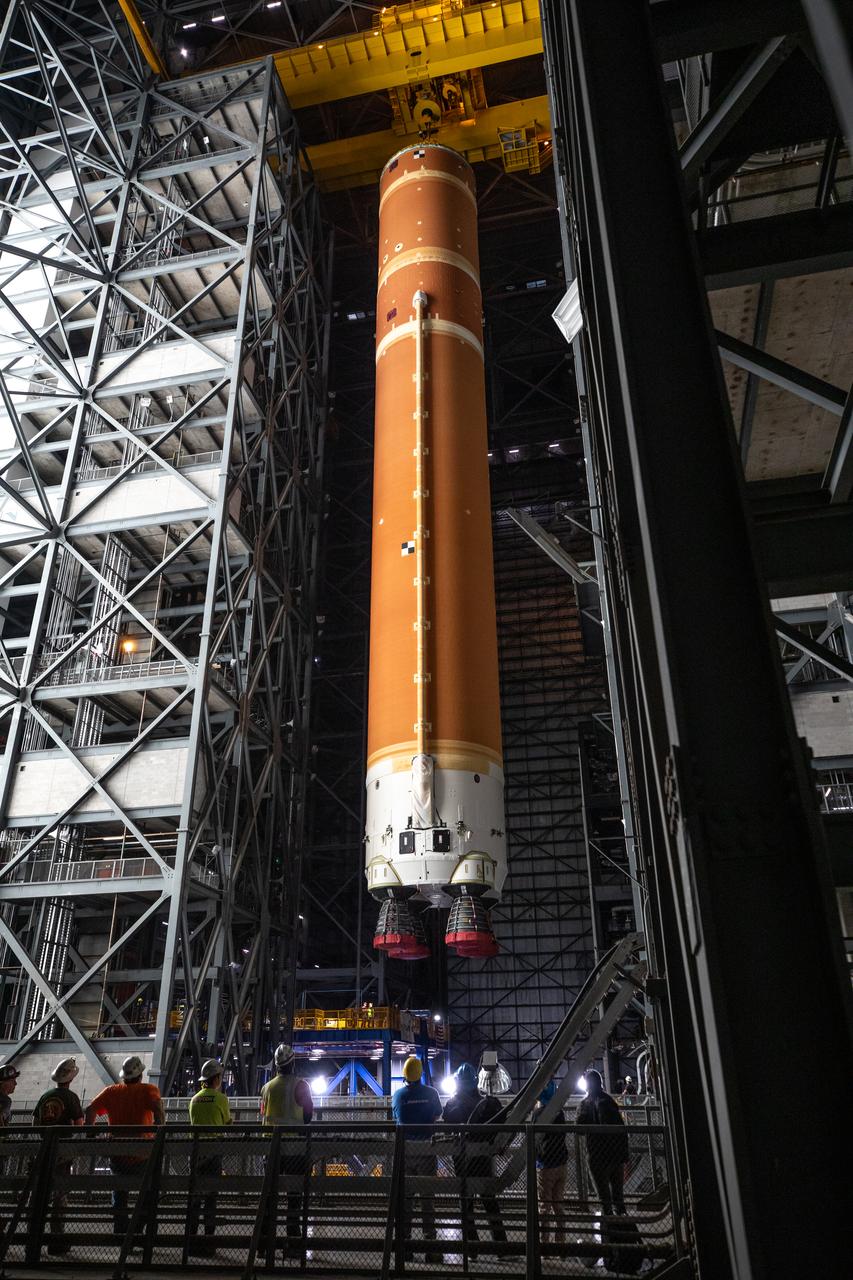
Teams with NASA’s Exploration Ground Systems transport the agency’s 212-foot-tall SLS (Space Launch System) core stage into High Bay 2 at the Vehicle Assembly Building at NASA’s Kennedy Space Center in Florida on Wednesday, Dec. 11, 2024. The one-of-a kind lifting beam is designed to lift the core stage from the transfer aisle to High Bay 2 where it will remain while teams stack the two solid rocket boosters on top of mobile launcher 1 for the SLS core stage.
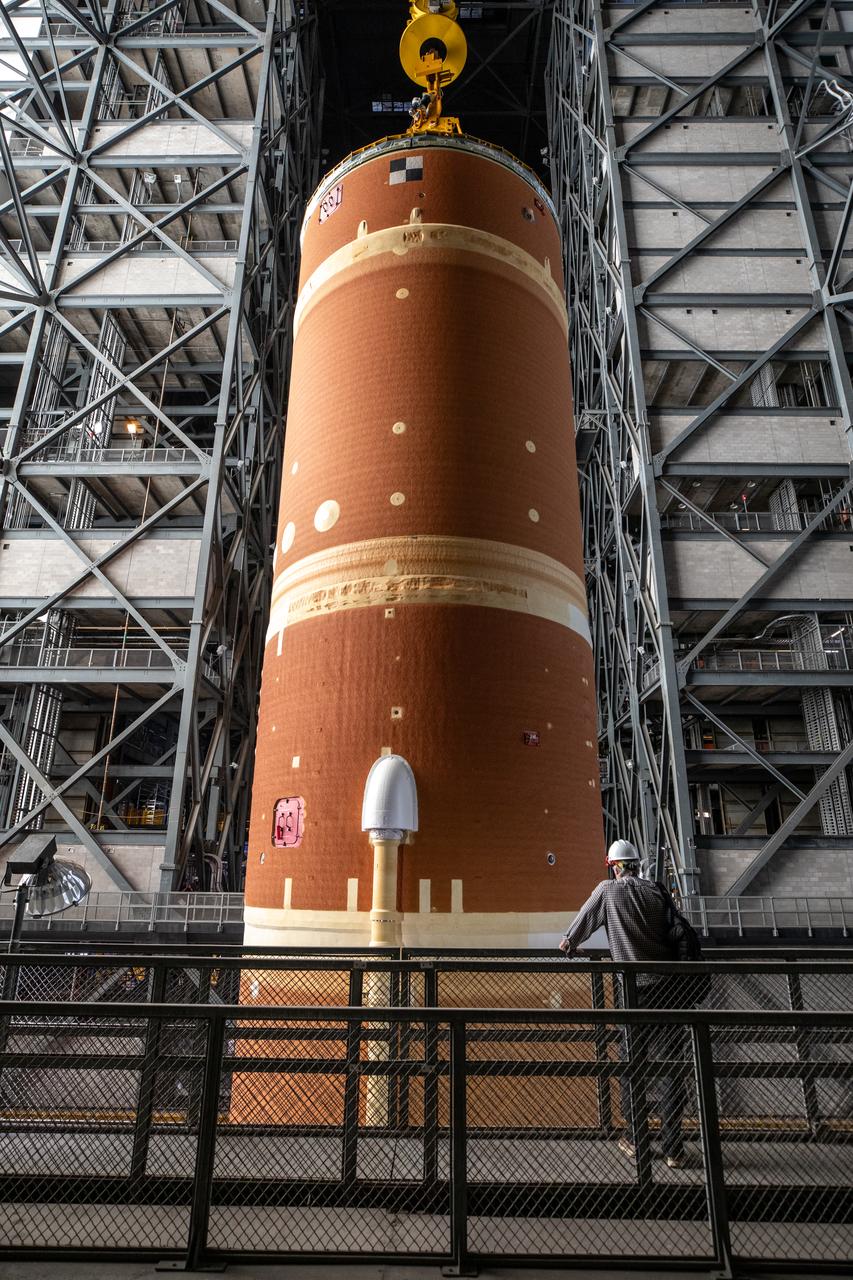
Teams with NASA’s Exploration Ground Systems transport the agency’s 212-foot-tall SLS (Space Launch System) core stage into High Bay 2 at the Vehicle Assembly Building at NASA’s Kennedy Space Center in Florida on Wednesday, Dec. 11, 2024. The one-of-a kind lifting beam is designed to lift the core stage from the transfer aisle to High Bay 2 where it will remain while teams stack the two solid rocket boosters on top of mobile launcher 1 for the SLS core stage.
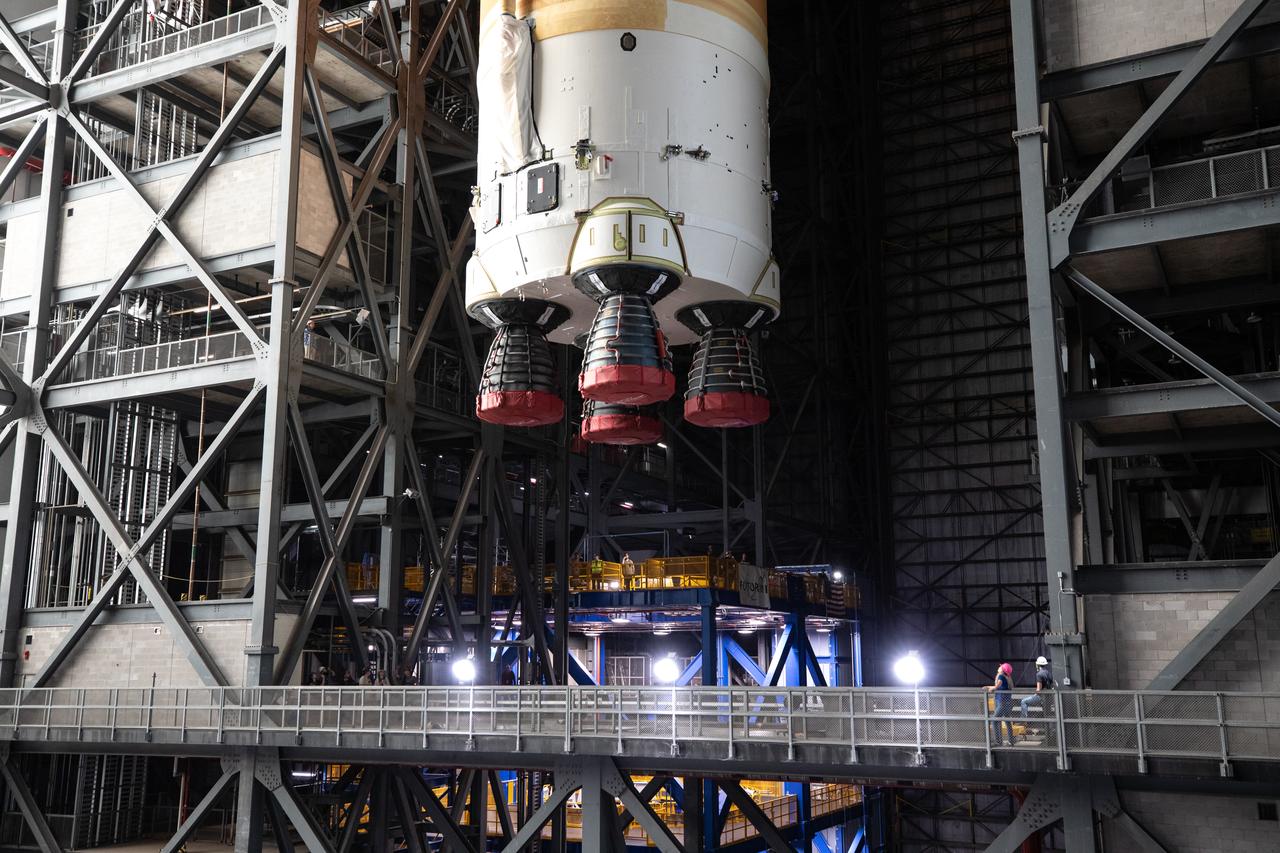
Teams with NASA’s Exploration Ground Systems transport the agency’s 212-foot-tall SLS (Space Launch System) core stage into High Bay 2 at the Vehicle Assembly Building at NASA’s Kennedy Space Center in Florida on Wednesday, Dec. 11, 2024. The one-of-a kind lifting beam is designed to lift the core stage from the transfer aisle to High Bay 2 where it will remain while teams stack the two solid rocket boosters on top of mobile launcher 1 for the SLS core stage.
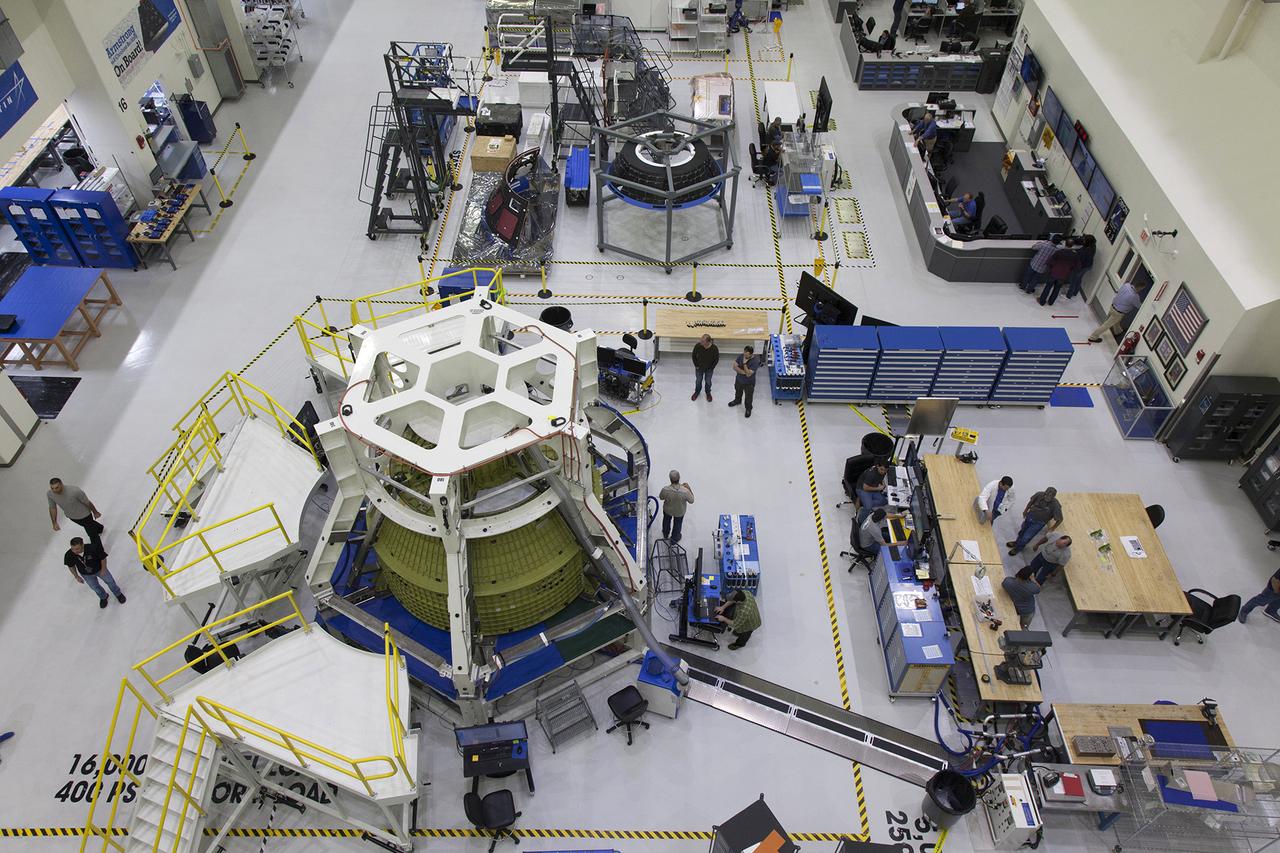
The Orion crew module pressure vessel for Exploration Mission-2 (EM-2) is secured in a work stand called the bird cage inside the Neil Armstrong Operations and Checkout Building high bay at NASA's Kennedy Space Center in Florida, on March 21, 2019. The pressure vessel is Orion's primary structure that holds the pressurized atmosphere astronauts will breathe and work in while in the vacuum of deep space. Behind the pressure vessel, secured on a work stand is the Orion bay cover for Exploration Mission-1.
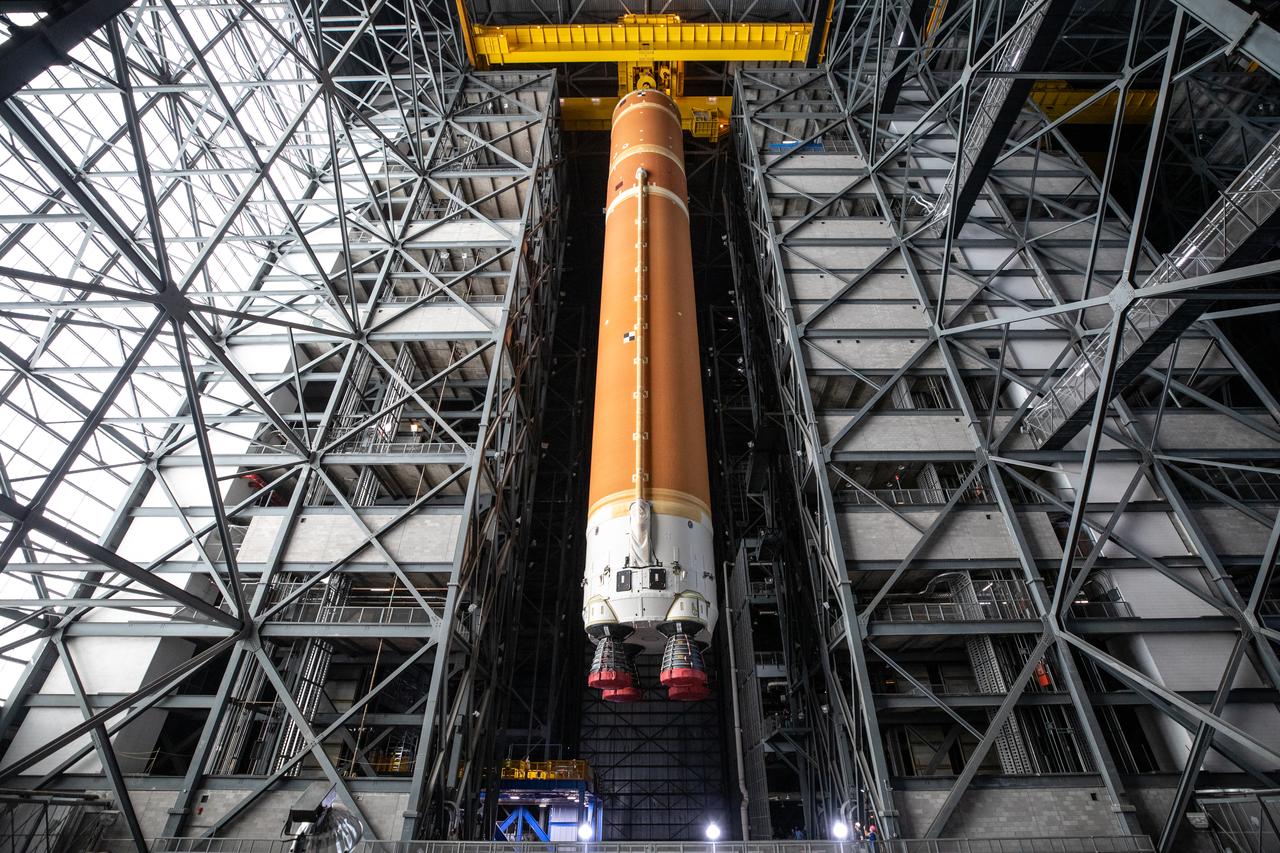
Teams with NASA’s Exploration Ground Systems transport the agency’s 212-foot-tall SLS (Space Launch System) core stage into High Bay 2 at the Vehicle Assembly Building at NASA’s Kennedy Space Center in Florida on Wednesday, Dec. 11, 2024. The one-of-a kind lifting beam is designed to lift the core stage from the transfer aisle to High Bay 2 where it will remain while teams stack the two solid rocket boosters on top of mobile launcher 1 for the SLS core stage.
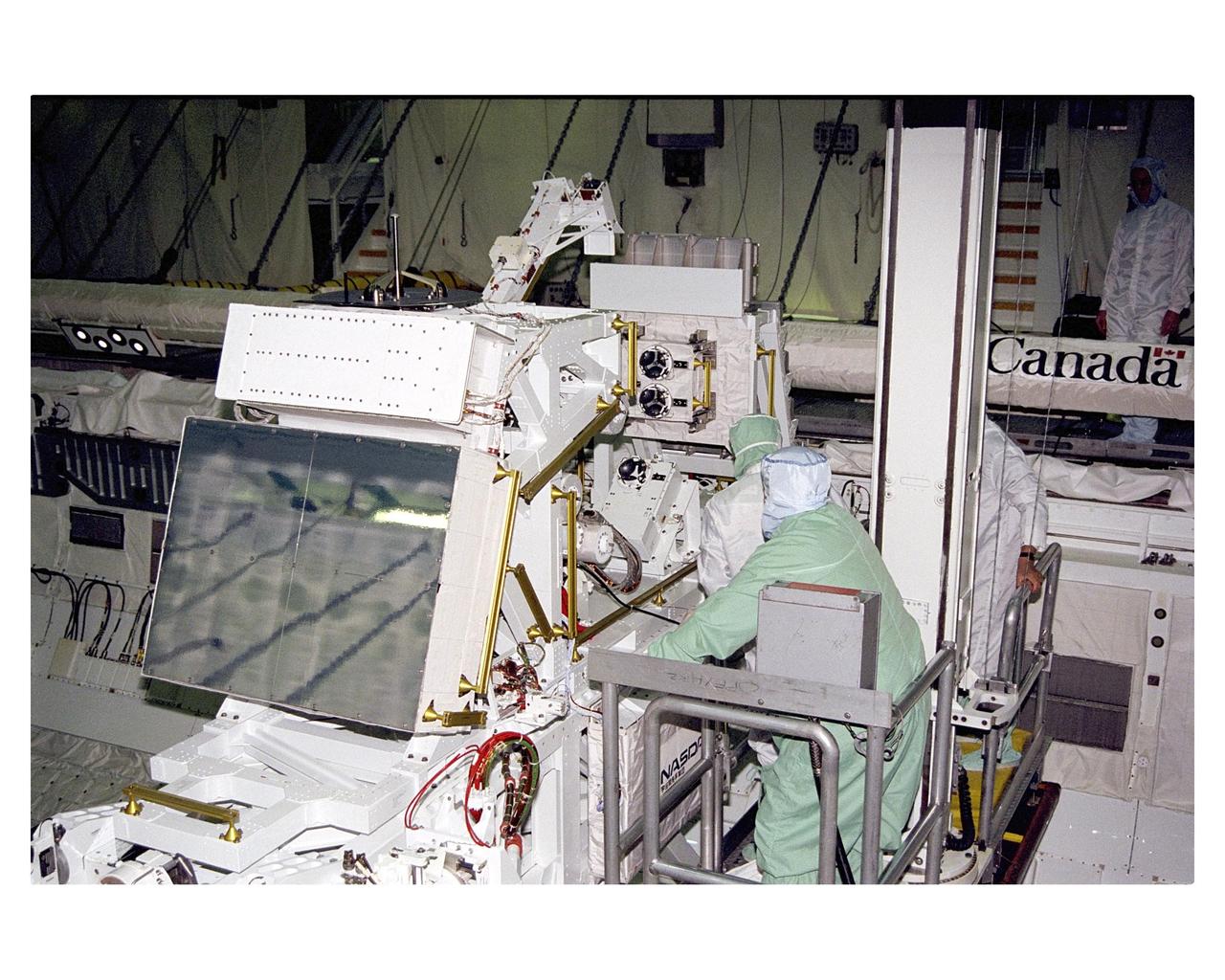
The Manipulator Flight Demonstration (MFD) payload is installed into the payload bay of the Space Shuttle Orbiter Discovery in Orbiter Processing Facility 2. The MFD is one of several payloads that will fly on the STS-85 mission. This payload is designed to test the operational capability of the Japanese Experiment Module Remote Manipulator System (JEM RMS) Small Fine Arm (SFA), which can be seen atop its Multi-Purpose Experiment Support Structure (MPESS) carrier that will serve as a platform in the payload bay for the robotic arm experiment. The arm, which will be a part of the JEM element of the International Space Station, will be operated from the orbiter’s aft flight deck during the 11-day mission. Other payloads that will be aboard Discovery on this space flight include the Cryogenic Infrared Spectrometers and Telescopes for the Atmosphere-Shuttle Pallet Satellite-2 (CRISTA- SPAS-2), Technology Applications and Science-1 (TAS-1) and International Extreme Ultraviolet Hitchhiker (IEH-2) experiments
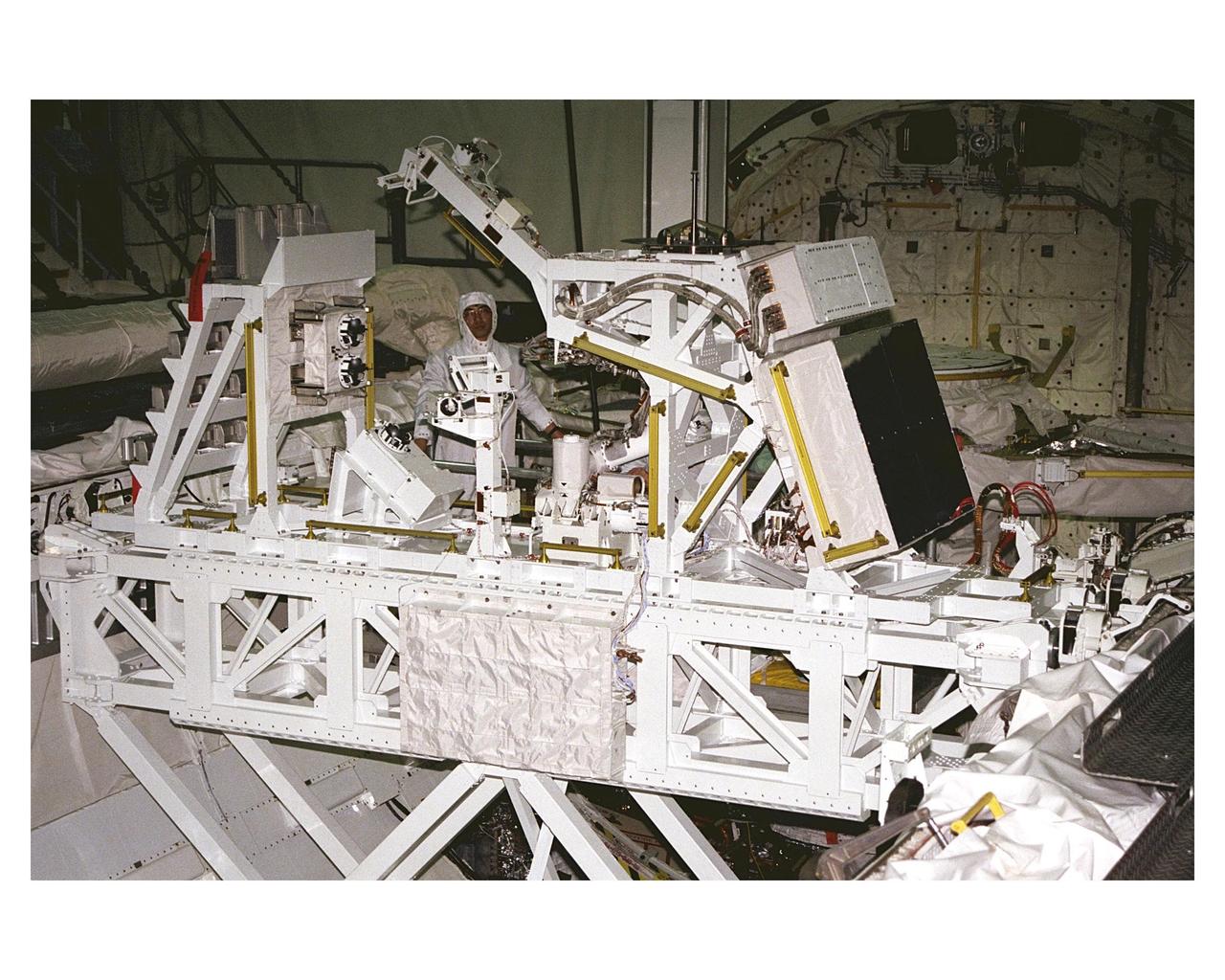
The Manipulator Flight Demonstration (MFD) payload is installed into the payload bay of the Space Shuttle Orbiter Discovery in Orbiter Processing Facility 2. The MFD is one of several payloads that will fly on the STS-85 mission. This payload is designed to test the operational capability of the Japanese Experiment Module Remote Manipulator System (JEM RMS) Small Fine Arm (SFA), which can be seen atop its Multi-Purpose Experiment Support Structure (MPESS) carrier that will serve as a platform in the payload bay for the robotic arm experiment. The arm, which will be a part of the JEM element of the International Space Station, will be operated from the orbiter’s aft flight deck during the 11-day mission. Other payloads that will be aboard Discovery on this space flight include the Cryogenic Infrared Spectrometers and Telescopes for the Atmosphere-Shuttle Pallet Satellite-2 (CRISTA- SPAS-2), Technology Applications and Science-1 (TAS-1) and International Extreme Ultraviolet Hitchhiker (IEH-2) experiments
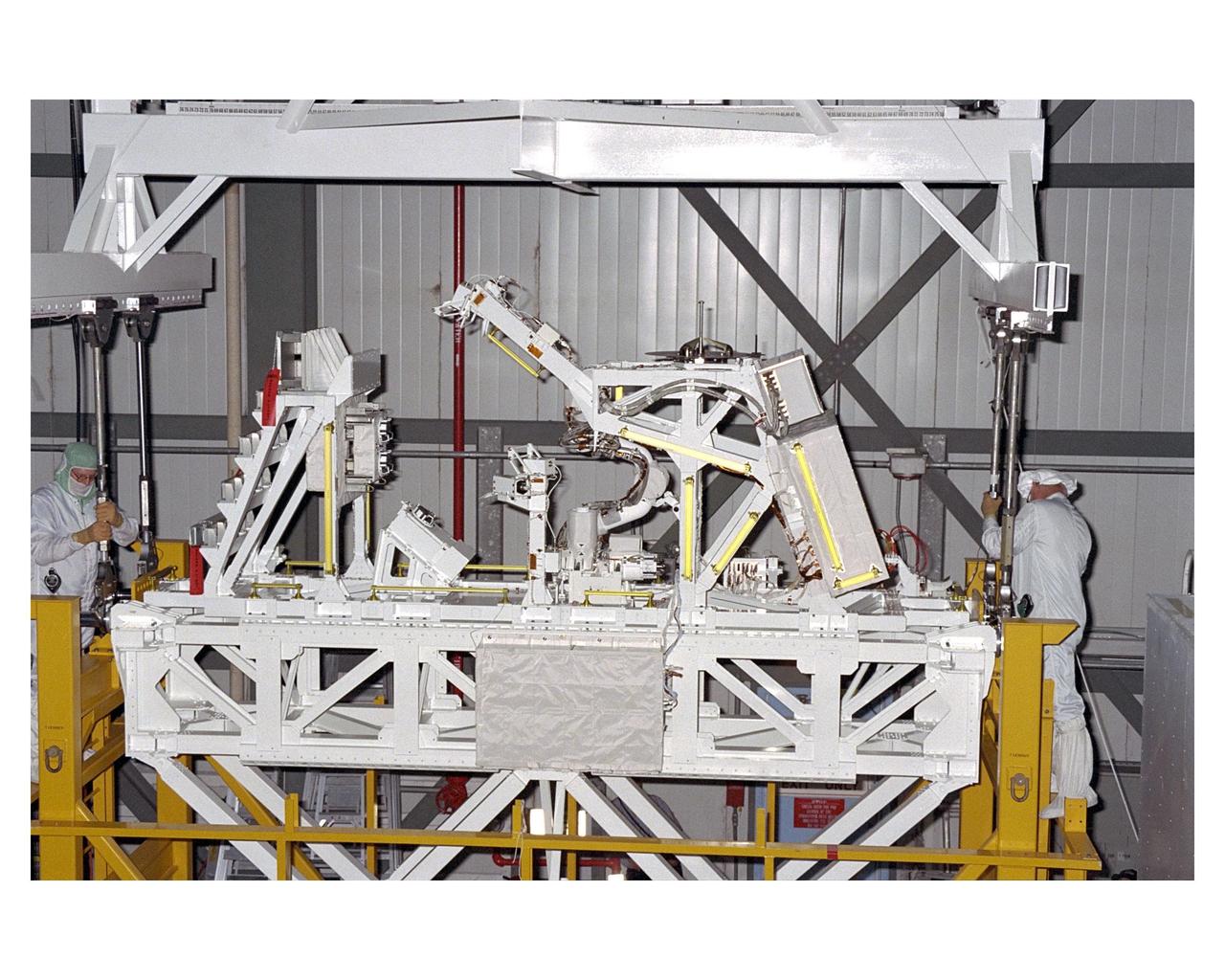
The Manipulator Flight Demonstration (MFD) payload is prepared for hoisting and installation into the payload bay of the Space Shuttle Orbiter Discovery in Orbiter Processing Facility 2. The MFD is one of several payloads that will fly on the STS-85 mission. This payload is designed to test the operational capability of the Japanese Experiment Module Remote Manipulator System (JEM RMS) Small Fine Arm (SFA), which can be seen atop its Multi-Purpose Experiment Support Structure (MPESS) carrier that will serve as a platform in the payload bay for the robotic arm experiment. The arm, which will be a part of the JEM element of the International Space Station, will be operated from the orbiter’s aft flight deck during the 11-day mission. Other payloads that will be aboard Discovery on this space flight include the Cryogenic Infrared Spectrometers and Telescopes for the Atmosphere-Shuttle Pallet Satellite-2 (CRISTA-SPAS-2), Technology Applications and Science-1 (TAS-1) and International Extreme Ultraviolet Hitchhiker (IEH-2) experiments
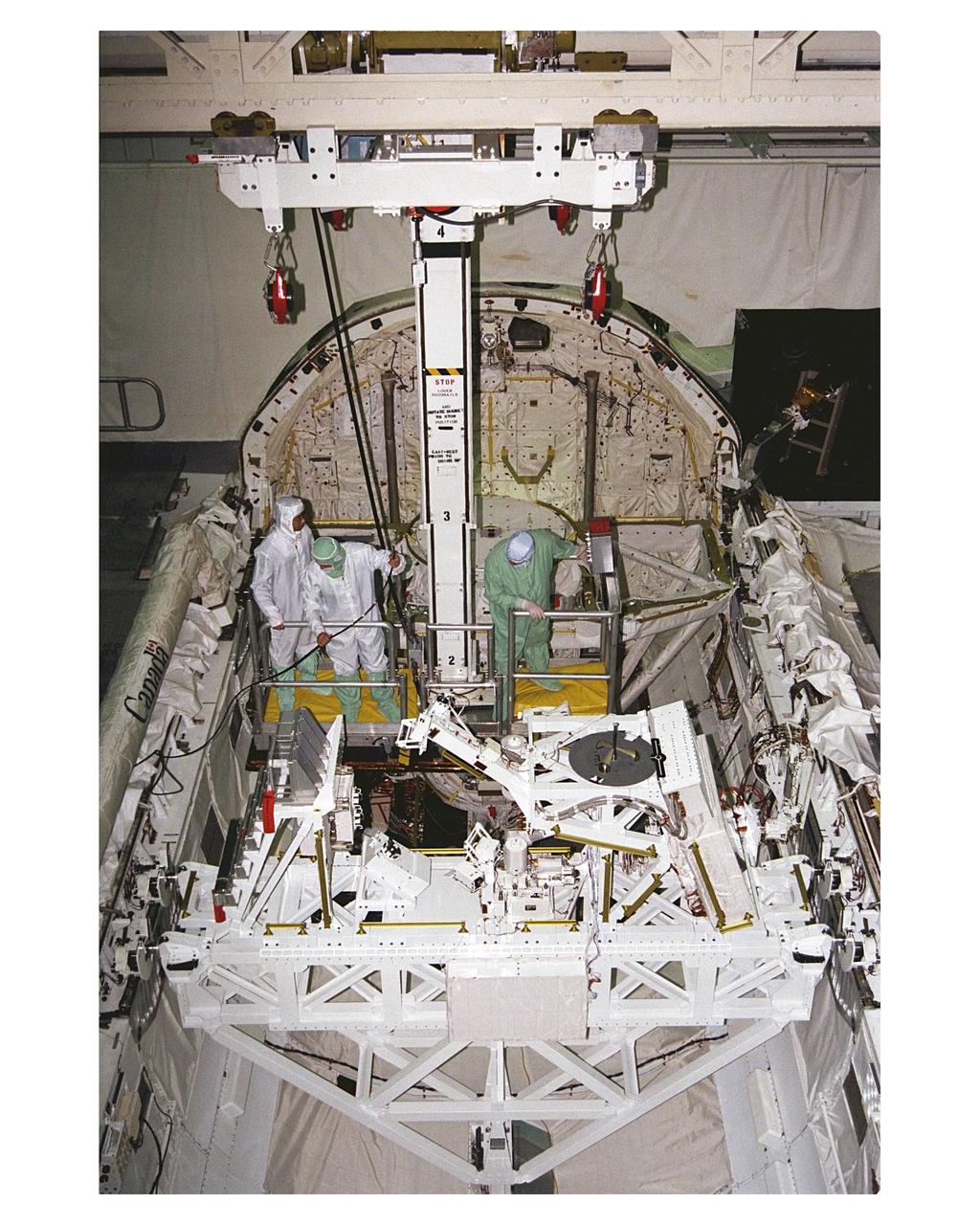
The Manipulator Flight Demonstration (MFD) payload is lowered into the payload bay of the Space Shuttle Orbiter Discovery in Orbiter Processing Facility 2. The MFD is one of several payloads that will fly on the STS-85 mission. This payload is designed to test the operational capability of the Japanese Experiment Module Remote Manipulator System (JEM RMS) Small Fine Arm (SFA), which can be seen atop its Multi-Purpose Experiment Support Structure (MPESS) carrier that will serve as a platform in the payload bay for the robotic arm experiment. The arm, which will be a part of the JEM element of the International Space Station, will be operated from the orbiter’s aft flight deck during the 11-day mission. Other payloads that will be aboard Discovery on this space flight include the Cryogenic Infrared Spectro-meters and Telescopes for the Atmosphere-Shuttle Pallet Satellite-2 (CRISTA-SPAS-2), Technology Applications and Science-1 (TAS-1) and International Extreme Ultraviolet Hitchhiker (IEH-2) experiments
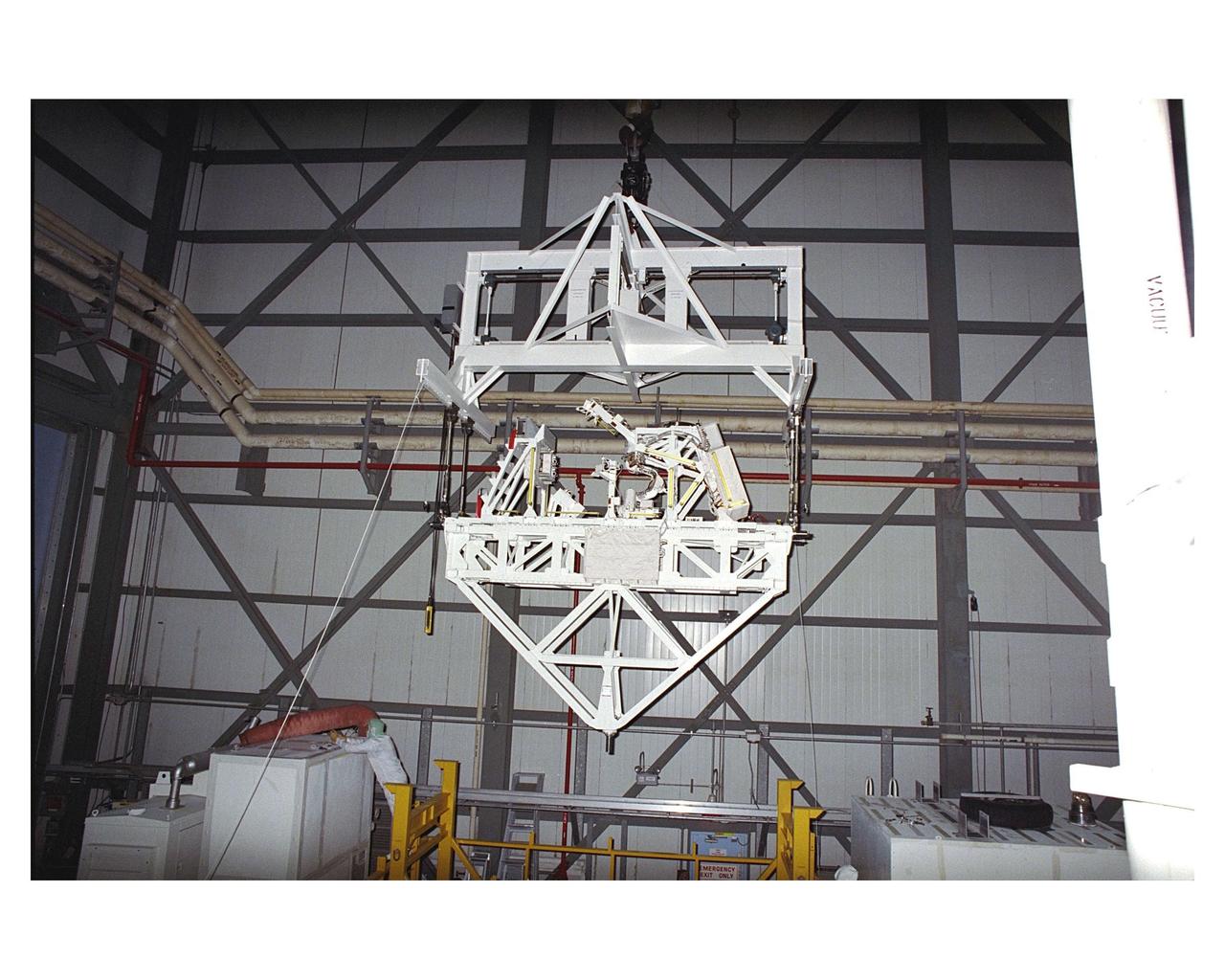
The Manipulator Flight Demonstration (MFD) payload is hoisted for installation into the payload bay of the Space Shuttle Orbiter Discovery in Orbiter Processing Facility 2. The MFD is one of several payloads that will fly on the STS-85 mission. This payload is designed to test the operational capability of the Japanese Experiment Module Remote Manipulator System (JEM RMS) Small Fine Arm (SFA), which can be seen atop its Multi-Purpose Experiment Support Structure (MPESS) carrier that will serve as a platform in the payload bay for the robotic arm experiment. The arm, which will be a part of the JEM element of the International Space Station, will be operated from the orbiter’s aft flight deck during the 11-day mission. Other payloads that will be aboard Discovery on this space flight include the Cryogenic Infrared Spectrometers and Telescopes for the Atmosphere-Shuttle Pallet Satellite-2 (CRISTA-SPAS-2), Technology Applications and Science-1 (TAS-1) and International Extreme Ultraviolet Hitchhiker (IEH-2) experiments
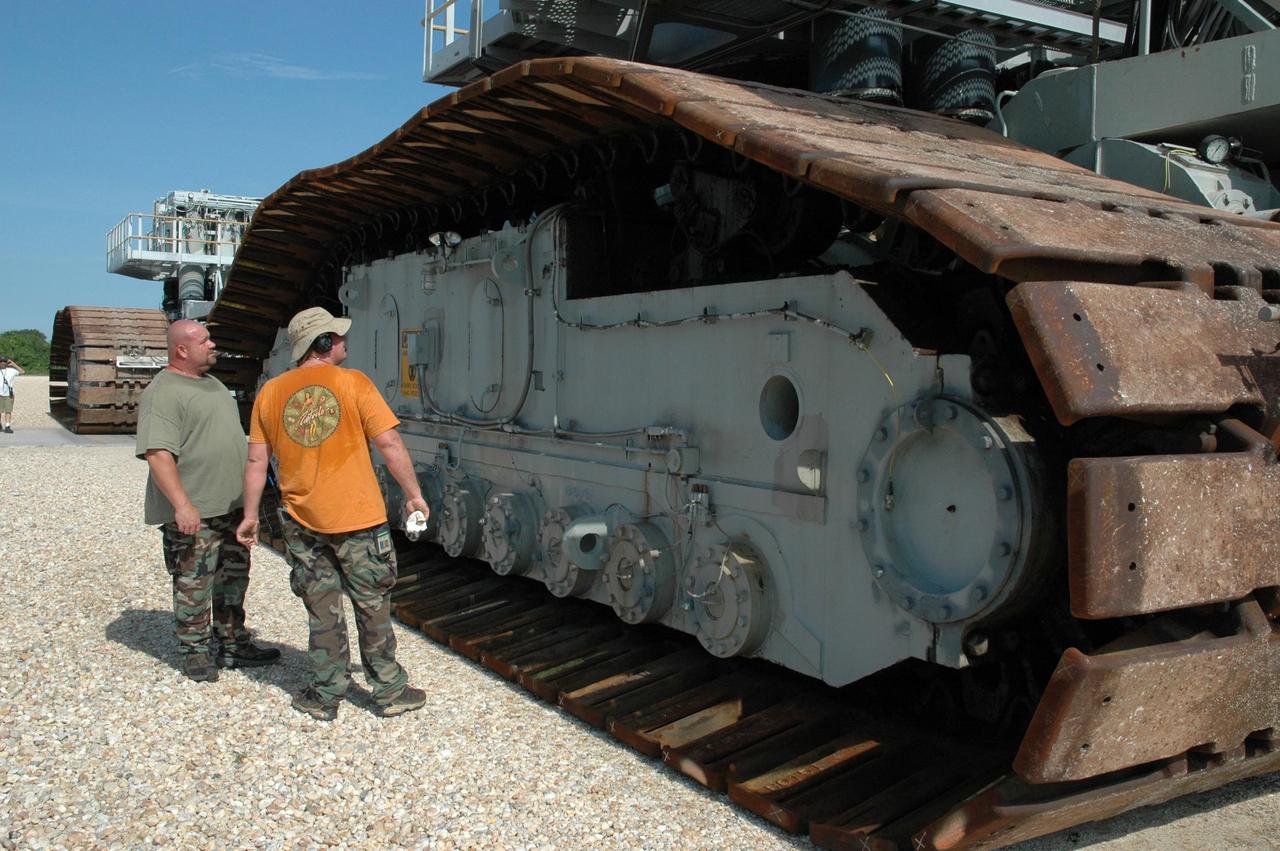
KENNEDY SPACE CENTER, FLA. - Workers check on the crawler-transporters in the event they are needed for rolling back Space Shuttle Atlantis from Launch Pad 39B. Crawler No. 2 will be used to move the STS-116 stack from VAB high bay 3 to high bay 2 and crawler No. 1 will be used to transport Atlantis to high bay 3. The rollback will be determined by the mission management team based on information about Hurricane Ernesto and its path through Florida. Atlantis has been poised on Launch Pad 39B for liftoff on mission STS-115 to the International Space Station to deliver the P3/P4 truss segment. Photo credit: NASA/Jack Pfaller
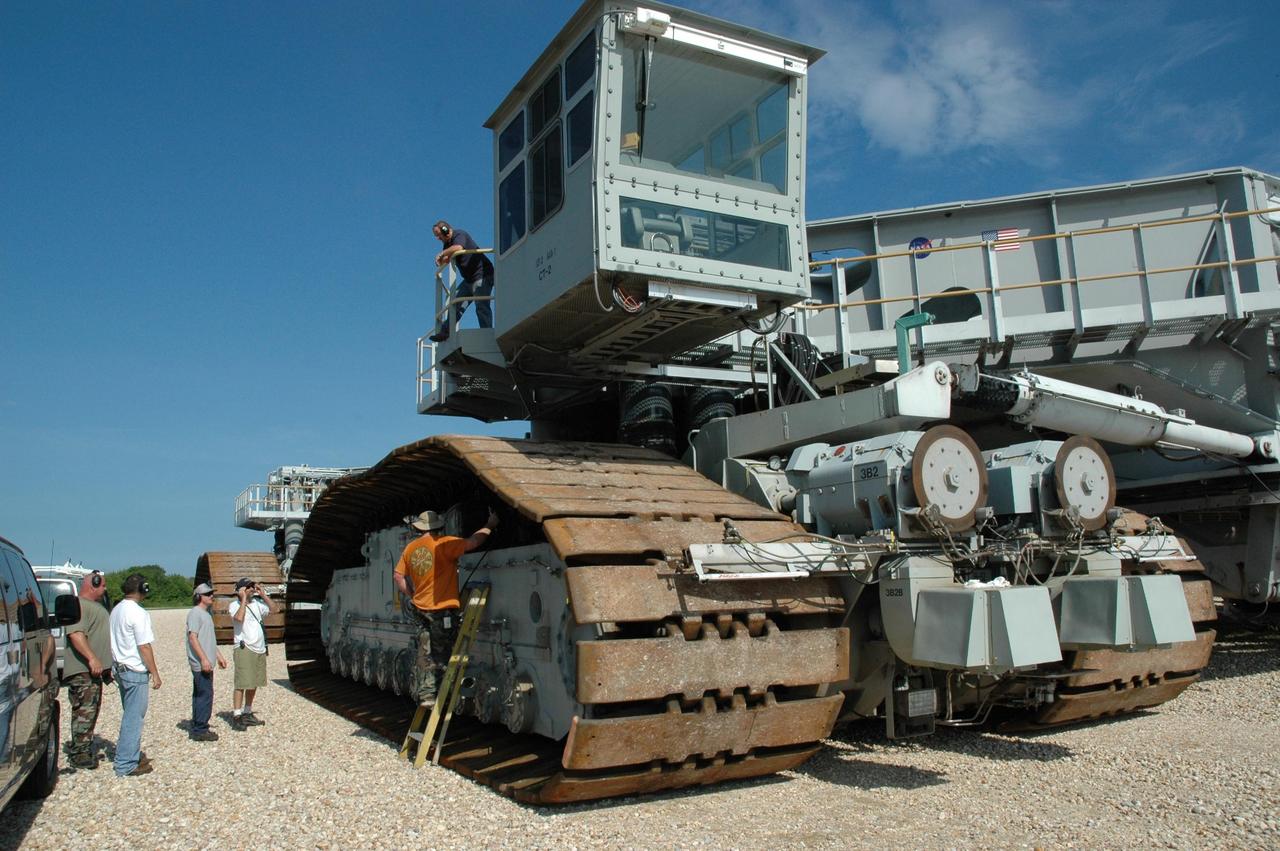
KENNEDY SPACE CENTER, FLA. - Crawler-transporter No. 2 is being checked before it is needed to move the STS-116 stack from VAB high bay 3 to high bay 2 and allow the rollback of Space Shuttle Atlantis into high bay 3. Crawler No. 1 will transport the shuttle from the pad. The rollback will be determined by the mission management team based on information about Hurricane Ernesto and its path through Florida. Atlantis has been poised on Launch Pad 39B for liftoff on mission STS-115 to the International Space Station to deliver the P3/P4 truss segment. Photo credit: NASA/Jack Pfaller
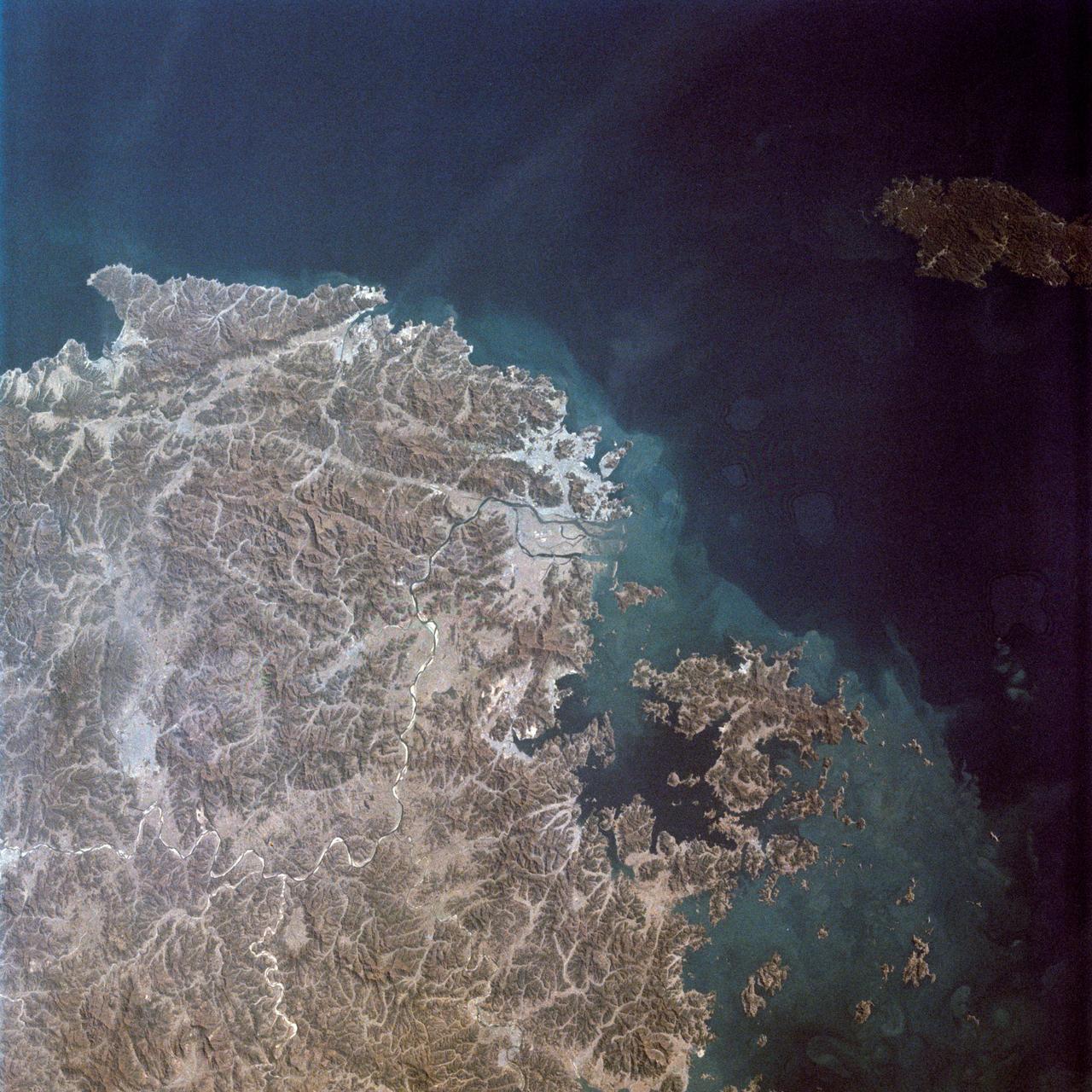
Onboard views by the STS-2 Crew of the Payload Bay with Office of Space and Terrestrial Applications (OSTA)-1 Payload, the Remote Manipulator System (RMS) and Earth views of: Korea, China and Columbia. Also available in 4x5 BW 1. REAGAN, RONALD PRESIDENT - MOCR (STS-2) JSC, HOUSTON, TX Also available in 4x5 BW, 35 CN, 35 BW
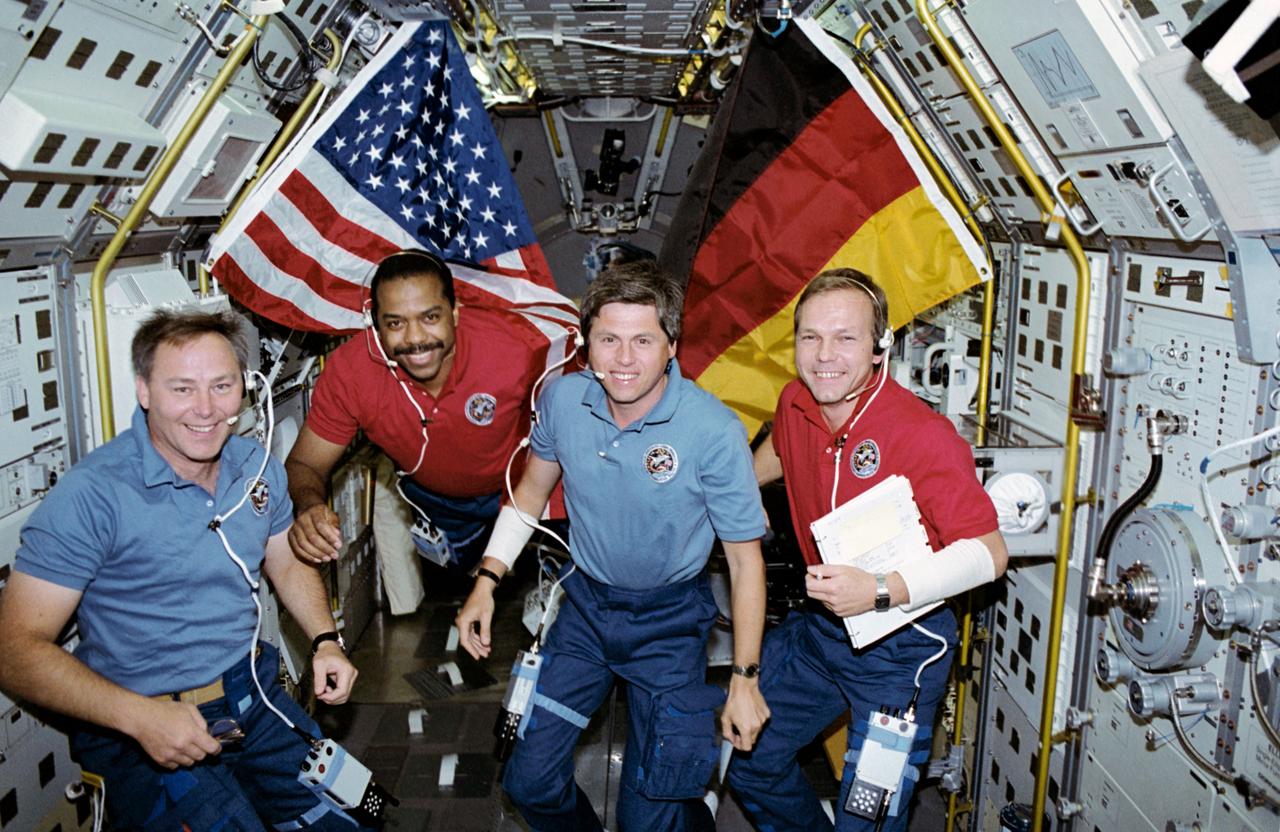
STS-55 crewmembers pose with United States and German flags inside the Spacelab Deutsche 2 (SL-D2) science module located in the payload bay (PLB) of Columbia, Orbiter Vehicle (OV) 102. Wearing communications kit assembly headsets (HDSTs) are (left to right) Mission Specialist 1 (MS1) and Payload Commander (PLC) Jerry L. Ross, MS3 Bernard A. Harris, Jr, German Payload Specialist 1 Ulrich Walter, and Payload Specialist 2 Hans Schlegel.
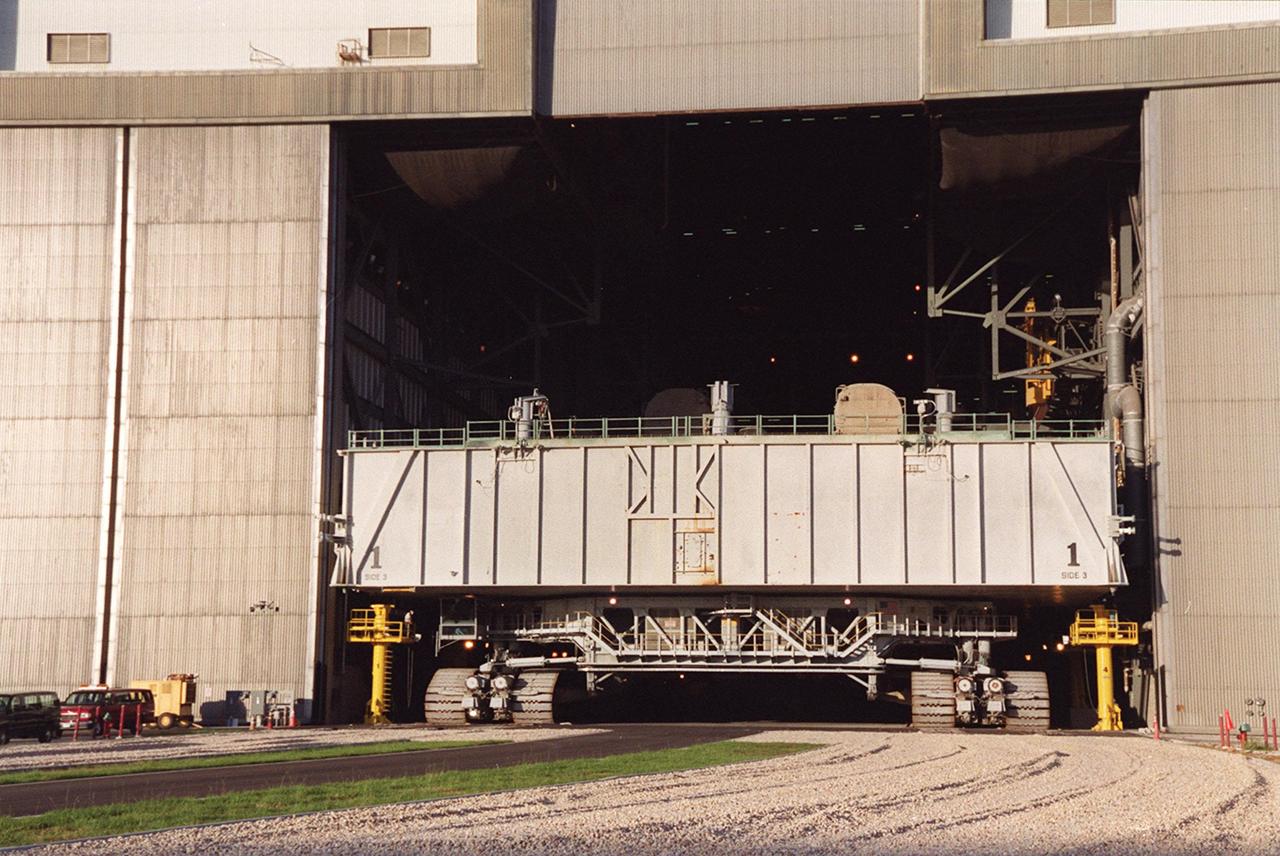
KENNEDY SPACE CENTER, FLA. -- A mobile launcher platform atop a crawler-transporter, moves into the Vehicle Assembly Building high bay 2. As part of the Safe Haven project, a once-buried portion of the crawlerway was restored to enable rollout of a Shuttle from this third stacking area. The primary goal of the Safe Haven construction project was to strengthen readiness for hurricane season by expanding the VAB’s storage capacity. The new area, in high bay 2, will allow NASA to preassemble stacks and still have room in the VAB to pull a Shuttle back from the pad if severe weather threatens. Potential rollouts of the Space Shuttle to the launch pad from high bay 2 will involve making a turn around the north side of the VAB in contrast to the straight rollouts from high bays 1 and 3, on the east side of the VAB facing the launch pads
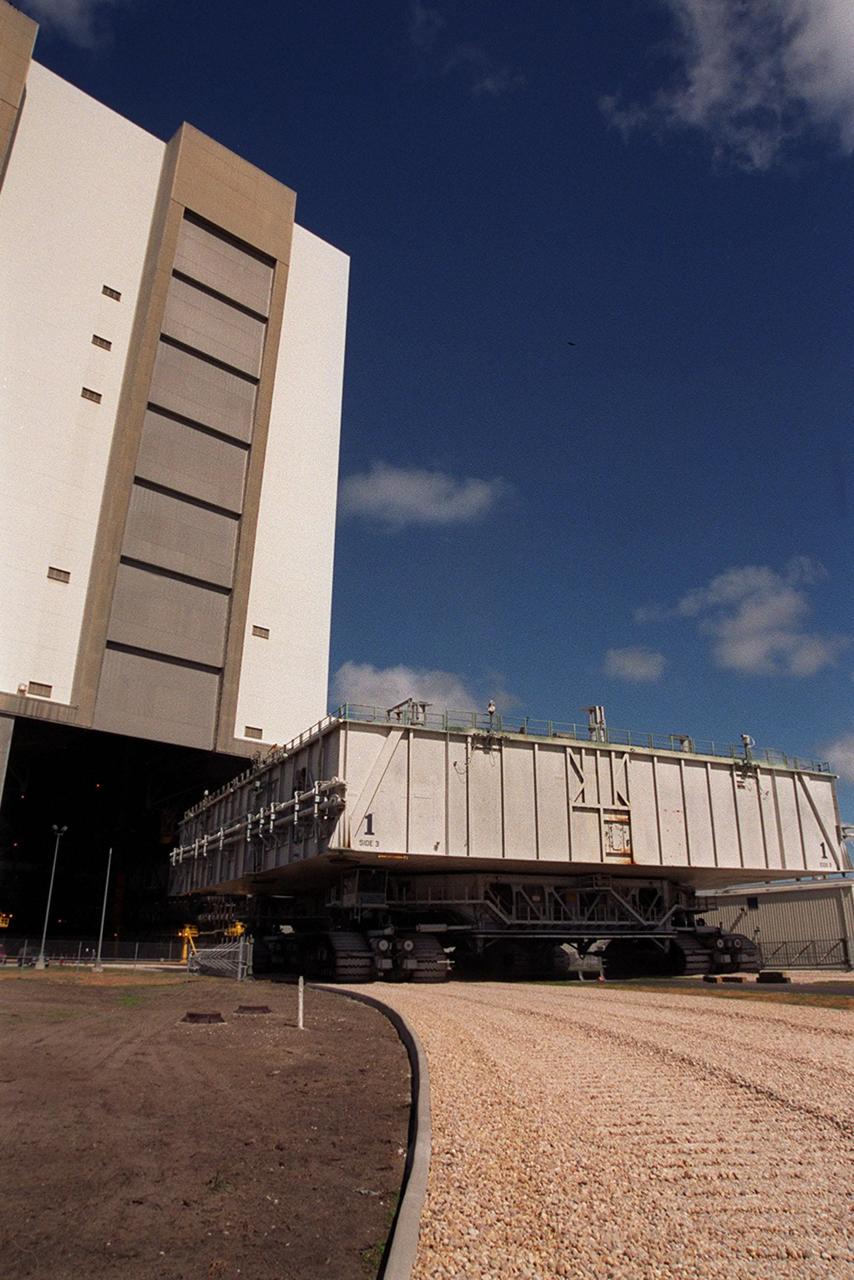
KENNEDY SPACE CENTER, FLA. -- A mobile launcher platform atop a crawler-transporter, heads to the open door of the Vehicle Assembly Building high bay 2. As part of the Safe Haven project, a once-buried portion of the crawlerway was restored to enable rollout of a Shuttle from this third stacking area. The primary goal of the Safe Haven construction project was to strengthen readiness for hurricane season by expanding the VAB’s storage capacity. The new area, in high bay 2, will allow NASA to preassemble stacks and still have room in the VAB to pull a Shuttle back from the pad if severe weather threatens. Potential rollouts of the Space Shuttle to the launch pad from high bay 2 will involve making a turn around the north side of the VAB in contrast to the straight rollouts from high bays 1 and 3, on the east side of the VAB facing the launch pads
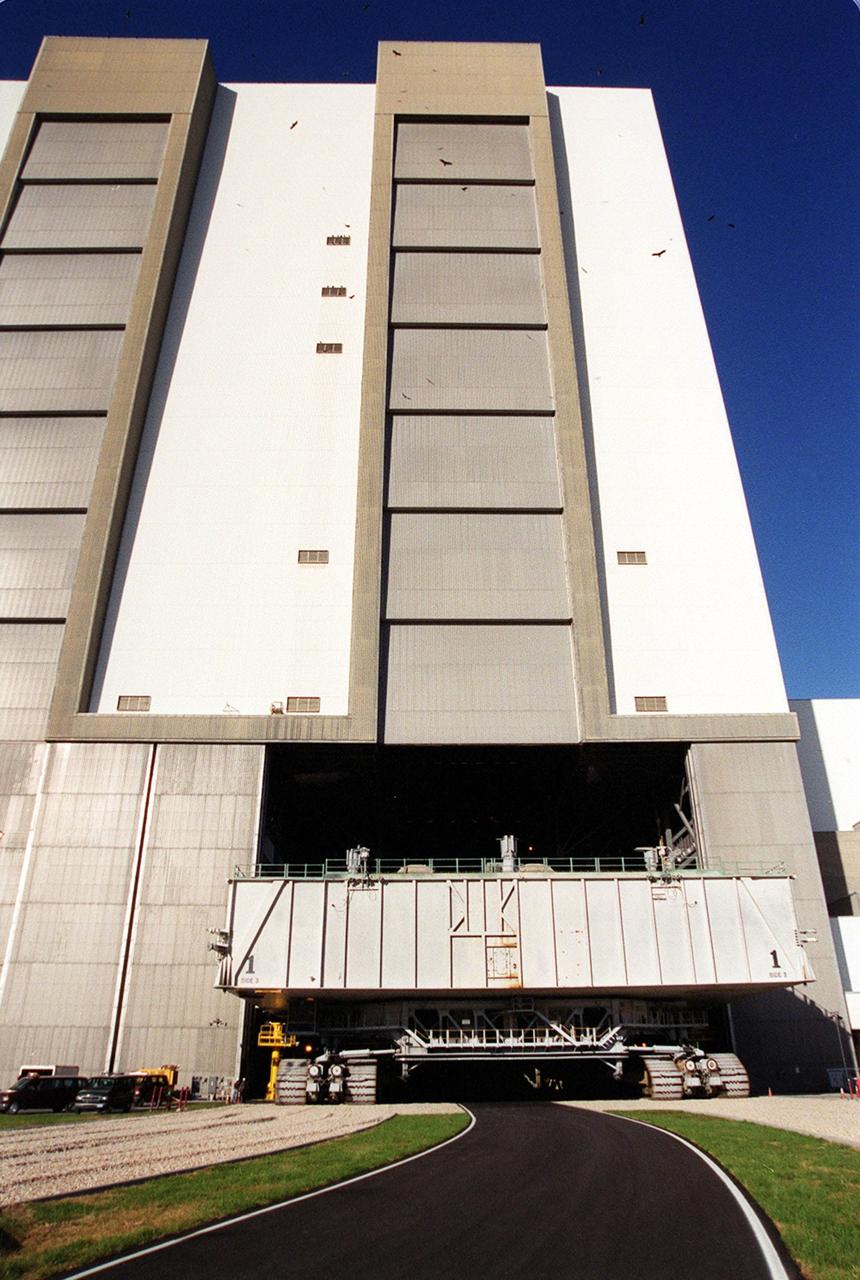
KENNEDY SPACE CENTER, FLA. -- A mobile launcher platform atop a crawler-transporter, heads through the open door of the Vehicle Assembly Building high bay 2. As part of the Safe Haven project, a once-buried portion of the crawlerway was restored to enable rollout of a Shuttle from this third stacking area. The primary goal of the Safe Haven construction project was to strengthen readiness for hurricane season by expanding the VAB’s storage capacity. The new area, in high bay 2, will allow NASA to preassemble stacks and still have room in the VAB to pull a Shuttle back from the pad if severe weather threatens. Potential rollouts of the Space Shuttle to the launch pad from high bay 2 will involve making a turn around the north side of the VAB in contrast to the straight rollouts from high bays 1 and 3, on the east side of the VAB facing the launch pads
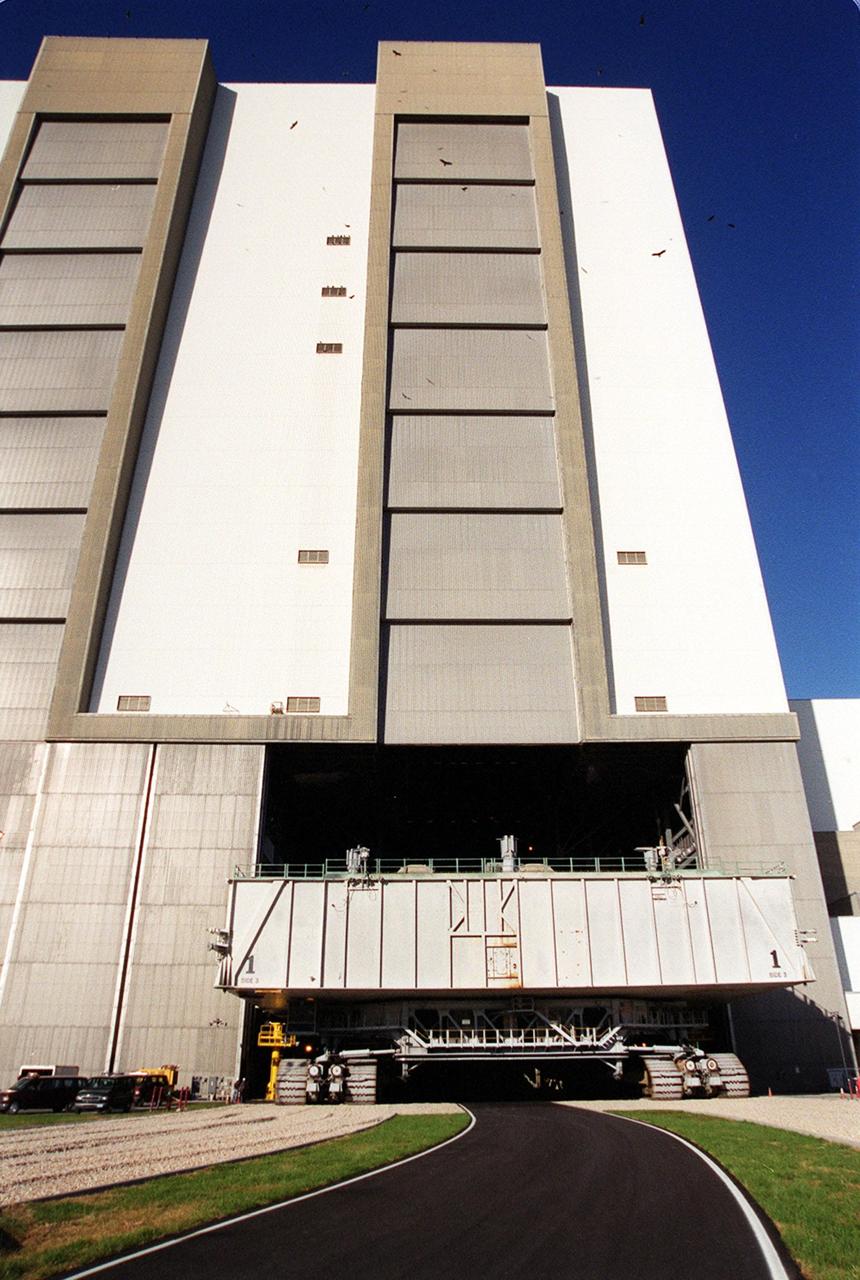
KENNEDY SPACE CENTER, FLA. -- A mobile launcher platform atop a crawler-transporter, heads through the open door of the Vehicle Assembly Building high bay 2. As part of the Safe Haven project, a once-buried portion of the crawlerway was restored to enable rollout of a Shuttle from this third stacking area. The primary goal of the Safe Haven construction project was to strengthen readiness for hurricane season by expanding the VAB’s storage capacity. The new area, in high bay 2, will allow NASA to preassemble stacks and still have room in the VAB to pull a Shuttle back from the pad if severe weather threatens. Potential rollouts of the Space Shuttle to the launch pad from high bay 2 will involve making a turn around the north side of the VAB in contrast to the straight rollouts from high bays 1 and 3, on the east side of the VAB facing the launch pads
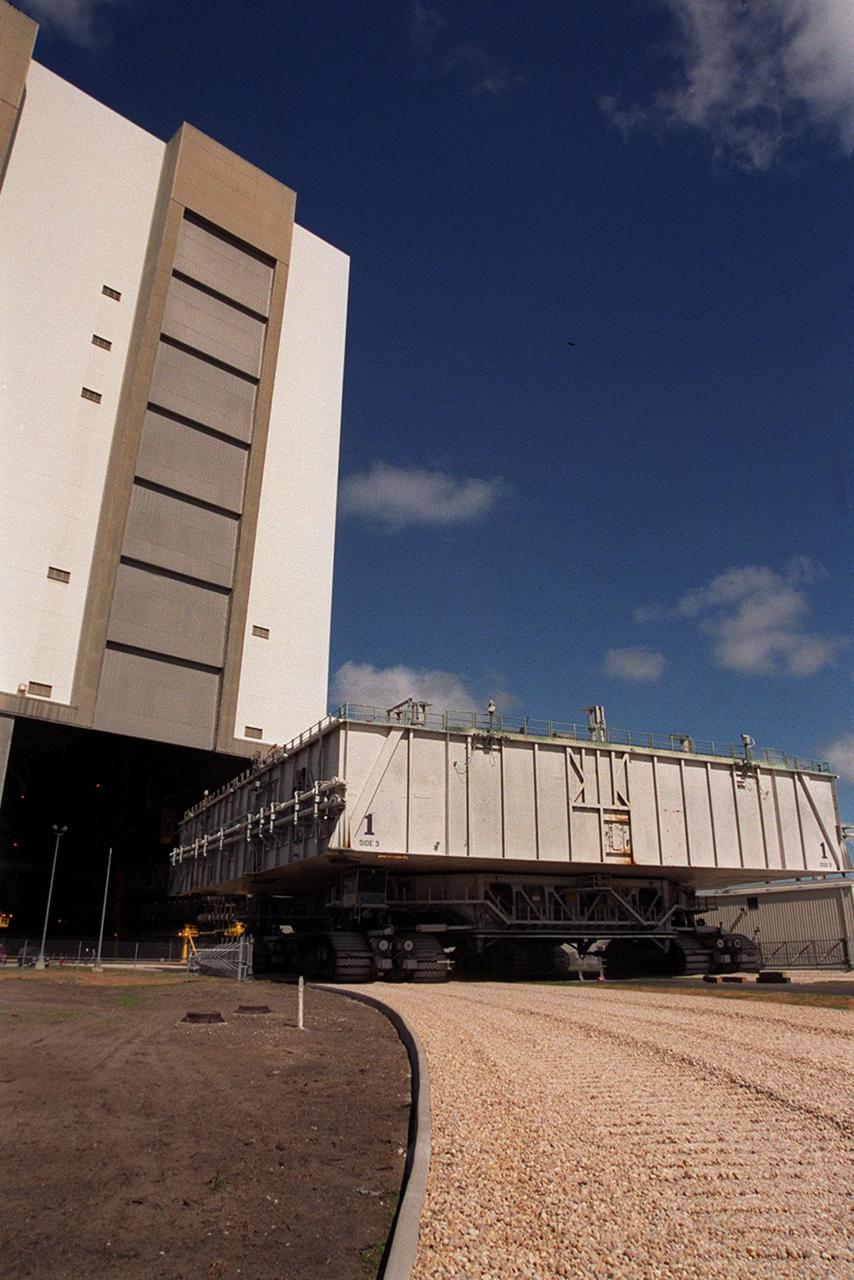
KENNEDY SPACE CENTER, FLA. -- A mobile launcher platform atop a crawler-transporter, heads to the open door of the Vehicle Assembly Building high bay 2. As part of the Safe Haven project, a once-buried portion of the crawlerway was restored to enable rollout of a Shuttle from this third stacking area. The primary goal of the Safe Haven construction project was to strengthen readiness for hurricane season by expanding the VAB’s storage capacity. The new area, in high bay 2, will allow NASA to preassemble stacks and still have room in the VAB to pull a Shuttle back from the pad if severe weather threatens. Potential rollouts of the Space Shuttle to the launch pad from high bay 2 will involve making a turn around the north side of the VAB in contrast to the straight rollouts from high bays 1 and 3, on the east side of the VAB facing the launch pads
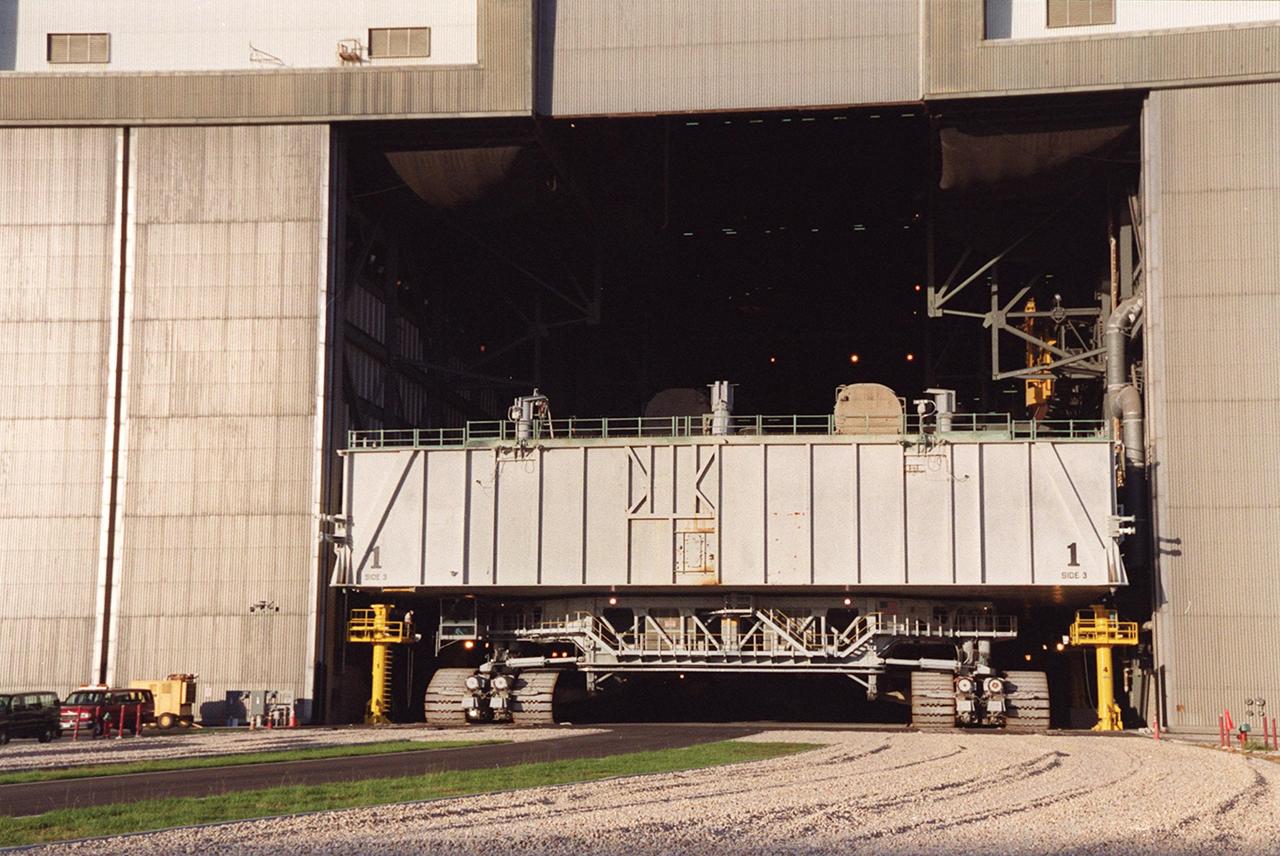
KENNEDY SPACE CENTER, FLA. -- A mobile launcher platform atop a crawler-transporter, moves into the Vehicle Assembly Building high bay 2. As part of the Safe Haven project, a once-buried portion of the crawlerway was restored to enable rollout of a Shuttle from this third stacking area. The primary goal of the Safe Haven construction project was to strengthen readiness for hurricane season by expanding the VAB’s storage capacity. The new area, in high bay 2, will allow NASA to preassemble stacks and still have room in the VAB to pull a Shuttle back from the pad if severe weather threatens. Potential rollouts of the Space Shuttle to the launch pad from high bay 2 will involve making a turn around the north side of the VAB in contrast to the straight rollouts from high bays 1 and 3, on the east side of the VAB facing the launch pads
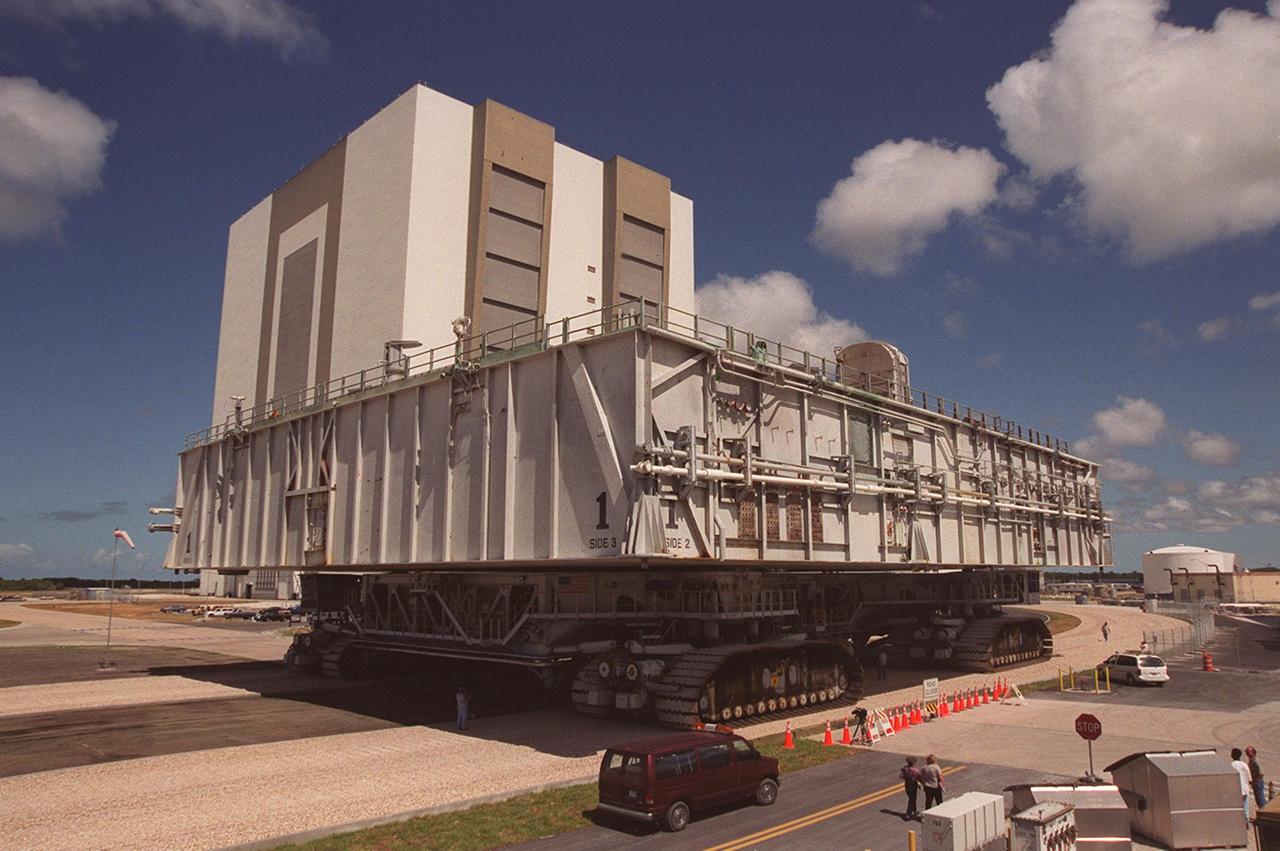
KENNEDY SPACE CENTER, FLA. -- A crawler-transporter with mobile launcher platform on top moves along a portion of the once-buried crawlerway toward the Vehicle Assembly Building (VAB). The road was restored as part of KSC’s Safe Haven project. High bay 2 provides a third stacking area. The primary goal of the Safe Haven construction project was to strengthen readiness for hurricane season by expanding the VAB’s storage capacity. The new area, in high bay 2, will allow NASA to preassemble stacks and still have room in the VAB to pull a Shuttle back from the pad if severe weather threatens. Potential rollouts of the Space Shuttle to the launch pad from high bay 2 will involve making a turn around the north side of the VAB in contrast to the straight rollouts from high bays 1 and 3, on the east side of the VAB facing the launch pads
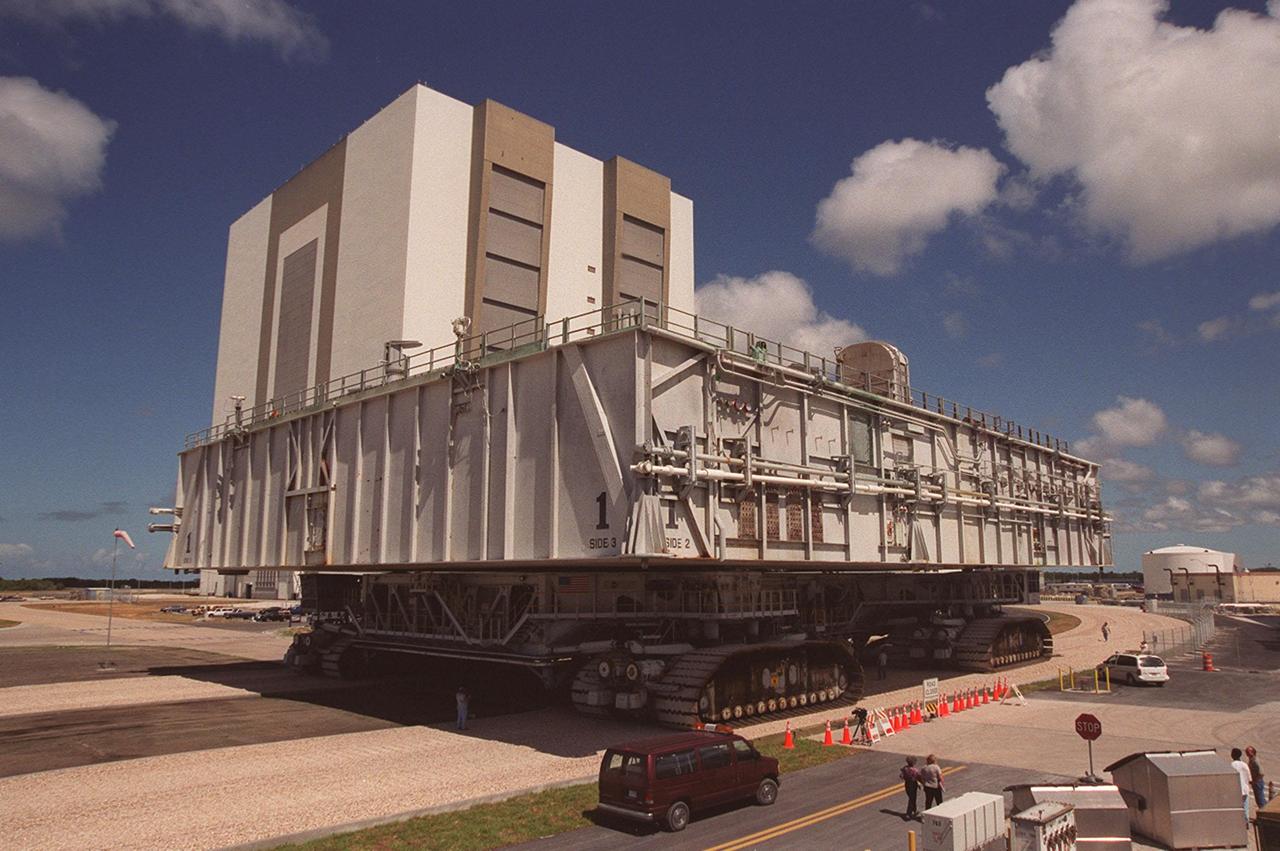
KENNEDY SPACE CENTER, FLA. -- A crawler-transporter with mobile launcher platform on top moves along a portion of the once-buried crawlerway toward the Vehicle Assembly Building (VAB). The road was restored as part of KSC’s Safe Haven project. High bay 2 provides a third stacking area. The primary goal of the Safe Haven construction project was to strengthen readiness for hurricane season by expanding the VAB’s storage capacity. The new area, in high bay 2, will allow NASA to preassemble stacks and still have room in the VAB to pull a Shuttle back from the pad if severe weather threatens. Potential rollouts of the Space Shuttle to the launch pad from high bay 2 will involve making a turn around the north side of the VAB in contrast to the straight rollouts from high bays 1 and 3, on the east side of the VAB facing the launch pads
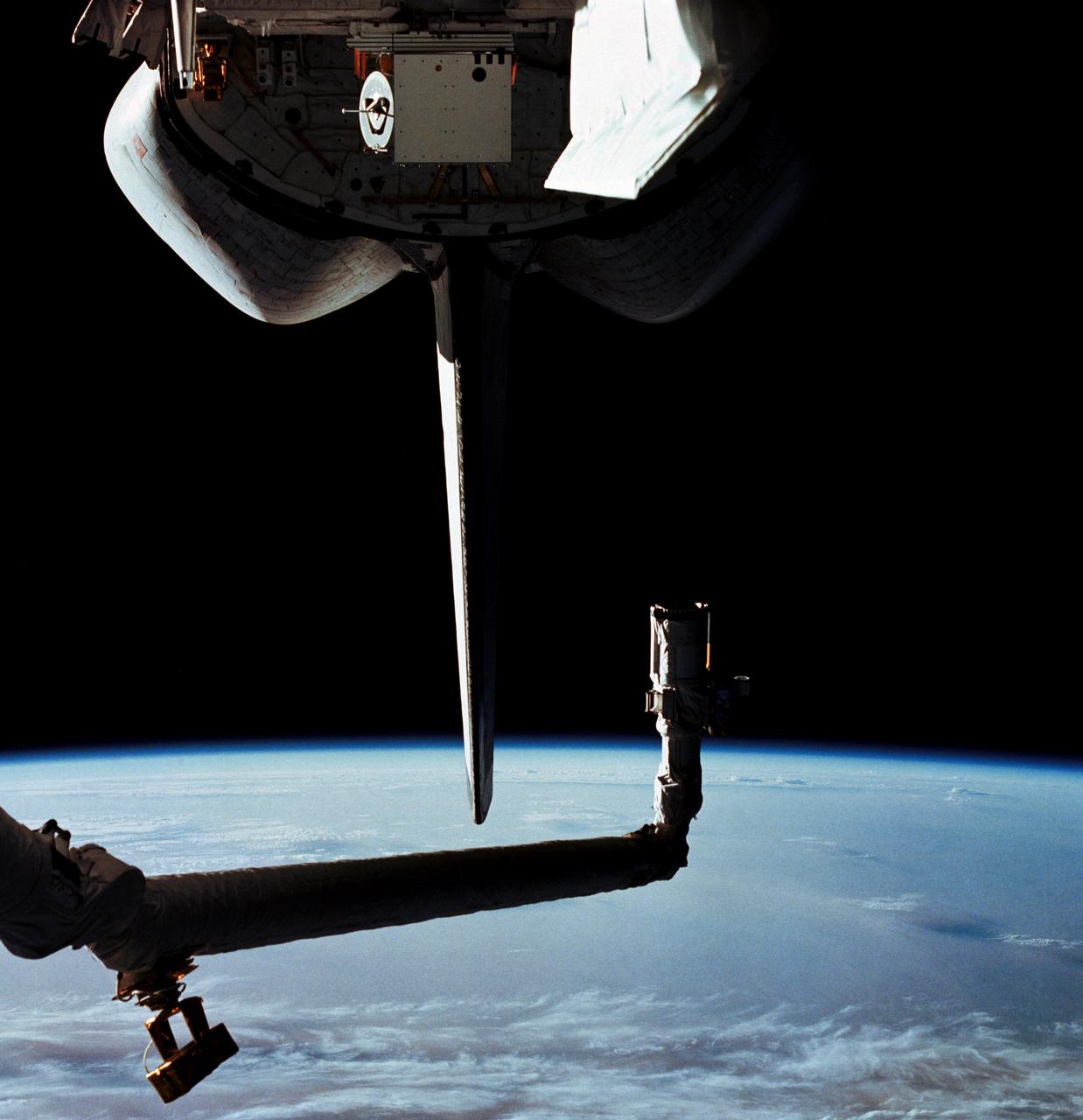
STS002-12-833 (13 Nov. 1981) --- Clouds over Earth and black sky form the background for this unique photograph from the space shuttle Columbia in Earth orbit. The photograph was shot through the aft flight deck windows viewing the cargo bay. Part of the scientific payload of the Office of Space and Terrestrial Applications (OSTA-1) is visible in the open cargo bay. The astronauts inside Columbia's cabin were remotely operating the Canadian-built remote manipulator system (RMS). Note television cameras on its elbow and wrist pieces. Photo credit: NASA
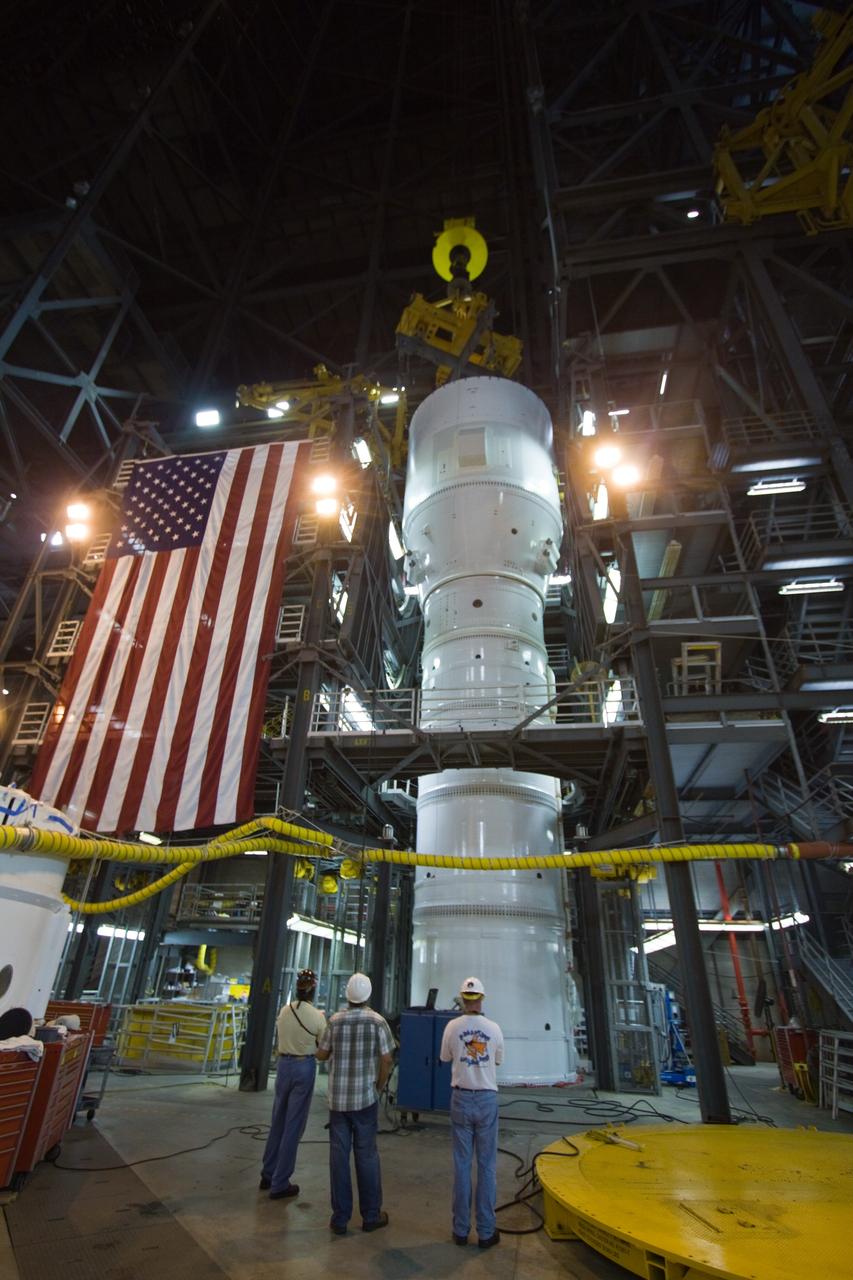
CAPE CANAVERAL, Fla. – In the Vehicle Assembly Building's High Bay 4, the Ares I-X "super stack 1" is to be lifted into High Bay 3 and attached to the forward motor segment. Super stack 1 comprises the frustum, forward skirt, forward skirt extension, interstages 1 and 2 and the fifth segment simulator. Ares I-X is the test vehicle for the Ares I, which is part of the Constellation Program to return men to the moon and beyond. The Ares I-X flight test is targeted for Oct. 31, pending forma NASA Headquarters approval. Photo credit: NASA/Jack Pfaller
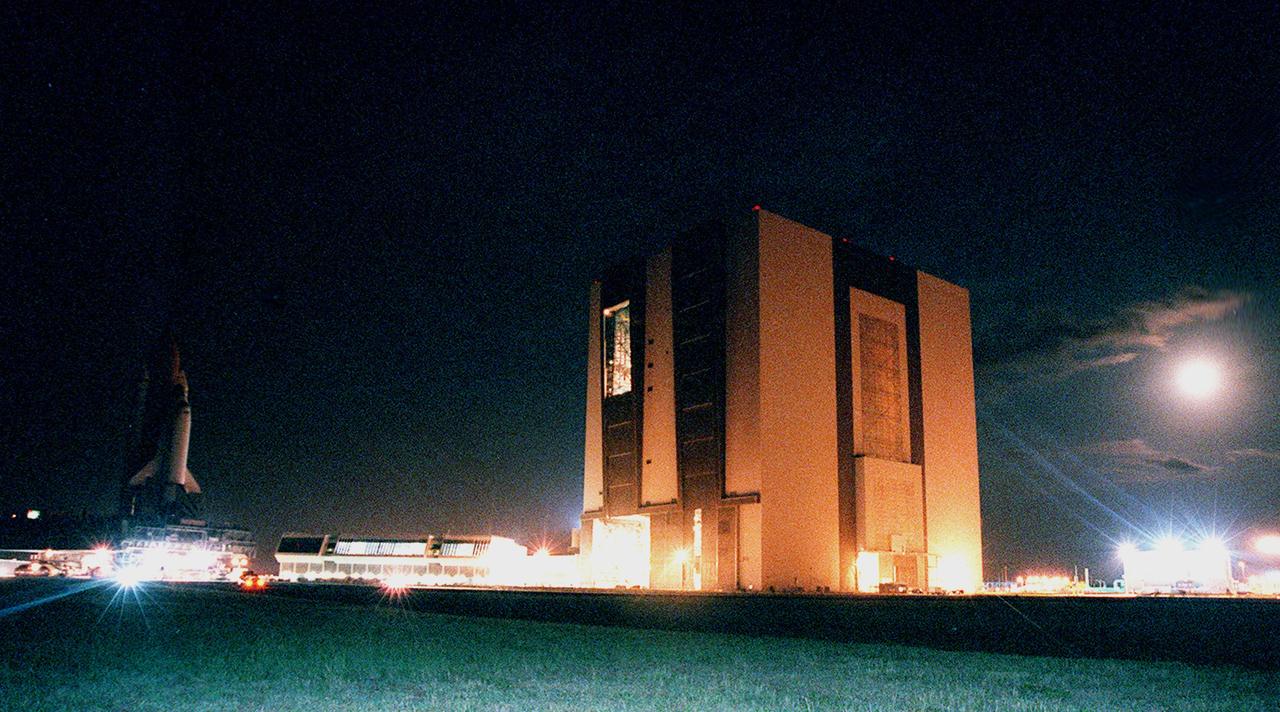
KENNEDY SPACE CENTER, FLA. -- This 30-second timed exposure captures the bright lights around the Vehicle Assembly Building (VAB) plus the equally bright moon (upper right) as Space Shuttle Atlantis (far left) rolls out of the east side bay 1. The Launch Control Center sits between the Shuttle and the VAB. The full stack of Shuttle, solid rocket boosters and external tank are taking part in a fit check for the newly renovated crawlerway and high bay 2, which is on the west side. The major modifications to the crawlerway and VAB provide Shuttle flight hardware more storage space and protection - "Safe Haven" - from hurricanes or tropical storms. Atlantis began moving out of VAB high bay 1 at 2:59 a.m. EDT. After the successful Safe Haven fit check, Shuttle Atlantis is scheduled to roll out to Launch Pad 39B in preparation for the STS-106 launch on Sept. 8.
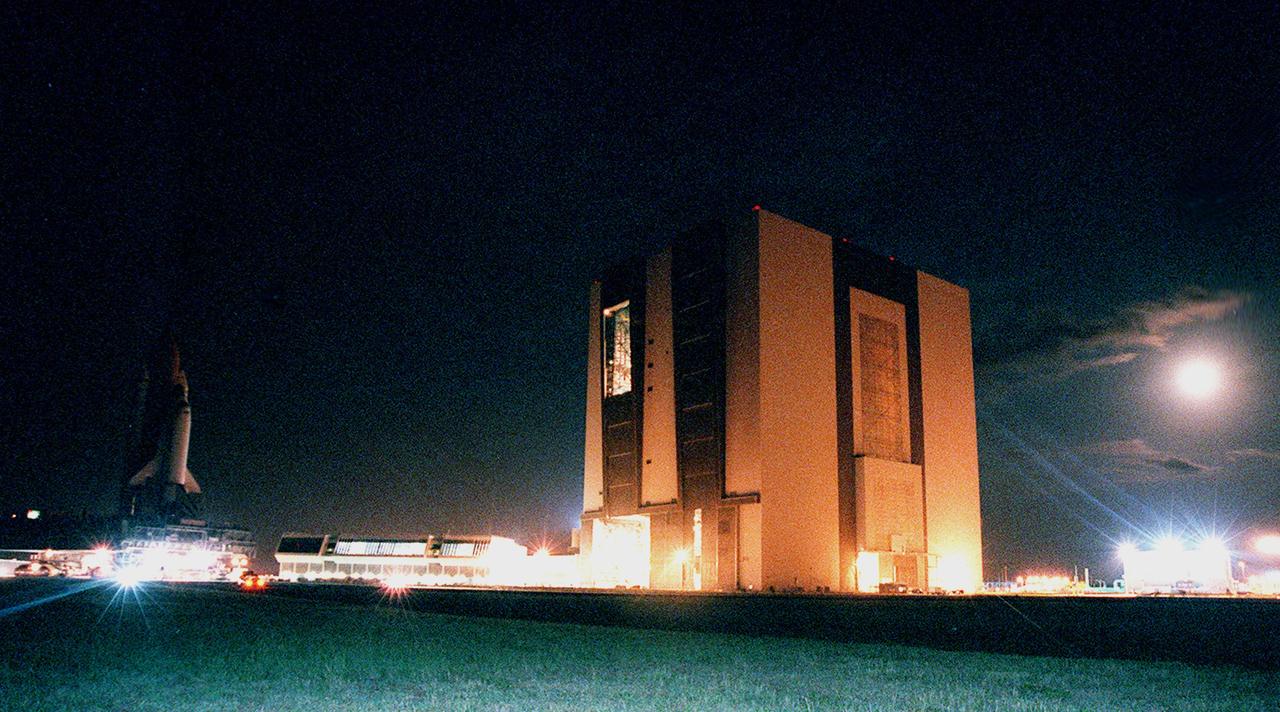
KENNEDY SPACE CENTER, FLA. -- This 30-second timed exposure captures the bright lights around the Vehicle Assembly Building (VAB) plus the equally bright moon (upper right) as Space Shuttle Atlantis (far left) rolls out of the east side bay 1. The Launch Control Center sits between the Shuttle and the VAB. The full stack of Shuttle, solid rocket boosters and external tank are taking part in a fit check for the newly renovated crawlerway and high bay 2, which is on the west side. The major modifications to the crawlerway and VAB provide Shuttle flight hardware more storage space and protection - "Safe Haven" - from hurricanes or tropical storms. Atlantis began moving out of VAB high bay 1 at 2:59 a.m. EDT. After the successful Safe Haven fit check, Shuttle Atlantis is scheduled to roll out to Launch Pad 39B in preparation for the STS-106 launch on Sept. 8.
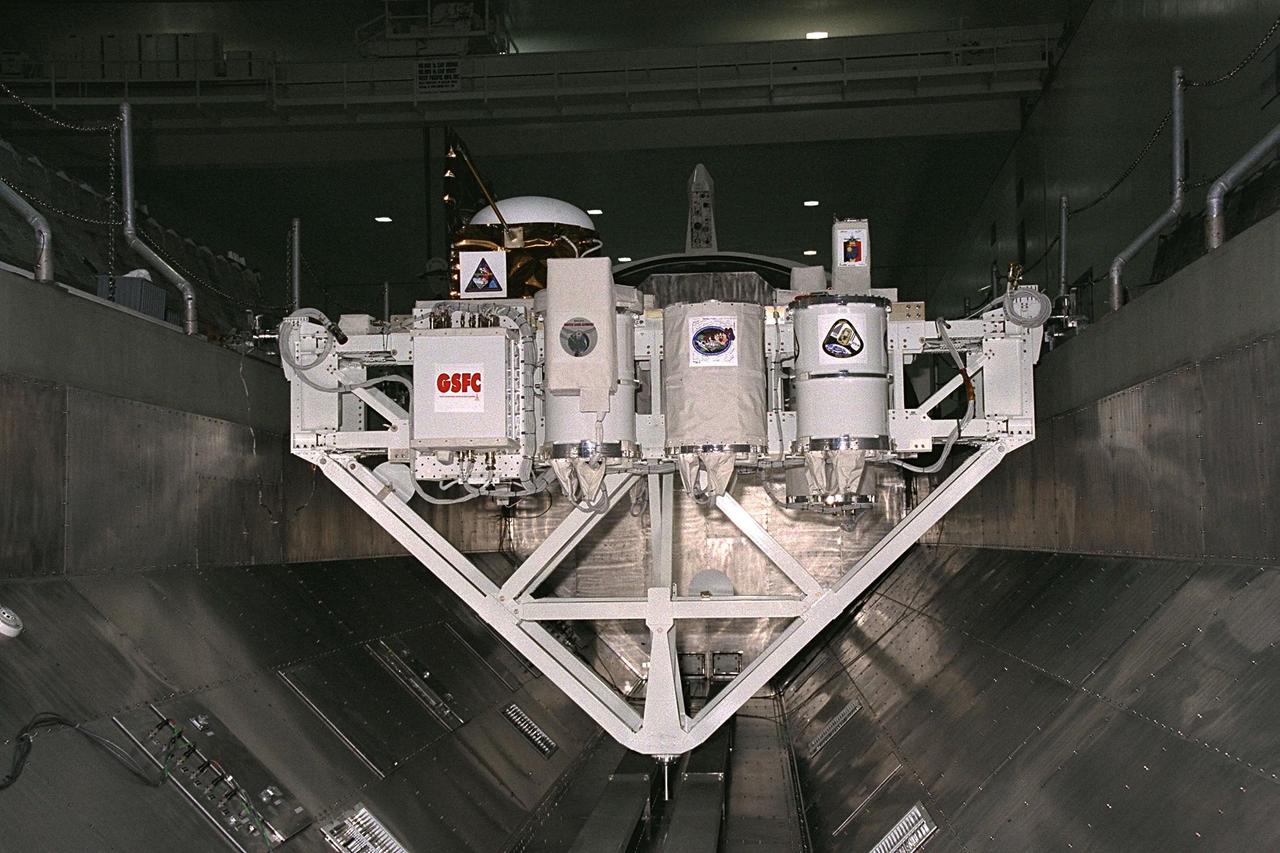
The Technology Applications and Science-1 (TAS-1) payload for the STS-85 mission rests in a payload canister in the Space Station Processing Facility prior to its trip out to Launch Pad 39A for installation into the payload bay of the Space Shuttle Orbiter Discovery. The TAS-1 holds seven separate experiments that will provide data on the Earth’s topography and atmosphere, study the sun’s energy, and test new thermal control devices, as well as several student-developed experiments. Other STS-85 payloads include the Cryogenic Infrared Spectrometers and Telescopes for the Atmosphere-Shuttle Pallet Satellite-2 (CRISTA-SPAS-2). The CRISTA is a system of three telescopes and four spectrometers to measure infrared radiation emitted by the Earth’s middle atmosphere. During the 11-day mission, the CRISTA-SPAS-2 free-flying satellite will be deployed from Discovery and retrieved later in the flight. Also onboard the satellite will be the Middle Atmosphere High Resolution Spectrograph Investigation (MAHRSI) to measure ultraviolet radiation emitted and scattered by the Earth’s atmosphere. The International Extreme Ultraviolet Hitchhiker-2 (IEH-2) will also be in the payload bay. The IEH-2 experiments will study ultraviolet radiation from stars, the sun and in the solar system
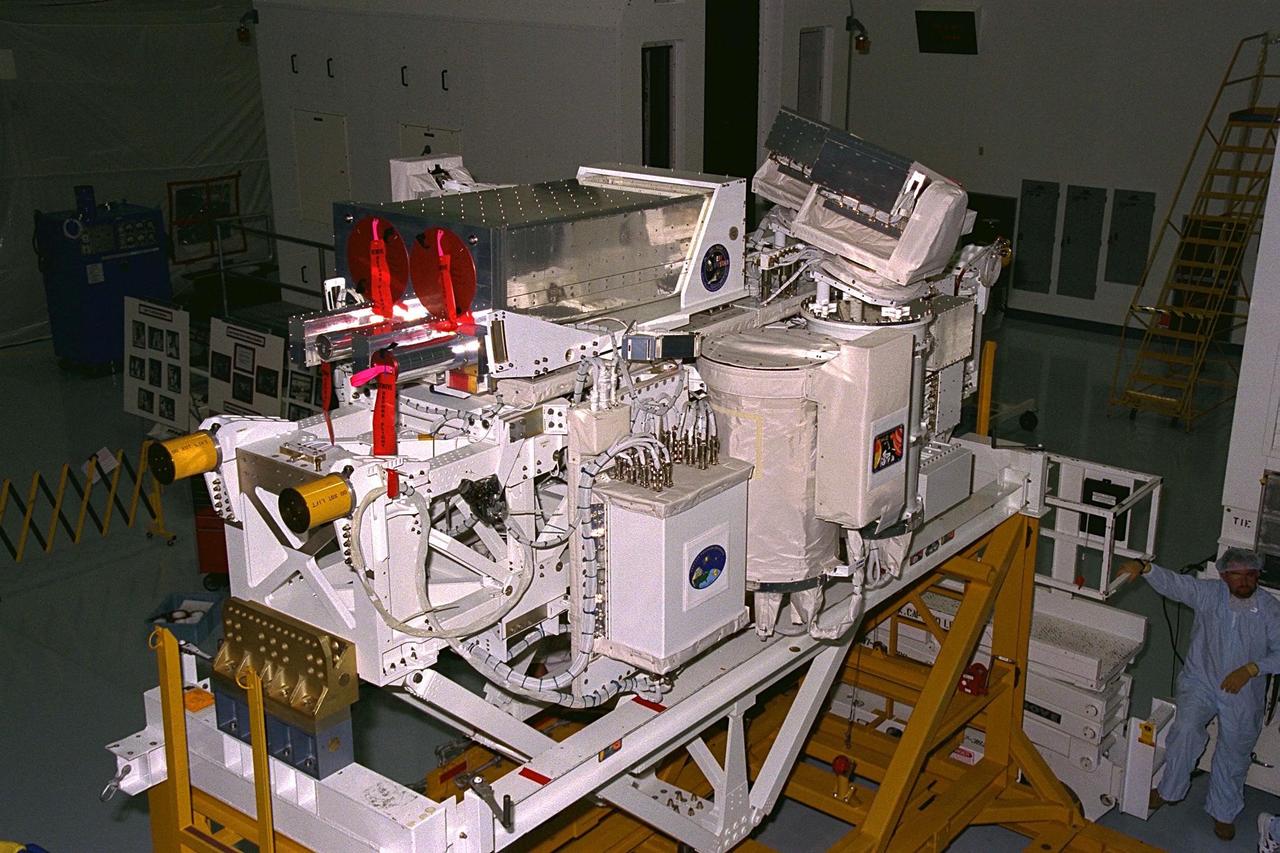
The International Extreme Ultraviolet Hitchhiker-2 (IEH-2) payload rests in a work stand in the Space Station Processing Facility prior to its trip out to Launch Pad 39A for installation into the payload bay of the Space Shuttle Orbiter Discovery for the STS-85 mission. The IEH-2 experiments will study ultraviolet radiation from stars, the sun and in the solar system. The Technology Applications and Science-1 (TAS-1) payload is another series of experiments that will be conducted during the 11-day mission in Discovery’s payload bay. The TAS-1 holds seven separate experiments that will provide data on the Earth’s topography and atmosphere, study the sun’s energy, and test new thermal control devices, as well as several student-developed experiments. Other STS-85 payloads include the Cryogenic Infrared Spectrometers and Telescopes for the Atmosphere-Shuttle Pallet Satellite-2 (CRISTA-SPAS-2). The CRISTA is a system of three telescopes and four spectrometers to measure infrared radiation emitted by the Earth’s middle atmosphere. The CRISTA-SPAS-2 free-flying satellite will be deployed from Discovery and retrieved later in the flight. Also onboard the satellite will be the Middle Atmosphere High Resolution Spectrograph Investigation (MAHRSI) to measure ultraviolet radiation emitted and scattered by the Earth’s atmosphere
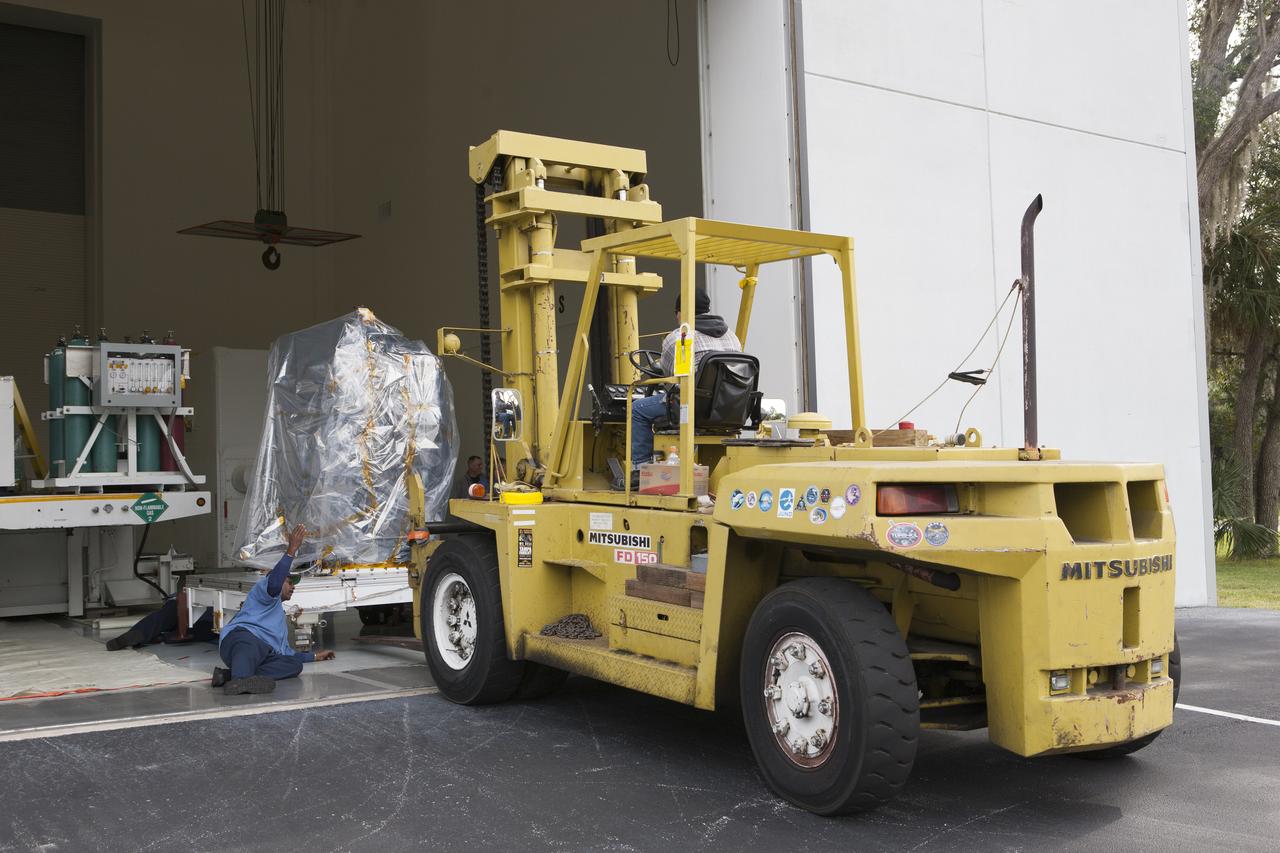
A forklift is enlisted to move NOAA’s Deep Space Climate Observatory spacecraft, or DSCOVR, wrapped in plastic and secured onto a portable work stand, from the airlock of Building 2 to the high bay of Building 1 at the Astrotech payload processing facility.
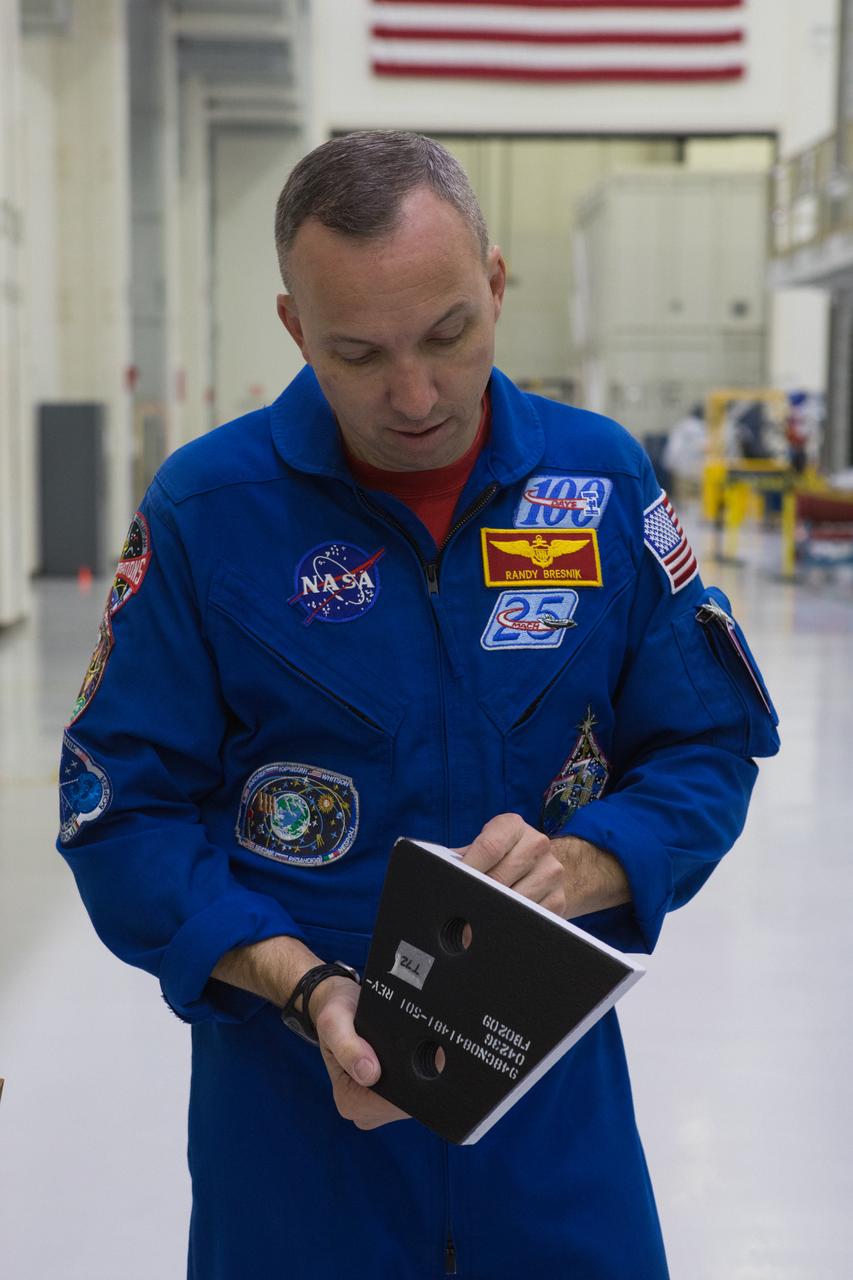
NASA astronaut Randy Bresnik examines a heat-resistant tile sample inside the Operations and Checkout Building high bay at NASA’s Kennedy Space Center in Florida during a tour on Feb. 12, 2019. Bresnik also viewed additional spaceflight hardware being processed for Exploration Mission-1 and Exploration Mission-2.
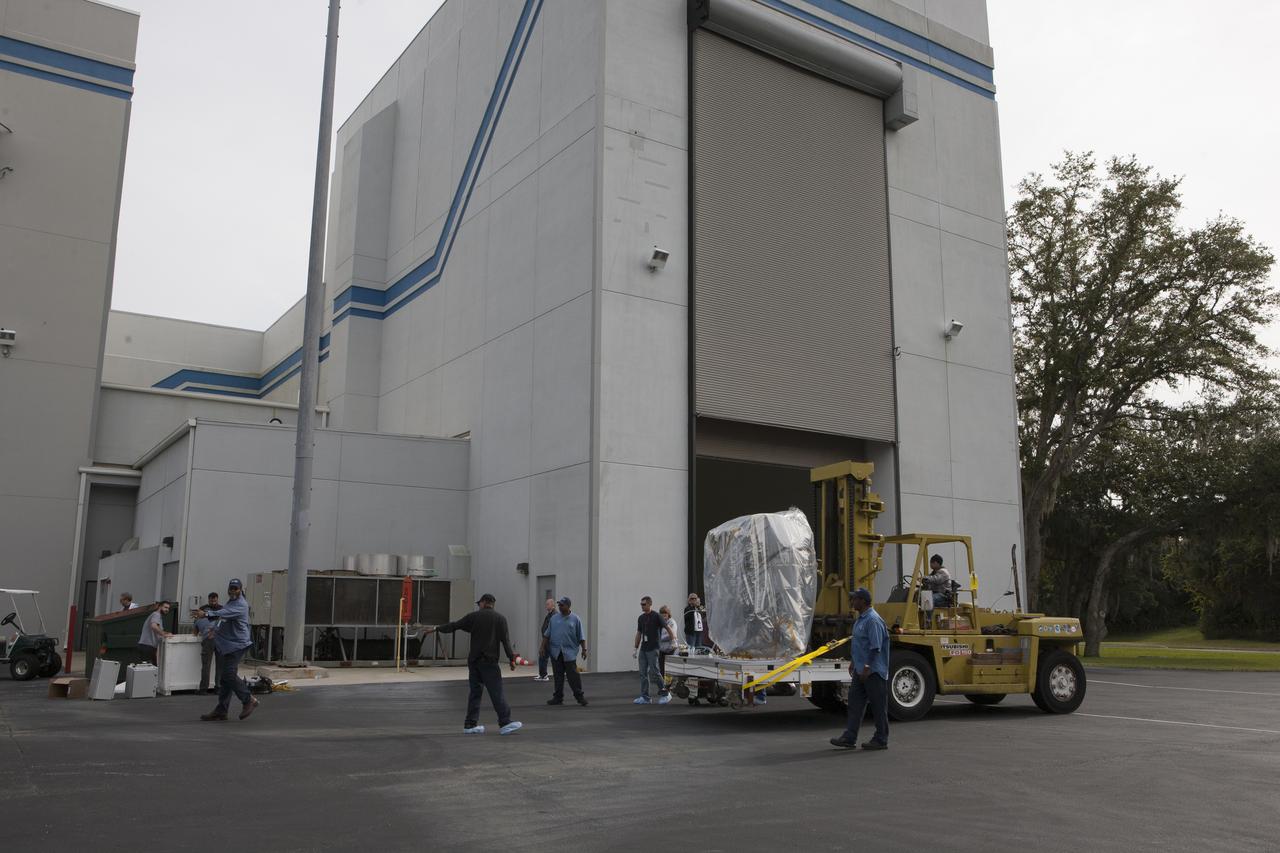
NOAA’s Deep Space Climate Observatory spacecraft, or DSCOVR, wrapped in plastic and secured onto a portable work stand, makes a short trek from the airlock of Building 2 to the high bay of Building 1 at the Astrotech payload processing facility.

Astronaut candidate Kayla Barron examines a heat-resistant tile sample inside the Operations and Checkout Building high bay at NASA’s Kennedy Space Center in Florida during a tour on Feb. 12, 2019. Barron also viewed additional spaceflight hardware being processed for Exploration Mission-1 and Exploration Mission-2.
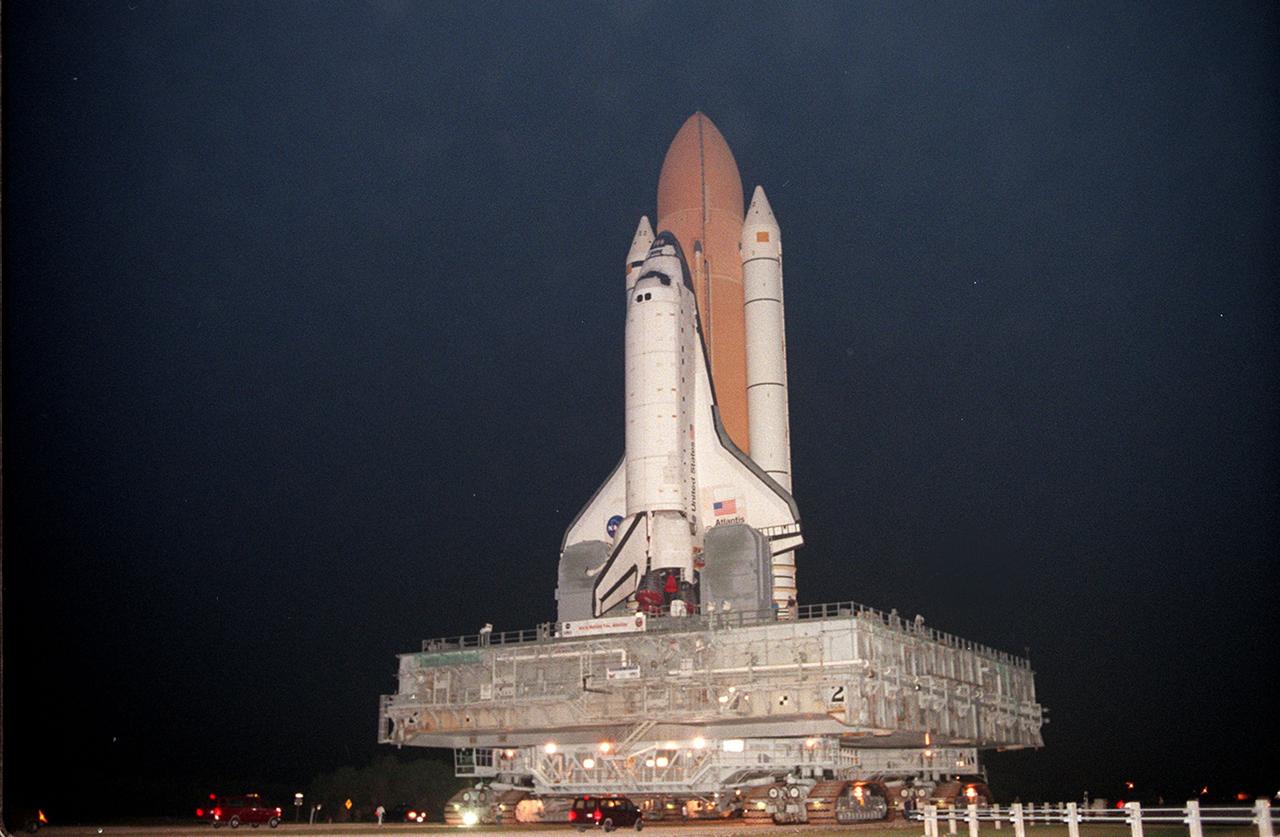
KENNEDY SPACE CENTER, FLA. -- Shuttle Atlantis, with twin solid rocket boosters and external tank atop the Mobile Launcher Platform and crawler-transorter, moves in the predawn hours into high bay 2 in the Vehicle Assembly Building (VAB). For the first time in Space Shuttle history, a fully stacked Shuttle is rolling around the north side of the VAB into high bay 2 on the building's west side. The VAB and nearby rock-paved crawlerway have recently undergone major modifications to provide Shuttle fliglht hardware more storage space and protection - "Safe Haven" - from hurricanes or tropical storms. Atlantis, the twin solid rocket boosters and external tank begain moving out of VAB high bay 1 on the east side at 2:59 a.m. EDT. After the successful "Safe Haven" fit check, Shuttle Atlantis is scheduled to roll out to Launch Pad 39B in preparation for the STS-106 launch on Sept. 8.
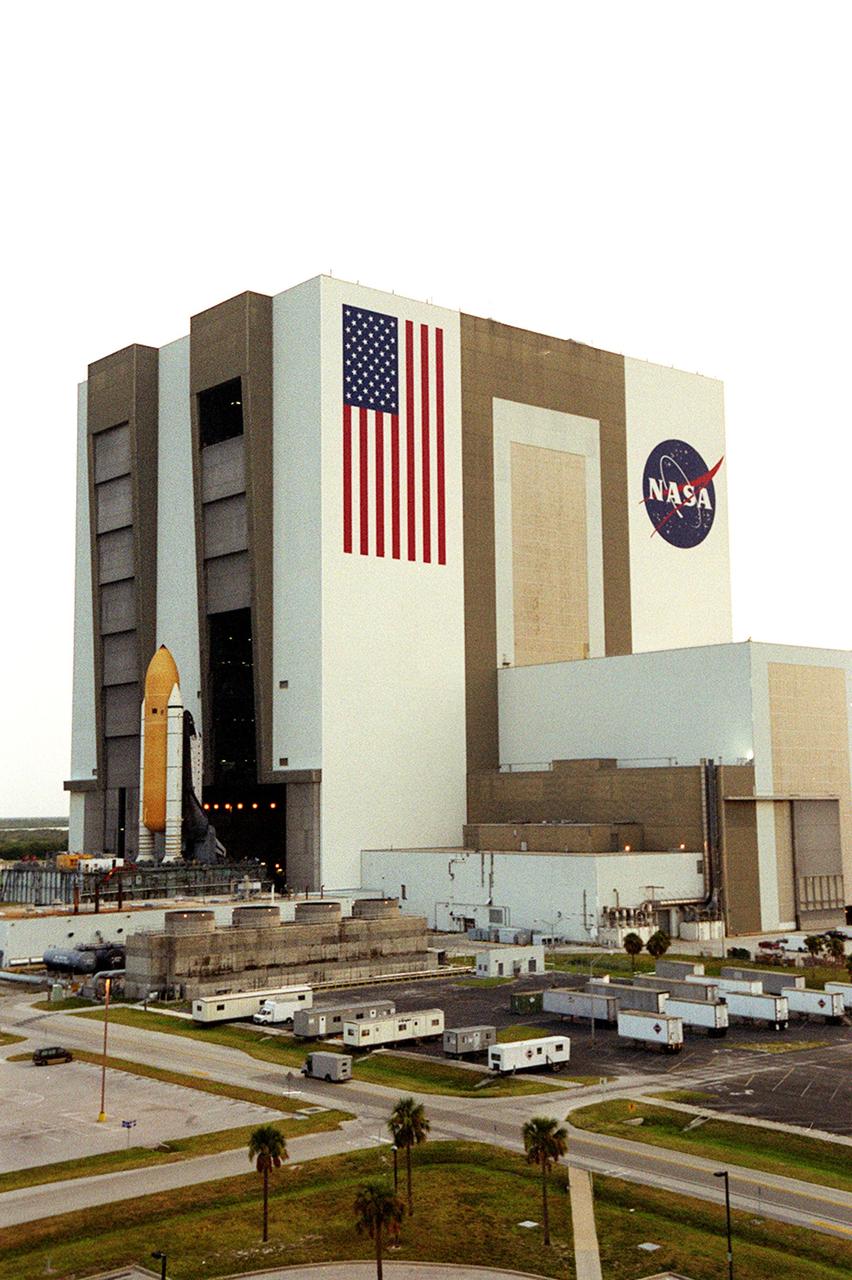
KENNEDY SPACE CENTER, FLA. -- For the first time in Space Shuttle history, a fully stacked Shuttle - Atlantis - is rolling into the Vehicle Assembly Building's (VAB) high bay 2 on the building's west side. The VAB and nearby rock-paved crawlerway have recently undergone major modifications to provide Shuttle fliglht hardware more storage space and protection - "Safe Haven" - from hurricanes or tropical storms. Atlantis, the twin solid rocket boosters and external tank begain moving out of VAB high bay 1 on the east side at 2:59 a.m. EDT. The 6-million pound crawler transporter carried the Mobile Launcher Platform and Space Shuttle around the north side of the VAB and into high bay 2. After the successful "Safe Haven" fit check, Shuttle Atlantis is scheduled to roll out to Launch Pad 39B in preparation for the STS-106 launch on Sept. 8.
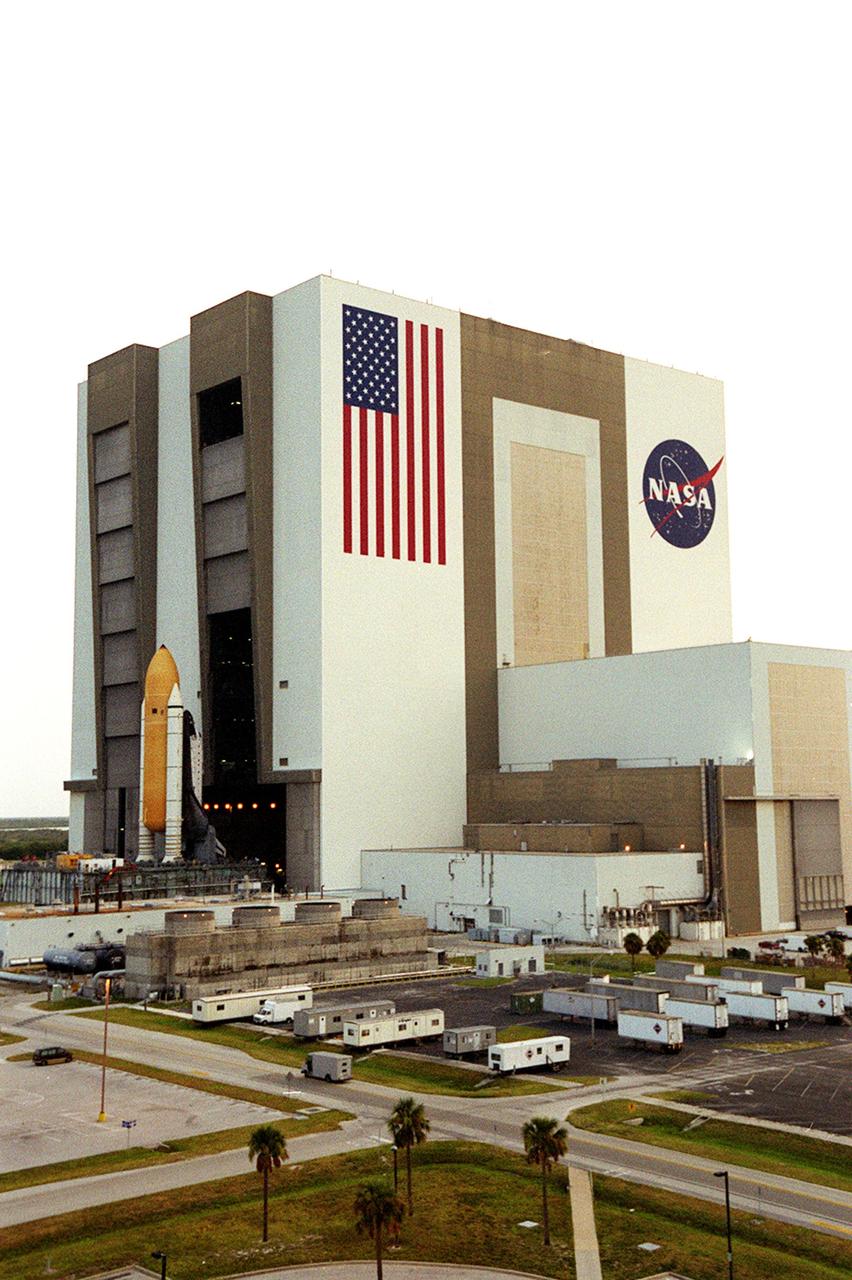
KENNEDY SPACE CENTER, FLA. -- For the first time in Space Shuttle history, a fully stacked Shuttle - Atlantis - is rolling into the Vehicle Assembly Building's (VAB) high bay 2 on the building's west side. The VAB and nearby rock-paved crawlerway have recently undergone major modifications to provide Shuttle fliglht hardware more storage space and protection - "Safe Haven" - from hurricanes or tropical storms. Atlantis, the twin solid rocket boosters and external tank begain moving out of VAB high bay 1 on the east side at 2:59 a.m. EDT. The 6-million pound crawler transporter carried the Mobile Launcher Platform and Space Shuttle around the north side of the VAB and into high bay 2. After the successful "Safe Haven" fit check, Shuttle Atlantis is scheduled to roll out to Launch Pad 39B in preparation for the STS-106 launch on Sept. 8.
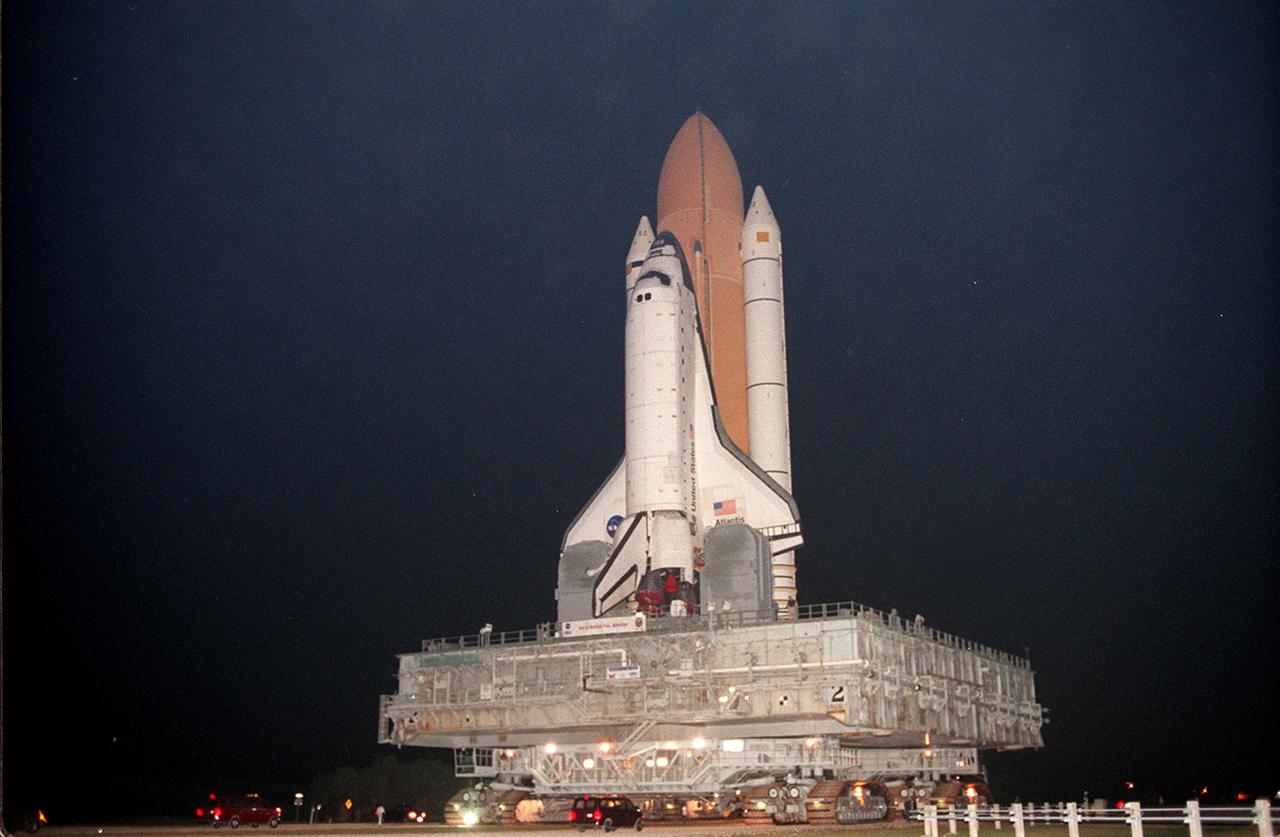
KENNEDY SPACE CENTER, FLA. -- Shuttle Atlantis, with twin solid rocket boosters and external tank atop the Mobile Launcher Platform and crawler-transorter, moves in the predawn hours into high bay 2 in the Vehicle Assembly Building (VAB). For the first time in Space Shuttle history, a fully stacked Shuttle is rolling around the north side of the VAB into high bay 2 on the building's west side. The VAB and nearby rock-paved crawlerway have recently undergone major modifications to provide Shuttle fliglht hardware more storage space and protection - "Safe Haven" - from hurricanes or tropical storms. Atlantis, the twin solid rocket boosters and external tank begain moving out of VAB high bay 1 on the east side at 2:59 a.m. EDT. After the successful "Safe Haven" fit check, Shuttle Atlantis is scheduled to roll out to Launch Pad 39B in preparation for the STS-106 launch on Sept. 8.
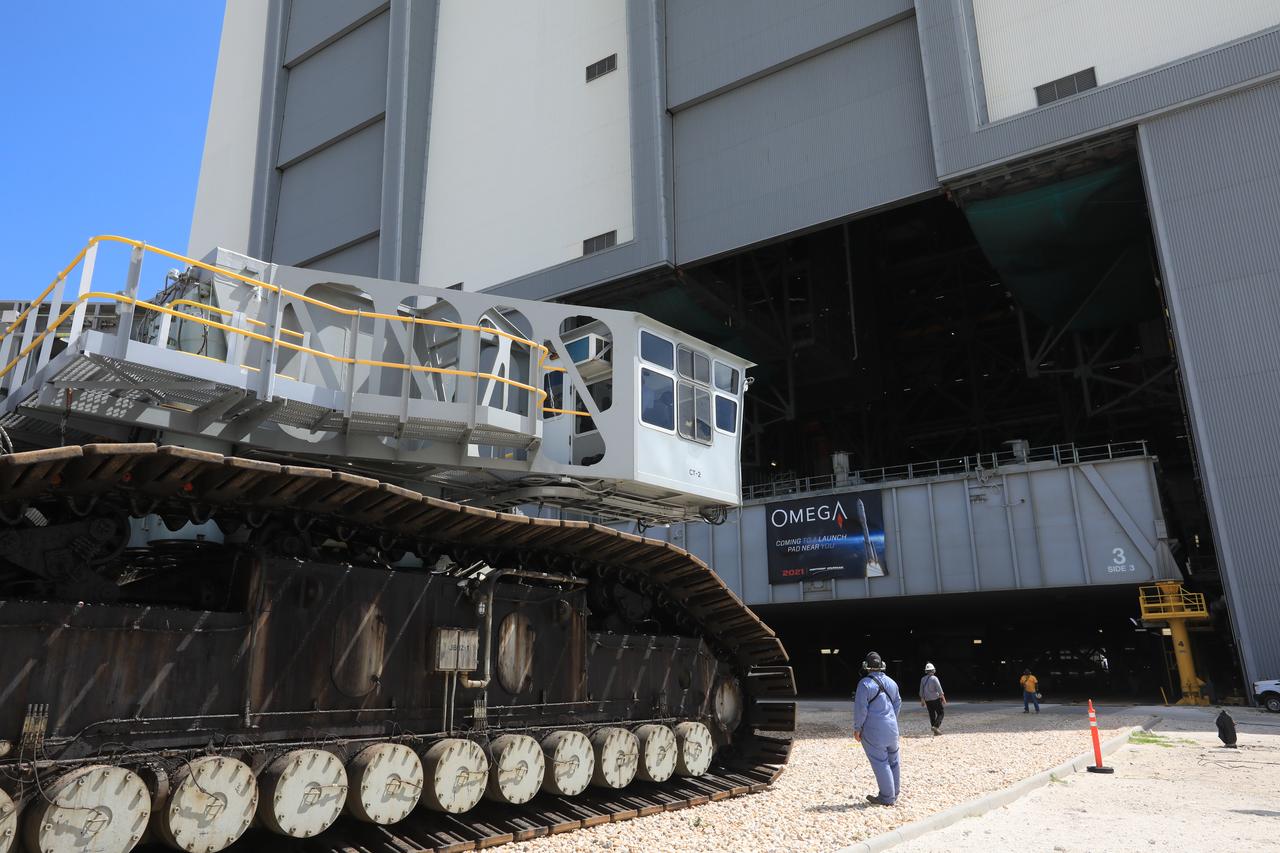
During a practice run, crawler-transporter 2 (CT-2) is being driven to the Vehicle Assembly Building (VAB) at NASA’s Kennedy Space Center in Florida on May 1, 2019. CT-2 entered High Bay 2, and picked up the space shuttle-era mobile launch platform-3 (MLP-3). The VAB is getting its first commercial tenant. Northrop Grumman signed a Reimbursable Space Act Agreement with NASA for use of the facilities. The company will assemble and test its new OmegA rocket inside the massive facility’s High Bay 2. The company also will modify MLP-3 to serve as the launch vehicle’s assembly and launch platform. Northrop Grumman is developing the OmegA rocket, an intermediate/heavy-class launch vehicle, as part of a launch services agreement with the U.S. Air Force.

During a practice run, crawler-transporter 2 (CT-2) is being driven to the Vehicle Assembly Building (VAB) at NASA’s Kennedy Space Center in Florida on May 1, 2019. CT-2 entered High Bay 2, and picked up the space shuttle-era mobile launch platform-3 (MLP-3). The VAB is getting its first commercial tenant. Northrop Grumman signed a Reimbursable Space Act Agreement with NASA for use of the facilities. The company will assemble and test its new OmegA rocket inside the massive facility’s High Bay 2. The company also will modify MLP-3 to serve as the launch vehicle’s assembly and launch platform. Northrop Grumman is developing the OmegA rocket, an intermediate/heavy-class launch vehicle, as part of a launch services agreement with the U.S. Air Force.
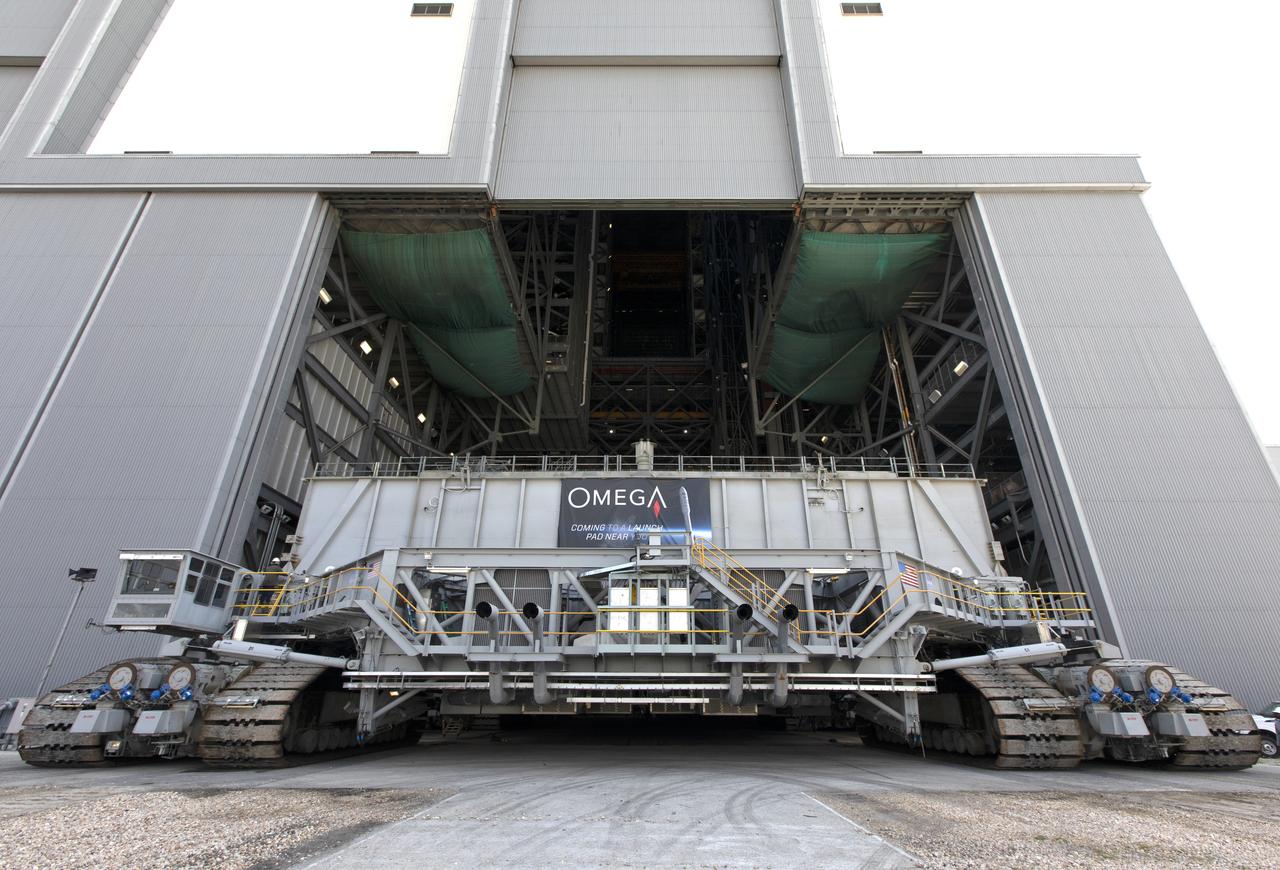
During a practice run, crawler-transporter 2 (CT-2) is moving inside High Bay 2 of the Vehicle Assembly Building (VAB) at NASA’s Kennedy Space Center in Florida on May 1, 2019. CT-2 picked up the space shuttle-era mobile launch platform-3 (MLP-3). The VAB is getting its first commercial tenant. Northrop Grumman signed a Reimbursable Space Act Agreement with NASA for use of the facilities. The company will assemble and test its new OmegA rocket inside the massive facility’s High Bay 2. The company also will modify MLP-3 to serve as the launch vehicle’s assembly and launch platform. Northrop Grumman is developing the OmegA rocket, an intermediate/heavy-class launch vehicle, as part of a launch services agreement with the U.S. Air Force.

During a practice run, crawler-transporter 2 (CT-2) is moving inside High Bay 2 of the Vehicle Assembly Building (VAB) at NASA’s Kennedy Space Center in Florida on May 1, 2019. In view at right is one of the cabs used to drive the crawler. CT-2 picked up the space shuttle-era mobile launch platform-3 (MLP-3). The VAB is getting its first commercial tenant. Northrop Grumman signed a Reimbursable Space Act Agreement with NASA for use of the facilities. The company will assemble and test its new OmegA rocket inside the massive facility’s High Bay 2. The company also will modify MLP-3 to serve as the launch vehicle’s assembly and launch platform. Northrop Grumman is developing the OmegA rocket, an intermediate/heavy-class launch vehicle, as part of a launch services agreement with the U.S. Air Force.
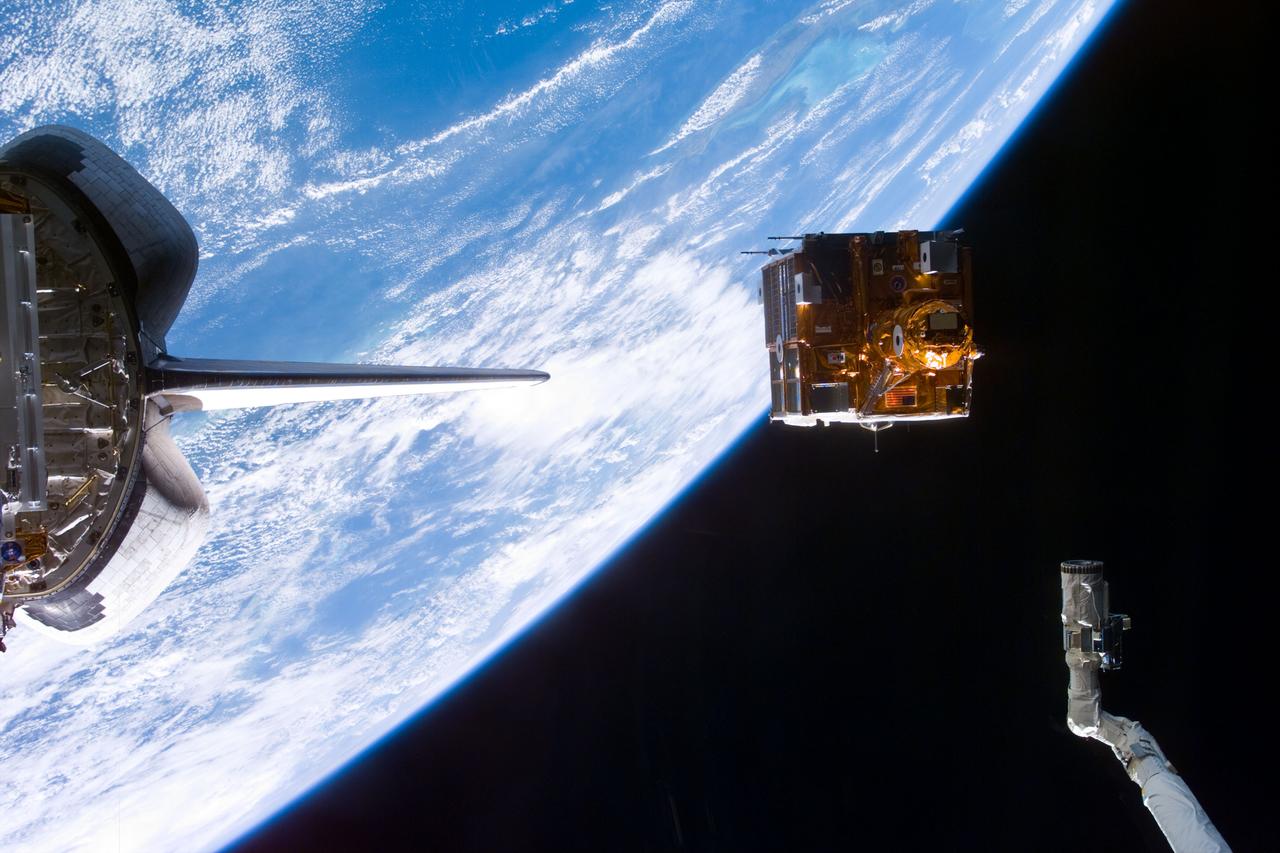
STS095-E-5077 (1 Nov. 1998) --- Backdropped against the blackness of space and Earth's horizon, Spartan 201-05 leaves the cargo bay of the Space Shuttle Discovery. The satellite will remain a free-flyer for several days while it records data on the solar wind and the sun's corona. This data is hoped to increase knowledge of the sun's effect on our planet. Cargo bay of Discovery is partially visible at left. The Canadian-built remote manipulator system (RMS)is partially visible at right. The photograph was taken with an electronic still camera (ESC) at 2:09:35 GMT, November 1.

KENNEDY SPACE CENTER, FLA. -- For the first time in Space Shuttle history, a fully stacked Shuttle - Atlantis - moves into high bay 2, on the west side of the Vehicle Assembly Building (VAB). The VAB and nearby rock-paved crawlerway have recently undergone major modifications to provide Shuttle fliglht hardware more storage space and protection - "Safe Haven" - from hurricanes or tropical storms. Atlantis begain moving out of VAB high bay 1 on the east side at 2:59 a.m. EDT. After the successful "Safe Haven" fit check, Shuttle Atlantis is scheduled to roll out to Launch Pad 39B in preparation for the STS-106 launch on Sept. 8.
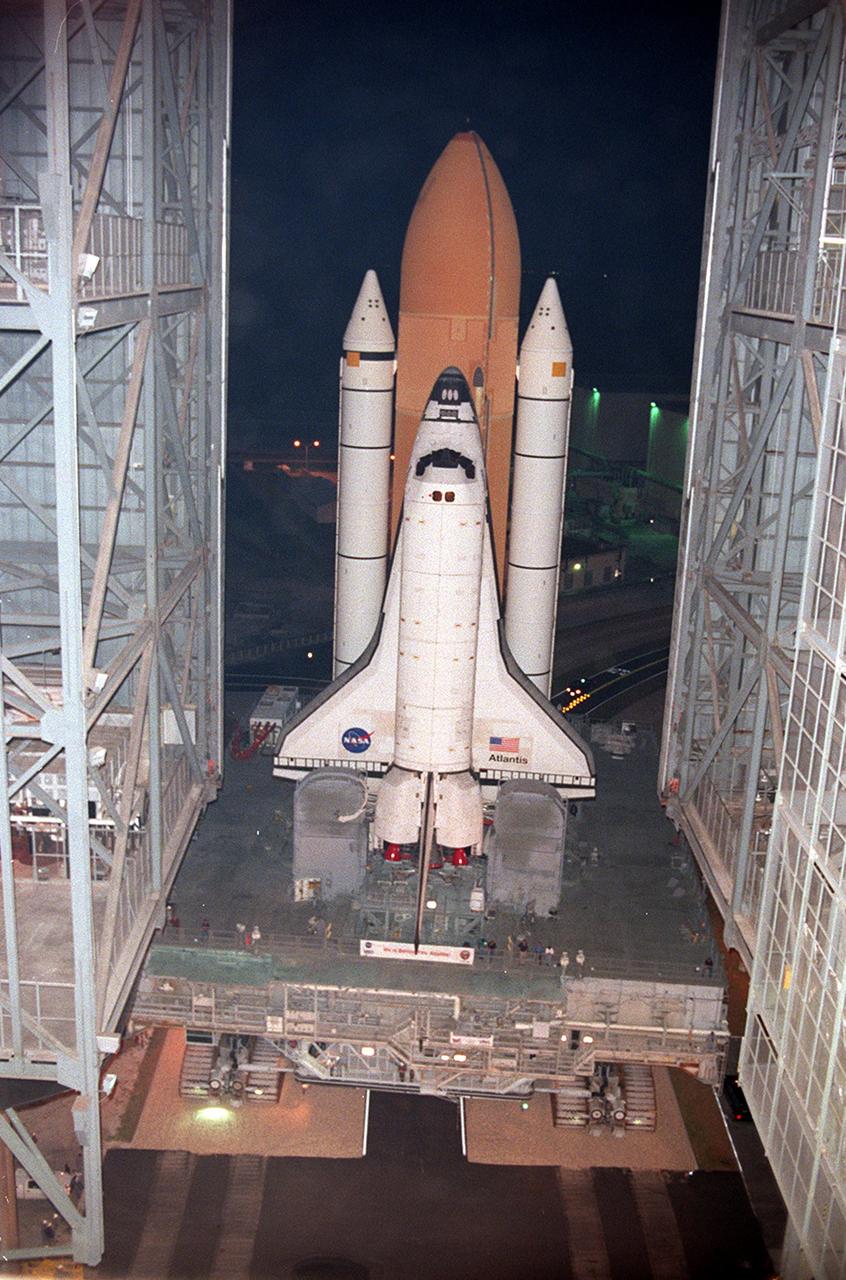
KENNEDY SPACE CENTER, FLA. -- For the first time in Space Shuttle history, a fully stacked Shuttle - Atlantis - moves into high bay 2, on the west side of the Vehicle Assembly Building (VAB). The VAB and nearby rock-paved crawlerway have recently undergone major modifications to provide Shuttle fliglht hardware more storage space and protection - "Safe Haven" - from hurricanes or tropical storms. Atlantis begain moving out of VAB high bay 1 on the east side at 2:59 a.m. EDT. After the successful "Safe Haven" fit check, Shuttle Atlantis is scheduled to roll out to Launch Pad 39B in preparation for the STS-106 launch on Sept. 8.
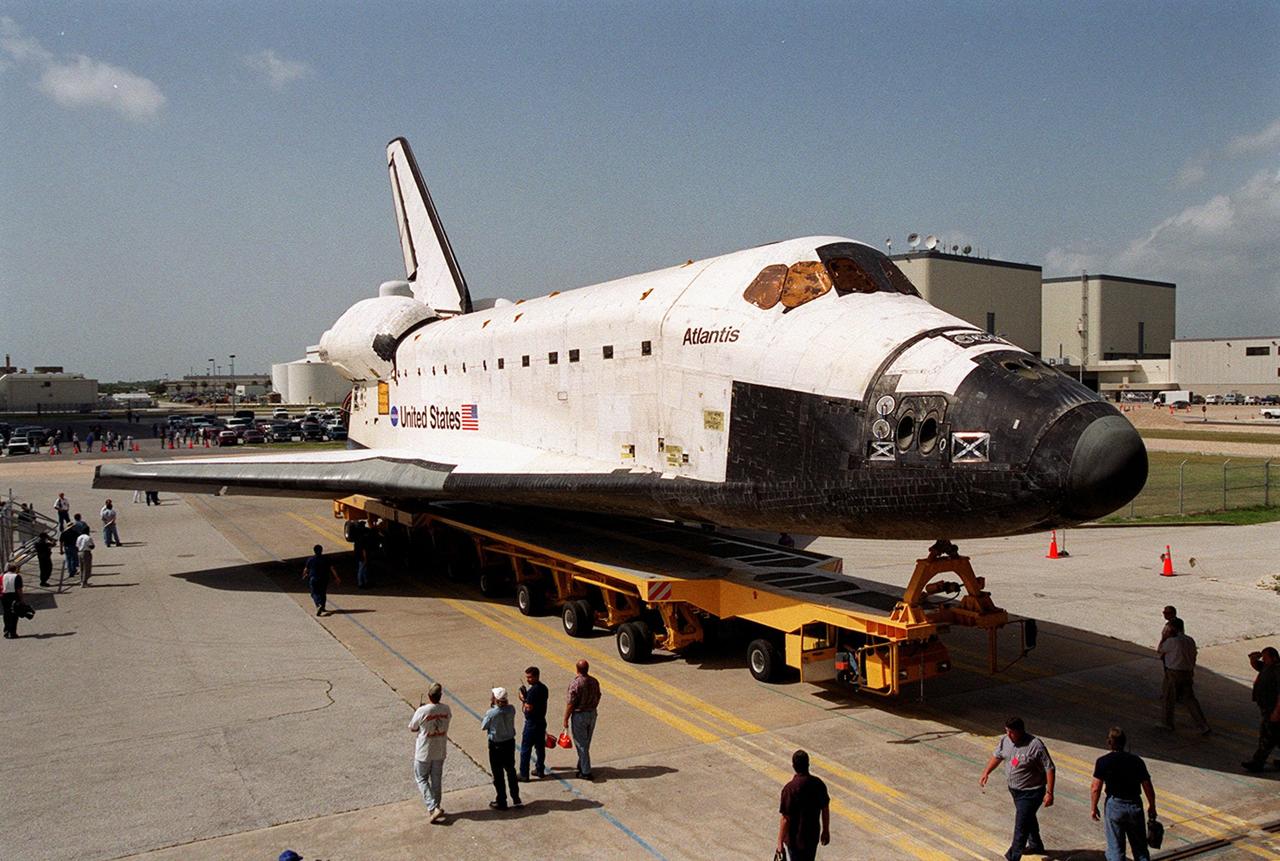
KENNEDY SPACE CENTER, FLA. -- The orbiter Atlantis is moved aboard an orbiter transporter from the Orbiter Processing Facility (OPF) bay 3 over to the Vehicle Assembly Building (VAB). In the background (right) are OPF bays 1 and 2. In the VAB it will be lifted to vertical and placed aboard the mobile launcher platform (MLP) for stacking with the solid rocket boosters and external tank. Atlantis is scheduled to launch Sept. 8 on mission STS-106, the fourth construction flight to the International Space Station, with a crew of seven
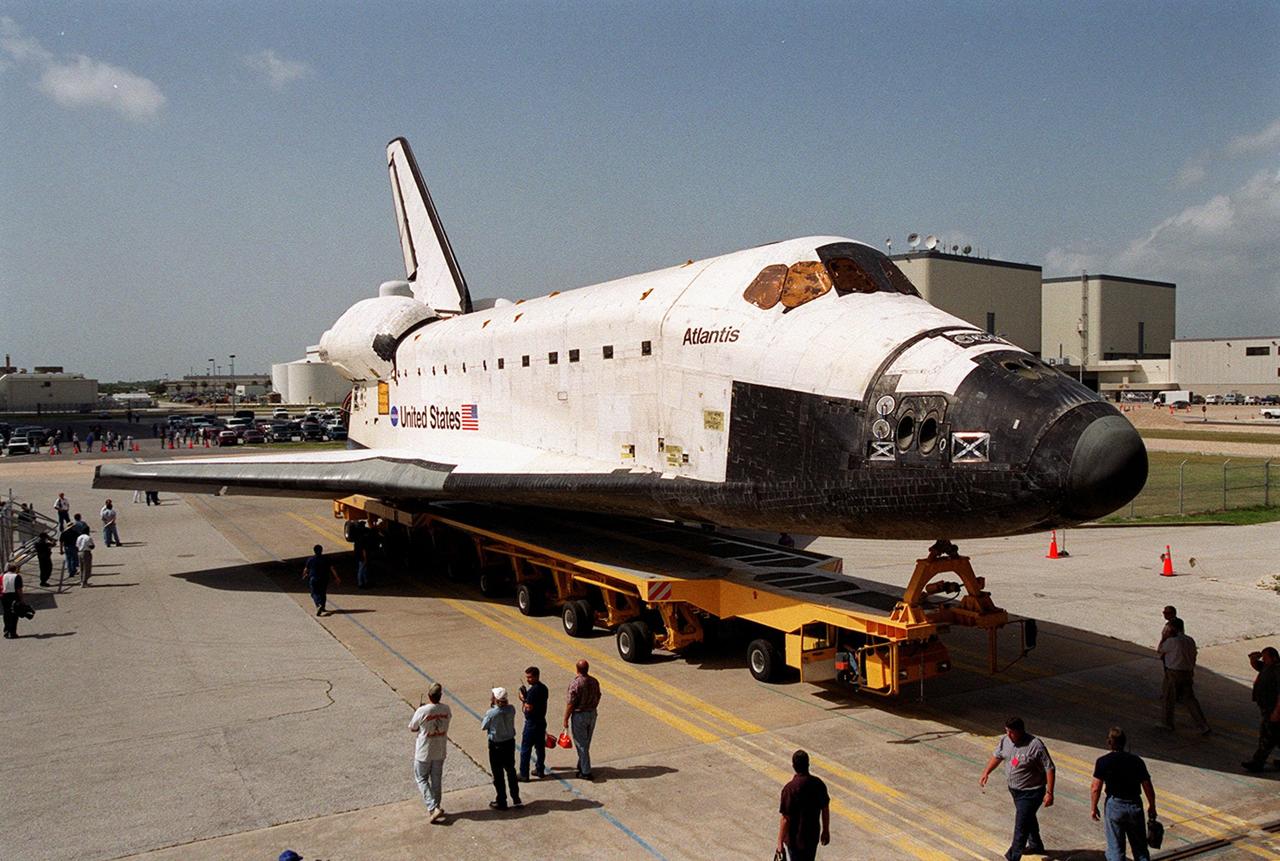
KENNEDY SPACE CENTER, FLA. -- The orbiter Atlantis is moved aboard an orbiter transporter from the Orbiter Processing Facility (OPF) bay 3 over to the Vehicle Assembly Building (VAB). In the background (right) are OPF bays 1 and 2. In the VAB it will be lifted to vertical and placed aboard the mobile launcher platform (MLP) for stacking with the solid rocket boosters and external tank. Atlantis is scheduled to launch Sept. 8 on mission STS-106, the fourth construction flight to the International Space Station, with a crew of seven
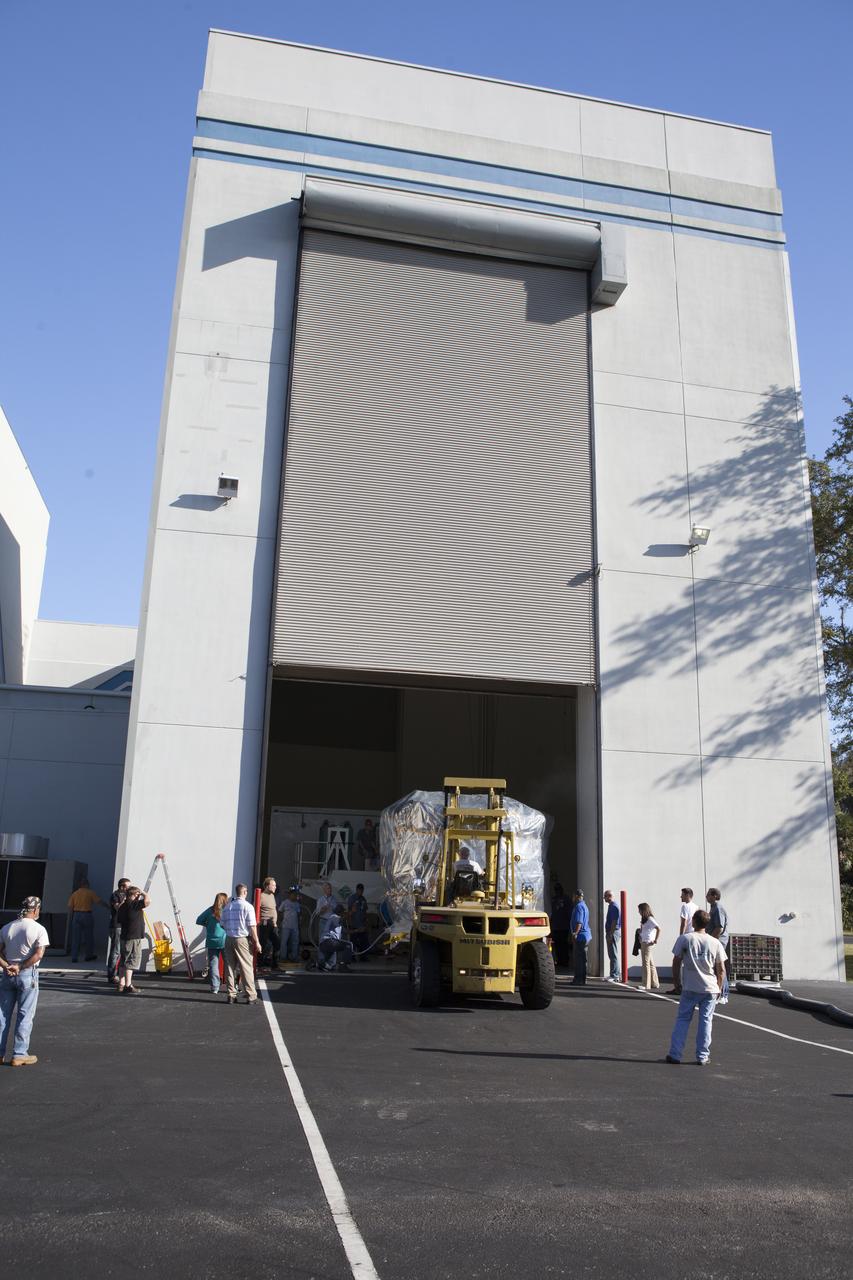
Two of the observatories for NASA's Magnetospheric Multiscale Observatory, or MMS, the lower stack, mini-stack number 1, begin the trip from the Building 2 south encapsulation bay to the Building 1 high bay at the Astrotech payload processing facility in Titusville, Florida, near Kennedy Space Center. The MMS upper stack, mini-stack number 2, is scheduled to arrive in about two weeks. MMS is a Solar Terrestrial Probes mission comprising four identically instrumented spacecraft that will use Earth’s magnetosphere as a laboratory to study the microphysics of three fundamental plasma processes: magnetic reconnection, energetic particle acceleration and turbulence. Launch aboard a United Launch Alliance Atlas V rocket from Space Launch Complex 41 on Cape Canaveral Air Force Station is targeted for March 12, 2015.
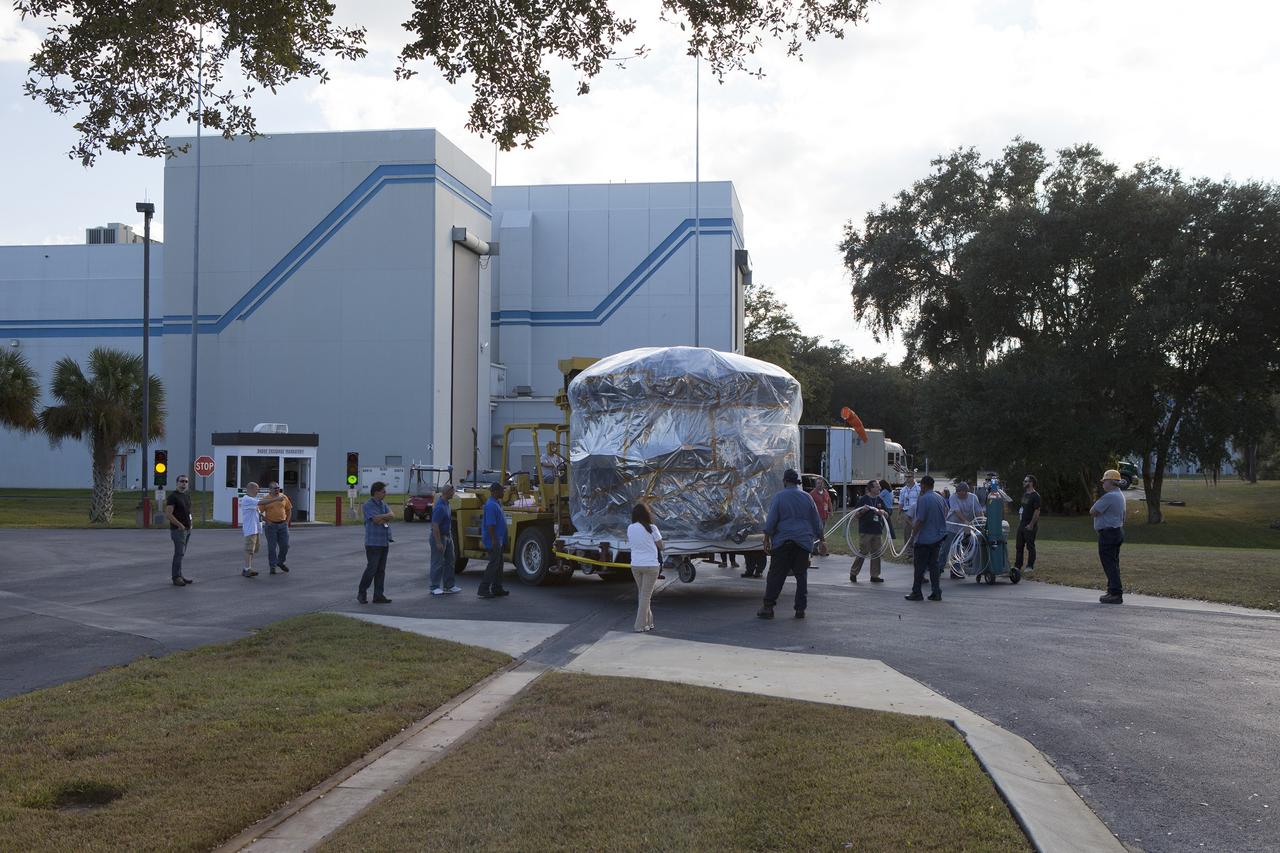
CAPE CANAVERAL, Fla. – Workers surround two of the observatories, the lower stack, mini-stack number 1, for NASA's Magnetospheric Multiscale Observatory, or MMS, on their trip from the Building 2 south encapsulation bay to the Building 1 high bay at the Astrotech payload processing facility in Titusville, Florida, near Kennedy Space Center. The MMS upper stack, mini-stack number 2, is scheduled to arrive in about two weeks. MMS is a Solar Terrestrial Probes mission comprising four identically instrumented spacecraft that will use Earth’s magnetosphere as a laboratory to study the microphysics of three fundamental plasma processes: magnetic reconnection, energetic particle acceleration and turbulence. Launch aboard a United Launch Alliance Atlas V rocket from Space Launch Complex 41 on Cape Canaveral Air Force Station is targeted for March 12, 2015. To learn more about MMS, visit http://mms.gsfc.nasa.gov. Photo credit: NASA/Dan Casper
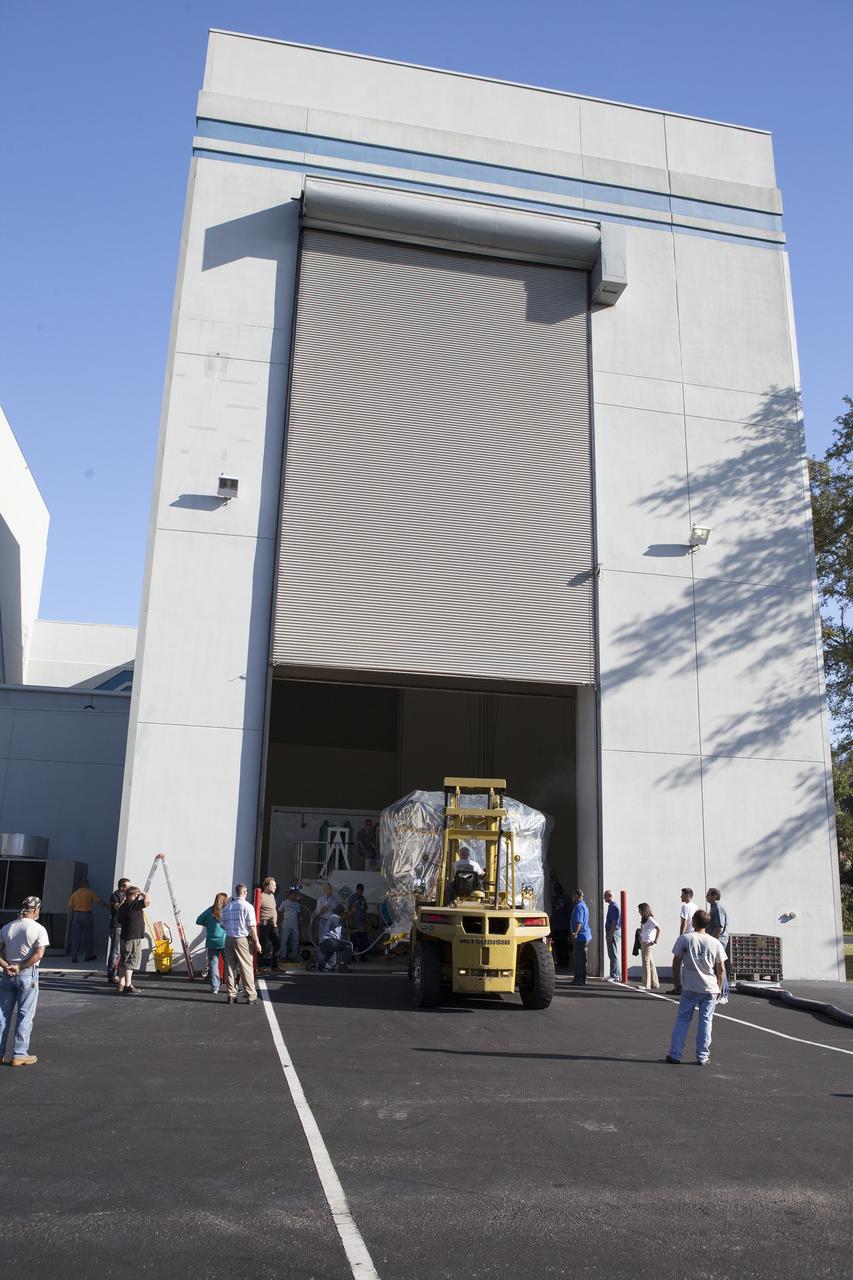
CAPE CANAVERAL, Fla. – Two of the observatories for NASA's Magnetospheric Multiscale Observatory, or MMS, the lower stack, mini-stack number 1, begin the trip from the Building 2 south encapsulation bay to the Building 1 high bay at the Astrotech payload processing facility in Titusville, Florida, near Kennedy Space Center. The MMS upper stack, mini-stack number 2, is scheduled to arrive in about two weeks. MMS is a Solar Terrestrial Probes mission comprising four identically instrumented spacecraft that will use Earth’s magnetosphere as a laboratory to study the microphysics of three fundamental plasma processes: magnetic reconnection, energetic particle acceleration and turbulence. Launch aboard a United Launch Alliance Atlas V rocket from Space Launch Complex 41 on Cape Canaveral Air Force Station is targeted for March 12, 2015. To learn more about MMS, visit http://mms.gsfc.nasa.gov. Photo credit: NASA/Dan Casper
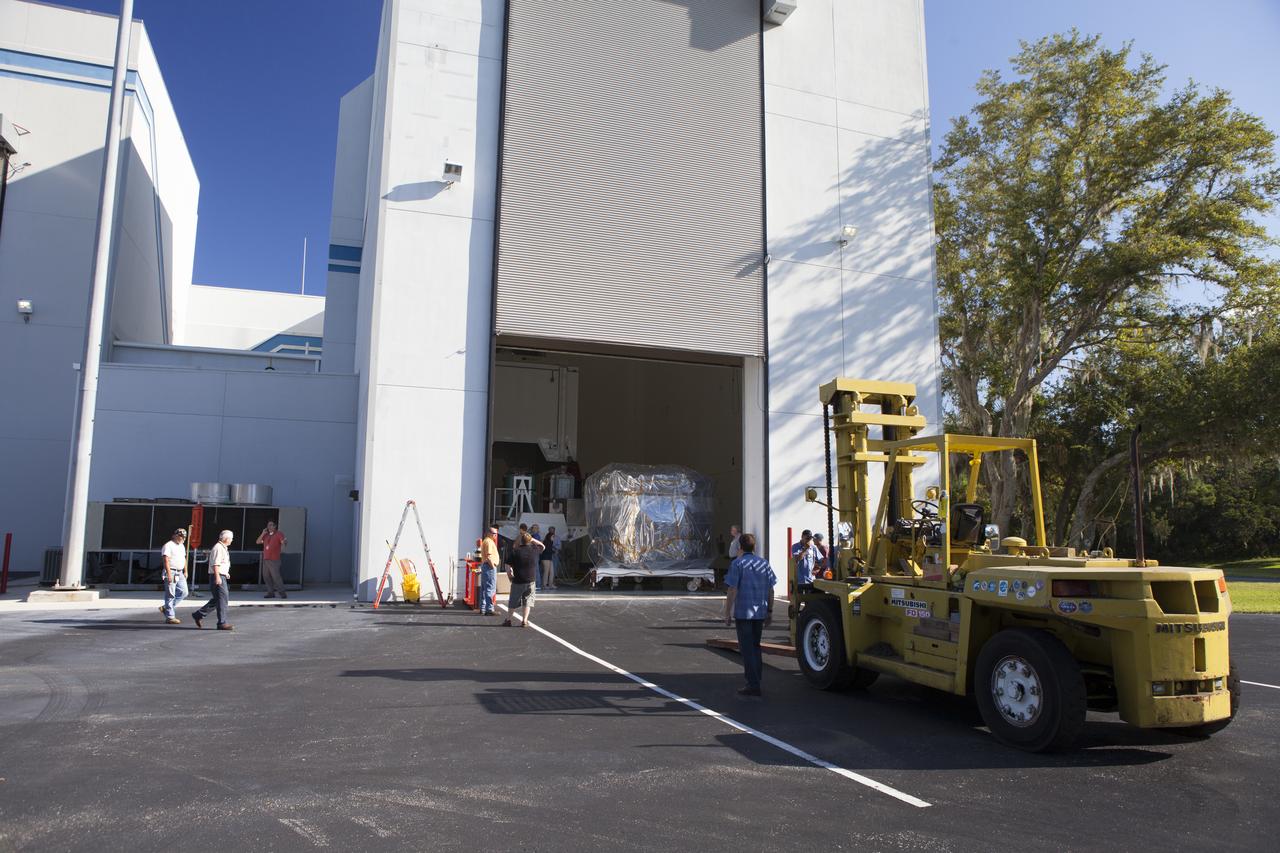
Preparations are underway to tow two of the observatories, the lower stack, mini-stack number 1, for NASA's Magnetospheric Multiscale Observatory, or MMS, from the Building 2 south encapsulation bay to the Building 1 high bay at the Astrotech payload processing facility in Titusville, Florida, near Kennedy Space Center. The MMS upper stack, mini-stack number 2, is scheduled to arrive in about two weeks. MMS is a Solar Terrestrial Probes mission comprising four identically instrumented spacecraft that will use Earth’s magnetosphere as a laboratory to study the microphysics of three fundamental plasma processes: magnetic reconnection, energetic particle acceleration and turbulence. Launch aboard a United Launch Alliance Atlas V rocket from Space Launch Complex 41 on Cape Canaveral Air Force Station is targeted for March 12, 2015.
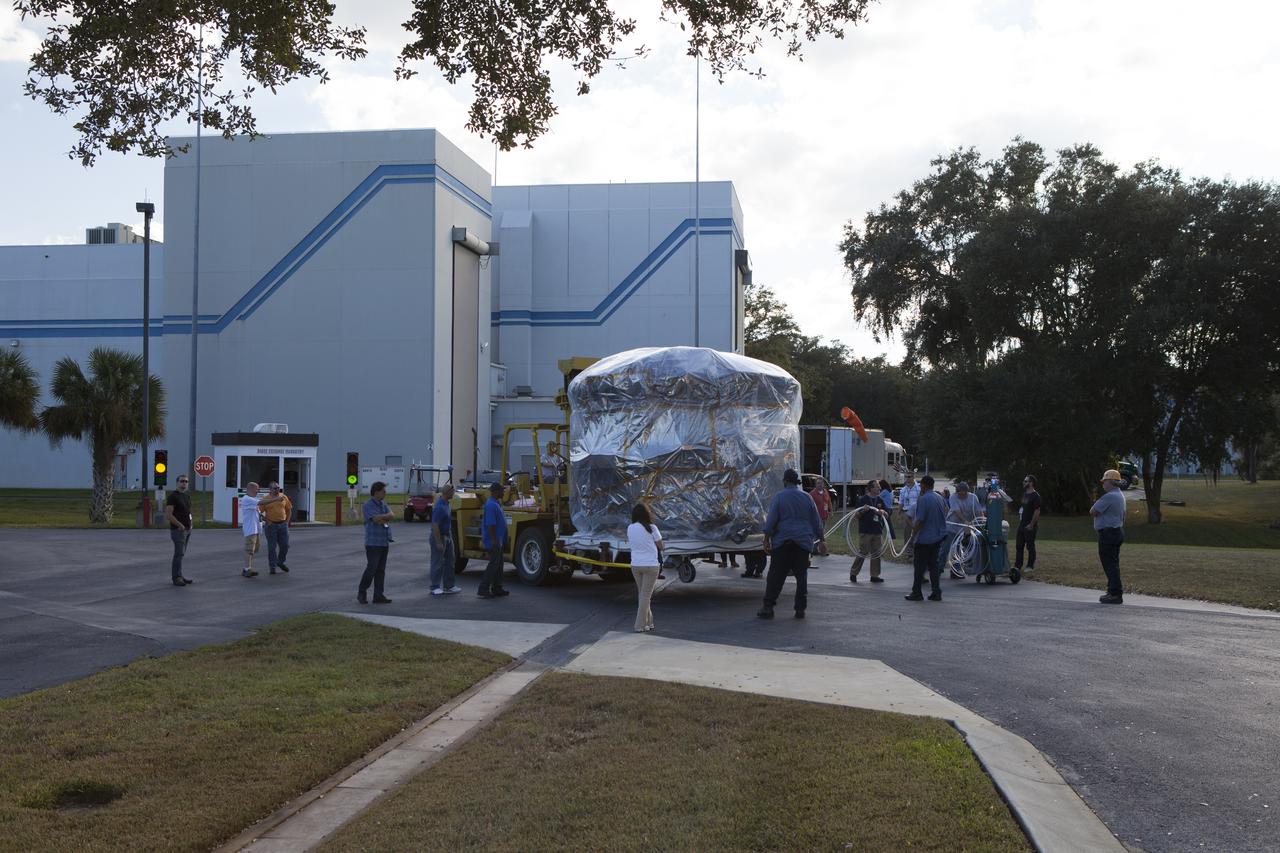
Workers surround two of the observatories, the lower stack, mini-stack number 1, for NASA's Magnetospheric Multiscale Observatory, or MMS, on their trip from the Building 2 south encapsulation bay to the Building 1 high bay at the Astrotech payload processing facility in Titusville, Florida, near Kennedy Space Center. The MMS upper stack, mini-stack number 2, is scheduled to arrive in about two weeks. MMS is a Solar Terrestrial Probes mission comprising four identically instrumented spacecraft that will use Earth’s magnetosphere as a laboratory to study the microphysics of three fundamental plasma processes: magnetic reconnection, energetic particle acceleration and turbulence. Launch aboard a United Launch Alliance Atlas V rocket from Space Launch Complex 41 on Cape Canaveral Air Force Station is targeted for March 12, 2015.
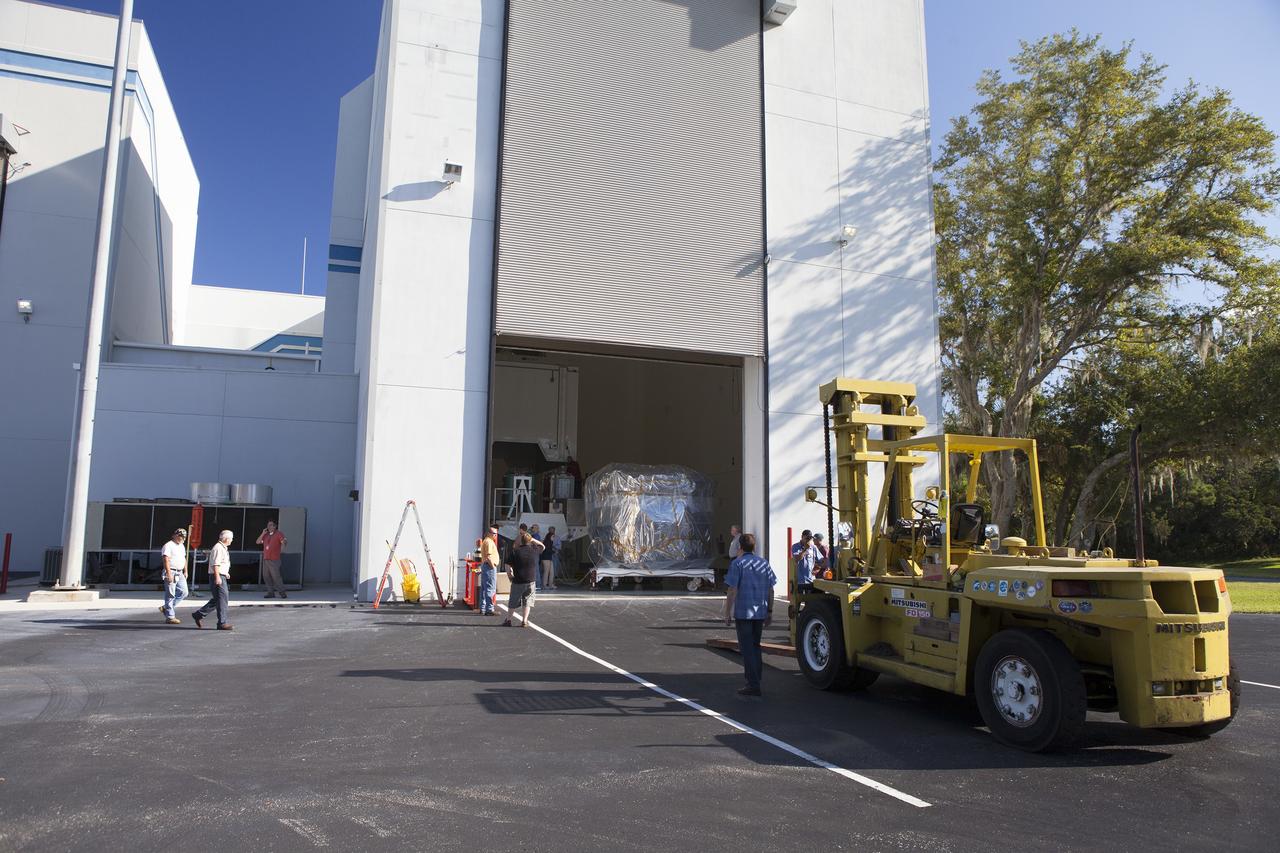
CAPE CANAVERAL, Fla. – Preparations are underway to tow two of the observatories, the lower stack, mini-stack number 1, for NASA's Magnetospheric Multiscale Observatory, or MMS, from the Building 2 south encapsulation bay to the Building 1 high bay at the Astrotech payload processing facility in Titusville, Florida, near Kennedy Space Center. The MMS upper stack, mini-stack number 2, is scheduled to arrive in about two weeks. MMS is a Solar Terrestrial Probes mission comprising four identically instrumented spacecraft that will use Earth’s magnetosphere as a laboratory to study the microphysics of three fundamental plasma processes: magnetic reconnection, energetic particle acceleration and turbulence. Launch aboard a United Launch Alliance Atlas V rocket from Space Launch Complex 41 on Cape Canaveral Air Force Station is targeted for March 12, 2015. To learn more about MMS, visit http://mms.gsfc.nasa.gov. Photo credit: NASA/Dan Casper
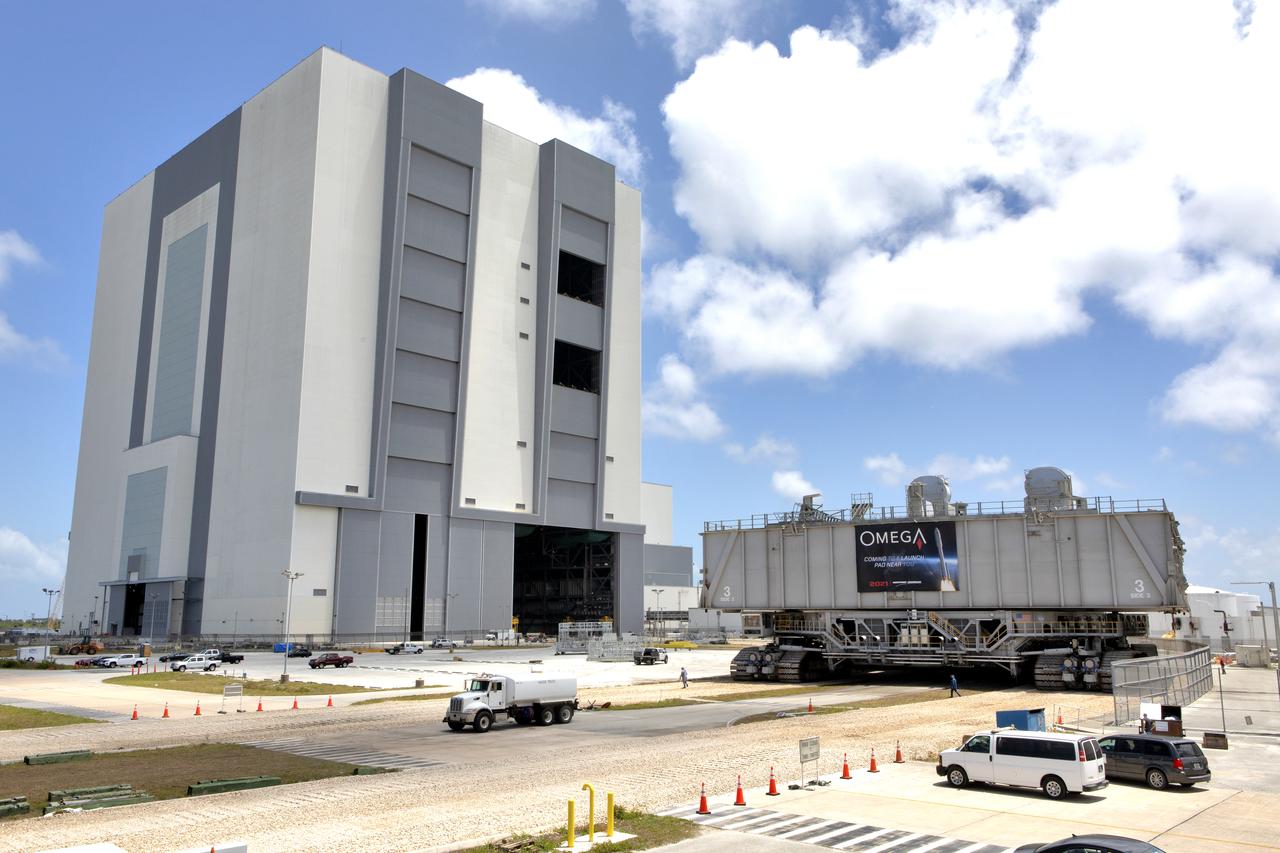
During a practice run, crawler-transporter 2 (CT-2), with the space shuttle-era mobile launch platform-3 (MLP-3) on top, has exited High Bay 2 of the Vehicle Assembly Building (VAB) and moves slowly along the crawlerway at NASA’s Kennedy Space Center in Florida on May 1, 2019. The VAB is getting its first commercial tenant. Northrop Grumman signed a Reimbursable Space Act Agreement with NASA for use of the facilities. The company will assemble and test its new OmegA rocket inside the massive facility’s High Bay 2. The company also will modify MLP-3 to serve as the launch vehicle’s assembly and launch platform. Northrop Grumman is developing the OmegA rocket, an intermediate/heavy-class launch vehicle, as part of a launch services agreement with the U.S. Air Force.
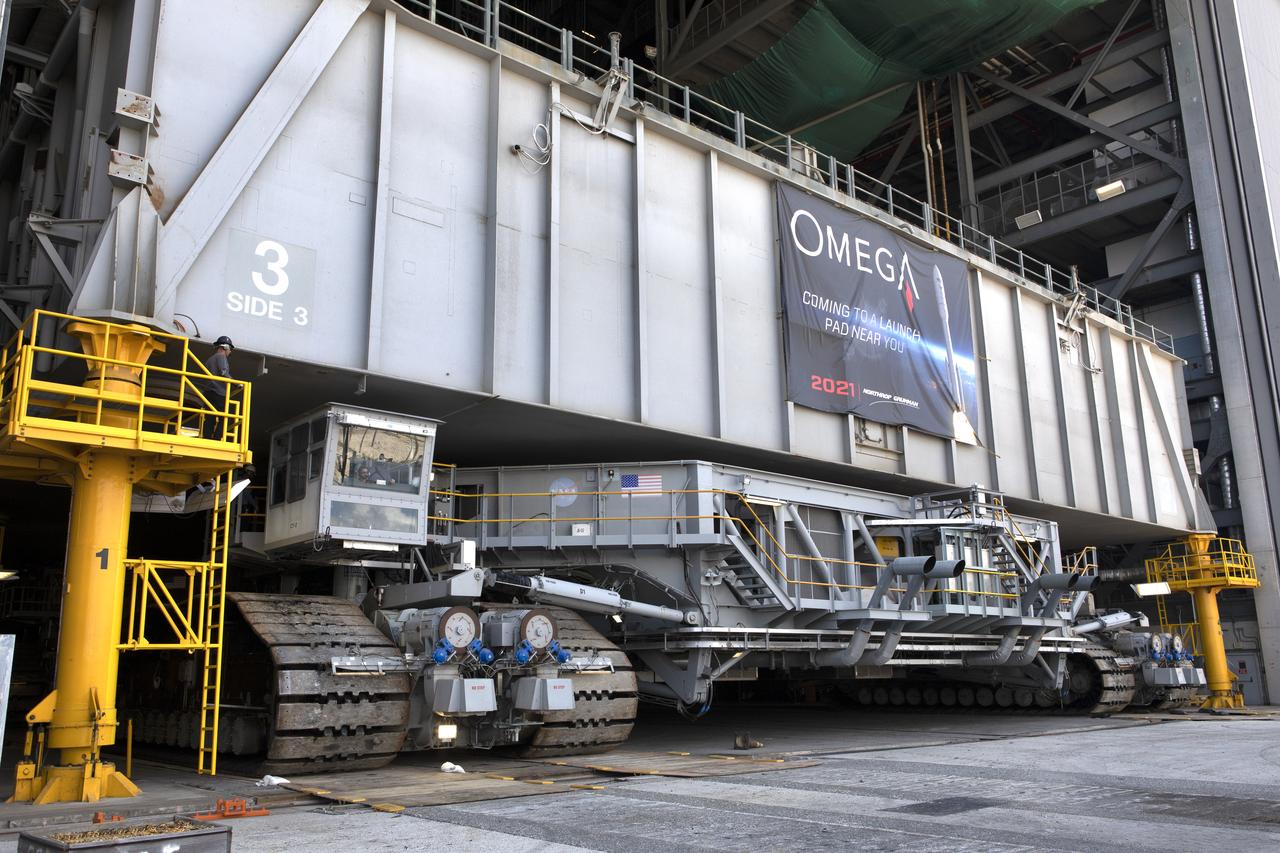
During a practice run, crawler-transporter 2 (CT-2) picked up the space shuttle-era mobile launch platform-3 (MLP-3) inside High Bay 2 of the Vehicle Assembly Building (VAB) at NASA’s Kennedy Space Center in Florida on May 1, 2019. The VAB is getting its first commercial tenant. Northrop Grumman signed a Reimbursable Space Act Agreement with NASA for use of the facilities. The company will assemble and test its new OmegA rocket inside the massive facility’s High Bay 2. The company also will modify MLP-3 to serve as the launch vehicle’s assembly and launch platform. Northrop Grumman is developing the OmegA rocket, an intermediate/heavy-class launch vehicle, as part of a launch services agreement with the U.S. Air Force.

During a practice run, crawler-transporter 2 (CT-2), with the space shuttle-era mobile launch platform-3 (MLP-3) on top, has exited High Bay 2 of the Vehicle Assembly Building (VAB) and moves slowly along the crawlerway at NASA’s Kennedy Space Center in Florida on May 1, 2019. The VAB is getting its first commercial tenant. Northrop Grumman signed a Reimbursable Space Act Agreement with NASA for use of the facilities. The company will assemble and test its new OmegA rocket inside the massive facility’s High Bay 2. The company also will modify MLP-3 to serve as the launch vehicle’s assembly and launch platform. Northrop Grumman is developing the OmegA rocket, an intermediate/heavy-class launch vehicle, as part of a launch services agreement with the U.S. Air Force.
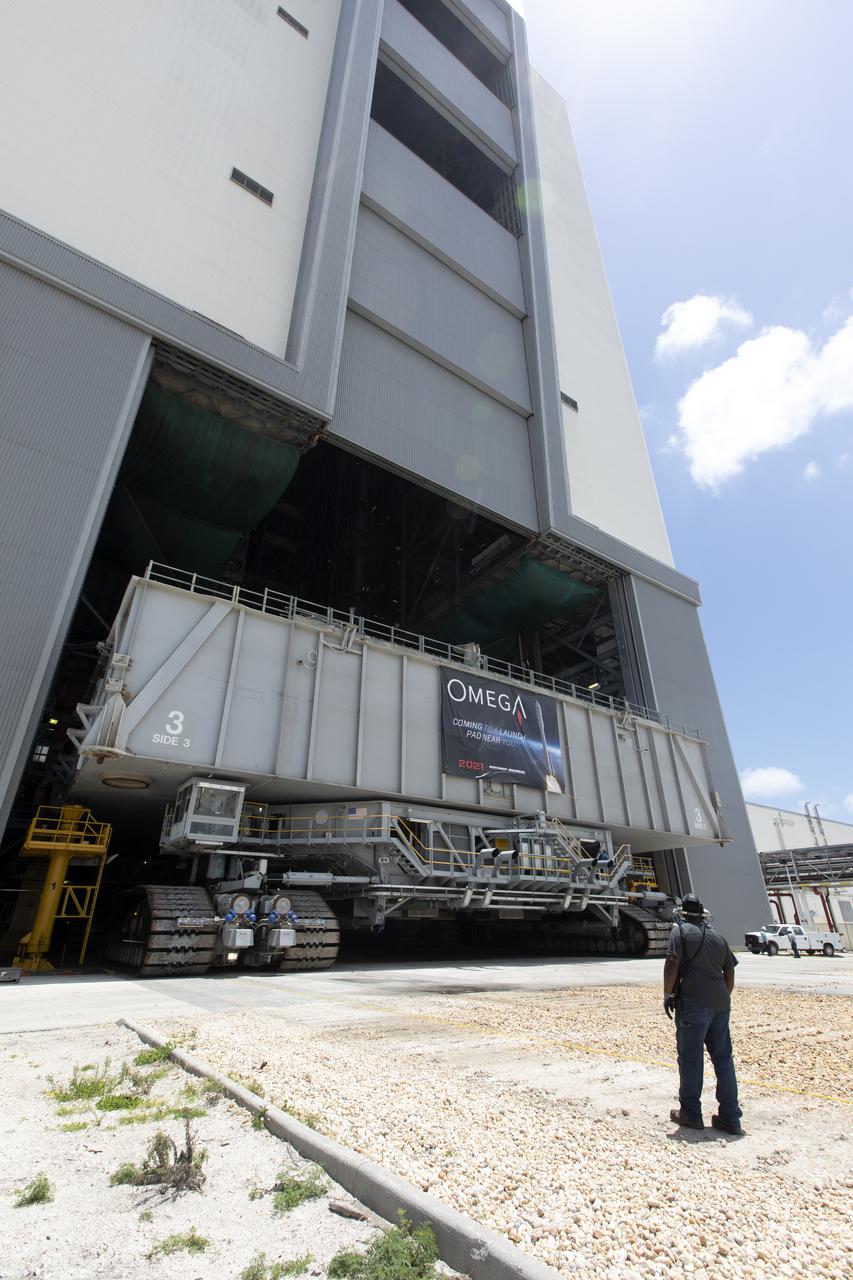
During a practice run, crawler-transporter 2 (CT-2), with the space shuttle-era mobile launch platform-3 (MLP-3) on top, begins its move out of High Bay 2 of the Vehicle Assembly Building (VAB) at NASA’s Kennedy Space Center in Florida on May 1, 2019. The VAB is getting its first commercial tenant. Northrop Grumman signed a Reimbursable Space Act Agreement with NASA for use of the facilities. The company will assemble and test its new OmegA rocket inside the massive facility’s High Bay 2. The company also will modify MLP-3 to serve as the launch vehicle’s assembly and launch platform. Northrop Grumman is developing the OmegA rocket, an intermediate/heavy-class launch vehicle, as part of a launch services agreement with the U.S. Air Force.

During a practice run, crawler-transporter 2 (CT-2), with the space shuttle-era mobile launch platform-3 (MLP-3) on top, moves out of High Bay 2 of the Vehicle Assembly Building (VAB) at NASA’s Kennedy Space Center in Florida on May 1, 2019. The VAB is getting its first commercial tenant. Northrop Grumman signed a Reimbursable Space Act Agreement with NASA for use of the facilities. The company will assemble and test its new OmegA rocket inside the massive facility’s High Bay 2. The company also will modify MLP-3 to serve as the launch vehicle’s assembly and launch platform. Northrop Grumman is developing the OmegA rocket, an intermediate/heavy-class launch vehicle, as part of a launch services agreement with the U.S. Air Force.
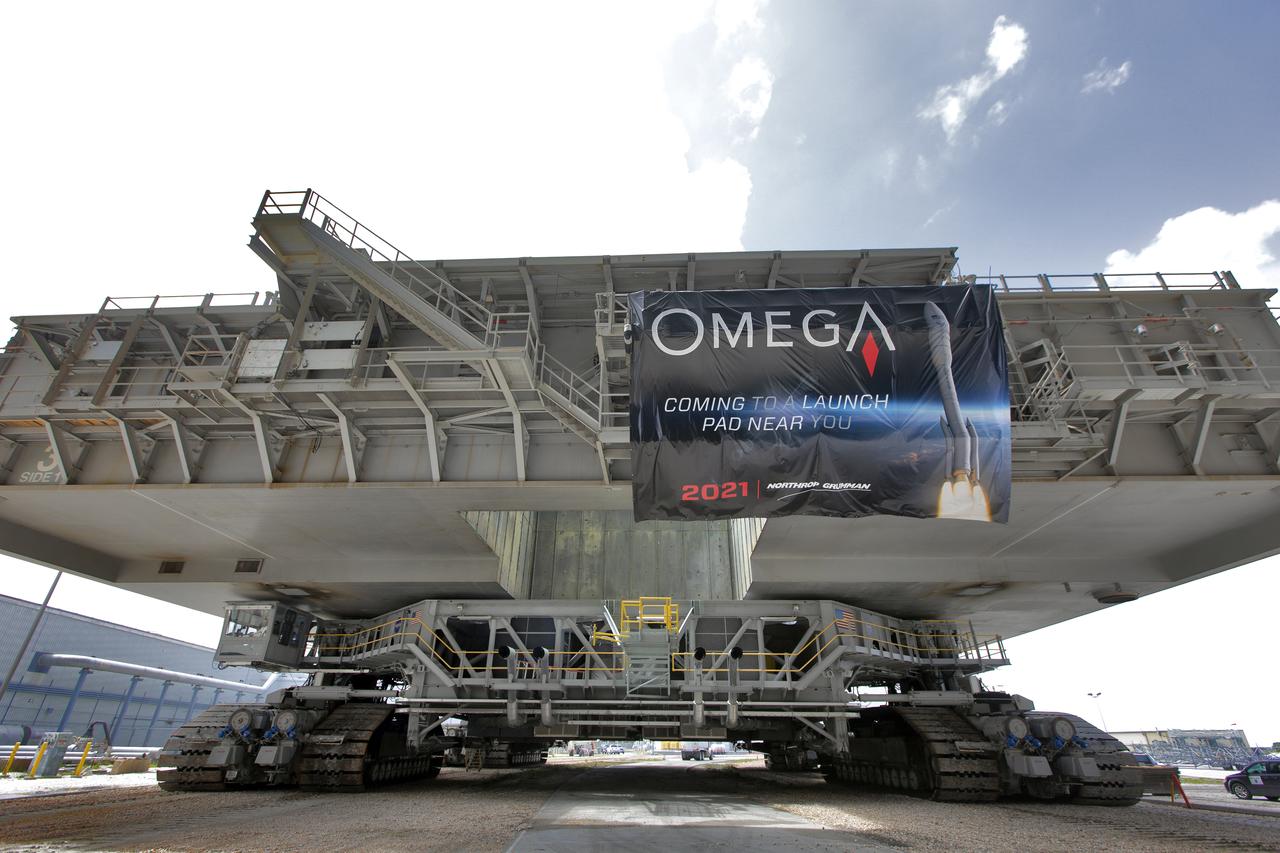
During a practice run, crawler-transporter 2 (CT-2), with the space shuttle-era mobile launch platform-3 (MLP-3) on top, has exited High Bay 2 of the Vehicle Assembly Building (VAB) and moves slowly along the crawlerway at NASA’s Kennedy Space Center in Florida on May 1, 2019. The VAB is getting its first commercial tenant. Northrop Grumman signed a Reimbursable Space Act Agreement with NASA for use of the facilities. The company will assemble and test its new OmegA rocket inside the massive facility’s High Bay 2. The company also will modify MLP-3 to serve as the launch vehicle’s assembly and launch platform. Northrop Grumman is developing the OmegA rocket, an intermediate/heavy-class launch vehicle, as part of a launch services agreement with the U.S. Air Force.
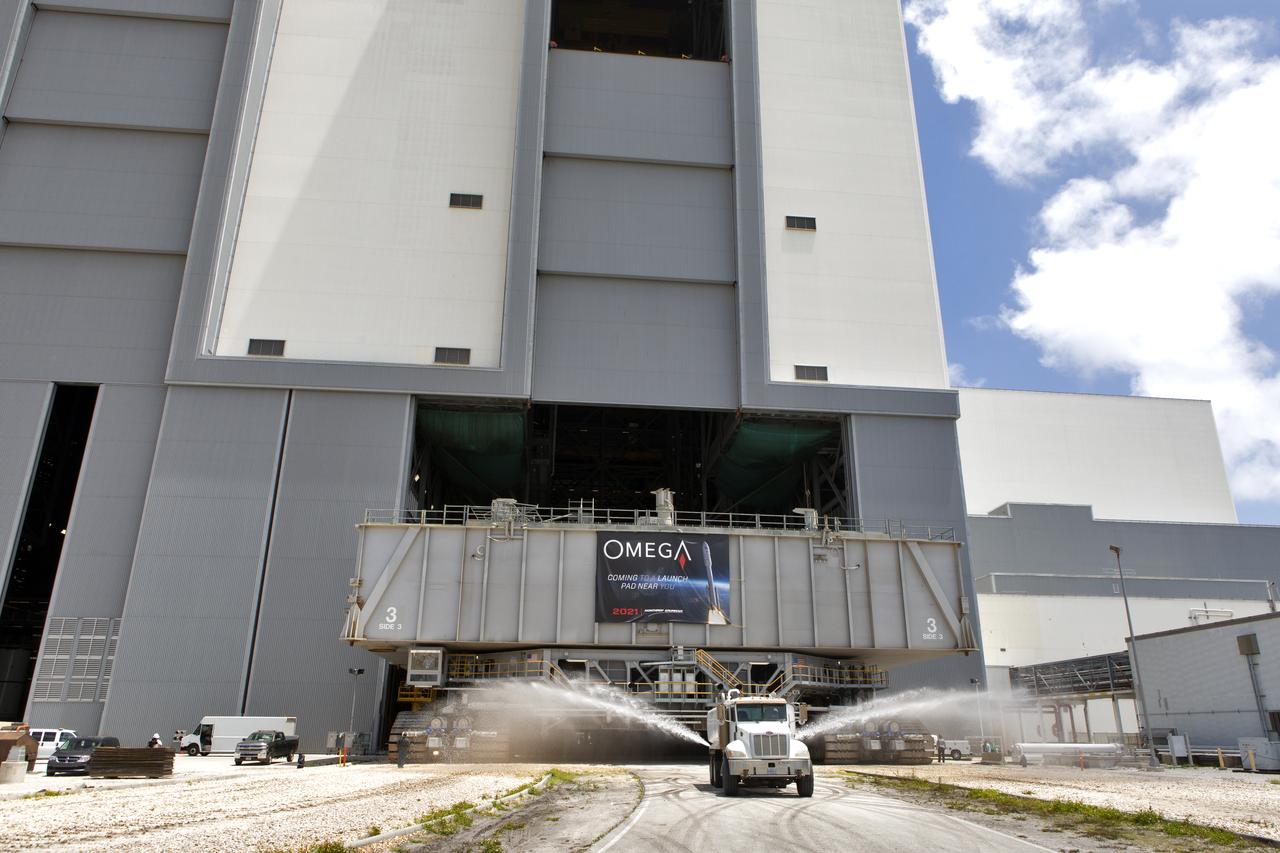
During a practice run, crawler-transporter 2 (CT-2), with the space shuttle-era mobile launch platform-3 (MLP-3) on top, moves out of High Bay 2 of the Vehicle Assembly Building (VAB) at NASA’s Kennedy Space Center in Florida on May 1, 2019. A truck in front sprays water to reduce dust on the crawlerway. The VAB is getting its first commercial tenant. Northrop Grumman signed a Reimbursable Space Act Agreement with NASA for use of the facilities. The company will assemble and test its new OmegA rocket inside the massive facility’s High Bay 2. The company also will modify MLP-3 to serve as the launch vehicle’s assembly and launch platform. Northrop Grumman is developing the OmegA rocket, an intermediate/heavy-class launch vehicle, as part of a launch services agreement with the U.S. Air Force.
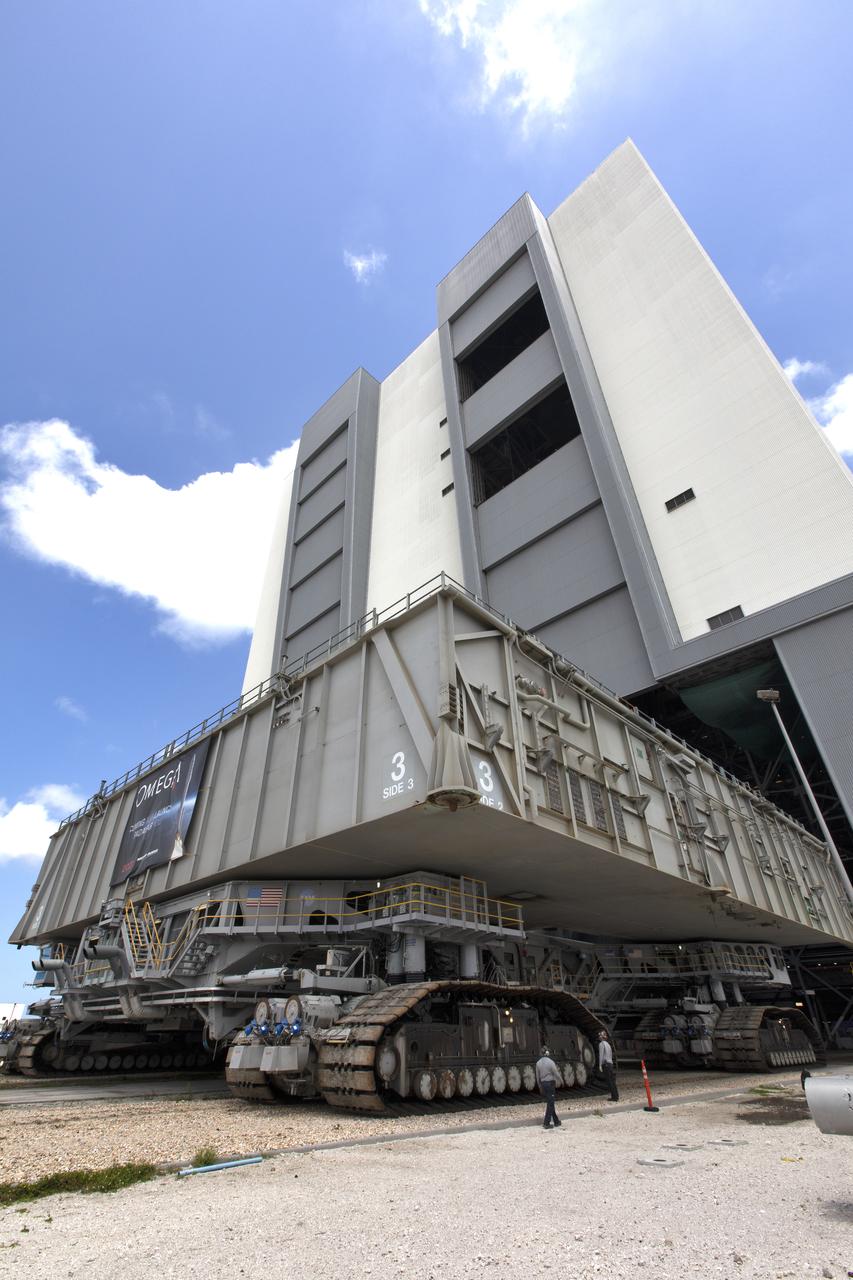
During a practice run, crawler-transporter 2 (CT-2), with the space shuttle-era mobile launch platform-3 (MLP-3) on top, moves out of High Bay 2 of the Vehicle Assembly Building (VAB) at NASA’s Kennedy Space Center in Florida on May 1, 2019. The VAB is getting its first commercial tenant. Northrop Grumman signed a Reimbursable Space Act Agreement with NASA for use of the facilities. The company will assemble and test its new OmegA rocket inside the massive facility’s High Bay 2. The company also will modify MLP-3 to serve as the launch vehicle’s assembly and launch platform. Northrop Grumman is developing the OmegA rocket, an intermediate/heavy-class launch vehicle, as part of a launch services agreement with the U.S. Air Force.
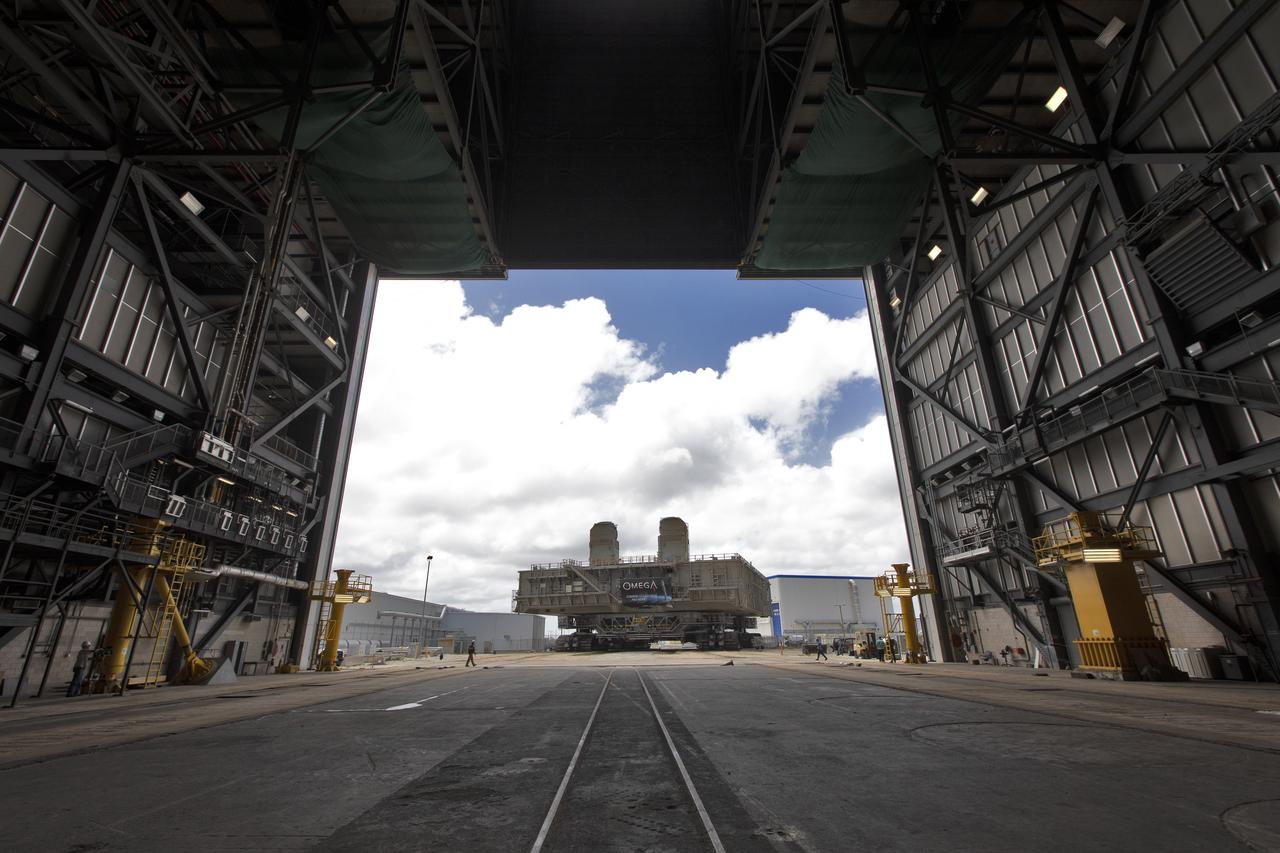
During a practice run, crawler-transporter 2 (CT-2), with the space shuttle-era mobile launch platform-3 (MLP-3) on top, has exited High Bay 2 of the Vehicle Assembly Building (VAB) and moves slowly along the crawlerway at NASA’s Kennedy Space Center in Florida on May 1, 2019. The VAB is getting its first commercial tenant. Northrop Grumman signed a Reimbursable Space Act Agreement with NASA for use of the facilities. The company will assemble and test its new OmegA rocket inside the massive facility’s High Bay 2. The company also will modify MLP-3 to serve as the launch vehicle’s assembly and launch platform. Northrop Grumman is developing the OmegA rocket, an intermediate/heavy-class launch vehicle, as part of a launch services agreement with the U.S. Air Force.
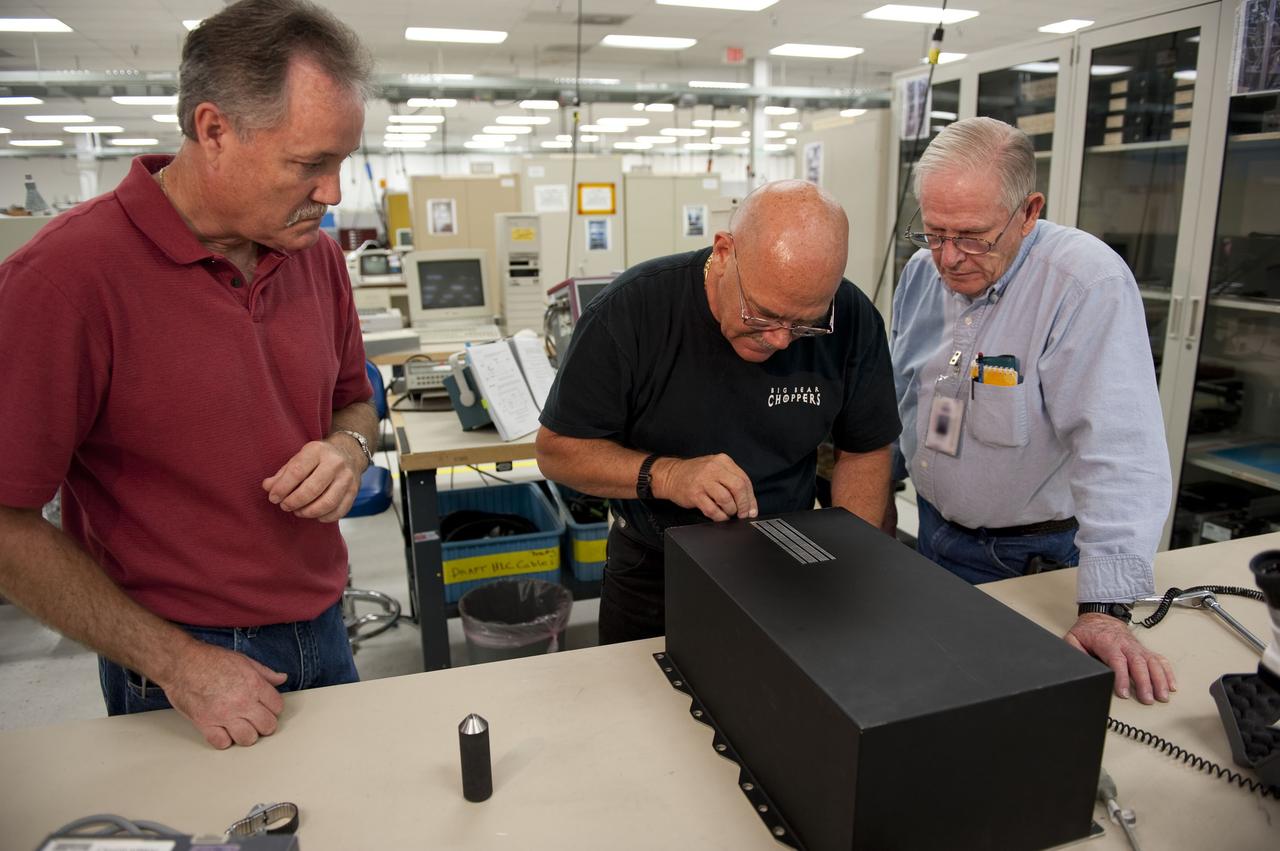
CAPE CANAVERAL, Fla. -- At the NASA Shuttle Logistics Depot in Cape Canaveral, Florida, technicians remove the cover on the Load Control Assembly-2 (LCA-2) to begin the testing process. Located in space shuttle Endeavour's aft avionics bay 5, the LCA-2, which distributes power to nine shuttle systems, is believed to have caused fuel line heaters for Endeavour's auxiliary power unit-1 (APU-1) to fail April 29 during the first launch attempt for the STS-134 mission. The LCA-2 will be replaced and systems will be retested before the launch is rescheduled. STS-134 will deliver the Express Logistics Carrier-3, Alpha Magnetic Spectrometer-2 (AMS), a high-pressure gas tank and additional spare parts for the Dextre robotic helper to the International Space Station. The mission also will be the final spaceflight for Endeavour. For more information, visit www.nasa.gov/mission_pages/shuttle/shuttlemissions/sts134/index.html. Photo credit: NASA/Kim Shiflett

CAPE CANAVERAL, Fla. -- At the NASA Shuttle Logistics Depot in Cape Canaveral, Florida, technicians remove the cover on the Load Control Assembly-2 (LCA-2) to begin the testing process. Located in space shuttle Endeavour's aft avionics bay 5, the LCA-2, which distributes power to nine shuttle systems, is believed to have caused fuel line heaters for Endeavour's auxiliary power unit-1 (APU-1) to fail April 29 during the first launch attempt for the STS-134 mission. The LCA-2 will be replaced and systems will be retested before the launch is rescheduled. STS-134 will deliver the Express Logistics Carrier-3, Alpha Magnetic Spectrometer-2 (AMS), a high-pressure gas tank and additional spare parts for the Dextre robotic helper to the International Space Station. The mission also will be the final spaceflight for Endeavour. For more information, visit www.nasa.gov/mission_pages/shuttle/shuttlemissions/sts134/index.html. Photo credit: NASA/Kim Shiflett
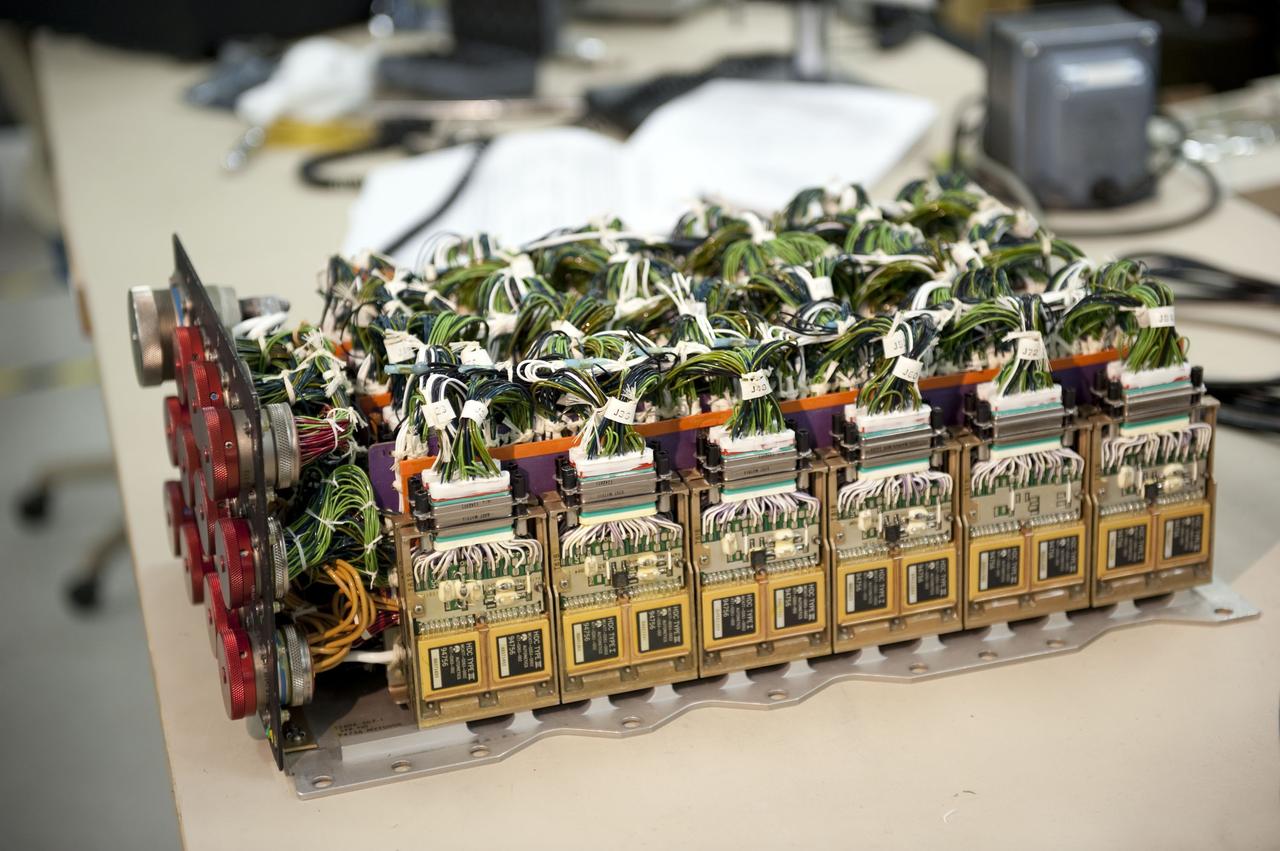
CAPE CANAVERAL, Fla. -- At the NASA Shuttle Logistics Depot in Cape Canaveral, Florida, the Load Control Assembly-2 (LCA-2) is uncovered for testing. Located in space shuttle Endeavour's aft avionics bay 5, the LCA-2, which distributes power to nine shuttle systems, is believed to have caused fuel line heaters for Endeavour's auxiliary power unit-1 (APU-1) to fail April 29 during the first launch attempt for the STS-134 mission. The LCA-2 will be replaced and systems will be retested before the launch is rescheduled. STS-134 will deliver the Express Logistics Carrier-3, Alpha Magnetic Spectrometer-2 (AMS), a high-pressure gas tank and additional spare parts for the Dextre robotic helper to the International Space Station. The mission also will be the final spaceflight for Endeavour. For more information, visit www.nasa.gov/mission_pages/shuttle/shuttlemissions/sts134/index.html. Photo credit: NASA/Kim Shiflett
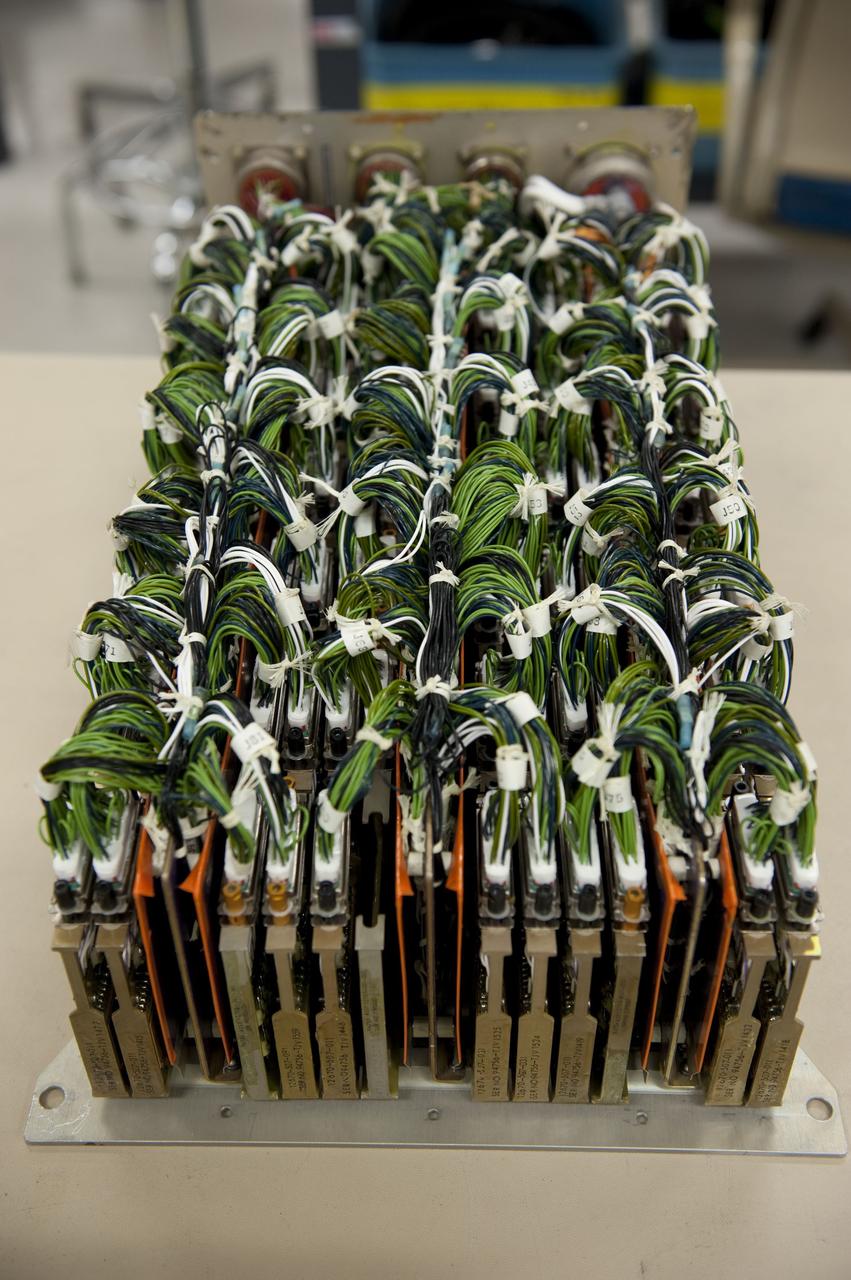
CAPE CANAVERAL, Fla. -- At the NASA Shuttle Logistics Depot in Cape Canaveral, Florida, the Load Control Assembly-2 (LCA-2) is uncovered for testing. Located in space shuttle Endeavour's aft avionics bay 5, the LCA-2, which distributes power to nine shuttle systems, is believed to have caused fuel line heaters for Endeavour's auxiliary power unit-1 (APU-1) to fail April 29 during the first launch attempt for the STS-134 mission. The LCA-2 will be replaced and systems will be retested before the launch is rescheduled. STS-134 will deliver the Express Logistics Carrier-3, Alpha Magnetic Spectrometer-2 (AMS), a high-pressure gas tank and additional spare parts for the Dextre robotic helper to the International Space Station. The mission also will be the final spaceflight for Endeavour. For more information, visit www.nasa.gov/mission_pages/shuttle/shuttlemissions/sts134/index.html. Photo credit: NASA/Kim Shiflett