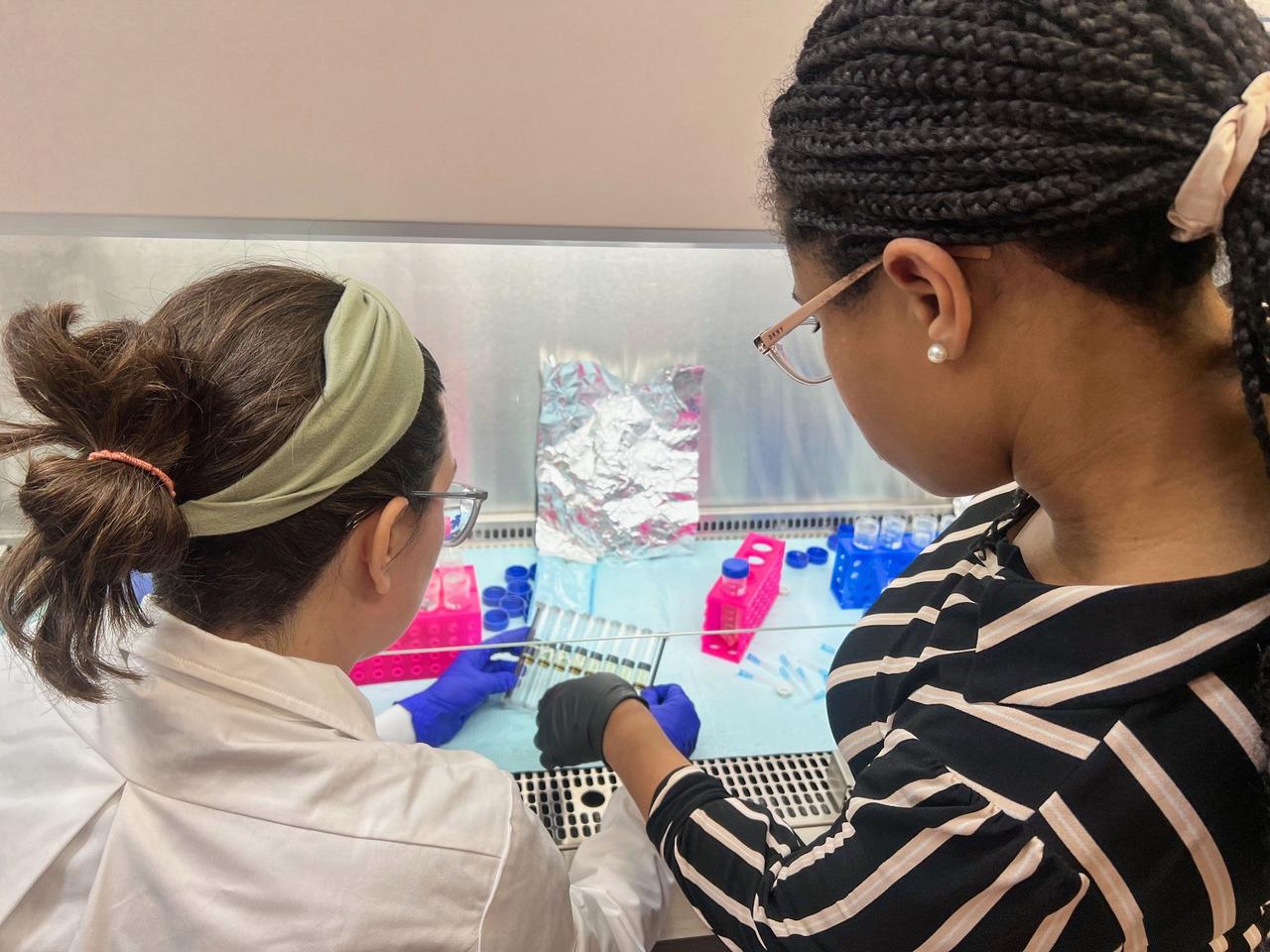
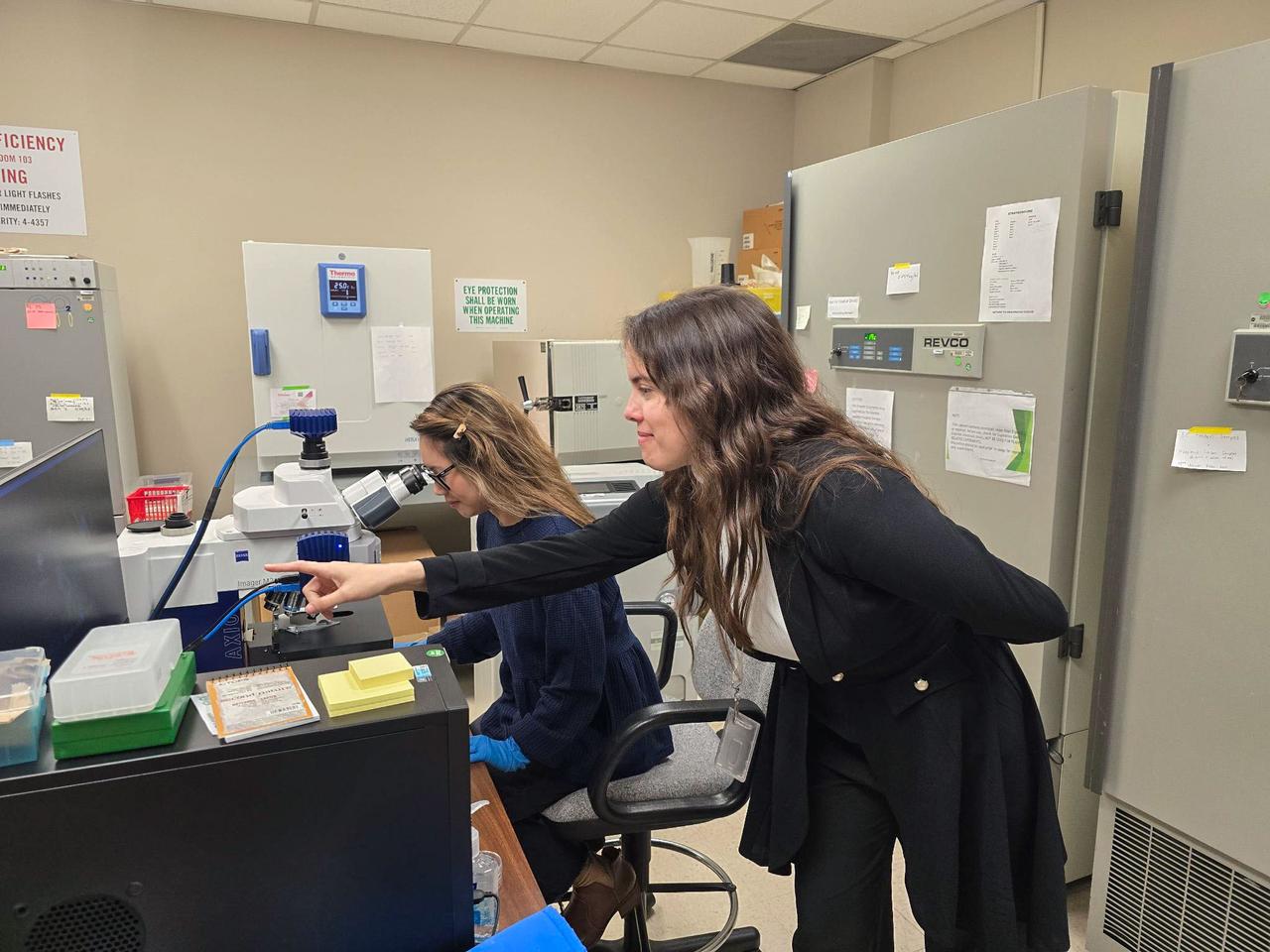
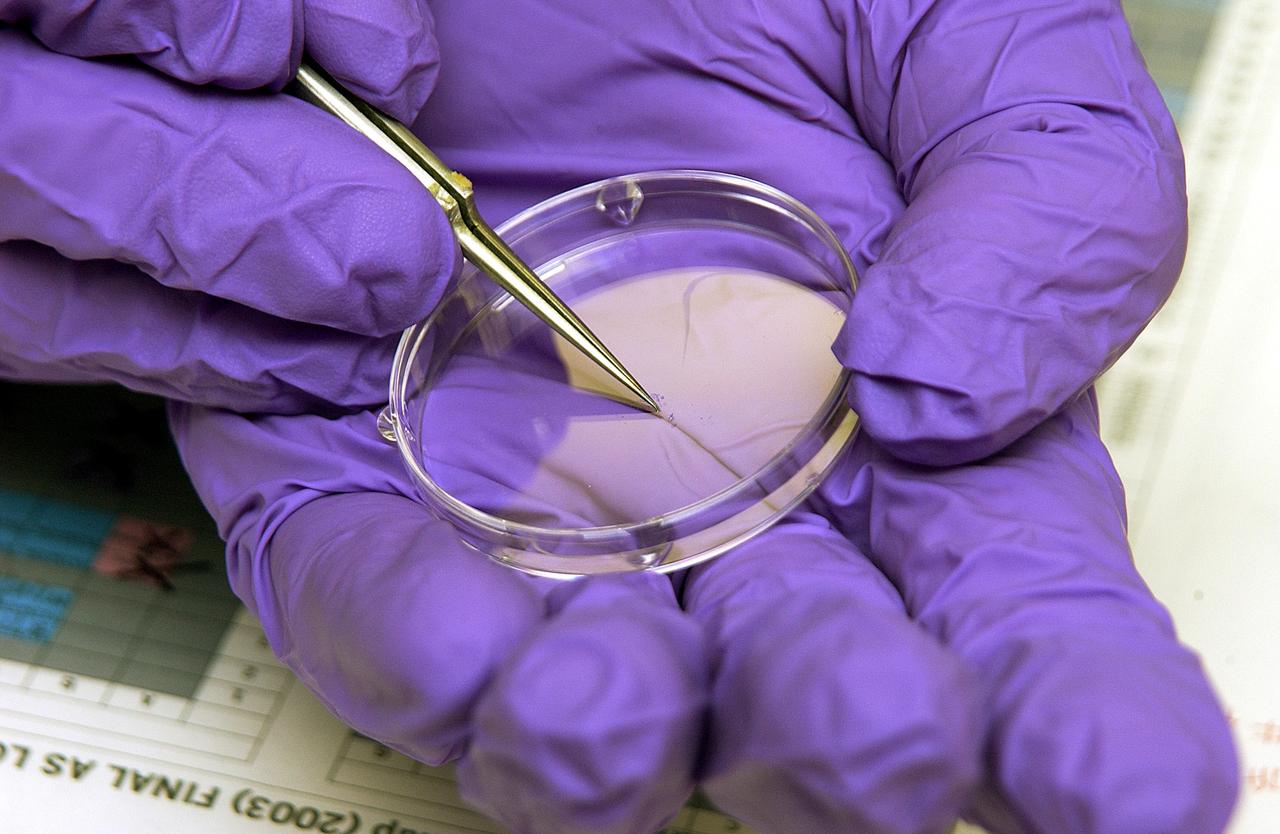
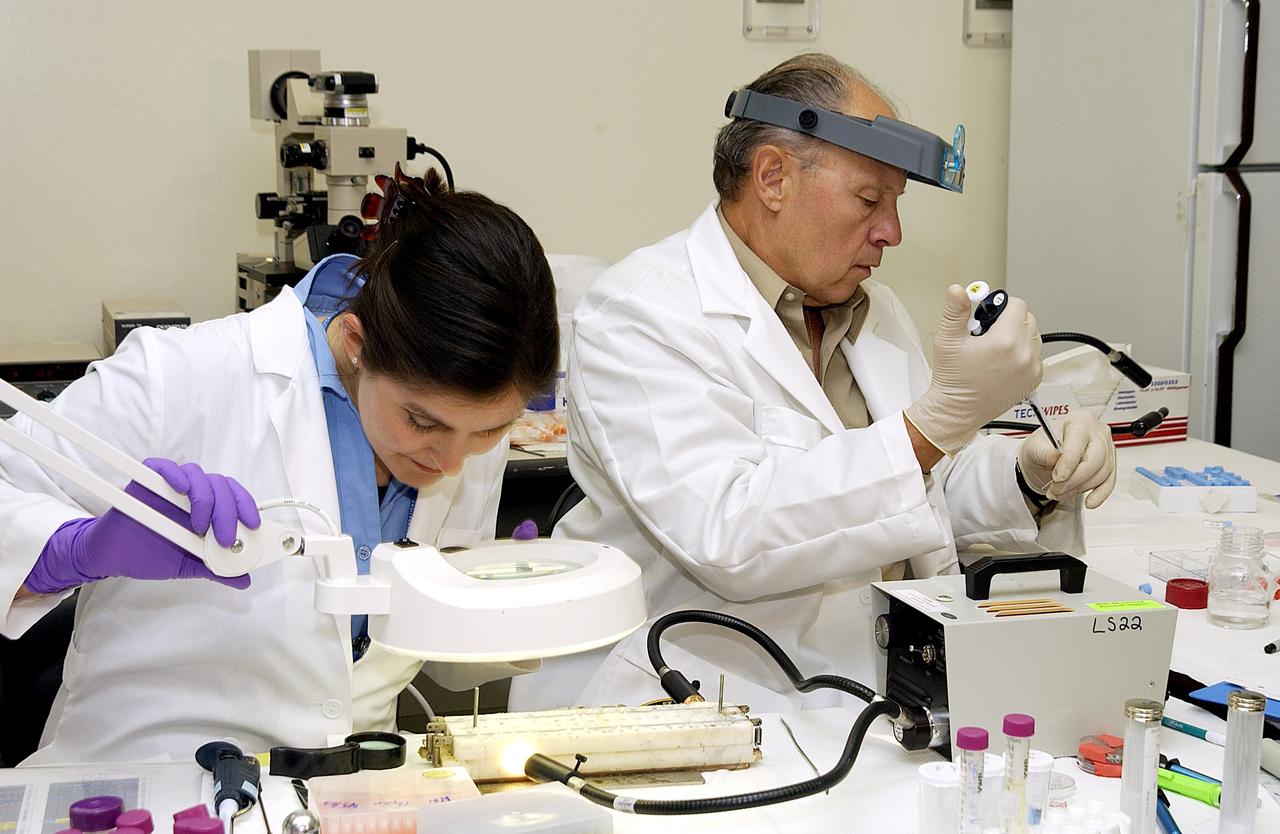
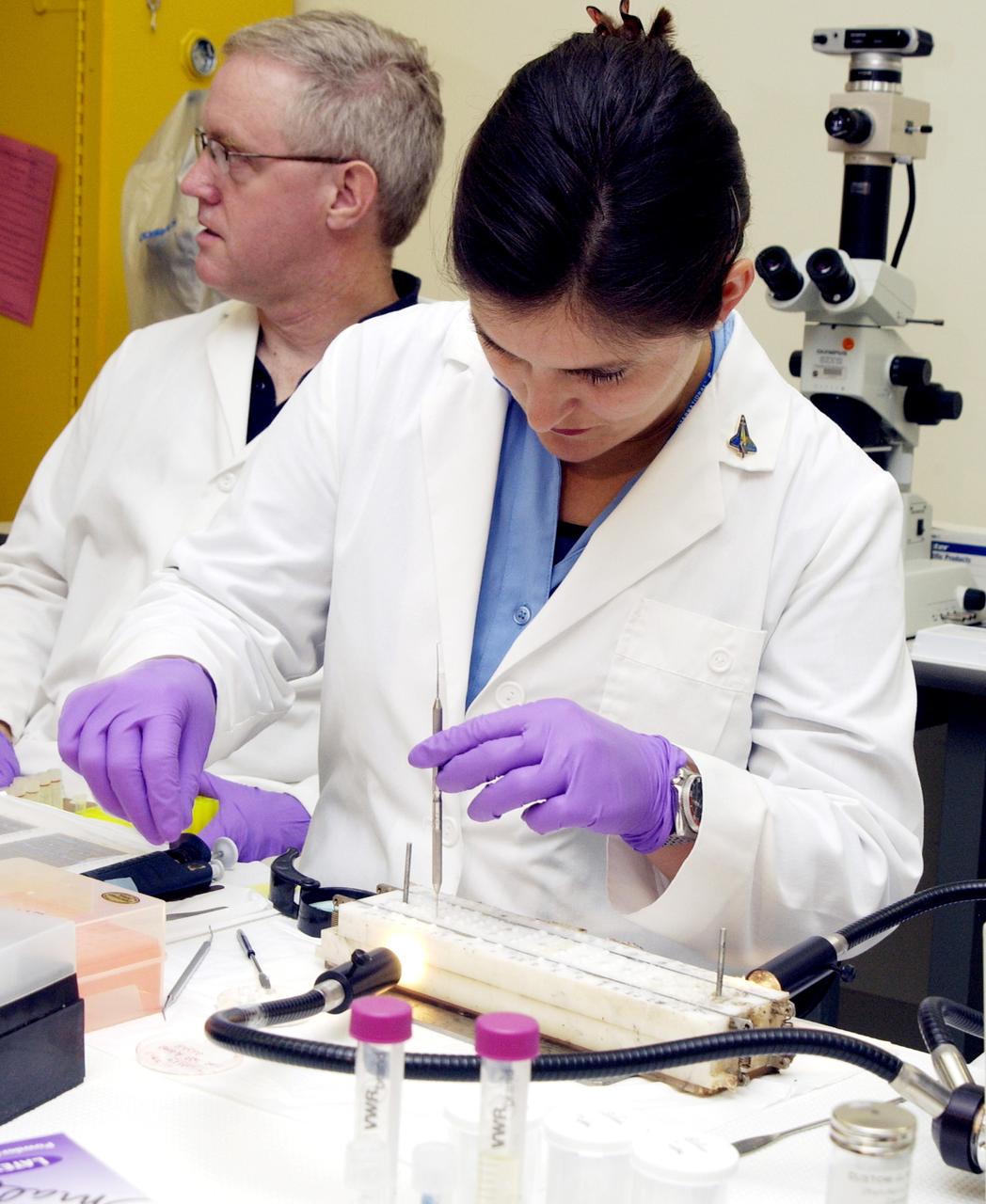
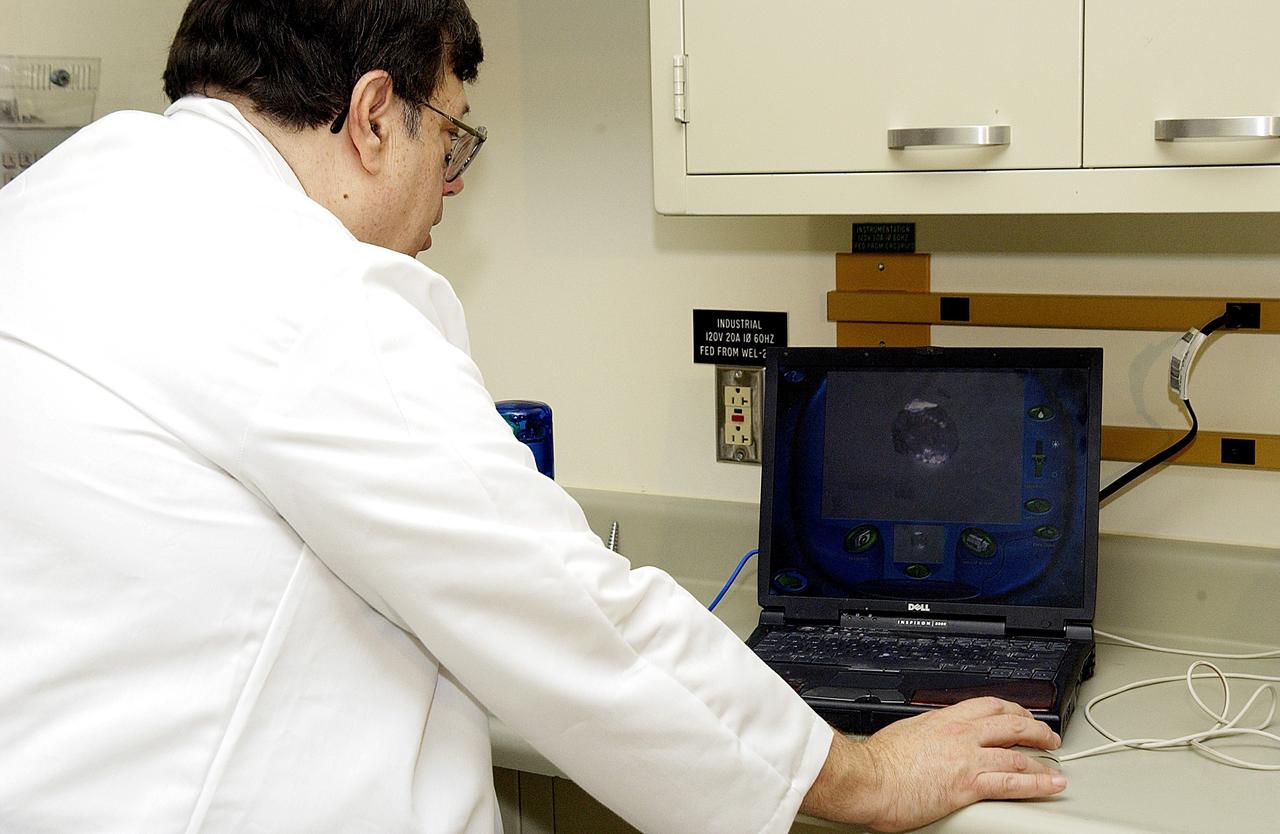
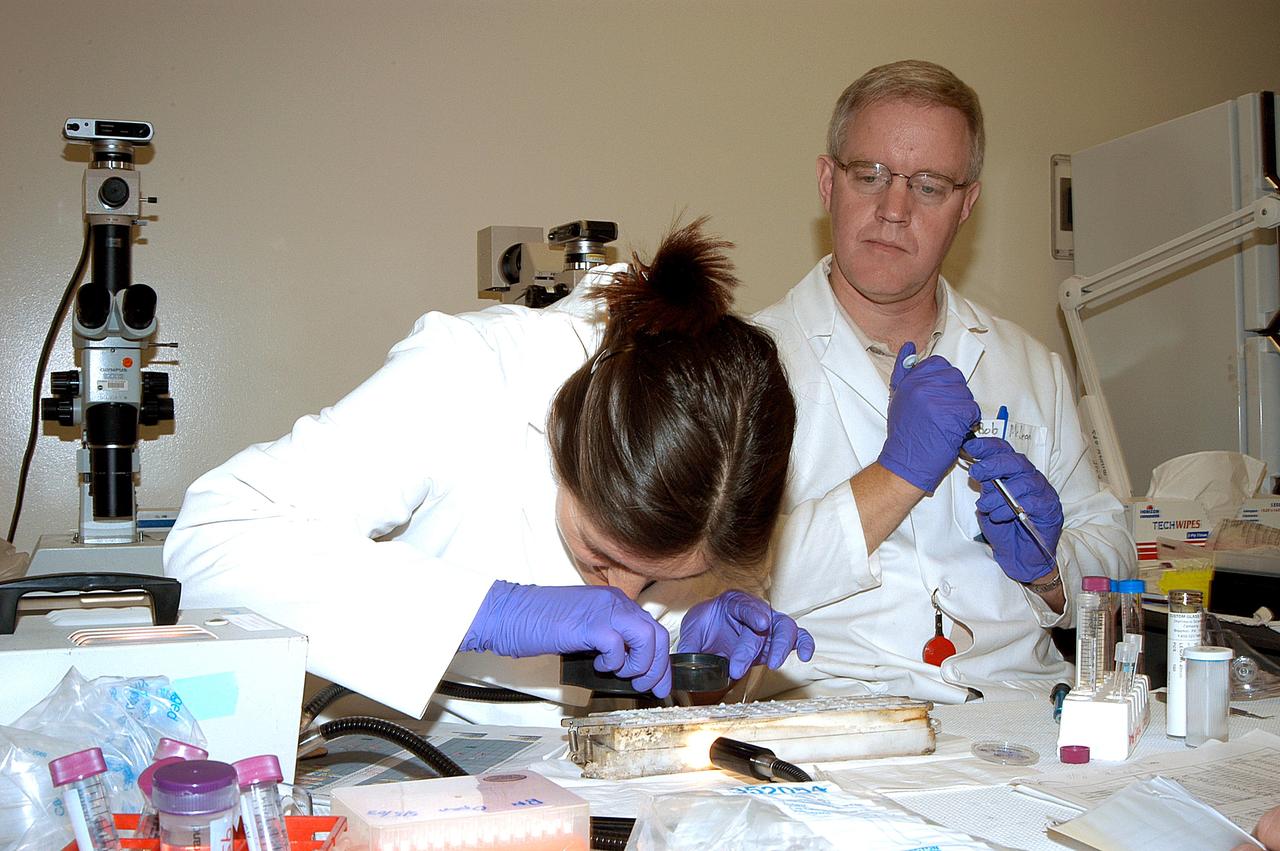
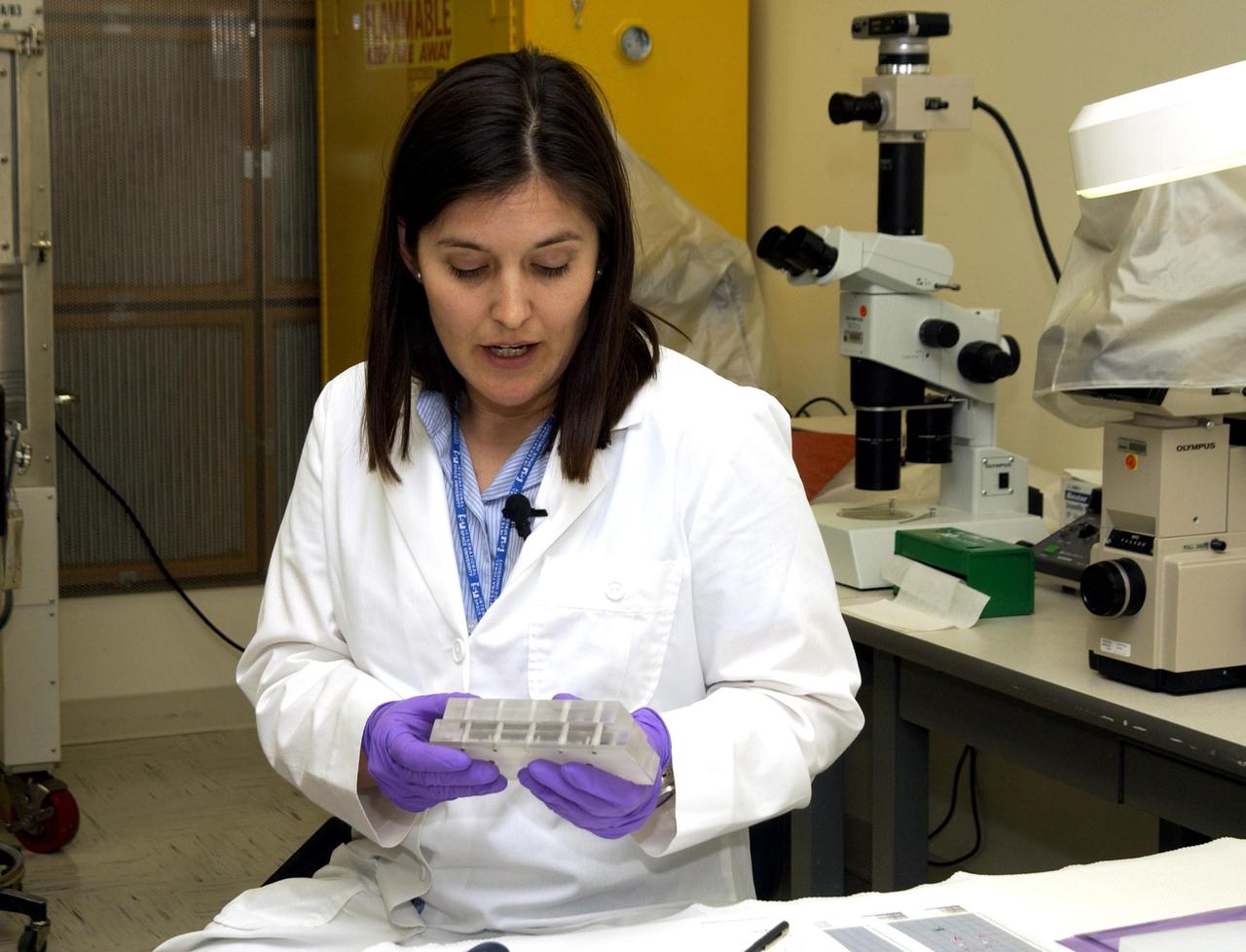
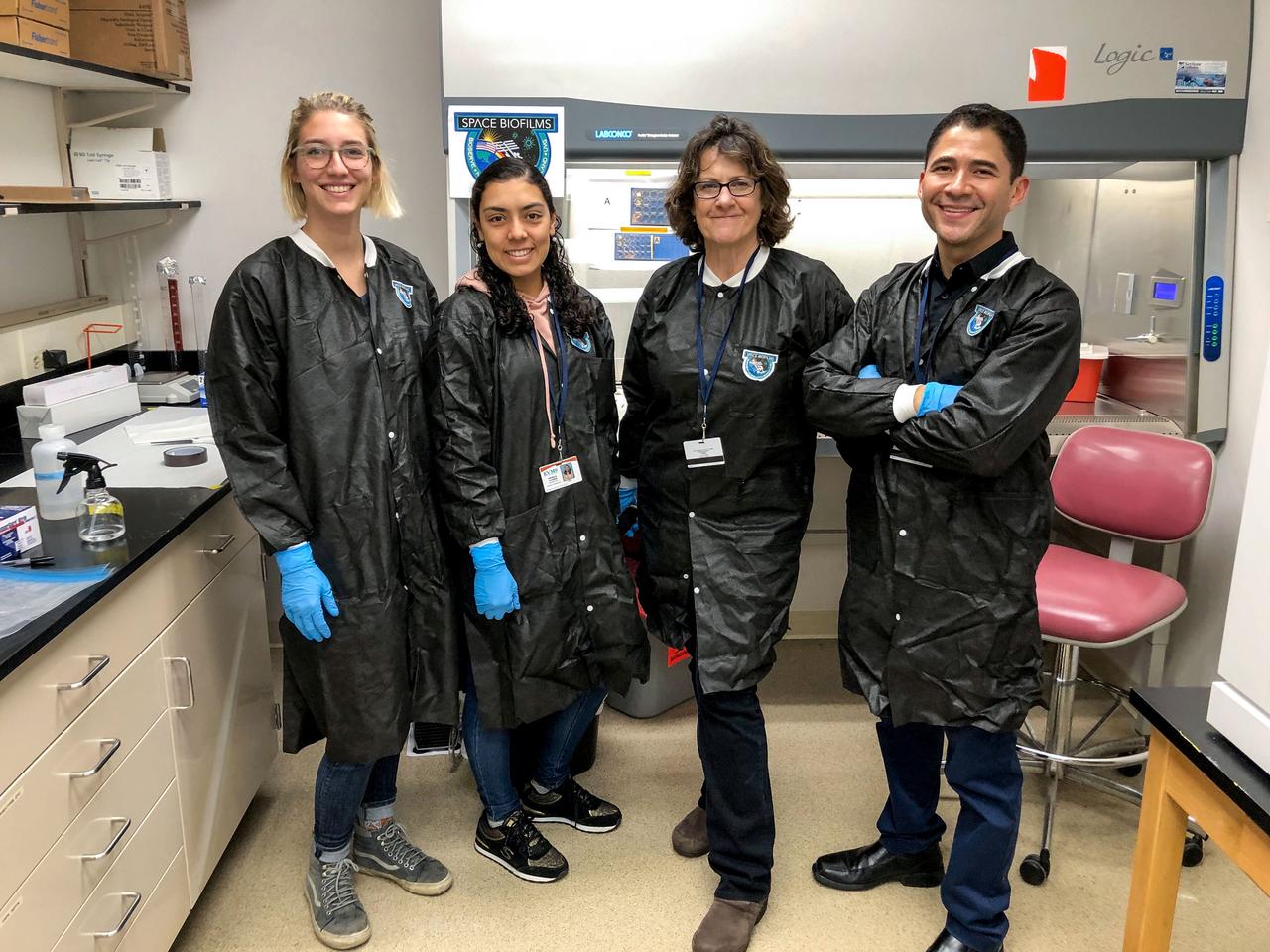
jsc2020e003402 (10/29/2019) --- The Space Bioflilms team, From left to right: University of Colorado, Boulder’s (CU) graduate students Rylee Schauer and Pamela Flores, Implementation Project Manager, BioServe’s Carla Hoehn, and the Principal Investigator, CU’s Luis Zea, Ph.D. The Characterization of Biofilm Formation, Growth, and Gene Expression on Different Materials and Environmental Conditions in Microgravity (Space Biofilms) investigation characterizes the mass, thickness, structure, and associated gene expression of biofilms that form in space by analyzing different microbial species grown on different materials. Biofilm formation can cause equipment malfunction and human illnesses, and could be a serious problem on future long-term human space missions.
Space Biofilms 1
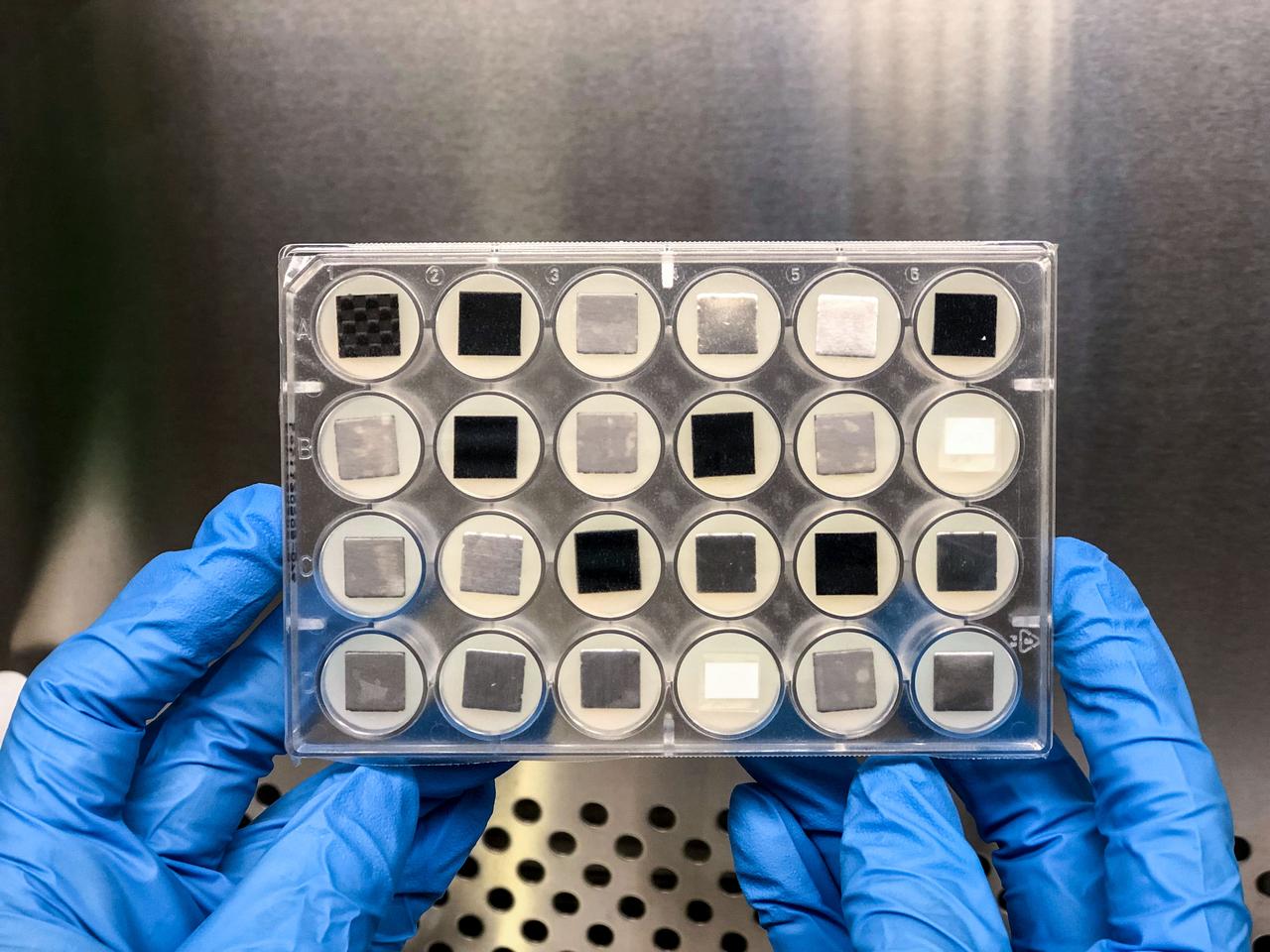
jsc2020e003406 (10/28/2019) --- A preflight view of a Commercial-off-the-shelf (COTS) 24-Well plate in fungal configuration. Each well contains a 1 cm2 coupon inoculated with fungal spores. Seven different materials were included for testing. The Characterization of Biofilm Formation, Growth, and Gene Expression on Different Materials and Environmental Conditions in Microgravity (Space Biofilms) investigation characterizes the mass, thickness, structure, and associated gene expression of biofilms that form in space by analyzing different microbial species grown on different materials. Biofilm formation can cause equipment malfunction and human illnesses, and could be a serious problem on future long-term human space missions.
Space Biofilms 1
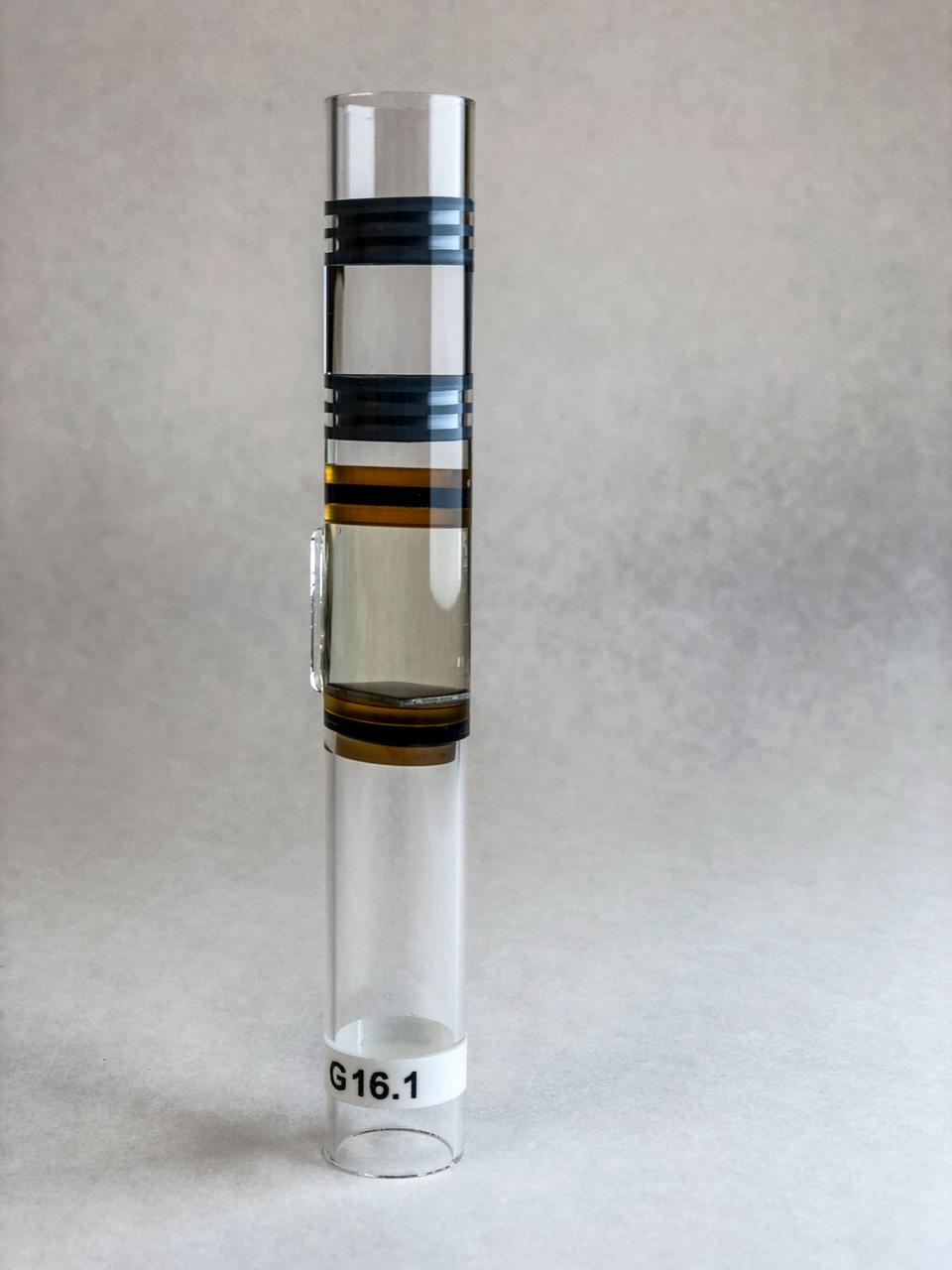
jsc2020e003405 (10/30/2019) --- A preflight view of BioServe’s Fluid Processing Apparatus (FPA) in a three-chamber configuration. From bottom to top: sterile growth medium and 1 cm2 material coupon, bacteria in stasis (inoculum), and fixative for controlled experiment termination. FPAs were used to house the bacterial component of this experiment, where six different materials were tested. The Characterization of Biofilm Formation, Growth, and Gene Expression on Different Materials and Environmental Conditions in Microgravity (Space Biofilms) investigation characterizes the mass, thickness, structure, and associated gene expression of biofilms that form in space by analyzing different microbial species grown on different materials. Biofilm formation can cause equipment malfunction and human illnesses, and could be a serious problem on future long-term human space missions.
Space Biofilms 1
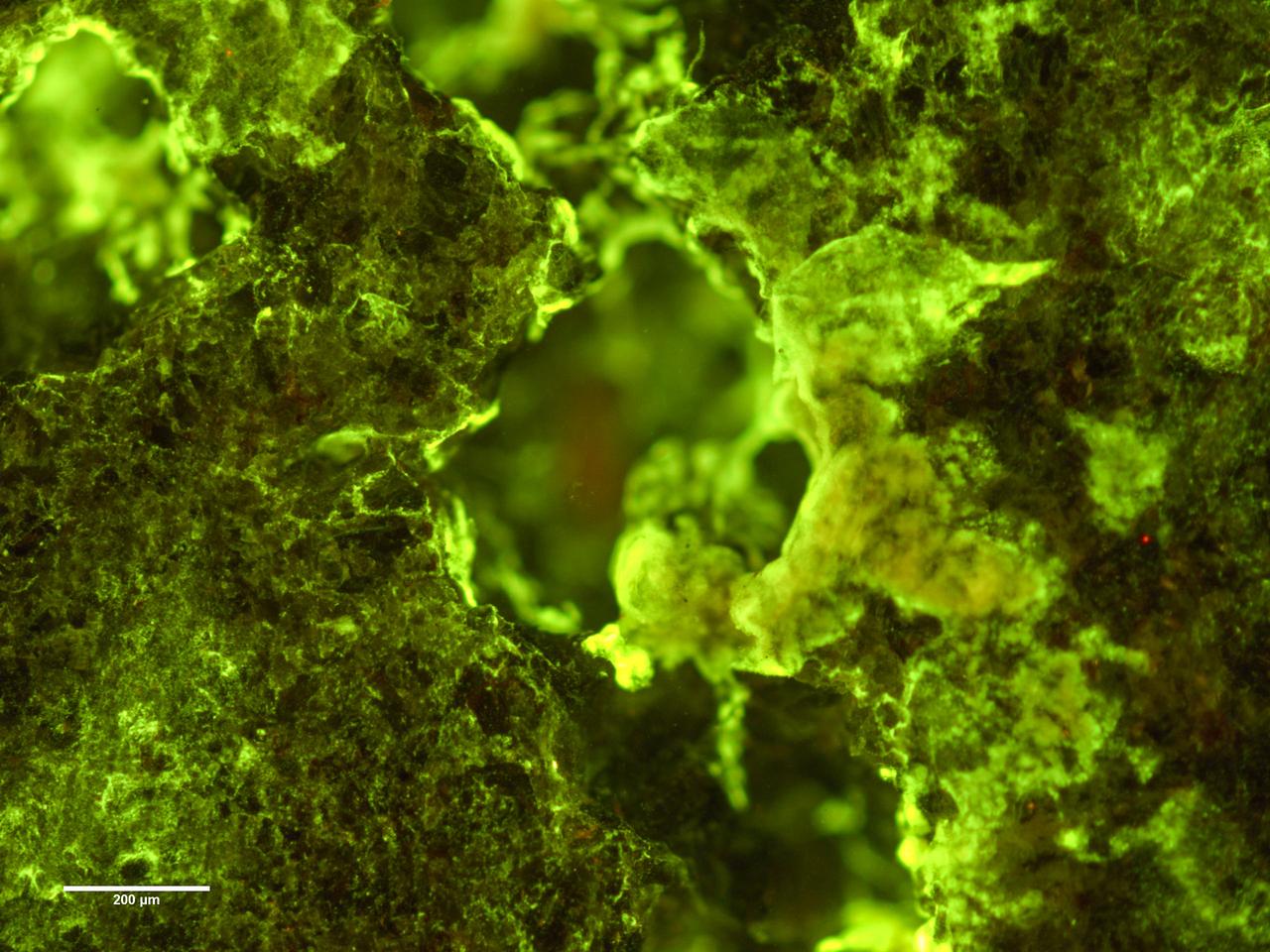
jsc2019e039825 (7/16/2019) --- Preflight Ffuorescence microscopy image of biofilm of Spingomonas desiccabilis growing over and into the surface of a basalt slide as part of BioRock experiment. Organisms are stained with DNA binding sye Sybr Gold. Growth can be seen into the rock cavities. The purpose of the Biorock investigation is to examine the effects of altered gravity on the rock/microbe/liquid system as a whole. (Image Courtesy of: ESA)
Microscopic image of biofilm on rock in BioRock experiment
jsc2023e010175 (2/28/2023) --- This image shows a monospecies biofilm through the view of a scanning electron microscope. The image was colored to visualize the bacterial cells (orange) embedded in the biofilm matrix (blue). The biofilm was formed by a strain of the bacterial species Staphylococcus capitis that was isolated from the International Space Station. The ESA-Biofilms investigation studies bacterial biofilm formation and antimicrobial properties of different metal surfaces under spaceflight conditions in altered gravity. The image was taken as part of the preflight experiments for ESA-Biofilms together with the Robert Koch Institute in Berlin, Germany. Image courtesy of DLR, CC BY-NC-ND 3.0.
jsc2023e010175
jsc2025e007251 (2/14/2025) --- Biofilm testing is shown in the early stages of the Polaris Bioremediation Science Experiment - Genetic Exchange in Microgravity for Biofilm Bioremediation (GEM-B2) project.
jsc2025e007251
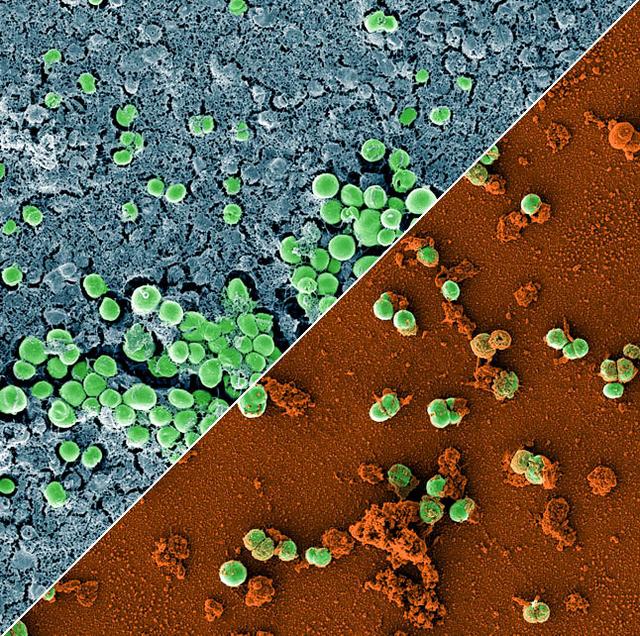
jsc2023e010179 (2/28/2023) --- This image is a composition of two scanning electron microscopic images of the bacterium Staphylococcus capitis on stainless steel versus antimicrobial copper. The image was colored to visualize the bacterial cells (green) either embedded in a biofilm matrix (blue), or covered with copper particles (red/orange). The ESA-Biofilms investigation studies bacterial biofilm formation and antimicrobial properties of different metal surfaces under spaceflight conditions in altered gravity. Both images were taken as part of the preflight experiments for ESA-Biofilms. Image courtesy of DLR, CC BY-NC-ND 3.0.
jsc2023e010179
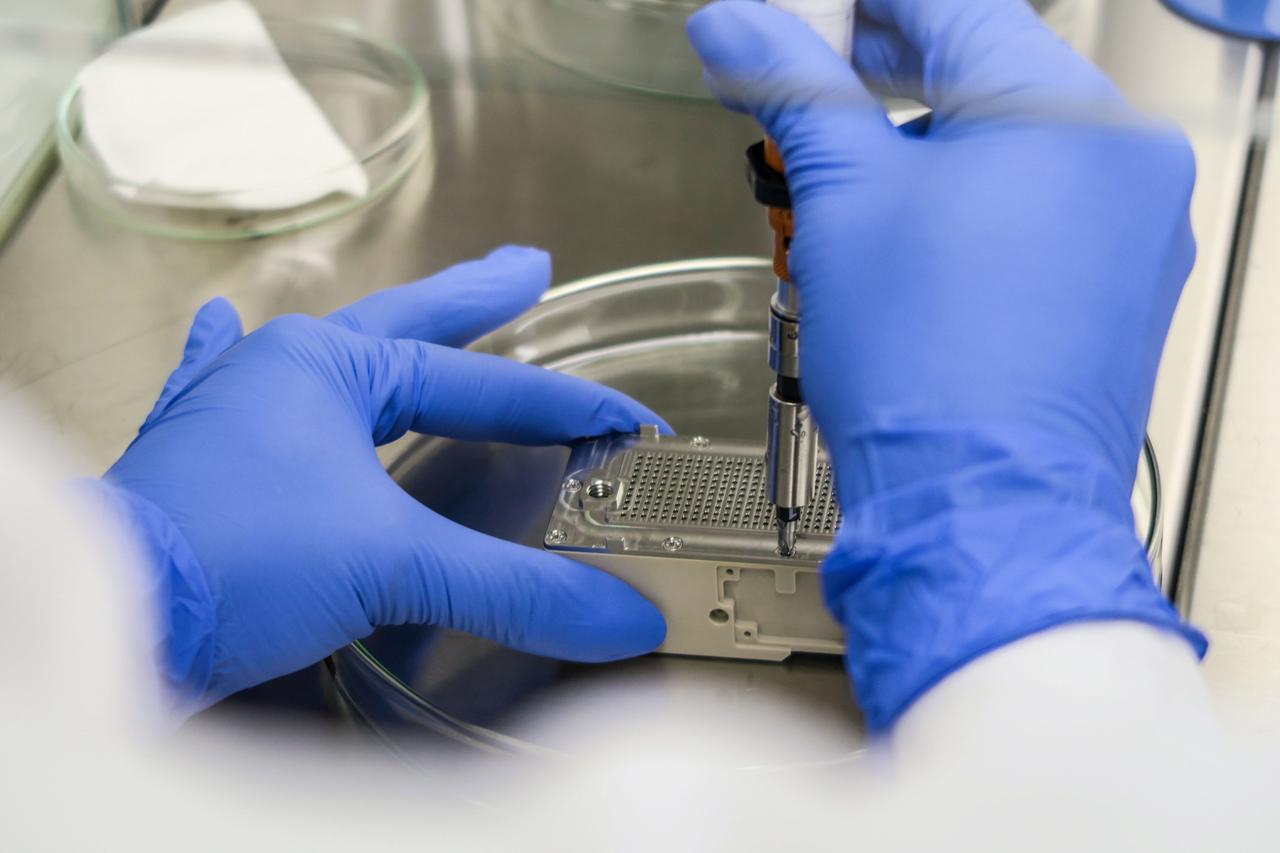
jsc2023e010176 (8/21/2021) --- This image shows the final step of assembling the ESA-Biofilms experiment unit. Inside the experiment unit, growth of the bacterial model organisms is supported under controlled conditions on different antimicrobial surfaces. The ESA-Biofilms investigation studies bacterial biofilm formation and antimicrobial properties of different metal surfaces under spaceflight conditions in altered gravity. Image courtesy of DLR, CC BY-NC-ND 3.0.
jsc2023e010176
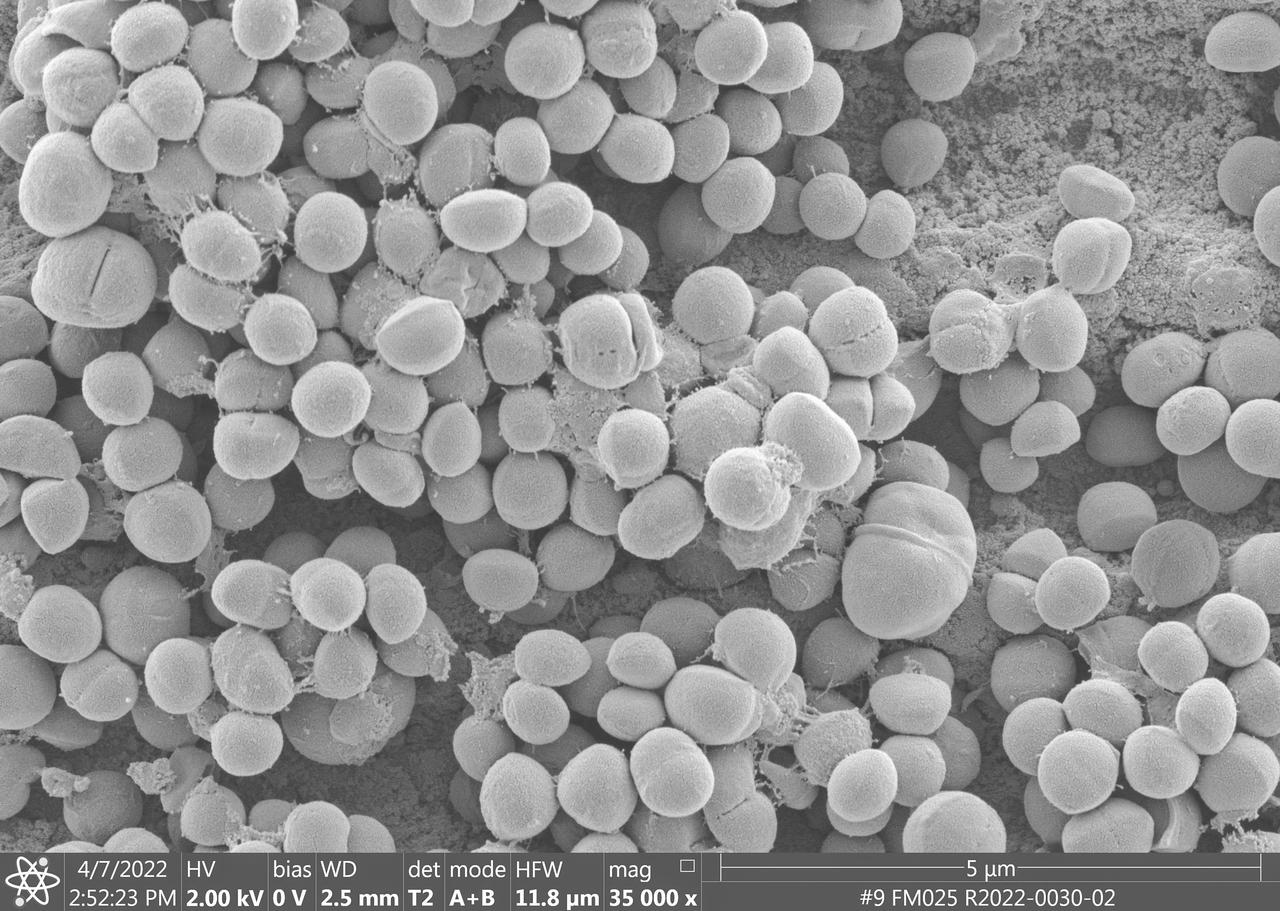
jsc2023e010178 (4/7/2022) --- This image taken by a scanning electron microscope shows one of the ESA-Biofilms sample plates from its first launch to the International Space Station. The sample plate in this image is made of stainless steel, which is the reference surface in the experiment since it has no antimicrobial properties. This surface also has a 3 µm laser structure engraved to the surface as control. In contrast to the copper surface, there are many Staphylococcus capitis cells attached to the steel surface that are actively dividing and starting to from components of a biofilm matrix. The ESA-Biofilms investigation studies bacterial biofilm formation and antimicrobial properties of different metal surfaces under spaceflight conditions in altered gravity. Image courtesy of DLR, CC BY-NC-ND 3.0.
jsc2023e010178
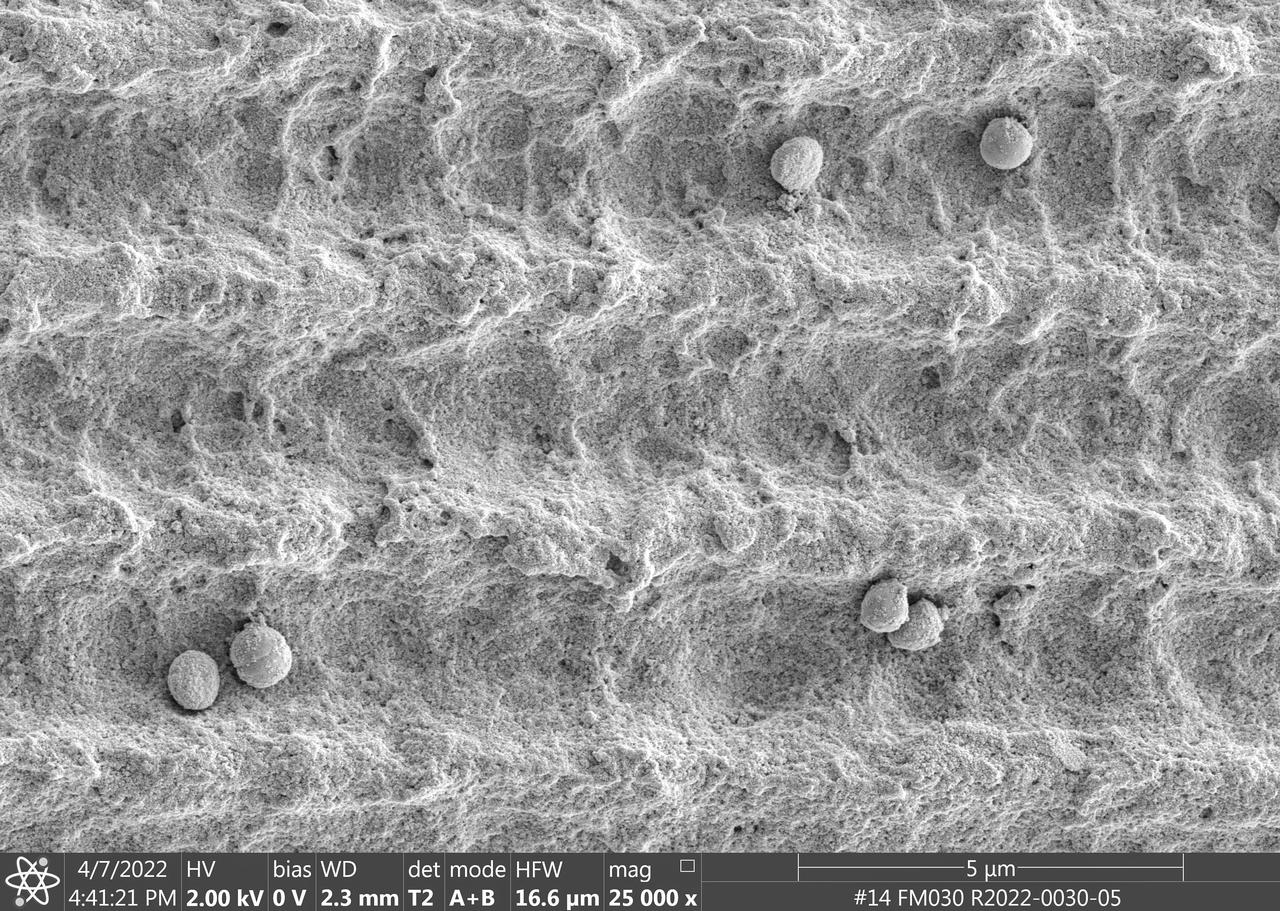
jsc2023e010177 (4/7/2022) --- This image is a scanning electron microscopic image of one of the ESA-Biofilms sample plates from the first launch to the ISS. The sample plate in this image is made of copper, which naturally has antimicrobial properties. This surface has a 3 µm laser structure engraved to the surface which improves antimicrobial efficacy. On the surface, only few cells of the bacterial species Staphylococcus capitis are attached. The cells appear small and are not actively dividing. The ESA-Biofilms investigation studies bacterial biofilm formation and antimicrobial properties of different metal surfaces under spaceflight conditions in altered gravity. Image courtesy of DLR, CC BY-NC-ND 3.0.
jsc2023e010177
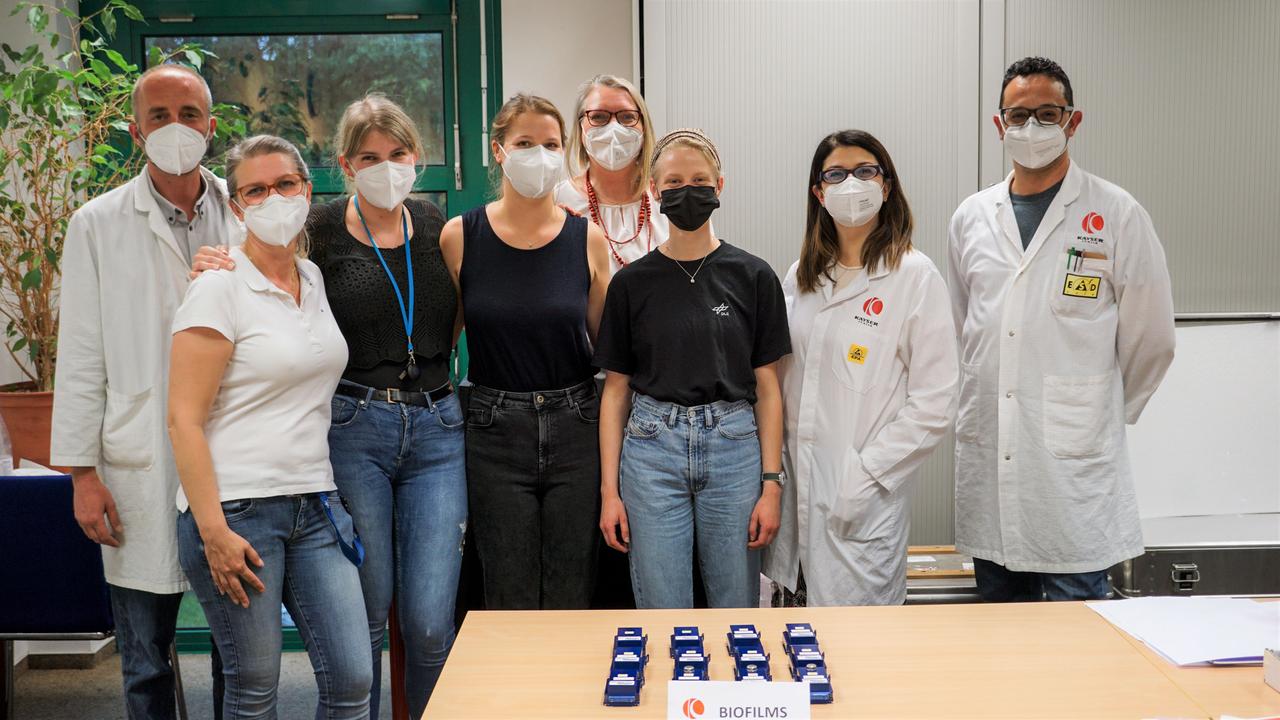
jsc2023e010180 (5/20/2022) --- This is a group picture of the DLR, ESA, and Kayser Italia teams after successful integration of the ESA-Biofilms experiment for its second launch in 2022. The assembled hardware is in the front on the table. The blue experiment containers were later integrated by ESA astronaut Samantha Cristoforetti into the two KUBIK incubators inside the Columbus laboratory aboard the International Space Station. The ESA-Biofilms investigation studies bacterial biofilm formation and antimicrobial properties of different metal surfaces under spaceflight conditions in altered gravity. Image courtesy of DLR, CC BY-NC-ND 3.0.
jsc2023e010180
jsc2026e034369 (April 28, 2026) --- Image of RubyRed staining of Staphylococcus aureus biofilm obtained with a confocal 3D microscope during preflight testing of ODYSSEY, an investigation that evaluates biofilm formation and exchange of genetic material among two species of bacteria in spaceflight and in simulated microgravity chambers on the ground. Comparing the results between these sample groups could help researchers determine whether Earth-based simulators can be considered as proxies for spaceflight research and get a better understanding of the mechanisms behind biofilm formation and exchange of genetic material when exposed to space-like conditions. Credit: JPL-Caltech.
jsc2026e034369
jsc2026e034370 (April 28, 2026) --- Preflight image of Syto9 staining of Staphylococcus aureus biofilm as part of ODYSSEY, an investigation that evaluates biofilm formation and exchange of genetic material among two species of bacteria in spaceflight and in simulated microgravity chambers on the ground. Comparing the results between these sample groups could help researchers determine whether Earth-based simulators can be considered as proxies for spaceflight research and get a better understanding of the mechanisms behind biofilm formation and exchange of genetic material when exposed to space-like conditions. Credit: JPL-Caltech.
jsc2026e034370
KENNEDY SPACE CENTER, FLA. -   Valerie Cassanto is one of the scientists recovering experiments found during the search for Columbia debris.  Included in the Commercial ITA Biomedical Experiments payload on mission STS-107 are urokinase cancer research, microencapsulation of drugs, the Growth of Bacterial Biofilm on Surfaces during Spaceflight (GOBBSS), and tin crystal formation.
KENNEDY SPACE CENTER, FLA. - Valerie Cassanto is one of the scientists recovering experiments found during the search for Columbia debris. Included in the Commercial ITA Biomedical Experiments payload on mission STS-107 are urokinase cancer research, microencapsulation of drugs, the Growth of Bacterial Biofilm on Surfaces during Spaceflight (GOBBSS), and tin crystal formation.
 jsc2025e007250 (2/14/2025) --- Early plasmid research in the Biofilm lab at the NASA Marshall Space Flight Center (MSFC).
jsc2025e007250
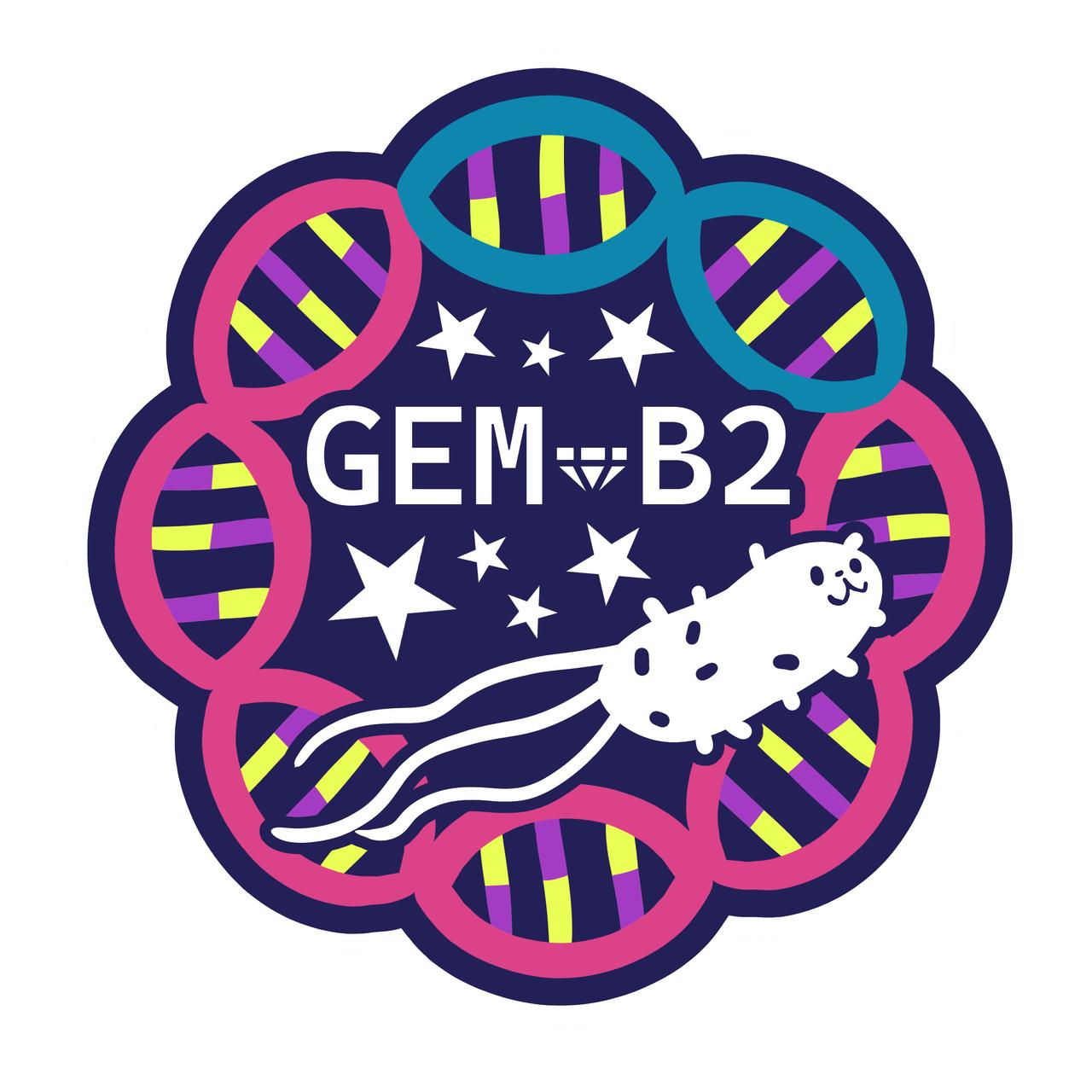
 jsc2025e007253 (2/14/2025) --- The logo for Polaris Bioremediation Science Experiment - Genetic Exchange in Microgravity for Biofilm Bioremediation (GEM-B2).
jsc2025e007253
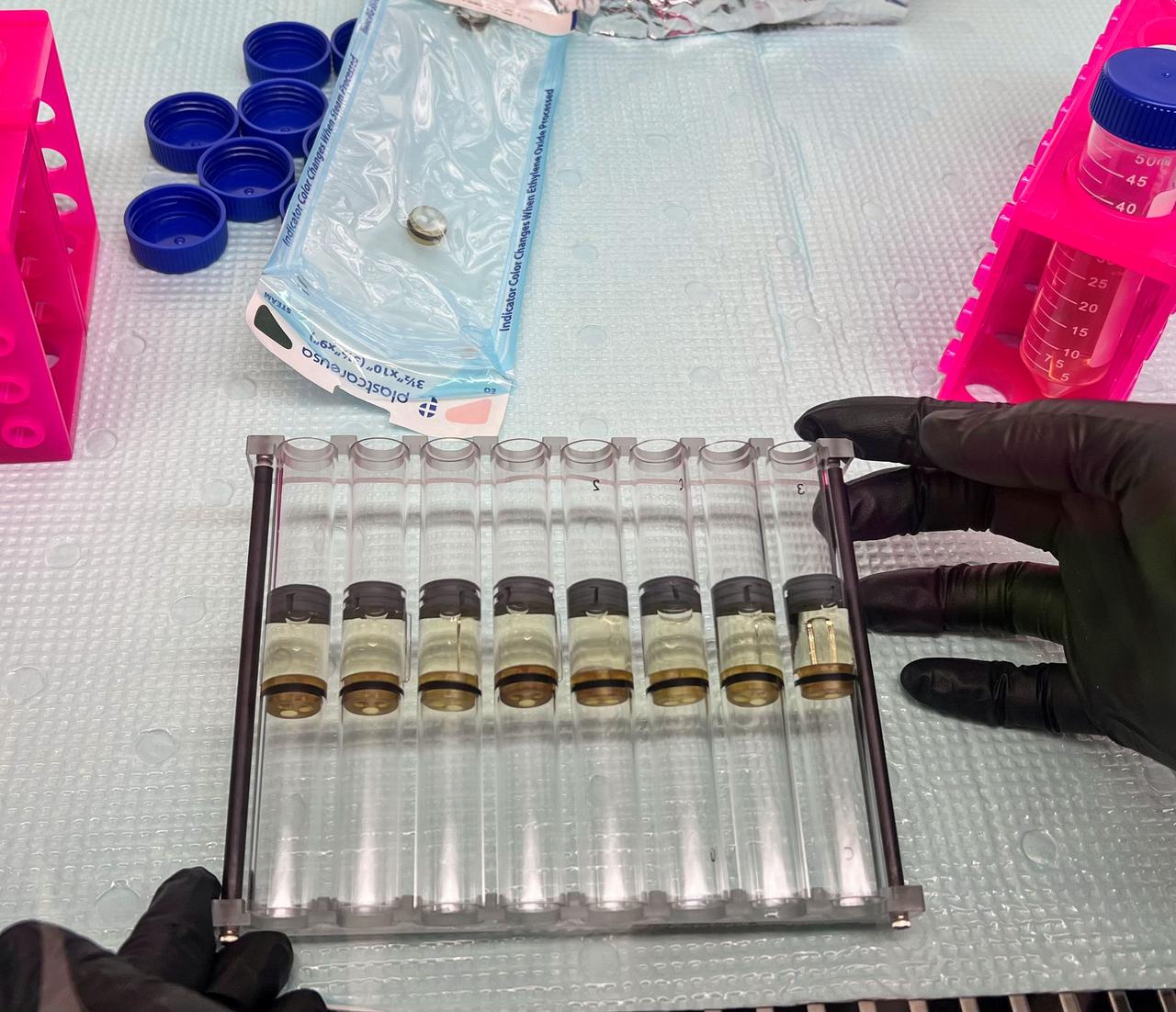
jsc2025e007256 (2/14/2025) --- Another view of the eight Fluid Processing Apparatus (FPAs) used in the Polaris Bioremediation Science Experiment - Genetic Exchange in Microgravity for Biofilm Bioremediation (GEM-B2) investigation. Image courtesy of BioServe.
jsc2025e007256
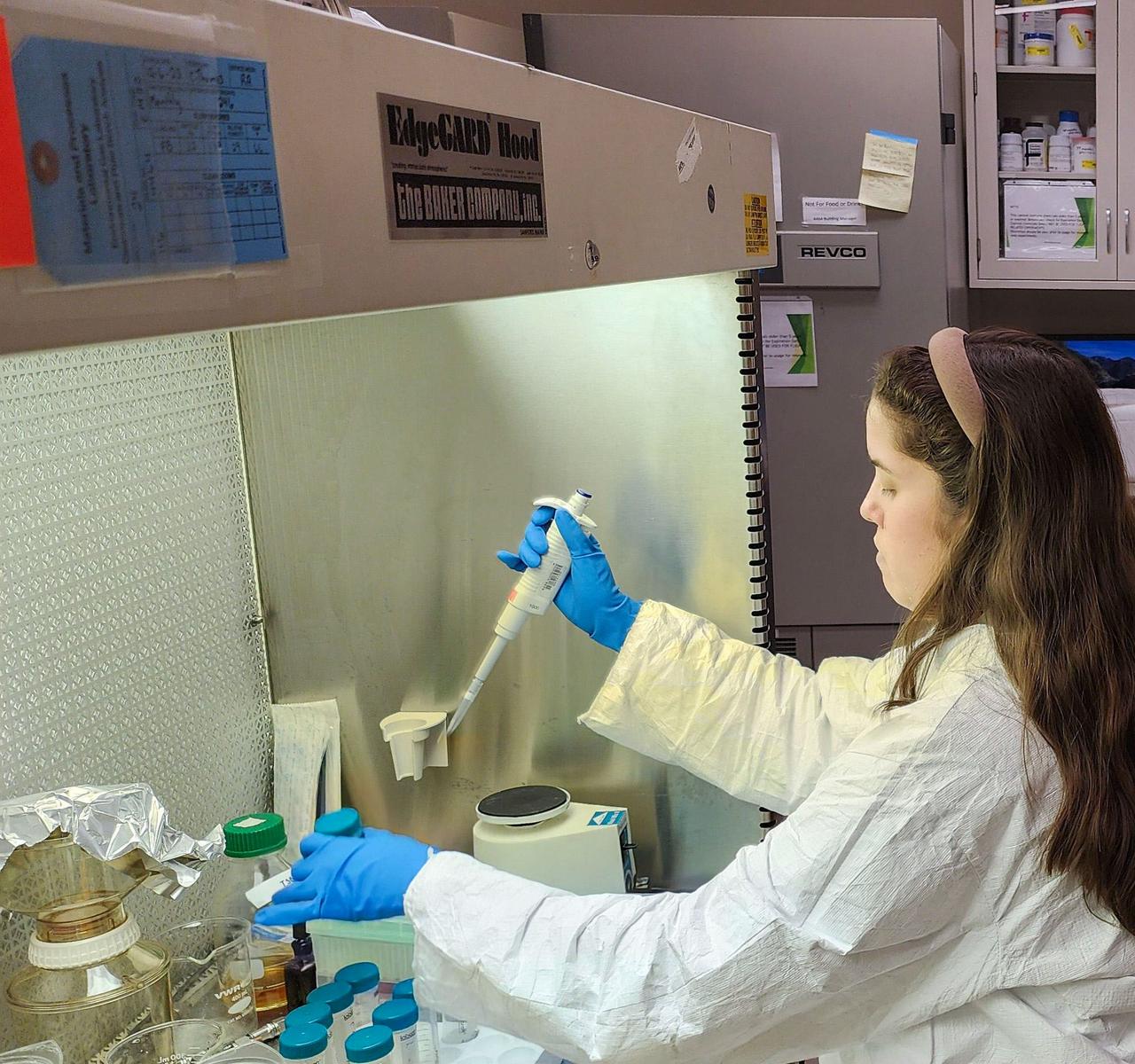
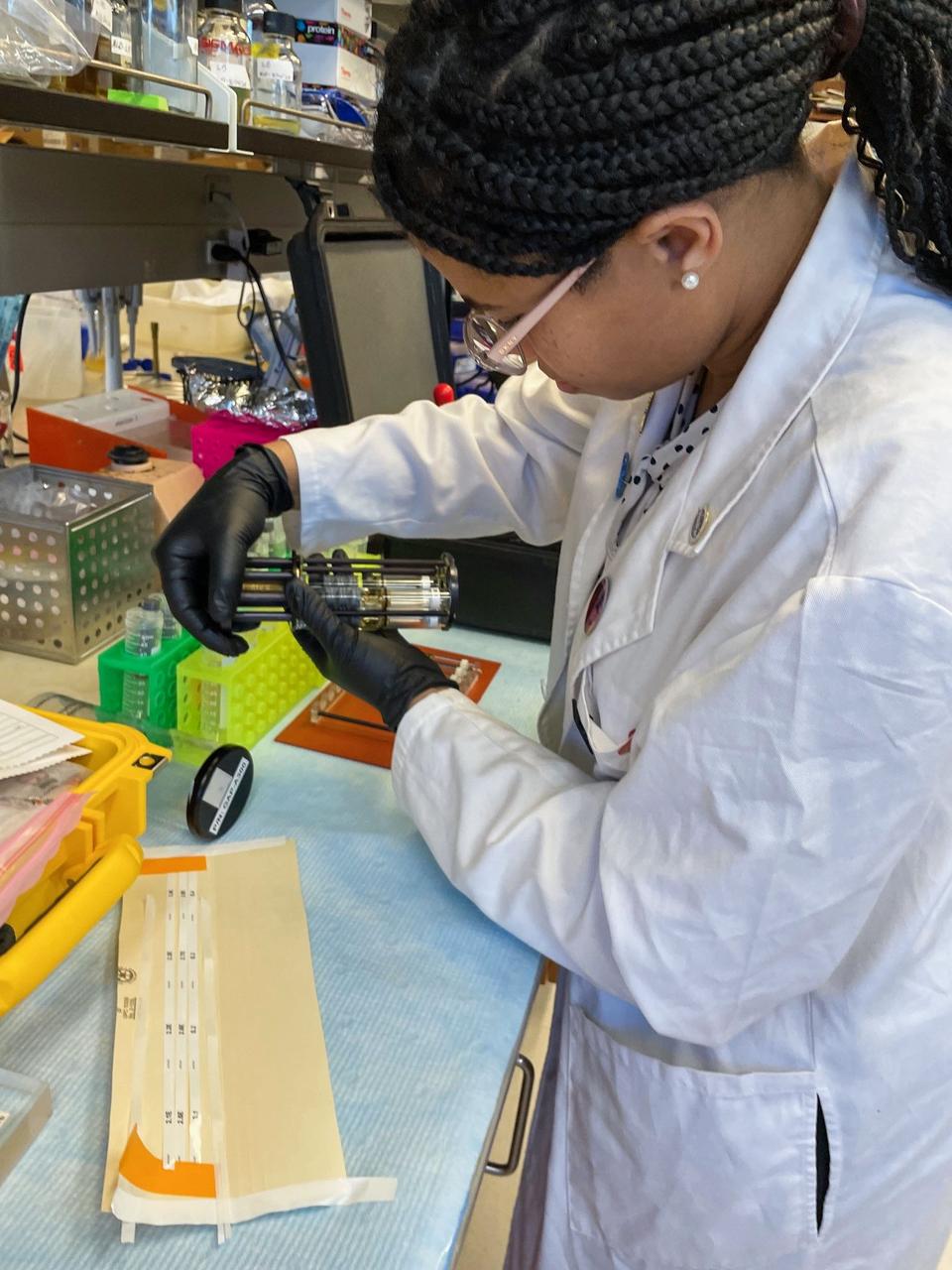
jsc2025e007254 (2/14/2025) --- Graduate student Lanie Briggs loads a Group Activation Pack (GAP) for the Polaris Bioremediation Science Experiment - Genetic Exchange in Microgravity for Biofilm Bioremediation (GEM-B2).
jsc2025e007254
jsc2025e007257 (2/14/2025) --- A view of the Fluid Processing Apparatus (FPAs) used in the Polaris Bioremediation Science Experiment - Genetic Exchange in Microgravity for Biofilm Bioremediation (GEM-B2) investigation. Image courtesy of BioServe.
jsc2025e007257
jsc2025e007252 (2/14/2025) --- Dr. Yo-Ann Velez performs microscopy in support of Polaris Bioremediation Science Experiment - Genetic Exchange in Microgravity for Biofilm Bioremediation (GEM-B2).
jsc2025e007252
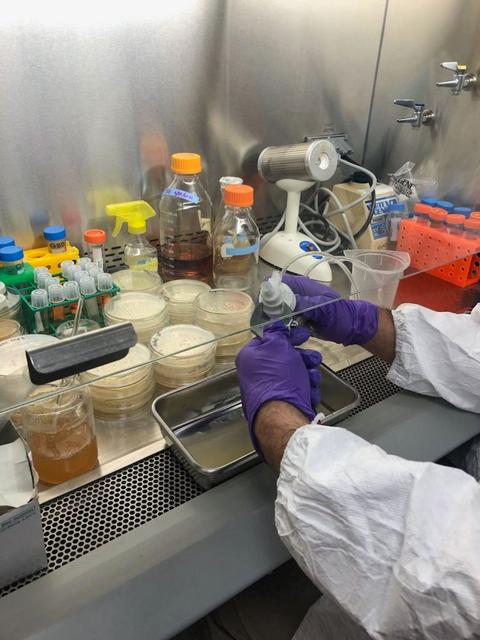
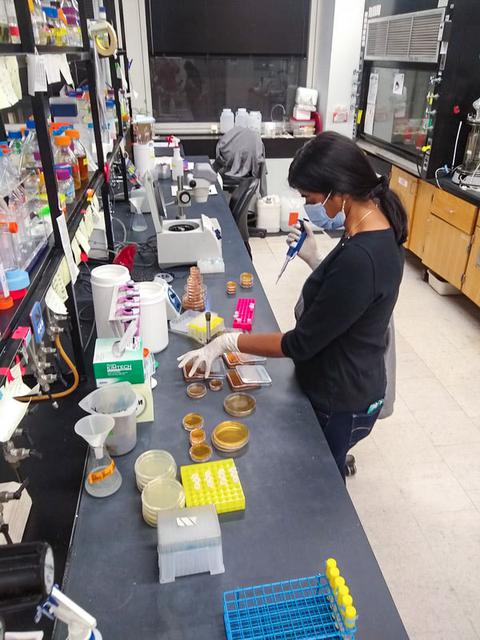
jsc2026e034367 (April 28, 2026) --- Image of Staphylococcus colonies grown on agar in preparation for ground testing as part of ODYSSEY, an investigation that evaluates biofilm formation and exchange of genetic material among two species of bacteria in spaceflight and in simulated microgravity chambers on the ground. Comparing the results between these sample groups could help researchers determine whether Earth-based simulators can be considered as proxies for spaceflight research and get a better understanding of the mechanisms behind biofilm formation and exchange of genetic material when exposed to space-like conditions. Credit: JPL-Caltech.
jsc2026e034367
KENNEDY SPACE CENTER, FLA. -  Dr. Dennis Morrison, NASA Johnson Space Center, processes one of the experiments carried on mission STS-107. Several experiments were found during the search for Columbia debris. Included in the Commercial ITA Biomedical Experiments payload on mission STS-107 are urokinase cancer research, microencapsulation of drugs, the Growth of Bacterial Biofilm on Surfaces during Spaceflight (GOBBSS), and tin crystal formation.
KENNEDY SPACE CENTER, FLA. - Dr. Dennis Morrison, NASA Johnson Space Center, processes one of the experiments carried on mission STS-107. Several experiments were found during the search for Columbia debris. Included in the Commercial ITA Biomedical Experiments payload on mission STS-107 are urokinase cancer research, microencapsulation of drugs, the Growth of Bacterial Biofilm on Surfaces during Spaceflight (GOBBSS), and tin crystal formation.
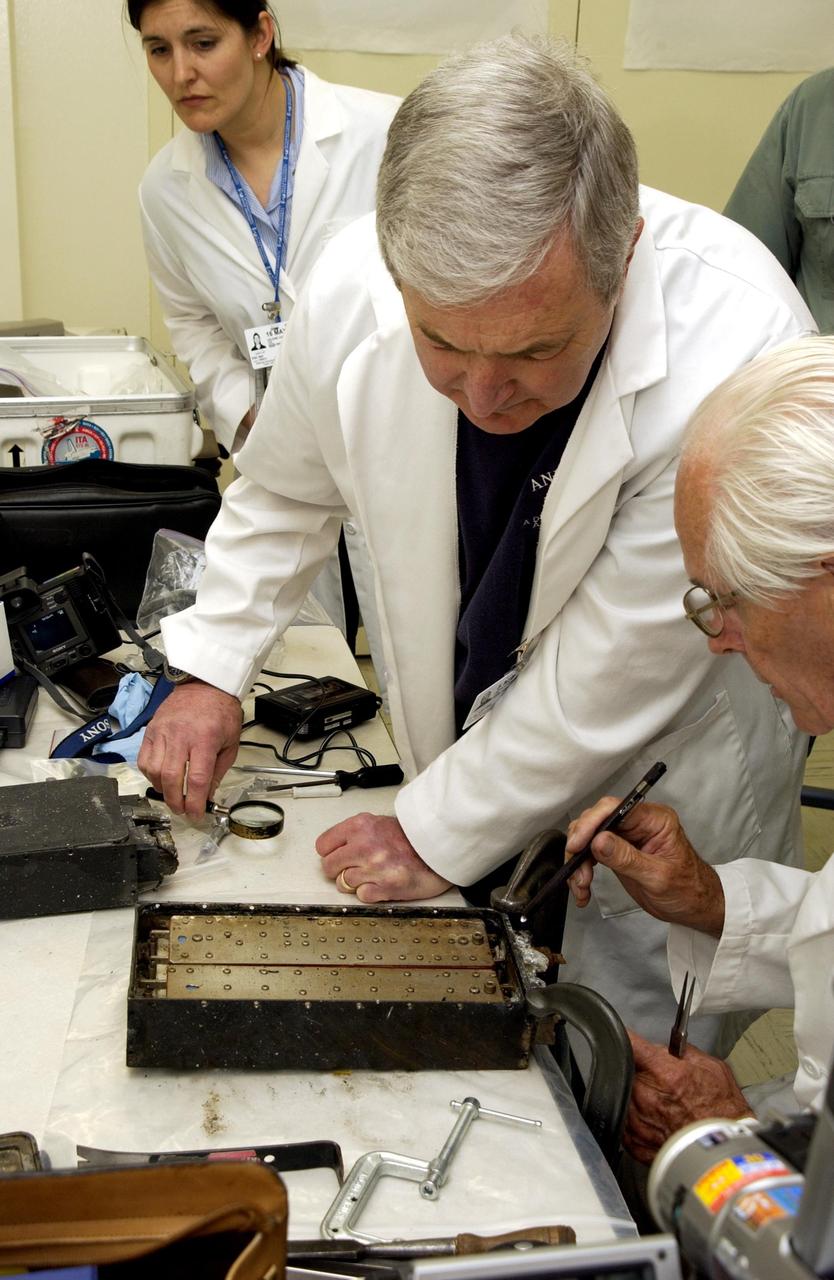
KENNEDY SPACE CENTER, FLA. - Valerie Cassanto, with Instrumentation Technology Associates, Inc., examines closely the container containing one of the experiments carried on mission STS-107.  Several experiments were found during the search for Columbia debris.  Included in the Commercial ITA Biomedical Experiments payload on mission STS-107 are urokinase cancer research, microencapsulation of drugs, the Growth of Bacterial Biofilm on Surfaces during Spaceflight (GOBBSS), and tin crystal formation.
KENNEDY SPACE CENTER, FLA. - Valerie Cassanto, with Instrumentation Technology Associates, Inc., examines closely the container containing one of the experiments carried on mission STS-107. Several experiments were found during the search for Columbia debris. Included in the Commercial ITA Biomedical Experiments payload on mission STS-107 are urokinase cancer research, microencapsulation of drugs, the Growth of Bacterial Biofilm on Surfaces during Spaceflight (GOBBSS), and tin crystal formation.
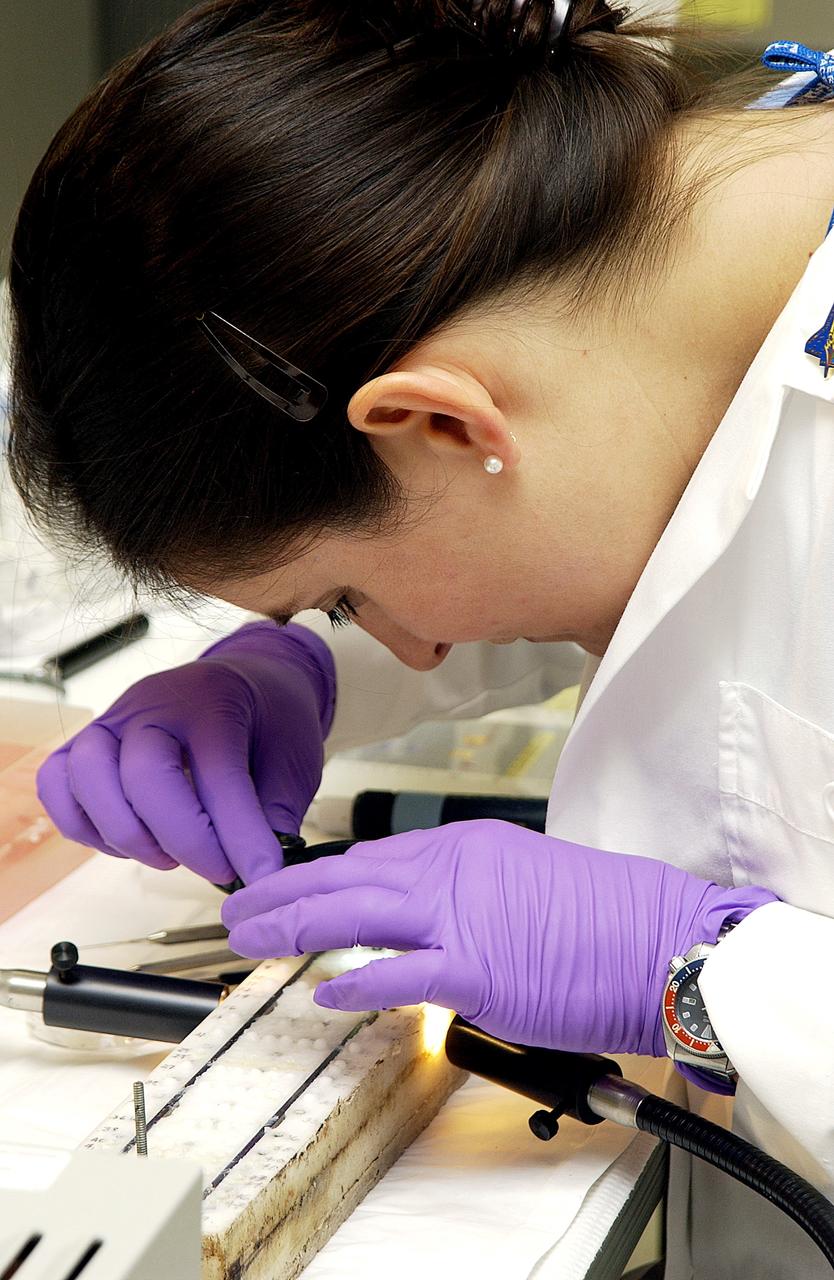
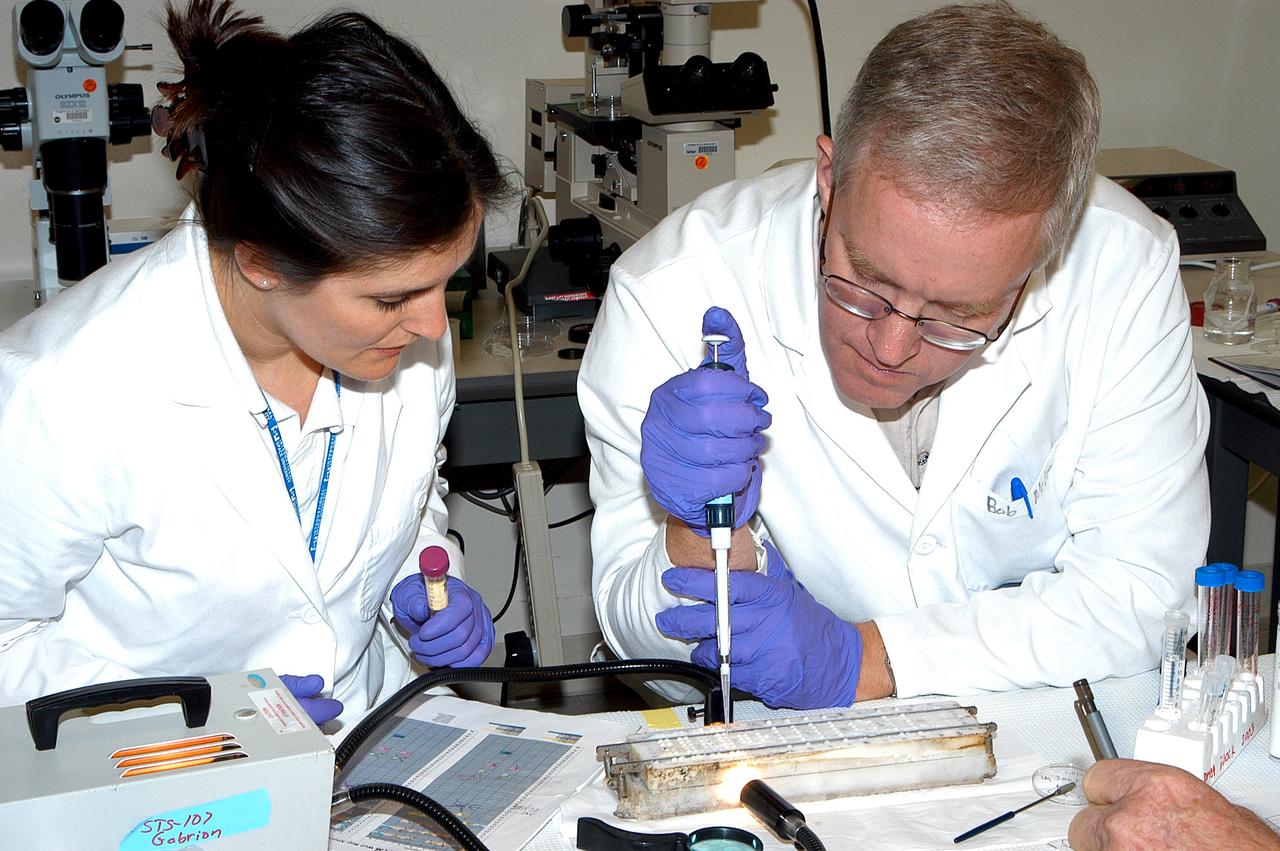
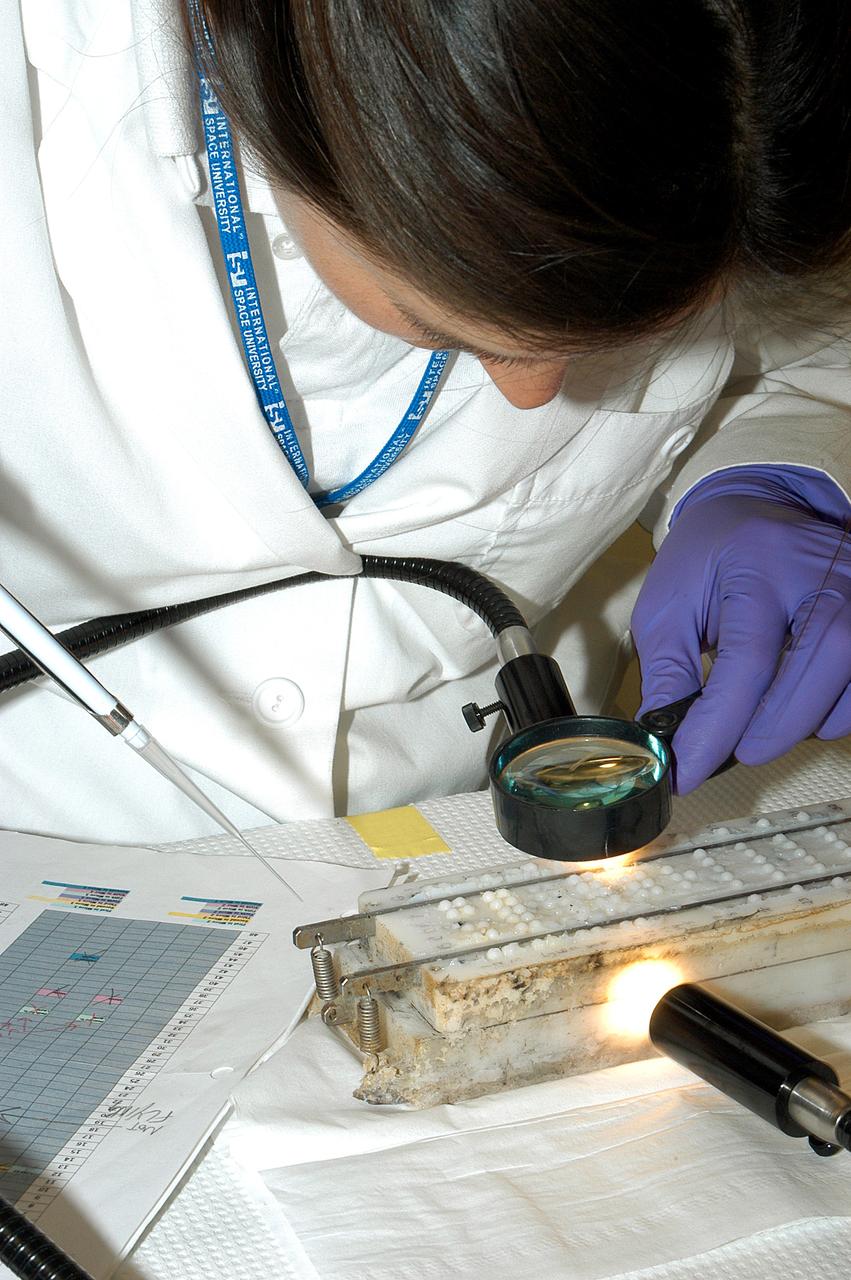
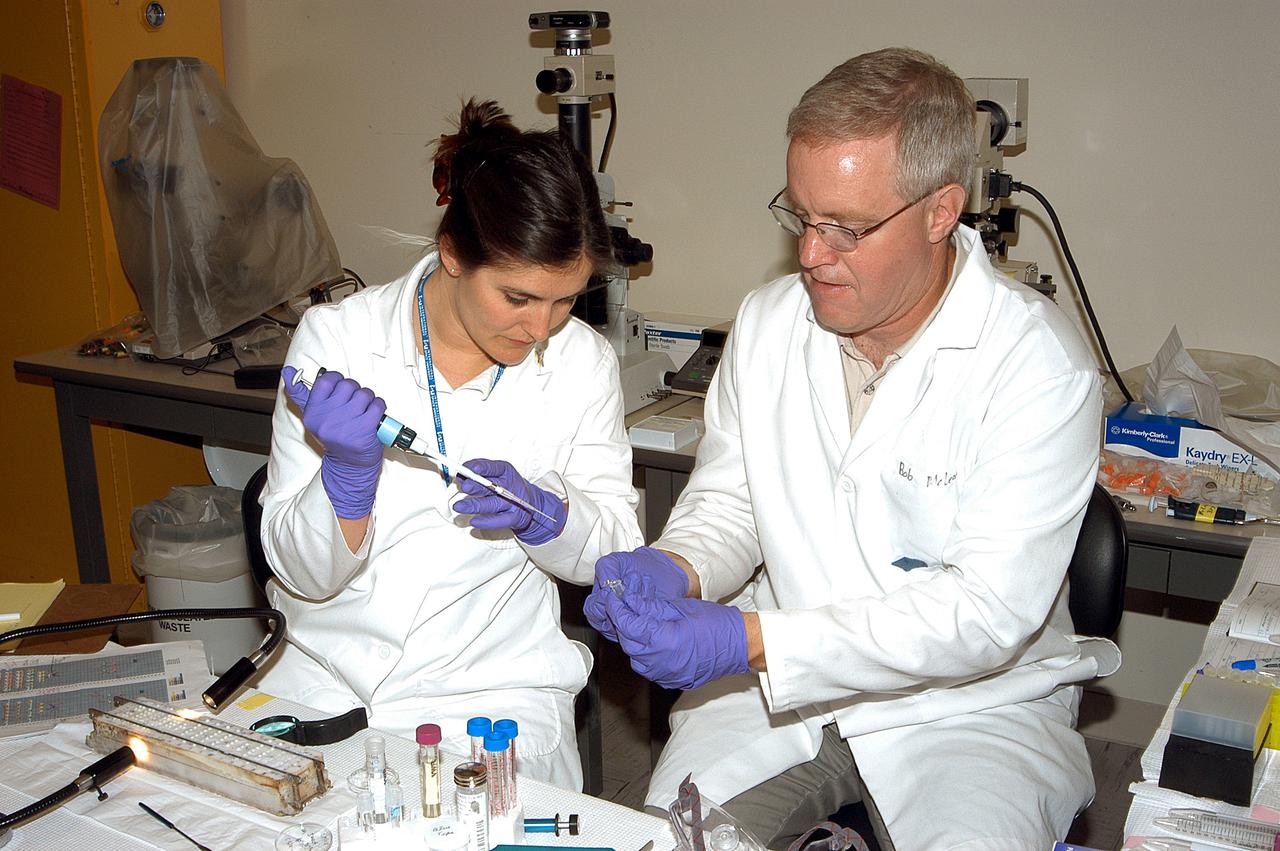
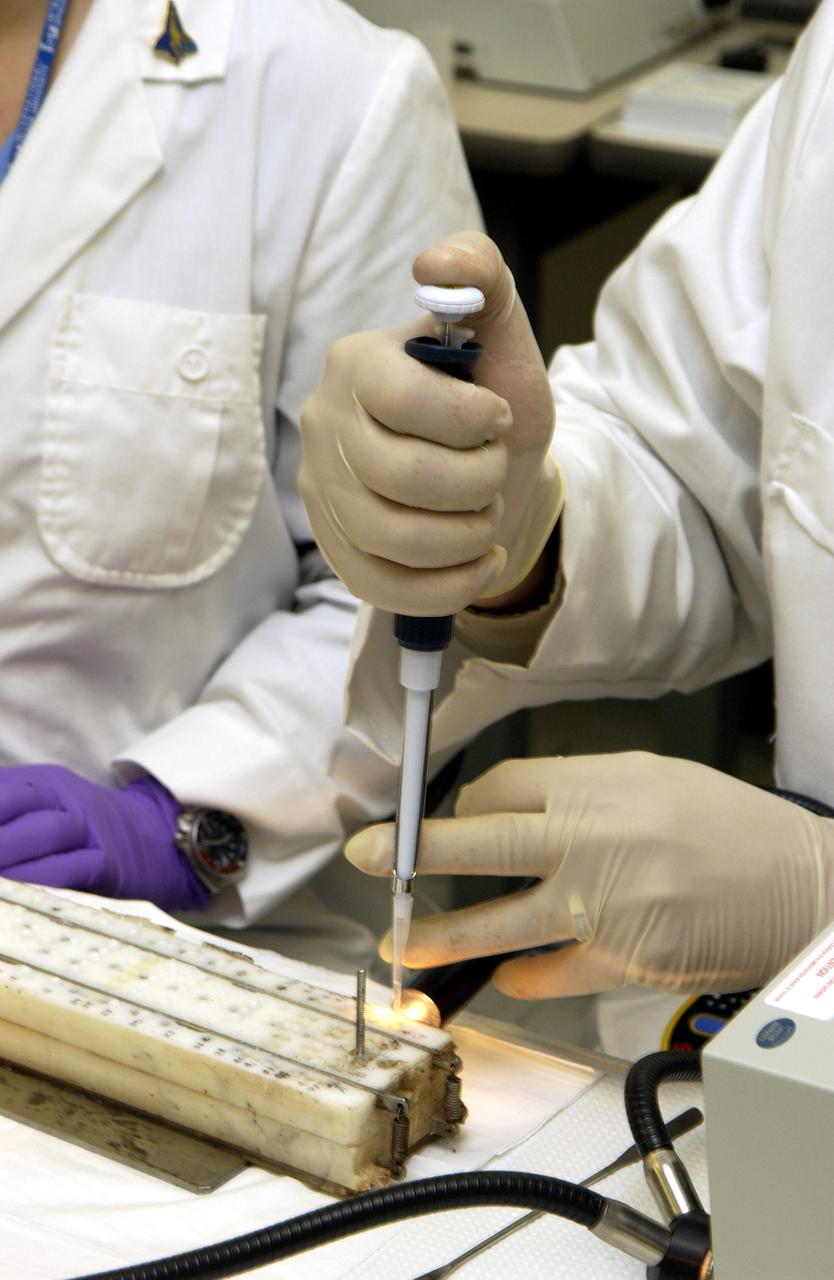
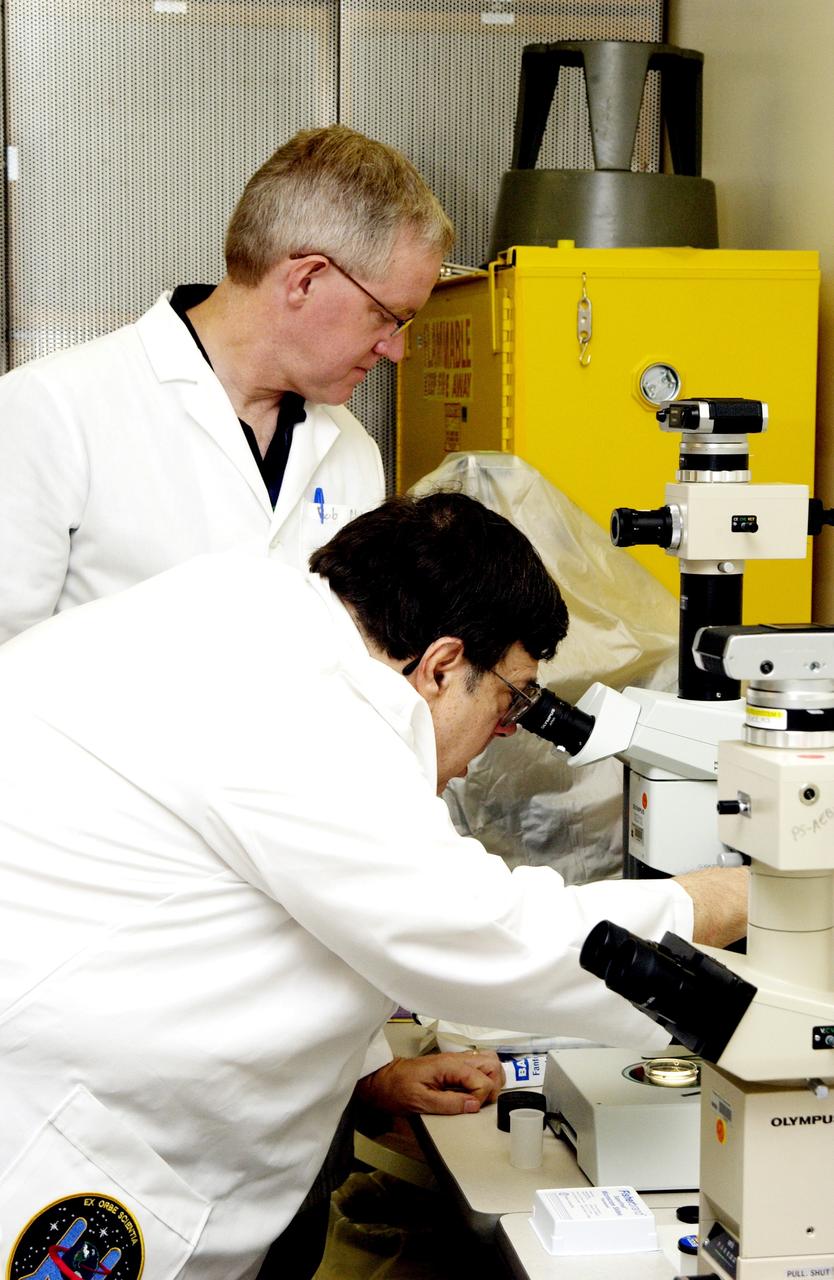
KENNEDY SPACE CENTER, FLA. - Valerie Cassanto, with Instrumentation Technology Associates, Inc., and Bob McLean, from the Southwest Texas State University, transfer to a new container material from one of the experiments carried on mission STS-107.  Several experiments were found during the search for Columbia debris.  Included in the Commercial ITA Biomedical Experiments payload on mission STS-107 are urokinase cancer research, microencapsulation of drugs, the Growth of Bacterial Biofilm on Surfaces during Spaceflight (GOBBSS), and tin crystal formation.
KENNEDY SPACE CENTER, FLA. - Valerie Cassanto, with Instrumentation Technology Associates, Inc., and Bob McLean, from the Southwest Texas State University, transfer to a new container material from one of the experiments carried on mission STS-107. Several experiments were found during the search for Columbia debris. Included in the Commercial ITA Biomedical Experiments payload on mission STS-107 are urokinase cancer research, microencapsulation of drugs, the Growth of Bacterial Biofilm on Surfaces during Spaceflight (GOBBSS), and tin crystal formation.
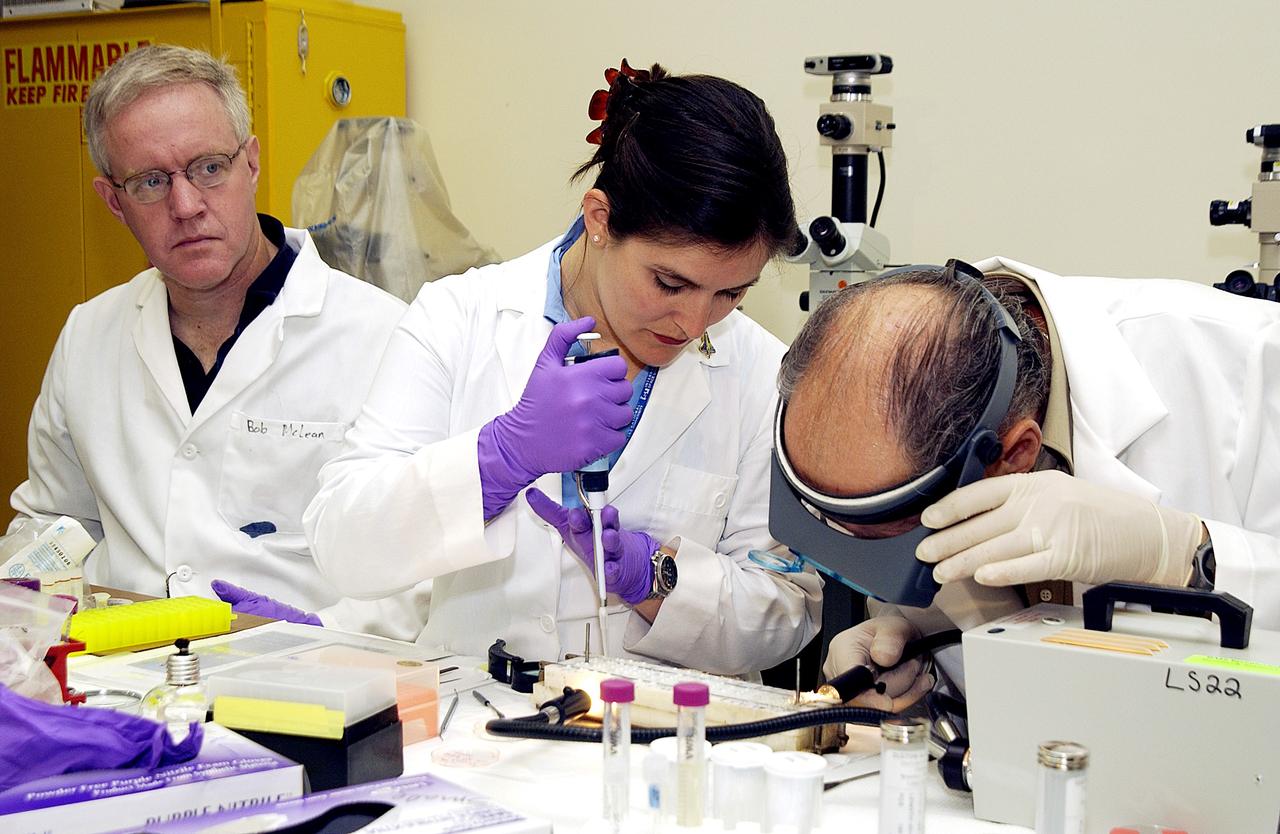
KENNEDY SPACE CENTER, FLA. - Valerie Cassanto, with Instrumentation Technology Associates, Inc., and Bob McLean, from the Southwest Texas State University, work on an experiment found during the search for Columbia debris.  Included in the Commercial ITA Biomedical Experiments payload on mission STS-107 are urokinase cancer research, microencapsulation of drugs, the Growth of Bacterial Biofilm on Surfaces during Spaceflight (GOBBSS), and tin crystal formation.
KENNEDY SPACE CENTER, FLA. - Valerie Cassanto, with Instrumentation Technology Associates, Inc., and Bob McLean, from the Southwest Texas State University, work on an experiment found during the search for Columbia debris. Included in the Commercial ITA Biomedical Experiments payload on mission STS-107 are urokinase cancer research, microencapsulation of drugs, the Growth of Bacterial Biofilm on Surfaces during Spaceflight (GOBBSS), and tin crystal formation.
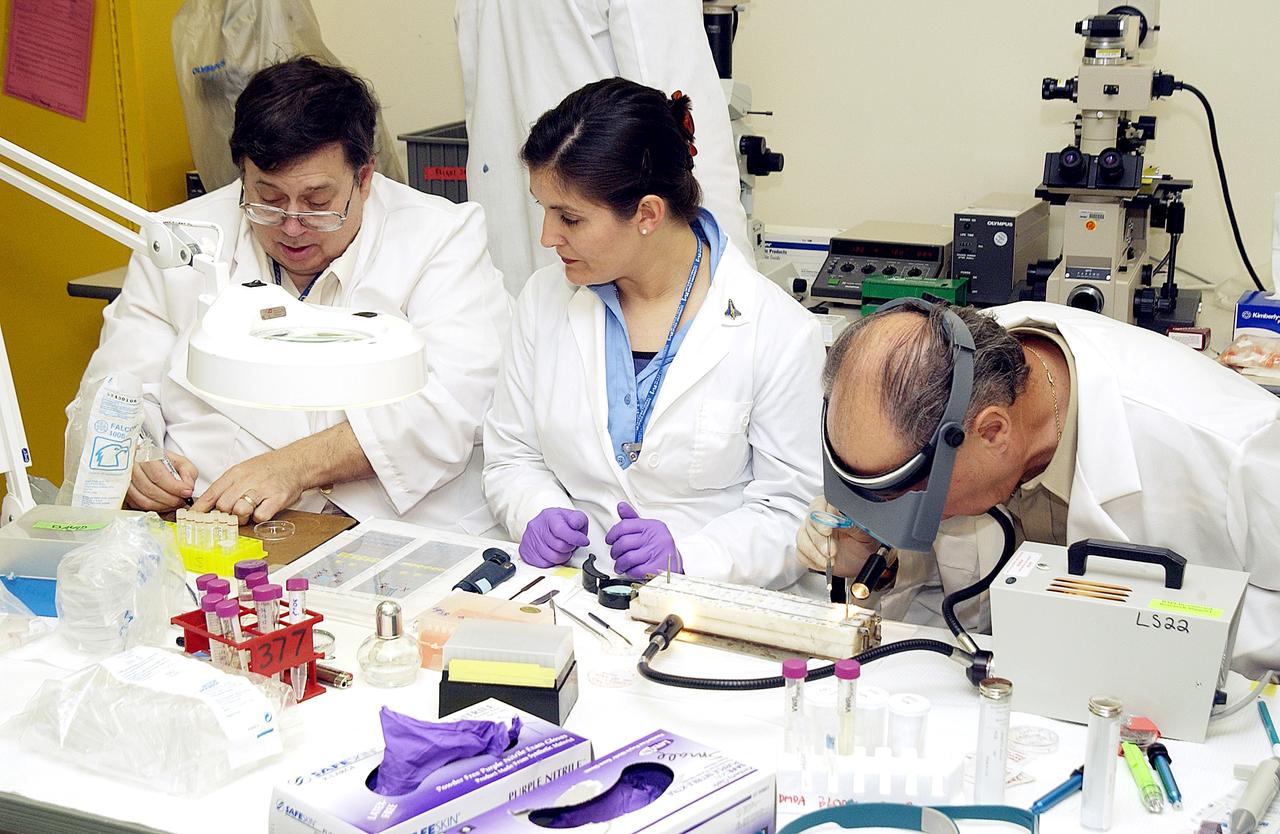
KENNEDY SPACE CENTER, FLA. -  From left, Bob McLean, Southwest Texas State University; Valerie Cassanto, Instrumentation Technology Associates, Inc.; and Dennis Morrison, NASA Johnson Space Center, process one of the experiments carried on mission STS-107. Several experiments were found during the search for Columbia debris. Included in the Commercial ITA Biomedical Experiments payload on mission STS-107 are urokinase cancer research, microencapsulation of drugs, the Growth of Bacterial Biofilm on Surfaces during Spaceflight (GOBBSS), and tin crystal formation.
KENNEDY SPACE CENTER, FLA. - From left, Bob McLean, Southwest Texas State University; Valerie Cassanto, Instrumentation Technology Associates, Inc.; and Dennis Morrison, NASA Johnson Space Center, process one of the experiments carried on mission STS-107. Several experiments were found during the search for Columbia debris. Included in the Commercial ITA Biomedical Experiments payload on mission STS-107 are urokinase cancer research, microencapsulation of drugs, the Growth of Bacterial Biofilm on Surfaces during Spaceflight (GOBBSS), and tin crystal formation.
KENNEDY SPACE CENTER, FLA. -  The crystals visible in this laboratory dish were part of an experiment carried on mission STS-107. Several experiments were found during the search for Columbia debris. Included in the Commercial ITA Biomedical Experiments payload on mission STS-107 are urokinase cancer research, microencapsulation of drugs, the Growth of Bacterial Biofilm on Surfaces during Spaceflight (GOBBSS), and tin crystal formation.
KENNEDY SPACE CENTER, FLA. - The crystals visible in this laboratory dish were part of an experiment carried on mission STS-107. Several experiments were found during the search for Columbia debris. Included in the Commercial ITA Biomedical Experiments payload on mission STS-107 are urokinase cancer research, microencapsulation of drugs, the Growth of Bacterial Biofilm on Surfaces during Spaceflight (GOBBSS), and tin crystal formation.
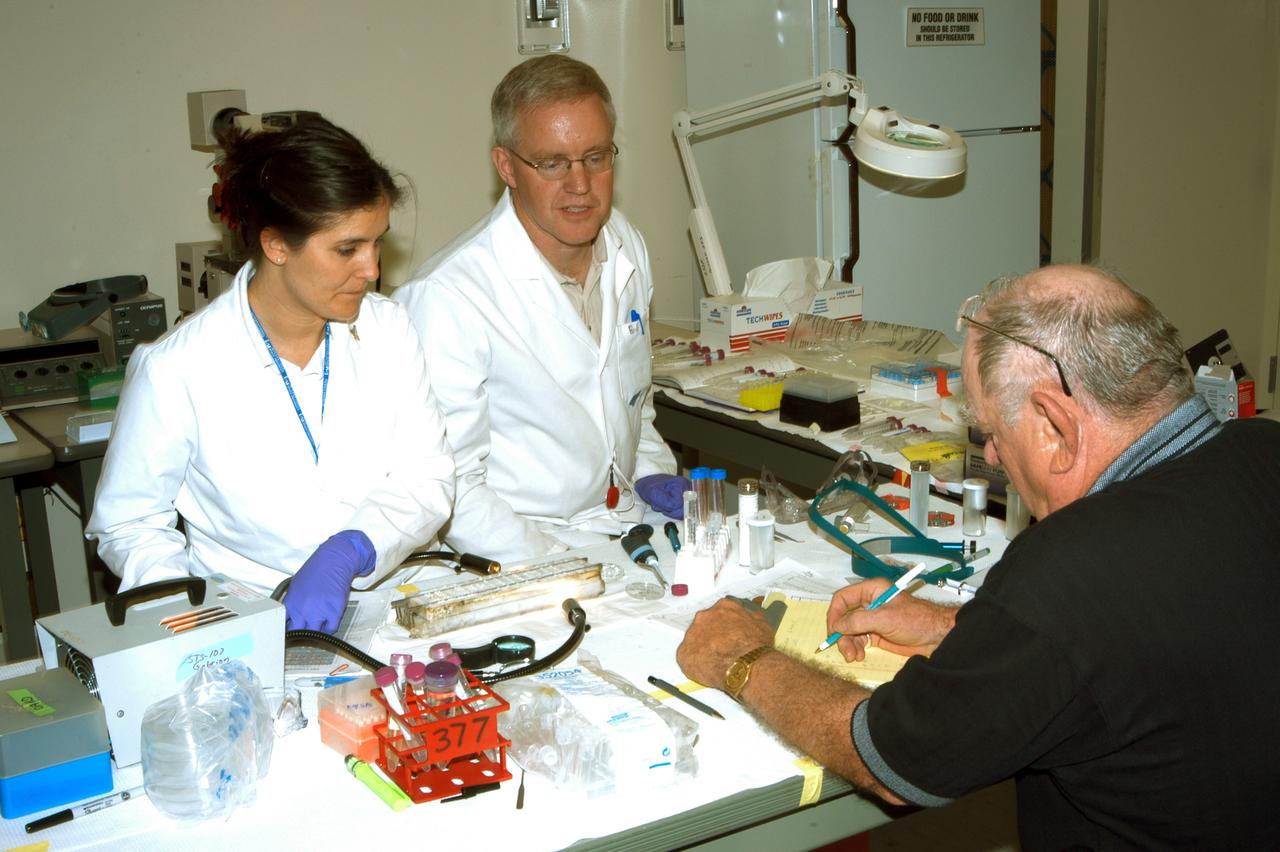
KENNEDY SPACE CENTER, FLA. -  Valerie Cassanto, Instrumentation Technology Associates, Inc., studies one of the experiments carried on mission STS-107. Several experiments were found during the search for Columbia debris. Included in the Commercial ITA Biomedical Experiments payload on mission STS-107 are urokinase cancer research, microencapsulation of drugs, the Growth of Bacterial Biofilm on Surfaces during Spaceflight (GOBBSS), and tin crystal formation.  The latter was sponsored by the Pembroke Pines Charter Middle School.
KENNEDY SPACE CENTER, FLA. - Valerie Cassanto, Instrumentation Technology Associates, Inc., studies one of the experiments carried on mission STS-107. Several experiments were found during the search for Columbia debris. Included in the Commercial ITA Biomedical Experiments payload on mission STS-107 are urokinase cancer research, microencapsulation of drugs, the Growth of Bacterial Biofilm on Surfaces during Spaceflight (GOBBSS), and tin crystal formation. The latter was sponsored by the Pembroke Pines Charter Middle School.
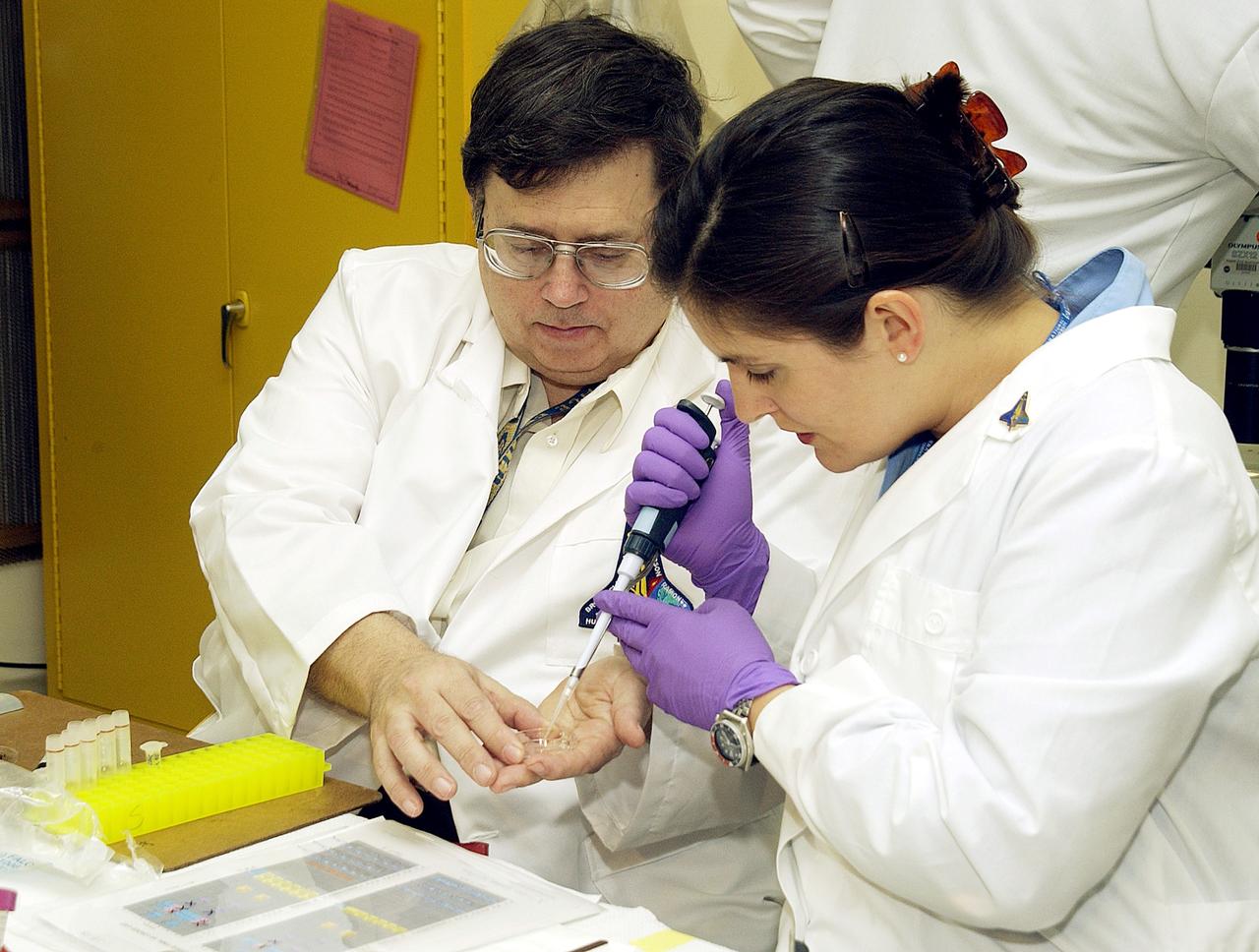
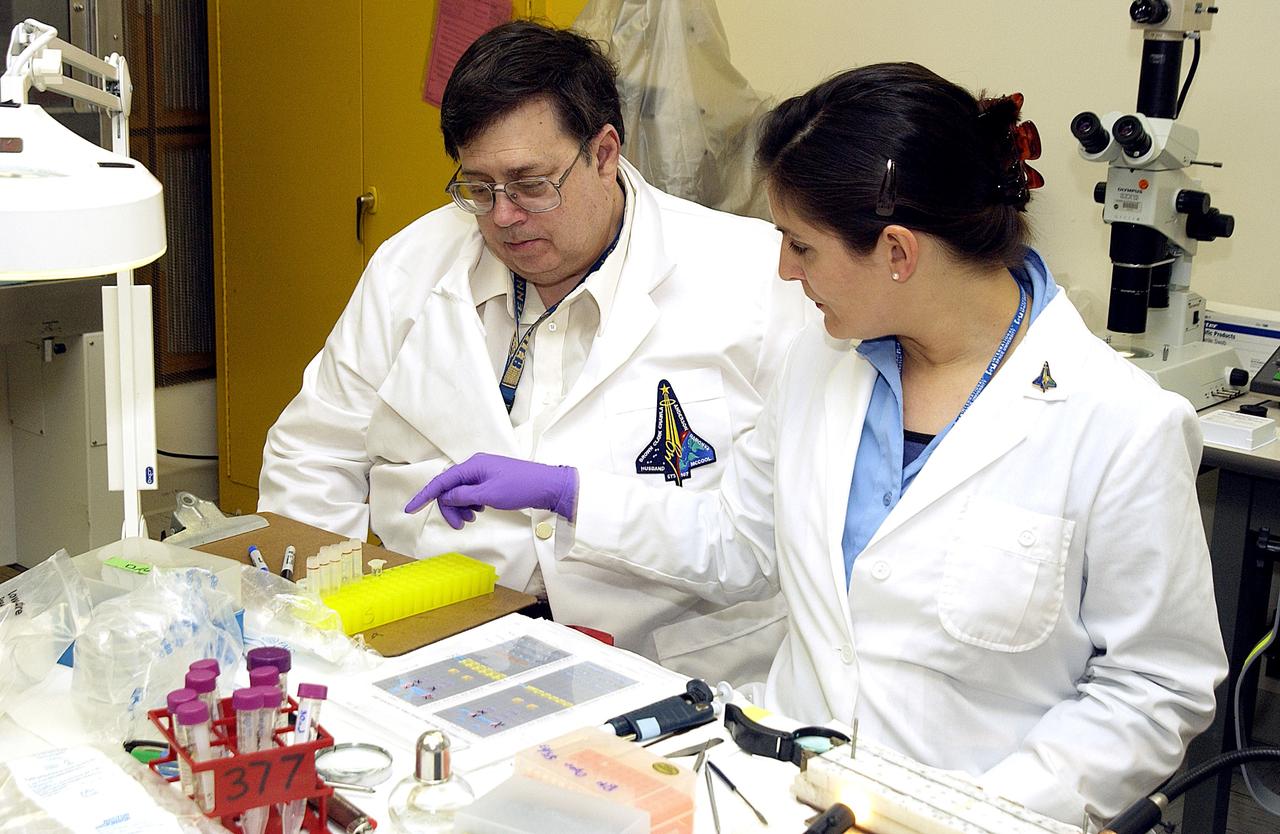
KENNEDY SPACE CENTER, FLA. -  From left, Valerie Cassanto, Instrumentation Technology Associates, Inc., and Dr. Dennis Morrison, NASA Johnson Space Center, analyze one of the experiments carried on mission STS-107. Several experiments were found during the search for Columbia debris. Included in the Commercial ITA Biomedical Experiments payload on mission STS-107 are urokinase cancer research, microencapsulation of drugs, the Growth of Bacterial Biofilm on Surfaces during Spaceflight (GOBBSS), and tin crystal formation.
KENNEDY SPACE CENTER, FLA. - From left, Valerie Cassanto, Instrumentation Technology Associates, Inc., and Dr. Dennis Morrison, NASA Johnson Space Center, analyze one of the experiments carried on mission STS-107. Several experiments were found during the search for Columbia debris. Included in the Commercial ITA Biomedical Experiments payload on mission STS-107 are urokinase cancer research, microencapsulation of drugs, the Growth of Bacterial Biofilm on Surfaces during Spaceflight (GOBBSS), and tin crystal formation.
KENNEDY SPACE CENTER, FLA. -  Valerie Cassanto (foreground), Instrumentation Technology Associates, Inc., examines one of the experiments carried on mission STS-107. Several experiments were found during the search for Columbia debris. Included in the Commercial ITA Biomedical Experiments payload on mission STS-107 are urokinase cancer research, microencapsulation of drugs, the Growth of Bacterial Biofilm on Surfaces during Spaceflight (GOBBSS), and tin crystal formation.
KENNEDY SPACE CENTER, FLA. - Valerie Cassanto (foreground), Instrumentation Technology Associates, Inc., examines one of the experiments carried on mission STS-107. Several experiments were found during the search for Columbia debris. Included in the Commercial ITA Biomedical Experiments payload on mission STS-107 are urokinase cancer research, microencapsulation of drugs, the Growth of Bacterial Biofilm on Surfaces during Spaceflight (GOBBSS), and tin crystal formation.
KENNEDY SPACE CENTER, FLA. -  Barry Perlman, Pembroke Pines Charter Middle School in Florida, prepares a computer to receive data from an experiment carried on mission STS-107. Several experiments were found during the search for Columbia debris. Included in the Commercial ITA Biomedical Experiments payload on mission STS-107 are urokinase cancer research, microencapsulation of drugs, the Growth of Bacterial Biofilm on Surfaces during Spaceflight (GOBBSS), and tin crystal formation. The latter was sponsored by the Pembroke Pines Charter Middle School.
KENNEDY SPACE CENTER, FLA. - Barry Perlman, Pembroke Pines Charter Middle School in Florida, prepares a computer to receive data from an experiment carried on mission STS-107. Several experiments were found during the search for Columbia debris. Included in the Commercial ITA Biomedical Experiments payload on mission STS-107 are urokinase cancer research, microencapsulation of drugs, the Growth of Bacterial Biofilm on Surfaces during Spaceflight (GOBBSS), and tin crystal formation. The latter was sponsored by the Pembroke Pines Charter Middle School.
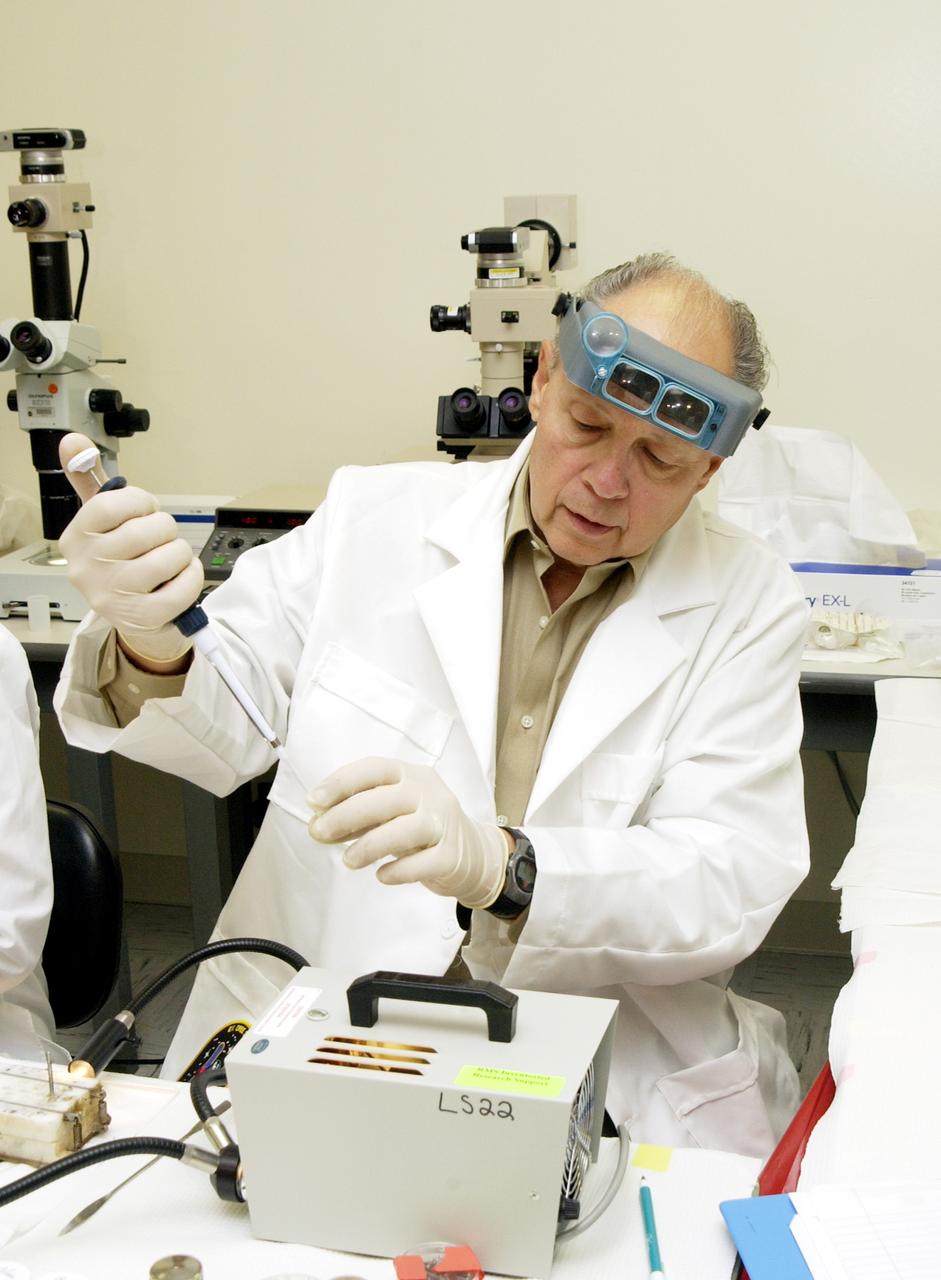
KENNEDY SPACE CENTER, FLA. - Valerie Cassanto, with Instrumentation Technology Associates, Inc., works on an experiment found during the search for Columbia debris.  Mike Casasanto, also with ITA, looks on.  Included in the Commercial ITA Biomedical Experiments payload on mission STS-107 are urokinase cancer research, microencapsulation of drugs, the Growth of Bacterial Biofilm on Surfaces during Spaceflight (GOBBSS), and tin crystal formation.
KENNEDY SPACE CENTER, FLA. - Valerie Cassanto, with Instrumentation Technology Associates, Inc., works on an experiment found during the search for Columbia debris. Mike Casasanto, also with ITA, looks on. Included in the Commercial ITA Biomedical Experiments payload on mission STS-107 are urokinase cancer research, microencapsulation of drugs, the Growth of Bacterial Biofilm on Surfaces during Spaceflight (GOBBSS), and tin crystal formation.
KENNEDY SPACE CENTER, FLA. -  From left, Bob McLean, Southwest Texas State University, and Valerie Cassanto, Instrumentation Technology Associates, Inc., study one of the experiments carried on mission STS-107. Several experiments were found during the search for Columbia debris. Included in the Commercial ITA Biomedical Experiments payload on mission STS-107 are urokinase cancer research, microencapsulation of drugs, the Growth of Bacterial Biofilm on Surfaces during Spaceflight (GOBBSS), and tin crystal formation.
KENNEDY SPACE CENTER, FLA. - From left, Bob McLean, Southwest Texas State University, and Valerie Cassanto, Instrumentation Technology Associates, Inc., study one of the experiments carried on mission STS-107. Several experiments were found during the search for Columbia debris. Included in the Commercial ITA Biomedical Experiments payload on mission STS-107 are urokinase cancer research, microencapsulation of drugs, the Growth of Bacterial Biofilm on Surfaces during Spaceflight (GOBBSS), and tin crystal formation.
KENNEDY SPACE CENTER, FLA. -  Dr. Dennis Morrison, NASA Johnson Space Center, works with one of the experiments carried on mission STS-107. Several experiments were found during the search for Columbia debris. Included in the Commercial ITA Biomedical Experiments payload on mission STS-107 are urokinase cancer research, microencapsulation of drugs, the Growth of Bacterial Biofilm on Surfaces during Spaceflight (GOBBSS), and tin crystal formation.
KENNEDY SPACE CENTER, FLA. - Dr. Dennis Morrison, NASA Johnson Space Center, works with one of the experiments carried on mission STS-107. Several experiments were found during the search for Columbia debris. Included in the Commercial ITA Biomedical Experiments payload on mission STS-107 are urokinase cancer research, microencapsulation of drugs, the Growth of Bacterial Biofilm on Surfaces during Spaceflight (GOBBSS), and tin crystal formation.
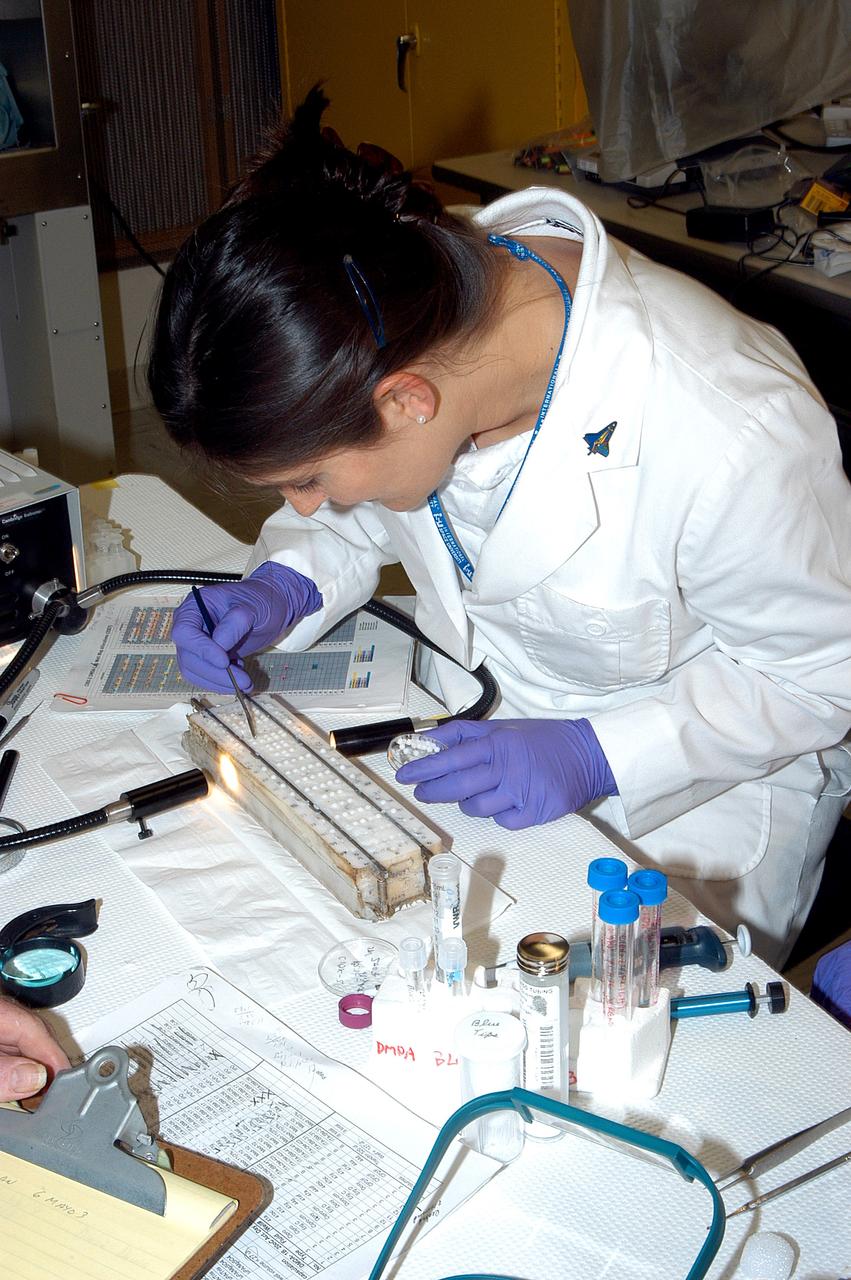
KENNEDY SPACE CENTER, FLA. -  Valerie Cassanto, with Instrumentation Technology Associates, Inc., works on an experiment found during the search for Columbia debris.  Included in the Commercial ITA Biomedical Experiments payload on mission STS-107 are urokinase cancer research, microencapsulation of drugs, the Growth of Bacterial Biofilm on Surfaces during Spaceflight (GOBBSS), and tin crystal formation.
KENNEDY SPACE CENTER, FLA. - Valerie Cassanto, with Instrumentation Technology Associates, Inc., works on an experiment found during the search for Columbia debris. Included in the Commercial ITA Biomedical Experiments payload on mission STS-107 are urokinase cancer research, microencapsulation of drugs, the Growth of Bacterial Biofilm on Surfaces during Spaceflight (GOBBSS), and tin crystal formation.
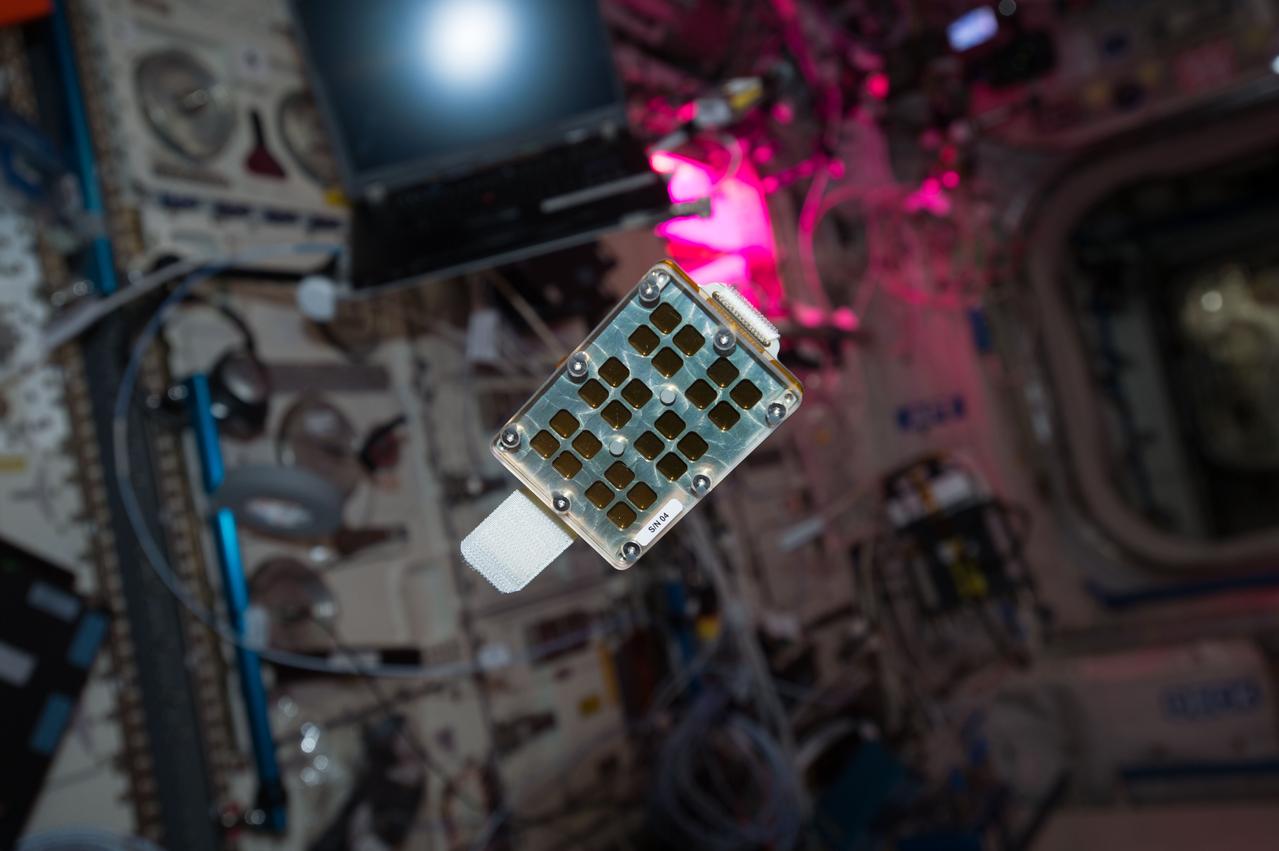
iss050e010908 911/21/2016) --- A view of Matiss floating in the Columbus Module. The Microbial Aerosol Tethering on Innovative Surfaces in the International Space Station (MATISS) experiment investigates the antibacterial properties of materials in space to see if future spacecraft could be made easier to clean. The experiment aims to understand the mechanisms of attachment of biofilms in microgravity conditions.
MATISS Experiment
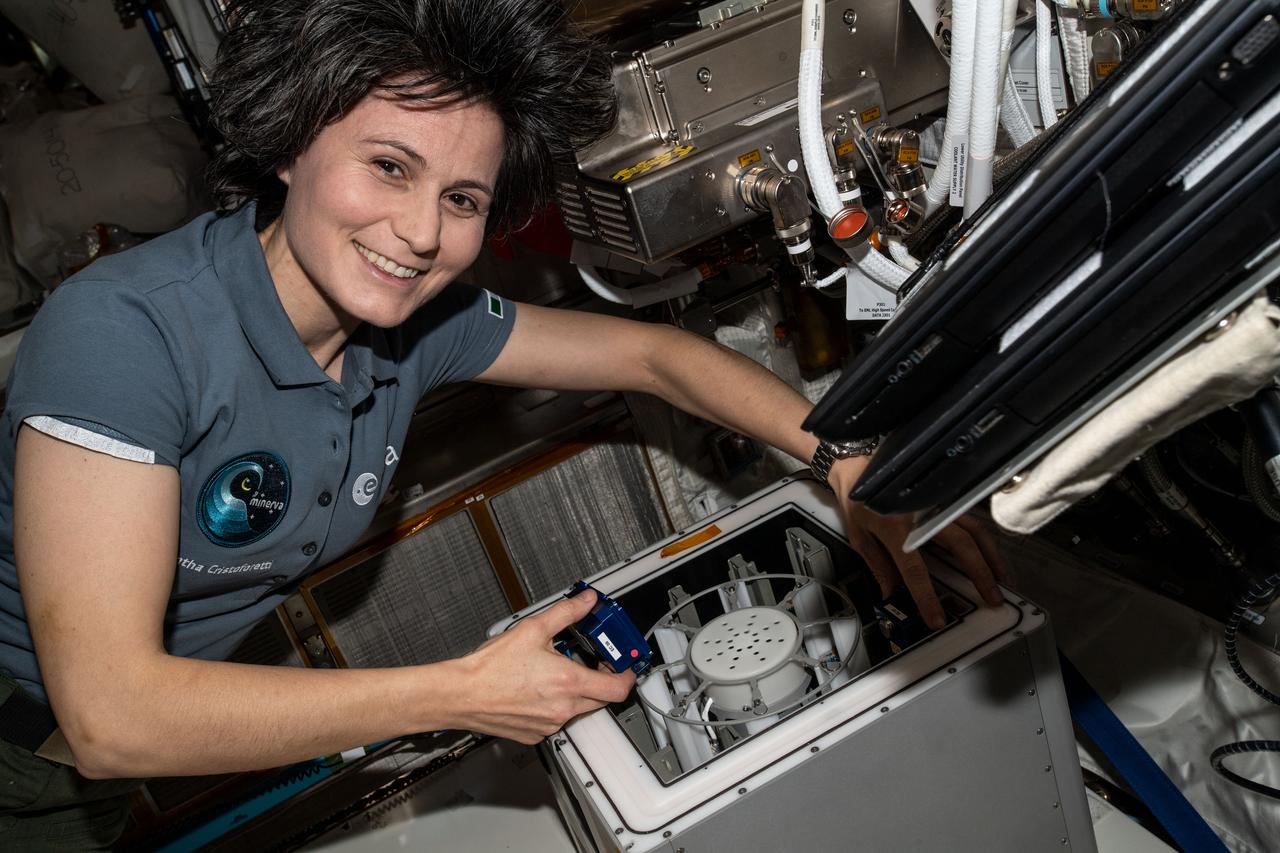
iss067e214036 (Aug. 2, 2022) --- Expedition 67 Flight Engineer and ESA (European Space Agency) astronaut Samantha Cristoforetti packs experiment containers for the Biofilms investigation aboard the International Space Station. The biotechnology study explores ways to protect astronaut health and maintain spacecraft safety from microbes living in the orbiting's lab environment.
iss067e214036
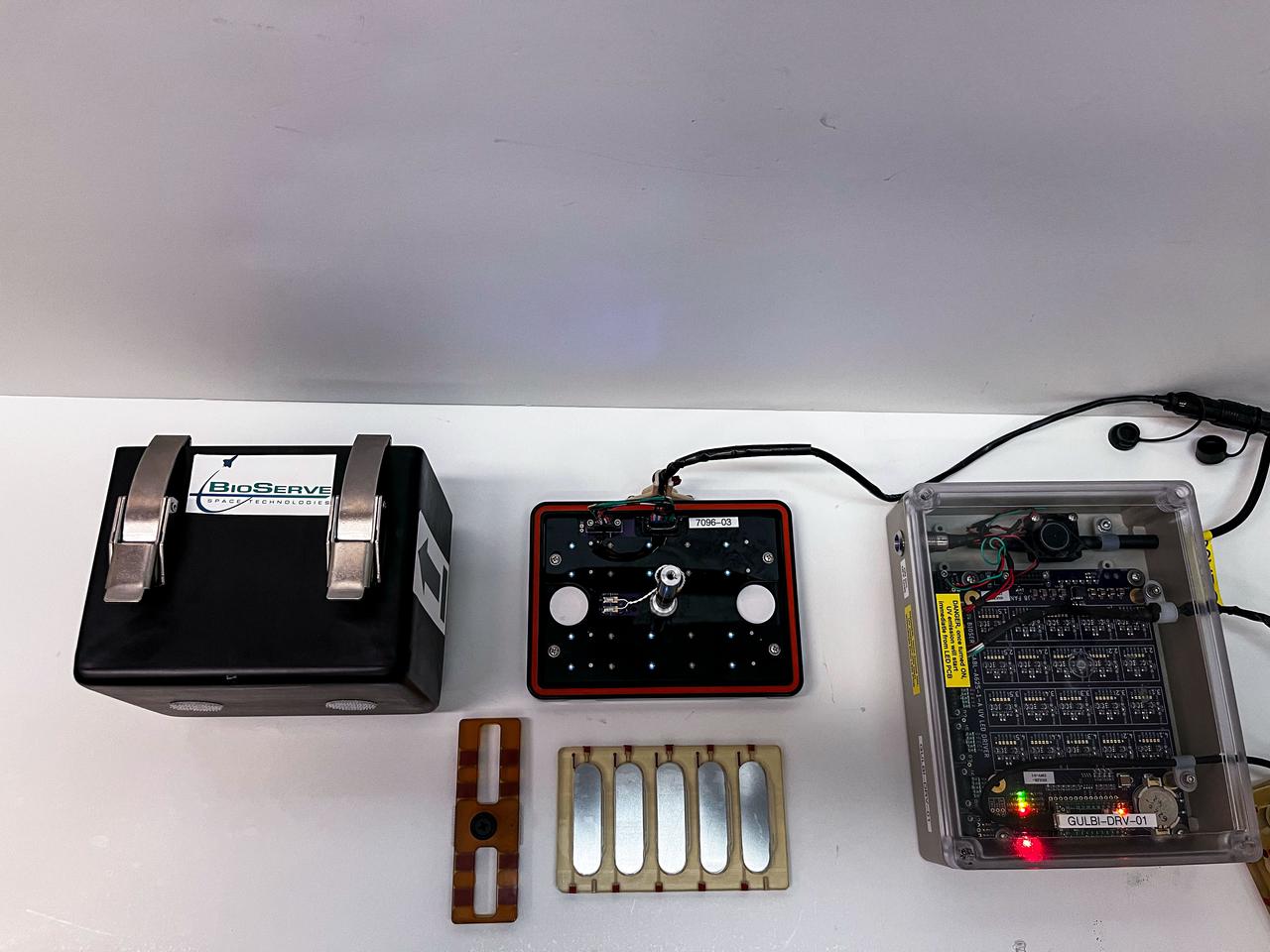
jsc2025e067422 97/9/2025) --- Agar plates for the GULBI investigation. This research uses special optical fibers to deliver ultraviolet (UV) light to inhibit the formation of microbial communities called biofilms and examine how microgravity affects the results. Credit: Arizona State University
PRO Imagery Submittal - GULBI
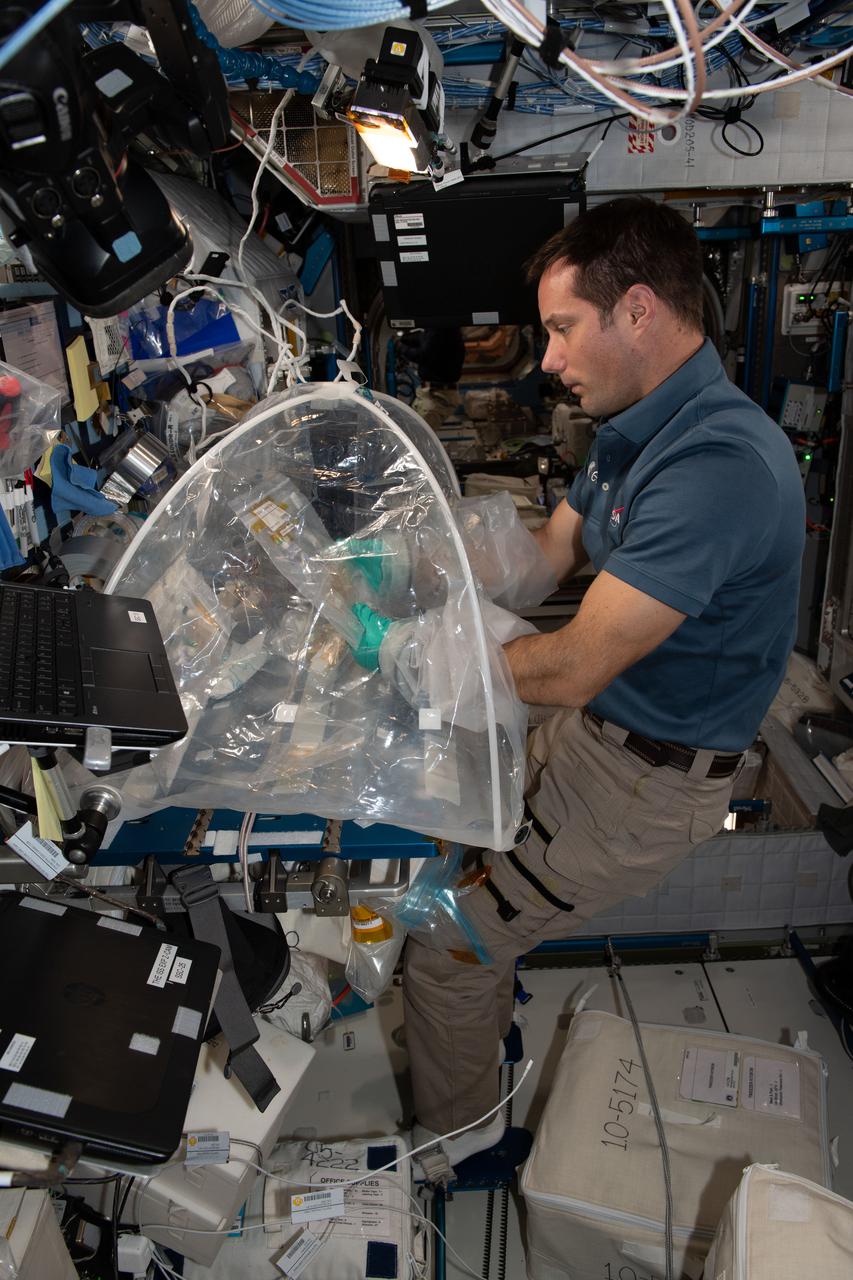
iss065e094111 (June 9, 2021) --- Expedition 65 Flight Engineer Thomas Pesquet of ESA (European Space Agency) works inside the Portable Glovebag for the Oral Biofilms experiment. The human research study observes how bacteria is affected by microgravity and investigates ways to counteract any potential harmful changes.
iss065e094111
jsc2025e067421 (7/9/2025) --- Individual components of hardware for the GULBI investigation, which examines how microgravity affects the ability of a type of ultraviolet (UV) light to prevent formation of large communities of microbes called biofilms. Credit: Arizona State University
PRO Imagery Submittal - GULBI
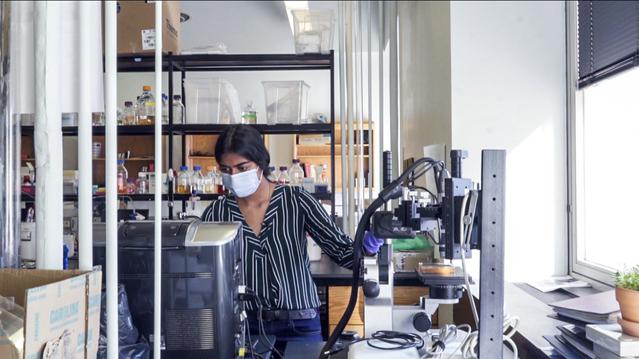
SPOCS Project Co-Lead Swati Ravi pictured in the Columbia University Dietrich Biological Shape and Pattern Formation Laboratory spotting P. aeruginosa and S. aureus bacterial samples for biofilm growth. Swati Ravi Image courtesy of Bryan S. Wang
jsc2021e063279
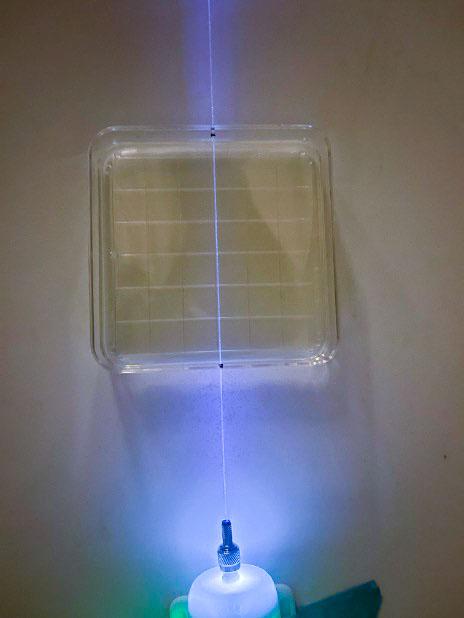
jsc2025e067423 (8/5/20250 --- Germicidal UV light is emitted by an optical fiber running through the center of an agar plate. Researchers are testing whether microgravity changes the ability of the light to prevent growth of microbial communities known as biofilms. Credit: Arizona State University
PRO Imagery Submittal - GULBI
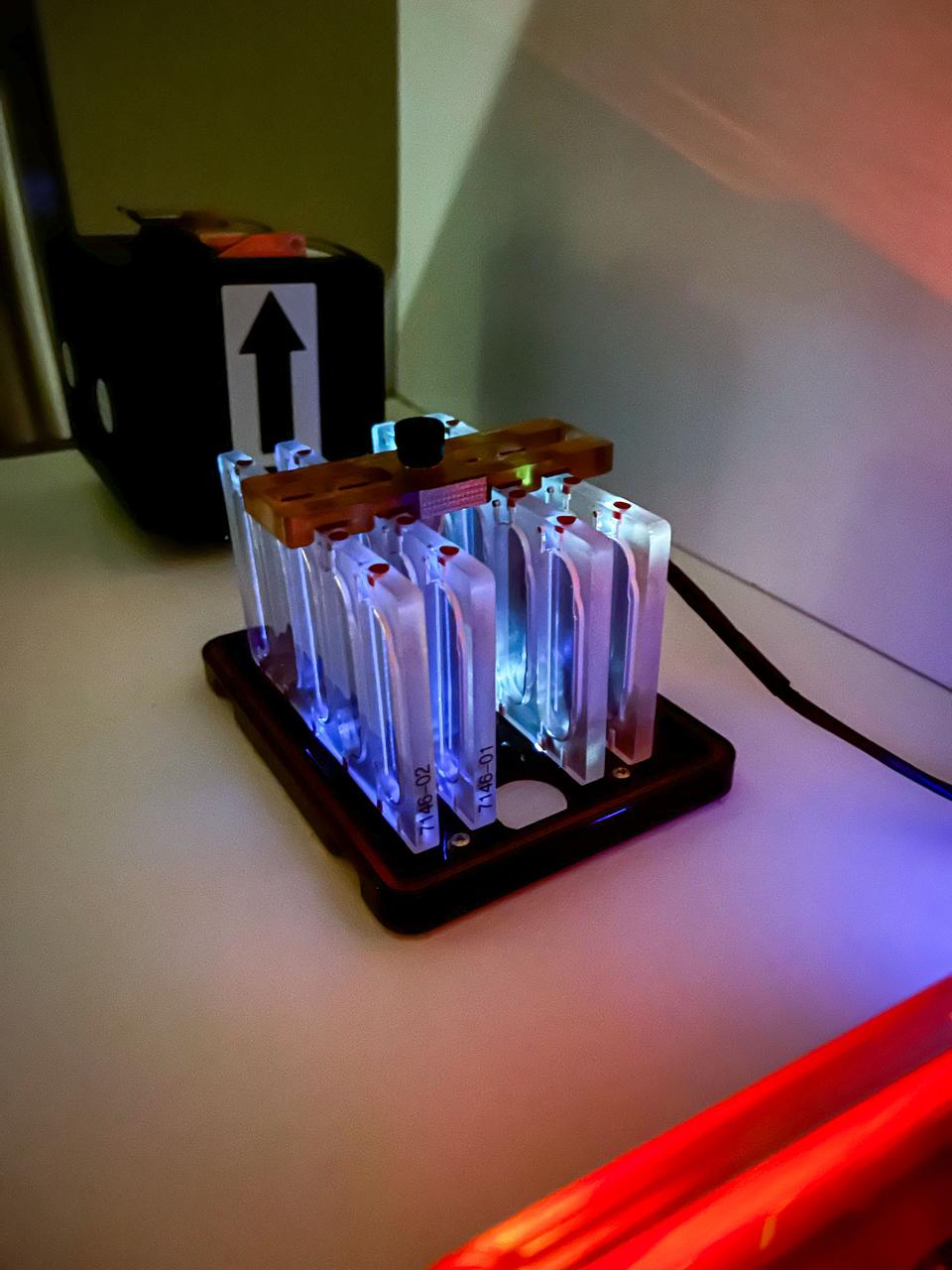
jsc2026e034368 (April 28, 2026) --- Preflight image of ODYSSEY flight hardware containing cultures of donor and recipient strains for horizontal gene transfer testing. Strains sit in separate compartments prior to incubation, at which time both strains are mixed and form a co-culture. ODYSSEY evaluates biofilm formation and exchange of genetic material among two species of bacteria in spaceflight and in simulated microgravity chambers on the ground. Comparing the results between these sample groups could help researchers determine whether Earth-based simulators can be considered as proxies for spaceflight research and get a better understanding of the mechanisms behind biofilm formation and exchange of genetic material when exposed to space-like conditions. Credit: JPL-Caltech.
jsc2026e034368
KENNEDY SPACE CENTER, FLA. -  Barry Perlman, Pembroke Pines Charter Middle School in Florida, examines one of the experiments carried on mission STS-107 as Bob McLean, Southwest Texas State University, looks on. Several experiments were found during the search for Columbia debris. Included in the Commercial ITA Biomedical Experiments payload on mission STS-107 are urokinase cancer research, microencapsulation of drugs, the Growth of Bacterial Biofilm on Surfaces during Spaceflight (GOBBSS), and tin crystal formation.  The latter was sponsored by the Pembroke Pines Charter Middle School.
KENNEDY SPACE CENTER, FLA. - Barry Perlman, Pembroke Pines Charter Middle School in Florida, examines one of the experiments carried on mission STS-107 as Bob McLean, Southwest Texas State University, looks on. Several experiments were found during the search for Columbia debris. Included in the Commercial ITA Biomedical Experiments payload on mission STS-107 are urokinase cancer research, microencapsulation of drugs, the Growth of Bacterial Biofilm on Surfaces during Spaceflight (GOBBSS), and tin crystal formation. The latter was sponsored by the Pembroke Pines Charter Middle School.
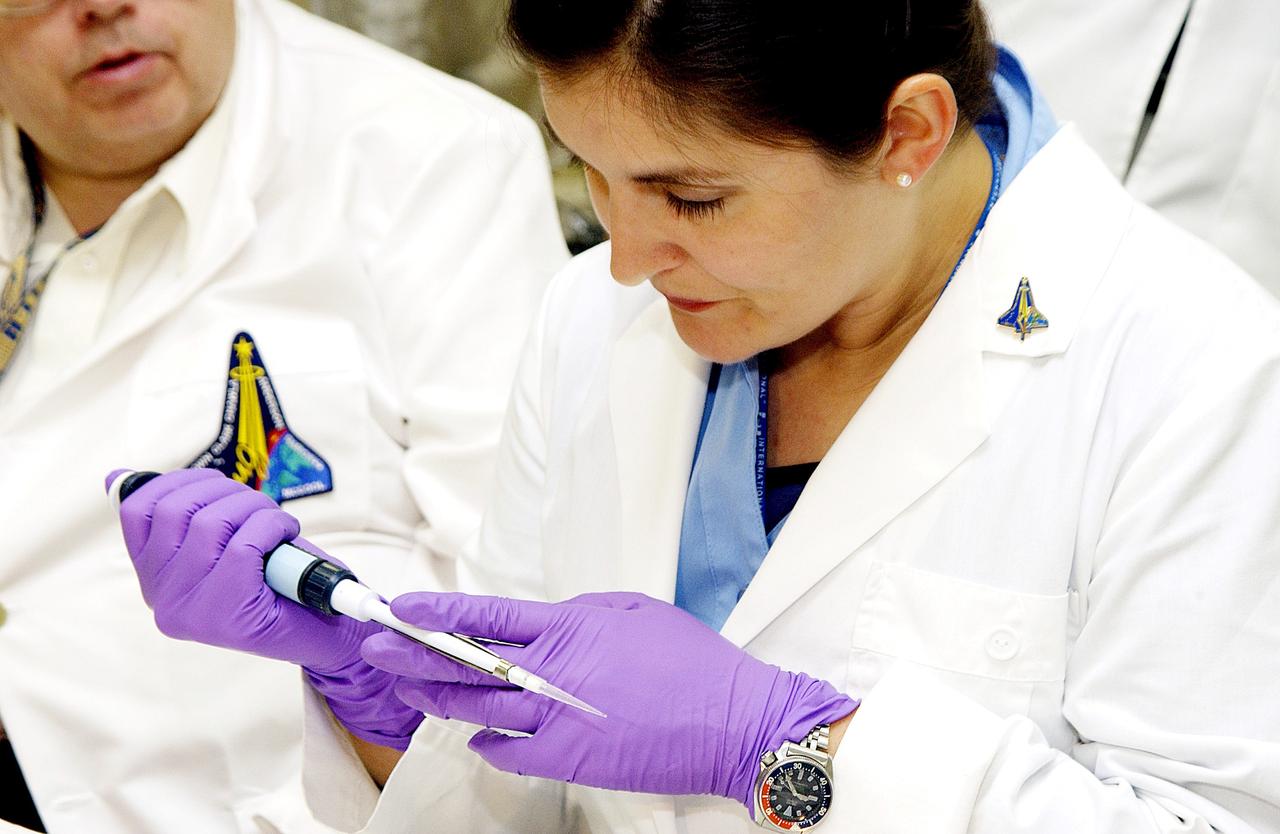
KENNEDY SPACE CENTER, FLA. -  From left, Barry Perlman, Pembroke Pines Charter Middle School in Florida, and Valerie Cassanto, Instrumentation Technology Associates, Inc., process one of the experiments carried on mission STS-107. Several experiments were found during the search for Columbia debris. Included in the Commercial ITA Biomedical Experiments payload on mission STS-107 are urokinase cancer research, microencapsulation of drugs, the Growth of Bacterial Biofilm on Surfaces during Spaceflight (GOBBSS), and tin crystal formation.  The latter was sponsored by the Pembroke Pines Charter Middle School.
KENNEDY SPACE CENTER, FLA. - From left, Barry Perlman, Pembroke Pines Charter Middle School in Florida, and Valerie Cassanto, Instrumentation Technology Associates, Inc., process one of the experiments carried on mission STS-107. Several experiments were found during the search for Columbia debris. Included in the Commercial ITA Biomedical Experiments payload on mission STS-107 are urokinase cancer research, microencapsulation of drugs, the Growth of Bacterial Biofilm on Surfaces during Spaceflight (GOBBSS), and tin crystal formation. The latter was sponsored by the Pembroke Pines Charter Middle School.
KENNEDY SPACE CENTER, FLA. -  From left, Barry Perlman, Pembroke Pines Charter Middle School in Florida, and Valerie Cassanto, Instrumentation Technology Associates, Inc., process one of the experiments carried on mission STS-107. Several experiments were found during the search for Columbia debris. Included in the Commercial ITA Biomedical Experiments payload on mission STS-107 are urokinase cancer research, microencapsulation of drugs, the Growth of Bacterial Biofilm on Surfaces during Spaceflight (GOBBSS), and tin crystal formation.  The latter was sponsored by the Pembroke Pines Charter Middle School.
KENNEDY SPACE CENTER, FLA. - From left, Barry Perlman, Pembroke Pines Charter Middle School in Florida, and Valerie Cassanto, Instrumentation Technology Associates, Inc., process one of the experiments carried on mission STS-107. Several experiments were found during the search for Columbia debris. Included in the Commercial ITA Biomedical Experiments payload on mission STS-107 are urokinase cancer research, microencapsulation of drugs, the Growth of Bacterial Biofilm on Surfaces during Spaceflight (GOBBSS), and tin crystal formation. The latter was sponsored by the Pembroke Pines Charter Middle School.
KENNEDY SPACE CENTER, FLA. -  From left, Barry Perlman, Pembroke Pines Charter Middle School in Florida, and Valerie Cassanto, Instrumentation Technology Associates, Inc., analyze one of the experiments carried on mission STS-107. Several experiments were found during the search for Columbia debris. Included in the Commercial ITA Biomedical Experiments payload on mission STS-107 are urokinase cancer research, microencapsulation of drugs, the Growth of Bacterial Biofilm on Surfaces during Spaceflight (GOBBSS), and tin crystal formation.  The latter was sponsored by the Pembroke Pines Charter Middle School.
KENNEDY SPACE CENTER, FLA. - From left, Barry Perlman, Pembroke Pines Charter Middle School in Florida, and Valerie Cassanto, Instrumentation Technology Associates, Inc., analyze one of the experiments carried on mission STS-107. Several experiments were found during the search for Columbia debris. Included in the Commercial ITA Biomedical Experiments payload on mission STS-107 are urokinase cancer research, microencapsulation of drugs, the Growth of Bacterial Biofilm on Surfaces during Spaceflight (GOBBSS), and tin crystal formation. The latter was sponsored by the Pembroke Pines Charter Middle School.
KENNEDY SPACE CENTER, FLA. -  From left, Barry Perlman, Pembroke Pines Charter Middle School in Florida; Valerie Cassanto, Instrumentation Technology Associates, Inc.; and Dr. Dennis Morrison, NASA Johnson Space Center, process one of the experiments carried on mission STS-107. Several experiments were found during the search for Columbia debris. Included in the Commercial ITA Biomedical Experiments payload on mission STS-107 are urokinase cancer research, microencapsulation of drugs, the Growth of Bacterial Biofilm on Surfaces during Spaceflight (GOBBSS), and tin crystal formation.  The latter was sponsored by the Pembroke Pines Charter Middle School.
KENNEDY SPACE CENTER, FLA. - From left, Barry Perlman, Pembroke Pines Charter Middle School in Florida; Valerie Cassanto, Instrumentation Technology Associates, Inc.; and Dr. Dennis Morrison, NASA Johnson Space Center, process one of the experiments carried on mission STS-107. Several experiments were found during the search for Columbia debris. Included in the Commercial ITA Biomedical Experiments payload on mission STS-107 are urokinase cancer research, microencapsulation of drugs, the Growth of Bacterial Biofilm on Surfaces during Spaceflight (GOBBSS), and tin crystal formation. The latter was sponsored by the Pembroke Pines Charter Middle School.
jsc2021e063280 (12/10/2021) --- Preflight imagery for the Characterizing Antibiotic Resistance in Microgravity Environments (CARMEn) experiment, part of Nanoracks Module-96. CARMEn observes how spaceflight affects the growth of a culture of two species of bacteria. SPOCS Project Co-Lead Swati Ravi is pictured operating an imaging microscope to observe P. aeruginosa and S. aureus bacterial biofilms in the Columbia University Dietrich Biological Shape and Pattern Formation Laboratory.
Preflight Imagery for the CARMEn Investigation
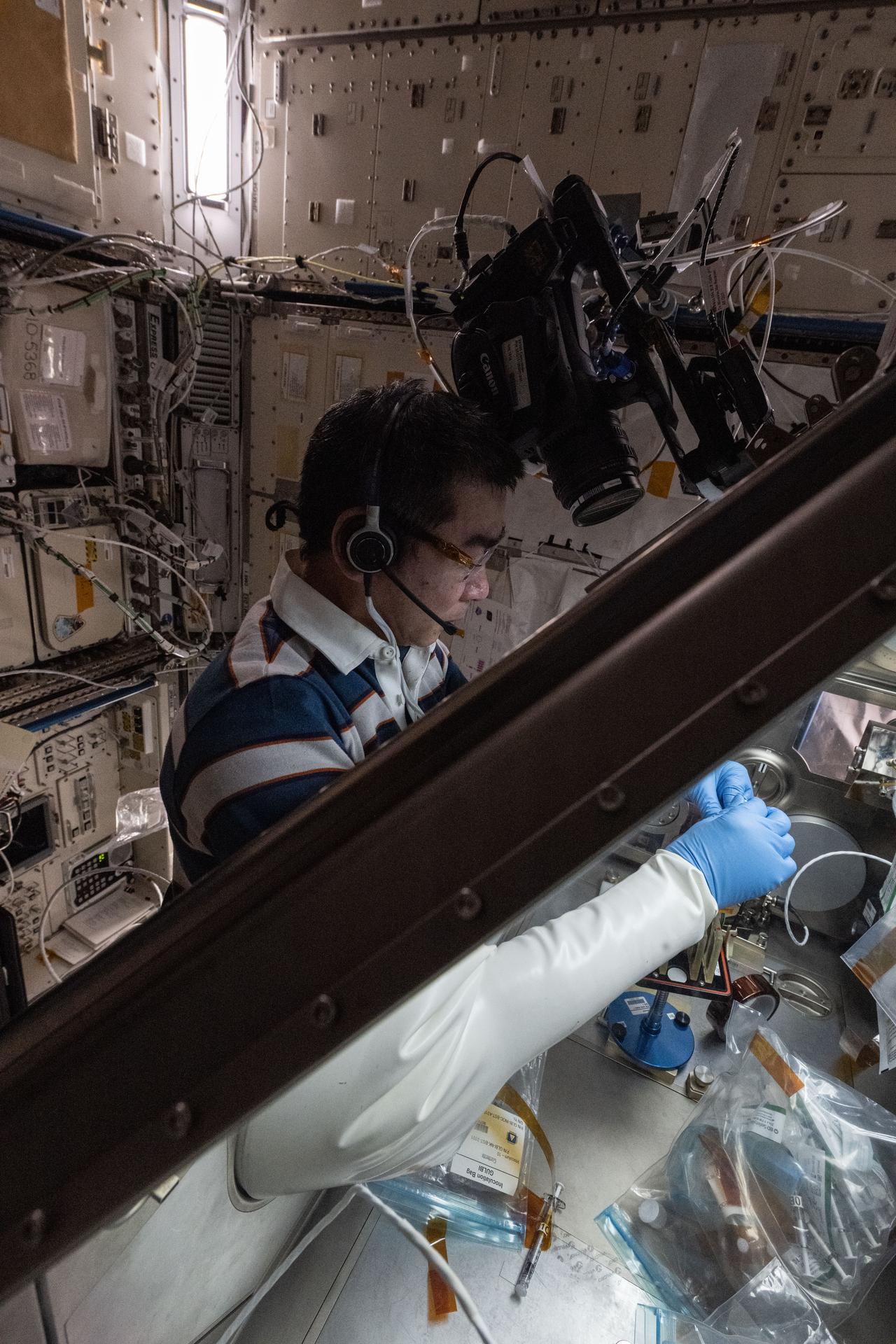
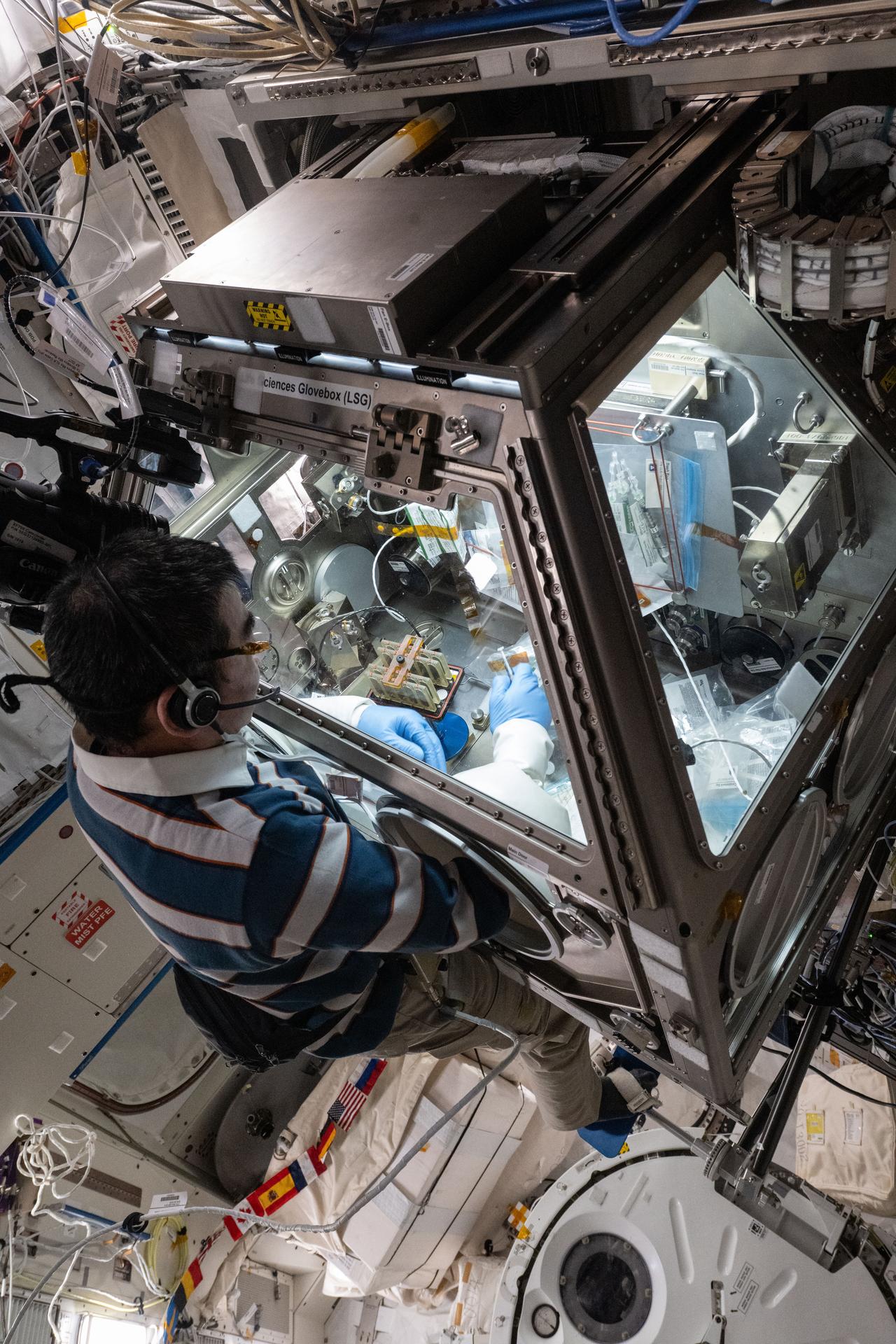
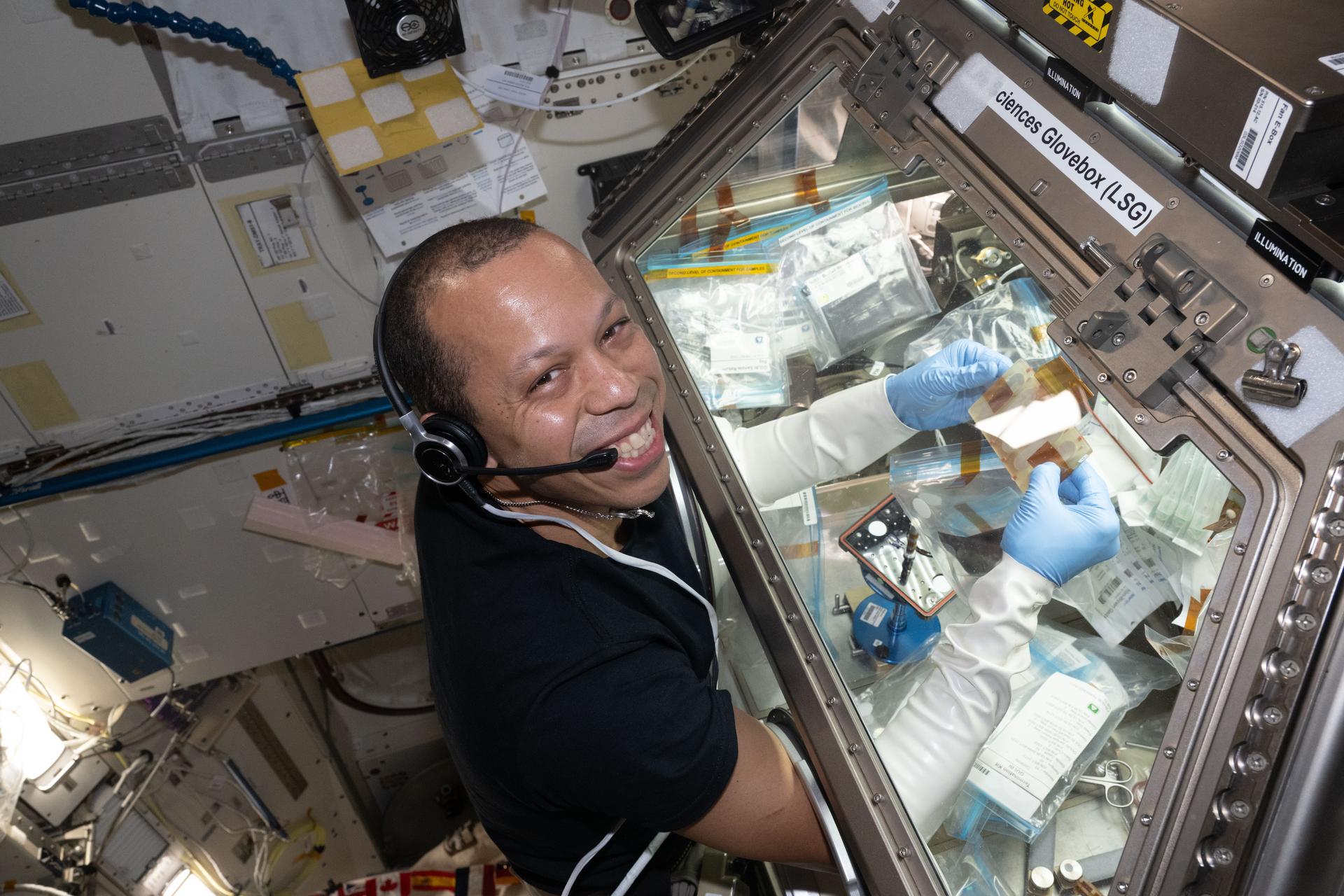
iss074e0044845 (Jan. 7, 2025) --- JAXA (Japan Aerospace Exploration Agency) astronaut and Expedition 74 Flight Engineer Kimiya Yui conducts a microbiology research experiment inside the Kibo laboratory module's Life Science Glovebox. Yui was inoculating bacterial samples to study the use of ultraviolet light to disinfect spacecraft surfaces and protect crew health and hardware from biofilms—clusters of microbes that adhere to surfaces and thrive in moist environments. Credit: NASA/Zena Cardman
JAXA astronaut Kimiya Yui conducts a microbiology research experiment
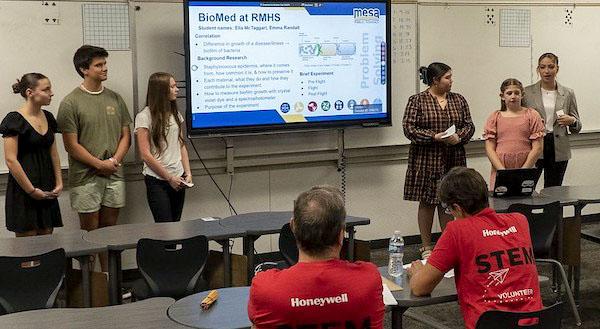
jsc2024e066518 (11/1/2023) --- Mesa Publc School students work together presenting their critical design review to their industry partners Honeywell Aerospace Technologies in their successful bid to be a finalist for the Nanoracks-National Center for Earth and Space Science Education-Surveyor-Student Spaceflight Experiments Program Mission 18 to ISS (Nanoracks-NCESSE-Surveyor-SSEP). Their experiment is The Growth and Mutation of Staphylococcus epidermidis Biofilm in Microgravity.
Student Spaceflight Experiments Program (SSEP) showcase at Red M
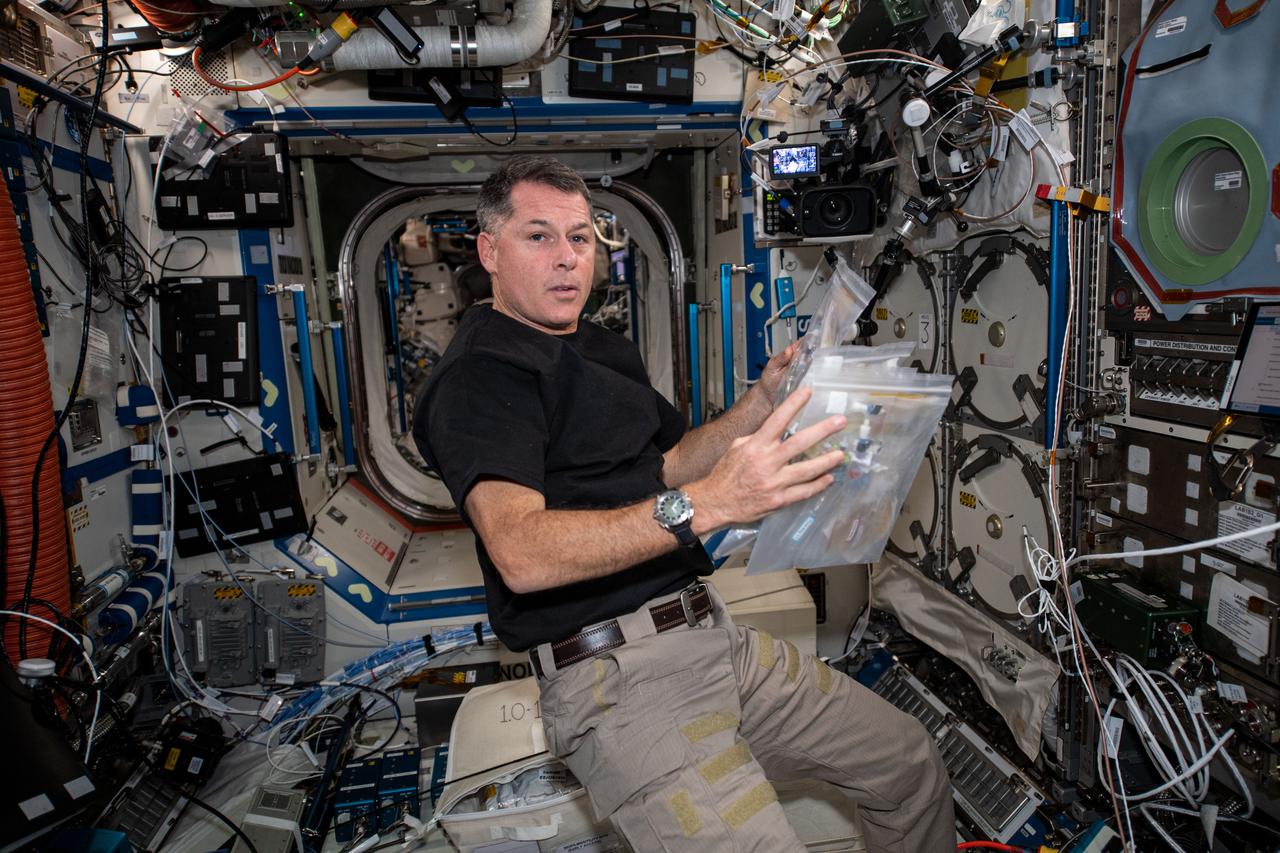
iss065e093509 (June 7, 2021) --- NASA astronaut and Expedition 65 Flight Engineer Shane Kimbrough checks out sample packs for the Oral Biofilms in Space study. The experiment observes how bacteria is affected by microgravity and investigates ways to counteract any potential harmful changes. Results could also have a positive influence for oral health on and off the Earth.
iss065e093509
iss074e0044840 (Jan. 7, 2025) --- JAXA (Japan Aerospace Exploration Agency) astronaut and Expedition 74 Flight Engineer Kimiya Yui conducts a microbiology research experiment inside the Kibo laboratory module's Life Science Glovebox. Yui was inoculating bacterial samples to study the use of ultraviolet light to disinfect spacecraft surfaces and protect crew health and hardware from biofilms—clusters of microbes that adhere to surfaces and thrive in moist environments. Credit: NASA/Zena Cardman
JAXA astronaut Kimiya Yui conducts a microbiology research experiment
iss065e093511 (June 7, 2021) --- NASA astronaut and Expedition 65 Flight Engineer Shane Kimbrough checks out sample packs for the Oral Biofilms in Space study. The experiment observes how bacteria is affected by microgravity and investigates ways to counteract any potential harmful changes. Results could also have a positive influence for oral health on and off the Earth.
iss065e093511
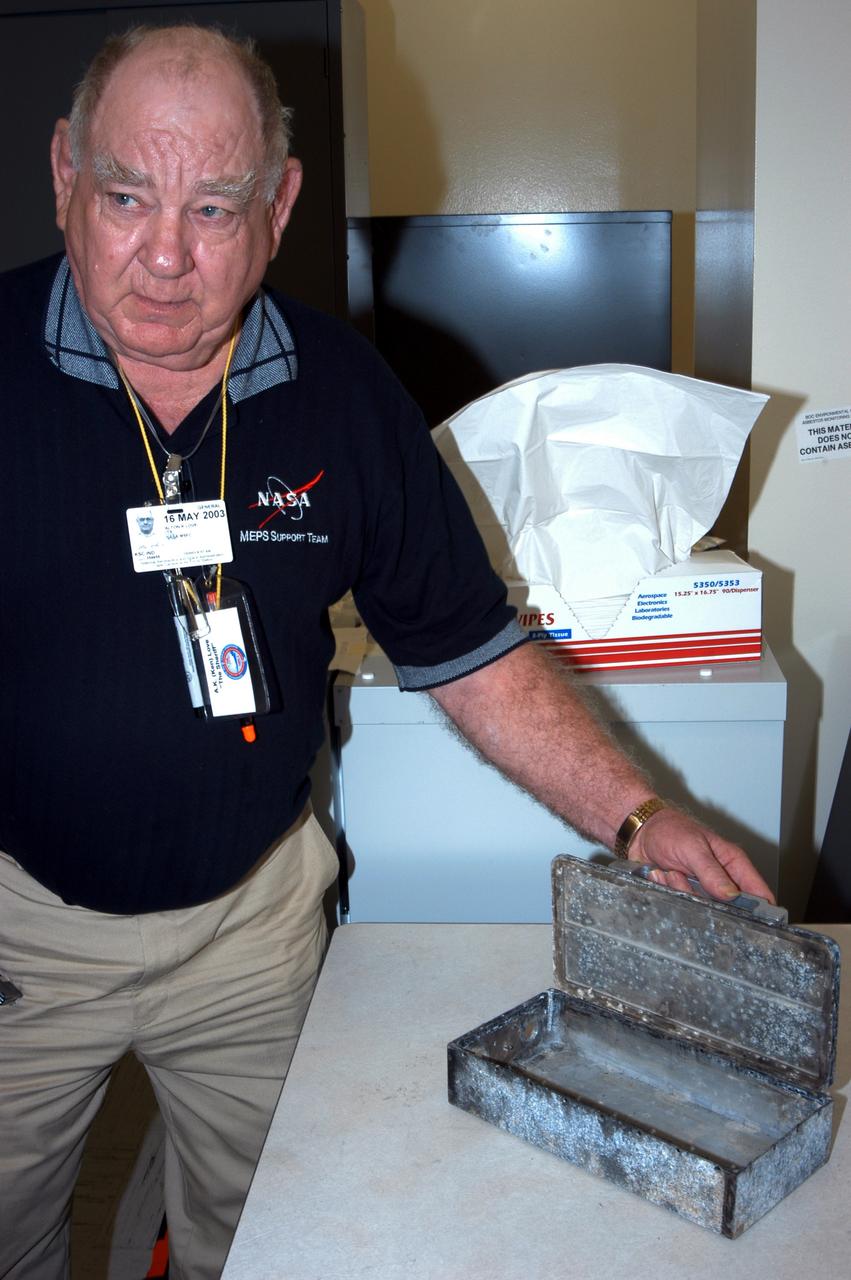
KENNEDY SPACE CENTER, FLA. -  A.K. Love,  with Instrumentation Technology Associates, Inc., displays one of the boxes used for cancer cell research, an experiment carried on mission STS-107.  Several experiments were found during the search for Columbia debris.  Included in the Commercial ITA Biomedical Experiments payload on mission STS-107 are urokinase cancer research, microencapsulation of drugs, the Growth of Bacterial Biofilm on Surfaces during Spaceflight (GOBBSS), and tin crystal formation.
KSC-03pd1458
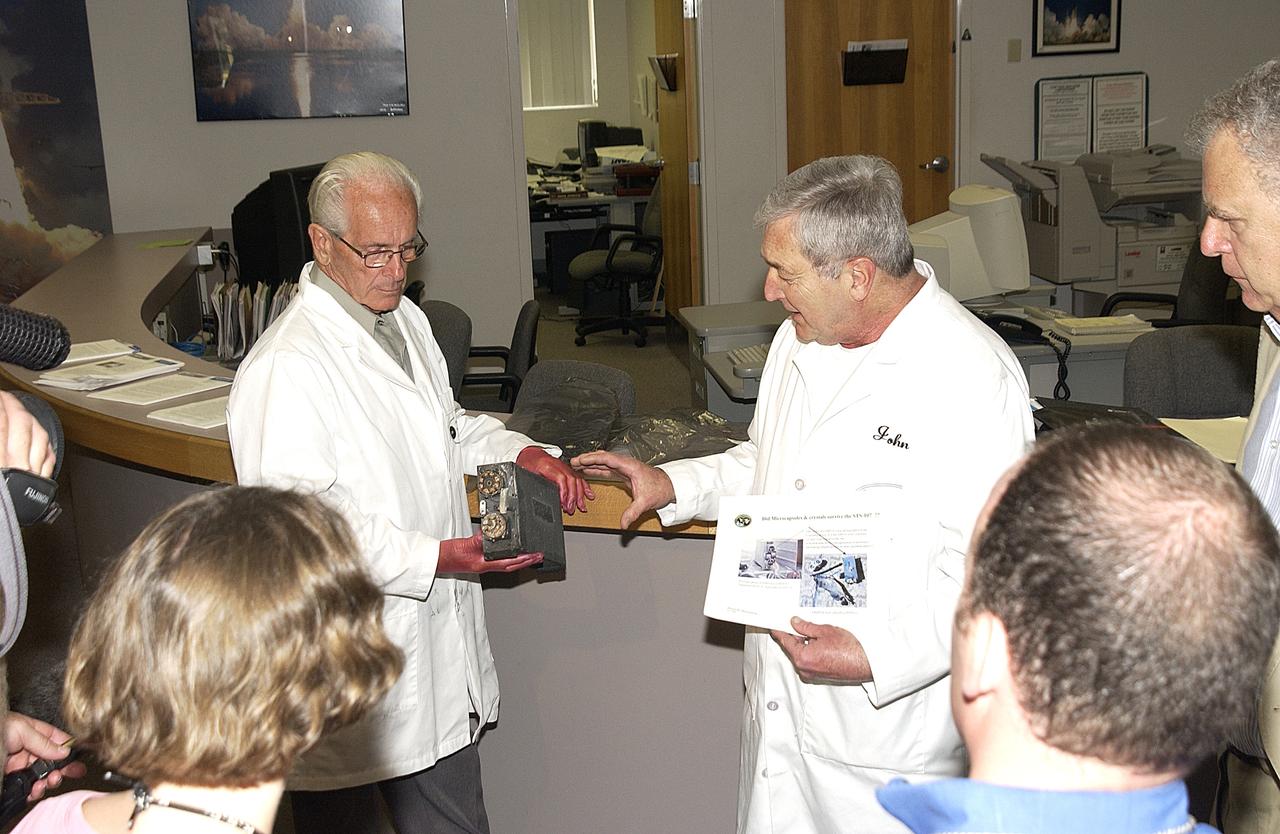
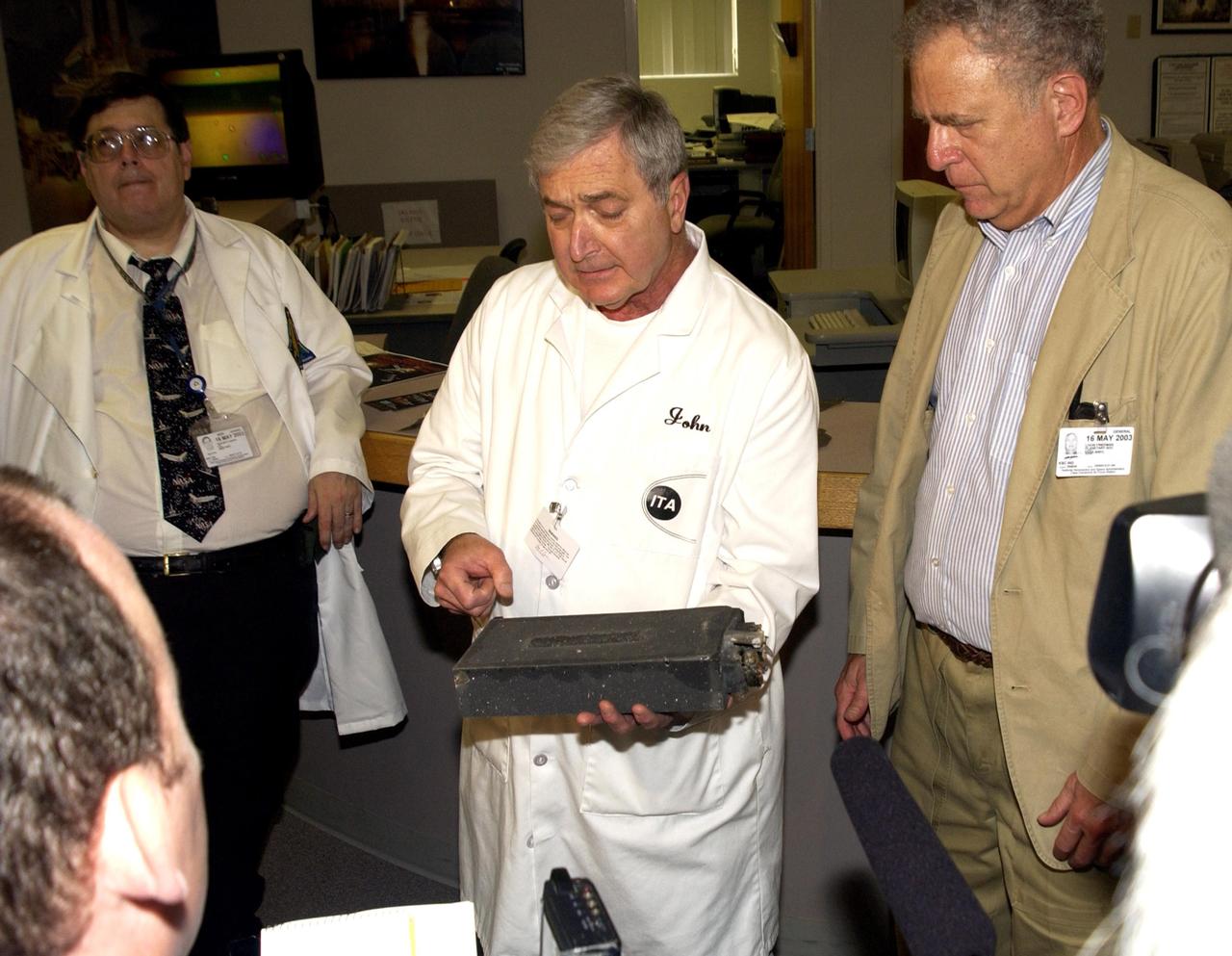
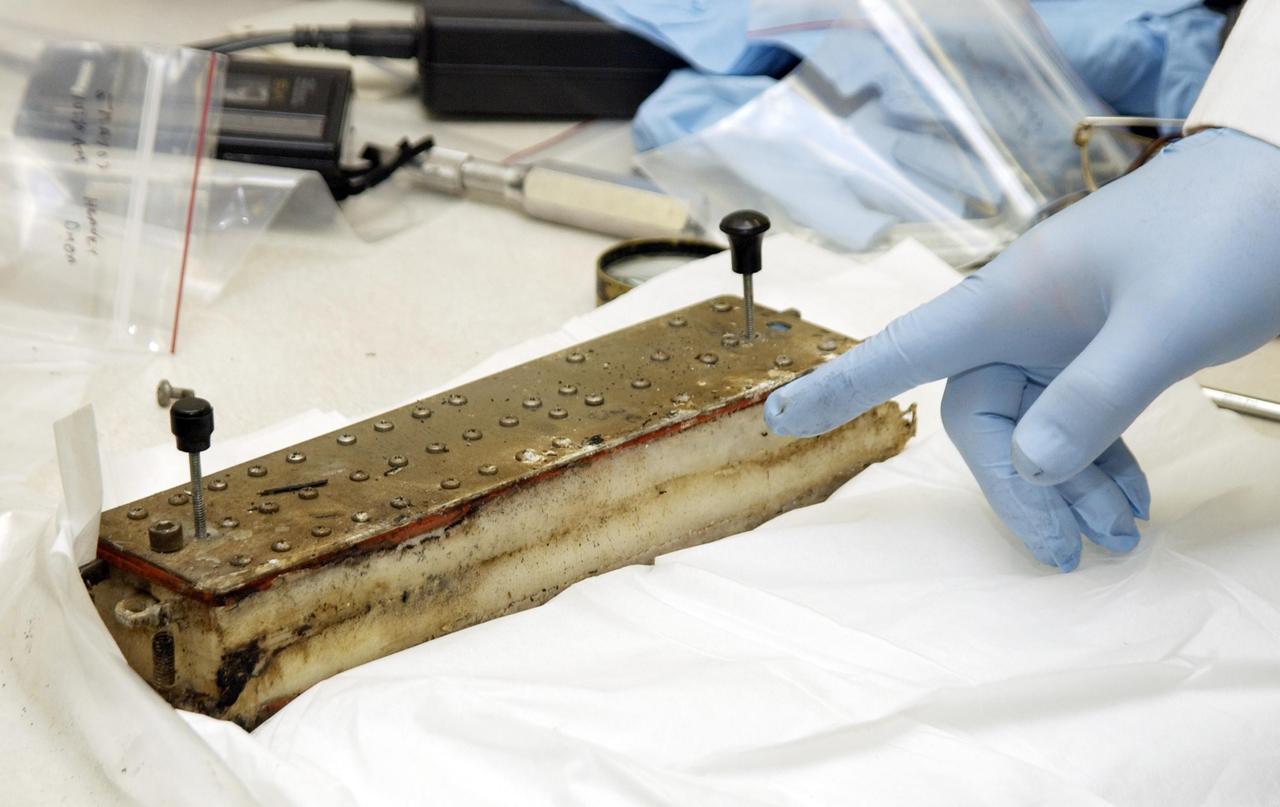
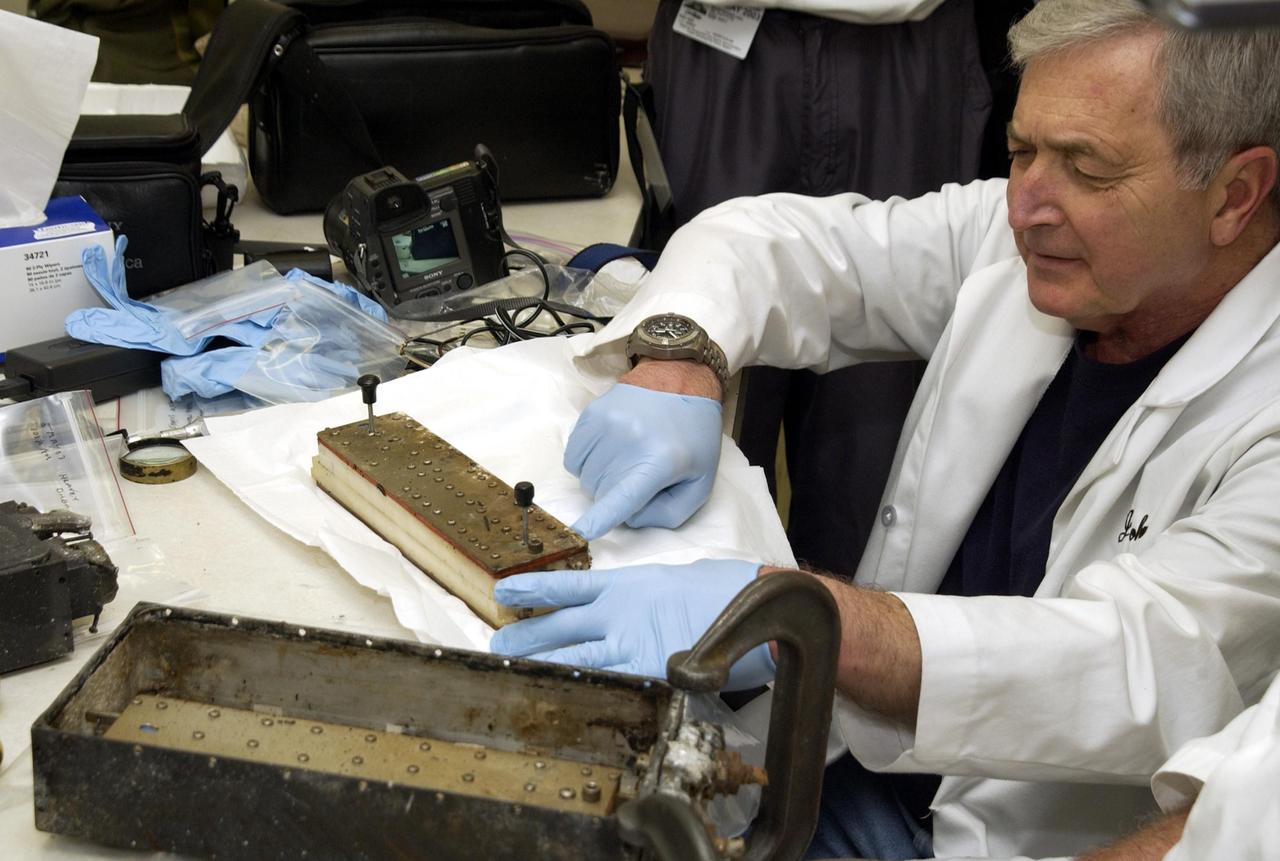
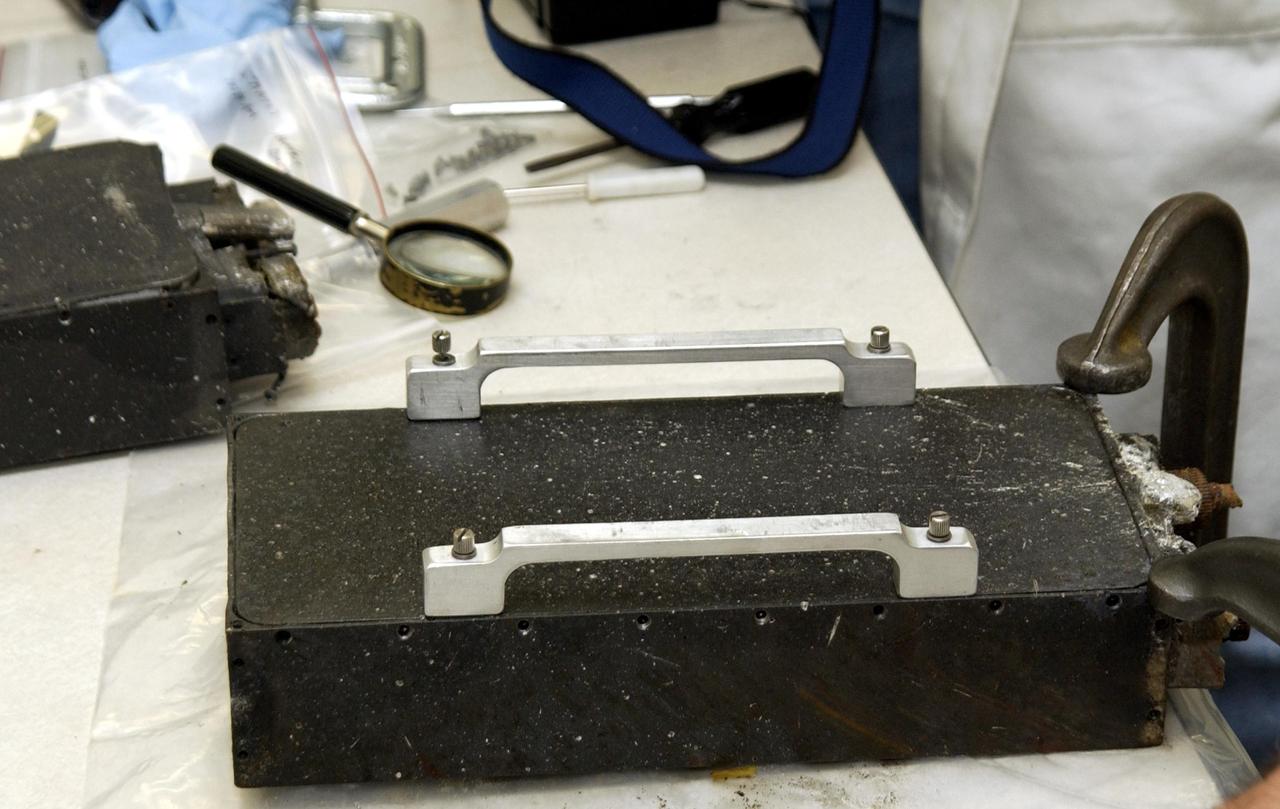
George D'Heilly and John Cassanto, scientists with Instrumentation Technology Associates, Inc., display for the media part of the apparatus recovered during the search for Columbia debris. It was part of the Commercial ITA Biomedical Experiments payload on mission STS-107 that included the Growth of Bacterial Biofilm on Surfaces during Spaceflight (GOBBSS) experiment and crystals grown for cancer research. The GOBBSS experiment was sponsored by the Planetary Society, with joint participation of an Israeli and a Palestinian student, and developed by the Israeli Aerospace Medical Institute and JSC Astrobiology Center.
Columbia Debris
KENNEDY SPACE CENTER, FLA. - Valerie Cassanto and Bob McLean talk to a reporter about experiments found during the search for Columbia debris.  Cassanto is with Instrumentation Technology Associates Inc. and McLean is with the Southwest Texas State University. Included in the Commercial ITA Biomedical Experiments payload on mission STS-107 are urokinase cancer research, microencapsulation of drugs, the Growth of Bacterial Biofilm on Surfaces during Spaceflight (GOBBSS), and tin crystal formation.
KSC-03pd1452
jsc2024e066516 (10/4/2024) ---  Student researcher Ryan Stewart works to optimize the bacterial growth medium for his experiment, The Impact of Lectins on Escherichia coli Biofilm Formation in Microgravity. The experiment is part of the Nanoracks-National Center for Earth and Space Science Education-Surveyor-Student Spaceflight Experiments Program Mission 18 to ISS (Nanoracks-NCESSE-Surveyor-SSEP).
Preflight Imagery for Nanoracks-NCESSE-Surveyor-SSEP
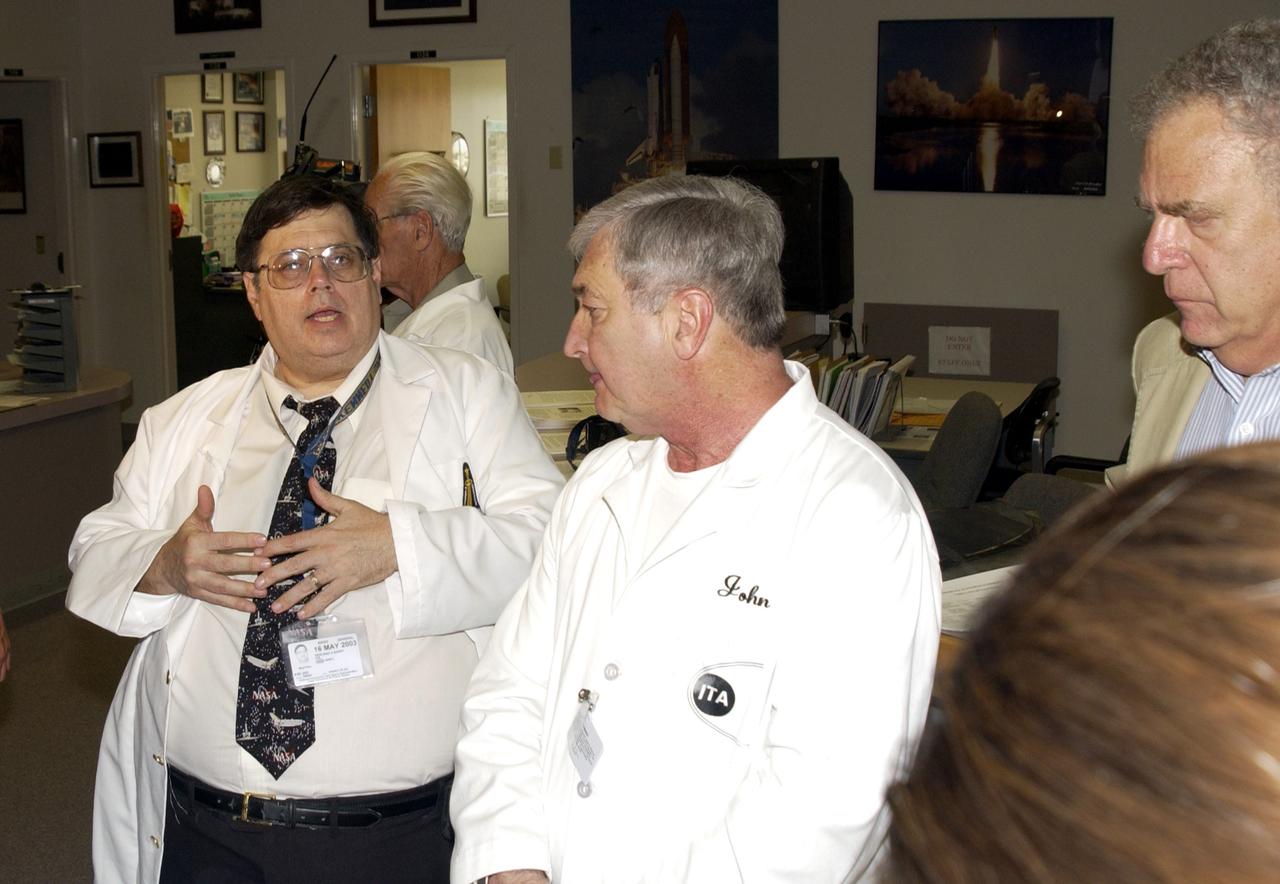
KENNEDY SPACE CENTER, FLA. -  John Cassanto (center), with Instrumentation Technology Associates, Inc., explains the use of the apparatus used for experiments on mission STS-107.   At left is Barry Perlman, with Pembroke Pines Middle School in Florida; at right is Lou Friedman, executive director of the Planetary Society. The box was part of the  Commercial ITA Biomedical Experiments payload on mission STS-107 that included the Growth of Bacterial Biofilm on Surfaces during Spaceflight (GOBBSS) experiment and crystals grown for cancer research.  The GOBBSS experiment was sponsored by the Planetary Society, with joint participation of an Israeli and a Palestinian student, and developed by the Israeli Aerospace Medical Institute and JSC Astrobiology Center.
KSC-03pd1440
iss074e0149044 (Jan. 19, 2026) --- NASA astronaut and Expedition 74 Flight Engineer Chris Williams safely processes samples of a bacterial pathogen inside the Kibo laboratory module’s Life Science Glovebox. Williams was exploring a way to prevent the formation of biofilms, or a layer of microorganisms, anywhere water is found on a spacecraft where they pose human health risks and can damage equipment. The microbe samples are housed inside a specialized cell culture chamber, called a BioCell, and exposed to different levels of ultraviolet light to learn how to inhibit microbial growth and reduce reliance on chemical disinfectants.
NASA astronaut Chris Williams safely processes samples of a bacterial pathogen
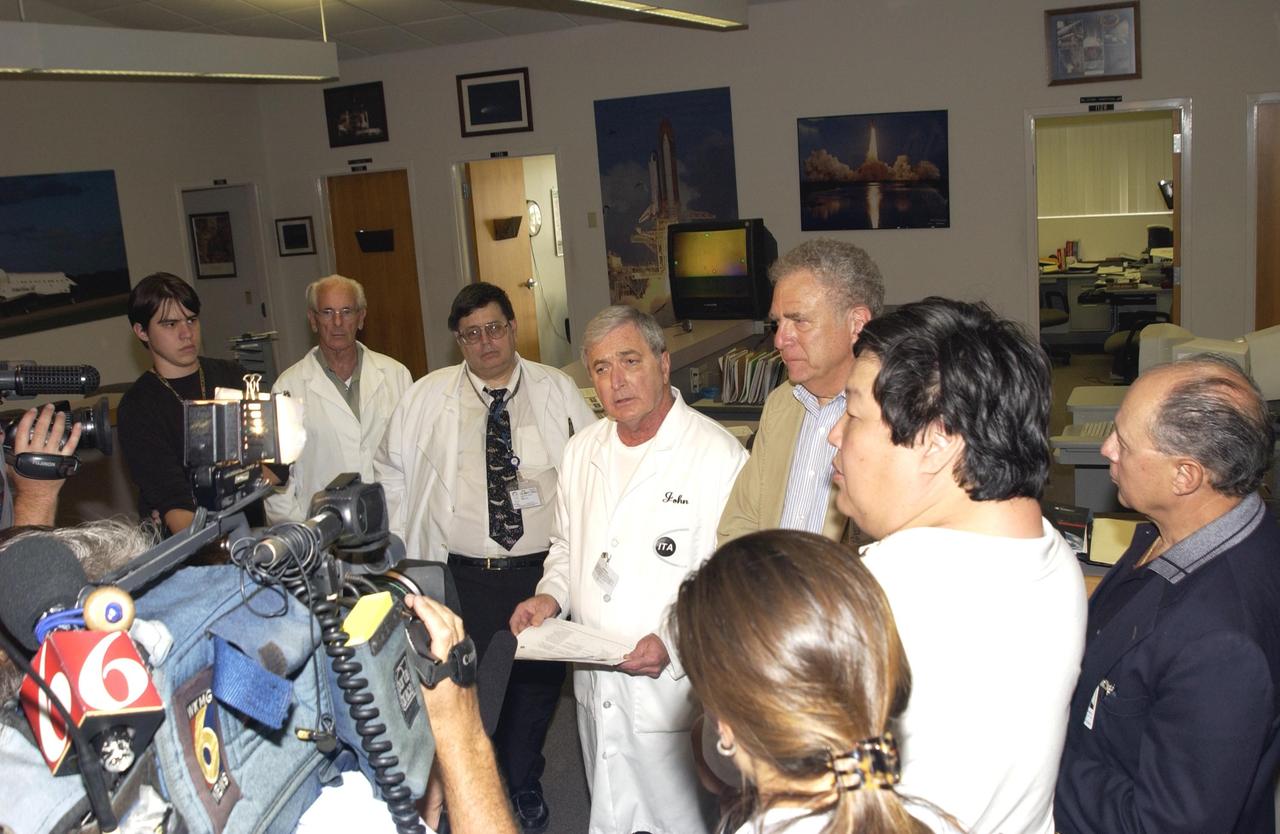
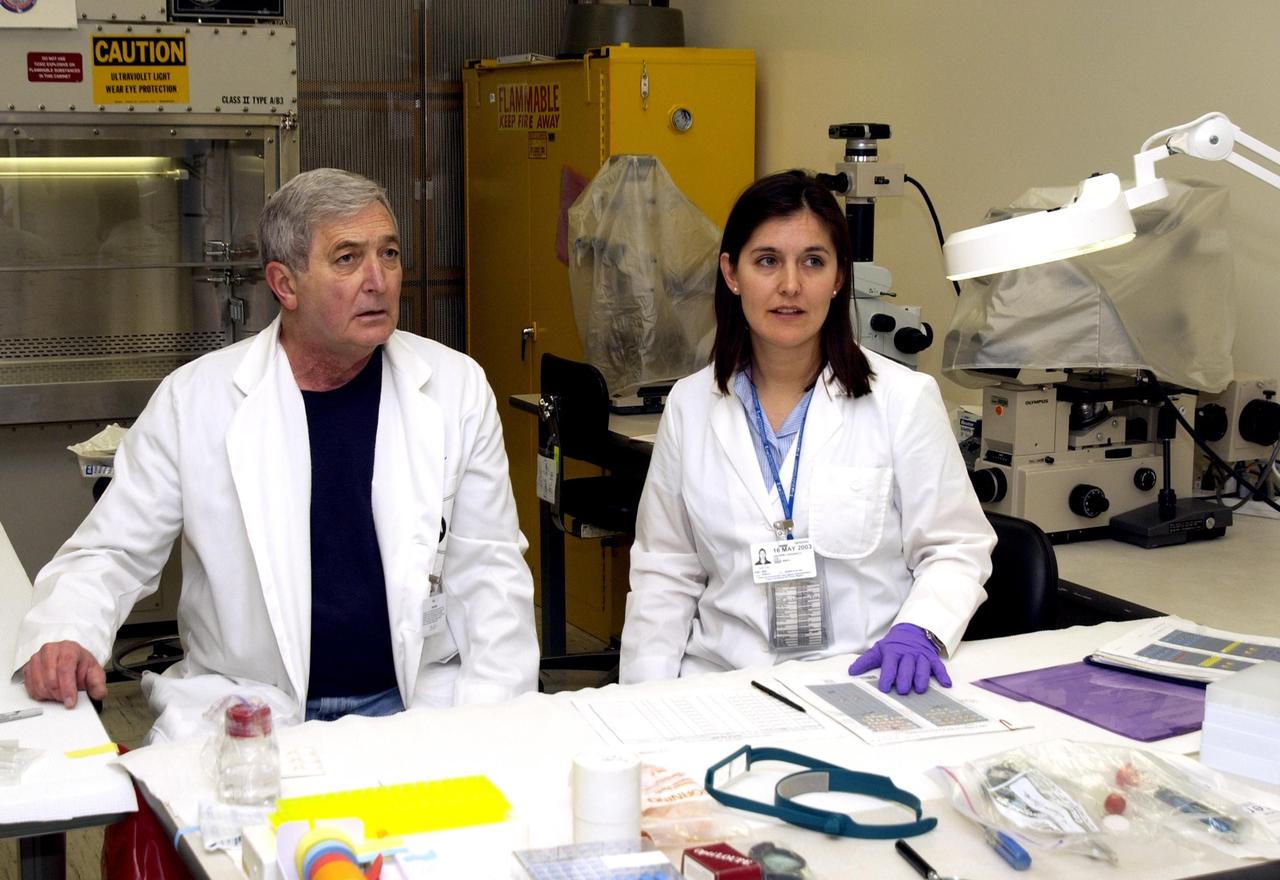
KENNEDY SPACE CENTER, FLA. - In the background, scientists talk to the media about the experiments recovered during the search for Columbia debris.  From left are George D'Heilly, with Instrumentation Technology Associates, Inc.; Barry Perlman, with Pembroke Pines Middle School in Florida; John Cassanto, with ITA; and Lou Friedman, executive director of the Planetary Society.  The  Commercial ITA Biomedical Experiments payload on mission STS-107 included the Growth of Bacterial Biofilm on Surfaces during Spaceflight (GOBBSS) experiment and crystals grown for cancer research.  The GOBBSS experiment was sponsored by the Planetary Society, with joint participation of an Israeli and a Palestinian student, and developed by the Israeli Aerospace Medical Institute and JSC Astrobiology Center.
KSC-03pd1441
KENNEDY SPACE CENTER, FLA. -  George D'Heilly, with Instrumentation Technology Associates, Inc., Barry Perlman, with Pembroke Pines Middle School in Florida, John Cassanto, with ITA, and Lou Friedman, executive director of the Planetary Society, talk to the media about the experiments recovered during the search for Columbia debris.  They were part of the  Commercial ITA Biomedical Experiments payload on mission STS-107 that included the Growth of Bacterial Biofilm on Surfaces during Spaceflight (GOBBSS) experiment and crystals grown for cancer research.  The GOBBSS experiment was sponsored by the Planetary Society, with joint participation of an Israeli and a Palestinian student, and developed by the Israeli Aerospace Medical Institute and JSC Astrobiology Center.
KSC-03pd1439
KENNEDY SPACE CENTER, FLA. -  Barry Perlman (left), with Pembroke Pines Charter Middle School in Florida, talks to the media about some of the experiments recovered during the search for Columbia debris.  At right are John Cassanto, with Instrumentation Technology Associates, Inc., and Lou Friedman, executive director of the Planetary Society.  The  Commercial ITA Biomedical Experiments payload on mission STS-107 included the Growth of Bacterial Biofilm on Surfaces during Spaceflight (GOBBSS) experiment and crystals grown for cancer research.  The GOBBSS experiment was sponsored by the Planetary Society, with joint participation of an Israeli and a Palestinian student, and developed by the Israeli Aerospace Medical Institute and JSC Astrobiology Center.
KSC-03pd1442
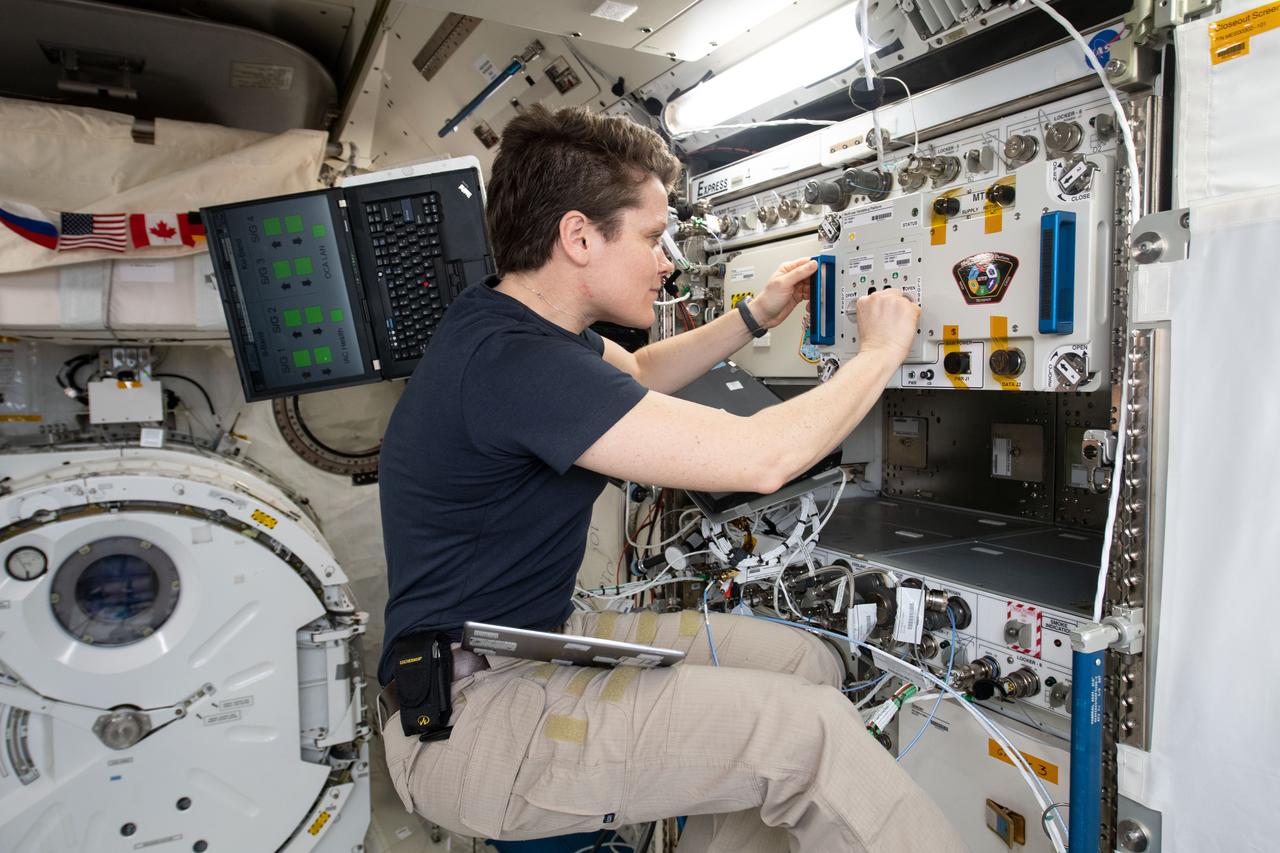
iss059e034463 (April 23, 2019) --- NASA astronaut Anne McClain installs the MVP-2 platform onto Express Rack 4 and took historical photos. The Experimental Evolution of Bacillus subtilis Populations in Space: MVP-02 investigation seeks to understand how organisms adapt to the space environment, an important component of future space exploration. Microbes may play fundamental roles in the development of biologically-based closed-loop regenerative life support, in-situ resource utilization, and will have extensive interactions with human and plant hosts. Further, microbes may pose challenges through virulence and contamination, and as nuisance factors such as biofilms in water supply and ventilation systems.
iss059e034463
KENNEDY SPACE CENTER, FLA. -  Valerie Cassanto holds a piece of the Commercial ITA Biomedical Experiments payload that was carried on mission STS-107 and recently recovered.  She is the daughter of John Cassanto of ITA, who is part of a recovery team transferring experiments to alternate containers. One of the experiments was the Growth of Bacterial Biofilm on Surfaces during Spaceflight (GOBBSS), a Planetary Society-sponsored astrobiology experiment developed by the Israeli Aerospace Medical Institute and the Johnson Space Center Astrobiology Center, with joint participation of an Israeli and a Palestinian student.  The recovery team also includes Eran Schenker of the Israeli Aerospace Medical Institute; David Warmflash of JSC, and Louis Friedman, executive director of the Planetary Society.  The GOBBSS material will be sent to JSC where the science team will analyze the samples, studying the effects of spaceflight on bacterial growth.
KSC-03pd1399
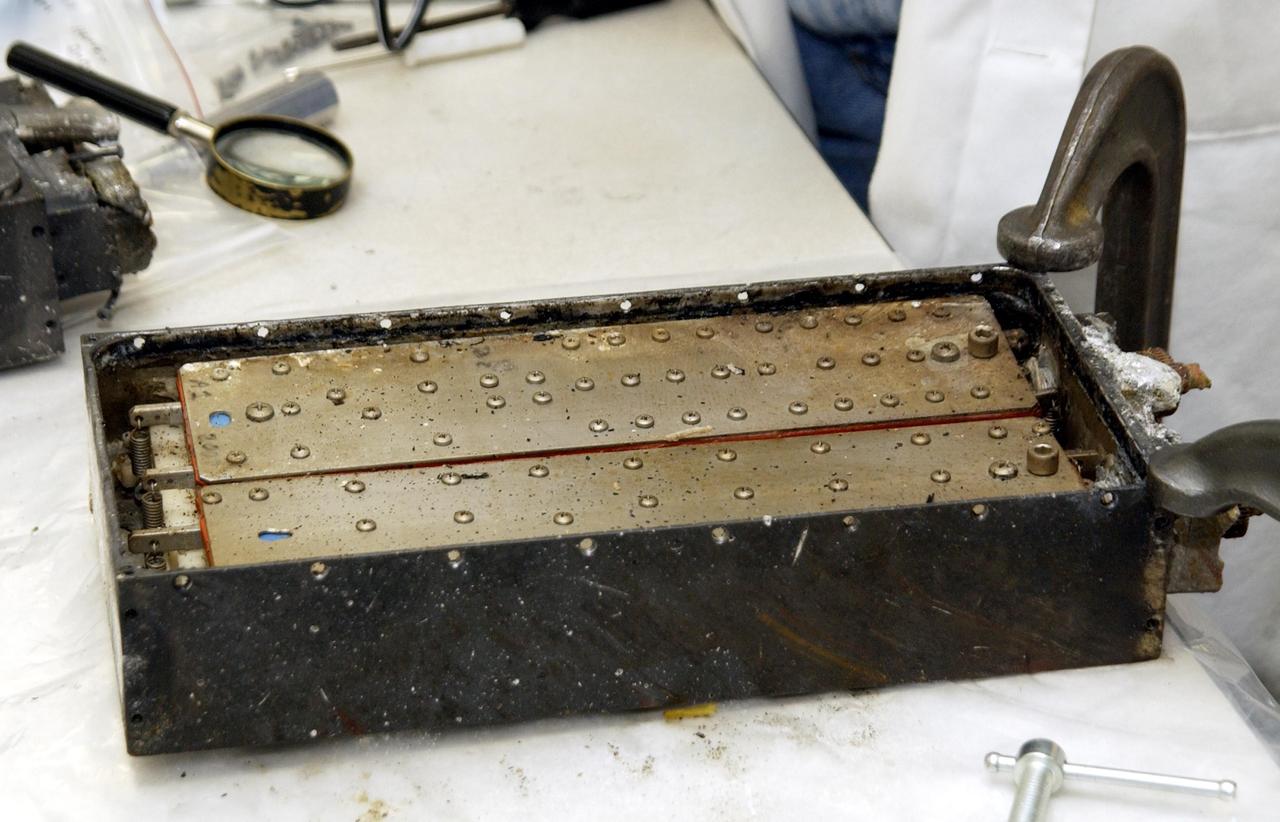
KENNEDY SPACE CENTER, FLA. - The Commercial ITA Biomedical Experiments payload retrieved from debris of Columbia is being dismantled at KSC.  Inside are several experiments carried on mission STS-107 that will be removed and transferred to alternate containers.  One experiment, the Growth of Bacterial Biofilm on Surfaces during Spaceflight (GOBBSS), was a Planetary Society-sponsored astrobiology experiment developed by the Israeli Aerospace Medical Institute and the Johnson Space Center Astrobiology Center, with joint participation of an Israeli and a Palestinian student.  The recovery team includes Eran Schenker of the Israeli Aerospace Medical Institute; David Warmflash of JSC, John Cassanto of ITA, and Louis Friedman, executive director of the Planetary Society.  The GOBBSS material will be sent to JSC where the science team will analyze the samples, studying the effects of spaceflight on bacterial growth.
KSC-03pd1391
KENNEDY SPACE CENTER, FLA. - John Cassanto of ITA points to an area of the Growth of Bacterial Biofilm on Surfaces during Spaceflight (GOBBSS) experiment that was carried on mission STS-107 as part of the Commercial ITA Biomedical Experiments payload.  He is part of a recovery team transferring experiments to alternate containers.  GOBBSS was a Planetary Society-sponsored astrobiology experiment developed by the Israeli Aerospace Medical Institute and the Johnson Space Center Astrobiology Center, with joint participation of an Israeli and a Palestinian student.  The recovery team also includes Eran Schenker of the Israeli Aerospace Medical Institute; David Warmflash of JSC, and Louis Friedman, executive director of the Planetary Society.  The GOBBSS material will be sent to JSC where the science team will analyze the samples, studying the effects of spaceflight on bacterial growth.
KSC-03pd1396
KENNEDY SPACE CENTER, FLA. - John Cassanto of ITA moves part of the Growth of Bacterial Biofilm on Surfaces during Spaceflight (GOBBSS) experiment that was carried on mission STS-107 as part of the Commercial ITA Biomedical Experiments payload.  He is part of a recovery team transferring experiments to alternate containers.  GOBBSS was a Planetary Society-sponsored astrobiology experiment developed by the Israeli Aerospace Medical Institute and the Johnson Space Center Astrobiology Center, with joint participation of an Israeli and a Palestinian student.  The recovery team also includes Eran Schenker of the Israeli Aerospace Medical Institute; David Warmflash of JSC, and Louis Friedman, executive director of the Planetary Society.  The GOBBSS material will be sent to JSC where the science team will analyze the samples, studying the effects of spaceflight on bacterial growth.
KSC-03pd1395
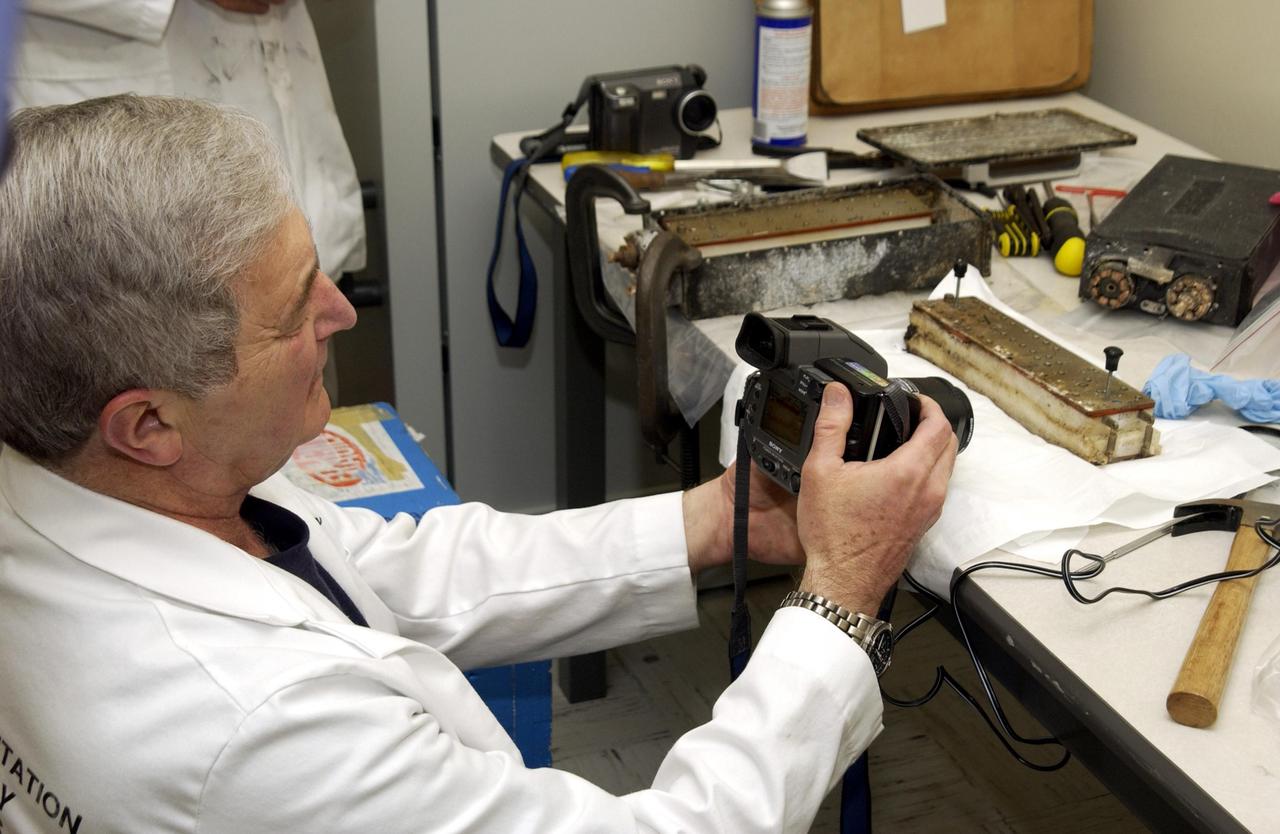
KENNEDY SPACE CENTER, FLA. - John Cassanto of ITA takes photos of the Growth of Bacterial Biofilm on Surfaces during Spaceflight (GOBBSS) experiment that was carried on mission STS-107 as part of the Commercial ITA Biomedical Experiments payload.  He is part of a recovery team transferring experiments to alternate containers.  GOBBSS was a Planetary Society-sponsored astrobiology experiment developed by the Israeli Aerospace Medical Institute and the Johnson Space Center Astrobiology Center, with joint participation of an Israeli and a Palestinian student.  The recovery team also includes Eran Schenker of the Israeli Aerospace Medical Institute; David Warmflash of JSC, and Louis Friedman, executive director of the Planetary Society.  The GOBBSS material will be sent to JSC where the science team will analyze the samples, studying the effects of spaceflight on bacterial growth.
KSC-03pd1397
KENNEDY SPACE CENTER, FLA. - The Commercial ITA Biomedical Experiments payload retrieved from debris of Columbia is being dismantled at KSC.  Inside are several experiments carried on mission STS-107 that will be removed and transferred to alternate containers.  One experiment, the Growth of Bacterial Biofilm on Surfaces during Spaceflight (GOBBSS), was a Planetary Society-sponsored astrobiology experiment developed by the Israeli Aerospace Medical Institute and the Johnson Space Center Astrobiology Center, with joint participation of an Israeli and a Palestinian student.  The recovery team includes Eran Schenker of the Israeli Aerospace Medical Institute; David Warmflash of JSC, John Cassanto of ITA, and Louis Friedman, executive director of the Planetary Society.  The GOBBSS material will be sent to JSC where the science team will analyze the samples, studying the effects of spaceflight on bacterial growth.
KSC-03pd1392
KENNEDY SPACE CENTER, FLA. - John Cassanto of ITA and his daughter Valerie stand next to the table holding the Growth of Bacterial Biofilm on Surfaces during Spaceflight (GOBBSS) experiment that was carried on mission STS-107 as part of the Commercial ITA Biomedical Experiments payload.  He is part of a recovery team transferring experiments to alternate containers.  GOBBSS was a Planetary Society-sponsored astrobiology experiment developed by the Israeli Aerospace Medical Institute and the Johnson Space Center Astrobiology Center, with joint participation of an Israeli and a Palestinian student.  The recovery team also includes Eran Schenker of the Israeli Aerospace Medical Institute; David Warmflash of JSC, and Louis Friedman, executive director of the Planetary Society.  The GOBBSS material will be sent to JSC where the science team will analyze the samples, studying the effects of spaceflight on bacterial growth.
KSC-03pd1398
KENNEDY SPACE CENTER, FLA. -  John Cassanto of ITA looks at the Growth of Bacterial Biofilm on Surfaces during Spaceflight (GOBBSS) experiment that was carried on mission STS-107 as part of the Commercial ITA Biomedical Experiments payload.  He is part of a recovery team transferring experiments to alternate containers.  GOBBSS was a Planetary Society-sponsored astrobiology experiment developed by the Israeli Aerospace Medical Institute and the Johnson Space Center Astrobiology Center, with joint participation of an Israeli and a Palestinian student.  The recovery team also includes Eran Schenker of the Israeli Aerospace Medical Institute; David Warmflash of JSC, and Louis Friedman, executive director of the Planetary Society.  The GOBBSS material will be sent to JSC where the science team will analyze the samples, studying the effects of spaceflight on bacterial growth.
KSC-03pd1393
KENNEDY SPACE CENTER, FLA. -  A member of the recovery team examines with a magnifier the Growth of Bacterial Biofilm on Surfaces during Spaceflight (GOBBSS) experiment that was carried on mission STS-107 as part of the Commercial ITA Biomedical Experiments payload.  He is part of a recovery team transferring experiments to alternate containers.  GOBBSS was a Planetary Society-sponsored astrobiology experiment developed by the Israeli Aerospace Medical Institute and the Johnson Space Center Astrobiology Center, with joint participation of an Israeli and a Palestinian student.  The recovery team includes Eran Schenker of the Israeli Aerospace Medical Institute; David Warmflash of JSC and Louis Friedman, executive director of the Planetary Society.  The GOBBSS material will be sent to JSC where the science team will analyze the samples, studying the effects of spaceflight on bacterial growth.
KSC-03pd1394
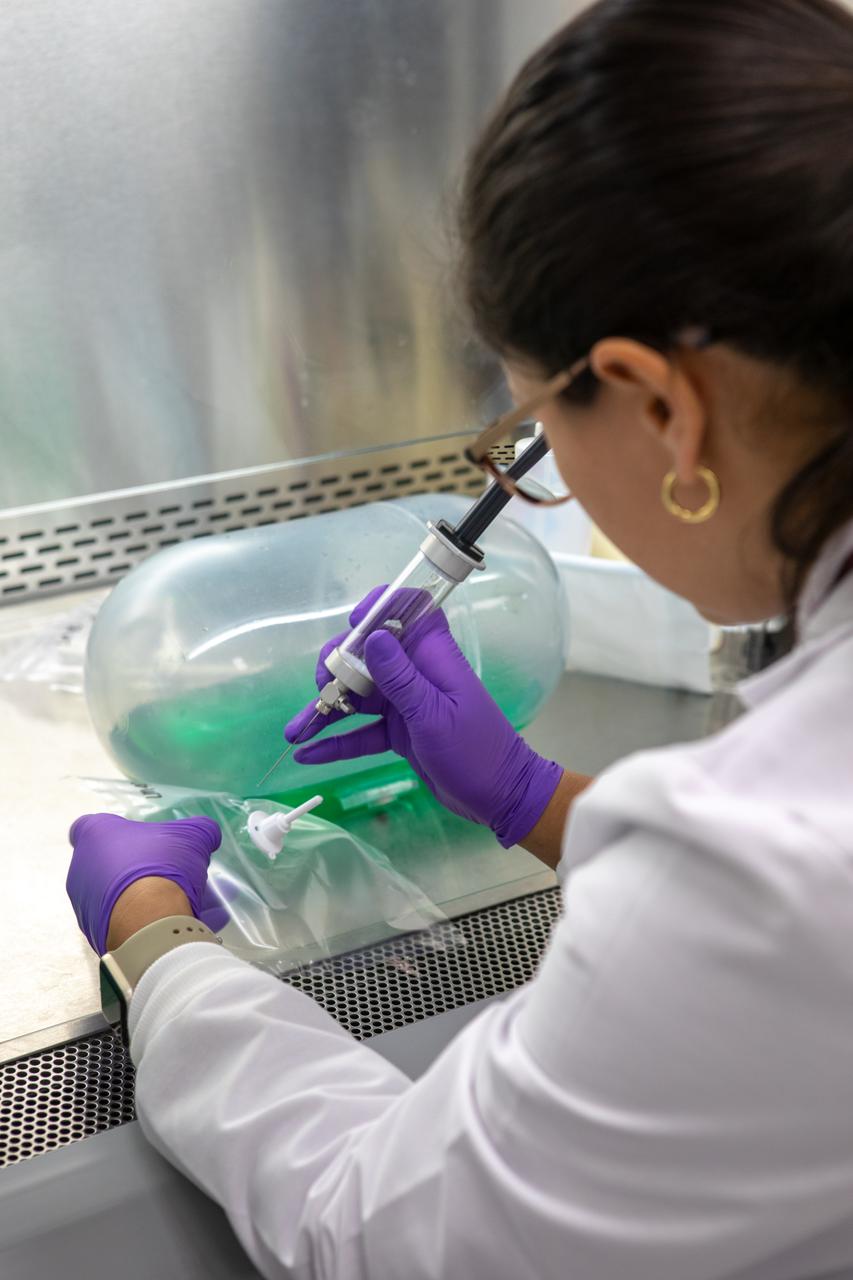
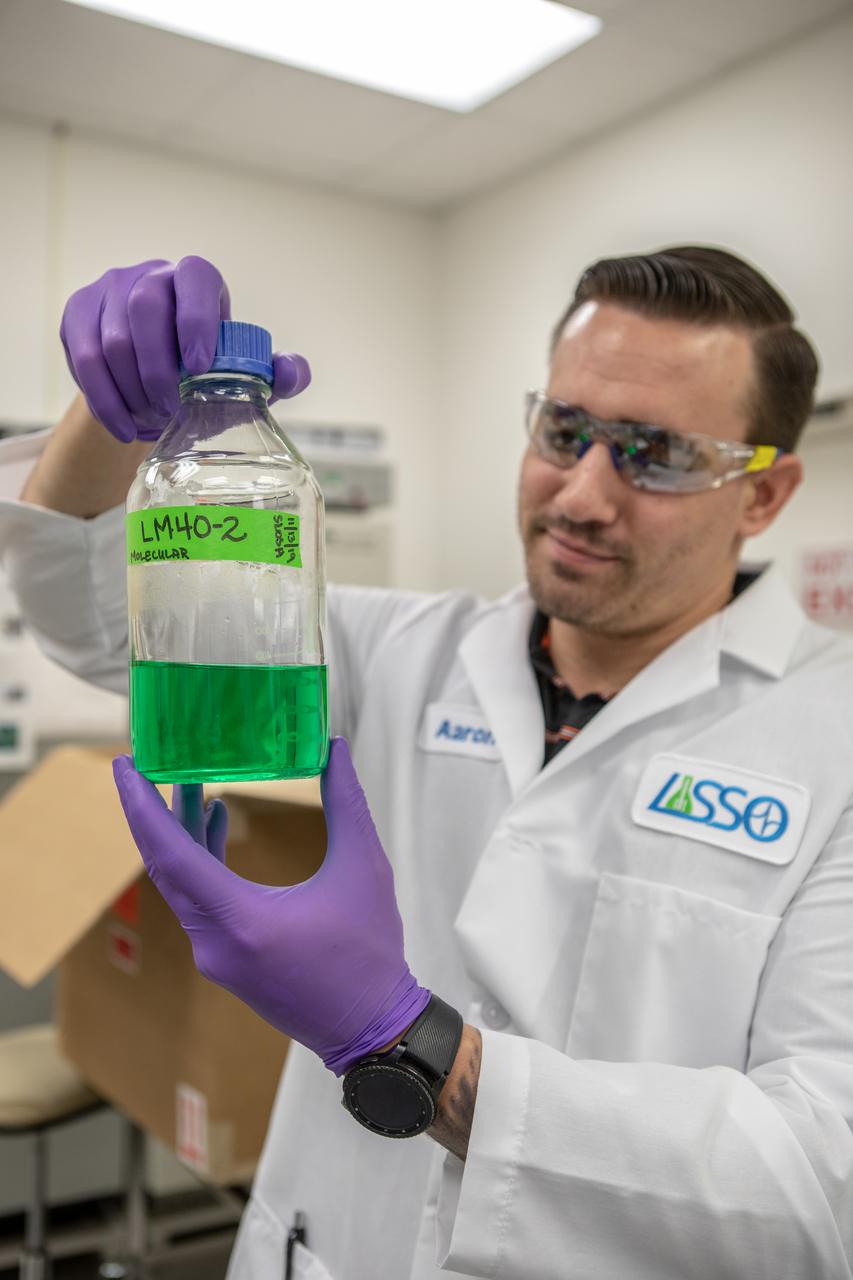
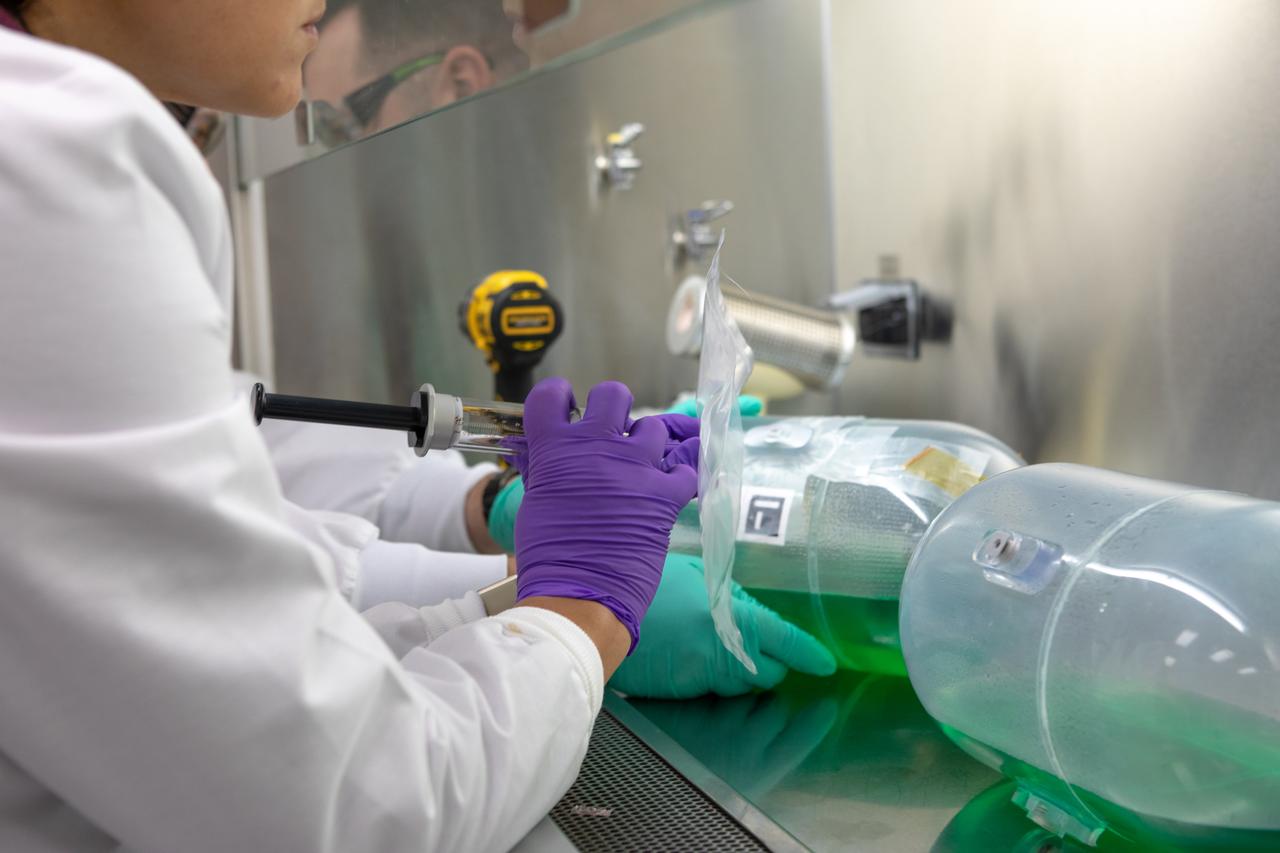
Kennedy Space Center’s Carolina Franco, Ph.D., collects samples from a water tank, filled with green dye, for a biological study in the Florida spaceport’s Neil Armstrong Operations and Checkout Building on Nov. 13, 2019. Two tanks have recently returned to Kennedy after spending the last five years on the International Space Station for an experiment to study slosh, or the movement of water, in a zero-gravity environment to help engineers predict the movement of propellant in rocket tanks. With the slosh experiment now concluded, Kennedy’s Air and Water Revitalization lab is studying the water tanks to determine if there is, or was, any microbial growth within them. The results will help NASA determine whether clean water can be stored in space for long-duration missions, an essential component to keeping astronauts safe and healthy as the agency prepares for missions to the Moon and beyond to Mars.
ISS Slosh Tank Experiment
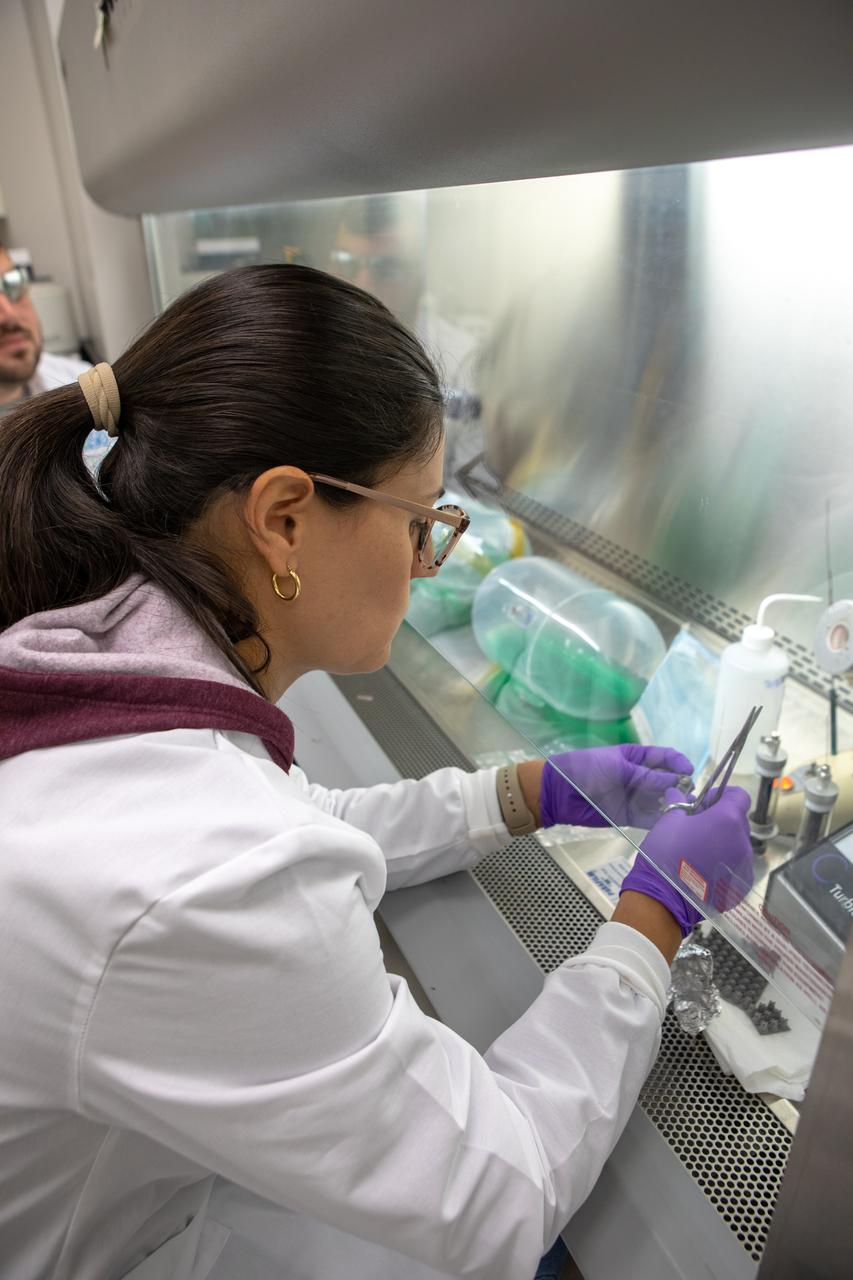
Kennedy Space Center’s Carolina Franco, Ph.D., conducts a biological study on two tanks of water, filled with green dye, in the Florida spaceport’s Neil Armstrong Operations and Checkout Building on Nov. 13, 2019. The tanks have recently returned to Kennedy after spending the last five years on the International Space Station for an experiment to study slosh, or the movement of water, in a zero-gravity environment to help engineers predict the movement of propellant in rocket tanks. Kennedy’s Air and Water Revitalization lab is studying the water tanks to determine if there is, or was, any microbial growth within them. The results will help NASA determine whether clean water can be stored in space for long-duration missions, an essential component to keeping astronauts safe and healthy as the agency prepares for missions to the Moon and beyond to Mars.
ISS Slosh Tank Experiment
A Kennedy Space Center employee collects samples from a water tank, filled with green dye, for a biological study in the Florida spaceport’s Neil Armstrong Operations and Checkout Building on Nov. 13, 2019. Two tanks have recently returned to Kennedy after spending the last five years on the International Space Station for an experiment to study slosh, or the movement of water, in a zero-gravity environment to help engineers predict the movement of propellant in rocket tanks. With the slosh experiment now concluded, Kennedy’s Air and Water Revitalization lab is studying the water tanks to determine if there is, or was, any microbial growth within them. The results will help NASA determine whether clean water can be stored in space for long-duration missions, an essential component to keeping astronauts safe and healthy as the agency prepares for missions to the Moon and beyond to Mars.
ISS Slosh Tank Experiment
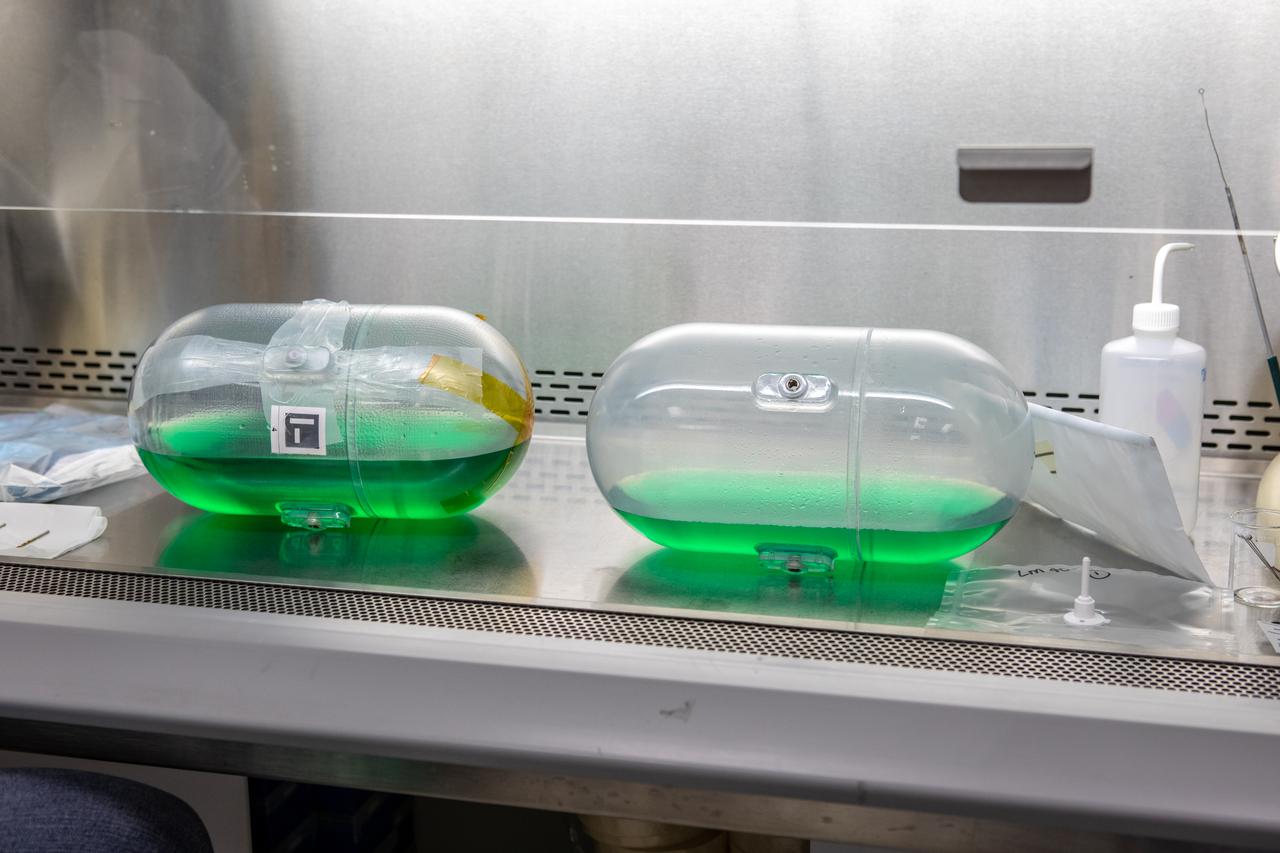
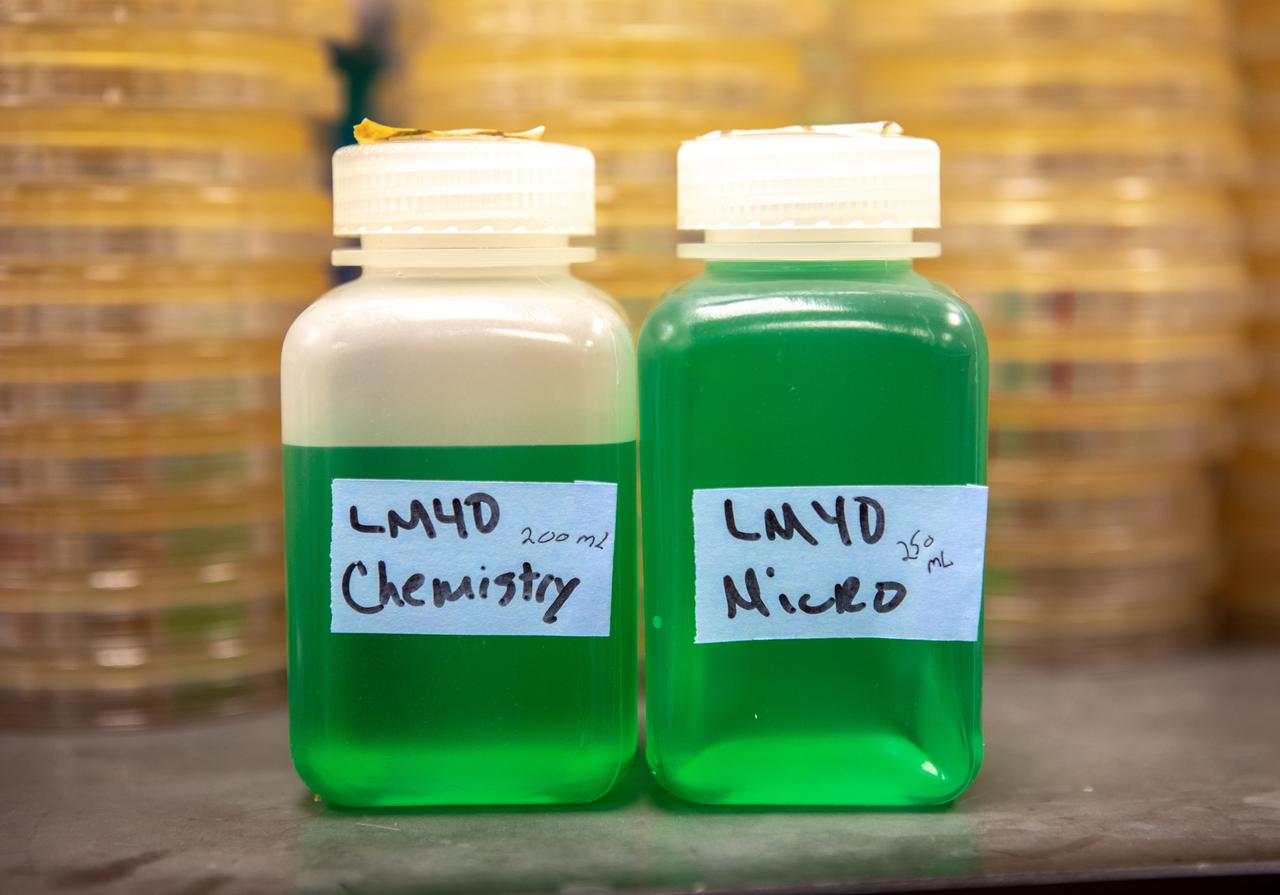
Samples of water, filled with green dye, gathered from two water tanks that have spent the past five years in space, are photographed inside the Neil Armstrong Operations and Checkout Building at NASA’s Kennedy Space Center in Florida on Nov. 13, 2019. The tanks were first sent to the International Space Station in 2014 to study slosh, or the movement of water, in a zero-gravity environment to help engineers predict the movement of propellant in rocket tanks. With the slosh experiment now concluded and the tanks recently returned to Kennedy, they are being utilized for a biological study to determine if there is, or was, any microbial growth within them. The results will help NASA determine whether clean water can be stored in space for long-duration missions, an essential component to keeping astronauts safe and healthy as the agency prepares for missions to the Moon and beyond to Mars.
ISS Slosh Tank Experiment
Kennedy Space Center’s Jason Fischer collects samples from a water tank, filled with green dye, for a biological study in the Florida spaceport’s Neil Armstrong Operations and Checkout Building on Nov. 13, 2019. Two tanks have recently returned to Kennedy after spending the last five years on the International Space Station for an experiment to study slosh, or the movement of water, in a zero-gravity environment to help engineers predict the movement of propellant in rocket tanks. Kennedy’s Air and Water Revitalization lab is studying the water tanks to determine if there is, or was, any microbial growth within them. The results will help NASA determine whether clean water can be stored in space for long-duration missions, an essential component to keeping astronauts safe and healthy as the agency prepares for missions to the Moon and beyond to Mars.
ISS Slosh Tank Experiment
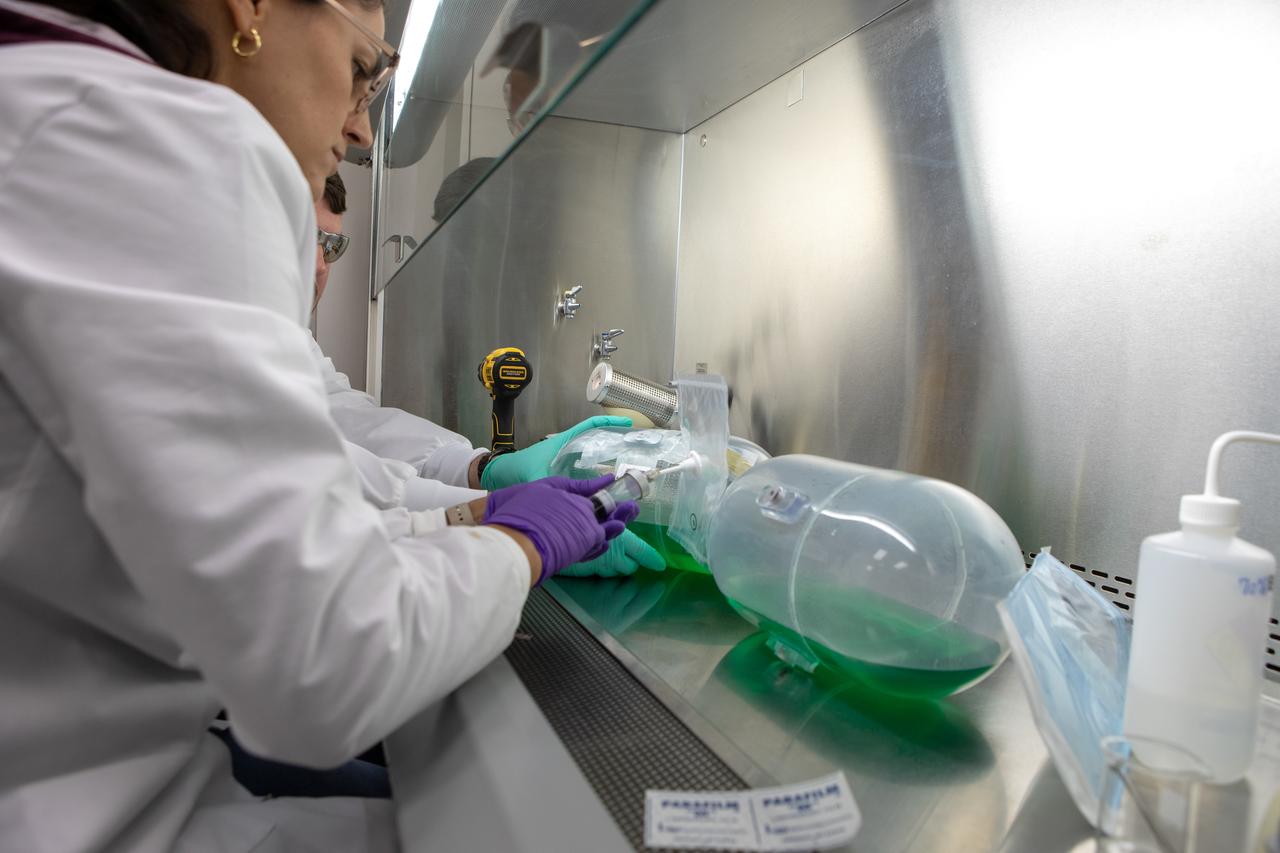
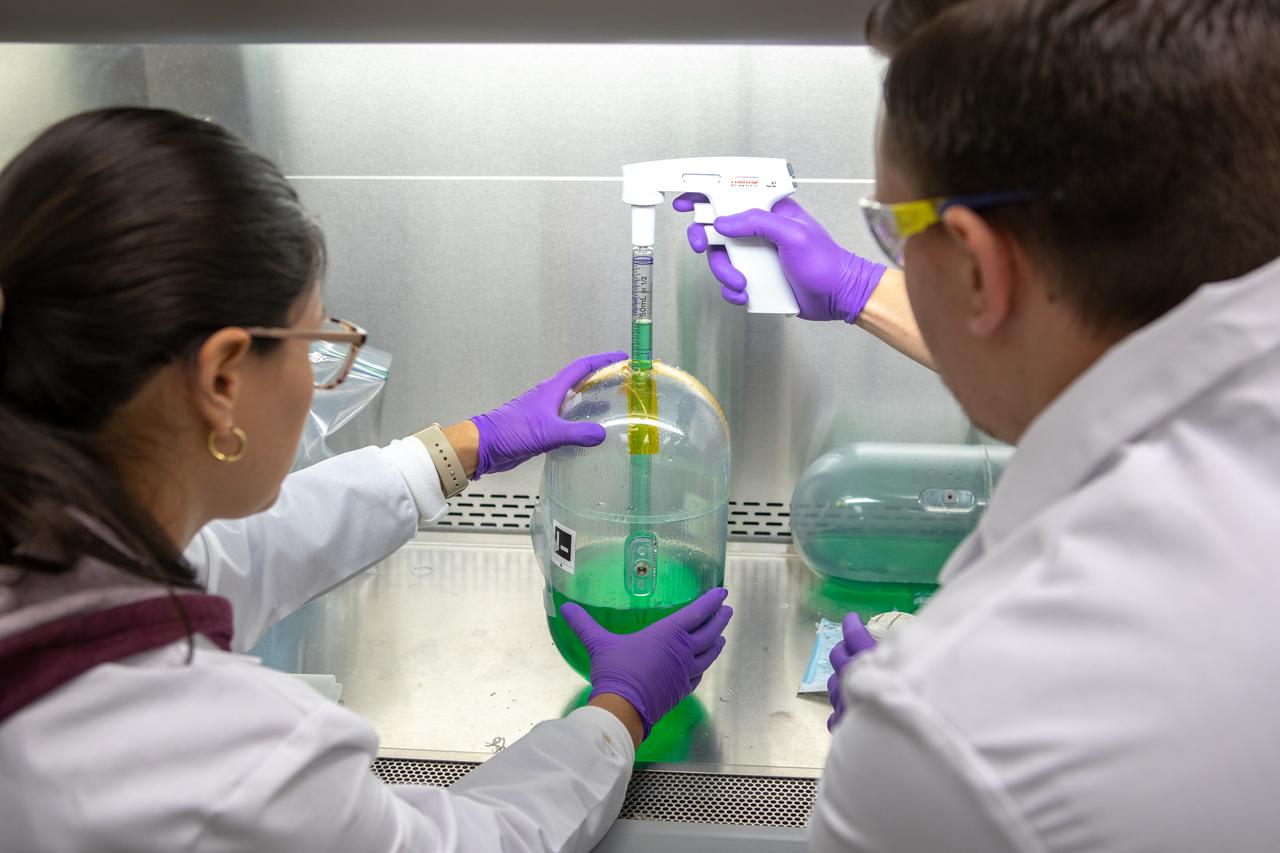
Kennedy Space Center’s Carolina Franco, Ph.D., left, and Jason Fischer collect samples from a water tank, filled with green dye, for a biological study in the Florida spaceport’s Neil Armstrong Operations and Checkout Building on Nov. 13, 2019. Two tanks have recently returned to Kennedy after spending the last five years on the International Space Station for an experiment to study slosh, or the movement of water, in a zero-gravity environment to help engineers predict the movement of propellant in rocket tanks. Kennedy’s Air and Water Revitalization lab is studying the water tanks to determine if there is, or was, any microbial growth within them. The results will help NASA determine whether clean water can be stored in space for long-duration missions, an essential component to keeping astronauts safe and healthy as the agency prepares for missions to the Moon and beyond to Mars.
ISS Slosh Tank Experiment
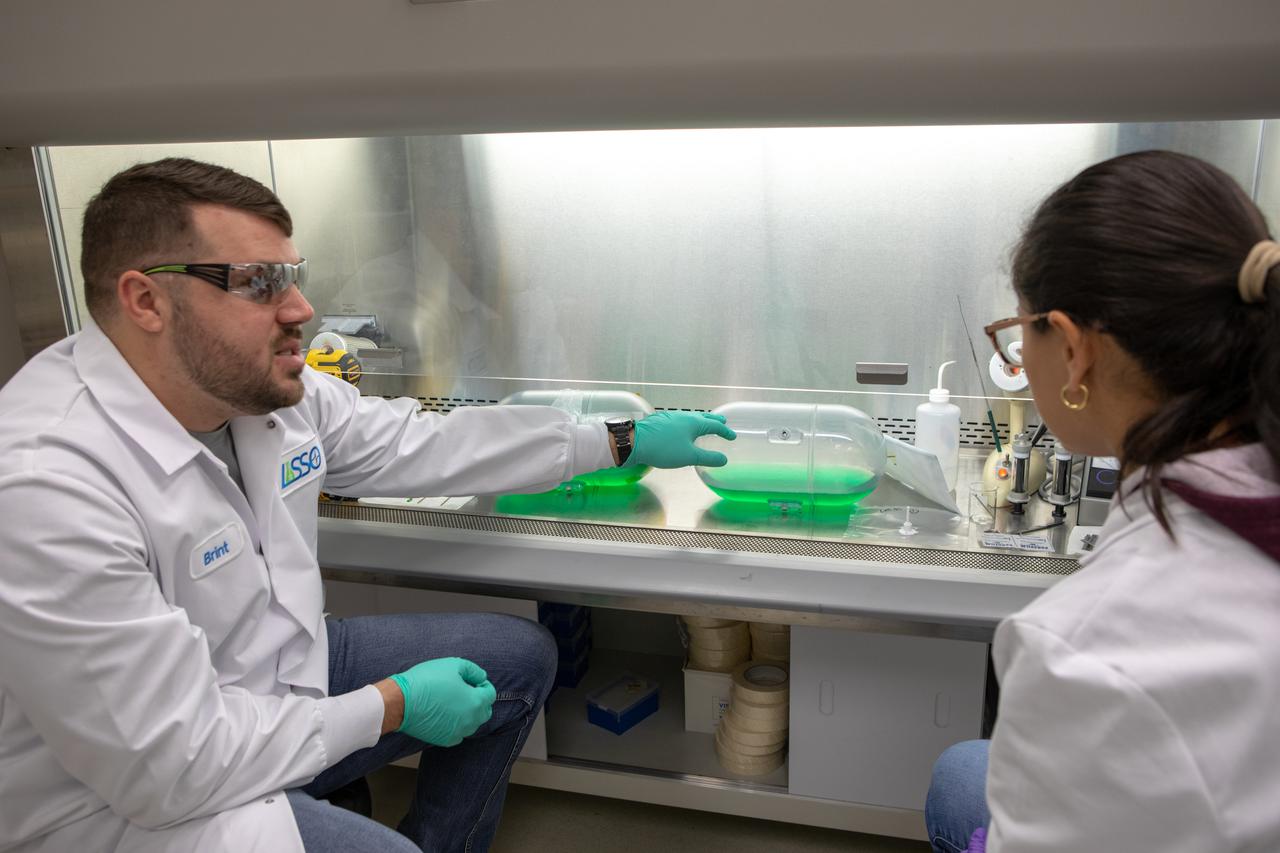
Researchers from NASA’s Kennedy Space Center Air and Water Revitalization lab are studying two tanks, containing water with green dye, inside the Neil Armstrong Operations and Checkout Building in Florida on Nov. 13, 2019. The tanks have recently returned to Kennedy after remaining on the International Space Station for the past five years, originally sent to space to study slosh – the movement of water – in a zero-gravity environment to help engineers predict the movement of propellant in rocket tanks. With the slosh experiment now concluded, the tanks are being examined to determine if there is, or was, any microbial growth within them. The results will help NASA determine whether clean water can be stored in space for long-duration missions, an essential component to keeping astronauts safe and healthy as the agency prepares for missions to the Moon and beyond to Mars.
ISS Slosh Tank Experiment
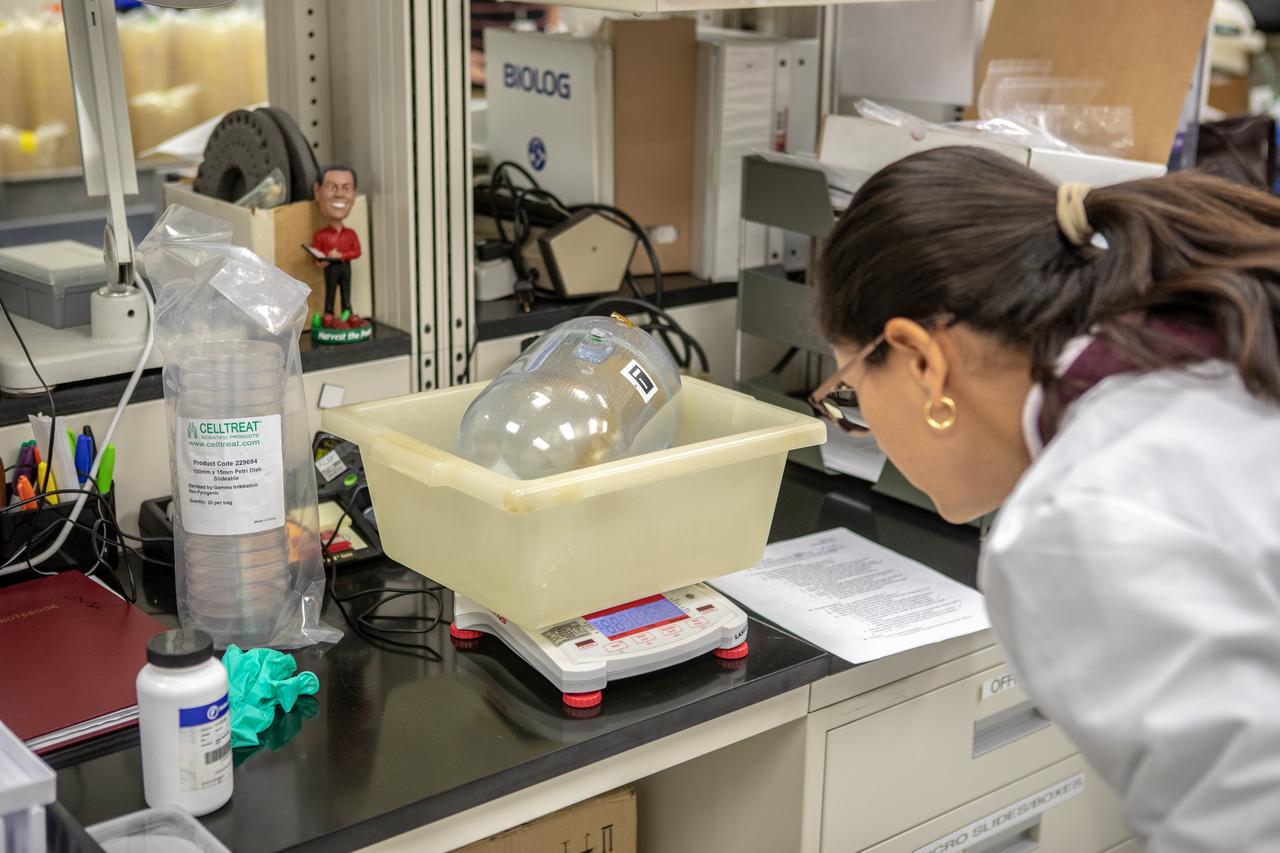
Kennedy Space Center’s Carolina Franco, Ph.D., weighs one of the water tanks, recently returned to the center after remaining on the International Space Station for the past five years, in the Florida spaceport’s Neil Armstrong Operations and Checkout Building on Nov. 13, 2019. Two tanks containing water were first sent to the orbiting laboratory in 2014 to study slosh, or the movement of water, in a zero-gravity environment to help engineers predict the movement of propellant in rocket tanks. Kennedy’s Air and Water Revitalization lab is studying the water tanks to determine if there is, or was, any microbial growth within them. The results will help NASA determine whether clean water can be stored in space for long-duration missions, an essential component to keeping astronauts safe and healthy as the agency prepares for missions to the Moon and beyond to Mars.
ISS Slosh Tank Experiment
Kennedy Space Center’s Carolina Franco, Ph.D., collects samples from a water tank, filled with green dye, for a biological study in the Florida spaceport’s Neil Armstrong Operations and Checkout Building on Nov. 13, 2019. Two tanks have recently returned to Kennedy after spending the last five years on the International Space Station for an experiment to study slosh, or the movement of water, in a zero-gravity environment to help engineers predict the movement of propellant in rocket tanks. With the slosh experiment now concluded, Kennedy’s Air and Water Revitalization lab is studying the water tanks to determine if there is, or was, any microbial growth within them. The results will help NASA determine whether clean water can be stored in space for long-duration missions, an essential component to keeping astronauts safe and healthy as the agency prepares for missions to the Moon and beyond to Mars.
ISS Slosh Tank Experiment
Kennedy Space Center’s Carolina Franco, Ph.D., left, and Jason Fischer collect samples from a water tank, filled with green dye, for a biological study in the Florida spaceport’s Neil Armstrong Operations and Checkout Building on Nov. 13, 2019. Two tanks have recently returned to Kennedy after spending the last five years on the International Space Station for an experiment to study slosh, or the movement of water, in a zero-gravity environment to help engineers predict the movement of propellant in rocket tanks. Kennedy’s Air and Water Revitalization lab is studying the water tanks to determine if there is, or was, any microbial growth within them. The results will help NASA determine whether clean water can be stored in space for long-duration missions, an essential component to keeping astronauts safe and healthy as the agency prepares for missions to the Moon and beyond to Mars.
ISS Slosh Tank Experiment
A Kennedy Space Center employee collects samples from a water tank, filled with green dye, for a biological study in the Florida spaceport’s Neil Armstrong Operations and Checkout Building on Nov. 13, 2019. Two tanks have recently returned to Kennedy after spending the last five years on the International Space Station for an experiment to study slosh, or the movement of water, in a zero-gravity environment to help engineers predict the movement of propellant in rocket tanks. With the slosh experiment now concluded, the tanks are being utilized to determine if there is, or was, any microbial growth within them. The results will help NASA determine whether clean water can be stored in space for long-duration missions, an essential component to keeping astronauts safe and healthy as the agency prepares for missions to the Moon and beyond to Mars.
ISS Slosh Tank Experiment
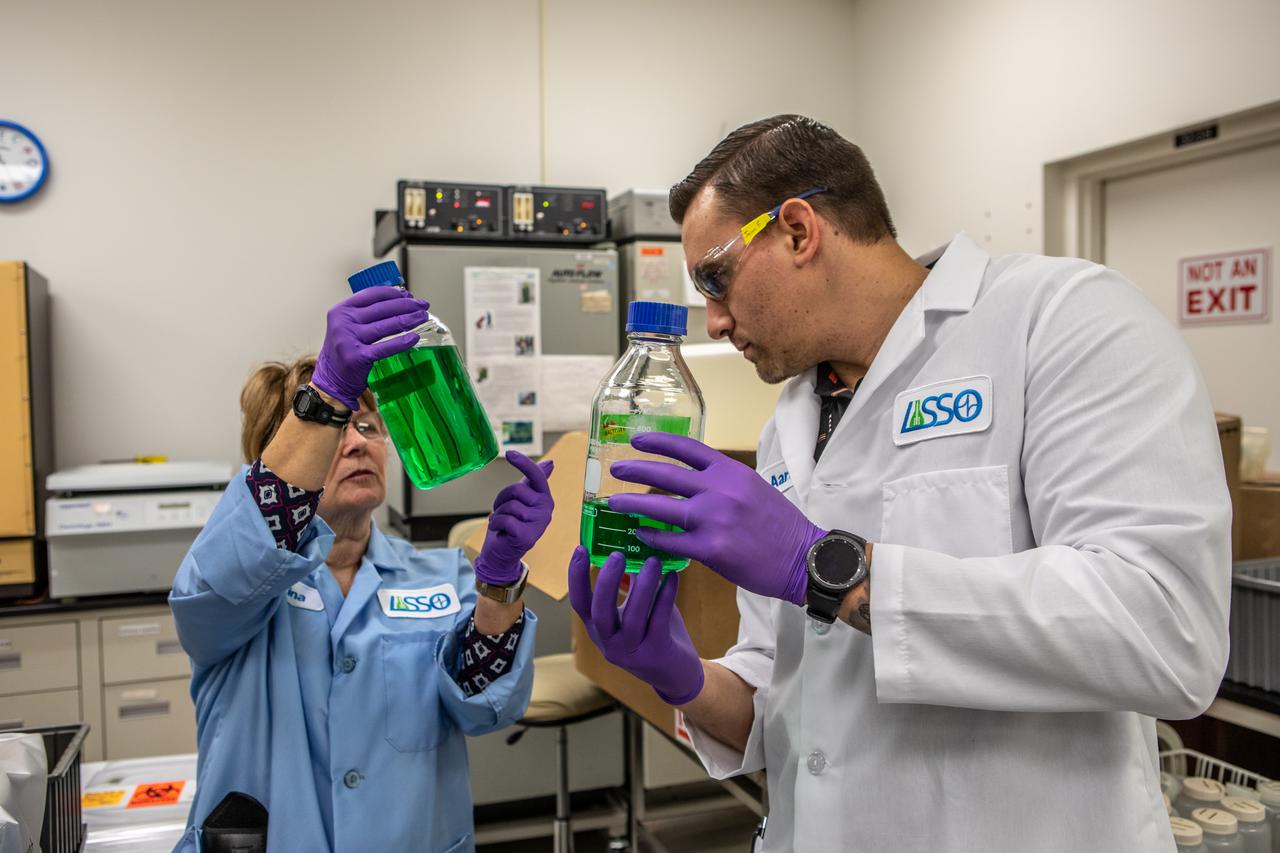
Kennedy Space Center’s Christina Khodadad, Ph.D., left, and Jason Fischer hold samples of water in the Florida spaceport’s Neil Armstrong Operations and Checkout Building on Nov. 13, 2019. Two tanks of water have recently returned to Kennedy after spending the last five years on the International Space Station for an experiment to study slosh, or the movement of water, in a zero-gravity environment to help engineers predict the movement of propellant in rocket tanks. Kennedy’s Air and Water Revitalization lab is studying the water tanks to determine if there is, or was, any microbial growth within them. The results will help NASA determine whether clean water can be stored in space for long-duration missions, an essential component to keeping astronauts safe and healthy as the agency prepares for missions to the Moon and beyond to Mars.
ISS Slosh Tank Experiment
Kennedy Space Center’s Jason Fischer holds a sample of water in the Florida spaceport’s Neil Armstrong Operations and Checkout Building on Nov. 13, 2019. Two tanks of water have recently returned to Kennedy after spending the last five years on the International Space Station for an experiment to study slosh, or the movement of water, in a zero-gravity environment to help engineers predict the movement of propellant in rocket tanks. Kennedy’s Air and Water Revitalization lab is studying the water tanks to determine if there is, or was, any microbial growth within them. The results will help NASA determine whether clean water can be stored in space for long-duration missions, an essential component to keeping astronauts safe and healthy as the agency prepares for missions to the Moon and beyond to Mars.
ISS Slosh Tank Experiment
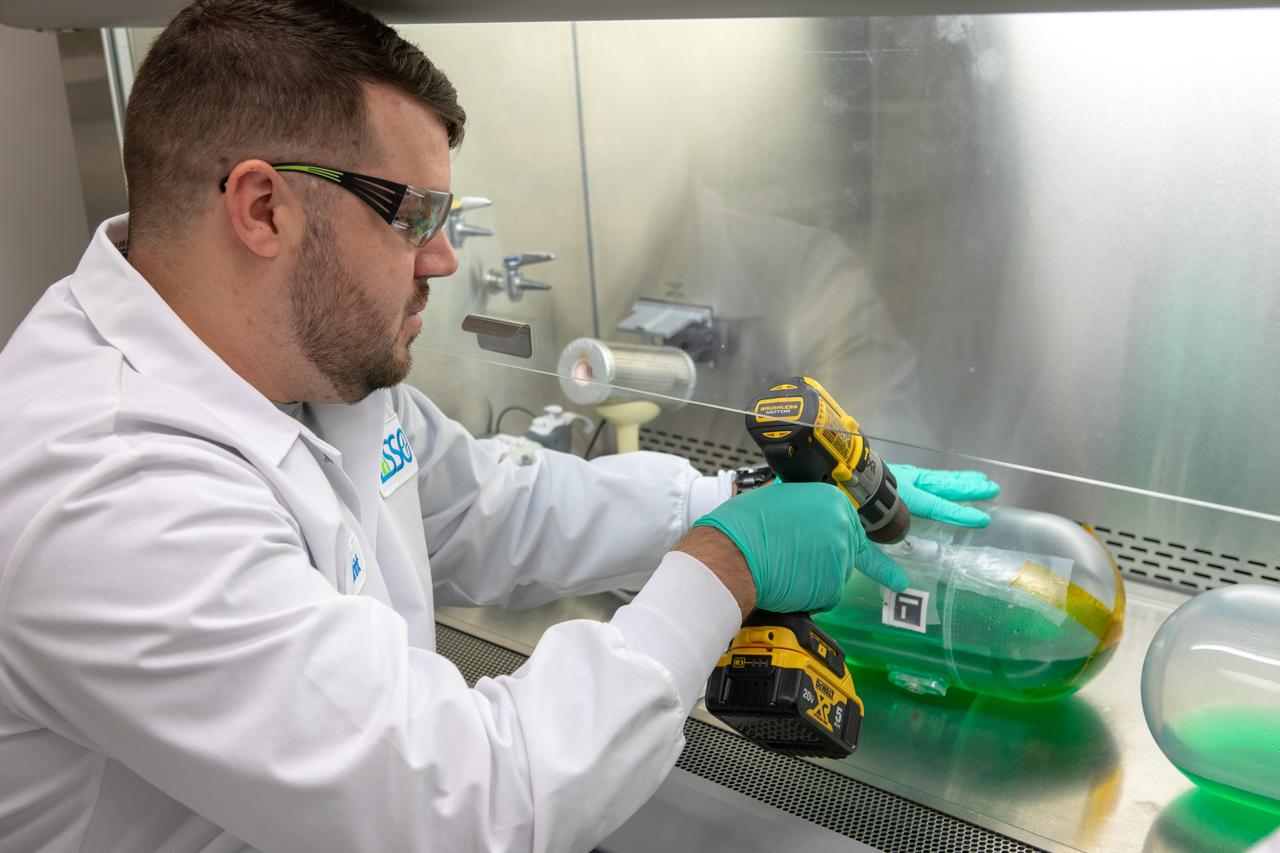
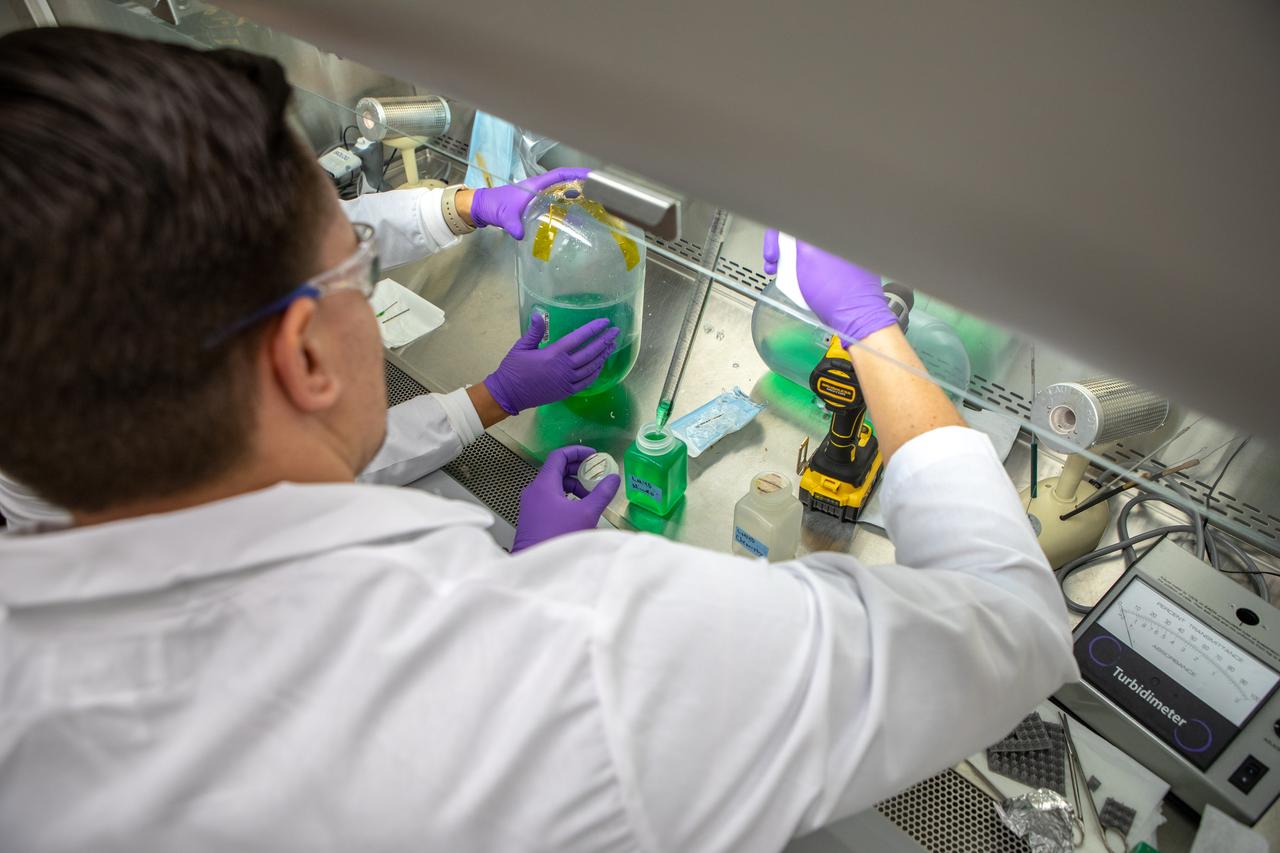
Kennedy Space Center’s Brint Bauer drills into a water tank, filled with green dye, in the Florida spaceport’s Neil Armstrong Operations and Checkout Building on Nov. 13, 2019. Two tanks have recently returned to Kennedy after spending the last five years on the International Space Station for an experiment to study slosh, or the movement of water, in a zero-gravity environment to help engineers predict the movement of propellant in rocket tanks. With the slosh experiment now concluded, Kennedy’s Air and Water Revitalization lab is studying the water tanks to determine if there is, or was, any microbial growth within them. The results will help NASA determine whether clean water can be stored in space for long-duration missions, an essential component to keeping astronauts safe and healthy as the agency prepares for missions to the Moon and beyond to Mars.
ISS Slosh Tank Experiment
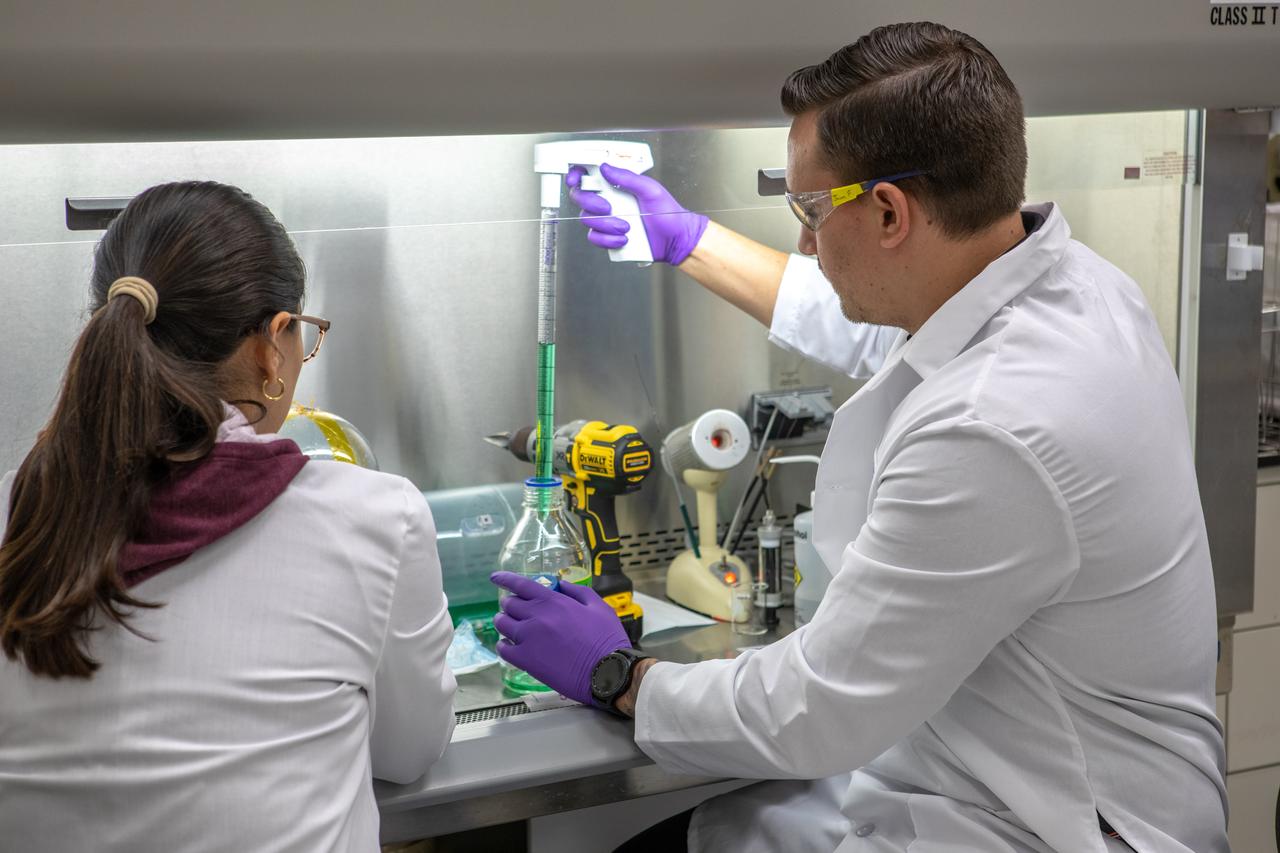
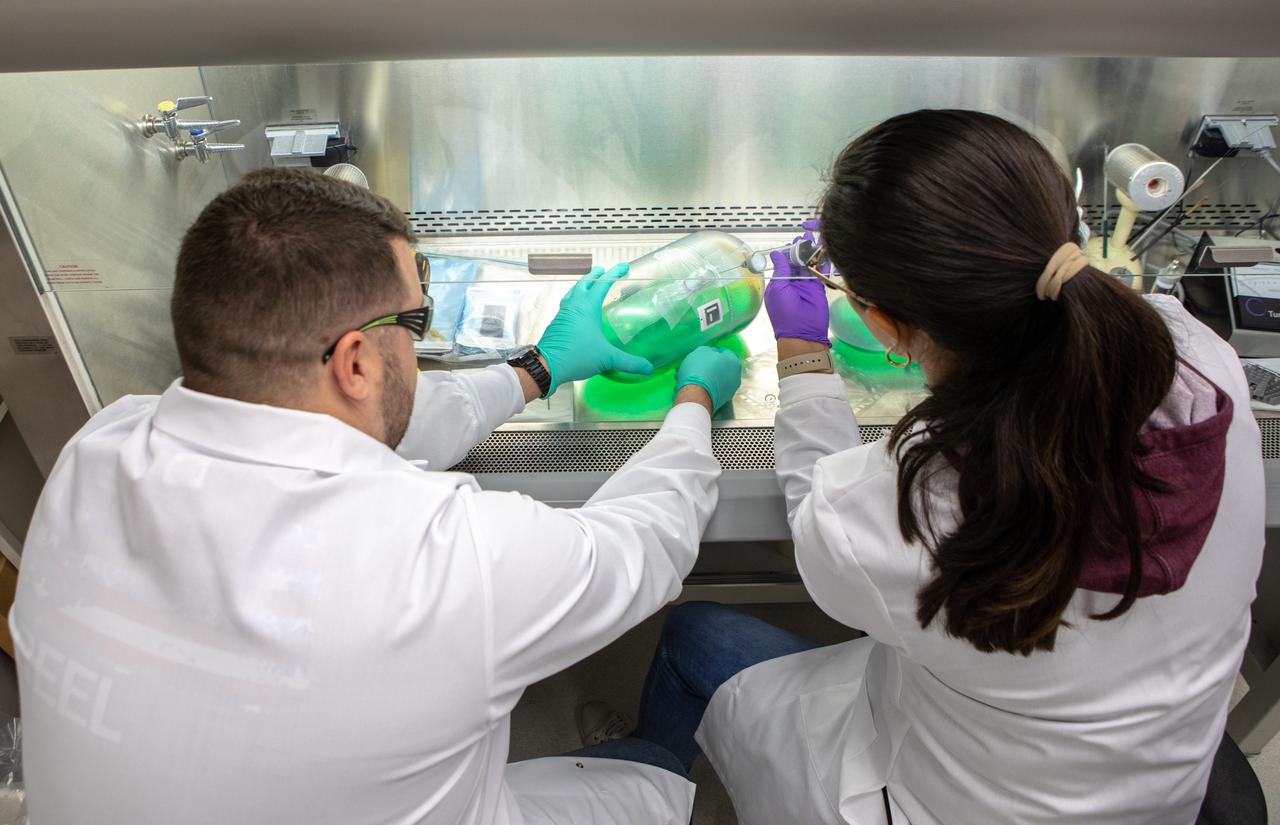
Kennedy Space Center’s Brint Bauer, left, and Carolina Franco, Ph.D., collect samples from a water tank, filled with green dye, for a biological study in the Florida spaceport’s Neil Armstrong Operations and Checkout Building on Nov. 13, 2019. Two tanks have recently returned to Kennedy after spending the last five years on the International Space Station for an experiment to study slosh, or the movement of water, in a zero-gravity environment to help engineers predict the movement of propellant in rocket tanks. Kennedy’s Air and Water Revitalization lab is studying the water tanks to determine if there is, or was, any microbial growth within them. The results will help NASA determine whether clean water can be stored in space for long-duration missions, an essential component to keeping astronauts safe and healthy as the agency prepares for missions to the Moon and beyond to Mars.
ISS Slosh Tank Experiment
Kennedy Space Center’s Brint Bauer, left, and Carolina Franco, Ph.D., conduct a biological study on two tanks of water, filled with green dye, in the Florida spaceport’s Neil Armstrong Operations and Checkout Building on Nov. 13, 2019. The tanks have recently returned to Kennedy after spending the last five years on the International Space Station for an experiment to study slosh, or the movement of water, in a zero-gravity environment to help engineers predict the movement of propellant in rocket tanks. Kennedy’s Air and Water Revitalization lab is studying the water tanks to determine if there is, or was, any microbial growth within them. The results will help NASA determine whether clean water can be stored in space for long-duration missions, an essential component to keeping astronauts safe and healthy as the agency prepares for missions to the Moon and beyond to Mars.
ISS Slosh Tank Experiment
A Kennedy Space Center employee collects samples from a water tank, filled with green dye, for a biological study in the Florida spaceport’s Neil Armstrong Operations and Checkout Building on Nov. 13, 2019. Two tanks have recently returned to Kennedy after spending the last five years on the International Space Station for an experiment to study slosh, or the movement of water, in a zero-gravity environment to help engineers predict the movement of propellant in rocket tanks. With the slosh experiment now concluded, Kennedy’s Air and Water Revitalization lab is studying the water tanks to determine if there is, or was, any microbial growth within them. The results will help NASA determine whether clean water can be stored in space for long-duration missions, an essential component to keeping astronauts safe and healthy as the agency prepares for missions to the Moon and beyond to Mars.
ISS Slosh Tank Experiment