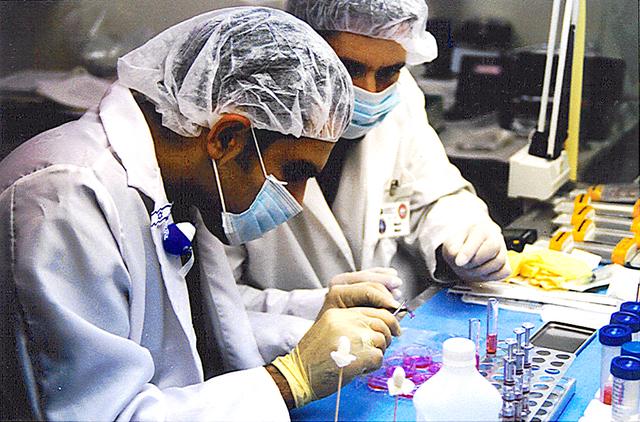
Experiments to seek solutions for a range of biomedical issues are at the heart of several investigations that will be hosted by the Commercial Instrumentation Technology Associates (ITA), Inc. Biomedical Experiments (CIBX-2) payload. CIBX-2 is unique, encompassing more than 20 separate experiments including cancer research, commercial experiments, and student hands-on experiments from 10 schools as part of ITA's ongoing University Among the Stars program. Student Marnix Aklian and ITA's Mark Bem prepare biological samples for flight as part of ITA's hands-on student outreach program on STS-95. Similar activities are a part of the CIBX-2 payload. The experiments are sponsored by NASA's Space Product Development Program (SPD).
Space Product Development (SPD)
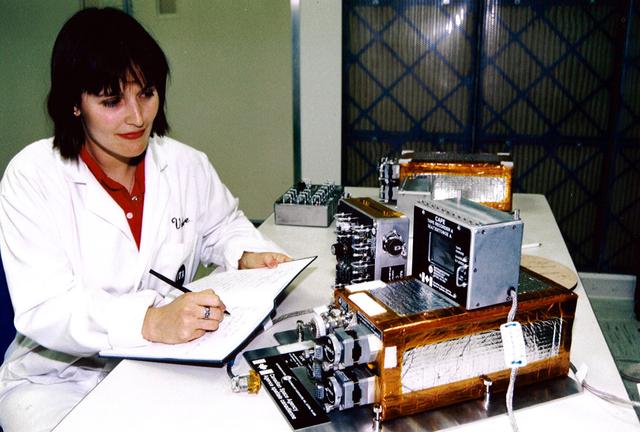
Experiments to seek solutions for a range of biomedical issues are at the heart of several investigations that will be hosted by the Commercial Instrumentation Technology Associates (ITA), Inc. Biomedical Experiments (CIBX-2) payload. CIBX-2 is unique, encompassing more than 20 separate experiments including cancer research, commercial experiments, and student hands-on experiments from 10 schools as part of ITA's ongoing University Among the Stars program. Valerie Cassanto of ITA checks the Canadian Protein Crystallization Experiment (CAPE) carried by STS-86 to Mir in 1997. The experiments are sponsored by NASA's Space Product Development Program (SPD).
Space Product Development (SPD)
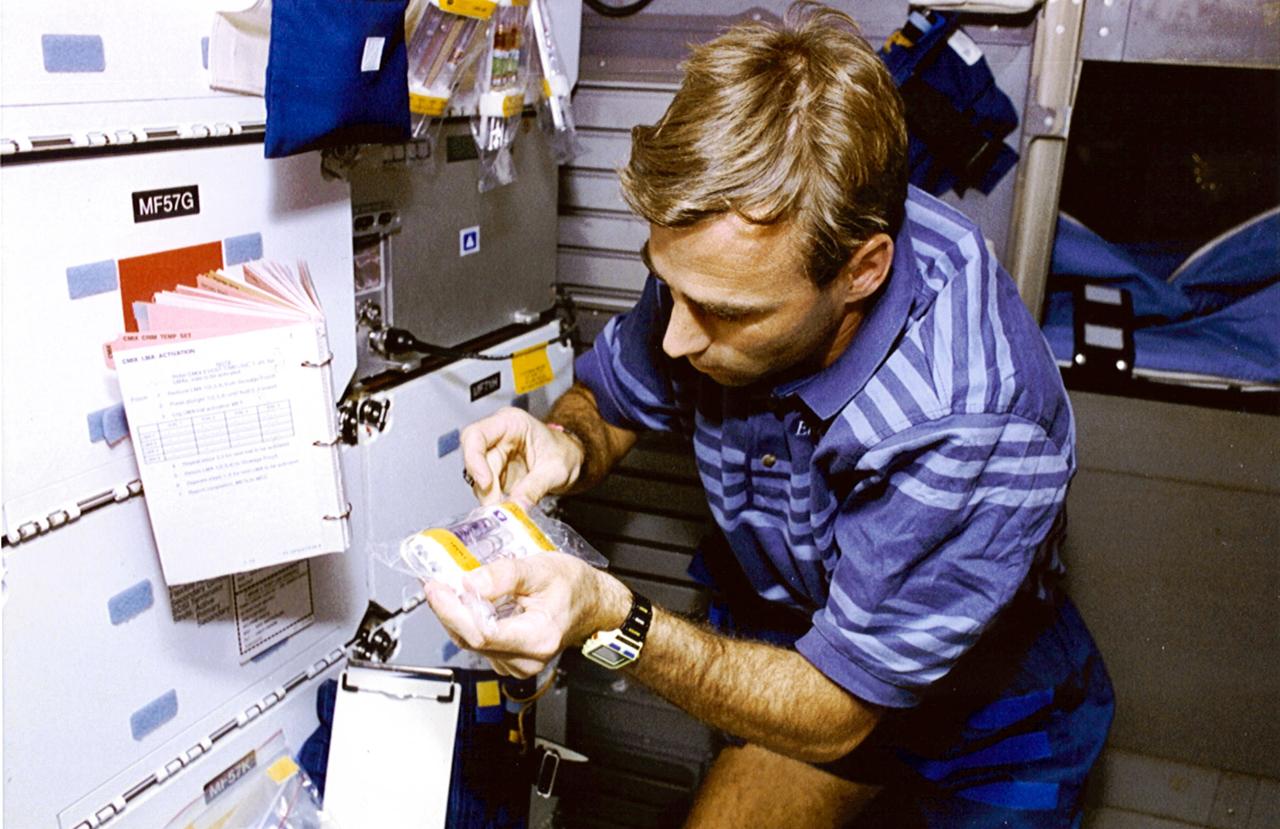
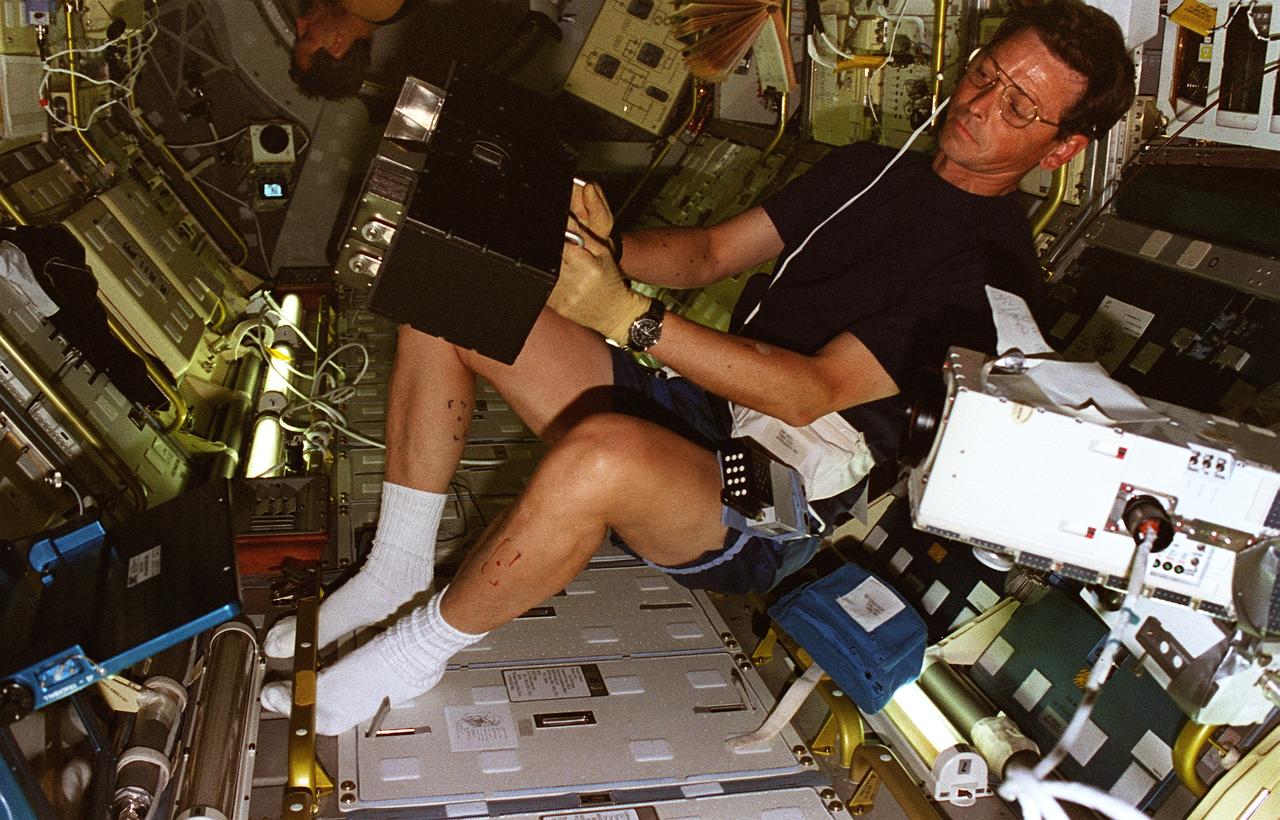
Experiments to seek solutions for a range of biomedical issues are at the heart of several investigations that will be hosted by the Commercial Instrumentation Technology Associates (ITA), Inc. Biomedical Experiments (CIBX-2) payload. CIBX-2 is unique, encompassing more than 20 separate experiments including cancer research, commercial experiments, and student hands-on experiments from 10 schools as part of ITA's ongoing University Among the Stars program. Astronaut William G. Gregory activates Liquids Mixing Apparatus (LMA) vials during STS-67. Other LMAs hang at top on the face of the middeck locker array. The experiments are sponsored under NASA's Space Product Development Program (SPD).
Space Product Development (SPD)
KENNEDY SPACE CENTER, FLA. -   Valerie Cassanto is one of the scientists recovering experiments found during the search for Columbia debris.  Included in the Commercial ITA Biomedical Experiments payload on mission STS-107 are urokinase cancer research, microencapsulation of drugs, the Growth of Bacterial Biofilm on Surfaces during Spaceflight (GOBBSS), and tin crystal formation.
KENNEDY SPACE CENTER, FLA. - Valerie Cassanto is one of the scientists recovering experiments found during the search for Columbia debris. Included in the Commercial ITA Biomedical Experiments payload on mission STS-107 are urokinase cancer research, microencapsulation of drugs, the Growth of Bacterial Biofilm on Surfaces during Spaceflight (GOBBSS), and tin crystal formation.
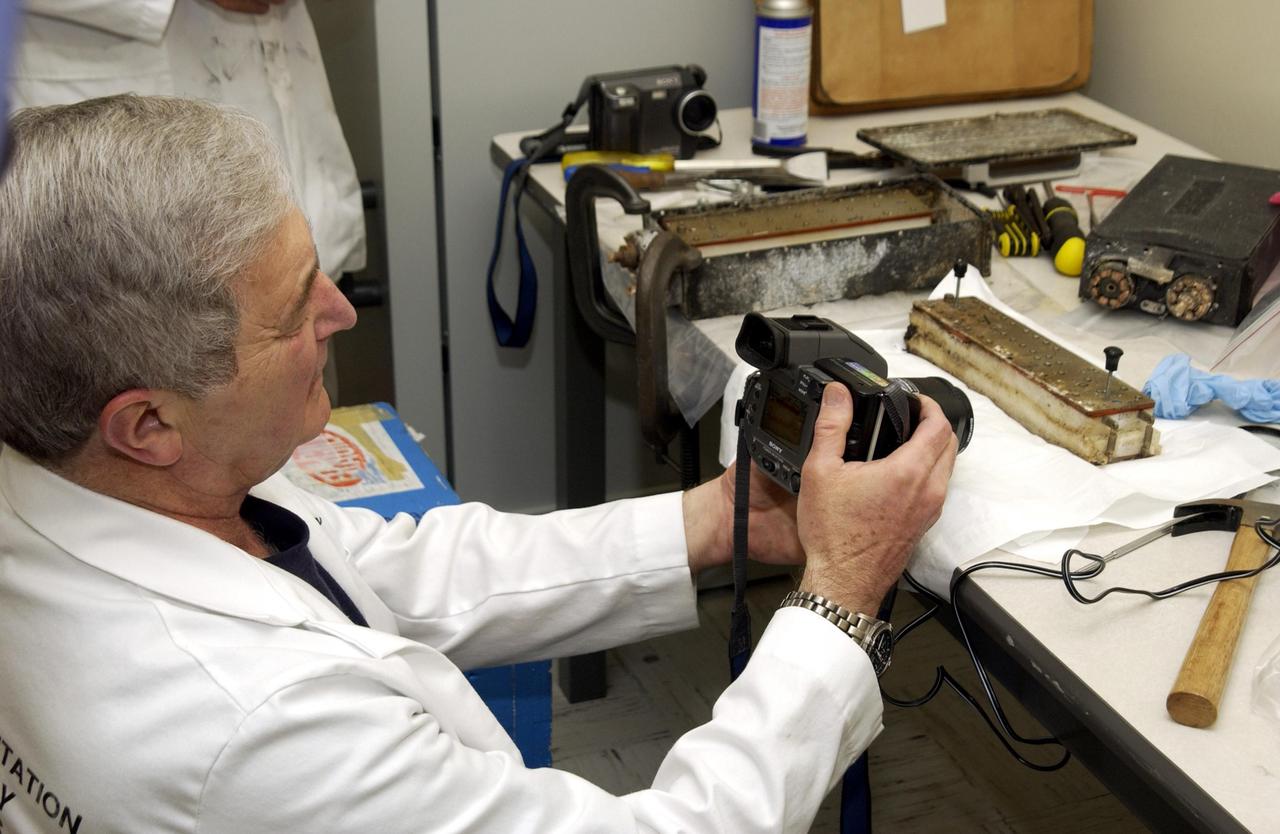
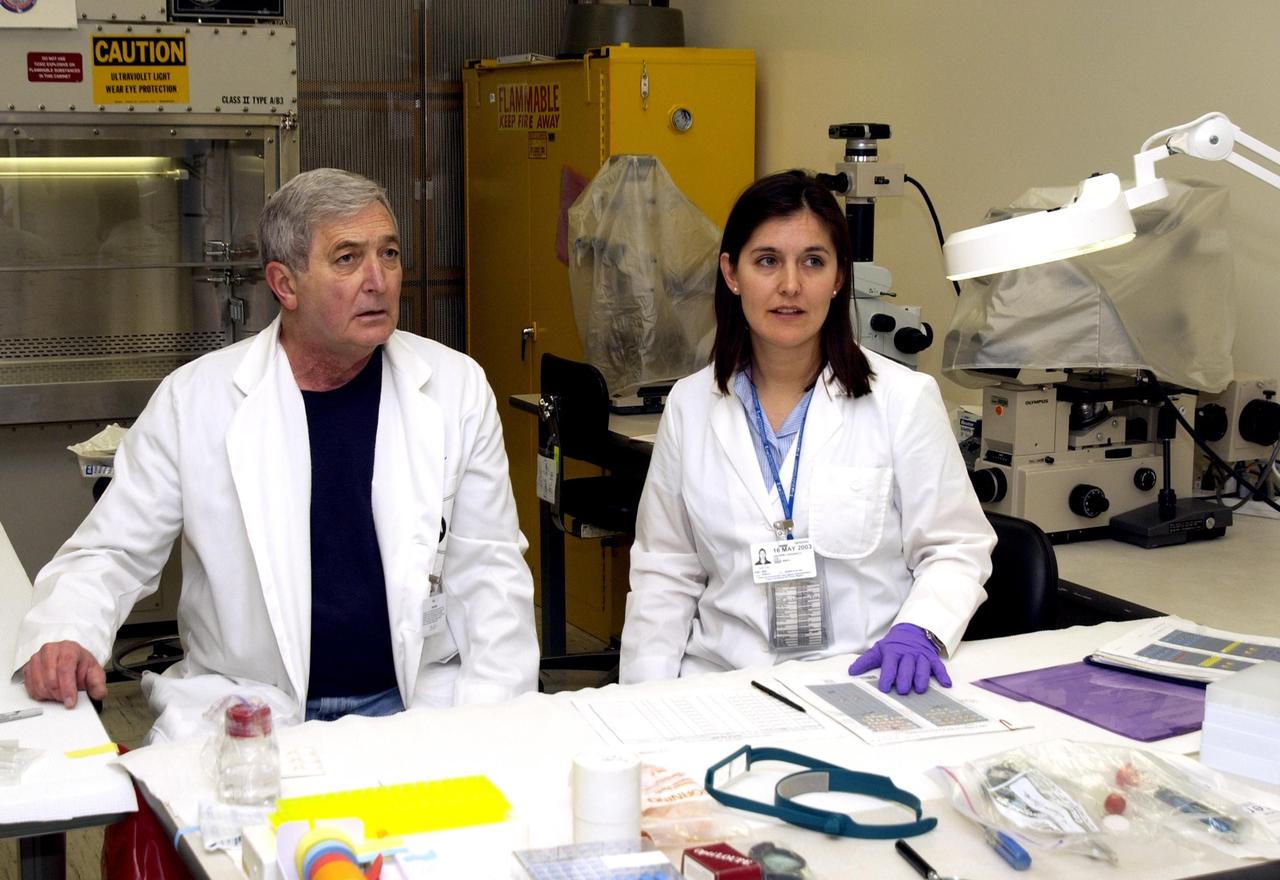
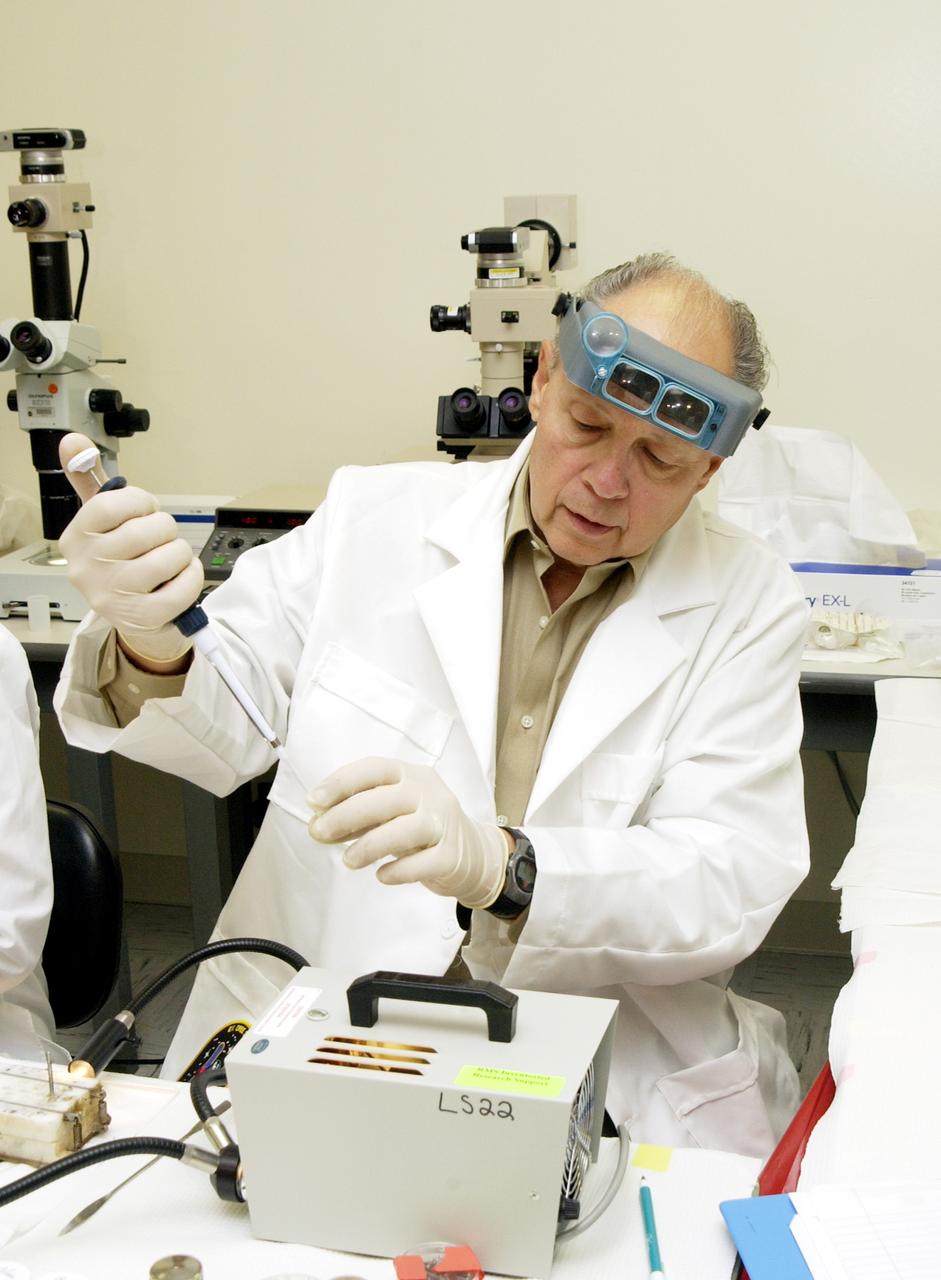
KENNEDY SPACE CENTER, FLA. -  Dr. Dennis Morrison, NASA Johnson Space Center, processes one of the experiments carried on mission STS-107. Several experiments were found during the search for Columbia debris. Included in the Commercial ITA Biomedical Experiments payload on mission STS-107 are urokinase cancer research, microencapsulation of drugs, the Growth of Bacterial Biofilm on Surfaces during Spaceflight (GOBBSS), and tin crystal formation.
KENNEDY SPACE CENTER, FLA. - Dr. Dennis Morrison, NASA Johnson Space Center, processes one of the experiments carried on mission STS-107. Several experiments were found during the search for Columbia debris. Included in the Commercial ITA Biomedical Experiments payload on mission STS-107 are urokinase cancer research, microencapsulation of drugs, the Growth of Bacterial Biofilm on Surfaces during Spaceflight (GOBBSS), and tin crystal formation.
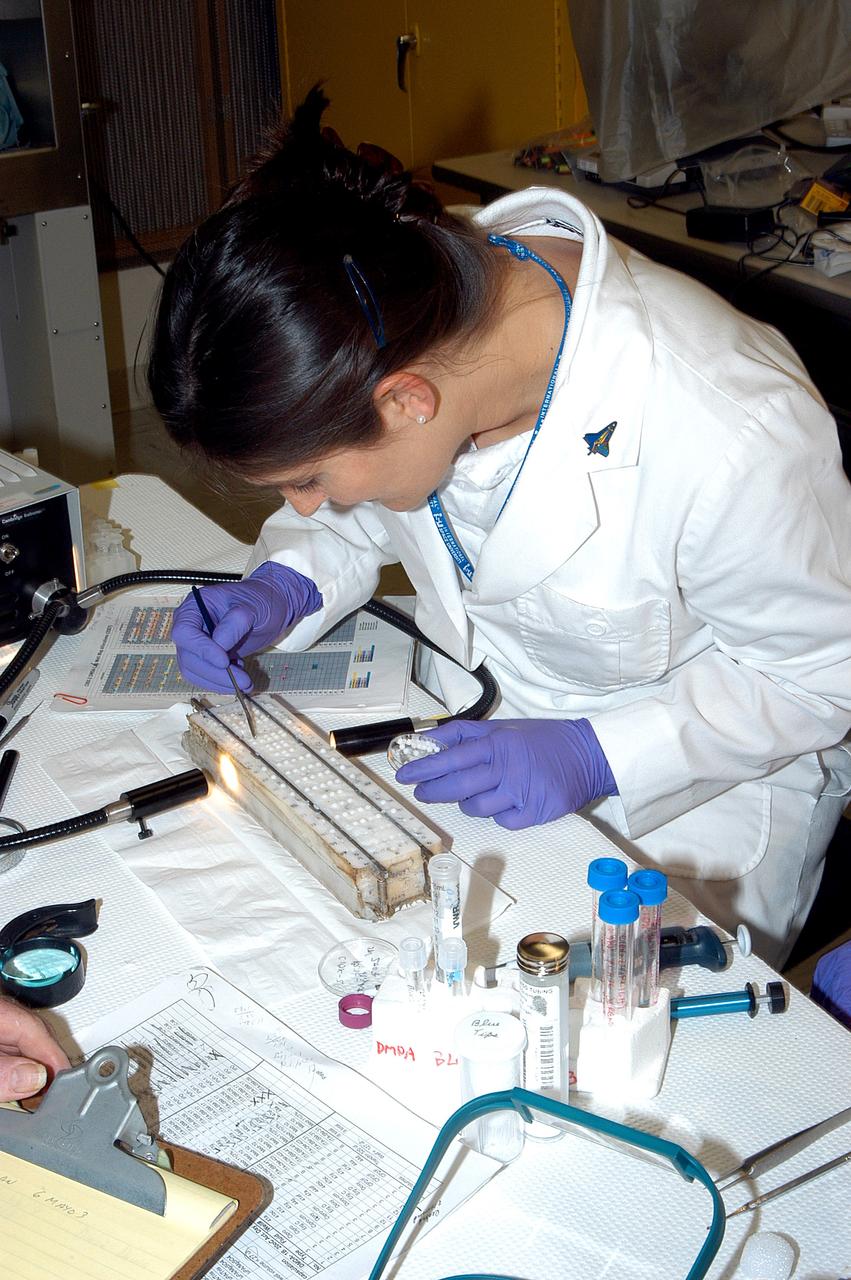
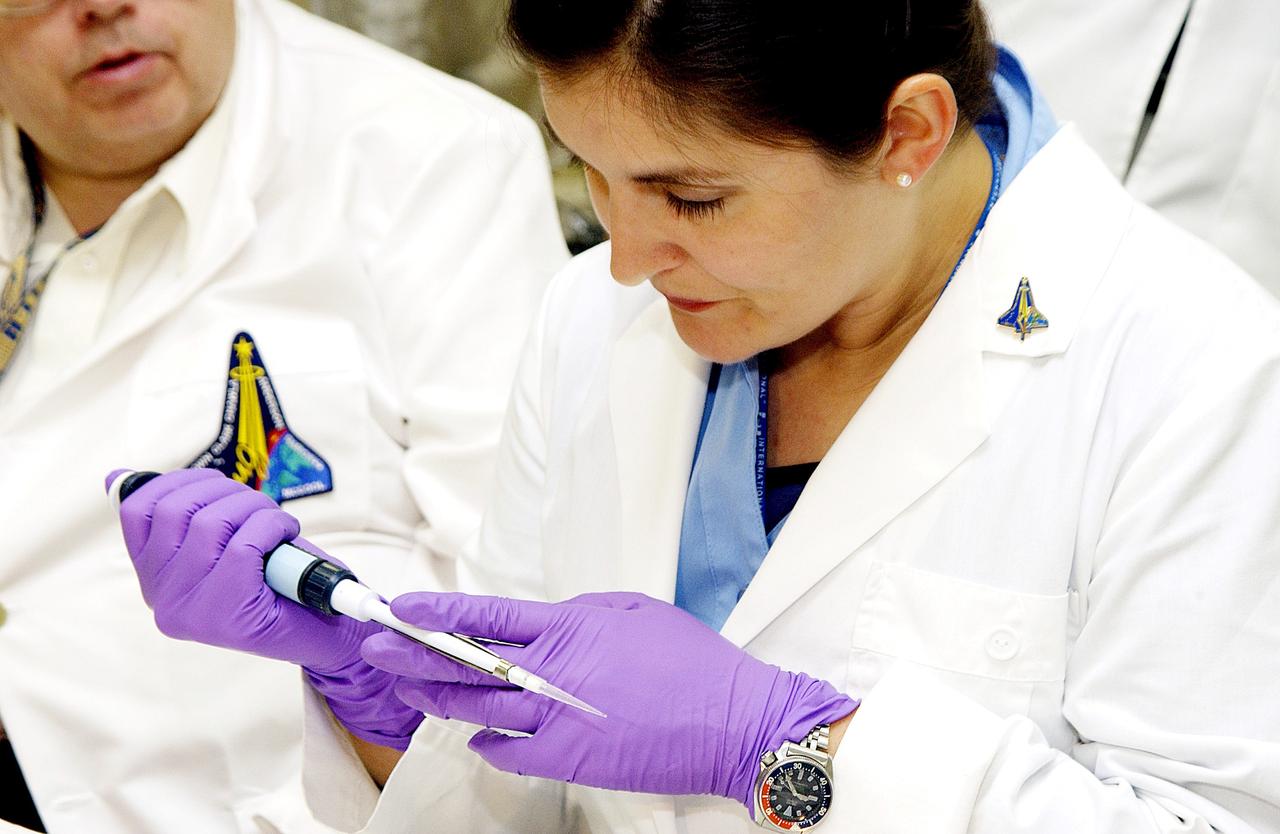
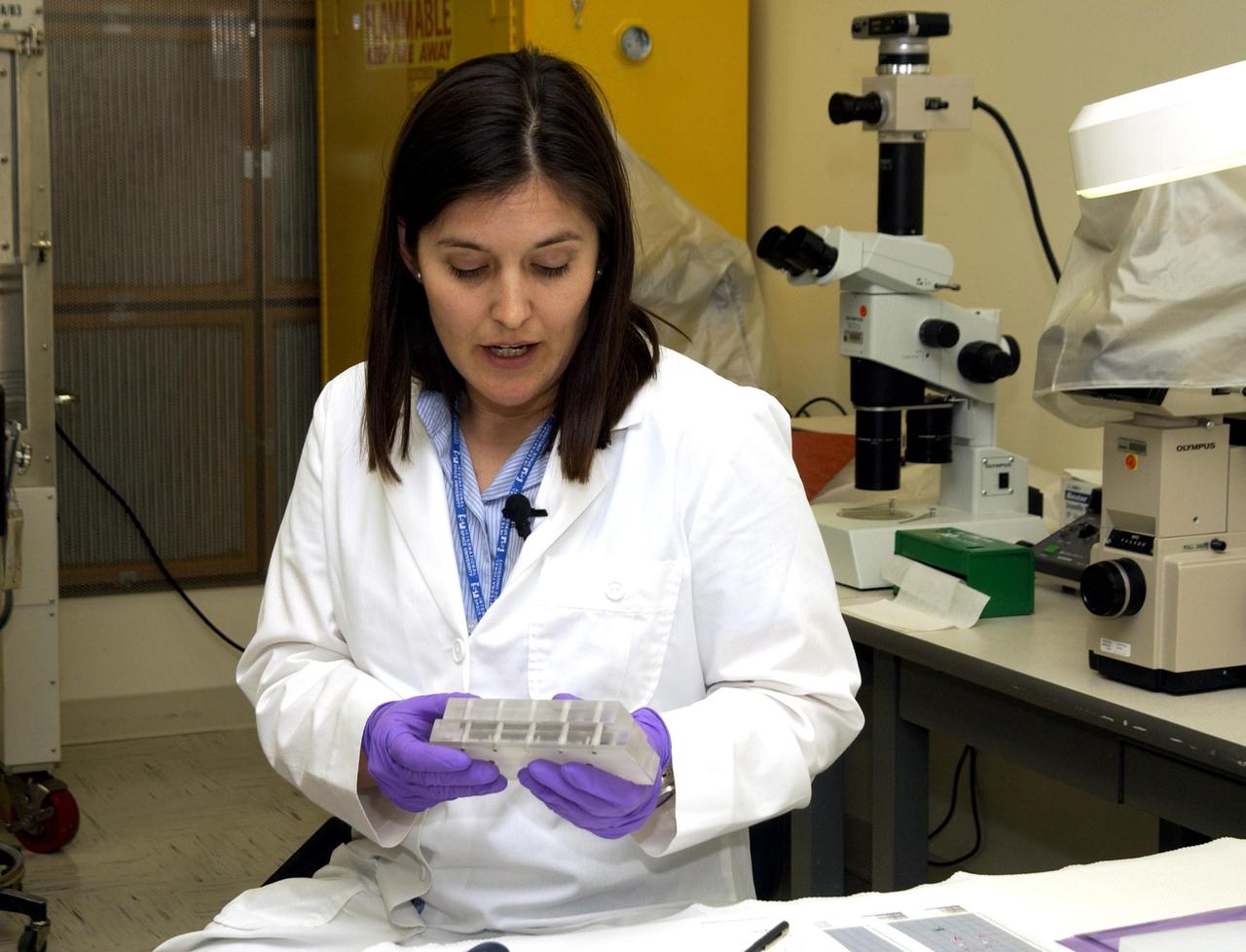
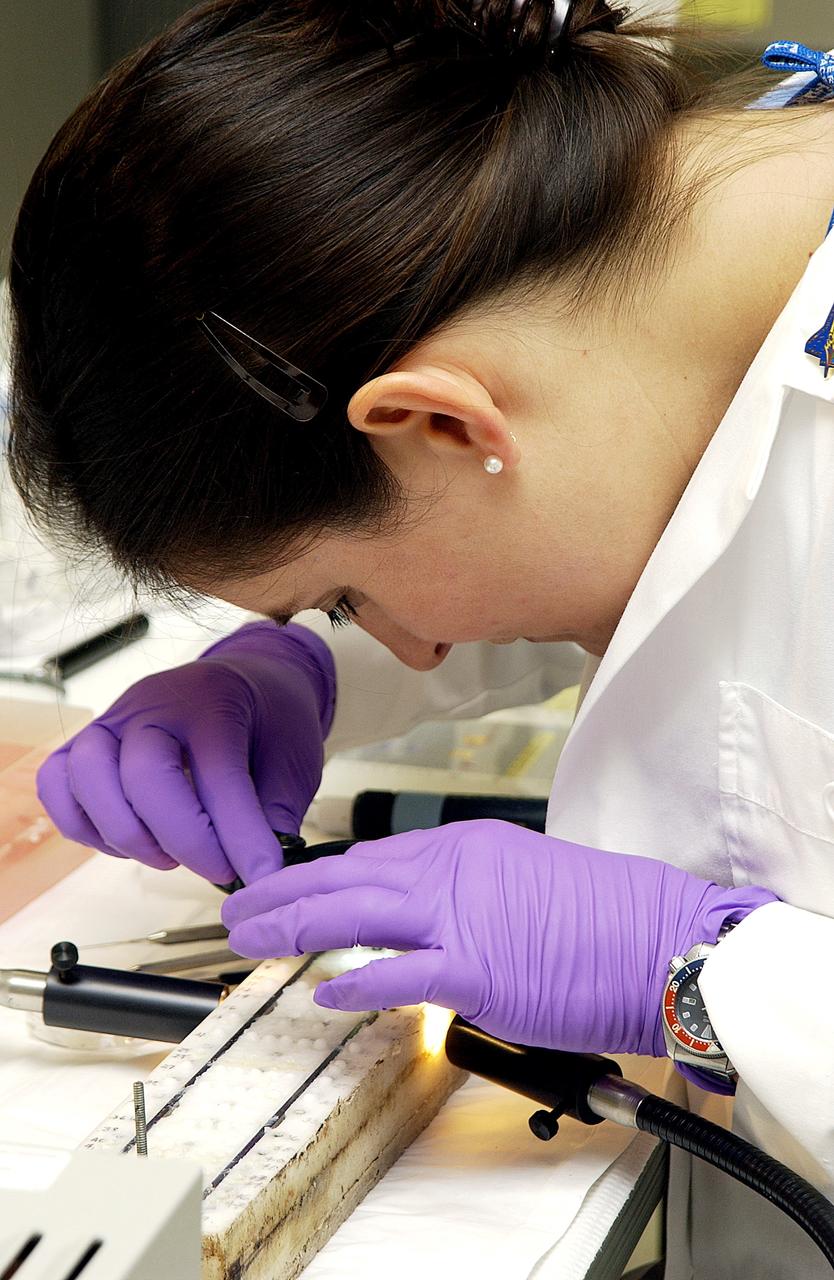
KENNEDY SPACE CENTER, FLA. - Valerie Cassanto, with Instrumentation Technology Associates, Inc., examines closely the container containing one of the experiments carried on mission STS-107.  Several experiments were found during the search for Columbia debris.  Included in the Commercial ITA Biomedical Experiments payload on mission STS-107 are urokinase cancer research, microencapsulation of drugs, the Growth of Bacterial Biofilm on Surfaces during Spaceflight (GOBBSS), and tin crystal formation.
KENNEDY SPACE CENTER, FLA. - Valerie Cassanto, with Instrumentation Technology Associates, Inc., examines closely the container containing one of the experiments carried on mission STS-107. Several experiments were found during the search for Columbia debris. Included in the Commercial ITA Biomedical Experiments payload on mission STS-107 are urokinase cancer research, microencapsulation of drugs, the Growth of Bacterial Biofilm on Surfaces during Spaceflight (GOBBSS), and tin crystal formation.
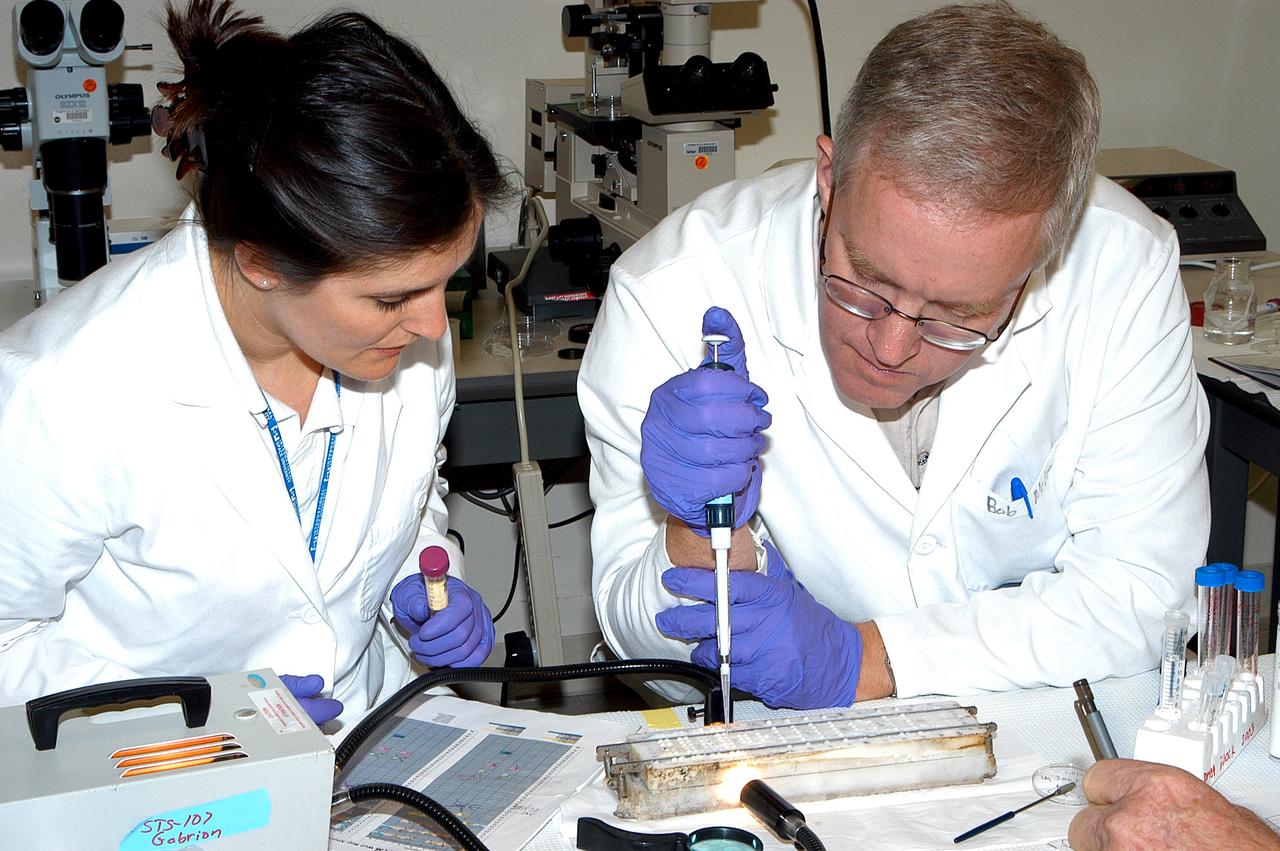
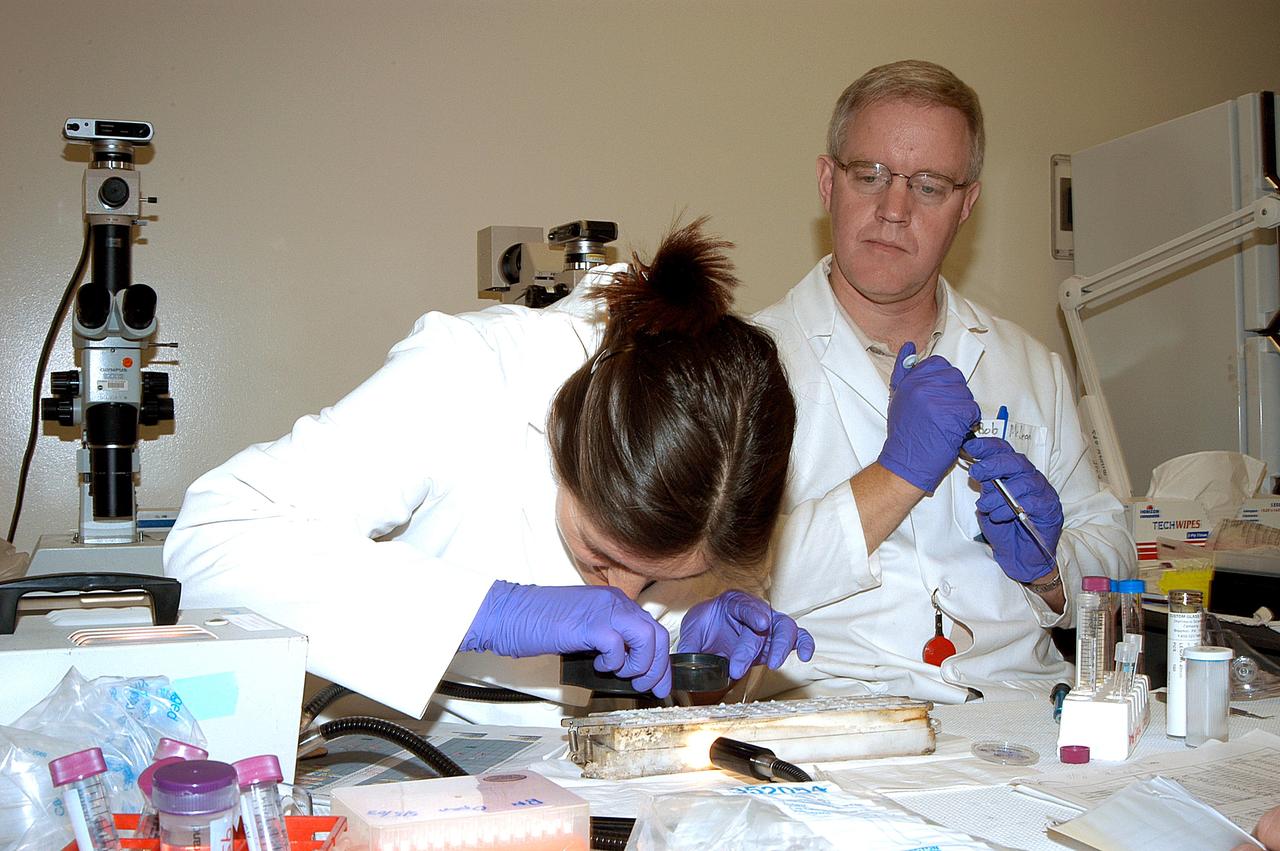
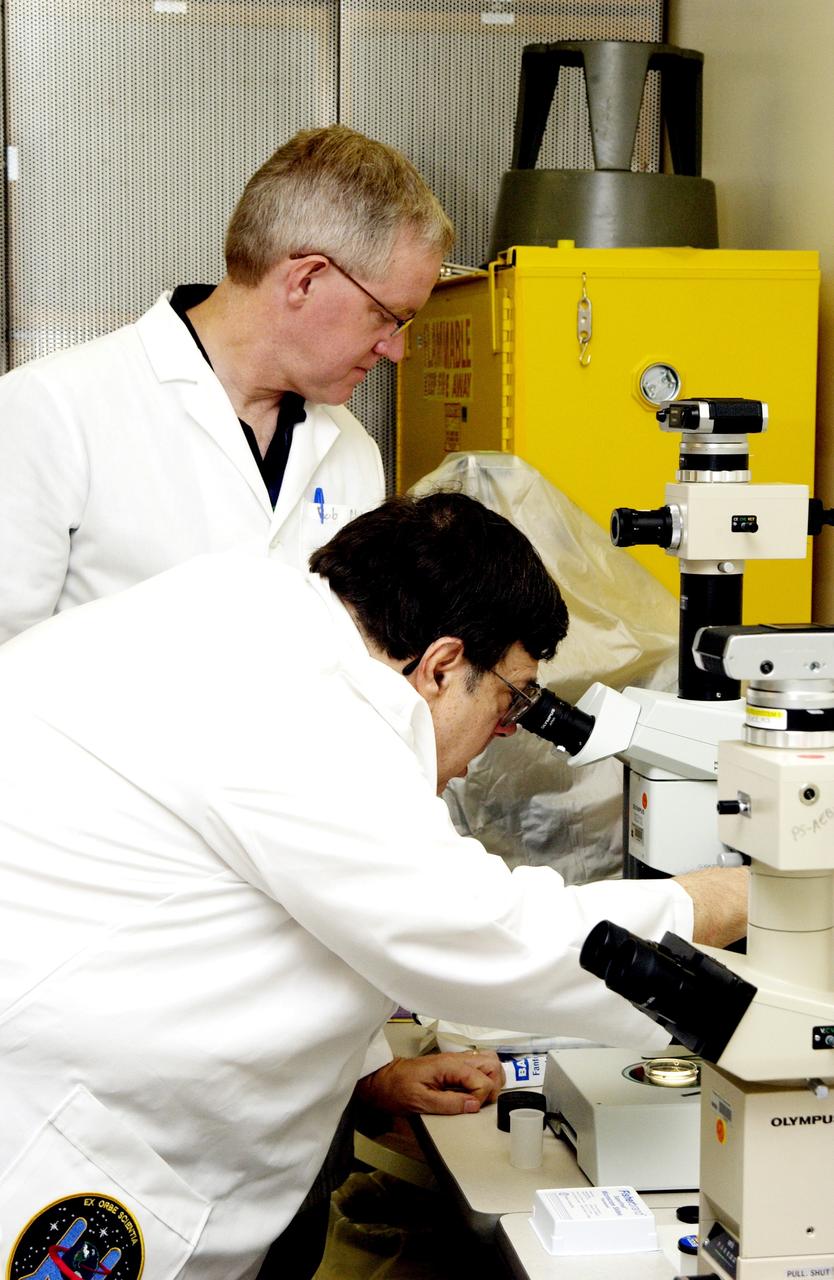
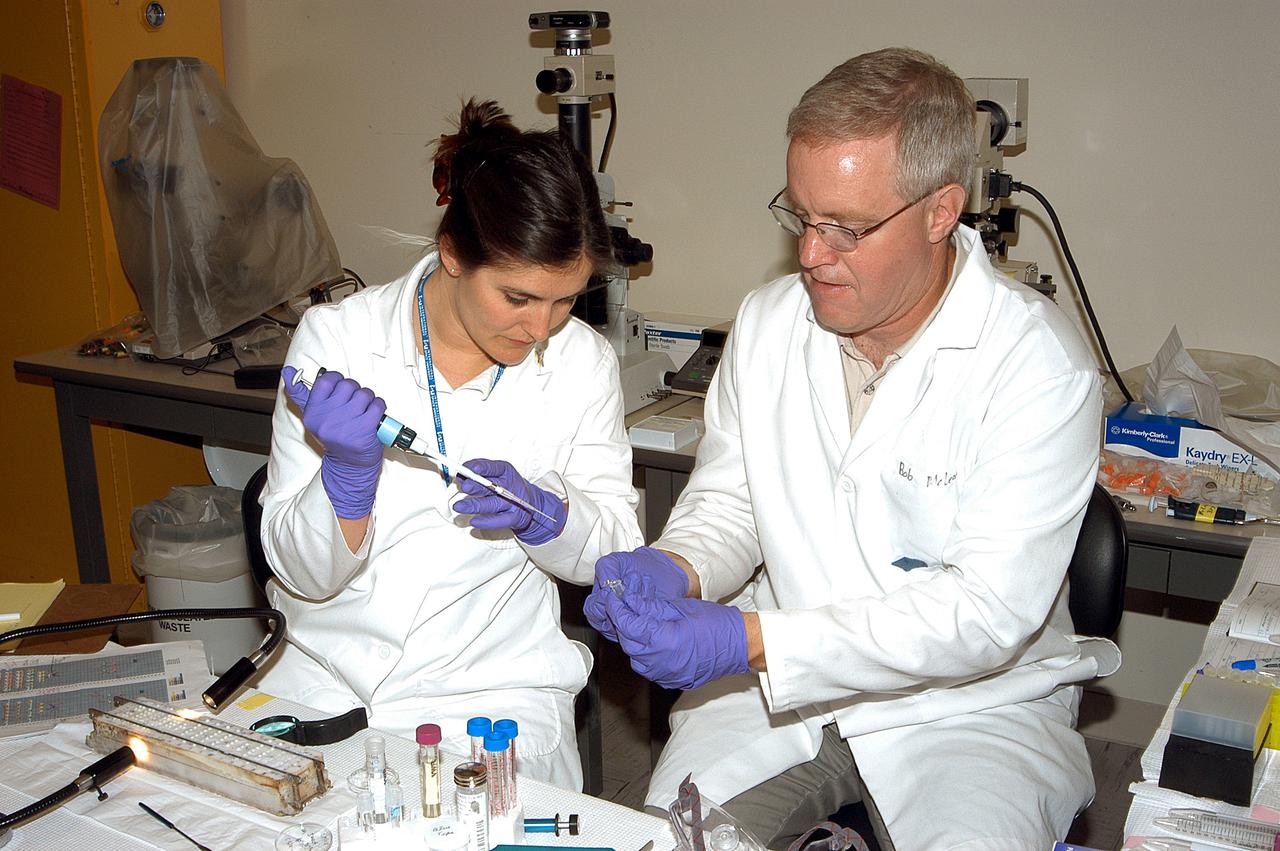
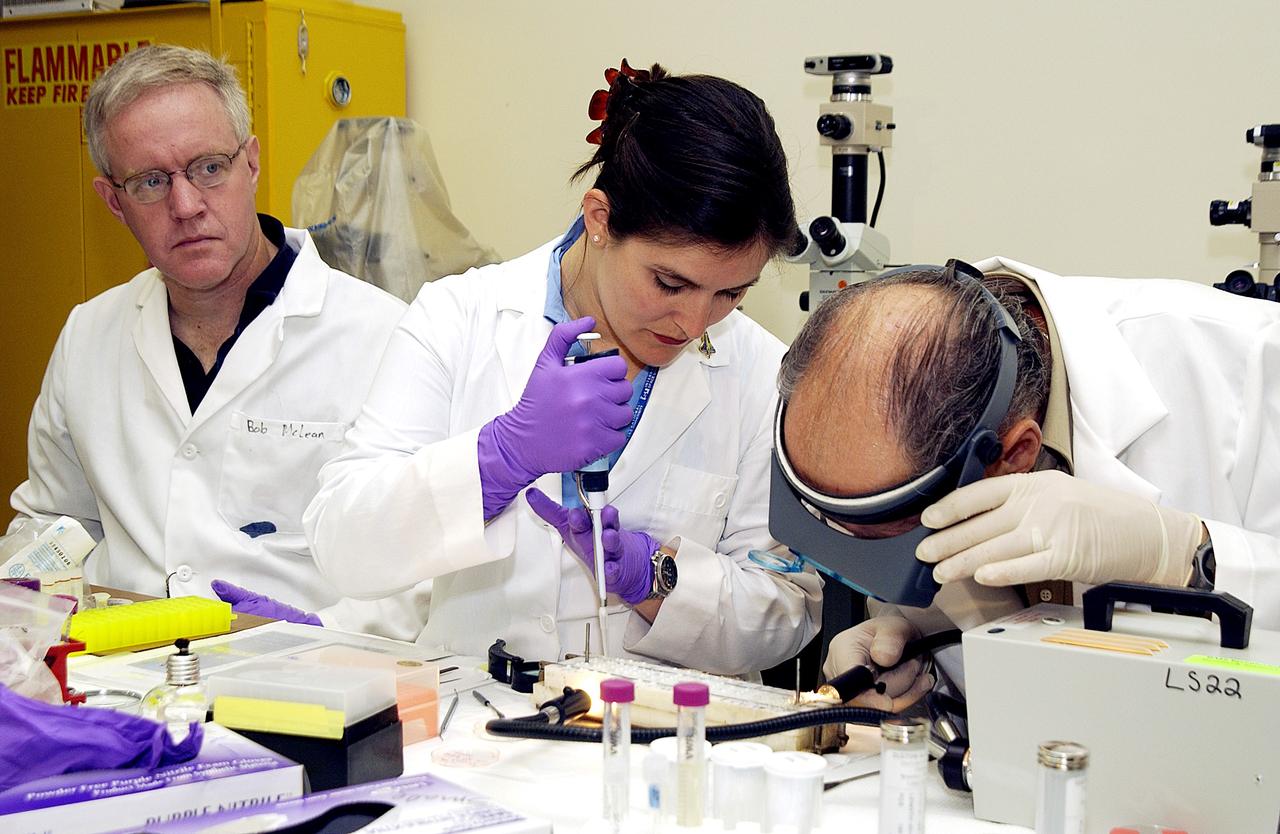
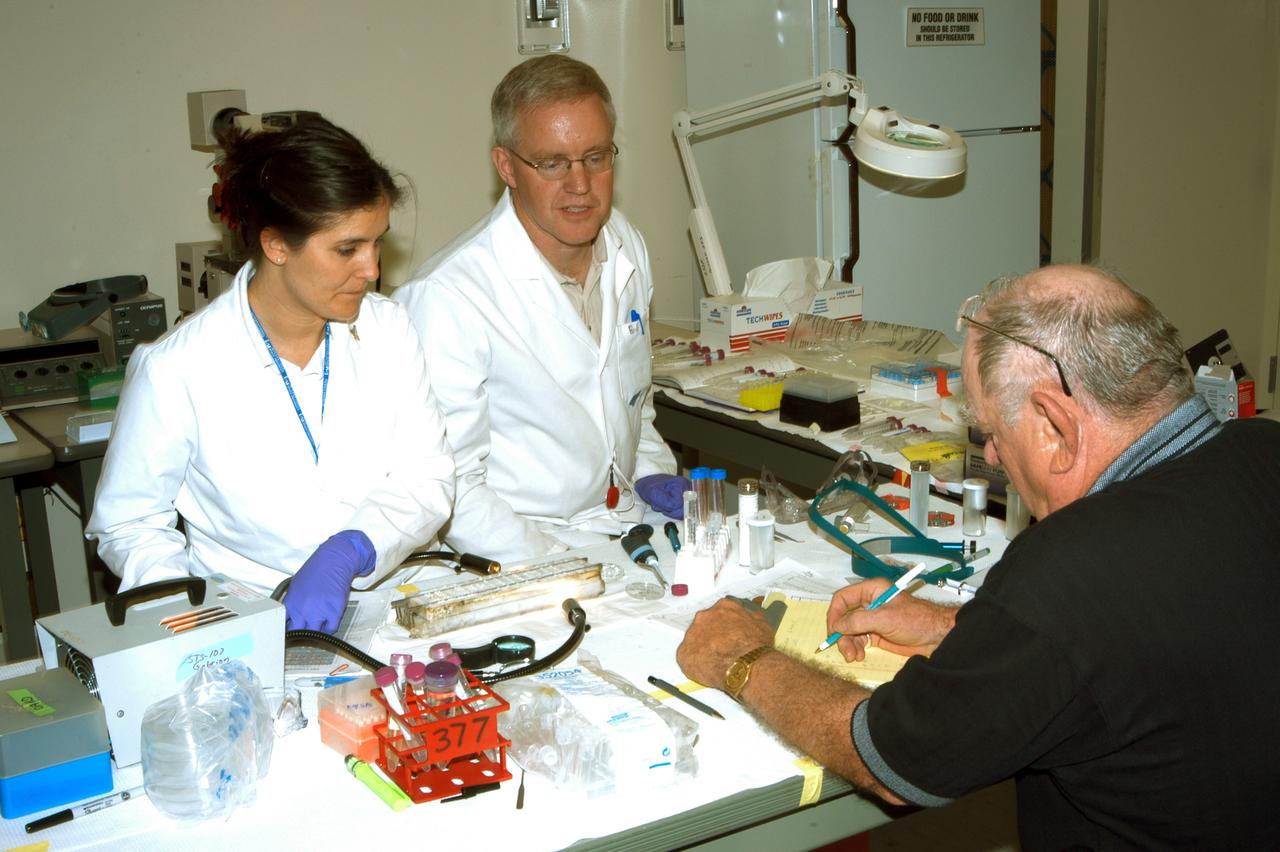
KENNEDY SPACE CENTER, FLA. - Valerie Cassanto, with Instrumentation Technology Associates, Inc., and Bob McLean, from the Southwest Texas State University, transfer to a new container material from one of the experiments carried on mission STS-107.  Several experiments were found during the search for Columbia debris.  Included in the Commercial ITA Biomedical Experiments payload on mission STS-107 are urokinase cancer research, microencapsulation of drugs, the Growth of Bacterial Biofilm on Surfaces during Spaceflight (GOBBSS), and tin crystal formation.
KENNEDY SPACE CENTER, FLA. - Valerie Cassanto, with Instrumentation Technology Associates, Inc., and Bob McLean, from the Southwest Texas State University, transfer to a new container material from one of the experiments carried on mission STS-107. Several experiments were found during the search for Columbia debris. Included in the Commercial ITA Biomedical Experiments payload on mission STS-107 are urokinase cancer research, microencapsulation of drugs, the Growth of Bacterial Biofilm on Surfaces during Spaceflight (GOBBSS), and tin crystal formation.
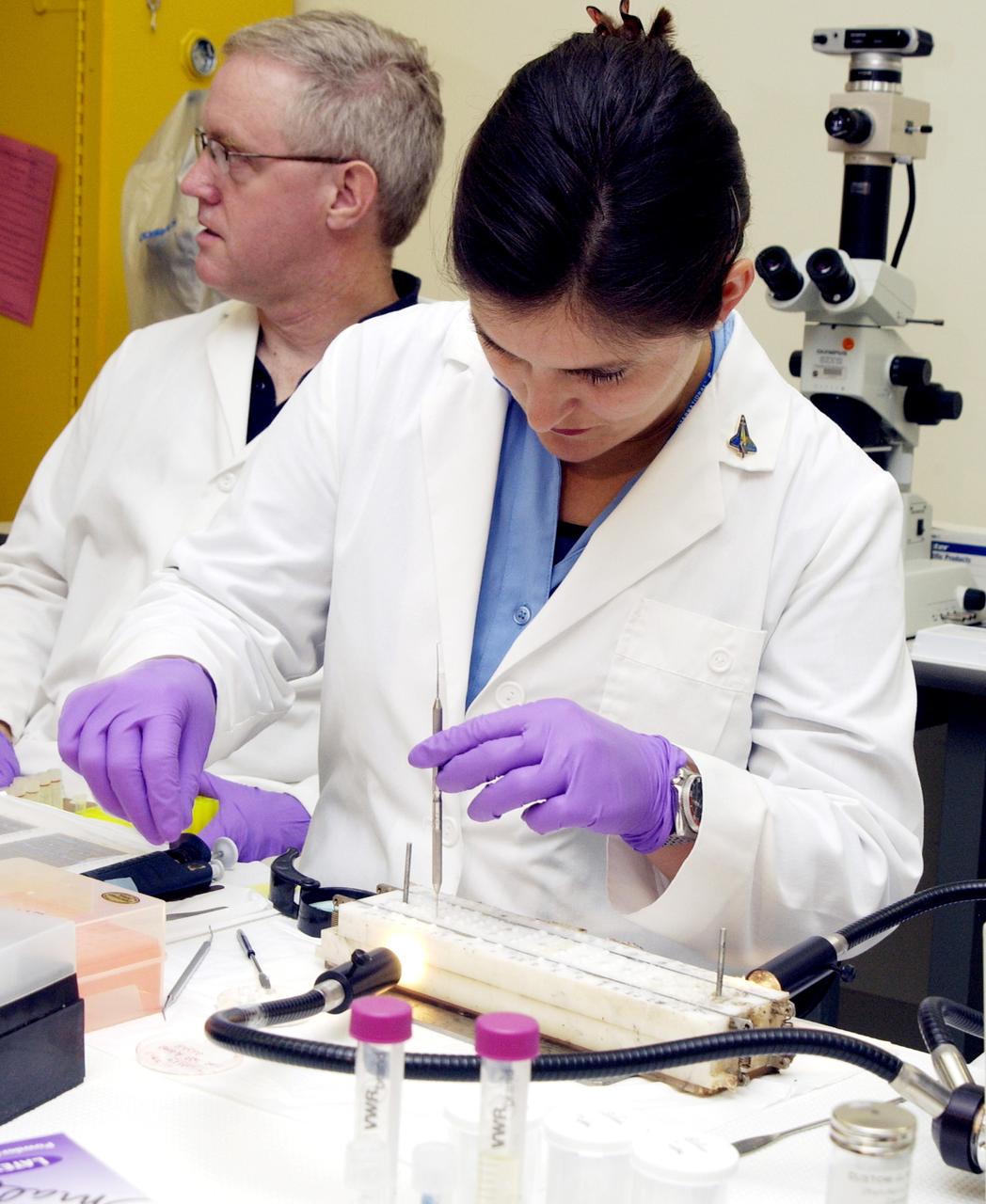
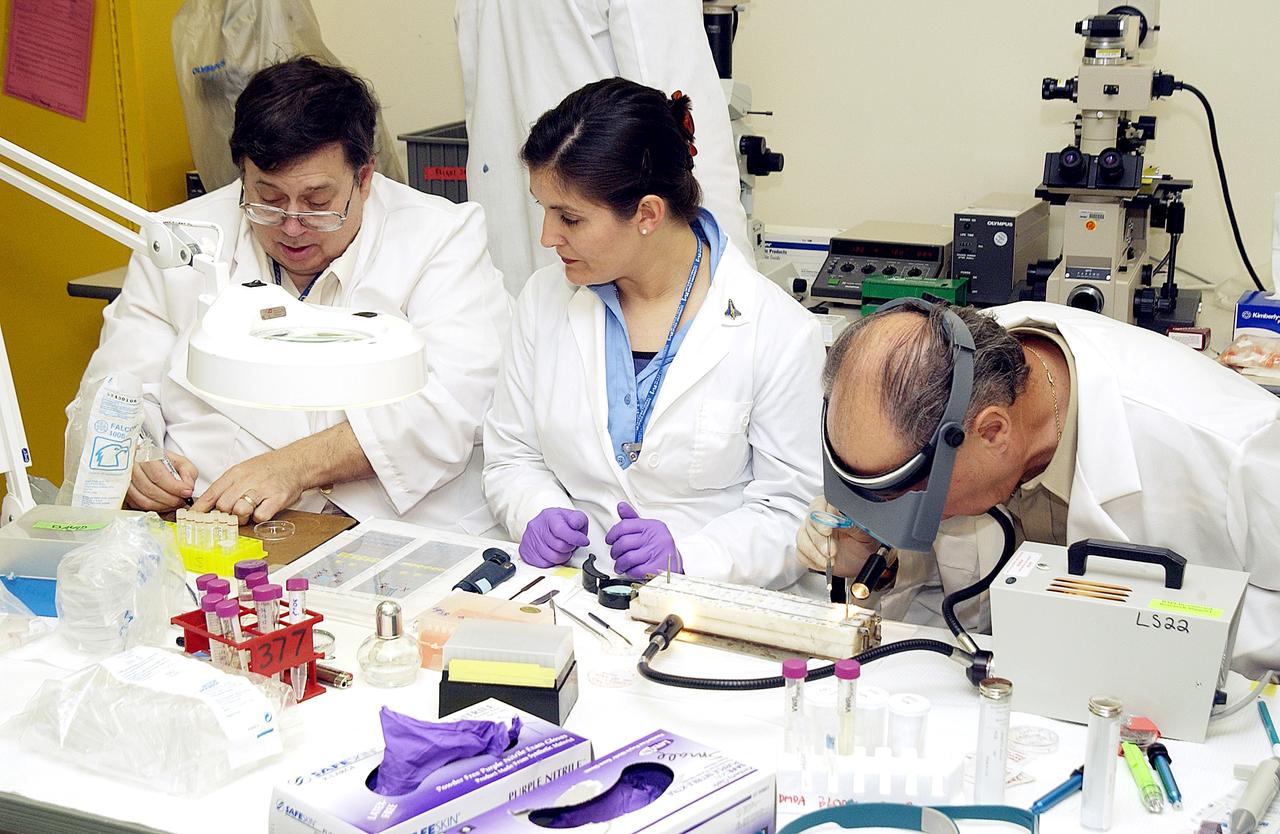
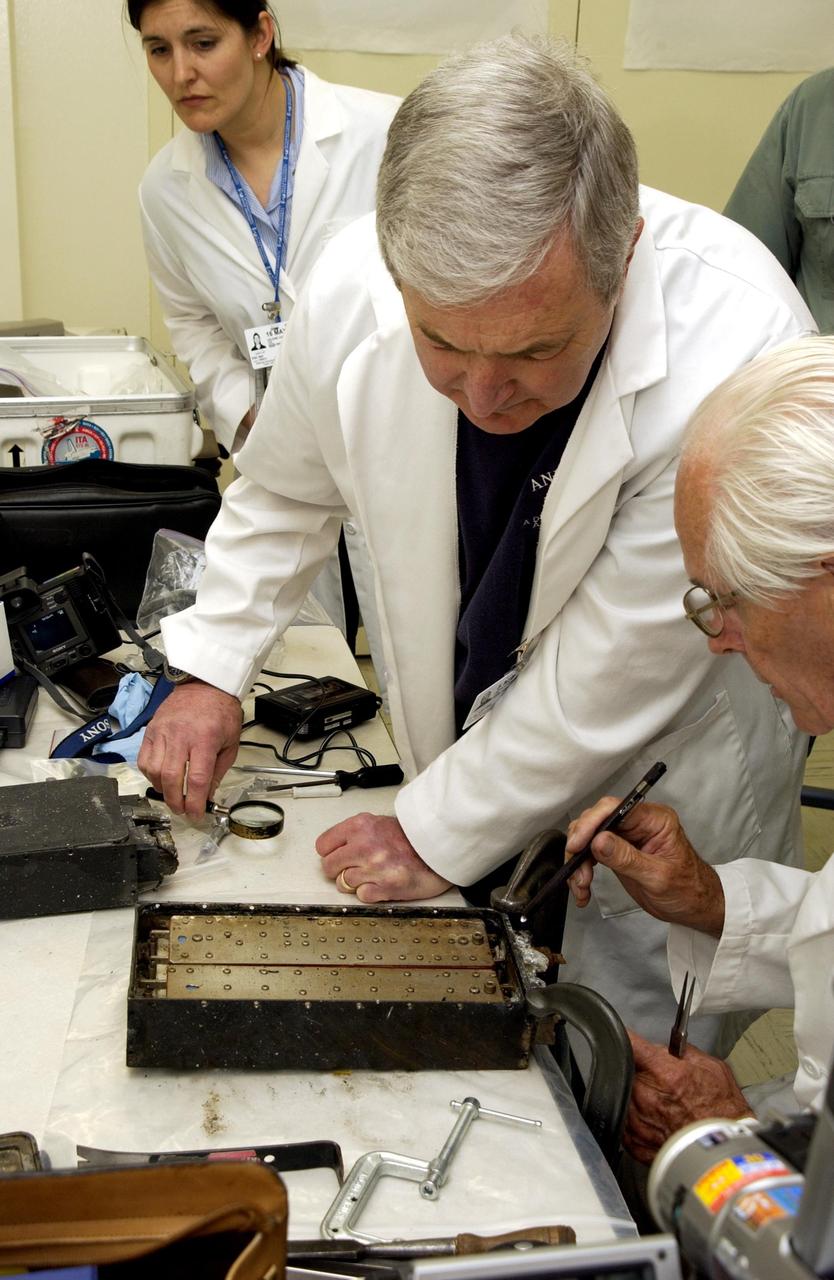
KENNEDY SPACE CENTER, FLA. -  From left, Bob McLean, Southwest Texas State University; Valerie Cassanto, Instrumentation Technology Associates, Inc.; and Dennis Morrison, NASA Johnson Space Center, process one of the experiments carried on mission STS-107. Several experiments were found during the search for Columbia debris. Included in the Commercial ITA Biomedical Experiments payload on mission STS-107 are urokinase cancer research, microencapsulation of drugs, the Growth of Bacterial Biofilm on Surfaces during Spaceflight (GOBBSS), and tin crystal formation.
KENNEDY SPACE CENTER, FLA. - From left, Bob McLean, Southwest Texas State University; Valerie Cassanto, Instrumentation Technology Associates, Inc.; and Dennis Morrison, NASA Johnson Space Center, process one of the experiments carried on mission STS-107. Several experiments were found during the search for Columbia debris. Included in the Commercial ITA Biomedical Experiments payload on mission STS-107 are urokinase cancer research, microencapsulation of drugs, the Growth of Bacterial Biofilm on Surfaces during Spaceflight (GOBBSS), and tin crystal formation.
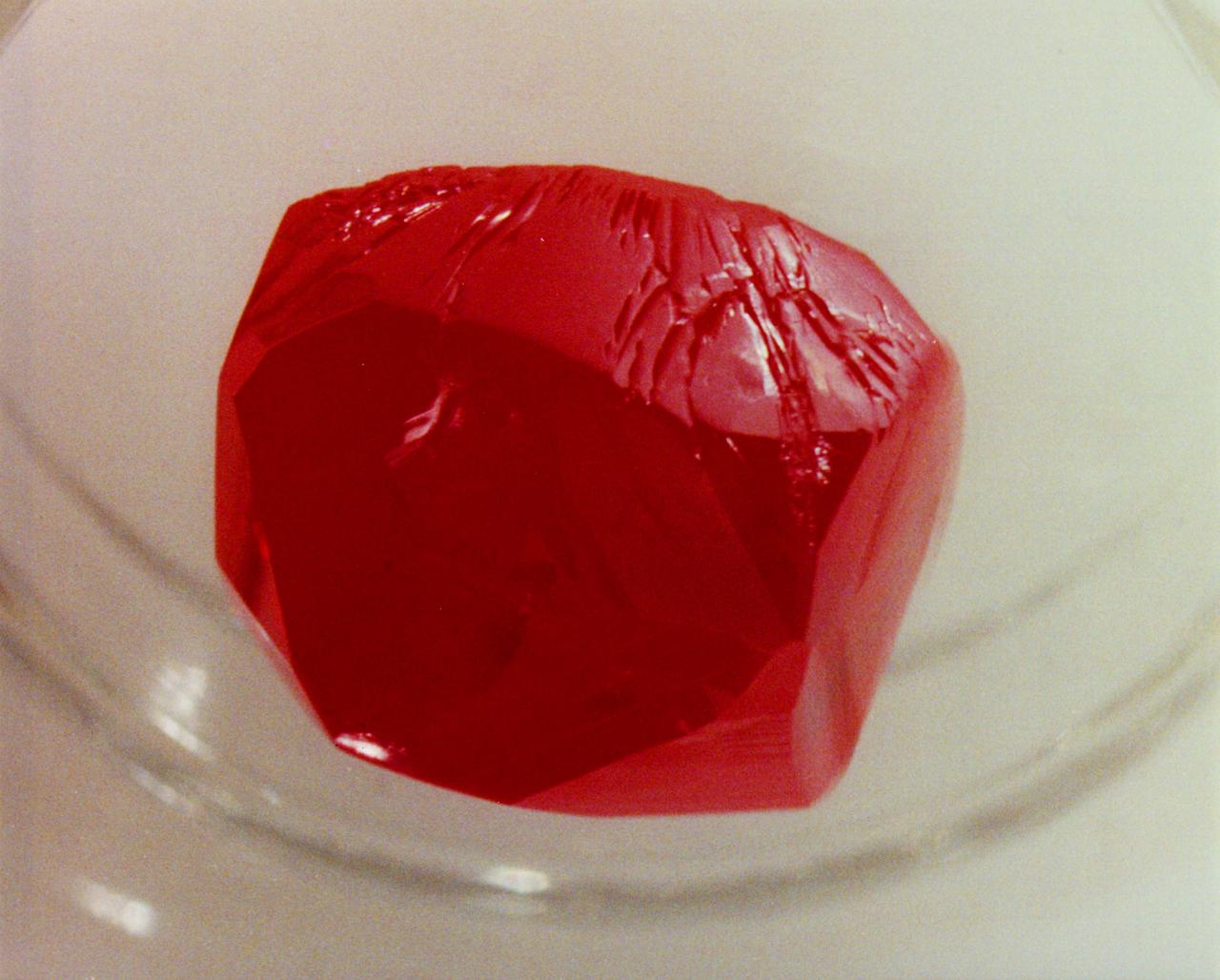
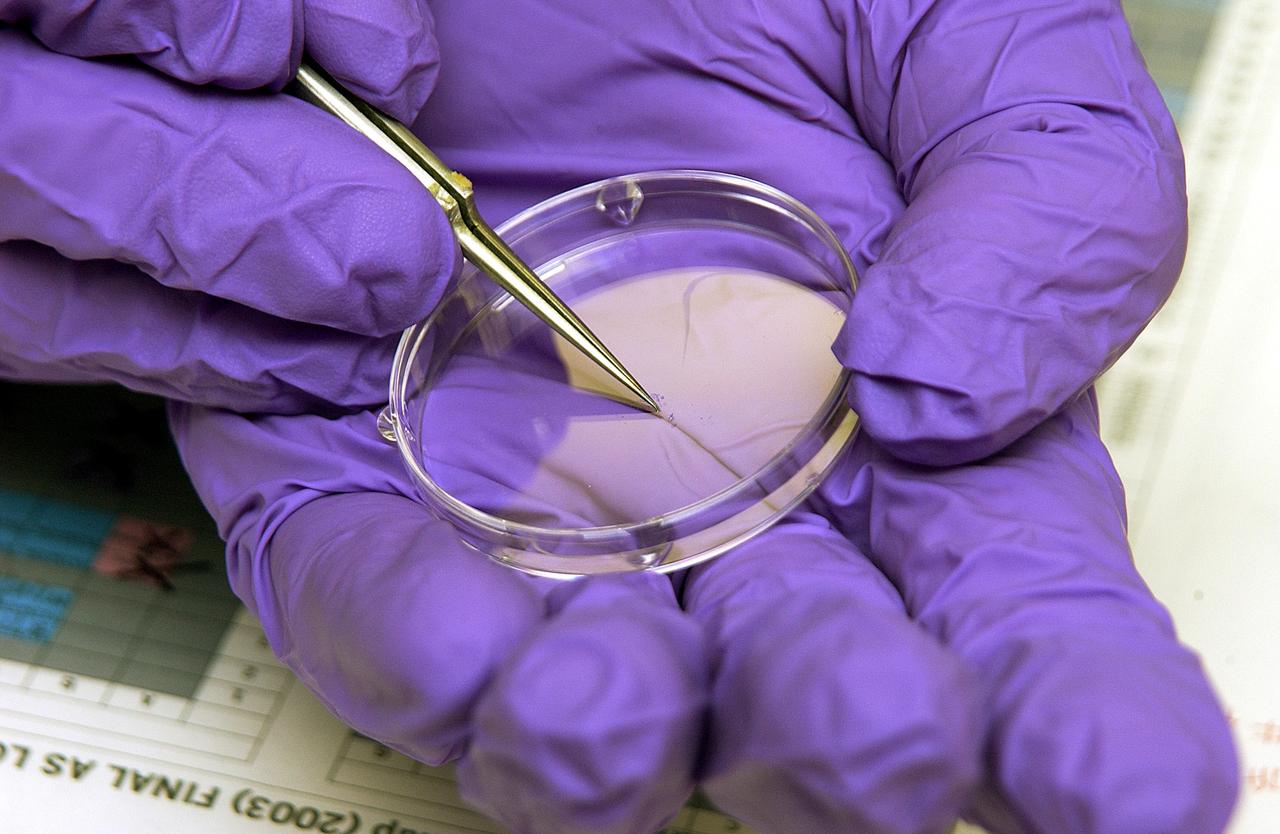
KENNEDY SPACE CENTER, FLA. -  The crystals visible in this laboratory dish were part of an experiment carried on mission STS-107. Several experiments were found during the search for Columbia debris. Included in the Commercial ITA Biomedical Experiments payload on mission STS-107 are urokinase cancer research, microencapsulation of drugs, the Growth of Bacterial Biofilm on Surfaces during Spaceflight (GOBBSS), and tin crystal formation.
KENNEDY SPACE CENTER, FLA. - The crystals visible in this laboratory dish were part of an experiment carried on mission STS-107. Several experiments were found during the search for Columbia debris. Included in the Commercial ITA Biomedical Experiments payload on mission STS-107 are urokinase cancer research, microencapsulation of drugs, the Growth of Bacterial Biofilm on Surfaces during Spaceflight (GOBBSS), and tin crystal formation.
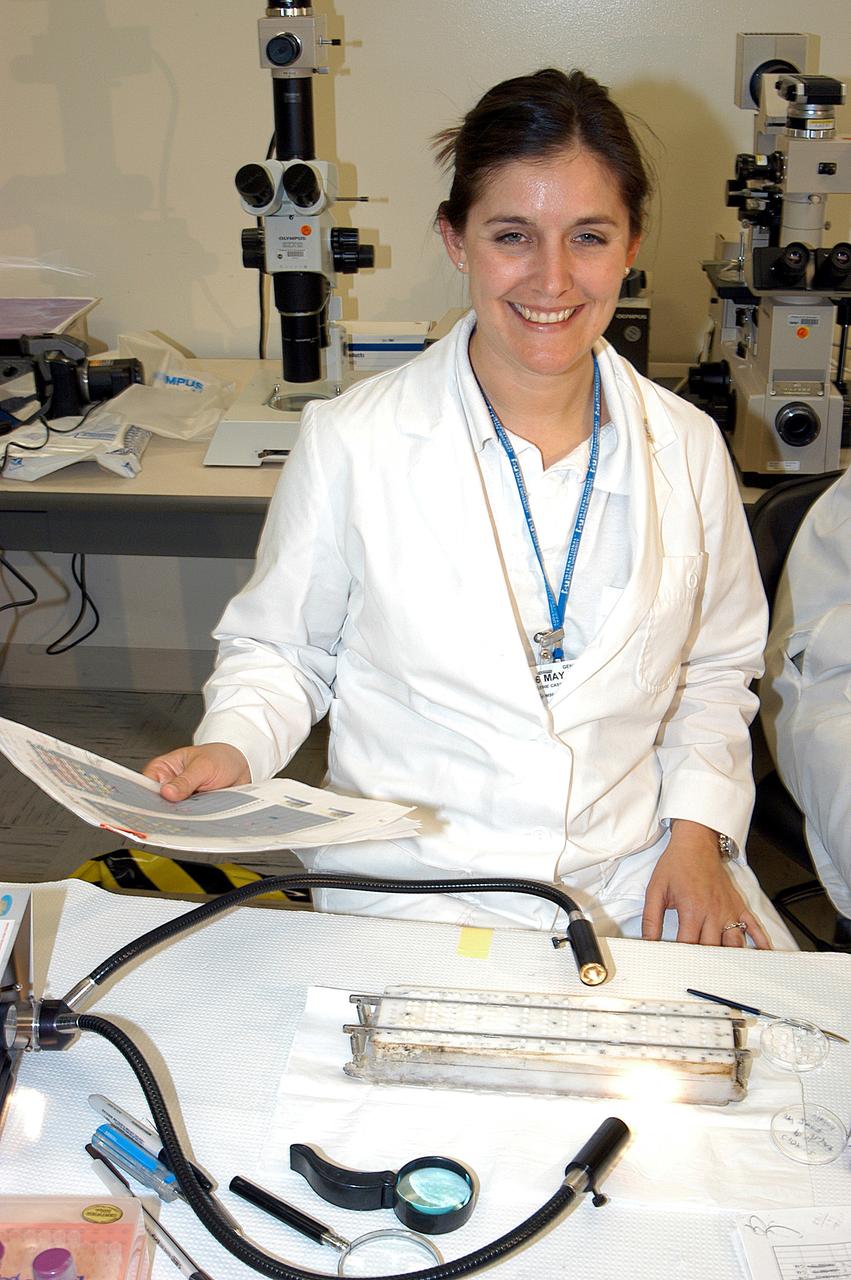
KENNEDY SPACE CENTER, FLA. -  Valerie Cassanto, Instrumentation Technology Associates, Inc., studies one of the experiments carried on mission STS-107. Several experiments were found during the search for Columbia debris. Included in the Commercial ITA Biomedical Experiments payload on mission STS-107 are urokinase cancer research, microencapsulation of drugs, the Growth of Bacterial Biofilm on Surfaces during Spaceflight (GOBBSS), and tin crystal formation.  The latter was sponsored by the Pembroke Pines Charter Middle School.
KENNEDY SPACE CENTER, FLA. - Valerie Cassanto, Instrumentation Technology Associates, Inc., studies one of the experiments carried on mission STS-107. Several experiments were found during the search for Columbia debris. Included in the Commercial ITA Biomedical Experiments payload on mission STS-107 are urokinase cancer research, microencapsulation of drugs, the Growth of Bacterial Biofilm on Surfaces during Spaceflight (GOBBSS), and tin crystal formation. The latter was sponsored by the Pembroke Pines Charter Middle School.
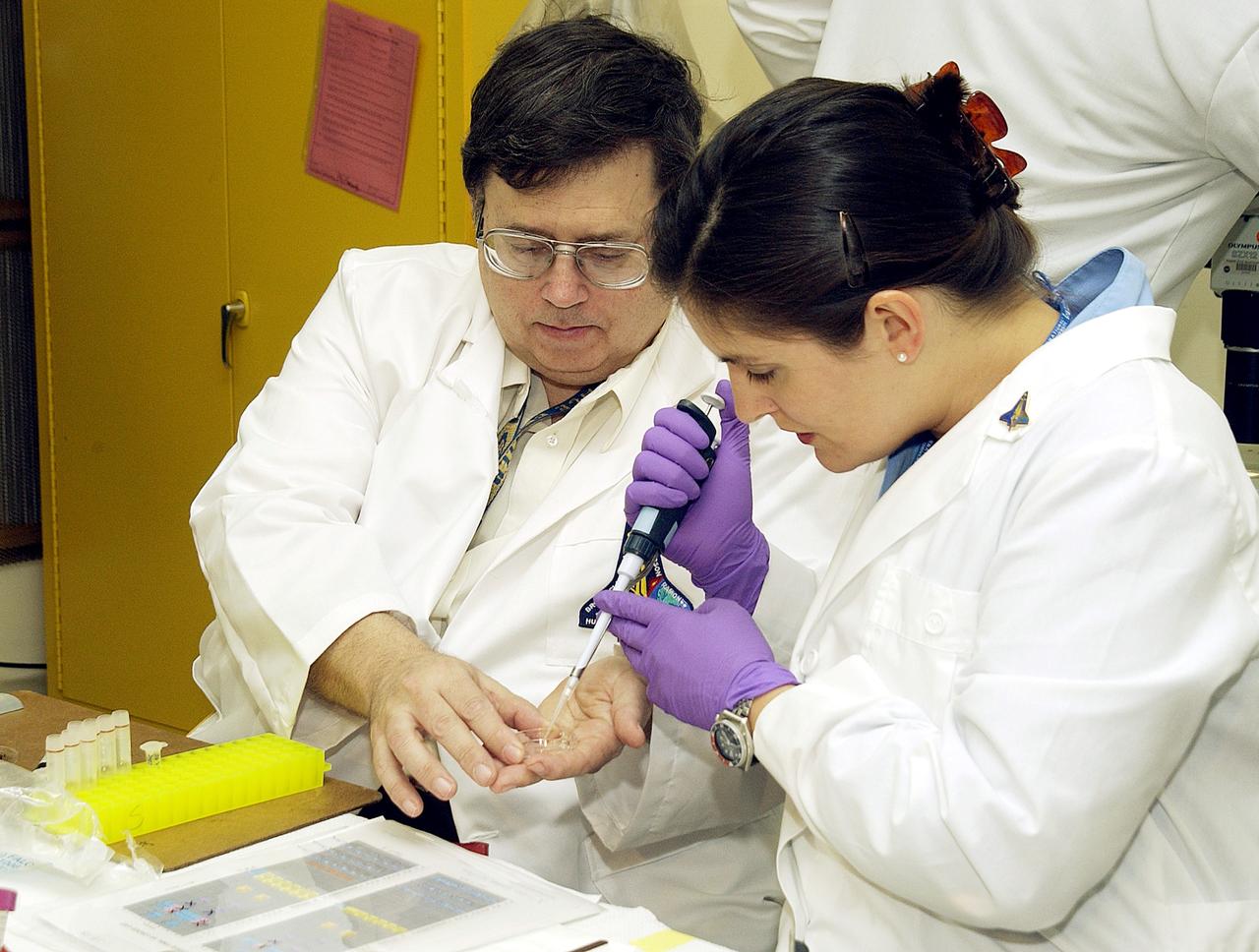
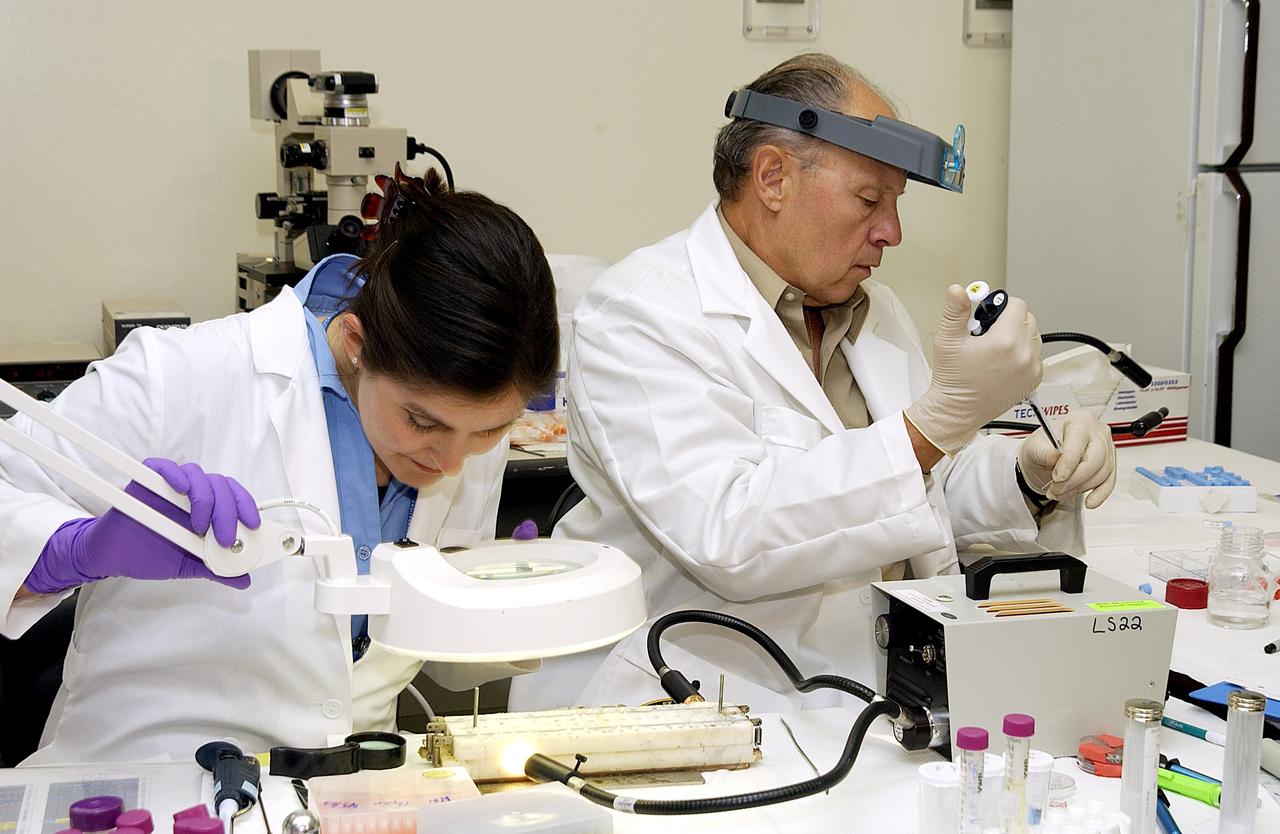
KENNEDY SPACE CENTER, FLA. -  From left, Valerie Cassanto, Instrumentation Technology Associates, Inc., and Dr. Dennis Morrison, NASA Johnson Space Center, analyze one of the experiments carried on mission STS-107. Several experiments were found during the search for Columbia debris. Included in the Commercial ITA Biomedical Experiments payload on mission STS-107 are urokinase cancer research, microencapsulation of drugs, the Growth of Bacterial Biofilm on Surfaces during Spaceflight (GOBBSS), and tin crystal formation.
KENNEDY SPACE CENTER, FLA. - From left, Valerie Cassanto, Instrumentation Technology Associates, Inc., and Dr. Dennis Morrison, NASA Johnson Space Center, analyze one of the experiments carried on mission STS-107. Several experiments were found during the search for Columbia debris. Included in the Commercial ITA Biomedical Experiments payload on mission STS-107 are urokinase cancer research, microencapsulation of drugs, the Growth of Bacterial Biofilm on Surfaces during Spaceflight (GOBBSS), and tin crystal formation.
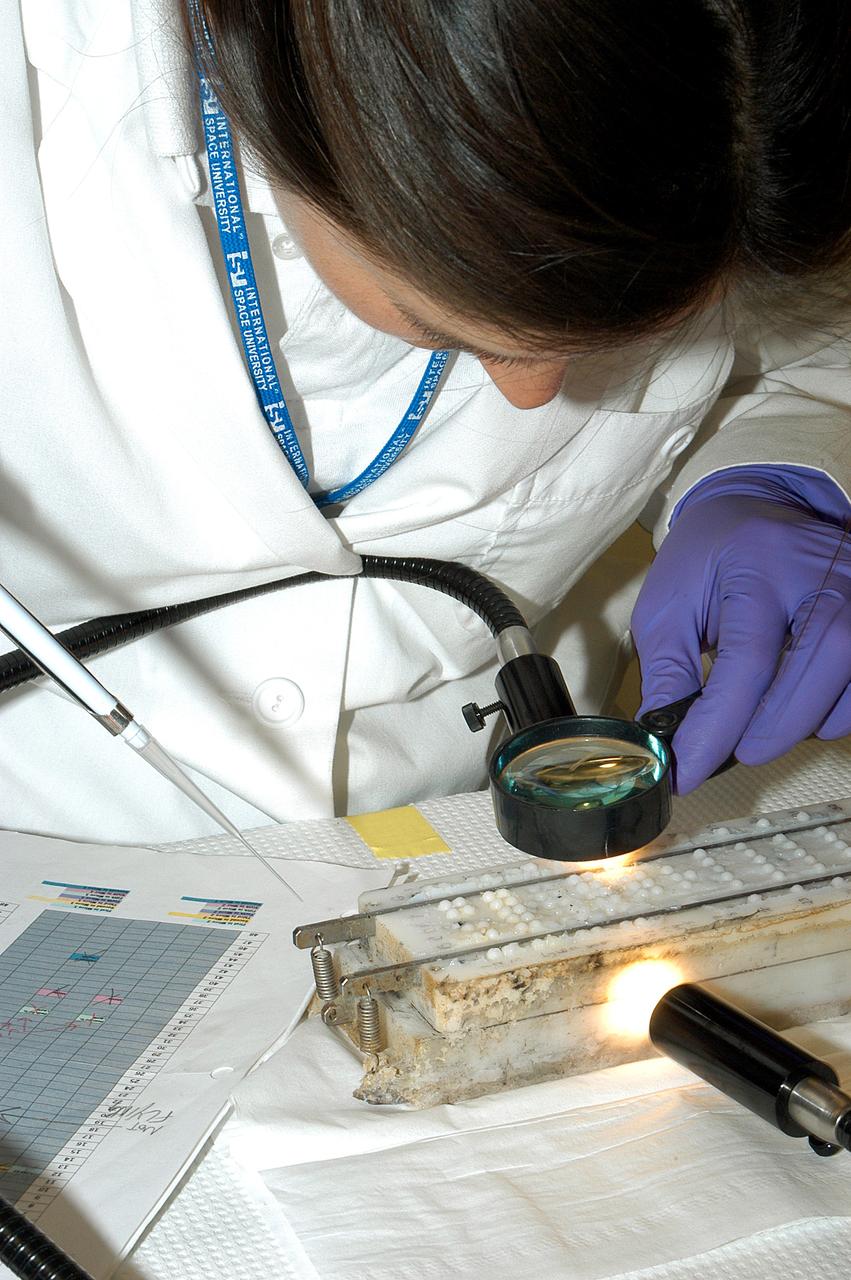
KENNEDY SPACE CENTER, FLA. -  Valerie Cassanto (foreground), Instrumentation Technology Associates, Inc., examines one of the experiments carried on mission STS-107. Several experiments were found during the search for Columbia debris. Included in the Commercial ITA Biomedical Experiments payload on mission STS-107 are urokinase cancer research, microencapsulation of drugs, the Growth of Bacterial Biofilm on Surfaces during Spaceflight (GOBBSS), and tin crystal formation.
KENNEDY SPACE CENTER, FLA. - Valerie Cassanto (foreground), Instrumentation Technology Associates, Inc., examines one of the experiments carried on mission STS-107. Several experiments were found during the search for Columbia debris. Included in the Commercial ITA Biomedical Experiments payload on mission STS-107 are urokinase cancer research, microencapsulation of drugs, the Growth of Bacterial Biofilm on Surfaces during Spaceflight (GOBBSS), and tin crystal formation.
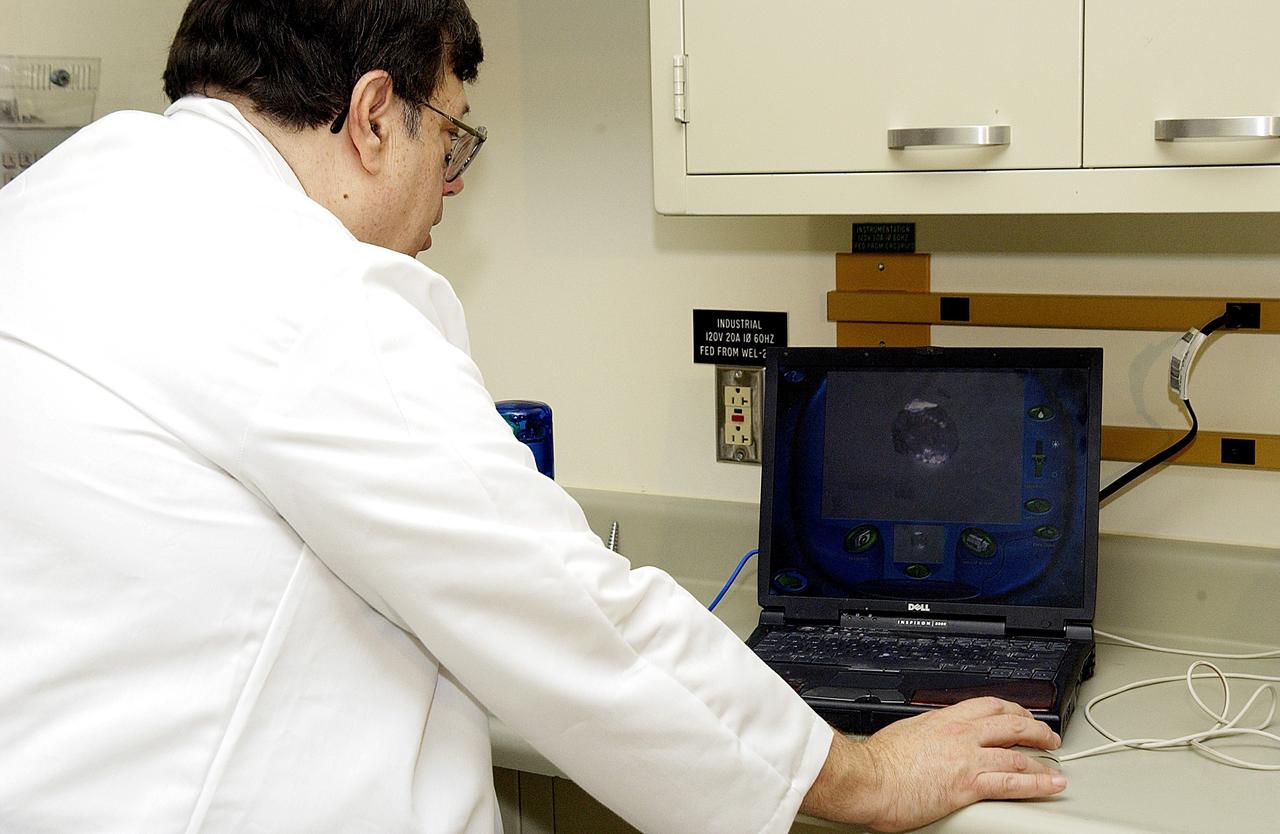
KENNEDY SPACE CENTER, FLA. -  Barry Perlman, Pembroke Pines Charter Middle School in Florida, prepares a computer to receive data from an experiment carried on mission STS-107. Several experiments were found during the search for Columbia debris. Included in the Commercial ITA Biomedical Experiments payload on mission STS-107 are urokinase cancer research, microencapsulation of drugs, the Growth of Bacterial Biofilm on Surfaces during Spaceflight (GOBBSS), and tin crystal formation. The latter was sponsored by the Pembroke Pines Charter Middle School.
KENNEDY SPACE CENTER, FLA. - Barry Perlman, Pembroke Pines Charter Middle School in Florida, prepares a computer to receive data from an experiment carried on mission STS-107. Several experiments were found during the search for Columbia debris. Included in the Commercial ITA Biomedical Experiments payload on mission STS-107 are urokinase cancer research, microencapsulation of drugs, the Growth of Bacterial Biofilm on Surfaces during Spaceflight (GOBBSS), and tin crystal formation. The latter was sponsored by the Pembroke Pines Charter Middle School.
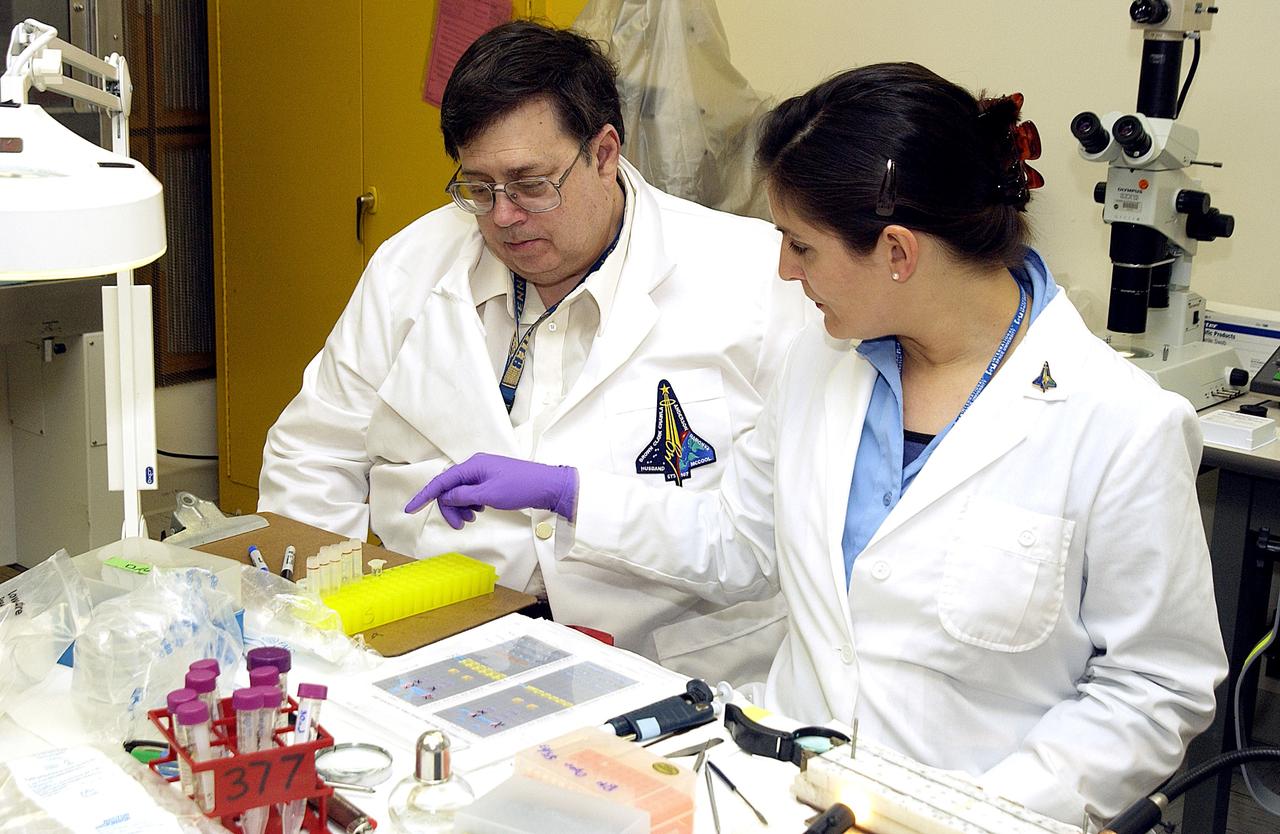
KENNEDY SPACE CENTER, FLA. -  From left, Bob McLean, Southwest Texas State University, and Valerie Cassanto, Instrumentation Technology Associates, Inc., study one of the experiments carried on mission STS-107. Several experiments were found during the search for Columbia debris. Included in the Commercial ITA Biomedical Experiments payload on mission STS-107 are urokinase cancer research, microencapsulation of drugs, the Growth of Bacterial Biofilm on Surfaces during Spaceflight (GOBBSS), and tin crystal formation.
KENNEDY SPACE CENTER, FLA. - From left, Bob McLean, Southwest Texas State University, and Valerie Cassanto, Instrumentation Technology Associates, Inc., study one of the experiments carried on mission STS-107. Several experiments were found during the search for Columbia debris. Included in the Commercial ITA Biomedical Experiments payload on mission STS-107 are urokinase cancer research, microencapsulation of drugs, the Growth of Bacterial Biofilm on Surfaces during Spaceflight (GOBBSS), and tin crystal formation.
KENNEDY SPACE CENTER, FLA. -  Dr. Dennis Morrison, NASA Johnson Space Center, works with one of the experiments carried on mission STS-107. Several experiments were found during the search for Columbia debris. Included in the Commercial ITA Biomedical Experiments payload on mission STS-107 are urokinase cancer research, microencapsulation of drugs, the Growth of Bacterial Biofilm on Surfaces during Spaceflight (GOBBSS), and tin crystal formation.
KENNEDY SPACE CENTER, FLA. - Dr. Dennis Morrison, NASA Johnson Space Center, works with one of the experiments carried on mission STS-107. Several experiments were found during the search for Columbia debris. Included in the Commercial ITA Biomedical Experiments payload on mission STS-107 are urokinase cancer research, microencapsulation of drugs, the Growth of Bacterial Biofilm on Surfaces during Spaceflight (GOBBSS), and tin crystal formation.
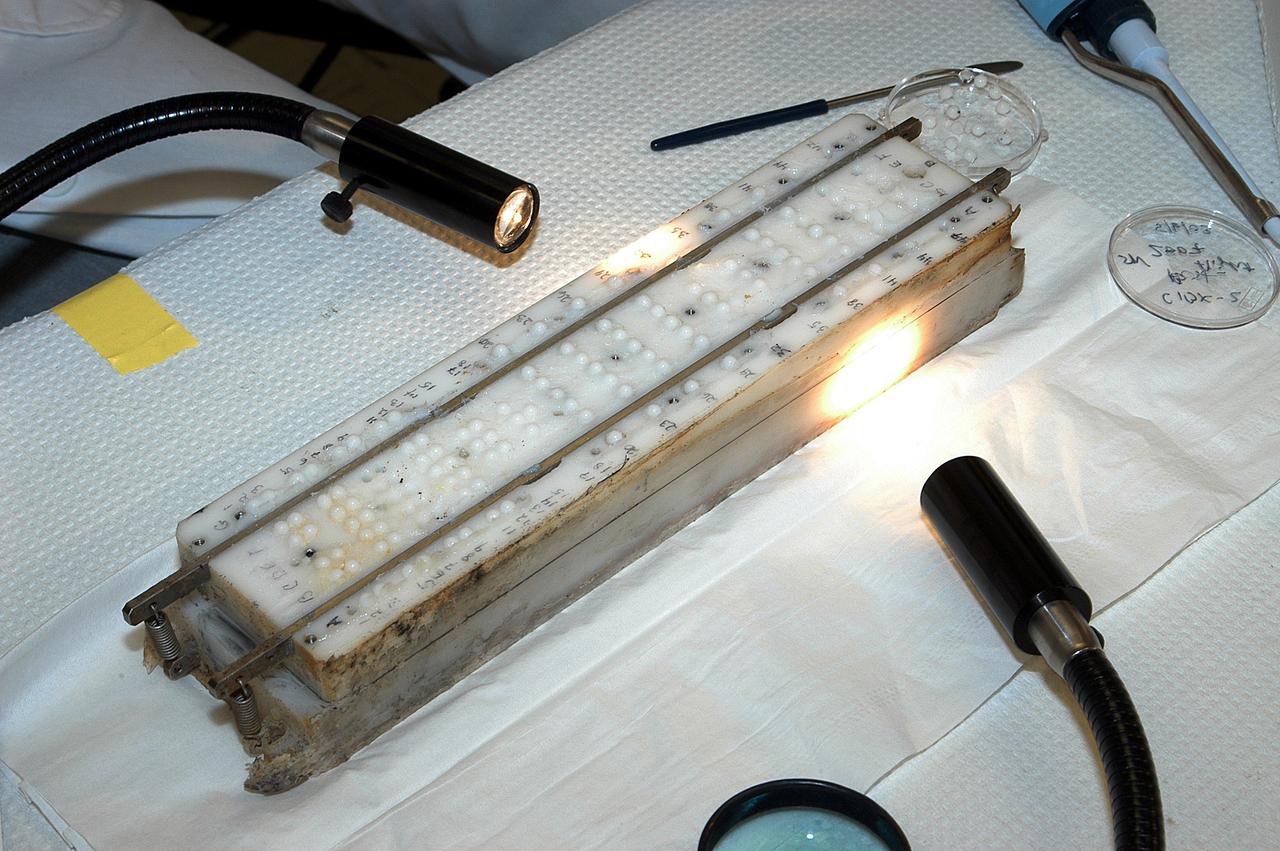
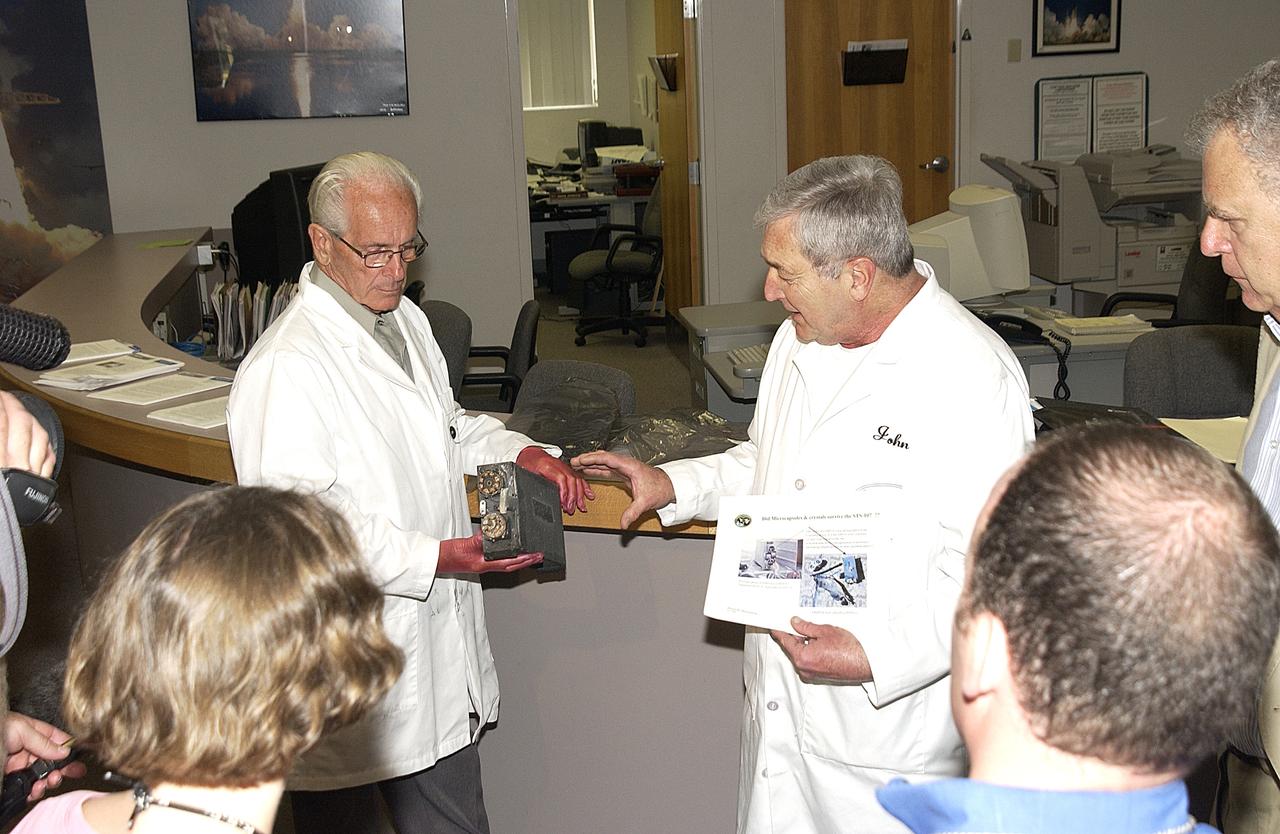
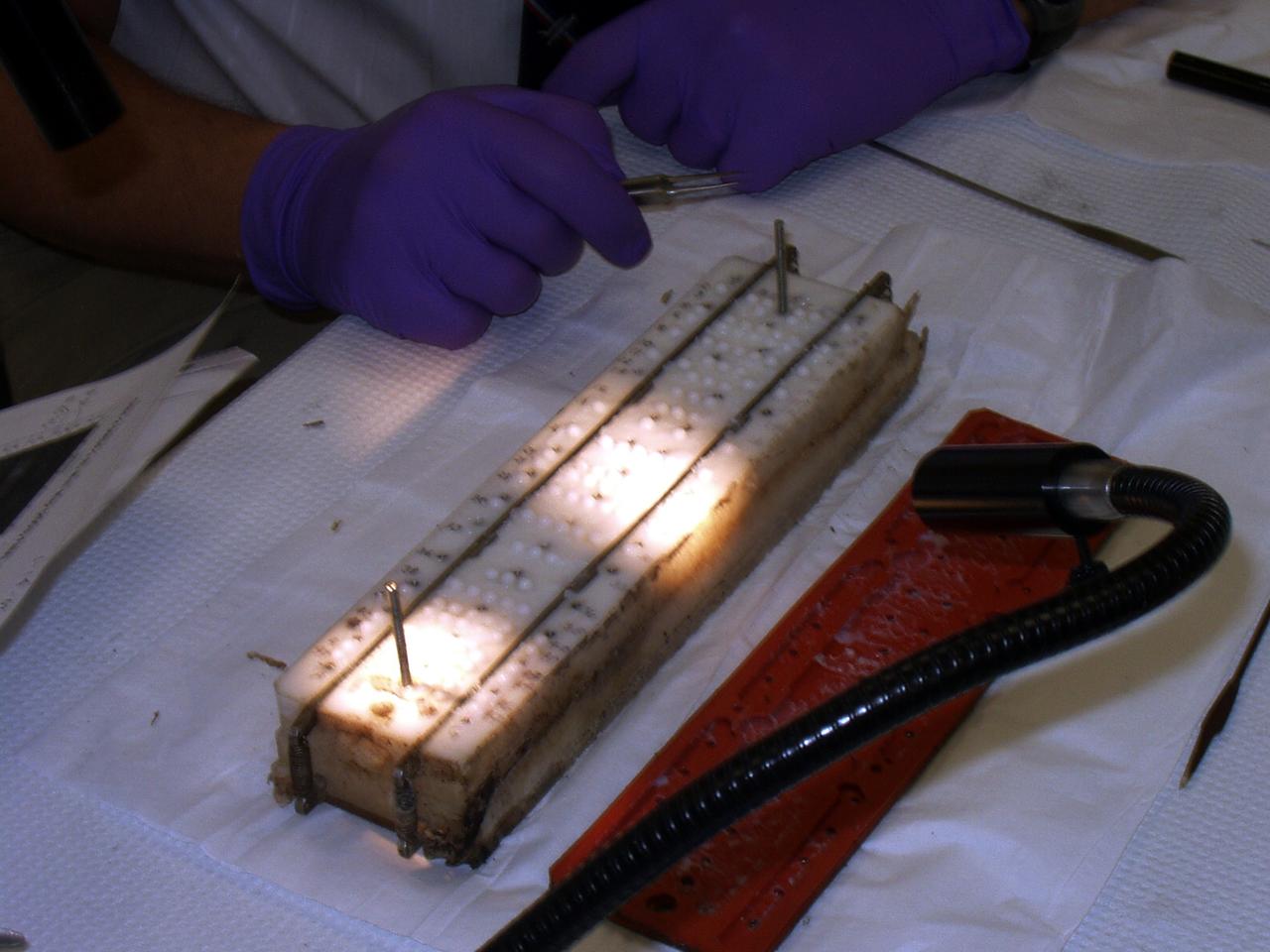
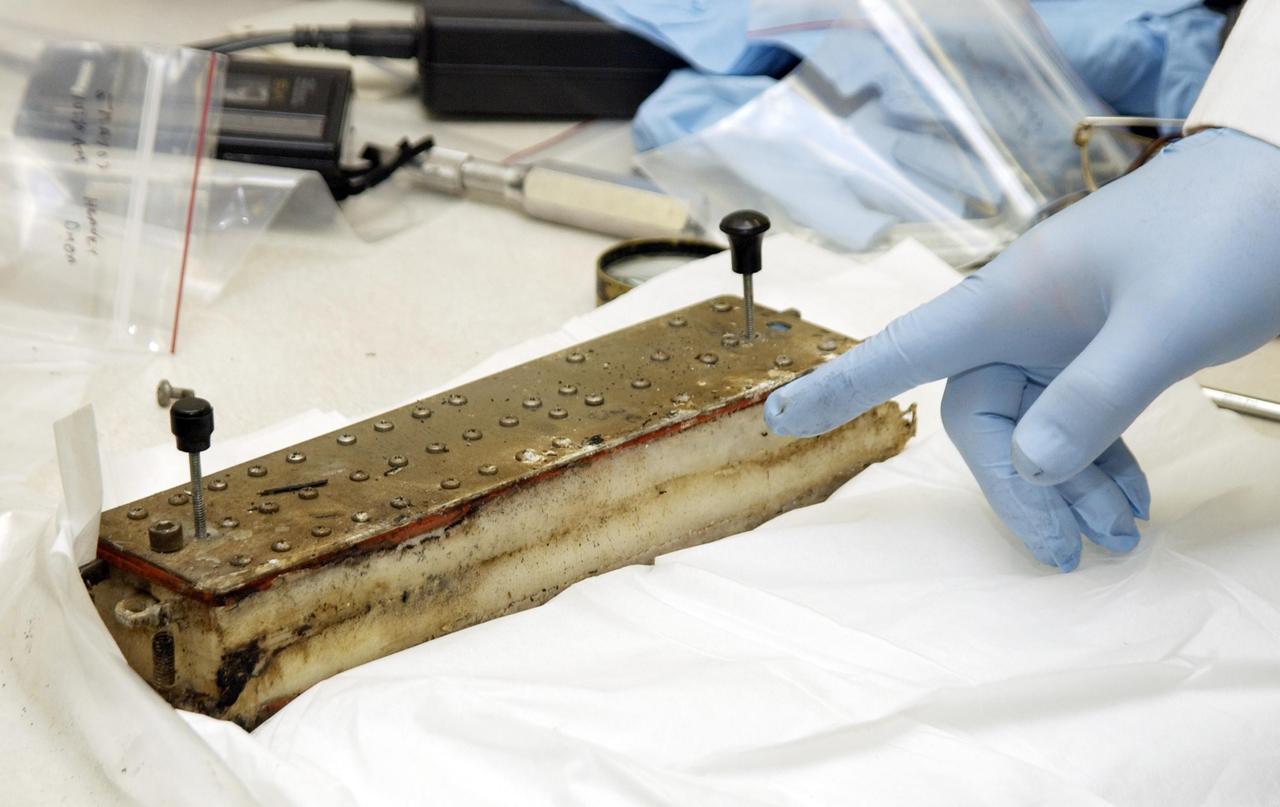
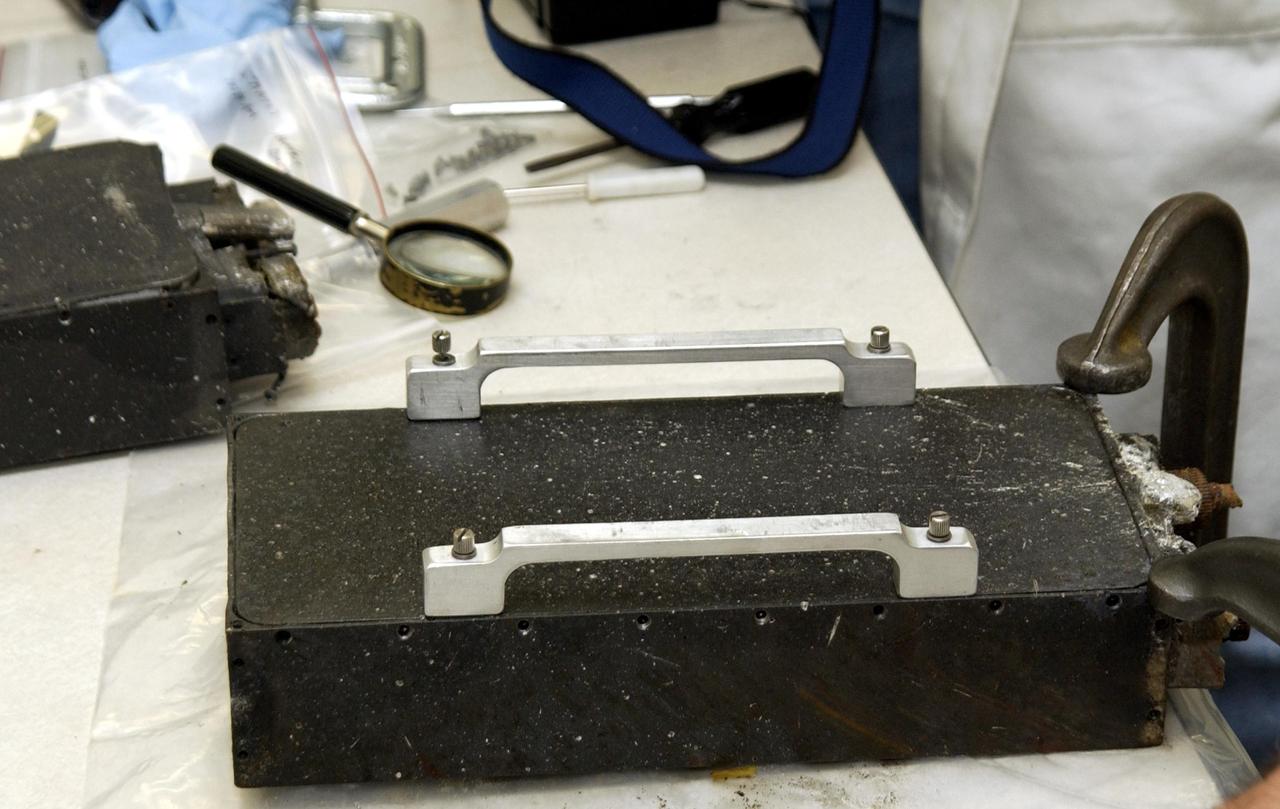
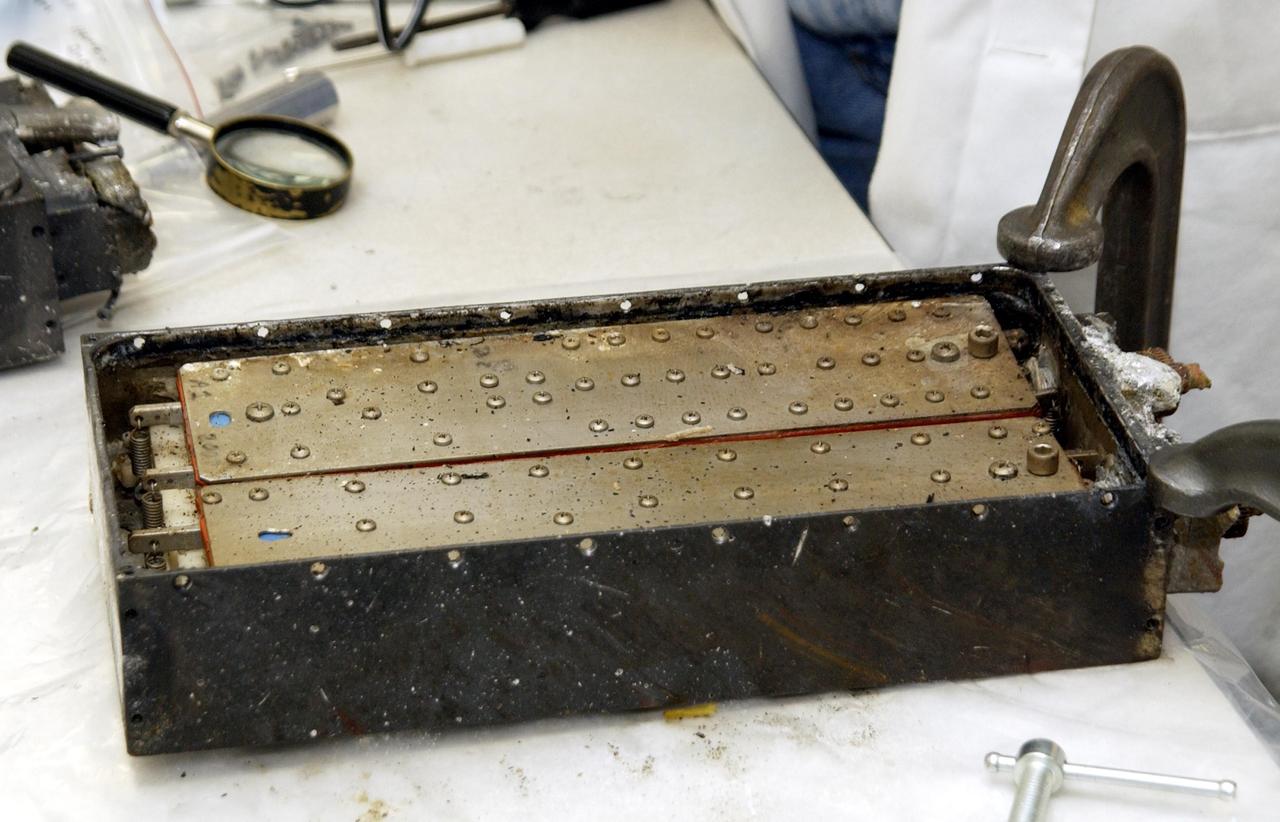
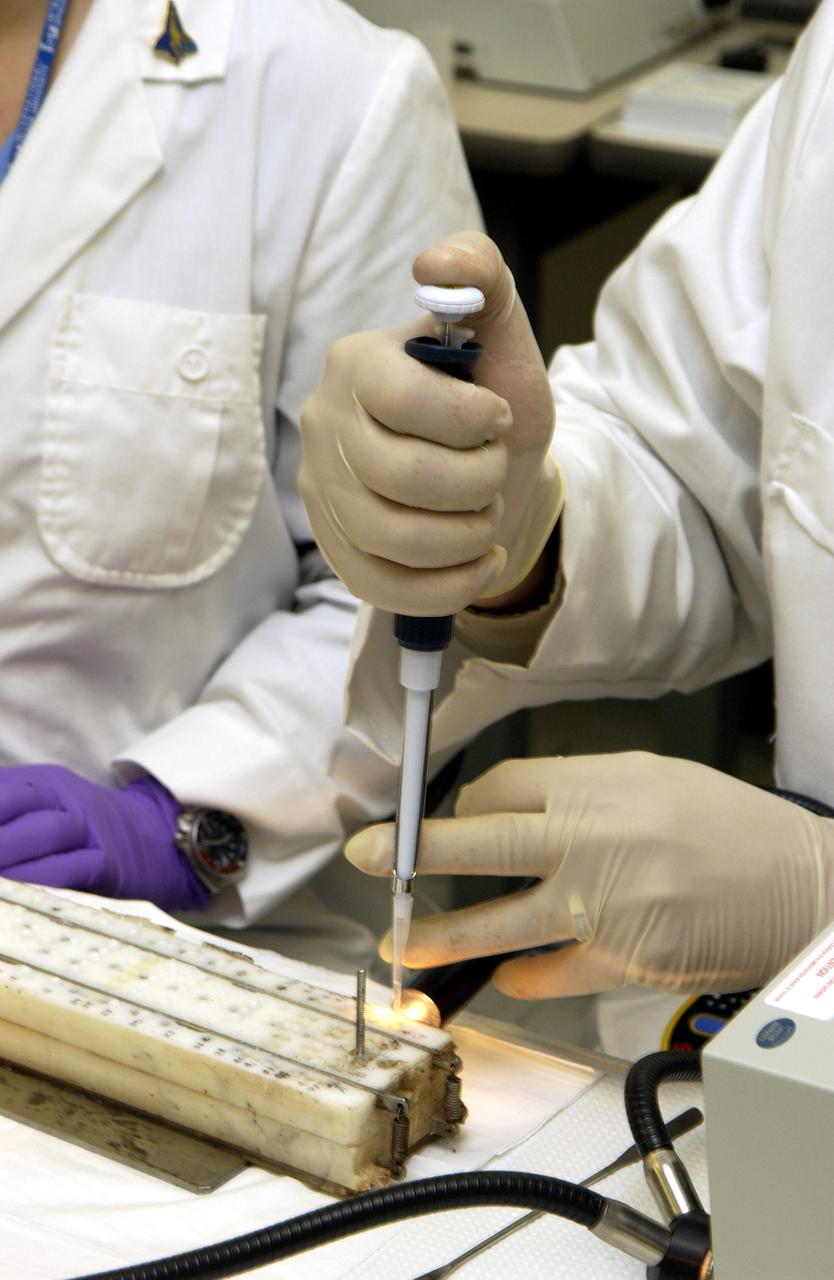
KENNEDY SPACE CENTER, FLA. - The apparatus shown was designed to hold microcapsules for research on mission STS-107.  It is one over several  included in the Commercial ITA Biomedical Experiments payload.  The box was recently recovered during the search for Columbia debris.  The drug delivery system and spaceflight hardware was developed jointly by JSC, the Institute for Research Inc. and Instrumentation Technology Associates Inc. to conduct microencapsulation experiments under microgravity conditions.
KENNEDY SPACE CENTER, FLA. - The apparatus shown was designed to hold microcapsules for research on mission STS-107. It is one over several included in the Commercial ITA Biomedical Experiments payload. The box was recently recovered during the search for Columbia debris. The drug delivery system and spaceflight hardware was developed jointly by JSC, the Institute for Research Inc. and Instrumentation Technology Associates Inc. to conduct microencapsulation experiments under microgravity conditions.
KENNEDY SPACE CENTER, FLA. - Valerie Cassanto, with Instrumentation Technology Associates, Inc., and Bob McLean, from the Southwest Texas State University, work on an experiment found during the search for Columbia debris.  Included in the Commercial ITA Biomedical Experiments payload on mission STS-107 are urokinase cancer research, microencapsulation of drugs, the Growth of Bacterial Biofilm on Surfaces during Spaceflight (GOBBSS), and tin crystal formation.
KENNEDY SPACE CENTER, FLA. - Valerie Cassanto, with Instrumentation Technology Associates, Inc., and Bob McLean, from the Southwest Texas State University, work on an experiment found during the search for Columbia debris. Included in the Commercial ITA Biomedical Experiments payload on mission STS-107 are urokinase cancer research, microencapsulation of drugs, the Growth of Bacterial Biofilm on Surfaces during Spaceflight (GOBBSS), and tin crystal formation.
KENNEDY SPACE CENTER, FLA. - Valerie Cassanto, with Instrumentation Technology Associates, Inc., works on an experiment found during the search for Columbia debris.  Mike Casasanto, also with ITA, looks on.  Included in the Commercial ITA Biomedical Experiments payload on mission STS-107 are urokinase cancer research, microencapsulation of drugs, the Growth of Bacterial Biofilm on Surfaces during Spaceflight (GOBBSS), and tin crystal formation.
KENNEDY SPACE CENTER, FLA. - Valerie Cassanto, with Instrumentation Technology Associates, Inc., works on an experiment found during the search for Columbia debris. Mike Casasanto, also with ITA, looks on. Included in the Commercial ITA Biomedical Experiments payload on mission STS-107 are urokinase cancer research, microencapsulation of drugs, the Growth of Bacterial Biofilm on Surfaces during Spaceflight (GOBBSS), and tin crystal formation.
KENNEDY SPACE CENTER, FLA. -  Valerie Cassanto, with Instrumentation Technology Associates, Inc., works on an experiment found during the search for Columbia debris.  Included in the Commercial ITA Biomedical Experiments payload on mission STS-107 are urokinase cancer research, microencapsulation of drugs, the Growth of Bacterial Biofilm on Surfaces during Spaceflight (GOBBSS), and tin crystal formation.
KENNEDY SPACE CENTER, FLA. - Valerie Cassanto, with Instrumentation Technology Associates, Inc., works on an experiment found during the search for Columbia debris. Included in the Commercial ITA Biomedical Experiments payload on mission STS-107 are urokinase cancer research, microencapsulation of drugs, the Growth of Bacterial Biofilm on Surfaces during Spaceflight (GOBBSS), and tin crystal formation.
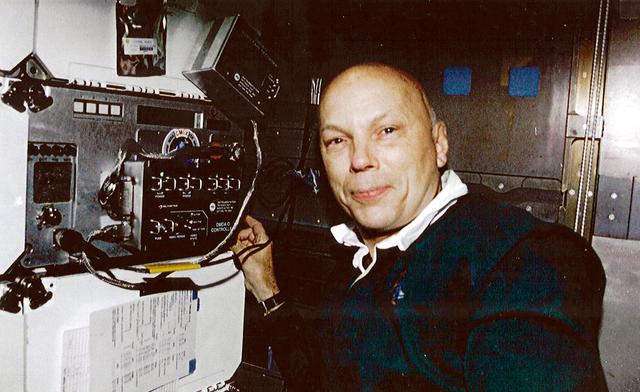
Experiments to seek solutions for a range of biomedical issues are at the heart of several investigations that will be hosted by the Commercial Instrumentation Technology Associates (ITA), Inc. The biomedical experiments CIBX-2 payload is unique, encompassing more than 20 separate experiments including cancer research, commercial experiments, and student hands-on experiments from 10 schools as part of ITA's ongoing University Among the stars program. Here, Astronaut Story Musgrave activates the CMIX-5 (Commercial MDA ITA experiment) payload in the Space Shuttle mid deck during the STS-80 mission in 1996 which is similar to CIBX-2. The experiments are sponsored by NASA's Space Product Development Program (SPD).
Space Product Development (SPD)
KENNEDY SPACE CENTER, FLA. -  Barry Perlman, Pembroke Pines Charter Middle School in Florida, examines one of the experiments carried on mission STS-107 as Bob McLean, Southwest Texas State University, looks on. Several experiments were found during the search for Columbia debris. Included in the Commercial ITA Biomedical Experiments payload on mission STS-107 are urokinase cancer research, microencapsulation of drugs, the Growth of Bacterial Biofilm on Surfaces during Spaceflight (GOBBSS), and tin crystal formation.  The latter was sponsored by the Pembroke Pines Charter Middle School.
KENNEDY SPACE CENTER, FLA. - Barry Perlman, Pembroke Pines Charter Middle School in Florida, examines one of the experiments carried on mission STS-107 as Bob McLean, Southwest Texas State University, looks on. Several experiments were found during the search for Columbia debris. Included in the Commercial ITA Biomedical Experiments payload on mission STS-107 are urokinase cancer research, microencapsulation of drugs, the Growth of Bacterial Biofilm on Surfaces during Spaceflight (GOBBSS), and tin crystal formation. The latter was sponsored by the Pembroke Pines Charter Middle School.
KENNEDY SPACE CENTER, FLA. -  From left, Barry Perlman, Pembroke Pines Charter Middle School in Florida, and Valerie Cassanto, Instrumentation Technology Associates, Inc., process one of the experiments carried on mission STS-107. Several experiments were found during the search for Columbia debris. Included in the Commercial ITA Biomedical Experiments payload on mission STS-107 are urokinase cancer research, microencapsulation of drugs, the Growth of Bacterial Biofilm on Surfaces during Spaceflight (GOBBSS), and tin crystal formation.  The latter was sponsored by the Pembroke Pines Charter Middle School.
KENNEDY SPACE CENTER, FLA. - From left, Barry Perlman, Pembroke Pines Charter Middle School in Florida, and Valerie Cassanto, Instrumentation Technology Associates, Inc., process one of the experiments carried on mission STS-107. Several experiments were found during the search for Columbia debris. Included in the Commercial ITA Biomedical Experiments payload on mission STS-107 are urokinase cancer research, microencapsulation of drugs, the Growth of Bacterial Biofilm on Surfaces during Spaceflight (GOBBSS), and tin crystal formation. The latter was sponsored by the Pembroke Pines Charter Middle School.
KENNEDY SPACE CENTER, FLA. -  From left, Barry Perlman, Pembroke Pines Charter Middle School in Florida, and Valerie Cassanto, Instrumentation Technology Associates, Inc., process one of the experiments carried on mission STS-107. Several experiments were found during the search for Columbia debris. Included in the Commercial ITA Biomedical Experiments payload on mission STS-107 are urokinase cancer research, microencapsulation of drugs, the Growth of Bacterial Biofilm on Surfaces during Spaceflight (GOBBSS), and tin crystal formation.  The latter was sponsored by the Pembroke Pines Charter Middle School.
KENNEDY SPACE CENTER, FLA. - From left, Barry Perlman, Pembroke Pines Charter Middle School in Florida, and Valerie Cassanto, Instrumentation Technology Associates, Inc., process one of the experiments carried on mission STS-107. Several experiments were found during the search for Columbia debris. Included in the Commercial ITA Biomedical Experiments payload on mission STS-107 are urokinase cancer research, microencapsulation of drugs, the Growth of Bacterial Biofilm on Surfaces during Spaceflight (GOBBSS), and tin crystal formation. The latter was sponsored by the Pembroke Pines Charter Middle School.
KENNEDY SPACE CENTER, FLA. -  From left, Barry Perlman, Pembroke Pines Charter Middle School in Florida, and Valerie Cassanto, Instrumentation Technology Associates, Inc., analyze one of the experiments carried on mission STS-107. Several experiments were found during the search for Columbia debris. Included in the Commercial ITA Biomedical Experiments payload on mission STS-107 are urokinase cancer research, microencapsulation of drugs, the Growth of Bacterial Biofilm on Surfaces during Spaceflight (GOBBSS), and tin crystal formation.  The latter was sponsored by the Pembroke Pines Charter Middle School.
KENNEDY SPACE CENTER, FLA. - From left, Barry Perlman, Pembroke Pines Charter Middle School in Florida, and Valerie Cassanto, Instrumentation Technology Associates, Inc., analyze one of the experiments carried on mission STS-107. Several experiments were found during the search for Columbia debris. Included in the Commercial ITA Biomedical Experiments payload on mission STS-107 are urokinase cancer research, microencapsulation of drugs, the Growth of Bacterial Biofilm on Surfaces during Spaceflight (GOBBSS), and tin crystal formation. The latter was sponsored by the Pembroke Pines Charter Middle School.
KENNEDY SPACE CENTER, FLA. -  From left, Barry Perlman, Pembroke Pines Charter Middle School in Florida; Valerie Cassanto, Instrumentation Technology Associates, Inc.; and Dr. Dennis Morrison, NASA Johnson Space Center, process one of the experiments carried on mission STS-107. Several experiments were found during the search for Columbia debris. Included in the Commercial ITA Biomedical Experiments payload on mission STS-107 are urokinase cancer research, microencapsulation of drugs, the Growth of Bacterial Biofilm on Surfaces during Spaceflight (GOBBSS), and tin crystal formation.  The latter was sponsored by the Pembroke Pines Charter Middle School.
KENNEDY SPACE CENTER, FLA. - From left, Barry Perlman, Pembroke Pines Charter Middle School in Florida; Valerie Cassanto, Instrumentation Technology Associates, Inc.; and Dr. Dennis Morrison, NASA Johnson Space Center, process one of the experiments carried on mission STS-107. Several experiments were found during the search for Columbia debris. Included in the Commercial ITA Biomedical Experiments payload on mission STS-107 are urokinase cancer research, microencapsulation of drugs, the Growth of Bacterial Biofilm on Surfaces during Spaceflight (GOBBSS), and tin crystal formation. The latter was sponsored by the Pembroke Pines Charter Middle School.
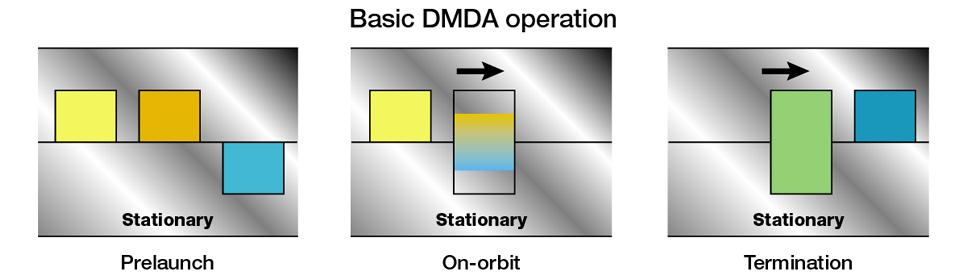
Experiments to seek solutions for a range of biomedical issues are at the heart of several investigations that will be hosted by the Commercial Instrumentation Technology Associates (ITA), Inc. Biomedical Experiments (CIBX-2) payload. CIBX-2 is unique, encompassing more than 20 separate experiments including cancer research, commercial experiments, and student hands-on experiments from 10 schools as part of ITA's ongoing University Among the Stars program. This drawing depicts a cross-section of a set of Dual-Materials Dispersion Apparatus (DMDA) specimen wells, one of which can include a reverse osmosis membrane to dewater a protein solution and thus cause crystallization. Depending on individual needs, two or three wells may be used, the membrane may be absent, or other proprietary enhancements may be present. The experiments are sponsored by NASA's Space Product Development Program (SPD).
Space Product Development (SPD)
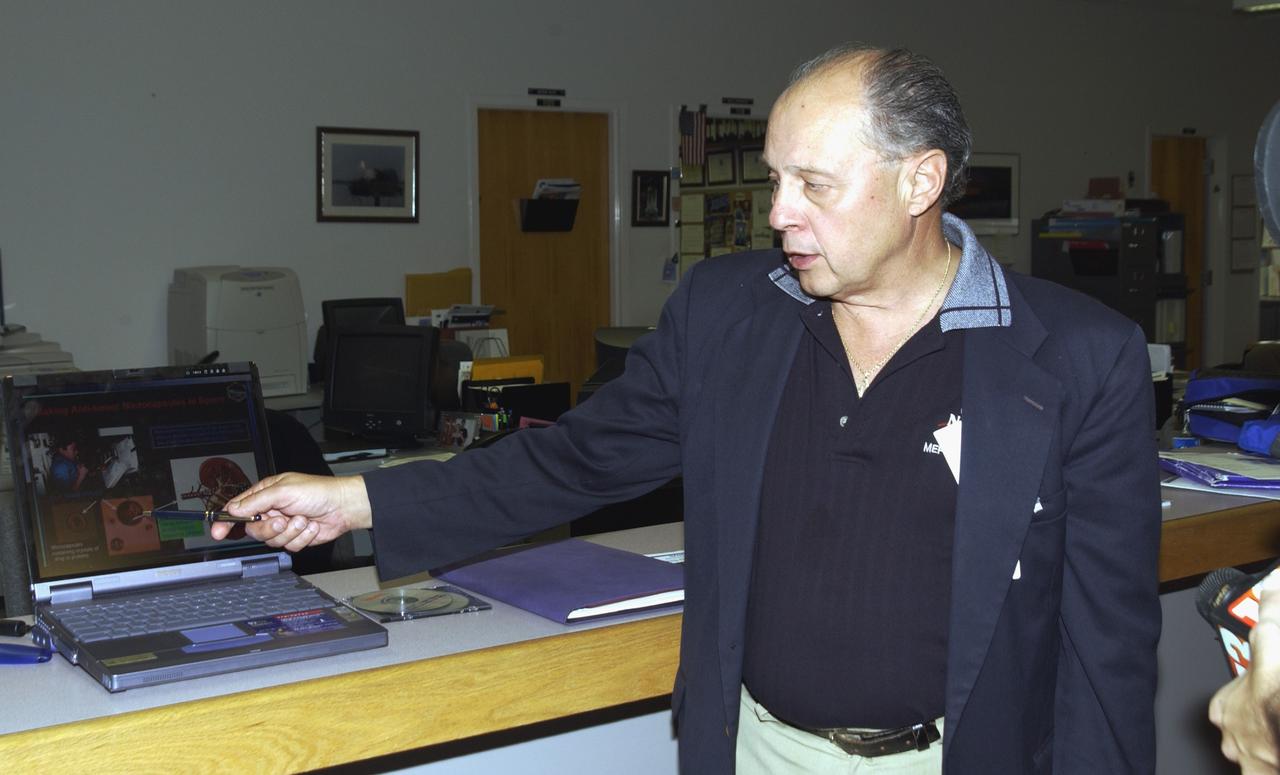
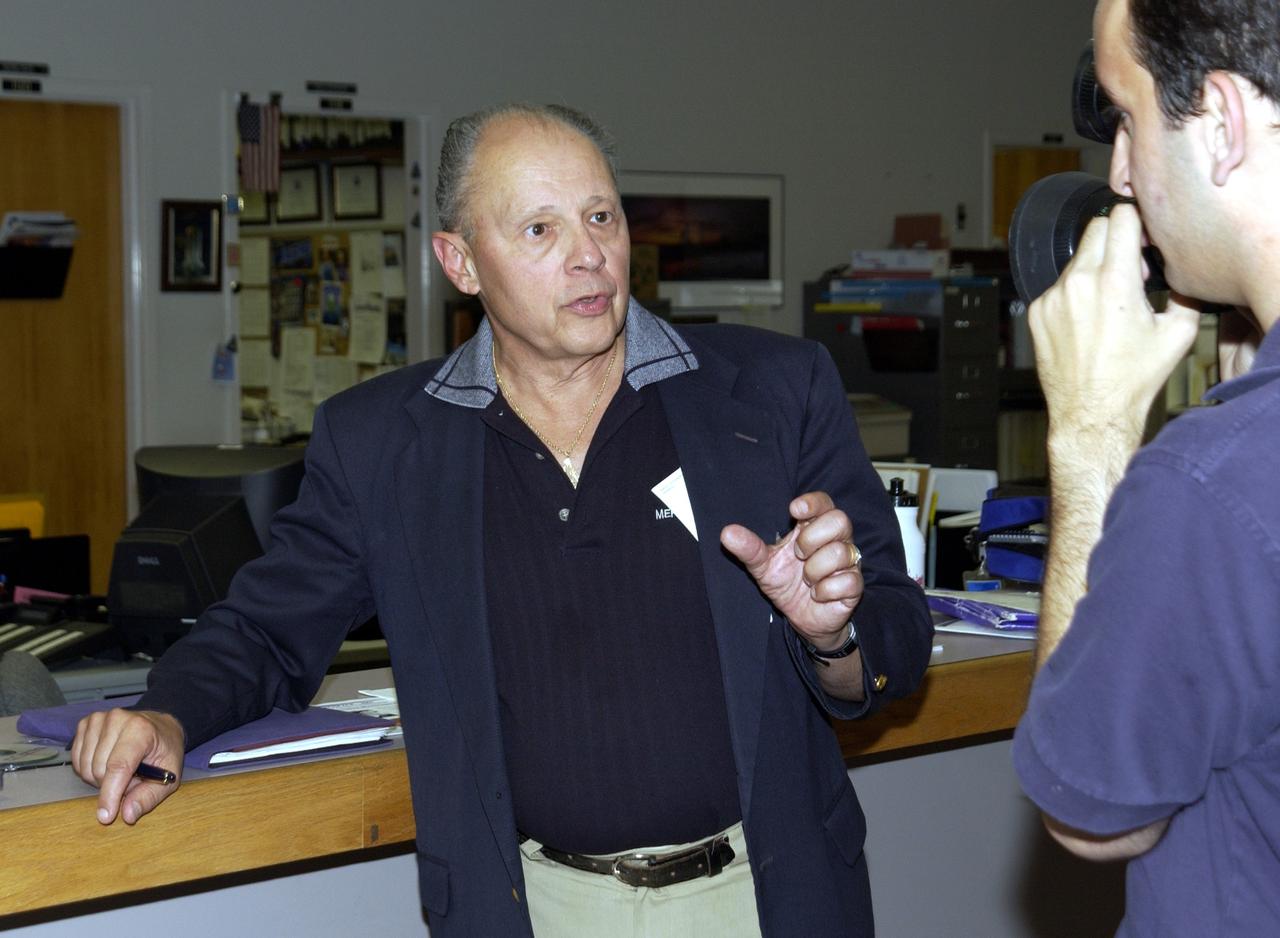
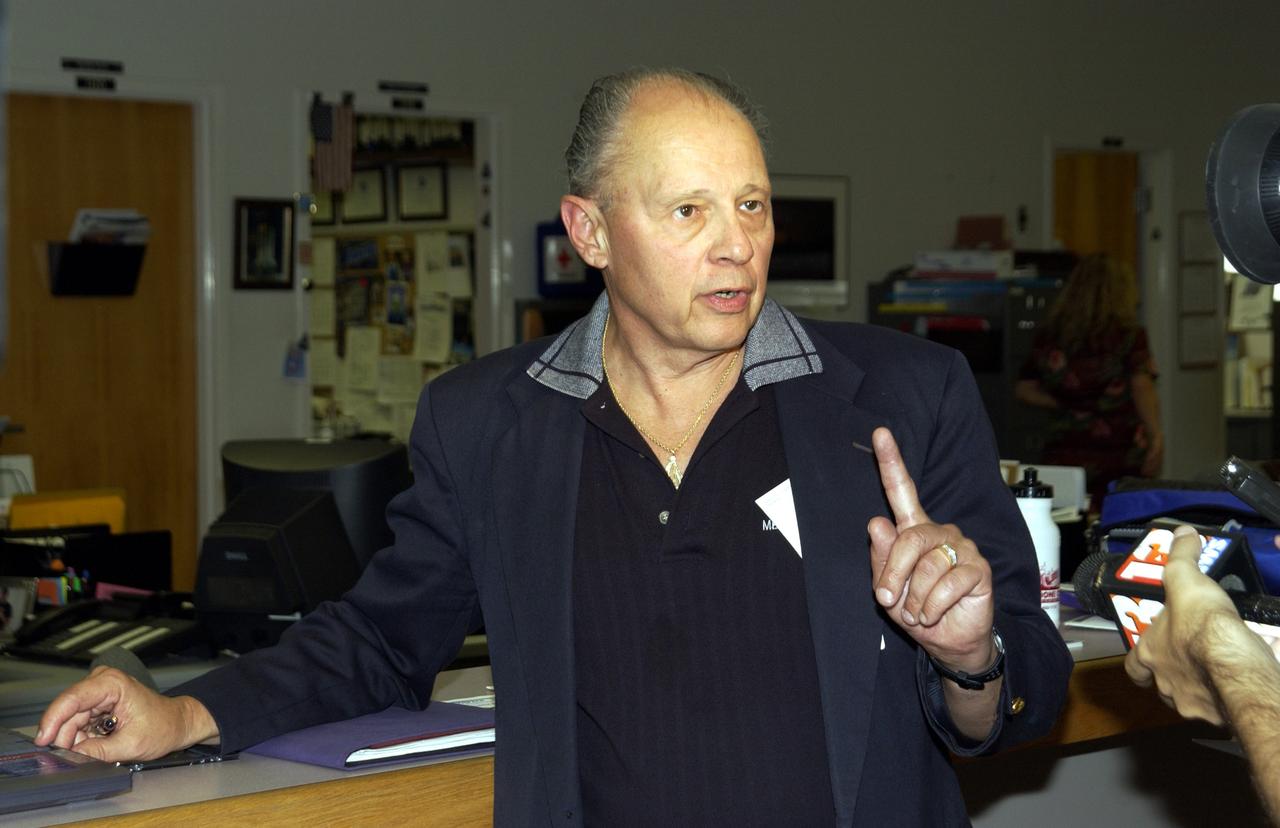
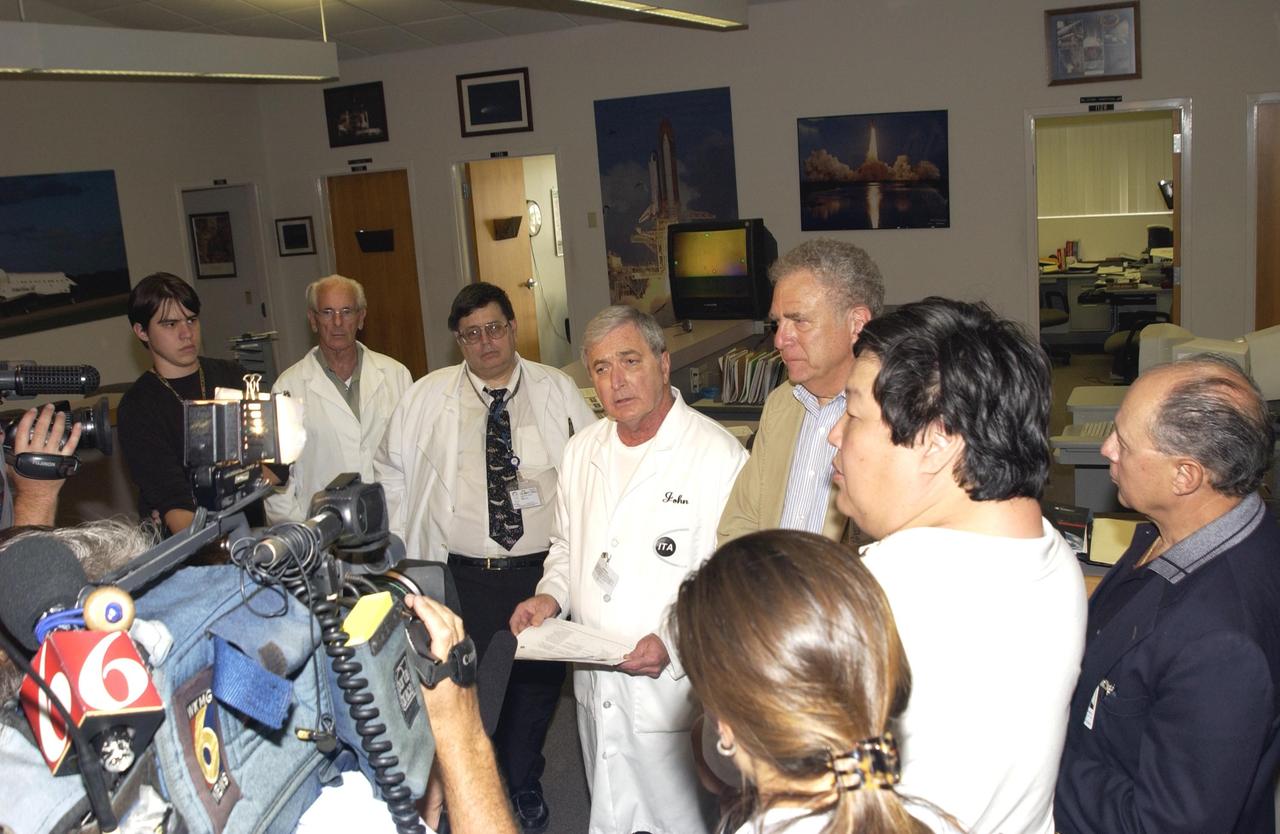
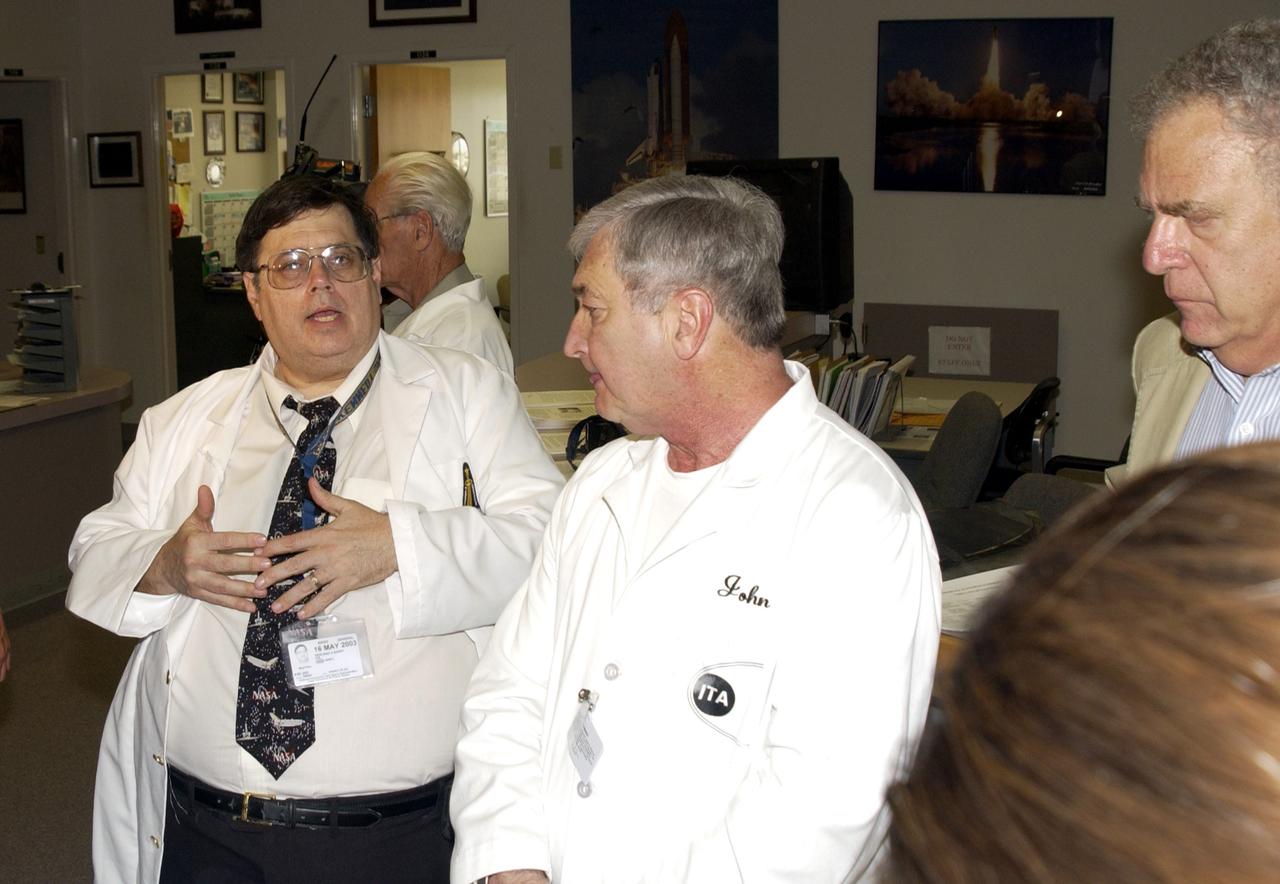
KENNEDY SPACE CENTER, FLA. - Dennis Morrison, senior biotech program scientist, talks to the media about an experiment recovered during the search for Columbia debris.  He is the principle investigator on microencapsulation and urokinase crystal growth included in the Commercial ITA Biomedical Experiments payload on mission STS-107.
KSC-03pd1443
KENNEDY SPACE CENTER, FLA. - Dennis Morrison, senior biotech program scientist, talks to a reporter about an experiment recovered during the search for Columbia debris.  He is the principle investigator on microencapsulation and urokinase crystal growth included in the Commercial ITA Biomedical Experiments payload on mission STS-107.
KSC-03pd1445
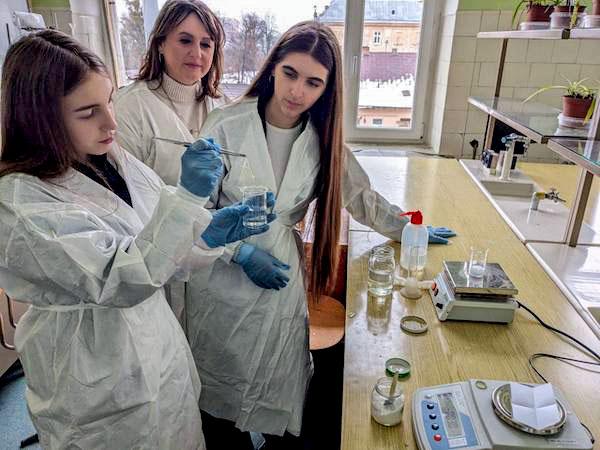
jsc2024e066517 (10/4/2024) --- Young researchers work on their experiment, Production of Biomedical Purpose Hydrogels in Microgravity, part of the Nanoracks-National Center for Earth and Space Science Education-Surveyor-Student Spaceflight Experiments Program Mission 18 to ISS (Nanoracks-NCESSE-Surveyor-SSEP).
Preflight Imagery for Nanoracks-NCESSE-Surveyor-SSEP
KENNEDY SPACE CENTER, FLA. - Dennis Morrison, senior biotech program scientist, talks to a reporter about an experiment recovered during the search for Columbia debris.  He is the principle investigator on microencapsulation and urokinase crystal growth included in the Commercial ITA Biomedical Experiments payload on mission STS-107.
KSC-03pd1444
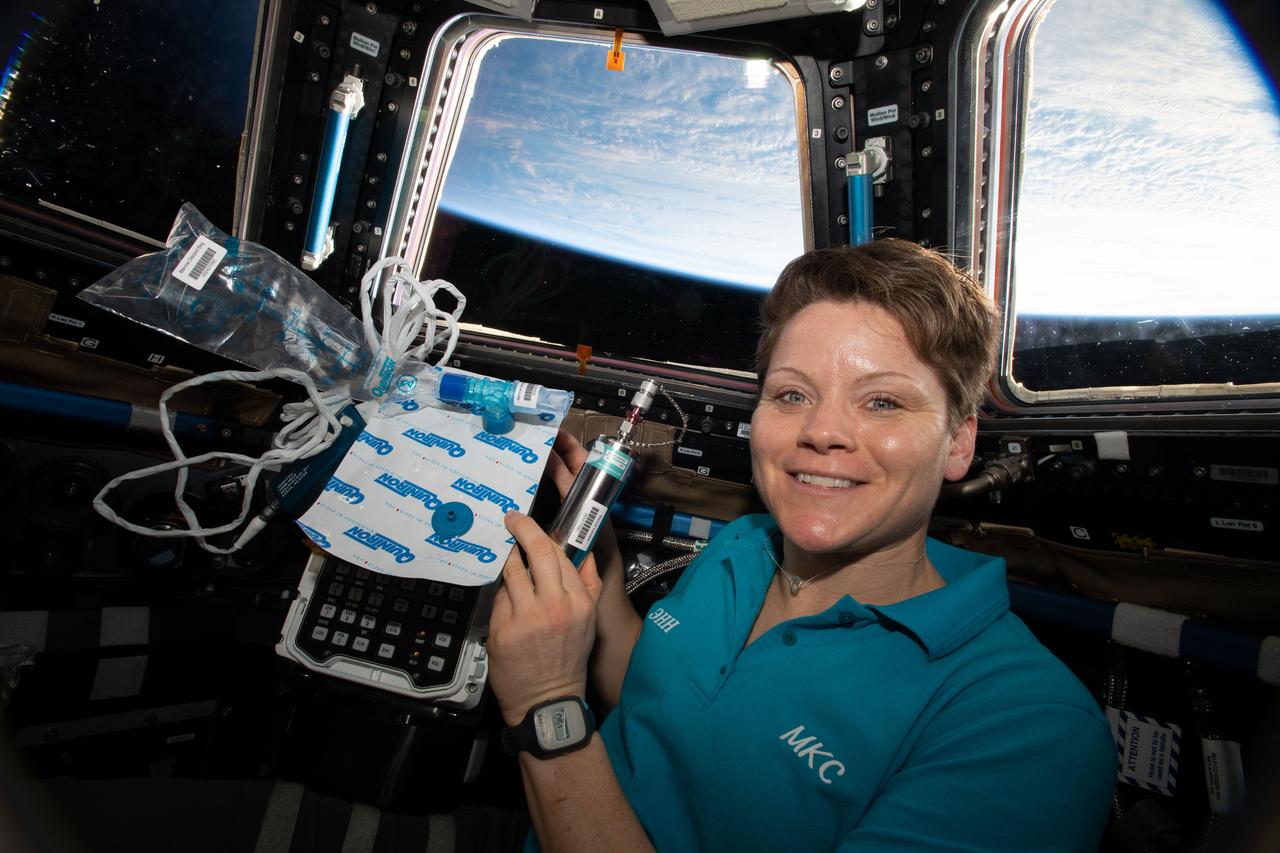
iss058e010750 (Feb. 6, 2019) --- Expedition 58 Flight Engineer Anne McClain of NASA is pictured in the cupola holding biomedical gear for the Marrow experiment. The study measures fat changes in the bone marrow before, and after exposure to microgravity. In addition, this investigation measures specific changes of red and white blood cell functions. Bone marrow fat is measured using magnetic resonance. Red blood cell function is measured with a breath sample analyzed with a gas chromatograph, and white blood cell function is studied through their genetic expression.
Expedition 58 Flight Engineer Anne McClain of NASA
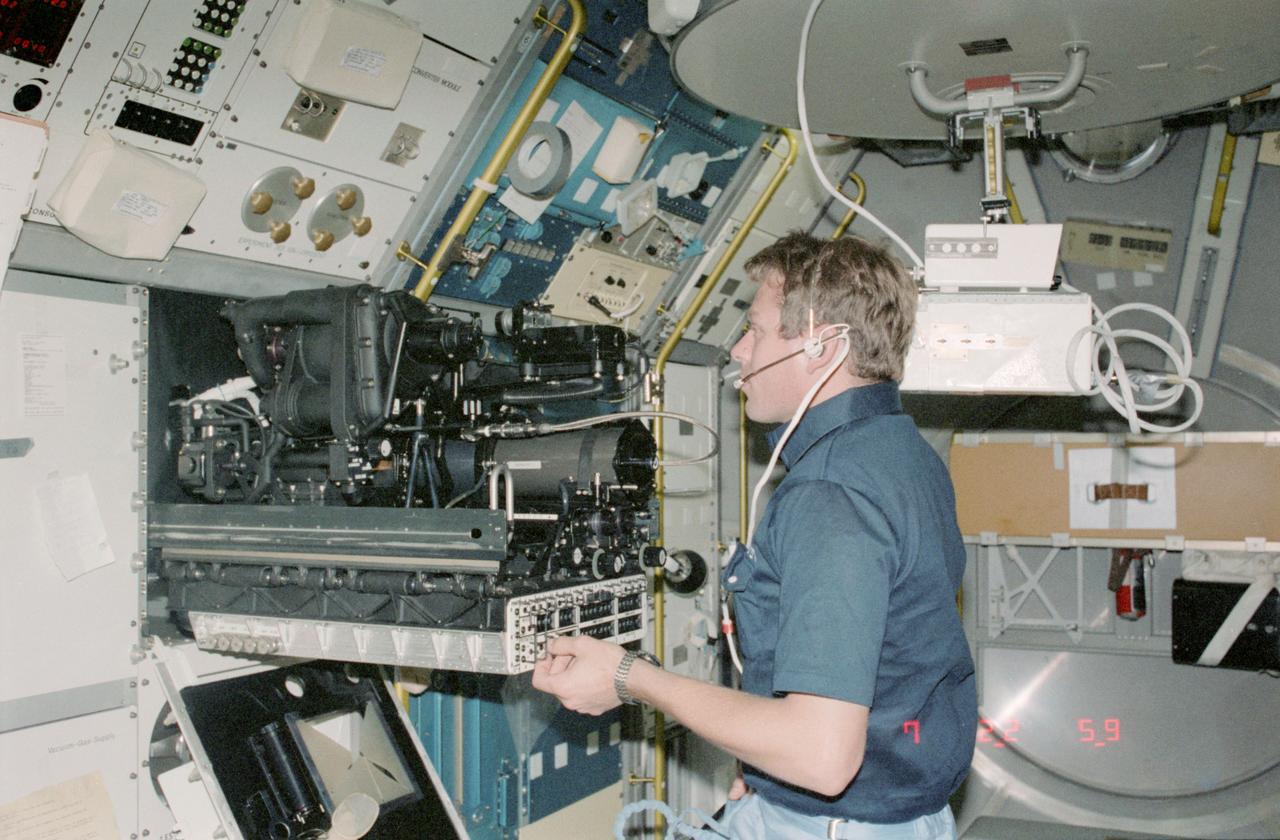
STS009-125-427 (28 Nov 1983) --- Payload Specialist Byron K. Lichtenberg carries out an experiment at the fluid physics module on the busy materials science double rack facility. Two beverage containers can be seen just above the biomedical engineer's head.
Payload Specialist Byron K. Lichtenberg working in the Spacelab
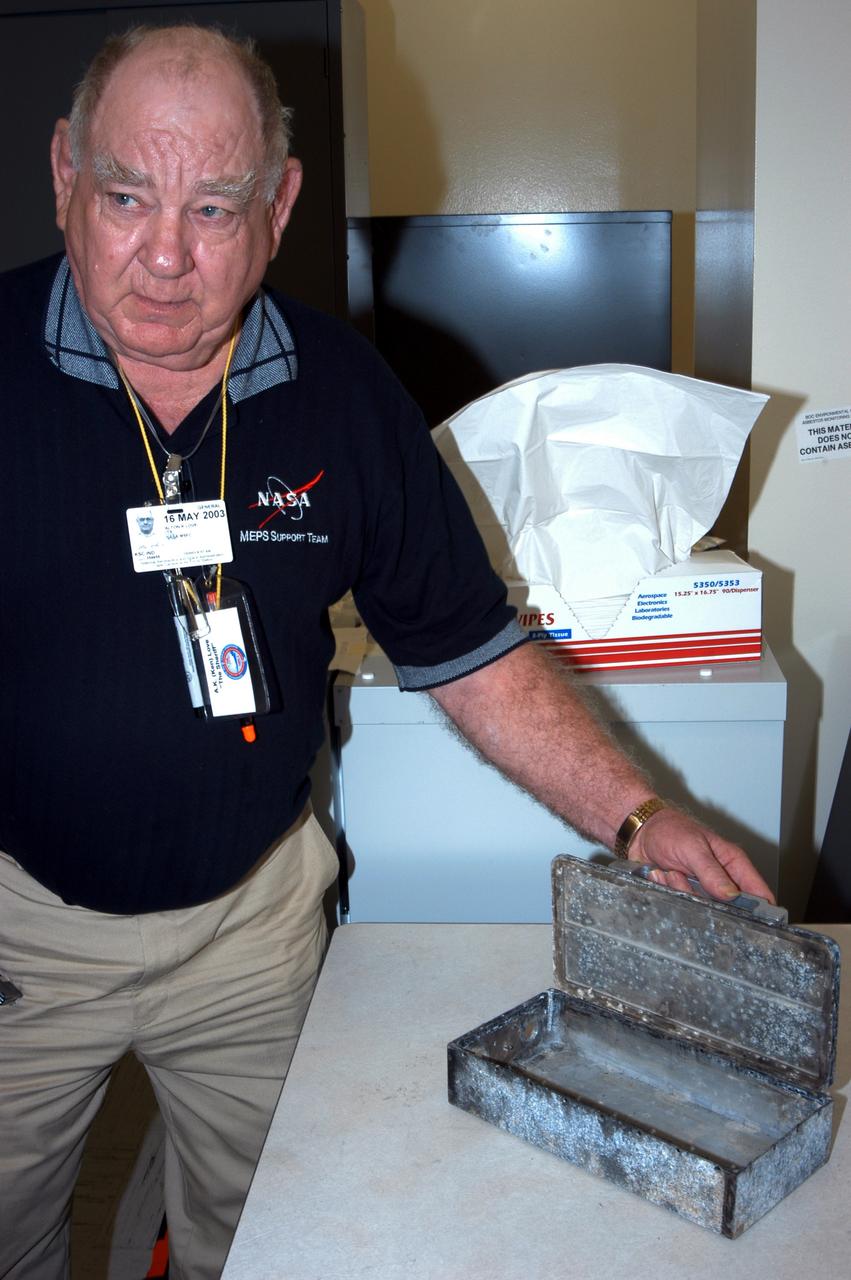
KENNEDY SPACE CENTER, FLA. -  A.K. Love,  with Instrumentation Technology Associates, Inc., displays one of the boxes used for cancer cell research, an experiment carried on mission STS-107.  Several experiments were found during the search for Columbia debris.  Included in the Commercial ITA Biomedical Experiments payload on mission STS-107 are urokinase cancer research, microencapsulation of drugs, the Growth of Bacterial Biofilm on Surfaces during Spaceflight (GOBBSS), and tin crystal formation.
KSC-03pd1458
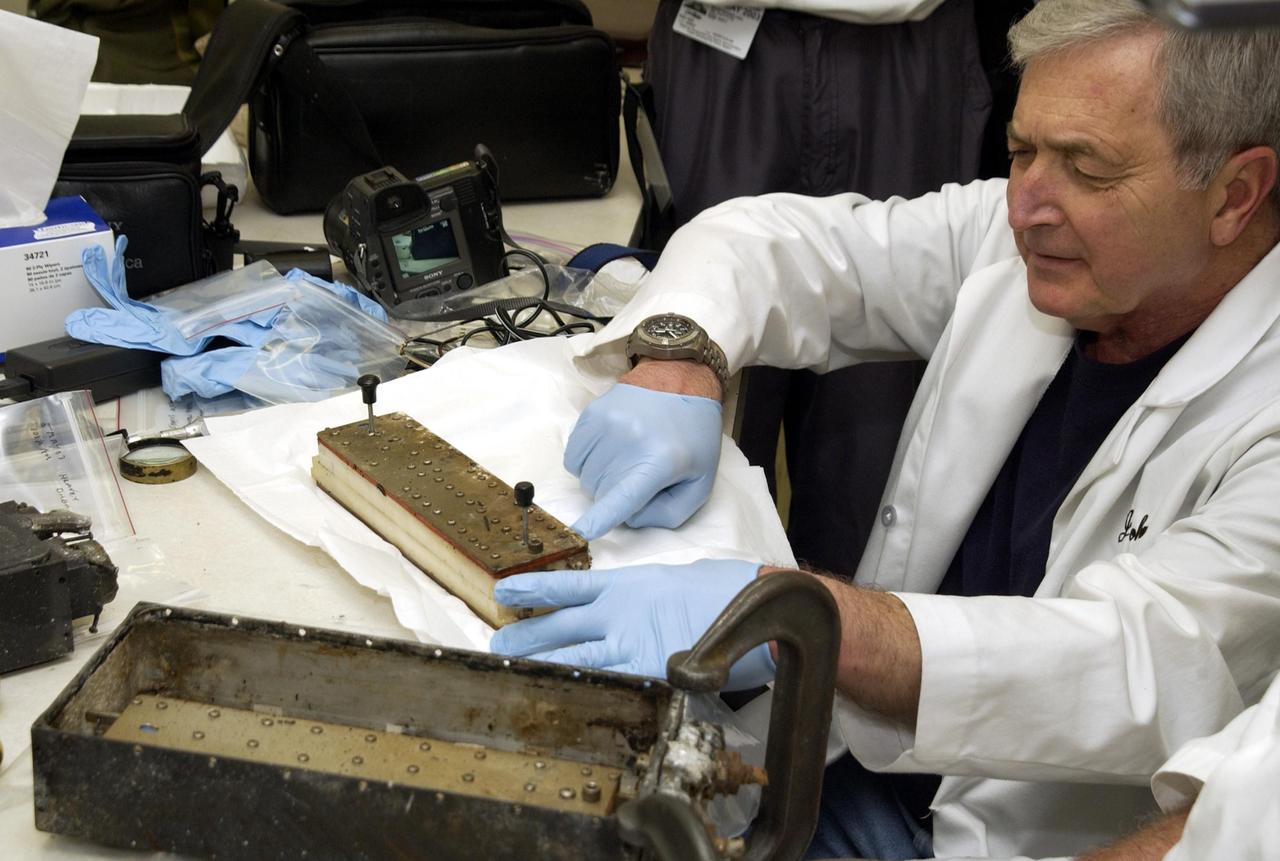
George D'Heilly and John Cassanto, scientists with Instrumentation Technology Associates, Inc., display for the media part of the apparatus recovered during the search for Columbia debris. It was part of the Commercial ITA Biomedical Experiments payload on mission STS-107 that included the Growth of Bacterial Biofilm on Surfaces during Spaceflight (GOBBSS) experiment and crystals grown for cancer research. The GOBBSS experiment was sponsored by the Planetary Society, with joint participation of an Israeli and a Palestinian student, and developed by the Israeli Aerospace Medical Institute and JSC Astrobiology Center.
Columbia Debris
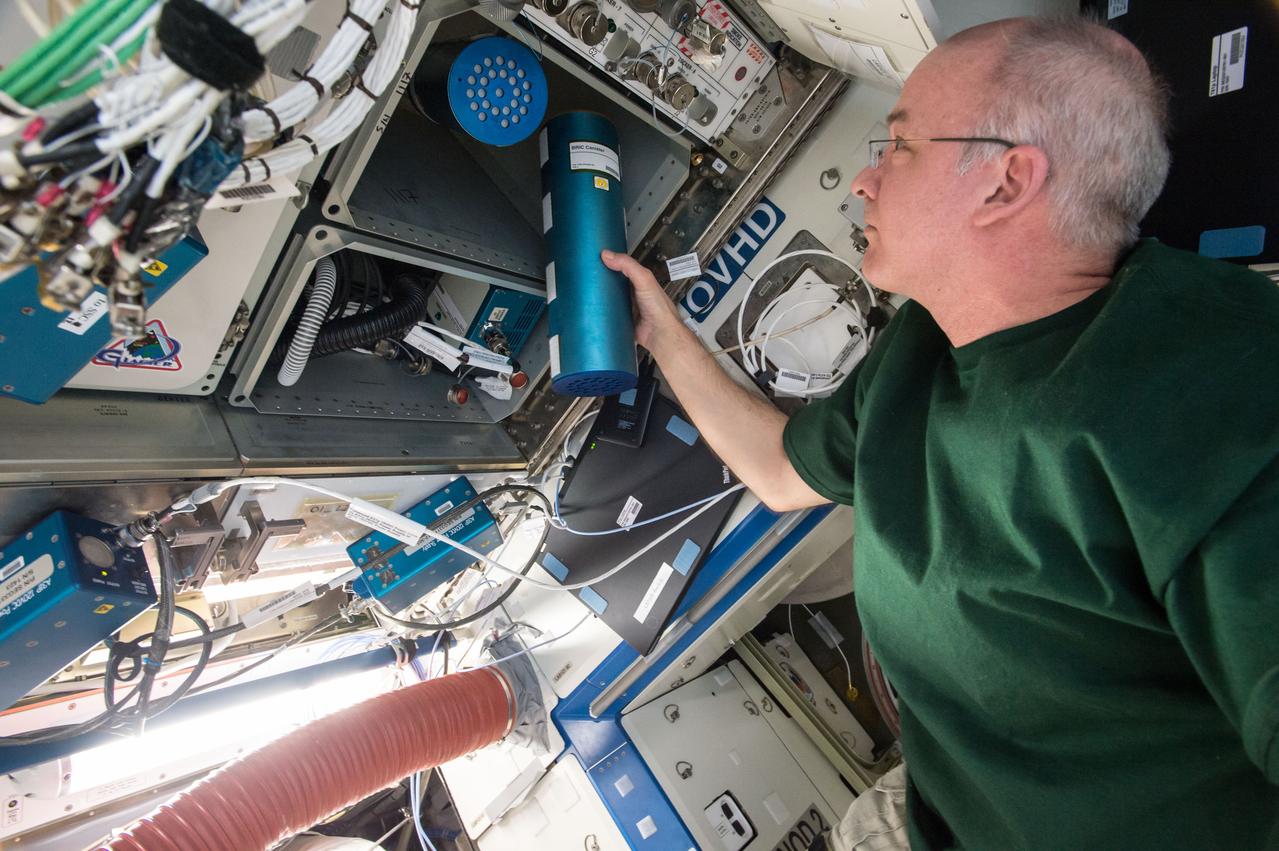
iss048e049824 (8/5/2016) --- NASA astronaut Jeff Williams transfers two canisters for the Biological Research in Canisters - Natural Product under Microgravity (BRIC-NP) experiment to ExPRESS (Expedite the Processing of Experiments to Space Station) Rack 2 Locker 6, LAB1O1-D2, in the Destiny U.S. Laboratory aboard the International Space Station (ISS). In the BRIC-NP investigation, fungal strains isolated from the Chernobyl nuclear power plant (ChNPP) accident are screened for the secretion of natural products that could be beneficial for biomedical and agricultural applications.
Williams conducts BRIC-NP OPS
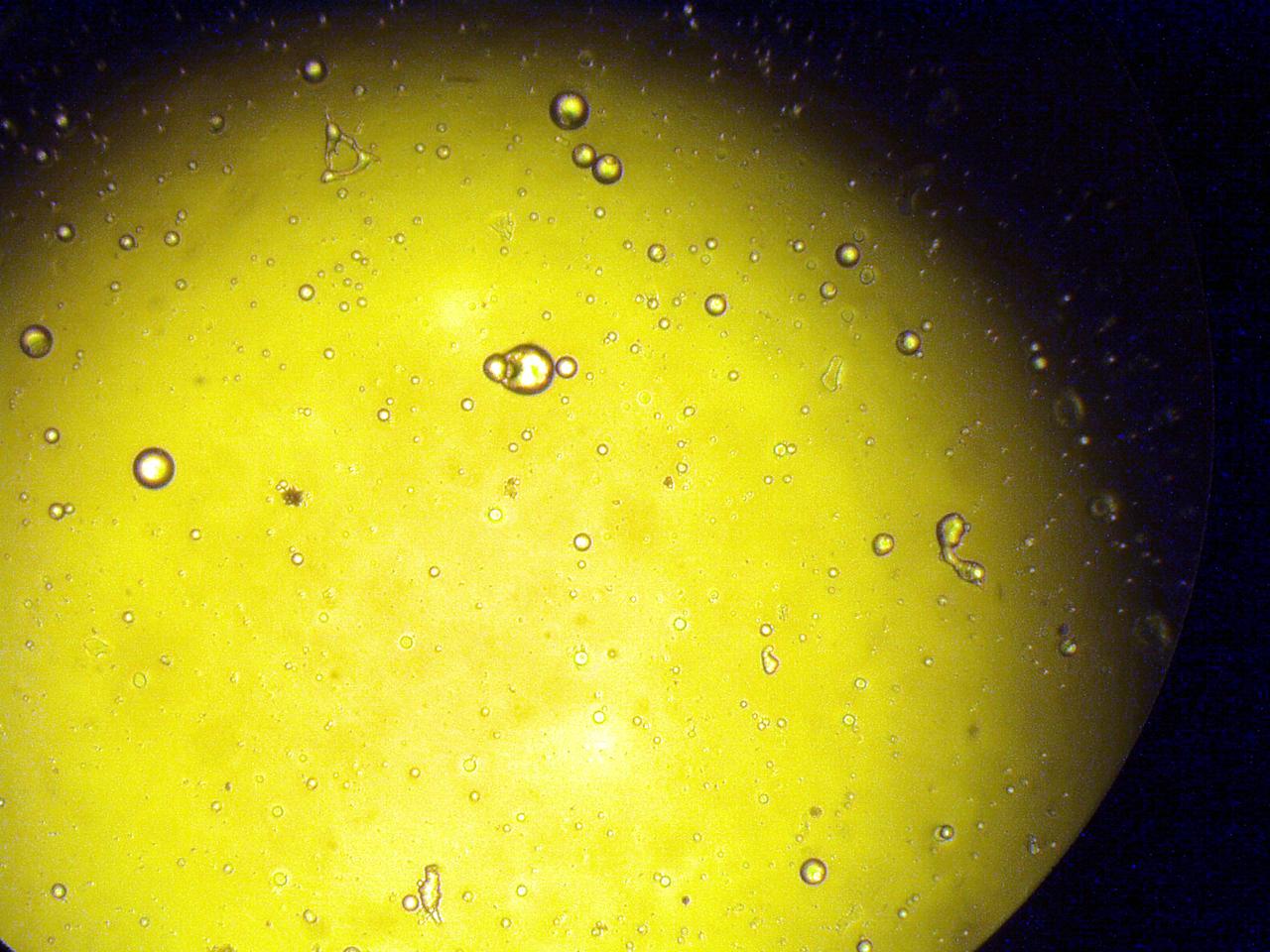
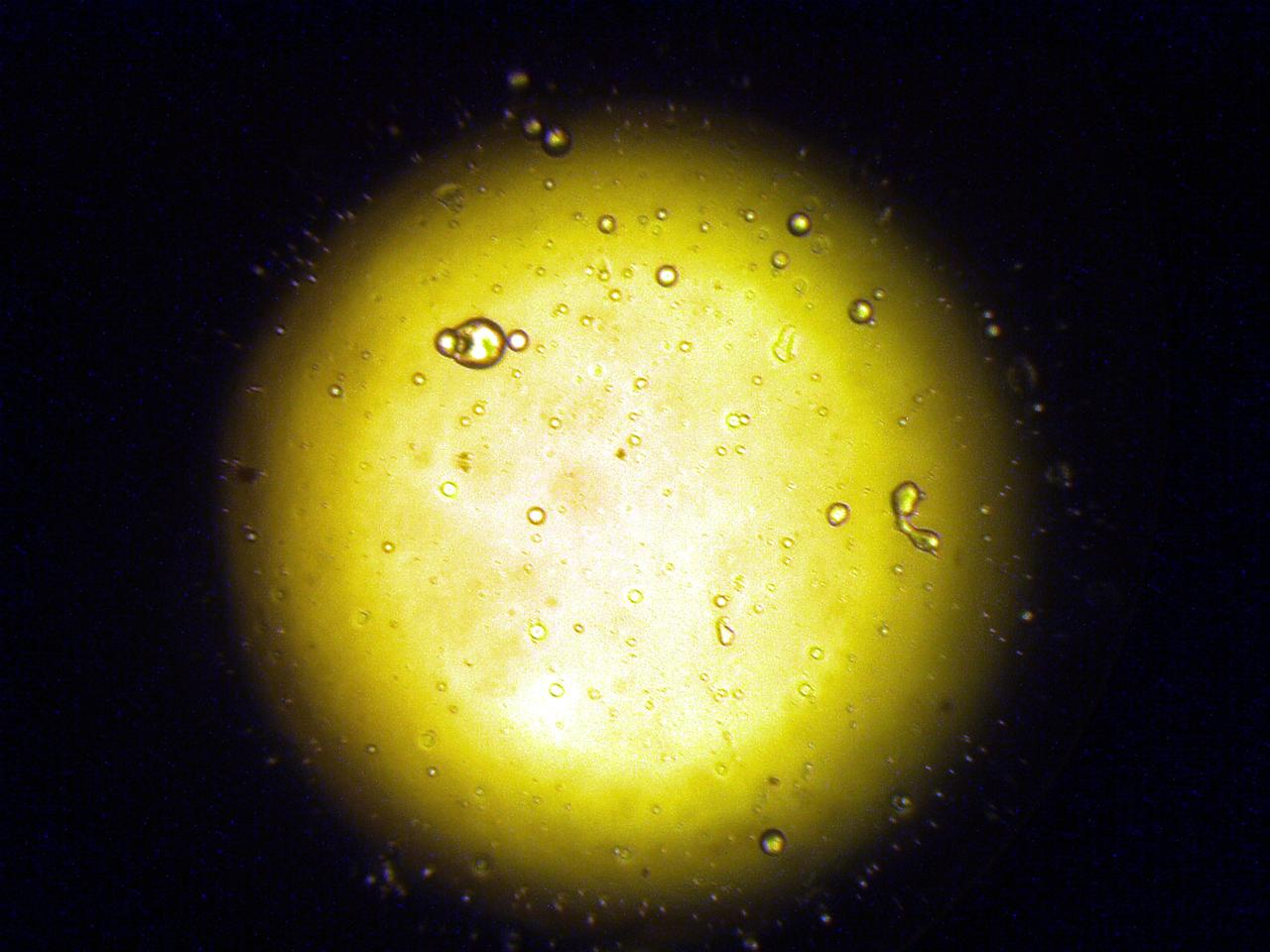
KENNEDY SPACE CENTER, FLA. - Pictured is one of the microcapsules removed from the Commercial ITA Biomedical Experiments payload recovered during the search for Columbia debris.  The drug delivery system and spaceflight hardware was developed jointly by JSC, the Institute for Research Inc. and Instrumentation Technology Associates Inc. to conduct microencapsulation experiments under microgravity conditions.  This microcapsule contains an antibiotic for treating deep resistant pulmonary infections.  Dr. Dennis Morrison, senior biotech project scientist, is principle investigator on microencapsulation and urokinase crystal growth.
KSC-03pd1448
KENNEDY SPACE CENTER, FLA. -  Pictured is one of the microcapsules removed from the Commercial ITA Biomedical Experiments payload recovered during the search for Columbia debris.  The drug delivery system and spaceflight hardware was developed jointly by JSC, the Institute for Research Inc. and Instrumentation Technology Associates Inc. to conduct microencapsulation experiments under microgravity conditions.  This microcapsule contains an antibiotic for treating deep resistant pulmonary infections.  Dr. Dennis Morrison, senior biotech project scientist, is principle investigator on microencapsulation and urokinase crystal growth.
KSC-03pd1447
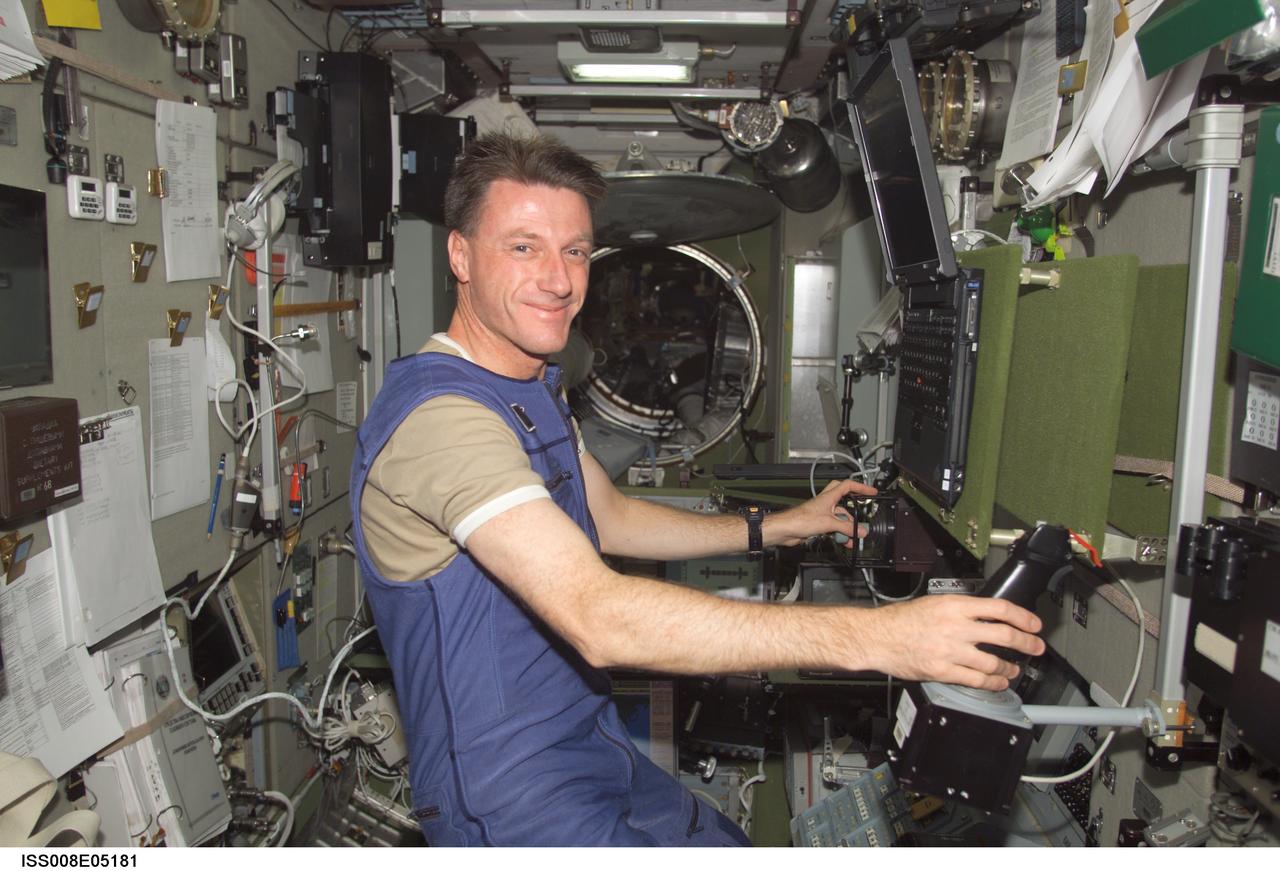
ISS008-E-05181 (31 October 2003) --- Astronaut C. Michael Foale, Expedition 8 mission commander and NASA ISS science officer, works with the Russian biomedical “Pilot” experiment (MBI-15) in the Zvezda Service Module on the International Space Station (ISS). The experiment, which looks at psychological and physiological changes in crew performance during long-duration spaceflight, requires a worktable, ankle restraint system and two control handles for testing piloting skill.
Foale works with the Pilot experiment during Expedition 8
KENNEDY SPACE CENTER, FLA. - Valerie Cassanto and Bob McLean talk to a reporter about experiments found during the search for Columbia debris.  Cassanto is with Instrumentation Technology Associates Inc. and McLean is with the Southwest Texas State University. Included in the Commercial ITA Biomedical Experiments payload on mission STS-107 are urokinase cancer research, microencapsulation of drugs, the Growth of Bacterial Biofilm on Surfaces during Spaceflight (GOBBSS), and tin crystal formation.
KSC-03pd1452
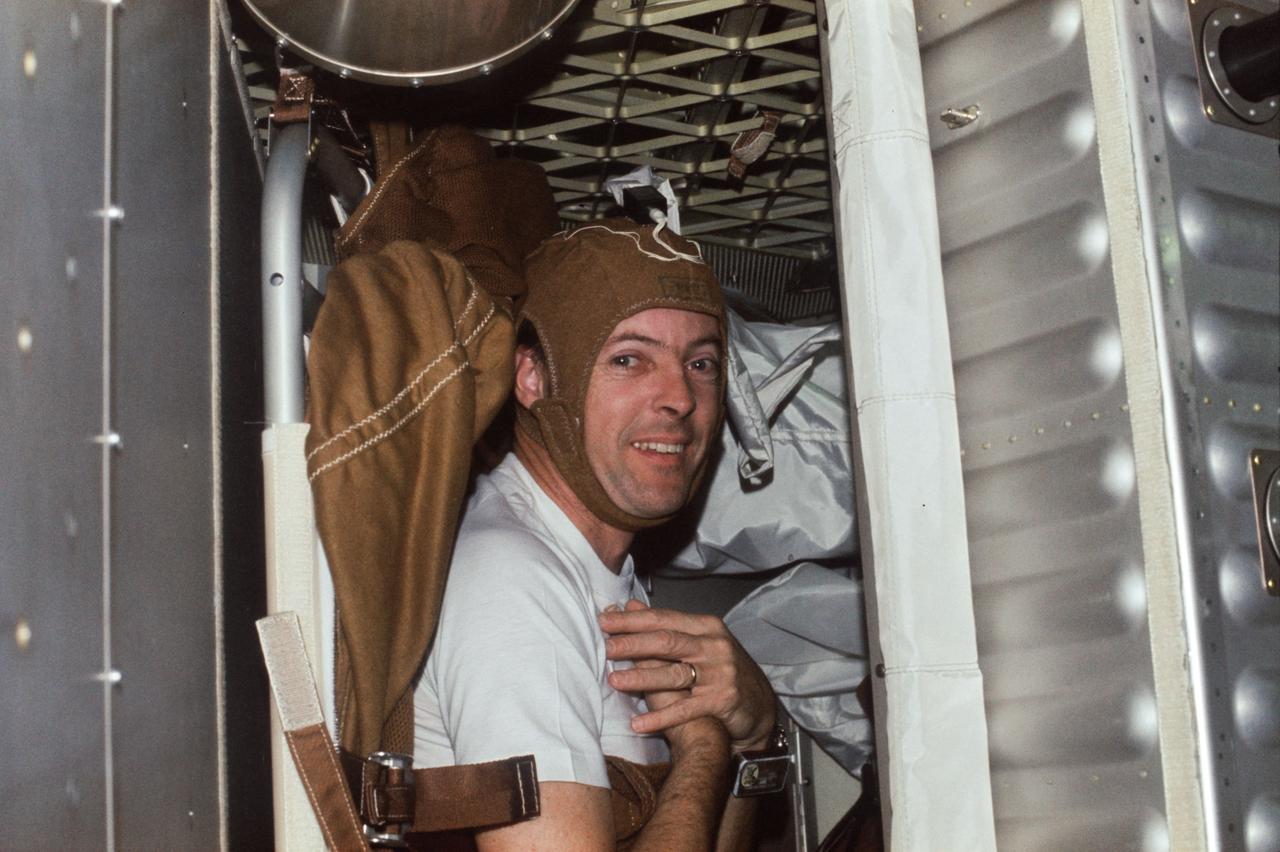
SL2-X3-205 (June 1973) --- Scientist-astronaut Joseph P. Kerwin, Skylab 2 science pilot, is photographed strapped into the sleep restraint in the crew quarters of the Orbital Workshop of the Skylab 1 & 2 space station cluster in Earth orbit. Kerwin is wearing the special cap which contains biomedical instrumentation for the M133 Sleep Monitoring Experiment. The purpose of the M133 experiment is to evaluate quantity and quality of sleep during prolonged space flight by the analysis of electroencephalographic (EEG) and electrooculographic (EOG) activity. Photo credit: NASA
sl2-x3-205
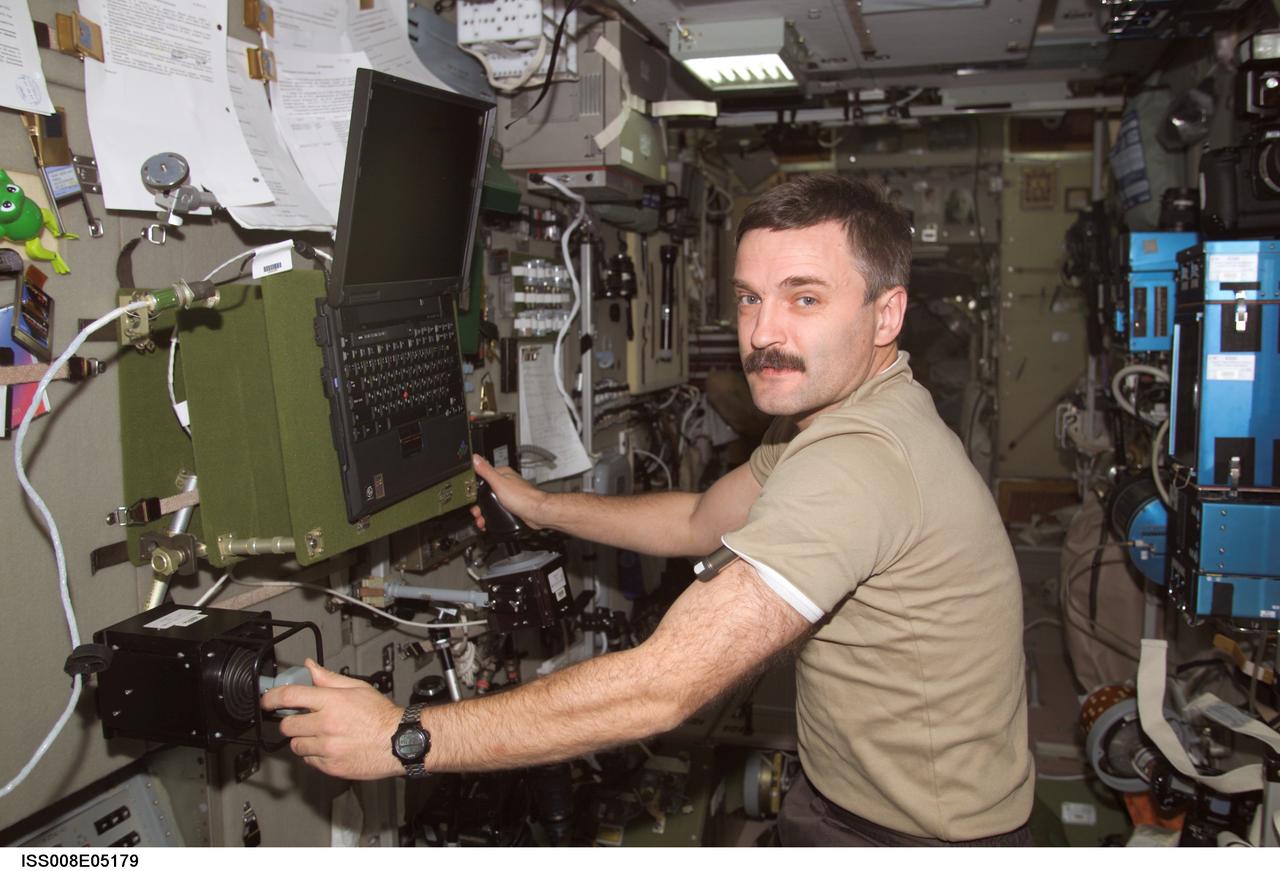
ISS008-E-05179 (31 October 2003) --- Cosmonaut Alexander Y. Kaleri, Expedition 8 flight engineer, works with the Russian biomedical “Pilot” experiment (MBI-15) in the Zvezda Service Module on the International Space Station (ISS). The experiment, which looks at psychological and physiological changes in crew performance during long-duration spaceflight, requires a worktable, ankle restraint system and two control handles for testing piloting skill. Kaleri represents Rosaviakosmos.
Kaleri works with the Pilot experiment during Expedition 8
KENNEDY SPACE CENTER, FLA. - Pictured is one of the microcapsules removed from the Commercial ITA Biomedical Experiments payload recovered during the search for Columbia debris.  The drug delivery system and spaceflight hardware was developed jointly by JSC, the Institute for Research Inc. and Instrumentation Technology Associates Inc. to conduct microencapsulation experiments under microgravity conditions.  This microcapsule contains an antibiotic for treating deep resistant pulmonary infections.   Dr. Dennis Morrison, senior biotech project scientist, is principle investigator on microencapsulation and urokinase crystal growth.
KSC-03pd1449
Scientist-Astronaut Joseph P. Kerwin, Skylab 2 science pilot, is photographed strapped into the sleep restraint in the crew quarters of the Orbital Workshop of the Skylab 1 and 2 space station cluster in Earth orbit. Kerwin is wearing the special cap which contains biomedical instrumentation for the M133 Sleep Monitoring Experiment. The purpose of the M133 experiment is to evaluate quantity and quality of sleep during prolonged space flight by the analysis of electroencephalographic (EEG) and electrooculographic (EOG) activity.
Astronaut Joseph Kerwin strapped into sleep restraint in crew quarters
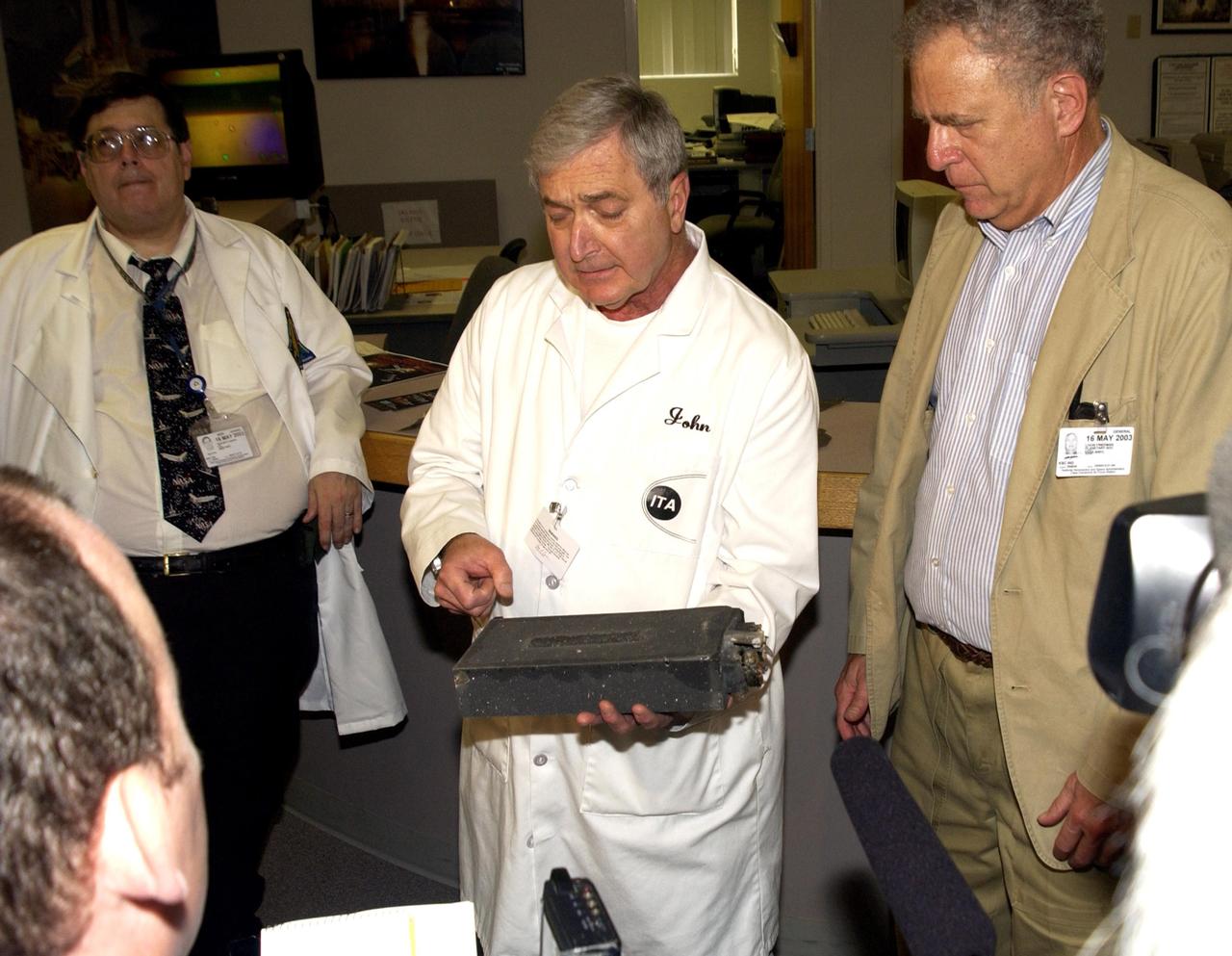
KENNEDY SPACE CENTER, FLA. -  John Cassanto (center), with Instrumentation Technology Associates, Inc., explains the use of the apparatus used for experiments on mission STS-107.   At left is Barry Perlman, with Pembroke Pines Middle School in Florida; at right is Lou Friedman, executive director of the Planetary Society. The box was part of the  Commercial ITA Biomedical Experiments payload on mission STS-107 that included the Growth of Bacterial Biofilm on Surfaces during Spaceflight (GOBBSS) experiment and crystals grown for cancer research.  The GOBBSS experiment was sponsored by the Planetary Society, with joint participation of an Israeli and a Palestinian student, and developed by the Israeli Aerospace Medical Institute and JSC Astrobiology Center.
KSC-03pd1440
KENNEDY SPACE CENTER, FLA. - In the background, scientists talk to the media about the experiments recovered during the search for Columbia debris.  From left are George D'Heilly, with Instrumentation Technology Associates, Inc.; Barry Perlman, with Pembroke Pines Middle School in Florida; John Cassanto, with ITA; and Lou Friedman, executive director of the Planetary Society.  The  Commercial ITA Biomedical Experiments payload on mission STS-107 included the Growth of Bacterial Biofilm on Surfaces during Spaceflight (GOBBSS) experiment and crystals grown for cancer research.  The GOBBSS experiment was sponsored by the Planetary Society, with joint participation of an Israeli and a Palestinian student, and developed by the Israeli Aerospace Medical Institute and JSC Astrobiology Center.
KSC-03pd1441
KENNEDY SPACE CENTER, FLA. -  George D'Heilly, with Instrumentation Technology Associates, Inc., Barry Perlman, with Pembroke Pines Middle School in Florida, John Cassanto, with ITA, and Lou Friedman, executive director of the Planetary Society, talk to the media about the experiments recovered during the search for Columbia debris.  They were part of the  Commercial ITA Biomedical Experiments payload on mission STS-107 that included the Growth of Bacterial Biofilm on Surfaces during Spaceflight (GOBBSS) experiment and crystals grown for cancer research.  The GOBBSS experiment was sponsored by the Planetary Society, with joint participation of an Israeli and a Palestinian student, and developed by the Israeli Aerospace Medical Institute and JSC Astrobiology Center.
KSC-03pd1439
KENNEDY SPACE CENTER, FLA. -  Barry Perlman (left), with Pembroke Pines Charter Middle School in Florida, talks to the media about some of the experiments recovered during the search for Columbia debris.  At right are John Cassanto, with Instrumentation Technology Associates, Inc., and Lou Friedman, executive director of the Planetary Society.  The  Commercial ITA Biomedical Experiments payload on mission STS-107 included the Growth of Bacterial Biofilm on Surfaces during Spaceflight (GOBBSS) experiment and crystals grown for cancer research.  The GOBBSS experiment was sponsored by the Planetary Society, with joint participation of an Israeli and a Palestinian student, and developed by the Israeli Aerospace Medical Institute and JSC Astrobiology Center.
KSC-03pd1442
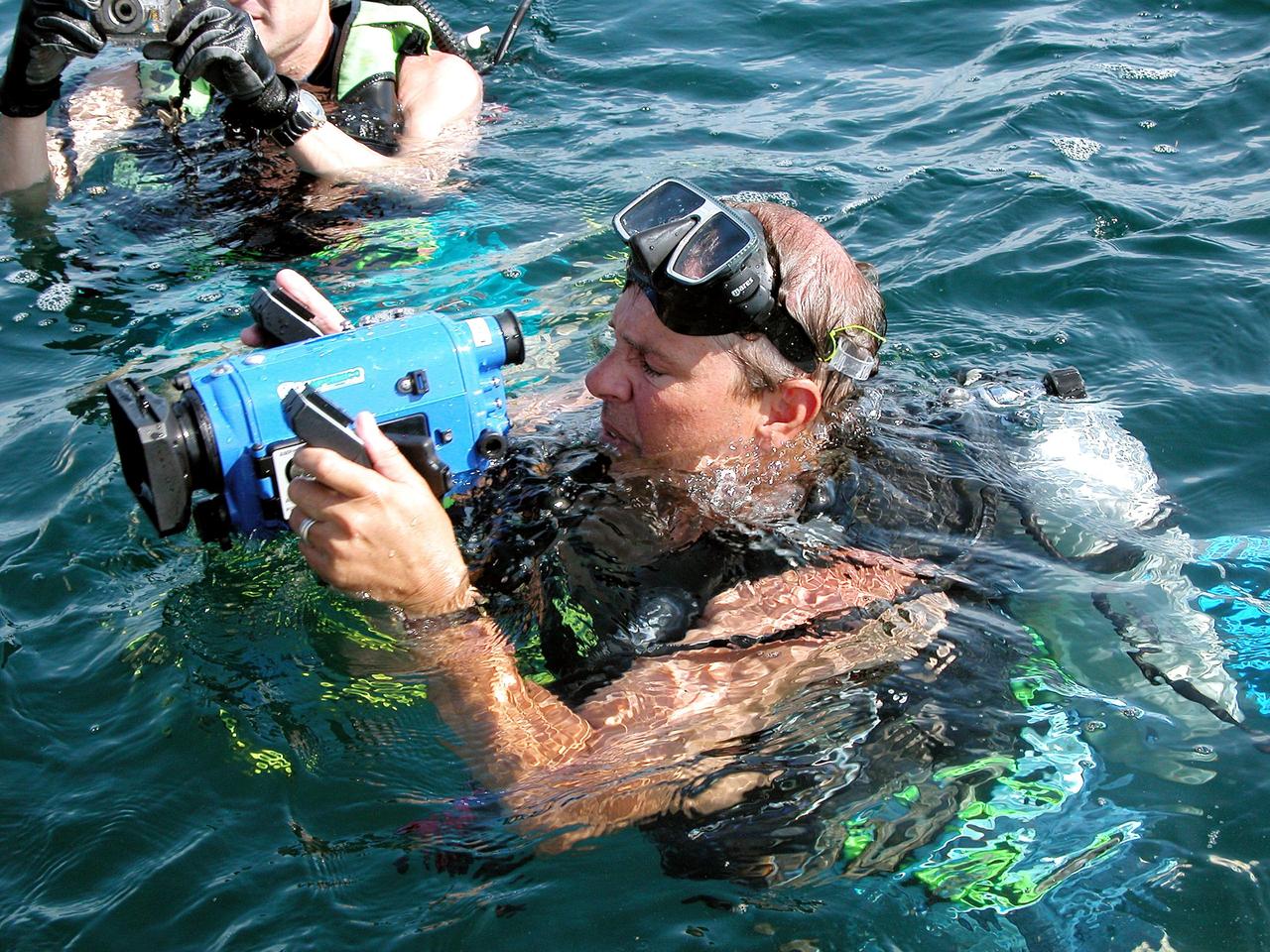
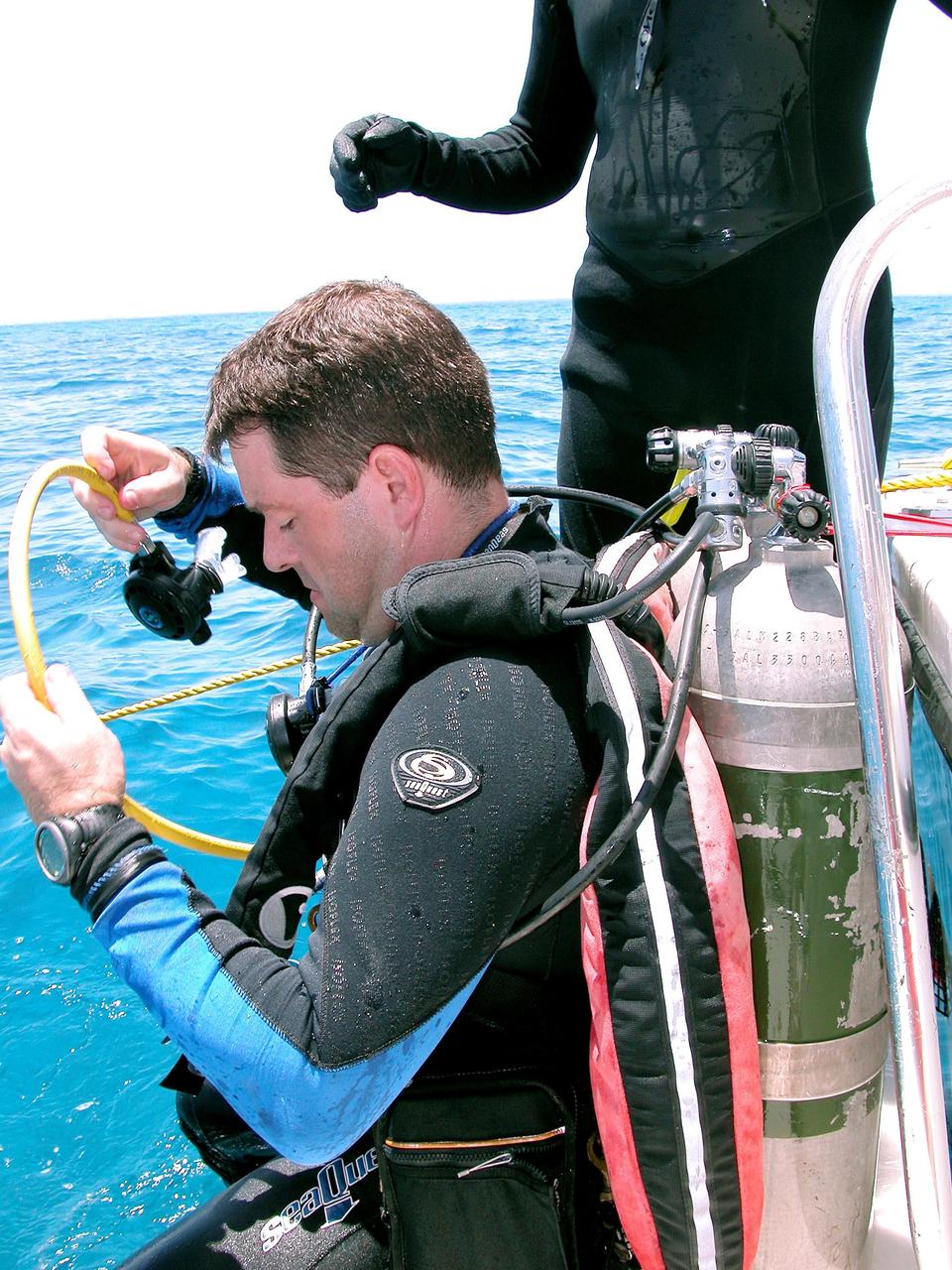
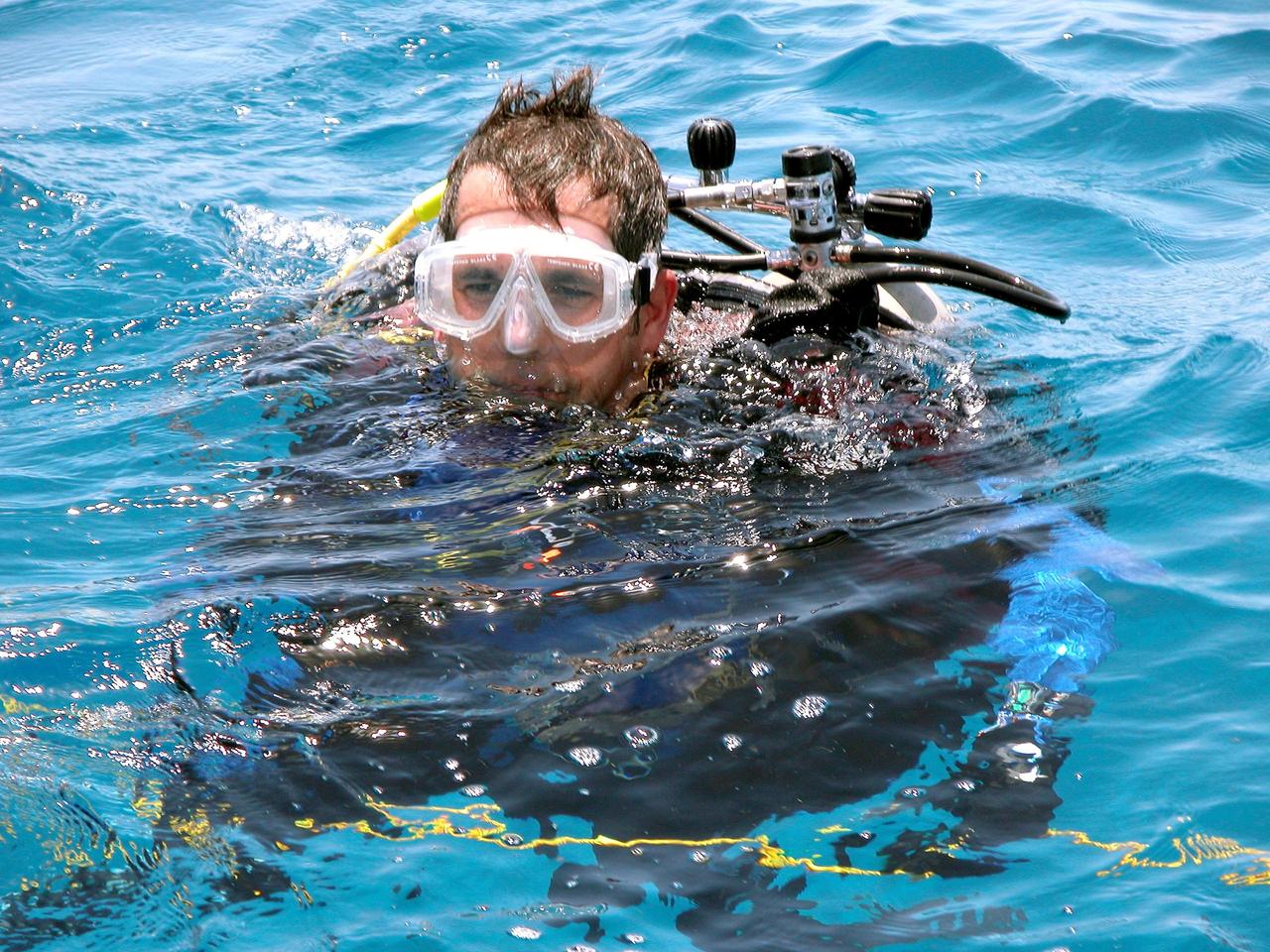
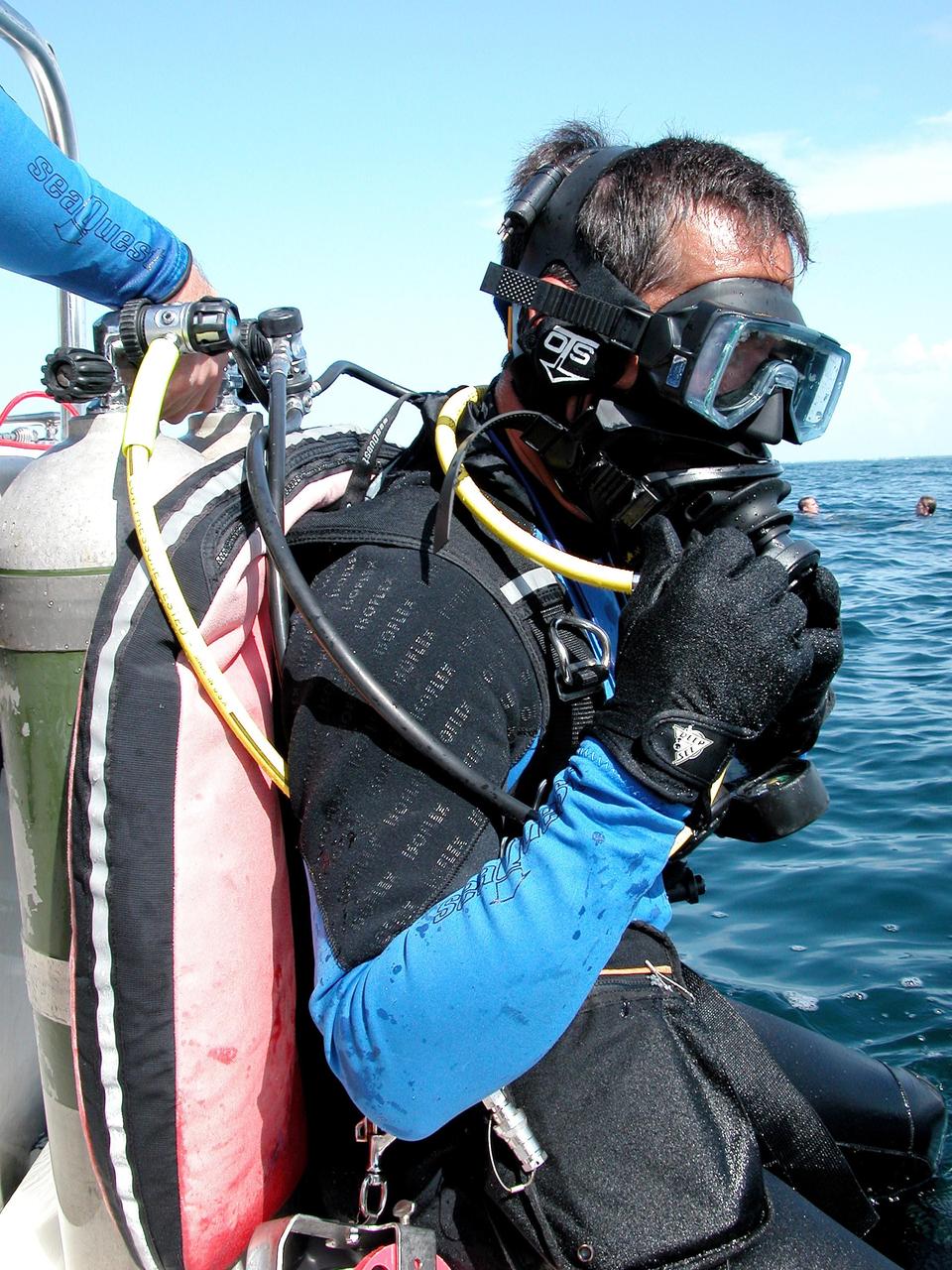
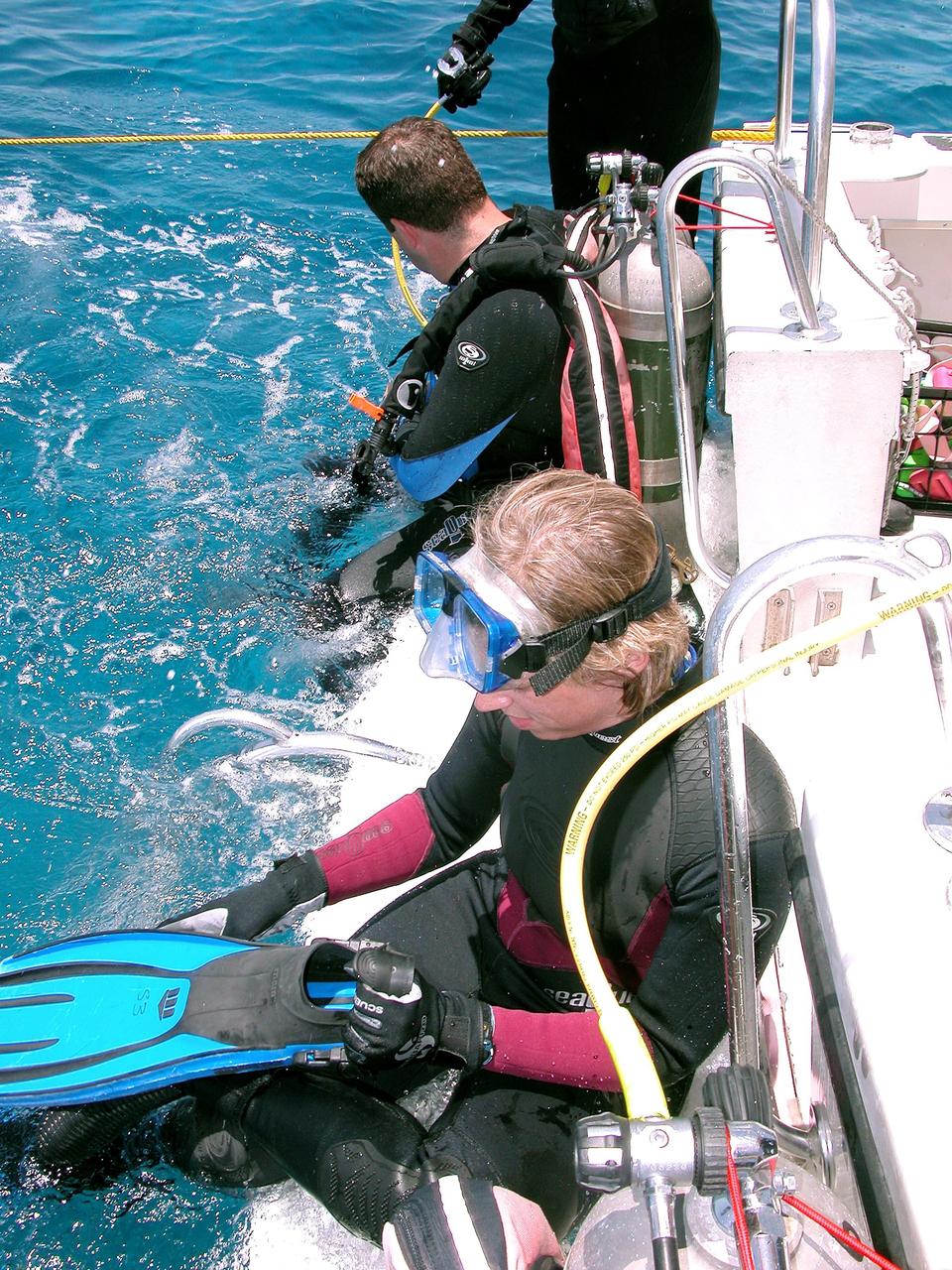
KENNEDY SPACE CENTER, FLA. - Getting ready to enter the water on a practice dive in the ocean offshore from Key Largo is Nick Patrick. He is a member of the NASA Extreme Environment Mission Operations 6 (NEEMO-6) mission team. The others are astronauts John Herrington, mission commander, and Doug Wheelock, plus Tara Ruttley, a biomedical engineer.  The NEEMO-6 mission involves exposing an astronaut/scientist crew to a real mission experience in an extreme environment - the NOAA undersea station Aquarius - to prepare for future space flight.  Spacewalk-like diving excursions and field-tests on a variety of biomedical equipment are designed to help astronauts living aboard the International Space Station.  To prepare for their 10-day stay, the team had dive training twice a day at the Life Support Buoy, anchored above Aquarius.
KSC-04pd1503
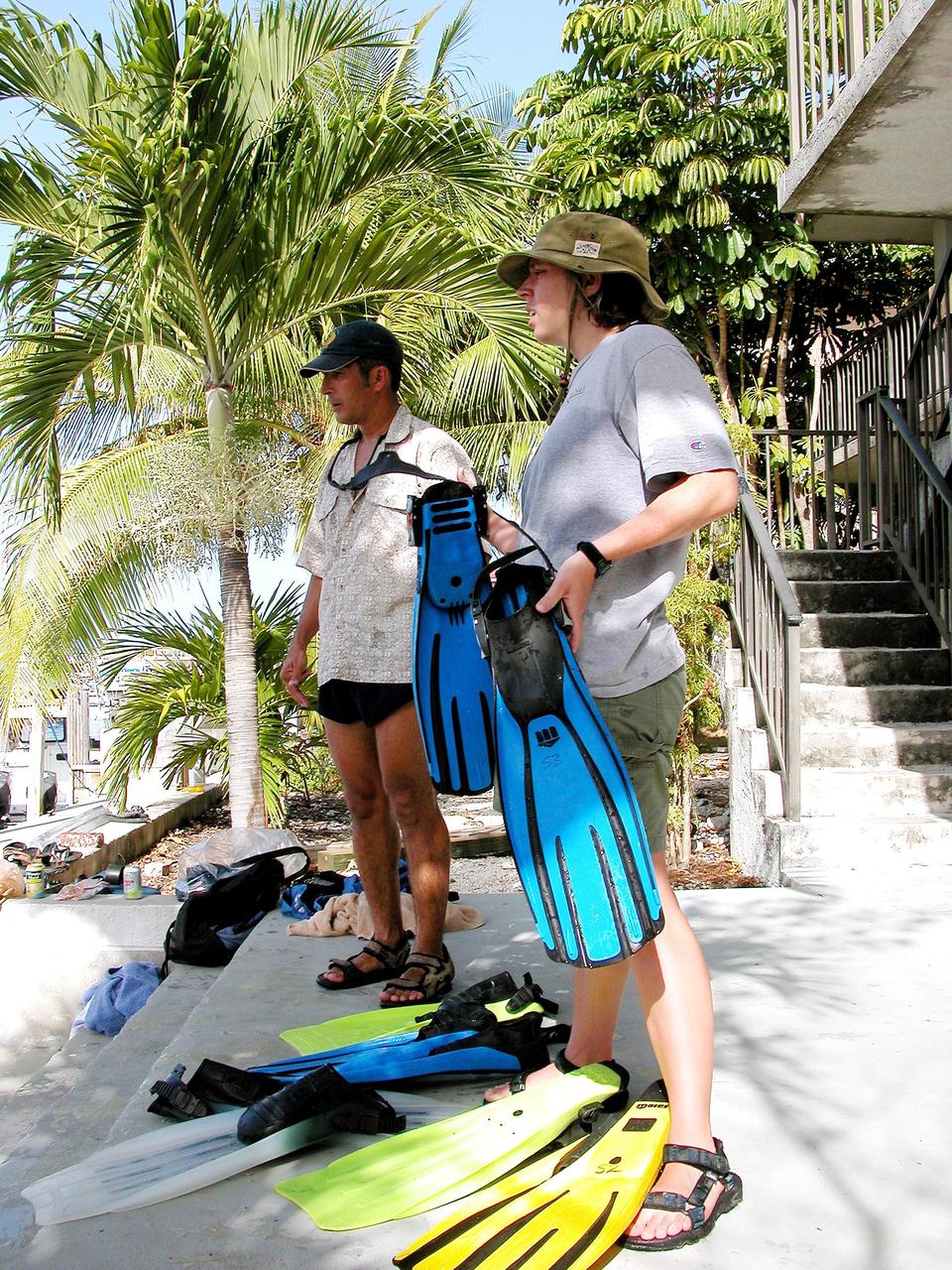
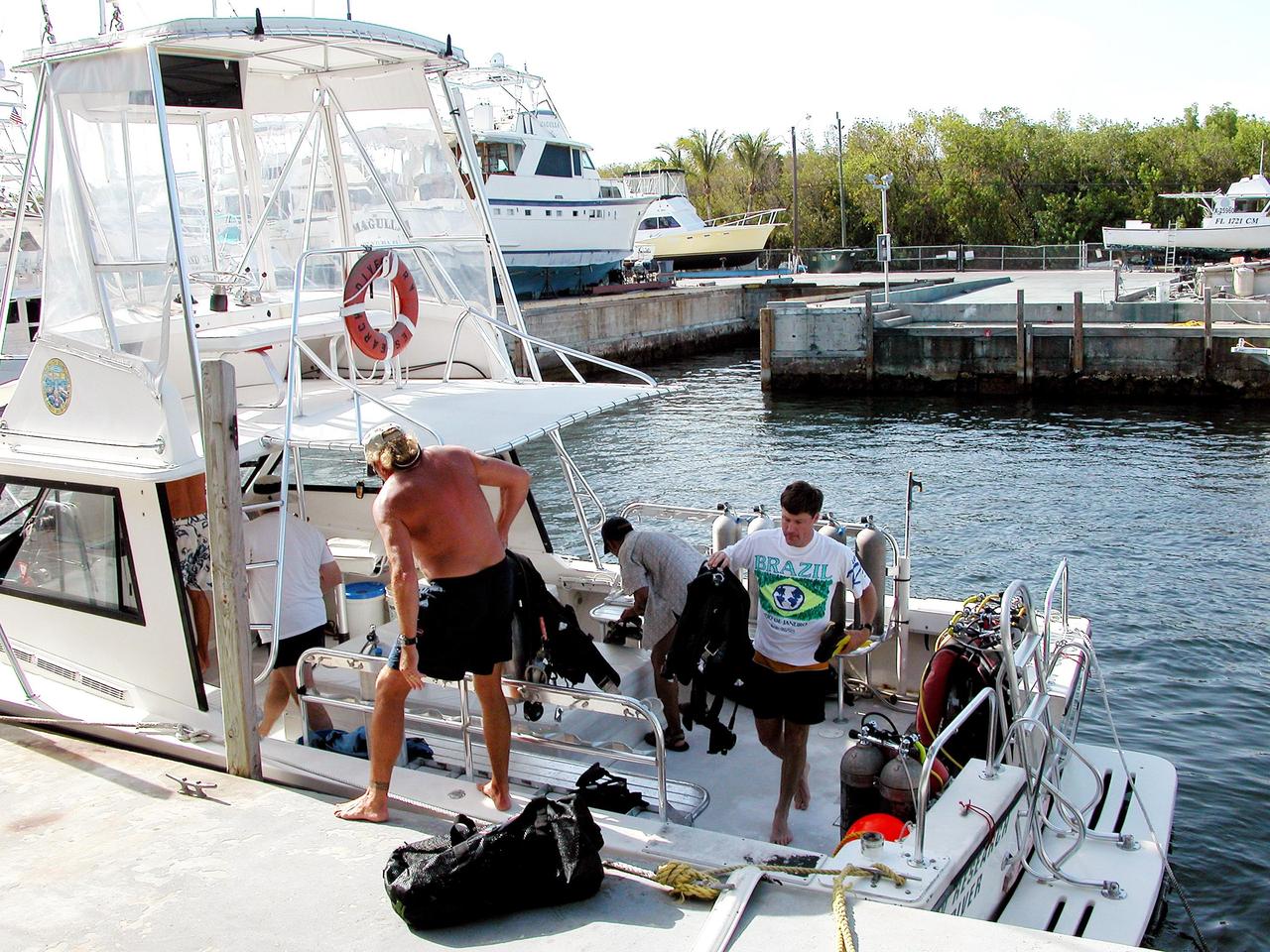
KENNEDY SPACE CENTER, FLA. - After their return from a practice dive at the NOAA Aquarius underwater station offshore at Key Largo, John Herrington and Tara Ruttley look over their dive gear.  Herrington is mission commander and Ruttley, a biomedical engineer, is a member of the crew on the NASA Extreme Environment Mission Operations 6 (NEEMO-6) mission.  The NEEMO-6 mission involves exposing an astronaut/scientist crew to a real mission experience in an extreme environment - the NOAA undersea station Aquarius offshore from Key Largo - to prepare for future space flight.  Spacewalk-like diving excursions and field-tests on a variety of biomedical equipment are designed to help astronauts living aboard the International Space Station.  Other team members are astronauts Doug Wheelock and Nick Patrick. To prepare for their 10-day stay, the team had dive training twice a day at the Life Support Buoy, anchored above Aquarius.
KSC-04pd1500
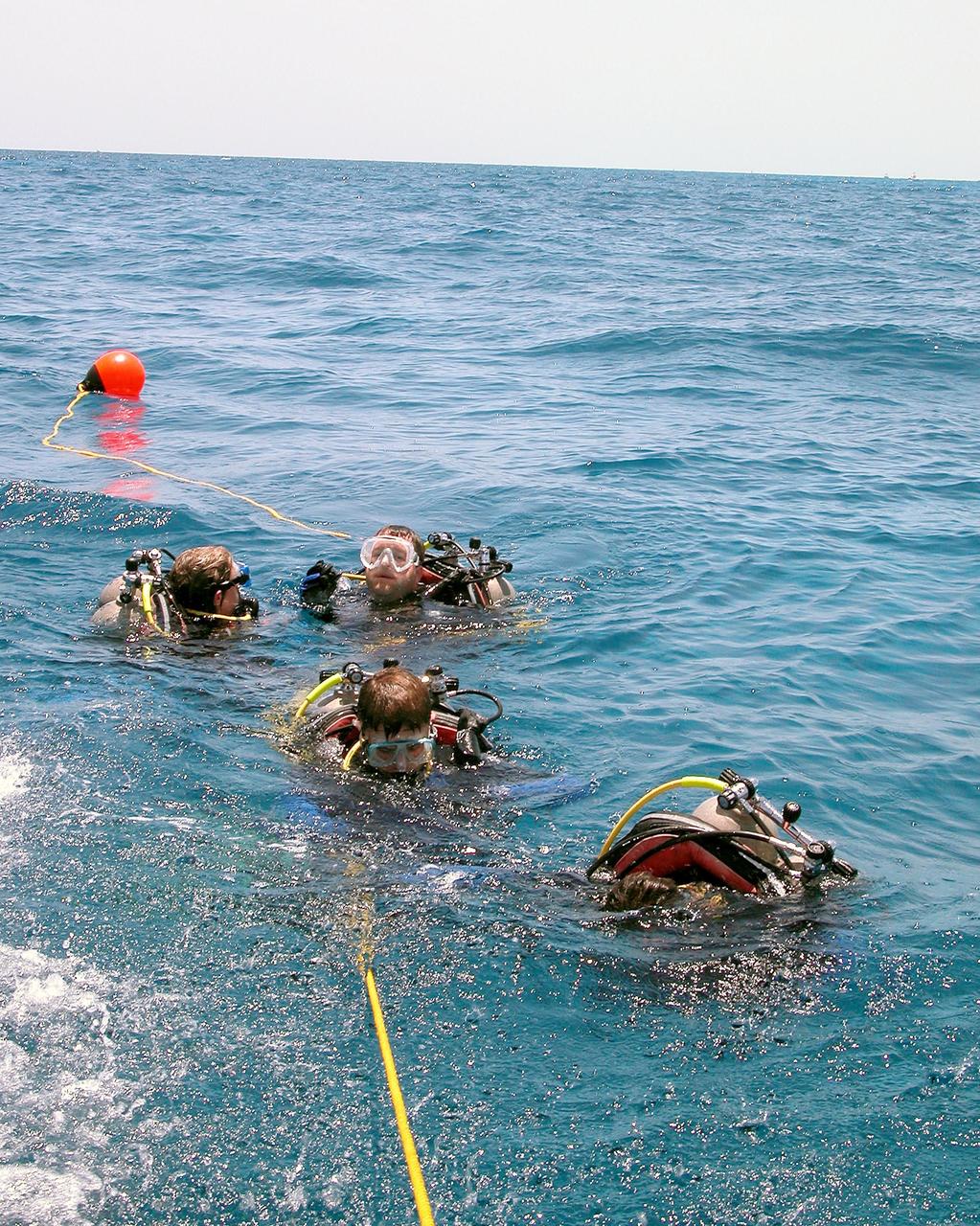
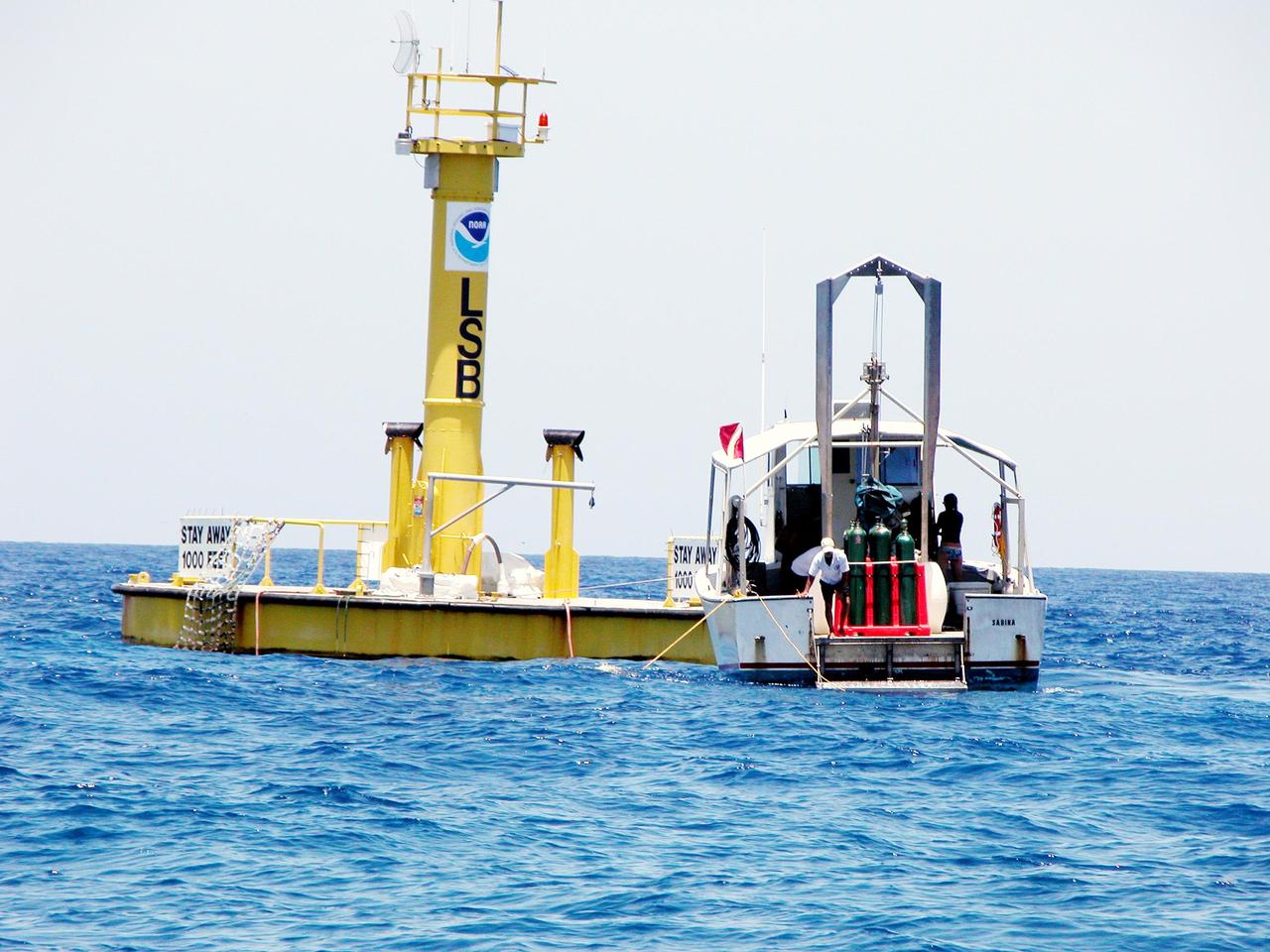
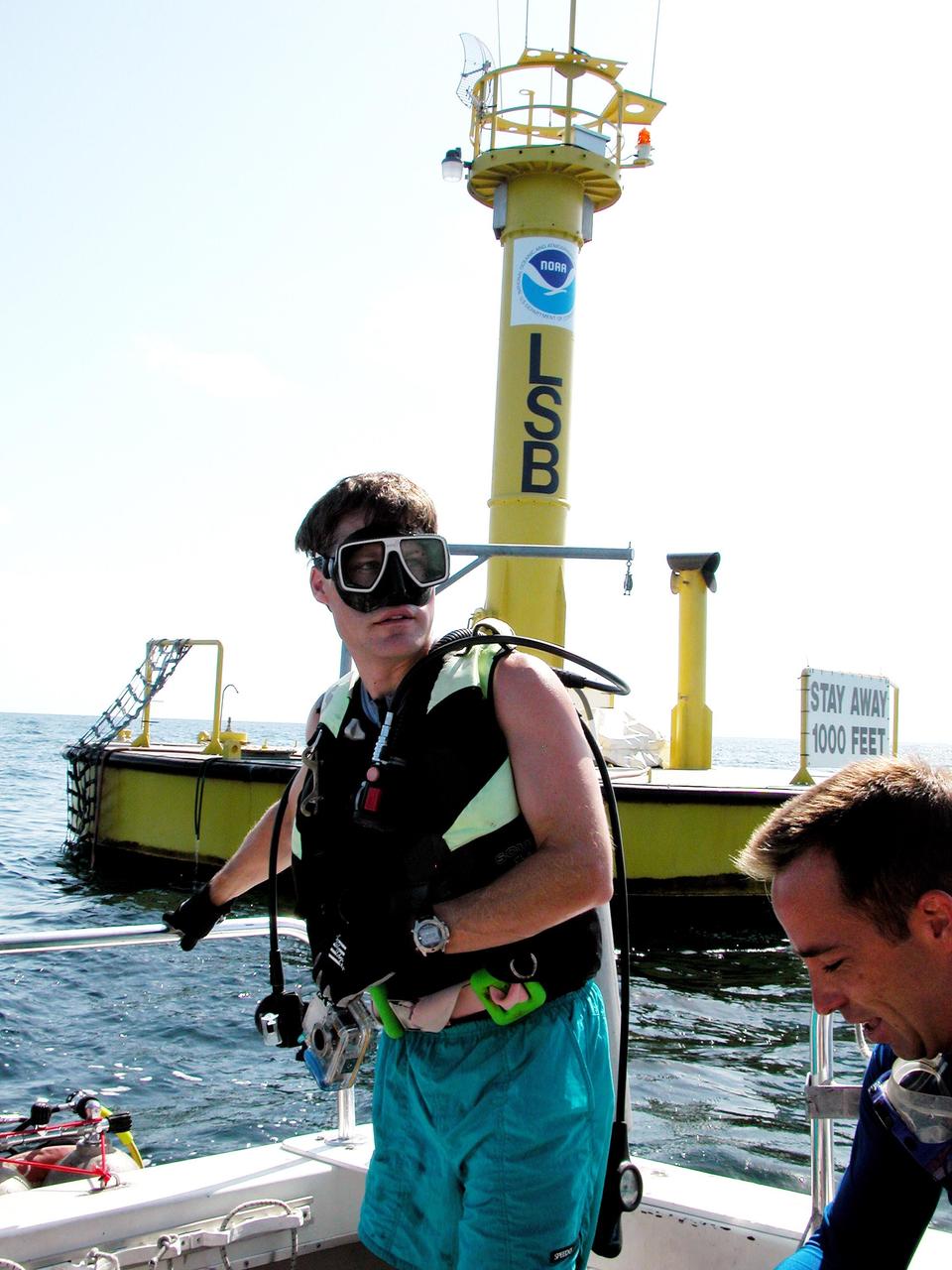
KENNEDY SPACE CENTER, FLA. - A dive boat is moored to the Life Support Buoy, anchored above the NOAA undersea station Aquarius, offshore from Key Largo.  Underwater is the NASA Extreme Environment Mission Operations 6 (NEEMO-6) mission team: (left to right) Tara Ruttley, a biomedical engineer, and astronauts Nick Patrick, John Herrington and Doug Wheelock. The NEEMO-6 mission involves exposing an astronaut/scientist crew to a real mission experience in an extreme environment - Aquarius - to prepare for future space flight.  Spacewalk-like diving excursions and field-tests on a variety of biomedical equipment are designed to help astronauts living aboard the International Space Station.  To prepare for their 10-day stay, the team had dive training twice a day at the Life Support Buoy.
KSC-04pd1506
KENNEDY SPACE CENTER, FLA. - In the water for a practice dive in the ocean offshore from Key Largo are the NASA Extreme Environment Mission Operations 6 (NEEMO-6) mission team: (left to right) Tara Ruttley, a biomedical engineer, and astronauts Nick Patrick, John Herrington and Doug Wheelock. The NEEMO-6 mission involves exposing an astronaut/scientist crew to a real mission experience in an extreme environment - the NOAA undersea station Aquarius - to prepare for future space flight.  Spacewalk-like diving excursions and field-tests on a variety of biomedical equipment are designed to help astronauts living aboard the International Space Station.  To prepare for their 10-day stay, the team had dive training twice a day at the Life Support Buoy, anchored above Aquarius.
KSC-04pd1505
KENNEDY SPACE CENTER, FLA. - In the water offshore from Key Largo, site of the NASA Extreme Environment Mission Operations 6 (NEEMO-6), are (left to right) Bill Todd, project lead, and Marc Reagan, mission lead.  Todd and Lucas are also the underwater videographer and still photographer, respectively, for the mission.  The NEEMO-6 team comprises John Herrington, commander, Tara Ruttley, a biomedical engineer, and astronauts Nick Patrick and Doug Wheelock.  The NEEMO-6 mission involves exposing an astronaut/scientist crew to a real mission experience in an extreme environment - the NOAA undersea station Aquarius - to prepare for future space flight.  Spacewalk-like diving excursions and field-tests on a variety of biomedical equipment are designed to help astronauts living aboard the International Space Station.  To prepare for their 10-day stay, the team had dive training twice a day at the Life Support Buoy, anchored above Aquarius.
KSC-04pd1509
KENNEDY SPACE CENTER, FLA. - In the water for a practice dive in the ocean offshore from Key Largo is astronaut John Herrington.  He is commander of the NASA Extreme Environment Mission Operations 6 (NEEMO-6) mission team.  The others are Nick Patrick, Doug Wheelock, and Tara Ruttley, a biomedical engineer.  The NEEMO-6 mission involves exposing an astronaut/scientist crew to a real mission experience in an extreme environment - the NOAA undersea station Aquarius - to prepare for future space flight.  Spacewalk-like diving excursions and field-tests on a variety of biomedical equipment are designed to help astronauts living aboard the International Space Station.  To prepare for their 10-day stay, the team had dive training twice a day at the Life Support Buoy, anchored above Aquarius.
KSC-04pd1510
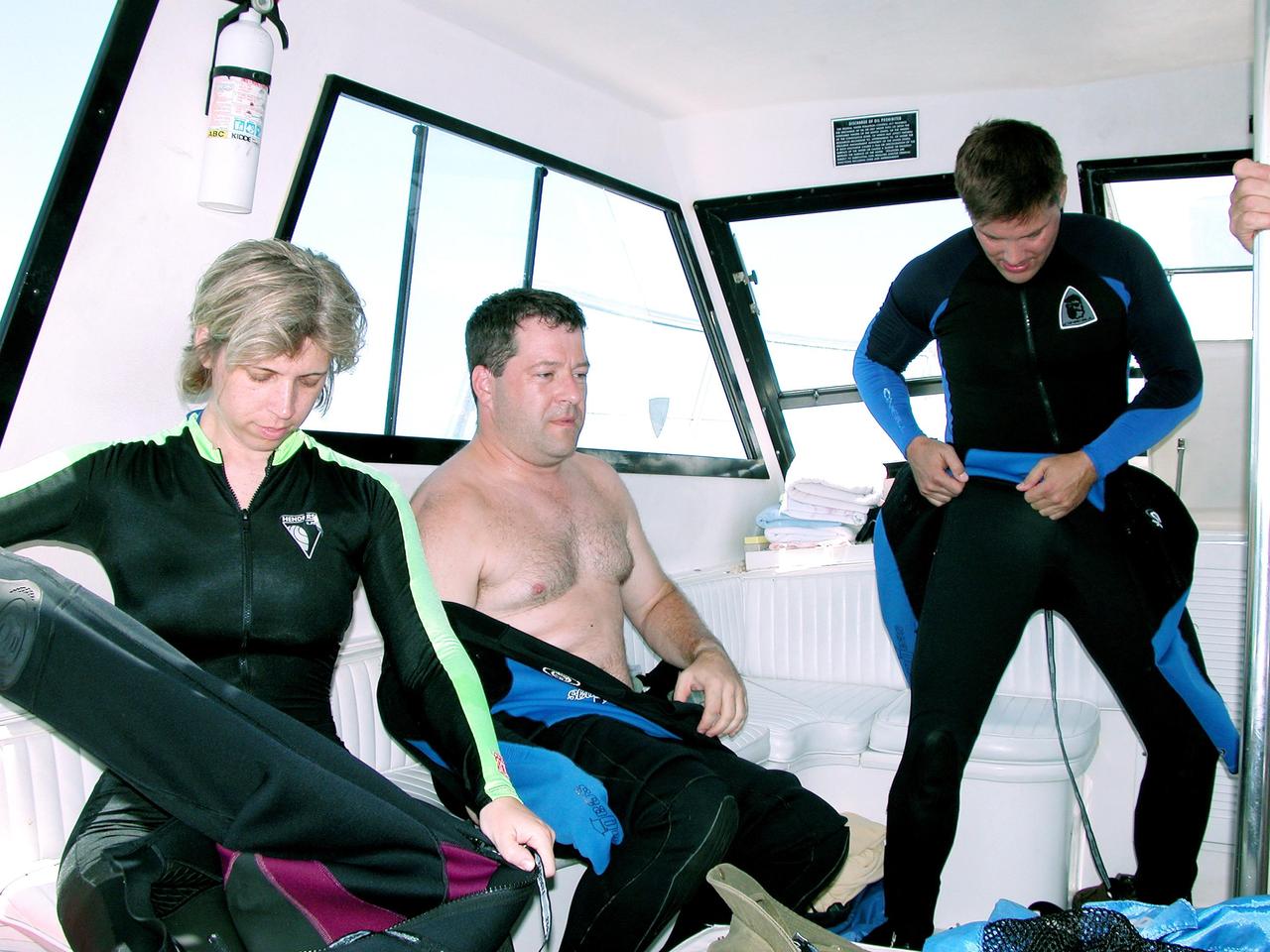
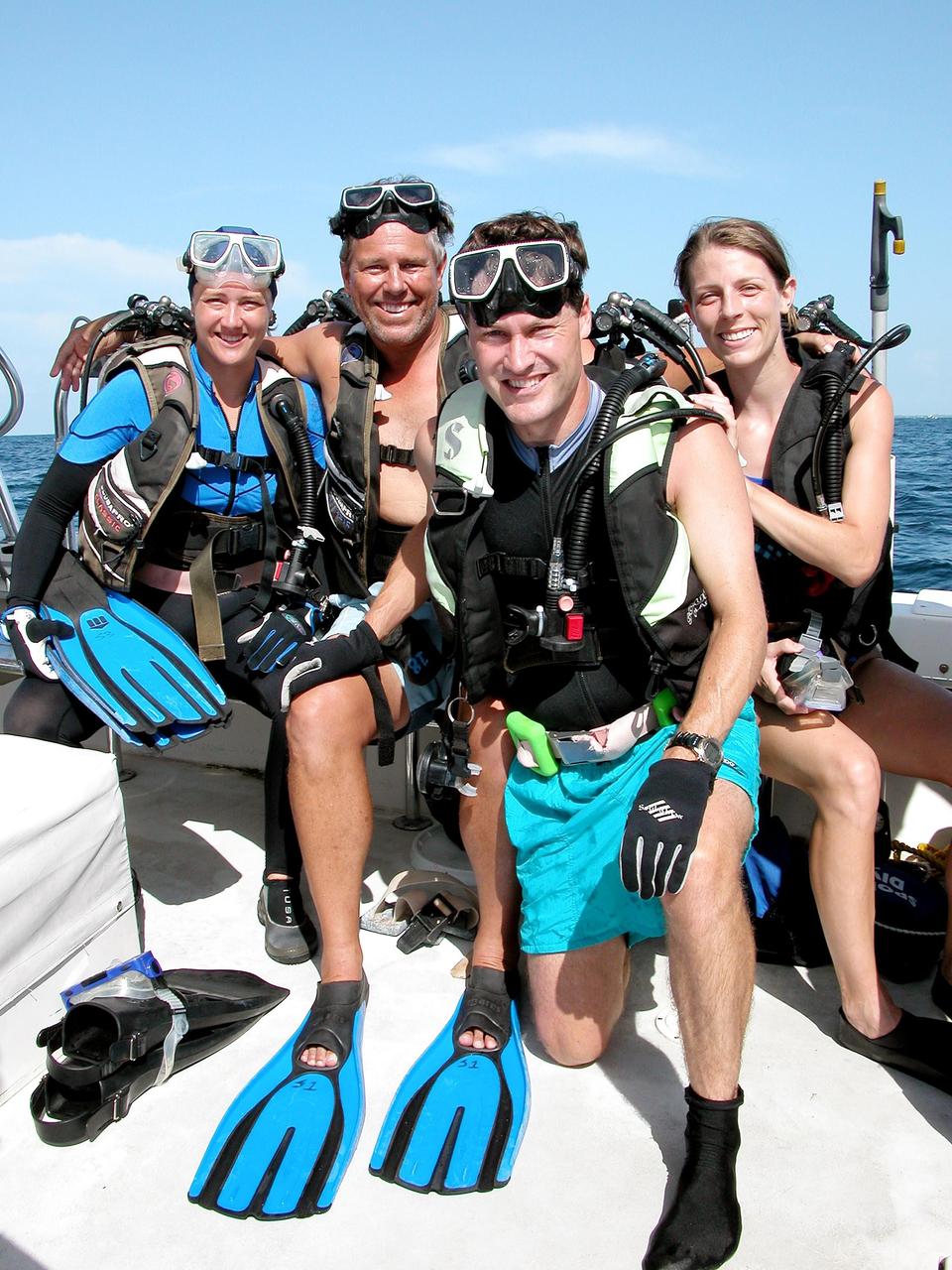
KENNEDY SPACE CENTER, FLA. - Onboard the dive boat, members of the NASA Extreme Environment Mission Operations 6 (NEEMO-6) mission don dive suits.   From left are Tara Ruttley, a biomedical engineer, and astronauts Nick Patrick and Doug Wheelock.  John Herrington is mission commander.  The NEEMO-6 mission involves exposing an astronaut/scientist crew to a real mission experience in an extreme environment - the NOAA undersea station Aquarius offshore from Key Largo - to prepare for future space flight.  Spacewalk-like diving excursions and field-tests on a variety of biomedical equipment are designed to help astronauts living aboard the International Space Station.  To prepare for their 10-day stay, the team had dive training twice a day at the Life Support Buoy, anchored above Aquarius.
KSC-04pd1501
KENNEDY SPACE CENTER, FLA. - Getting ready to enter the water on a practice dive in the ocean offshore from Key Largo are Tara Ruttley (below) and Nick Patrick (above).  The two are members of the NASA Extreme Environment Mission Operations 6 (NEEMO-6) mission team. Ruttley is a biomedical engineer. The others are astronauts John Herrington, mission commander, and Doug Wheelock. The NEEMO-6 mission involves exposing an astronaut/scientist crew to a real mission experience in an extreme environment - the NOAA undersea station Aquarius - to prepare for future space flight.  Spacewalk-like diving excursions and field-tests on a variety of biomedical equipment are designed to help astronauts living aboard the International Space Station.  To prepare for their 10-day stay, the team had dive training twice a day at the Life Support Buoy, anchored above Aquarius.
KSC-04pd1502
KENNEDY SPACE CENTER, FLA. - In the water for a practice dive in the ocean offshore from Key Largo is astronaut John Herrington.  He is commander of the NASA Extreme Environment Mission Operations 6 (NEEMO-6) mission team.  The others are Nick Patrick, Doug Wheelock, and Tara Ruttley, a biomedical engineer.  The NEEMO-6 mission involves exposing an astronaut/scientist crew to a real mission experience in an extreme environment - the NOAA undersea station Aquarius - to prepare for future space flight.  Spacewalk-like diving excursions and field-tests on a variety of biomedical equipment are designed to help astronauts living aboard the International Space Station.  To prepare for their 10-day stay, the team had dive training twice a day at the Life Support Buoy, anchored above Aquarius.
KSC-04pd1504
KENNEDY SPACE CENTER, FLA. - Disembarking from the boat in Key Largo are Otto Rutten and Marc Reagan, participating in the NASA Extreme Environment Mission Operations 6 (NEEMO-6) mission at the NOAA Aquarius underwater station offshore.  Rutten is director for the National Underwater Research Center; Reagan is mission lead.  The NEEMO-6 mission involves exposing an astronaut/scientist crew to a real mission experience in an extreme environment to prepare for future space flight.  Spacewalk-like diving excursions and field-tests on a variety of biomedical equipment are designed to help astronauts living aboard the International Space Station.  The NEEMO-6 team comprises astronaut John Herrington, mission commander, astronauts Doug Wheelock and Nick Patrick, and biomedical engineer Tara Ruttley. To prepare for their 10-day stay, the team had dive training twice a day at the Life Support Buoy, anchored above Aquarius.
KSC-04pd1498
KENNEDY SPACE CENTER, FLA. - Onboard the dive boat at the Life Support Buoy offshore from Key Largo is Marc Reagan, mission lead for the NASA Extreme Environment Mission Operations 6 (NEEMO-6) mission.  At right is Lt. Scott Sparks, a Navy medical officer.  Reagan is also the underwater still photographer.  The NEEMO-6 team comprises John Herrington, commander, Tara Ruttley, a biomedical engineer, and astronauts Nick Patrick and Doug Wheelock.  The NEEMO-6 mission involves exposing an astronaut/scientist crew to a real mission experience in an extreme environment - the NOAA undersea station Aquarius - to prepare for future space flight.  Spacewalk-like diving excursions and field-tests on a variety of biomedical equipment are designed to help astronauts living aboard the International Space Station.  To prepare for their 10-day stay, the team had dive training twice a day at the Life Support Buoy, anchored above Aquarius.
KSC-04pd1508
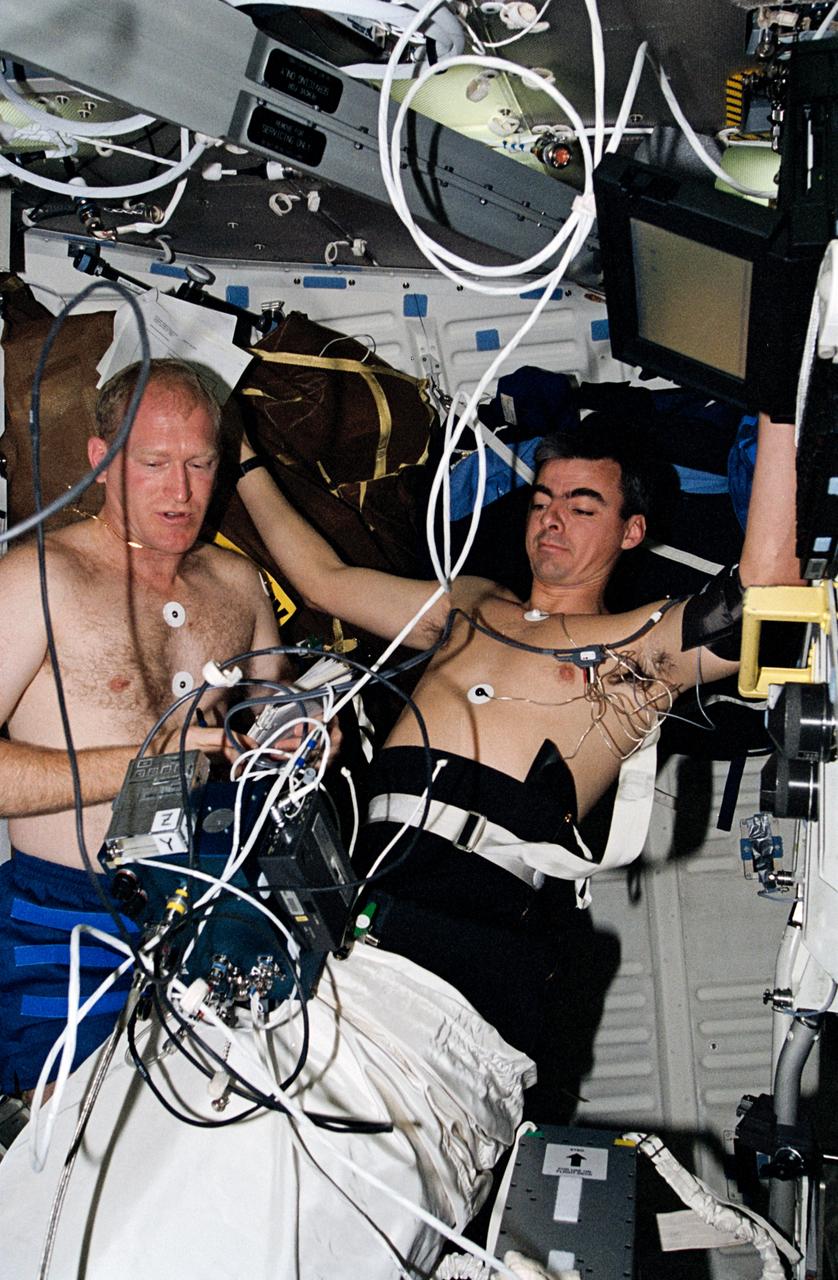
STS062-07-010 (4-18 March 1994) --- Astronaut Andrew M. Allen, pilot, participates in biomedical testing as he does a "soak" in the Lower Body Negative Pressure (LBNP) apparatus on the Columbia's middeck.  Astronaut Charles D. (Sam) Gemar, mission specialist, monitors readouts from the test.
Astronauts Gemar and Allen work with lower body negative pressure experiment
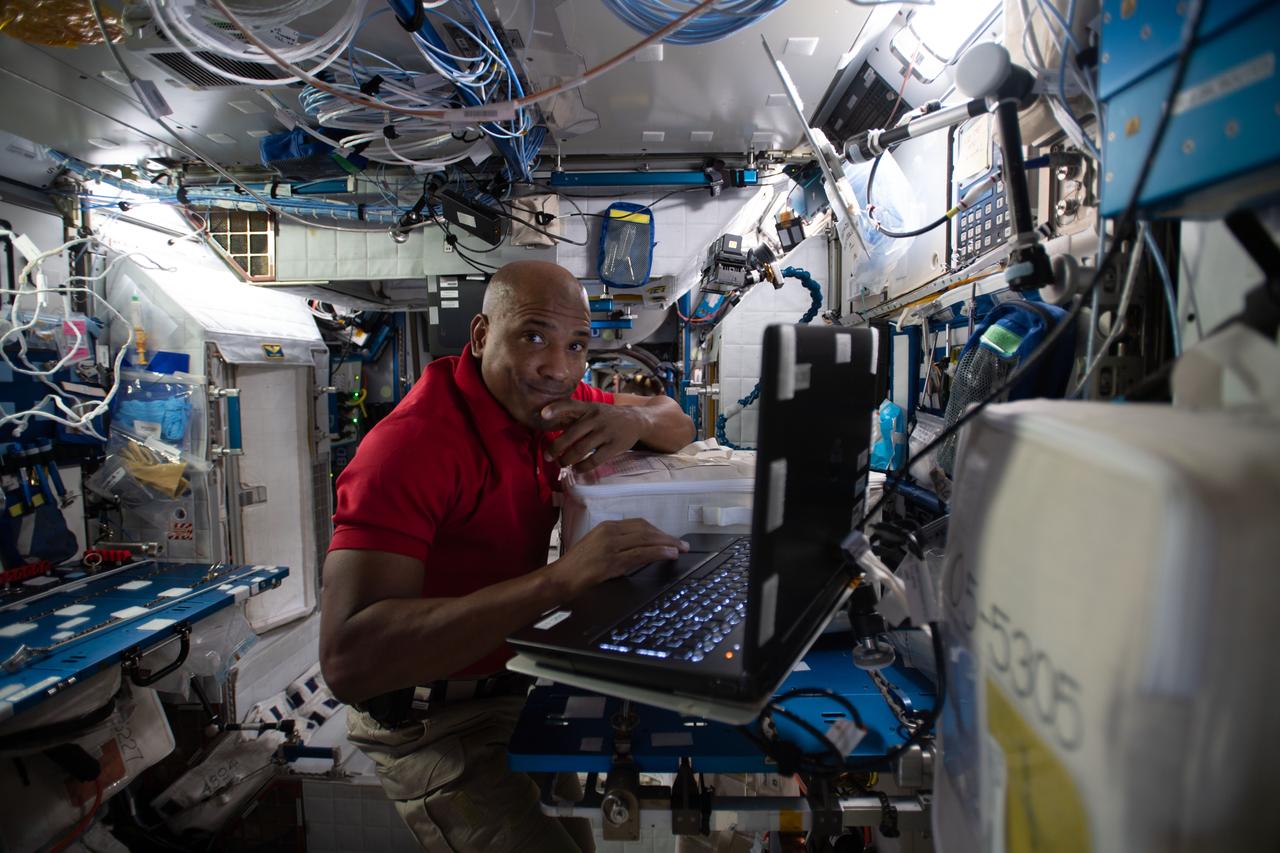
iss064e011646 (Dec. 10, 2020) --- NASA astronaut and Expedition 64 Flight Engineer Victor Glover reviews procedures on a computer for the Monoclonal Antibodies Protein Crystal Growth (PCG) experiment inside the Harmony module. The biomedical study crystallizes therapeutic monoclonal antibodies of higher quality than Earth and could accelerate the development of advanced therapies that target cancer cells.
iss064e011646
iss048e049821 (8/5/2016) --- NASA astronaut Jeff Williams is photographed with two canisters for the Biological Research in Canisters - Natural Product under Microgravity (BRIC-NP) experiment. Image was taken in the Destiny U.S. Laboratory aboard the International space Station (ISS). In the BRIC-NP investigation, fungal strains isolated from the Chernobyl nuclear power plant (ChNPP) accident are screened for the secretion of natural products that could be beneficial for biomedical and agricultural applications.
Williams conducts BRIC-NP OPS
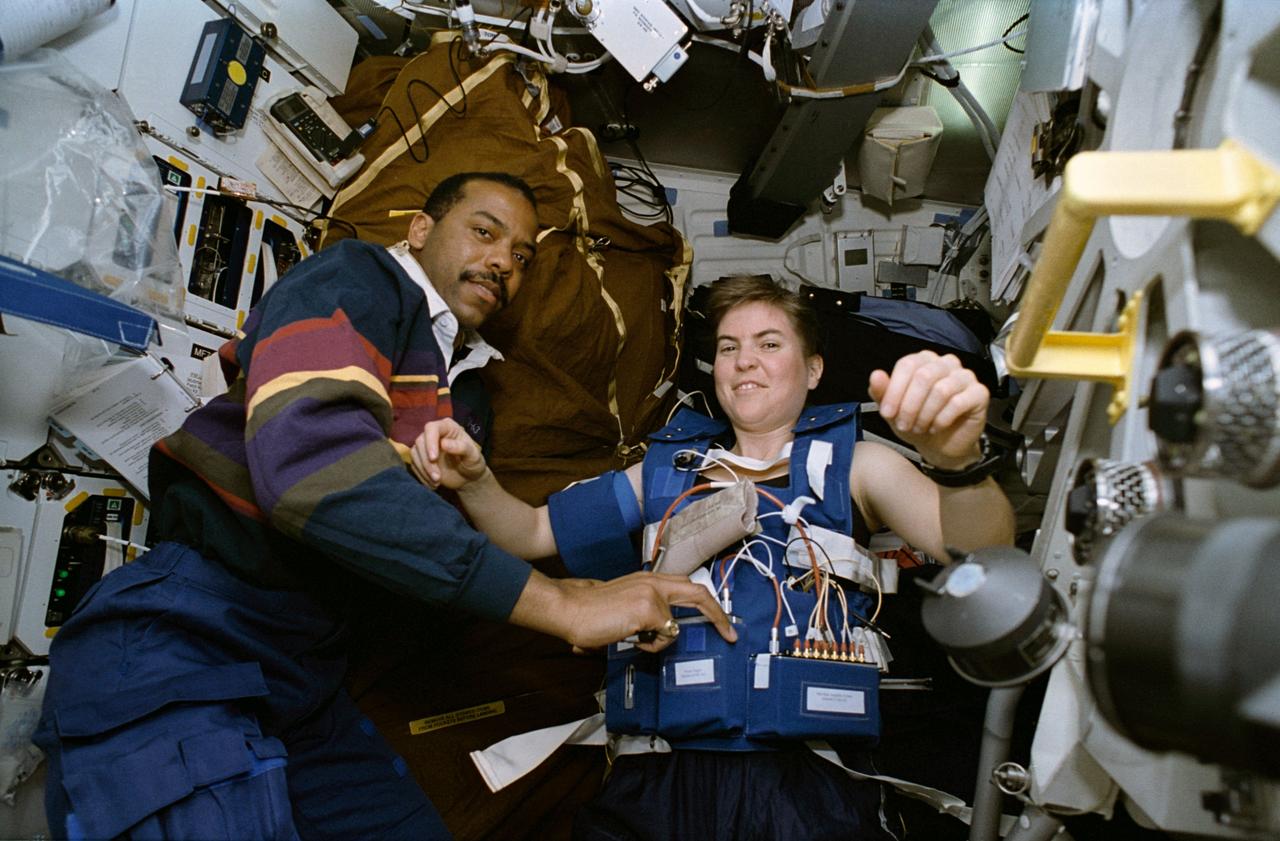
STS063-86-016 (3-11 Feb 1995) --- With astronaut Janice E. Voss, mission specialist, as his test subject, astronaut Bernard A. Harris, Jr., payload commander and a physician, uses a special biomedical harness experiment to check the response of muscles to microgravity.  They are on the mid-deck, where many of the SpaceHab 3 experiments are located.  The SpaceHab 3 Module is in the cargo bay.  Others onboard the Space Shuttle Discovery were astronauts James D. Wetherbee, commander; Eileen M. Collins, pilot; mission specialists C. Michael Foale and Russian cosmonaut Vladimir G. Titov.
Astronaut Harris checks response of muscles to microgravity
KENNEDY SPACE CENTER, FLA. - The apparatus shown was designed to hold microcapsules for research on mission STS-107.  It is one over several  included in the Commercial ITA Biomedical Experiments payload.  The box was recently recovered during the search for Columbia debris.  The drug delivery system and spaceflight hardware was developed jointly by JSC, the Institute for Research Inc. and Instrumentation Technology Associates Inc. to conduct microencapsulation experiments under microgravity conditions.  This microcapsule contains an antibiotic for treating deep resistant pulmonary infections.  Dr. Dennis Morrison, senior biotech project scientist, is principle investigator on microencapsulation and urokinase crystal growth.
KSC-03pd1446
KENNEDY SPACE CENTER, FLA. -  Valerie Cassanto holds a piece of the Commercial ITA Biomedical Experiments payload that was carried on mission STS-107 and recently recovered.  She is the daughter of John Cassanto of ITA, who is part of a recovery team transferring experiments to alternate containers. One of the experiments was the Growth of Bacterial Biofilm on Surfaces during Spaceflight (GOBBSS), a Planetary Society-sponsored astrobiology experiment developed by the Israeli Aerospace Medical Institute and the Johnson Space Center Astrobiology Center, with joint participation of an Israeli and a Palestinian student.  The recovery team also includes Eran Schenker of the Israeli Aerospace Medical Institute; David Warmflash of JSC, and Louis Friedman, executive director of the Planetary Society.  The GOBBSS material will be sent to JSC where the science team will analyze the samples, studying the effects of spaceflight on bacterial growth.
KSC-03pd1399
KENNEDY SPACE CENTER, FLA. - The Commercial ITA Biomedical Experiments payload retrieved from debris of Columbia is being dismantled at KSC.  Inside are several experiments carried on mission STS-107 that will be removed and transferred to alternate containers.  One experiment, the Growth of Bacterial Biofilm on Surfaces during Spaceflight (GOBBSS), was a Planetary Society-sponsored astrobiology experiment developed by the Israeli Aerospace Medical Institute and the Johnson Space Center Astrobiology Center, with joint participation of an Israeli and a Palestinian student.  The recovery team includes Eran Schenker of the Israeli Aerospace Medical Institute; David Warmflash of JSC, John Cassanto of ITA, and Louis Friedman, executive director of the Planetary Society.  The GOBBSS material will be sent to JSC where the science team will analyze the samples, studying the effects of spaceflight on bacterial growth.
KSC-03pd1391
KENNEDY SPACE CENTER, FLA. - John Cassanto of ITA points to an area of the Growth of Bacterial Biofilm on Surfaces during Spaceflight (GOBBSS) experiment that was carried on mission STS-107 as part of the Commercial ITA Biomedical Experiments payload.  He is part of a recovery team transferring experiments to alternate containers.  GOBBSS was a Planetary Society-sponsored astrobiology experiment developed by the Israeli Aerospace Medical Institute and the Johnson Space Center Astrobiology Center, with joint participation of an Israeli and a Palestinian student.  The recovery team also includes Eran Schenker of the Israeli Aerospace Medical Institute; David Warmflash of JSC, and Louis Friedman, executive director of the Planetary Society.  The GOBBSS material will be sent to JSC where the science team will analyze the samples, studying the effects of spaceflight on bacterial growth.
KSC-03pd1396
KENNEDY SPACE CENTER, FLA. - John Cassanto of ITA moves part of the Growth of Bacterial Biofilm on Surfaces during Spaceflight (GOBBSS) experiment that was carried on mission STS-107 as part of the Commercial ITA Biomedical Experiments payload.  He is part of a recovery team transferring experiments to alternate containers.  GOBBSS was a Planetary Society-sponsored astrobiology experiment developed by the Israeli Aerospace Medical Institute and the Johnson Space Center Astrobiology Center, with joint participation of an Israeli and a Palestinian student.  The recovery team also includes Eran Schenker of the Israeli Aerospace Medical Institute; David Warmflash of JSC, and Louis Friedman, executive director of the Planetary Society.  The GOBBSS material will be sent to JSC where the science team will analyze the samples, studying the effects of spaceflight on bacterial growth.
KSC-03pd1395
KENNEDY SPACE CENTER, FLA. - John Cassanto of ITA takes photos of the Growth of Bacterial Biofilm on Surfaces during Spaceflight (GOBBSS) experiment that was carried on mission STS-107 as part of the Commercial ITA Biomedical Experiments payload.  He is part of a recovery team transferring experiments to alternate containers.  GOBBSS was a Planetary Society-sponsored astrobiology experiment developed by the Israeli Aerospace Medical Institute and the Johnson Space Center Astrobiology Center, with joint participation of an Israeli and a Palestinian student.  The recovery team also includes Eran Schenker of the Israeli Aerospace Medical Institute; David Warmflash of JSC, and Louis Friedman, executive director of the Planetary Society.  The GOBBSS material will be sent to JSC where the science team will analyze the samples, studying the effects of spaceflight on bacterial growth.
KSC-03pd1397
KENNEDY SPACE CENTER, FLA. - The Commercial ITA Biomedical Experiments payload retrieved from debris of Columbia is being dismantled at KSC.  Inside are several experiments carried on mission STS-107 that will be removed and transferred to alternate containers.  One experiment, the Growth of Bacterial Biofilm on Surfaces during Spaceflight (GOBBSS), was a Planetary Society-sponsored astrobiology experiment developed by the Israeli Aerospace Medical Institute and the Johnson Space Center Astrobiology Center, with joint participation of an Israeli and a Palestinian student.  The recovery team includes Eran Schenker of the Israeli Aerospace Medical Institute; David Warmflash of JSC, John Cassanto of ITA, and Louis Friedman, executive director of the Planetary Society.  The GOBBSS material will be sent to JSC where the science team will analyze the samples, studying the effects of spaceflight on bacterial growth.
KSC-03pd1392
KENNEDY SPACE CENTER, FLA. - John Cassanto of ITA and his daughter Valerie stand next to the table holding the Growth of Bacterial Biofilm on Surfaces during Spaceflight (GOBBSS) experiment that was carried on mission STS-107 as part of the Commercial ITA Biomedical Experiments payload.  He is part of a recovery team transferring experiments to alternate containers.  GOBBSS was a Planetary Society-sponsored astrobiology experiment developed by the Israeli Aerospace Medical Institute and the Johnson Space Center Astrobiology Center, with joint participation of an Israeli and a Palestinian student.  The recovery team also includes Eran Schenker of the Israeli Aerospace Medical Institute; David Warmflash of JSC, and Louis Friedman, executive director of the Planetary Society.  The GOBBSS material will be sent to JSC where the science team will analyze the samples, studying the effects of spaceflight on bacterial growth.
KSC-03pd1398
KENNEDY SPACE CENTER, FLA. -  John Cassanto of ITA looks at the Growth of Bacterial Biofilm on Surfaces during Spaceflight (GOBBSS) experiment that was carried on mission STS-107 as part of the Commercial ITA Biomedical Experiments payload.  He is part of a recovery team transferring experiments to alternate containers.  GOBBSS was a Planetary Society-sponsored astrobiology experiment developed by the Israeli Aerospace Medical Institute and the Johnson Space Center Astrobiology Center, with joint participation of an Israeli and a Palestinian student.  The recovery team also includes Eran Schenker of the Israeli Aerospace Medical Institute; David Warmflash of JSC, and Louis Friedman, executive director of the Planetary Society.  The GOBBSS material will be sent to JSC where the science team will analyze the samples, studying the effects of spaceflight on bacterial growth.
KSC-03pd1393
KENNEDY SPACE CENTER, FLA. -  A member of the recovery team examines with a magnifier the Growth of Bacterial Biofilm on Surfaces during Spaceflight (GOBBSS) experiment that was carried on mission STS-107 as part of the Commercial ITA Biomedical Experiments payload.  He is part of a recovery team transferring experiments to alternate containers.  GOBBSS was a Planetary Society-sponsored astrobiology experiment developed by the Israeli Aerospace Medical Institute and the Johnson Space Center Astrobiology Center, with joint participation of an Israeli and a Palestinian student.  The recovery team includes Eran Schenker of the Israeli Aerospace Medical Institute; David Warmflash of JSC and Louis Friedman, executive director of the Planetary Society.  The GOBBSS material will be sent to JSC where the science team will analyze the samples, studying the effects of spaceflight on bacterial growth.
KSC-03pd1394
Biomedical research offers hope for a variety of medical problems, from diabetes to the replacement of damaged bone and tissues. Bioreactors, which are used to grow cells and tissue cultures, play a major role in such research and production efforts. Cell culturing, such as this bone cell culture, is an important part of biomedical research. The BioDyn payload includes a tissue engineering investigation. The commercial affiliate, Millenium Biologix, Inc. has been conducting bone implant experiments to better understand how synthetic bone can be used to treat bone-related illnesses and bone damaged in accidents. On STS-95, the BioDyn payload will include a bone cell culture aimed to help develop this commercial synthetic bone product. Millenium Biologix, Inc. is exploring the potential for making human bone implantable materials by seeding its proprietary artificial scaffold material with human bone cells. The product of this tissue engineering experiment using the Bioprocessing Modules (BPMs) on STS-95 is space-grown bone implants, which could have potential for dental implants, long bone grafts, and coating for orthopedic implants such as hip replacements.
Microgravity
Biomedical research offers hope for a variety of medical problems, from diabetes to the replacement of damaged bone and tissues. Bioreactors, which are used to grow cells and tissue cultures, play a major role in such research and production efforts. Cell culturing, such as this bone cell culture, is an important part of biomedical research. The BioDyn payload includes a tissue engineering investigation. The commercial affiliate, Millenium Biologix, Inc., has been conducting bone implant experiments to better understand how synthetic bone can be used to treat bone-related illnesses and bone damaged in accidents. On STS-95, the BioDyn payload will include a bone cell culture aimed to help develop this commercial synthetic bone product. Millenium Biologix, Inc., is exploring the potential for making human bone implantable materials by seeding its proprietary artificial scaffold material with human bone cells. The product of this tissue engineering experiment using the Bioprocessing Modules (BPMs) on STS-95 is space-grown bone implants, which could have potential for dental implants, long bone grafts, and coating for orthopedic implants such as hip replacements.
Microgravity
iss047e136530 (6/2/2016) --- A view of Cosmonaut Oleg Skripochka, during a BIMS Experiment session in the Service module aboard the International Space Station (ISS). The Study of Processes for Informational Support of In-Flight Medical Support using an Onboard Medical Information System Integrated into the Information Control System of the ISS Russian Segment (BIMS) uses telemedicine technologies to collect information by non-contact means from the ear, nose, and throat (ENT), gums, teeth, and small areas of skin from International Space Station (ISS) crews for medical support of manned spaceflights and in-flight biomedical research.
BIMS Experiment Session
iss047e136529 (6/2/2016) --- A view of Cosmonaut Oleg Skripochka, during a BIMS Experiment session in the Service module aboard the International Space Station (ISS). The Study of Processes for Informational Support of In-Flight Medical Support using an Onboard Medical Information System Integrated into the Information Control System of the ISS Russian Segment (BIMS) uses telemedicine technologies to collect information by non-contact means from the ear, nose, and throat (ENT), gums, teeth, and small areas of skin from International Space Station (ISS) crews for medical support of manned spaceflights and in-flight biomedical research.
BIMS Experiment Session
Vapor Crystal Growth System developed in IML-1, Mercuric Iodide Crystal grown in microgravity FES/VCGS (Fluids Experiment System/Vapor Crystal Growth Facility). During the mission, mercury iodide source material was heated, vaporized, and transported to a seed crystal where the vapor condensed. Mercury iodide crystals have practical uses as sensitive X-ray and gamma-ray detectors. In addition to their excellent optical properties, these crystals can operate at room temperature, which makes them useful for portable detector devices for nuclear power plant monitoring, natural resource prospecting, biomedical applications, and astronomical observing.
Microgravity
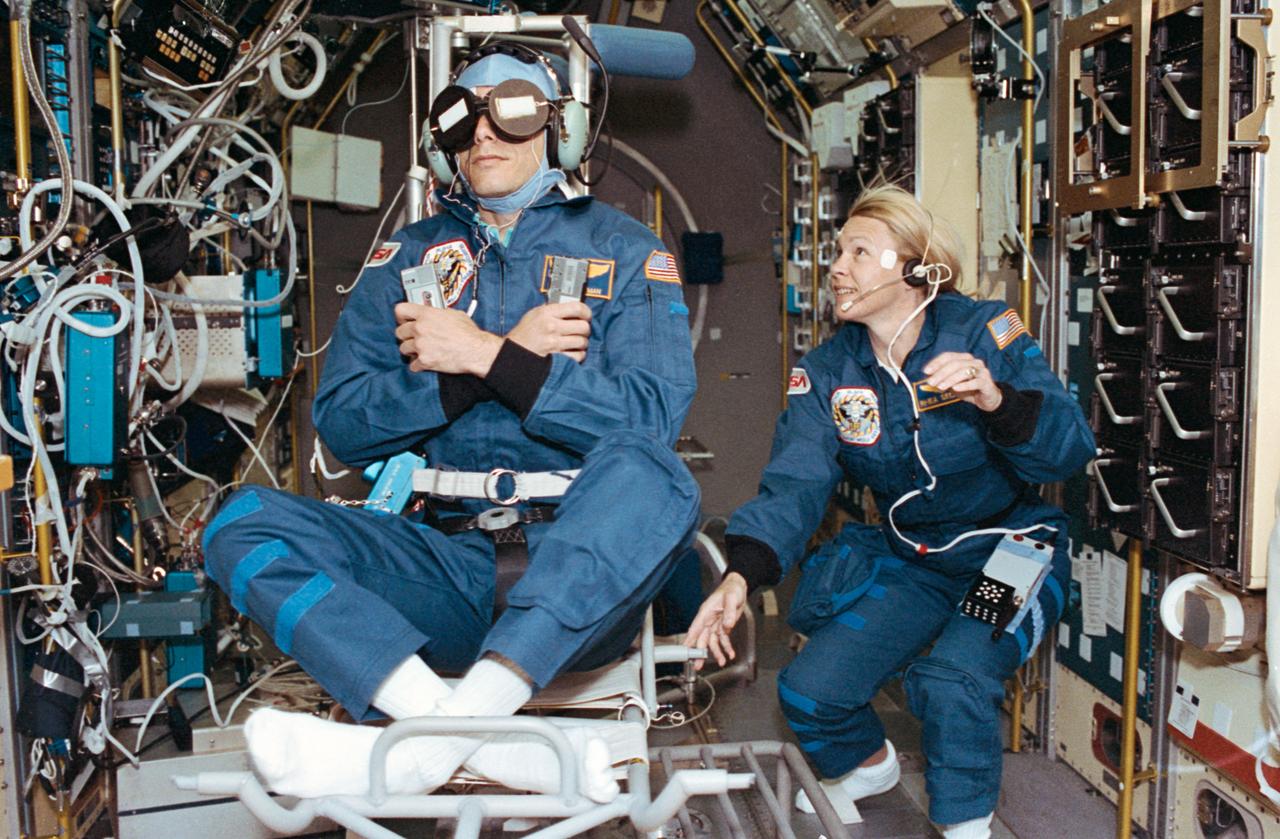
STS058-202-002 (18 Oct.-1 Nov. 1993) --- Astronaut Rhea Seddon, STS-58 payload commander, spins the Spacelab Life Sciences (SLS-2) rotating chair as payload specialist Martin J. Fettman serves as test subject.  The two joined five NASA astronauts for fourteen days of medical research aboard the Earth-orbiting space shuttle Columbia. Photo credit: NASA
Crewmember in SPACELAB wearing the Acceleration Recording Unit and Collar.
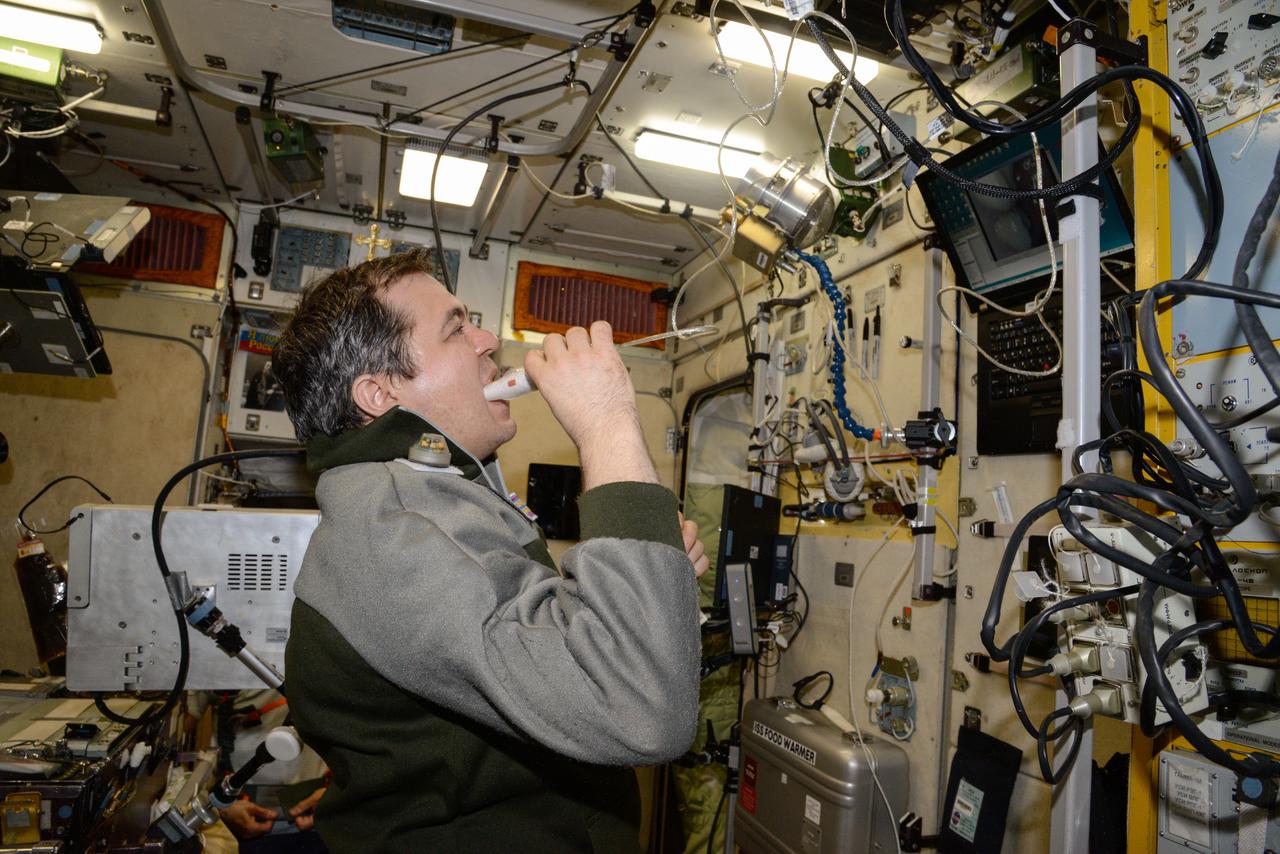
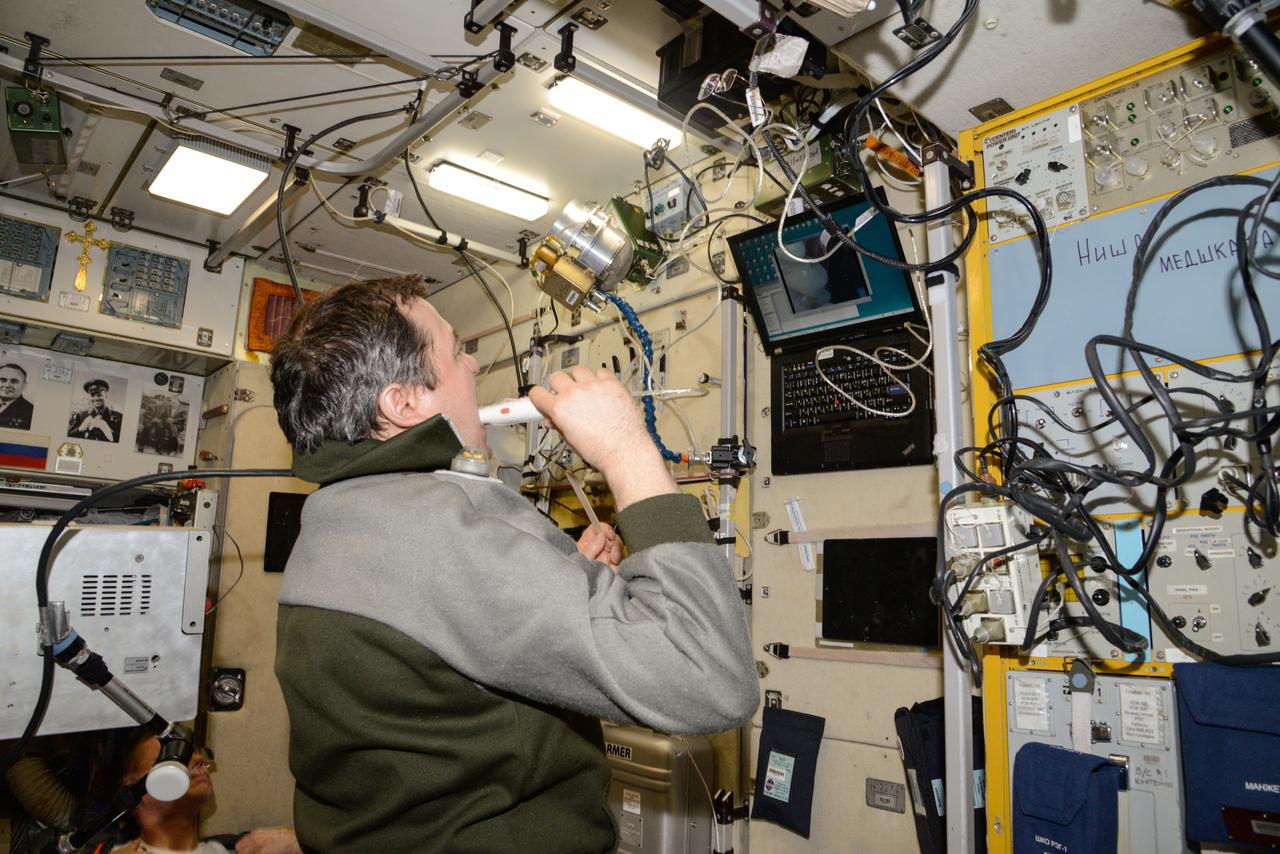
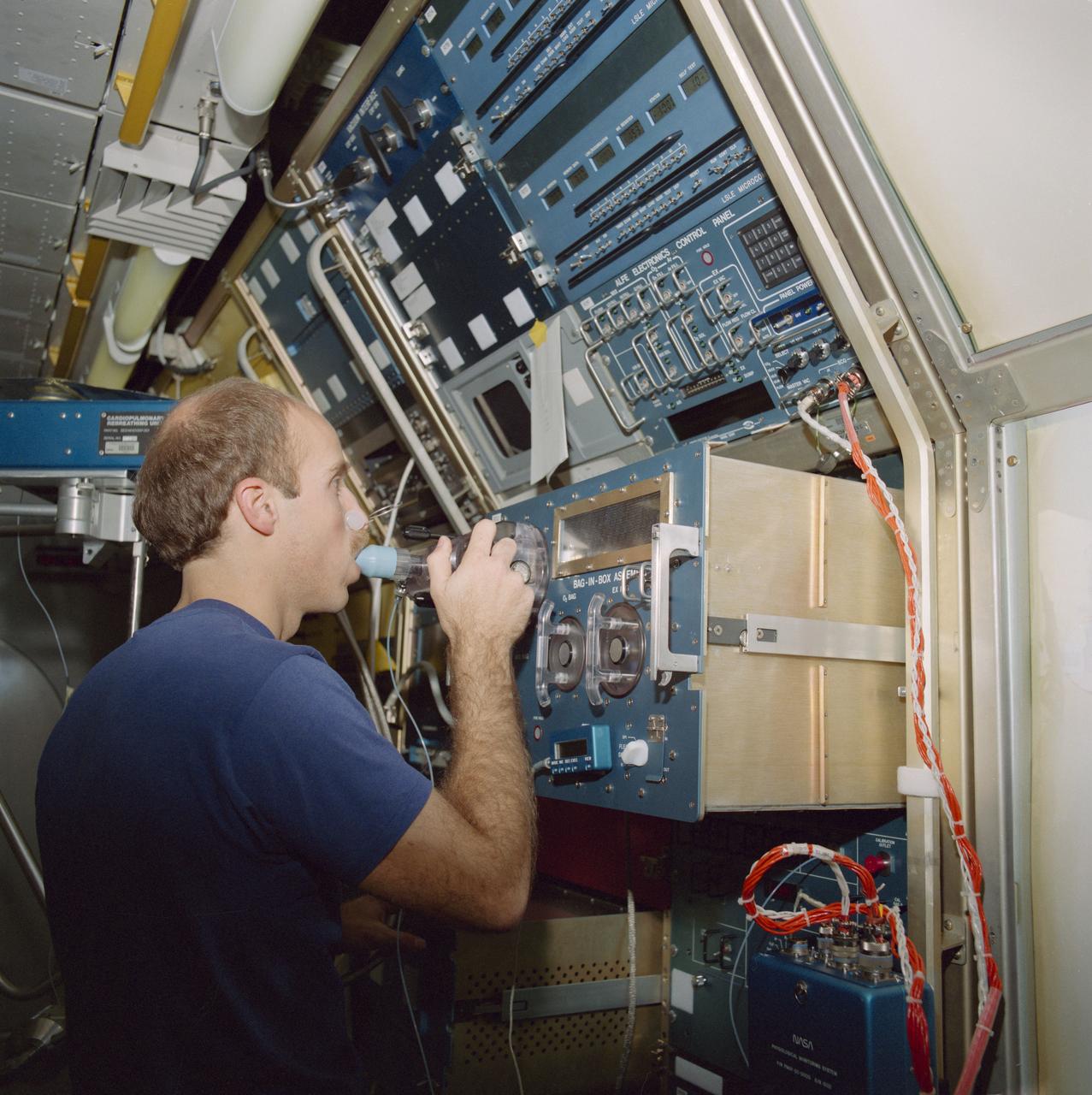
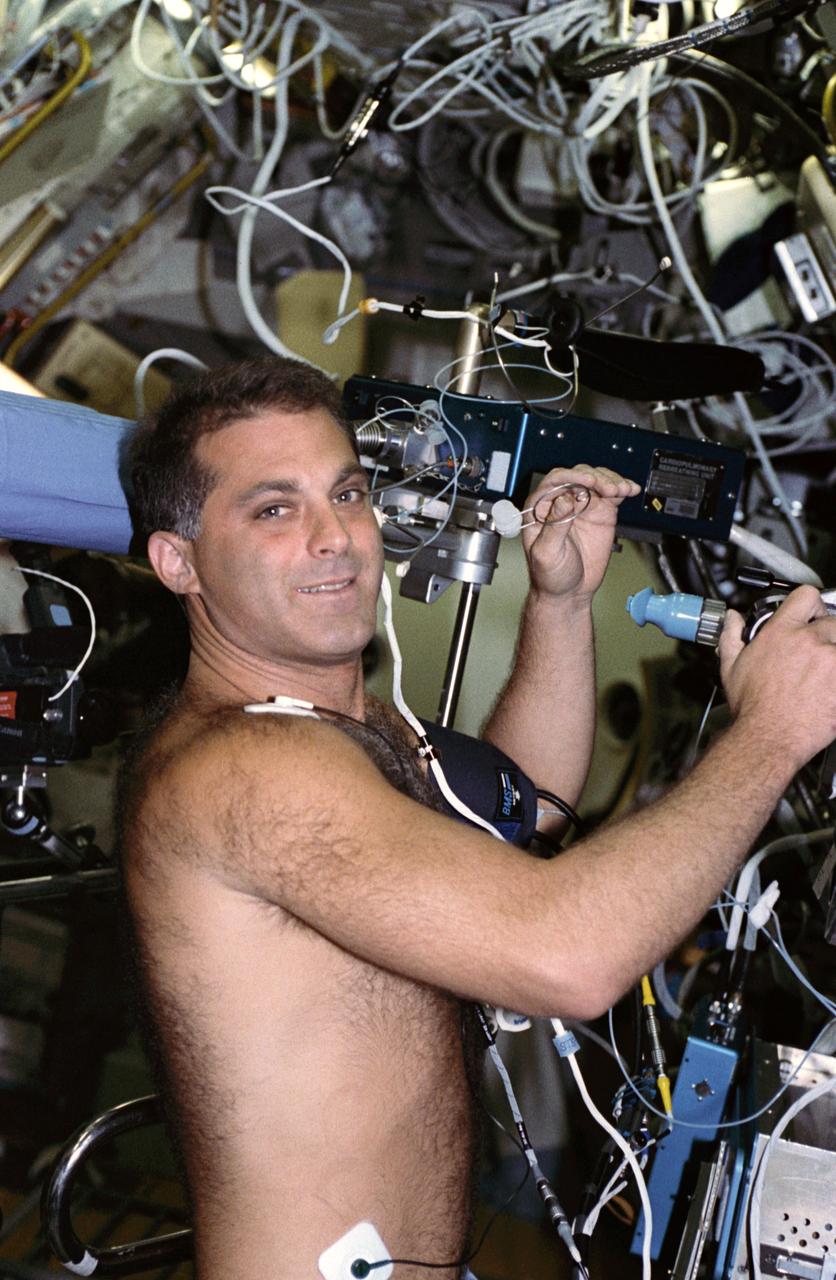
S85-26582 (Feb 1985) --- Training on the rebreathing assembly, astronaut James P. Bagian, STS-40 mission specialist, inhales a predetermined gas composition.  A gas analyzer mass spectrometer determines the composition of the gases he exhales.  The rebreathing assembly and gas analyzer system are part of an investigation that explores how lung function is altered. Dr. Bagian will be joined by two other mission specialists, the mission commander, the pilot and two payload specialists for the scheduled 10-day Spacelab Life Sciences-1 (SLS-1) mission.  The flight is totally dedicated to biological and medical experimentation.
SLS-1 crewmembers in high fidelity mockup of the Spacelab
STS058-204-014 (18 Oct.-1 Nov. 1993) --- Astronaut David A. Wolf, mission specialist, participates in an experiment that investigates in-space distribution and movement of blood and gas in the pulmonary system.  The data gathered during the two-week flight will be compared with results of tests performed on Earth to determine the changes that occur in pulmonary functions. Photo credit: NASA
Astronaut David Wolf in medical experiment in SLS-2
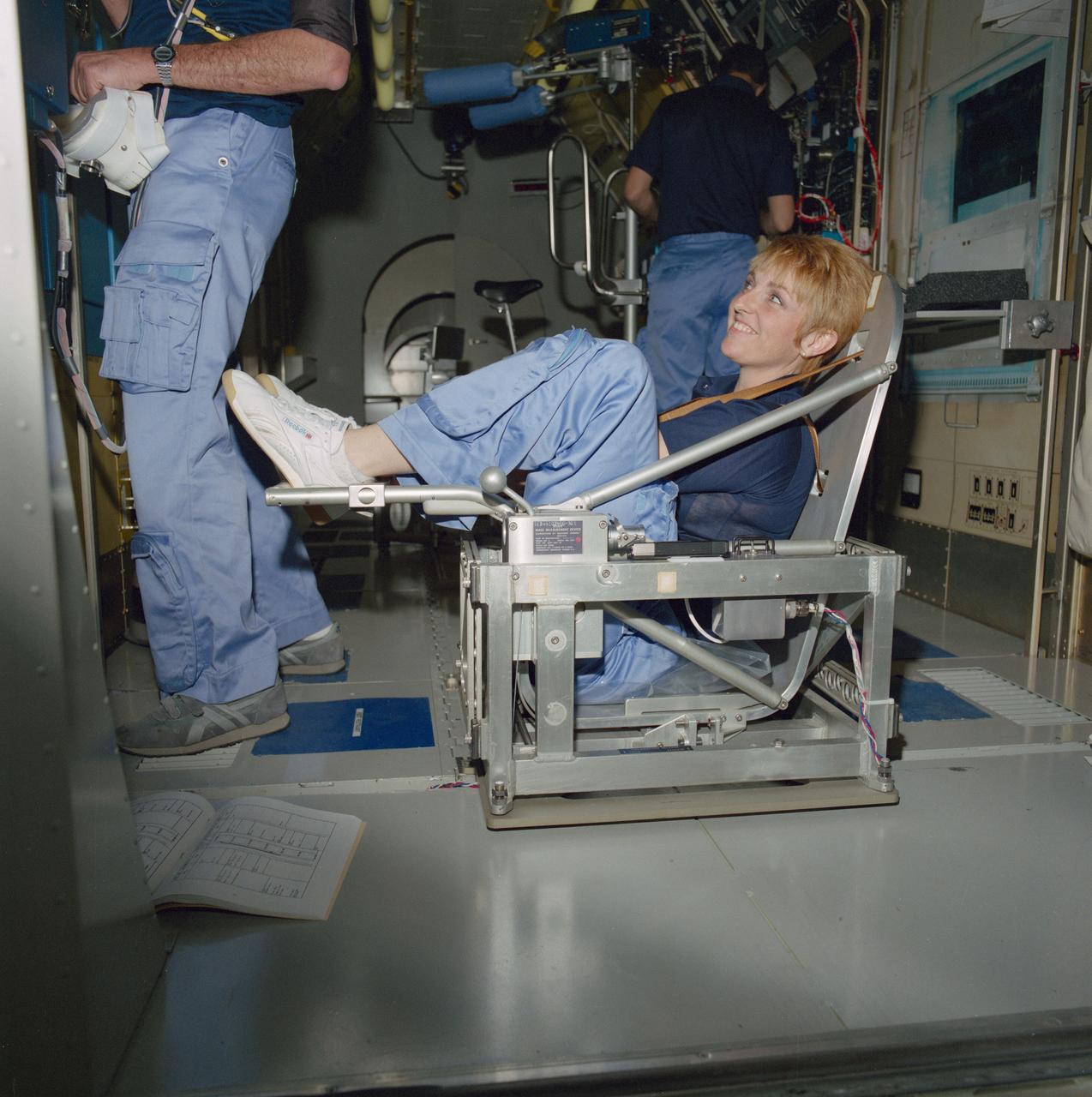
S85-26553 (Feb 1985) --- STS-40/SLS-1 payload specialist Millie Hughes-Fulford sits strapped in the special device scientists have developed for determining mass on orbit.  As the chair swings back and forth, a timer records how much the crewmember's mass retards the chair's movement. Dr. Hughes-Fulford will be joined by three mission specialists, the mission commander, the pilot and a second payload specialist for the scheduled 10-day Spacelab Life Sciences-1 (SLS-1) mission. The flight is totally dedicated to biological and medical experimentation.
Payload specialists Millie Hughes-Fulford in Body Mass Measurement Device
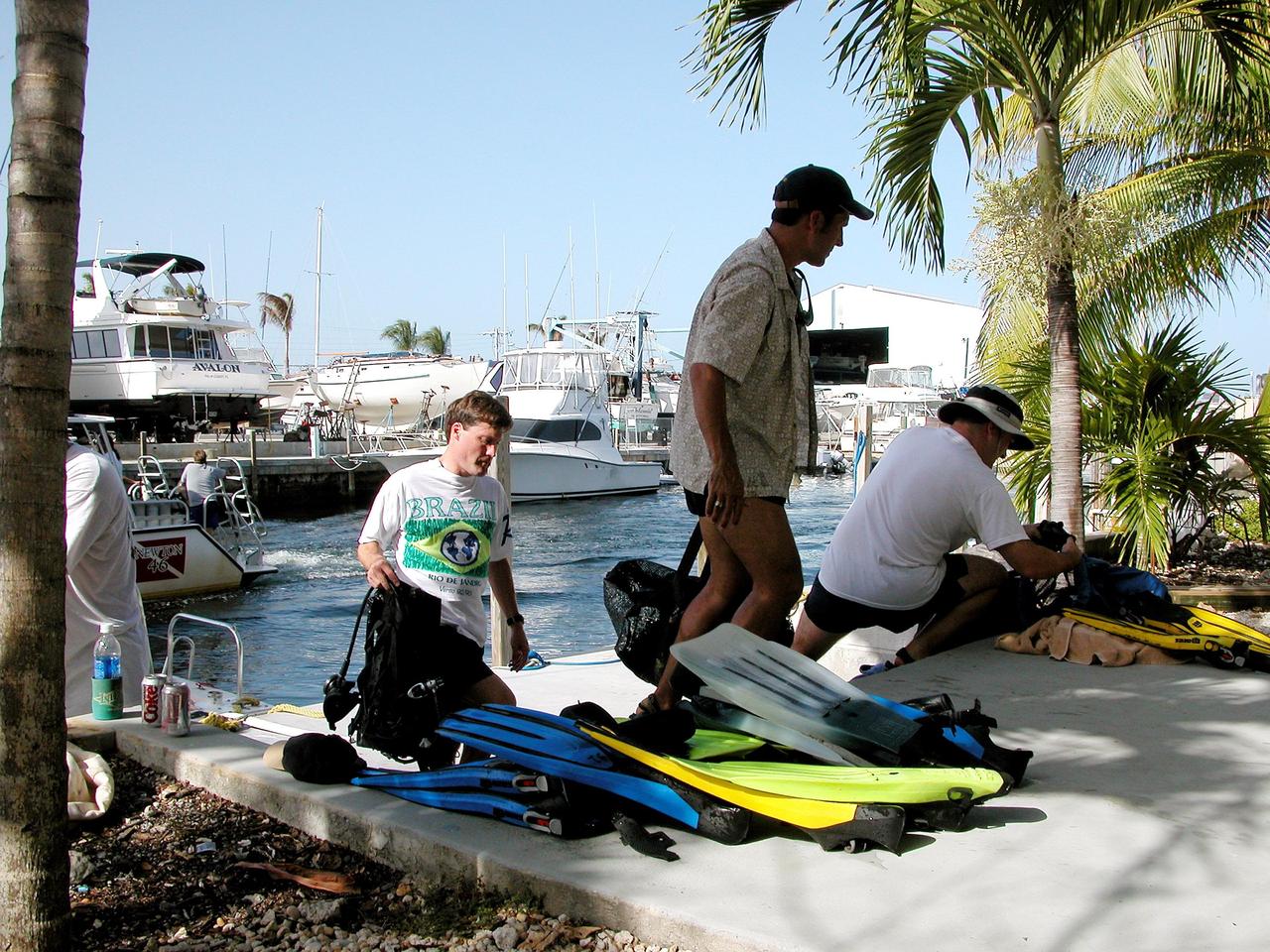
KENNEDY SPACE CENTER, FLA. - After their return from a practice dive at the NOAA Aquarius underwater station offshore at Key Largo, Marc Reagan, John Herrington and Nick Patrick unload dive gear.  Herrington is mission commander and Patrick is a member of the crew on the NASA Extreme Environment Mission Operations 6 (NEEMO-6) mission.  Reagan is mission lead as well as underwater still photographer.  The NEEMO-6 mission involves exposing an astronaut/scientist crew to a real mission experience in an extreme environment - the NOAA undersea station Aquarius offshore from Key Largo - to prepare for future space flight.  Spacewalk-like diving excursions and field-tests on a variety of biomedical equipment are designed to help astronauts living aboard the International Space Station.  Other team members are Doug Wheelock and biomedical engineer Tara Ruttley. To prepare for their 10-day stay, the team had dive training twice a day at the Life Support Buoy, anchored above Aquarius.
KSC-04pd1499
KENNEDY SPACE CENTER, FLA. - Ready for another dive to the NOAA undersea station Aquarius, offshore from Key Largo, the site of the NASA Extreme Environment Mission Operations 6 (NEEMO-6), are (left to right) Monike Schultz, CB Office lead; Bill Todd, project lead; Marc Reagan, mission lead; and Michele Lucas, OPS planner.  Todd and Lucas are also the underwater videographer and still photographer, respectively, for the mission.  The NEEMO-6 team comprises John Herrington, commander, Tara Ruttley, a biomedical engineer, and astronauts Nick Patrick and Doug Wheelock.  The NEEMO-6 mission involves exposing an astronaut/scientist crew to a real mission experience in an extreme environment - Aquarius - to prepare for future space flight.  Spacewalk-like diving excursions and field-tests on a variety of biomedical equipment are designed to help astronauts living aboard the International Space Station.  To prepare for their 10-day stay, the team had dive training twice a day at the Life Support Buoy, anchored above Aquarius.
KSC-04pd1507
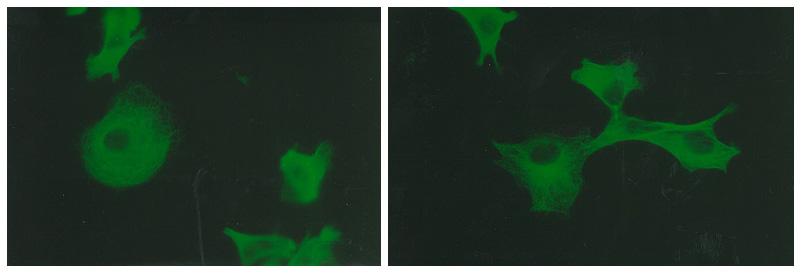
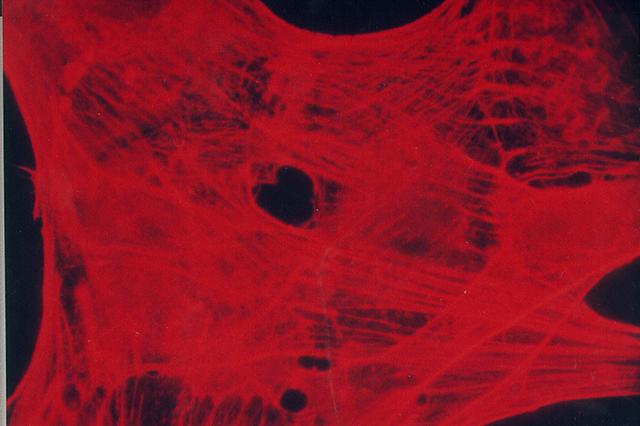
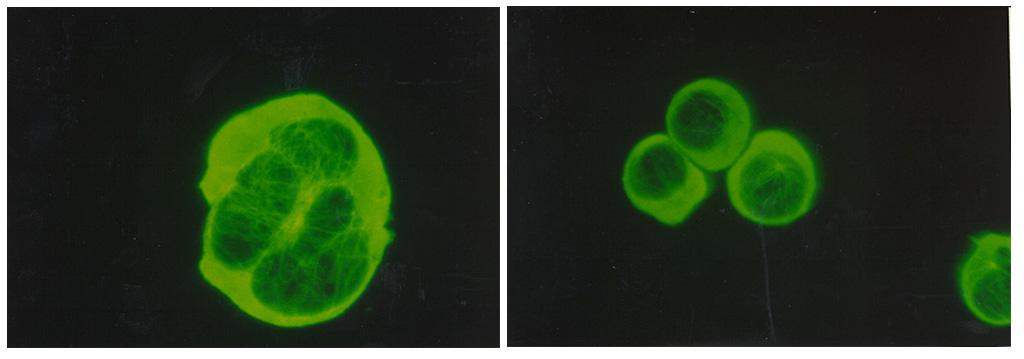
Biomedical research offers hope for a variety of medical problems, from diabetes to the replacement of damaged bone and tissues. Bioreactors, which are used to grow cells and tissue cultures, play a major role in such research and production efforts. The objective of the research was to define a way to differentiate between effects due to microgravity and those due to possible stress from non-optimal spaceflight conditions. These Jurkat cells, a human acute T-cell leukemia was obtained to evaluate three types of potential experimental stressors: a) Temperature elevation; b) Serum starvation; and c) Centrifugal force. The data from previous spaceflight experiments showed that actin filaments and cell shape are significantly different for the control. These normal cells serve as the baseline for future spaceflight experiments.
Microgravity
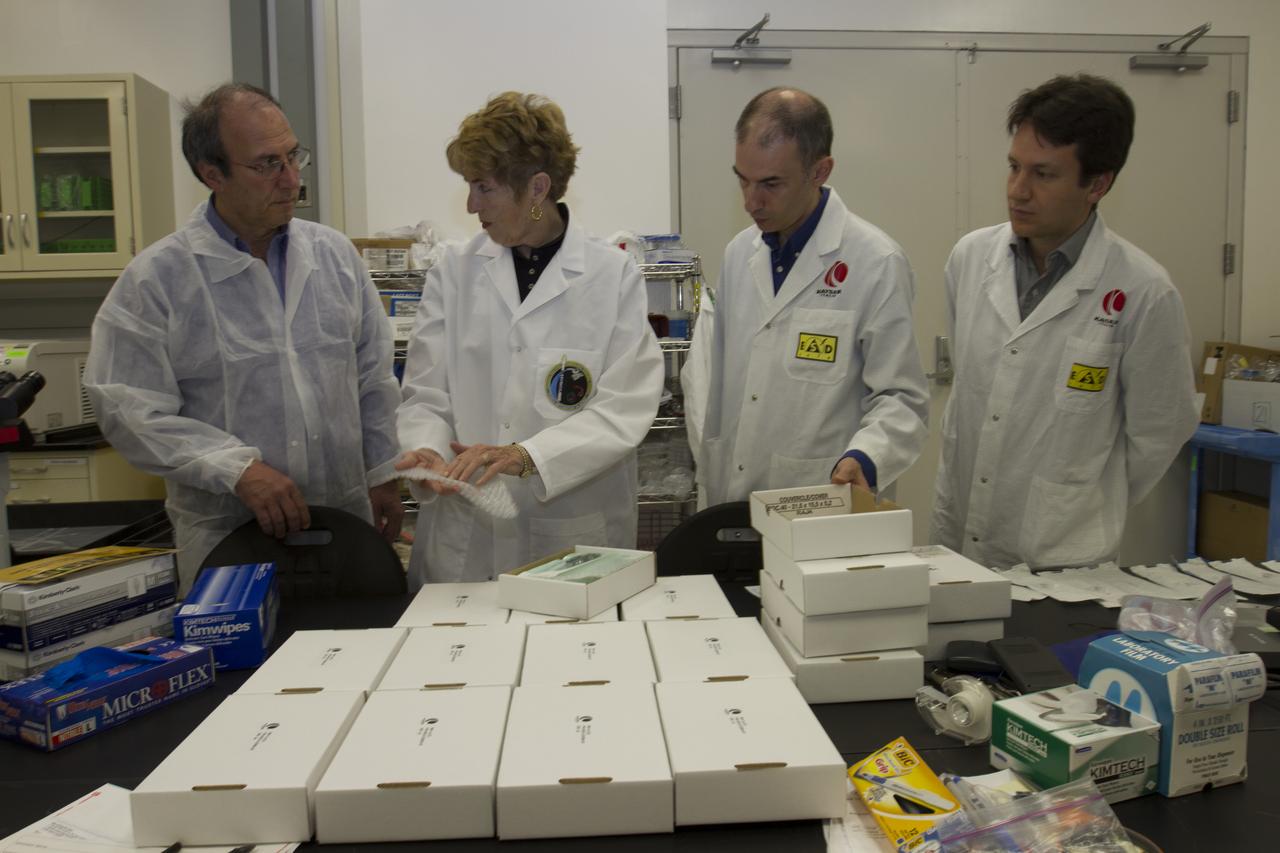
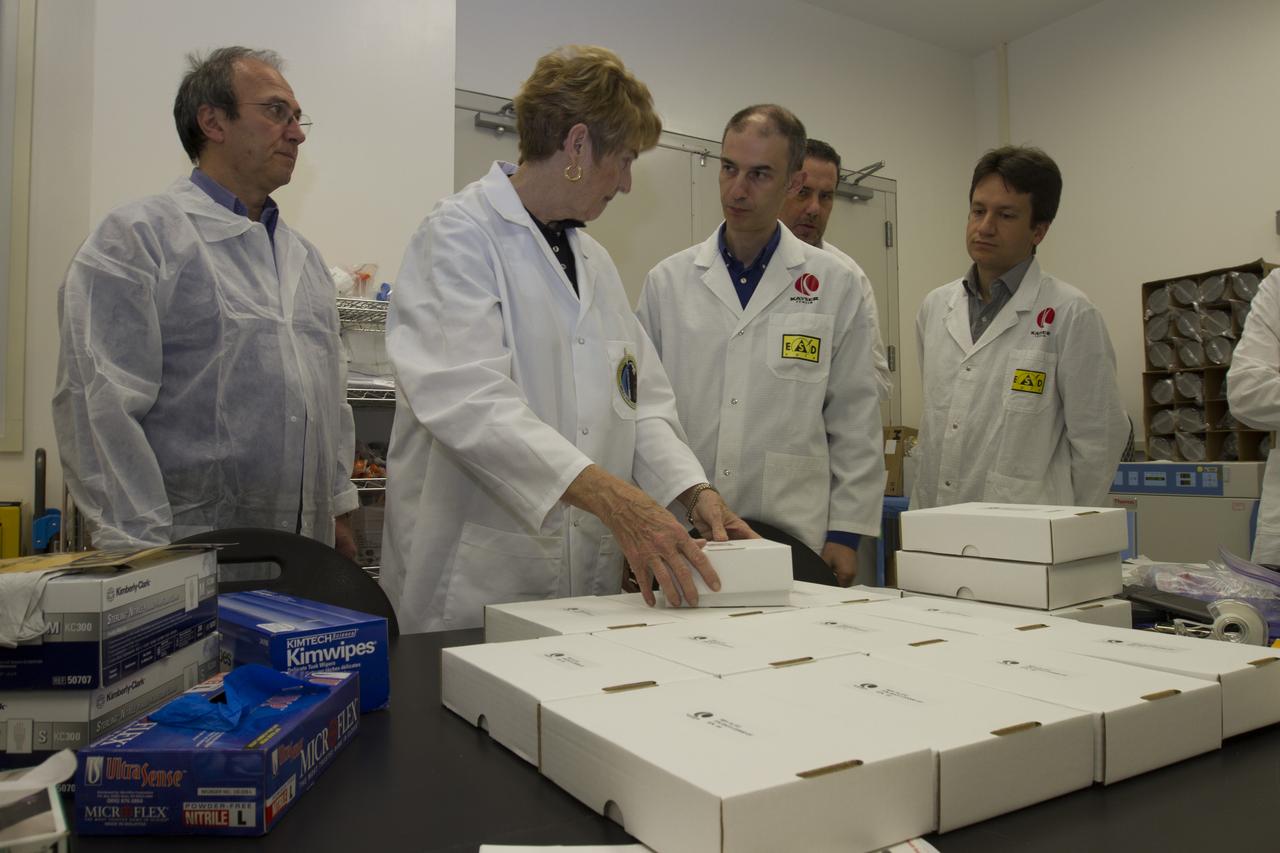
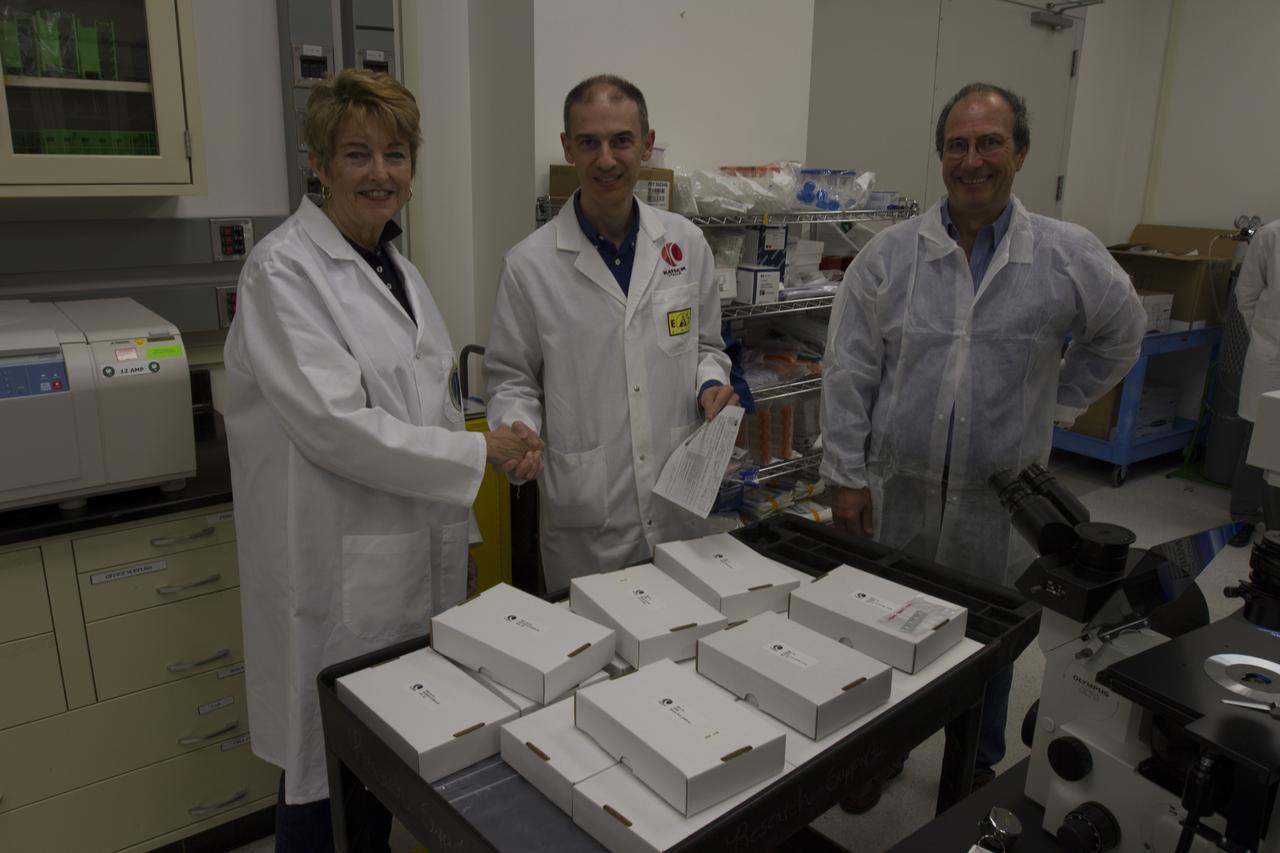
CAPE CANAVERAL, Fla. - Researcher and former NASA payload specialist Millie Hughes-Fulford, of the Hughes-Fulford Laboratory, San Francisco, Calif., accepts the European Space Agency ESA T-cell experiment flight units being handed over in a Space Station Processing Facility laboratory at NASA's Kennedy Space Center in Florida. From left are Raimondo Fortezza of ESA, Hughes-Fulford, and Pier Luigi Ganga, Marco Vukich and Fabio Creati of Kayser Italia, manufacturer of the hardware. The immunology experiment will launch on SpaceX-3 and focus on the effects of microgravity on early T-cell signaling pathways. Current work aims to identify and compare the gene expression of microRNAs miRNAs during T-cell activation under normal gravity and in microgravity, and compare those patterns to changes seen in aging populations. The experiment will be the first flown on SpaceX funded by the National Institutes of Health. Dr. Hughes-Fulford flew aboard space shuttle mission STS-40 in June 1991, the first Spacelab mission dedicated to biomedical studies. For more information on the T-cell experiment, visit http://hughesfulfordlab.com and http://www.nasa.gov/ames/research/space-biosciences/t-cell-activation-in-aging-spacex-3/. Photo credit: NASA/Cory Huston
Millie Hughes-Fulford, Scientist and Prior Astronaut
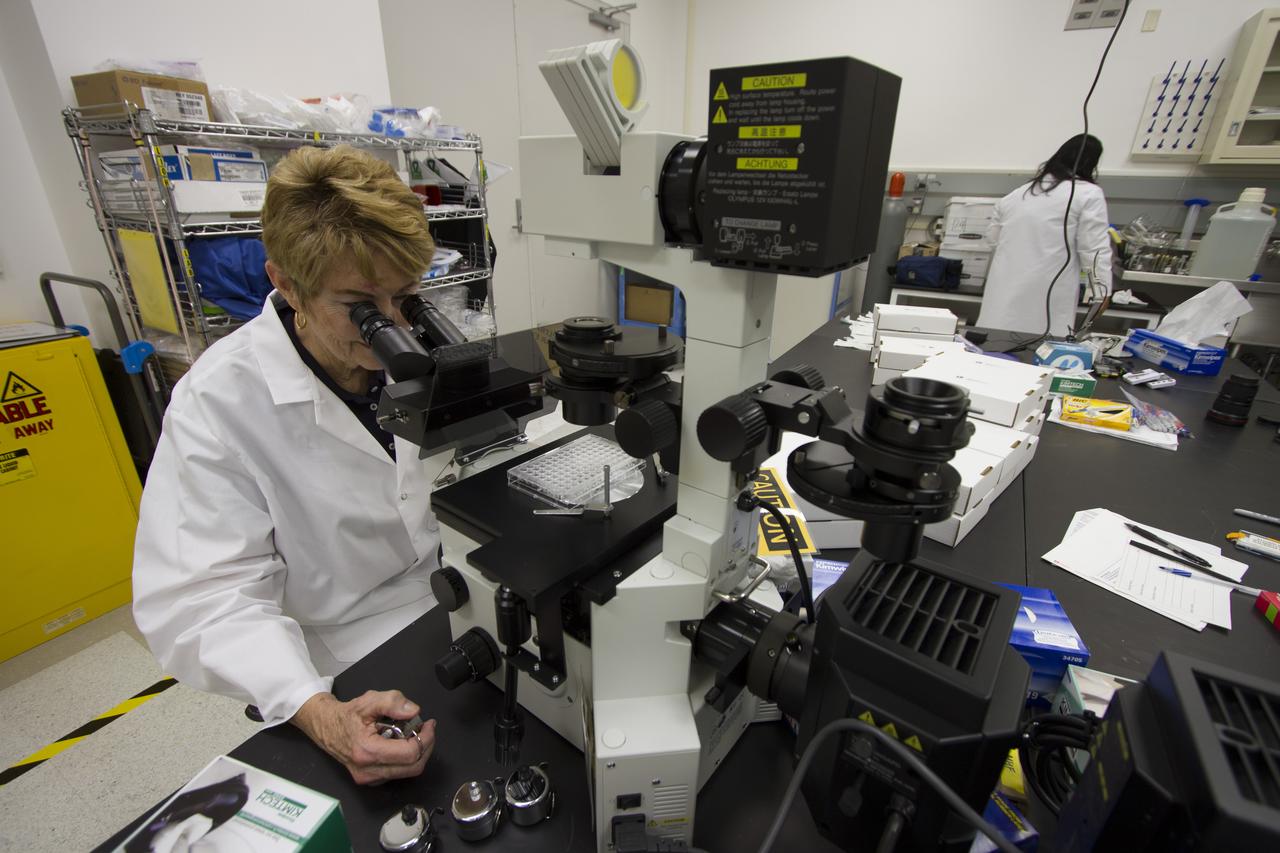
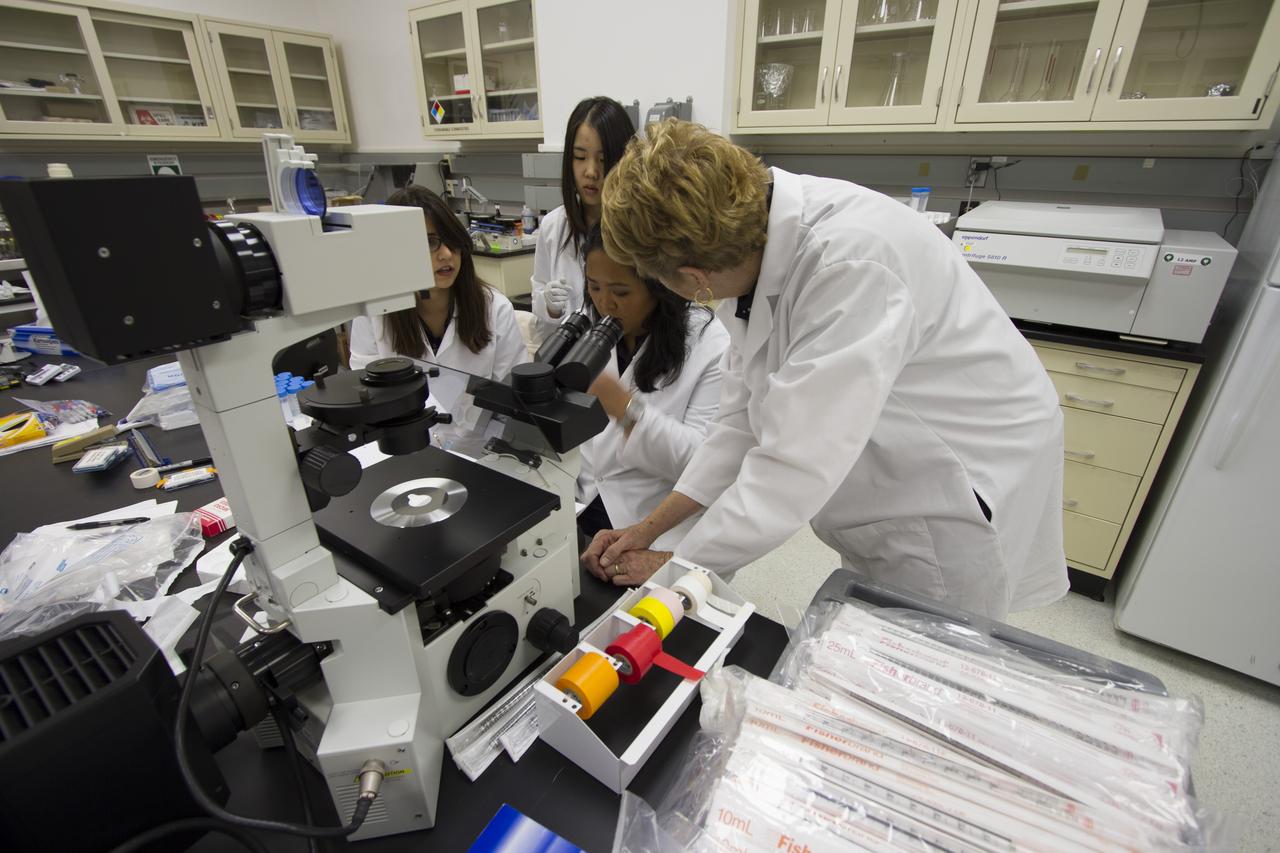
CAPE CANAVERAL, Fla. - Researcher and principal investigator Dr. Millie Hughes-Fulford, of the Hughes-Fulford Laboratory, San Francisco, Calif., at the microscope, examines T-cells as part of preflight experiment operations in the Space Station Processing Facility at NASA's Kennedy Space Center in Florida. The immunology experiment will launch on SpaceX-3 and focus on the effects of microgravity on early T-cell signaling pathways. Current work aims to identify and compare the gene expression of microRNAs miRNAs during T-cell activation under normal gravity and in microgravity, and compare those patterns to changes seen in aging populations. The experiment will be the first flown on SpaceX funded by the National Institutes of Health. Dr. Hughes-Fulford flew aboard space shuttle mission STS-40 in June 1991, the first Spacelab mission dedicated to biomedical studies. For more information on the T-cell experiment, visit http://hughesfulfordlab.com and http://www.nasa.gov/ames/research/space-biosciences/t-cell-activation-in-aging-spacex-3/. Photo credit: NASA/Cory Huston
Millie Hughes-Fulford, Scientist and Prior Astronaut
CAPE CANAVERAL, Fla. - Researcher and former NASA payload specialist Millie Hughes-Fulford, of the Hughes-Fulford Laboratory, San Francisco, Calif., accepts the European Space Agency ESA T-cell experiment flight units being handed over in a Space Station Processing Facility laboratory at NASA's Kennedy Space Center in Florida. From left are Raimondo Fortezza of ESA, Hughes-Fulford, and Pier Luigi Ganga and Fabio Creati of Kayser Italia, manufacturer of the hardware. The immunology experiment will launch on SpaceX-3 and focus on the effects of microgravity on early T-cell signaling pathways. Current work aims to identify and compare the gene expression of microRNAs miRNAs during T-cell activation under normal gravity and in microgravity, and compare those patterns to changes seen in aging populations. The experiment will be the first flown on SpaceX funded by the National Institutes of Health. Dr. Hughes-Fulford flew aboard space shuttle mission STS-40 in June 1991, the first Spacelab mission dedicated to biomedical studies. For more information on the T-cell experiment, visit http://hughesfulfordlab.com and http://www.nasa.gov/ames/research/space-biosciences/t-cell-activation-in-aging-spacex-3/. Photo credit: NASA/Cory Huston
Millie Hughes-Fulford, Scientist and Prior Astronaut
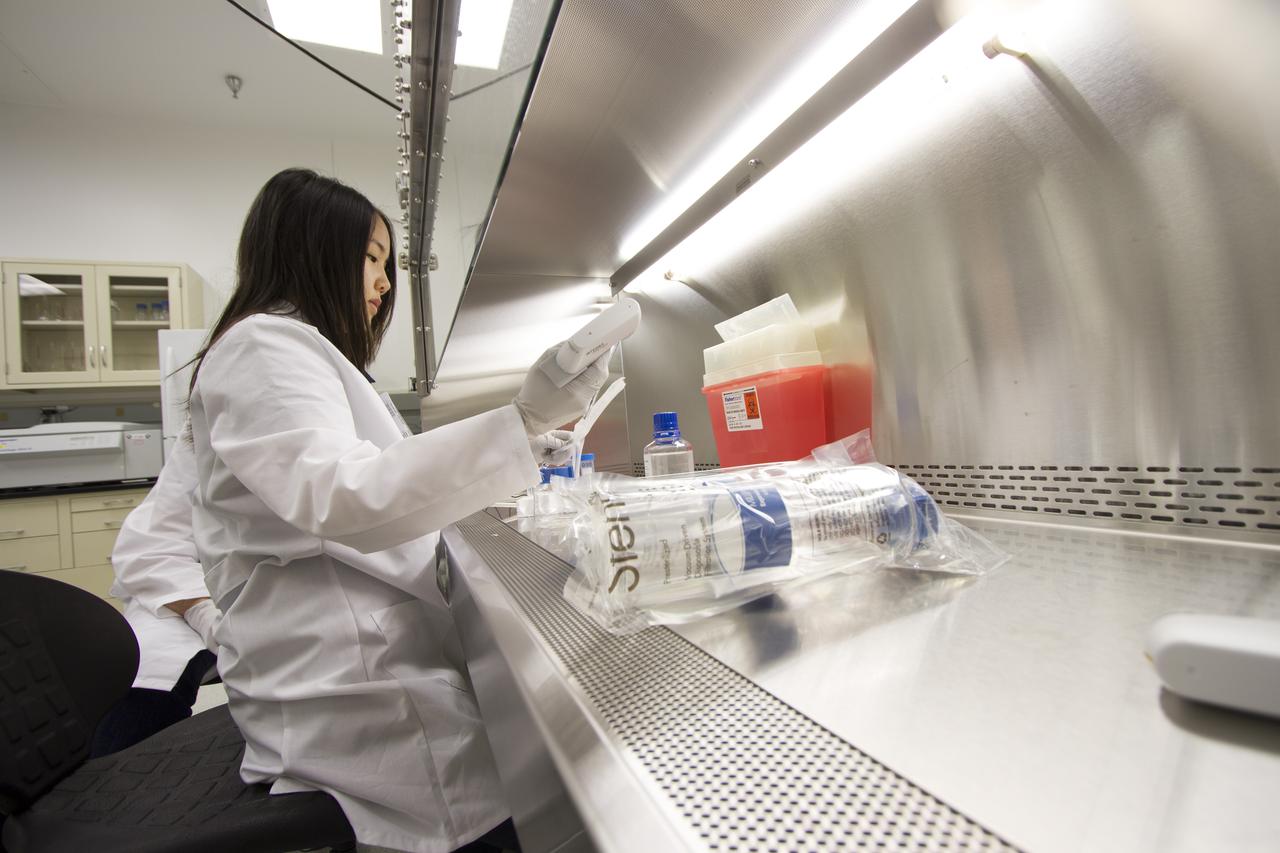
CAPE CANAVERAL, Fla. - T-cell science team member Miya Yoshida, of the Hughes-Fulford Laboratory in San Francisco, Calif., works in a biosafety hood during preflight experiment preparations in the Space Station Processing Facility at NASA's Kennedy Space Center in Florida. The immunology experiment will launch on SpaceX-3 and focus on the effects of microgravity on early T-cell signaling pathways. Current work aims to identify and compare the gene expression of microRNAs miRNAs during T-cell activation under normal gravity and in microgravity, and compare those patterns to changes seen in aging populations. The experiment will be the first flown on SpaceX funded by the National Institutes of Health. Dr. Hughes-Fulford flew aboard space shuttle mission STS-40 in June 1991, the first Spacelab mission dedicated to biomedical studies. For more information on the T-cell experiment, visit http://hughesfulfordlab.com and http://www.nasa.gov/ames/research/space-biosciences/t-cell-activation-in-aging-spacex-3/. Photo credit: NASA/Cory Huston
Millie Hughes-Fulford, Scientist and Prior Astronaut
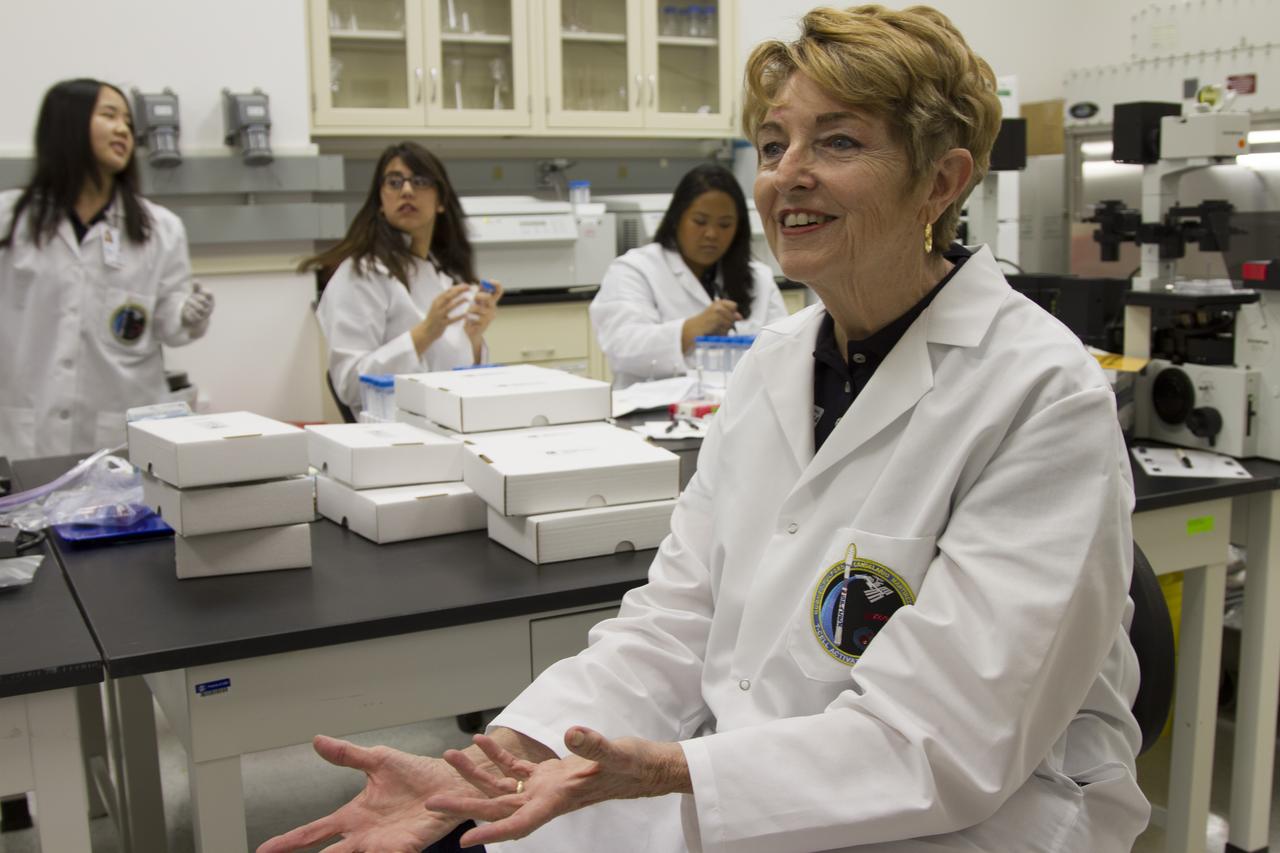
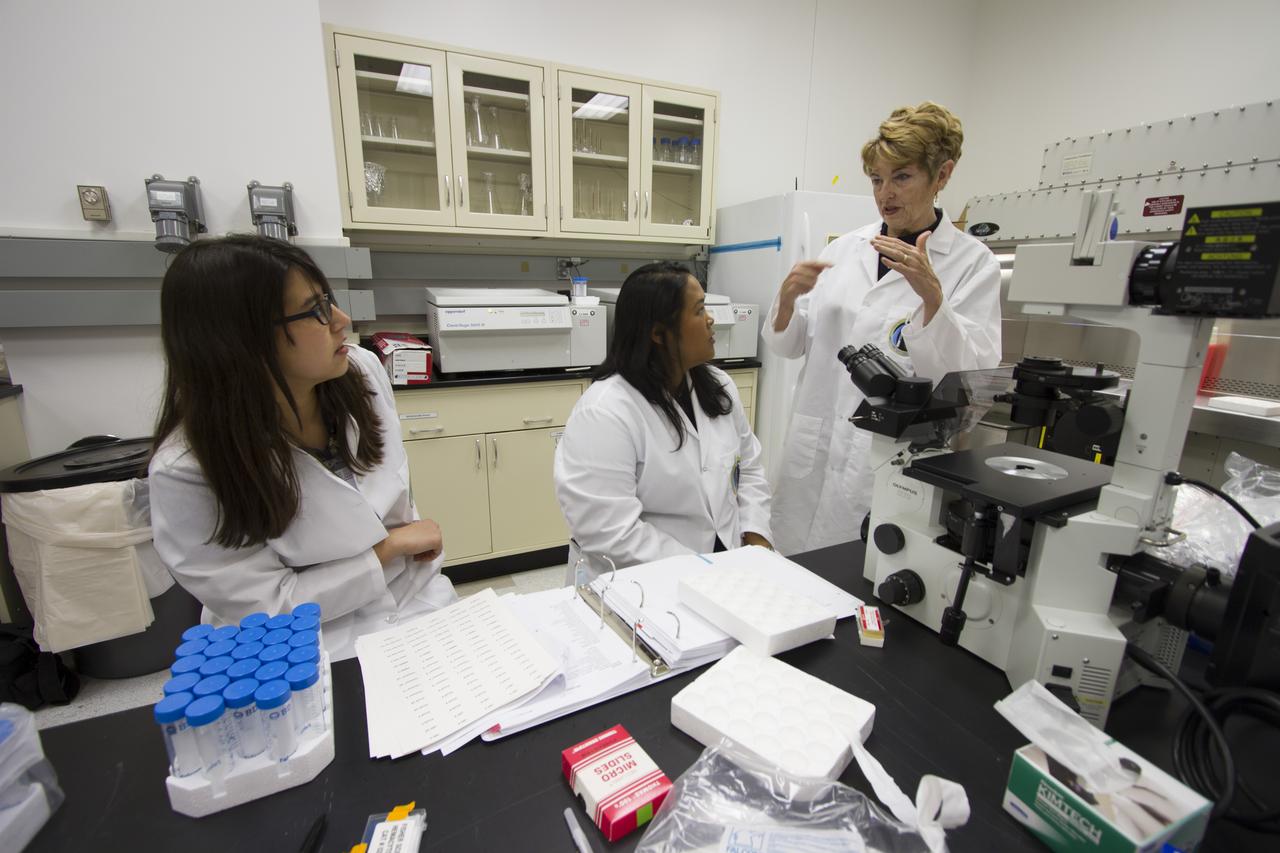
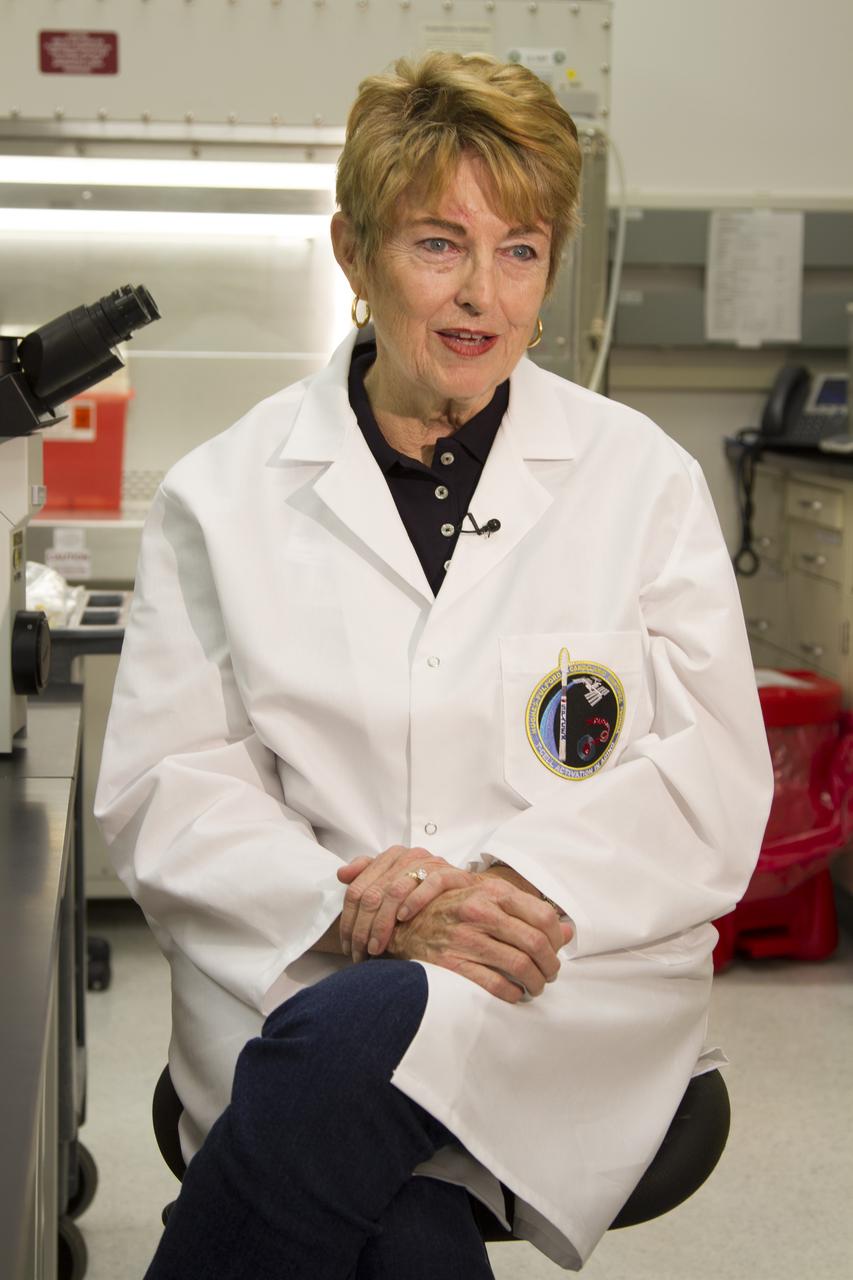
CAPE CANAVERAL, Fla. - Researcher and principal investigator Dr. Millie Hughes-Fulford, of the Hughes-Fulford Laboratory, San Francisco, Calif., discusses her laboratory's T-cell experiment and the impact the research may have on aging adults and their immune systems with an interviewer in the Space Station Processing Facility. From left, T-cell science team members Miya Yoshida, Emily Martinez and Tara Candelario are at work preparing for launch in the background. The immunology experiment will launch on SpaceX-3 and focus on the effects of microgravity on early T-cell signaling pathways. Current work aims to identify and compare the gene expression of microRNAs miRNAs during T-cell activation under normal gravity and in microgravity, and compare those patterns to changes seen in aging populations. The experiment will be the first flown on SpaceX funded by the National Institutes of Health. Dr. Hughes-Fulford flew aboard space shuttle mission STS-40 in June 1991, the first Spacelab mission dedicated to biomedical studies. For more information on the T-cell experiment, visit http://hughesfulfordlab.com and http://www.nasa.gov/ames/research/space-biosciences/t-cell-activation-in-aging-spacex-3/. Photo credit: NASA/Cory Huston
Millie Hughes-Fulford, Scientist and Prior Astronaut
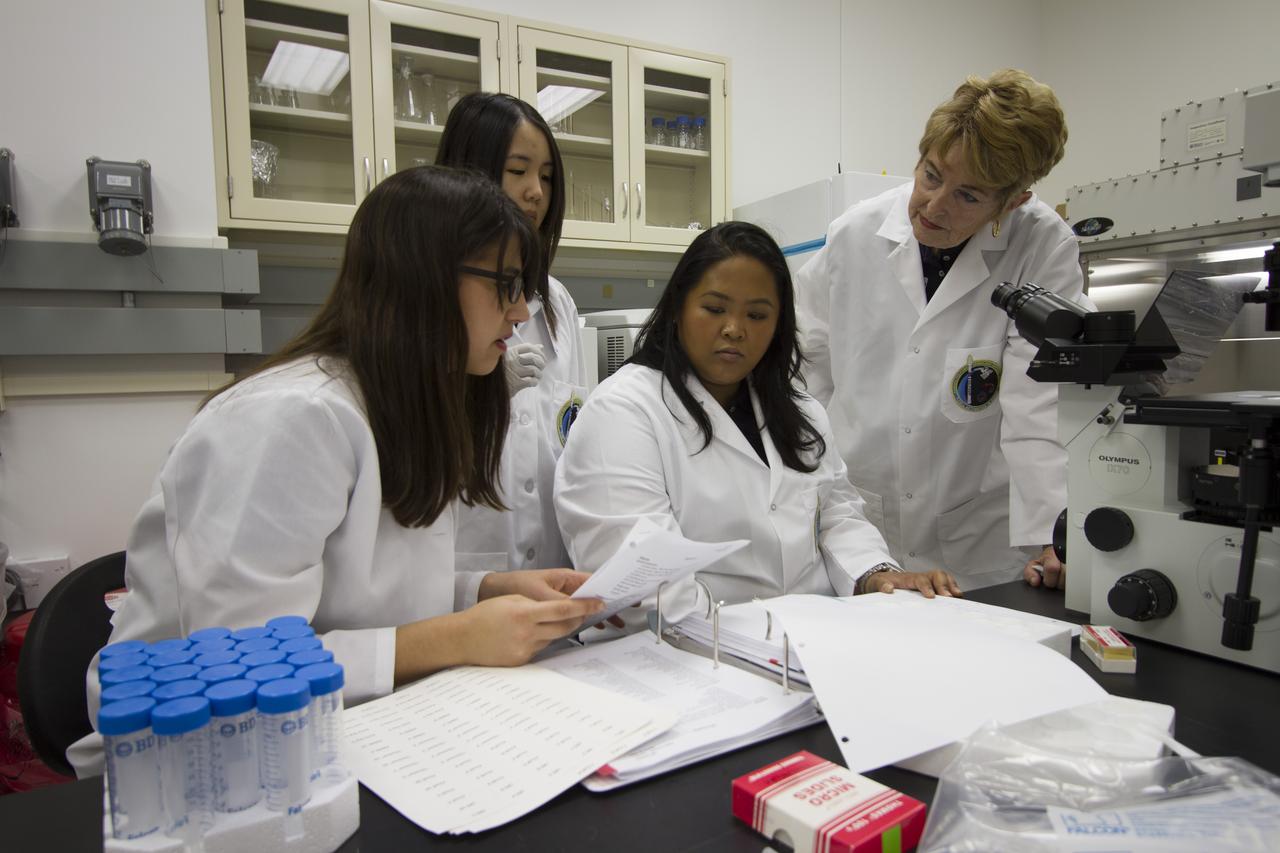
CAPE CANAVERAL, Fla. - From left, T-cell science team members Emily Martinez, Miya Yoshida and Tara Candelario, of the Hughes-Fulford Laboratory, San Francisco, Calif., discuss preflight and post-flight experiment operations with researcher and principal investigator Dr. Millie Hughes-Fulford in the Space Station Processing Facility at NASA's Kennedy Space Center in Florida. The immunology experiment will launch on SpaceX-3 and focus on the effects of microgravity on early T-cell signaling pathways. Current work aims to identify and compare the gene expression of microRNAs miRNAs during T-cell activation under normal gravity and in microgravity, and compare those patterns to changes seen in aging populations. The experiment will be the first flown on SpaceX funded by the National Institutes of Health. Dr. Hughes-Fulford flew aboard space shuttle mission STS-40 in June 1991, the first Spacelab mission dedicated to biomedical studies. For more information on the T-cell experiment, visit http://hughesfulfordlab.com and http://www.nasa.gov/ames/research/space-biosciences/t-cell-activation-in-aging-spacex-3/. Photo credit: NASA/Cory Huston
Millie Hughes-Fulford, Scientist and Prior Astronaut
CAPE CANAVERAL, Fla. - T-cell science team member Tara Candelario of the Hughes-Fulford Laboratory, San Francisco, Calif., at the microscope, discusses preflight and post-flight experiment operations with researcher and principal investigator Dr. Millie Hughes-Fulford in the Space Station Processing Facility at NASA's Kennedy Space Center in Florida as T-cell science team members Emily Martinez, left, and Miya Yoshida look on. The immunology experiment will launch on SpaceX-3 and focus on the effects of microgravity on early T-cell signaling pathways. Current work aims to identify and compare the gene expression of microRNAs miRNAs during T-cell activation under normal gravity and in microgravity, and compare those patterns to changes seen in aging populations. The experiment will be the first flown on SpaceX funded by the National Institutes of Health. Dr. Hughes-Fulford flew aboard space shuttle mission STS-40 in June 1991, the first Spacelab mission dedicated to biomedical studies. For more information on the T-cell experiment, visit http://hughesfulfordlab.com and http://www.nasa.gov/ames/research/space-biosciences/t-cell-activation-in-aging-spacex-3/. Photo credit: NASA/Cory Huston
Millie Hughes-Fulford, Scientist and Prior Astronaut
CAPE CANAVERAL, Fla. - Researcher and former NASA payload specialist Millie Hughes-Fulford, of the Hughes-Fulford Laboratory, San Francisco, Calif., accepts the European Space Agency ESA T-cell experiment flight units being handed over in a Space Station Processing Facility laboratory at NASA's Kennedy Space Center in Florida. From left are Hughes-Fulford shaking hands with Pier Luigi Ganga of Kayser Italia, manufacturer of the hardware, with Raimondo Fortezza of ESA looking on. The immunology experiment will launch on SpaceX-3 and focus on the effects of microgravity on early T-cell signaling pathways. Current work aims to identify and compare the gene expression of microRNAs miRNAs during T-cell activation under normal gravity and in microgravity, and compare those patterns to changes seen in aging populations. The experiment will be the first flown on SpaceX funded by the National Institutes of Health. Dr. Hughes-Fulford flew aboard space shuttle mission STS-40 in June 1991, the first Spacelab mission dedicated to biomedical studies. For more information on the T-cell experiment, visit http://hughesfulfordlab.com and http://www.nasa.gov/ames/research/space-biosciences/t-cell-activation-in-aging-spacex-3/. Photo credit: NASA/Cory Huston
Millie Hughes-Fulford, Scientist and Prior Astronaut
CAPE CANAVERAL, Fla. - Researcher and former NASA payload specialist Millie Hughes-Fulford, of the Hughes-Fulford Laboratory, San Francisco, Calif., discusses her laboratory's T-cell experiment and the impact the research may have on aging adults and their immune systems with an interviewer in the Space Station Processing Facility at NASA's Kennedy Space Center in Florida. The immunology experiment will launch on SpaceX-3 and focus on the effects of microgravity on early T-cell signaling pathways. Current work aims to identify and compare the gene expression of microRNAs miRNAs during T-cell activation under normal gravity and in microgravity, and compare those patterns to changes seen in aging populations. The experiment will be the first flown on SpaceX funded by the National Institutes of Health. Dr. Hughes-Fulford flew aboard space shuttle mission STS-40 in June 1991, the first Spacelab mission dedicated to biomedical studies. For more information on the T-cell experiment, visit http://hughesfulfordlab.com and http://www.nasa.gov/ames/research/space-biosciences/t-cell-activation-in-aging-spacex-3/. Photo credit: NASA/Cory Huston
Millie Hughes-Fulford, Scientist and Prior Astronaut
CAPE CANAVERAL, Fla. - Researcher and principal investigator Dr. Millie Hughes-Fulford of the Hughes-Fulford Laboratory, San Francisco, Calif., at right, plans preflight and post-flight experiment operations with T-cell science team members Emily Martinez, left, and Tara Candelario in the Space Station Processing Facility at NASA's Kennedy Space Center in Florida. The immunology experiment will launch on SpaceX-3 and focus on the effects of microgravity on early T-cell signaling pathways. Current work aims to identify and compare the gene expression of microRNAs miRNAs during T-cell activation under normal gravity and in microgravity, and compare those patterns to changes seen in aging populations. The experiment will be the first flown on SpaceX funded by the National Institutes of Health. Dr. Hughes-Fulford flew aboard space shuttle mission STS-40 in June 1991, the first Spacelab mission dedicated to biomedical studies. For more information on the T-cell experiment, visit http://hughesfulfordlab.com and http://www.nasa.gov/ames/research/space-biosciences/t-cell-activation-in-aging-spacex-3/. Photo credit: NASA/Cory Huston
Millie Hughes-Fulford, Scientist and Prior Astronaut
In this Apollo 17 onboard photo, Mission Commander Eugene A. Cernan adjusts the U.S. flag deployed upon the Moon. The seventh and last manned lunar landing and return to Earth mission, the Apollo 17, carrying a crew of three astronauts: Cernan; Lunar Module pilot Harrison H. Schmitt; and Command Module pilot Ronald E. Evans, lifted off on December 7, 1972 from the Kennedy Space Flight Center (KSC). Scientific objectives of the Apollo 17 mission included geological surveying and sampling of materials and surface features in a preselected area of the Taurus-Littrow region, deploying and activating surface experiments, and conducting in-flight experiments and photographic tasks during lunar orbit and transearth coast (TEC). These objectives included: Deployed experiments such as the Apollo lunar surface experiment package (ALSEP) with a Heat Flow experiment, Lunar seismic profiling (LSP), Lunar surface gravimeter (LSG), Lunar atmospheric composition experiment (LACE) and Lunar ejecta and meteorites (LEAM). The mission also included Lunar Sampling and Lunar orbital experiments. Biomedical experiments included the Biostack II Experiment and the BIOCORE experiment. The mission marked the longest Apollo mission, 504 hours, and the longest lunar surface stay time, 75 hours, which allowed the astronauts to conduct an extensive geological investigation. They collected 257 pounds (117 kilograms) of lunar samples with the use of the Marshall Space Flight Center developed LRV. The mission ended on December 19, 1972
Saturn Apollo Program
In this Apollo 17 onboard photo, a Lunar Roving Vehicle (LRV) is parked beside a huge boulder near the Valley of Tourus-Litttrow on the lunar surface. The seventh and last manned lunar landing and return to Earth mission, the Apollo 17, carrying a crew of three astronauts: Mission Commander Eugene A. Cernan; Lunar Module pilot Harrison H. Schmitt; and Command Module pilot Ronald E. Evans, lifted off on December 7, 1972 from the Kennedy Space Flight Center (KSC). Scientific objectives of the Apollo 17 mission included geological surveying and sampling of materials and surface features in a preselected area of the Taurus-Littrow region, deploying and activating surface experiments, and conducting in-flight experiments and photographic tasks during lunar orbit and transearth coast (TEC). These objectives included: Deployed experiments such as the Apollo lunar surface experiment package (ALSEP) with a Heat Flow experiment, Lunar seismic profiling (LSP), Lunar surface gravimeter (LSG), Lunar  atmospheric composition experiment (LACE) and Lunar ejecta and meteorites (LEAM). The mission also included Lunar Sampling and Lunar orbital experiments. Biomedical experiments included the Biostack II Experiment and the BIOCORE experiment. The mission marked the longest Apollo mission, 504 hours, and the longest lunar surface stay time, 75 hours, which allowed the astronauts to conduct an extensive geological investigation. They collected 257 pounds (117 kilograms) of lunar samples with the use of the Marshall Space Flight Center developed LRV. The mission ended on December 19, 1972
Saturn Apollo Program
This view of the Lunar surface was taken during the Apollo 17 mission. The seventh and last manned lunar landing and return to Earth mission, the Apollo 17, carrying a crew of three astronauts: Mission Commander Eugene A. Cernan; Lunar Module pilot Harrison H. Schmitt; and Command Module pilot Ronald E. Evans, lifted off on December 7, 1972 from the Kennedy Space Flight Center (KSC). Scientific objectives of the Apollo 17 mission included geological surveying and sampling of materials and surface features in a preselected area of the Taurus-Littrow region, deploying and activating surface experiments, and conducting in-flight experiments and photographic tasks during lunar orbit and transearth coast (TEC). These objectives included: Deployed experiments such as the Apollo lunar surface experiment package (ALSEP) with a Heat Flow experiment, Lunar seismic profiling (LSP), Lunar surface gravimeter (LSG), Lunar atmospheric composition experiment (LACE) and Lunar ejecta and meteorites (LEAM). The mission also included Lunar Sampling and Lunar orbital experiments. Biomedical experiments included the Biostack II Experiment and the BIOCORE experiment. The mission marked the longest Apollo mission, 504 hours, and the longest lunar surface stay time, 75 hours, which allowed the astronauts to conduct an extensive geological investigation. They collected 257 pounds (117 kilograms) of lunar samples with the use of the Marshall Space Flight Center designed Lunar Roving Vehicle (LRV). The mission ended on December 19, 1972.
Saturn Apollo Program
In this Apollo 17 onboard photo, Lunar Module pilot Harrison H. Schmitt collects rock samples from a huge boulder near the Valley of Tourus-Littrow on the lunar surface. The seventh and last manned lunar landing and return to Earth mission, the Apollo 17, carrying a crew of three astronauts: Schmitt; Mission Commander Eugene A. Cernan; and Command Module pilot Ronald E. Evans, lifted off on December 7, 1972 from the Kennedy Space Flight Center (KSC). Scientific objectives of the Apollo 17 mission included geological surveying and sampling of materials and surface features in a preselected area of the Taurus-Littrow region, deploying and activating surface experiments, and conducting in-flight experiments and photographic tasks during lunar orbit and transearth coast (TEC). These objectives included: Deployed experiments such as the Apollo lunar surface experiment package (ALSEP) with a Heat Flow experiment, Lunar seismic profiling (LSP), Lunar surface gravimeter (LSG), Lunar atmospheric composition experiment (LACE) and Lunar ejecta and meteorites (LEAM). The mission also included Lunar Sampling and Lunar orbital experiments. Biomedical experiments included the Biostack II Experiment and the BIOCORE experiment. The mission marked the longest Apollo mission, 504 hours, and the longest lunar surface stay time, 75 hours, which allowed the astronauts to conduct an extensive geological investigation. They collected 257 pounds (117 kilograms) of lunar samples with the use of the Marshall Space Flight Center designed Lunar Roving Vehicle (LRV). The mission ended on December 19, 1972
Saturn Apollo Program
STS078-301-021 (20 June - 7 July 1996) --- Payload specialist Jean-Jacques Favier, representing the French Space Agency (CNES), holds up a test container to a Spacelab camera.  The test involves the Bubble Drop Particle Unit (BDPU), which Favier is showing to ground controllers at the Marshall Space Flight Center (MSFC) in order to check the condition of the unit prior to heating in the BDPU facility.  The test container holds experimental fluid and allows experiment observation through optical windows.  BDPU contains three internal cameras that are used to continuously downlink BDPU activity so that behavior of the bubbles can be monitored.  Astronaut Richard M. Linnehan, mission specialist, conducts biomedical testing in the background.
BDPU, Favier places new test chamber into experiment module in LMS-1 Spacelab
CAPE CANAVERAL, Fla. – Jason Gilbert, scientific associate, Novartis Institutes for BioMedical Research, briefs media representatives in Kennedy Space Center’s Press Site auditorium in preparation for the launch of the SpaceX CRS-4 mission to resupply the International Space Station. Gilbert is a member of the ISS Research and Technology Panel.      The mission is the fourth of 12 SpaceX flights NASA contracted with the company to resupply the space station. It will be the fifth trip by a Dragon spacecraft to the orbiting laboratory. The spacecraft’s 2.5 tons of supplies, science experiments, and technology demonstrations include critical materials to support 255 science and research investigations that will occur during the station's Expeditions 41 and 42. Liftoff is targeted for an instantaneous window at 2:14 a.m. EDT. To learn more about the mission, visit http://www.nasa.gov/mission_pages/station/structure/launch/index.html. Photo credit: NASA/Jim Grossmann
KSC-2014-3964