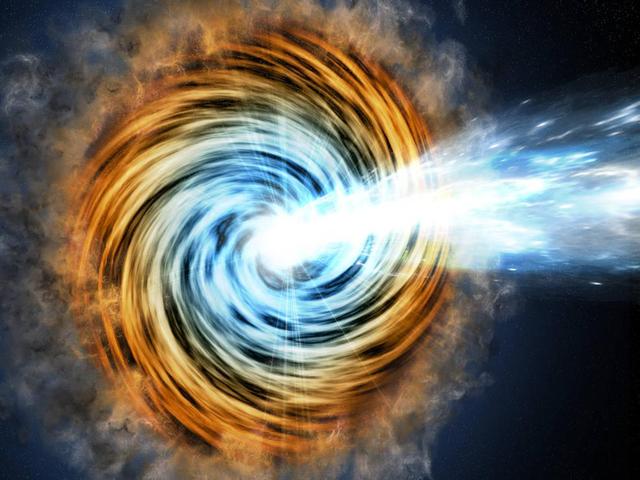
Black-hole-powered galaxies called blazars are the most common sources detected by NASA's Fermi Gamma-ray Space Telescope. As matter falls toward the supermassive black hole at the galaxy's center, some of it is accelerated outward at nearly the speed of light along jets pointed in opposite directions. When one of the jets happens to be aimed in the direction of Earth, as illustrated here, the galaxy appears especially bright and is classified as a blazar. http://photojournal.jpl.nasa.gov/catalog/PIA20912

This image from NASA WISE spacecraft shows a blazar, a voracious supermassive black hole inside a galaxy with a jet that happens to be pointed right toward Earth. Active black holes are often found at the hearts of elliptical galaxies.

Blazar 3C 279's historic gamma-ray flare can be seen in this image from the Large Area Telescope (LAT) on NASA's Fermi satellite. Gamma rays with energies from 100 million to 100 billion electron volts (eV) are shown; for comparison, visible light has energies between 2 and 3 eV. The image spans 150 degrees, is shown in a stereographic projection, and represents an exposure from June 11 at 00:28 UT to June 17 at 08:17 UT. Credit: NASA/DOE/Fermi LAT Collaboration

This visualization shows gamma rays detected during 3C 279's big flare by the LAT instrument on NASA's Fermi satellite. Gamma rays are represented as expanding circles reminiscent of raindrops on water. The flare is an abrupt shower of "rain" that trails off toward the end of the movie. Both the maximum size of the circle and its color represent the energy of the gamma ray, with white lowest and magenta highest. In a second version of the visualization, a background map shows how the LAT detects 3C 279 and other sources by accumulating high-energy photons over time (brighter squares reflect higher numbers of gamma rays). The movie starts on June 14 and ends June 17. The area shown is a region of the sky five degrees on a side and centered on the position of 3C 279. Read more: <a href="http://go.nasa.gov/1TqximF" rel="nofollow">go.nasa.gov/1TqximF</a> Credits: NASA/DOE/Fermi LAT Collaboration