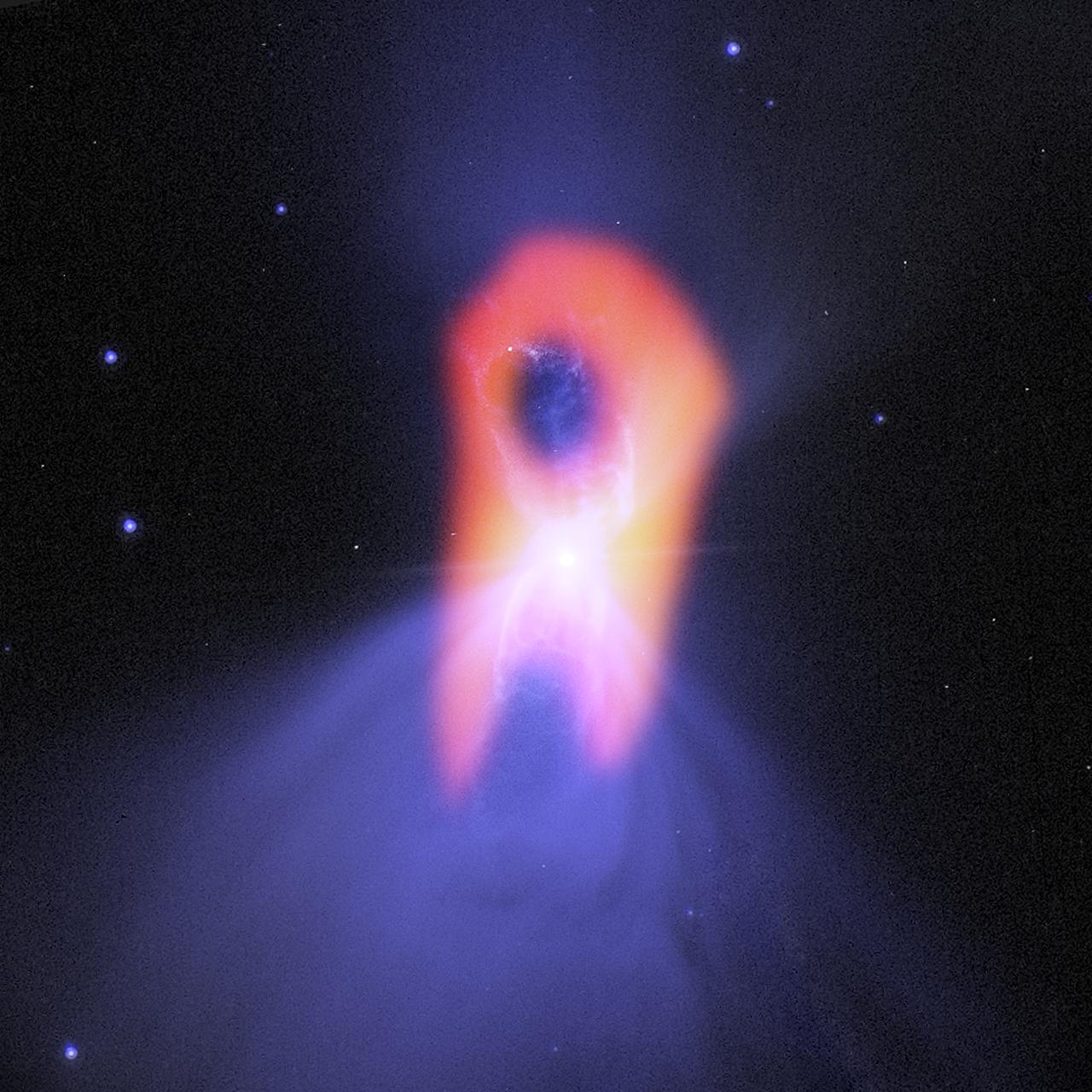
The Boomerang nebula, called the "coldest place in the universe," reveals its true shape to the Atacama Large Millimeter/submillimeter Array (ALMA) telescope. The background blue structure, as seen in visible light by NASA's Hubble Space Telescope, shows a classic double-lobe shape with a very narrow central region. ALMA’s resolution and ability to see the cold gas molecules reveals the nebula’s more elongated shape, as seen in red. Image credit: NRAO/AUI/NSF/NASA/STScI/JPL-Caltech Read more about this image from NASA's Jet Propulsion Laboratory (JPL) here: <a href="http://1.usa.gov/17o22Rz" rel="nofollow">1.usa.gov/17o22Rz</a> <b><a href="http://www.nasa.gov/audience/formedia/features/MP_Photo_Guidelines.html" rel="nofollow">NASA image use policy.</a></b> <b><a href="http://www.nasa.gov/centers/goddard/home/index.html" rel="nofollow">NASA Goddard Space Flight Center</a></b> enables NASA’s mission through four scientific endeavors: Earth Science, Heliophysics, Solar System Exploration, and Astrophysics. Goddard plays a leading role in NASA’s accomplishments by contributing compelling scientific knowledge to advance the Agency’s mission. <b>Follow us on <a href="http://twitter.com/NASA_GoddardPix" rel="nofollow">Twitter</a></b> <b>Like us on <a href="http://www.facebook.com/pages/Greenbelt-MD/NASA-Goddard/395013845897?ref=tsd" rel="nofollow">Facebook</a></b> <b>Find us on <a href="http://instagram.com/nasagoddard?vm=grid" rel="nofollow">Instagram</a></b>