
Technicians with Exploration Ground Systems perform inspections of the Northrop Grumman-manufactured two aft exit cones on Wednesday, Dec. 13, 2023, inside the Rotation, Processing and Surge Facility (RPSF) at NASA’s Kennedy Space Center in Florida before mating processes begin for the agency’s Artemis II mission. The aft exit cones are attached to the bottom piece of the two boosters, (seen here in these photos), which is called the aft segment, and the exit cones act like a battery pack to provide added thrust for the boosters while protecting the aft skirts from thermal environment during launch of the agency’s first crewed mission under Artemis that will test all of the Orion spacecraft systems.
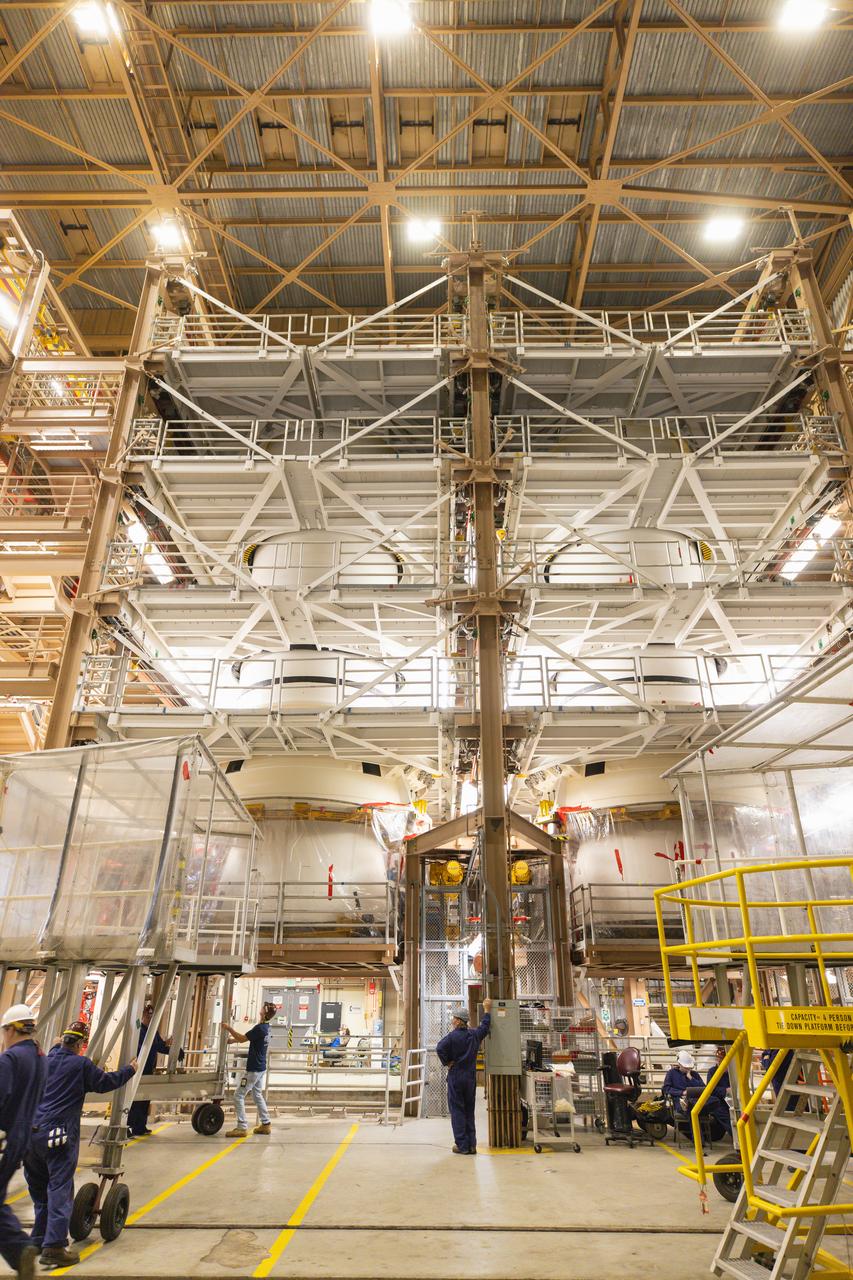
Technicians with Exploration Ground Systems perform inspections of the Northrop Grumman-manufactured two aft exit cones on Wednesday, Dec. 13, 2023, inside the Rotation, Processing and Surge Facility (RPSF) at NASA’s Kennedy Space Center in Florida before mating processes begin for the agency’s Artemis II mission. The aft exit cones are attached to the bottom piece of the two boosters, (seen here in these photos), which is called the aft segment, and the exit cones act like a battery pack to provide added thrust for the boosters while protecting the aft skirts from thermal environment during launch of the agency’s first crewed mission under Artemis that will test all of the Orion spacecraft systems.
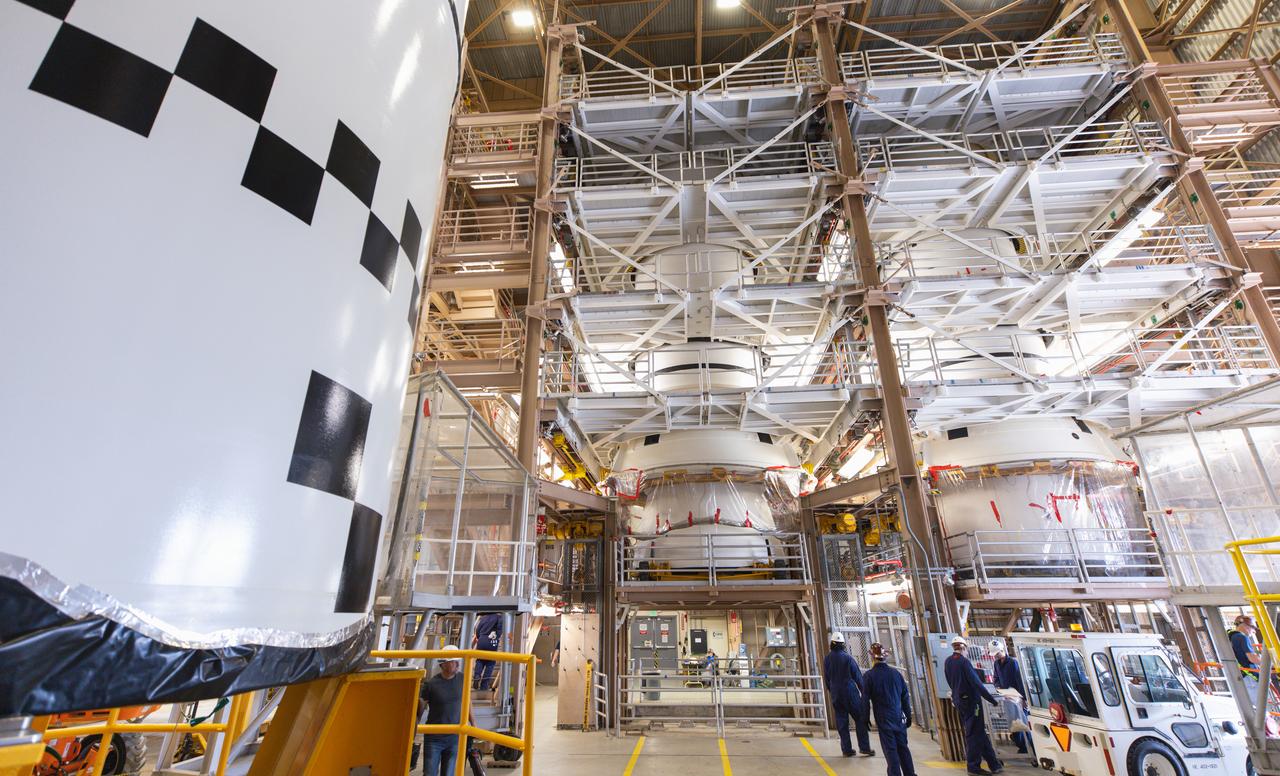
Technicians with Exploration Ground Systems perform inspections of the Northrop Grumman-manufactured two aft exit cones on Wednesday, Dec. 13, 2023, inside the Rotation, Processing and Surge Facility (RPSF) at NASA’s Kennedy Space Center in Florida before mating processes begin for the agency’s Artemis II mission. The aft exit cones are attached to the bottom piece of the two boosters, (seen here in these photos), which is called the aft segment, and the exit cones act like a battery pack to provide added thrust for the boosters while protecting the aft skirts from thermal environment during launch of the agency’s first crewed mission under Artemis that will test all of the Orion spacecraft systems.
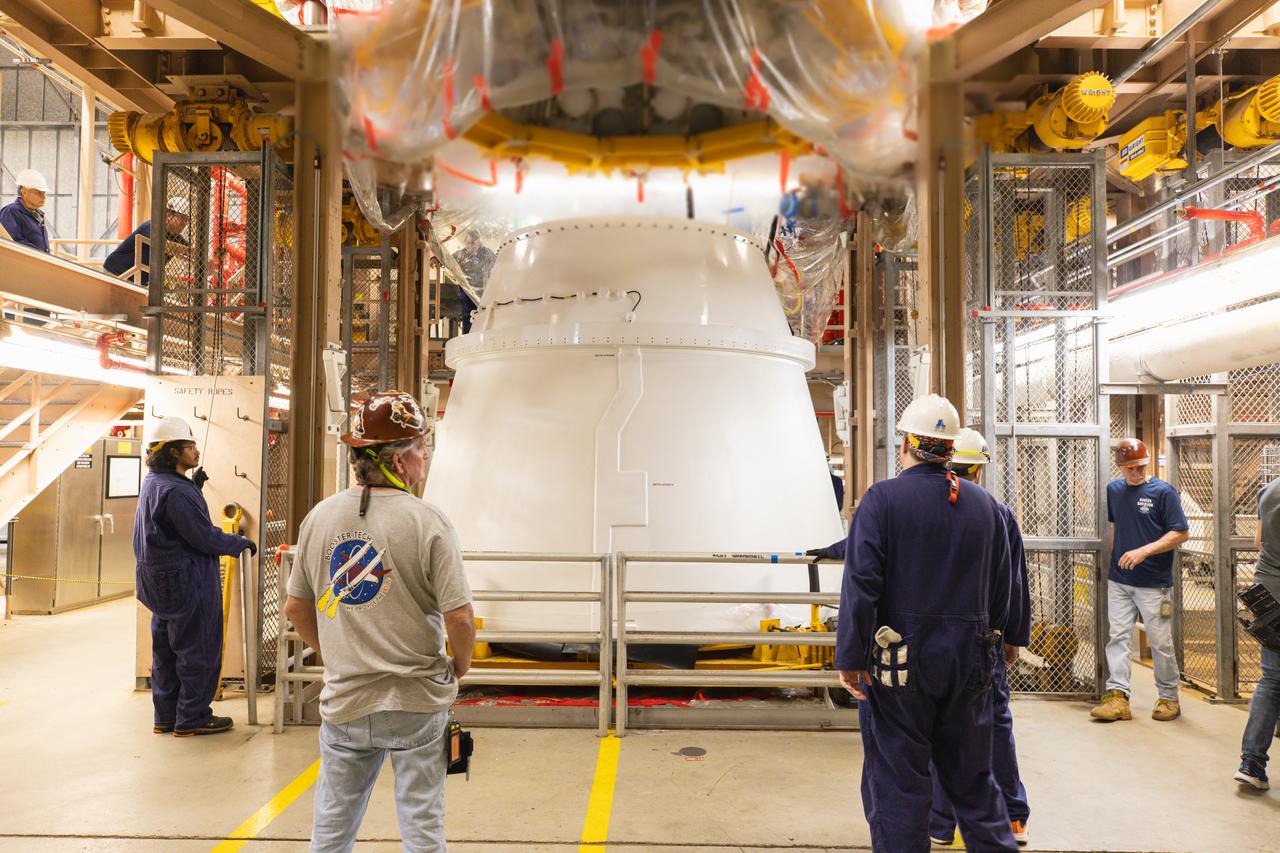
Technicians with Exploration Ground Systems perform pre-mate inspections of the Northrop Grumman-manufactured right aft exit cone of the Artemis II Space Launch Systems solid rocket boosters on Wednesday, Dec. 13, 2023, inside the Rotation, Processing and Surge Facility (RPSF) at NASA’s Kennedy Space Center in Florida. Each of the two aft exit cones will be prepared for the agency’s Artemis II flight and attach to the aft segments of the Space Launch Systems solid rocket boosters. The exit cones act like a battery pack to provide added thrust for the boosters while protecting the aft skirts from thermal environment during launch.
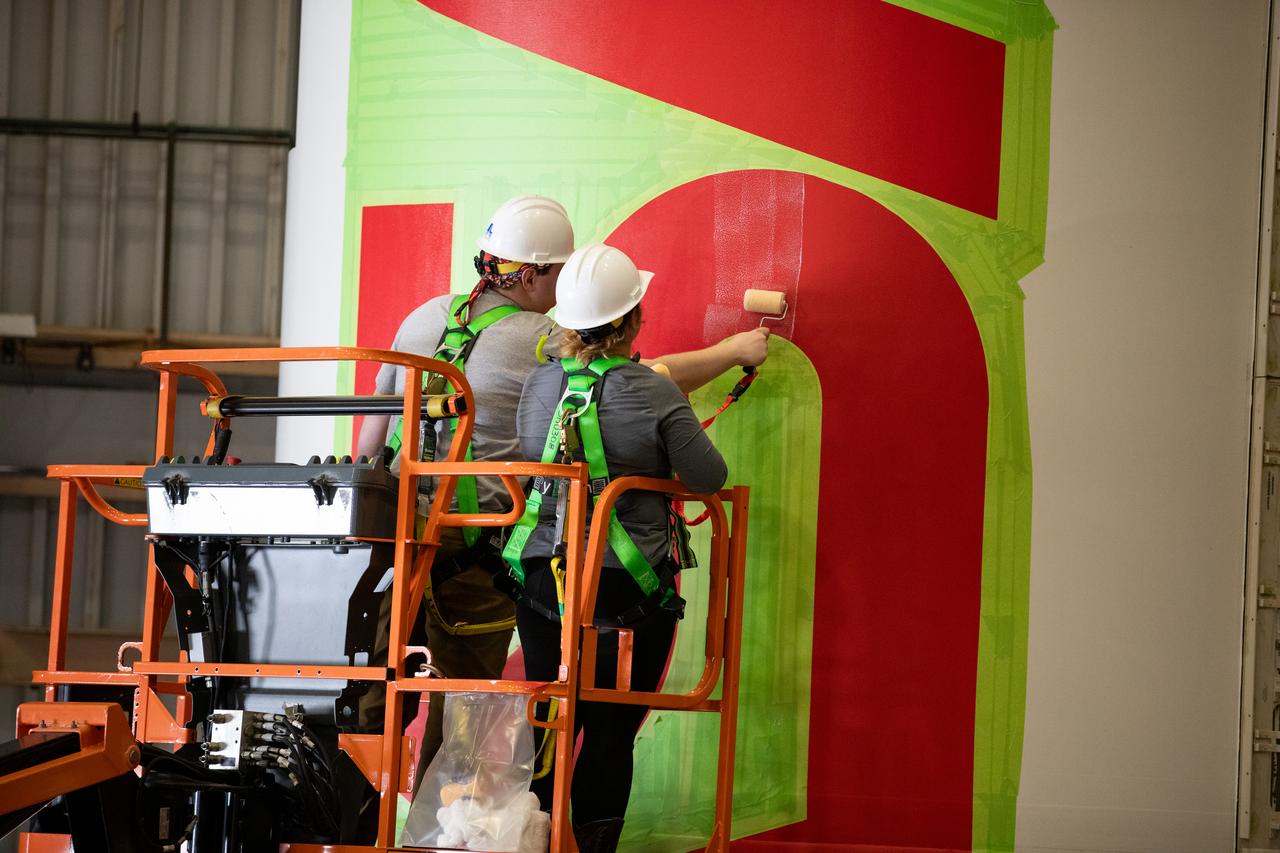
Workers with NASA’s Exploration Ground Systems (EGS) paint the bright red NASA “worm” logo on the side of an Artemis II solid rocket booster segment inside the Rotation, Processing and Surge Facility (RPSF) at Kennedy Space Center in Florida on Tuesday, Jan. 30, 2024. The EGS team used a laser projector to mask off the logo with tape, then painted the first coat of the iconic design. The booster segments will help propel the Space Launch System (SLS) rocket on the Artemis II mission to send four astronauts around the Moon as part of the agency’s effort to establish a long-term science and exploration presence at the Moon, and eventually Mars.
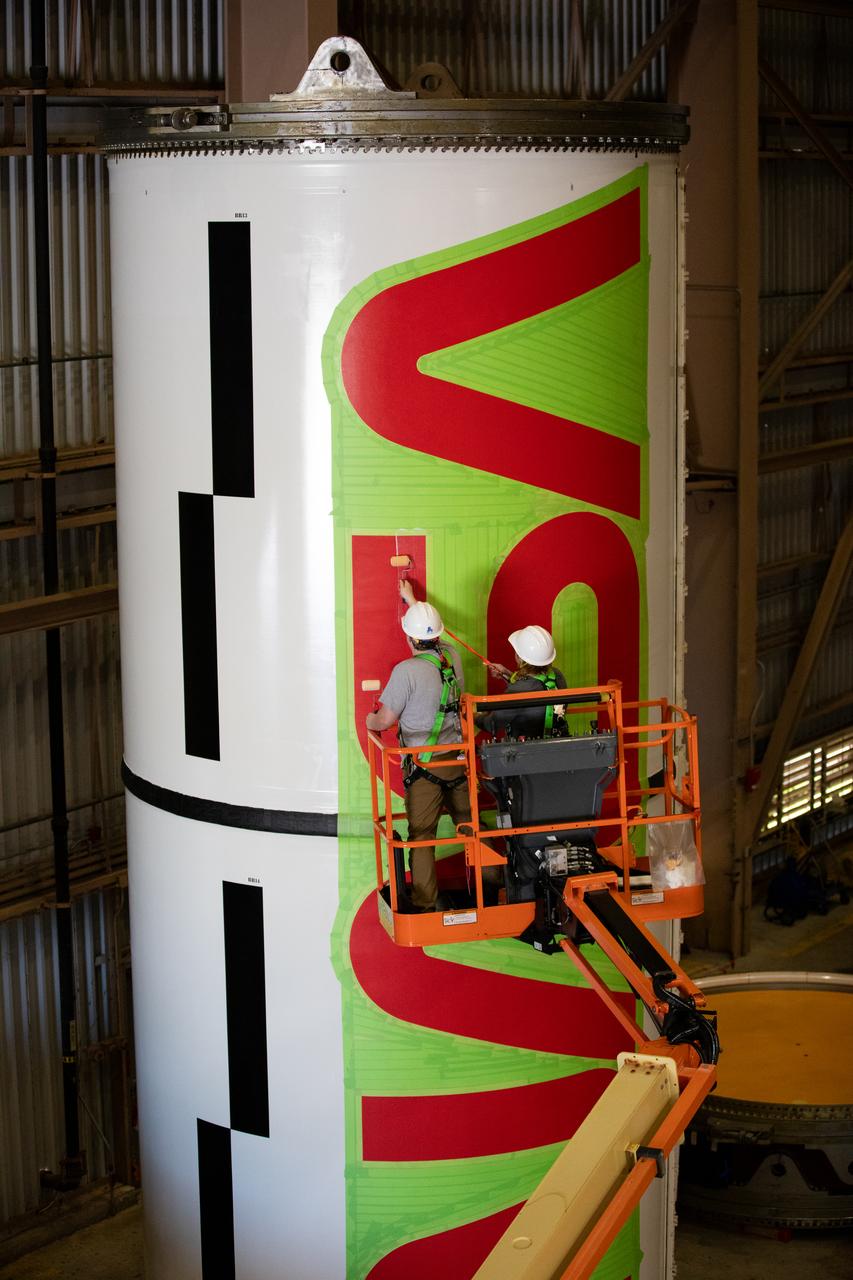
Workers with NASA’s Exploration Ground Systems (EGS) paint the bright red NASA “worm” logo on the side of an Artemis II solid rocket booster segment inside the Rotation, Processing and Surge Facility (RPSF) at Kennedy Space Center in Florida on Tuesday, Jan. 30, 2024. The EGS team used a laser projector to mask off the logo with tape, then painted the first coat of the iconic design. The booster segments will help propel the Space Launch System (SLS) rocket on the Artemis II mission to send four astronauts around the Moon as part of the agency’s effort to establish a long-term science and exploration presence at the Moon, and eventually Mars.
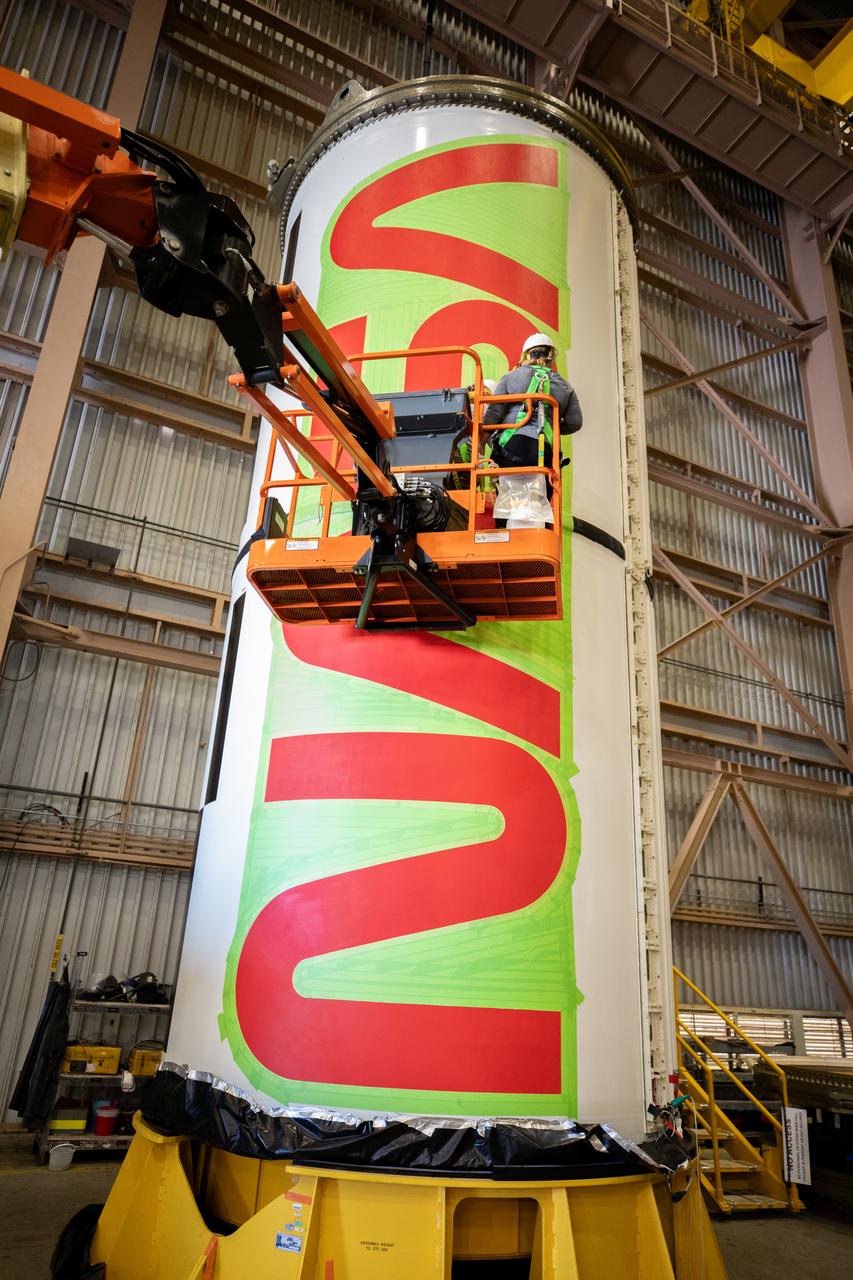
Workers with NASA’s Exploration Ground Systems (EGS) paint the bright red NASA “worm” logo on the side of an Artemis II solid rocket booster segment inside the Rotation, Processing and Surge Facility (RPSF) at Kennedy Space Center in Florida on Tuesday, Jan. 30, 2024. The EGS team used a laser projector to mask off the logo with tape, then painted the first coat of the iconic design. The booster segments will help propel the Space Launch System (SLS) rocket on the Artemis II mission to send four astronauts around the Moon as part of the agency’s effort to establish a long-term science and exploration presence at the Moon, and eventually Mars.
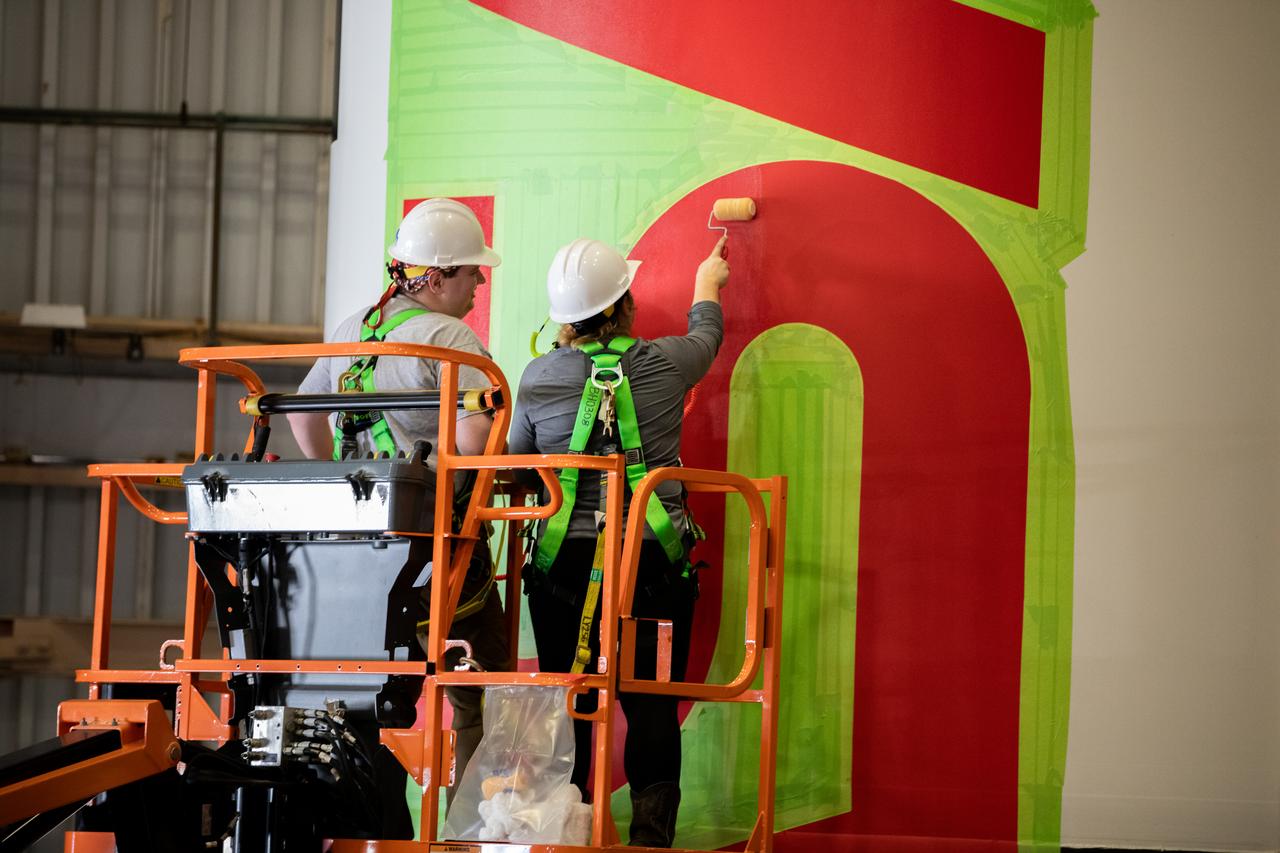
Workers with NASA’s Exploration Ground Systems (EGS) paint the bright red NASA “worm” logo on the side of an Artemis II solid rocket booster segment inside the Rotation, Processing and Surge Facility (RPSF) at Kennedy Space Center in Florida on Tuesday, Jan. 30, 2024. The EGS team used a laser projector to mask off the logo with tape, then painted the first coat of the iconic design. The booster segments will help propel the Space Launch System (SLS) rocket on the Artemis II mission to send four astronauts around the Moon as part of the agency’s effort to establish a long-term science and exploration presence at the Moon, and eventually Mars.
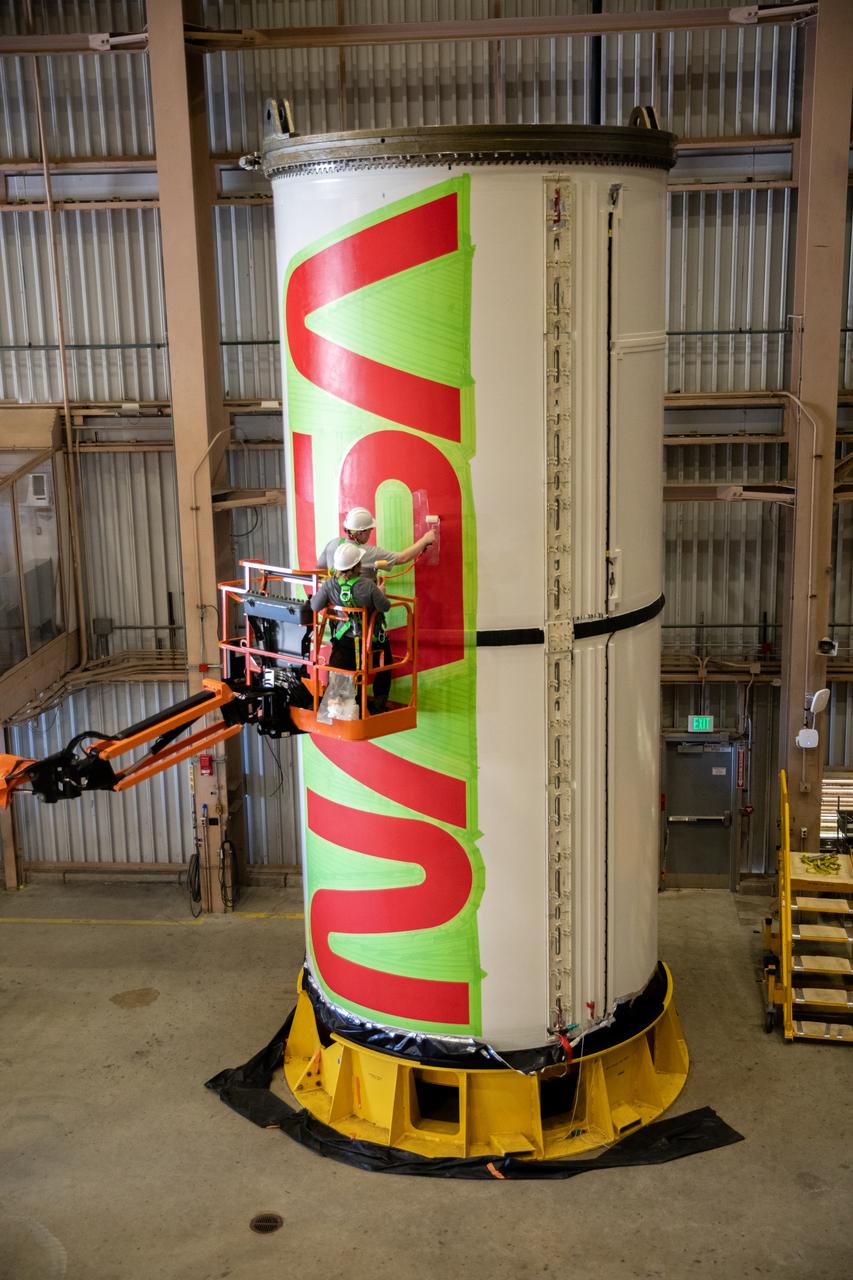
Workers with NASA’s Exploration Ground Systems (EGS) paint the bright red NASA “worm” logo on the side of an Artemis II solid rocket booster segment inside the Rotation, Processing and Surge Facility (RPSF) at Kennedy Space Center in Florida on Tuesday, Jan. 30, 2024. The EGS team used a laser projector to mask off the logo with tape, then painted the first coat of the iconic design. The booster segments will help propel the Space Launch System (SLS) rocket on the Artemis II mission to send four astronauts around the Moon as part of the agency’s effort to establish a long-term science and exploration presence at the Moon, and eventually Mars.
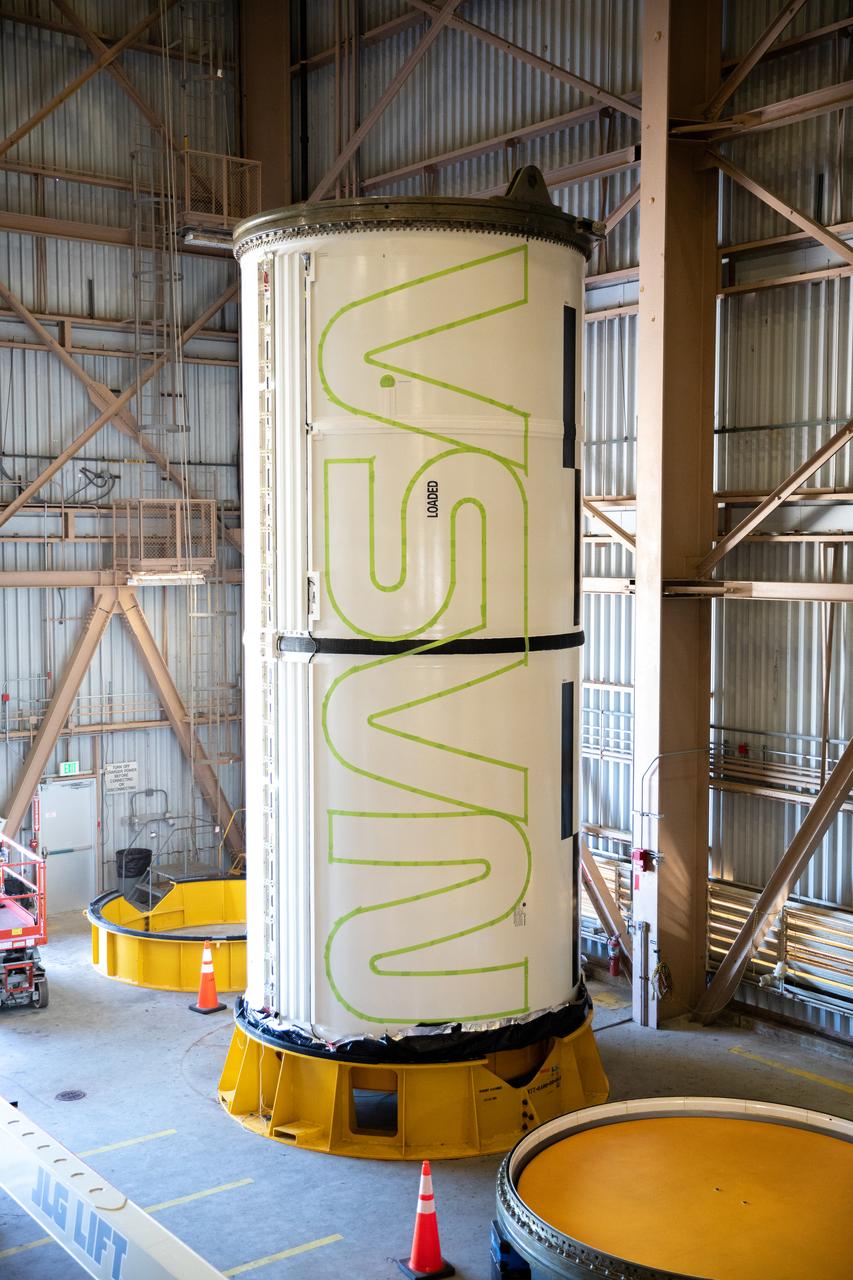
Workers with NASA’s Exploration Ground Systems (EGS) paint the bright red NASA “worm” logo on the side of an Artemis II solid rocket booster segment inside the Rotation, Processing and Surge Facility (RPSF) at Kennedy Space Center in Florida on Tuesday, Jan. 30, 2024. The EGS team used a laser projector to mask off the logo with tape, then painted the first coat of the iconic design. The booster segments will help propel the Space Launch System (SLS) rocket on the Artemis II mission to send four astronauts around the Moon as part of the agency’s effort to establish a long-term science and exploration presence at the Moon, and eventually Mars.
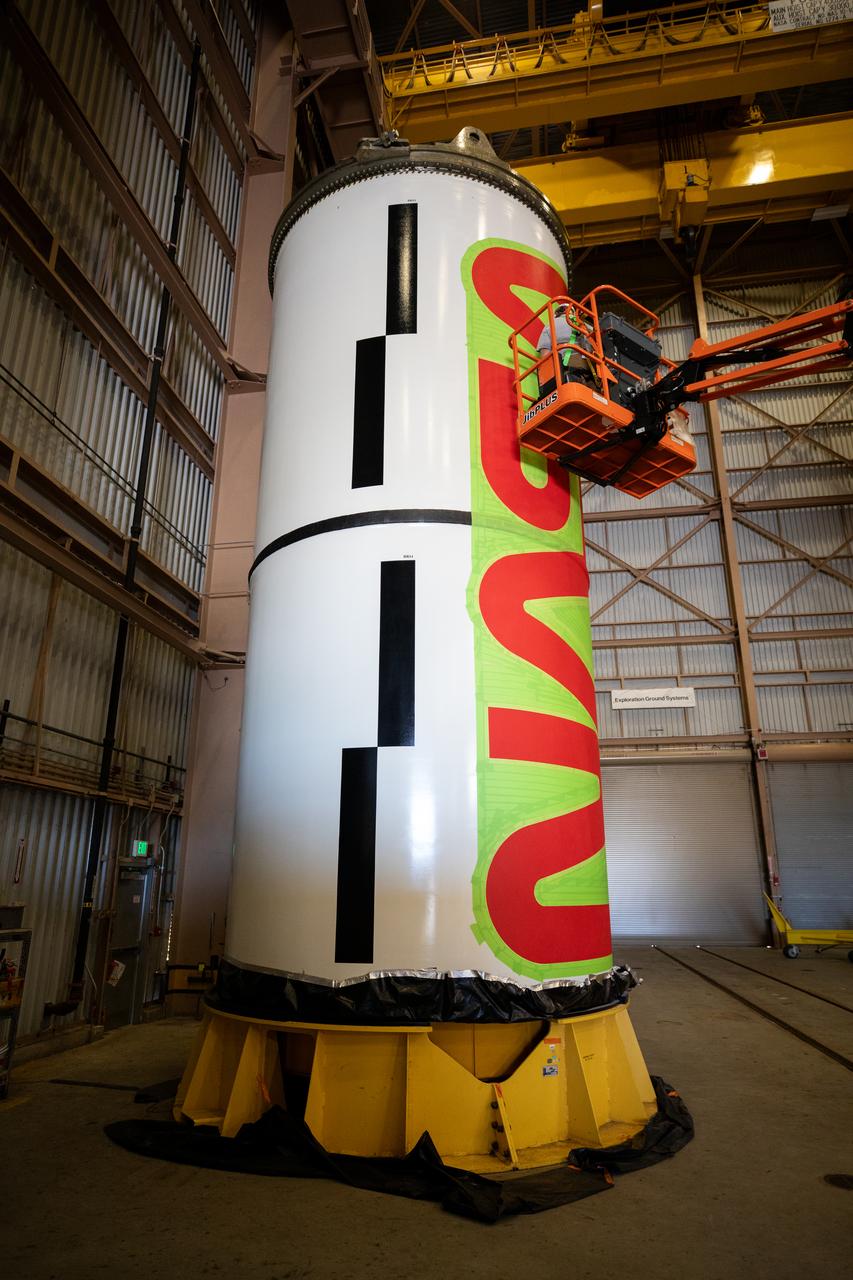
Workers with NASA’s Exploration Ground Systems (EGS) paint the bright red NASA “worm” logo on the side of an Artemis II solid rocket booster segment inside the Rotation, Processing and Surge Facility (RPSF) at Kennedy Space Center in Florida on Tuesday, Jan. 30, 2024. The EGS team used a laser projector to mask off the logo with tape, then painted the first coat of the iconic design. The booster segments will help propel the Space Launch System (SLS) rocket on the Artemis II mission to send four astronauts around the Moon as part of the agency’s effort to establish a long-term science and exploration presence at the Moon, and eventually Mars.
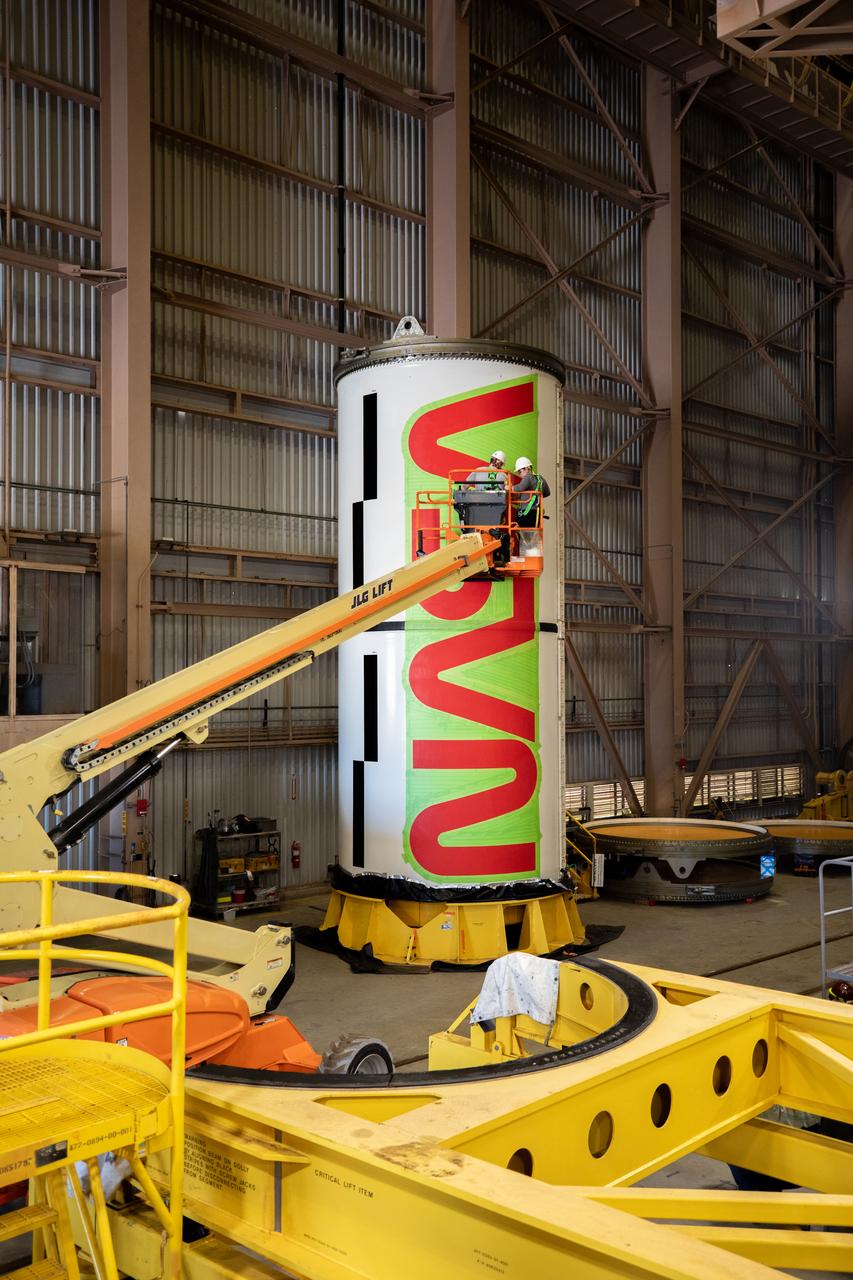
Workers with NASA’s Exploration Ground Systems (EGS) paint the bright red NASA “worm” logo on the side of an Artemis II solid rocket booster segment inside the Rotation, Processing and Surge Facility (RPSF) at Kennedy Space Center in Florida on Tuesday, Jan. 30, 2024. The EGS team used a laser projector to mask off the logo with tape, then painted the first coat of the iconic design. The booster segments will help propel the Space Launch System (SLS) rocket on the Artemis II mission to send four astronauts around the Moon as part of the agency’s effort to establish a long-term science and exploration presence at the Moon, and eventually Mars.
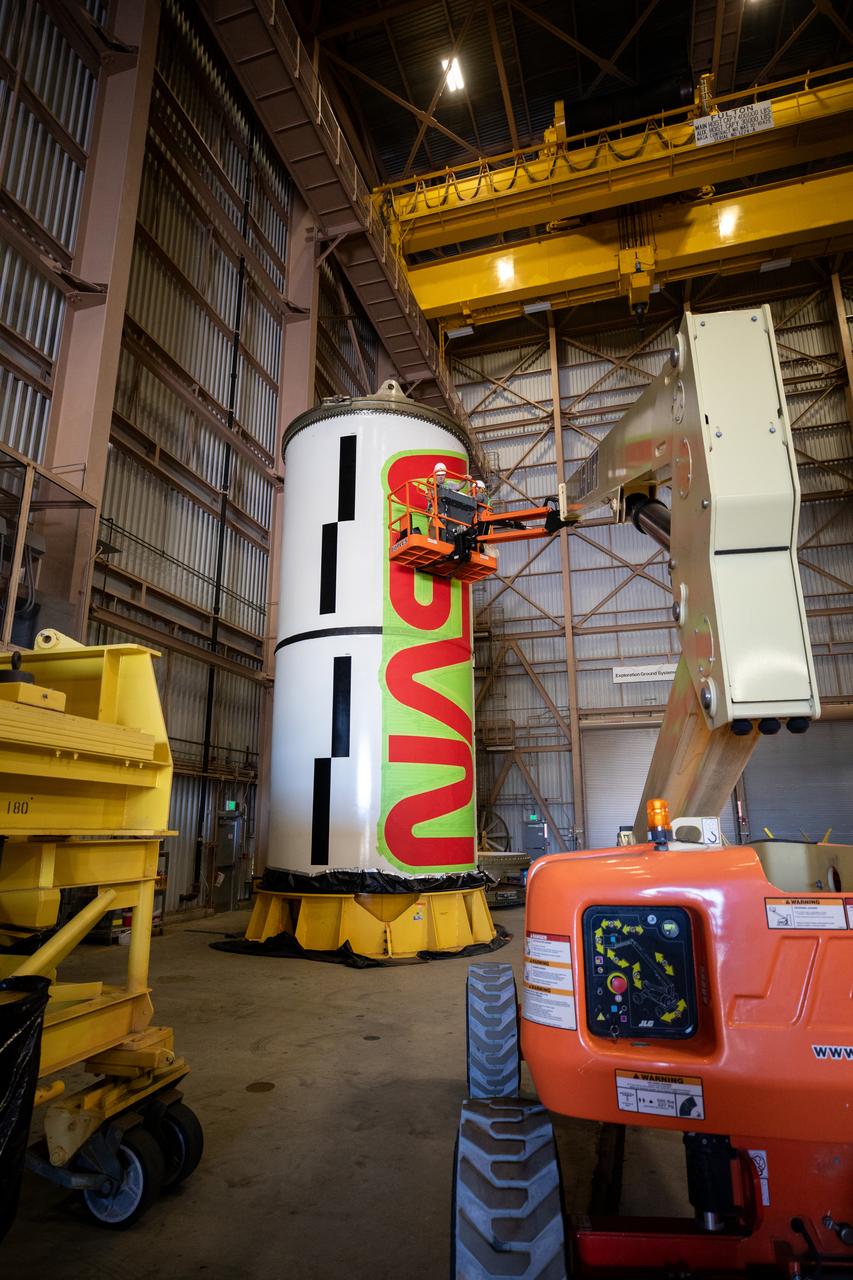
Workers with NASA’s Exploration Ground Systems (EGS) paint the bright red NASA “worm” logo on the side of an Artemis II solid rocket booster segment inside the Rotation, Processing and Surge Facility (RPSF) at Kennedy Space Center in Florida on Tuesday, Jan. 30, 2024. The EGS team used a laser projector to mask off the logo with tape, then painted the first coat of the iconic design. The booster segments will help propel the Space Launch System (SLS) rocket on the Artemis II mission to send four astronauts around the Moon as part of the agency’s effort to establish a long-term science and exploration presence at the Moon, and eventually Mars.
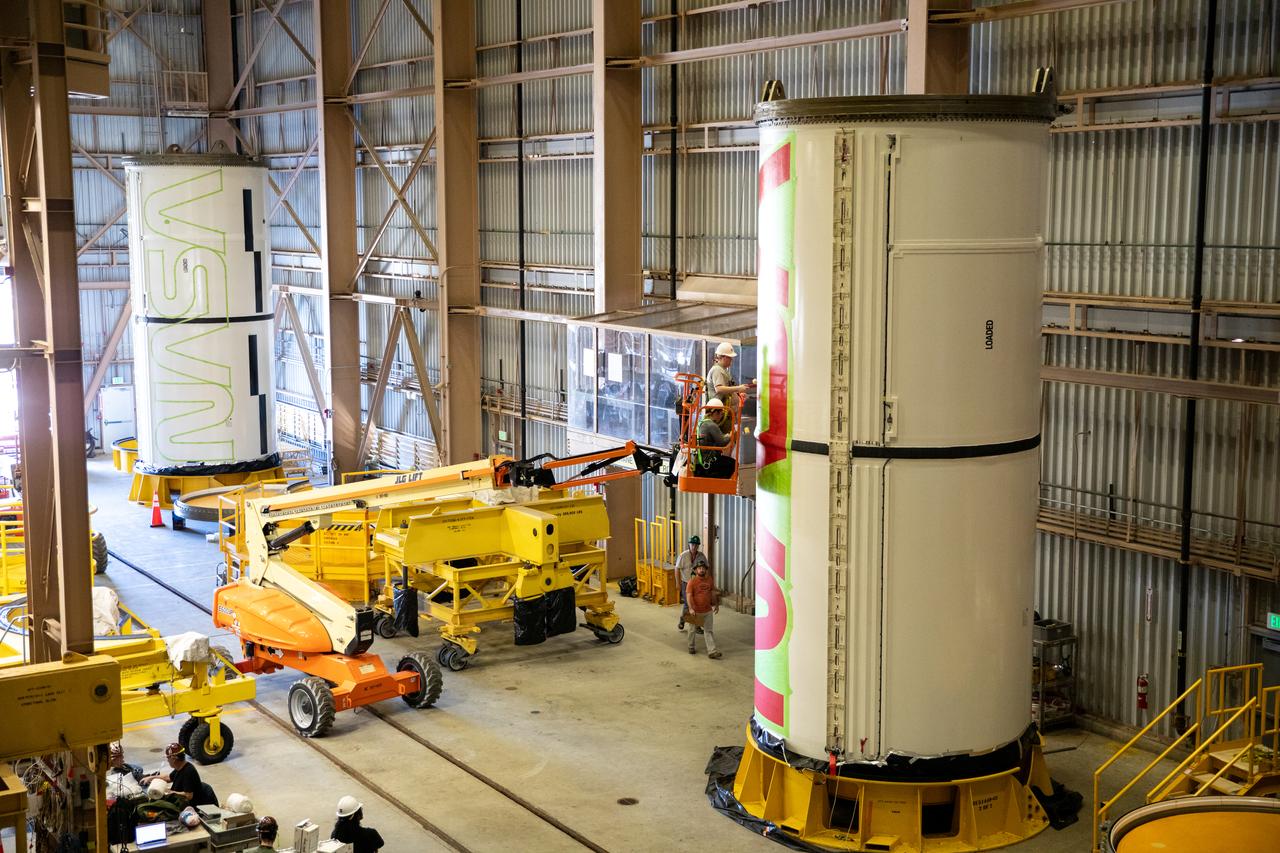
Workers with NASA’s Exploration Ground Systems (EGS) paint the bright red NASA “worm” logo on the side of an Artemis II solid rocket booster segment inside the Rotation, Processing and Surge Facility (RPSF) at Kennedy Space Center in Florida on Tuesday, Jan. 30, 2024. The EGS team used a laser projector to mask off the logo with tape, then painted the first coat of the iconic design. The booster segments will help propel the Space Launch System (SLS) rocket on the Artemis II mission to send four astronauts around the Moon as part of the agency’s effort to establish a long-term science and exploration presence at the Moon, and eventually Mars.

Workers with NASA’s Exploration Ground Systems and primary contractor, Jacobs, complete the painting of the agency’s iconic “worm” logo along the side of the twin Artemis II solid rocket booster motor segments inside the Rotation, Processing and Surge Facility at Kennedy Space Center in Florida on Friday, Feb. 16, 2024. Using a laser projector, the logo was mapped out with tape by workers with Jacobs, for the spaceport, before using two coats of red paint, plus several coats of clear primer to complete the logo that stretches 25 feet long. The booster segments will help propel the SLS (Space Launch System) rocket on the Artemis II mission to send four astronauts around the Moon as part of the agency’s effort to establish a long-term science and exploration presence at the Moon, and eventually Mars.
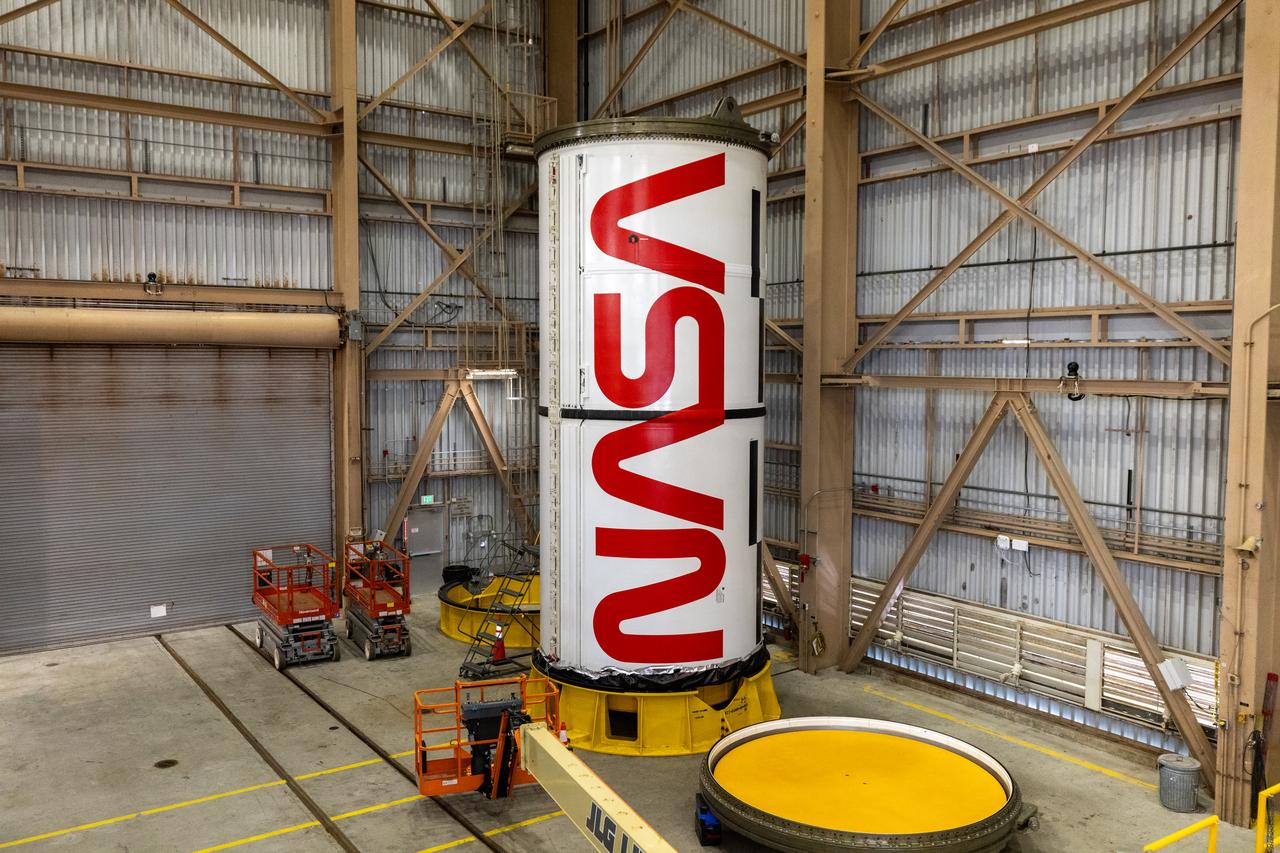
Workers with NASA’s Exploration Ground Systems and primary contractor, Jacobs, complete the painting of the agency’s iconic “worm” logo along the side of the twin Artemis II solid rocket booster motor segments inside the Rotation, Processing and Surge Facility at Kennedy Space Center in Florida on Friday, Feb. 16, 2024. Using a laser projector, the logo was mapped out with tape by workers with Jacobs, for the spaceport, before using two coats of red paint, plus several coats of clear primer to complete the logo that stretches 25 feet long. The booster segments will help propel the SLS (Space Launch System) rocket on the Artemis II mission to send four astronauts around the Moon as part of the agency’s effort to establish a long-term science and exploration presence at the Moon, and eventually Mars.
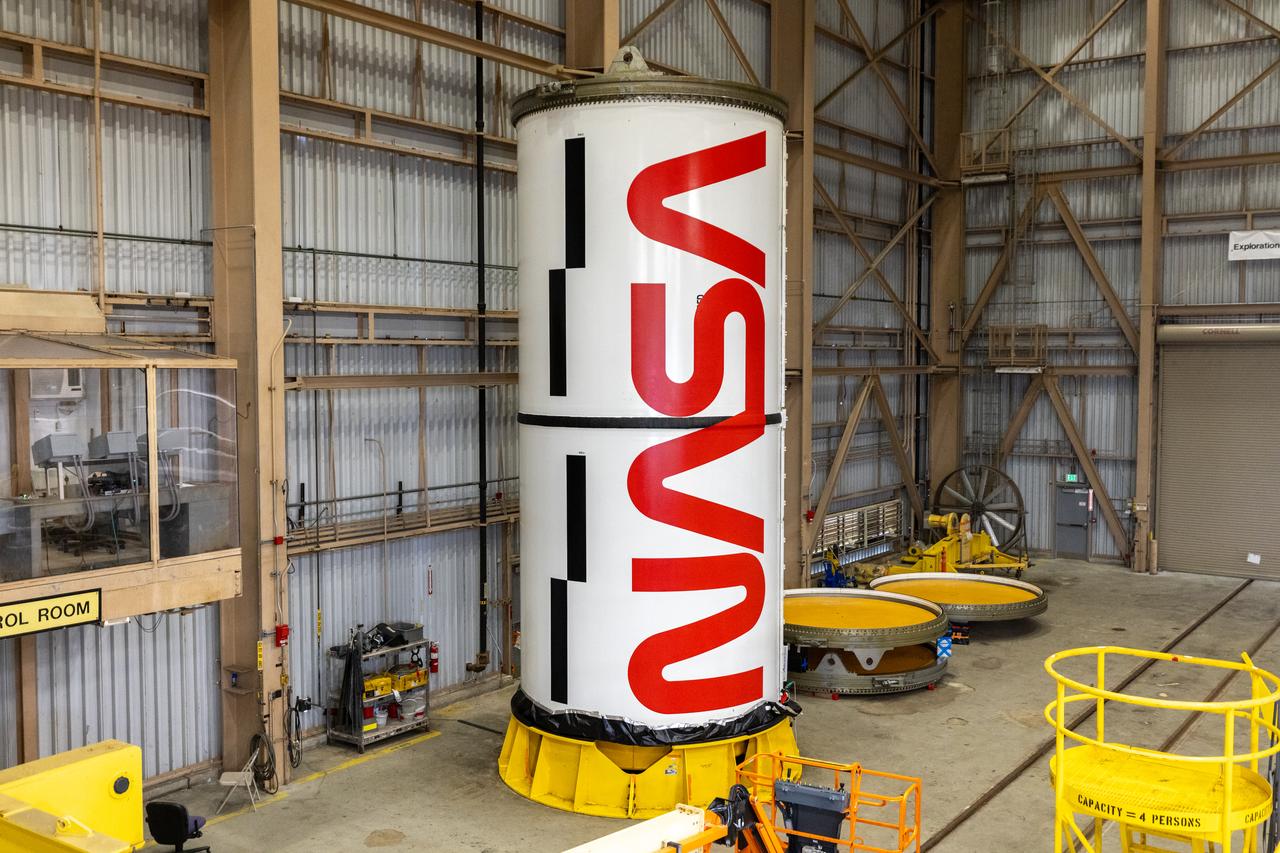
Workers with NASA’s Exploration Ground Systems and primary contractor, Jacobs, complete the painting of the agency’s iconic “worm” logo along the side of the twin Artemis II solid rocket booster motor segments inside the Rotation, Processing and Surge Facility at Kennedy Space Center in Florida on Friday, Feb. 16, 2024. Using a laser projector, the logo was mapped out with tape by workers with Jacobs, for the spaceport, before using two coats of red paint, plus several coats of clear primer to complete the logo that stretches 25 feet long. The booster segments will help propel the SLS (Space Launch System) rocket on the Artemis II mission to send four astronauts around the Moon as part of the agency’s effort to establish a long-term science and exploration presence at the Moon, and eventually Mars.
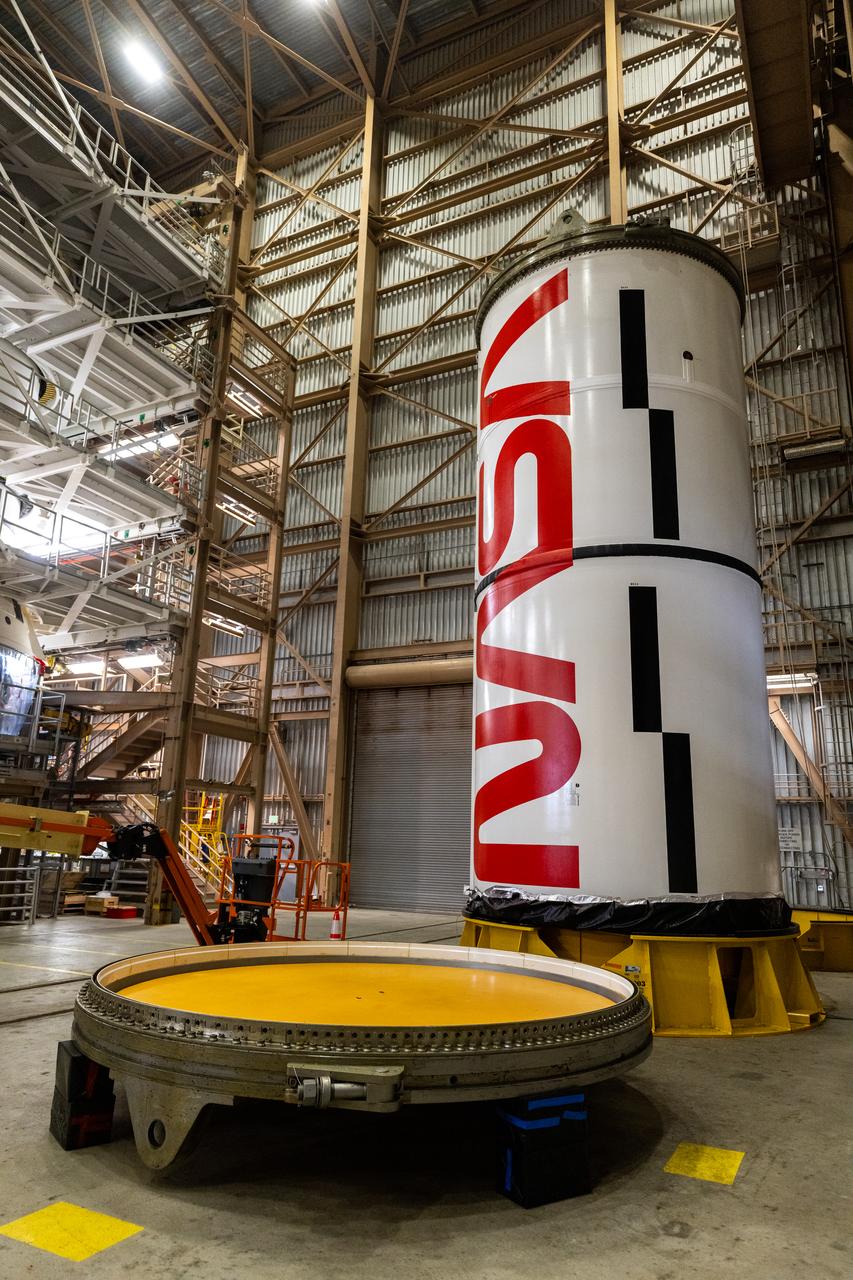
Workers with NASA’s Exploration Ground Systems and primary contractor, Jacobs, complete the painting of the agency’s iconic “worm” logo along the side of the twin Artemis II solid rocket booster motor segments inside the Rotation, Processing and Surge Facility at Kennedy Space Center in Florida on Friday, Feb. 16, 2024. Using a laser projector, the logo was mapped out with tape by workers with Jacobs, for the spaceport, before using two coats of red paint, plus several coats of clear primer to complete the logo that stretches 25 feet long. The booster segments will help propel the SLS (Space Launch System) rocket on the Artemis II mission to send four astronauts around the Moon as part of the agency’s effort to establish a long-term science and exploration presence at the Moon, and eventually Mars.
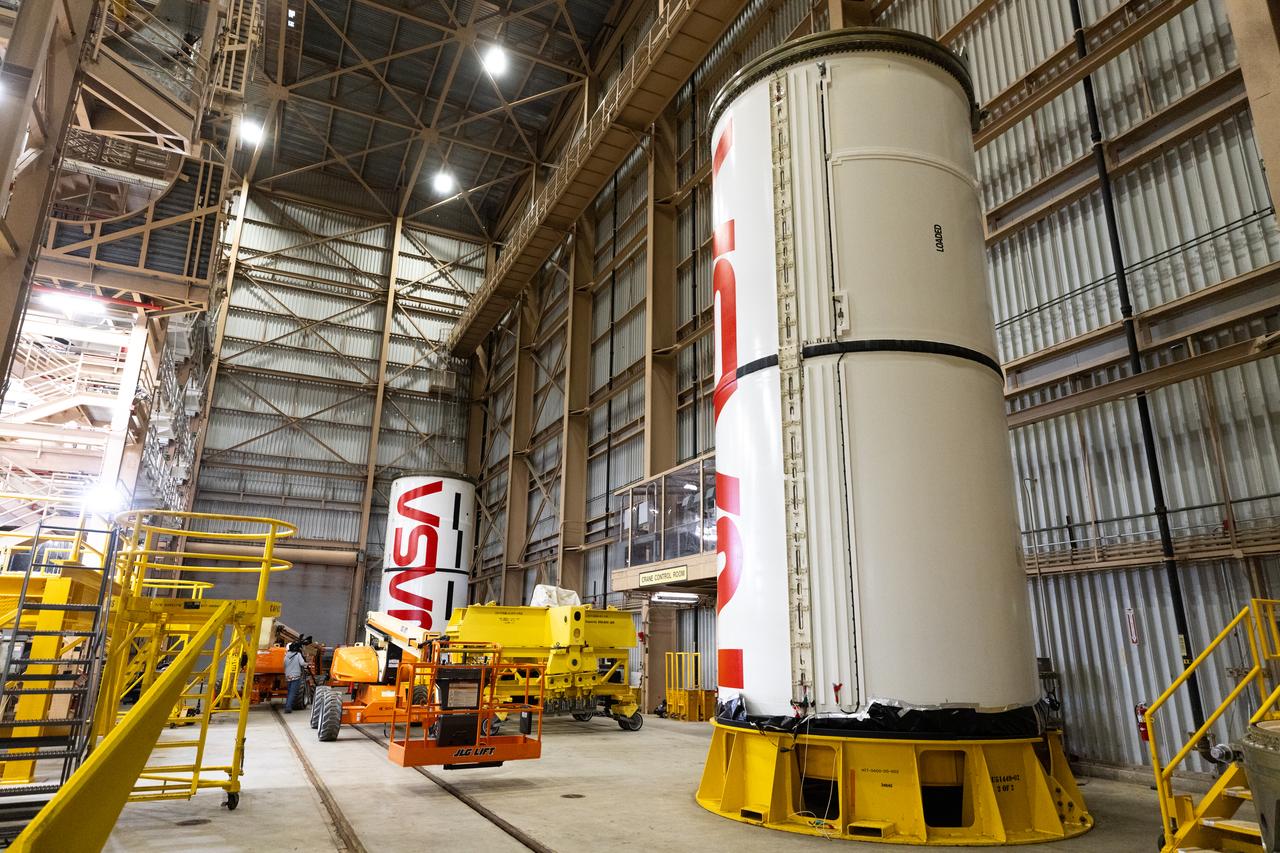
Workers with NASA’s Exploration Ground Systems and primary contractor, Jacobs, complete the painting of the agency’s iconic “worm” logo along the side of the twin Artemis II solid rocket booster motor segments inside the Rotation, Processing and Surge Facility at Kennedy Space Center in Florida on Friday, Feb. 16, 2024. Using a laser projector, the logo was mapped out with tape by workers with Jacobs, for the spaceport, before using two coats of red paint, plus several coats of clear primer to complete the logo that stretches 25 feet long. The booster segments will help propel the SLS (Space Launch System) rocket on the Artemis II mission to send four astronauts around the Moon as part of the agency’s effort to establish a long-term science and exploration presence at the Moon, and eventually Mars.
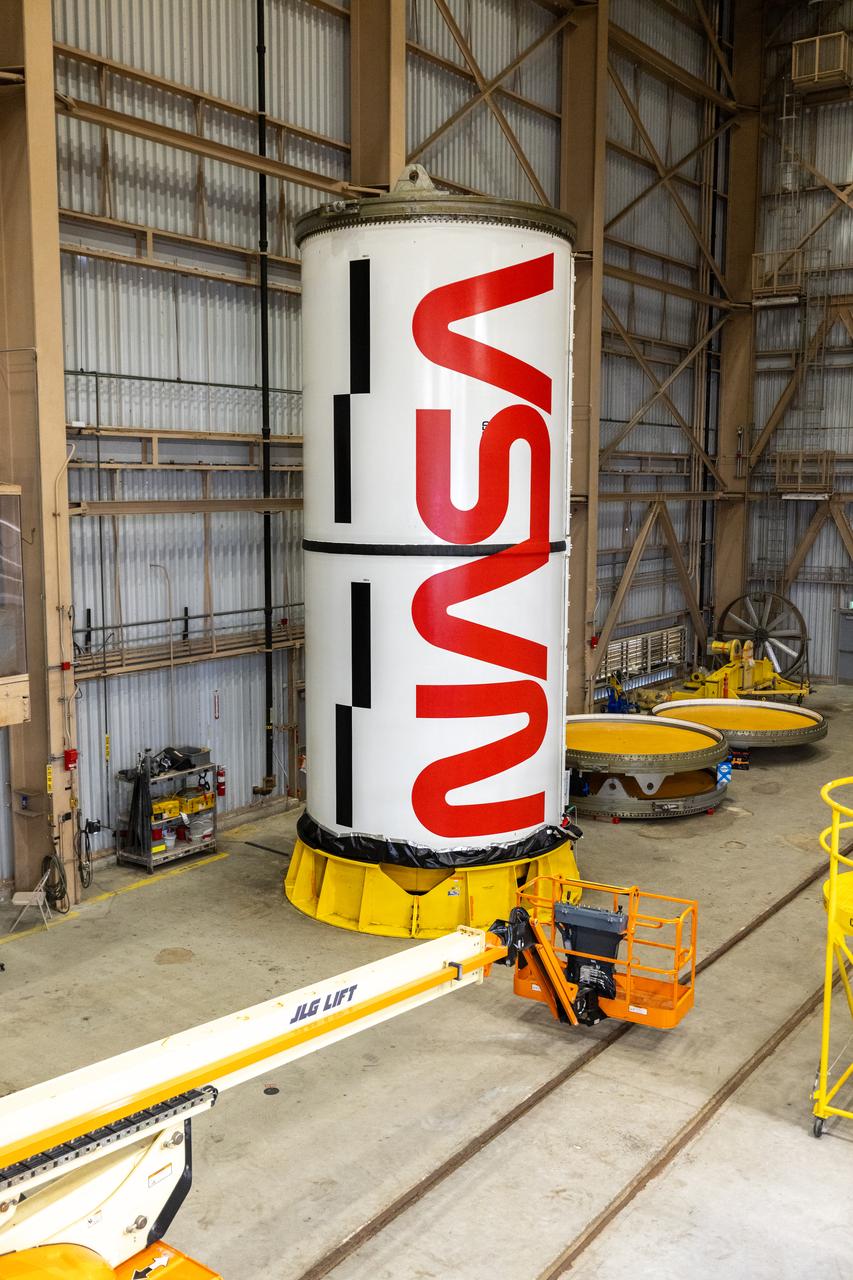
Workers with NASA’s Exploration Ground Systems and primary contractor, Jacobs, complete the painting of the agency’s iconic “worm” logo along the side of the twin Artemis II solid rocket booster motor segments inside the Rotation, Processing and Surge Facility at Kennedy Space Center in Florida on Friday, Feb. 16, 2024. Using a laser projector, the logo was mapped out with tape by workers with Jacobs, for the spaceport, before using two coats of red paint, plus several coats of clear primer to complete the logo that stretches 25 feet long. The booster segments will help propel the SLS (Space Launch System) rocket on the Artemis II mission to send four astronauts around the Moon as part of the agency’s effort to establish a long-term science and exploration presence at the Moon, and eventually Mars.
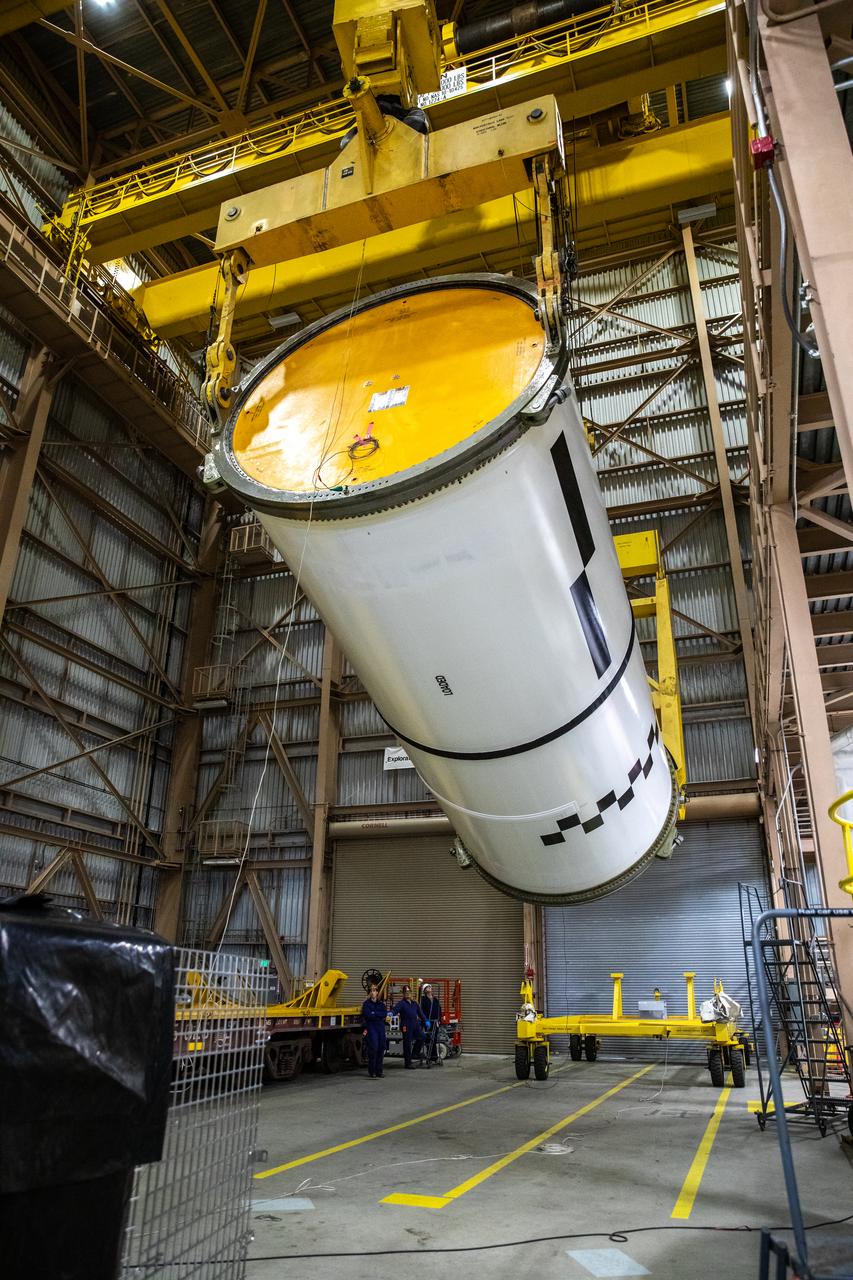
Engineers and technicians process the right forward center segment of the Space Launch System solid rocket boosters for the Artemis II mission inside the Rotation, Processing and Surge Facility (RPSF) at NASA’s Kennedy Space Center in Florida on Tuesday, Nov. 27, 2023. The team has been examining the 10 booster segments one-by-one then lifting them to make sure they are ready for integration and launch before moving them to the Vehicle Assembly Building for stacking atop the mobile launcher. Artemis II astronauts Reid Wiseman, Victor Glover, Christina Koch, and Jeremy Hansen will blast off from Kennedy and travel around the moon for the agency’s first crewed mission under Artemis that will test all of the Orion spacecraft’s systems.
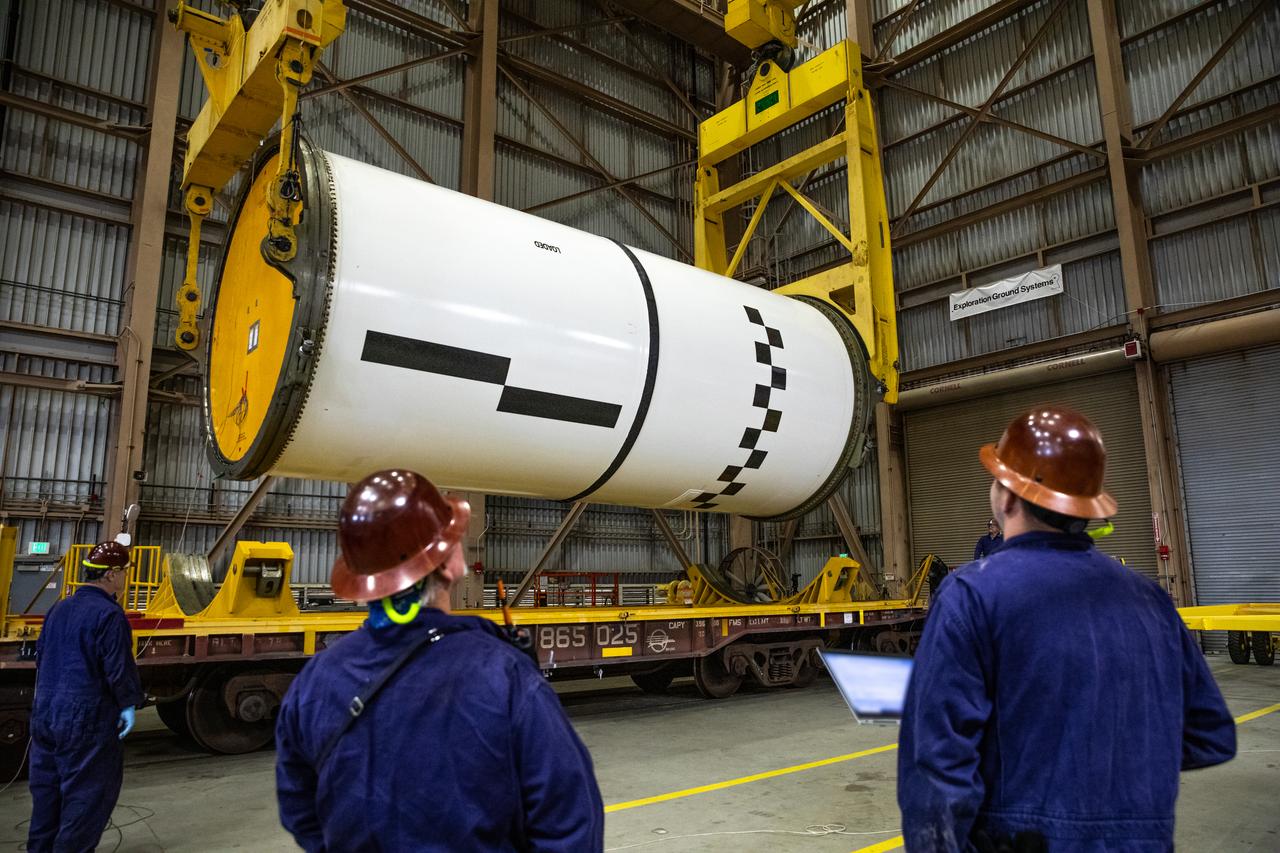
Engineers and technicians process the right forward center segment of the Space Launch System solid rocket boosters for the Artemis II mission inside the Rotation, Processing and Surge Facility (RPSF) at NASA’s Kennedy Space Center in Florida on Tuesday, Nov. 27, 2023. The team has been examining the 10 booster segments one-by-one then lifting them to make sure they are ready for integration and launch before moving them to the Vehicle Assembly Building for stacking atop the mobile launcher. Artemis II astronauts Reid Wiseman, Victor Glover, Christina Koch, and Jeremy Hansen will blast off from Kennedy and travel around the moon for the agency’s first crewed mission under Artemis that will test all of the Orion spacecraft’s systems.
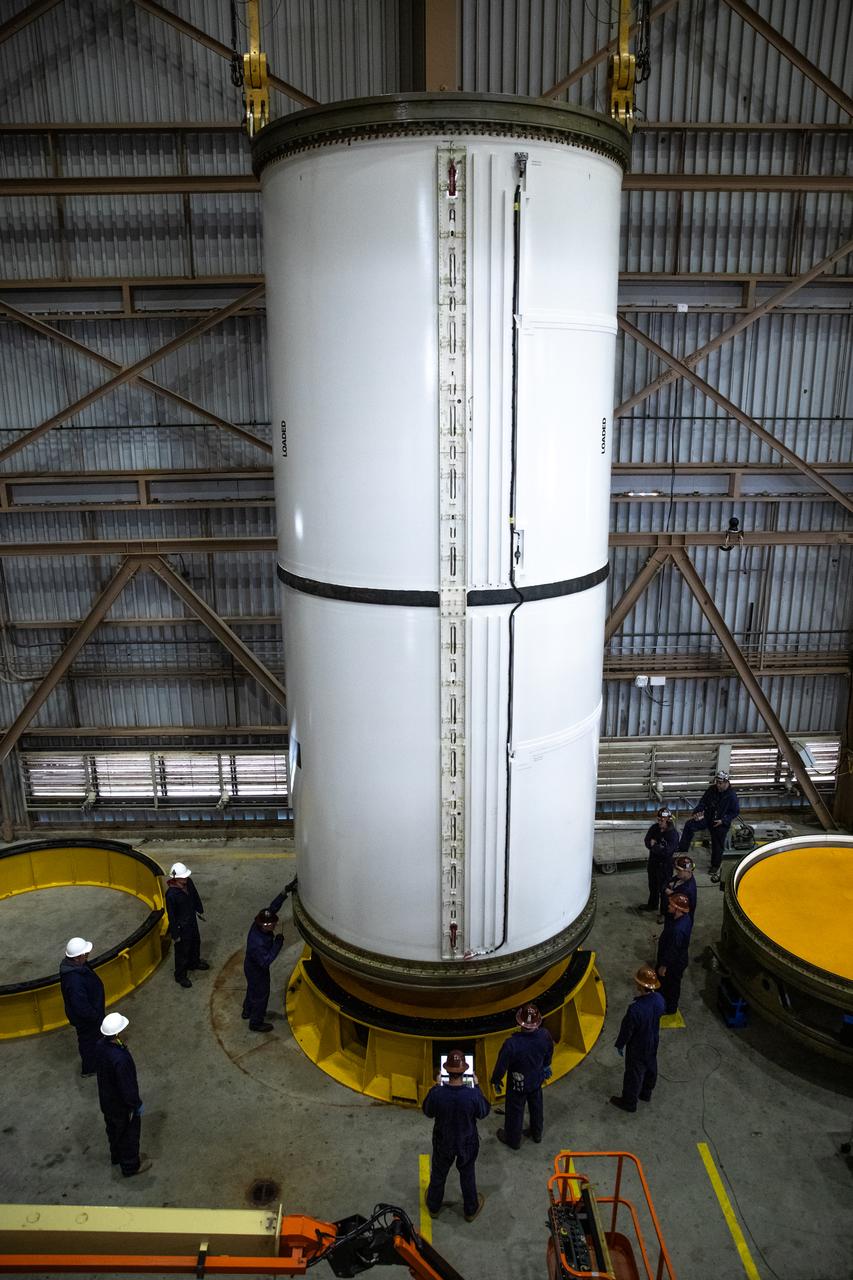
Engineers and technicians process the right forward center segment of the Space Launch System solid rocket boosters for the Artemis II mission inside the Rotation, Processing and Surge Facility (RPSF) at NASA’s Kennedy Space Center in Florida on Tuesday, Nov. 27, 2023. The team has been examining the 10 booster segments one-by-one then lifting them to make sure they are ready for integration and launch before moving them to the Vehicle Assembly Building for stacking atop the mobile launcher. Artemis II astronauts Reid Wiseman, Victor Glover, Christina Koch, and Jeremy Hansen will blast off from Kennedy and travel around the moon for the agency’s first crewed mission under Artemis that will test all of the Orion spacecraft’s systems.
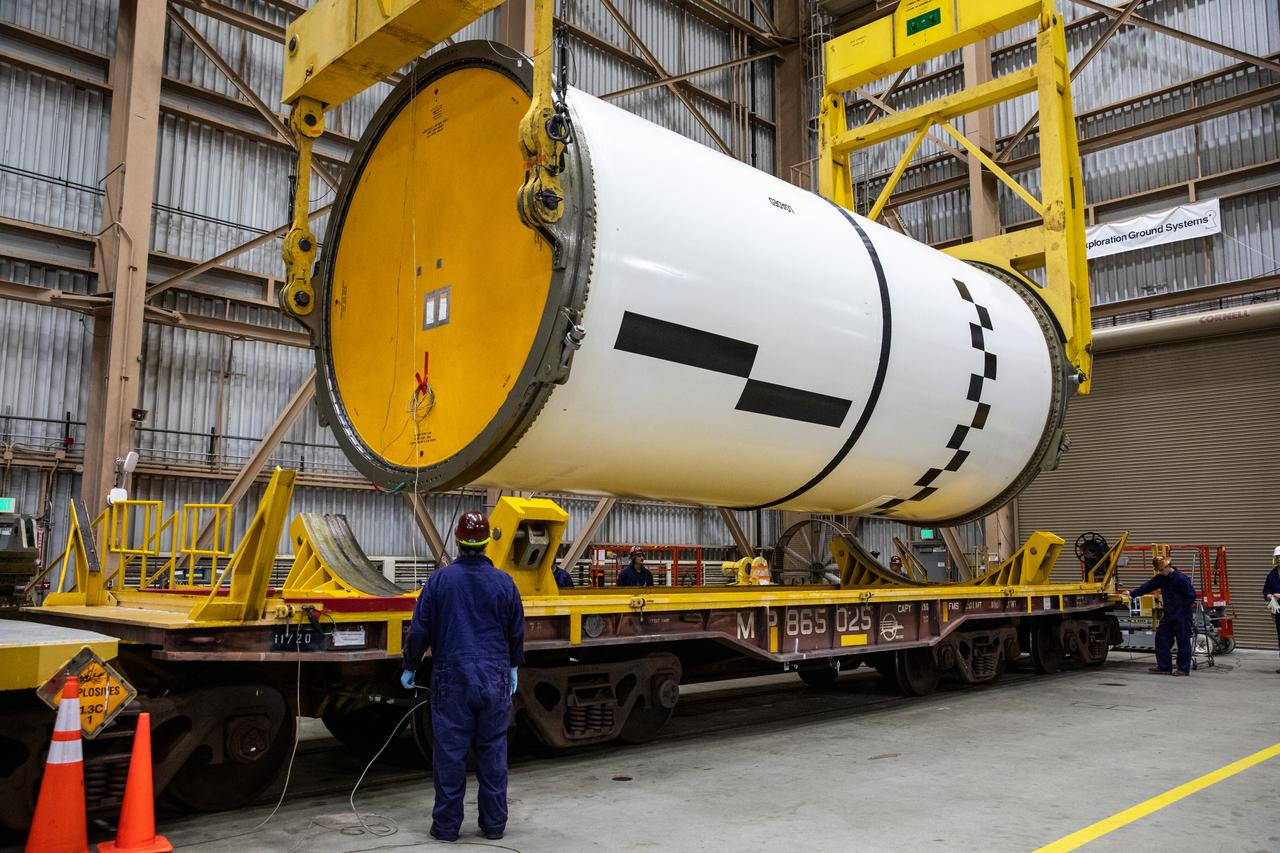
Engineers and technicians process the right forward center segment of the Space Launch System solid rocket boosters for the Artemis II mission inside the Rotation, Processing and Surge Facility (RPSF) at NASA’s Kennedy Space Center in Florida on Tuesday, Nov. 27, 2023. The team has been examining the 10 booster segments one-by-one then lifting them to make sure they are ready for integration and launch before moving them to the Vehicle Assembly Building for stacking atop the mobile launcher. Artemis II astronauts Reid Wiseman, Victor Glover, Christina Koch, and Jeremy Hansen will blast off from Kennedy and travel around the moon for the agency’s first crewed mission under Artemis that will test all of the Orion spacecraft’s systems.
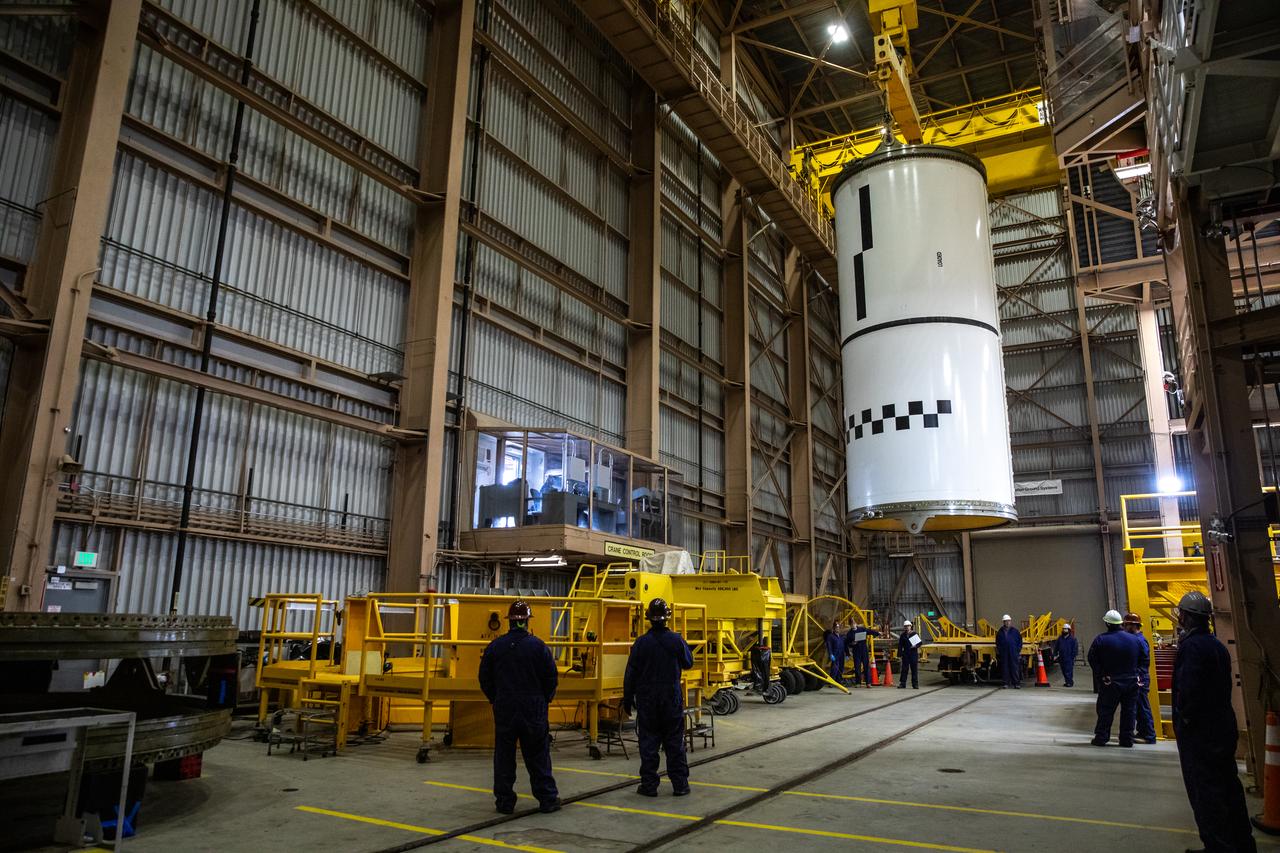
Engineers and technicians process the right forward center segment of the Space Launch System solid rocket boosters for the Artemis II mission inside the Rotation, Processing and Surge Facility (RPSF) at NASA’s Kennedy Space Center in Florida on Tuesday, Nov. 27, 2023. The team has been examining the 10 booster segments one-by-one then lifting them to make sure they are ready for integration and launch before moving them to the Vehicle Assembly Building for stacking atop the mobile launcher. Artemis II astronauts Reid Wiseman, Victor Glover, Christina Koch, and Jeremy Hansen will blast off from Kennedy and travel around the moon for the agency’s first crewed mission under Artemis that will test all of the Orion spacecraft’s systems.
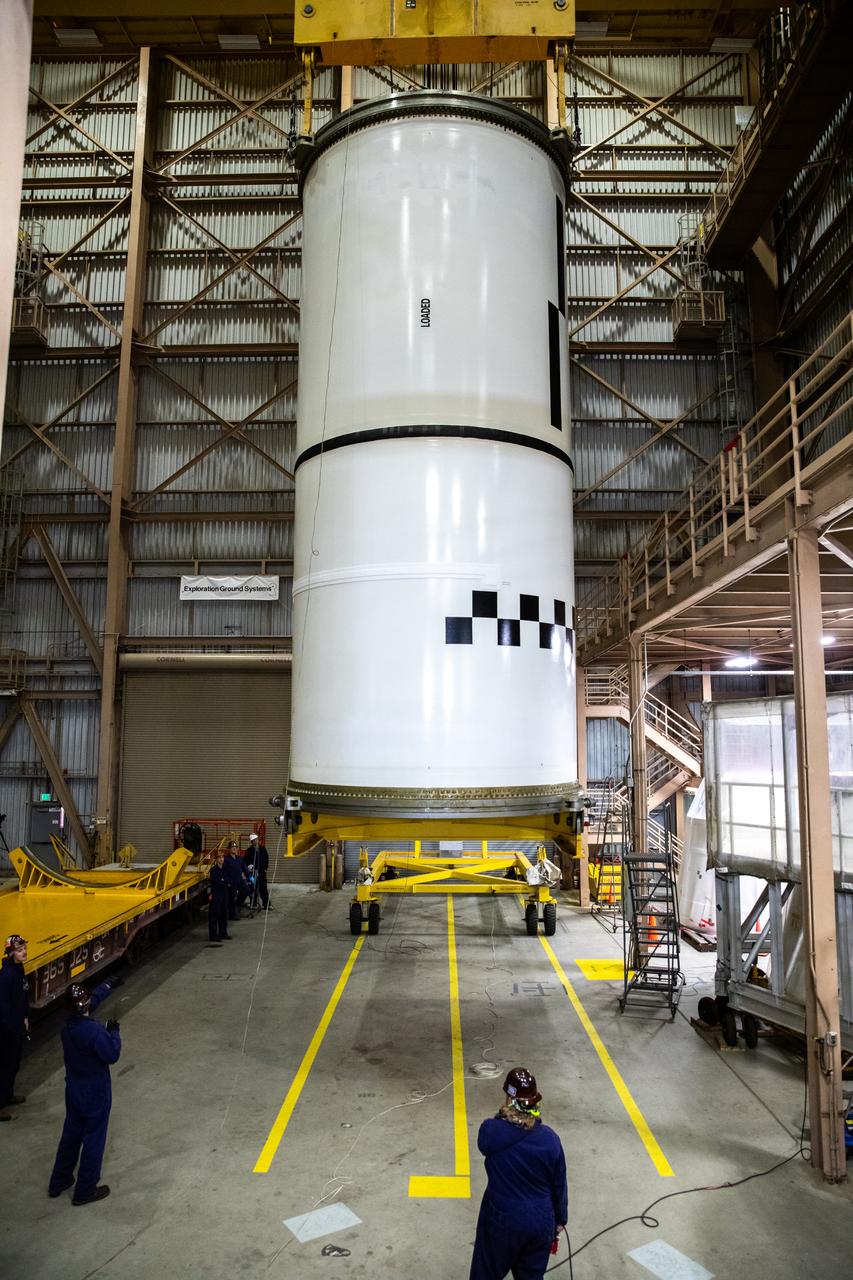
Engineers and technicians process the right forward center segment of the Space Launch System solid rocket boosters for the Artemis II mission inside the Rotation, Processing and Surge Facility (RPSF) at NASA’s Kennedy Space Center in Florida on Tuesday, Nov. 27, 2023. The team has been examining the 10 booster segments one-by-one then lifting them to make sure they are ready for integration and launch before moving them to the Vehicle Assembly Building for stacking atop the mobile launcher. Artemis II astronauts Reid Wiseman, Victor Glover, Christina Koch, and Jeremy Hansen will blast off from Kennedy and travel around the moon for the agency’s first crewed mission under Artemis that will test all of the Orion spacecraft’s systems.
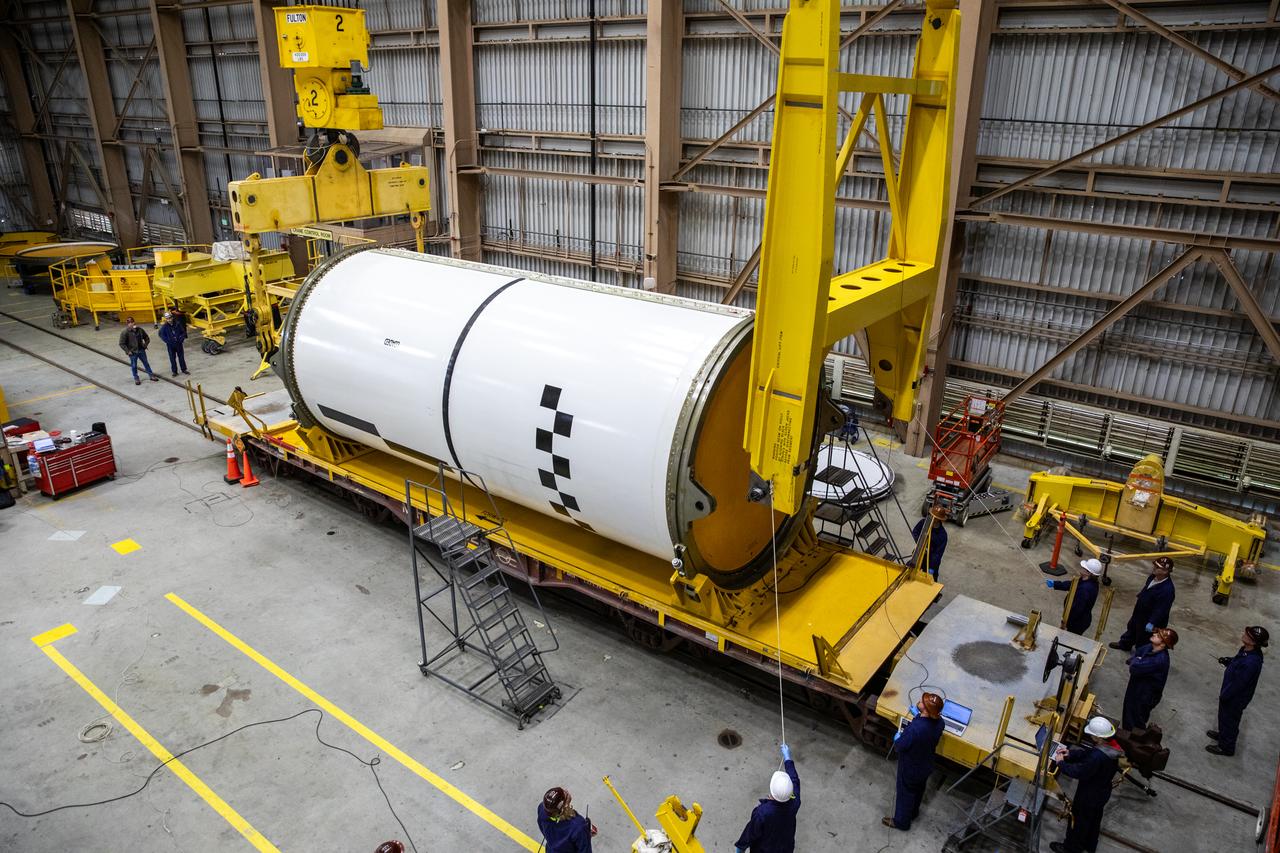
Engineers and technicians process the right forward center segment of the Space Launch System solid rocket boosters for the Artemis II mission inside the Rotation, Processing and Surge Facility (RPSF) at NASA’s Kennedy Space Center in Florida on Tuesday, Nov. 27, 2023. The team has been examining the 10 booster segments one-by-one then lifting them to make sure they are ready for integration and launch before moving them to the Vehicle Assembly Building for stacking atop the mobile launcher. Artemis II astronauts Reid Wiseman, Victor Glover, Christina Koch, and Jeremy Hansen will blast off from Kennedy and travel around the moon for the agency’s first crewed mission under Artemis that will test all of the Orion spacecraft’s systems.
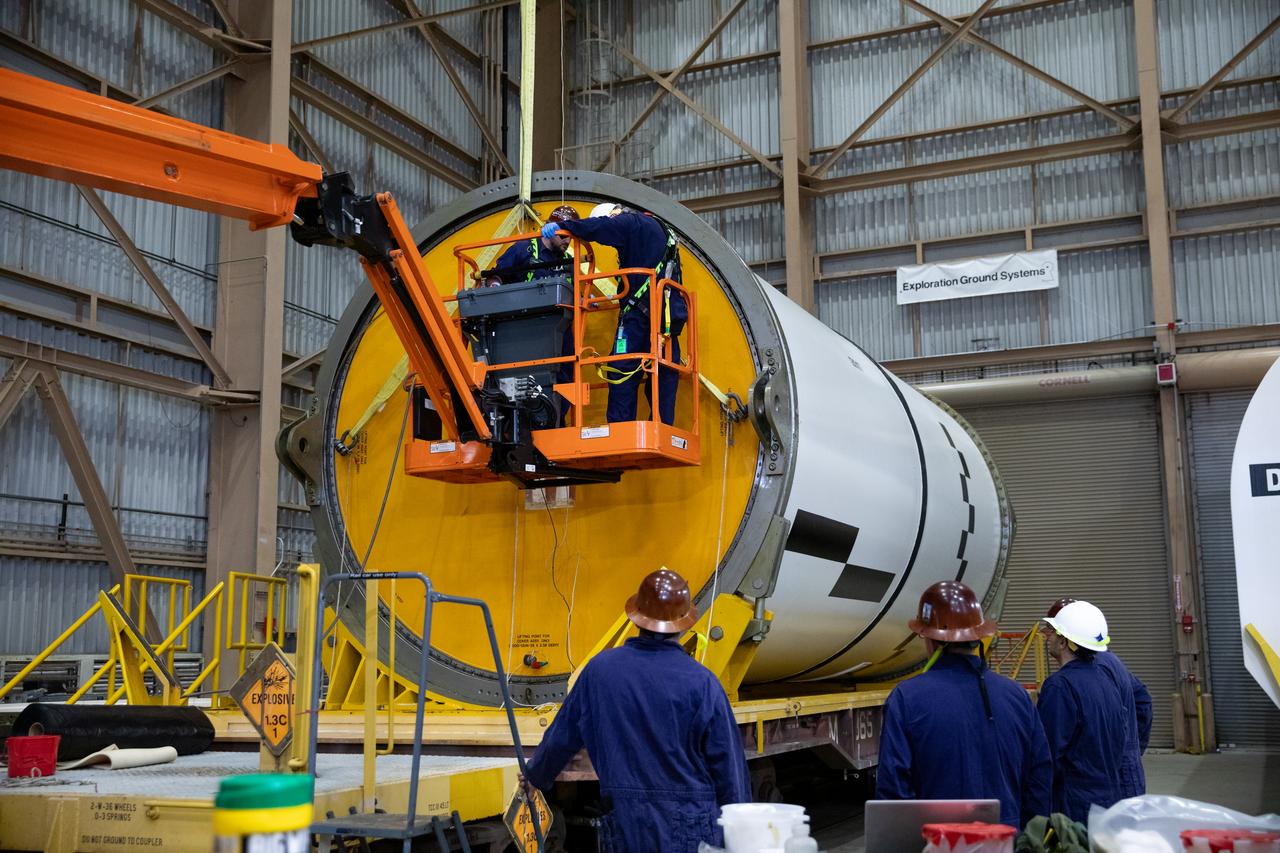
Engineers and technicians process the right forward center segment of the Space Launch System solid rocket boosters for the Artemis II mission inside the Rotation, Processing and Surge Facility (RPSF) at NASA’s Kennedy Space Center in Florida by removing the yellow cap and inspecting propellant on Monday, Nov. 27, 2023. Since arriving via rail in September, the team has been examining each segment one-by-one to make sure they are ready for integration and launch before being moved to the Vehicle Assembly Building for stacking atop the mobile launcher. Artemis II astronauts Reid Wiseman, Victor Glover, Christina Koch, and Jeremy Hansen will blast off from Kennedy and travel around the moon for the agency’s first crewed mission under Artemis that will test all of the Orion spacecraft’s systems.
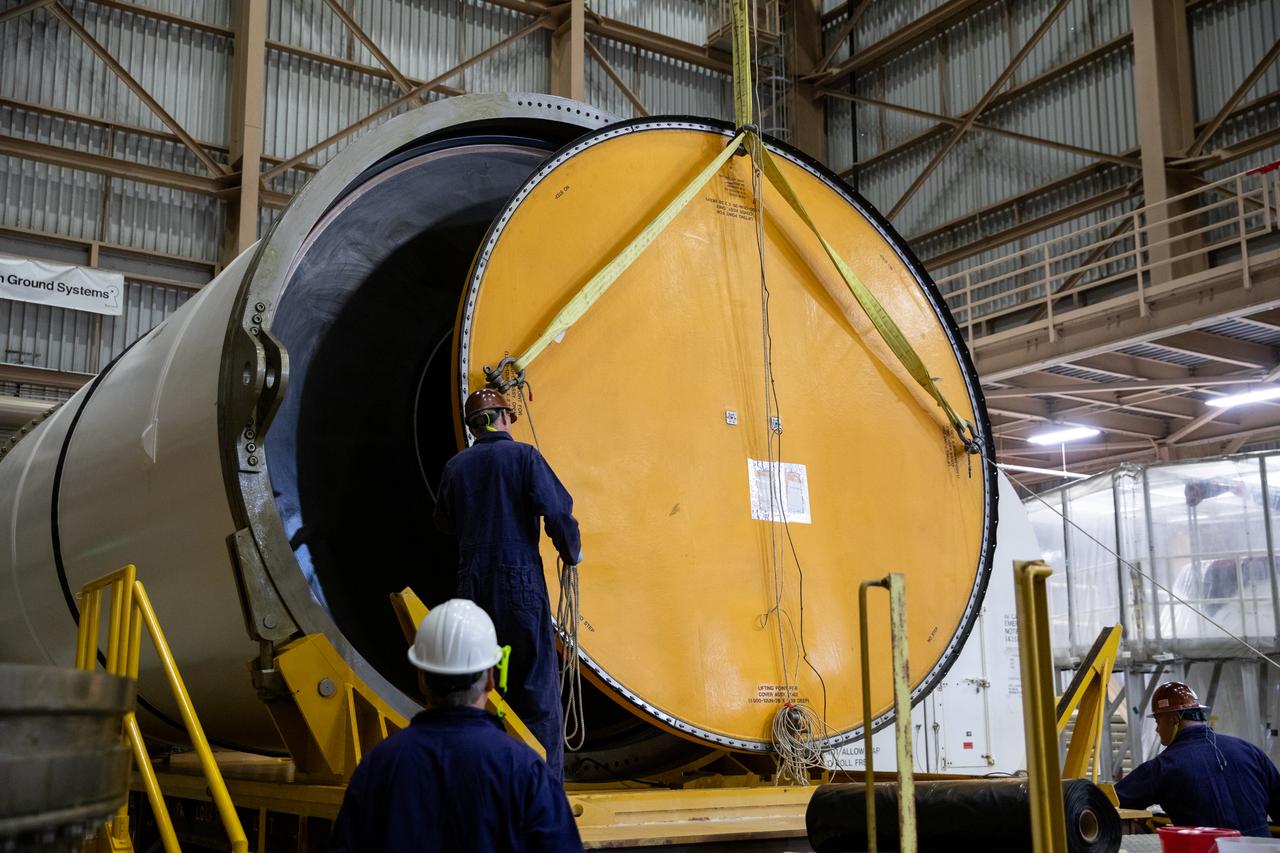
Engineers and technicians process the right forward center segment of the Space Launch System solid rocket boosters for the Artemis II mission inside the Rotation, Processing and Surge Facility (RPSF) at NASA’s Kennedy Space Center in Florida by removing the yellow cap and inspecting propellant on Monday, Nov. 27, 2023. Since arriving via rail in September, the team has been examining each segment one-by-one to make sure they are ready for integration and launch before being moved to the Vehicle Assembly Building for stacking atop the mobile launcher. Artemis II astronauts Reid Wiseman, Victor Glover, Christina Koch, and Jeremy Hansen will blast off from Kennedy and travel around the moon for the agency’s first crewed mission under Artemis that will test all of the Orion spacecraft’s systems.
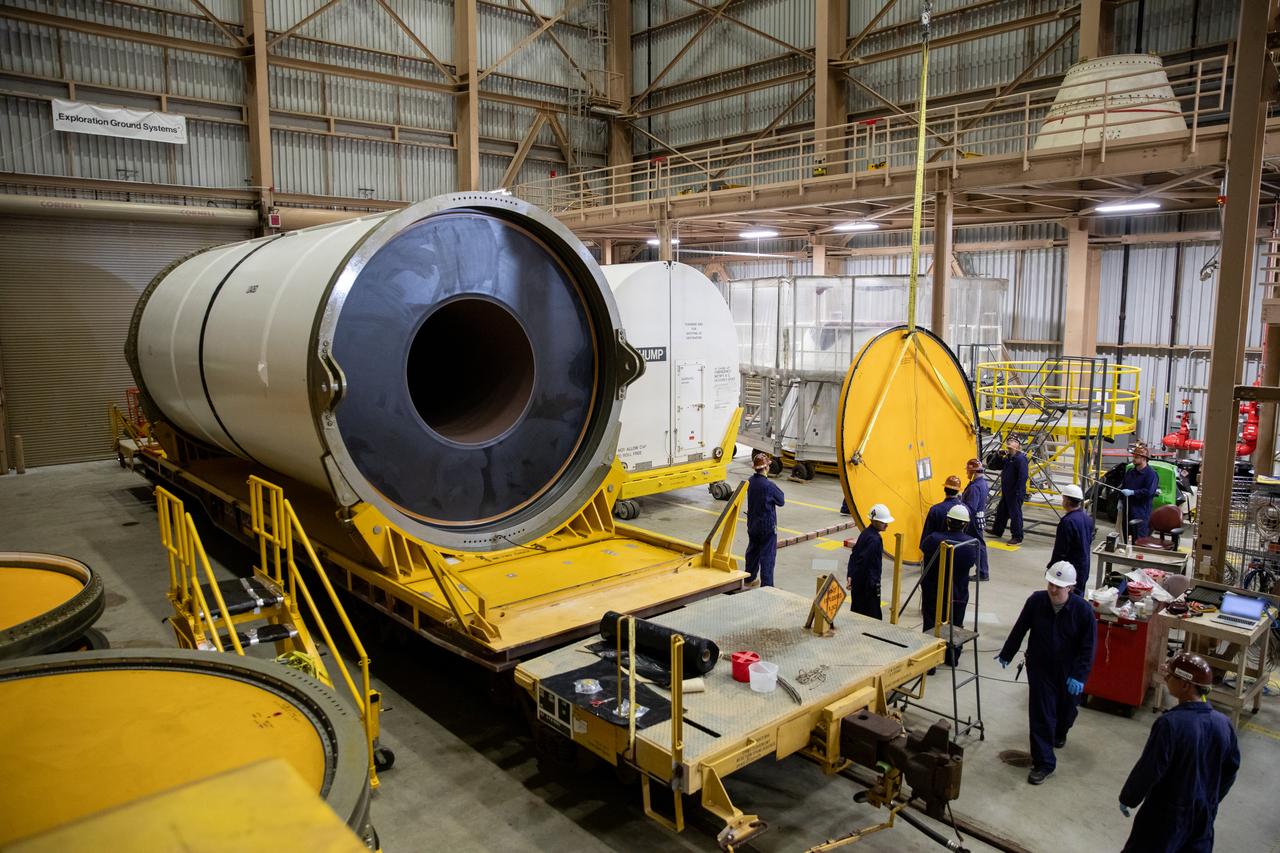
Engineers and technicians process and inspect the propellant of the right forward center segment of the Space Launch System solid rocket boosters for the Artemis II mission inside the Rotation, Processing and Surge Facility (RPSF) at NASA’s Kennedy Space Center in Florida on Monday, Nov. 27, 2023. Since arriving via rail in September, the team has been examining each segment one-by-one to make sure they are ready for integration and launch before being moved to the Vehicle Assembly Building for stacking atop the mobile launcher. Artemis II astronauts Reid Wiseman, Victor Glover, Christina Koch, and Jeremy Hansen will blast off from Kennedy and travel around the moon for the agency’s first crewed mission under Artemis that will test all of the Orion spacecraft’s systems.
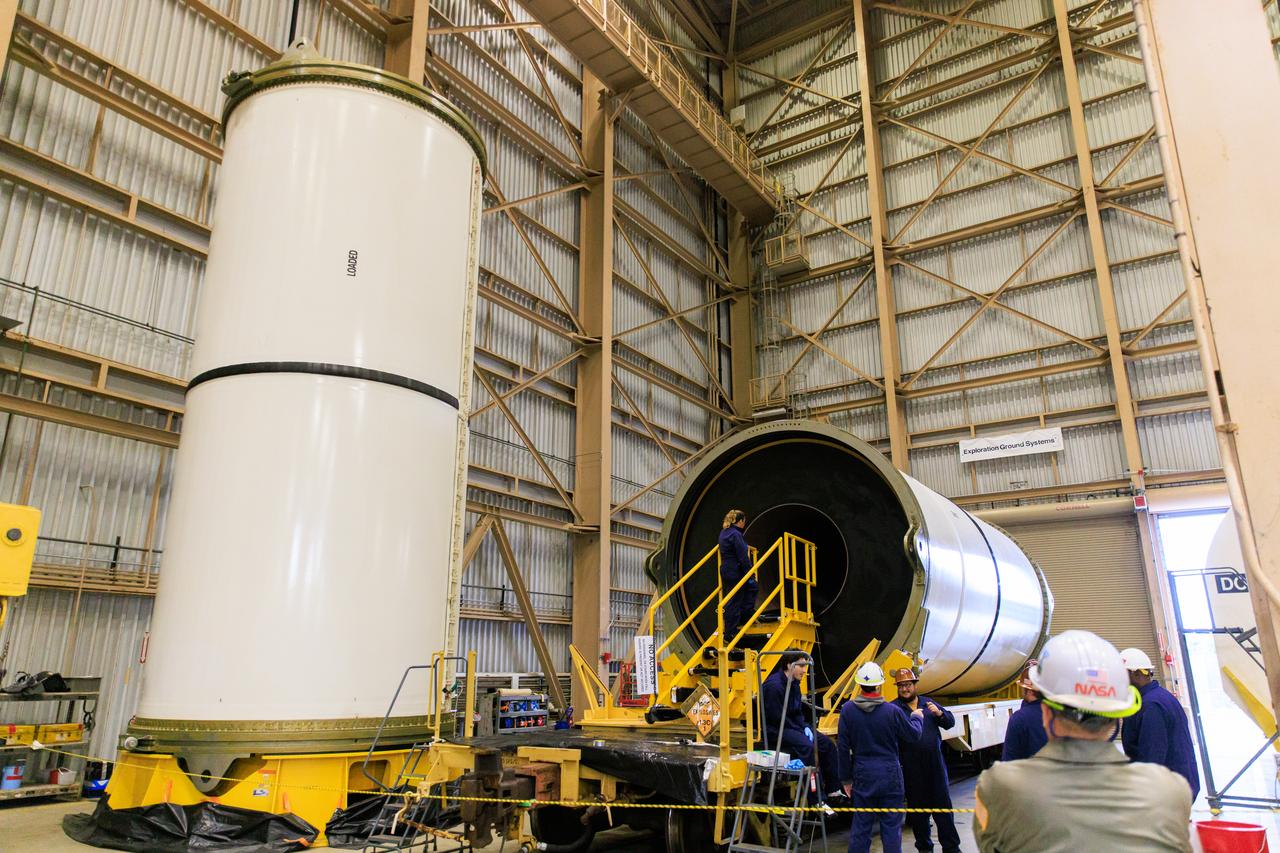
Technicians with Exploration Ground Systems, based at NASA’s Kennedy Space Center in Florida, perform propellant grain inspections on two of the agency’s Space Launch System solid rocket booster segments for the Artemis II campaign on Wednesday, Dec. 20, 2023, inside the Rotation, Processing and Surge Facility. The team is inspecting the propellant of all 10 booster segments before they are rotated vertically for processing. The Artemis II mission will send four astronauts around the Moon as part of the agency’s effort to establish a long-term science and exploration presence at the Moon, and eventually Mars.
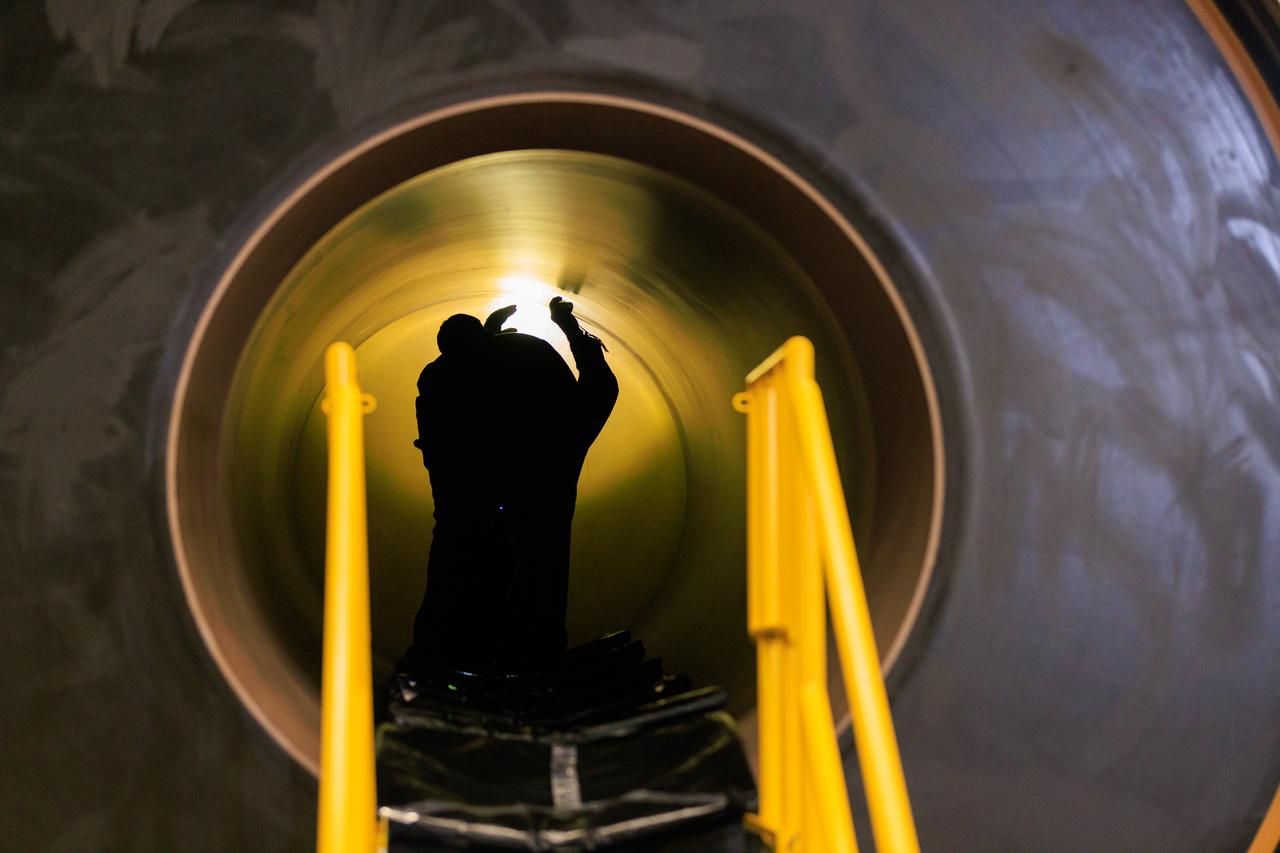
Technicians with Exploration Ground Systems, based at NASA’s Kennedy Space Center in Florida, perform propellant grain inspections on two of the agency’s Space Launch System solid rocket booster segments for the Artemis II campaign on Wednesday, Dec. 20, 2023, inside the Rotation, Processing and Surge Facility. The team is inspecting the propellant of all 10 booster segments before they are rotated vertically for processing. The Artemis II mission will send four astronauts around the Moon as part of the agency’s effort to establish a long-term science and exploration presence at the Moon, and eventually Mars.
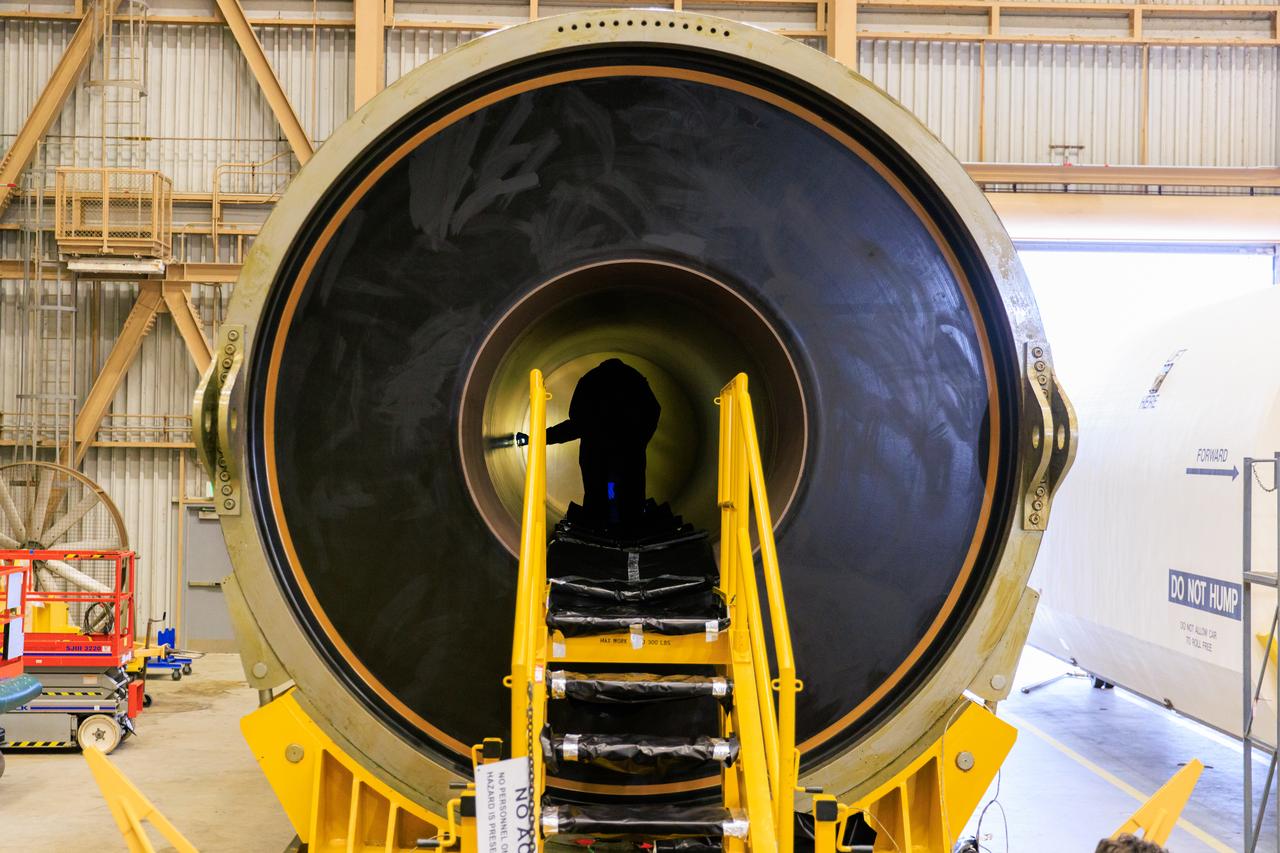
Technicians with Exploration Ground Systems, based at NASA’s Kennedy Space Center in Florida, perform propellant grain inspections on two of the agency’s Space Launch System solid rocket booster segments for the Artemis II campaign on Wednesday, Dec. 20, 2023, inside the Rotation, Processing and Surge Facility. The team is inspecting the propellant of all 10 booster segments before they are rotated vertically for processing. The Artemis II mission will send four astronauts around the Moon as part of the agency’s effort to establish a long-term science and exploration presence at the Moon, and eventually Mars.
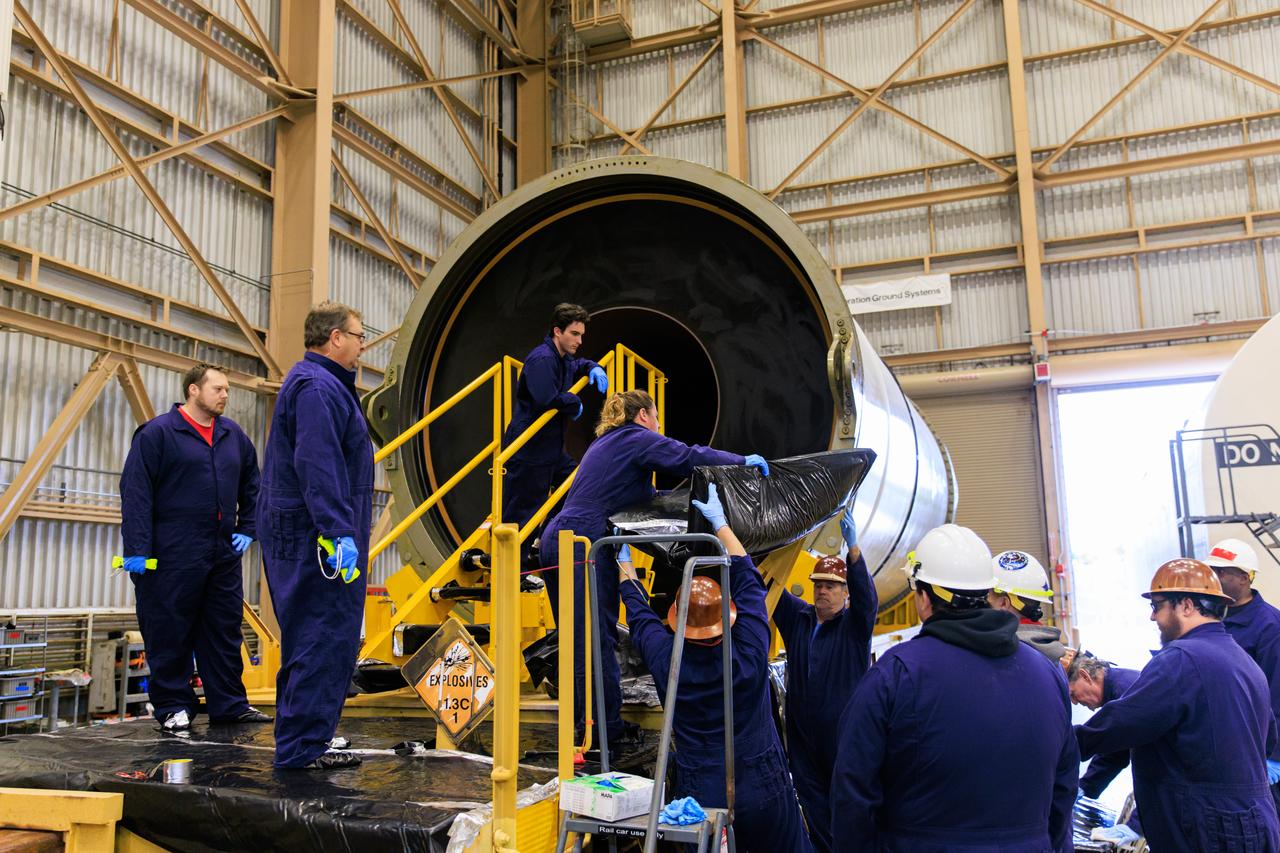
Technicians with Exploration Ground Systems, based at NASA’s Kennedy Space Center in Florida, perform propellant grain inspections on two of the agency’s Space Launch System solid rocket booster segments for the Artemis II campaign on Wednesday, Dec. 20, 2023, inside the Rotation, Processing and Surge Facility. The team is inspecting the propellant of all 10 booster segments before they are rotated vertically for processing. The Artemis II mission will send four astronauts around the Moon as part of the agency’s effort to establish a long-term science and exploration presence at the Moon, and eventually Mars.
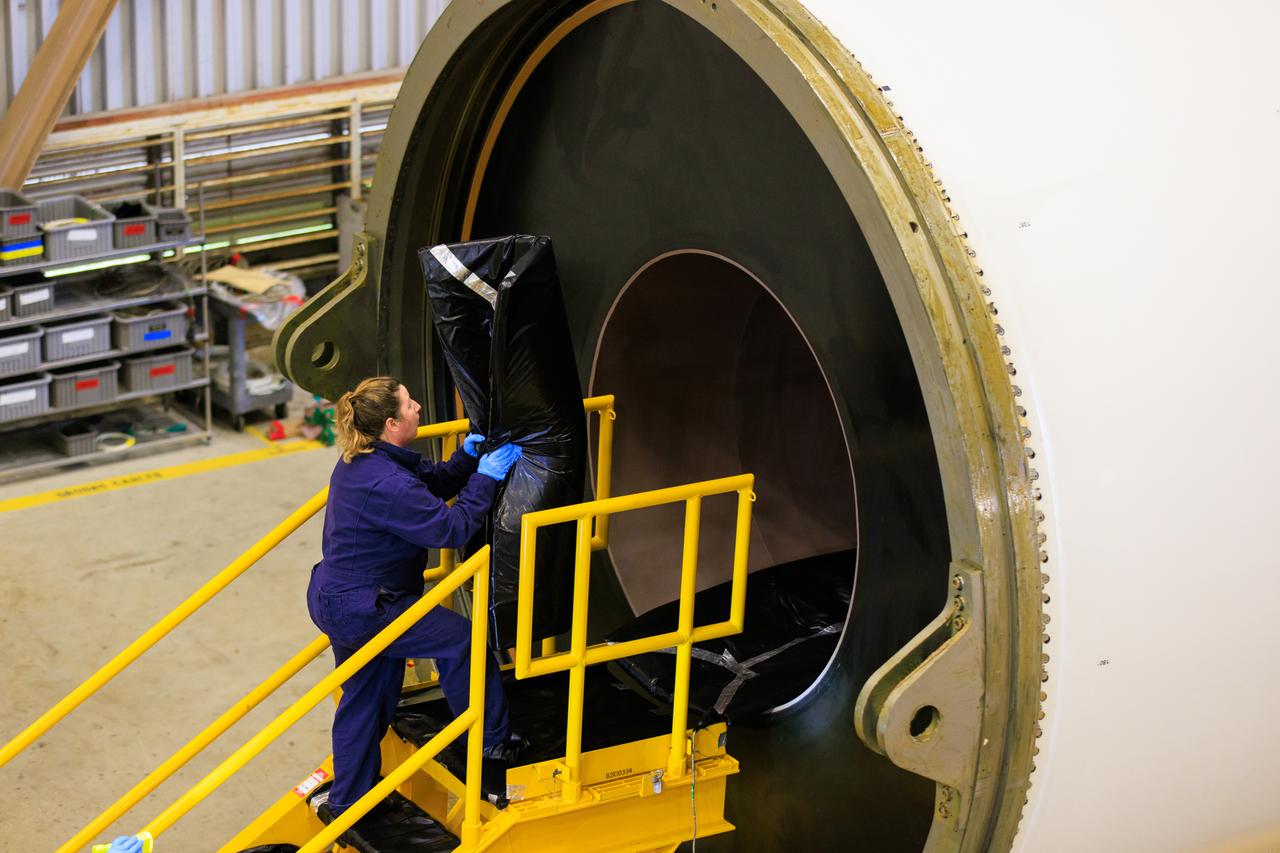
Technicians with Exploration Ground Systems, based at NASA’s Kennedy Space Center in Florida, perform propellant grain inspections on two of the agency’s Space Launch System solid rocket booster segments for the Artemis II campaign on Wednesday, Dec. 20, 2023, inside the Rotation, Processing and Surge Facility. The team is inspecting the propellant of all 10 booster segments before they are rotated vertically for processing. The Artemis II mission will send four astronauts around the Moon as part of the agency’s effort to establish a long-term science and exploration presence at the Moon, and eventually Mars.
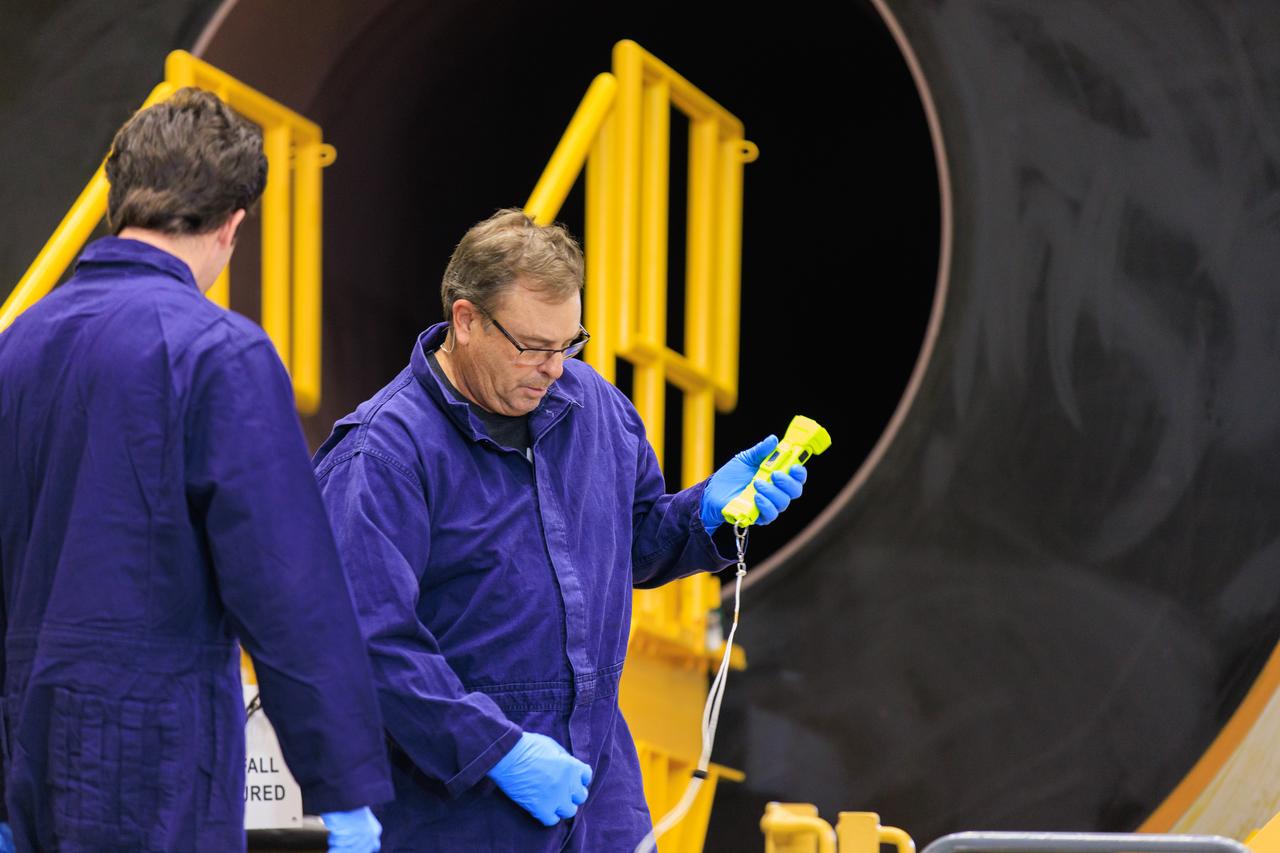
Technicians with Exploration Ground Systems, based at NASA’s Kennedy Space Center in Florida, perform propellant grain inspections on two of the agency’s Space Launch System solid rocket booster segments for the Artemis II campaign on Wednesday, Dec. 20, 2023, inside the Rotation, Processing and Surge Facility. The team is inspecting the propellant of all 10 booster segments before they are rotated vertically for processing. The Artemis II mission will send four astronauts around the Moon as part of the agency’s effort to establish a long-term science and exploration presence at the Moon, and eventually Mars.
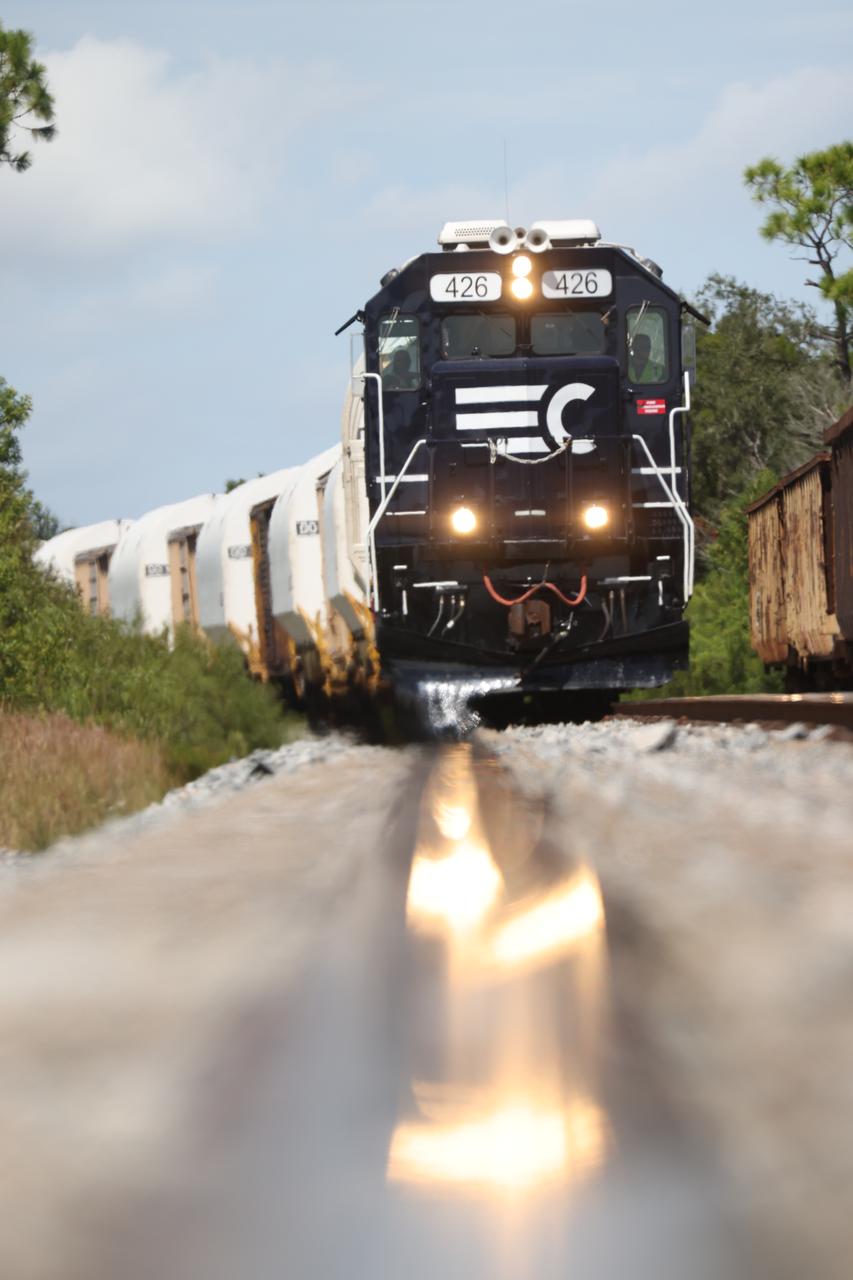
The 10 booster motor segments that will form the NASA Space Launch System rocket’s twin, five-segment solid rocket boosters for the agency’s Artemis II mission, arrive at Kennedy Space Center on Monday, Sept. 25, 2023. Due to their weight, the booster motor segments traveled by rail across eight states in specialized transporters to the Florida spaceport. Teams with NASA’s Exploration Ground Systems will process each of the segments at Kennedy in preparation for launch. Artemis II astronauts Reid Wiseman, Victor Glover, Christina Koch, and Jeremy Hansen will blast off from Kennedy, traveling around the Moon on the first crewed mission under Artemis that will test all of the Orion spacecraft’s systems.

The 10 booster motor segments that will form the NASA Space Launch System rocket’s twin, five-segment solid rocket boosters for the agency’s Artemis II mission, arrive at Kennedy Space Center on Monday, Sept. 25, 2023. Due to their weight, the booster motor segments traveled by rail across eight states in specialized transporters to the Florida spaceport. Teams with NASA’s Exploration Ground Systems will process each of the segments at Kennedy in preparation for launch. Artemis II astronauts Reid Wiseman, Victor Glover, Christina Koch, and Jeremy Hansen will blast off from Kennedy, traveling around the Moon on the first crewed mission under Artemis that will test all of the Orion spacecraft’s systems.
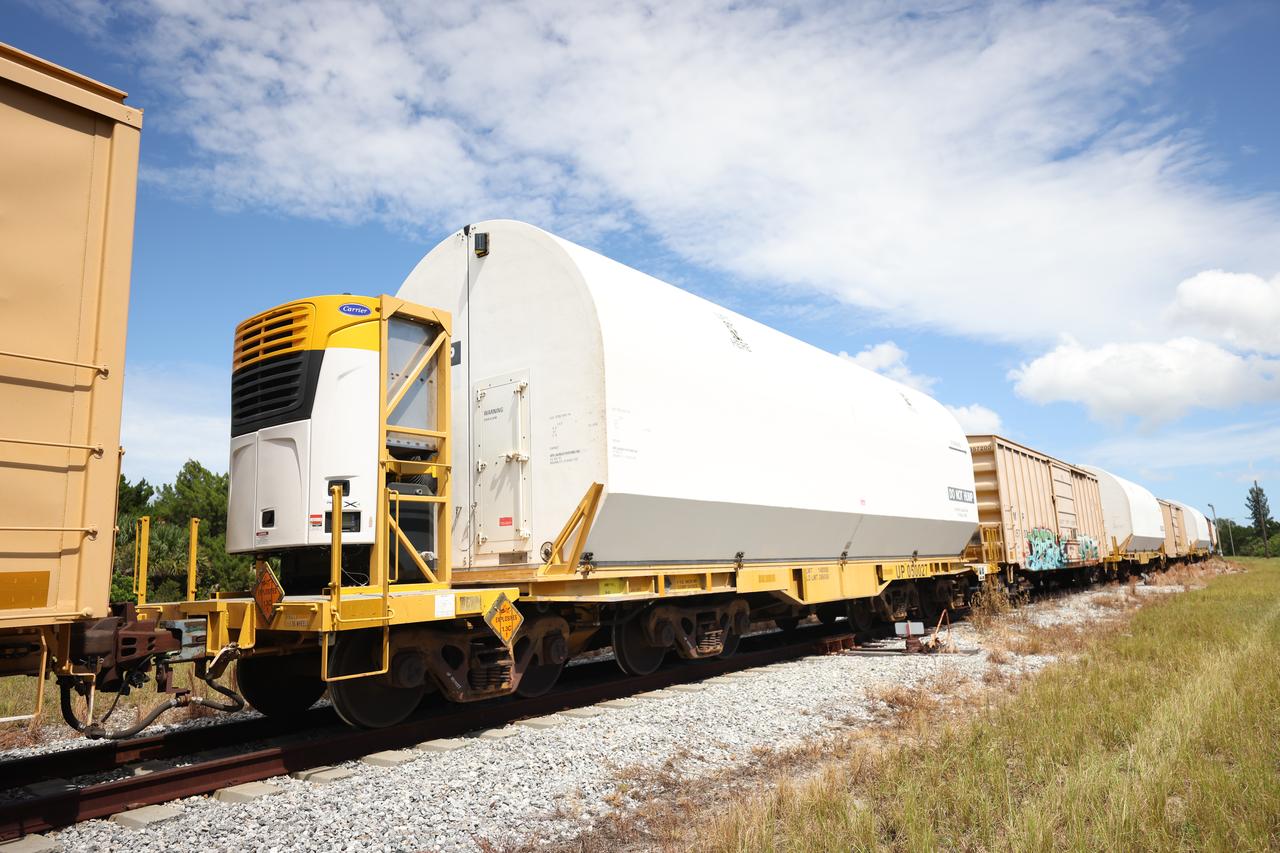
The 10 booster motor segments that will form the NASA Space Launch System rocket’s twin, five-segment solid rocket boosters for the agency’s Artemis II mission, arrive at Kennedy Space Center on Monday, Sept. 25, 2023. Due to their weight, the booster motor segments traveled by rail across eight states in specialized transporters to the Florida spaceport. Teams with NASA’s Exploration Ground Systems will process each of the segments at Kennedy in preparation for launch. Artemis II astronauts Reid Wiseman, Victor Glover, Christina Koch, and Jeremy Hansen will blast off from Kennedy, traveling around the Moon on the first crewed mission under Artemis that will test all of the Orion spacecraft’s systems.
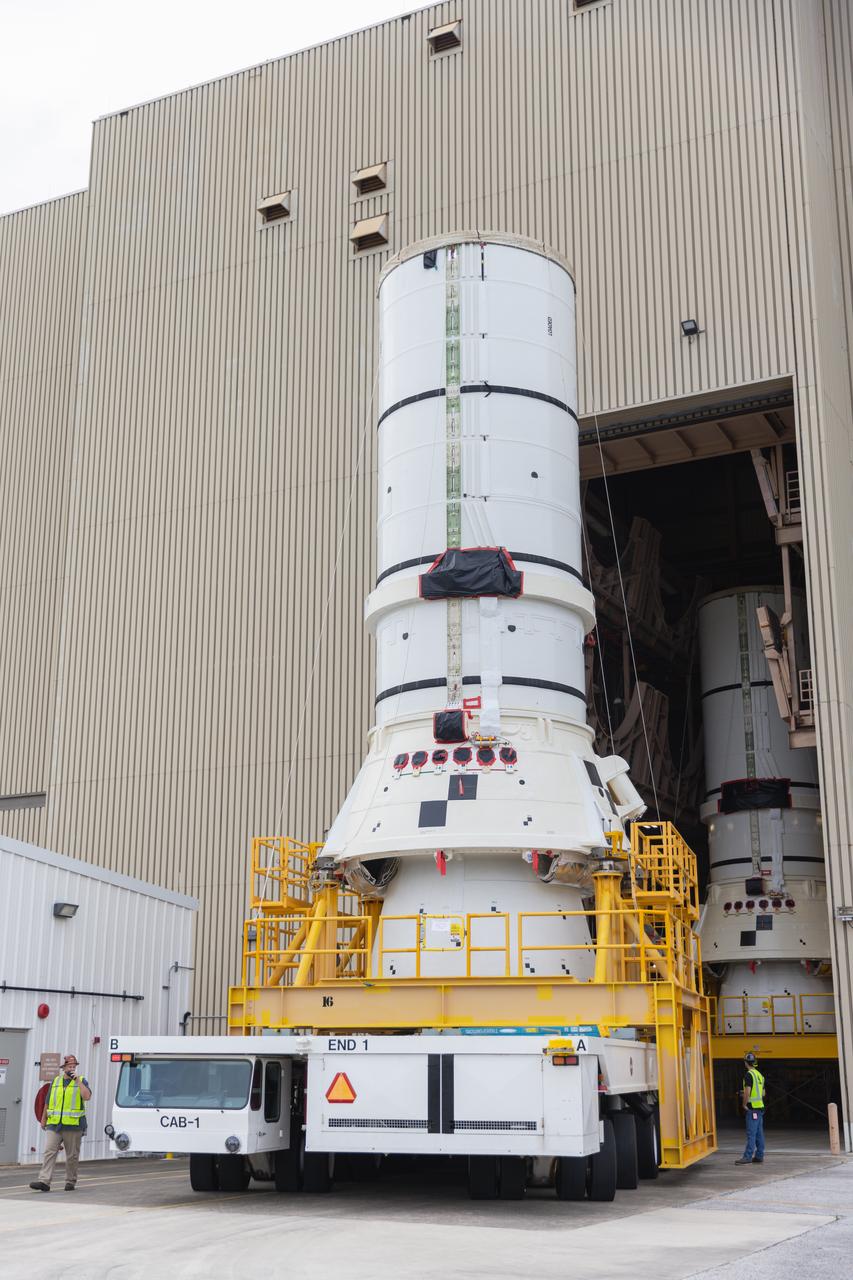
The left aft assembly of the SLS (Space Launch System) solid rocket boosters for the Artemis II mission is moved from the Rotation, Processing and Surge Facility to the Vehicle Assembly Building at NASA’s Kennedy Space Center in Florida on Monday, Nov. 18, 2024. The aft assembly will be lifted atop the mobile launcher, followed by the right aft assembly and remaining booster segments.

The left aft assembly of the SLS (Space Launch System) solid rocket boosters for the Artemis II mission is moved from the Rotation, Processing and Surge Facility to the Vehicle Assembly Building at NASA’s Kennedy Space Center in Florida on Monday, Nov. 18, 2024. The aft assembly will be lifted atop the mobile launcher, followed by the right aft assembly and remaining booster segments.
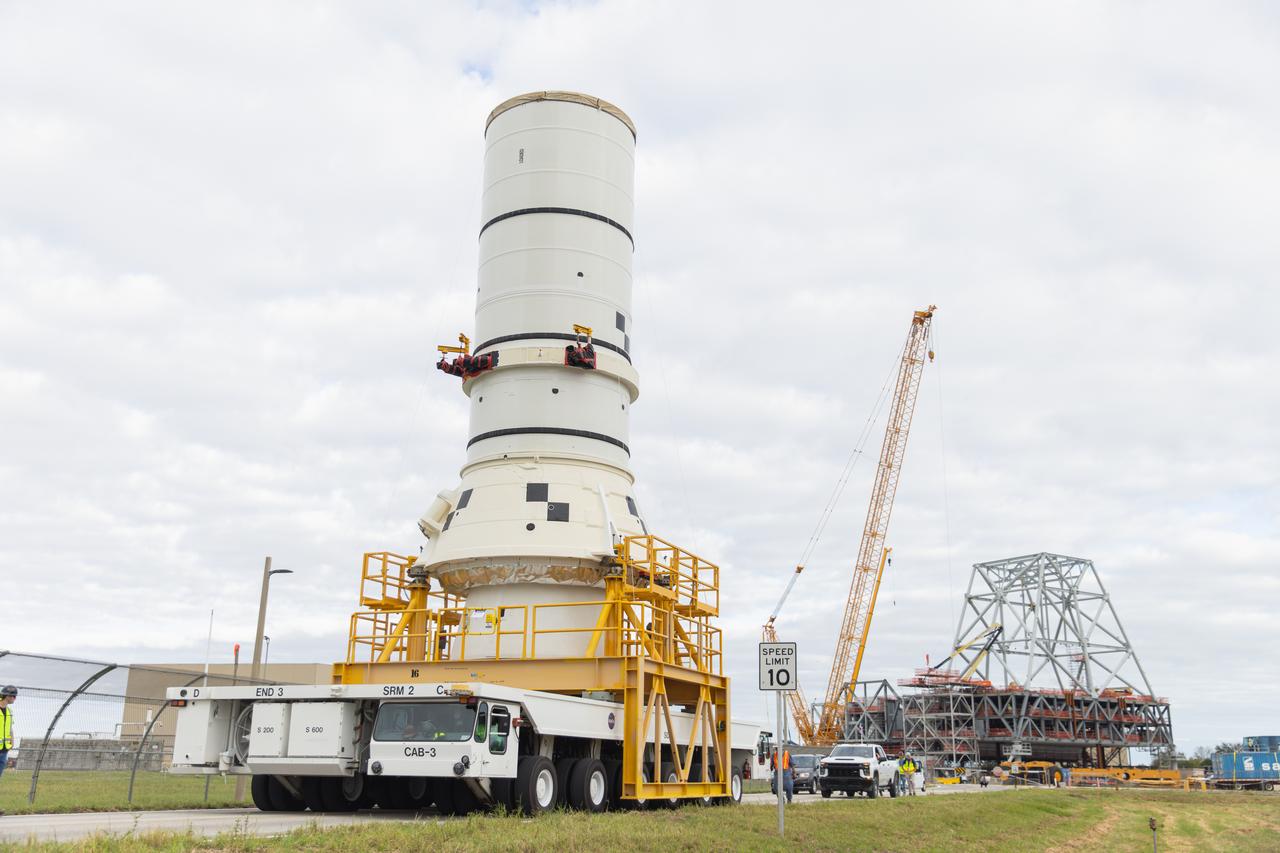
The left aft assembly of the SLS (Space Launch System) solid rocket boosters for the Artemis II mission is moved from the Rotation, Processing and Surge Facility to the Vehicle Assembly Building at NASA’s Kennedy Space Center in Florida on Monday, Nov. 18, 2024. The aft assembly will be lifted atop the mobile launcher, followed by the right aft assembly and remaining booster segments.
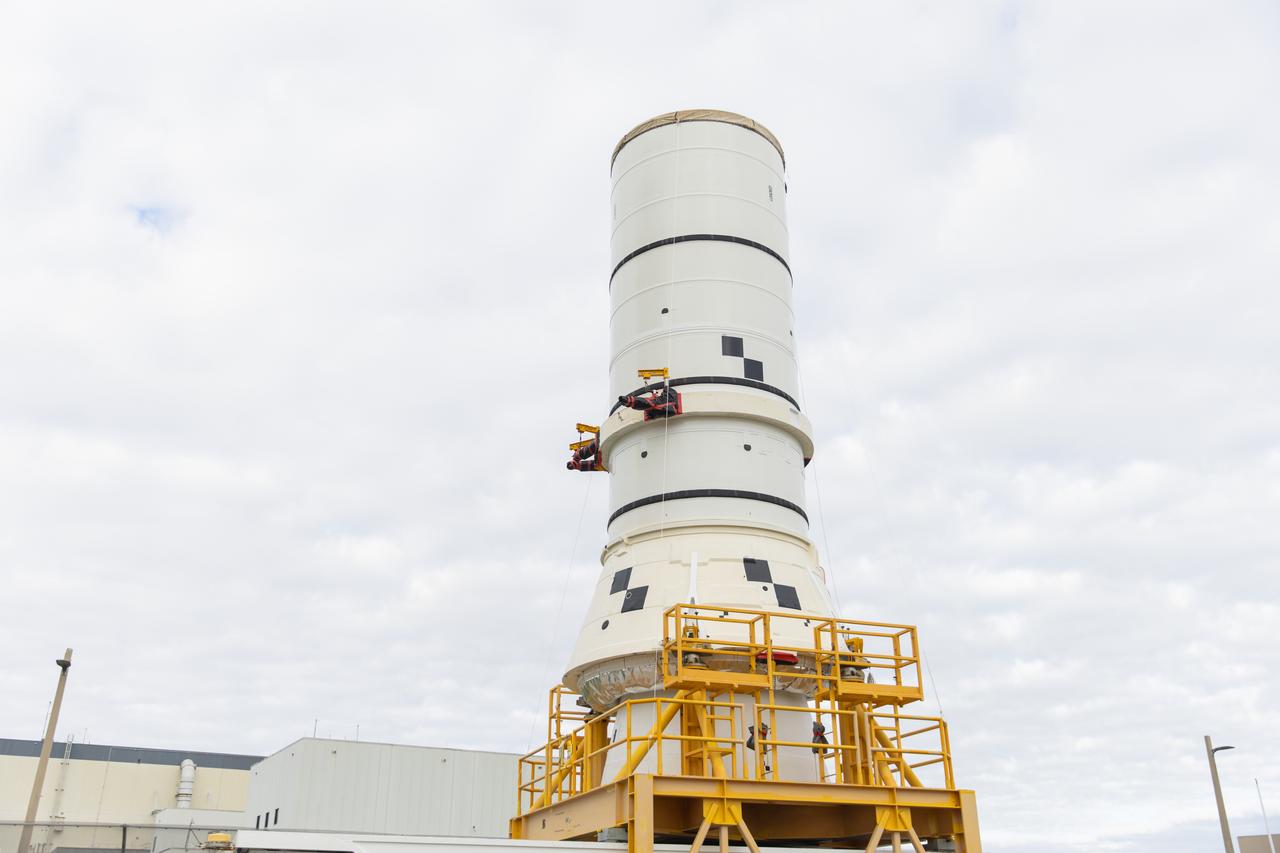
The left aft assembly of the SLS (Space Launch System) solid rocket boosters for the Artemis II mission is moved from the Rotation, Processing and Surge Facility to the Vehicle Assembly Building at NASA’s Kennedy Space Center in Florida on Monday, Nov. 18, 2024. The aft assembly will be lifted atop the mobile launcher, followed by the right aft assembly and remaining booster segments.
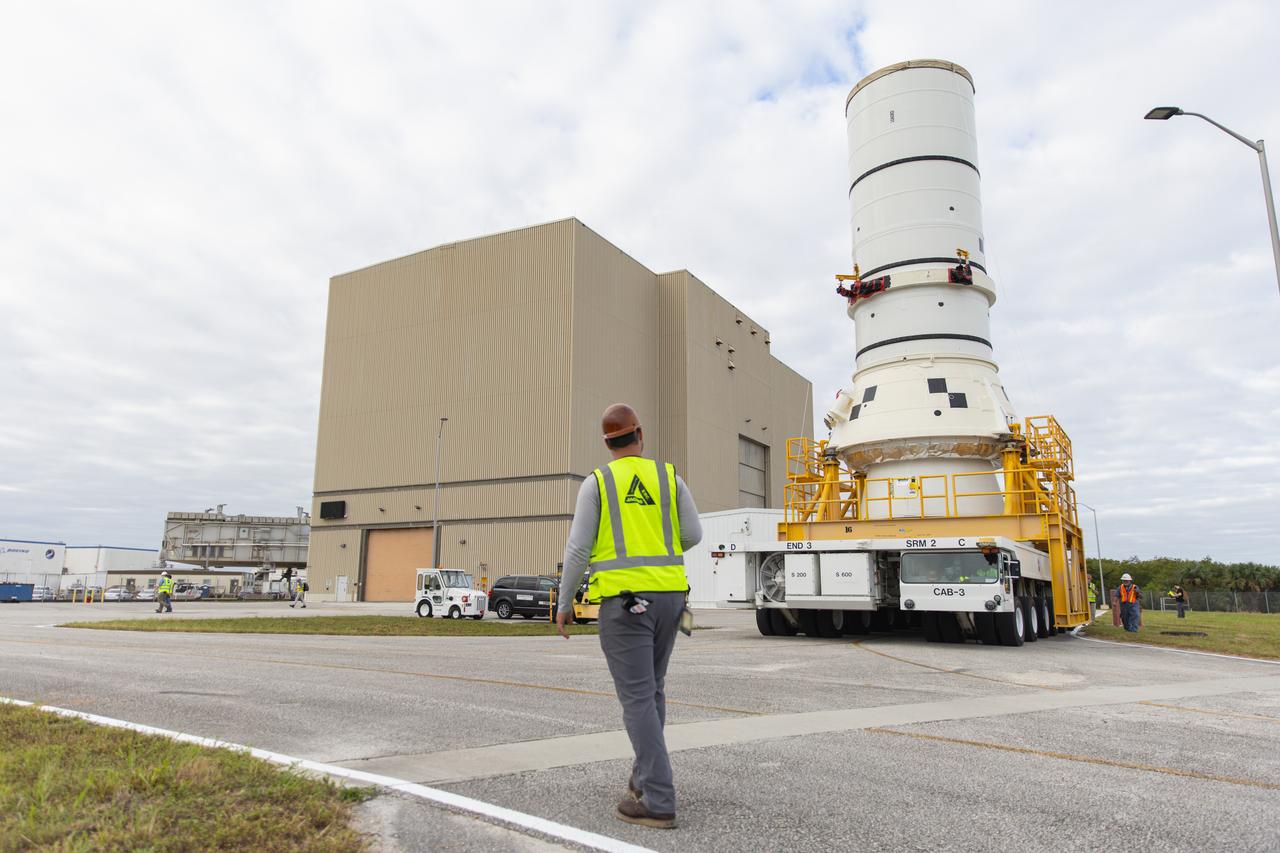
The left aft assembly of the SLS (Space Launch System) solid rocket boosters for the Artemis II mission is moved from the Rotation, Processing and Surge Facility to the Vehicle Assembly Building at NASA’s Kennedy Space Center in Florida on Monday, Nov. 18, 2024. The aft assembly will be lifted atop the mobile launcher, followed by the right aft assembly and remaining booster segments.
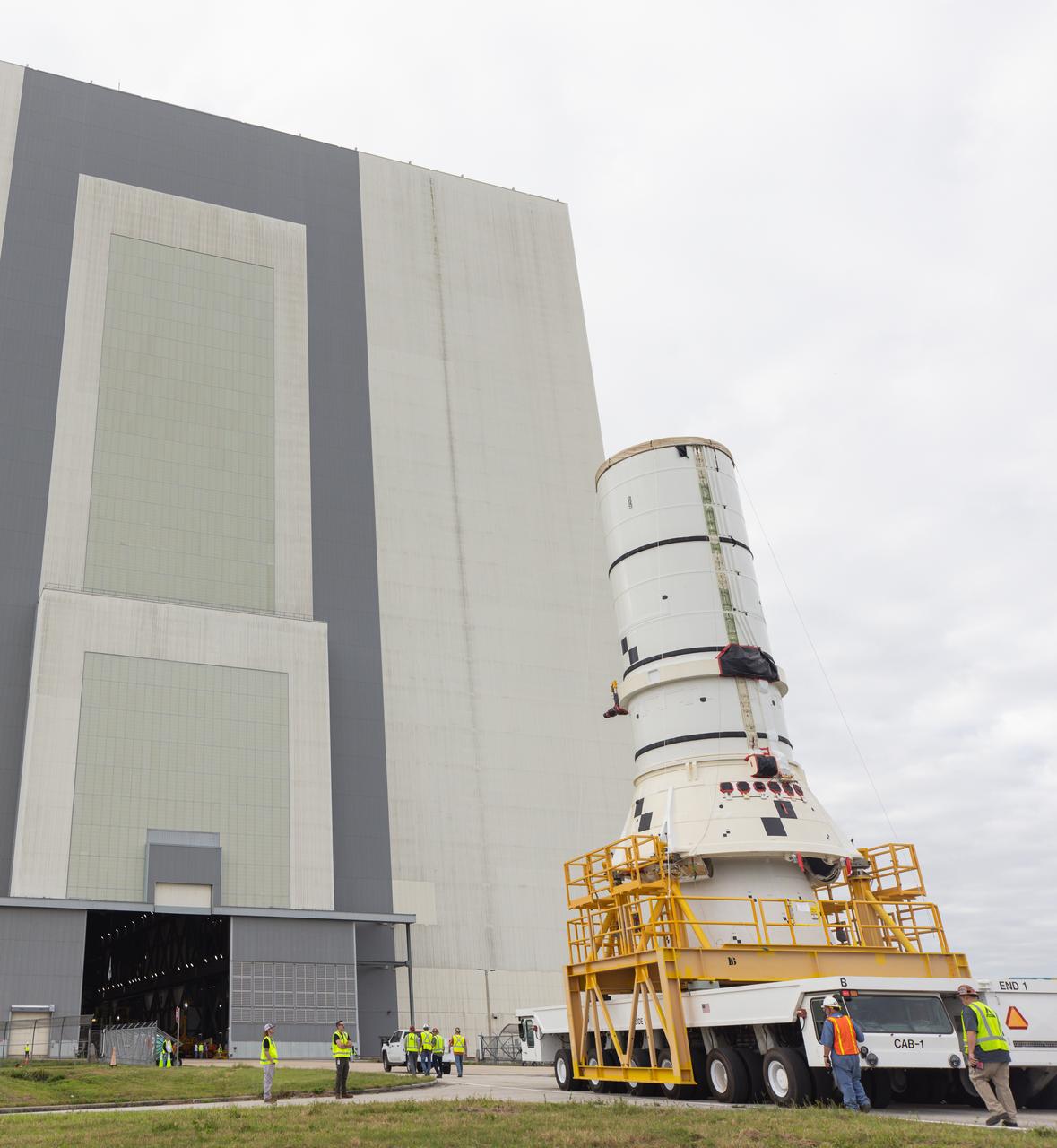
The left aft assembly of the SLS (Space Launch System) solid rocket boosters for the Artemis II mission is moved from the Rotation, Processing and Surge Facility to the Vehicle Assembly Building at NASA’s Kennedy Space Center in Florida on Monday, Nov. 18, 2024. The aft assembly will be lifted atop the mobile launcher, followed by the right aft assembly and remaining booster segments.
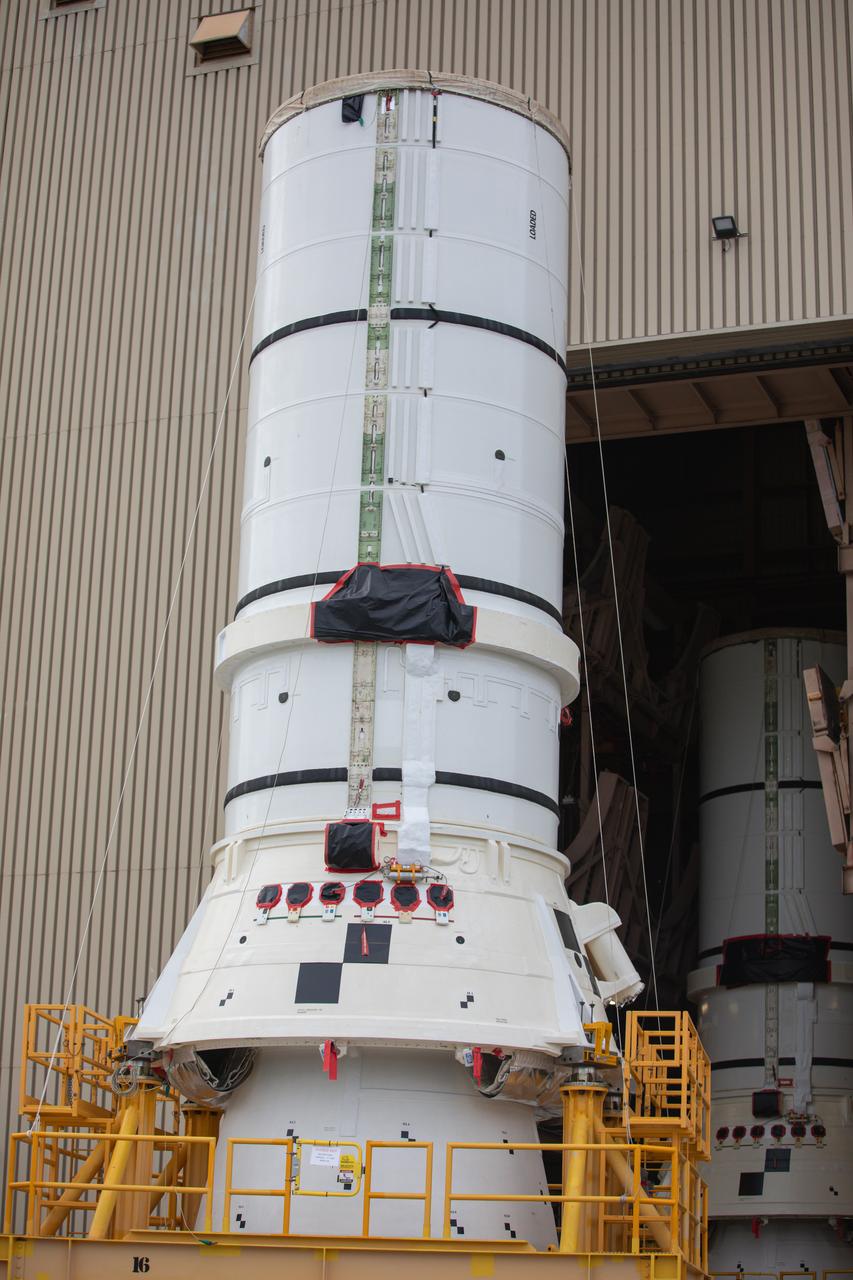
The left aft assembly of the SLS (Space Launch System) solid rocket boosters for the Artemis II mission is moved from the Rotation, Processing and Surge Facility to the Vehicle Assembly Building at NASA’s Kennedy Space Center in Florida on Monday, Nov. 18, 2024. The aft assembly will be lifted atop the mobile launcher, followed by the right aft assembly and remaining booster segments.
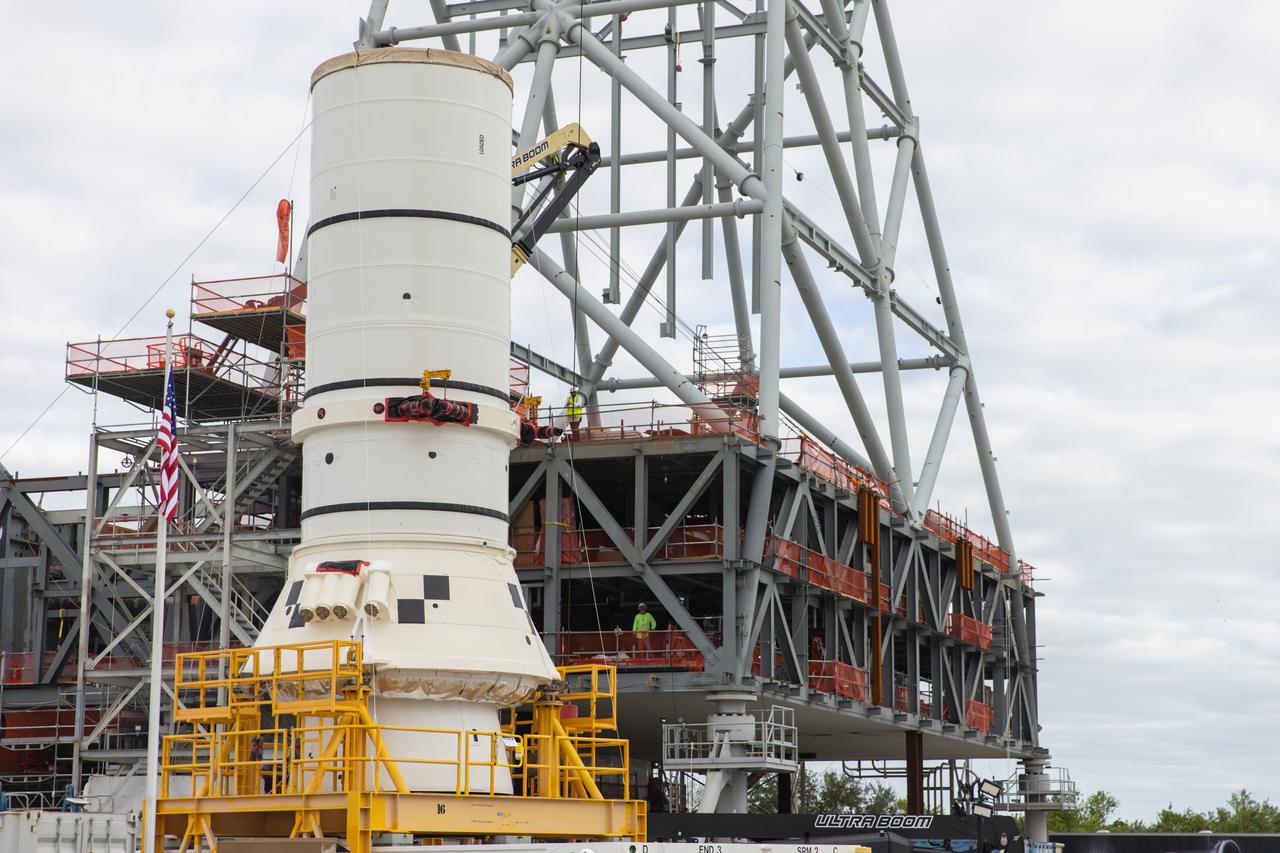
The left aft assembly of the SLS (Space Launch System) solid rocket boosters for the Artemis II mission is moved from the Rotation, Processing and Surge Facility to the Vehicle Assembly Building at NASA’s Kennedy Space Center in Florida on Monday, Nov. 18, 2024. The aft assembly will be lifted atop the mobile launcher, followed by the right aft assembly and remaining booster segments.
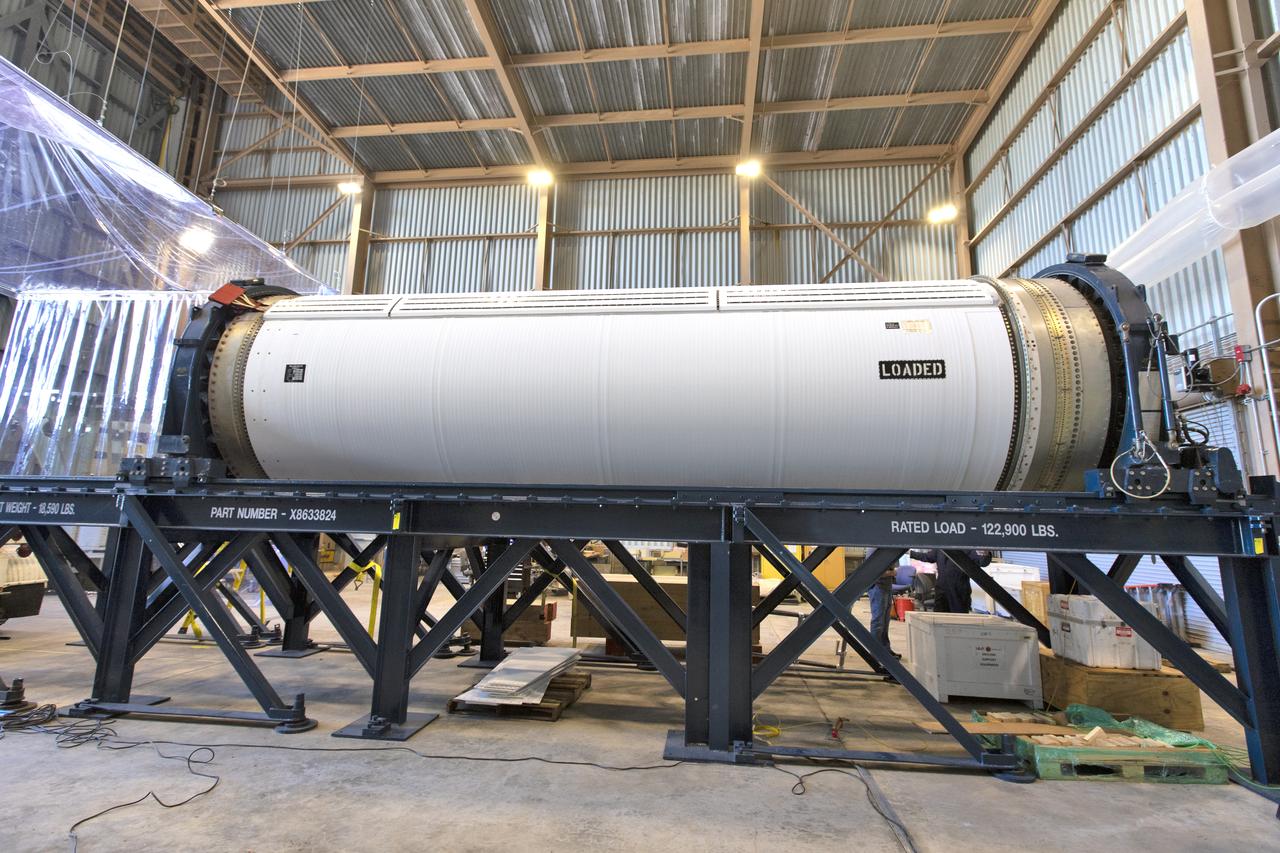
The Northrop Grumman-provided ascent test booster for the Orion Ascent Abort-2 (AA-2) Flight Test is secured on a work stand inside the Rotation, Processing and Surge Facility (RPSF) at NASA’s Kennedy Space Center in Florida on Jan. 29, 2019. The booster will be outfitted for flight. AA-2 is a full-stress test of the Launch Abort System, scheduled for April 2019. AA-2 will launch from Space Launch Complex 46, carrying a fully functional LAS and a 22,000-pound Orion test vehicle to an altitude of 31,000 feet and traveling at more than 1,000 miles an hour. The test will verify the LAS can steer the crew module and astronauts aboard to safety in the event of an issue with the Space Launch System (SLS) rocket when the spacecraft is under the highest aerodynamic loads it will experience during a rapid climb into space. NASA's Orion and Exploration Ground Systems programs and contractors from Jacob's and Northrup Grumman in conjunction with the Air Force Space and Missile Center's Launch Operations branch are performing flight operations for AA-2.
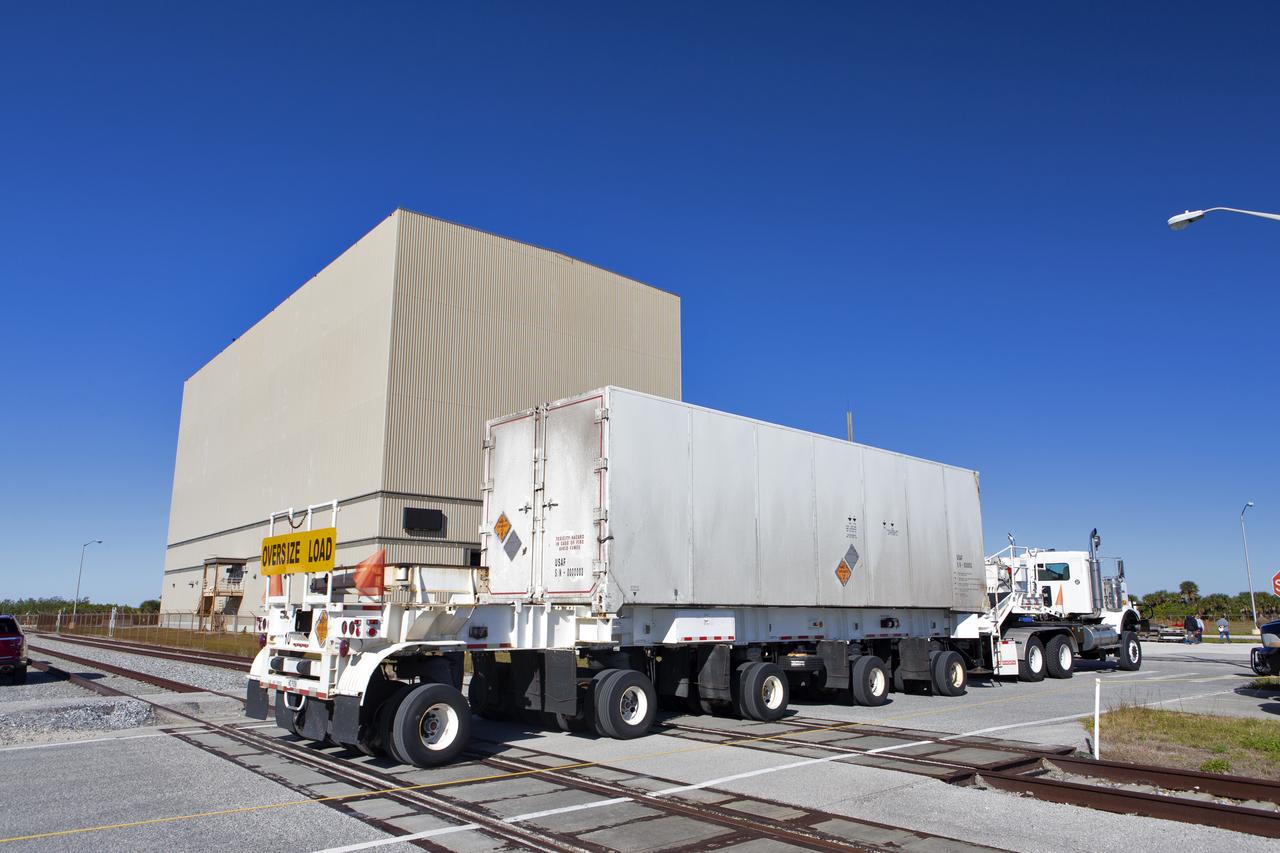
A heavy transport truck containing the Northrop Grumman-provided ascent test booster for the Orion Ascent Abort-2 (AA-2) Flight Test, arrives at the Rotation, Processing and Surge Facility (RPSF) at NASA’s Kennedy Space Center in Florida on Jan. 29, 2019. The booster will be unloaded and moved into the RPSF where it will be outfitted for flight. AA-2 is a full-stress test of the Launch Abort System, scheduled for April 2019. AA-2 will launch from Space Launch Complex 46, carrying a fully functional LAS and a 22,000-pound Orion test vehicle to an altitude of 31,000 feet and traveling at more than 1,000 miles an hour. The test will verify the LAS can steer the crew module and astronauts aboard to safety in the event of an issue with the Space Launch System (SLS) rocket when the spacecraft is under the highest aerodynamic loads it will experience during a rapid climb into space. NASA's Orion and Exploration Ground Systems programs and contractors from Jacob's and Northrup Grumman in conjunction with the Air Force Space and Missile Center's Launch Operations branch are performing flight operations for AA-2.
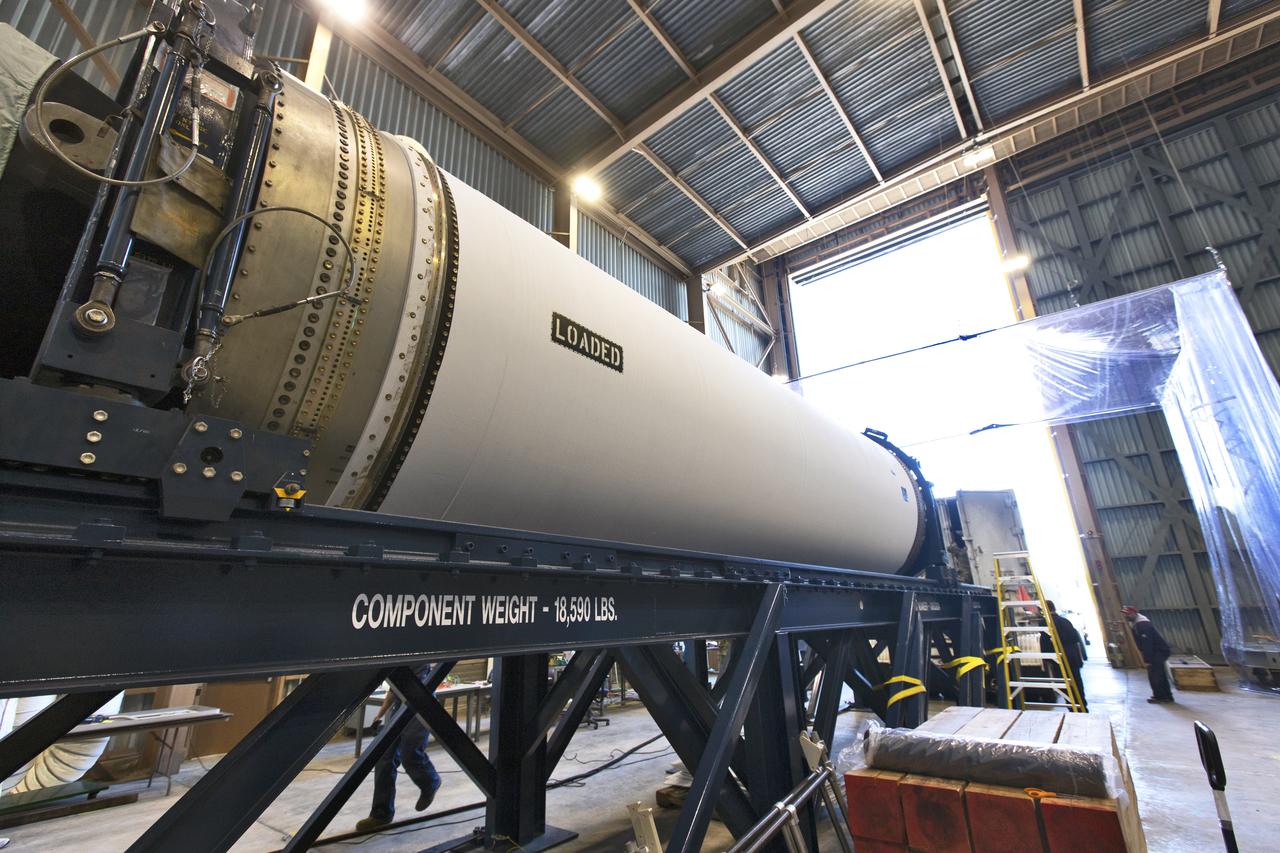
The Northrop Grumman-provided ascent test booster for the Orion Ascent Abort-2 (AA-2) Flight Test is secured on a work stand inside the Rotation, Processing and Surge Facility (RPSF) at NASA’s Kennedy Space Center in Florida on Jan. 29, 2019. The booster will be outfitted for flight. AA-2 is a full-stress test of the Launch Abort System, scheduled for April 2019. AA-2 will launch from Space Launch Complex 46, carrying a fully functional LAS and a 22,000-pound Orion test vehicle to an altitude of 31,000 feet and traveling at more than 1,000 miles an hour. The test will verify the LAS can steer the crew module and astronauts aboard to safety in the event of an issue with the Space Launch System (SLS) rocket when the spacecraft is under the highest aerodynamic loads it will experience during a rapid climb into space. NASA's Orion and Exploration Ground Systems programs and contractors from Jacob's and Northrup Grumman in conjunction with the Air Force Space and Missile Center's Launch Operations branch are performing flight operations for AA-2.
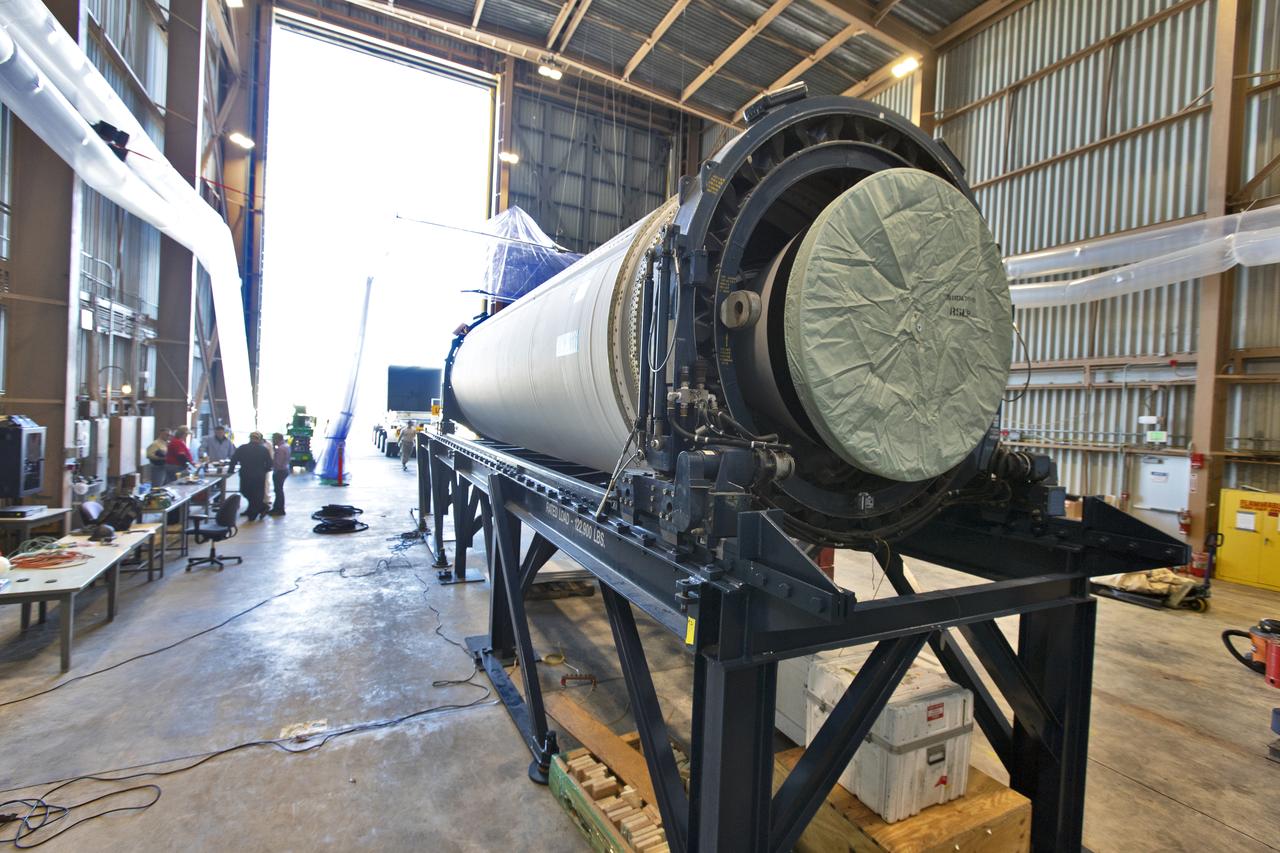
The Northrop Grumman-provided ascent test booster for the Orion Ascent Abort-2 (AA-2) Flight Test is secured on a work stand inside the Rotation, Processing and Surge Facility (RPSF) at NASA’s Kennedy Space Center in Florida on Jan. 29, 2019. The booster will be outfitted for flight. AA-2 is a full-stress test of the Launch Abort System, scheduled for April 2019. AA-2 will launch from Space Launch Complex 46, carrying a fully functional LAS and a 22,000-pound Orion test vehicle to an altitude of 31,000 feet and traveling at more than 1,000 miles an hour. The test will verify the LAS can steer the crew module and astronauts aboard to safety in the event of an issue with the Space Launch System (SLS) rocket when the spacecraft is under the highest aerodynamic loads it will experience during a rapid climb into space. NASA's Orion and Exploration Ground Systems programs and contractors from Jacob's and Northrup Grumman in conjunction with the Air Force Space and Missile Center's Launch Operations branch are performing flight operations for AA-2.
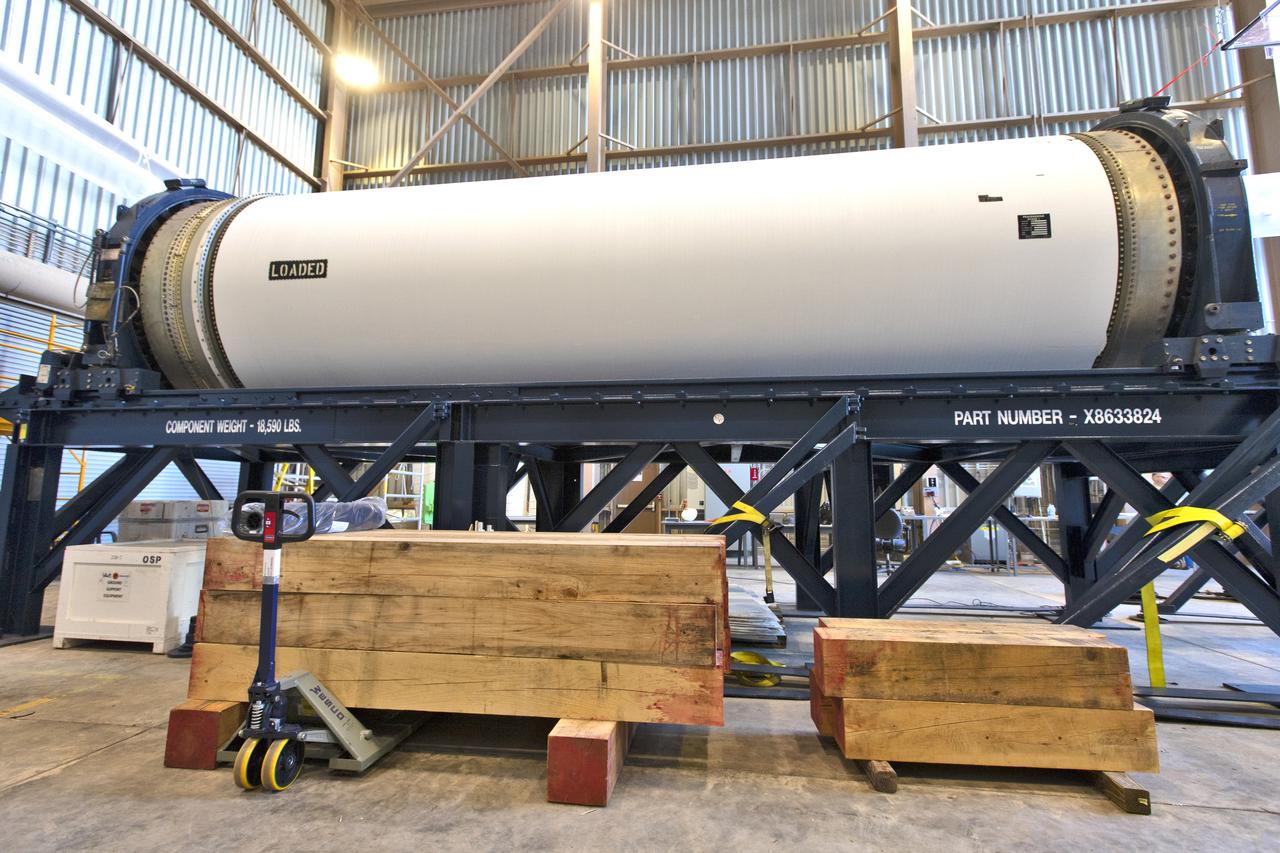
The Northrop Grumman-provided ascent test booster for the Orion Ascent Abort-2 (AA-2) Flight Test is secured on a work stand inside the Rotation, Processing and Surge Facility (RPSF) at NASA’s Kennedy Space Center in Florida on Jan. 29, 2019. The booster will be outfitted for flight. AA-2 is a full-stress test of the Launch Abort System, scheduled for April 2019. AA-2 will launch from Space Launch Complex 46, carrying a fully functional LAS and a 22,000-pound Orion test vehicle to an altitude of 31,000 feet and traveling at more than 1,000 miles an hour. The test will verify the LAS can steer the crew module and astronauts aboard to safety in the event of an issue with the Space Launch System (SLS) rocket when the spacecraft is under the highest aerodynamic loads it will experience during a rapid climb into space. NASA's Orion and Exploration Ground Systems programs and contractors from Jacob's and Northrup Grumman in conjunction with the Air Force Space and Missile Center's Launch Operations branch are performing flight operations for AA-2.
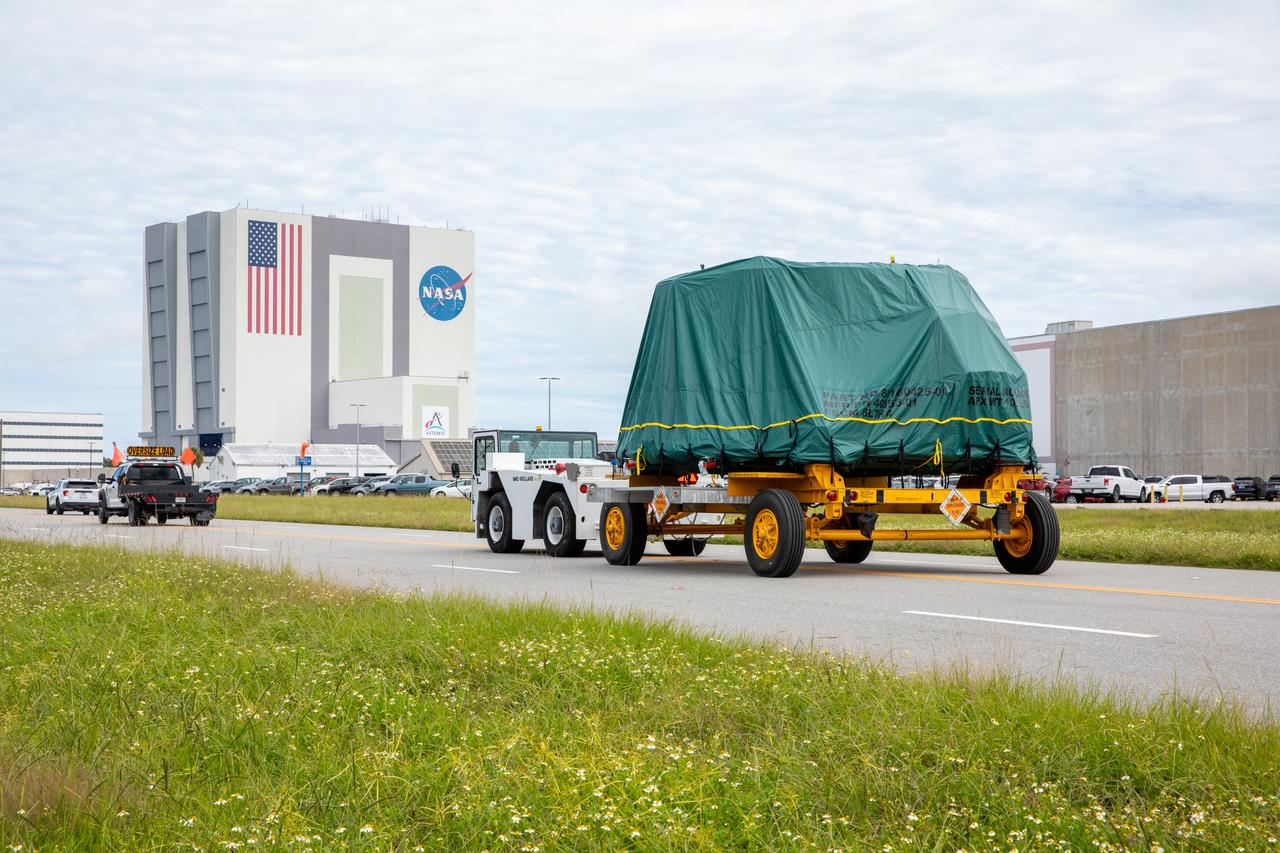
One of two Artemis II aft skirts for NASA's Space Launch System (SLS) rocket’s twin solid rocket boosters is transported from the Booster Fabrication Facility to the Rotation Processing and Surge Facility (RPSF) at the agency’s Kennedy Space Center in Florida on Monday, Sept. 25, 2023. The aft skirts were refurbished by Northrop Grumman and house the thrust vector control system, which controls 70 percent of the steering during initial ascent of the SLS rocket. The segments will remain in the RPSF until ready for stacking with the forward and aft parts of the boosters on the mobile launcher in High Bay 3 of the Vehicle Assembly Building. Artemis II astronauts Reid Wiseman, Victor Glover, Christina Koch, and Jeremy Hansen will launch from Kennedy, traveling around the Moon on the first crewed mission under Artemis that will test all of the Orion spacecraft’s systems.
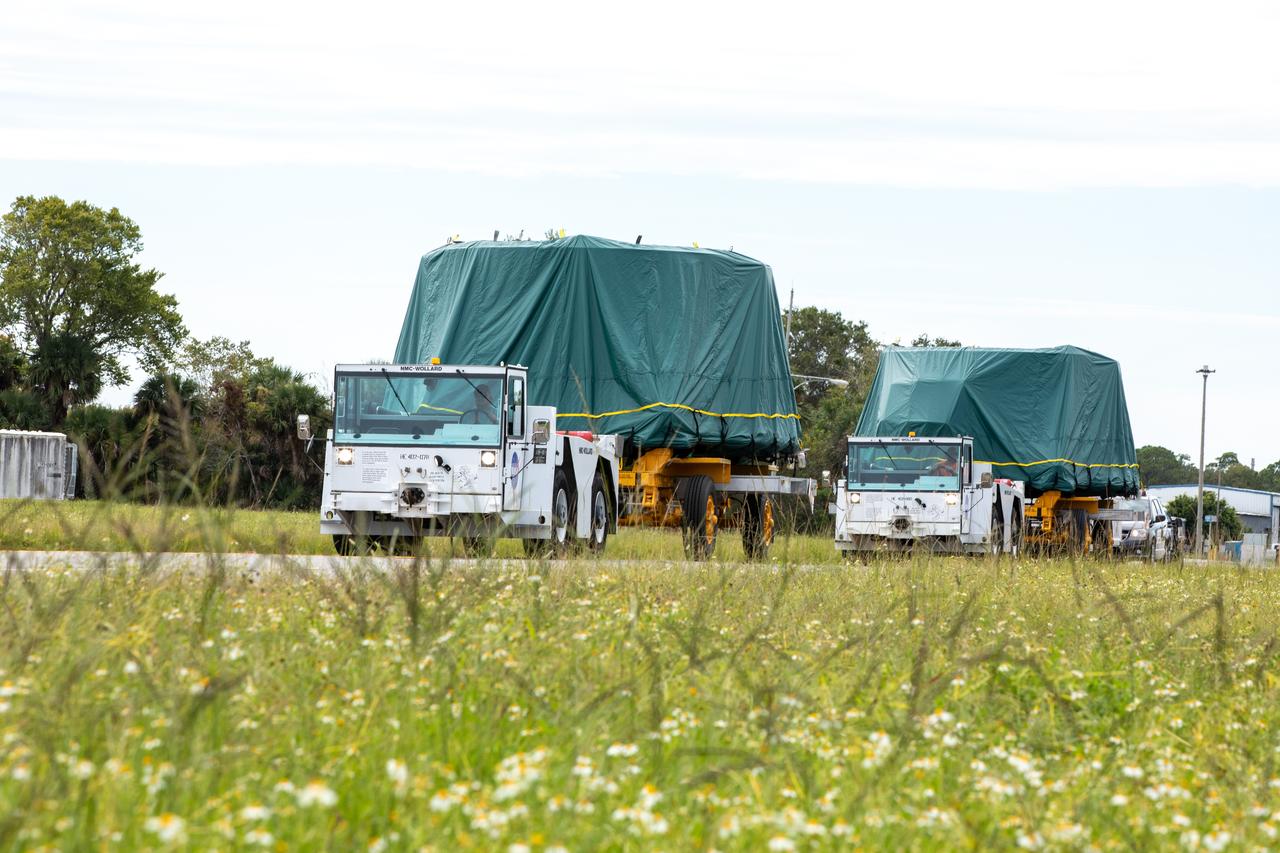
The Artemis II aft skirts for NASA's Space Launch System (SLS) rocket’s twin solid rocket boosters are transported from the Booster Fabrication Facility to the Rotation Processing and Surge Facility (RPSF) at the agency’s Kennedy Space Center in Florida on Monday, Sept. 25, 2023. The aft skirts were refurbished by Northrop Grumman and house the thrust vector control system, which controls 70 percent of the steering during initial ascent of the SLS rocket. The segments will remain in the RPSF until ready for stacking with the forward and aft parts of the boosters on the mobile launcher in High Bay 3 of the Vehicle Assembly Building. Artemis II astronauts Reid Wiseman, Victor Glover, Christina Koch, and Jeremy Hansen will launch from Kennedy, traveling around the Moon on the first crewed mission under Artemis that will test all of the Orion spacecraft’s systems.

One of two Artemis II aft skirts for NASA’s Space Launch System (SLS) rocket’s twin solid rocket boosters crosses railroad tracks on its way from the Booster Fabrication Facility to the Rotation Processing and Surge Facility (RPSF) at the agency’s Kennedy Space Center in Florida on Monday, Sept. 25, 2023. The aft skirts were refurbished by Northrop Grumman and house the thrust vector control system, which controls 70 percent of the steering during initial ascent of the SLS rocket. The segments will remain in the RPSF until ready for stacking with the forward and aft parts of the boosters on the mobile launcher in High Bay 3 of the Vehicle Assembly Building. Artemis II astronauts Reid Wiseman, Victor Glover, Christina Koch, and Jeremy Hansen will launch from Kennedy, traveling around the Moon on the first crewed mission under Artemis that will test all of the Orion spacecraft’s systems.
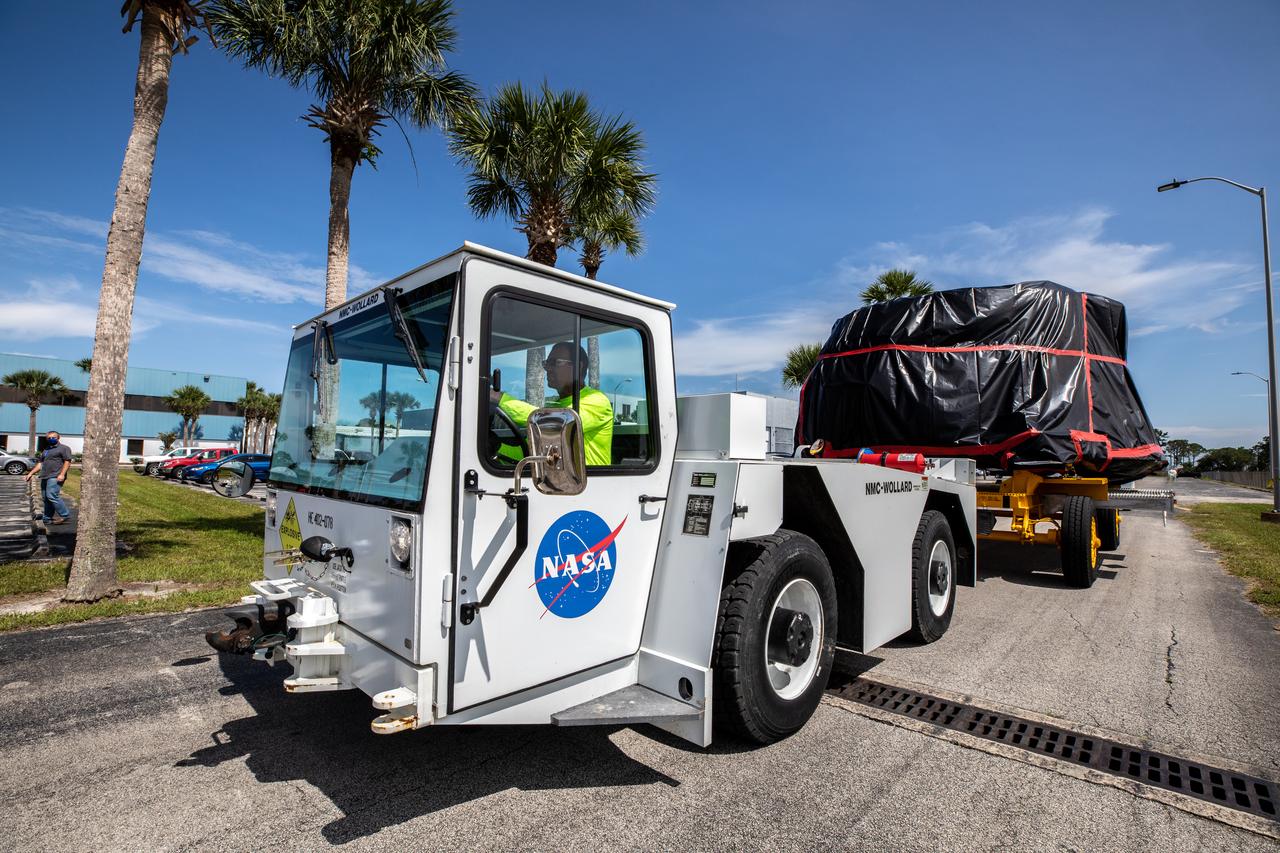
The Artemis I aft skirts for NASA's Space Launch System (SLS) rocket’s twin solid rocket boosters are transported to the Rotation Processing and Surge Facility (RPSF) at the agency’s Kennedy Space Center in Florida on June 10, 2020. The aft skirts were refurbished by Northrop Grumman. They house the thrust vector control system, which controls 70 percent of the steering during initial ascent of the SLS rocket. The segments will remain in the RPSF until ready for stacking with the forward and aft parts of the boosters on the mobile launcher in High Bay 3 of the Vehicle Assembly Building. Through the Artemis Program, NASA is working to land the first woman and next man on the Moon by 2024.

The Artemis I aft skirts for NASA's Space Launch System (SLS) rocket’s twin solid rocket boosters are transported to the Rotation Processing and Surge Facility (RPSF) at the agency’s Kennedy Space Center in Florida on June 10, 2020. The aft skirts were refurbished by Northrop Grumman. They house the thrust vector control system, which controls 70 percent of the steering during initial ascent of the SLS rocket. The segments will remain in the RPSF until ready for stacking with the forward and aft parts of the boosters on the mobile launcher in High Bay 3 of the Vehicle Assembly Building. Through the Artemis Program, NASA is working to land the first woman and next man on the Moon by 2024.
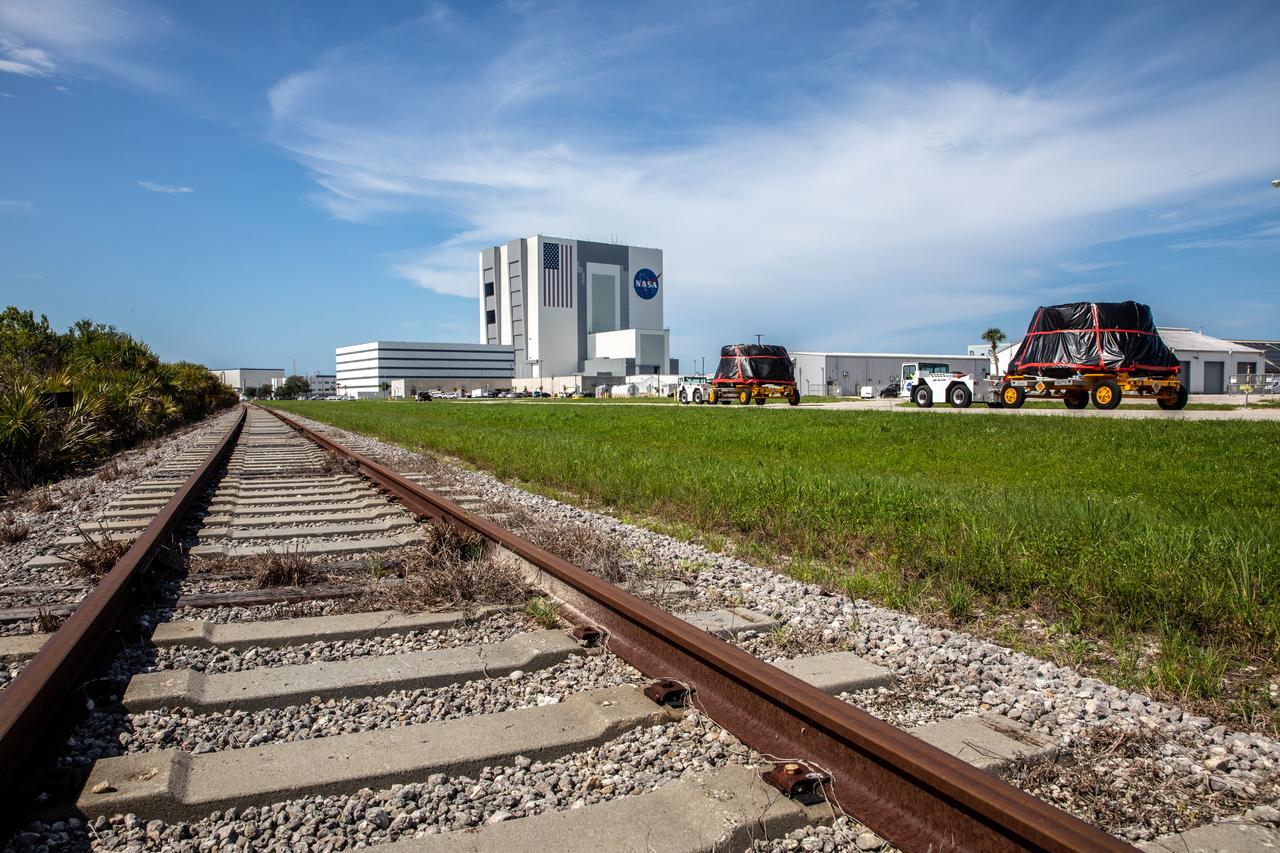
The Artemis I aft skirts for NASA’s Space Launch System (SLS) rocket’s twin solid rocket boosters are moved along the road to the Rotation, Processing and Surge Facility (RPSF) at the agency’s Kennedy Space Center in Florida on June 10, 2020. The aft skirts were refurbished by Northrop Grumman. They house the thrust vector control system, which controls 70 percent of the steering during initial ascent of the SLS rocket. The aft skirts will remain in the RPSF until ready for stacking with the forward and aft parts of the boosters on the mobile launcher in High Bay 3 of the Vehicle Assembly Building. Through the Artemis Program, NASA is working to land the first woman and next man on the Moon by 2024.
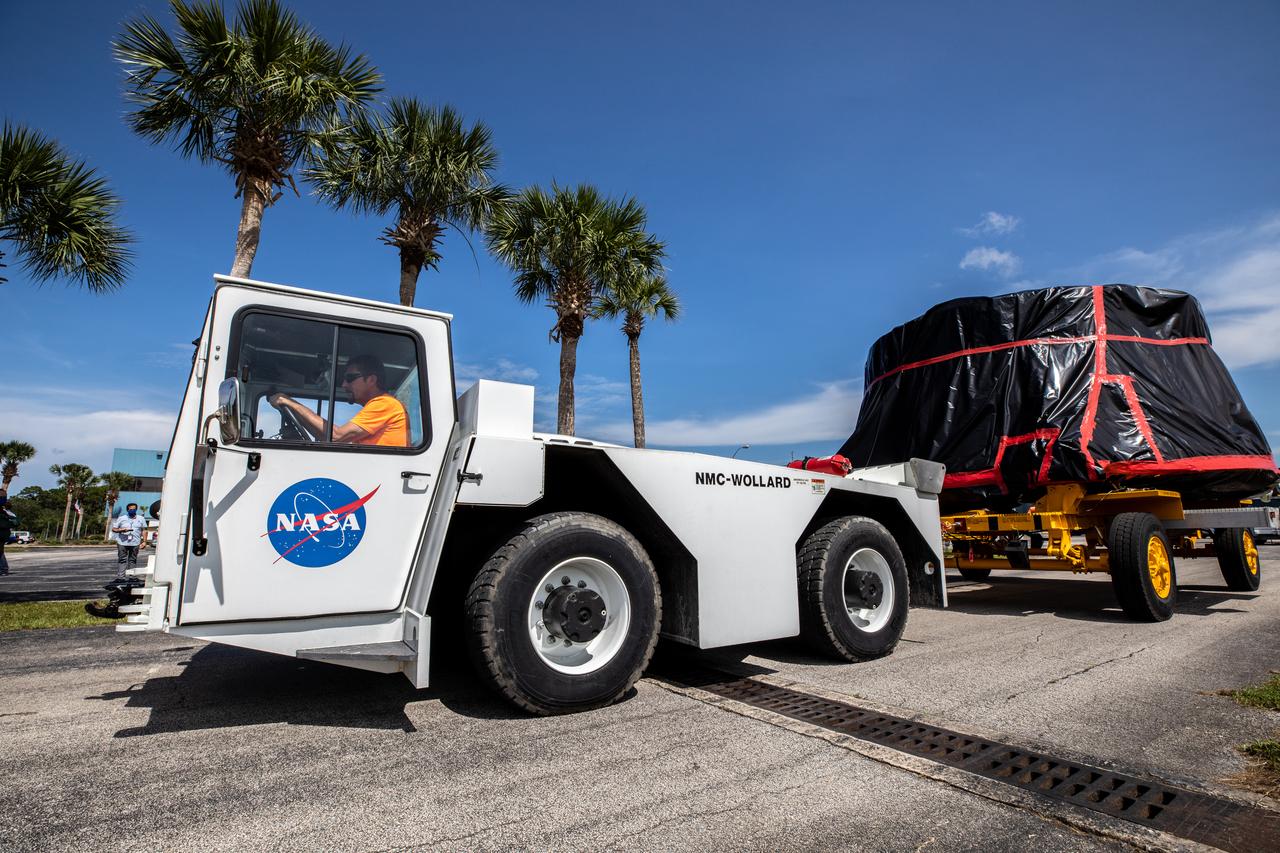
The Artemis I aft skirts for NASA's Space Launch System (SLS) rocket’s twin solid rocket boosters are transported to the Rotation Processing and Surge Facility (RPSF) at the agency’s Kennedy Space Center in Florida on June 10, 2020. The aft skirts were refurbished by Northrop Grumman. They house the thrust vector control system, which controls 70 percent of the steering during initial ascent of the SLS rocket. The segments will remain in the RPSF until ready for stacking with the forward and aft parts of the boosters on the mobile launcher in High Bay 3 of the Vehicle Assembly Building. Through the Artemis Program, NASA is working to land the first woman and next man on the Moon by 2024.
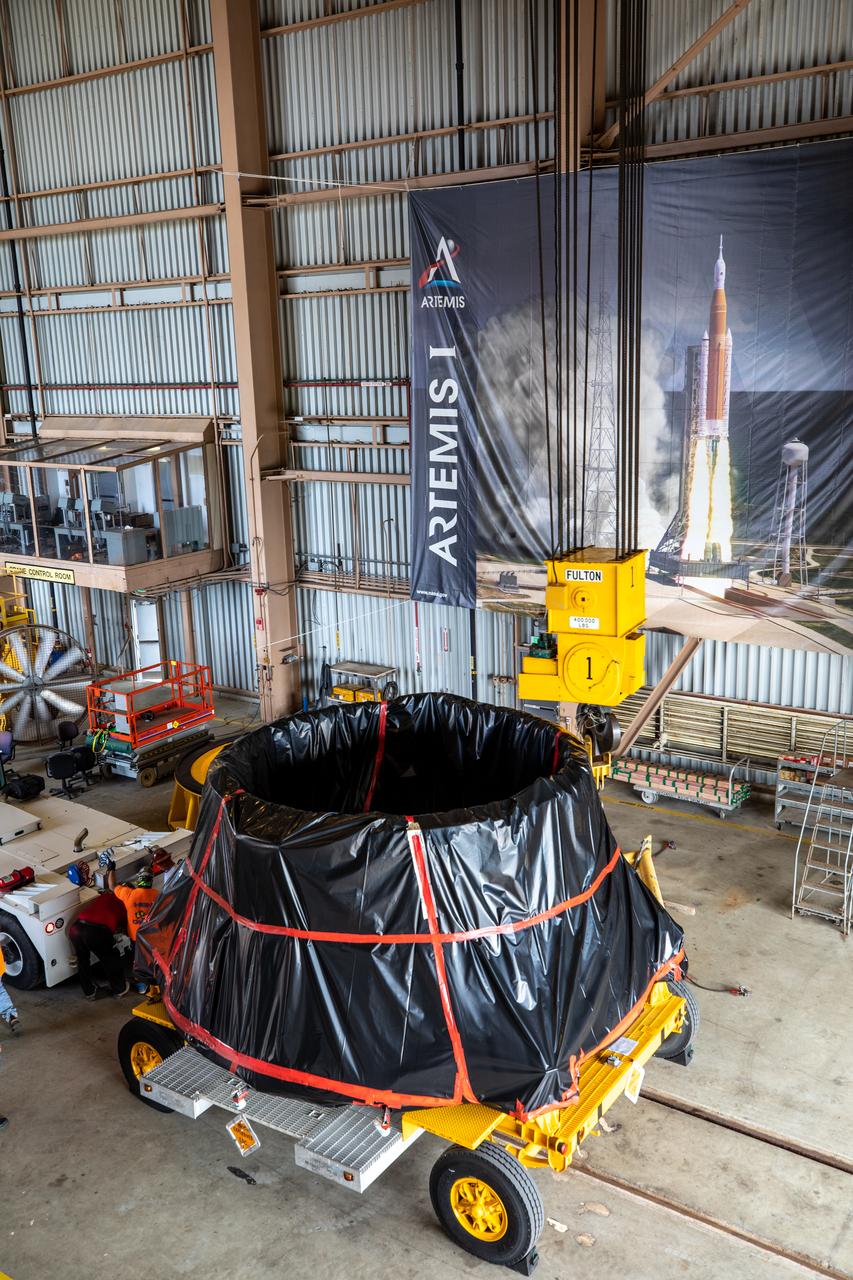
The first of two Artemis I aft skirts for NASA's Space Launch System (SLS) rocket’s twin solid rocket boosters is moved into the Rotation Processing and Surge Facility (RPSF) at the agency’s Kennedy Space Center in Florida on June 10, 2020. The aft skirts were refurbished by Northrop Grumman. They house the thrust vector control system, which controls 70 percent of the steering during initial ascent of the SLS rocket. The segments will remain in the RPSF until ready for stacking with the forward and aft parts of the boosters on the mobile launcher in High Bay 3 of the Vehicle Assembly Building. Through the Artemis Program, NASA is working to land the first woman and next man on the Moon by 2024.
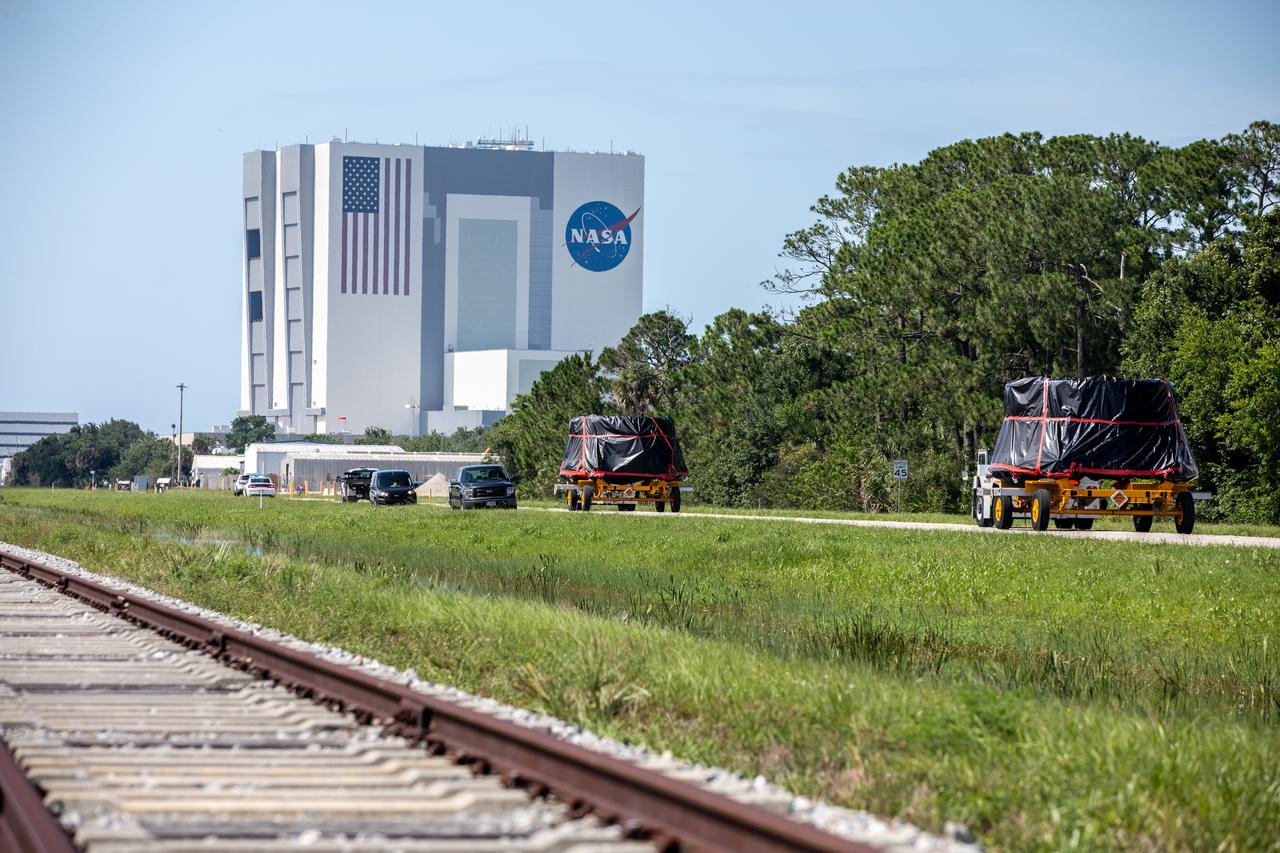
The Artemis I aft skirts for NASA’s Space Launch System (SLS) rocket’s twin solid rocket boosters are moved along the road to the Rotation, Processing and Surge Facility (RPSF) at the agency’s Kennedy Space Center in Florida on June 10, 2020. The aft skirts were refurbished by Northrop Grumman. They house the thrust vector control system, which controls 70 percent of the steering during initial ascent of the SLS rocket. The aft skirts will remain in the RPSF until ready for stacking with the forward and aft parts of the boosters on the mobile launcher in High Bay 3 of the Vehicle Assembly Building. Through the Artemis Program, NASA is working to land the first woman and next man on the Moon by 2024.
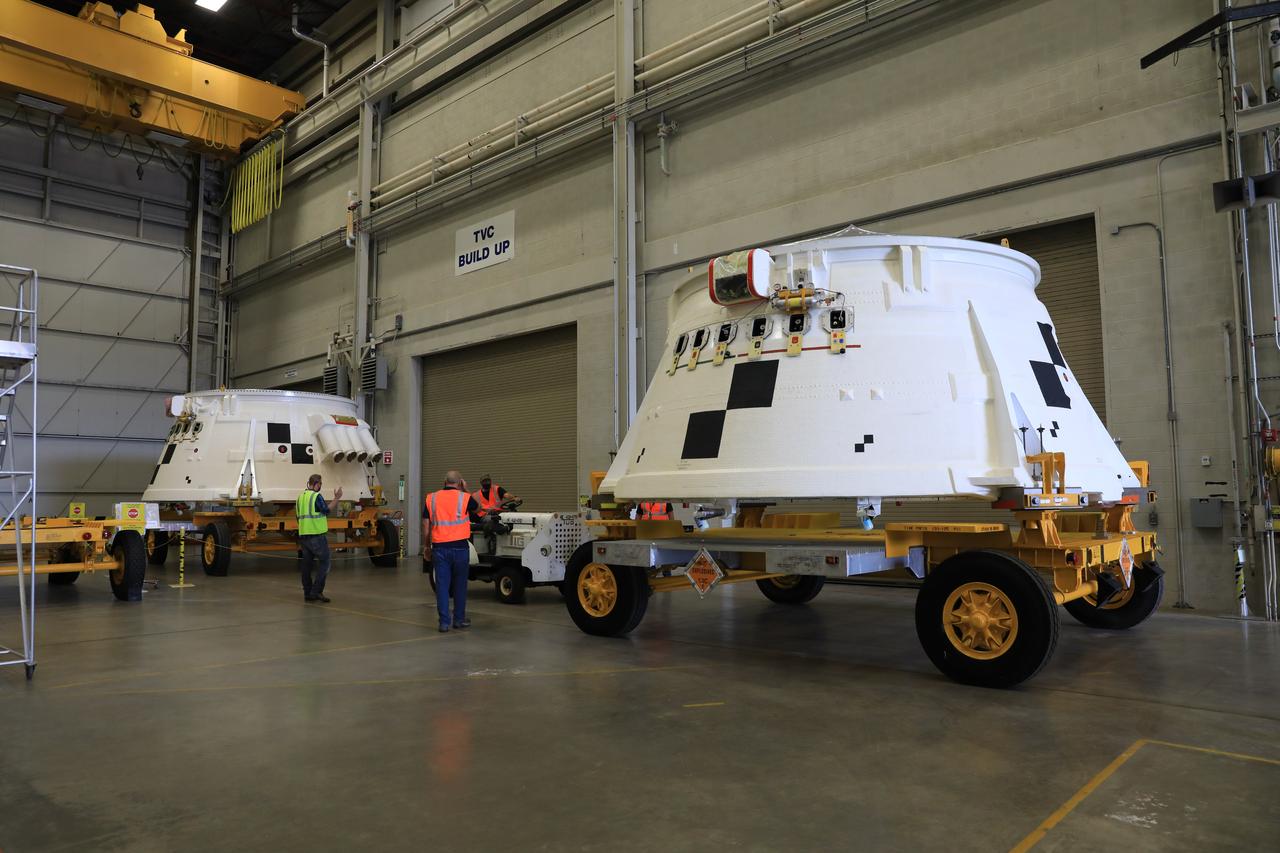
Inside the Booster Fabrication Facility at NASA's Kennedy Space Center in Florida, the Artemis I aft skirts for the agency's Space Launch System (SLS) rocket’s twin solid rocket boosters are moved out of their test cells and are being readied for their move to the Rotation, Processing and Surge Facility (RPSF) on June 9, 2020. The aft skirts were refurbished by Northrop Grumman. They house the thrust vector control system, which controls 70 percent of the steering during initial ascent of the SLS rocket. The segments will remain in the RPSF until ready for stacking with the forward and aft parts of the boosters on the mobile launcher in High Bay 3 of the Vehicle Assembly Building. Through the Artemis Program, NASA is working to land the first woman and next man on the Moon by 2024.
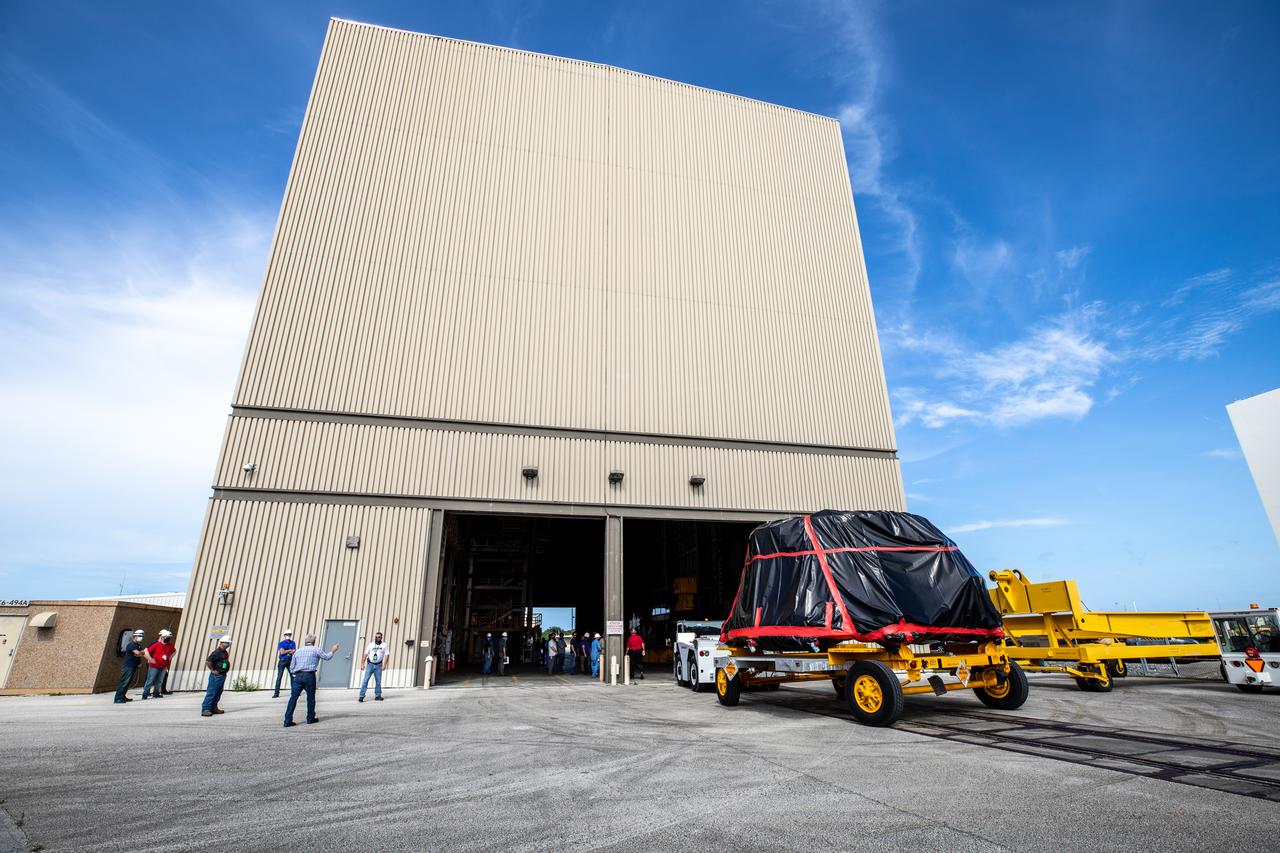
The first of two Artemis I aft skirts for NASA’s Space Launch System (SLS) rocket’s twin solid rocket boosters arrives at the Rotation, Processing and Surge Facility (RPSF) at the agency’s Kennedy Space Center in Florida on June 10, 2020. They were transported from the Booster Fabrication Facility. The aft skirts were refurbished by Northrop Grumman. They house the thrust vector control system, which controls 70 percent of the steering during initial ascent of the SLS rocket. The segments will remain in the RPSF until ready for stacking with the forward and aft parts of the boosters on the mobile launcher in High Bay 3 of the Vehicle Assembly Building. Through the Artemis Program, NASA is working to land the first woman and next man on the Moon by 2024.
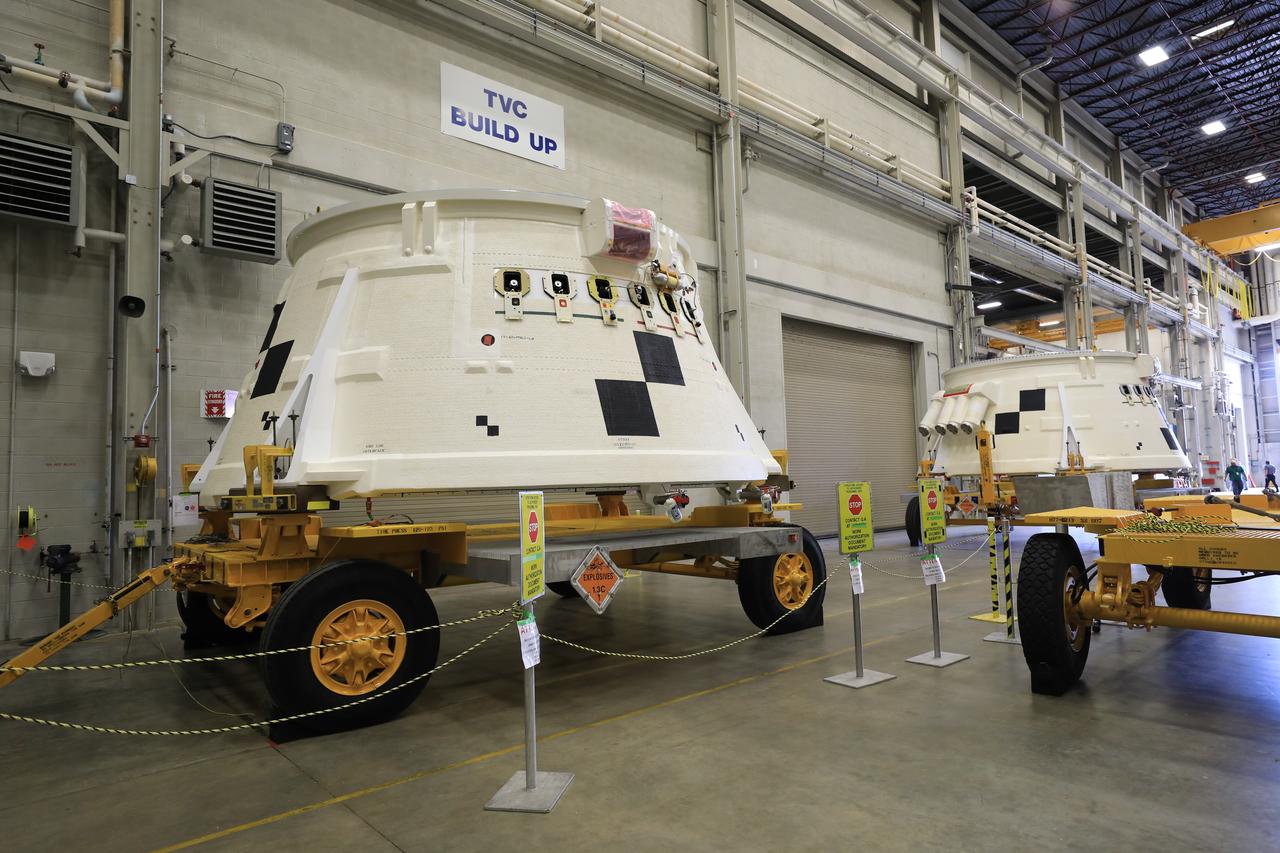
Inside the Booster Fabrication Facility at NASA's Kennedy Space Center in Florida, the Artemis I aft skirts for the agency's Space Launch System (SLS) rocket’s twin solid rocket boosters are being readied for their move to the Rotation, Processing and Surge Facility (RPSF) on June 9, 2020. In view at left is the left aft skirt assembly, and at far right is the right aft skirt assembly. The aft skirts were refurbished by Northrop Grumman. They house the thrust vector control system, which controls 70 percent of the steering during initial ascent of the SLS rocket. The segments will remain in the RPSF until ready for stacking with the forward and aft parts of the boosters on the mobile launcher in High Bay 3 of the Vehicle Assembly Building. Through the Artemis Program, NASA is working to land the first woman and next man on the Moon by 2024.
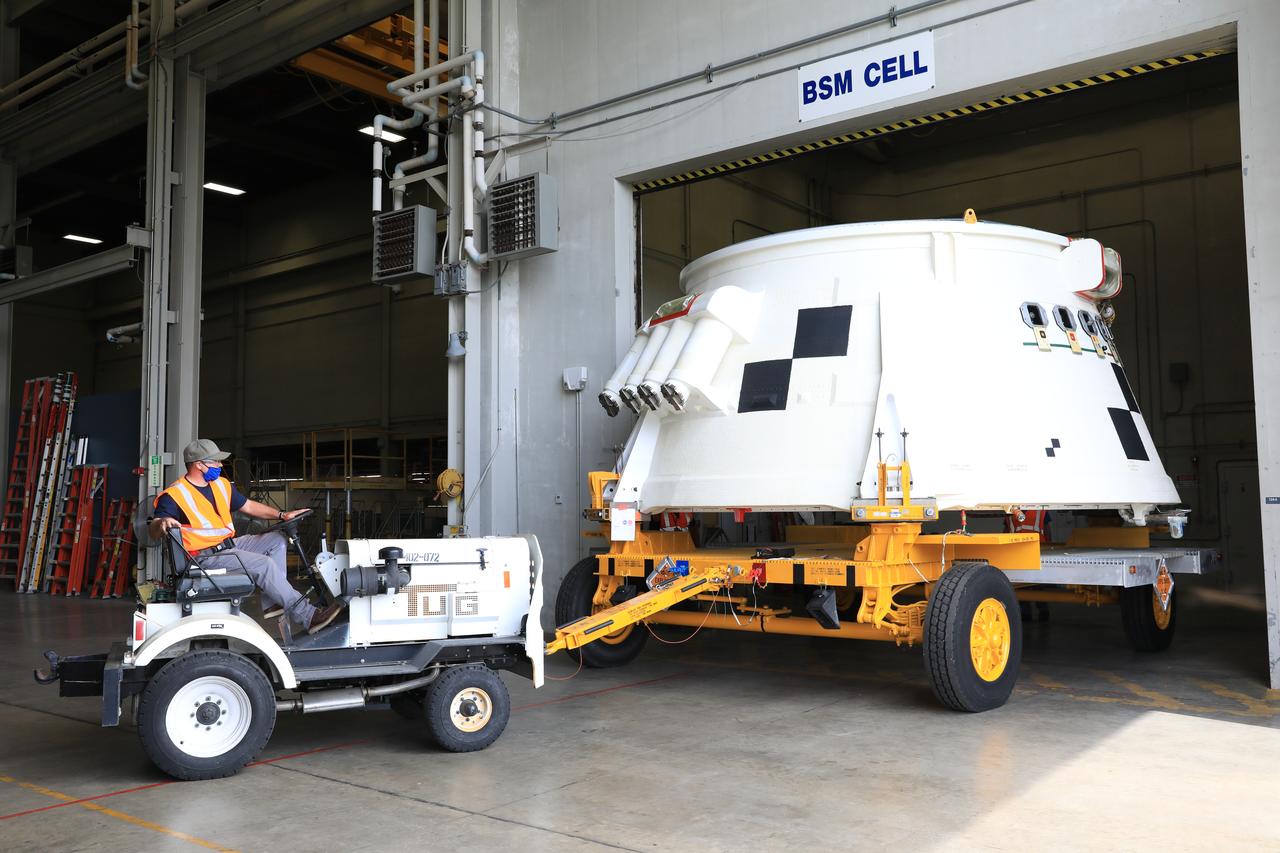
Inside the Booster Fabrication Facility at NASA's Kennedy Space Center in Florida, the Artemis I aft skirts for the agency's Space Launch System (SLS) rocket’s twin solid rocket boosters are being readied for their move to the Rotation, Processing and Surge Facility (RPSF) on June 9, 2020. In view, the left aft skirt assembly is attached to a move vehicle and moved out of a test cell. The aft skirts were refurbished by Northrop Grumman. They house the thrust vector control system, which controls 70 percent of the steering during initial ascent of the SLS rocket. The segments will remain in the RPSF until ready for stacking with the forward and aft parts of the boosters on the mobile launcher in High Bay 3 of the Vehicle Assembly Building. Through the Artemis Program, NASA is working to land the first woman and next man on the Moon by 2024.

Inside the Booster Fabrication Facility at NASA's Kennedy Space Center in Florida, the Artemis I aft skirts for the agency's Space Launch System (SLS) rocket’s twin solid rocket boosters are being readied for their move to the Rotation, Processing and Surge Facility (RPSF) on June 9, 2020. In view at left is the left aft skirt assembly. Behind it to the right is the right aft skirt assembly. Also in view at far right, are the Artemis I forward assemblies, with the left assembly in front and the right assembly behind it. The aft skirts were refurbished by Northrop Grumman. They house the thrust vector control system, which controls 70 percent of the steering during initial ascent of the SLS rocket. The segments will remain in the RPSF until ready for stacking with the forward and aft parts of the boosters on the mobile launcher in High Bay 3 of the Vehicle Assembly Building. Through the Artemis Program, NASA is working to land the first woman and next man on the Moon by 2024.
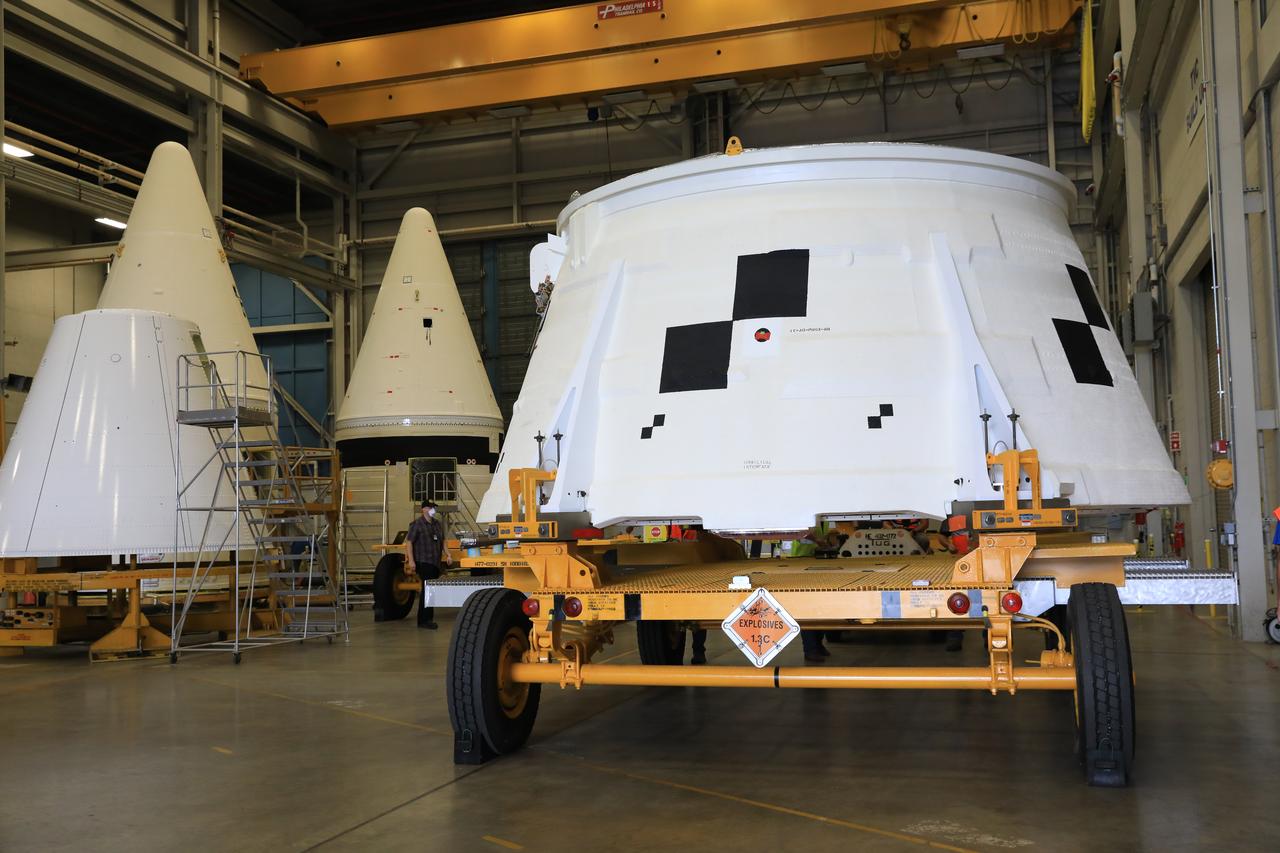
Inside the Booster Fabrication Facility at NASA's Kennedy Space Center in Florida, the Artemis I aft skirts for the agency's Space Launch System (SLS) rocket’s twin solid rocket boosters are moved out of their test cells and are being readied for their move to the Rotation, Processing and Surge Facility (RPSF) on June 9, 2020. In view at right is the right aft skirt. In view at left are the two Artemis I forward assemblies. The aft skirts were refurbished by Northrop Grumman. They house the thrust vector control system, which controls 70 percent of the steering during initial ascent of the SLS rocket. The segments will remain in the RPSF until ready for stacking with the forward and aft parts of the boosters on the mobile launcher in High Bay 3 of the Vehicle Assembly Building. Through the Artemis Program, NASA is working to land the first woman and next man on the Moon by 2024.
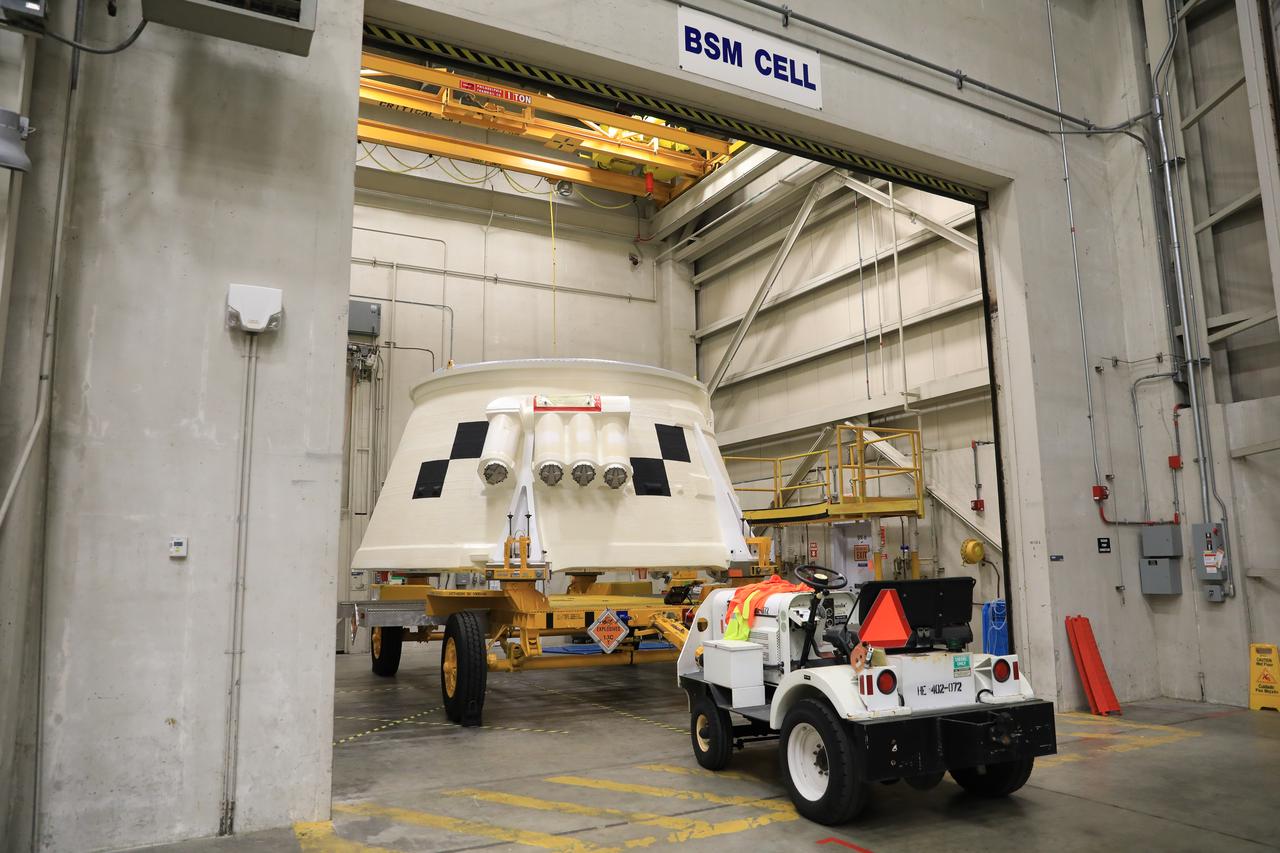
Inside the Booster Fabrication Facility at NASA's Kennedy Space Center in Florida, the Artemis I aft skirts for the agency's Space Launch System (SLS) rocket’s twin solid rocket boosters are being readied for their move to the Rotation, Processing and Surge Facility (RPSF) on June 9, 2020. In view, the left aft skirt assembly is attached to a move vehicle in a test cell. The aft skirts were refurbished by Northrop Grumman. They house the thrust vector control system, which controls 70 percent of the steering during initial ascent of the SLS rocket. The segments will remain in the RPSF until ready for stacking with the forward and aft parts of the boosters on the mobile launcher in High Bay 3 of the Vehicle Assembly Building. Through the Artemis Program, NASA is working to land the first woman and next man on the Moon by 2024.
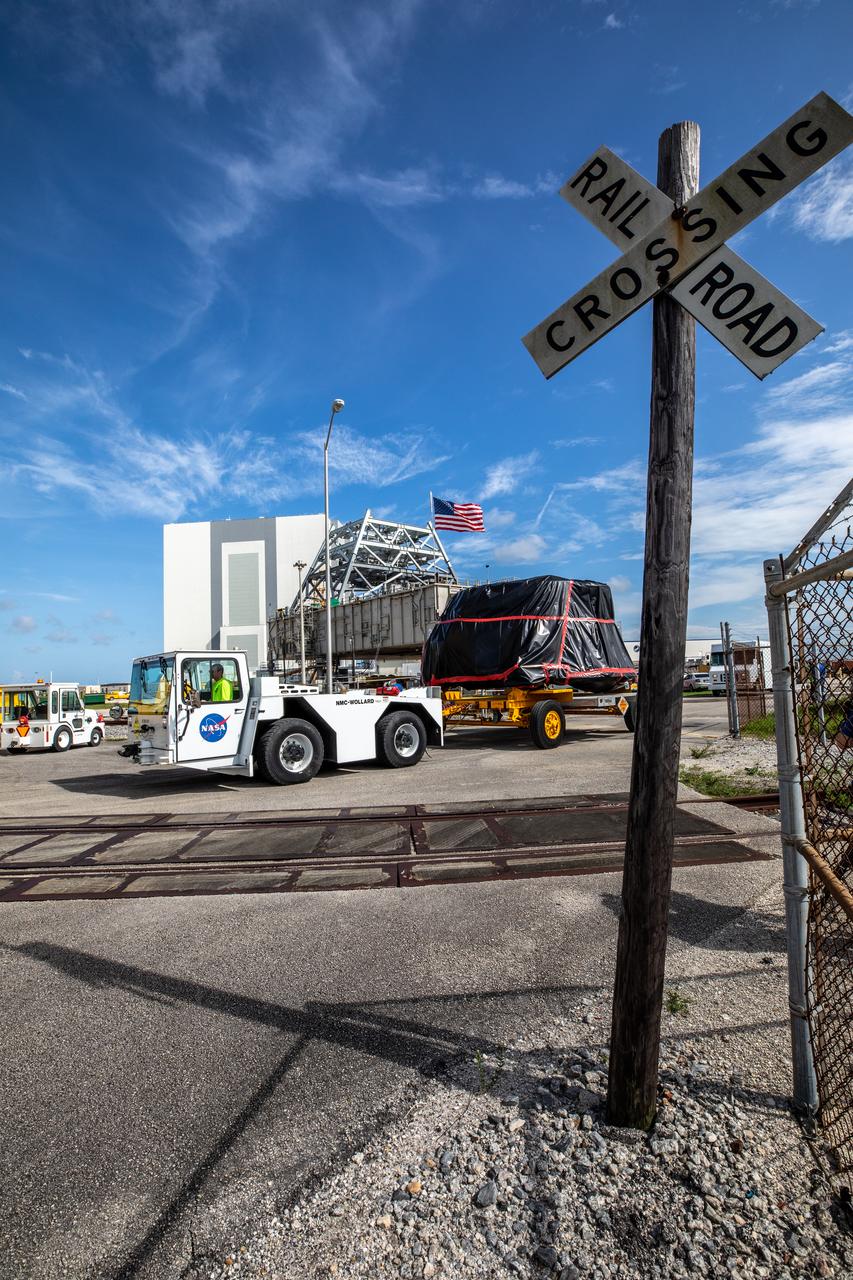
One of two Artemis I aft skirts for NASA’s Space Launch System (SLS) rocket’s twin solid rocket boosters crosses a railroad track on its way to the Rotation, Processing and Surge Facility (RPSF) at the agency’s Kennedy Space Center in Florida on June 10, 2020. They were transported from the Booster Fabrication Facility. The aft skirts were refurbished by Northrop Grumman. They house the thrust vector control system, which controls 70 percent of the steering during initial ascent of the SLS rocket. The segments will remain in the RPSF until ready for stacking with the forward and aft parts of the boosters on the mobile launcher in High Bay 3 of the Vehicle Assembly Building. Through the Artemis Program, NASA is working to land the first woman and next man on the Moon by 2024.
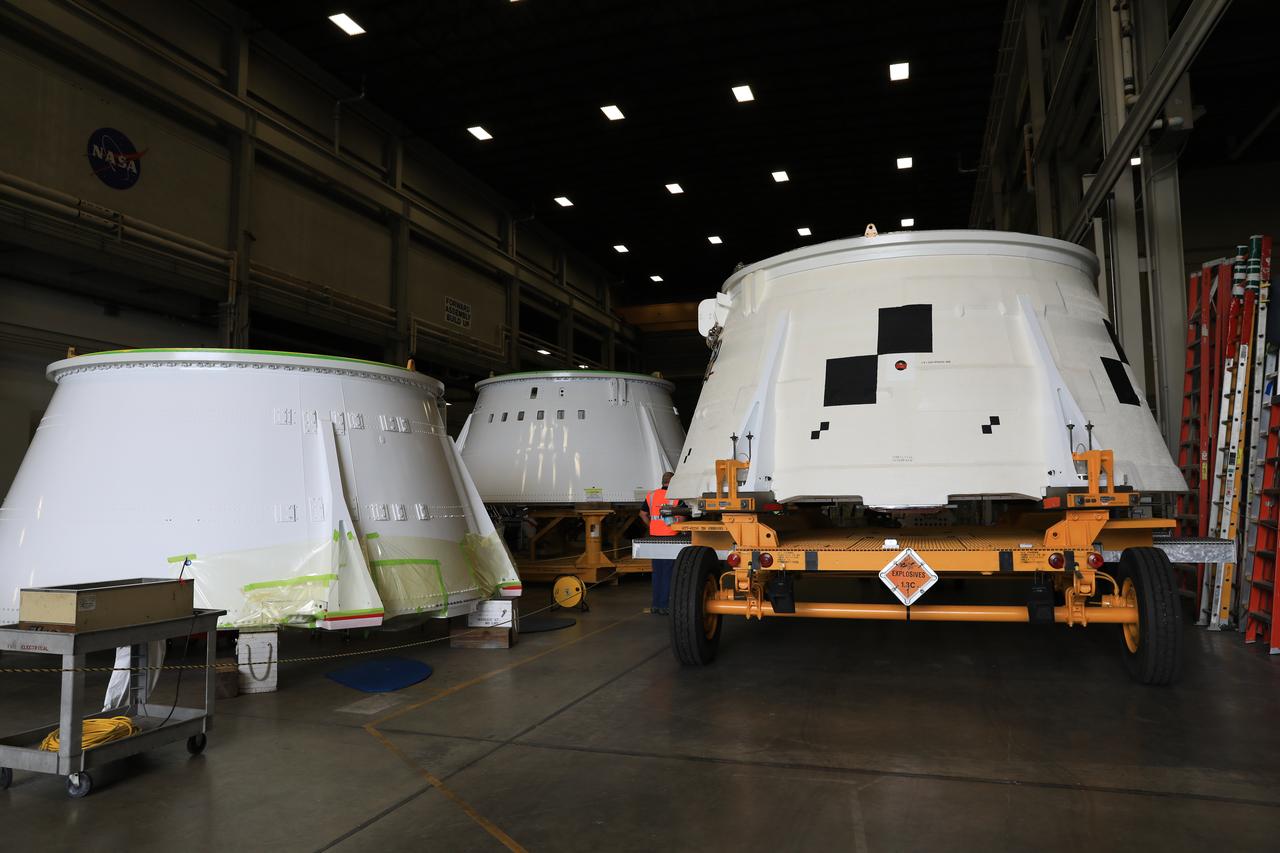
Inside the Booster Fabrication Facility at NASA's Kennedy Space Center in Florida, the Artemis I aft skirts for the agency's Space Launch System (SLS) rocket’s twin solid rocket boosters are being readied for their move to the Rotation, Processing and Surge Facility (RPSF) on June 9, 2020. In view, the left aft skirt assembly is attached to a move vehicle and moved out of a test cell. The Artemis II aft skirt structures are in view at left. The aft skirts were refurbished by Northrop Grumman. They house the thrust vector control system, which controls 70 percent of the steering during initial ascent of the SLS rocket. The segments will remain in the RPSF until ready for stacking with the forward and aft parts of the boosters on the mobile launcher in High Bay 3 of the Vehicle Assembly Building. Through the Artemis Program, NASA is working to land the first woman and next man on the Moon by 2024.
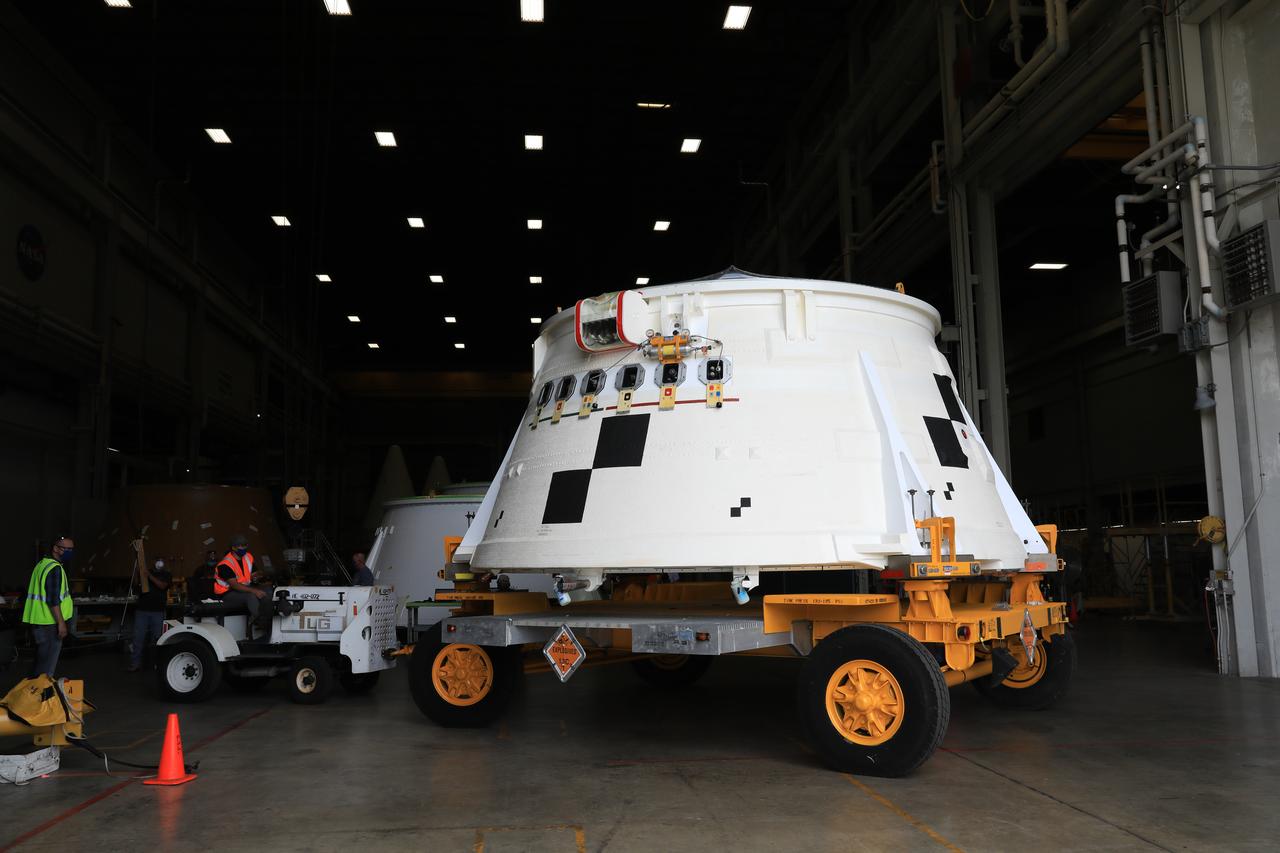
Inside the Booster Fabrication Facility at NASA's Kennedy Space Center in Florida, the Artemis I aft skirts for the agency's Space Launch System (SLS) rocket’s twin solid rocket boosters are being readied for their move to the Rotation, Processing and Surge Facility (RPSF) on June 9, 2020. In view, the left aft skirt assembly is attached to a move vehicle and moved out of a test cell. The aft skirts were refurbished by Northrop Grumman. They house the thrust vector control system, which controls 70 percent of the steering during initial ascent of the SLS rocket. The segments will remain in the RPSF until ready for stacking with the forward and aft parts of the boosters on the mobile launcher in High Bay 3 of the Vehicle Assembly Building. Through the Artemis Program, NASA is working to land the first woman and next man on the Moon by 2024.
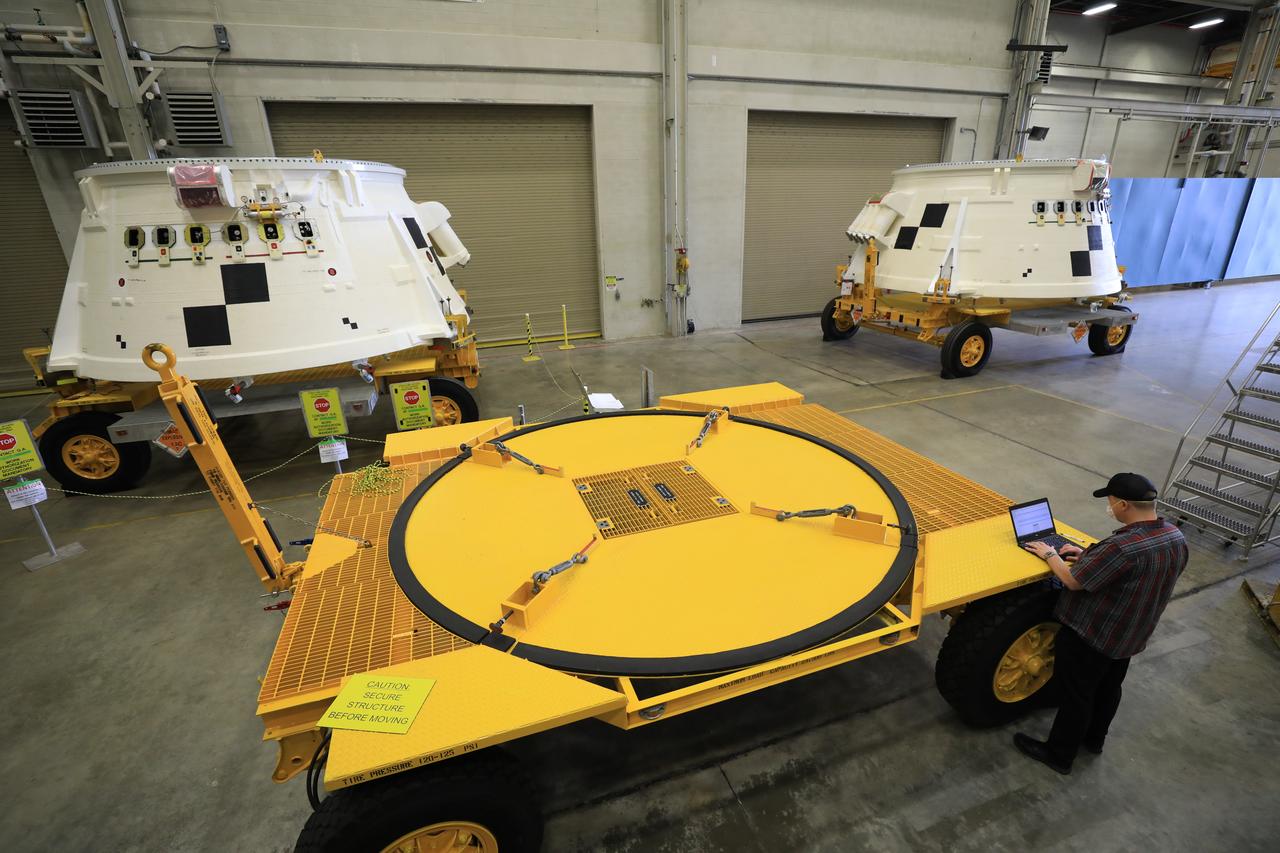
Inside the Booster Fabrication Facility at NASA's Kennedy Space Center in Florida, the Artemis I aft skirts for the agency's Space Launch System (SLS) rocket’s twin solid rocket boosters are being readied for their move to the Rotation, Processing and Surge Facility (RPSF) on June 9, 2020. In view at left is the left aft skirt assembly, and at right is the right aft skirt assembly. The aft skirts were refurbished by Northrop Grumman. They house the thrust vector control system, which controls 70 percent of the steering during initial ascent of the SLS rocket. The segments will remain in the RPSF until ready for stacking with the forward and aft parts of the boosters on the mobile launcher in High Bay 3 of the Vehicle Assembly Building. Through the Artemis Program, NASA is working to land the first woman and next man on the Moon by 2024.
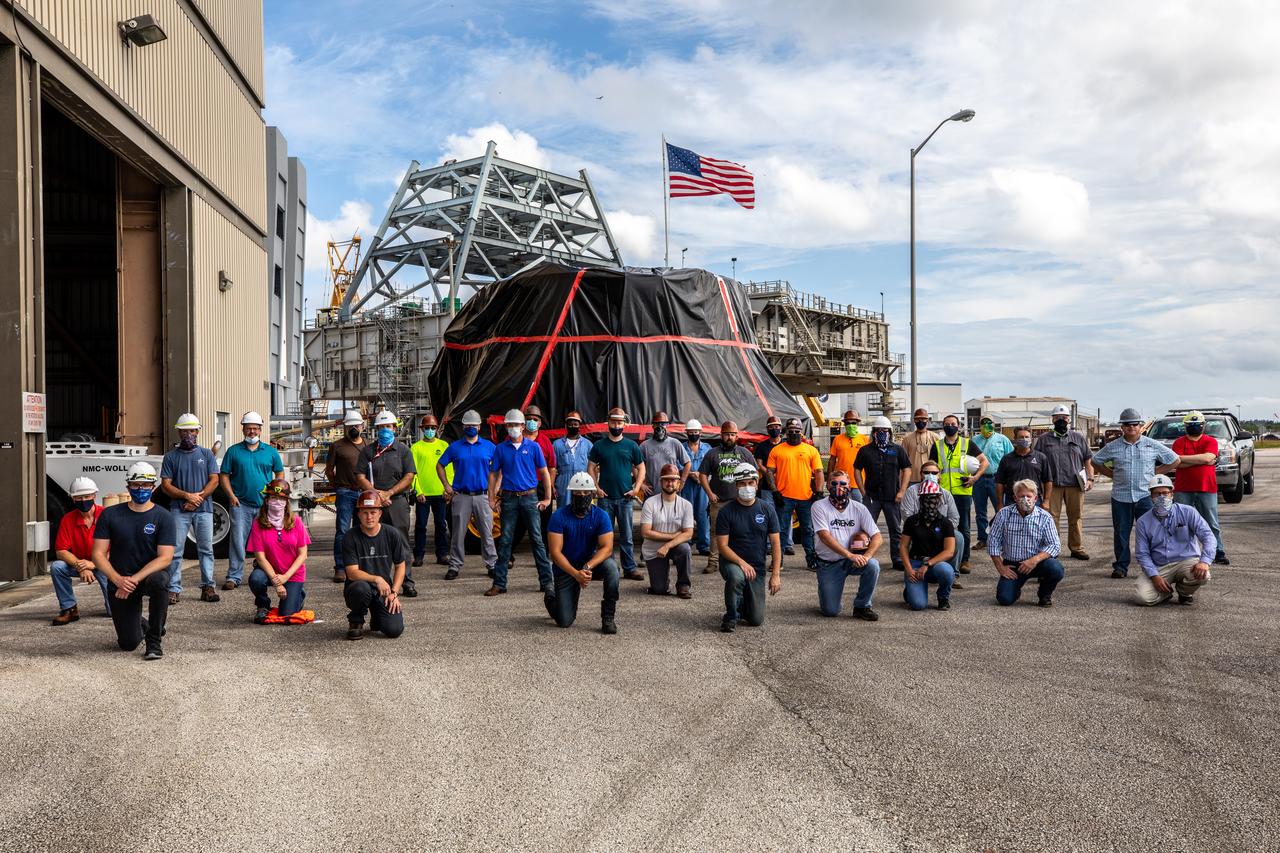
Exploration Ground Systems workers gather in front of the Rotation, Processing and Surge Facility (RPSF) at NASA’s Kennedy Space Center in Florida on June 10, 2020, to mark the arrival of the Artemis I aft skirts for the agency's Space Launch System (SLS) rocket’s twin solid rocket boosters. The aft skirts were moved from the Booster Fabrication Facility. The aft skirts were refurbished by Northrop Grumman. They house the thrust vector control system, which controls 70 percent of the steering during initial ascent of the SLS rocket. The segments will remain in the RPSF until ready for stacking with the forward and aft parts of the boosters on the mobile launcher in High Bay 3 of the Vehicle Assembly Building. Through the Artemis Program, NASA is working to land the first woman and next man on the Moon by 2024.
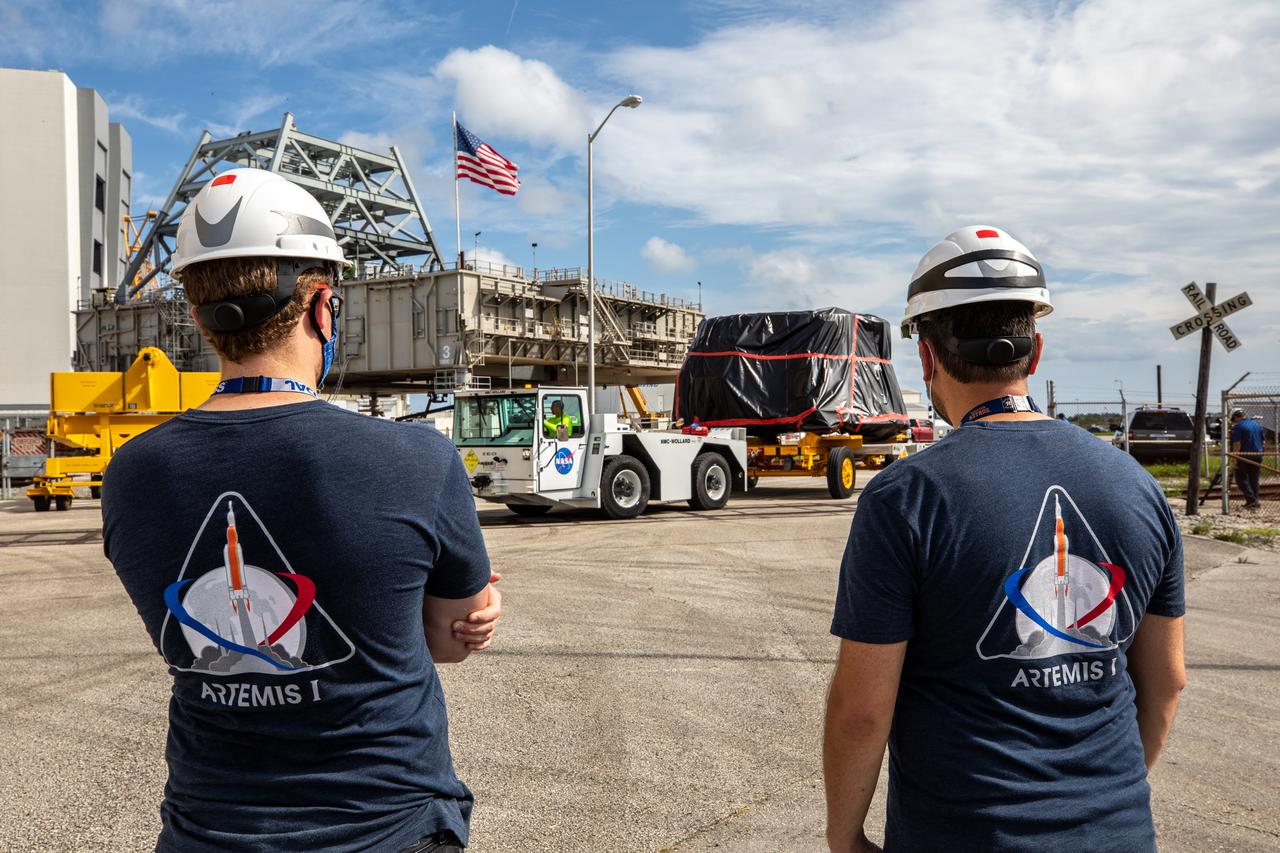
Exploration Ground Systems workers watch as the first of two Artemis I aft skirts for NASA’s Space Launch System (SLS) rocket’s twin solid rocket boosters crosses a railroad track on its way to the Rotation, Processing and Surge Facility (RPSF) at the agency’s Kennedy Space Center in Florida on June 10, 2020. They were transported from the Booster Fabrication Facility. The aft skirts were refurbished by Northrop Grumman. They house the thrust vector control system, which controls 70 percent of the steering during initial ascent of the SLS rocket. The segments will remain in the RPSF until ready for stacking with the forward and aft parts of the boosters on the mobile launcher in High Bay 3 of the Vehicle Assembly Building. Through the Artemis Program, NASA is working to land the first woman and next man on the Moon by 2024.
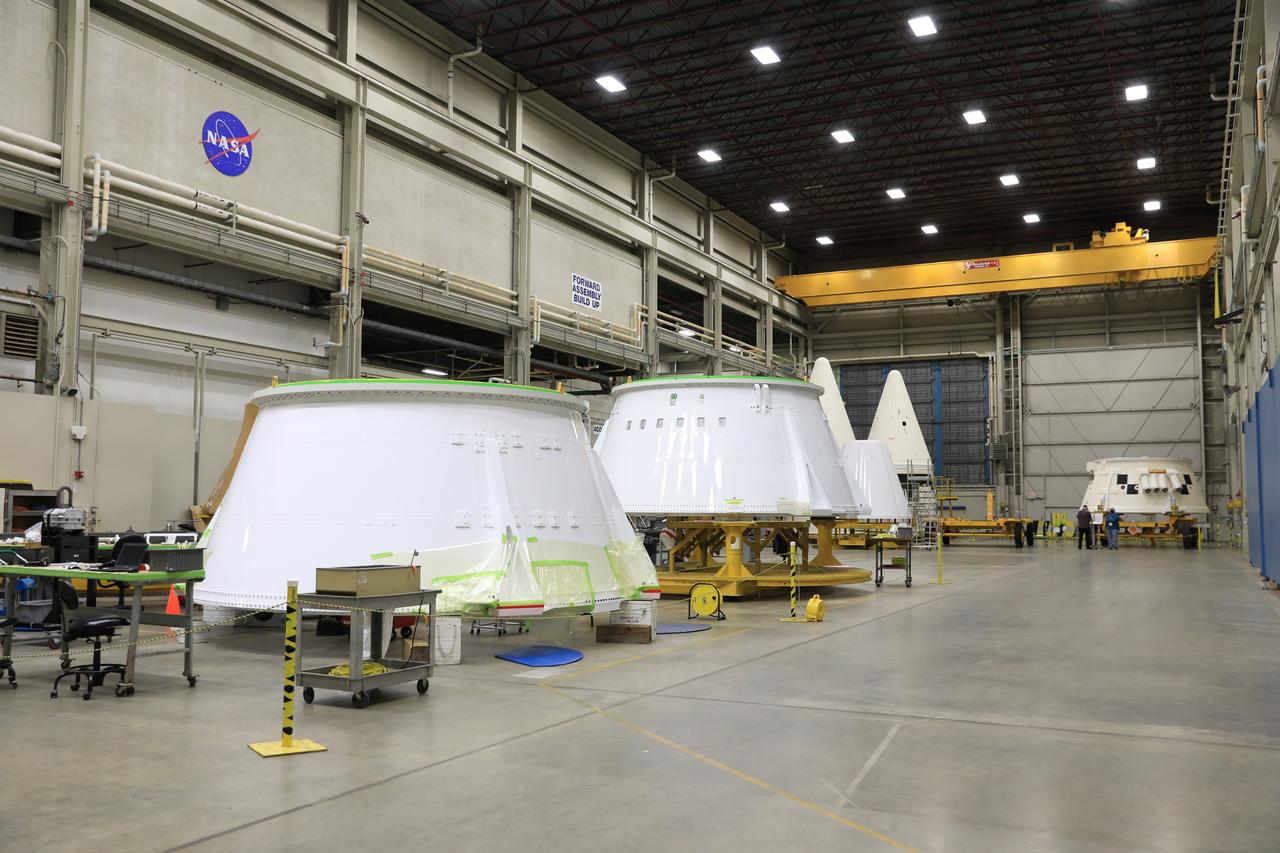
Inside the Booster Fabrication Facility (BFF) at NASA's Kennedy Space Center in Florida, the Artemis II aft skirt structures for the agency's Space Launch System (SLS) rocket’s twin solid rocket boosters are in view at left. Behind them are the two Artemis I forward assemblies. At far right, in the distance, is the right aft skirt assembly. In the BFF, the two aft skirt assemblies are being readied for their move to the Rotation, Processing and Surge Facility (RPSF) on June 9, 2020. The aft skirts were refurbished by Northrop Grumman. They house the thrust vector control system, which controls 70 percent of the steering during initial ascent of the SLS rocket. The segments will remain in the RPSF until ready for stacking with the forward and aft parts of the boosters on the mobile launcher in High Bay 3 of the Vehicle Assembly Building. Through the Artemis Program, NASA is working to land the first woman and next man on the Moon by 2024.
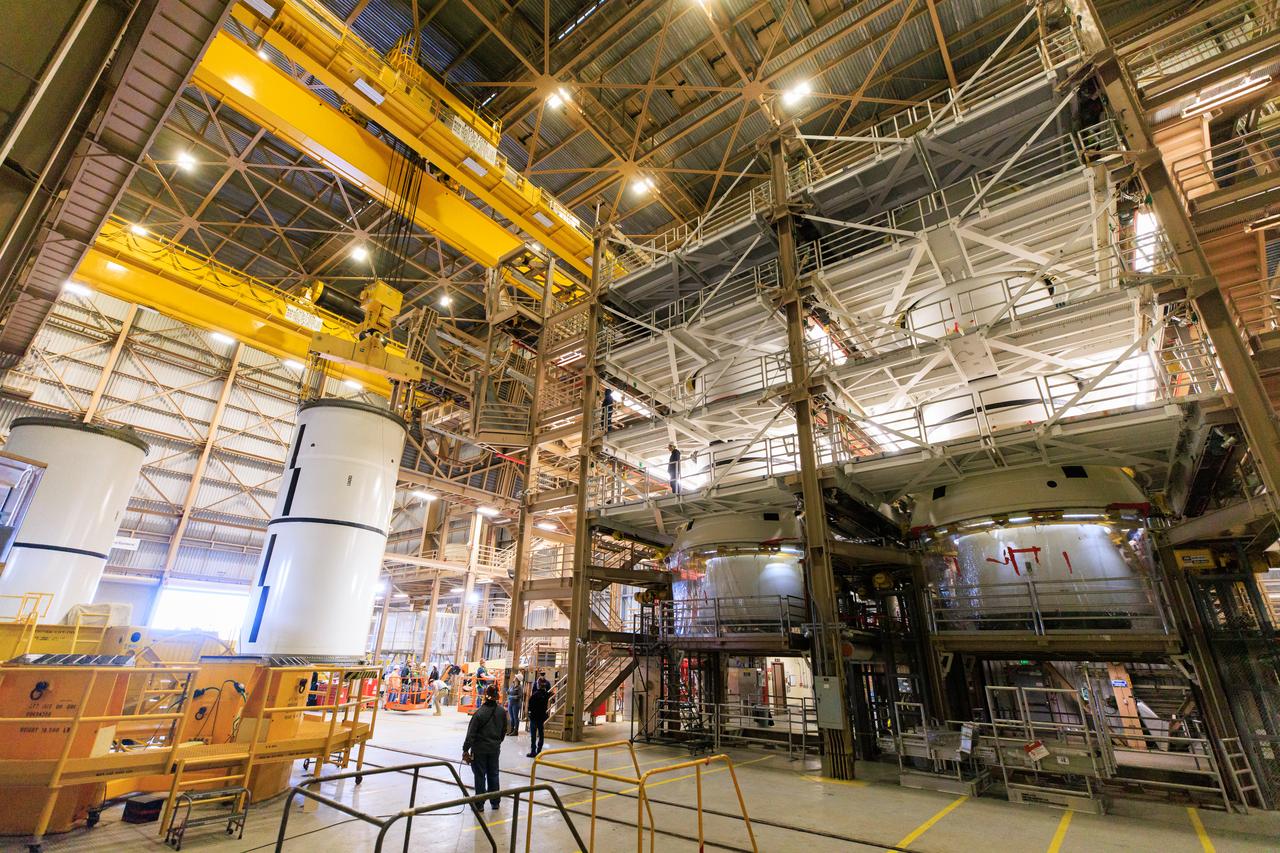
Following the successful propellant grain inspection of two segments of the solid rocket boosters for NASA’s Space Launch System inside the Rotation, Processing and Surge Facility at NASA’s Kennedy Space Center in Florida, crews on Thursday, Dec. 21, 2023, rotate and lift the segments from horizontal into a vertical position in preparation for the agency’s Artemis II launch campaign. The Artemis II mission will send four astronauts around the Moon as part of the agency’s effort to establish a long-term science and exploration presence at the Moon, and eventually Mars.
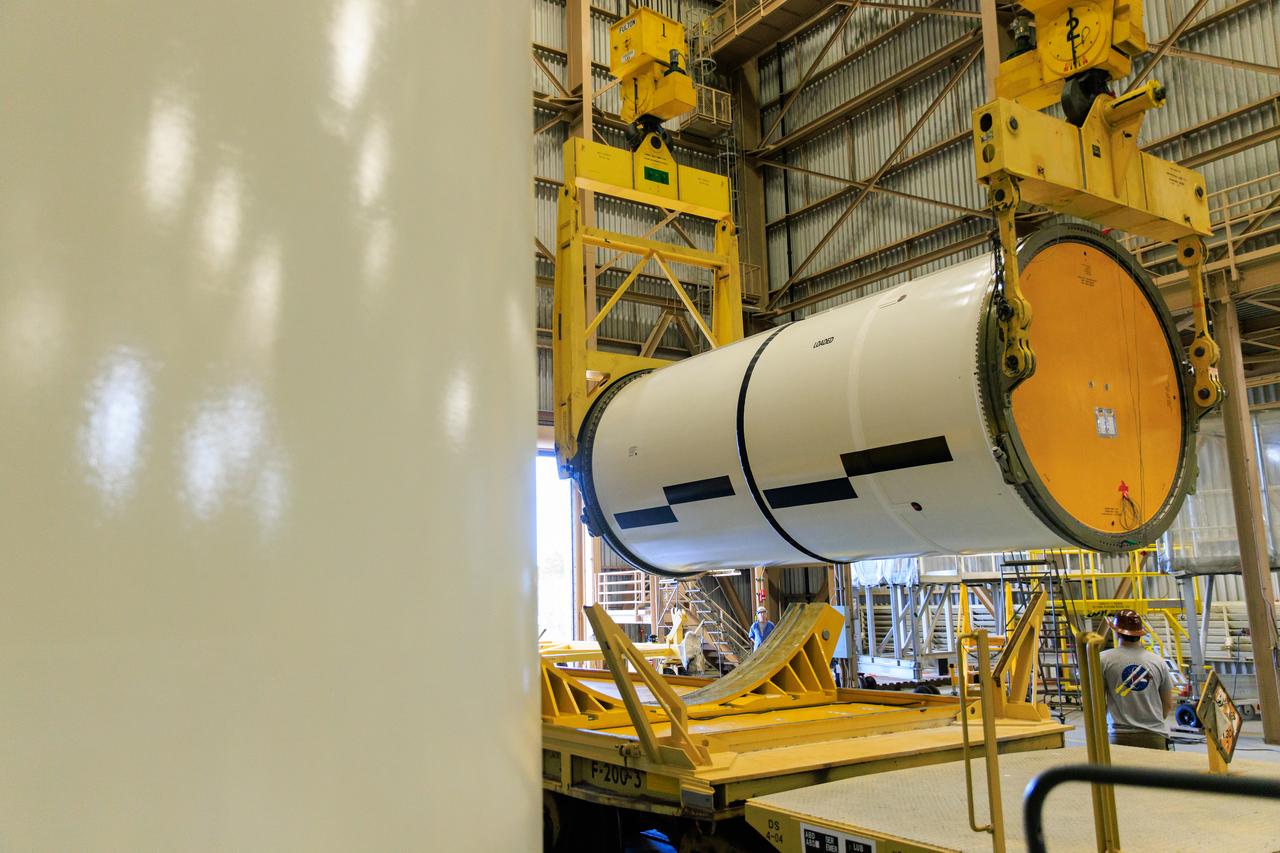
Following the successful propellant grain inspection of two segments of the solid rocket boosters for NASA’s Space Launch System inside the Rotation, Processing and Surge Facility at NASA’s Kennedy Space Center in Florida, crews on Thursday, Dec. 21, 2023, rotate and lift the segments from horizontal into a vertical position in preparation for the agency’s Artemis II launch campaign. The Artemis II mission will send four astronauts around the Moon as part of the agency’s effort to establish a long-term science and exploration presence at the Moon, and eventually Mars.
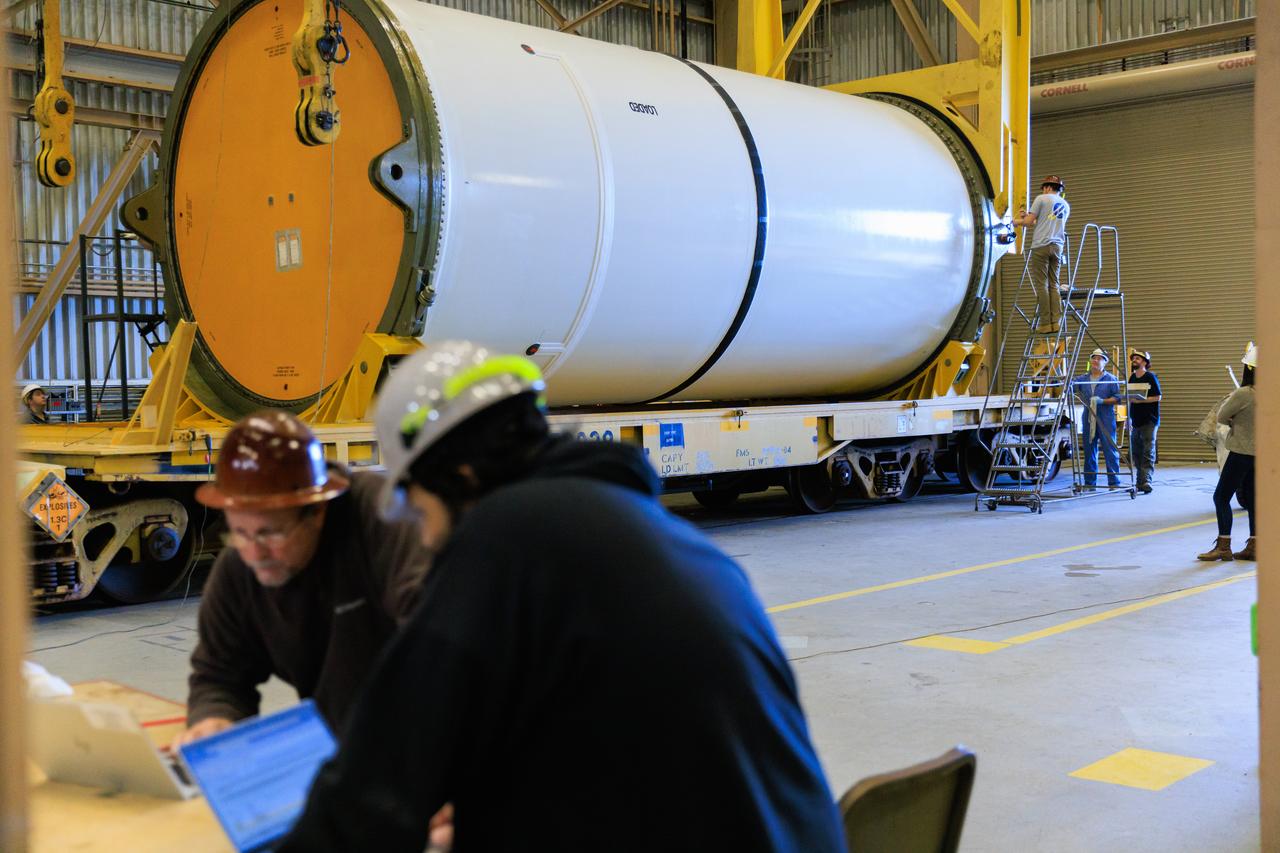
Following the successful propellant grain inspection of two segments of the solid rocket boosters for NASA’s Space Launch System inside the Rotation, Processing and Surge Facility at NASA’s Kennedy Space Center in Florida, crews on Thursday, Dec. 21, 2023, rotate and lift the segments from horizontal into a vertical position in preparation for the agency’s Artemis II launch campaign. The Artemis II mission will send four astronauts around the Moon as part of the agency’s effort to establish a long-term science and exploration presence at the Moon, and eventually Mars.
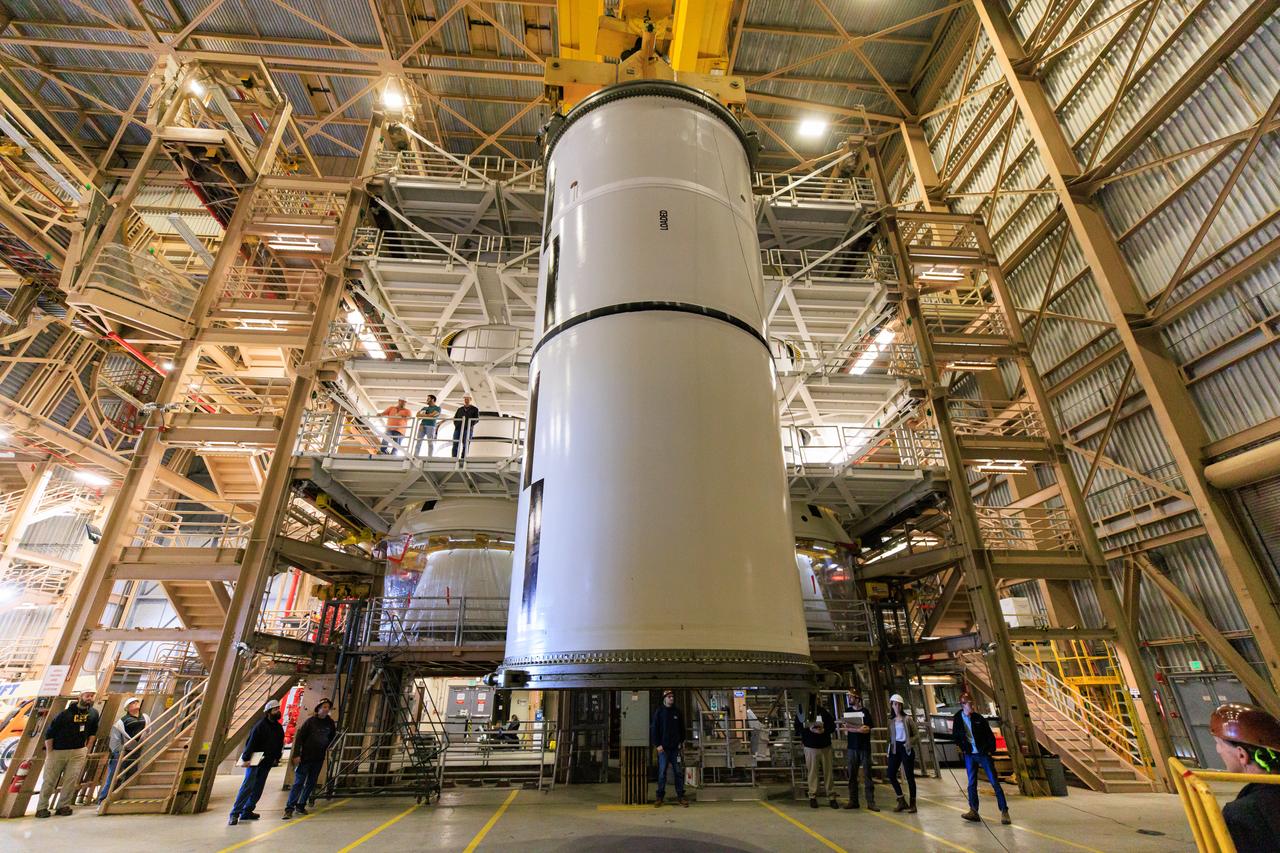
Following the successful propellant grain inspection of two segments of the solid rocket boosters for NASA’s Space Launch System inside the Rotation, Processing and Surge Facility at NASA’s Kennedy Space Center in Florida, crews on Thursday, Dec. 21, 2023, rotate and lift the segments from horizontal into a vertical position in preparation for the agency’s Artemis II launch campaign. The Artemis II mission will send four astronauts around the Moon as part of the agency’s effort to establish a long-term science and exploration presence at the Moon, and eventually Mars.
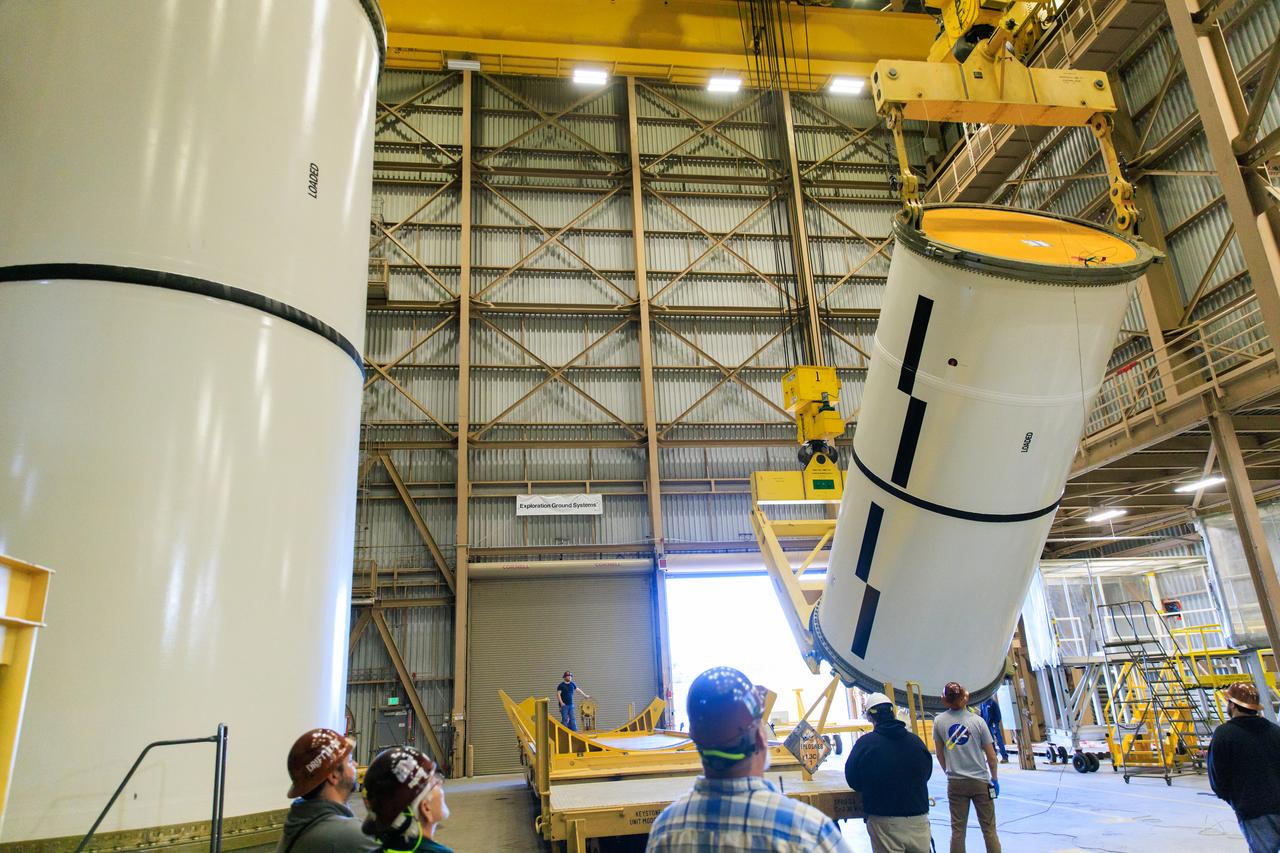
Following the successful propellant grain inspection of two segments of the solid rocket boosters for NASA’s Space Launch System inside the Rotation, Processing and Surge Facility at NASA’s Kennedy Space Center in Florida, crews on Thursday, Dec. 21, 2023, rotate and lift the segments from horizontal into a vertical position in preparation for the agency’s Artemis II launch campaign. The Artemis II mission will send four astronauts around the Moon as part of the agency’s effort to establish a long-term science and exploration presence at the Moon, and eventually Mars.
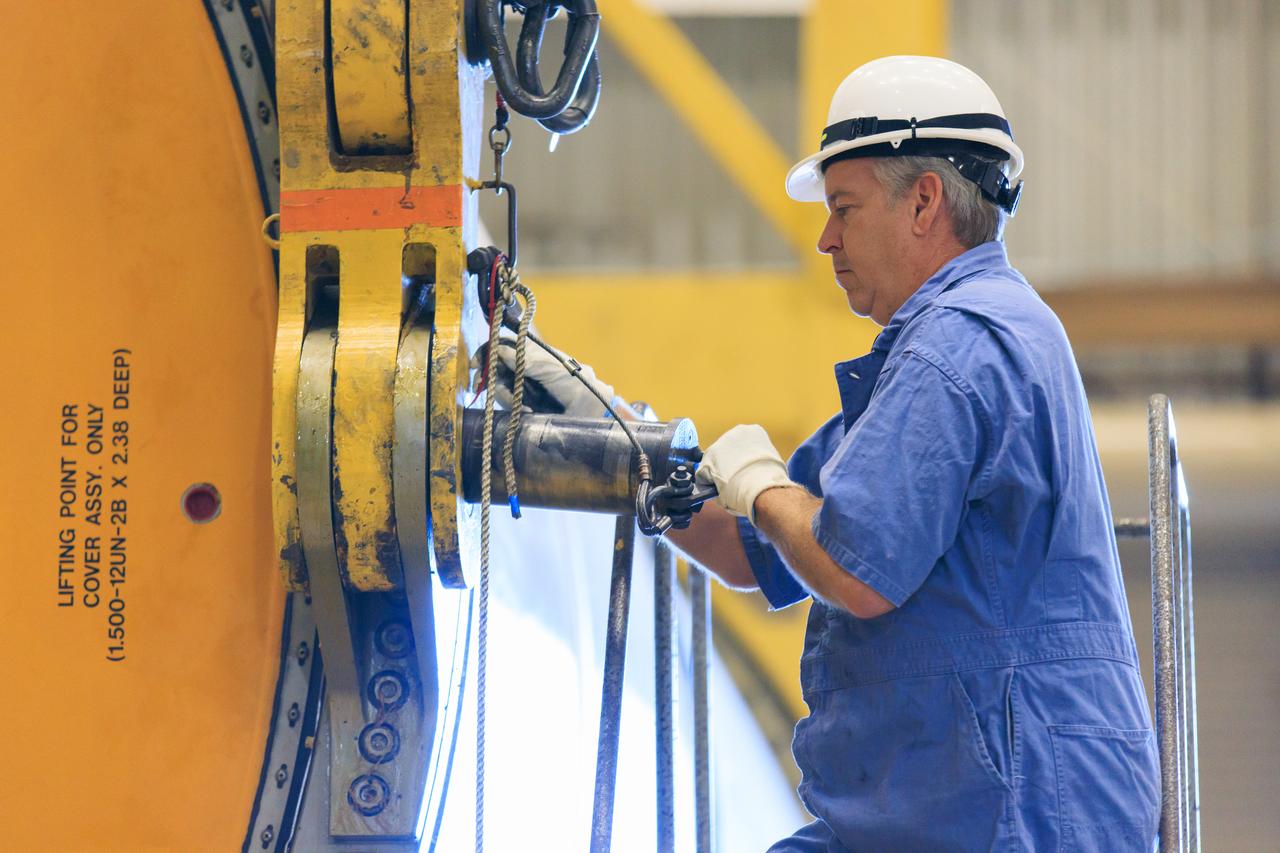
Following the successful propellant grain inspection of two segments of the solid rocket boosters for NASA’s Space Launch System inside the Rotation, Processing and Surge Facility at NASA’s Kennedy Space Center in Florida, crews on Thursday, Dec. 21, 2023, rotate and lift the segments from horizontal into a vertical position in preparation for the agency’s Artemis II launch campaign. The Artemis II mission will send four astronauts around the Moon as part of the agency’s effort to establish a long-term science and exploration presence at the Moon, and eventually Mars.
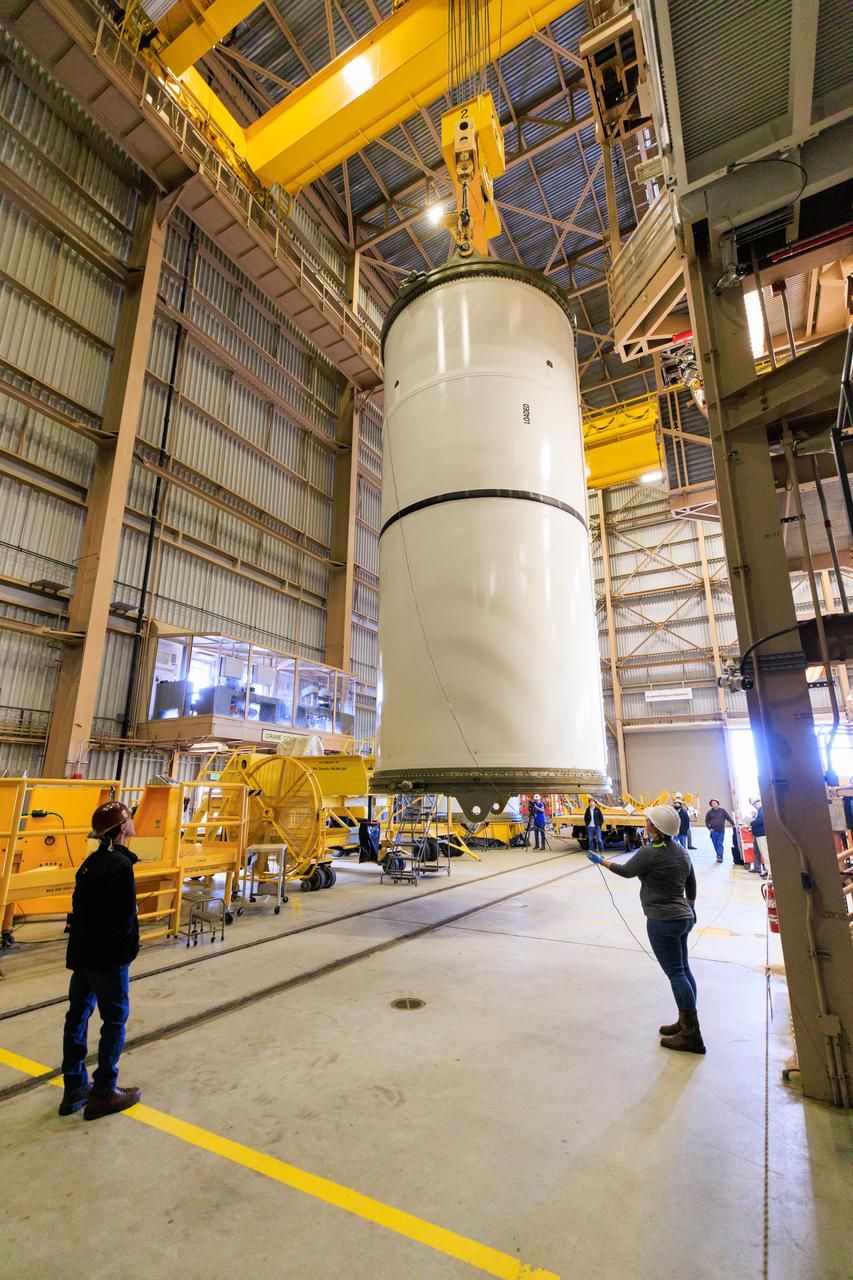
Following the successful propellant grain inspection of two segments of the solid rocket boosters for NASA’s Space Launch System inside the Rotation, Processing and Surge Facility at NASA’s Kennedy Space Center in Florida, crews on Thursday, Dec. 21, 2023, rotate and lift the segments from horizontal into a vertical position in preparation for the agency’s Artemis II launch campaign. The Artemis II mission will send four astronauts around the Moon as part of the agency’s effort to establish a long-term science and exploration presence at the Moon, and eventually Mars.
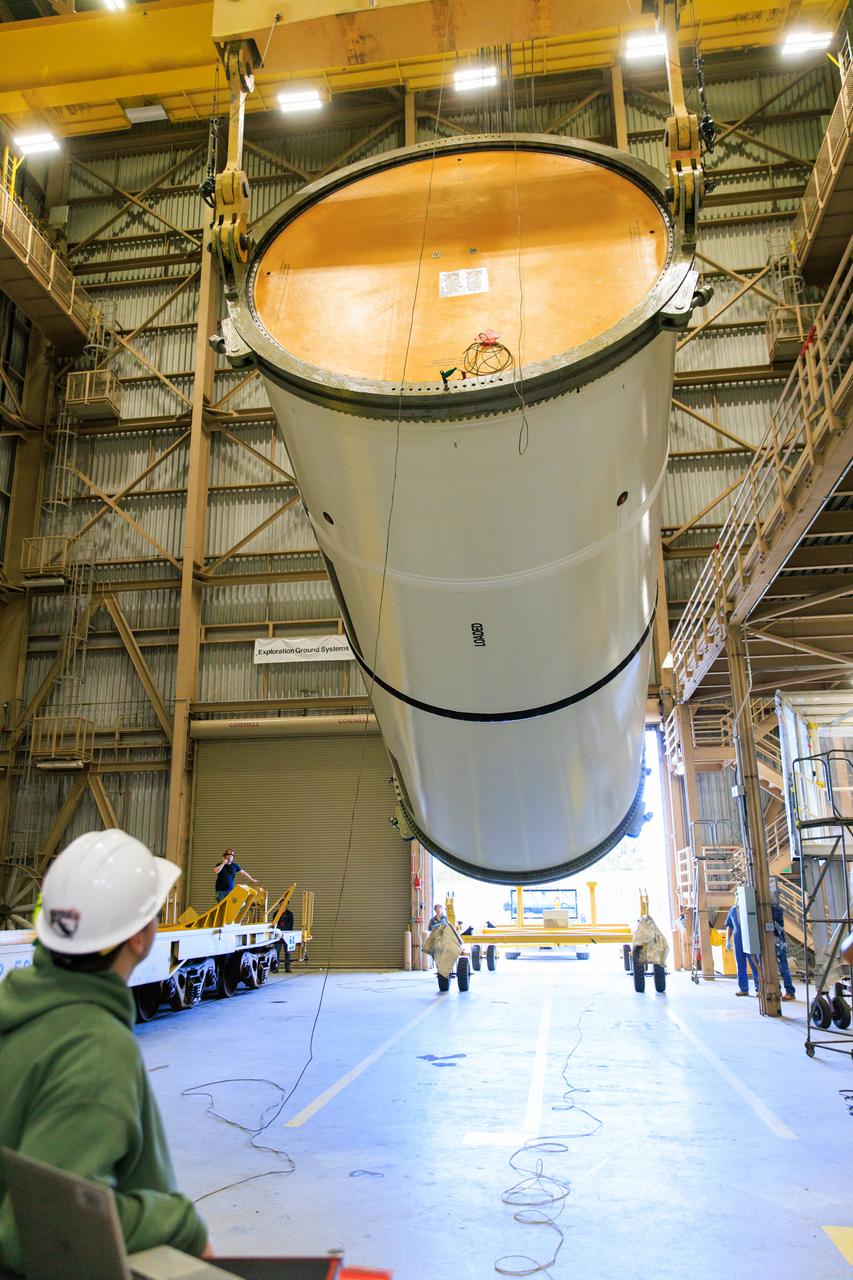
Following the successful propellant grain inspection of two segments of the solid rocket boosters for NASA’s Space Launch System inside the Rotation, Processing and Surge Facility at NASA’s Kennedy Space Center in Florida, crews on Thursday, Dec. 21, 2023, rotate and lift the segments from horizontal into a vertical position in preparation for the agency’s Artemis II launch campaign. The Artemis II mission will send four astronauts around the Moon as part of the agency’s effort to establish a long-term science and exploration presence at the Moon, and eventually Mars.
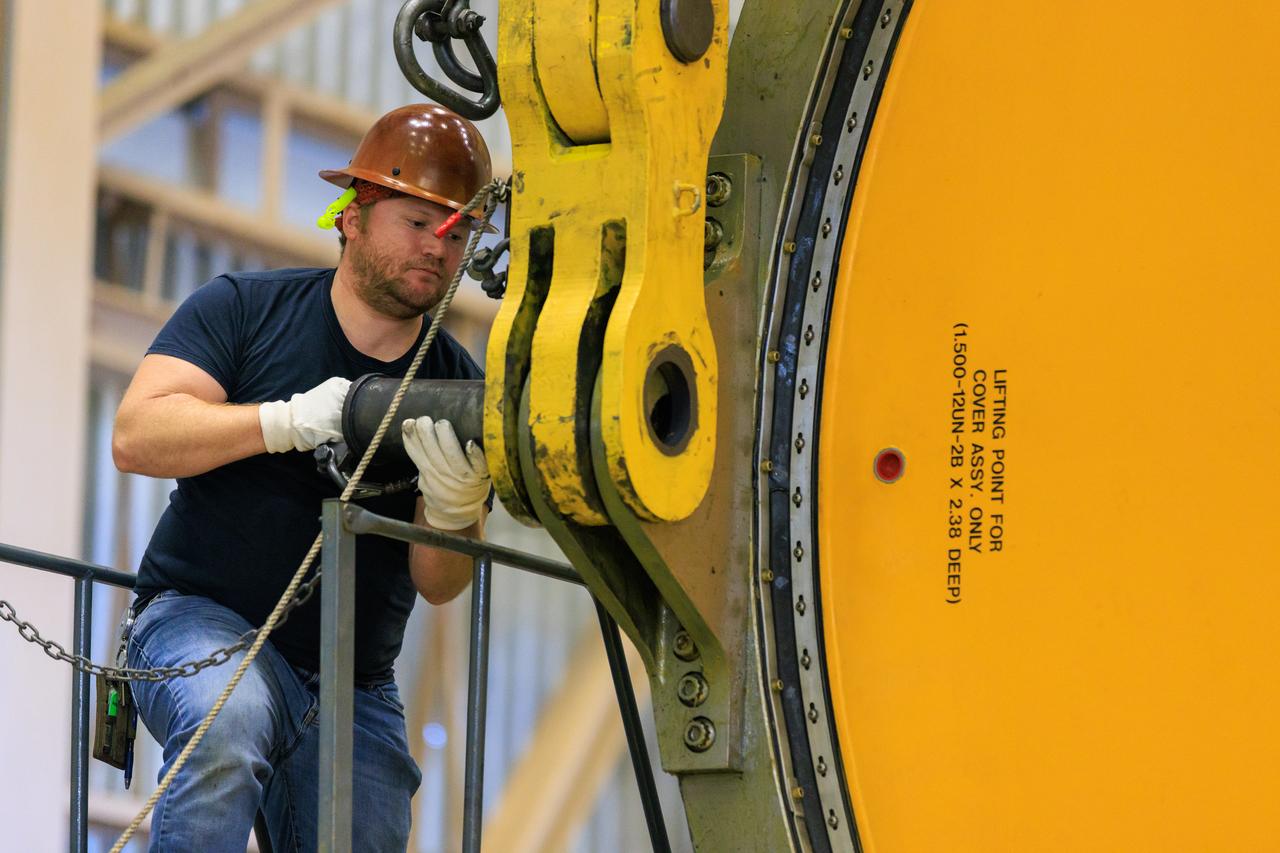
Following the successful propellant grain inspection of two segments of the solid rocket boosters for NASA’s Space Launch System inside the Rotation, Processing and Surge Facility at NASA’s Kennedy Space Center in Florida, crews on Thursday, Dec. 21, 2023, rotate and lift the segments from horizontal into a vertical position in preparation for the agency’s Artemis II launch campaign. The Artemis II mission will send four astronauts around the Moon as part of the agency’s effort to establish a long-term science and exploration presence at the Moon, and eventually Mars.

The Artemis I aft skirts for the NASA’s Space Launch System (SLS) rocket’s twin solid rocket boosters are moved along the road to the Rotation, Processing and Surge Facility (RPSF) at NASA’s Kennedy Space Center in Florida on June 10, 2020. In the background is the iconic Vehicle Assembly Building (VAB). The aft skirts were refurbished by Northrop Grumman. They house the thrust vector control system, which controls 70 percent of the steering during initial ascent of the SLS rocket. The aft skirts will remain in the RPSF until ready for stacking with the forward and aft parts of the boosters on the mobile launcher in High Bay 3 of the VAB. Through the Artemis Program, NASA is working to land the first woman and next man on the Moon by 2024.
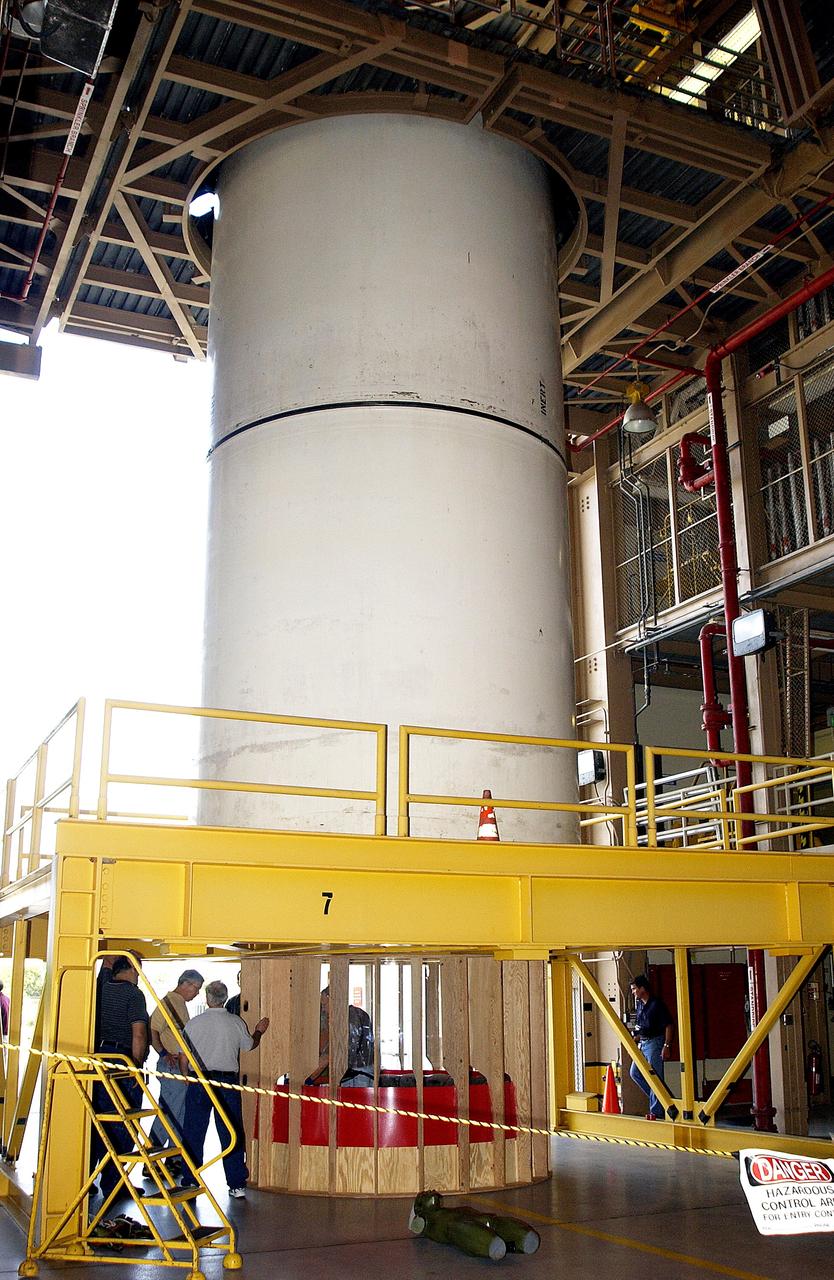
KENNEDY SPACE CENTER, FLA. - At the Rotation, Processing and Surge Facility stand a mockup of two segments of a solid rocket booster (SRB) being used to test the feasibility of a vertical SRB propellant grain inspection, required as part of safety analysis.
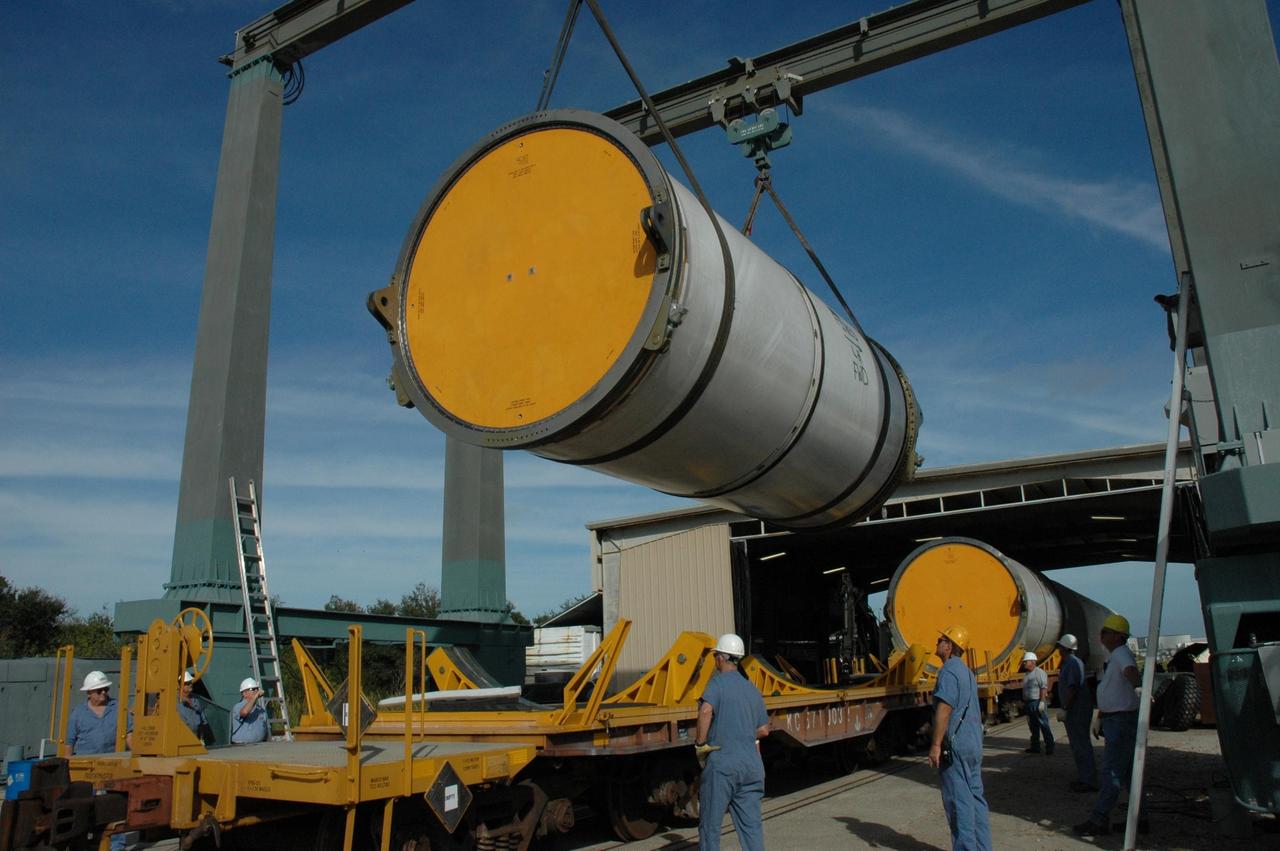
KENNEDY SPACE CENTER, FLA. -- An overhead crane lowers a solid rocket booster segment toward a railroad car at the railroad yard at NASA's Kennedy Space Center. The yellow transportation end cover has already been inserted and is secure. The spent segment is part of the booster used to launch space shuttle Discovery in October. The segment will be placed on the car and covered for the long trip back to Utah. After a mission, the spent boosters are recovered, cleaned, disassembled, refurbished and reused after each launch. After hydrolasing the interior of each segment, they are placed on flatbed trucks. The individual booster segments are transferred to a railhead located at the railroad yard at NASA's Kennedy Space Center. The long train of segments is part of the twin solid rocket boosters used to launch space shuttle Discovery in October. The NASA Railroad locomotive backs up the rail cars and the segment is lowered onto the car. The covered segments are moved to Titusville for interchange with Florida East Coast Railway to begin the trip back to Utah. Photo credit: NASA/Amanda Diller
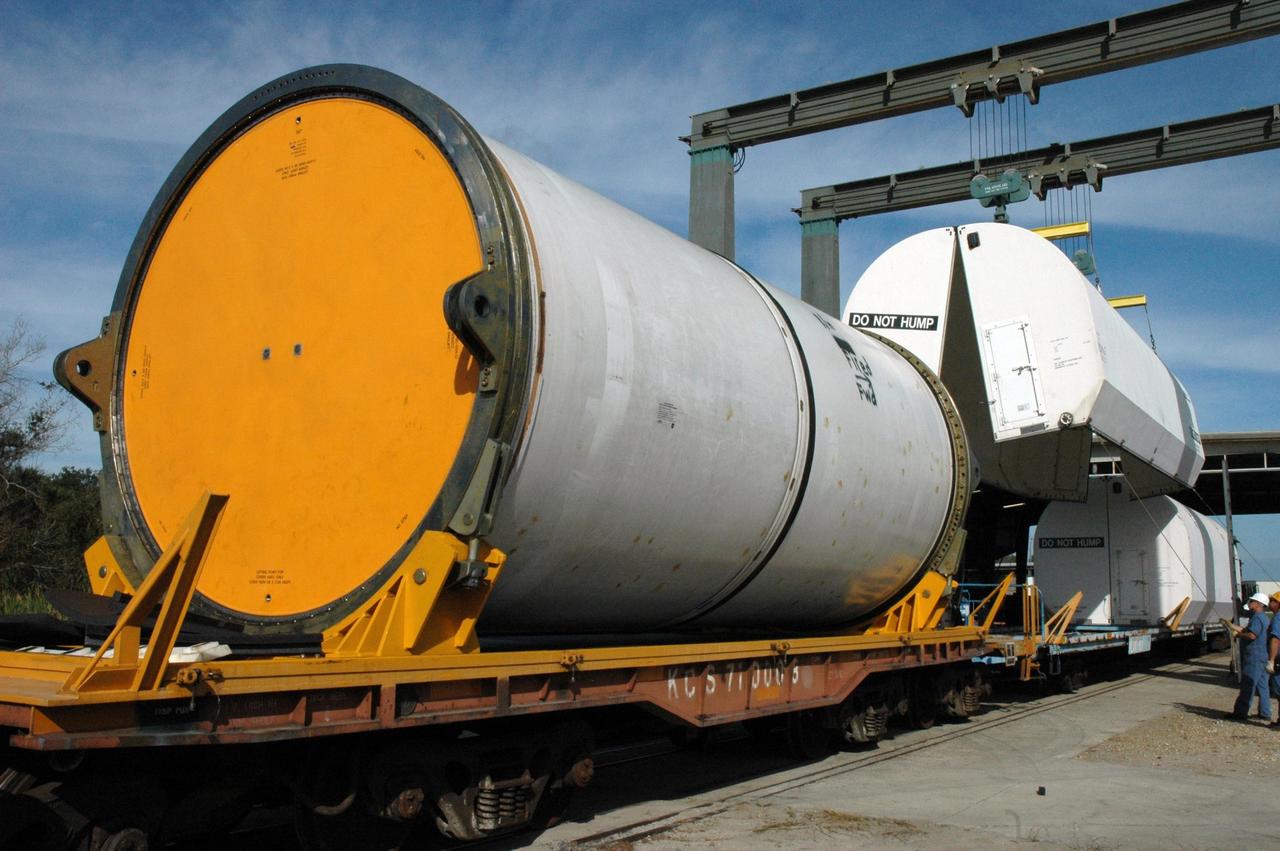
KENNEDY SPACE CENTER, FLA. -- At the railroad yard at NASA's Kennedy Space Center, covers are being placed over solid rocket booster segments that will be transported to Utah. The yellow transportation end covers have already been inserted and are secure, as seen on the segment at left. The spent segments are part of the booster used to launch space shuttle Discovery in October. After a mission, the spent boosters are recovered, cleaned, disassembled, refurbished and reused after each launch. After hydrolasing the interior of each segment, they are placed on flatbed trucks. The individual booster segments are transferred to a railhead located at the railroad yard at NASA's Kennedy Space Center. The long train of segments is part of the twin solid rocket boosters used to launch space shuttle Discovery in October. The NASA Railroad locomotive backs up the rail cars and the segment is lowered onto the car. The covered segments are moved to Titusville for interchange with Florida East Coast Railway to begin the trip back to Utah. Photo credit: NASA/Amanda Diller
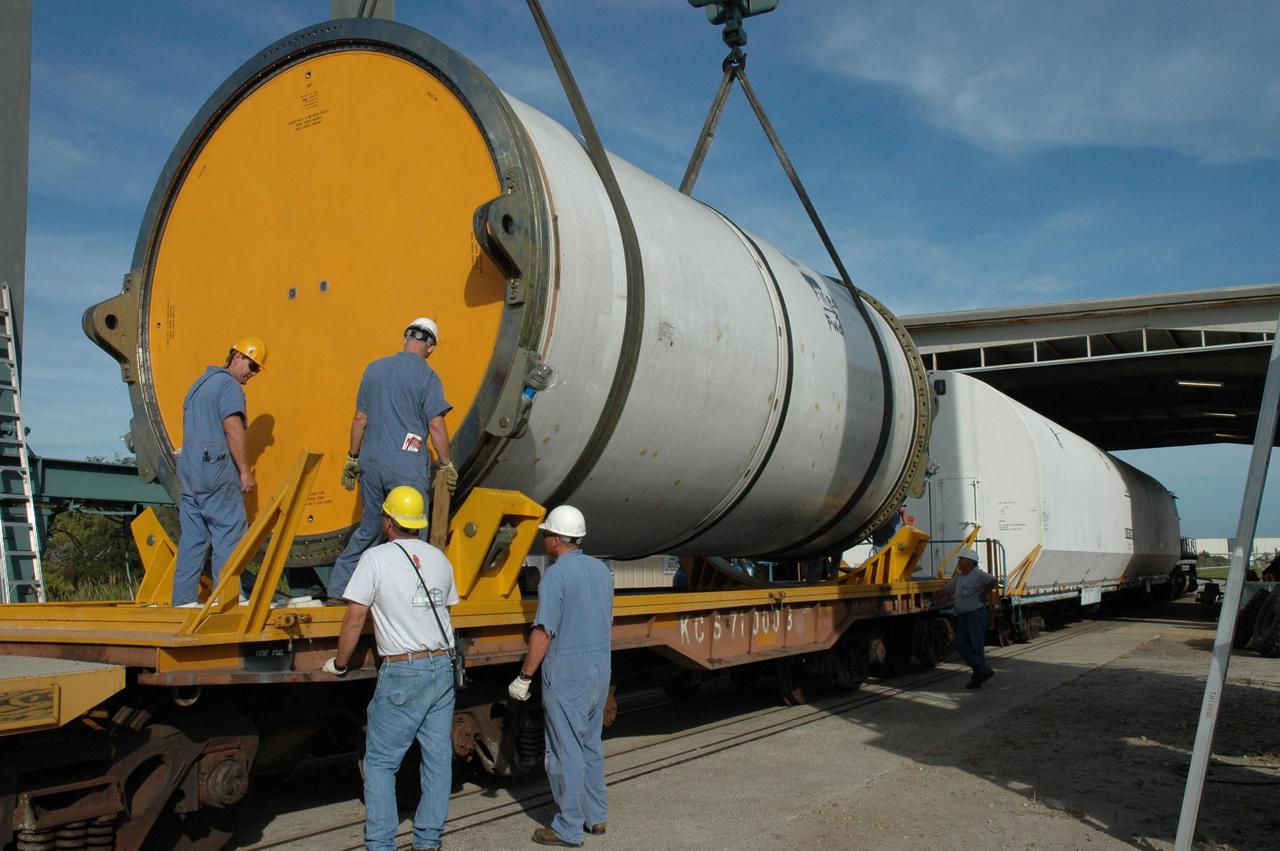
KENNEDY SPACE CENTER, FLA. -- Workers oversee the placement of a solid rocket booster segment onto a railroad car at the railroad yard at NASA's Kennedy Space Center. The spent segment is part of the booster used to launch space shuttle Discovery in October. At far right are other segments already covered for the long trip back to Utah. After a mission, the spent boosters are recovered, cleaned, disassembled, refurbished and reused after each launch. After hydrolasing the interior of each segment, they are placed on flatbed trucks. The individual booster segments are transferred to a railhead located at the railroad yard at NASA's Kennedy Space Center. The long train of segments is part of the twin solid rocket boosters used to launch space shuttle Discovery in October. The NASA Railroad locomotive backs up the rail cars and the segment is lowered onto the car. The covered segments are moved to Titusville for interchange with Florida East Coast Railway to begin the trip back to Utah. Photo credit: NASA/Amanda Diller
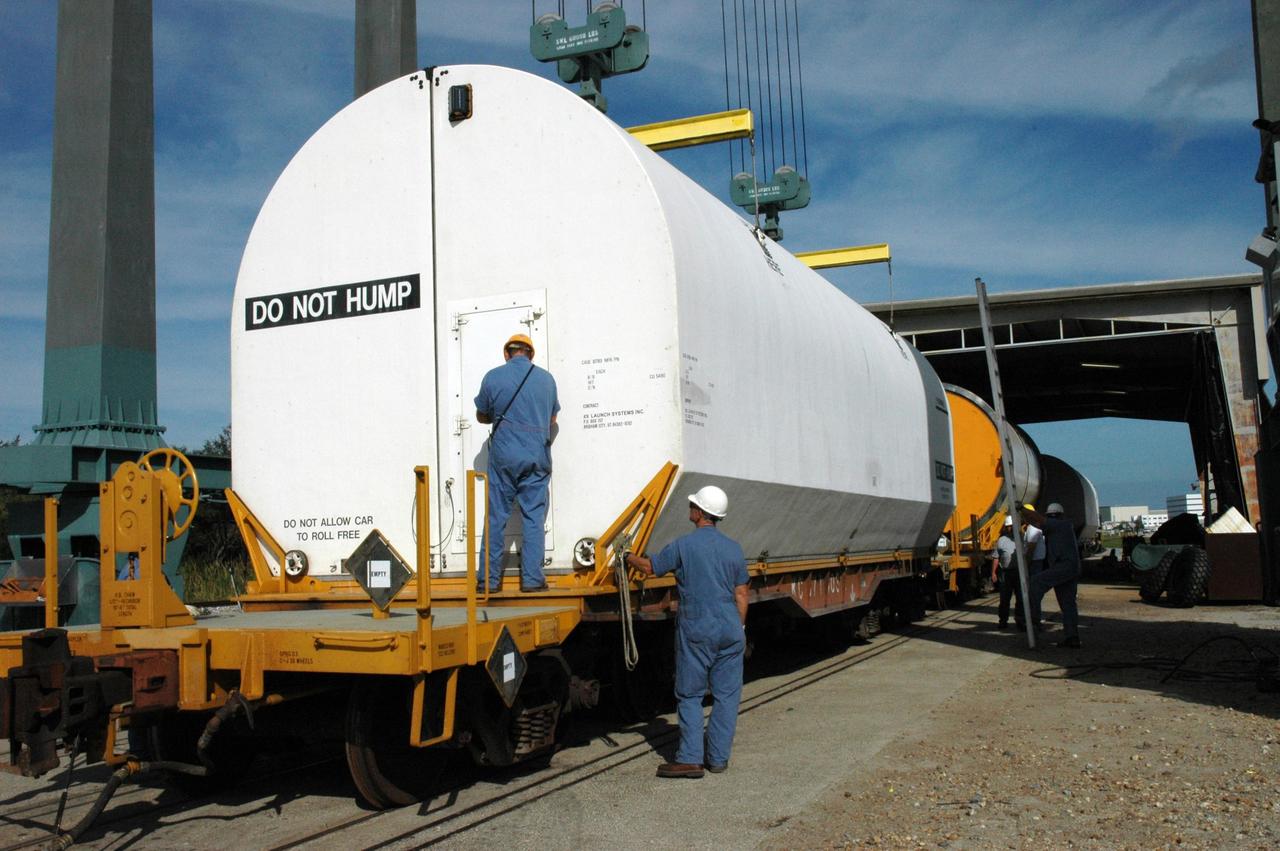
KENNEDY SPACE CENTER, FLA. -- A worker at the railroad yard at NASA's Kennedy Space Center secures the transportation cover over the solid rocket booster segment that is being transported to Utah. After a mission, the spent boosters are recovered, cleaned, disassembled, refurbished and reused after each launch. After hydrolasing the interior of each segment, they are placed on flatbed trucks. The individual booster segments are transferred to a railhead located at the railroad yard at NASA's Kennedy Space Center. The long train of segments is part of the twin solid rocket boosters used to launch space shuttle Discovery in October. The NASA Railroad locomotive backs up the rail cars and the segment is lowered onto the car. The covered segments are moved to Titusville for interchange with Florida East Coast Railway to begin the trip back to Utah. Photo credit: NASA/Amanda Diller
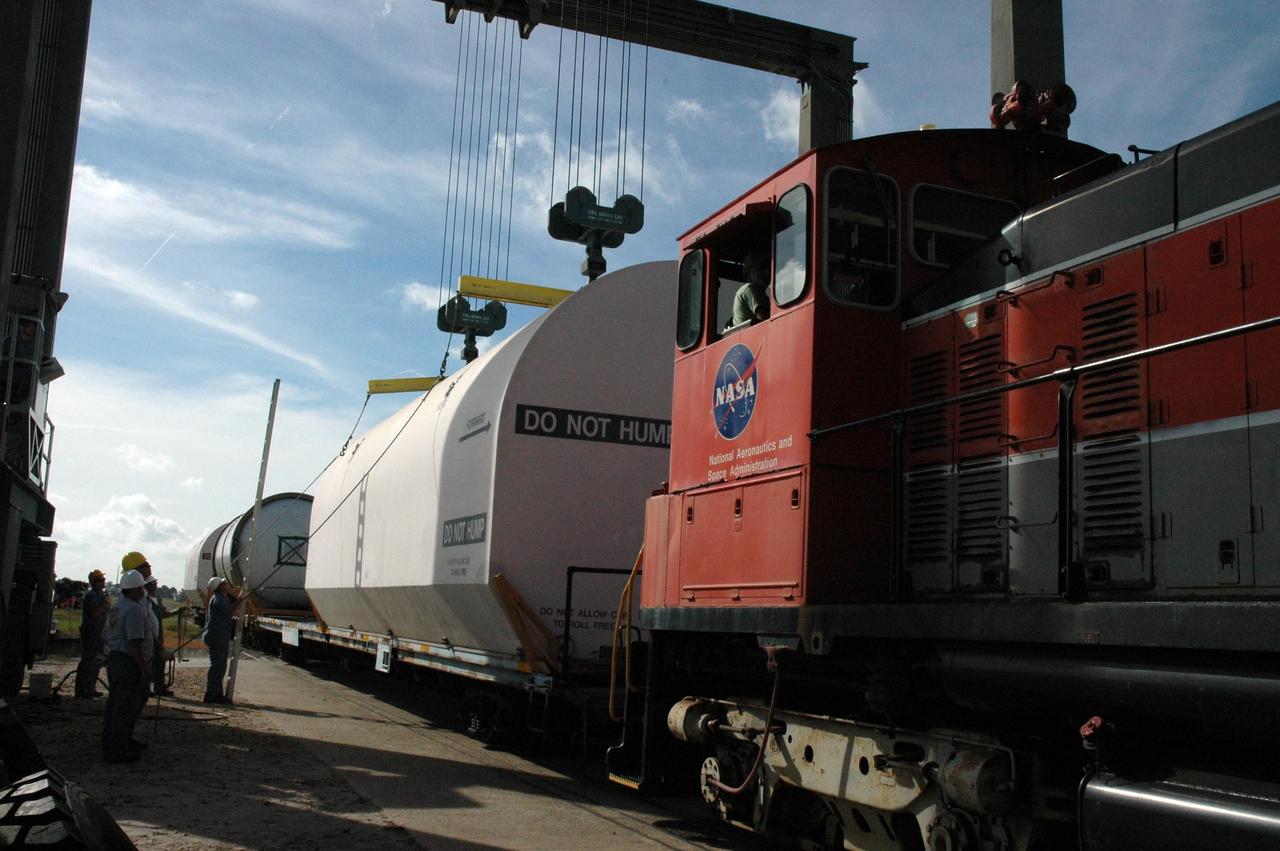
KENNEDY SPACE CENTER, FLA. -- At the railroad yard at NASA's Kennedy Space Center, workers release the crane from the transportation cover over the solid rocket booster segment. After a mission, the spent boosters are recovered, cleaned, disassembled, refurbished and reused after each launch. After hydrolasing the interior of each segment, they are placed on flatbed trucks. The individual booster segments are transferred to a railhead located at the railroad yard at NASA's Kennedy Space Center. The long train of segments is part of the twin solid rocket boosters used to launch space shuttle Discovery in October. The NASA Railroad locomotive backs up the rail cars and the segment is lowered onto the car. The covered segments are moved to Titusville for interchange with Florida East Coast Railway to begin the trip back to Utah. Photo credit: NASA/Amanda Diller
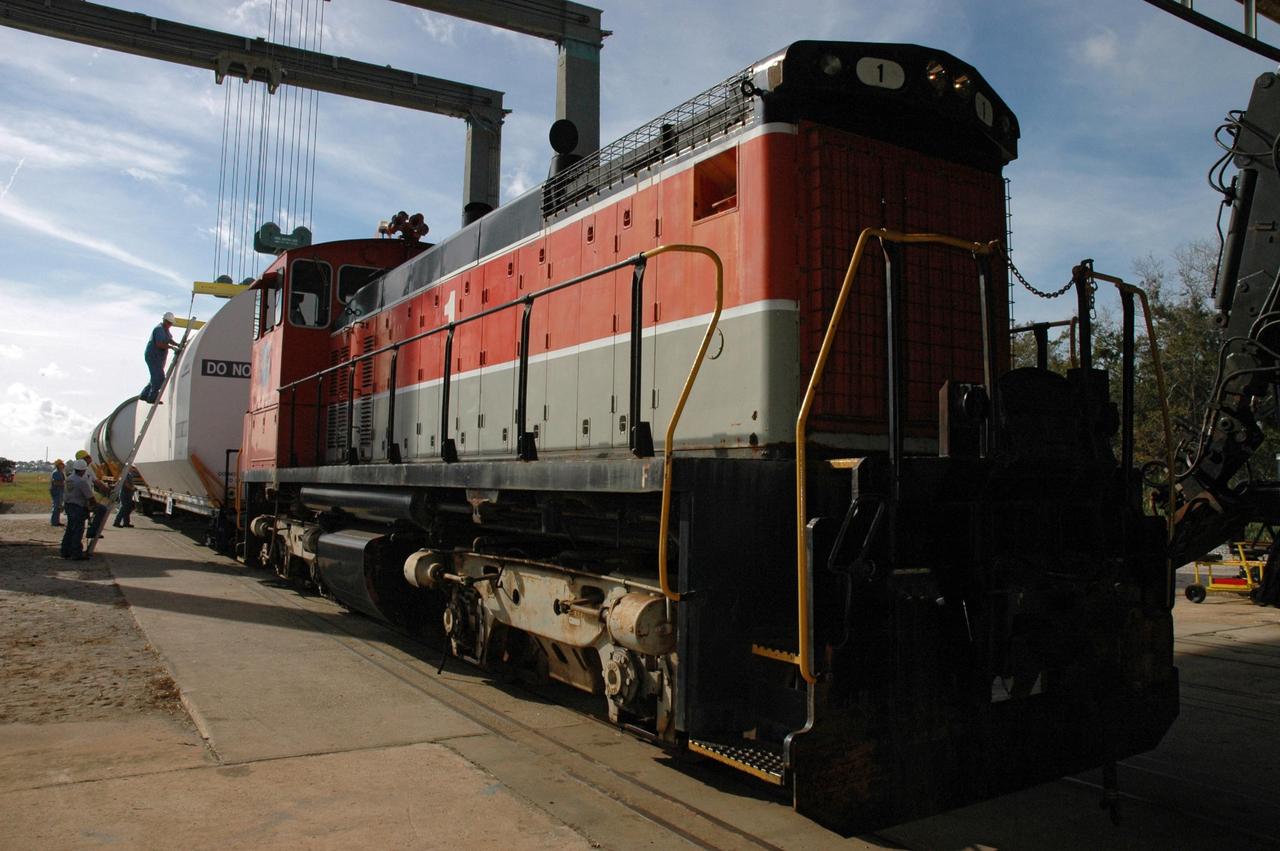
KENNEDY SPACE CENTER, FLA. -- At the railroad yard at NASA's Kennedy Space Center, workers release the crane from the transportation cover over the solid rocket booster segment. After a mission, the spent boosters are recovered, cleaned, disassembled, refurbished and reused after each launch. After hydrolasing the interior of each segment, they are placed on flatbed trucks. The individual booster segments are transferred to a railhead located at the railroad yard at NASA's Kennedy Space Center. The long train of segments is part of the twin solid rocket boosters used to launch space shuttle Discovery in October. The NASA Railroad locomotive backs up the rail cars and the segment is lowered onto the car. The covered segments are moved to Titusville for interchange with Florida East Coast Railway to begin the trip back to Utah. Photo credit: NASA/Amanda Diller

KENNEDY SPACE CENTER, FLA. -- A solid rocket booster segment is lifted off a truck bed at the railroad yard at NASA's Kennedy Space Center. The yellow transportation end cover has already been inserted and is secure. The segment is part of the booster used to launch space shuttle Discovery in October. The spent segment will be placed on a railroad car and covered for the long trip back to Utah. After a mission, the spent boosters are recovered, cleaned, disassembled, refurbished and reused after each launch. After hydrolasing the interior of each segment, they are placed on flatbed trucks. The individual booster segments are transferred to a railhead located at the railroad yard at NASA's Kennedy Space Center. The long train of segments is part of the twin solid rocket boosters used to launch space shuttle Discovery in October. The NASA Railroad locomotive backs up the rail cars and the segment is lowered onto the car. The covered segments are moved to Titusville for interchange with Florida East Coast Railway to begin the trip back to Utah. Photo credit: NASA/Amanda Diller
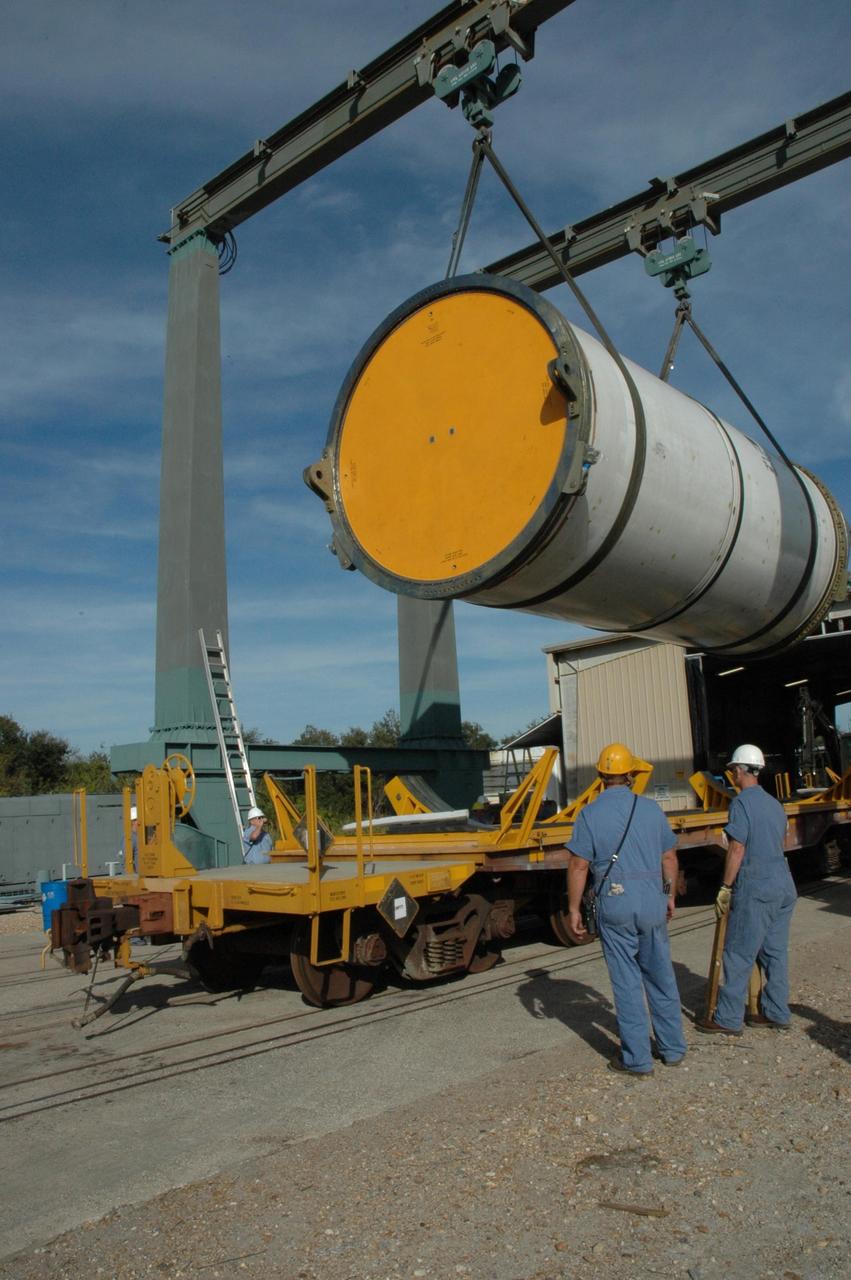
KENNEDY SPACE CENTER, FLA. -- An overhead crane lifts a solid rocket booster segment off a truck bed at the railroad yard at NASA's Kennedy Space Center for transfer to a railroad car. The yellow transportation end cover has already been inserted and is secure. The spent segment is part of the booster used to launch space shuttle Discovery in October. The segment will be placed on the car and covered for the long trip back to Utah. After a mission, the spent boosters are recovered, cleaned, disassembled, refurbished and reused after each launch. After hydrolasing the interior of each segment, they are placed on flatbed trucks. The individual booster segments are transferred to a railhead located at the railroad yard at NASA's Kennedy Space Center. The long train of segments is part of the twin solid rocket boosters used to launch space shuttle Discovery in October. The NASA Railroad locomotive backs up the rail cars and the segment is lowered onto the car. The covered segments are moved to Titusville for interchange with Florida East Coast Railway to begin the trip back to Utah. Photo credit: NASA/Amanda Diller
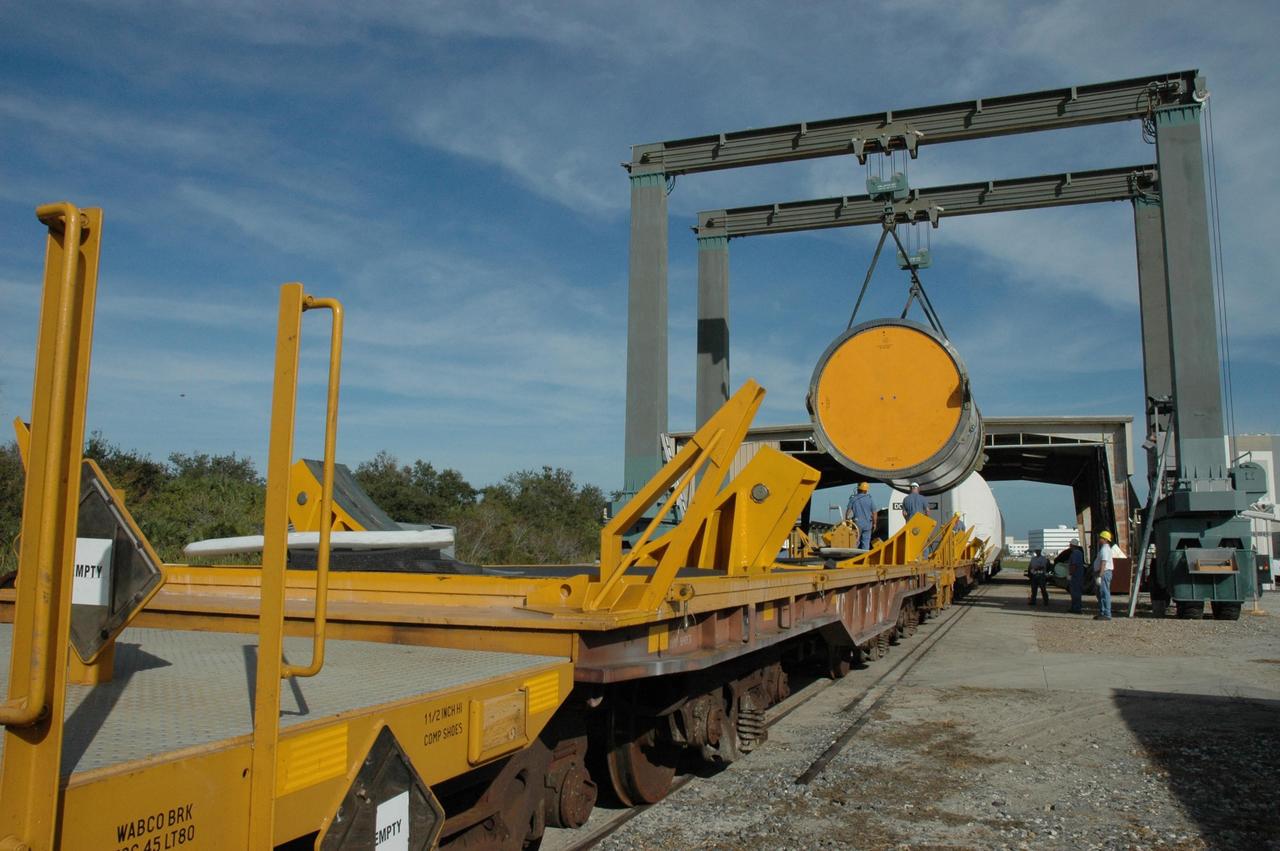
KENNEDY SPACE CENTER, FLA. -- An overhead crane moves a solid rocket booster segment toward a railroad car at the railroad yard at NASA's Kennedy Space Center. The yellow transportation end cover has already been inserted and is secure. The spent segment is part of the booster used to launch space shuttle Discovery in October. The segment will be placed on the car and covered for the long trip back to Utah. After a mission, the spent boosters are recovered, cleaned, disassembled, refurbished and reused after each launch. After hydrolasing the interior of each segment, they are placed on flatbed trucks. The individual booster segments are transferred to a railhead located at the railroad yard at NASA's Kennedy Space Center. The long train of segments is part of the twin solid rocket boosters used to launch space shuttle Discovery in October. The NASA Railroad locomotive backs up the rail cars and the segment is lowered onto the car. The covered segments are moved to Titusville for interchange with Florida East Coast Railway to begin the trip back to Utah. Photo credit: NASA/Amanda Diller
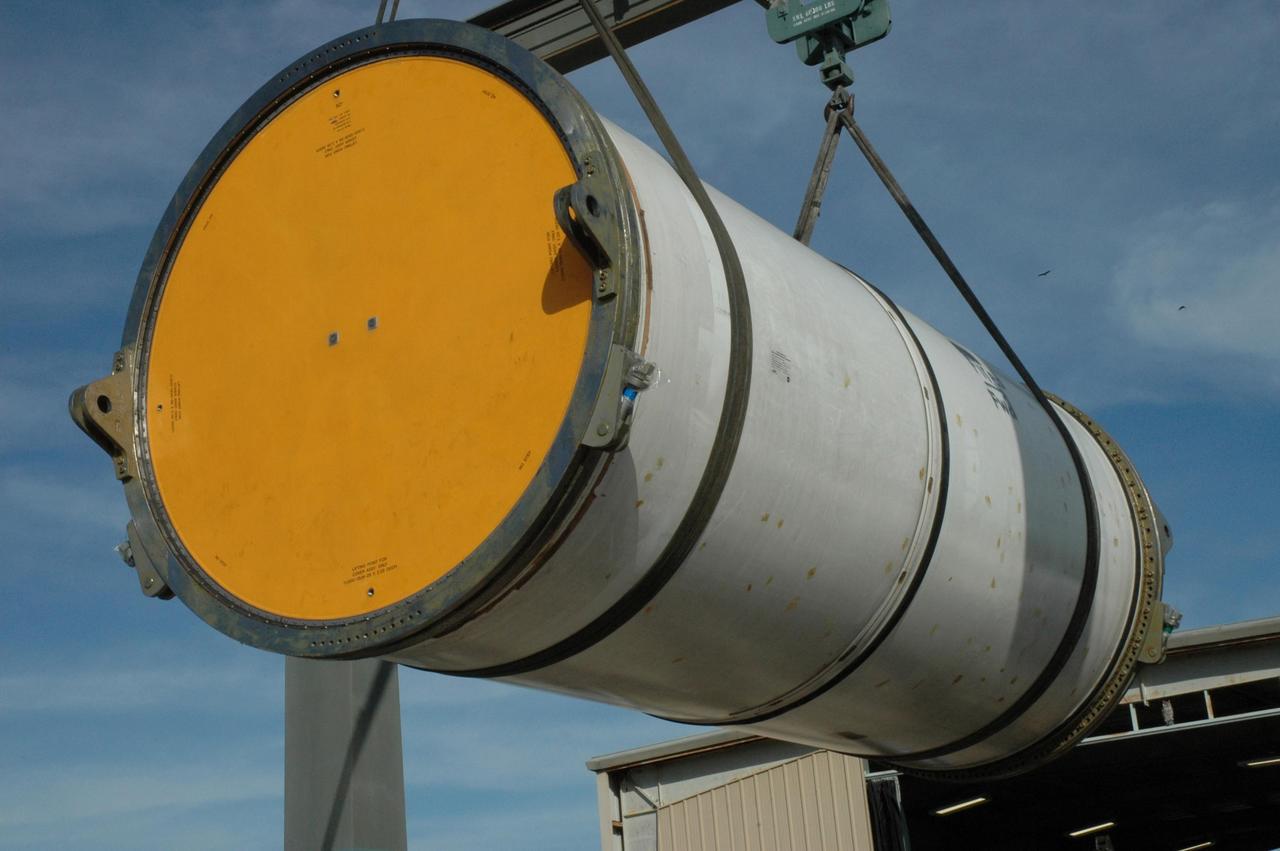
KENNEDY SPACE CENTER, FLA. -- An overhead crane lifts a solid rocket booster segment off a truck bed at the railroad yard at NASA's Kennedy Space Center for transfer to a railroad car. The yellow transportation end cover has already been inserted and is secure. The spent segment is part of the booster used to launch space shuttle Discovery in October. The segment will be covered for the long trip back to Utah. After a mission, the spent boosters are recovered, cleaned, disassembled, refurbished and reused after each launch. After hydrolasing the interior of each segment, they are placed on flatbed trucks. The individual booster segments are transferred to a railhead located at the railroad yard at NASA's Kennedy Space Center. The long train of segments is part of the twin solid rocket boosters used to launch space shuttle Discovery in October. The NASA Railroad locomotive backs up the rail cars and the segment is lowered onto the car. The covered segments are moved to Titusville for interchange with Florida East Coast Railway to begin the trip back to Utah. Photo credit: NASA/Amanda Diller
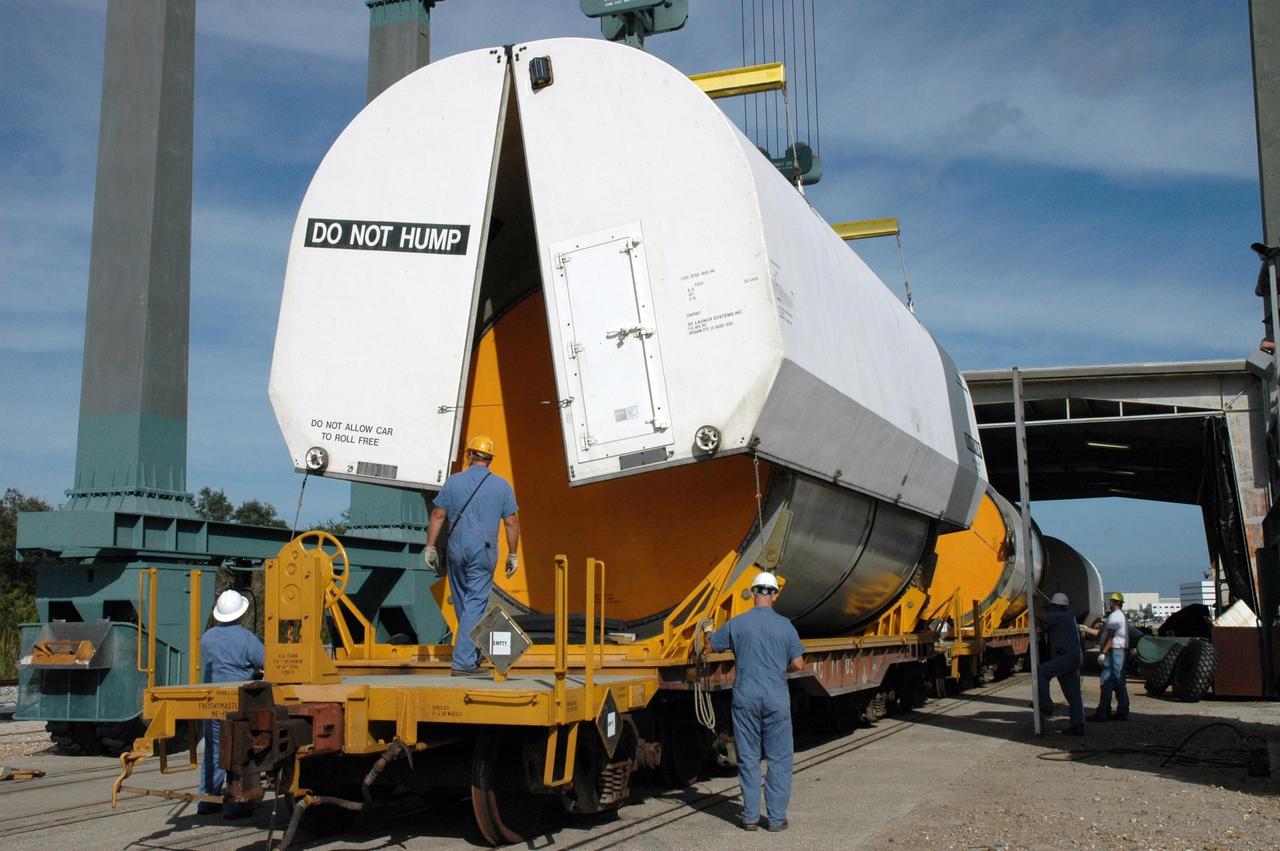
KENNEDY SPACE CENTER, FLA. -- Workers at the railroad yard at NASA's Kennedy Space Center stand ready to secure the transportation cover over the solid rocket booster segment that is being transported to Utah. The spent segments are part of the booster used to launch space shuttle Discovery in October. After a mission, the spent boosters are recovered, cleaned, disassembled, refurbished and reused after each launch. After hydrolasing the interior of each segment, they are placed on flatbed trucks. The individual booster segments are transferred to a railhead located at the railroad yard at NASA's Kennedy Space Center. The long train of segments is part of the twin solid rocket boosters used to launch space shuttle Discovery in October. The NASA Railroad locomotive backs up the rail cars and the segment is lowered onto the car. The covered segments are moved to Titusville for interchange with Florida East Coast Railway to begin the trip back to Utah. Photo credit: NASA/Amanda Diller
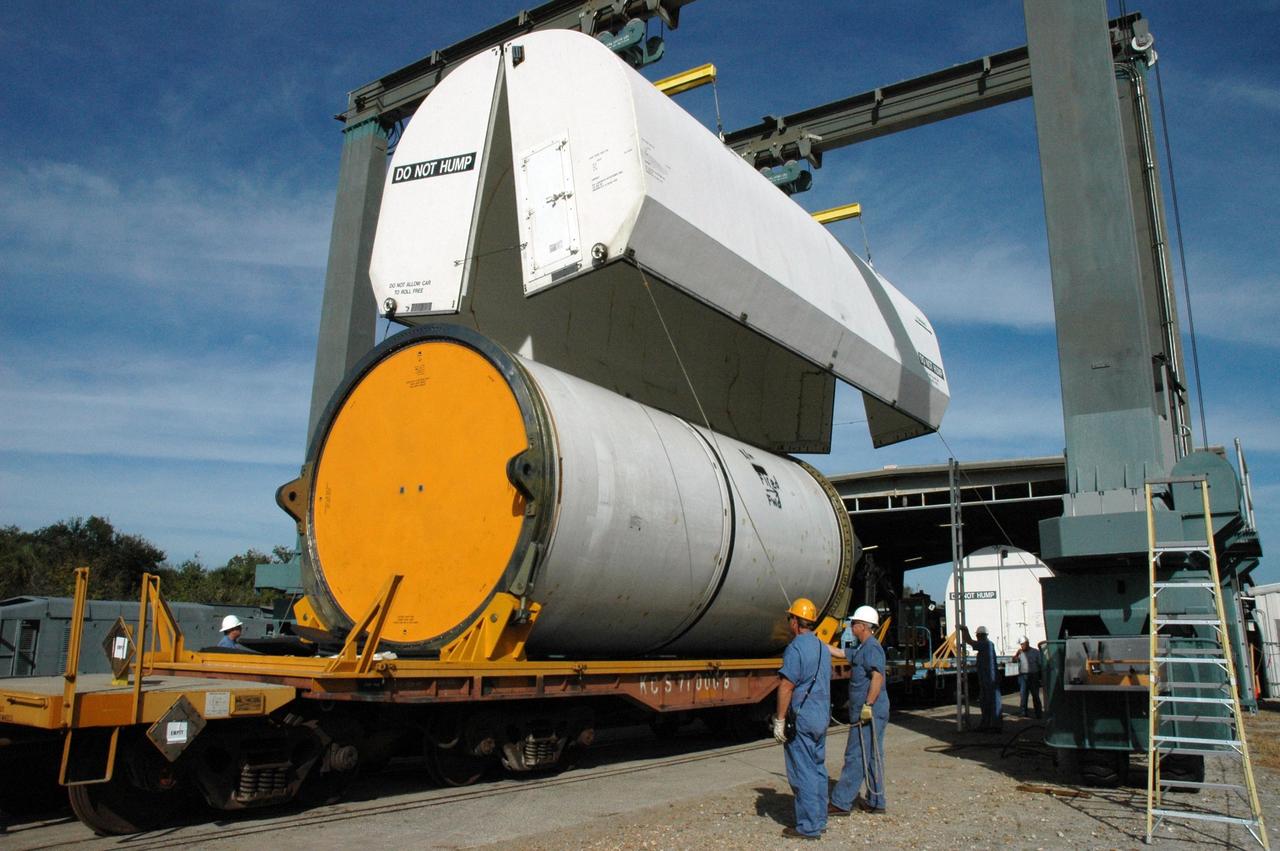
KENNEDY SPACE CENTER, FLA. -- At the railroad yard at NASA's Kennedy Space Center, a cover is lowered over the solid rocket booster segment being transported to Utah. The yellow transportation end cover has already been inserted and is secure. The spent segments are part of the booster used to launch space shuttle Discovery in October. After a mission, the spent boosters are recovered, cleaned, disassembled, refurbished and reused after each launch. After hydrolasing the interior of each segment, they are placed on flatbed trucks. The individual booster segments are transferred to a railhead located at the railroad yard at NASA's Kennedy Space Center. The long train of segments is part of the twin solid rocket boosters used to launch space shuttle Discovery in October. The NASA Railroad locomotive backs up the rail cars and the segment is lowered onto the car. The covered segments are moved to Titusville for interchange with Florida East Coast Railway to begin the trip back to Utah. Photo credit: NASA/Amanda Diller
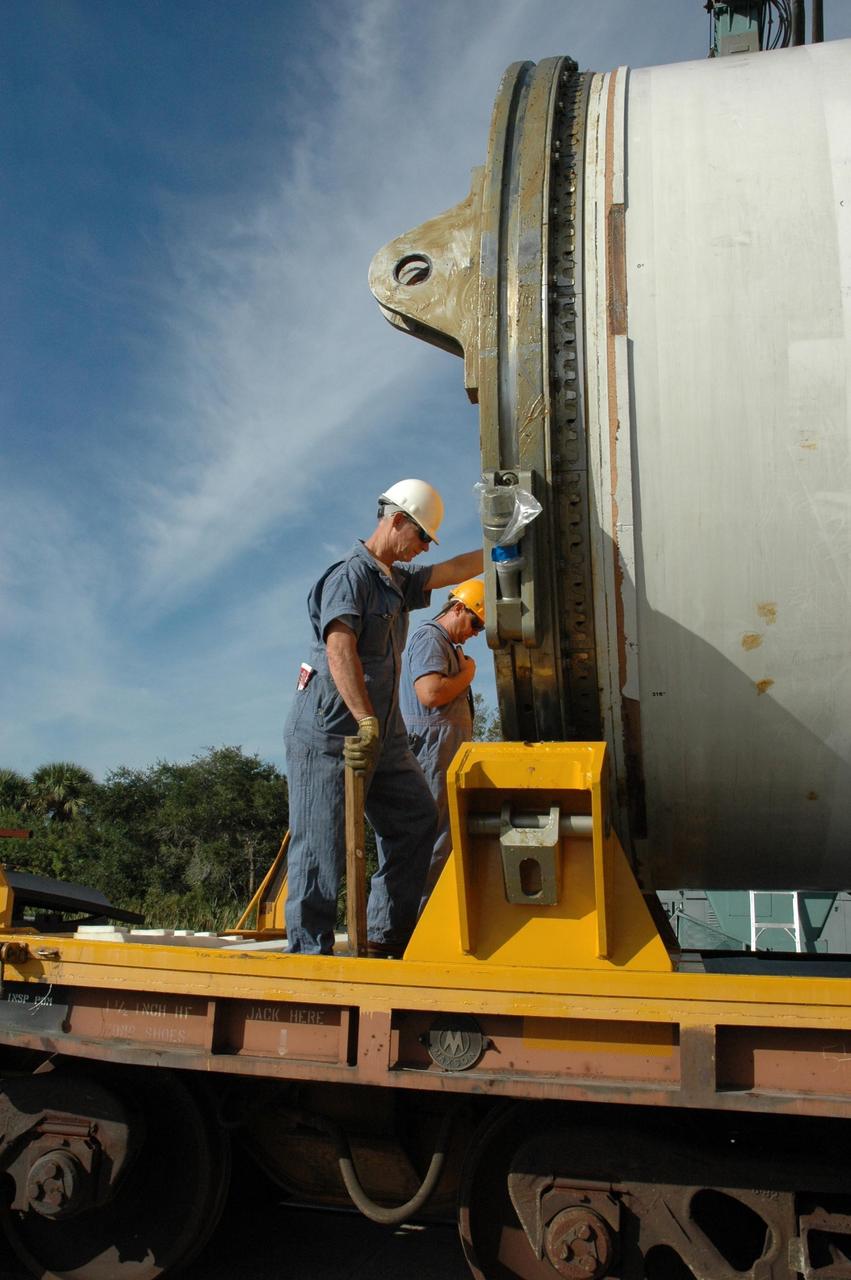
KENNEDY SPACE CENTER, FLA. -- Workers oversee the placement of a solid rocket booster segment onto a railroad car at the railroad yard at NASA's Kennedy Space Center. The spent segment is part of the booster used to launch space shuttle Discovery in October. The segment will be placed on the car and covered for the long trip back to Utah. After a mission, the spent boosters are recovered, cleaned, disassembled, refurbished and reused after each launch. After hydrolasing the interior of each segment, they are placed on flatbed trucks. The individual booster segments are transferred to a railhead located at the railroad yard at NASA's Kennedy Space Center. The long train of segments is part of the twin solid rocket boosters used to launch space shuttle Discovery in October. The NASA Railroad locomotive backs up the rail cars and the segment is lowered onto the car. The covered segments are moved to Titusville for interchange with Florida East Coast Railway to begin the trip back to Utah. Photo credit: NASA/Amanda Diller
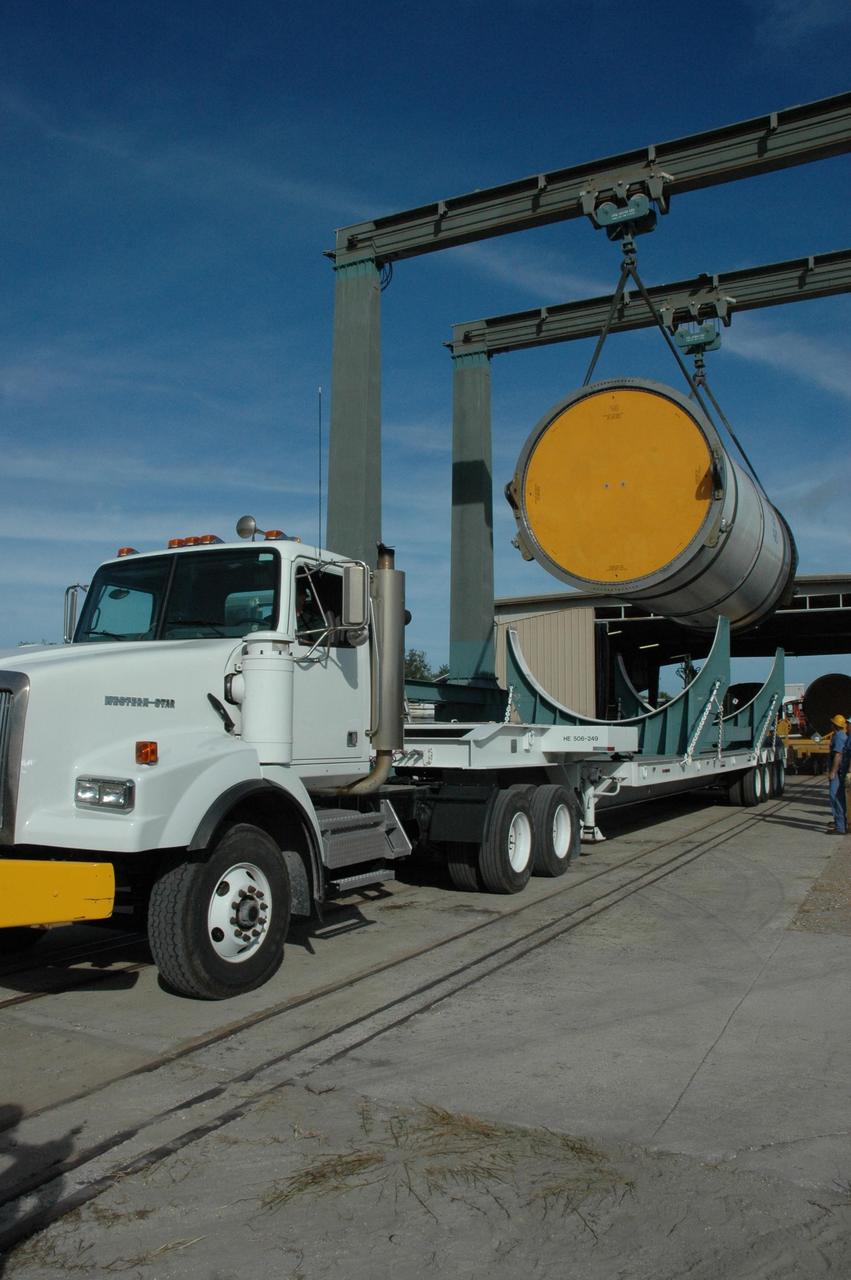
KENNEDY SPACE CENTER, FLA. -- A solid rocket booster segment is lifted off a truck bed at the railroad yard at NASA's Kennedy Space Center. The yellow transportation end cover has already been inserted and is secure. The segment is part of the booster used to launch space shuttle Discovery in October. The spent segment will be placed on a railroad car and covered for the long trip back to Utah. After a mission, the spent boosters are recovered, cleaned, disassembled, refurbished and reused after each launch. After hydrolasing the interior of each segment, they are placed on flatbed trucks. The individual booster segments are transferred to a railhead located at the railroad yard at NASA's Kennedy Space Center. The long train of segments is part of the twin solid rocket boosters used to launch space shuttle Discovery in October. The NASA Railroad locomotive backs up the rail cars and the segment is lowered onto the car. The covered segments are moved to Titusville for interchange with Florida East Coast Railway to begin the trip back to Utah. Photo credit: NASA/Amanda Diller