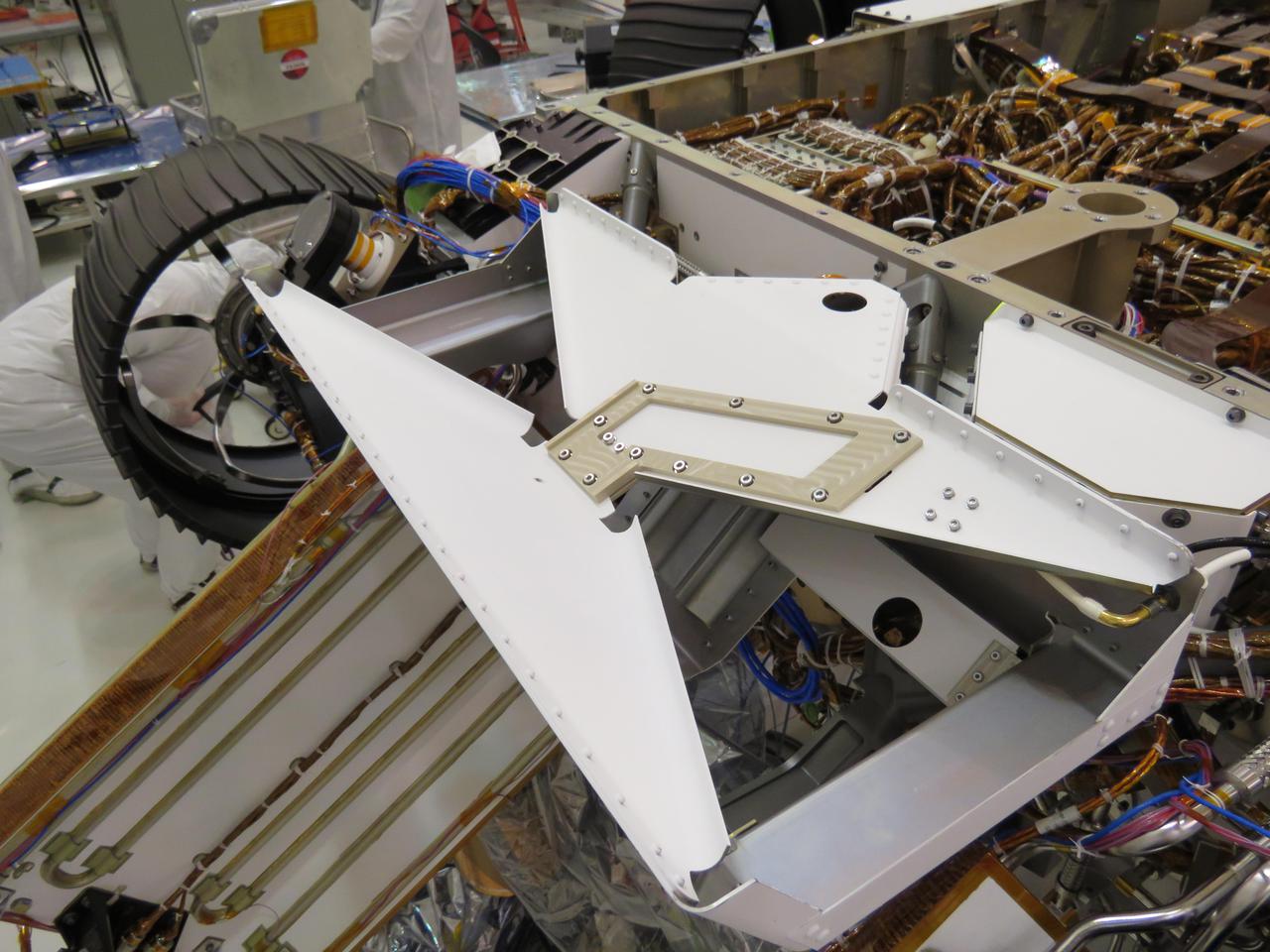
The bowtie-shaped antenna for the Radar Imager for Mars' Subsurface Experiment (RIMFAX) instrument has been mounted on the underside of the Perseverance rover. This antenna points down at the hard, frozen ground on Mars and sends the ground penetrating radar signal more than 30 feet (10 meters) below the surface of Mars. RIMFAX will enable scientists to learn about sources of briny water or ice below the surface. https://photojournal.jpl.nasa.gov/catalog/PIA24206

Team Lore listens in the audience as NASA Administrator Charles Bolden speaks at the event to announce the winner of the Exploration Design Challenge. Team Lore was one of the semi-finalists in the challenge. The goal of the Exploration Design Challenge is for students to research and design ways to protect astronauts from space radiation. The winner of the challenge was announced on April 25, 2014 at the USA Science and Engineering Festival at the Washington Convention Center in Washington, DC. Photo Credit: (NASA/Aubrey Gemignani)

This image, taken by the NASA/ESA Hubble Space Telescope, shows the colorful "last hurrah" of a star like our sun. The star is ending its life by casting off its outer layers of gas, which formed a cocoon around the star's remaining core. Ultraviolet light from the dying star makes the material glow. The burned-out star, called a white dwarf, is the white dot in the center. Our sun will eventually burn out and shroud itself with stellar debris, but not for another 5 billion years. Our Milky Way Galaxy is littered with these stellar relics, called planetary nebulae. The objects have nothing to do with planets. Eighteenth- and nineteenth-century astronomers called them the name because through small telescopes they resembled the disks of the distant planets Uranus and Neptune. The planetary nebula in this image is called NGC 2440. The white dwarf at the center of NGC 2440 is one of the hottest known, with a surface temperature of more than 360,000 degrees Fahrenheit (200,000 degrees Celsius). The nebula's chaotic structure suggests that the star shed its mass episodically. During each outburst, the star expelled material in a different direction. This can be seen in the two bowtie-shaped lobes. The nebula also is rich in clouds of dust, some of which form long, dark streaks pointing away from the star. NGC 2440 lies about 4,000 light-years from Earth in the direction of the constellation Puppis. The material expelled by the star glows with different colors depending on its composition, its density and how close it is to the hot central star. Blue samples helium; blue-green oxygen, and red nitrogen and hydrogen. Credit: NASA, ESA, and K. Noll (STScI), Acknowledgment: The Hubble Heritage Team (STScI/AURA) <b><a href="http://www.nasa.gov/audience/formedia/features/MP_Photo_Guidelines.html" rel="nofollow">NASA image use policy.</a></b> <b><a href="http://www.nasa.gov/centers/goddard/home/index.html" rel="nofollow">NASA Goddard Space Flight Center</a></b> enables NASA’s mission through four scientific endeavors: Earth Science, Heliophysics, Solar System Exploration, and Astrophysics. Goddard plays a leading role in NASA’s accomplishments by contributing compelling scientific knowledge to advance the Agency’s mission. <b>Follow us on <a href="http://twitter.com/NASAGoddardPix" rel="nofollow">Twitter</a></b> <b>Like us on <a href="http://www.facebook.com/pages/Greenbelt-MD/NASA-Goddard/395013845897?ref=tsd" rel="nofollow">Facebook</a></b> <b>Find us on <a href="http://instagrid.me/nasagoddard/?vm=grid" rel="nofollow">Instagram</a></b>