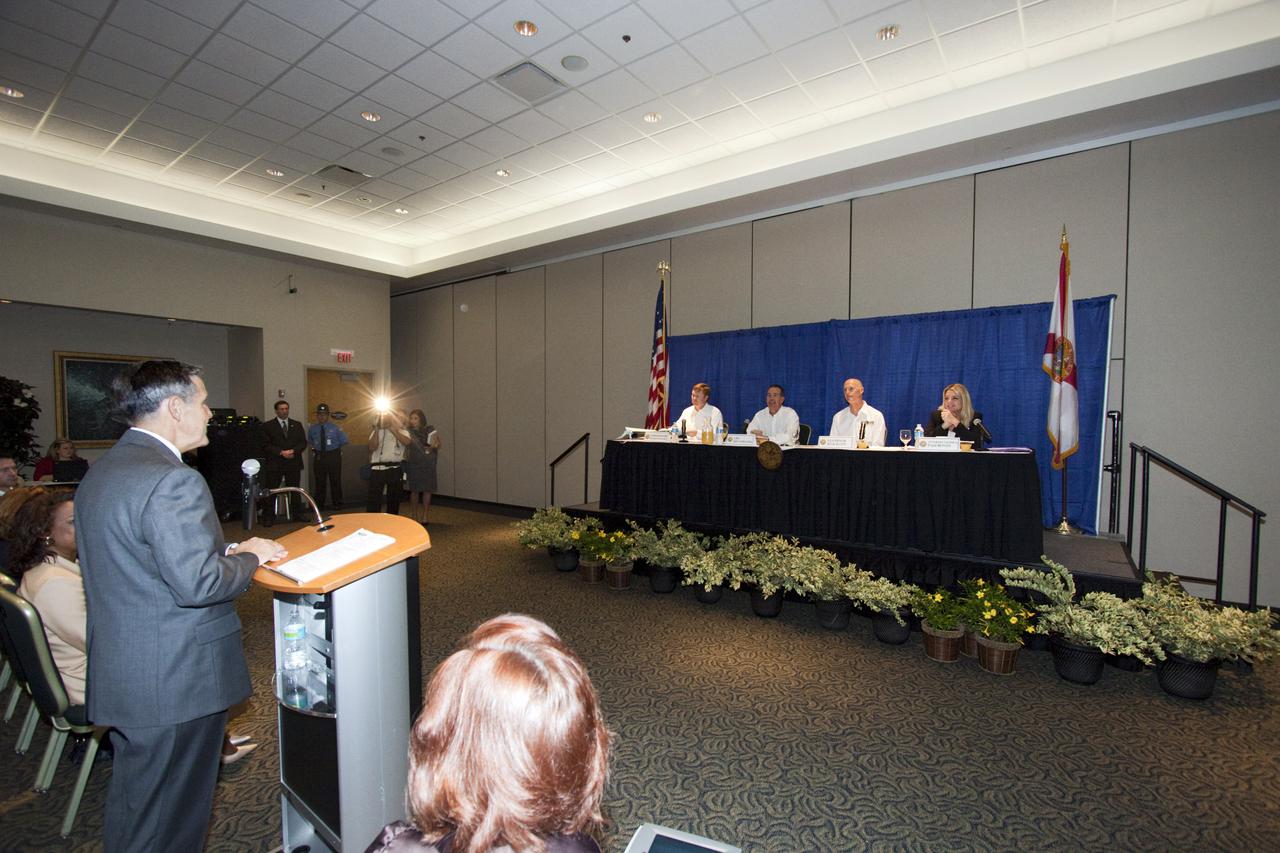
CAPE CANAVERAL, Fla. – Robert Cabana, left, NASA Kennedy Space Center director, addresses the Florida Cabinet on Oct. 18 during a Cabinet meeting at the Kennedy Space Center Visitor Complex, Fla. The Cabinet, seated, is made up of Adam Putnam, left, Agriculture commissioner, Jeff Atwater, chief financial officer, Florida Governor Rick Scott and Pam Bondi, attorney general. The Cabinet recognized the center's accomplishments in spaceflight and technological innovation during its meeting. Photo credit: NASA_Jim Grossmann
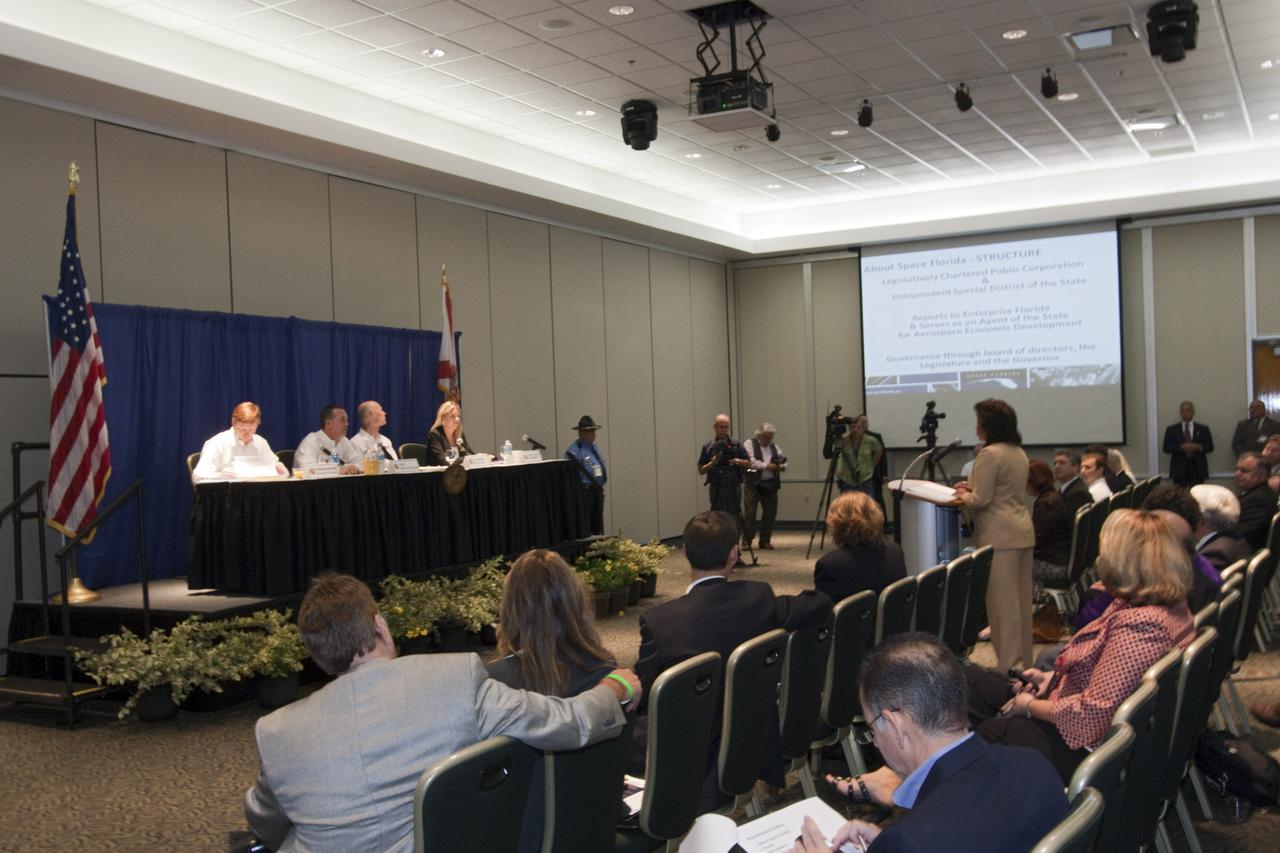
CAPE CANAVERAL, Fla. – Lt. Governor Jennifer Carroll, chairwoman of Space Florida, addresses the Florida Cabinet during its meeting at the Kennedy Space Center Visitor Complex, Fla., on Oct. 18. The Cabinet approved a resolution recognizing NASA Kennedy Space Center for its contributions to spaceflight and technological innovation. The Cabinet, seated, is made up of Adam Putnam, left, Agriculture commissioner, Jeff Atwater, chief financial officer, Florida Governor Rick Scott and Pam Bondi, attorney general. Photo credit: NASA_Jim Grossmann
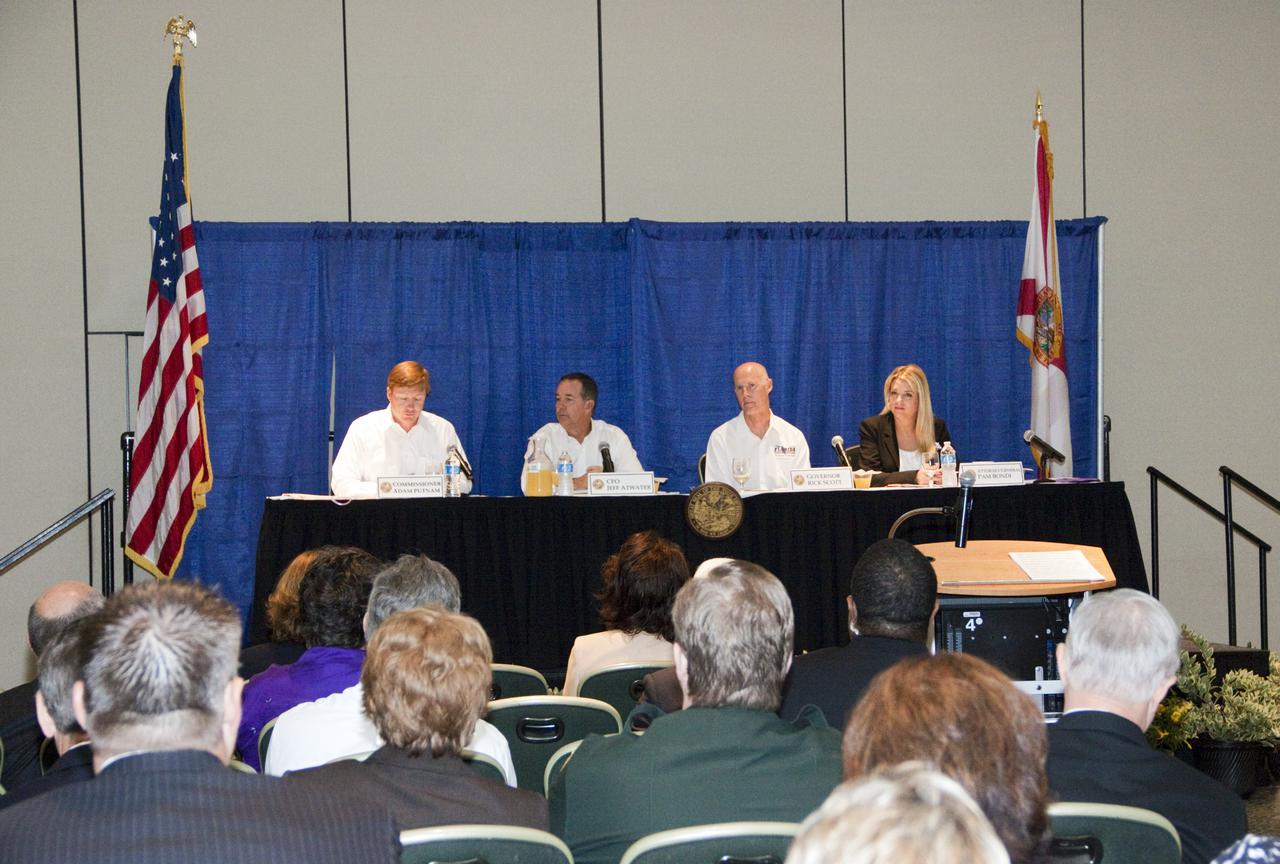
CAPE CANAVERAL, Fla. – The Florida Cabinet reviews a resolution recognizing NASA Kennedy Space Center for its contributions to spaceflight and technological innovation during its meeting at the Kennedy Space Center Visitor Complex, Fla., on Oct. 18. The Cabinet, seated, is made up of Adam Putnam, left, Agriculture commissioner, Jeff Atwater, chief financial officer, Florida Governor Rick Scott and Pam Bondi, attorney general. Photo credit: NASA_Jim Grossmann
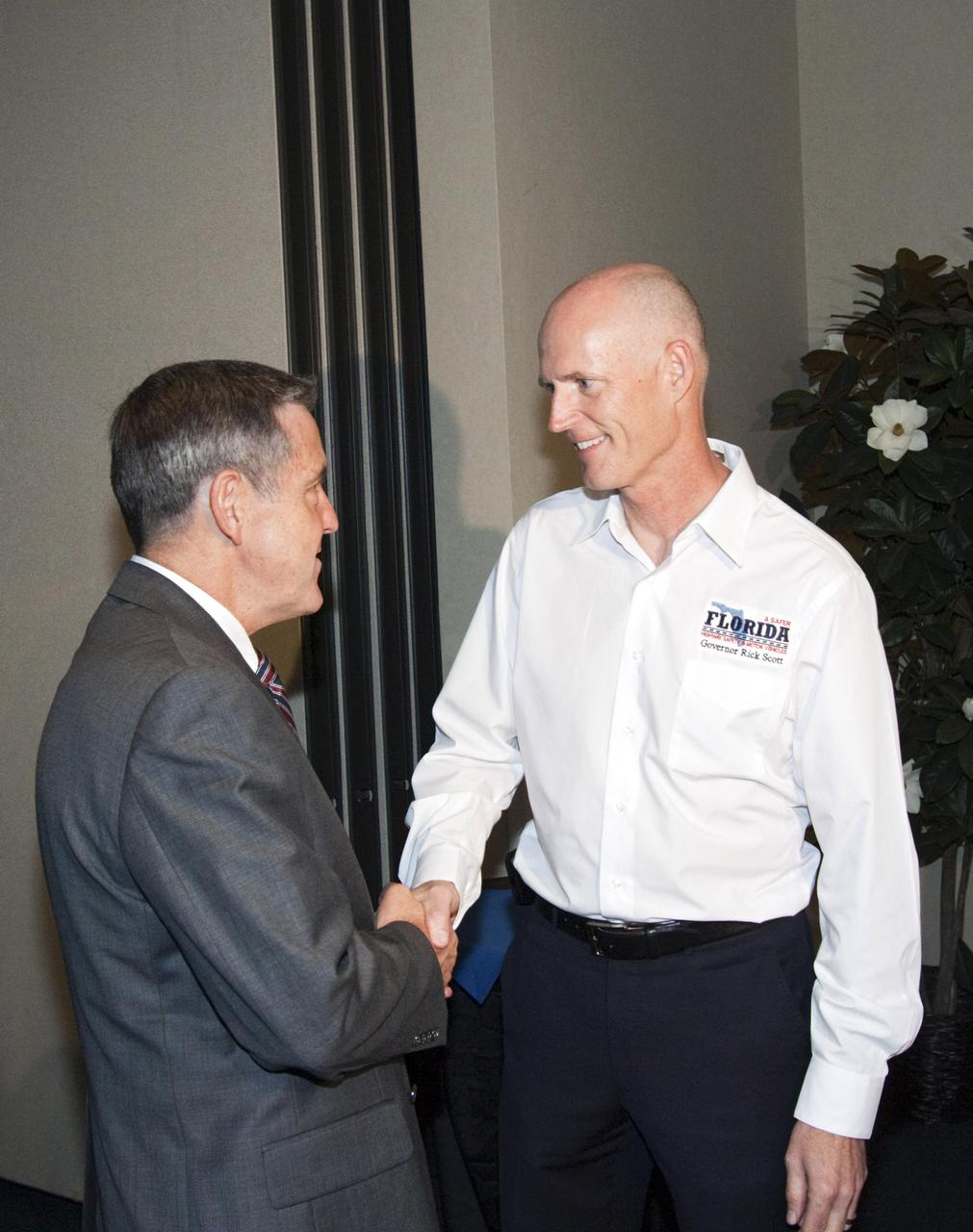
CAPE CANAVERAL, Fla. – Robert Cabana, left, NASA Kennedy Space Center director, greets Florida Governor Rick Scott at the Kennedy Space Center Visitor Complex, Fla., on Oct. 18, before a meeting of the Florida Cabinet. The Cabinet recognized the center's accomplishments in spaceflight and technological innovation during its meeting. Photo credit: NASA_Jim Grossmann
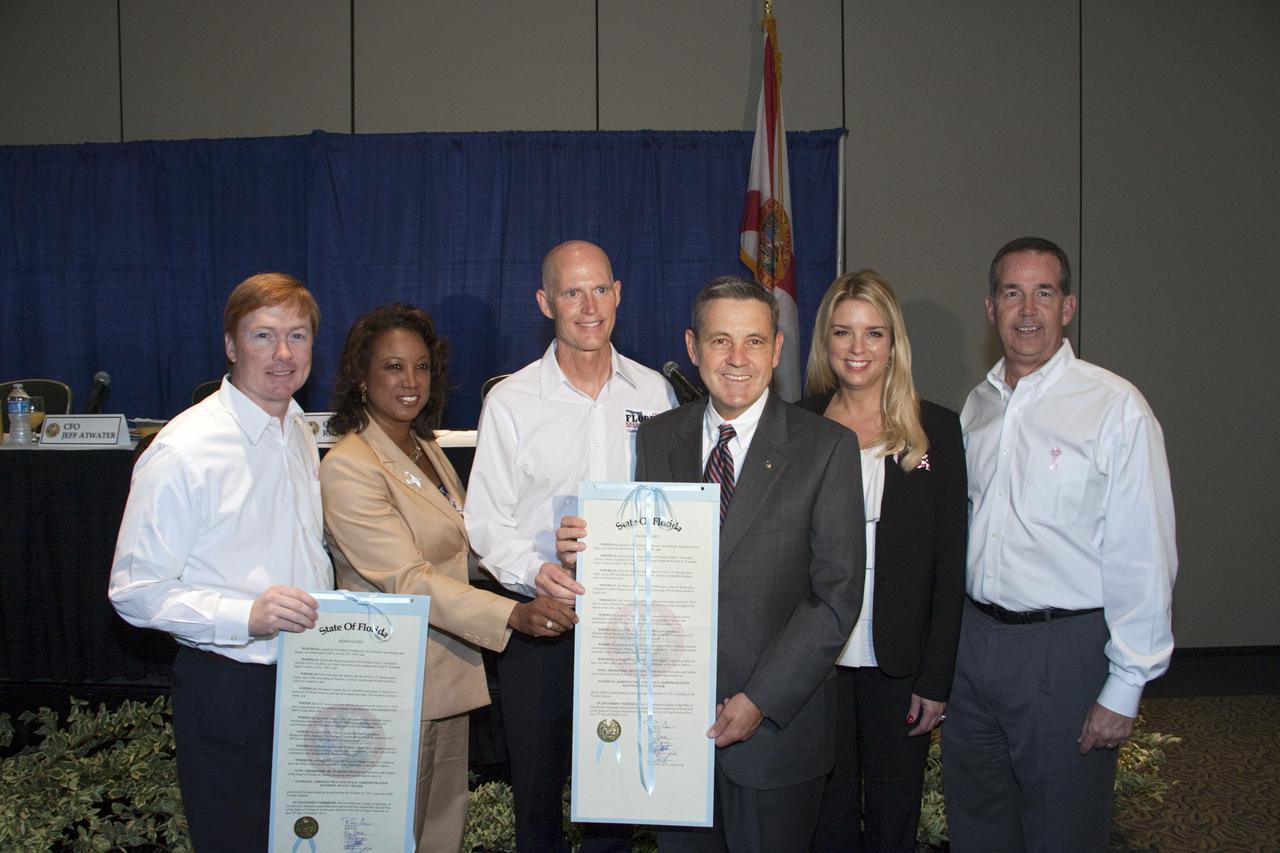
CAPE CANAVERAL, Fla. – The Florida Cabinet approved a resolution recognizing NASA Kennedy Space Center for its contributions to spaceflight and technological innovation during its meeting at the Kennedy Space Center Visitor Complex, Fla., on Oct. 18. Adam Putnam, left, agriculture commissioner, Lt. Governor Jennifer Carroll, chairwoman of Space Florida. Governor Rick Scott, Bob Cabana, Kennedy Space Center director, Pam Bondi, attorney general, and Jeff Atwater, chief financial officer, took part in the recognition during the meeting. Photo credit: NASA_Jim Grossmann
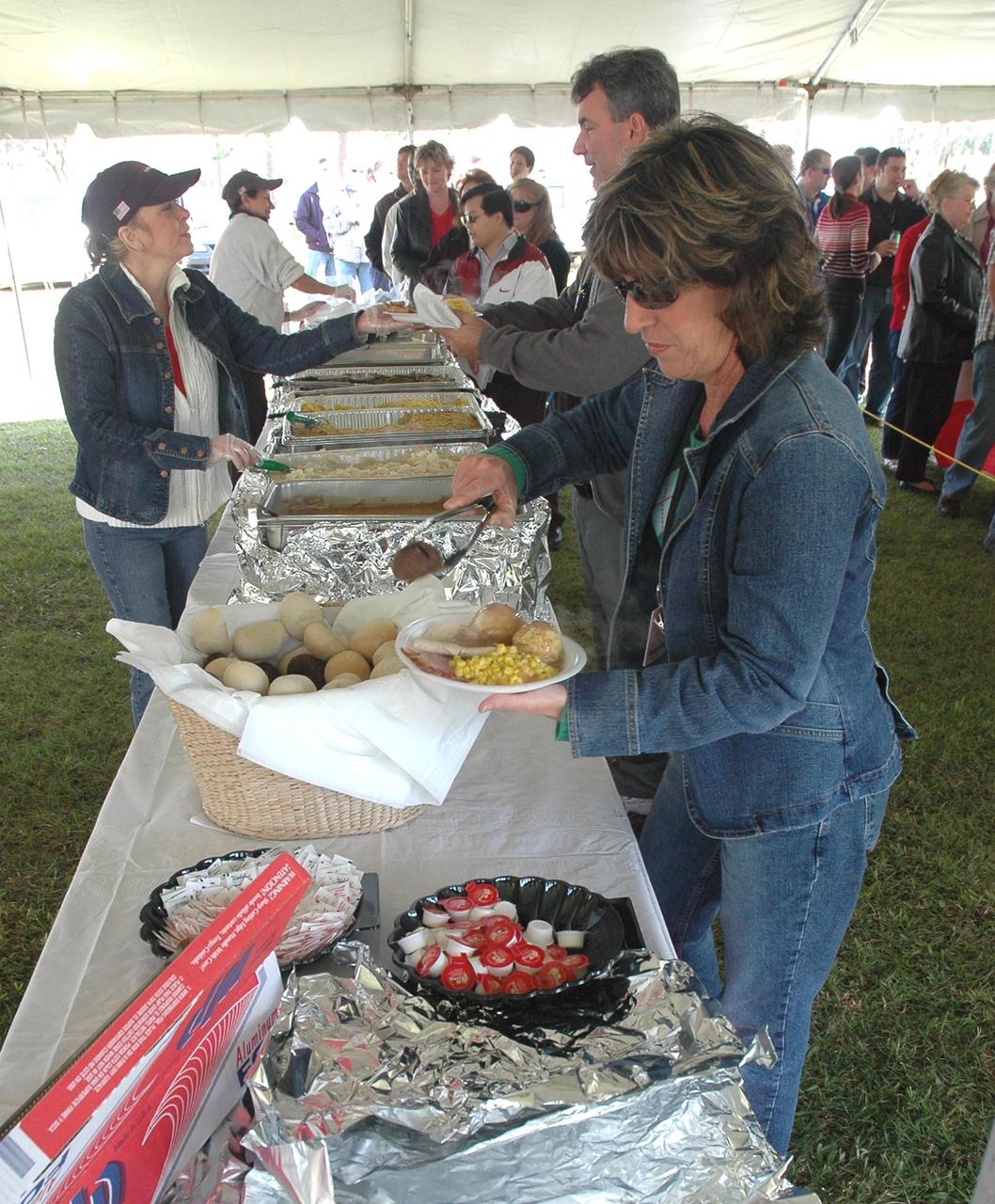
KENNEDY SPACE CENTER, FLA. - NASA Civil Service employees and their families help themselves to a traditional holiday meal of turkey, ham and all of the trimmings at an annual holiday dinner and celebration hosted by Center Director Jim Kennedy, at KARS Park 1 on Merritt Island, Fla. The theme for the celebration was "Launching Dreams of Those in Need." The event was sponsored by the Change Leaders Network and the Combined Federal Campaign Cabinet.
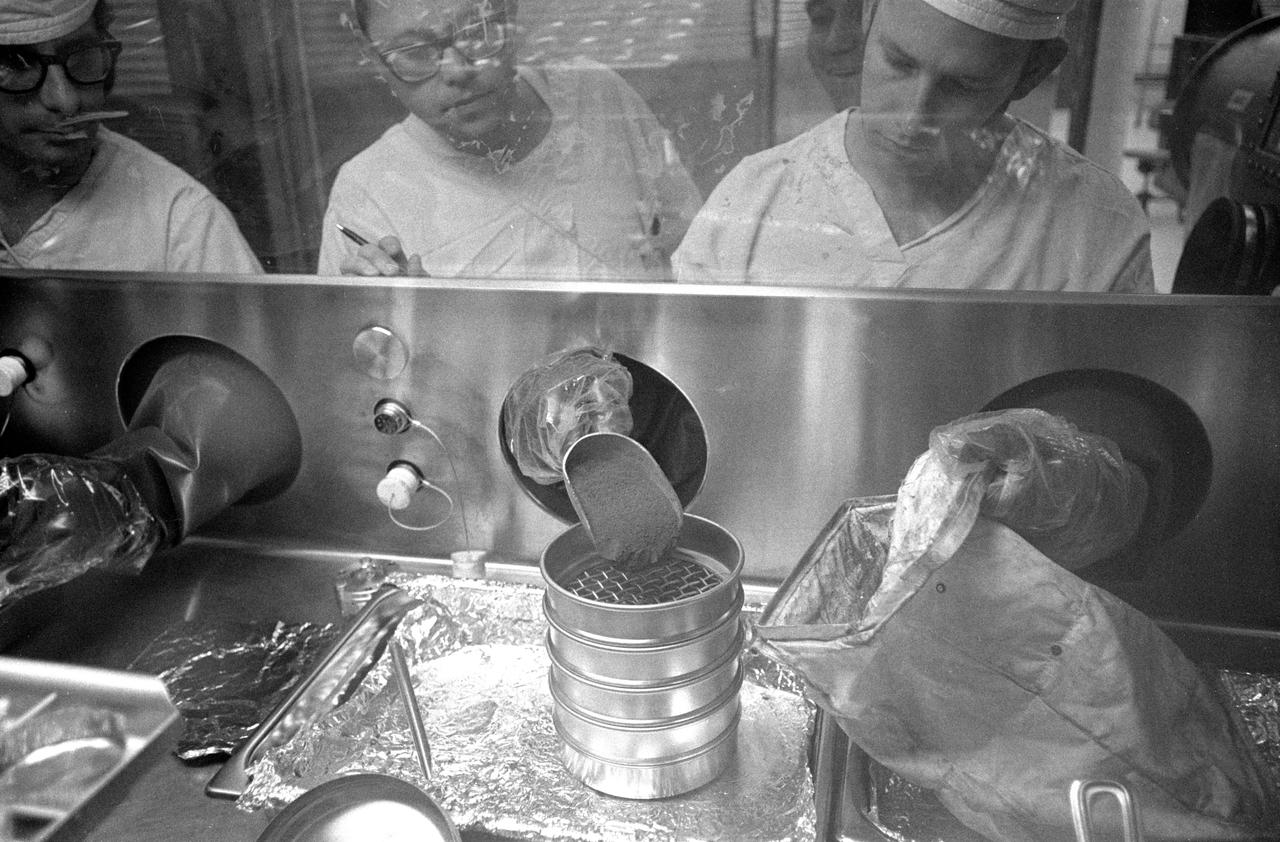
S71-19489 (18 Feb. 1971) --- Glove handlers work with freshly opened Apollo 14 lunar sample material in modularized cabinets in the Lunar Receiving Laboratory at the Manned Spacecraft Center. The glove operator on the right starts to pour fine lunar material which he has just taken from a tote bag. The powdery sample was among the last to be revealed of the 90-odd pounds of material brought back to Earth by the Apollo 14 crew members.
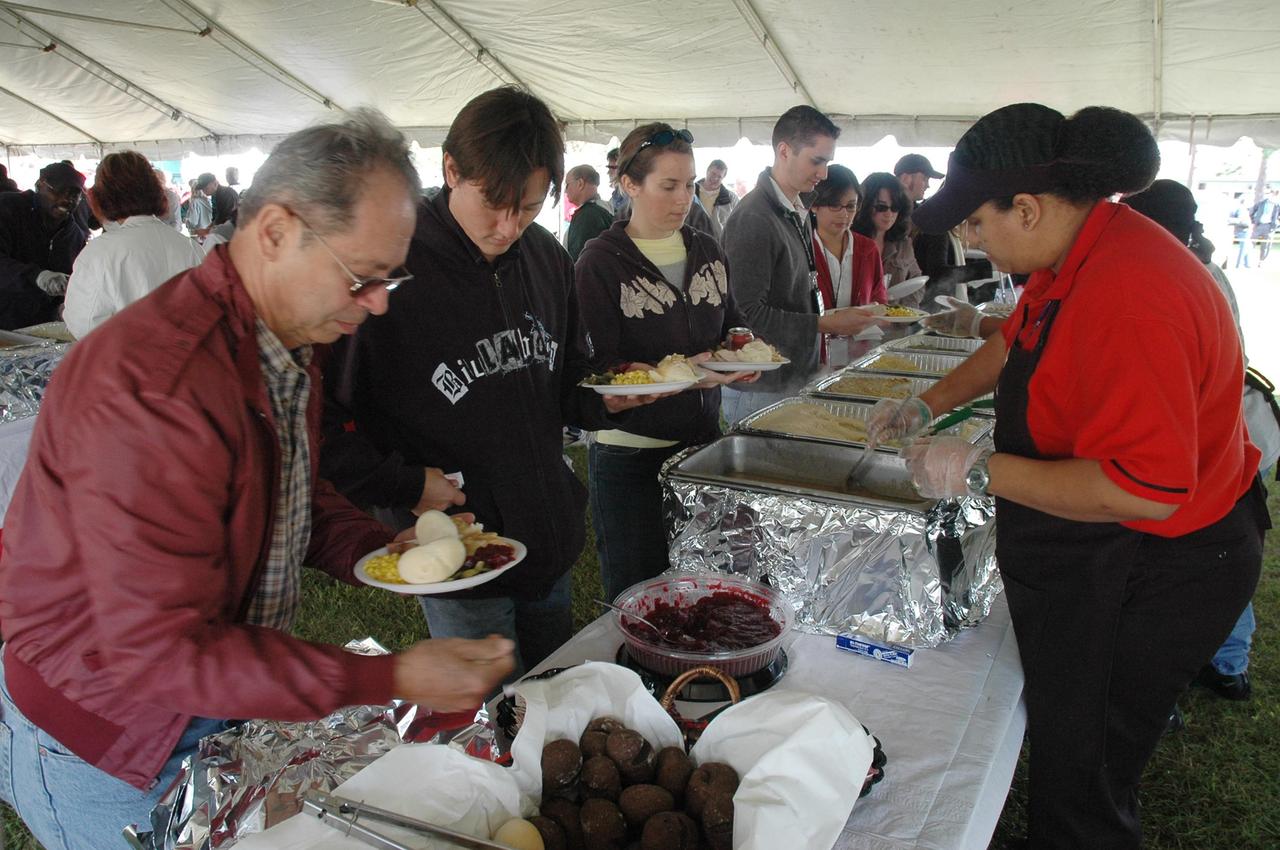
KENNEDY SPACE CENTER, FLA. - NASA Civil Service employees and their families enjoy a traditional holiday meal of turkey, ham and all of the trimmings at an annual holiday dinner and celebration hosted by Center Director Jim Kennedy, at KARS Park 1 on Merritt Island, Fla. The theme for the celebration was "Launching Dreams of Those in Need." The event was sponsored by the Change Leaders Network and the Combined Federal Campaign Cabinet.

KENNEDY SPACE CENTER, FLA. - NASA Civil Service employees enjoy delicious food, live music and camaraderie at an annual holiday dinner and celebration hosted by Center Director Jim Kennedy at KARS Park I on Merritt Island, Fla. The theme for the celebration was "Launching Dreams of Those in Need." The event was sponsored by the Change Leaders Network and the Combined Federal Campaign Cabinet.
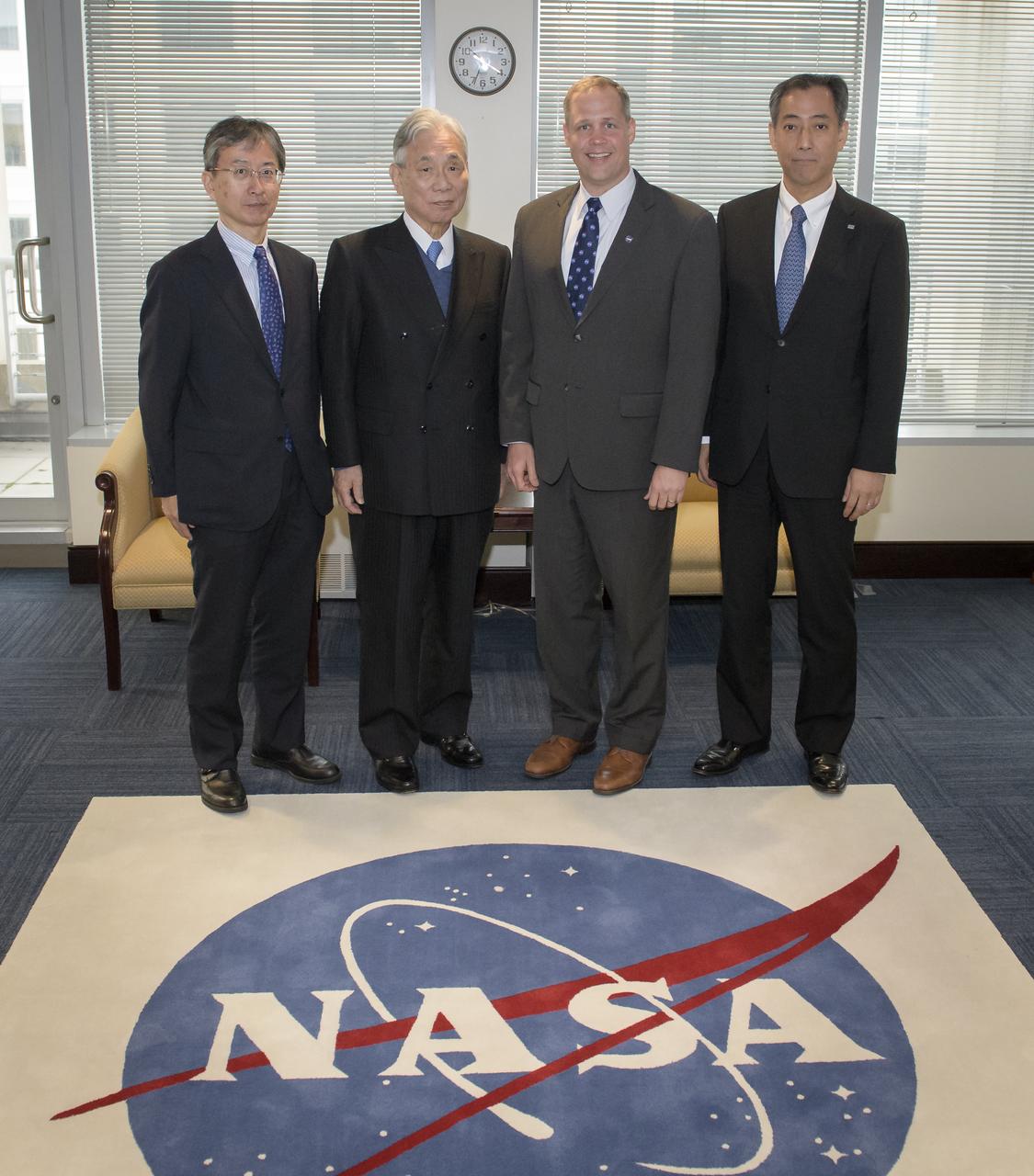
Shuzo Takada, Director General, Cabinet Office, Japan, left; Yoshiyuki Kasai, Chairman, National Space Policy Committee, Japan; Jim Bridenstine, NASA Administrator; and Hiroshi Yamakawa, President, Japan Aerospace Exploration Agency, right, pose for a photograph during a courtesy visit to discuss ongoing cooperation, Wednesday, June 27, 2018 at NASA Headquarters in Washington. Photo Credit: (NASA/Bill Ingalls)

KENNEDY SPACE CENTER, FLA. - NASA Civil Service employees enjoy delicious food, live music and camaraderie at an annual holiday dinner and celebration hosted by Center Director Jim Kennedy at KARS Park I on Merritt Island, Fla. The theme for the celebration was "Launching Dreams of Those in Need." The event was sponsored by the Change Leaders Network and the Combined Federal Campaign Cabinet.
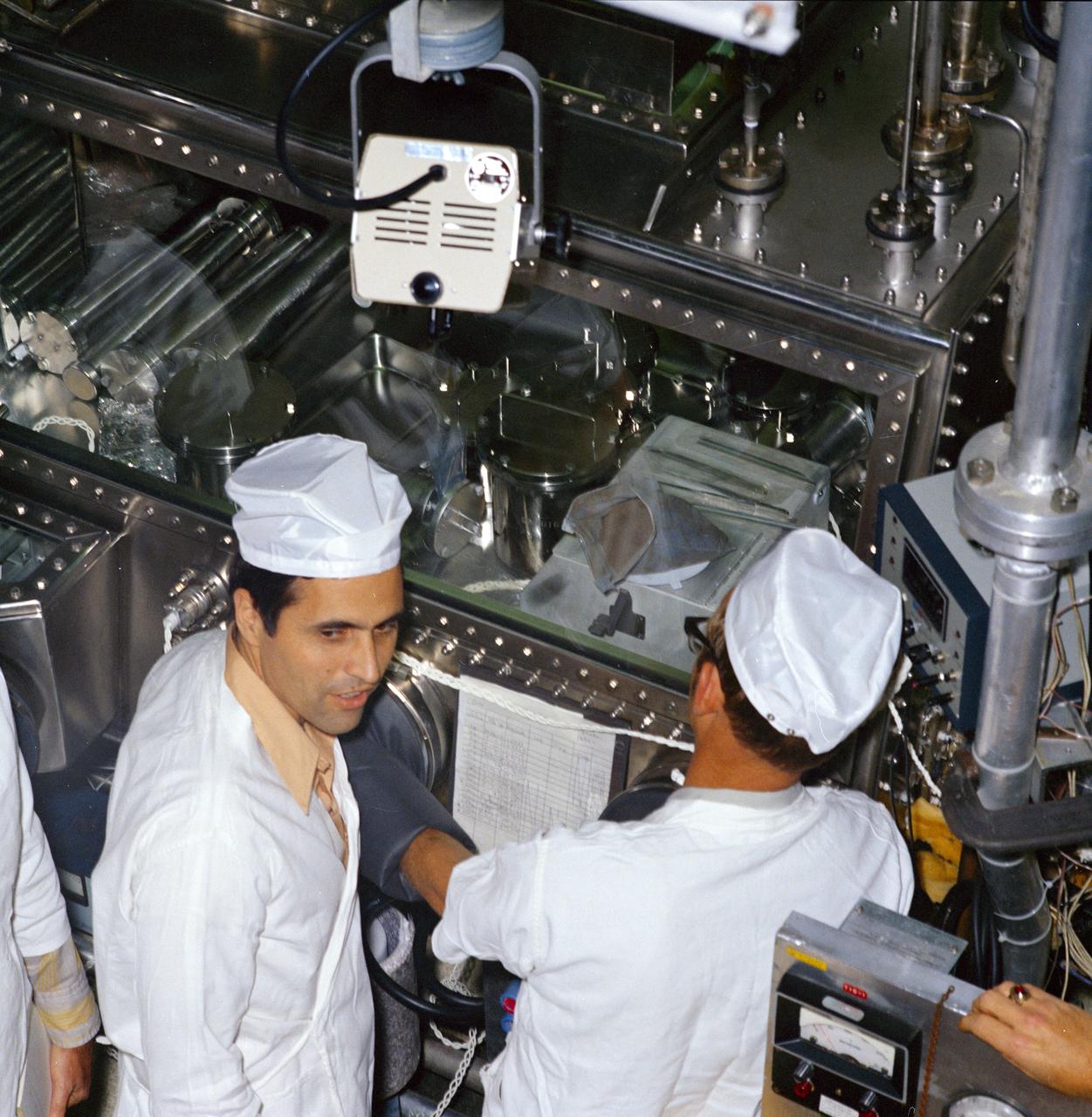
S72-56362 (27 Dec. 1972) --- Scientist-astronaut Harrison H. "Jack" Schmitt (facing camera), Apollo 17 lunar module pilot, was one of the first to look at the sample of "orange" soil which was brought back from the Taurus-Littrow landing site by the Apollo 17 crewmen. Schmitt discovered the material at Shorty Crater during the second Apollo 17 extravehicular activity (EVA). The "orange" sample, which was opened Wednesday, Dec. 27, 1972, is in the bag on a weighing platform in the sealed nitrogen cabinet in the upstairs processing line in the Lunar Receiving Laboratory at the Manned Spacecraft Center. Just before, the sample was removed from one of the bolt-top cans visible to the left in the cabinet. The first reaction of Schmitt was "It doesn't look the same." Most of the geologists and staff viewing the sample agreed that it was more tan and brown than orange. Closer comparison with color charts showed that the sample had a definite orange cast, according the MSC geology branch Chief William Phinney. After closer investigation and sieving, it was discovered that the orange color was caused by very fine spheres and fragments of orange glass in the midst of darker colored, larger grain material. Earlier in the day the "orange" soil was taken from the Apollo Lunar Sample Return Container No. 2 and placed in the bolt-top can (as was all the material in the ALSRC "rock box").
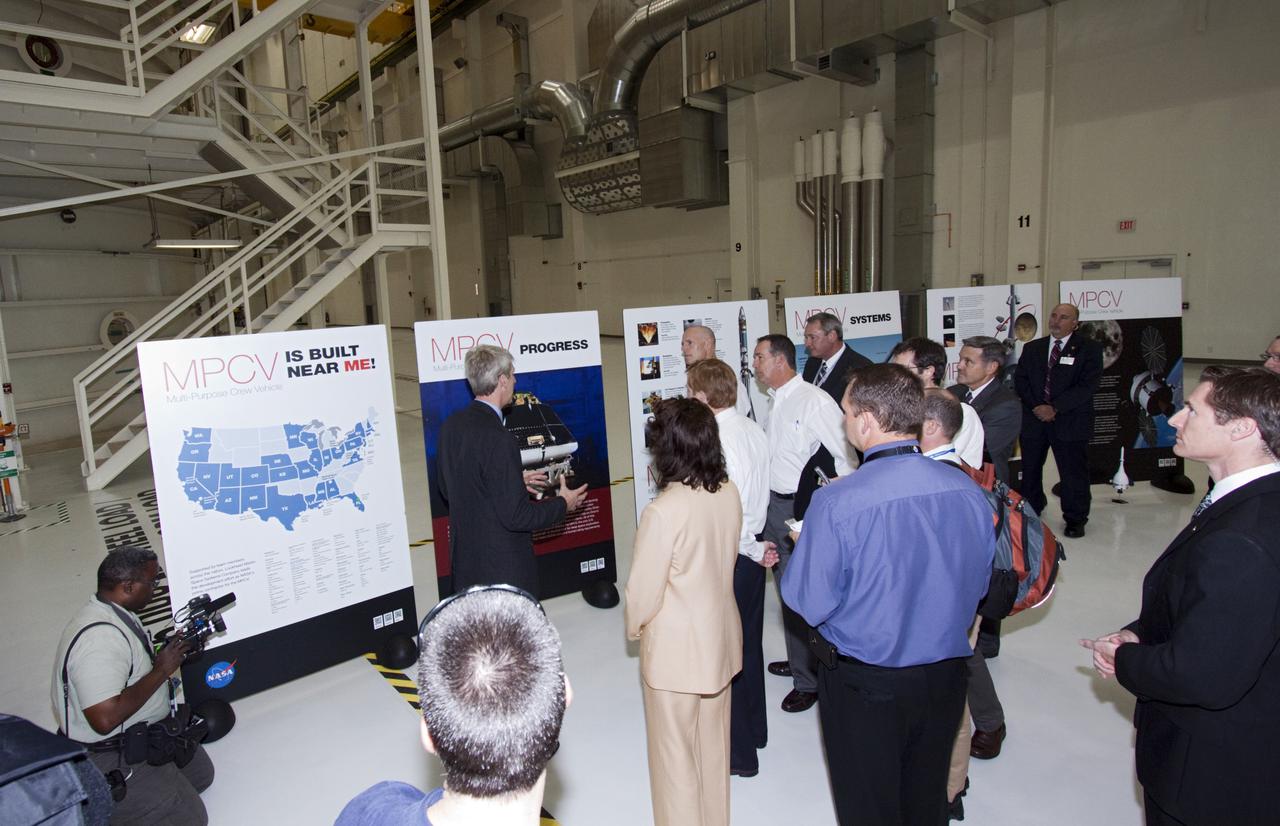
CAPE CANAVERAL, Fla. – In the Operations and Checkout Building at NASA's Kennedy Space Center in Florida, NASA’s Orion Production Manager Scott Wilson, (left), briefs Florida Gov. Rick Scott, (center), and Florida Lt. Gov. Jennifer Carroll, chairwoman of Space Florida on the processing of the Orion Multi-Purpose Crew Vehicle. The governor and other state officials were at Kennedy for a Florida cabinet meeting and a space industry roundtable at the Kennedy Space Center Visitor Complex’s Debus Conference Center. They also toured selected facilities around the center. Photo credit: NASA_Jim Grossmann
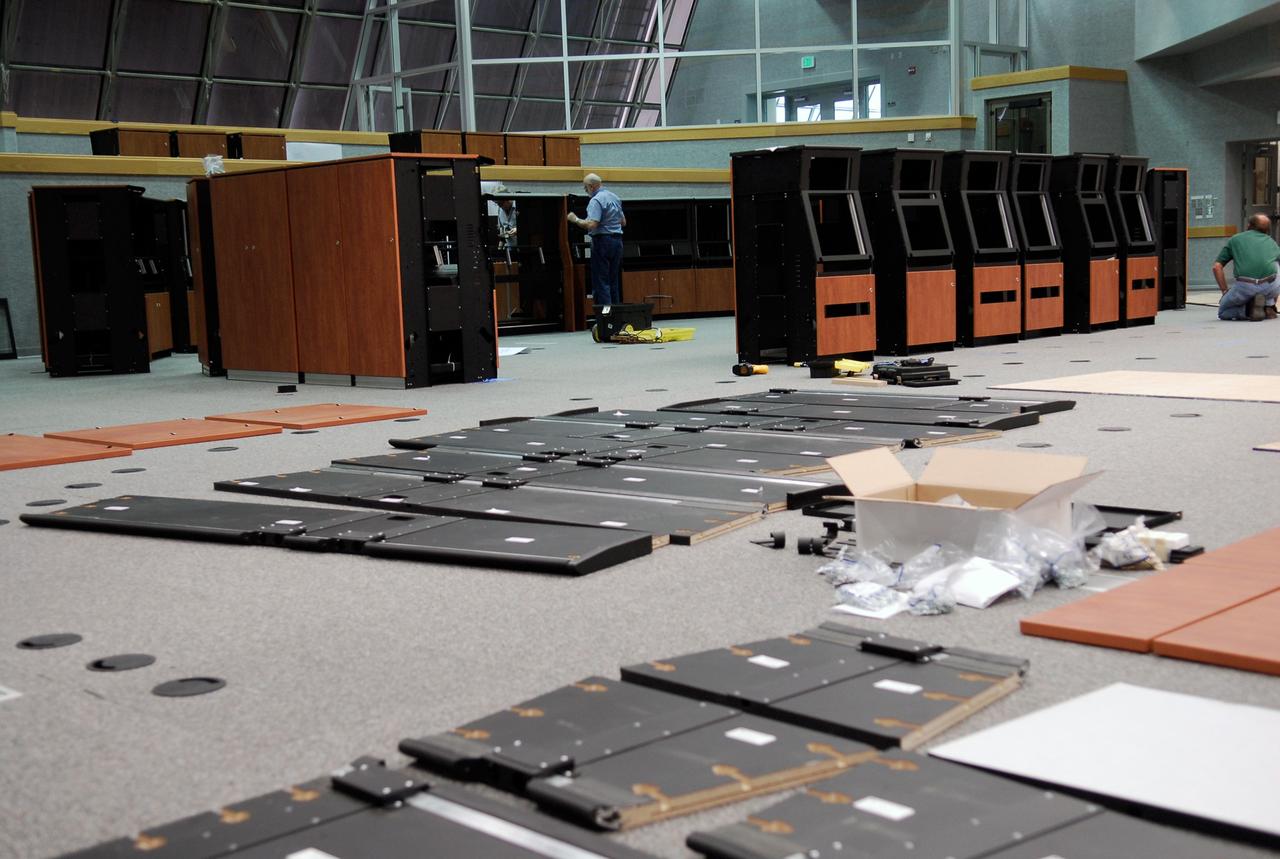
CAPE CANAVERAL, Fla. -- In Firing Room No. 1 in the Launch Control Center at NASA's Kennedy Space Center, the number of new equipment cabinets increases as workers put the elements together. The firing room will support the future Ares rocket launches as part of the Constellation Program. Future astronauts will ride to orbit on Ares I, which uses a single five-segment solid rocket booster, a derivative of the space shuttle's solid rocket booster, for the first stage. Ares will be launched from Pad 39B, which is being reconfigured from supporting space shuttle launches. The Launch Control Center firing rooms face the launch pads. Photo credit: NASA/Kim Shiflett
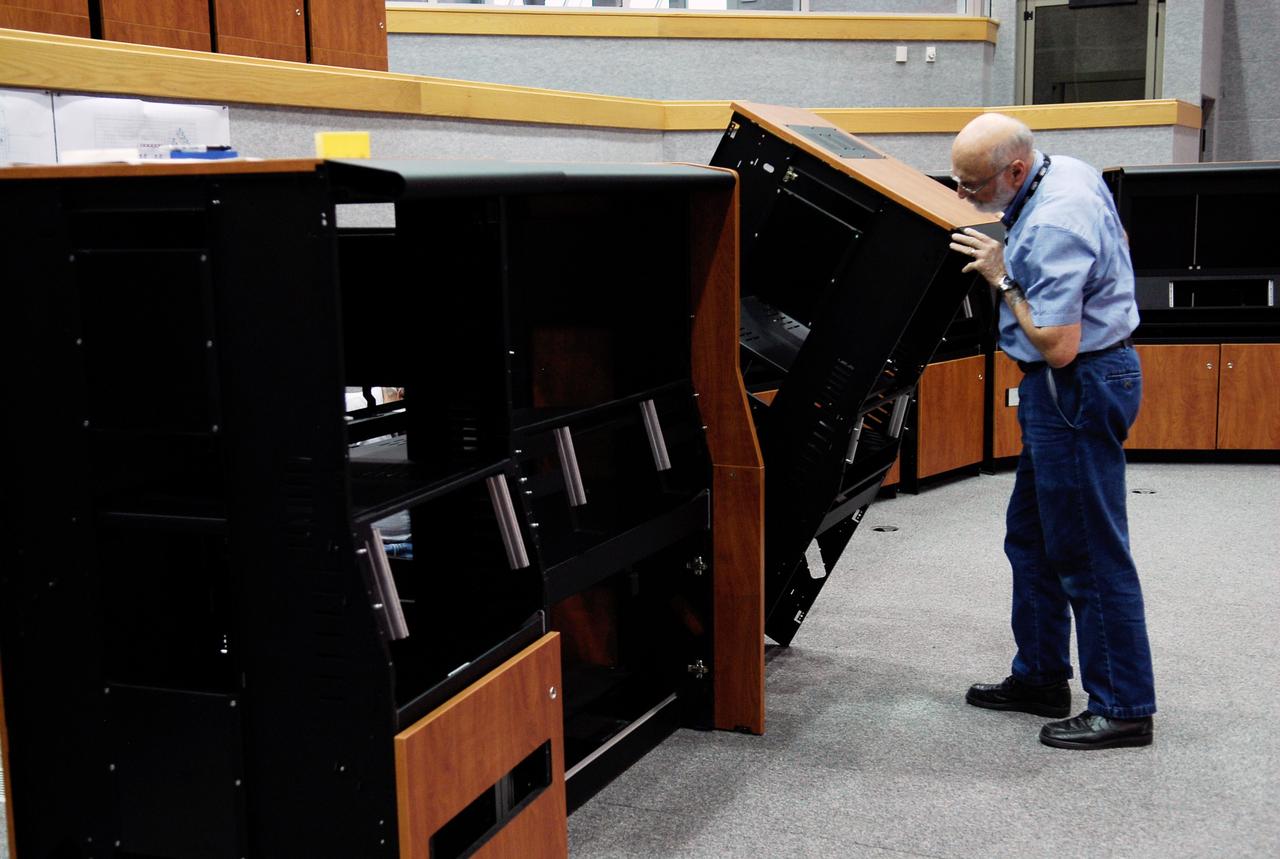
CAPE CANAVERAL, Fla. -- In Firing Room No. 1 in the Launch Control Center at NASA's Kennedy Space Center, a worker holds on to a cabinet being put together to hold equipment that will support the future Ares rocket launches as part of the Constellation Program. Future astronauts will ride to orbit on Ares I, which uses a single five-segment solid rocket booster, a derivative of the space shuttle's solid rocket booster, for the first stage. Ares will be launched from Pad 39B, which is being reconfigured from supporting space shuttle launches. The Launch Control Center firing rooms face the launch pads. Photo credit: NASA/Kim Shiflett
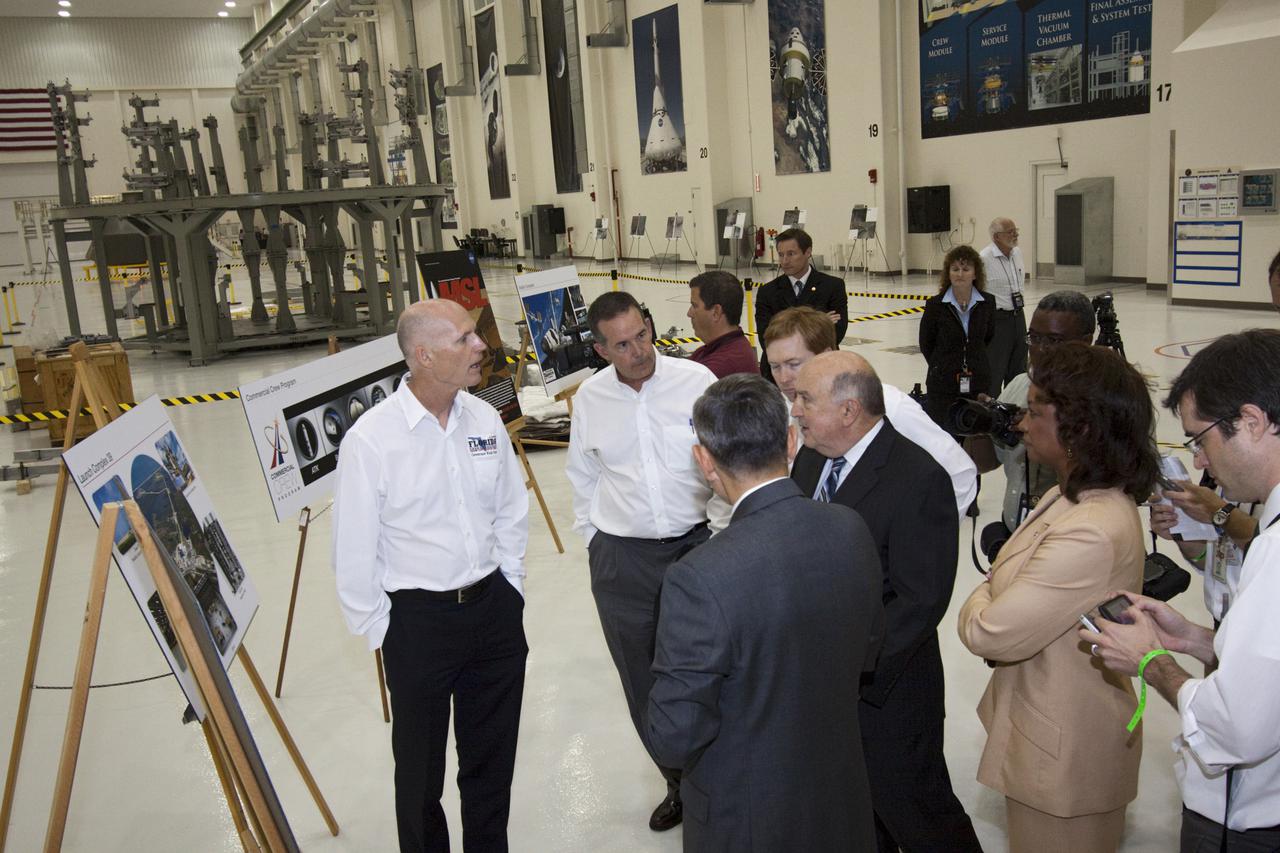
CAPE CANAVERAL, Fla. – Florida Gov. Rick Scott (left) tours the Operations and Checkout Building at NASA's Kennedy Space Center in Florida. He is being briefed on the processing of the Orion Multi-Purpose Crew Vehicle. With his back to the camera is Robert Cabana, Kennedy Space Center director. To Cabana’s right is Florida Lt. Gov. Jennifer Carroll, chairwoman of Space Florida. To the governor’s left is Jeff Atwater, Florida chief financial officer. The governor and other state officials were at Kennedy for a Florida cabinet meeting and a space industry roundtable at the Kennedy Space Center Visitor Complex’s Debus Conference Center. They also toured selected facilities around the center. Photo credit: NASA_Jim Grossmann
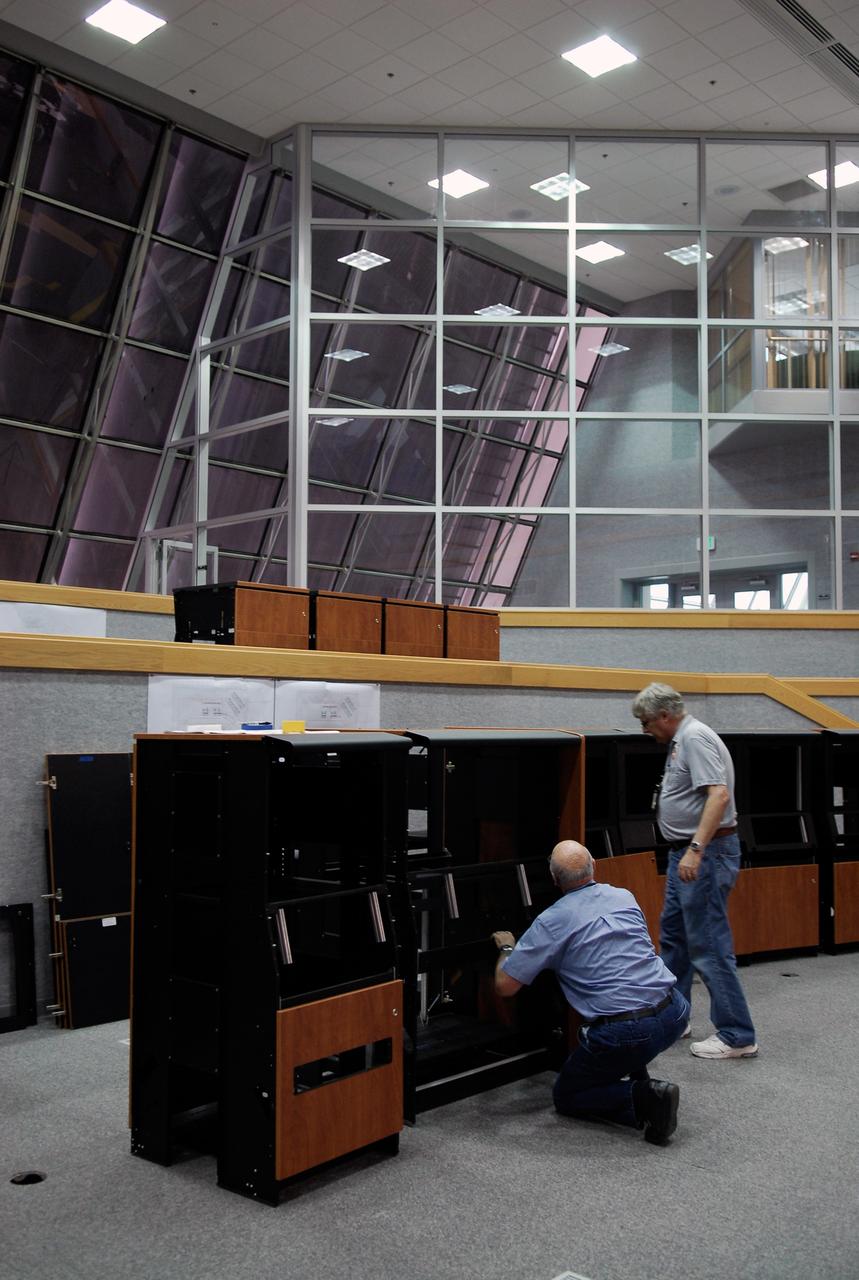
CAPE CANAVERAL, Fla. -- In Firing Room No. 1 in the Launch Control Center at NASA's Kennedy Space Center, workers put together another cabinet to hold equipment that will support the future Ares rocket launches as part of the Constellation Program. Future astronauts will ride to orbit on Ares I, which uses a single five-segment solid rocket booster, a derivative of the space shuttle's solid rocket booster, for the first stage. Ares will be launched from Pad 39B, which is being reconfigured from supporting space shuttle launches. The Launch Control Center firing rooms face the launch pads. Photo credit: NASA/Kim Shiflett
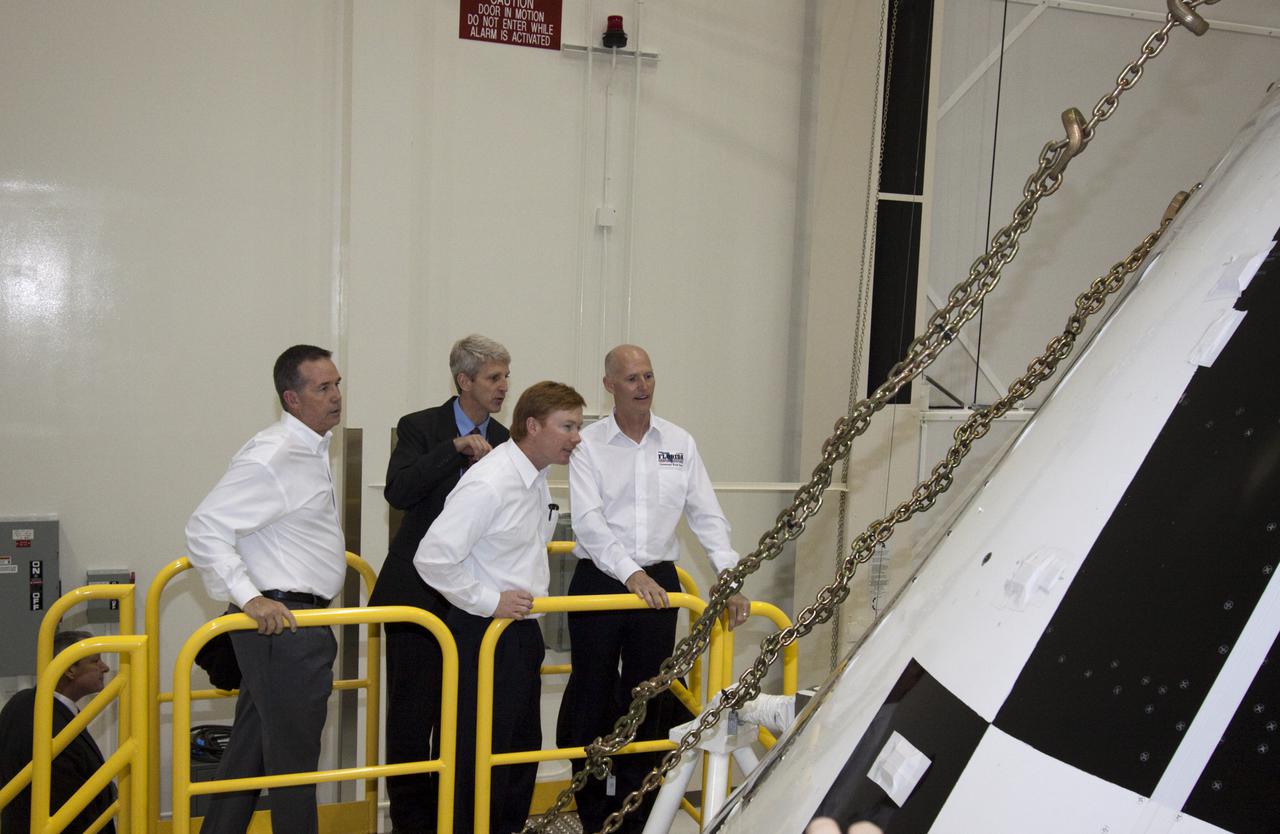
CAPE CANAVERAL, Fla. – In the high bay at the Operations and Checkout Building at NASA's Kennedy Space Center in Florida, NASA’s Orion Production Manager Scott Wilson, (center), Adam Putnam, Florida agriculture commissioner, Florida Gov. Rick Scott, (right), and Jeff Atwater, Florida chief financial officer, (left), look at an Orion capsule used in launch abort testing. The governor and other state officials were at Kennedy for a Florida cabinet meeting and a space industry roundtable at the Kennedy Space Center Visitor Complex’s Debus Conference Center. They also toured selected facilities around the center. Photo credit: NASA_Jim Grossmann
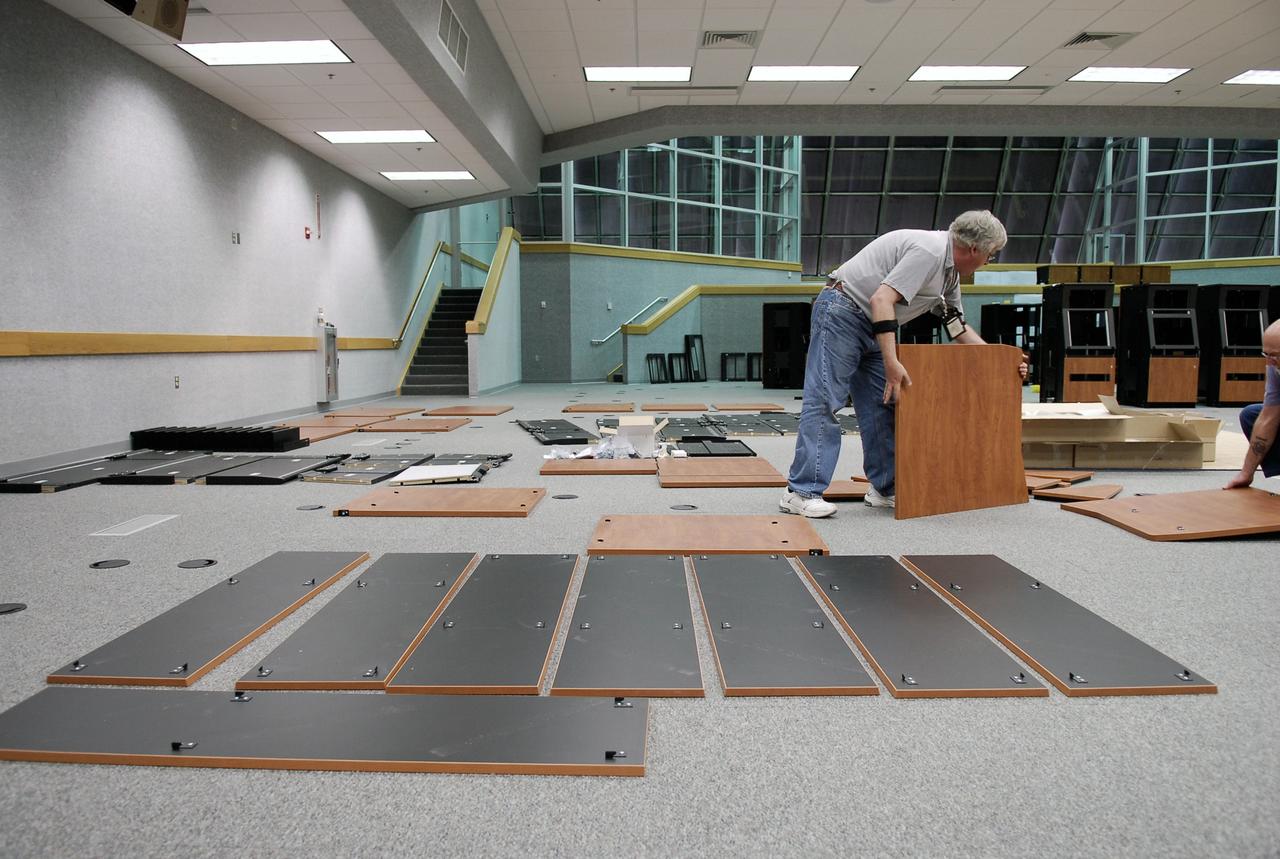
CAPE CANAVERAL, Fla. -- In Firing Room No. 1 in the Launch Control Center at NASA's Kennedy Space Center, a worker maneuvers a panel to build another cabinet to hold equipment that will support the future Ares rocket launches as part of the Constellation Program. Future astronauts will ride to orbit on Ares I, which uses a single five-segment solid rocket booster, a derivative of the space shuttle's solid rocket booster, for the first stage. Ares will be launched from Pad 39B, which is being reconfigured from supporting space shuttle launches. The Launch Control Center firing rooms face the launch pads. Photo credit: NASA/Kim Shiflett
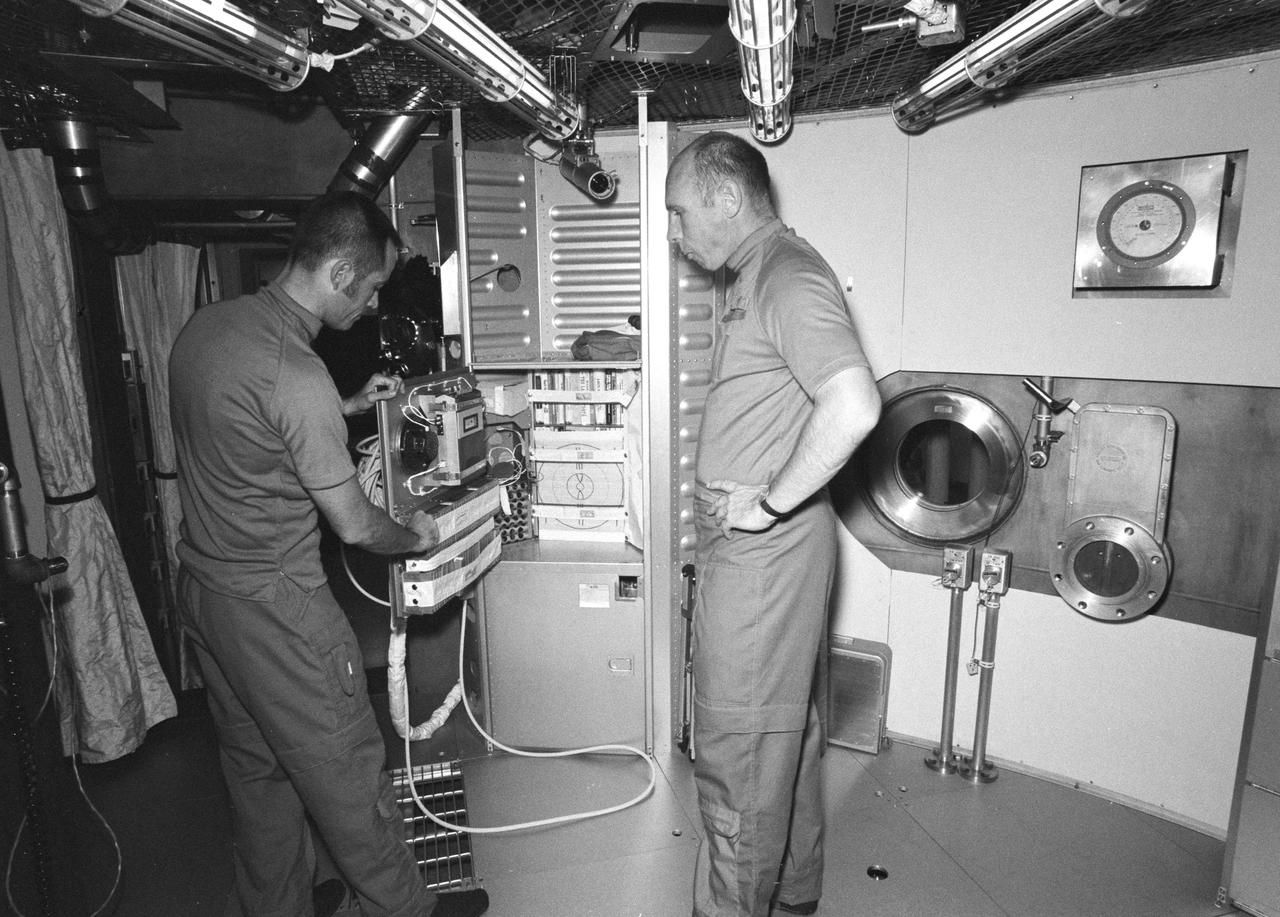
S72-41858 (15 June 1972) --- Astronauts Robert L. Crippen, left, Skylab Medical Experiment Altitude Test (SMEAT) crew commander, and Dr. William E. Thornton, SMEAT science pilot, stand at the cabinet containing off duty recreation equipment. They are two members of a three-man SMEAT crew who will spend up to 56 days in the Crew Systems Division's 20-foot altitude chamber at the NASA Manned Spacecraft Center (MSC) beginning in mid-July to obtain medical data and evaluate medical experiment equipment for Skylab. Astronaut Karol J. Bobko, SMEAT pilot, the third crew member is not shown in this view. Photo credit: NASA
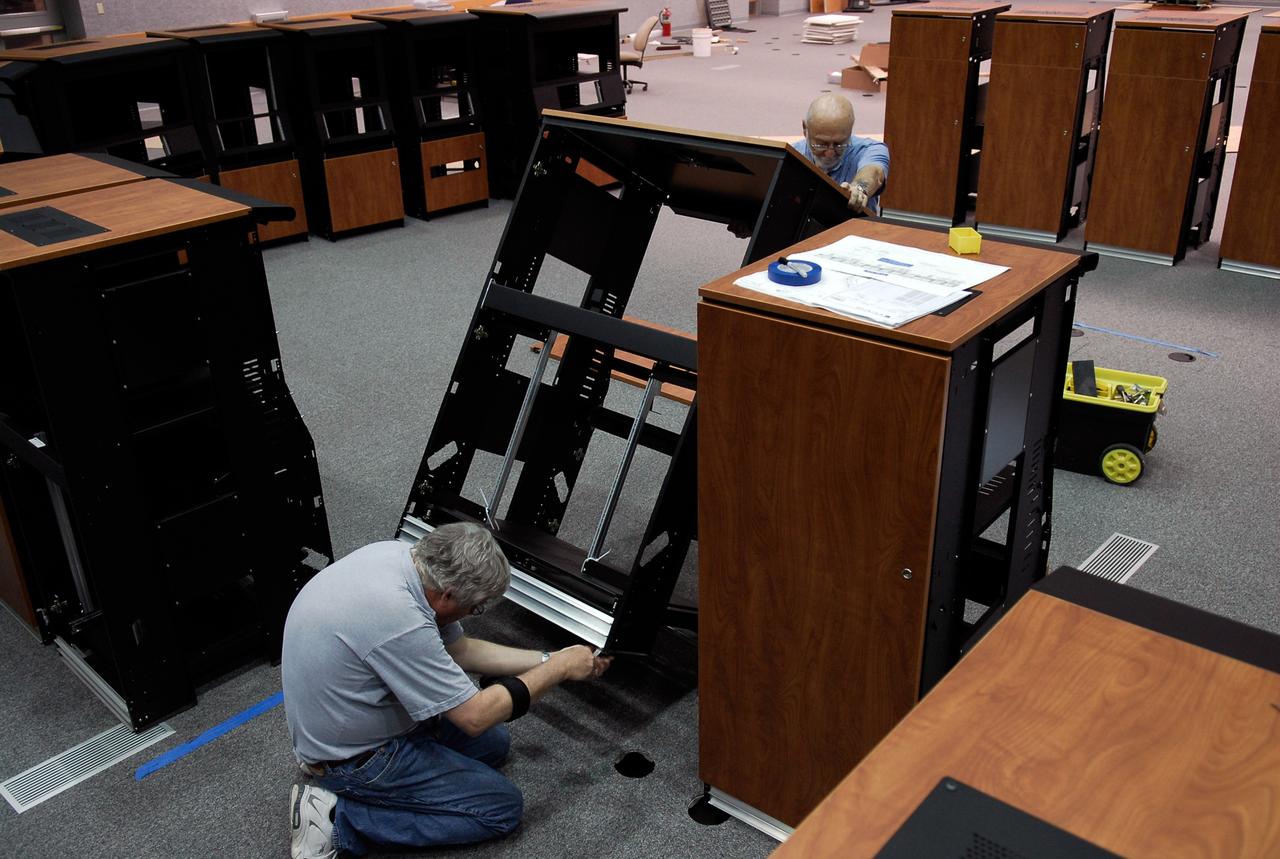
CAPE CANAVERAL, Fla. -- In Firing Room No. 1 in the Launch Control Center at NASA's Kennedy Space Center, workers put together another cabinet to hold equipment that will support the future Ares rocket launches as part of the Constellation Program. Future astronauts will ride to orbit on Ares I, which uses a single five-segment solid rocket booster, a derivative of the space shuttle's solid rocket booster, for the first stage. Ares will be launched from Pad 39B, which is being reconfigured from supporting space shuttle launches. The Launch Control Center firing rooms face the launch pads. Photo credit: NASA/Kim Shiflett
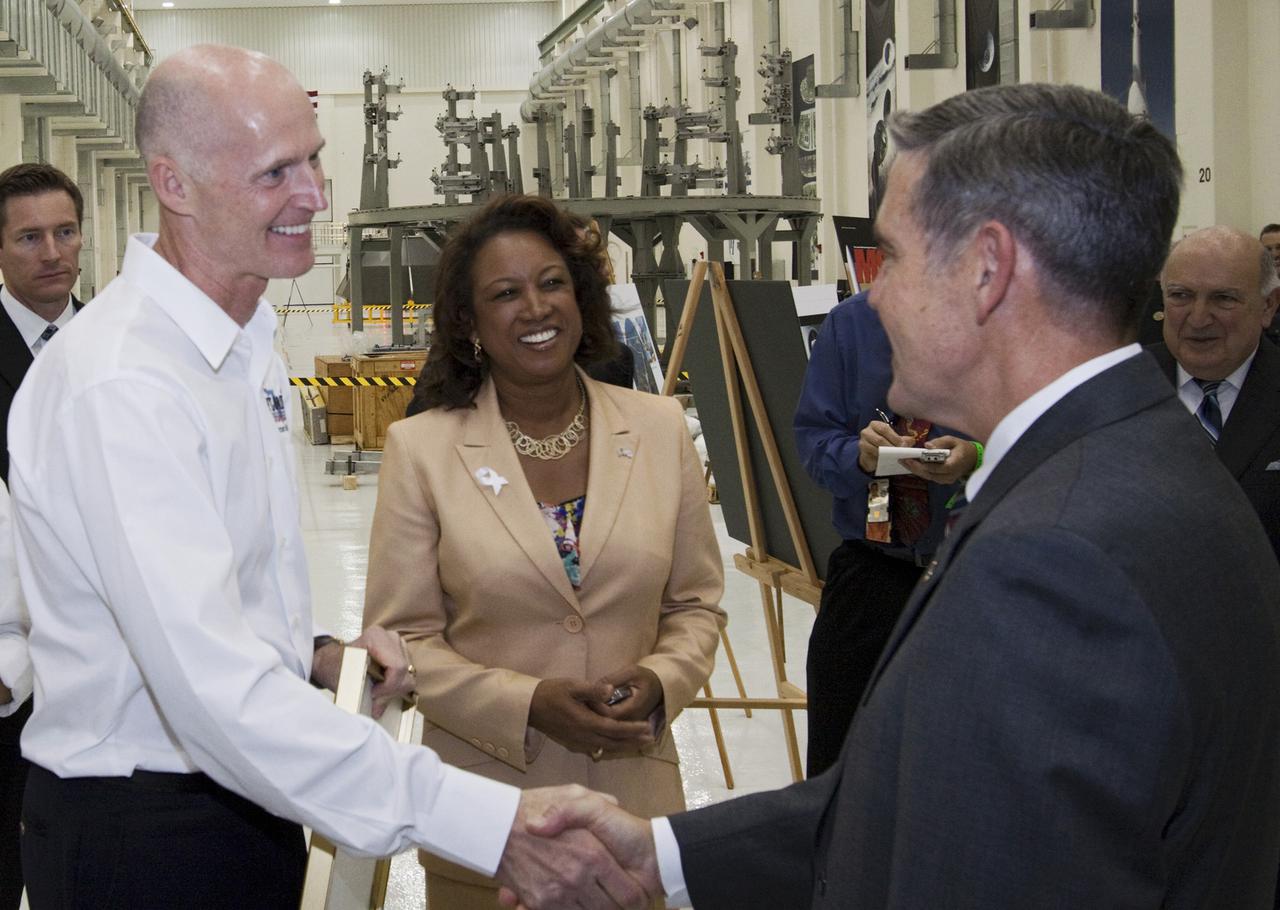
CAPE CANAVERAL, Fla. – In the Operations and Checkout Building at NASA's Kennedy Space Center in Florida, Robert Cabana, Kennedy Space Center director, (right), shakes hands with Florida Gov. Rick Scott, (left), following a tour of the Orion Multi-Purpose Crew Vehicle processing facility. In the center is Florida Lt. Gov. Jennifer Carroll, chairwoman of Space Florida. The governor and other state officials were at Kennedy for a Florida cabinet meeting and a space industry roundtable at the Kennedy Space Center Visitor Complex’s Debus Conference Center. They also toured selected facilities around the center. Photo credit: NASA_Jim Grossmann
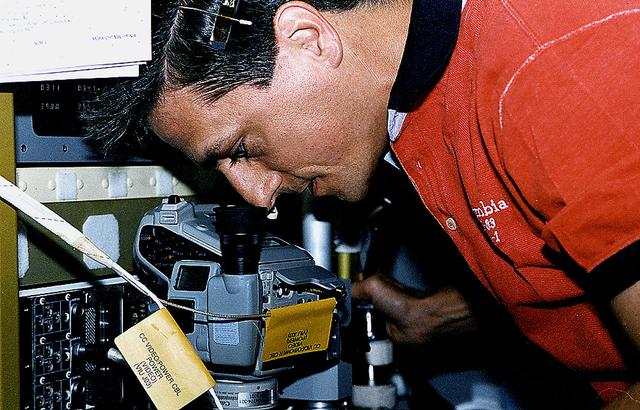
Onboard Space Shuttle Columbia (STS-94) Mission Specialist Donald A. Thomas observes an experiment in the glovebox aboard the Spacelab Science Module. Thomas is looking through an eye-piece of a camcorder and recording his observations on tape for post-flight analysis. Other cameras inside the glovebox are also recording other angles of the experiment or downlinking video to the experiment teams on the ground. The glovebox is thought of as a safety cabinet with closed front and negative pressure differential to prevent spillage and contamination and allow for manipulation of the experiment sample when its containment has to be opened for observation, microscopy and photography. Although not visible in this view, the glovebox is equipped with windows on the top and each side for these observations.
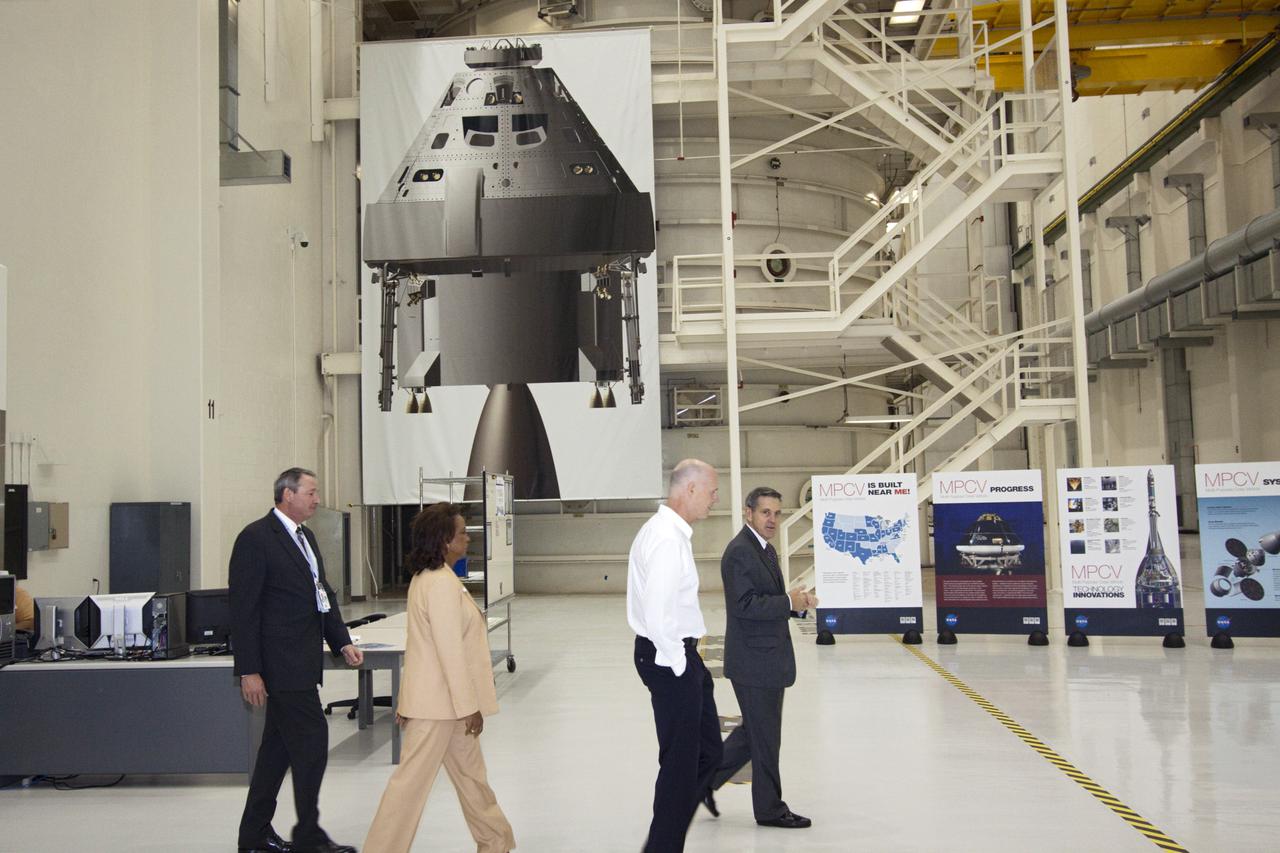
CAPE CANAVERAL, Fla. – In the Operations and Checkout Building at NASA's Kennedy Space Center in Florida, from right, Robert Cabana, Kennedy Space Center director, gives a tour to Florida Governor Rick Scott, Florida Lt. Gov. Jennifer Carroll, chairwoman of Space Florida. In the background is a poster of NASA’s Orion Multi-Purpose Crew Vehicle. The governor and other state officials were at Kennedy for a Florida cabinet meeting and a space industry roundtable at the Kennedy Space Center Visitor Complex’s Debus Conference Center. They also toured selected facilities around the center. Photo credit: NASA_Jim Grossmann
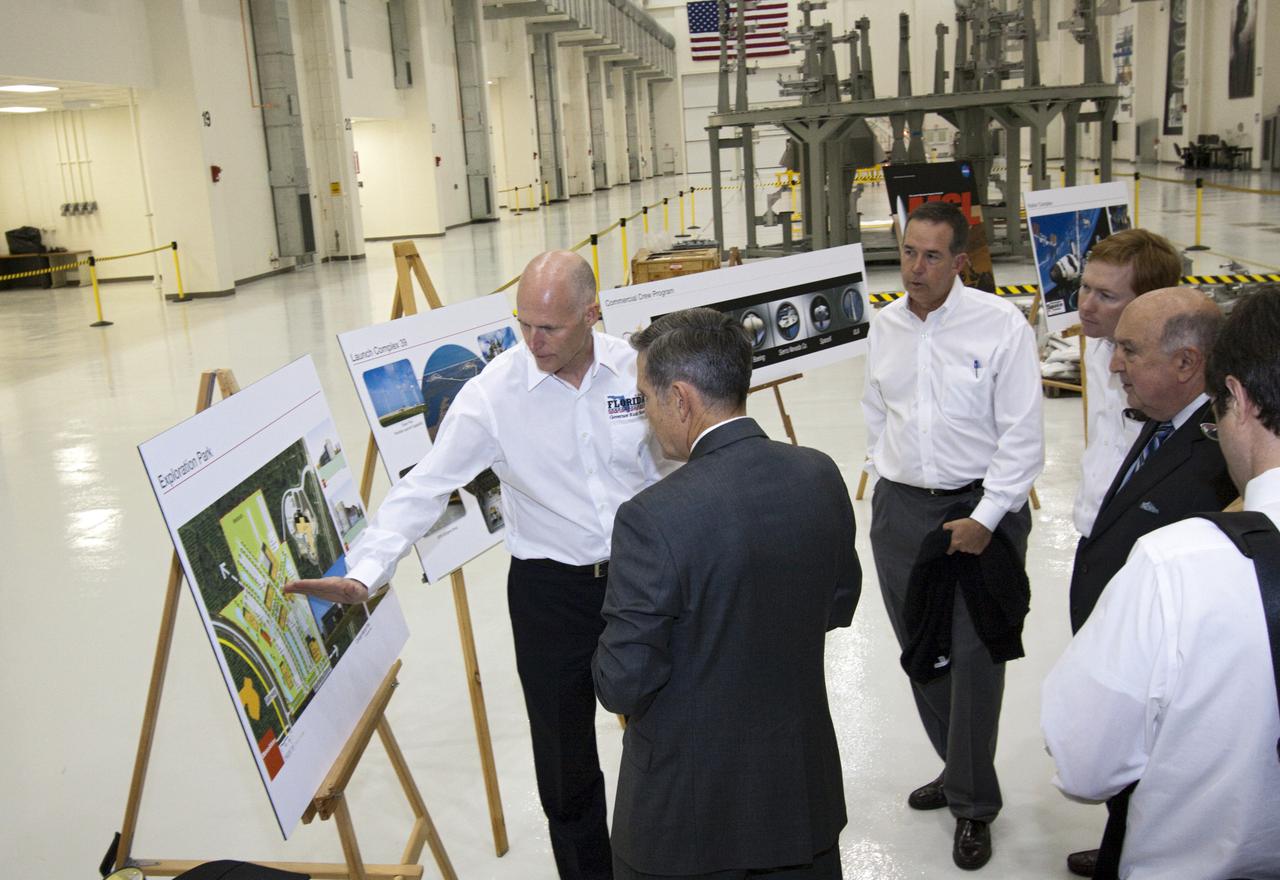
CAPE CANAVERAL, Fla. – Florida Gov. Rick Scott (left) tours the Operations and Checkout Building at NASA's Kennedy Space Center in Florida. He is being briefed on the processing of the Orion Multi-Purpose Crew Vehicle. With his back to the camera is Robert Cabana, Kennedy Space Center director. To the governor’s left is Jeff Atwater, Florida chief financial officer. The governor and other state officials were at Kennedy for a Florida cabinet meeting and a space industry roundtable at the Kennedy Space Center Visitor Complex’s Debus Conference Center. They also toured selected facilities around the center. Photo credit: NASA_Jim Grossmann
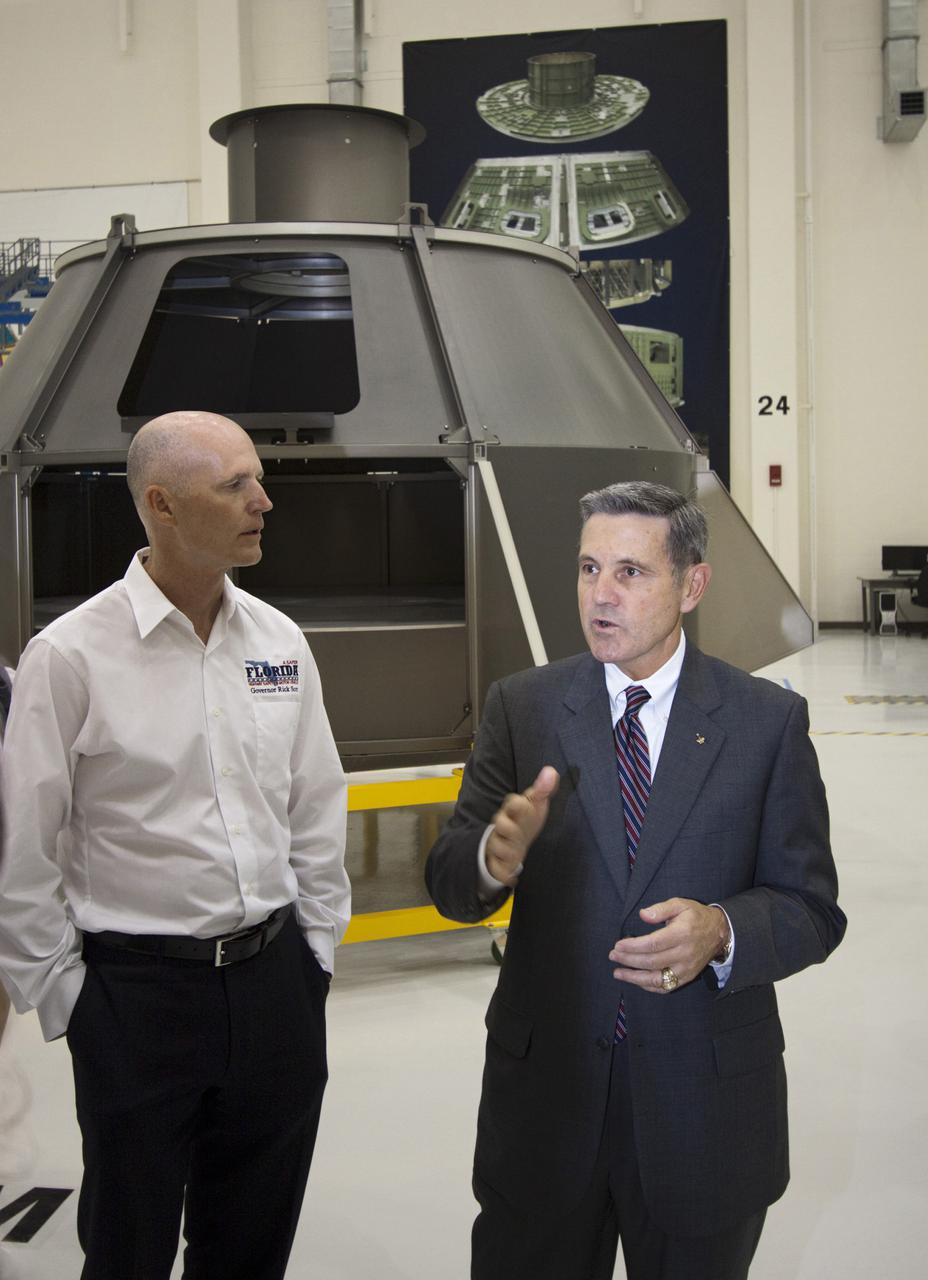
CAPE CANAVERAL, Fla. – In the Operations and Checkout Building at NASA's Kennedy Space Center in Florida, Robert Cabana, Kennedy Space Center director, (right), briefs Florida Gov. Rick Scott, (left), on the Orion Multi-Purpose Crew Vehicle. In the background is an Orion mock up used for testing. The governor and other state officials were at Kennedy for a Florida cabinet meeting and a space industry roundtable at the Kennedy Space Center Visitor Complex’s Debus Conference Center. They also toured selected facilities around the center. Photo credit: NASA_Jim Grossmann
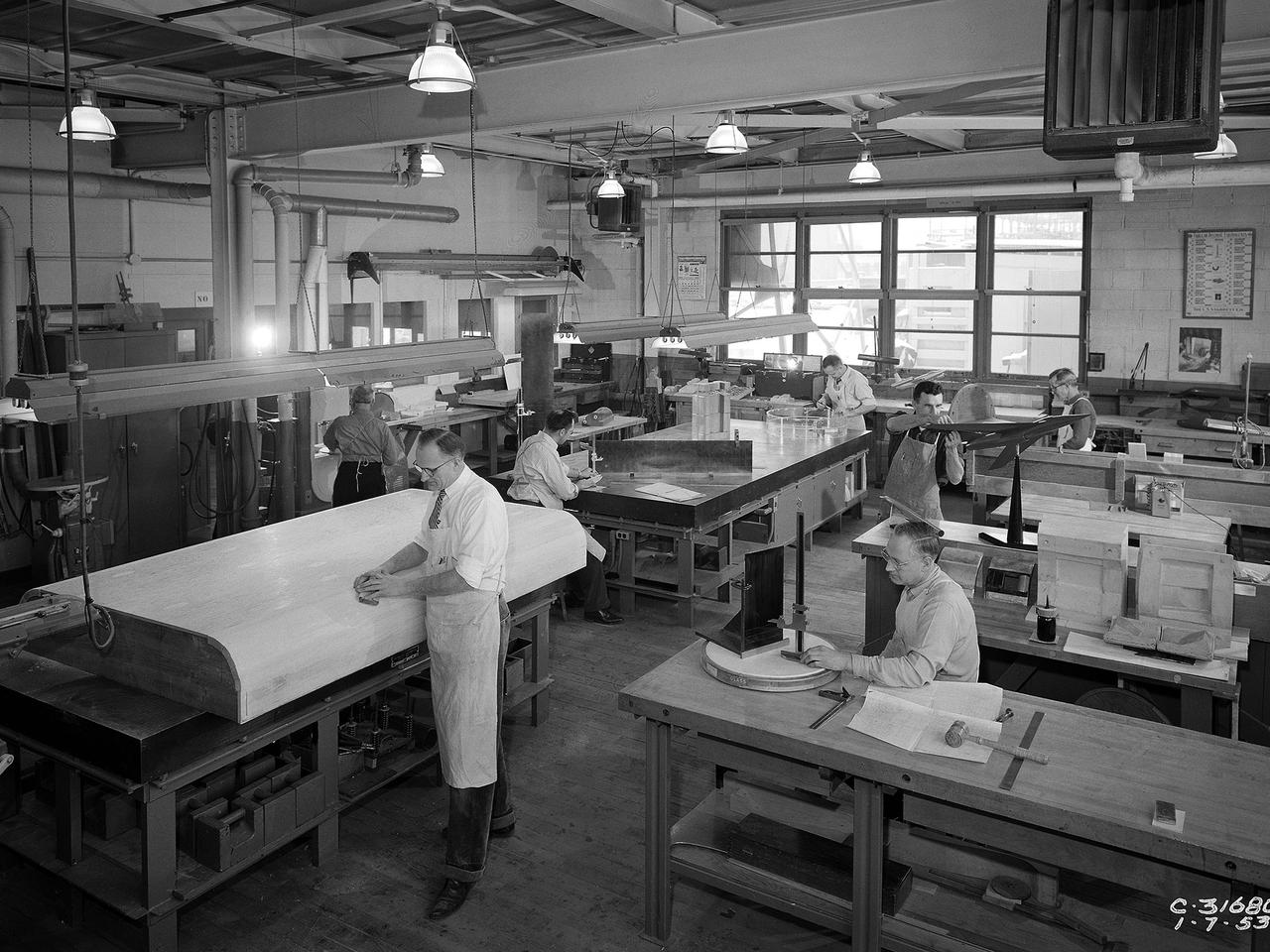
Craftsmen work in the wood model shop at the National Advisory Committee for Aeronautics (NACA) Lewis Flight Propulsion Laboratory. The Fabrication Division created almost all of the equipment and models used at the laboratory. The Fabrication Shop building contained a number of specialized shops in the 1940s and 1950s. These included a Machine Shop, Sheet Metal Shop, Wood Model and Pattern Shop, Instrument Shop, Thermocouple Shop, Heat Treating Shop, Metallurgical Laboratory, and Fabrication Office. The Wood Model and Pattern Shop created everything from control panels and cabinets to aircraft models molds for sheet metal work.
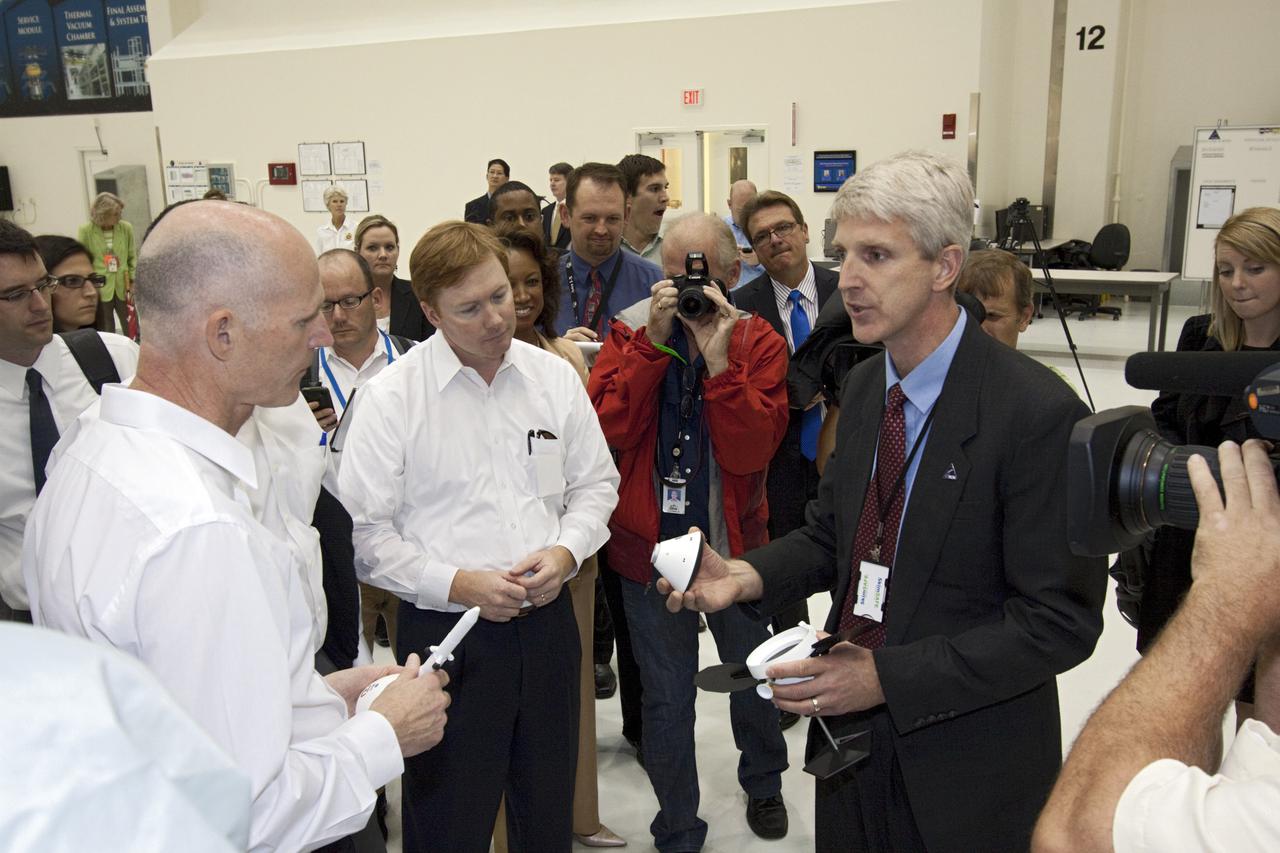
CAPE CANAVERAL, Fla. – In the Operations and Checkout Building at NASA's Kennedy Space Center in Florida, NASA’s Orion Production Manager Scott Wilson, (right), shows Florida Gov. Rick Scott, (left), and Adam Putnam, Florida agriculture commissioner, (center), how an Orion crew exploration vehicle and its launch abort system would be stacked for launch. The governor and other state officials were at Kennedy for a Florida cabinet meeting and a space industry roundtable at the Kennedy Space Center Visitor Complex’s Debus Conference Center. They also toured selected facilities around the center. Photo credit: NASA_Jim Grossmann
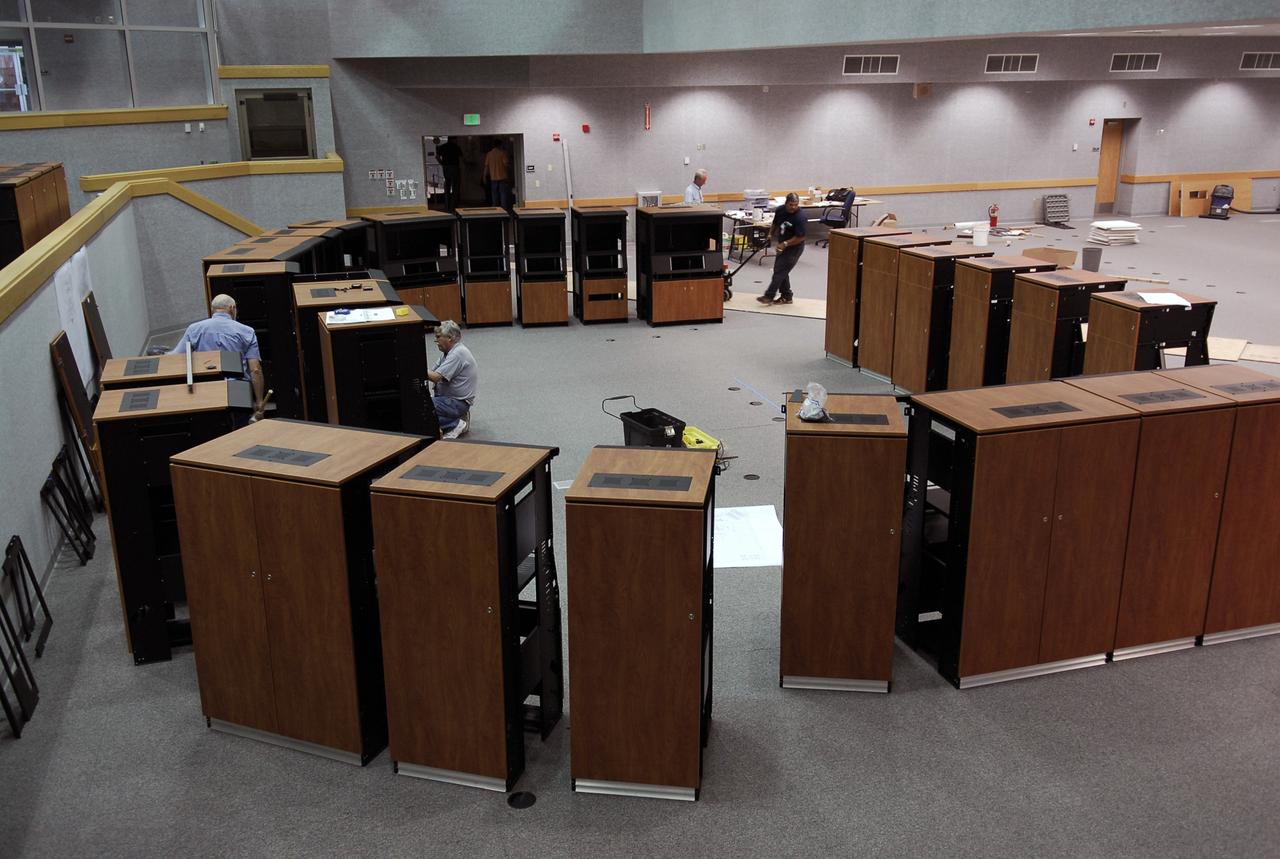
CAPE CANAVERAL, Fla. -- In Firing Room No. 1 in the Launch Control Center at NASA's Kennedy Space Center, workers line up the new equipment cabinets. The firing room will support the future Ares rocket launches as part of the Constellation Program. Future astronauts will ride to orbit on Ares I, which uses a single five-segment solid rocket booster, a derivative of the space shuttle's solid rocket booster, for the first stage. Ares will be launched from Pad 39B, which is being reconfigured from supporting space shuttle launches. The Launch Control Center firing rooms face the launch pads. Photo credit: NASA/Kim Shiflett
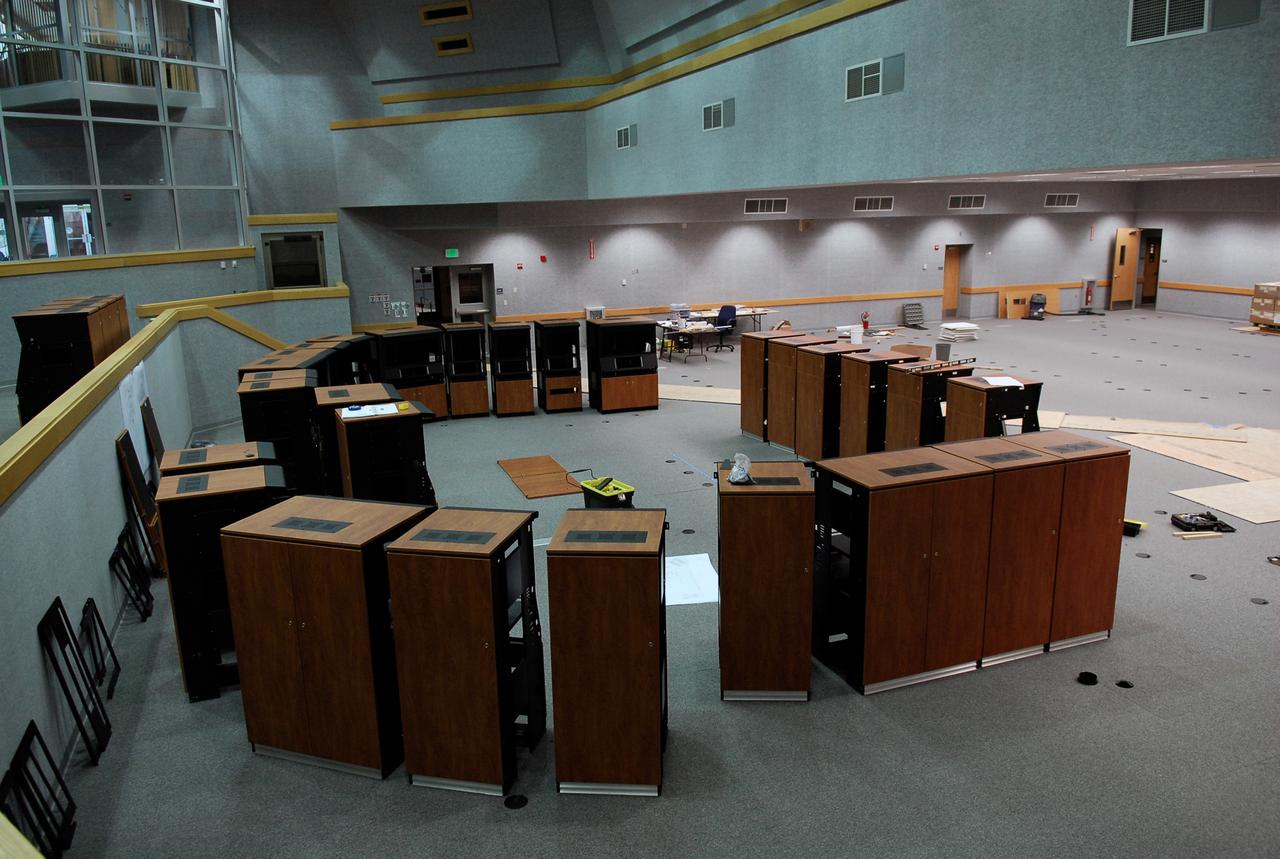
CAPE CANAVERAL, Fla. -- In Firing Room No. 1 in the Launch Control Center at NASA's Kennedy Space Center, cabinets are being erected to hold equipment that will support the future Ares rocket launches as part of the Constellation Program. Future astronauts will ride to orbit on Ares I, which uses a single five-segment solid rocket booster, a derivative of the space shuttle's solid rocket booster, for the first stage. Ares will be launched from Pad 39B, which is being reconfigured from supporting space shuttle launches. The Launch Control Center firing rooms face the launch pads. Photo credit: NASA/Kim Shiflett
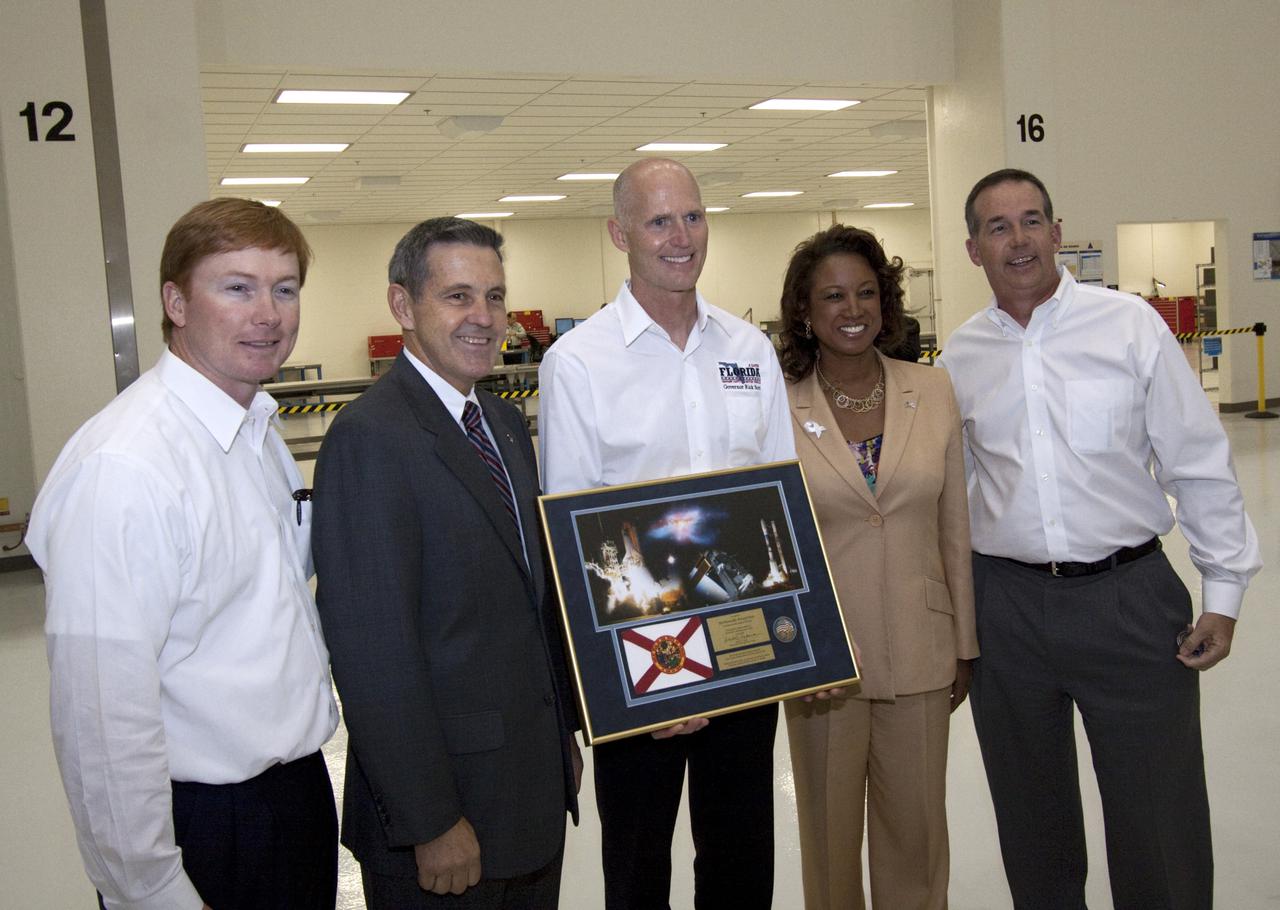
CAPE CANAVERAL, Fla. – In the Operations and Checkout Building at NASA's Kennedy Space Center in Florida, Robert Cabana, Kennedy Space Center director, (second from left), presents Florida Gov. Rick Scott, (center), a plaque following a tour of the Orion Multi-Purpose Crew Vehicle processing facility. To the right of the governor is Florida Lt. Gov. Jennifer Carroll, chairwoman of Space Florida and Jeff Atwater, Florida chief financial officer. At the far left is Adam Putnam, Florida agriculture commissioner. The governor and other state officials were at Kennedy for a Florida cabinet meeting and a space industry roundtable at the Kennedy Space Center Visitor Complex’s Debus Conference Center. They also toured selected facilities around the center. Photo credit: NASA_Jim Grossmann
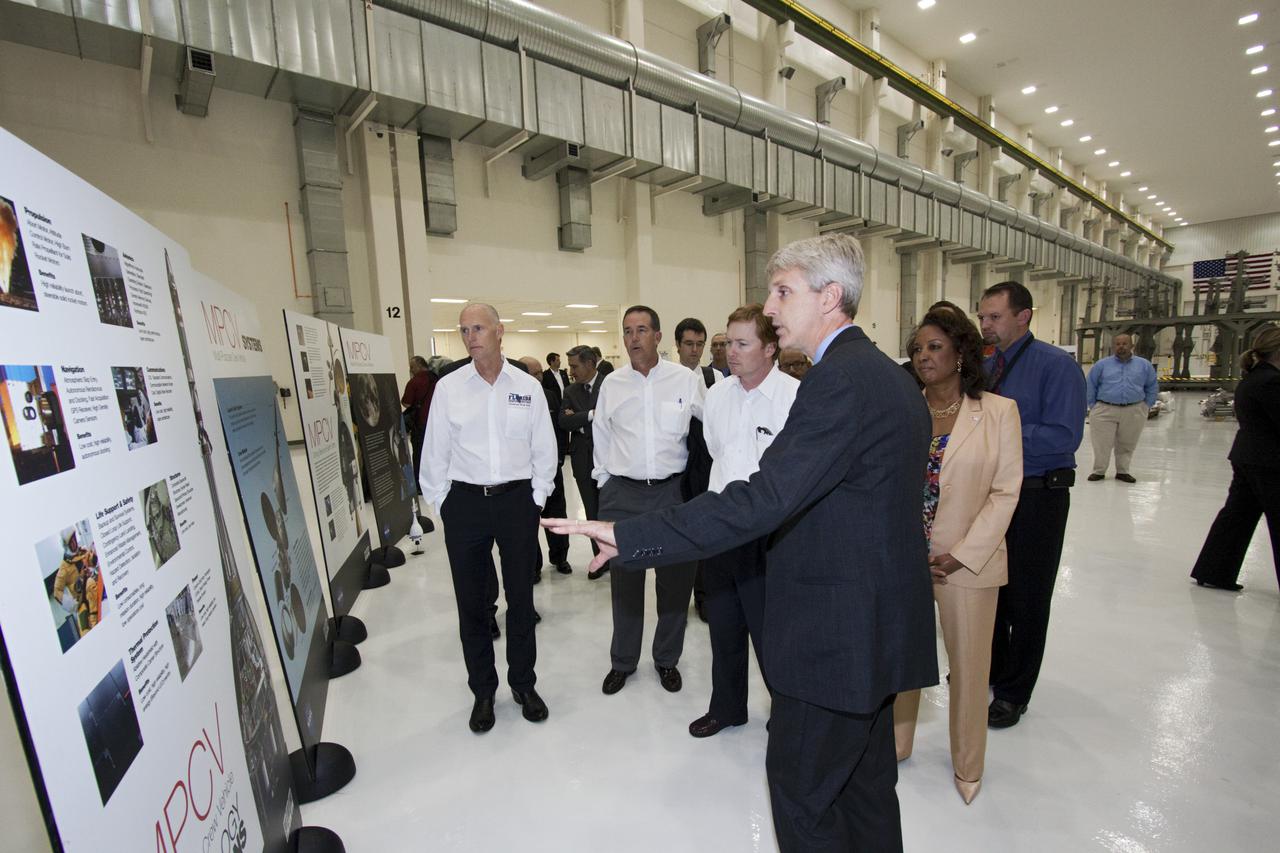
CAPE CANAVERAL, Fla. – In the Operations and Checkout Building at NASA's Kennedy Space Center in Florida, NASA’s Orion Production Manager Scott Wilson, (center), briefs Florida Gov. Rick Scott, (left), and Florida Lt. Gov. Jennifer Carroll, chairwoman of Space Florida, (right), on the processing of the Orion Multi-Purpose Crew Vehicle which will be processed in the facility. Also listening are Jeff Atwater, Florida chief financial officer and Adam Putnam, Florida agriculture commissioner. The governor and other state officials were at Kennedy for a Florida cabinet meeting and a space industry roundtable at the Kennedy Space Center Visitor Complex’s Debus Conference Center. They also toured selected facilities around the center. Photo credit: NASA_Jim Grossmann
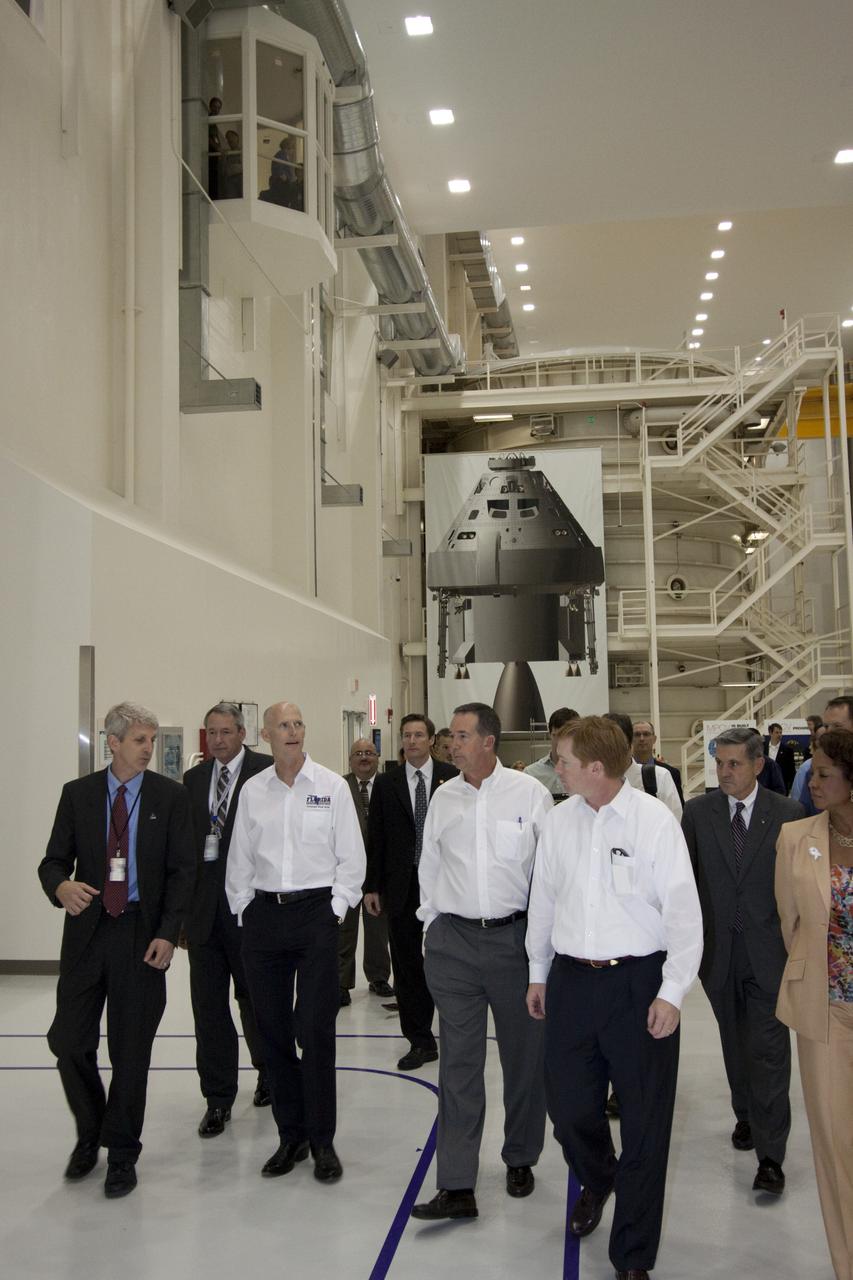
CAPE CANAVERAL, Fla. – In the Operations and Checkout Building at NASA's Kennedy Space Center in Florida, NASA’s Orion Production Manager Scott Wilson, (from left), briefs Florida Gov. Rick Scott on the processing of the Orion Multi-Purpose Crew Vehicle. Also touring are Jeff Atwater, Florida chief financial officer, Adam Putnam, Florida agriculture commissioner, Robert Cabana, Kennedy Space Center director, and Florida Lt. Gov. Jennifer Carroll, chairwoman of Space Florida. The governor and other state officials were at Kennedy for a Florida cabinet meeting and a space industry roundtable at the Kennedy Space Center Visitor Complex’s Debus Conference Center. They also toured selected facilities around the center. Photo credit: NASA_Jim Grossmann
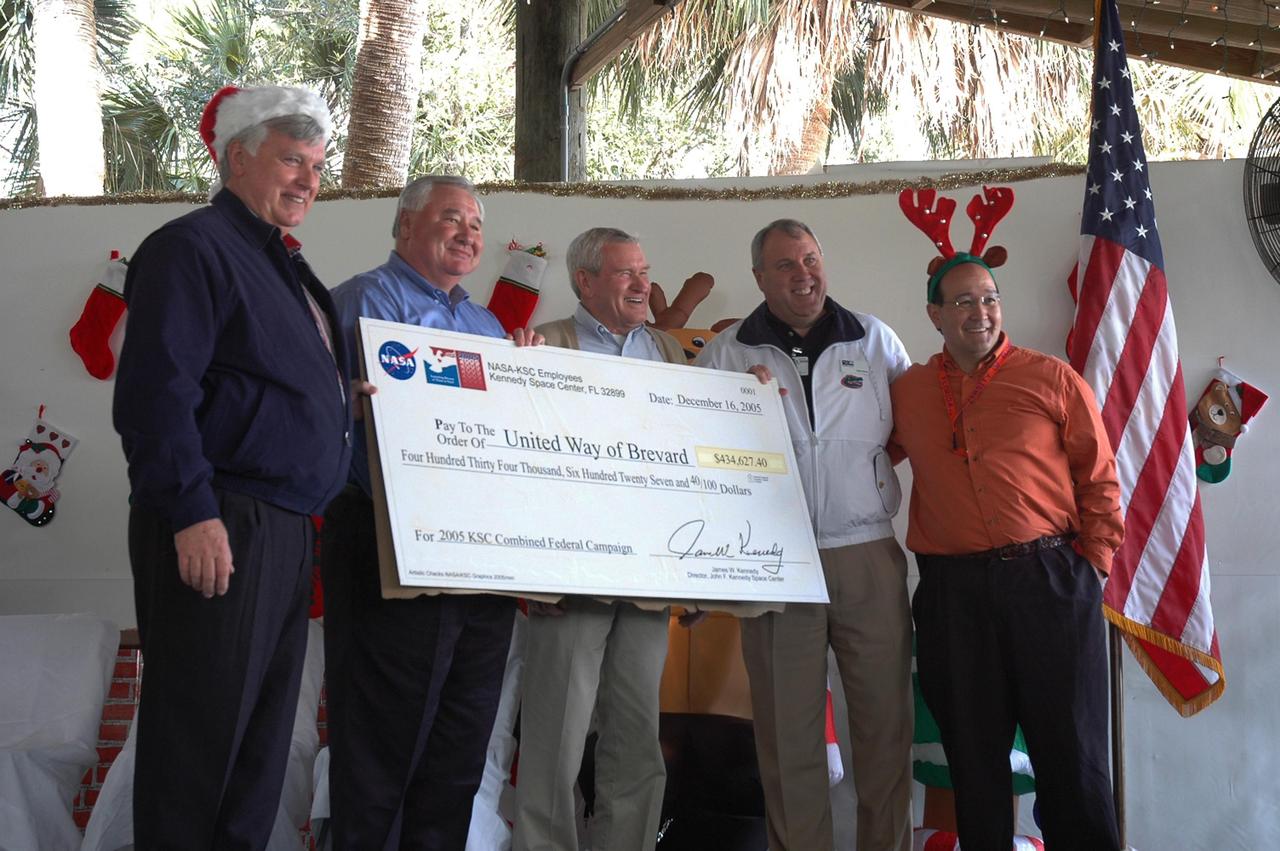
KENNEDY SPACE CENTER, FLA. - An oversized $434,627.40 check represents the highest amount the NASA civil service work force has ever donated to the Combined Federal Campaign. Standing with the check, from left, are Center Director Jim Kennedy; Dennis Burns, United Way of Brevard, vice president of resource development; Frank Ramsey, United Way of Brevard campaign director; Rob Rains, United Way of Brevard president; and Launch Services Program deputy director Ray Lugo, who served as KSC's Combined Federal Campaign chairperson. The check was presented at a holiday dinner and celebration at KARS Park I on Merritt Island, Fla., hosted by Center Director Jim Kennedy for NASA civil service employees. The theme of the celebration was "Launching Dreams of Those in Need." The event was sponsored by the Change Leaders Network and the Combined Federal Campaign Cabinet.
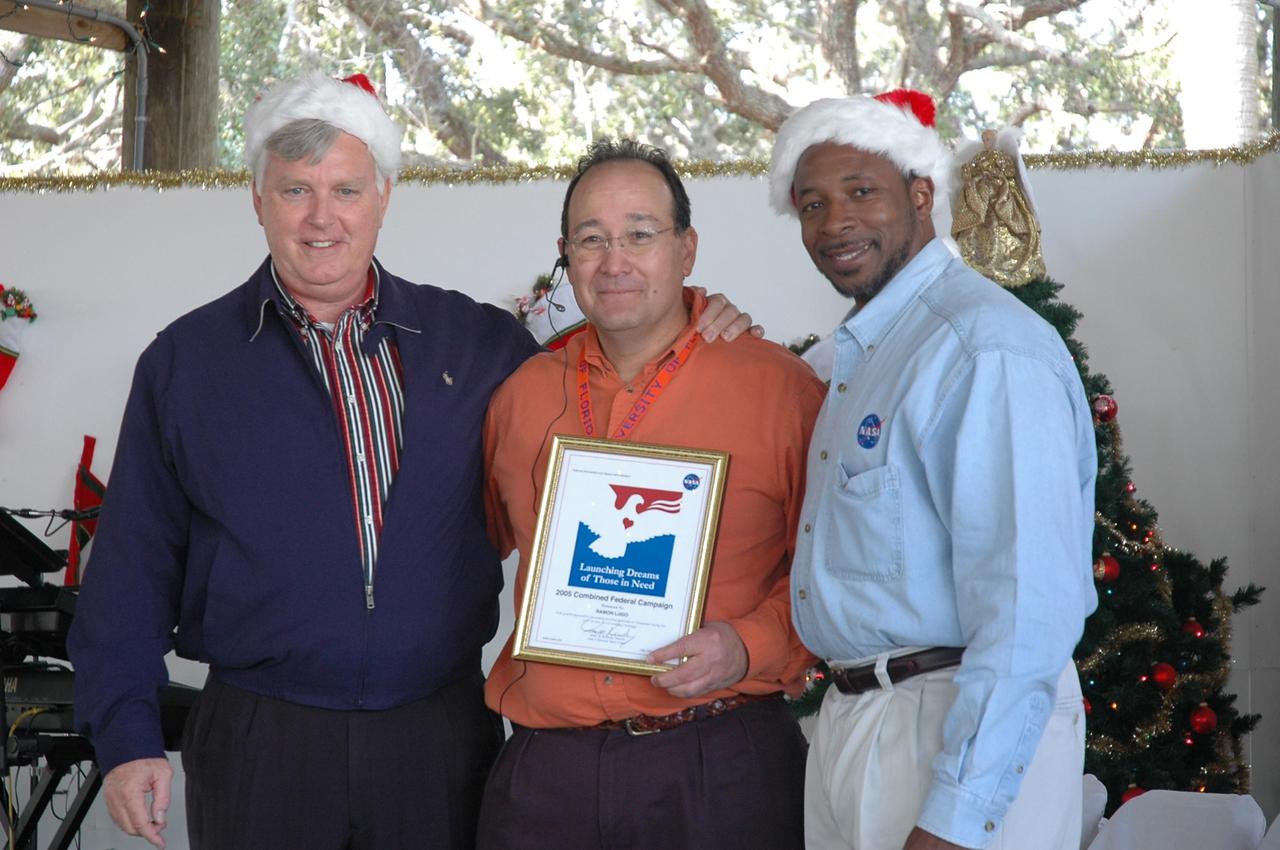
KENNEDY SPACE CENTER, FLA. - Launch Services Program Deputy Director Ray Lugo (center) shows off a certificate of appreciation he received for his leadership and enthusiasm in his role as chairperson of KSC's Combined Federal Campaign. From left are Center Director Jim Kennedy, Lugo and Deputy Director Woodrow Whitlow. The NASA civil service work force donated $434,627.40 in this year's campaign, the highest amount ever raised. The occasion was a holiday dinner and celebration at KARS Park I on Merritt Island, Fla., hosted by Center Director Jim Kennedy for NASA civil service employees. The theme of the celebration was "Launching Dreams of Those in Need." The event was sponsored by the Change Leaders Network and the Combined Federal Campaign Cabinet.
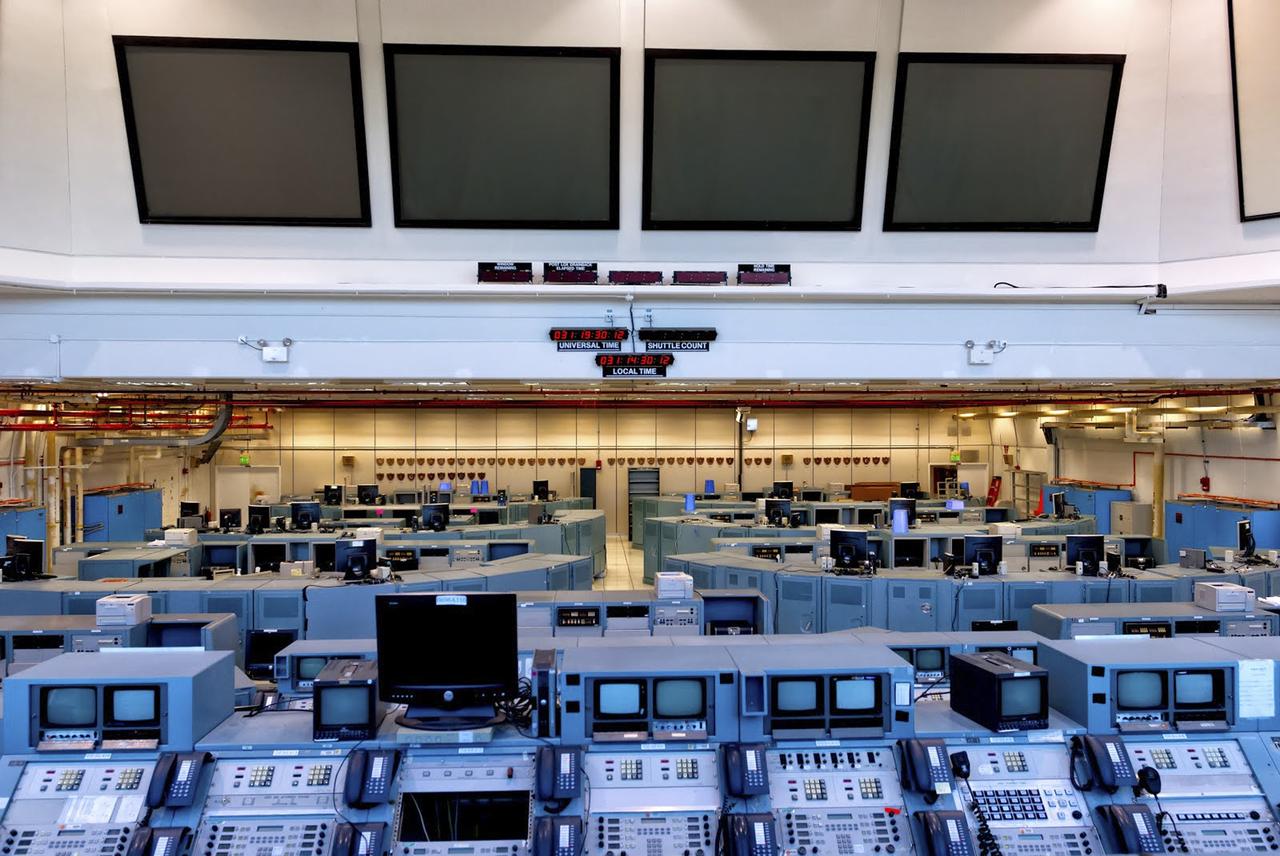
CAPE CANAVERAL, Fla. – As seen on Google Maps, Firing Room 3 inside the Launch Control Center at NASA's Kennedy Space Center was one of the four control rooms used by NASA and contractor launch teams to oversee a space shuttle countdown. This firing room is furnished in the classic style with the same metal computer cabinets and some of the same monitors in place when the first shuttle mission launched April 12, 1981. Specialized operators worked at consoles tailored to keep track of the status of shuttle systems while the spacecraft was processed in the Orbiter Processing Facility, being stacked inside the Vehicle Assembly Building and standing at the launch pad before liftoff. The firing rooms, including 3, were also used during NASA's Apollo Program. Google precisely mapped the space center and some of its historical facilities for the company's map page. The work allows Internet users to see inside buildings at Kennedy as they were used during the space shuttle era. Photo credit: Google/Wendy Wang
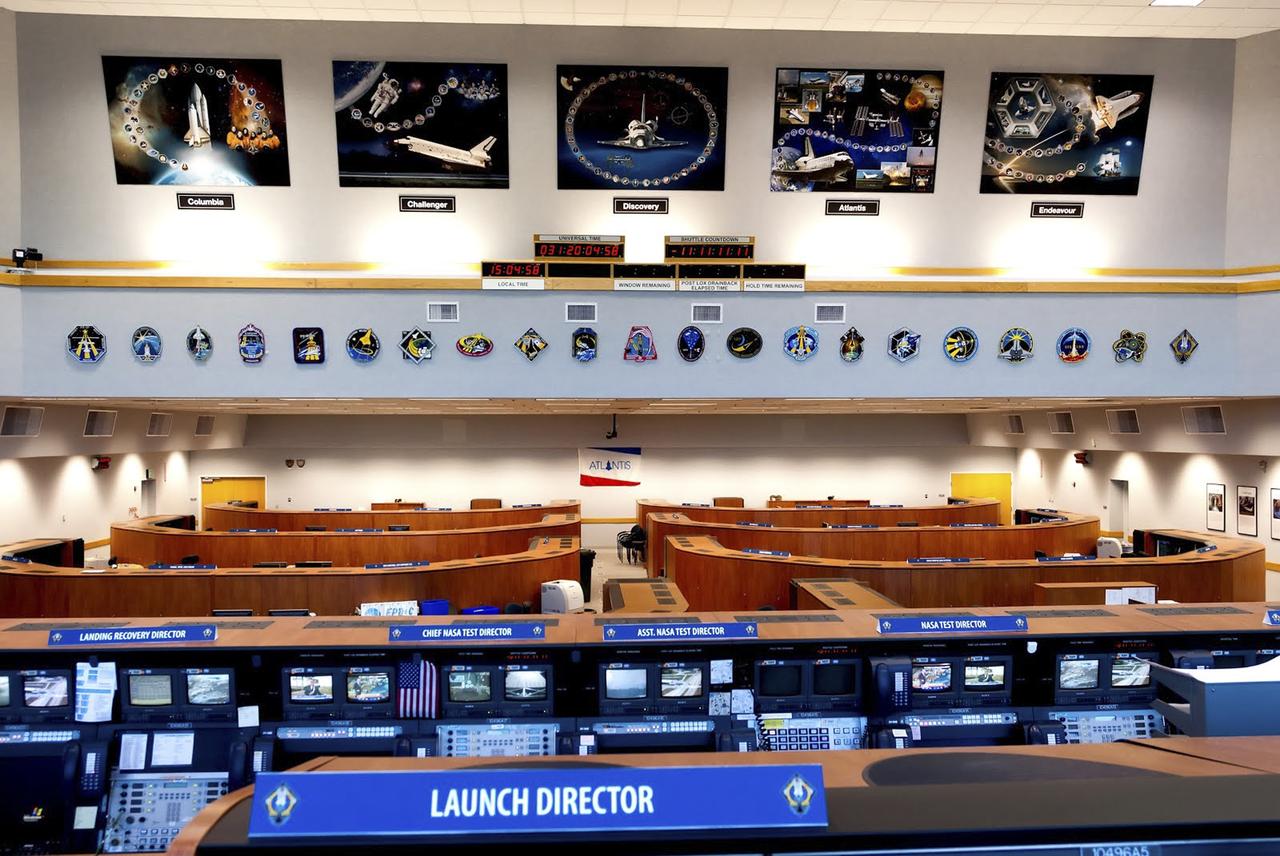
CAPE CANAVERAL, Fla. – As seen on Google Maps, Firing Room 4 inside the Launch Control Center at NASA's Kennedy Space Center was one of the four control rooms used by NASA and contractor launch teams to oversee a space shuttle countdown. This firing room was the most advanced of the control rooms used for shuttle missions and was the primary firing room for the shuttle's final series of launches before retirement. It is furnished in a more contemporary style with wood cabinets and other features, although it retains many of the computer systems the shuttle counted on to operate safely. Specialized operators worked at consoles tailored to keep track of the status of shuttle systems while the spacecraft was processed in the Orbiter Processing Facility, being stacked inside the Vehicle Assembly Building and standing at the launch pad before liftoff. The firing rooms, including 3, were also used during NASA's Apollo Program. Google precisely mapped the space center and some of its historical facilities for the company's map page. The work allows Internet users to see inside buildings at Kennedy as they were used during the space shuttle era. Photo credit: Google/Wendy Wang

A mechanic and apprentice work on a wooden impeller in the Fabrication Shop at the NACA Lewis Flight Propulsion Laboratory. The 260-person Fabrication Division created almost all of the equipment and models used at the laboratory. The Technical Services Building, referred to as the “Fab Shop”, contained a number of specialized shops in the 1940s and 1950s. These included a Machine Shop, Sheet Metal Shop, Wood and Pattern Shop, Instrument Shop, Thermocouple Shop, Heat Treating Shop, Metallurgical Laboratory, and Fabrication Office. The Machine Shop fabricated research equipment not commercially available. During World War II these technicians produced high-speed cameras for combustion research, impellers and other supercharger components, and key equipment for the lab’s first supersonic wind tunnel. The Wood and Pattern Shop created everything from control panels and cabinets to aircraft model molds for sheet metal work. The Sheet Metal Shop had the ability to work with 0.01 to 4-inches thick steel plates. The Instrument Shop specialized in miniature parts and instrumentation, while the Thermocouple Shop standardized the installation of pitot tubes and thermocouples. The Metallurgical Laboratory contained a control lab for the Heat Treating Shop and a service lab for the NACA Lewis research divisions. The Heat Treating Shop heated metal parts to optimize their physical properties and contained a Precision Castings Foundry to manufacture equipment made of heat resisting alloys.
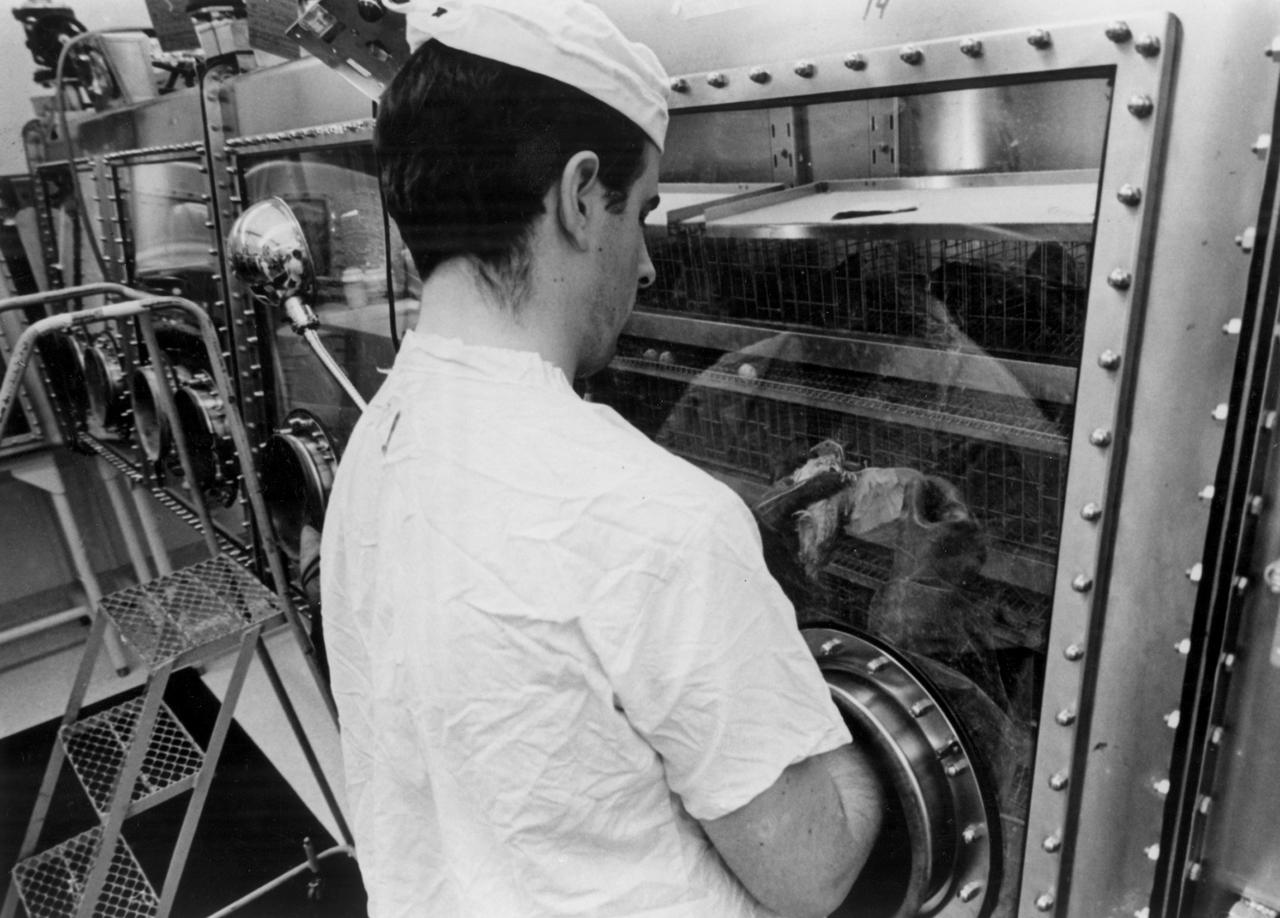
In this photograph, laboratory technician Bart Ruark visually inspects a Japanese Qail confined within a class III cabinet in the Intervertebrae, Aves, and Fish Laboratory of the Lunar Receiving Laboratory, Building 37 of the Manned Spacecraft Center (MSC) in Houston, Texas. This laboratory was part of the overall physical, chemical, and biological test program of the Apollo 11 returned lunar samples. Aboard the Marshall Space Flight Center (MSFC) developed Saturn V launch vehicle, the Apollo 11 mission launched from The Kennedy Space Center, Florida on July 16, 1969 and safely returned to Earth on July 24, 1969. The 3-man crew aboard the flight consisted of astronauts Neil A. Armstrong, commander; Edwin Aldrin, Lunar Module (LM) pilot; and Michael Collins, Command Module (CM) pilot. The CM, piloted by Michael Collins remained in a parking orbit around the Moon while the LM, named “Eagle’’, carrying astronauts Neil Armstrong and Edwin Aldrin, landed on the Moon. In 2 1/2 hours, the crew collected 47 pounds of lunar surface material which was returned to Earth for analysis.
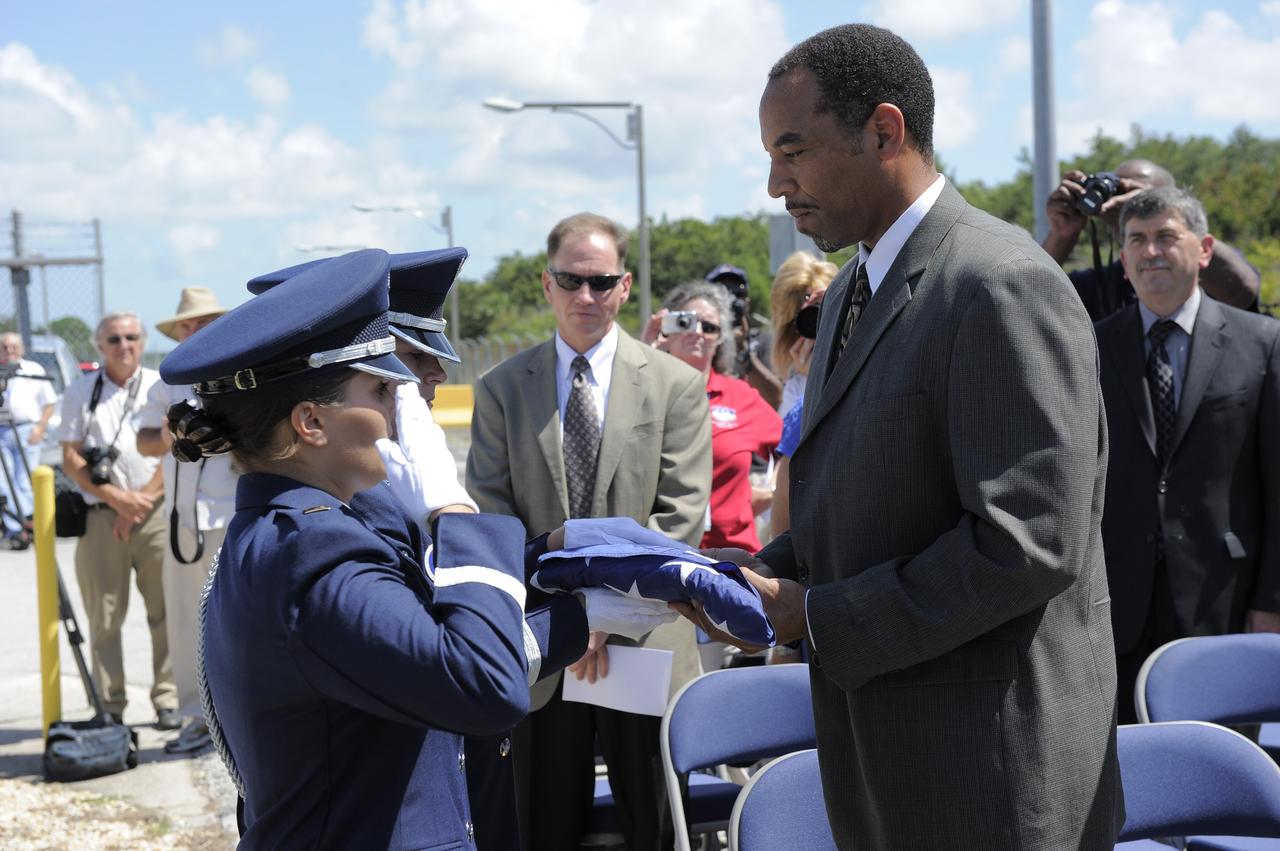
CAPE CANAVERAL, Fla. -- At the Merritt Island Launch Annex (MILA) Spaceflight Tracking and Data Network Station at NASA's Kennedy Space Center in Florida, the Patrick Air Force Base Color Guard presents the U.S. flag which flew over the station to David Carter, Near Earth Network project manager at Goddard Space Flight Center, during a closing ceremony recognizing the station's 45 years of service. The flag will be displayed in a Network Integration Center display cabinet at Goddard. The station was originally established by NASA's Goddard Space Flight Center as one of 17 Space Flight Tracking and Data Network stations around the world. Commissioned for the Apollo Program, the first launch it supported was the Apollo/Saturn 203 test flight from Launch Complex 37 on July 5, 1966. It also provided orbital support for low earth-orbiting scientific satellites. In recent history, the station has been used almost exclusively for space shuttle launch and landing support. Following the final launch and landing of the Space Shuttle Program in July 2011, the MILA station is officially decommissioned. For more information, visit http://www.nasa.gov/centers/kennedy/pdf/167424main_MILA-08C.pdf. Photo credit: NASA/Kim Shiflett
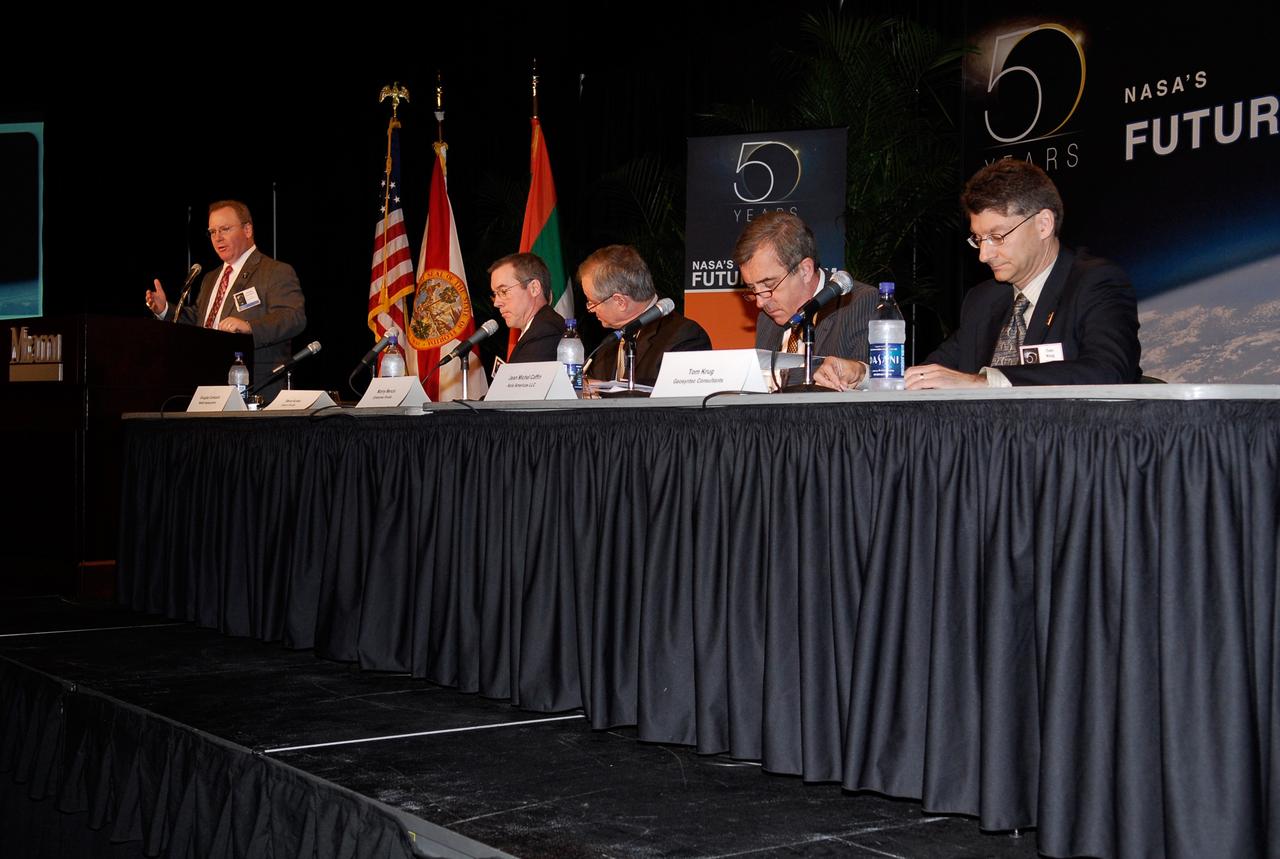
CAPE CANAVERAL, Fla. -- From the podium, Douglas Comstock, director of NASA's Innovative Partnership Program, moderates a panel presenting the topic “Unleashing the Power of Technology and Creativity” during NASA’s Future Forum in Miami. Others on the panel are (left to right), Steve Kohler, president and CEO of Space Florida; Manny Mencia Sr., vice president for international trade and business development of Enterprise Florida; Jean Michel Caffin, managing partner of Axis Americas and Beacon Council Executive Cabinet; and Tom Krug, associate and senior engineer with Geosyntec Consultants. The forum focused on how space exploration benefits Florida's economy. The event, which included presentations and panels, was held at the University of Miami's BankUnited Center. Among those participating were NASA Deputy Administrator Shana Dale, astronaut Carl Walz, director of the Advanced Capabilities Division in NASA's Exploration Systems Mission Directorate, and Russell Romanella, director, International Space Station and Spacecraft Processing. Photo credit: NASA/Kim Shiflett
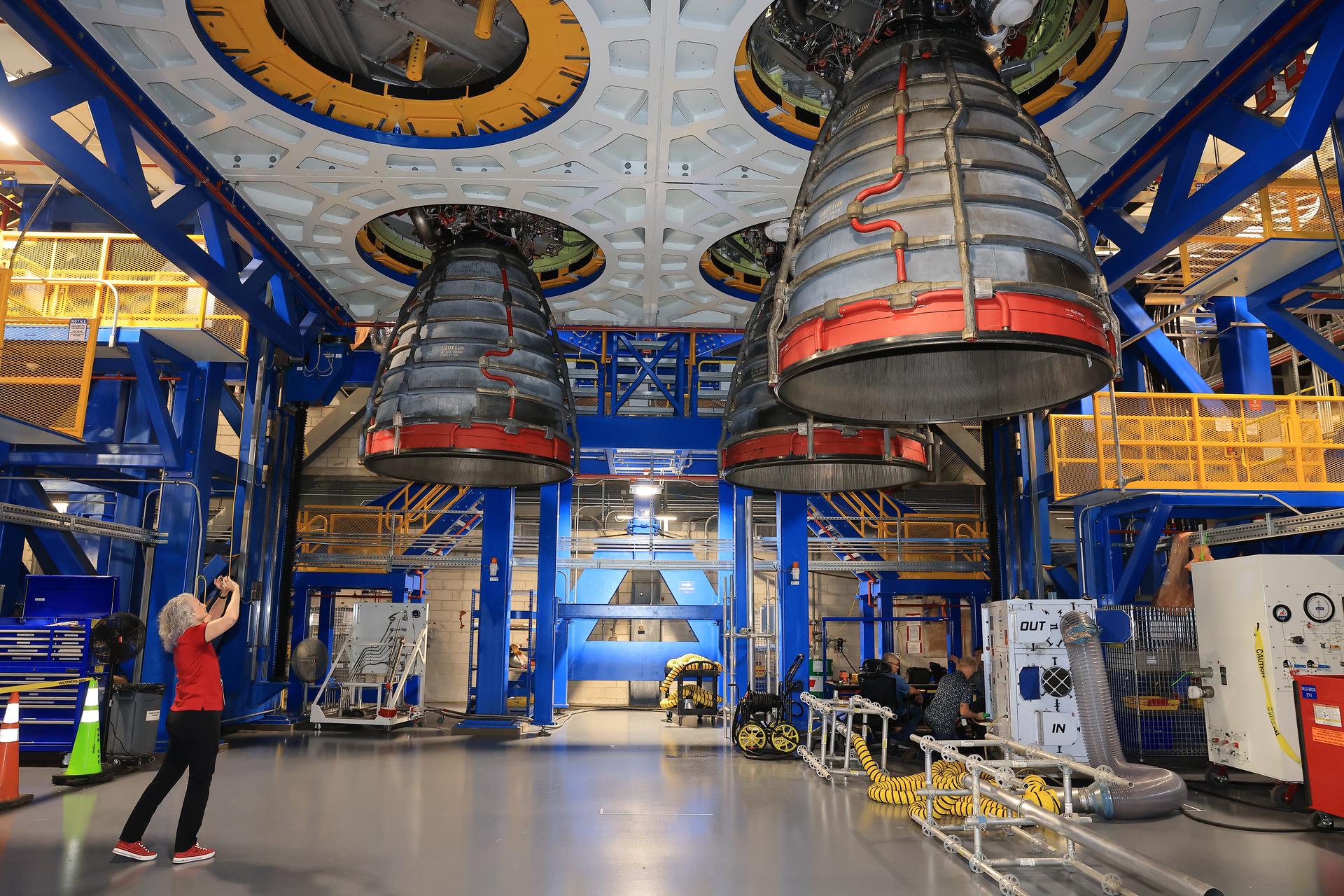
Technicians install three of four RS-25 SLS (Space Launch System) rocket engines on the work stand for integration with the Artemis III core stage rocket on Friday, Aug. 28, 2026, inside the Vehicle Assembly Building at NASA’s Kennedy Space Center in Florida. During Artemis III, the four RS-25 engines will launch the Orion spacecraft and its crew of four into low Earth orbit, generating more than two million pounds of thrust at liftoff.
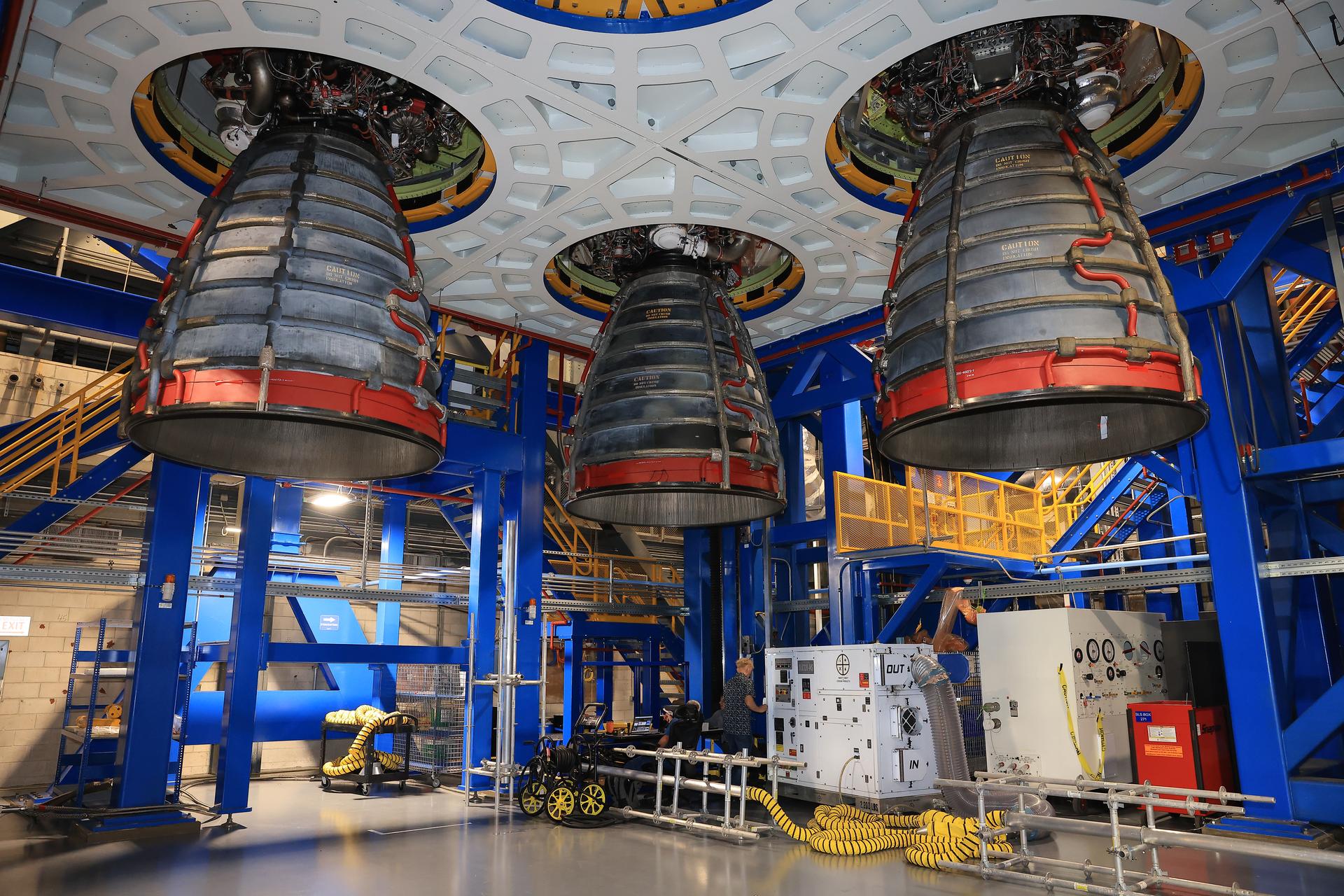
Technicians install three of four RS-25 SLS (Space Launch System) rocket engines on the work stand for integration with the Artemis III core stage rocket on Friday, Aug. 28, 2026, inside the Vehicle Assembly Building at NASA’s Kennedy Space Center in Florida. During Artemis III, the four RS-25 engines will launch the Orion spacecraft and its crew of four into low Earth orbit, generating more than two million pounds of thrust at liftoff.
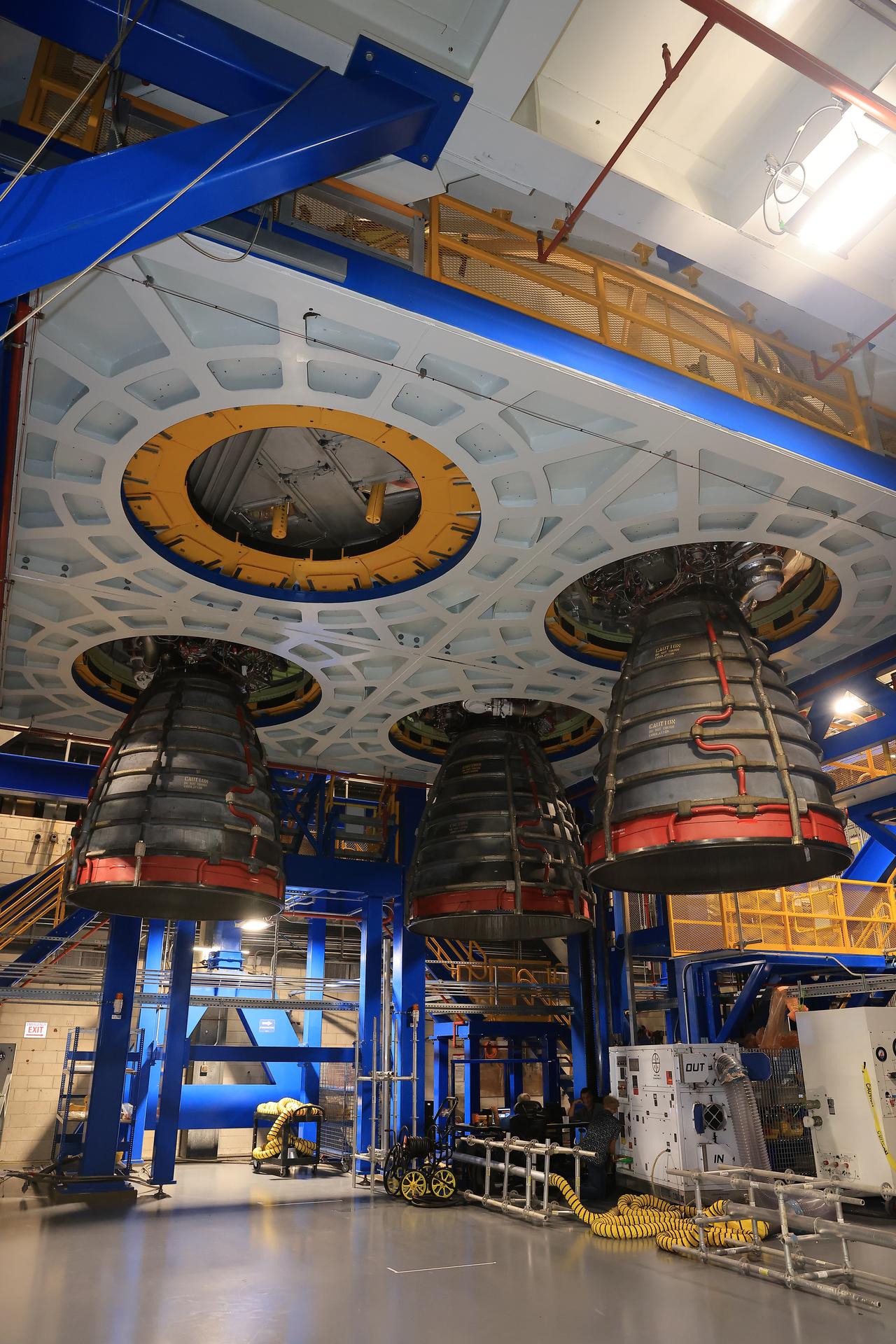
Technicians install three of four RS-25 SLS (Space Launch System) rocket engines on the work stand for integration with the Artemis III core stage rocket on Friday, Aug. 28, 2026, inside the Vehicle Assembly Building at NASA’s Kennedy Space Center in Florida. During Artemis III, the four RS-25 engines will launch the Orion spacecraft and its crew of four into low Earth orbit, generating more than two million pounds of thrust at liftoff.
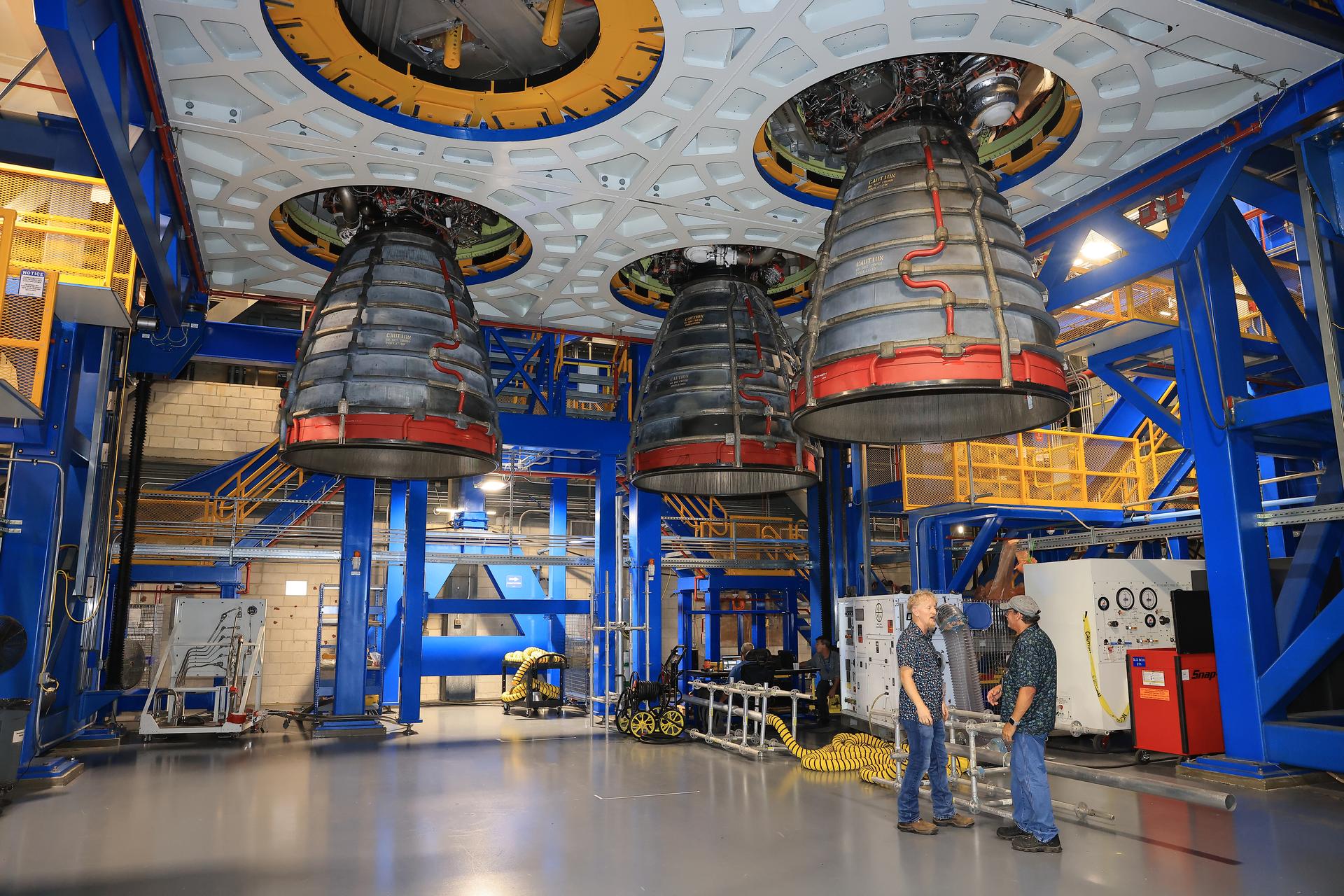
Technicians install three of four RS-25 SLS (Space Launch System) rocket engines on the work stand for integration with the Artemis III core stage rocket on Friday, Aug. 28, 2026, inside the Vehicle Assembly Building at NASA’s Kennedy Space Center in Florida. During Artemis III, the four RS-25 engines will launch the Orion spacecraft and its crew of four into low Earth orbit, generating more than two million pounds of thrust at liftoff.
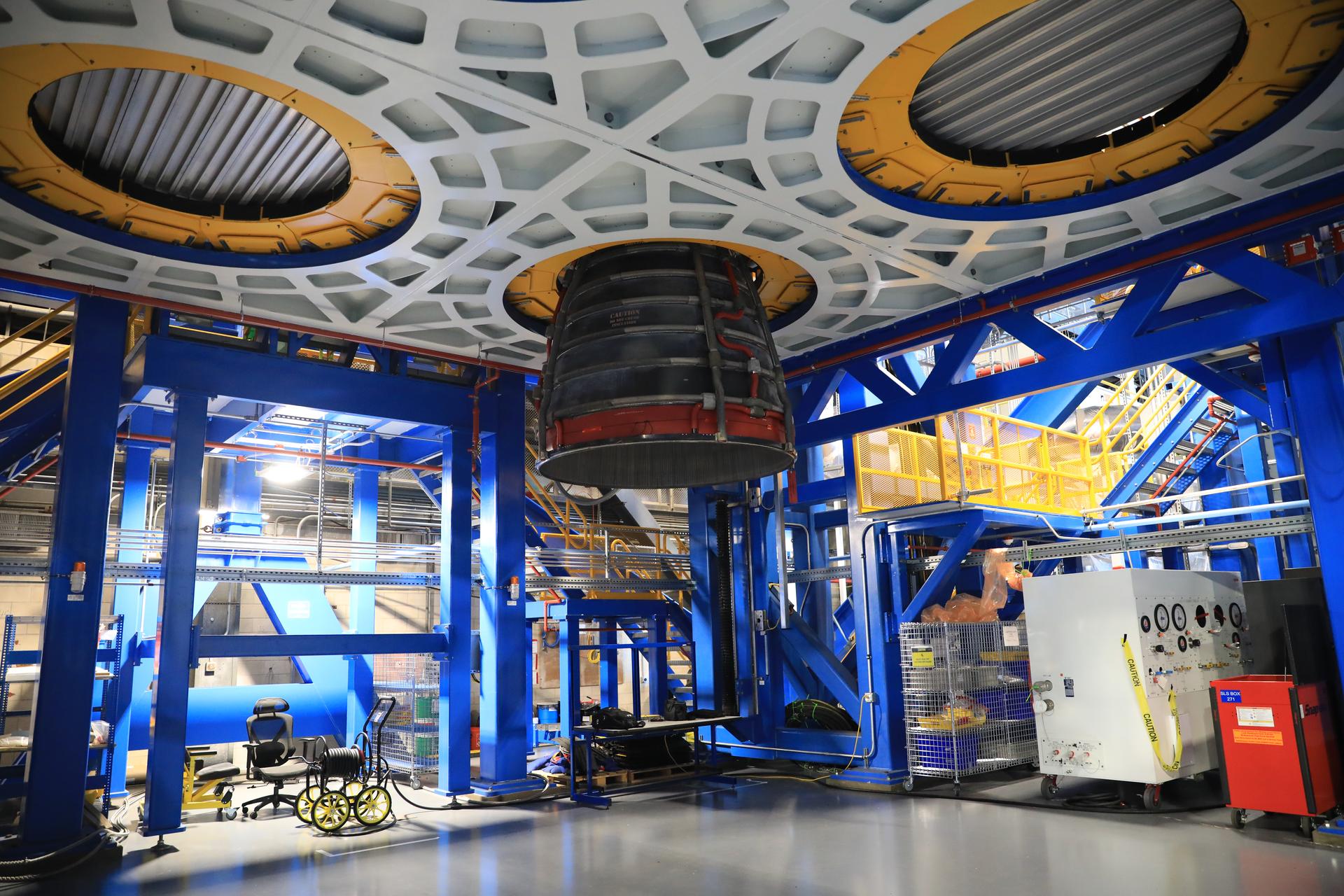
The first of four RS-25 SLS (Space Launch System) rocket engines, is installed on the work stand and integrated with the Artemis III core stage rocket on Tuesday, Aug. 25, 2026, inside the Vehicle Assembly Building at NASA’s Kennedy Space Center in Florida. During Artemis III, the four RS‑25 engines will launch the Orion spacecraft and its crew of four into low Earth orbit, generating more than two million pounds of thrust at liftoff.
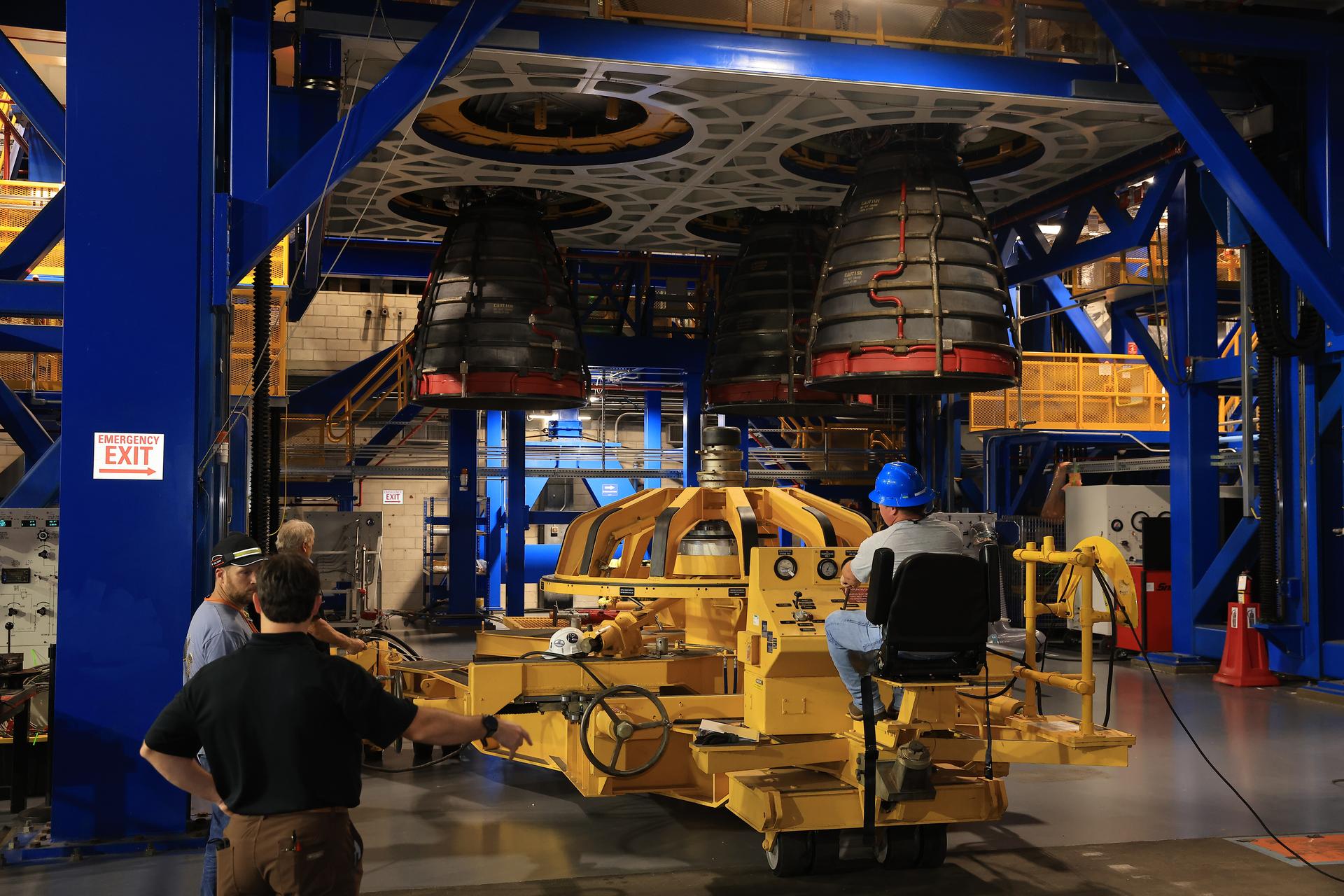
Technicians install three of four RS-25 SLS (Space Launch System) rocket engines on the work stand for integration with the Artemis III core stage rocket on Friday, Aug. 28, 2026, inside the Vehicle Assembly Building at NASA’s Kennedy Space Center in Florida. During Artemis III, the four RS-25 engines will launch the Orion spacecraft and its crew of four into low Earth orbit, generating more than two million pounds of thrust at liftoff.
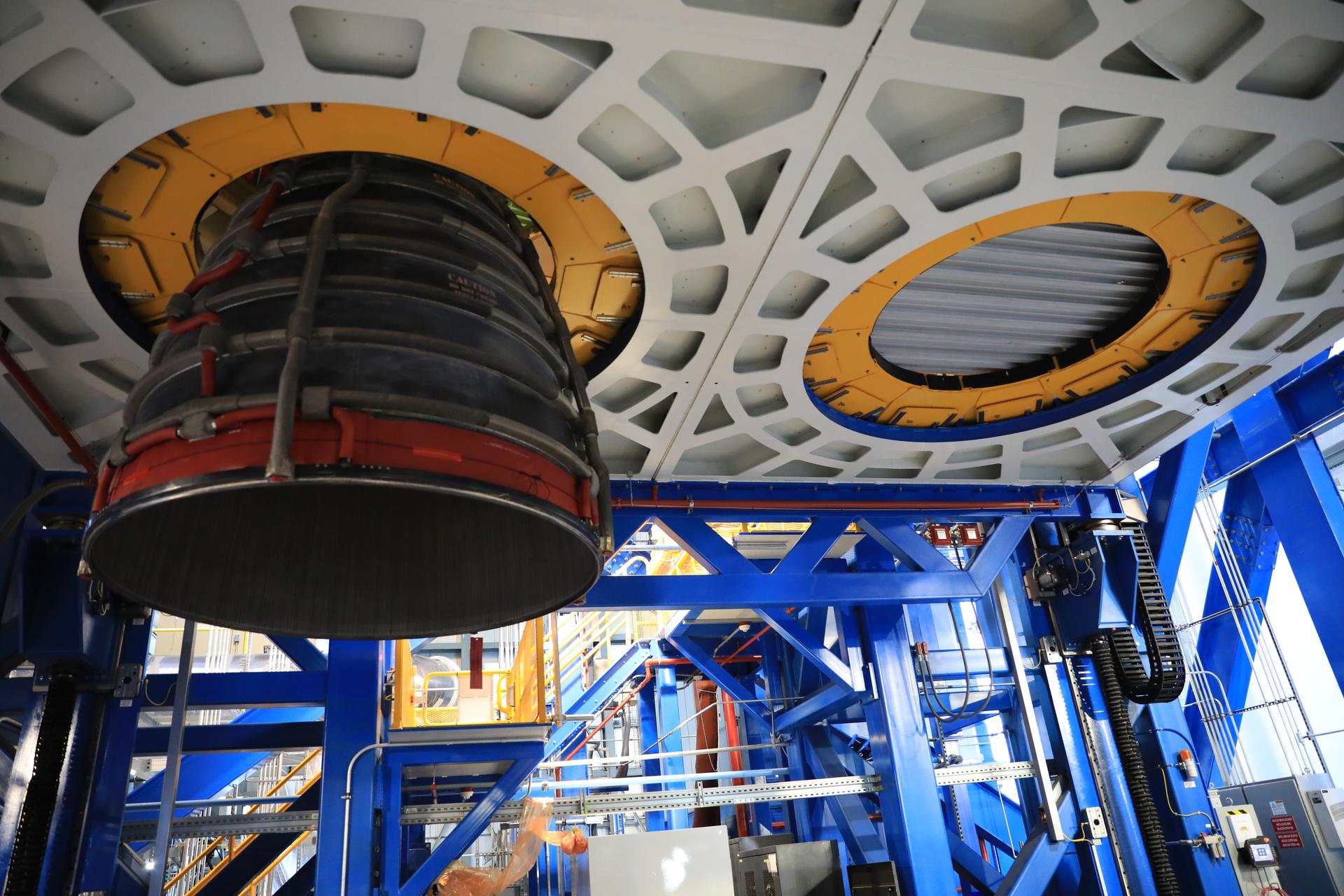
The first of four RS-25 SLS (Space Launch System) rocket engines, is installed on the work stand and integrated with the Artemis III core stage rocket on Tuesday, Aug. 25, 2026, inside the Vehicle Assembly Building at NASA’s Kennedy Space Center in Florida. During Artemis III, the four RS‑25 engines will launch the Orion spacecraft and its crew of four into low Earth orbit, generating more than two million pounds of thrust at liftoff.
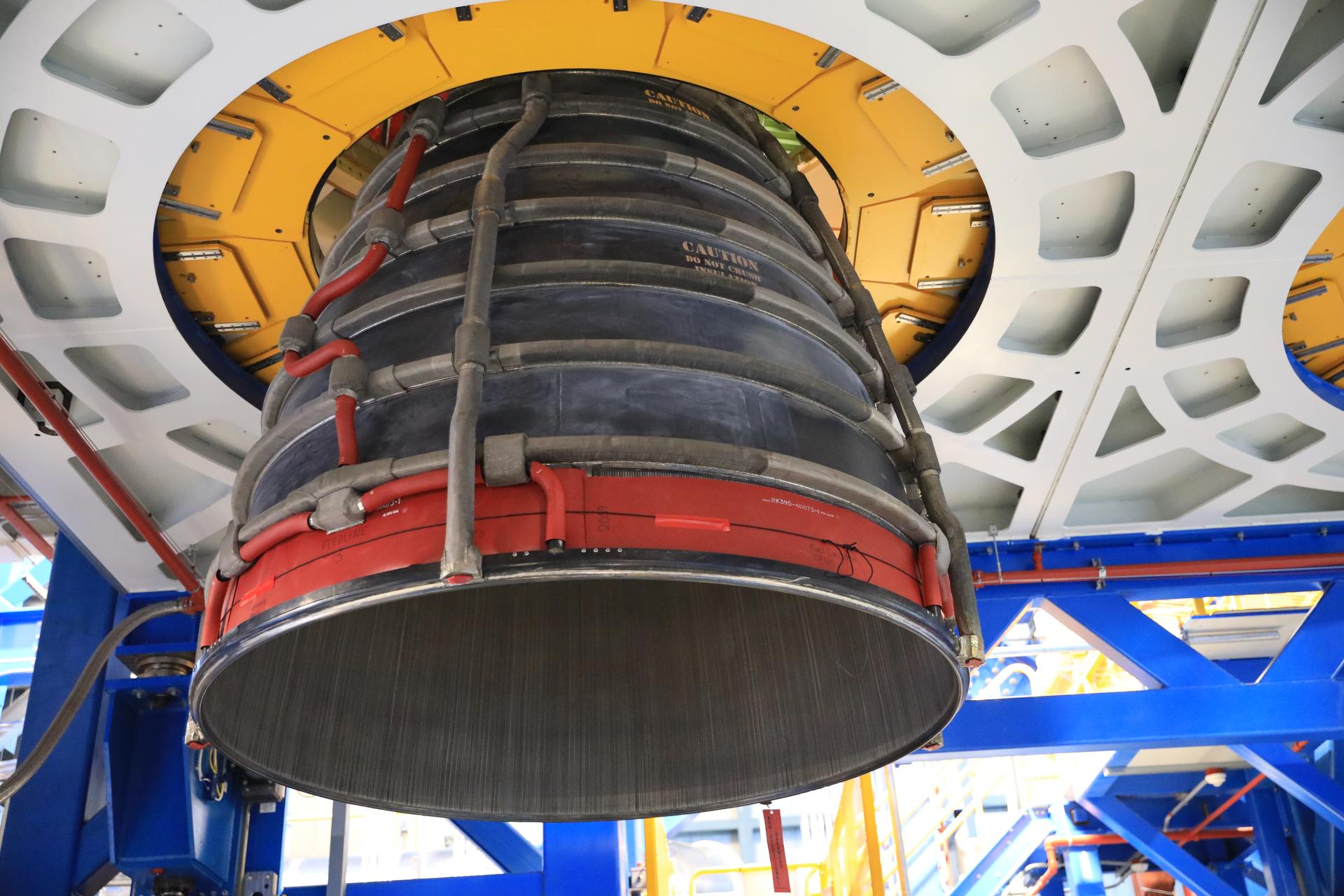
The first of four RS-25 SLS (Space Launch System) rocket engines, is installed on the work stand and integrated with the Artemis III core stage rocket on Tuesday, Aug. 25, 2026, inside the Vehicle Assembly Building at NASA’s Kennedy Space Center in Florida. During Artemis III, the four RS‑25 engines will launch the Orion spacecraft and its crew of four into low Earth orbit, generating more than two million pounds of thrust at liftoff.