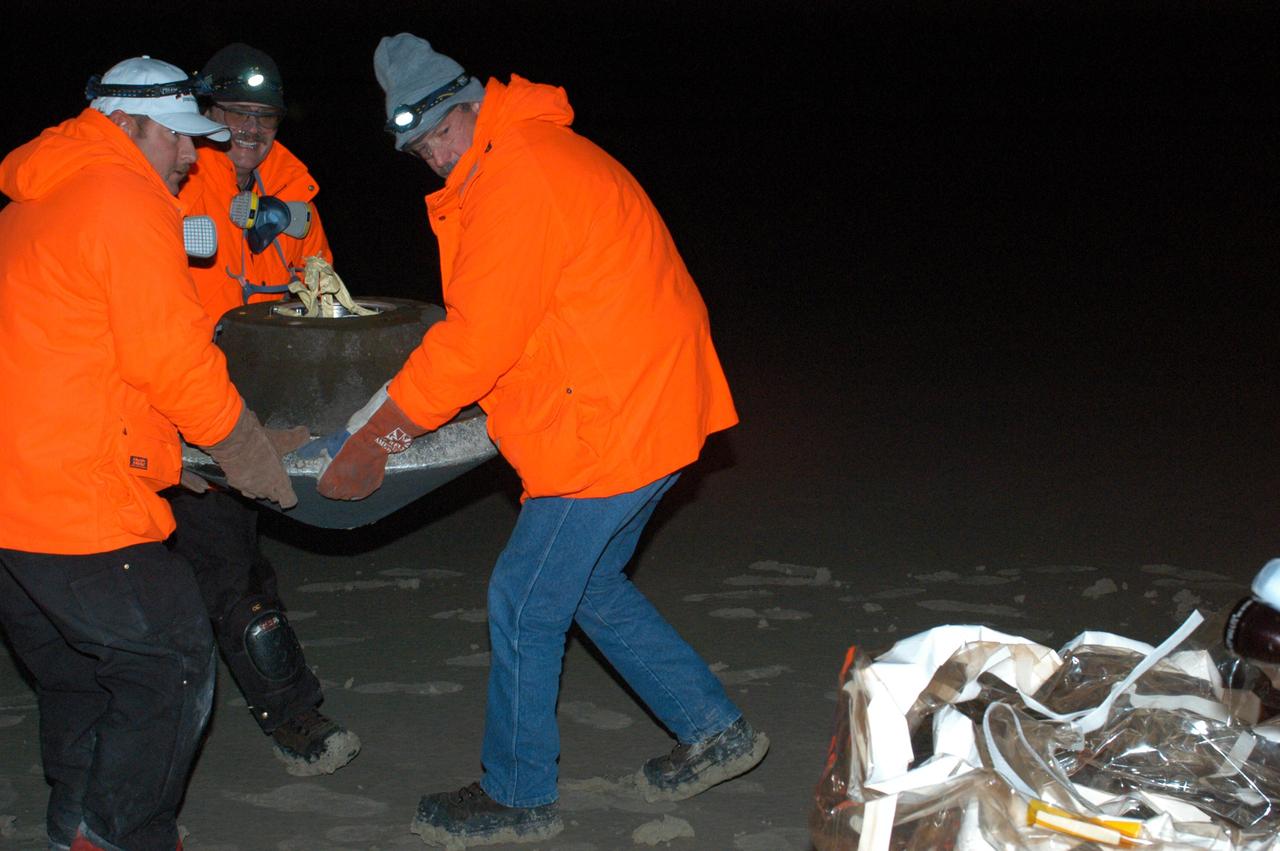
The capsule contains cometary and interstellar samples gathered by NASA Stardust spacecraft. Here, the capsule is being lifted at the landing site.
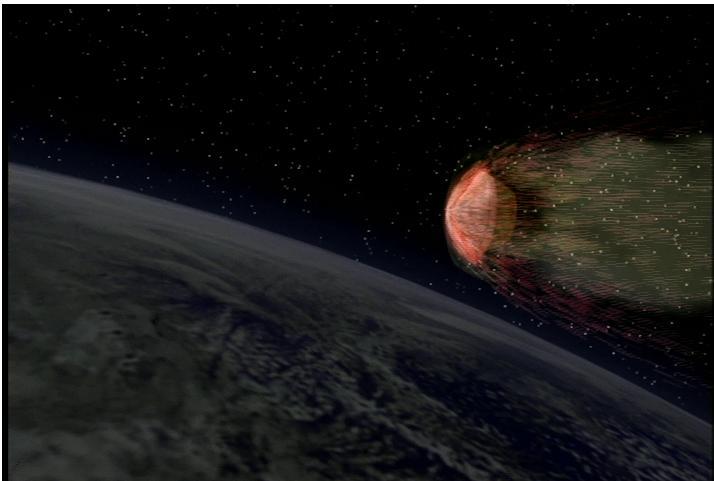
This animation shows the return capsule separating from the Stardust spacecraft.

Stennis Space Center Director Patrick Scheuermann (right) and Naval Meteorology and Oceanography Command Chief of Staff James Pettigrew drop the first shovelfuls of dirt on a time capsule to be opened on the rocket engine test facility's 100th anniversary in 2061. The time capsule was placed in front of the Roy S. Estess Building on Oct. 25 as Stennis concluded celebrations of its 50th anniversary. NASA publicly announced plans to build the rocket engine test site Oct. 25, 1961.

Stennis Space Center Director Patrick Scheuermann (right) and Naval Meteorology and Oceanography Command Chief of Staff James Pettigrew drop the first shovelfuls of dirt on a time capsule to be opened on the rocket engine test facility's 100th anniversary in 2061. The time capsule was placed in front of the Roy S. Estess Building on Oct. 25 as Stennis concluded celebrations of its 50th anniversary.
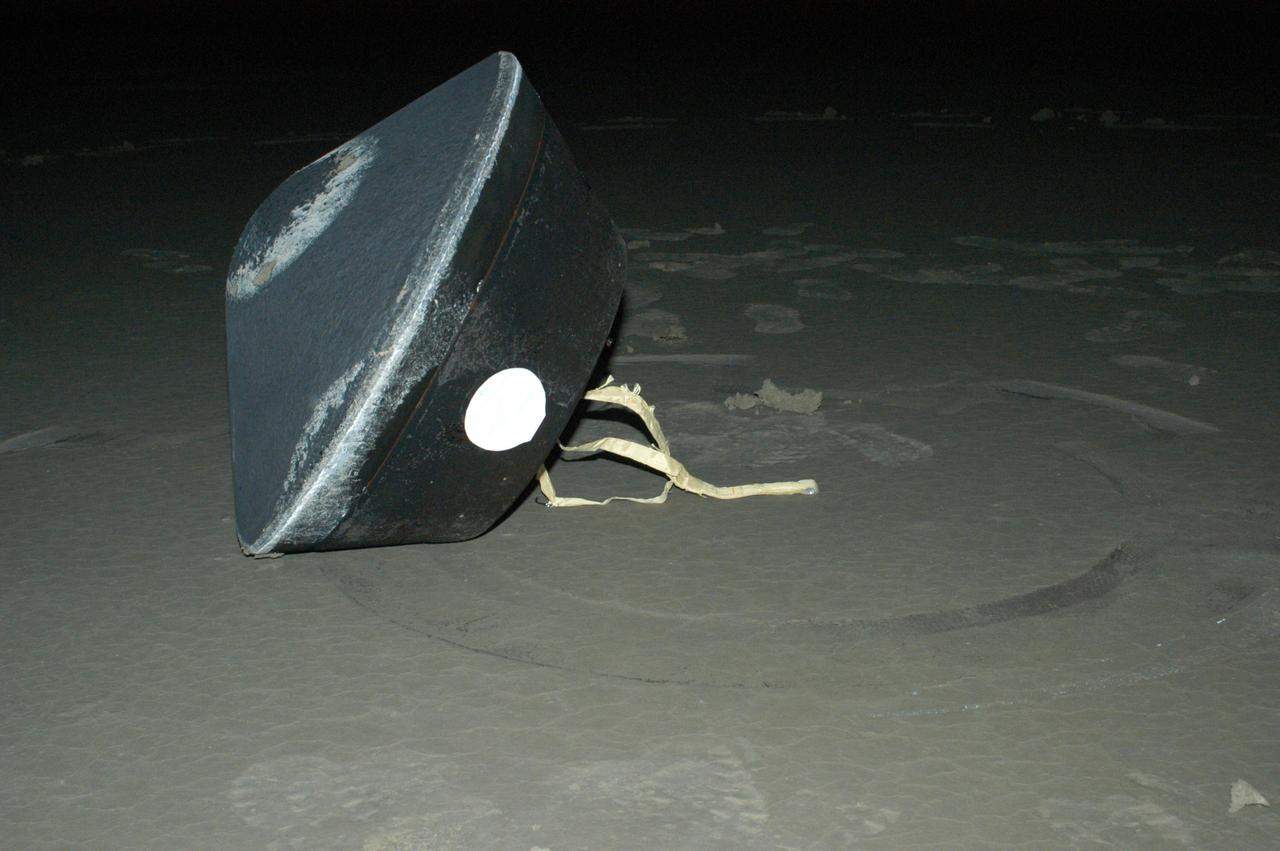
The capsule contains cometary and interstellar samples gathered by NASA Stardust spacecraft.
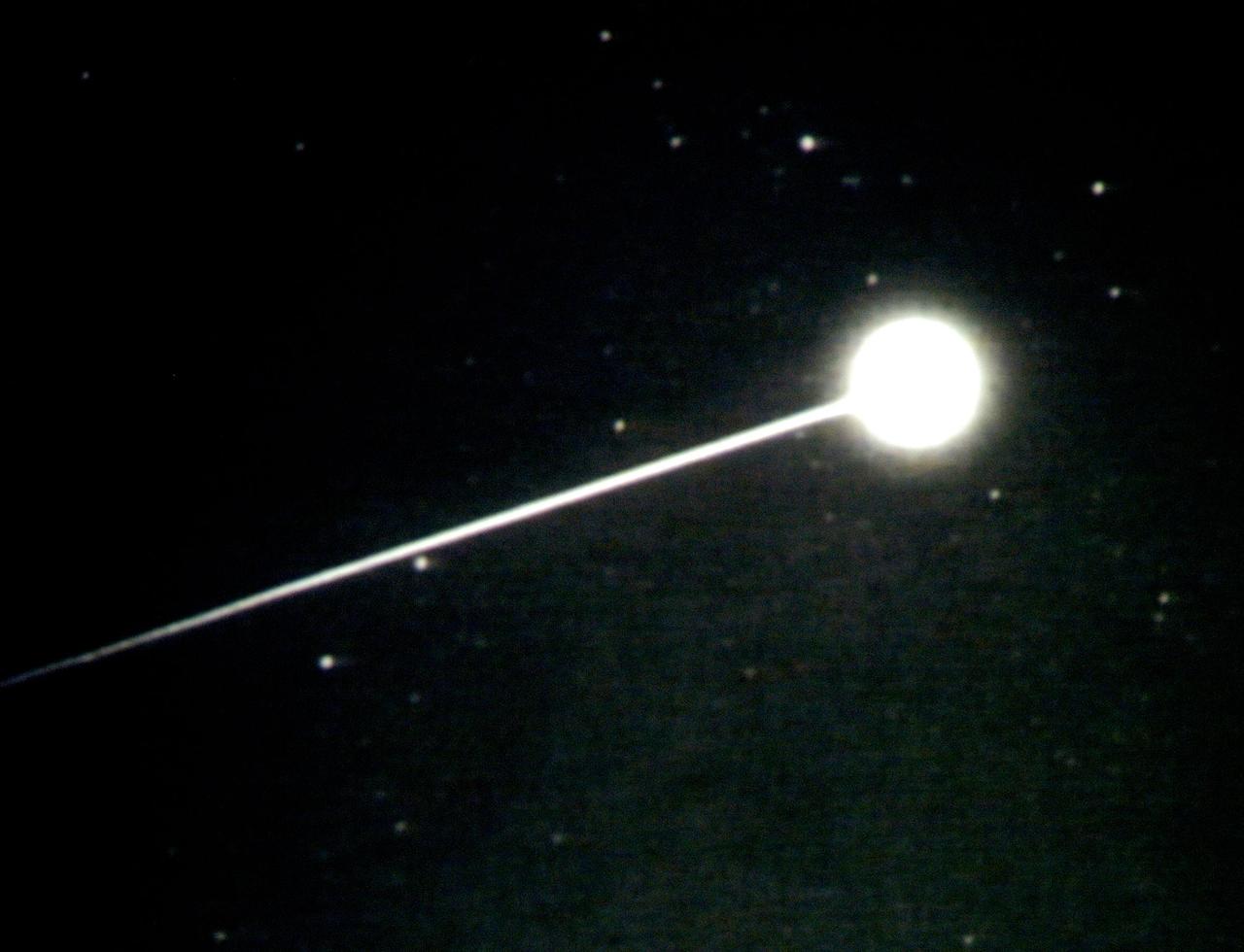
Stardust Capsule Return as seen from NASA DC-8 Airborne Laboratory with a mission to explore the conditions during reentry from the light emitted by the fireball caused when the capsule streaked through the sky
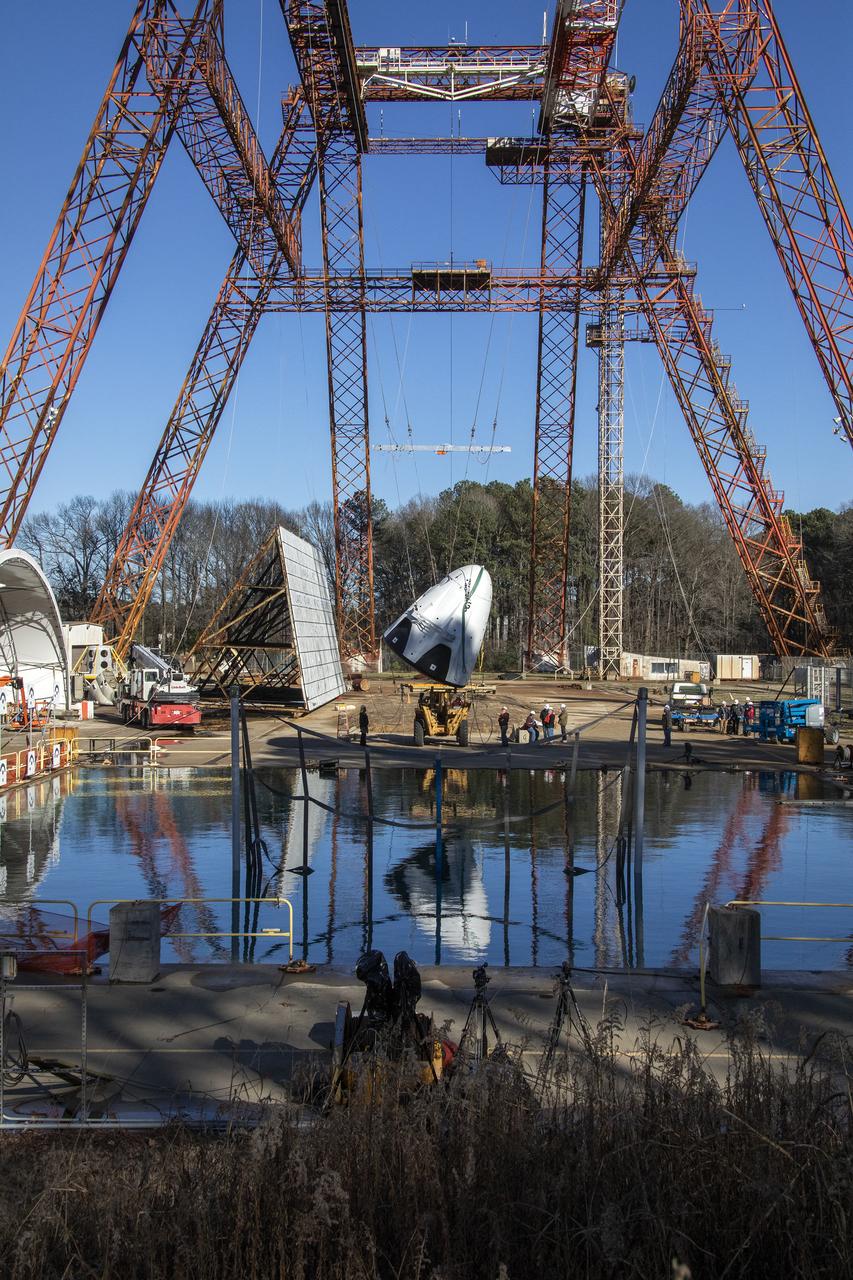
The Space X capsule being tested at NASA Langley’s Splash Test Basin. A series of drop tests into the Hydro Impact Basin at the Landing and Impact Research Facility at NASA’s Langley Research Center in Hampton, Virginia helped SpaceX’s Crew Dragon capsule prepare to safely land astronauts. A mock-up of the capsule with two instrumented crash test devices seated inside was tested in March 2019, representing how the capsule may impact the water during splashdown with different wind and parachute dynamics. Data collected helps understand pressures on the capsule and how those forces affect the spacecraft and occupants. Crew Dragon will carry NASA astronauts Bob Behnken and Doug Hurley to the International Space Station in the Demo-2 mission, the final SpaceX flight test for NASA’s Commercial Crew Program and the first flight of astronauts to orbit from U.S. soil since the space shuttle’s retirement in 2011. (NASA/ David C. Bowman)
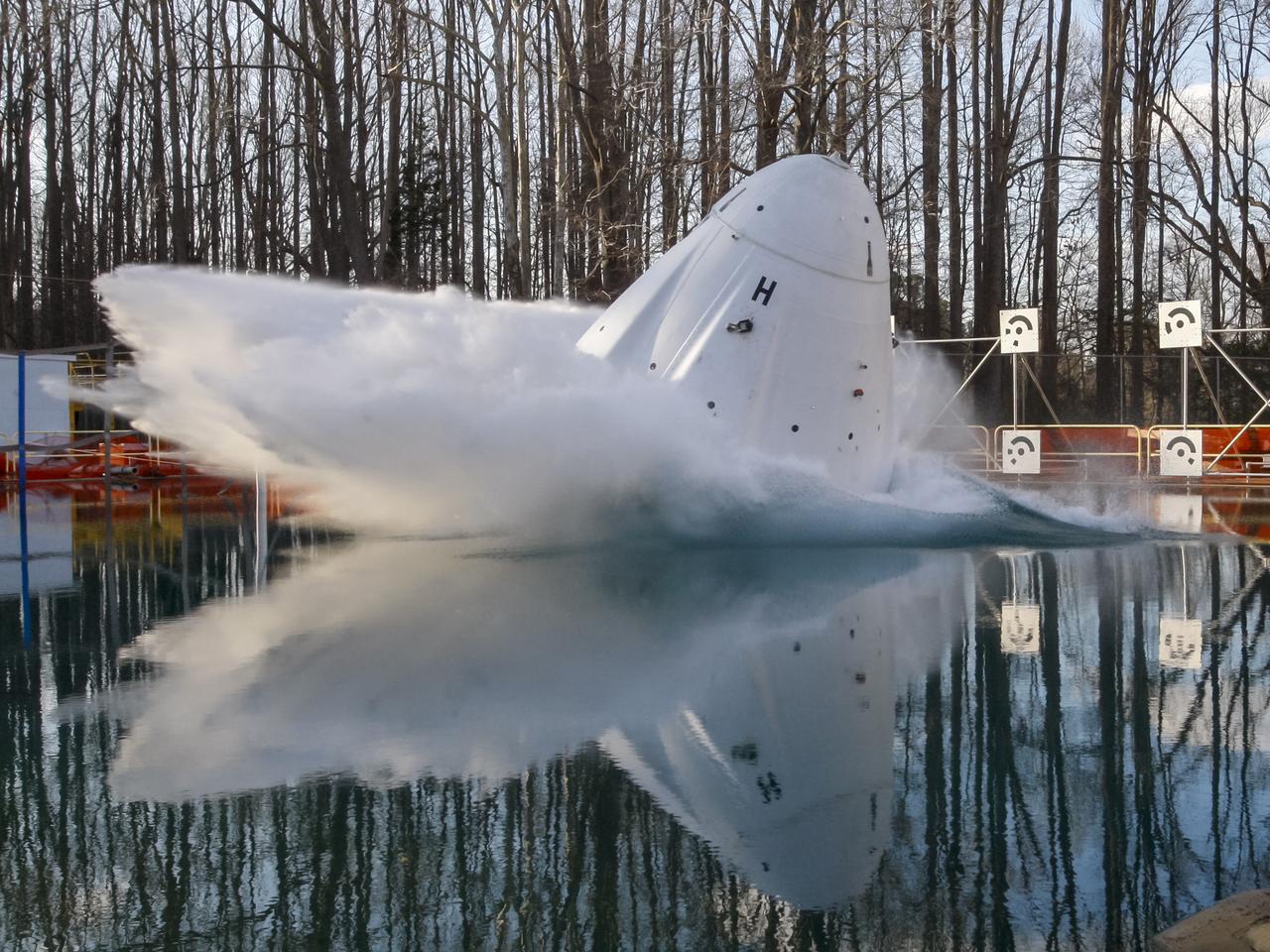
The Space X capsule being tested at NASA Langley’s Splash Test Basin. A series of drop tests into the Hydro Impact Basin at the Landing and Impact Research Facility at NASA’s Langley Research Center in Hampton, Virginia helped SpaceX’s Crew Dragon capsule prepare to safely land astronauts. A mock-up of the capsule with two instrumented crash test devices seated inside was tested in March 2019, representing how the capsule may impact the water during splashdown with different wind and parachute dynamics. Data collected helps understand pressures on the capsule and how those forces affect the spacecraft and occupants. Crew Dragon will carry NASA astronauts Bob Behnken and Doug Hurley to the International Space Station in the Demo-2 mission, the final SpaceX flight test for NASA’s Commercial Crew Program and the first flight of astronauts to orbit from U.S. soil since the space shuttle’s retirement in 2011. (NASA/ David C. Bowman)
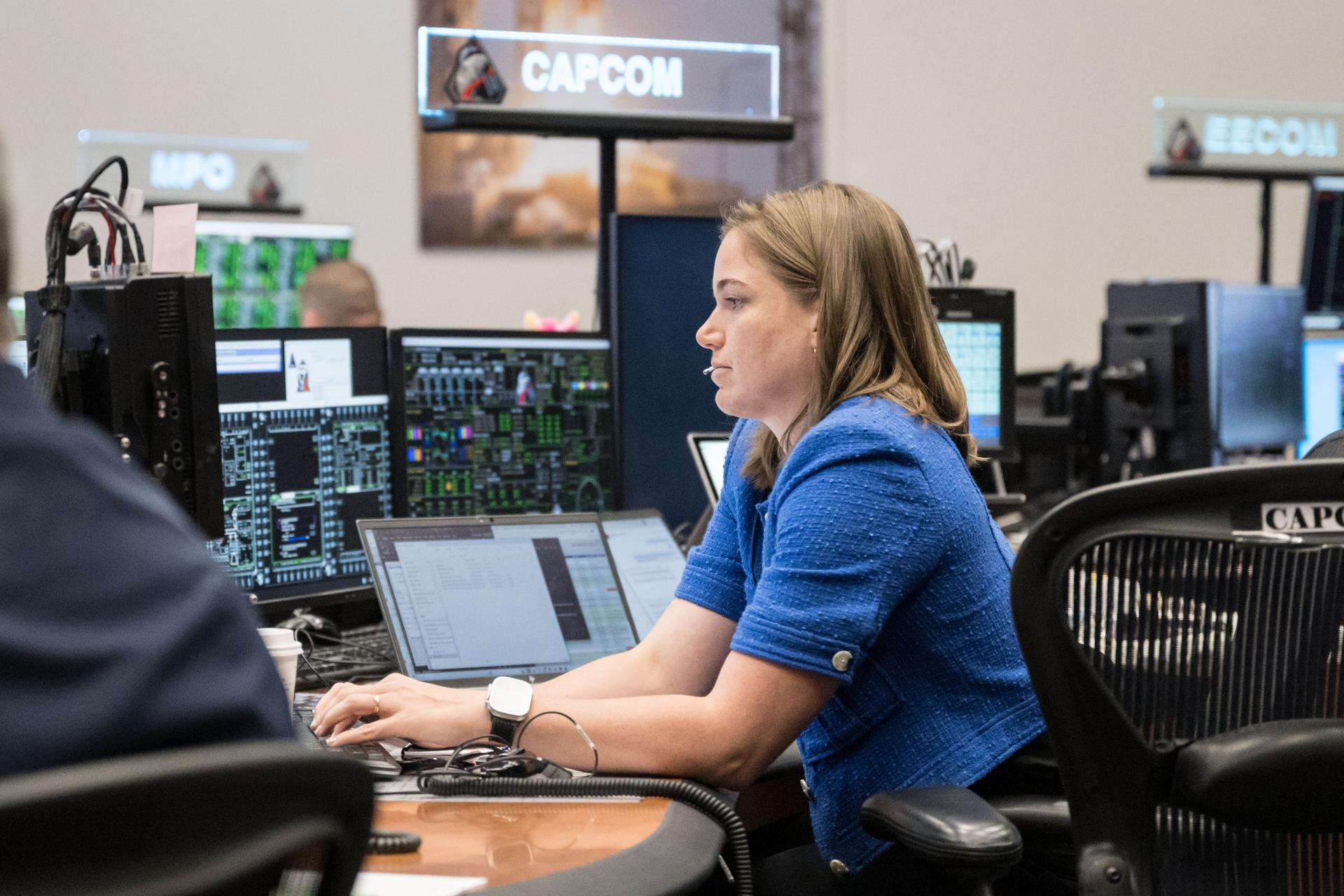
jsc2026e020046 (April 2, 2026) – CSA (Canadian Space Agency) astronaut and backup Artemis II crew member Jenni Gibbons serves as capsule communicator (capcom) during the mission’s translunar injection burn, which sent the crew in Orion out of Earth orbit and on a trajectory toward the Moon.
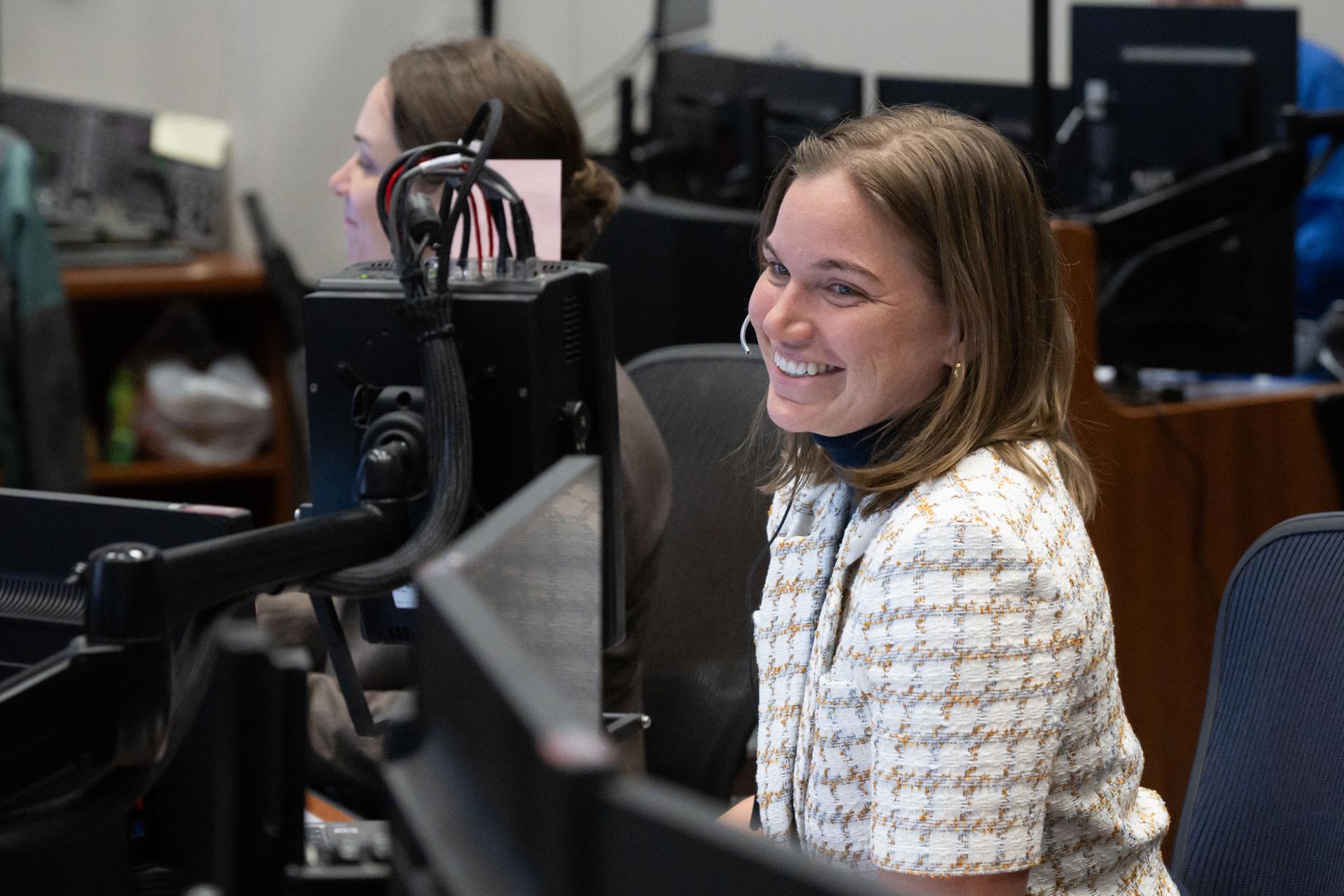
jsc2026e021107 (April 4, 2026) – CSA (Canadian Space Agency) astronaut and backup Artemis II crew member Jenni Gibbons serves as capsule communicator (capcom) during an Orion manual piloting demonstration on the fourth day of the mission. Credit: NASA/Bill Stafford
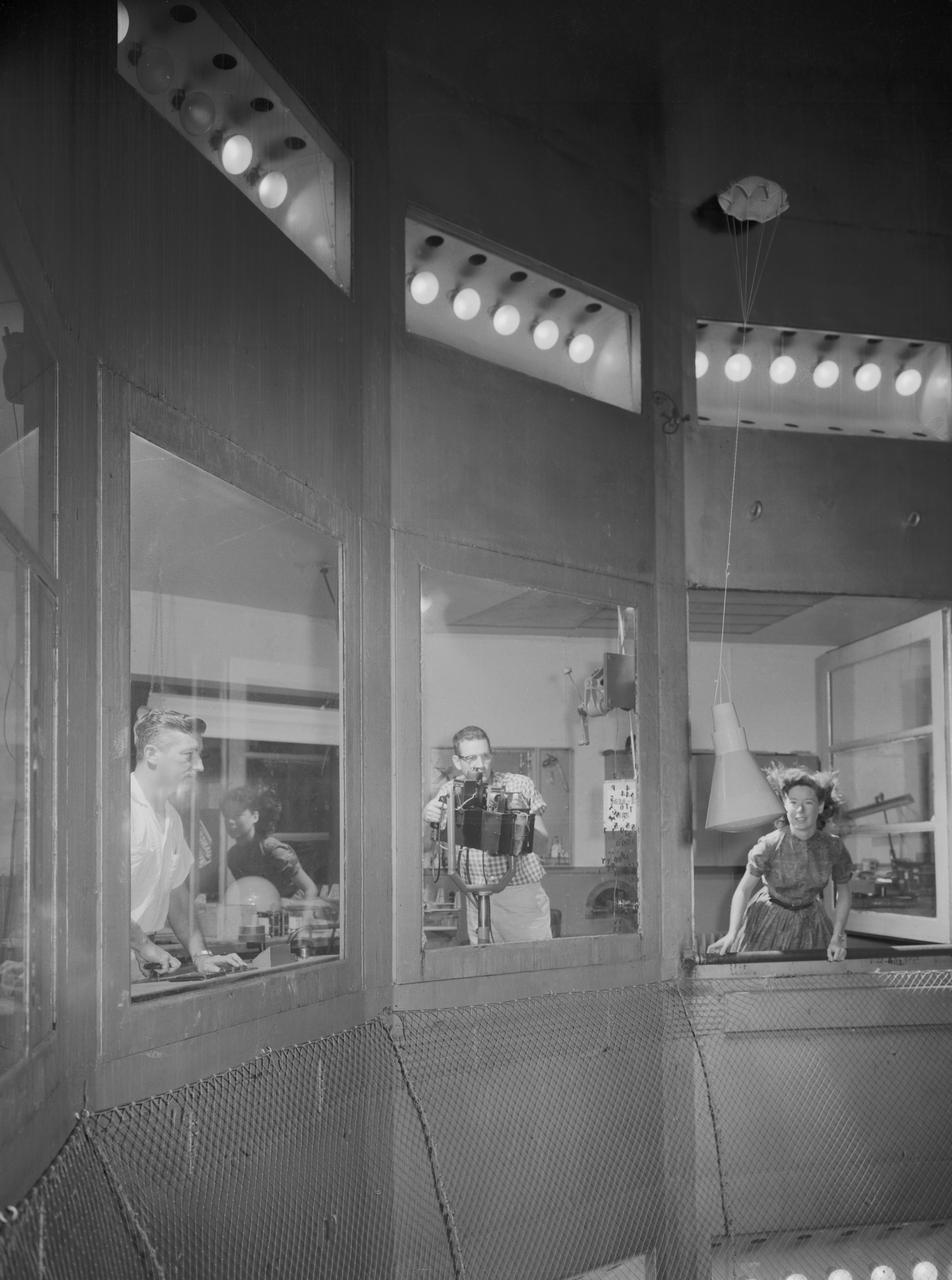
Mercury capsule in Spin Tunnel
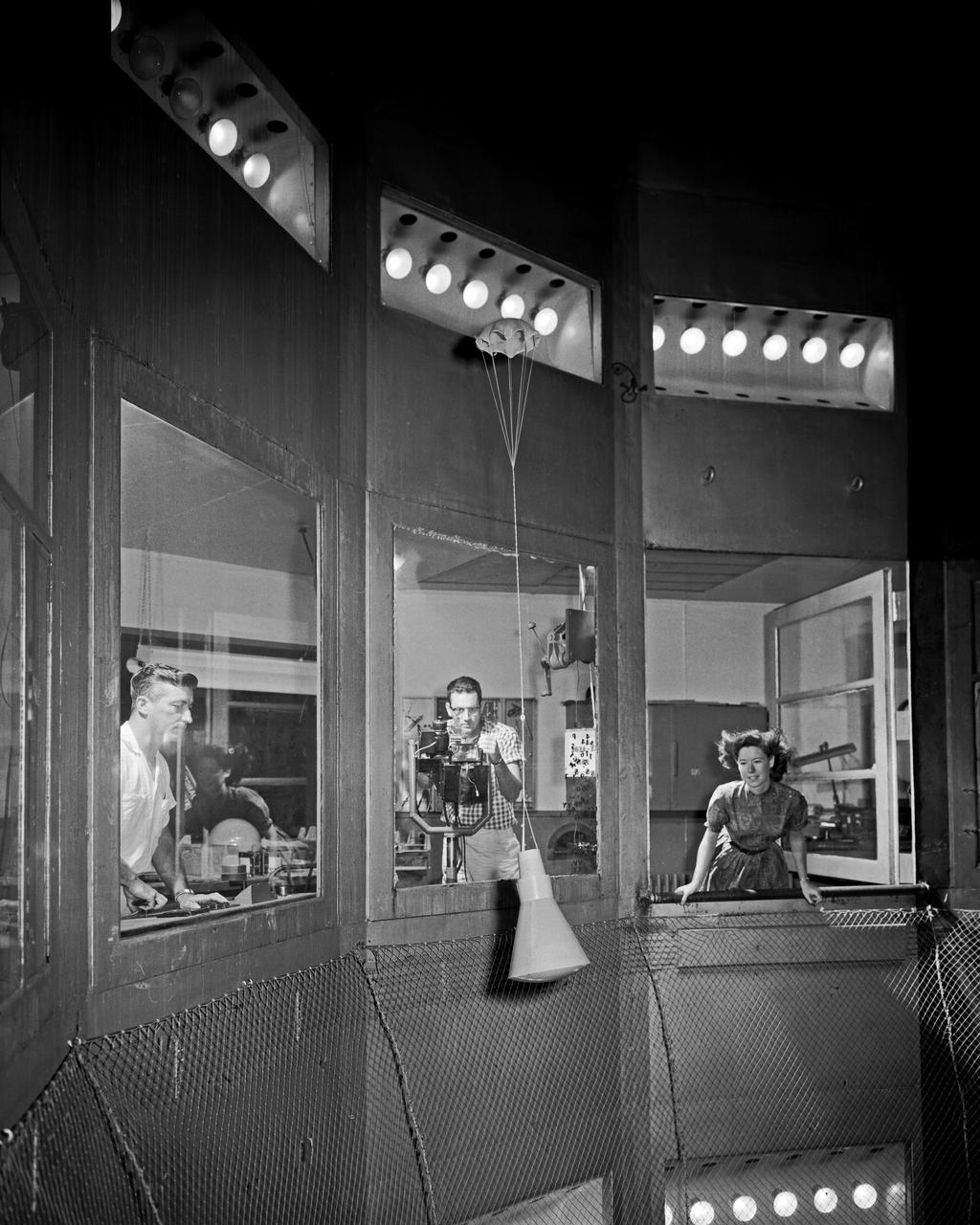
Mercury capsule in Spin Tunnel

Caption: Off the pad abort shot at Wallops using Langley PARD designed full scale capsule with Recruit rocket and extended skirt main parachute. Shows sequential images of launch and capsule splashdown.
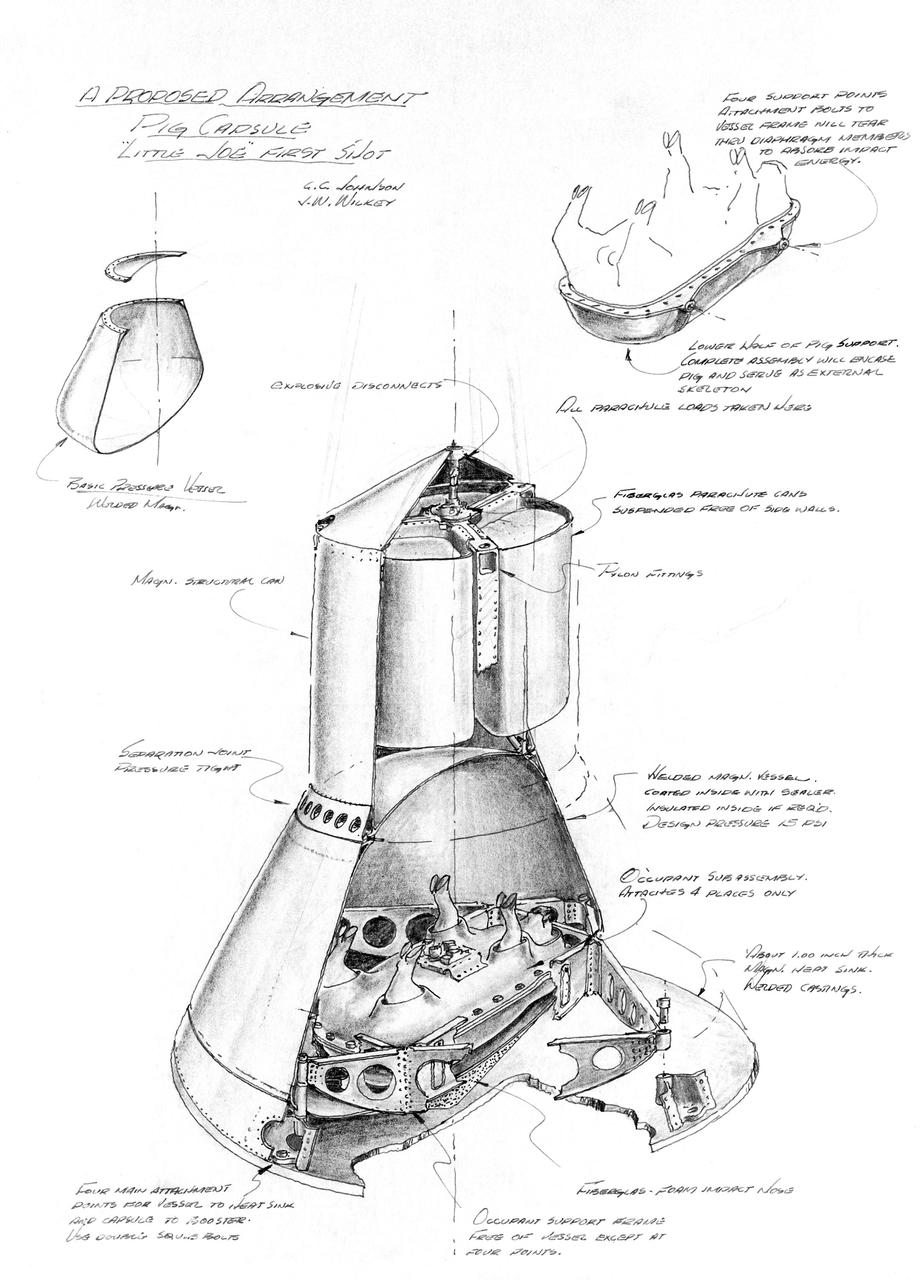
S63-19319 (October 1963) --- Pen and ink drawing of a proposed arrangement for a Pig Capsule in Little Joe capsule first shot. Photo credit: NASA
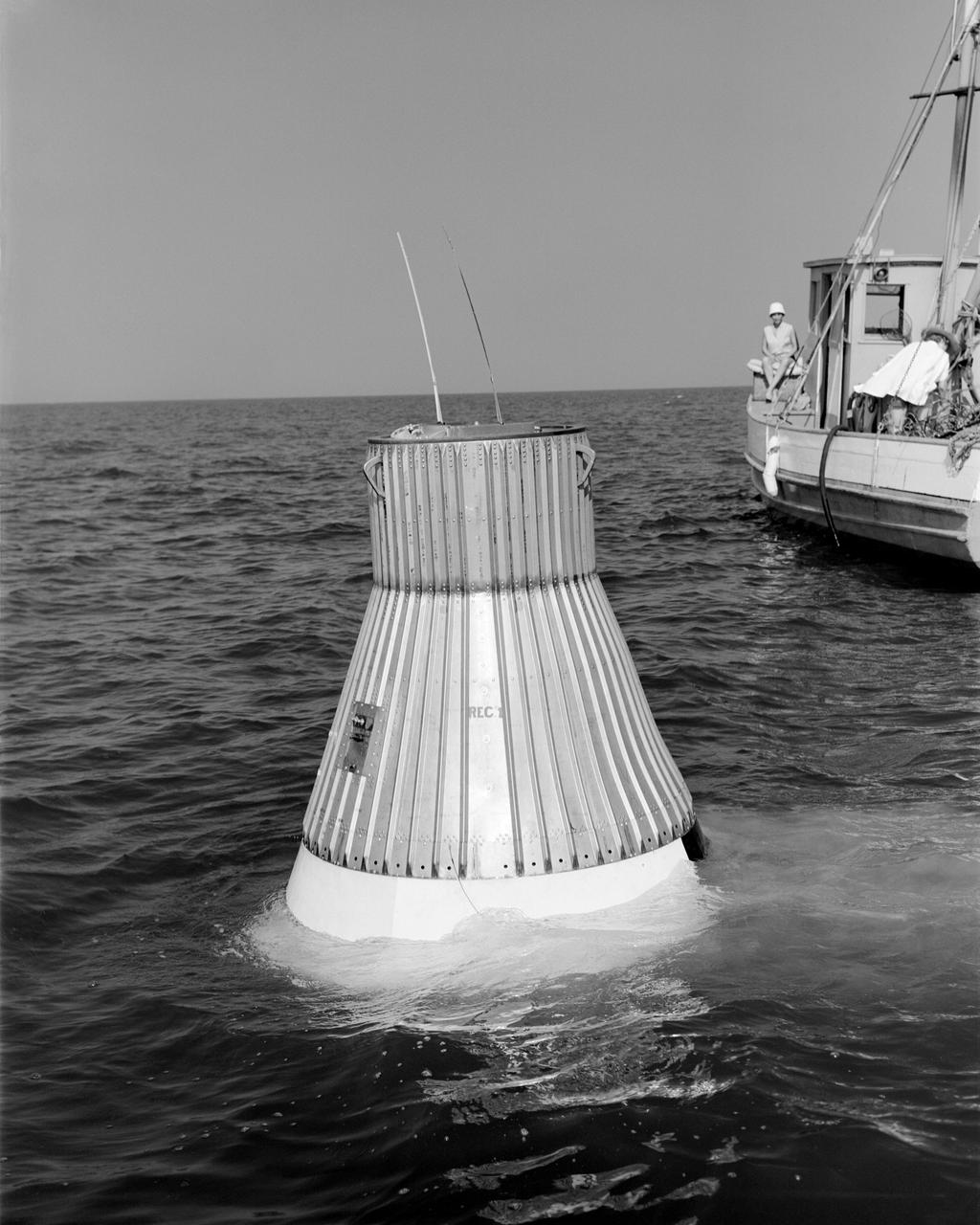
L59-4073 A model of the Mercury capsule undergoes flotation tests. -- Photograph published in Winds of Change, 75th Anniversary NASA publication (page 76), by James Schultz.
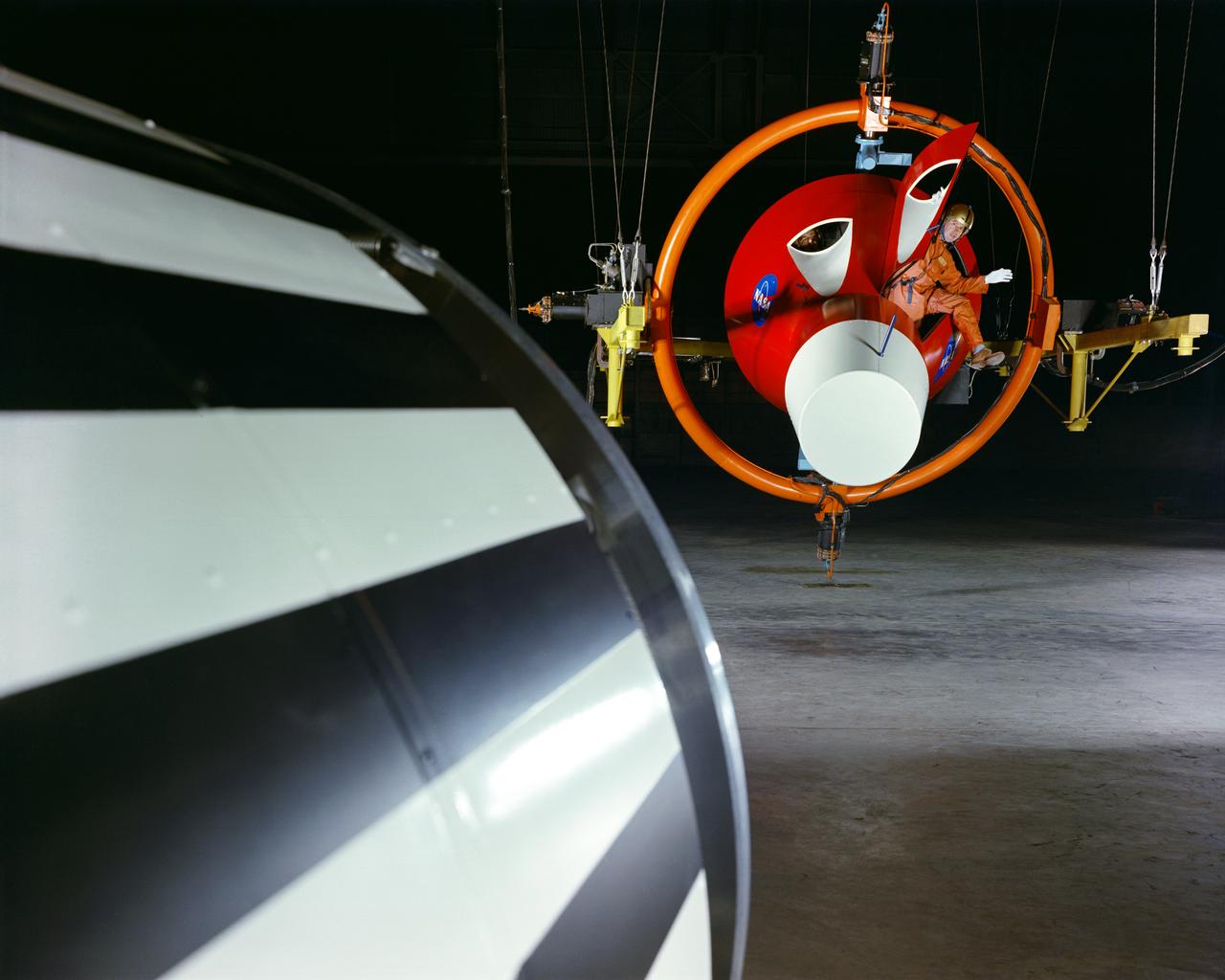
Practicing with a full-scale model of the Gemini Capsule in Langley's Rendezvous Docking Simulator. -- Caption and photograph published in Winds of Change, 75th Anniversary NASA publication, (page 89), by James Schultz.
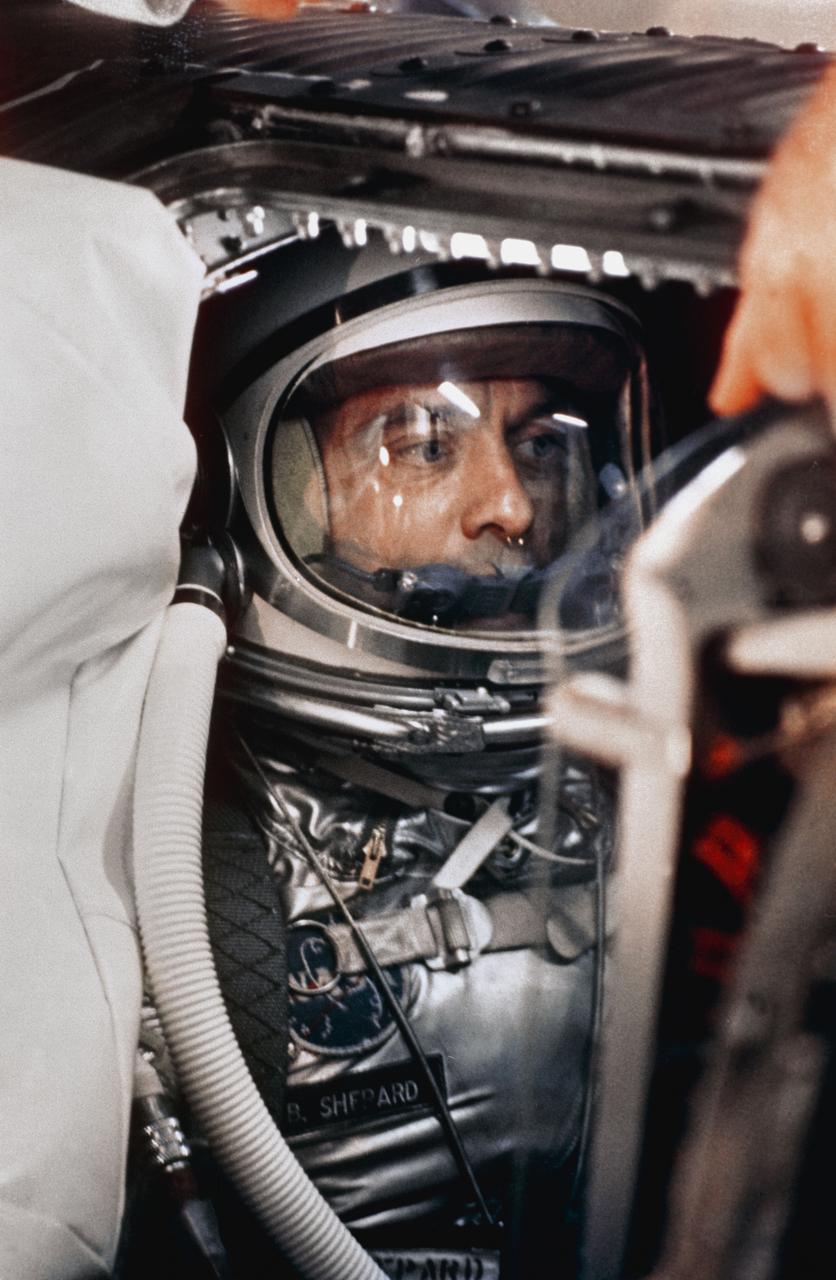
S88-31374 (29 April 1961) --- A close-up of astronaut Alan B. Shepard Jr. in his space suit with his helmet on inside the Mercury capsule. He is undergoing a flight simulation test with the capsule mated to the Redstone booster. This will be the first attempt to put a man into space by the U.S. aboard a Mercury spacecraft, launched atop a Redstone rocket. The suborbital trajectory will be down the Atlantic Missile Range. Photo credit: NASA or National Aeronautics and Space Administration
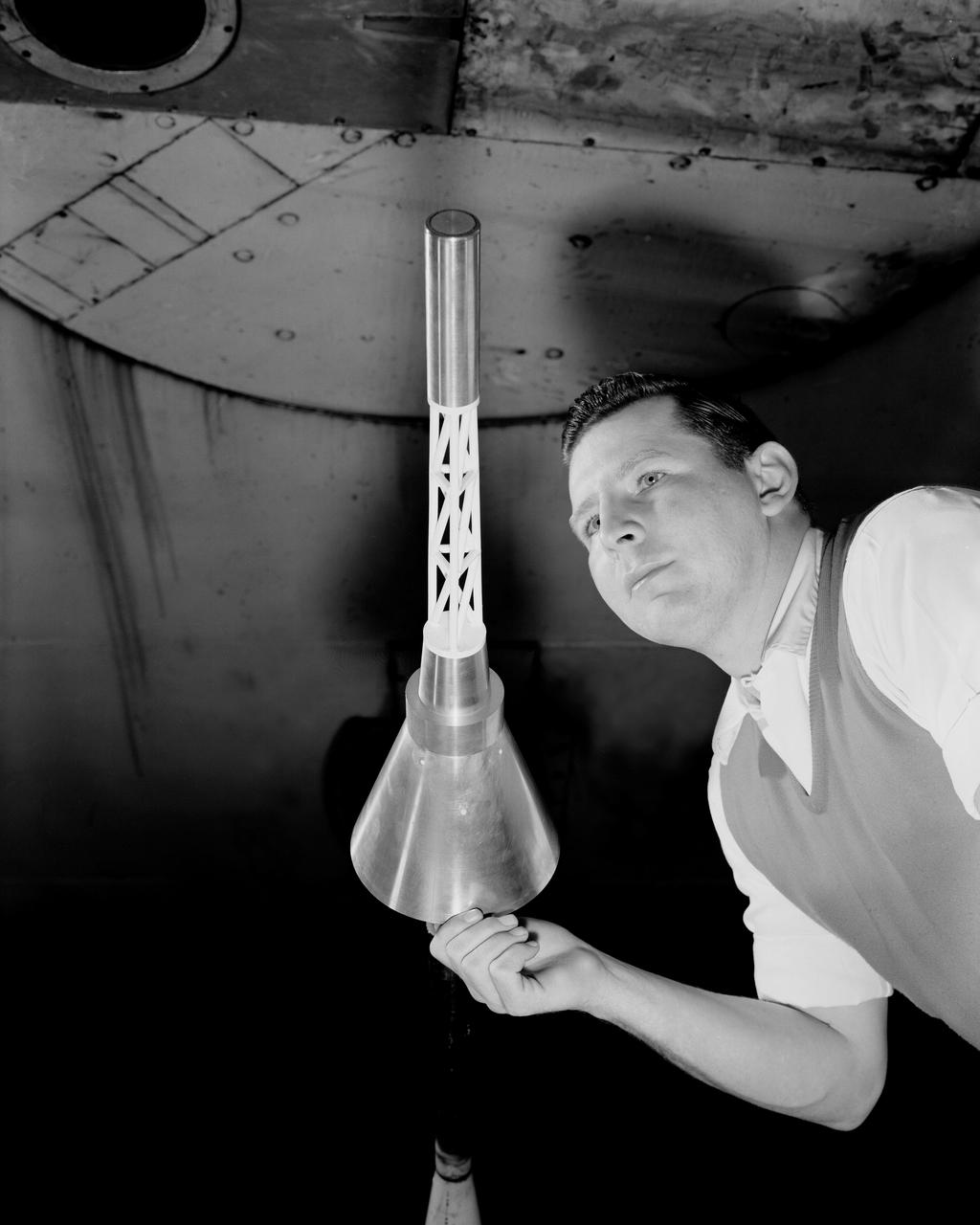
Mercury capsule model (Pohlhamus).

Space Station Freedom option A showing two Soyuz Assured Crew Return Vehicle (ACRV) capsules docked at berthing ports.

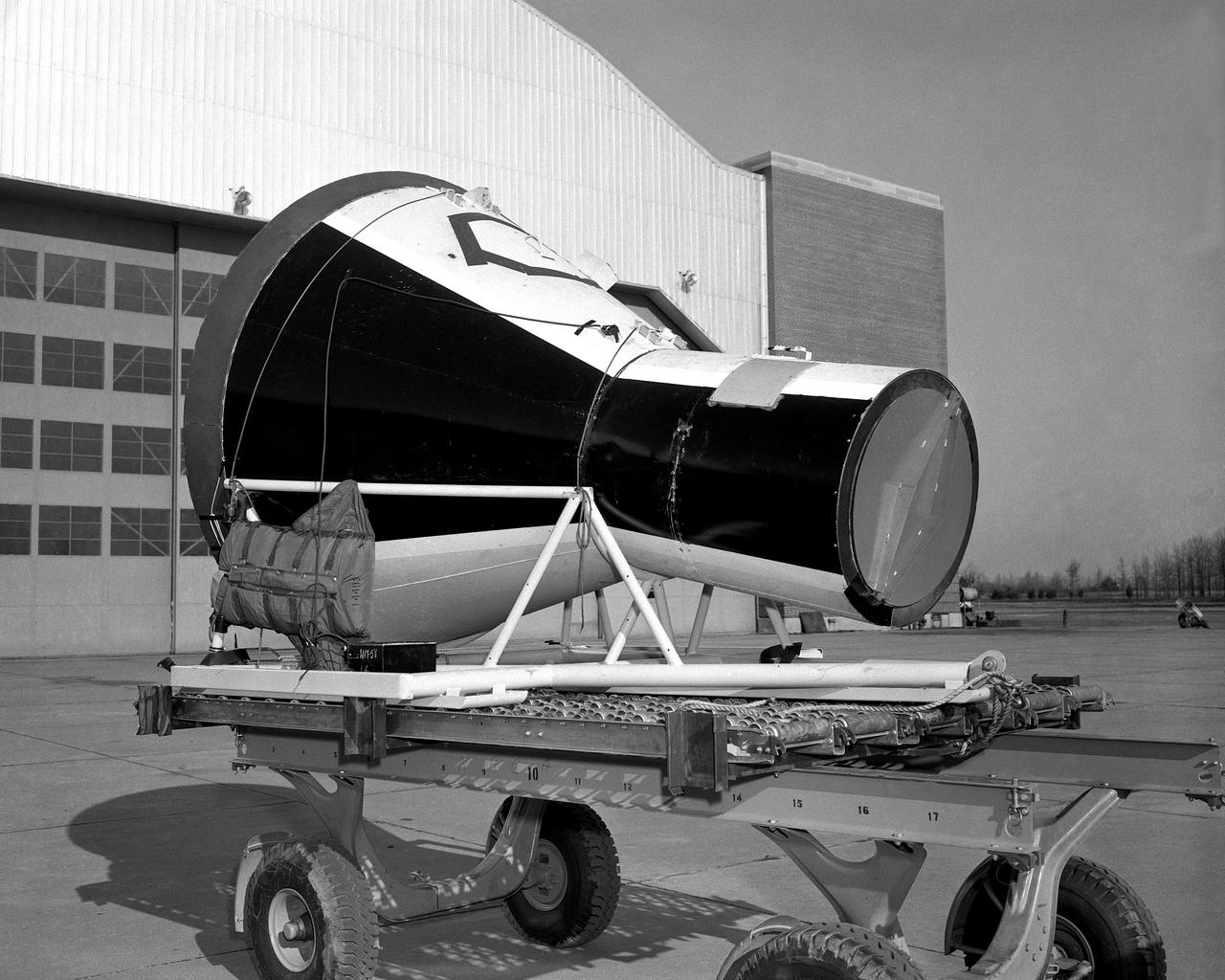
Technicians prepare a full-scale capsule which would be used for the first rocket-launching on March 11, 1959. The purpose of the test would be to simulate a ground-level or beach abort. Joseph Shortal wrote (vol. 3, p. 27): It was a test of the ability of the escape system to rescue the astronaut in case of a malfunction of the launch vehicle prior to flight. This test was carried out by PARD under the direction of W.S. Blanchard, Jr., and was part of the program designated F57 at PARD. For these tests capsule shape C was used. -- Published in Joseph A. Shortal, History of Wallops Station: Origins and Activities Through 1949, (Wallops Island, VA: National Aeronautics and Space Administration, Wallops Station, nd), Comment Edition.

Artist rendering of NASA Stardust capsule returning to Earth. The Stardust spacecraft will bring back samples of interstellar dust, including recently discovered dust streaming into our Solar System from the direction of Sagittarius.
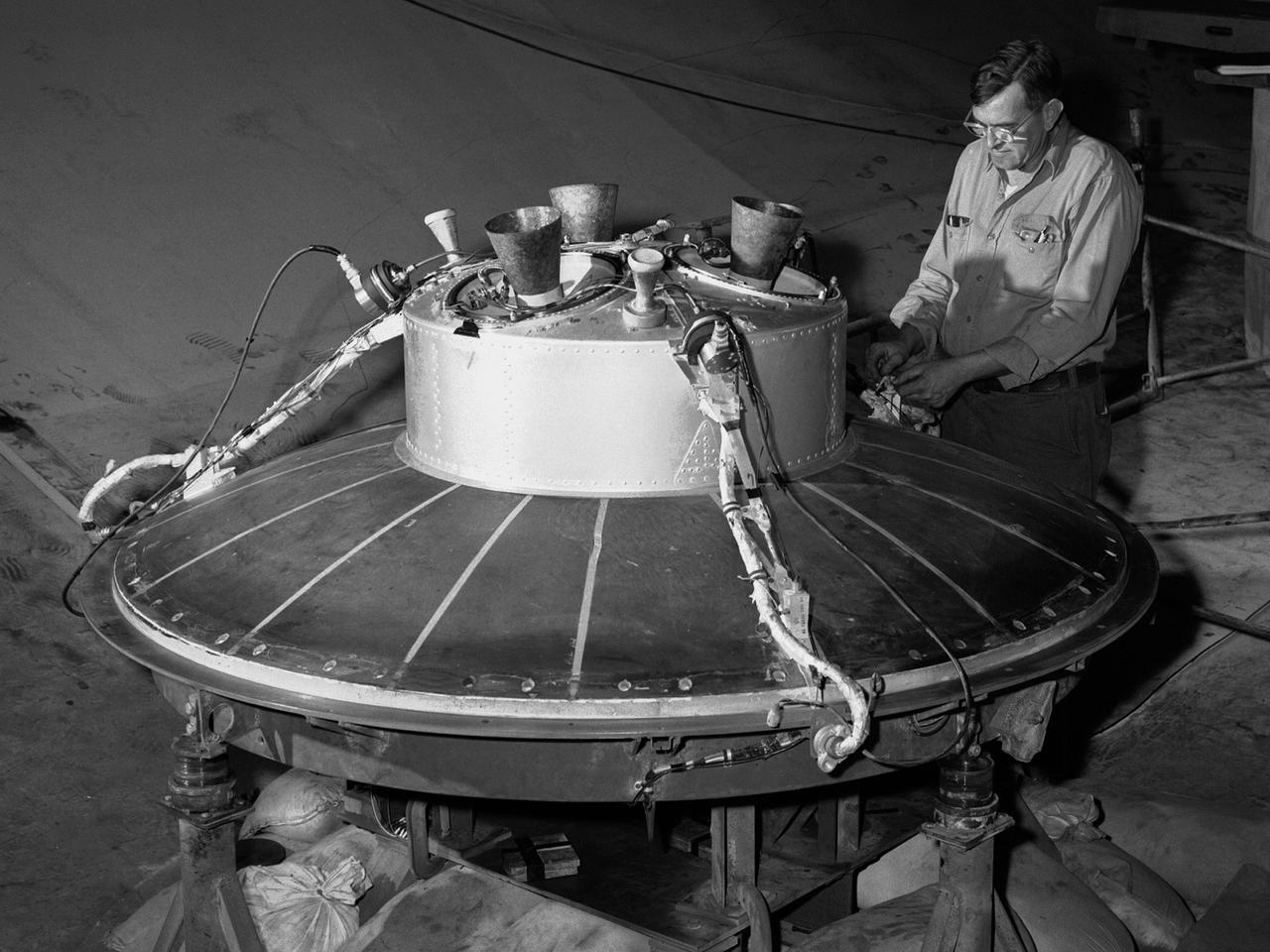
A mechanic at the National Aeronautics and Space Administration (NASA) Lewis Research Center prepares the inverted base of a Mercury capsule for a test of its posigrade retrorockets inside the Altitude Wind Tunnel. In October 1959 NASA’s Space Task Group allocated several Project Mercury assignments to Lewis. The Altitude Wind Tunnel was modified to test the Atlas separation system, study the escape tower rocket plume, train astronauts to bring a spinning capsule under control, and calibrate the capsule’s retrorockets. The turning vanes, makeup air pipes, and cooling coils were removed from the wide western end of the tunnel to create a 51-foot diameter test chamber. The Mercury capsule had a six-rocket retro-package affixed to the bottom of the capsule. Three of these were posigrade rockets used to separate the capsule from the booster and three were retrograde rockets used to slow the capsule for reentry into the earth’s atmosphere. Performance of the retrorockets was vital since there was no backup system. Qualification tests of the retrorockets began in April 1960 on a retrograde thrust stand inside the southwest corner of the Altitude Wind Tunnel. These studies showed that a previous issue concerning the delayed ignition of the propellant had been resolved. Follow-up test runs verified reliability of the igniter’s attachment to the propellant. In addition, the capsule’s retrorockets were calibrated so they would not alter the capsule’s attitude when fired.
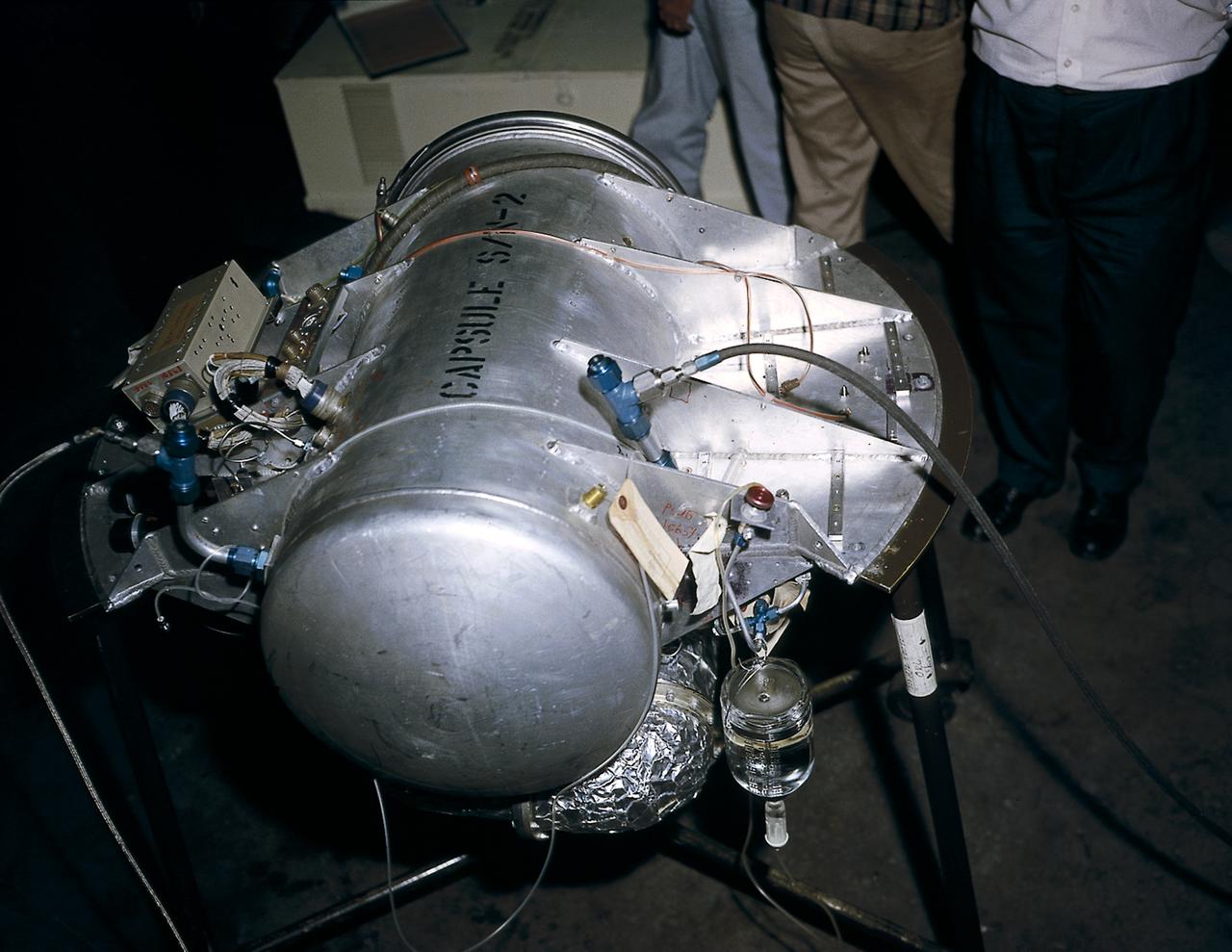
The capsule ready to be installed in the nose cone of Jupiter, AM-18, for pre-flight test, May 18, 1959. The capsule carried monkeys, Baker and Able, as the payload of AM-18 mission

Ablation Test of Mercury Capsule
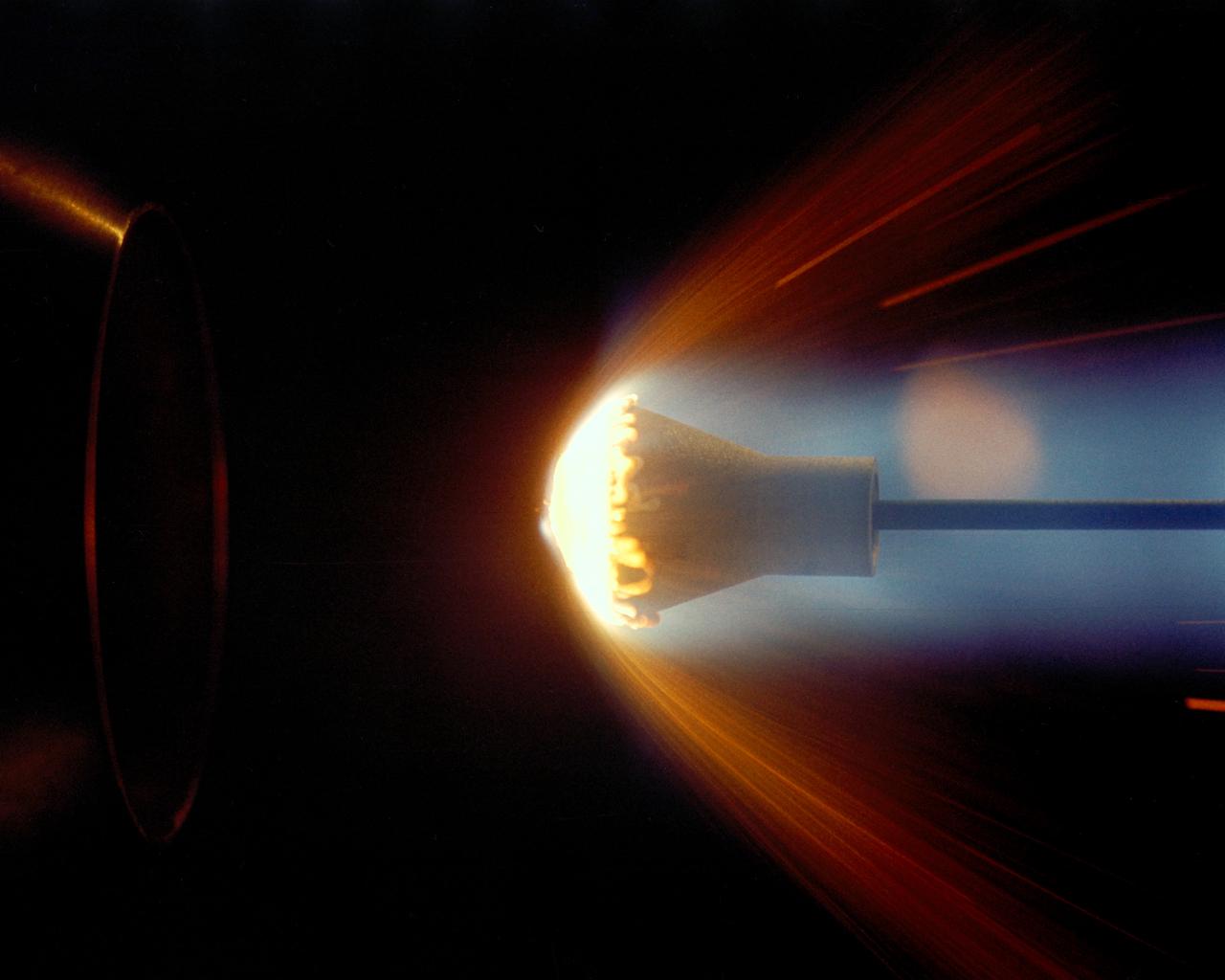
Ablation Test of Mercury Capsule

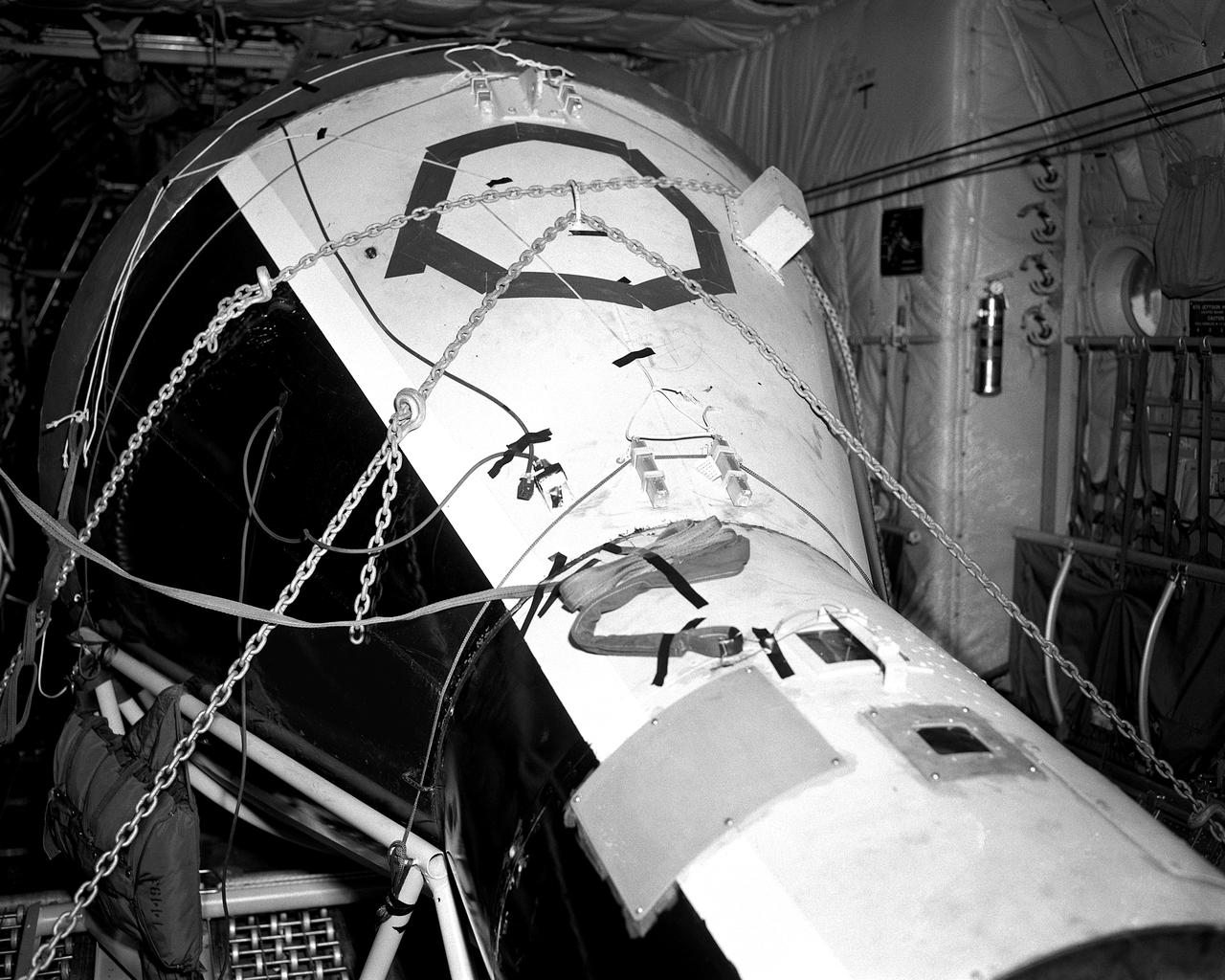
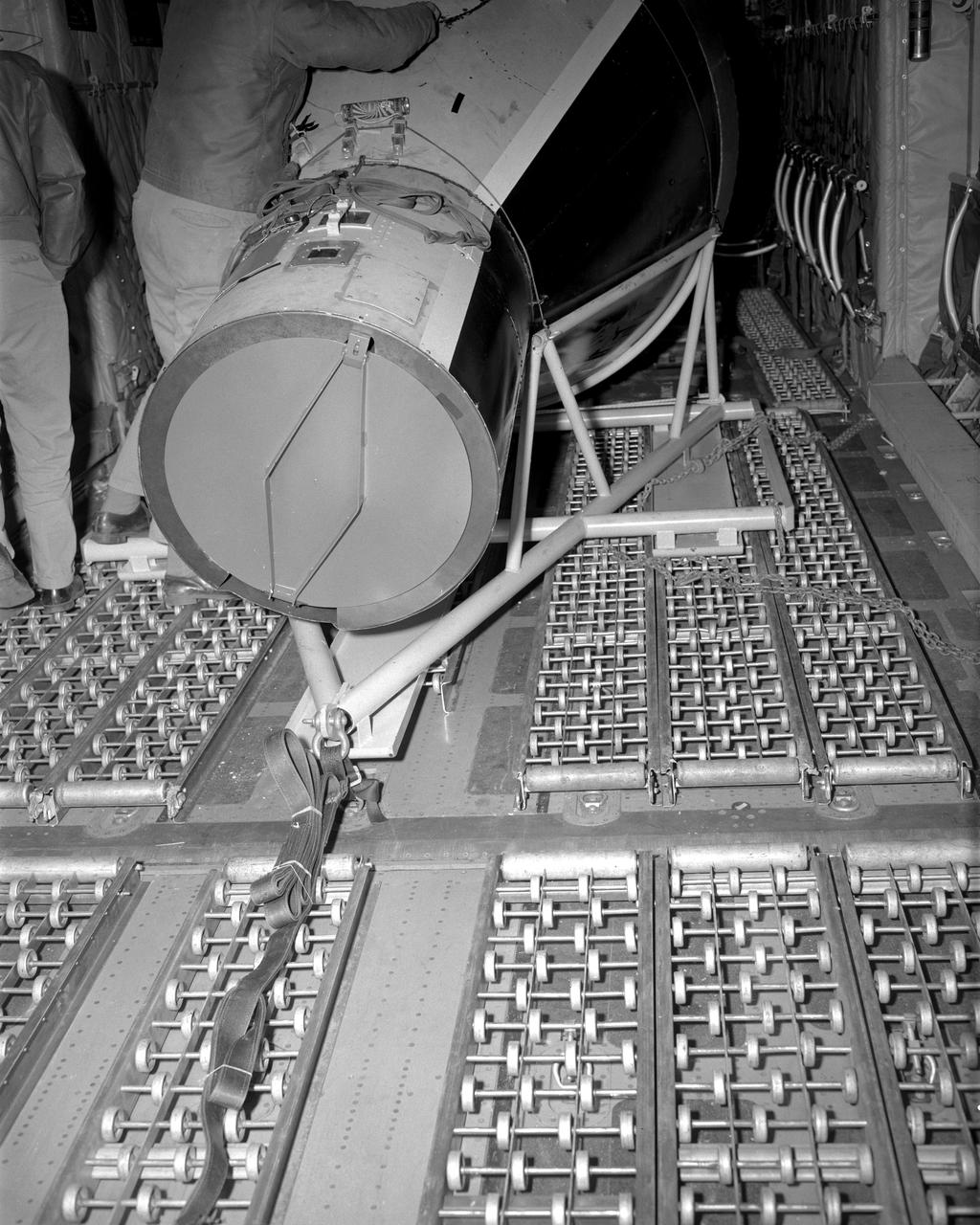
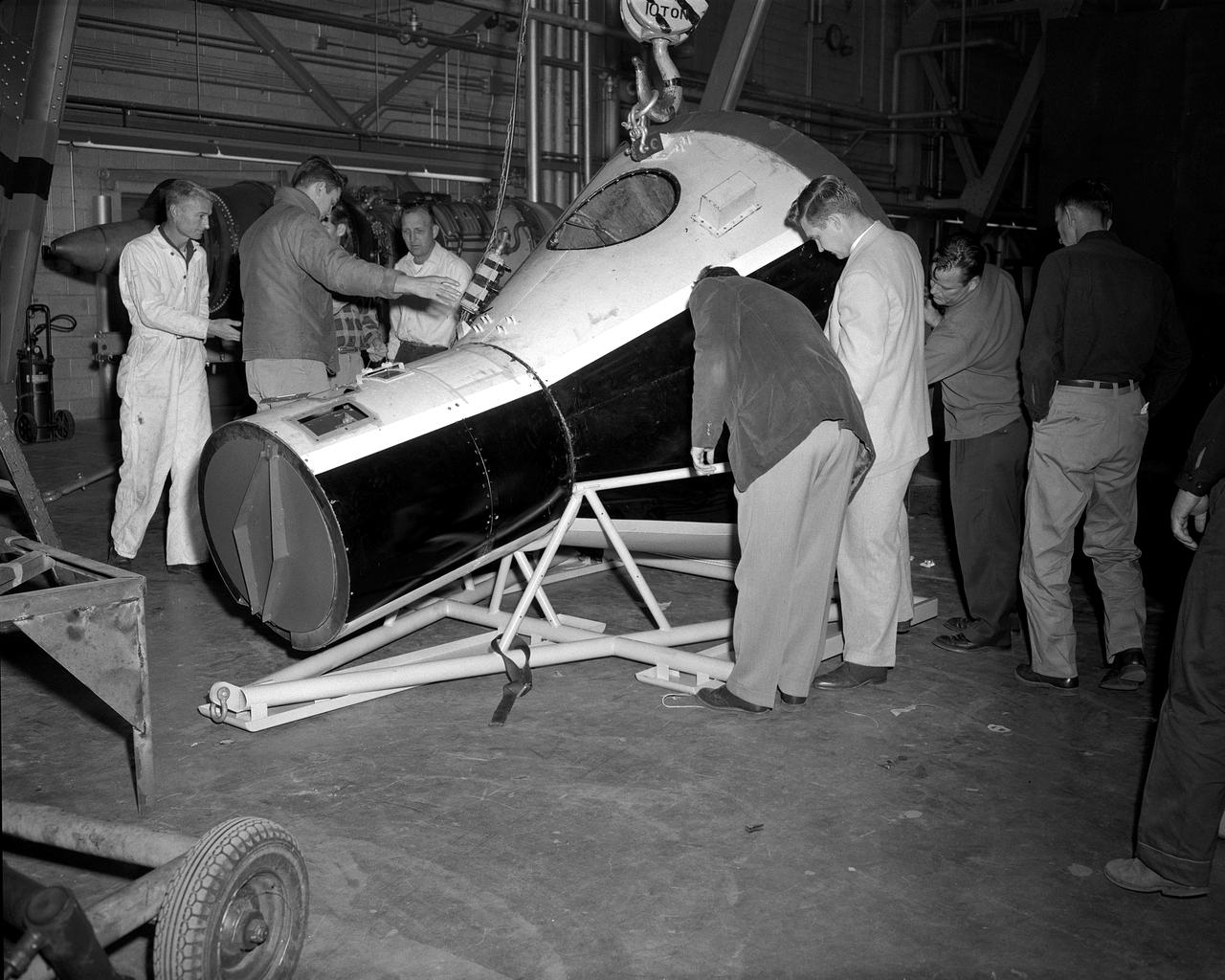
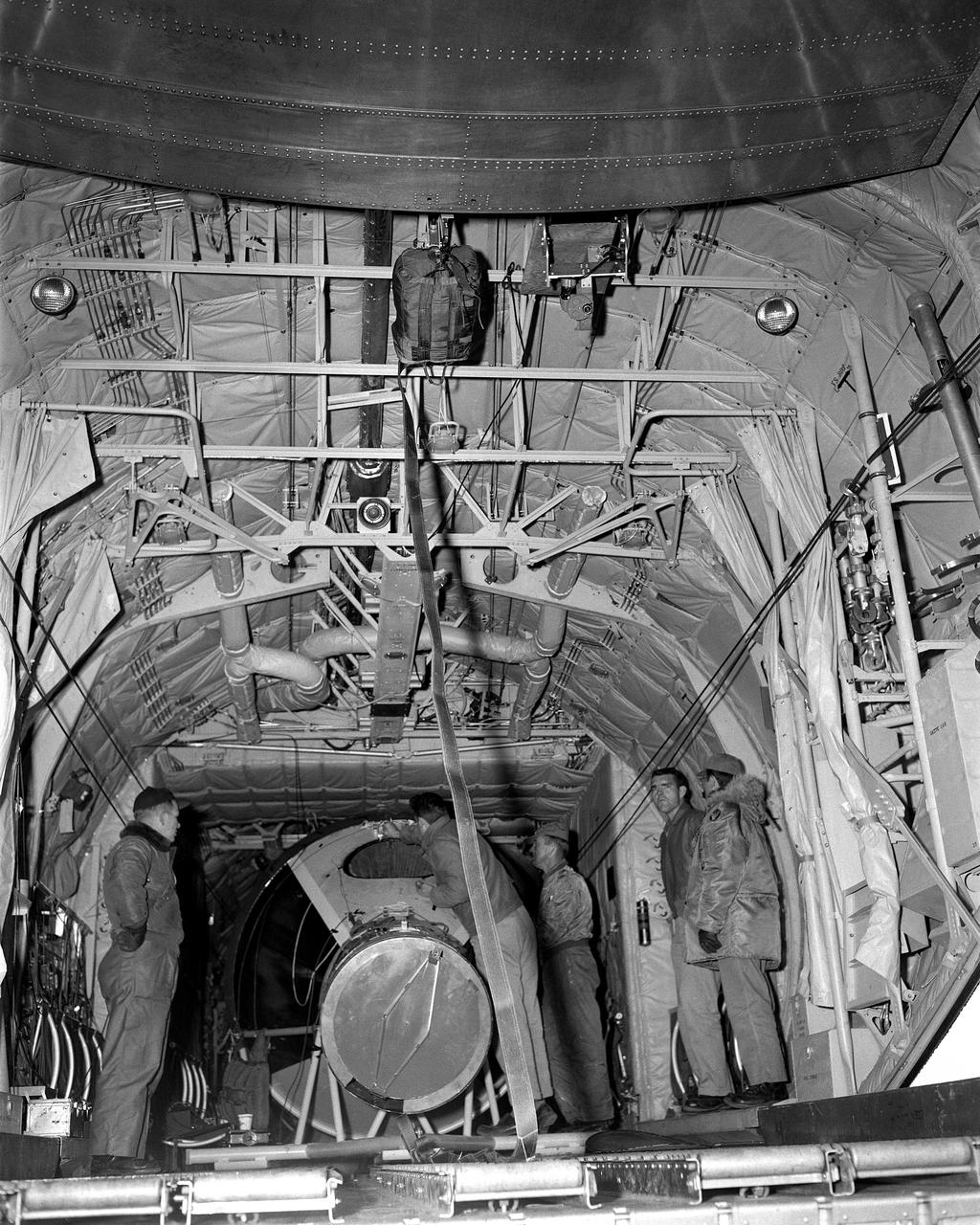
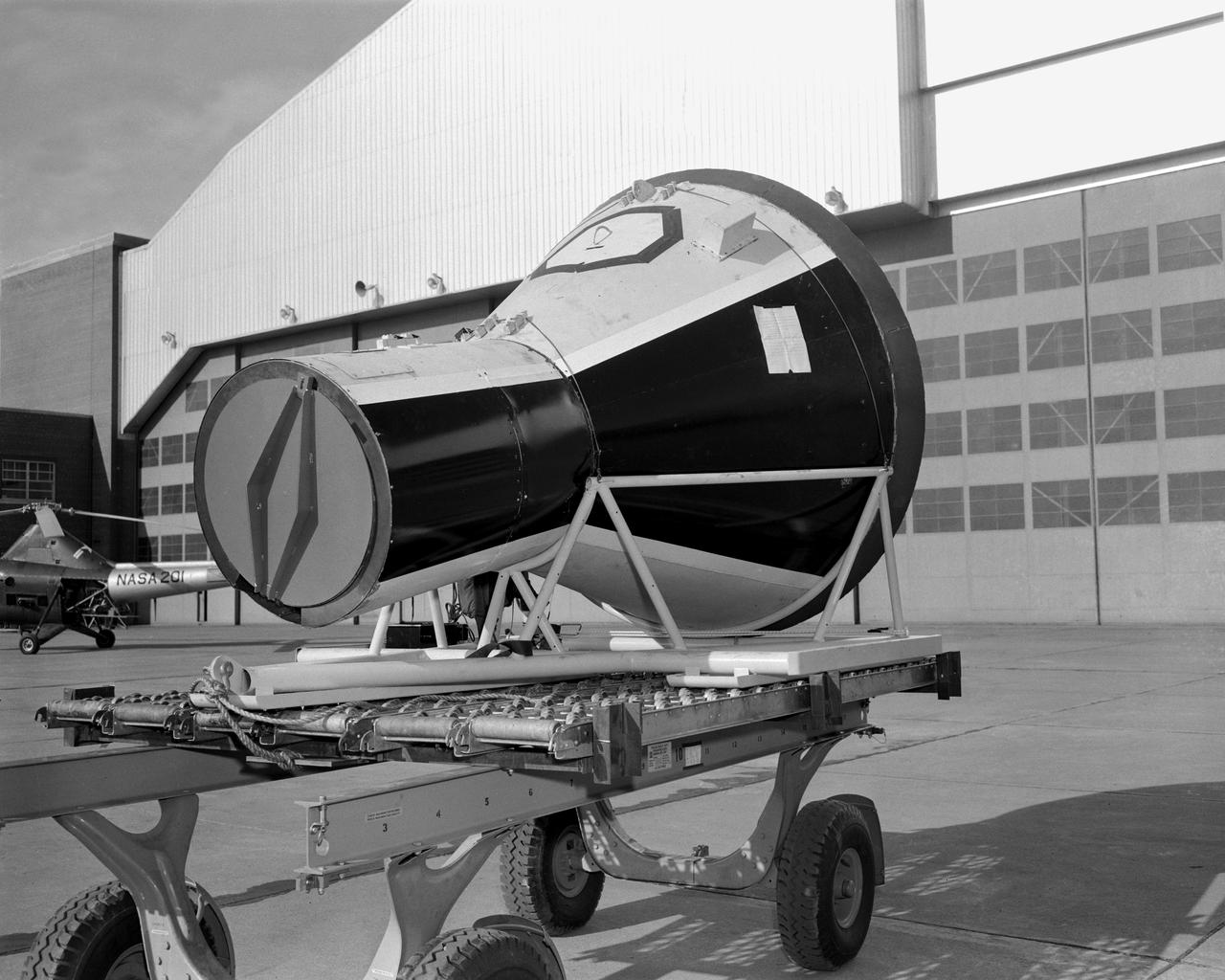
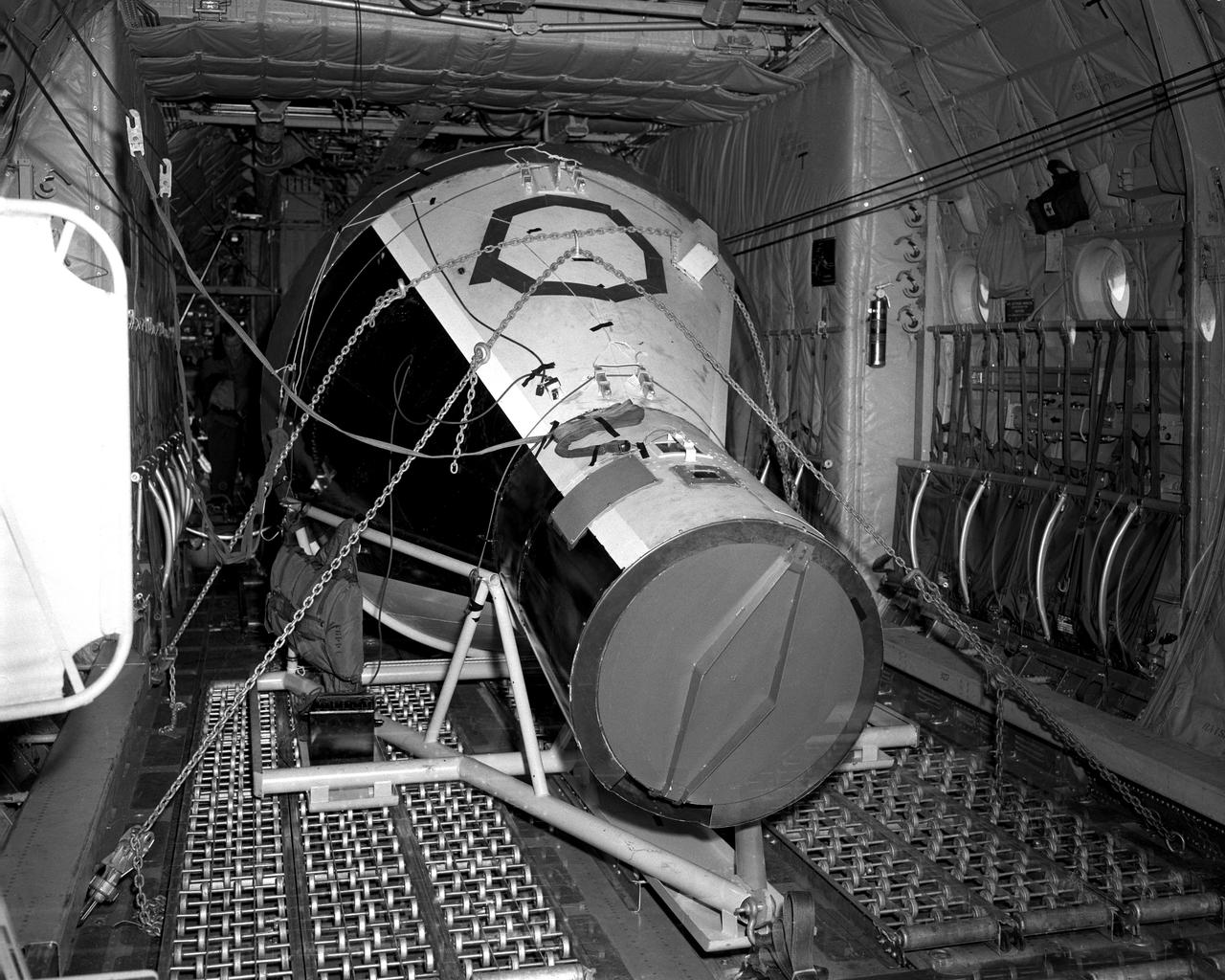
Photographed on: 12 09 58. -- Mercury capsule details, capsule in cargo bay of C-130 airplane prior to drop test, equipment in C130 for doing drop test.

Photographed on: 12 09 58. -- Mercury capsule details, capsule in cargo bay of C-130 airplane prior to drop test, equipment in C130 for doing drop test.
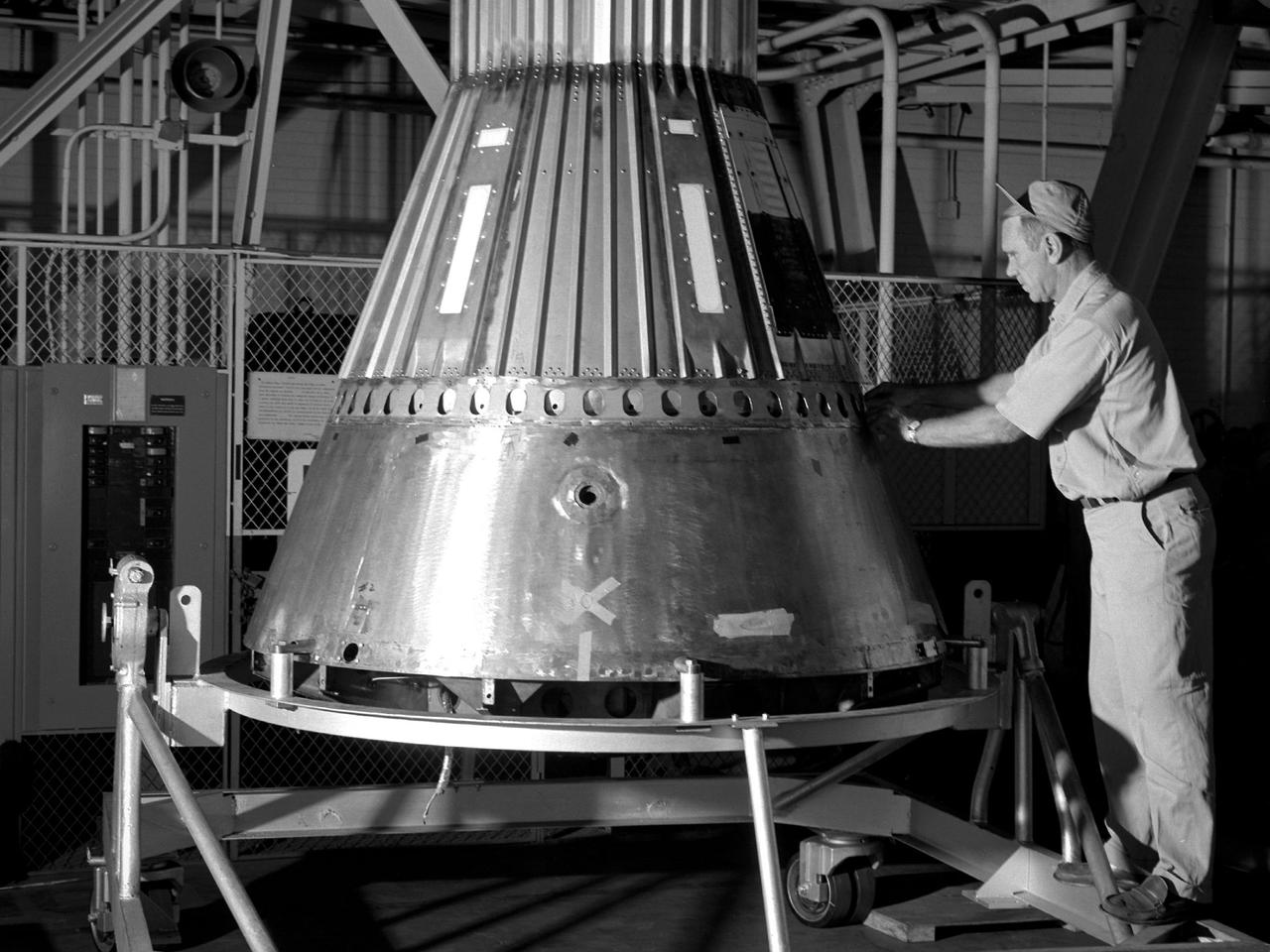
A NASA mechanic secures the afterbody to a Mercury capsule in the hangar at the Lewis Research Center. The capsule was one of two built at Lewis for the “Big Joe” launches scheduled for September 1959. The initial phase of Project Mercury consisted of a series of unmanned launches using the Air Force’s Redstone and Atlas boosters and the Langley-designed Little Joe boosters. The first Atlas launch, referred to as “Big Joe”, was a single attempt early in Project Mercury to use a full-scale Atlas booster to simulate the reentry of a mock-up Mercury capsule without actually placing it in orbit. The overall design of Big Joe had been completed by December 1958, and soon thereafter project manager Aleck Bond assigned NASA Lewis the task of designing the electronic instrumentation and automatic stabilization system. Lewis also constructed the capsule’s lower section, which contained a pressurized area with the electronics and two nitrogen tanks for the retrorockets. Lewis technicians were responsible for assembling the entire capsule: the General Electric heatshield, NASA Langley afterbody and recovery canister, and Lewis electronics and control systems. On June 9, 1959, the capsule was loaded on an air force transport aircraft and flown to Cape Canaveral. A team of 45 test operations personnel from Lewis followed the capsule to Florida and spent the ensuing months preparing it for launch. The launch took place in the early morning hours of September 9, 1959.
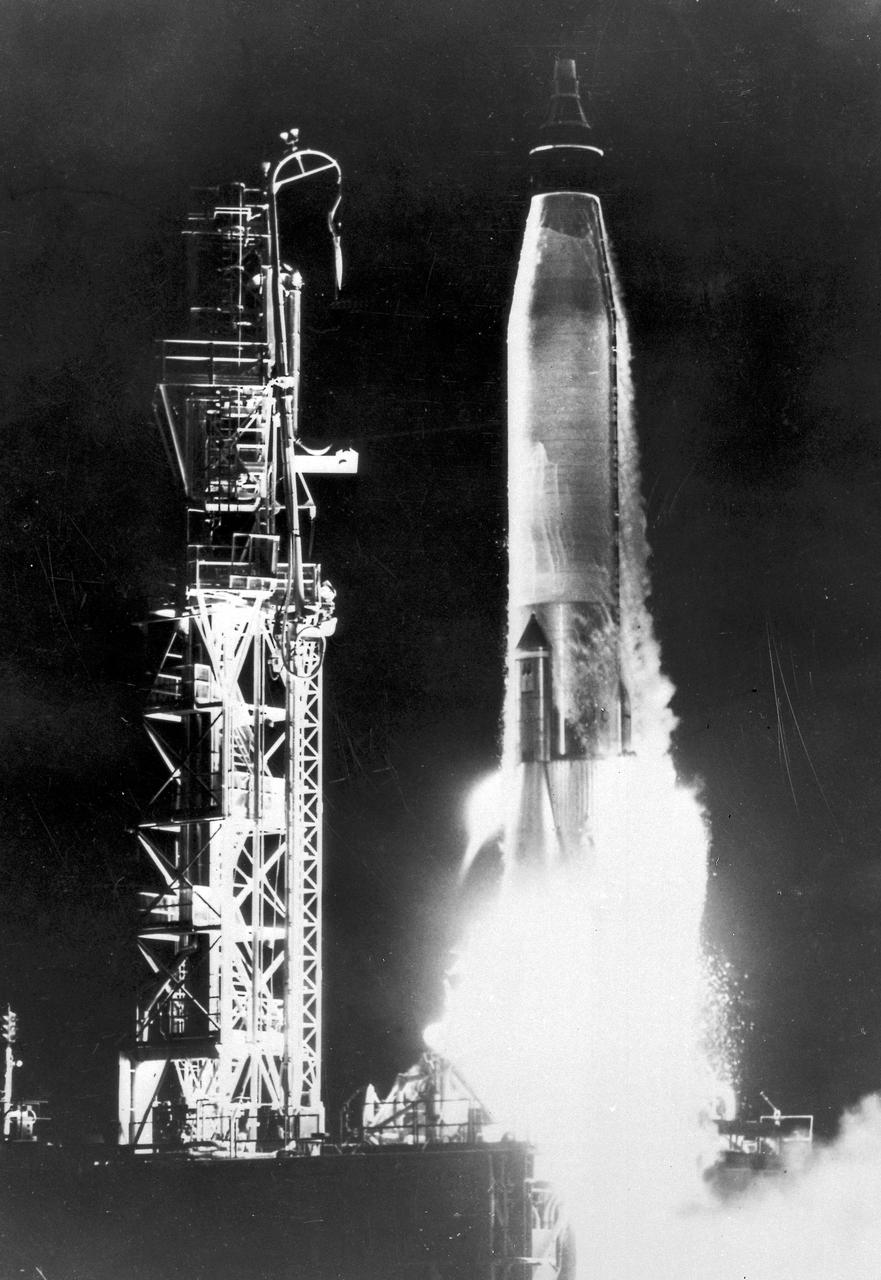
An Atlas launch vehicle carrying the Big Joe capsule leaves its launching pad on a 2,000-mile ballistic flight to the altitude of 100 miles. The Big Joe capsule is a boilerplate model of the marned orbital capsule under NASA's Project Mercury. The capsule was recovered and studied for the effect of re-entry heat and other flight stresses.
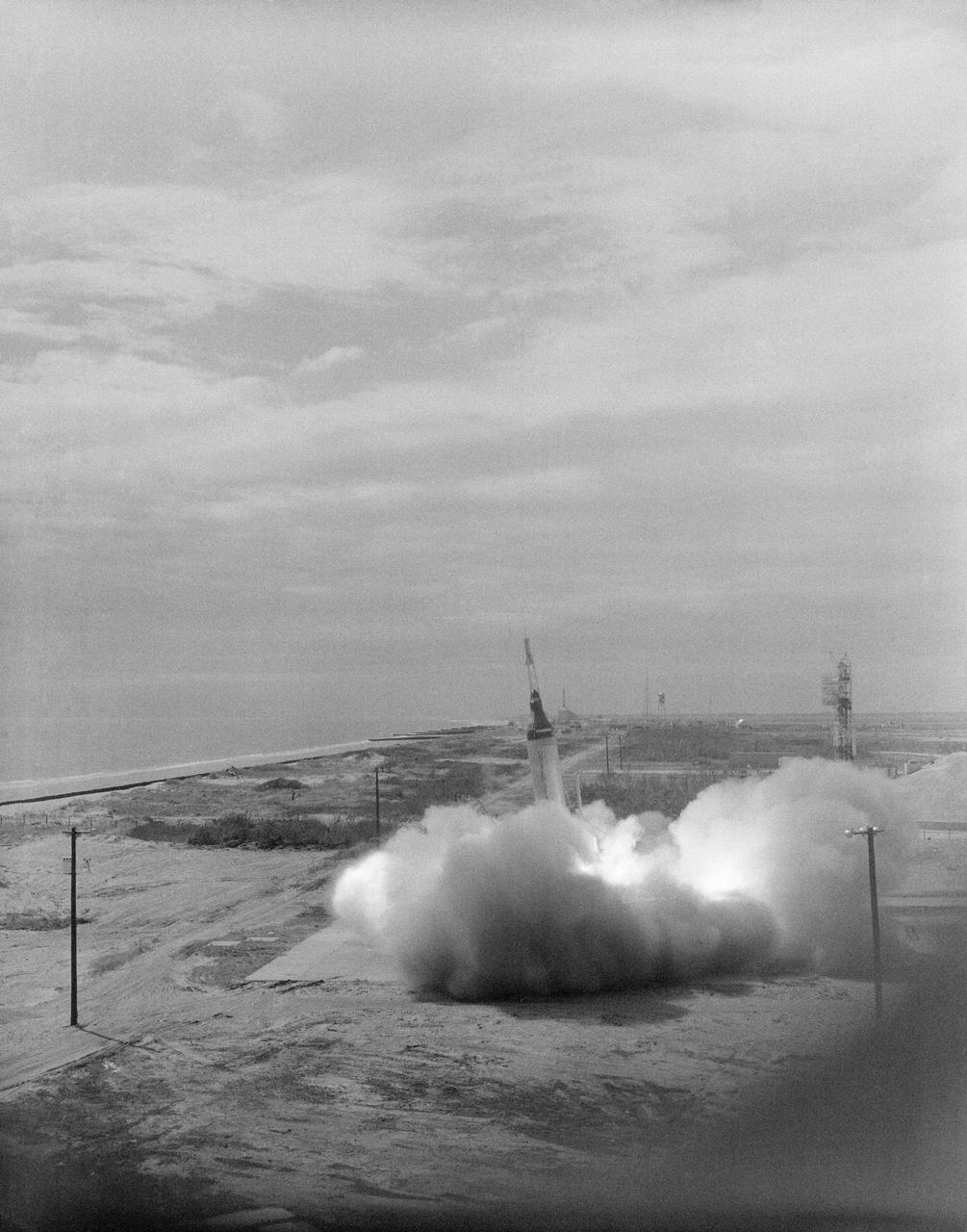
S61-01372 (21 Feb. 1961) --- Launch of the unmanned Mercury-Atlas 2 (MA-2) vehicle for a suborbital test flight of the Mercury capsule. The upper part of Atlas is stengthened by an eight-inch wide stainless steel band. The capsule was recovered less than one hour after launch. The altitude was 108 miles. Speed was 13,000 mph. Recovered 1,425 miles downrange. Photo credit: NASA
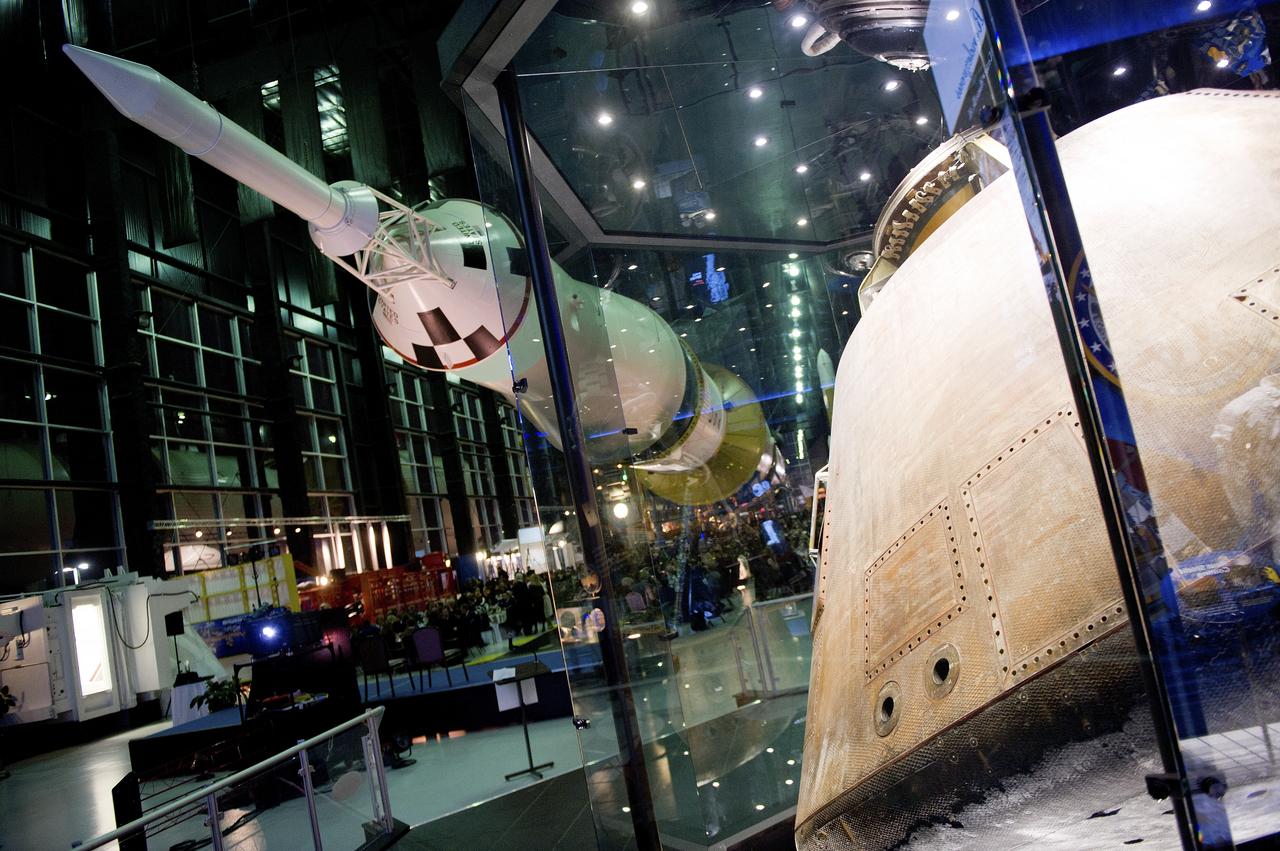
THE APOLLO 16 CAPSULE SITS ON DISPLAY IN THE FOREGROUND OF AN EVENT AT THE DAVIDSON CENTER.
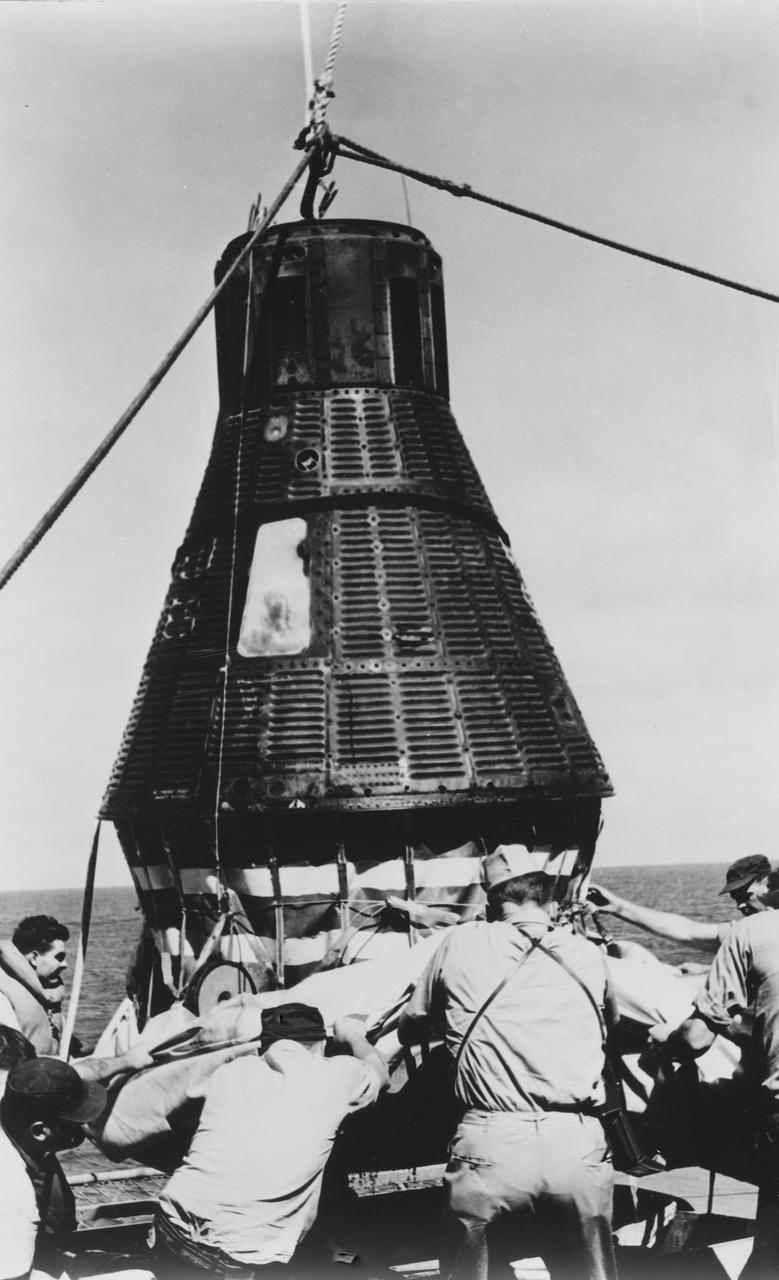
S62-06175 (3 Oct. 1962) --- Closeup view of the Mercury-Atlas 8 (MA-8) Sigma 7 capsule being lowered to recovery ship's deck. Navy personnel remove the floatation device before opening the capsule. Photo credit: NASA
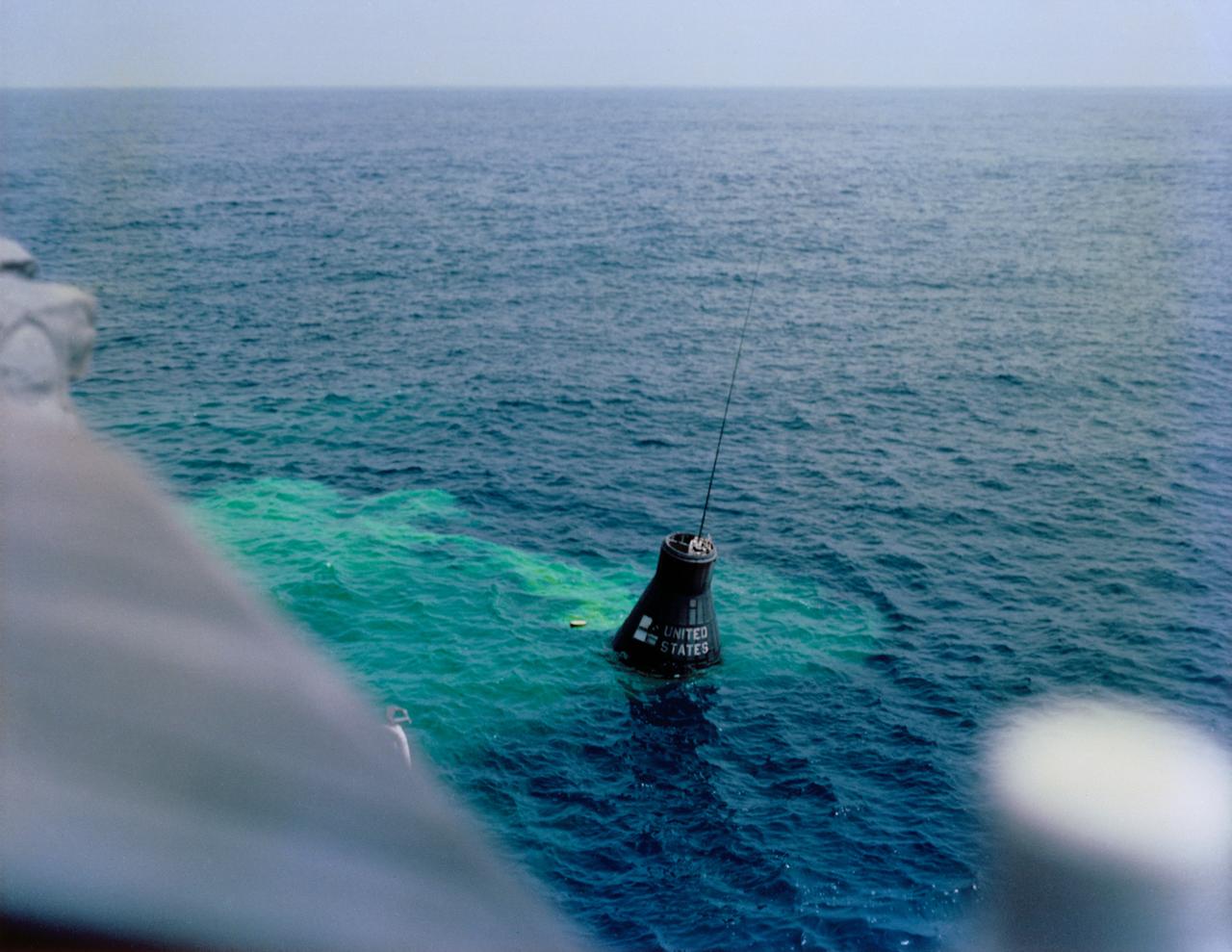
S61-03256 (13 Sept. 1961) --- Recovery of Mercury spacecraft at end of the Mercury-Atlas 4 (MA-4) mission. Notice the extended antenna on top of the capsule. Photo credit: NASA

Artist rendering of NASA Stardust capsule returning to Earth. The Stardust spacecraft will bring back samples of interstellar dust, including recently discovered dust streaming into our Solar System from the direction of Sagittarius.
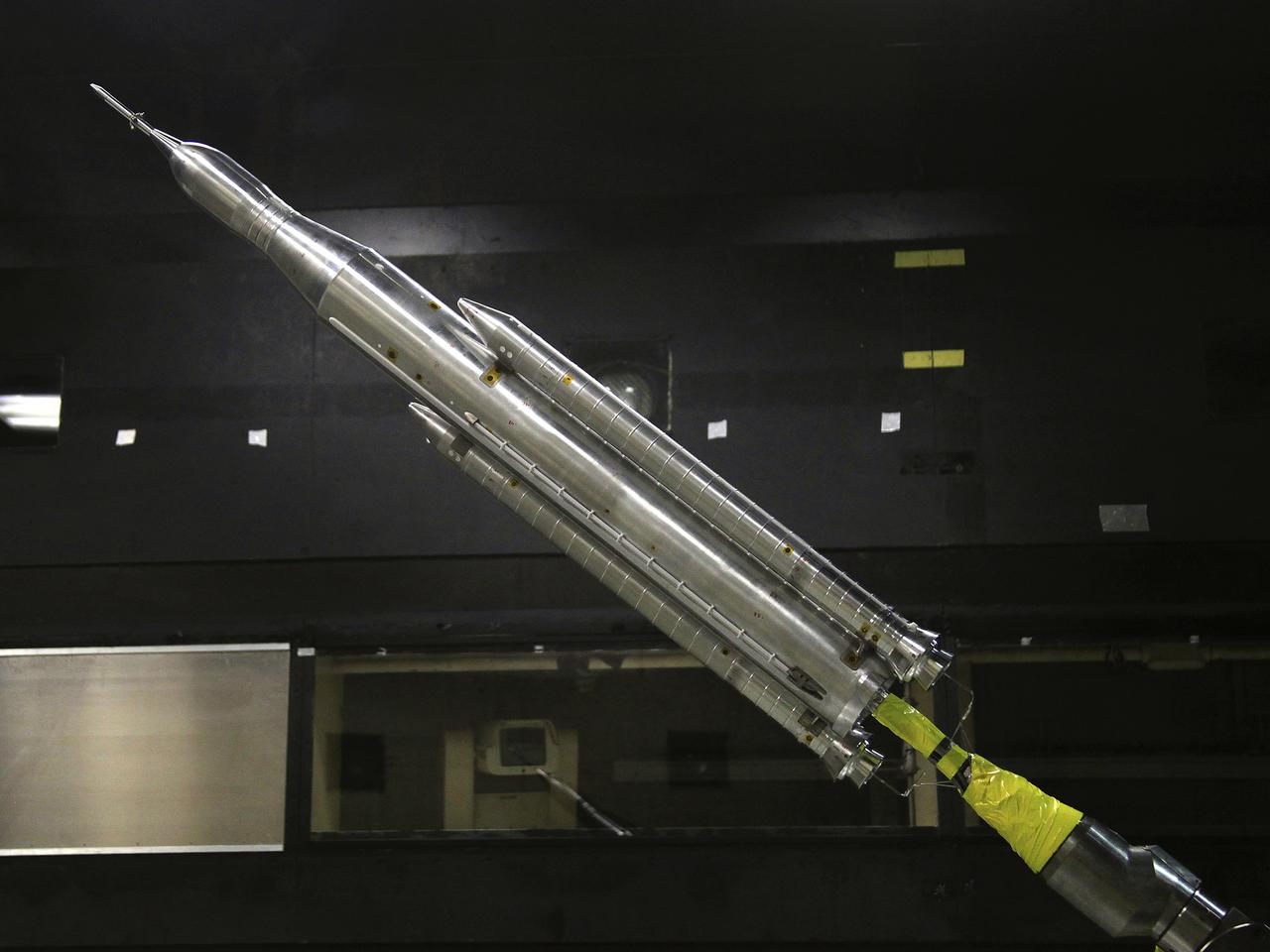
The model of the Space Launch System for the Orion Space Capsule is being prepared for windtunnel test in the 14x22 Subsonic windtunnel at NASA Langley.
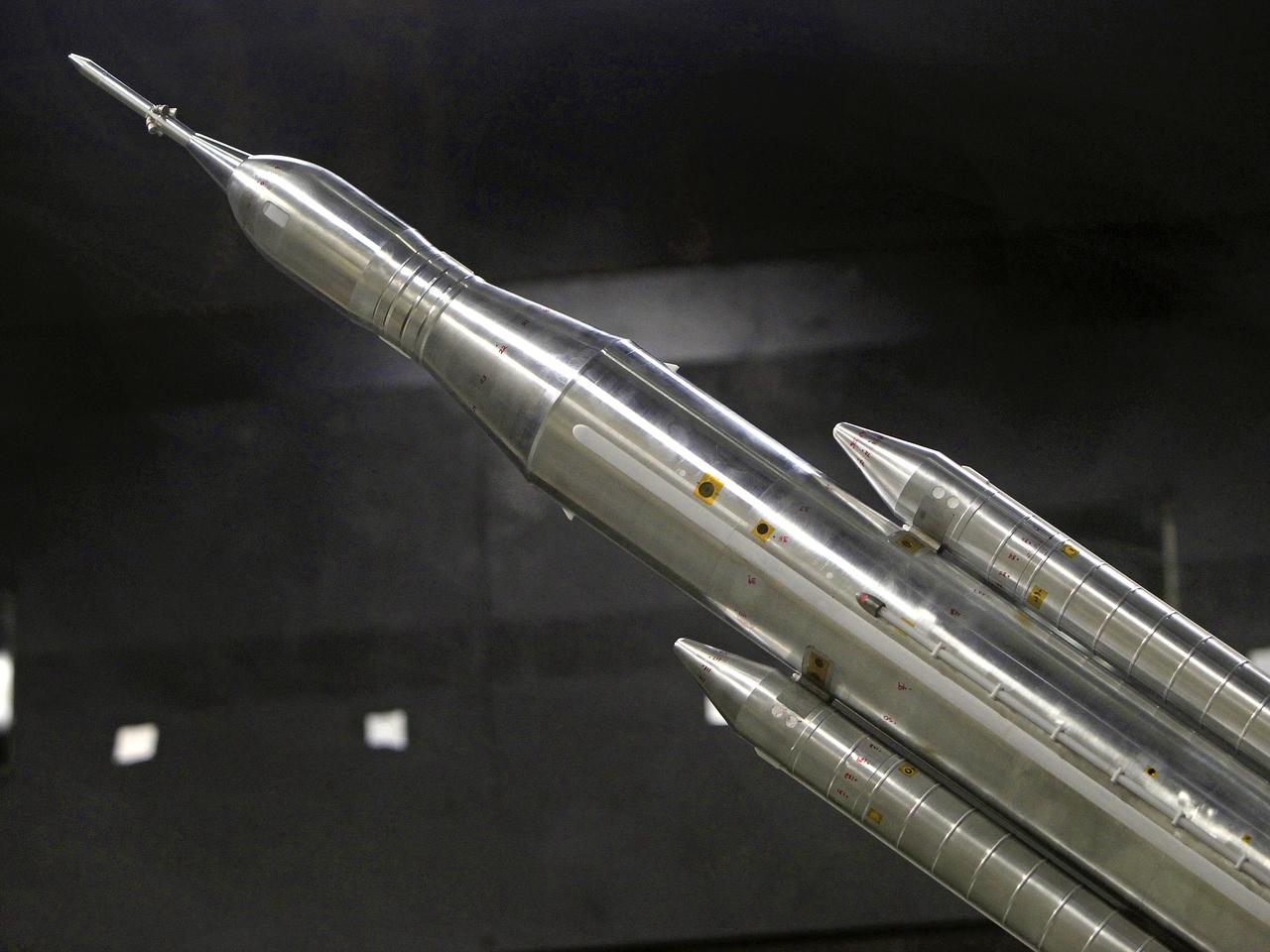
The model of the Space Launch System for the Orion Space Capsule is being prepared for windtunnel test in the 14x22 Subsonic windtunnel at NASA Langley.
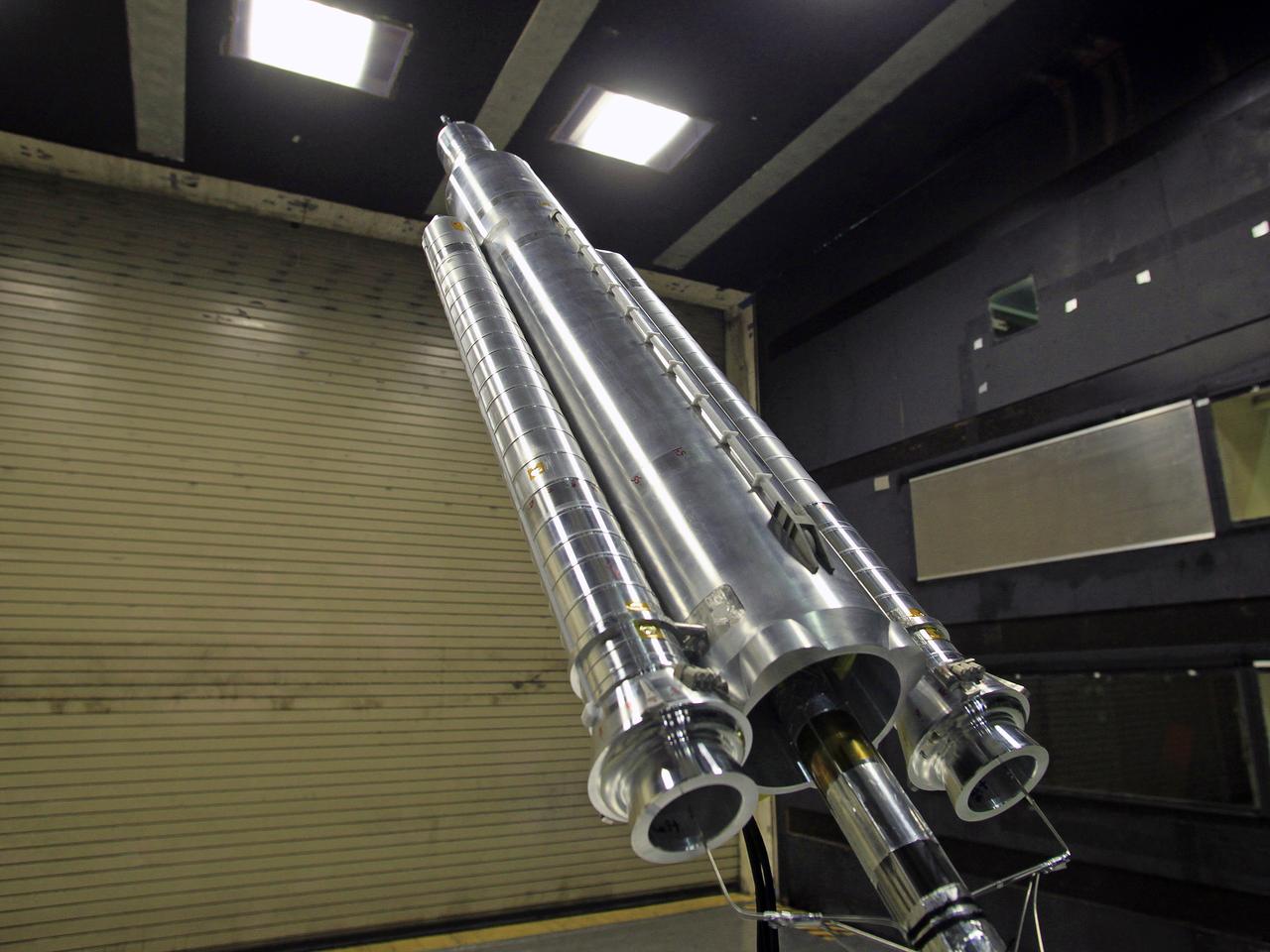
The model of the Space Launch System for the Orion Space Capsule is being prepared for windtunnel test in the 14x22 Subsonic windtunnel at NASA Langley.
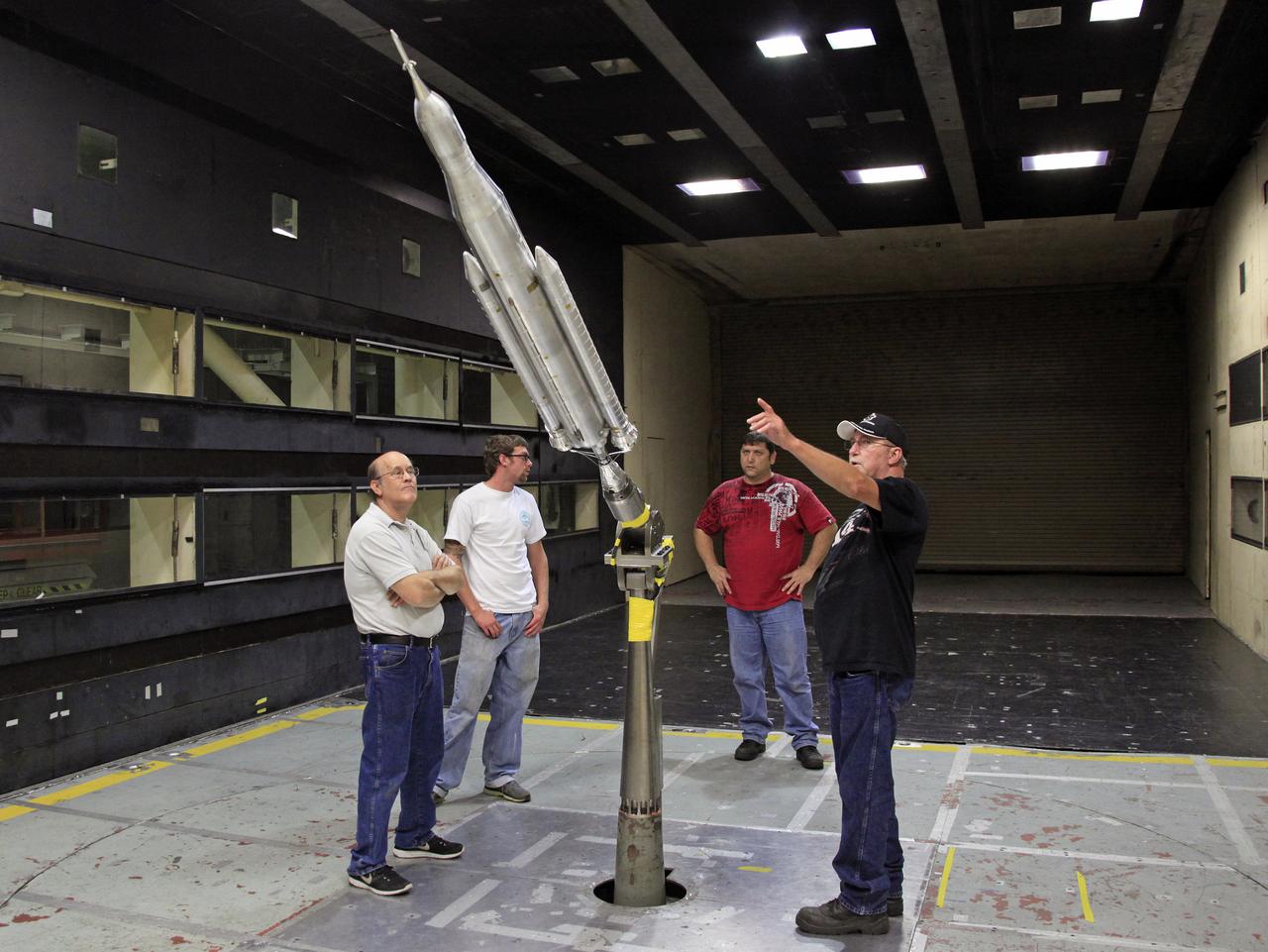
The model of the Space Launch System for the Orion Space Capsule is being prepared for windtunnel test in the 14x22 Subsonic windtunnel at NASA Langley.
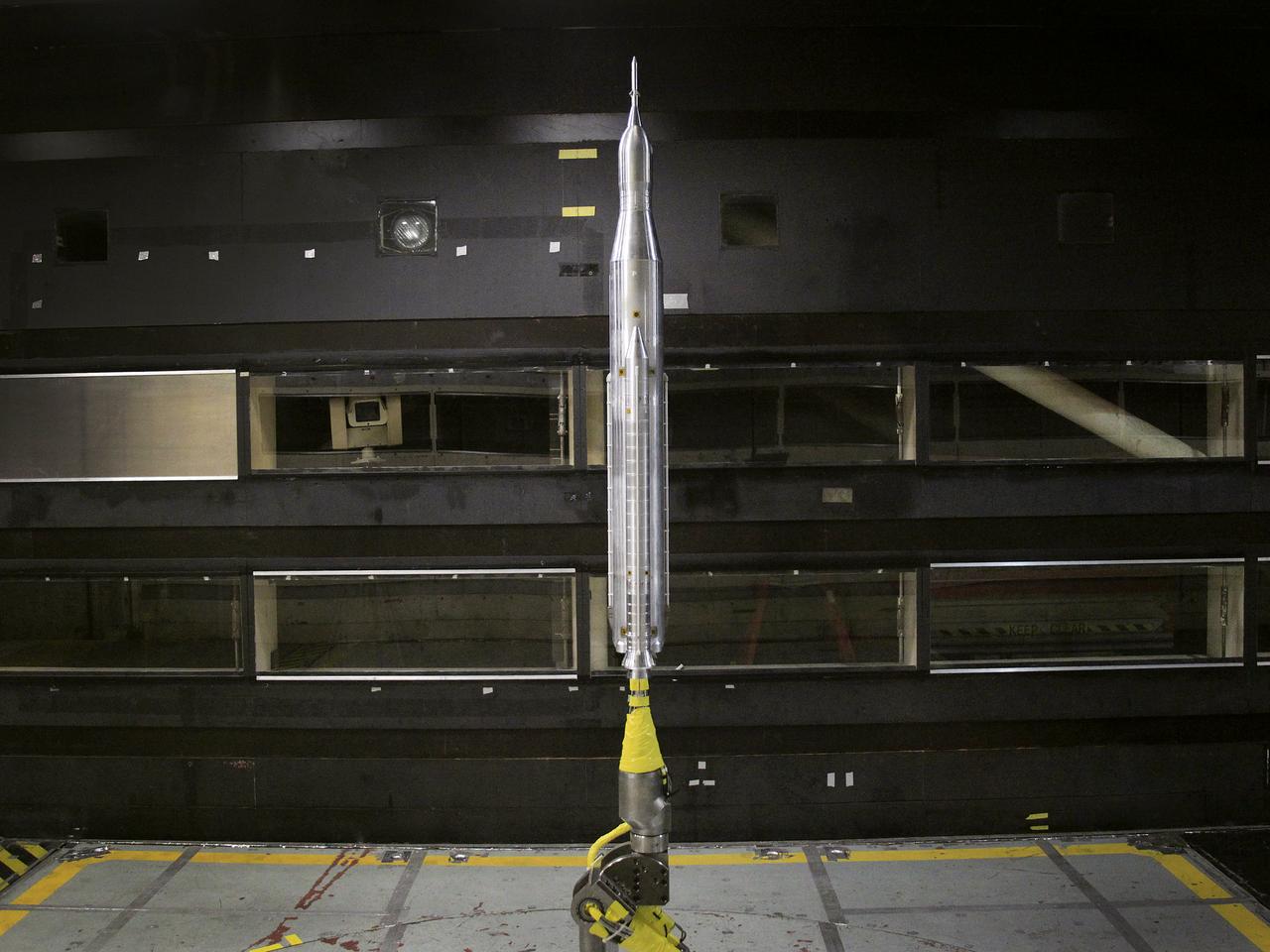
The model of the Space Launch System for the Orion Space Capsule is being prepared for windtunnel test in the 14x22 Subsonic windtunnel at NASA Langley.
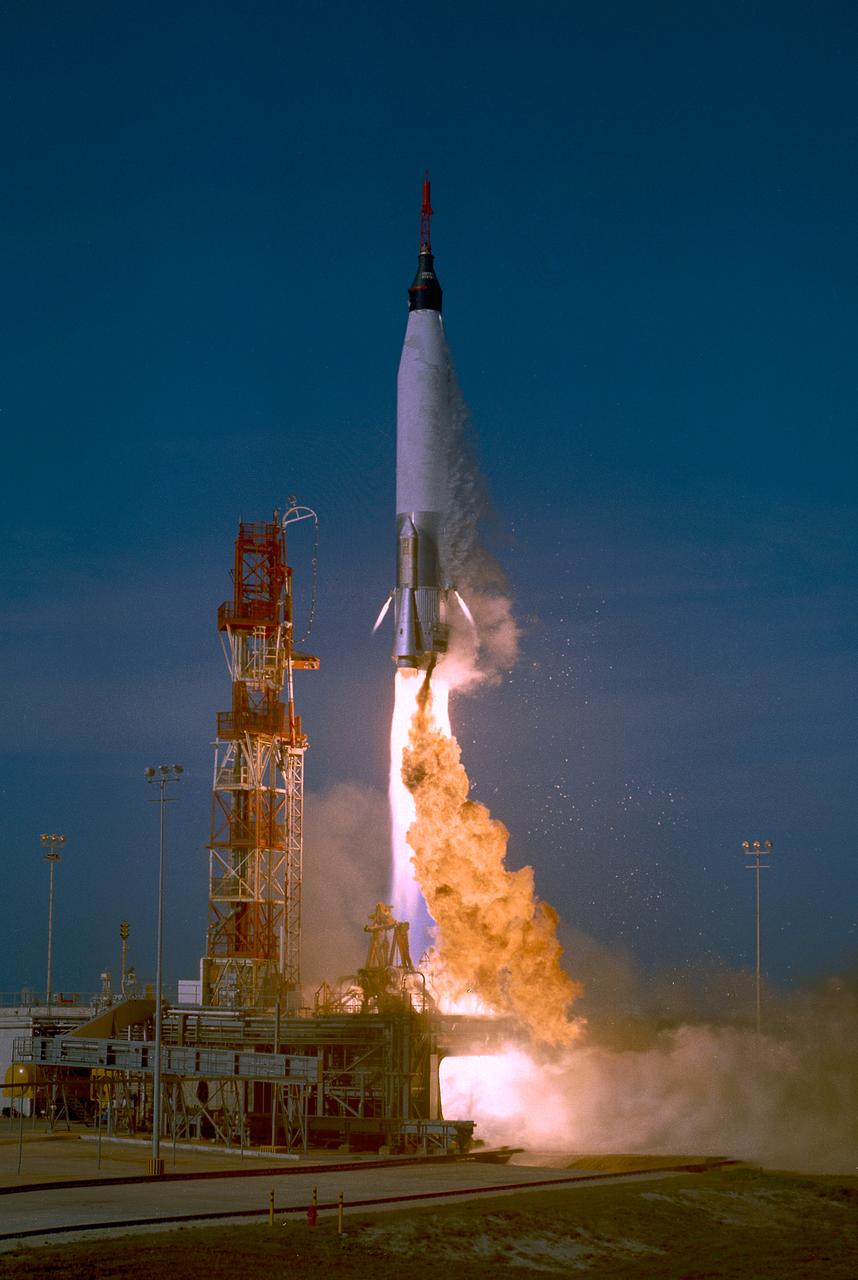
The launch of the Mercury Atlas (MA-2), an unmarned suborbital Mercury capsule test on February 24, 1961.
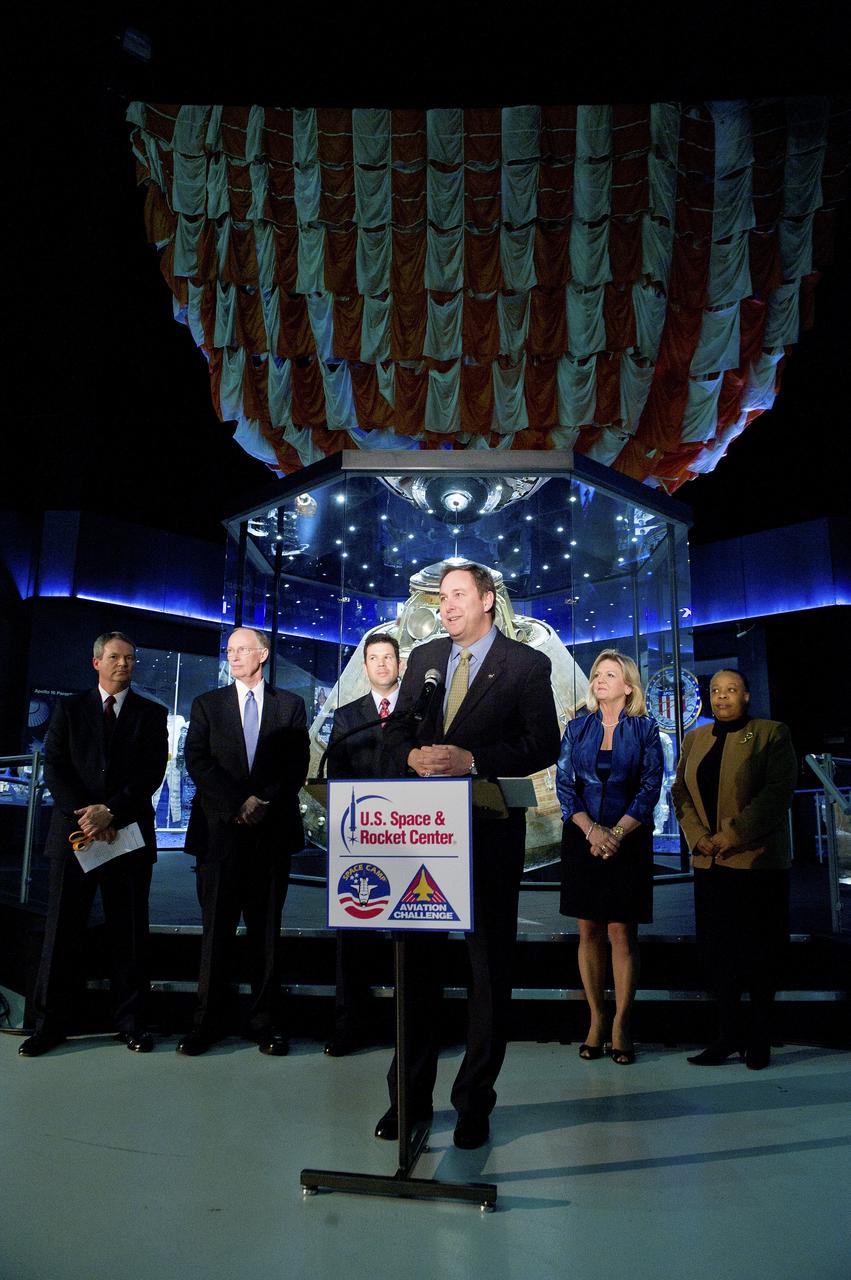
MSFC DIRECTOR ROBERT LIGHTFOOT SPEAKS AFTER THE DEDICATION OF THE APOLLO 16 CAPSULE ON DISPLAY AT THE U.S. SPACE AND ROCKET CENTER.
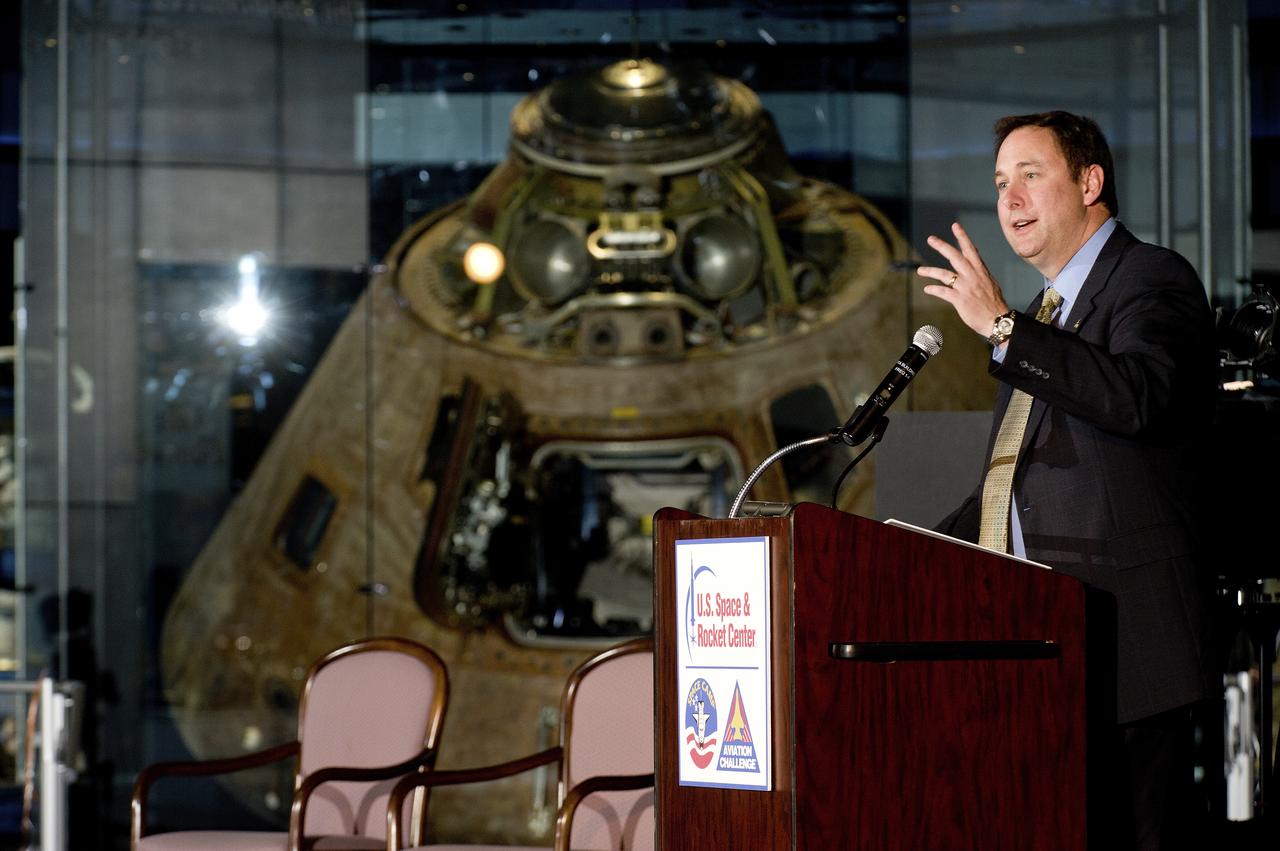
MSFC DIRECTOR ROBERT LIGHTFOOT SPEAKS WITH THE APOLLO 16 CAPSULE AS A BACKDROP AT THE U.S. SPACE AND ROCKET CENTER.
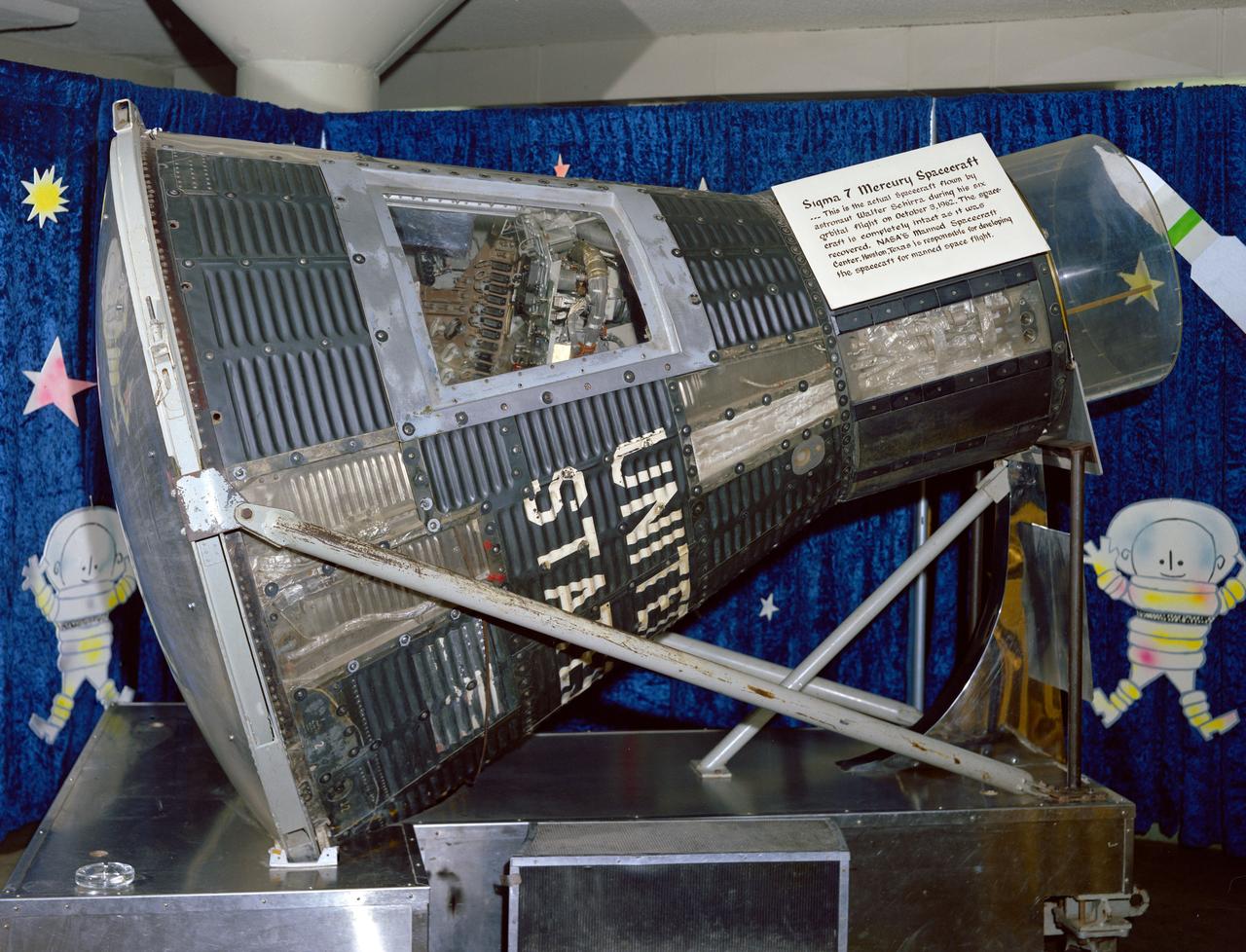
S66-53205 (1966) --- Mercury Atlas (MA-8) Sigma 7 capsule on display at the Johnson Space Center. Photo credit: NASA
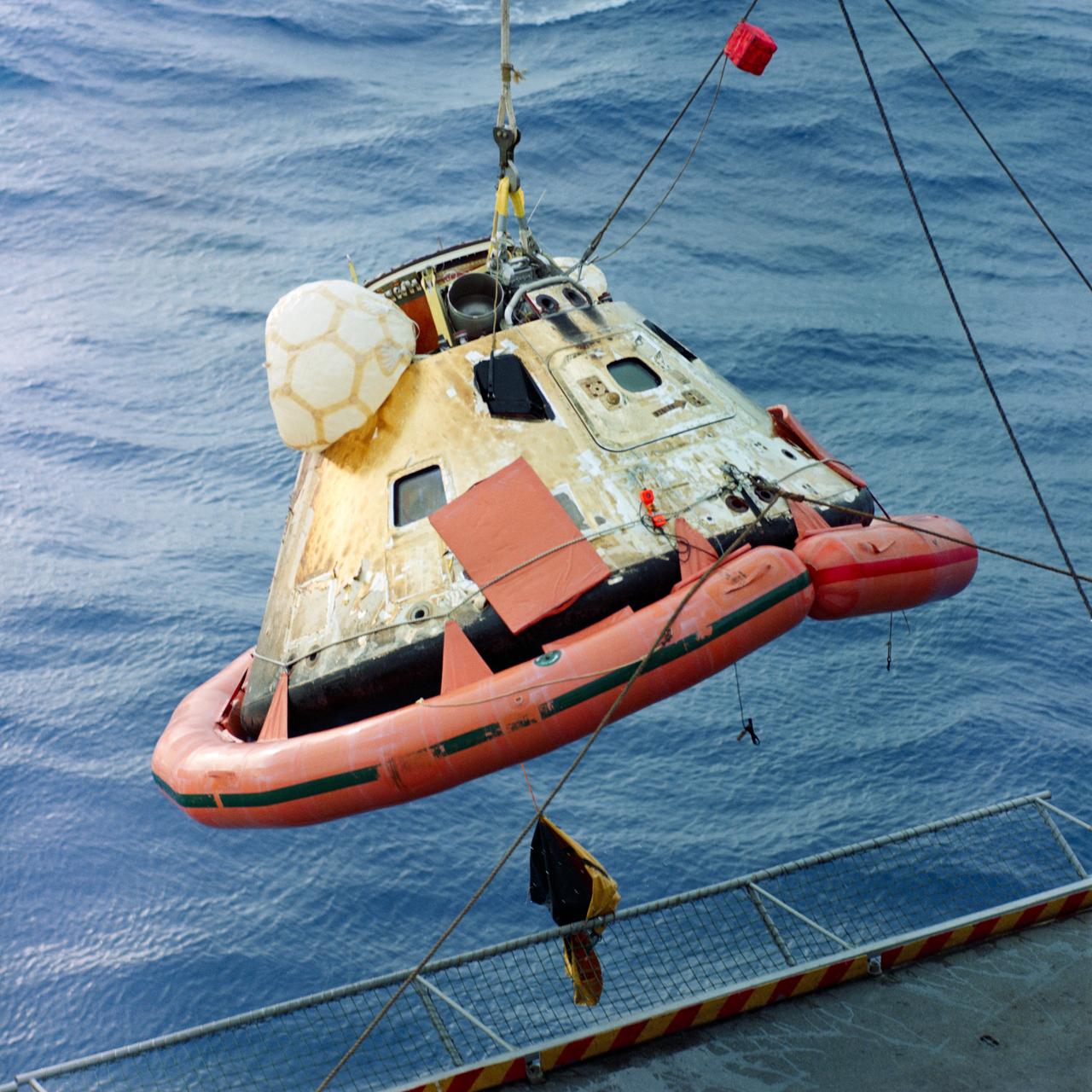
S68-56304 (27 Dec. 1968) --- The Apollo 8 capsule is seen being hoisted aboard the recovery carrier, USS Yorktown after its successful splashdown.
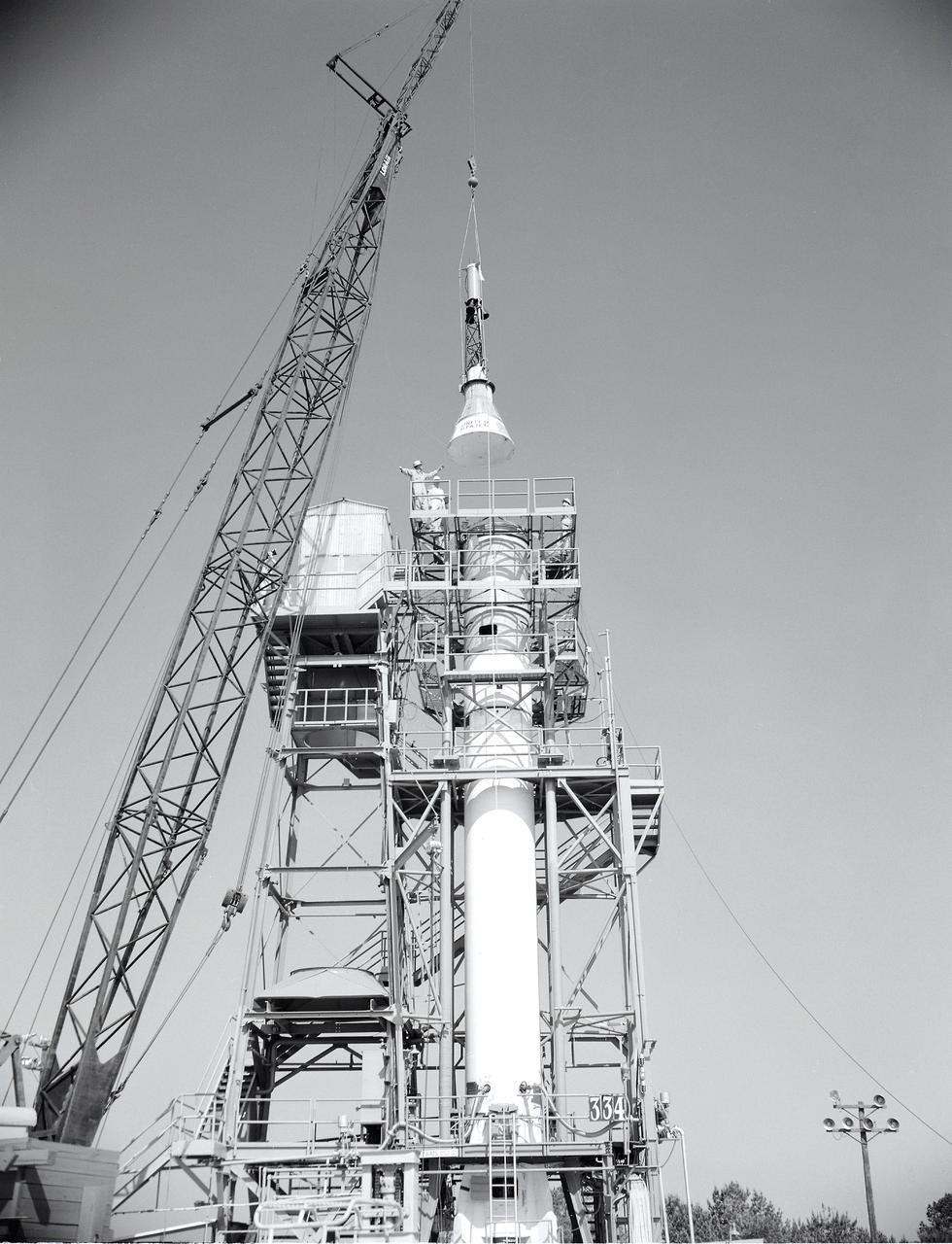
Installation of the Mercury capsule on Redstone booster at the Redstone Test Stand. Assembled at the Marshall Space Flight Center (MSFC), the Mercury-Redstone launch vehicle was designed to place a marned space capsule into orbital flight around the Earth and recover both safely.
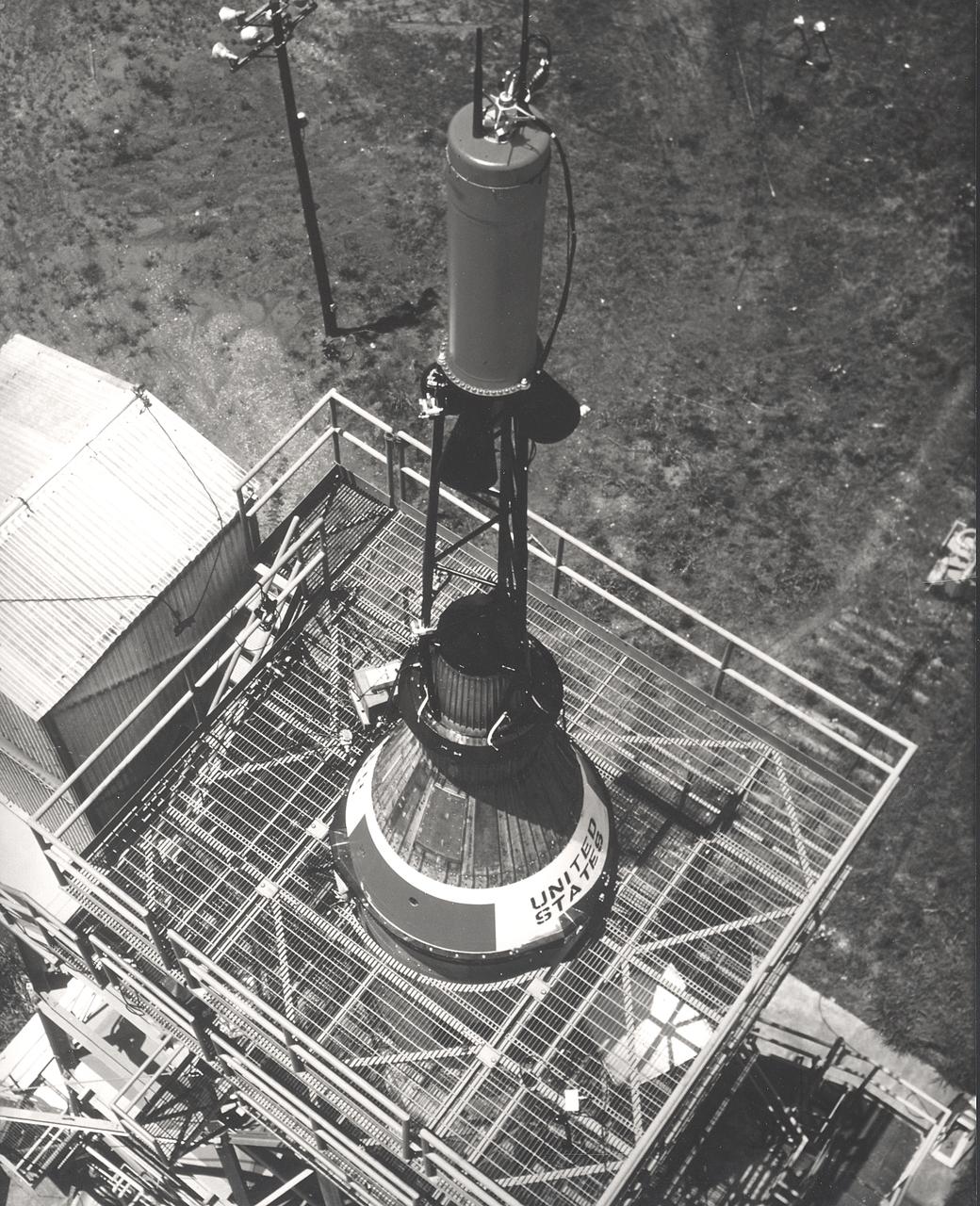
This photograph depicts installation of the Mercury capsule and escape system on top of a booster prior to test firing of the Mercury-Redstone launch vehicle at the Marshall Space Flight Center.
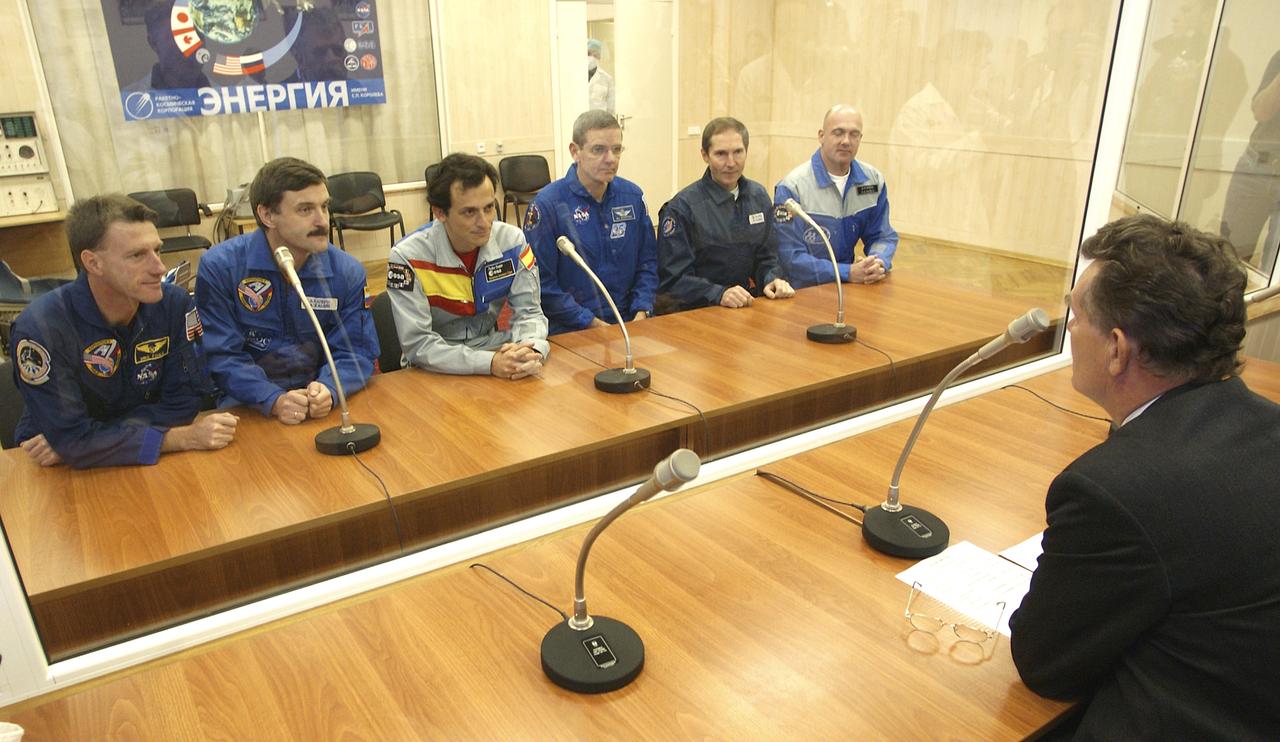
Expedition 8 ISS Commander and NASA Science Officer Michael Foale, far left, Expedition 8 Soyuz Commander and ISS Flight Engineer Alexander Kaleri and European Space Agency astronaut Pedro Duque of Spain, third from left, along with the backup crew (unidentified) are briefed by an official prior to a final inspection of the capsule in the complex' integration facility Monday, Oct. 13, 2003, at the Cosmodrome in Baikonur, Kazakhstan. Foale, Kaleri and Duque launched Oct. 18, 2003 aboard a Soyuz TMA-3 spacecraft enroute to the International Space Station. Photo Credit (NASA/Bill Ingalls)
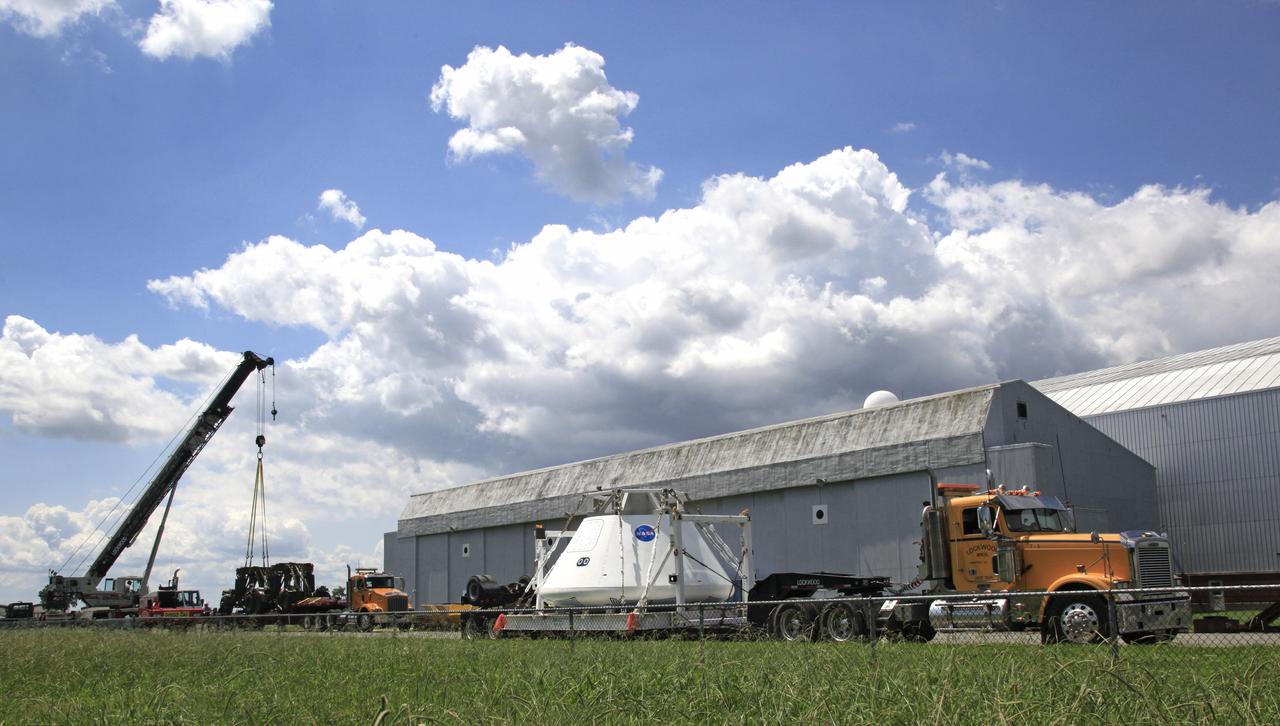
Orion Test Capsule loaded on a flatbed trailer at NASA Langley to be transport to Fort Eustis, VA. where it will be transported by barge to Norfolk Va. for open water recovery test.
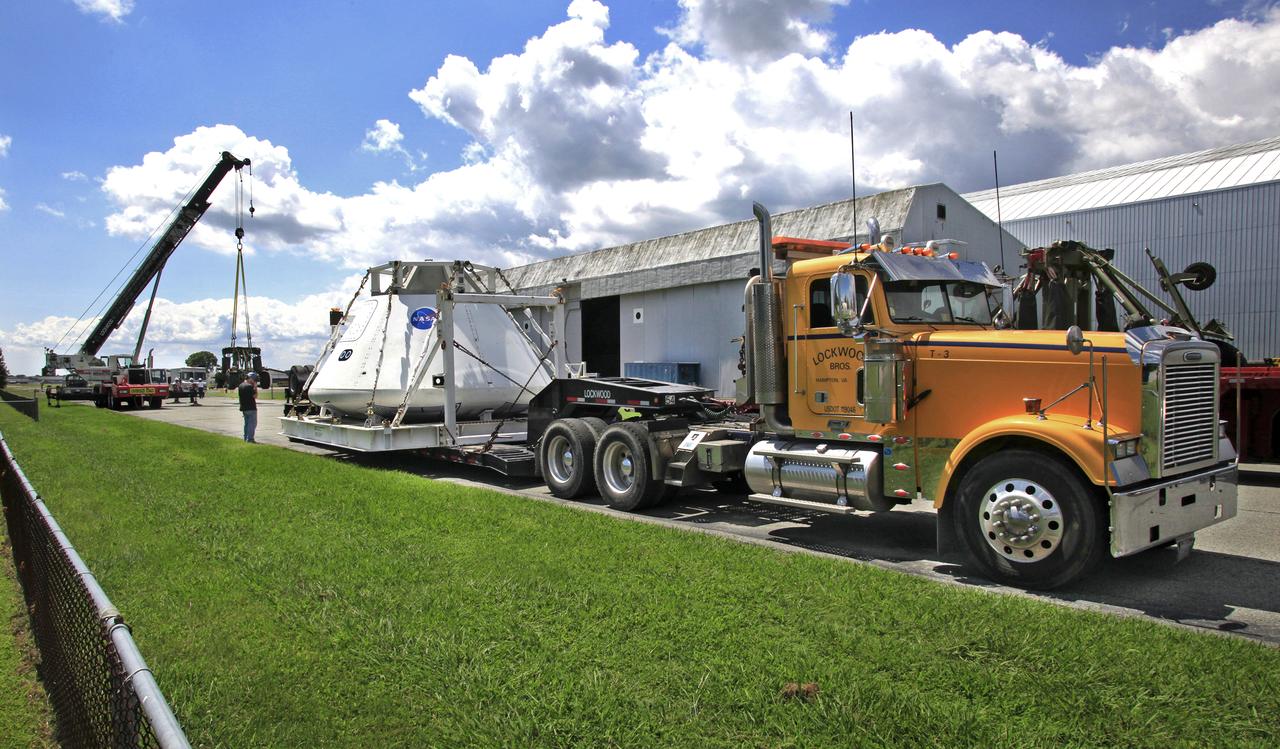
Orion Test Capsule loaded on a flatbed trailer at NASA Langley to be transport to Fort Eustis, VA. where it will be transported by barge to Norfolk Va. for open water recovery test.
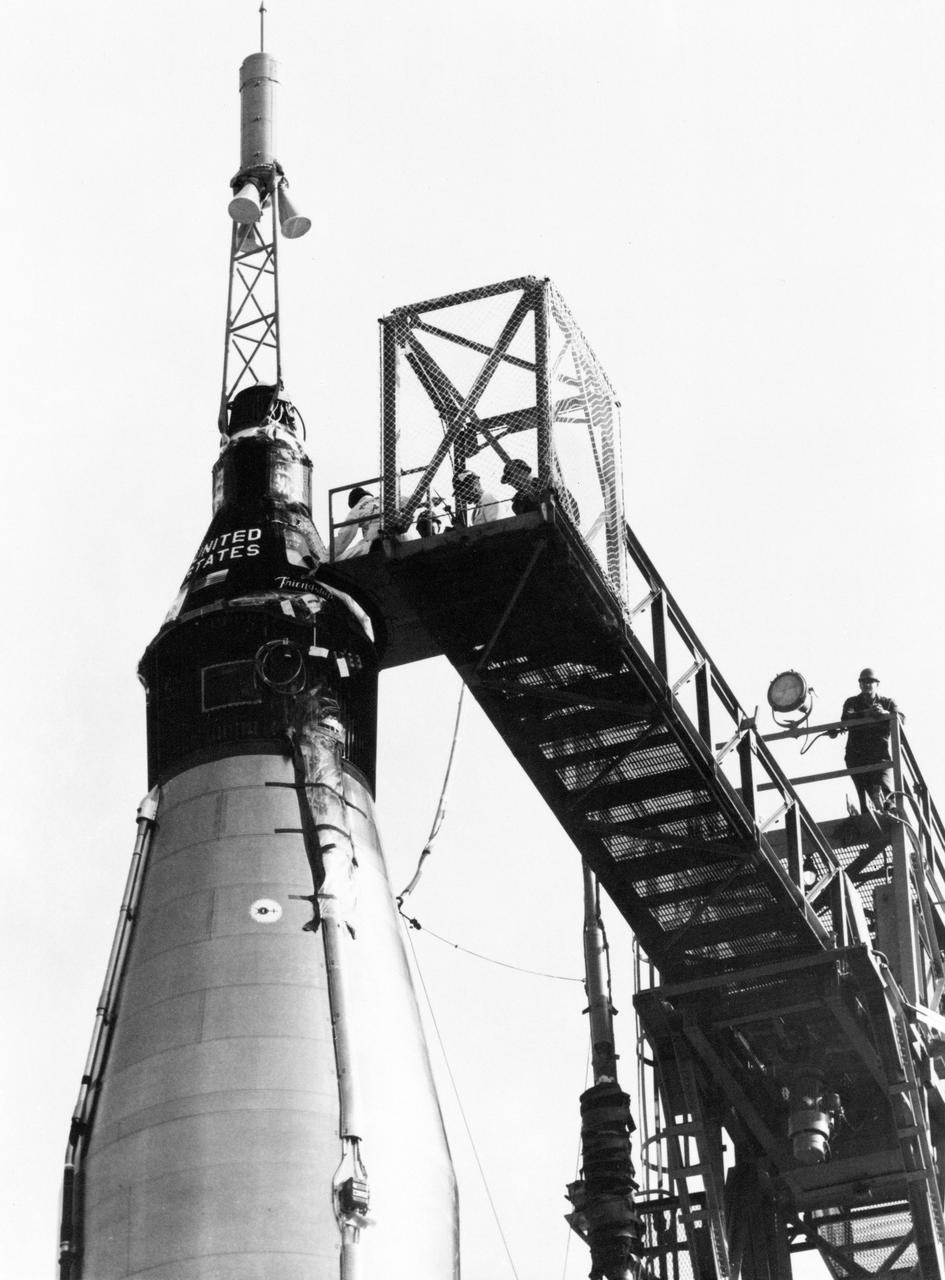
S62-00380 (20 Feb. 1962) --- Close-up view of the Mercury Atlas 6 (MA-6) Friendship 7 capsule on top of its booster rocket with catwalk still attached. Photo credit: NASA
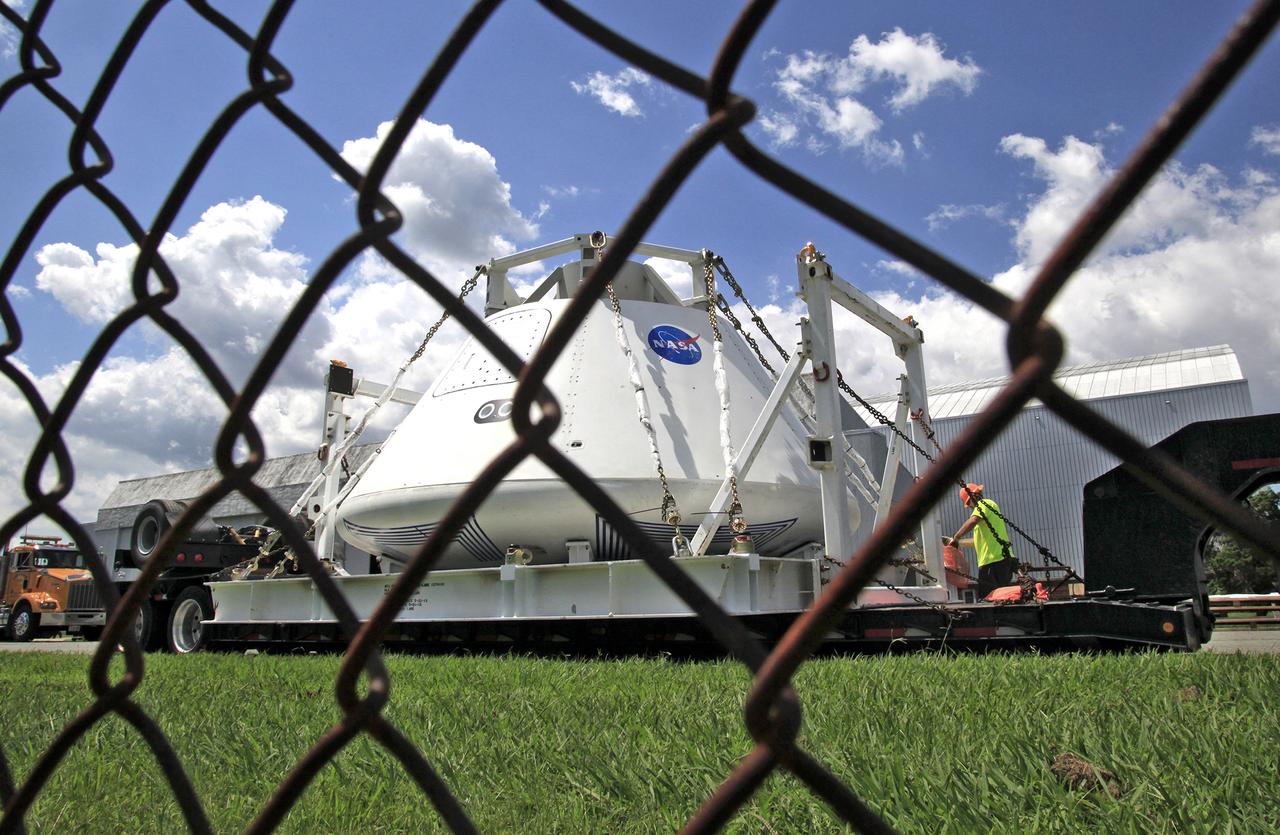
Orion Test Capsule loaded on a flatbed trailer at NASA Langley to be transport to Fort Eustis, VA. where it will be transported by barge to Norfolk Va. for open water recovery test.
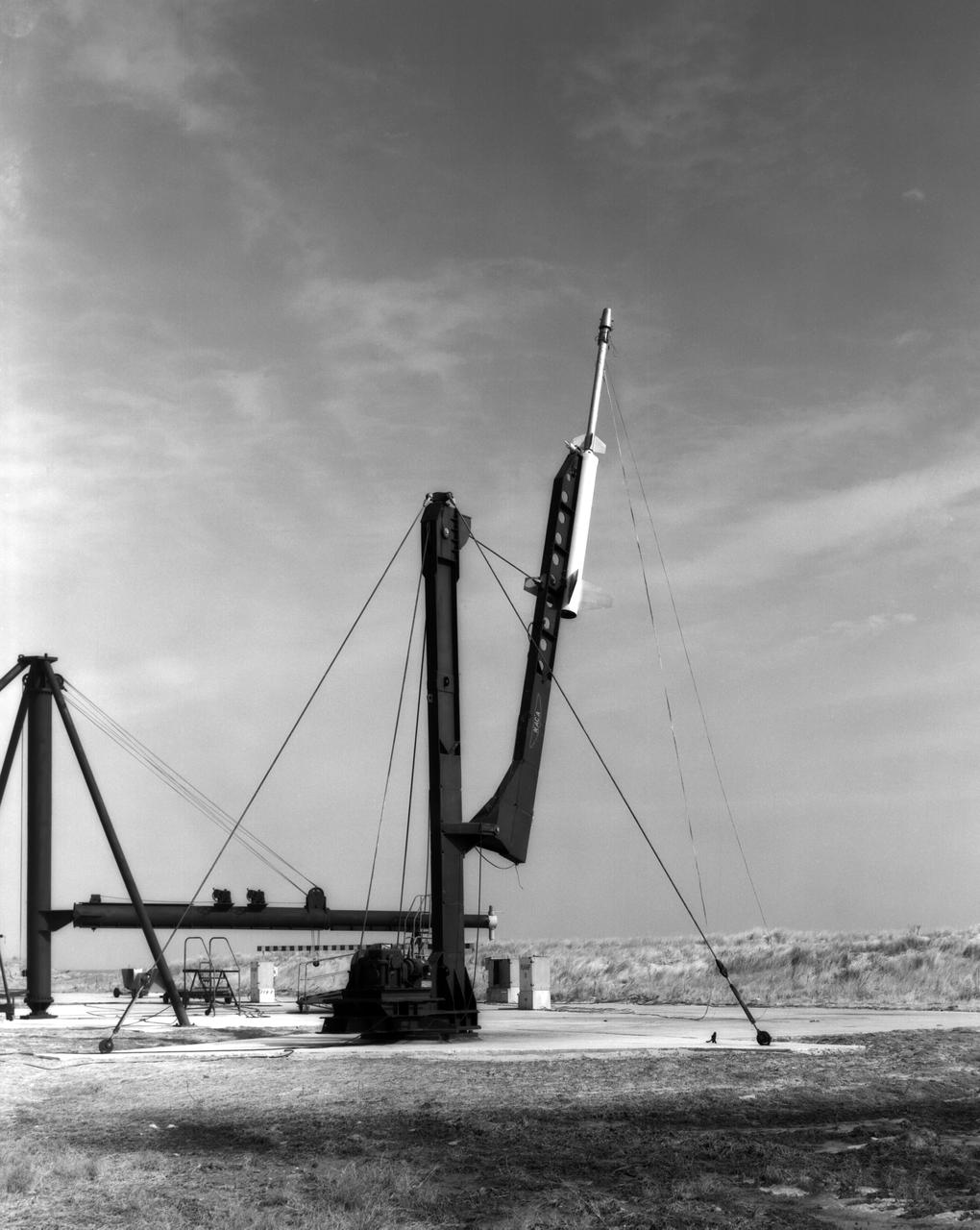
Photographed on: 12 16 58. -- L58-1083a caption: Sequenced pictures showing events from release of boilerplate Mercury capsule from C-130 airplane to opening of recovery parachute, December 1958. Photograph published in A New Dimension Wallops Island Flight Test Range: The First Fifteen Years by Joseph Shortal. A NASA publication, page 644.
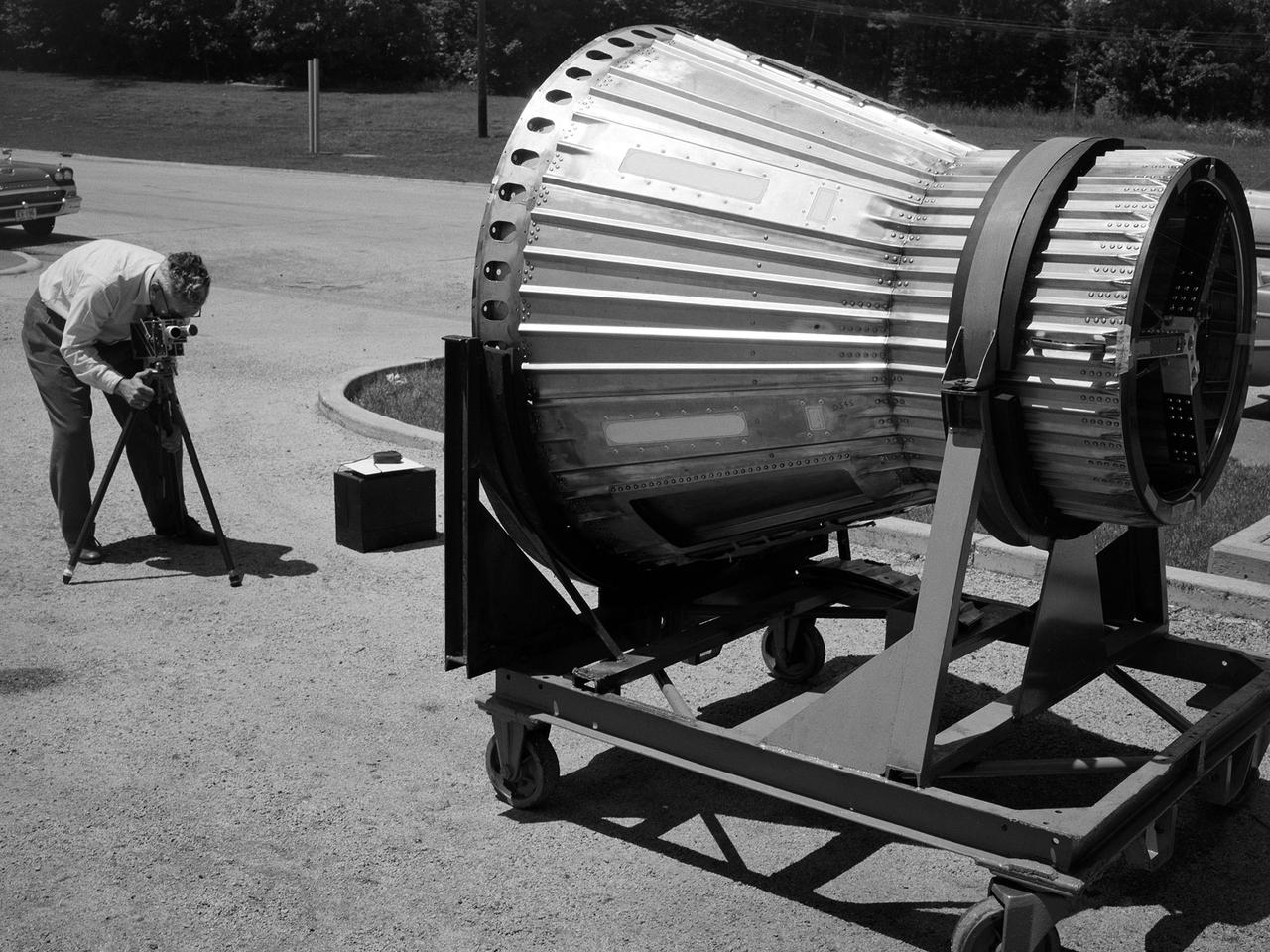
National Aeronautics and Space Administration (NASA) photographer Arthur Laufman sets up a camera to film a Mercury capsule that was constructed by the Lewis Research Center staff. Lewis engineers and mechanics built two of the capsules for the upcoming Big Joe launches in September 1959. Big Joe was an attempt early in Project Mercury to use a full-scale Atlas booster to simulate the reentry of a mock-up Mercury capsule without actually placing it in orbit. The Photographic Branch, referred to as the Photo Lab, was part of the center’s Technical Reports Division. Originally the group performed normal and high-speed still image and motion picture photography. The photographers documented construction, performed publicity work, created images for reports, photographed data on manometer boards, and recorded test footage. Laufman joined the Photo Lab staff in 1948 and began producing full-length technical films as a tool to educate those outside of the agency on the research being conducted at Lewis. He worked with engineers to determine proper subjects for these films and develop a script. Laufman not only filmed tests, but also supporting footage of facilities, models, and staff members. He then edited the footage and added audio, visuals, and narration. The film masters were assigned standard identification numbers and add to the Photo Lab’s catalogue.
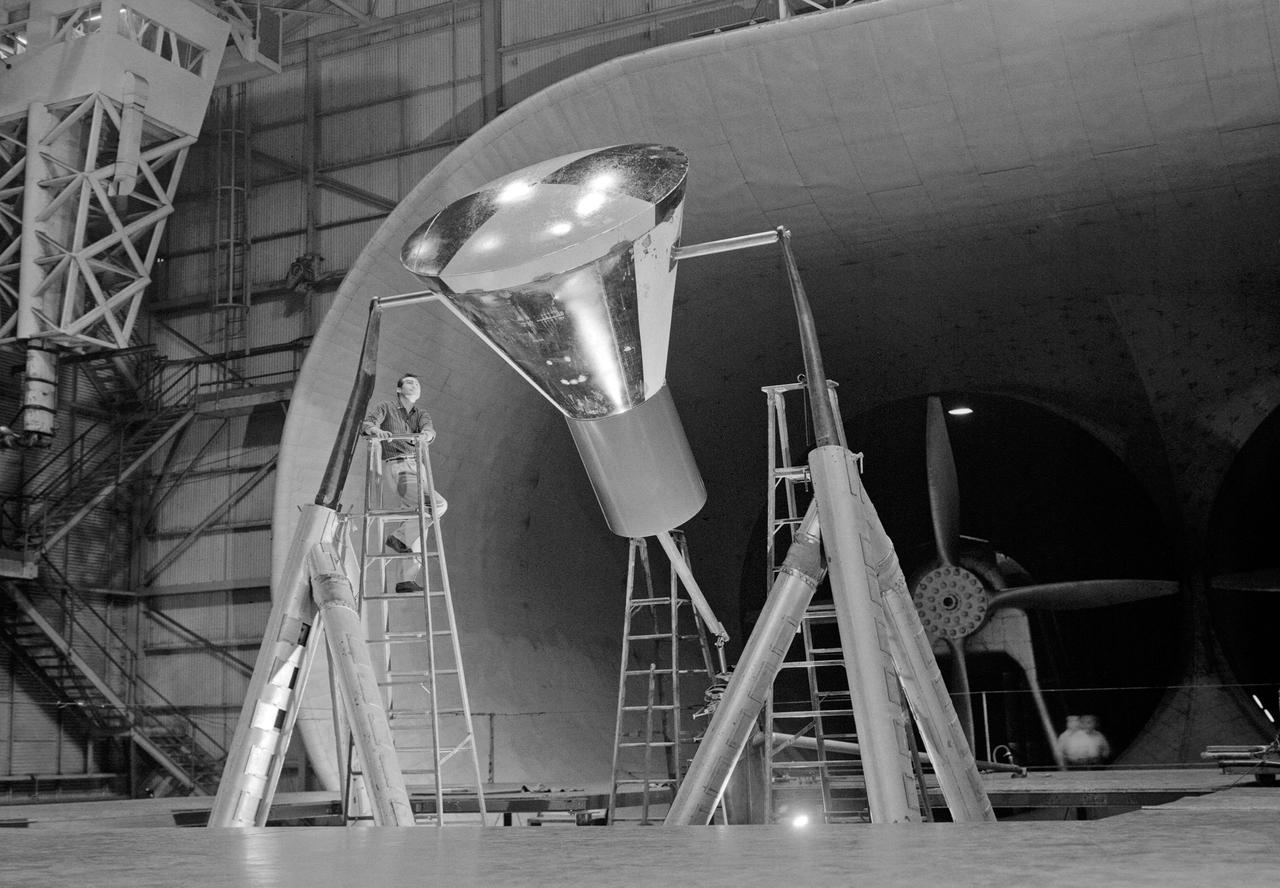
The Mercury space capsule undergoing tests in Full Scale Wind Tunnel, January 1959. Photograph published in Winds of Change, 75th Anniversary NASA publication, page 75, by James Schultz. Also Photograph published in Engineer in Charge: A History of the Langley Aeronautical Laboratory, 1917-1958, page 389, by James R. Hansen.
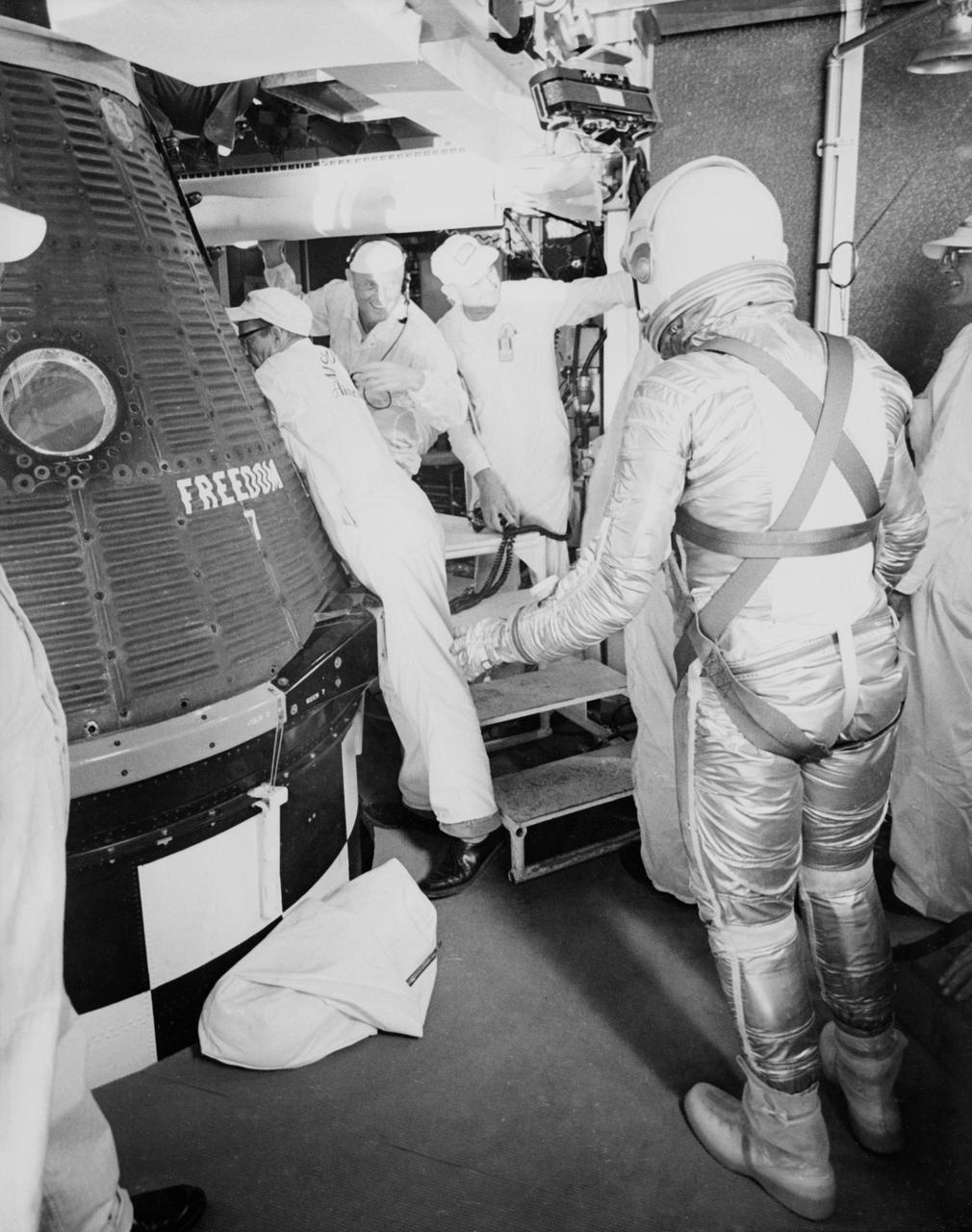
S61-02792 (5 May 1961) --- Astronaut Alan B. Shepard Jr., in his pressure suit and helmet, approaches the Freedom 7 capsule in preparation for insertion before the Mercury-Redstone 3 (MR-3) mission. Photo credit: NASA or National Aeronautics and Space Administration
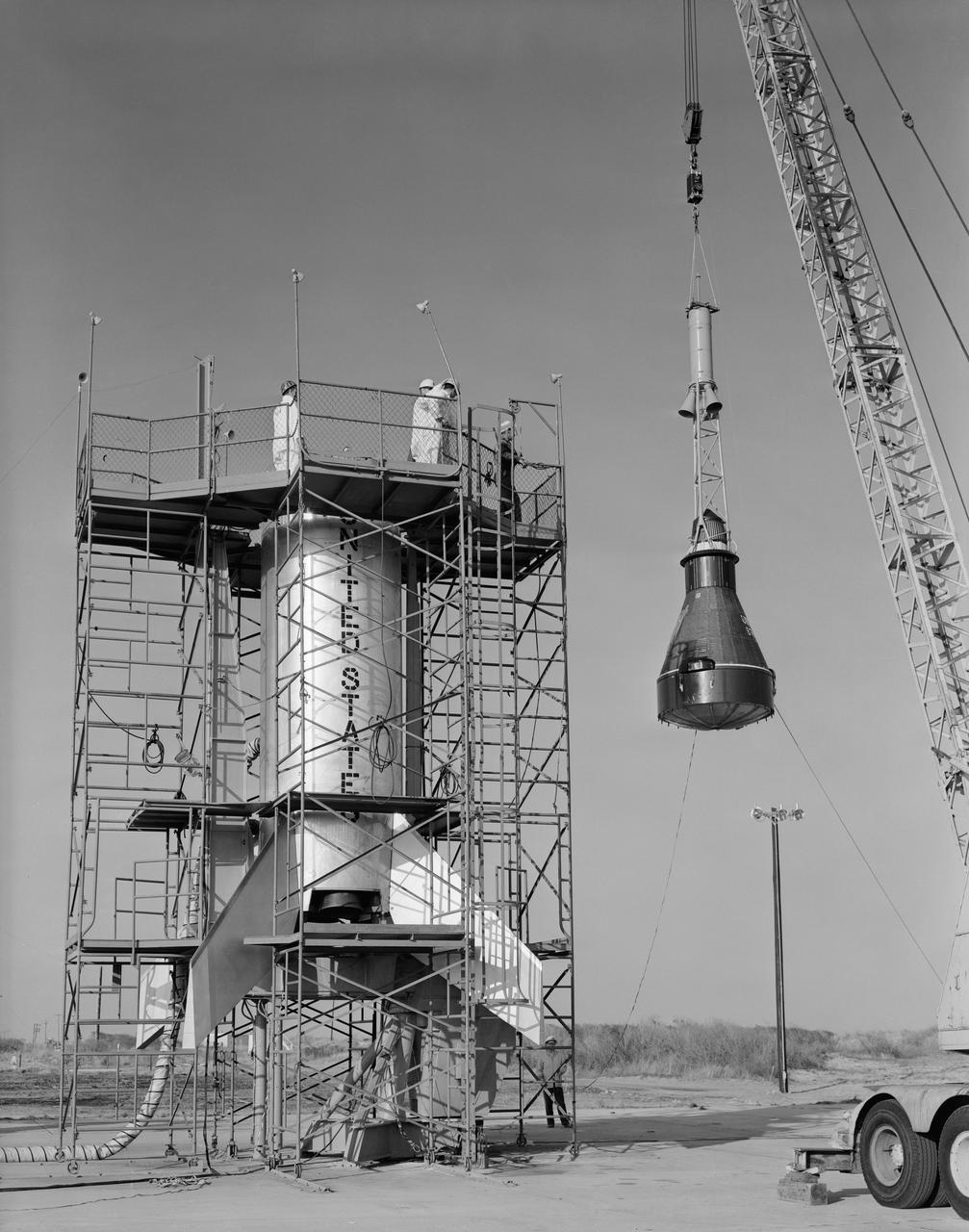
S61-01673 (23 April 1961) --- View of the mating of Little Joe-5B launch vehicle with Mercury capsule #14. Photo credit: NASA
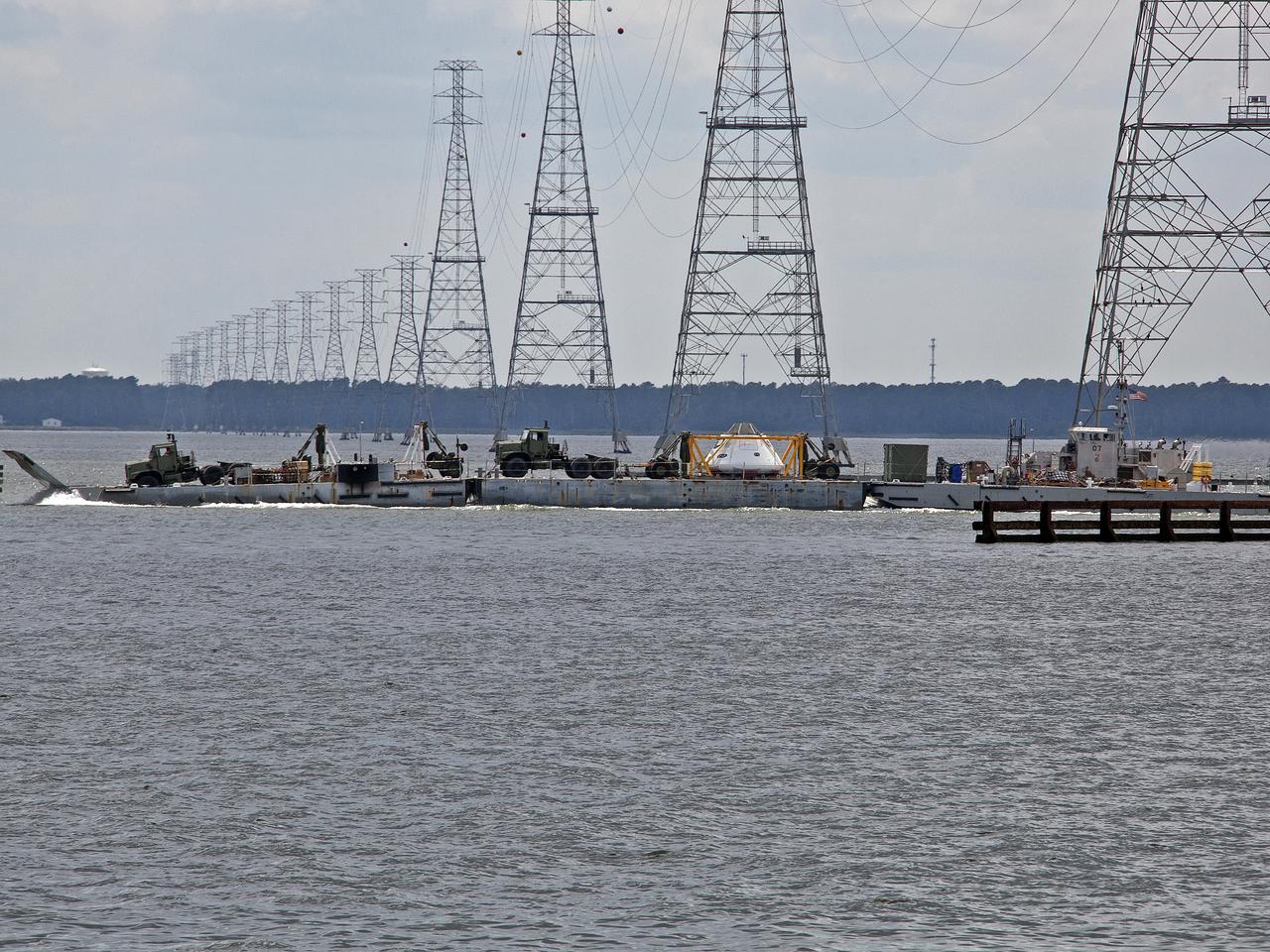
The Orion Test Capsule and a number of other items used in the capsule recovery at being transported down the James River on a Navy INLS "Improved Navy Lighterage System" from Fort Eustis from where it was loaded. Its liquid route will take them to Little Creek Amphibious Base in Norfolk, where it will stay until scheduled recovery test will be performed.
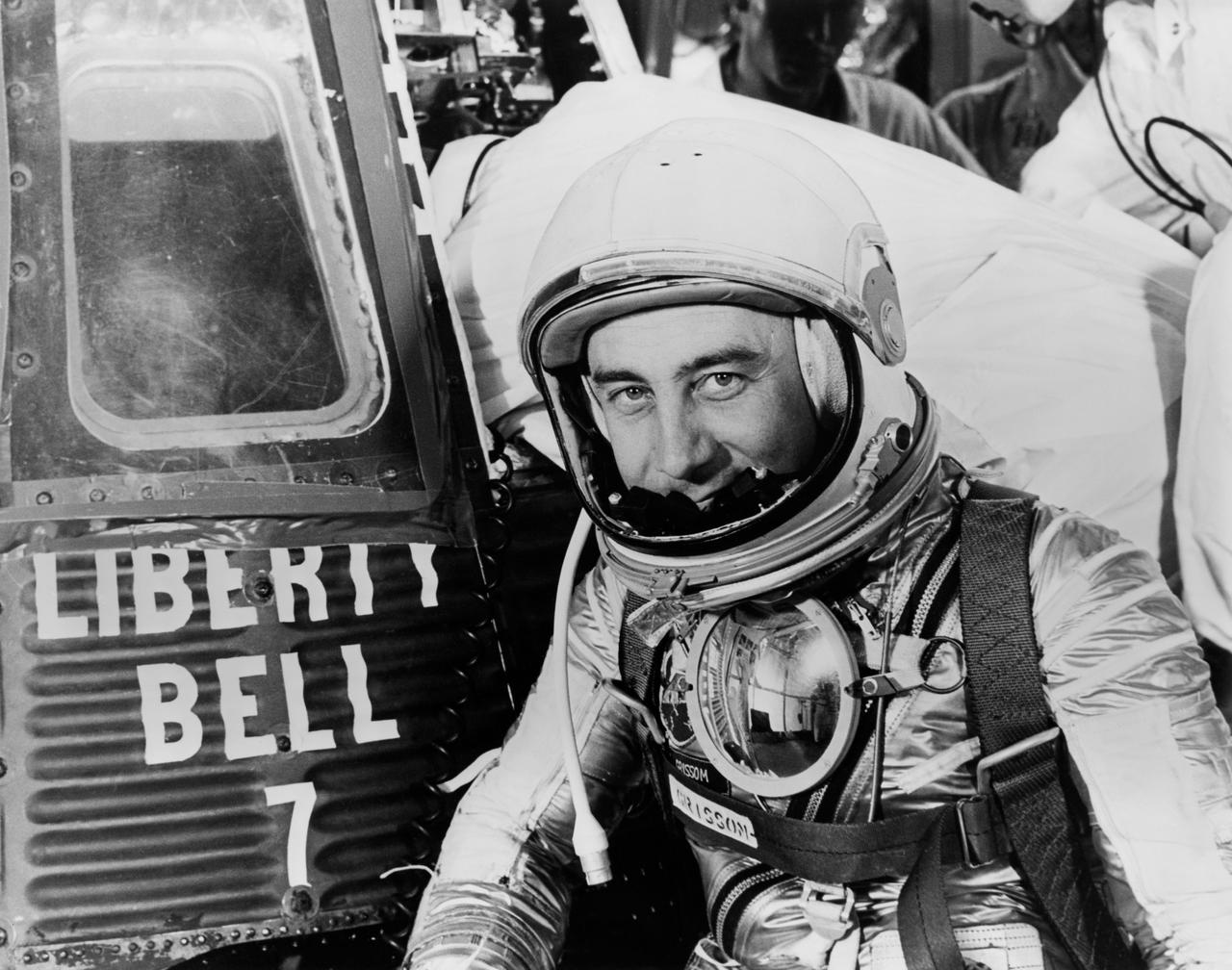
S61-03698 (1961) --- Astronaut Virgil I. (Gus) Grissom, suited up and ready to climb into Liberty Bell 7 spacecraft, sits in front of his capsule for a picture. Behind him technicians work inside the capsule. The Mercury-Redstone 4 (MR-4) mission was scrubbed a few hours later due to unfavorable weather over the launch pad. Photo credit: NASA
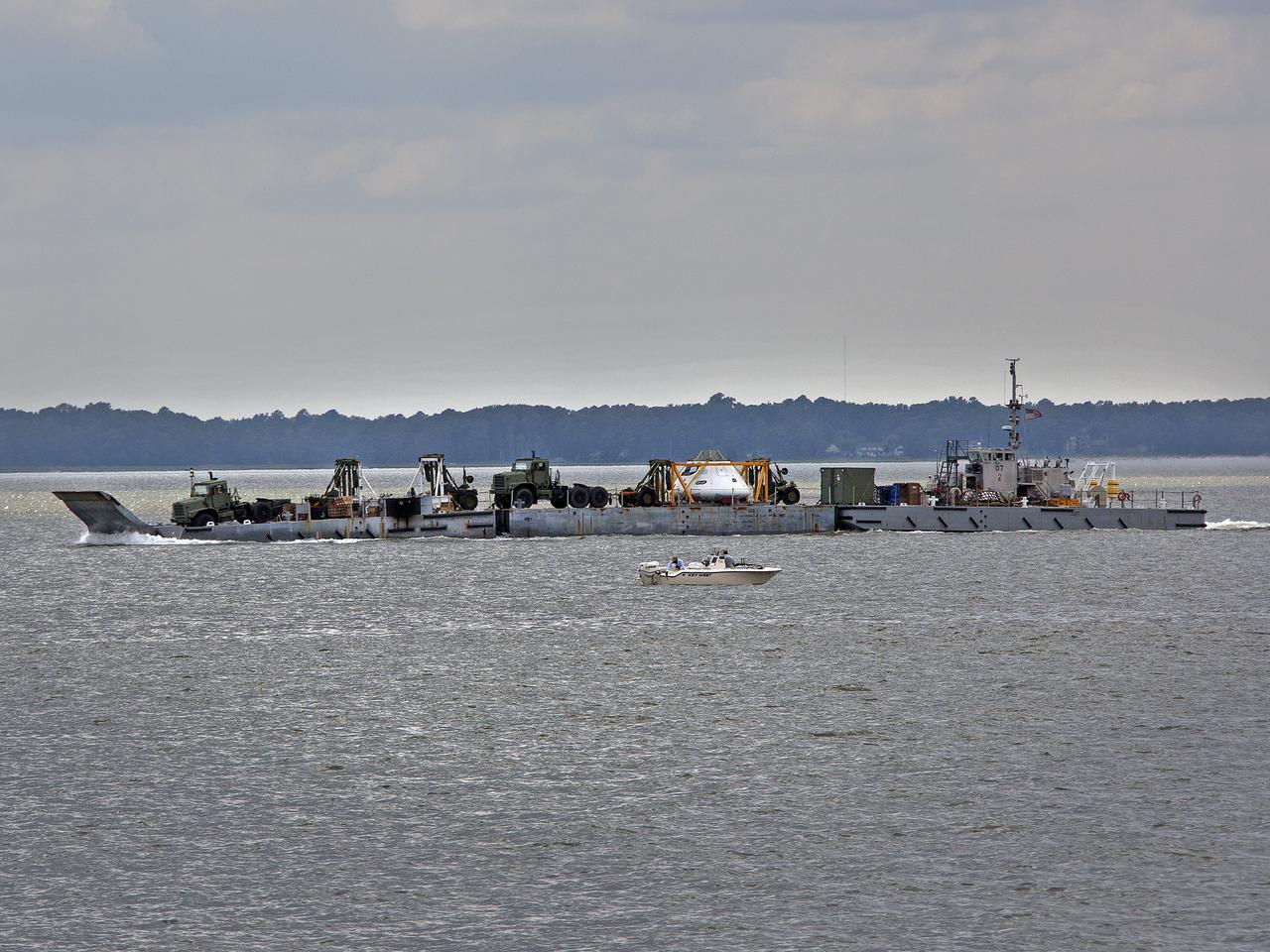
The Orion Test Capsule and a number of other items used in the capsule recovery at being transported down the James River on a Navy INLS "Improved Navy Lighterage System" from Fort Eustis from where it was loaded. Its liquid route will take them to Little Creek Amphibious Base in Norfolk, where it will stay until scheduled recovery test will be performed.
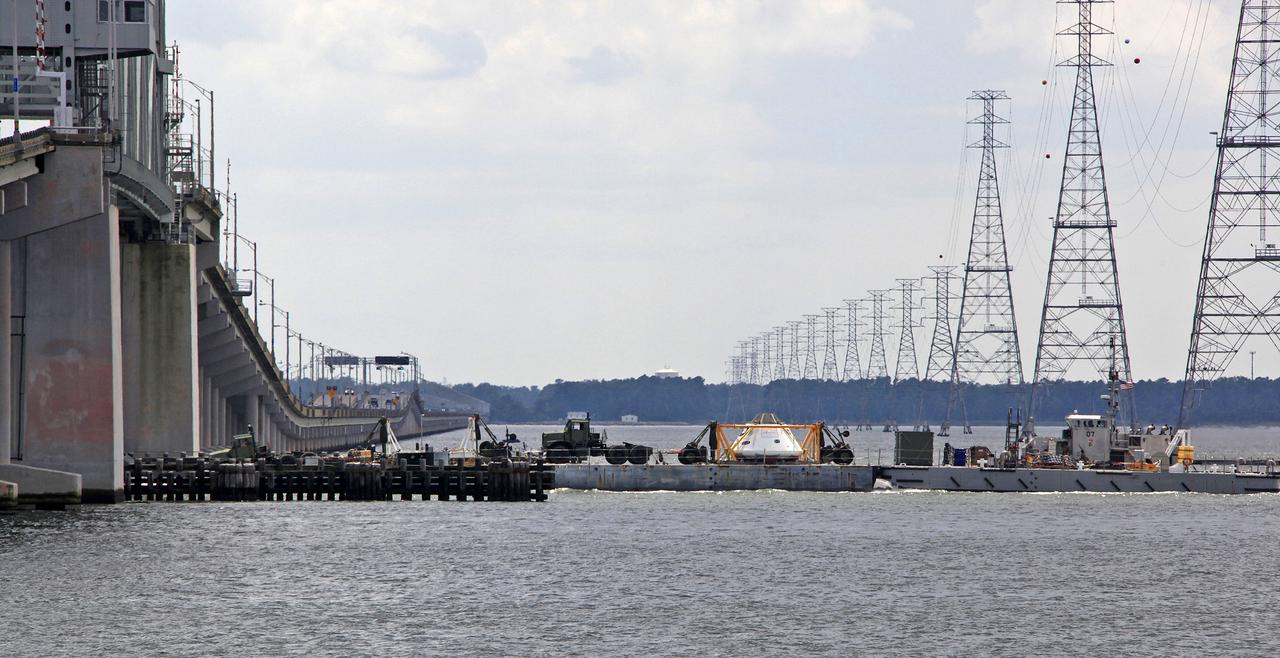
The Orion Test Capsule and a number of other items used in the capsule recovery at being transported down the James River on a Navy INLS "Improved Navy Lighterage System" from Fort Eustis from where it was loaded. Its liquid route will take them to Little Creek Amphibious Base in Norfolk, where it will stay until scheduled recovery test will be performed.
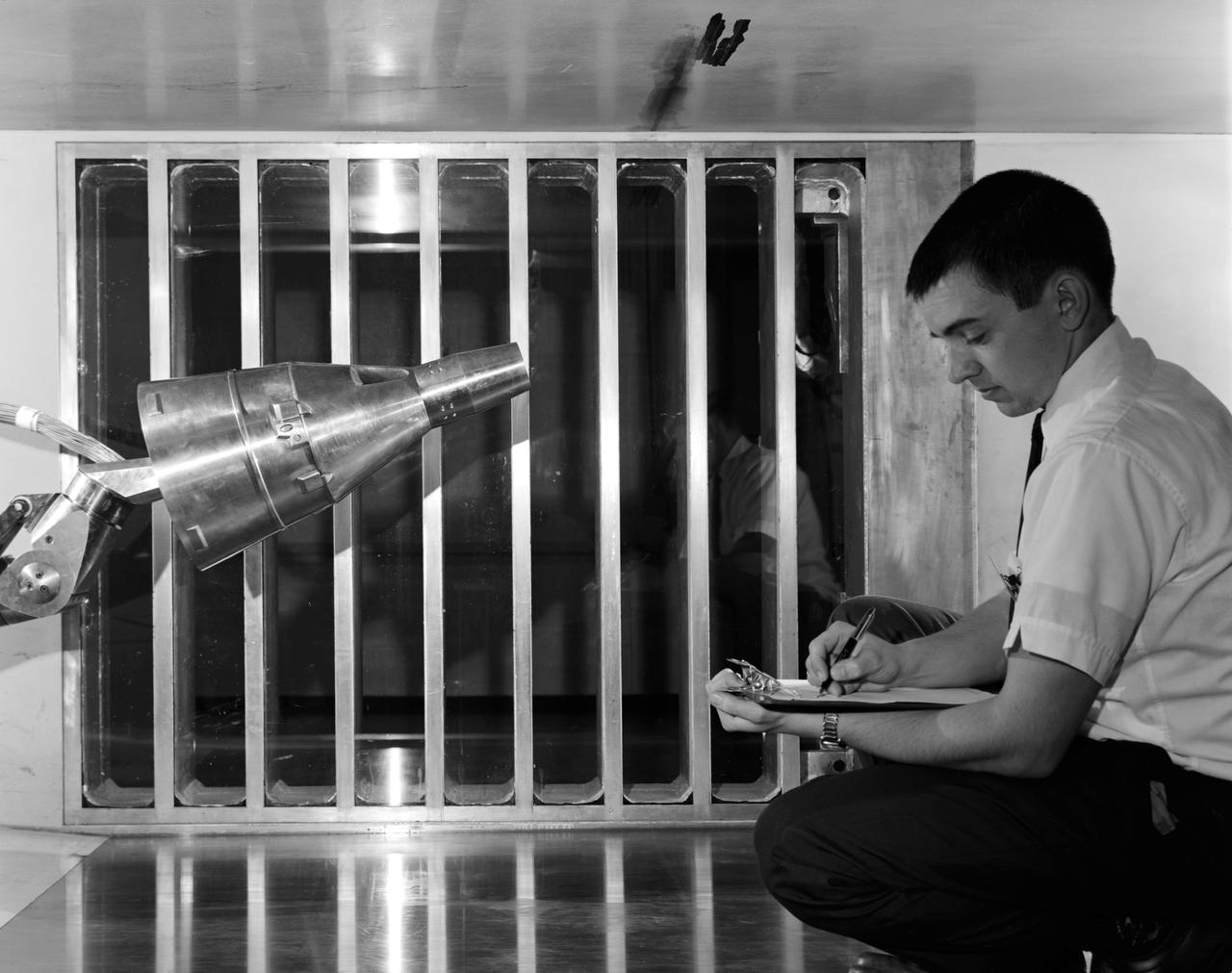
Gemini capsule being tested in Unitary Plan Wind Tunnel.
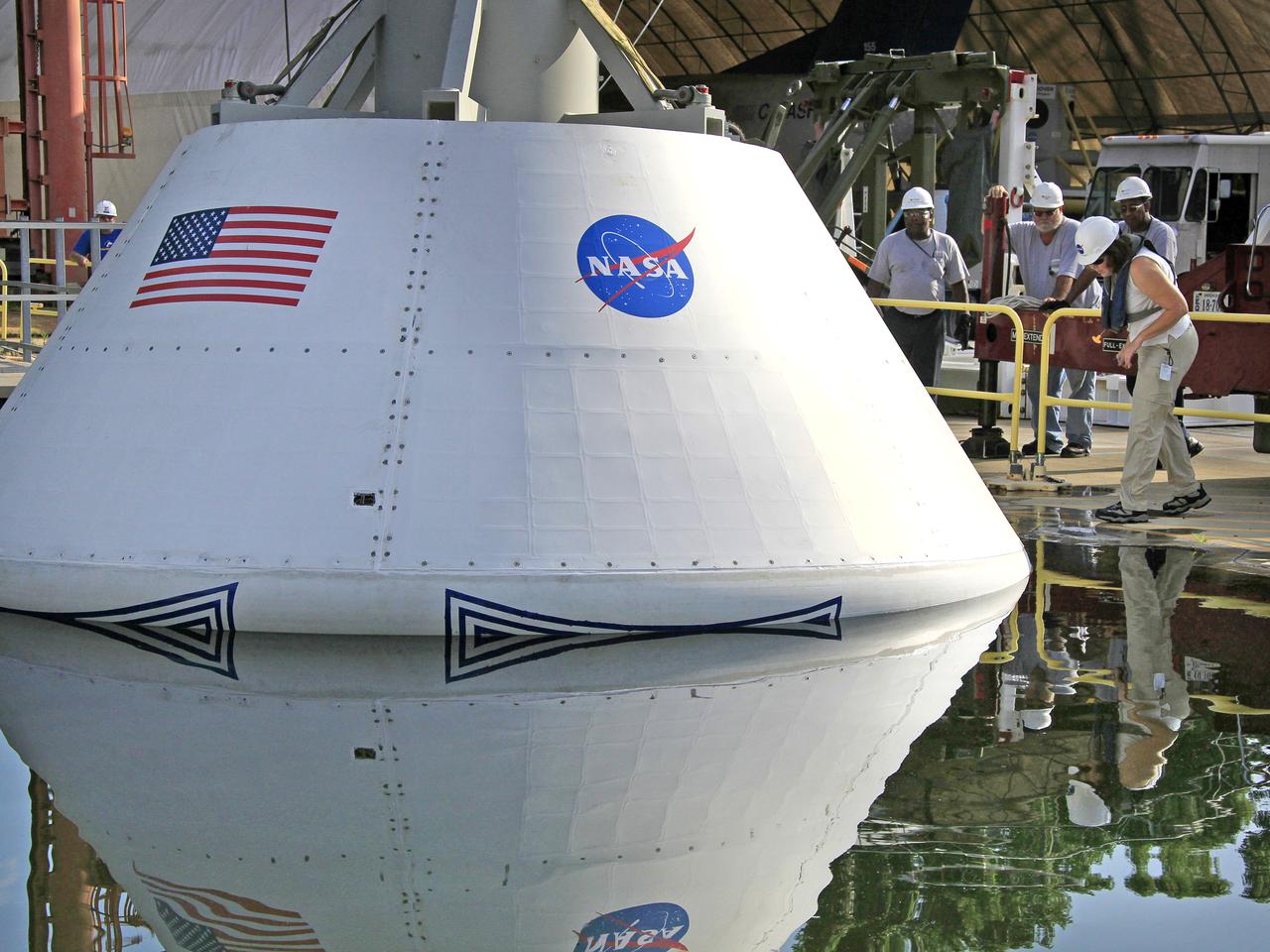
The Orion Test Capsule spent 4 hour in the water tank under NASA Langley's gantry to prove it is ready for the open water recovery test at Norfolk Naval Station.
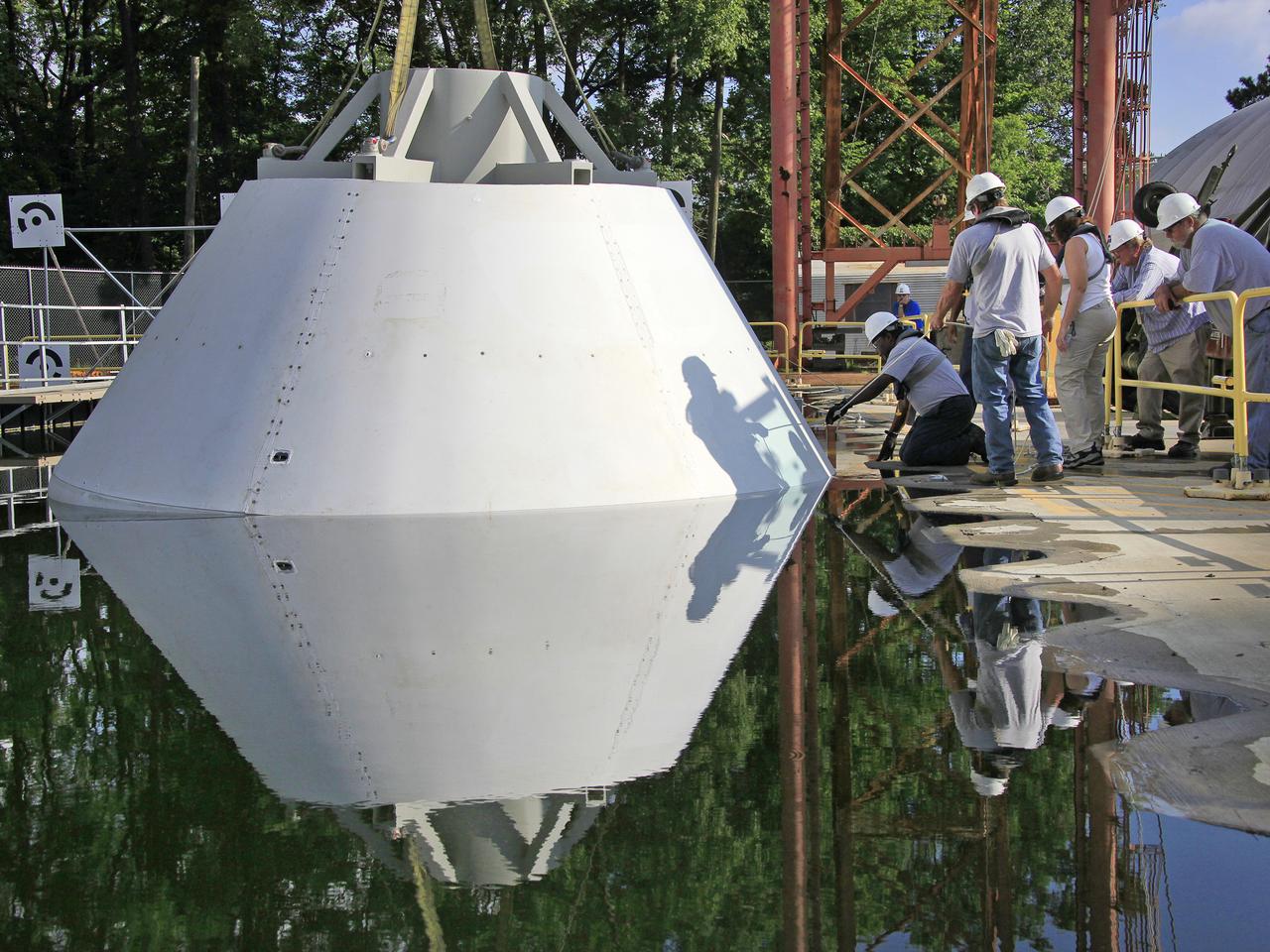
The Orion Test Capsule spent 4 hour in the water tank under NASA Langley's gantry to prove it is ready for the open water recovery test at Norfolk Naval Station.
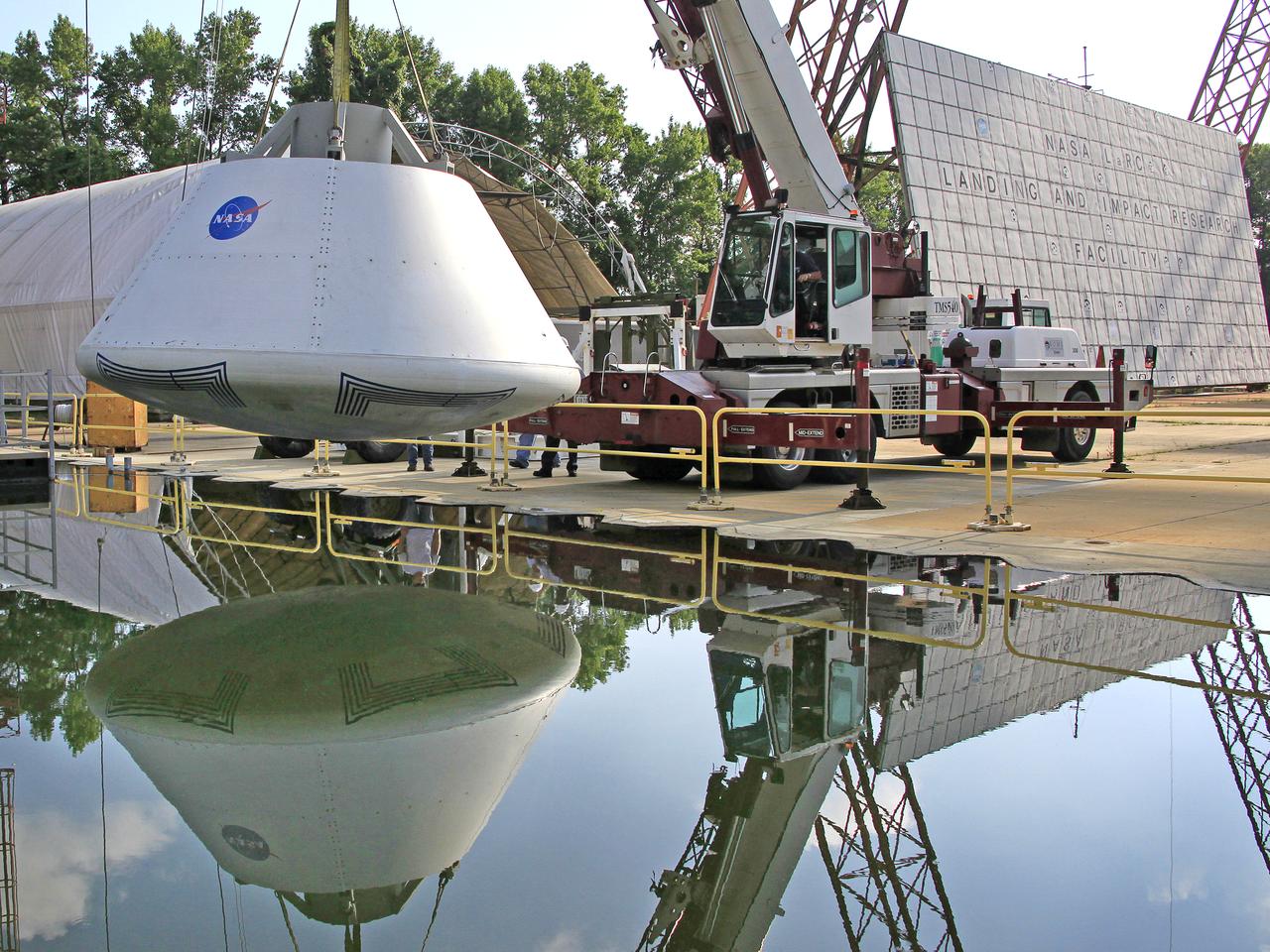
The Orion Test Capsule spent 4 hour in the water tank under NASA Langley's gantry to prove it is ready for the open water recovery test at Norfolk Naval Station.
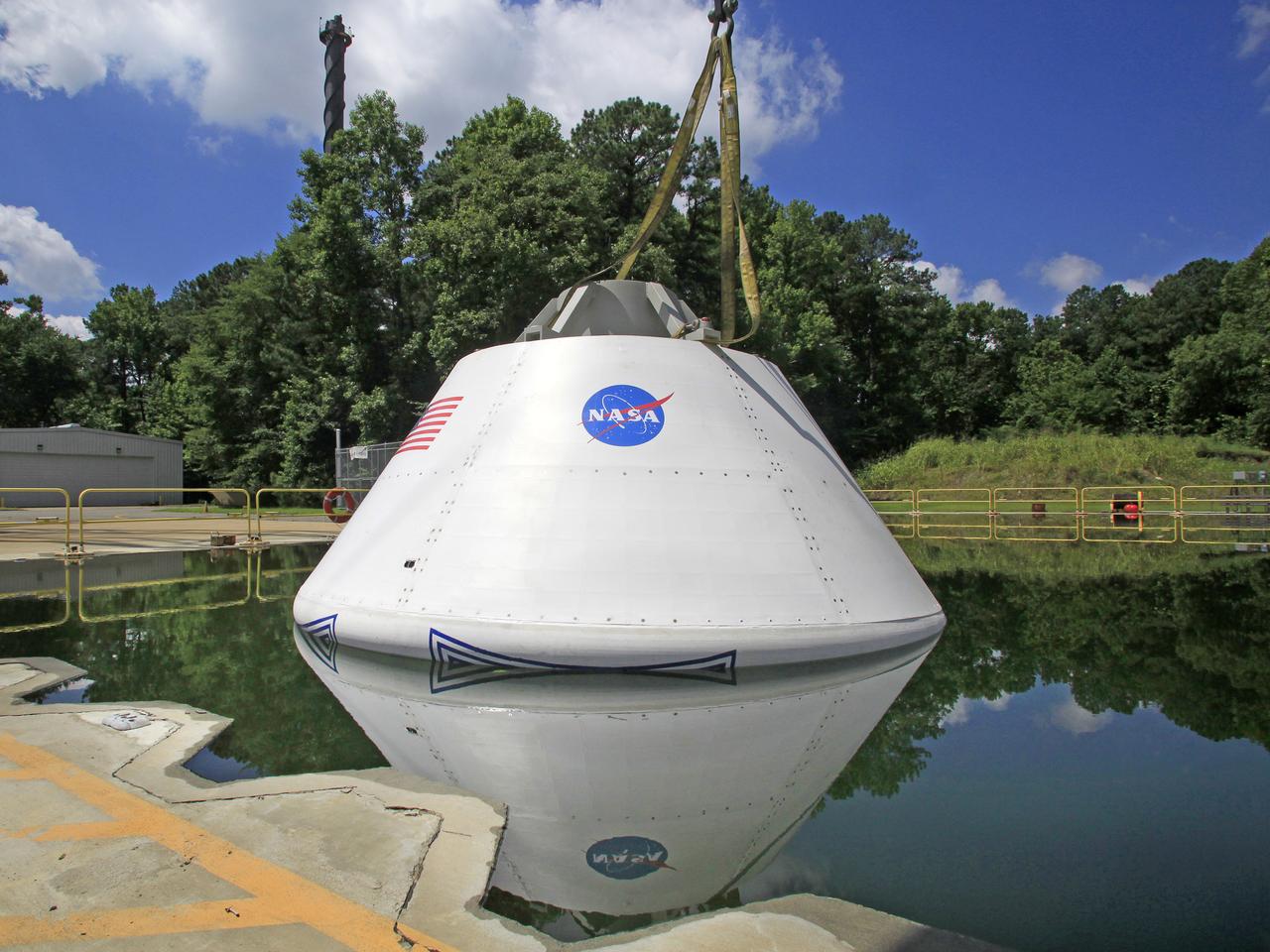
The Orion Test Capsule spent 4 hour in the water tank under NASA Langley's gantry to prove it is ready for the open water recovery test at Norfolk Naval Station.
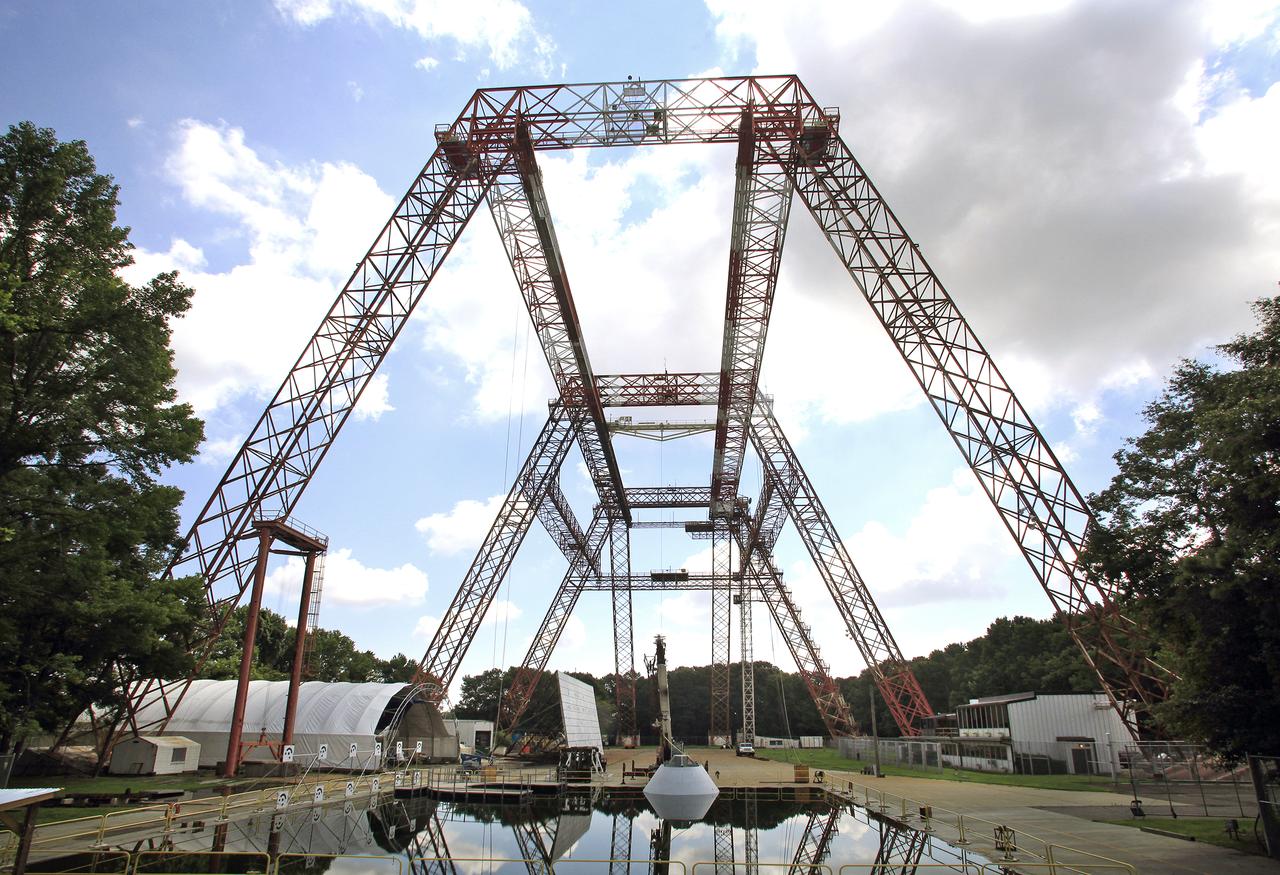
The Orion Test Capsule spent 4 hour in the water tank under NASA Langley's gantry to prove it is ready for the open water recovery test at Norfolk Naval Station.
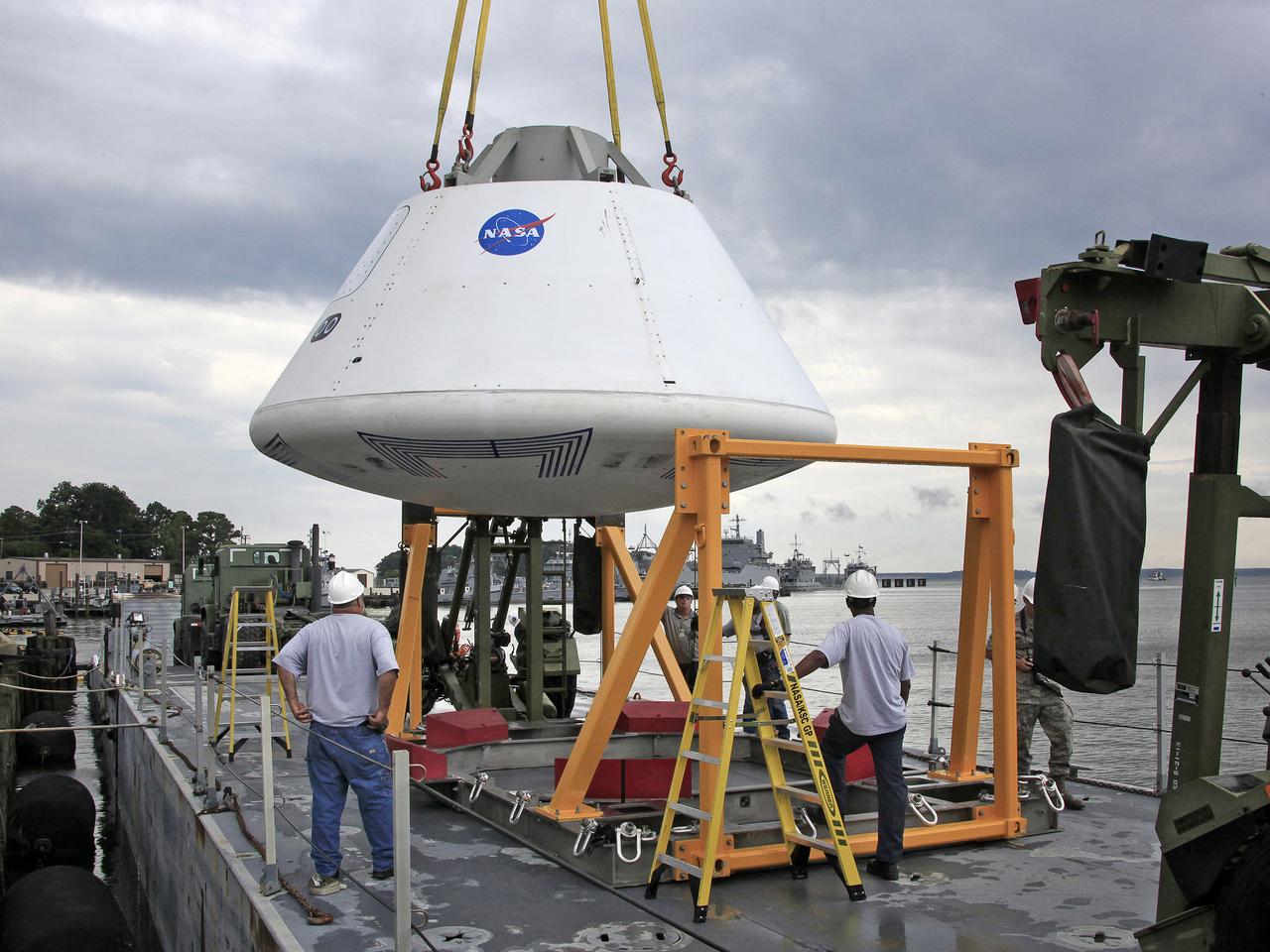
The Orion Test Capsule was loaded on a Navy INLS "Improved Navy Lighterage System" at Fort Eustis Tuesday from where it will be transported to Little Creek Amphibious Base in Norfolk.
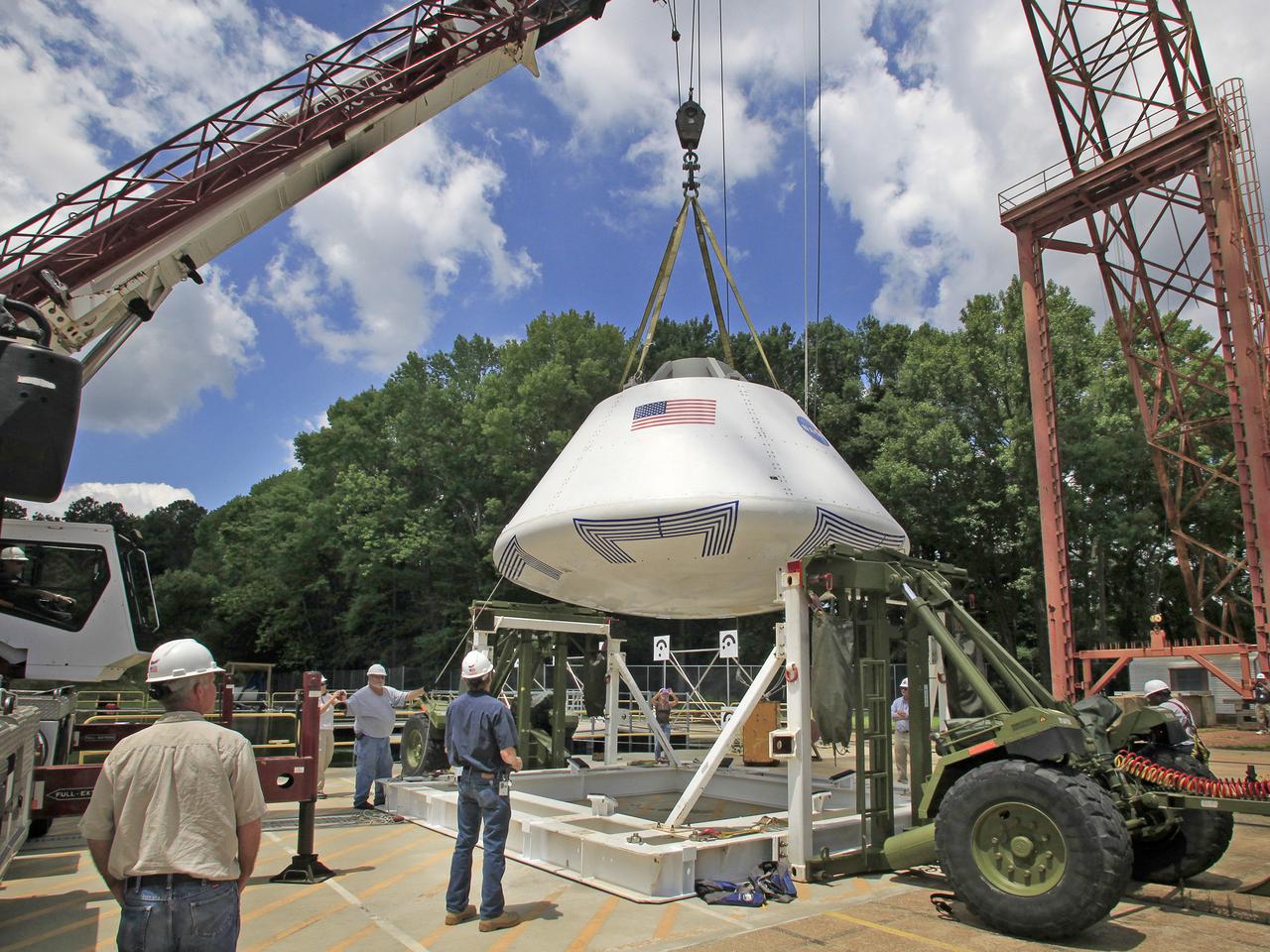
The Orion Test Capsule spent 4 hour in the water tank under NASA Langley's gantry to prove it is ready for the open water recovery test at Norfolk Naval Station.
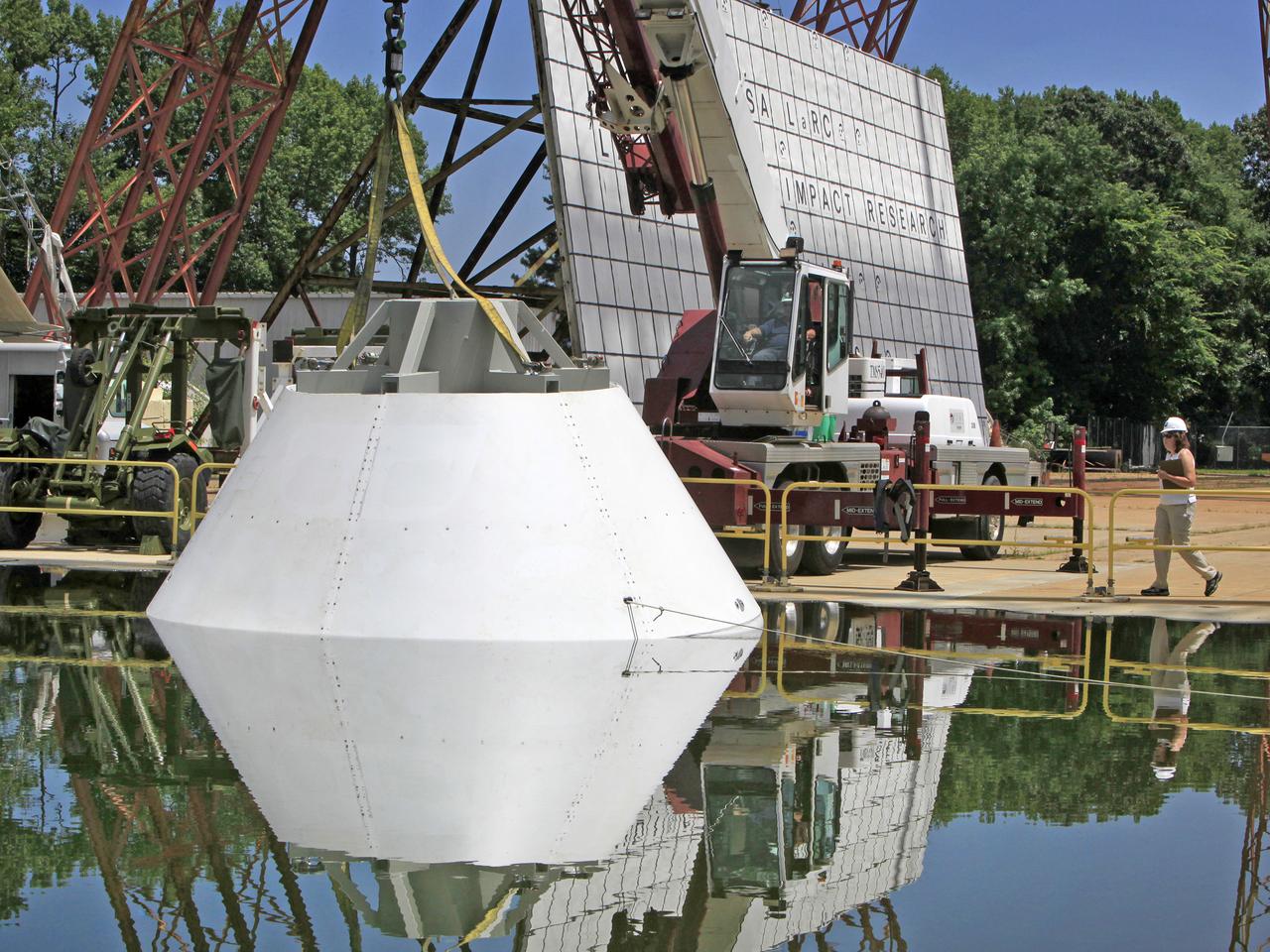
The Orion Test Capsule spent 4 hour in the water tank under NASA Langley's gantry to prove it is ready for the open water recovery test at Norfolk Naval Station.
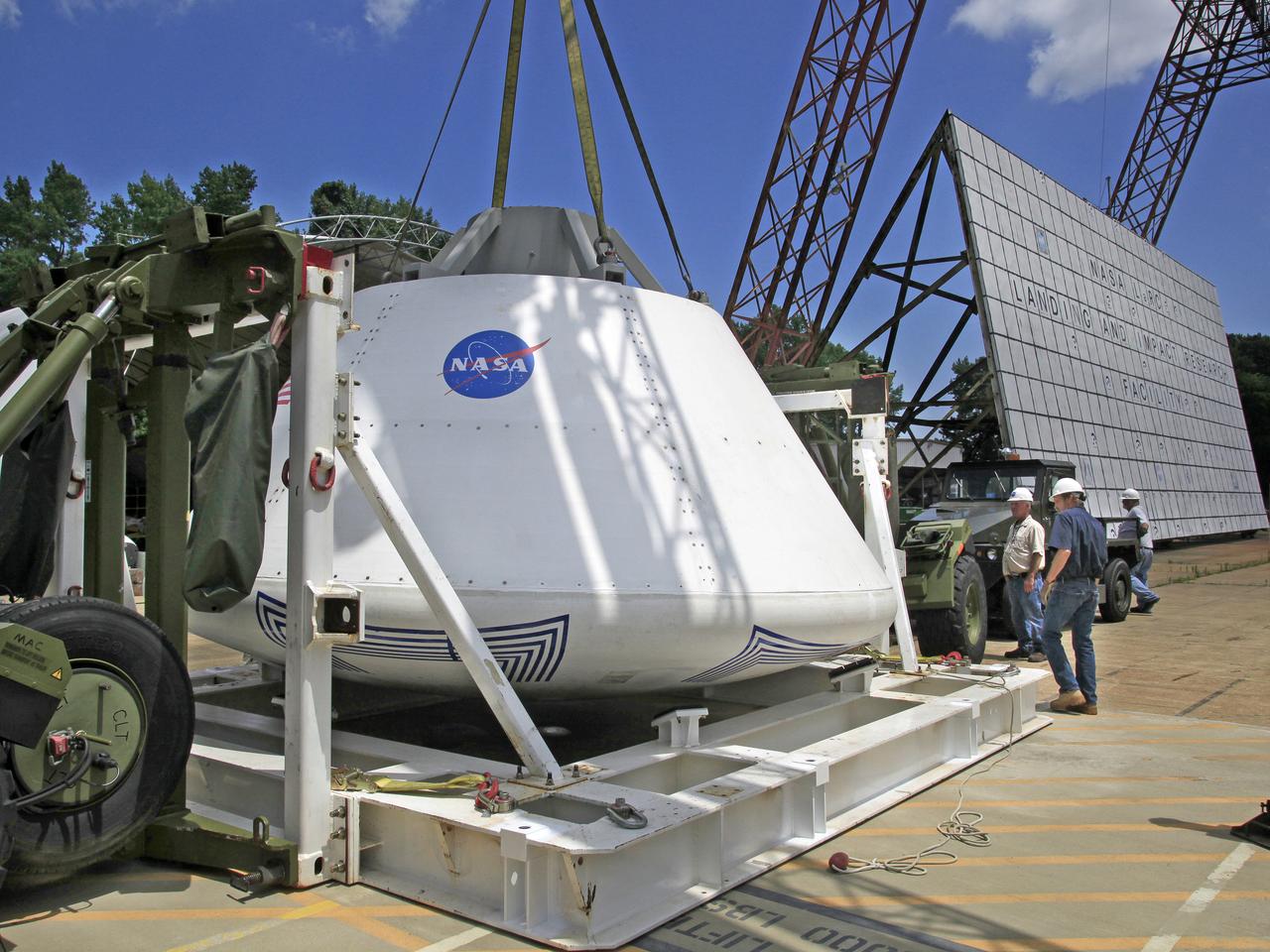
The Orion Test Capsule spent 4 hour in the water tank under NASA Langley's gantry to prove it is ready for the open water recovery test at Norfolk Naval Station.
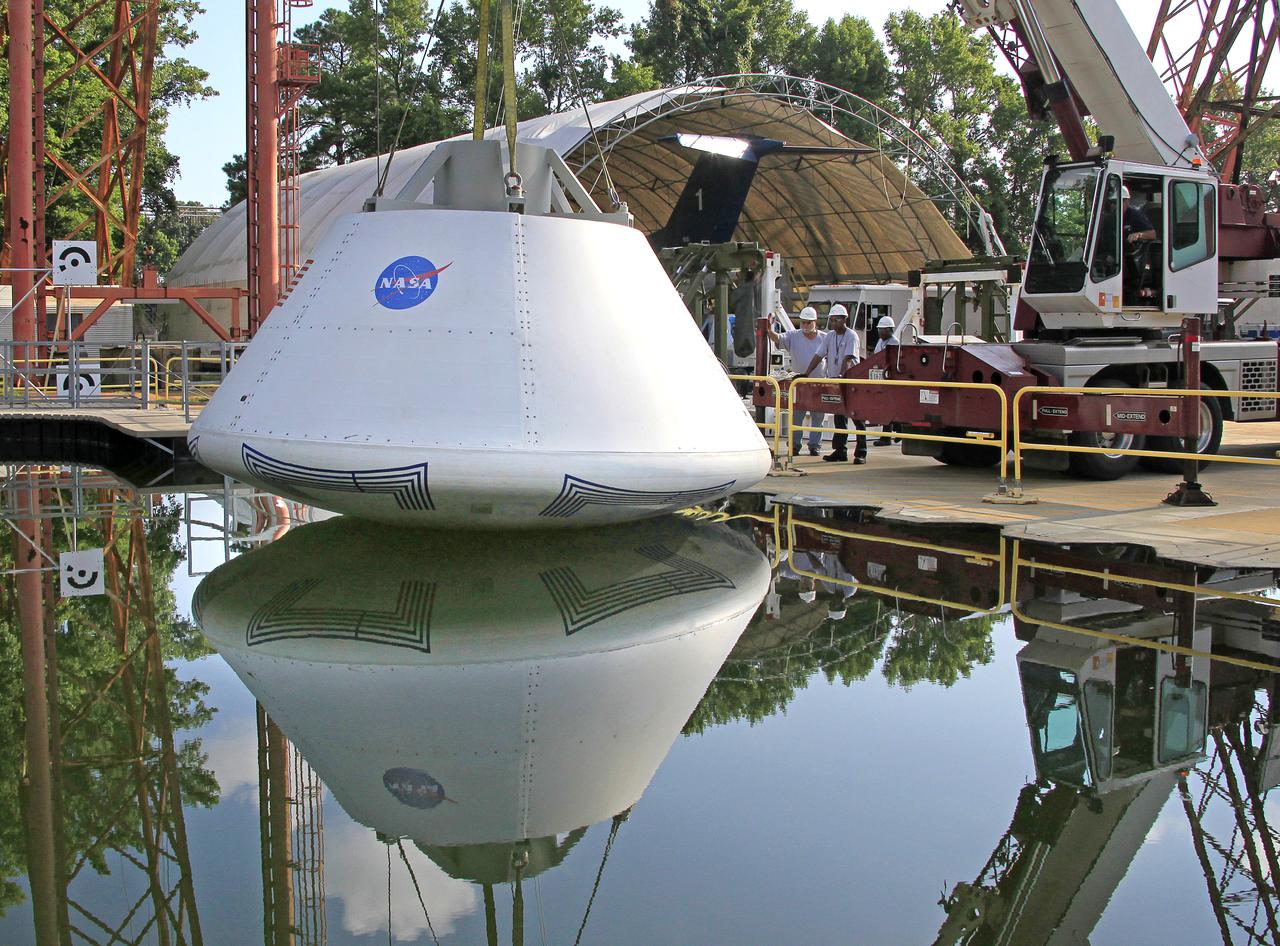
The Orion Test Capsule spent 4 hour in the water tank under NASA Langley's gantry to prove it is ready for the open water recovery test at Norfolk Naval Station.
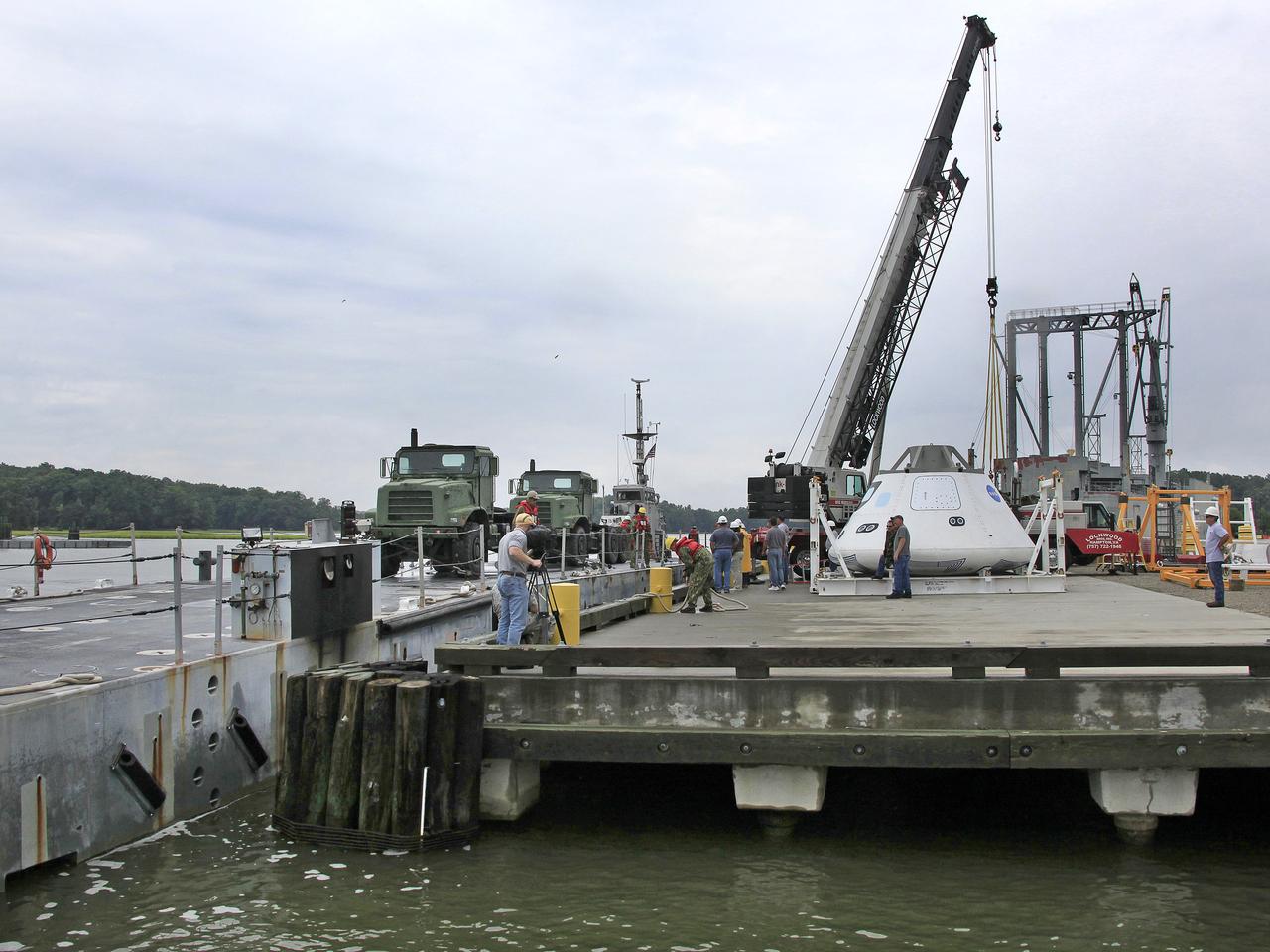
The Orion Test Capsule was loaded on a Navy INLS "Improved Navy Lighterage System" at Fort Eustis Tuesday from where it will be transported to Little Creek Amphibious Base in Norfolk.
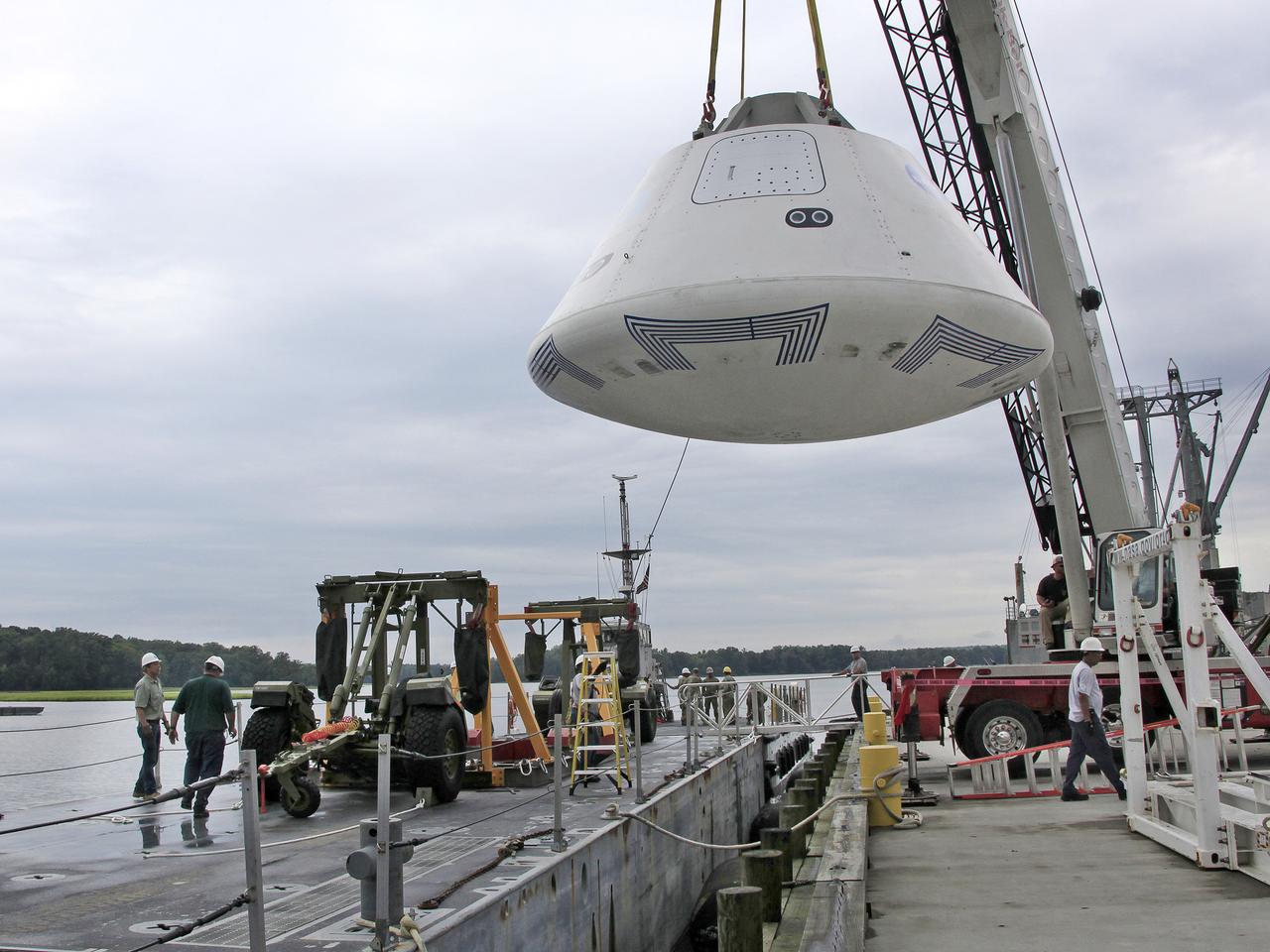
The Orion Test Capsule was loaded on a Navy INLS "Improved Navy Lighterage System" at Fort Eustis Tuesday from where it will be transported to Little Creek Amphibious Base in Norfolk.
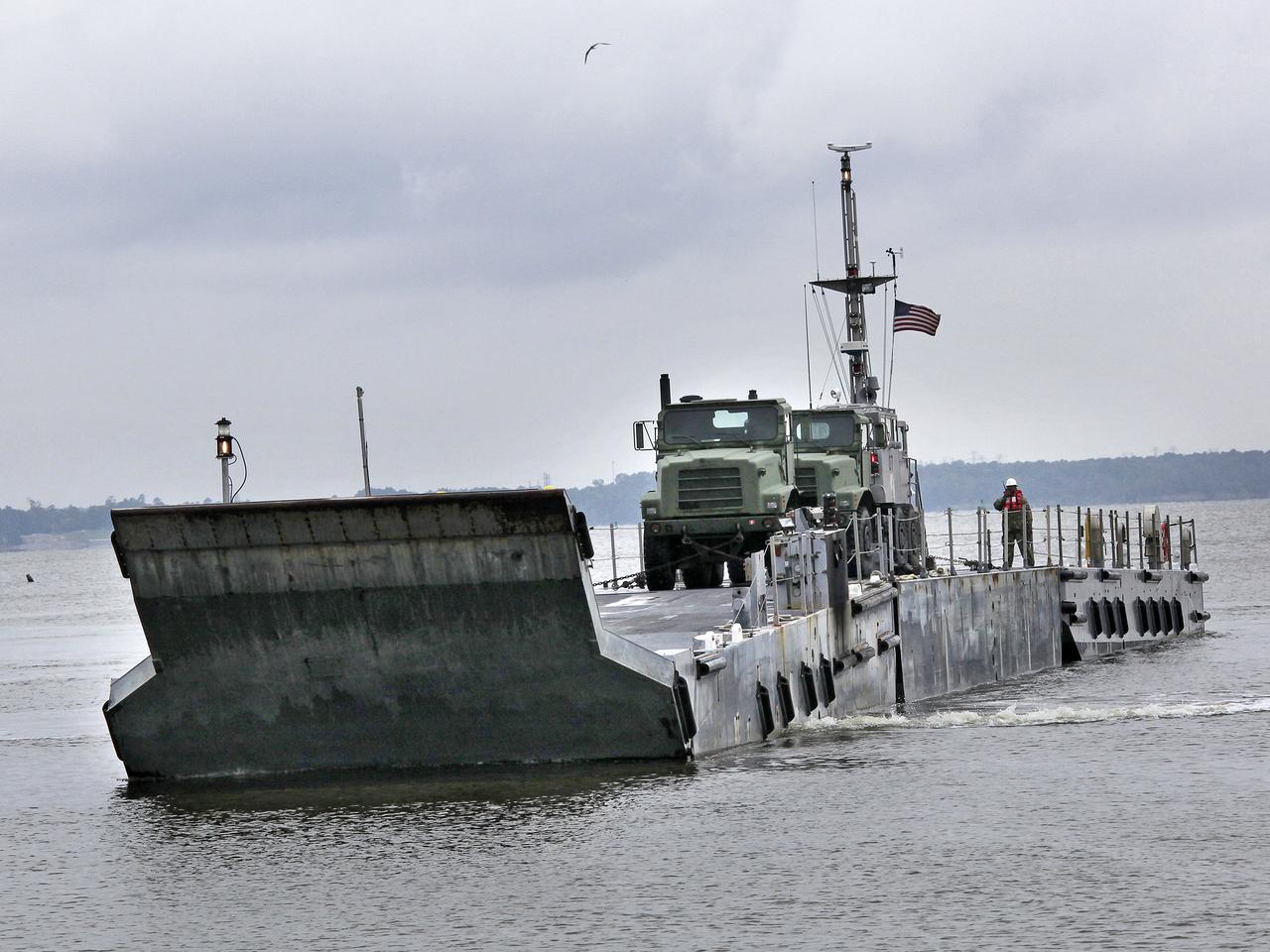
The Orion Test Capsule was loaded on a Navy INLS "Improved Navy Lighterage System" at Fort Eustis Tuesday from where it will be transported to Little Creek Amphibious Base in Norfolk.
Miscellaneous Charts, Space Capsule
Miscellaneous Charts, Space Capsule
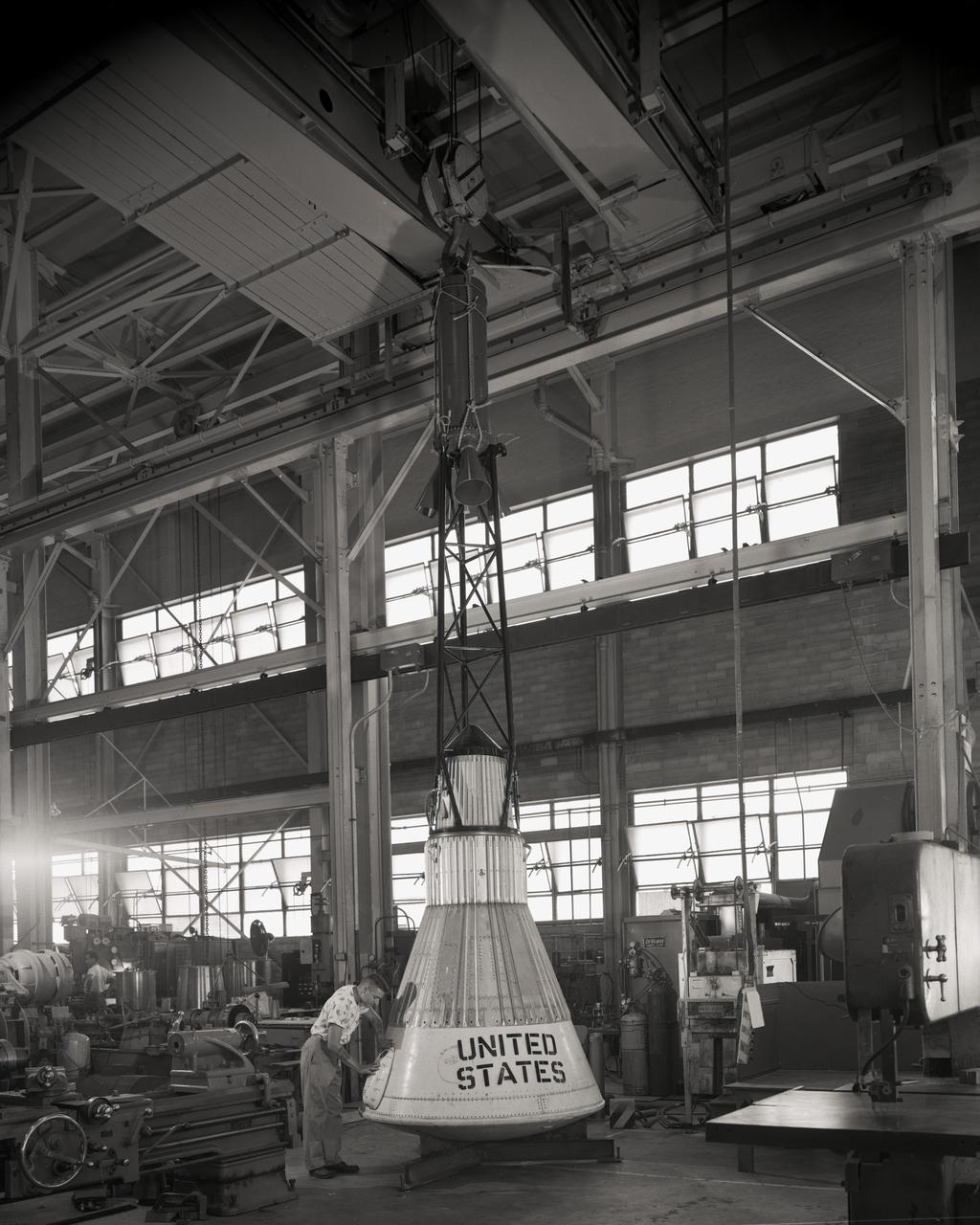
Assembling the Little Joe capsules. The capsules were manufactured in-house by Langley technicians. Three capsules are shown here in various stages of assembly. The escape tower and rocket motors shown on the completed capsule would be removed before shipping and finally assembly for launching at Wallops Island. Joseph Shortal wrote (vol. 3, p. 32): Design of the Little Joe capsules began at Langley before McDonnell started on the design of the Mercury capsule and was, therefore, a separate design. Although it was not designed to carry a man, it did have to carry a monkey. It had to meet the weight and center of gravity requirements of Mercury and withstand the same aerodynamic loads during the exit trajectory. Although in comparison with the overall Mercury Project, Little Joe was a simple undertaking, the fact that an attempt was made to condense a normal two-year project into a 6-month one with in house labor turned it into a major undertaking for Langley. Project Mercury: Little Joe: Boilerplate Mercury spacecraft undergo fabrication at the shops of the Langley Research Center. They will launched atop Little Joe rockets to test the spacecraft recovery systems. -- Published in Joseph A. Shortal, History of Wallops Station: Origins and Activities Through 1949, (Wallops Island, VA: National Aeronautics and Space Administration, Wallops Station, nd), Comment Edition. L59-4947 Technicians prepare a Little Joe launch vehicle prototype for the Mercury space program, 1959. Photograph published in Winds of Change, 75th Anniversary NASA publication, page 76, by James Schultz

Assembling the Little Joe capsules. The capsules were manufactured in-house by Langley technicians. Three capsules are shown here in various stages of assembly. The escape tower and rocket motors shown on the completed capsule would be removed before shipping and finally assembly for launching at Wallops Island. Joseph Shortal wrote (vol. 3, p. 32): Design of the Little Joe capsules began at Langley before McDonnell started on the design of the Mercury capsule and was, therefore, a separate design. Although it was not designed to carry a man, it did have to carry a monkey. It had to meet the weight and center of gravity requirements of Mercury and withstand the same aerodynamic loads during the exit trajectory. Although in comparison with the overall Mercury Project, Little Joe was a simple undertaking, the fact that an attempt was made to condense a normal two-year project into a 6-month one with in house labor turned it into a major undertaking for Langley. Project Mercury: Little Joe: Boilerplate Mercury spacecraft undergo fabrication at the shops of the Langley Research Center. They will launched atop Little Joe rockets to test the spacecraft recovery systems. -- Published in Joseph A. Shortal, History of Wallops Station: Origins and Activities Through 1949, (Wallops Island, VA: National Aeronautics and Space Administration, Wallops Station, nd), Comment Edition. L59-4947 Technicians prepare a Little Joe launch vehicle prototype for the Mercury space program, 1959. Photograph published in Winds of Change, 75th Anniversary NASA publication, page 76, by James Schultz
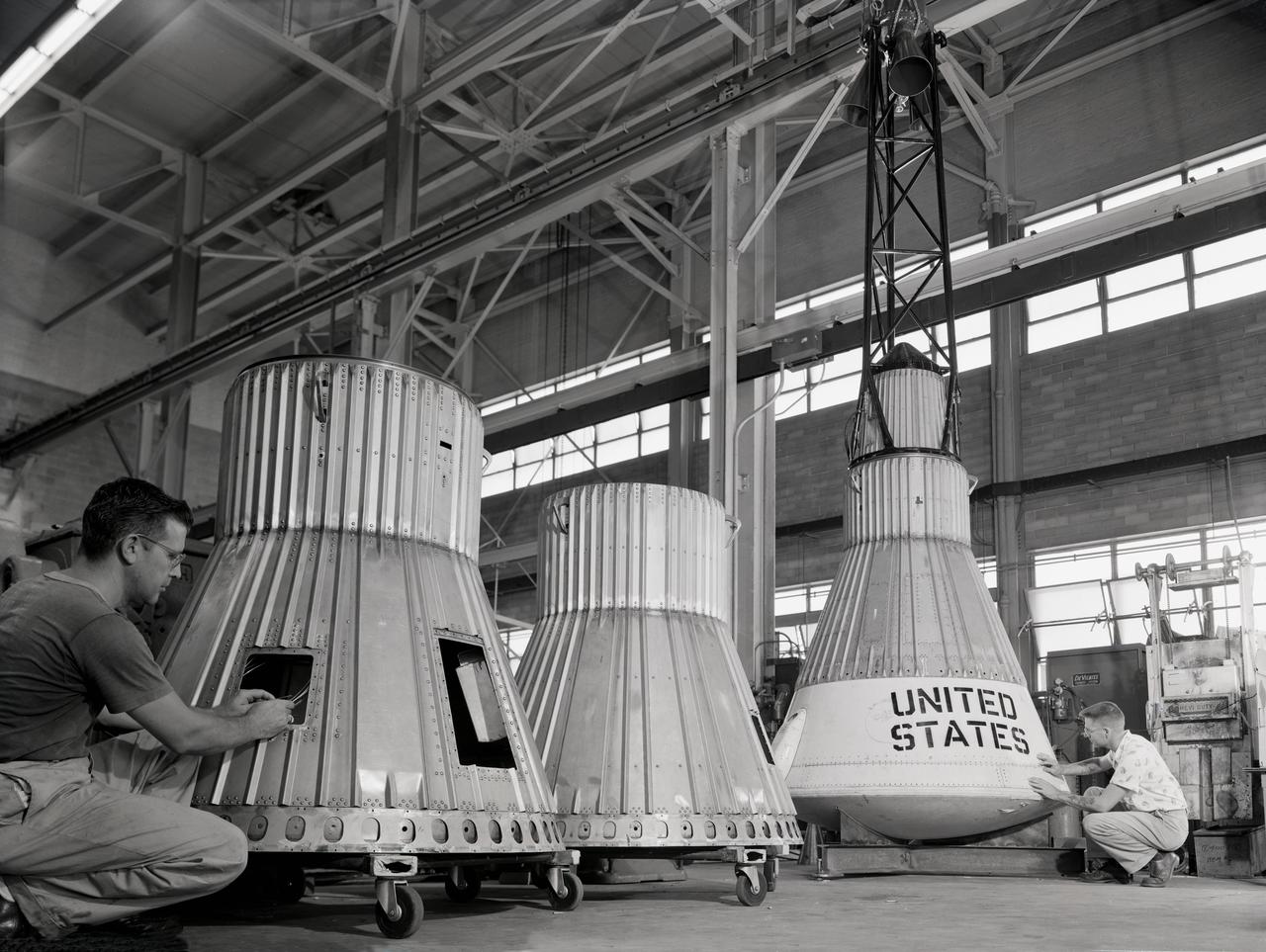
Assembling the Little Joe capsules. The capsules were manufactured in-house by Langley technicians. Three capsules are shown here in various stages of assembly. The escape tower and rocket motors shown on the completed capsule would be removed before shipping and finally assembly for launching at Wallops Island. Joseph Shortal wrote (vol. 3, p. 32): Design of the Little Joe capsules began at Langley before McDonnell started on the design of the Mercury capsule and was, therefore, a separate design. Although it was not designed to carry a man, it did have to carry a monkey. It had to meet the weight and center of gravity requirements of Mercury and withstand the same aerodynamic loads during the exit trajectory. Although in comparison with the overall Mercury Project, Little Joe was a simple undertaking, the fact that an attempt was made to condense a normal two-year project into a 6-month one with in house labor turned it into a major undertaking for Langley. Project Mercury: Little Joe: Boilerplate Mercury spacecraft undergo fabrication at the shops of the Langley Research Center. They will launched atop Little Joe rockets to test the spacecraft recovery systems. -- Published in Joseph A. Shortal, History of Wallops Station: Origins and Activities Through 1949, (Wallops Island, VA: National Aeronautics and Space Administration, Wallops Station, nd), Comment Edition. L59-4947 Technicians prepare a Little Joe launch vehicle prototype for the Mercury space program, 1959. Photograph published in Winds of Change, 75th Anniversary NASA publication, page 76, by James Schultz

Assembling the Little Joe capsules. The capsules were manufactured in-house by Langley technicians. Three capsules are shown here in various stages of assembly. The escape tower and rocket motors shown on the completed capsule would be removed before shipping and finally assembly for launching at Wallops Island. Joseph Shortal wrote (vol. 3, p. 32): Design of the Little Joe capsules began at Langley before McDonnell started on the design of the Mercury capsule and was, therefore, a separate design. Although it was not designed to carry a man, it did have to carry a monkey. It had to meet the weight and center of gravity requirements of Mercury and withstand the same aerodynamic loads during the exit trajectory. Although in comparison with the overall Mercury Project, Little Joe was a simple undertaking, the fact that an attempt was made to condense a normal two-year project into a 6-month one with in house labor turned it into a major undertaking for Langley. Project Mercury: Little Joe: Boilerplate Mercury spacecraft undergo fabrication at the shops of the Langley Research Center. They will launched atop Little Joe rockets to test the spacecraft recovery systems. -- Published in Joseph A. Shortal, History of Wallops Station: Origins and Activities Through 1949, (Wallops Island, VA: National Aeronautics and Space Administration, Wallops Station, nd), Comment Edition. L59-4947 Technicians prepare a Little Joe launch vehicle prototype for the Mercury space program, 1959. Photograph published in Winds of Change, 75th Anniversary NASA publication, page 76, by James Schultz

Assembling the Little Joe capsules. The capsules were manufactured in-house by Langley technicians. Three capsules are shown here in various stages of assembly. The escape tower and rocket motors shown on the completed capsule would be removed before shipping and finally assembly for launching at Wallops Island. Joseph Shortal wrote (vol. 3, p. 32): Design of the Little Joe capsules began at Langley before McDonnell started on the design of the Mercury capsule and was, therefore, a separate design. Although it was not designed to carry a man, it did have to carry a monkey. It had to meet the weight and center of gravity requirements of Mercury and withstand the same aerodynamic loads during the exit trajectory. Although in comparison with the overall Mercury Project, Little Joe was a simple undertaking, the fact that an attempt was made to condense a normal two-year project into a 6-month one with in house labor turned it into a major undertaking for Langley. Project Mercury: Little Joe: Boilerplate Mercury spacecraft undergo fabrication at the shops of the Langley Research Center. They will launched atop Little Joe rockets to test the spacecraft recovery systems. -- Published in Joseph A. Shortal, History of Wallops Station: Origins and Activities Through 1949, (Wallops Island, VA: National Aeronautics and Space Administration, Wallops Station, nd), Comment Edition. L59-4947 Technicians prepare a Little Joe launch vehicle prototype for the Mercury space program, 1959. Photograph published in Winds of Change, 75th Anniversary NASA publication, page 76, by James Schultz
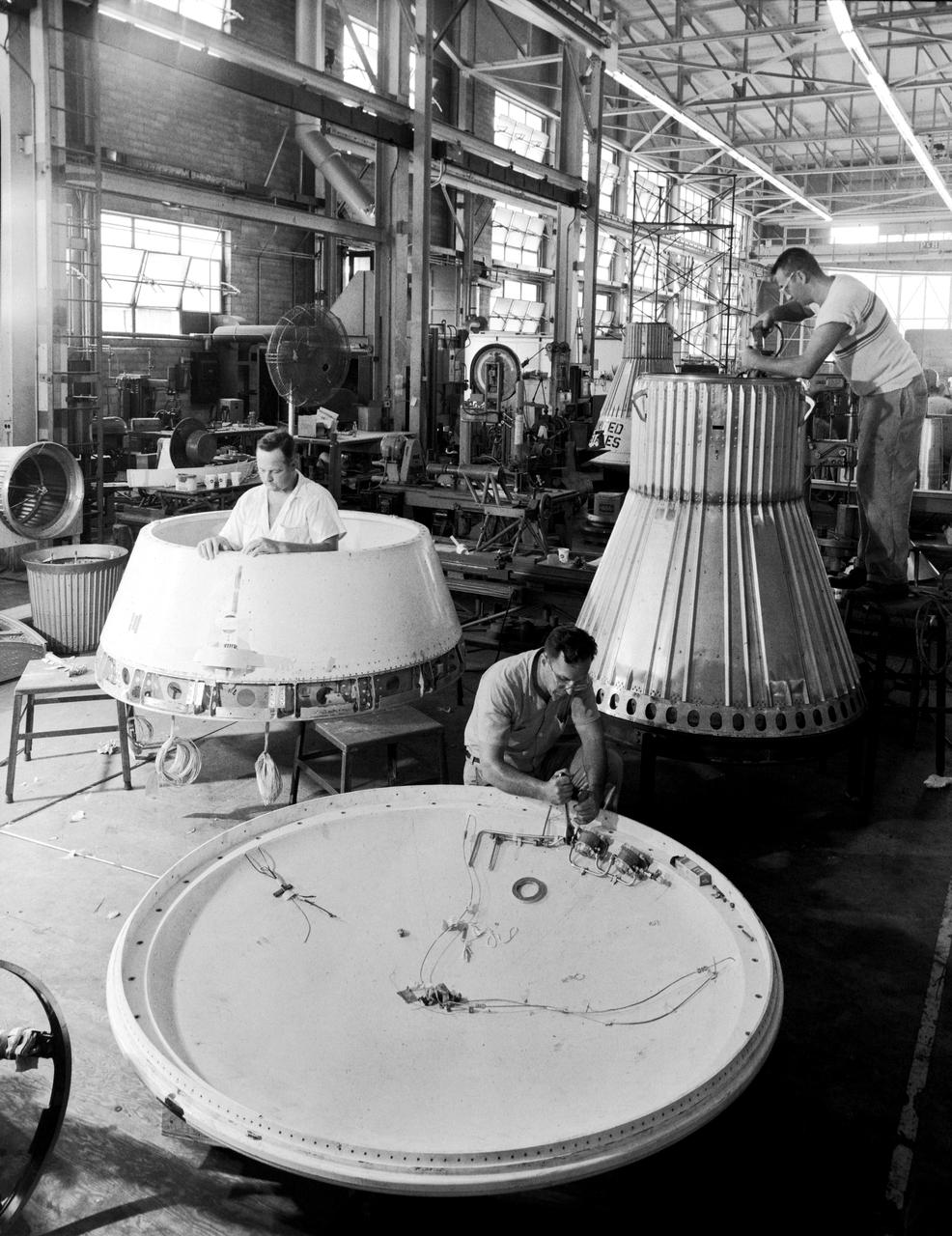
Assembling the Little Joe capsules. The capsules were manufactured in-house by Langley technicians. Three capsules are shown here in various stages of assembly. The escape tower and rocket motors shown on the completed capsule would be removed before shipping and finally assembly for launching at Wallops Island. Joseph Shortal wrote (vol. 3, p. 32): Design of the Little Joe capsules began at Langley before McDonnell started on the design of the Mercury capsule and was, therefore, a separate design. Although it was not designed to carry a man, it did have to carry a monkey. It had to meet the weight and center of gravity requirements of Mercury and withstand the same aerodynamic loads during the exit trajectory. Although in comparison with the overall Mercury Project, Little Joe was a simple undertaking, the fact that an attempt was made to condense a normal two-year project into a 6-month one with in house labor turned it into a major undertaking for Langley. Project Mercury: Little Joe: Boilerplate Mercury spacecraft undergo fabrication at the shops of the Langley Research Center. They will launched atop Little Joe rockets to test the spacecraft recovery systems. -- Published in Joseph A. Shortal, History of Wallops Station: Origins and Activities Through 1949, (Wallops Island, VA: National Aeronautics and Space Administration, Wallops Station, nd), Comment Edition. L59-4947 Technicians prepare a Little Joe launch vehicle prototype for the Mercury space program, 1959. Photograph published in Winds of Change, 75th Anniversary NASA publication, page 76, by James Schultz
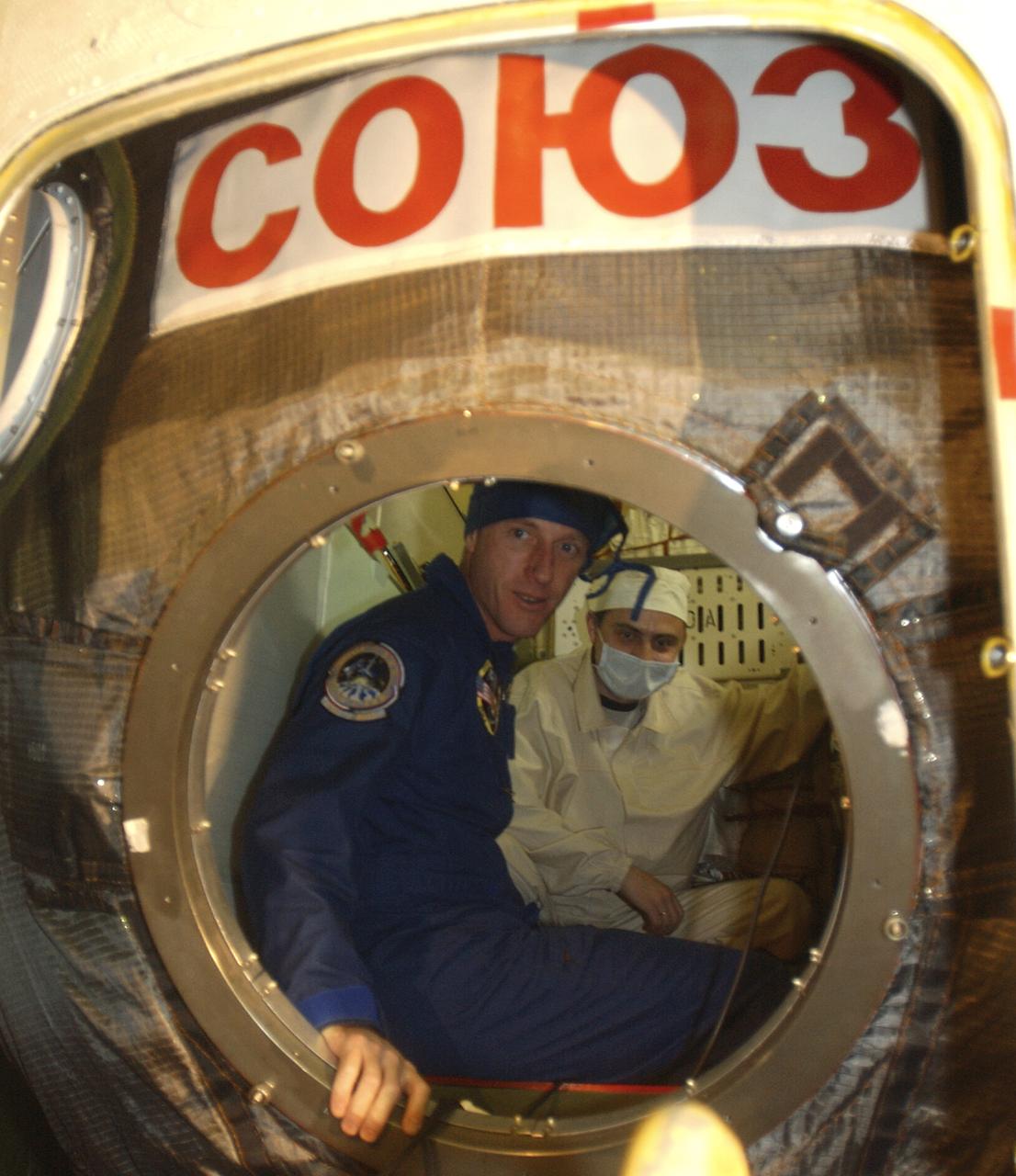
Expedition 8 Commander and NASA Science Officer Michael Foale, left, is briefed by a technician inside the Soyuz TMA-3 vehicle in a processing facility at the Baikonur Cosmodrome in Kazakhstan on Monday, Oct. 13, 2003 during an inspection of the spacecraft. Photo Credit (NASA/Bill Ingalls)
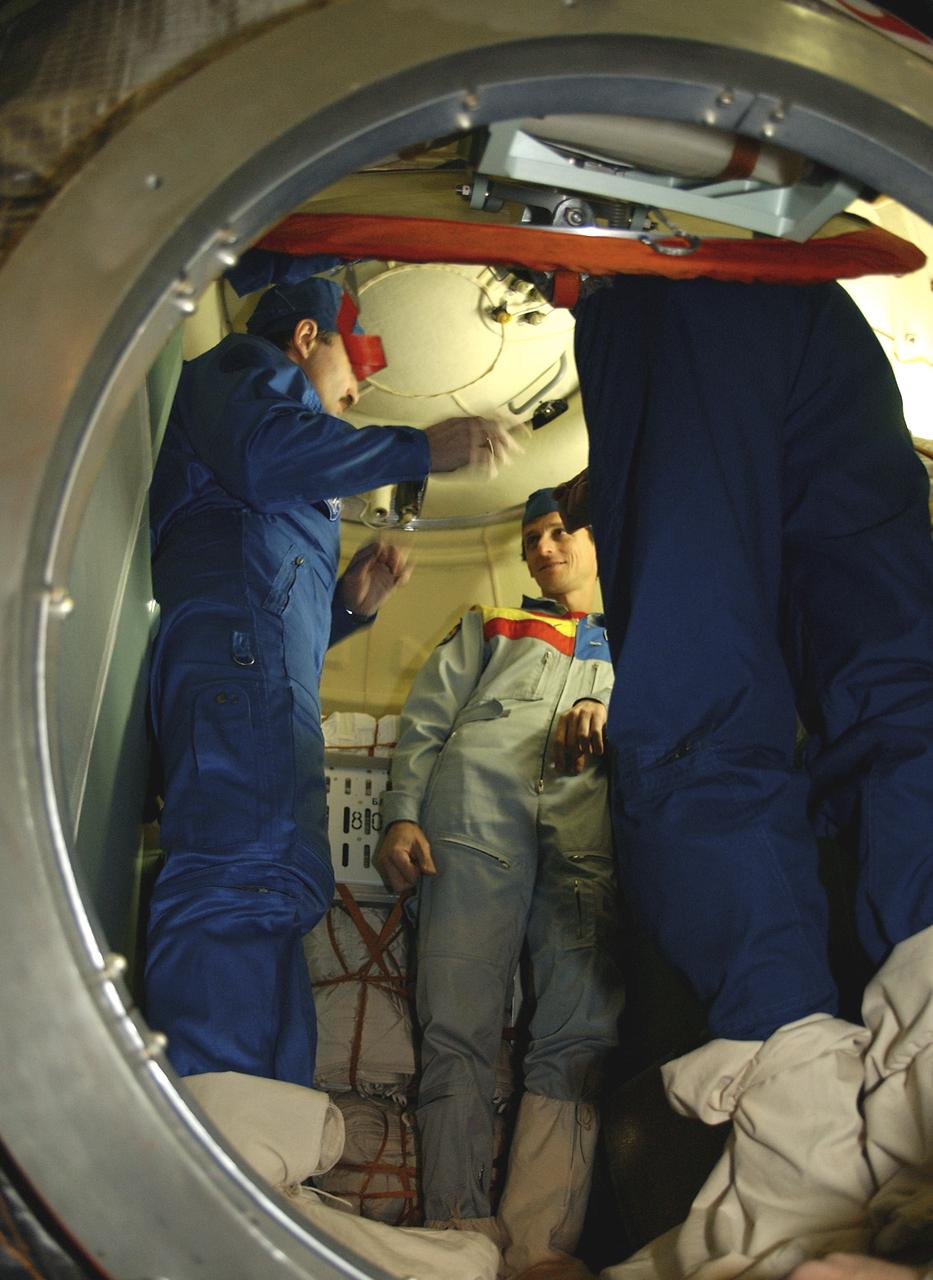
Inside the Soyuz TMA-3 vehicle, Expedition 8 Soyuz Commander Alexander Kaleri, left, briefs European Space Agency astronaut Pedro Duque of Spain and Expedition 8 Commander and NASA Science Officer Mike Foale, right, partially hidden, during a prelaunch inspection of the spacecraft at the Baikonur Cosmodrome in Kazakhstan, Monday, Oct. 13, 2003. The trio will be launched to the International Space Station on Oct. 18. Photo Credit (NASA/Bill Ingalls)
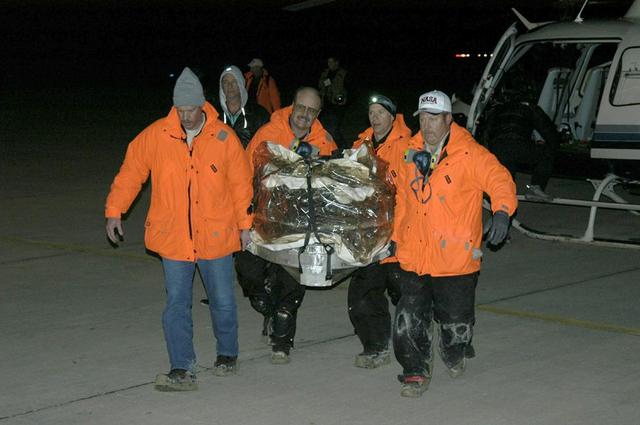
This image shows the return capsule inside a protective covering. The capsule, which landed at 2:10 a.m. Pacific time 3:10 a.m. Mountain time, contains cometary and interstellar samples gathered by NASA Stardust spacecraft.
Vehicles and Missions Studies Charts, Space Capsule
Vehicles and Missions Studies Charts, Space Capsule
Vehicles and Missions Studies Charts, Space Capsule
Vehicles and Missions Studies Charts, Space Capsule
Vehicles and Missions Studies Charts, Space Capsule
Vehicles and Missions Studies Charts, Space Capsule

Vehicles and Missions Studies Charts, Space Capsule
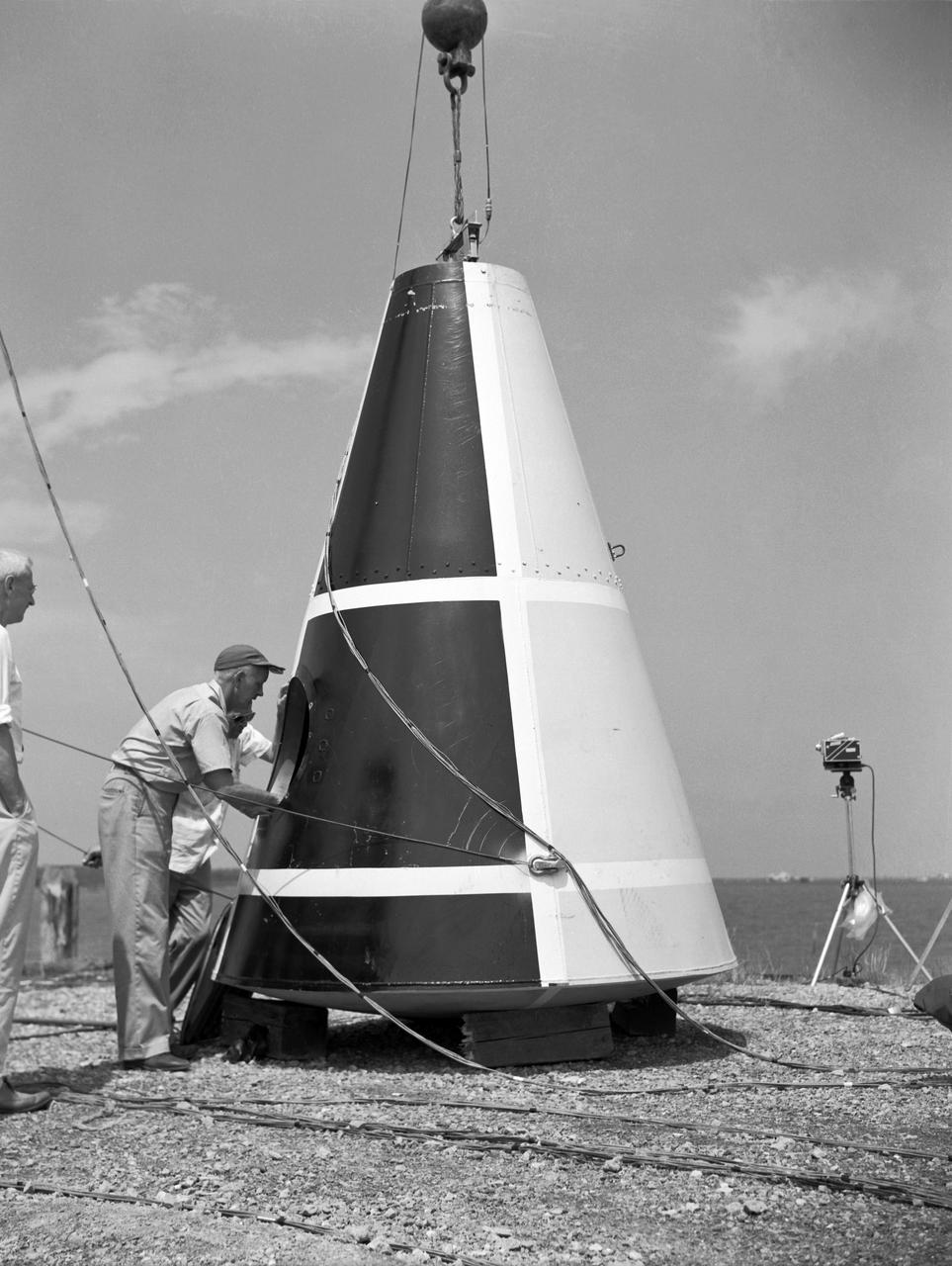
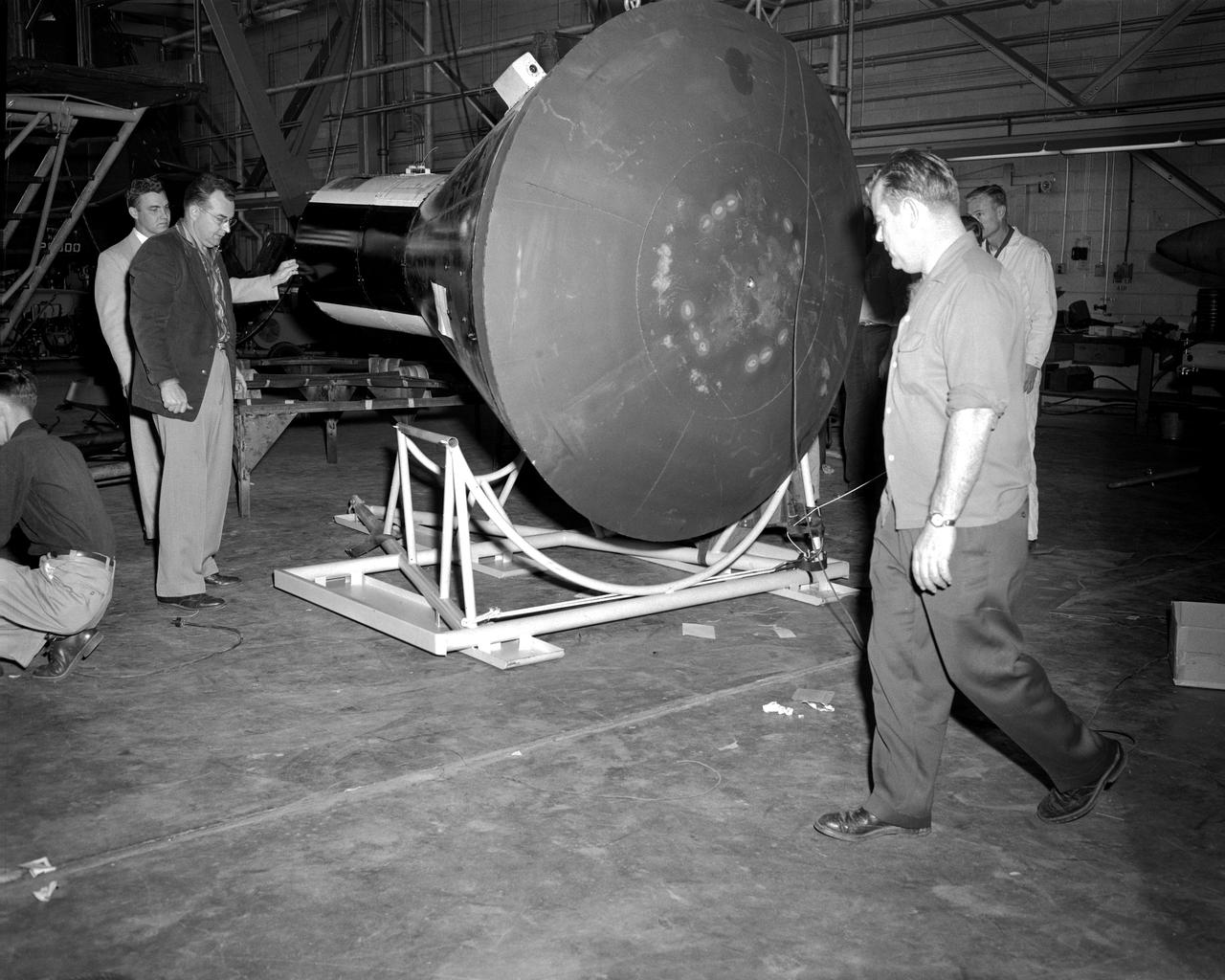
Photographed on: 08 05 1958. -- Impact test conducted by Langley's Hydrodynamics Division. The Division conducted a series of impact studies with full scale and model capsules of the original capsule shape A. Joseph Shortal wrote (Vol. 3, p. 16): The basic design of the capsule was made by M.A. Faget and his coworkers at PARD during the winter of 1957-1958. It was natural, then, that extensive use was made of the facilities at Wallops during the development of the spacecraft. The tests at Wallops consisted of 26 full-size capsules, either launched from the ground by rocket power or dropped from airplanes at high altitude and 28 scaled models, either rocket boosted or released from balloons. Emphasis in the Wallops program was on dynamic stability and aerodynamic heating of the capsule, and effectiveness of the pilot-escape and parachute-recovery systems. The biggest part of the Wallops program was the series of full-size capsules, rocket launched with the Little Joe booster, developed especially for Mercury. -- Published in Joseph A. Shortal, History of Wallops Station: Origins and Activities Through 1949, (Wallops Island, VA: National Aeronautics and Space Administration, Wallops Station, nd), Comment Edition.
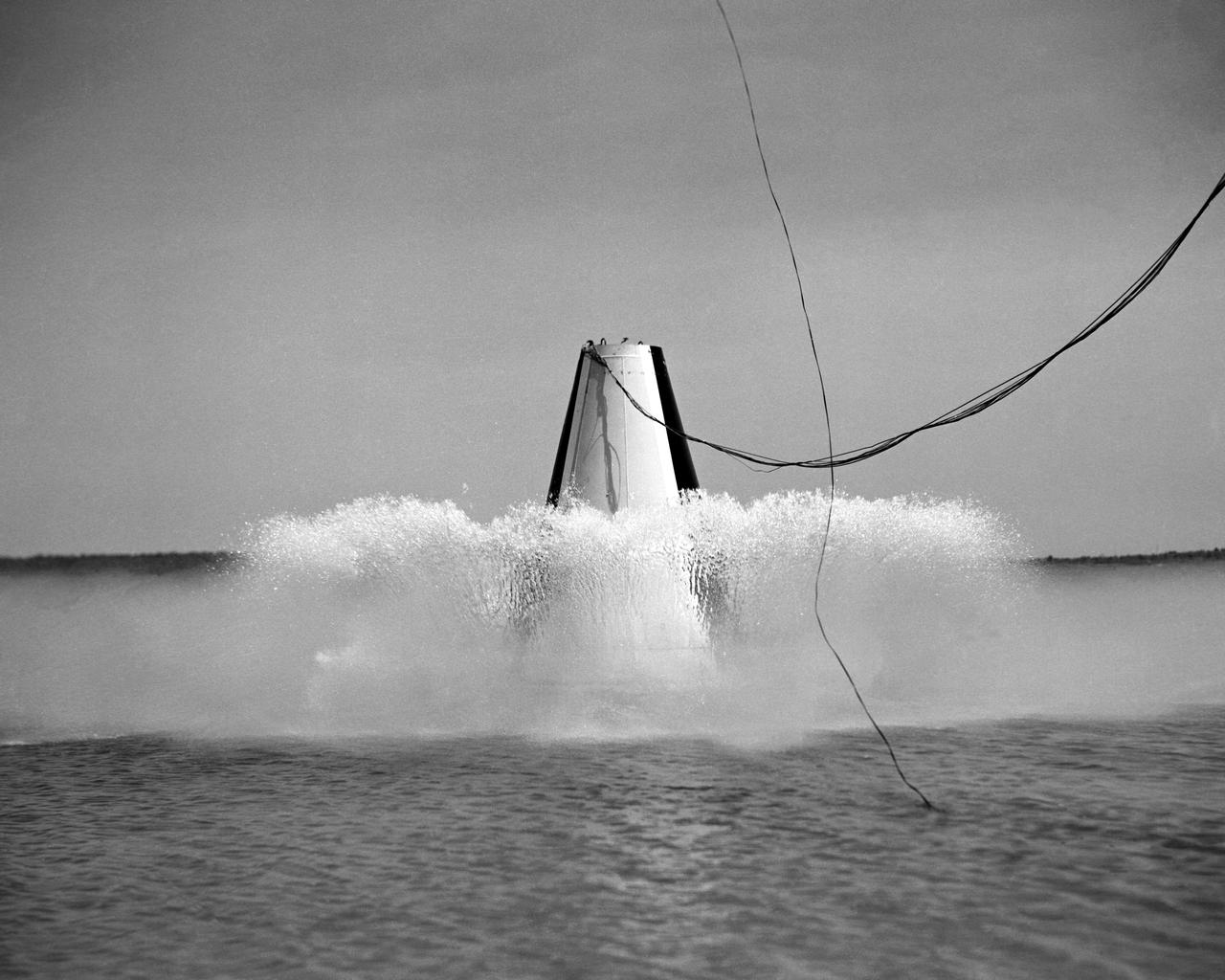
Photographed on: 08 05 1958. -- Impact test conducted by Langley's Hydrodynamics Division. The Division conducted a series of impact studies with full scale and model capsules of the original capsule shape A. Joseph Shortal wrote (Vol. 3, p. 16): The basic design of the capsule was made by M.A. Faget and his coworkers at PARD during the winter of 1957-1958. It was natural, then, that extensive use was made of the facilities at Wallops during the development of the spacecraft. The tests at Wallops consisted of 26 full-size capsules, either launched from the ground by rocket power or dropped from airplanes at high altitude and 28 scaled models, either rocket boosted or released from balloons. Emphasis in the Wallops program was on dynamic stability and aerodynamic heating of the capsule, and effectiveness of the pilot-escape and parachute-recovery systems. The biggest part of the Wallops program was the series of full-size capsules, rocket launched with the Little Joe booster, developed especially for Mercury. -- Published in Joseph A. Shortal, History of Wallops Station: Origins and Activities Through 1949, (Wallops Island, VA: National Aeronautics and Space Administration, Wallops Station, nd), Comment Edition.
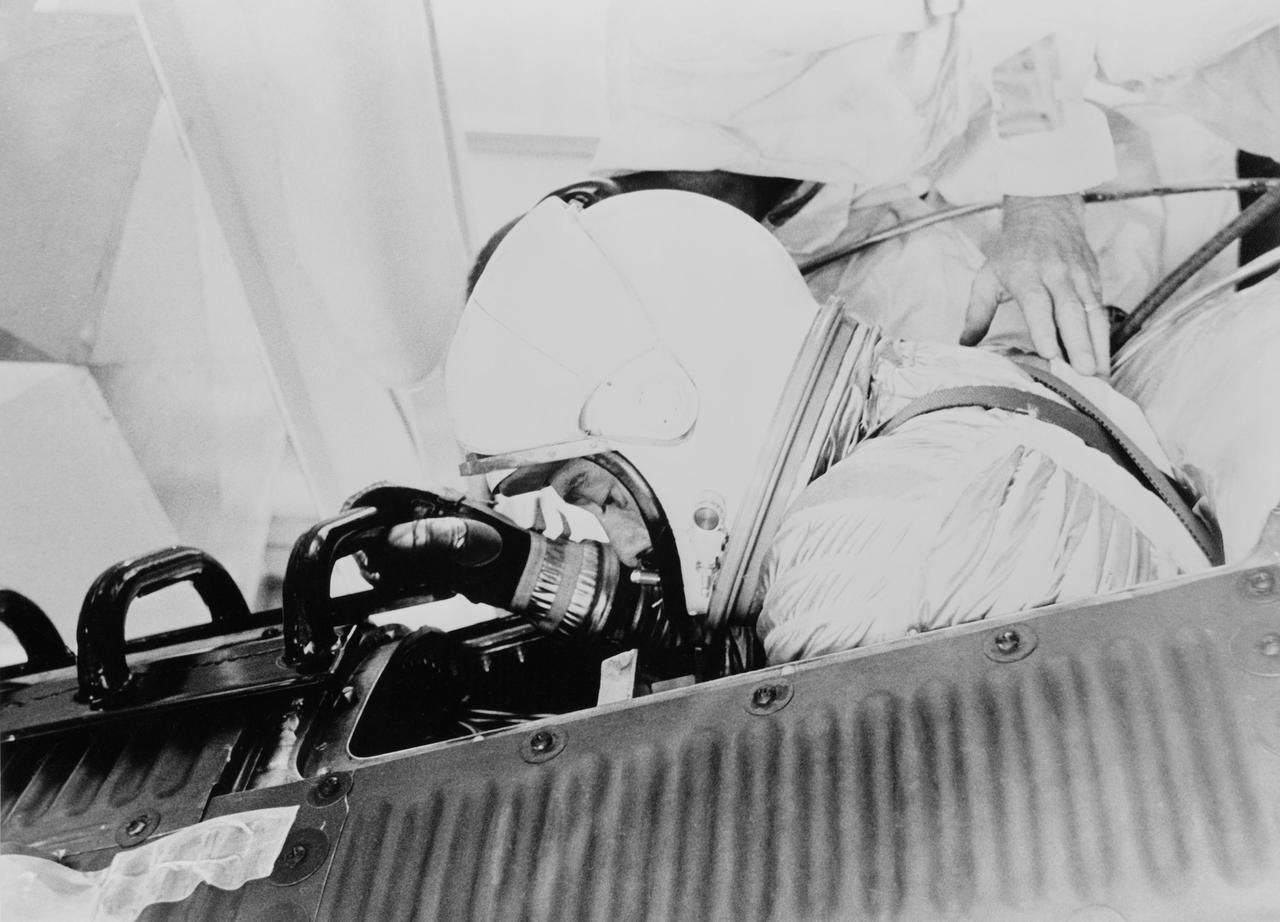
S61-03645 (5 May 1961) --- Close-up of astronaut Alan B. Shepard Jr., in his pressure suit and helmet, ingressing into the Freedom 7 capsule in preparation for the Mercury-Redstone 3 (MR-3) mission. Photo credit: NASA or National Aeronautics and Space Administration
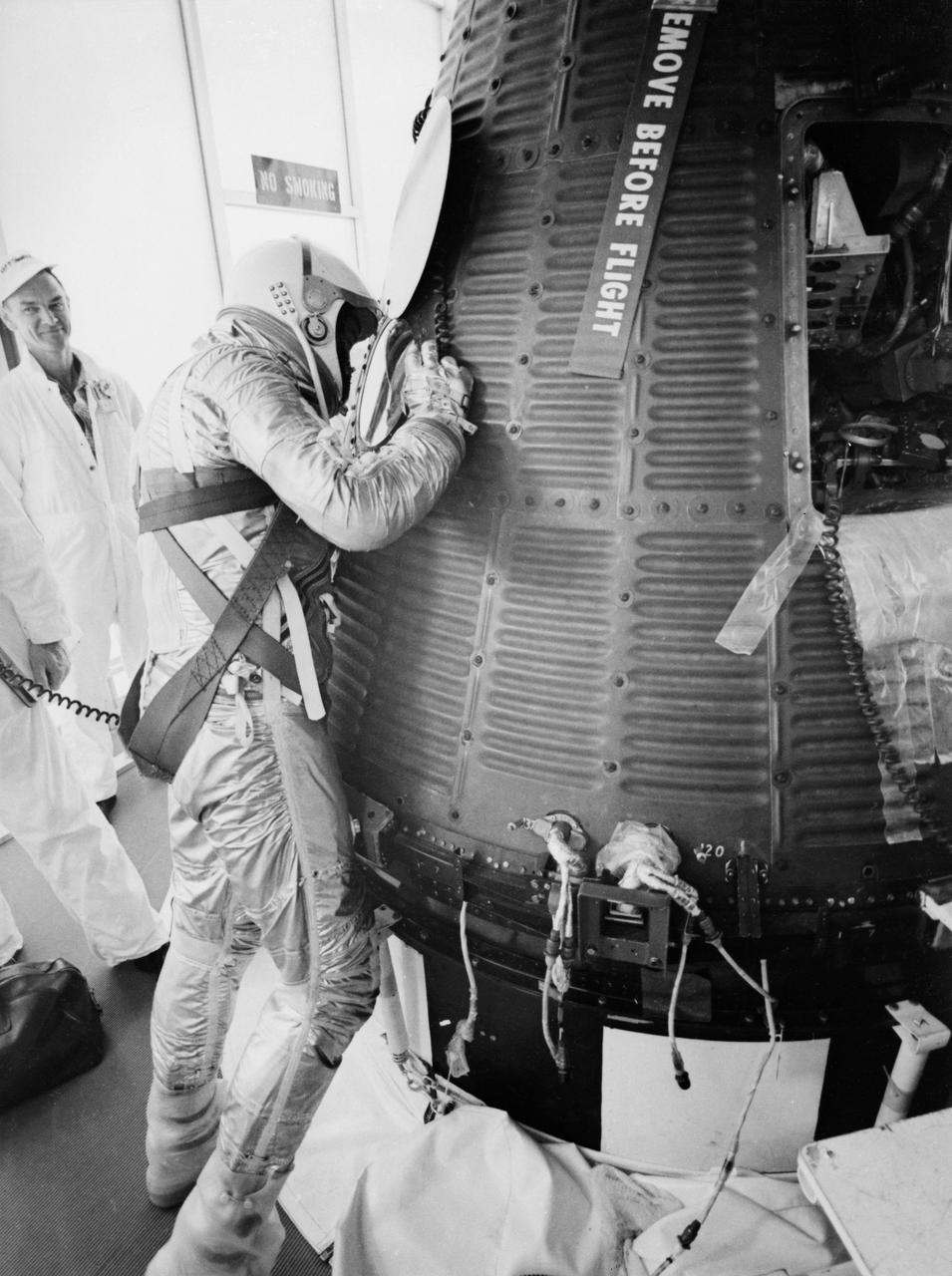
S61-02547 (5 May 1961) --- Astronaut Alan B. Shepard Jr., in his pressure suit and helmet, looks into the Freedom 7 capsule in preparation for ingress before the Mercury-Redstone 3 (MR-3) mission. Photo credit: NASA or National Aeronautics and Space Administration
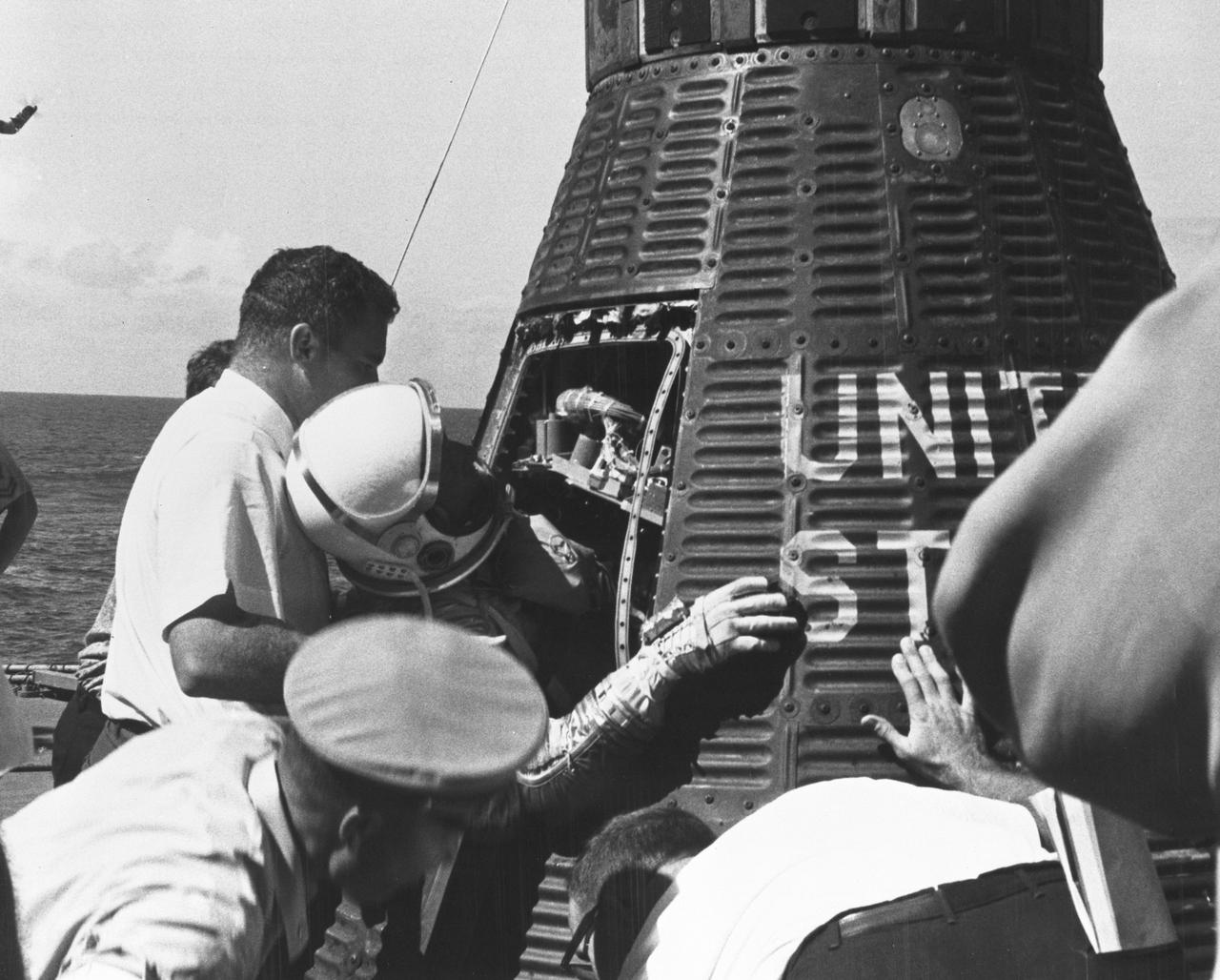
S62-06108 (3 Oct. 1962) --- Close-up view of Mercury-Atlas 8 (MA-8) astronaut Walter Schirra Jr. being removed from his Sigma 7 capsule by Navy personnel. Photo credit: NASA
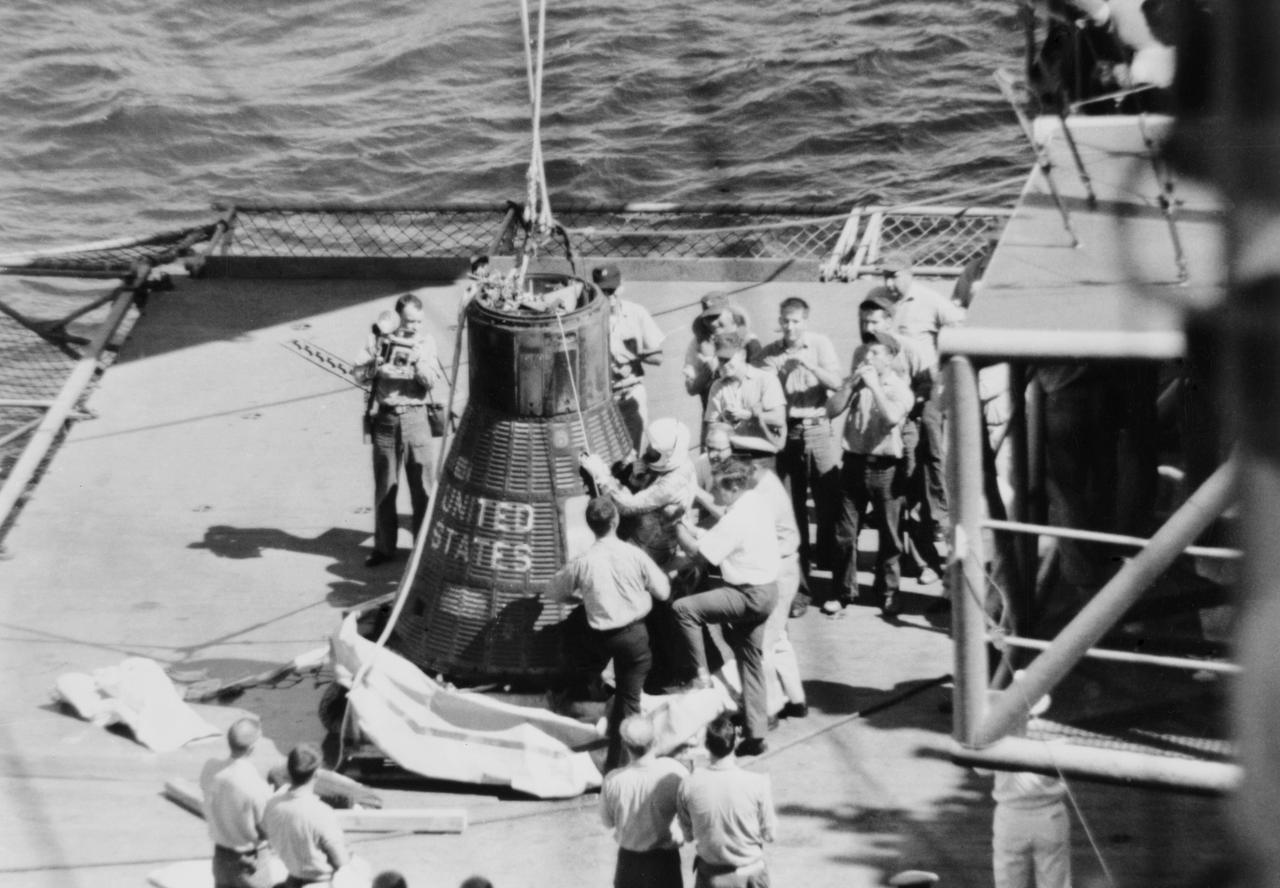
S62-06144 (3 Oct. 1962) --- Wide angle view of Mercury-Atlas 8 (MA-8) astronaut Walter Schirra Jr. being removed from his Sigma 7 capsule by Navy personnel. Photo credit: NASA
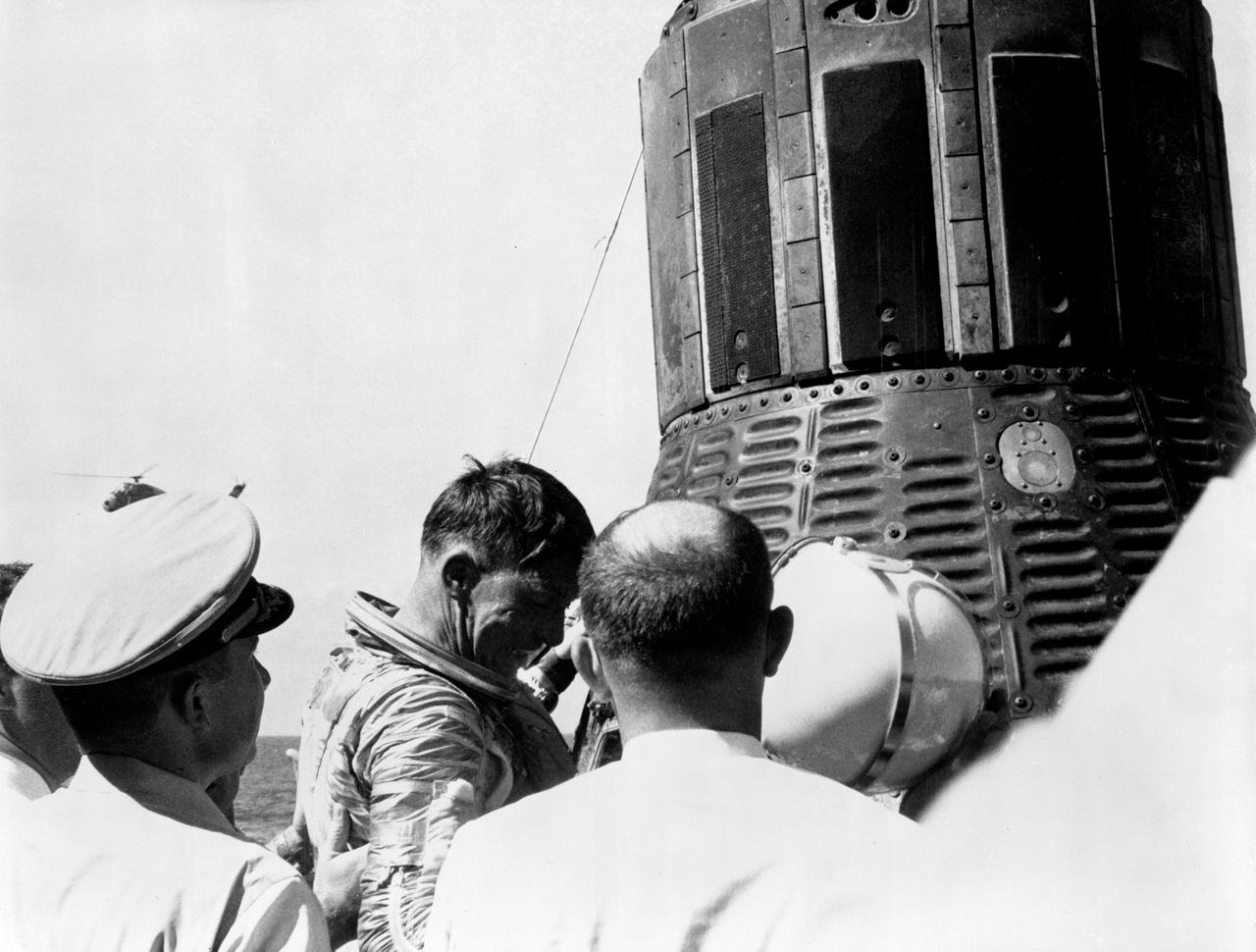
S62-06148 (3 Oct. 1962) --- Close-up view of Mercury-Atlas 8 (MA-8) astronaut Walter Schirra being removed from his Sigma 7 capsule by Navy personnel. Schirra has just removed his helmet. Photo credit: NASA
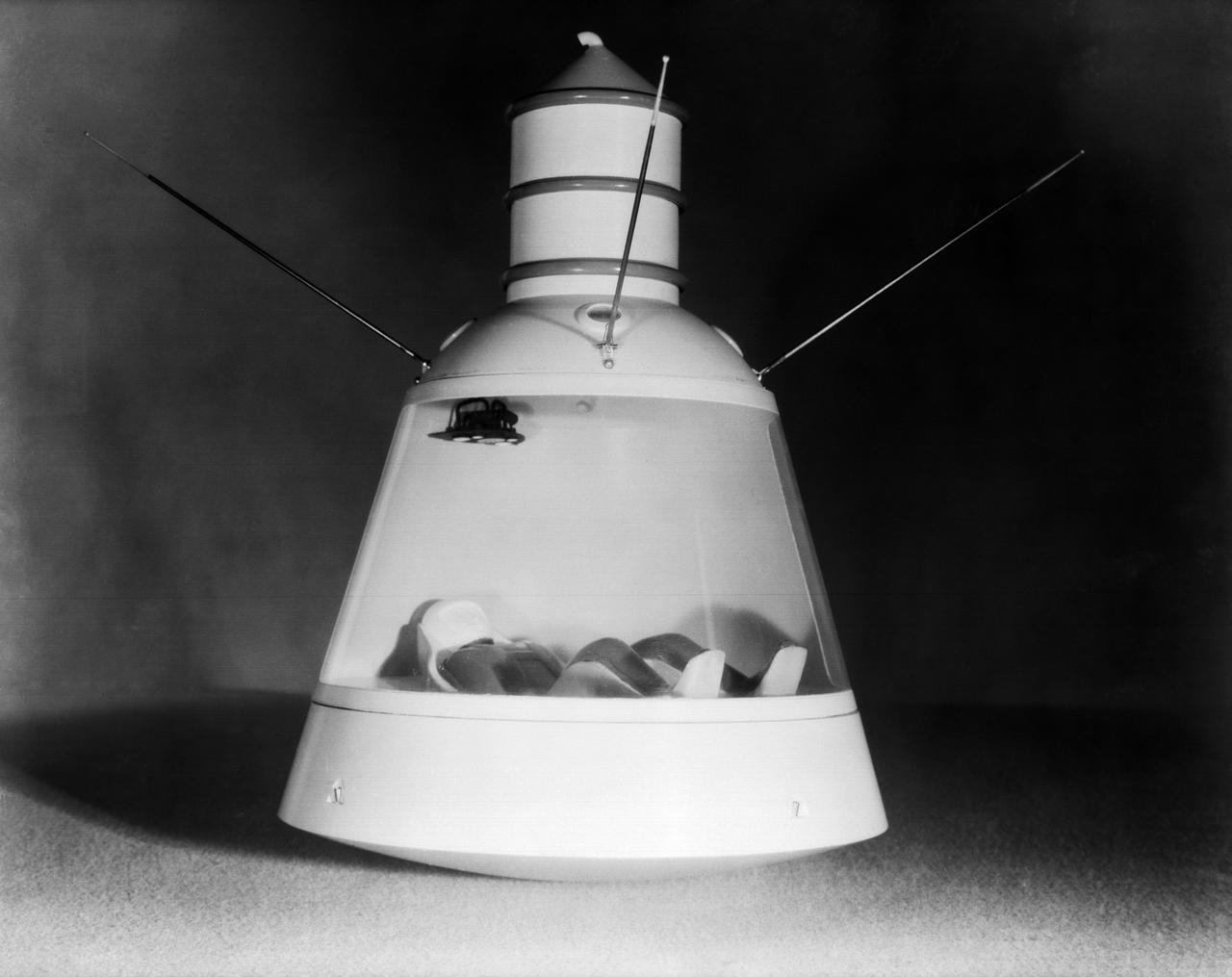
Scale model of Mercury capsule shape A, indicating the position of the astronaut.