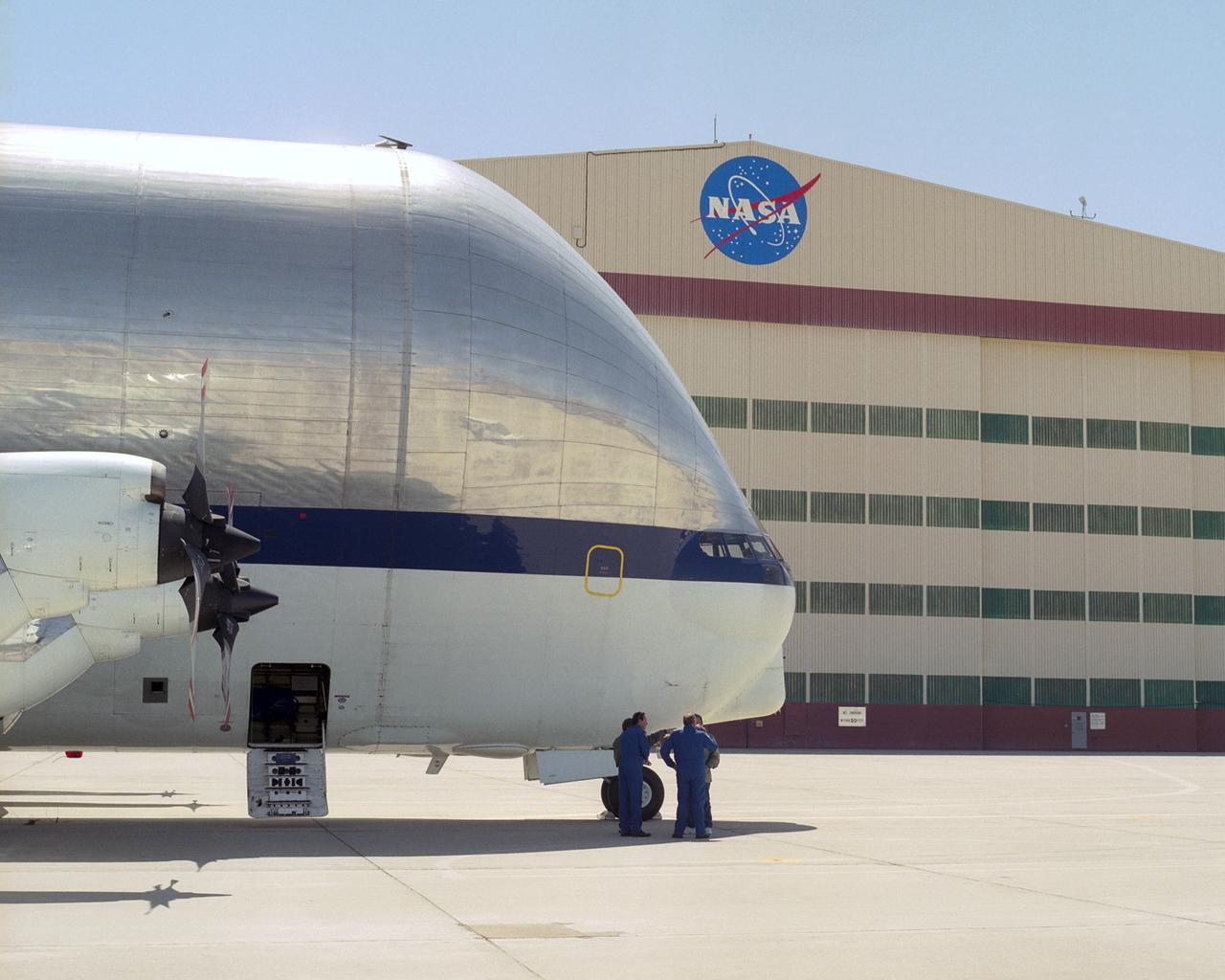
NASA's outsize Super Guppy cargo plane dwarfs its flight crew after its arrival at NASA Dryden Flight Research Center for a landing gear change.
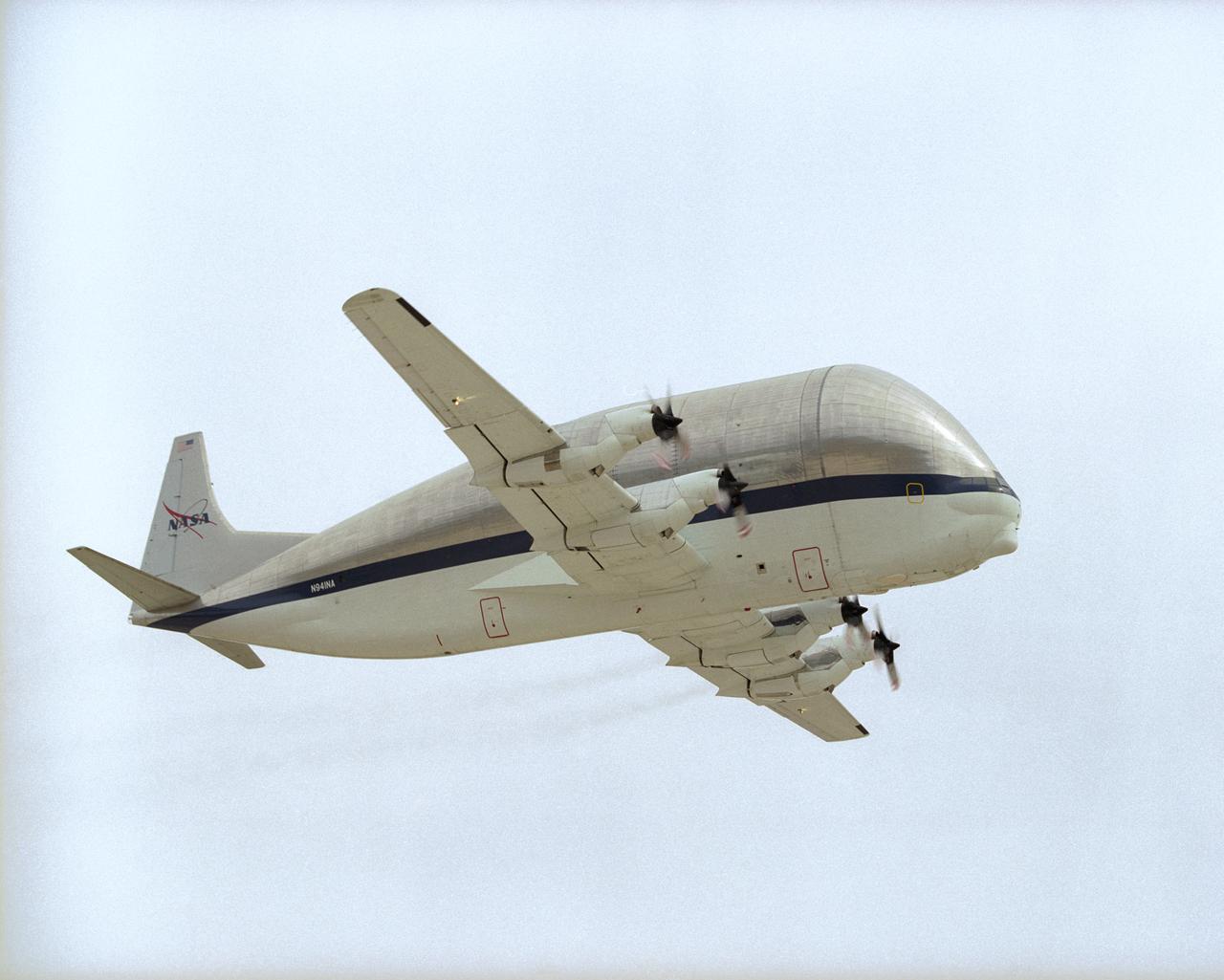
After replacement of its landing gear at NASA Dryden, NASA's Super Guppy Turbine cargo plane takes off from Edwards AFB to return to the Johnson Space Center.
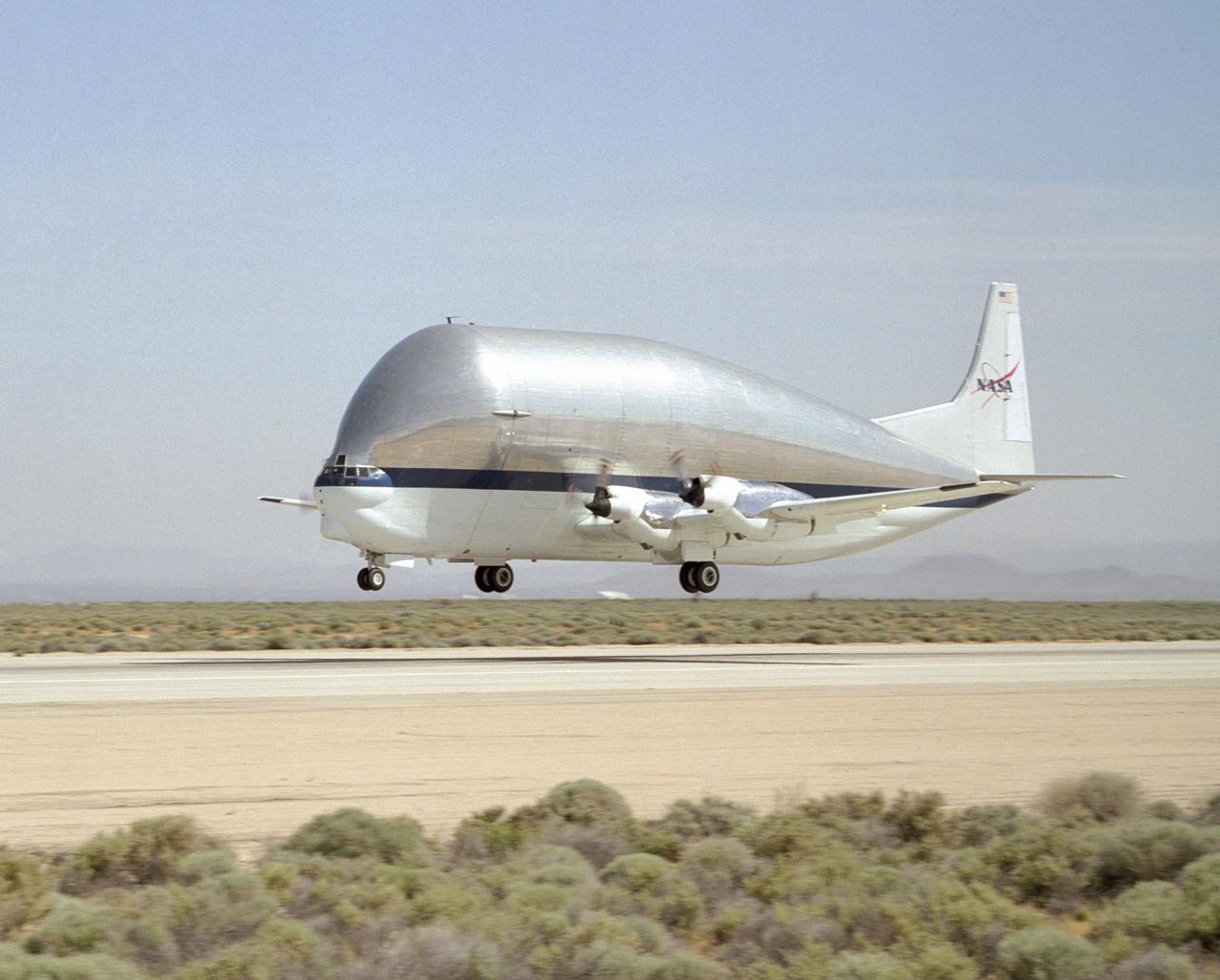
After replacement of its landing gear at NASA Dryden, NASA's Super Guppy Turbine cargo plane takes off from Edwards AFB to return to the Johnson Space Center.
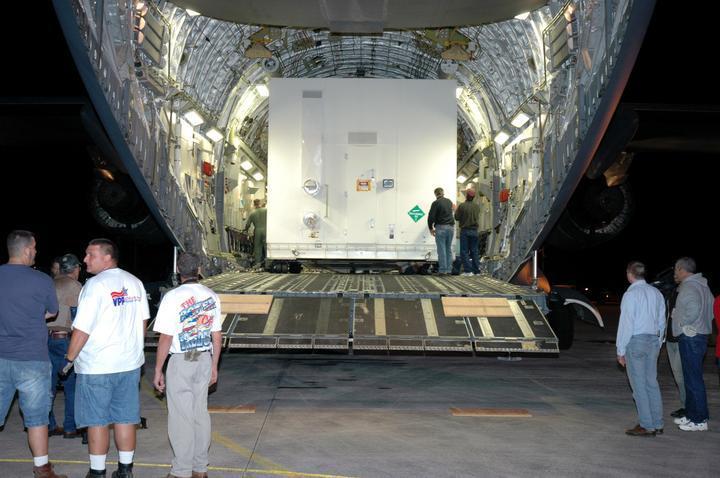
NASA Mars Reconnaissance Orbiter was delivered in two large containers from Lockheed Martin to Cape Canaveral on an Air Force C-17 cargo plane.
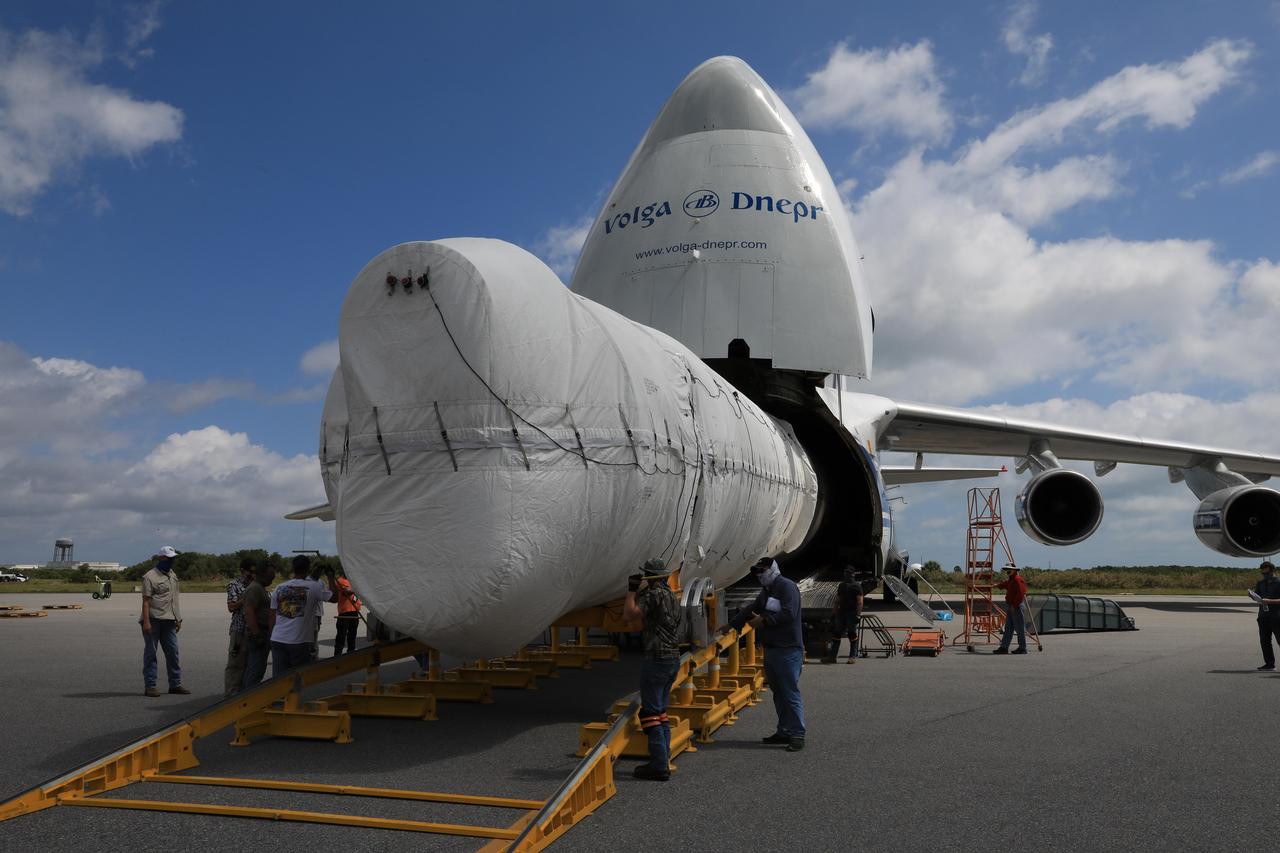
The first stage of the United Launch Alliance Atlas V that will carry NASA's Perseverance rover into space is offloaded from an Antonov cargo plane at Kennedy Space Center in Florida on May 11, 2020. https://photojournal.jpl.nasa.gov/catalog/PIA23917
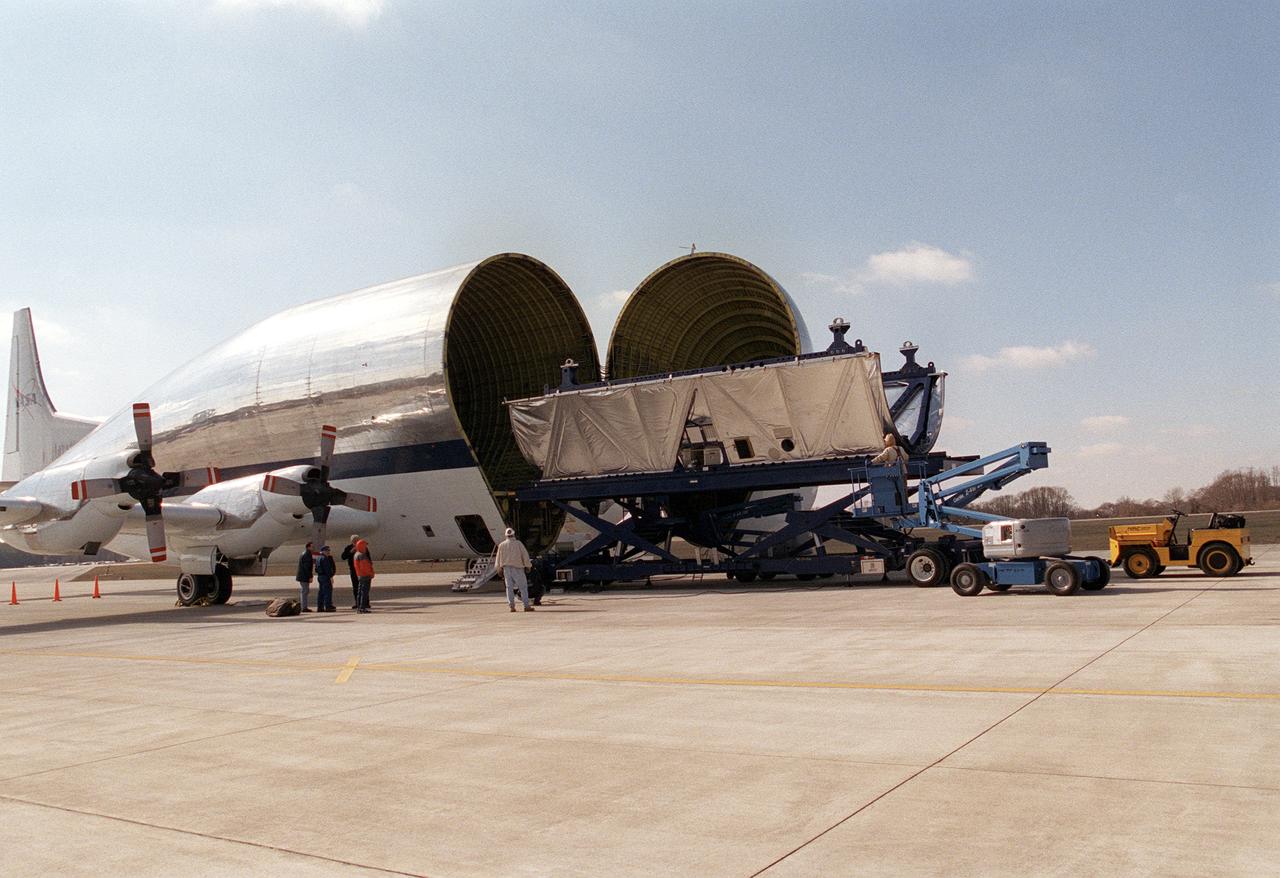
A section of the International Space Station truss assembly arrived at the Marshall Space Flight Center on NASA's Super Guppy cargo plane for structural and design testing as well as installation of critical flight hardware.
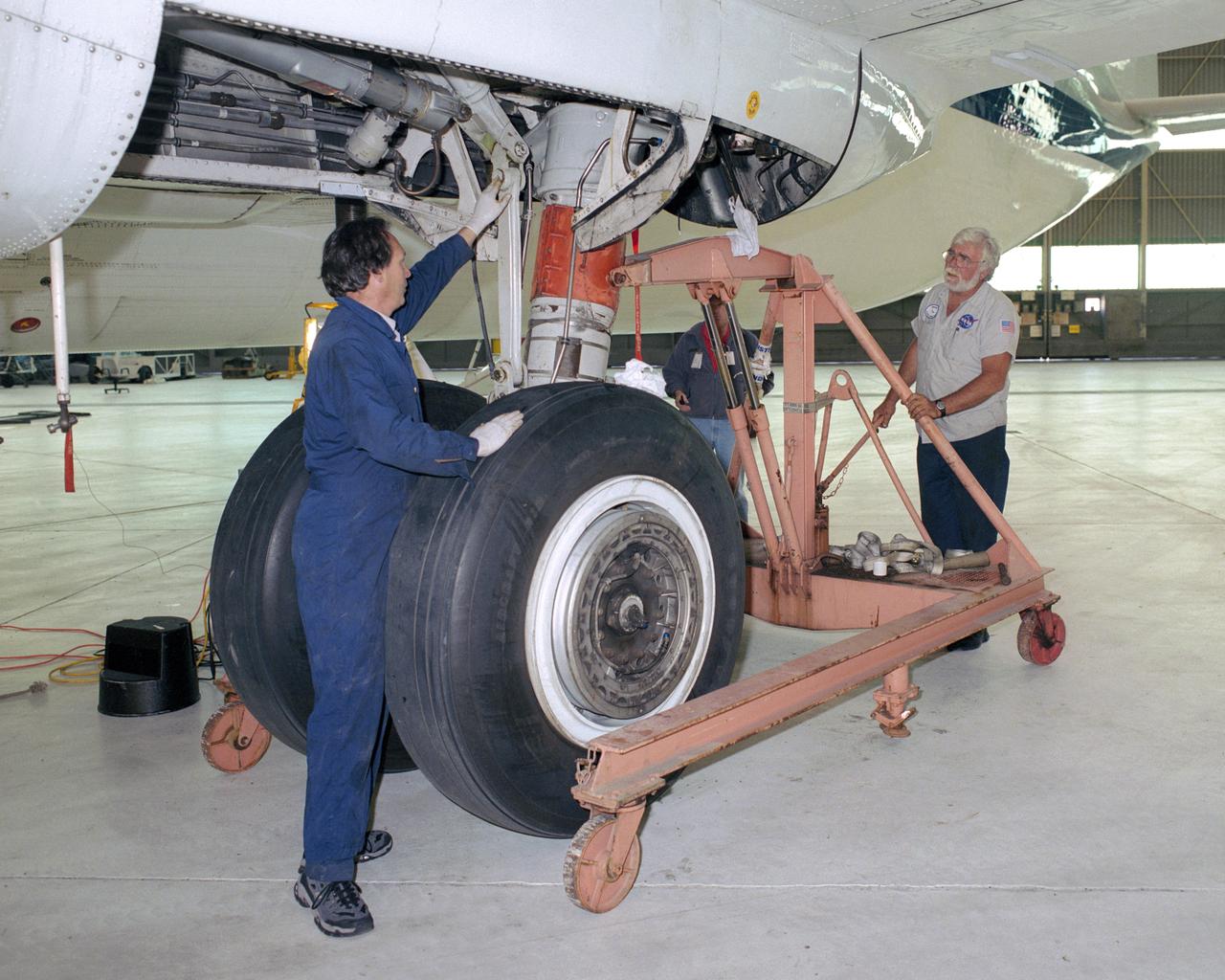
JSC technicians David Wyckoff and Tom Gordon carefully maneuver their equipment into place as they prepare to remove the Super Guppy's left main landing gear.
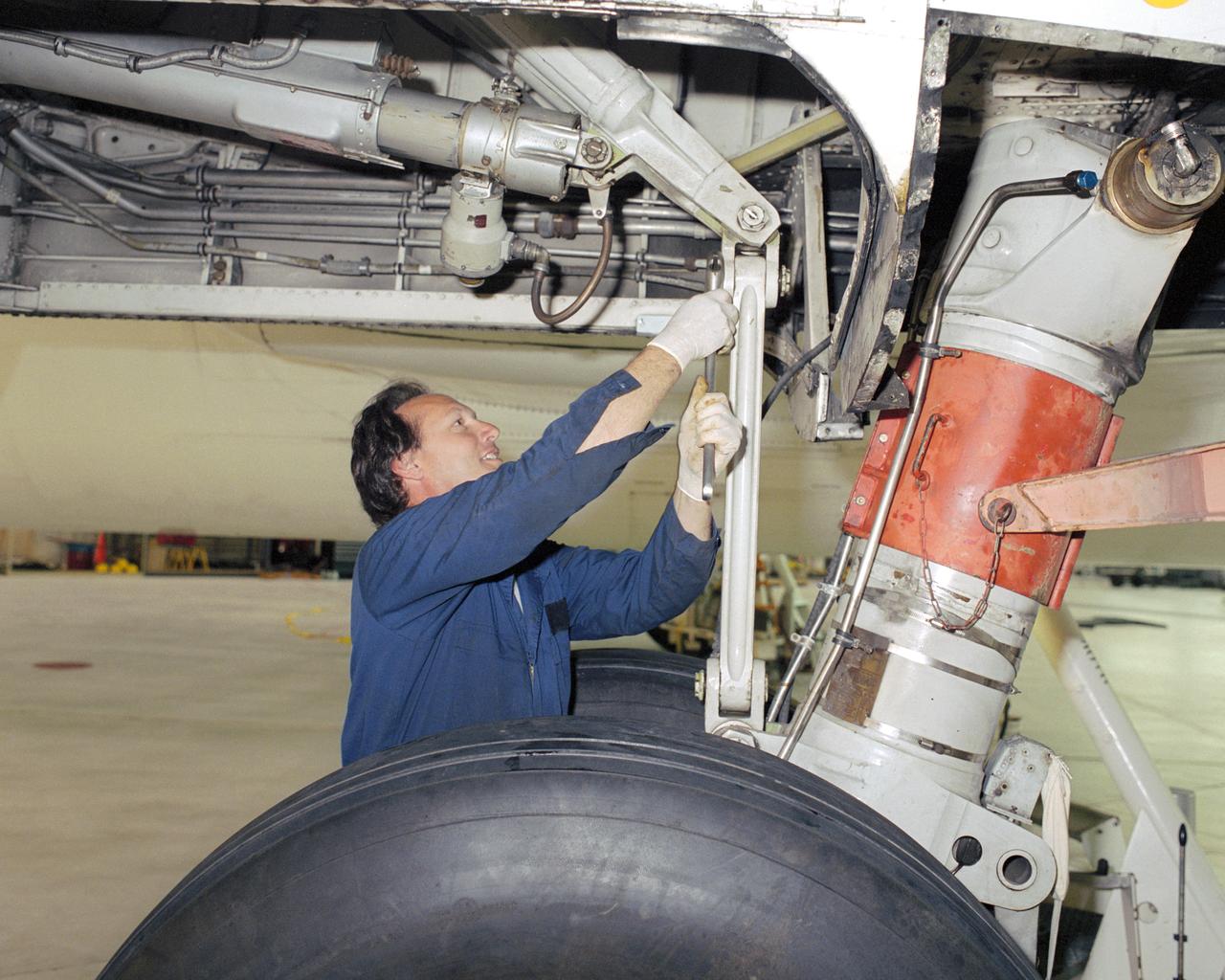
Assistant crew chief David Wyckoff applies some elbow grease to loosen a link pin during a landing gear changeout on NASA Johnson Space Center's Super Guppy.
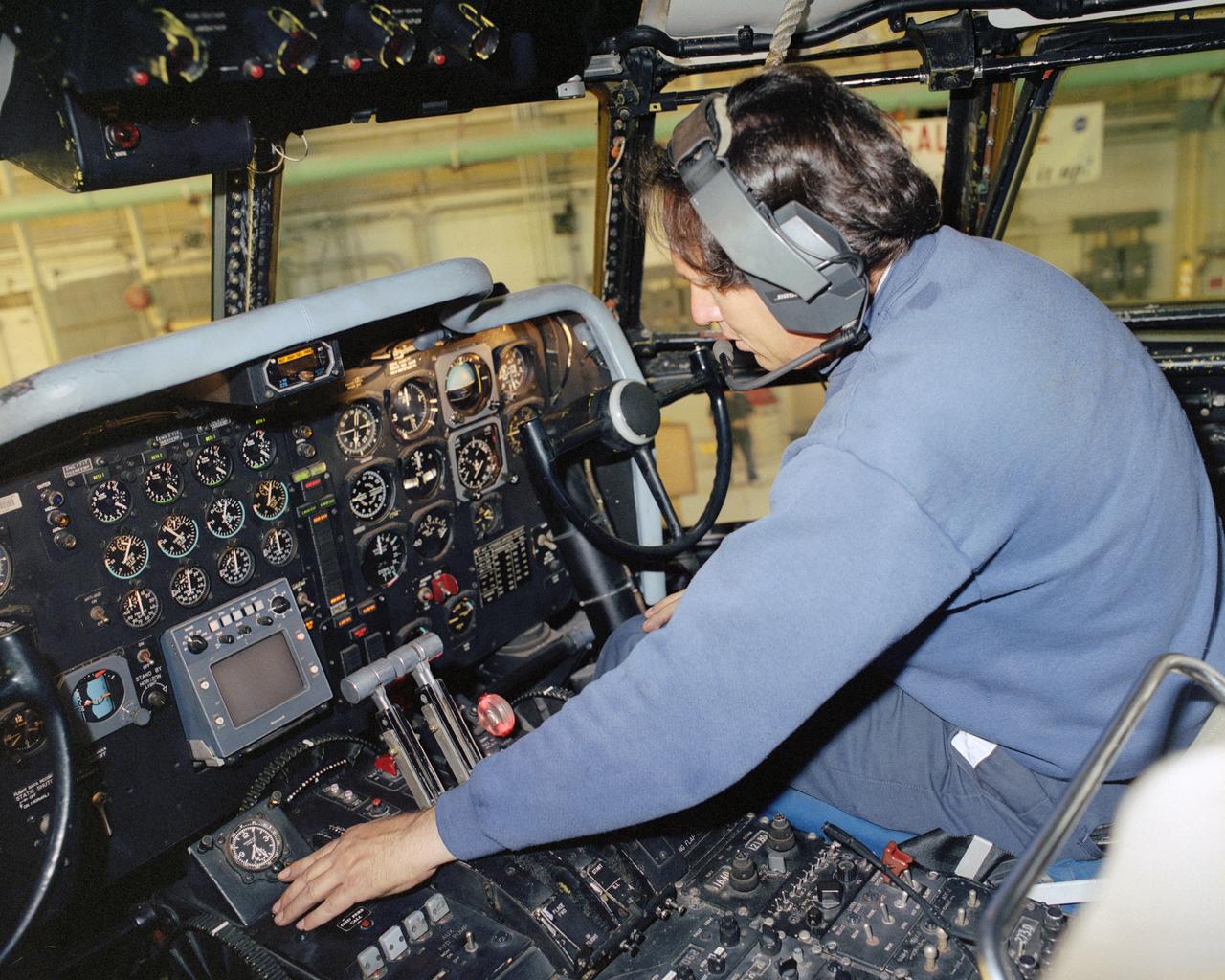
Assistant crew chief David Wyckoff checks out operation of the Super Guppy's new landing gear from the flight deck after changeout is complete.
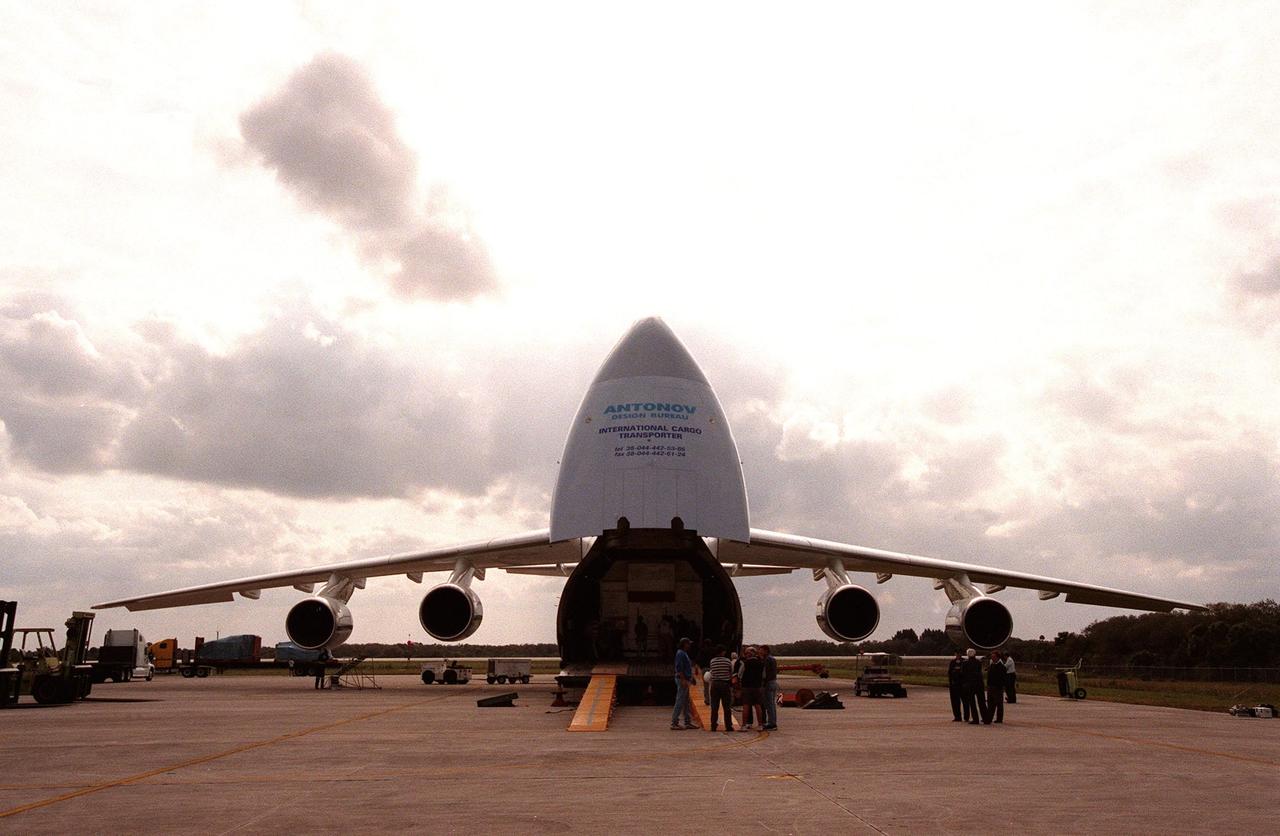
After delivering a French satellite for the EUTELSat Consortium, a Russian cargo plane, the Antonov 124, sits on the end of the Shuttle Landing Facility at KSC. The satellite is targeted to be launched April 12 aboard an Atlas IIAS rocket from Complex 36, Cape Canaveral Air Station
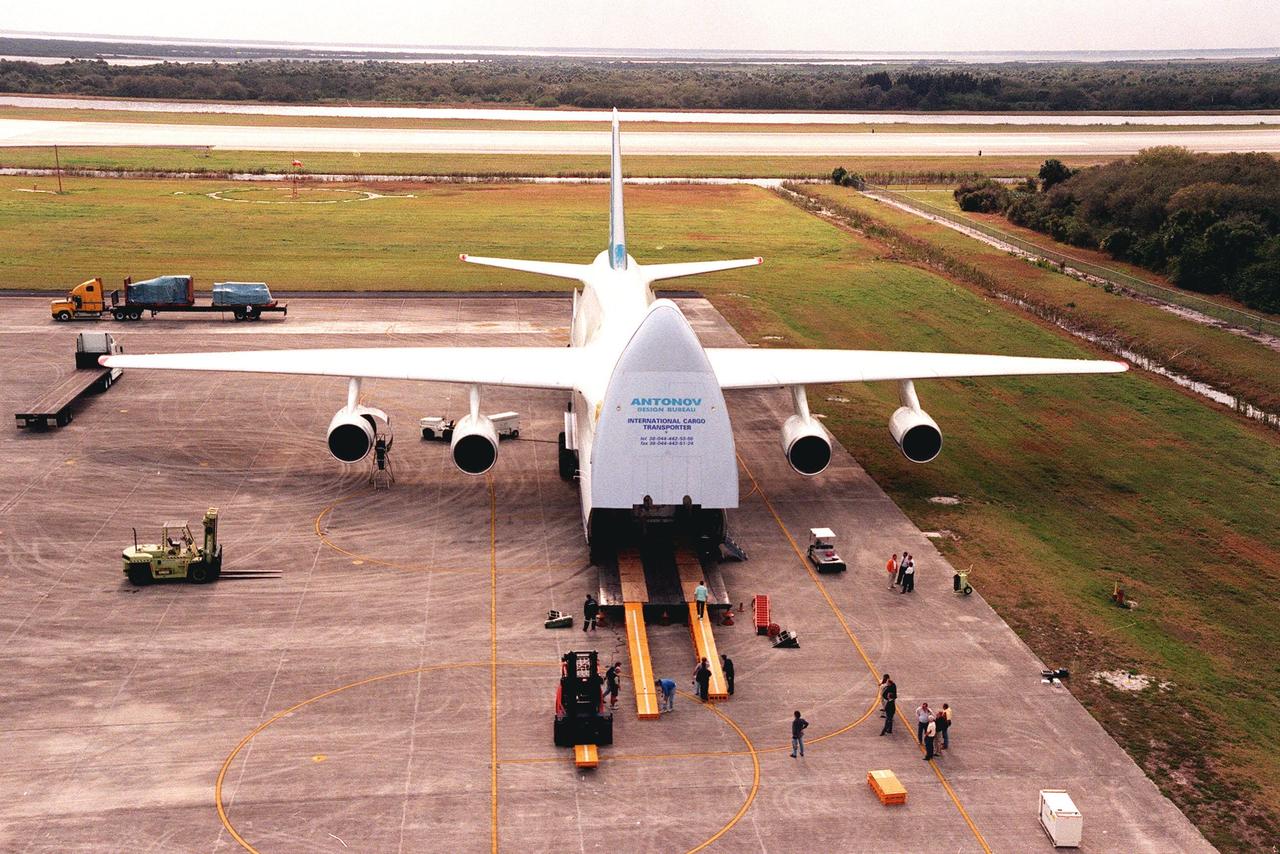
A Russian cargo plane, the Antonov 124, sits on the end of the Shuttle Landing Facility at KSC after delivering a French satellite for the EUTELSat Consortium. The satellite is targeted to be launched April 12 aboard an Atlas IIAS rocket from Complex 36, Cape Canaveral Air Station
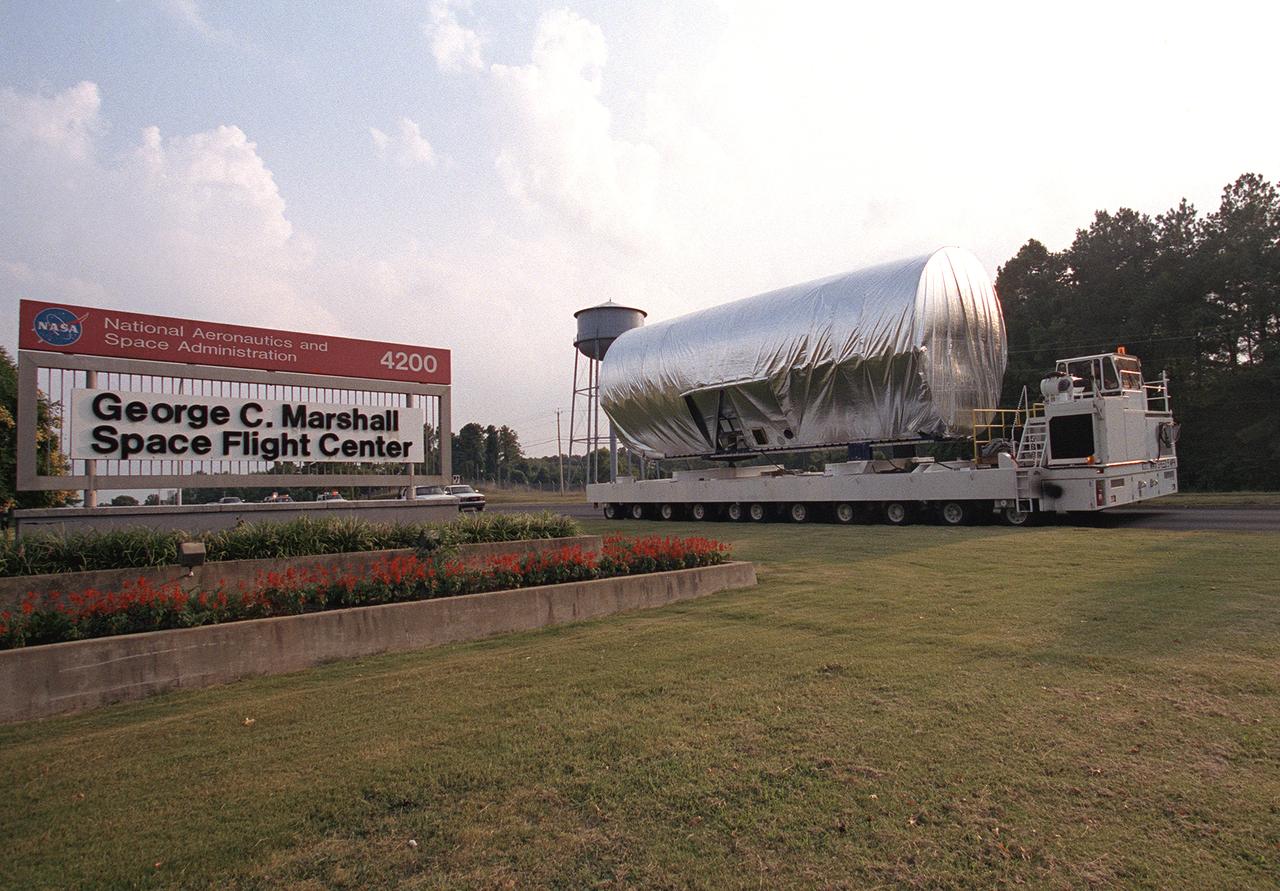
The 45-foot, port-side (P1) truss segment flight article for the International Space Station is being transported to the Redstone Airfield, Marshall Space Flight Center. The truss will be loaded aboard NASA's Super Guppy cargo plane for shipment to the Kennedy Space Center.
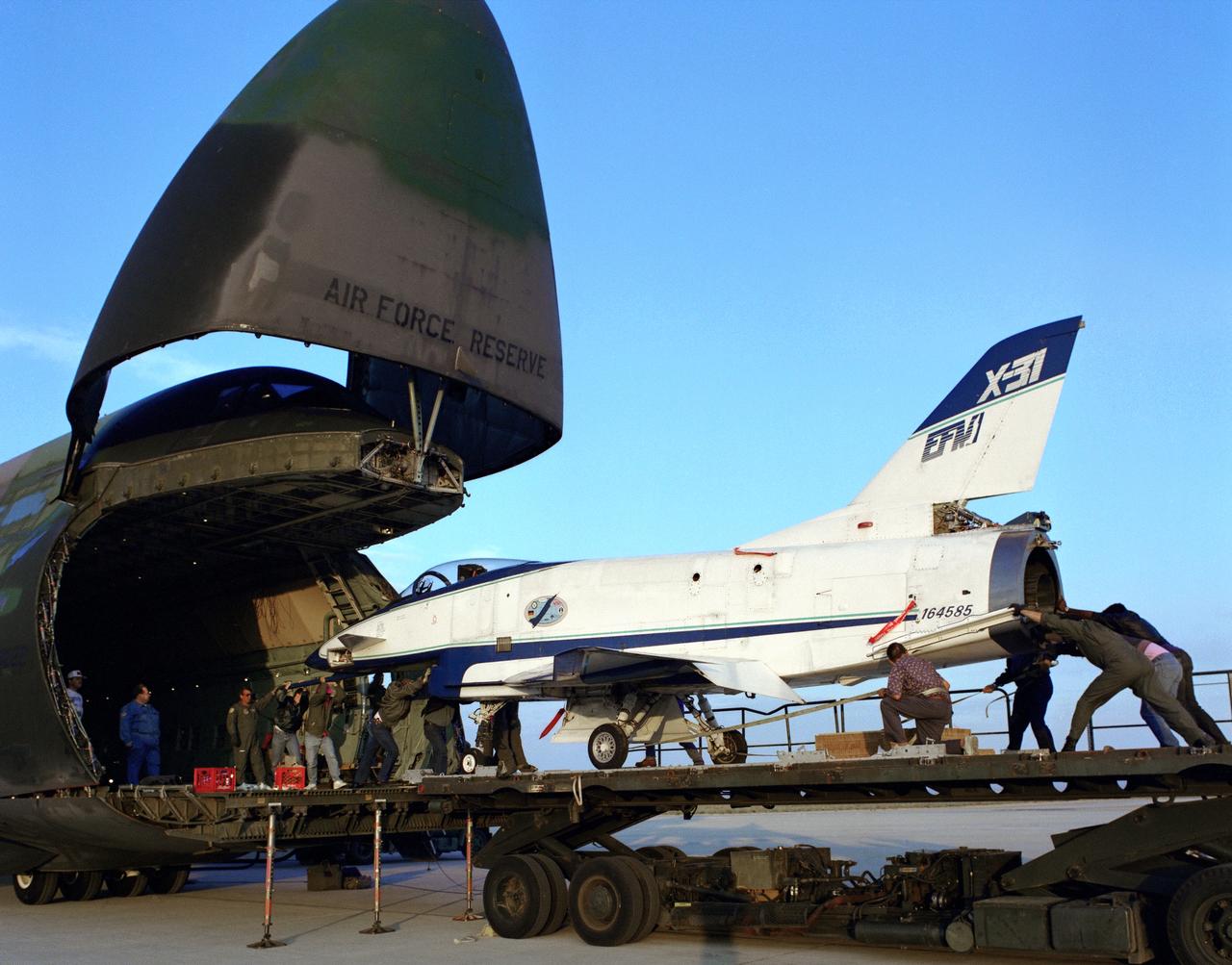
The X-31 Enhanced Fighter Maneuverability Technology Demonstrator Aircraft, based at the NASA Dryden Flight Research Center, Edwards, California, begins rolling aboard an Air Force Reserve C-5 transport which ferried it on May 22, 1995 to Europe where it was flown in the Paris Air Show in June 1995. To fit in the C-5 the right wing of the X-31 had to be removed. At the air show, the X-31 demonstrated the value of using thrust vectoring (directing engine exhaust flow) coupled with advanced flight control systems to provide controlled flight at very high angles of attack.
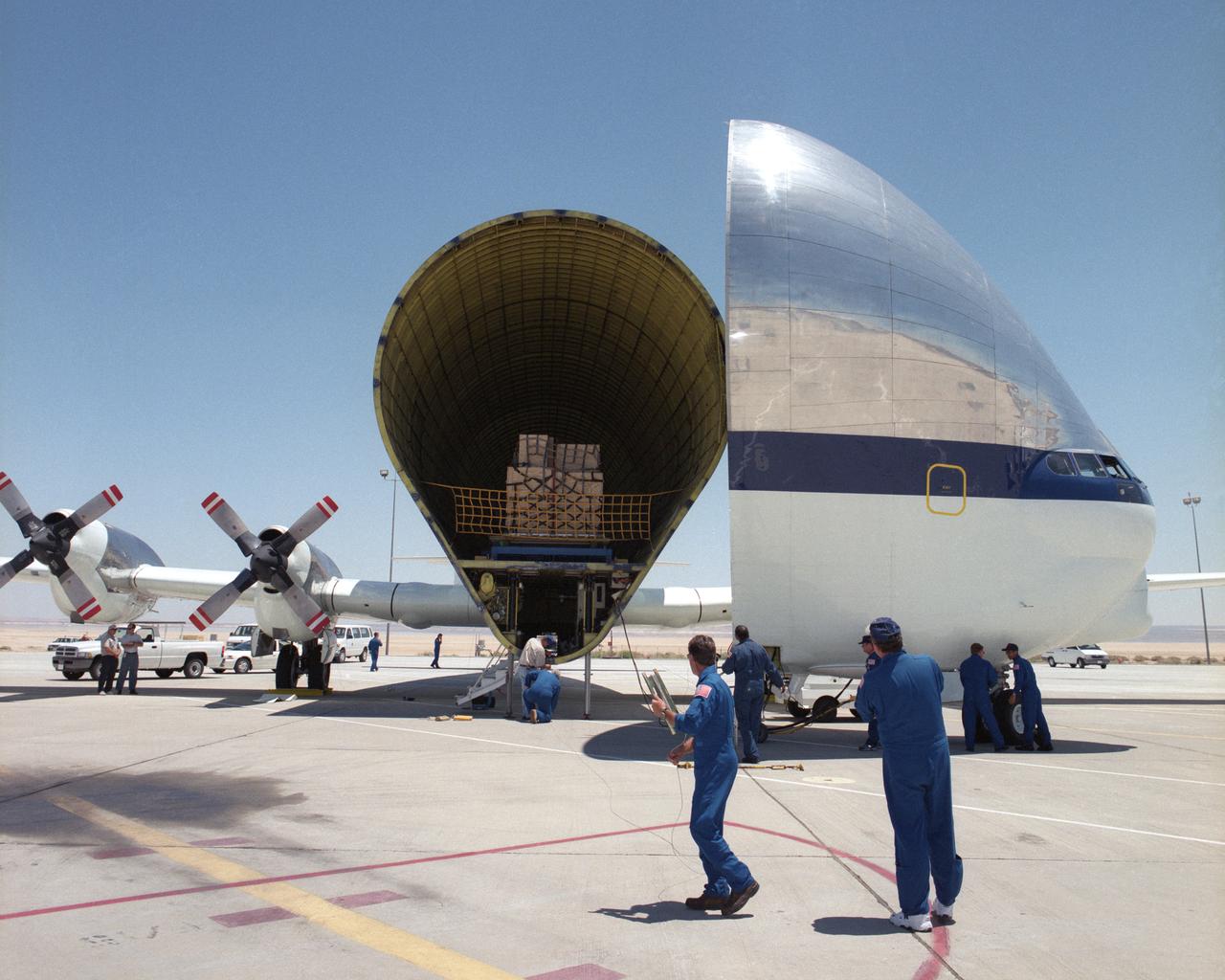
Members of the flight and ground crews prepare to unload equipment from NASA's B377SGT Super Guppy Turbine cargo aircraft on the ramp at NASA's Dryden Flight Research Center at Edwards Air Force Base, Calif. The outsize cargo plane had delivered the latest version of the X-38 flight test vehicle to NASA Dryden when this photo was taken on June 11, 2000.
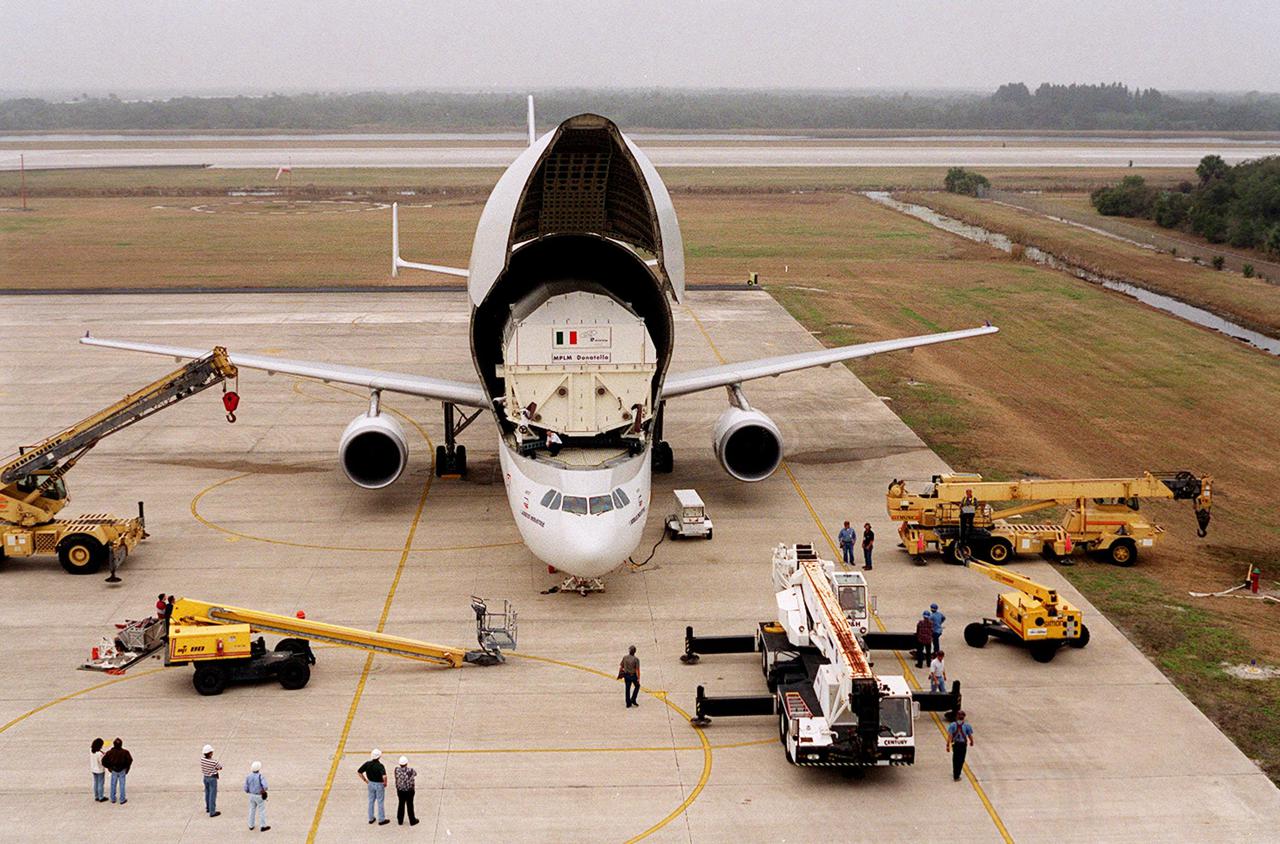
At the KSC <a href='.._.._subjects_slf.htm'> Shuttle Landing Facility<_a>, an Airbus “Beluga” air cargo plane opens to reveal its cargo, the Italian Space Agency’s <a href='.._.._subjects_mplm.htm'> Multi-Purpose Logistics Module<_a> Donatello, from the factory of Alenia Aerospazio in Turin, Italy. The third of three for the International Space Station, the module will be transported to the <a href='.._.._subjects_sspf.htm'> Space Station Processing Facility<_a> for processing. Among the activities for the payload test team are integrated electrical tests with other Station elements in the SSPF, leak tests, electrical and software compatibility tests with the Space Shuttle (using the Cargo Integrated Test equipment) and an Interface Verification Test once the module is installed in the Space Shuttle’s payload bay at the launch pad. The most significant mechanical task to be performed on Donatello in the SSPF is the installation and outfitting of the racks for carrying the various experiments and cargo
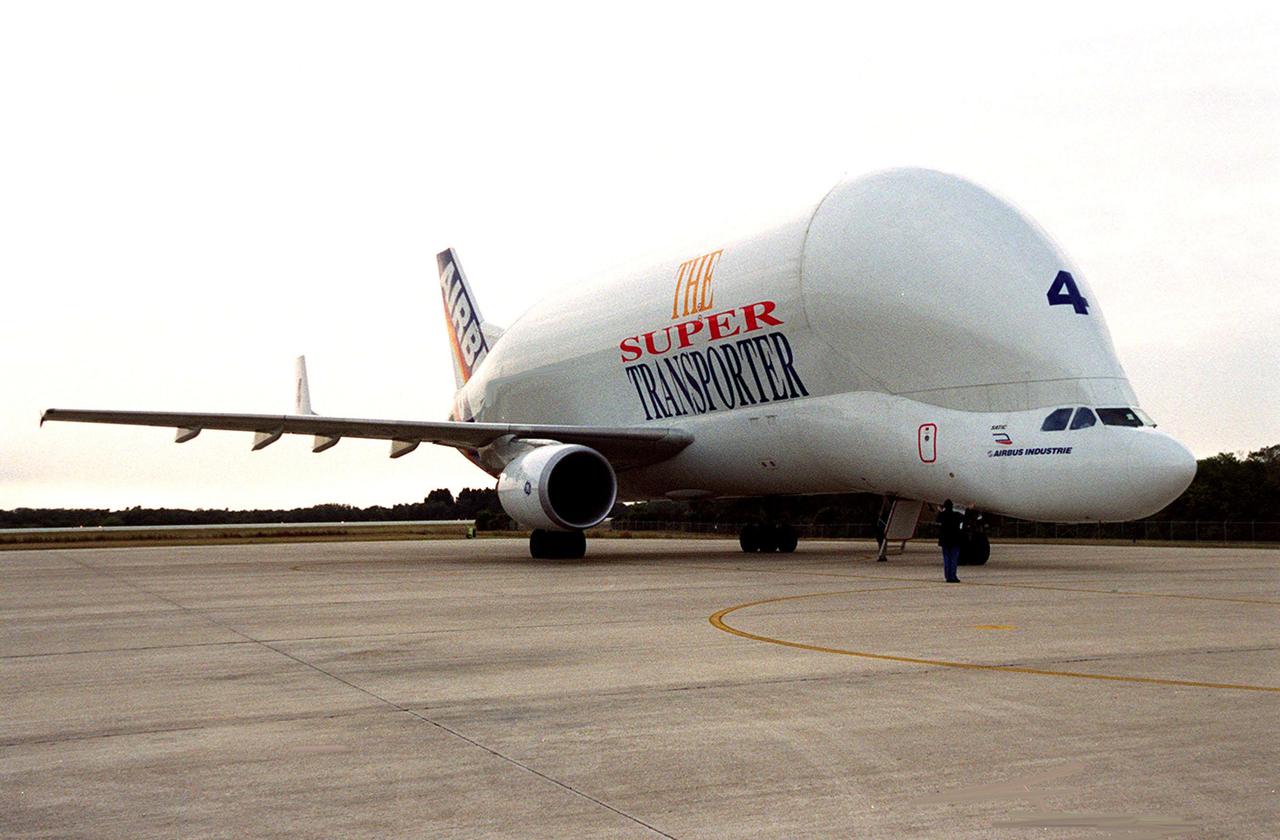
An Airbus “Beluga” air cargo plane, The Super Transporter, taxis onto the parking apron at KSC’s Shuttle Landing Facility. Its cargo, from the factory of Alenia Aerospazio in Turin, Italy, is the Italian Space Agency’s Multi-Purpose Logistics Module Donatello, the third of three for the International Space Station. The module will be transported to the Space Station Processing Facility for processing. Among the activities for the payload test team are integrated electrical tests with other Station elements in the SSPF, leak tests, electrical and software compatibility tests with the Space Shuttle (using the Cargo Integrated Test equipment) and an Interface Verification Test once the module is installed in the Space Shuttle’s payload bay at the launch pad. The most significant mechanical task to be performed on Donatello in the SSPF is the installation and outfitting of the racks for carrying the various experiments and cargo
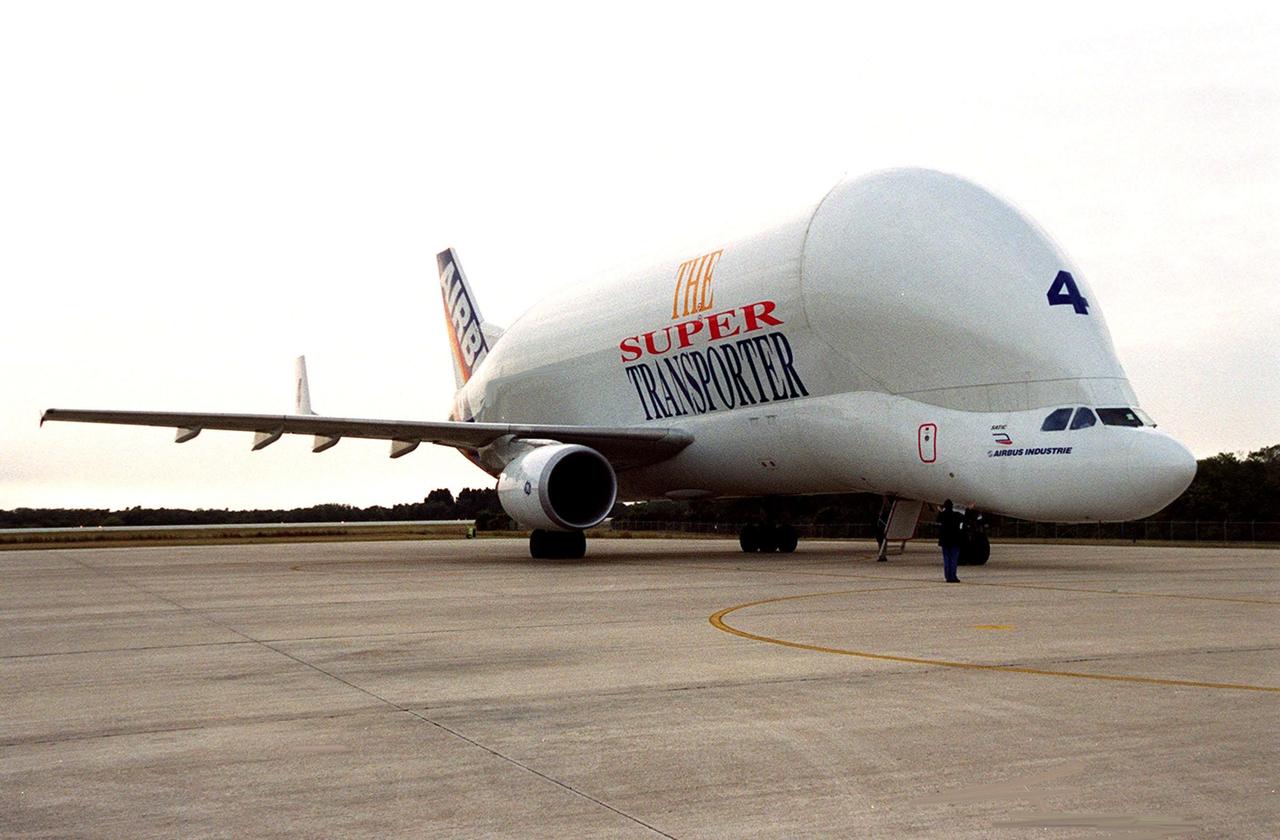
An Airbus “Beluga” air cargo plane, The Super Transporter, taxis onto the parking apron at KSC’s Shuttle Landing Facility. Its cargo, from the factory of Alenia Aerospazio in Turin, Italy, is the Italian Space Agency’s Multi-Purpose Logistics Module Donatello, the third of three for the International Space Station. The module will be transported to the Space Station Processing Facility for processing. Among the activities for the payload test team are integrated electrical tests with other Station elements in the SSPF, leak tests, electrical and software compatibility tests with the Space Shuttle (using the Cargo Integrated Test equipment) and an Interface Verification Test once the module is installed in the Space Shuttle’s payload bay at the launch pad. The most significant mechanical task to be performed on Donatello in the SSPF is the installation and outfitting of the racks for carrying the various experiments and cargo
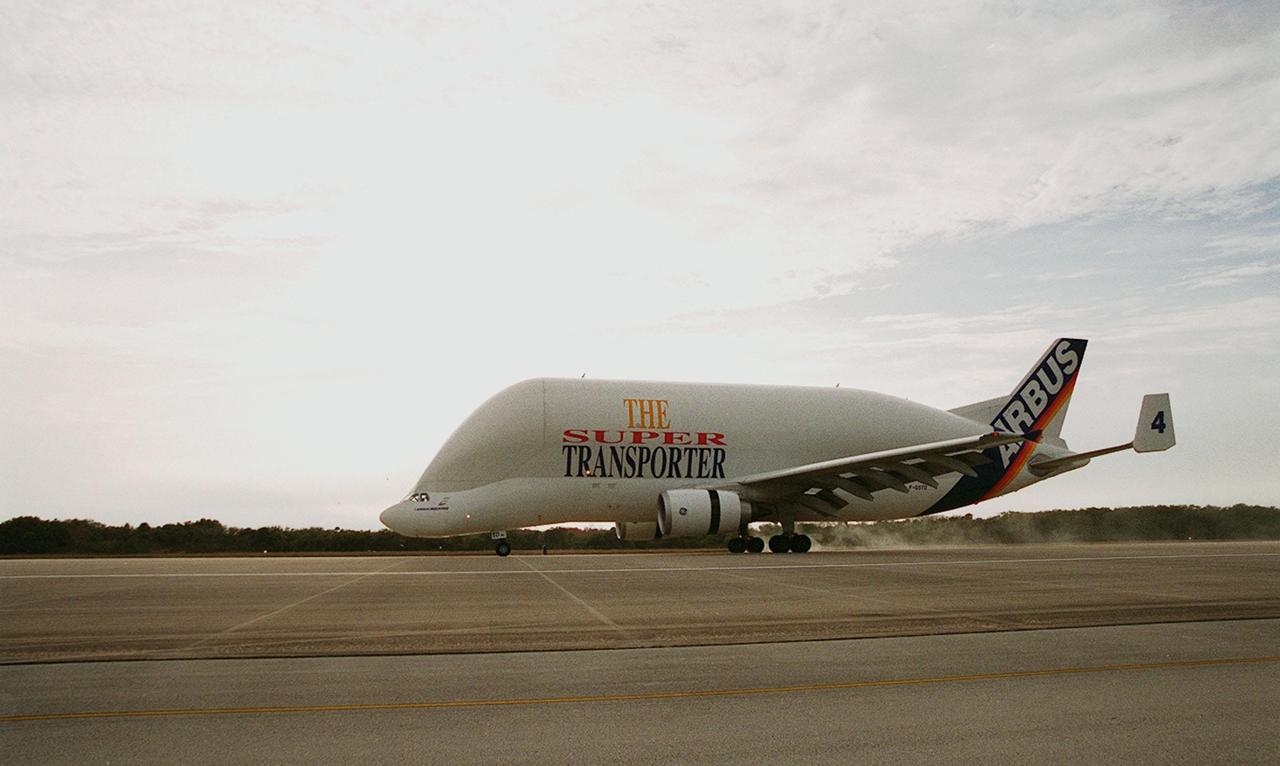
An Airbus “Beluga” air cargo plane, The Super Transporter, lands at KSC’s Shuttle Landing Facility. Its cargo, from the factory of Alenia Aerospazio in Turin, Italy, is the Italian Space Agency’s Multi-Purpose Logistics Module Donatello, the third of three for the International Space Station. The module will be transported to the Space Station Processing Facility for processing. Among the activities for the payload test team are integrated electrical tests with other Station elements in the SSPF, leak tests, electrical and software compatibility tests with the Space Shuttle (using the Cargo Integrated Test equipment) and an Interface Verification Test once the module is installed in the Space Shuttle’s payload bay at the launch pad. The most significant mechanical task to be performed on Donatello in the SSPF is the installation and outfitting of the racks for carrying the various experiments and cargo
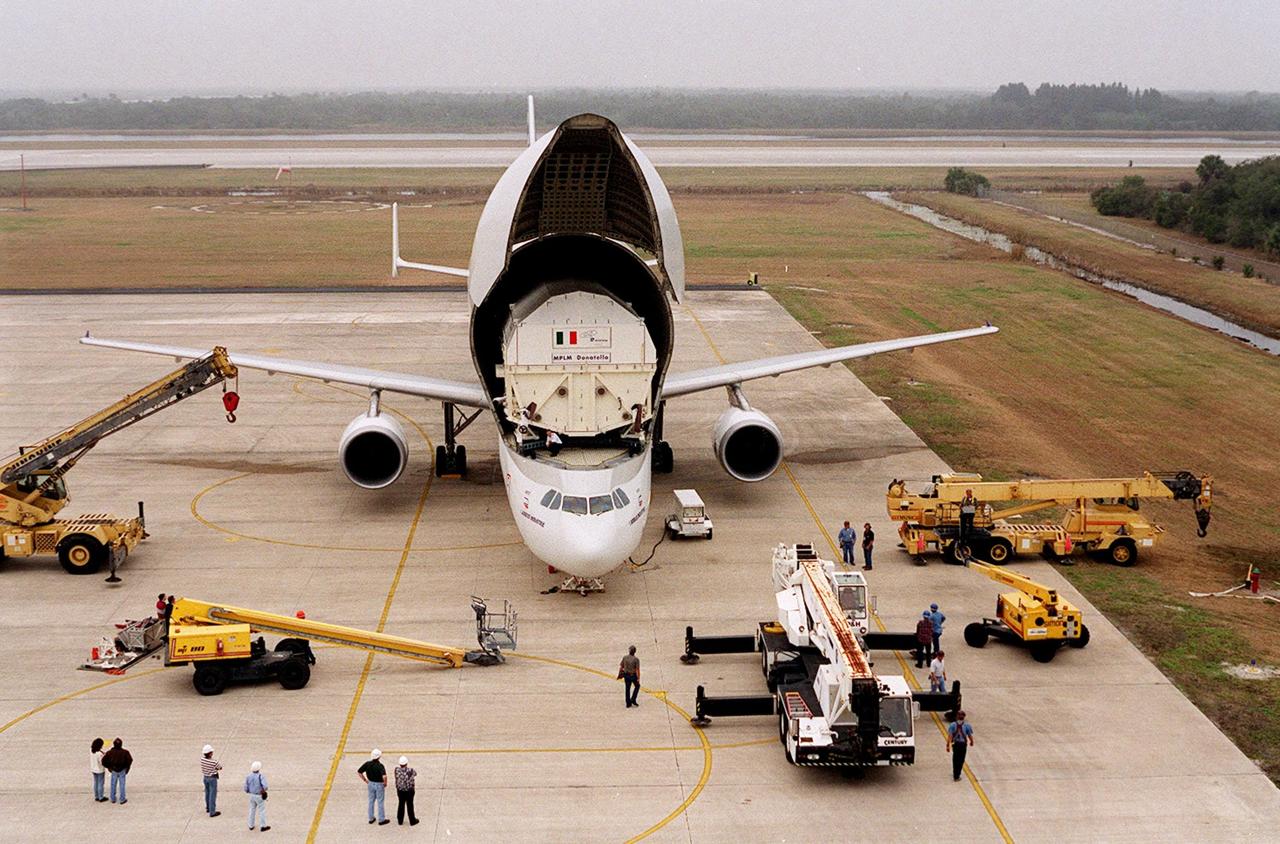
At the KSC <a href="../../subjects/slf.htm"> Shuttle Landing Facility</a>, an Airbus “Beluga” air cargo plane opens to reveal its cargo, the Italian Space Agency’s <a href="../../subjects/mplm.htm"> Multi-Purpose Logistics Module</a> Donatello, from the factory of Alenia Aerospazio in Turin, Italy. The third of three for the International Space Station, the module will be transported to the <a href="../../subjects/sspf.htm"> Space Station Processing Facility</a> for processing. Among the activities for the payload test team are integrated electrical tests with other Station elements in the SSPF, leak tests, electrical and software compatibility tests with the Space Shuttle (using the Cargo Integrated Test equipment) and an Interface Verification Test once the module is installed in the Space Shuttle’s payload bay at the launch pad. The most significant mechanical task to be performed on Donatello in the SSPF is the installation and outfitting of the racks for carrying the various experiments and cargo
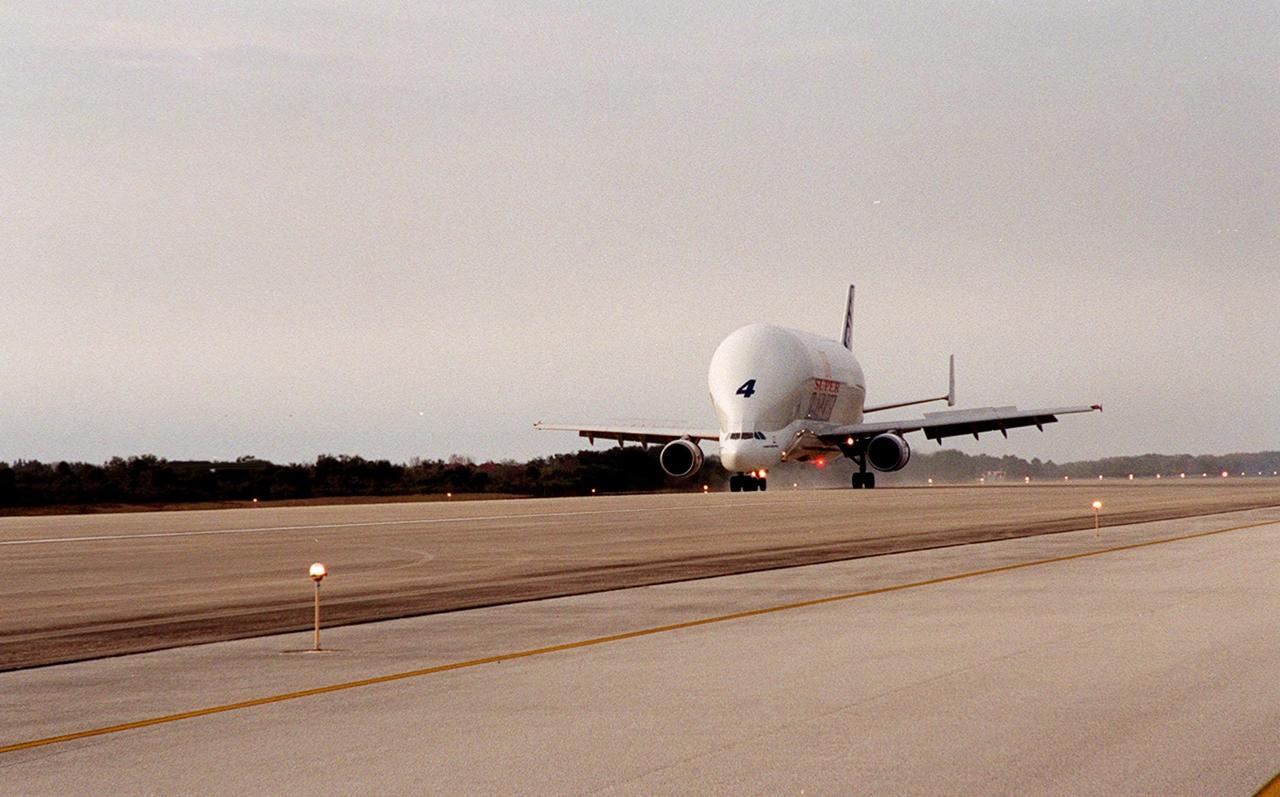
An Airbus “Beluga” air cargo plane, The Super Transporter, arrives at KSC’s Shuttle Landing Facility from the factory of Alenia Aerospazio in Turin, Italy. Its cargo is the Italian Space Agency’s Multi-Purpose Logistics Module Donatello, the third of three for the International Space Station. The module will be transported to the Space Station Processing Facility for processing. Among the activities for the payload test team are integrated electrical tests with other Station elements in the SSPF, leak tests, electrical and software compatibility tests with the Space Shuttle (using the Cargo Integrated Test equipment) and an Interface Verification Test once the module is installed in the Space Shuttle’s payload bay at the launch pad. The most significant mechanical task to be performed on Donatello in the SSPF is the installation and outfitting of the racks for carrying the various experiments and cargo
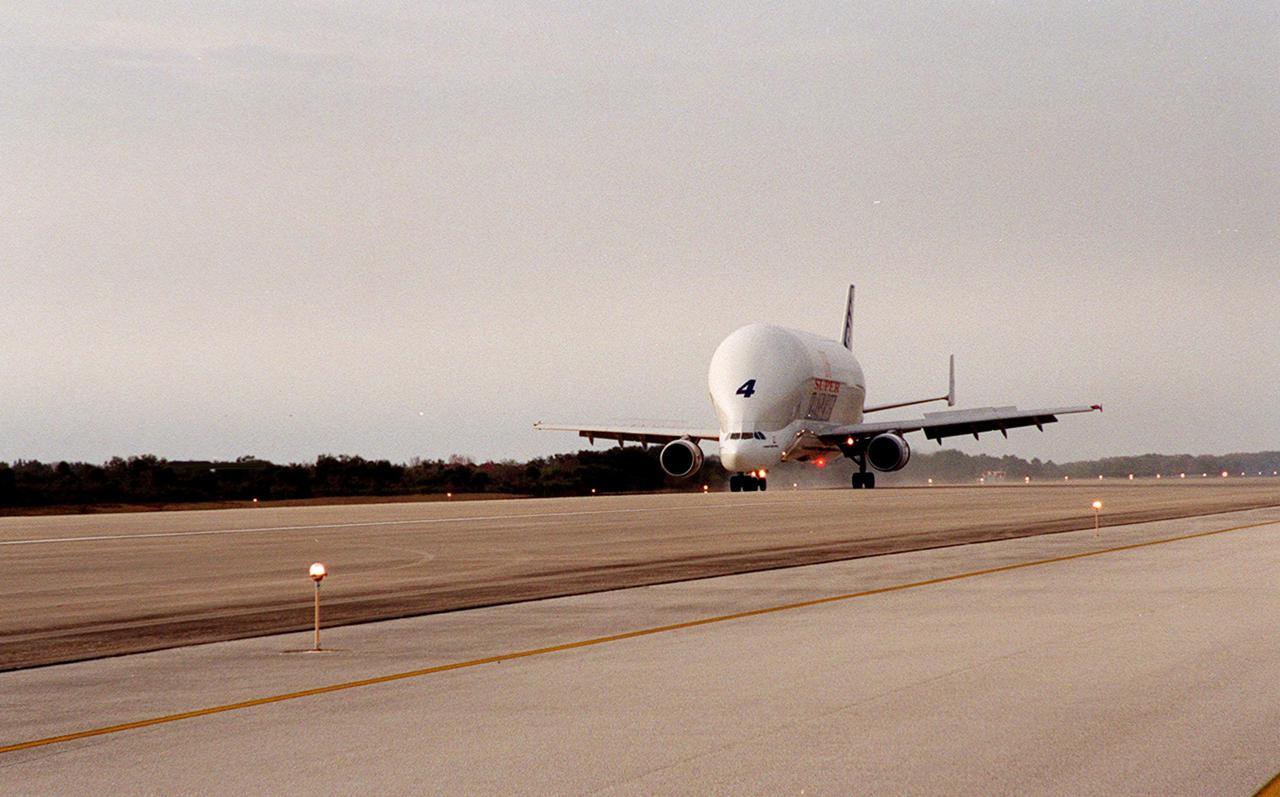
An Airbus “Beluga” air cargo plane, The Super Transporter, arrives at KSC’s Shuttle Landing Facility from the factory of Alenia Aerospazio in Turin, Italy. Its cargo is the Italian Space Agency’s Multi-Purpose Logistics Module Donatello, the third of three for the International Space Station. The module will be transported to the Space Station Processing Facility for processing. Among the activities for the payload test team are integrated electrical tests with other Station elements in the SSPF, leak tests, electrical and software compatibility tests with the Space Shuttle (using the Cargo Integrated Test equipment) and an Interface Verification Test once the module is installed in the Space Shuttle’s payload bay at the launch pad. The most significant mechanical task to be performed on Donatello in the SSPF is the installation and outfitting of the racks for carrying the various experiments and cargo
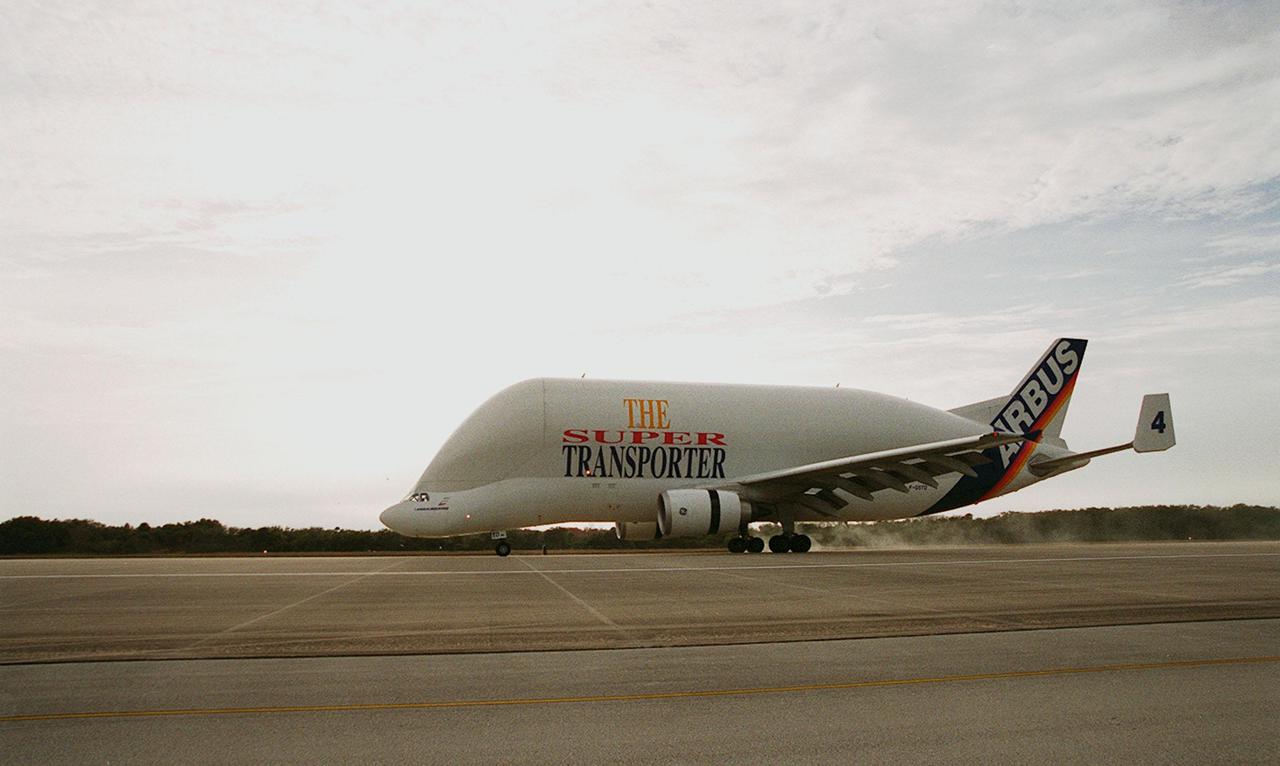
An Airbus “Beluga” air cargo plane, The Super Transporter, lands at KSC’s Shuttle Landing Facility. Its cargo, from the factory of Alenia Aerospazio in Turin, Italy, is the Italian Space Agency’s Multi-Purpose Logistics Module Donatello, the third of three for the International Space Station. The module will be transported to the Space Station Processing Facility for processing. Among the activities for the payload test team are integrated electrical tests with other Station elements in the SSPF, leak tests, electrical and software compatibility tests with the Space Shuttle (using the Cargo Integrated Test equipment) and an Interface Verification Test once the module is installed in the Space Shuttle’s payload bay at the launch pad. The most significant mechanical task to be performed on Donatello in the SSPF is the installation and outfitting of the racks for carrying the various experiments and cargo
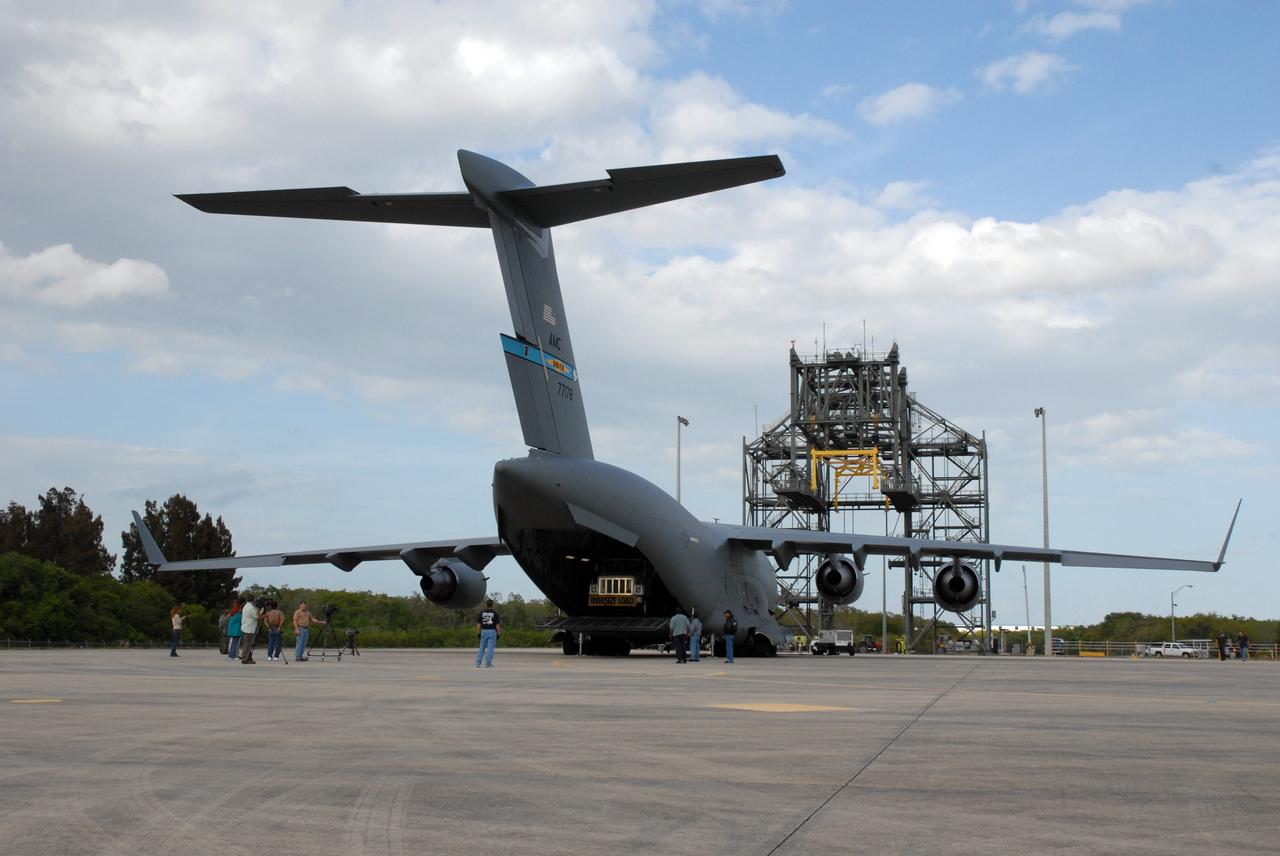
CAPE CANAVERAL, Fla. – A C-17 cargo plane arrives at the Shuttle Landing Facility at NASA's Kennedy Space Center in Florida with its cargo of the EXPRESS Logistics Carrier for the STS-129 mission. In the background is the mate/demate device used to separate a space shuttle from the Shuttle Carrier Aircraft. The carrier is part of the payload on space shuttle Atlantis, which will deliver to the International Space Station components including two spare gyroscopes, two nitrogen tank assemblies, two pump modules, an ammonia tank assembly and a spare latching end effector for the station's robotic arm. STS-129 is targeted to launch Nov. 12. Photo credit: NASA/Tim Jacobs
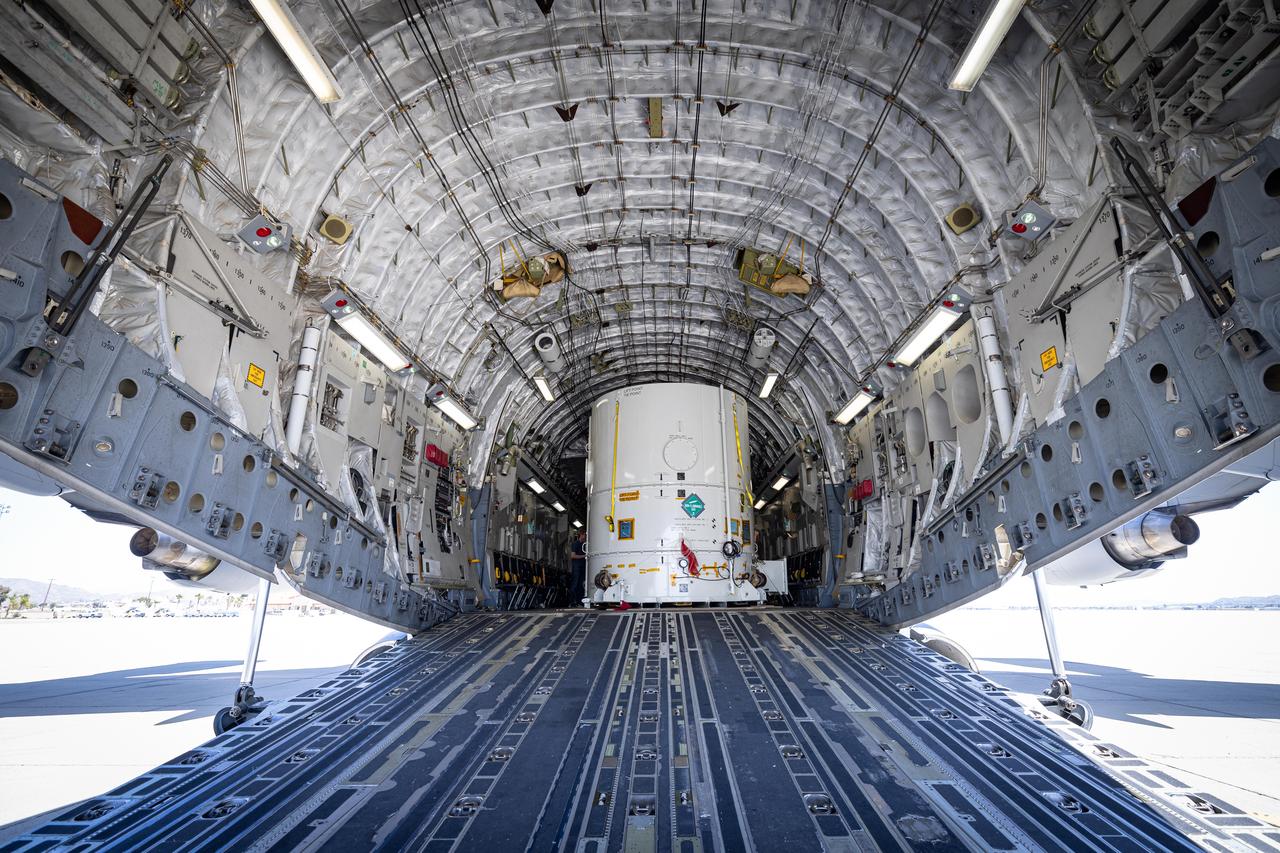
The main body of NASA's Europa Clipper spacecraft is seen in its shipping container, just after arriving aboard a C-17 cargo plane at March Air Reserve Base in Riverside County, California. From there it was delivered by truck to the agency's Jet Propulsion Laboratory in Southern California, where, over the next two years, engineers and technicians will finish assembling the craft by hand. Then it will be tested to make sure it can withstand the journey to Jupiter's icy moon Europa. The Johns Hopkins Applied Physics Laboratory (APL) in Laurel, Maryland, designed and built the spacecraft body in collaboration with JPL and NASA's Goddard Space Flight Center in Greenbelt, Maryland. Set to launch in October 2024, Europa Clipper will conduct nearly 50 flybys of Europa, which scientists are confident harbors an internal ocean containing twice as much water as Earth's oceans combined. And the moon may currently have conditions suitable for supporting life. The spacecraft's nine science instruments will gather data on the moon's atmosphere, surface, and interior – information that scientists will use to gauge the depth and salinity of the ocean, the thickness of the ice crust, and potential plumes that may be venting subsurface water into space. https://photojournal.jpl.nasa.gov/catalog/PIA25238
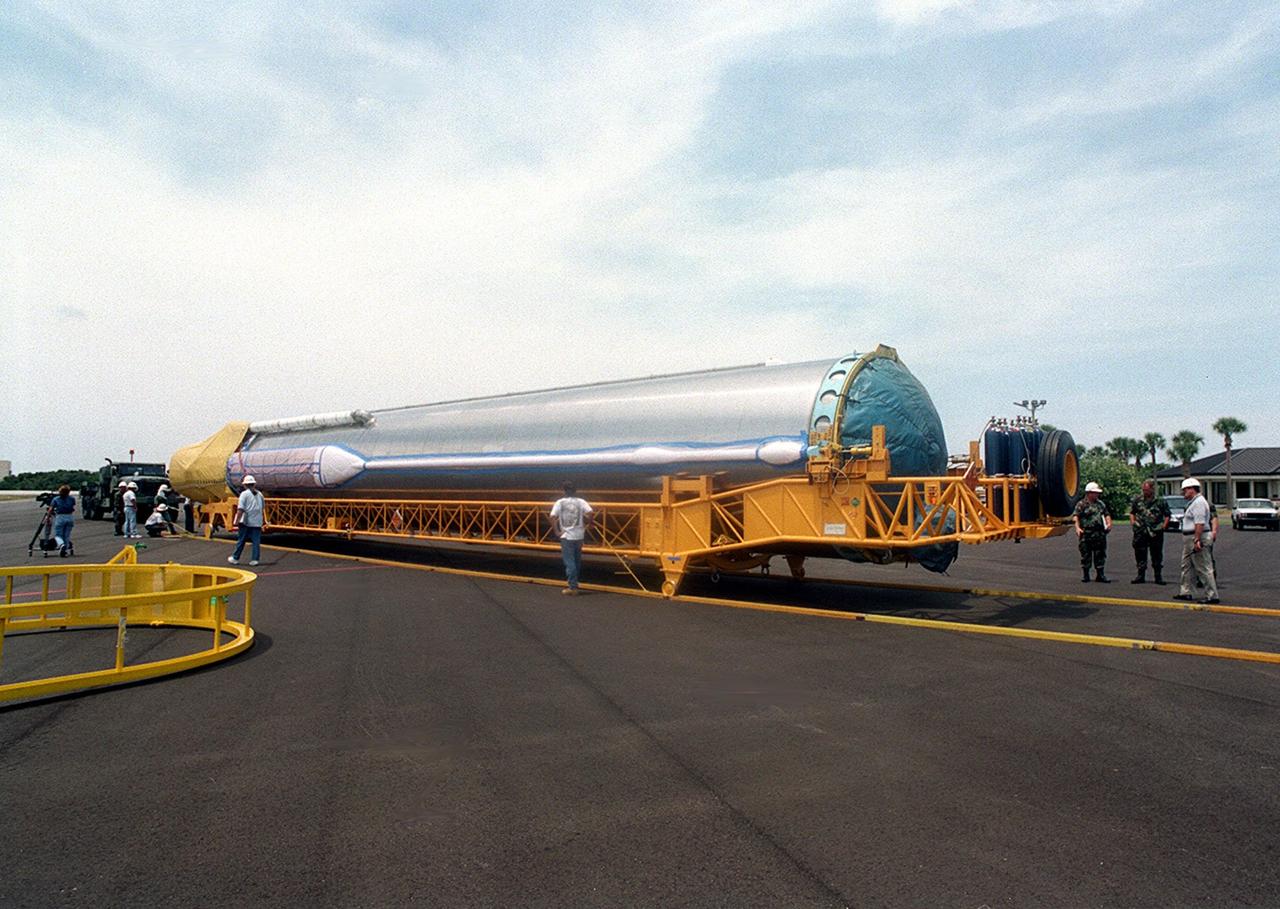
After offloading of the Centaur upper stage from a Russian cargo plane, the Antenov 124, workers check the offloading of an Atlas IIA rocket. The combined Atlas IIA/Centaur will be used to launch the latest Tracking and Data Relay Satellite (TDRS) June 29 from Cape Canaveral Air Force Station. Atlas IIA is capable of lifting payload systems weights in the 2,850 kg (6,300 lb) to 3,070 kg (6,760 lb) class to geosynchronous transfer orbit
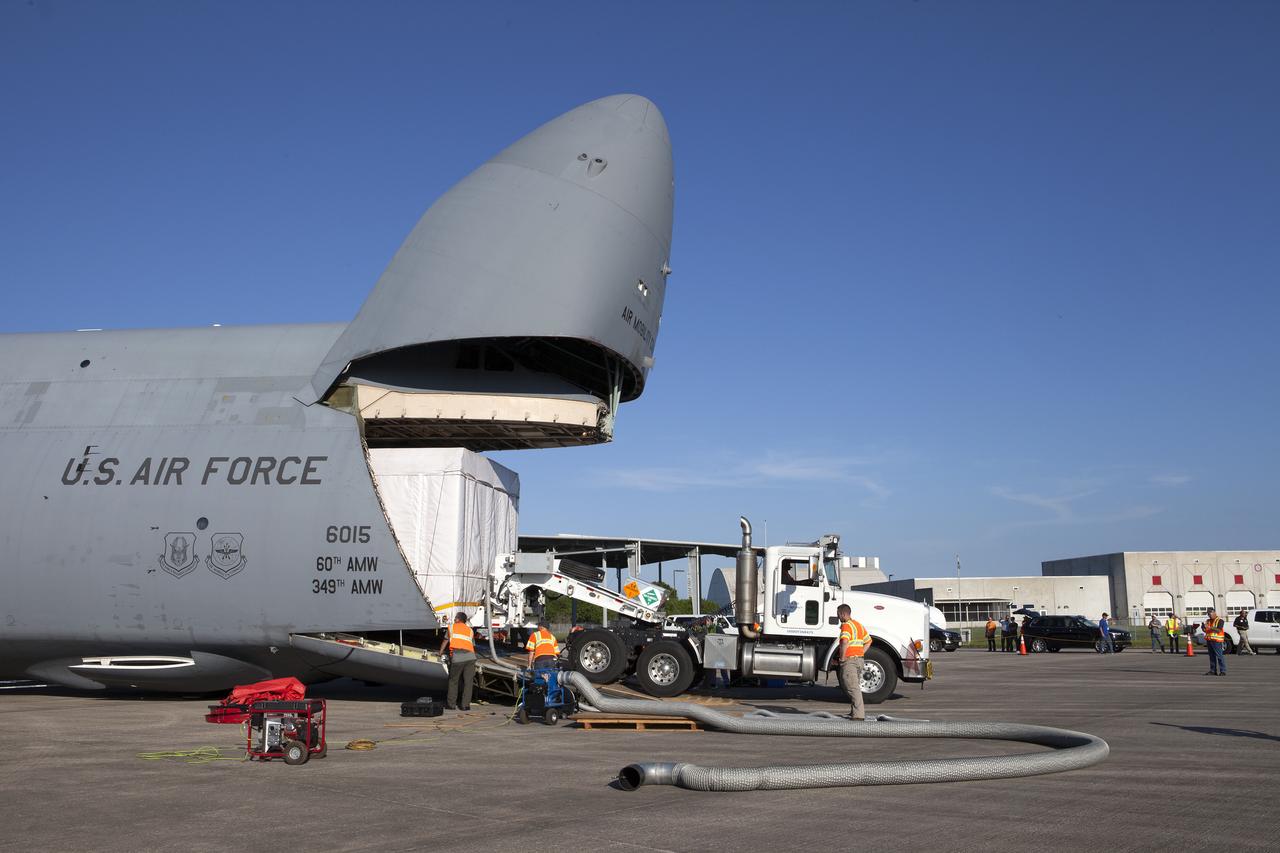
A truck with a specialized transporter drives out of the cargo hold of an Air Force C-5 Galaxy transport plane at the Shuttle Landing Facility at NASA's Kennedy Space Center in Florida to deliver the GOES-R spacecraft for launch processing. The GOES series are weather satellites operated by NOAA to enhance forecasts. The spacecraft is to launch aboard a United Launch Alliance Atlas V rocket in November.
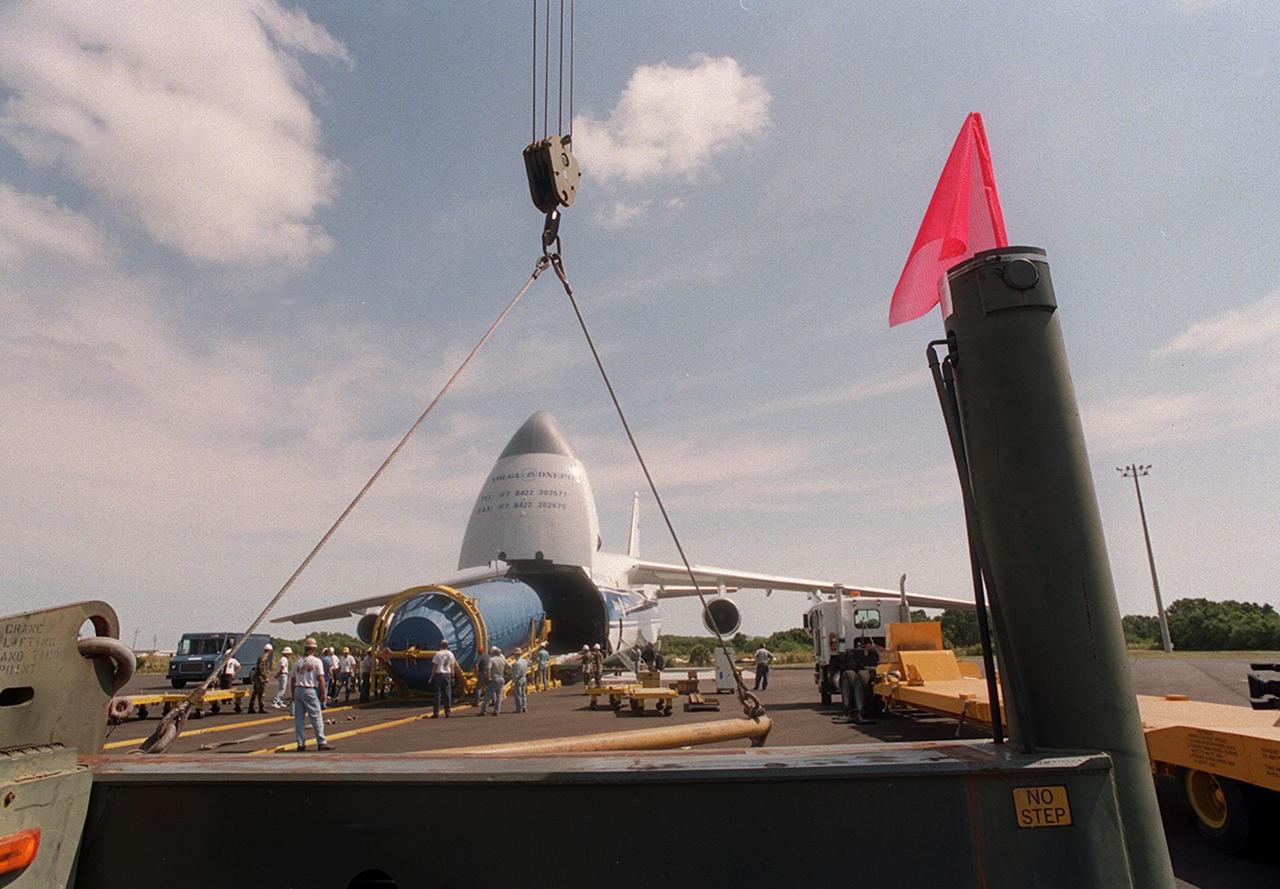
Workers at Cape Canaveral Air Force skid strip oversee the offloading of the Centaur upper stage from a Russian cargo plane, the Antenov 124. The Centaur will be coupled with an Atlas IIA to launch the latest Tracking and Data Relay Satellite (TDRS) June 29 from Cape Canaveral Air Force Station. The Centaur, manufactured and operated by Lockheed Martin, is 3.05 m (10 ft) in diameter and 10.0 m (33-ft) long. It uses liquid hydrogen (LH2) and liquid oxygen (LO2) propellants
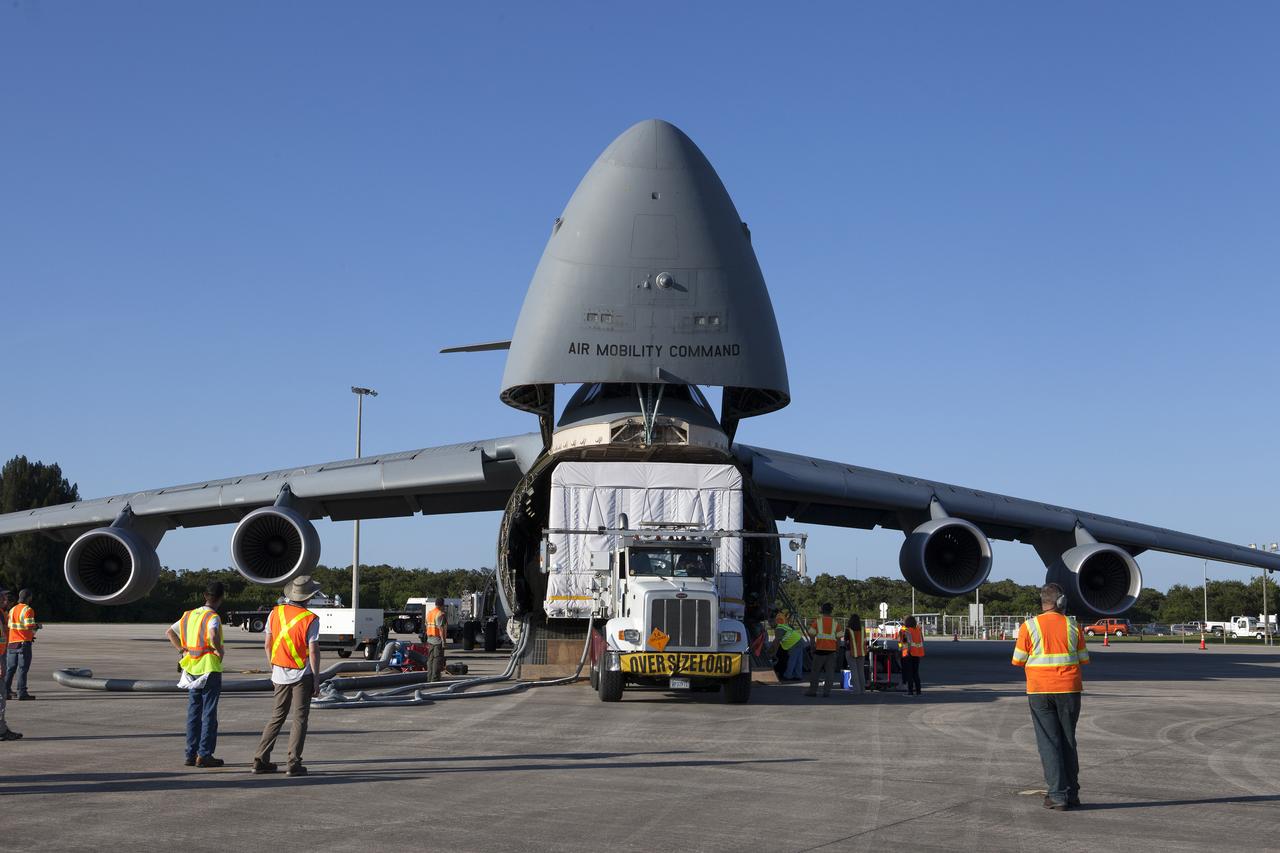
A truck with a specialized transporter drives out of the cargo hold of an Air Force C-5 Galaxy transport plane at the Shuttle Landing Facility at NASA's Kennedy Space Center in Florida to deliver the GOES-R spacecraft for launch processing. The GOES series are weather satellites operated by NOAA to enhance forecasts. The spacecraft is to launch aboard a United Launch Alliance Atlas V rocket in November.
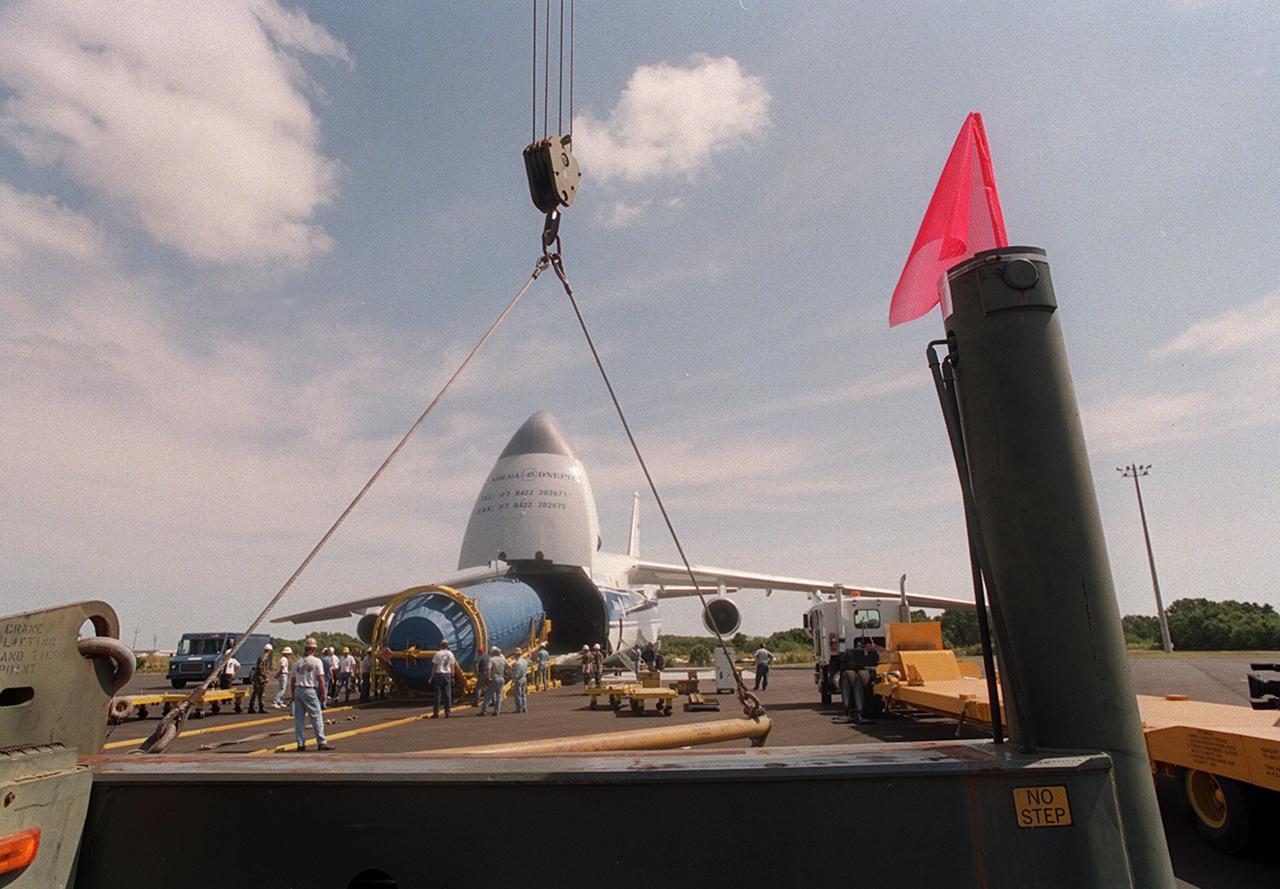
Workers at Cape Canaveral Air Force skid strip oversee the offloading of the Centaur upper stage from a Russian cargo plane, the Antenov 124. The Centaur will be coupled with an Atlas IIA to launch the latest Tracking and Data Relay Satellite (TDRS) June 29 from Cape Canaveral Air Force Station. The Centaur, manufactured and operated by Lockheed Martin, is 3.05 m (10 ft) in diameter and 10.0 m (33-ft) long. It uses liquid hydrogen (LH2) and liquid oxygen (LO2) propellants

A truck with a specialized transporter drives out of the cargo hold of an Air Force C-5 Galaxy transport plane at the Shuttle Landing Facility at NASA's Kennedy Space Center in Florida to deliver the GOES-R spacecraft for launch processing. The GOES series are weather satellites operated by NOAA to enhance forecasts. The spacecraft is to launch aboard a United Launch Alliance Atlas V rocket in November.
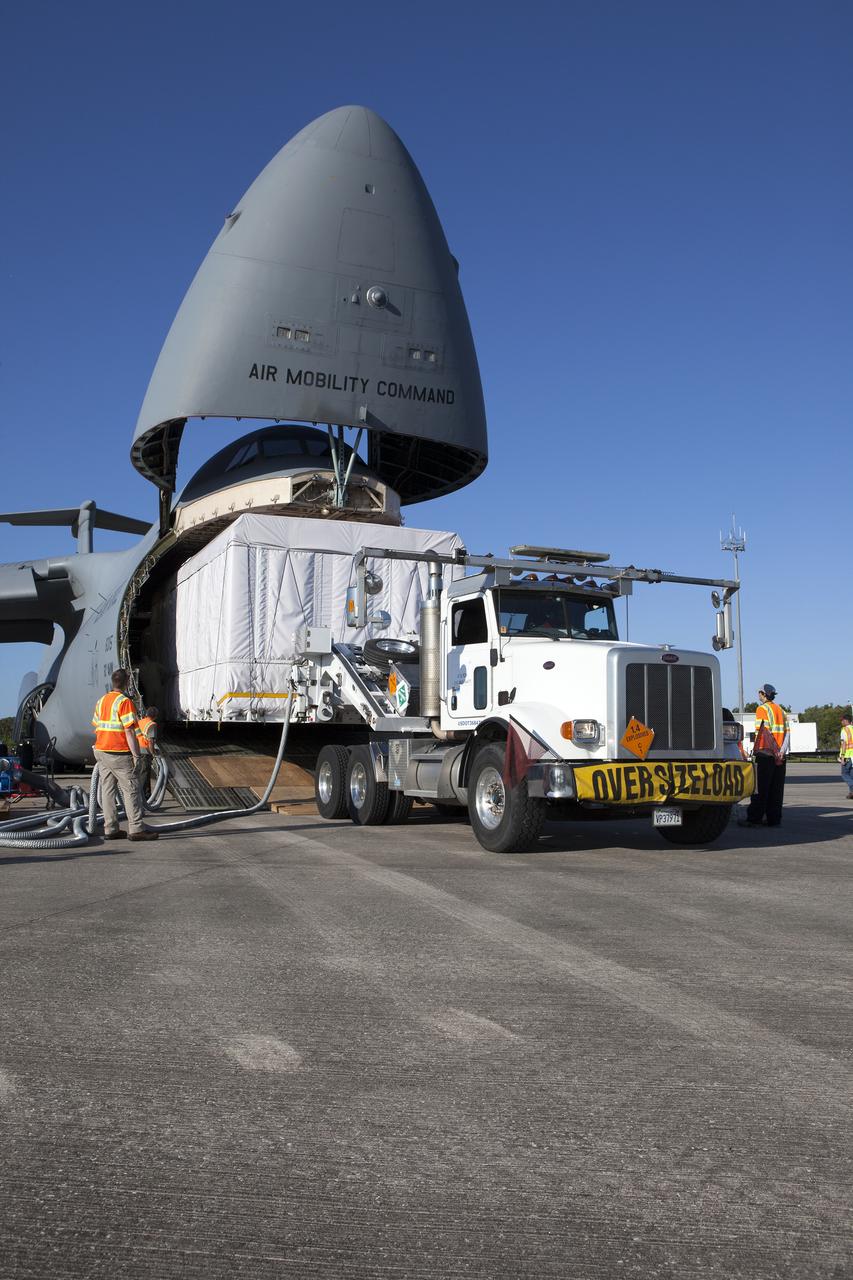
A truck with a specialized transporter drives out of the cargo hold of an Air Force C-5 Galaxy transport plane at the Shuttle Landing Facility at NASA's Kennedy Space Center in Florida to deliver the GOES-R spacecraft for launch processing. The GOES series are weather satellites operated by NOAA to enhance forecasts. The spacecraft is to launch aboard a United Launch Alliance Atlas V rocket in November.
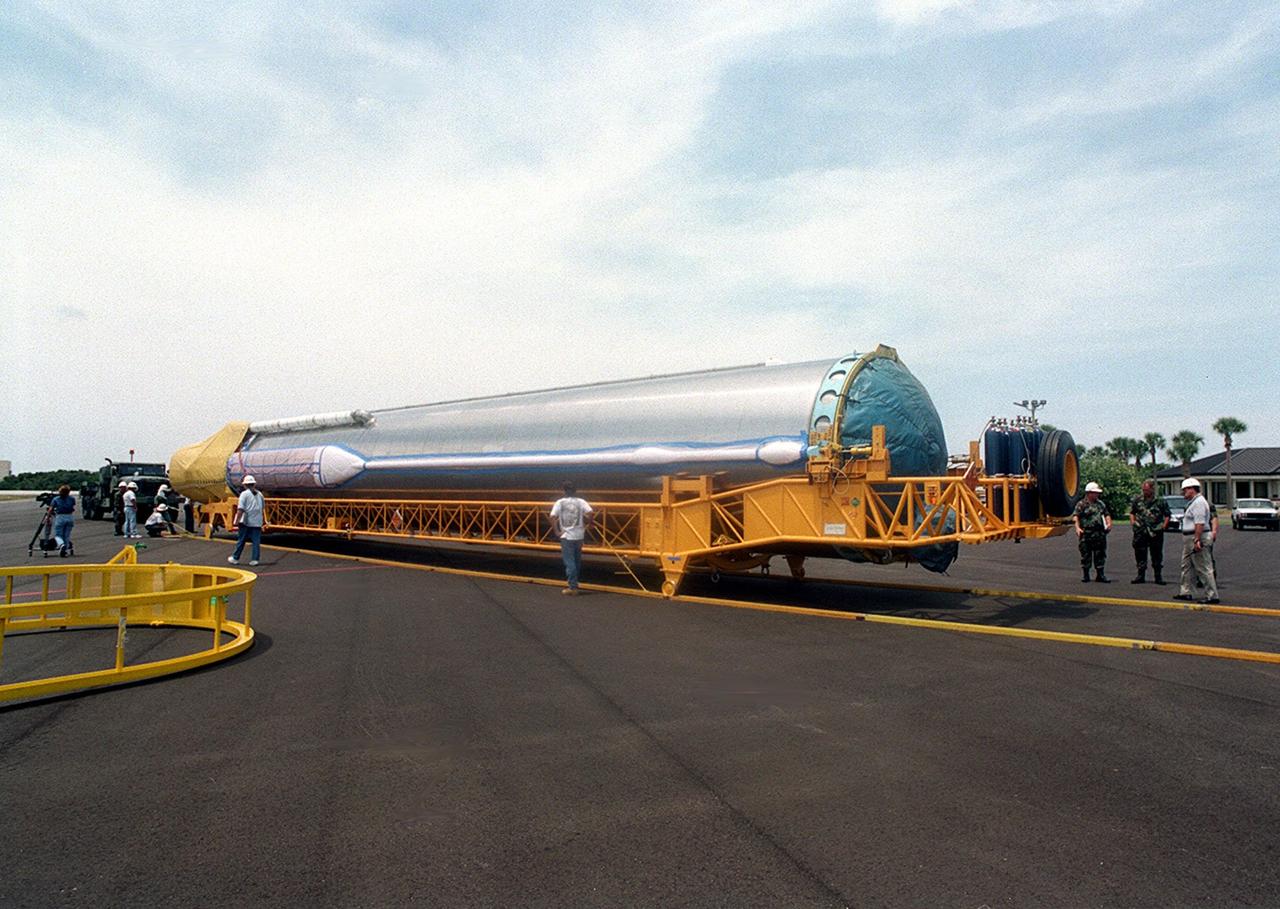
After offloading of the Centaur upper stage from a Russian cargo plane, the Antenov 124, workers check the offloading of an Atlas IIA rocket. The combined Atlas IIA/Centaur will be used to launch the latest Tracking and Data Relay Satellite (TDRS) June 29 from Cape Canaveral Air Force Station. Atlas IIA is capable of lifting payload systems weights in the 2,850 kg (6,300 lb) to 3,070 kg (6,760 lb) class to geosynchronous transfer orbit
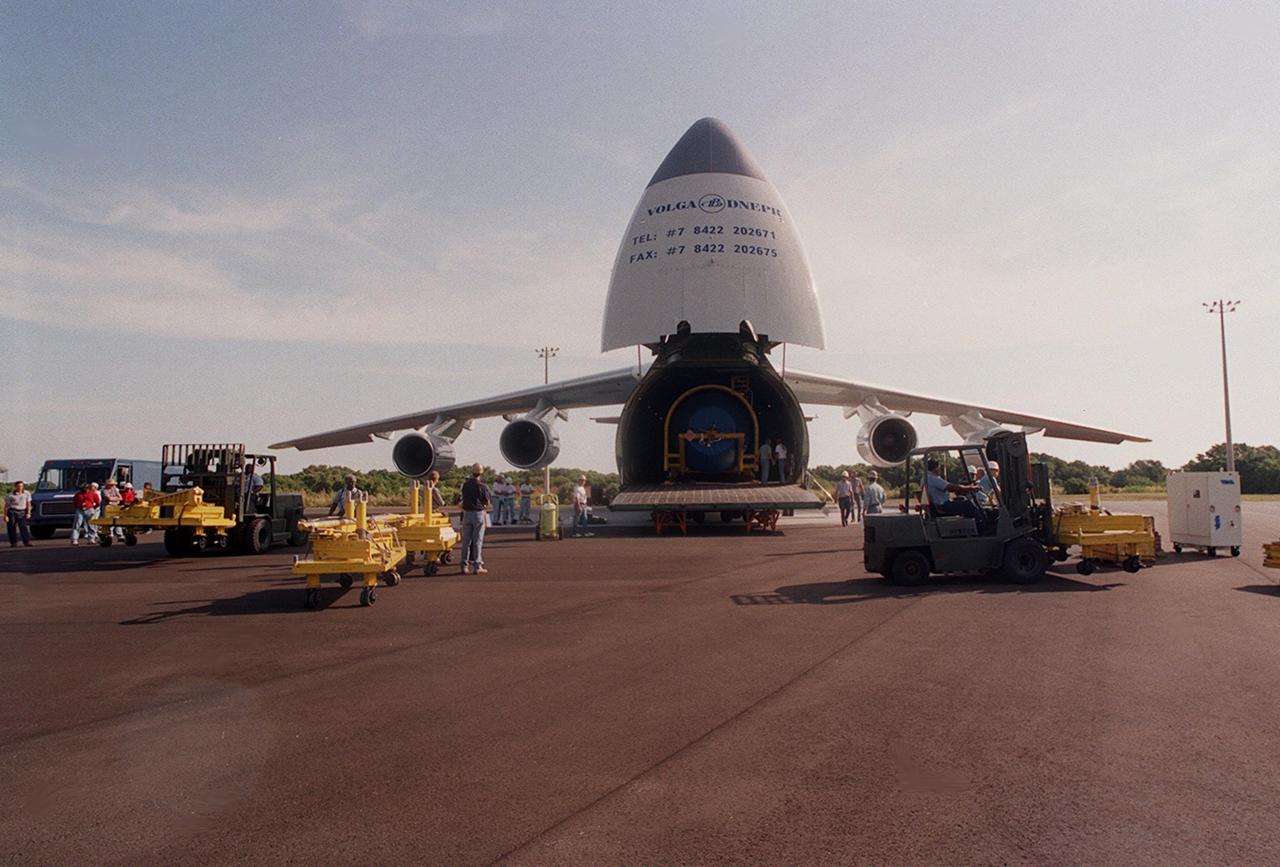
A Russian cargo plane, the Antenov 124, arrives at Cape Canaveral Air Force skid strip to deliver the Atlas IIA/Centaur rocket scheduled to launch the latest Tracking and Data Relay Satellite (TDRS) June 29 from Cape Canaveral Air Force Station. Visible is the Centaur upper stage, manufactured and operated by Lockheed Martin. The Centaur vehicle is 3.05 m (10 ft) in diameter and 10.0 m (33-ft) long. It uses liquid hydrogen (LH2) and liquid oxygen (LO2) propellants

A Russian cargo plane, the Antenov 124, arrives at Cape Canaveral Air Force skid strip to deliver the Atlas IIA/Centaur rocket scheduled to launch the latest Tracking and Data Relay Satellite (TDRS) June 29 from Cape Canaveral Air Force Station. Visible is the Centaur upper stage, manufactured and operated by Lockheed Martin. The Centaur vehicle is 3.05 m (10 ft) in diameter and 10.0 m (33-ft) long. It uses liquid hydrogen (LH2) and liquid oxygen (LO2) propellants
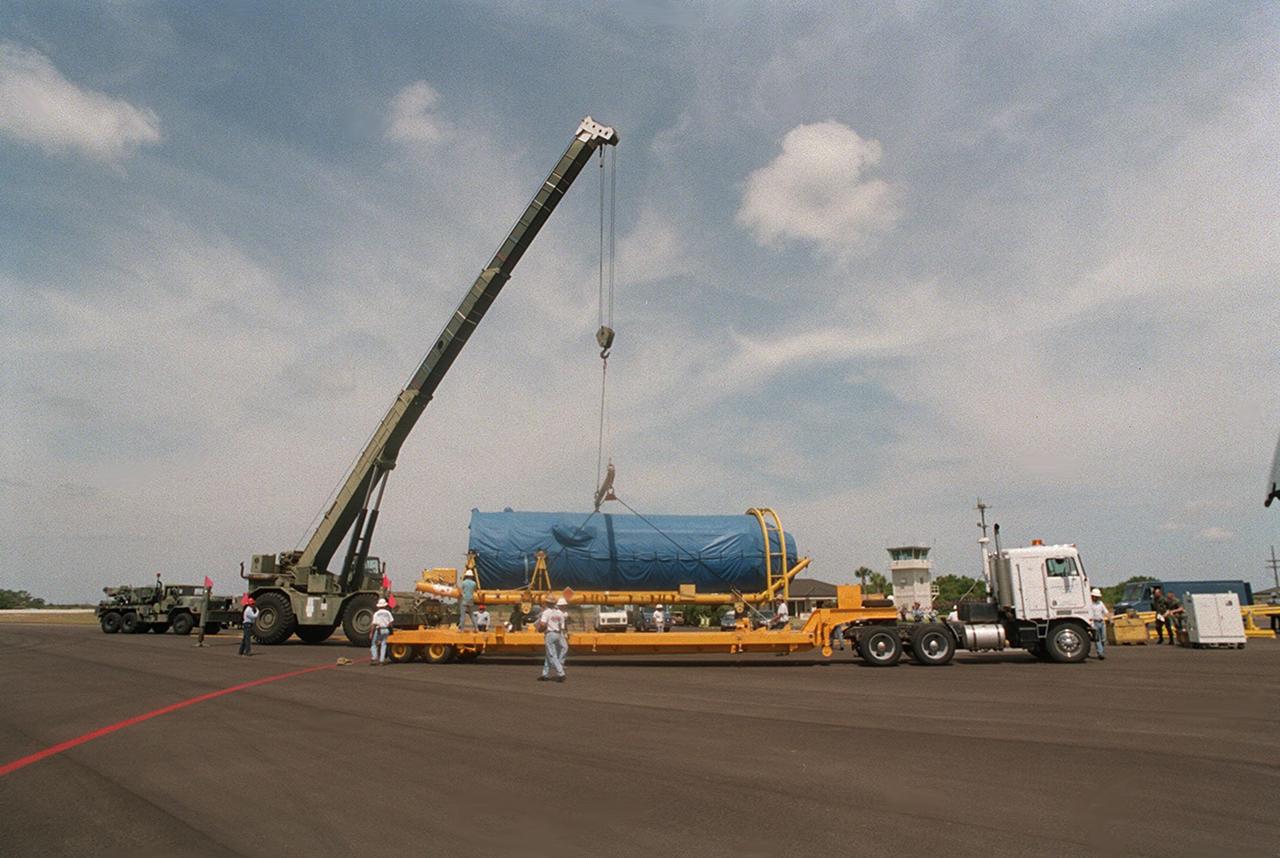
At Cape Canaveral Air Force skid strip, the Centaur upper stage is placed aboard a transporter after arriving aboard a Russian cargo plane, the Antenov 124. The Centaur will be coupled with an Atlas IIA to launch the latest Tracking and Data Relay Satellite (TDRS) June 29 from Cape Canaveral Air Force Station. The Centaur, manufactured and operated by Lockheed Martin, is 3.05 m (10 ft) in diameter and 10.0 m (33-ft) long. It uses liquid hydrogen (LH2) and liquid oxygen (LO2) propellants

A truck with a specialized transporter drives out of the cargo hold of an Air Force C-5 Galaxy transport plane at the Shuttle Landing Facility at NASA's Kennedy Space Center in Florida to deliver the GOES-R spacecraft for launch processing. The GOES series are weather satellites operated by NOAA to enhance forecasts. The spacecraft is to launch aboard a United Launch Alliance Atlas V rocket in November.
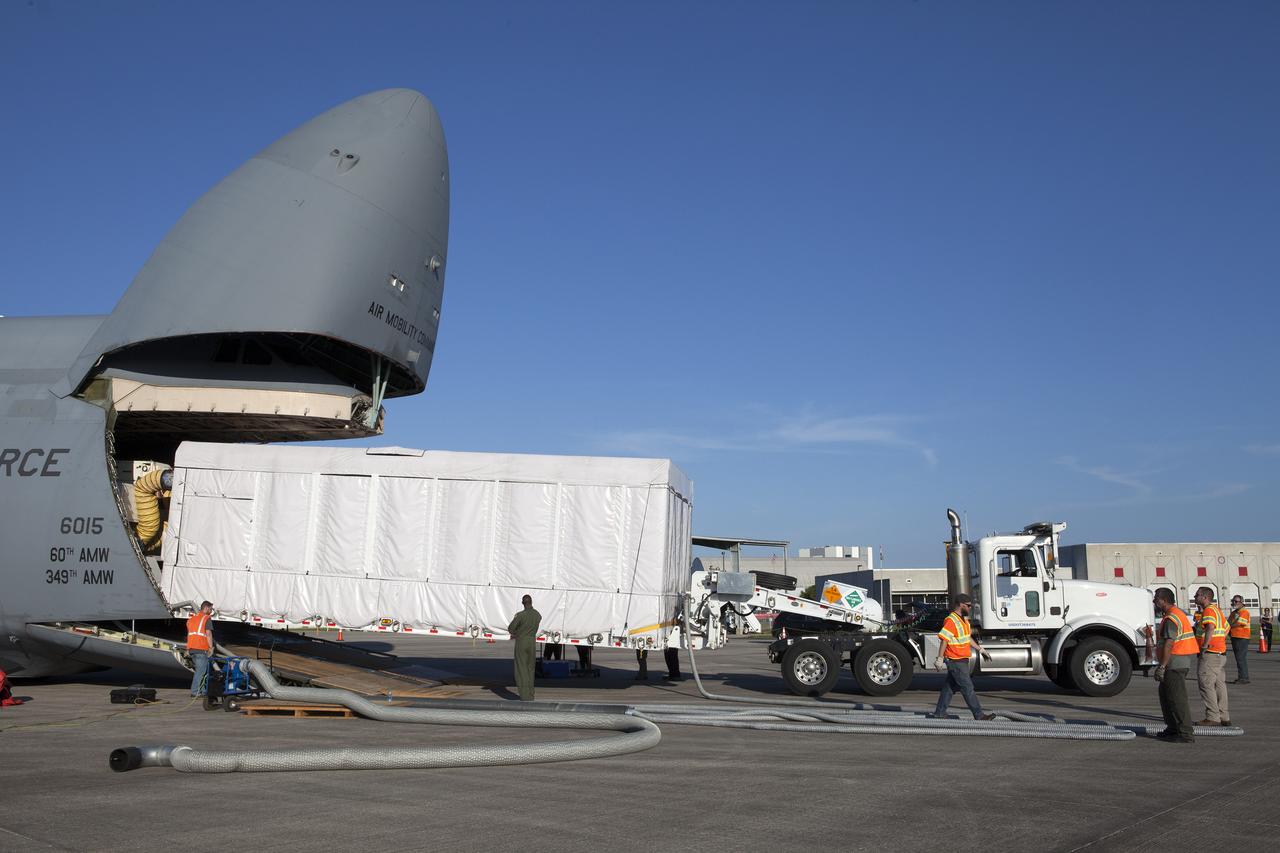
A truck with a specialized transporter drives out of the cargo hold of an Air Force C-5 Galaxy transport plane at the Shuttle Landing Facility at NASA's Kennedy Space Center in Florida to deliver the GOES-R spacecraft for launch processing. The GOES series are weather satellites operated by NOAA to enhance forecasts. The spacecraft is to launch aboard a United Launch Alliance Atlas V rocket in November.
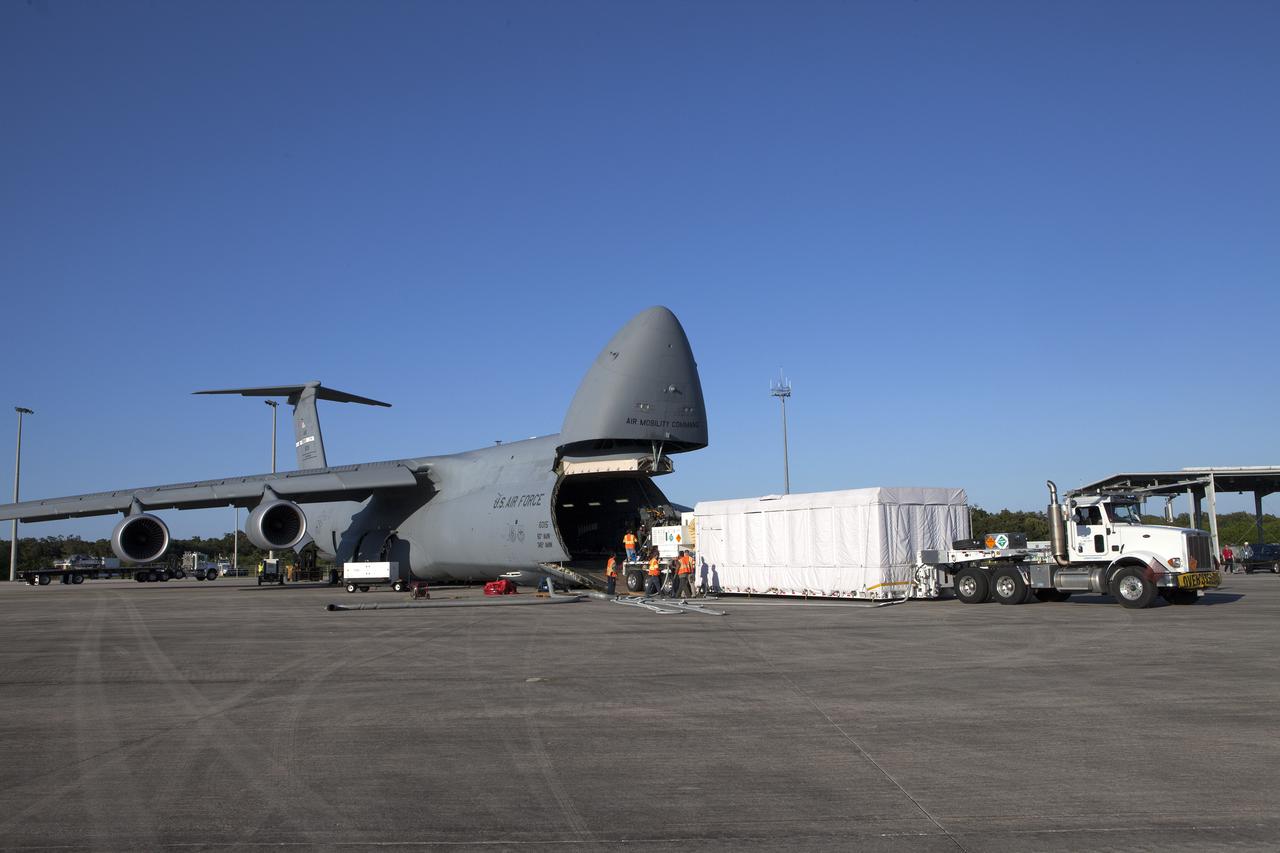
A truck with a specialized transporter drives out of the cargo hold of an Air Force C-5 Galaxy transport plane at the Shuttle Landing Facility at NASA's Kennedy Space Center in Florida to deliver the GOES-R spacecraft for launch processing. The GOES series are weather satellites operated by NOAA to enhance forecasts. The spacecraft is to launch aboard a United Launch Alliance Atlas V rocket in November.
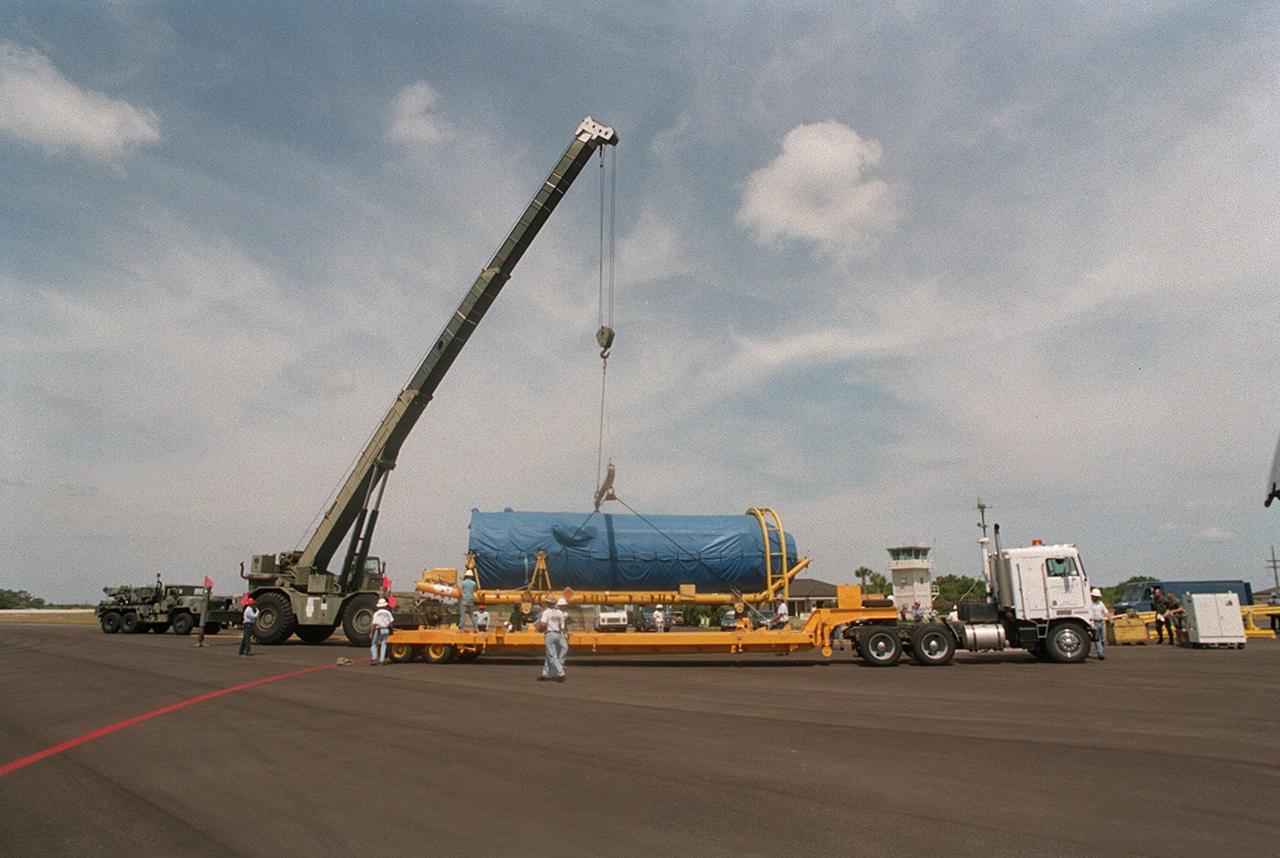
At Cape Canaveral Air Force skid strip, the Centaur upper stage is placed aboard a transporter after arriving aboard a Russian cargo plane, the Antenov 124. The Centaur will be coupled with an Atlas IIA to launch the latest Tracking and Data Relay Satellite (TDRS) June 29 from Cape Canaveral Air Force Station. The Centaur, manufactured and operated by Lockheed Martin, is 3.05 m (10 ft) in diameter and 10.0 m (33-ft) long. It uses liquid hydrogen (LH2) and liquid oxygen (LO2) propellants
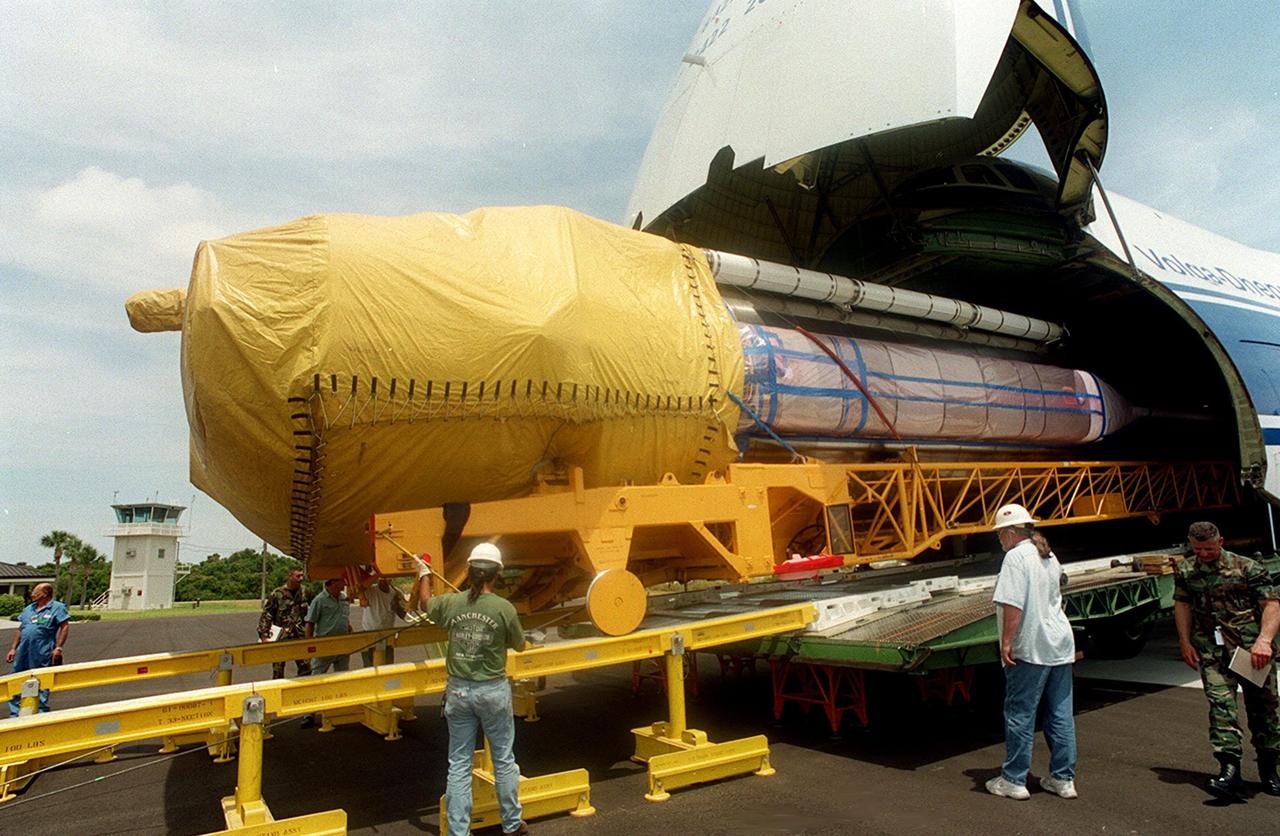
After offloading of the Centaur upper stage from a Russian cargo plane, the Antenov 124, workers check the offloading of an Atlas IIA rocket. The combined Atlas IIA/Centaur will be used to launch the latest Tracking and Data Relay Satellite (TDRS) June 29 from Cape Canaveral Air Force Station. Atlas IIA is capable of lifting payload systems weights in the 2,850 kg (6,300 lb) to 3,070 kg (6,760 lb) class to geosynchronous transfer orbit
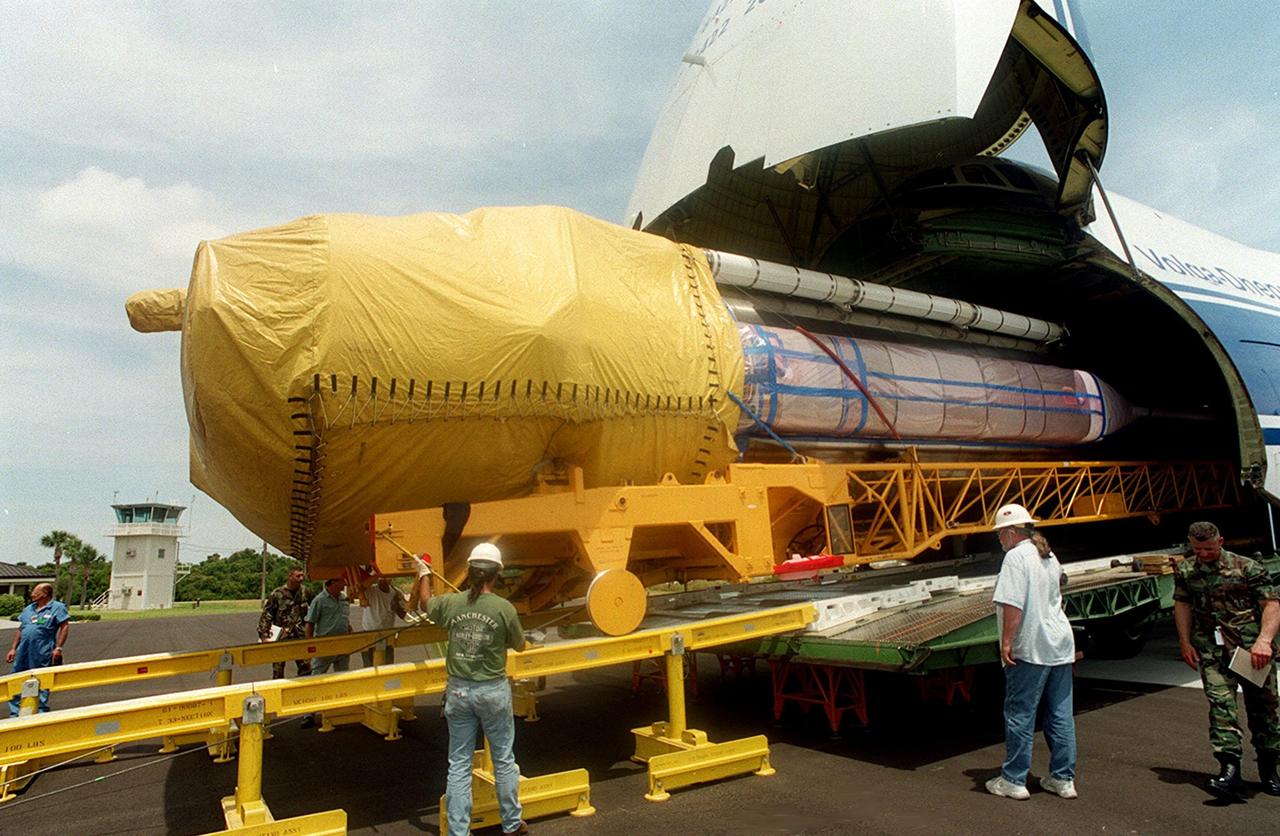
After offloading of the Centaur upper stage from a Russian cargo plane, the Antenov 124, workers check the offloading of an Atlas IIA rocket. The combined Atlas IIA/Centaur will be used to launch the latest Tracking and Data Relay Satellite (TDRS) June 29 from Cape Canaveral Air Force Station. Atlas IIA is capable of lifting payload systems weights in the 2,850 kg (6,300 lb) to 3,070 kg (6,760 lb) class to geosynchronous transfer orbit
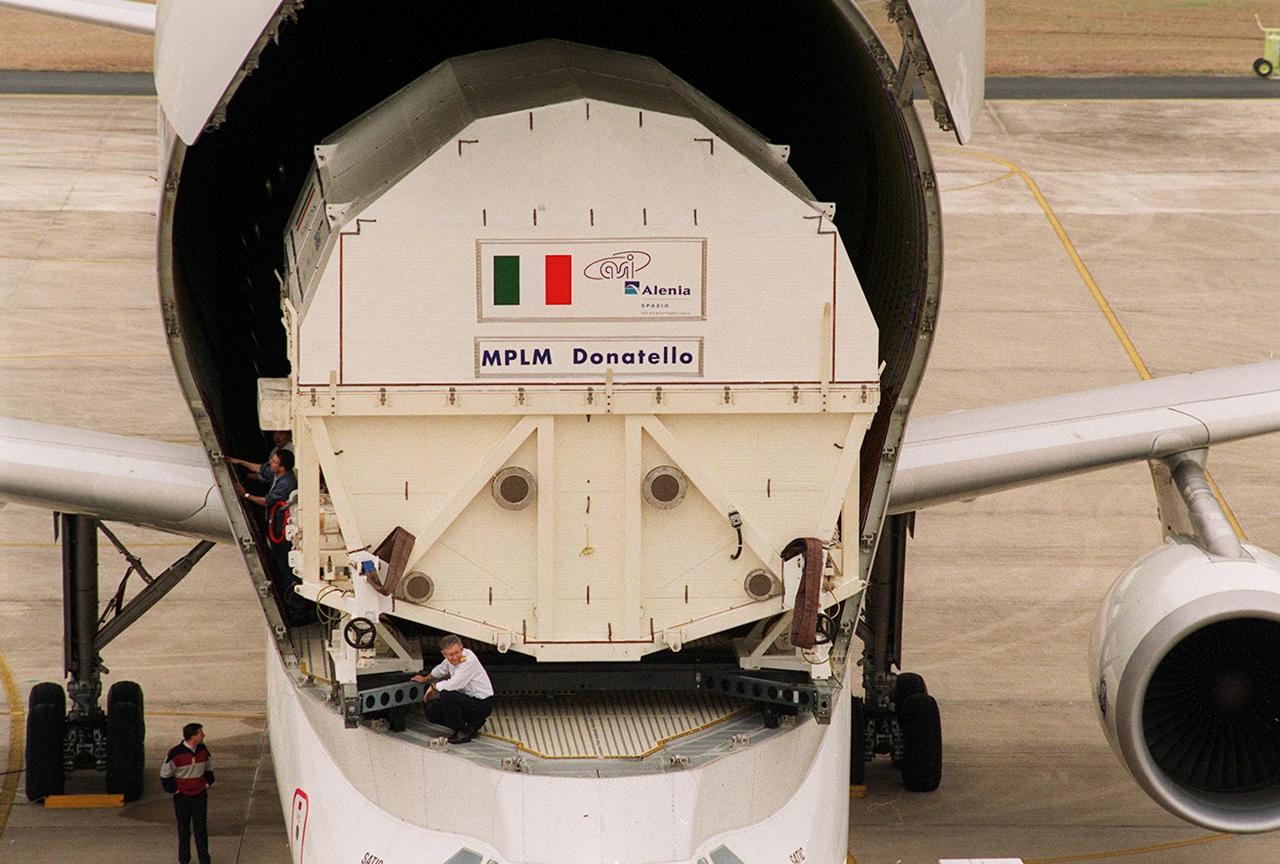
At the KSC <a href="../../subjects/slf.htm"> Shuttle Landing Facility</a>, the Italian Space Agency’s <a href="../../subjects/mplm.htm"> Multi-Purpose Logistics Module Donatello</a> begins rolling out of the Airbus “Beluga” air cargo plane that brought it from the factory of Alenia Aerospazio in Turin, Italy. The third of three for the International Space Station, the module will be transported to the <a href="../../subjects/sspf.htm"> Space Station Processing Facility</a> for processing. Among the activities for the payload test team are integrated electrical tests with other Station elements in the SSPF, leak tests, electrical and software compatibility tests with the Space Shuttle (using the Cargo Integrated Test equipment) and an Interface Verification Test once the module is installed in the Space Shuttle’s payload bay at the launch pad. The most significant mechanical task to be performed on Donatello in the SSPF is the installation and outfitting of the racks for carrying the various experiments and cargo
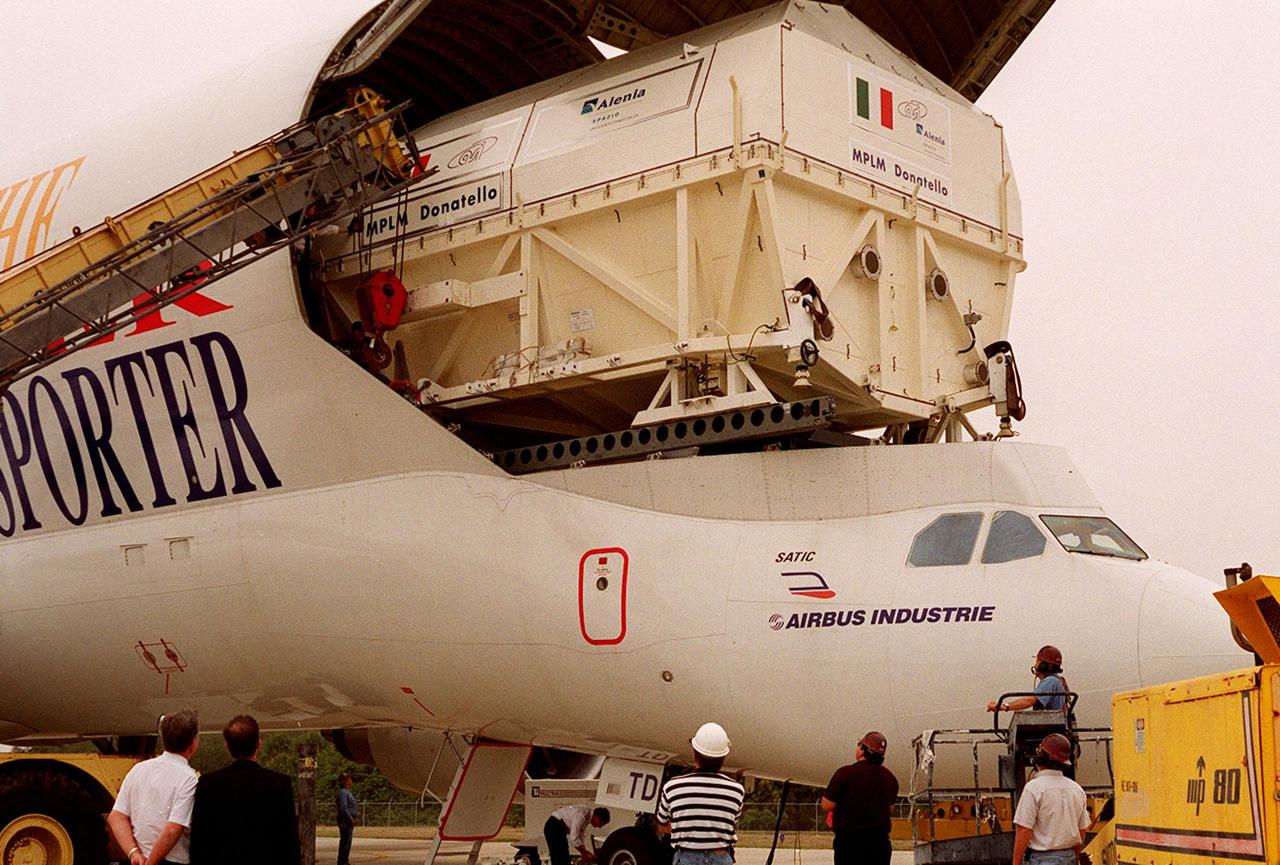
At the KSC <a href='.._.._subjects_slf.htm'> Shuttle Landing Facility<_a>, the Italian Space Agency’s <a href='.._.._subjects_mplm.htm'> Multi-Purpose Logistics Module<_a> Donatello rolls out of the Airbus “Beluga” air cargo plane that brought it from the factory of Alenia Aerospazio in Turin, Italy. The third of three for the International Space Station, the module will be transported to the <a href='.._.._subjects_sspf.htm'> Space Station Processing Facility<_a> for processing. Among the activities for the payload test team are integrated electrical tests with other Station elements in the SSPF, leak tests, electrical and software compatibility tests with the Space Shuttle (using the Cargo Integrated Test equipment) and an Interface Verification Test once the module is installed in the Space Shuttle’s payload bay at the launch pad. The most significant mechanical task to be performed on Donatello in the SSPF is the installation and outfitting of the racks for carrying the various experiments and cargo
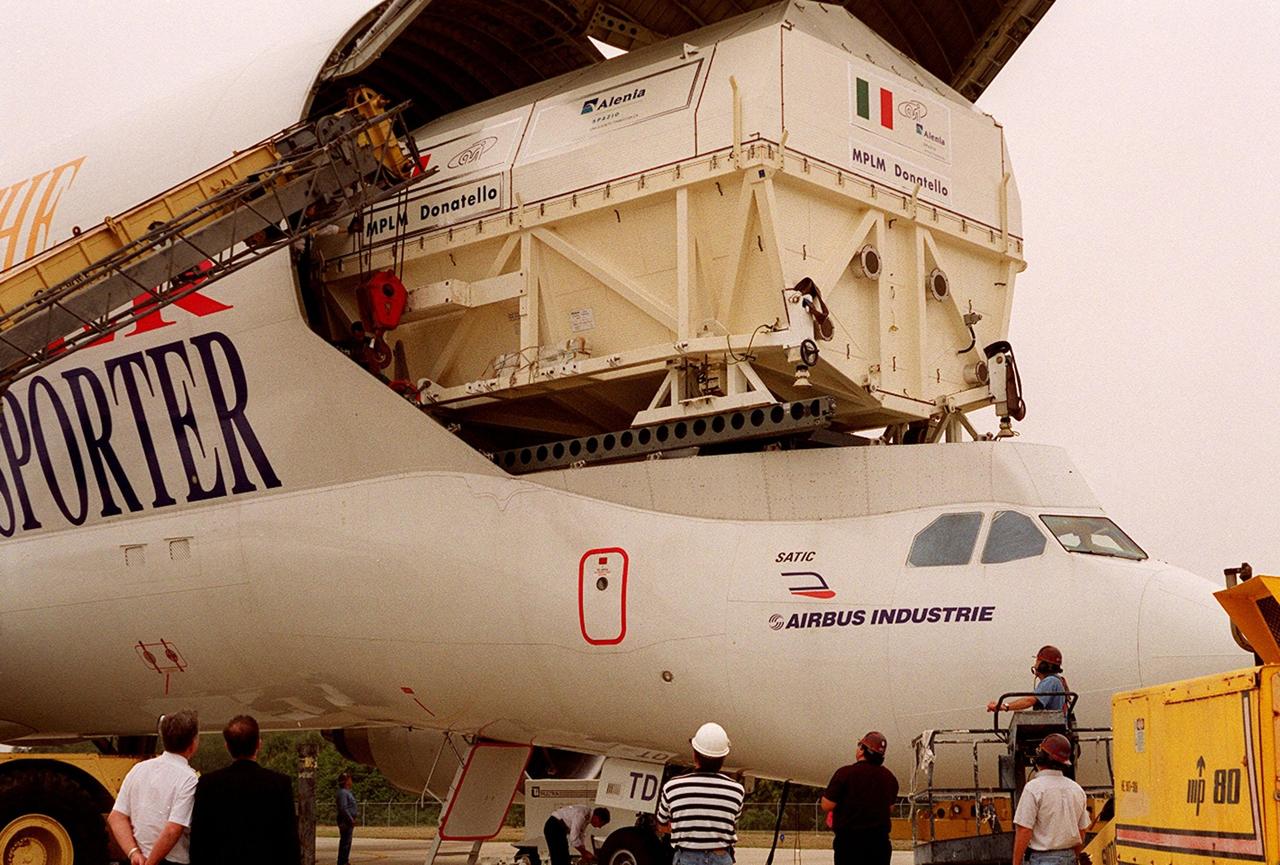
At the KSC <a href="../../subjects/slf.htm"> Shuttle Landing Facility</a>, the Italian Space Agency’s <a href="../../subjects/mplm.htm"> Multi-Purpose Logistics Module</a> Donatello rolls out of the Airbus “Beluga” air cargo plane that brought it from the factory of Alenia Aerospazio in Turin, Italy. The third of three for the International Space Station, the module will be transported to the <a href="../../subjects/sspf.htm"> Space Station Processing Facility</a> for processing. Among the activities for the payload test team are integrated electrical tests with other Station elements in the SSPF, leak tests, electrical and software compatibility tests with the Space Shuttle (using the Cargo Integrated Test equipment) and an Interface Verification Test once the module is installed in the Space Shuttle’s payload bay at the launch pad. The most significant mechanical task to be performed on Donatello in the SSPF is the installation and outfitting of the racks for carrying the various experiments and cargo
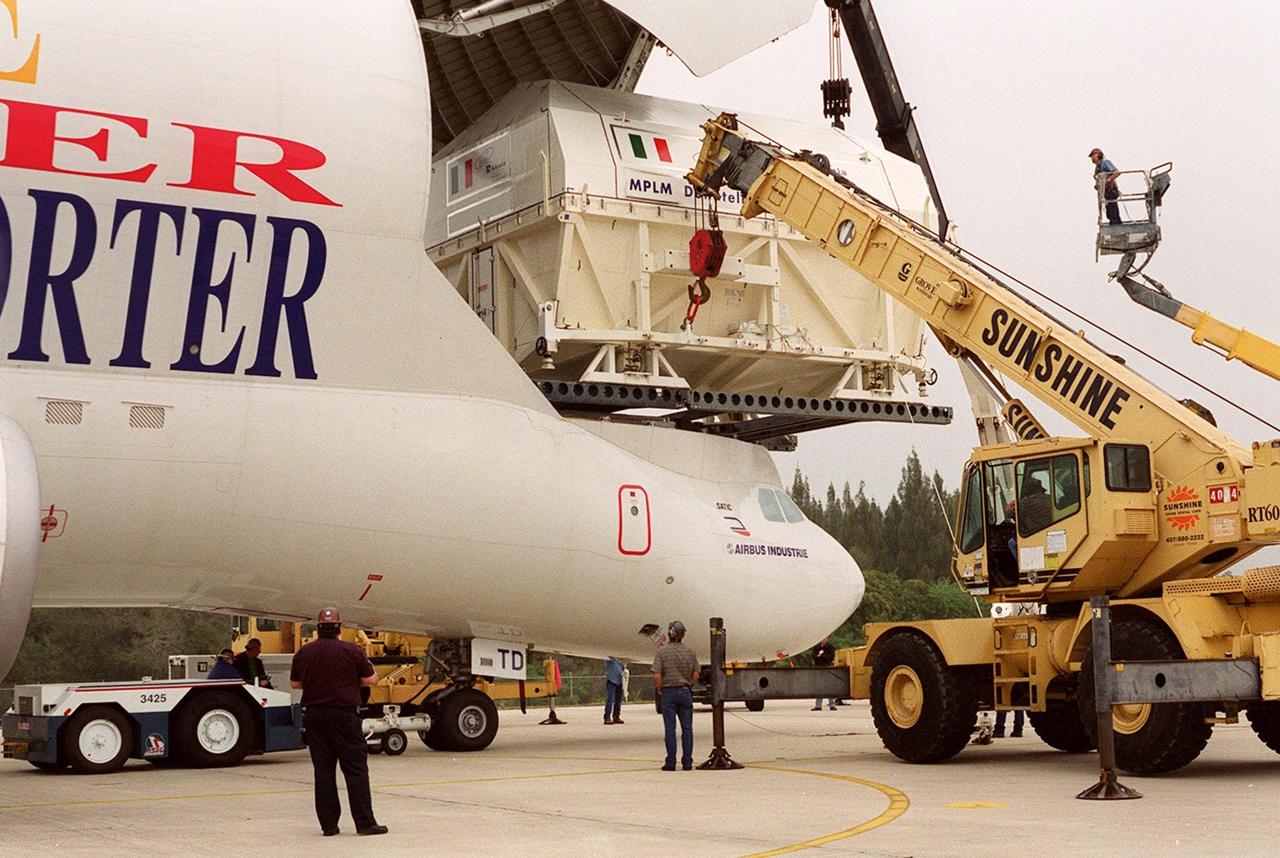
At the Shuttle Landing Facility, workers in cherry pickers (right) help guide offloading of the Italian Space Agency’s Multi-Purpose Logistics Module Donatello from the Airbus “Beluga” air cargo plane that brought it from the factory of Alenia Aerospazio in Turin, Italy. The third of three for the International Space Station, the module will be transported to the Space Station Processing Facility for processing. Among the activities for the payload test team are integrated electrical tests with other Station elements in the SSPF, leak tests, electrical and software compatibility tests with the Space Shuttle (using the Cargo Integrated Test equipment) and an Interface Verification Test once the module is installed in the Space Shuttle’s payload bay at the launch pad. The most significant mechanical task to be performed on Donatello in the SSPF is the installation and outfitting of the racks for carrying the various experiments and cargo
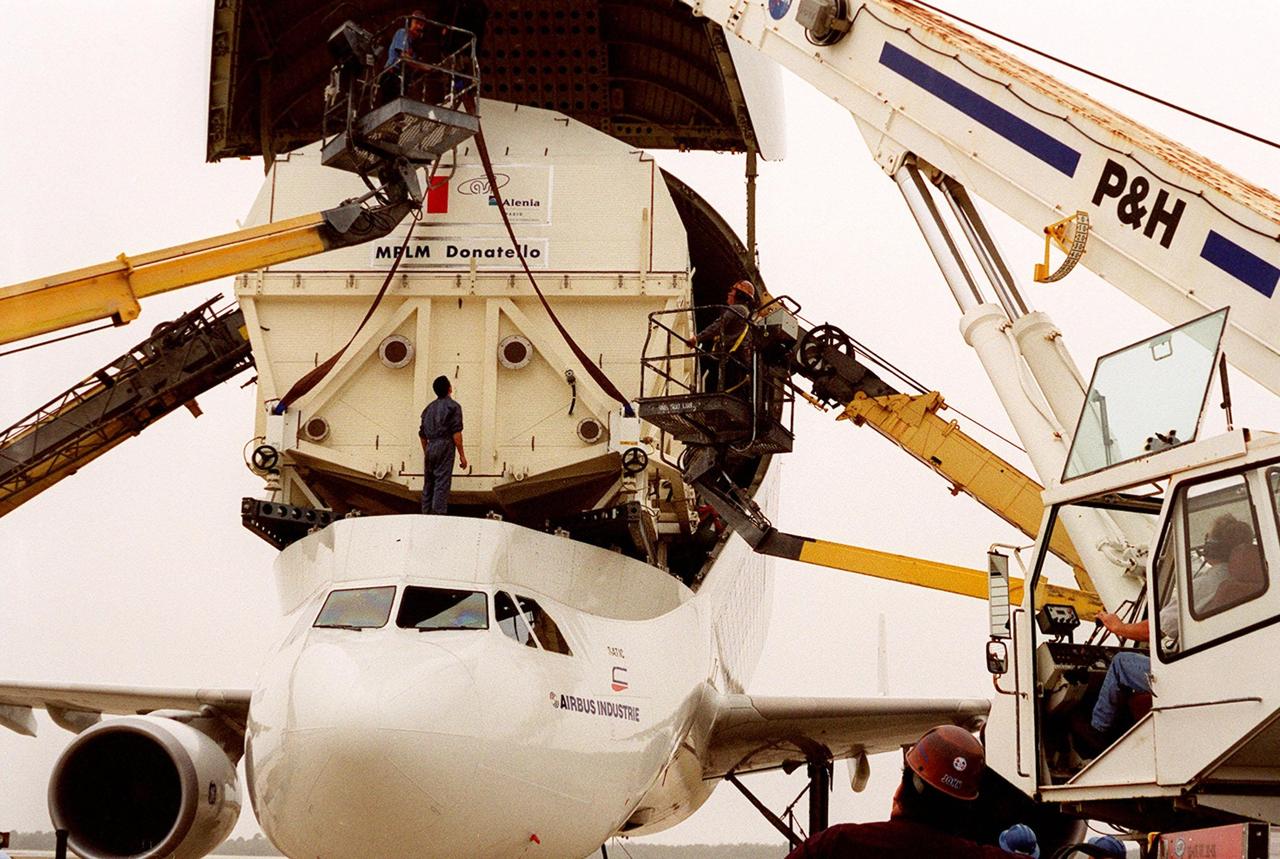
At the <a href="../../subjects/slf.htm"> Shuttle Landing Facility</a>, cranes are poised to help offload the Italian Space Agency’s <a href="../../subjects/mplm.htm"> Multi-Purpose Logistics Module</a> Donatello from the Airbus “Beluga” air cargo plane that brought it from the factory of Alenia Aerospazio in Turin, Italy. The third of three for the <a href="../../subjects/iss.htm"> International Space Station</a>, the module will be transported to the <a href="../../subjects/sspf.htm"> Space Station Processing Facility</a> for processing. Among the activities for the payload test team are integrated electrical tests with other Station elements in the SSPF, leak tests, electrical and software compatibility tests with the Space Shuttle (using the Cargo Integrated Test equipment) and an Interface Verification Test once the module is installed in the Space Shuttle’s payload bay at the launch pad. The most significant mechanical task to be performed on Donatello in the SSPF is the installation and outfitting of the racks for carrying the various experiments and cargo
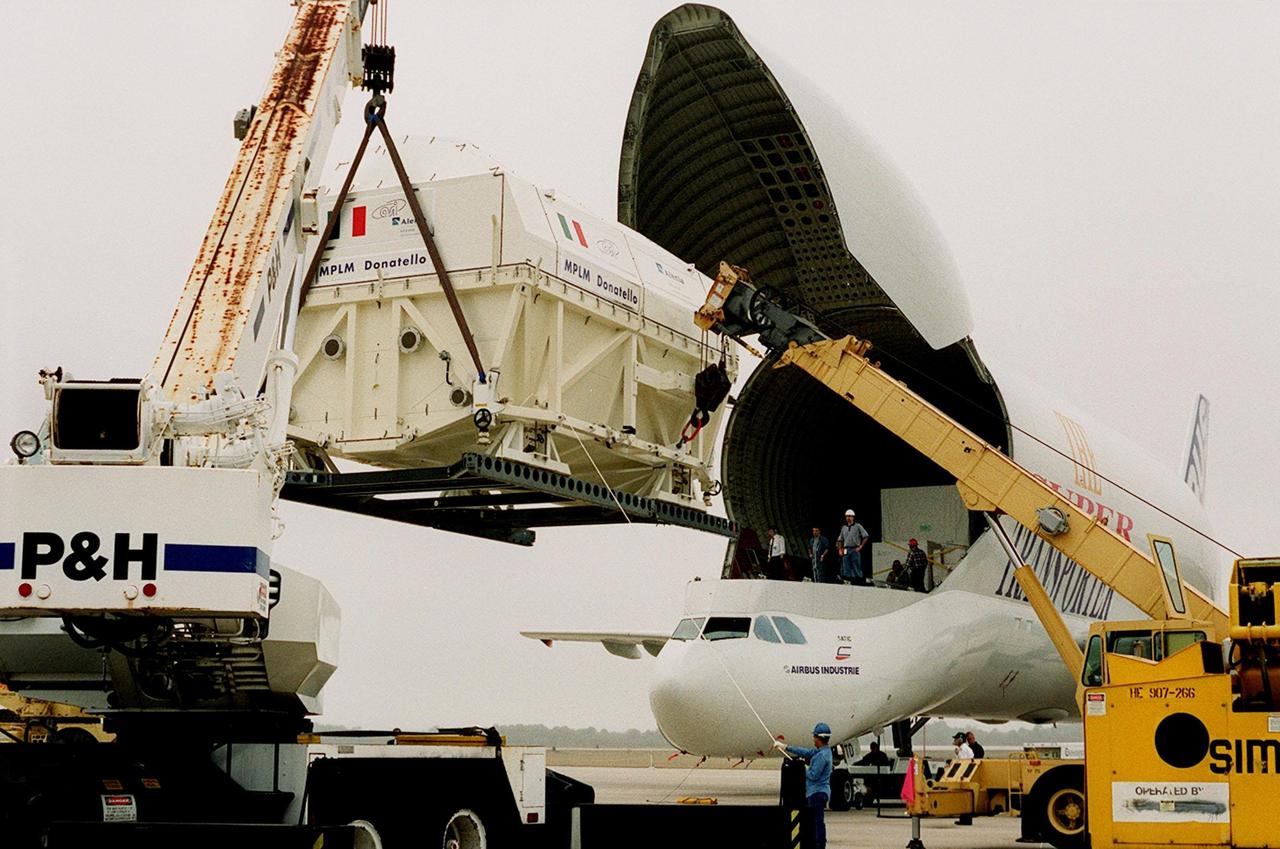
At the Shuttle Landing Facility, cranes help offload the Italian Space Agency’s Multi-Purpose Logistics Module Donatello from the Airbus “Beluga” air cargo plane. The third of three for the International Space Station, the module will be moved on a transporter to the Space Station Processing Facility for processing. Among the activities for the payload test team are integrated electrical tests with other Station elements in the SSPF, leak tests, electrical and software compatibility tests with the Space Shuttle (using the Cargo Integrated Test equipment) and an Interface Verification Test once the module is installed in the Space Shuttle’s payload bay at the launch pad. The most significant mechanical task to be performed on Donatello in the SSPF is the installation and outfitting of the racks for carrying the various experiments and cargo
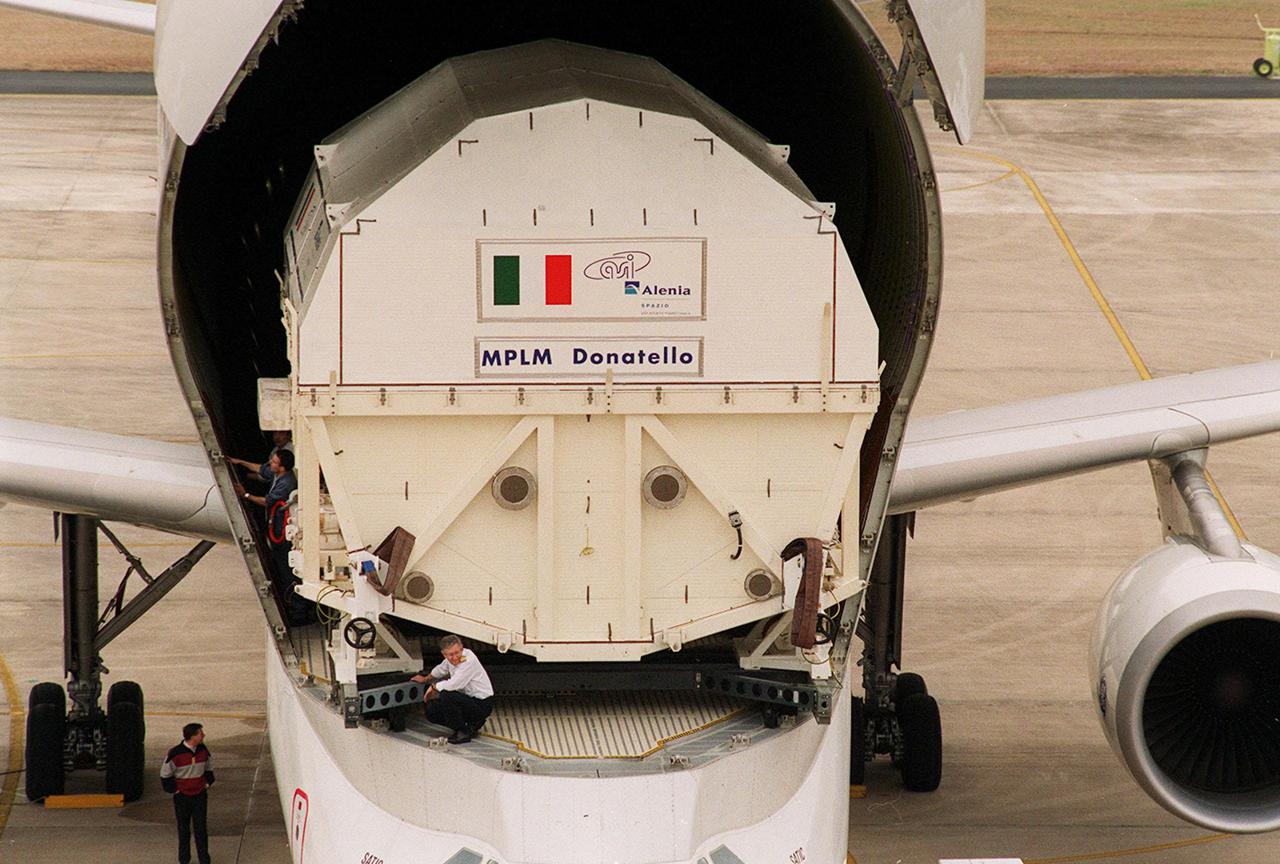
At the KSC <a href='.._.._subjects_slf.htm'> Shuttle Landing Facility<_a>, the Italian Space Agency’s <a href='.._.._subjects_mplm.htm'> Multi-Purpose Logistics Module Donatello<_a> begins rolling out of the Airbus “Beluga” air cargo plane that brought it from the factory of Alenia Aerospazio in Turin, Italy. The third of three for the International Space Station, the module will be transported to the <a href='.._.._subjects_sspf.htm'> Space Station Processing Facility<_a> for processing. Among the activities for the payload test team are integrated electrical tests with other Station elements in the SSPF, leak tests, electrical and software compatibility tests with the Space Shuttle (using the Cargo Integrated Test equipment) and an Interface Verification Test once the module is installed in the Space Shuttle’s payload bay at the launch pad. The most significant mechanical task to be performed on Donatello in the SSPF is the installation and outfitting of the racks for carrying the various experiments and cargo
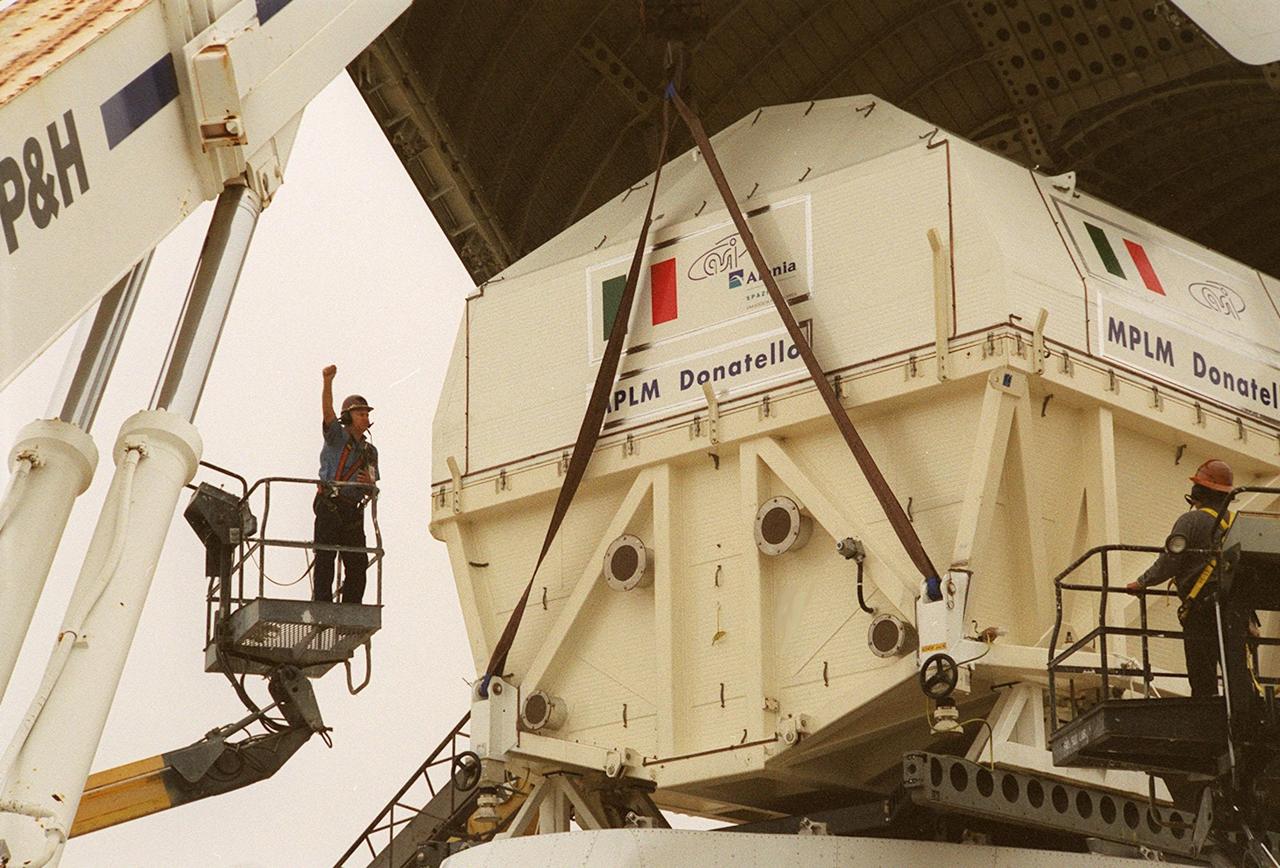
At the <a href="../../subjects/slf.htm"> Shuttle Landing Facility</a>, workers in cherry pickers (left and right) help direct the offloading of the Italian Space Agency’s <a href="../../subjects/mplm.htm"> Multi-Purpose Logistics Module</a> Donatello from the Airbus “Beluga” air cargo plane that brought it from the factory of Alenia Aerospazio in Turin, Italy. The third of three for the International Space Station, the module will be transported to the <a href="../../subjects/sspf.htm"> Space Station Processing Facility</a> for processing. Among the activities for the payload test team are integrated electrical tests with other Station elements in the SSPF, leak tests, electrical and software compatibility tests with the Space Shuttle (using the Cargo Integrated Test equipment) and an Interface Verification Test once the module is installed in the Space Shuttle’s payload bay at the launch pad. The most significant mechanical task to be performed on Donatello in the SSPF is the installation and outfitting of the racks for carrying the various experiments and cargo
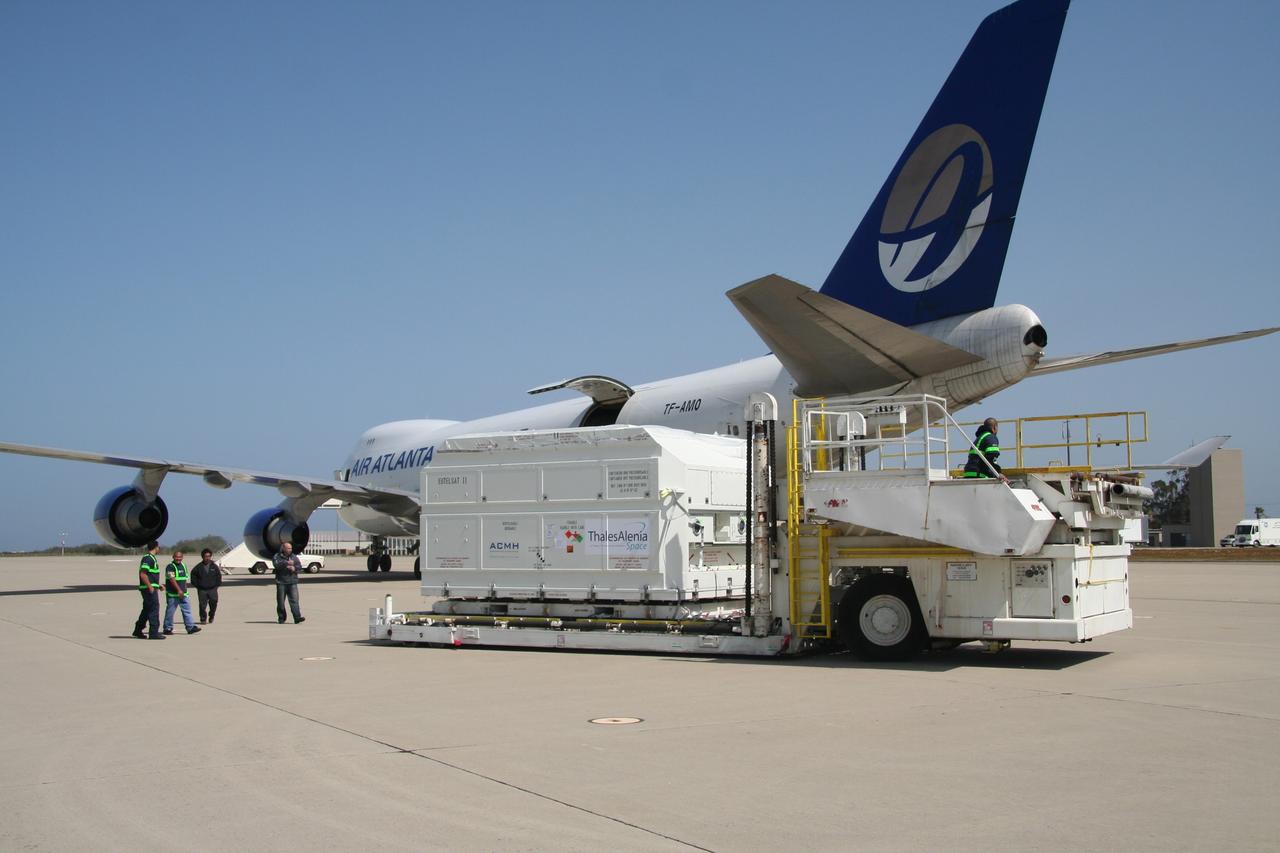
VANDENBERG AIR FORCE BASE, Calif. – After being offloaded from the cargo plane, the shipping container holding the OSTM/Jason-2 satellite is moved away from the plane. The satellite will be taken to the Astrotech processing facility. The OSTM, or Ocean Topography Mission, on the Jason-2 satellite is a follow-on to Jason-1. It will take oceanographic studies of sea surface height into an operational mode for continued climate forecasting research and science and industrial applications. This satellite altimetry data will help determine ocean circulation, climate change and sea-level rise. OSTM is a joint effort by the National Oceanic and Atmospheric Administration, NASA, France’s Centre National d’Etudes Spatiales and the European Meteorological Satellite Organisation. OSTM/Jason-2 will be launched aboard a United Launch Alliance Delta II 7320 from Vandenberg on June 15. Photo credit: NASA/Steve Greenberg, JPL
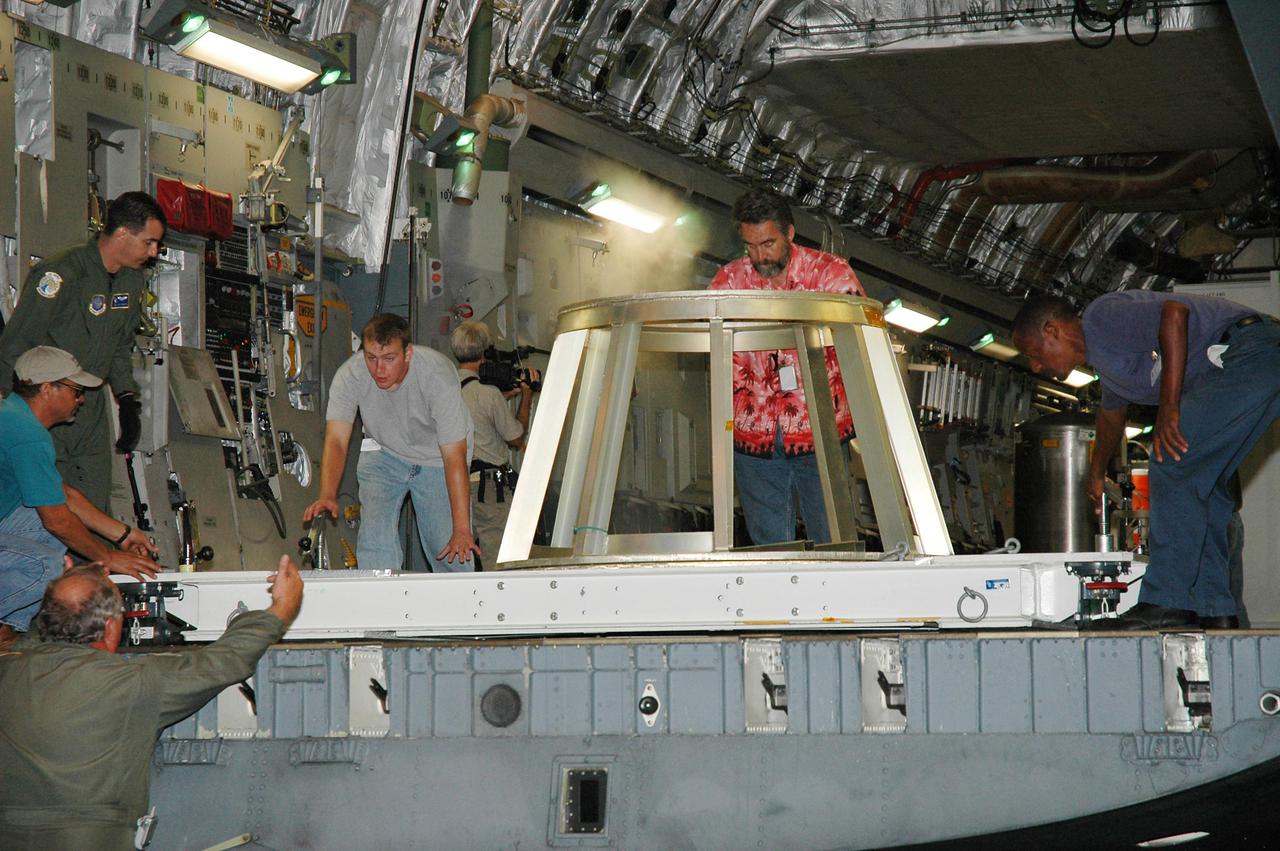
KENNEDY SPACE CENTER, FLA. - At NASA Kennedy Space Center’s Shuttle Landing Facility, workers offload a stand from a U.S. Air Force C-17 cargo plane. The plane delivered the New Horizons spacecraft and other equipment. After it is unloaded, the spacecraft will be transported to the Payload Hazardous Servicing Facility. The test stand will hold the spacecraft during checkout. New Horizons is designed to help us understand worlds at the edge of our solar system by making the first reconnaissance of Pluto and Charon - a 'double planet' and the last planet in our solar system to be visited by spacecraft. The mission will then visit one or more objects in the Kuiper Belt region beyond Neptune. New Horizons is scheduled to launch in January 2006, swing past Jupiter for a gravity boost and scientific studies in February or March 2007, and reach Pluto and its moon, Charon, in July 2015.
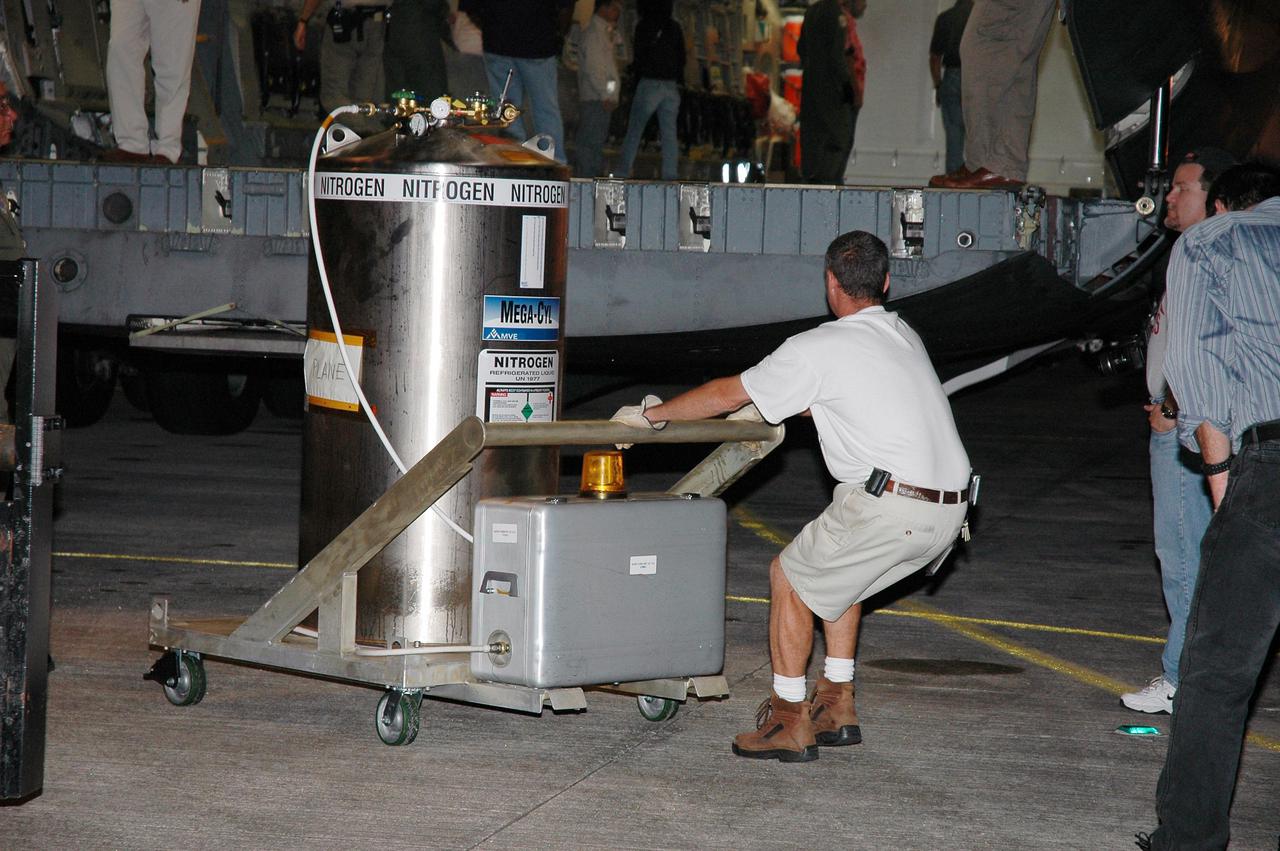
KENNEDY SPACE CENTER, FLA. - At NASA Kennedy Space Center’s Shuttle Landing Facility, workers move a nitrogen tank to a nearby transporter. The equipment is part of the cargo delivered aboard a U.S. Air Force C-17 cargo plane (in the background), primarily the Pluto New Horizons spacecraft. After it is unloaded, the spacecraft will be transported to the Payload Hazardous Servicing Facility. The nitrogen provides a purge to keep components cool and dry during processing.New Horizons is designed to help us understand worlds at the edge of our solar system by making the first reconnaissance of Pluto and Charon - a 'double planet' and the last planet in our solar system to be visited by spacecraft. The mission will then visit one or more objects in the Kuiper Belt region beyond Neptune. New Horizons is scheduled to launch in January 2006, swing past Jupiter for a gravity boost and scientific studies in February or March 2007, and reach Pluto and its moon, Charon, in July 2015.
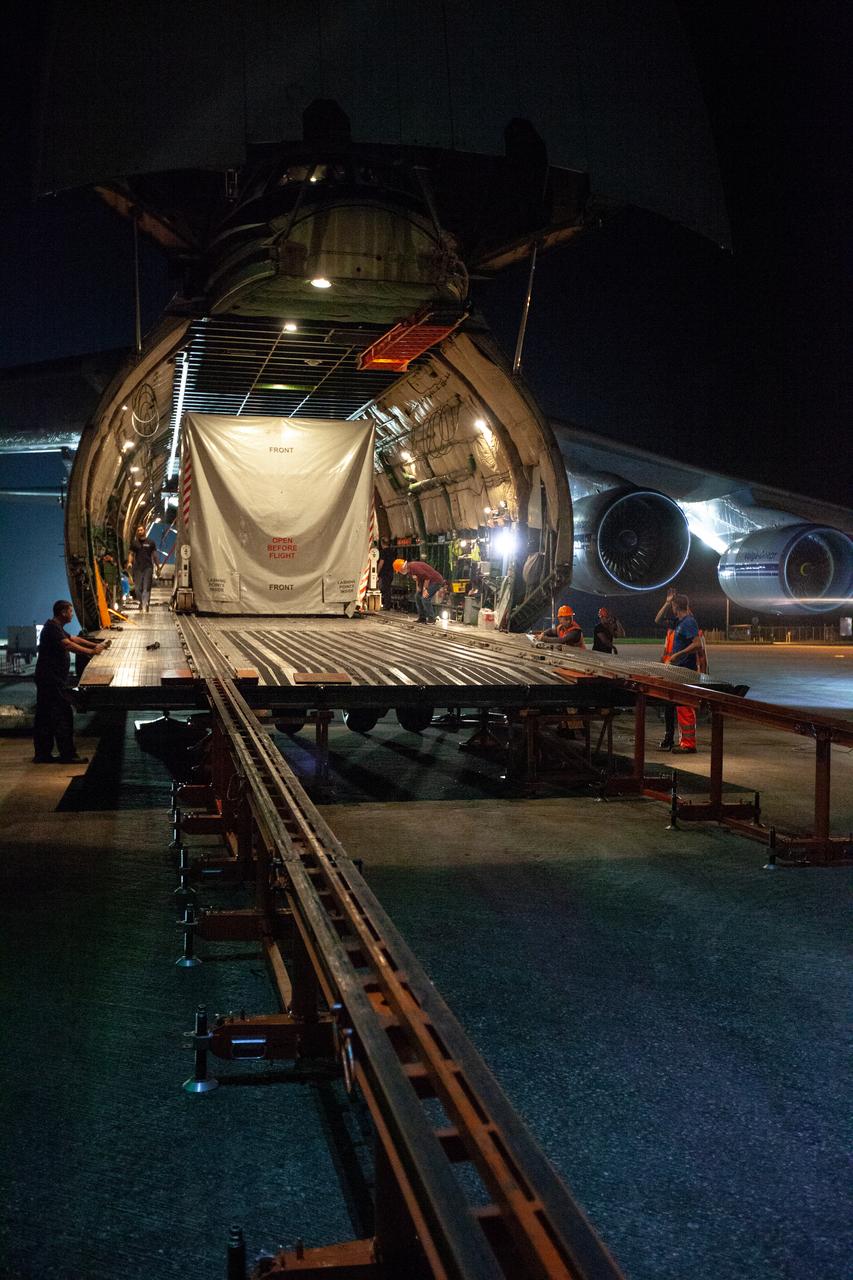
The Solar Orbiter spacecraft is moved out of an Antonov An-124 cargo plane at NASA Kennedy Space Center’s Launch and Landing Facility on Nov. 1, 2019. The spacecraft was delivered to the Florida spaceport from Munich, Germany, then transported to the Astrotech Space Operations facility in nearby Titusville. Solar Orbiter is a European Space Agency mission with strong NASA participation. The mission aims to study the Sun, its outer atmosphere and solar winds. The spacecraft will provide the first images of the Sun’s poles. NASA’s Launch Services Program based at Kennedy is managing the launch. Liftoff is scheduled for Feb. 5, 2020, from Cape Canaveral Air Force Station aboard a United Launch Alliance Atlas V rocket.
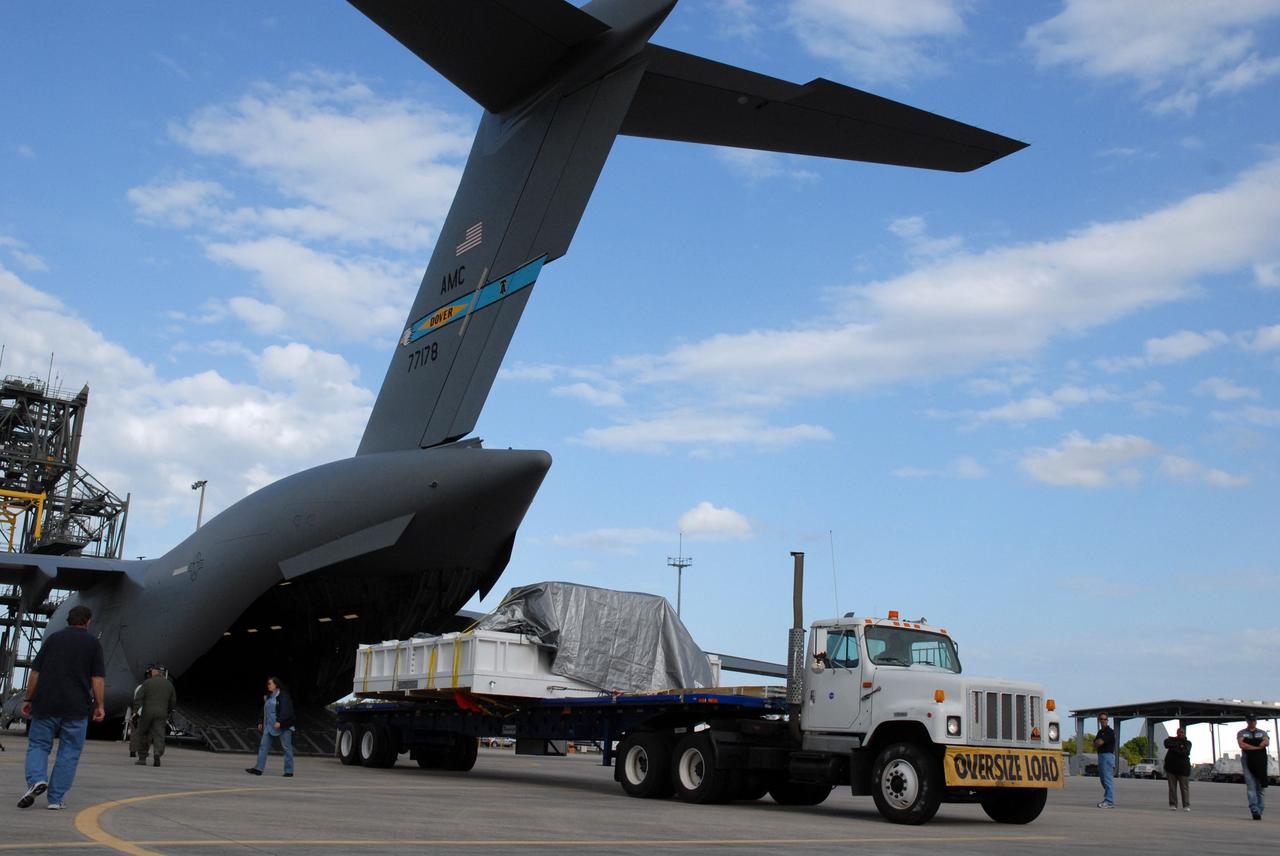
CAPE CANAVERAL, Fla. – The truck carrying the EXPRESS Logistics Carrier for the STS-129 mission pulls away from the C-17 cargo plane that delivered it to NASA's Kennedy Space Center in Florida. The carrier is part of the payload on space shuttle Atlantis, which will deliver to the International Space Station components including two spare gyroscopes, two nitrogen tank assemblies, two pump modules, an ammonia tank assembly and a spare latching end effector for the station's robotic arm. STS-129 is targeted to launch Nov. 12. Photo credit: NASA/Tim Jacobs
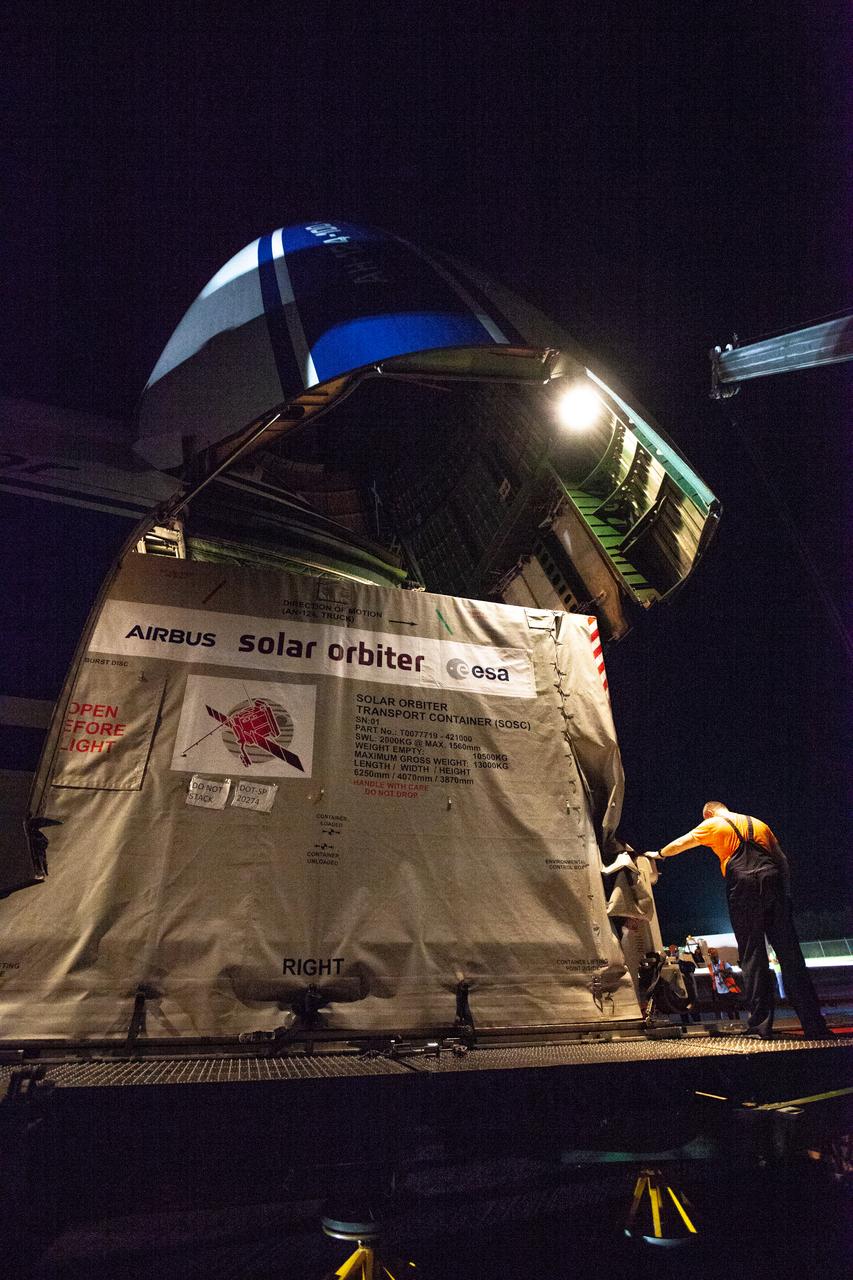
The Solar Orbiter spacecraft is moved out of an Antonov An-124 cargo plane at NASA Kennedy Space Center’s Launch and Landing Facility on Nov. 1, 2019. The spacecraft was delivered to the Florida spaceport from Munich, Germany, then transported to the Astrotech Space Operations facility in nearby Titusville. Solar Orbiter is a European Space Agency mission with strong NASA participation. The mission aims to study the Sun, its outer atmosphere and solar winds. The spacecraft will provide the first images of the Sun’s poles. NASA’s Launch Services Program based at Kennedy is managing the launch. Liftoff is scheduled for Feb. 5, 2020, from Cape Canaveral Air Force Station aboard a United Launch Alliance Atlas V rocket.
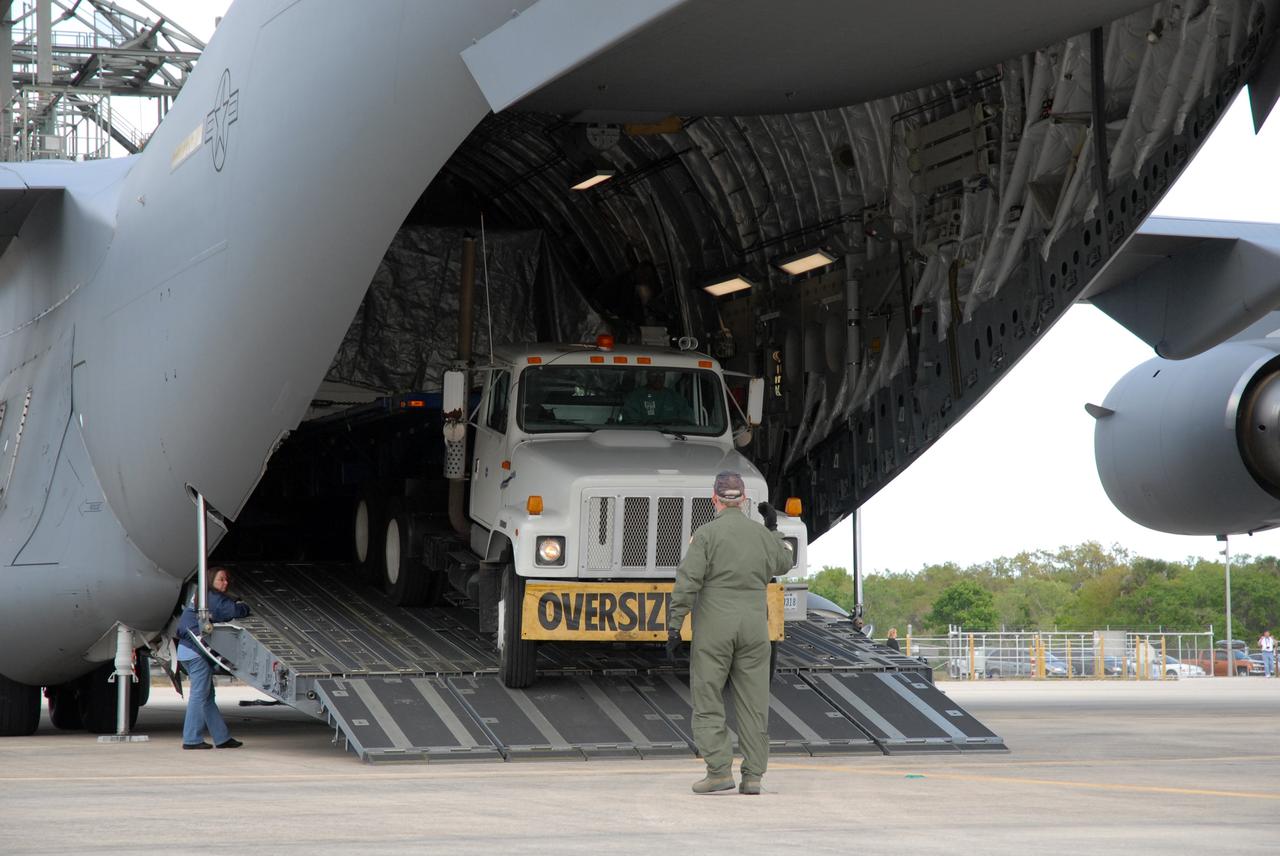
CAPE CANAVERAL, Fla. – On the Shuttle Landing Facility at NASA's Kennedy Space Center in Florida, a truck carrying the EXPRESS Logistics Carrier for the STS-129 mission drives out of the open rear of the C-17 cargo plane. The carrier is part of the payload on space shuttle Atlantis, which will deliver to the International Space Station components including two spare gyroscopes, two nitrogen tank assemblies, two pump modules, an ammonia tank assembly and a spare latching end effector for the station's robotic arm. STS-129 is targeted to launch Nov. 12. Photo credit: NASA/Tim Jacobs
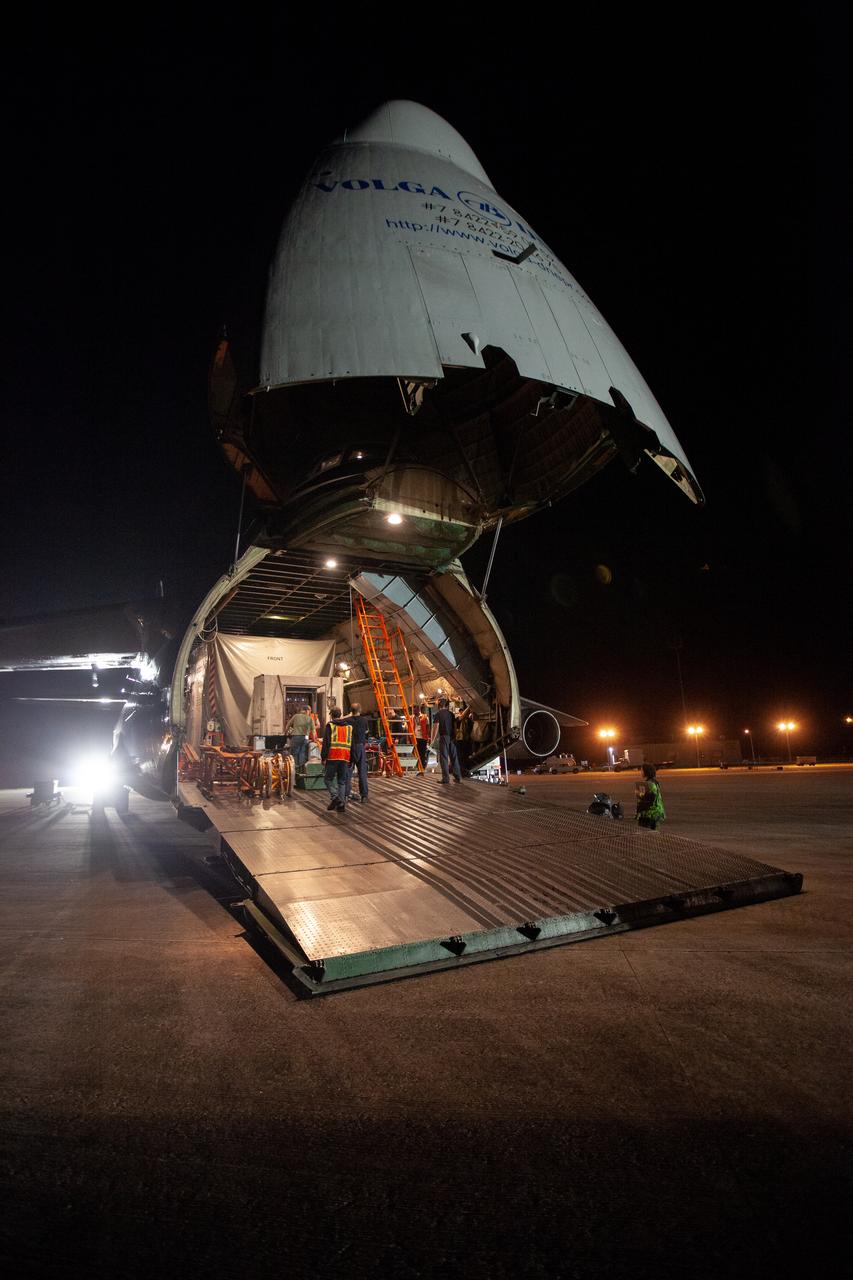
The Solar Orbiter spacecraft is moved out of an Antonov An-124 cargo plane at NASA Kennedy Space Center’s Launch and Landing Facility on Nov. 1, 2019. The spacecraft was delivered to the Florida spaceport from Munich, Germany, then transported to the Astrotech Space Operations facility in nearby Titusville. Solar Orbiter is a European Space Agency mission with strong NASA participation. The mission aims to study the Sun, its outer atmosphere and solar winds. The spacecraft will provide the first images of the Sun’s poles. NASA’s Launch Services Program based at Kennedy is managing the launch. Liftoff is scheduled for Feb. 5, 2020, from Cape Canaveral Air Force Station aboard a United Launch Alliance Atlas V rocket.
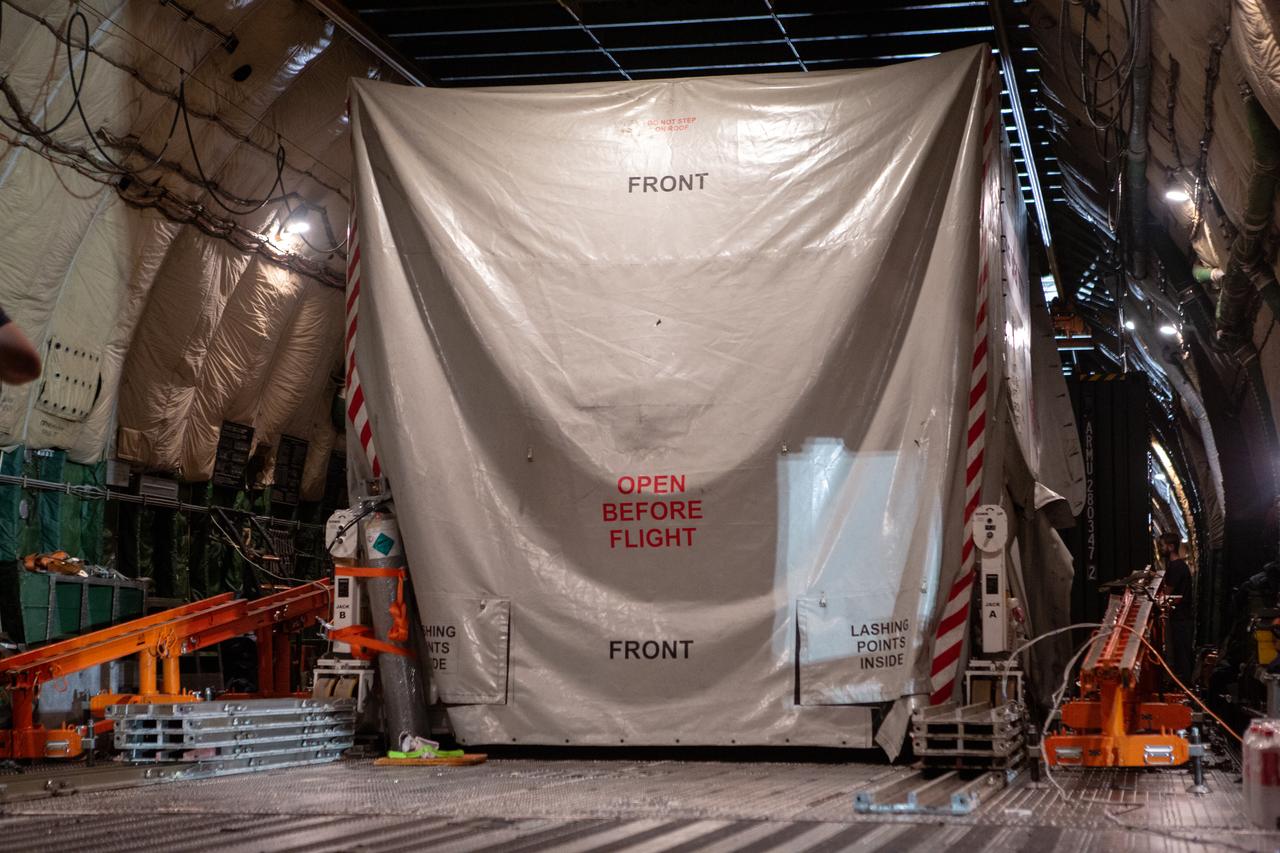
The Solar Orbiter spacecraft is moved out of an Antonov An-124 cargo plane at NASA Kennedy Space Center’s Launch and Landing Facility on Nov. 1, 2019. The spacecraft was delivered to the Florida spaceport from Munich, Germany, then transported to the Astrotech Space Operations facility in nearby Titusville. Solar Orbiter is a European Space Agency mission with strong NASA participation. The mission aims to study the Sun, its outer atmosphere and solar winds. The spacecraft will provide the first images of the Sun’s poles. NASA’s Launch Services Program based at Kennedy is managing the launch. Liftoff is scheduled for Feb. 5, 2020, from Cape Canaveral Air Force Station aboard a United Launch Alliance Atlas V rocket.
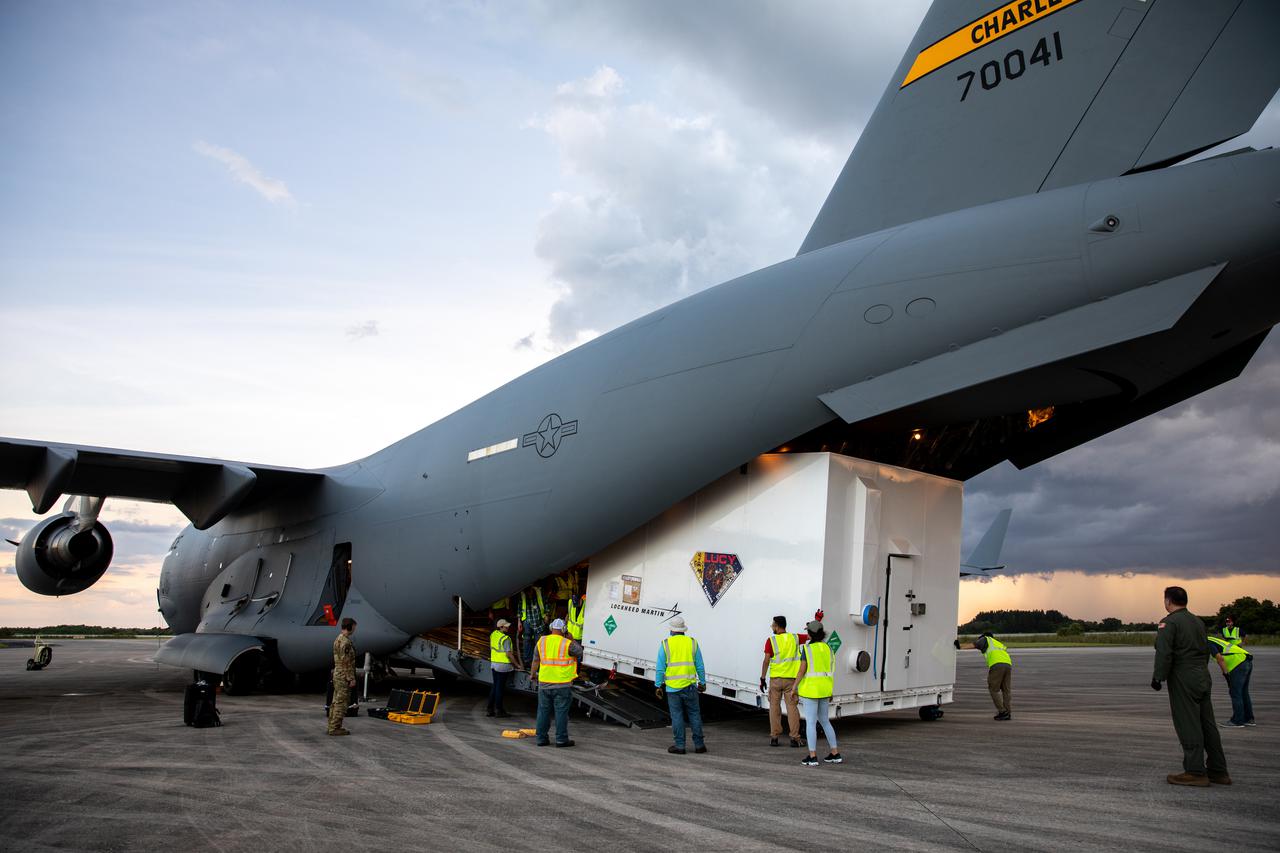
NASA’s Lucy spacecraft arrives by cargo plane and is unloaded on the runway of the Launch and Landing Facility at Kennedy Space Center in Florida on July 30, 2021. From there, the Lucy spacecraft will move to the Astrotech Space Operations - Florida payload processing facility in nearby Titusville, Florida, before its scheduled launch on a United Launch Alliance (ULA) Atlas V rocket from Cape Canaveral Space Force Station on October 16, 2021. The Lucy mission will be the first space mission to explore a diverse population of small bodies known as the Jupiter Trojan asteroids. The launch is being managed by NASA’s Launch Services Program based at Kennedy, America’s premier multi-user spaceport.
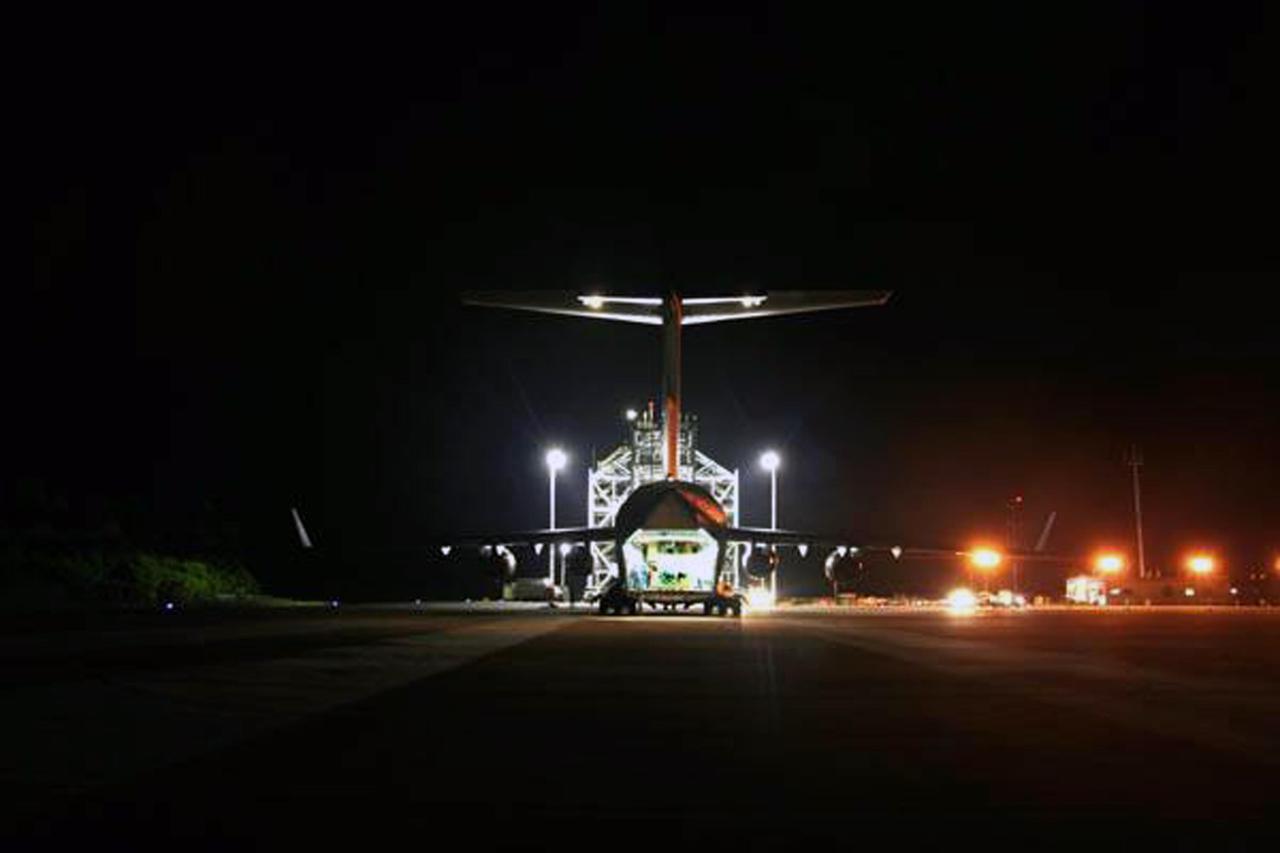
KENNEDY SPACE CENTER, FLA. - A U.S. Air Force C-17 cargo plane sits on NASA Kennedy Space Center’s Shuttle Landing Facility. Inside is the New Horizons spacecraft and affiliated ground support equipment that will be offloaded and transported to the Payload Hazardous Servicing Facility. New Horizons will make the first reconnaissance of Pluto and Charon - a 'double planet' and the last planet in our solar system to be visited by spacecraft. The mission will then visit one or more objects in the Kuiper Belt region beyond Neptune. New Horizons is scheduled to launch in January 2006, swing past Jupiter for a gravity boost and scientific studies in February or March 2007, and reach Pluto and its moon, Charon, in July 2015.

The GOES-L weather satellite, to be launched from Cape Canaveral Air Station (CCAS) aboard an Atlas II rocket in March or April, is covered and waiting on a semi-trailer truck (in background) that will transport it to Astrotech in Titusville for final testing. It arrived aboard the C-5 air cargo plane (seen in foreground) at CCAS. GOES-L, the fourth of a new advanced series of geostationary weather satellites for the National Oceanic and Atmospheric Administration (NOAA), is a three-axis inertially stabilized spacecraft that will provide pictures and perform atmospheric sounding at the same time. Once launched, the satellite will undergo checkout and then provide backup capabilities for the existing, aging GOES East weather satellite
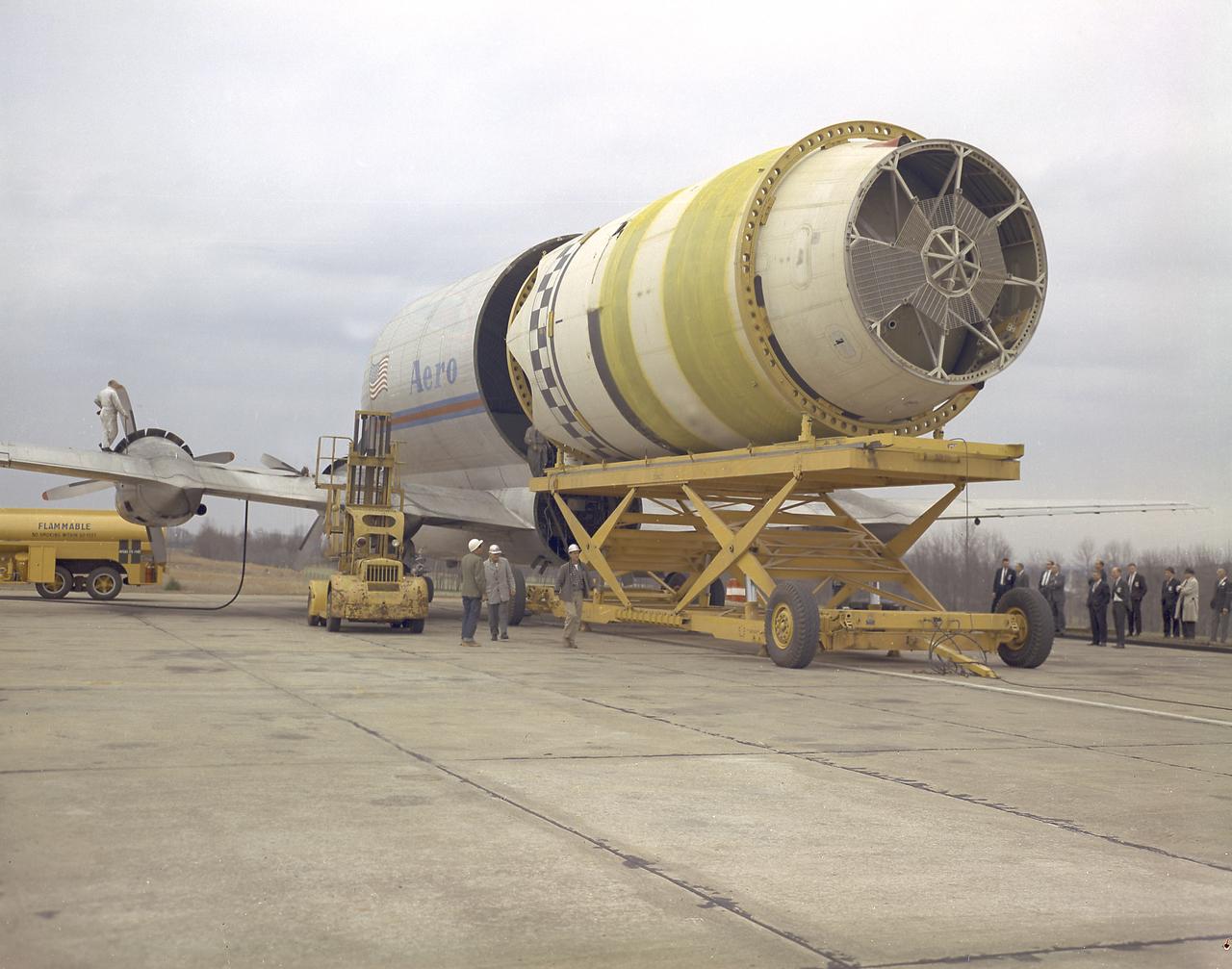
The photograph shows the loading operation of the Saturn I S-IV stage (second stage) into the Pregnant Guppy at the Redstone Airfield, Huntsville, Alabama. The Pregnant Guppy was a Boeing B-377 Stratocruiser modified to transport various stages of Saturn launch vehicles. The modification project called for lengthening the fuselage to accommodate the S-IV stage. After the flight test of that modification, phase two called for the enlargement of the plane's cabin section to approximately double its normal volume. The fuselage separated just aft of the wing's trailing edge to load and unload the S-IV and other cargoes.
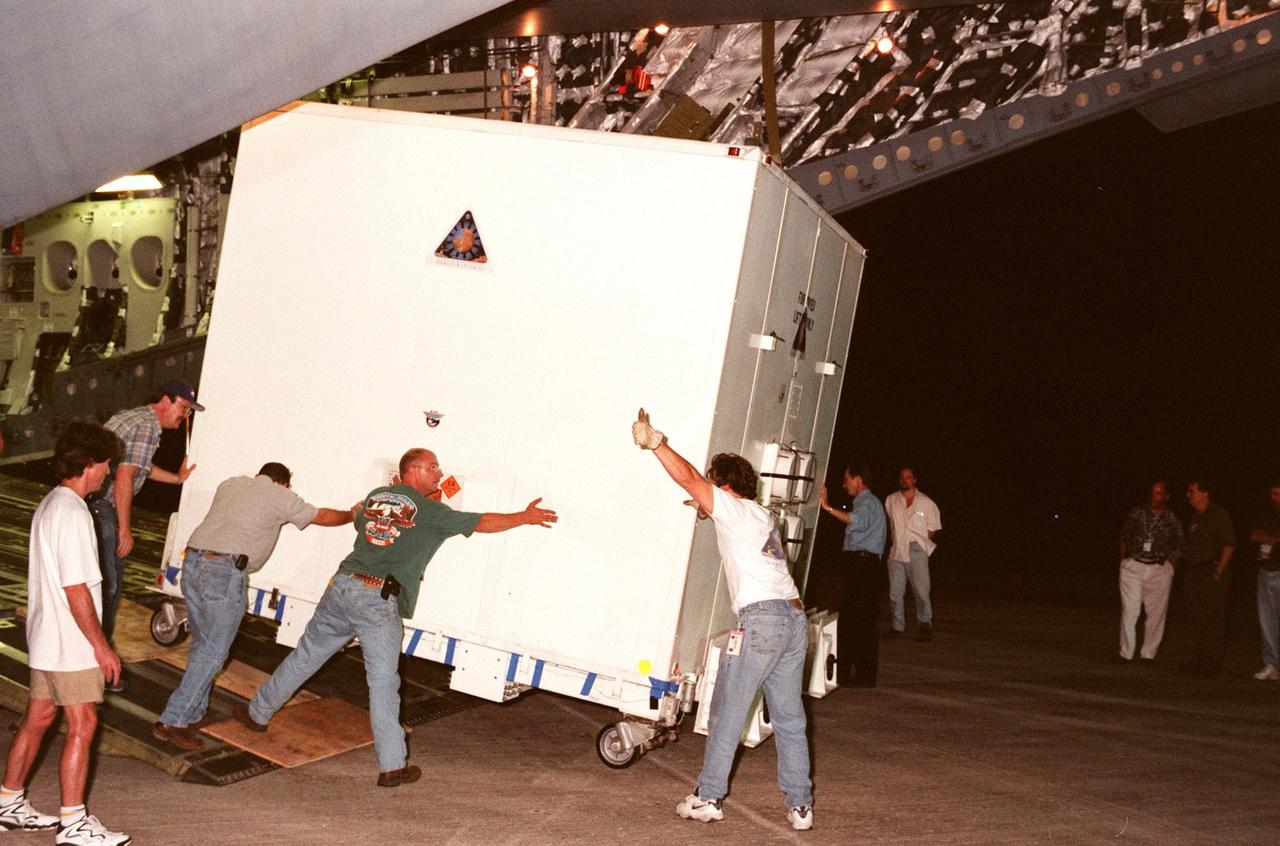
KENNEDY SPACE CENTER, FLA. -- At the Shuttle Landing Facility, the Mars Polar Lander is rolled from the Air Force C-17 cargo plane that carried it from the Lockheed Martin Astronautics plant in Denver, CO. The Mars Polar Lander is targeted for launch from Cape Canaveral Air Station aboard a Delta II rocket on Jan. 3, 1999. The solar-powered spacecraft is designed to touch down on the Martian surface near the northern-most boundary of the south pole in order to study the water cycle there. The lander also will help scientists learn more about climate change and current resources on Mars, studying such things as frost, dust, water vapor and condensates in the Martian atmosphere
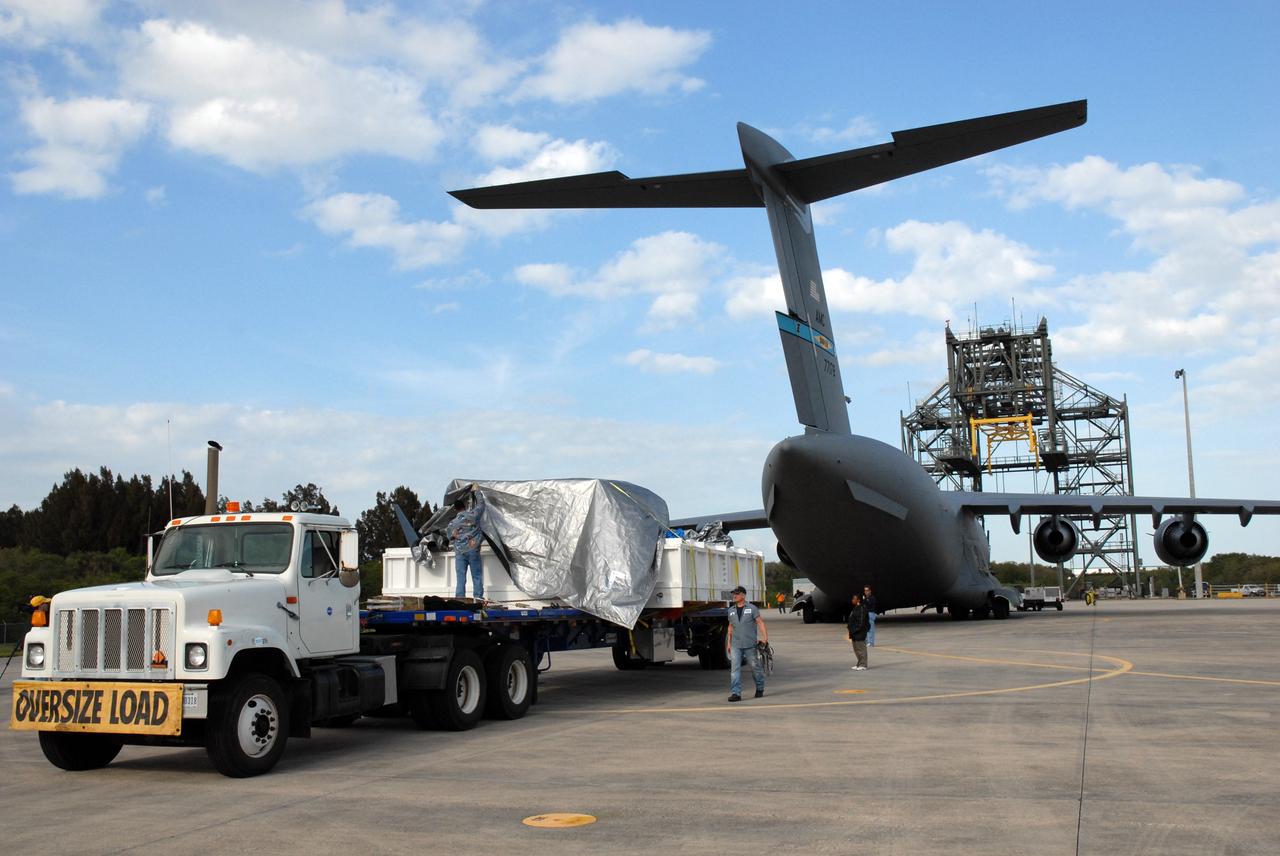
CAPE CANAVERAL, Fla. – On the Shuttle Landing Facility at NASA's Kennedy Space Center in Florida, a worker removes a cover from the EXPRESS Logistics Carrier for the STS-129 mission. The truck and carrier arrived on the C-17 cargo plane in the background. The carrier is part of the payload on space shuttle Atlantis, which will deliver to the International Space Station components including two spare gyroscopes, two nitrogen tank assemblies, two pump modules, an ammonia tank assembly and a spare latching end effector for the station's robotic arm. STS-129 is targeted to launch Nov. 12. Photo credit: NASA/Tim Jacobs
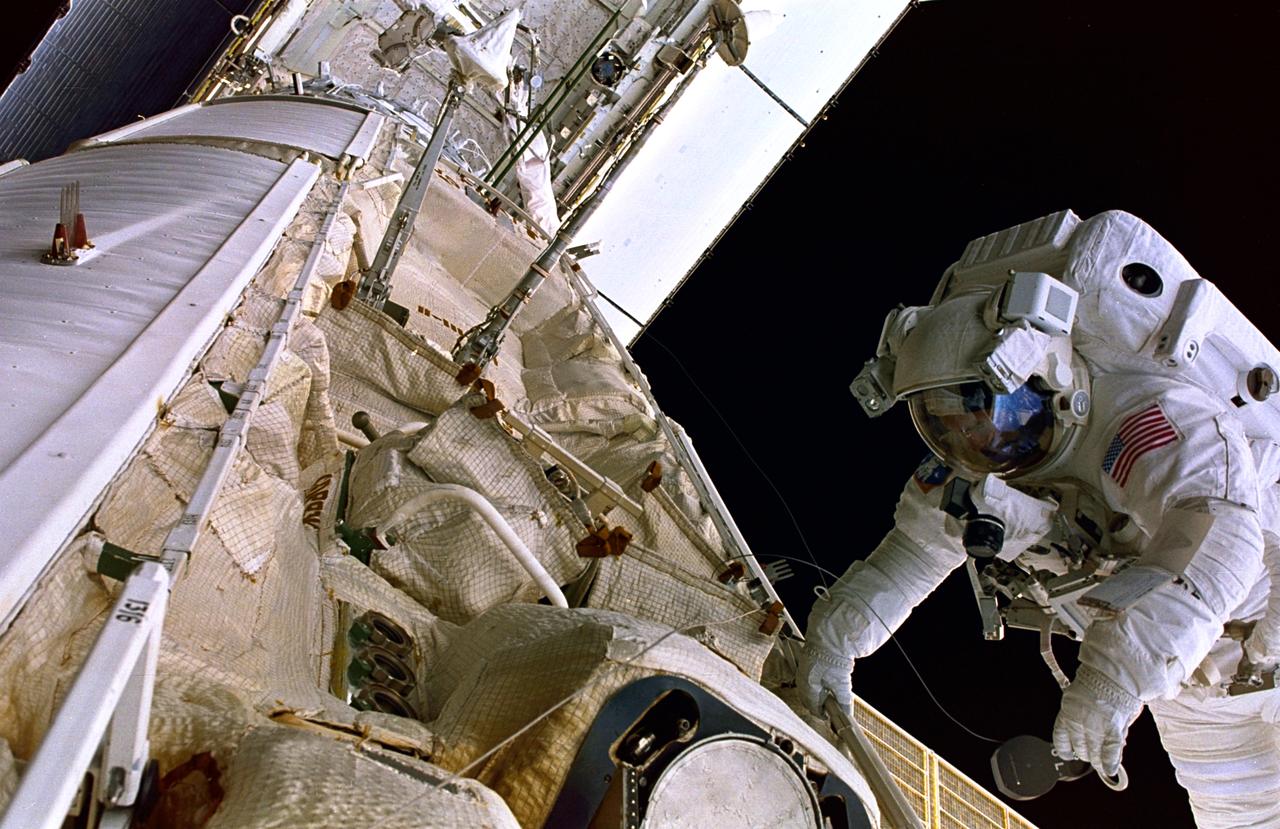
STS088-353-006 (4 -15 Dec. 1998) --- Astronaut James H. Newman, mission specialist, holds onto a handrail on Zarya while conducting a space walk at the top of the Unity-Zarya stack in the cargo bay of the Earth-orbiting Space Shuttle Endeavour. The open payload doors and part of the cargo bay, including the Ku-band antenna, are seen in upper left.

STS088-353-008 (4-15 Dec. 1998) --- Astronaut James H. Newman, mission specialist, translates along a hand rail on the Russian-built Zarya Module in this Extravehicular Activity (EVA) photograph taken by astronaut Jerry L. Ross, mission specialist. Ross and Newman shared three space walks altogether to perform cable connection tasks and to put finishing touches on the exteriors of the recently-joined Zarya and the United States-built Unity (Node 1) modules. Unity is partially visible beneath Zarya, as is most of the cargo bay of the Space Shuttle Endeavour. The Canadian-built Remote Manipulator System (RMS) arm is partially visible, also.
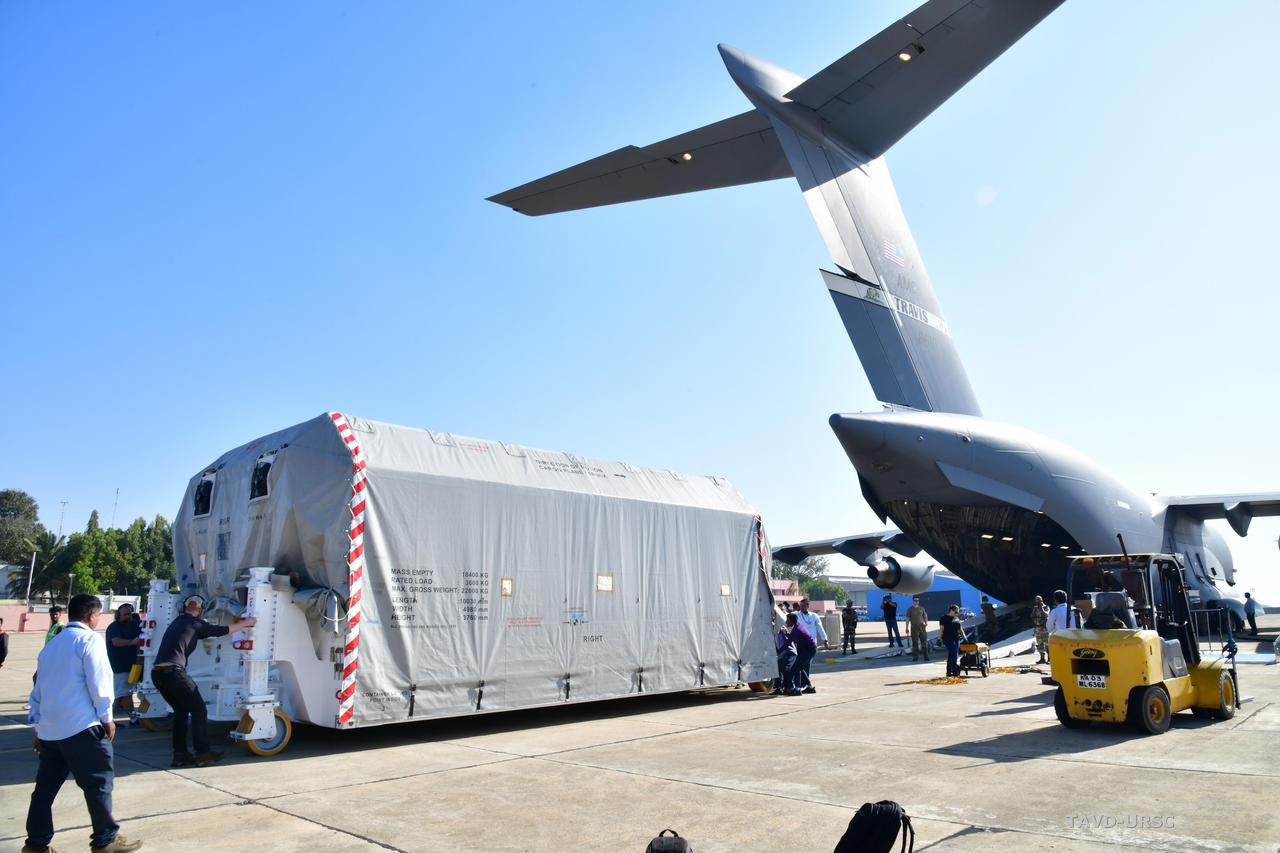
The NASA-ISRO Synthetic Aperture Radar (NISAR) science instrument payload, housed in a specially designed shipping container, sits at Hindustan Aeronautics Limited Airport in Bengaluru, India. The payload left NASA's Jet Propulsion Laboratory in Southern California on Feb. 28, and departed the United States on March 3 aboard a U.S. Air Force cargo plane, arriving in Bengaluru on March 6. From there it was transported to the Indian Space Research Organisation's U R Rao Satellite Centre, where it will be integrated with the satellite body, or bus, and undergo further testing leading up to launch in 2024. The NISAR mission – a joint effort between NASA and the Indian Space Research Organisation – will observe nearly all the planet's land and ice surfaces twice every 12 days, measuring movements in extremely fine detail. It will also survey forests and agricultural regions to understand carbon exchange between plants and the atmosphere. NISAR's science payload will be the most advanced radar system ever launched as part of a NASA mission, and it will feature the largest-ever radar antenna of its kind: a drum-shaped, wire mesh reflector nearly 40 feet (12 meters) in diameter that will extend from a 30-foot (9-meter) boom. The mission's science instruments consist of L- and S-band radar, so named to indicate the wavelengths of their signals. ISRO built the S-band radar, which it shipped to JPL in March 2021. Engineers spent much of the last two years integrating the instrument with the JPL-built L-band system, then conducting tests to verify they work well together. JPL, which is managed for NASA by Caltech in Pasadena, leads the U.S. component of NISAR. In addition to the L-band radar, NASA is also providing the radar reflector antenna, the deployable boom, a high-rate communication subsystem for science data, GPS receivers, a solid-state recorder, and payload data subsystem. In addition to the S-band radar, ISRO is providing the spacecraft bus, the launch vehicle, and associated launch services and satellite mission operations. https://photojournal.jpl.nasa.gov/catalog/PIA25570
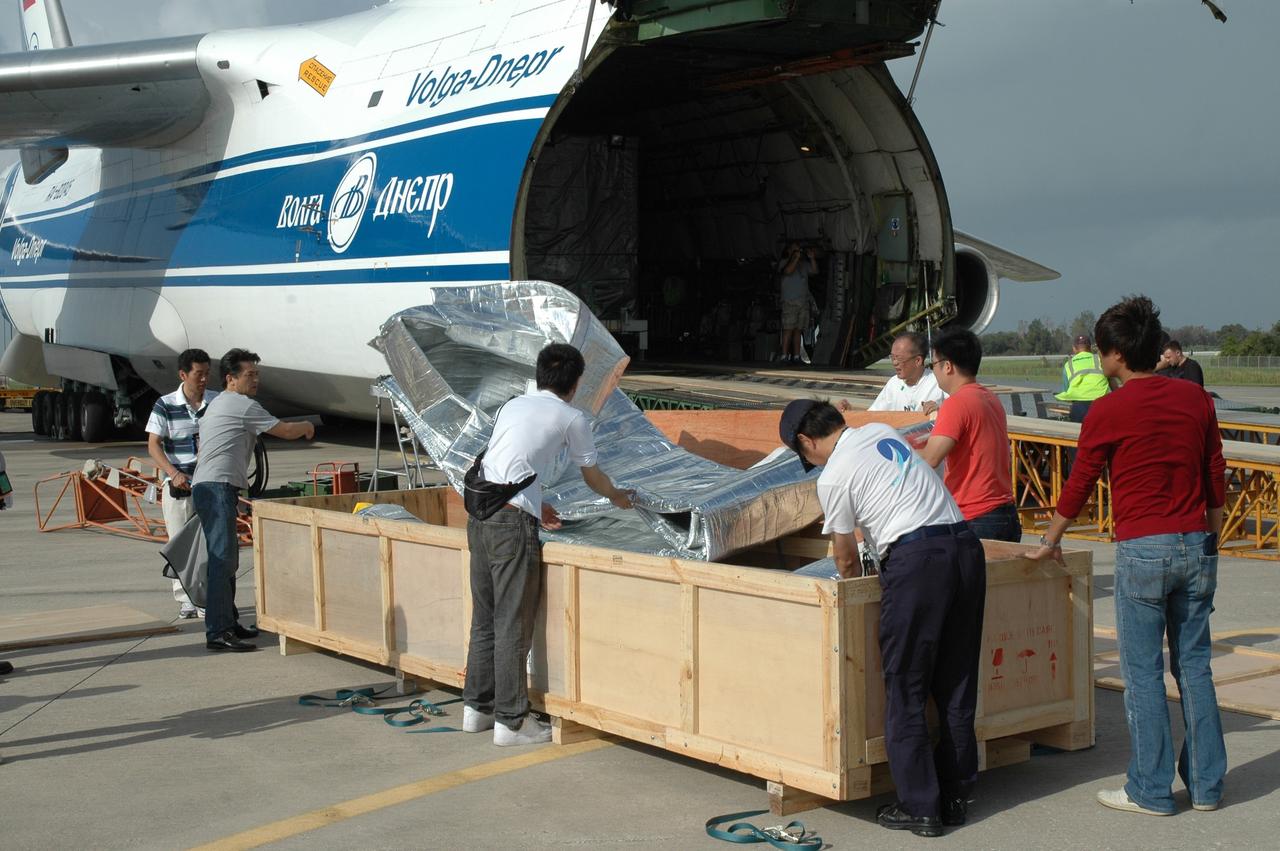
CAPE CANAVERAL, Fla. - On the Shuttle Landing Facility at NASA's Kennedy Space Center in Florida, workers remove material from a cargo box before offloading the primary cargo from the Russian Antonov AH-124-100 cargo airplane. The plane carries the final components of the Japan Aerospace Exploration Agency's Kibo laboratory for the International Space Station: the Kibo Exposed Facility, or EF, and the Experiment Logistics Module Exposed Section, or ELM-ES. The EF provides a multipurpose platform where science experiments can be deployed and operated in the exposed environment. The payloads attached to the EF can be exchanged or retrieved by Kibo's robotic arm, the JEM Remote Manipulator System. The ELM-ES will be attached to the end of the EF to provide payload storage space and can carry up to three payloads at launch. In addition, the ELM-ES provides a logistics function where it can be detached from the EF and returned to the ground aboard the space shuttle. The two JEM components will be carried aboard space shuttle Endeavour on the STS-127 mission targeted for launch in May 2009. Photo credit: NASA/Jim Grossmann
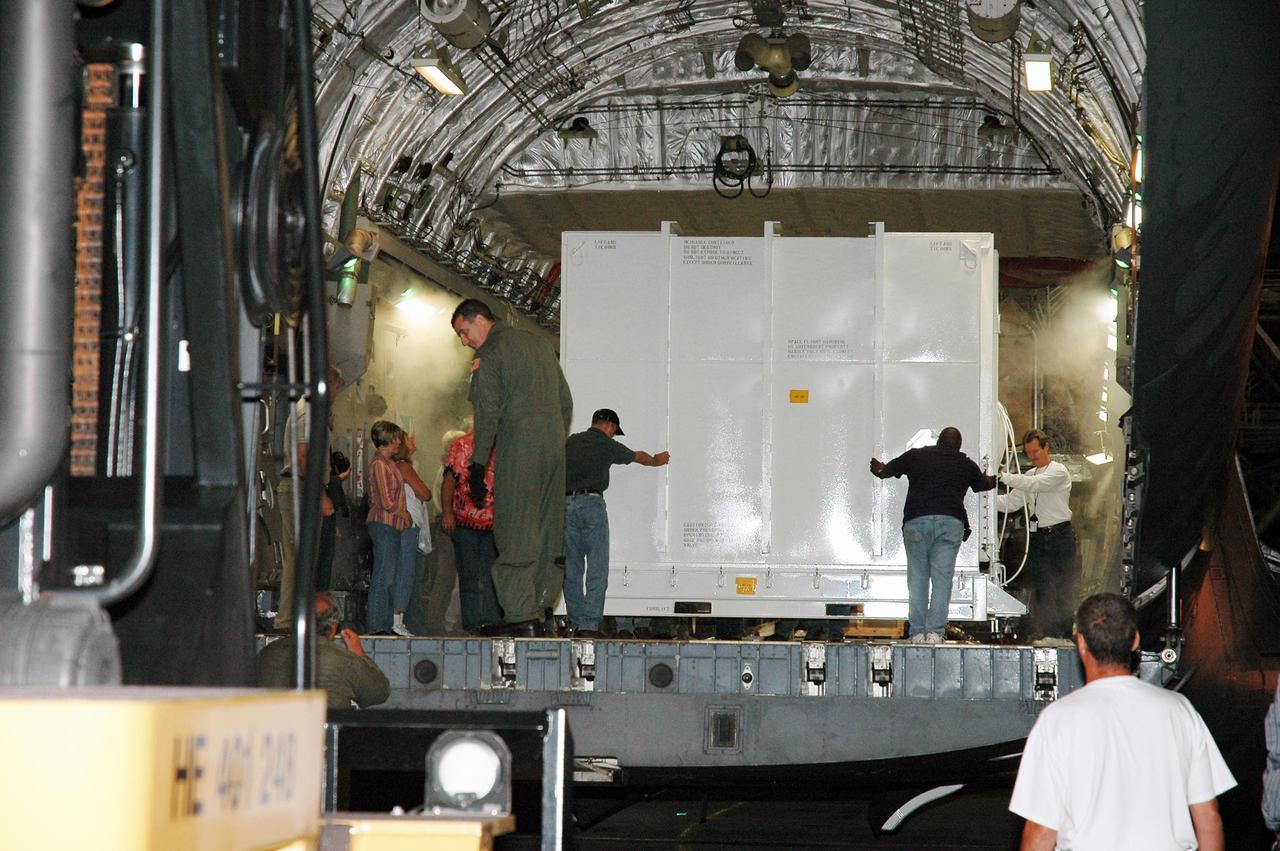
KENNEDY SPACE CENTER, FLA. - In the U.S. Air Force C-17 cargo plane at NASA Kennedy Space Center’s Shuttle Landing Facility, workers move the large shipping container with the New Horizons spacecraft inside. After it is unloaded, the spacecraft will be transported to the Payload Hazardous Servicing Facility. New Horizons is designed to help us understand worlds at the edge of our solar system by making the first reconnaissance of Pluto and Charon - a 'double planet' and the last planet in our solar system to be visited by spacecraft. The mission will then visit one or more objects in the Kuiper Belt region beyond Neptune. New Horizons is scheduled to launch in January 2006, swing past Jupiter for a gravity boost and scientific studies in February or March 2007, and reach Pluto and its moon, Charon, in July 2015.
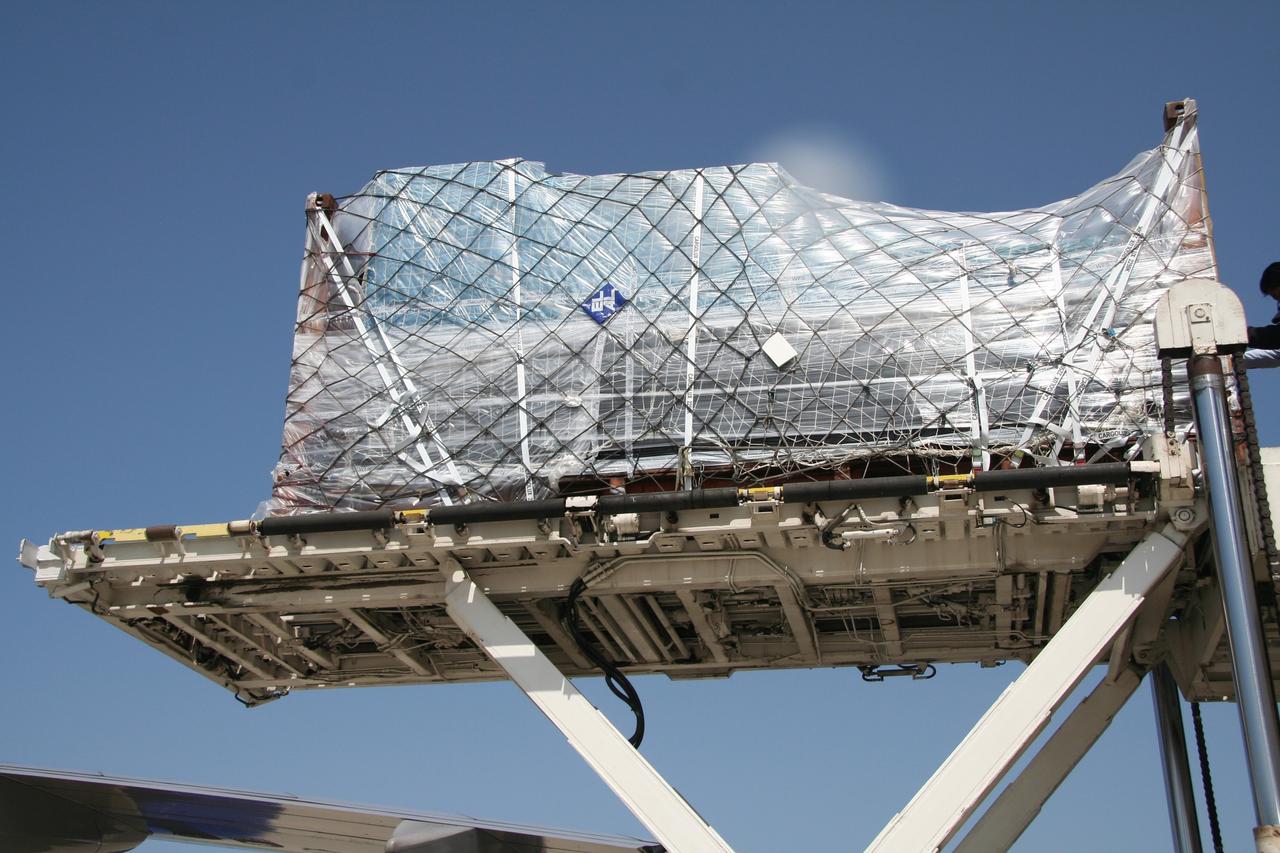
VANDENBERG AIR FORCE BASE, Calif. – Ground support equipment associated with the OSTM/Jason-2 satellite is offloaded from the cargo plane at Vandenberg Air Force Base. The equipment will accompany the satellite to the Astrotech processing facility. The OSTM, or Ocean Topography Mission, on the Jason-2 satellite is a follow-on to Jason-1. It will take oceanographic studies of sea surface height into an operational mode for continued climate forecasting research and science and industrial applications. This satellite altimetry data will help determine ocean circulation, climate change and sea-level rise. OSTM is a joint effort by the National Oceanic and Atmospheric Administration, NASA, France’s Centre National d’Etudes Spatiales and the European Meteorological Satellite Organisation. OSTM/Jason-2 will be launched aboard a United Launch Alliance Delta II 7320 from Vandenberg on June 15. Photo credit: NASA/Steve Greenberg, JPL
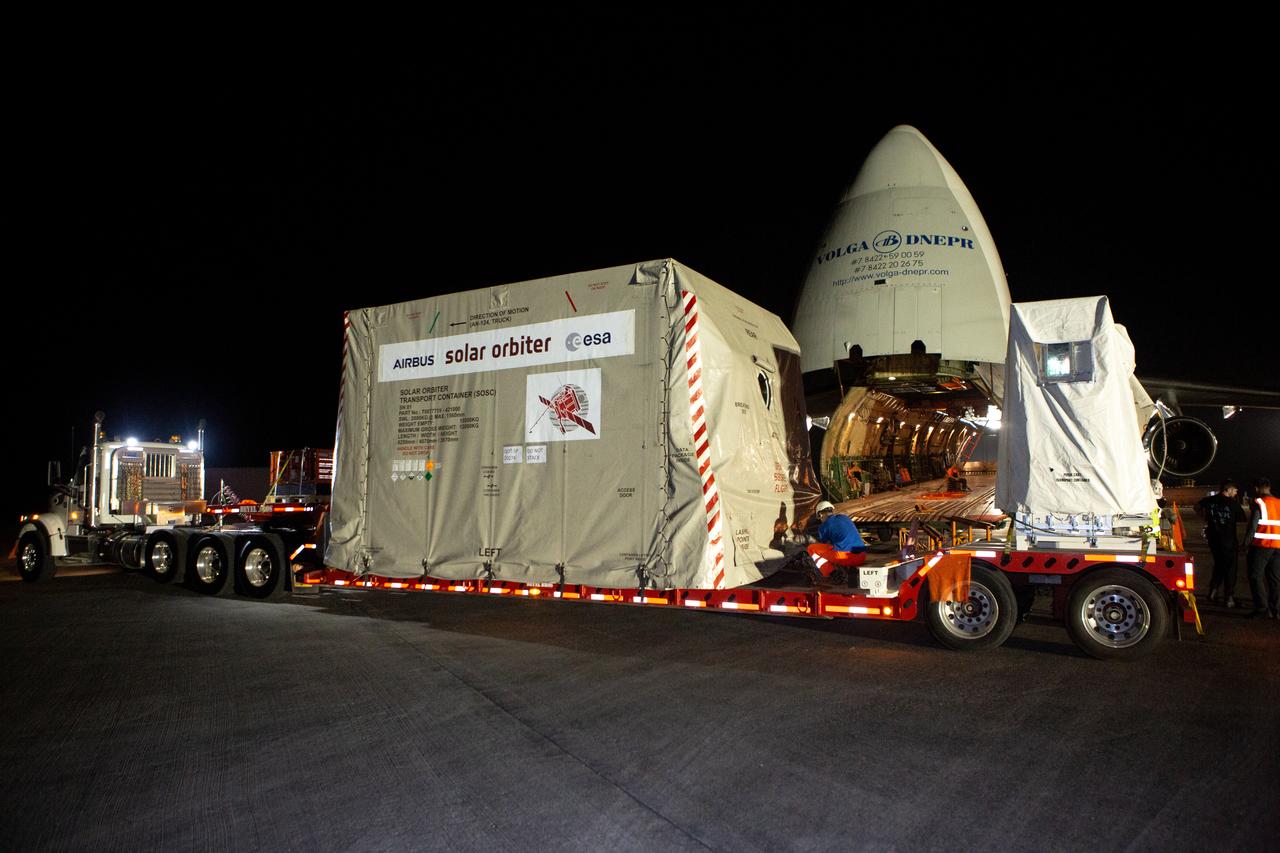
The Solar Orbiter spacecraft is placed on a truck for transportation from the Launch and Landing Facility at NASA’s Kennedy Space Center in Florida to the Astrotech Space Operations facility in nearby Titusville on Nov. 1, 2019. The spacecraft was delivered to the Florida spaceport aboard an Antonov An-124 cargo plane from Munich, Germany. Solar Orbiter is a European Space Agency mission with strong NASA participation. The mission aims to study the Sun, its outer atmosphere and solar winds. The spacecraft will provide the first images of the Sun’s poles. NASA’s Launch Services Program based at Kennedy is managing the launch. Liftoff is scheduled for Feb. 5, 2020, from Cape Canaveral Air Force Station aboard a United Launch Alliance Atlas V rocket.
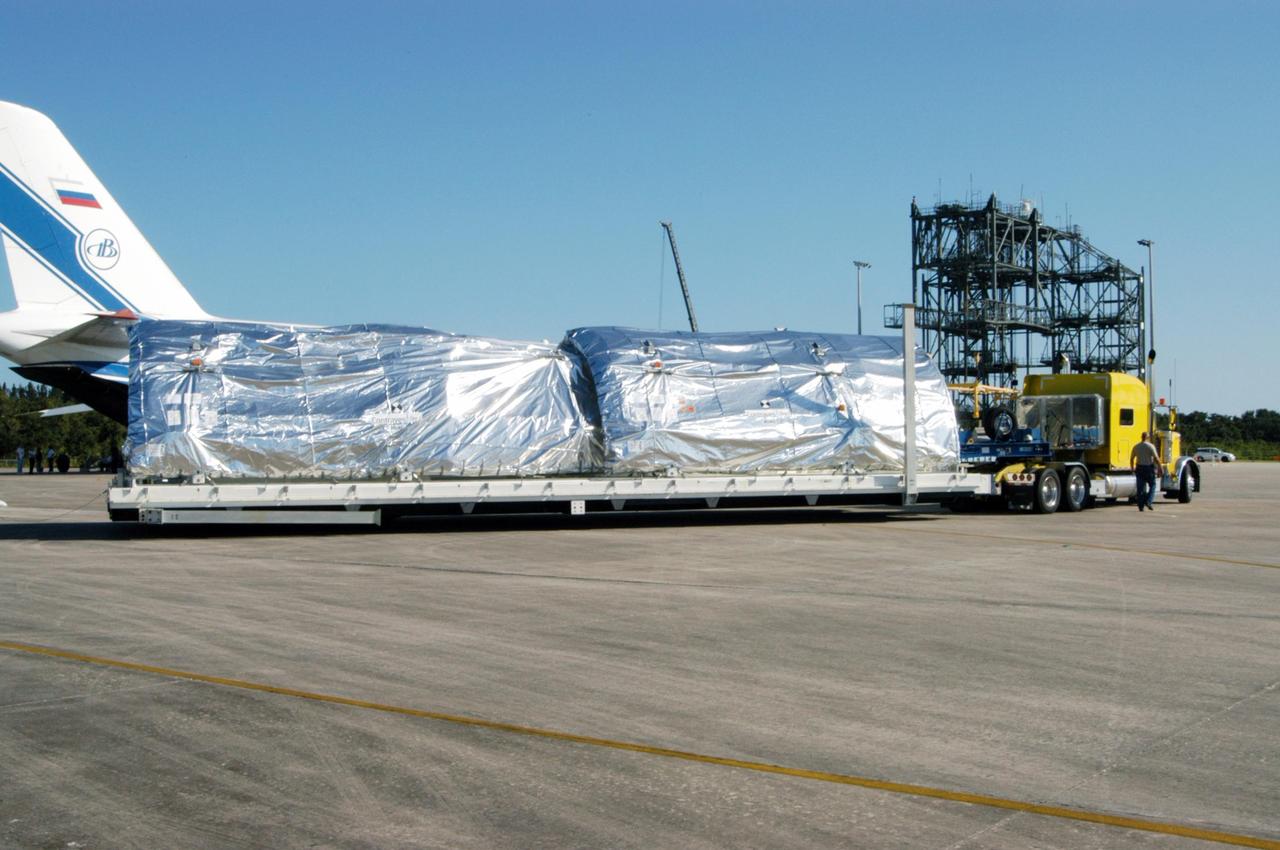
KENNEDY SPACE CENTER, FLA. - On the Shuttle Landing Facility at NASA Kennedy Space Center, the Atlas V fairing halves for the New Horizons spacecraft have been offloaded from the Russian cargo plane (background). The fairing halves will be transported to Astrotech Space Operations in Titusville. The fairing later will be placed around the New Horizons spacecraft in the Payload Hazardous Service Facility. A fairing protects a spacecraft during launch and flight through the atmosphere. Once in space, it is jettisoned. The Lockheed Martin Atlas V is the launch vehicle for the New Horizons spacecraft, which is designed to make the first reconnaissance of Pluto and Charon - a "double planet" and the last planet in our solar system to be visited by spacecraft. The mission will then visit one or more objects in the Kuiper Belt region beyond Neptune. New Horizons is scheduled to launch in January 2006, swing past Jupiter for a gravity boost and scientific studies in February or March 2007, and reach Pluto and its moon, Charon, in July 2015.
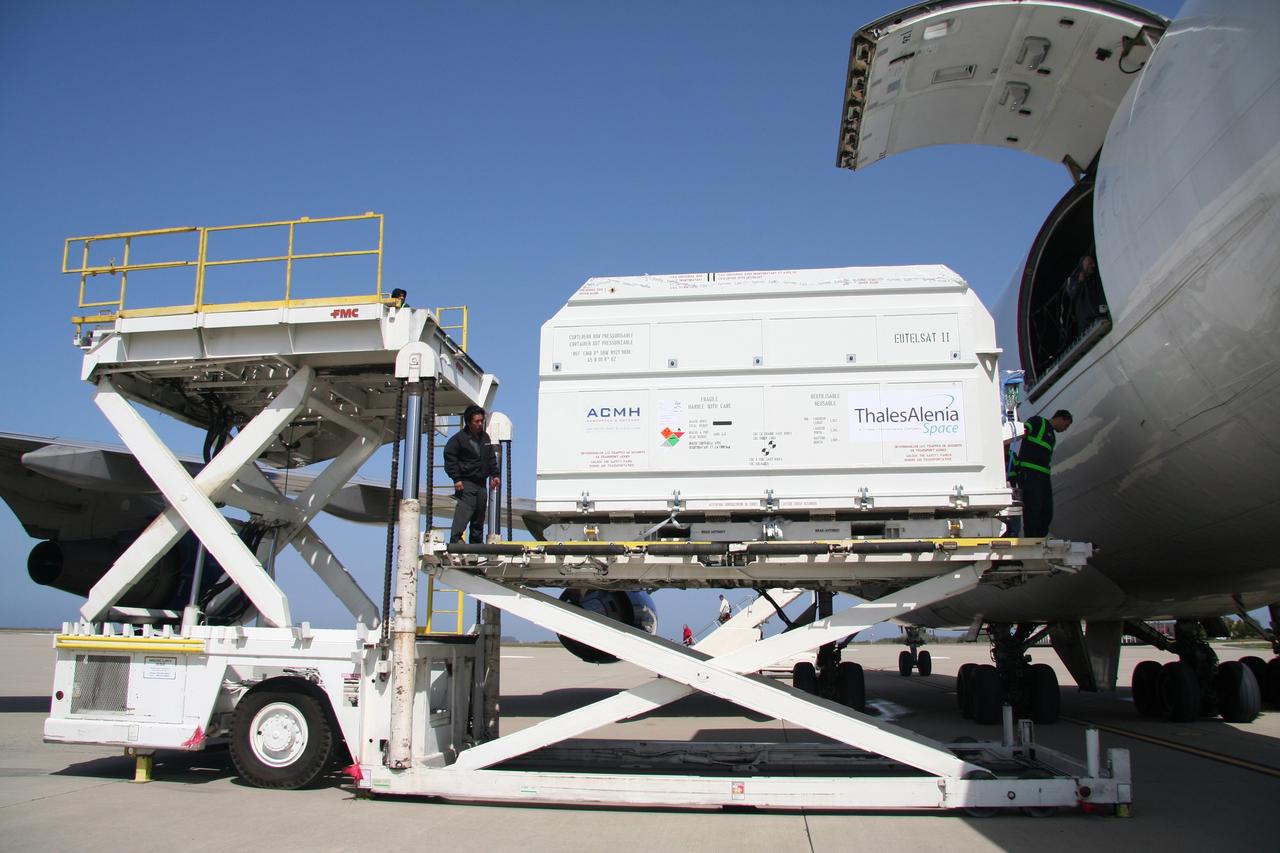
VANDENBERG AIR FORCE BASE, Calif. – After arrival of the cargo plane, the shipping container holding the OSTM/Jason-2 satellite is offloaded at Vandenberg Air Force Base. The satellite will be taken to the Astrotech processing facility. The OSTM, or Ocean Topography Mission, on the Jason-2 satellite is a follow-on to Jason-1. It will take oceanographic studies of sea surface height into an operational mode for continued climate forecasting research and science and industrial applications. This satellite altimetry data will help determine ocean circulation, climate change and sea-level rise. OSTM is a joint effort by the National Oceanic and Atmospheric Administration, NASA, France’s Centre National d’Etudes Spatiales and the European Meteorological Satellite Organisation. OSTM/Jason-2 will be launched aboard a United Launch Alliance Delta II 7320 from Vandenberg on June 15. Photo credit: NASA/Steve Greenberg, JPL
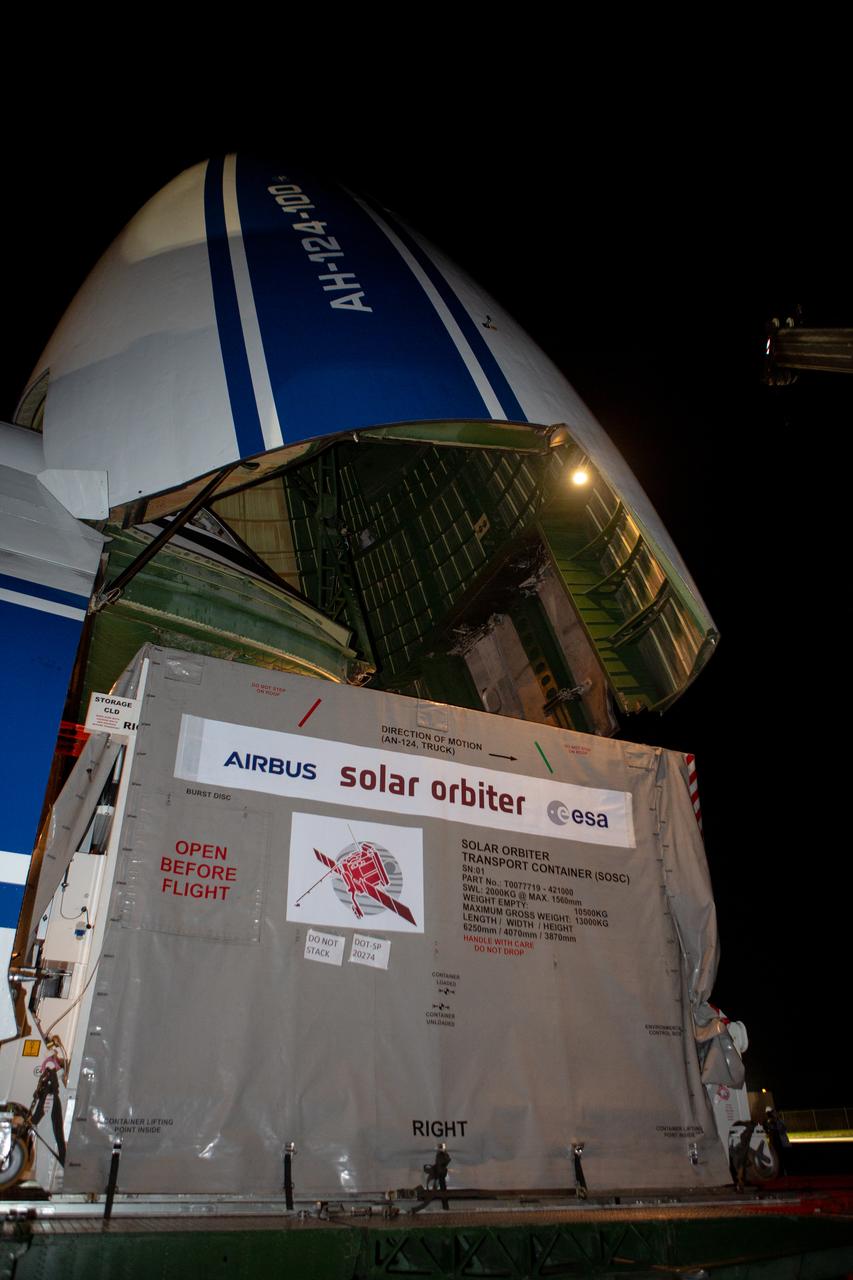
The Solar Orbiter spacecraft is placed on a truck for transportation from the Launch and Landing Facility at NASA’s Kennedy Space Center in Florida to the Astrotech Space Operations facility in nearby Titusville on Nov. 1, 2019. The spacecraft was delivered to the Florida spaceport aboard an Antonov An-124 cargo plane from Munich, Germany. Solar Orbiter is a European Space Agency mission with strong NASA participation. The mission aims to study the Sun, its outer atmosphere and solar winds. The spacecraft will provide the first images of the Sun’s poles. NASA’s Launch Services Program based at Kennedy is managing the launch. Liftoff is scheduled for Feb. 5, 2020, from Cape Canaveral Air Force Station aboard a United Launch Alliance Atlas V rocket.
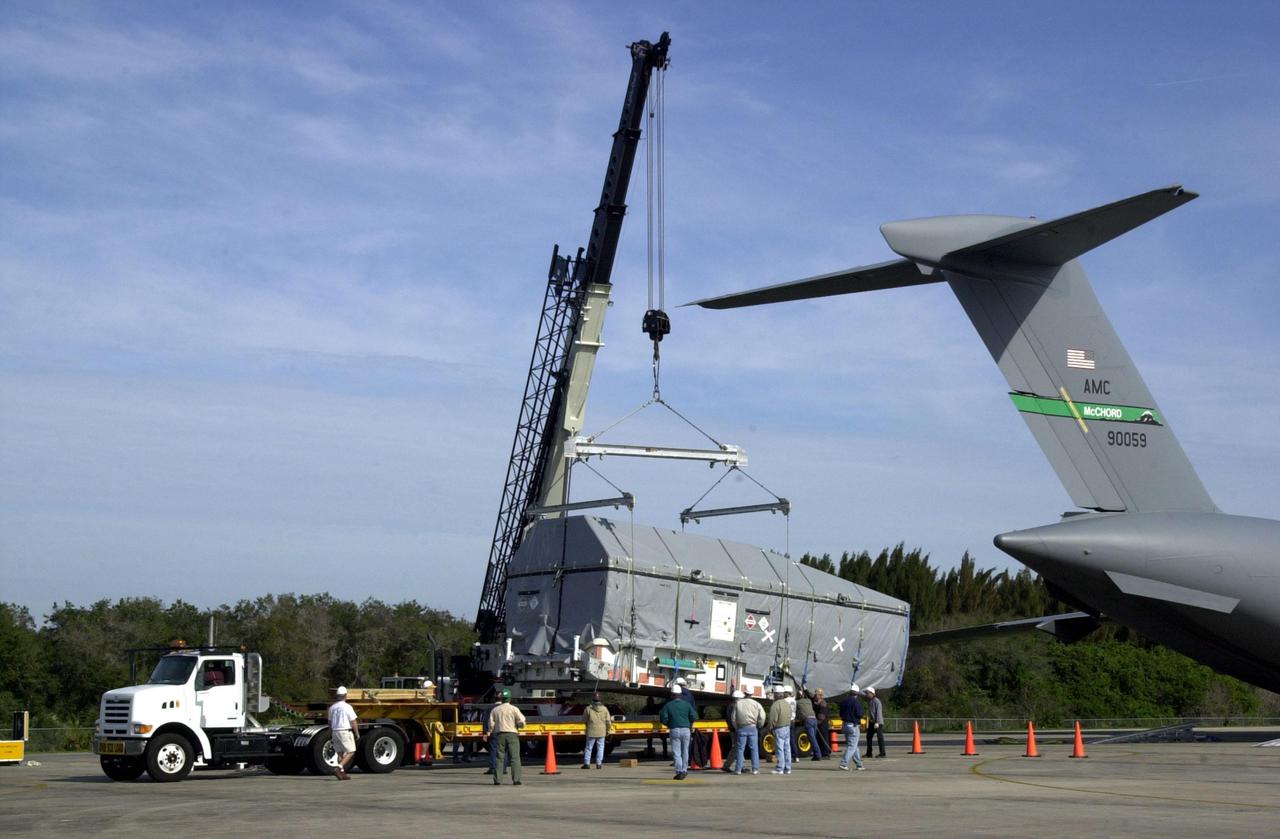
KENNEDY SPACE CENTER, FLA. -- At KSC's Shuttle Landing Facility, the Tracking and Data Relay Satellite-I (TDRS-I) is lifted onto a transporter after being offloaded from the Air Force C-17 air cargo plane at right. The second in a new series of telemetry satellites, TDRS-I replenishes the existing on-orbit fleet of six spacecraft. The TDRS System is the primary source of space-to-ground voice, data and telemetry for the Space Shuttle. It also provides communications with the International Space Station and scientific spacecraft in low-Earth orbit such as the Hubble Space Telescope. This new advanced series of satellites will extend the availability of TDRS communications services until about 2017. TDRS-I will undergo processing in the Spacecraft Assembly and Encapsulation Facility-2 (SAEF-2) to prepare it for launch March 8 aboard a Lockheed Martin Atlas IIA rocket from Pad 36-A, Cape Canaveral Air Force Station
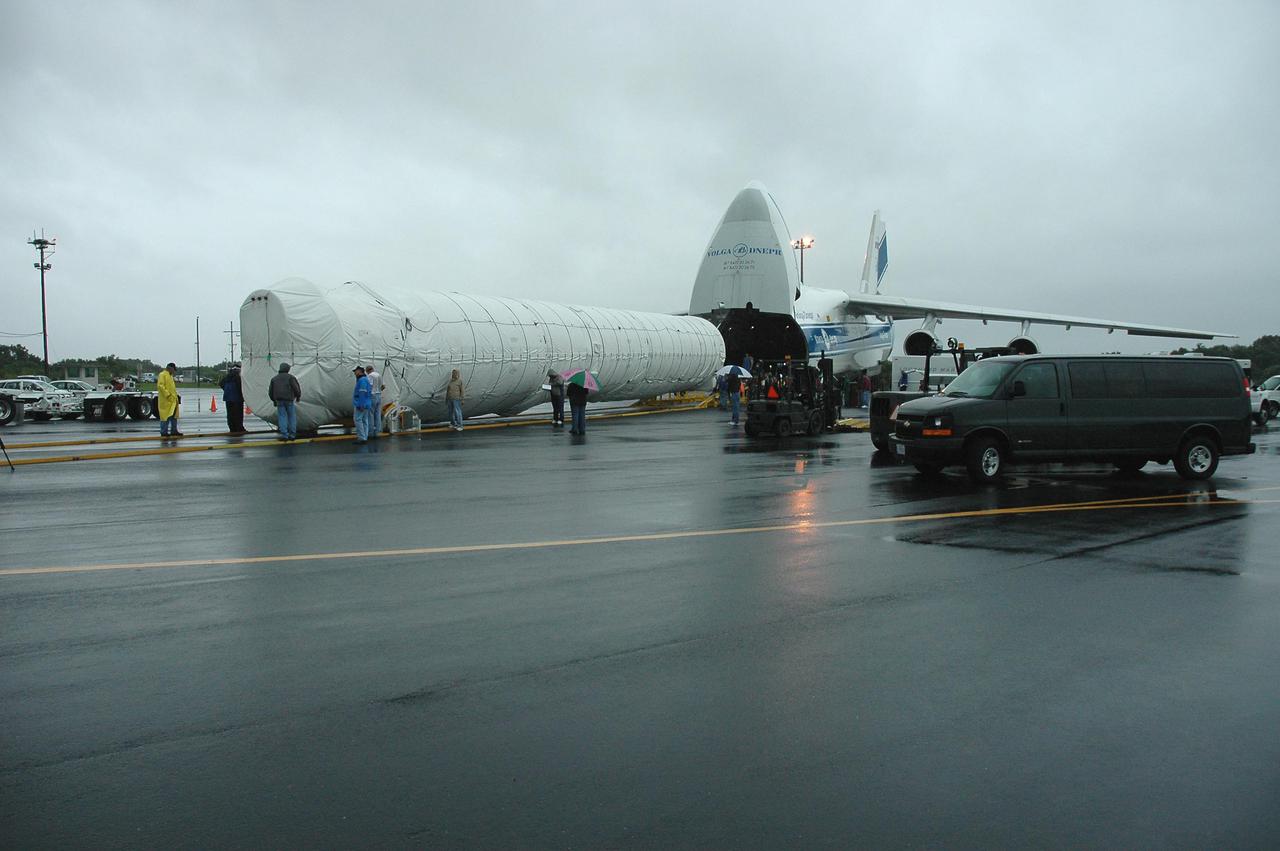
KENNEDY SPACE CENTER, FLA. — At the Cape Canaveral Air Force Station Skid Strip, the first stage of an Atlas V rocket is offloaded from an Atlas V rocket from a Russian air cargo plane. The Atlas V is the launch vehicle for the New Horizons spacecraft. New Horizons is designed to help us understand worlds at the edge of our solar system by making the first reconnaissance of Pluto and Charon - a 'double planet' and the last planet in our solar system to be visited by spacecraft. The mission will then visit one or more objects in the Kuiper Belt region beyond Neptune. New Horizons is scheduled to launch from Launch Complex 41 at CCAFS in January 2006, swing past Jupiter for a gravity boost and scientific studies in February or March 2007, and reach Pluto and its moon, Charon, in July 2015.
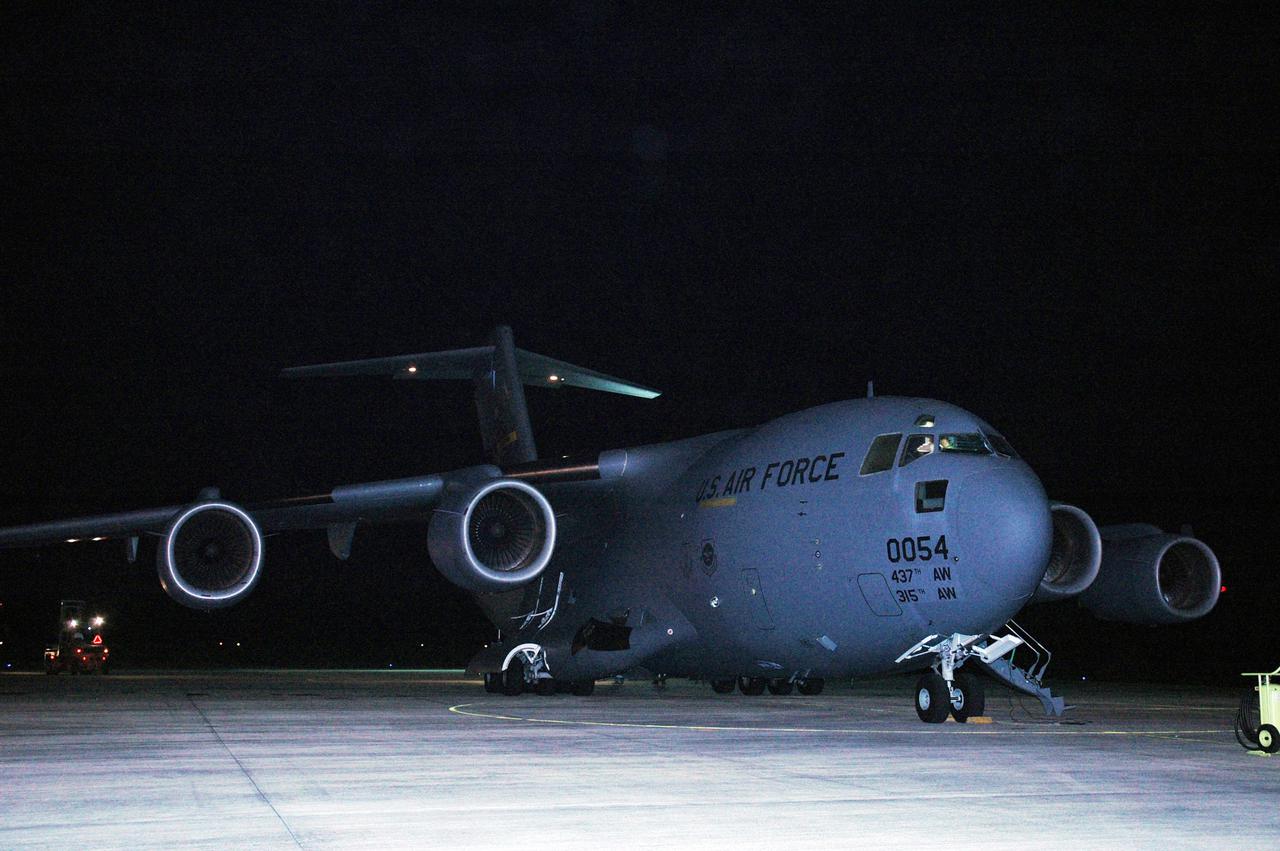
KENNEDY SPACE CENTER, FLA. - A U.S. Air Force C-17 cargo plane arrives at NASA Kennedy Space Center’s Shuttle Landing Facility. It is carrying the New Horizons spacecraft, as well as other equipment. After it is unloaded, the spacecraft will be transported to the Payload Hazardous Servicing Facility. New Horizons is designed to help us understand worlds at the edge of our solar system by making the first reconnaissance of Pluto and Charon - a 'double planet' and the last planet in our solar system to be visited by spacecraft. The mission will then visit one or more objects in the Kuiper Belt region beyond Neptune. New Horizons is scheduled to launch in January 2006, swing past Jupiter for a gravity boost and scientific studies in February or March 2007, and reach Pluto and its moon, Charon, in July 2015.
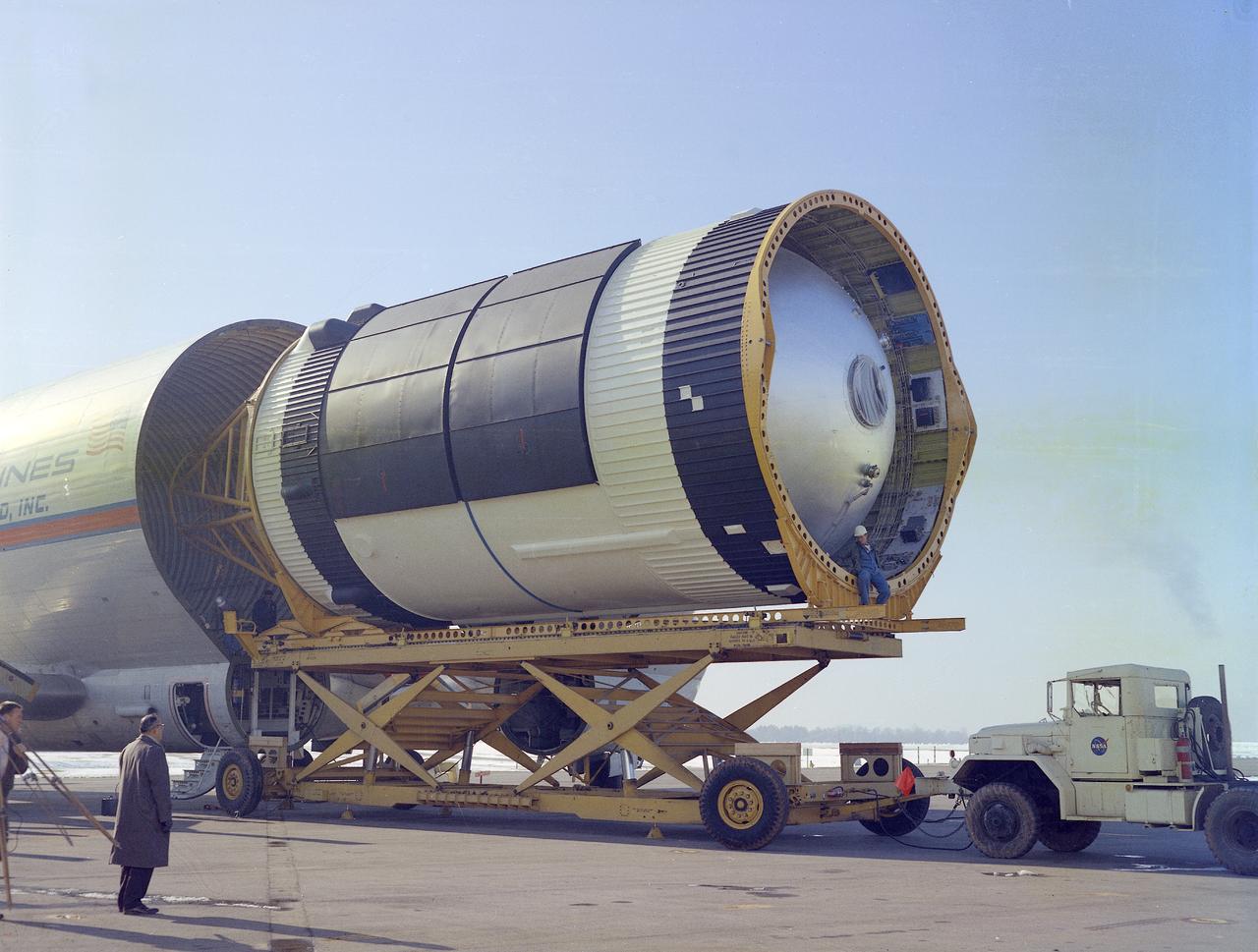
This photograph was taken at the Redstone airfield, Huntsville, Alabama, during the unloading of the Saturn V S-IVB stage that housed the Orbital Workshop (OWS) from the Super Guppy, the NASA plane that was specially built to carry oversized cargo. The OWS measured 22 feet (6.7 m) in diameter, and 48 feet (14.6 m) in length. The Saturn V S-IVB stage was modified at the McDornell Douglas facility at Huntington Beach, California, for a new role, which was to house the OWS. In addition to the test articles, engineering mockups, and flight equipment, both McDonnell Douglas and Martin Marietta built 0-G trainers, neutral buoyancy trainers, and high-fidelity mockups for the 1-G trainer to be used in the KC-135 aircraft. The Marshall Space Flight Center had program management responsibility for the development of Skylab hardware and experiments.
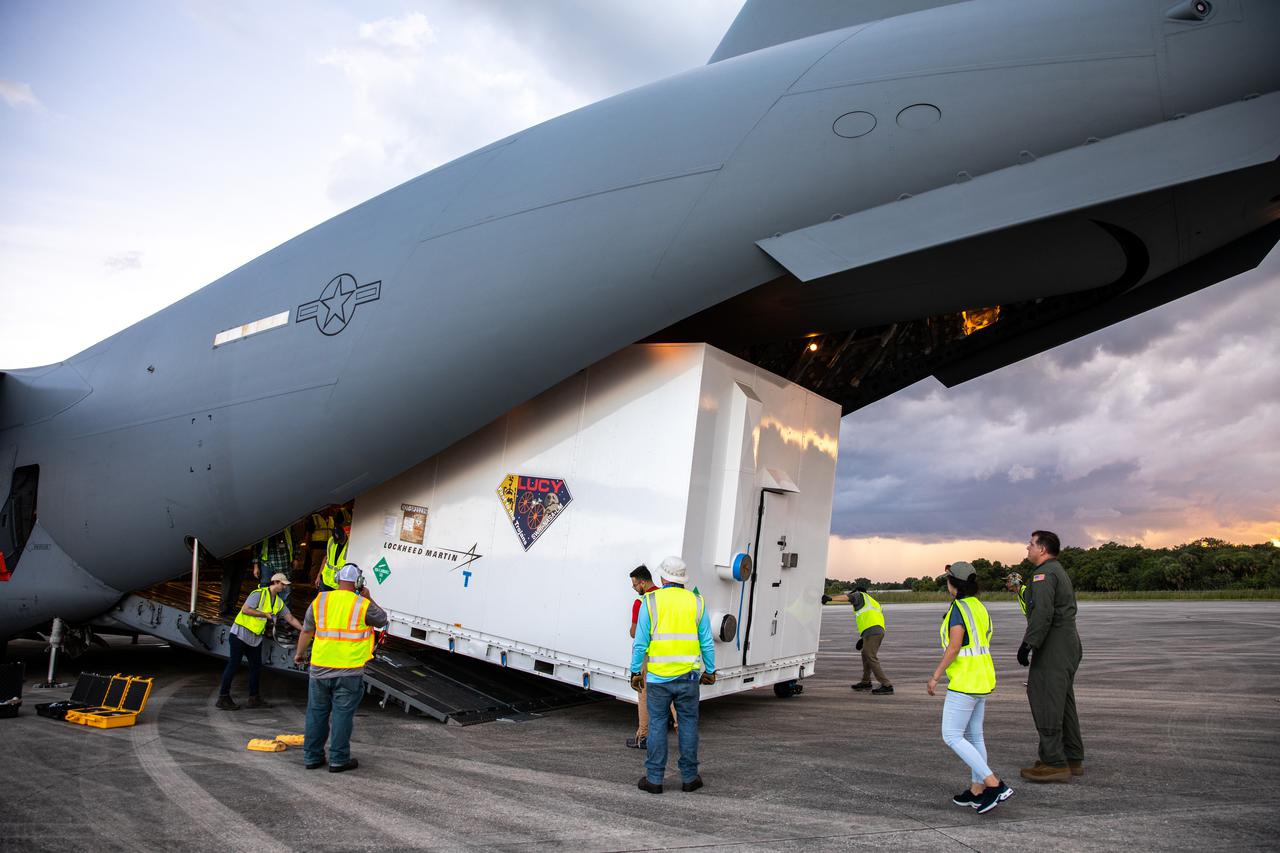
The shipping container holding NASA's Lucy spacecraft is unloaded from a United States Air Force C-17 cargo plane, stationed out of Charleston Air Force Base in South Carolina, on the runway of the Launch and Landing Facility at Kennedy Space Center in Florida on July 30, 2021. From there, the Lucy spacecraft will move to the Astrotech Space Operations payload processing facility in nearby Titusville, Florida, before its scheduled launch on a United Launch Alliance (ULA) Atlas V rocket from Cape Canaveral Space Force Station on October 16, 2021. The Lucy mission will be the first space mission to explore a diverse population of small bodies known as the Jupiter Trojan asteroids. The launch is being managed by NASA's Launch Services Program based at Kennedy, America's multi-user spaceport.
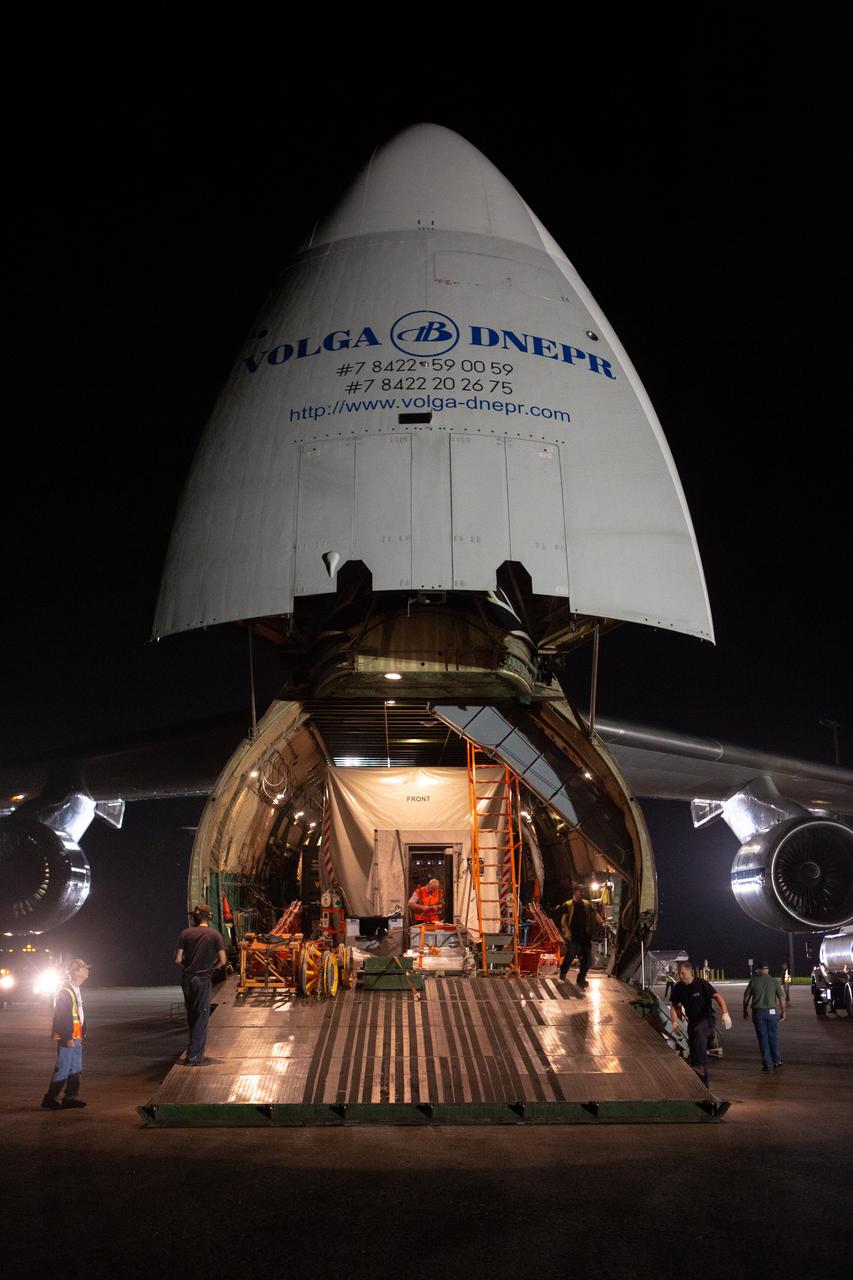
The Solar Orbiter spacecraft has arrived aboard an Antonov An-124 cargo plane at NASA Kennedy Space Center’s Launch and Landing Facility on Nov. 1, 2019. The spacecraft was delivered to the Florida spaceport from Munich, Germany, then transported to the Astrotech Space Operations facility in nearby Titusville. Solar Orbiter is a European Space Agency mission with strong NASA participation. The mission aims to study the Sun, its outer atmosphere and solar winds. The spacecraft will provide the first images of the Sun’s poles. NASA’s Launch Services Program based at Kennedy is managing the launch. Liftoff is scheduled for Feb. 5, 2020, from Cape Canaveral Air Force Station aboard a United Launch Alliance Atlas V rocket.

KENNEDY SPACE CENTER, FLA. -- NASA's "Super Guppy" aircraft maneuvers into place at the KSC Shuttle Landing Facility to offload its cargo. The gargantuan plane carries the U.S. Laboratory module, considered the centerpiece of the International Space Station. The module will undergo final pre-launch preparations at KSC's Space Station Processing Facility. Scheduled for launch aboard the Shuttle Endeavour on mission STS-98, the laboratory comprises three cylindrical sections with two end cones. Each end-cone contains a hatch opening for entering and exiting the lab. The lab will provide a shirtsleeve environment for research in such areas as life science, microgravity science, Earth science and space science. Designated Flight 5A, this mission is targeted for launch in early 2000
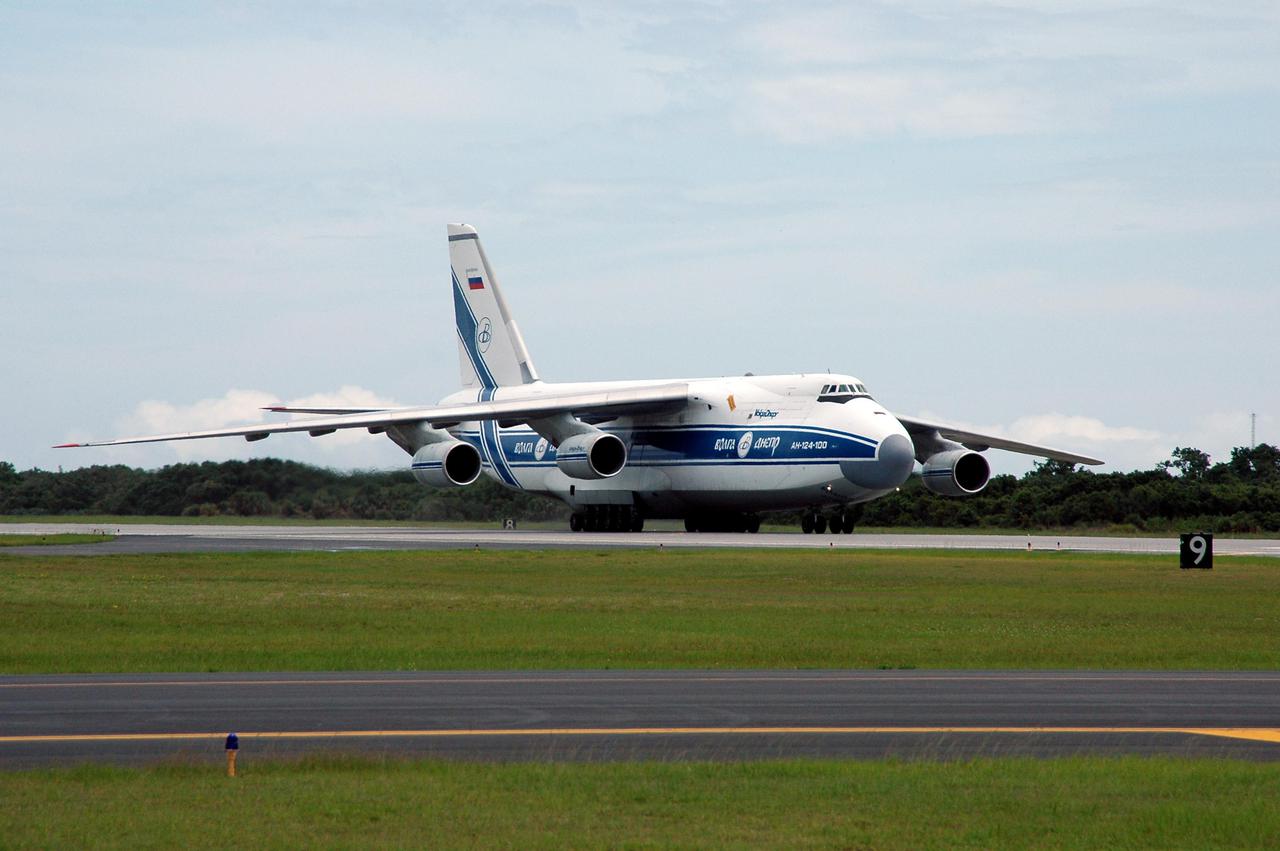
KENNEDY SPACE CENTER, FLA. - A Russian Antonov AH-124-100 cargo airplane lands at the Cape Canaveral Air Force Station Skid Strip. The plane is delivering a second stage Centaur (Block I) for the Lockheed Martin Atlas V, designated AV-007, that is the launch vehicle for the Mars Reconnaissance Orbiter (MRO). The MRO is designed for a series of global mapping, regional survey and targeted observations from a near-polar, low-altitude Mars orbit. These observations will be unprecedented in terms of the spatial resolution and coverage achieved by the orbiter’s instruments as they observe the atmosphere and surface of Mars while probing its shallow subsurface as part of a “follow the water” strategy. The orbiter is undergoing environmental tests in facilities at Lockheed Martin Space Systems in Denver, Colo., and is on schedule for a launch window that begins Aug. 10. Launch will be from Launch Complex 41 at Cape Canaveral Air Force Station in Florida.
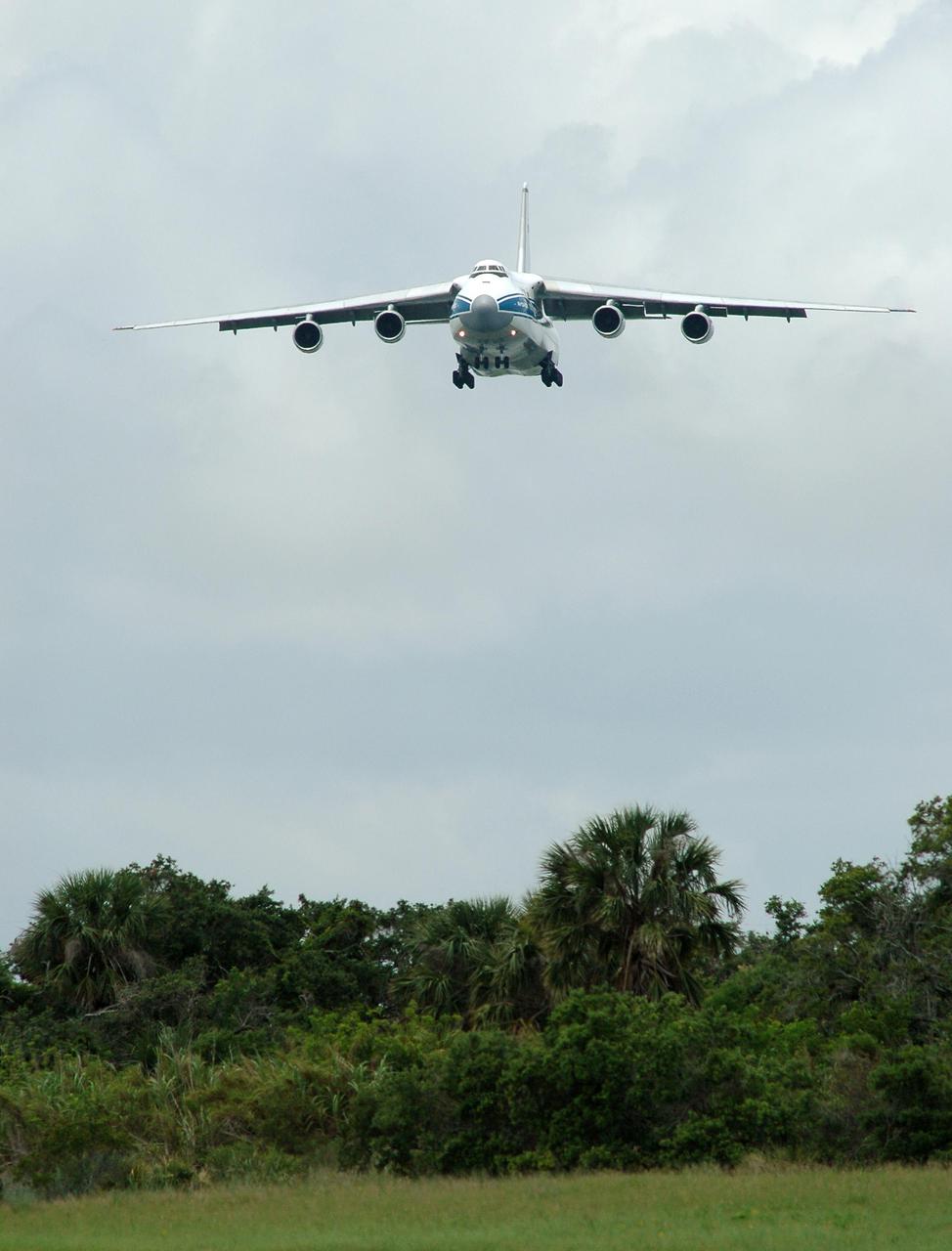
KENNEDY SPACE CENTER, FLA. - A Russian Antonov AH-124-100 cargo airplane heads for a landing at the Cape Canaveral Air Force Station Skid Strip. The plane is delivering a second stage Centaur (Block I) for the Lockheed Martin Atlas V, designated AV-007, that is the launch vehicle for the Mars Reconnaissance Orbiter (MRO). The MRO is designed for a series of global mapping, regional survey and targeted observations from a near-polar, low-altitude Mars orbit. These observations will be unprecedented in terms of the spatial resolution and coverage achieved by the orbiter’s instruments as they observe the atmosphere and surface of Mars while probing its shallow subsurface as part of a “follow the water” strategy. The orbiter is undergoing environmental tests in facilities at Lockheed Martin Space Systems in Denver, Colo., and is on schedule for a launch window that begins Aug. 10. Launch will be from Launch Complex 41 at Cape Canaveral Air Force Station in Florida.
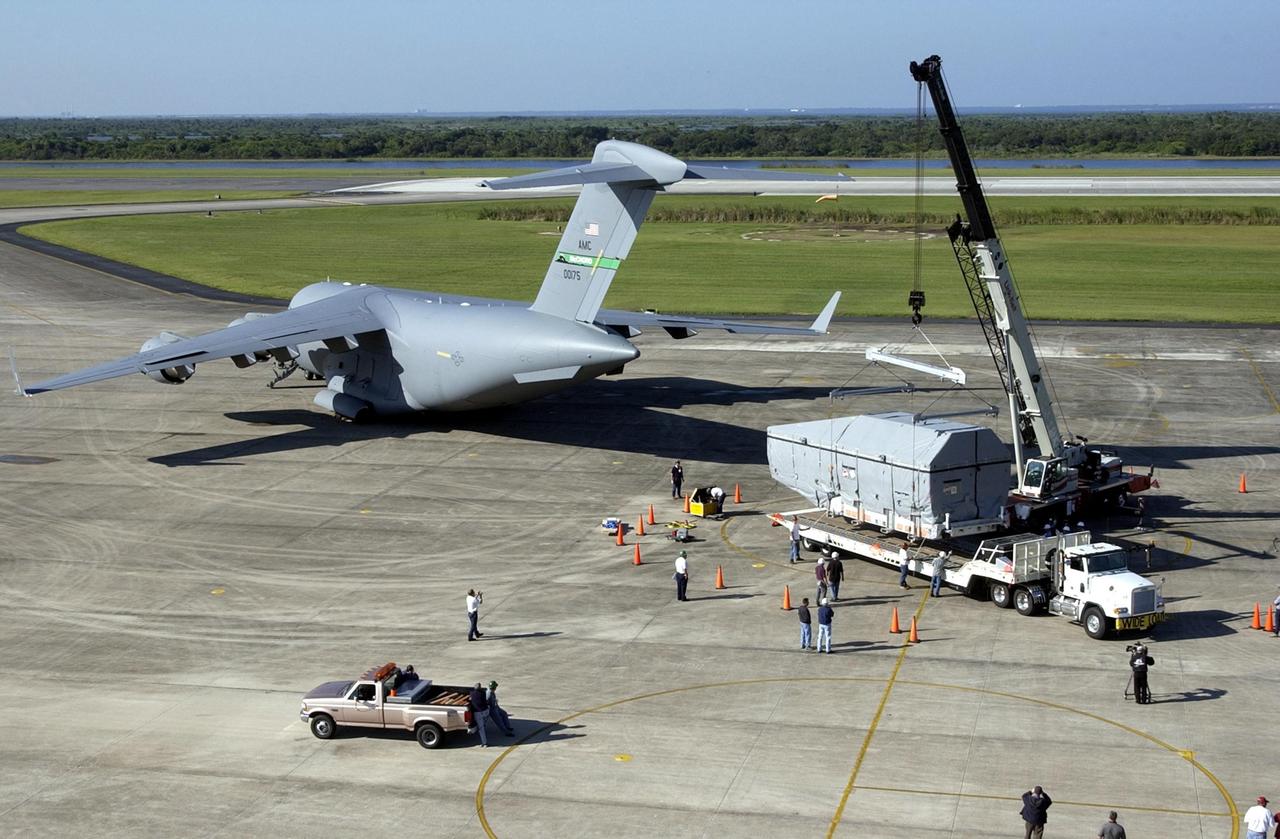
KENNEDY SPACE CENTER, FLA. - At the KSC Shuttle Landing Facility, an overhead crane lifts the container with the TDRS-J spacecraft onto a transport vehicle. In the background is the Air Force C-17 air cargo plane that delivered it. TDRS-J is the third in the current series of three Tracking and Data Relay Satellites designed to replenish the existing on-orbit fleet of six spacecraft, the first of which was launched in 1983. The Tracking and Data Relay Satellite System is the primary source of space-to-ground voice, data and telemetry for the Space Shuttle. It also provides communications with the International Space Station and scientific spacecraft in low-earth orbit such as the Hubble Space Telescope, and launch support for some expendable vehicles. This new advanced series of satellites will extend the availability of TDRS communications services until approximately 2017.
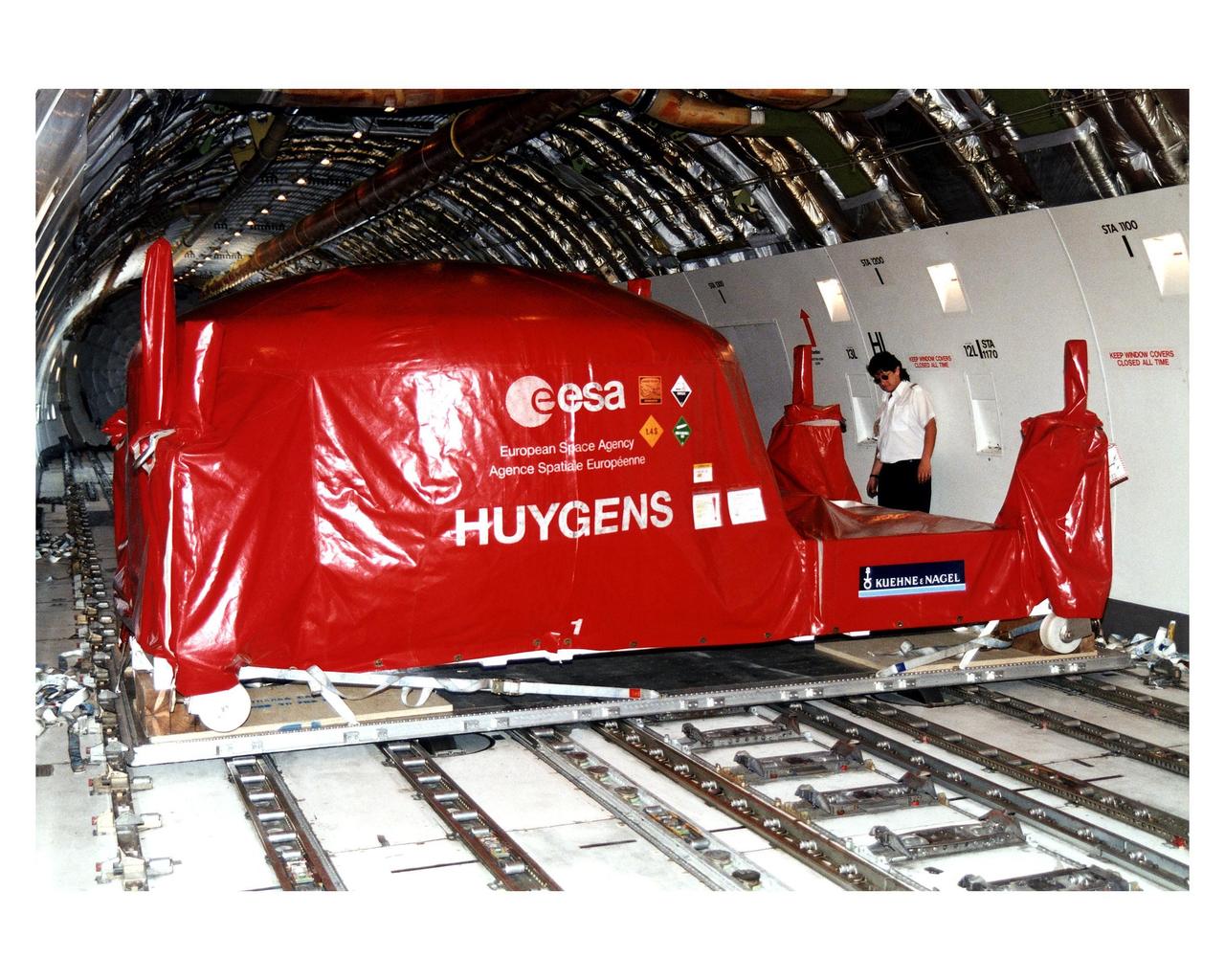
The Huygens probe, which will study the clouds, atmosphere and surface of Saturn's moon, Titan, as part of the Cassini mission to Saturn, arrives in a cargo plane at the Skid Strip, Cape Canaveral Air Station (CCAS). The probe was designed and developed for the European Space Agency (ESA) by a European industrial consortium led by Aerospatiale as prime contractor. Over the past year, it was integrated and tested at the facilities of Daimler Benz Aerospace Dornier Satellitensysteme in Germany. The probe will be mated to the Cassini orbiter, which was designed and assembled at NASA's Jet Propulsion Laboratory in California. The Cassini launch is targeted for October 6 from CCAS aboard a Titan IVB/Centaur expendable launch vehicle. After arrival at Saturn in 2004, the probe will be released from the Cassini orbiter to enter the Titan atmosphere
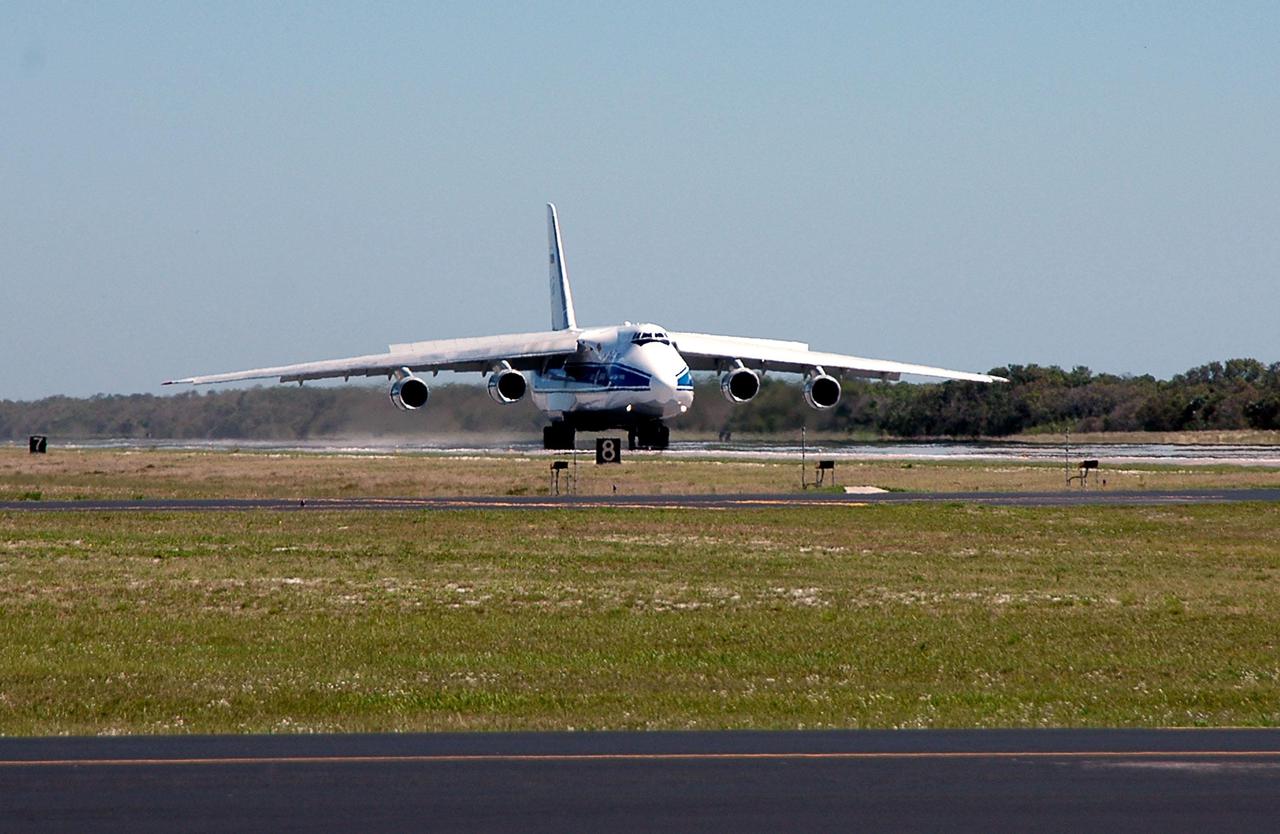
KENNEDY SPACE CENTER, FLA. - A Russian Antonov AH-124-100 cargo airplane lands at the Cape Canaveral Air Force Station Skid Strip. The plane is delivering a second stage Centaur for the Lockheed Martin Atlas V, designated AV-007, that is the launch vehicle for the Mars Reconnaissance Orbiter (MRO). The MRO is designed for a series of global mapping, regional survey and targeted observations from a near-polar, low-altitude Mars orbit. These observations will be unprecedented in terms of the spatial resolution and coverage achieved by the orbiter’s instruments as they observe the atmosphere and surface of Mars while probing its shallow subsurface as part of a “follow the water” strategy. The orbiter is undergoing environmental tests in facilities at Lockheed Martin Space Systems in Denver, Colo., and is on schedule for a launch window that begins Aug. 10. Launch will be from Launch Pad 41 at Cape Canaveral Air Force Station in Florida.
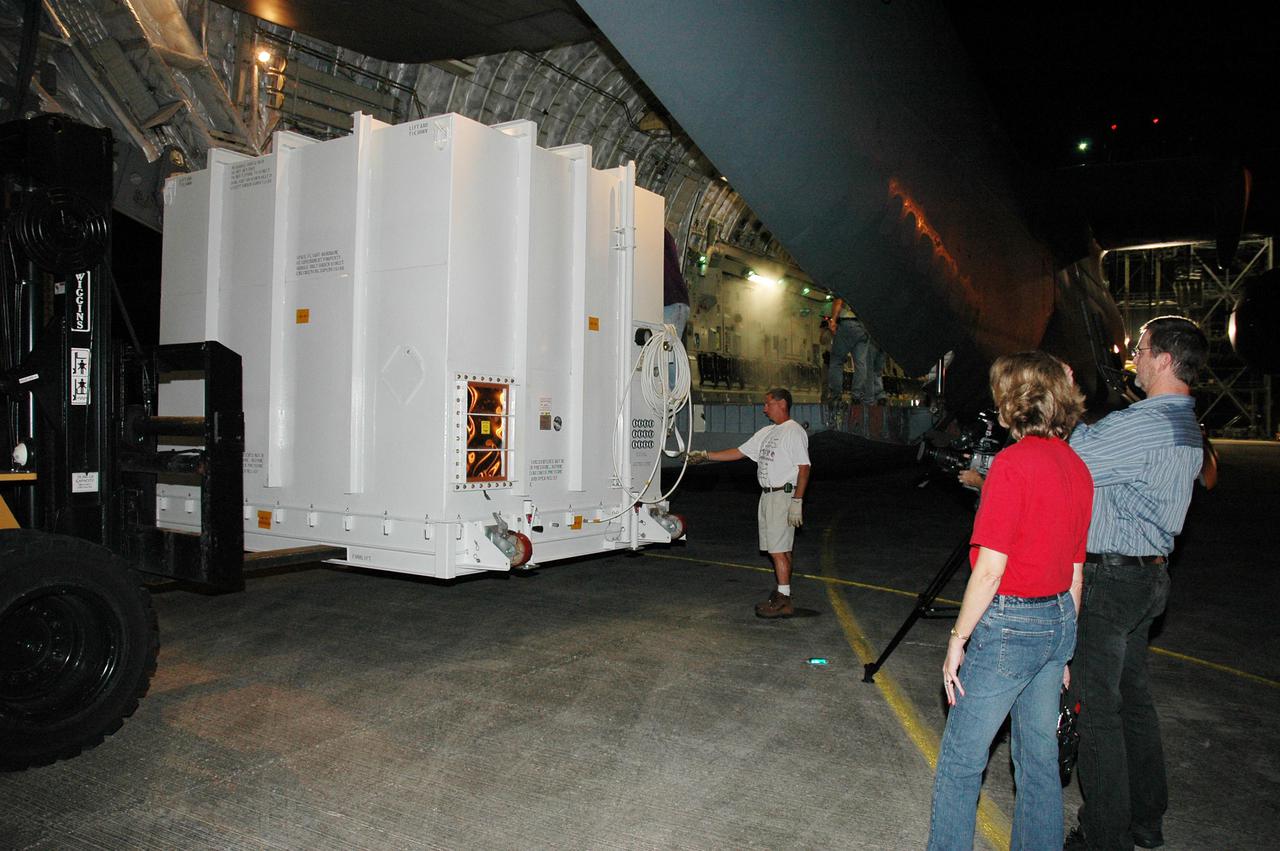
KENNEDY SPACE CENTER, FLA. - At NASA Kennedy Space Center’s Shuttle Landing Facility, the shipping container with the New Horizons spacecraft inside is moved away from the U.S. Air Force C-17 cargo plane. The spacecraft will be placed on a transporter and moved to the Payload Hazardous Servicing Facility. New Horizons is designed to help us understand worlds at the edge of our solar system by making the first reconnaissance of Pluto and Charon - a 'double planet' and the last planet in our solar system to be visited by spacecraft. The mission will then visit one or more objects in the Kuiper Belt region beyond Neptune. New Horizons is scheduled to launch in January 2006, swing past Jupiter for a gravity boost and scientific studies in February or March 2007, and reach Pluto and its moon, Charon, in July 2015.
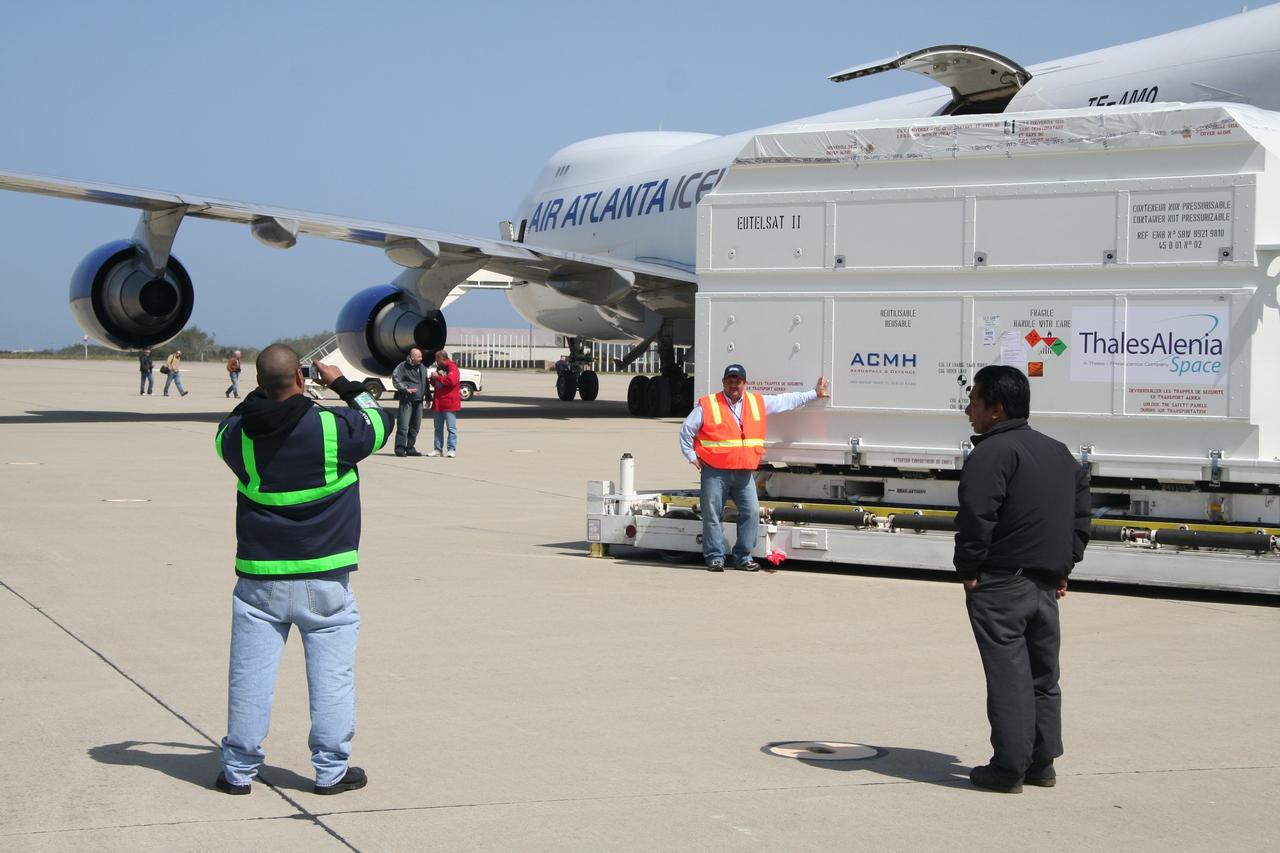
VANDENBERG AIR FORCE BASE, Calif. – A photographer (left) captures the moment after the shipping container holding the OSTM/Jason-2 satellite has been offloaded from the cargo plane at Vandenberg Air Force Base. The satellite will be taken to the Astrotech processing facility. The OSTM, or Ocean Topography Mission, on the Jason-2 satellite is a follow-on to Jason-1. It will take oceanographic studies of sea surface height into an operational mode for continued climate forecasting research and science and industrial applications. This satellite altimetry data will help determine ocean circulation, climate change and sea-level rise. OSTM is a joint effort by the National Oceanic and Atmospheric Administration, NASA, France’s Centre National d’Etudes Spatiales and the European Meteorological Satellite Organisation. OSTM/Jason-2 will be launched aboard a United Launch Alliance Delta II 7320 from Vandenberg on June 15. Photo credit: NASA/Steve Greenberg, JPL
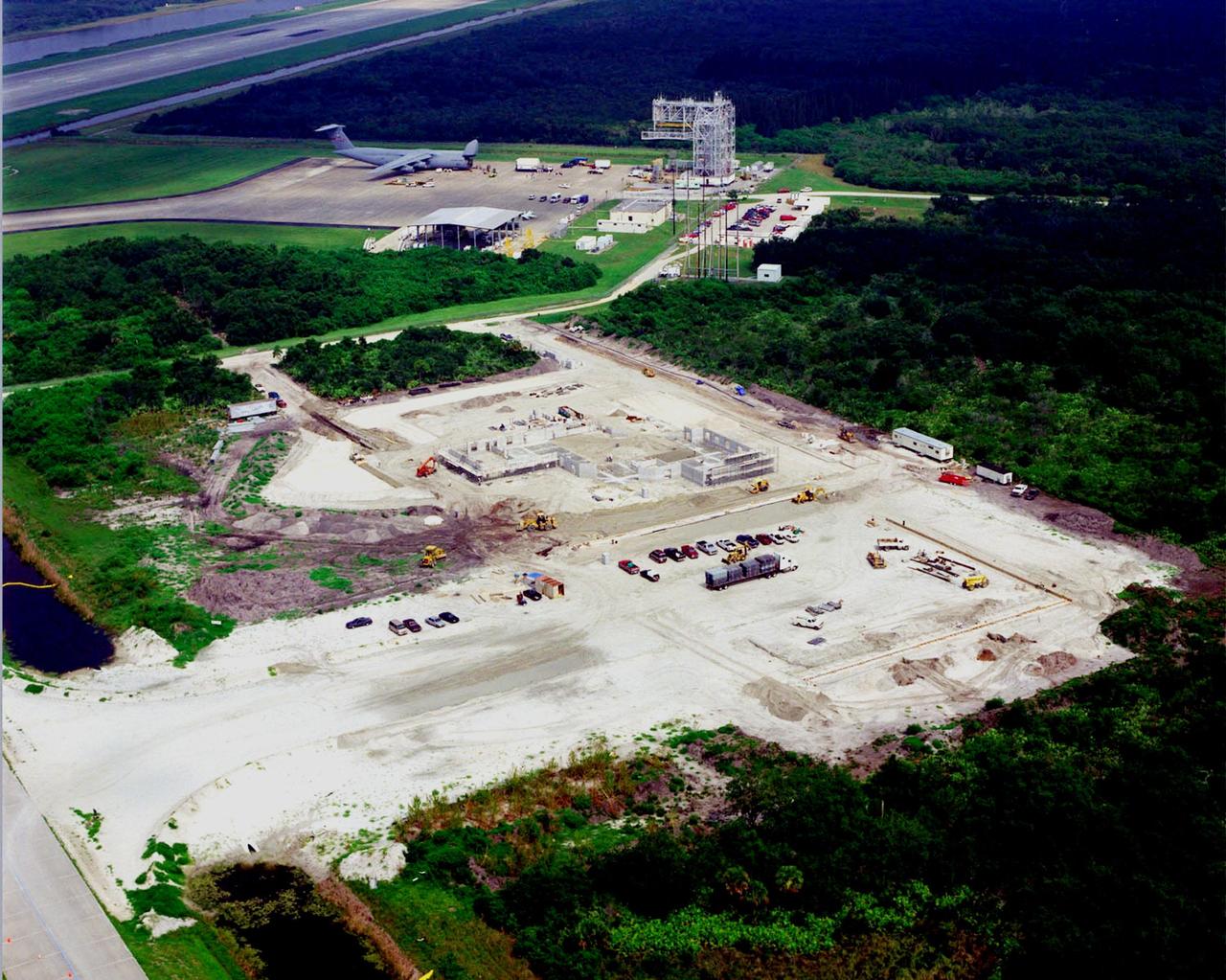
This aerial view shows the construction of a multi-purpose hangar, which is part of the $8 million Reusable Launch Vehicle (RLV) Support Complex at Kennedy Space Center. In the background is the Shuttle Landing Facility, with (left) a C-5 air cargo plane, the offloaded canister in front of it containing the Multi-Purpose Logistics Module Raffaello, and (right) the mate/demate tower that is used when an orbiter is transported to and from KSC atop a modified Boeing 747. The RLV complex will also include facilities for related ground support equipment and administrative/ technical support. It will be available to accommodate the Space Shuttle; the X-34 RLV technology demonstrator; the L-1011 carrier aircraft for Pegasus and X-34; and other RLV and X-vehicle programs. The complex is jointly funded by the Spaceport Florida Authority, NASA's Space Shuttle Program and KSC. The facility will be operational in early 2000.
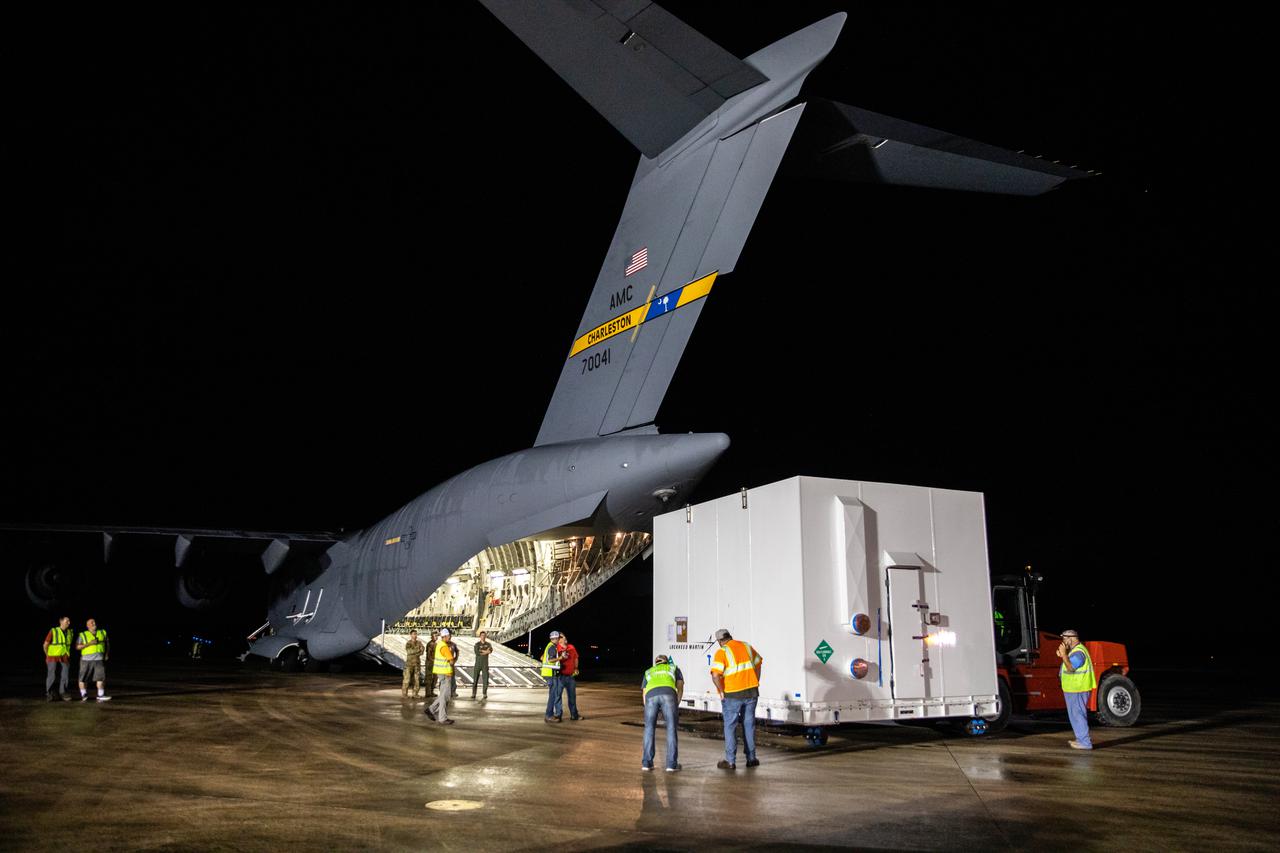
The shipping container holding NASA's Lucy spacecraft is unloaded from a United States Air Force C-17 cargo plane, stationed out of Charleston Air Force Base in South Carolina, on the runway of the Launch and Landing Facility at Kennedy Space Center in Florida on July 30, 2021. From there, the Lucy spacecraft will move to the Astrotech Space Operations payload processing facility in nearby Titusville, Florida, before its scheduled launch on a United Launch Alliance (ULA) Atlas V rocket from Cape Canaveral Space Force Station on October 16, 2021. The Lucy mission will be the first space mission to explore a diverse population of small bodies known as the Jupiter Trojan asteroids. The launch is being managed by NASA's Launch Services Program based at Kennedy, America's multi-user spaceport.
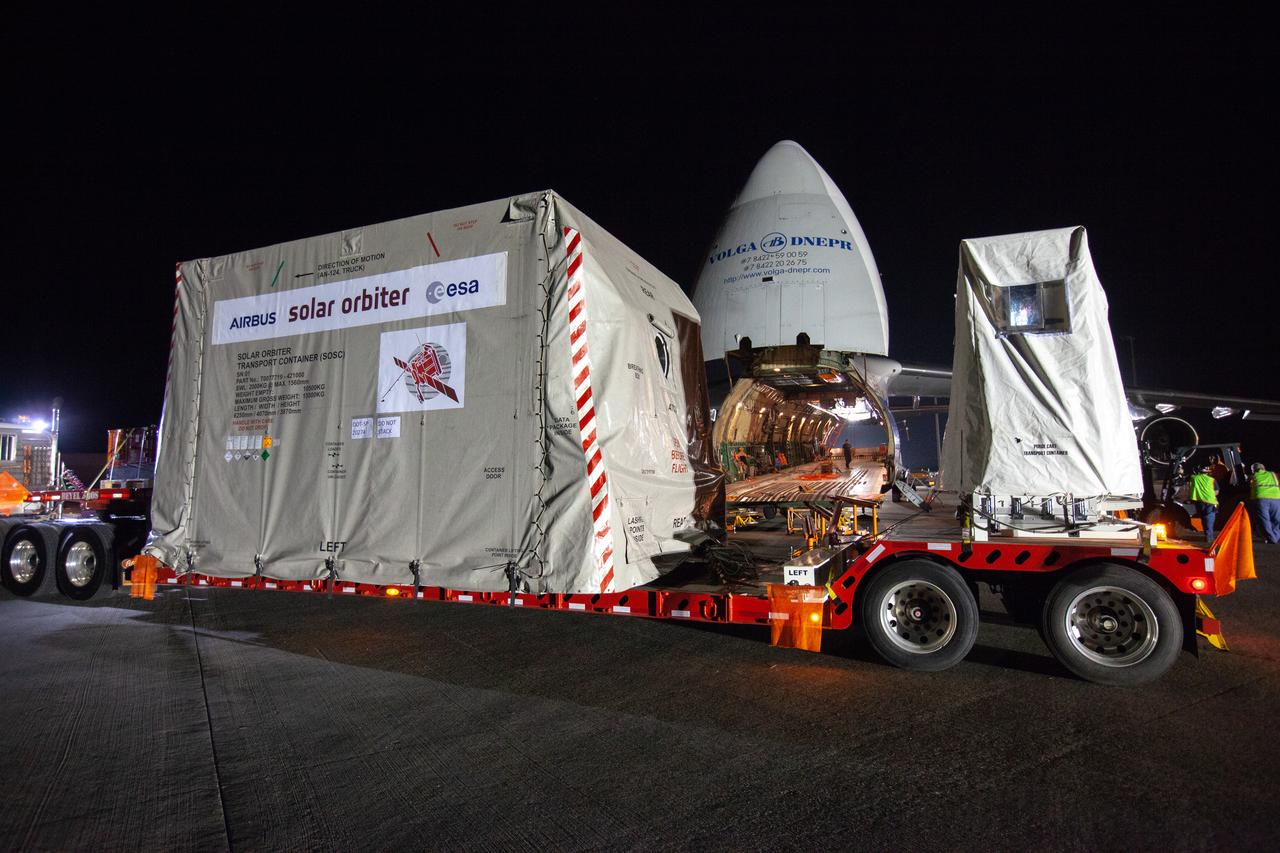
The Solar Orbiter spacecraft is placed on a truck for transportation from the Launch and Landing Facility at NASA’s Kennedy Space Center in Florida to the Astrotech Space Operations facility in nearby Titusville on Nov. 1, 2019. The spacecraft was delivered to the Florida spaceport aboard an Antonov An-124 cargo plane from Munich, Germany. Solar Orbiter is a European Space Agency mission with strong NASA participation. The mission aims to study the Sun, its outer atmosphere and solar winds. The spacecraft will provide the first images of the Sun’s poles. NASA’s Launch Services Program based at Kennedy is managing the launch. Liftoff is scheduled for Feb. 5, 2020, from Cape Canaveral Air Force Station aboard a United Launch Alliance Atlas V rocket.
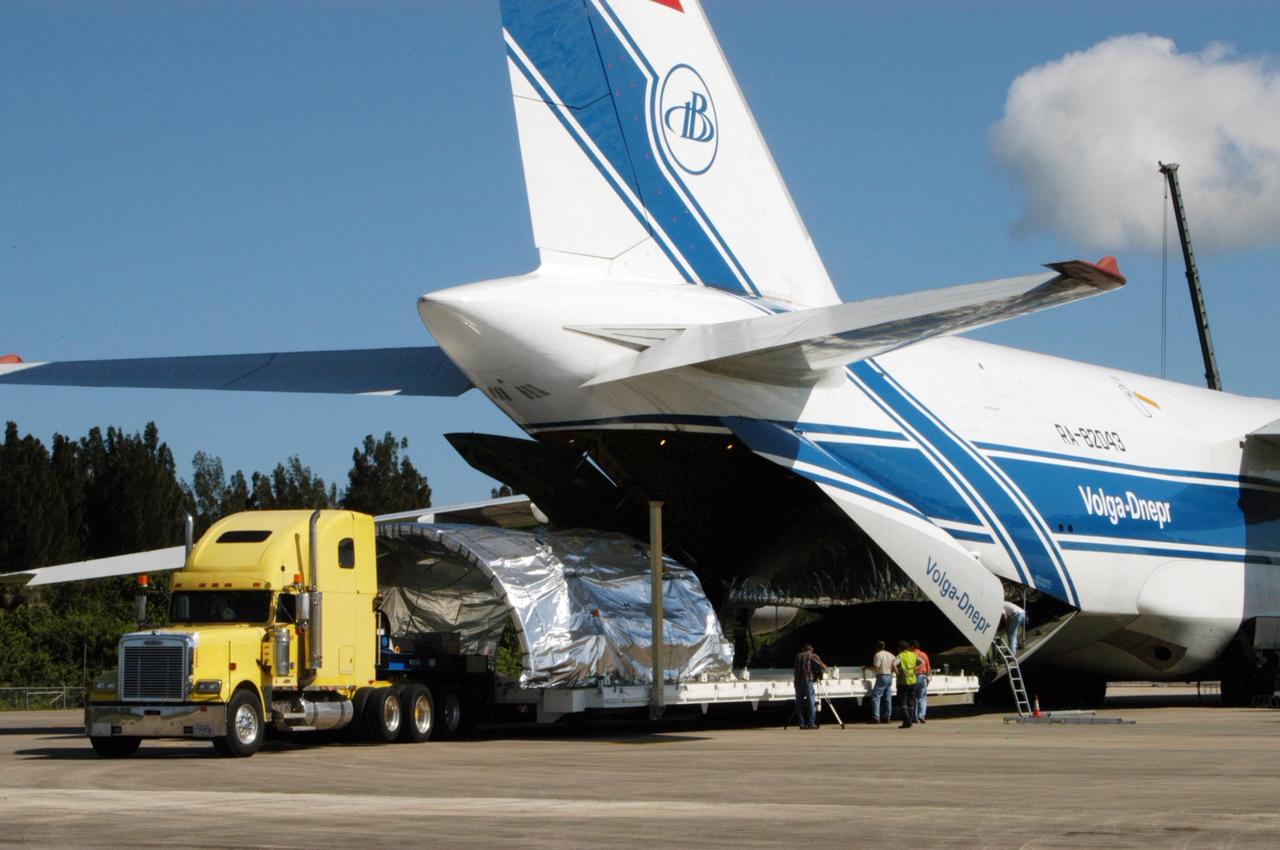
KENNEDY SPACE CENTER, FLA. - On the Shuttle Landing Facility at NASA Kennedy Space Center, one of the Atlas V fairing halves for the New Horizons spacecraft is offloaded from the Russian cargo plane. The fairing halves will be transported to Astrotech Space Operations in Titusville. The fairing later will be placed around the New Horizons spacecraft in the Payload Hazardous Service Facility. A fairing protects a spacecraft during launch and flight through the atmosphere. Once in space, it is jettisoned. The Lockheed Martin Atlas V is the launch vehicle for the New Horizons spacecraft, which is designed to make the first reconnaissance of Pluto and Charon - a "double planet" and the last planet in our solar system to be visited by spacecraft. The mission will then visit one or more objects in the Kuiper Belt region beyond Neptune. New Horizons is scheduled to launch in January 2006, swing past Jupiter for a gravity boost and scientific studies in February or March 2007, and reach Pluto and its moon, Charon, in July 2015.
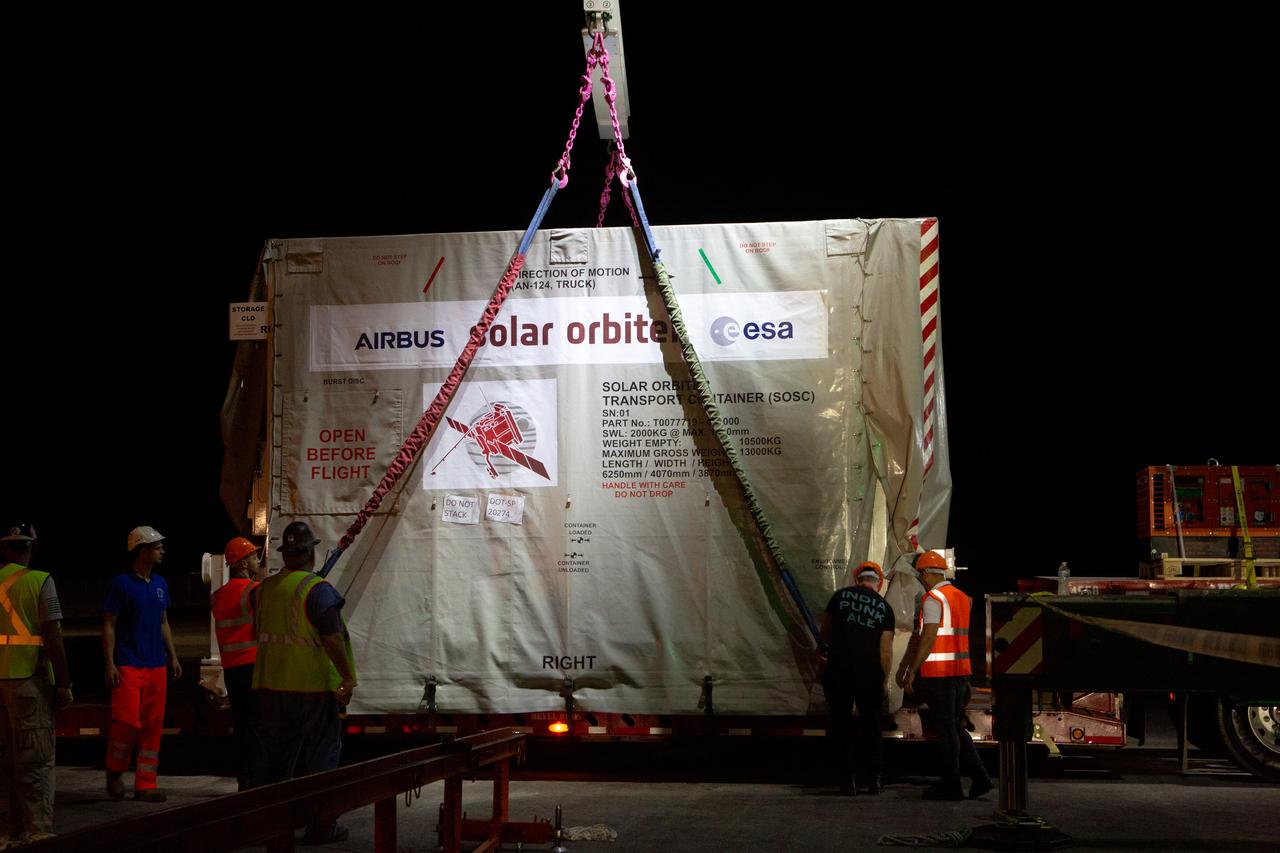
A crane carefully places the Solar Orbiter spacecraft on a truck for transportation from the Launch and Landing Facility at NASA’s Kennedy Space Center in Florida to the Astrotech Space Operations facility in nearby Titusville on Nov. 1, 2019. The spacecraft was delivered to the Florida spaceport aboard an Antonov An-124 cargo plane from Munich, Germany. Solar Orbiter is a European Space Agency mission with strong NASA participation. The mission aims to study the Sun, its outer atmosphere and solar winds. The spacecraft will provide the first images of the Sun’s poles. NASA’s Launch Services Program based at Kennedy is managing the launch. Liftoff is scheduled for Feb. 5, 2020, from Cape Canaveral Air Force Station aboard a United Launch Alliance Atlas V rocket.

KENNEDY SPACE CENTER, FLA. — At the Cape Canaveral Air Force Station Skid Strip, workers begin to offload the first stage of an Atlas V rocket from a Russian air cargo plane. The Atlas V is the launch vehicle for the New Horizons spacecraft. New Horizons is designed to help us understand worlds at the edge of our solar system by making the first reconnaissance of Pluto and Charon - a 'double planet' and the last planet in our solar system to be visited by spacecraft. The mission will then visit one or more objects in the Kuiper Belt region beyond Neptune. New Horizons is scheduled to launch from Launch Complex 41 at CCAFS in January 2006, swing past Jupiter for a gravity boost and scientific studies in February or March 2007, and reach Pluto and its moon, Charon, in July 2015.
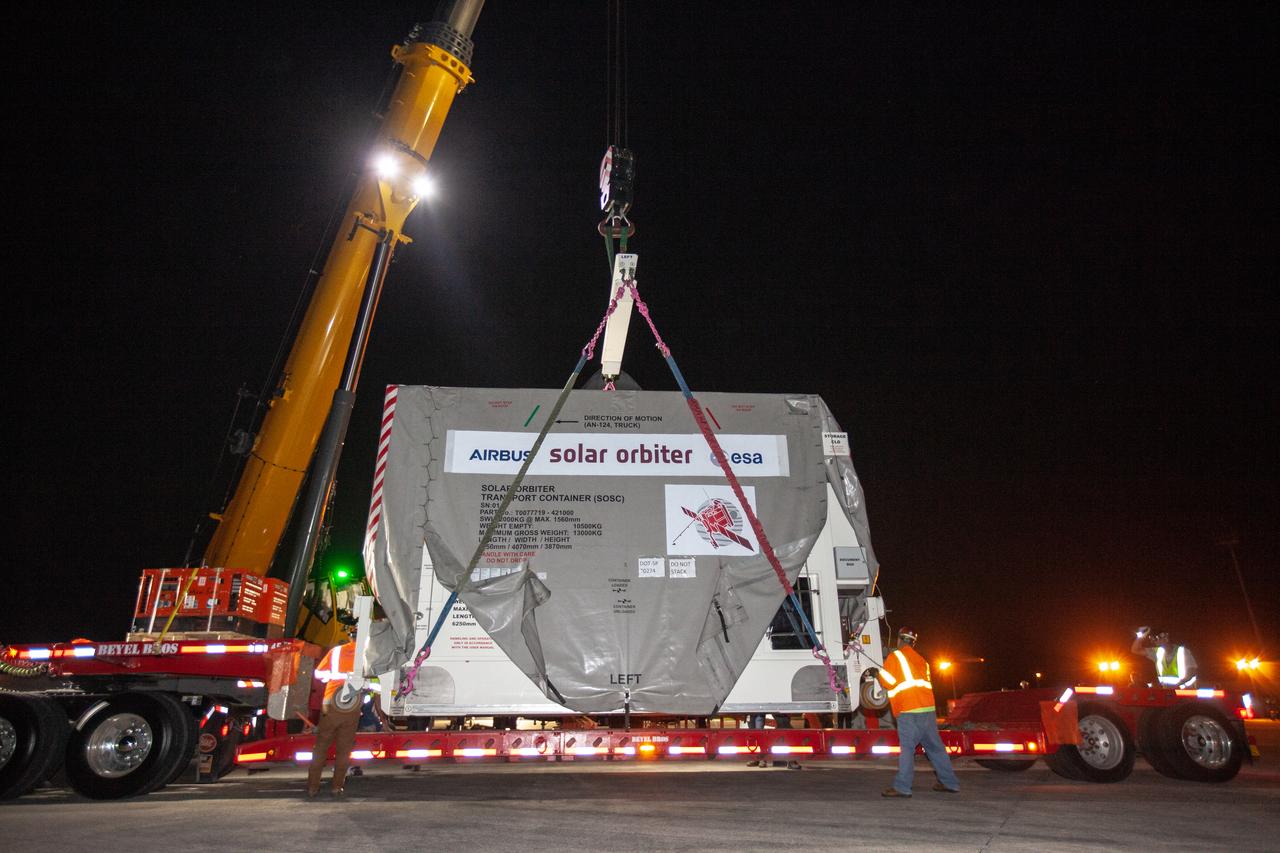
A crane carefully places the Solar Orbiter spacecraft on a truck for transportation from the Launch and Landing Facility at NASA’s Kennedy Space Center in Florida to the Astrotech Space Operations facility in nearby Titusville on Nov. 1, 2019. The spacecraft was delivered to the Florida spaceport aboard an Antonov An-124 cargo plane from Munich, Germany. Solar Orbiter is a European Space Agency mission with strong NASA participation. The mission aims to study the Sun, its outer atmosphere and solar winds. The spacecraft will provide the first images of the Sun’s poles. NASA’s Launch Services Program based at Kennedy is managing the launch. Liftoff is scheduled for Feb. 5, 2020, from Cape Canaveral Air Force Station aboard a United Launch Alliance Atlas V rocket.
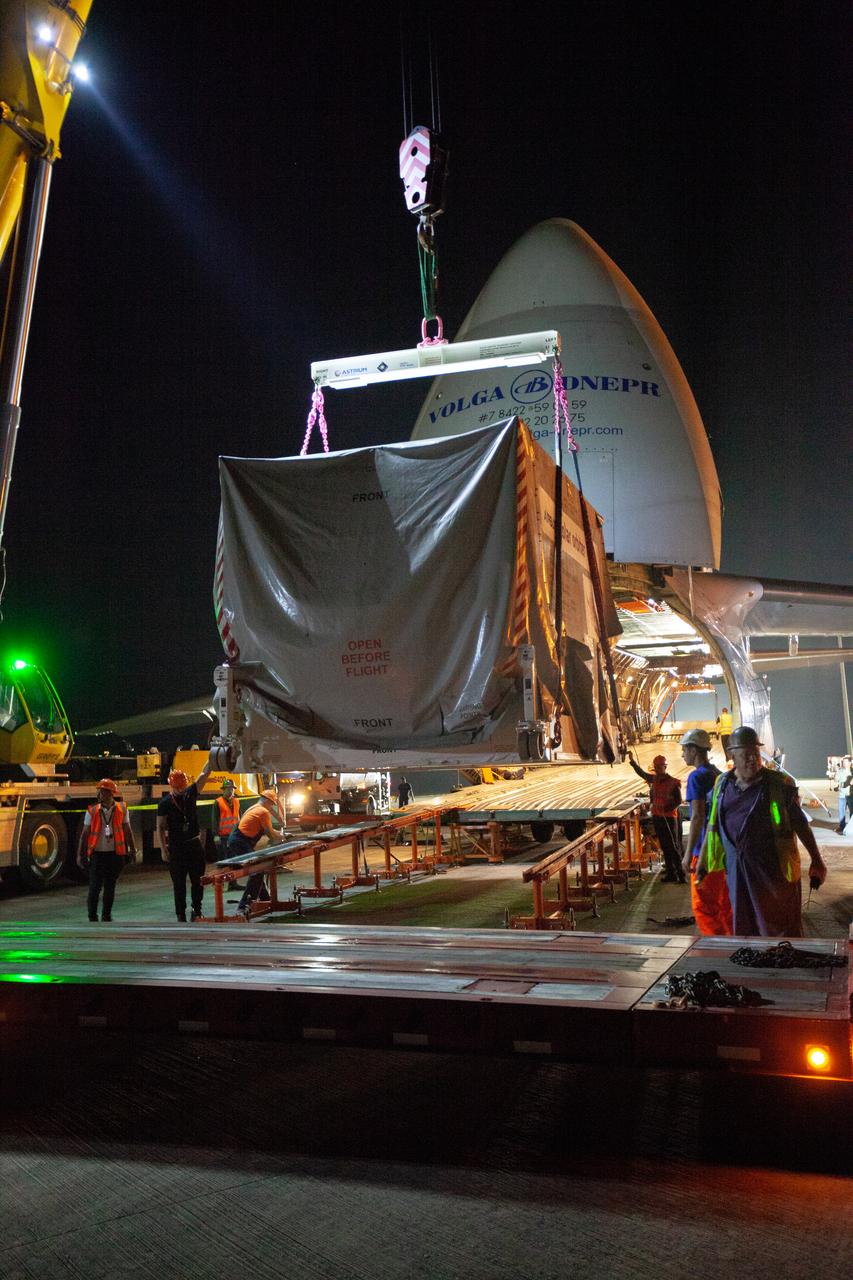
A crane carefully places the Solar Orbiter spacecraft on a truck for transportation from the Launch and Landing Facility at NASA’s Kennedy Space Center in Florida to the Astrotech Space Operations facility in nearby Titusville on Nov. 1, 2019. The spacecraft was delivered to the Florida spaceport aboard an Antonov An-124 cargo plane from Munich, Germany. Solar Orbiter is a European Space Agency mission with strong NASA participation. The mission aims to study the Sun, its outer atmosphere and solar winds. The spacecraft will provide the first images of the Sun’s poles. NASA’s Launch Services Program based at Kennedy is managing the launch. Liftoff is scheduled for Feb. 5, 2020, from Cape Canaveral Air Force Station aboard a United Launch Alliance Atlas V rocket.
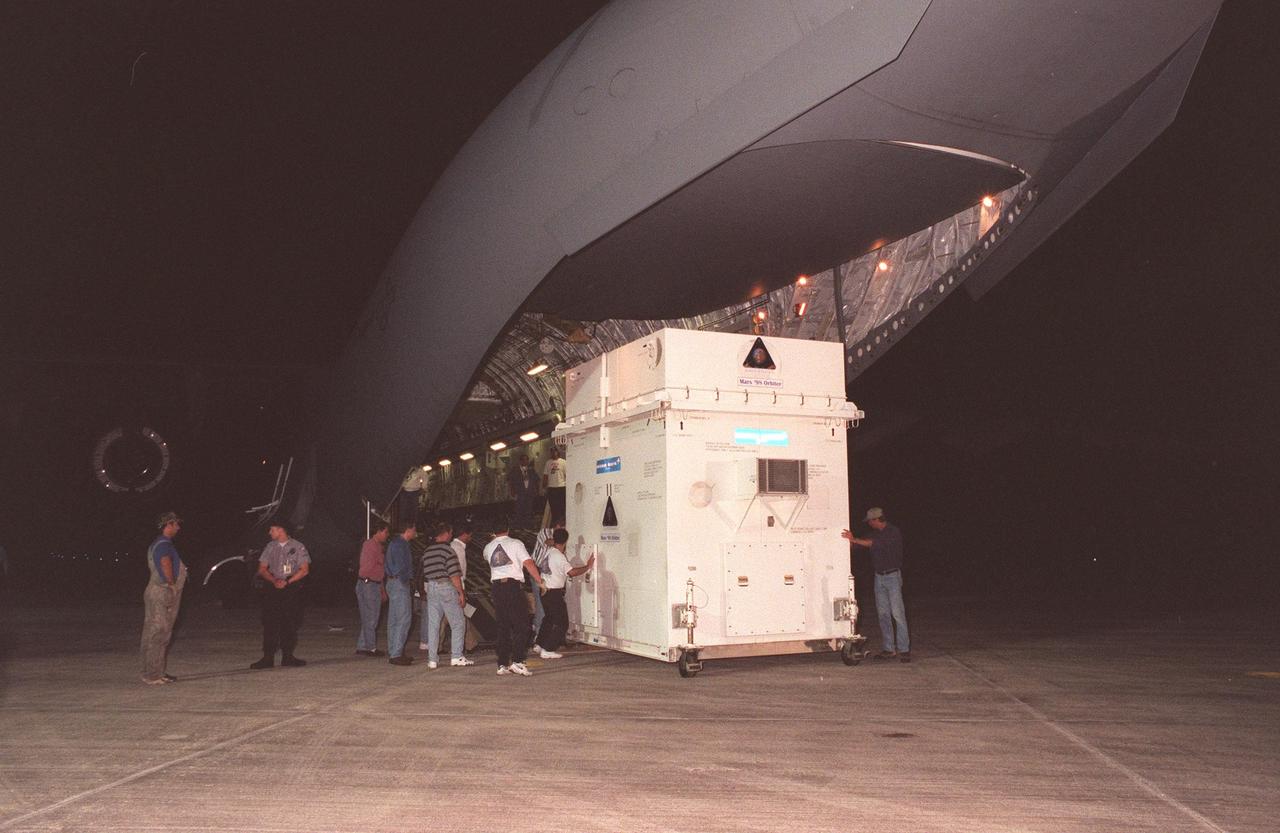
The Mars Climate Orbiter spacecraft arrives at KSC's Shuttle Landing Facility aboard an Air Force C-17 cargo plane early this morning following its flight from the Lockheed Martin Astronautics plant in Denver, Colo. When the spacecraft arrives at the red planet, it will primarily support its companion Mars Polar Lander spacecraft, planned for launch on Jan. 3, 1999. After that, the Mars Climate Orbiter's instruments will monitor the Martian atmosphere and image the planet's surface on a daily basis for one Martian year (1.8 Earth years). It will observe the appearance and movement of atmospheric dust and water vapor, as well as characterize seasonal changes on the surface. The detailed images of the surface features will provide important clues to the planet's early climate history and give scientists more information about possible liquid water reserves beneath the surface. The scheduled launch date for the Mars Climate Orbiter is Dec. 10, 1998, on a Delta II 7425 rocket
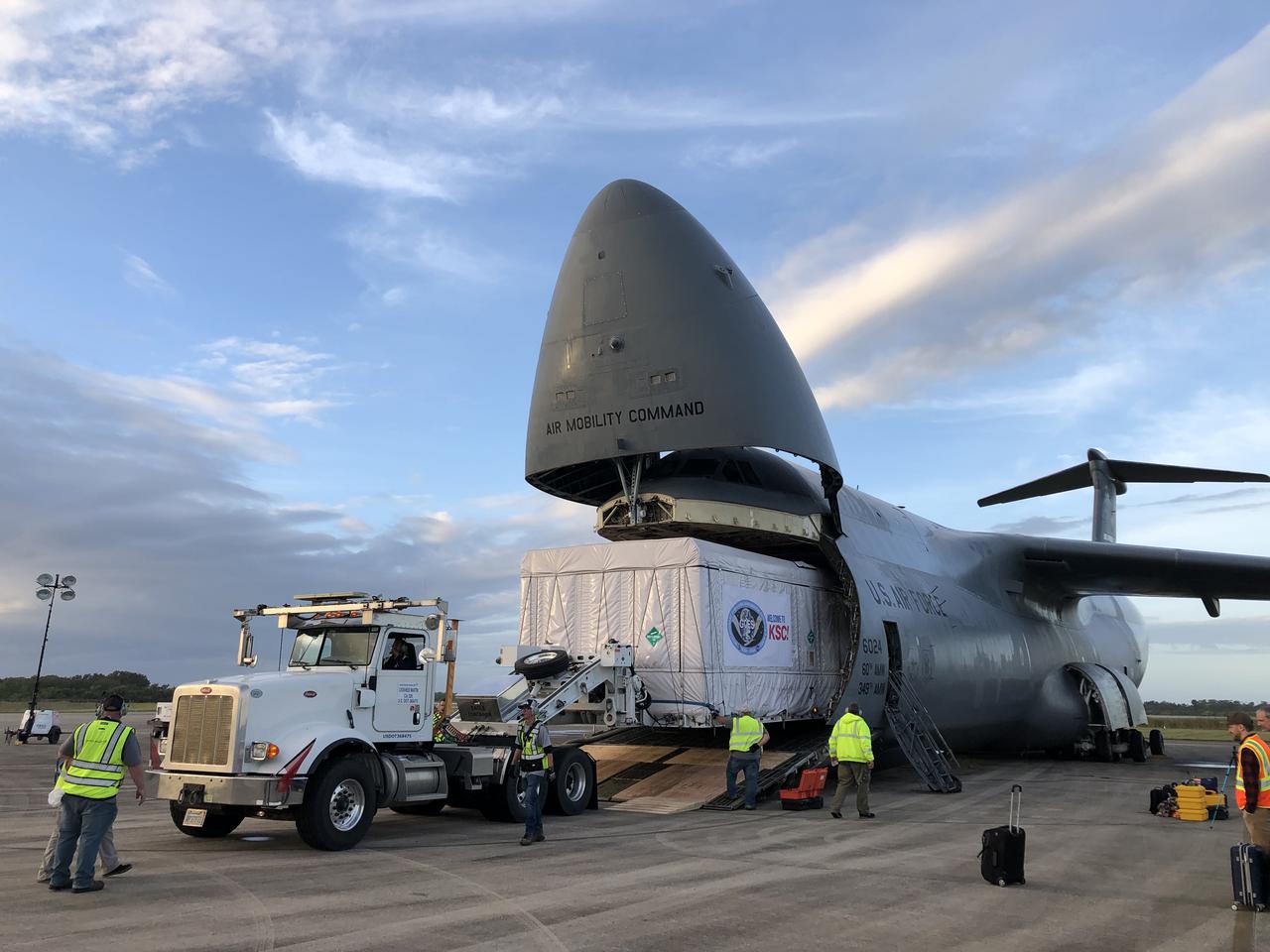
The shipping container holding the Geostationary Operational Environmental Satellite T (GOES-T) is unloaded from a United States Air Force C-5 cargo plane following its arrival at the Launch and Landing Facility runway at NASA’s Kennedy Space Center in Florida on Nov. 10, 2021. From here, teams will transport the satellite to an Astrotech Space Operations facility in nearby Titusville for prelaunch processing. A collaboration between NASA and the National Oceanic and Atmospheric Administration, GOES-T is the third satellite in the GOES-R series that will continue to help meteorologists observe and predict local weather events that affect public safety. GOES-T is scheduled to launch aboard a United Launch Alliance Atlas V rocket from Cape Canaveral Space Force Station on March 1, 2022. The launch is being managed by NASA’s Launch Services Program based at Kennedy, America’s multi-user spaceport.
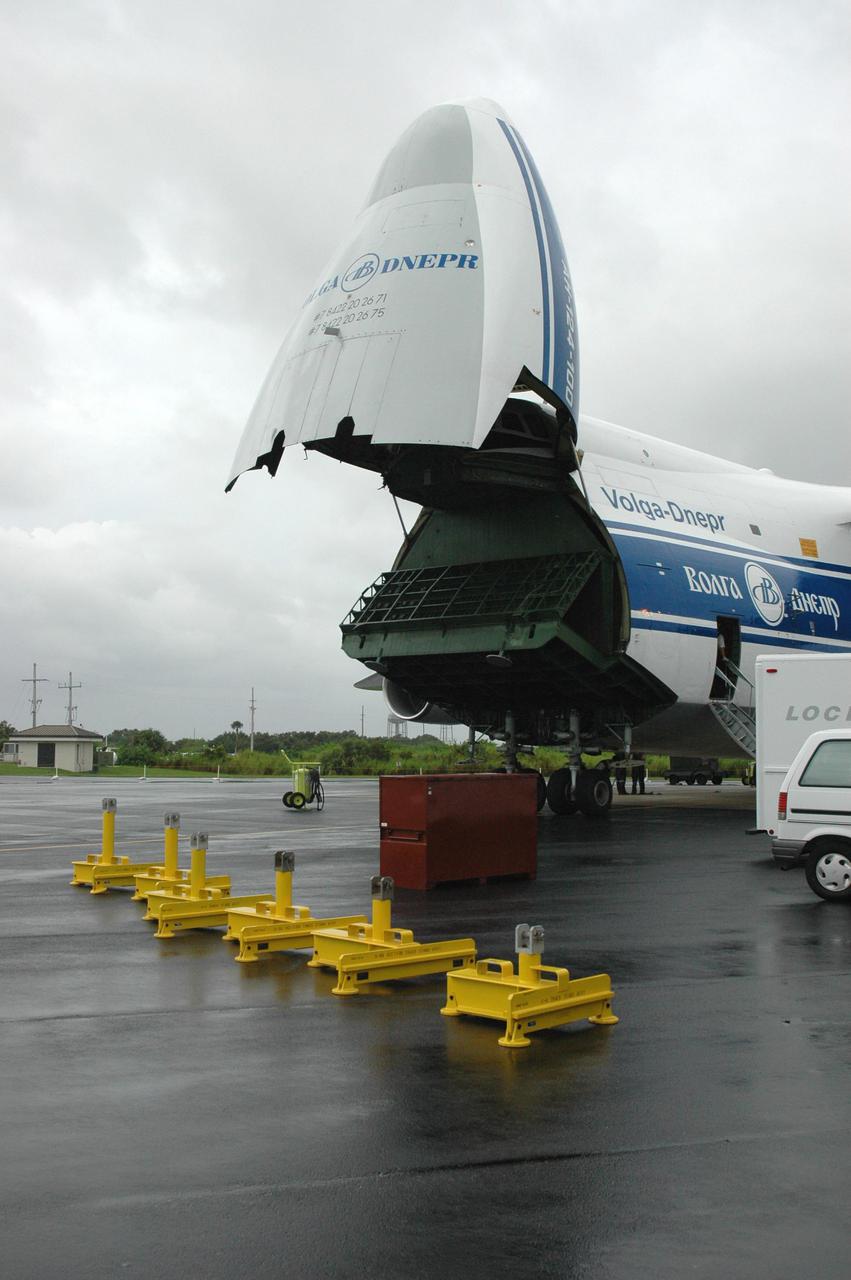
KENNEDY SPACE CENTER, FLA. — At the Cape Canaveral Air Force Station Skid Strip, the first stage of an Atlas V rocket arrives aboard a Russian air cargo plane. The Atlas V is the launch vehicle for the New Horizons spacecraft. New Horizons is designed to help us understand worlds at the edge of our solar system by making the first reconnaissance of Pluto and Charon - a 'double planet' and the last planet in our solar system to be visited by spacecraft. The mission will then visit one or more objects in the Kuiper Belt region beyond Neptune. New Horizons is scheduled to launch from Launch Complex 41 at CCAFS in January 2006, swing past Jupiter for a gravity boost and scientific studies in February or March 2007, and reach Pluto and its moon, Charon, in July 2015.
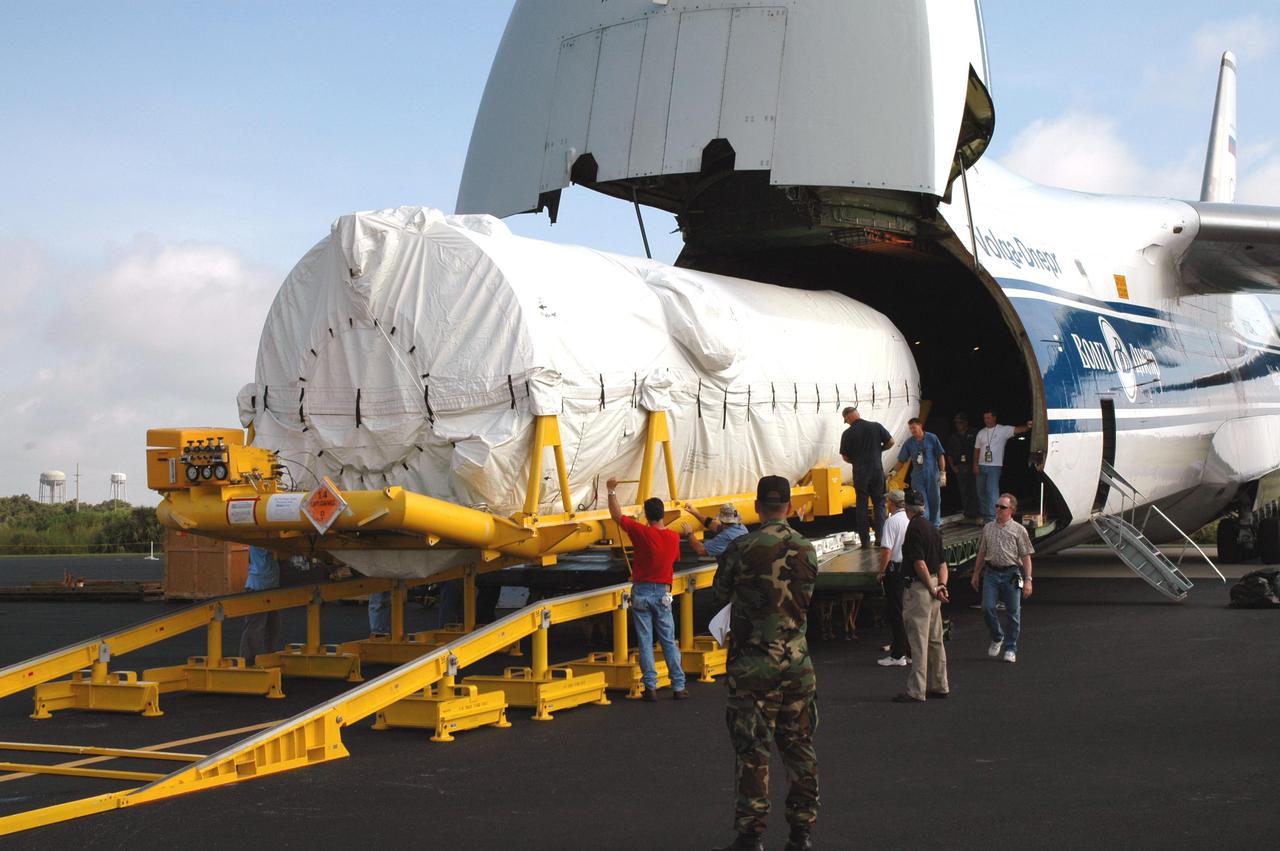
KENNEDY SPACE CENTER, FLA. - At the Skid Strip on Cape Canaveral Air Force Station (CCAFS), the second stage Centaur is offloaded from a Russian air cargo plane. The Centaur is the upper stage of the Atlas V configuration that will launch the New Horizons spacecraft from Launch Complex 41 at CCAFS. New Horizons is designed to help us understand worlds at the edge of our solar system by making the first reconnaissance of Pluto and Charon - a 'double planet' and the last planet in our solar system to be visited by spacecraft. The mission will then visit one or more objects in the Kuiper Belt region beyond Neptune. New Horizons is scheduled to launch in January 2006, swing past Jupiter for a gravity boost and scientific studies in February or March 2007, and reach Pluto and its moon, Charon, in July 2015.