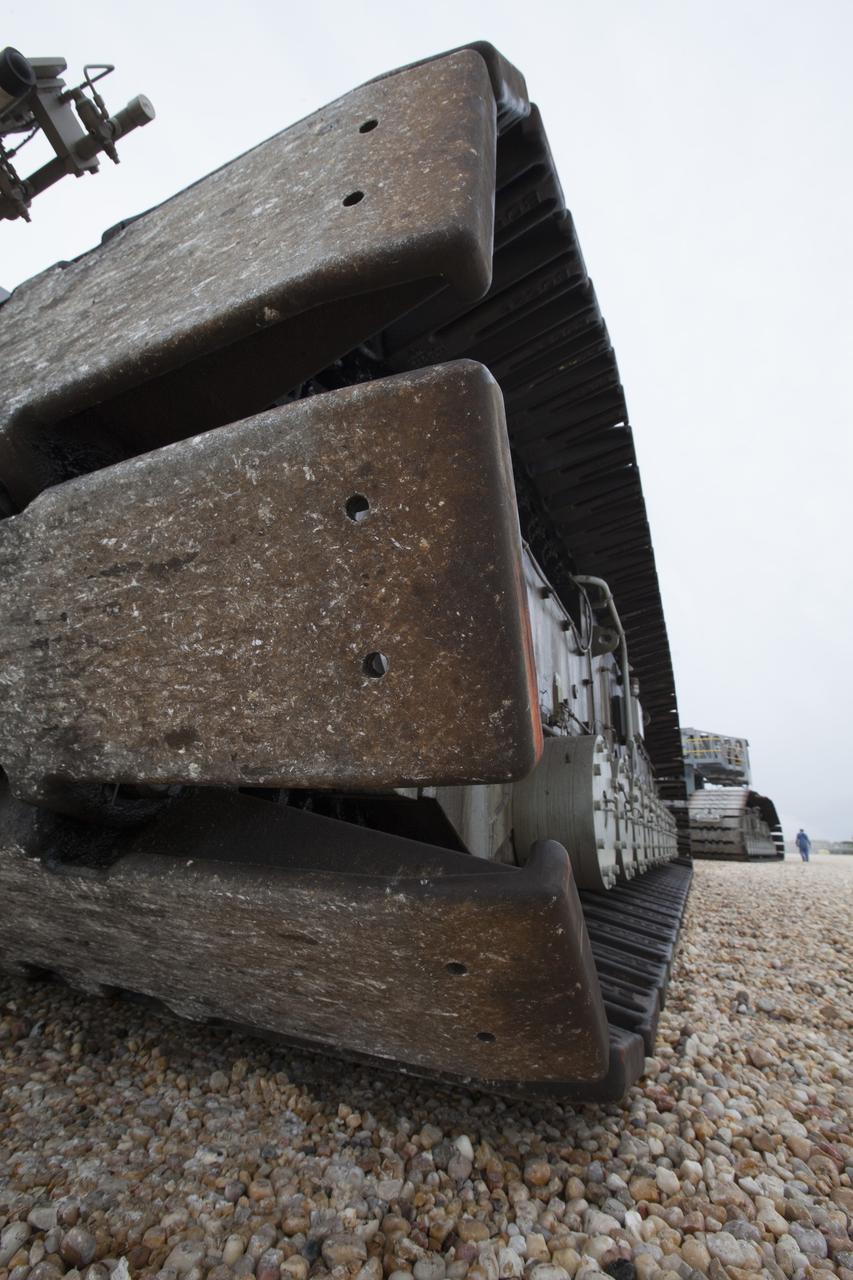
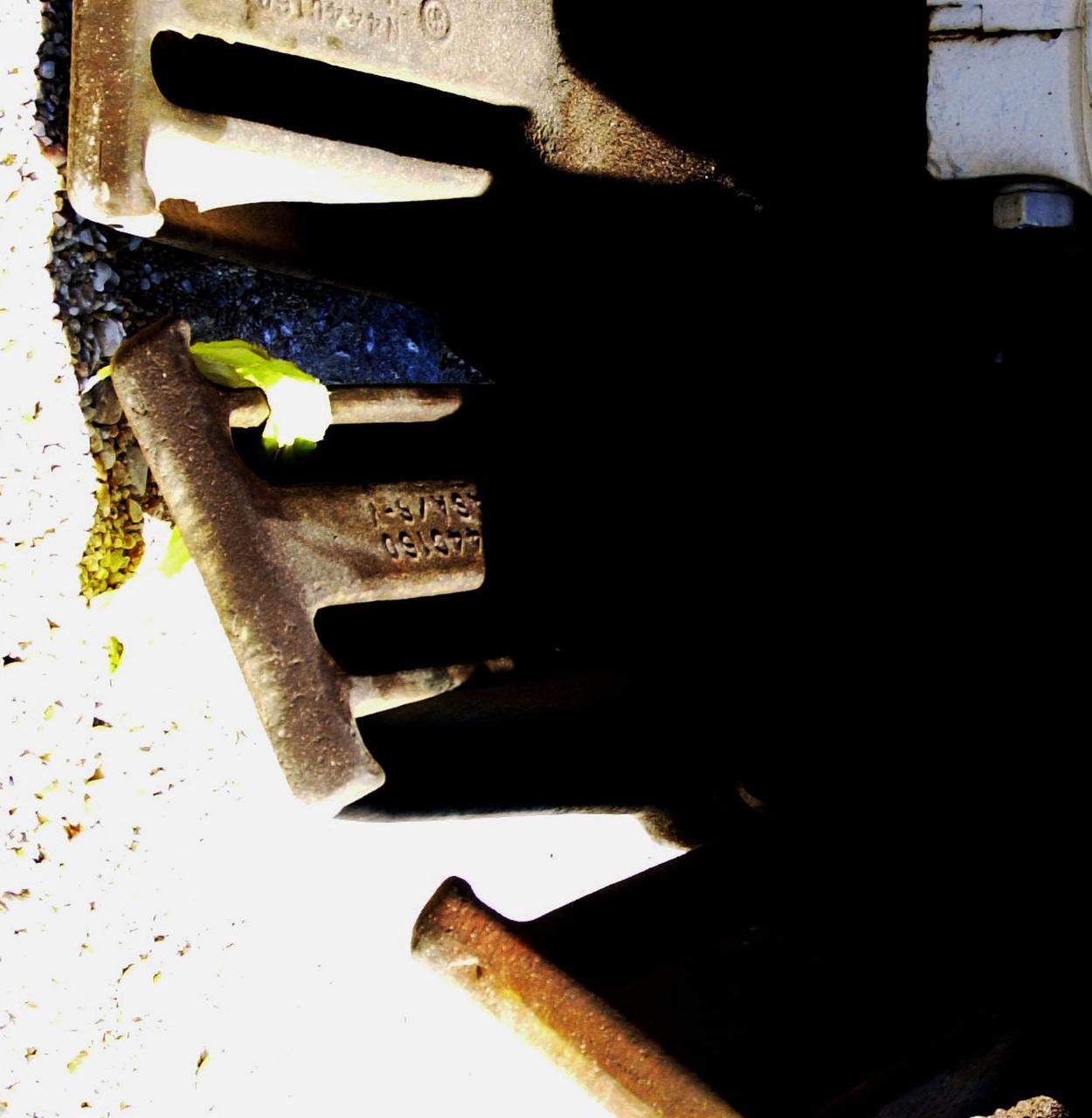
A close-up view of a section of cleats on one of the tracks that help propel NASA’s upgraded crawler-transporter 2 (CT-2) as the giant vehicle moves along the crawlerway toward the Vehicle Assembly Building (VAB) at NASA Kennedy Space Center in Florida. CT-2 was driven to Launch Pad 39B to test recently completed upgrades and modifications to ensure the vehicle will be ready to support NASA’s journey to Mars. The Ground Systems Development and Operations Program at Kennedy oversaw upgrades to the crawler in the VAB. The crawler will carry the mobile launcher with Orion atop the Space Launch System rocket to Pad 39B for Exploration Mission 1.
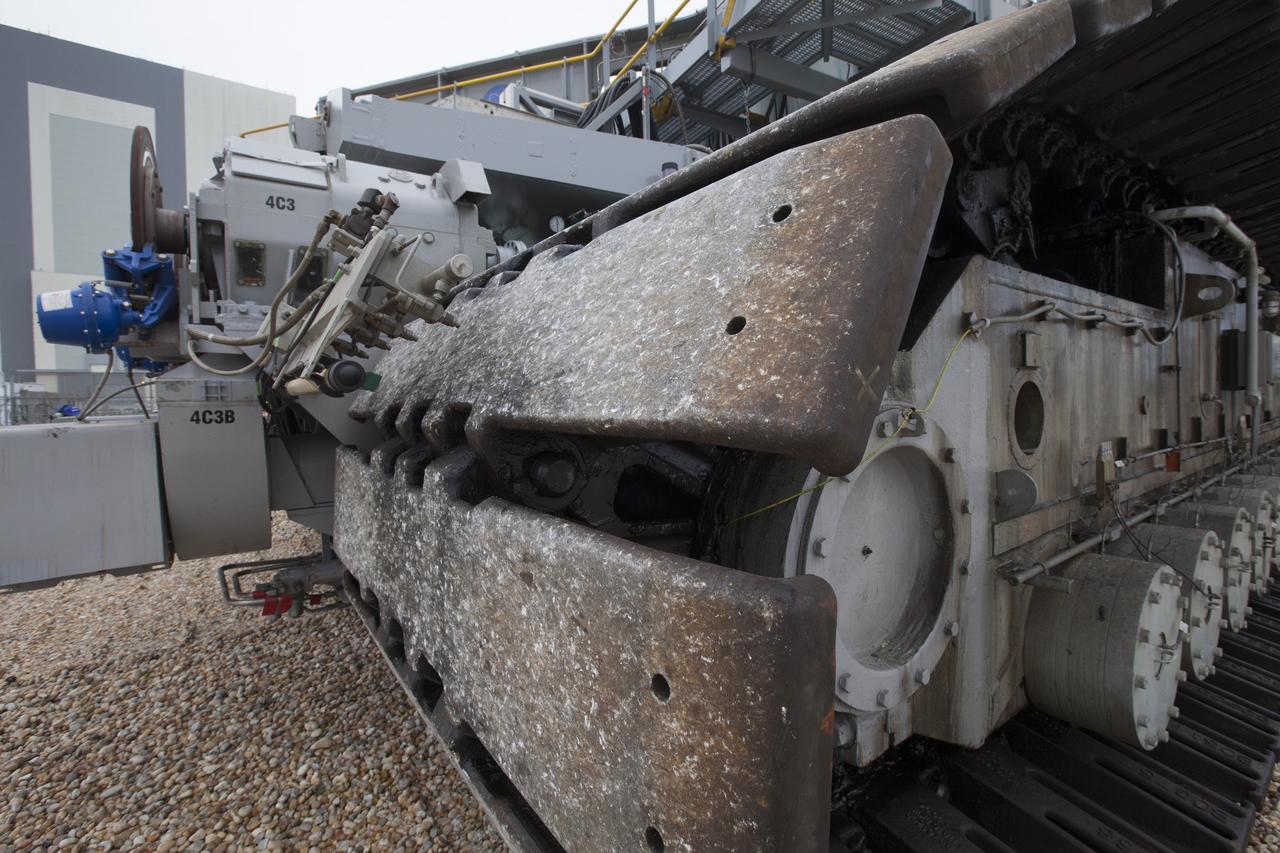
A close-up view of one of the cleats on one section of the tracks that help propel NASA’s upgraded crawler-transporter 2 (CT-2) as the giant vehicle moves along the crawlerway toward the Vehicle Assembly Building (VAB) at NASA Kennedy Space Center in Florida. CT-2 was driven to Launch Pad 39B to test recently completed upgrades and modifications to ensure the vehicle will be ready to support NASA’s journey to Mars. The Ground Systems Development and Operations Program at Kennedy oversaw upgrades to the crawler in the VAB. The crawler will carry the mobile launcher with Orion atop the Space Launch System rocket to Pad 39B for Exploration Mission 1.
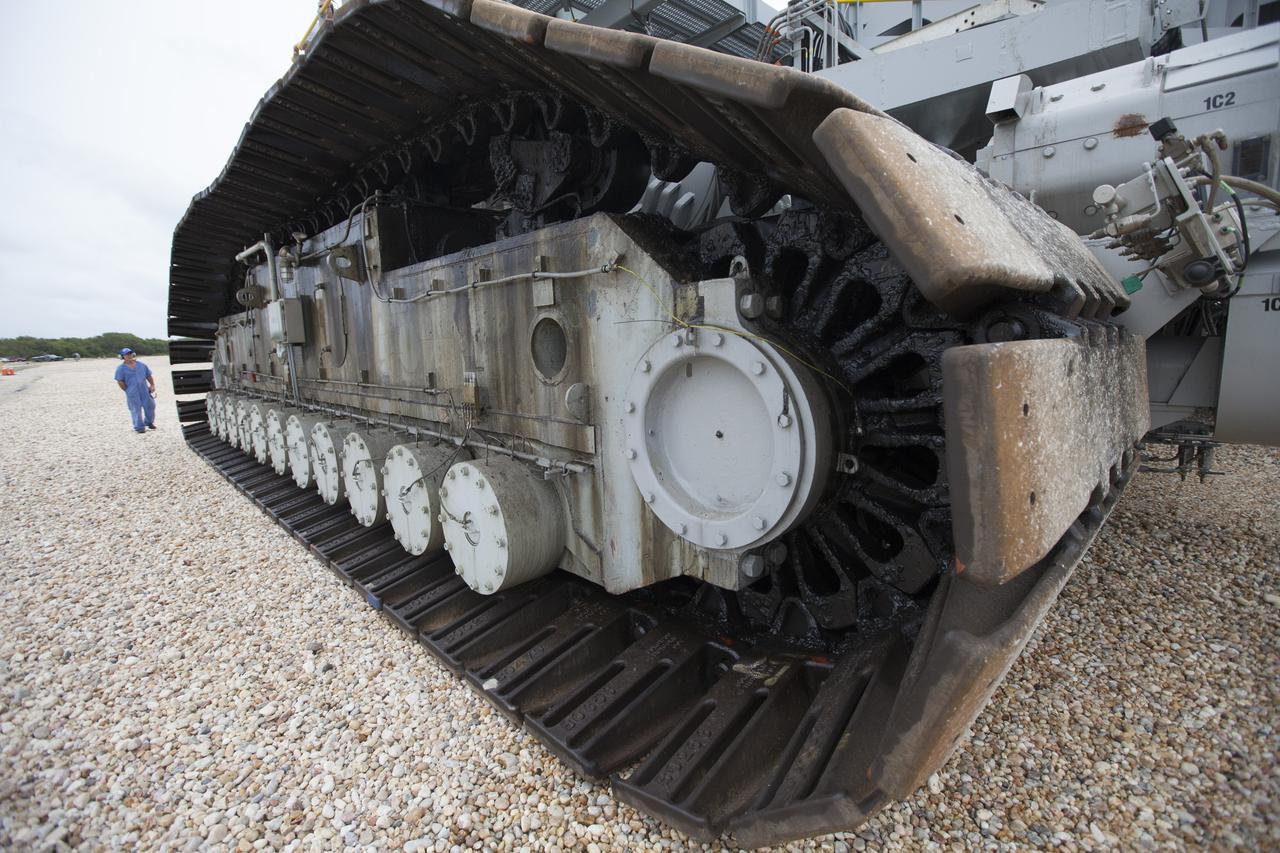
A technician watches the motion of the giant tracks on NASA’s upgraded crawler-transporter 2 (CT-2) as the giant vehicle travels along the crawlerway toward the Vehicle Assembly Building from its trek to Launch Pad 39B at the agency’s Kennedy Space Center in Florida. CT-2 was drive to Pad 39B to test recently completed upgrades and modifications to support NASA’s journey to Mars. The Ground Systems Development and Operations Program at Kennedy oversaw upgrades to the crawler in the VAB. The crawler will carry the mobile launcher with Orion atop the Space Launch System rocket to Pad 39B for Exploration Mission 1.

The crack in the crawler-transporter cleat that stalled rollout of Space Shuttle Endeavour can be seen as a white dotted line on the top-center and running down the side. The cleat rests on the ground near Launch Pad 39B. The cracked cleat forced the reverse of the rollout back outside the pad gate so the cleat could be repaired on flat ground before moving up the incline to the top of the pad. Endeavour is scheduled to be launched Nov. 30 at 10:01 p.m. EST on mission STS-97, the sixth construction flight to the International Space Station. Its payload includes the P6 Integrated Truss Structure and a photovoltaic (PV) module, with giant solar arrays that will provide power to the Station. The mission includes two spacewalks to complete the solar array connections
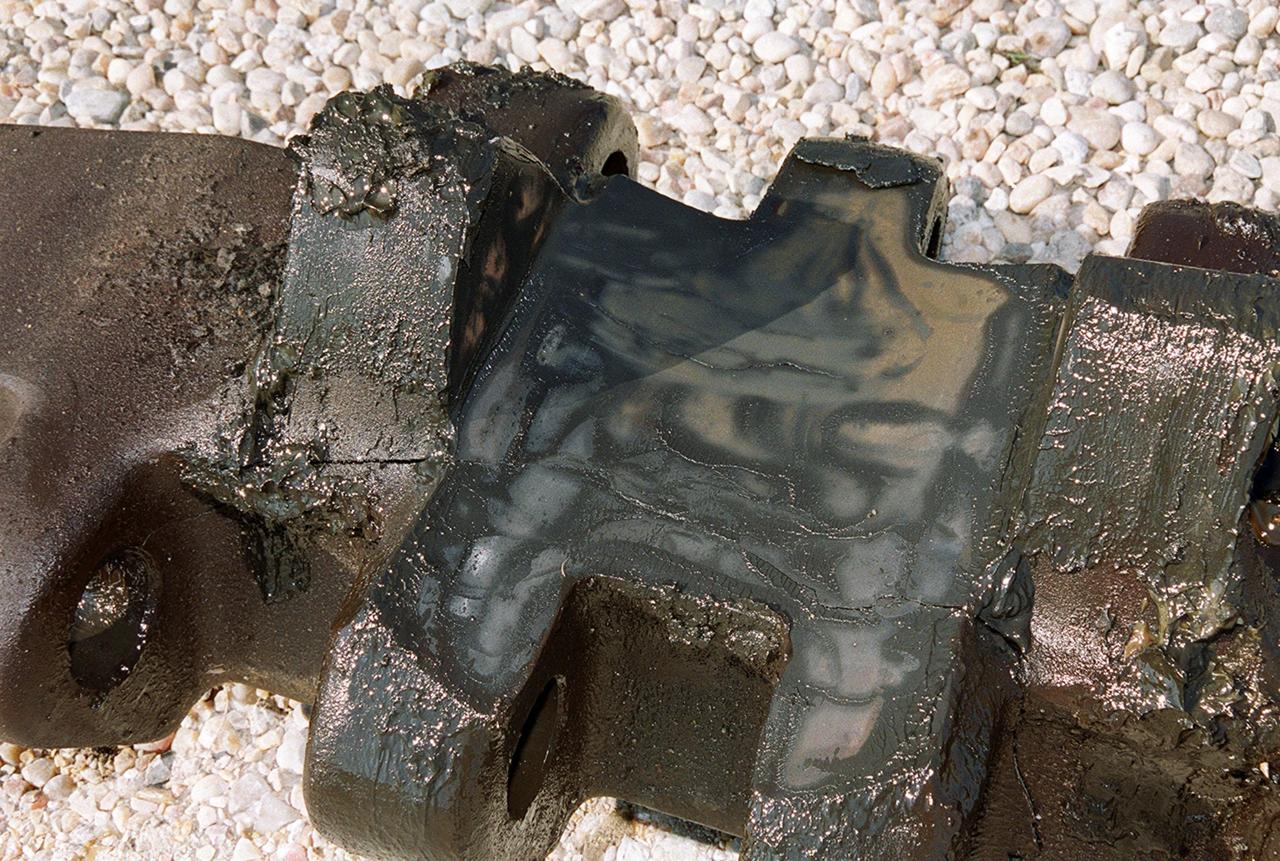
The crack in the crawler-transporter cleat that delayed rollout of Space Shuttle Endeavour can be seen as a white dotted line on the top-center and running down the right side. The cleat rests on the ground near Launch Pad 39B. The cracked cleat forced the reverse of the rollout back outside the pad gate so the cleat could be replaced on flat ground before moving up the incline to the top of the pad. Endeavour is scheduled to be launched Nov. 30 at 10:01 p.m. EST on mission STS-97, the sixth construction flight to the International Space Station. Its payload includes the P6 Integrated Truss Structure and a photovoltaic (PV) module, with giant solar arrays that will provide power to the Station. The mission includes two spacewalks to complete the solar array connections
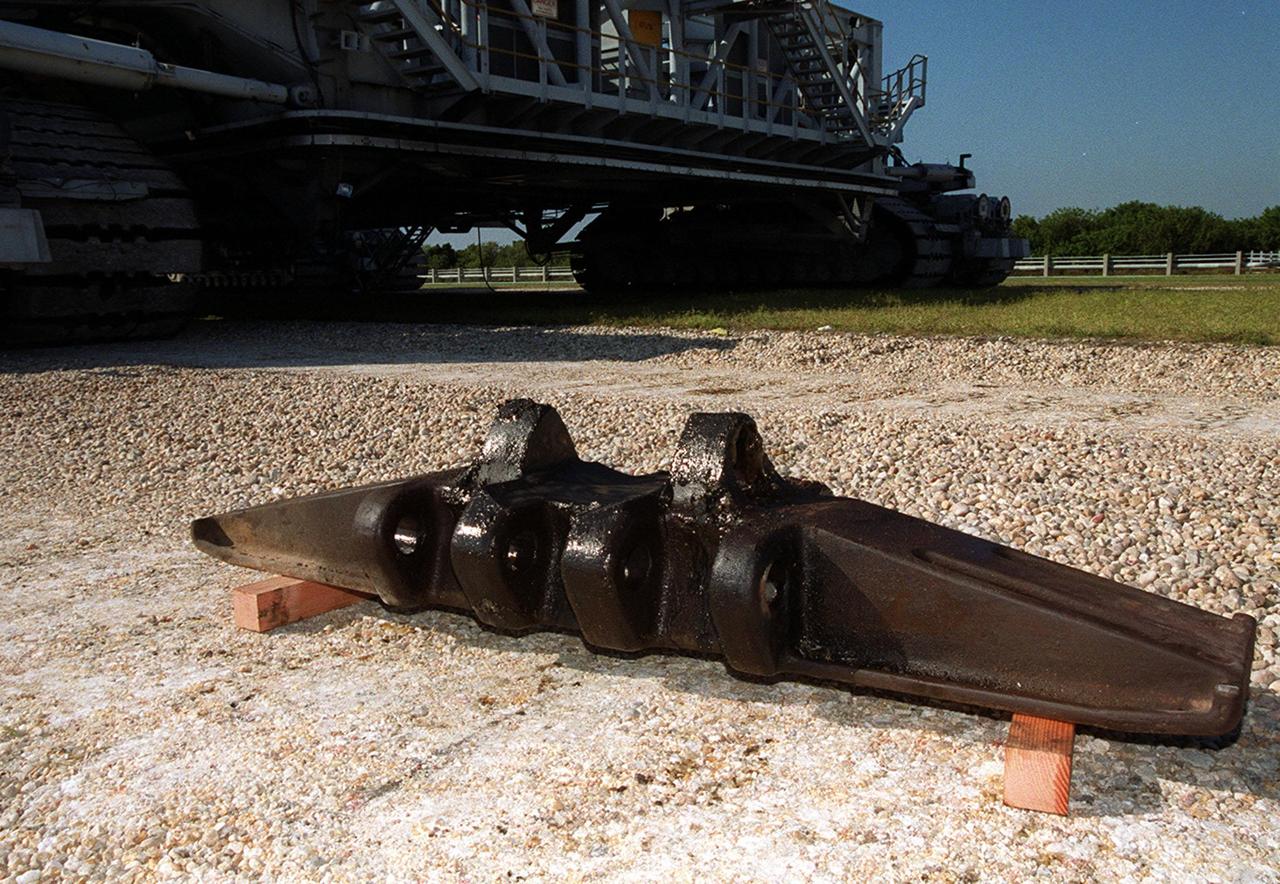
A new cleat, or shoe, for one of the tracks on the crawler-transporter sits on the ground near the vehicle (in the background). A cracked cleat was noticed on the crawler as it was rolling Space Shuttle Endeavour and the Mobile Launcher Platform out to Launch Pad 39B. The rollout is being suspended while the cleat is replaced. Endeavour is scheduled to be launched Nov. 30 at 10:01 p.m. EST on mission STS-97, the sixth construction flight to the International Space Station. Its payload includes the P6 Integrated Truss Structure and a photovoltaic (PV) module, with giant solar arrays that will provide power to the Station. The mission includes two spacewalks to complete the solar array connections

The cracked cleat on the crawler-transporter track that stalled the rollout of Space Shuttle Endeavour lies on the ground near Launch Pad 39B. The cracked cleat forced the reverse of the rollout back outside the pad gate so the cleat could be repaired on flat ground before moving up the incline to the top of the pad. Endeavour is scheduled to be launched Nov. 30 at 10:01 p.m. EST on mission STS-97, the sixth construction flight to the International Space Station. Its payload includes the P6 Integrated Truss Structure and a photovoltaic (PV) module, with giant solar arrays that will provide power to the Station. The mission includes two spacewalks to complete the solar array connections
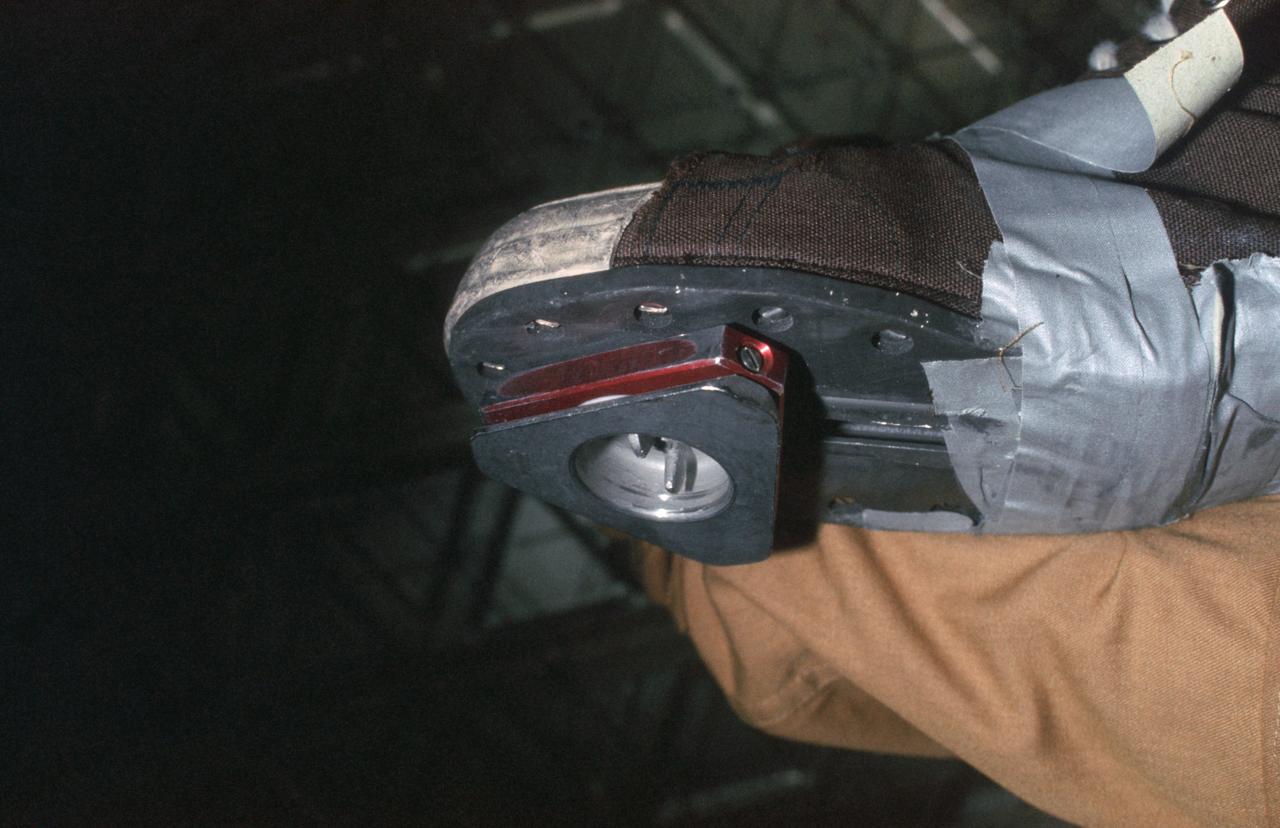
SL4-149-5036 (February 1974) --- View of triangle-shaped cleat taped on the bottom of a shoe of a Skylab 4 crew member. Photo credit: NASA
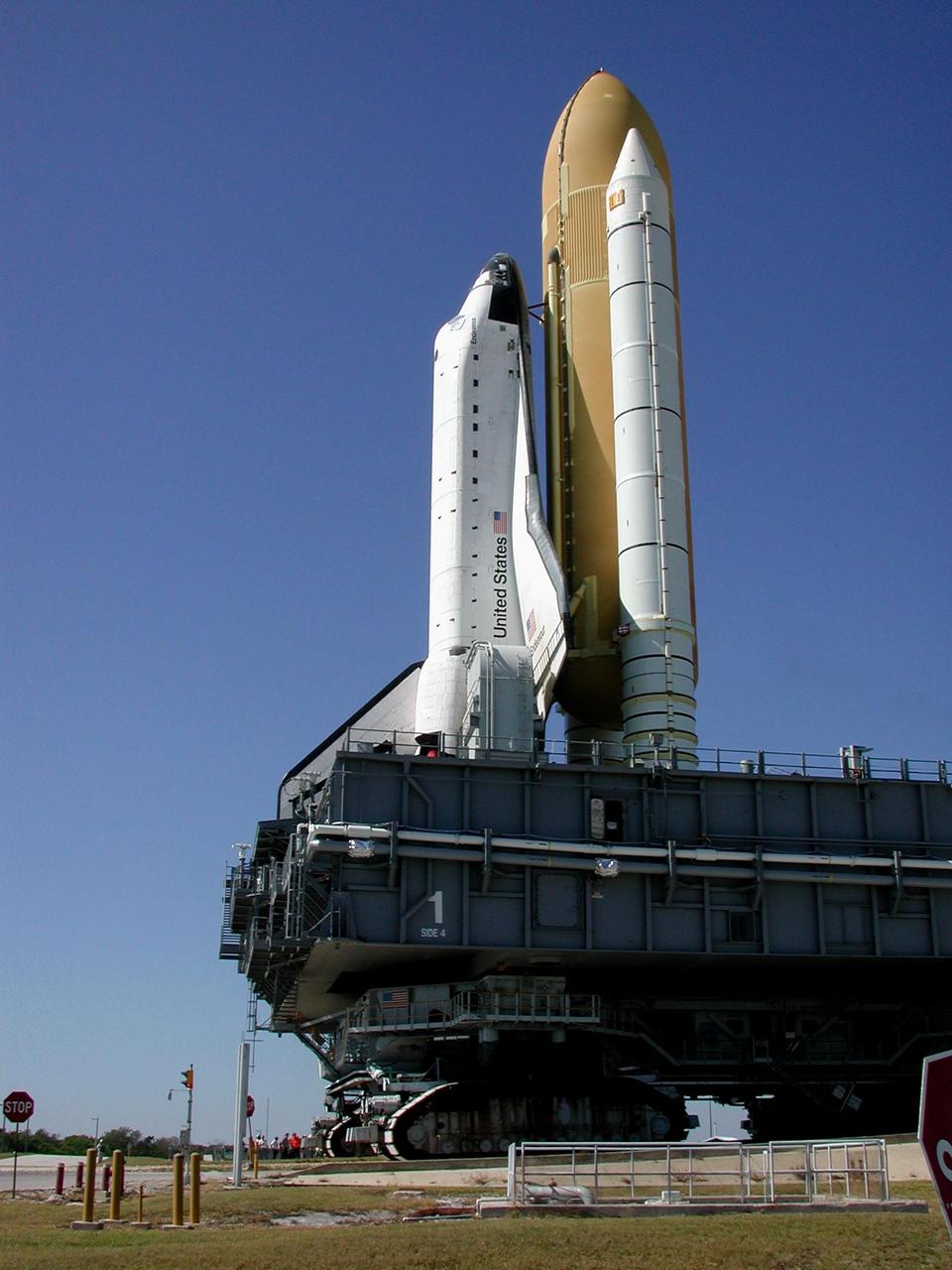
KENNEDY SPACE CENTER, FLA. -- Space Shuttle Endeavour and the Mobile Launcher Platform (MLP) start backing through the gate to Launch Pad 39B after a cracked cleat was discovered on the crawler-transporter. Workers near the pad (behind the crawler track) look at the cleats. The vehicle, which moves the MLP and Shuttle at about 1 mph, has a leveling system designed to keep the top of the Space Shuttle vertical while negotiating the 5 percent grade leading to the top of the pad. When the Shuttle-MLP are back on level ground, the crawler tracks will be inspected and the broken cleat repaired. Endeavour is scheduled to be launched Nov. 30 at 10:01 p.m. EST on mission STS-97, the sixth construction flight to the International Space Station. Its payload includes the P6 Integrated Truss Structure and a photovoltaic (PV) module, with giant solar arrays that will provide power to the Station. The mission includes two spacewalks to complete the solar array connections
KENNEDY SPACE CENTER, FLA. -- Space Shuttle Endeavour and the Mobile Launcher Platform (MLP) start backing through the gate to Launch Pad 39B after a cracked cleat was discovered on the crawler-transporter. Workers near the pad (behind the crawler track) look at the cleats. The vehicle, which moves the MLP and Shuttle at about 1 mph, has a leveling system designed to keep the top of the Space Shuttle vertical while negotiating the 5 percent grade leading to the top of the pad. When the Shuttle-MLP are back on level ground, the crawler tracks will be inspected and the broken cleat repaired. Endeavour is scheduled to be launched Nov. 30 at 10:01 p.m. EST on mission STS-97, the sixth construction flight to the International Space Station. Its payload includes the P6 Integrated Truss Structure and a photovoltaic (PV) module, with giant solar arrays that will provide power to the Station. The mission includes two spacewalks to complete the solar array connections
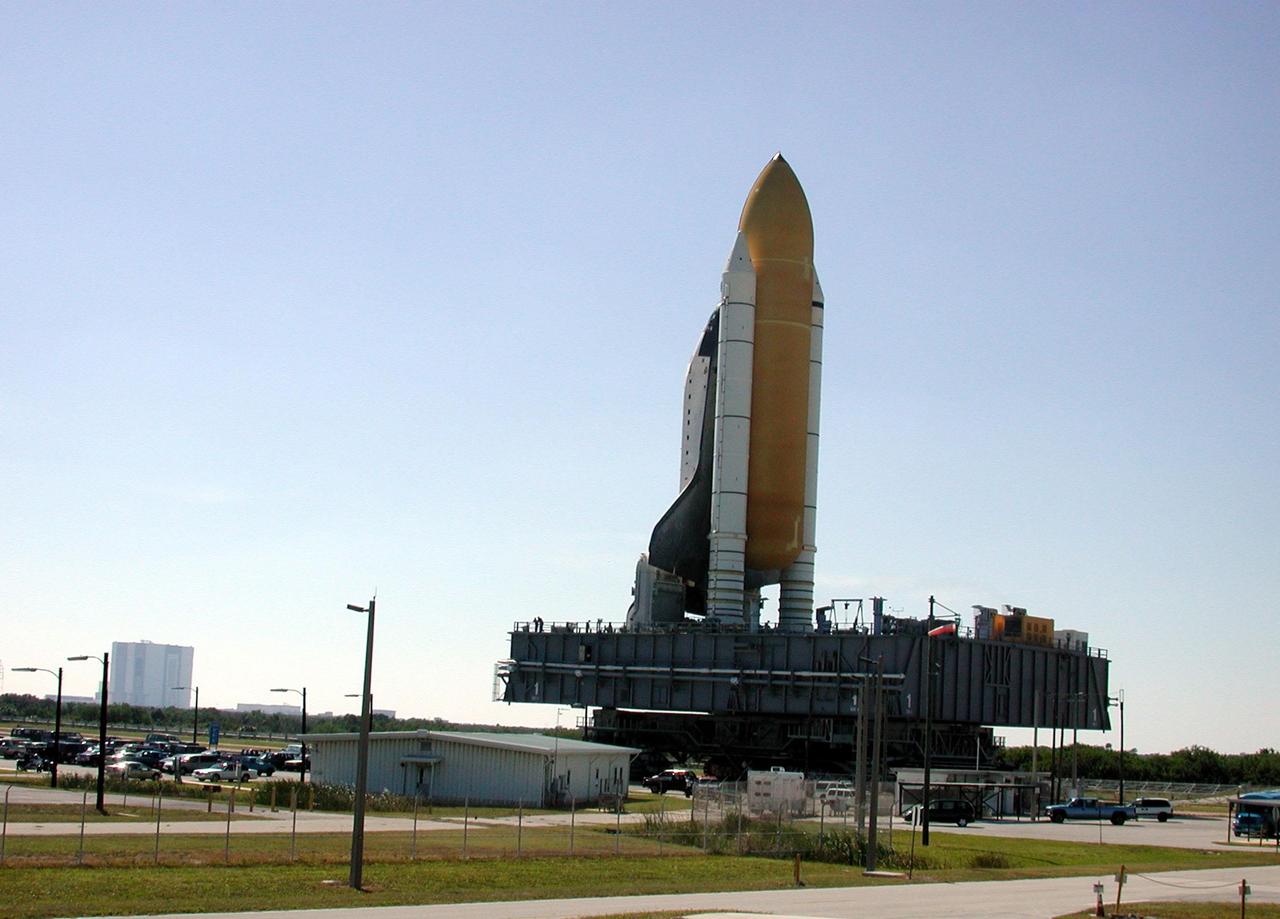
KENNEDY SPACE CENTER, FLA. -- Space Shuttle Endeavour is nearly through the gate on its backward trek from Launch Pad 39B. A broken cleat on the crawler-transporter forced the reverse movement so the cleat could be repaired before moving up the incline to the top of the pad. Endeavour is scheduled to be launched Nov. 30 at 10:01 p.m. EST on mission STS-97, the sixth construction flight to the International Space Station. Its payload includes the P6 Integrated Truss Structure and a photovoltaic (PV) module, with giant solar arrays that will provide power to the Station. The mission includes two spacewalks to complete the solar array connections
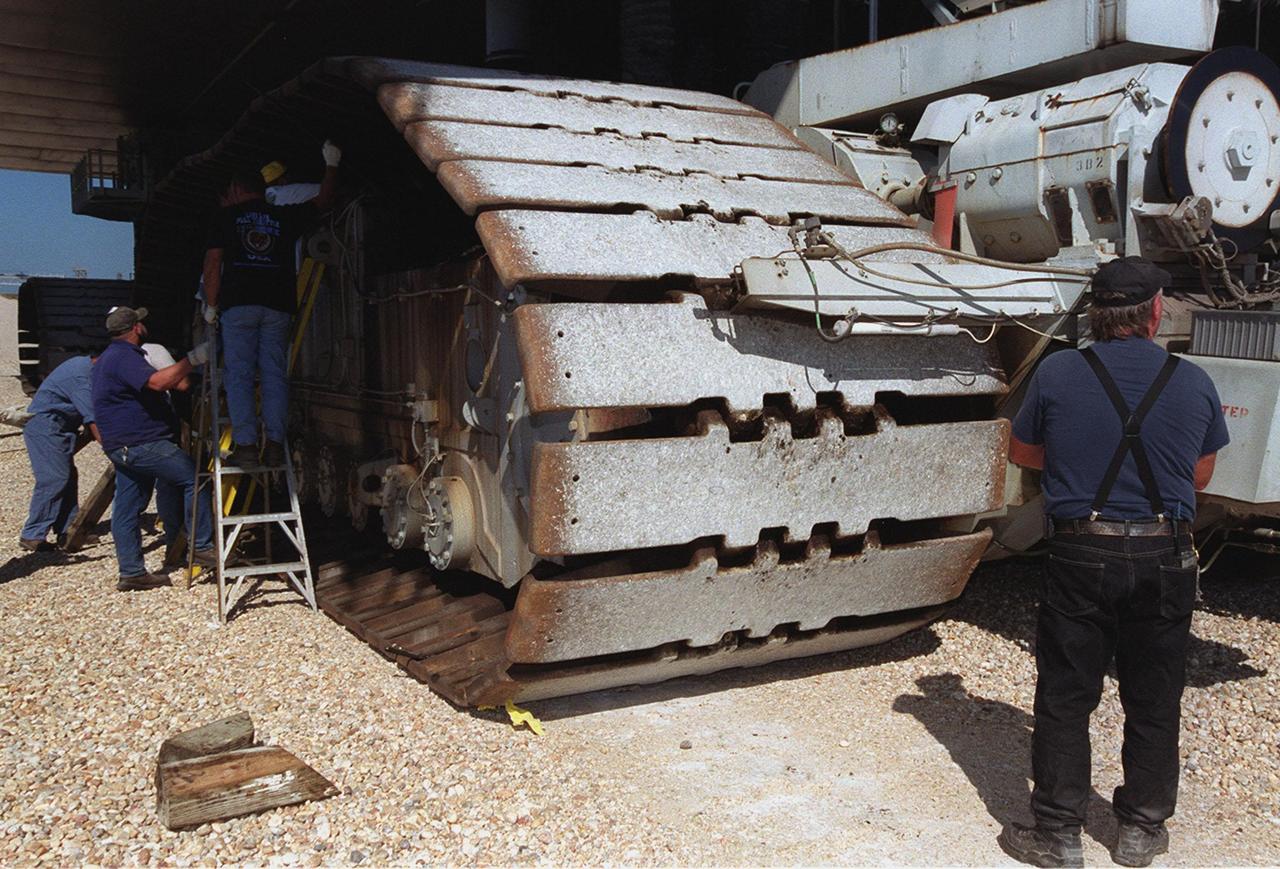
KENNEDY SPACE CENTER, FLA. -- A repair crew begin working on replacing a broken cleat on this track of the crawler-transporter. The crack was noticed as the crawler-transporter was moving Space Shuttle Endeavour to Launch Pad 39B. Rollout was delayed until the cleat could be replaced. The Space Shuttle was hard down on the pad several hours later. Endeavour is scheduled to be launched Nov. 30 at 10:01 p.m. EST on mission STS-97, the sixth construction flight to the International Space Station. Its payload includes the P6 Integrated Truss Structure and a photovoltaic (PV) module, with giant solar arrays that will provide power to the Station. The mission includes two spacewalks to complete the solar array connections

KENNEDY SPACE CENTER, FLA. -- Space Shuttle Endeavour, atop the Mobile Launcher Platform, moves through the gate a second time to Launch Pad 39B. After a cracked cleat was noticed on one of the eight tracks on the crawler-transporter, the vehicle reversed direction to level ground where the cleat is being replaced. Endeavour is scheduled to be launched Nov. 30 at 10:01 p.m. EST on mission STS-97, the sixth construction flight to the International Space Station. Its payload includes the P6 Integrated Truss Structure and a photovoltaic (PV) module, with giant solar arrays that will provide power to the Station. The mission includes two spacewalks to complete the solar array connections

KENNEDY SPACE CENTER, Fla. -- Space Shuttle Endeavour is again on level ground after its backward trek from Launch Pad 39B. A broken cleat on the crawler-transporter forced the reverse movement so the cleat could be repaired before moving up the incline to the top of the pad. Endeavour is scheduled to be launched Nov. 30 at 10:01 p.m. EST on mission STS-97, the sixth construction flight to the International Space Station. Its payload includes the P6 Integrated Truss Structure and a photovoltaic (PV) module, with giant solar arrays that will provide power to the Station. The mission includes two spacewalks to complete the solar array connections
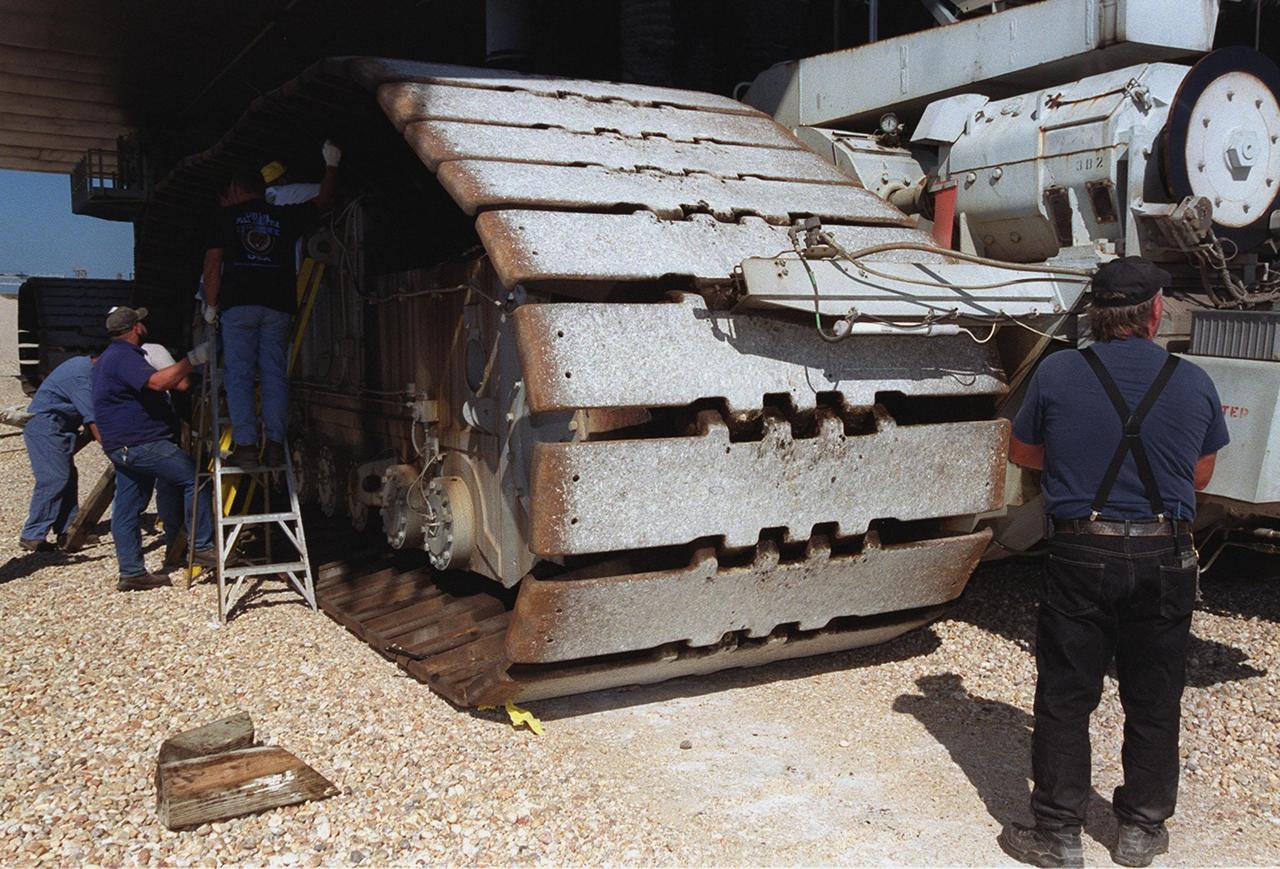
KENNEDY SPACE CENTER, FLA. -- A repair crew begin working on replacing a broken cleat on this track of the crawler-transporter. The crack was noticed as the crawler-transporter was moving Space Shuttle Endeavour to Launch Pad 39B. Rollout was delayed until the cleat could be replaced. The Space Shuttle was hard down on the pad several hours later. Endeavour is scheduled to be launched Nov. 30 at 10:01 p.m. EST on mission STS-97, the sixth construction flight to the International Space Station. Its payload includes the P6 Integrated Truss Structure and a photovoltaic (PV) module, with giant solar arrays that will provide power to the Station. The mission includes two spacewalks to complete the solar array connections
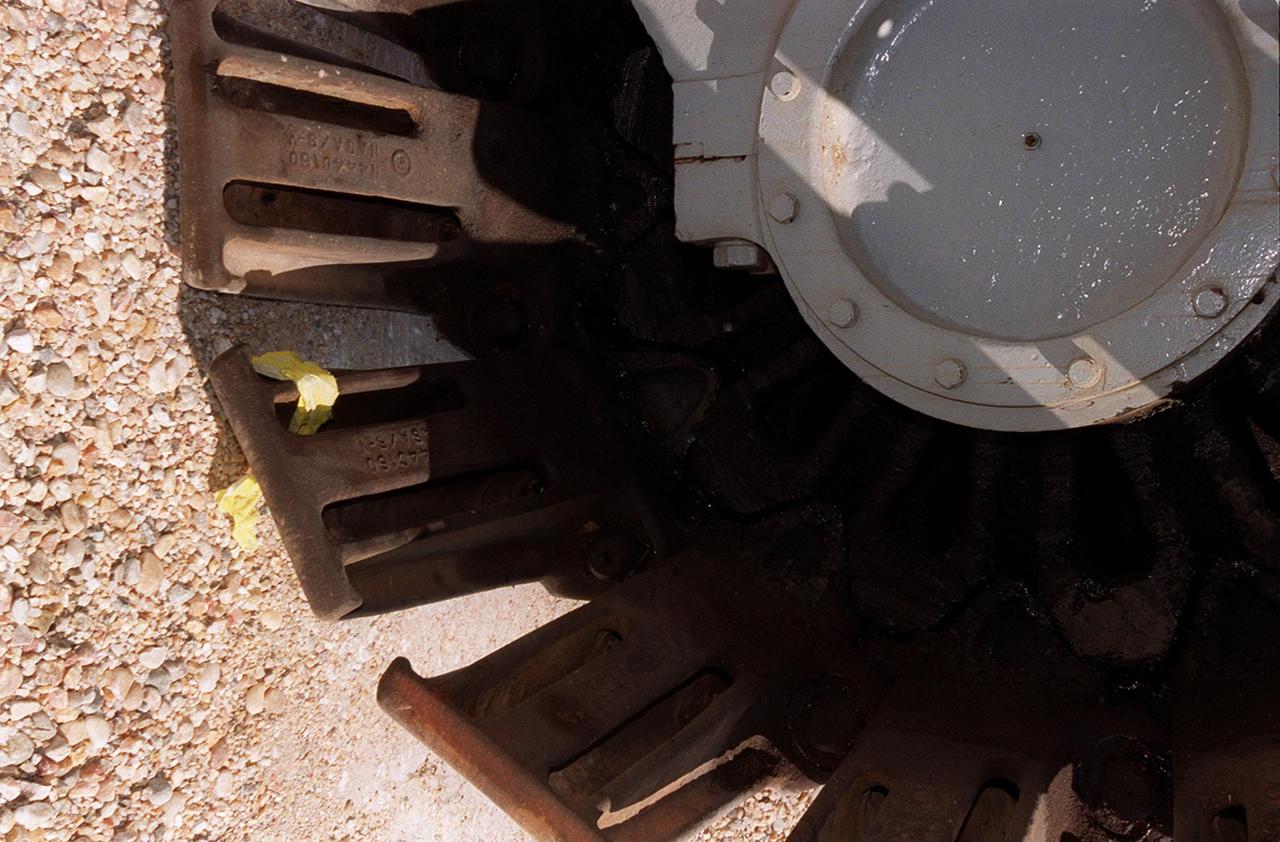
KENNEDY SPACE CENTER, FLA. -- A yellow tag identifies the crawler-transporter cleat that has a crack. The crack was noticed as the crawler-transporter was moving Space Shuttle Endeavour to Launch Pad 39B. Rollout was delayed until the cleat could be replaced. The Space Shuttle was hard down on the pad several hours later. Endeavour is scheduled to be launched Nov. 30 at 10:01 p.m. EST on mission STS-97, the sixth construction flight to the International Space Station. Its payload includes the P6 Integrated Truss Structure and a photovoltaic (PV) module, with giant solar arrays that will provide power to the Station. The mission includes two spacewalks to complete the solar array connections
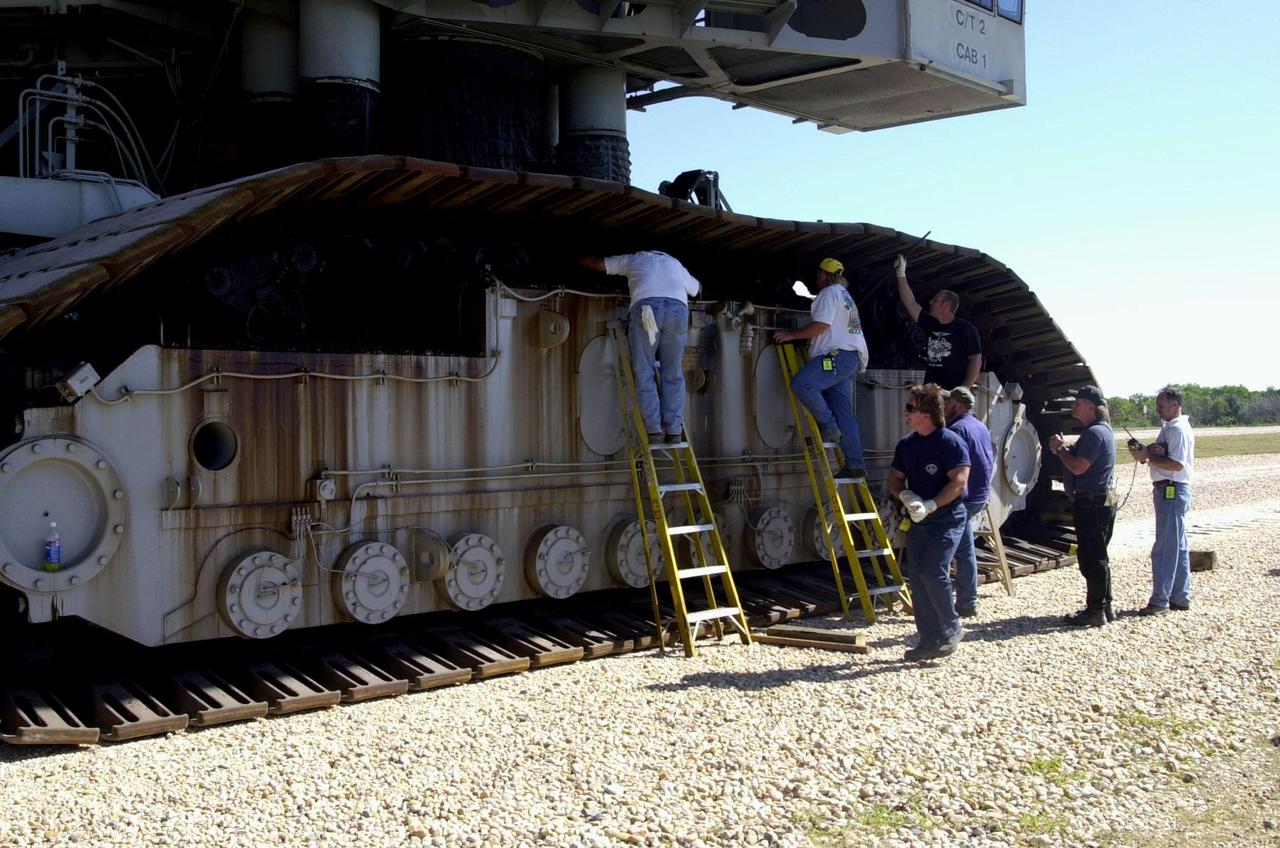
A repair crew works to repair the broken cleat on the crawler-transporter, found as it was moving up the incline on Launch Pad 39B. The Shuttle retreated to level ground so the broken cleat could be repaired. Endeavour is scheduled to be launched Nov. 30 at 10:01 p.m. EST on mission STS-97, the sixth construction flight to the International Space Station. Its payload includes the P6 Integrated Truss Structure and a photovoltaic (PV) module, with giant solar arrays that will provide power to the Station. The mission includes two spacewalks to complete the solar array connections
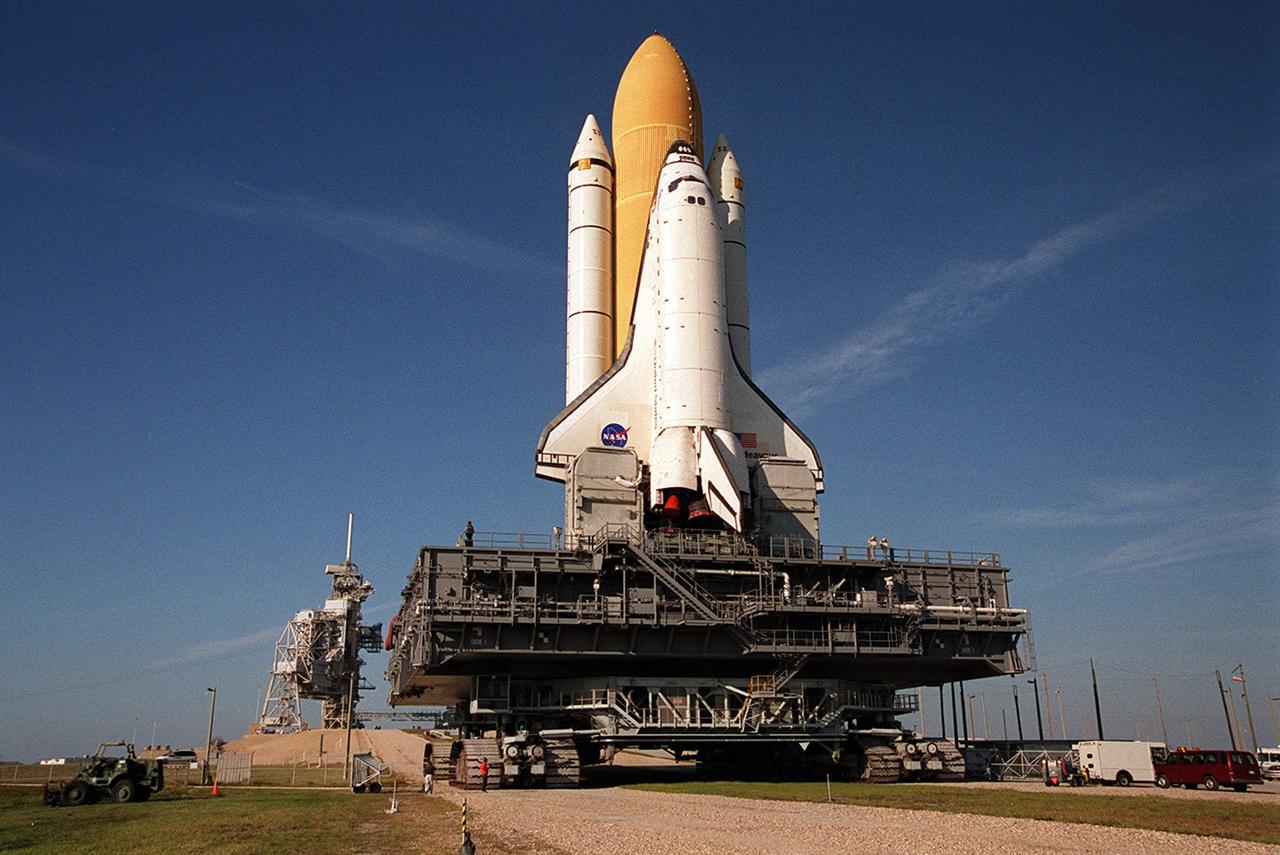
KENNEDY SPACE CENTER, FLA. -- Space Shuttle Endeavour, atop the Mobile Launcher Platform, moves through the gate a second time to Launch Pad 39B. After a cracked cleat was noticed on one of the eight tracks on the crawler-transporter, the vehicle reversed direction to level ground where the cleat is being replaced. Endeavour is scheduled to be launched Nov. 30 at 10:01 p.m. EST on mission STS-97, the sixth construction flight to the International Space Station. Its payload includes the P6 Integrated Truss Structure and a photovoltaic (PV) module, with giant solar arrays that will provide power to the Station. The mission includes two spacewalks to complete the solar array connections
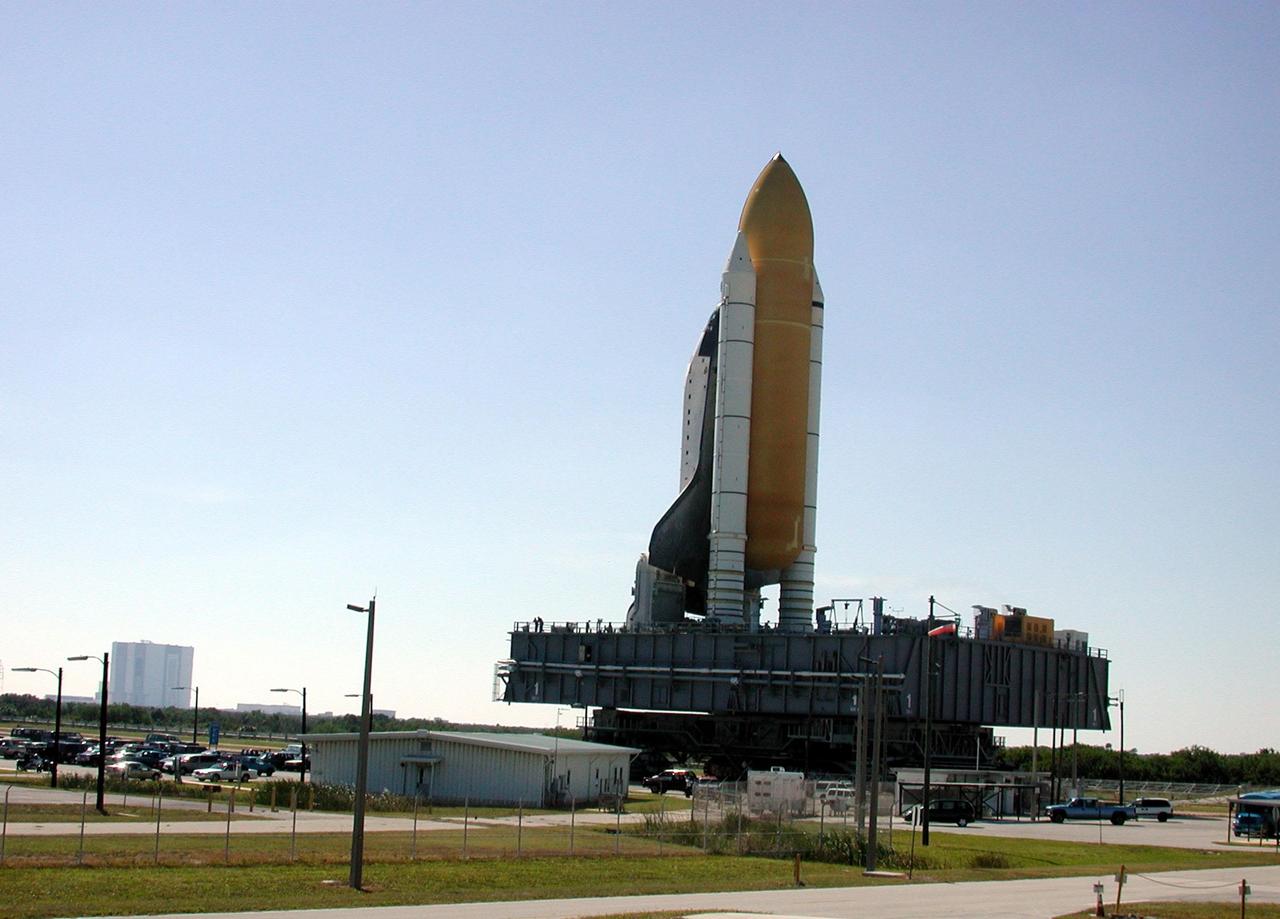
KENNEDY SPACE CENTER, FLA. -- Space Shuttle Endeavour is nearly through the gate on its backward trek from Launch Pad 39B. A broken cleat on the crawler-transporter forced the reverse movement so the cleat could be repaired before moving up the incline to the top of the pad. Endeavour is scheduled to be launched Nov. 30 at 10:01 p.m. EST on mission STS-97, the sixth construction flight to the International Space Station. Its payload includes the P6 Integrated Truss Structure and a photovoltaic (PV) module, with giant solar arrays that will provide power to the Station. The mission includes two spacewalks to complete the solar array connections

KENNEDY SPACE CENTER, FLA. -- Removal and replacement of the cracked cleat (shoe) on the crawler-transporter (seen here with the Mobile Launcher Platform and Space Shuttle Endeavour on top) is nearly complete. The cracked cleat was noticed during rollout of Endeavour to Launch Pad 39B. Endeavour is scheduled to be launched Nov. 30 at 10:01 p.m. EST on mission STS-97, the sixth construction flight to the International Space Station. Its payload includes the P6 Integrated Truss Structure and a photovoltaic (PV) module, with giant solar arrays that will provide power to the Station. The mission includes two spacewalks to complete the solar array connections
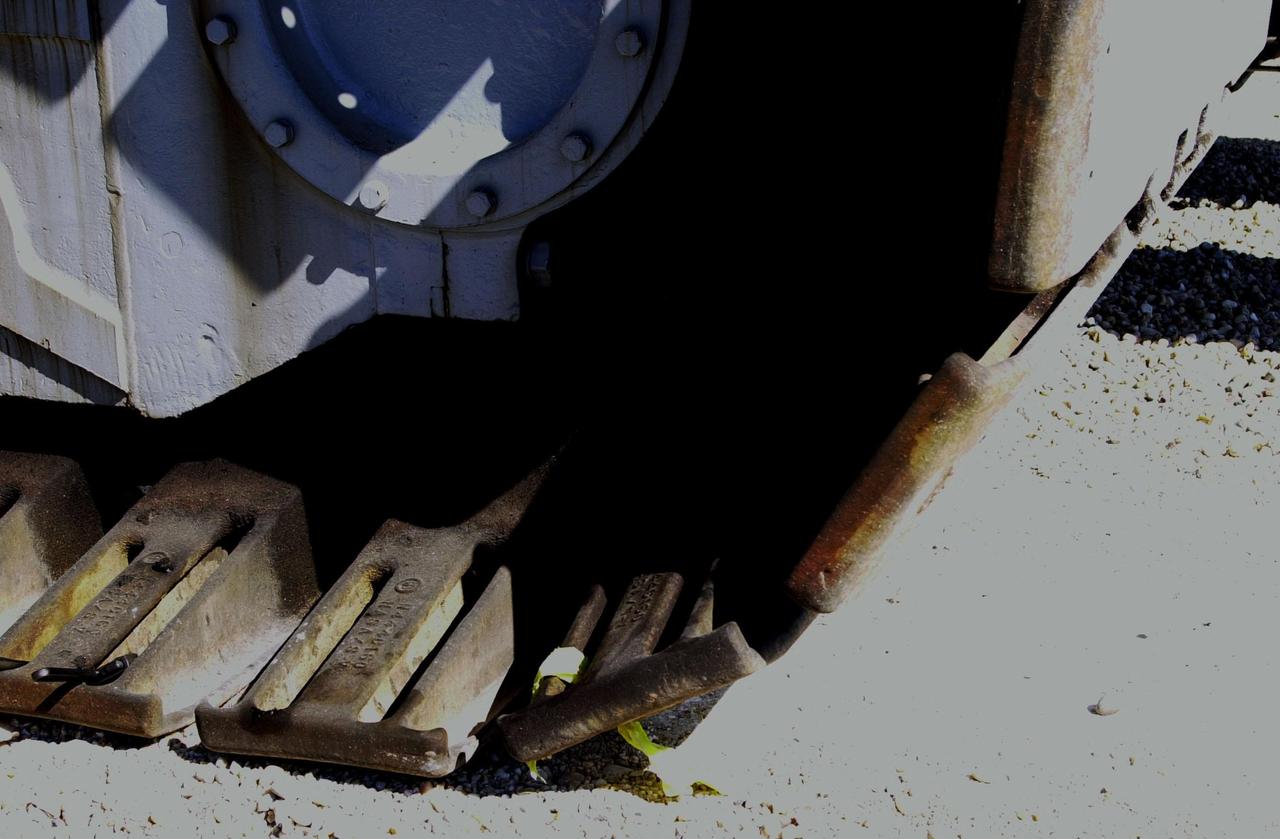
This close-up shows the crawler-transporter’s broken cleat (center foreground, with a yellow ribbon around it) that caused the backward trek of Space Shuttle Endeavour from Launch Pad 39B. The Shuttle retreated to level ground so the broken cleat could be repaired. Endeavour is scheduled to be launched Nov. 30 at 10:01 p.m. EST on mission STS-97, the sixth construction flight to the International Space Station. Its payload includes the P6 Integrated Truss Structure and a photovoltaic (PV) module, with giant solar arrays that will provide power to the Station. The mission includes two spacewalks to complete the solar array connections
This close-up shows the crawler-transporter’s broken cleat (center left, with a yellow ribbon around it) that caused the backward trek of Space Shuttle Endeavour from Launch Pad 39B. The Shuttle retreated to level ground so the broken cleat could be repaired. Endeavour is scheduled to be launched Nov. 30 at 10:01 p.m. EST on mission STS-97, the sixth construction flight to the International Space Station. Its payload includes the P6 Integrated Truss Structure and a photovoltaic (PV) module, with giant solar arrays that will provide power to the Station. The mission includes two spacewalks to complete the solar array connections
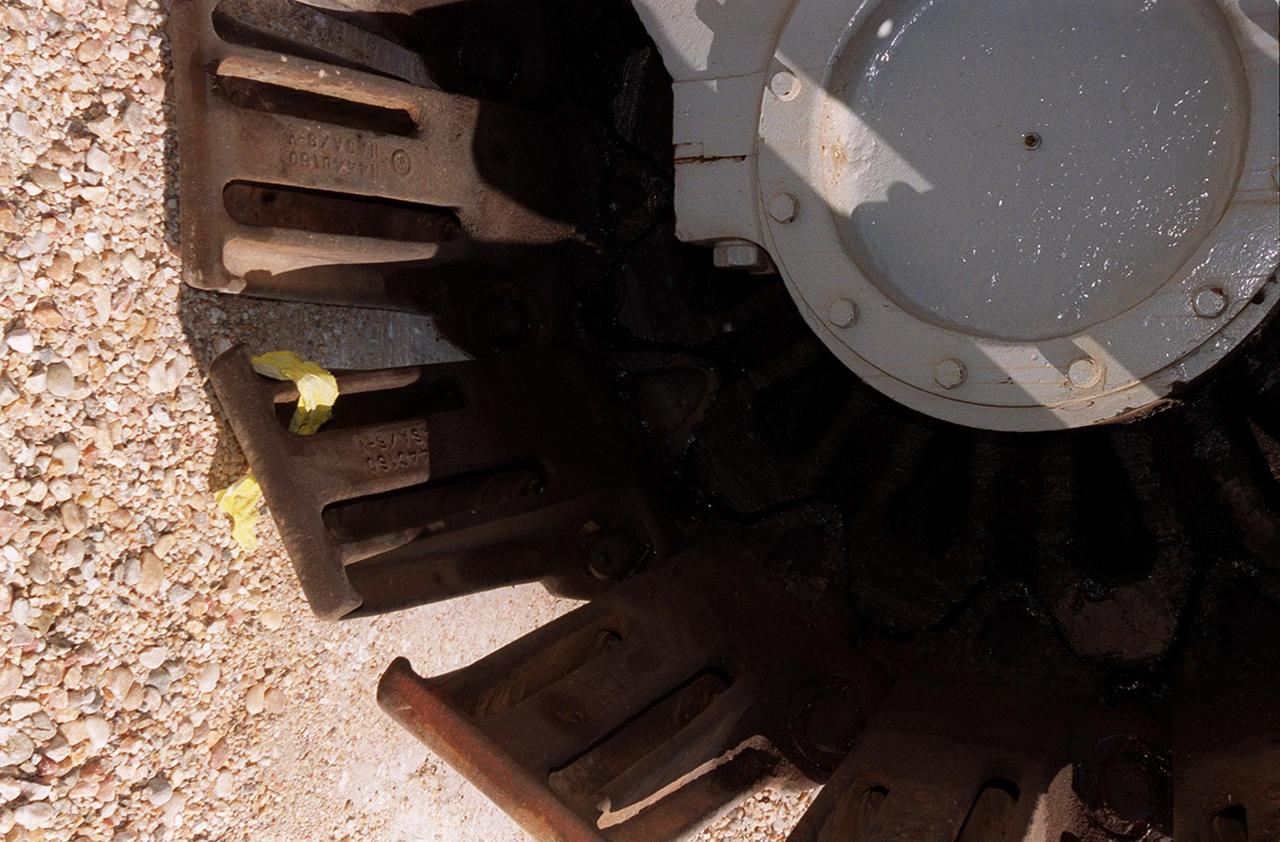
KENNEDY SPACE CENTER, FLA. -- A yellow tag identifies the crawler-transporter cleat that has a crack. The crack was noticed as the crawler-transporter was moving Space Shuttle Endeavour to Launch Pad 39B. Rollout was delayed until the cleat could be replaced. The Space Shuttle was hard down on the pad several hours later. Endeavour is scheduled to be launched Nov. 30 at 10:01 p.m. EST on mission STS-97, the sixth construction flight to the International Space Station. Its payload includes the P6 Integrated Truss Structure and a photovoltaic (PV) module, with giant solar arrays that will provide power to the Station. The mission includes two spacewalks to complete the solar array connections
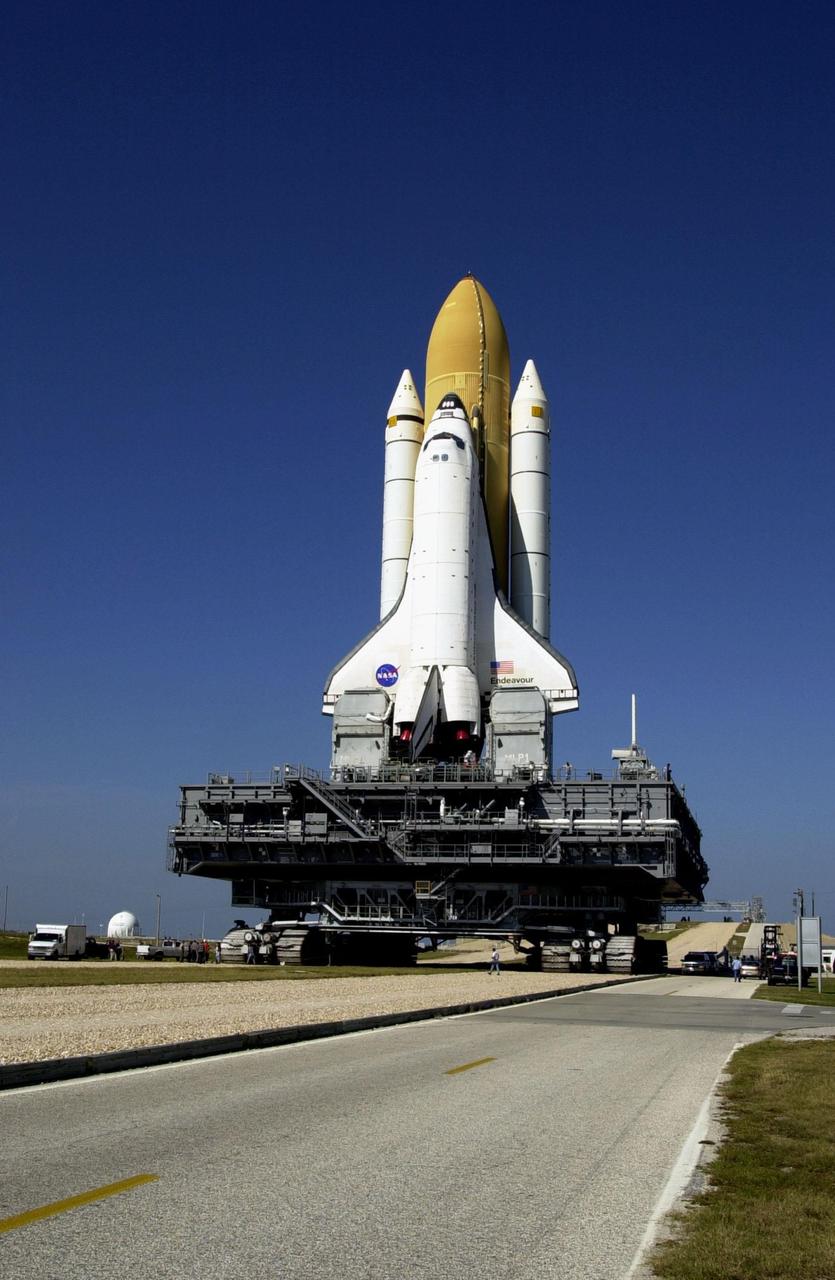
KENNEDY SPACE CENTER, Fla. -- Space Shuttle Endeavour is again on level ground after its backward trek from Launch Pad 39B. A broken cleat on the crawler-transporter forced the reverse movement so the cleat could be repaired before moving up the incline to the top of the pad. Endeavour is scheduled to be launched Nov. 30 at 10:01 p.m. EST on mission STS-97, the sixth construction flight to the International Space Station. Its payload includes the P6 Integrated Truss Structure and a photovoltaic (PV) module, with giant solar arrays that will provide power to the Station. The mission includes two spacewalks to complete the solar array connections
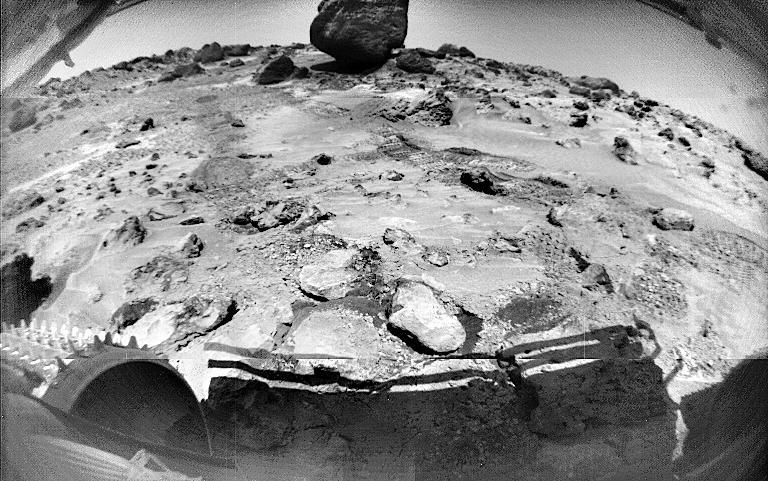
This Sojourner image, taken on Sol 70, shows rocks and rover-disturbed soil. Cleats on Sojourner's left front wheel are seen at lower left. The large rock in the distance is "Yogi." Much of Yogi visible in this image cannot be seen from the perspective of the Pathfinder lander. Sojourner spent 83 days of a planned seven-day mission exploring the Martian terrain, acquiring images, and taking chemical, atmospheric and other measurements. The final data transmission received from Pathfinder was at 10:23 UTC on September 27, 1997. Although mission managers tried to restore full communications during the following five months, the successful mission was terminated on March 10, 1998. http://photojournal.jpl.nasa.gov/catalog/PIA00998
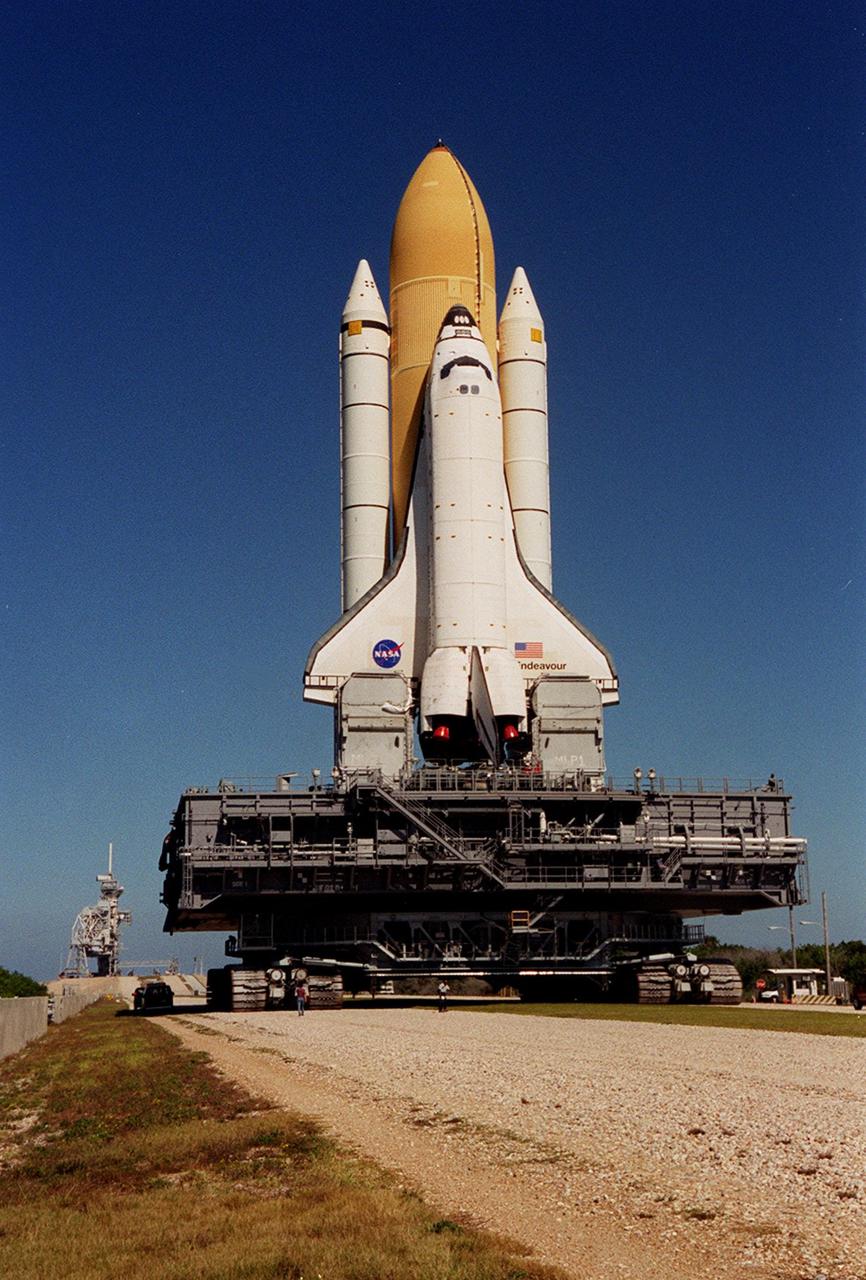
KENNEDY SPACE CENTER, FLA. -- Space Shuttle Endeavour approaches the incline to Launch Pad 39B, where the Rotating and Fixed Service Structures can be seen in the background to the left. Moments after this photo was taken, workers noticed one of the crawler-transporter cleats was cracked and rollout was delayed until the cleat could be replaced. The Space Shuttle was hard down on the pad several hours later. Endeavour is scheduled to be launched Nov. 30 at 10:01 p.m. EST on mission STS-97, the sixth construction flight to the International Space Station. Its payload includes the P6 Integrated Truss Structure and a photovoltaic (PV) module, with giant solar arrays that will provide power to the Station. The mission includes two spacewalks to complete the solar array connections
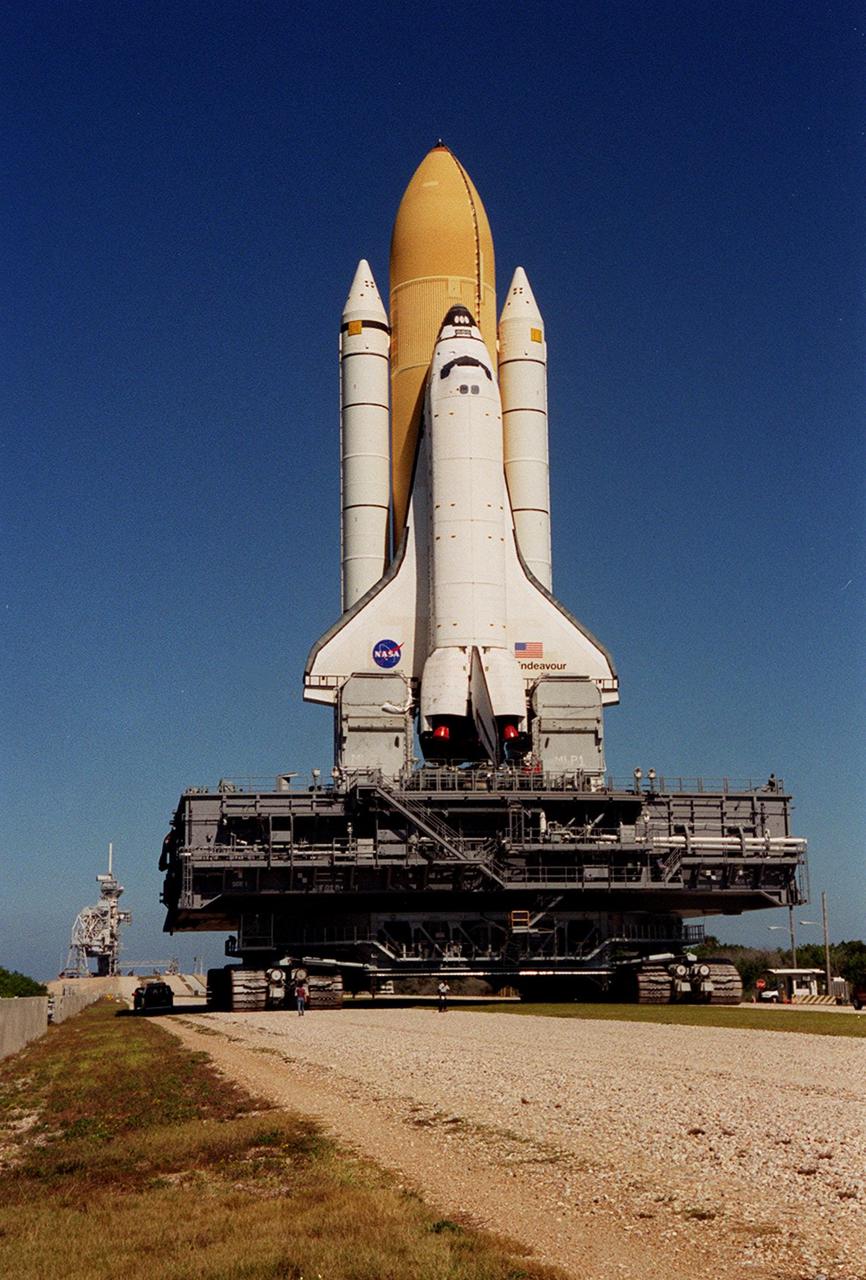
KENNEDY SPACE CENTER, FLA. -- Space Shuttle Endeavour approaches the incline to Launch Pad 39B, where the Rotating and Fixed Service Structures can be seen in the background to the left. Moments after this photo was taken, workers noticed one of the crawler-transporter cleats was cracked and rollout was delayed until the cleat could be replaced. The Space Shuttle was hard down on the pad several hours later. Endeavour is scheduled to be launched Nov. 30 at 10:01 p.m. EST on mission STS-97, the sixth construction flight to the International Space Station. Its payload includes the P6 Integrated Truss Structure and a photovoltaic (PV) module, with giant solar arrays that will provide power to the Station. The mission includes two spacewalks to complete the solar array connections
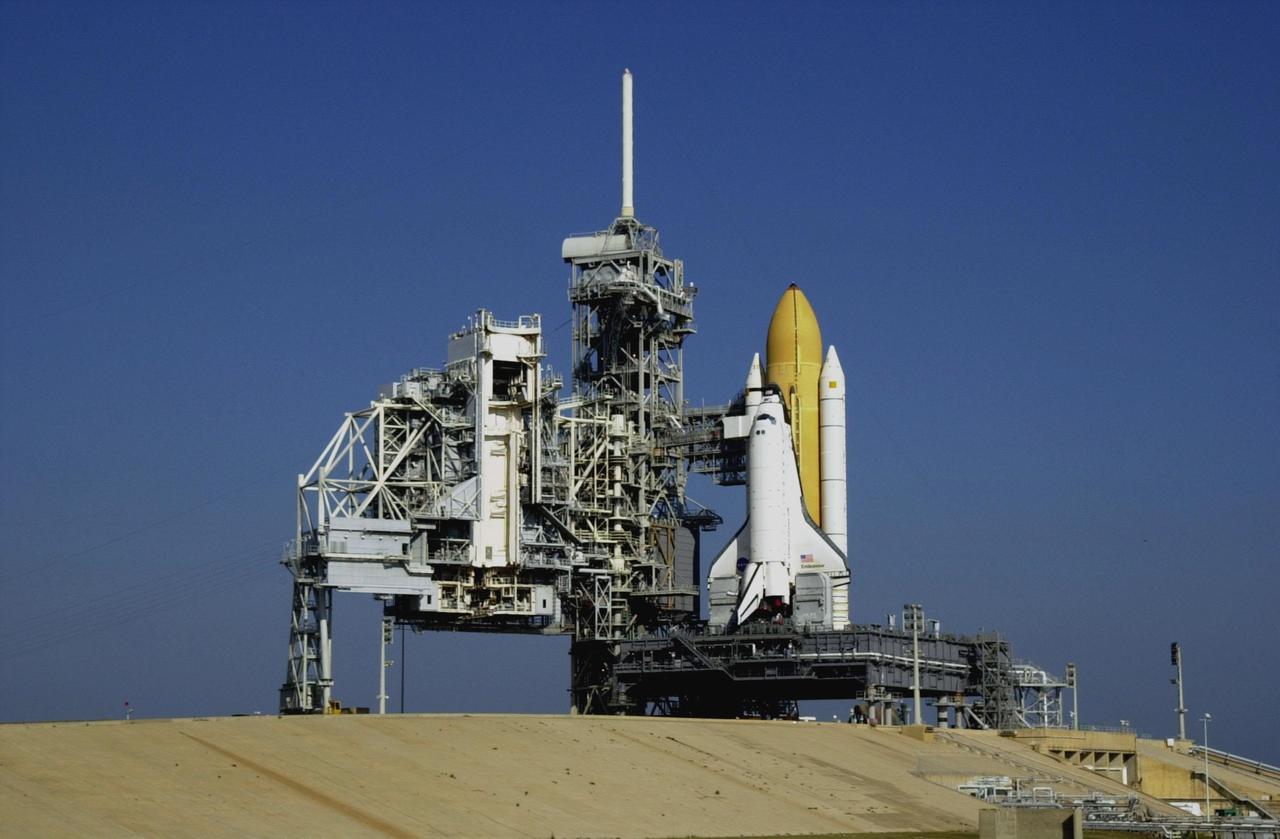
After repair of a cracked cleat on the crawler-transporter, Space Shuttle Endeavour finally rests on Launch Pad 39B. To the left is the Rotating Service Structure. Endeavour is scheduled to be launched Nov. 30 at 10:01 p.m. EST on mission STS-97, the sixth construction flight to the International Space Station. Its payload includes the P6 Integrated Truss Structure and a photovoltaic (PV) module, with giant solar arrays that will provide power to the Station. The mission includes two spacewalks to complete the solar array connections
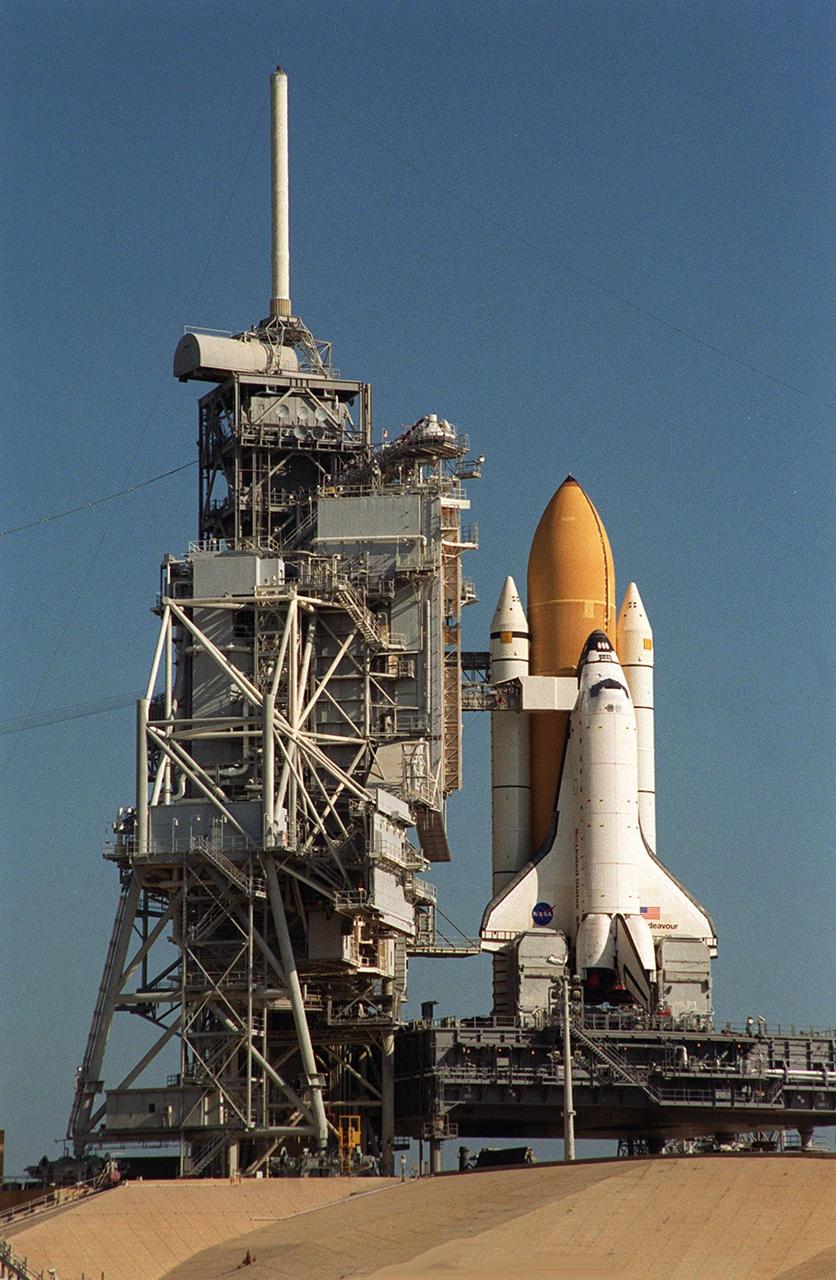
KENNEDY SPACE CENTER, FLA. -- Space Shuttle Endeavour finally rests on Launch Pad 39B after its rollout was delayed several hours to fix a broken cleat on the crawler-transporter. At the far left is the Rotating Service Structure. From the Fixed Service Structure, the Orbiter Access Arm is already extended to the orbiter. Endeavour is scheduled to be launched Nov. 30 at 10:01 p.m. EST on mission STS-97, the sixth construction flight to the International Space Station. Its payload includes the P6 Integrated Truss Structure and a photovoltaic (PV) module, with giant solar arrays that will provide power to the Station. The mission includes two spacewalks to complete the solar array connections
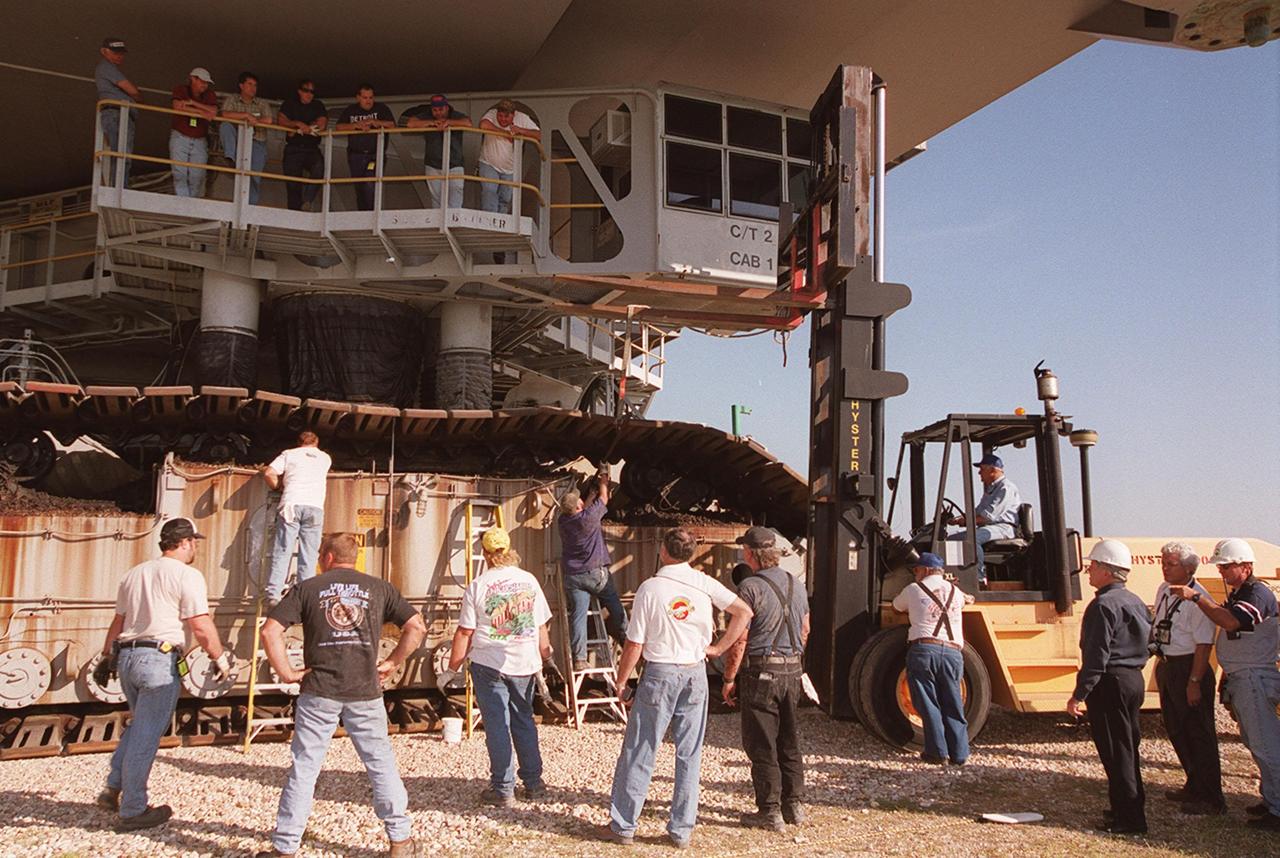
KENNEDY SPACE CENTER, FLA. -- Workers stand by while the broken cleat (shoe) on the crawler-transporter is removed. The crack was noticed as the crawler-transporter, moving Space Shuttle Endeavour to Launch Pad 39B, started up the incline to the pad. Endeavour is scheduled to be launched Nov. 30 at 10:01 p.m. EST on mission STS-97, the sixth construction flight to the International Space Station. Its payload includes the P6 Integrated Truss Structure and a photovoltaic (PV) module, with giant solar arrays that will provide power to the Station. The mission includes two spacewalks to complete the solar array connections
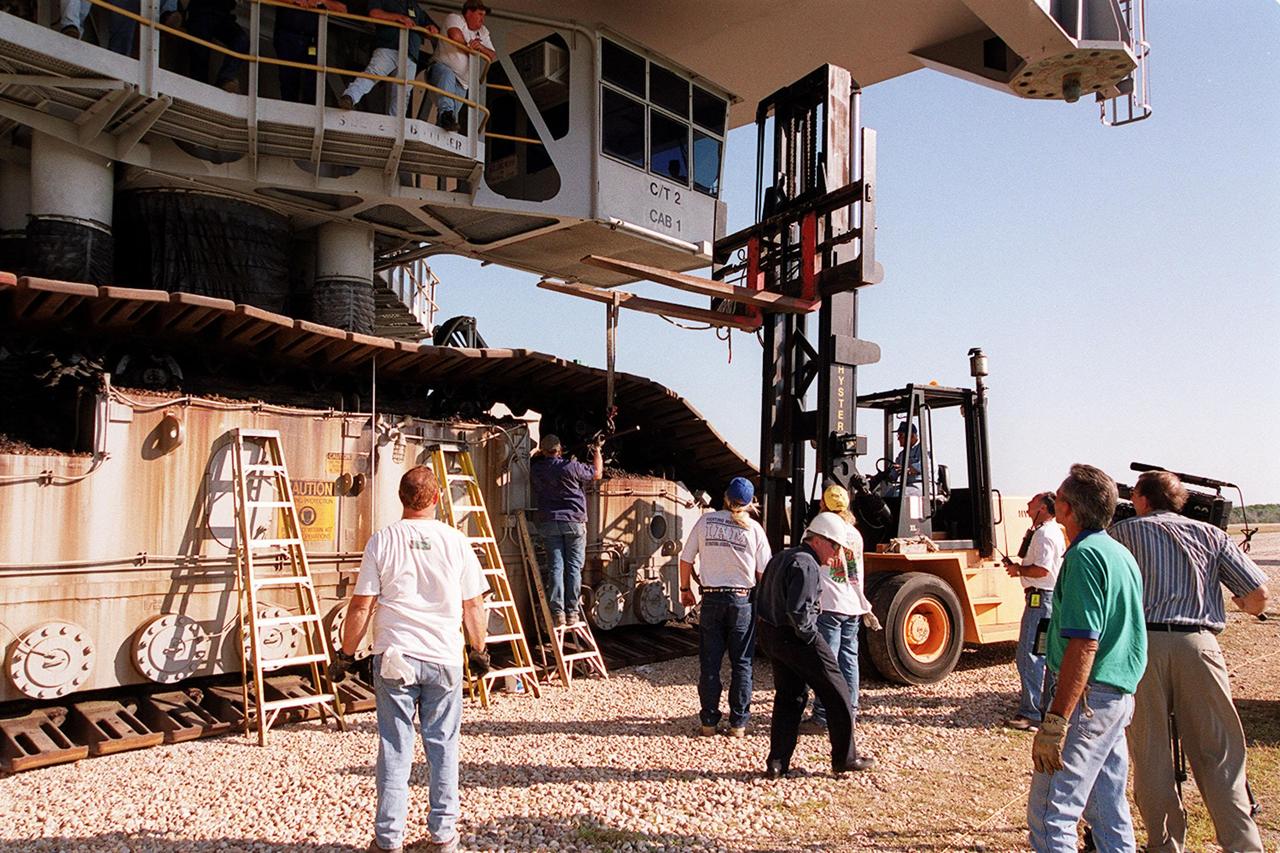
KENNEDY SPACE CENTER, FLA. -- A repair crew works to remove a broken cleat (shoe) on the crawler-transporter moving the Space Shuttle Endeavour to Launch Pad 39B. The crack was noticed as the crawler-transporter started up the incline to the pad. Endeavour is scheduled to be launched Nov. 30 at 10:01 p.m. EST on mission STS-97, the sixth construction flight to the International Space Station. Its payload includes the P6 Integrated Truss Structure and a photovoltaic (PV) module, with giant solar arrays that will provide power to the Station. The mission includes two spacewalks to complete the solar array connections
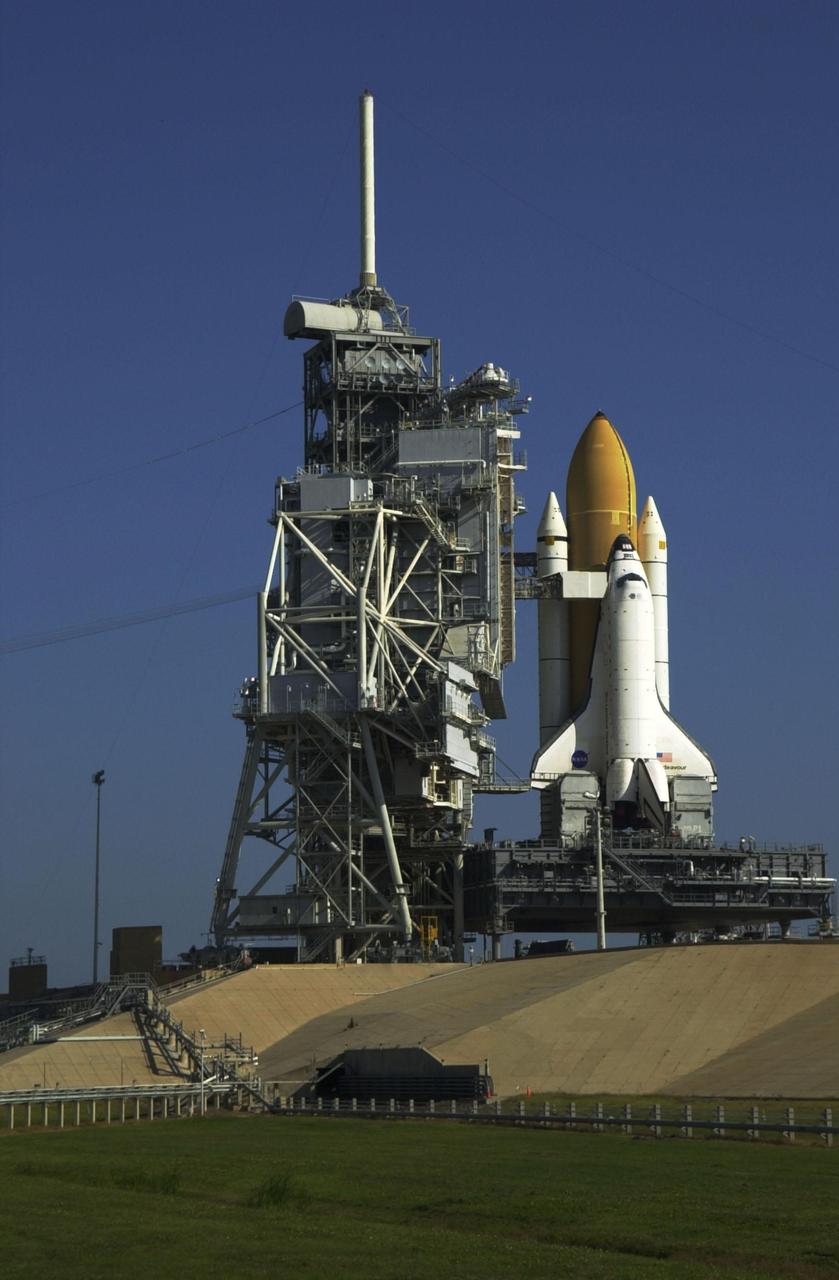
Space Shuttle Endeavour finally rests on Launch Pad 39B after its rollout was stalled several hours to fix a broken cleat on the crawler-transporter. To the left is the Rotating Service Structure. The Orbiter Access Arm is already extended from the Fixed Service Structure to the orbiter. Endeavour is scheduled to be launched Nov. 30 at 10:01 p.m. EST on mission STS-97, the sixth construction flight to the International Space Station. Its payload includes the P6 Integrated Truss Structure and a photovoltaic (PV) module, with giant solar arrays that will provide power to the Station. The mission includes two spacewalks to complete the solar array connections
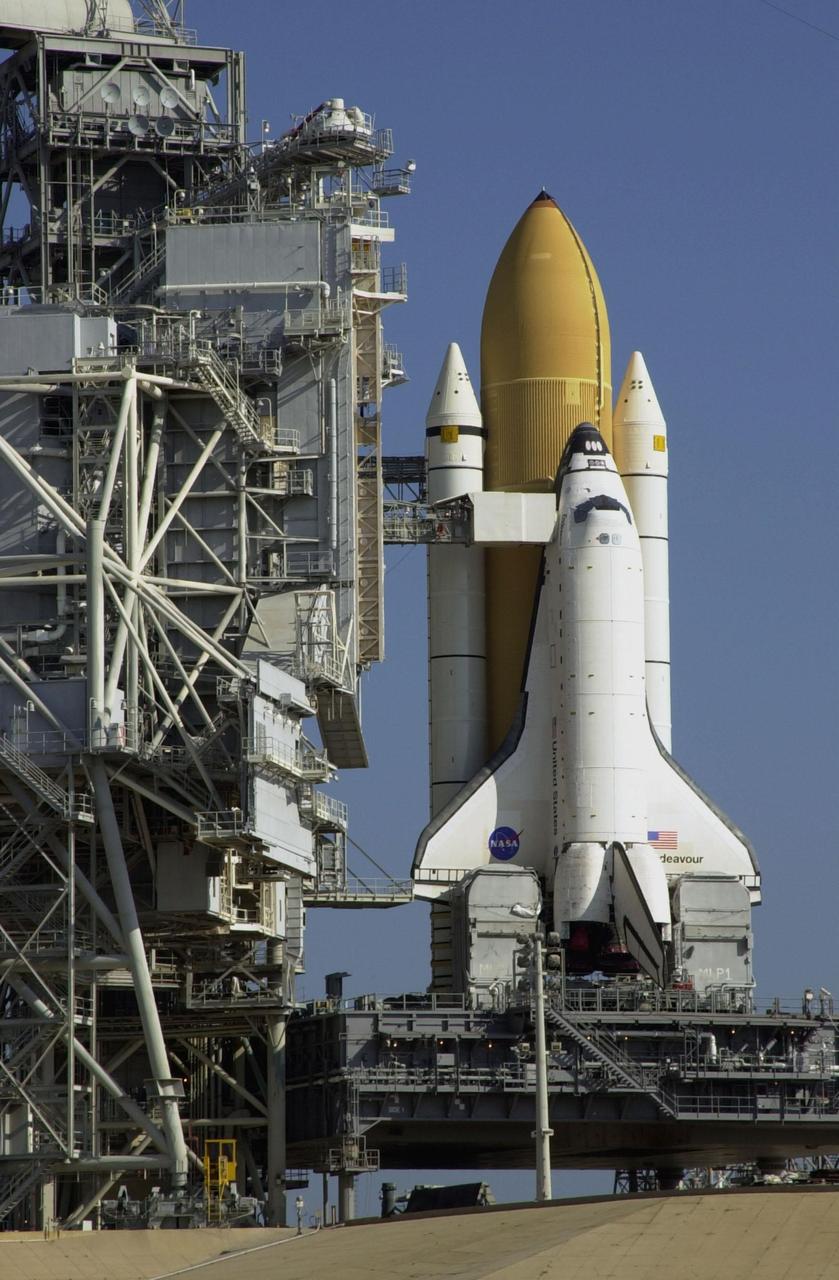
Space Shuttle Endeavour finally rests on Launch Pad 39B after its rollout was stalled several hours to fix a broken cleat on the crawler-transporter. At the far left is the Rotating Service Structure. From the Fixed Service Structure, the Orbiter Access Arm is already extended to the orbiter. Endeavour is scheduled to be launched Nov. 30 at 10:01 p.m. EST on mission STS-97, the sixth construction flight to the International Space Station. Its payload includes the P6 Integrated Truss Structure and a photovoltaic (PV) module, with giant solar arrays that will provide power to the Station. The mission includes two spacewalks to complete the solar array connections
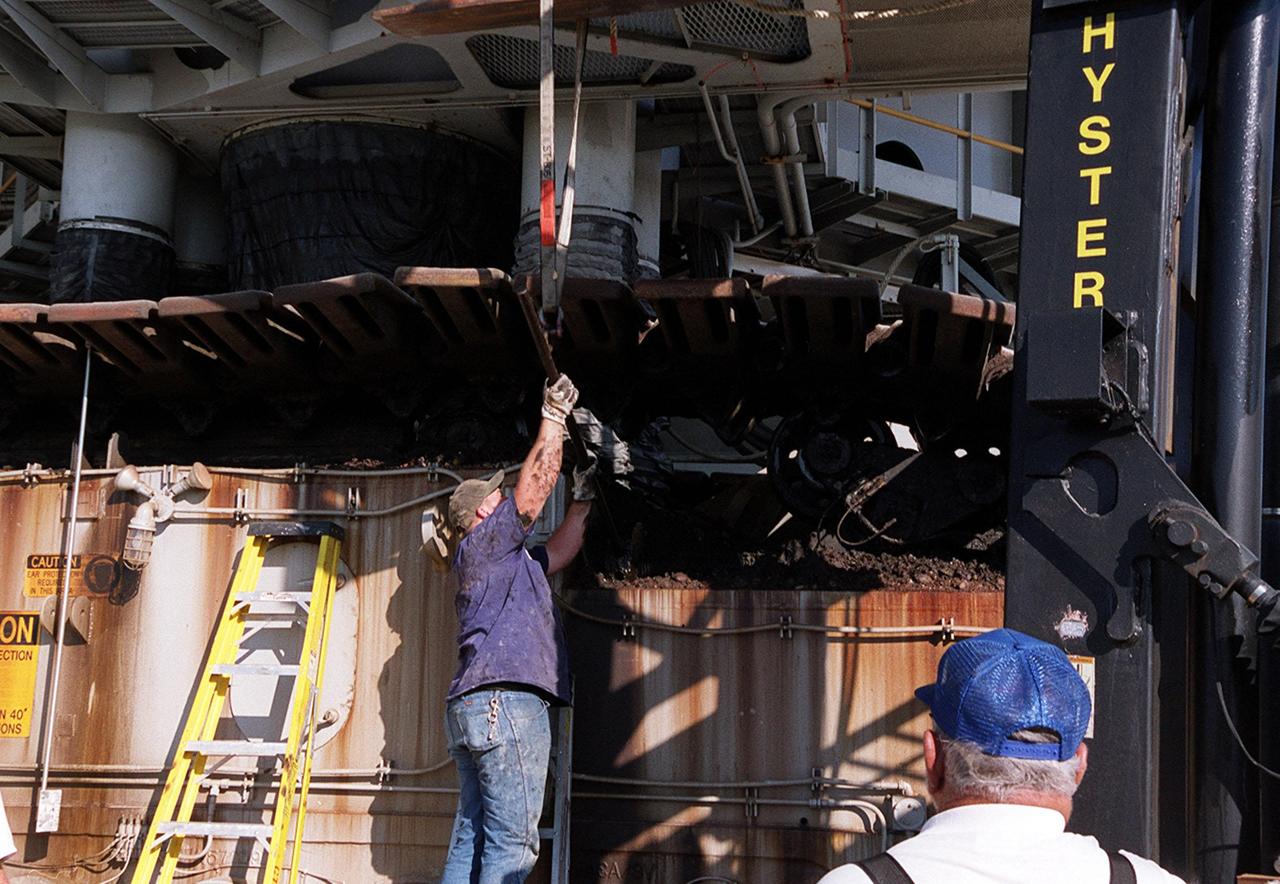
KENNEDY SPACE CENTER, FLA. -- A worker adjusts equipment to remove a broken cleat (shoe) on the crawler-transporter moving the Space Shuttle Endeavour to Launch Pad 39B. The crack was noticed as the crawler-transporter started up the incline to the pad. Endeavour is scheduled to be launched Nov. 30 at 10:01 p.m. EST on mission STS-97, the sixth construction flight to the International Space Station. Its payload includes the P6 Integrated Truss Structure and a photovoltaic (PV) module, with giant solar arrays that will provide power to the Station. The mission includes two spacewalks to complete the solar array connections
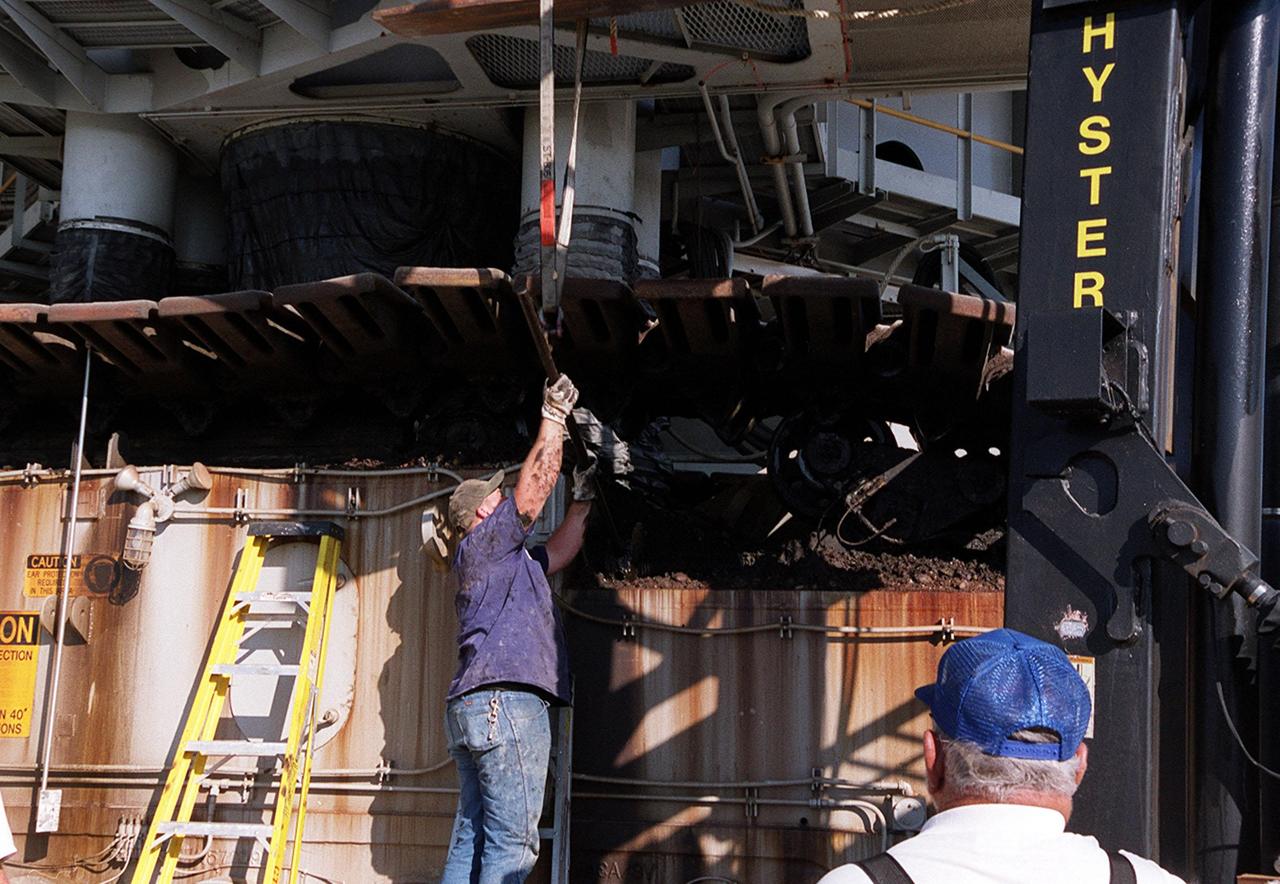
KENNEDY SPACE CENTER, FLA. -- A worker adjusts equipment to remove a broken cleat (shoe) on the crawler-transporter moving the Space Shuttle Endeavour to Launch Pad 39B. The crack was noticed as the crawler-transporter started up the incline to the pad. Endeavour is scheduled to be launched Nov. 30 at 10:01 p.m. EST on mission STS-97, the sixth construction flight to the International Space Station. Its payload includes the P6 Integrated Truss Structure and a photovoltaic (PV) module, with giant solar arrays that will provide power to the Station. The mission includes two spacewalks to complete the solar array connections
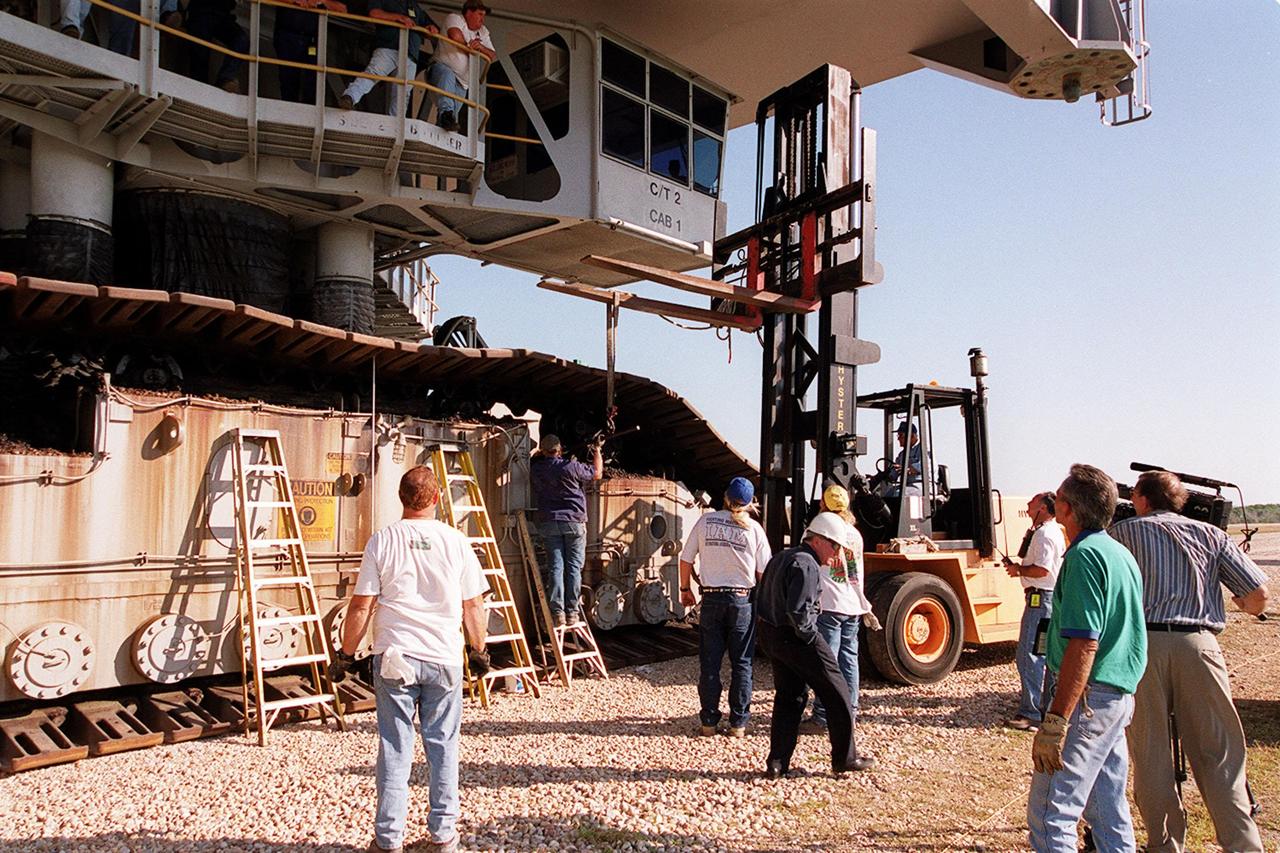
KENNEDY SPACE CENTER, FLA. -- A repair crew works to remove a broken cleat (shoe) on the crawler-transporter moving the Space Shuttle Endeavour to Launch Pad 39B. The crack was noticed as the crawler-transporter started up the incline to the pad. Endeavour is scheduled to be launched Nov. 30 at 10:01 p.m. EST on mission STS-97, the sixth construction flight to the International Space Station. Its payload includes the P6 Integrated Truss Structure and a photovoltaic (PV) module, with giant solar arrays that will provide power to the Station. The mission includes two spacewalks to complete the solar array connections
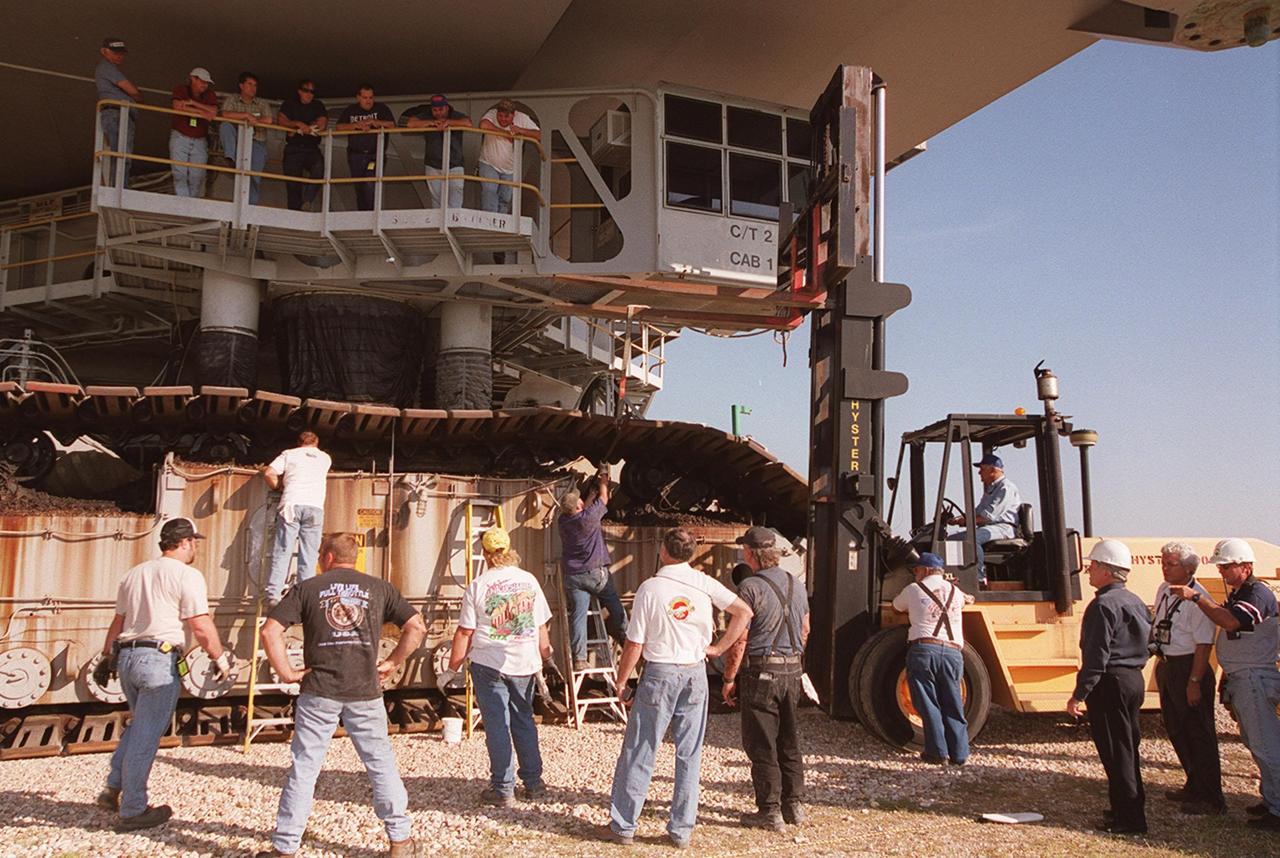
KENNEDY SPACE CENTER, FLA. -- Workers stand by while the broken cleat (shoe) on the crawler-transporter is removed. The crack was noticed as the crawler-transporter, moving Space Shuttle Endeavour to Launch Pad 39B, started up the incline to the pad. Endeavour is scheduled to be launched Nov. 30 at 10:01 p.m. EST on mission STS-97, the sixth construction flight to the International Space Station. Its payload includes the P6 Integrated Truss Structure and a photovoltaic (PV) module, with giant solar arrays that will provide power to the Station. The mission includes two spacewalks to complete the solar array connections
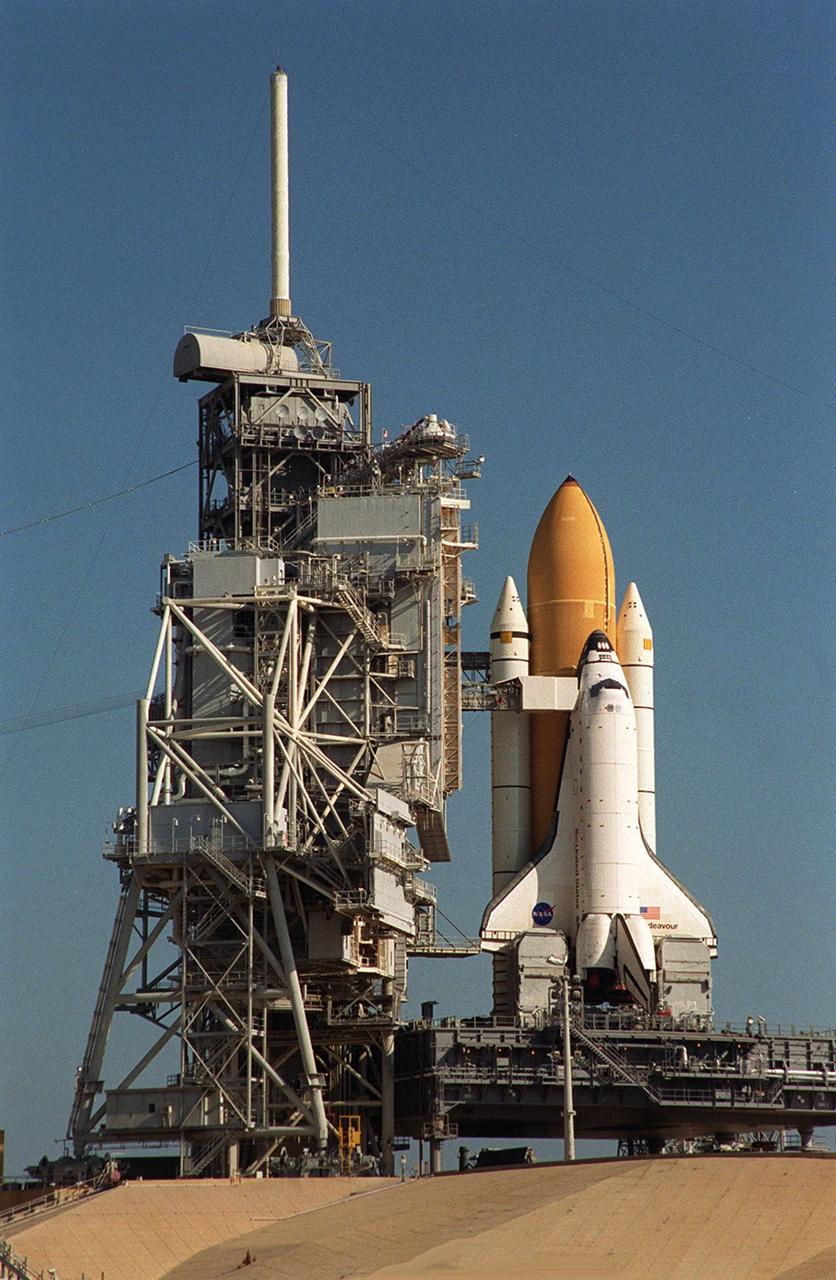
KENNEDY SPACE CENTER, FLA. -- Space Shuttle Endeavour finally rests on Launch Pad 39B after its rollout was delayed several hours to fix a broken cleat on the crawler-transporter. At the far left is the Rotating Service Structure. From the Fixed Service Structure, the Orbiter Access Arm is already extended to the orbiter. Endeavour is scheduled to be launched Nov. 30 at 10:01 p.m. EST on mission STS-97, the sixth construction flight to the International Space Station. Its payload includes the P6 Integrated Truss Structure and a photovoltaic (PV) module, with giant solar arrays that will provide power to the Station. The mission includes two spacewalks to complete the solar array connections
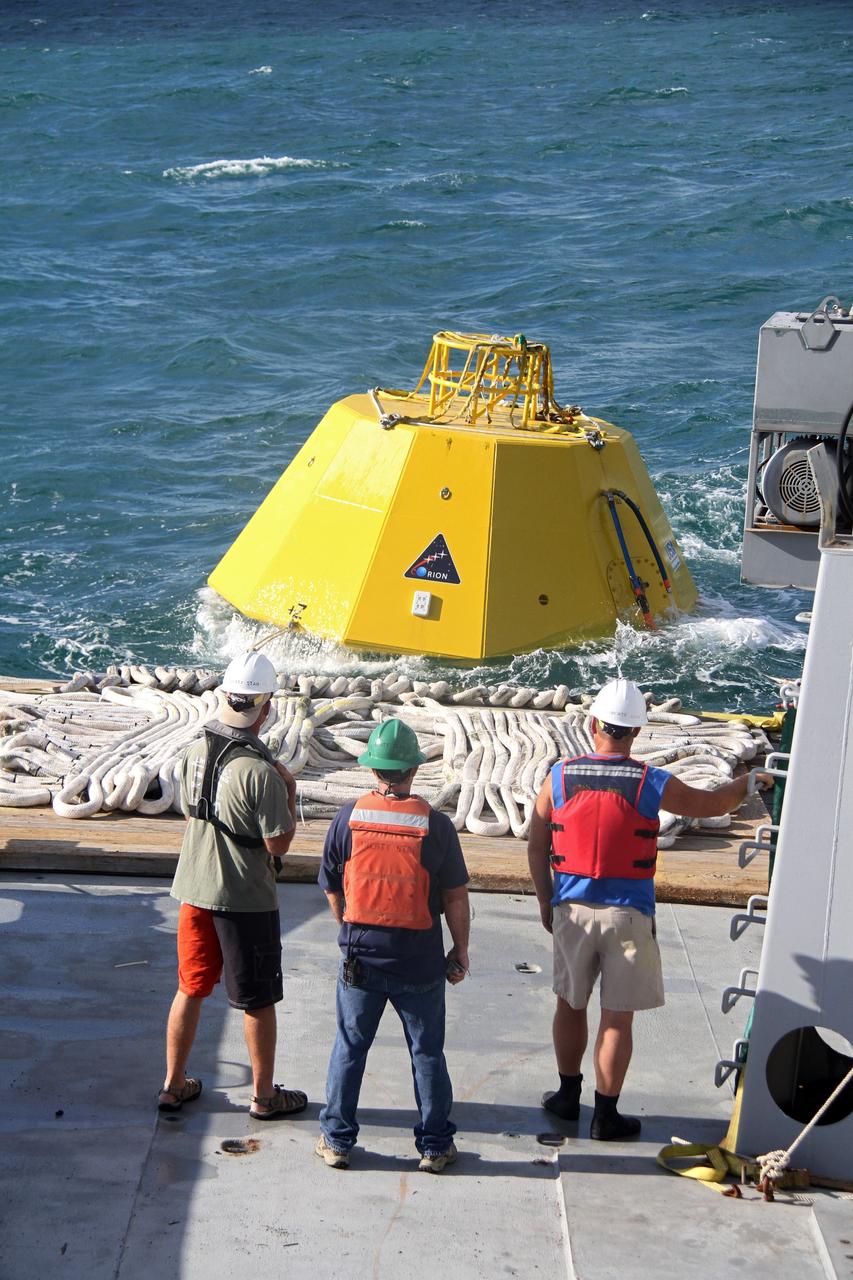
CAPE CANAVERAL, Fla. – Workers on the deck of NASA's Liberty Star ship prepare for testing in the Atlantic Ocean of an Orion flight test capsule to begin. The Crew Module Recovery Attach Fitting Test (CRAFT) on the capsule, which began at-sea operations Nov. 29, is under way. Multiple attach clips are being evaluated against the current recovery cleat configuration by U.S. Air Force pararescue jumpers (PJs) and a U.S. Navy diver. The 21st Century Ground Systems Program will use data collected from the tests to help develop ground operations support equipment that could be used to recover an uncrewed Orion flight test capsule after splashdown. The Orion Multi-Purpose Crew Vehicle is NASA's next-generation spacecraft being developed for deep space missions to asteroids, moons and other interplanetary destinations throughout the solar system. For more information, visit http://www.nasa.gov/orion. Photo credit: NASA/Cory Huston
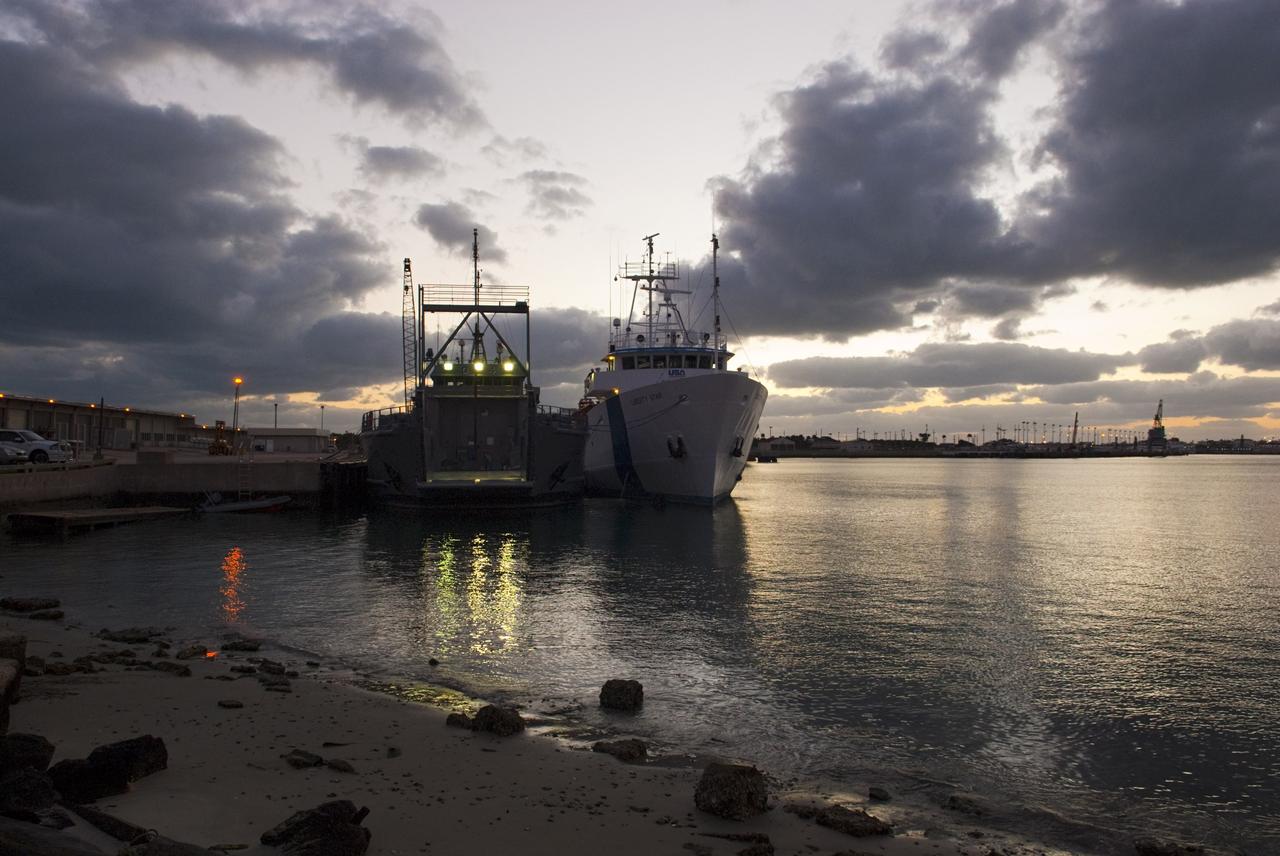
CAPE CANAVERAL, Fla. – Dawn at Port Canaveral in Florida finds preparations under way for the departure of NASA's Liberty Star ship. Liberty Star has been enlisted to support the Crew Module Recovery Attach Fitting Test (CRAFT) which began at-sea operations Nov. 29. Multiple attach clips are being evaluated against the current recovery cleat configuration by U.S. Air Force pararescue jumpers (PJs) and a U.S. Navy diver. The 21st Century Ground Systems Program will use data collected from the tests to help develop ground operations support equipment that could be used to recover an uncrewed Orion flight test capsule after splashdown. The Orion Multi-Purpose Crew Vehicle is NASA's next-generation spacecraft being developed for deep space missions to asteroids, moons and other interplanetary destinations throughout the solar system. For more information, visit http://www.nasa.gov/orion. Photo credit: NASA/Tim Jacobs
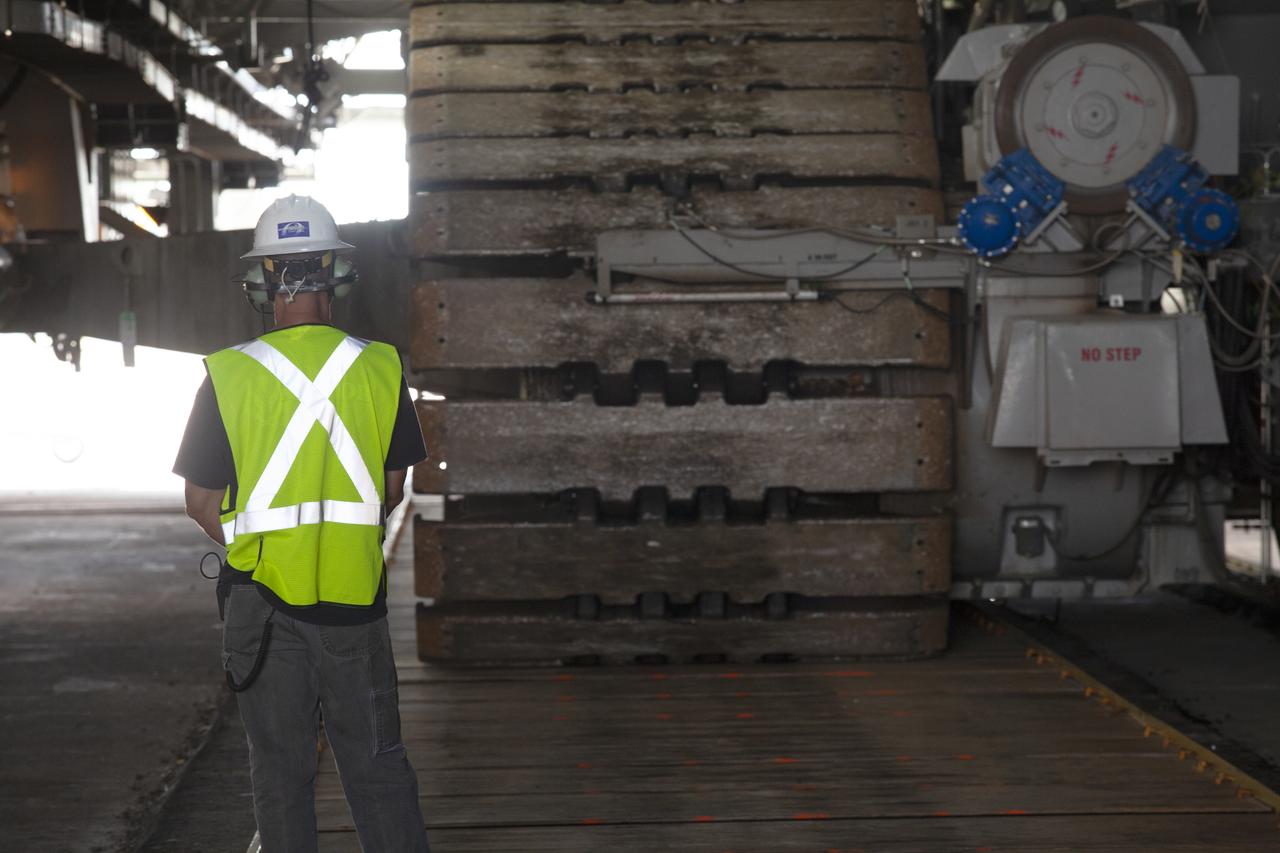
The giant cleats of crawler-transporter 2 are in view as a technician monitors the progress of the move of NASA's mobile launcher, atop the crawler, into High Bay 3 at the Vehicle Assembly Building (VAB) on Sept. 8, 2018, at NASA's Kennedy Space Center in Florida. The mobile launcher departed Launch Pad 39B after several days of testing with the pad. This is the first time that the modified mobile launcher made the trip to the pad and the VAB. The mobile launcher will spend seven months in the VAB undergoing testing. The 380-foot-tall structure is equipped with the crew access arm and several umbilicals that will provide power, environmental control, pneumatics, communication and electrical connections to the agency's Space Launch System and Orion spacecraft. Exploration Ground Systems is preparing the ground systems necessary to launch SLS and Orion on Exploration Mission-1, missions to the Moon and on to Mars.
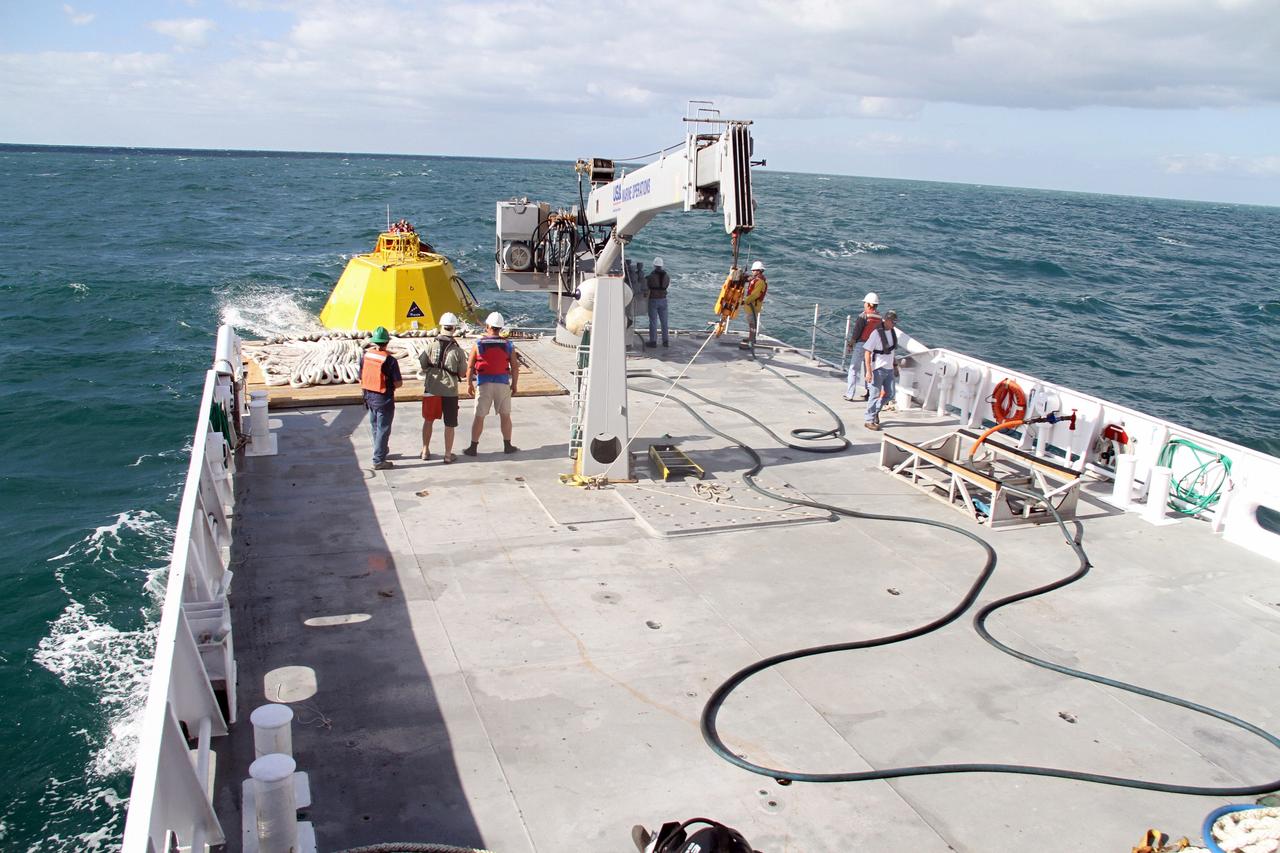
CAPE CANAVERAL, Fla. – Workers on the deck of NASA's Liberty Star ship prepare for testing in the Atlantic Ocean of an Orion flight test capsule to begin. The Crew Module Recovery Attach Fitting Test (CRAFT) on the capsule, which began at-sea operations Nov. 29, is under way. Multiple attach clips are being evaluated against the current recovery cleat configuration by U.S. Air Force pararescue jumpers (PJs) and a U.S. Navy diver. The 21st Century Ground Systems Program will use data collected from the tests to help develop ground operations support equipment that could be used to recover an uncrewed Orion flight test capsule after splashdown. The Orion Multi-Purpose Crew Vehicle is NASA's next-generation spacecraft being developed for deep space missions to asteroids, moons and other interplanetary destinations throughout the solar system. For more information, visit http://www.nasa.gov/orion. Photo credit: NASA/Cory Huston
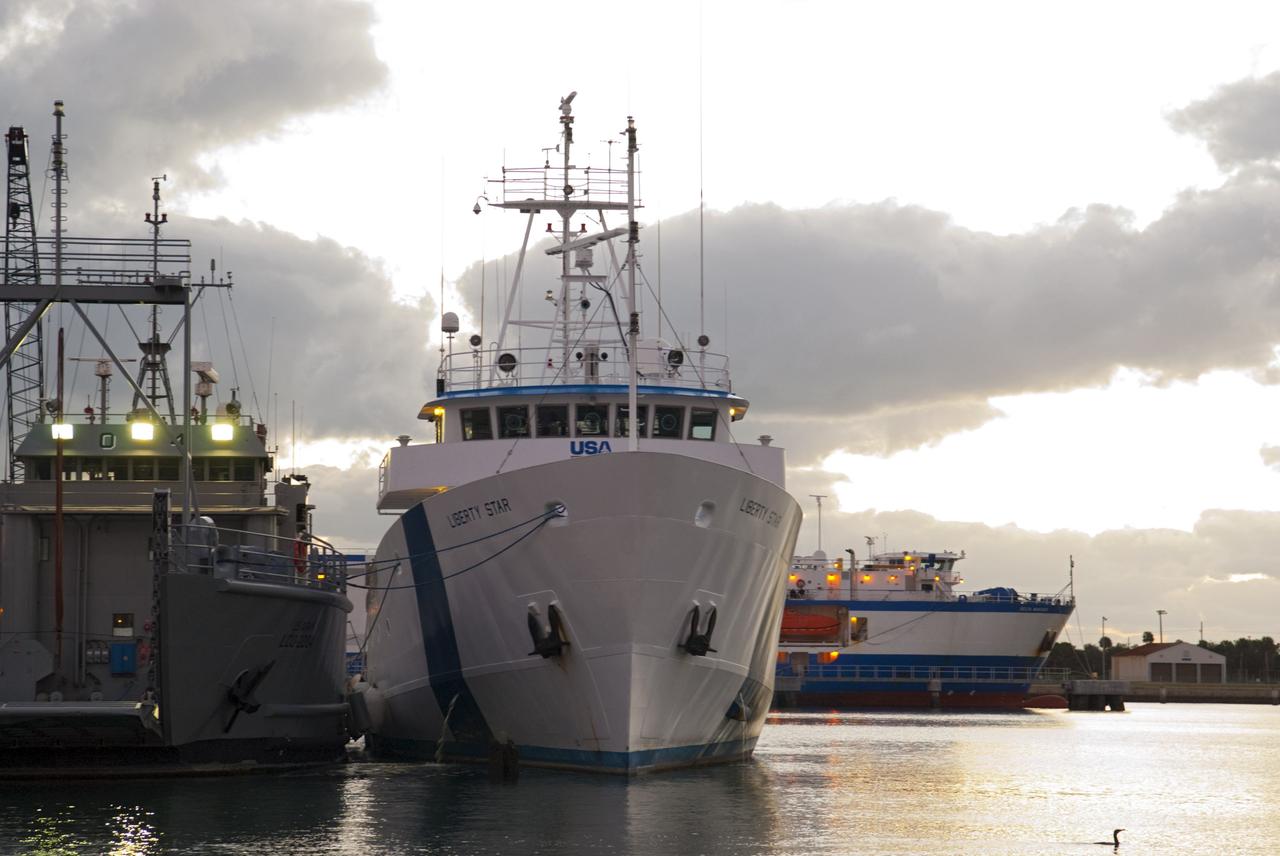
CAPE CANAVERAL, Fla. – Preparations are under way at Port Canaveral in Florida for the early-morning departure of NASA's Liberty Star ship. Liberty Star has been enlisted to support the Crew Module Recovery Attach Fitting Test (CRAFT) which began at-sea operations Nov. 29. Multiple attach clips are being evaluated against the current recovery cleat configuration by U.S. Air Force pararescue jumpers (PJs) and a U.S. Navy diver. The 21st Century Ground Systems Program will use data collected from the tests to help develop ground operations support equipment that could be used to recover an uncrewed Orion flight test capsule after splashdown. The Orion Multi-Purpose Crew Vehicle is NASA's next-generation spacecraft being developed for deep space missions to asteroids, moons and other interplanetary destinations throughout the solar system. For more information, visit http://www.nasa.gov/orion. Photo credit: NASA/Tim Jacobs
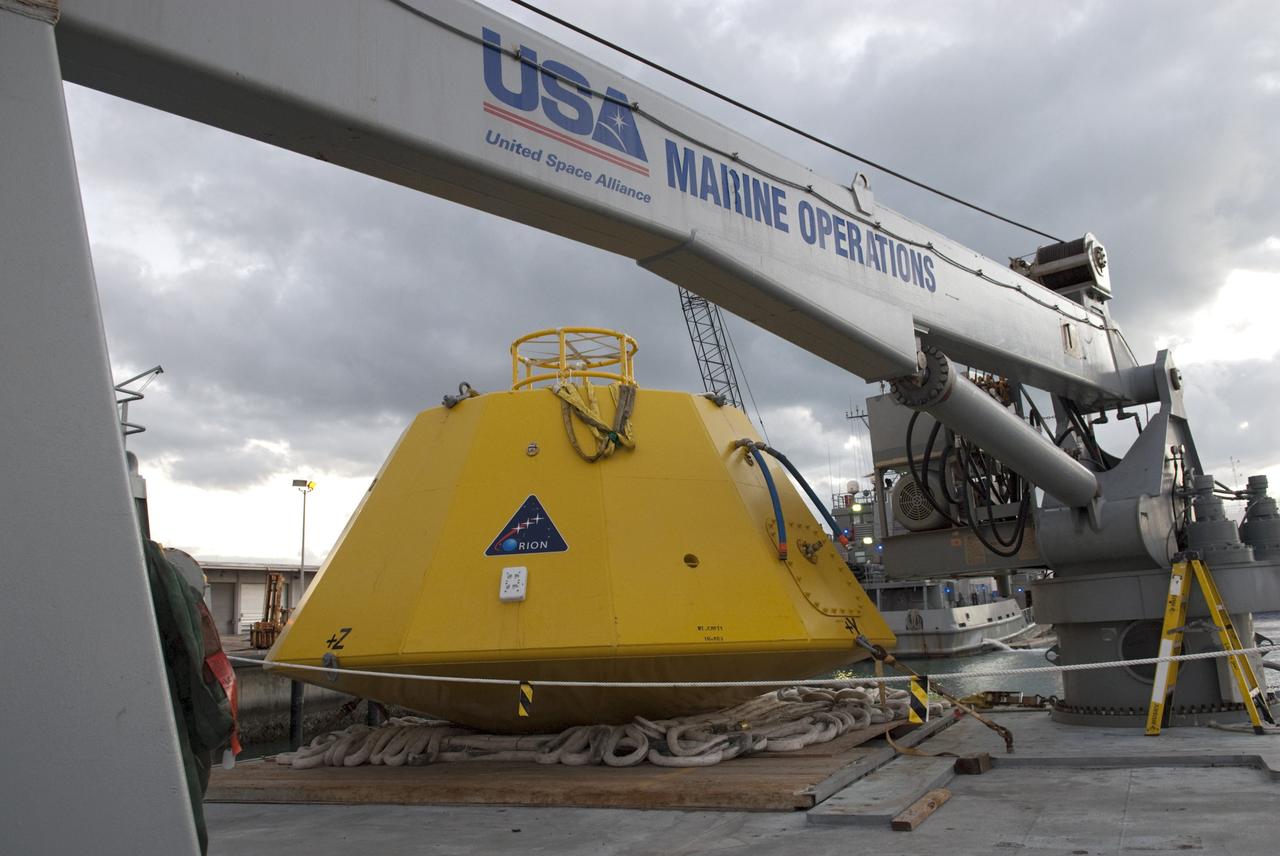
CAPE CANAVERAL, Fla. – At Port Canaveral in Florida, an Orion flight test capsule is secured to the deck of NASA's Liberty Star ship. Liberty Star has been enlisted to support the Crew Module Recovery Attach Fitting Test (CRAFT) which began at-sea operations Nov. 29. Multiple attach clips are being evaluated against the current recovery cleat configuration by U.S. Air Force pararescue jumpers (PJs) and a U.S. Navy diver. The 21st Century Ground Systems Program will use data collected from the tests to help develop ground operations support equipment that could be used to recover an uncrewed Orion flight test capsule after splashdown. The Orion Multi-Purpose Crew Vehicle is NASA's next-generation spacecraft being developed for deep space missions to asteroids, moons and other interplanetary destinations throughout the solar system. For more information, visit http://www.nasa.gov/orion. Photo credit: NASA/Tim Jacobs
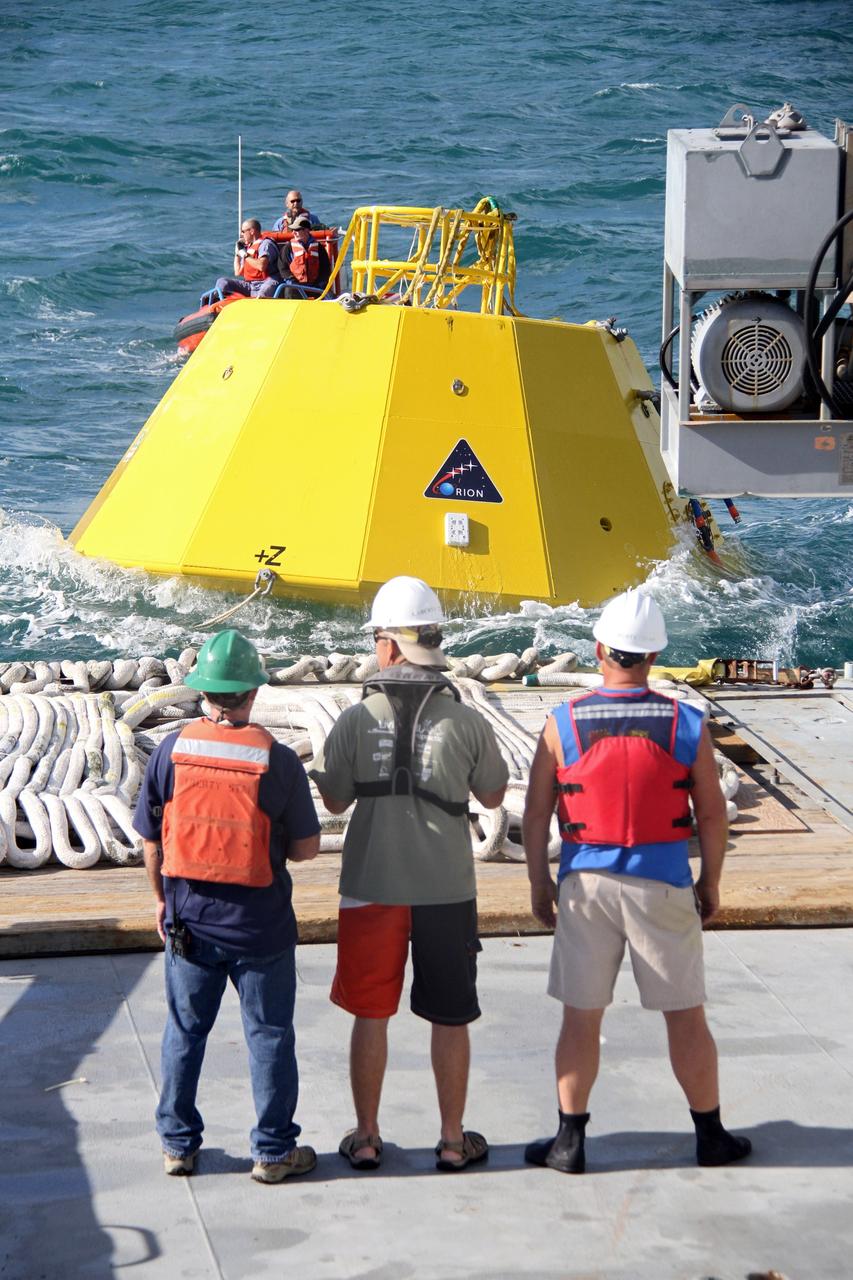
CAPE CANAVERAL, Fla. – Workers, on the deck of NASA's Liberty Star ship and in a boat in the Atlantic Ocean, prepare to begin testing of an Orion flight test capsule. The Crew Module Recovery Attach Fitting Test (CRAFT) on the capsule, which began at-sea operations Nov. 29, is under way. Multiple attach clips are being evaluated against the current recovery cleat configuration by U.S. Air Force pararescue jumpers (PJs) and a U.S. Navy diver. The 21st Century Ground Systems Program will use data collected from the tests to help develop ground operations support equipment that could be used to recover an uncrewed Orion flight test capsule after splashdown. The Orion Multi-Purpose Crew Vehicle is NASA's next-generation spacecraft being developed for deep space missions to asteroids, moons and other interplanetary destinations throughout the solar system. For more information, visit http://www.nasa.gov/orion. Photo credit: NASA/Cory Huston
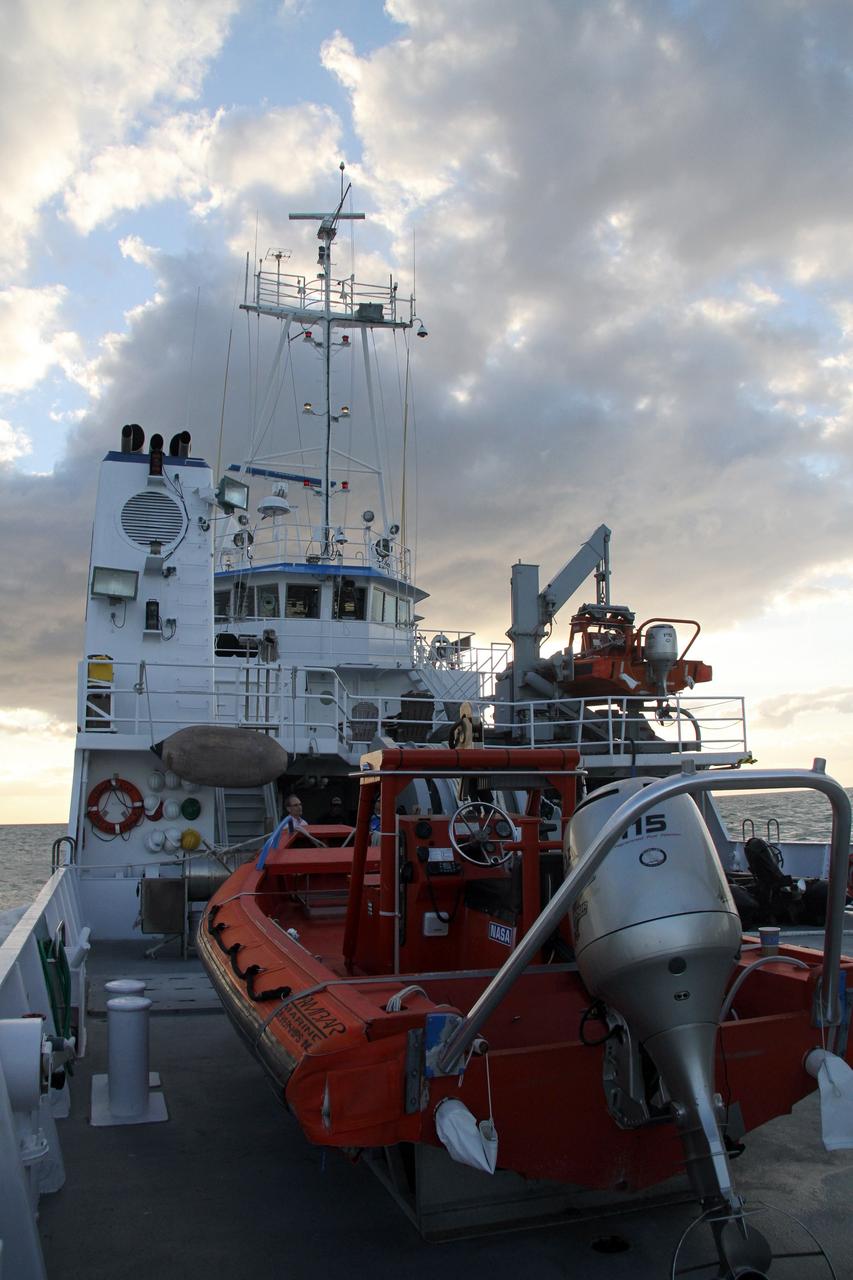
CAPE CANAVERAL, Fla. – NASA's Liberty Star ship heads into the Atlantic Ocean where tests will be performed on an Orion flight test capsule. The Crew Module Recovery Attach Fitting Test (CRAFT) on the capsule, which began at-sea operations Nov. 29, is under way. Multiple attach clips are being evaluated against the current recovery cleat configuration by U.S. Air Force pararescue jumpers (PJs) and a U.S. Navy diver. The 21st Century Ground Systems Program will use data collected from the tests to help develop ground operations support equipment that could be used to recover an uncrewed Orion flight test capsule after splashdown. The Orion Multi-Purpose Crew Vehicle is NASA's next-generation spacecraft being developed for deep space missions to asteroids, moons and other interplanetary destinations throughout the solar system. For more information, visit http://www.nasa.gov/orion. Photo credit: NASA/Cory Huston
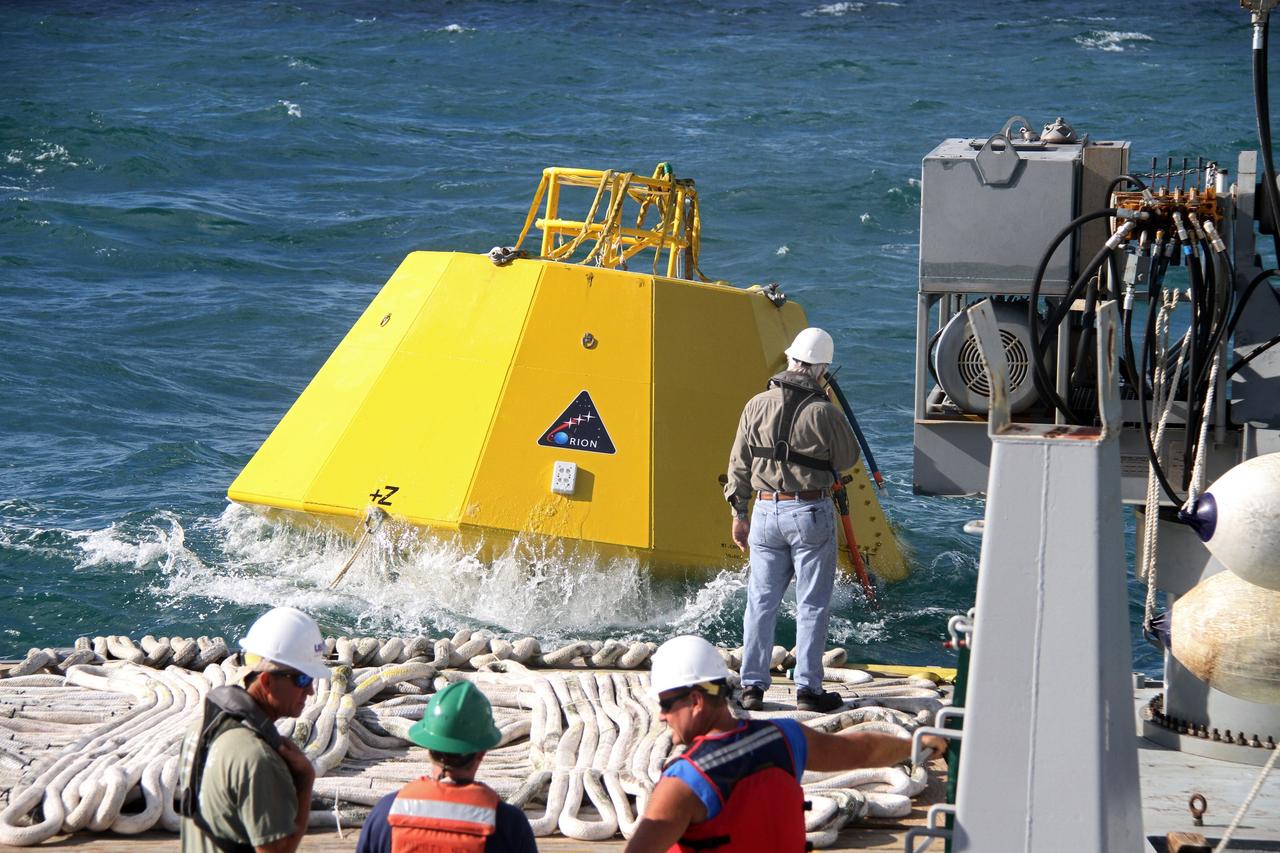
CAPE CANAVERAL, Fla. – An Orion flight test capsule makes a splash into the Atlantic Ocean as it slides from the deck of NASA's Liberty Star ship into the water. The Crew Module Recovery Attach Fitting Test (CRAFT) on the capsule, which began at-sea operations Nov. 29, is under way. Multiple attach clips are being evaluated against the current recovery cleat configuration by U.S. Air Force pararescue jumpers (PJs) and a U.S. Navy diver. The 21st Century Ground Systems Program will use data collected from the tests to help develop ground operations support equipment that could be used to recover an uncrewed Orion flight test capsule after splashdown. The Orion Multi-Purpose Crew Vehicle is NASA's next-generation spacecraft being developed for deep space missions to asteroids, moons and other interplanetary destinations throughout the solar system. For more information, visit http://www.nasa.gov/orion. Photo credit: NASA/Cory Huston
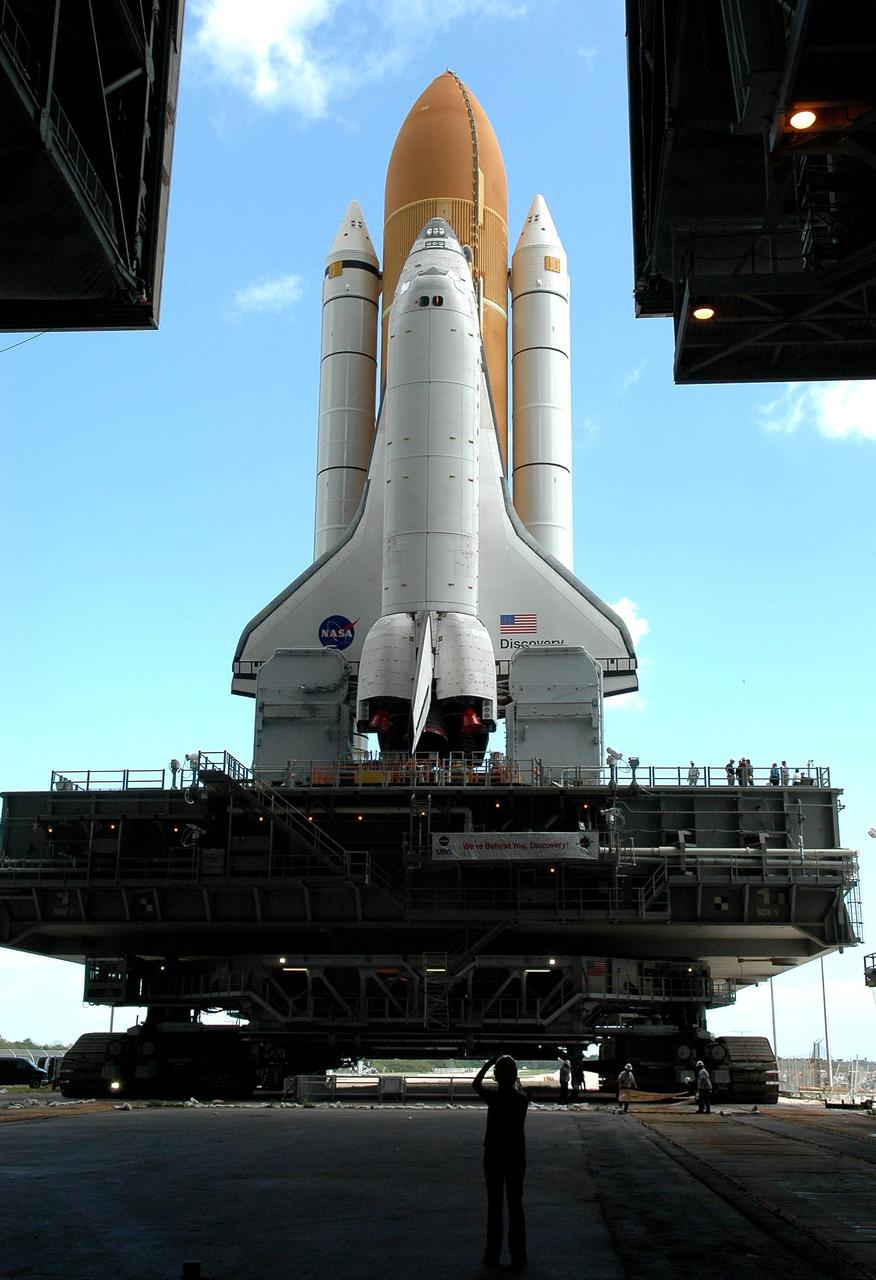
KENNEDY SPACE CENTER, FLA. - Framed in the open doors of the Vehicle Assembly Building (VAB) at NASA’s Kennedy Space Center, Space Shuttle Discovery is bathed in light as it begins its long, slow journey to Launch Pad 39B. The Space Shuttle rests on the Mobile Launcher Platform, which is moved by the Crawler-Transporter underneath. The Crawler is 20 feet high, 131 feet long and 114 feet wide. It moves on eight tracks, each containing 57 shoes, or cleats, weighing one ton each. Loaded with the Space Shuttle, the Crawler can move at a maximum speed of approximately 1 mile an hour. A leveling system in the Crawler keeps the Shuttle vertical while negotiating the 5 percent grade leading to the top of the launch pad. Launch of Discovery on its Return to Flight mission, STS-114, is targeted for May 15 with a launch window that extends to June 3. During its 12-day mission, Discovery’s seven-person crew will test new hardware and techniques to improve Shuttle safety, as well as deliver supplies to the International Space Station. Discovery was moved on March 29 from the Orbiter Processing Facility to the VAB and attached to its propulsion elements, a redesigned ET and twin SRBs.
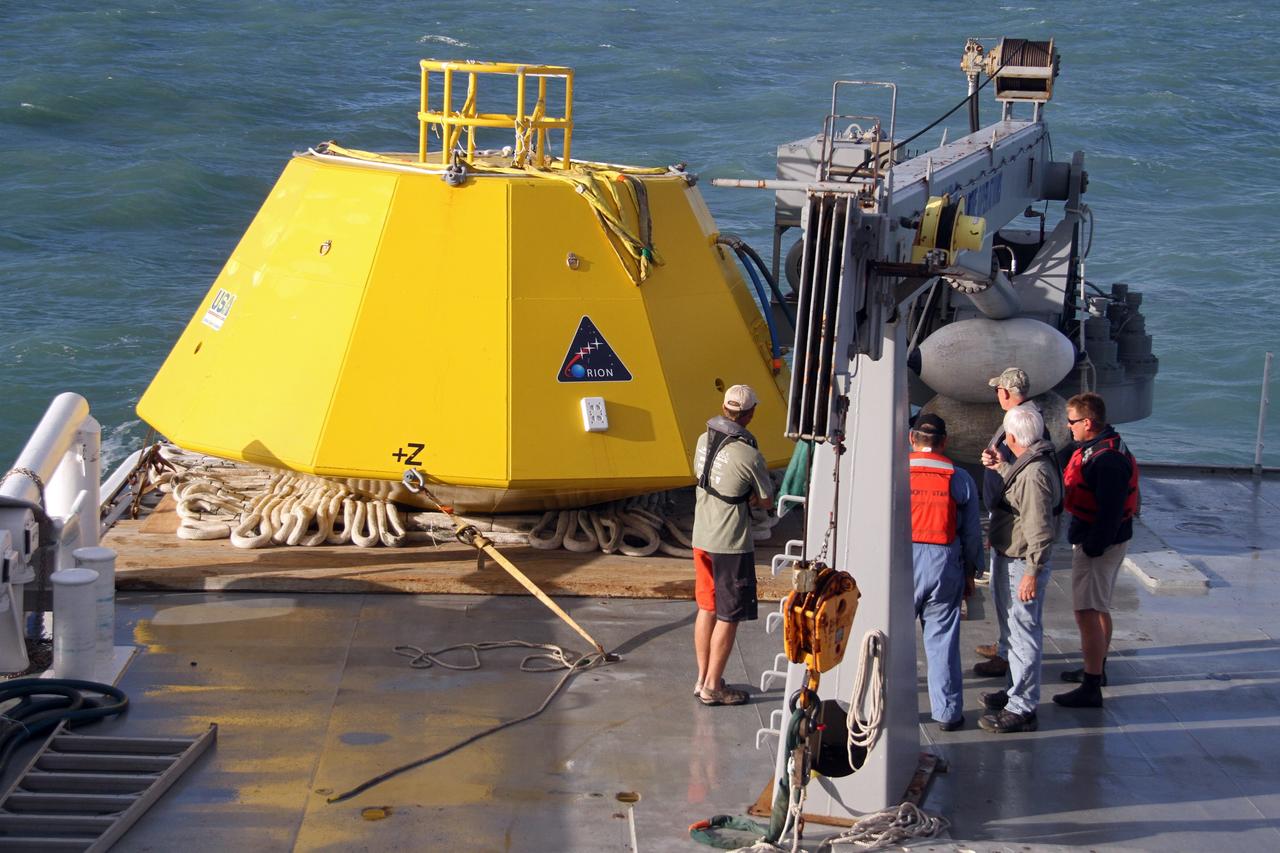
CAPE CANAVERAL, Fla. – An Orion flight test capsule aboard the deck of NASA's Liberty Star ship is moments away from being pulled overboard into the Atlantic Ocean. The Crew Module Recovery Attach Fitting Test (CRAFT) on the capsule, which began at-sea operations Nov. 29, is under way. Multiple attach clips are being evaluated against the current recovery cleat configuration by U.S. Air Force pararescue jumpers (PJs) and a U.S. Navy diver. The 21st Century Ground Systems Program will use data collected from the tests to help develop ground operations support equipment that could be used to recover an uncrewed Orion flight test capsule after splashdown. The Orion Multi-Purpose Crew Vehicle is NASA's next-generation spacecraft being developed for deep space missions to asteroids, moons and other interplanetary destinations throughout the solar system. For more information, visit http://www.nasa.gov/orion. Photo credit: NASA/Cory Huston
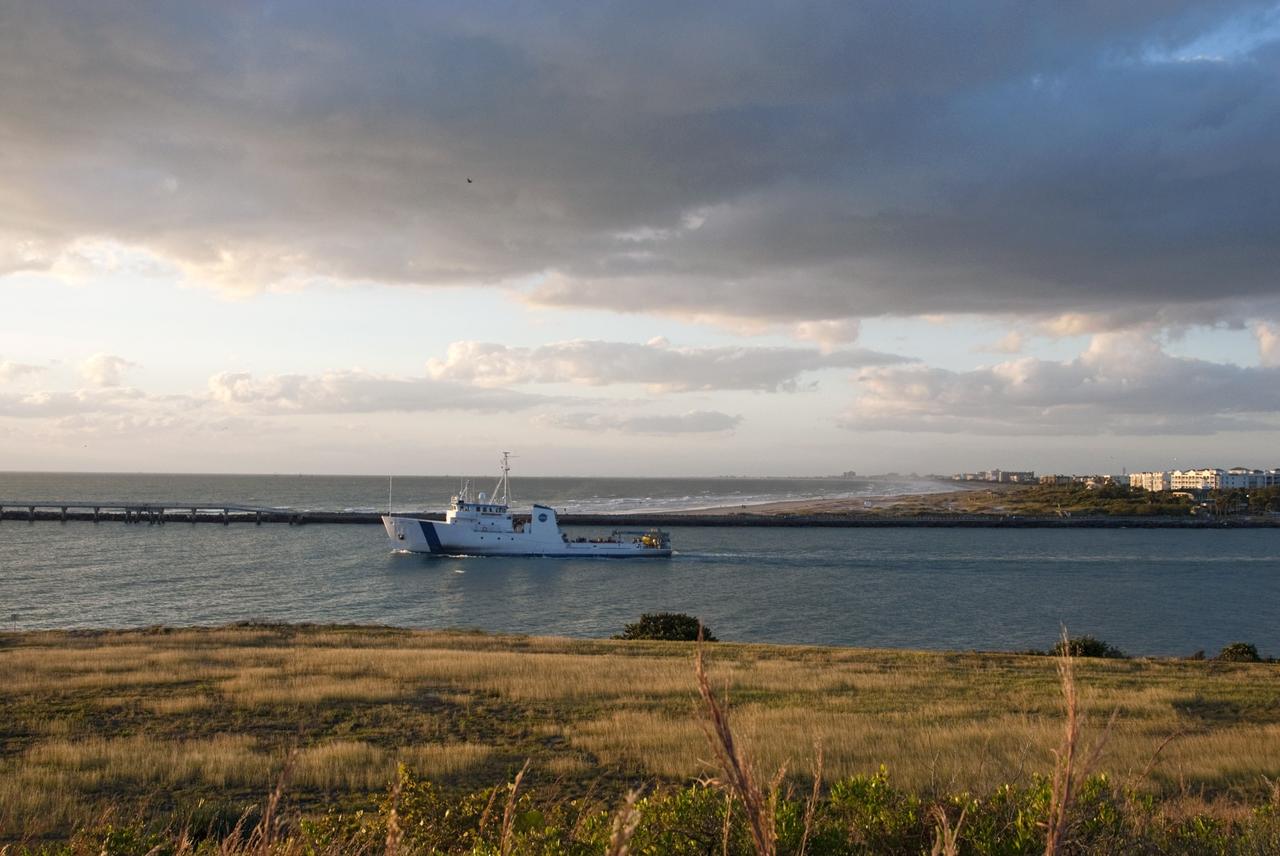
CAPE CANAVERAL, Fla. – NASA's Liberty Star ship, with an Orion flight test capsule secured to its deck, passes through the mouth of Port Canaveral in Florida on its way to the Atlantic Ocean. Liberty Star has been enlisted to support the Crew Module Recovery Attach Fitting Test (CRAFT) which began at-sea operations Nov. 29. Multiple attach clips are being evaluated against the current recovery cleat configuration by U.S. Air Force pararescue jumpers (PJs) and a U.S. Navy diver. The 21st Century Ground Systems Program will use data collected from the tests to help develop ground operations support equipment that could be used to recover an uncrewed Orion flight test capsule after splashdown. The Orion Multi-Purpose Crew Vehicle is NASA's next-generation spacecraft being developed for deep space missions to asteroids, moons and other interplanetary destinations throughout the solar system. For more information, visit http://www.nasa.gov/orion. Photo credit: NASA/Tim Jacobs
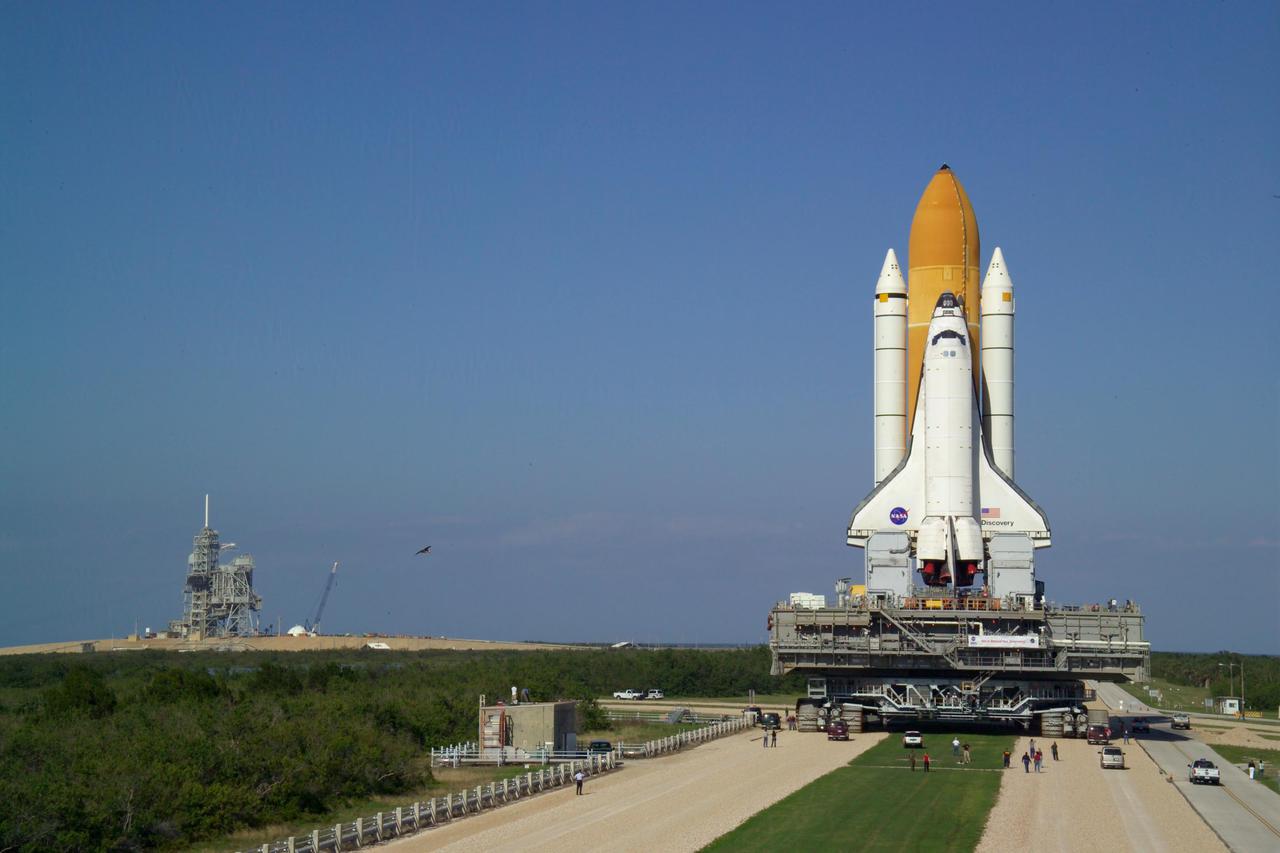
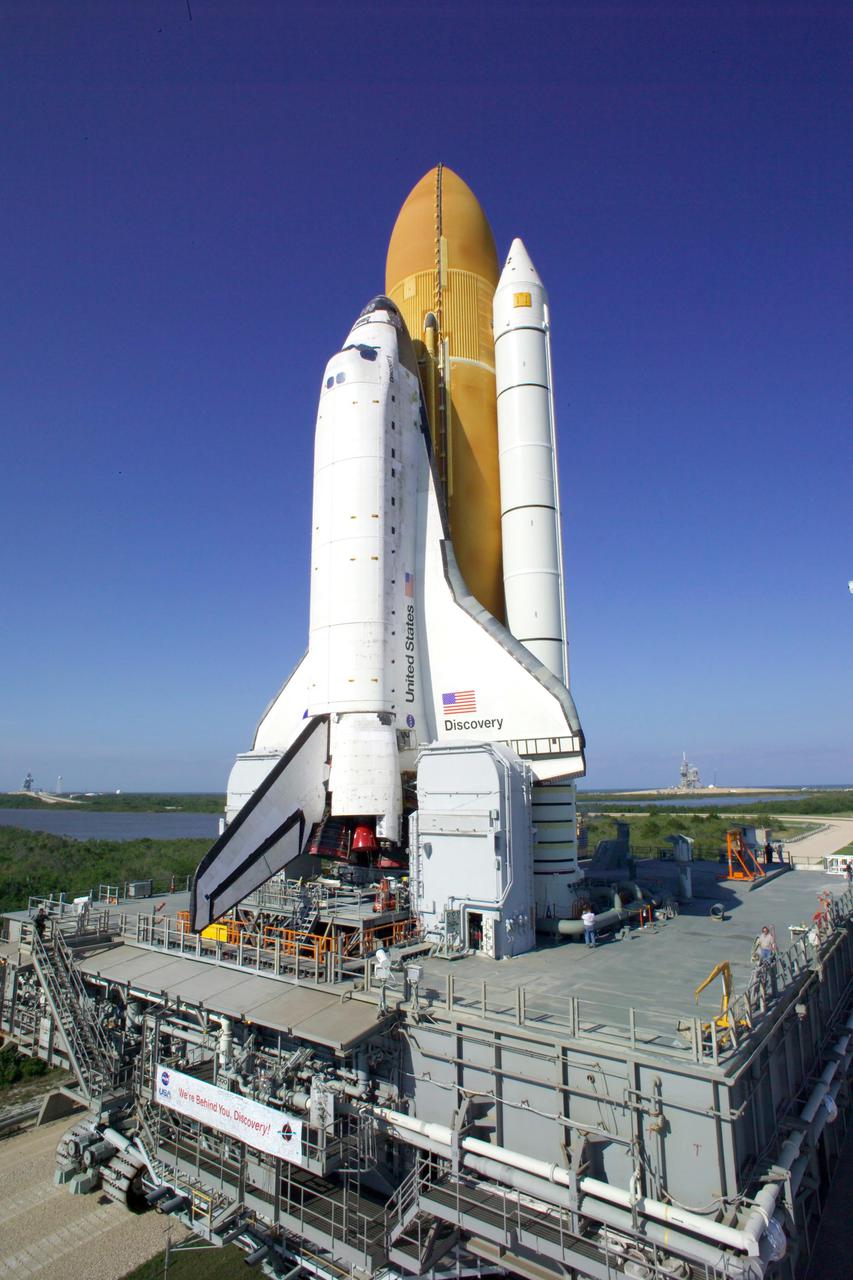
KENNEDY SPACE CENTER, FLA. - Blue sky blends with the blue Atlantic Ocean as Space Shuttle Discovery, atop the Mobile Launcher Platform (MLP), crawls toward Launch Complex 39A, on its way to Pad 39B. First motion out of the Vehicle Assembly Building occurred at 2:04 p.m. EDT. The rollout marks a major milestone in the Space Shuttle Program’s Return to Flight. The MLP is moved by the Crawler-Transporter underneath, which stands 20 feet high, 131 feet long and 114 feet wide. It moves on eight tracks, each containing 57 shoes, or cleats, weighing one ton each. Loaded with the Space Shuttle, the Crawler can move at a maximum speed of approximately 1 mile an hour. A leveling system in the Crawler keeps the Shuttle vertical while negotiating the 5 percent grade leading to the top of the launch pad. Launch of Discovery on its Return to Flight mission, STS-114, is targeted for May 15 with a launch window that extends to June 3. During its 12-day mission, Discovery’s seven-person crew will test new hardware and techniques to improve Shuttle safety, as well as deliver supplies to the International Space Station.
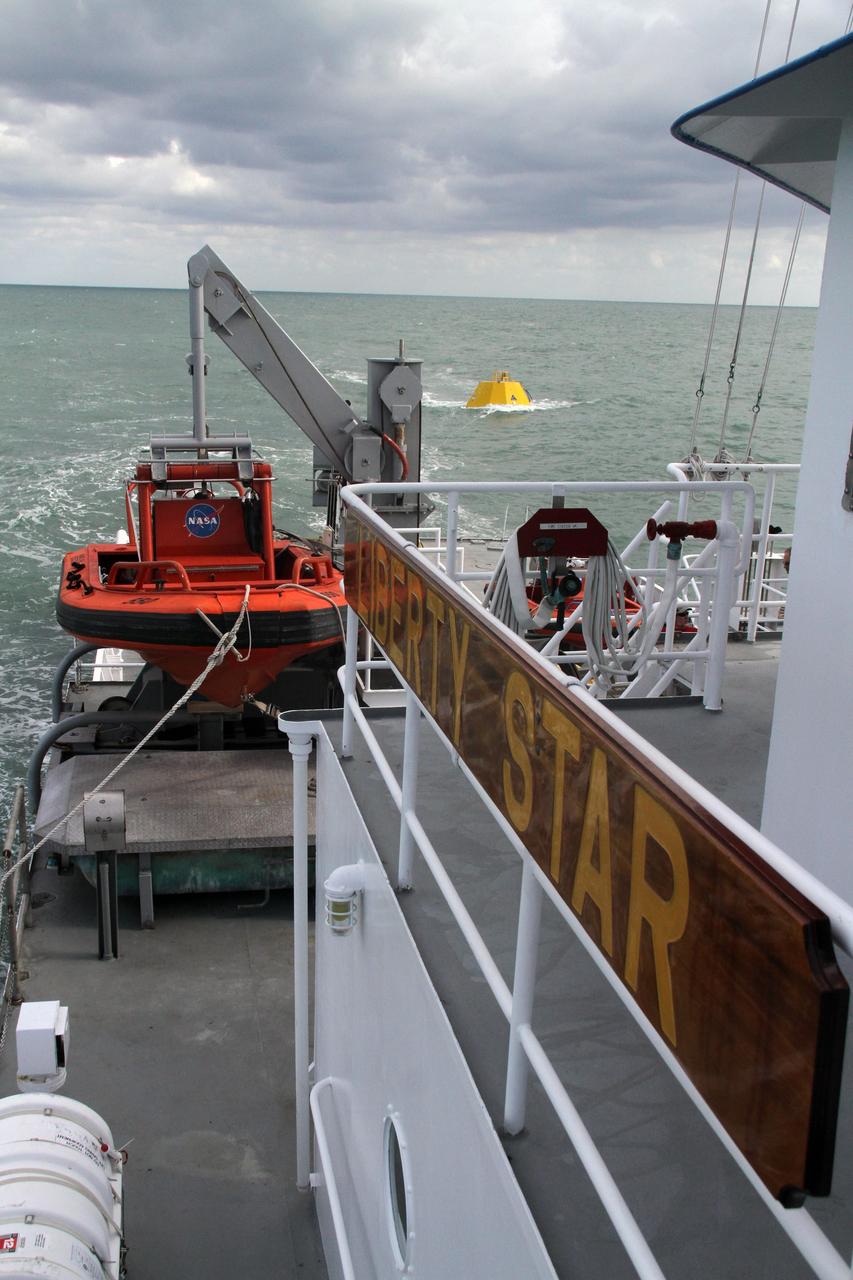
CAPE CANAVERAL, Fla. – Testing is under way on an Orion flight test capsule in the Atlantic Ocean. The tests are being monitored by workers aboard NASA's Liberty Star ship. The Crew Module Recovery Attach Fitting Test (CRAFT) on the capsule, which began at-sea operations Nov. 29, is under way. Multiple attach clips are being evaluated against the current recovery cleat configuration by U.S. Air Force pararescue jumpers (PJs) and a U.S. Navy diver. The 21st Century Ground Systems Program will use data collected from the tests to help develop ground operations support equipment that could be used to recover an uncrewed Orion flight test capsule after splashdown. The Orion Multi-Purpose Crew Vehicle is NASA's next-generation spacecraft being developed for deep space missions to asteroids, moons and other interplanetary destinations throughout the solar system. For more information, visit http://www.nasa.gov/orion. Photo credit: NASA/Cory Huston
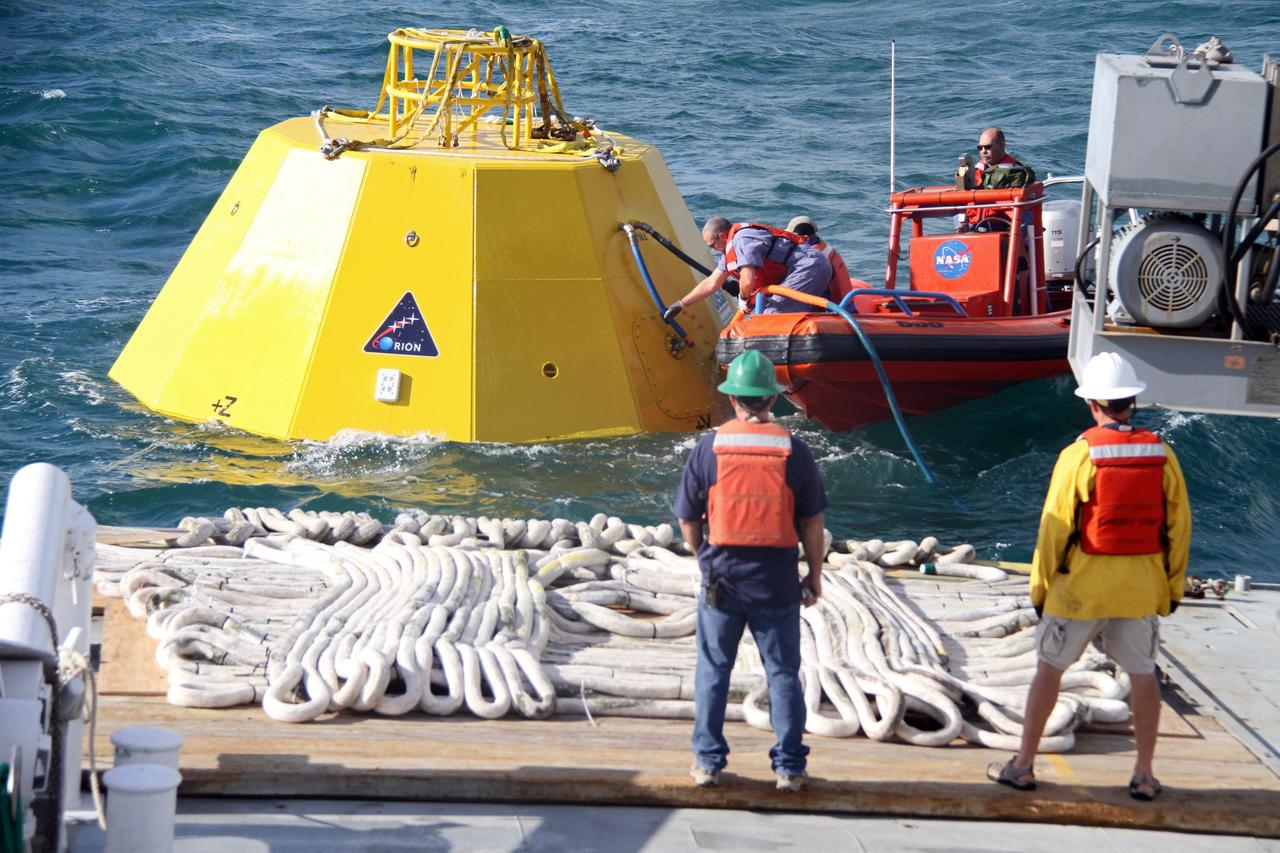
CAPE CANAVERAL, Fla. – From a boat in the Atlantic Ocean, workers secure lines to an Orion flight test capsule during preparations for testing the capsule as their colleagues look on from the deck of NASA's Liberty Star ship. The Crew Module Recovery Attach Fitting Test (CRAFT) on the capsule, which began at-sea operations Nov. 29, is under way. Multiple attach clips are being evaluated against the current recovery cleat configuration by U.S. Air Force pararescue jumpers (PJs) and a U.S. Navy diver. The 21st Century Ground Systems Program will use data collected from the tests to help develop ground operations support equipment that could be used to recover an uncrewed Orion flight test capsule after splashdown. The Orion Multi-Purpose Crew Vehicle is NASA's next-generation spacecraft being developed for deep space missions to asteroids, moons and other interplanetary destinations throughout the solar system. For more information, visit http://www.nasa.gov/orion. Photo credit: NASA/Cory Huston
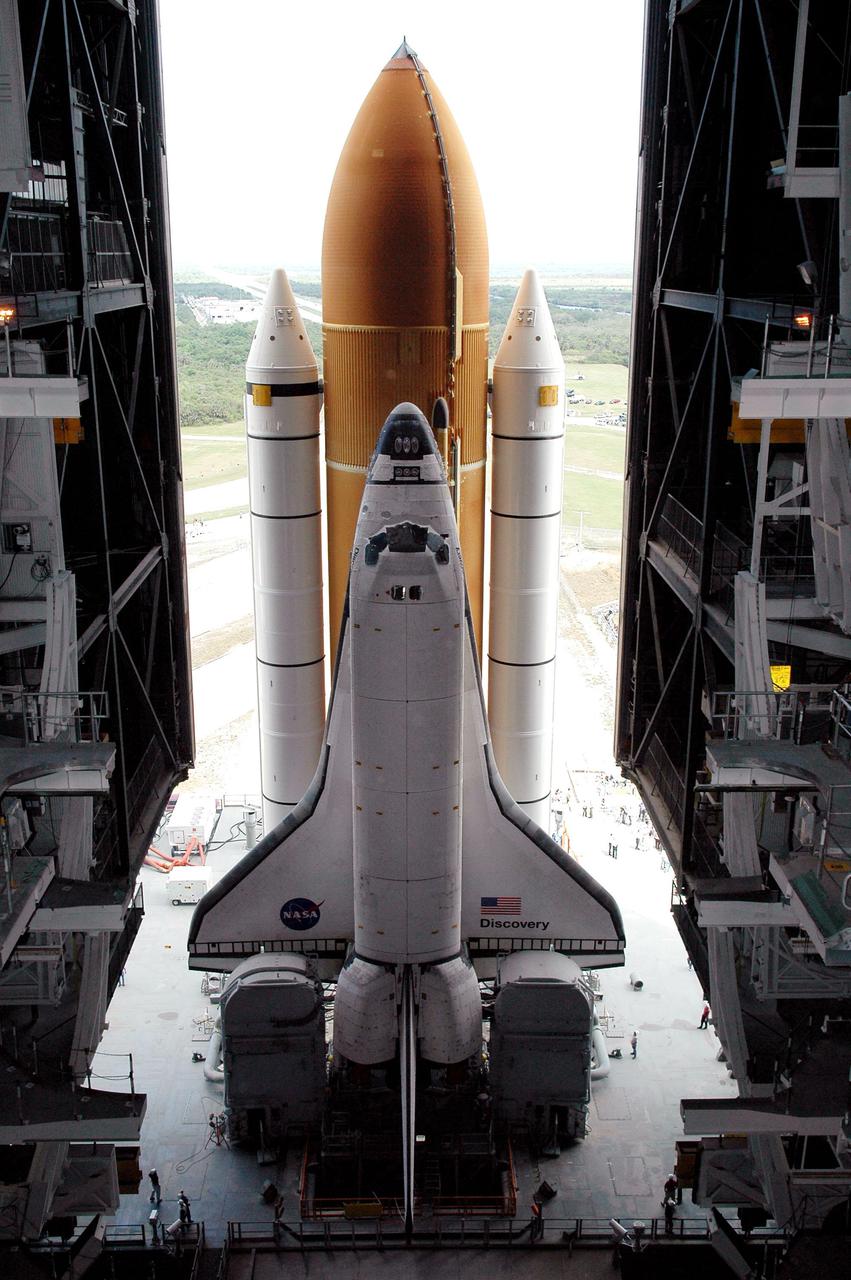
KENNEDY SPACE CENTER, FLA. - In the Vehicle Assembly Building (VAB) at NASA’s Kennedy Space Center, Space Shuttle Discovery passes through the open doors as it begins its long, slow journey to Launch Pad 39B. First motion was at 2:04 p.m. EDT. The Shuttle comprises the orbiter, External Tank (ET) and twin Solid Rocket Boosters (SRBs). The Space Shuttle rests on the Mobile Launcher Platform, which is moved by the Crawler-Transporter underneath. The Crawler is 20 feet high, 131 feet long and 114 feet wide. It moves on eight tracks, each containing 57 shoes, or cleats, weighing one ton each. Loaded with the Space Shuttle, the Crawler can move at a maximum speed of approximately 1 mile an hour. A leveling system in the Crawler keeps the Shuttle vertical while negotiating the 5 percent grade leading to the top of the launch pad. Launch of Discovery on its Return to Flight mission, STS-114, is targeted for May 15 with a launch window that extends to June 3. During its 12-day mission, Discovery’s seven-person crew will test new hardware and techniques to improve Shuttle safety, as well as deliver supplies to the International Space Station. Discovery was moved on March 29 from the Orbiter Processing Facility to the VAB and attached to its propulsion elements, a redesigned ET and twin SRBs.
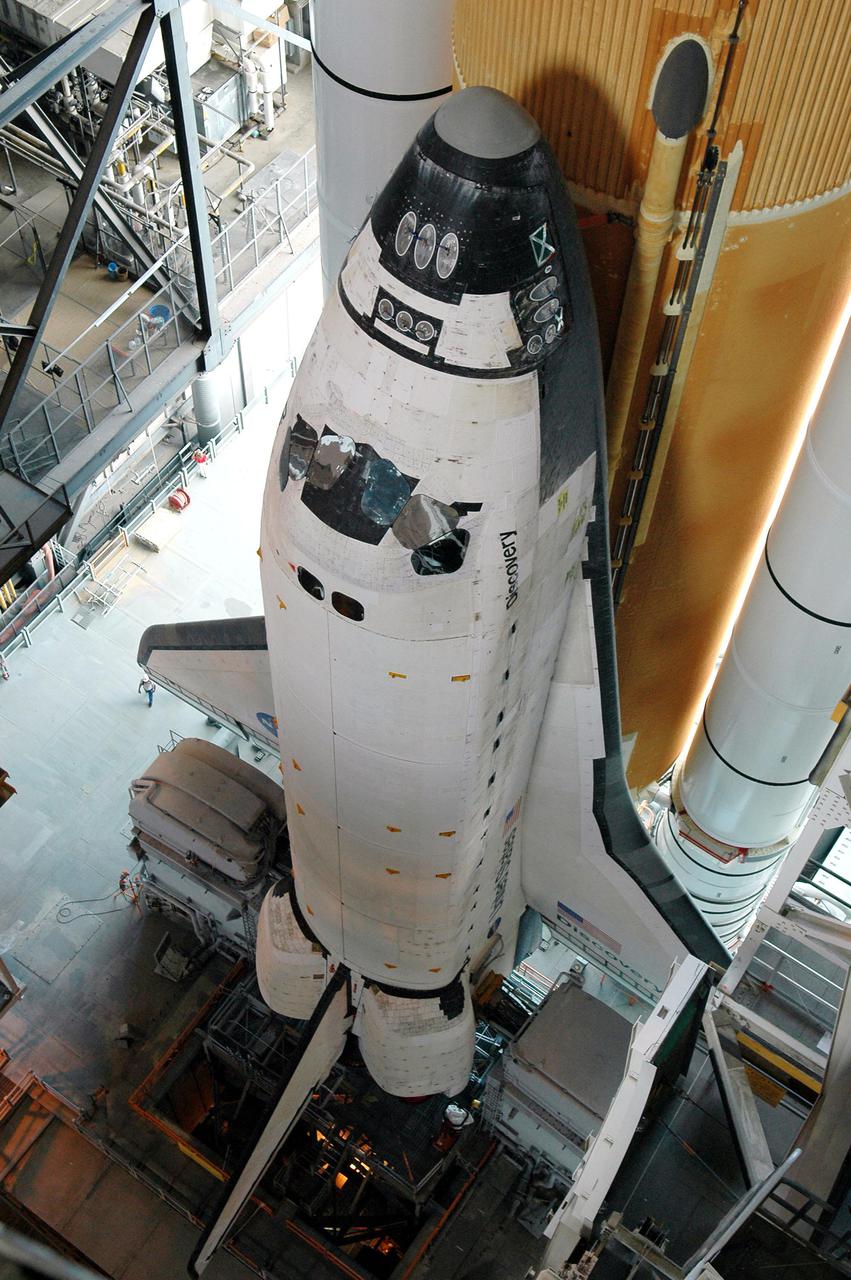
KENNEDY SPACE CENTER, FLA. - In the Vehicle Assembly Building (VAB) at NASA’s Kennedy Space Center, Space Shuttle Discovery is beginning its long, slow journey to Launch Pad 39B. First motion was at 2:04 p.m. EDT. The Shuttle comprises the orbiter, External Tank (ET) and twin Solid Rocket Boosters (SRBs). The Space Shuttle rests on the Mobile Launcher Platform, which is moved by the Crawler-Transporter underneath. The Crawler is 20 feet high, 131 feet long and 114 feet wide. It moves on eight tracks, each containing 57 shoes, or cleats, weighing one ton each. Loaded with the Space Shuttle, the Crawler can move at a maximum speed of approximately 1 mile an hour. A leveling system in the Crawler keeps the Shuttle vertical while negotiating the 5 percent grade leading to the top of the launch pad. Launch of Discovery on its Return to Flight mission, STS-114, is targeted for May 15 with a launch window that extends to June 3. During its 12-day mission, Discovery’s seven-person crew will test new hardware and techniques to improve Shuttle safety, as well as deliver supplies to the International Space Station. Discovery was moved on March 29 from the Orbiter Processing Facility to the VAB and attached to its propulsion elements, a redesigned ET and twin SRBs.
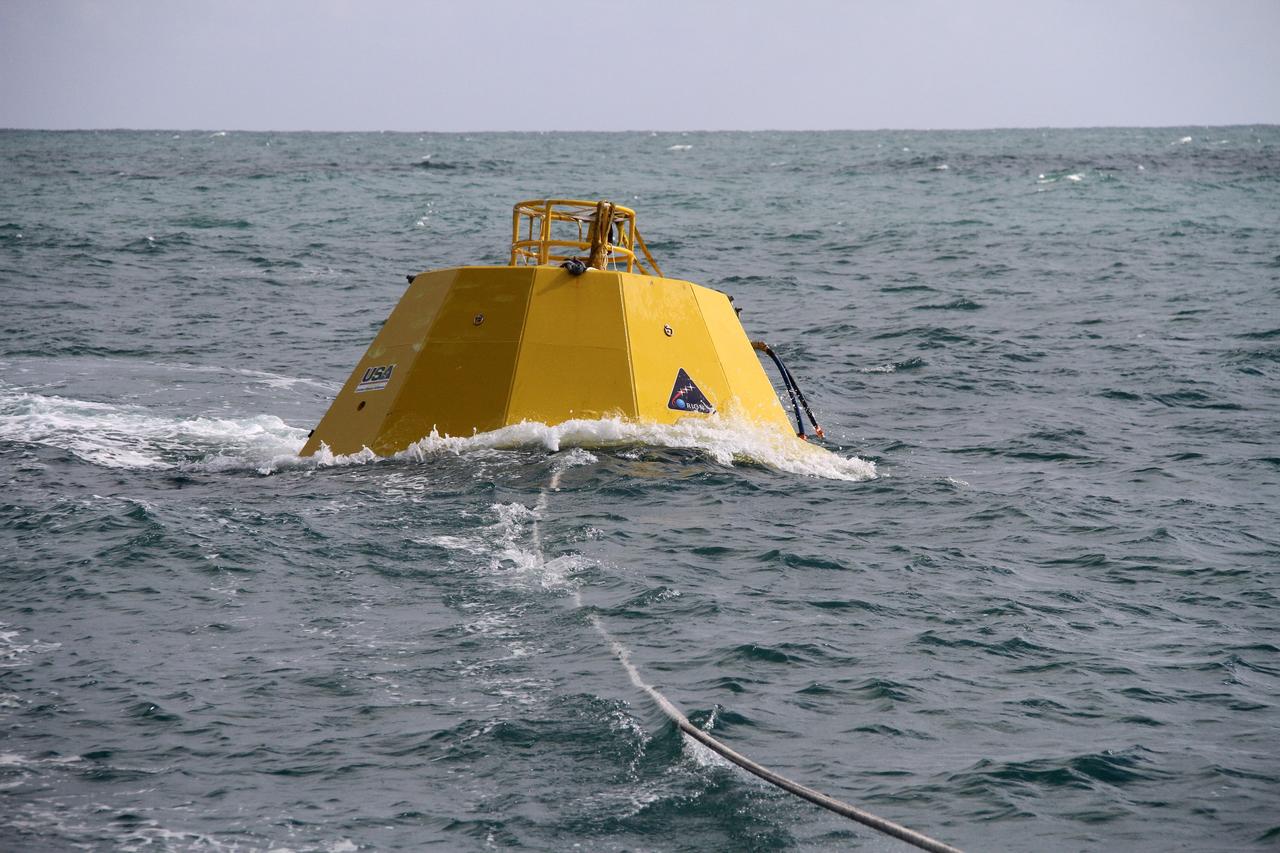
CAPE CANAVERAL, Fla. – Testing is under way on an Orion flight test capsule in the Atlantic Ocean. The tests are being monitored by workers aboard NASA's Liberty Star ship. The Crew Module Recovery Attach Fitting Test (CRAFT) on the capsule, which began at-sea operations Nov. 29, is under way. Multiple attach clips are being evaluated against the current recovery cleat configuration by U.S. Air Force pararescue jumpers (PJs) and a U.S. Navy diver. The 21st Century Ground Systems Program will use data collected from the tests to help develop ground operations support equipment that could be used to recover an uncrewed Orion flight test capsule after splashdown. The Orion Multi-Purpose Crew Vehicle is NASA's next-generation spacecraft being developed for deep space missions to asteroids, moons and other interplanetary destinations throughout the solar system. For more information, visit http://www.nasa.gov/orion. Photo credit: NASA/Cory Huston
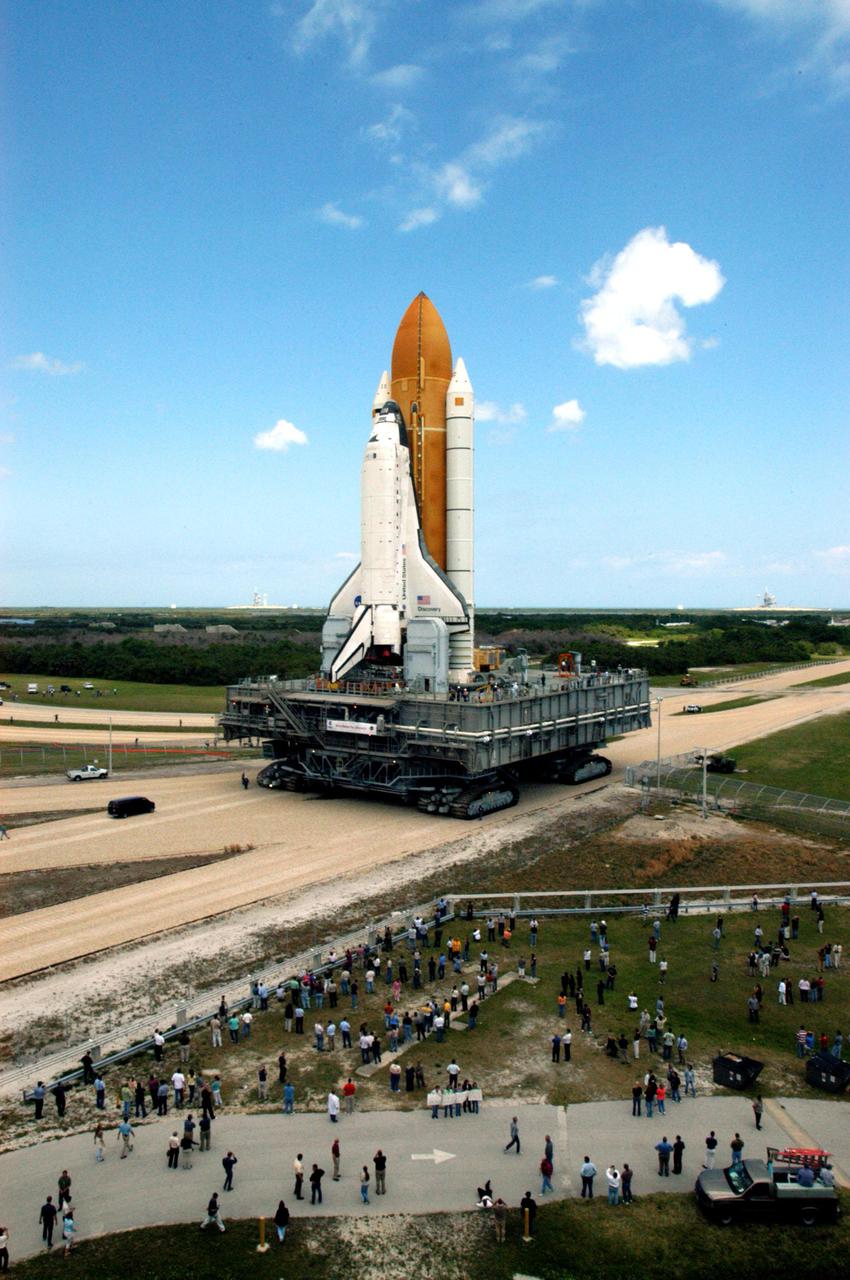
KENNEDY SPACE CENTER, FLA. - As Space Shuttle Discovery creeps along the crawlerway toward the horizon, and Launch Pad 39B at NASA’s Kennedy Space Center, media and workers in the foreground appear as ants. First motion of the Shuttle out of the Vehicle Assembly Building (VAB) was at 2:04 p.m. EDT. The Mobile Launcher Platform is moved by the Crawler-Transporter underneath. The Crawler is 20 feet high, 131 feet long and 114 feet wide. It moves on eight tracks, each containing 57 shoes, or cleats, weighing one ton each. Loaded with the Space Shuttle, the Crawler can move at a maximum speed of approximately 1 mile an hour. A leveling system in the Crawler keeps the Shuttle vertical while negotiating the 5 percent grade leading to the top of the launch pad. Launch of Discovery on its Return to Flight mission, STS-114, is targeted for May 15 with a launch window that extends to June 3. During its 12-day mission, Discovery’s seven-person crew will test new hardware and techniques to improve Shuttle safety, as well as deliver supplies to the International Space Station. Discovery was moved on March 29 from the Orbiter Processing Facility to the VAB and attached to its propulsion elements, a redesigned ET and twin SRBs.
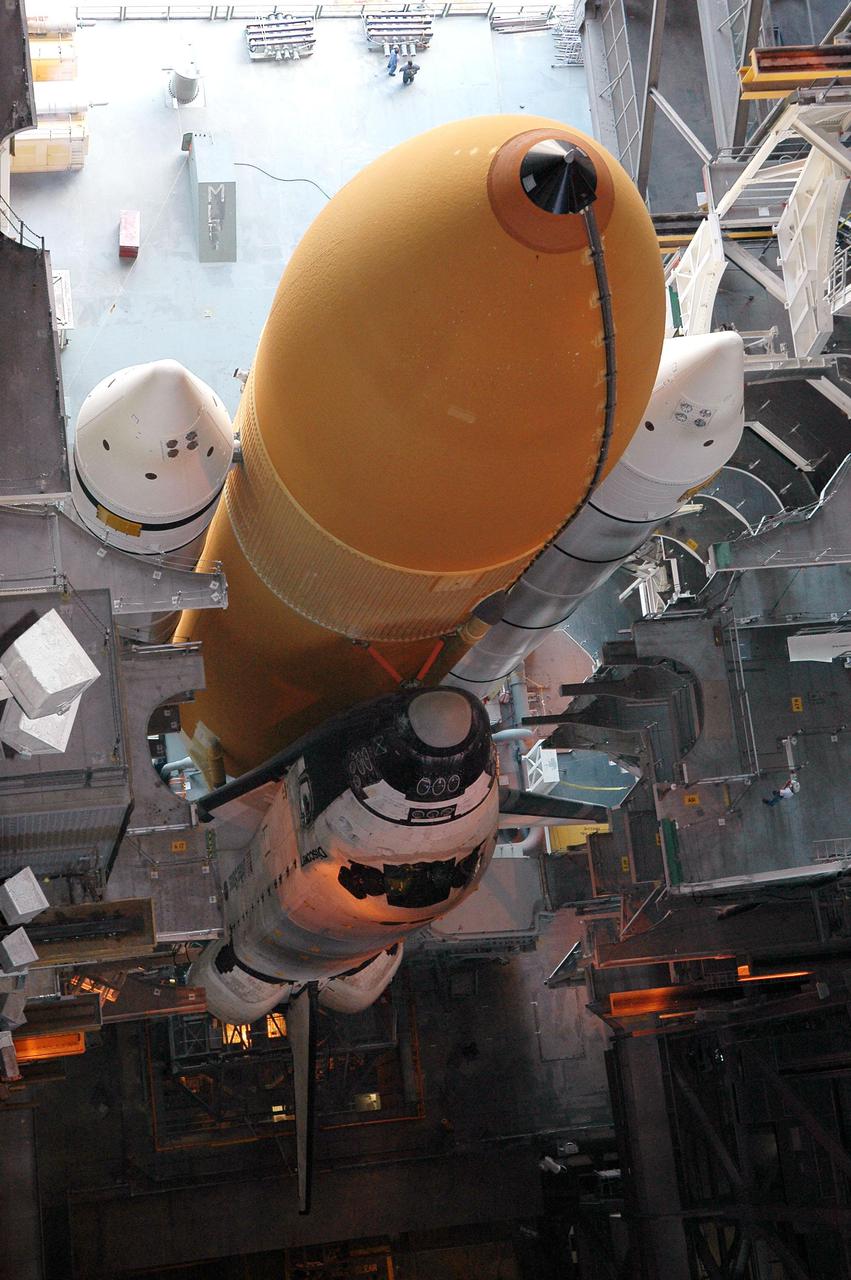
KENNEDY SPACE CENTER, FLA. - The open doors of the Vehicle Assembly Building (VAB) at NASA’s Kennedy Space Center cast light on Space Shuttle Discovery. The Shuttle, which comprises the orbiter, External Tank (ET) and twin Solid Rocket Boosters (SRBs), is beginning its long, slow journey to Launch Pad 39B. First motion was at 2:04 p.m. EDT. The Space Shuttle rests on the Mobile Launcher Platform, which is moved by the Crawler-Transporter underneath. The Crawler is 20 feet high, 131 feet long and 114 feet wide. It moves on eight tracks, each containing 57 shoes, or cleats, weighing one ton each. Loaded with the Space Shuttle, the Crawler can move at a maximum speed of approximately 1 mile an hour. A leveling system in the Crawler keeps the Shuttle vertical while negotiating the 5 percent grade leading to the top of the launch pad. Launch of Discovery on its Return to Flight mission, STS-114, is targeted for May 15 with a launch window that extends to June 3. During its 12-day mission, Discovery’s seven-person crew will test new hardware and techniques to improve Shuttle safety, as well as deliver supplies to the International Space Station. Discovery was moved on March 29 from the Orbiter Processing Facility to the VAB and attached to its propulsion elements, a redesigned ET and twin SRBs.
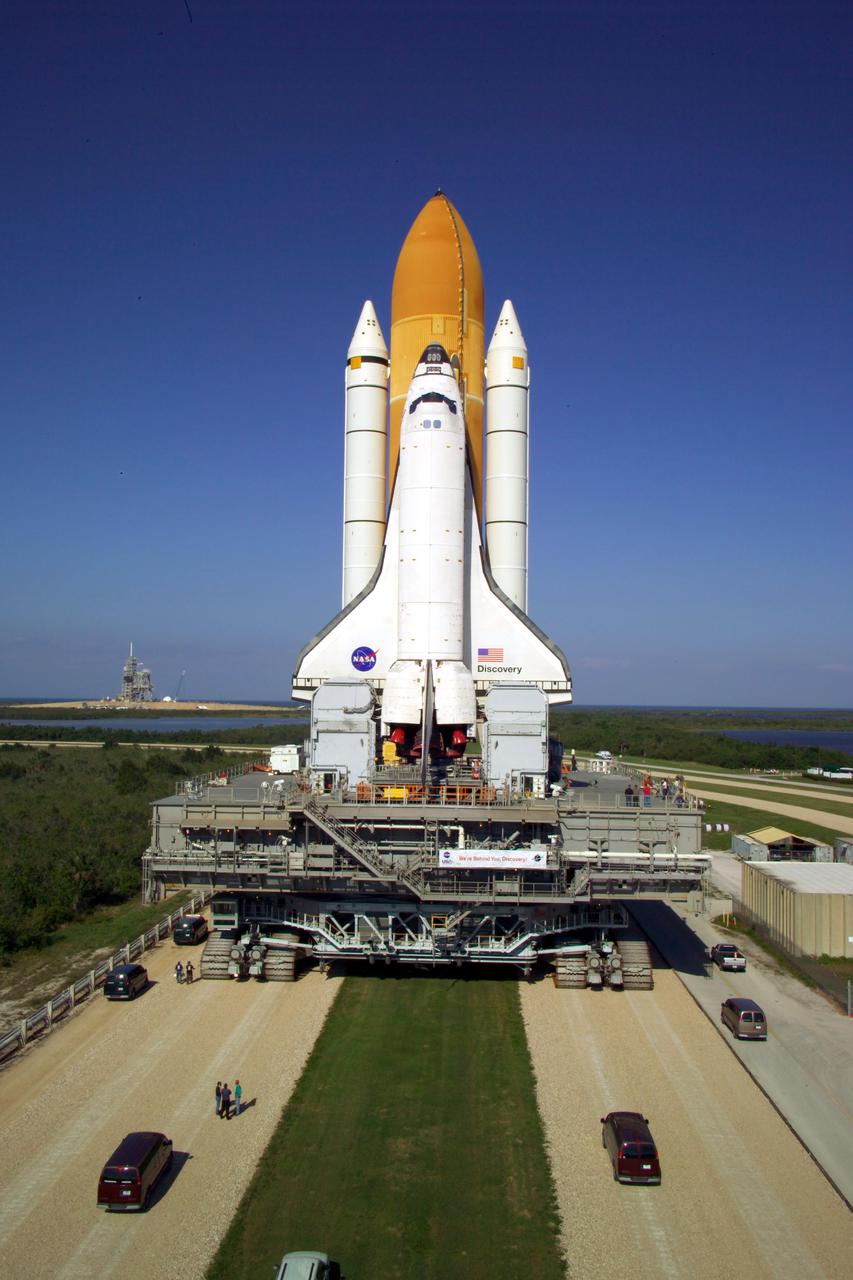
KENNEDY SPACE CENTER, FLA. - At NASA’s Kennedy Space Center, Space Shuttle Discovery, atop the Mobile Launcher Platform (MLP), crawls toward Launch Complex 39B. First motion out of the Vehicle Assembly Building occurred at 2:04 p.m. EDT. The rollout marks a major milestone in the Space Shuttle Program’s Return to Flight. The MLP is moved by the Crawler-Transporter underneath, which stands 20 feet high, 131 feet long and 114 feet wide. It moves on eight tracks, each containing 57 shoes, or cleats, weighing one ton each. Loaded with the Space Shuttle, the Crawler can move at a maximum speed of approximately 1 mile an hour. A leveling system in the Crawler keeps the Shuttle vertical while negotiating the 5 percent grade leading to the top of the launch pad. Launch of Discovery on its Return to Flight mission, STS-114, is targeted for May 15 with a launch window that extends to June 3. During its 12-day mission, Discovery’s seven-person crew will test new hardware and techniques to improve Shuttle safety, as well as deliver supplies to the International Space Station.
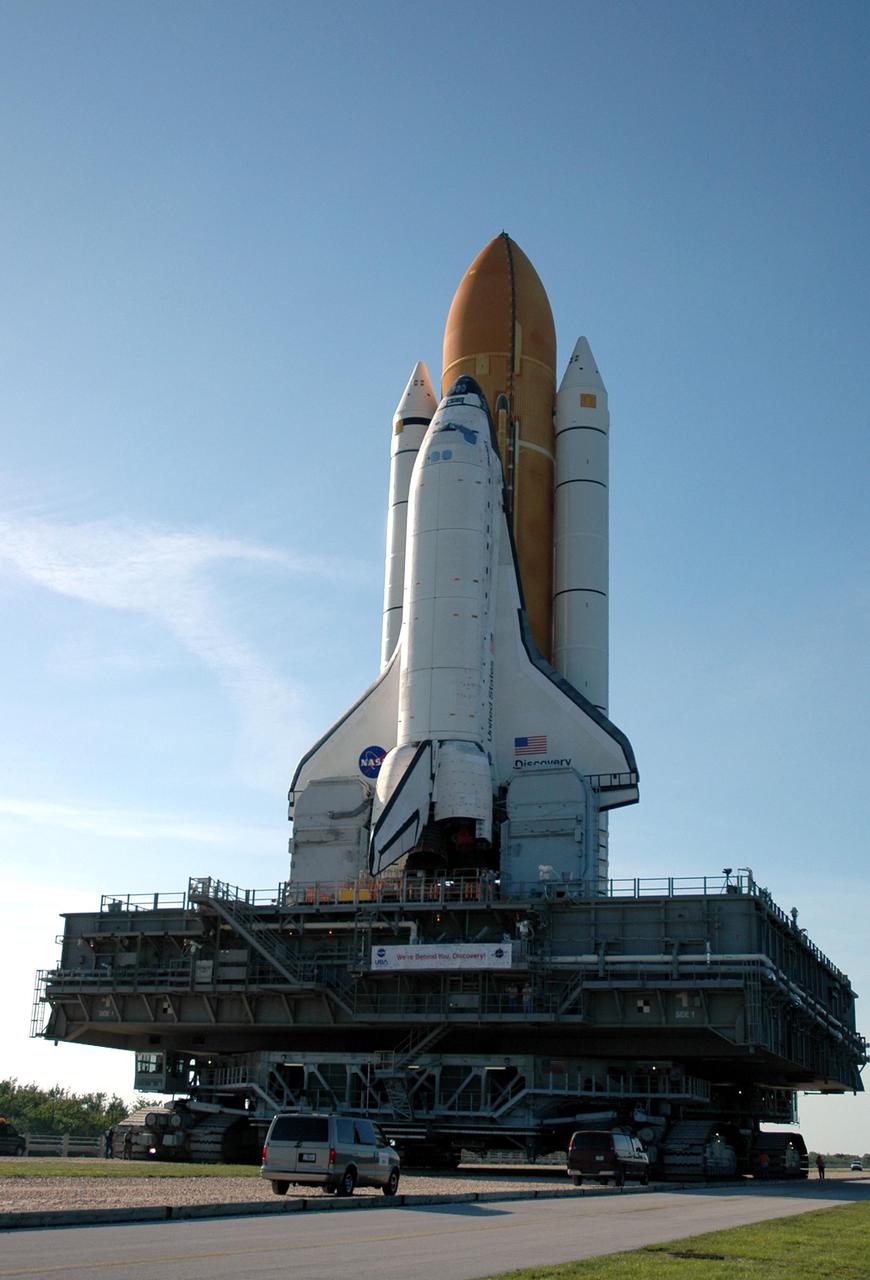
KENNEDY SPACE CENTER, FLA. - Space Shuttle Discovery, atop a Mobile Launcher Platform (MLP), crawls toward Launch Complex 39B. First motion out of the Vehicle Assembly Building occurred at 2:04 p.m. EDT. The rollout marks a major milestone in the Space Shuttle Program’s Return to Flight. The MLP is moved by the Crawler-Transporter underneath, which stands 20 feet high, 131 feet long and 114 feet wide. It moves on eight tracks, each containing 57 shoes, or cleats, weighing one ton each. Loaded with the Space Shuttle, the Crawler can move at a maximum speed of approximately 1 mile an hour. A leveling system in the Crawler keeps the Shuttle vertical while negotiating the 5 percent grade leading to the top of the launch pad. Launch of Discovery on its Return to Flight mission, STS-114, is targeted for May 15 with a launch window that extends to June 3. During its 12-day mission, Discovery’s seven-person crew will test new hardware and techniques to improve Shuttle safety, as well as deliver supplies to the International Space Station.
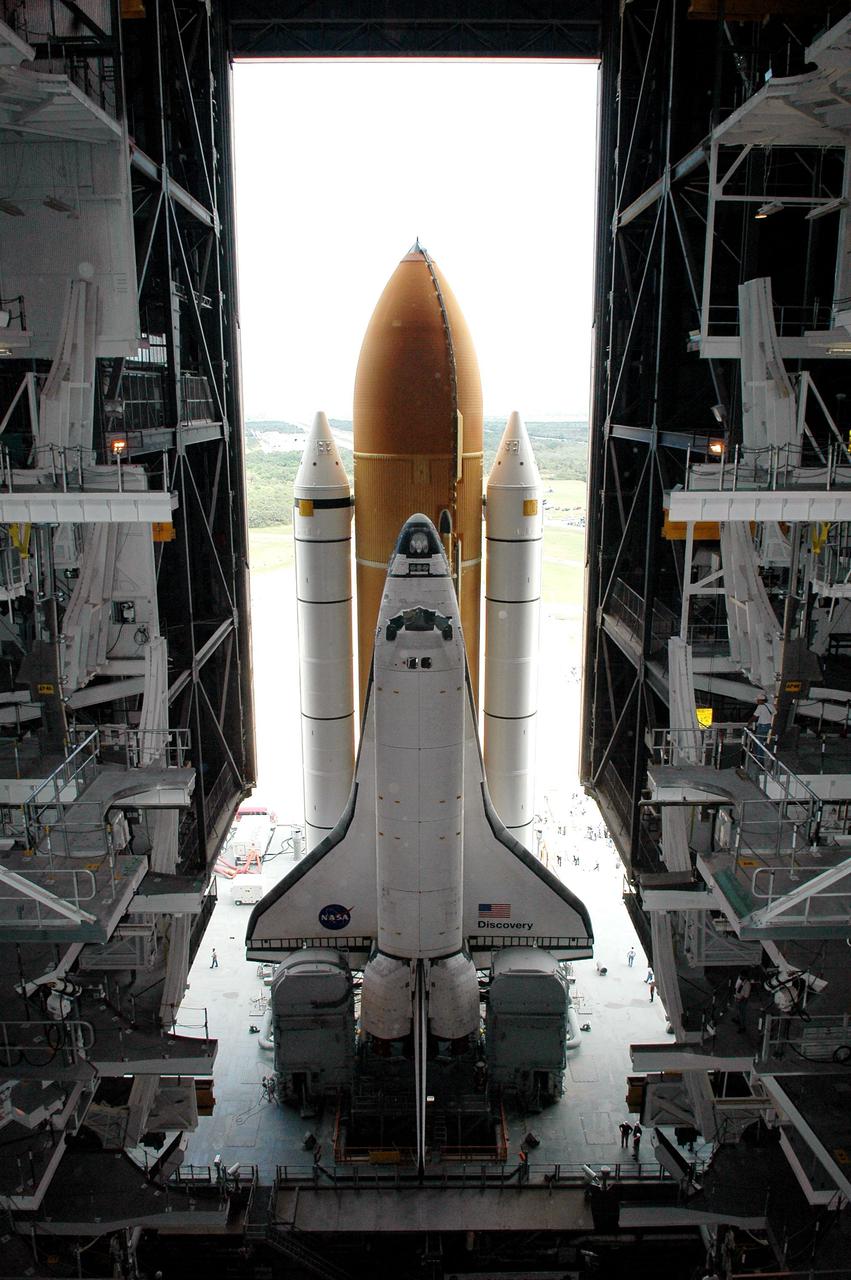
KENNEDY SPACE CENTER, FLA. - In the Vehicle Assembly Building (VAB) at NASA’s Kennedy Space Center, Space Shuttle Discovery is framed in the open doors as it begins its long, slow journey to Launch Pad 39B. First motion was at 2:04 p.m. EDT. The Shuttle comprises the orbiter, External Tank (ET) and twin Solid Rocket Boosters (SRBs). The Space Shuttle rests on the Mobile Launcher Platform, which is moved by the Crawler-Transporter underneath. The Crawler is 20 feet high, 131 feet long and 114 feet wide. It moves on eight tracks, each containing 57 shoes, or cleats, weighing one ton each. Loaded with the Space Shuttle, the Crawler can move at a maximum speed of approximately 1 mile an hour. A leveling system in the Crawler keeps the Shuttle vertical while negotiating the 5 percent grade leading to the top of the launch pad. Launch of Discovery on its Return to Flight mission, STS-114, is targeted for May 15 with a launch window that extends to June 3. During its 12-day mission, Discovery’s seven-person crew will test new hardware and techniques to improve Shuttle safety, as well as deliver supplies to the International Space Station. Discovery was moved on March 29 from the Orbiter Processing Facility to the VAB and attached to its propulsion elements, a redesigned ET and twin SRBs.
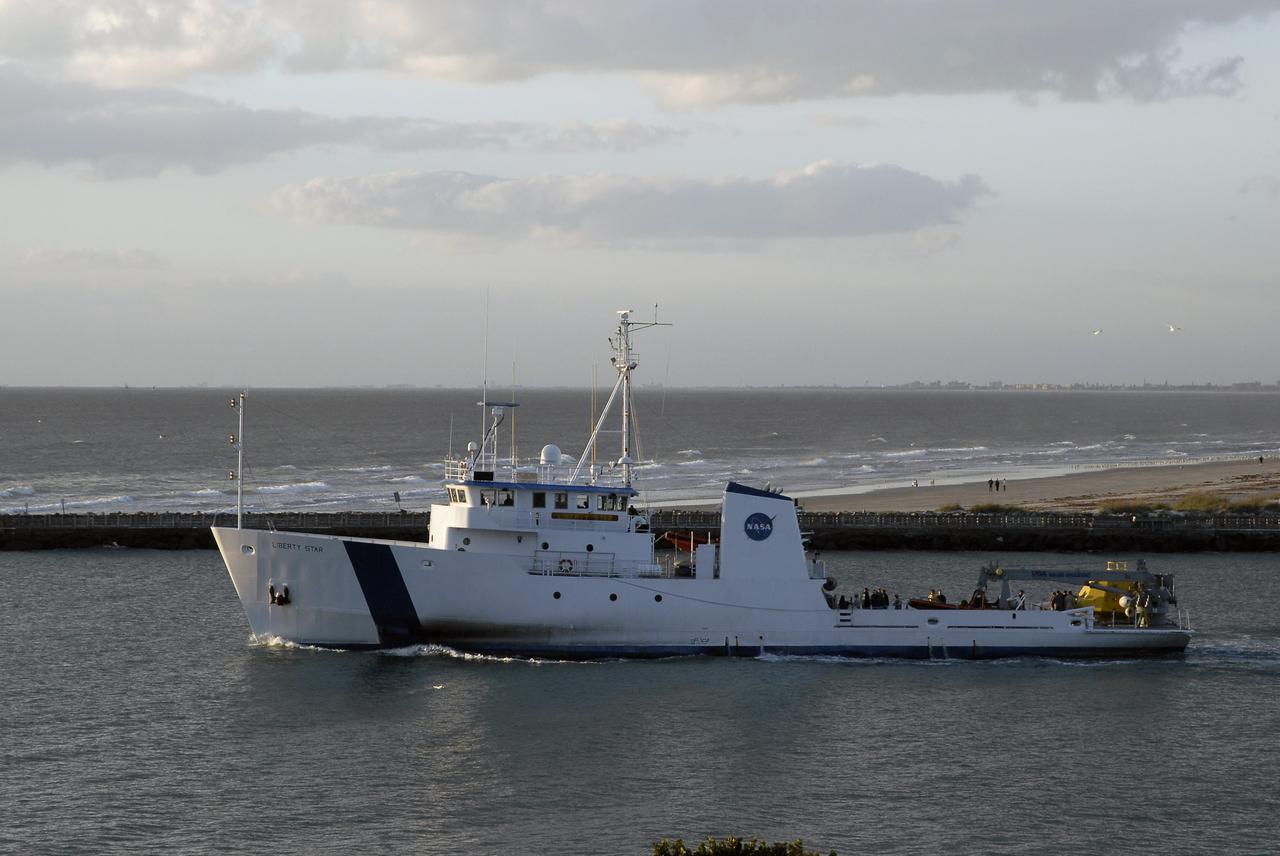
CAPE CANAVERAL, Fla. – At Port Canaveral in Florida, NASA's Liberty Star ship, with an Orion flight test capsule secured to its deck, passes the jetties as it heads toward the Atlantic Ocean. Liberty Star has been enlisted to support the Crew Module Recovery Attach Fitting Test (CRAFT) which began at-sea operations Nov. 29. Multiple attach clips are being evaluated against the current recovery cleat configuration by U.S. Air Force pararescue jumpers (PJs) and a U.S. Navy diver. The 21st Century Ground Systems Program will use data collected from the tests to help develop ground operations support equipment that could be used to recover an uncrewed Orion flight test capsule after splashdown. The Orion Multi-Purpose Crew Vehicle is NASA's next-generation spacecraft being developed for deep space missions to asteroids, moons and other interplanetary destinations throughout the solar system. For more information, visit http://www.nasa.gov/orion. Photo credit: NASA/Tim Jacobs
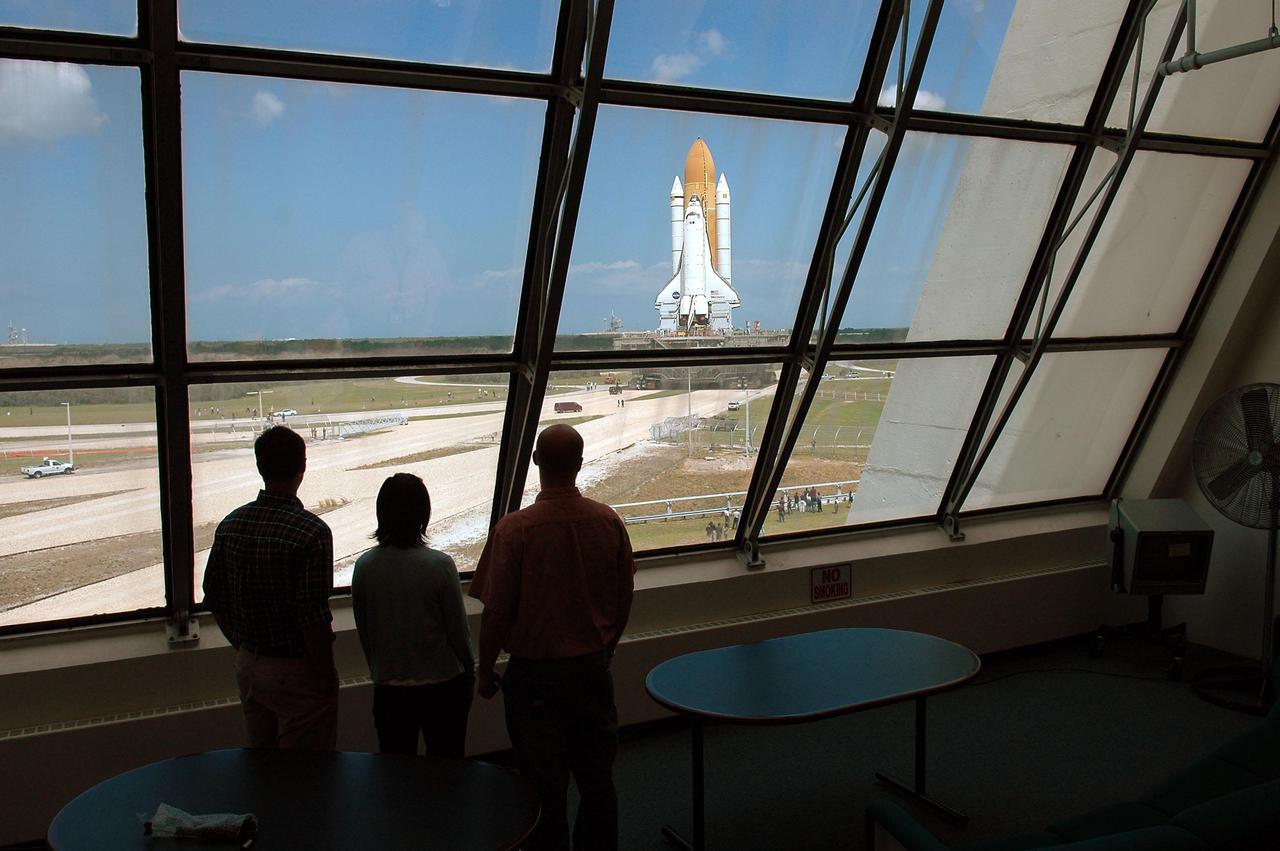
KENNEDY SPACE CENTER, FLA. - From inside the viewing room of the Launch Control Center, KSC employees watch Space Shuttle Discovery as it creeps along the crawlerway toward the horizon, and Launch Pad 39B at NASA’s Kennedy Space Center. First motion of the Shuttle out of the Vehicle Assembly Building (VAB) was at 2:04 p.m. EDT. The Mobile Launcher Platform is moved by the Crawler-Transporter underneath. The Crawler is 20 feet high, 131 feet long and 114 feet wide. It moves on eight tracks, each containing 57 shoes, or cleats, weighing one ton each. Loaded with the Space Shuttle, the Crawler can move at a maximum speed of approximately 1 mile an hour. A leveling system in the Crawler keeps the Shuttle vertical while negotiating the 5 percent grade leading to the top of the launch pad. Launch of Discovery on its Return to Flight mission, STS-114, is targeted for May 15 with a launch window that extends to June 3. During its 12-day mission, Discovery’s seven-person crew will test new hardware and techniques to improve Shuttle safety, as well as deliver supplies to the International Space Station. Discovery was moved on March 29 from the Orbiter Processing Facility to the VAB and attached to its propulsion elements, a redesigned ET and twin SRBs.
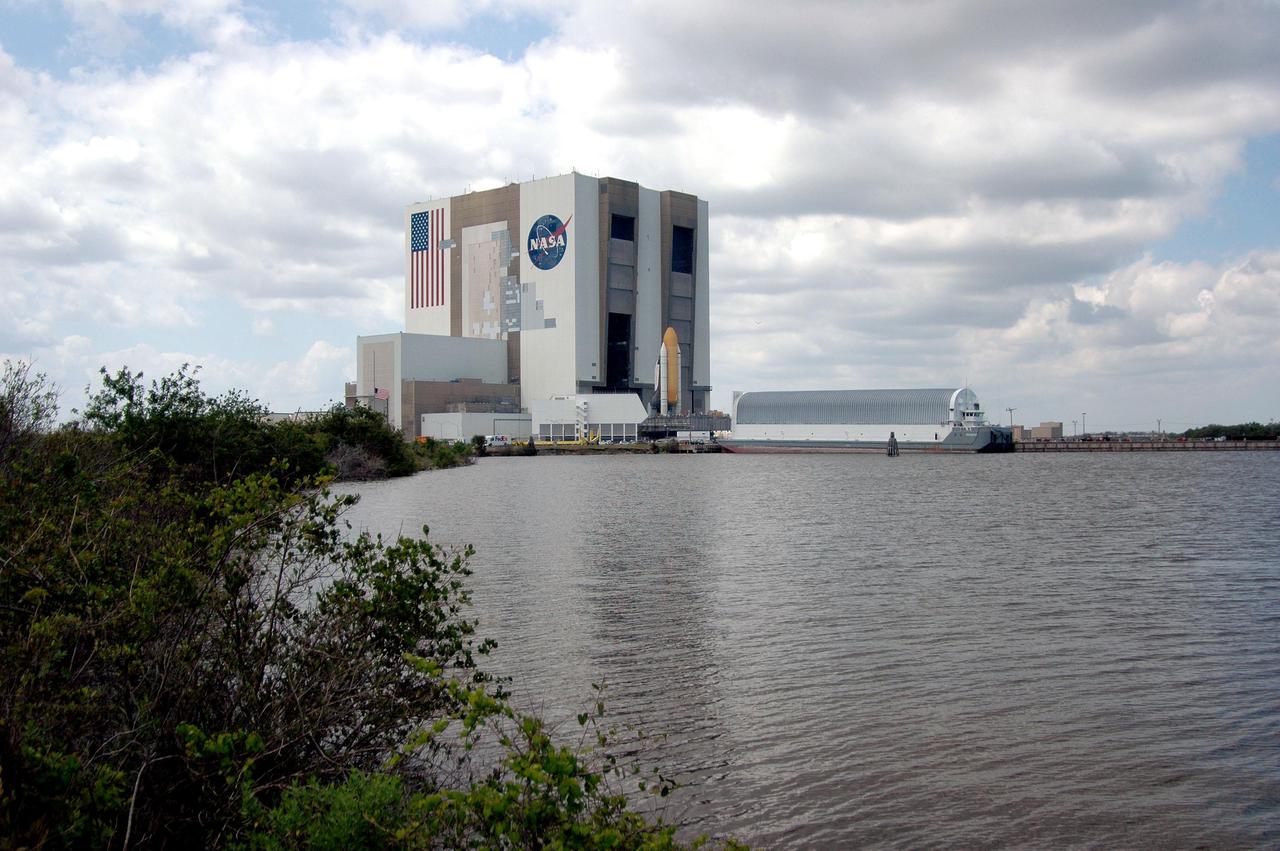
KENNEDY SPACE CENTER, FLA. - Across the Turn Basin at NASA’s Kennedy Space Center looms the Vehicle Assembly Building (VAB). In front of the massive doors is Space Shuttle Discovery, atop the Mobile Launcher Platform, wending its way slowly to Launch Pad 39B. First motion out of the VAB was at 2:04 p.m. EDT. The Mobile Launcher Platform is moved by the Crawler-Transporter underneath. The Crawler is 20 feet high, 131 feet long and 114 feet wide. It moves on eight tracks, each containing 57 shoes, or cleats, weighing one ton each. Loaded with the Space Shuttle, the Crawler can move at a maximum speed of approximately 1 mile an hour. A leveling system in the Crawler keeps the Shuttle vertical while negotiating the 5 percent grade leading to the top of the launch pad. Launch of Discovery on its Return to Flight mission, STS-114, is targeted for May 15 with a launch window that extends to June 3. During its 12-day mission, Discovery’s seven-person crew will test new hardware and techniques to improve Shuttle safety, as well as deliver supplies to the International Space Station. Discovery was moved on March 29 from the Orbiter Processing Facility to the VAB and attached to its propulsion elements, a redesigned ET and twin SRBs.
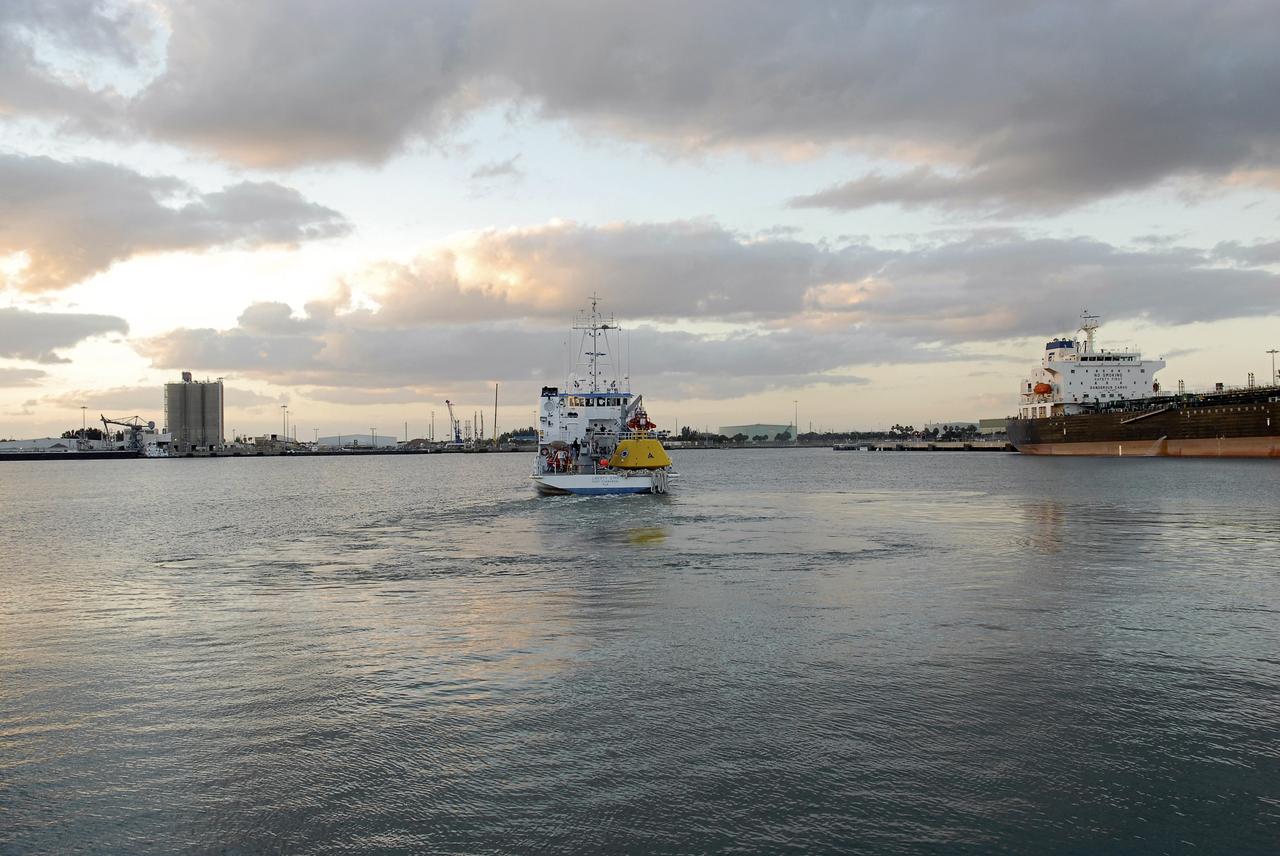
CAPE CANAVERAL, Fla. – At Port Canaveral in Florida, NASA's Liberty Star ship, with an Orion flight test capsule secured to its deck, heads out of port toward the Atlantic Ocean. Liberty Star has been enlisted to support the Crew Module Recovery Attach Fitting Test (CRAFT) which began at-sea operations Nov. 29. Multiple attach clips are being evaluated against the current recovery cleat configuration by U.S. Air Force pararescue jumpers (PJs) and a U.S. Navy diver. The 21st Century Ground Systems Program will use data collected from the tests to help develop ground operations support equipment that could be used to recover an uncrewed Orion flight test capsule after splashdown. The Orion Multi-Purpose Crew Vehicle is NASA's next-generation spacecraft being developed for deep space missions to asteroids, moons and other interplanetary destinations throughout the solar system. For more information, visit http://www.nasa.gov/orion. Photo credit: NASA/Tim Jacobs
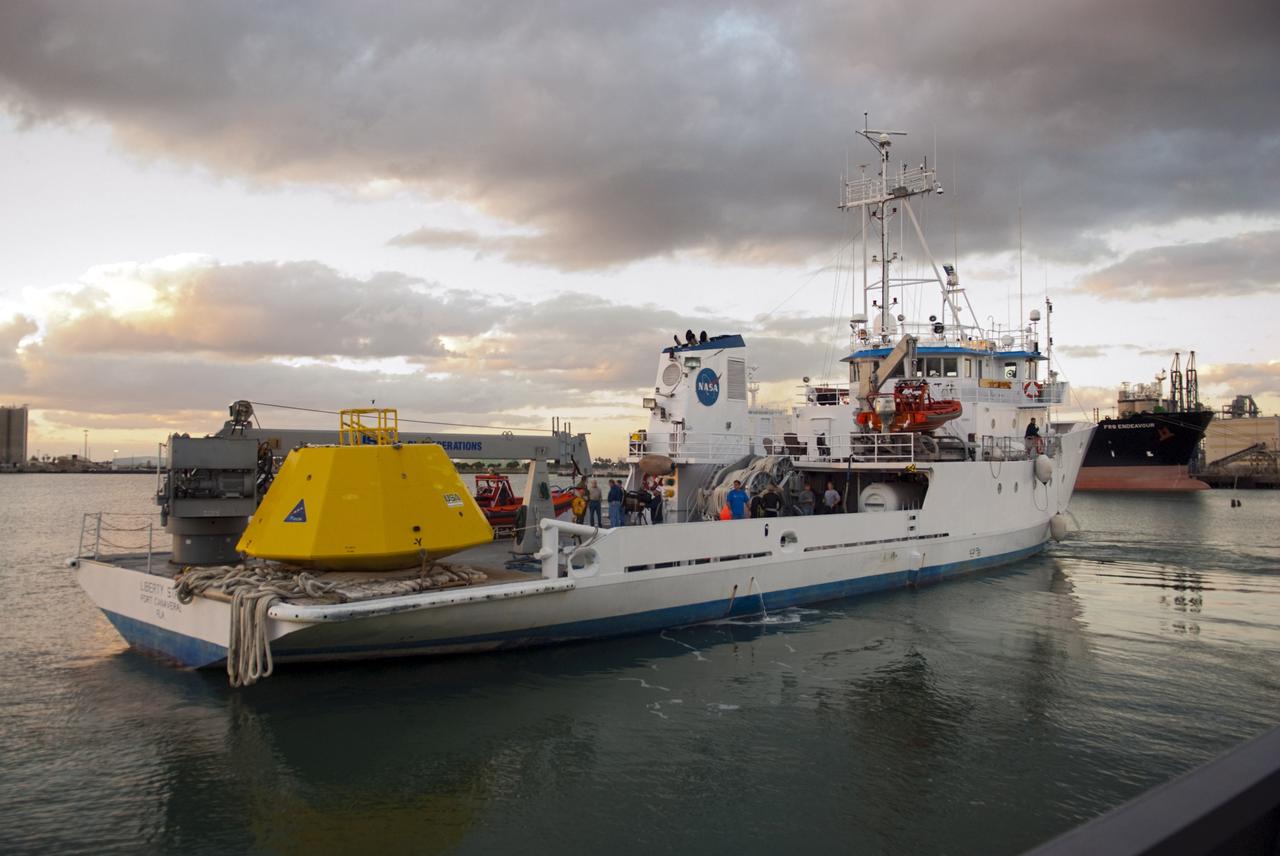
CAPE CANAVERAL, Fla. – NASA's Liberty Star ship departs Port Canaveral in Florida with an Orion flight test capsule secured to its deck. Liberty Star has been enlisted to support the Crew Module Recovery Attach Fitting Test (CRAFT) which began at-sea operations Nov. 29. Multiple attach clips are being evaluated against the current recovery cleat configuration by U.S. Air Force pararescue jumpers (PJs) and a U.S. Navy diver. The 21st Century Ground Systems Program will use data collected from the tests to help develop ground operations support equipment that could be used to recover an uncrewed Orion flight test capsule after splashdown. The Orion Multi-Purpose Crew Vehicle is NASA's next-generation spacecraft being developed for deep space missions to asteroids, moons and other interplanetary destinations throughout the solar system. For more information, visit http://www.nasa.gov/orion. Photo credit: NASA/Tim Jacobs
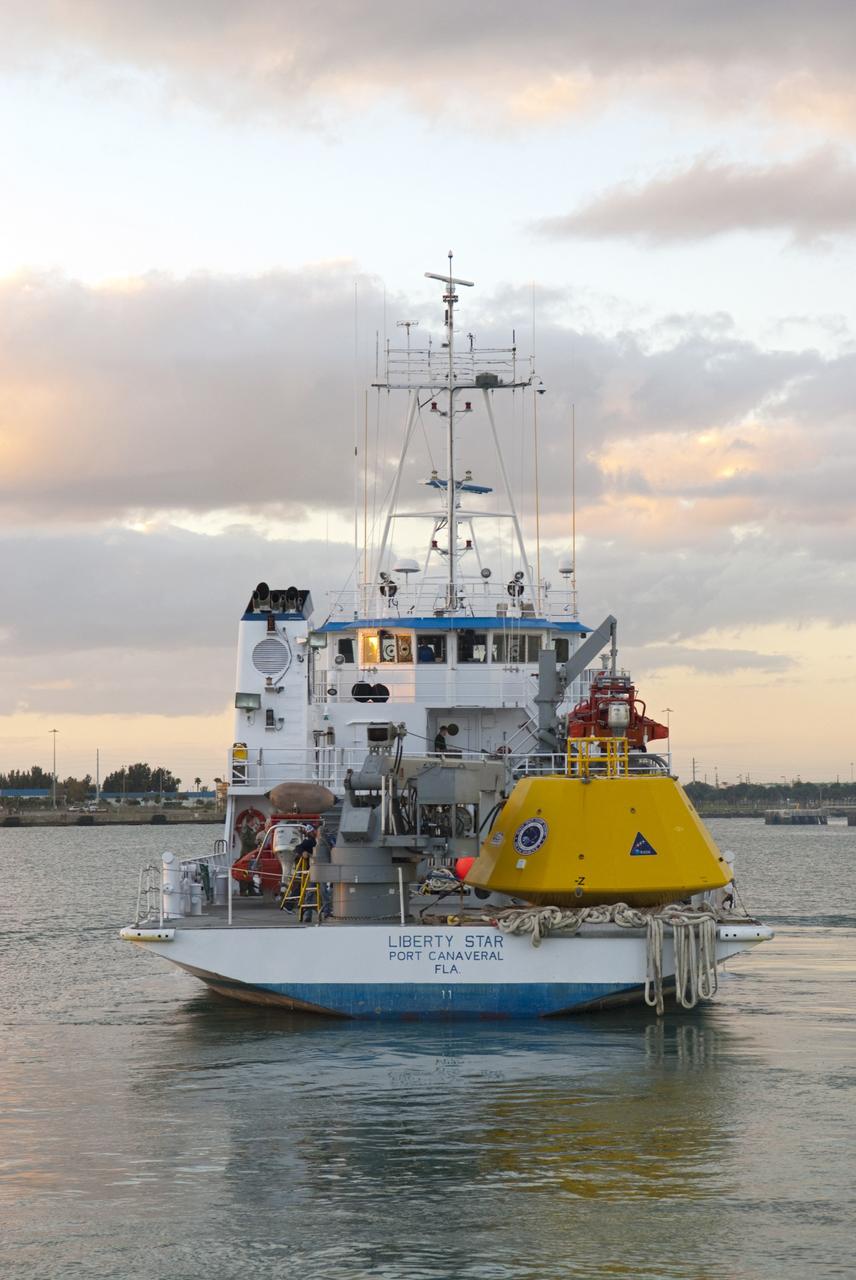
CAPE CANAVERAL, Fla. – NASA's Liberty Star ship departs Port Canaveral in Florida with an Orion flight test capsule secured to its deck. Liberty Star has been enlisted to support the Crew Module Recovery Attach Fitting Test (CRAFT) which began at-sea operations Nov. 29. Multiple attach clips are being evaluated against the current recovery cleat configuration by U.S. Air Force pararescue jumpers (PJs) and a U.S. Navy diver. The 21st Century Ground Systems Program will use data collected from the tests to help develop ground operations support equipment that could be used to recover an uncrewed Orion flight test capsule after splashdown. The Orion Multi-Purpose Crew Vehicle is NASA's next-generation spacecraft being developed for deep space missions to asteroids, moons and other interplanetary destinations throughout the solar system. For more information, visit http://www.nasa.gov/orion. Photo credit: NASA/Tim Jacobs
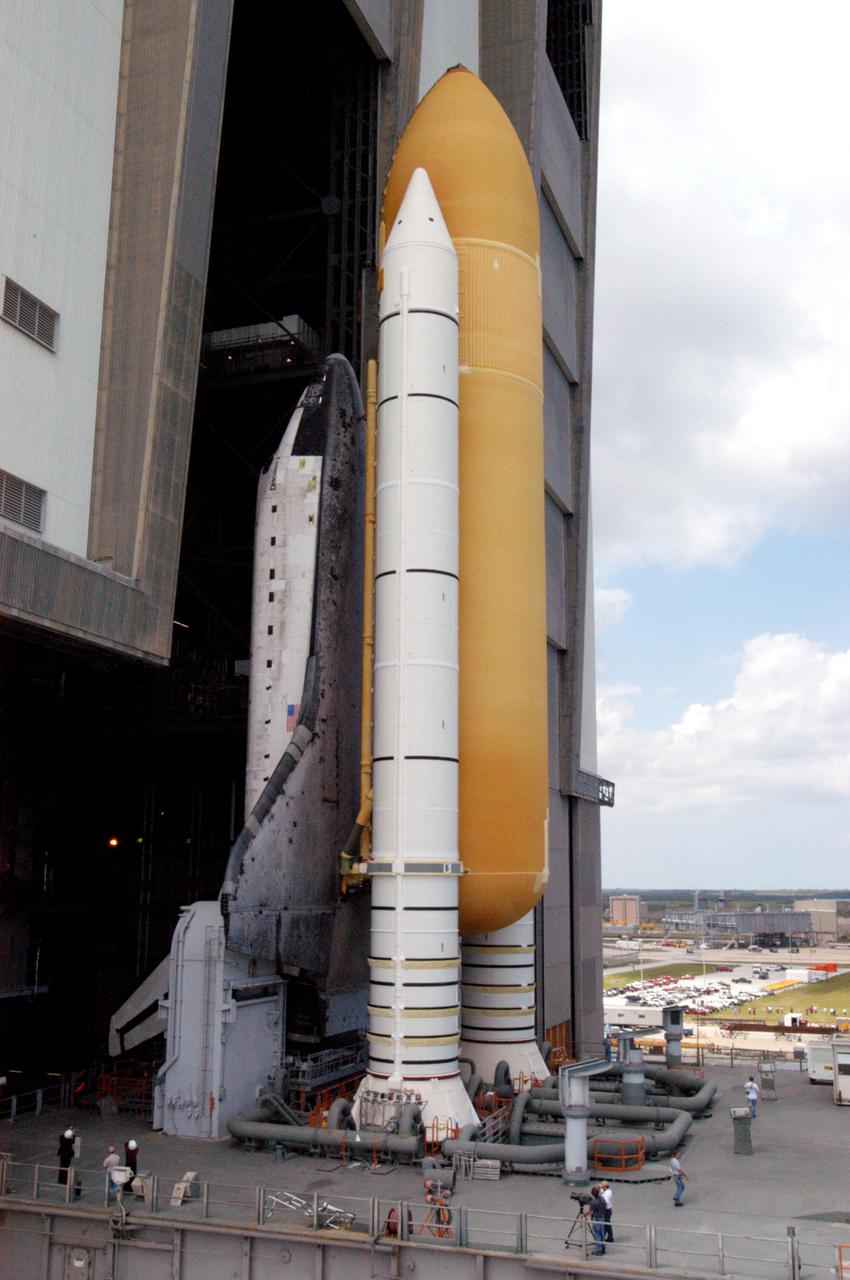
KENNEDY SPACE CENTER, FLA. - Space Shuttle Discovery, atop the Mobile Launcher Platform, slowly rolls out of the Vehicle Assembly Building (VAB) at NASA’s Kennedy Space Center. First motion was at 2:04 p.m. EDT. The Shuttle comprises the orbiter, External Tank (ET) and twin Solid Rocket Boosters (SRBs). The Mobile Launcher Platform moved by the Crawler-Transporter underneath. The Crawler is 20 feet high, 131 feet long and 114 feet wide. It moves on eight tracks, each containing 57 shoes, or cleats, weighing one ton each. Loaded with the Space Shuttle, the Crawler can move at a maximum speed of approximately 1 mile an hour. A leveling system in the Crawler keeps the Shuttle vertical while negotiating the 5 percent grade leading to the top of the launch pad. Launch of Discovery on its Return to Flight mission, STS-114, is targeted for May 15 with a launch window that extends to June 3. During its 12-day mission, Discovery’s seven-person crew will test new hardware and techniques to improve Shuttle safety, as well as deliver supplies to the International Space Station. Discovery was moved on March 29 from the Orbiter Processing Facility to the VAB and attached to its propulsion elements, a redesigned ET and twin SRBs.
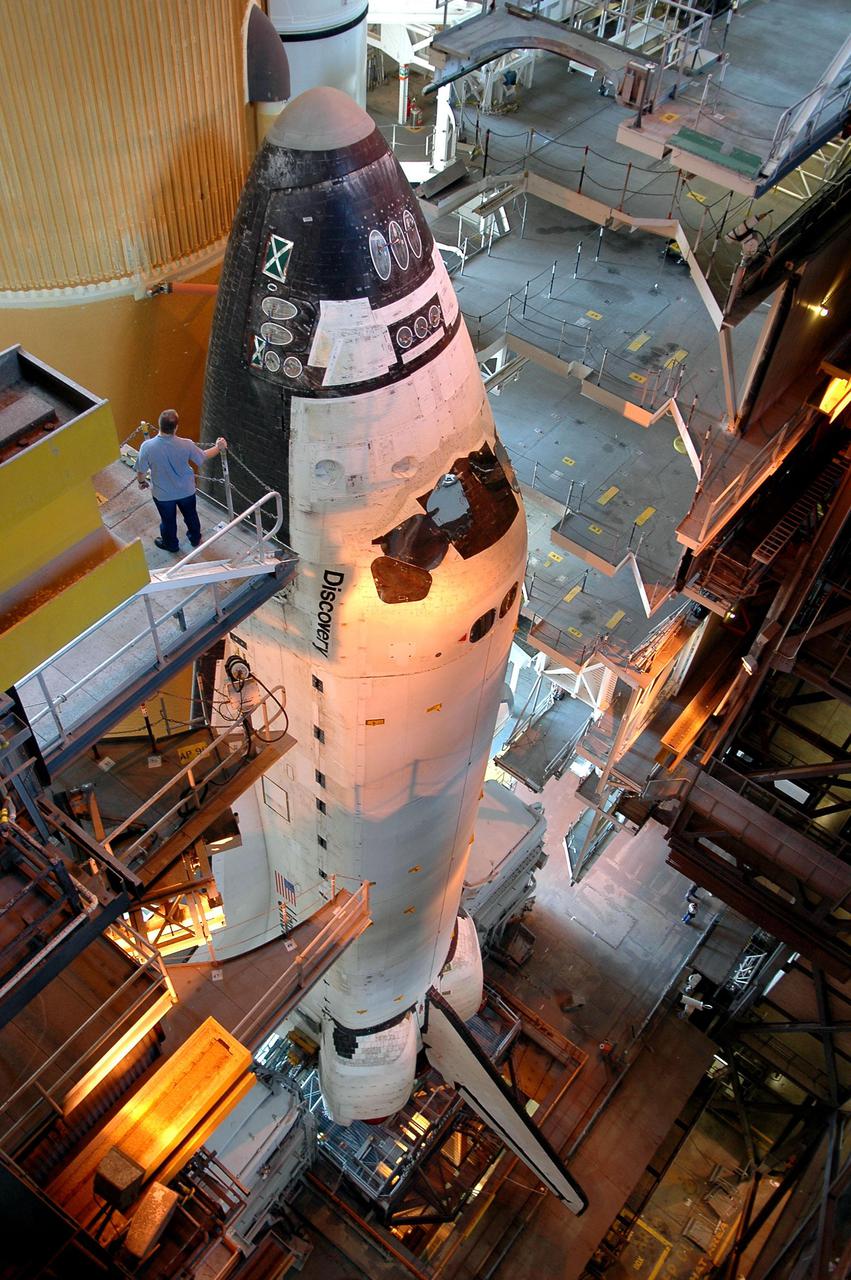
KENNEDY SPACE CENTER, FLA. - In the Vehicle Assembly Building (VAB) at NASA’s Kennedy Space Center, Space Shuttle Discovery begins its long, slow journey to Launch Pad 39B. First motion was at 2:04 p.m. EDT. The Shuttle comprises the orbiter, External Tank (ET) and twin Solid Rocket Boosters (SRBs). The Space Shuttle rests on the Mobile Launcher Platform, which is moved by the Crawler-Transporter underneath. The Crawler is 20 feet high, 131 feet long and 114 feet wide. It moves on eight tracks, each containing 57 shoes, or cleats, weighing one ton each. Loaded with the Space Shuttle, the Crawler can move at a maximum speed of approximately 1 mile an hour. A leveling system in the Crawler keeps the Shuttle vertical while negotiating the 5 percent grade leading to the top of the launch pad. Launch of Discovery on its Return to Flight mission, STS-114, is targeted for May 15 with a launch window that extends to June 3. During its 12-day mission, Discovery’s seven-person crew will test new hardware and techniques to improve Shuttle safety, as well as deliver supplies to the International Space Station. Discovery was moved on March 29 from the Orbiter Processing Facility to the VAB and attached to its propulsion elements, a redesigned ET and twin SRBs.
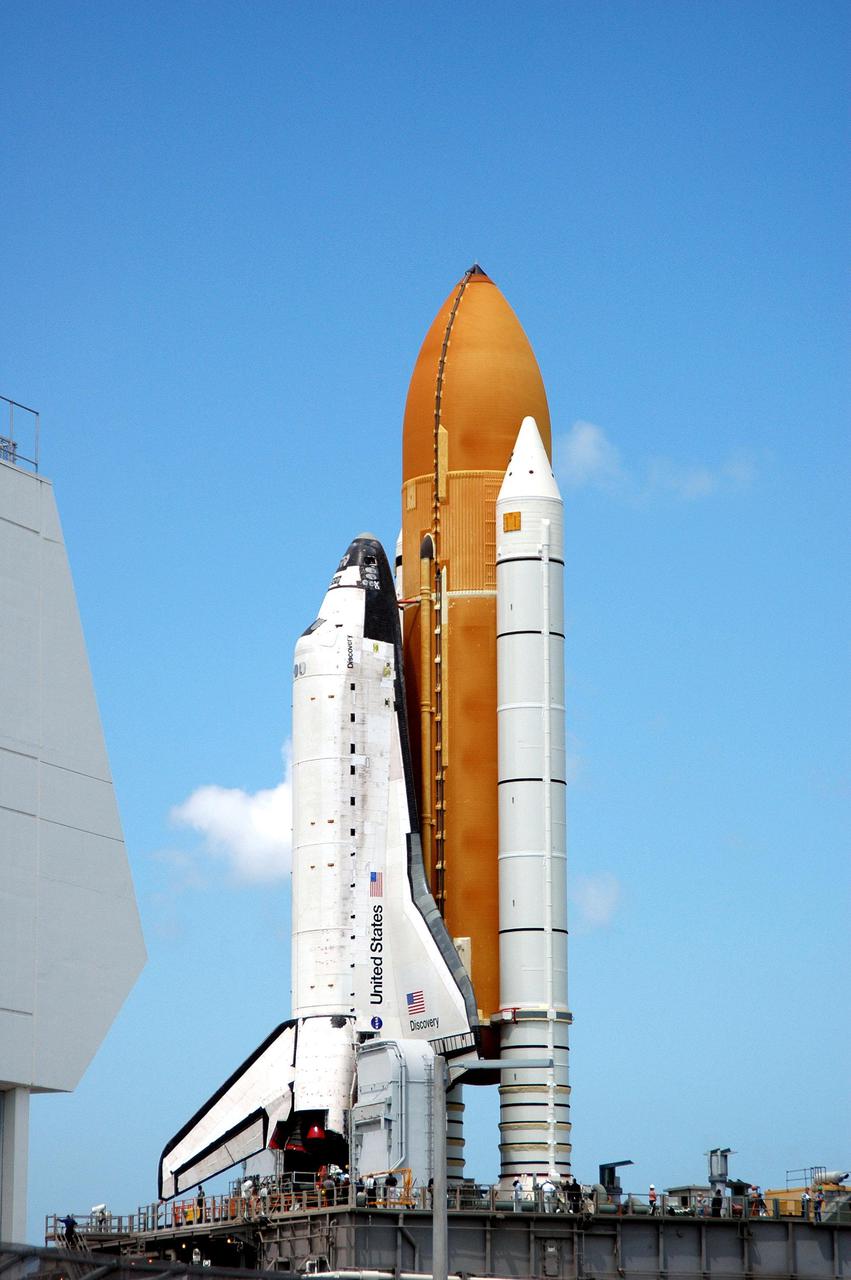
KENNEDY SPACE CENTER, FLA. - A KSC employee stands at the Press Site watching Space Shuttle Discovery mark a major milestone for Return to Flight, rolling out to Launch Pad 39B. First motion out of the Vehicle Assembly Building was at 2:04 p.m. EDT. The Shuttle sits atop the Mobile Launcher Platform, which is moved by the Crawler-Transporter underneath. The Crawler is 20 feet high, 131 feet long and 114 feet wide. It moves on eight tracks, each containing 57 shoes, or cleats, weighing one ton each. Loaded with the Space Shuttle, the Crawler can move at a maximum speed of approximately 1 mile an hour. A leveling system in the Crawler keeps the Shuttle vertical while negotiating the 5 percent grade leading to the top of the launch pad. Launch of Discovery on its Return to Flight mission, STS-114, is targeted for May 15 with a launch window that extends to June 3. During its 12-day mission, Discovery’s seven-person crew will test new hardware and techniques to improve Shuttle safety, as well as deliver supplies to the International Space Station. Discovery was moved on March 29 from the Orbiter Processing Facility to the VAB and attached to its propulsion elements, a redesigned ET and twin SRBs.
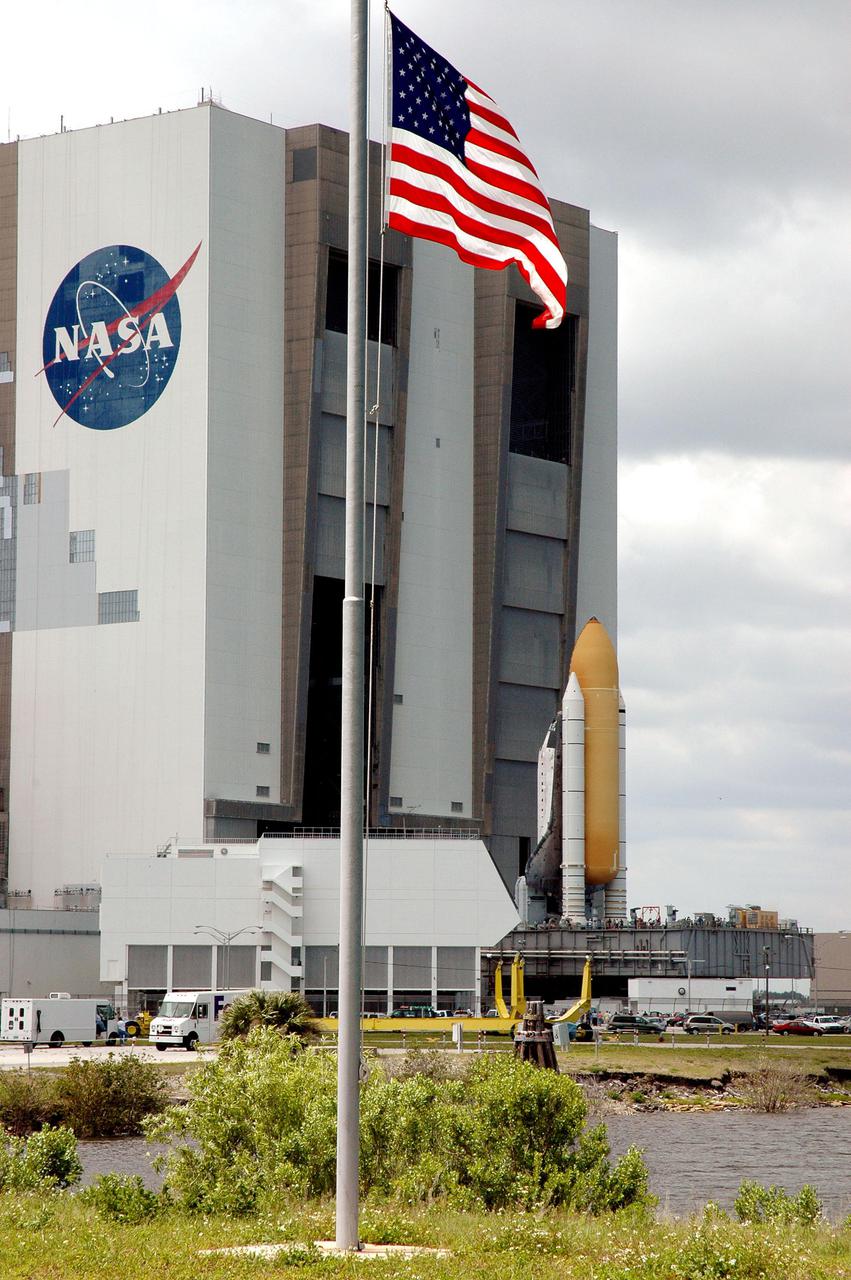
KENNEDY SPACE CENTER, FLA. - — Looking from the Press Site across the Turn Basin at NASA’s Kennedy Space Center, the American flag appears to salute Space Shuttle Discovery as she marks a major milestone for Return to Flight, rolling out to Launch Pad 39B. First motion out of the Vehicle Assembly Building, behind the flag, was at 2:04 p.m. EDT. The Shuttle sits atop the Mobile Launcher Platform, which is moved by the Crawler-Transporter underneath. The Crawler is 20 feet high, 131 feet long and 114 feet wide. It moves on eight tracks, each containing 57 shoes, or cleats, weighing one ton each. Loaded with the Space Shuttle, the Crawler can move at a maximum speed of approximately 1 mile an hour. A leveling system in the Crawler keeps the Shuttle vertical while negotiating the 5 percent grade leading to the top of the launch pad. Launch of Discovery on its Return to Flight mission, STS-114, is targeted for May 15 with a launch window that extends to June 3. During its 12-day mission, Discovery’s seven-person crew will test new hardware and techniques to improve Shuttle safety, as well as deliver supplies to the International Space Station. Discovery was moved on March 29 from the Orbiter Processing Facility to the VAB and attached to its propulsion elements, a redesigned ET and twin SRBs.
KENNEDY SPACE CENTER, FLA. - Under brilliant-blue Florida skies, Space Shuttle Discovery, atop the Mobile Launcher Platform, wends its way slowly to Launch Pad 39B at NASA’s Kennedy Space Center. First motion out of the Vehicle Assembly Building (VAB) was at 2:04 p.m. EDT. The Mobile Launcher Platform is moved by the Crawler-Transporter underneath. The Crawler is 20 feet high, 131 feet long and 114 feet wide. It moves on eight tracks, each containing 57 shoes, or cleats, weighing one ton each. Loaded with the Space Shuttle, the Crawler can move at a maximum speed of approximately 1 mile an hour. A leveling system in the Crawler keeps the Shuttle vertical while negotiating the 5 percent grade leading to the top of the launch pad. Launch of Discovery on its Return to Flight mission, STS-114, is targeted for May 15 with a launch window that extends to June 3. During its 12-day mission, Discovery’s seven-person crew will test new hardware and techniques to improve Shuttle safety, as well as deliver supplies to the International Space Station. Discovery was moved on March 29 from the Orbiter Processing Facility to the VAB and attached to its propulsion elements, a redesigned ET and twin SRBs.
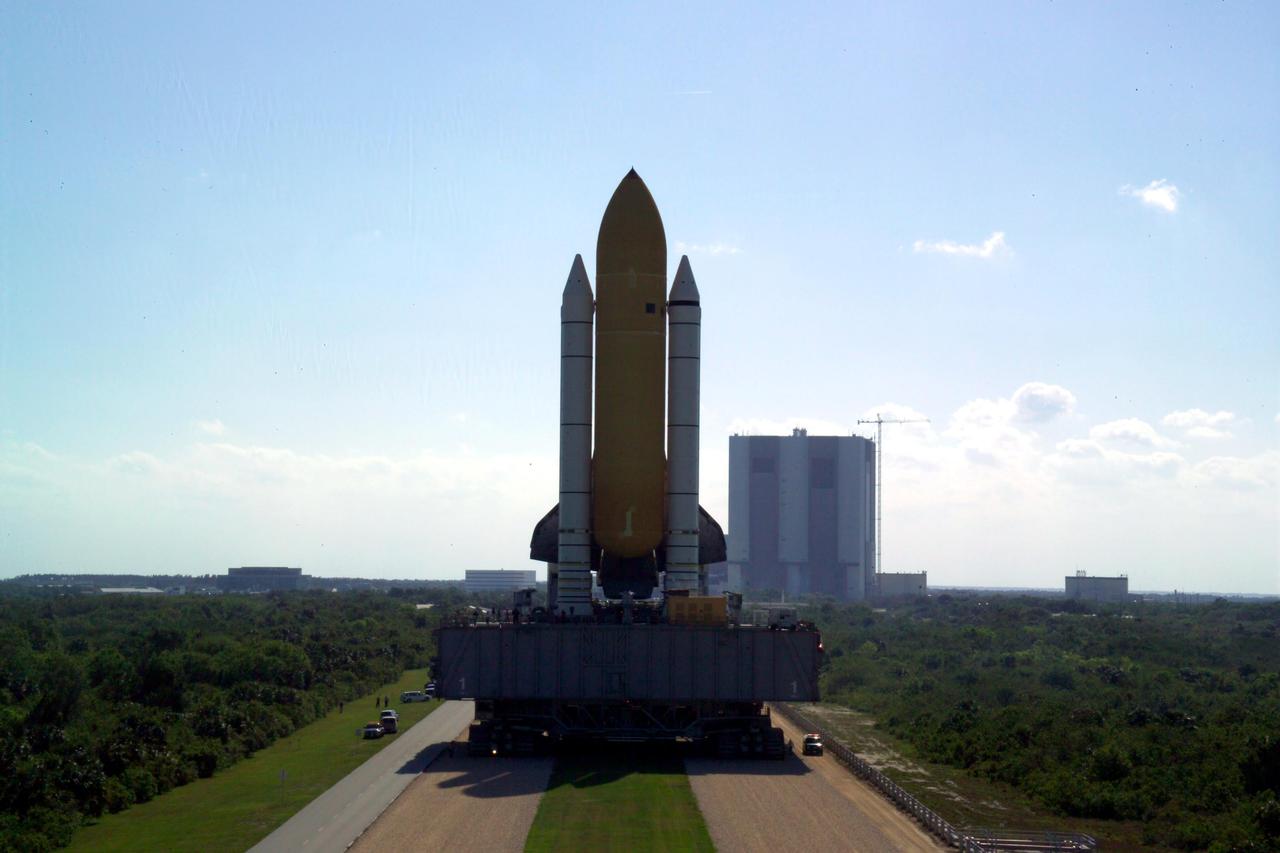
KENNEDY SPACE CENTER, FLA. - At NASA’s Kennedy Space Center, Space Shuttle Discovery, atop the Mobile Launcher Platform (MLP), casts a shadow on the crawlerway as it makes its way east to Launch Complex 39B close to sunset. In the background is the Vehicle Assembly Building (VAB) where Discovery began the rollout at 2:04 p.m. EDT. The rollout marks a major milestone in the Space Shuttle Program’s Return to Flight. The MLP is moved by the Crawler-Transporter underneath, which stands 20 feet high, 131 feet long and 114 feet wide. It moves on eight tracks, each containing 57 shoes, or cleats, weighing one ton each. Loaded with the Space Shuttle, the Crawler can move at a maximum speed of approximately 1 mile an hour. A leveling system in the Crawler keeps the Shuttle vertical while negotiating the 5 percent grade leading to the top of the launch pad. Launch of Discovery on its Return to Flight mission, STS-114, is targeted for May 15 with a launch window that extends to June 3. During its 12-day mission, Discovery’s seven-person crew will test new hardware and techniques to improve Shuttle safety, as well as deliver supplies to the International Space Station.
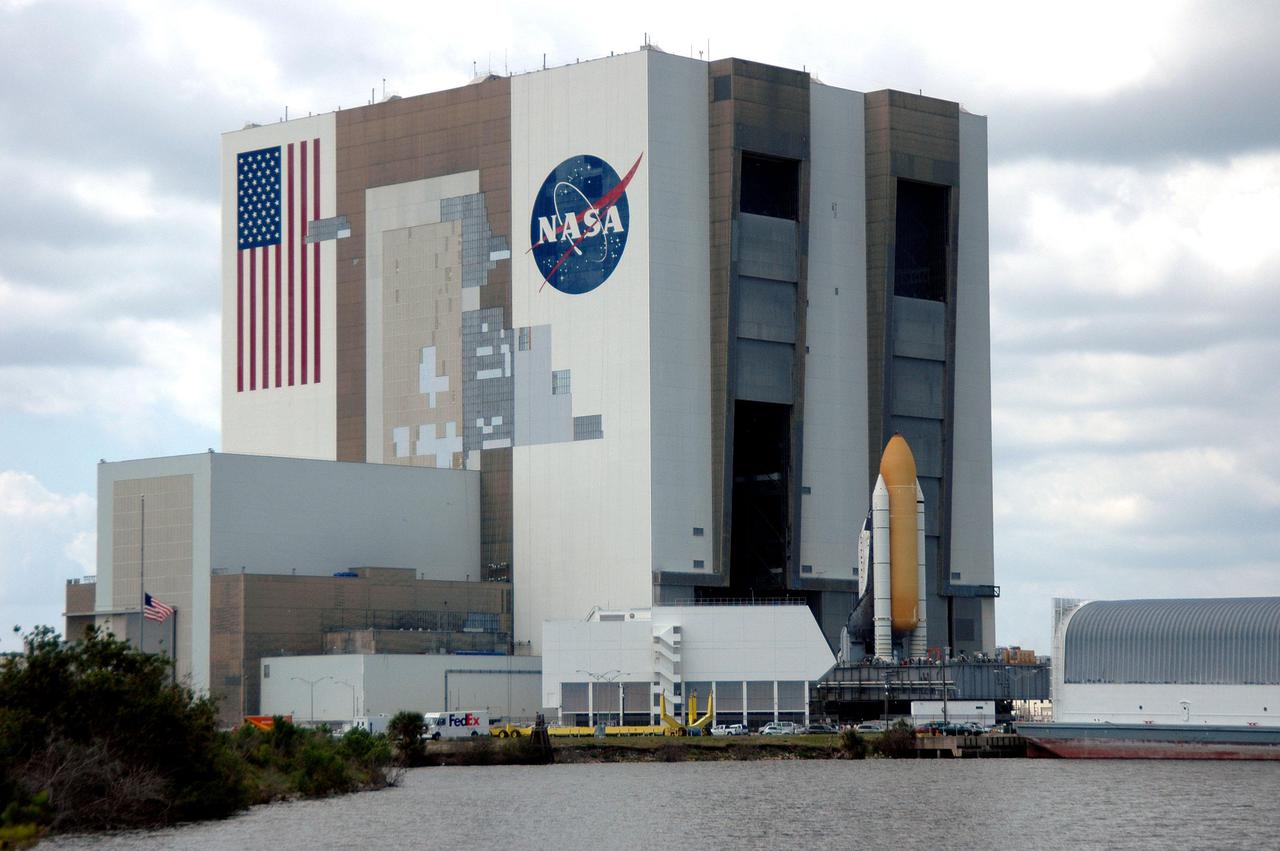
KENNEDY SPACE CENTER, FLA. - Space Shuttle Discovery, atop the Mobile Launcher Platform, has left the Vehicle Assembly Building (VAB) on its way to Launch Pad 39B. First motion out of the VAB was at 2:04 p.m. EDT. The Mobile Launcher Platform is moved by the Crawler-Transporter underneath. The Crawler is 20 feet high, 131 feet long and 114 feet wide. It moves on eight tracks, each containing 57 shoes, or cleats, weighing one ton each. Loaded with the Space Shuttle, the Crawler can move at a maximum speed of approximately 1 mile an hour. A leveling system in the Crawler keeps the Shuttle vertical while negotiating the 5 percent grade leading to the top of the launch pad. Launch of Discovery on its Return to Flight mission, STS-114, is targeted for May 15 with a launch window that extends to June 3. During its 12-day mission, Discovery’s seven-person crew will test new hardware and techniques to improve Shuttle safety, as well as deliver supplies to the International Space Station. Discovery was moved on March 29 from the Orbiter Processing Facility to the VAB and attached to its propulsion elements, a redesigned ET and twin SRBs.
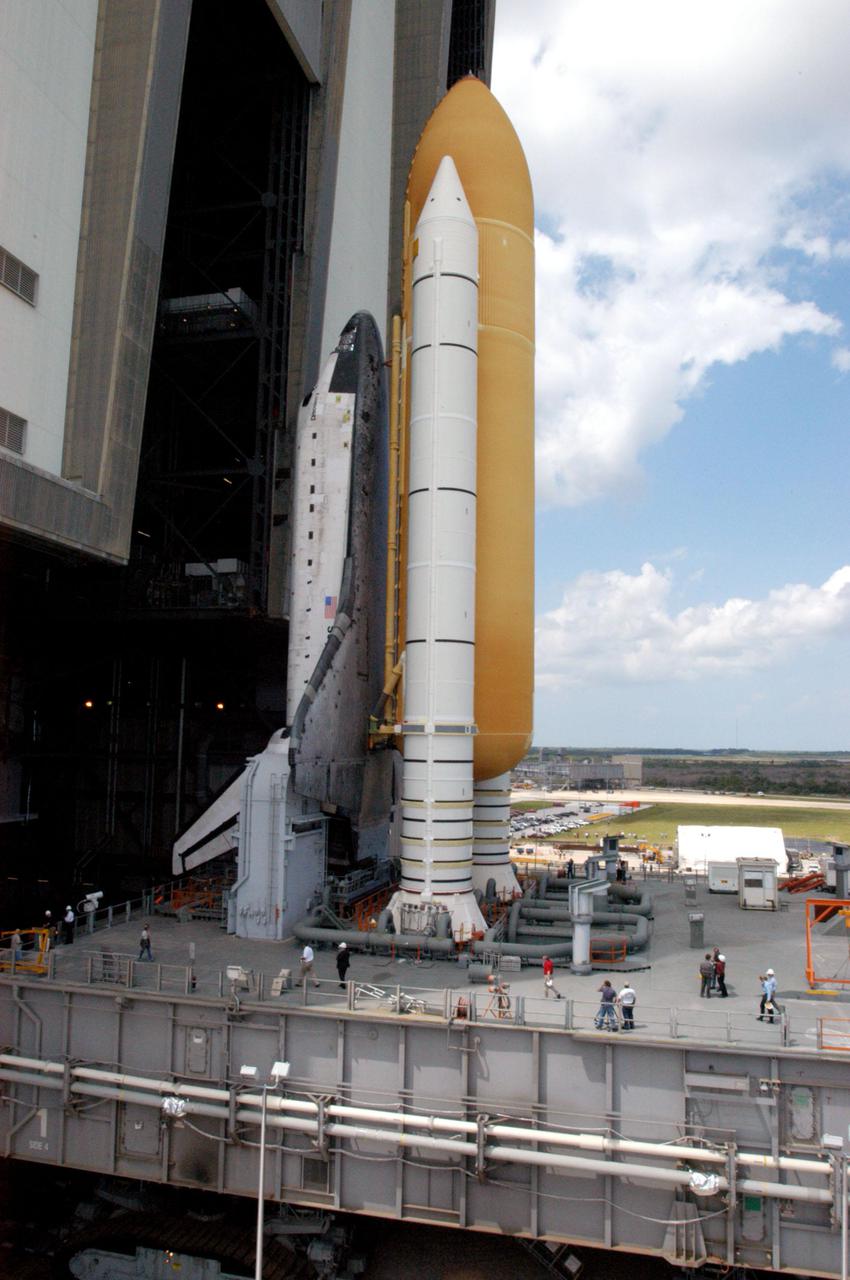
KENNEDY SPACE CENTER, FLA. - Space Shuttle Discovery, atop the Mobile Launcher Platform, slowly rolls out of the Vehicle Assembly Building (VAB) at NASA’s Kennedy Space Center. First motion was at 2:04 p.m. EDT. The Shuttle comprises the orbiter, External Tank (ET) and twin Solid Rocket Boosters (SRBs). The Mobile Launcher Platform moved by the Crawler-Transporter underneath. The Crawler is 20 feet high, 131 feet long and 114 feet wide. It moves on eight tracks, each containing 57 shoes, or cleats, weighing one ton each. Loaded with the Space Shuttle, the Crawler can move at a maximum speed of approximately 1 mile an hour. A leveling system in the Crawler keeps the Shuttle vertical while negotiating the 5 percent grade leading to the top of the launch pad. Launch of Discovery on its Return to Flight mission, STS-114, is targeted for May 15 with a launch window that extends to June 3. During its 12-day mission, Discovery’s seven-person crew will test new hardware and techniques to improve Shuttle safety, as well as deliver supplies to the International Space Station. Discovery was moved on March 29 from the Orbiter Processing Facility to the VAB and attached to its propulsion elements, a redesigned ET and twin SRBs.
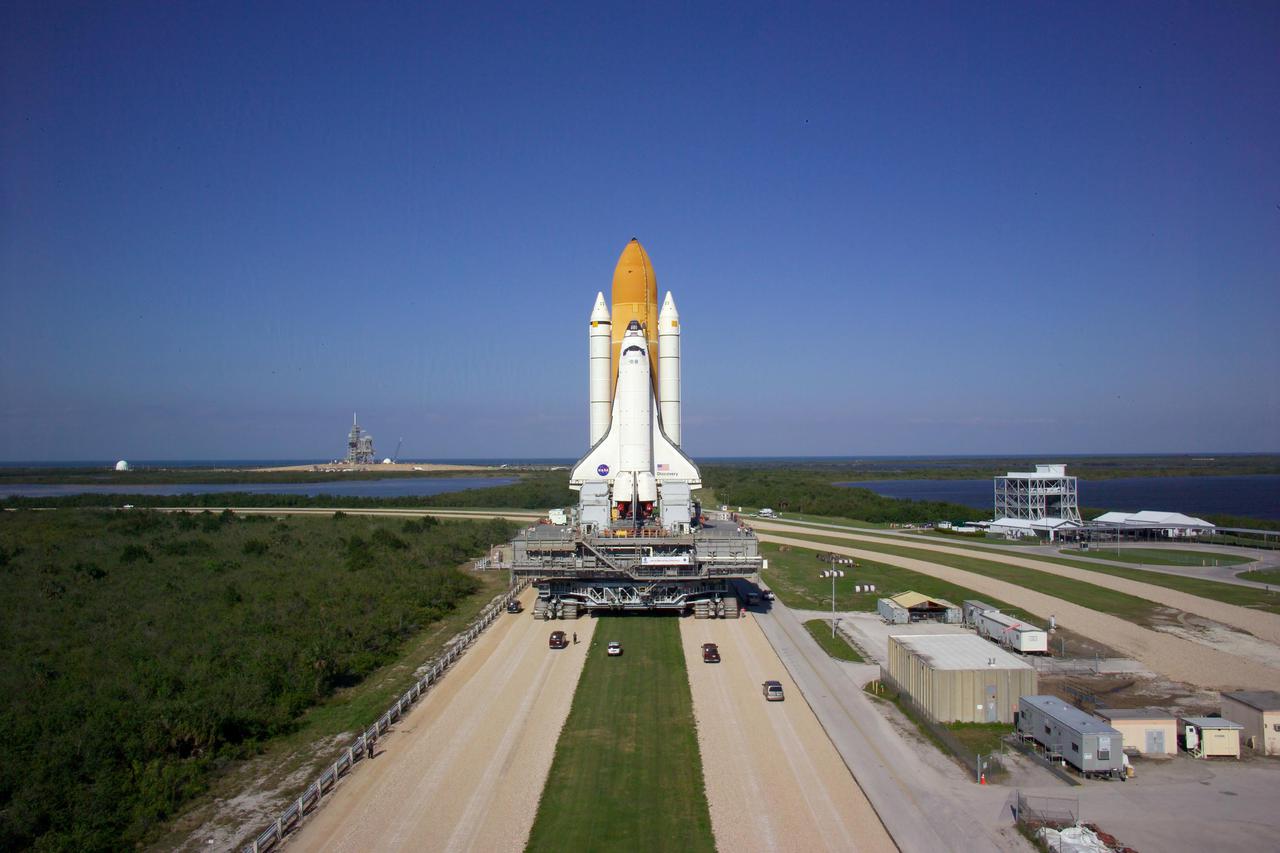
KENNEDY SPACE CENTER, FLA. - At NASA’s Kennedy Space Center, Space Shuttle Discovery, atop the Mobile Launcher Platform (MLP), crawls toward Launch Complex 39B. Barely visible on the horizon at right is Pad 39A. First motion out of the Vehicle Assembly Building occurred at 2:04 p.m. EDT. The rollout marks a major milestone in the Space Shuttle Program’s Return to Flight. The MLP is moved by the Crawler-Transporter underneath, which stands 20 feet high, 131 feet long and 114 feet wide. It moves on eight tracks, each containing 57 shoes, or cleats, weighing one ton each. Loaded with the Space Shuttle, the Crawler can move at a maximum speed of approximately 1 mile an hour. A leveling system in the Crawler keeps the Shuttle vertical while negotiating the 5 percent grade leading to the top of the launch pad. Launch of Discovery on its Return to Flight mission, STS-114, is targeted for May 15 with a launch window that extends to June 3. During its 12-day mission, Discovery’s seven-person crew will test new hardware and techniques to improve Shuttle safety, as well as deliver supplies to the International Space Station.
KENNEDY SPACE CENTER, FLA. - Blue sky blends with the blue Atlantic Ocean as Space Shuttle Discovery, atop the Mobile Launcher Platform (MLP), crawls toward Launch Complex 39B. First motion out of the Vehicle Assembly Building occurred at 2:04 p.m. EDT. The rollout marks a major milestone in the Space Shuttle Program’s Return to Flight. The MLP is moved by the Crawler-Transporter underneath, which stands 20 feet high, 131 feet long and 114 feet wide. It moves on eight tracks, each containing 57 shoes, or cleats, weighing one ton each. Loaded with the Space Shuttle, the Crawler can move at a maximum speed of approximately 1 mile an hour. A leveling system in the Crawler keeps the Shuttle vertical while negotiating the 5 percent grade leading to the top of the launch pad. Launch of Discovery on its Return to Flight mission, STS-114, is targeted for May 15 with a launch window that extends to June 3. During its 12-day mission, Discovery’s seven-person crew will test new hardware and techniques to improve Shuttle safety, as well as deliver supplies to the International Space Station.
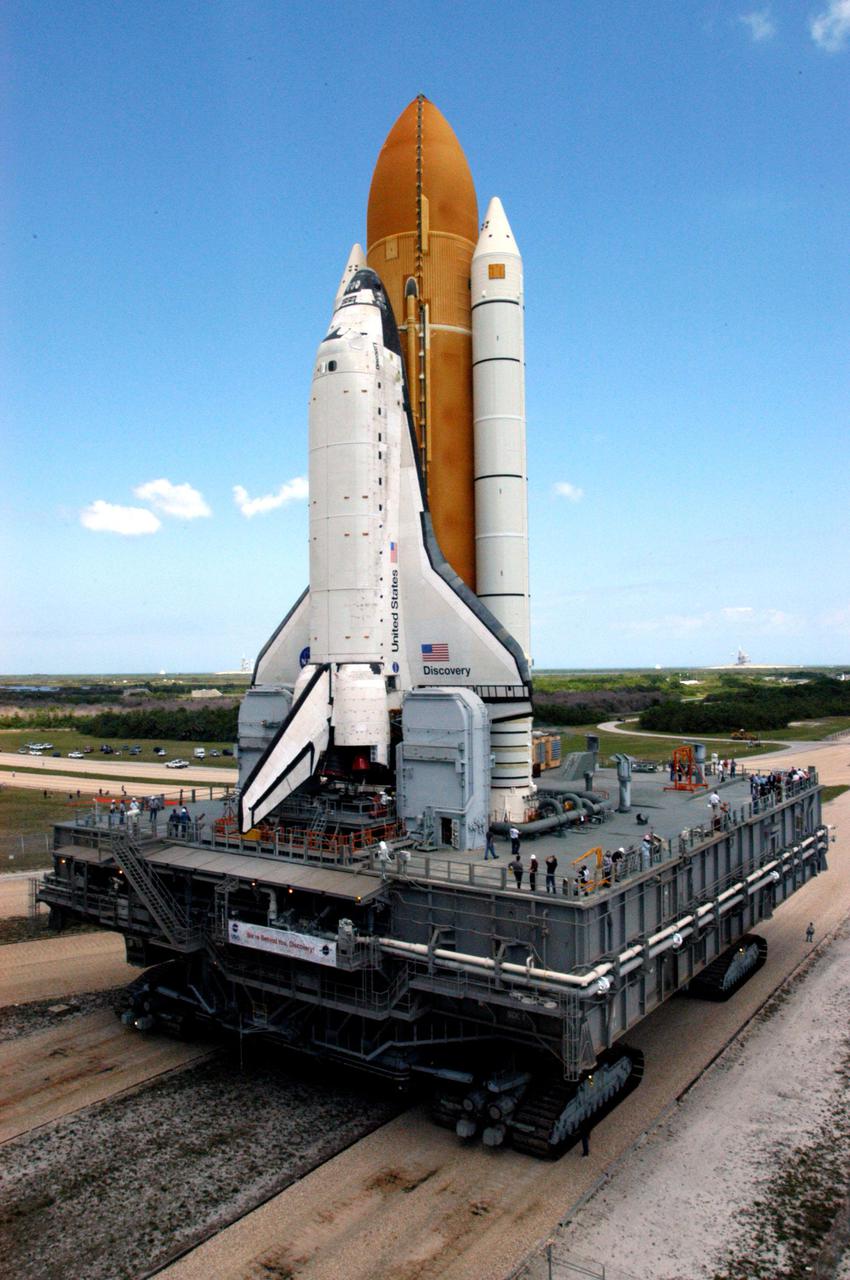
KENNEDY SPACE CENTER, FLA. - Under brilliant-blue Florida skies, Space Shuttle Discovery, atop the Mobile Launcher Platform, is on its way to Launch Pad 39B at NASA’s Kennedy Space Center. First motion out of the Vehicle Assembly Building (VAB) was at 2:04 p.m. EDT. The Shuttle comprises the orbiter, External Tank (ET) and twin Solid Rocket Boosters (SRBs). The Mobile Launcher Platform moved by the Crawler-Transporter underneath. The Crawler is 20 feet high, 131 feet long and 114 feet wide. It moves on eight tracks, each containing 57 shoes, or cleats, weighing one ton each. Loaded with the Space Shuttle, the Crawler can move at a maximum speed of approximately 1 mile an hour. A leveling system in the Crawler keeps the Shuttle vertical while negotiating the 5 percent grade leading to the top of the launch pad. Launch of Discovery on its Return to Flight mission, STS-114, is targeted for May 15 with a launch window that extends to June 3. During its 12-day mission, Discovery’s seven-person crew will test new hardware and techniques to improve Shuttle safety, as well as deliver supplies to the International Space Station. Discovery was moved on March 29 from the Orbiter Processing Facility to the VAB and attached to its propulsion elements, a redesigned ET and twin SRBs.
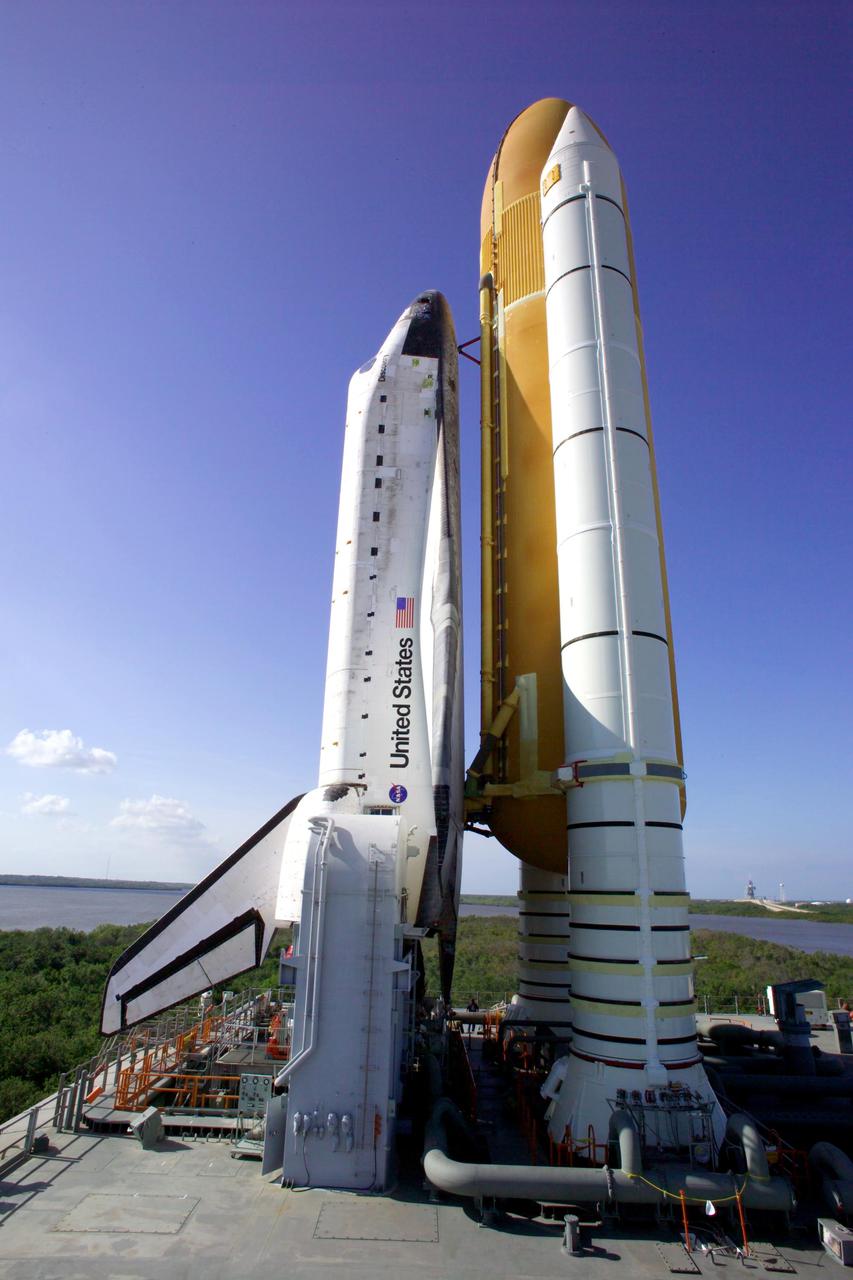
KENNEDY SPACE CENTER, FLA. - At NASA’s Kennedy Space Center, Space Shuttle Discovery is viewed from the side as it sits atop the Mobile Launcher Platform (MLP) rolling out to Launch Complex 39B. First motion out of the Vehicle Assembly Building occurred at 2:04 p.m. EDT. The rollout marks a major milestone in the Space Shuttle Program’s Return to Flight. The MLP is moved by the Crawler-Transporter underneath, which stands 20 feet high, 131 feet long and 114 feet wide. It moves on eight tracks, each containing 57 shoes, or cleats, weighing one ton each. Loaded with the Space Shuttle, the Crawler can move at a maximum speed of approximately 1 mile an hour. A leveling system in the Crawler keeps the Shuttle vertical while negotiating the 5 percent grade leading to the top of the launch pad. Launch of Discovery on its Return to Flight mission, STS-114, is targeted for May 15 with a launch window that extends to June 3. During its 12-day mission, Discovery’s seven-person crew will test new hardware and techniques to improve Shuttle safety, as well as deliver supplies to the International Space Station.
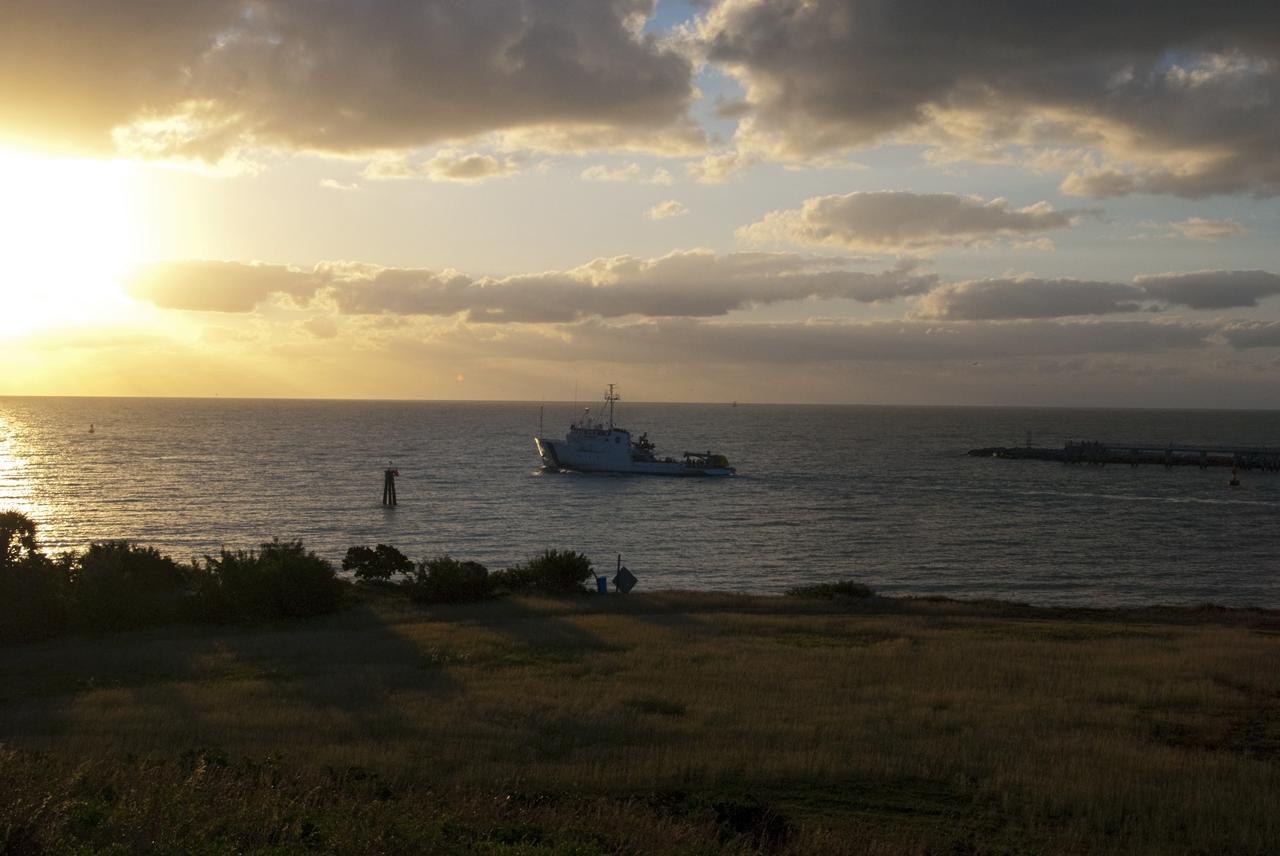
CAPE CANAVERAL, Fla. – NASA's Liberty Star ship, with an Orion flight test capsule secured to its deck, passes through the mouth of Port Canaveral in Florida into the Atlantic Ocean. Liberty Star has been enlisted to support the Crew Module Recovery Attach Fitting Test (CRAFT) which began at-sea operations Nov. 29. Multiple attach clips are being evaluated against the current recovery cleat configuration by U.S. Air Force pararescue jumpers (PJs) and a U.S. Navy diver. The 21st Century Ground Systems Program will use data collected from the tests to help develop ground operations support equipment that could be used to recover an uncrewed Orion flight test capsule after splashdown. The Orion Multi-Purpose Crew Vehicle is NASA's next-generation spacecraft being developed for deep space missions to asteroids, moons and other interplanetary destinations throughout the solar system. For more information, visit http://www.nasa.gov/orion. Photo credit: NASA/Tim Jacobs
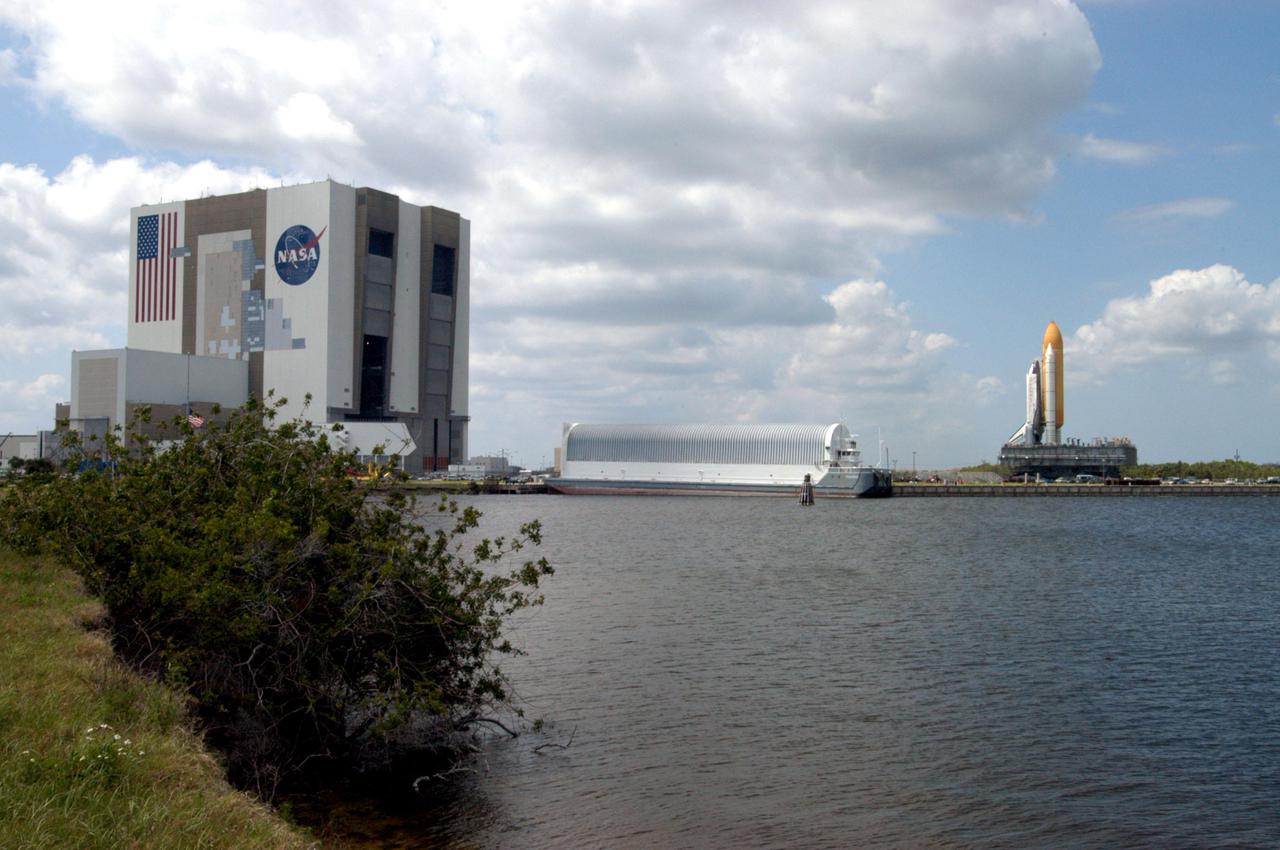
KENNEDY SPACE CENTER, FLA. - Across the Turn Basin is seen the Vehicle Assembly Building (VAB (at left), the Launch Control Center (middle), and Space Shuttle Discovery (at right). First motion of the Shuttle out of the VAB was at 2:04 p.m. EDT. Atop the Mobile Launcher Platform, the Shuttle is on its way to Launch Pad 39B, marking a major milestone in Return to Flight. The Mobile Launcher Platform is moved by the Crawler-Transporter underneath. The Crawler is 20 feet high, 131 feet long and 114 feet wide. It moves on eight tracks, each containing 57 shoes, or cleats, weighing one ton each. Loaded with the Space Shuttle, the Crawler can move at a maximum speed of approximately 1 mile an hour. A leveling system in the Crawler keeps the Shuttle vertical while negotiating the 5 percent grade leading to the top of the launch pad. Launch of Discovery on its Return to Flight mission, STS-114, is targeted for May 15 with a launch window that extends to June 3. During its 12-day mission, Discovery’s seven-person crew will test new hardware and techniques to improve Shuttle safety, as well as deliver supplies to the International Space Station. Discovery was moved on March 29 from the Orbiter Processing Facility to the VAB and attached to its propulsion elements, a redesigned ET and twin SRBs.
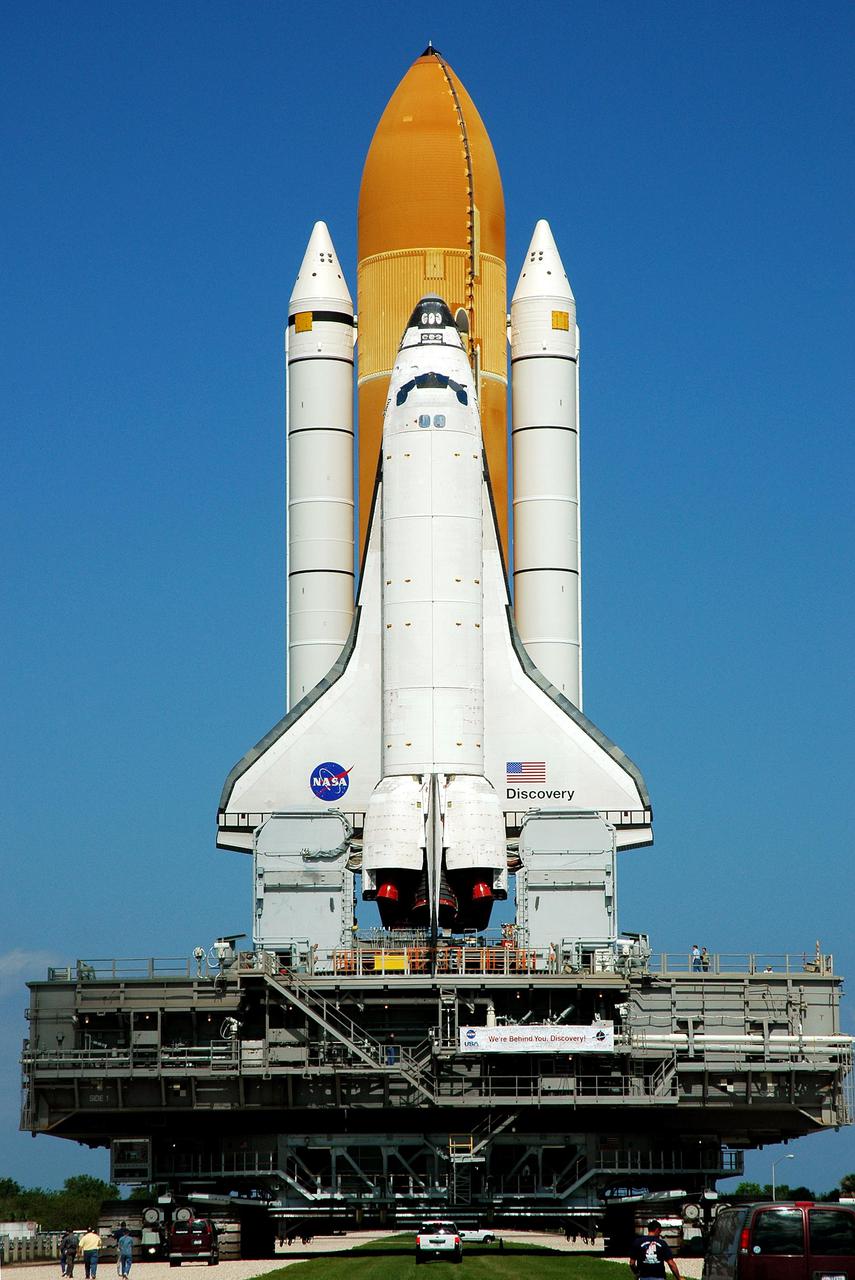
KENNEDY SPACE CENTER, FLA. -- Space Shuttle Discovery, atop a Mobile Launcher Platform (MLP), crawls toward Launch Complex 39B. First motion out of the Vehicle Assembly Building occurred at 2:04 p.m. EDT. The rollout marks a major milestone in the Space Shuttle Program’s Return to Flight. The MLP is moved by the Crawler-Transporter underneath, which stands 20 feet high, 131 feet long and 114 feet wide. It moves on eight tracks, each containing 57 shoes, or cleats, weighing one ton each. Loaded with the Space Shuttle, the Crawler can move at a maximum speed of approximately 1 mile an hour. A leveling system in the Crawler keeps the Shuttle vertical while negotiating the 5 percent grade leading to the top of the launch pad. Launch of Discovery on its Return to Flight mission, STS-114, is targeted for May 15 with a launch window that extends to June 3. During its 12-day mission, Discovery’s seven-person crew will test new hardware and techniques to improve Shuttle safety, as well as deliver supplies to the International Space Station.
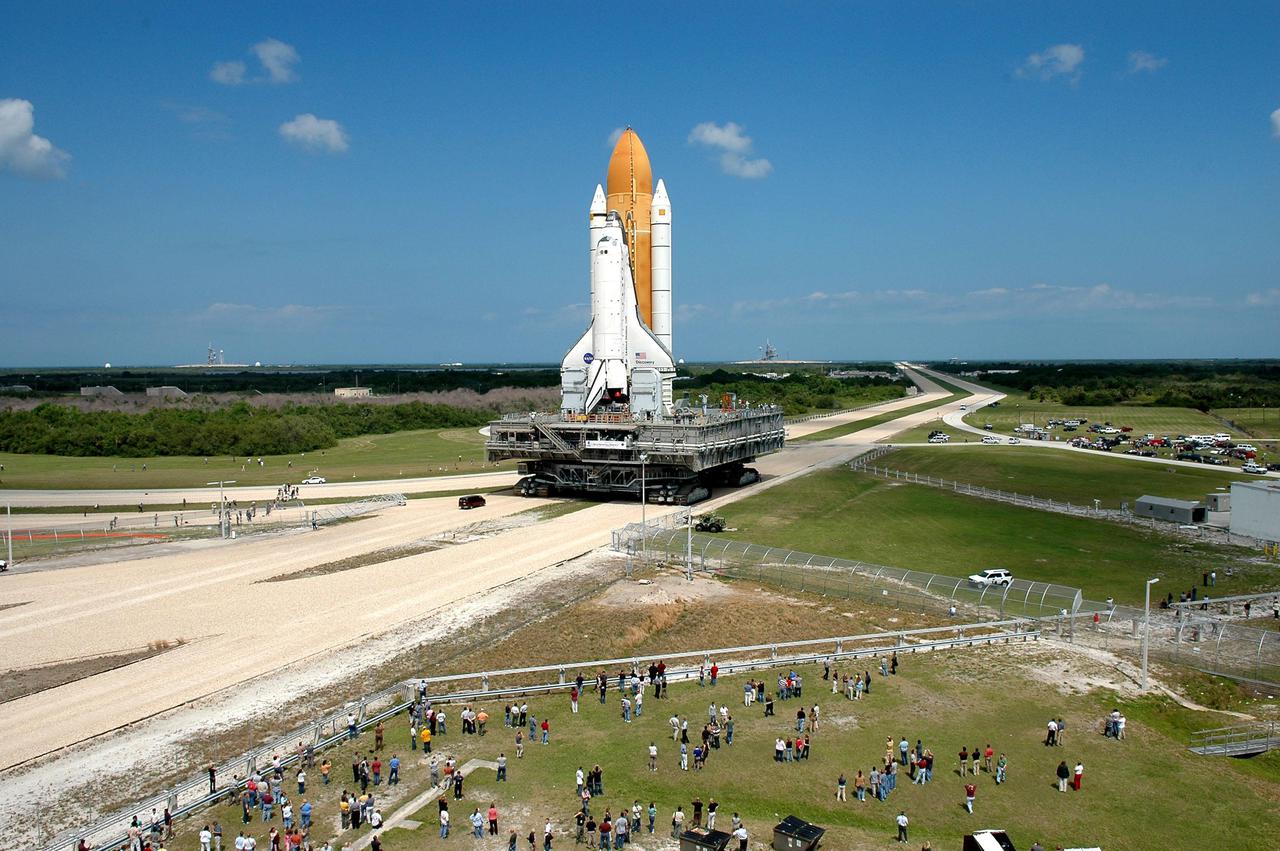
KENNEDY SPACE CENTER, FLA. - The broad, brilliant blue Florida sky silhouettes Space Shuttle Discovery as it creeps along the crawlerway toward the horizon, and Launch Pad 39B at NASA’s Kennedy Space Center. First motion of the Shuttle out of the Vehicle Assembly Building (VAB) was at 2:04 p.m. EDT. The Mobile Launcher Platform is moved by the Crawler-Transporter underneath. The Crawler is 20 feet high, 131 feet long and 114 feet wide. It moves on eight tracks, each containing 57 shoes, or cleats, weighing one ton each. Loaded with the Space Shuttle, the Crawler can move at a maximum speed of approximately 1 mile an hour. A leveling system in the Crawler keeps the Shuttle vertical while negotiating the 5 percent grade leading to the top of the launch pad. Launch of Discovery on its Return to Flight mission, STS-114, is targeted for May 15 with a launch window that extends to June 3. During its 12-day mission, Discovery’s seven-person crew will test new hardware and techniques to improve Shuttle safety, as well as deliver supplies to the International Space Station. Discovery was moved on March 29 from the Orbiter Processing Facility to the VAB and attached to its propulsion elements, a redesigned ET and twin SRBs.
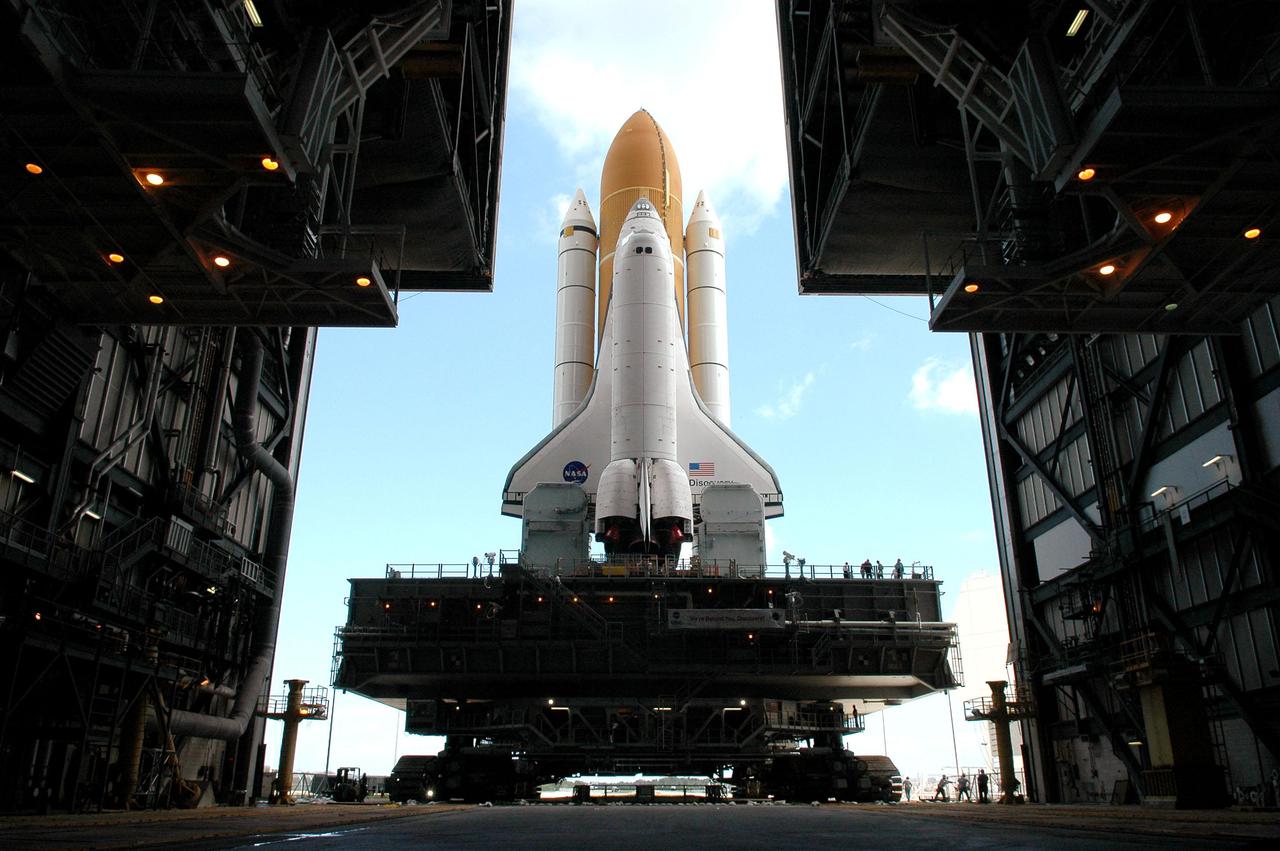
KENNEDY SPACE CENTER, FLA. - Framed in the open doors of the Vehicle Assembly Building (VAB) at NASA’s Kennedy Space Center, Space Shuttle Discovery meets the light of day as it begins its long, slow journey to Launch Pad 39B. First motion was at 2:04 p.m. EDT. The Shuttle comprises the orbiter, External Tank (ET) and twin Solid Rocket Boosters (SRBs). The Space Shuttle rests on the Mobile Launcher Platform, which is moved by the Crawler-Transporter underneath. The Crawler is 20 feet high, 131 feet long and 114 feet wide. It moves on eight tracks, each containing 57 shoes, or cleats, weighing one ton each. Loaded with the Space Shuttle, the Crawler can move at a maximum speed of approximately 1 mile an hour. A leveling system in the Crawler keeps the Shuttle vertical while negotiating the 5 percent grade leading to the top of the launch pad. Launch of Discovery on its Return to Flight mission, STS-114, is targeted for May 15 with a launch window that extends to June 3. During its 12-day mission, Discovery’s seven-person crew will test new hardware and techniques to improve Shuttle safety, as well as deliver supplies to the International Space Station. Discovery was moved on March 29 from the Orbiter Processing Facility to the VAB and attached to its propulsion elements, a redesigned ET and twin SRBs.
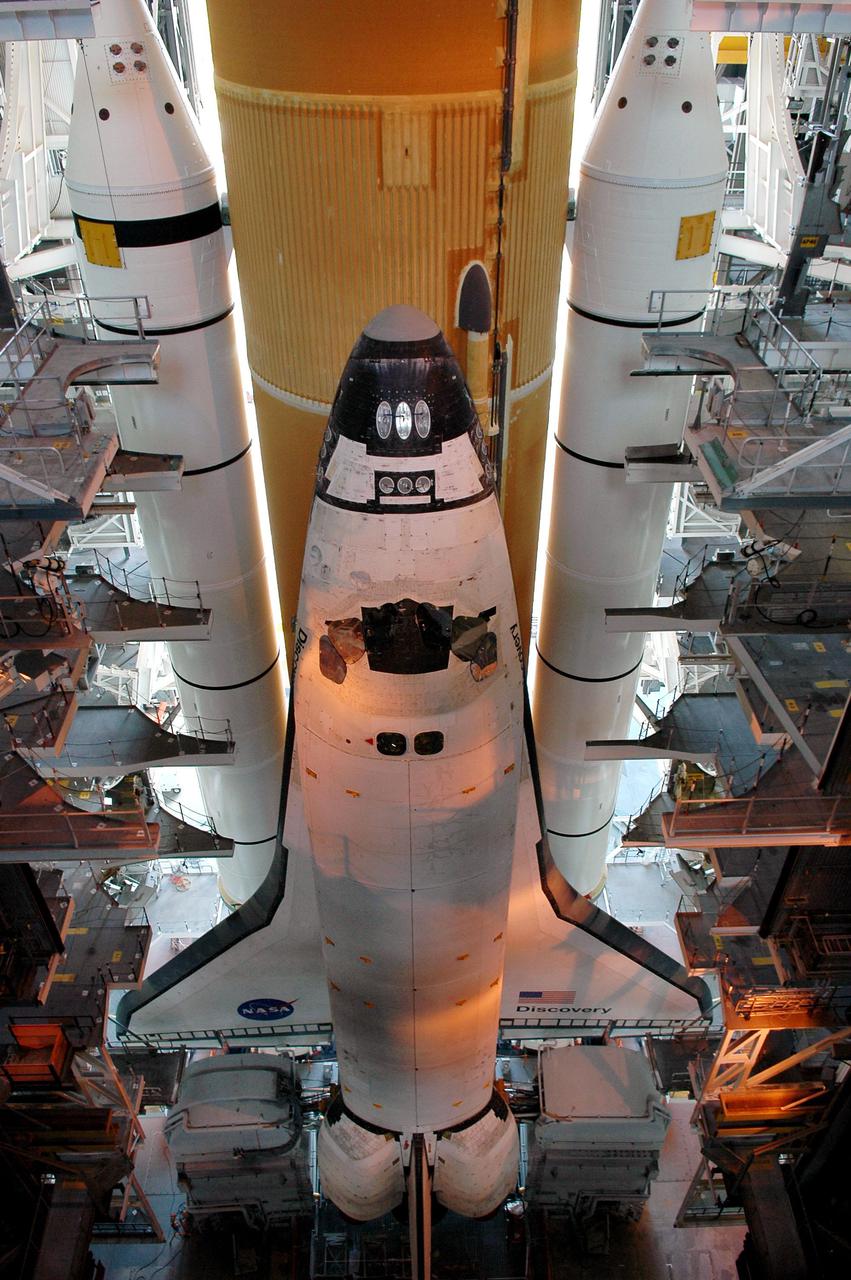
KENNEDY SPACE CENTER, FLA. - The open doors of the Vehicle Assembly Building (VAB) at NASA’s Kennedy Space Center shed a light border around the External Tank on Space Shuttle Discovery. The Shuttle, which comprises the orbiter, External Tank (ET) and twin Solid Rocket Boosters (SRBs), is beginning its long, slow journey to Launch Pad 39B. First motion was at 2:04 p.m. EDT. The Space Shuttle rests on the Mobile Launcher Platform, which is moved by the Crawler-Transporter underneath. The Crawler is 20 feet high, 131 feet long and 114 feet wide. It moves on eight tracks, each containing 57 shoes, or cleats, weighing one ton each. Loaded with the Space Shuttle, the Crawler can move at a maximum speed of approximately 1 mile an hour. A leveling system in the Crawler keeps the Shuttle vertical while negotiating the 5 percent grade leading to the top of the launch pad. Launch of Discovery on its Return to Flight mission, STS-114, is targeted for May 15 with a launch window that extends to June 3. During its 12-day mission, Discovery’s seven-person crew will test new hardware and techniques to improve Shuttle safety, as well as deliver supplies to the International Space Station. Discovery was moved on March 29 from the Orbiter Processing Facility to the VAB and attached to its propulsion elements, a redesigned ET and twin SRBs.
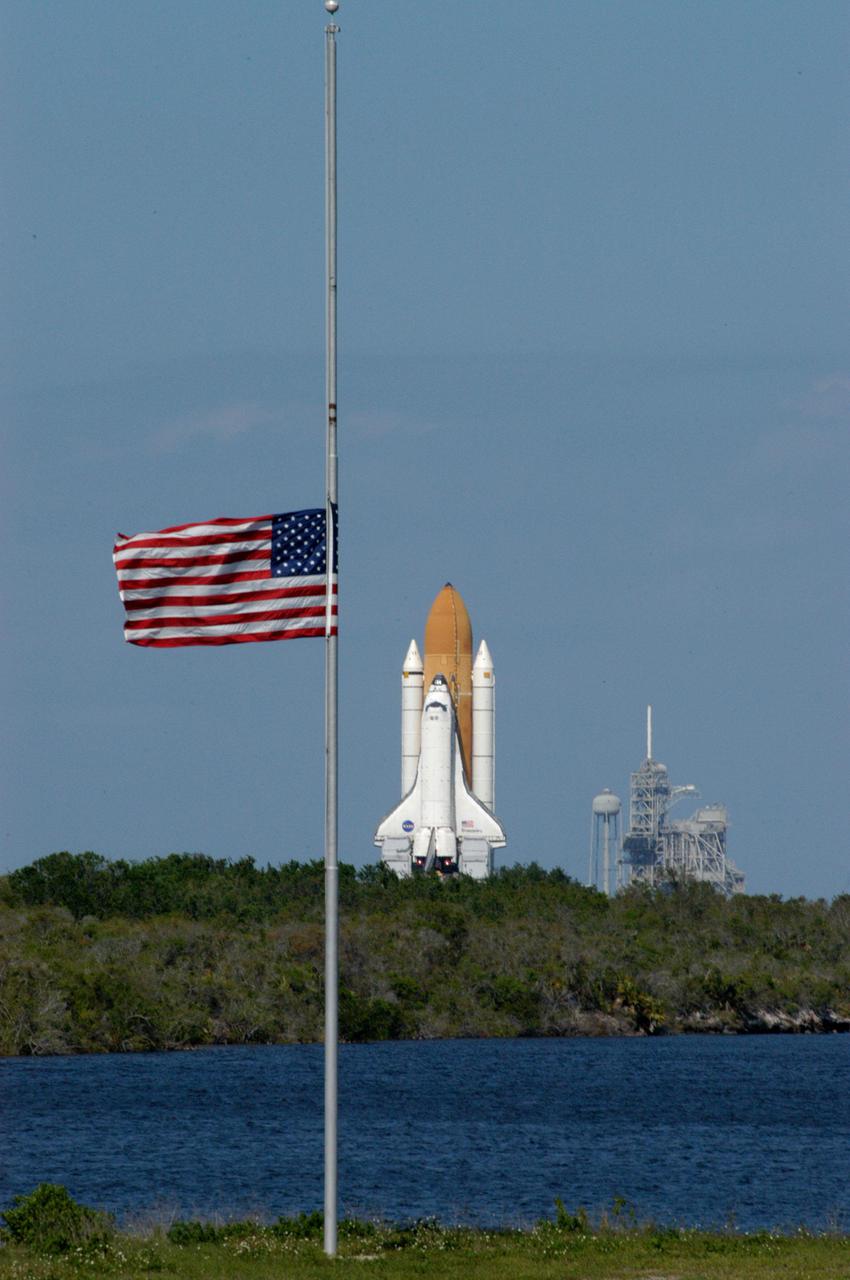
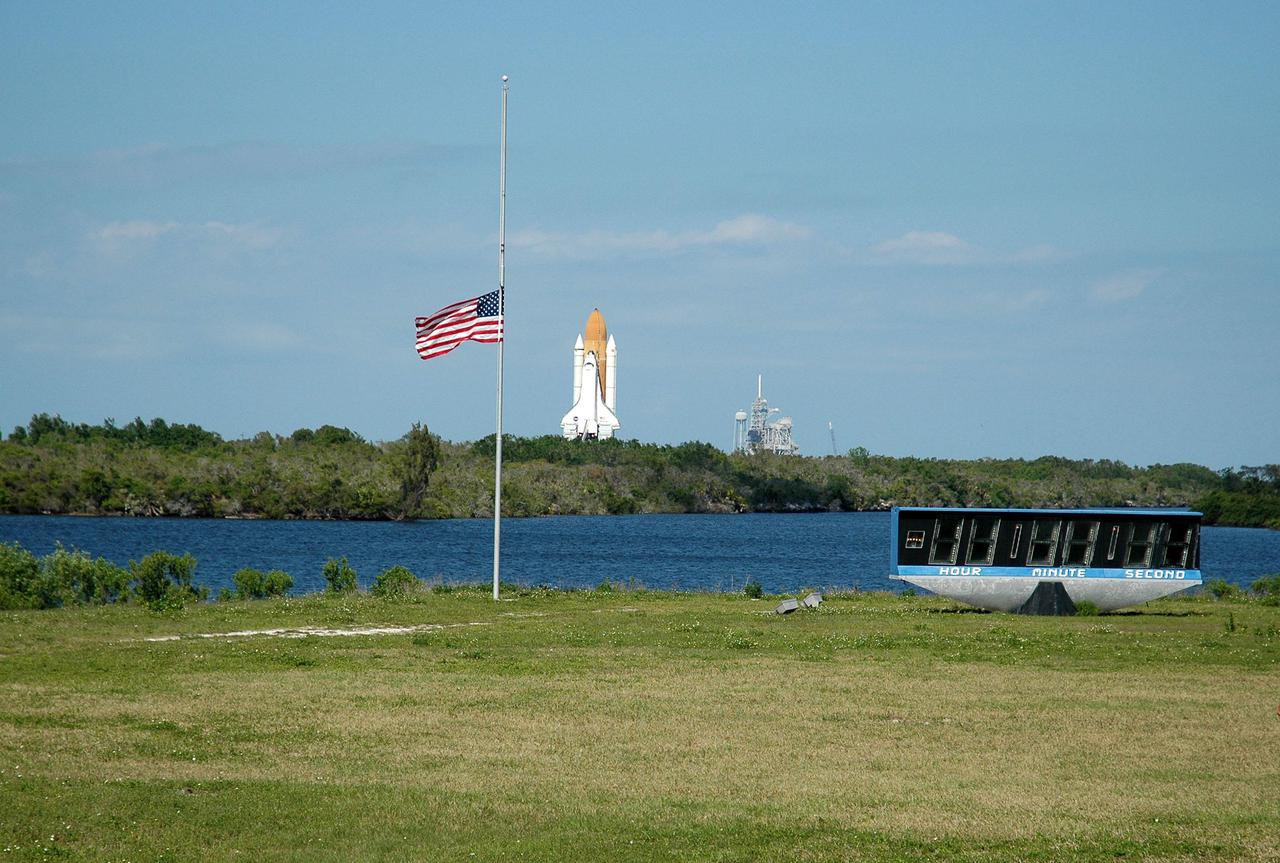
KENNEDY SPACE CENTER, FLA. - Looking from the Press Site across the Turn Basin at NASA’s Kennedy Space Center, the American flag is at half-mast in remembrance of Pope John Paul II. In the background is Space Shuttle Discovery in a more uplifting moment as she marks a major milestone for Return to Flight, rolling out to Launch Pad 39B. First motion out of the Vehicle Assembly Building was at 2:04 p.m. EDT. The Shuttle sits atop the Mobile Launcher Platform, which is moved by the Crawler-Transporter underneath. The Crawler is 20 feet high, 131 feet long and 114 feet wide. It moves on eight tracks, each containing 57 shoes, or cleats, weighing one ton each. Loaded with the Space Shuttle, the Crawler can move at a maximum speed of approximately 1 mile an hour. A leveling system in the Crawler keeps the Shuttle vertical while negotiating the 5 percent grade leading to the top of the launch pad. Launch of Discovery on its Return to Flight mission, STS-114, is targeted for May 15 with a launch window that extends to June 3. During its 12-day mission, Discovery’s seven-person crew will test new hardware and techniques to improve Shuttle safety, as well as deliver supplies to the International Space Station. Discovery was moved on March 29 from the Orbiter Processing Facility to the VAB and attached to its propulsion elements, a redesigned ET and twin SRBs.