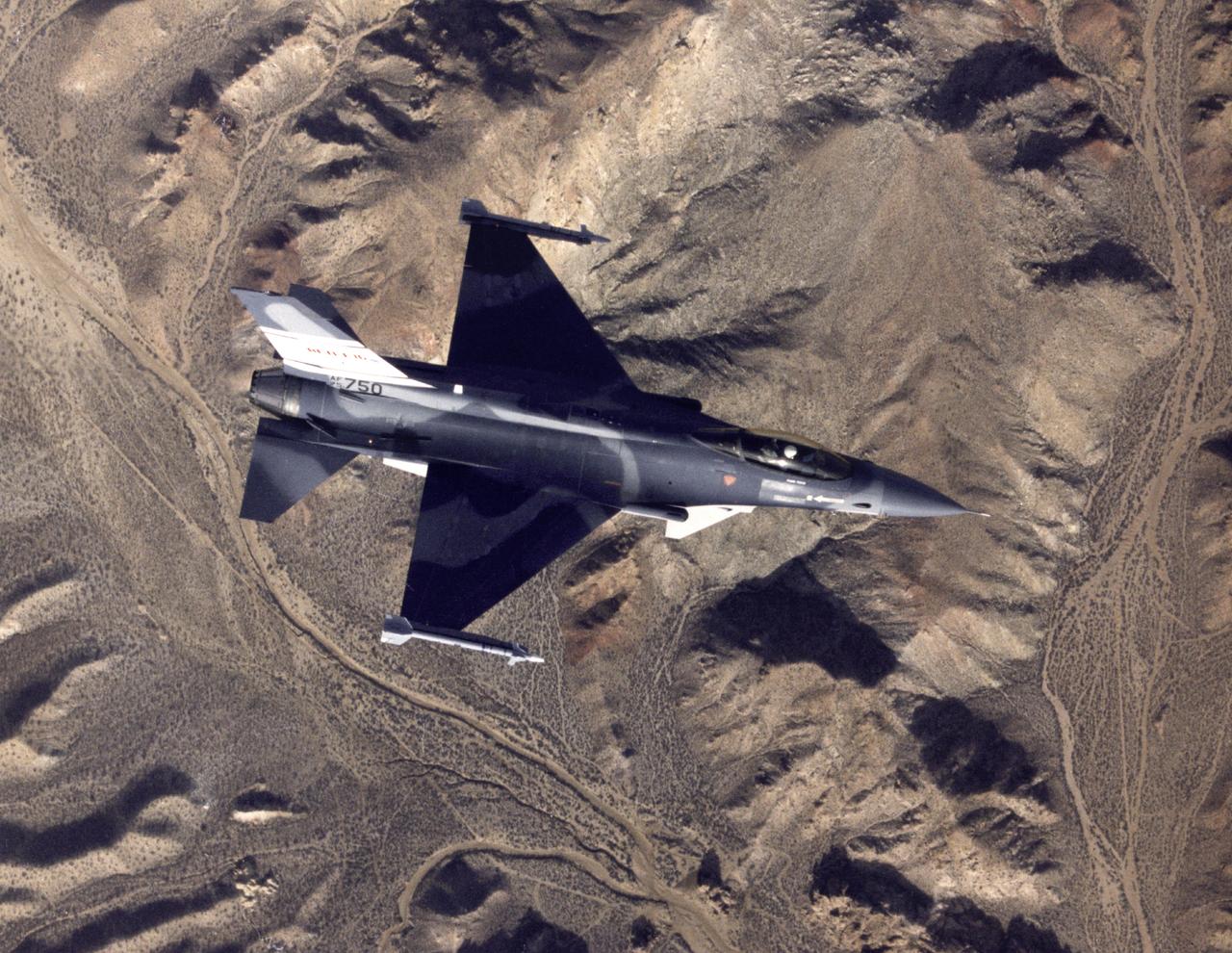
Overhead photograph of the AFTI F-16 painted in a non-standard gray finish, taken during a research flight in 1989. The two sensor pods are visible on the fuselage just forward of the wings and one of the two chin canards can be seen as a light-colored triangle ahead of one of the pods. A Sidewinder air-to-air missile is mounted on each wing tip.
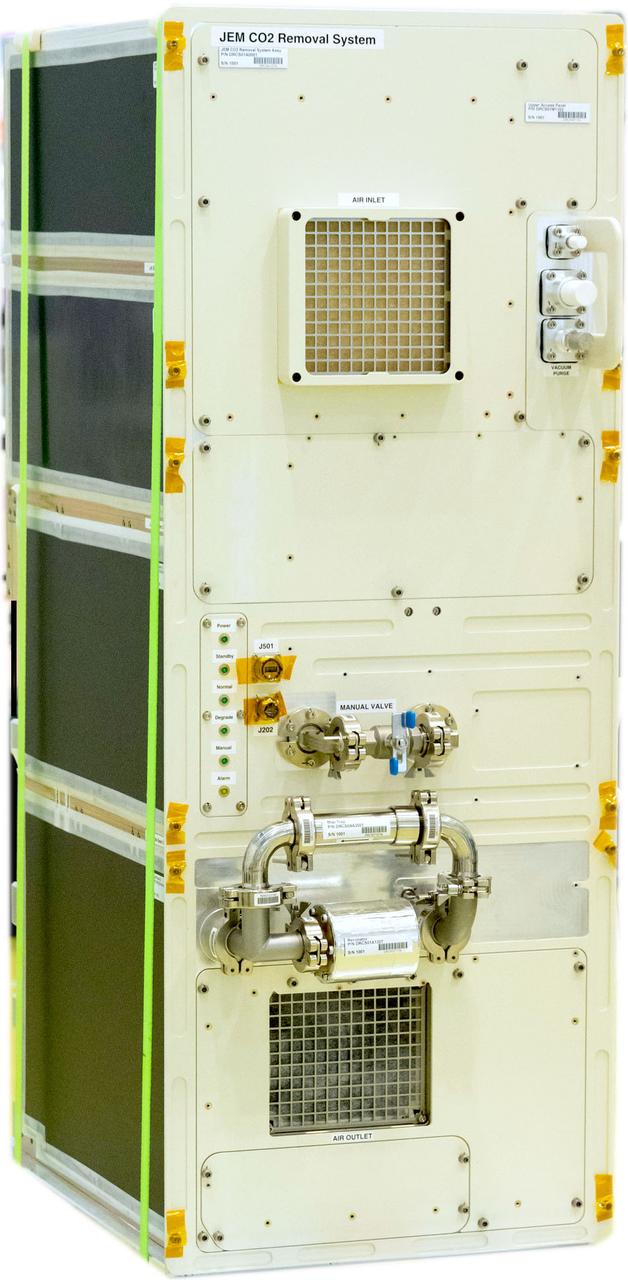
jsc2025e076916 (September 25, 2025) -- A close-up view of the JEM Demonstration of CO? Removal System (JEM DRCS) hardware. JEM DRCS will operate on the space station by filtering carbon dioxide out of the cabin air. The experiment will help guide future spacecraft life support systems and could also support technologies that reduce carbon dioxide emissions on Earth. Image courtesy of JAXA.
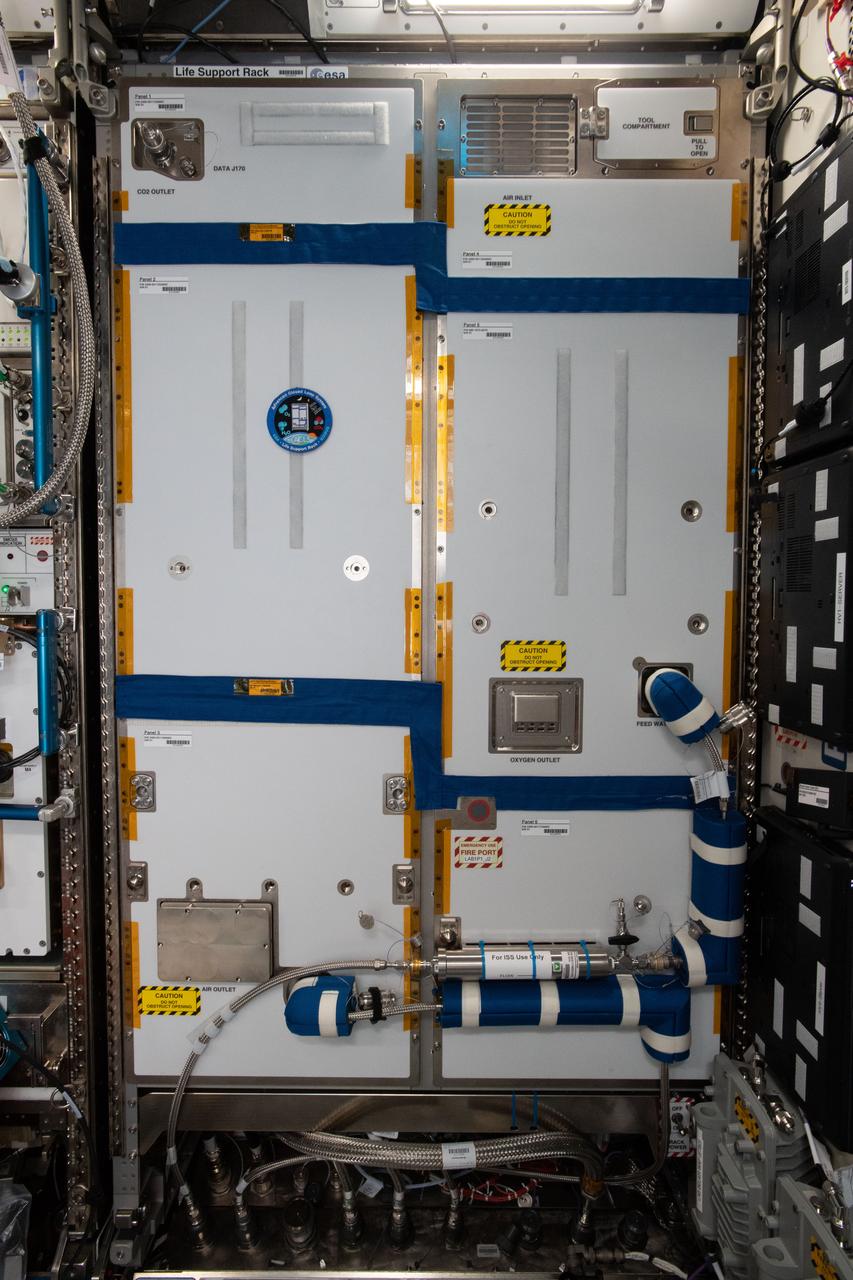
iss057e055217 (10/19/2018) --- A view of the LSR rack inside the Destiny laboratory onboard the International Space Station (ISS). The Life Support Rack (LSR) is a Technology Demonstrator for Closed Loop Air Revitalisation. LSR captures carbon dioxide from cabin air and recovers 50% of its oxygen for use by the astronauts. LSR operates for a minimum of one year on the International Space Station to demonstrate the robustness of the technology for future Exploration Missions.
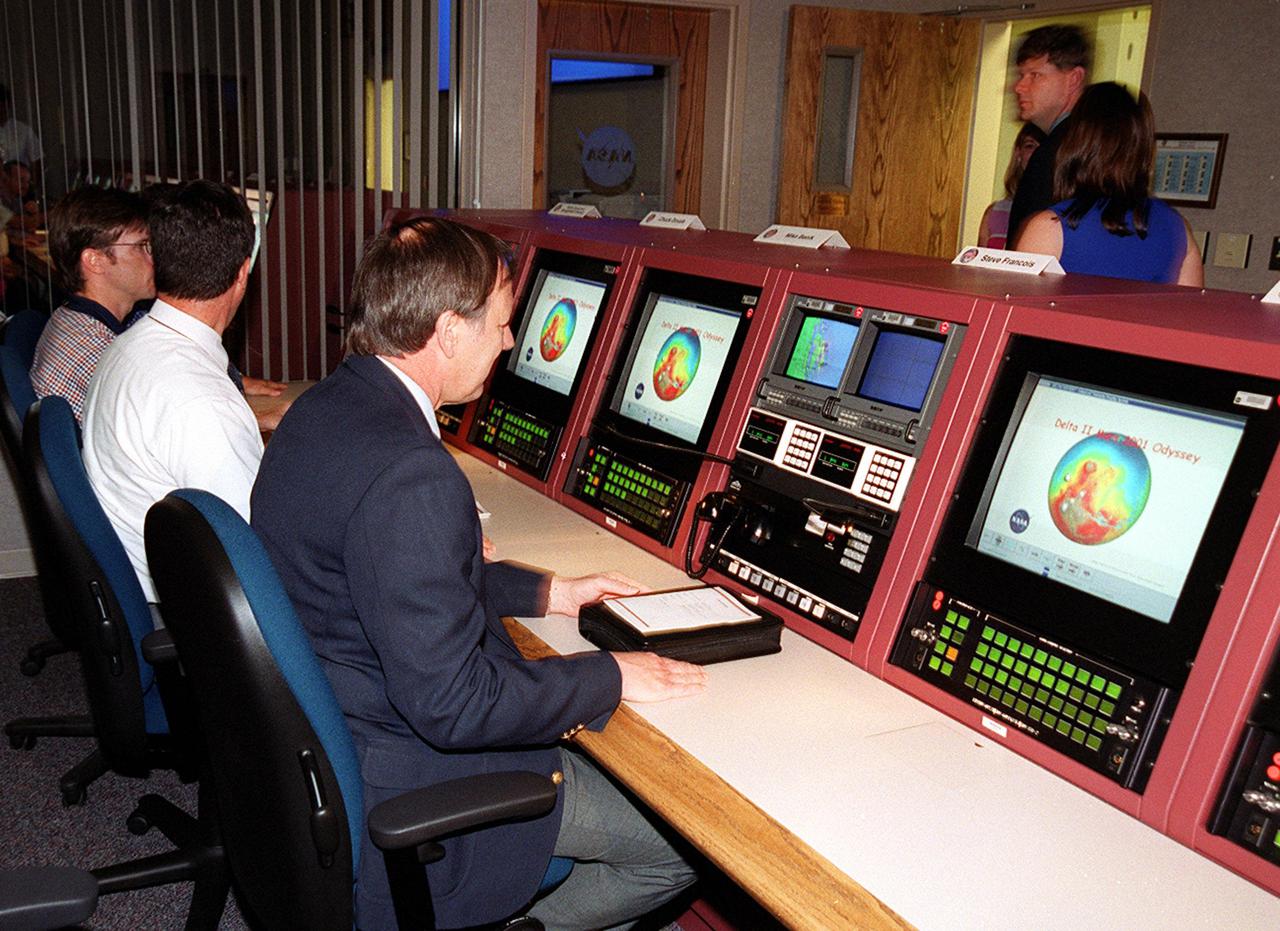
At the dedication of the upgraded Launch Vehicle Data Center in Hangar AE, Cape Canaveral Air Force Station, Fla., attendees got a close look at the new consoles. Seated on the right is Steve Francois, program manager, Expendable Vehicles and Payload Carriers. The new facility’s three individual control rooms replace a single LVDC control room in use since the mid-1970s. Developed by NASA-KSC to support multiple test operations in parallel or a single large launch operation, the new LVDC allows up to 100 launch vehicle engineers to monitor the voice, data and video systems that support the checkout and launch of an expendable vehicle
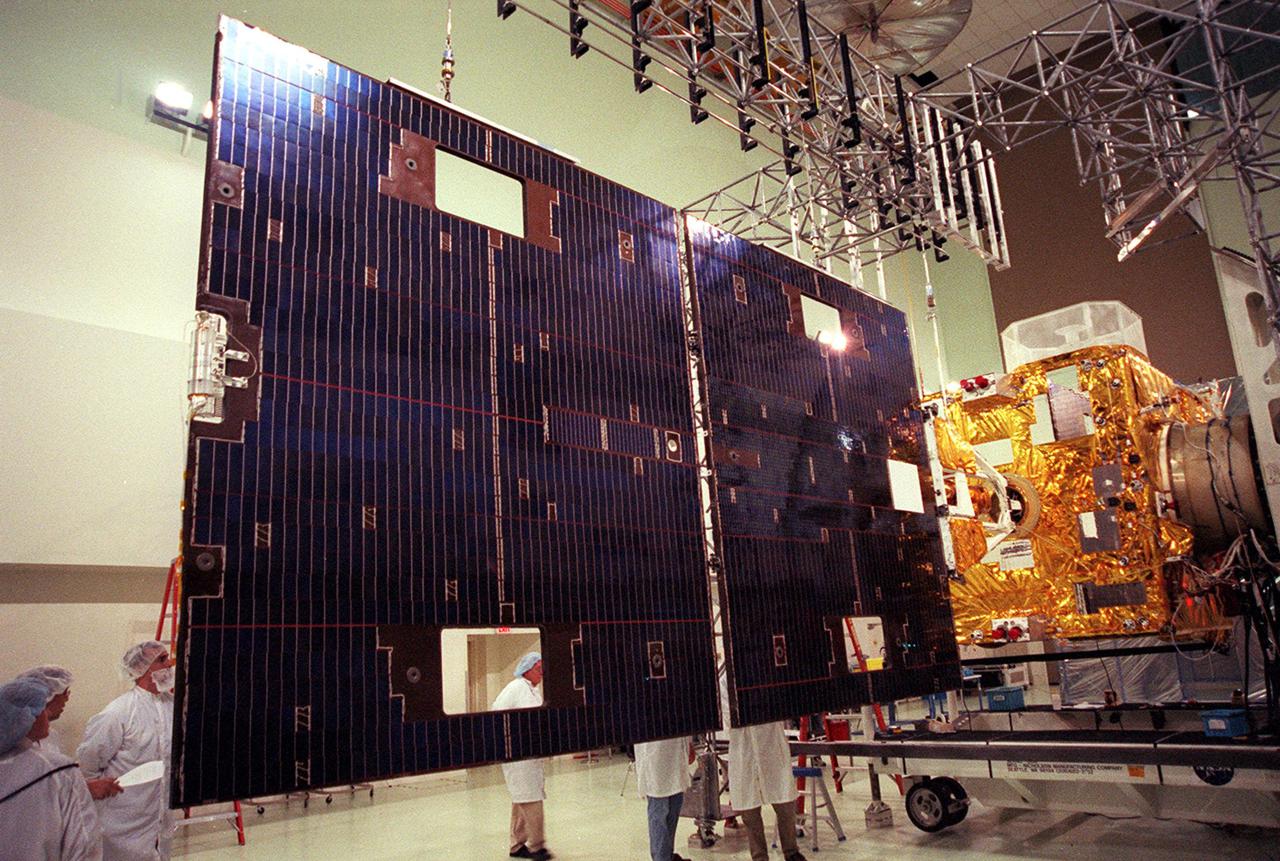
Workers at Astrotech, Titusville, Fla., take a close look at the solar panel on the GOES-M satellite. The GOES-M provides weather imagery and quantitative sounding data used to support weather forecasting, severe storm tracking and meteorological research. The satellite is scheduled to launch July 12 on an Atlas-IIA booster, Centaur upper stage from Cape Canaveral Air Force Station
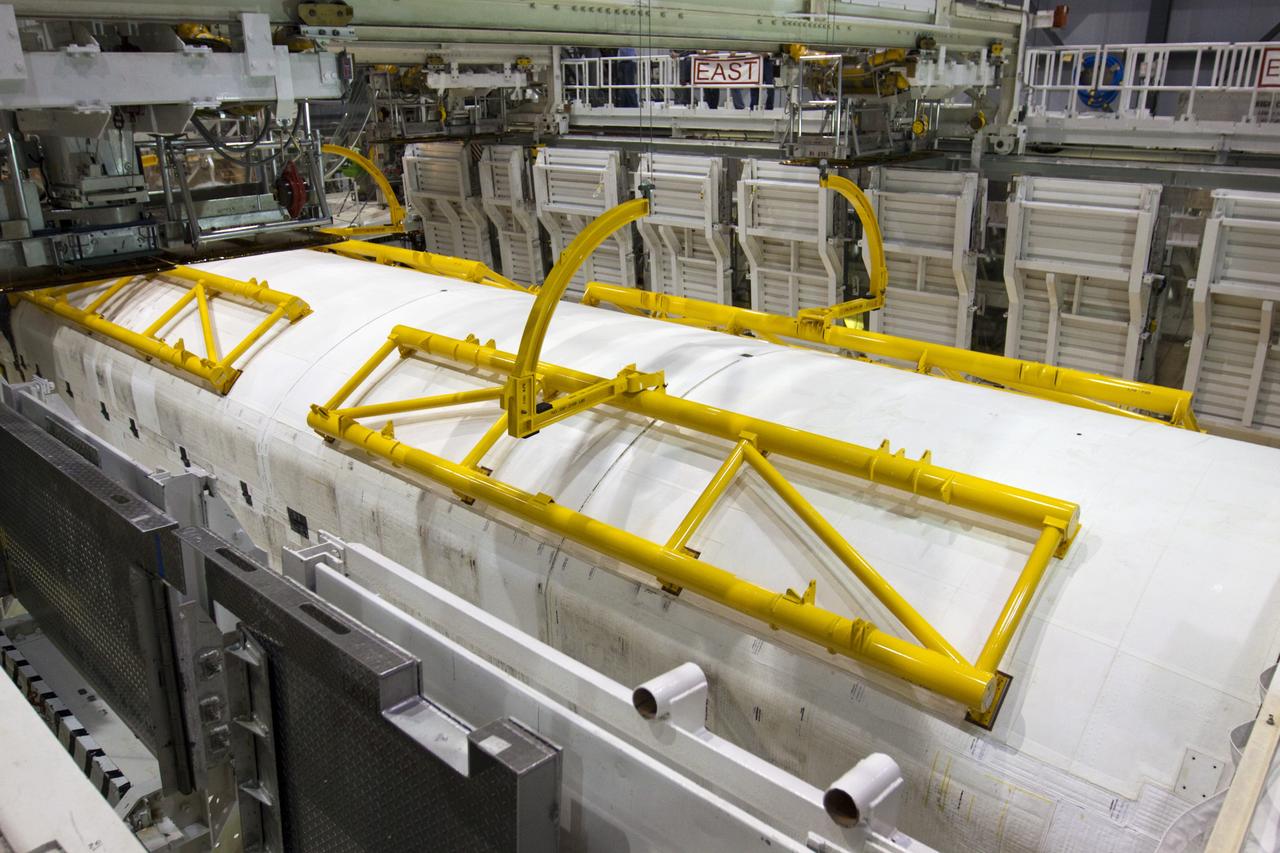
CAPE CANAVERAL, Fla. – In Orbiter Processing Facility-1 at NASA's Kennedy Space Center in Florida, yellow-painted strongbacks complete the task of closing space shuttle Discovery’s payload bay doors for the final time during Space Shuttle Program transition and retirement activities. Strongbacks are used to support and operate the doors when the shuttle is not in space. Following the door closure, the vehicle will be powered down for the last time. Discovery is being prepared for public display at the Smithsonian’s National Air and Space Museum Steven F. Udvar-Hazy Center in Chantilly, Va., in 2012. For more information, visit http://www.nasa.gov/shuttle. Photo credit: NASA/Kim Shiflett
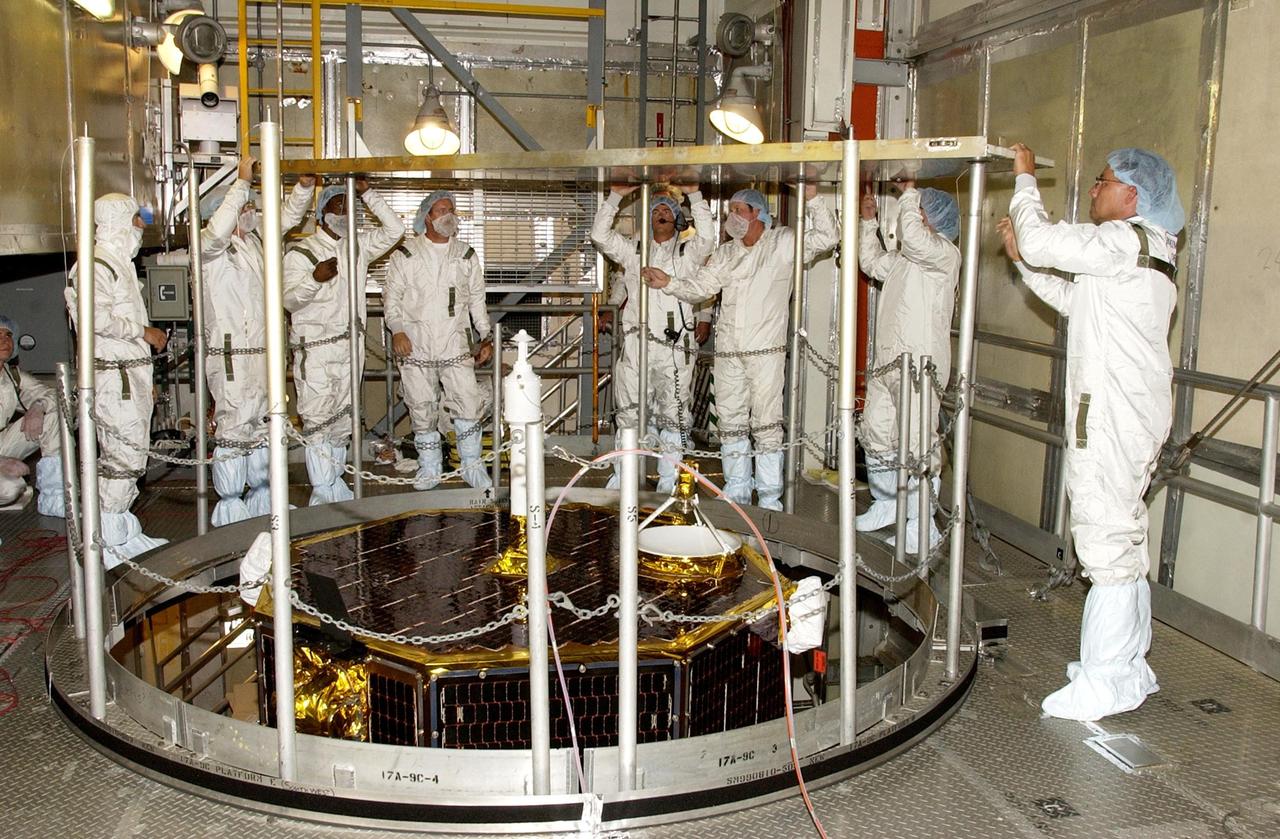
KENNEDY SPACE CENTER, FLA. -- Workers on the tower at Launch Complex 17-A, Cape Canaveral Air Force Station, fasten a support above the Comet Nucleus Tour (CONTOUR) spacecraft. CONTOUR will provide the first detailed look into the heart of a comet -- the nucleus. Flying as close as 60 miles (100 kilometers) to at least two comets, the spacecraft will take the sharpest pictures yet of a nucleus while analyzing the gas and dust that surround these rocky, icy building blocks of the solar system. Launch of CONTOUR aboard a Boeing Delta II rocket is scheduled for July 1, 2002
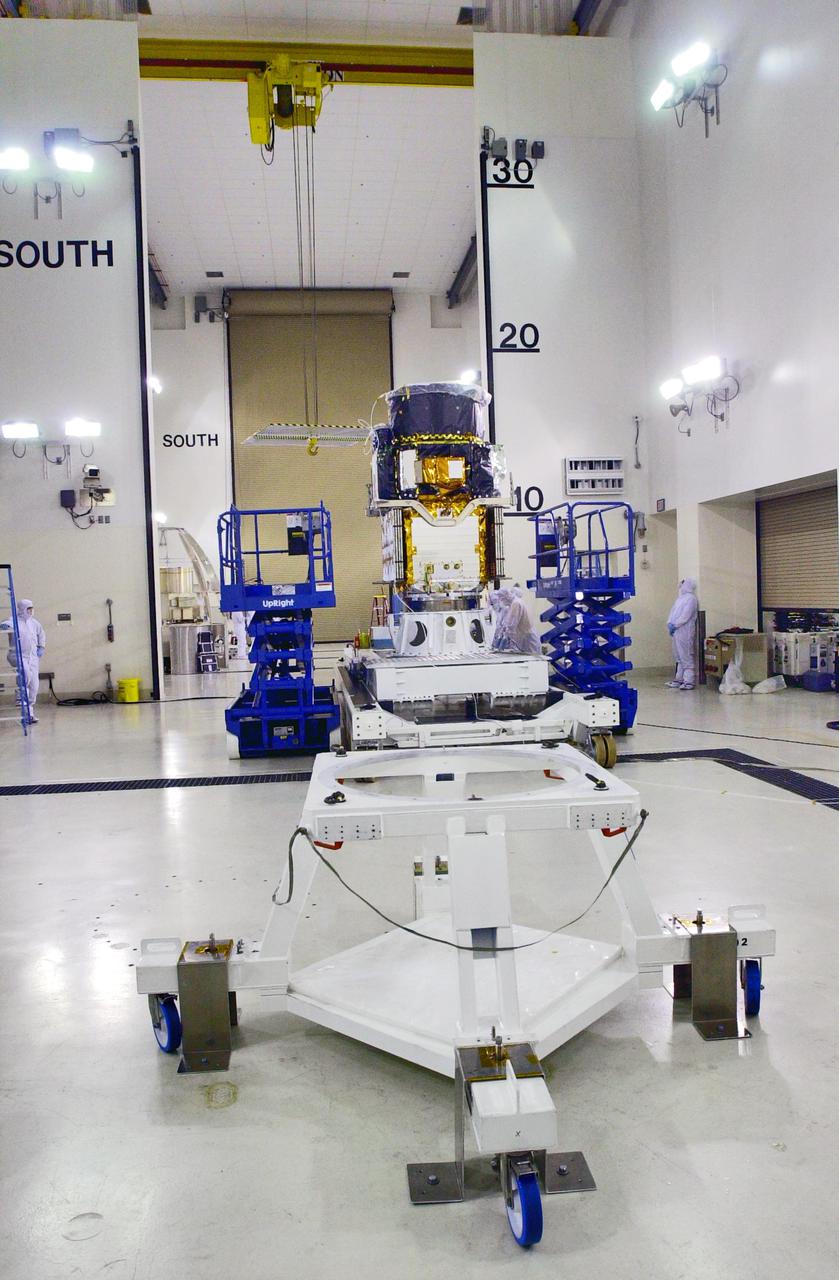
KENNEDY SPACE CENTER, FLA. - Inside the Astrotech Payload Processing Facility on Vandenberg Air Force Base in California, an overhead crane moves close to the Cloud-Aerosol Lidar and Infrared Pathfinder Satellite Observation (CALIPSO) spacecraft. The crane will lift CALIPSO and move it to a workstand. CALIPSO will undergo state-of-health checks, and electrical ground-support equipment testing. CALIPSO will fly in combination with the CloudSat satellite to provide never-before-seen 3-D perspectives of how clouds and aerosols form, evolve, and affect weather and climate. CALIPSO and CloudSat will join three other satellites in orbit to enhance understanding of climate systems. The launch date for CALIPSO_CloudSat is no earlier than Aug. 22.
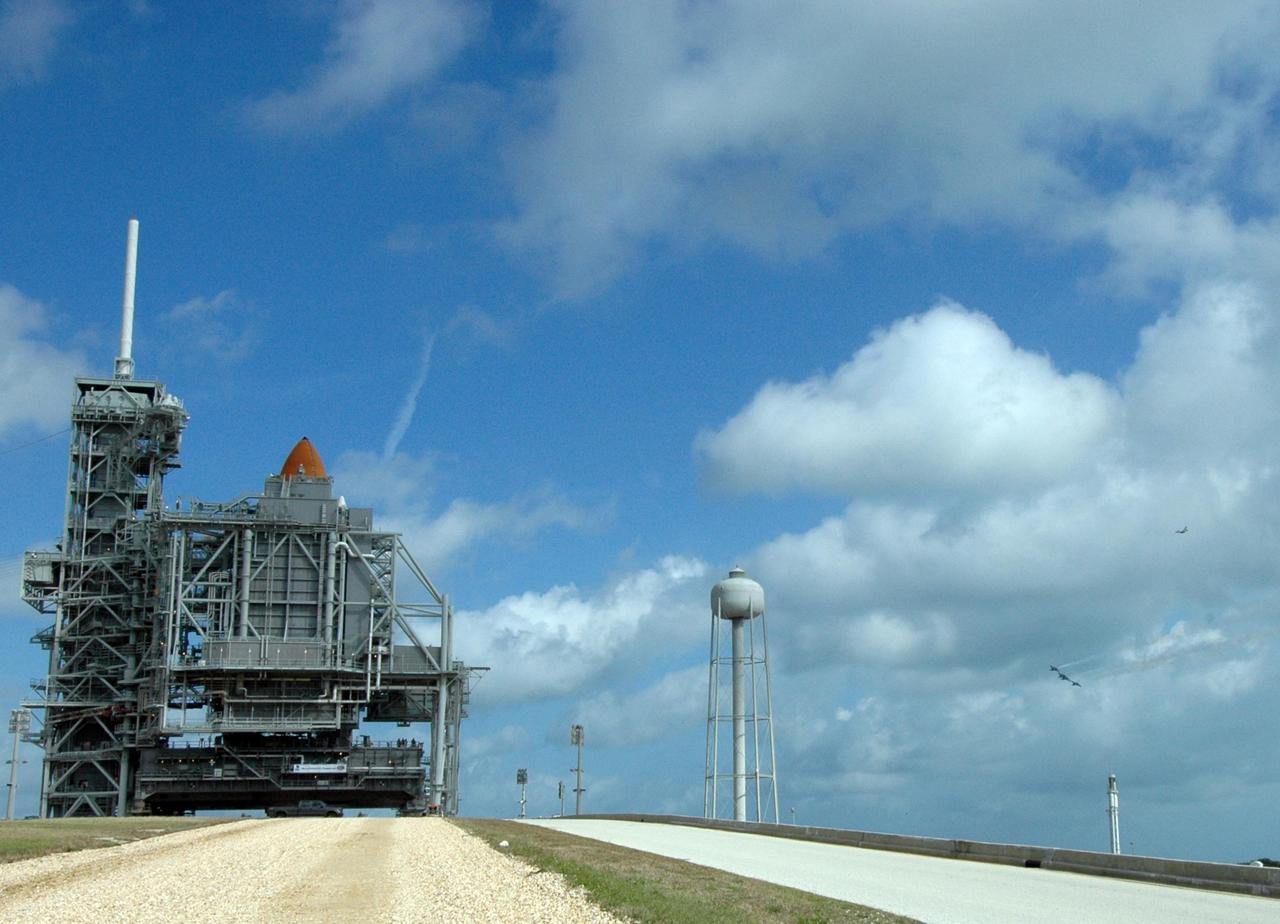
KENNEDY SPACE CENTER, FLA. --The U.S. Air Force Thunderbirds, at right, fly past Launch Pad 39A at NASA's Kennedy Space Center where space shuttle Endeavour waits to launch on the STS-123 mission. At left, the rotating service structure has closed around the shuttle, with only the tip of the external tank showing in this view. The aircraft had flown earlier to support the Daytona 500, also celebrating its 50th anniversary, and chose to fly over Kennedy on their way to their next assignment. Endeavour is being prepared for launch on the STS-123 mission targeted for March 11. Photo credit: NASA/Amanda Diller
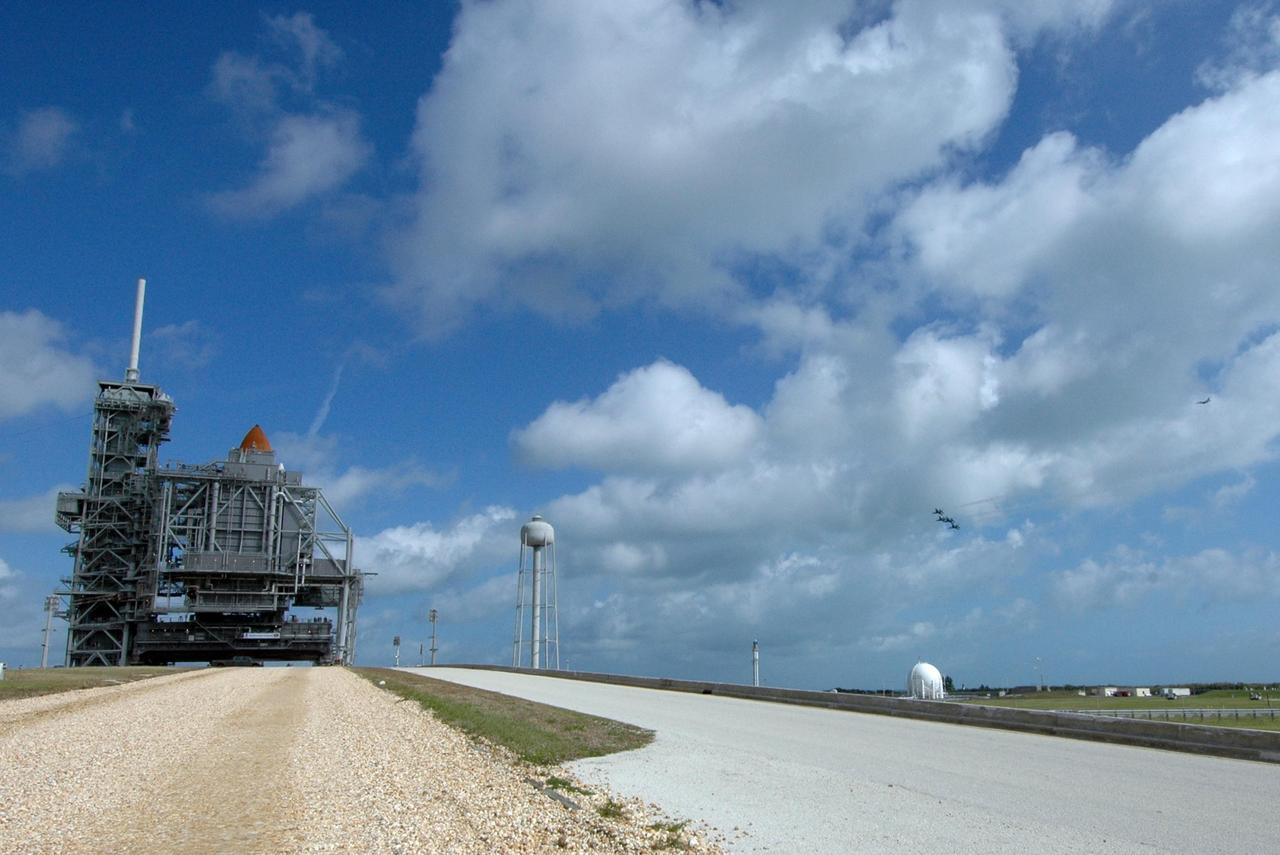
KENNEDY SPACE CENTER, FLA. --The U.S. Air Force Thunderbirds, at right, fly past Launch Pad 39A at NASA's Kennedy Space Center where space shuttle Endeavour waits to launch on the STS-123 mission. At left, the rotating service structure has closed around the shuttle, with only the tip of the external tank showing. The aircraft had flown earlier to support the Daytona 500, also celebrating its 50th anniversary, and chose to fly over Kennedy on their way to their next assignment. Endeavour is being prepared for launch on the STS-123 mission targeted for March 11. Photo credit: NASA/Amanda Diller
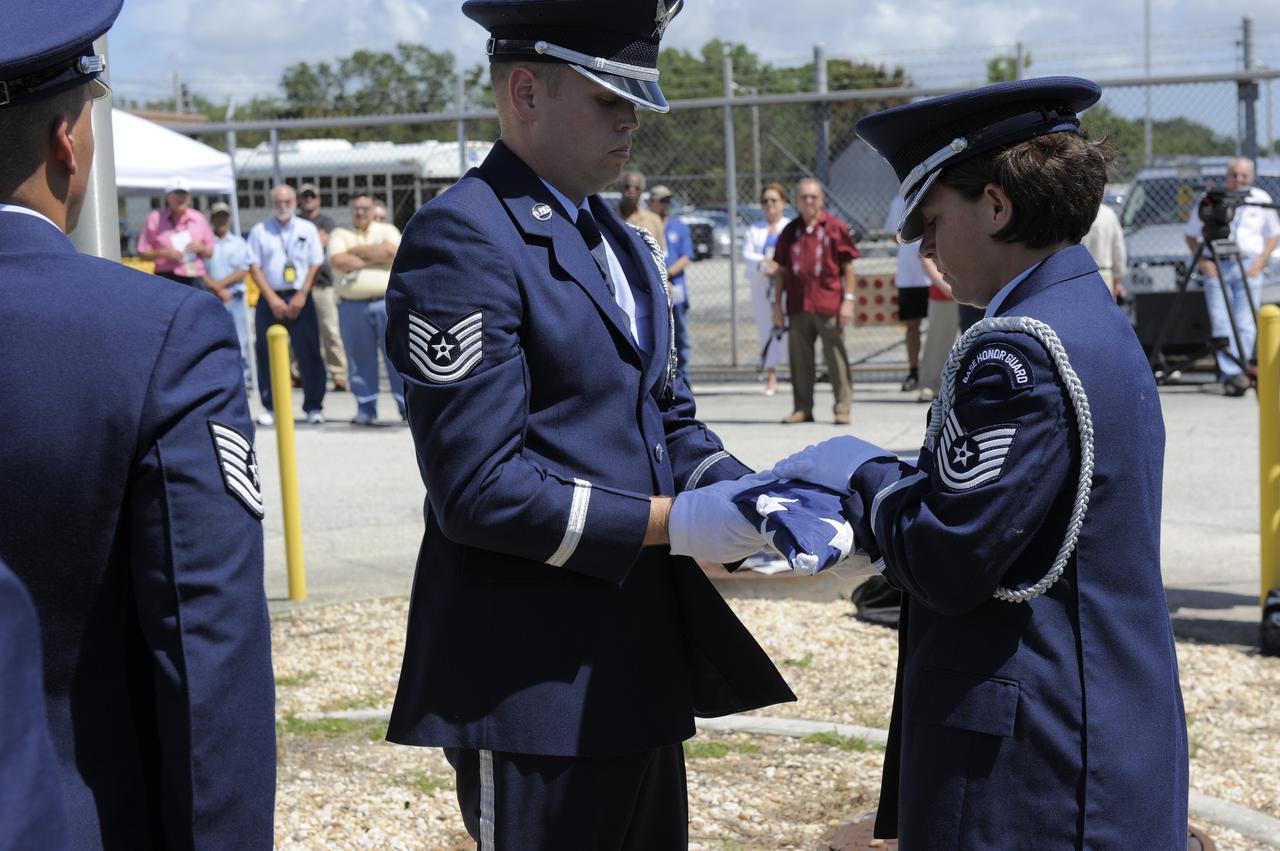
CAPE CANAVERAL, Fla. -- At the Merritt Island Launch Annex (MILA) Spaceflight Tracking and Data Network Station at NASA's Kennedy Space Center in Florida, the Patrick Air Force Base Color Guard folds the U.S. flag for the last time at a closing ceremony recognizing the station's 45 years of service. The station was originally established by NASA's Goddard Space Flight Center as one of 17 Space Flight Tracking and Data Network stations around the world. Commissioned for the Apollo Program, the first launch it supported was the Apollo/Saturn 203 test flight from Launch Complex 37 on July 5, 1966. It also provided orbital support for low earth-orbiting scientific satellites. In recent history, the station has been used almost exclusively for space shuttle launch and landing support. Following the final launch and landing of the Space Shuttle Program in July 2011, the MILA station is officially decommissioned. For more information, visit http://www.nasa.gov/centers/kennedy/pdf/167424main_MILA-08C.pdf. Photo credit: NASA/Kim Shiflett
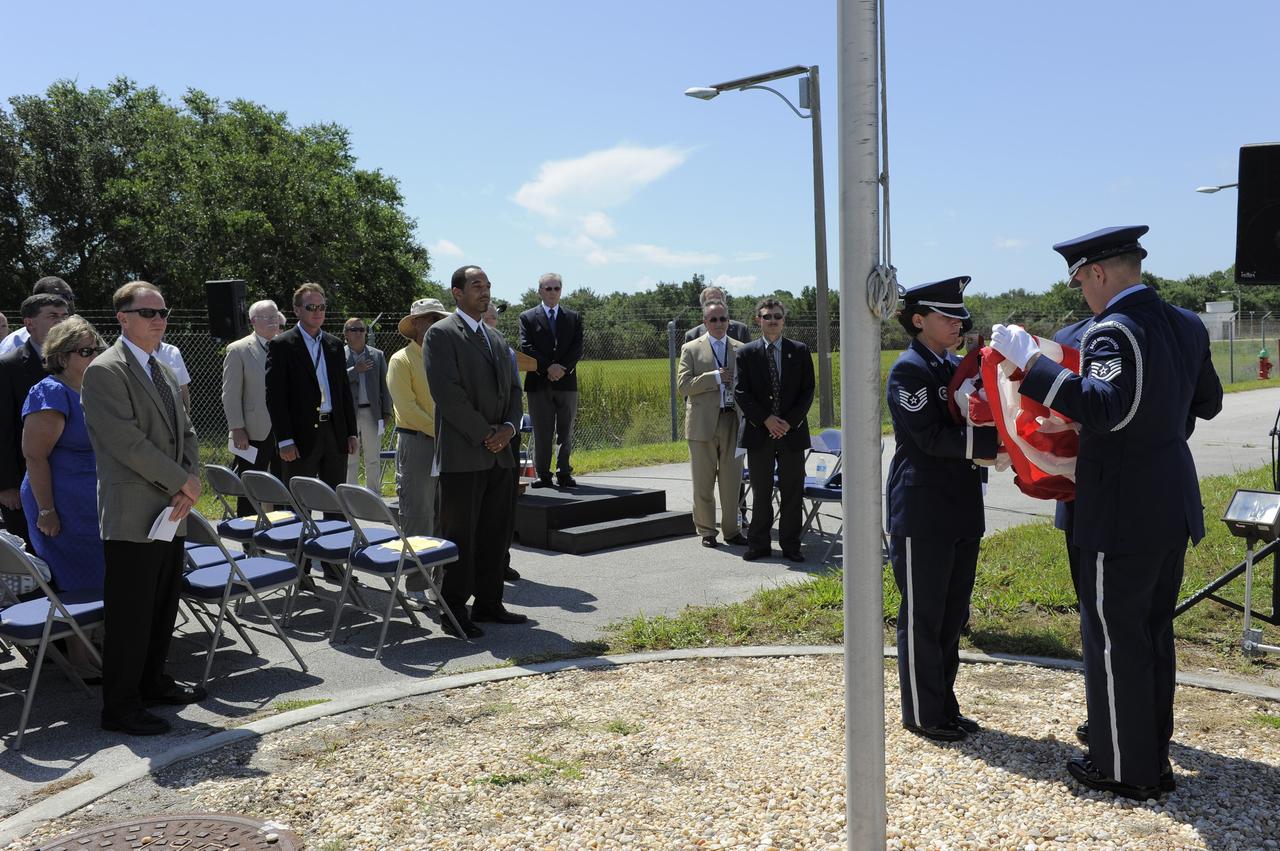
CAPE CANAVERAL, Fla. -- At the Merritt Island Launch Annex (MILA) Spaceflight Tracking and Data Network Station at NASA's Kennedy Space Center in Florida, the Patrick Air Force Base Color Guard folds the U.S. flag for the last time at a closing ceremony recognizing the station's 45 years of service. The station was originally established by NASA's Goddard Space Flight Center as one of 17 Space Flight Tracking and Data Network stations around the world. Commissioned for the Apollo Program, the first launch it supported was the Apollo/Saturn 203 test flight from Launch Complex 37 on July 5, 1966. It also provided orbital support for low earth-orbiting scientific satellites. In recent history, the station has been used almost exclusively for space shuttle launch and landing support. Following the final launch and landing of the Space Shuttle Program in July 2011, the MILA station is officially decommissioned. For more information, visit http://www.nasa.gov/centers/kennedy/pdf/167424main_MILA-08C.pdf. Photo credit: NASA/Kim Shiflett
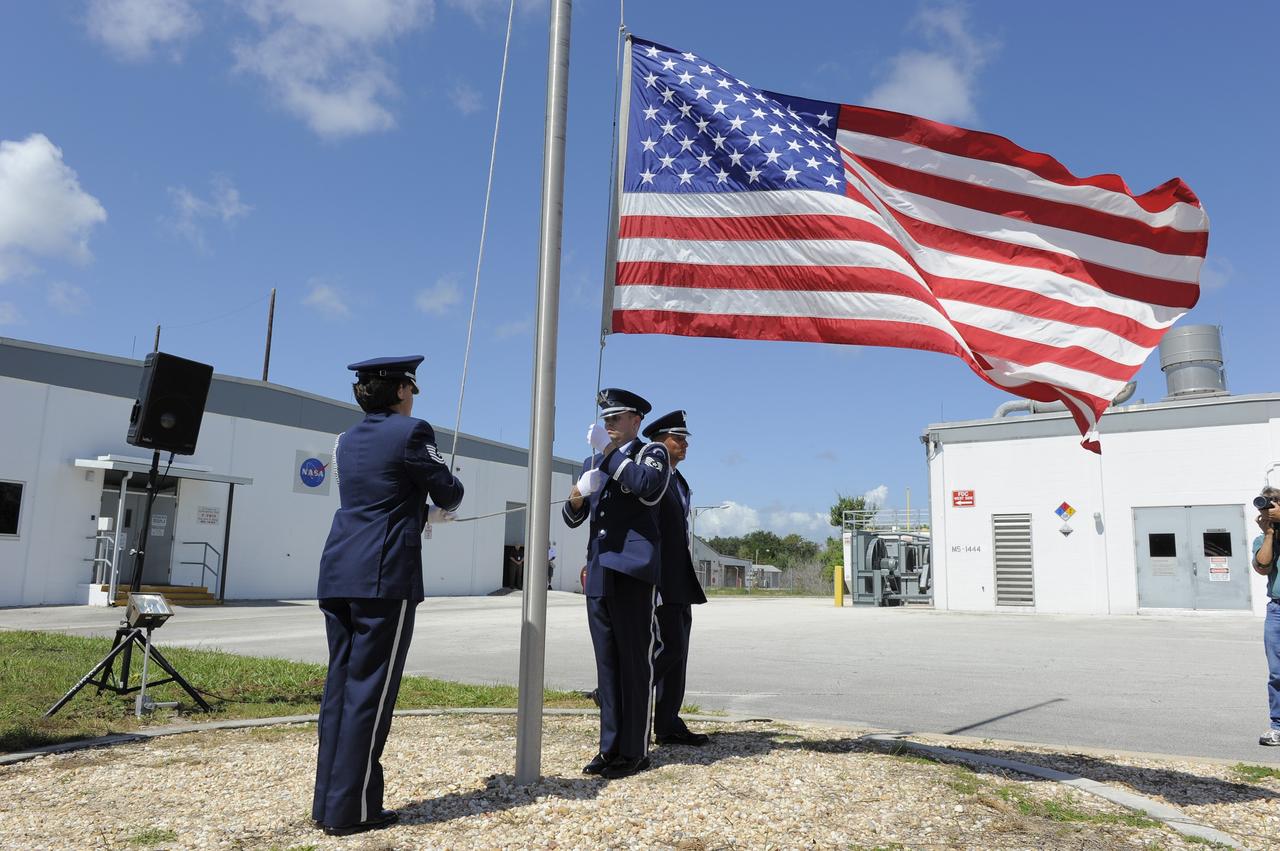
CAPE CANAVERAL, Fla. -- At the Merritt Island Launch Annex (MILA) Spaceflight Tracking and Data Network Station at NASA's Kennedy Space Center in Florida, the Patrick Air Force Base Color Guard lowers the U.S. flag for the last time at a closing ceremony recognizing the station's 45 years of service. The station was originally established by NASA's Goddard Space Flight Center as one of 17 Space Flight Tracking and Data Network stations around the world. Commissioned for the Apollo Program, the first launch it supported was the Apollo/Saturn 203 test flight from Launch Complex 37 on July 5, 1966. It also provided orbital support for low earth-orbiting scientific satellites. In recent history, the station has been used almost exclusively for space shuttle launch and landing support. Following the final launch and landing of the Space Shuttle Program in July 2011, the MILA station is officially decommissioned. For more information, visit http://www.nasa.gov/centers/kennedy/pdf/167424main_MILA-08C.pdf. Photo credit: NASA/Kim Shiflett
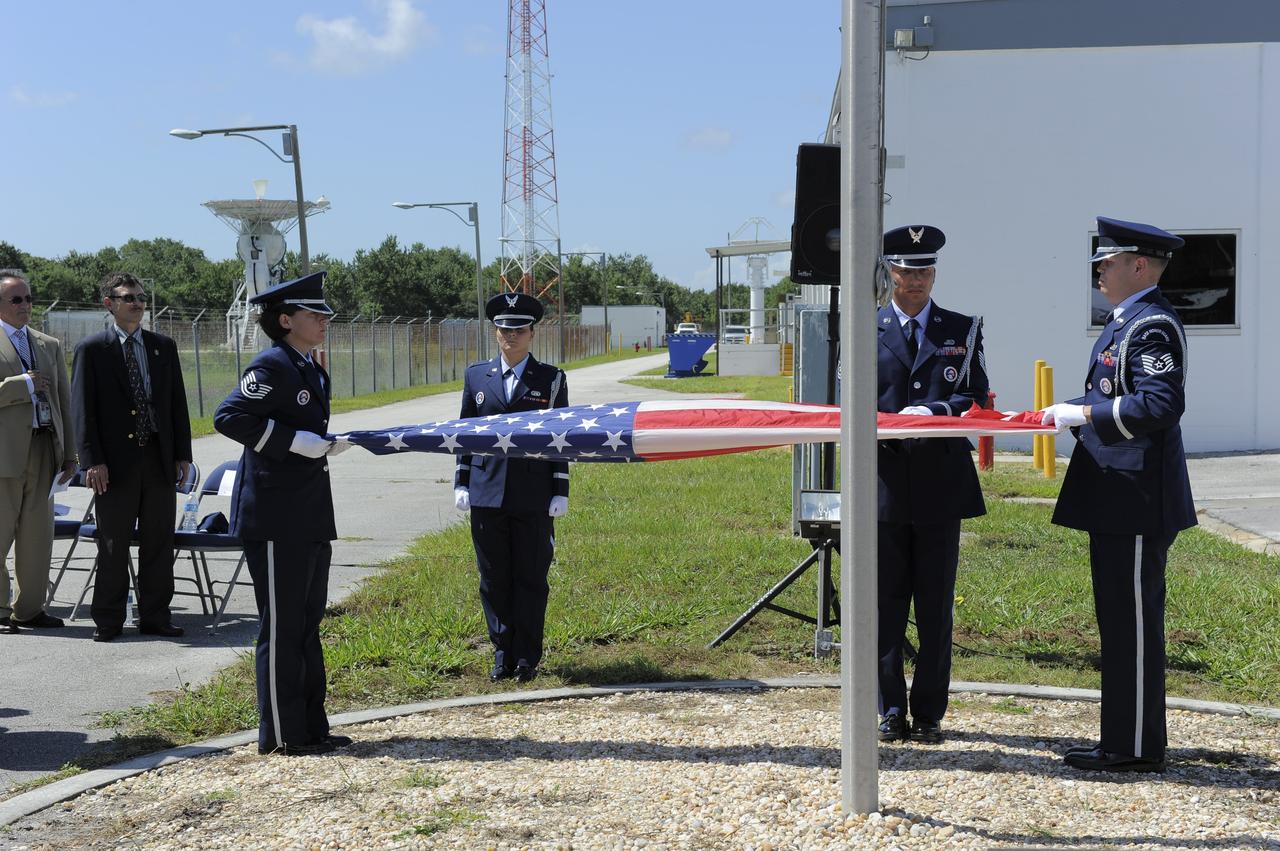
CAPE CANAVERAL, Fla. -- At the Merritt Island Launch Annex (MILA) Spaceflight Tracking and Data Network Station at NASA's Kennedy Space Center in Florida, the Patrick Air Force Base Color Guard folds the U.S. flag for the last time at a closing ceremony recognizing the station's 45 years of service. The station was originally established by NASA's Goddard Space Flight Center as one of 17 Space Flight Tracking and Data Network stations around the world. Commissioned for the Apollo Program, the first launch it supported was the Apollo/Saturn 203 test flight from Launch Complex 37 on July 5, 1966. It also provided orbital support for low earth-orbiting scientific satellites. In recent history, the station has been used almost exclusively for space shuttle launch and landing support. Following the final launch and landing of the Space Shuttle Program in July 2011, the MILA station is officially decommissioned. For more information, visit http://www.nasa.gov/centers/kennedy/pdf/167424main_MILA-08C.pdf. Photo credit: NASA/Kim Shiflett
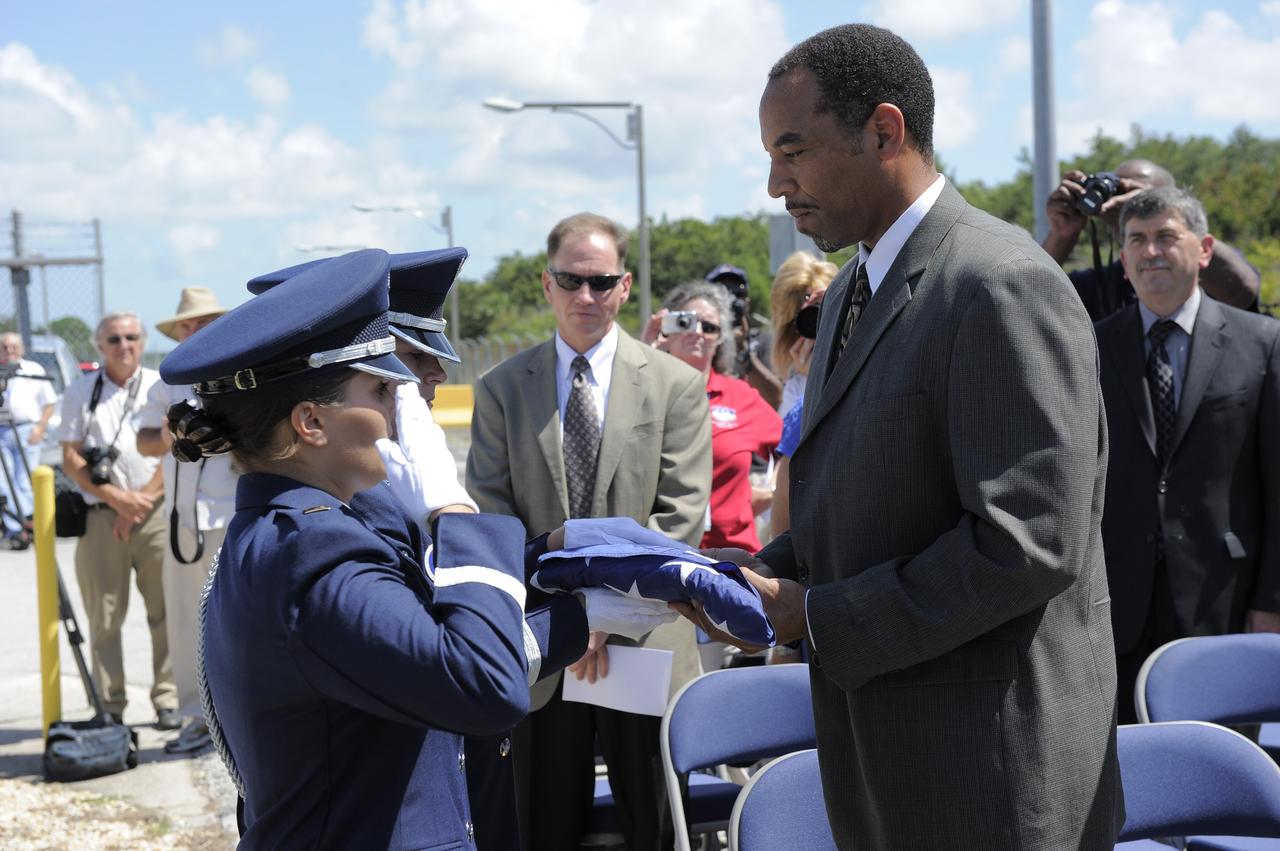
CAPE CANAVERAL, Fla. -- At the Merritt Island Launch Annex (MILA) Spaceflight Tracking and Data Network Station at NASA's Kennedy Space Center in Florida, the Patrick Air Force Base Color Guard presents the U.S. flag which flew over the station to David Carter, Near Earth Network project manager at Goddard Space Flight Center, during a closing ceremony recognizing the station's 45 years of service. The flag will be displayed in a Network Integration Center display cabinet at Goddard. The station was originally established by NASA's Goddard Space Flight Center as one of 17 Space Flight Tracking and Data Network stations around the world. Commissioned for the Apollo Program, the first launch it supported was the Apollo/Saturn 203 test flight from Launch Complex 37 on July 5, 1966. It also provided orbital support for low earth-orbiting scientific satellites. In recent history, the station has been used almost exclusively for space shuttle launch and landing support. Following the final launch and landing of the Space Shuttle Program in July 2011, the MILA station is officially decommissioned. For more information, visit http://www.nasa.gov/centers/kennedy/pdf/167424main_MILA-08C.pdf. Photo credit: NASA/Kim Shiflett
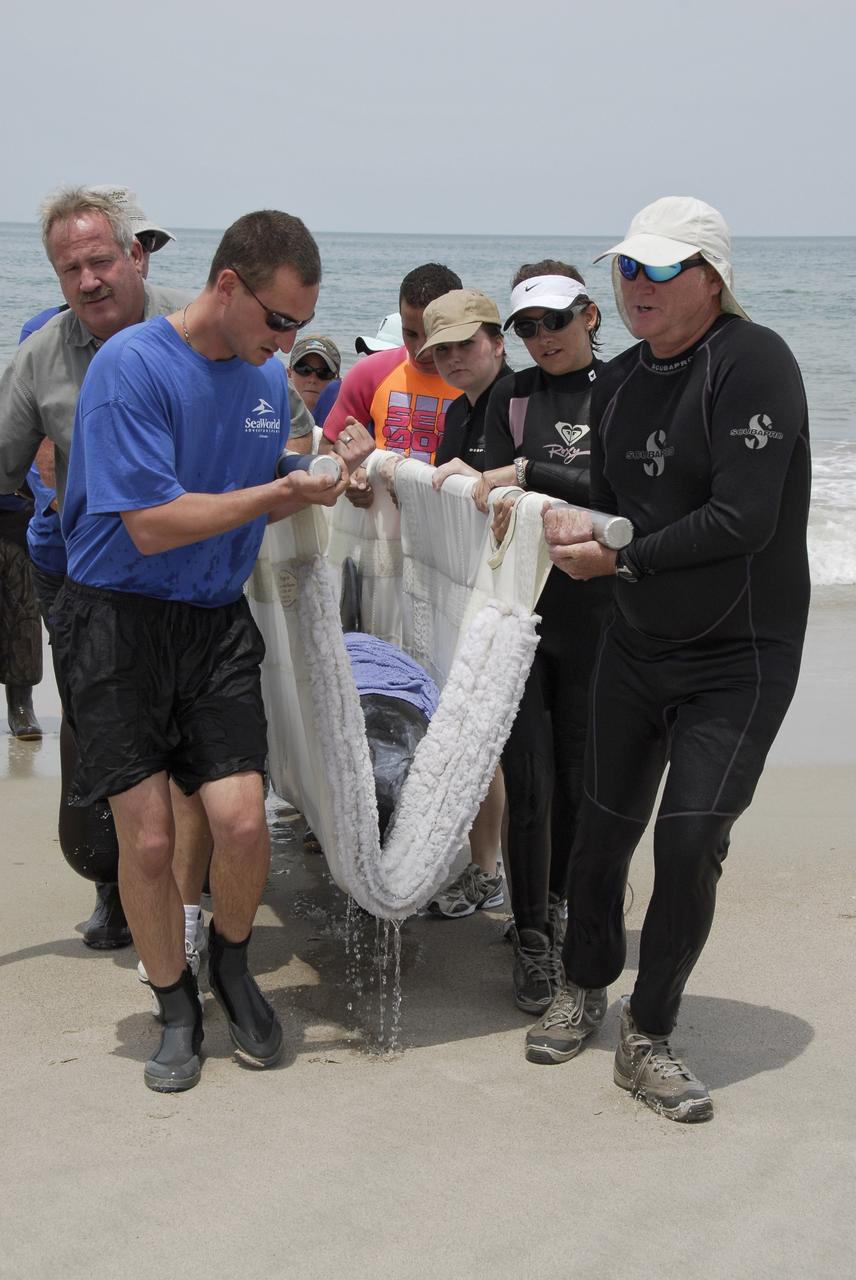
CAPE CANAVERAL, Fla. – Workers from NASA's Kennedy Space Center, a veterinarian and representatives from the Hubbs/Sea World Research Institute support a stranded Melon-Headed Whale on a sling as they carry it out of the Atlantic Ocean. The whale was found beached south of Launch Pad 39A near Cape Canaveral Air Force Station. After assessment by veterinarians at Sea World, the whale will be transported to a whale rescue center in the Panhandle for rehabilitation and release. The Melon-Headed Whale lives well off-shore in all the world's tropical and sub-tropical oceans. At the northern fringes of its range, it may also be found in the warm currents of temperate waters, such as Florida. It is closely related to the Pygmy Killer Whale and the Pilot Whales. Its primary diet is squid. Photo credit: NASA/Kim Shiflett

CAPE CANAVERAL, Fla. – In Orbiter Processing Facility-1 at NASA's Kennedy Space Center in Florida, one of space shuttle Discovery’s payload bay doors is lifted shut with the aid of yellow-painted strongbacks, hardware used to support and operate the doors when the shuttle is not in space. Discovery's payload bay doors are being closed for the final time during Space Shuttle Program transition and retirement activities. Following the door closure, the vehicle will be powered down for the last time. Discovery is being prepared for public display at the Smithsonian’s National Air and Space Museum Steven F. Udvar-Hazy Center in Chantilly, Va., in 2012. For more information, visit http://www.nasa.gov/shuttle. Photo credit: NASA/Kim Shiflett

CAPE CANAVERAL, Fla. -- At NASA's Kennedy Space Center in Florida, space shuttle Discovery rolls along the towway from Orbiter Processing Facility-2, or OPF-2, to the Vehicle Assembly Building, or VAB. Railings, called strongbacks, are installed along Discovery's payload bay doors to assist with opening and closing of the doors when the shuttle's hydraulic system is not operational and support the doors while they are open. Discovery will be stored inside the VAB for approximately one month while shuttle Atlantis undergoes processing in OPF-2 following its final mission, STS-135. Discovery flew its 39th and final mission, STS-133, in February and March 2011, and currently is being prepared for public display at the Smithsonian's National Air and Space Museum Steven F. Udvar-Hazy Center in Virginia. For more information about Discovery's Transition and Retirement, visit www.nasa.gov/mission_pages/shuttle/launch/discovery_rss_collection_archive_1.html. Photo credit: NASA/Frankie Martin
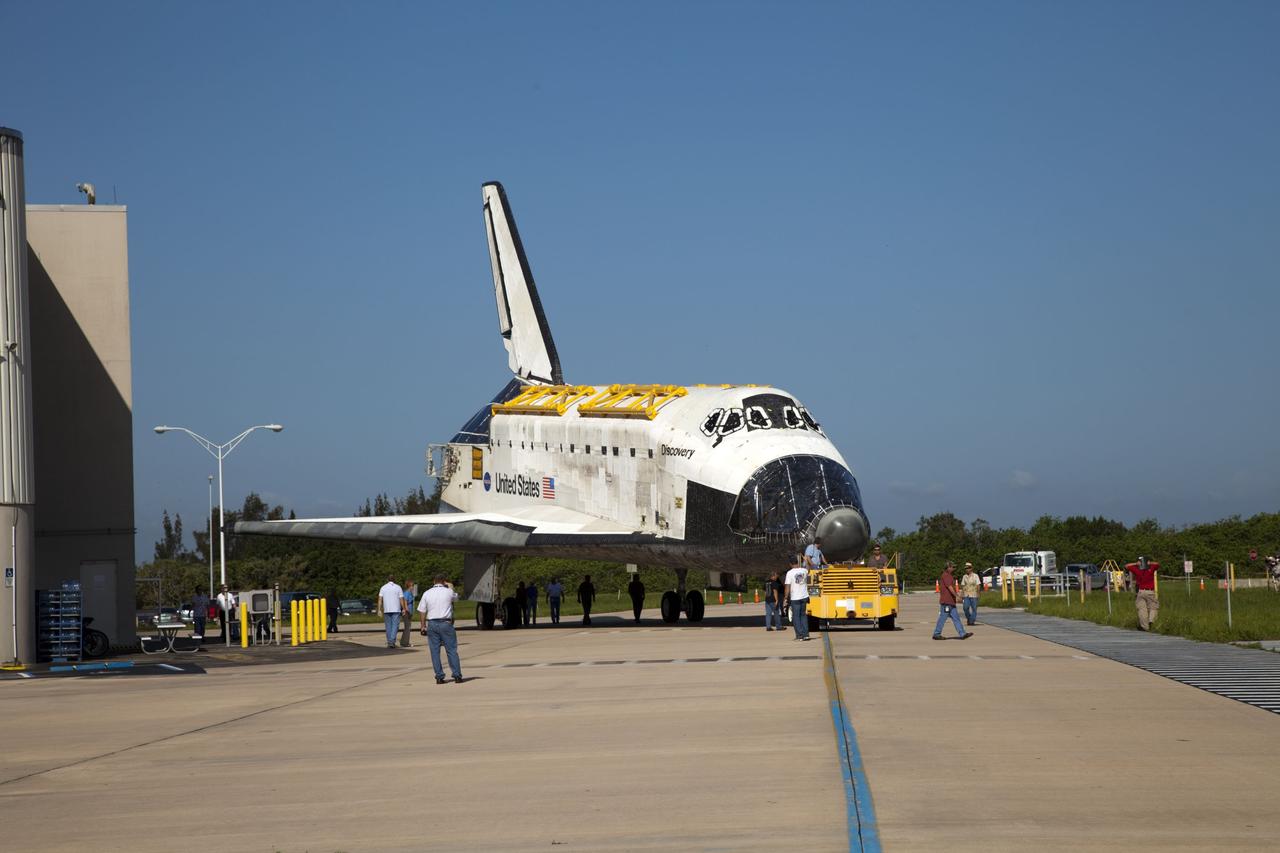
CAPE CANAVERAL, Fla. -- At NASA's Kennedy Space Center in Florida, space shuttle Discovery is towed from Orbiter Processing Facility-2, or OPF-2, to the Vehicle Assembly Building, or VAB. Railings, called strongbacks, are installed along Discovery's payload bay doors to assist with opening and closing of the doors when the shuttle's hydraulic system is not operational and support the doors while they are open. Discovery will be stored inside the VAB for approximately one month while shuttle Atlantis undergoes processing in OPF-2 following its final mission, STS-135. Discovery flew its 39th and final mission, STS-133, in February and March 2011, and currently is being prepared for public display at the Smithsonian's National Air and Space Museum Steven F. Udvar-Hazy Center in Virginia. For more information about Discovery's Transition and Retirement, visit www.nasa.gov/mission_pages/shuttle/launch/discovery_rss_collection_archive_1.html. Photo credit: NASA/Frankie Martin
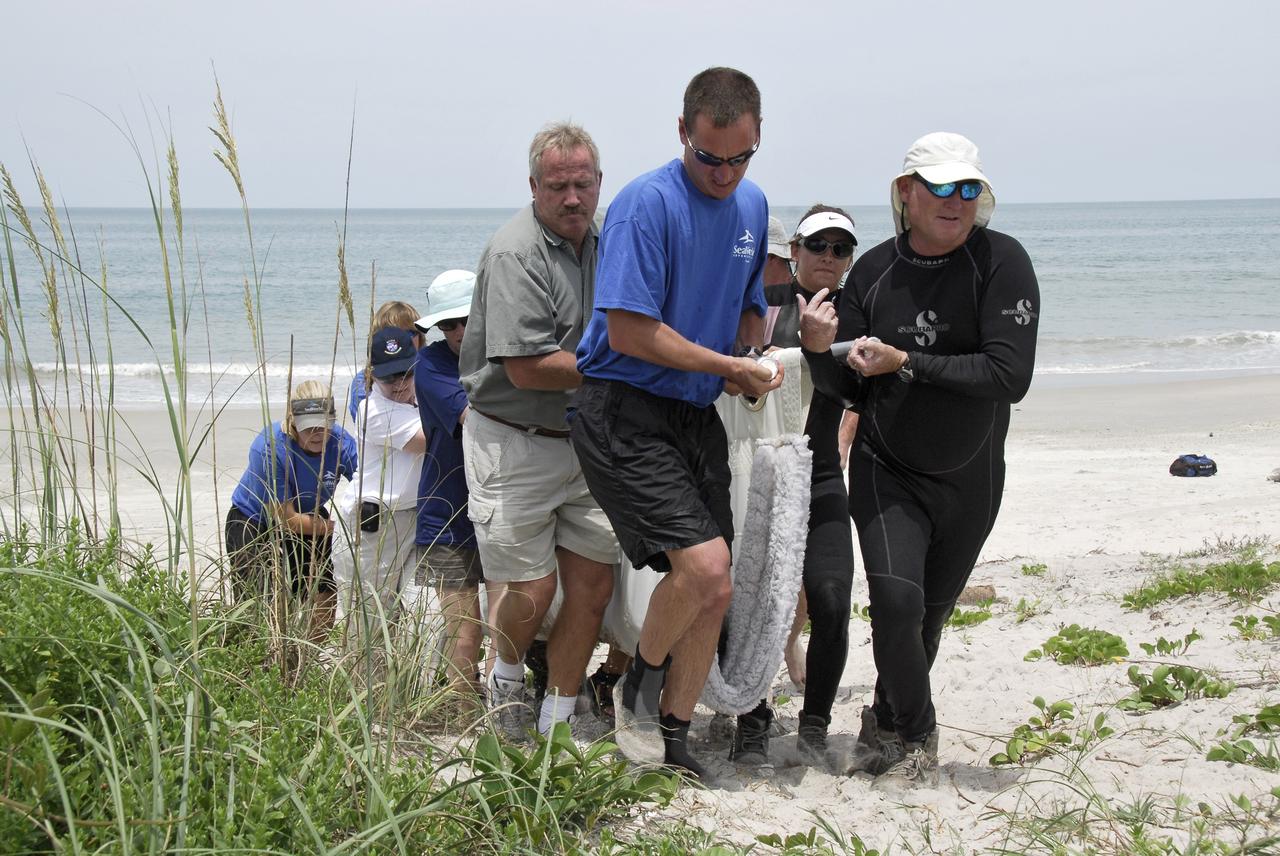
CAPE CANAVERAL, Fla. – Workers from NASA's Kennedy Space Center, a veterinarian and representatives from the Hubbs/Sea World Research Institute support a stranded Melon-Headed Whale on a sling as they carry it to a waiting truck. The whale was found beached south of Launch Pad 39A near Cape Canaveral Air Force Station. The whale will be taken to Sea World for evaluation. After assessment by veterinarians at Sea World, the whale will be transported to a whale rescue center in the Panhandle for rehabilitation and release. The Melon-Headed Whale lives well off-shore in all the world's tropical and sub-tropical oceans. At the northern fringes of its range, it may also be found in the warm currents of temperate waters, such as Florida. It is closely related to the Pygmy Killer Whale and the Pilot Whales. Its primary diet is squid. Photo credit: NASA/Kim Shiflett
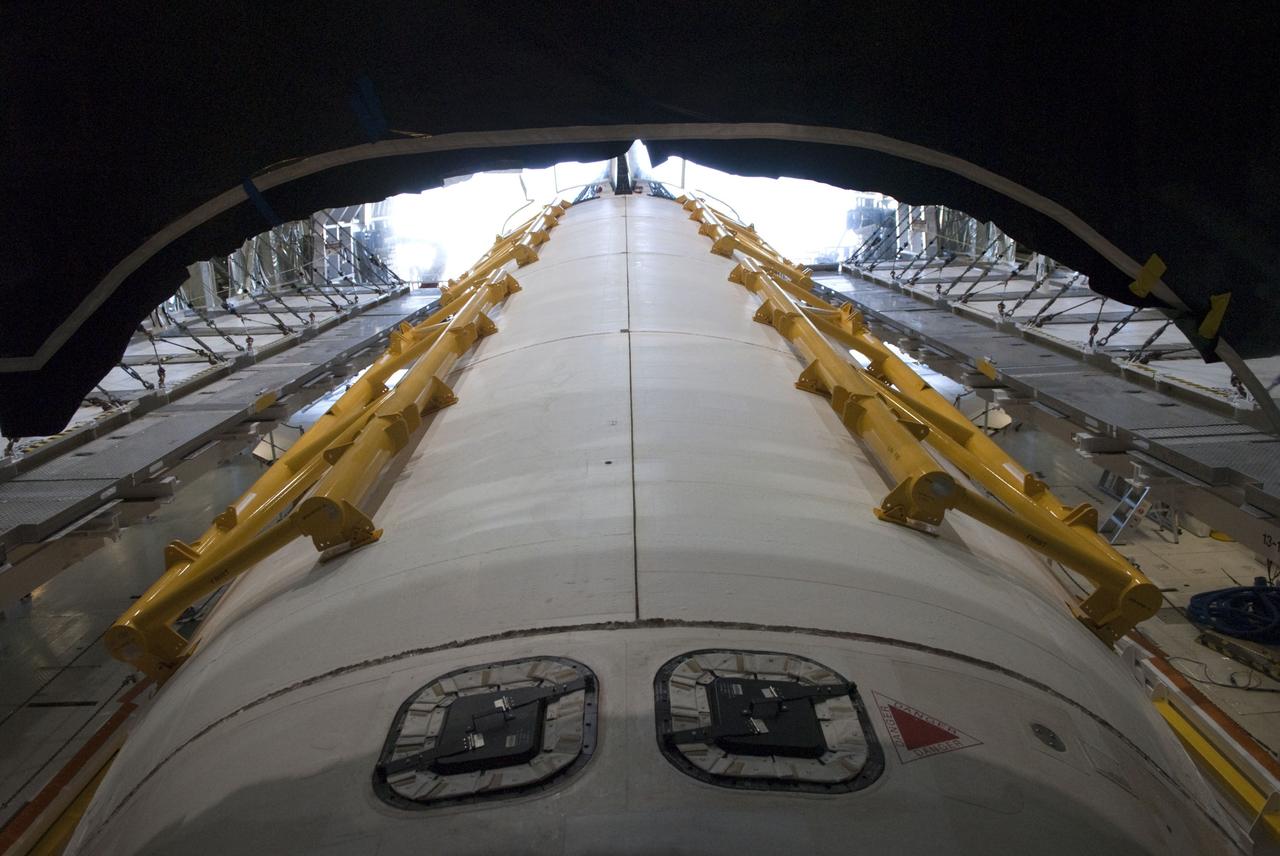
CAPE CANAVERAL, Fla. -- In Orbiter Processing Facility-2, or OPF-2, at NASA's Kennedy Space Center in Florida, railings, called strongbacks, are installed along the payload bay doors of space shuttle Discovery. The strongbacks are used to assist with opening and closing of the doors when the shuttle's hydraulic system is not operational and support the doors while they are open. Discovery is awaiting its move to the Vehicle Assembly Building, or VAB. Discovery will be stored inside the VAB for approximately one month while shuttle Atlantis undergoes processing in OPF-2 following its final mission, STS-135. Discovery flew its 39th and final mission, STS-133, in February and March 2011, and currently is being prepared for public display at the Smithsonian's National Air and Space Museum Steven F. Udvar-Hazy Center in Virginia. For more information about Discovery's Transition and Retirement, visit www.nasa.gov/mission_pages/shuttle/launch/discovery_rss_collection_archive_1.html. Photo credit: NASA/Jim Grossmann
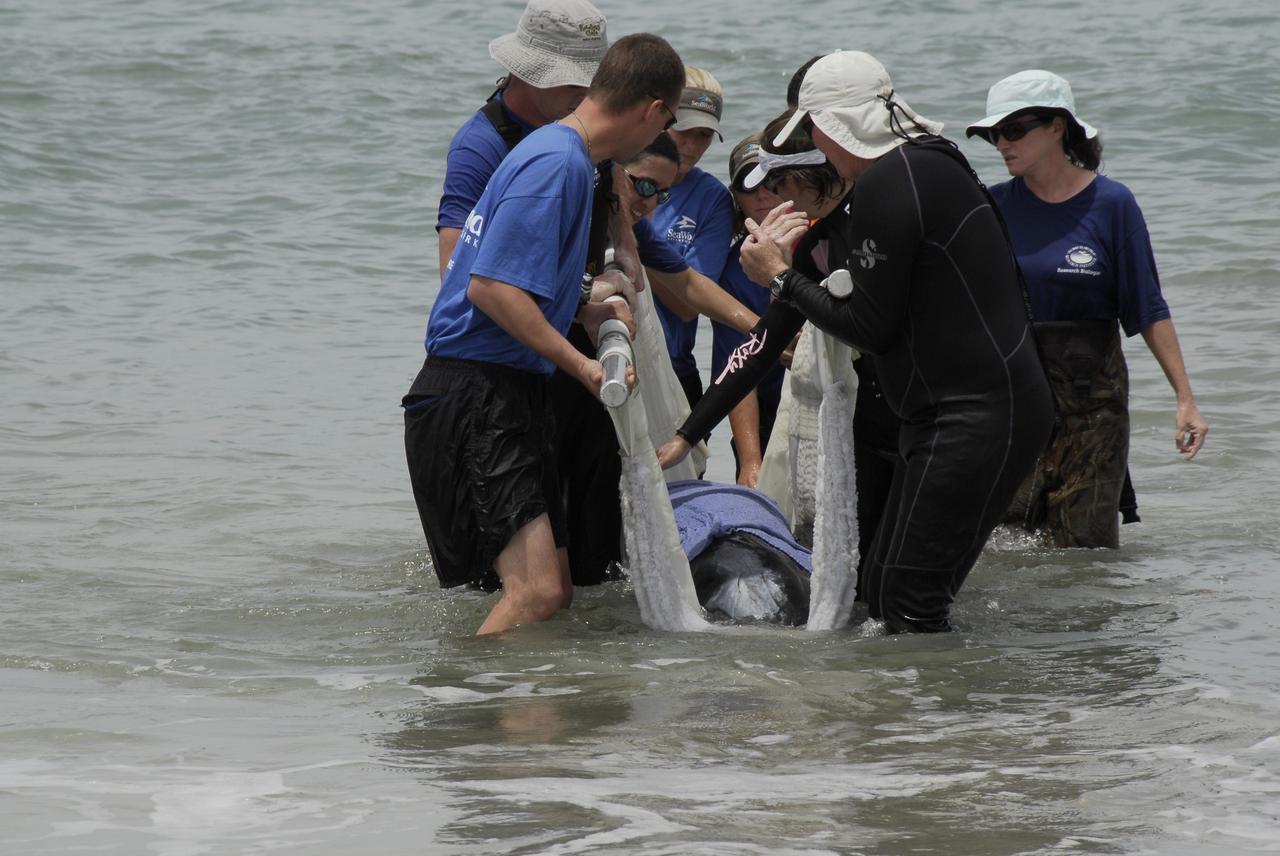
CAPE CANAVERAL, Fla. – Workers from NASA's Kennedy Space Center and representatives from the Hubbs/Sea World Research Institute support a stranded Melon-Headed Whale on a sling in the Atlantic Ocean. The whale was found beached south of Launch Pad 39A near Cape Canaveral Air Force Station. After assessment by veterinarians at Sea World, the whale will be transported to a whale rescue center in the Panhandle for rehabilitation and release. The Melon-Headed Whale lives well off-shore in all the world's tropical and sub-tropical oceans. At the northern fringes of its range, it may also be found in the warm currents of temperate waters, such as Florida. It is closely related to the Pygmy Killer Whale and the Pilot Whales. Its primary diet is squid. Photo credit: NASA/Kim Shiflett

CAPE CANAVERAL, Fla. – In Orbiter Processing Facility-1 at NASA's Kennedy Space Center in Florida, space shuttle Discovery’s payload bay is glimpsed for the final time as its doors swing shut with the aid of yellow-painted strongbacks, hardware used to support and operate the doors when the shuttle is not in space. Discovery's doors are being closed for the final time during Space Shuttle Program transition and retirement activities. Following the door closure, the vehicle will be powered down for the last time. Discovery is being prepared for public display at the Smithsonian’s National Air and Space Museum Steven F. Udvar-Hazy Center in Chantilly, Va., in 2012. For more information, visit http://www.nasa.gov/shuttle. Photo credit: NASA/Kim Shiflett
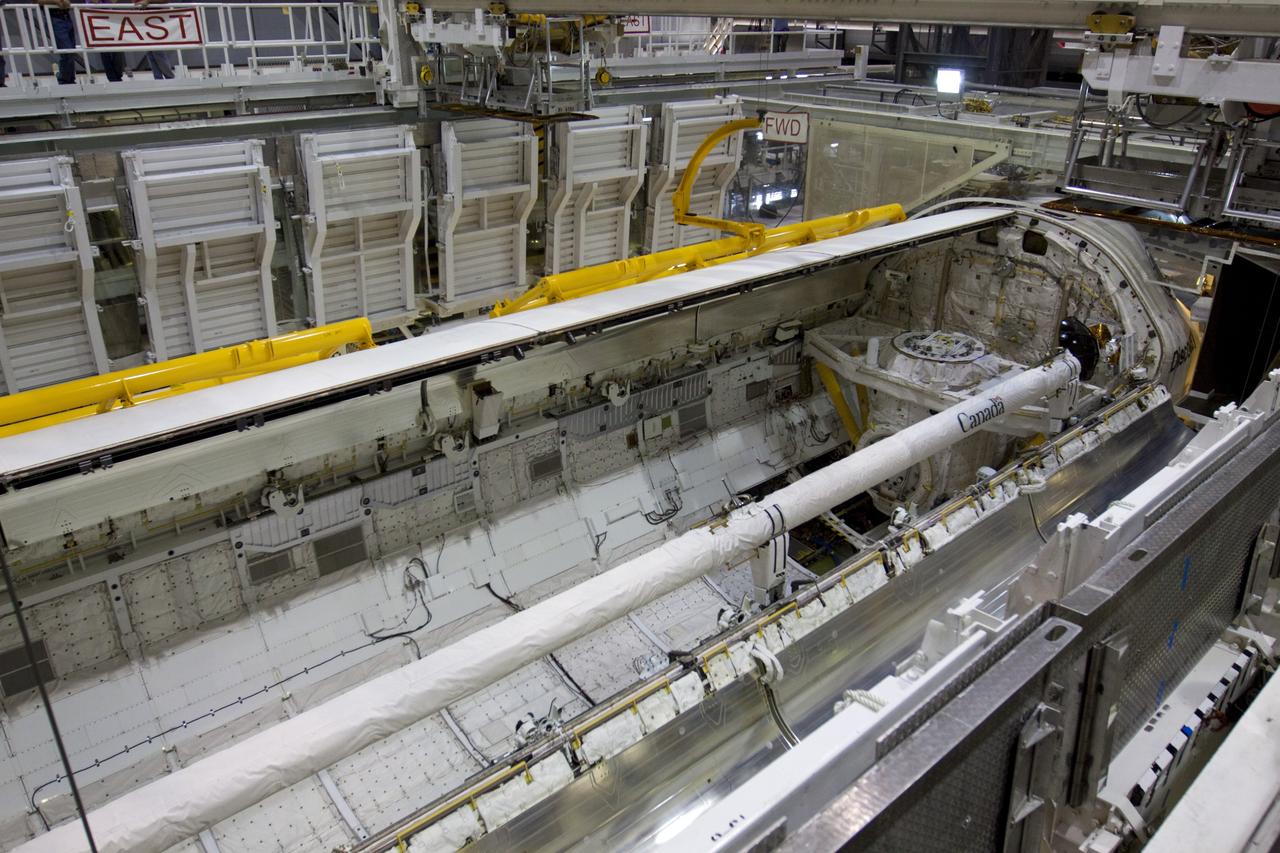
CAPE CANAVERAL, Fla. – In Orbiter Processing Facility-1 at NASA's Kennedy Space Center in Florida, space shuttle Discovery’s payload bay doors swing shut one at a time with the aid of yellow-painted strongbacks, hardware used to support and operate the doors when the shuttle is not in space. Discovery's payload bay doors are being closed for the final time during Space Shuttle Program transition and retirement activities. Following the door closure, the vehicle will be powered down for the last time. Discovery is being prepared for public display at the Smithsonian’s National Air and Space Museum Steven F. Udvar-Hazy Center in Chantilly, Va., in 2012. For more information, visit http://www.nasa.gov/shuttle. Photo credit: NASA/Kim Shiflett
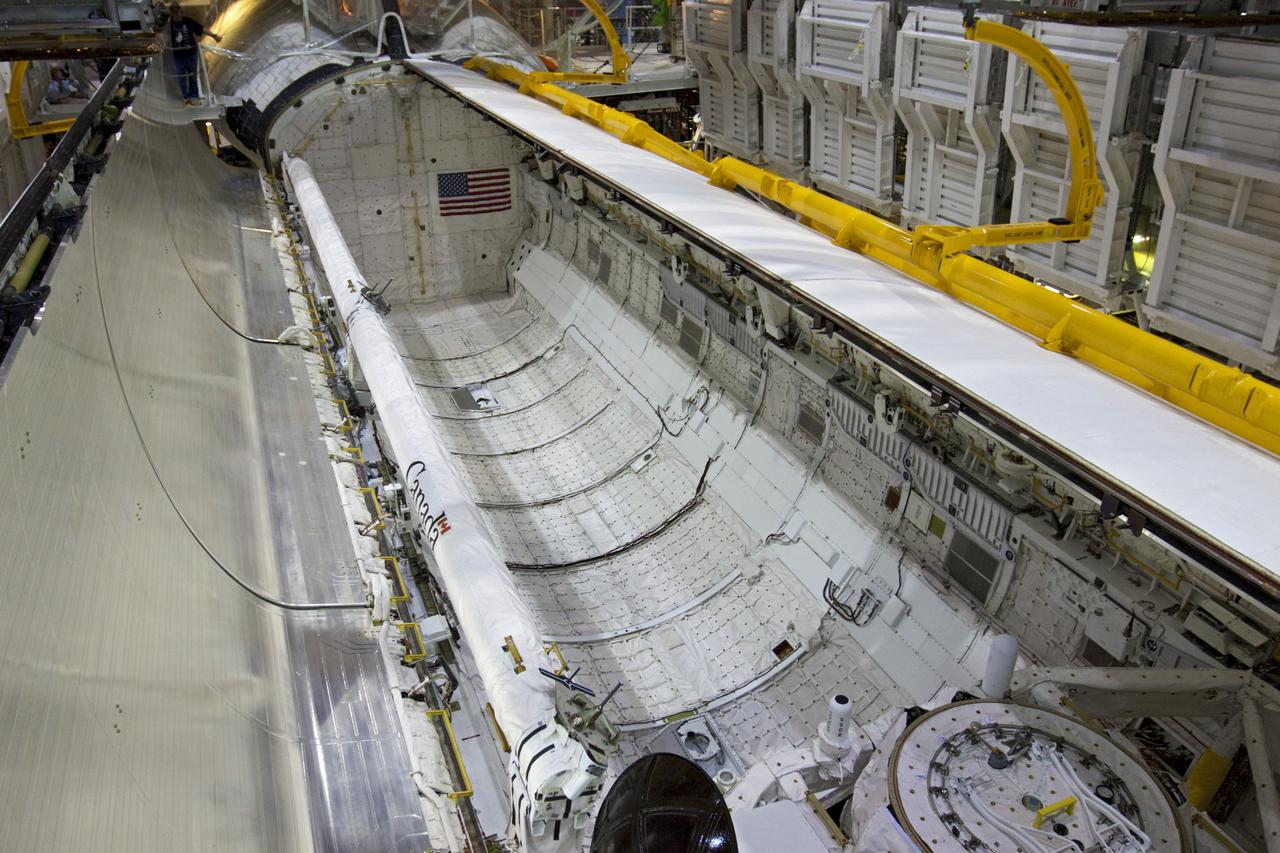
CAPE CANAVERAL, Fla. – In Orbiter Processing Facility-1 at NASA's Kennedy Space Center in Florida, space shuttle Discovery’s payload bay is moments away from being concealed from view as its doors swing shut with the aid of yellow-painted strongbacks, hardware used to support and operate the doors when the shuttle is not in space. Discovery's doors are being closed for the final time during Space Shuttle Program transition and retirement activities. Following the door closure, the vehicle will be powered down for the last time. Discovery is being prepared for public display at the Smithsonian’s National Air and Space Museum Steven F. Udvar-Hazy Center in Chantilly, Va., in 2012. For more information, visit http://www.nasa.gov/shuttle. Photo credit: NASA/Kim Shiflett
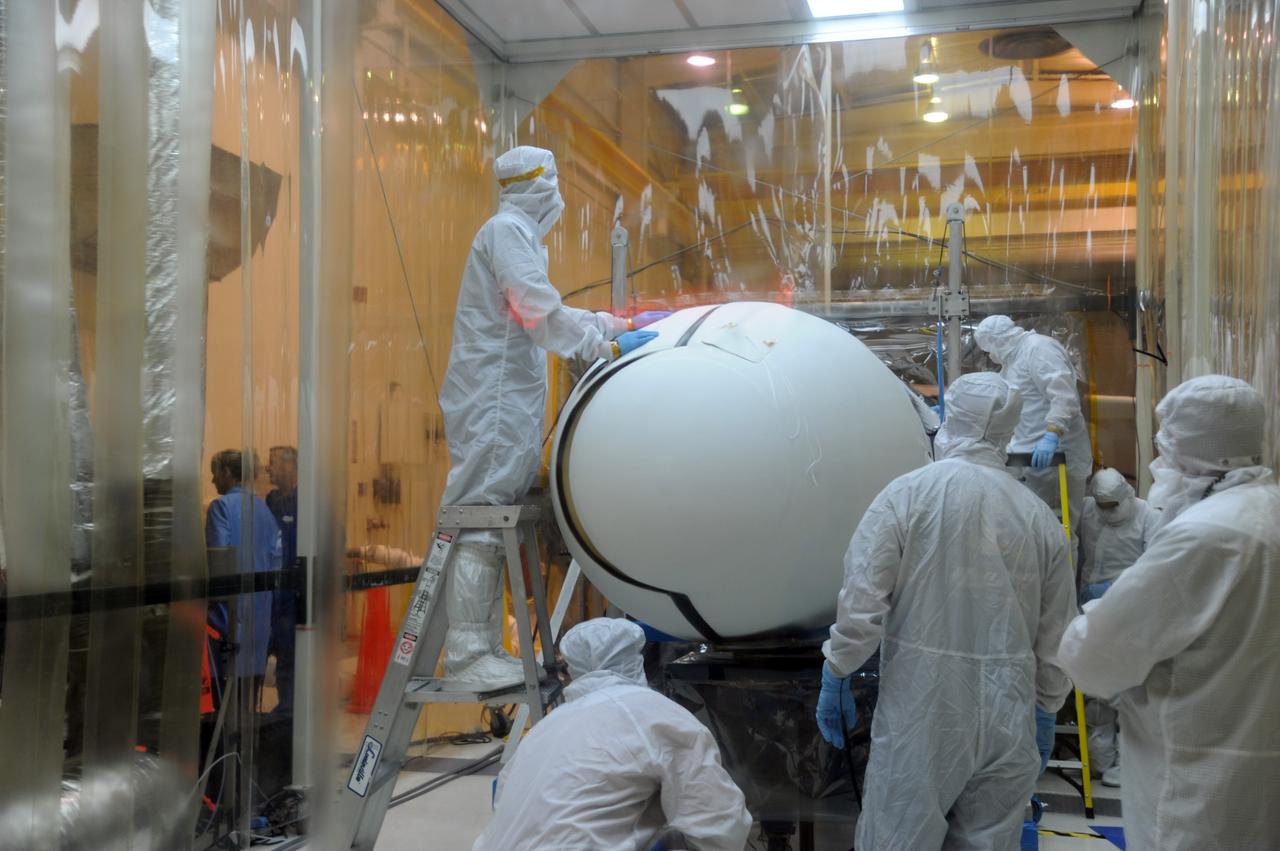
VANDENBERG AIR FORCE BASE, Calif. – In Orbital Sciences’ hangar on Vandenberg Air Force Base in California, NASA’s Nuclear Spectroscopic Telescope Array, or NuSTAR, is hidden from sight as the Pegasus fairing closes around it during the fairing’s reinstallation. Access to the spacecraft was needed for compatibility testing to verify communication with a tracking station in Hawaii. With the change in the launch timeframe to June, this station will be needed to support launch. After processing of Orbital’s Pegasus XL rocket and the spacecraft is complete, they will be flown on Orbital's L-1011 carrier aircraft from Vandenberg, to the U.S. Army's Ronald Reagan Ballistic Missile Defense Test Site on Kwajalein Atoll, part of the Marshall Islands in the Pacific Ocean. The Pegasus, mated to its NuSTAR payload, will be launched from the carrier aircraft 117 nautical miles south of Kwajalein at latitude 6.75 degrees north of the equator. The high-energy X-ray telescope will conduct a census of black holes, map radioactive material in young supernovae remnants, and study the origins of cosmic rays and the extreme physics around collapsed stars. Launch is scheduled for June 13. For more information, visit http://www.nasa.gov/nustar. Photo credit: U.S. Air Force 30th Space Wing/Aaron Taubman, VAFB
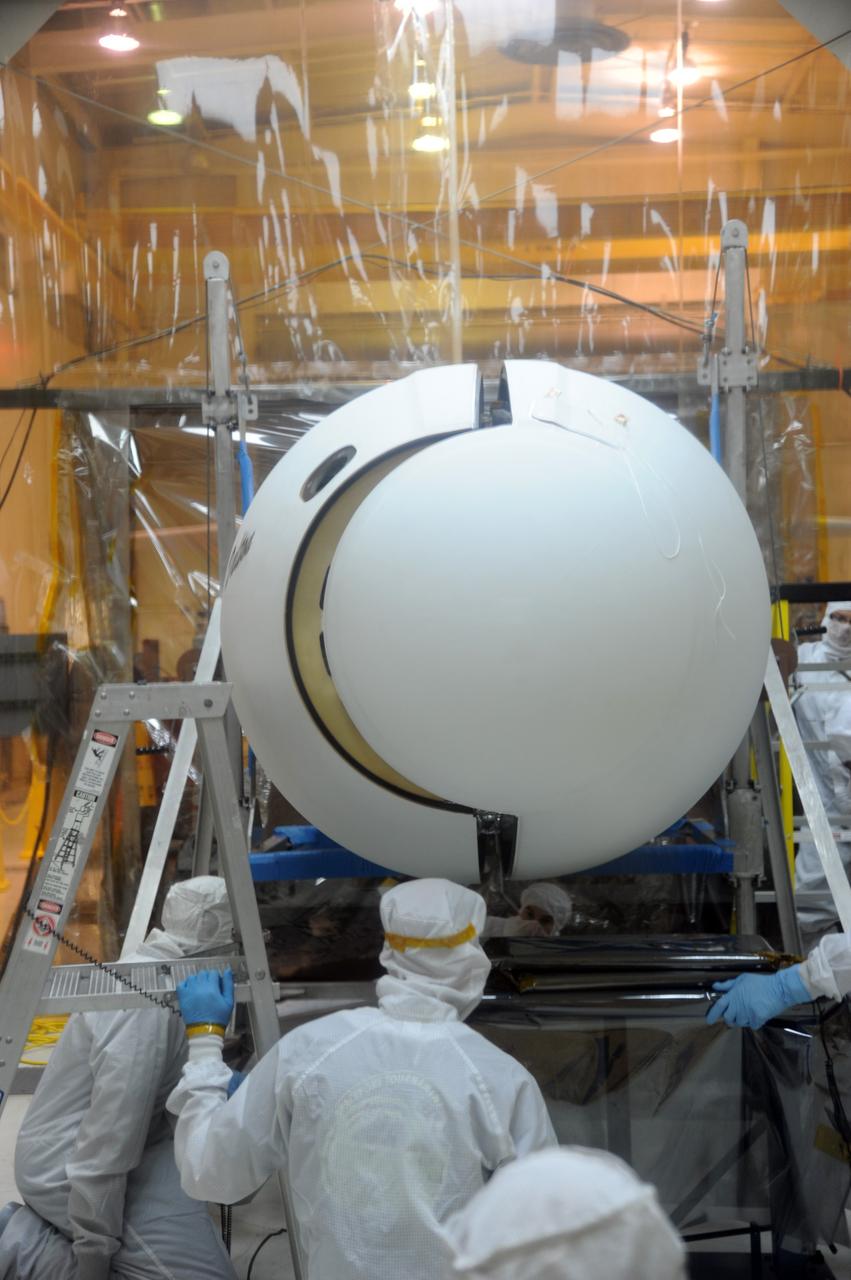
VANDENBERG AIR FORCE BASE, Calif. – In Orbital Sciences’ hangar on Vandenberg Air Force Base in California, the Pegasus fairing closes around NASA’s Nuclear Spectroscopic Telescope Array, or NuSTAR, during operations to reinstall the fairing. Access to the spacecraft was needed for compatibility testing to verify communication with a tracking station in Hawaii. With the change in the launch timeframe to June, this station will be needed to support launch. After processing of Orbital’s Pegasus XL rocket and the spacecraft is complete, they will be flown on Orbital's L-1011 carrier aircraft from Vandenberg, to the U.S. Army's Ronald Reagan Ballistic Missile Defense Test Site on Kwajalein Atoll, part of the Marshall Islands in the Pacific Ocean. The Pegasus, mated to its NuSTAR payload, will be launched from the carrier aircraft 117 nautical miles south of Kwajalein at latitude 6.75 degrees north of the equator. The high-energy X-ray telescope will conduct a census of black holes, map radioactive material in young supernovae remnants, and study the origins of cosmic rays and the extreme physics around collapsed stars. Launch is scheduled for June 13. For more information, visit http://www.nasa.gov/nustar. Photo credit: U.S. Air Force 30th Space Wing/Aaron Taubman, VAFB
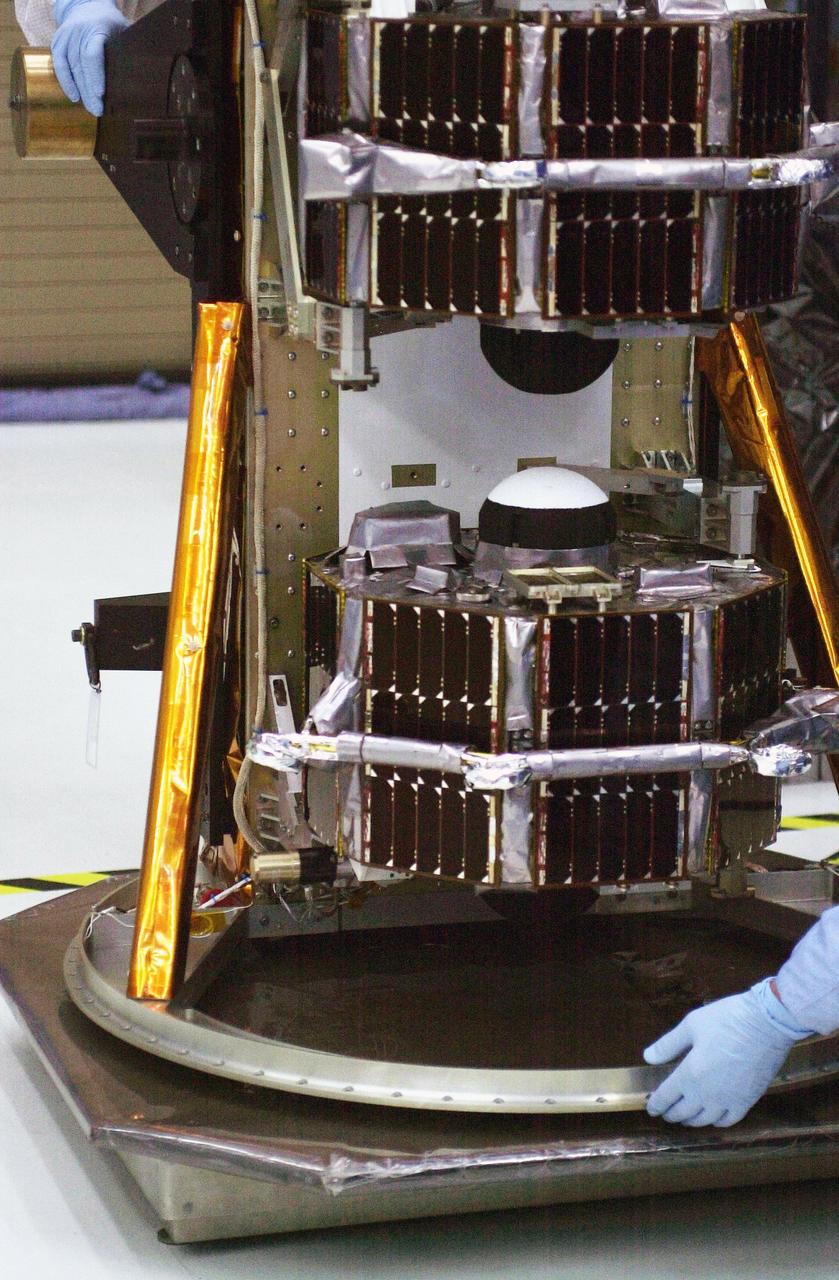
VANDENBERG AIR FORCE BASE, Calif. — In the Orbital Sciences Building 836 at Vandenberg Air Force Base in California, workers keep close watch as the payload support structure with the three micro-satellites comprising the Space Technology 5 (ST5) spacecraft is lifted and weighed. ST5 will be launched by a Pegasus XL rocket. The satellites contain miniaturized redundant components and technologies. Each will validate New Millennium Program selected technologies, such as the Cold Gas Micro-Thruster and X-Band Transponder Communication System. After deployment from the Pegasus, the micro-satellites will be positioned in a “string of pearls” constellation that demonstrates the ability to position them to perform simultaneous multi-point measurements of the magnetic field using highly sensitive magnetometers. The data will help scientists understand and map the intensity and direction of the Earth’s magnetic field, its relation to space weather events, and affects on our planet. With such missions, NASA hopes to improve scientists’ ability to accurately forecast space weather and minimize its harmful effects on space- and ground-based systems. Launch of ST5 is scheduled for Feb. 28 from Vandenberg Air Force Base.
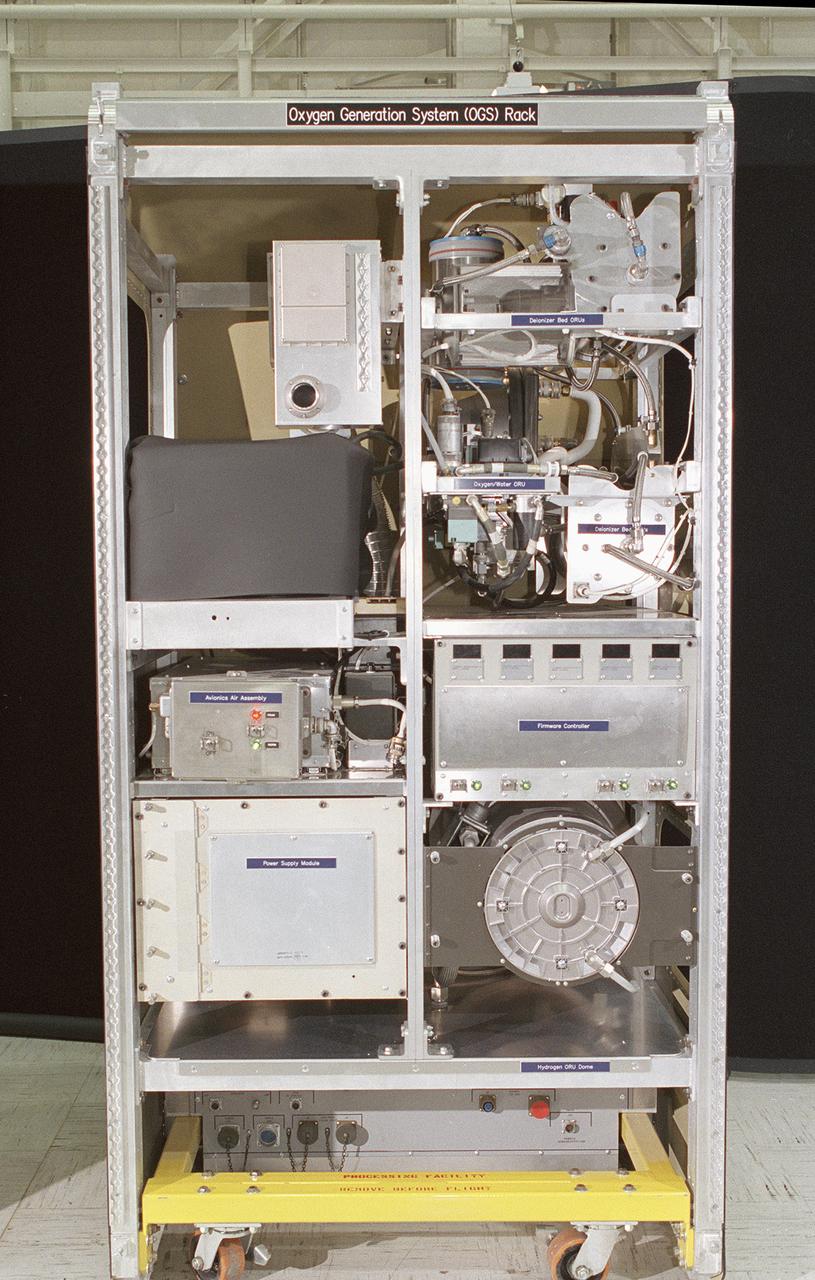
The Environmental Control and Life Support System (ECLSS) Group of the Flight Projects Directorate at the Marshall Space Flight Center (MSFC) in Huntsville, Alabama, is responsible for designing and building the life support systems that will provide the crew of the International Space Station (ISS) a comfortable environment in which to live and work. This is a close-up view of ECLSS Oxygen Generation System (OGS) rack. The ECLSS Group at the MSFC oversees the development of the OGS, which produces oxygen for breathing air for the crew and laboratory animals, as well as for replacing oxygen lost due to experiment use, airlock depressurization, module leakage, and carbon dioxide venting. The OGS consists primarily of the Oxygen Generator Assembly (OGA), provided by the prime contractor, the Hamilton Sundstrand Space Systems, International (HSSSI) in Windsor Locks, Cornecticut and a Power Supply Module (PSM), supplied by the MSFC. The OGA is comprised of a cell stack that electrolyzes (breaks apart the hydrogen and oxygen molecules) some of the clean water provided by the Water Recovery System and the separators that remove the gases from water after electrolysis. The PSM provides the high power to the OGA needed to electrolyze the water.

CAPE CANAVERAL, Fla. – At NASA Kennedy Space Center in Florida, presenters and Kennedy personnel supporting a NASA Tweetup get a close-up look at space shuttle Endeavour being stored in the Vehicle Assembly Building. From left are Yves Lamothe, lead systems engineer for the 21st Century Ground Systems Program at Kennedy; NASA Deputy Administrator Lori Garver; former astronaut Leland Melvin, NASA associate administrator for Education; and Will.i.am, entertainer and member of The Black Eyed Peas. The Tweetup is part of prelaunch activities for the agency’s Mars Science Laboratory (MSL) launch and provides the opportunity for tweeters will share their experiences with followers through the social networking site Twitter. The MSL mission will pioneer precision landing technology and a sky-crane touchdown to place a car-sized rover, Curiosity, near the foot of a mountain inside Gale Crater on Aug. 6, 2012. During a nearly two-year prime mission after landing, the rover will investigate whether the region has ever offered conditions favorable for microbial life, including the chemical ingredients for life. Liftoff of MSL aboard a United Launch Alliance Atlas V rocket from Space Launch Complex-41 on Cape Canaveral Air Force Station was at 10:02 a.m. EST on Nov. 26. For more information, visit http://www.nasa.gov/msl. Photo credit: NASA/Jim Grossmann

STS-99 Mission Specialist Mamoru Mohri of Japan and his wife, Akiko, wave before their departure from Patrick Air Force Base and return to Houston. With the postponement of the launch of STS-99 on Jan. 31, the crew have an opportunity for more training and time with their families. During the launch countdown, Endeavour's enhanced master events controller (E-MEC) No. 2 failed a standard preflight test. Launch was postponed and Shuttle managers decided to replace the E-MEC located in the orbiter's aft compartment. Launch controllers will be in a position to begin the STS-99 countdown the morning of Feb. 6 and ready to support a launch midto late next week pending availability of the Eastern Range. Known as the Shuttle Radar Topography Mission, it will chart a new course to produce unrivaled 3-D images of the Earth's surface, using two antennae and a 200-foot-long section of space station-derived mast protruding from the payload bay. The result could be close to 1 trillion measurements of the Earth's topography. Besides contributing to the production of better maps, these measurements could lead to improved water drainage modeling, more realistic flight simulators, better locations for cell phone towers, and enhanced navigation safety

STS-99 Mission Specialist Mamoru Mohri of Japan waves before his departure from Patrick Air Force Base and return to Houston. With the postponement of the launch of STS-99 on Jan. 31, the crew have an opportunity for more training and time with their families. During the launch countdown, Endeavour's enhanced master events controller (E-MEC) No. 2 failed a standard preflight test. Launch was postponed and Shuttle managers decided to replace the E-MEC located in the orbiter's aft compartment. Launch controllers will be in a position to begin the STS-99 countdown the morning of Feb. 6 and ready to support a launch midto late next week pending availability of the Eastern Range. Known as the Shuttle Radar Topography Mission, it will chart a new course to produce unrivaled 3-D images of the Earth's surface, using two antennae and a 200-foot-long section of space station-derived mast protruding from the payload bay. The result could be close to 1 trillion measurements of the Earth's topography. Besides contributing to the production of better maps, these measurements could lead to improved water drainage modeling, more realistic flight simulators, better locations for cell phone towers, and enhanced navigation safety

STS-99 Mission Specialist Mamoru Mohri of Japan and his wife, Akiko, wave before their departure from Patrick Air Force Base and return to Houston. With the postponement of the launch of STS-99 on Jan. 31, the crew have an opportunity for more training and time with their families. During the launch countdown, Endeavour's enhanced master events controller (E-MEC) No. 2 failed a standard preflight test. Launch was postponed and Shuttle managers decided to replace the E-MEC located in the orbiter's aft compartment. Launch controllers will be in a position to begin the STS-99 countdown the morning of Feb. 6 and ready to support a launch midto late next week pending availability of the Eastern Range. Known as the Shuttle Radar Topography Mission, it will chart a new course to produce unrivaled 3-D images of the Earth's surface, using two antennae and a 200-foot-long section of space station-derived mast protruding from the payload bay. The result could be close to 1 trillion measurements of the Earth's topography. Besides contributing to the production of better maps, these measurements could lead to improved water drainage modeling, more realistic flight simulators, better locations for cell phone towers, and enhanced navigation safety

STS-99 Mission Specialist Mamoru Mohri of Japan waves before his departure from Patrick Air Force Base and return to Houston. With the postponement of the launch of STS-99 on Jan. 31, the crew have an opportunity for more training and time with their families. During the launch countdown, Endeavour's enhanced master events controller (E-MEC) No. 2 failed a standard preflight test. Launch was postponed and Shuttle managers decided to replace the E-MEC located in the orbiter's aft compartment. Launch controllers will be in a position to begin the STS-99 countdown the morning of Feb. 6 and ready to support a launch midto late next week pending availability of the Eastern Range. Known as the Shuttle Radar Topography Mission, it will chart a new course to produce unrivaled 3-D images of the Earth's surface, using two antennae and a 200-foot-long section of space station-derived mast protruding from the payload bay. The result could be close to 1 trillion measurements of the Earth's topography. Besides contributing to the production of better maps, these measurements could lead to improved water drainage modeling, more realistic flight simulators, better locations for cell phone towers, and enhanced navigation safety
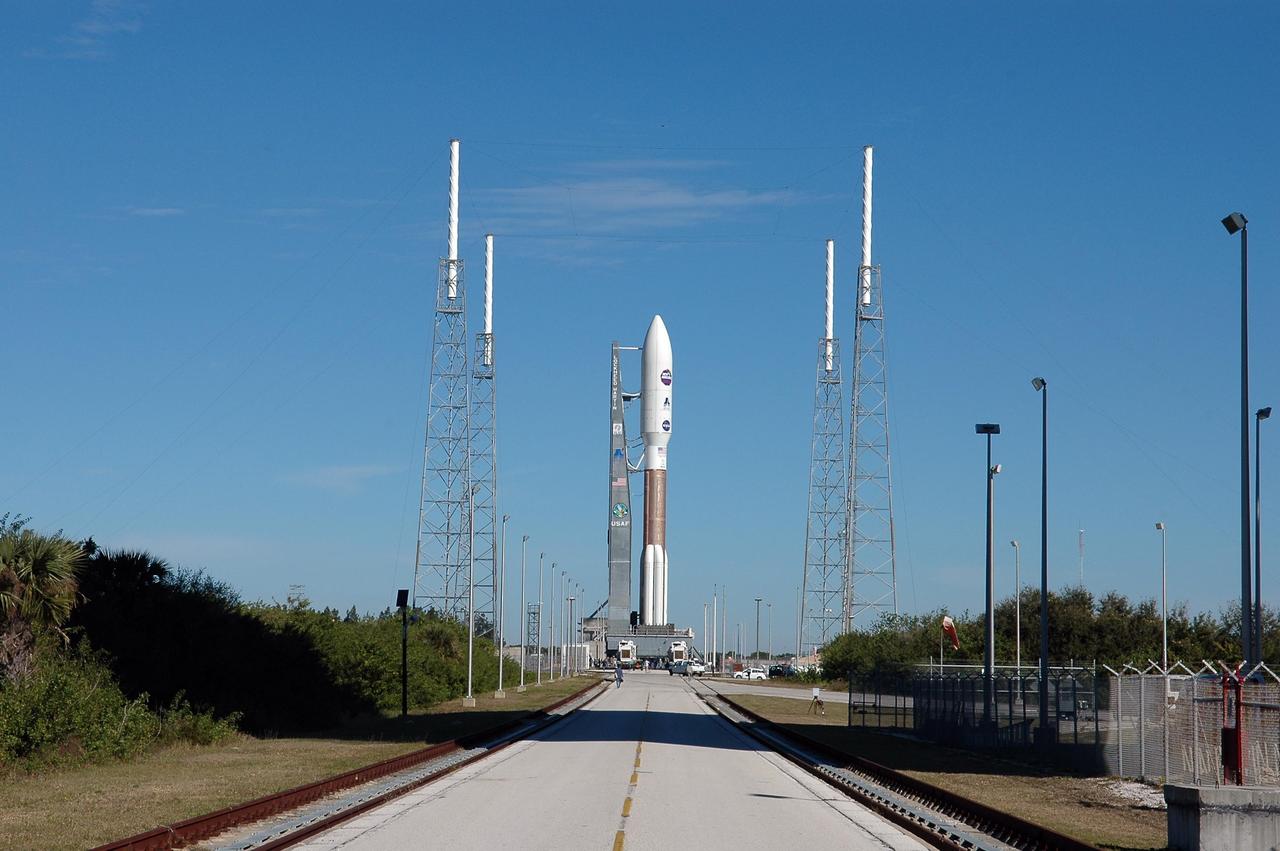
KENNEDY SPACE CENTER, FLA. - On Complex 41 at Cape Canaveral Air Force Station, the Atlas V expendable launch vehicle with the New Horizons spacecraft has been moved to the pad. Umbilicals have been attached. Seen near the rocket are lightning masts that support the catenary wire used to provide lightning protection. Liftoff is scheduled for 1:24 p.m. EST Jan. 17. After its launch aboard the Atlas V, the compact, 1,050-pound piano-sized probe will get a boost from a kick-stage solid propellant motor for its journey to Pluto. New Horizons will be the fastest spacecraft ever launched, reaching lunar orbit distance in just nine hours and passing Jupiter 13 months later. The New Horizons science payload, developed under direction of Southwest Research Institute, includes imaging infrared and ultraviolet spectrometers, a multi-color camera, a long-range telescopic camera, two particle spectrometers, a space-dust detector and a radio science experiment. The dust counter was designed and built by students at the University of Colorado, Boulder. A launch before Feb. 3 allows New Horizons to fly past Jupiter in early 2007 and use the planet’s gravity as a slingshot toward Pluto. The Jupiter flyby trims the trip to Pluto by as many as five years and provides opportunities to test the spacecraft’s instruments and flyby capabilities on the Jupiter system. New Horizons could reach the Pluto system as early as mid-2015, conducting a five-month-long study possible only from the close-up vantage of a spacecraft.
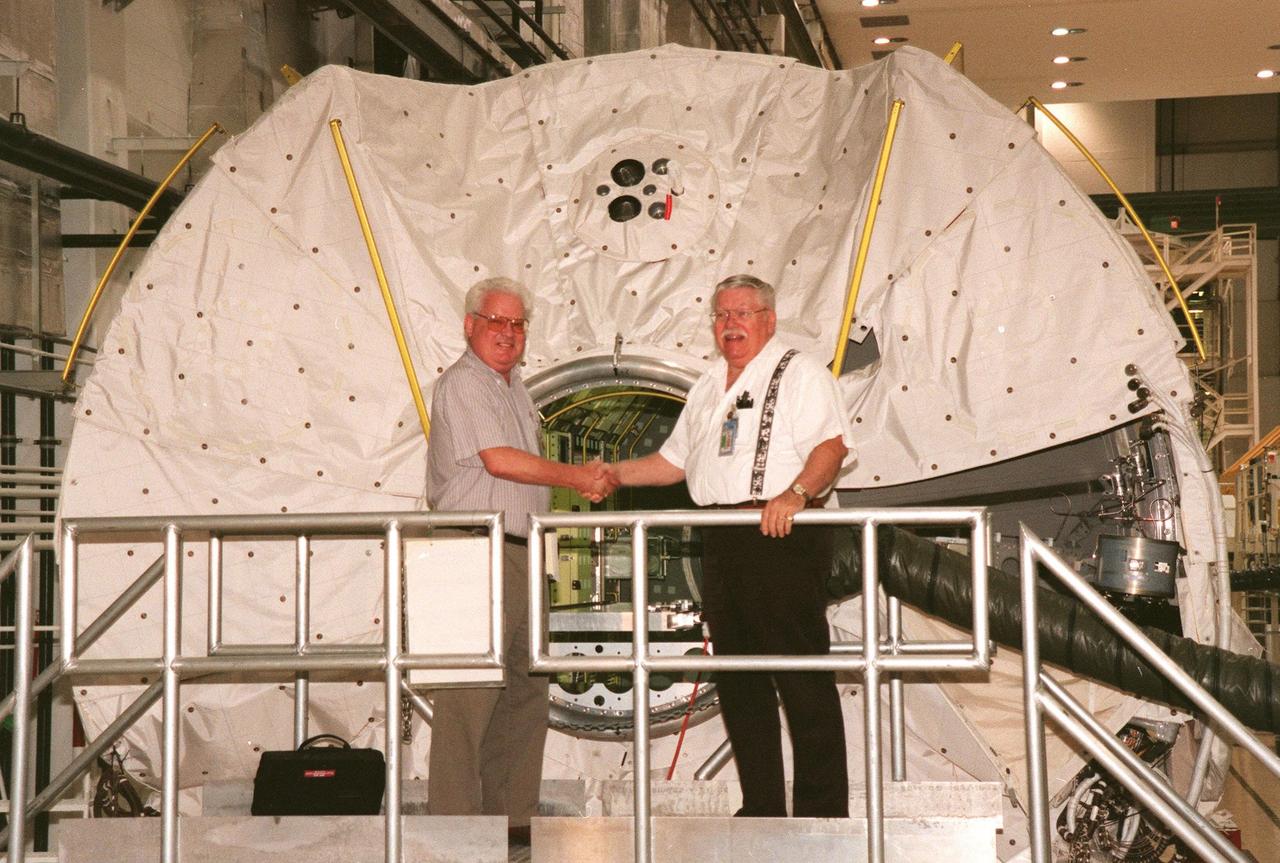
KENNEDY SPACE CENTER, FLA. -- In the Operations and Checkout Building, Rainer Goercke shakes hands with Norman Jatz in front of the Spacelab Module MD001 as they prepare to close it for the last time before shipment to the National Air and Space Museum in Washington, DC. Goercke and Jatz have been on the Spacelab program since 1979 and were part of the team that first unloaded the module at KSC. Goercke is the only remaining European representative from the German-based Spacelab contractor, ERNO, and Jatz is a mechanical engineering lead from Boeing. Spacelab was designed by the European Space Agency (ESA) for the Space Shuttle program. It first flew on STS-9 in November 1983 and its final flight was the STS-90 Neurolab mission in April 1998. The sister module will travel home and be placed on display in Europe. The Spacelab concept of modular experiment racks in a pressurized shirt-sleeve environment made it highly user-friendly and accessible. Numerous experiments conceived by hundreds of scientists on the ground were conducted by flight crews in orbit. Spacelab modules served as on-orbit homes for everything from squirrel monkeys to plant seeds. They supported astronomical as well as Earth observations, for servicing the Hubble Space Telescope and for research preparatory to the International Space Station. One of the greatest benefits afforded by the Spacelab missions was the opportunity to fly a mission more than once, with the second or third flight building on the experiences and data gathered from its predecessors