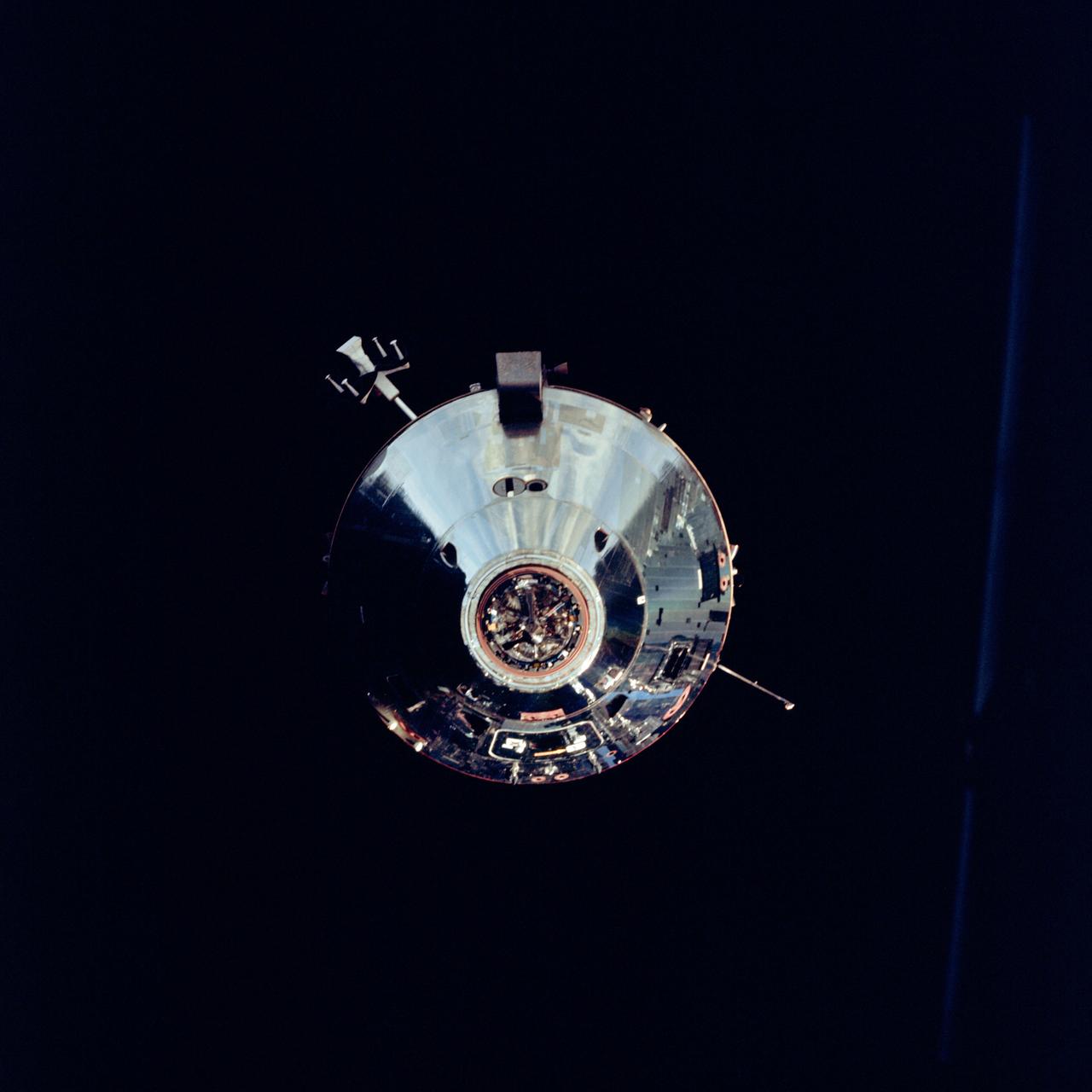
The Apollo 9 Command/Service Modules photographed from the Lunar Module,"Spider",on the fifth day of the Apollo 9 earth-orbital mission. Docking mechanism is visible in nose of the Command Module,"Gumdrop". Object jutting out from the Service Module aft bulkhead is the high-gain S-Band antenna. Film magazine was F, film type was SO-368 Ektachrome with 0.460 - 0.710 micrometers film / filter transmittance response and haze filter,80mm lens.
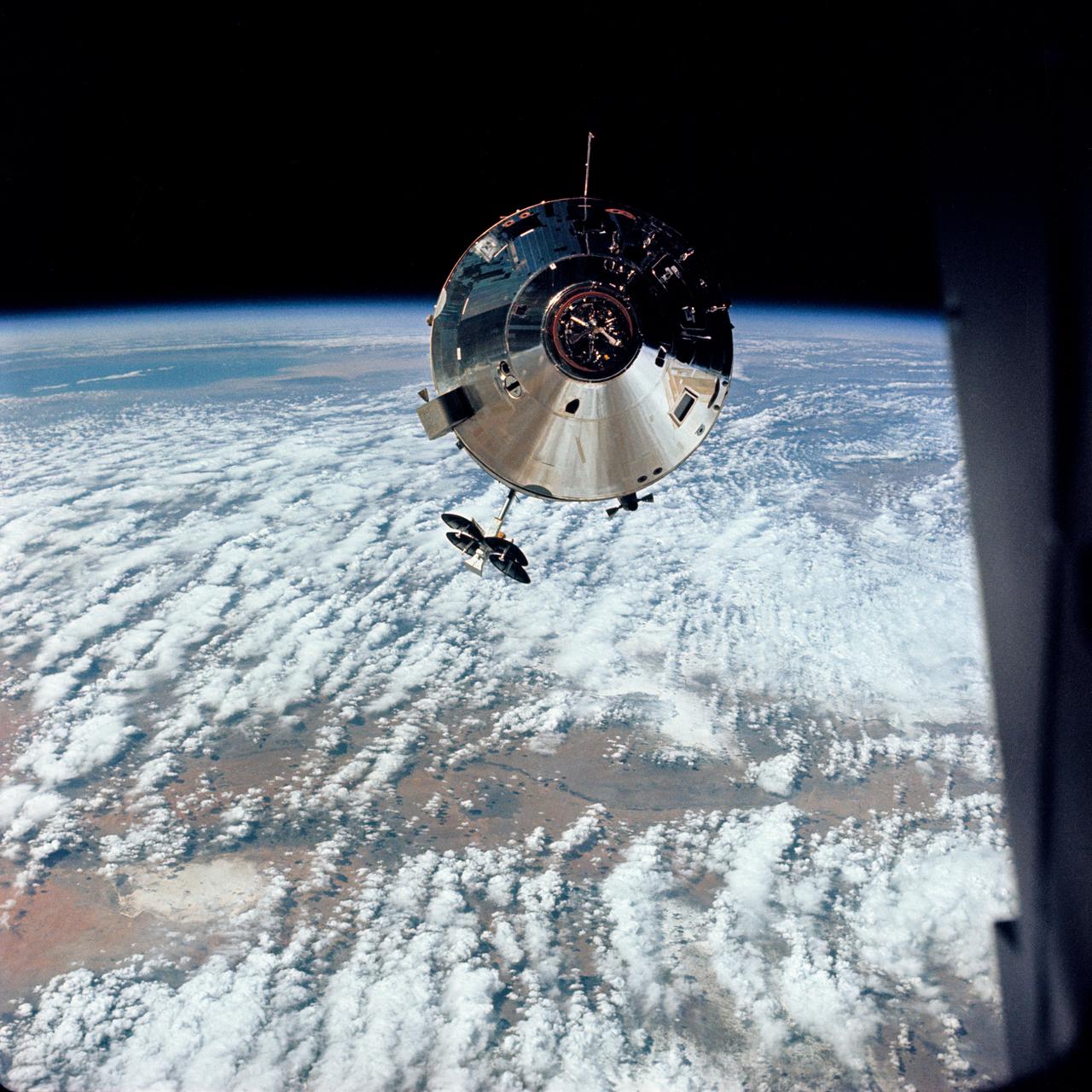
High Oblique photograph (taken over New Mexico) of the Apollo 9 Command/Service Modules taken from the Lunar Module,"Spider",on the fifth day of the Apollo 9 earth-orbital mission. Docking mechanism is visible in nose of the Command Module,"Gumdrop". Object jutting out from the Service Module aft bulkhead is the high-gain S-Band antenna. Film magazine was F, film type was SO-368 Ektachrome with 0.460 - 0.710 micrometers film / filter transmittance response and haze filter,80mm lens. Cloud cover over the Earth is 70%.
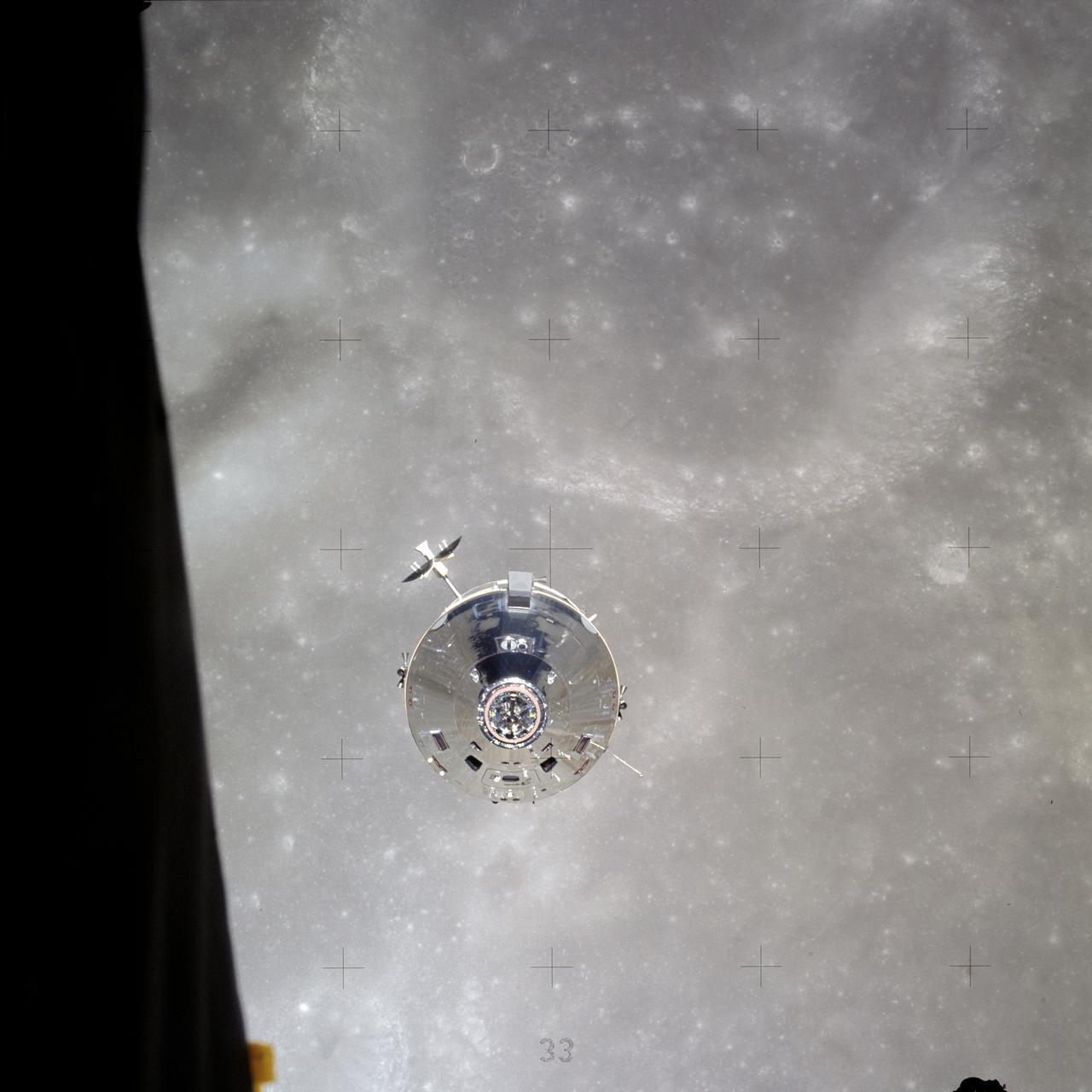
AS16-113-18282 (23 April 1972) --- The Apollo Command and Service Modules (CSM) "Casper" approaches the Lunar Module (LM) "Orion", from which this photograph was made. The two spacecraft are about to make their final rendezvous of the mission, on April 23, 1972. Astronauts John W. Young, commander, and Charles M. Duke Jr., lunar module pilot, aboard the LM, were returning to the CSM, in lunar orbit, after three successful days on the lunar surface. Astronaut Thomas K. (Ken) Mattingly II, command module pilot, remained with the CSM in lunar orbit, while Young and Duke descended in the LM to explore the Descartes region of the moon.
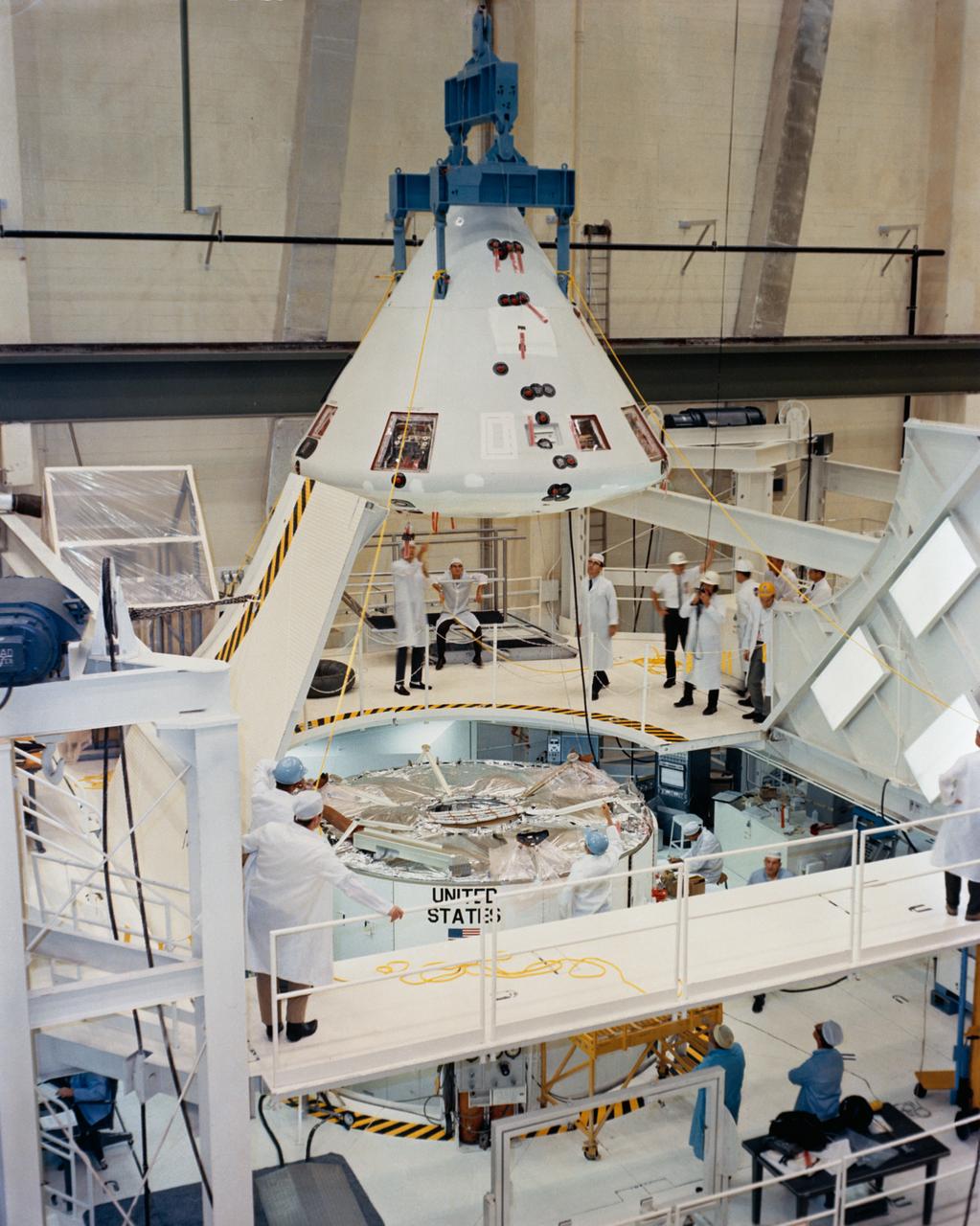
S68-17301 (6 Dec. 1967) --- Apollo Spacecraft 020 Command Module is hoisted into position for mating with Service Module in the Kennedy Space Center's Manned Spacecraft Operations Building. Spacecraft 020 will be flown on the Apollo 6 (Spacecraft 020/Saturn 502) unmanned, Earth-orbital space mission.
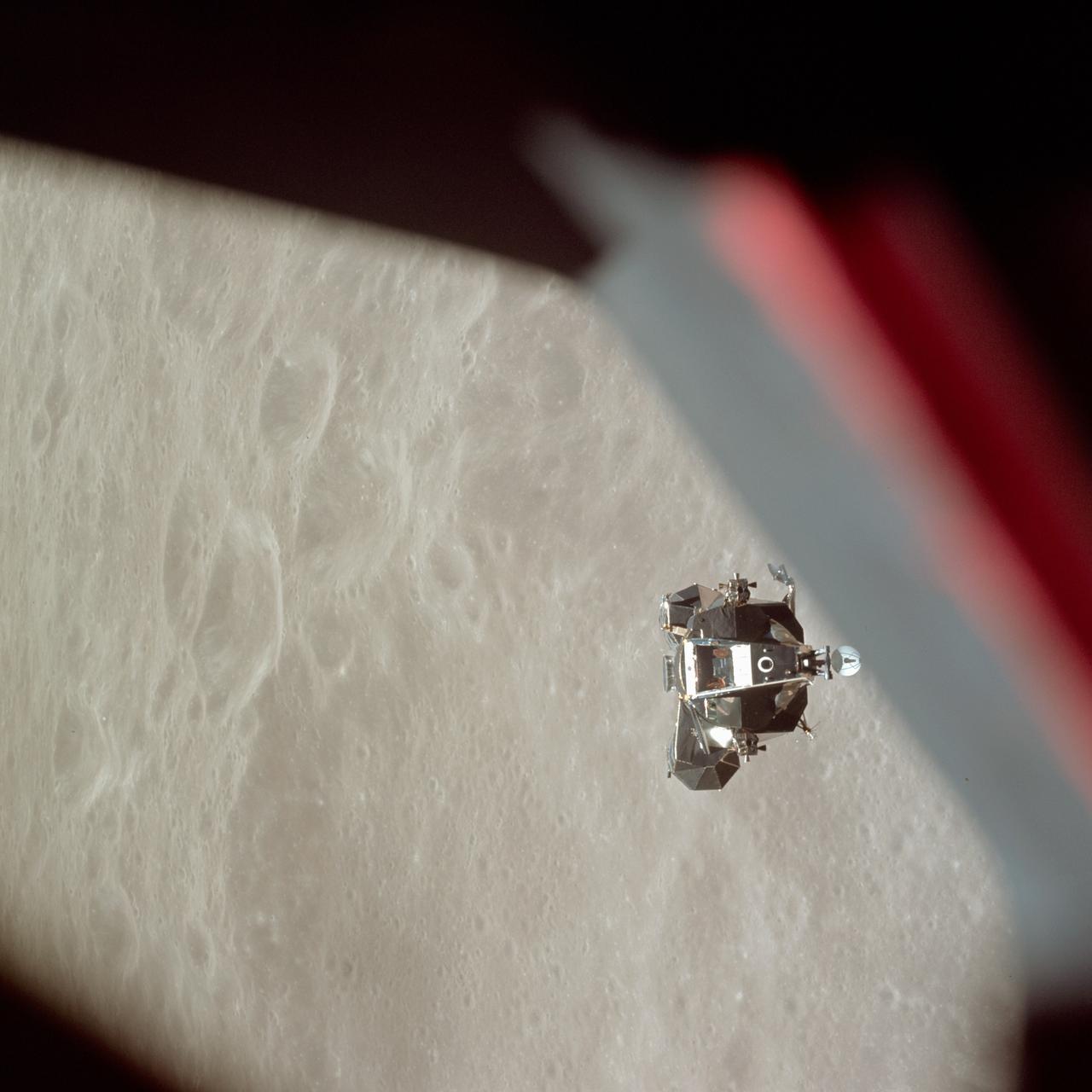
AS10-34-5112 (26 May 1969) --- The ascent stage of the Apollo 10 Lunar Module (LM) is photographed from the Command Module prior to docking in lunar orbit. The LM is approaching the Command and Service Modules from below. The LM descent stage had already been jettisoned. The lunar surface in the background is near, but beyond the eastern limb of the moon as viewed from Earth (about 120 degrees east longitude). The red/blue diagonal line is the spacecraft window.
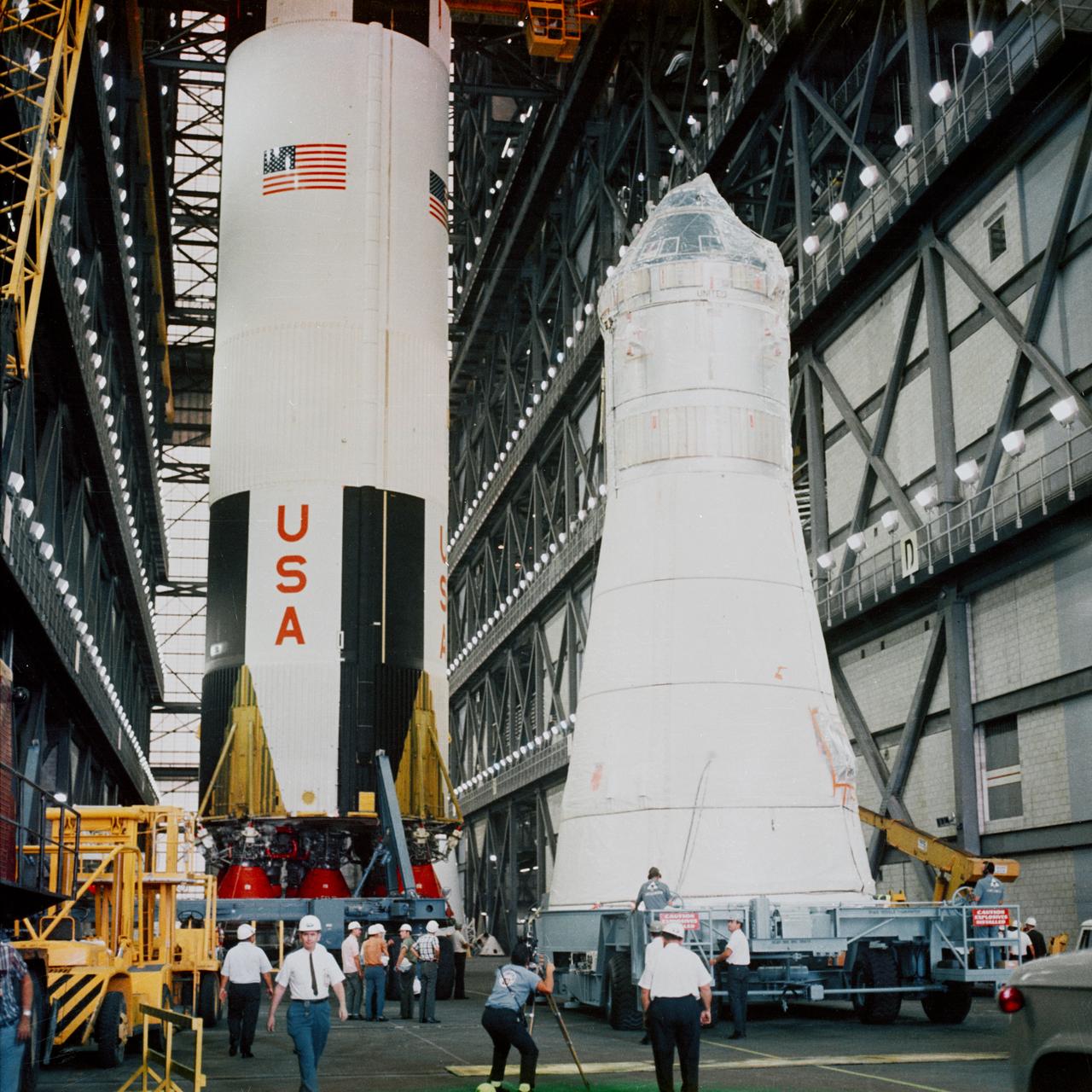
Apollo Spacecraft 104 Command/Service Module and Lunar Module 3 arrive at the Vehicle Assembly Building (VAB) for mating atop the Saturn 504 launch vehicle. The Saturn 504 stack is out of view. The Saturn V first (S-IC) stage in left background is scheduled for a later flight.
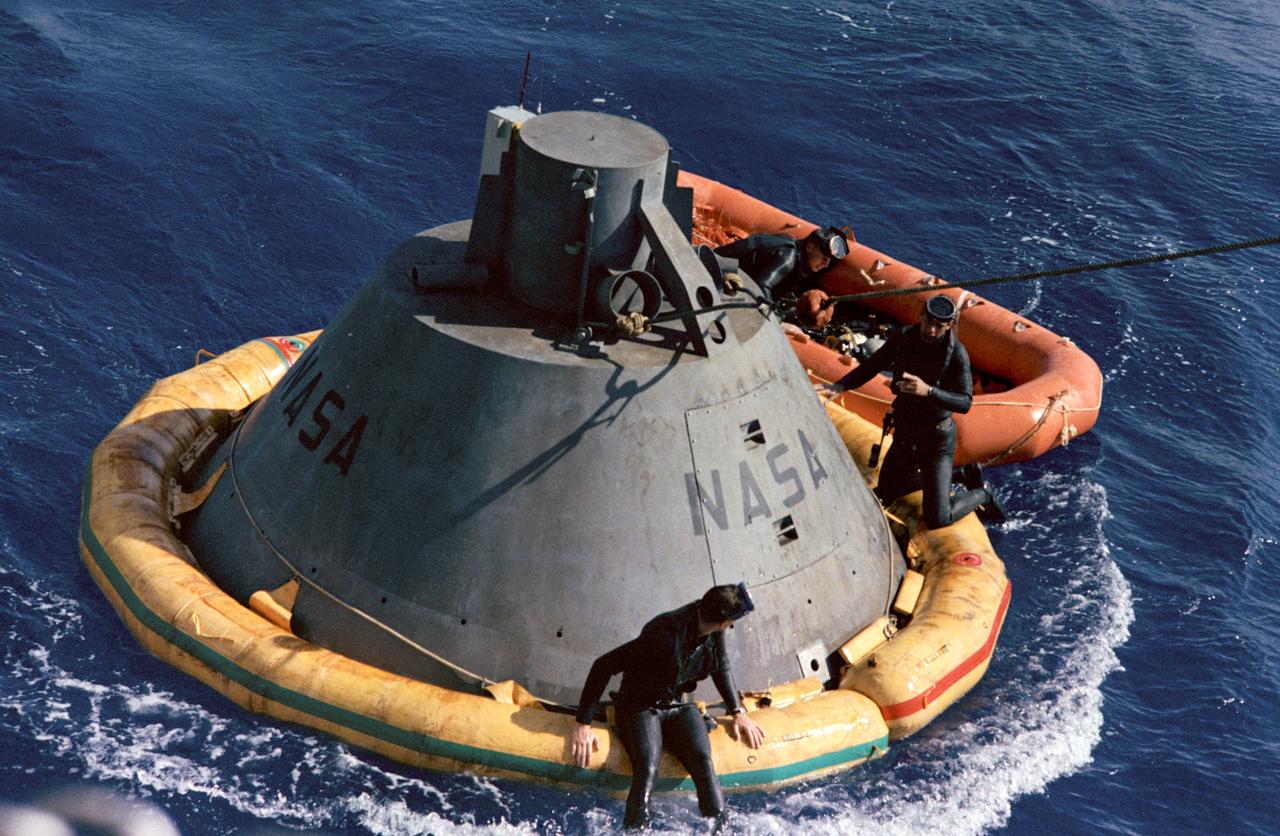
Apollo command module boilerplate floats in the Atlantic Ocean during a practice recovery exercise. Frogmen in a liferaft and on the flotation collar secure the command module boilerplate for hoisting onto a nearby recovery ship. The exercise was conducted in preparation for the forthcoming Apollo-Saturn 201 (AS-201) mission.
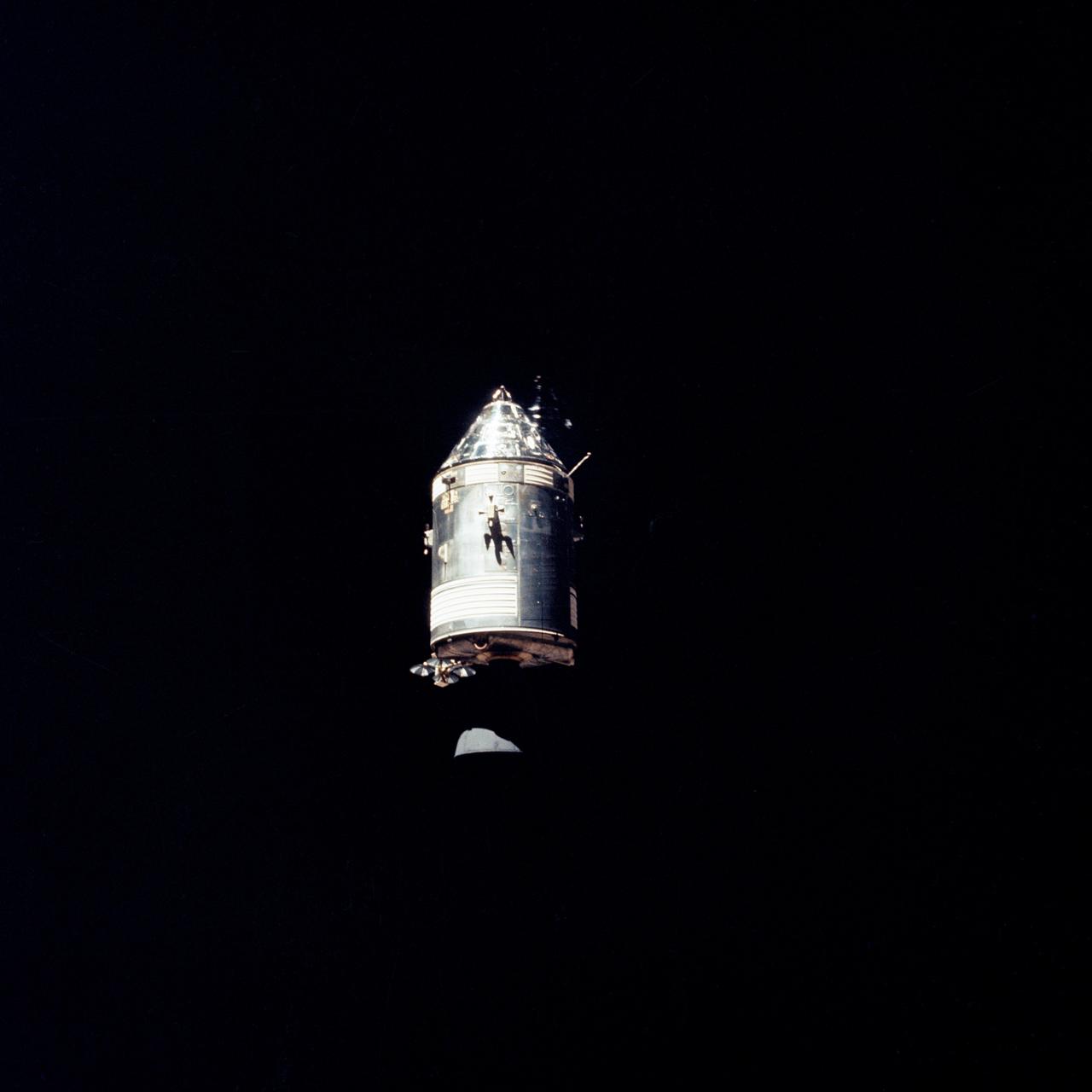
AS14-66-9344 (February 1971) --- The Apollo Command and Service Modules (CSM) are photographed against a black sky background from the Lunar Module (LM) above the moon. While astronauts Alan B. Shepard Jr., commander, and Edgar D. Mitchell, lunar module pilot, descended in the LM "Antares" to explore the Fra Mauro region of the moon, astronaut Stuart A. Roosa , command module pilot, remained with the CSM "Kitty Hawk" in lunar orbit.

AS11-37-5445 (20 July 1969) --- The Apollo 11 Command and Service Modules (CSM) are photographed from the Lunar Module (LM) in lunar orbit during the Apollo 11 lunar landing mission. The lunar surface below is in the north central Sea of Fertility. The coordinates of the center of the picture are 51 degrees east longitude and 1 degree north latitude. About half of the crater Taruntius G is visible in the lower left corner of the picture. Part of Taruntius H can be seen at lower right.
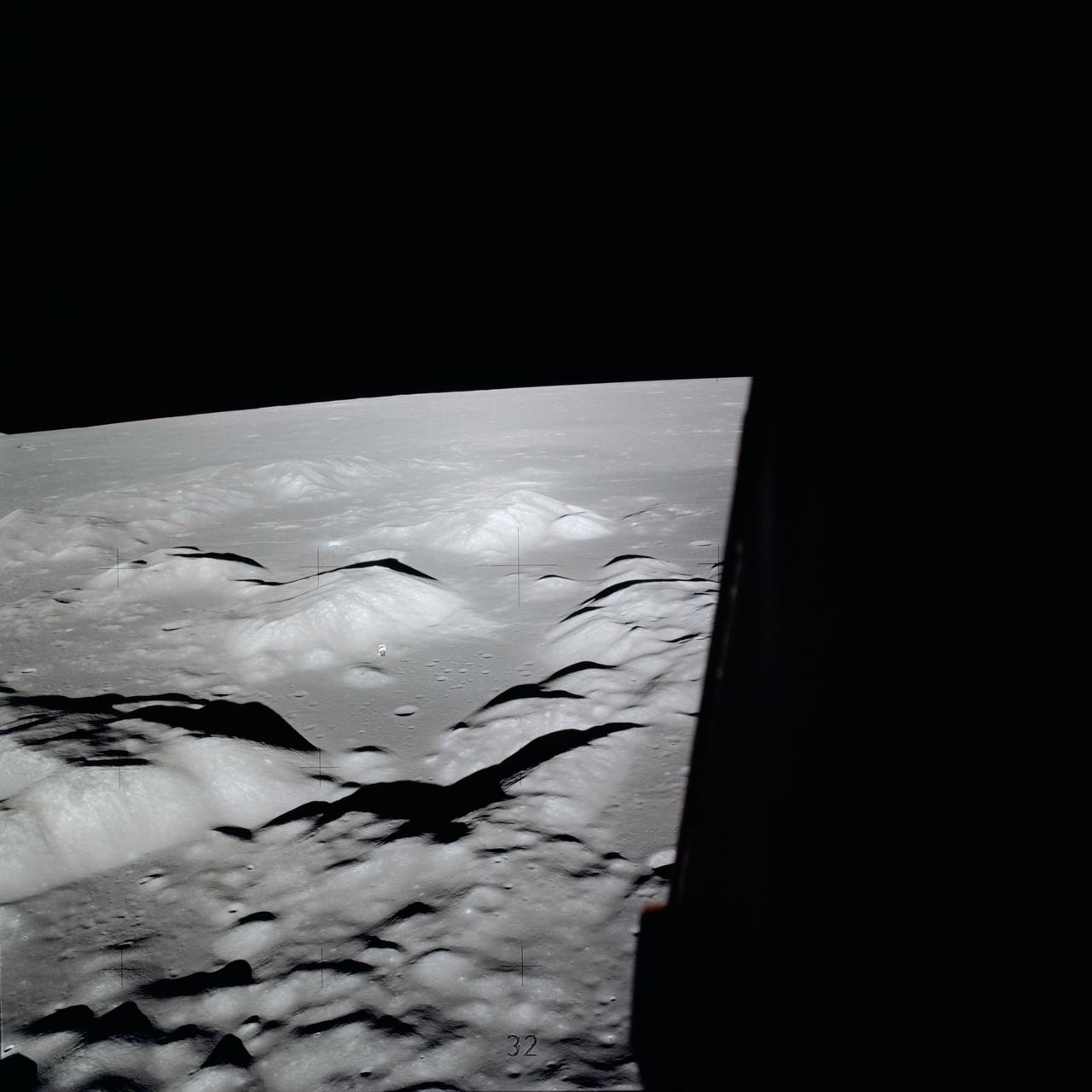
This 70mm frame, showintg the Apollo 17 Command/Service Modules (CSM) backdropped against the Taurus-Littrow landing site, was exposed from the lunar module (LM) prior to the LM's touchdown on the lunar surface.
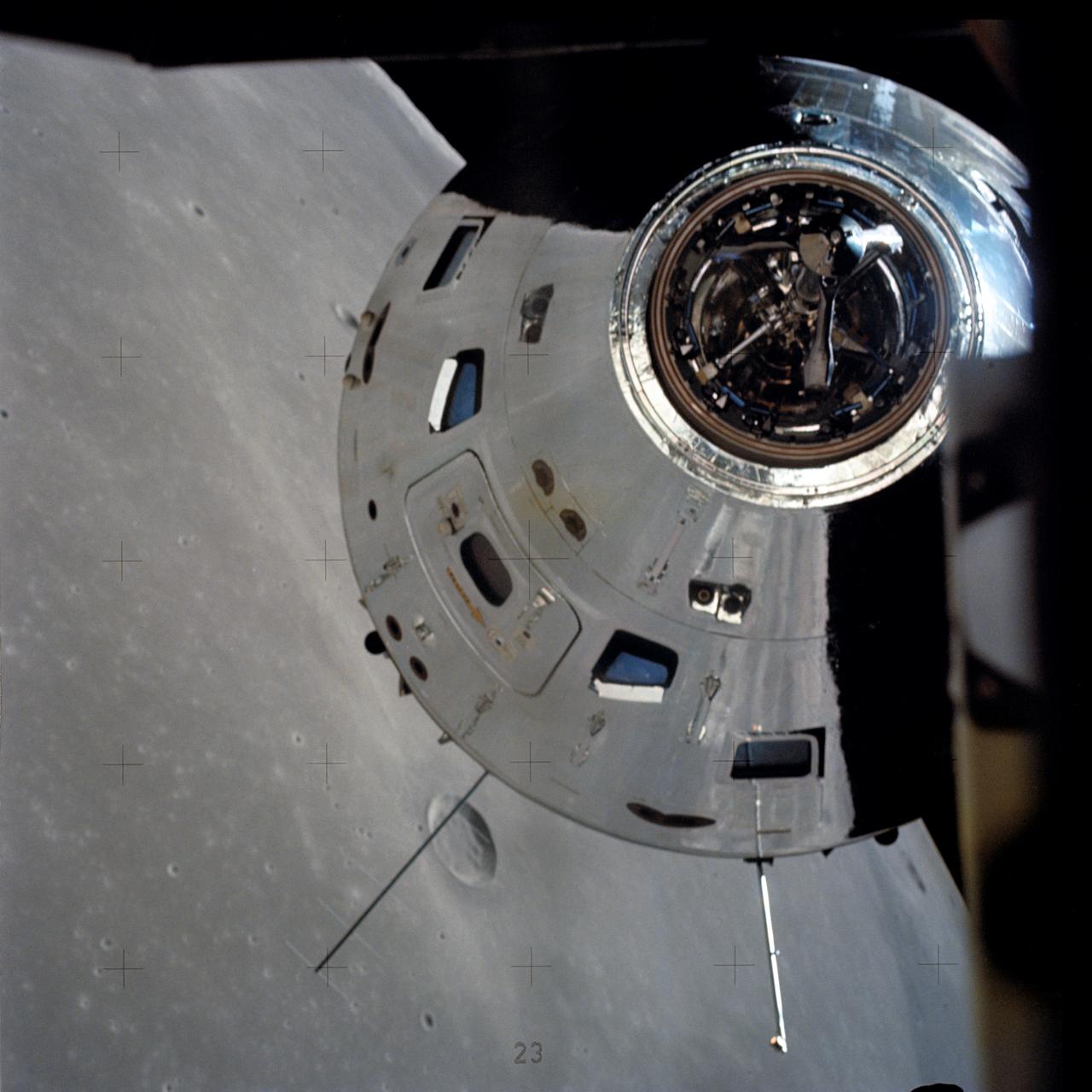
AS17-145-22273 (7-19 Dec. 1972) --- In this view, taken from the Lunar Module (LM), the Command and Service Module (CSM) are seen preparing to rendezvous with the LM. Note the reflection of the lunar surface on the CSM. The CSM, is piloted by Ronald E. Evans; while astronauts Eugene A. Cernan, commander; and Harrison W. Schmitt, lunar module pilot, are onboard the LM, following their extravehicular activities (EVA) on the moon's surface. While astronauts Cernan and Schmitt descended in the LM "Challenger" to explore the Taurus-Littrow region of the moon, astronaut Evans remained with the CSM "America" in lunar orbit.
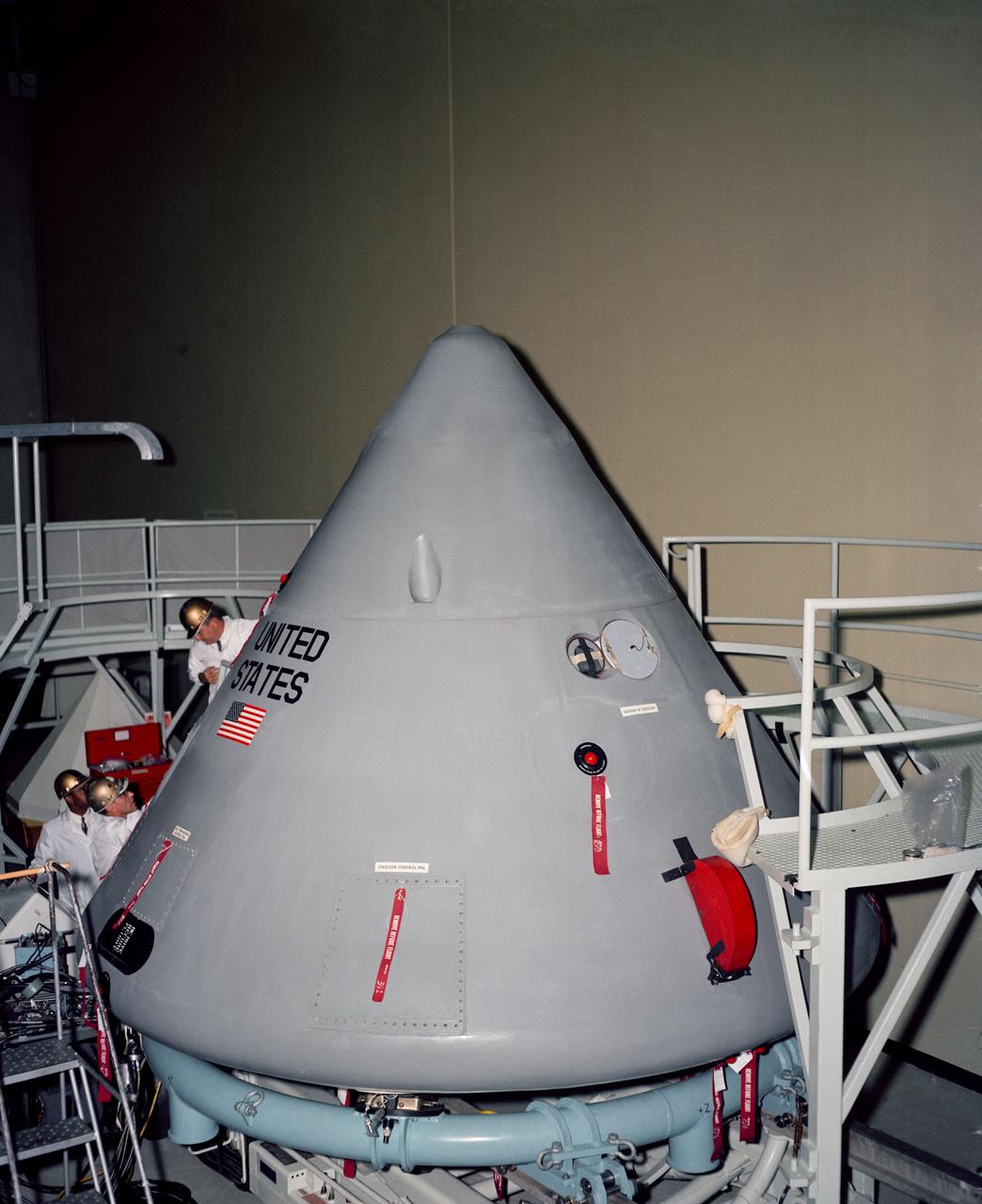
S66-53655 (1966) --- High angle view of Apollo Spacecraft 012 Command Module looking toward +Z axis during pre-shipping operations in south air lock of Systems Integration and Checkout Facility.

AS09-20-3064 (6 March 1969) --- Excellent view of the docked Apollo 9 Command and Service Modules (CSM) and Lunar Module (LM), with Earth in the background, during astronaut David R. Scott's stand-up extravehicular activity (EVA), on the fourth day of the Apollo 9 Earth-orbital mission. Scott, command module pilot, is standing in the open hatch of the Command Module (CM). Astronaut Russell L. Schweickart, lunar module pilot, took this photograph of Scott from the porch of the LM. Inside the LM was astronaut James A. McDivitt, Apollo 9 commander.
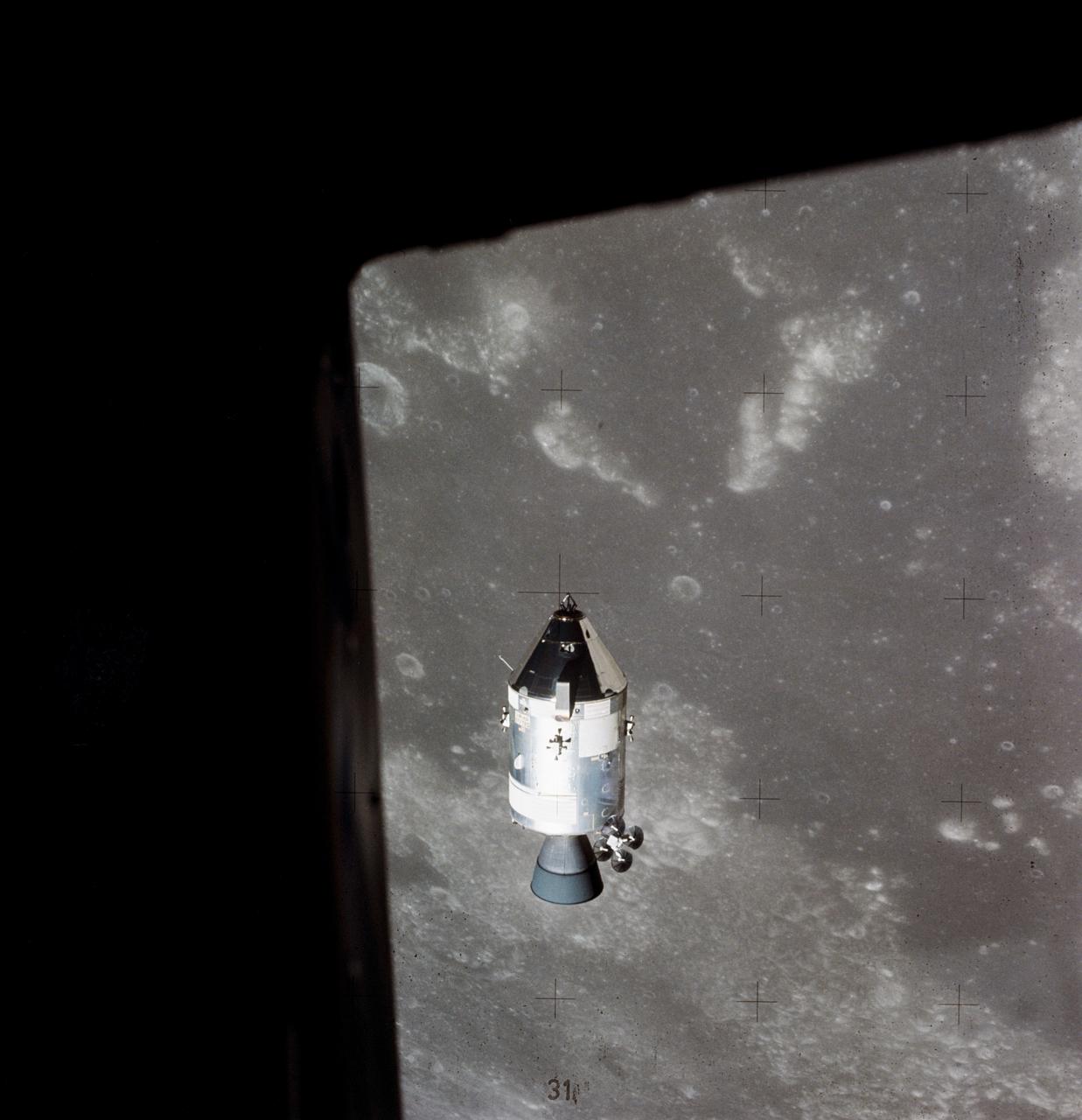
AS15-88-11974 (30 July 1971) --- A view of the Apollo 15 Command and Service Modules (CSM) in lunar orbit as photographed from the Lunar Module (LM) just after rendezvous. The lunar nearside is in the background. This view is looking southeast into the Sea of Fertility. The crater Taruntius is at the right center edge of the picture.
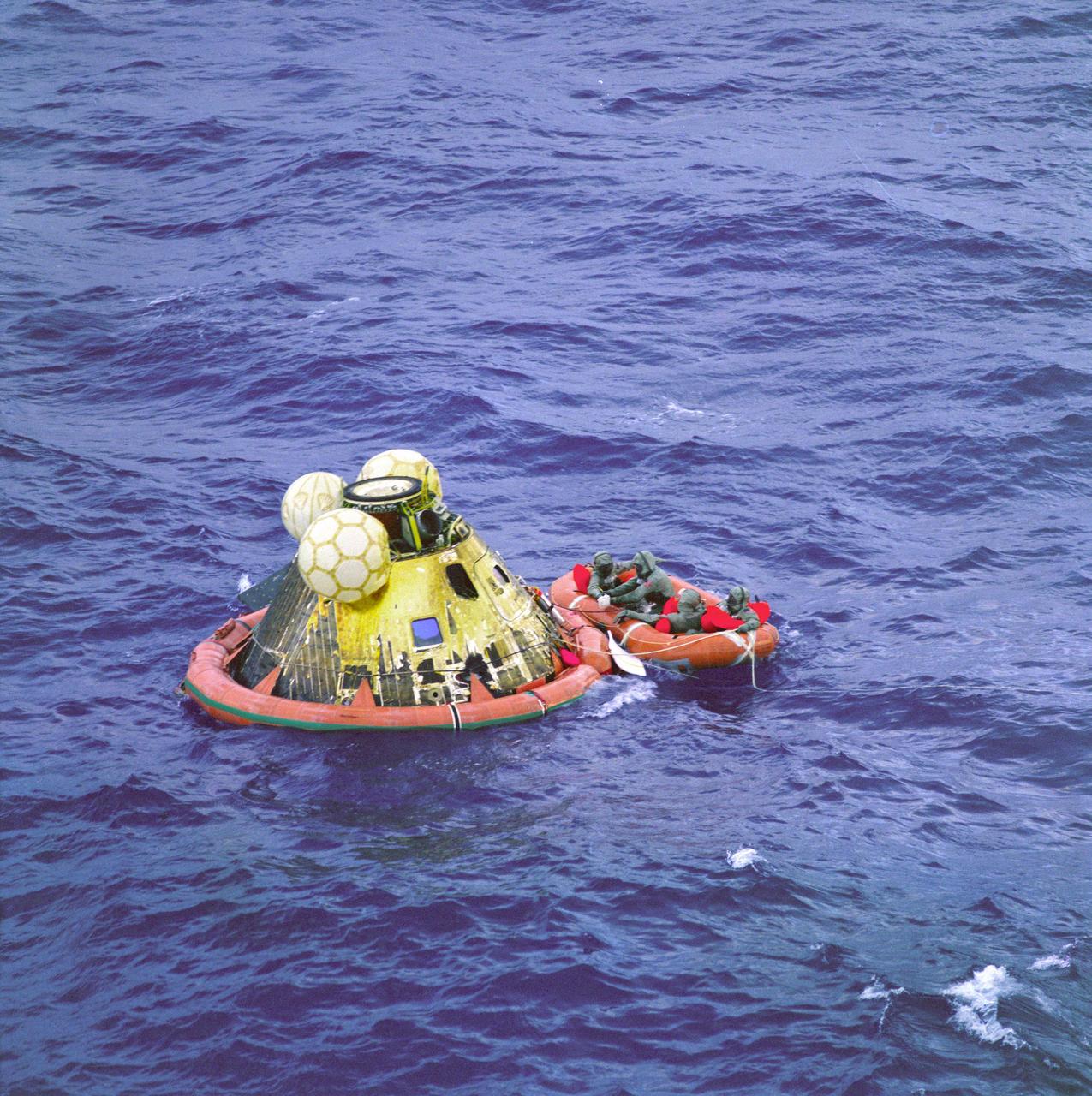
The Apollo 11 command module Columbia with astronauts Neil Armstrong, Michael Collins, and Buzz Aldrin aboard splashed down at 11:49 a.m. CDT, July 24, 1969, about 812 nautical miles southwest of Hawaii and only 12 nautical miles from the USS Hornet.
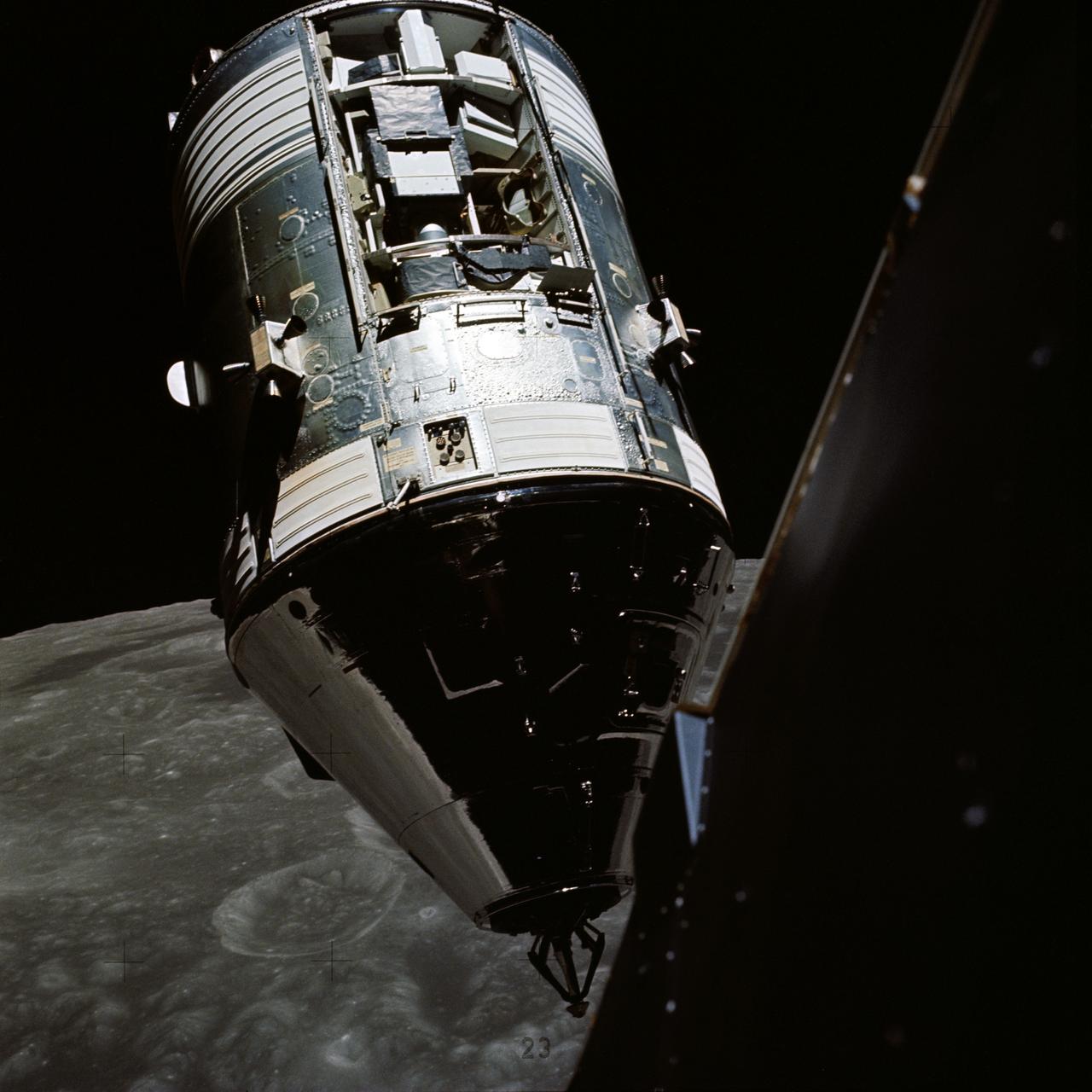
AS17-145-22254 (14 Dec. 1972) --- An excellent view of the Apollo 17 Command and Service Modules (CSM) photographed from the Lunar Module (LM) "Challenger" during rendezvous and docking maneuvers in lunar orbit. The LM ascent stage, with astronauts Eugene A. Cernan and Harrison H. Schmitt aboard, had just returned from the Taurus-Littrow landing site on the lunar surface. Astronaut Ronald E. Evans remained with the CSM in lunar orbit. Note the exposed Scientific Instrument Module (SIM) Bay in Sector 1 of the Service Module (SM). Three experiments are carried in the SIM bay: S-209 lunar sounder, S-171 infrared scanning spectrometer, and the S-169 far-ultraviolet spectrometer. Also mounted in the SIM bay are the panoramic camera, mapping camera and laser altimeter used in service module photographic tasks. A portion of the LM is on the right.
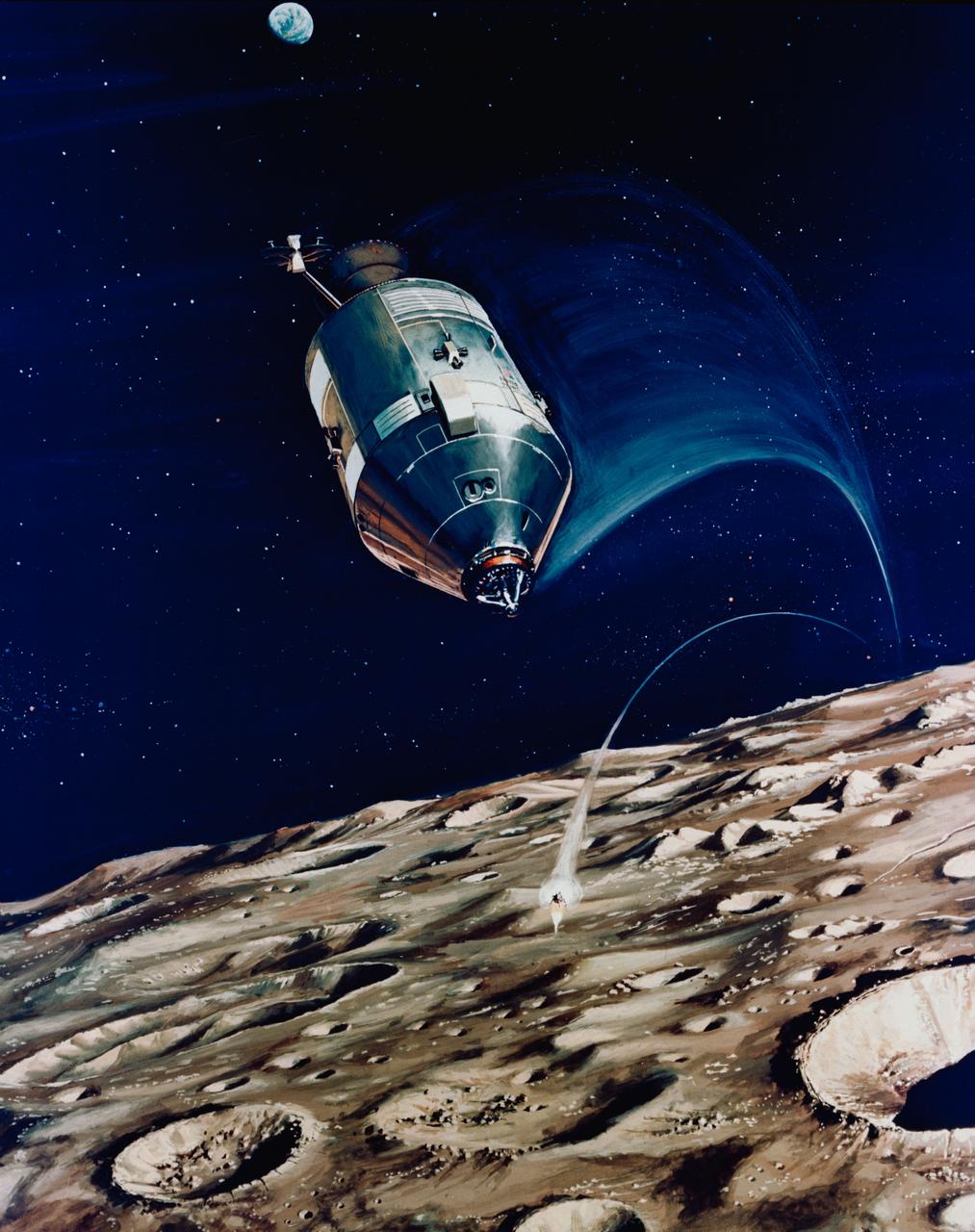
S71-16574 (11 Jan. 1971) --- An artist's concept depicting the Apollo 14 Command and Service Modules (CSM) circling the moon as the Lunar Module (LM) heads toward a lunar landing. While astronaut Stuart A. Roosa, command module pilot, remains with the CSM in lunar orbit, astronauts Alan B. Shepard Jr., commander; and Edgar D. Mitchell, lunar module pilot, will descend in the LM to explore an area in the rugged Fra Mauro highlands.
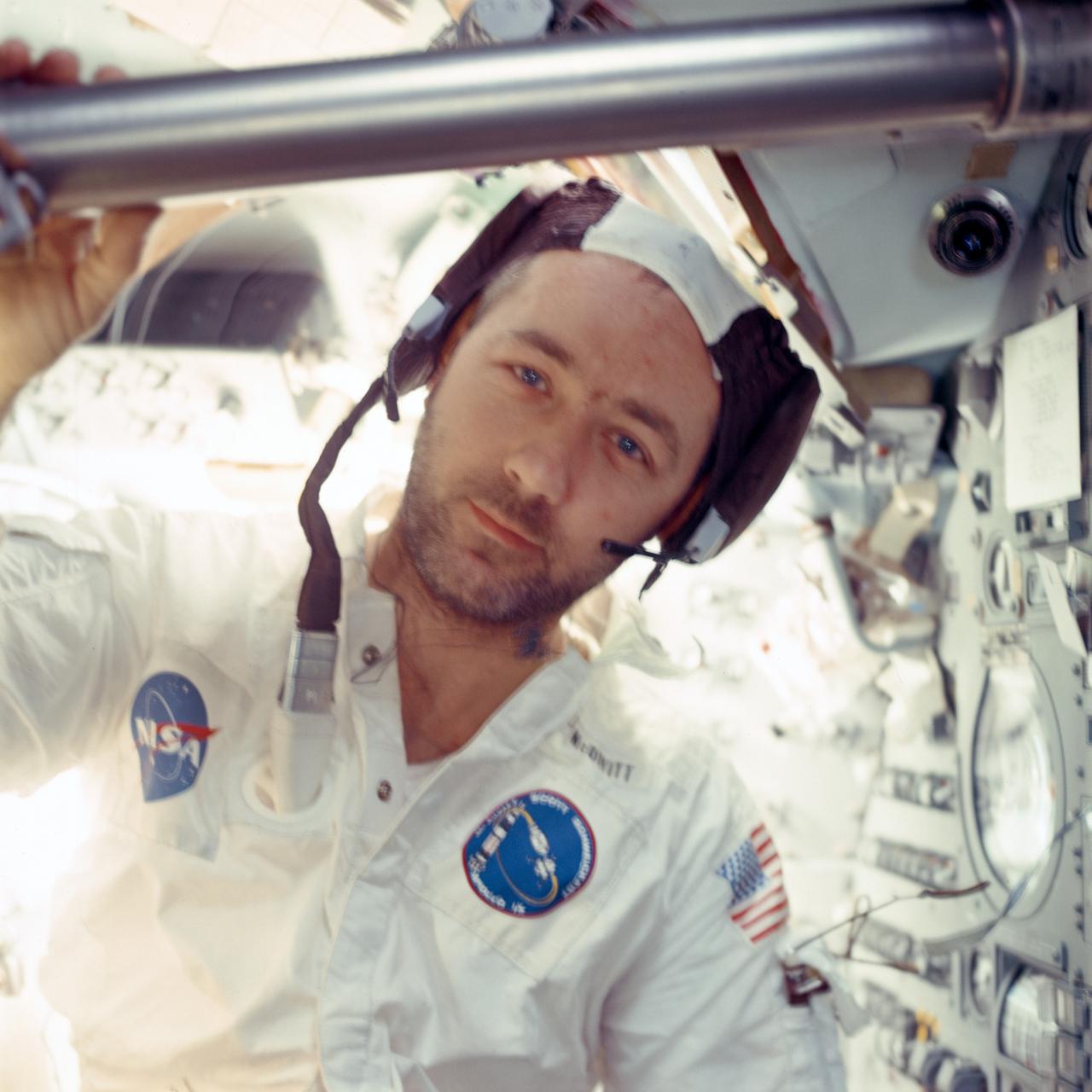
AS09-20-3154 (3-13 March 1969) --- This close-up view of astronaut James A. McDivitt shows several days' beard growth. The Apollo 9 mission commander was onboard the Lunar Module (LM) "Spider" in Earth orbit, near the end of the flight. He was joined on the mission by astronauts David R. Scott, command module pilot, and Russell L. Schweickart, lunar module pilot. Schweickart took this picture while Scott remained in the Command Module (CM) "Gumdrop." In Earth orbit, the three tested the transposition and docking systems of the lunar module and command module. On a scheduled lunar landing mission later this year, a team of three astronauts and ground controllers will use what this crew and its support staff have learned in handling the systems of the two spacecraft.
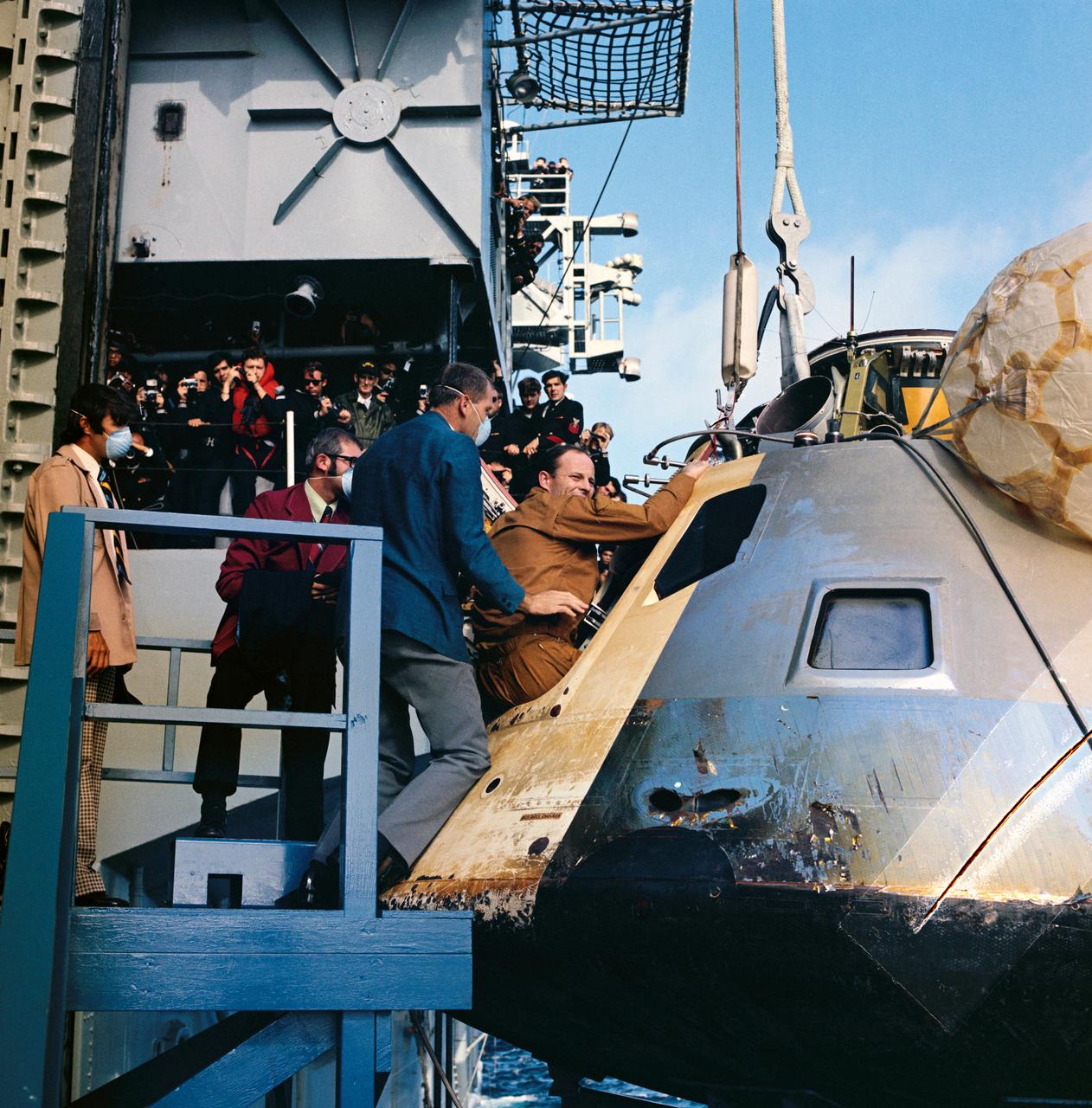
S73-36435 (25 Sept. 1973) --- Astronaut Jack R. Lousma, Skylab 3 pilot, egresses the Skylab 3 Command Module aboard the prime recovery ship, USS New Orleans, during recovery operations in the Pacific Ocean. Astronauts Lousma; Alan L. Bean, commander; and Owen L. Garriott, science pilot, had just completed a successful 59-day visit to the Skylab space station in Earth orbit. The Skylab 3 spacecraft splashed down in the Pacific about 230 miles southwest of San Diego, California. Photo credit: NASA
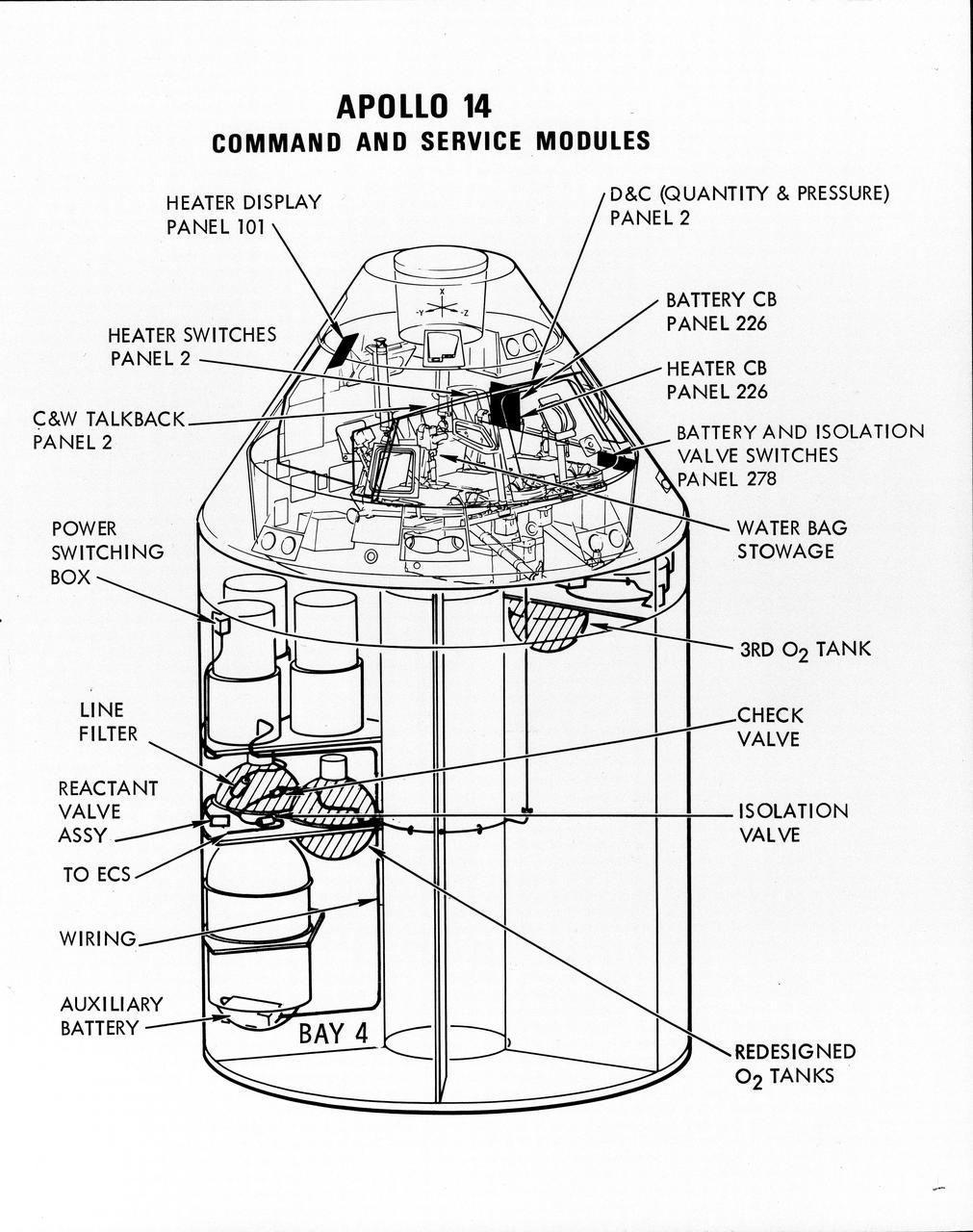
S71-16823 (January 1971) --- A line drawing illustrating a cutaway view of the Apollo 14 Command and Service Modules, showing the engineering changes in the CSM which were recommended by the Apollo 13 Review Board. (The Apollo 13 abort was caused by a short circuit and wiring overheating in one of the SM cryogenic oxygen tanks.) The major changes to the Apollo 14 CSM include adding a third cryogenic oxygen tank installed in a heretofore empty bay (in sector one) of the SM, addition of an auxiliary battery in the SM as a backup in case of fuel cell failure, and removal of destratification fans in the cryogenic oxygen tanks and removal of thermostat switches from the oxygen tank heater circuits. Provision for stowage of an emergency five-gallon supply of drinking water has been added to the CM.

AS10-27-3873 (22 May 1969) --- The Apollo 10 Command and Service Modules (CSM) are photographed from the Lunar Module (LM) after CSM/LM separation in lunar orbit. The CSM was about 175 statute miles east of Smyth's Sea and was above the rough terrain which is typical of the lunar far side. The eastward oblique view of the lunar surface is centered near 105 degrees east longitude and 1 degree north latitude. The horizon is approximately 600 kilometers (374 statute miles) away. Numerous bright craters and the absence of shadows show that the sun was almost directly overhead when this photograph was taken.
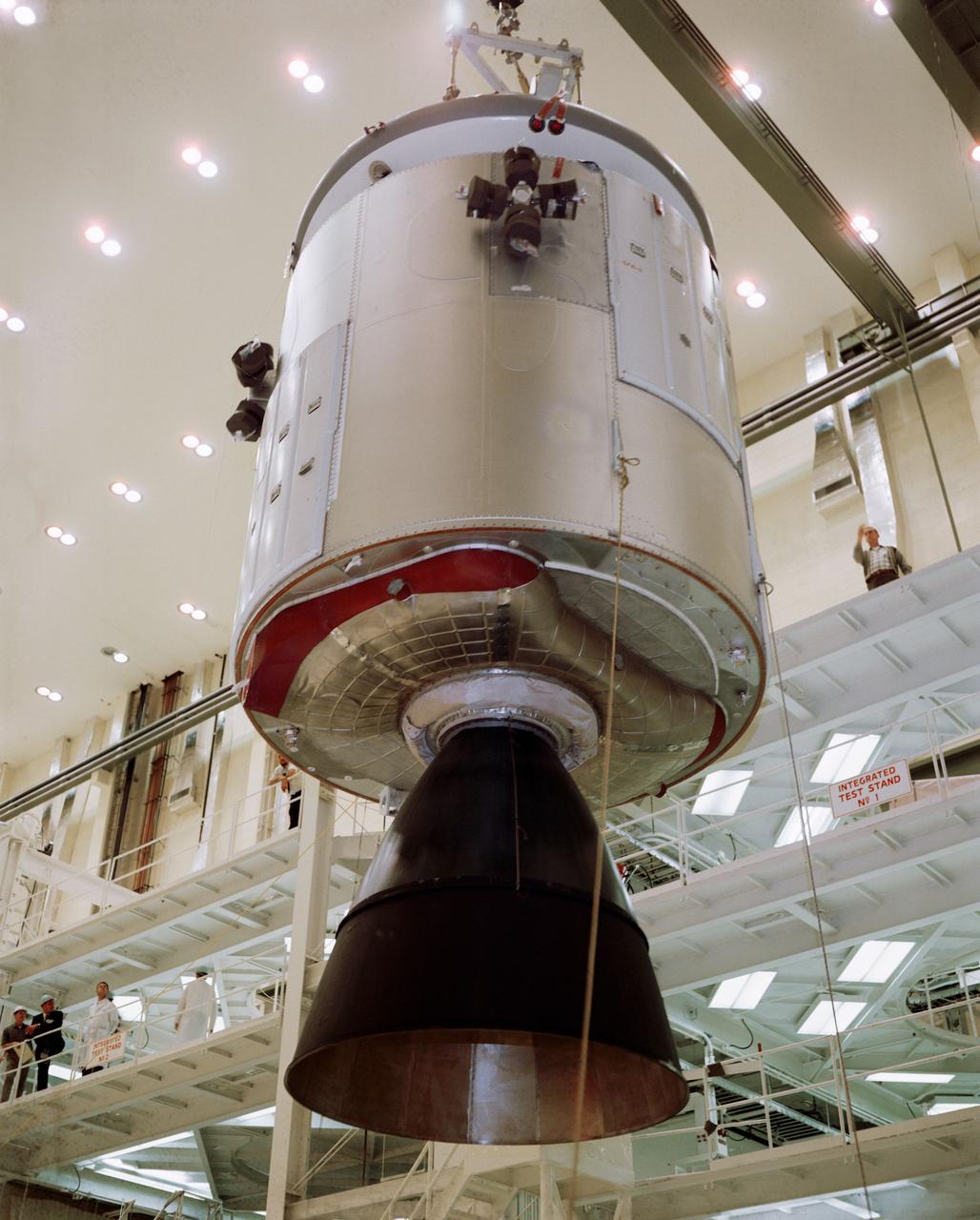
S67-15704 (3 Jan. 1967) --- Transfer of Apollo Spacecraft 012 Command/Service Module (CSM) for mating with the Saturn Lunar Module (LM) Adapter No.05 in the Manned Spacecraft Operations Building. Spacecraft 012 will be flown on the Apollo/Saturn 1 (204) mission. Photo credit: NASA
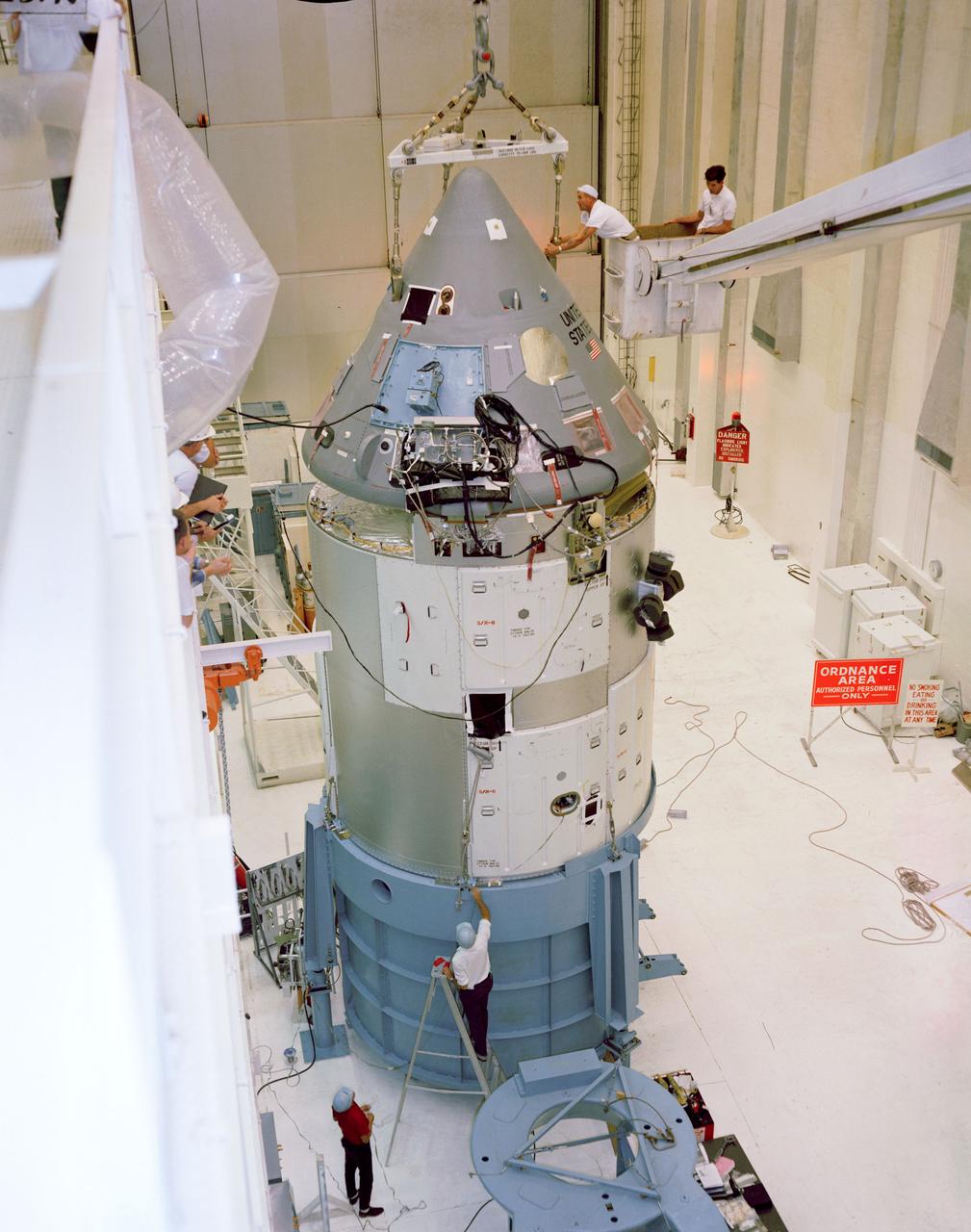
S67-15717 (1967) --- Apollo Spacecraft 012 Command/Service Module is moved from H-134 to east stokes for mating to the Saturn Lunar Module Adapter No. 05 in the Manned Spacecraft Operations Building. S/C 012 will be flown on the Apollo/Saturn 204 mission.
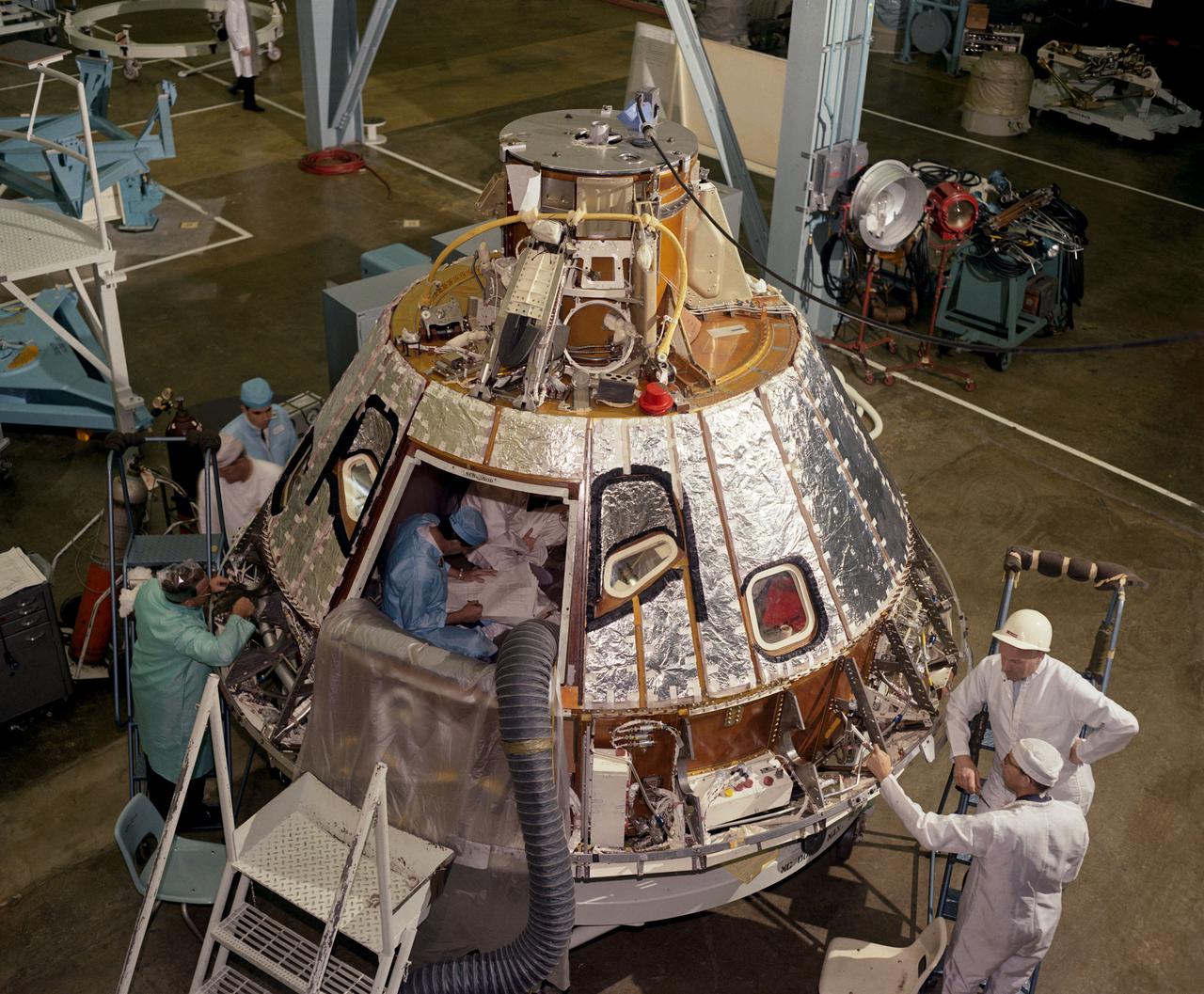
S66-41851 (1966) --- High angle view of Spacecraft 012 Command Module, looking toward -Z axis, during preparation for installation of the crew compartment heat shield, showing mechanics working on aft bay.
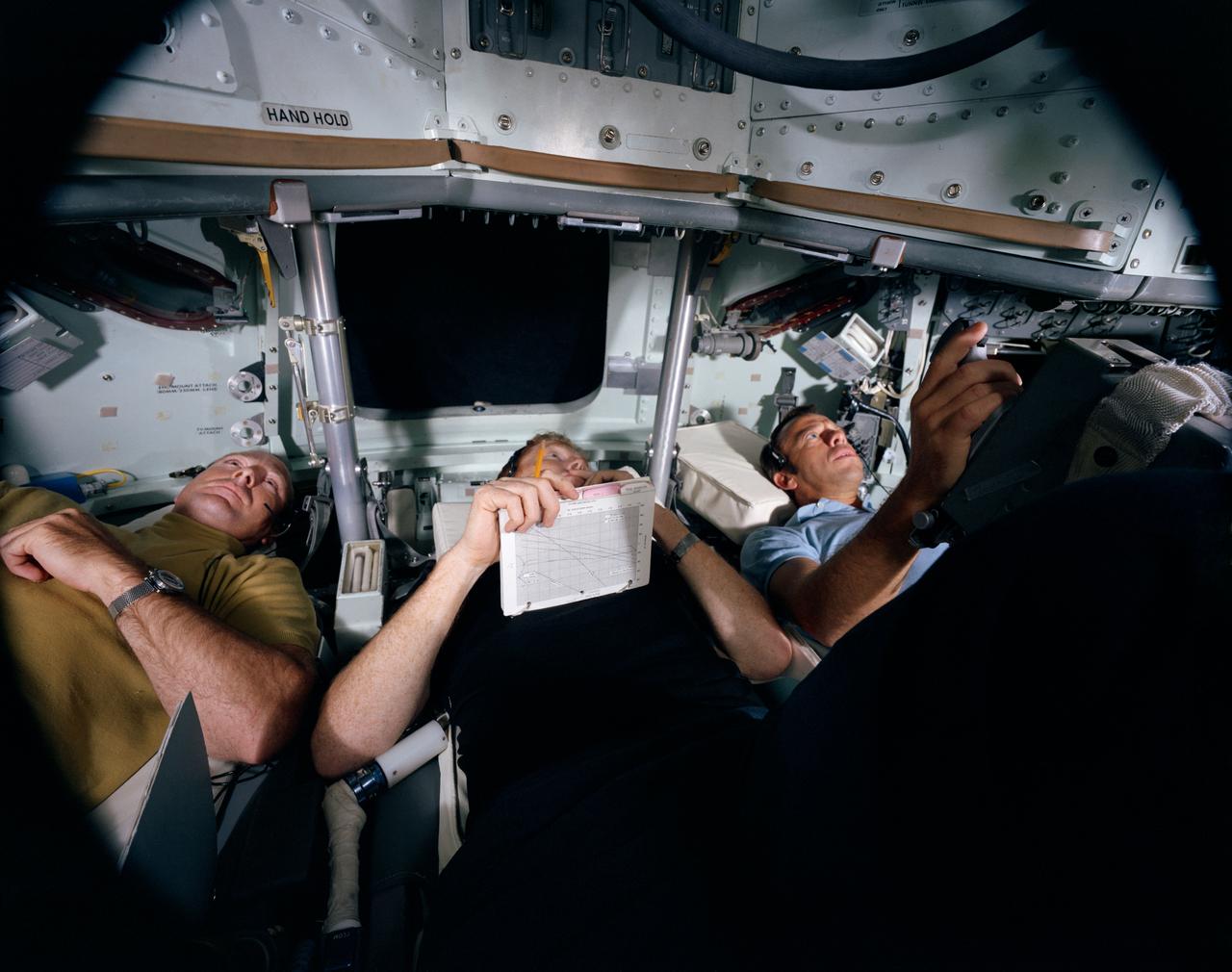
S70-45580 (July 1970) --- The members of the prime crew of the Apollo 14 lunar landing mission participate in Command Module (CM) simulation training at the Kennedy Space Center (KSC). Left to right are astronauts Edgar D. Mitchell, lunar module pilot; Stuart A. Roosa, command module pilot; and Alan B. Shepard Jr., commander.
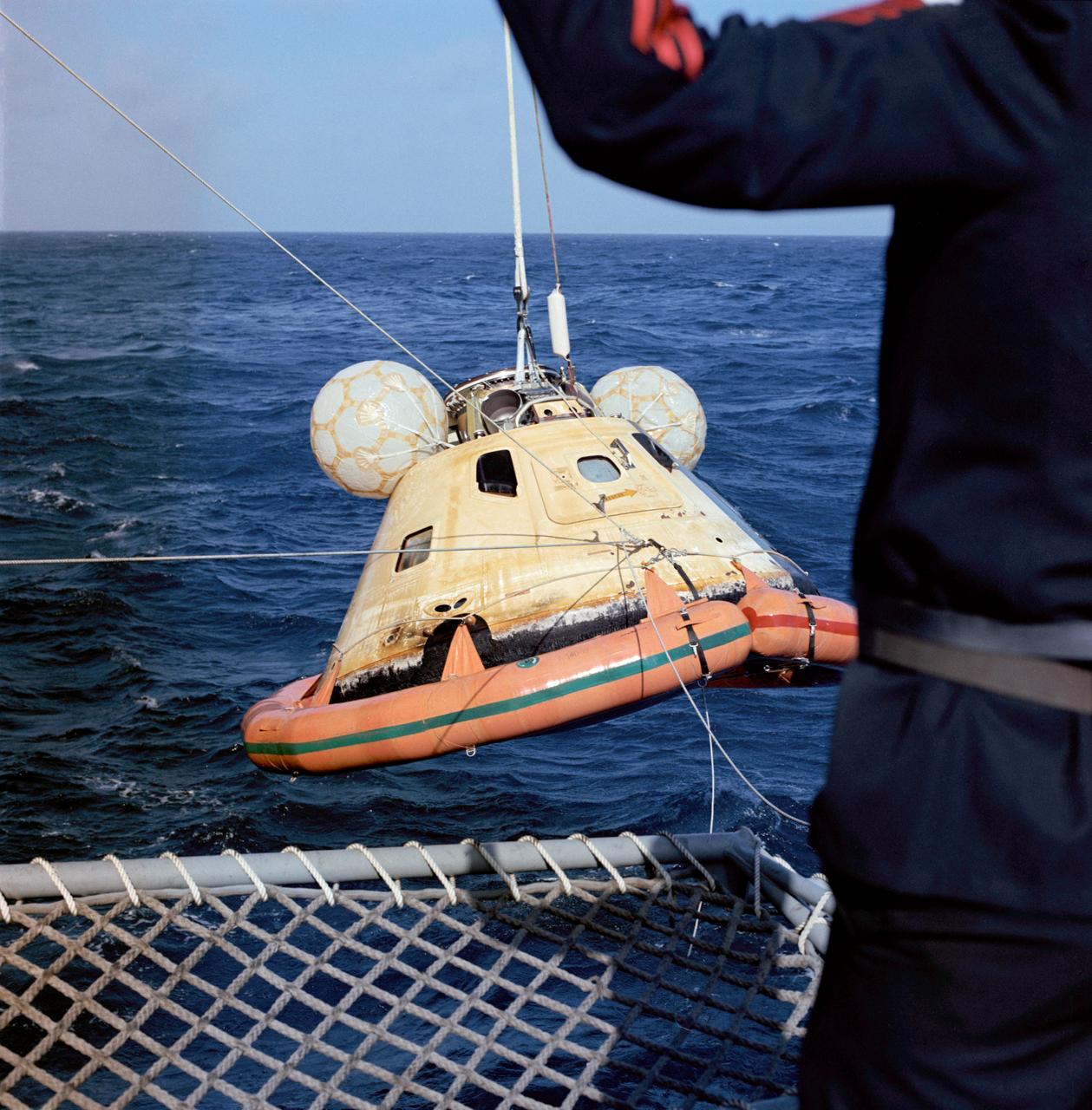
S73-36423 (25 Sept. 1973) --- The Skylab 3 Command Module, with astronauts Alan L. Bean, Owen K. Garriott and Jack R. Lousma still inside, is hoisted aboard the prime recovery ship, USS New Orleans, during recovery operations in the Pacific Ocean. The three crewmen had just completed a successful 59-day visit to the Skylab space station in Earth orbit. The Command Module splashed down in the Pacific about 230 miles southwest of San Diego, California. Earlier in the recovery operations a team of U.S. Navy swimmers attached the flotation collar to the spacecraft to improve its buoyancy. Photo credit: NASA
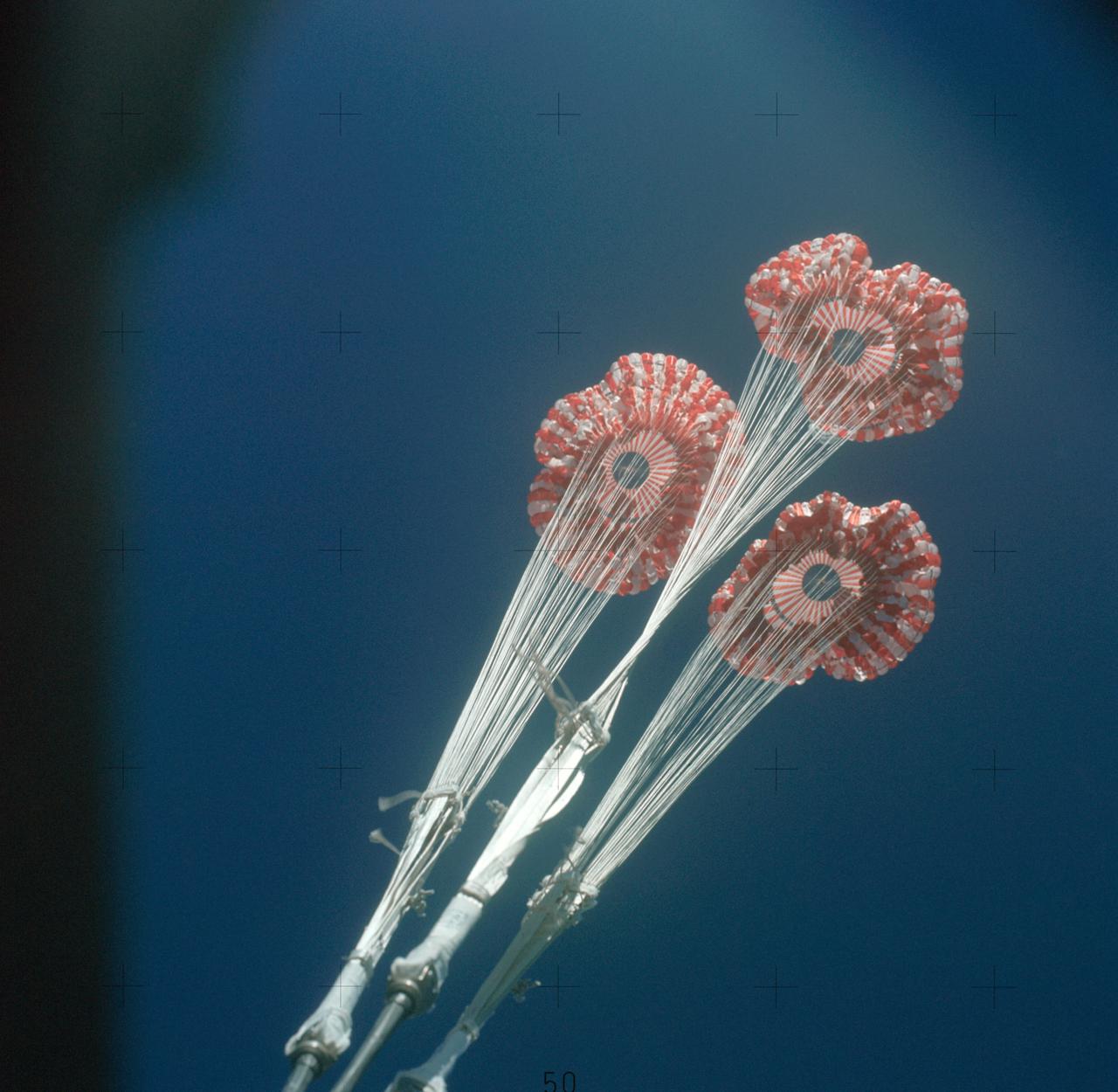
SL3-114-1760 (25 Sept. 1973) --? An excellent view of the three main ring sail parachutes of the Skylab 3 command module as they unfurl during descent to a successful splashdown in the Pacific Ocean. This picture was taken by a hand-held 70mm Hasselblad camera, looking up through a window of the command module. These parachutes open at approximately 10,000 feet altitude. Aboard the CM were astronauts Alan L. Bean, Owen K. Garriott and Jack R. Lousma, who had just completed a 59-day visit to the Skylab space station in Earth orbit. Photo credit: NASA
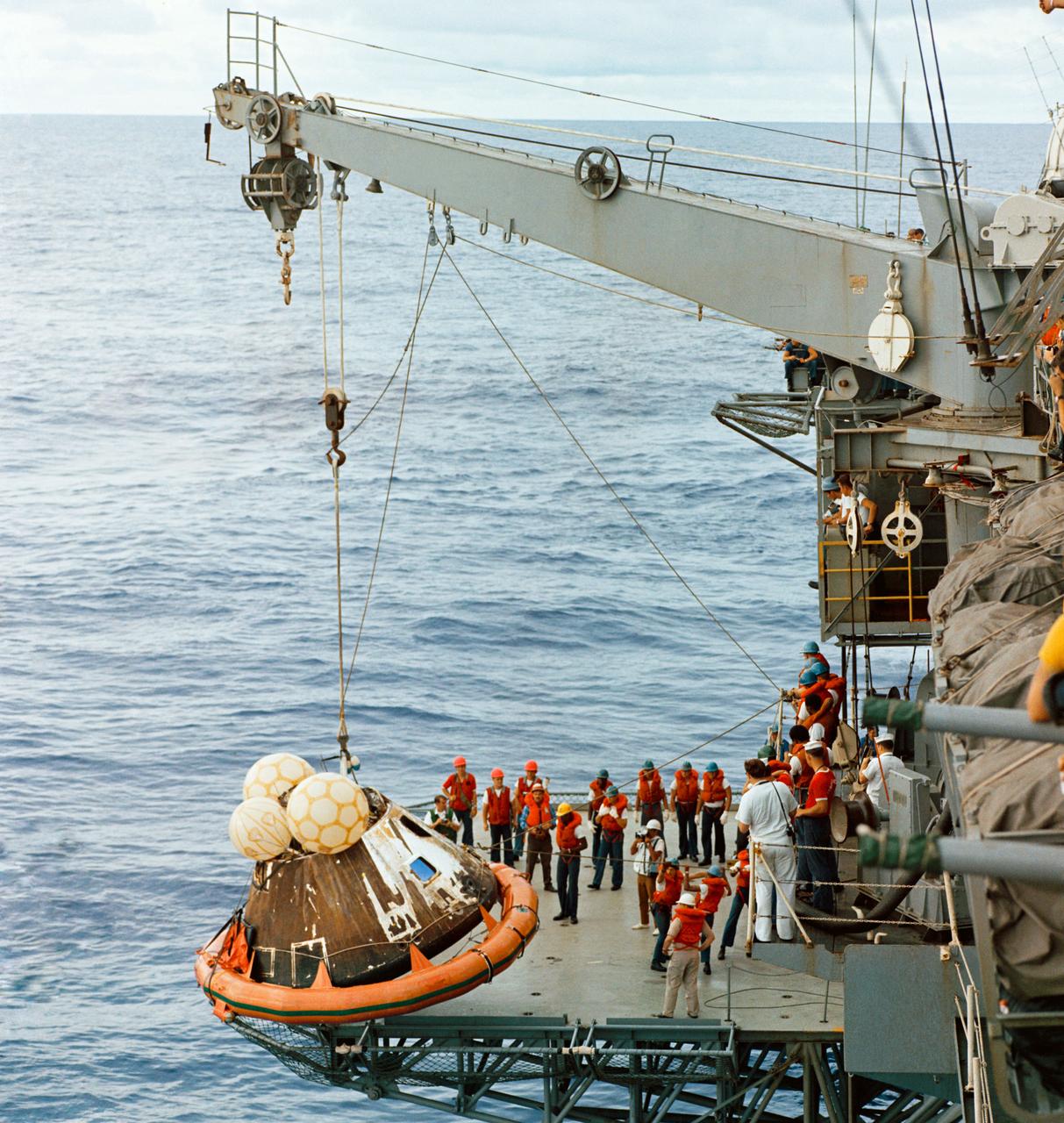
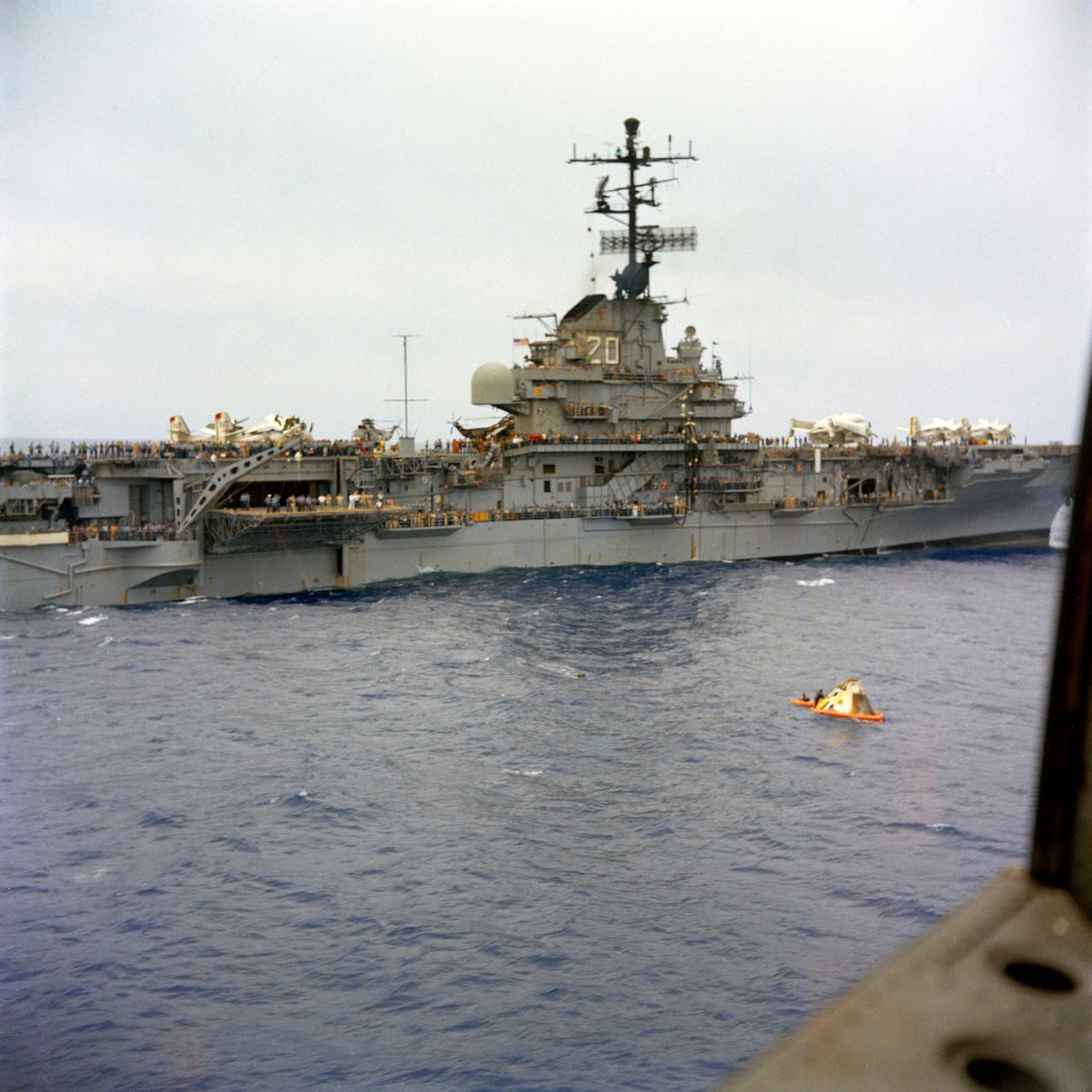
S70-15530 (17 April 1970) --- Crew men aboard the USS Iwo Jima, prime recovery ship for the Apollo 13 mission, hoist the Command Module (CM) aboard ship. The Apollo 13 crew men, astronauts James A. Lovell Jr., John L. Swigert Jr. and Fred W. Haise Jr., were already aboard the Iwo Jima when this photograph was taken. The CM, with the three tired crew men aboard, splashed down at 12:07:44 p.m. (CST), April 17, 1970, only about four miles from the recovery vessel in the South Pacific Ocean.
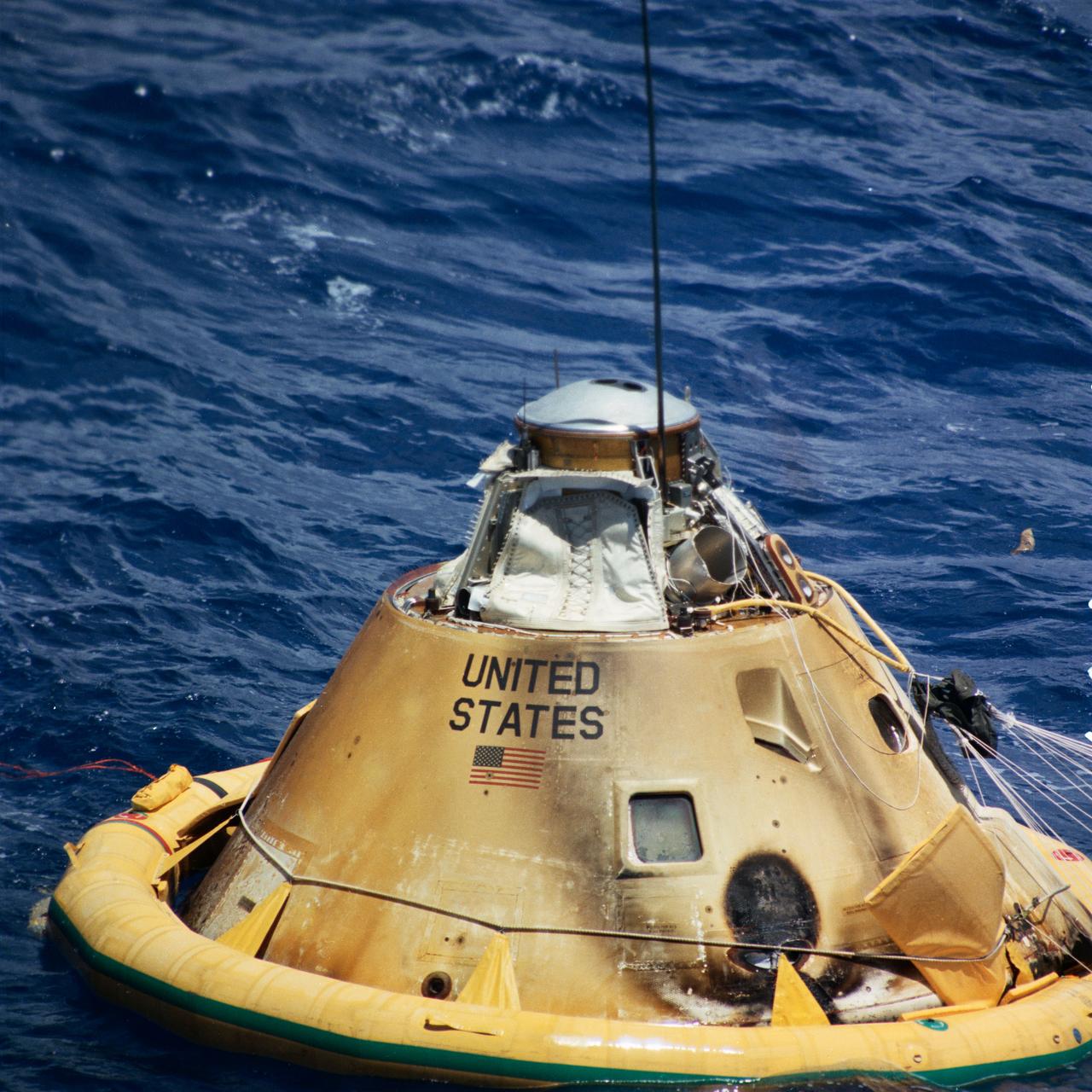
A/S 202 Command Module (C/M) attached to flotation collar. RECOVERY AREA, CENTRAL PACIFIC OCEAN
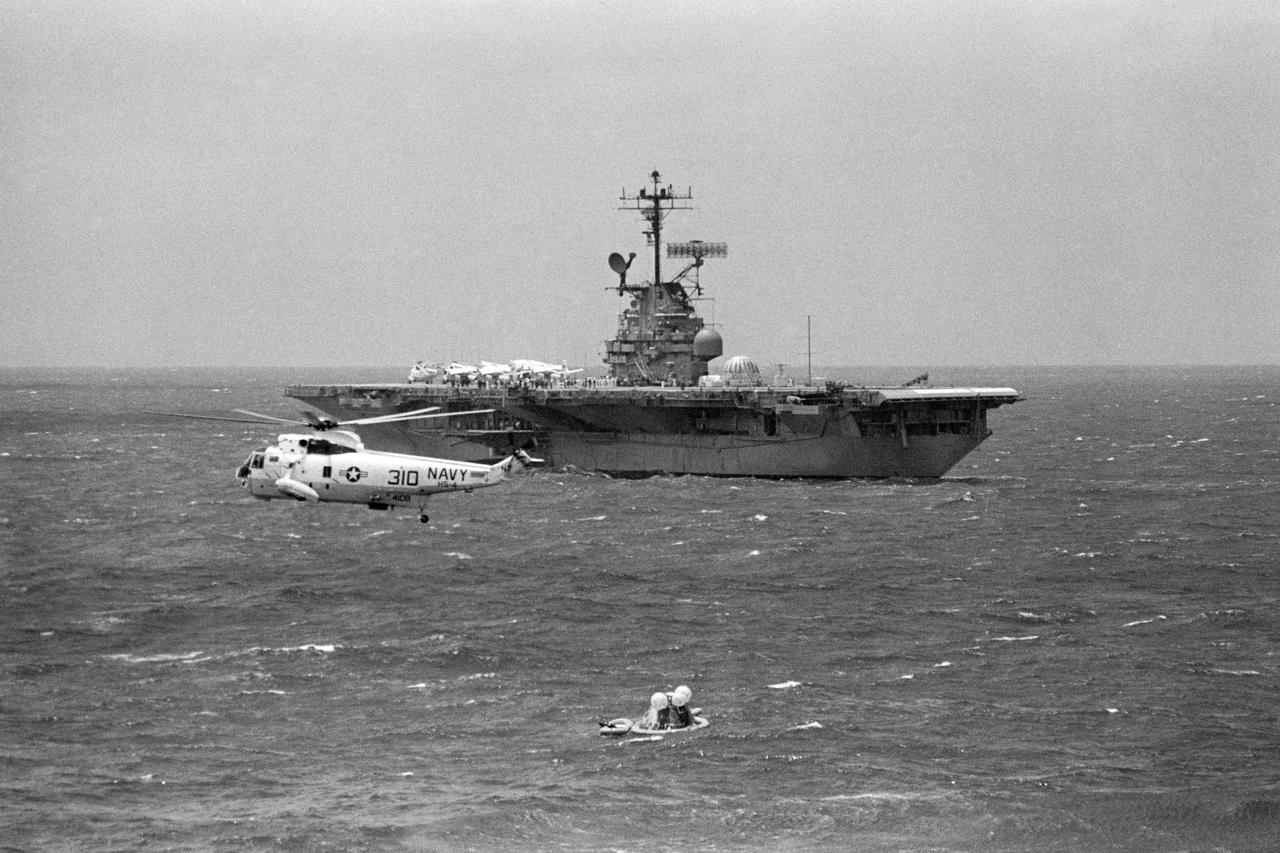
U.S.S. Hornet, prime recovery vessel for the Apollo 12 lunar landing mission, moves toward the Apollo 12 Command Module to retrieve the spacecraft. A helicopter from the recovery ship, which took part in the recovery operations, hovers over the scene of the splashdown.
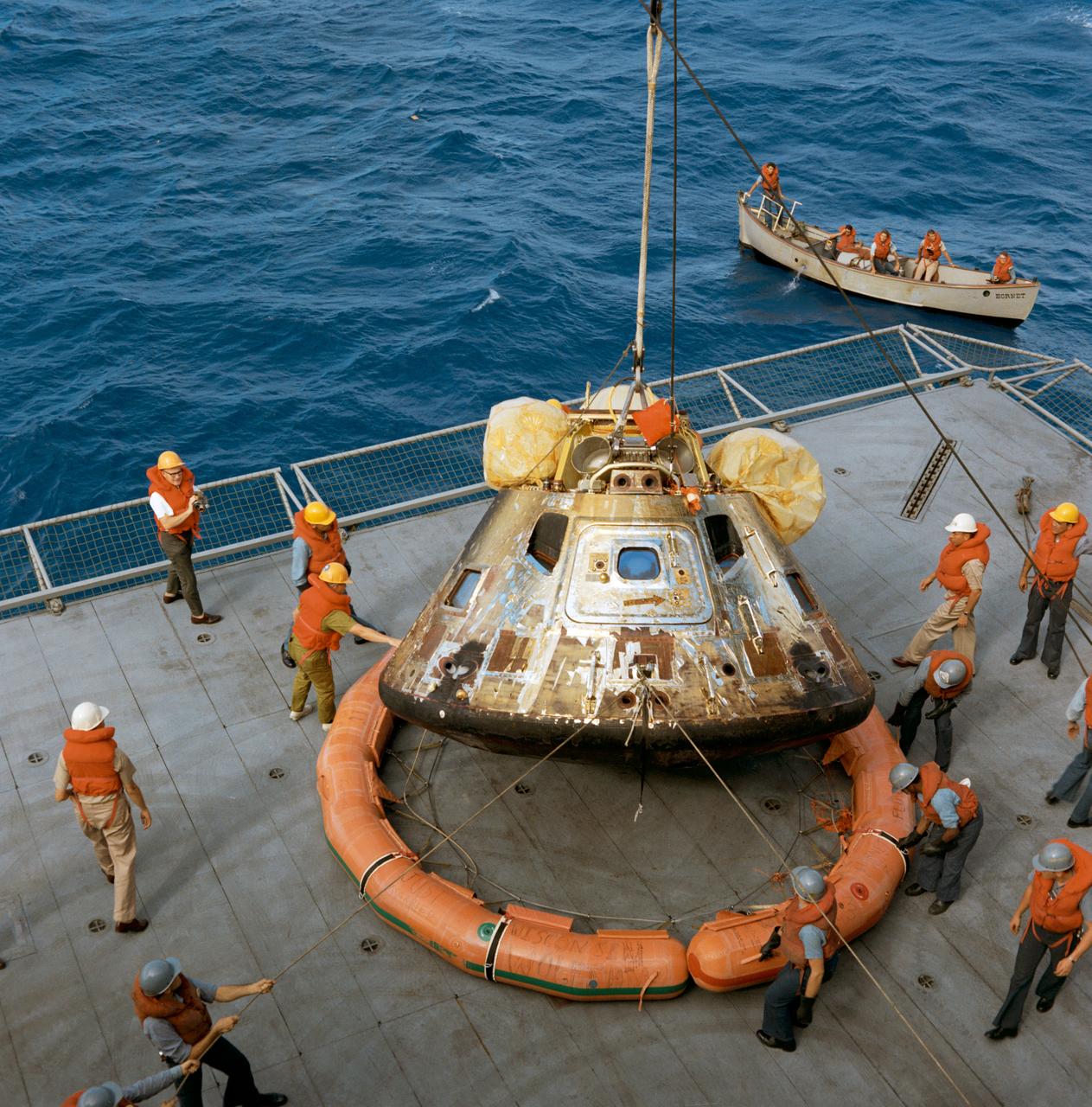
The Apollo 11 spacecraft Command Module is photographed being lowered to the deck of the U.S.S. Hornet, prime recovery ship for the historic lunar landing mission. Note the flotation ring attached by Navy divers has been removed from the capsule.
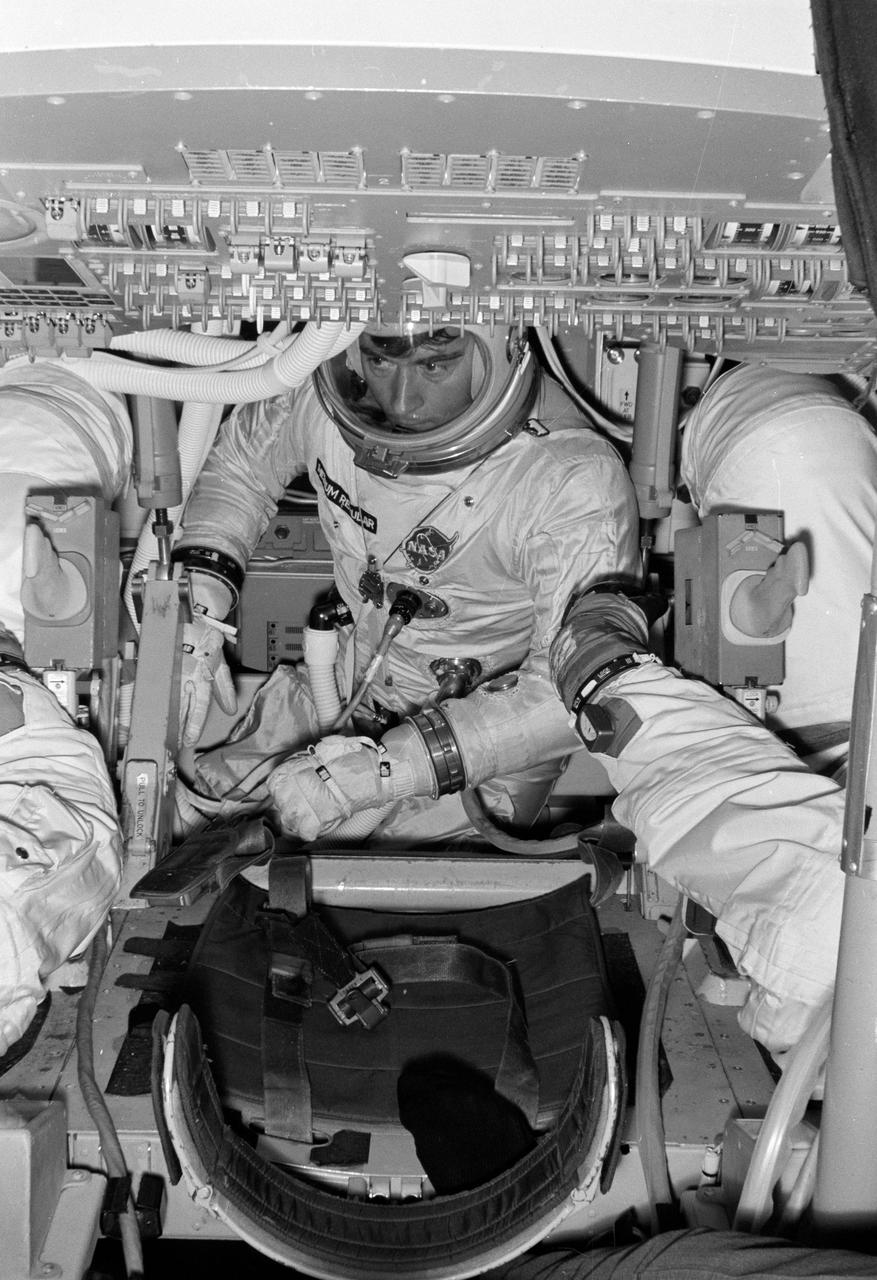
S68-15979 (15 Jan. 1968) --- Astronaut John W. Young, command module pilot, inside the Command Module Simulator in Building 5 during an Apollo Simulation. Out of view are astronaut Thomas P. Stafford (on the left), commander; and astronaut Eugene A. Cernan (on the right), lunar module pilot.
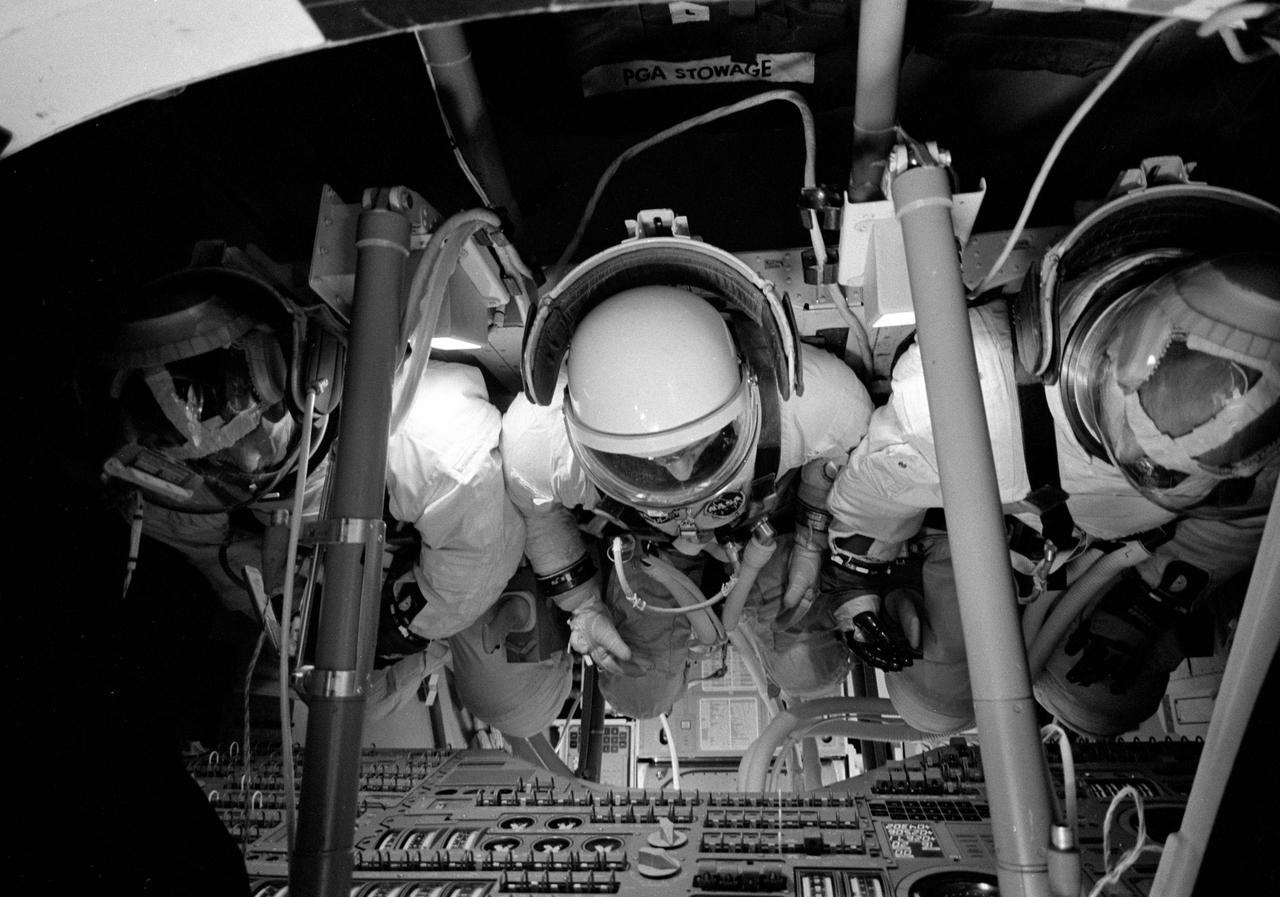
S68-15952 (15 Jan. 1968) --- Three astronauts inside the Command Module Simulator in Building 5 during an Apollo Simulation. Left to right, are astronauts Thomas P. Stafford, commander; John W. Young, command module pilot; and Eugene A. Cernan, lunar module pilot.
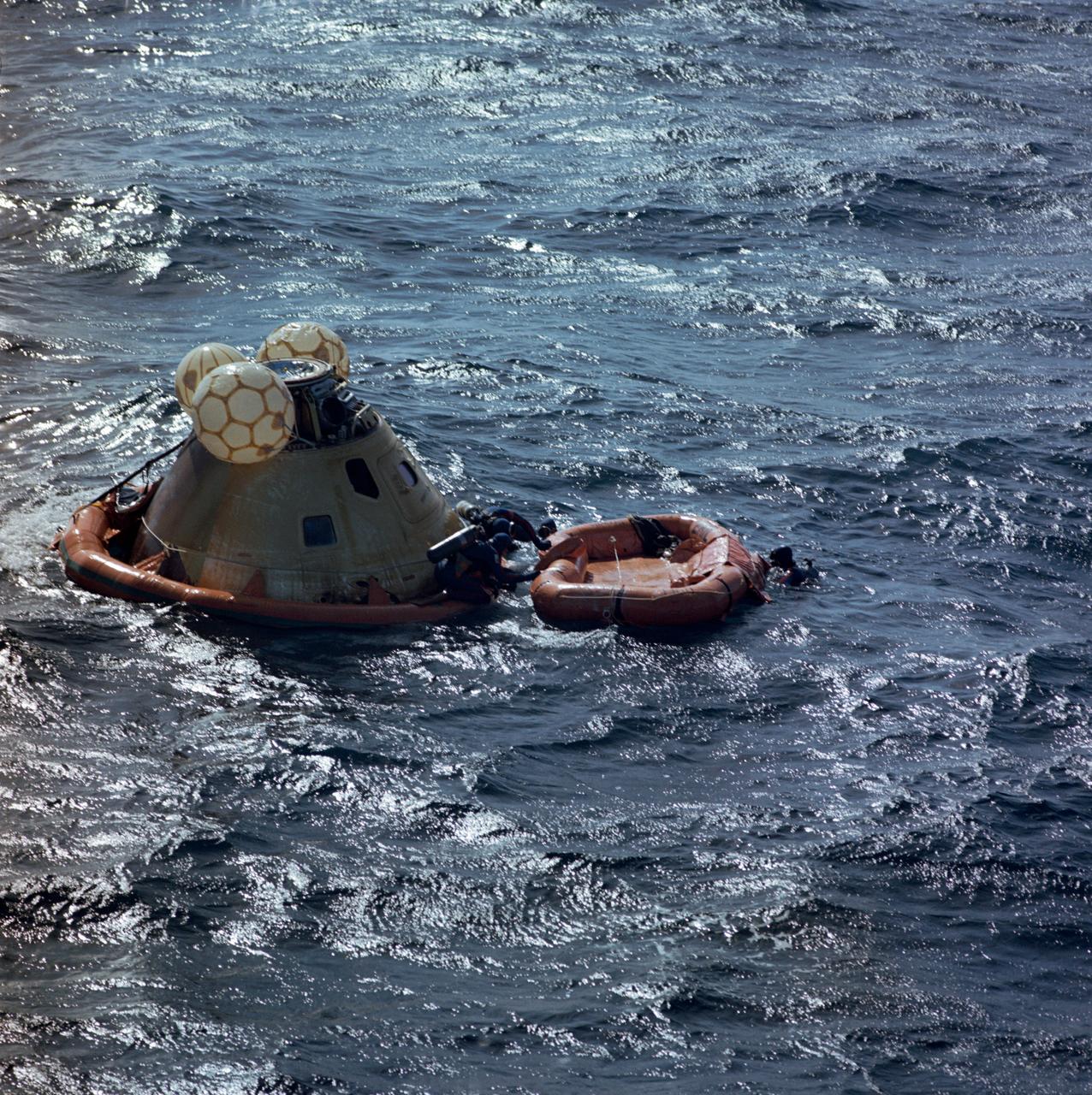
S73-36401 (25 Sept. 1973) --- A team of U.S. Navy swimmers assists with the recovery of the Skylab 3 Command Module following its splashdown in the Pacific Ocean about 230 miles southwest of San Diego, California. The swimmers had just attached a flotation collar to the spacecraft to improve its buoyancy. Aboard the Command Module were astronauts Alan L. Bean, Owen K. Garriott and Jack R. Lousma, who had just completed a successful 59-day visit to the Skylab space station in Earth orbit. Minutes later the Command Module with the three crewmen still inside was hoisted aboard the prime recovery ship, the USS New Orleans. Photo credit: NASA
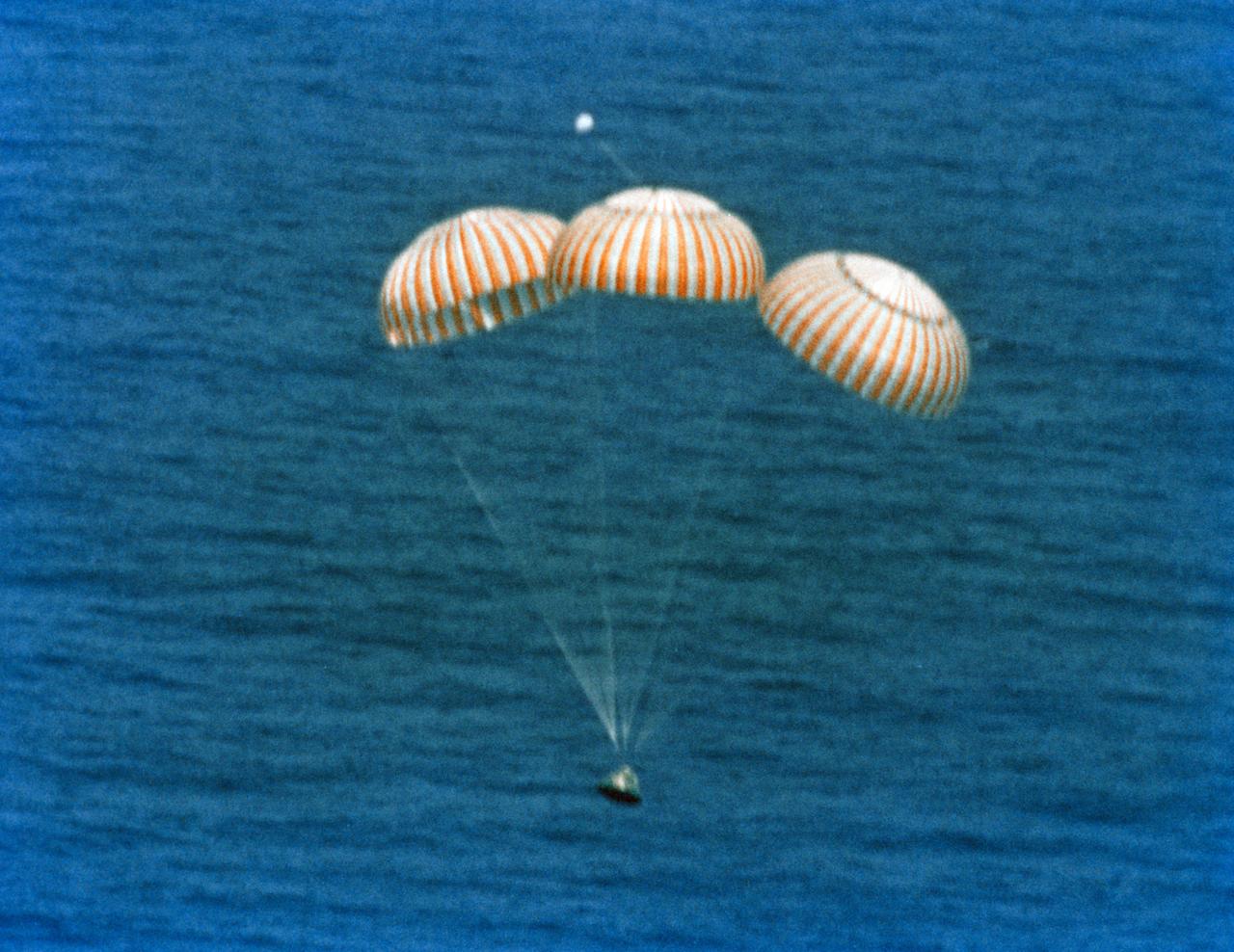
S75-29719 (24 July 1975) --- The ASTP Apollo Command Module, with astronauts Thomas P. Stafford, Vance D. Brand and Donald K. Slayton aboard, nears a touchdown in the Central Pacific Ocean to conclude the historic joint U.S.-USSR Apollo-Soyuz Test Project docking mission in Earth orbit. The spacecraft splashed down in the Hawaiian Islands area at 4:18 p.m. (CDT), July 24, 1975.
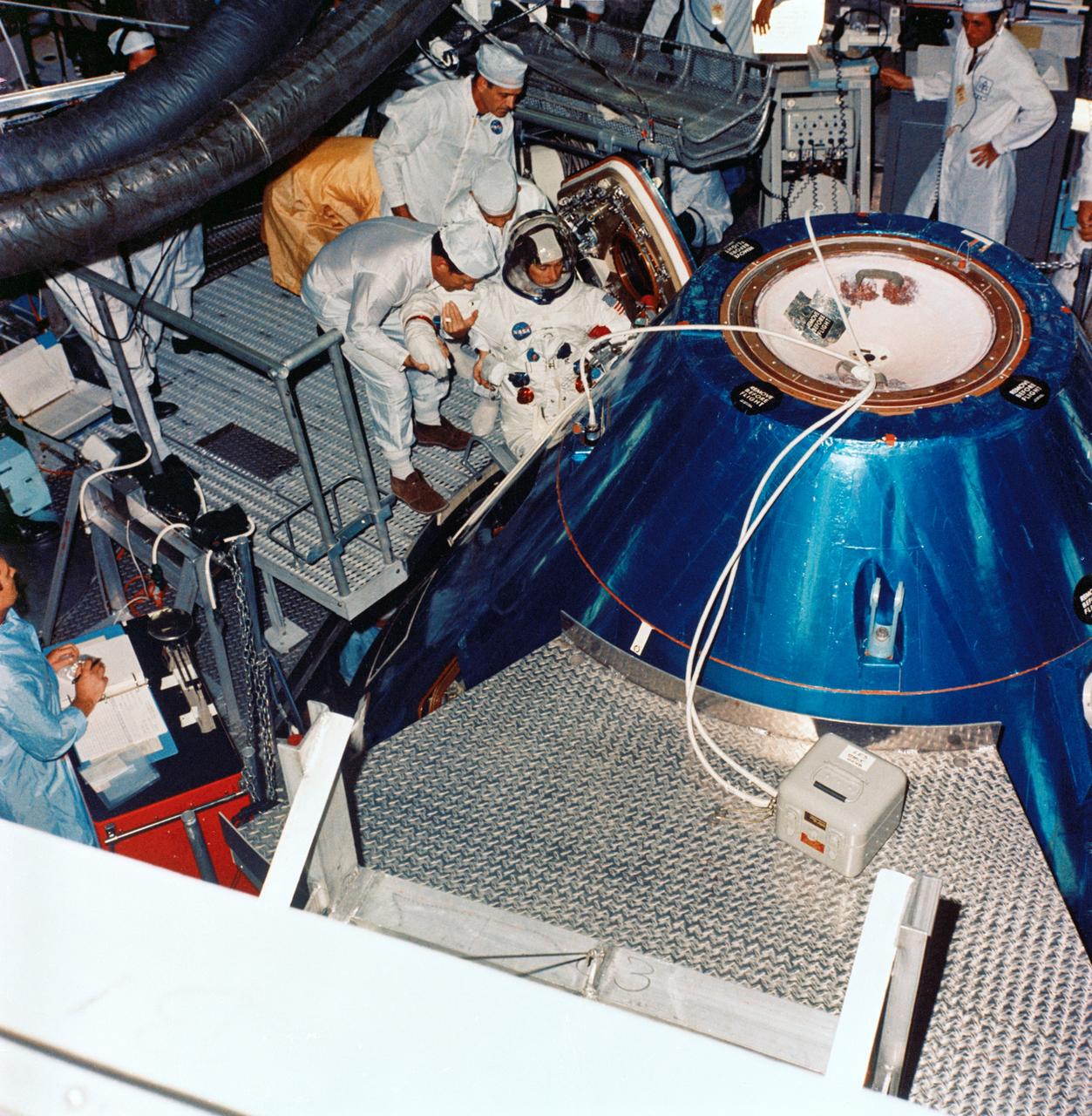
S68-40875 (5 July 1968) --- Astronaut John W. Young, Apollo 7 backup command module pilot, ingresses Apollo Spacecraft 101 Command Module during simulated altitude runs at the Kennedy Space Center's Pad 34.
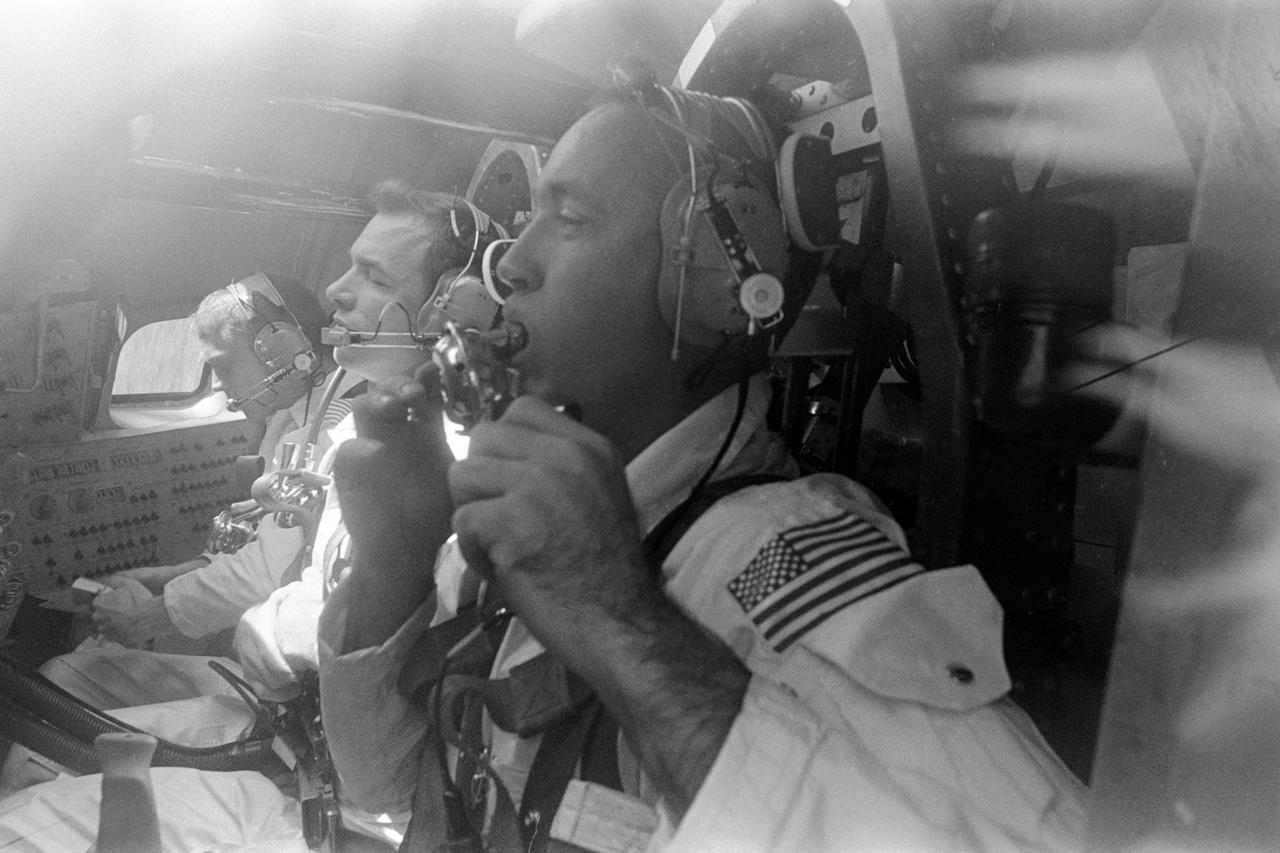
S68-54850 (5 Nov. 1968) --- The prime crew of the Apollo 9 (Spacecraft 104/Lunar Module 3/Saturn 504) space mission are seen inside an Apollo command module boilerplate during water egress training activity in the Gulf of Mexico. From foreground, are astronauts James A. McDivitt, commander; David R. Scott, command module pilot; and Russell L. Schweickart, lunar module pilot.
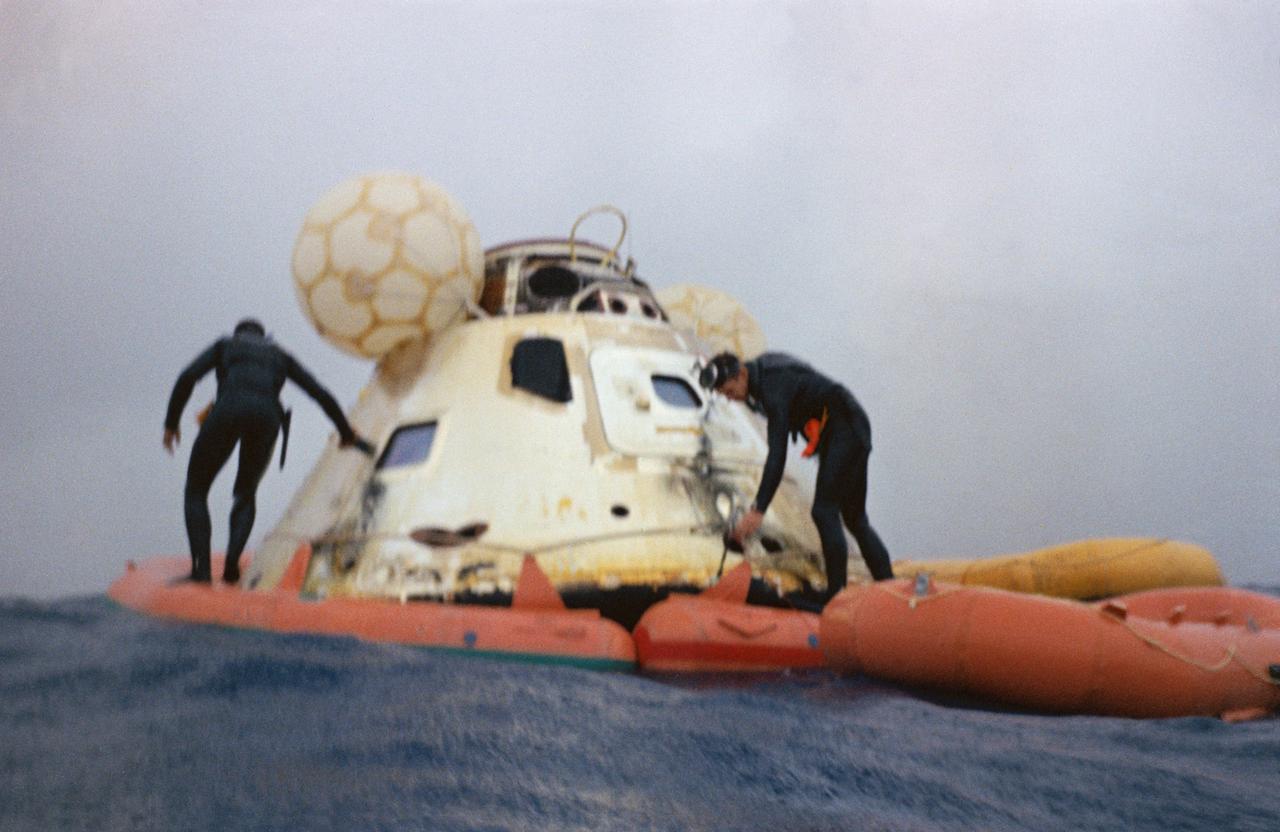
U.S. Navy frogmen attach a flotation collar to the Apollo 7 command module during recovery operations in the Atlantic. The Apollo 7 spacecraft splashed down at 7:11 a.m., October 22, 1968, approximately 200 nautical miles south-southwest of Bermuda.

AS07-04-1583 (11-22 Oct. 1968) --- Astronaut Donn F. Eisele, Apollo 7 command pilot, is photographed during the Apollo 7 mission.
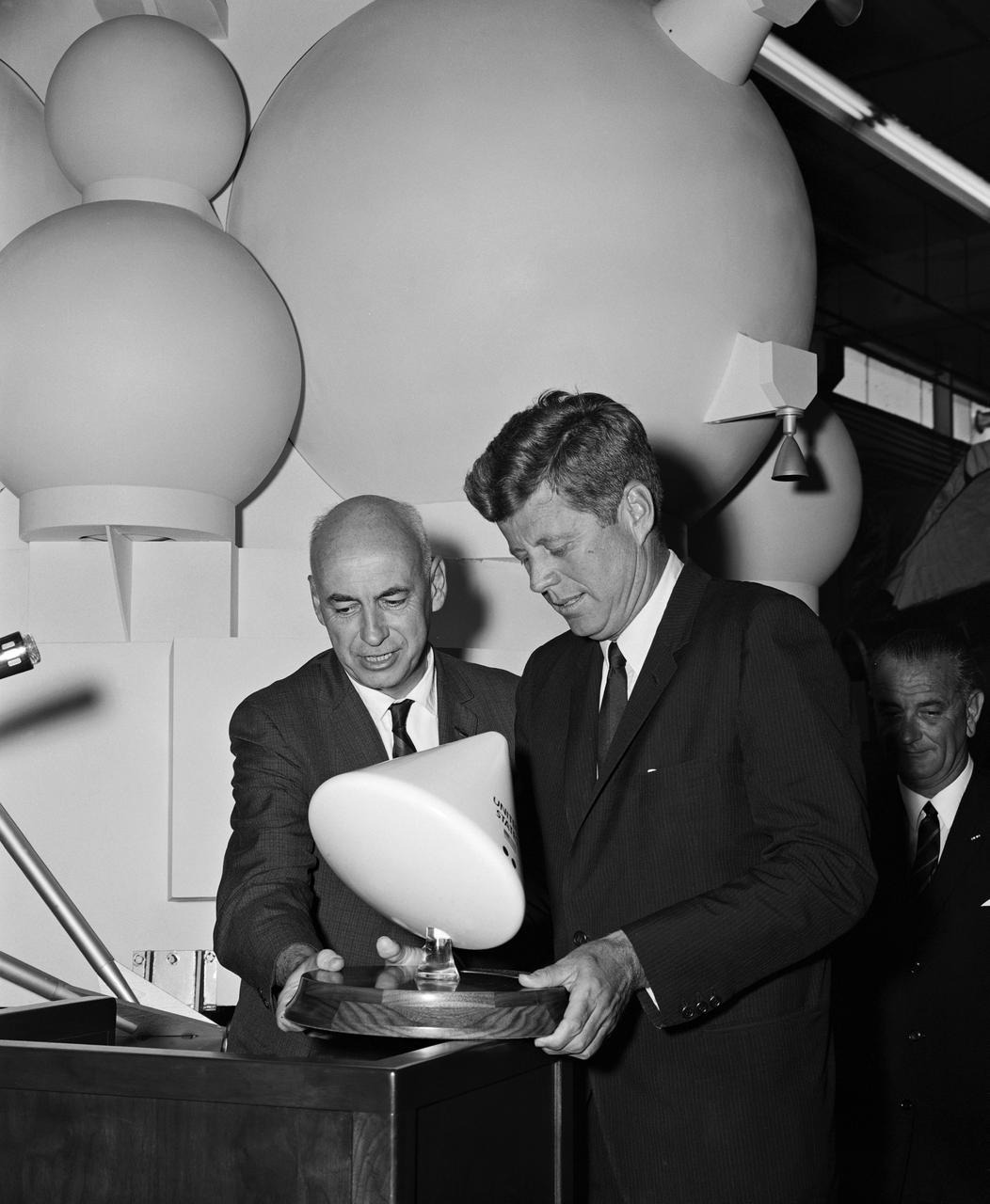
Dr. Robert R. Gilruth (left), director of what is now NASA’s Johnson Space Center, and President John F. Kennedy look at a small model of the Apollo Command Module on September 1, 1962.
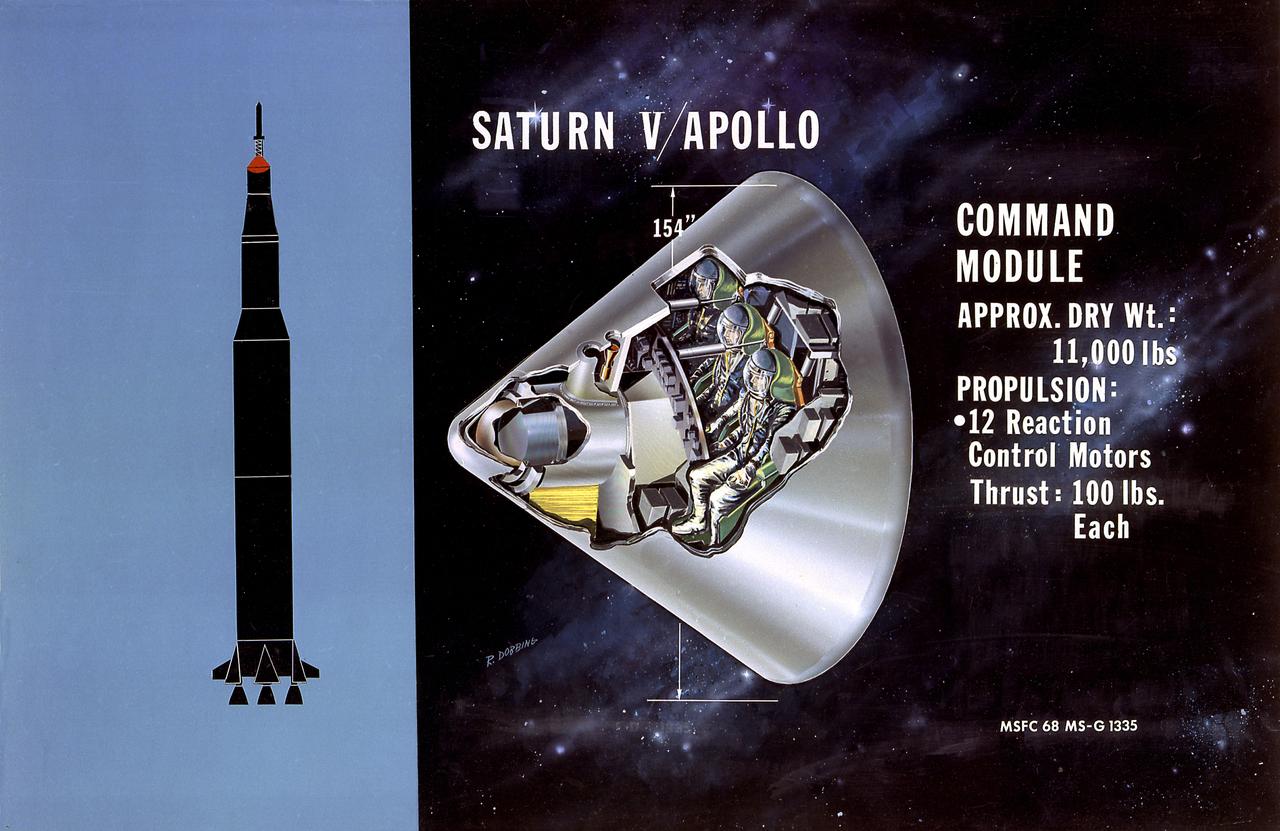
This is a cutaway illustration of the Saturn V command module (CM) configuration. The CM was crammed with some of the most complex equipment ever sent into space at the time. The three astronaut couches were surrounded by instrument panels, navigation gear, radios, life-support systems, and small engines to keep it stable during reentry. The entire cone, 11 feet long and 13 feet in diameter, was protected by a charring heat shield. The 6.5 ton CM was all that was finally left of the 3,000-ton Saturn V vehicle that lifted off on the journey to the Moon.
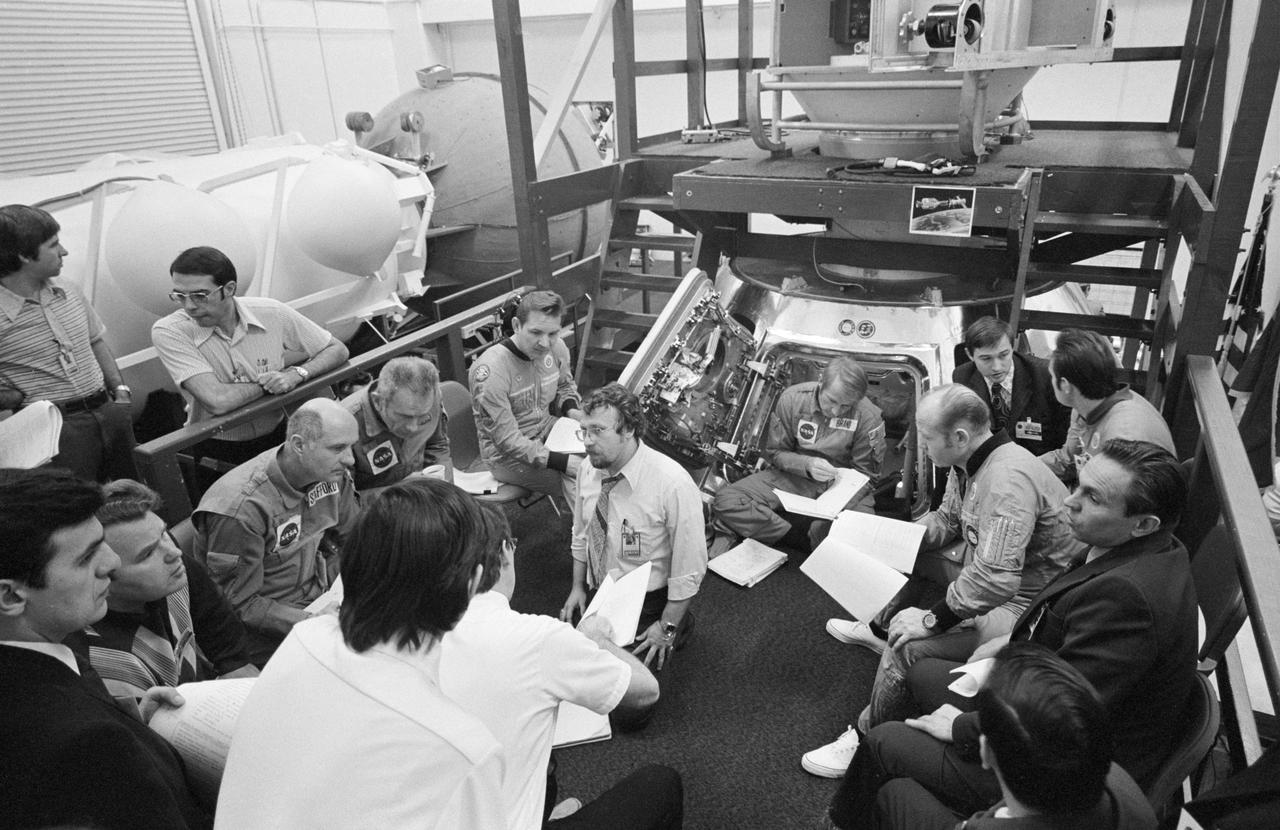
S75-21599 (12 Feb. 1975) --- Six Apollo-Soyuz Test Project crewmen participate in joint crew training in Building 35 at the Johnson Space Center. They are (wearing flight suits), left to right, astronaut Thomas P. Stafford, commander of the American ASTP prime crew; astronaut Donald K. Slayton, docking module pilot on Stafford?s crew; cosmonaut Valeriy N. Kubasov, engineer on the Soviet ASTP first (prime) crew; astronaut Vance D. Brand, command module pilot on Stafford?s crew; cosmonaut Aleksey A. Leonov, commander of the Soviet ASTP first (prime) crew; and cosmonaut Vladimir A. Dzhanibekov, commander of the Soviet ASTP third (backup) crew. Brand is seated next to the hatch of the Apollo Command Module trainer. This picture was taken during a ?walk-through? of the first day?s activities in Earth orbit. The other men are interpreters and training personnel.
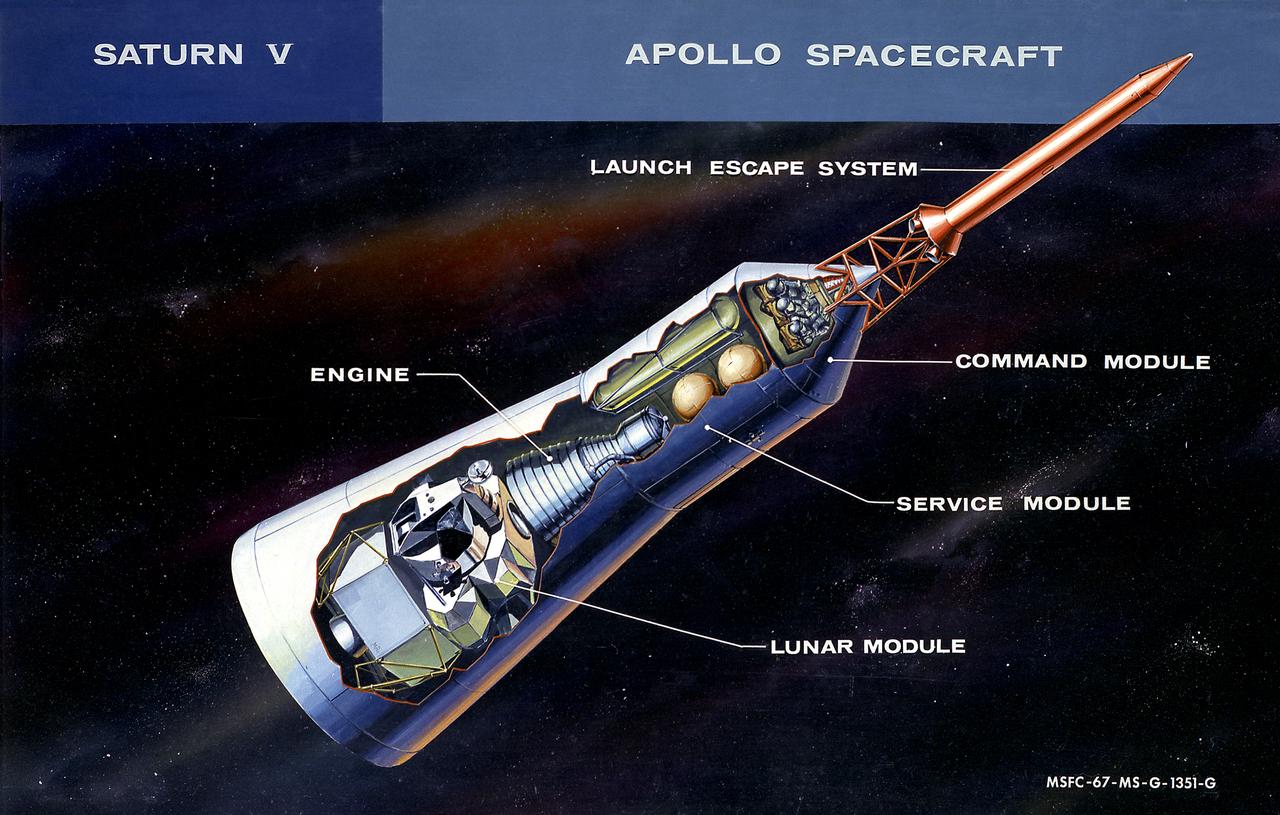
This cutaway illustration shows the Apollo Spacecraft with callouts of the major components. The spacecraft consisted of the lunar module, the service module, the command module, and the launch escape system.
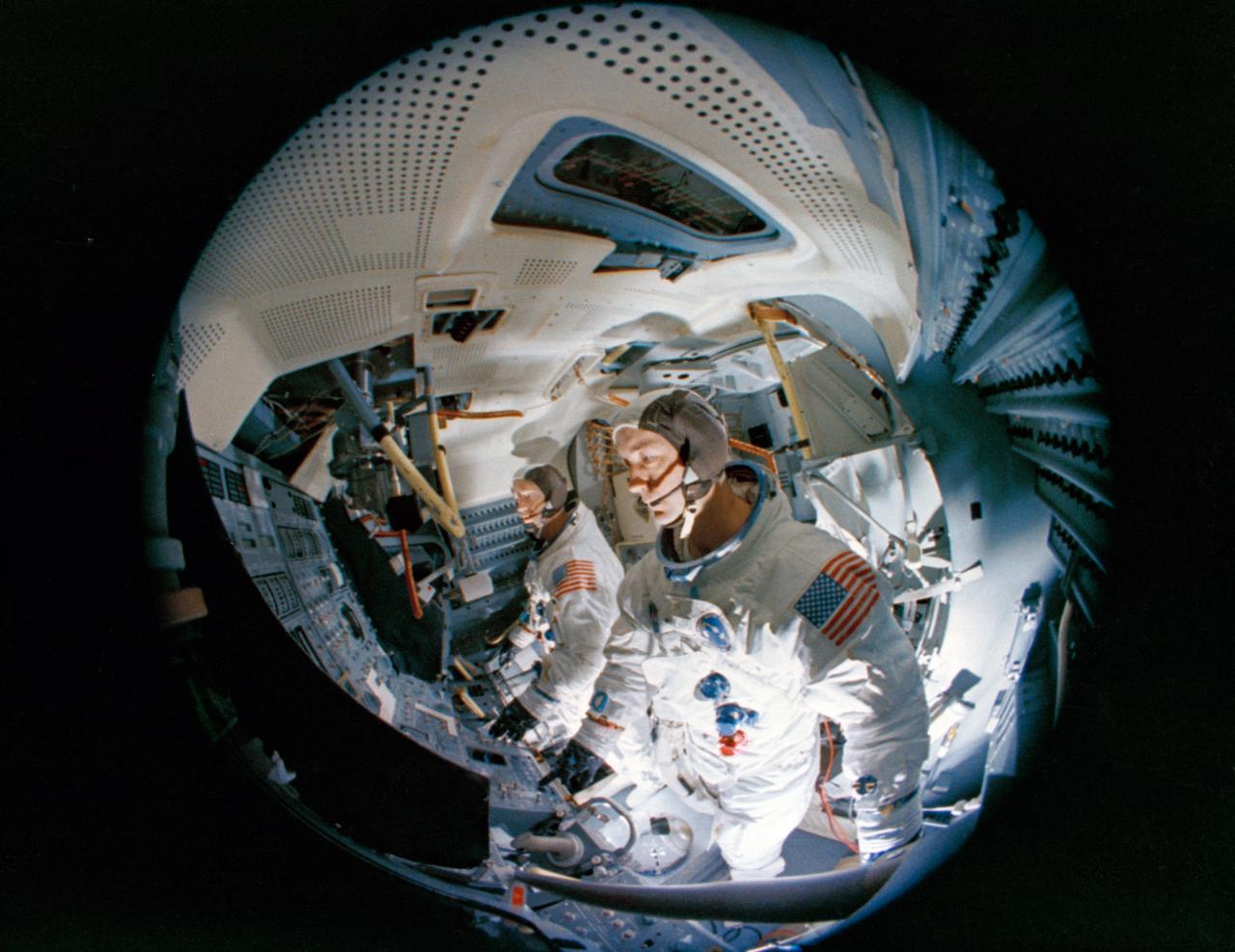
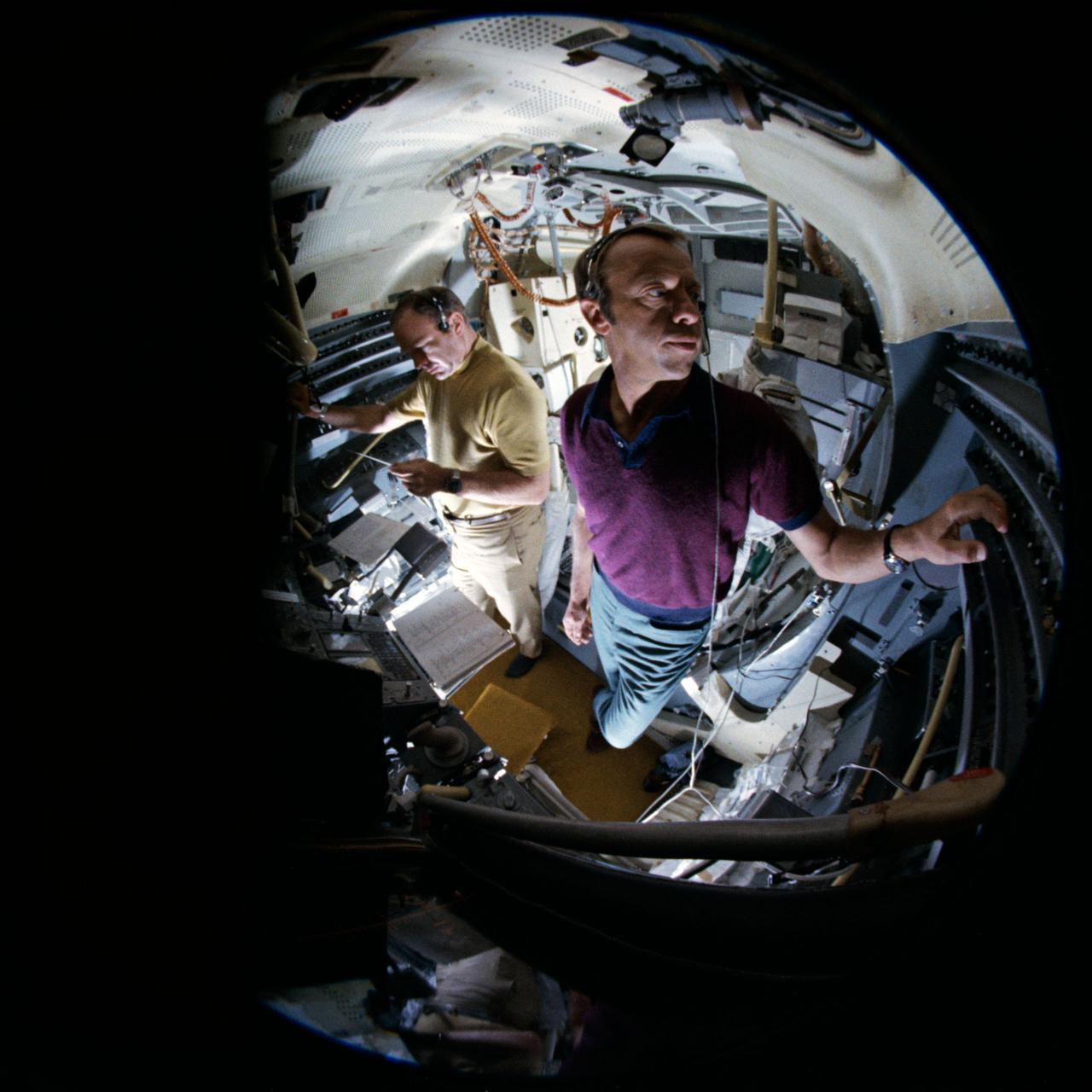
S69-19981 (23 Feb. 1969) --- Fish-eye camera lens view of the interior of the Apollo Lunar Module Mission Simulator (LMMS) at the Kennedy Space Center (KSC) during Apollo 9 simulation training. In the foreground is astronaut James A. McDivitt, prime crew commander; and in background is astronaut Russell L. Schweickart, lunar module pilot.
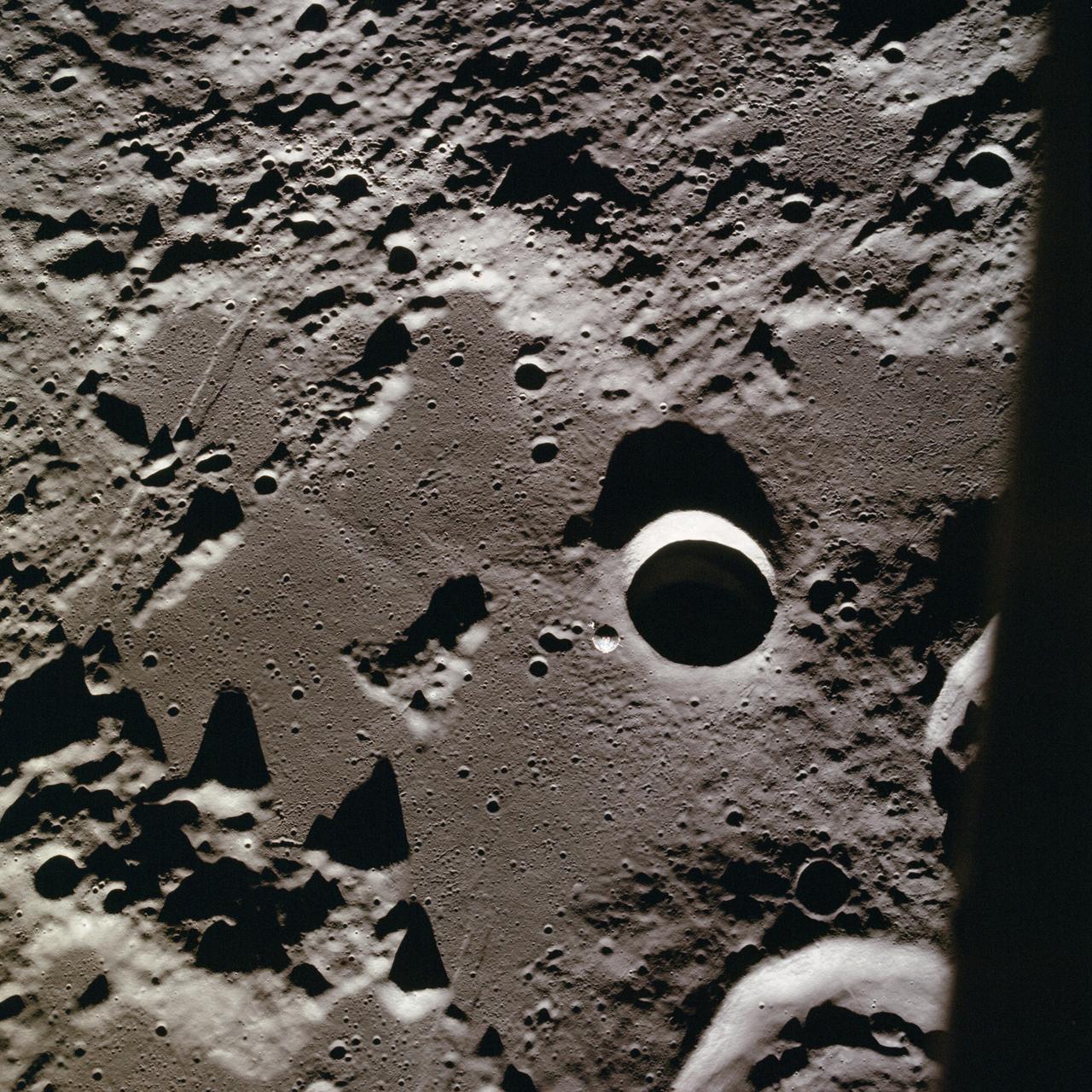
AS11-37-5448 (July 1969) --- The Apollo 11 Command and Service Modules (CSM) (tiny dot near quarter sized crater, center), with astronaut Michael Collins, command module pilot, aboard. The view overlooking the western Sea of Tranquility was photographed from the Lunar Module (LM). Astronauts Neil A. Armstrong, commander, and Edwin E. Aldrin Jr., lunar module pilot, manned the LM and made their historic lunar landing on July 20, 1969. Coordinates of the center of the terrain in the photograph are 18.5 degrees longitude and .5 degrees north latitude.
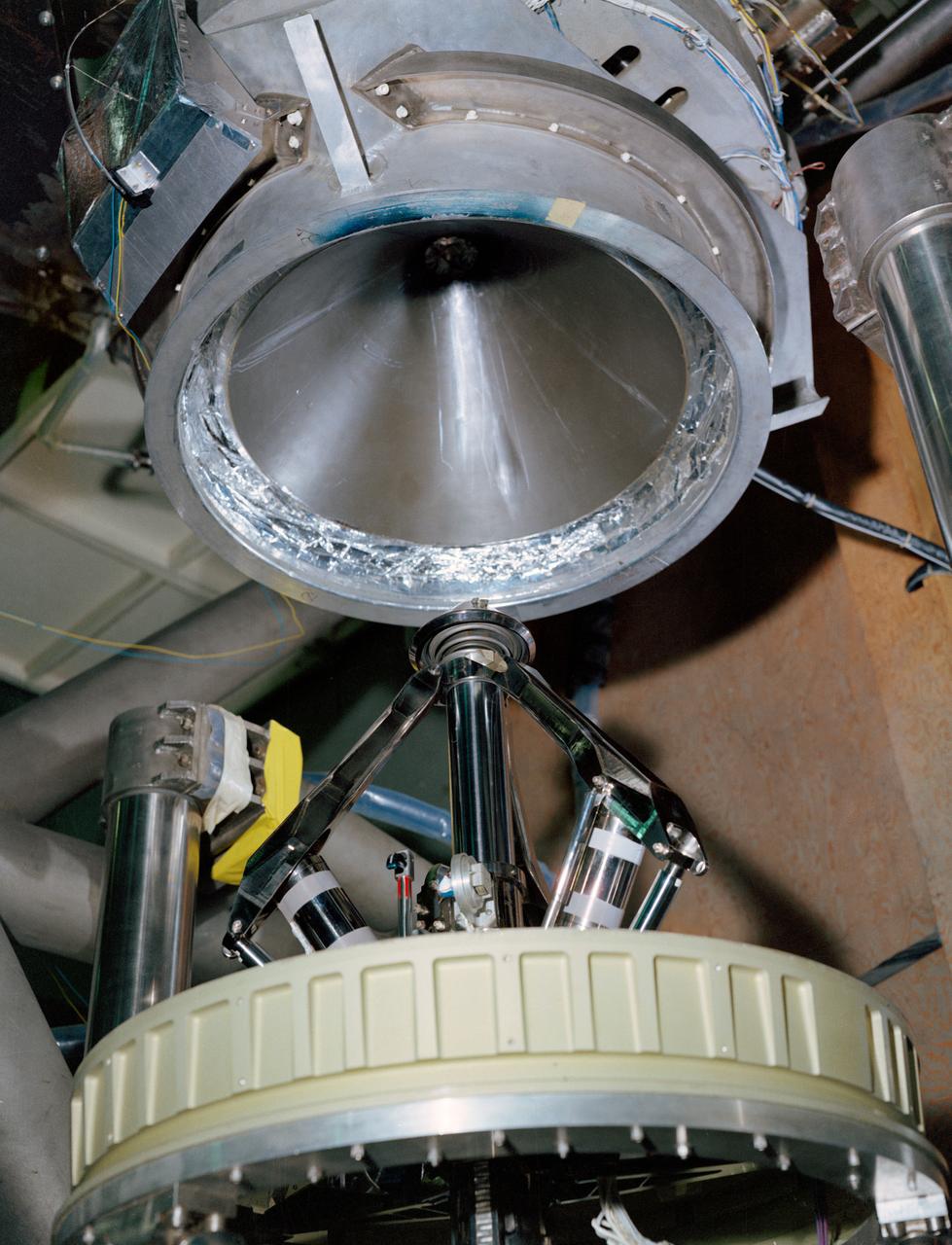
S68-50869 (1968) --- An engineering set up illustrating the docking system of the Apollo spacecraft. During docking maneuvers the docking probe on the Command Module engages the cone-shaped drogue of the Lunar Module. The primary docking structure is the tunnel through which the astronauts transfer from one module to the other. This tunnel is partly in the nose of the Command Module and partly in the top of the Lunar Module. Following CSM/LM docking the drogue and probe are removed to open the passageway between the modules.
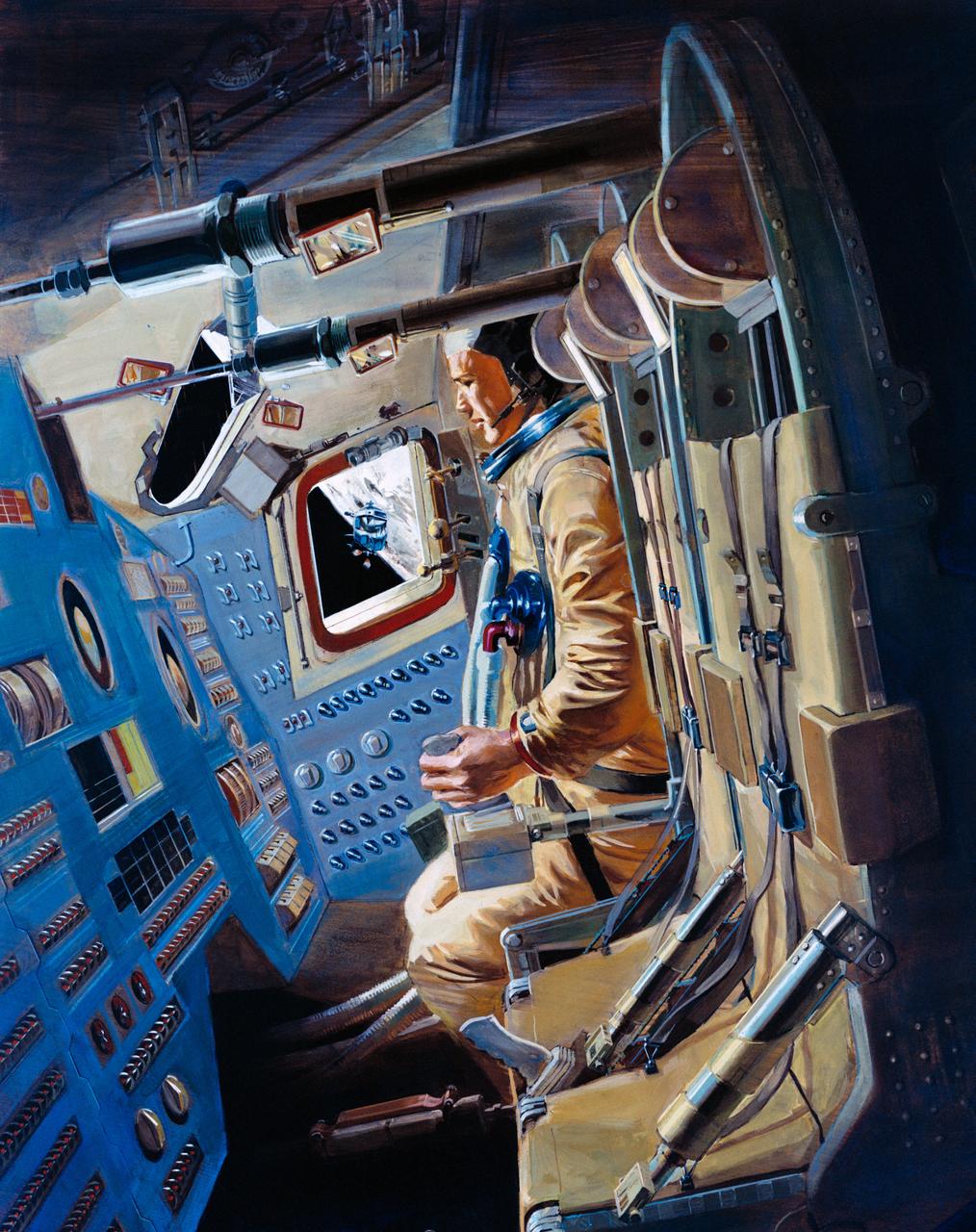
S69-58005 (10 Nov. 1969) --- An artist's concept of the Apollo 12 Command Module's (CM) interior, with the command module pilot at the controls. The Apollo 12 Lunar Module (LM) and a portion of the lunar surface are seen out of the window. Astronaut Richard F. Gordon Jr. will maneuver the Apollo 12 Command and Service Modules (CSM) in lunar orbit while astronauts Charles Conrad Jr., commander, and Alan L. Bean, lunar module pilot, explore the moon.
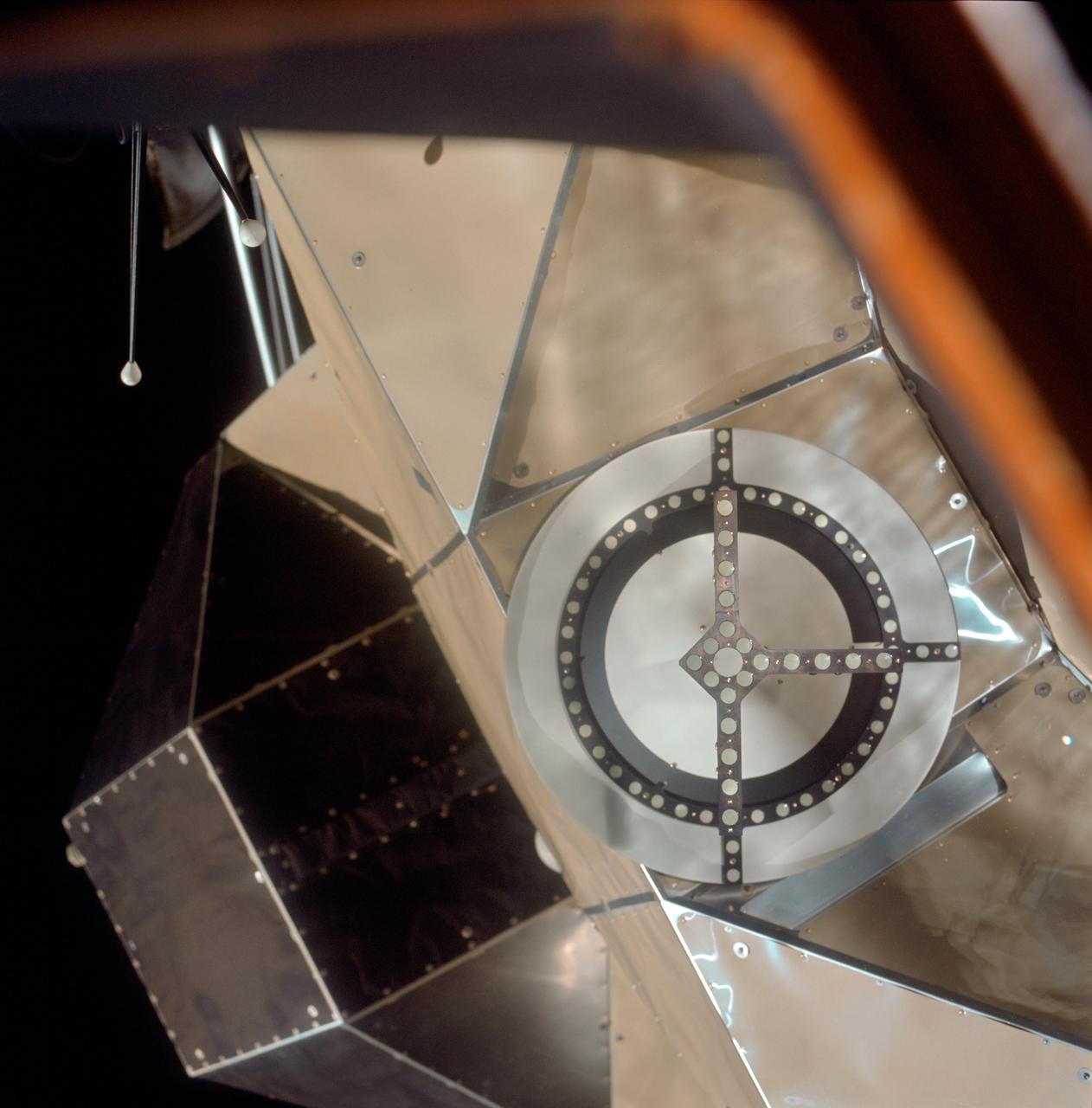
AS11-36-5365 (21 July 1969) --- A close-up view of the docking target on the Apollo 11 Lunar Module (LM) photographed from the Command Module during the LM/CSM docking in lunar orbit. Astronauts Neil A. Armstrong, commander, and Edwin E. Aldrin Jr., lunar module pilot, in the LM, were returning from the lunar surface. Astronaut Michael Collins, command module pilot, remained with the Command and Service Modules (CSM) in lunar orbit while Armstrong and Aldrin explored the moon.
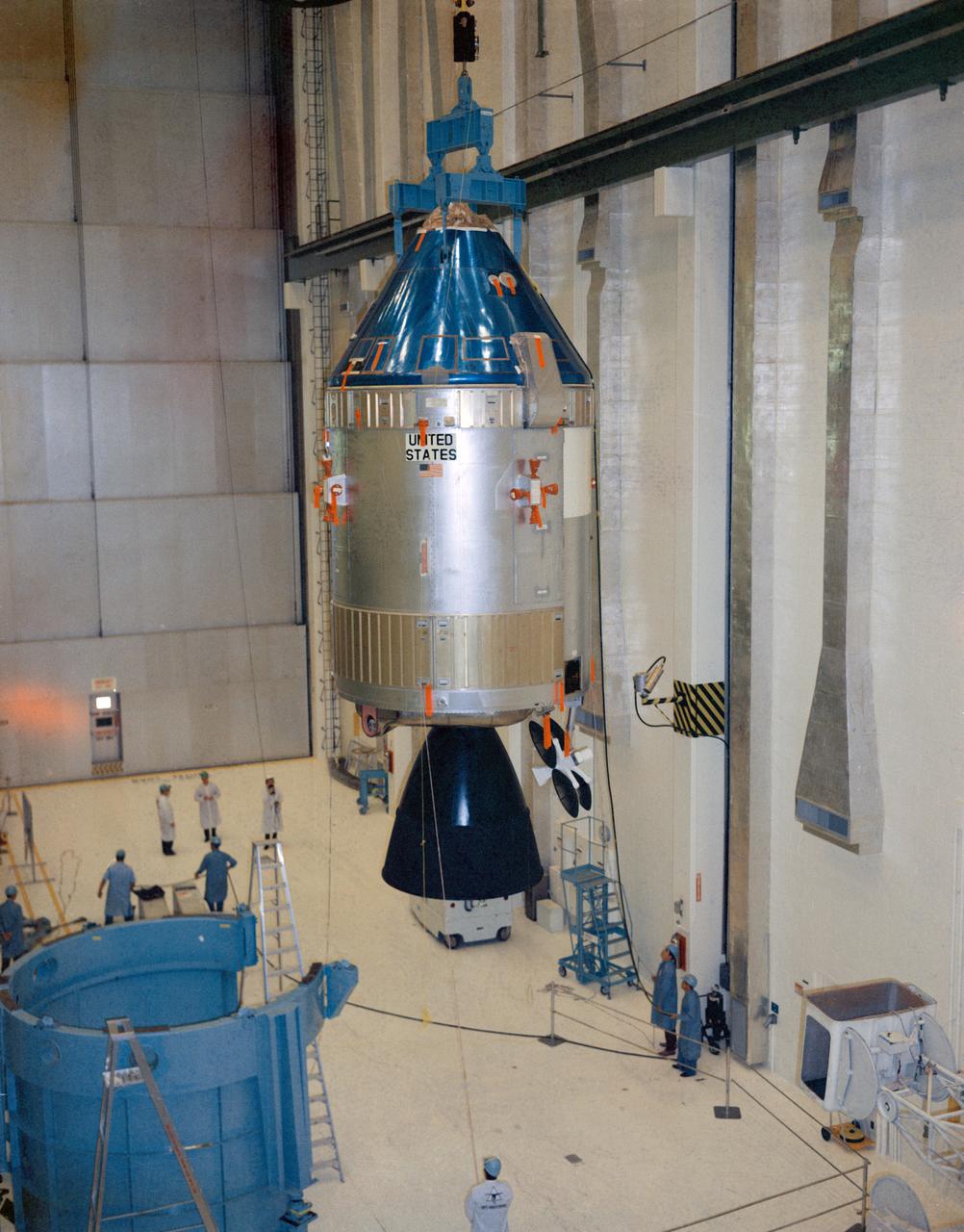
S69-19190 (31 Jan. 1969) --- Interior view of the Kennedy Space Center's Manned Spacecraft Operations Building showing Apollo Spacecraft 106/Command/Service Module being moved to integrated work stand number one for mating to Spacecraft Lunar Module Adapter (SLA) 13. Spacecraft 106 will be flown on the Apollo 10 (Lunar Module 4/Saturn 505) space mission.

S69-19197 (1969) --- Interior view of the Kennedy Space Center's (KSC) Manned Spacecraft Operations Building (MSOB) showing Apollo Spacecraft 106 Command and Service Modules (CSM) being moved to integrated work stand number one for mating to Spacecraft Lunar Module Adapter (SLA) 13. Spacecraft 106 will be flown on the Apollo 10 (Lunar Module 4/Saturn 505) space mission.
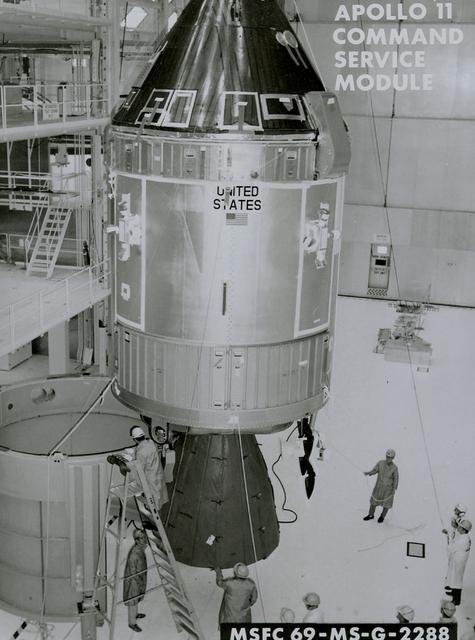
A close-up view of the Apollo 11 command service module ready to be mated with the spacecraft LEM adapter of the third stage. The towering 363-foot Saturn V was a multi-stage, multi-engine launch vehicle standing taller than the Statue of Liberty. Altogether, the Saturn V engines produced as much power as 85 Hoover Dams.
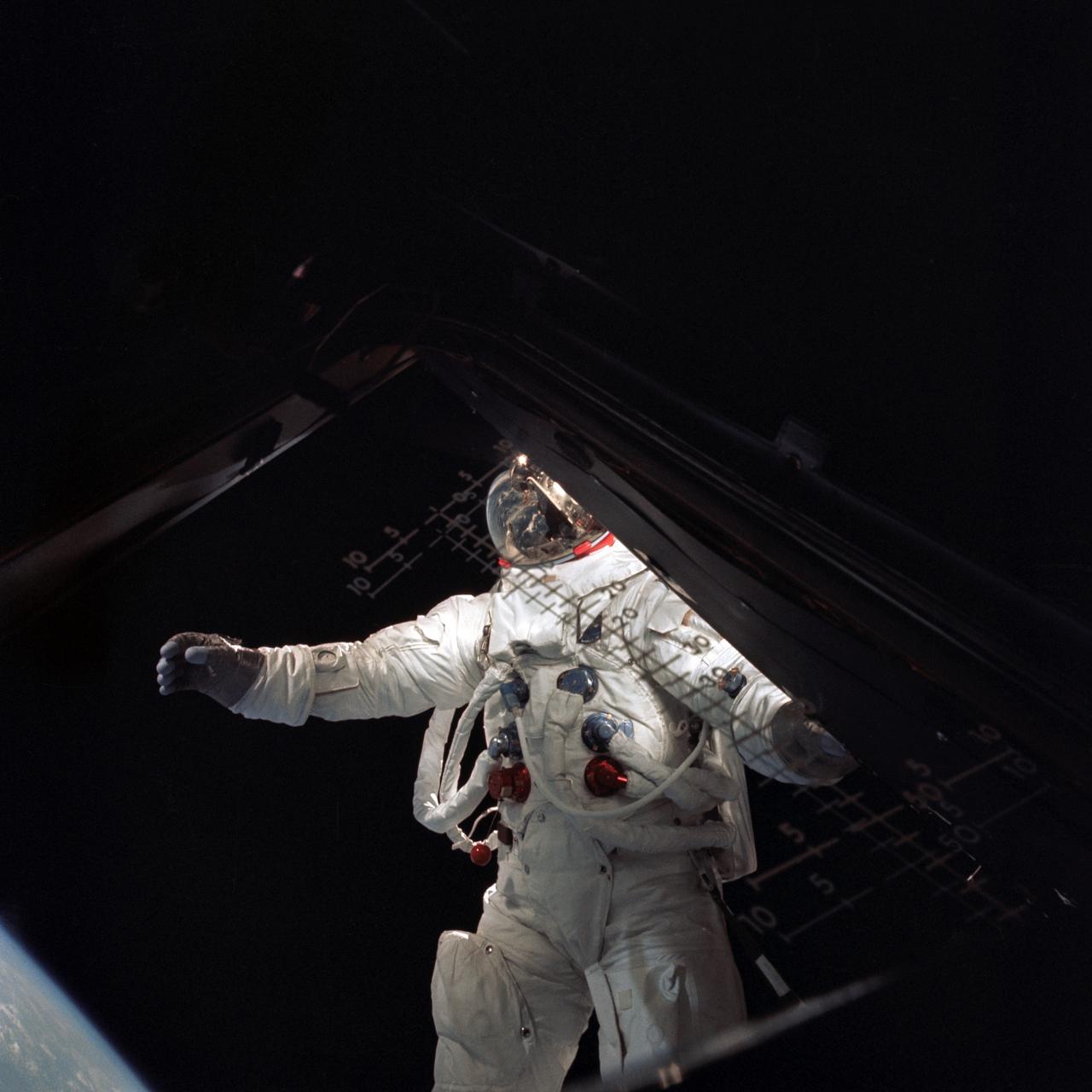
AS09-20-3094 (6 March 1969) --- Astronaut Russell L. Schweickart, lunar module pilot, stands in "golden slippers" on the Lunar Module porch during his extravehicular activity on the fourth day of the Apollo 9 Earth-orbital mission. This photograph was taken from inside the Lunar Module "Spider". The Command and Service Modules were docked to the LM. Schweickart is wearing an Extravehicular Mobility Unit (EMU). Inside the "Spider" was astronaut James A. McDivitt, Apollo 9 crew commander. Astronaut David R. Scott, command module pilot, remained at the controls of the Command Module, "Gumdrop."
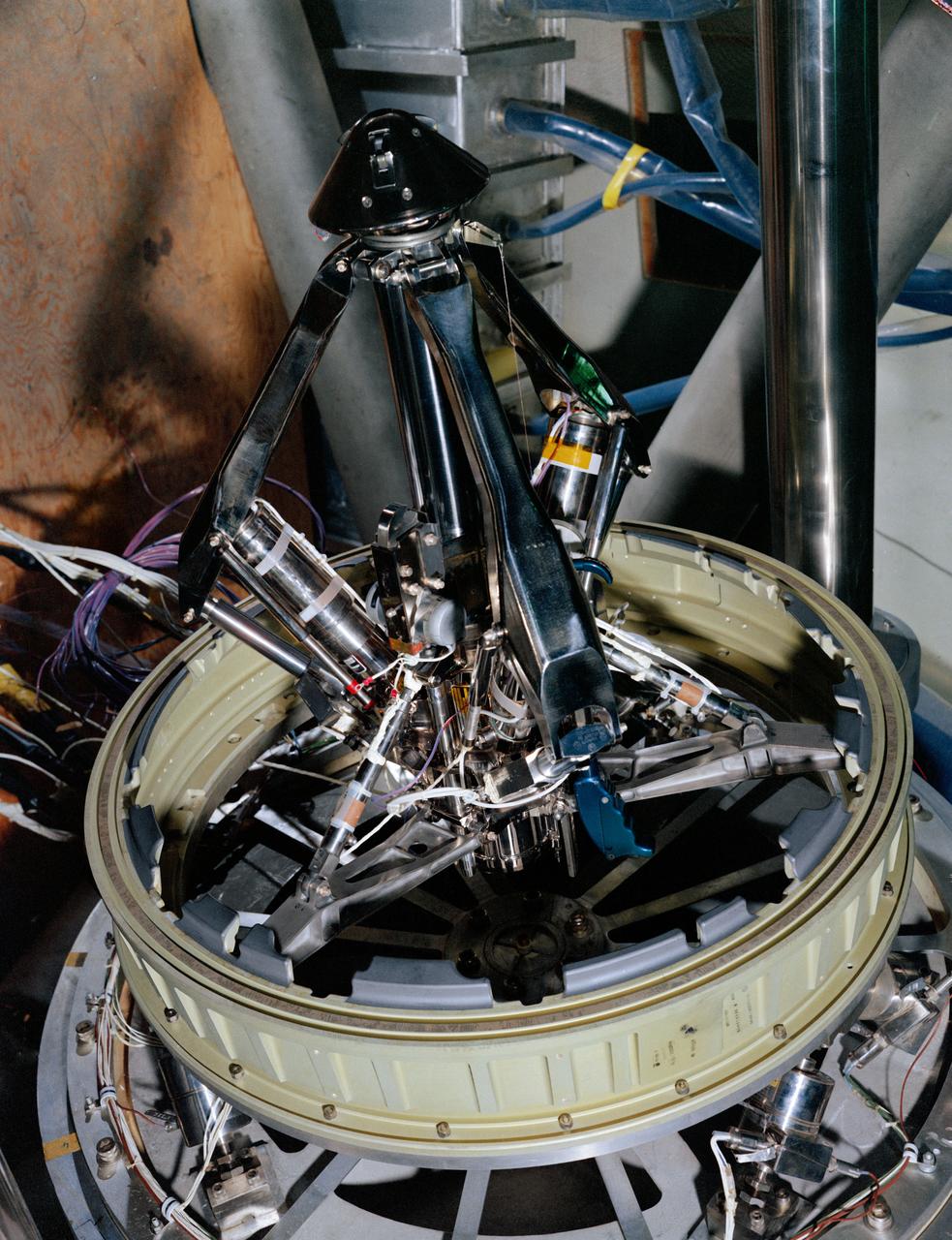
S68-50870 (1968) --- An engineering set up illustrating the probe portion of the docking system of the Apollo spacecraft. During docking maneuvers the docking probe on the Command Module (CM) engages the cone shaped drogue of the Lunar Module (LM). The primary docking structure is the tunnel through which the astronauts transfer from one module to the other. This tunnel is partly in the nose of the CM and partly in the top of the LM. Following CSM/LM docking the drogue and probe are removed to open the passageway between the modules.
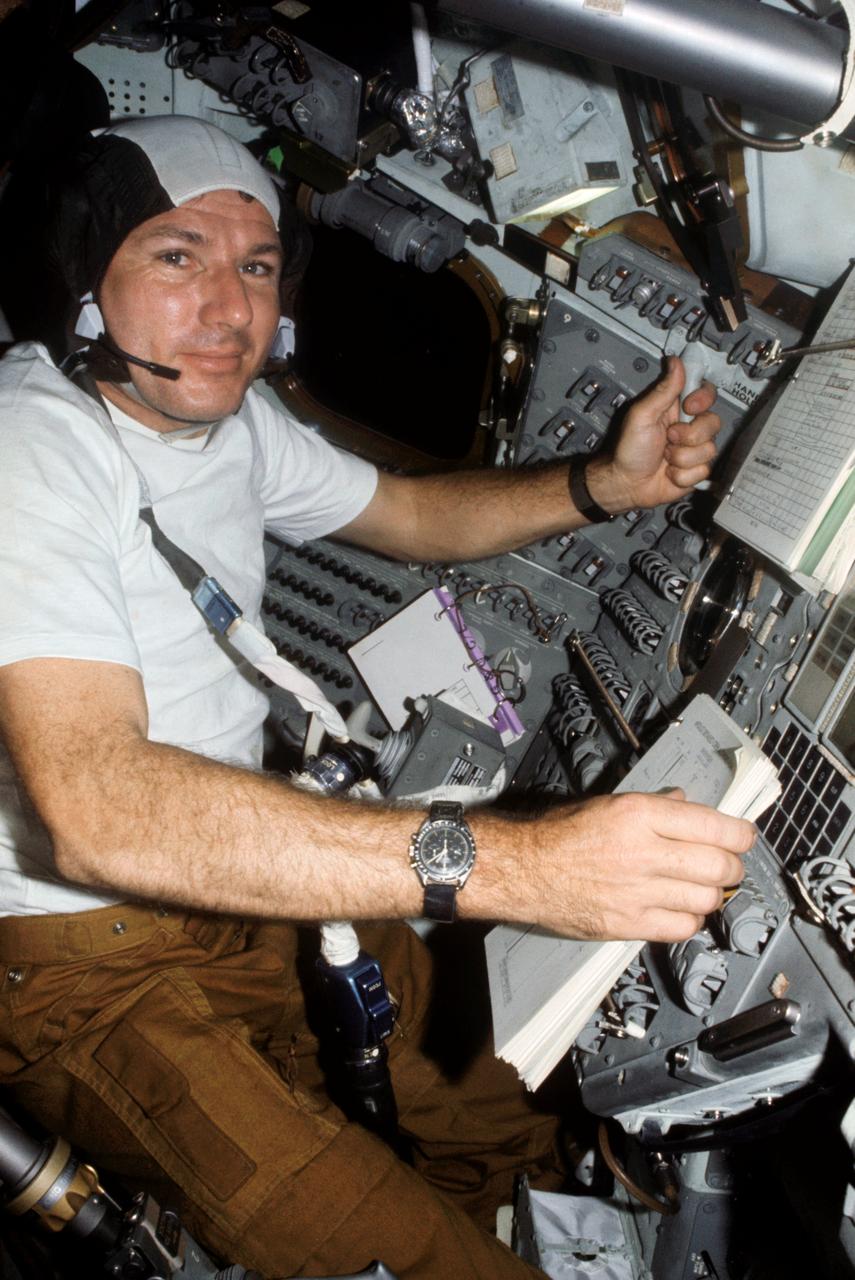
AST-08-499 (15-24 July 1975) --- Astronaut Vance D. Brand, command module pilot of the American ASTP crew, is seen at the controls of the Apollo Command Module during the joint U.S.-USSR Apollo-Soyuz Test Project docking mission in Earth orbit. This picture was taken with a 35mm camera.
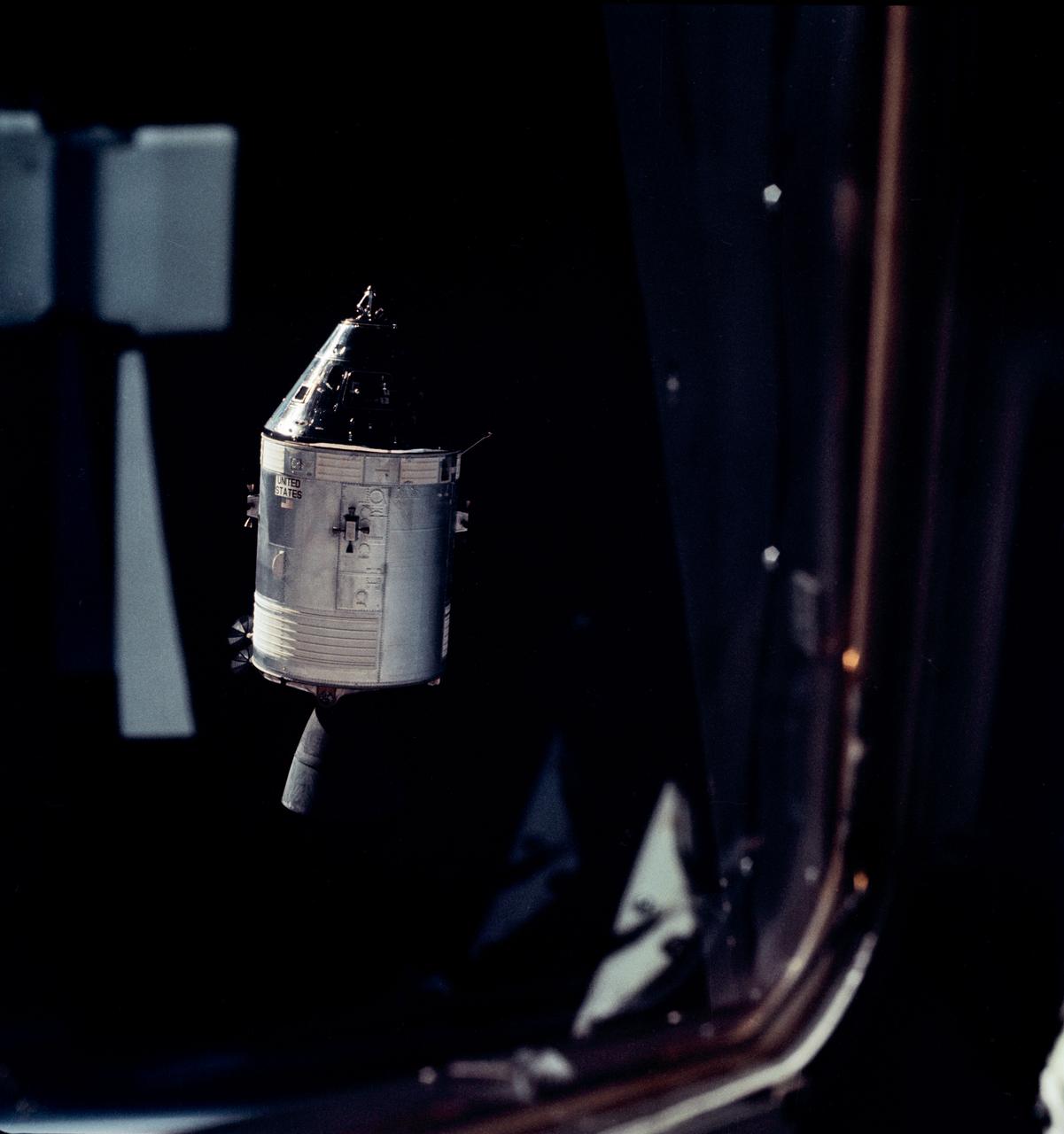
The Apollo 9 Command/Service Modules photographed through the window from the Lunar Module,"Spider",on the fifth day of the Apollo 9 earth-orbital mission. Docking mechanism is visible in nose of the Command Module,"Gumdrop". Film magazine was F, film type was SO-368 Ektachrome with 0.460 - 0.710 micrometers film / filter transmittance response and haze filter,80mm lens
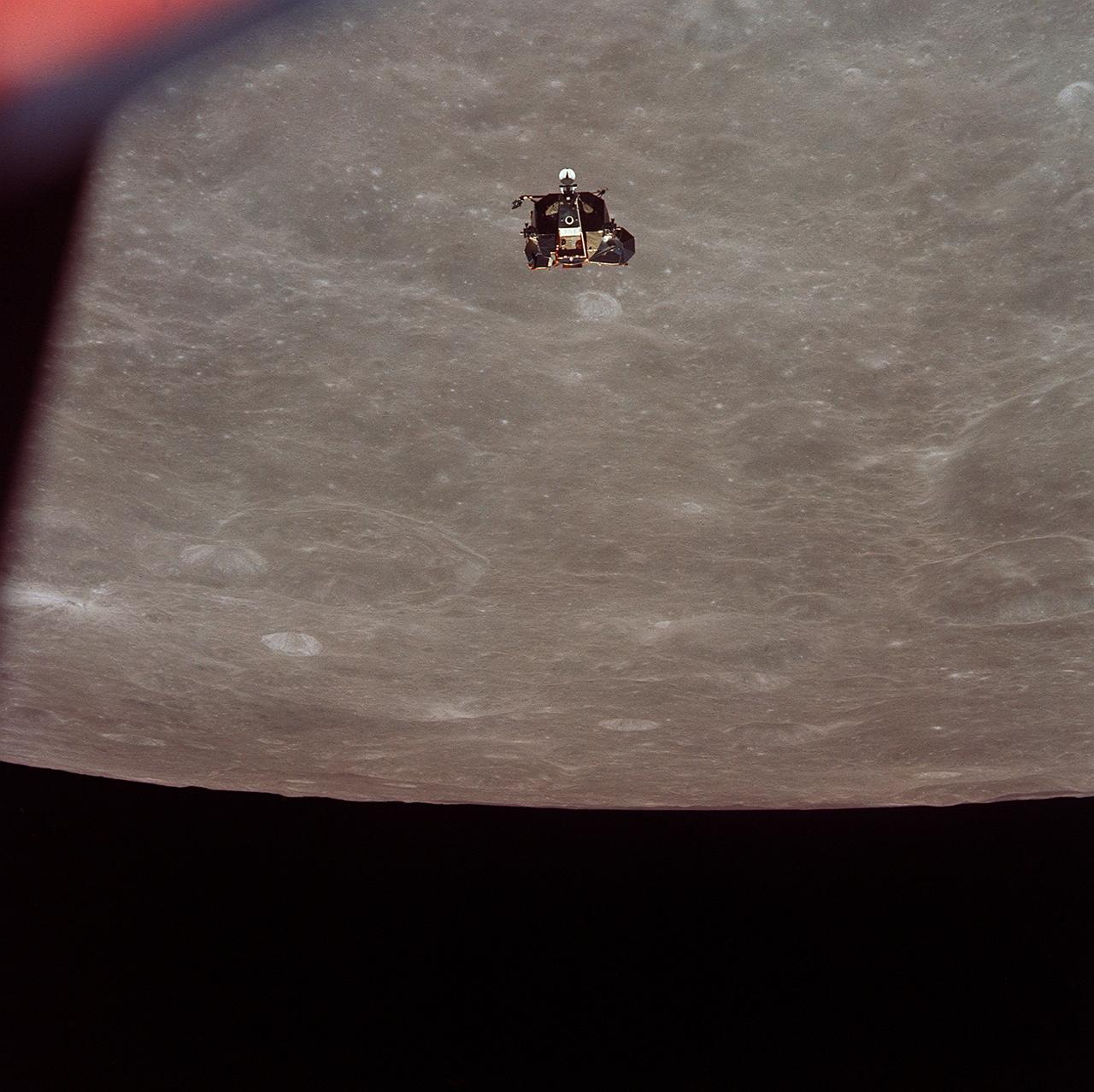
AS11-44-6626 (21 July 1969) --- The Apollo 11 Lunar Module (LM) ascent stage, with astronauts Neil A. Armstrong and Edwin E. Aldrin Jr. aboard, is photographed from the Command and Service Modules (CSM) in lunar orbit. Astronaut Michael Collins, command module pilot, remained with the CSM in lunar orbit while Armstrong and Aldrin explored the moon. The LM is approaching from below. The coordinates of the center of the lunar terrain seen below is located at 102 degrees east longitude and 1 degree north latitude.
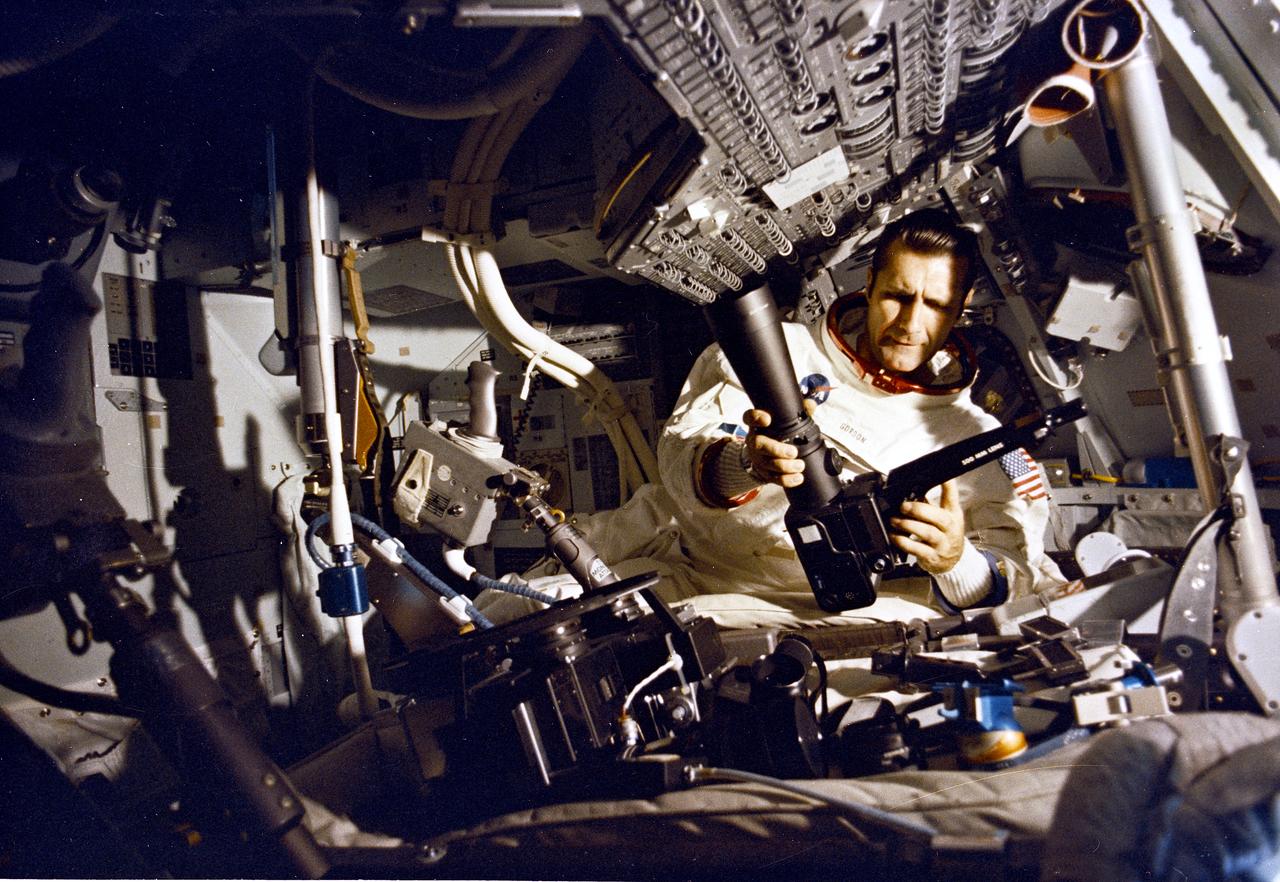
This is a view of astronaut Richard F. Gordon attaching a high resolution telephoto lens to a camera aboard the Apollo 12 Command Module (CM) Yankee Clipper. The second manned lunar landing mission, Apollo 12 launched from launch pad 39-A at Kennedy Space Center in Florida on November 14, 1969 via a Saturn V launch vehicle. The Saturn V vehicle was developed by the Marshall Space Flight Center (MSFC) under the direction of Dr. Wernher von Braun. Aboard Apollo 12 was a crew of three astronauts: Alan L. Bean, pilot of the Lunar Module (LM), Intrepid; Richard Gordon, pilot of the Command Module (CM), Yankee Clipper; and Spacecraft Commander Charles Conrad. The LM, Intrepid, landed astronauts Conrad and Bean on the lunar surface in what’s known as the Ocean of Storms. Their lunar soil activities included the deployment of the Apollo Lunar Surface Experiments Package (ALSEP), finding the unmanned Surveyor 3 that landed on the Moon on April 19, 1967, and collecting 75 pounds (34 kilograms) of rock samples. Astronaut Richard Gordon piloted the CM, Yankee Clipper, in a parking orbit around the Moon. Apollo 12 safely returned to Earth on November 24, 1969.
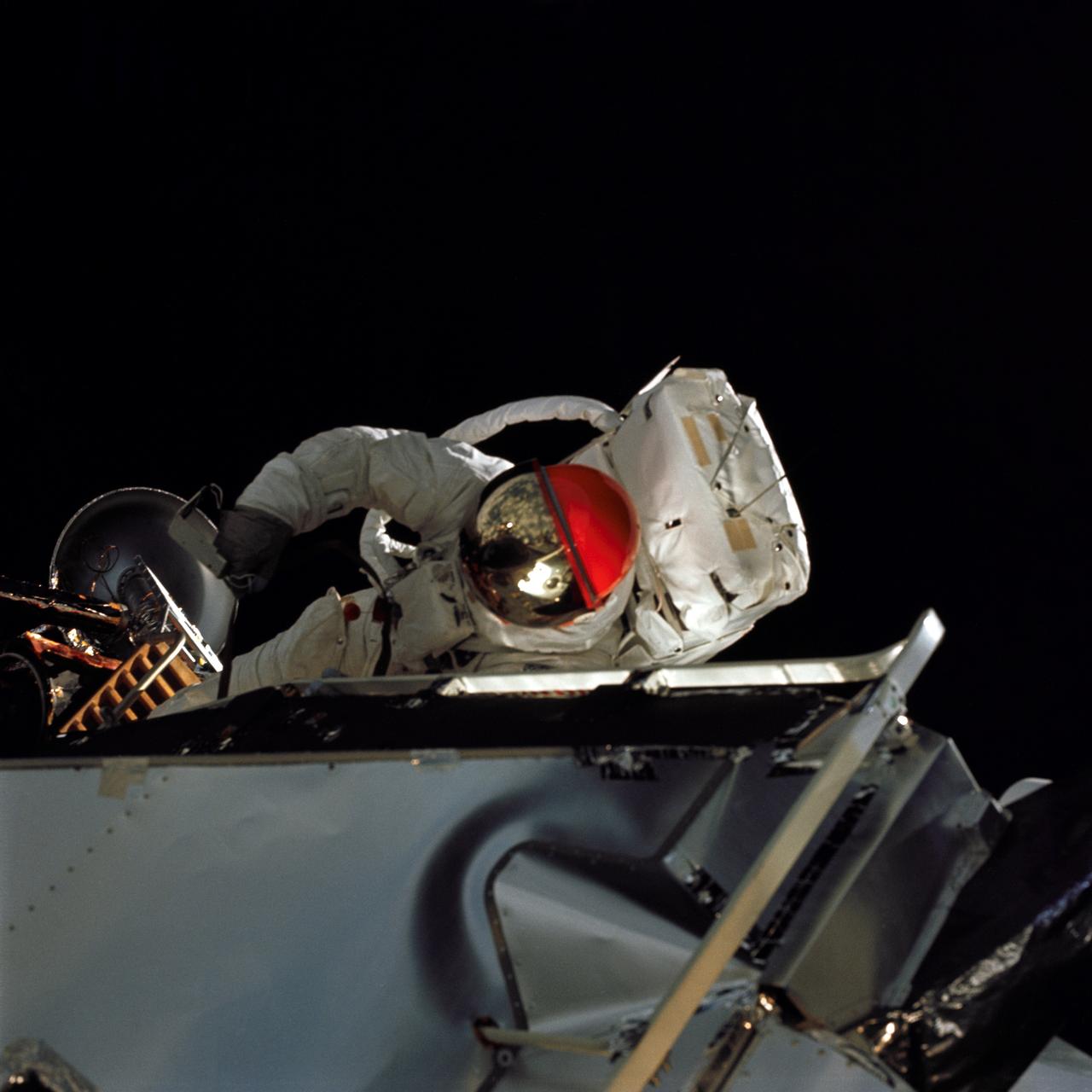
AS09-19-2994 (6 March 1969) --- Astronaut Russell L. Schweickart, lunar module pilot, is photographed from the Command Module (CM) "Gumdrop" during his extravehicular activity (EVA) on the fourth day of the Apollo 9 Earth-orbital mission. He holds, in his right hand, a thermal sample which he is retrieving from the Lunar Module (LM) exterior. The Command and Service Modules (CSM) and LM "Spider" are docked. Schweickart, wearing an Extravehicular Mobility Unit (EMU), is standing in "golden slippers" on the LM porch. Visible on his back are the Portable Life Support System (PLSS) and Oxygen Purge System (OPS). Astronaut James A. McDivitt, Apollo 9 commander, was inside the "Spider". Astronaut David R. Scott, command module pilot, remained at the controls in the CM "Gumdrop".
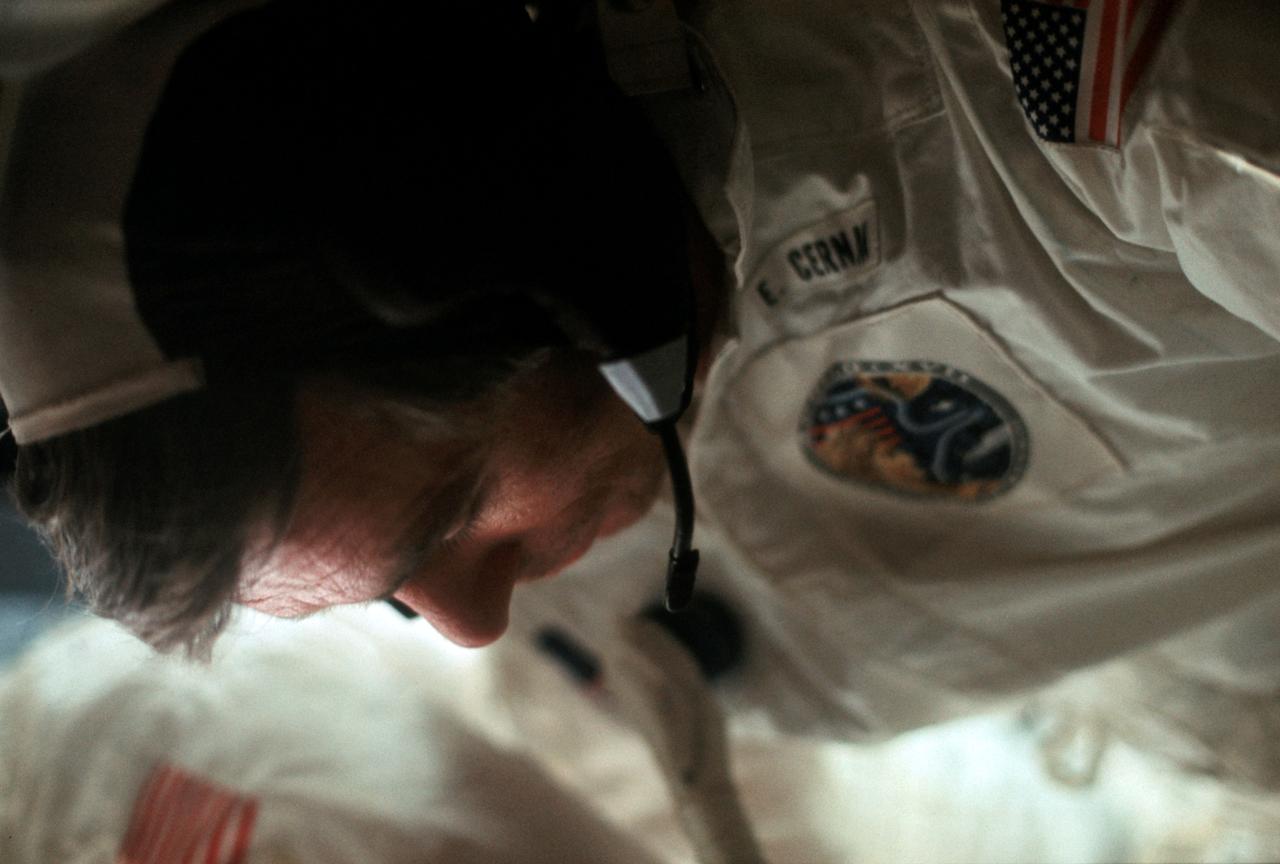
AS17-162-24050 (7-19 Dec. 1972) --- Astronaut Eugene A. Cernan appears to be relaxing in this candid photograph taken by a fellow crewman aboard the Apollo 17 spacecraft during the final lunar landing mission in NASA's Apollo program. Also, aboard Apollo 17 were astronaut Ronald E. Evans, command module pilot, and scientist-astronaut Harrison H. "Jack" Schmitt, lunar module pilot. Cernan was the mission commander.
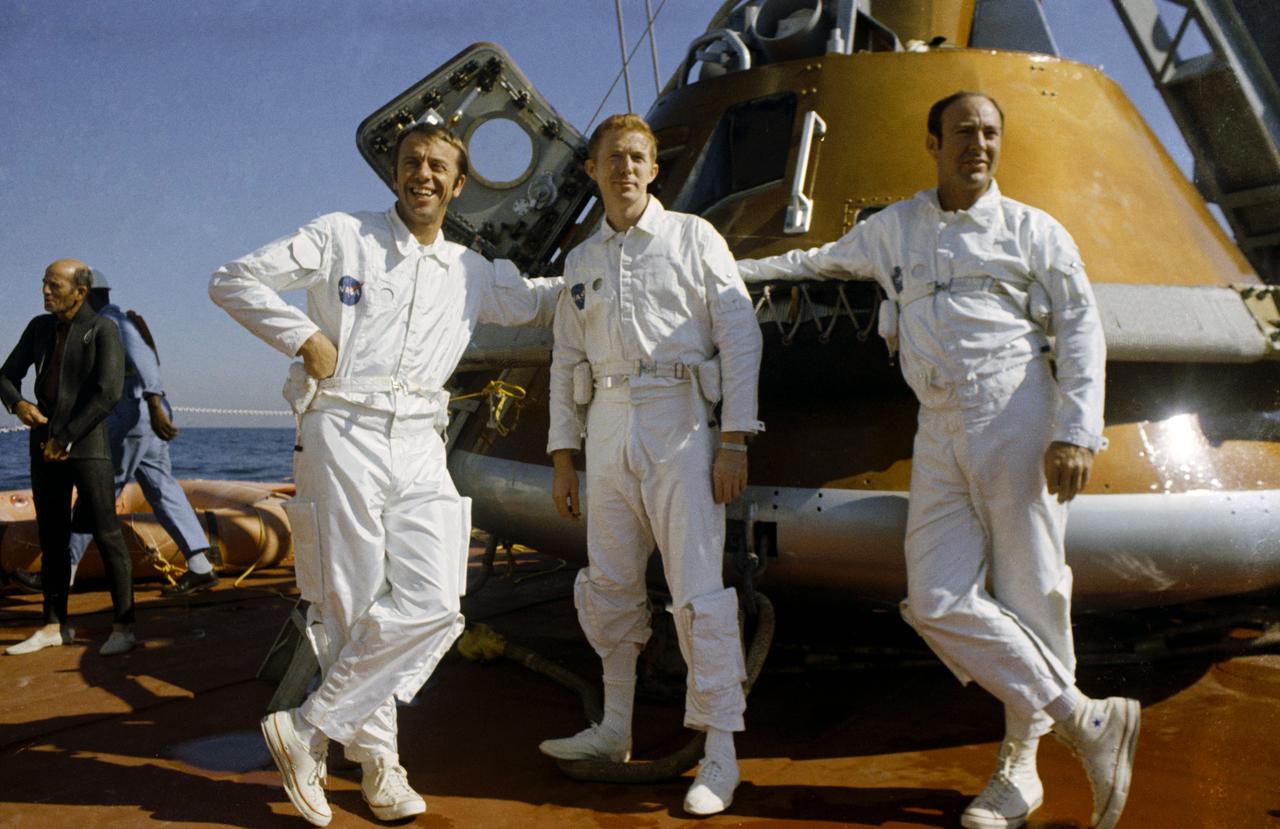
S70-51699 (24 Oct. 1970) --- The prime crew of the Apollo 14 lunar landing mission relaxes aboard the NASA motor vessel retriever, prior to participating in water egress training in the Gulf of Mexico. Left to right are astronauts Alan B. Shepard Jr., commander; Stuart A. Roosa, command module pilot; and Edgar D. Mitchell, lunar module pilot. They are standing by a Command Module (CM) trainer which was used in the exercises.
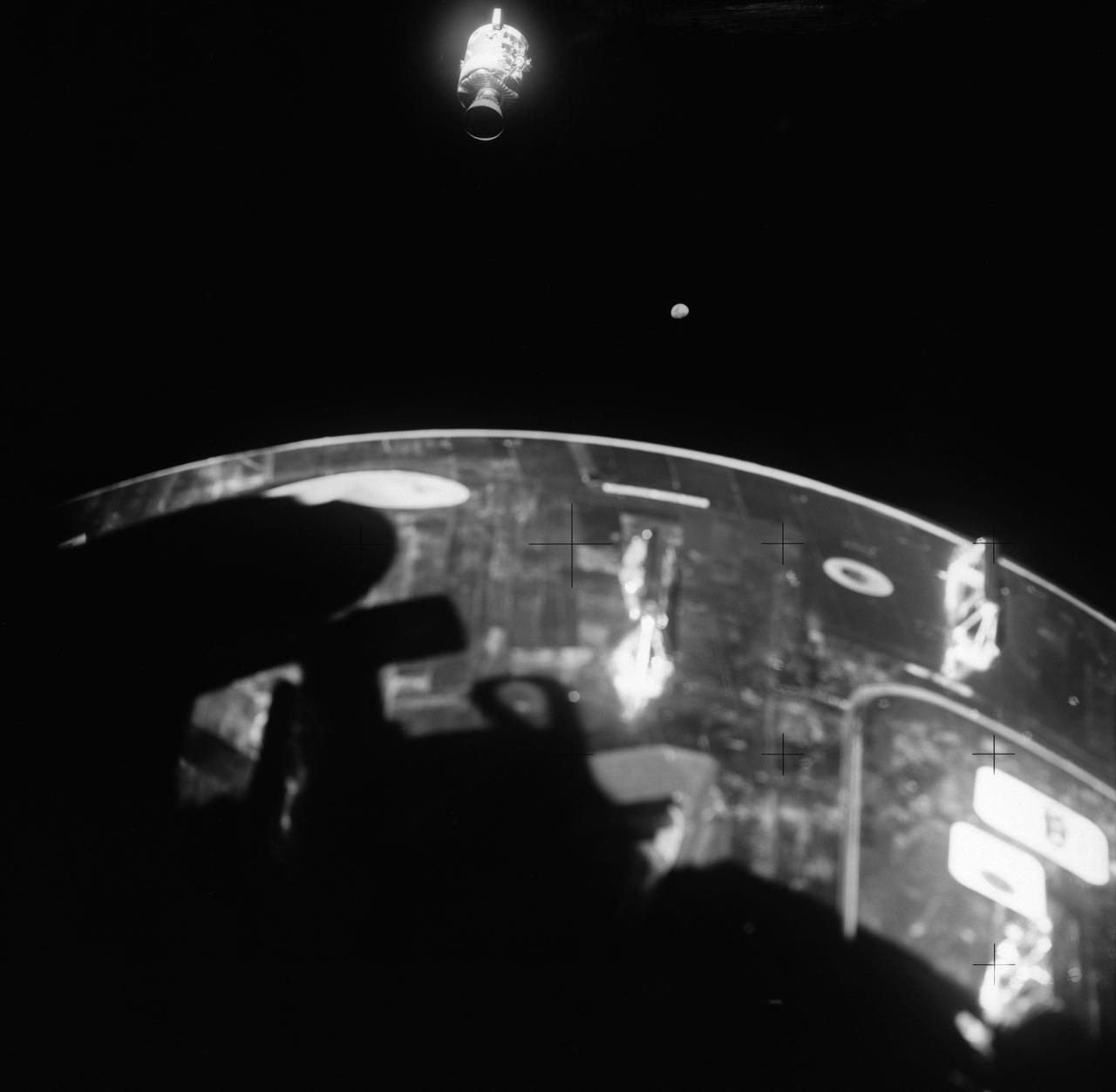
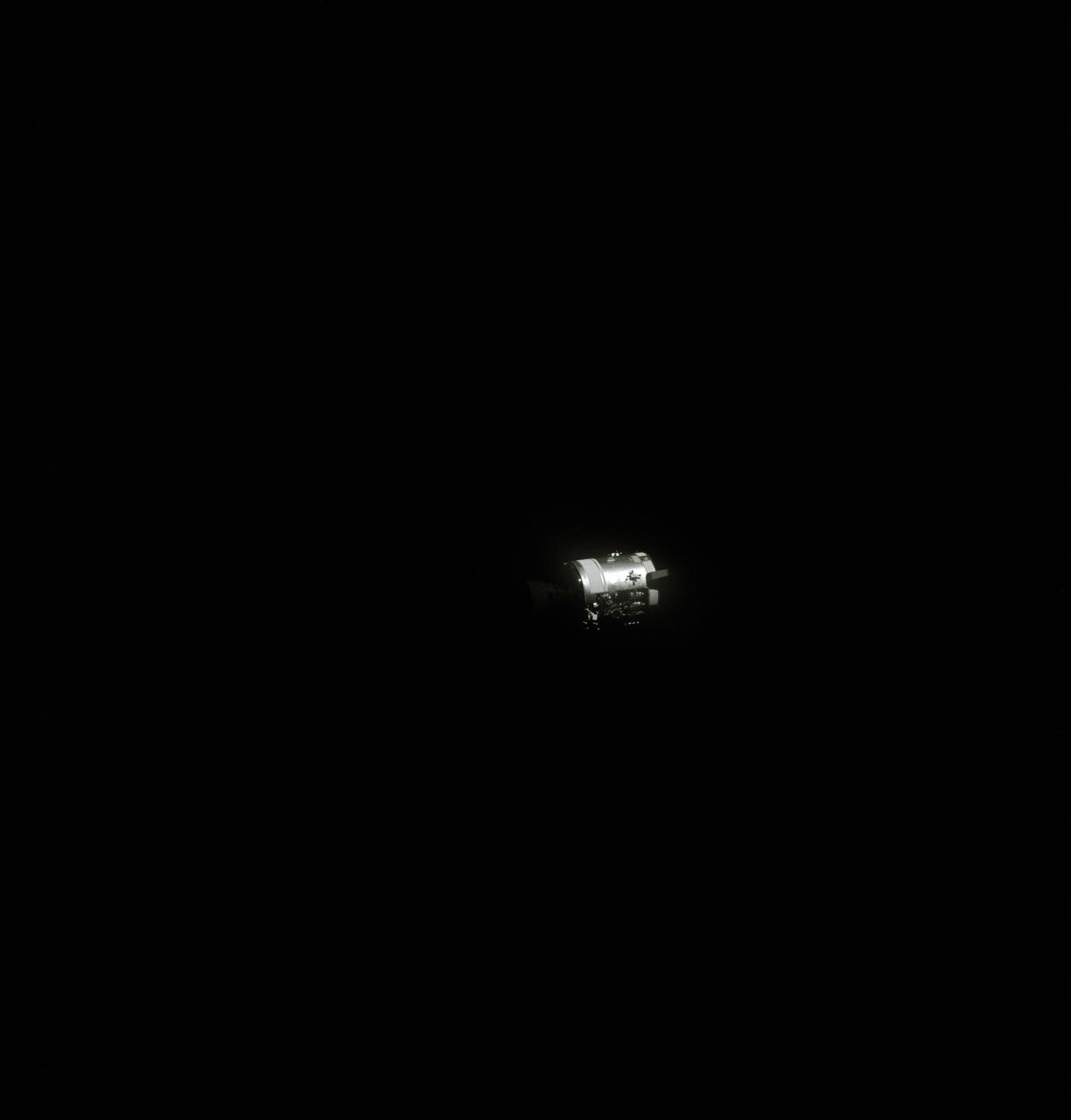
This view of the damaged Apollo 13 Service Module (SM) was photographed from the Lunar Module/Command Module following SM jettisoning. As seen here, an entire panel on the SM was blown away by the apparent explosion of oxygen tank number two located in Sector 4 of the SM. Two of the three fuel cells are visible just forward (above) the heavily damaged area. Three fuel cells, two oxygen tanks, and two hydrogen tanks are locate in Sector 4. The damaged area is located above the S-band high gain antenna. Nearest the camera is the Service Propulsion System (SPS) engine and nozzle. The damage to the SM caused the Apollo 13 crewmen to use the Lunar Module (LM) as a "lifeboat". The LM was jettisoned just prior to Earth reentry by the Command Module.
AS13-58-8464 (17 April 1970) --- This view of the severely damaged Apollo 13 Service Module (SM) was photographed from the Lunar Module/Command Module (LM/CM) following SM jettisoning. Nearest the camera is the Service Propulsion System (SPS) engine and nozzle. An entire SM panel was blown away by the apparent explosion of oxygen tank number two located in Sector 4 of the SM. The apparent rupture of the oxygen tank caused the Apollo 13 crew men to use the Lunar Module (LM) as a "lifeboat".
U.S.S. Bennington comes alongside the floating Apollo spacecraft 017 Command Module during recovery operations in the mid-Pacific Ocean. The Command Module splashed down at 3:37 p.m., November 9, 1967, 934 nautical miles northwest of Honolulu, Hawaii.

AS13-59-8562 (17 April 1970) --- This view of the Apollo 13 Lunar Module (LM) was photographed from the Command Module (CM) just after the LM had been jettisoned. The jettisoning occurred a few minutes before 11 a.m. (CST), April 17, 1970, just over an hour prior to splashdown of the CM in the south Pacific Ocean. The apparent explosion of oxygen tank number two in the Apollo 13 Service Module (SM) caused the Apollo 13 crew members to rely on the LM as a "lifeboat".
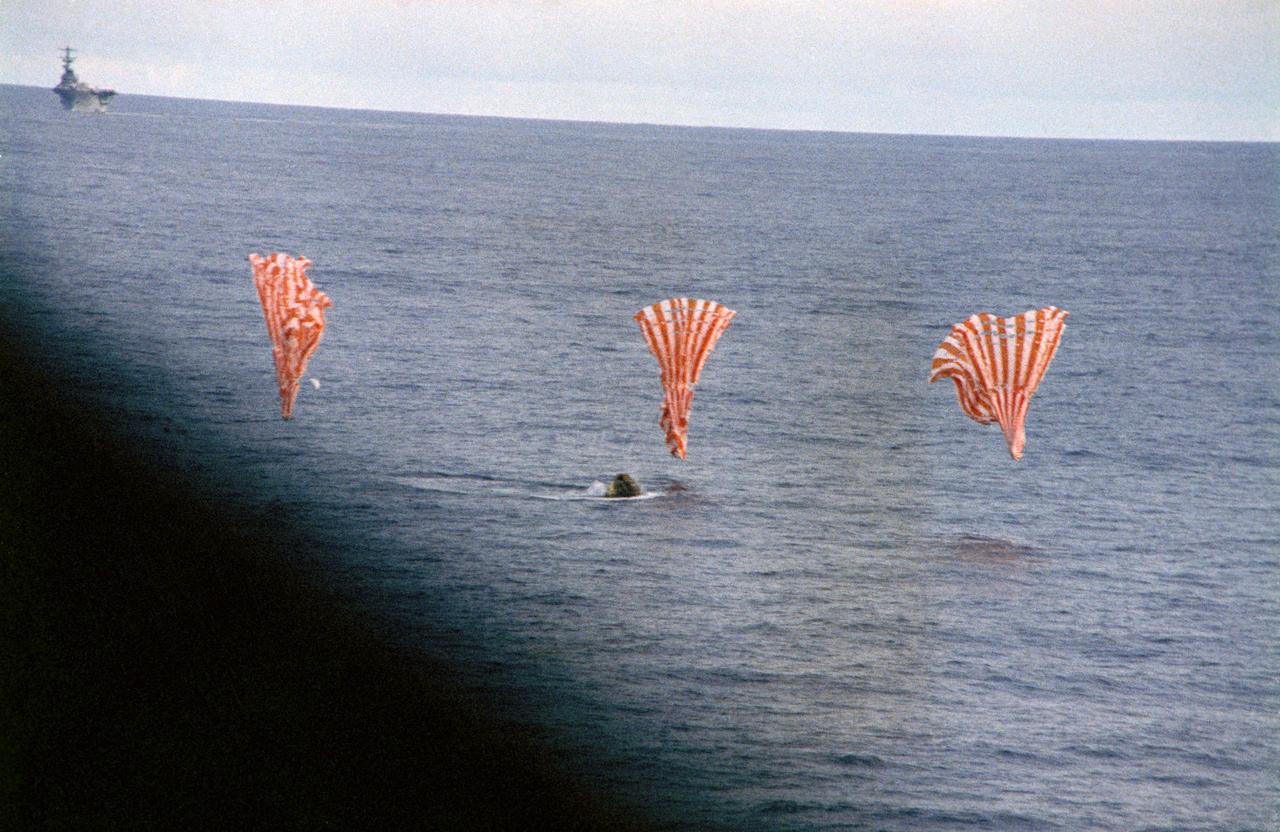
S70-35644 (17 April 1970) --- The Apollo 13 Command Module (CM) splashes down and its three main parachutes collapse, as the week-long problem-plagued Apollo 13 mission comes to a premature, but safe end. The spacecraft, with astronauts James A. Lovell Jr., commander; John L. Swigert Jr., command module pilot; and Fred W. Haise Jr., lunar module pilot, aboard splashed down at 12:07:44 p.m. (CST) April 17, 1970, in the South Pacific Ocean, only about four miles from the USS Iwo Jima, prime recovery ship.
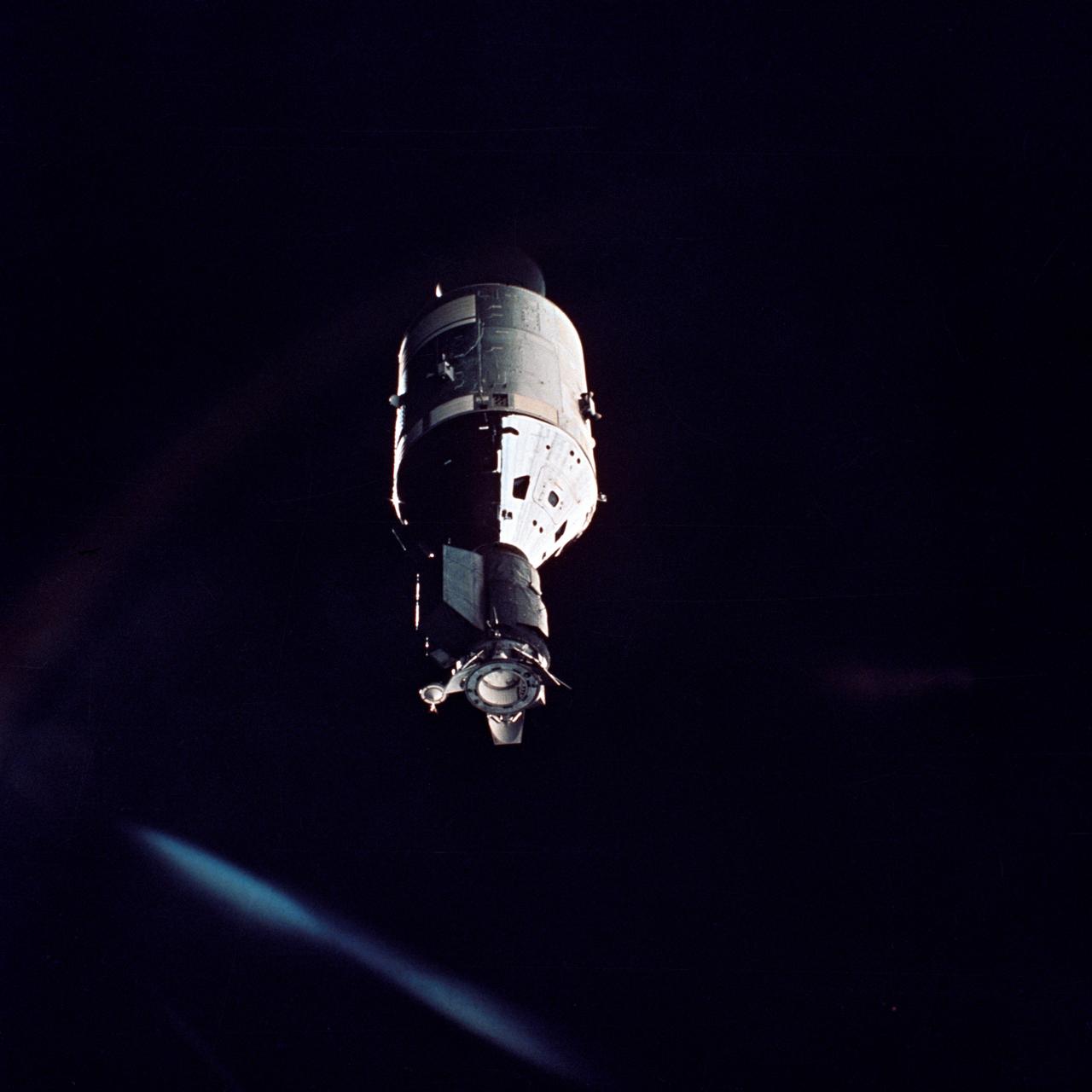
AST-32-2686 (17-19 July 1975) --- The American Apollo spacecraft as seen in Earth orbit from the Soviet Soyuz 19 spacecraft during the joint U.S.-USSR Apollo Soyuz Test Project (ASTP) mission. The Command and Service Module (CSM) and Docking Module (DM) are contrasted against a black-sky background. Light reflected in the camera streaks the image. Note the docking mechanism and docking target on the DM. On the left the bell-shaped engine nozzle of the service propulsion system protrudes from the rear of the Service Module (SM). The American and Soviet spacecraft were joined together in space for approximately 47 hours on July 17, 18, 19, 1975. This picture was furnished by the USSR in an exchange of photography taken during the ASTP flight. The Apollo crew consisted of astronauts Thomas P. Stafford, commander; Donald K. "Deke" Slayton, docking module pilot; and Vance D. Brand, command module pilot. The Soyuz 19 crew consisted of cosmonauts Aleksei A. Leonov, command pilot; and Valeri N. Kubasov, flight engineer.
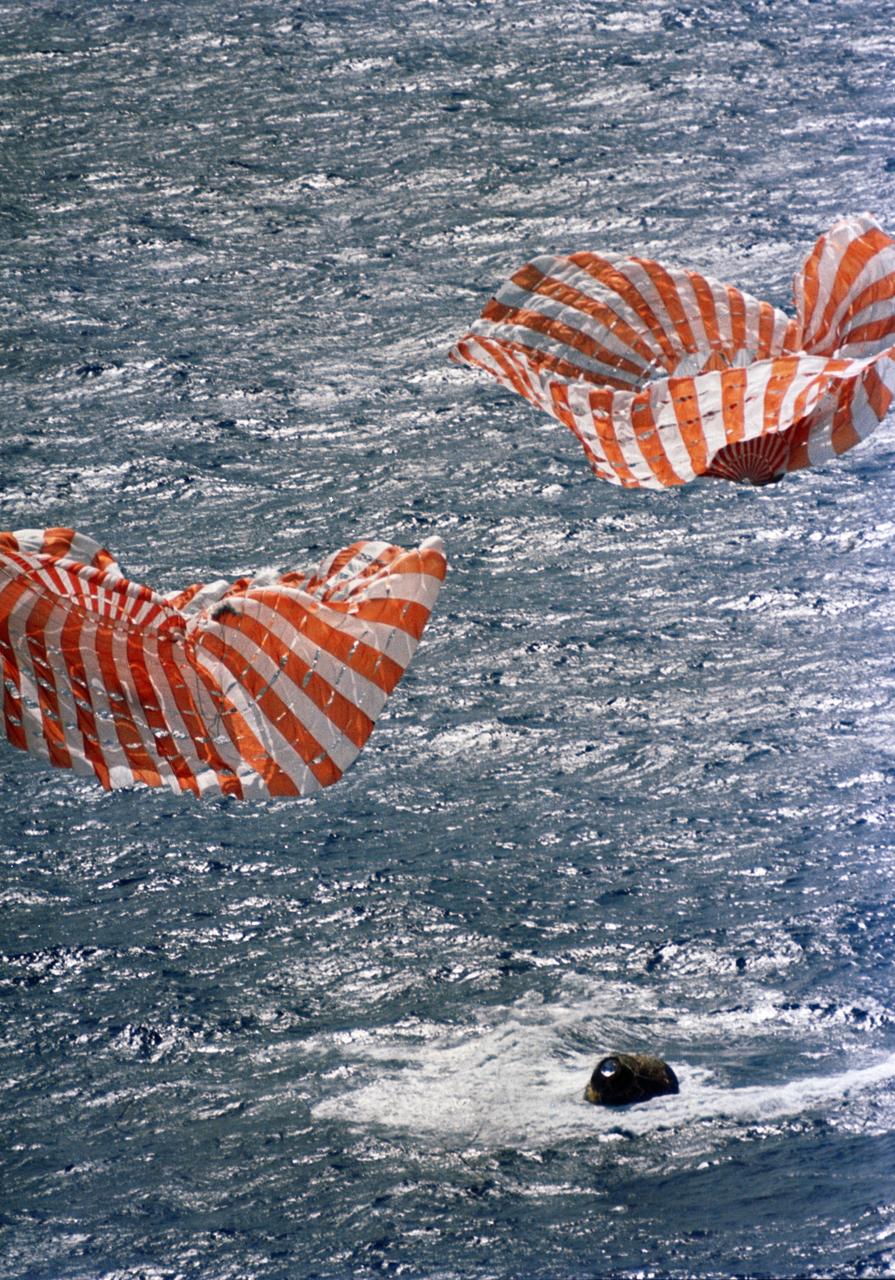
S71-19472 (9 Feb. 1971) --- The Apollo 14 Command Module (CM) splashes down and two of its three main parachutes can be seen collapsing, as the 10-day mission comes to a safe and successful end. The Apollo 14 spacecraft, with astronauts Alan B. Shepard Jr., commander; Stuart A. Roosa, command module pilot; and Edgar D. Mitchell, lunar module pilot, aboard, splashed down at 3:04:39 p.m. (CST) approximately 765 nautical miles southeast of American Samoa.
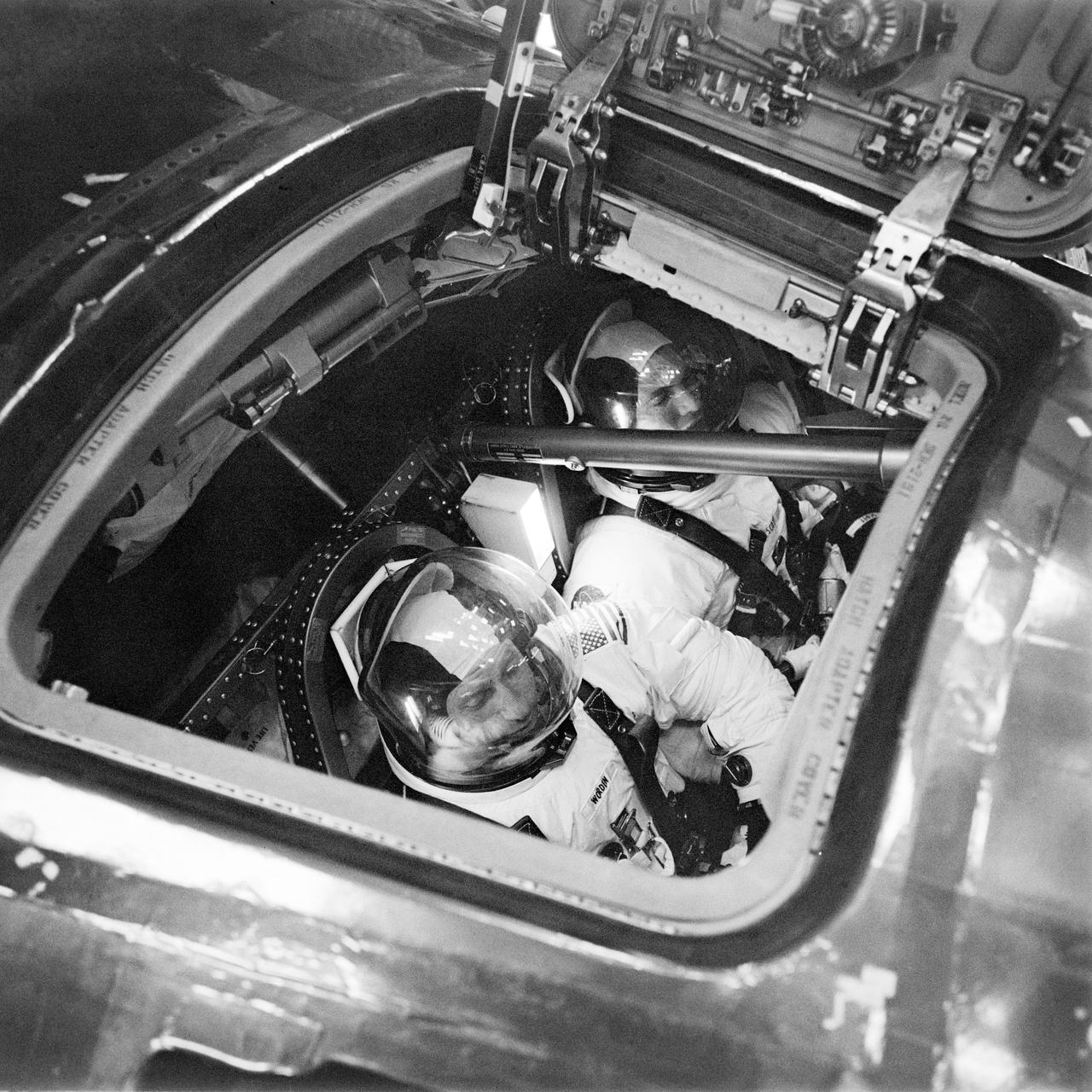
S71-29951 (26 March 1971) --- Two Apollo 15 prime crew members can be seen inside the Apollo 15 Command Module (CM) during simulation training at the Kennedy Space Center (KSC). Astronaut David R. Scott, commander, is in the background. Astronaut Alfred M. Worden, foreground, is the command module pilot. Out of view is astronaut James B. Irwin, lunar module pilot.
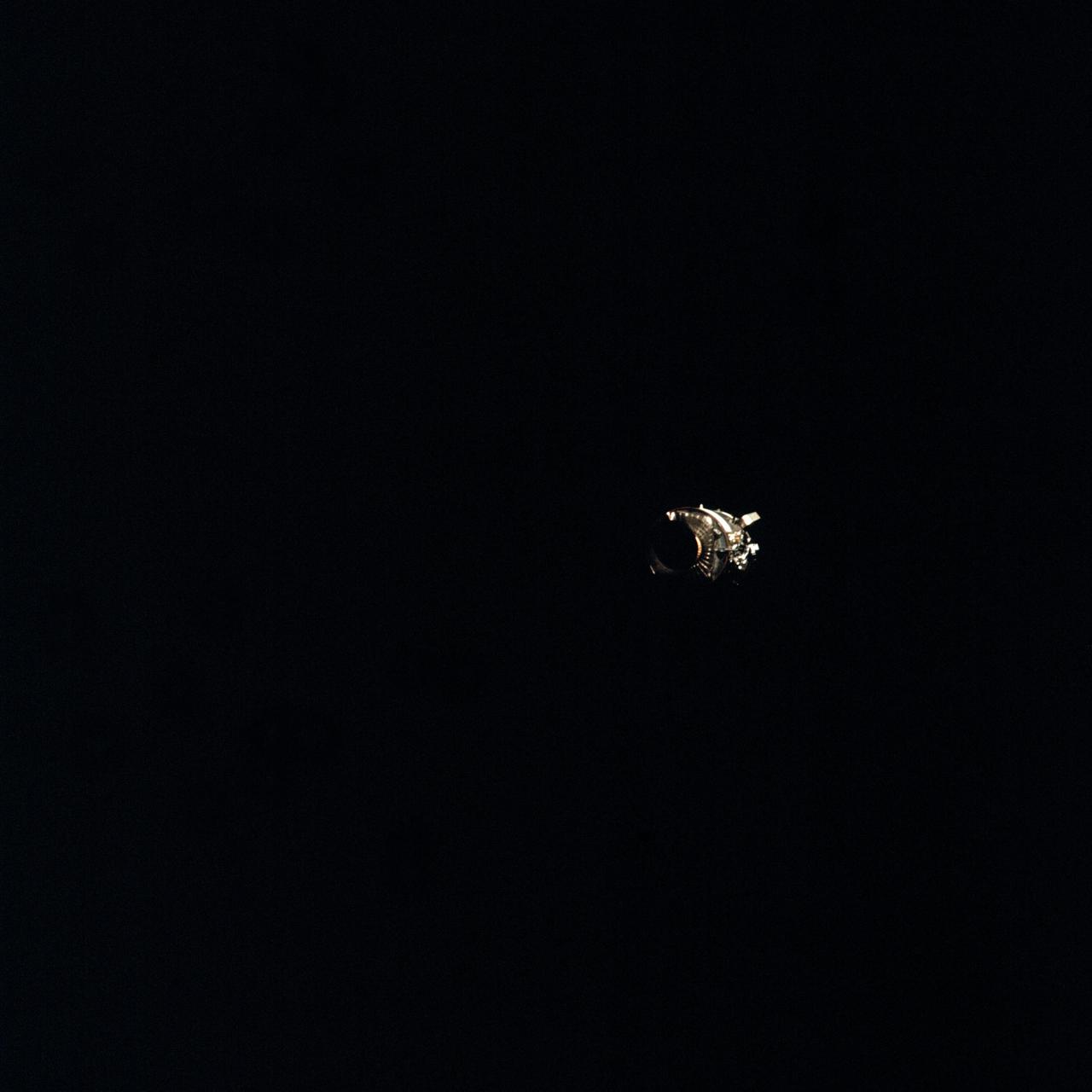
AS13-58-8458 (17 April 1970) --- This view of the severely damaged Apollo 13 Service Module (SM) was photographed from the Lunar Module/Command Module (LM/CM) following SM jettisoning. An entire SM panel was blown away by the apparent explosion of oxygen tank number two. Two of the three fuel cells are visible at the forward portion of the opening. The hydrogen tanks are located in Sector 4 of the Apollo 13 SM. The apparent rupture of the oxygen tank caused the Apollo 13 crew members to use the LM as a "lifeboat." The LM was jettisoned just prior to Earth re-entry by the CM.

AS11-44-6642 (21 July 1969) --- The Apollo 11 Lunar Module ascent stage, with astronauts Neil A. Armstrong and Edwin E. Aldrin Jr. aboard, is photographed from the Command and Service Modules (CSM) during rendezvous in lunar orbit. The Lunar Module (LM) was making its docking approach to the CSM. Astronaut Michael Collins remained with the CSM in lunar orbit while the other two crewmen explored the lunar surface. The large, dark-colored area in the background is Smyth's Sea, centered at 85 degrees east longitude and 2 degrees south latitude on the lunar surface (nearside). This view looks west. The Earth rises above the lunar horizon.
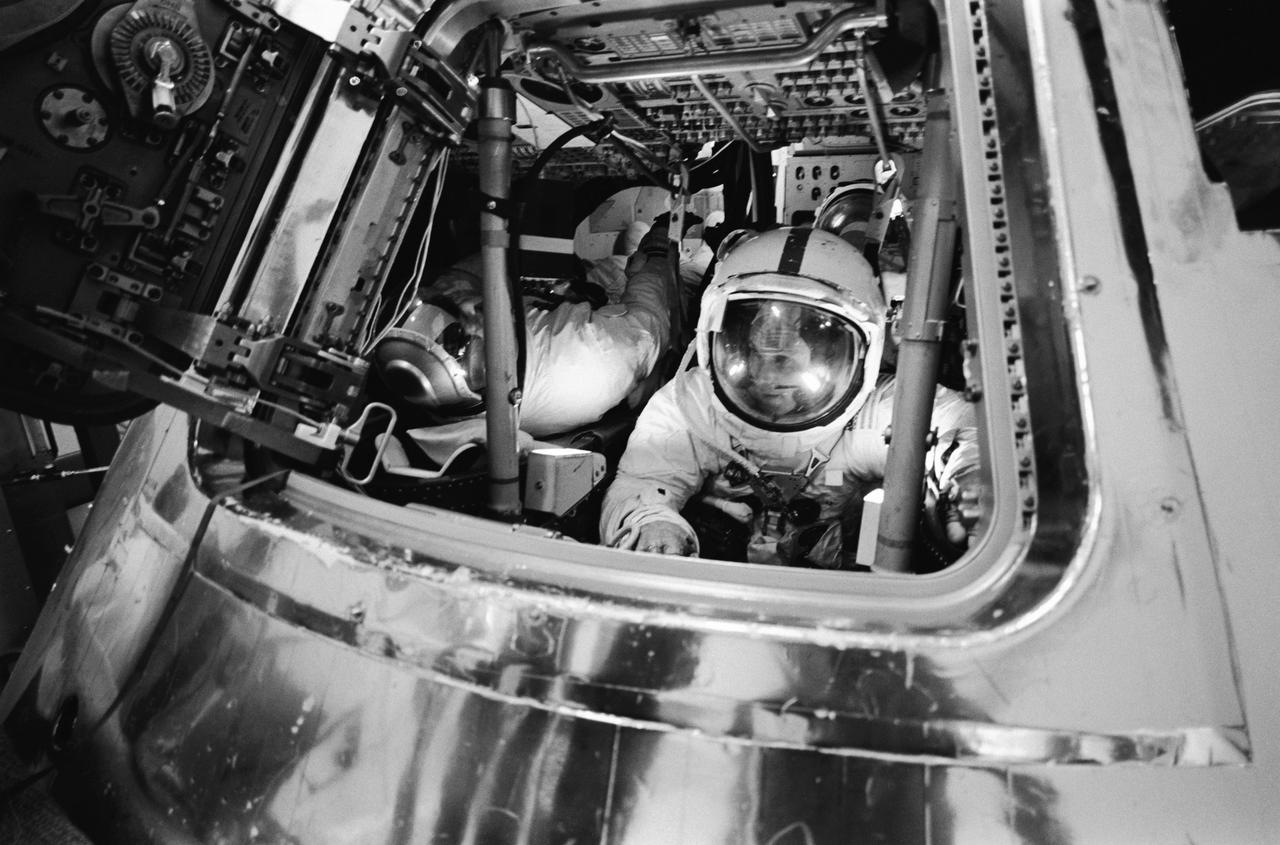
S72-31047 (March 1972) --- Astronaut Thomas K. Mattingly II (right foreground), command module pilot of the Apollo 16 lunar landing mission, participates in extravehicular activity (EVA) training in Building 5 at the Manned Spacecraft Center (MSC). Mattingly is scheduled to perform EVA during the Apollo 16 journey home from the moon. Astronaut John W. Young, commander, can be seen in the left background. In the right background is astronaut Charles M. Duke Jr., lunar module pilot. They are inside the Apollo Command Module Mission Simulator. While Mattingly remains with the Apollo 16 Command and Service Modules (CSM) in lunar orbit, Young and Duke will descend in the Lunar Module (LM) to the moon's Descartes landing site.
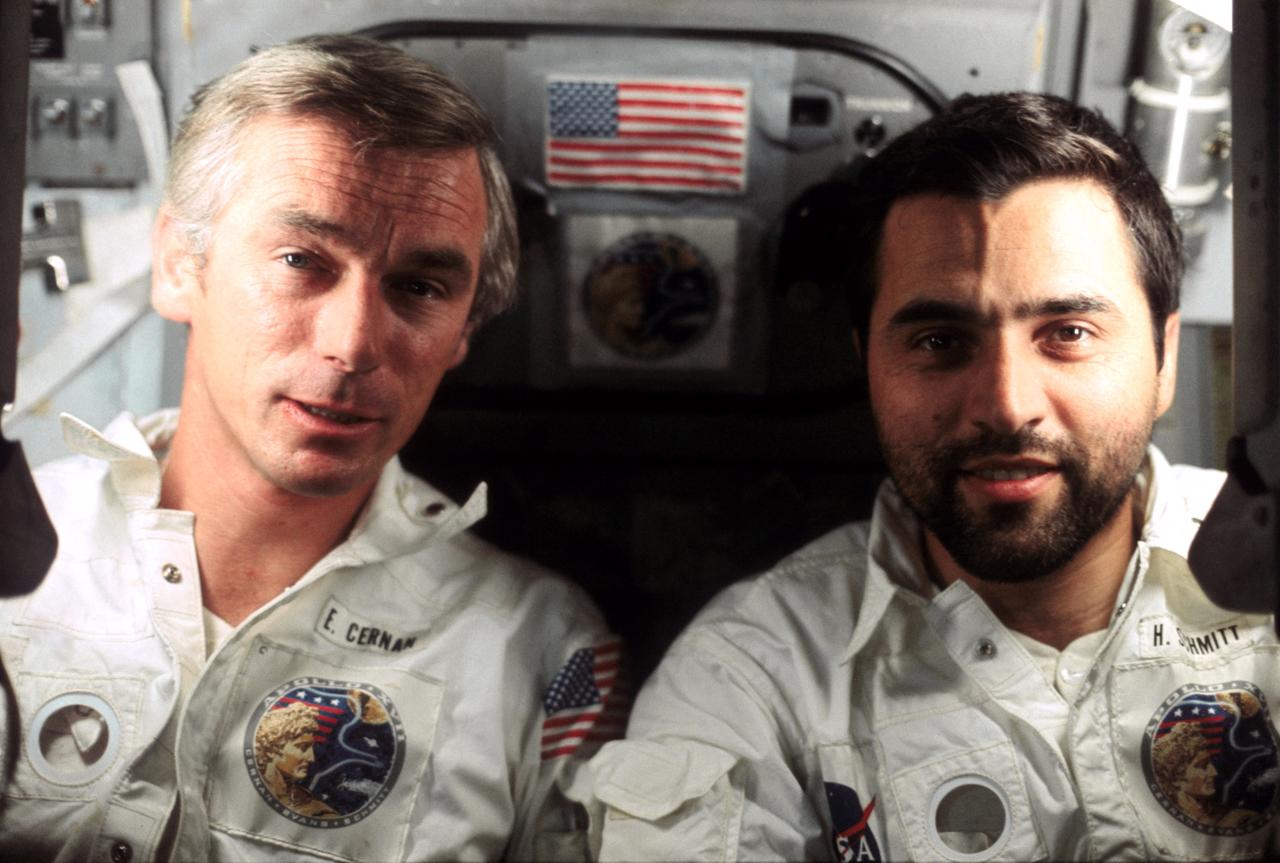
AS17-163-24148 (7-19 Dec. 1972) --- Astronaut Eugene A. Cernan (left) and scientist-astronaut Harrison H. "Jack" Schmitt are photographed by the third crew man aboard the Apollo 17 spacecraft during the final lunar landing mission in NASA's Apollo program. Astronaut Ronald E. Evans, command module pilot, took this picture. Cernan was the mission commander. Schmitt served as the lunar module pilot.
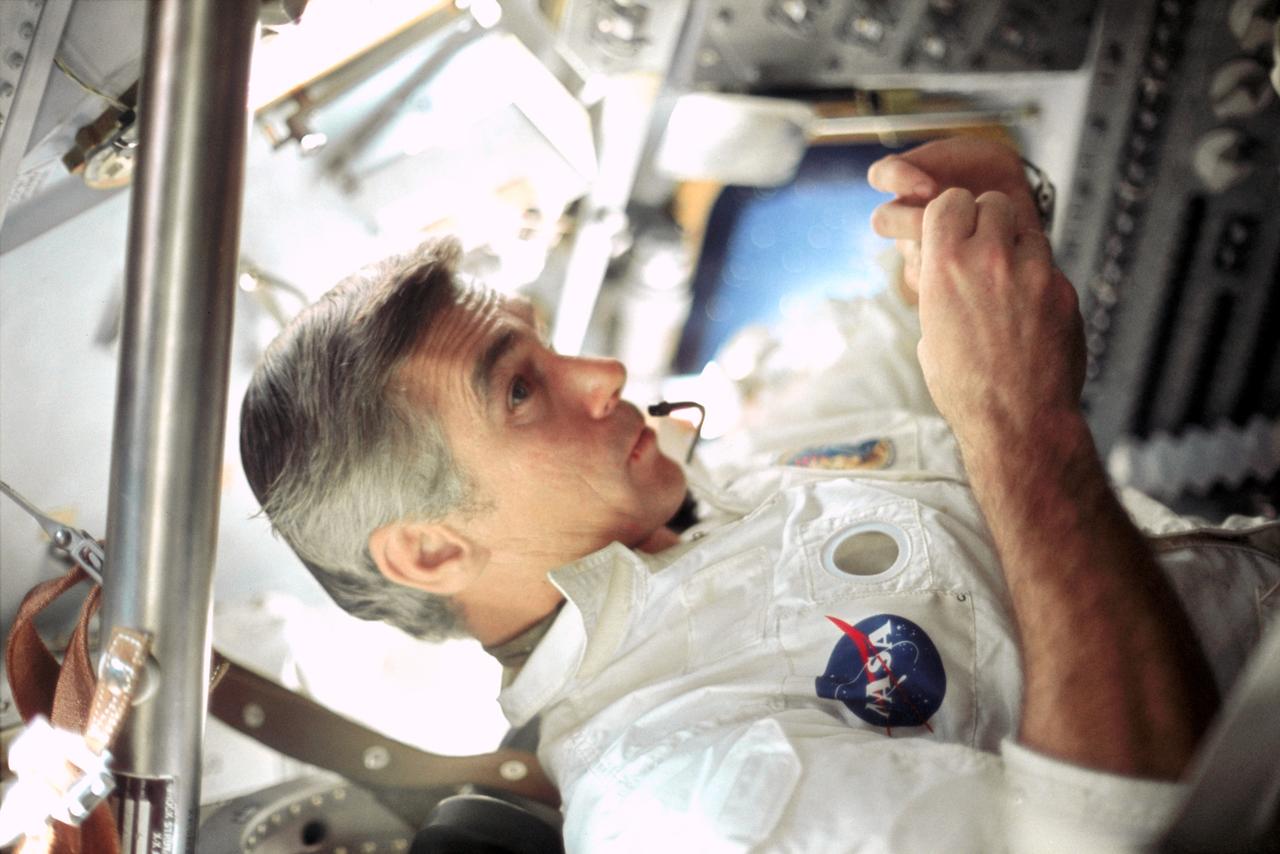
AS17-163-24122 (7-19 Dec. 1972) --- This candid photograph of astronaut Eugene A. Cernan was taken by a fellow crewman aboard the Apollo 17 spacecraft during the final lunar landing mission in NASA's Apollo program. Cernan was the mission commander. Also, aboard Apollo 17 were astronaut Ronald E. Evans, command module pilot, and scientist-astronaut Harrison H. "Jack" Schmitt, lunar module pilot.
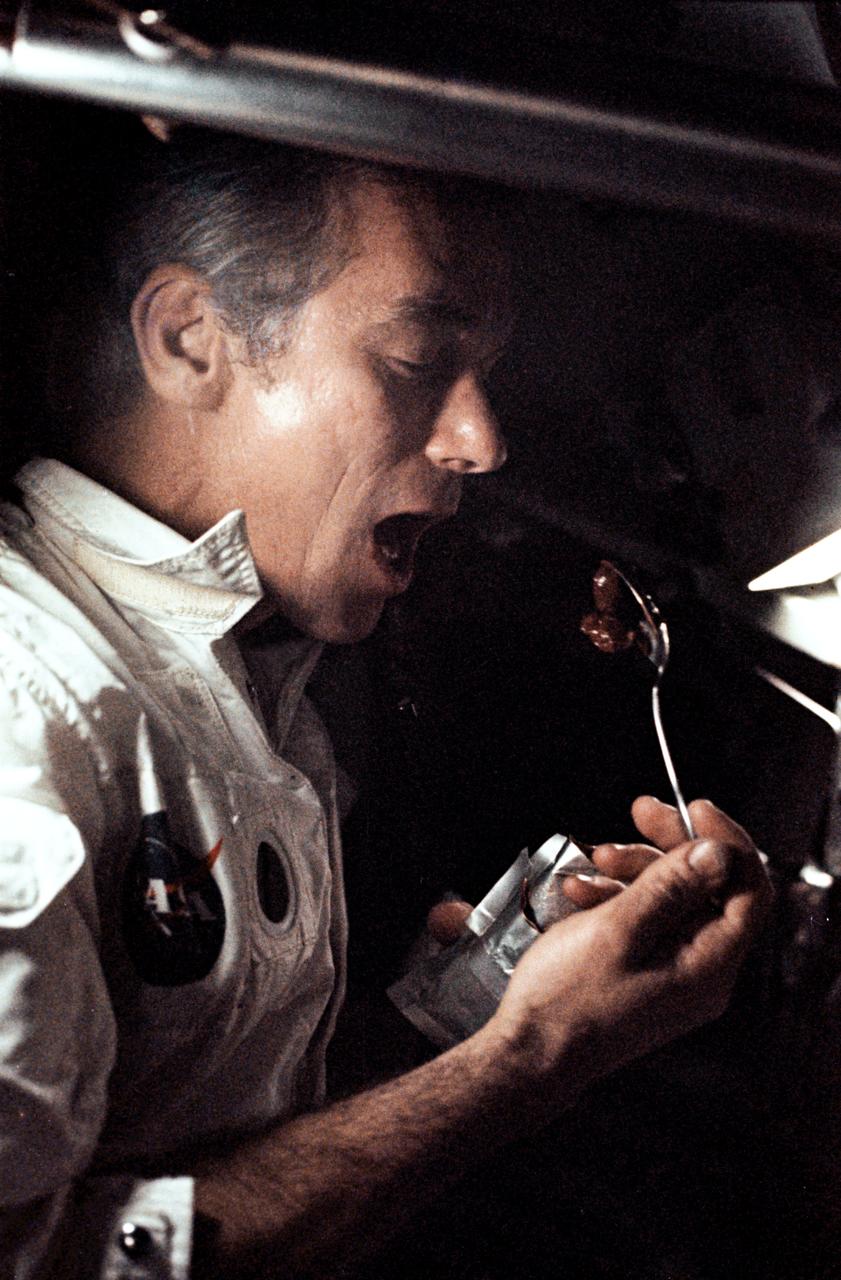
AS17-163-24129 (7-19 Dec. 1972) --- A fellow crewman took this photograph of astronaut Eugene A. Cernan eating a meal under weightlessness conditions of space during the final lunar landing mission in NASA's Apollo program. Also, aboard the Apollo 17 spacecraft were astronaut Ronald E. Evans, command module pilot, and scientist-astronaut Harrison H. "Jack" Schmitt, lunar module pilot. Cernan was the mission commander.
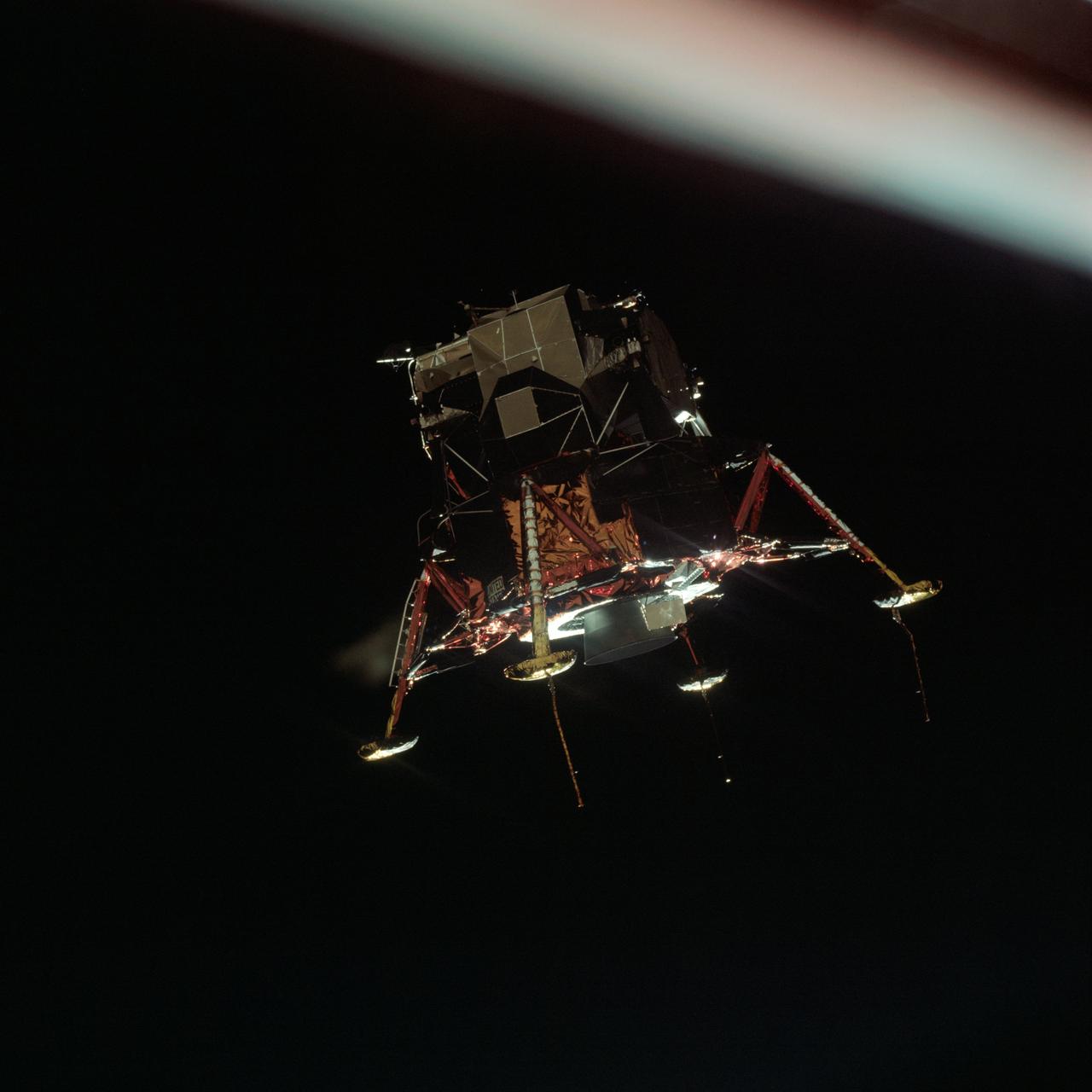
AS11-44-6581 (20 July 1969) --- The Apollo 11 Lunar Module (LM), in a lunar landing configuration, is photographed in lunar orbit from the Command and Service Modules (CSM). Inside the LM were astronauts Neil A. Armstrong, commander, and Edwin E. Aldrin Jr., lunar module pilot. Astronaut Michael Collins, command module pilot, remained with the CSM in lunar orbit while Armstrong and Aldrin descended in the LM to explore the lunar surface. The protrusions connected to the landing pods are sensors to aid in the touchdown or landing process.
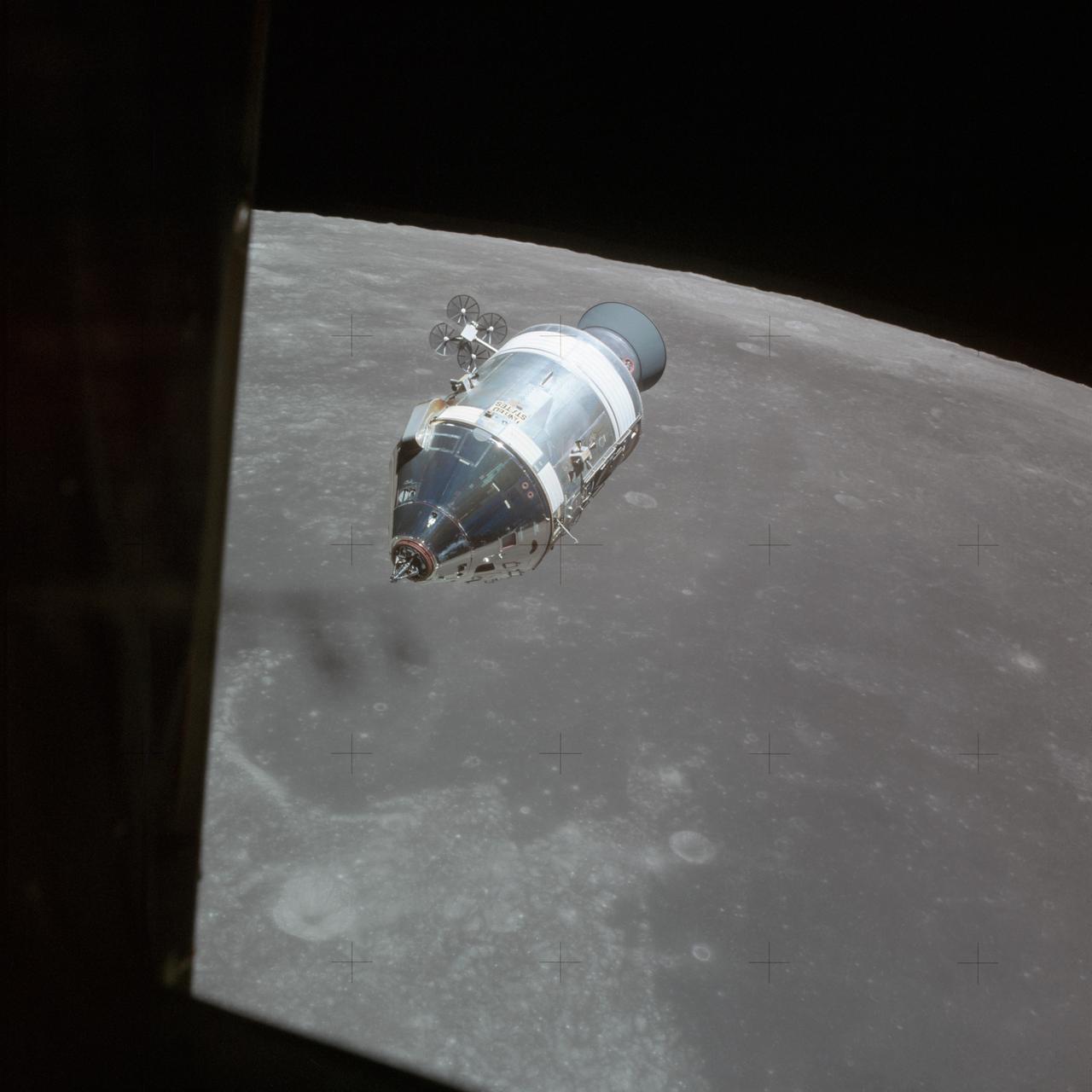
AS15-88-11961 (2 Aug. 1971) --- A view of the Apollo 15 Command and Service Modules (CSM) in lunar orbit as photographed from the Lunar Module (LM) just after rendezvous. The lunar area below is the northeastern side of the Sea of Fertility. While astronauts David R. Scott, commander, and James B. Irwin, lunar module pilot, descended in the LM to explore the Hadley-Apennine area of the moon, astronaut Alfred M. Worden, command module pilot, remained with the CSM in lunar orbit.
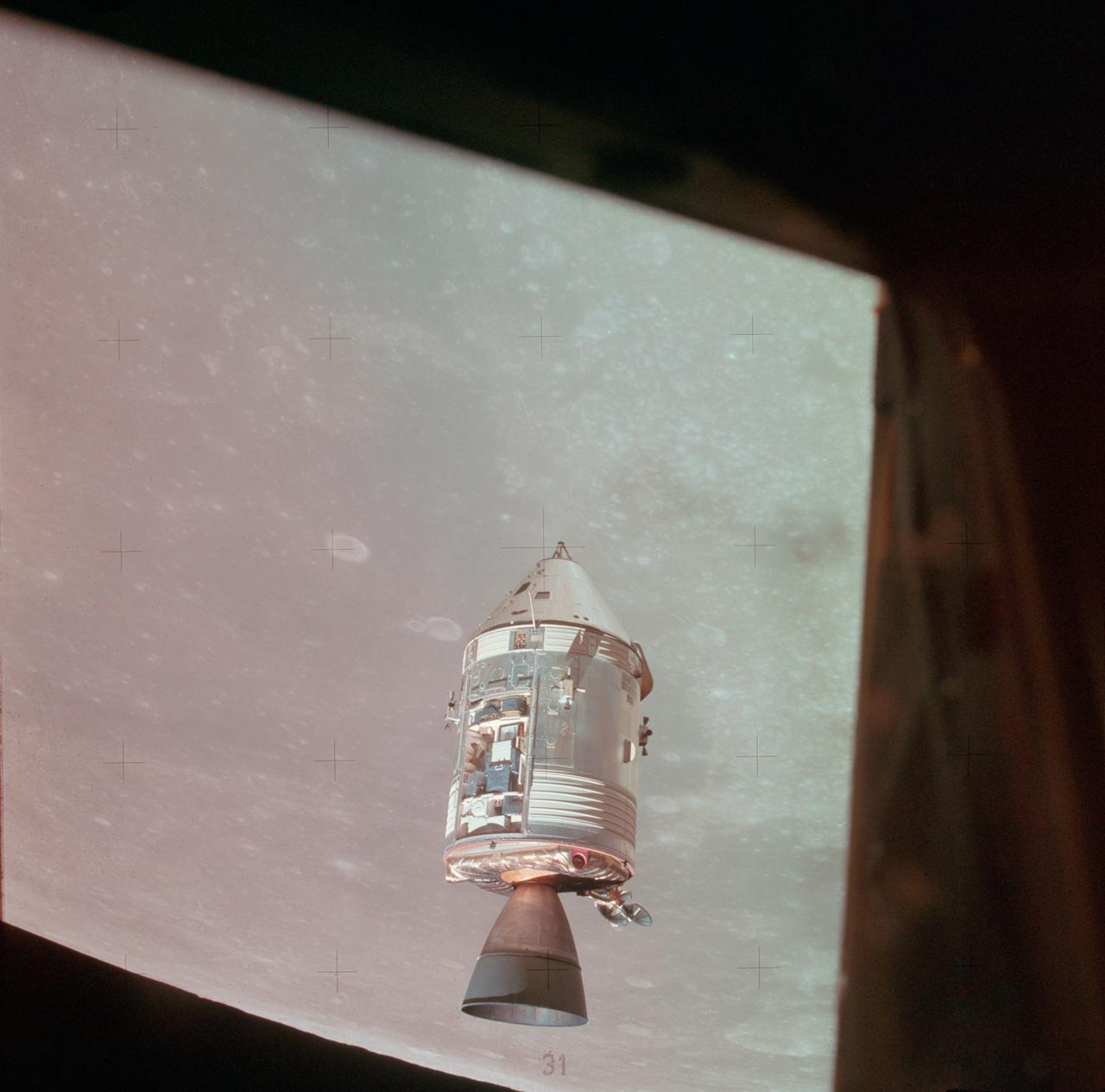
AS15-88-11968 (2 Aug. 1971) --- A view of the Apollo 15 Command and Service Modules (CSM) in lunar orbit as photographed from the Lunar Module (LM) "Falcon" just after rendezvous. The lunar features below are located on the east side of the Sea of Tranquility. While astronauts David R. Scott, commander; and James B. Irwin, lunar module pilot, descended in the LM to explore the moon, astronaut Alfred M. Worden, command module pilot, remained with the CSM in lunar orbit.
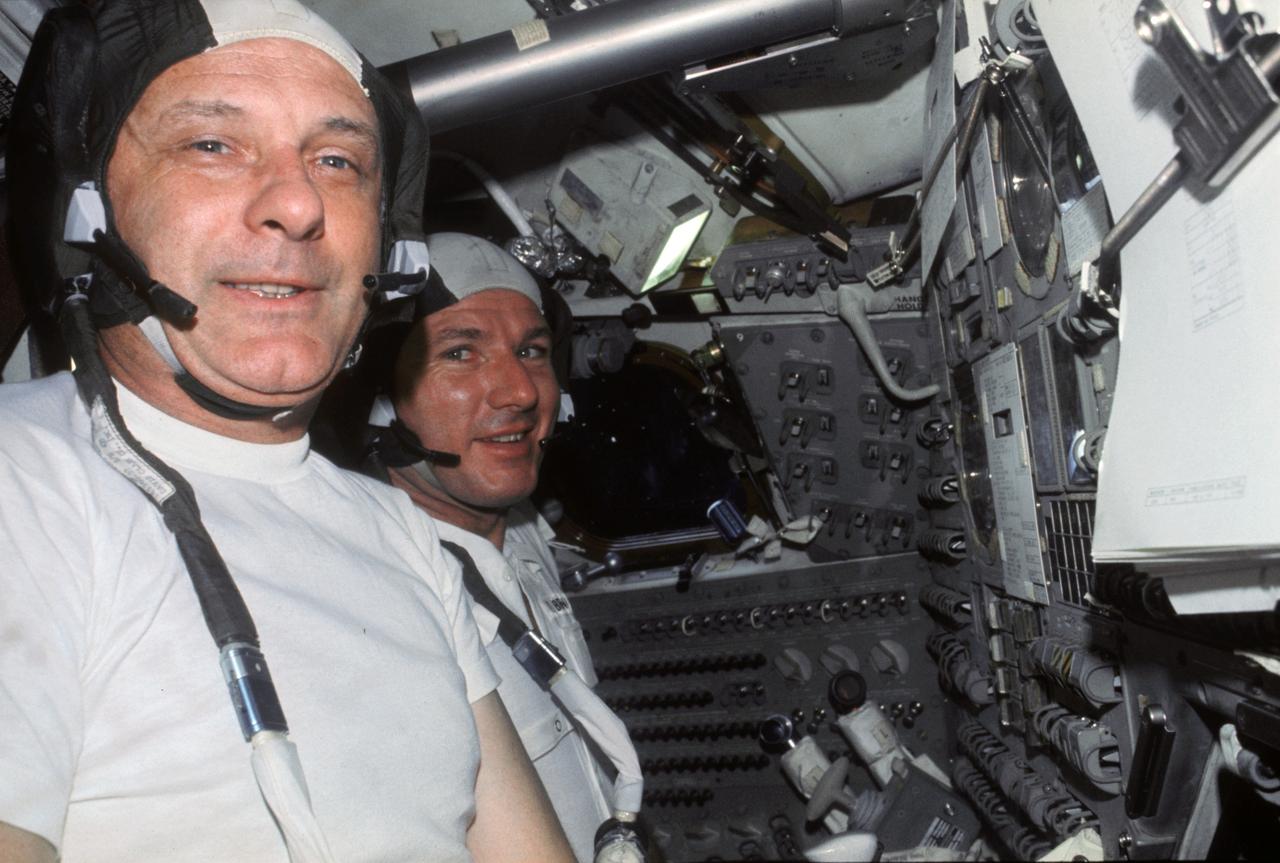
AST-06-344 (15-24 July 1975) --- Two American ASTP crewmen, astronauts Thomas P. Stafford (foreground) and Vance D. Brand are seen in the Apollo Command Module during the joint U.S.-USSR Apollo-Soyuz Test Project docking mission in Earth orbit. This picture was taken with a 35mm camera.
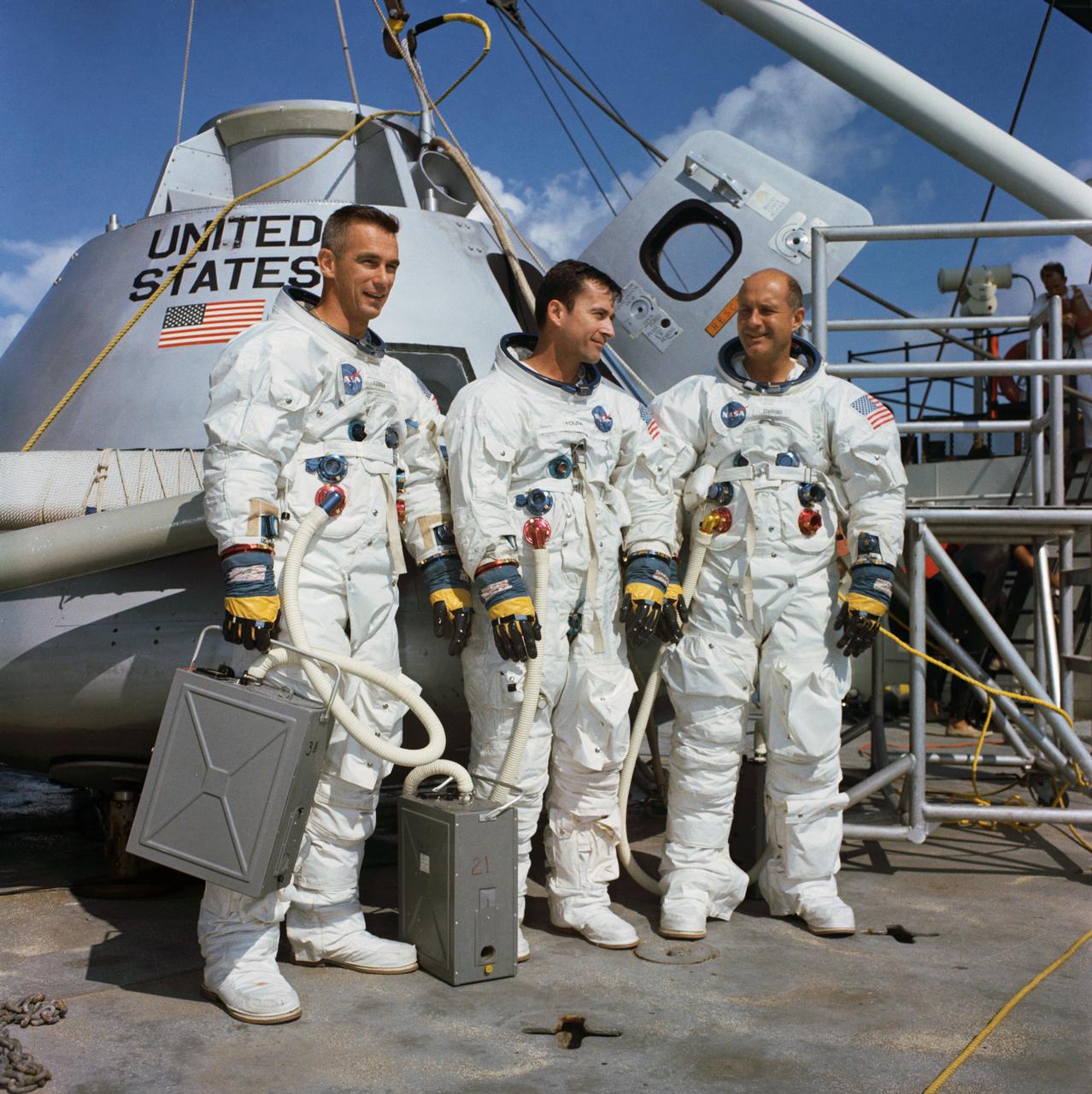
S68-42906 (13 Nov. 1968) --- NASA has named these three astronauts as the prime crew of the Apollo 10 space mission. Left to right are Eugene A. Cernan, lunar module pilot; John W. Young, command module pilot; and Thomas P. Stafford, commander.
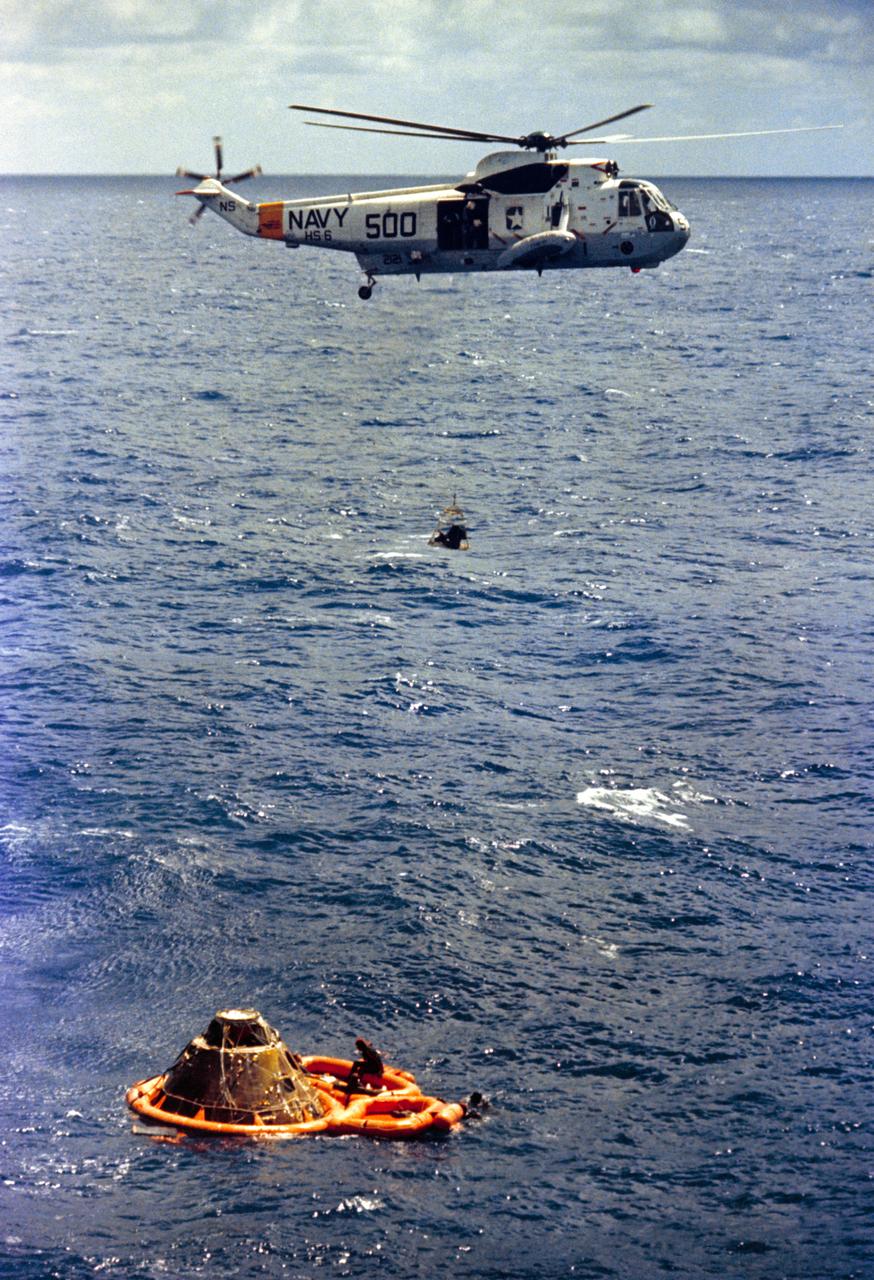
S71-19476 (9 Feb. 1971) --- Astronaut Stuart A. Roosa, command module pilot, is hoisted inside a Billy Pugh net to a U.S. Navy helicopter assisting in Apollo 14 recovery operations in the South Pacific Ocean. Visible in a life raft beside the Command Module (CM) are astronauts Alan B. Shepard Jr., commander, back to camera; and Edgar D. Mitchell (partially obscured by the spacecraft), lunar module pilot. Three U.S. Navy underwater demolition team swimmers who assisted in the recovery operations are pictured in and around the life raft. Apollo 14 splashdown occurred at 3:04:39 p.m. (CST), Feb. 9, 1971, approximately 765 nautical miles south of American Samoa in the South Pacific Ocean.
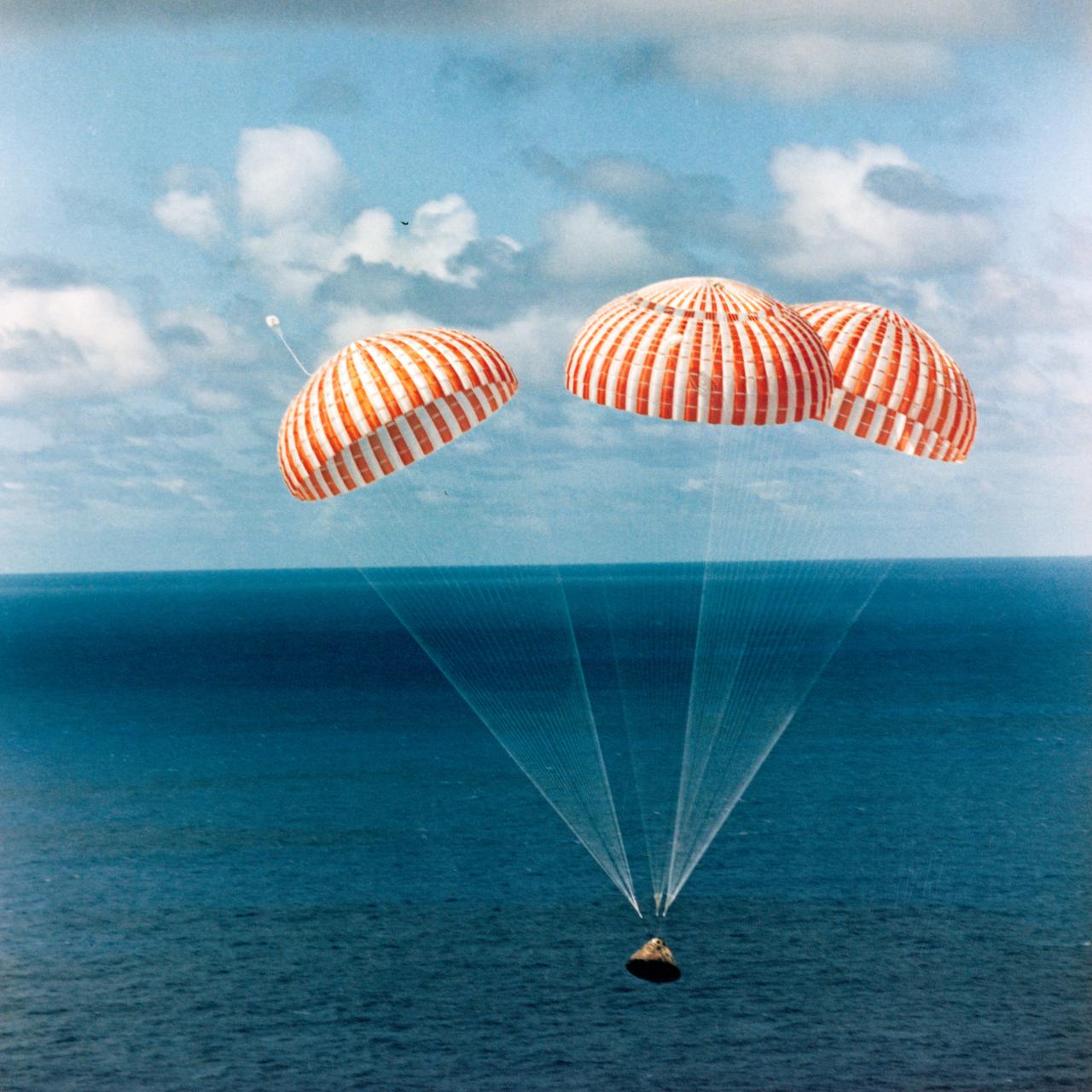
S71-18753 (9 Feb. 1971) --- The Apollo 14 Command Module (CM), with astronauts Alan B. Shepard Jr., commander; Stuart A. Roosa, command module pilot; and Edgar D. Mitchell, lunar module pilot, aboard, approaches touchdown in the South Pacific Ocean to successfully end a 10-day lunar landing mission. The splashdown occurred at 3:04:39 p.m. (CST), Feb. 9, 1971, approximately 765 nautical miles south of American Samoa. The three crew men were flown by helicopter to the USS New Orleans prime recovery ship.
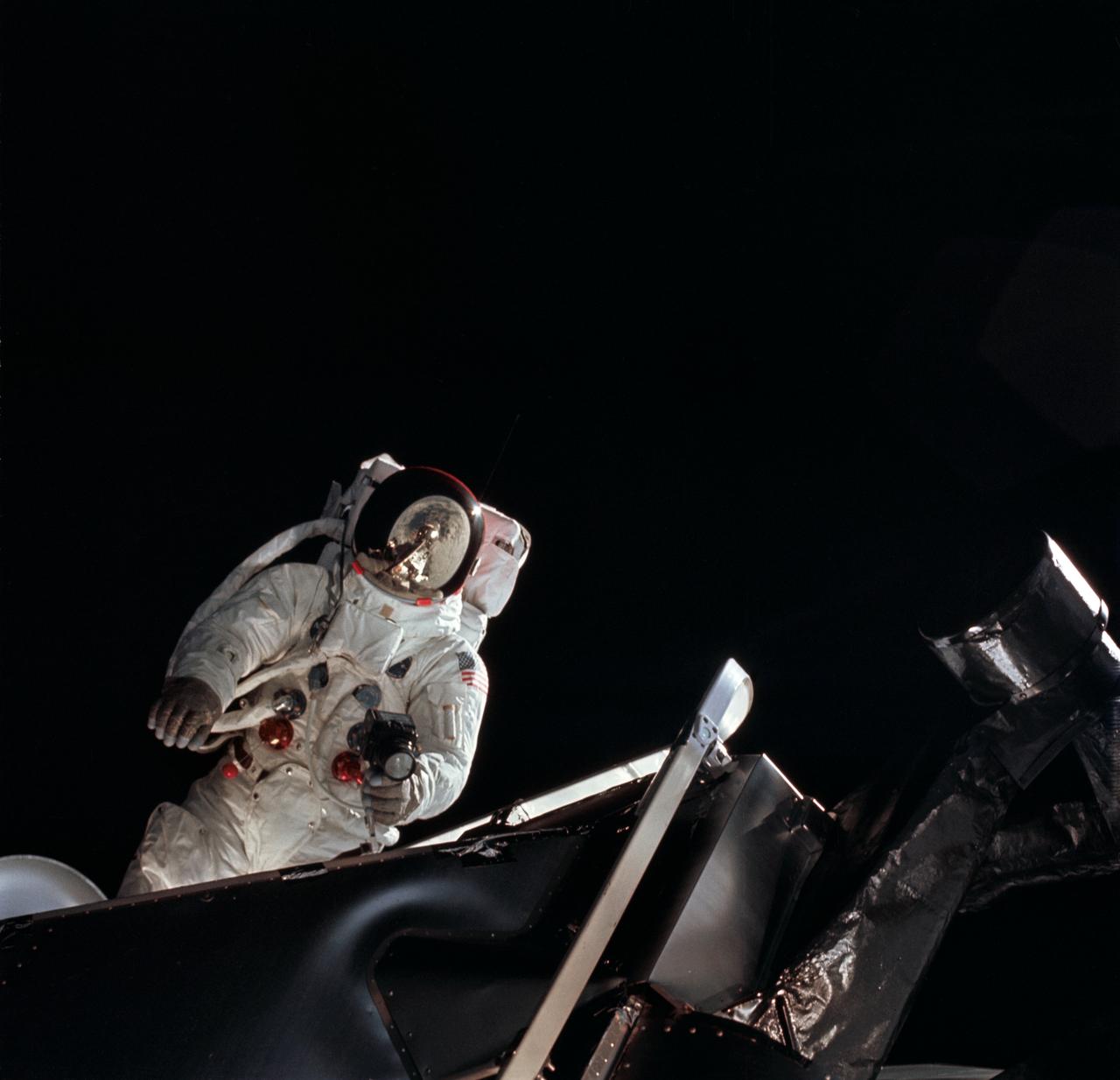
AS09-19-2983 (6 March 1969) --- Astronaut Russell L. Schweickart, lunar module pilot, operates a 70mm Hasselblad camera during his extravehicular activity (EVA) on the fourth day of the Apollo 9 Earth-orbital mission. The Command and Service Modules (CSM) and Lunar Module (LM) "Spider" are docked. This view was taken from the Command Module (CM) "Gumdrop". Schweickart, wearing an Extravehicular Mobility Unit (EMU), is standing in "golden slippers" on the LM porch. On his back, partially visible, are a Portable Life Support System (PLSS) and an Oxygen Purge System (OPS). Astronaut James A. McDivitt, Apollo 9 commander, was inside the "Spider". Astronaut David R. Scott, command module pilot, remained at the controls in the CM.
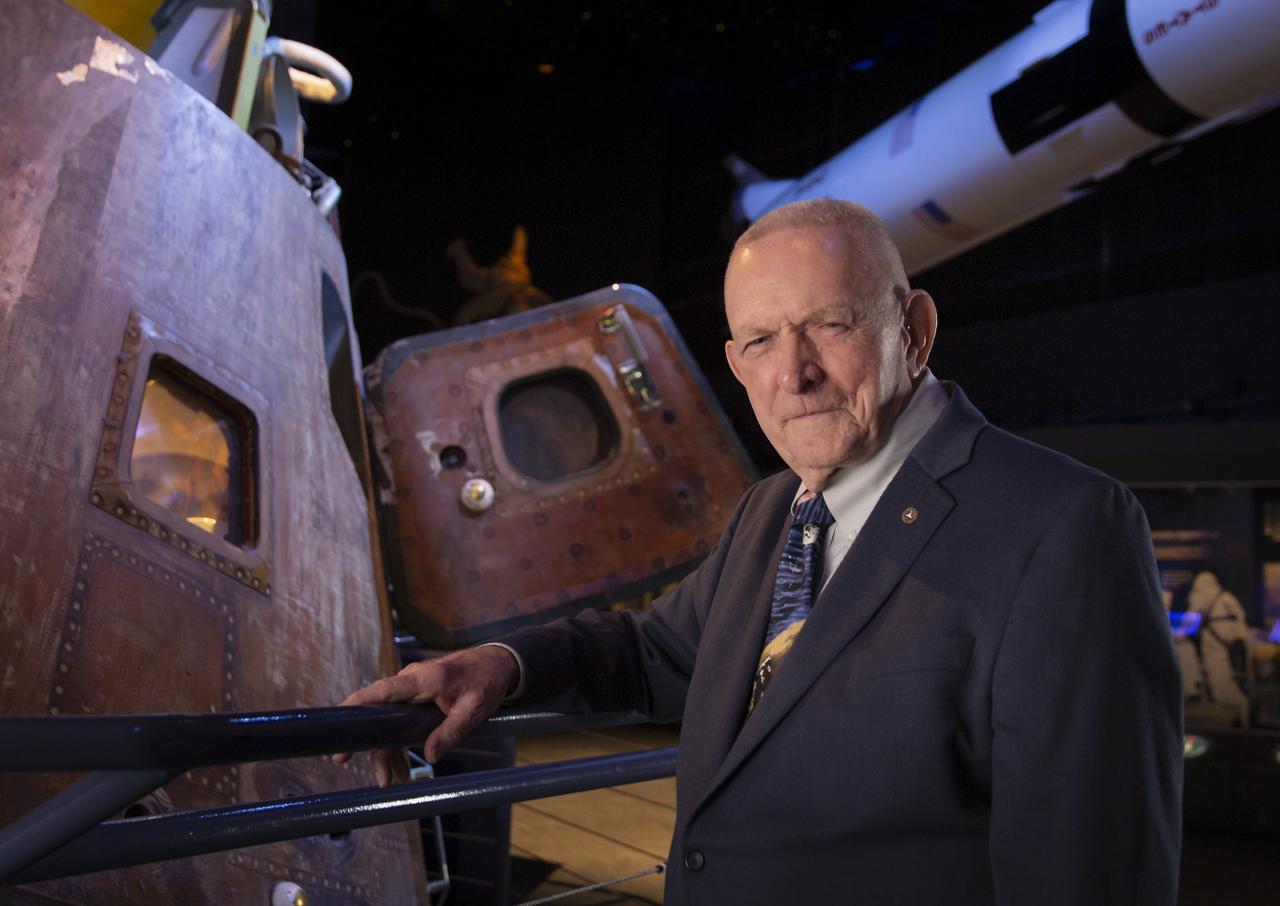
Retired NASA Flight Director and manager Gene Kranz poses for a portrait next to the Apollo 17 Command Module, Thursday, July 11, 2019 at Space Center Houston in Houston, Texas. Photo Credit: (NASA/Bill Ingalls)
Portrait of Astronaut Stuart A. Roosa, Apollo 14 lunar landing mission Command Module pilot in civilian clothes.
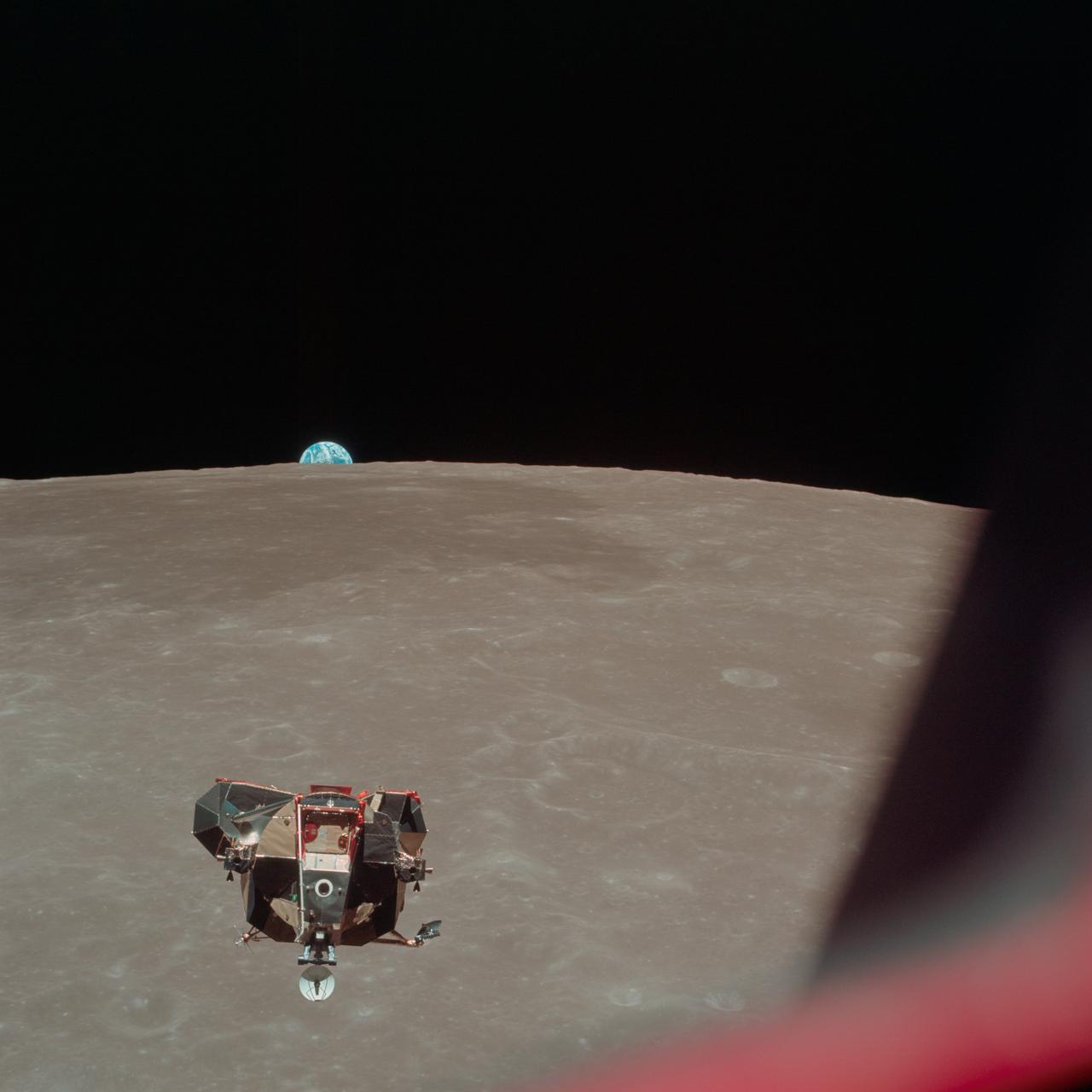
AS11-44-6634 (21 July 1969) --- The Apollo 11 Lunar Module (LM) ascent stage, with astronauts Neil A. Armstrong and Edwin E. Aldrin Jr. onboard, is photographed from the Command and Services Modules (CSM) in lunar orbit. This view is looking west with the Earth rising above the lunar horizon. Astronaut Michael Collins remained with the CSM in lunar orbit while Armstrong and Aldrin explored the moon. The LM is approaching from below. The maze area in the background is Smyth's Sea. At right center is International Astronomical Union crater No. 189.
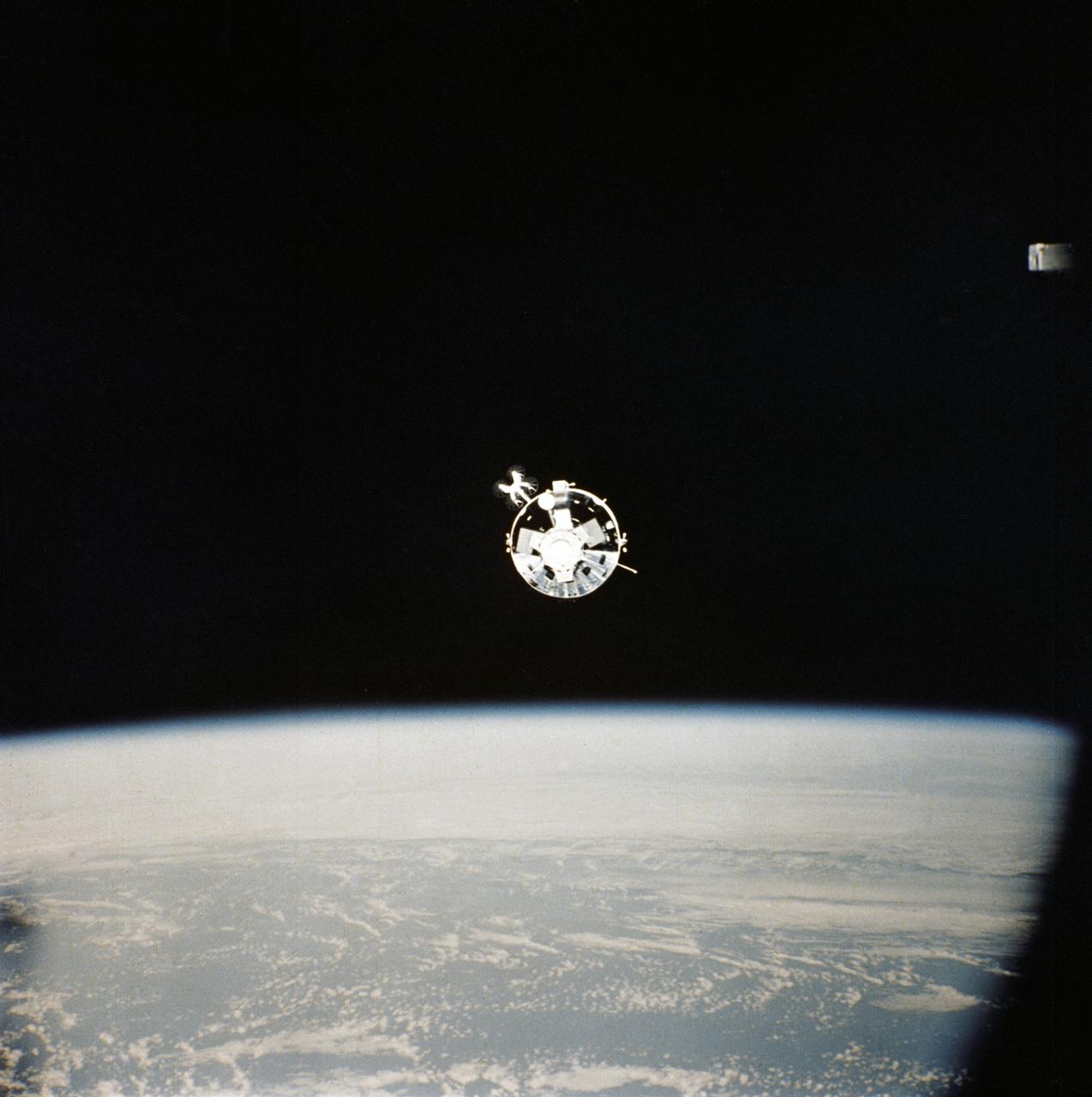
AST-32-2675 (17-19 July 1975) --- The American Apollo spacecraft as seen in Earth orbit from the Soviet Soyuz spacecraft during the joint U.S.-USSR Apollo-Soyuz Test Project mission. The Command/Service Module and Docking Module are contrasted against a black-sky background. This is a "head on" view of the Apollo. The horizon of Earth is below. This picture was furnished by the USSR in an exchange of photography taken during the ASTP flight. The American and Soviet spacecraft were joined together in space for approximately 47 hours on July 17-18-19, 1975. Note the docking mechanism on the Docking Module. PHOTO COURTESY: USSR ACADEMY OF SCIENCES
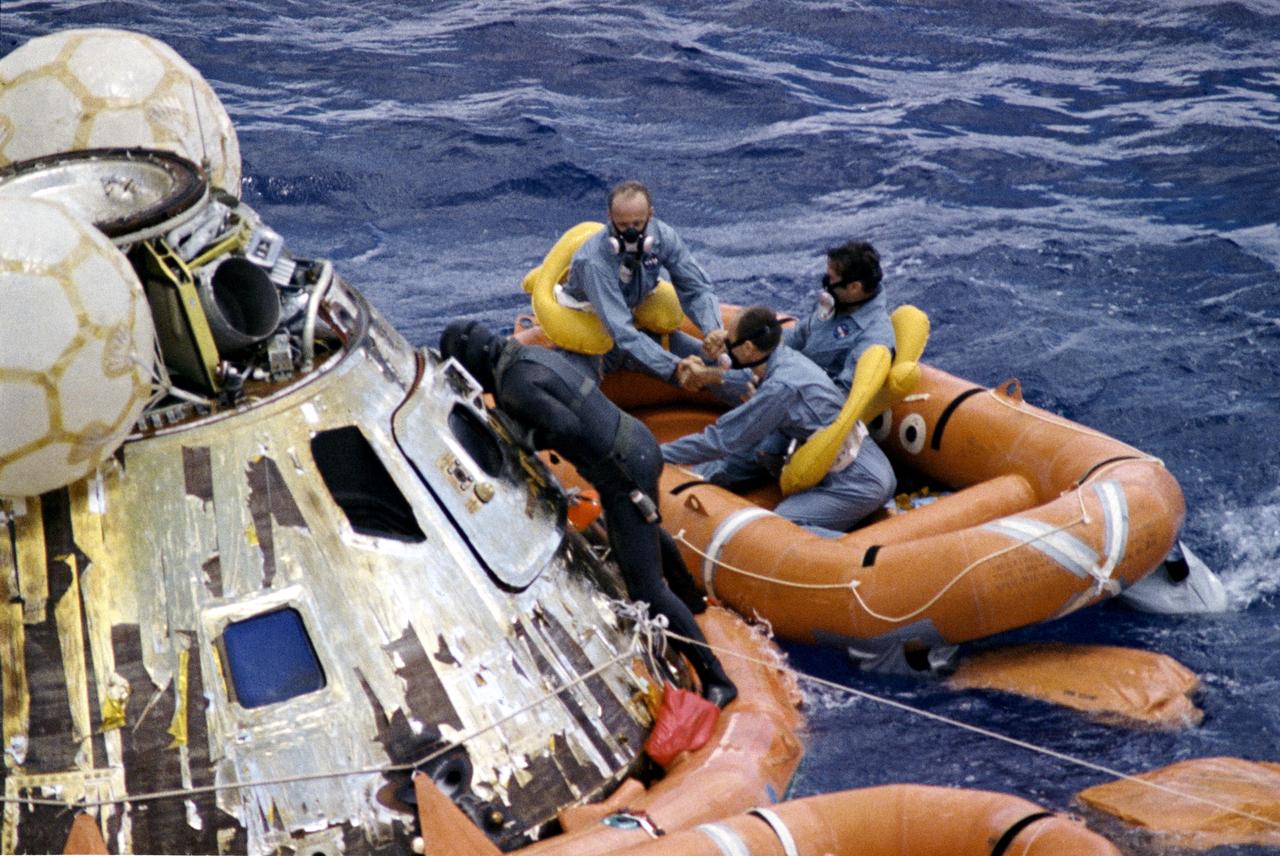
S69-22271 (24 Nov. 1969) --- A United States Navy Underwater Demolition Team swimmer assists the Apollo 12 crew during recovery operations in the Pacific Ocean. In the life raft are astronauts Charles Conrad Jr. (facing camera), commander; Richard F. Gordon Jr. (middle), command module pilot; and Alan L. Bean (nearest camera), lunar module pilot. The three crew men of the second lunar landing mission were picked up by helicopter and flown to the prime recovery ship, USS Hornet. Apollo 12 splashed down at 2:58 p.m. (CST), Nov. 24, 1969, near American Samoa. While astronauts Conrad and Bean descended in the Lunar Module (LM) "Intrepid" to explore the Ocean of Storms region of the moon, astronaut Gordon remained with the Command and Service Modules (CSM) "Yankee Clipper" in lunar orbit.
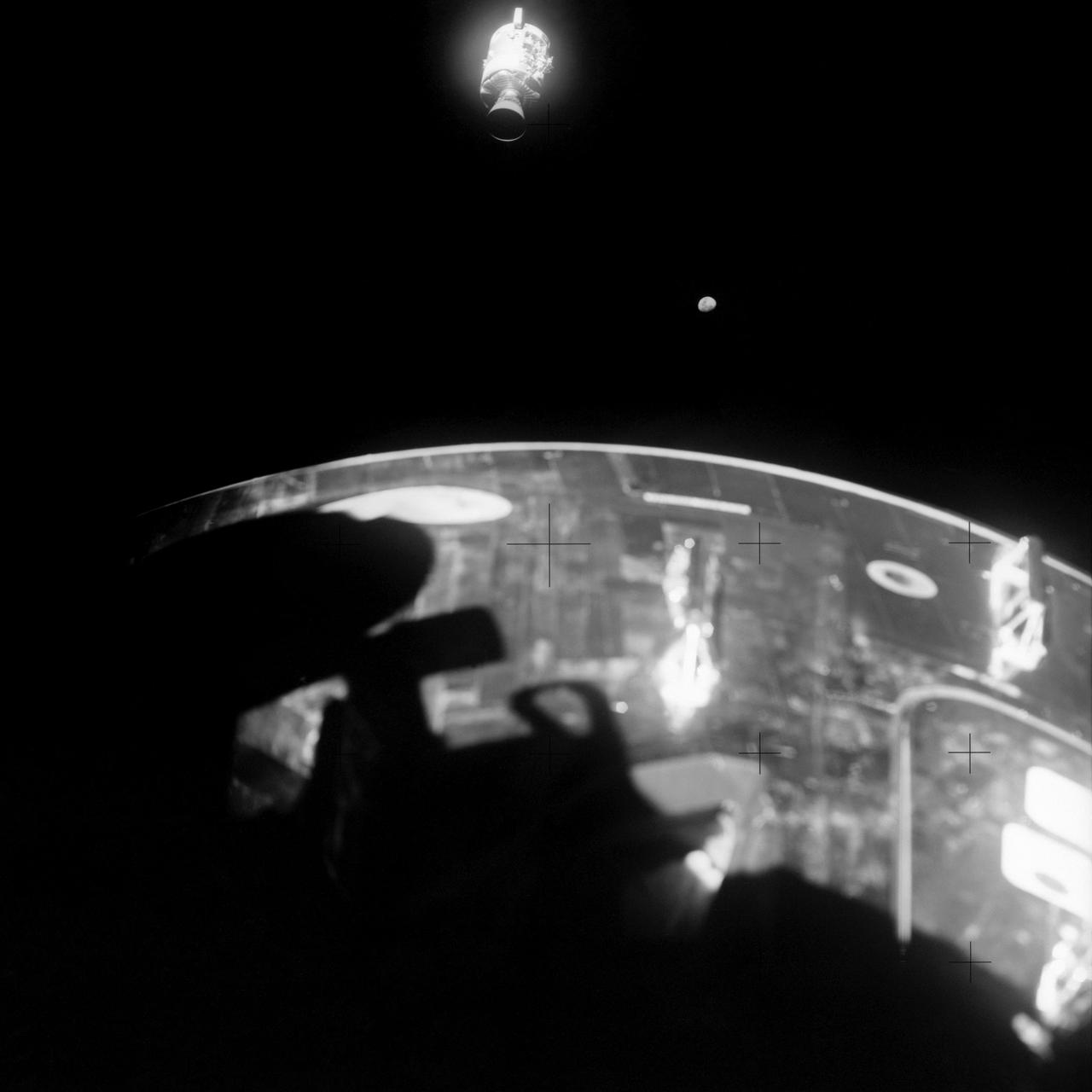
AS13-59-8501 (17 April 1970) --- This view of the severely damaged Apollo 13 Service Module (SM) was photographed from the Lunar Module/Command Module (LM/CM) following SM jettisoning. As seen here, an entire panel on the SM was blown away by the apparent explosion of oxygen tank number two located in Sector 4 of the SM. Two of the three fuel cells are visible just forward (above) the heavily damaged area. Three fuel cells, two oxygen tanks, and two hydrogen tanks are located in Sector 4. The damaged area is located above the S-Band high gain antenna. Nearest the camera is the Service Propulsion System (SPS) engine and nozzle. The damage to the SM caused the Apollo 13 crew men to use the LM as a "lifeboat." The LM was jettisoned just prior to Earth re-entry by the CM.
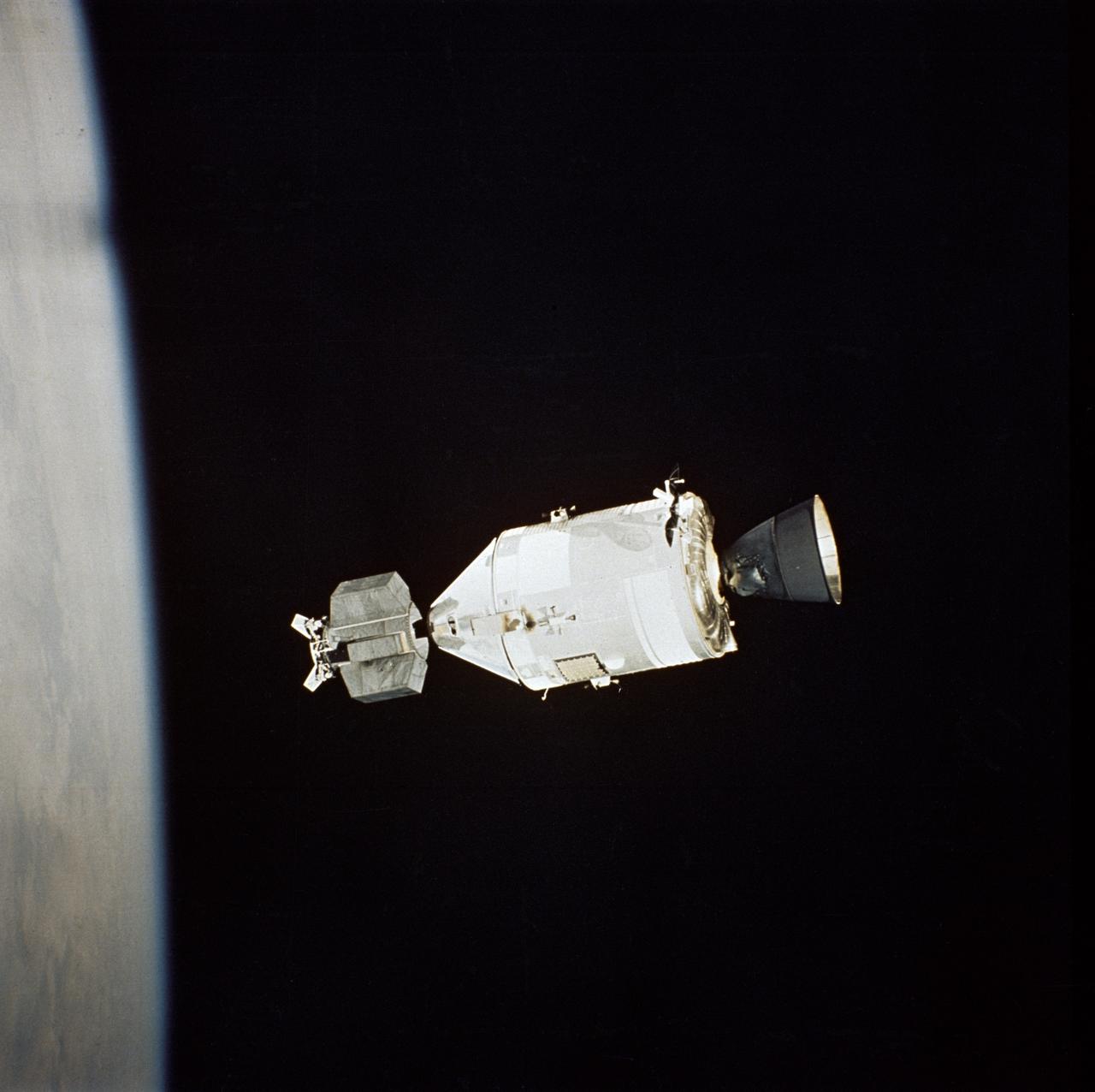
AST-32-2695 (17-19 July 1975) --- The American Apollo spacecraft as seen in Earth orbit from the Soviet Soyuz spacecraft during the joint U.S.-USSR Apollo-Soyuz Test Project mission. The Command/Service Module and Docking Module are contrasted against a black-sky background. The horizon of Earth is below. This picture was furnished by the USSR in an exchange of photography taken during the ASTP flight. The bell-shaped engine nozzle of the service propulsion system protrudes from the rear of the Service Module. Note the docking mechanism on the Docking Module. The American and Soviet spacecraft were joined together in space for approximately 47 hours on July 17-18-19, 1975. PHOTO COURTESY: USSR ACADEMY OF SCIENCES
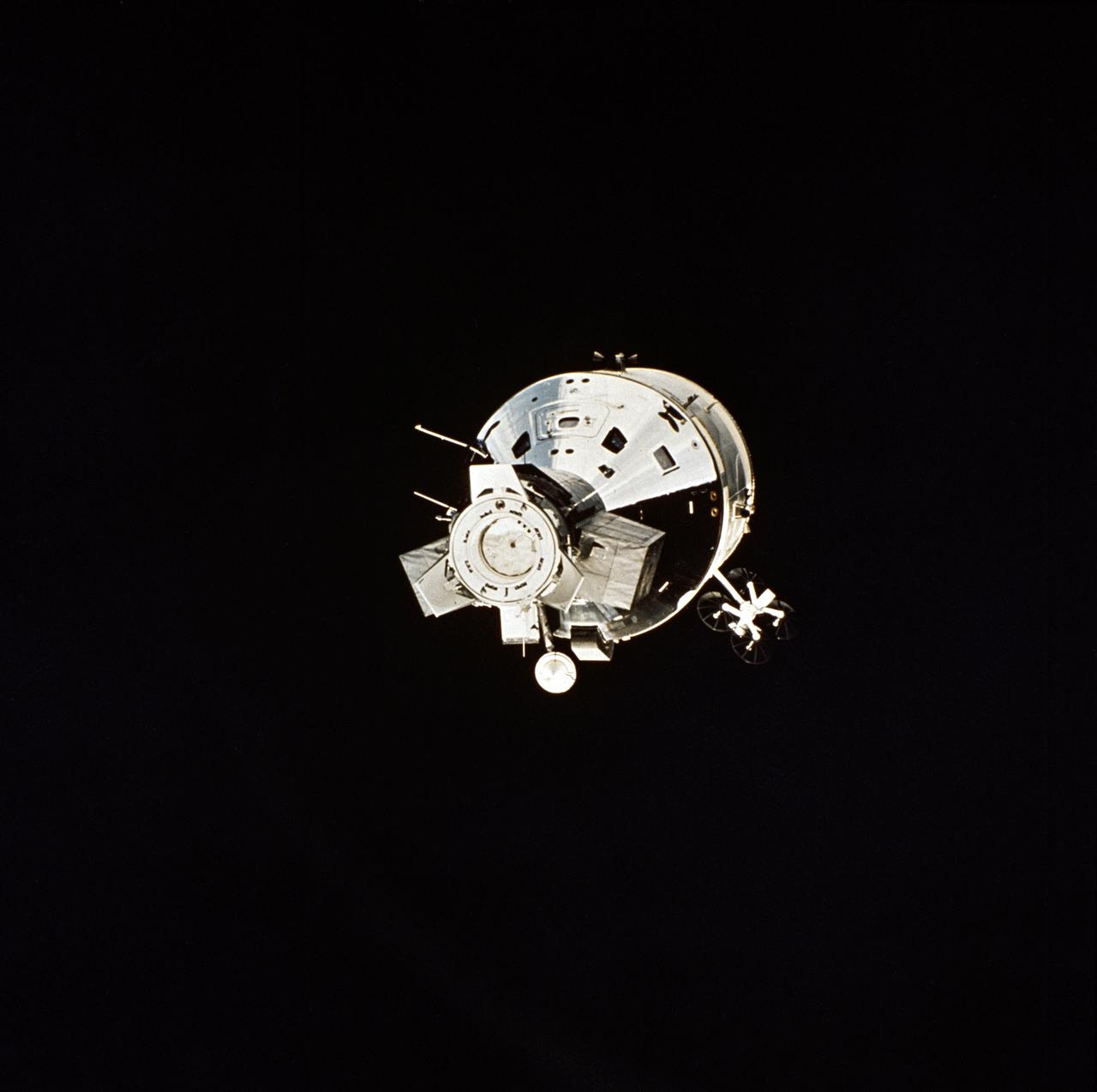
AST-32-2691 (17-19 July 1975) --- The American Apollo spacecraft as seen in Earth orbit from the Soviet Soyuz spacecraft during the joint U.S.-USSR Apollo-Soyuz Test Project mission. The Command/Service Module and Docking Module are contrasted against a black-sky background. This is a near "head on" view of the Apollo. This picture was furnished by the USSR in an exchange of photography taken during the ASTP flight. Note the docking mechanism and docking target on the Docking Module. The four dish-like reflectors of the unified S-band high-gain antenna protrude from the side of the Service Module. The American and Soviet spacecraft were joined together in space for approximately 47 hours on July 17-18-19, 1975. PHOTO COURTESY: USSR ACADEMY OF SCIENCES
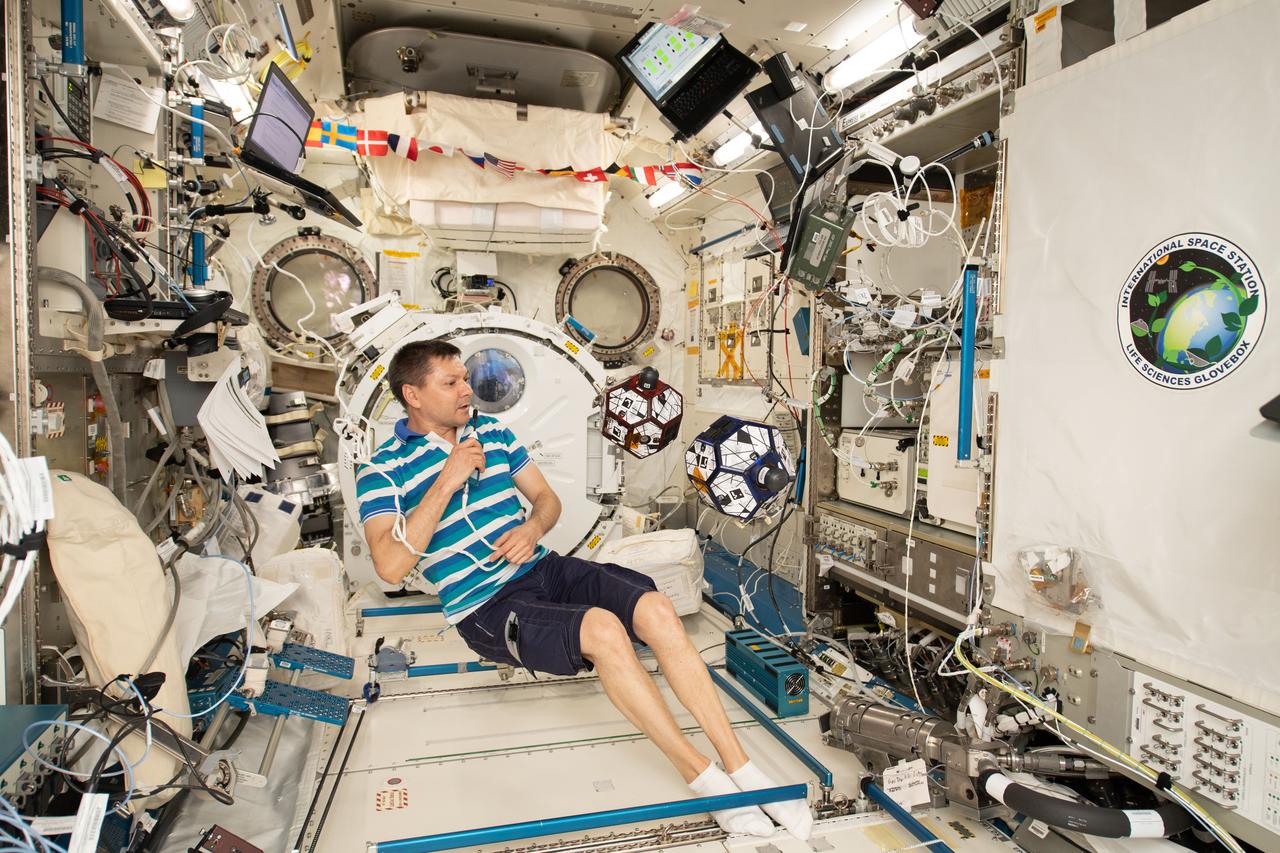
iss058e003128 (Jan. 14, 2019) --- Commander Oleg Kononenko works inside the Japanese Kibo lab module monitoring a pair of tiny internal free-flying satellites known as SPHERES (Synchronized Position Hold, Engage, Reorient, Experimental Satellites). High school students compete to design the best algorithms that control the basketball-sized satellites to mimic spacecraft maneuvers and formation flying.
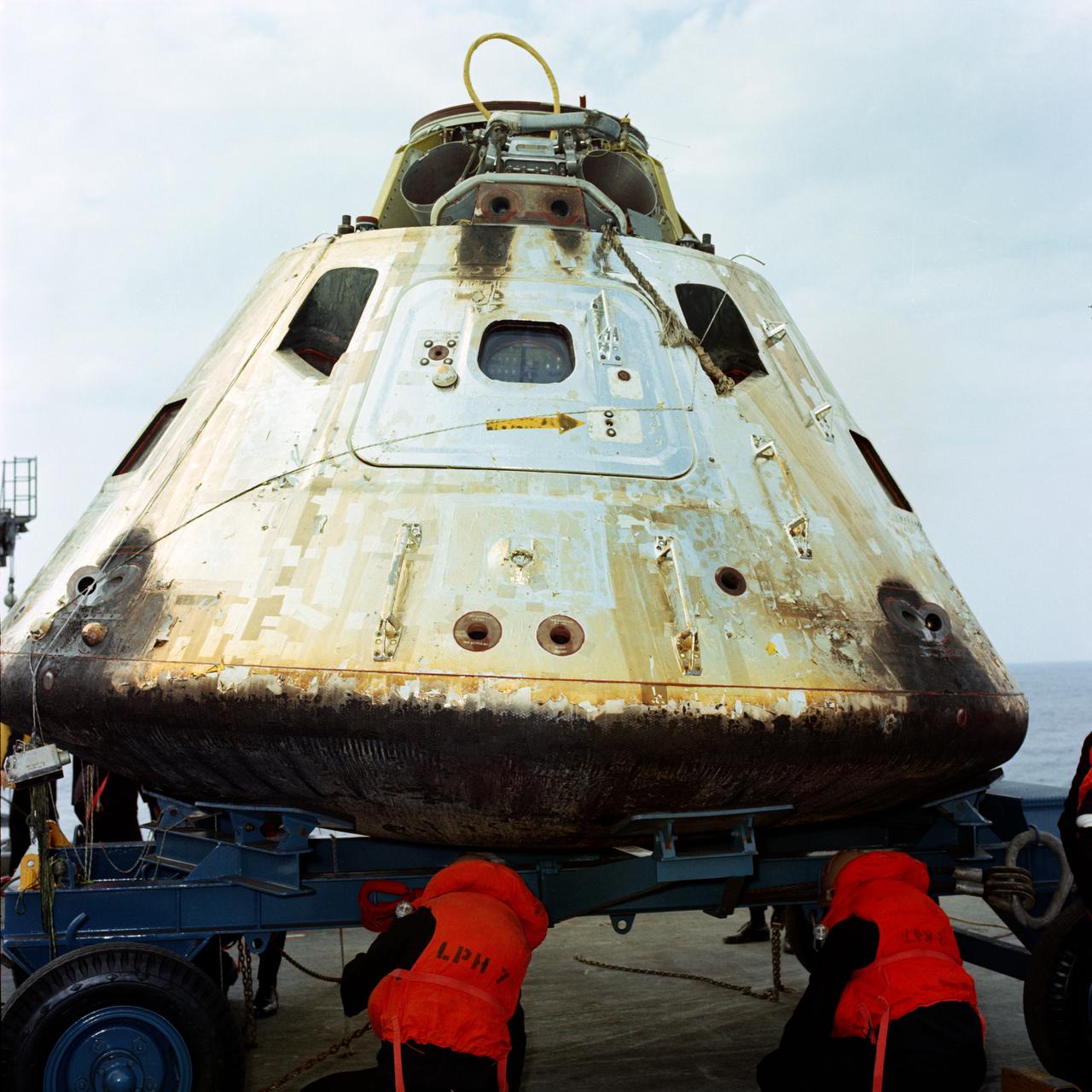
S69-20239 (13 March 1969) --- Close-up view of the Apollo 9 Command Module (CM) as it sets on dolly on the deck of the USS Guadalcanal just after being hoisted from the water. The Apollo 9 spacecraft, with astronauts James A. McDivitt, David R. Scott, and Russell L. Schweickart aboard, splashed down at 12:00:53 p.m. (EST), March 13, 1969, only 4.5 nautical miles from the aircraft carrier to conclude a successful 10-day Earth-orbital mission in space.
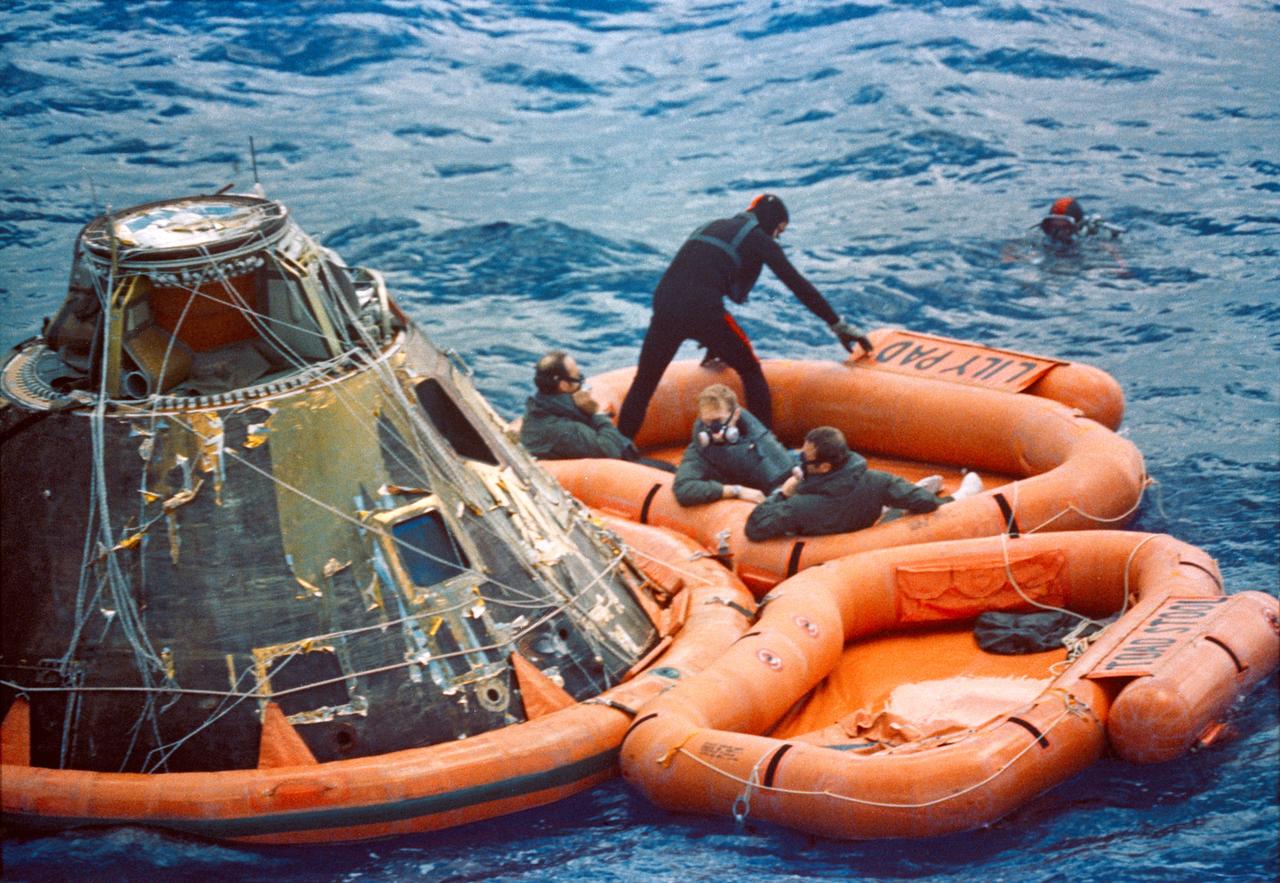
S71-19475 (9 Feb. 1971) --- The Apollo 14 crewmembers sit in a life raft beside their Command Module (CM) in the South Pacific Ocean as they await a U.S. Navy helicopter, which will take them aboard the USS New Orleans, prime recovery ship. The crew men are, from left to right, astronauts Alan B. Shepard Jr., commander; Stuart A. Roosa, command module pilot; and Edgar D. Mitchell, lunar module pilot. Two U.S. Navy underwater demolition team swimmers (one partially visible in right upper corner) assist in the recovery operations. The Apollo 14 spacecraft splashed down at 3:04:39 p.m. (CST), Feb. 9, 1971, approximately 765 nautical miles from American Samoa in the South Pacific Ocean.
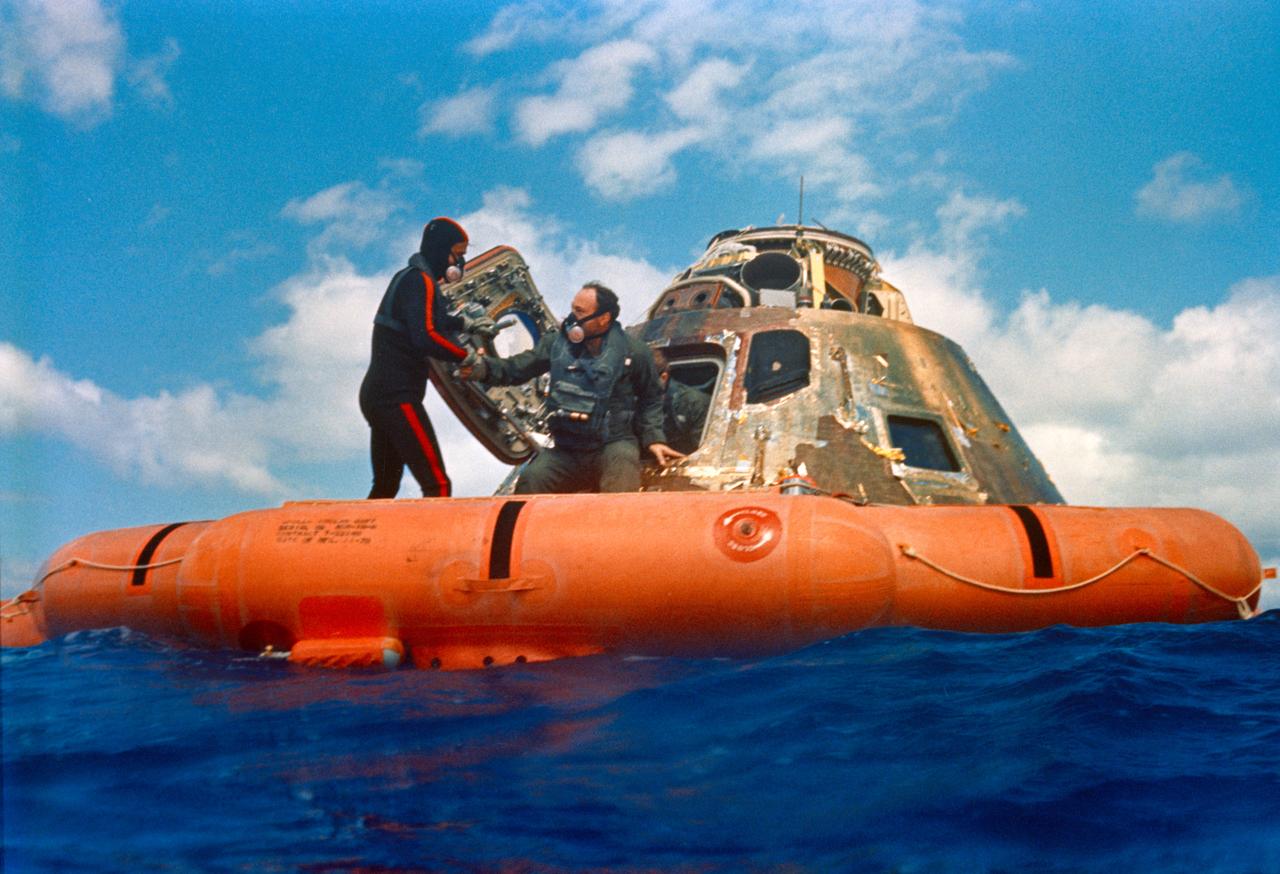
S71-19474 (9 Feb. 1971) --- Astronaut Edgar D. Mitchell, lunar module pilot, is assisted out of the Command Module (CM) by a U.S. Navy underwater demolition team swimmer during the Apollo 14 recovery operations in the South Pacific Ocean. Mitchell was followed out of the spacecraft by astronauts Alan B. Shepard Jr., commander; and Stuart A. Roosa, command module pilot. Roosa is partially visible behind Mitchell. The Apollo 14 splashdown occurred at 3:04:39 p.m. (CST), Feb. 9, 1971, in the South Pacific Ocean, approximately 765 nautical miles from American Samoa. They were transported by U.S. Navy helicopter to the USS New Orleans, prime recovery vessel.
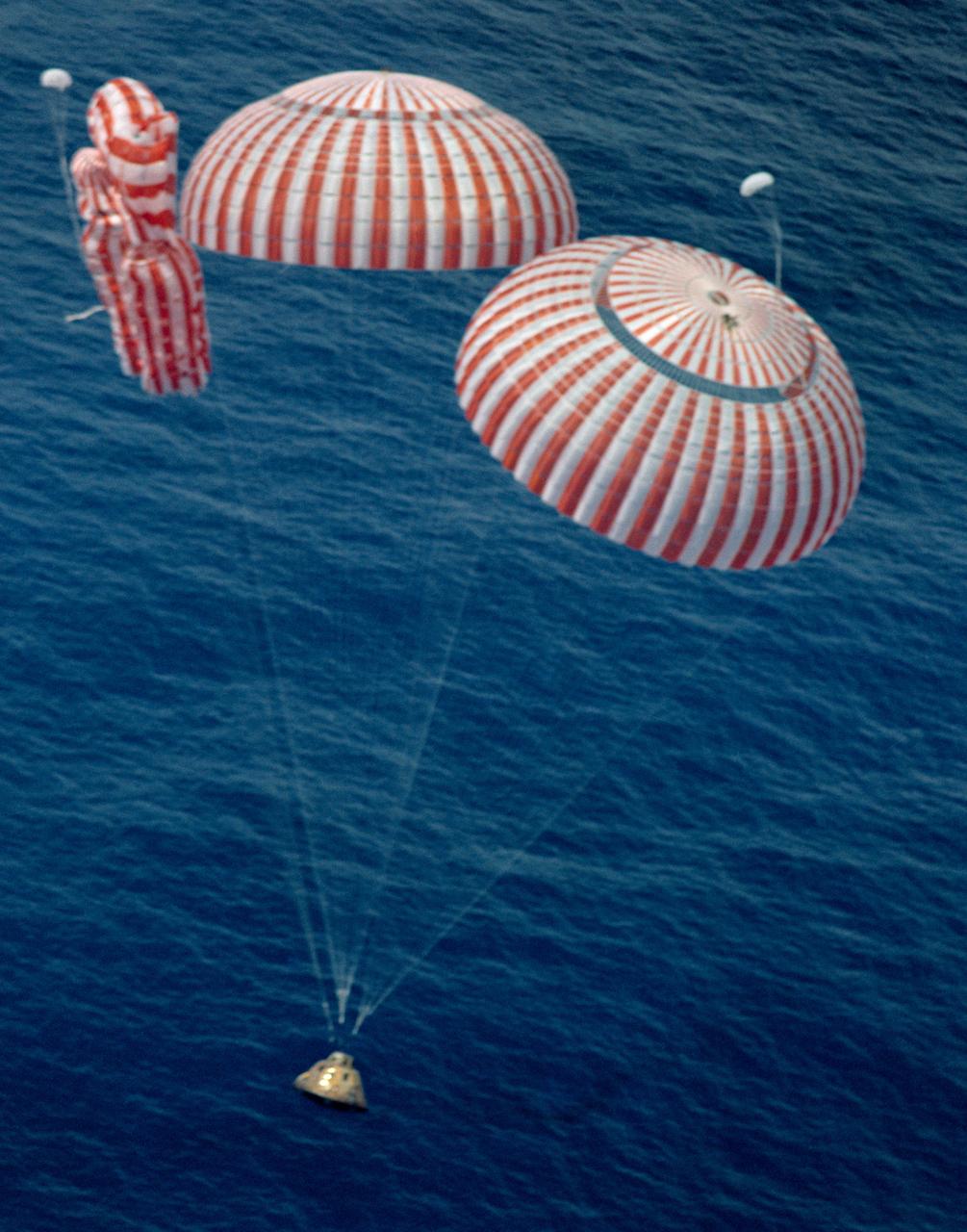
S71-41999 (7 Aug. 1971) --- The Apollo 15 Command Module (CM), with astronauts David R. Scott, commander; Alfred M. Worden, command module pilot; and James B. Irwin, lunar module pilot, aboard, nears a safe touchdown in the mid-Pacific Ocean to conclude a highly successful lunar landing mission. Although causing no harm to the crewmen, one of the three main parachutes failed to function properly. The splashdown occurred at 3:45:53 p.m. (CDT), Aug. 7, 1971, some 330 miles north of Honolulu, Hawaii. The three astronauts were picked up by helicopter and flown to the prime recovery ship USS Okinawa, which was only 6 1/2 miles away.
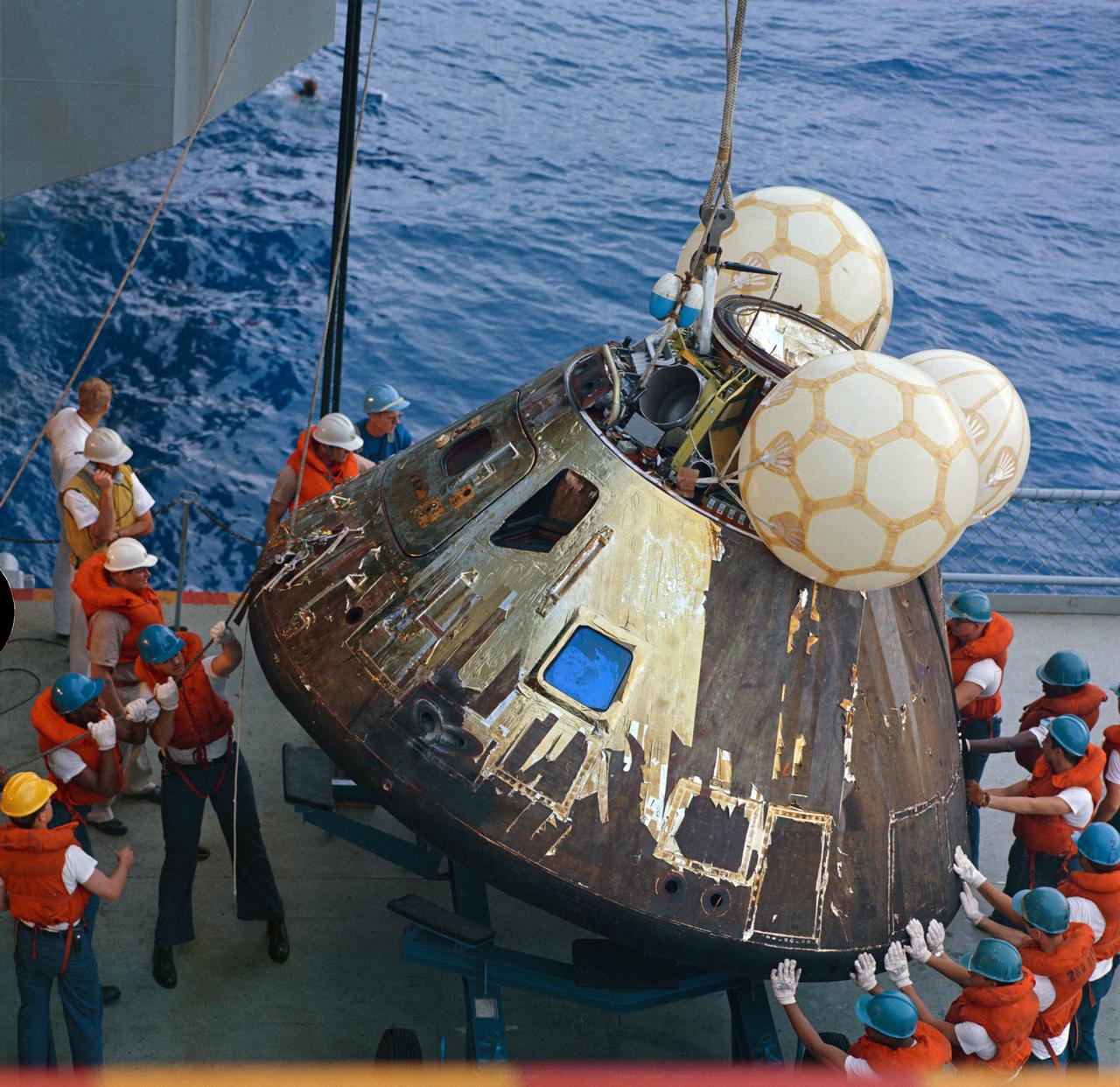
S70-35632 (17 April 1970) --- Crewmen aboard the USS Iwo Jima, prime recovery ship for the Apollo 13 mission, guide the Command Module (CM) atop a dolly onboard the ship. The CM is connected by strong cable to a hoist on the vessel. The Apollo 13 crewmembers, astronauts James A. Lovell Jr., commander; John L. Swigert Jr., command module pilot; and Fred W. Haise Jr., lunar module pilot, were already aboard the USS Iwo Jima when this photograph was made. The CM, with the three tired crewmen aboard, splashed down at 12:07:44 p.m. (CST), April 17, 1970, only about four miles from the recovery vessel in the South Pacific Ocean.
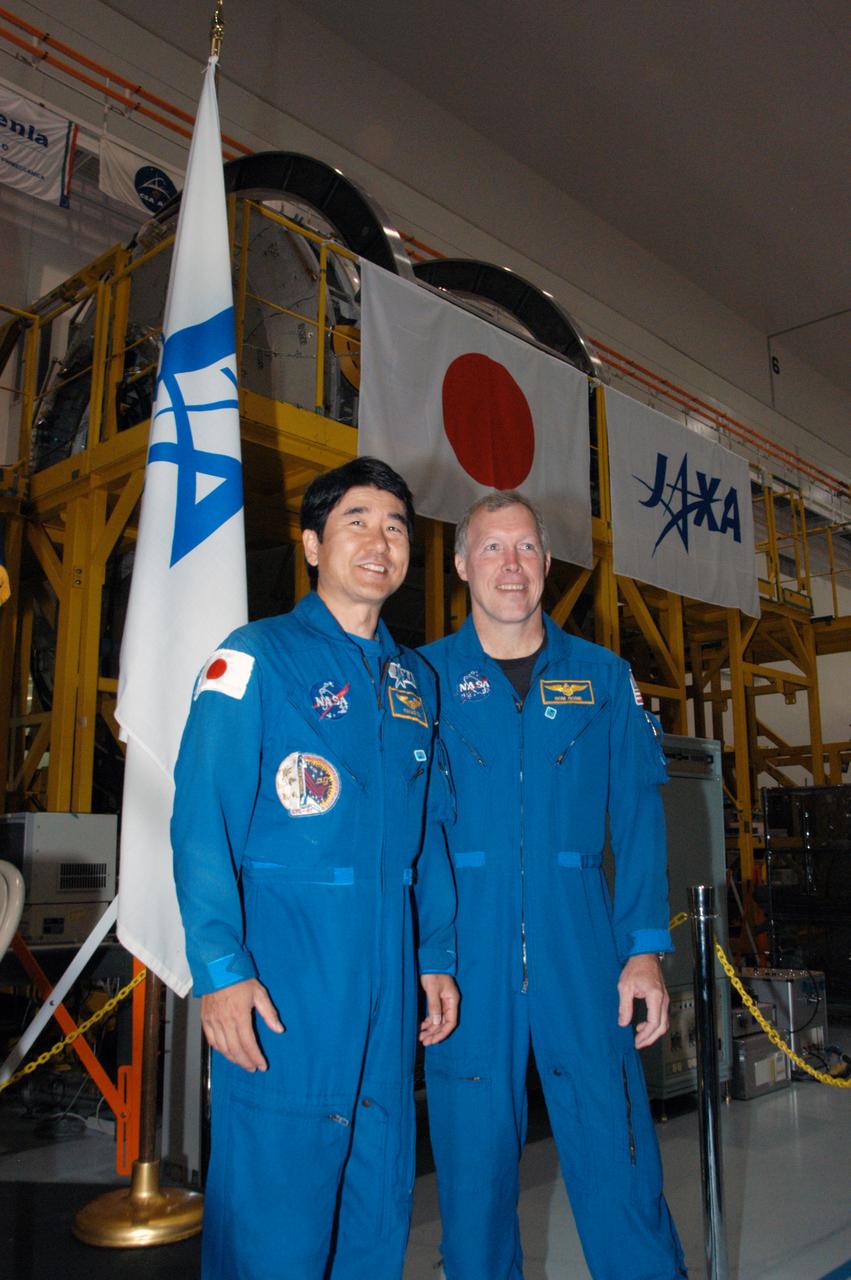
In the Space Station Processing Facility, astronaut Takao Doi (left) and Commander Dominic Gorie pose in front of the Experiment Logistics Module Pressurized Section for the Japanese Experiment Module, or JEM, that recently arrived at Kennedy. Doi and Gorie are crew members for mission STS-123 that will deliver the logistics module to the International Space Station. Earlier, NASA and Japanese Aerospace and Exploration Agency (JAXA) officials welcomed the arrival of the module. The new International Space Station component arrived at Kennedy March 12 to begin preparations for its future launch on mission STS-123. It will serve as an on-orbit storage area for materials, tools and supplies. It can hold up to eight experiment racks and will attach to the top of another larger pressurized module.
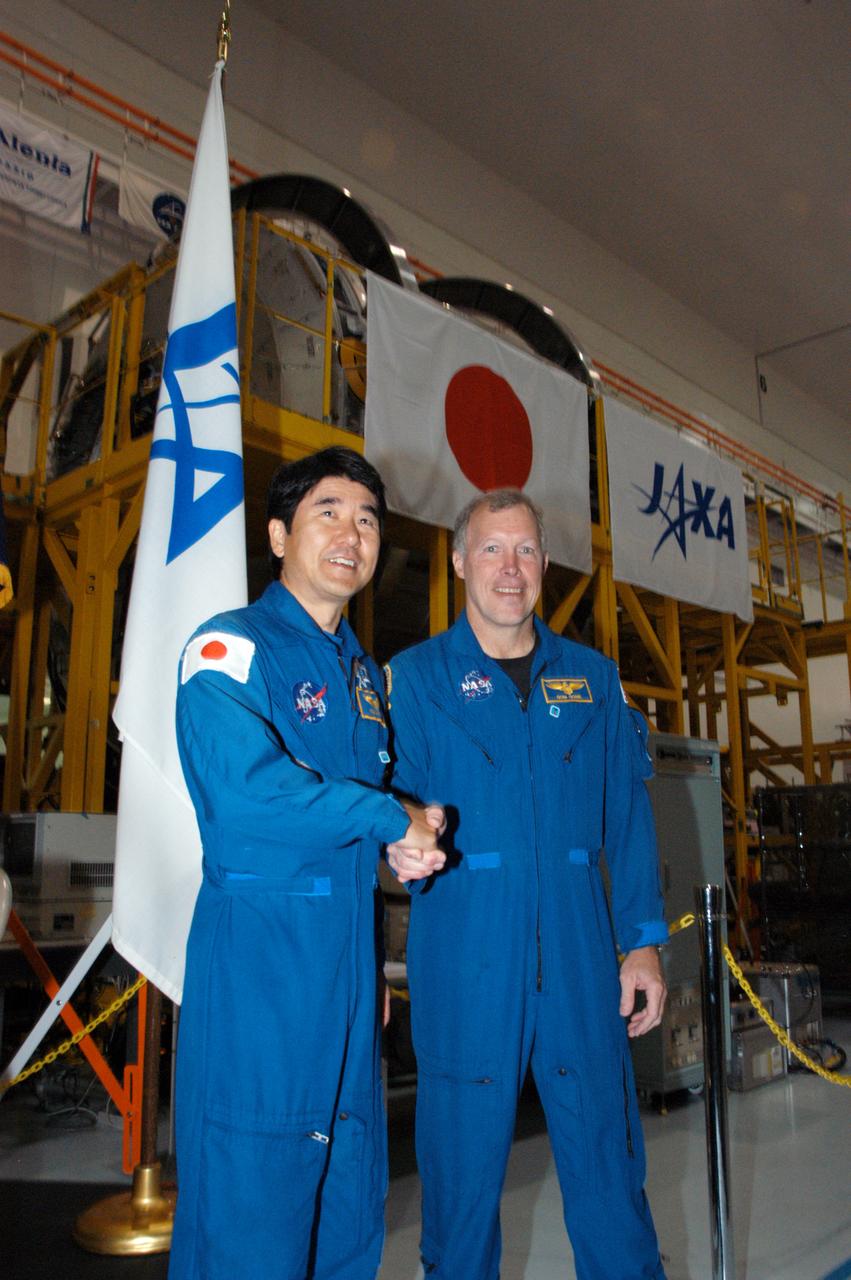
In the Space Station Processing Facility, astronaut Takao Doi (left) and Commander Dominic Gorie pose in front of the Experiment Logistics Module Pressurized Section for the Japanese Experiment Module, or JEM, that recently arrived at Kennedy. Doi and Gorie are crew members for mission STS-123 that will deliver the logistics module to the International Space Station. Earlier, NASA and Japanese Aerospace and Exploration Agency (JAXA) officials welcomed the arrival of the module. The new International Space Station component arrived at Kennedy March 12 to begin preparations for its future launch on mission STS-123. It will serve as an on-orbit storage area for materials, tools and supplies. It can hold up to eight experiment racks and will attach to the top of another larger pressurized module.

S68-26989 (4 April 1968) --- The Apollo 6 Spacecraft 020 Command Module is hoisted aboard the USS Okinawa.
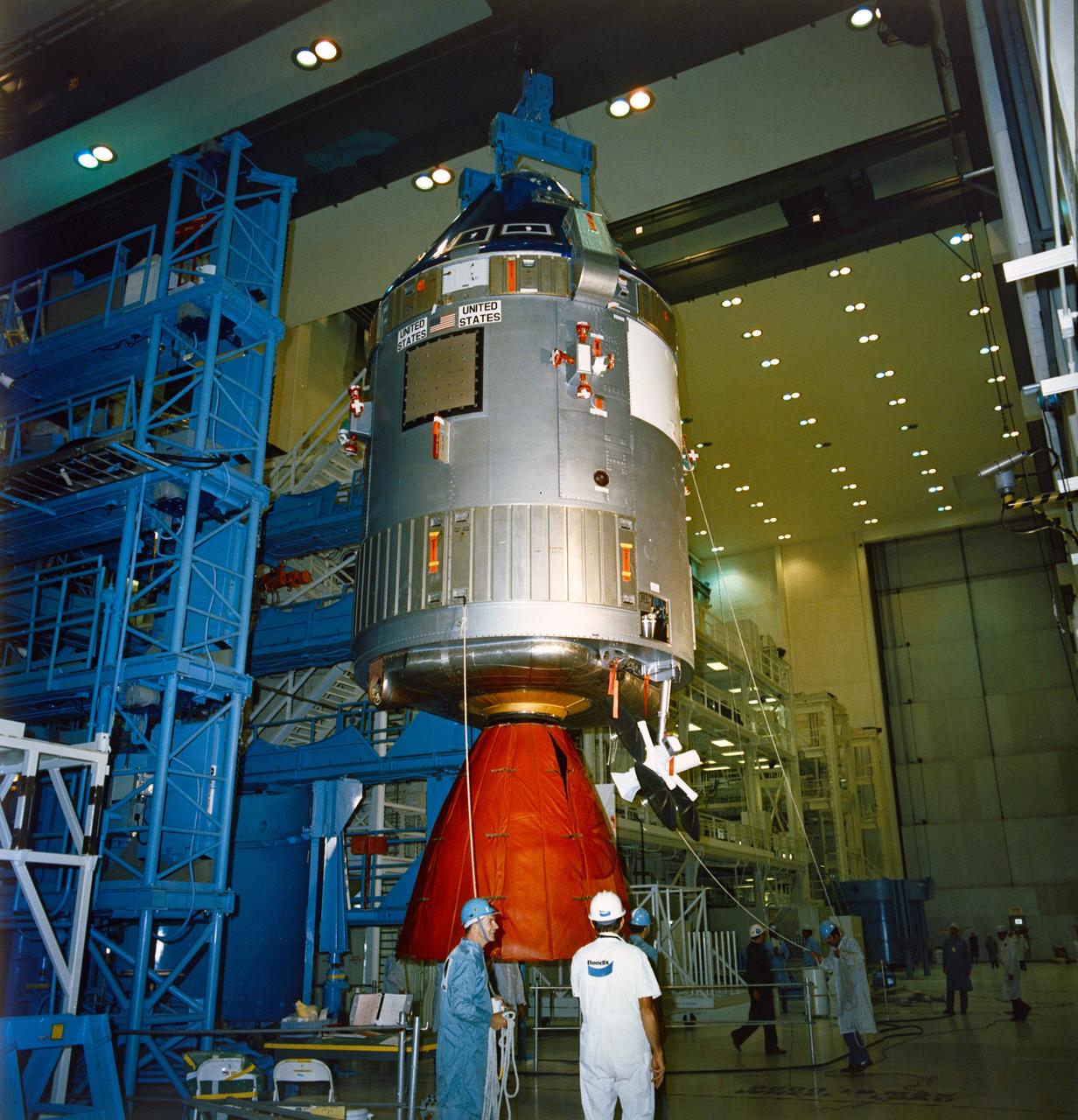
S75-26904 (27 Jan. 1975) --- The flight article Apollo spacecraft (Command Module-111 and Service Module-111) for the Apollo-Soyuz Test Project mission goes through prelaunch checkout procedures in the high bay area of the Manned Spacecraft Operations Building at NASA's Kennedy Space Center. Later, Spacecraft-111 was mated to the spacecraft launch vehicle adapter (SLA-18) in the MSOB before being moved to the Vehicle Assembly Building where it was mated to the Saturn 1B launch vehicle. The joint U.S.-USSR ASTP docking mission in Earth orbit is scheduled for July 1975.